Richmond Planet
Saturday, August 19, 1916
Richmond, Virginia

Page text (machine-generated)
N. F.
---
VOLUME XXXIII, NO. 40
EDITOR MITCHELL'S
TRAVELS
THE LONG BOX AND THE BAG-
GAGE AGENT—IN HOPEWELL
AT LAST—A QUEER TOWN—
ODD PEOPLE. THERE — THE
POWDER WORKS AND THE
EMPLOYEES.
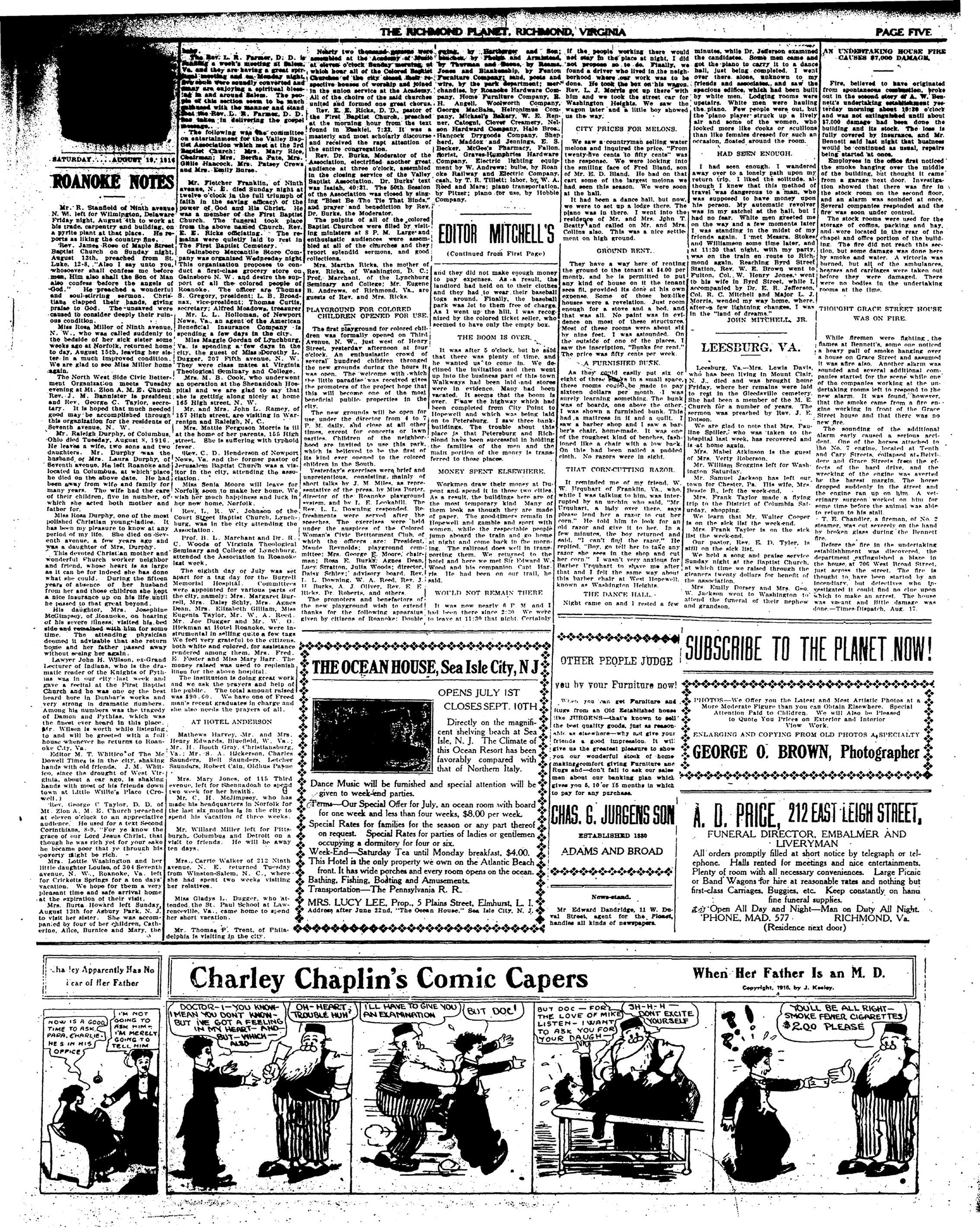
I left Richmond—that Monday at 1:15 P. M. August 14th, accompanied by Dr. E. R. Jefferson, Rev. L. J. Morris, R. C. Mitchell, W. Henry Jones and W. E. Brown. I was on the "Hopowell Special," which made a direct run from Richmond to Hopowell, Va., the town which was built up by the Dupont Powder Works at City Point, Va. I was going to West Hopewell, and as it is known now, Washington Heights, to set up a lodge. The long box, which I had carried to the station, attracted much attention and called for a protest from the baggage master, who said he could not handle it on that train.
EXPRESS COMPANY COULDN'T CARRY IT.
He referred me to the express company across the street, and I went there, only to be told that the company did not handle any express matter on that special train at all. It could not be done for "love or money." The colored man there told me, though, that if I would see the Train Dispatcher and get a permit from him I could in all probability succeed in getting to Hopewell. What could I do with the men and no rank work? I was in a quandary, and it was not long before the obliging train dispatcher was listening patiently to my story.
THAT LONG BOX
As there were but a few moments before leaving time, he sent one of his assistants to the baggage office with instructions to put the box on the train. He soon came himself, and smilingly, looked at the mysterious long box, which might have contained a coffin. He wanted to know if there was any liquor in the box. Upon being assured that there was not, the movement was made towards the baggage car and we were all soon happy and smiling. On the train was a young colored man attired in a new plaid suit.
WHISKEY WORKING.
He appeared at first to be alightly under the influence of whiskey. With every turn of the wheels he seemed to get more so, until he was sleeping. When the conductor came for his ticket, he finally tore in in half in his effort to extricate it from his pocket. We arrived at Petersburg at five minutes to two o'clock. We did not see any of our party there. Soon after leaving Petersburg, I observed that all of the farmers had staked off their farms in lots and streets. No houses were in evidence.
THOSE DAY SHIFTS
When we reached Hopewell, we saw the large frame depot. It was well-nigh deserted. I saw the shift of men going to work. It was a slight long to be remembered. In a short time thereafter, I could see equally as many coming off. The long train of coaches was there to receive them. They were hurried to Petersburg and to Richmond. Hundreds of these people never spend a night in Hopewell; they come to this place and work in the daytime and go home at night.
STILL WAITING.
I was waiting for Sir W. T. Stokes and Sir J. E. Williamson, who were to meet me here. I did not know where to go and I continued to wait. We had arrived at the station on time—2:30 P. M. We strolled around and did what we could to whale away the times. Dr. Jefferson met an acquaintance and he engaged in conversation for some time. He told us that Lawyer Brvrd's office and his hotel were right over there. He pointed the way, and about a block and a half brought us in sight of the place.
BYRD'S HOTEL
Sure enough, there was the sign,
"J. Byrd, Attorney at Law." This sign had even survived in Richmond City. I saw a crum, two-by-two structure. Published on the front was the following inscription: "For Colored. South Bend, Mo." Bromus 5140 per week and so. For Cincinnati, Batha, No. I had found out one thing and that was it entered daily behind in Hippoware. I must another sign on an adjoining
ing building. It read, "Paw-broker. Unredeemed Pledge Store. Colored." The pledges must have remained unredeemed, for the place was closed.
ANOTHER HOTEL
There was another hotel a few doors from Byrd's Hotel, but it seemed to have a white management. The sign read, "For Colored." $1.00 per week and up. Jack Johnson Hotel. Unredeemed Pledges for Sale. Diamonds, Watches, Jewelry, Guns. Platios, Clothing, Shoes; Gents' Pursuing Tools." I was in need of dinner and my associates were similarly affected. We walked into Byrd's Hotel and there sat Attorney Byrd. He grieved us cordially and soon orders were being taken for the afternoon meal.
GOOD PLACE FOR A CHURCH.
We sat down at the tables. I inquired about Hopewell and told him that I thought this was a good place for Rev. L. J. Morris to found a church. He called attention to a nice looking female, who was soliciting help for a mission across the way. The colored lady had a note book. She did not seem to be as popular at this work as some of the women I saw down there at some other business. Like the Pharisees, they passed by on the other side. Finally, another lady joined her and they entered the Hotel an sat at a table.
WANTED REY. MORRIS' MONEY.
I saw or think I saw one of them, holder than the other, shove a contribution paper under Rev. Morrish arm. He was a little disturbed, but as the question of eating was all important in his mind, he quietly suggested that she would not attract his attention at that time, but wait awhile. When we completed the meal, she had evidently gotten tired waiting and felt the restaurant, Proprietor Byrd showed us over his structure, which occupies a lot twenty feet by one hundred feet, and in which frame structure there are 32 rooms for lodgers.
HIGH PRICES FOR SMALL SPACES.
When he announced that rooms were $1.00 per week and up, it reminded me of what had been said by a facetious assistant, "Rooms $4.00 per day and up, but mostly up." What is meant by a room, is a room with three bed companions, there being two double beds in a room and the room just about large enough to permit them to be in there without crowding. The water fixtures were of the most modern kind. One long hall-way led the way down. In case of a fire, it was a long jump to the ground below.
A PECULIAR COMBINATION
We went to the rear of the structure, and from a porch with a floor about four feet square. I saw in a cluster of trees about fifty feet away all kinds of houses. Some were made of boards with canvas top. Some were tents. Some were made of what appeared to be pasteboard, but which may have been asbestos. There were no streets, only lanes. I saw men there and women. I saw white and colored there together in a space that was not more than 100 feet square.
DIDN'T STAY THERE
Upon inquiring of Proprietor Byrd if he stayed down there, he replied, "Oh, no! I go to Richmond every night and come back in the morning." So far as night service was concerned, he was not a patron of his own hotel. I met Mr. Frank Pervall later. It was decided that we would go down into "Death's Valley" as it is called. It was a long, narrow lane, and we went down into its recesses. I could not conceive how a person could get on there in the night-time. Some said that there was a hall, known as "Judgment Hall." I had seen the Courthouse and the jail from the rear of Byrd's Hotel.
MUST NOT TALK TOO MUCH.
I was getting interested. As for Lawyer Byrd, he was fearful of getting into trouble and he cautioned me not to do too much talking. He pointed me to the spot where a woman named Loney had her throat cut from ear to ear. Conditions were improving in Hopewell, he said. They used to shoot, cut and stab to death some two or three persons per week, but the number had been reduced to one, and some weeks not any at all. I felt sure that it would be a long time before they would have a chance at him, if he continued, to make hurried trips to Richmond as he had been doting.
"DEATH'S VALLEY."
We were going up out of "Death's Valley" now, and I saw a baseball park. A game had been scheduled for that afternoon at 4 P. M. It was just this way: A team had come all the way from Baltimore to play there (Continued on Page Five)
OPEN AIR CONCERT.
A grand open air concert and festival on the lawn of Third street Bethel A. M. E. Church, between Leigh and Jackson streets, Monday evening, August 21, 1916, beginning at eight o'clock. We will endeavor to entertain you with music, singing, the fishing pond and refreshments every moment you spend with us. Given under the auspices of the A. C. E. League. Admiration, five cents. Rev. M. E. Davin, D. D., Pastor.
COLORED MEN TO SEE WILSON
Washington, D. C., August 16. Senator Thomas S. Martin today asked the President to receive a delegation of prominent Negroos representing the Hannibal National Democratic League, of which Giles B. Jackson, of Richmond, is the head. This organization has pledged itself to the support of Wilson and Marshall for recollection, and requested Senator Martin to arrange for an interview at the White House when the delegation will personally assure the President of its loyalty to the Democratic ticket. The White House will arrange the date for this visit in a few days.
RESOLUTIONS
Resolutions in regard to Brother Knight John Taylor, who departed this life August 6, 1916.
Resolved. First. Whereas, It has pleased the Almighty God to take out of our midst John Taylor. We bow in humble submission to Him who death all things well.
Resolved. Second. The Great monster death hath broken a link in our chain; therefore, we commend him to our Heavenly Father, the Ruler of the entire universe.
Resolved. Third. That we extend a copy of this to the family; a copy to the Lodge, and a copy be sent to the Richmond Planet for publication.
fours in F. C. and B..
T. L. Locoss, M. L. Carter, S. P.
Fountain, of Zlontown Lodge.
No. 164. K. of P.
—Astoria Beneficial Club to Clare
mont. August 22nd. Nuff soud.
LAID TO REST.
Dorothy Burnell, the four-months-old daughter of Joseph and Maude Burnell, who died on Sunday, August 13, 1916, at their residence, 2212 Fairfield Street, Woodville, was buried on Monday in Greenwood cemetery, at 11 A.M.
Sleep on beloved.
—Her Parents.
Y. W. C. A.
Mrs. Sarah Wilson spoke on Sunday afternoon at Vespers. Mrs. Wilson was forceful and spiritual and had the constant attention of the large audience, which greeted her.
The monthly meeting of the Board of Directors was held on Wednesday night of last week.
The regular meeting of the Association was held on Monday.
Reports show the best committee work of the year and the largest number of residents in the home.
Bible study proves entertaining and profitable as the good attendance fontifies.
Several young women are off on vacation.
We are repeating the invitation to our friends. Come to see us often.
Mr. Charley Cooper, of 2208 Henrico street, entertained at innchon last Sunday the Union League Business Club of South Richmond, of which Mr. Joseph Wooldridge is president and Mr. Jasper Logan is secretary. The table was heavily indened with edibles to satisfy the inner man and all partook heartily thereof. Among those present were: Joseph Holmes, Lee Holmes, Robert Branch, George Lewis, Jasper Logan Benjamin Smith, John Hall, Joseph Wooldridge, W. E. L. Smith and J. R. Cogbill.
For comfort and style be on board the Pontonhast, August 22.
A. corner lot in Providence Park
that can be bought at the low price
of $8.99 per foot on time, or much
cheaper for each. Apply to B. A.
CORNER LOT, 1 9 N. Second Street.
PERSONALS AND BRIEFS
Mrs. Rosa K. Jones in spending her vacation at Flushing-L. I.
Miss M. L. Chiles left last Thursday for Hot Springs, Va.
Rev. Dr. T. J. King was in Louisa County this week.
Miss Mabel Miller is visiting for a few weeks in Kearbridge, Va.
Grand Vice-Chancellor T. J. Pree, of Newport News, Va., was in the city last Thursday for a short time.
Mr. Alexander Meyers, of Beaufort, B. C., called on us. He was on route to Hot Springs, Va.
Mrs. M. B. Thompson of Philadelphia Penn. in company with Miss Emily J. Gilpin, called at our office.
The beautiful steamer Pocahontas will carry the Astoria Beneficial Club and its friends to Claremont.
Mrs. Mattie A. Tyler of Winterpock Va. was in the city this week and called on us.
Mrs. James T. Fry, Jr. and daughter will be away quite awhile, visiting friends in Philadelphia, New York and Atlantic City.
--Miss Susie E. Robinson, 908 Abilail street, left the city to spend a week at Lamherts Point, Va., the guest of Miss Marie Kindred. She will also visit friends in Norfolk.
--Mrs. Maggie Alexander arrived in the city from Savannah, Georgia, Friday. She is stopping with her son, Mr. Robert Alexander, 114 W. Duval street.
--Mrs. Florence Cogbill and little Evelyn and Ominee, left the city last Thursday for Lancaster county, to visit her sister, Mrs. Maud H. Lee.
--Mrs. Susie Robinson and Mrs. Amanda Croxton returned to the city Monday from Charles City.
Miss Priscilla Dunn, 502 North Sixth street, who has been suffering with typhoid fever, is still confined to her bed.
--Miss Louise Brown returned to her home in Binghamton, N. Y. last week. She had been visiting her grandmother, Mrs. Callie D. Brown.
Miss Jeannette Brown of Charles City, Va., visited relatives in the city for two weeks.
Follow the crowd on August 22 down the river.
Mrs. Martha B. Scott left the city last week to visit relatives and and friends in Louisa, Spotsylvania and Beaver Dam, Va. after which she will return to Huntington, W. Va.
Mrs. Berenice Nash has returned home after a pleasant vacation spent in Philadelphia, Pa and Atlantic City, N. J. While in Philadelphia, she was the guest of Mrs. Maude Taylor Lawson in Christian Street.
Mrs. Frank Perkins, Miss Hazel E. Mountain, Mrs. Thomas W. Fleming of Cleveland, O., were in the city, the guest of Mr. and Mrs. John T. Taylor 1406 Kemper St. They left for Boston yesterday and will return home by way of Philadelphia, Pa.
—Mrs. Martha V. Skipwith, the accomplished wife of the Rev. W. H. Skipwith, noted preacher and singer, is visiting relatives and friends in New York City.
Dr. Albert A. Tennant, and his Madame are visiting Oklahoma City Oklahoma, Kansas City, Mo. They have been the recipients of many courtesies and are having a fine time in the West. In order to avoid any annoyance, they occupied the drawing room of the Pullman car from St. Louis, Mo. to Oklahoma City.
—The Smart Set Company, at Mitchell Street and Brooke Avenue, has palyed to packed houses during this week. The large tent is said to hold 5,000. The admission is 10 cents, reserved chairs, 20 cents, and most of the seats are chairs. The show changed nightly and the performers maintained a high standard of excellence. Mr. Alexander Tolliver has charge of the aggregation, and is the owner.
—Come along, enjoy the blessing prepared for you on August 23rd.
Young Man wishes position with Underdairier in Bumbalmer. Capable of Managing or can work under Management. Address 74 High Street Admirille N. C. M. L. PARKER.
K. OF P. LODGE INSTITUTED.
Hopewell, Va., August 15.—A lodge of Knights of Pythia was organized at Washington Heights, West Hopewell, last night by Grand. Chancellor John Mitchell, assisted by Dr. E. R. Jefferson, Sir L. J. Morris, Sir R. C. Mitchell, Sir Edward W. Wood, Sir W. T. Stokes, Sir W. E. Brown, Sir W. Henry Jones, Sir Williamson, Sir Brian, and others.
The Grand Chancellor and his party did not arrive at the meeting place until about 6 P. M., although they reached here at 2:30 and went over the town on a tour of inspection. Refreshments and eatables were served after the initiation. The candidates were delighted. The Lodge will be known as Washington Helghta Lodge, No. 205. The following officers were installed: M. of W. William James; Chancellor Commander, Joe Flemings; Vice-Chancellor, Roose Spoon; Prelate, Squire L. Smith; Master-at-Arms, Harrison Benson; Master of Finance, Weldon Lee; Master of Exchequer, W. H. P. Gram; Keeper of Records and Seal, John Beatty; Inner Guard, Richard Miller; Outer Guard, James L. Templeton; Trustees, W. M. Madison; Jacob Haynes, Adam Mabrey. Grand Chancellor Mitchell left for Richmond at 11:30 last night. The members are all smiling at each other today.
BIG NIGHT AT FIFTH STREET
BAPTIST CHURCH, SUNDAY.
---
The thirty-sixth anniversary of the Fifth Street Baptist Sunday School and installation of the officers of the Sunday School and B. Y. P. U. will take place Sunday night (tomorrow) August 20th, at eight thirty o'clock. The officers of the two bodies will be installed by Prof. W. P. Epps, Superintendent of the Ebenezer Baptist Sunday School.
The following program will be rendered: Music Sunday School; Invocation, Pastor T. J. King; welcome address, Roscoe C. Mitchell; Work of the Sunday School, Mr. Walter White; solo, Miss Mildred Johnson; essay, Miss Exher Scott; instrumental solo, Miss Robecca T. Mitchell; Work of the B. Y. P. U. Miss M. Kate Doyle; violin solo, Mr. John Johnson, accompanied by Miss Belle Boyd; installation address, Prof W. P. Epps, solo, Mr. Joseph Matthias selection, Miss Jane Grinnan; offerty, Miss Estelle D. Ward and Mr. N. G. Booker, Miss Emily A. Williams, Mistress of Ceremonies.
Mr. R. H. Fauntleroy is Superintendent of the Sunday School and Miss M Kate Doyle, President of the B. Y. P. U.
---
MRS. WINSTON PASSES AWAY.
Mrs. Helen Robinson Winston, died at 297 E. Leigh St. Sunday morning 6th last after a protracted illness. Her funeral took place Wednesday 9th last, from the Second Baptist Church. She was sister of the late William Tennant and aunt of Dr. A. A. Tennant.
JUBILEE COMMITTEE TO MEET
Danville, Va.
July 17th, 1916
July, 17th, 1918.
All members of the Jubilee Committee are hereby called to meet in Danville Virginia, August 23rd, during the meeting of the State Sunday School Convention. This is the first meeting of the Committee and all members are urgently requested to be present.
Very truly yours,
S. A. Moses, Chairman
Jubilee Committee.
ORGAN CONCERT.
An organ concert will be given by Tutti Mayo at the Leigh Street M. E. Church, Sunday eve, August 20, 1916 at eight o'clock.
The following program will be rendered: Organ prelude; hymn, "The Church Is One Foundation;" Hope, organ, Lerman; Children's Chorus; Gavotta Op. 6, organ, Lerman; Recitation, selected; Spring Song, organ, Mendelssohn; Vocal Solo, selected; Hymn Medley, organ, Guillmant; LaClinquataine, organ, Gabriel-Marie; Recitation, selected; Offertoire, Marche-Militaire, organ, Schubert; The Lost Chord, organ, Sir Arthur Sullivan; Chorus, The Angel's Message, Shelley; Humoroseks, organ, (by request) Dvorak; Manuset A L'Antique, organ, (by request) Paderowksi; Vocal Solo, Rev. D. M. Mitchell; The Thunder Street, organ, Guillmant; Bagatelle, organs, Bottier; Grand Mush, organ, Dudley Buck; Good Night, organ, Finsley.
Please bring a silver offering.
—See the Colonial Estates on the James River. From the deeds of P. Purchasen, August 22.
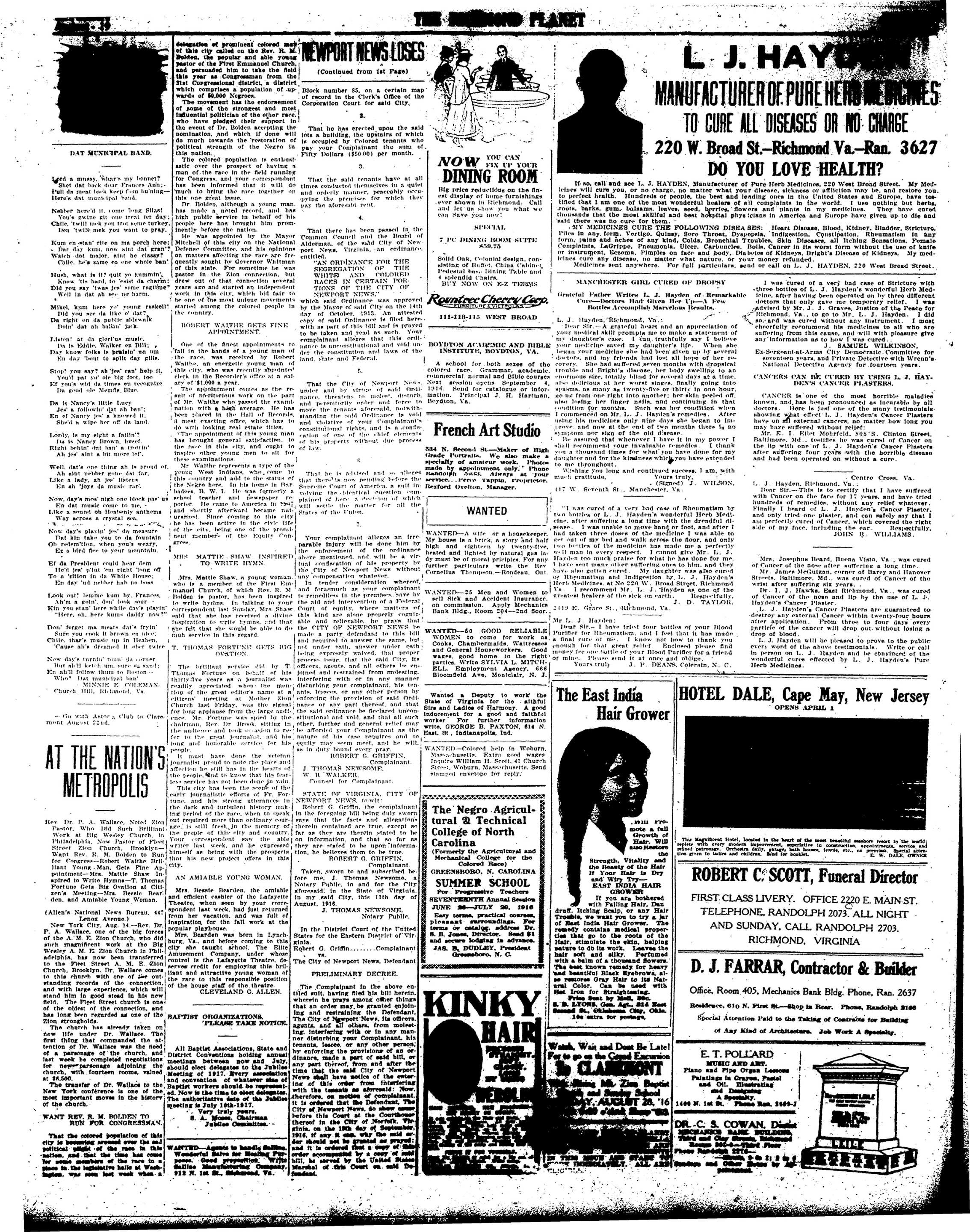
NEWPORT NEWS LOSES IN SEGREGATION FIGHT
In the United States Circuit Court, at Norfolk, Judge Waddill this morning granted Robert G. Griffin a temporary injunction against the city of Newport News, restraining the municipality from enforcing the race segregation ordinance.
The action grows out of the recent decision of Police Justice Robinson, who gave a large number of colored people brought before him, thirty days to move out of a certain section of the city; they having been charged with violating the terms of the segregation ordinance, which prohibits colored people from living within certain areas defined in the law.
The injunction was secured by Attorney Thomas Newsome and W. R. Walker, acting for R. G. Griffin, colored, a citizen of Yorktown, who owns certain property in the East End, described in the injunction as lots 645 and 647, block 86.
THE PETITION
The complainant sets forth in his petition that he has erected a building the upstairs of which he rentes to colored tenants for $50 per month. He further cities the ordinance and assents in his allegation that the law is unconstitutional. He further alleges that there is now pending before the United States Supreme Court a suit involving the identical question complained of here, a decision of which will settle the matter for all the States in the Union. He concludes by saying that he is advised and so alleges that an irreparable injury will be done him by the enforcement of the ordinance above mentioned and will be a virtual confession of his property by the city of Newport News, without any compensation whatever.
IS TEMPORARY
The injunction as granted is temporary in its nature and is returnable in September. At that time the case will be taken up on its merit and the court will decide whether the injunction shall be made permanent, pending the decision of the United States Supreme Court.
A United States deputy marshal came here this afternoon and served the injunction papers upon Mayor Semmes, and several other city officials.
The case of the city will be looked after by City Attorney Massie (Newport, News Times Herald—Avg.
In the District Court of the United States for the Eastern District of Virginia.
Robert G. Griffin.....Complaint.
vs.
The City of Newport News, Defendant
To the Honorable Edmund Wadhill,
Jr. Judge of said Court:
Humbly complaining, showeth unto
your Honor, your Complaintant, Robert
G. Griffin, a citizen of the United
States, residing at Yorktown in the
State of Virginia, and within the
jurisdiction of your Honor's Court
for the Eastern District of Virginia.
That he is the owner in fee simple of certain lots, pieces, or parcels of land situate, lying and being in the City of Newport News, Virginia, which said lots are known and designated as lots number 645 and 647, in
(Continued on Eighth Page)
With little extra effort you can get one our prize graphaphones. See offer on back page.
LABOR DAY CELEBRATION.
The Spartan Literary and Athletic Association will hold a big Labor Day celebration on Hovey's Field, Virginia Union University, on September 4th, from 1 P. M. to 8 P. M. The celebration will begin with a grand street parade, which will be picturesque and impressing. The features of the day will be racing, baseball, baseball tactics, jumping, wrestling, sporting and entertaining and vaulting, and children's events. This program is to be the most memorable Labor Day celebration ever held in Richmond by educated people. A full brass band will be in attendance all day, and entertainments will be served to the grounds.
PRICE, FIVE CENTS
AN APPEAL TO LOYAL BAPTISTS
Selma, Ala., July 24, 1916—To all Regular Baptist Churches in Harmony with the National Baptist Convention Greetings:
The 36th Annual Session of the Convention will be held at Savannah, Ga. beginning on Wednesday, September 6th, 1916. The present indications are that the coming meeting will be the largest and most representative of any held for many years.
It is not expected that every regular Baptist Church will be able to send her pastor, or a messenger, but all can be represented. No church is too small nor too weak to send a letter, and this appeal goes forth with the hope that at least five thousand of the churches which cannot otherwise be represented will send in their statistics and representation money of $50 on or before the fourth day of September. Let each President of State, Sunday School and B. Y. P. U. Conventions see that his organization is represented. Attention is called to all District Associations, Sunday School Conventions and other local organizations to represent them your presiding officer or others.
The cause of Christ demands that we "enlarge the place of our tent" and be ready for the opportunities which are opening to us a world wide conquest. If you feel able to do so, we much prefer that you send your pastor to the Savannah meeting, and that your reports be sent by him, but in the event you cannot send a messenger, then we ask that you fill out the enclosed letter form and return the same in the self addressed envelope. Make your money orders payable to A.J. Stokes, Securer A badge and official receipt of the Convention will be sent to each organization and individual thus representing.
Very truly yours.
E. C. Morris, President.
R. B. Hudson, Secretary.
Enjoy the breezes and moon lift
river on your return home from
Claremont, August 22nd
RACE CONFERENCE CALLED
The signs of the times in Church and state demand radical unity upon all questions pertaining to the welfare of the race; hence this call.
To the leaders of the race in every State of the Union in church and state, to every race loving man or woman of the union, this call is extended.
And you are hereby urged to attend the race conference to be held in Washington, D. C. Sept 14th 16th, 1916, at Mt. Carmel Baptist Church, Third and I Streets, N. W.
First session will open at 10 o'clock in the Morning The Baltimore and Washington Ministers Conference in joint session June 26th, 1916, endorsed and authorized this call. Therefore every minister's conference, every formal organization, and all other Negro organizations interested in the up lift of the race are urged and asked to send a representative.
Every phase of the Negro Status in this nation will be carefully considered with a view of memorializing Congress and those authorities to ameliorate the same.
Prominent men and women of the race who are interested in the uplift of the race will be present and address the conference. It is fair to state in ad vance that there are expense incident to this call and no funds from any source; therefore every member of the race should consider it his duty to help bear the same. Kindly manifest your interest by sending a donation to the Secretary, or the Chairman. For further information address, W. H. Jernagin, Chairman, 430 Que Street, N. W., Washington, D. C. Rev. Wm. Alexander, Secy. 1625 Drudt Hill Ave, Baltimore, Maryland
Mr. Cunningham Entertained.
Mr. U. S. Cunningham, the popular undertaker and liveryman, of Danville, Va. arrived in the city on the 5th inst., in his four passenger automobile, making the trip without an accident. He also visited Peterburg, Hopewell and City Point on Wednesday.
Thursday night a grand reception was tendered him at the home of Mr. and Mrs. E. T. Sully, on Perry street, South Richmond and the following guests were present: Messrs W. L. Cunningham, James Lucas, W. E. L. Smith, Charles and Joseph Robinson, Walter Robinson, John E. Hall, James Cunningham, Sr., John Cunningham and his quartette, Theo Henderson and Harvey Jankins.
Refreshments were served abundantly. Mr. Cunningham left for his home on Friday morning by auto, after having a pleasant time.
MR. CREECY WRITES FROM FAR ALASKA ON RACE'S CONDITION
PAGE TWO
Koyukuk, Alaska.
Nolan P. Office.
Richmond Planet.
It is mighty difficult to express just how I feel in regards to our people. I only wish that there could be one Plan et in every home. I have realized for some years that it is utterly impossible to have a human system of society as long as ignorance and superstition are taught under the bogus name of religion, Mr. Mitchell, shoot hard and fast, you will be heard some time. One preacher there in your city calls himself Black Billy Sunday. He claims he is saving souls. Why doesn't he go to Europe on the firing line and save souls?
May you sell and circulate as many copies of the Planet, as there are No hot haters in your State is the sincere and earnest wish, of your friend and comrade.
FIGHTING EACH OTHER
We now behold Saxons fighters Saxons, Slavs fighting Slavs, Whites fighting White; Christians fighting Christians; Jews fighting Jews; and among them, none can give a reason for doing, all are fighting except the Cannibals of Africa.
They all declare that they are fighting with the approval, of their God. (Think it over.)
We Black people owe allegiance to no country more than another country, to no flag more than another flag. It is time for the clergyman to begin to attack the problem of the world, and to cut out so much rubble.
A PECULIAR QUESTION.
Where did God come from? (He's stuck)
The mind of man is adrift on a whitling sea of doubt. All human knowledge rests upon superstition and guesses.
As a matter of fact every pulpit is a mint where slanders and lies are coated. Nothing should be worshiped until their reason has been convinced that it is worthy of worship.
I myself praise the God of Nature the God who gives us rain and light and food and flowers, and health and happiness, who fills the world with youth and beauty.
Men are born equal, let us respect virtue and merit. I do not think that the color of one man gives him the right to stifle from another man an account of that man's color. The pulpit is always begging for money but it does not tell you where to get it ignorance and superstition are in religion Think it over for yourself.
To my mind a rattlesnake is a gentleman and a Christian compared with some Preachers. Preachers produced nothing. They are simply deadbats living in luxury on the process of his gifts from hard working women and men, he has selected, going from place to place begging from hard working women. Go to Europe on the firm line and save gous, you fakers. Gentlemen let us declare war, a grand war fare against prejudice, an against the unjust, the war for the oppressed against the oppressor, the war of goodness the war of kindness The Black man has no country for which to fight. A gummy sack or a flour sack is just as good. In his halls or meeting place as the stars and stripes, as far as I understand and read, the black people, they are wild in their primitive state even when they go to church they go armed and every ma'as hand is against his brothers. When his amunition gives out, he takes his knife. When his knife falls, he uses his teeth like a bulldog.
Remember friends the whole world recognizes us black people as refugees as reprobates, and we should not draw race lines. All stratus of our population should be welled in to one powerful whole.
SOME POINTED ANIOMS
One day is worth two tomorrow. He that loth down with dogs shall rise up with floats. No gaina without-pain Trouble springs from idleness. Pardoning the bad is injuring the good. Had the doctrine of Jesus been preached all ways is pure as it come from his lips the whole civilized world would now have been Christian. Stand with him when he goes wrong. The man who him when he goes wrong, the man who does not do his own thinking is a slave. Remember one man behind the plow is worth more than a million sermons or preaching blood-suckers. P. S. I will enclose you a sample of gold from my own mine which I dig out myself. This gold is pure as God can make it himself, this is direct from the mine to you. I am a bachelor and find it impossible to get a wife. Good luck, love and best wishes. R. H. Creecy. Koyukuk Alaska. Nolan P. Office.
Every one who is familiar with the Bible realizes that it can be used to justify almost any wrong that anyone seeks to uphold. Of course it is best for people to believe something. Faith upfits us and encourages us. A large part of the Scripture does not apply to our present day of life. Jesus said take no thought for the morrow, and yet what would happen if we undertook to live by that. It says "Thou shall not kill. 'Shall I pass up a poisonous snake or a man eating bear or wolf by which my neighbor got chawed up a few days ago? On the other hand Jesus again is quoted as saying. I come not to send peace, but a Sword and He himself on various occasions resorted to superior force of mind to find that Jesus again is quoted as saying. If we wish to contour the Bible. Jesus himself too had trouble and yet we find Jesus sayings. "If the right eye offen't you pluck it out, and cast it from thee." This may seem foolish to you; but who is to say which scripture al commands are to be taken? There is so much room for sincere difference of opinion. that it is noticeably try to agree on the subject which simply could not be obeyed in these times.
so and yet Jesus says that we should love our enemies. How can we when they tie you and burn pou to the stake, lynch you, butcher you and make you the victim of The Southern White man? They know no Justice they care not for morcy, they are hardly human in intelligence and not as high in the scale of kindness as domestic animals. The blood of the helpless and innocent Negroes rests on their hands burned and shot like rats, cries aloud from the ground.
Y. M. C. A. NOTES
The Women's Auxiliary of the Y. M. C. A. had a called meeting last Friday night and much business was accomplished. After the meeting they were pleasantly surprised by Director Thomas M. Crump and Mr. Fisher. The ladies enjoyed the cake and cream. The faithfulness of the President. Mrs. Bertha Blackwell, was awarded by the token which the members presented to her. We wish for the women a great success in helping to reach our boys and men. The Blues were on the grounds last Friday night with a special program and General W. B. Hall made the hour a live one. Every man present was a happy man. Sunday afforded a great opportunity for service and this was the spirit of the hour.
At 9.30 Brother Johnson conducted the workers' meeting. He said many good things and every fellow was healed.
The inmates of the city home enjoy the services which were conducted by the committee (10 A. M.) At 10 A. M. meetings were held in the city jail, and three prisoners were led to accept Christ. Men, continue. The boys were out in good numbers to the meeting for them (4 P. M.) at the Y. M. C. A. New members joined. Mothers, we thank you At 5:20 P. M. at the Y. M. C. A. Rev. Joseph Brown delivered a very timely address to the men which will not be forgotten very soon. Men, be on time Sunday ready for hard work and the other man. Come to the workers' meeting (9:30 A. M.) at the Y. M. C. A.
The committee on boys work will conflict the meeting for boys (4 P M. t at the Y. M. C. A. The boy will render a special program.
Mr. James Slaughter will address the men (5:30 P. M.) at the Y. M. C. A. Men, come and bring the other man.
Watch for the great rally that is now on by the Blues and the Rola.
Every home is asked to remember the M. C. A. by having special prayer.
Watch for the date of the special meeting for only women.
URBANNA (VA) LETTER.
Urbana, Va., Aug 14 — A very successful revival has just closed at the Archibald Baptal Church, Rev. J. W. Tynes, B.D. pastor, assisted by Rev. R. E. Berkley, D.D. They reported thirty three conversions on Friday morning Rev. J C. Brown, D.D. of Germantown, Pa., preached a fine sermon Subject, "What Will You Do With Jesus."
Rev. J. A. Martin, B.D. assisted Rev. D C. Winston in the revival services at the St John Baptist Church, Essex County.
Mr. J. C Boyd spent the first Sunday in Essex County.
Mr. Willie Smith, of Philadelphia, Pa., spent last week here visiting relatives.
Miss Pearl Holmes, of Baltimore, Md., is visiting relatives near Wakeo, Va.
Miss Nona Page, who has been spending the summer at Glen Ridge, N. J., has returned to her home near Noble.
Prof. W. E. Robinson, principal of the R. I. Academy, Orca, Va., was a visitor in the county last week. Mrs. E. H. Wood and little daughter, Alfreda Mac, and Miss Florence C. Jackson, of Richmond, Va., are the guests of Miss Salille S. Wood. Mr. and Mrs. Joseph T. Wood, of Stormont; Mrs. Amanda Smith and daughter, Margaret Smith, Mrs. Mary Carter and Miss Emma Carter, Mrs. Martha J. Brokenborough were callers at the home of Mrs. Margaret Wood on Sunday. Mr. William Jones was a caller at Mt Lookout Saturday. Miss Florence Jackson and Mr. T. L. Shelton attended the camp meeting at Emmanuel Baptist Church. Mrs. Mary Hill, Mr. T. L. Shelton, and Mr. William Jones were callers at Mt. Lookout Friday. J. C. B.
Y. M. C. A. SECRETARY WEDS
Camp Pleasant, D. C., Aug. 16—Secretary S. S. Booker of the Baltimore, Md., Y. M. C. A. was quietly married at Camp Pleasant today. The bride is Miss Roberta Waring, daughter of Dr. and Mrs. J. H. N. Waring, in charge of the Fresh Air Camp for Boys and Girls of the District. Alfred Waring, a brother of the bride, attended the groom. Only the members of the family of the contracting parties were present. A reception followed the ceremony. The couple expect to spend their honeymoon at Sea Isle City, N. J., and will be at home after October first; 2045 Division Street.
Mrs. Booker is well-known in both Baltimore and Washington, and has taught in the local schools of the former city for a number of years. Groom, a graduate of Cornell University, and member of Alpha Chapter, Alpha Pal Alpha Prattisman, has been in charge of the Baltimore, Y. M. C. A. for the last three years and has been largely instrumental in the making of $100,000 for the new building.
Laurentburg, N. C., Aug. 13—I arrived here Sunday morning over the Seaboard from Maxton, N. C.
I was taken direct to the home of Prof. J. M. McLaughlen, superintendent of the First Baptist Church Sunday School. Here I enjoyed a palatable meal, after which I was taken to the church where I found quite a progressive and up-to-date Sabbath school.
At the close of the teaching period I conducted the review of the morning session, after which I addressed the school on the importance of a race reading its own literature.
I was given the best of attention. I met the following teachers here: Mr. E. S. Smith, pastor, assistantendent; Mr. H. L. Gleilbright, Mr. E. Mallory, Misses M. C. Patterson, E. G. Patterson and Mr. C. J. Wade. Prof. McLaughlen is also principal of the Shaw Academy public school at Wargam, N. C.
My good friend, Mr. R. L. Wall district superintendent of the N. C. Mutual Insurance Company, of Durham, N. C., took me to the A. M. E. Zion Church, where I met the pastor, Rev. J. A. Laughlin and his congregation. I was kindly received and in time introduced to the congregation by the pastor.
I addressed the congregation at 1:30 P. M.-Subject, "Negro News papers as a Factor in Race Development." At 3:30 P. M., I also addressed the Sabbath school along the same lines.
Dr. N. E. Jackson is superintendent. I regretted to learn that the only son of the pastor was quite ill with typhoid fever.
Mr. F. Jackson, Mr. Wall took me home for dinner and here I met Mrs. Wall, the children—Chesire, Helen E, and the oldest daughter, Miss Minnie J. Wall. As I found Miss Minnie quietly busy in the kitchen, I asked who prepared such a fine dinner, and Mr. Wall said his daughter, Minnie. Then said 3: "One more helping of that apple dumping, then."
She is a fine cook and pleasant in appearance. Mrs. Wall is clerk in the office, while Mr. Wall sees after the agency at a point between Wadsboro and Lumberbury, N. C.
With Mr. Wall nearby, the friends did all they could to make my stay at Launburg a pleasant one. I met the following persons here: Miss R G Ham, of the Highways Memorial Hospital, once a pupil of mine when I was principal of the Timmonsville graded school. I also met Mrs M F Wilson, secretary of the A M E Z Wiley School. Mr H H. Johnson, Dr E Jackson, Mr H H. Stewart, a large farmer Mr D H. Stewart, Prof E M M. Buffie, Mr W G. Rhodes, and Mrs Mr R L. Walls, children and niece.
Mr. Monroe McCoy keeps a first class cafe. Here I met Mrs Monroe McCoy also.
Mr and Mrs Wall, their place and daughter, Miss Minnie accompanied me to the station. At 7:25 I left for Hamlet, N. C., for a few days.
Florence, S. C. Mrs. Mary Lattimer, of Wilmington, N. C., passed through the city recently on route to Anderson, S. C. to visit relatives, accompanied by her son, Ravman.
Mr. J. L. Hurgins, of Bishopville, S. C., passed through the city recently on route to Darlington, S. C., to visit Miss Jackson.
Rev. S. C. Coplin, of Lumberton, N. C., assisted Rev. H. R. Bacote in his revival meeting recently. Sixteen souls were received as candidates for Baptism of Society Hill, S. C.
Miss Annella Smoot Lawrence left the city recently to visit relatives and friends at Goldsboro, N. C.
Miss Mattie Walker, of Cero Gildo, N. C., passed through the city recently on route to Eastman, Ga., to visit relatives.
Mr. Zack Walker, of Sumter, S. C., died August 11th.
Miss C. B. Gray, of Cheraw, S. C., returned recently via Hamlet, N. C., from Hampton summer school.
Miss Georgia Cutler is visiting friends at Charlotte N. C.
Misa E. G. Thomas, of Boston, Mass. passed through the city recently on route for Augusta, Ga., to visit her mother. Mr. U. W. Sellers, of Rocky Mount, N.C. is visiting his father at Ruble, N.C.
Guests at Hotel Date for Week of August 7.
Prof W. S. Scarburgh, Wilberforce Ohio; Missa Marie E. Henderson, Victoria Clay Haley, St. Louis, Mo.; Misa H. Beanford, New Maples, Mn.; Miss Carle Stoppes, Florida; Mrs Florence Ash Riglanda, Mrs LeRoy Smith, Mrs. Robt. Lewis, Detroit, Mich.; Albert S. Reid, New York City; Mr. Fritz Stampera, Mr. Harry B. Gray, Mrs. C. T. Freeman, Mrs. S. P. Black, Mrs. C. A. Jones, Mrs. S. M. Tallott, Brooklyn, N. Y.; Mrs. C. C. Patterson, Pleasantville, N. J.; Mr. and Mrs. J. H. Dickinson, Crawford, N. J.; Mr. and Mrs. Theodore Short, Camden, N. J.; Miss A. Stern, Mr. Isaac Hall, Atlantic City, N. J.; Dr. and Mrs. J. B. Shepard, Mr. C. Smith and family, Pittsburgh, Pa.; Misk Mattle E. Lewis, Mortville, Pa.; Mr. and Mrs. Wm. White, Mr. Fredreck Rankin, M.sylvester R. Danks, Thomas, Wm. Hollis, Mr. and Mrs. Chas, Thomas, Wm. Bally Tyler, Mrs. Ida Ford, Mr. and Mrs. Devon, Mr. and Mrs. Moyth, Miss Ros Hobb, Mr. W. Porifor Young, Mr. I. N. Draper, Mr. Wm. Draper, Mr. and Mrs. R. Matthews, Philadelphia, Pa.; Mr. W. W. Allen, Baltimore, Md.; Mr. and Mrs. Cobb, John V. Dammond, Petersburg, Va.
(LOKED MAN MURDERED.
James Hill, a colored man was shot and fatally injured Saturday night, 12th inst. by another colored man, said to be Clarence Ford, in the hall-way, between the houses at 911 and 912 Breck. Ava. It is said that Ford, borrowed a shot-gun from Clarence Brown earlier in the event.
ing and to have laid in wait for him
who was visiting a woman who lay
of them.
AGAIN THE "THIRD DEGREE"
On March 31, last year, Charles Phelpa, a farmer of Orleans county, and his housekeeper, Miss Margaret Walcott, were murdered in Phelpa home. Charles F. Stielow, a laborer, recently engaged by Phelpa, living with his brother-in-law near the twelfth of the crime, was arrested on suspicion. He was subjected to the so-called "third degree" by a private detective, and on the strength of an alleged conession, which he authenticated with his thumb print, he being unable to writer. Stielow was condemned to death. Four times his execution was stayed the last time by Justice Charl Guy of the Supreme Court. Since Justice Charl Guy is intolerant and man, bearing the name of Kirk, his confessed that he committed the crime and added corroborative details that appear to bear out his story. Whether his confession was the result of the application of the "third degree" has not yet been recorded; but of Stielow's, admittedly obtained by this method, Justice Guy says.
"The more I read that confession, (Stielow's) the more I convinced Stielow did not make it. They put him through the third degree and he did not know what he was talking about." The condemned man has asserted that he was so confused by his questioners, so tormented by their persistence, and so weared by the ordeal he underwent that he had no conception of the significance of his answers and statements. He was reduced to a condition in which he would have asserted to anything to escape persecution, and his declarations made under these circumstances he repudiated when he regained his police.
This is not the first nor is it the second case in which the utter unreliability of confessions, extorted from accused men has been proved. A few years ago a weak and defenseless creature in this town was induced or compelled by the police to assault to an elaborate story of evil doing in which he was pased as a desperate of extraordinary skill and resources, and by means of which a crime which was puzzling the police was apparent cleared up in personal terms of unfortunate circumstances, the ric built up by the detectives was destroyed, and it was shown that the man not only had not committed the act of which he was accused, but had been in no way concerned in it. Such cases are common; only the more sensational gain public attention.
That the police and detectives should not examine persons accused of crimes is impracticable and undesirable but such examinations as those known as the third degree in which lumber, enforced wakefulness, threats of bodily punishment, falsehoods and the familiar machinery of terrorism are employed will inevitably bring lynch "confessions" from all except the most盐wart. When the mental, moral, physical and educational status of the great majority of persons selected for this kind of inquisition is considered: the weakness of their admissions under pressure is obvious. There should be no torture, mental or physical; the rights of the accused should be scrupulously respected; and confessions obtained in this manner should be held in suspicion until their details have been confirmed by unimpeachable independent evidence ... N. Y. Sun, Aug. 12, 1916.
AN OLDER CASE OF THE FORCED
It is nearly a century since Vermont contributed to the annals of criminal law in this country a case as monumental in its warning against the forced murder confession as is this of the German farmhand, Stielow, in New York. Two brothers, Stephen and Jesse Boorn, lived near Manchester, Vt., and close by lived their sister and her husband, Russell Colvin. All of the men were honest workers but more or less heavy-witted, like Stielow. Colvin supported his wife indifferently and there were occasional quarrels with the brothers about it, when Colvin would disappear but return in a few months.
After a quarrel in 1812, however, Colvin disappeared and did not come back. Years passed and suspicion of murder arose. Somebody had a dream in which the spirit of Colvin appeared, saying that Stephen Boorn, with Jesse as accessory, murdered him and buried his body in a certain spot. The spot was dug up and a knife found identified as Colvin's. Near by bones were located which could not be identified as human. Nevertheless, both brothers were fictitious, and pending trial in 1819, three-degree methods were applied. Stephen finally wrote out a confession, locking in a new heir who elicited Colvin to death and disposed of his body. Both brothers were thereupon convicted; after repudiating the confession, and sentenced to death—Jesse later getting commutation to life imprisonment.
Convinced of their innocence, a colored clerkman advertised in the Rutland Herald giving a description of Colvin and asking the newspapers of the country to spread it. This was printed by the New York Evening Post and was seen by a reader in New Jersey who knew a farmhand of their name and description. The farmhand was immediately hurried to Manchester and was identified there as the murdered man. It was only a few days before Stephen was to be hanged.
Few or no cases since then have so closely paralleled that extraordinary one in essential particulars as this of Stiflow. In the Boor case, however, no body of the crime was proved, and it had a mighty influence on the courts in capital cases on that point ever after. Now is it that its equivalent impressive bond to virtue of the law should be enough to have lost in the greater judicial enforcement of this day in this State?—The World—Ann. 13, 1916.
Baldwin, or both, knew Second and Marshall, through Bland Street and the Second Market, district to Minneapolis and Franklin Street, just before diary yesterday allison applied the torch to six buildings and called out seventen engine companies and trucks before the last of the sparks he struck were extinguished:
In one of the most serious. Dies of the series-Thomas S. Winn & Co. hay and feed dealers. 500 East Marshall Street—several firemen were overcome by the heat and smoke. They are: Lieutenant Smith, of No. 1 Truck Lieutenant-Parker, of the same company, and Fireman George M. Andrews of Engine Company No. 7. George W. Robertson, of Engine Company No. 10, was slightly injured by broken glass, Lieutenant Parker and Fireman Andrews were taken to Virginia Hospital for treatment. Lieutenant Smith was treated in the Broad Street Engine House and returned to work. He reentered the burning building and was ordered out by Chief Joynes.
ALARMS ARM RUNG IN
RAPID SUCCESSION
The fires came in rapid succession, the first alarm coming in at 1:47 o'clock. From that time, they continued until 8 o'clock when No 19 box, at Nineteenth and Franklin Streets, was turned in. Chief Joynes was kept running from pillar to post and back again, so that at times he didn't know where the latest fire was. When he finally turned in at headquarters he was wet from head to foot, but decided to remain on duty without changing his clothes for fear that the manain legendary might not be satisfied with the work he had already accomplished.
The first fire was that in Wilm's food store, on Marshall Street, which was blocked by country carts come to bring their produce for the marketeer Polleman Stockmar called out the aparatus. No sooner had the engines arrived and the firemen begun their work than the negro ran out excitedly to say the feed attable of W. J. Todd 426 North Sixth Street, was affray, hay and alfalfa were found to be a blaze but the flames were extinguished before damage was inflicted. Then in rapid succession came other reports Fire was found in the basement of Roblin's drug store, Second and Marshal Streets, and in the basement of Roblin's drug store 214 East Broad Street, in the rear of Fifth and Broad Streets, which had been applied to a pile of碎木, piled paper was found it was stated, near the basement of Roblin's drug store. In Jeffries' drug store the fire was found in a pile of excelsior and packing straw. These minor fires were extinguished by people on the premises.
LIVERY AND FEED STABLES
ARE CHIEF SUFFEEERS
] White numerous pieces of apparatus were scattered in every direction, of the Second Market to cover that district, there came an alarm from Box, 212 South Tenth Street, where hay and feed had been set afire in Crull's livery stable, 16 South Tenth Street. Apparatus was sent to this fire, and arriving in time, it had little difficulty in quenching the flames.
Before the fire in Winn's feed store had been conquered, an alarm was sounded from Box 15, Nineteenth and Franklin Street. Firemen found the Franklin feed stable ablaze, and investigation showed that the secondary had broken through a window in the rear. This fire was reached before it could assume serious proportions.
The blaze in the Winn store was not completely extinguished until nearly to check. The fire bay blazed rapidly by the firefighters of the smoke through the market, and giving the appearance of a fire of tremendous proportions. Marketing was stapped. People from every quarter rushed to the scene. Country marketers saw with dismay their fresh vegetables, drifting in the swift streams running from the burning building. Housewives clung to empty baskets, for there was no moving among the throngs of people and the lines of country carts backed in every convoluble manner against the curb. Horses and mules were taken from the shaffer and moved to plates of safety. Ever anon as the firemen, half-overcome by smoke, heat of the fire and moved by fire, marked, the fire bell tollled dismay. The bell hanger above the Gray's Armory, and the heavy-hammer could be seen clanging away against the brass.
FIREMEN HAVE MANY
NARROW ESCAPES
At one time in the Winn store chief Joynes found himself and his men caught on a stairway, which acted as a flue for flame and smoke. He had to back his men out before they were overcome. They continued pouring water from the outside. Eren when the blaze was apparently extinguished, the men remained to examine the bales of hay for further vestige of spark, and then came the arduous duty to clean up. Damage to the building was estimated by Chief Joynes at between $1,500 and $1,800. Most of the hay was damaged, but much of it may be preserved for use. In the Hygiene stables, 410 North Fifth Street, fifty vehicles, a carload of hay, and a quantity of oats were destroyed. Some of the tables belonged to people who boarded there. The damage to feed and vehicles is estimated by Charles B.Jetter, proprietor, at $3,500, and that to the building at $3,000. Damage caused by the other fires ranged from $100 down.
Before the incendiary had completed his work in the afternoon, there were left standing in their houses only three engine companies—Nose. 14, 15 and 16—and one truck company—No. 5. Seventeen companies were in continuous active service. The horses of one company proceeded to the First Market, and from there were called to Nineteenth and Franklin Streets. The day was so hot that they were halted on the way back to be swamped down with cold water. After they were placed again in their stables they were thoroughly cleaned and dried. As for the torn-bearer who created so much excitement and damage he was not seen, so for as in known, he worked at night rather than in the day, and fire to two places near
the First Mission under the Serengeti heavy fighting the Bantu war in the Kalimantan Tsum. In World War II, he provisioned to South Tsum. served with the 1st Bantu mission and Franklin With the expedition he drug store, and pled his sacrifice to the war of Pithi and Kandu, be satisfied himself to heavy stables and food stores, where he found easily mobile material ready to hand. Had worked at night, rather than in the day, it is easy to imagine that heavy destruction might have been wrought
Major Werner last night took the precaution to place an extra number of plain clothes men on the streets, with instructions to give special attention to livery stables and feed stores, which seem to afford the greatest attraction for the manical incendii.
The work of the present torchbearer is remindful of what was done by the negro Howard Banks, who before he was arrested by Major Werner and Policeman Warriner in the act of setting fire to a lumber pile, settled his activities upon vacant buildings. He was, adjudged to be a homosexual, from his sylum at Petersburg. In his mulled confession he stated that he went to the Second Baptist Church one night to set it afire, but found the building so comfortable that he decided to sleep in it rather than burn it down. Thus, perhaps, was the church saved from destruction. (Richmond, Va. Times Dispatch,—Aug. 12, 1916.)
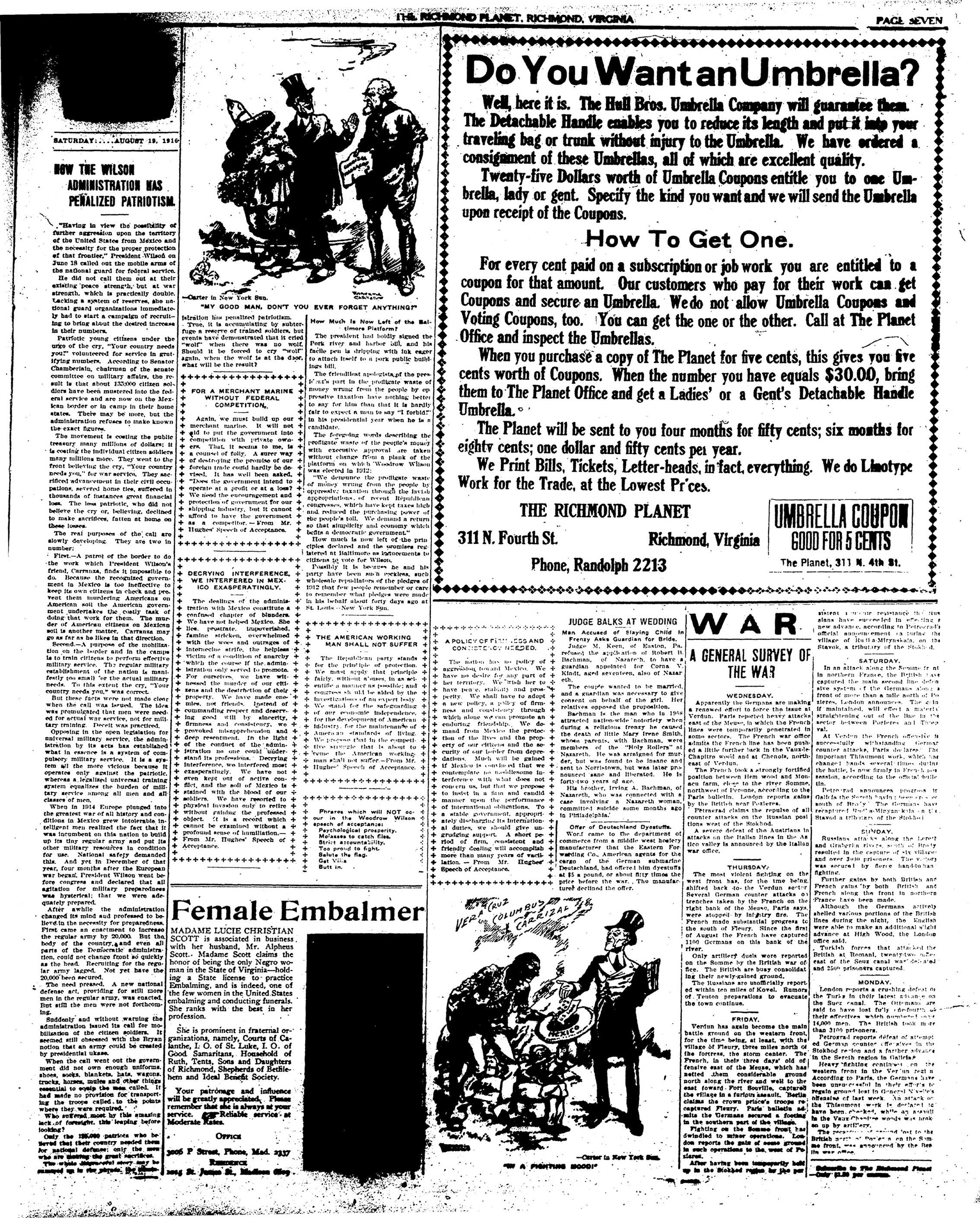
SENATOR LEWIS EXPLANATION OF "TOO PROUD TO FIGHT."
Exactly fifteen months after its utterance by Woodrow Wilson we have on the authority of Senator James Hamilton Lewis of Illinois, the explanation that the phrase "too proud to fight" is an adaptation of an old Latin saying: "Non dimicare est vino core"—Not to fight is to conquer." As President Wilson used the expression it ran:
The example of America must be a special example. The example of America must be the example not merely of peace because it will not fight, but of peace because peace is the health and elevating influence of the world profile. There is such a thing as a man being to proud to fight. There is such a thing as a nation being so right that it does not need to convince by force that it is right.
We present the phrase in its context for two reasons, that violence may not be done to its exact meaning and that the whole passage may have the scrutiny which it deserves.
It will be observed that Mr. Will son says that America must be an example of peace because it will not fight and because peace is good. He do not sanction fighting in any extremity; he rejects the idea of over fighting at all, and he does it by a single word, the 'word merely.' Had he meant to concede that the man he would force in inevitable he would unquestionably have said with his well known precision in the use of words: The example of America must be the example not of peace because it will not fight, but of peace because peace is the beating and elevating
This Is a Section of Our Splendidly Equipped Press Room
KO
We print everything.
Before ordering your printing
elsewhere give us a chance.
The Soxion was exhorting the flock to pay more attention to the week-night grayer meetings. The attendance had been entirely too small and he had decided to call their attention to the fact at each service in order to stimulate the attendance. He 'got by' with his talk for a few meetings, but the members who always were looking for an excuse for not attending mid-week-night meetings, joined around the word that "Old Box" attended the meetings, only because he was forced to do so by the adjudication of his job as custodian of the church property. Some even went so far as to say that he only came to put out
"Insecurity."
"The enemy is insecure of some of the things he desires in life. We cannot be led if the insurgent adhere solely to his suppression the impression of the following himself."
"The example of America must be the example not merely of peace because it will not fight (of course, we shall not fight under any obstruction, one) but of peace because peace is the healing and healing influence of the world and strife is not."
And then we wonder that there was difficulty in getting Germany to abandon her submarine warfare!
Mr. Wilson went on:
"There is such a thing as a man being too proud to fight."
Where is there, in this, any relation to the thought that not to fight is to conquer?" But perhaps it is one of the lusions engendered by the man's excess of pride.
The sentence that follows is full of a tragic irony:
"There is such a thing as nation being so right, that it does not need to convince by force, that it is-right."
This undoubtedly refers to Belgium—N. Y. Sun, Aug. 12, 1916.
GETTING RID OF ANTS.
As long as household conditions are such to attract ants, measures for getting rid of the insects will be of little value, says a new publication of the department, Farmers' Bulletin 740, by C. L. Marlatt. The first step in frocing a house from these pests is, therefore, to clean up all food that may be scattered about and to keep food supplies which may attract them. Cakes, cookies, tinners, or in ice boxes. Cake bread sugar, meat, and similar substances are especially likely to attract the insects.
The use of baits is not recommended in the bulletin already mentioned because of the danger that these will serve merely to draw more insects into the house and thus actually to increase the nuisance. Where it can be safely used, however, a stirup poisoned with arsenate of soda has been found effective. The formula for the stirup is 1 pound of sugar dissolved in a quart of water, to which should be added 125 grains of arsenate of soda. This mixture is boiled and strained and on cooling is used to molten sponges which are laid where they can be reach and only allow ants. The insects collect the stirup and convoke their nests so that the whole colony is ultimately poisoned. Although this method has been found effective, as has been said, it should be remembered that the arsenate of soda is poisonous to human beings and to animals as well as to ants, and that its use must be safeguarded by the greatest precautions.
When the ants can be traced back to their nests and these are in accessible places, it is possible to destroy the colonies by injecting with an oil can or small syringe a little bluephide of carbon, kerosene or gasoline into the nests. All these substances however are inflammable and precautions must be taken therefore, against the danger of fire.
Subscribe Now!
—You need a good, live, up-to-date newspaper, then why not subscribe to The Richmond Planet? $1.50 per year in advance.
Sex the Key to the Bible
"Mr. Tapp's works on the Bible will do more to empty our jalna, human intents than to teach us ideas that has ever been given to the world, in our opinion, to say nothing on the great good morally and spiritually that that has been produced a world idea that should be in every home and library in the civilised world.
W. J. Thompson, M.D.
W. A. Swan, M.D.
W. M. McCubbain, M.D.
W. M. Mikel, M.D.
T. Fiedler, C. H. MD."
We have arranged with the author to fill all orders for these books. Result price of book or books you desire to buy is the price of the books you wish and the same will be sent to you as given.
the lights and lock up. These tidings reached the ears of "Old Sex." The backward members thought "O. S." on hearing these rumblings would desist from his attacks, but they couldn't frighten him off. At the next meeting he was right on the job again. After punching them up to attend the meetings, he added: "I don't want you to think for a moment that I only attend the meetings because I am forced to by my job: I need to attend regularly, every week, before I return to the system. I can prove it by Damita X over there. Am I right, Damita?" (punching over to the old deceased.) The old deceased simply said, "SWAK ON, SWAK ON!"
Overland
Red
BY
Harry Herbert
Knibbs
Copyright, 1914, by Houghton Mifflin Co.
PROLOGUE
In "Overland Red" the author treats the ever interesting topic of the hunt for gold in a masterly manner. Overland Red, Collie and Louise are characters that you will love. There is introduced a tenderfoot from the east in search of health. He forms a fast and lasting friendship with Overland Red. The loves of Overland Red and his protige Collie for the beautiful Louise are quaintly and powerfully told by the author.
The story of "Overland Red" holds the interest and is educational, clean and wholesome.
THROUGH the San Fernando valley, toward the hills of Calcasas, runs that old road, El Camino Real of the early mission days.
And now replicas of old mission bells, each suspended in solitary dignity, from a rusted iron rod, mark intervals along the dusty way, once a narrow trail worn by the patient feet of that gentle and great padre, Junipero Serra, a trail from the San Gabriel valley to the shores of Monterey. A narrow trail then, but, even then, to him it was broad in its potential significance of the dawn of grace upon the mountain shores of beaver's lost garden, California.
Not far from one iron posted bell in the valley, El Camino Real fallers, to find eventually a lazy way round the low foothills, as though reluctant to lift its winding length over the sharp pitch of the Canelo pass beyond.
Near this lone bell another road, an offspring of old El Camino Real, runs quickly from its gray and patient size. Branching south in hurried turns and multiple windings, it climbs the rolling hills, ever dodging the rude piled masses of rock, with scattered brush between, but forever aspiring courageously through the mountain sage and sunshine toward its ultimate green rest in the shadowy hills.
In the sweet sage is the drone of bees, like the hum of a far city. The thinning, acrid air is tinged with the faint fragrance of sunburn shrubs and grasses.
With the sinuous avoidings of a baffled snake the road turns and turns upon itself until its earlier promise of high adventuring seems doubtful. As often as not it climbs a semibarren dun stretch of sun baked earth dotted with stubby cactuses, passes these dwarf grotesque and attempts the narrowing crest of the canyon wall, to swing abruptly back to the cactuses again, gaising but little in its upward trend.
Impatient, it finally plunges diszi-
round a sharp outstanding angle of
rock and down into the unexpected
enchantment of Mountone canyon.
Here the guillt cliffs rise to great wild
gardens, draped with soft rose and
pognant red amid drowny undertones
of gray and green and gold. Dots of
vivid colors flame and fade and pass
to ledges of dank vineclad rock and
drifts of shale as the road climbs
again.
At the next turn are the indistinct
voices of water commingling in a
mountone, and the road ceases to
be as the cool silver of a mountain stream
cuts through it with seemingly inco-
sequential meandering, but with the
soft arrogance of a power too great to
be denied. And the indistinct, voices
left behind rade to unimaginable
sounds as the stream patterns down its
gravelly course, contented beyond
measure with its own adventuring.
Patiently the road takes its way, moving in earlier sweeps through a widening valley, but forever climbing. Again and again fetlock deep across it runs the stream, gently persistent and forever murmuring its happy solitude.
Here, and there the road passes quickly through a blot of shade—a group of wide spreading live oaks—and reappears gray whites and hot in the sun. Then, its high ambition fulfilled, the road recovers from its last climbing swipe around the base of a shedding hill and runs straight and smooth to its ultimate green root in the middle of the sycamore. Beyond these two huge limbed wards of the mountain much gate there is a flower bordered way, but it's the road no longer. The mountain much takes its name from the canyon below. It is the mountain much, the home of Lochlea, whose ancestors, the Lacharman, grew in old France.
Attending the many riders to and from
the march there is one, a great, two
fedral, high complexioned man, whose
great presence is ever welcome. He
many to many, many. To the
protestors he is Stuart Jock, mostly
protestantism. To some of the
daily life he is in Mr. Summers or Jock.
With the formation of the Monster
---
CHAPTER L The Road.
which seldom calls him anything more dignified than Red. Louise does sometimes call him quite affectionately Overland.
For five years "the rat" had journeyed back and forth between the desert station on the Mojave and the range to the north. The twinspeople paid scant attention to him. He was simply another "desert rat" obsessed with the idea that gold was to be found in those northern hills. He bought supplies and paid groggingly. No one knew his name.
The prospector was much younger than he appeared to be. The desert sun had dried his sleeves and warped his shoulders. The desert wind had scratched thin lines of age upon his face. The desert solitude had stopped him with its awesome burden of brooding silence.
Slowly his mind had been squeezed dry of all human interest have the recurrent memory of a child's face—that, and the poignant memory of the child's mother. For ten years he had been trying to forget. The last five years on the desert had dimmed the woman's visioned face as the child came more often between him and the memory of the mother in his dreams. Then the pain of the voices of small creatures that angled through the dusk of the outlands and hovered round his fire at night. One voice, soft, insistent, revived his imagination with vision of illuminated power and power and root. "Gold!"
"Gold! Lost Gold!" it Would Whisper
Lost gold!" It would whisper as he sat
by the neger fames. Then he would
tremble and draw near the warmth.
"Where?" he would ask, tempting the
darkness as a child, fearfully certain
of a body.
Then another voice, endowed like the soft rush of waves up the sand, would murmur, "Somewhere away, somewhere away, somewhere away." And in the indifference of that answer he found an inexplicable joy. The vagueness of "somewhere away" was as vast with pregnant possibilities as his desert. His was the eternity of hope, boundless and splendid in its extravagant promise. Drunk with the wine of dreams, he knew himself to be a monarch, a monarch unowned and unattended, yet always with his feet upon the wide threshold of his kingdom.
Then would come the biting chill of night, the manifold rays of stars and silence, silence rest of winds, yet alive with the tense humility of the crouching beast, waiting—waiting—the desert, impassively wishing him to the shell of a man or wracking him terribly in heat or in storm and cold, still cailed him day and night with promise, whispered, rague and intoxicated as the perfume of a woman's hair.
Finally the desert flung wide the secret portals of her treasure house.
The man, his dream all but fulfilled, found the taste of awakening bitter on his lips. He counted his years of toil and cursed as he viewed his shrunken hands, claw-like, scarred, crippled.
He felt the weight of his years and dreaded their accumulated burdens. He realized that the dream was all its fulfillment nothing. He knew himself to be a thing to be pointed at, yet be longed for the sound of human voices, for the touch of human hands, for the living sweetness of his child's face. The siren of the invisible night so longer whispered to him. He was utterly alone. He had entered his kingdom. Viewed from afar it had succeeded a vast pleasure done of infinite enchantment. He found success, as it ever shall be, a veritable desert, grudging man foothold, yet luring him from one aspiration to another, only to consume his years in dust.
A mugwug canyon held his secret.
He had wandered into it, panned a little black sand and found color. Finally he discovered the frontainhead of the boarded yellow particles that spal power. There in the fastness of those stump, purgitorial walls was the bermage of the two voices—robes that no longer whispered of hope, but left him in the star loneliness of possession and in birthright, fear.
He offered help for the companionship of them and glanced fervently round left him and heard him call.
He again journeyed to the town heights the followed, height supplies and vanished, a ragged wealth, on the bottom.
Back in the canyon he set about his import, finding a numbing sensation in tail.
at night he would think of the child's face. He had said to those with whom he had left the child that he would return with a fortune. They knew he went away to forget. They did not expect him to return. That had been ten years ago. He had written twice. Thon he had drifted, always promising the inner voice that tired him that he would find gold for her, his child, that she might ever think kindly of him. So he tried to put himself with promise. Once he had a man of his kind, man who stood straight and faced the sun. Now the people of the desert town eyed him askance. He heard them say he was mad—that the desert had "got him." They were wrong. The desert and its secret were his—a sullen paranorm, but his net orbels. Had she not given him of her very heart?
He Felt an Arm Beneath His Head, and Water—Water! cover of the canteen absorbed the drip, which evaporated. When he arrived from place to Alm's that day. "Obl. And queried, am Overland you're just hobo." He saw the te. He sped grinning out for one out. And I never do a day's work know what "Cattle?" Overland was born in "Fex. of Cause" Only place on long without half the year.
He viewed his shrunken body, know that he stopped and shuffled, realized that he had paid the inevitable, the inexorable price for the secret. His wine of dreams had evaporated. He lifted the coarse gold between his fingers, letting it fall back into the pen. Was it for this that he had wanted his soul? In the desert town men began to notice the regularity of his comings and going. Two or three of them forgathered in the saloon and commented on it.
"He packed some dynamite last trip," asserted one.
There was a silence. The round clock behind the bar ticked loudly, omniviously.
"Then he's struck it at last," said another.
"Mebly," commented the first speaker.
The third man nodded. Then came silence again and the absolute tickling of the clock. Presently from outside in the white heat of the road came the rush of hoofs and an abrupt stop. A spurred and booted rider, his swarthy face gray with dust, strode in, nodded to the group and called for whisky. "Which way did he go, Saunders?" asked one. "North, as usual," said the rider. "Let's set down," suggested the third man. They shuffled to a table. The bartender brought glasses and a bottle; then, uninvited, he pulled up a chair and sat with them. The rider looked at him pointedly. "Oh, I'm in on this," asserted the bartender. "Daughterly to the Wells-Fargo man here. He won't talk to nobody but me about business." "What's that got to do with it?" queried the rider.
"Just what you'd not hate, Saunders. Listen. The rat let a bag of dust in the company's safe hot trip. Daugherty says its worth mobby five hundred. He says the rats goin' to bring in some more. Do I come in?"
"You're on," said the rider. "Now, see here, we got to find out if he's liked on it and what his name is, and then."
"Mobby wed better find out where it is first," suggested one.
"And then jump him," queried the rider over his glass.
And then jump him!" chanced the growl. "He's there almo'.
It's easy. And each拼 himself a drink, for which, strangely enough, no one offered to help, and for which the bartender cyclically forgot to collect.
Meanwhile the prospector rolled through the drought of that summer boaring the little yellow fakes that he washed from the gravel in the canyon.
All round him for miles each way the water holes had gone dry. The little canyon stream still wound down its shaded course, disappearing in a patch of sand at the canyon's mouth, so the prospect for Yell secure. None had ridden out to look for him through that furnace of burning sand that stretched between the hills and the desert town.
The stream dwindled slowly, imperceptibly.
One morning the prospector noticed it and immediately explored the creek to its source, a spur of water springing from the roof of a grotto in the cliff. Such a supply, evidently from the rocky heart of the range itself, would be inexhaustible.
The creek later he swoke to find the rock crevice, and few depressions among the rocks. He again visited the grotto. The place was damp and cook gliding with heads of moisture, but the flow from the roof crevice had ceased. Still be thought there must be plenty of water beneath the rocks of the stream bed. He would dig for it.
Another week and he became uneasy. The stream had disappeared as though poured into a colossal crevice. A few feet below the gravel he struck solid rock. He tried dynamite unsuccessfully. Then he boarded the drippings from the grotto crevice till he had filled his canteen. Carefully he stowed his gold in a chamois pouch and prepares the canyon. His boulder dried during the drought—was probably dead—beside some dry water hole.
The prospector set out to cross the range in the light of the stars.
Fearful that he might be seen panic warped his reasoning. He planned to journey south along the footballs until opposite the desert town and then cross over to it. If he approached from such a direction no one would guess his original starting place. He knew of an unfailing water hole two days' journey from the canyon. This water hole was far out of his way, but his canteen supply would more than last till he reached it.
Then fate, the fate that had dogged his every step since first he restured into the solitude, closed up and cried at his heels. He became more horrible and strangely fearful. His vision, refined by the wasting of his body, created shadows that lay about his feet like fragmented pixels, shadows where no shadows should be.
Caution was his fall as he crossed an avenue. The cannon, slung over his shoulder, struck a sharp point of rock that started one of the seams. The hook was indiscriminate. The fatt
He Felt an Arm Beneath His Head, and Water—Water!
cover of the canteen absorbed the drip, which empoisoned. When he arrived at the water hole that was dry. His canteen felt strongly light. He could not remember having used so much water. He changed his plan. He strock straight from the hills toward the railroad. He knew that eventually he would, as he journeyed west, cruse it, perhaps near a water tank. Toward the blinding afternoon of that day he saw strange lakes and pools spread out upon the distant sand and inverted mountain ranges stretching to the horizon. Fate crept closer to his beels, waiting with the dumb patience of the desert to claim the struggling, impotent puppet whose little day was all but spent. He stumbled across the blazing bars of steel that marked the railroad. His empty canteen clattered on the tide as he fell. He got to his knees and dragged himself from the track. He laughed, for he had thwarted Fate this once. He would not be run over by the train. He lay limp, wasted, scarcely breathing.
Sorcerely Fate crowded near him, patient, impassive.
He bearded a man speak and another answer. He felt an arm beneath his head, and water-water:
He drank, and all at once his strength flamed up. It was not water they gave him; it was merely a taste of it—a mockery. He wanted more—all:
He lurched to his feet, struggling with a boarded giant that held him from his desire—to drink until he could drink no more—to die drinking the water they had taken from him even as they gave it. He fought blindly. Fate, disdainting further patience, arose and fled itself about his feet. He stumbled. A flash wiped all things from his vision, and the long night came swiftly.
Ragged Romance
At the wide gate of the mountain ranch stood the girl. Her black saddle pony Bogar freted to be away. Glancing back through the cavernous shade of the live oaks, the girl hesitated before opening the gate. A little breeze wayfaring through Moontone canyon and on up to the mountain ranch touched the girl's cheek, and she breathed deeply of its cool fragrance. The wide gate awaived open, and Louise Lacharme, curbing Black Royar, rode out of the shadows into the hot light of the morning singing as she rode. The girl eyes, the color of sea water in the sun, were lovelier toward the distant hills across the San Pascual valley. From her fingers dangled the long bridle reins. Her lips were gently parted. Her gate was the gaze of one who dreams in the daylight. And close in the hidden mound crouched Romance. Romance ringed, unkempt, locular.
Boyar first scouted the wood smoke. Louise noticed his forward standing cans and his fidgeting. Immediately before she was the low ramped rock, a throne of dreams that she had graced before. From down the slope and almost hidden by the bulk of the rock a little wand of smoke stood up in the windless air, to break at last into tiny abrads and curl of buddlegoes. "It can't be much of a fire yet," explained Louise, forever watchful, as are all the bill fok, for that dread, ungovernable red monster of destruction, a mountain fire. "It can't be much of a fire yet."
The pony Boyar, delitely scenting something more than wood smoke, anorosed and swept. Louse dismounted and stepped hurriedly round the shoulder of the rock. A bistle bearded face confronted her. "No, it isn't much of a dry yet, but our bird girl she joined a movie's picture outfit, as two he things are doin' the best we can chasin' a breakfast." And the tramp, Overland Rek, rung, unkempt, jocular, rose from his knees beside a thy blaze. He pulled a block flop of felt from his tingled hair in an overaccumulated bow of welcome. "We offer you the freedom of the city, na'ma. Welcome to our mild and kindly excuse appointments" this morning. Our trunks got delayed in New York."
Unmillingly the girl's light gray eyes studied the trumpet's face. Then her glance swept him swiftly from bared head to rundown fire. "I was just making up my mind whether I'd stay and talk with you or ask you to put out your fire and go somewhere else. But I think you are all right. Please put on your hat."
Overland Red's self assurance shrank a little. The girl eyes were direct and serious, yet not altogether unfriendly. He thought that deep within them dwelt a smile.
"You got my map all right," he said, a trifle more respectfully. "Course we'll do the fire when we duck out of here. But what do you think of Collie here, my pal?" is he all right?
"Oh, he's only a boy," said Louise, glancing casually at the youth crouched above the fire.
The boy, a tall lad of sixteen or
throatless, flashed beneath the battered
brim of his black felt hat. He
watched the tomato can coppelt imme-
sily. Louise could not see his face.
"Tell him, I'm all right and no he is
Hold. And a behemous withholds creep
in his heart. What a what you
might call a changing."
"Changing?"
"Unhh! always changing" around
from place to place when you're young.
Ain't that it?
"Obl. And when you are older!" she queried, smiling.
Overland Red frowned. "Oh, then you're just a tramp, a Willie; a Do, a hobo."
He saw the girl's eyes harden a little.
He spoke quickly and, she imagined, truthfully. "I worked ten years for one outfit once without a chance. And I never knew what it was to do a day's work out of the saddle. You know what that means."
"Cattle? Mexico?"
Overland Red grinned. "Say, you was born in California, wasn't you?"
"Tea of course."
"Cause Mexico has been about the only place a puncher could work that long without don'* day labor on foot half the year. Yes. I been there. Course now I'm don'* high finance and'g advice to the young and'liven' on my income. And, say, when it comes to real brain work I'm the most exhausted baked high potentate, but I wouldn't do no mineral labor for nobody. If I can't work in the saddle I don't work—that's all."
"Mineral labor? What, mining?" asked Louise.
"No, not mining. Jest mineral labor like Jans or section hands or coach-
C. R. W.
"Oh, he's only a boy," said Louise.
men with bugs on their hats. Ain't the papers always speak' of that kind an minerals?
"Don't you mean menials?"
"Well, yes. It's all the same, any way. I never do no hair spiltin' on words. Bein' a pote myself it ain't necessary."
"A-a poet. Really?"
"Really and truly and carry one and add five. I've repaid a lot of pottry in my time, miss. Say, are we campin' on your land?"
"No. This is government land, from here to our line up above the Moonstone ranch."
"The Moonstone ranch?" querked Overland Rock. Breaking a twig and feeding the fire.
"Yes. It's named after the canyon. But don't set me keep you from breakfast."
"Breakfast, oh. That's right! I am most forgot it, takin' to you. Colleen got the coffee to bed! No, you don't keepin' us from our breakfast any that you notice. It would take a whole regiment of ruinies to keep us from a breakfast if we see one runny around loose without its pa or na." Louise Lahorne did not smile. This was too real. Here was 'n adventure with no mournance's glamour, no bookbill gloss. Here was romance-romance unshaven. 'Pierce, with its cost off, making coffee in a single blackened to mate can, but romances nevertheless. That this surprise touch touch her heart in the fallin' heart. She was alone, fat, yellow. Boyar was grazing heart, and, besides she was not really like of the men. She thought she rather liked them or more particularly, the tedious one who had said his name was Overland Red. The trump gazed at her a moment before he lifted the tomato can from
the embers. "We know you won't join us, but we're going to give you the invite just the same. And we mean to, Maimun, if you'll be so kind and as to draw up your chair, ps you'll cut." "Thank you," said Lounise, and Overland's face brightened at the goal for browning in her yellow. "Thank you both, but I've had breakfast."
She gave at the matrimony, bubbling tomato can cuffed in "second edition" coffee. There was nothing else to grace the beard, or rather rock. "I'll be right back," she said. "I'll just take Boyar's bride. Here, boy!" she called. "You'll be able to eat better."
And she run to the pool. From a saddle pocket she took her own lunch of sandwiches and ripe olives wrapped in cled paper. She delayed her return to chosen the forward cinnamon of the saddle and to find the little stock of cigarette papers and tobacco that she carried for any chance rider of the Moonstone who might be without them. Colle, the boy tramp, glanced up at Overland Red. "I guess she's gone," he said, regretfully.
"You're nutty, Colle. She isn't the kind to sneak off after sayin' abe's comin' back. I know a boss and a real woman when I see em. I was raised in the west myself."
The boy Colle was young, sensitive, and he had not been "raised in the west." He frowned. "You, you was raised in the west, and what you got to show for it."
"Well, hear the kid!" exclaimed Overland. "Out of the mouth of babies and nautilism: What have I got to show? What have I— Wha— Oh you go chase a snake: I know a good boy and a good woman when I see em, and I see this morning."
```markdown
```
A man and a woman are sitting at a table. The man is holding a book and the woman is holding a cup. They are surrounded by trees and a building.
STEMATIZE your household expenses by opening a bank account for your wife. Give her a check book and teach her the use of it. Pay the butcher, the grocer, the baker, with a check. Then at the end of the month you'll find out just how much it costs you to run the home. When payment by check
is made there never is any
a bill is paid. The check
Besides, a checking ac
business education. The
women who know absolute
prising. If you are a h
cannot toll when death
well that your wife, daugh
thing of banking.
MAKE UP YOUR
YOUR WIFE A CHECK
THE MECHANICS
IS READY TO SERVE YOU.
THIRD AND CLAY STS.
JOHN MITCHELL, JR., PRES
where never is any doubt as to whether or not
aid. The check is a receipt.
a checking account will give your wife a
education. The number of ordinarily bright
no know absolutely nothing of banking is sur-
If you are a husband, father, brother, you
will when death may overtake you, and it is
your wife, daughter and sister know some-
banking.
UP YOUR MIND TODAY TO GIVE
LIFE A CHECK BOOK.
CHANICS SAVINGS BANK
SERVE YOU. WRITE OR VISIT US AT
CLAY STS.—NORTHWEST CORNER.
ELL, JR., PRES. WALTER T. DAVIS, CASHIER
is made there never is any doubt as to whether or not a bill is paid. The check is a receipt.
Besides, a checking account will give your wife a business education. The number of ordinarily bright women who know absolutely nothing of banking is surprising. If you are a husband, father, brother, you cannot toll when death may overtake you, and it is well that your wife, daughter and sister know something of banking.
MAKE UP YOUR MIND TODAY TO GIVE YOUR WIFE A CHECK BOOK.
THE MECHANICS SAVINGS BANK
"Pretty?" whispered Overland as Louise approached "She's through-bred! Did you see them eyes? Afraid of moth! and familiar! at what might dast to seate her. Not foolish, either. She's wise. And she's kind and laughin' and not ashamed to talk to us. That's thorough-bred."
Around the rock came Louise, the next package of sandwiches in one hand. In the other was the tobacco and cigarette papers. "I'm going to have my lunchme," she said. "If you won't object I will take a sandwich. There I have mine. The rest are for you."
"We had our breakfast," said Overland quickly. "when you was talking to your peny."
Louise glanced at the empty tomato can. "Well. I'll excuse you for not writing for me! I shall not excuse you from having lunchme with me. I made these sandwiches myself. have one. They're good."
"Oh!" groomed Overand, glancing at "If I could care up my language smooth like that I I guess I could of listened to myself talk. You and I don't speak like takin' two turns a good bond stand tryin' to catch you and then climb' a post and step' on your own shoulders so you can see the pumme down the street. Do you get that?" And he asked loudly to "Say, these here sandwiches is great." "Will you have one?" I louder, gracefully profiling the olives.
"Seen it? You. Thanks. I always take two, the taste of one for a shower to kill the taste of the first. It's the only way to eat 'em- if you know where to stop. They do taste like something you done and are sorry for afterwards, don't they?"
"Were you ever sorry for anything?" asked the boy, feeling a little piqued that he had been left out of the conversation.
"I was raised in the west myself," growled the trump, scowling. "But that's a good pony you got, miss. That your saddle too?"
"A little. How did you know?" "Kawhiide cover to the saddle horn is wore with a rope," said Overland, helping him lift a second sandwich. Then the trump and the girl, odious to everything else, discussed rawhide thins as compared with the regular three strand, one-inch thick, and double rigs, swell forks and old Vlashta trees, spade bits and old Curie mother willing, even slightly, to admit the other's superiority of cheese rigs.
The sandwiches gone. Louise profiled Overland tobacco and papermakers. Actual tears stood in the exclamatory eyes. "Smoke." Me? he exclaimed. "I was dylin' for it. I did time for you." Then in that bristish spirit that never quite leaves the rung rider Overland Red took the tobacco and papers and cleverly rolled a cigarette with one hand. In the other he held his battered felt hat. His eyes had a faraway look in his eyes. He looked at his cigarette at the fire. "I was setin' on a crazy bronc' holdin' his head up so he couldn't go to buckle' outside a little old afro down in Tuna. Arik, then." he explained, glancing at the girl. "Did you ever drift away complete like that. Just from some little old trick to make you dream?"
Mrs. Frank Purdee, forty-seven
years old, of St. Augustine, Pa., was
in family, killed by Nightingale. A
milestone baby in a crib nearby was
worn up and the woman's husband
and another children who were in the
mama room escaped injury.
S
"You must use"
PAGE THREE
NORFOLK & WESTERN
ONLY ALL-NAIL LINK TO NORFOLK
(Nobile in short Jan. 1, 1918)
(Mobile in short Jan. 1, 1918)
NORFOLK: "81.8 A.M. in Mation. Richmond, POR
NORFOLK: "81.8 A.M. in Mation. Richmond, POR
"80.0 P.M. M
"80.0 P.M. M
"80.0 P.M. THE WEST: "81.8 A.M. in Mation. Richmond, POR
A.M. "80.0 A.M. "80.0 P.M. "81.8 P.M. Larry to Levy: "82.5 P.M. M
"82.5 P.M. from Norfolk: "111.0 A.M. B. from
"83.5 P.M. M. "83.5 P.M. M. "83.5 P.M. from Norfolk: "111.0 A.M. B. from
The West: "81.8 A.M. "81.7 P.M. "80.0 P.M. M
"81.7 P.M. Daily stamps Sunday
"81.7 Daily stamps Sunday
P. T. M. Knanake
C. I. BORLEY, D. F.
ATLANTIC COAST LINE
ATLANTIC COAST LINE
THE STANDARD RAILROAD OF THE SOUTH
(Executive January 8, 1825)
Train Line and South: 8:18 A. M. and 8:24
P. M. at 11:53 P. M. at 12:50 A. M.
P. M. at 12:50 A. M. at 8:00
P. M. "4:00 P. M. "10:10 P. M.
N. For & W. Rp. West: 8:18 A. M. at 8:24
P. M. at 9:25 P. M.
For & W. Rp. West: 8:18 A. M. at 8:24
P. M. at 9:25 P. M.
For & W. Rp. West: 8:18 A. M. at 8:24
P. M. "4:10 P. M. "8:24 P. M. at 8:24
P. M. "11:54 P. M. for Goldberg
5000000000000000000000000000000000000000000000000000000000000000 4:18.0 F M
For Hexagon A, M, M, 7:18.0 F M
P, M, 14.0 P, M,
Trains arrive Richmond daily: 4:30 A. M. 7:00 A. M. 8:10 A. M. 6:10 A. M. 8:17 A. M. 11:40 A. M. 11:10 P. M. 11:40 A. M. 6:25 P. M. 7:40 P. M. 8:00 P. M. 2:00 P. M. Except Sunday. Tuesday Only. Time of arrival and departures and reservations not guaranteed.
THE SOUTHERN
SR
SERVES THE SOUTH
Trains leave Richmond, Main Street —
For the South—Daily: 8:30 A. M. 1:-
M. express; 6 P. M. express for Alba
M. express; 6 P. M. local for Keyna
Hale City—week days.
York River Line-4-110 P. M. B. Beamner P.
4-110 P. M. B. Beamner P.
200 A. M. and 412 P. M. B. beam,
Trinity Airline Richmond—From the South
P. M. B. beam;
P. M. B. beam; 412 P. M. B. accept Sunday
From West Point; 412 P. M. B. accept Monday
Courtesy 807 E. Main St., Phoenix, Mo.
CHESAPEAKE & OHIO.
Clocin., Loudeville & West, "8:00 p.m.-11:00 p.m. Main Line, Local "8 a.m.-"2 p.m.-"5:10 p.m. James River Line. "10:00 a.m.-"6:16 p.m. News, Mk., Old Pt. "9 a.m.-"13:00 a.m.-"4 (p. Newport News, Local "1:16 a.m.-"5:00 p.m. Trains arrive from Norfolk, "11:00 a.m.-"5:00 p.m. "8:30 p.m., Newport News, "9:00 a.m.-"6:00 p.m. From West, "8:30 a.m., "5:40 p.m., "8:00 a.m., "11:00 p.m., 7:00 p.m. daily from Charlottesville east@Sunday.com. James River, "8:30 a.m., "7:10 p.m. Daily "Bestday Sunday
SEABOARD AIR LINE
THE PROGRESSIVE RAILWAY OF THIS SOUVW Southbound trials scheduled to have Richmond daily: 0:35 A.M., local to Nortina; 1:50 P.M., sleepers and coaches to Jacksonville, Atlanta, Birmingham; 6:35 P.M., through common and sleepers to Jacksonville; 11:30 P.M., Florida Limited; 15:45 A.M., sleepers to Atlanta, Birmingham, Jacksonville, Tampa and coaches to Jacksonville.
Northbound trains scheduled to arrive in Richmond daily: 6:30 A.M., 7:30 A.M., 8:00 A.M., Local: 0:00 A.M., 8:20 P.M.
ALPHEUS SCOTT
(CHURCH BLA)
Funeral Director and
Embalmer
OPEN DAY AND STREET
OCTOBER 1900 P Street, Phila-
mia, 1897—Baltimore, 1899
St. James St., Phila-
mia, Baltimore, 1898
Departments: Church and Society of
Phila-ma, Church and Society of Phila-
ma, Church and Society of Phila-ma
It is unless to talk about hard times, when you make times harder by not working or by spending your money for things that you do not need.
We have always contended that with whatever vice, lawlessness, immorality with which colored folks were chargeable, it could be well said that they were but a reflection of what the white people had done and were "still adoing."
A RACE CONGRESS.
SPECIALTY WILLIAM MONROE TROTTER of the Boston Guardian, and PRESIDENT REV. BYRON GUNNER, of Hillburn, N. Y., are preparing to have the "time of their lives" in Washington, D.C., during the latter part of September. It will be under the auspices of the National Equal Rights League. They could not have accepted a better place for a flood of oratory and a worse place for order than the city aforesaid. The meeting will be known as the National Colored Citizenship Rights Congress. We like the name and we endorse the purpose of the meeting.
However we may regret the necessity for it. Agitation and recurrent agitation are the most potent means of arousing the nation to arealizing sense of its duty to us. The representation in this body will be "wide open," both accredited delegates from organized bodies being entitled to membership and individuals. We presume, though, that the management will know how to "keep the saddle" and shape the action of the body. If this is not attended, the meeting may turn out to be a disgraceful affair and do more harm than good. We approve of a conservative, orderly meeting with the interests of the race primarily in the foreground. Such a gathering will do much good. The time is ripe for the leaders to set forth their grievances and to ask for recognition at the hands of the gentlemen who are candidates for public favor.
PRESIDENT WILSONS PREDICA-
MENT.
President Winston Wilson seems to be unfortunate in the selection of his friends. He faced the fury of the United States Senators and the anger of the leading jurists in the United States in demanding that he be confirmed as Associate Justice of the Supreme Court of the United States. He has just successfully negotiated an agreement with the Mexican de facto government for the submission of the questions in dispute to a joint commission to consist of three representatives from the United States, and three from Mexico.
He conceived the idea of getting Mr. Juerrier Brautsch to help him out and so he tendered him one of the appointments. Now Mr. Juerrier Brautsch has been charged with many things, but no one has ever alleged that he is a fool. When this "honor" was tendered him, he proceeded to examine it carefully. The following letter explains the situation:
"My Dear Mr. President:
"I appreciate the opportunity for high service which membership on the Mexican commission would present.
"But upon consultation with the Chief Justice, I find the state of business of the Supreme Court at the present time to be such that it is my duty not to undertake this important additional task.
This letter could not have been any more concise, without disrespect than it appears to be. The Chief Justice was consulted and the interests of the country in this branch of the service was placed above the interests of the country in the other branch of the service. No one knew better than the President of the United States that the docket of the Supreme Court of the United States was crowded. He also knew that the Mexican education has become so acute that it threatens to wreck this government.
Do Mr. Justice Brandon virtually miss this. I thank you, sir. I am
out of the mess and I shall stay out of it." Truly can the distinguished Chief Executive retire to the privacy of his office, and during the intervals of the wringing of his hands, exclaim, "And thou too, Brandle!"
"LET.BILL DO IT."
The declination of Mr. Justice BRANDIEN to serve on the Mexican Commission seems to have not only univered PRESIDENT WILSON, but it appears to have also disguised him. What other conclusion can be drawn from the following inspired information from the White House?
Selection of the commissioners to represent the United States in the parley with the de facto government of Mexico has been turned over by the President to Secretary of State Lansing. Pressure of other matters is understood to be the reason why the President, himself, will not select the American commissioners.
Information has reached here that the Carranza government is evidencing some impatience at the apparently inexplicable delay in naming the Americans, and proceeding immediately to the consideration of the questions at issue. One faction in Mexico City has even counselled calling off the negotiations on the ground an affront to the Mexican de facto Hitler. Ever, little importance is attached to this fact here as it is understood that this group is merely a handful of extremists and anti-Americans.
While the administration is maintaining deep silence on the subject, it is impossible to cover up the fact that difficulty is being experienced in securing men of large caliber who are willing to serve as the American commissioners. Secretary Landing has before him now a list of the eligibles for the positions and will bend every effort in attempting to secure the consent of three of them to act for the United States. As soon as acceptances are secured from the proposed American members of the commission, the place of meeting will be decided upon at once, and the negotiations begin as soon as the Mexican commissioners reach here.
The fact that the President resorted to the United States Supreme Court for an appointee showed that he was indeed in a hard place. He can ask the men of the proper culture, but most of them are Republicans and will act upon their own initiative. It is evident, too, that Presumpty Winters cannot trust his colleagues in the United States Senate. He has "washed his hands" of the matter, so to speak, and Secretary Lansing will have a task which has proven to be too great a one for the President of the United States to handle.
THE ADMINISTRATION AND THE REPUBLICAN CANDIDATE.
EXJUSTION CHARLES EVANS HUGHES has taken to campaigning just as a duck takes to water, and it is evident that his mind is set upon winning the presidential contest and in making his accomplished Madame the mistress of the White House at Washington. Something akin to consternation now prevails among Darwinist Wesmond Wilson's advocates at Washington. If we are to judge by the recent report of happenings there. After a discussion at a meeting of the cabinet, it was given out that statements made by the Republican candidate at Detroit this week were "false as to facts and misleading as to substance."
This was a grave charge to make against a man of Mr. HUGHES' standing and callibre. He had cited the retirement of E. DANA DURAND as Director of the census and the appointment of WILLIAM J. HAMIS in his place as a disgard of the Civil Service rules and a gross exercise of partisanism in this branch of the service. SECRETARY REPUBLIC, who is absent from Washington, telegraphed SECRETARY TEMPLEY that the charges were false. He used the following language:
"Statement of Hughes respecting appointments false as to facts and of misleading substance. You may say from me, Durand, of census, retired voluntarily, was not removed or retired. I recommended him to present employment. Harris succession was not political. Made fine record, and promoted trade commissioner for merit. Tittman, Coast Survey, retired voluntarily, after my refusing one resignation. Jones, his successor, promoted for meritorious work as deputy, commissioner fisheries. Has made wonderful record instilling new life into service."
Hon. Edwin F. Sweet, who is acting Secretary of Commerce during Mr. Rendel's absence, took it upon himself to send the following telegraphic dispatch to Mr. Hoonz:
"In a speech at Detroit yesterday you are quoted as saying:
"We had in the Coast and Geodetic Survey an eminent scientist, a man who had won distinction in connection with his scientific work, a man of eminent rank. He was displaced to make room for an excellent stock breeder and veterinary surgeon.
"In the Coast and Geodetic Survey we have had a very extraordinary condition with regard to expert places. I mean places that were taken out of the civil service know. I shall not go into brief discussion. In the year ending about April, 1914, there were taken out 180—that is, in appointments by the commission, removed from the
operation of the civil service laws to the number. I believe, of about 164. I believe that some twenty of these were made without seeking the advice of the Civil Service Commission; I believe that there were about twenty after working with the advice with the proposal of the Civil Service Commission, and I believe that sixty-two were made in opposition of the advice of the Civil Service Commission."
"In the absence of the Secretary of Commerce (one of the bureaus to which the Coast and Geodetic Survey belongs). I deem it my duty to correct some grave errors in the foregoing statement."
"Dr. Tittman, superintendent of the Coastal and Geodetic Survey, the scientist to whom you refer, was not displaced. In February or March, 1915, he came to my office and told me that he had determined to resign on account of ill health. He said that he had reached the conclusion many months before, and had already purchased a place in Leesburg, Va., which he expected to make his home. Communal relief, from him to Seward, Redfield, who expressed surprise and regret. Dr. Tittman's action was entirely voluntary, and was not the result of any suggestion of the department, direct or indirect.
"You refer to E. Lester Jones, his successor, as a stock breeder and veterinary surgeon. At one time he had a farm in Virginia, on which he raised stock. This was sold some time before he entered the government service. He never was a veterinary surgeon. He is a gentleman of education and refinement. Before his appointment to succeed Dr. Tittman he was deputy commissioner of fisheries (another bureau of this department) and displayed administrative talent of such high order that he was deemed by both the secretary and myself worthy of recommendation to fill the vacancy in the Coast and Geodetic Survey. In our judgment, this bureau was well equipped from the scientific standpoint, but stood in great need of a man of executive ability to direct and organize its work.
"About two months elapsed between the resignation of Dr. Tittman and the appointment of Mr. Jones. During that interval and before the recommendation was made suggestions and service were freely sought from parties who knew the qualifications of Mr. Jones, and also from parties who knew the needs of the bureau some of them of the highest standing in the selection field. Since the anglers work on both the Atlantic and Pacific coasts and the Coast Survey and all other work of the bureau have been developed and presented with marked vigor and success.
"As to your statement regarding the civil service you are, equally mis-informed. During the year to which you refer the number of appointments made in the Const and Goods Survey has been far short of 104. The actual number is fifty, of which thirty-eight appointments were made with the number of civil service Commission. The remaining twelve were for temporary positions, chiefly of laborers, at salaries of less than $3 per day. None of them are under the civil service law as it stands now and as it stood for years. "You say I believe that sixty-two were made in opposition to the advice of the Civil Service Commission. The fact is that during the entire incumbency of Mr. Jones not a single appointee of the Civil Service Commission in this bureau in opposition to the advice of the Civil Service Commission. "Will you please give to this statement the same currency you gave to the statement you made at Detroit?"
This was a "mighty long" telegram and as the presumption is that it did not go as a night letter, the expense in sending it must have been in keeping with its length. Justice Hurwitz seemed to have been prepared for it inasmuch as the telegraphic report from Minneapolis is as follows:
Minneapolis, August 9 — Charles E. Hughes, replying to Secretary Redfield's telegram denying that E. Dana Durand was forced out of office as director of the census, today read to have addressed her letter from Mr. Durand, in which Mr. Durand said that he had told Redfield he would resign, but wanted to remain, and that Redfield replied that the administration had decided on a change
Mr. Durand's letter, read by the Republican nominee for President in the course of an openair speech at the parade grounds here, was in part, as follows:
"Inasmuch as the truth of your statement with regard to the change in the directorship of the census has been challenged, I think it is only fair to you that I should make this statement. My resignation as director was distinctly a forced resignation. At the first conversation I had with Secretary Redfield I told him that I would resign, but that I hoped I would be permitted to remain. He at once told me that the administration had decided that it wanted to make a change. I believe 'to create a vacancy' were his words. The next that I heard of it was an announcement in the press that my successor had been named, and I at once wrote out my resignation."
Mr. Durand is connected with the Minnesota school of agriculture. Mr. Hughes then repeated his Detroit declaration with reference to the displacement of an ominent scientist" in the Coast and Geodetic Survey by an excellent stock breeder and veterinary surgeon." "Exception also has been taken by the distinguished secretary with regard to that man," the nominee continued. "Now, I am not in a position to state of knowledge circumstances with reference to the treasure, of the eminent scientist, who occupied the important place, but if I may assume that he retired voluntarily, my point is not so much the retirement of the man who went, but the character of the man by whom he was succeeded. "I am now told that Mr. Jones, who succeeded him, was promoted after being deputy commissioner of fisheries. But he was appointed to that place also, involving the need of technical skill and training, by this administration. He went there from his stock farm and took charge of the barn."
It would appear upon the face of this showing that the administration
officials at Washington were not so sure of these facts as How. Charles Evans Museum seems to have been President Woodrow Wilson may be able to stem the tide now setting in against him; but he will have a monumental task before him in so doing. In the face of all of this showing the Democrats are preparing to increase the taxes upon the people. The following will prove to be interesting reading:
Washington. August 9—Senate Democrats will meet in, caucus tomorrow night to consider Finance Committee amendments to the House revenue bill, including the proposal to reduce the income tax exemption, the proposed increases in the tax on large inheritances, ranging up to 10 per cent on estates of $5,000,000, and a proposal agreed to tonight to continue in effect many of the present stamp taxes.
The Finance Committee voted approval of the stamp tax proposal after an all-day discussion, and added to the House bill the following stamp taxes:
Bonds, debentures and certificates of indebtedness, a tax of 5 cents on each $100 of face value. Express and freight receipts, 1 cent each. Telegraph and telephone messages, 1 cent for each message for which a charge of 15 cents or more is made. Custom house entries not exceeding $500, 50 cents each; exceeding $500, $1. Insurance policies, 1 cent on each $1, or fraction, of amount of premium charged. Foreign steamship tickets, if costing not to exceed $30, 1 cent, or exceeding $60, $3; more than $60, $5 all tickets costing $10 or more to be exempt from taxation, and Pullman car tickets, from taxation, which an increase from $100 in existing law.
The committee also decided to retain the existing tax of $5 for each bowling alley or billiard table, and amended so that it will apply to clubs and private places, instead of exclusively to public places.
Revision of the wine tax schedule also was determined upon, the committee increasing the proposed tax of 10 cents a gallon on grape brandy or wine spirits used in fortification of wines to 55 cents a gallon. A tax of 8 cents a gallon upon all still wines was proposed as a substitute for House rates, ranging from 4 cents to 25 cents a gallon on wines containing from 14 to 24 per cent. alcohol. On Champagnes and wines the committee retained the House proposal of a 3-cent tax on each half pint, but increased the proposed tax of 1 cent to 25 cents a gallon half pint of artificially carbonized wine. The committee was unable to reach a conclusion on the troublesome nuttition tax, and will resume deliberation of that subject tomorrow.
All of this tends to lesson the chances of President Wilson's election and to increase the chances of Super Charles Evans Hughes, success at the polls. The Republicans proposed that the tariff should bear the expense and thus land the greater part of the burden upon the foreigners and the importers. The Democratic administration's plan is to place the expense upon the American people. In having the issues plainly laid before them, there is hardly any doubt as to which side of the controversy will win in the contest.
We are paying war taxes with no war. Now we are having offered to us higher war taxes with no war. Instead of pricing the expense of the present plan of preparedness ratably upon future generations, the Democratic administration is putting practically the whole burden of the expense upon this generation.
SELLING WHITE WOMEN
The following telegraphic report will prove to be interesting reading:
New York, Aug. 15. One dollar a pound is the price actually paid in several instances for immature girls and tainted off by white shavers to proprietors of disorderly resorts in New York Assistant District Attorney Smith, prosecuting the vice trust declared to die.
From men and women now under arrest and awaiting trial. Smith has obtained most amazing confessions of the workings or the white slave gang. Not only did they systematically set about to obtain school girls for resorts, but they maintained a house, where young girls, sometimes partly and sometimes completely disobscured, were sold to the highest biddor.
We learned today that in one instance agents for two disorderly holes got in a dispute over the value of a girl who had been put up for sale," said the assistant district attorney.
They finally agreed upon a price of a dollar a pound. After that it became a common practice to weigh all girls and announce their weight to bid dorsa.
"Information regarding the white abduction was obtained after the arrest of Dabbit Zubier, alias David Parish, and his wife, Kate Parish, in a twenty-second street house. The district attorney's office is investigating reports that other similar places were maintained.
It was recalled today that only a few months ago a minister's daughter was kidnapped and auctioned off, nude, before a gang in an Italian dance hall.
The vice trust now under fire did not by any means confine its activity. New York Smith said. Most of the girls were obtained from poor families here. Some of them were kept in New York resorts, but others were shipped to Chicago and Western cities. The trust maintained representatives in several Eastern towns.
What will the Turks think of this statement of Assistant District Attorney Smith? He evidently knows what he is talking about. During the days of slavery, colored females were sold round, but it was not by the pound, but by the look. Good news!
again. is a divine declaration.
Colored folks have been herded around the world as degenerate and as immoral. Here is an open admission that white people are even more so. It would be well to call home some of the missionaries to the heathen. They will find plenty of work in New York—and other parts of this country. Sentimental people are telling about the oppression of the Jews and of the atrocities practiced upon the Armenians. All of this is outdone by this report, which is uncontradicted from any source, and which is officially confirmed by the representative of the legal department of the national government.
Brethren, let us look to the Lord and be dismissed—dismissed from the aspersions and charges which have been launched against us as a race for the last one hundred years.
TROY. N. Y.
Troy, N. Y., Aug. 15.—Mr. and Mrs. A. D. Coles had their daughter, Gwen dolyn Frances Coles, christened in the A. M. E. Zion Church of this city by the pastor, Rev. C. Fairfax, Sunday, August 6. 1916.
Mr. Geo. B. Kelley, of Troy, spent Saturday and Sunday in Saratoga. (Aug. 12 and 13).
Mrs. Ethol Garner, of New York City, has been spending five weeks here with her friends leaves today (Aug. 12) for Newborough, N. Y. to spend one week with friends there before going back to New York City—Aug. 19.
A number of young, people gave a birthday party to Misses Clara and Nellie Van Valkemburg, at the home of their father, 165th Avenue, Pridgen, New York. Rev. J. A. Taylor again prescheduled for the Hamilton Street M. E. Church Sunday, August 13. Albany, N. Y.
Mr. and Mrs. Henry Lewis, later from Urbana, Middlesex County, Virginia, are in our city and called on the Rev. and Mrs. J. A. Taylor Sunday, August 13.
Rev. J. A. Taylor called on his拍
in Setktrk Monday, August 14.
JUMPED FROM WINDOW
The wife of Dr. T. W. Edwards of Danville, who was being treated in the Tucker Sanitarium, 212 W. Franklin Street, jumped from a window of the bathroom to the concrete paying about 20 feet below. Her skull was broken in the fall and she day afternoon, the unfortunate lep having been taken that morning.
COLORED FIREMAN MURDERED
John Killitrew, the colored fireman who was shot as he stepped from a locomotive last Saturday afternoon, died from the injury last Wednesday morning. His murderer is said to be Caddie Henderson. The police have been unable to apprehend hislayer. It is reported that he and Killitrew had a scrap in North Carolina. Henderson was wounded.
```markdown
```
THE TYPHOID CASES.
Dr. E. C. Levy reported last Thursday that there were 103 cases of typhoid fever in the city. The number is increasing, although thousands of dollars have been expended in an effort to check the disease. The chlorine plant recently installed is working overtime. The Health Department added the mineral water people much by announcing that the city water was unit for drinking purposes and should be bottled.
REX DR BROOKS
Rev Walter H. Brooks, D. D, and his Madame have been spending a pleasant time here. The Doctor visited the First Baptist Church Sunday morning, but did not preach. He delivered a powerful sermon at the Fifth Street Baptist Church, to an appreciative audience. Sunday afternoon, and he preached an able discourse to the housed house at the Second Baptist Church last Sunday night.
A surprise was led on him and his Madame last Tuesday night at his temporary home here in this city.
—You never get tired. Read the PLANER! It is always interesting to you. Subscription only $1.50 per year, in advance.
Doctor's Wife Drowe
News was received in Hagerstown, Md., of the drowning of, Mrs. Jane Werts, wife of Dr. J. M. Werts, a prominent physician at Oceanview, near Norfolk, Va. According to the doachip, Mrs. Werts and a young girl had been bathing. The girl left the water for a time, and on returning found Mrs. Werts's body lying in shallow water. A physician was called, but was too late to revive her.
Thrown by Mule, Boy Died.
As the result of being thrown from a mule, Arthur Martin, thirteen years old, son of Mr. and Mrs. John Martin, of Philadelphia, died. Young Martins was visiting his grandfather, Mt. Meenan, at Edgemont, near Hagerstown, Md., and was taking the animal to Smithburg to have it shed when the accident occurred.
Jus
SINCE 1910, WINSTON'S
has been a leading
vendor of fine wines
in the New York City
area. We are
served by the Winston's
Branch in New York City.
PLEASE CONTACT
PARKER, Pamela Pugh and
Lynnton. Order Winston's
Tobacco at Glenwood St. in a
hall.
WINSTON'S
807 Brook Avenue
Phone your order—Midtown 2222.
CRUMP & WEST COAL COMPANY
COAL AND WOOD--DRY UNDER SHELTER
BUY NOW AND SAVE MONEY
Phone Madison 83 At Once
1811 East Cary Street
Remember It Is Going Up
BROWN & ROBINSON
BOARD AND LODGING
BY THE DAY OR WEEK
family Service in Good Locality
Terms Reasonable.
MRS. BOOKER T. LEFTWICH
816 N. Second Street, Richmond, Va.
FREE TO COLORED WOMEN OUR 1916 STYLE BOOK.
We are the 1916 greatest
treatise of color and
music, and in order to
introduce them to
the public we are
and I am
and I am
and I am
book show
my style
of colored
woman, in
the Indian
bag. Every
EDW. STEWART
200 SOUTH SECOND STREET
RICHMOND, VA.
DEALER IN FANCY GROCERIES
FRESH MEATS, VEGETABLES
FISH AN DOYSTERS
PHONE, MADISON 1637.
Your Table Will Not Be Complete
Without An Assignment of
Those Menown Images
L. W. Harper, Overbolt, Cassid
Robinson's AAA Private Stock
Sapparder Mountain Eye, per qt. 4,
Your Appetite Will Be Improve
Should You Use
Pedro Sherry (Imported) per qt. 8,
Tokay, Ontario, Port, Sherry an
Blackberry (Imported) per
qt., $.89
All Goods Delivered. Exc. 28.
L. W. ROBINSON & SON, INC.
NOW IS THE TIME! SUBSCRIBE
TO THE RICHMOND PLANET. $1.50
PER YEAR IN ADVANCE.
A. HAYES SONS
PURCHASE PRODUCTIONS
727 N. SECOND ST.
Randace, 725 N. 2nd St.
FIRST-CLASS AUTOMOBILES
AND HACIL. CASETS OF
ALL DESCRIPTIONS.
Ongoing Service Free to
All St. Our Patrons.
ALL, CREATIVE ORDERS AND
GIVEN OUR BUSINESS.
PRESENTS CHRISTMAS EVE.
GREETS DAY AND NIGHT.
NOW IS A GOOD TIME TO ASK PARA, CHARLIE, HE'S IN MY OFFICE
I'M NOT GOING TO ASK HIM, I'M MERELY GOING TO TELL HIM
DOCTOR- I - YOU KNOW I MEAN YOU DON'T KNOW BUT I GOT A FEELING IN MY HEART- AND BUT- WHICH— ALSO—
OH- HEART- TROUBLE HUM!
I'LL HAVE TO GIVE YOU AN EXAMINATION
BUT DOC!
BUT DOC — FOR THE LOVE OF MIKE LISTEN- I WANT TO ASK YOU FOR YOUR DAUGH—
SH-H-H — DON'T EXCITE YOURSELF
YOU'LL BE ALL RIGHT- SMOKE FENER CIGARETTES $2.00 PLEASE
ROANOKE NOTES
Mr. R. Staindell of Ninth avenue
N. W. left for Wilmington, Delaware
Friday night, August 4th to work at
his trade, carpentry and building, on
a pyrite plant at that place. He
reports as liking the country fine.
Rev. James Rose of Maple Street
Baptist Church on Sunday night,
August 13th, preached from St.
Luke, 12-8. "Also I say unto you,
whosoever shall confess me before
men, Him also shall the Son of Man
also confess before the angels of
God." He preached a wonderful
and soul-stirring sermon.
Christians clapped their hands, giving
praise to God. The unsaved were
caused to consider deeply their ruinous
condition.
Miss Rosa Miller of Ninth avenue,
N. W., who was called suddenly to
the bedside of her sick sister some
weeks ago at Norfolk, returned home
to day, August 15th, leaving her si-
ter in a much improved condition.
We are glad to see Miss Miller home
again.
The North West Side Civic Betterment Organization meets Tuesday evening at Mt. Zion A. M. E. Church Rev. J. M. Bannister is president and Rev. George C. Taylor, secretary. It is hoped that much needed good may be accomplished through this organization for the residents of Seventh avenue, N. W.
Mr. Raleigh Durphy, of Columbus, Ohio died Tuesday, August 8, 1916. He leaves a wife, two sons and two daughters. Mr. Durphy was the husband of Mrs. Laura Durphy, of Seventh avenue. He left Roanoke and located in Columbus, at which place he died on the above date. He had been away from wife and family for many years. The wife had the care of their children, five in number, of which she acted both mother and father for.
Miss Rosa Durphy, one of the most polished Christian young ladies. It has been my pleasure to know at any period of my life. She died on seventh avenue, a few years ago and was a daughter of Mrs. Durphy. This devoted Christian mother and wonderful Church worker neighbor and friend, whose heart is as large as it can be for indeed she has done what she could. During the fifteen years of absence of her husband from her and those children she kept a nice insurance up on his life, until he passed to that great beyond. His daughter, Mrs. Josephine McGimpy, of Roanoke, on hearing of his severe illness, visited his bed side and remained with him for some time. The attending physician deemed it advisable that she return home and her father passed away without seeing her again.
Lawyer John H. Wilson, ex-Grand Lecturer of Indiana, who is the dramatic reader of the Knights of Pythias was in our city last week and gave a recital at the First Baptist Church and he was one or the best heard here in Dunbar's works and very strong in dramatic numbers. Among his numbers was the tragedy of Damon and Pythias, which was the finest ever heard in this place. Mr. Wilson is worth while listening to and will be greeted with a full house whenever he returns to Roanoke City, Va.
Editor M. T. Whittico of The Mc Dowell Times is in the city, shaking hands with old friends. J. M. Whittico, since the drought of West Virginia, about a car ago, is shaking hands with most of his friends down town at Little Willie's Place (Croswell).
Rey, George C. Taylor, D. D. of
Mt. Zion A. M. E. Church preached
at eleven o'clock to an appreciative
audience. He used for a text Second
Corinthians, 8:9. "For ye know the
grace of our Lord Jesus Christ, that
though he was rich yet for your sake
he became poor that ye through his
nobility might be rich.
Mrs. Lottie Washington and her
little daughter Louise, of 304 Seventh
avenue, N. W., Roanoke, Va. left
for Crickett's Springs for a ten days'
vacation. We hope for them a very
pleasant time and safe arrival home
at the expiration of their visit.
Mrs. Burta Howard left Sunday,
August 13th for Asbury Park, N. J.
to visit her sister. She was accompanied by four of her children, Catherine, Alice, Burnice and Mary, the
Charley Chaplin's Comic Capers
The Rev. L. R. Farmer, D. D. is building a week's meeting at Salem, Va. and they are having a great spiritual meeting and on Monday night, Rev. Smith were soundly converted and many are enjoying a spiritual blessing in and around Salem. The people of this section seem to be much influenced with the manner and stand that the Rev. L. R. Farmer, D. D. has taken in delivering the gospel message.
The following was the committee on entertainment for the Valley Baptist Association which met at the 3rd Baptist Church: Mrs. Mary Rice, Chelman; Mrs. Bertha Pate, Mrs. Gillie Hancock, Mrs. Pateey Crews and Mrs. Emily Burse.
Mr. Fletcher Franklin, of Ninth avenue, N. E. died Sunday night at twelve o'clock in the full triumph of faith in the saving efficacy of the power of God and His Christ. He was a member of the First Baptist Church. The funeral took place from the above named Church. Rev. E. E. Ricks officiating. The remains were quietly laid to rest in The First Baptist Cemetery. Gainsboro Mercantile Store Company was organized Wednesday night. This organization proposes to conduct a first-class grocery store on Gainsboro N. W. and desire the support of all the colored people of Roanoke. The officer are Thomas S. Gregory, president; L. B. Broadnax, vice-president; Thomas Curtis, secretary; Alfred Moods, treasurer
Mr. L. L. Holloman, of Newport News, Va., an agent of the American Beneficial Insurance Company is spending a few days in the city.
Miss Maggie Gordon of Lynchburg, Va. is spending a few days in the city, the guest of Miss Dorothy L. Dugger, 207 Fifth avenue, N. W. They were classmates at Virginia Theological Seminary and College.
Mrs. M. B. Cook, who underwent an operation at the Shenandoah Hospital and we are glad to say that she is getting along nicely at home 165 High street, N. W.
Mr. and Mrs. John L. Ramey, of 157 High street, are visiting in Warrenton and Raleigh, N. C.
Mrs. Mattle Ferguson Morris is ill at the home of her parents, 155 High street. She is suffering with typhoid fever.
Rev. C. D. Henderson of Newport News, Va. and the former pastor of Jerusalem Baptist Church was a visitor in the city, attending the association.
Miss Senia Moore will leave for Norfolk soon to make her home. We wish her much happiness and luck in her new home, Norfolk.
Rev. L. R. W. Johnson of the Court Street Baptist Church, Lynchburg, was in the city attending the Association.
Prof. B. L. Marchant and Dr. R. C. Woods of Virginia Theological Seminary and College of Lynchburg, attended the Association in Roanoke last week.
The eighth day of July was set apart for a tag day for the Burrell Memorial Hospital. Committees were appointed for various parts of the city, namely: Mrs. Margaret Burrell, Mrs. Daisy Schly, Mrs. Arnae Dean, Mrs. Elizabeth Gilliam, Miss Eugenia Taylor, Mr. W. A. Reed, Mr. Joe Dugger and Mr. W. O. Hickman at Hotel Roanoke, were instrumental in selling quite a few tags. We feel grateful to the citizens, both white and colored, for assistance rendered among them, Mrs. Fred. E. Foster and Miss Mary Barr. The money raised was used to replenish linen for the above hospital.
The institution is doing great work and we ask the prayers and help of the public. The total amount raised was $90.60. We have one of Freedman's recent graduates in charge and she also needs the prayers of all.
AT HOTEL ANDERSON
Mathews Harvey, Mr. and Mrs. Henry Edwards, Bluefield, W. Va.; Mr. H. Booth Gray, Christianburg, Va.; Mr. S. A. Hickerson, Charles Saunders, Bell Saunders, Lester Saunders, Robert Caln, Oldham Payne.
Mrs. Mary Jones, of 115 Third avenue, left for Shennadoah to spend two week for her health.
Mr. C. H. McJimpsy, who has made his headquarters in Norfolk for the last six months is in the city to spend his vacation of three weeks.
Mr. Willard Miller left for Pittsburgh, Columbus and Detroit on a visit to friends. He will be away ten days.
Mrs., Carrie Walker of 212 Ninth avenue, N. E. returned Tuesday from Winston-Salem, N. C., where she had spent two weeks visiting her relatives.
Miss Gladys L. Dugger, who attended the St. Paul School at Lawrenceville, Va., came home to spend her short vacation.
Mr. Thomas P. Trent, of Philadelphia is visiting in the city.
THE RICHMOND PLANET, RICHMOND, VIRGINIA
Dance Music will be furnished and special attention will be given to week-end parties.
Terms—Our Special Offer for July, an ocean room with board for one week and less than four weeks, $8.00 per week.
Special Rates for families for the season or any part thereof on request. Special Rates for parties of ladies or gentlemen occupying a dormitory for four or six.
Week-End—Saturday Tea until Monday breakfast, $4.00.
This Hotel is the only property we own on the Atlantic Beach
MRS. LUCY LEE, Prop., 5 Plains Street, Elmhurst, L. I. Address after June 22nd, "The Ocean House." Sea Isle City, N. J.
Nobly two thousand persons were assembled at the Academy of Justice at eleven o'clock Sunday morning, at which hour all of the Colored Baptist Churches of the city closed their respective houses of worship and joined in the union service at the Academy. All of the choirs of the said churches united and formed one great chorus. Rev. E. E. Ricks, D. D., pastor of the First Baptist Church, prescheduled at the morning hour from the text found in Easkiel, 7:23. It was a masterly and most scholarly discourse and received the rapt attention of the entire congregation. Rev. Dr. Burks, Moderator of the Association, electrified another great audience at three o'clock, assembled in the closing service of the Valley Baptist Association. Dr. Burks' text was Isaiah, 40:31. The 50th Session of the Association was closed by singing "Bleat Be The Tie That Bind," and prayer and benediction by Rev. Dr. Burks, the Moderator.
The pulpits of all of the colored Baptist Churches were filled by visiting ministers at 8 P. M. Large- and enthusiastic audiences were assembled at all of the churches and they report splendid sermons, and good collections.
Mrs. Martha Ricks, the mother of Rev. Ricks, of Washington, D. C.; Prof. Marchant, of the Lynchburg Seminary and College; Mr. Eugene B. Andrews, of Richmond, Va., are guests of Rev. and Mrs. Ricks.
PLAYGROUND FOR COLORED
CHILDREN OPENED FOR USE.
The first playground for colored children was formally opened on Third Avenue, N. W., just west of Henry Street, yesterday afternoon at four o'clock. An enthulastic crowd of several hundred children thronged the new grounds during the hours it was open. The welcome with which the little paradise was received gives the promoters of the project hope that this will become one of the most beneficial public properties in the city.
The new grounds will be open for use under the director from 4 to 7 P. M. daily, and close at all other times, except for concerts or lawn parties. Children of the neighborhood are invited to use this park, which is believed to be the first of its kind ever opened to the colored children in the South.
Yesterday's exercises were brief and unpretentious, consisting, mainly of short talks by J. M. Miles, as representative of the press, by Miss Porter, director of the Roanoke playground system, and by I. E. Lookhill. The Rev. L. L. Downing responded. Freshmen were served after the speeches. The exercises were held under the auspices of the Colored Woman's Civic Bettorment Club, of which the officers are: President, Maude Reynolds; playground committee; Mrs. George E. Moore; chairman; Rosa E. Burkis; Agnes Dean, Lucy Stratton, Julia Woods; director, Daisy Schloey; advisory board. Rev. L. L. Downing, W. A. Reed, Rev. J. Burks, A. J. Oliver, Rev. E. F. Ricks, Dr. Roberts, and others. The promoters and benefactors of the new playground wish to extend thanks for the following apparatus given by citizens of Roanoke; Double
```markdown
```
grind, by Harbinger and Son,
bachelor, by Phlegm and Armand,
by Thurman and Boeck, by Roena
Jones and Blankenship, by Fenton
Furniture Company; sand, posts and
wire, by the park department; mer-
chandise, by Roanoke Hardware
Company. Home Furniture Company,
E. H. Angell, Woolworth Company,
George MacBaim, Helronmus Company,
Michael's Bakery, W. E. Renner,
Catogut, Clover Creamery, Nelson
Hardward Company, Hale Bros.
Hancock Drygoods Company, Shep
herd, Maddox and Jennings, E. S.
Becker, McCee's Pharmacy, Fallon,
Horst, Graves-Humphries Hardware
Company. Electric lighting equipment
by W. Andrews; bulbs, by Roan
oke Railway and Electric Company,
caeh, by T. R. Tillett; labor, by W. A.
Reed and Mars; piano transportation,
by Pitzer; piano for use, by Hobbie
Company.
EDITOR MITCHELL'S
and they did not make enough money to pay expenses. As a result, the landlord had held on to their clothes and they had to wear their baseball togs around. Finally, the baseball park was let to them free of charge. As I went up the hill, I was recognized by the colored ticket seller, who seemed to have only the empty box.
THE BOOM IS OVER.
It was after 5 o'clock, but he said that there was plenty of time, and he wanted us to come in. We declined the invitation and then went up into the business part of this town Walkways had been laid and stores were in evidence. Many had been vacated. It seems that the boom is over. I saw the highway which had been completed from City Point to Hopewell and which was being laid on to Petersburg. I saw three bank-buildings. The trouble about this place is that Petersburg and Richmond have been successful in holding the families of the men and the mult portion of the money is transferred to those place.
MONEY SPENT ELSEWHERE.
Workmen draw their money at DuPont and spend it in those two cities. As a result, the buildings here are of the most temporary kind. Many of them look as though they are made of paper. The good-timers remain in Hopewell and gamble and sport with women, while the respectable people jump aboard the train and go home at night and come back in the morning. The railroad does well in transporting them. We returned to the hotel and here we met Sir Edward W. Wood and his companion Capt Harris. He had been on our trail, he said.
WOULD NOT REMAIN THERE
E, Sea Isle City, N J
OPENS JULY 1ST
CLOSES SEPT. 10TH
Directly on the magnificent shelving beach at Sea Isle, N. J. The Climate of this Ocean Resort has been favorably compared with that of Northern Italy.
and special attention will be
uly, an ocean room with board
our weeks, $8.00 per week.
the season or any part thereof
or parties of ladies or gentlemen
or six.
Monday breakfast, $4.00.
we own on the Atlantic Beach
every room opens on the ocean.
if the people working there would not stay in the place at night, I did not propose no to do. Finally, we found a driver who lived in the neighborhood where our work was to be done. He took the box on his wagon. Rev. L. J. Morris got up there with him and we took the street car for Washington Heights. We saw the wagon later and a little boy showed us the way.
CITY PRICES FOR MELONS
We saw a countryman selling water melons and inquired the price. "From twenty-five cents to fifty cents" was the response. We were looking into the smiling face of Fred Bland, son of Mr. E. D. Bland. He had on that cart some of the largest melons we had, seen this season. We were soon at the hall.
It had been a dance hall, but now, we were to set up a lodge there. The piano was in there. I went into the residence of Mr. and Mrs. John T. Beatty and called on Mr. and Mrs. Collins also. This was a nice settlement on high ground.
GROUND BEST.
They have a way here of renting the ground to the tenant at $4.00 per month, and he is permitted to put any kind of house on it the tenant sees fit, provided its done at his own expense. Some of those box-like houses were a revelation. Just room enough for a stove and a bed, and that was all. No paint was in evidence on most of these structures. Most of these rooms were about six by nine feet. I was astounded. On the outside of one of the places, I saw the inscription, "Bunks for rent." The price was fifty cents per week.
A FURNISHED BUSK.
As they could easily put six or eight of these books in a small space, these rooms could be made to pay sixteen dollars per month. I was surely learning something. The bunk was of boards, one above the other. I was shown a furnished bunk. This had a mattress in it and a quilt. I saw a barber shop and I saw a barber's chair, home-made. It was one of the roughest kind of benches, fashioned like a chair with a low back. On this had been nailed a padded cloth. No razors were in sight.
THAT CORN-CUTTING RAZOR.
It reminded me of my friend, W. W. Urquhart of Franklin, Va., who while I was talking to him, was interrupted by an urchin who said, "Mr. Urquhart, a lady over there, says please lend her a razor to cut her corn." He told him to look for an old razor and give it to her. In a few minutes, the boy returned and said, "I can't find the razor." He replied, "Boy, go tell her to take any razor she sees in the shop and cut her corn." I wasn't very anxious for Barber Urquhart to shave me after that and I felt the same way about this barber chair at West Hopewell, known as Washington Heights.
THE DANCE HALL.
Night came on and I rested a few
```markdown
```
OTHER PEOPLE JUDGE
you by your Furniture now!
When you can get Furniture and fixes from an Old Established house like JURGENS—that's known to sell the best quality goods, just as reasonable an elsewhere—why not give your friends a good impression. It will give us the greatest pleasure to show you our wonderful stock of home making comfort giving Furniture and Rugs—and don't fail to ask our sales men about our banking plan which gives you 5, 10 or 15 months in which to pay for any purchase.
CHAS. G. JURGENS SON
ADAMS AND BROAD
Mr Edward Dandridge, 11 W. Du-
val Street, agent for the Planet,
handles all kinds of newspapers.
ERS
T DOC — FOR
E LOVE OF MIKE
STEM — I WANT
ASK YOU FOR
OUR DAUGH —
3H-H-H —
DON'T EXCITE
YOURSELF
SUBSCRIBE TO THE PLANET NOW!
PHOTOS—We Offer you the Latest and Most Artistic Photos at a More Moderate Figure than you can Obtain Elsewhere. Special Attention Paid to Children. We will Also be Pleased to Quote You Prints on Exterior and Interior Work.
---
A. D. PRICE, 212 EAST LEIGH STREET.
All orders promptly filled at short notice by telegraph or telephone. Halls rented for meetings and nice entertainments. Plenty of room with all necessary conveniences. Large Picnic or Band Wagons for hire at reasonable rates and nothing but first-class Carriages, Buggies, etc. Keep constantly on hand fine funeral supplies. Open All Day and Night—Man on Duty All Night. PHONE, MAD. 577 RICHMOND, Va.
When Her Father Is an M. D.
minutes, while Dr. Jefferson examined the candidates. Some men came and got the piano to carry it to a dance hall, just being completed. I went over there alone, unknown to my friends and associates, and saw the spacious edifice, which had been built by white men. Lodging rooms were upatairs. White men were hauling the piano. Few people were out, but the piano player struck up a lively air and some of the women, who looked more like cooks or acillums than like females dressed for such an occasion, floated around the room.
HAD SEEN ENOUGH.
I had seen enough. I wandered away over to a lonely path upon my return trip. I liked the solitude, although I knew that this method of travel was dangerous to a man, who was supposed to have money upon his person. My automatic revolver was in my satchel at the hall, but I had no fear. White men greeted me on the way and a few moments later I was standing in the midst of my friends again. I met Messas. Stokes and Williamson some time later, and at 11:30 that night, with my party, was on the train en route to Richmond again. Reaching Byrd Street Station, Rev. W. E. Brown went to Fulton, Col. W. Henry Jones, went to his wife in Byrd Street, while I, accompanied by Dr. E. R. Jefferson, Col. R. C. Mitchell and Major L. J. Morris, wended my way home, where after a few lightning changes, I was in the "land of dreams."
JOHN MITCHELL, JR.
LEESBURG, VA.
Leesburg, Va.—Mrs. Lewis Davis who has been living in Mount Claire N. J., died and was brought home Friday, where her remains were laid to rest in the Gledswille cemetery. She had been a member of the M. E. Church for a number of years. The sermon was preached by Rev. J. E. Dotson. We are glad to note that Mrs. Pauline Spiller, who was taken to the hospital last week, has recovered and is at home again. Mrs. Mabel Atkinson is the guest of Mrs. Verty Robertson. Mr. William Scoggins left for Washington Saturday. Mr. Samuel Jackson has left our town for Chester. Pa. His wife, Mrs. Bessie B., left the week-end. Mrs. Frank Taylor made a flying trip to the District of Columbia Saturday, shopping. We learn that Mr. Walter Cooper is on the slick list the week-end.
Mrs. Frank Taylor is on the sick list the week-end.
Our pastor, Rev. E. D. Tyler, is still on the sick list.
We held a song and praise service Sunday night at the baptist Church, at which time we raised through the gleaners twenty dollars for benefit of the association.
Mrs. Emily Dorsey and Mrs. Gee, W. Jackson went to Washington to attend the funeral of their nephew and grandson.
PAGE FIVE
Fire, believed to have originated from spontaneous combustion, broke out in the second story of A. W. Bennett's undertaking establishment yesterday morning about 10:20 o'clock and was not extinguished until about $7,000 damage had been done the building and its stock. The loss is fully covered by insurance, and Mr. Bennett said last night that business would be continued as usual, repairs being started at once.
Employees in the office first noticed the smoke hanging over the middle of the building, but thought it came from a garage next door. Investigation showed that there was fire in the stock room on the second floor, and an alarm was sounded at once. Several companies responded and the fire was soon under control. The stock rooms were used for the storage of combs, packing and hay, and wore located in the rear of the chapel and office portion of the building. The fire did not reach this section, but some damage was done here by smoke and water. A victoria was burned, but all of the ambulances, hepares and carriages were taken out before they were damaged. There were no bodies in the undertaking rooms at the time.
THOUGHT GRACE STREET HOUSE
WAS ON FIRE.
While firemen were fighting, the fames at Bennett's, some one noticed a heavy pall of smoke hanging over a house on Grace Street and assumed it was afire also. Another alarm was sounded and several additional companies started for the scene while one of the companies working at the undertaking rooms left to respond to the new alarm. It was found, however, that the smoke came from a fire engine working in front of the Grace Street house and that there was no new fire.
The sounding of the additional alarm early caused a serious accident. One of the horses attached to the No. 7 engine, located at Tenth and Cary Streets, collapsed at Belldere and Grace Streets from the effects of the hard drive, and the wrecking of the engine was averted by the barest margin. The horse dropped suddenly in the street and the engine ran up on him. A veterinary surgeon worked on him for some time before the animal was able to return to his stall.
T. E. Chandler, a fireman, of No. 2 stoner, was cut severely on the hand by broken glass during the Bennett fire.
Before the fire in the undertaking establishment was discovered, the department extinguished a blaze in the house, at 706 West Broad Street, just across the street. The fire is thought to have been started by an incoordination, but detectives who investigated it could find no clue upon which to make an arrest. The house was vault and little damage was done — TimesDispatch, Aug. 17.
ACCUSER OF STIELOW VISITS IRVING KING
(New York Sun—Aug 14 1916.)
Amazonment was expressed by law yers. and humanitarians engaged in saving the life of Charles F. Stielow, now in the Sing Sing death house for a crime which Erwin King, a peddler, confessed he and Clarence O'Connell an Auburn convict, committed when they learned that George W. Newton, the detective responsible for the conviction of Stielow, has assisted Sheriff Bartlett in escorting King from the jail at Little Valley, Cattaraugus county, to the Orleans county jail at Athlon.
Mrs. Grace Humston, the plucky and persistent New York woman, who has done so much to clear the convicted Stielow of the accusation that he murdered Charles Phelps, the West Shelby farmer, and his housekeeper, Margaret Woolott, in March, 1915, was so perturbed by the information that she took the next train for Albion. Mrs Humston got word of the continued activities of the private detective in the case while she was in conference with her co-workers at Sing Sing and she lost no time in starting for Albion, where she could watch any move that might be made.
SLEUTH SHARED $6,000 REWARD
Newton is one of those who collected a reward of $6,000 offered by Orleans county for the conviction of the Phloxs murderers. It was Newton who obtained a confession from Sticklow that he and his brother-in-law Nelson Green, were the guilty ones.
Stielow subsequently repudiated this confession. He said that he was put through the "third degree" and was told that if he admitted the crime he would be permitted to go home to his wife and children. Those who have been fighting to clear Stielow have maintained in court proceedings that he was "framed up." They declare that Stielow's mentality—he cannot read or write—was such that he became an easy victim. In turn they say they "framed up" the deceive by getting him to investigate a false blackmail case. They claim that in their negotiations with him—also a part of court records—he made admissions which were taken down by a diagraph, concerning the manner in which he got Stielow to "confess."
Believing thoroughly in the honesty of the voluntary confession made by King, which indicates Stellow's also-innocence and having decided opinions as to the way in which they say Detective Newton obtained what they believe to have been an untrue confession from Stellow, the latter's friends declare that it is essential in the interests of justice to prevent any repetition of third degree methods in the case of King.
EXPLAINS MRS. HUMISTON'S TRIP
Deputy Warden Miller of Sing Sing, who originally interested Mrs. Humiston in Stielow's behalf, made no so-called yesterday of the reason why Mrs. Humiston took her hurried trip to Albion.
"Newton, the private detective, took King to the Albion jail," he said. "He got $6,000 from the county for convicting Stielow. He is afraid he is going to lose the reward. He is in mensely interested in the case. There is no doubt of that. It is important that King be not put through the third degree while he is at Albion."
"District Attorney, Knickerbocker of Orleans county, who prosecuted Stielow, said the confession made by King is 'nothing to him' and he doesn't believe it." declared Stuart M. John, attorney for the Mutual Welfare League of Sing Sing, at his home yesterday. He wanted the original copy of the confession, and was told that he couldn't have it until it was presented to the court at Pochester on August 23, when the proceedings for a new trial come up."
CONFERENCE THIS MORNING.
King's original confession is not in the possession of Mr. Kohn and will be the centre of attraction this morning at a conference of lawyers and others to be held at Mr. Kohn's law office at 37 Cedar street.
Among those who will go over King's confession and plan the next steps to be made in this remarkable case will be David A. White. Stillow's attorney; Mrs Inez Milholland Boissevain, Mr. Kohn and a representative from Warden Osborne's office.
"We are in a position now, where we cannot tell what the day may bring forth," said Mr. Kohn last night. "Some decisive action may be taken tomorrow and a statement may be made."
Deputy Warden Miller took to Stielow's cell in the death house at Sing Sing yesterday a photograph of Sheriff Nichola of Cattaraugus county. King and Detective O'Grady, which was taken two or three days ago in Little alls fall.
"Can you pick out Green, your brother-in-law?" asked Mr. Miller, showing Stielow the picture in the presence of Dr. Glueck.
"There's King in the middle," replied the German.
Stielow said he remembered King as a peddler whom he had seen hanging around West Shelby.
Nothing Definite Can be Expected Until Both Sides Again Confer With the President.
After the railroad managers' committee had another conference with President Wilson it became known a proposal was under consideration by which the railroads would accept the principle of an eight-hour day and leave the working out of its application to the interstate commerce commission or some body formed for the purpose
The president conferred with the brotherhood leaders. He gave out the following statement after this confer ence:
"There is no change. There is an earnest effort being made to work out a settlement."
W. G. Lee, of the employe' commit tee, said that both the workmen and the employers had several proposals and counter proposals before them and that both probably would see President Wilson again and give their declaision.
"I am very hopeful," said Mr. Lee. This dispelled the air of pessimism which had prevailed when the confer ence began.
No form of arbitration is now under consideration, members of the employees' committee declared. They said there was a possibility that an agreement would be reached on one of the several compromise proposals under consideration.
The heads of the brotherhoods said that they themselves could not pass upon such a proposition, but would have to refer it back to the genera committee of union heads in New York.
As they entered the president's room the union leaders gave outward evidence of permission.
"Let us pray," was the cryptic response of A. H. Garretson, when asked what he thought of the outcome. "I hope to the Lord this conference will be favorable," said Lee, of the conductors.
After the representatives of the emplores had been in conference with the president for more than an hour Judge William L. Chambers, of the federal meditation board, was sent for by Mr. Wilson and joined in the discussion. The railroads are understood to be ready to concede the principle of the eight hour day providing concessions be made by the employees so too heavy a burden will not be placed upon the railroads.
The men take the stance that they principally want the eight-hour day on conditions that it shall be enforced whenever possible. The railroads are not able to believe it impossible to accept the eight-hour day unless a workable system of application can be built up. Members of the managers' committee said they had no plans for the future and they did not know whether they would be called to the White House again.
The managers took the position that the eight-hour day and collateral issues are inseparable and that it would not be practicable to accept the eight-hour day and submit the other questions to arbitration. All of the issues are interwoven, they contend, and must be decided together.
WEDDED BY SPIRIT
Medium, in Trance, Receives Message From Alhambra.
Wedded by the sanction of the great spirit of Alhambra, Mr. and Mrs Charles Koch are preparina their future home at 114 Hutton street, Jersey City.
At the same time their friends are discussing with much interest the ceremony, which they witnessed at the home of the bride's mother, Mrs Marguerite Pols, at 44 Manhattan avenue, Jersey City.
The ceremony was performed by Mrs. Annie Stewart, leader of the Mount Pitcairn Spiritualist church. It is reported that before beginning the rites she placed Miss Pols in one corner of the room and Mr. Koch is another. Then she went into a trance it is said, and traced the following message:
"And now we ask the Father that his beat blessings on you descend and kindly angels your every path at tend. You have all the years that span your life, with all the joys and changes and strife.
"I, as spirit, pronounce that you are husband and wife and give you my blessing.
"ALHAMBRA."
Wife Blayer Given Life Prison Term
The court of pardons in Trenton, N. J., commuted to life imprisonment the death sentence of Camillic Crivoll, twenty-six years old, of Linden, for the murder of his wife by polson. Crivoll was to die on August 28.
Two Men-Rob Jewelry Store.
Two men cut a hole in the
show window of F. M. Parkhurst's
jewelry store, at Corry, Pa., and stole
two trays of rings and pins amount
ing to $400.
Says U-Boat Bromen is Safe.
The following Berlin despatch dated
August 1d was received by the international
News Service: "The submarine
merchant ship Bromen is perfectly safe
but at this moment she is a considerable
distance from New York."
THE RICHMOND PLANET: RICHMOND, VIRGINIA
WITHIN 45 MILES OF CAPITAL
Hallecz In Range of Letchlizky's
'Guns—Jablonitza, in Carpathian Re
region, Occupied.
Russian troops have occupied Jab
lonitza, in the Carpathian region, about
thirty miles south-west of Kolomex
according to a Reuter despatch from
Petrograd.
Following quickly upon the this re
port comes another that the Russian
have captured Vormikhta and Ardje
luf, on the river Prith, south of Jablonitza. The victors took 1038 pris
ones.
The rapid Russian advance in Ga
gillea continues. Russian troops are
crossing to the western banks of the
Ziota Lipa and the Vormikhta-Solotvina
and are advancing along the upper
Stripa, the Petrograd war office an
noble.
There have been no confirmation of the report of the attack on Haliez, or the Inkster, the site in Khalawy, Lebanon, the site in Khalawy, or the Rive Rive, the site in Khalawy, in Russia. Langer, it is a rare, unde-
tance of the attack on Haliez.
$75 Worth of Umbrella Coupons $100 Worth of Umbrella Coupons
CABINETS MAY BE HAD IN OAK, MISSION OR MAHOGANY. NO.1 HAS A POWERFUL SINGLE SPRING MOTOR AND WILL PLAY TWO 10- OR ONE 12-INCH RECORD ON A SINGLE WINDING NO.2 IS EQUIPPED WITH A MOTOR GUARANTEED TO PLAY FIVE 10-INCH RECORDS ON ONE WINDING. THIS MACHINE HAS NEEDLE CUPS SIMILAR TO THOSE IN EXPENSIVE MACHINES. TURN-TABLES 10 INCH DIAMETER. ALL METAL PARTS NICKEL PLATED AND HIGHLY POLISHED.
Military critics are already discussing the possibility of another Sedan. It is firmly believed that neither Von Bothmer nor Pilanzer can escape from the Russians with their armies intact and some observers foresee the capture or destruction of the main par of both forces.
Reports reported London from unofficial sources that Von Bothmer has already lost half of his army of 15,000 by the swift flank advances of the Russians immediately after the Strips line was abandoned.
This report receives partial confirmation in the summary of the prison era taken by the crashes forces published in the Rech. of Petrograd. This newspaper estimated that during this week's operations in Galicia 83,200 men and 172 officers were bagged by the Russians. The estimated booty of the week oblige enormous—242 machine guns having been swept into the Russian ranks, according to the Rech.
OVERLAND RED
OUR NEXT SERIAL IS A ROMANCE OF LOVE AND THE LOST GOLD OF THE MOJAVE DESERT
Watch This Newspaper For OVERLAND RED
FAVORS. WOMAN SUFFRAGE.
Some time ago a consideration of our economic conditions and tendencies, of the position of women in gainful occupations, of the nature and course of the demand, led me to the conclusion that the granting of suffrage to women is inevitable. Opposition may delay, but in my judgment cannot defeat this movement. If women are to have the vote, as I believe they are, it seems to me entirely clear that in the interest of the public life of this country the contest should be ended promptly. I favor the vote for women.
Neatness and High Class Work
Is the motto in our composing room. There isn't a detail overlooked before the form is put on the press.
If you give us a printing order once you order, come again.
We are out here now.
ALLIES, MAKE GAINS
British Retake Trenches on Somme and
French Advance on Moyen
French Advance on Mouse.
Nearly all of the remaining trenches northwest of Portieres, on the Somme front, in which the Germans gained a footing on Sunday, have been retaken the London war office announced.
The announcement says:
"As a result of local fighting north west of Portieres during the last two days we have retaken nearly the whole of the remainder of the trenches in which the enemy gained a footing early Sunday. We also forced entry into the enemy's trenches near Mouqet farm, returning to our lines with eleven prisoners.
"On our right flank two attempts by small hostile detachments to raid our trenches were repulsed with loss to the enemy.
"Northwest of Hullnch the enemy exploded a small mine. We occupied the crater. A pointed raid on the enemy's trenches south of Armament caused much commotion in the enemy's lines, of which our artillery took full advantage."
French troops captured German trenches on a front about 300 yards long and 100 yards deep north of the Chapel of Saline Fine, at the intersection of the Fleury and Vaux roads, or the right bank of the river Meuse (Verdun sector), says the war office statement.
Old Paper $1.65 and $2.60 Hundred.
The paper famine was reflected in an auction sale in New York of old paper, ordered by David Ferguson, supervisor of the city record. One lot of 9000 pounds composed of unsold copies of the city record, brought $1.65 a hundred pounds. Another lot of unsold paper weighing 6000 pounds brought $2.60 a hundred. Normally, sales of such paper bring from twenty cents to fifty cents a hundred.
Racers Die in Pittsburgh Blaze.
Fire destroyed the stables of the William J. O'Neill Transfer and Storage company, in Pittsburgh, Pa. on the North Side, burning fifty-eight horses, including four thoroughbred racers valued at $29,000. The total damage was estimated at $75,000.
Pine Wires in Cows Heart.
A piece of wire four inches long was found in the heart of a Holstein cow of the herd of Herby Frederick, or Black Creek, near Hanston, Pa. that had died from no visible cause.
Exploding gas in a shaft of one of the Pennsylvania Coal company's collieries at Inkerman, near Syraten, killed Thomas , Martin , and Burry Rumpka, miners, and seriously burned three others, one of whom, William Lynch, will die.
HOW THE WILSON ADMINISTRATION HAS PENALIZED PATRIOTISM
"Having in view the possibility of further aggression upon the territory of the United States from Mexico and the necessity for the proper protection of that frontier," President Wilson on June 18 called out the mobile arms of the national guard for federal service. He did not call them out at their existing peace strength, but at war strength, which is practically double. Lacking a system of reserves, the national guard organizations immediately had to start a campaign of recruiting to bring about the desired increase in their numbers.
Patriotic young citizens under the urge of the cry, "Your country needs you!" volunteered for service in grutifying numbers. According to Senator Chamberlain, chairman of the senate committee on military affairs, the result is that about 135,000 citizen soldiers have been mustered into the federal service and are now on the Mexican border or in camp in their home states. There may be more, but the administration refuses to make known the exact figures.
The movement is costing the public treasury many millions of dollars; it is costing the individual citizen soldiers many millions more. They went to the front believing the cry, "Your country needs you," for war service. They sacrificed advancement in their civil occupations, severed home ties, suffered in thousands of instances great financial loss. The less patriotic, who did not believe the cry or, believing, declined to make sacrifices, fatten at home on these losses.
The real purposes of the call are slowly developing. They are two in number:
First.—A patrol of the border to do the work which President Wilson's friend, Carranza, finds it impossible to do. Because the recognized government in Mexico is too ineffective to keep its own citizens in check and prevent them murdering Americans on American soil the American government undertakes the costly task of doing that work for them. The murder of American citizens on Mexican soil is another matter. Carranza may go as far as he likes in that direction. Second.—A purpose of the mobilization on the border and in the camps is to train citizens to perform effective military service. The regular military establishment of the nation is manifestly too small "or the actual military needs. To this extent the cry, "Your country needs you," was correct.
But these facts were not made clear when the call was issued. The idea was promulgated that men were needed for actual war service, not for military training. Deceit was practiced. Opposing in the open legislation for universal military service, the administration by its acts has established what in essence is a system of compulsory military service. It is a system all the more vicious because it operates only against the patriotic, whereas a legalized universal training system equalizes the burden of military service among all men and all classes of men.
When in 1914 Europe plunged into the greatest war of all history and conditions in Mexico grew intolerable, intelligent men realized the fact that it was incumbent on this nation to build up its tiny regular army and put its other military resources in condition for use. National safety demanded this. And yet in December of that year, four months after the European war began, President Wilson went before congress and declared that all agitation for military preparedness was hysterical; that we were adequately prepared.
After awhile the administration changed its mind and professed to believe in the necessity for preparedness. First came an enactment to increase the regular army by 20,000. But the body of the country, and even all parts of the Democratic administration, could not change front so quickly as the head. Recruiting for the regular army lagged. Not yet have the 20,000 been secured.
The need preached. A new national defense act, providing for still more men in the regular army, was enacted. But still the men were not forthcoming.
Suddenly and without warning the administration issued its call for mobilization of the citizen soldiers. It seemed still obsessed with the Bryan notion that an army could be created by presidential ukase.
When the call went out the government did not own enough uniforms, shoes, socks, blankets, hats, wagons, trucks, harness, mules and other things essential to equip the man called. It had made no provision for transporting the troops called to the points where they were required.
Who suffered, most by this smearing lack of forrest, this leaping before looking?
Only the 125,000 patriots who believed that their country needed them for national defense; only the men who are missing the great sacrifices.
The whole disgraceful story may be managed up to the paraphrase. The
Carter in New York Run.
"MY GOOD MAN, DON'T YOU EVER FORGET ANYTHING!"
Female Embalmer
Israilon has penalized patriotism.
True, it is accumulating by subter-
fuge a reserve of trained soldiers, but
events have demonstrated that it cried
"wolf" when there was no wolf.
Should it be forced to cry "wolf"
again, when the wolf is at the door,
what will be the result?
FOR A MERCHANT MARINE
WITHOUT FEDERAL
COMPETITION.
Again, we must build up our merchant marine. It will not aid to put the government into competition with private owners. That it seems to me, is a counsel of folly. A surer way of destroying the promise of our foreign trade could hardly be devised. It has well been asked. "Does the government intend to operate at a profit or at a loss? We need the encouragement and protection of government for our shipping industry, but it cannot afford to have the government as a competitor. — From Mr. Hughes' Speech of Acceptance.
DECRYING INTERFERENCE
WE INTERFERED IN MEXICO EXASPERATINGLY.
The dealings of the administration with Mexico constitute a confused chapter of blunders. We have not helped Mexico. She lies, prostrate, impoverished, famine stricken, overwhelmed with the woes and outrages of internecine strife, the helpless victim of a condition of anarchy which the course if the administration only served to promote. For ourselves, we have witnessed the murder of our citizens and the destruction of their property. We have made enemies, not friends, instead of commanding respect and deserving good will by sincerity, firmness and consistency, we provoked misapprehension and deep resentment. In the light of the conduct of the administration no one could understand its professions. Decrying interference, we interfered most exasperatingly. We have not even kept out of active conflict, and the soil of Mexico is stained with the blood of our soldiers. We have resorted to physical invasion only to retire without gaining the professed object. It is a record which cannot be examined without a profound sense of humiliation.—From Mr. Hughes' Speech of Acceptance.
++++++++++++++++++++
MADAME LUCIE CHRISTIAN SCOTT is associated in business with her husband, Mr. Alpheus Scott. Madame Scott claims the honor of being the only Negro woman in the State of Virginia—holding a State license to practice Embalming, and is indeed, one of the few women in the United States embalming and conducting funerals. She ranks with the best in her profession.
She is prominent in fraternal organizations, namely, Courts of Calanthe, I. O. of St. Luke, I. O. of Good Samaritans, Household of Ruth, Tents, Sons and Daughters of Richmond, Shepherds of Bettlehem and Ideal Benefit Society.
Your patronage and influence will be greatly appreciated. Please remember that she is always at your service. Reliable service at Moderate Rates.
17HL RICHMOND PLANET, RICHMOND, VIRGINIA
How Much is Now Left of the Baltimore Platform?
The president had boldly signed the Pork river and harbor bill, and his facile pen is dripping with ink eager to attach itself to a pork public buildings bill.
The friendliest apologists of the president's part in the profligate waste of money wrong from the people by oppressive taxation have nothing better to say for him than that it is hardly fair to expect a man to say "forbid" in his presidential year when he is a candidate.
The foregoing words describing the profligate waste of the people's money with executive approval are taken without change from a plank of the platform on which Woodrow Wilson was elected in 1912:
We denounce the prodigate waste of money writing from the people by oppressively taxation through the lavish appropriations, of recent Republican congresses, which have kept taxes high and reduced the purchasing power of the people's toll. We demand a return so that simplicity and economy which befits a democratic government."
How much is now left of the principles declared and the promises registered at Baltimore as inducements to citizens to vote for Wilson.
Finally it is because he and his party have been such reckless, such wholesale repellators of the pledges of 1012 that few people remember or care to remember what pledges were made in his behalf about forty days ago at St. Louis. New York Sun.
++++++++++++++++++++
THE AMERICAN WORKING
MAN SHALL NOT SUFFER
The Republican party stands for the principle of protection. We must apply that principle fairly, without a nuisance, in as scientific a manner as possible; and congress shall be added by the investigations of an expert body. We stand for the safeguarding of our economic independence, for the development of American industry, for the maintenance of American standards of living. We propose that in the competitive struggle that is about to come the American working man shall not suffer—From Mr. Hughes' Speech of Acceptance.
Pharares which will NOT ocur in the Woodrow Wilson speech of acceptance:
Psychological prosperity.
Molasses to catch files.
Strict accountability.
Too proud to fight.
Salute the flag.
Get Villa.
Butt in.
1. 2. 3. 4. 5. 6. 7. 8. 9. 10. 11. 12. 13. 14. 15. 16. 17. 18. 19. 20. 21. 22. 23. 24. 25. 26. 27. 28. 29. 30. 31. 32. 33. 34. 35. 36. 37. 38. 39. 40. 41. 42. 43. 44. 45. 46. 47. 48. 49. 50. 51. 52. 53. 54. 55. 56. 57. 58. 59. 60. 61. 62. 63. 64. 65. 66. 67. 68. 69. 70. 71. 72. 73. 74. 75. 76. 77. 78. 79. 80. 81. 82. 83. 84. 85. 86. 87. 88. 89. 90. 91. 92. 93. 94. 95. 96. 97. 98. 99. 100.
Do You Want an Umbrella?
Well, here it is. The Hull Bros. Umbrella Company will guarantee them. The Detachable Handle enables you to reduce its length and put it into your traveling bag or trunk without injury to the Umbrella. We have ordered a consignment of these Umbrellas, all of which are excellent quality. Twenty-five Dollars worth of Umbrella Coupons entitle you to one Umbrella, lady or gent. Specify the kind you want and we will send the Umbrella upon receipt of the Coupons.
For every cent paid on a subscription or job work you are entitled to a coupon for that amount. Our customers who pay for their work can get Coupons and secure an Umbrella. We do not allow Umbrella Coupons and Voting Coupons, too. You can get the one or the other. Call at The Planet Office and inspect the Umbrellas. When you purchase a copy of The Planet for five cents, this gives you five cents worth of Coupons. When the number you have equals $30.00, bring them to The Planet Office and get a Ladies' or a Gent's Detachable Handle Umbrella.
The Planet will be sent to you four months for fifty cents; six months for eighty cents; one dollar and fifty cents per year. We Print Bills, Tickets, Letter-heads, in fact, everything. We do Limotype Work for the Trade, at the Lowest Prices.
Phone, Randolph 2213 JUDGE BALKS AT WEDDING
---
RIZAF
VERA CRUZ
COLUMBUS
CARRIZAL
MEXICO
—Cartel in New York Sun.
A POLICY OF FIRMNESS AND CONSISTENCY NEEDED.
The nation has no policy of aggression toward Mexico. We have no desire for any part of her territory. We wish her to have peace, stability and prosperity. We shall have to adopt a new policy, a policy of firmness and consistency through which alone we can promote an enduring friendship. We demand from Mexico the protection of the lives and the property of our citizens and the security of our border from depredations. Much will be gained if Mexico is continued that we contemplate no misdemeanor interference with what does not concern us, but that we propose to insist in a firm and candid manner upon the performance of international obligations. To a stable government, appropriately discharging its international duties, we should give ungrudging support. A short period of firm, consistent and friendly dealing will accomplish more than many years of vaccination. — From Mr. Hughes Speech of Acceptance.
++++++++++++++++++++
How To Get One.
Richmond, Virginia
Man Accused of Staying Child In
Frenzy Asks Guardian for Bride,
Judge M. Keen, of Easton, Pa,
refused the application of Robert H.
Bachman, of Nazareth, to have a
guardian appointed for Corna V. Kindt, aged seventeen, also of Nazareth.
The couple wanted to be married,
and a guardian was necessary to give
consent on behalf of the girl. Her
relatives opposed the proposition.
Bachman is the man who in 1968
attracted nation-wide notoriety when
during a religious frenzy he caused
the death of little Mary Irene Smith,
whose parents, with Bachman, were
members of the "Holy Rollers" at
Nazareth. He was arranged for murder, but was found to be insane and sent to Norristown, but was later pronounced sane and liberated. He is forty-two years of age.
His brother, Irving A. Bachman, of Nazareth, who was connected with a case involving a Nazareth woman, committed suicide some months ago in Philadelphia.
Offer of Deutschland Dyestuffs.
Word came to the department of commerce from a middle west hoosier manufacturer that the Eastern Forwarding Co., American agents for the cargo of the German submarine Deutschland, had offered him dyestuffs at $5 a pound, or about fifty times the price before the war. The manufacturer declined the offer.
WAR
A GENERAL SURVEY OF
THE WAR
WEDNESDAY.
Apparently the Germans are making a renewed effort to force the issue at Verdun. Paris reported heavy attacks east of the Meuse, in which the French lines were temporarily penetrated in some sectors. The French war office admits the French line has been pushed a little further back in the Vaux-le-Chapitre wood and at Chenois, northeast of Verdun.
The French took a strongly fortified position between Hem wood and Moncu farm, close to the river Somme, northwest of Peronne, according to the Paris bulletin. London reports gains by the British near Porteria.
Petraasral claims the repulse of all counter attacks on the Russian positions west of the Stokhod.
A severe defeat of the Austrians in attacks on the Italian lines in the Ascino valley is announced by the Italian war office.
THURSDAY:
The most violent fighting on the west front has, for the time being, shifted back to the Verdun sector. Several German counter attacks on trenches taken by the French on the right bank of the Meuse, Paris says, were stopped by Infantry fire. The French made substantial progress to the south of Fleury. Since the first of August the French have captured 1100 Germans on this bank of the river.
Only artillery duels were reported on the Somme by the British war office. The British are busy consolidating their newly-gained ground. The Russians are unofficially reported within ten miles of Kovel. Rumors of Teuton preparations to evacuate the town continue.
FRIDAY
Verdun has again become the main battle ground on the western front, for the time being, at least, with the village of Fleury, three miles north of the fortress, the storm center. The French, in their three days' old of fensive east of the Meuse, which has netted them considerable ground north along the river and well to the east forward. Port Souville, captured the village in a furious assault. Berlins claims the crown prince's troops recaptured Fleury. Paris ballistic admits the Germans secured a footing in the southern part of the village. Fighting on the Somme front has dwindled to minor operations. London reports the gain of some ground in such operations to the west of Pzieres.
After having been temporarily held up in the Stokked region by the par
---
Umbrella?
any will guarantee them.
length and put it into your
umbrella. We have ordered a
excellent quality.
entitle you to one Um-
we will send the Umbrella
ne.
k you are entitled to a
for their work can get
Umbrella Coupons and
other. Call at The Planet
cents, this gives you five
equals $30.00, bring
ent's Detachable Handle
fty cents; six months for
erything. We do Linotype
UMBRELLA COUPON
GOOD FOR 5 CENTS
The Planet, 311 N. 4th St.
majority held
by the per
Submarine to The Richmond Pier
—Only $1.50 per annum.
PAGE SEVEN
sistent in our resistance the US
glans have succeeded in effecting a
new advance, according to Petrobras'
official announcement during the
village of Ruffa-Mirynskala, on the
Stavok, a tributary of the Stokhil.
SATURDAY.
In an attack along the Seine, frant in northern France, the British have captured the main second line defensive system of the Germans along a front of more than a mile north of Pozieres, London announces. The plan if maintained, will effect a massive straightening out of the line in the sector between Pozieres and Thieval.
At Vendon the French offensive is successfully withstanding German counter attacks, Paris declares. The important Thalamont work, which has changed hands several times during the battle, is now firmly in French possession, according to the official bulletin.
Petrograd announces progress in Galicia the Seventh having been over in south of Brody. The Germans have recaptured Borth-a-Miykkan on the Stavod a tributary of the Stoblok.
SUNDAY.
Russians attacks along the Lefort and Grimberger rivers, south of Broly resulted in the capture of six villages and over 3000 prisoners. The victory was secured by fierce hand-to-hand fighting.
Further gains by both British and French gains by both British and French along the front in northern France have been made.
Although the Germans actively shelled various portions of the British lines during the night, the English were able to make an additional night advance at High Wood, the London office said.
Turkish forces that attacked the British at Romani, twenty-two miles east of the Souz canal was defeated and 2500 prisoners captured.
MONDAY
London reports a crushing defeat on the Turks in their latest advance on the Suez canal. The Ottomans are said to have lost fully the fourth of their efforts which numbered over 14,000 men. The British took more than 3100 prisoners. Petrograd reports defeat of attempt ed German counter efforts in the Stokhod region and a further advance in the Seroth region in Gallica. Heavy fighting continued on the western front in the Verion regiment According to Paris, the Germans have been unsuccessful in their efforts to regain ground lost in General Nyeh's offensive of last week. An attack on the Thaumont work is declared to have been checked, while an assault in the Vaux-Chateau woods was broken up by artillery. The recapture of ground lost to the British north of Bordeaux on the Summe front, was announced by the Bessin war office.
Figure 18
DAT MUNICIPAL BAND.
Lord a musyw 'khar's my bonnet?
Shet dat back dear Frances Ani;
Pull da meat back keep fom builng—
Here's dat municipal band.
Nebber here'd it. come long Silas!
You's gwine git it one treat ter day;
Chile, 'twill mck you trot some turkey;
Den 'twil mck you want to pray.
Kum en stan' rite on ma porch here;
Dar day kum, now nint dat gran'
Watch dat major, aint he classy?
Chile, he's same on one whole ban'
Hush, what is it? quit yo hummin',
Know 'tis hard, to 'esist da charm;
Did you say 'twas jee' some ragtime?
Well in dat ah see no harm.
Mikel, kjm here yo' young raskell!
Did you see da like o' dat?
Da right on da public al鞋walk
Dolin' dat ah bailin' jack.
Listen! at da glorius music.
Da is Eddie, Walker on Bill;
Day know folks is praisin' an um
En day 'bout to split day gills.
Stop! you say? ah 'jee' can help it.
You'd pat yo' ole big foot, too.
Ef you'a wid da times en recognize
Da good ole Memfis, Blue.
Da is Nancy's little Lucy
Jes' a followin' dat ah ban';
En ef Nancy'jes' a known it.
She'd a wipe her off da land.
Lordy, is my sight a fallin'?
Da is Nancy Brown, busef.
Right behin' dat ban'a traottin'
Ah jee' aint a bit more lef.
Well, dat's one thing ah is proud of
Ah aint nebber gone dat far.
Like a lady, ah jee' listens
En ah 'joys da music, rari.
Now, day's most nigh one block pas' us
En dat music come to me.
Like a sound oh Heathenly anthems
Way across a crystal sea.
Now day's playin' Jes' da measure
Dat kin take you to da fountain
Oh redemption, when you're weary,
Ez a bird face to your mountain.
If da President could hear dem
Hed' Jes' plaint 'em right 'long off
To a 'rifton in da White House;
En day 'ud nebber hab no loss.
Look out! lemme kum by. Frances,
Ah'm a goin' don' look sour...
Kin you stan' here while day's playin'
"Here, oh, here kums daddy now."
Don' forget me meats dat's fryin'
Sure you cook it brown ene;e;
Chile, that's music up in Heaben,
'Cause ah' dreamed it other twice
Now day's turnin' rom' da corner.
But aah' ketch um, sure sand;
En aah' follow thum to Boston-
Who? Bat municipal ban'
MINNIE E. COLEMAN.
Church Hill, Richmond, Va.
Go with Astor a Club to Claremont August 22nd.
AT THE NATION'S METROPOLIS
Rev Dr. P. A. Wallace, Noted Zion Pastor, Who Did Such Brilliant Work at Big Wesley Church, in Philadelphia, Now Pastor of Fleet Street Zion Church, Brooklyn—Want Rev. R. M. Bolden to Run for Congress—Robert Waltie Brilliant Young. Man, Gets Fine Appointment—Mattie Shaw Inspired to Write Hymns—T. Thomas Fortune Gets Big Ovation at Citizen's Meeting—Mrs. Bessie Bearden, and Amable Young Woman.
(Allen's National News Bureau. 447
Lenox Avenue.)
New York City, Aug. 14.—Rev. Dr. P. A. Wallace, one of the big forces of the A. M. E. Zion Church, who did such magnificent work at the Big Wesley A. M. E. Zion Church in Philadelphia, has now been transferred to the Fleet Street A. M. E. Zion Church, Brooklyn. Dr. Wallace comes to this church with one of the outstanding records of the connection, and with large experience, which will stand him in good stead in his new field. The Fleet Street church is one of the oldest of the connection, and has long been regarded as one of the Zion strongholds.
The church has already taken on new life under Dr. Wallace. The first thing that commanded the attention of Dr. Wallace was the need of a parsonage of the church, and last week he completed negotiations for new parsonage adjoinning the church, with fourteen rooms, valued at $6,500.
The transistor of Dr. Wallace to the New York conference is one of the most important moves in the history of the church.
WANT REV. R. M. BOLDEN TO
RUN FOR CONGRESSMAN.
That the colored population of this city is becoming around over the real political might of the race in this nation, and that the time has come for some members of the race to a place in the legislative halls at Washington, was soon lost week when a
delegation of prominent colored men of this city called on the Rev. R. M. Bolden, the popular and able young pastor of the First Emmanuel Church, and persuaded him to take the field this year as Congressman from the 51st Congressional district, a district which comprises a population of upwards of 50,000 Negroes. The movement has the endorsement of some of the strongest and most influential politician of the other race, who have pledged their support in the event of Dr. Bolden accepting the nomination, and which if done will do much towards the restoration of political strength of the Negro in this nation. The colored population is enthusiastic over the prospect of having a man of the race in the field running for Congress, and your correspondent has been informed that it will do much to bring the race together on this one great issue.
Dr Bolden, although a young man, has made a noted record, and has high public service in behalf of his people here has brought him prominently before the nation.
He was appointed by the Mayor Mitchell of this city on the National Defense Committee, and his opinions on matters affecting the race are frequently sought by Governor Whitman of this state. For sometime he was pastor in the Zion connection, but drew out of that connection several years ago and started an independent work in this city, which bid fair to be one of the most unique movements started among the colored people in the country.
ROBERT WAITHE GETS FINE APPOINTMENT.
One of the finest appointments to fall in the hands of a young man of the race, was received by Robert Walthe, an energetic young man of this city, who was recently appointed clerk in the Recorder's office at a salary of $1,000 a year. The appointment comes as the result of meritorious work on the part of Mr. Walthe who passed the examination with a high average. He has been placed in the Hall of Records, a most exacting office, which has to do with looking real estate titles. 'The appointment of this young man has brought general satisfaction, to the race in this city, and ought to inspire other young men to sit for these examinations.
Mr Walthe represents a type of the young West Indians, who, come to this country and add to the status of the Negro here. In his home in Burdines, B. W. I. He was formerly a school teacher and newspaper reporter. He came to America in 1915 and shortly afterward became naturalized. Since coming to this city he has been active in the city life of the city, being one of the prominent members of the Equity Congress.
MRS. MATTIE. SHAW INSPIRED
TO WRITE HYMN
Mrs. Mattie Shaw, a young woman who is a member of the First Emmanuel Church, of which Rev. R. M. Holden is pastor, has been inspired to write hymns. In talking to your correspondent last Sunday, Mrs. Shaw said that she has received a divine inspiration to write hymns, and that she felt that she would be able to do high service in this regard.
T. THOMAS FORTUNE GETS BIG OVATION
The brilliant service did by T. Thomas Fortune on behalf of his thirty-five years as a journalist was readily appreciated when the mention of the great editor's name at a citizen's meeting at Mother Zion Church last Friday, was the signal for long applause from the large audience. Mr. Fortune was spied by the chairman, Rev. Dr. Brook, sitting in the audience and took occasion to refer to the great journalist, and his long and honorable service for his people. It must have done the veteran journalist proud to note the place and affection he still has in the hearts of the people, and to know that his fearless service has not been done in vain.
This city has been the scene of the early journalistic efforts of Fr. Fortune, and his strong utterances in the dark and turbulent history making period of the race, when to speak out required more than ordinary courage, is still fresh in the memory of the people of this city and country. Your correspondent saw the able writer last week, and he expressed himself as being with the prospects that his new project offers in this city.
AN AMIABLE YOUNG WOMAN.
Mrs. Bessie Bearden, the amiable and efficient cashier of the Lafayette Theatre, when seen by your correspondent last week, had just returned from her vacation, and was full of inspiration for the fall work at the popular playhouse.
Mrs. Bearden was born in Lynchburg, Va., and before coming to this city she taught school. The Elite Amusement Company, under whose control is the Lafayette Theatre, deserves credit for employing this brilliant and attractive young woman of the race to this responsible position of the house staff of the theatre.
CLEVELAND G. ALLEN.
BAFTIST ORGANIZATIONS.
'PLEASE TAKE NOTION.'
All Baptist Associations, State and District Conventions holding annual meetings between now and July, should elect delegates to the Jubilee Meeting of 1917. Every association and convention of whatever size of Baptist workers should be represented. Now is the time to elect delegates. The authoritative date of the Jubilee meeting is July 16th-1917. Very truly yours.
S. A. Moore, Chairman
Jubilee Committee.
WANTED—Agents to handle Sailline, Wonderful Salve for Healing Purposes. Good proposition. Write Sailline Manufacturing Company, 912 N. 1st St. Richmond, Va.
(Continued from 1st Page)
Block number S5, on a certain map of record in the Clerk's Office of the Corporation Court for said City.
That he has erected upon the said lots a building, the upstairs of which is occupied by Colored tenants who pay your Complaintant the sum of Fifty Dollars ($50.00) per month.
That the said tenants have at all times conducted themselves in a quiet and orderly manner, peacefully occupying the premises for which they pay the aforesaid rent.
That there has been passed in the Common Council and the Board of Alderman, of the said City of Newport News, Virginia, an ordinance, entitled, "AN ORDINANCE FOR THE SEGREGATION OF THE WHITE AND COLORED RACES IN CERTAIN PORTIONS OF THE CITY OF NEWPORT NEWS," which said Ordinance was approved by the Mayor of said City on the 14th day of October, 1913. An attested copy of said Ordinance is filed here with as part of this bill and is prayed to be taken and read as such. Your complainant alleges that this ordinance is unconstitutional and void under the constitution and laws of the land, state and Federal.
That the City of Newport News under and by virtue of said Ordinance, threatens to molest, disturb and prematurely order and force to move the tenants aforesaid, notwithstanding the said Ordinance is void and violative of your Complaintant's constitutional rights, and is a confiscation of one of the chief elements of his property without due process of law.
That he is advised and so alleges that there is now pending before the Supreme Court of America, a suit involving the identical question complained of here, a decision of which will settle the matter for all the States of the Union.
Your complaint alleges an irreparable injury will be done him by the enforcement of the ordinance above mentioned, and will be a virtual confession of his property by the City of Newport News without any compensation whatever.
In tender consideration whereof, and forasmuch as your complaint is remedied in the premises, save by the aid and intervention of a Federal Court of equity, where matters of this kind are alone properly cognizable and relieable, he prays that the CITY OF NEWPORT NEWS be made a party defendant to this bill and required to answer the same, but not under oath, answer under oath being expressly waived, that proper process issue, that the said City, its officers, agents, and all others be enjoined and restrained from molesting, Interfering with or in any manner disturbing your complaint, his tenants, lessors, or any other person by enforcing the provision of said Ordnance or any part thereof, and that the said ordinance be declared unconstitutional and void, and that all such further, and general relief may be afforded your Complaint as the nature of his case requires and to equity may seem meet, and he will, as in duty bound every pray.
ROBERT G. GRIFFIN.
Counsel for Complainant.
STATE OF VIRGINIA, CITY OF NEWPORT NEWS, to wit:
Robert G. Griffin, the complainant in the foregoing bill being duly sworn says that the facts and allegations therein contained are true, except so far as they are therein stated to be on information, and that so far as they are stated to be upon information, he believes them to be true.
ROBERT G. GRIFIN.
Complainant.
Taken, sworn to and subscribed before me, J. Thomas Newsome, a Notary Public, in and for the City aforesaid; in the State of Virginia, in my said City, this 11th day of August, 1916.
J. THOMAS NEWSOME.
Notary Public.
In the District Court of the United States for the Eastern District of Virginia.
Robert G. Griffin.....Complainant
.....V8.
PRELIMINARY DECREE.
The Complaintant in the above entitled suit, having filed his bill herein, wherein he prays among other things that an order may be granted enjoining and restraining the Defendant. The City of Newport News, its officers, agents, and all others, from molesting, interfering with or in any manner disturbing your Complaintant, his tenants, leases, or any other person; by enforcing the provisions of an ordinance, made a part of said bill, or any part thereof, from and after the time that the City of Newport News shall have notice of the entering of this order from interfering with the tenants as a foreclosure: Now, therefore, on motion of complainant, it is ordered that the Defendant. The City of Newport News, do show some before this Court at the Courthouse thereof in the City of Norfolk, Virginia, on the 19th day of September, 1916, if any it can, why the mild order should not be granted as prayed; and it is ordered that a copy of this order accompanied by a copy of said bill, be served by the United States Marshal of this Court on said Defendant.
---
THE NATIONAL PLANET
ES
map the
said which who of
NOW YOU CAN
FIX UP YOUR
DINING ROOM
Big price reductions on the finest display of home furnishings ever shown in Richmond. Call and let us show you what we can Save you now!
SPECIAL
7 PC DINING ROOM SUITE
859.75
Solid Oak, Colonial design, con-
lating of Buffet, China Cabin-
tage base, Dining Table and
4 splendid Chairs.
BUX NOW ON E-Z TERMS
111-118-115 WEST BROAD
BOYDTON ACEMIC AND BIBLE
INSTITUTE, BOYDTON, VA.
A school for both sexes of the
colored race. Grammar, academic,
commercial, normal and Bible courses
Next session opens September 4,
1916. Send for catalogue or information.
Principal J. H. Hartman,
Boydton, Va.
French Art Studio
French Art Studio
884 N. Second St.—Maker of High
Grade Portraits. We also make a
specialty of amateur work. Photos
made by appointment only.* Phone
Handolph Duss. Always at your
service. Hercer Tappin, proprietor.
Reyford Oyelton, Manager.
WANTED
WANTED—A wife or a housekeeper
My house is a brick, a story and half
high and eighteen by twenty-five
heated and lighted by natural gas in
dy must be of moral principles. For any
further particulars write the Rev
Curnellus Thompson - Rondeau, Ont
WANTED—25 Men and Women to sell Sick and Accident Insurance, on commission. Apply Mechanica Bank Bldg., Room 204—2nd floor.
WANTED—50 GOOD RELIABLE WOMEN to come for work as Cooks, Chambermaids, Waitresses and General Houseworkers. Good wages, good home to the right parties. Write SYLVIA L. MITCHELL. Employment Agency, 666 Bloomfield Ave, Montclair, N. J.
Wanted a Deputy to work the State of Virginia for the faithful Sirs and Ladies of Harmony. A good inducement for a good and faithful worker. For further information write, GEORGE B. PAXTON, 614 N. East, St. Indianapolis, Ind.
WANTED—Colored help in Woburn,
Massachusetts. Extra good wages.
Inquire William H. Scott, 41 Church
Street. Woburn, Massachusetts. Send
stamped envelope for reply.
The Negro Agricultural & Technical College of North Carolina
(Formerly the Agricultural and Mechanical College for the Colored Race)
GREENSBORO, N. CAROLINA
SUMMER SCHOOL
For Progressive Teachers
SEVENTEENTH Annual Session
JUNE 20-JULY 20, 1916
Easy terms, practical courses, pleasant surroundings. For terms or catalog, address Dr. S. B. Jones, Director. Send $1 and secure lodging in advance.
JAS, B. DUDLEY, President
Greensboro, N. C.
KINKY
HAIR
PRODUCTION
STRAIGHT
Hair
Closet.
FOR SALE
WEROLIN
---
```markdown
```
If no, call and see L. J. HAY
lences will cure you, or no charge
to perfect health. Hundreds of or
titled that I am one of the most
roots, barks, gum, balsam, leave
thousands that the most skilful
said there was no cure for them.
MY MEDICINES CURE THE
Piles in any form. Vortigo, Quin
form, paints and aches of any kind.
Complaints, LaGrippie, Pneumon-
or instrument, Eczema, Pimples,
lences cure any disease, no matter
Medicines sent anywhere.
MANCHESTER GIRL CURSE
Grateful Father Writes L. J. H.
Cure—Doctors Had Given
Bottles Accomplish Marry
L. J. Hayden, Richmond, Va.
Dear Sir. — A grateful heart and
your medical skill prompts me to
my daughter's case. I can trust
your medicine saved my daughter
began your medicine she had been
doctors, and my friends had lost
cover. She had suffered seven
microbes and Bright's disease, her
an enormous size, totally blind for
also delirious at her worst stages
spasms, as many as twenty-five or
going from one right into another;
also losing her finger nails, and
condition for months. Such was
I commenced on Mr. L. J. Hayden
using his medicines only nine day
prove and now at the end of two
symptom nor sign of the old disease.
Be assured that whenever I have
shall recommend your invaluable
you a thousand times for what your
daughter and for the kindness which
to me throughout.
Wishing you long and continued
much gratitude.
Your
(Stri)
117 W. Seventh St., Manchester.
"I was cured of a very bad case
two bottles of L. J. Hayden's work
after suffering a long time wipe.
I was unable to move hand
had taken three doses of the med
get out of my bed and walk across
two bottles of the medicine has
well man in every respect.
I can Hayden too much praise for what I have sent many other suffering
have also gotten cured.
My daughter of Rheumatism and Indication in Herb Medicines, at No 220 W. Broa
Va. I recommend Mr. L. J. Hay-
greatest healers of the sick on earth.
No, call and see L. J. HAYDEN, Manufacturer, now cure you, or no charge, no matter what perfect health. Hundreds of people, the best aid that I am one of the most wonderful healers, barks, gum, balsam, leaves, seed, berries, sands that the most skillful and best hospital has there was no cure for them.
MY MEDICINES CURE THE FOLLOWING DISEASE in any form, VERTIGO, Quinsy, Sore Throat, pains and aches of any kind, Colds, Bronchitis, LaGrippie, Pneumonia, Ulcer, Carbunic instrument, Eczema, Pimples on face and body, cure any disease, no matter what nature, or Medicines sent anywhere. For full particulars.
MANCHESTER GIRL CURED OF DROPSY
Fearful Father Writes L. J. Hayden of Remark Cure—Doctors Had Given Her Up—A Few Bottles Accomplish Marvelous Results.
M. Hayden, Richmond, Va.:
Our Sir—A grateful heart and an appreciation of medical skill prompts me to make a statement of a daughter's case. I can truthfully say I believe medicine saved my daughter's life. When in my medicine she had been up by several hours, and my friends lost all hope of her recovery. She had suffered seven months with dizziness and Bright's disease, her body swelling to a massive size, totally blind for several days at a time. Delirious at her worst stages, finally going into as many as twenty-five or thirty in one hour from one right into another; her skin peeled of closing her finger nails, and continuing in the room nor sign of the old disease.
I assured that whenever I have it in my power, I recommend your invaluable remedies. I thank thousand times for what you have done for me and for the kindness which you have extended me throughout.
Wishing you long and continued success, I am, with gratitude.
Yours truly,
(Signed) J. WILSON
W. Seventh St., Manchester, Va.
I was cured of a very bad case of Rheumatism by a bottle of L. J. Hayden's wonderful Herb Medicine after suffering a long time with the dreadful dizziness. I was unable to move hand or foot, and after taking three doses of the medicine I was able to out of my bed and walk across the floor, and only success of the medicine has made me a perfectly man in every respect. I cannot give Mr. L. J. Hayden too much praise for what he has done for me and sent many other suffering ones to him, and they also gotten cured. My daughter was also cured of Rheumatism and Indication by L. J. Hayden's Medicines, at No 220 W. Broad Street, Richmond. I recommend Mr. L. J. Hayden as one of the best healers of the sick on earth. Respectfully.
J. D. TAYLOR
I no, call and see L. J. HAYDEN, Manufacturer of Pure Horb Medicines, 220 West Broad Street. My Medicines will cure you, or no charge, no matter what your disease, sickness or affliction may be, and restore you to perfect health. Hundreds or people, the best and leading ones in the United States and Europe, have testified that I am one of the most wonderful healers of all complaints in the world. I use nothing but herbs, roots, barks, gum, balsamis, leaves, seed, berries, flowers and plants in my medicines. They have cured thousands that the most skillful and best hospital physicians in America and Europe have given up to die and said there was no cure for them.
MY MEDICINES CURE THE FOLLOWING DISEASES: Heart Disease, Blood, Kidney, Bladder, Stricture, Piles in any form, Vertigo, Quinigy, Sore Throat, Dyspopia, Indigestion, Constipation, Rheumatism in any form, pains and aches of any kind, Colds, Bronchial Troubles, Skin Diseases, all Itching Sensations, Female Complaints, LaGrippie, Pneumonia, Ulcer, Carbuncle, Bola, Cancer in its worst form without the use of knife or instrument, Exema, Pimples on face and body, Diabetes of Kidneys, Bright's Disease of Kidnouts. My medicines cure any disease, no matter what nature, or your money refunded.
MANCHESTER GIRL CURED OF DROPSY
Grateful Father Writes L. J. Hayden of Remarkable
Cure—Doctors Had Given Her U)—A Few
Bottles Accomplish Marvelous Results.
L. J. Hayden, kennedy, va.:
Dear Sir. I a grateful heart and an appreciation of your medical skill prompts me to make a statement of my daughter's case. I can truthfully say I believe your medicine saved my daughter's life. When she began your medicine she had been given up by several doctors, and my friends had lost all hope of her recovery. She had suffered seven months with dropical trouble and Bright's disease, her body swelling to an enormous size, totally blind for several days at a time, also delirious at her worst stages, finally going into spasms, as many as twenty-five or thirty in one hour, going from one right into another; her skin peeled off, also losing her finger nails, and continuing in that condition for months. Such was her condition when I commenced on Mr. L. J. Hayden's remedies. After using his medicines only nine days she began to improve, and now at the end of two months there is no symptom nor sign of the old disease.
Be assured that whenever I have it in my power I shall recommend your invaluable remedies. I thank you a thousand times for what you have done for my daughter and for the kindness which you have extended to me throughout.
Wishing you long and continued success. I am, with much gratitude.
Yourra truly.
117 W. Seventh St., Manchester, Va.
"I was cured of a very bad case of Rheumatism by two bottles or L. J. Hayden's wonderful Herb Medicine, after suffering a long time with the dreadful disease. I was unable to move hand or foot, and after I had taken three doses of the medicine I was able to get out of my bed and walk across the floor, and only two bottles of the medicine has made me a perfectly well man in every respect. I cannot give Mr. L. J. Hayden too much praise for what he has done for me. I have sent many other suffering ones to him, and they have also gotten cured. My daughter was also cured or Rheumatism and Indigestion by L. J. Hayden's Herb Medicine, at No 220 W. Broad Street, Richmond Va. I recommend Mr. L. J. Hayden as one of the greatest healers of the sick on earth. Respectfully,
J. D. TAYLOR.
2419 E. Grace St., Richmond, Va.
J. J. Hayden:
Mr. Sir., I have tried four bottles of your Blood
for Rheumatism, and I feel that it has made
a cure of me. I know not how to thank you
for that great relief. Enclosed please find
for one bottle of your Blood Purifier for a friend.
Please send it at once and oblige.
Mr L. J. Hayden:
Dear Sir., I have tried four bottles of your Blood Purifier for Rheumatism, and I feel that it has made a final cure of me. I know not how to thank you enough for that great relief. Enclosed please find money for one bottle of your Blood Purifier for a friend of mine. Please send it once and oblige.
Dear Sir, I have tried four bottles of your Blood Purifier for Rheumatism, and I feel that it has made a final cure of me. I know not how to thank you enough for that great relief. Enclosed please find money for one bottle of your Blood Purifier for a friend of mine. Please send it at once and oblige.
Yours truly
J. P. DEANS, Colerain, N. C.
The East India Hair Grower
will promote a full Growth of Hair. Will also Restore the Strength, Vitality and the Beauty of the Hair If Your Hair is Dry and Wry Try— EAST INDIA HAIR GROWER If you are bothered with Falling Hair, Dan
WILL PROMOTE a full Growth of Hair. Will also Restore the Strength, Vitality and the Beauty of the Hair If Your Hair is Dry and Wiry Try—EAST INDIA HAIR GROWER If you are bothered with Falling Hair, Dan
This Magnificent Book replete with every record patronage. Oral tion given to ladies m
ROBERT
FIRST.CE
druff, Itching Scalp, or any Hair
Trouble, we want you to try a jar
of East India Hair Grower. The
remedy contains medical properties that go to the roots of the Hair, stimulate the skin, helping nature to do its work. Leaves the hair soft and silky. Perfumed with a balm of a thousand flowers. The best known remedy for heavy and beautiful Black Eyebrows, also restores Gray Hair to its Natural Color. Can be used with Hot Iron for Straightening.
Price Sent by Mail, 50c.
S. B. LYONS, Gen. Agr., 814 East
Sand St., Oklahoma City, Oklahoma
195 extra for portuguese.
Watch, Wait and Don't Be Late!
For to go on the Grand Excursion
In CLARKSONT
With Miss Mt. Zion Baptist
School and Sunday School
SUNDAY, AUGUST 28, '16
At 6:40 o'clock Sharp WI
IN THIS MONTH AND START TO
SAVE THERMALY. ALL ARE
A. Wait and Dont Be Late!
go on the Grand Excursion
CLARKCOUNT
Mining Mt. Zion Baptist
School and Sunday School
DAY, AUGUST 28, '16
at 6:00 o'clock Shops W12
DR. C. S. CO.
MECHANICS IN
Third and Oclay
Room 50-6
Phone Redirection
E. T. P.
MUSIC
Piano and Pipe
Paintings in
and Oil
and
A Sp.
1400 N. 1st St.
L J. HAYDEN
MANUFACTURER OF PURE HERO MEDICINES
TO CURE ALL DISEASES OR NO CHARGE
220 W. Broad St.—Richmond Va.—Ran. 3627
DO YOU LOVE HEALTH?
I was cured of a very bad case of Stricture with three bottles of L. J. Hayden's wonderful Herb Medicine, after having been operated on by three different doctors that only gave me temporary relief. I was advised by Mr. J. J. Graves, Justice of the Peace for Richmond, Va., to go to Mr. L. J. Hayden. I did so, and was cured without any instrument. I most cheerfully recommend his medicines to all who are suffering from this cause, and will with pleasure give any information as to how I was cured.
J. SAMUEL WILKINSON.
Ex-Sergeant-at-Arms City Democratic Committee for seventeen years, and Private Detective with Wrenn's National Detective Agency for fourteen years.
CANCERS CAN BE CURED BY USING L. J. HAYDEN'S CANCER PLASTERS.
CANCER is one of the most horrible maladies known, and has been pronounced as incurable by all doctors. Here is just one of the many testimonials showing what effect L. J. Hayden's Cancer Plasters have on all external cancers, no matter how long you may have suffered without relief:
Mr. E. I. Ellet Mohfield, 805 S. Clinton Street, Baltimore, Md., testifies he was cured of Cancer on the lip with one of L. J. Hayden's Cancer Planters after suffering four years with the horrible disease and had been operated on without a cure.
Dear Sr.—This is to certify that I have suffered with Cancer on the face for 17 years, and have tried hundreds of remedies, without any relief whatever. Finally I heard of L. J. Hayden's Cancer Plaster, and only tried one plaster, and can safely say that I am perfectly cured of Cancer, which covered the right side of my face, including the ear. Respectfully, JOHN R. WILLIAMS.
Mrs. Josephus Beard, Buena Vista, Va., was cured of Cancer of the now after suffering a long time. Mr. James Meddikian, corner of Barey and Hanover Streets, Baltimore, Md., was cured of Cancer of the wrist after suffering six years. Dr. L. J. Hawks, East Richmond, Va., was cured of Cancer of the nose and lip by the use of L. J. Hayden's Cancer Plaster. L. J. Hayden's Cancer Plasters are guaranteed to destroy any external Cancer within twenty-four hours after application. From three to four days every particle of the cancer will drop out without losing a drop of blood. L. J. Hayden will be pleased to prove to the public every word of the above testimonials. Write or call in person on L. J. Hayden and be convinced of the wonderful cure effected by L. J. Hayden's Pure Herb Medicines.
HOTEL DALE, Cape May, New Jersey OPENS APRIL 1
This Magnificent Hotel, located in the heart of the most beautiful seahorse resort in the world; replete with every modern improvement, superlative in construction, appointments, service, and rebad patronage. Orchestra daily, garage, bath houses, tennis, etc., on premises. Special attention given to ladies and children. Send for booklet. E. W. DALK, OWNER
FIRST CLASS LIVERY. OFFICE 2220 E. MAIN ST. TELEPHONE, RANDOLPH 2073. ALL NIGHT AND SUNDAY, CALL RANDOLPH 2703. RICHMOND, VIRGINIA
Office, Room 405, Mechanics Bank Bldg. Phone, Ran. 2637 Residence, 610 N. First St. Shop in Rear. Phone, Randolph 2100 Special Attention Paid to the Taking of Contracts for Building of Any Kind of Architecture. Job Work A Specialty.