Richmond Planet
Saturday, November 11, 1916
Richmond, Virginia
Page text (machine-generated)
NOV. 18, 1916
MAKEDON, MASS.
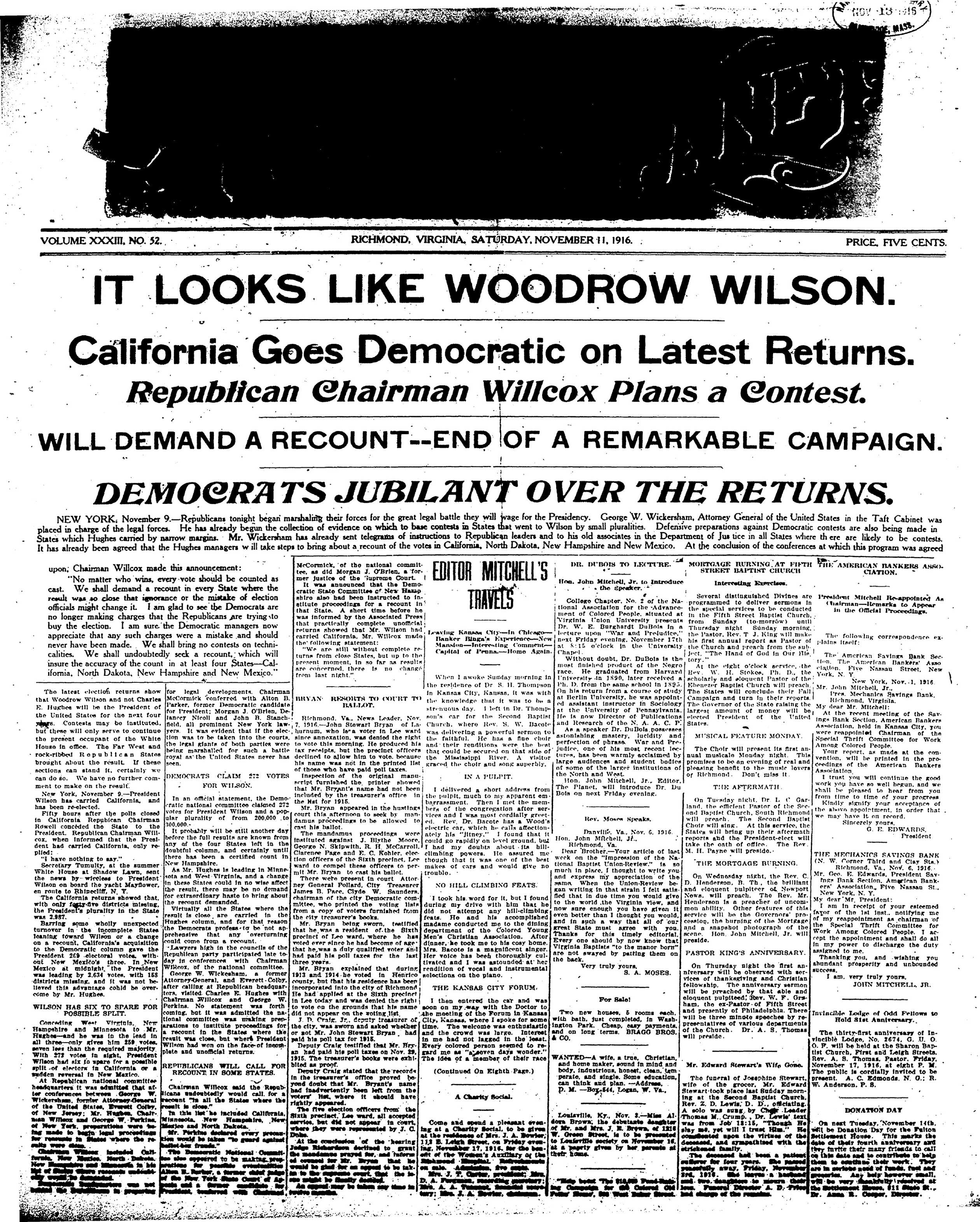
IT LOOKS LIKE WOODROW WILSON.
California Goes Democratic on Latest Returns. Republican Chairman Willcox Plans a Contest. WILL DEMAND A RECOUNT--END OF A REMARKABLE CAMPAIGN.
DEMOCRATS JUBILANT OVER THE RETURNS.
NEW YORK, November 9.—Republicans tonight began marshaling their forces for the great legal battle they will wage for the Presidency. George W. Wickersham, Attorney General of the United States in the Taft Cabinet was placed in charge of the legal forces. He has already begun the collection of evidence on which to base contests in States that went to Wilson by small pluralities. Defensive preparations against Democratic contests are also being made in States which Hughes carried by narrow margins. Mr. Wickersham has already sent telegrams of instructions to Republican leaders and to his old associates in the Department of Justice in all States where there are likely to be contests. It has already been agreed that the Hughes managers will take steps to bring about a recount of the votes in California, North Dakota, New Hampshire and New Mexico. At the conclusion of the conferences at which this program was agreed upon, Chairman Willcox made this announcement:
"No matter who wins, every vote should be counted as cast. We shall demand a recount in every State where the result was so close that ignorance or the mistake of election officials might change it. I am glad to see the Democrats are no longer making charges that the Republicans are trying to buy the election. I am sure the Democratic managers now appreciate that any such charges were a mistake and should never have been made. We shall bring no contests on technicalities. We shall undoubtedly seek a recount, which will insure the accuracy of the count in at least four States—California, North Dakota, New Hampshire and New Mexico."
McCormick, of the national committee, as did Morgan J. O'Brien, a former Justice of the Supreme Court. It was announced that the Democratic State Committee of New Hampshire also had been instructed to institute proceedings for a recount in that State. A short time before he was informed by the Associated Press that practically complete unofficial returns showed that Mr. Wilson had carried California, Mr. Willcox made the following statement:
"We are still without complete returns from close States, but up to the present moment, in so far as results are concerned, there is no change last night."
EDITOR MITCHELL'S TRAVELS
Leaving Kansas City—In Chicago—Banker Binga's Experience—New Mansion—Interesting Comment—Capital of Penna—Homo Agnin.
DR. DUBOIS TO LECTURE.
Hon. John Mitchell, Jr. to Introduce the Speaker.
College Chapter, No. 2 of the National Association for the Advancement of Colored People, situated at Virginia Union University presents Dr. W. E. Burghardt DuBois in a lecture upon "War and Prejudice." next Friday evening, November 17th at 8:15 o'clock in the University Chapel.
Without doubt, Dr. DuBois is the most finished product of the Negro race. He graduated from Harvard.
MORTGAGE BURNING AT FIFTH STREET BAPTIST CHURCH
Interesting Exercises.
Several distinguished Divines are programmed to deliver sermons in the special services to be conducted in the Fifth Street Baptist Church, from Sunday (to-morrow) until Thursday night Sunday morning, the Pastor, Rev. T. J. King will make his first annual report as Pastor of the Church and preach from the subject, "The Hand of God in Our Life."
At the eight o'clock service, the Rev. W. H. Stokes, Ph. D., the York, N.Y. President Mitchell Re-appointed As (Chairman—Remarks to Appear in the Official Proceedings.
The following correspondence explains itself:
The American Savings Bank Section. The American Bankers' Association. Five Nassau Street, New York, N.Y.
The latest election returns show that Woodrow Wilson and not Charles E. Hughes will be the President of the United States for the next four years. Contests may be instituted, but these will only serve to continue the present occupant of the White House in office. The Far West and rock-ribbed Republican States brought about the result. If these sections can stand it, certainly we can do so. We have no further comment to make on the result.
New York, November 9.—President Wilson has carried California, and has been re-elected.
Fifty hours after the polls closed in California Republican Chairman Rowell conceded the State to the President. Republican Chairman Willcox, when informed that the President had carried California, only replied:
"I have nothing to say."
Secretary Tumulty, at the summer White House at Shadow Lawn, sent the news by wireless to President Wilson on board the yacht Mayflower, en route to Rhinecliff, N. Y.
The California returns showed that, with only five-five districts missing, the President's plurality in the State was 2.987.
Barring some wholly unexpected turnover in the incomplete States leaning toward Wilson or a change on a recount, California's acquisition to the Democratic column gave the President 269 electoral votes, without New Mexico's three. In New Mexico at midnight, the President was leading by 2,634 votes, with 158 districts missing, and it was not believed this advantage cohld be overcome by Mr. Hughee.
WILSON HAS SIX TO SPARE FOR
POSSIBLE SPLIT.
Conceding West Virginia, New Hampshire and Minnesota to Mr. Hughes—and he was in the lead in all three—only gives him 259 votes, seven less than the required majority. With 273 votes in sight, President Wilson had six to spare for a possible split of electors in California or a sudden reversal in New Mexico.
At Republican national committee headquarters it was admitted that after conferences between George W. Wickersham, former Attorney-General of the United States, Everett Colby, of New Jersey; Mr. Hughes, Chairman Willoux and George W. Parkins, of New York, preparations were being made to begin legal proceedings for resources in States where the results were clear.
Chairman Willoux included California, New Mexico, North Dakota, New Hampshire and Minnesota in his list of states where resources undesirable would be demanded.
Representatives was not bound the Republican in preparing
for legal developments. Chairman McCormick conferred with Alton B. Parker, former Democratic candidate for President; Morgan J. O'Brien, Delancey Nicoll and John B. Stanchfield, all prominent New York lawyers. It was evident that if the election was to be taken into the courts, the legal giants of both parties were being marshalled for such a battle royal as the United States never has seen.
DEMOCRATS CLAIM 272 VOTES FOR WILSON.
In an official statement, the Democratic national committee claimed 272 votes for President Wilson and a popular plurality of from 200,000 to 200,000.
It probably will be still another day before the full results are known from any of the four States left in the doubtful column, and certainly until there has been a certified count in New Hampshire.
As Mr. Hughes is leading in Minnesota and West Virginia, and a change in these States could in no wise affect the result, there may be no demand for extraordinary hints to bring about the recount demanded.
Virtually all the States where the result is close are carried in the Hughes column, and for that reason the Democrata profess to be not apprehensive that any overturning could come from a recount.
Lawyers high in the council of the Republican party participated late today in conferences with Chairman Willcox, of the national committee. George W. Wickesham, a former Attorney-General, and Everett-Colby, after calling at Republican headquarters, visited Charles E. Hughes with Chairman Willcox and George W. Perkins. No statement was forth coming, but it was admitted the national committee was making preparations to institute proceedings for a recount in the states where the result was close, but where President Wilson had won on the face of incomplete and unofficial returns.
REPUBLICANS WILL CALL FOR RECOUNT IN SOME STATES.
Chairman Willcox said the Republica-
tica undoubtedly would call for a recount "in all the States where the result is close."
In this list he included California,
Minnesota, New Hampshire, New
Mexico and North Dakota.
The Democratic National Committee also appeared to be making preparations for possible eventualities. Alton R. Burber, a former chief judge of the New York State Court of Appeals and a former candidate for President, transferred with Chuckedoff
McCormick, of the national committee, as did Morgan J. O'Brien, a former justice of the Supreme Court. It was announced that the Democratic State Committee of New Hampshire also had been instructed to institute procooding for a recount in that State. A short time before he was informed by the Associated Press that practically complete unofficial returns showed that Mr. Wilson had carried California, Mr. Willcox made the following statement:
"We are still without complete returns from close States, but up to the present moment, in so far as results are concerned, there is no change from last night."
BRYAN RESORT TO COURT TWO
BALLOT
Richmond, Va., News Leader, Nov. 7, 1916.—John Stewart Bryan of Lahurum, who is a voter in Lee ward since annexation, was denied the right to vote this morning. He produced his tax receipts, but the precinct officers declined to allow him to vote, because his name was not in the printed list of those who have paid poll taxes.
Inspection of the original manuscript furnished the printer showed that Mr. Bryant's name had not been included by the treasurer's office in the Mat for 1915.
Mr. Bryan appeared in the hustings court this afternoon to seek by mandamus proceedings to be allowed to cast his ballot.
The mandamus proceedings were instituted against J. Blythe Moore, George N. Skipwith, R. H. McCarroll, Clarence Page and E. C. Kohler, election officers of the Sixth precinct, Lee ward to compel these officers to permit Mr. Bryan to cast his ballot.
There were present in court Attorney General Pollard, City Treasurer James B. Pace, Clyde W. Saunders, chairman of the city Democratic committee, who printed the voting lists from a copy of voters furnished from the city treasurer's books.
Mr. Bryan being sworn, testified that he was a resident of the Sixth precinct of Leo ward, where he has voted ever since he had become of age that he was a duly qualified voter and had paid his poll taxes for the last three years.
Mr. Bryan explained that during 1913 and 1914 he voted in Henrico county, but that his residence has been incorporated into the city of Richmond He had applied at the Sixth precinct in Lee today and was denied the right to vote on the grounds that his name did not appear on the voting list.
J. D. Craig, Jr., deputy treasurer of the city, was sworn and asked whether or not Mr. John Stewart Bryan had paid his poll tax for 1915.
Deputy Craig testified that Mr. Bryan had paid his poll taxes on Nov. 29, 1915. The treasurer's books were exhibited as proof.
Deputy Craig stated that the records in the treasurer's office proved beyond doubt that Mr. Bryant's name had inadvertently been left from the voters' list, where it should have rightly appeared.
The five election officers from the Sixth precinct, Leo ward, all accepted service, but did not appear in court, where they were represented by J. C. Dube.
At the conclusion of the hearing Judge Richardson declined to grant the mandates prayed for, and inform counsel for Mr. Bryan that he would be glad for an appeal to be taken to the supreme court, that the issue might be finally settled. An appeal may be taken any time in
EDITOR MITCHELL'S TRAVELS
EDITOR MITCHELL'S TRAVELS
Leaving Kansas City—In Chicago-
Banker Binga's Experience—New
Mansion—Interesting Comment—
Capital of Perno—Home Agnita.
When I awoke Sunday morning in the residence of Dr S. H. Thompson in Kansas City, Kansas, it was with the knowledge that it was to be a strenuous day. I left in Dr. Thompson's car for the Second Baptist Church, where Rev. S. W. Bacote was delivering a powerful sermon to the faithful. He has a fine choir and their renditions were the beat that could be secured on that side of the Mississippi River. A visitor graced the choir and song superbly.
IN A PULPIT.
I delivered a short address from the pulpit, much to my apparent embarrassment. Then I met the members of the congregation after services and I was most cordially greeted. Rev. Dr. Bacote has a Wood's electric car, which he calls affectionately his "litney." I found that it could go rapidly on level ground, but I had my doubts about its hill-climbing powers. He assured me though that it was one of the best makes of cars and would give no trouble.
NO HILL CLIMBING FEATS.
I took his word for it, but I found during my drive with him that he did not attempt any hill-climbing feats. He and his accomplished madame conducted me to the dining department of the Colored Young Men's Christian Association. After dinner, he took me to his cosy home. Mrs. Bacote is a magnificent singer. Her voice has been thoroughly cultivated and I was astounded at her rendition of vocal and instrumental selections on the piano.
THE KANSAS CITY FORUM.
I then entered the car and was soon on my way with the Doctor to the meeting of the Forum in Kansas City, Kansas, where I spoke for some time. The welcome was enthusiastic and the crowd was large. Interest in me had not lagged in the least. Every colored person seemed to regard me as "a seven days wonder." The idea of a member of their race
(Continued on Eighth Page.)
A Charity Social.
Come and spend a pleasant evening at a Charity Social, to be given at the residence of Mrs. J. A. Bowler; 113 B. Leigh Street, on Friday evening, November 17, 1916, for the benefit of the Women's Auxiliary of the Richmond Hospital. Retirements on sale. Admission, five cents.
Mrs. J. T. Carter, president; Mrs. D. A. Ferguson, recording secretary; Mrs. A. A. Tumney, financial secretary; Mrs. J. A. Bowler, clerk.
DR. DUBOIS TO LECTURE.
Hon. John Mitchell, Jr. to Introduce the Speaker.
College Chapter. No. 2 of the National Association for the Advancement of Colored People, situated at Virginia Union University presents Dr. W. E. Burghardt DuBois in a lecture upon "War and Prejudice," next Friday evening, November 17th at 8:15 o'clock in the University Chapel.
Without doubt, Dr. DuBois is the most finished product of the Negro race. He graduated from Harvard University in 1890, later received a Ph.D. from the same school in 1895. On his return from a course of study at Berlin University, he was appointed assistant instructor in Sociology at the University of Pennsylvania. He is now Director of Publications and Research of the N. A. A. C. P.
As a speaker Dr. DuBois possesses astonishing mastery, lucidity and perfection of phrases. War and Prejudice, one of his most recent lectures, has been warmly acclaimed by large audiences and student bodies of some of the larger institutions of the North and West.
Hon. John Mitchell, Jr., Editor, The Planet, will introduce Dr. DuBois on next Friday evening.
Rev. Moses Speaks.
Danville, Va., Nov. 6, 1916.
Hon. John Mitchell, Jf.
Richmond, Va.
Dear Brother,—Your article of last week on the "Impression of the National Baptist Union-Review." is so much in place, I thought to write you and express my appreciation of the same. When the Union-Review began writing in that strain I felt satisfied that in due time you would give to the world the Virginia view, and now sure enough you have given it even better than I thought you would, and in such a way that all of our great State must agree with you. Thanks for this timely editorial. Every one should by now know that Virginia Baptists "to the manor born" are not swayed by patting them on the back.
Very truly yours,
S. A. MOSES.
For Sale!
Two new houses, 5 rooms each, with bath, just completed, in Washington Park. Cheap, easy payments, and on long terms. BRAGO BROS. & CO.
WANTED—A wife, a true, Christian, and home maker, sound in mind and body, industrious, honest, clean, temperate, and single. Some education, can think and plan. —Address, D. M. —Box 544. Logan, W. Va.,
Louisville, Ky., Nov. 3—Miss Aldora Brown; the debatur daughter of Mr. and Mrs. J. R. Brown, of 1818 W. Green Street, is to be presented to Louisville society on November 16, at a parly given by her parents at their home.
Help boost The $19,000 Fund-Nutrition Campaign for 608 Colored Old Fashion House, 808 West Worth Street.
MORTGAGE BURNING AT FIFTH
STREET BAPTIST CHURCH
Interesting Exercises
Several distinguished Divines are programmed to deliver sermons in the special services to be conducted in the Fifth Street Baptist Church, from Sunday (to-morrow) until Thursday night. Sunday morning, the Pastor, Rev. T. J. King will make his first annual report as Pastor of the Church and preach from the subject, "The Hand of God in Our History."
At the eight o'clock service, the Rev. W. H. Stokes, Ph. D., the scholarly and eloquent Pastor of the Ebenezer Baptist Church will preach. The States will conclude their Fall Campaign and turn in their reports. The Governor of the State raising the largest amount of money will be elected President of the United States.
MUSICAL FEATURE MONDAY
The Choir will present its first annual musicale Monday night. This promises to be an evening of real and pleasing benefit to the music lovers or Richmond. Don't miss it.
THE AFTERMATH
On Tuesday night, Dr L C Garland, the efficient Pastor of the Second Baptist Church, South Richmond will preach. The Second Baptist Choir will sing. At this service, the States will bring up their aftermath reports and the President-elect will take the oath of office. The Roy. M. H. Payne will preside.
THE MORTGAGE BURNING.
On Wednesday night, the Rev. C. D. Henderson, B. Th., the brilliant and eloquent pulpitcer of Newport News, will preach. The Rev. Mr. Henderson is a preacher of uncommon ability. Other features of this service will be the Governors' procession, the burning of the Mortgage and a snapshot photograph of the scene. Hon. John Mitchell, Jr. will preside.
PASTOR KING'S ANNIVERSARY
On Thursday night the first anniversary will be observed with services of thanksgiving and Christian fellowship. The anniversary sermon will be preached by that able and eloquent pulpiteed, Rev. W. F. Graham, the ex-Pastor of Fifth Street and presently of Philadelphia. There will be three minute speeches by representatives of various departments of the Church. Dr. A. S. Thomas will preside.
Mr. Edward Stewart's Wife Gone.
The funeral of Josephine Stewart, wife of the grocer, Mr. Edward Stewart-took place last Sunday morning at the Second Baptist Church. Rev. Z. D. Lewin, D. D., officiating. A solo was sung, by Chief Leader Thomas M. Crumb, Dr. Lewin's text was from Job 12:15, "Though He play me, yet will I trust Him." He consoled upon the virtues of the deceased, and sympathised with the stricken family. The deceased had been a patient sufferer for four years. She passed peacefully away, Friday, November 3rd, 1916. She leaves a hardhead and two daughters to mourn their loss. Funeral Director A. D. Fries and chorus of the congregation.
PRICE, FIVE CENTS.
SON.
returns.
test.
CAMPAIGN.
URNS.
United States in the Taft Cabinet was
nic contests are also being made in
there are likely to be contests.
tes at which this program was agreed
THE AMERICAN BANKERS ASSOCIATION.
President Mitchell Re-appointed As
Chairman—Remarks to Appear
in the Official Proceedings.
The following correspondence explains itself:
The American Savings Bank Section, The American Bankers' Association, Five Nassau Street, New York, N. Y.
New York, Nov. 1, 1916.
Mr. John Mitchell, Jr.
Pres. Mechanics Savings Bank, Richmond, Virginia.
My dear Mr. Mitchell:
At the recent meeting of the Savings Bank Section, American Bankers Association, held in Kansas City, you were reappointed Chairman of the Special Thrift Committee for Work Among Colored People.
Your report, as made at the convention, will be printed in the proceedings of the American Bankers Association.
I trust you will continue the good work you have so well begun, and we shall be pleased to hear from you from time to time of your progress.
Kindly signify your acceptance of the above appointment, in order that we may have it on record.
Sincerely yours,
G. E. EDWARDS.
President
THE MECHANICS SAVINGS BANK
(N. W. Corner Third and Clay Sta.)
Richmond, Va. Nov. 6, 1916.
Mr. Geo. E. Edwards, President Savings Bank Section, American Bankers Association, Five Nassau St.
New York, N. Y.
My dear Mr. President:
I am in receipt of your esteemed favor of the last inst., notifying me of my reappointment as chairman of the Special Thrift Committee for Work Among Colored People. I accept the appointment and shall do all in my power to discharge the duty assigned to me.
Thanking you, and wishing you abundant prosperity and unbounded success.
I am, very truly yours.
Invincible Lodge of Odd Fellows to Hold 81st Anniversary.
The thirty-first anniversary of Invincible Lodge, No. 2674, G. U. O. O. F. will be held at the Sharon Baptist Church, First and Leigh Streets, Rev. A. S. Thomas, Pastor, Friday, November 17, 1916, at eight P. M. The public is cordially invited to be present. A. C. Edmonds, N. G.; R. W. Anderson, P. S.
DONATION DAY
On next Tuesday, November 14th, will be Donation Day for the Fulton Settlement House. This marks the date of their fourth anniversary and they invite their many friends to call on this date and to contribute to help them to continue their work. They are in serious need of funds, fuel and groceries. Any help however small, will be very thankfully received at the Settlement House, 911 State St., Dr. Anna R. Clemner, Dearborn.
---
Talks on Thrift
"Don't take the top sheet" is the or
der issued by a large insurance com-
pany to its employees when taking sta-
tionery from the stock room. The rea-
on is the top sheet soiled and dusy
and must be thrown away only to
leave another top sheet to become soiled and wasted.
Over the electric button in a large hotel in the request: "We would appreciate the favor if you will turn out the light when leaving the room." Some hotels furnish a large cake of soap for each room daily, whether the guest changes or not, the bulk of which is wanted, while other hotels furnish a small cake just large enough for a day's use. Some hotels have the heavy and costly counterpans laured every day, while others have the mails turn the covers back each night to avoid rolling.
The reason for these small economies is not nigardiness, but good management. Of what use is a large cake of soap when a small one answers the same purpose? Why burn the light when you are out of a room? Why soil expensive Huen when a little care would prevent. If every employee in a large office wastes but one sheet of paper a day, and every guest burns hours of needless light, the yearly cost is enormous. If a hotel can save but a cent a room a day on soap, it means a yearly saving of $1,500 in a hotel with 500 rooms. If every bundle that goes out a depart most store has half a cent's worth of needless paper and twine, the loss is a large item in the firm's annual profit and loss account. A certain restaurant found that it cost $30,000 a year to supply bread and bread and by charing but ten cents for this service turned a loss of $30,000 into a profit of $50,000. That is good management, however much a may crumble at hot cents tax.
Success in business, success in life is a matter of applying thrift principles to little things. We too often forget that dimes make dollars. And an waste counts up fast no savings grow up. If you were allowed to go over the books of any savings bank you would find hundreds of accounts that show steady, systematic saving. It may be but a dollar or two a week but in the long run it mounts up. A certain young lawyer in New York who was once a pack peddler made it a steady habit when a boy to save it cents weekly, and he was so popular at the clock that he became the founder of a success caiser. Another young man must be married, saved five dollars a week for two years out of a salary of fifteen dollars and never missed a week.
The results of such systematic work will surprise even yourself. You know that fifty times two make a hundred, but if you apply the principle to a bank account, you are bound to believe it. Little leaks can sink a ship as well as a great boat in the little sea. You can be confident that savings can make you rich as well as a great strike. The reason so many people are poor is simply because they cannot stop the little leaks. They spend little sums all the time and in the multitude of little赀ings reach a total that proves disastrous. Thrift in little things will make you thrifty in big ones; but you never can be thrifty in small ones. To the little ones. Watch yourself for a few days and see how your money gets away from you. You will surprise even yourself.
---
THE TOMORROW OF PROHIBITION
(Richmond, Va., News Leader, Oct. 21, 1916.)
Midnight will mark an epoch, but it will be an epoch in law rather than an apporthe. The clock will toll the hour when the prohibition act goes in effect, just as the calendar for centuries has marked the beginning of one statue or the ending of another. High clock and the calendar can not forswish destroy that craving for stimulants which is as old as the human race and almost as deeply seated as the instincts of man.
Upon a sober appreciation of these facts more upon the 'justification of one element or the dejection of another—more than upon the heated defense of the principle of prohibition or upon angry opposition to the law—the outcome of prohibition in Virginia will depend. Hereforefore education has been placed before legislation; threater legislation is to set the stand and for education. Instead of having the laws as in past, reflect the education of the people in temperance, we must strive to bring the practice of temperance to the standard of the law.
The position of this newspaper upon the fundamental questions involved in the prohibition law is so familiar to readers that it need not be restated at this late hour. The News Leader believes in temperance and in that temperance which begins with the individual. We view intoxicants as a treacherous servant and a brutal master, to be combated at every turn but to conquer the influences religion and the awakened morality of man who quenched the ancient fires of ancestral appetite. In this fight to the finish we have not thought we could sub situate for the slow attrition of education the sharp offensive of a single law. To this belief we remained true during the prohibition campaign and from "we have not deviated. But when the will of the people of Virginia ordered the general offensive that begins at midnight that will control the population and decide upon by the people of We this newspaper plieded "its support without modification to a fair test of
Such is the present situation and such is the attitude of this newspaper Howard It. That much stated, we prepare currently to direct the pleasure of law—adding readers to certain subjec-tions that will grow in importance as the law is tested. For tested it will be. Some of these who rejoice to right, amd the passing of chimes and the singing of hymns, will find that the task has just begun. Contentious days are before us. In inevitable reactions must come, we should face them with confidence. We will have clear hands and clear heads. We must not forget, justice in pleading expediency, righteousness in arguing opportuni-ty or the majority of all law in attempting to enforce one.
We must at the outset, remember that the law in its existing form represents the finished judgment, for the present at least, of those who put it on the statute books. The dominant majority in the general assembly, working under the direction of the Anfif—Satoon League and kindred bodies, absolutely controlled the situation in the general assembly of 1916. Nothing went into the law that could not have been kept out of the law had the majority desired. No machinery for enforcement is lacking that their judgment, their experience, their sagacity and their family. Something better may be devised in the future—that we must allow the authors of this law—but for the present we can say that if the Mapp law does not give Virginia effective prohibition, the men who shaped that measure must admit their inability to make their wishes compelling and controlling at law.
"Pauline opportunism" may dictate in 1918 the repeal of much that was defended as ideal in 1916, but even "Pauline opportunism" cannot escape responsibility for the form and content of the law and for the character and effectiveness of the machinery in operation between Nov. 1, 1916, and the meeting of the general assembly in 1918.
In the minimum of fifteen months during which the responsibility thus placed upon the authors of the prohibition law cannot be evaded, law enforcement will be tested in its broad and most subtle aspects. Upon this we need not enlarge beyond saying that law enforcement is an absolute, not a relative term. By this we mean to say that we shall expect every violator to be detected, for that is of course, an impossibility. We mean rather that the law as it is, not as some would have it; the law in its fullness, not in part; the law as it applies to all rather than to the few, must be enforced lawfully and literally. The commissioner of prohibition is now a responsible officer of government, answerable for his acts to the people of Virginia. The law officers, who must co-operate with him, in upholding the law, in detecting offenders, can be removed by simple process. There can be no ovasion, no hesitating no complaining of the law's inadequacy. And just as the law is regarded by its champions as sufficient to enforce prohibition, so there can be no excuse for going beyond its provisions. Lawful enforcement of law is essential to law enforcement.
Upon these principles The News Leader proposes to stand in discussing the law and in reporting its enforcement. We shall, of course, obey its provisions as they apply to newspapers. We shall give our voice to its fair trial in every community. We shall not encourage erasure anywhere or condone any violation. Whether it remains on the books for one year or not, the law subject to honest criticism to amendment to revision or to repeal, but at all times to be enforced as law and as it is.
Whereabouts of Relatives Wanted.
Wanted, to find the relatives of one John Hover or Hoover, who was found dead in a house in Phillipson, N. J., Sunday night, September 17, 1916. It is reported that he has a sister living in Richmond, Va. Address Rev F. P. Diggs, 27 N. Green Street, Easton, Pa.
Do You Know Them?
I would like to know the whereabouts of Hasting Howard, Paul Howard and Mance White. She has married again I think. My mother's name was Emily and my father's name was Hartley Howard, both are dead. I last heard from my people in 1895. They were then in Mountville, Va. I was in Tuscaloosa, Ala. Any information will be gladly received. Address Mr Rhoda Addison, 125 N. Mountain View Ave, Los Angeles, Cal.
VIRGINIA:
In the Law and Equity Court of
the City of Richmond, the 28th day
of October, 1916.
Marletta Roberts.....Plaintiff
against.....In Chancery
Joseph E. Roberts.....Defendant
The object of this suit is to obtain
an absolute divorce from the bond of
matrimony, by the plaintiff from the
defendant, upon the ground of deser-
tion. And affidavit having been made,
and filed that the defendant, Joseph
E. Roberts, is not a resident of the
State of Virginia; it is ordered that
he appear here within fifteen days after
due publication of this order and
do what may be necessary to protect
his interest herein.
A COPY-TESTE:
LUTHER LIBBY, Clerk
OILES B. JACKSON, p. q.
SAVE YOUR COUPONS,
WORK AND SAVE UP PLANET
COUPONS AND GET AN UNIVERSAL
OR A PHONOGRAVE—NOTE ARE
GOOD, AND ADVENIMENTS
IN THIS ISSUE AND START TO
WORK IMMEDIATELY. ALL ARE
MISSING.
Correct A. Meyers and Frank Meyer
Brave Death in Tunnel to Rescue
Workers; Meyer of the Sixth City
Thanks Brave Men.
( Cleveland, Ohio Advocate )
(Clovishe, Uncle Advocate.)
The terrible hurricane caused by 'a gorgious storm' from the ocean, from crib No. 5, late Monday, will go down in the annals of this city's history as one of the most fatal events of its kind that has ever happened in this vicinity. The grim reaper of death took 21 lives and many more were injured. Eleven of those first entombed are still buried in the mui of Lake Erie's bed and ten of the rest were killed. The shores of the lake beneath whose surface they gave up their lives in a rainy effort, to save their comrades.
But one great stirring fact remains to be told a fact that, should make every Afro-American proud of himself and his race, a fact that was dimly hid beneath the lines of every local newspaper account of this city, but a fact that the mayor of the city gladly acknowledged personally, and that is that one of Cleveland's leading Afro-American citizens was the hero of the great appalling disaster. The man who deserves the greatest share of the credit it for the rescue of those who died of death alive and the man who was responsible for the recovery of the bodies of those who had succumbed was Garrett A. Morgan, inventor of the famous Morgan national safety hood, which he used in his heroic efforts when everything else had failed
To him belongs the palm, first for the great personal bravery that he displayed and second for having invented an apparatus such as his style two helmets the combination smokegras, amfiona and blast protector, which is so simple in its use that afy affeled people can use it, and which therefore bears so much weight over other helmets that require experts to manipulate. When all else had failed, when every one stood about the top of the narrow shaft, above the grim scene of death below, when courage to venture from 'whence no one had returned failed the stoutest hearts, when it looked as if there was no danger, when it had been into the subterranean passage beneath the bed of the lake, Morgan appeared on the scene.
Just one hour ago he had been aroused by the constant and prolonged ringing of his telephone bell. The police department had notified him of the terrible disaster, and asked him to rush all the helmets he had to the scene. Routing out his brother Frank, who lives next door to him, and a neighbor, William Roots, also Colored Morgan filled his car with helmets and sped at breakneck speed through the streets to the W. 9th street plier, meeting police emergency sent to fetch him half way to his destination. The fire tug George A. Wallace was waiting at the scene, the scene, and the officer had the hurry pledge with the much needed helmets than the boat fairly seethed through the waters to the lonesome spot of death out on the lake.
It was five o'clock when Morgan arived. His helmet was hastily tested under 17 pounds pressure and, finding that it stood the test, Morgan organiza al a party consisting of his brother Frank S. Morgan, T. J. Clancy and Gilbert Martin. These men donned the helmets above, lowered in to the workbench. They impressed moment, Mayer Harry L. Davies reached out and shook Morgan's hand saying, "Good bye, Morgan," with that fervor that is only detected in the voice at such a crucial moment. It must be understood that this was the third rescue party. No one had gone before presumably were dead, including the superintendent, Van Duzen himself. The signal was given to lower away and little party disappeared. Morgan tells the tale impressively and briefly.
"I made four trips in all. On the first trip I preceded the party and broke the first bull's eye successfully, using a crowbar. We then returned to the shaft and waited for about 15 minutes until the gas thus liberated had thinned out. Then we returned, opened the first trap door and, as I advance ahead of the party about 100 feet from the door, I stumbled over the first victim we encountered. I called the party and had them place him on a truck. He was found to be dead when brought to the surface. As I proceeded I heard groans and, following their direction, found a man lying underneath a car, his nose apparently in mud. His forehead was warm. The party removed him and we then went to the surface with the two men. The man who was still living proved to be Supt. Van Dunen. We were appeared with the victims we were greeted with enthusiastic expressions of congratulations on our success and the mayor was the first man to shake my hand.
"We returned again shortly and brought up four men, three dead and one living. By this time those around had lost their fear and were confident in the qualities of my helmet. Doming them firemen police and others assisted in the work of rescue until on the last trip he was able to reach the house where he was at the mouth of the shaft. I stayed until 12:20 and, as the greater part of the work had been done and the task was no light one, left for home."
(Martinsburg, W. Va., Pioneer.)
Our good friend and able editor, John
Mitchell, Jr. has been indicted for ob-
scenity. We read it and declare you
are right and did no wrong. Your ex-
position was a strong lever under lion's
paw. We have been good of all concerned. We have been
through the same ordal and came out
a stronger man, and that is what you
will do.
The Planet office is simply equipped
with the necessary machinery to execute all kind of printing in a pan
of paper, either with a compass. The
papers are equipped.
You cannot obtain a bride until you can not stop the rain or without it. The great bridge that open the Mississippi River may be of little importance to the New Yorker, but when he wants to go to Canada he finds them a necessity.
We powerful life is built upon the proposition of preparation. The man who refuses to acknowledge the fact that some day he will be in need, is going to find himself in a serious predicament when he least expects it. The great trouble with many men and women is they live from day to day, with no thought of to-morrow. To-days earnings are spent as soon as earned—or before. Much of the world's poverty is due to this hand-to-month existence. You get a debt and never get out. You be beholden to the farmer. We run bills until the butcher and the grocer go broke until to pay our way for us.
A certain father lost his son uner
peected. He had no money saved up
he lived as he went, never expectin
such a happening. He appealed to his
bank to carry him over the time of
need, and was granted a loan, more
out of pity than out of respect for his
credit. But he should have built the
bridge for himself long before the time
of need came.
We rarely stop to appreciate how
helpful the bank is until we need as
assistance, nor grasp the fact that if
somebody had not been thrifty an
anticipated the time when financial brid
es would be needed and banked their
money, we would often be in a sorry
pilight.
Banks are built on the saving of
the thrift. They lend to the merchant
manufacturer and individual, both as
a business proposition and as a matter
of courtesy in time of need; but it is
a sad commentary on our method of
life: if when the time of need comes,
we must literally beg the banker, or
a friend, to tide us over the time thrift
would have anticipated and prepared us for.
Money is not the sum tat tal of human existence but it goes a long way towards making life, no matter how hard it may be in other respects, please ant. Every man knows that health is a delicate thing; that sickness, accident or loss of employment is liable to come at any time—and it is safe to come to us all sooner or later—and no one but a fool will defy all the laws of nature, all the advice of men and experience of the past, and refuse to acknowledge the necessity of preparedness. Bridges were never meant for ornaments; they were meant for use. They start somewhere and get somewhere. They are meant to carry loads. A bank account is a mighty good bridge. It will tide you over many a troublesome stream and see you safely on the other side, but many men will flounder around in countless of adversity, topped either an' you, before they will acknowledge the truth and begin to get ready. If everybody did as some people do, spend the dollar as fast as it is earned, the human race would fast go to destruction.
Every man who earns should save. Every woman who matter how safe may be her lot now, should look the future in the face and see if she were left alone could she manage single handed to make the world give her an existence. You cannot cross the bridge until you get there, that is certain; but you an will need the bridge that you surely need some day, and lucky for you if you have the bridge and can use it, and still more lucky if it is there and you never need use it, but you can be either way.
VOTERS NOT UPON PRINTED LIST
ARE DENIED A BALLOT
Fault is in the Law or in Failure of
(Clerks to Certify Names to
the Printer.)
(Richmond: Va. News Leader)
(Richmond; Va. News-Leader)
Numbers of qualified voters were unable to cast their ballots today because they were not on the official printed lists. Attorney-General John Garland Pollard ruled two days ago that only those who were on the printed lists may apply to vote. Election officers confronted by citizens showing tax receipts for 1913, 1914 and 1915 refused to allow them to vote. Voters then appealed to the hustings court.
Judge Richardson refused to grant relief. He said that the attorney-general had already ruled upon the matter.
NOT THE ATTORNEY GENERAL'S FAULT.
This was a disposition early in the morning on the part of some to attribute their failure to be permitted to vote to a recent ruling of the attorney-general. Even so well-informed a politician as City Chairman Saunders expressed the opinion that despite the attorney-general's ruling voters who produced their poll tax receipts should be allowed to vote. He relied on section 86-d of the election laws. It became apparent later in the day, when the first bar of indignation that the attorney-general had ruled in strict accordance with the law, and as all other authorities have hold. A statement from Mr. Pollard obtained after the noon edition of The News Leader went to press, appears below.
Indignant voters this afternoon were directing their criticism in some instances at the city treasurer's office, alleging that failure of clerks in his office to include in the lists sent to the printer the names of persons who paid their poll taxes for 1915 deputies in the county of their right to vote in the city in today's presidential election.
Up to noon approximately twenty per cent. of the voters of Ginter Park offering to vote had been turned down, because their names did not appear on the printed lists of voters as made up in the treasurer's office. Nineteen out of 128 votes had been refused the right of ballot.
STATEMENT OF ATTORNEY
---
the court for correction, and every court which has passed on the conviction that if a citizen fails to avail himself of the opportunity afforded by the law to correct the transcurrent list he loses his vote.
These decisions are in strict accordance with the act of the general assembly which provides that the treasurer's list, after being corrected by the court, shall be conclusive.
- If any citizen has lost his vote no one can be attached to me. I cannot not be attached to me by the general assembly, nor can I reverse the decisions of courts, as some thoughtless people seem to think.
"It should be borne in mind in this connection that veterans can vote without their names appearing on the list. It should also be stated that the legislature has provided that, in case of a voter moving from one city to another city or county a certificate from the treasurer of his former home may be used as evidence of payment of his poll taxes, and a young man just becoming of age may, under the law, vote on his tax receipt, because his name would not properly be on the treasurers' list, which was made up before he attained his majority. "I present the disposition on the parish register to me but I am responsible for unwise laws passed by the general assembly, or for mistakes made by officials in making up their lists of voters."
No loss than sixteen voters talked with the judge early today in the hustings court before he took his place on the bench and to each he gave the same answer. He was sorry that he had not been able to manly Clyde W. Saunders, of the city Democratic committee, appeared before the judge and got the same reply
SAUNDERS SAYS RULING IS WRONG.
Chairman Saunders said that the citizens in the annexed territory were the chief sufferers from the voting lists. After consulting the Virginia election laws, he said:
"Despite the ruling of Attorney-General John Gerland Pollard that only persons whose names appear on the printed voting lists are obligable today, obliged to the annexed territory who can show tax receipts for three years past—1913, 1914 and 1915—have a right to vote under section 86-d of the Virginia election laws."
"The law states:
"Section 63d. Evidence of the pre-payment of state poll taxes transferred from one city or county to another city or county—In any case where a voter has been transferred from one city or county to another city or county, and has paid his city or county taxes for the three years past, he offers to vote, or for any of said years, in any county or city in this state, such voter may exhibit to the judges of election the certificate of the treasurer of the city or county wherein the said taxes were paid showing such payment, and that the same was made at least six months prior to the person offering to vote. Such certificate shall be conclusive evidence of the facts therein stated for the purpose of voting."
SOUTH BOSTON (VA.) NEWS.
The Halifax County Teachers Institute. Colored, met in the First Baptist Church, Friday evening, November 3, 1916 and continued until Saturday morning. There were many teachers. The Superintendent H. J. Watkins spoke some very encouraging words to the Institute. He commended the teachers very highly for their loyal support. He emphasized greater support from his colored teachers than from those of his race. At the conclusion of his remarks, Mr. T. C. Irwin, of Petersburg, Va., who is field agent for the Nogro Organization Society of Virginia, was introduced to the institute and gave a very interesting address. There were other prominent visitors present, such as Dr. Terrell, who is principal of the Halifax Institute at Houston, a. Mrs. Kate Mitchell, of County, an engagements, the industrial training of some work in Virginia; Miss Wilson, of Charlotte County, who is engaged in the same line of work in Virginia.
Music was furnished by the choir of the above named church, Prof. Pendleton, organist.
S. S. Ragsale, President; M. H. Colemon, Secretary; H. J. Watkins, County Superintendent.
Rev. B. H. Epps, of Lynchburg,
Va. preached at the Mt. Olive Baptist
Church of this city on Sunday
at 11:30 and 7:30. Rev. Epps is a
good preacher and had good attendance
throughout the day. At the
evening service Mr. S. E. Mason, who is
a colporteur for the Moody Bible
Institute was present and sang some
of his choice music.
Look! Watch! Work!
The Imperial Order of King David
starts a great membership campaign.
We want every member of the Order
to help in this great movement. This
campaign will close on the second Friday
in December at W. I. Johnson's
Hall, at 8:30 R. M., with a reception
Capitale -- Mrs. W. I. Johnson, Lena
Munford, Nartha C. Brown, Mary J.
Peterson, Harriett Blunt, Fannie Paule,
Belle Scott, Rebecca Turrell, Elizabeth
Robinson, Annie Johnson, Elizabeth
Murphy, Allie Williams, W. W.
Wilkinsen, Faye Blunt, Glare Young,
and others.
Mr. M. P. Cullens, a successful dentist of the city, in company with Dr. M. M. Cullens of Madison, S. C. went to Columbia, R. C., to receive the football game between Biddle University and Benoit College on the campus at 8 o'clock.
Mr. J. W. Bethen, a stockholder of the Negro State Fair, passed through the city recently on route for Columbia, to be present at the stockholder's meeting.
Mr. T. M. Bethen, a successful farmer at Latta, S. C. is visiting the State Fair at Columbia, S. C., Mr. Bethen ginned eleven bales of cotton.
Prof. R. R. Wright, of the A. M. E. book concern, is attending the conference at Charleston, S. C.
Mr. W. B. Boykin, of Sanford, Fla., has gone to Wilmington, N. C., and Norfolk, Va.
Prof. R. J. Renolds, principal of Dillwyn graded school, has gone to Columbia, S. C.
Prof. R. Rhodes, a successful farmer, won his own case in trial in justice court here recently, in a suit brought against him by Mr. M. Rosenfield a furniture dealer
Mr. Hillary R. W. Johnson, after attending school at Claflin University for three years, left for his home in Lberia, Africa, on account of the illness of his mother. At Claflin he would have completed his college course, but for the sad message of his mother's illness.
As a citizen of South Carolina, there are two things I would not do, viz.: The first of them is: I would not solicit any money for any purpose from the public a row days prior to a presidential election; nor, would I sanction a general meeting of a congressional election for President of the United States.
Prof. R. J. Renalski opened a pyschool at Dillon, S. C., preparing for the public graded school to open Monday, November 6.
Miss Louisa Bostock and Mr. C. T. Thomas accompanied Miss Bostick's sister as far as the city, on route for Washington, D. C.
Mr. Thomas runs a delivery car at Sumter, S. C.
Respectfully,
E. D. WEBSTER.
Leesburg Items
Leesburg, Va.—Mrs. E. P. Diggs left Friday of last week for New York, where she will visit friends.
Mr. and Mrs. Phillip Harnas have returned home, with "The weeks" visit to their children and friends in New York and Philadelphia, Pa. They reported a grand dime.
The "Stork" brought a fine baby boy to Mr. and Mrs. Willie Davis this week end.
Rev. F. W. Dixon, of Washington, arrived in town Saturday and preached at Providence Baptist Church all day. At 11:15 he mounted the stand. After devotional exercises, he proceeded to preach from John 3:16. God so loved the world," etc. Subject: "Love as He only can." At 2:30 the Sunday School convened. The lesson stating on the "Shiver of Death" at 7:30 he was at the post of duty. Subject, "Completeness in Christ." Col. 2:10. "And ye are complete in Him which is the Head of all principalities and powers." He preached to a good audience. All went away saying that never had a man spoken as did this man.
The accomplished daughter of Rev. G. C. Banister, of Restortown, wore shipped with us. While here she was the guest of Mrs. Henry Robinson. Mr. and Mrs. Jessie L. Moton anne, Marriage, of their daughter, Mary, to Mr. Henry H Burbridge, of Ansonia, Conn. Mr. and Mrs. Wesley W雁 Jeff Monday for Washington, where they will reside for the winter.
Mrs. Kate Sims has returned home after a brief visit to her sister.
Rev. Dr. G. W. Powell passed through the city Sunday on route to his church at Lincoln, Va.
Mrs. Ellen Wallace is the guest of her sister, Mrs. Lacy Summers, for a few weeks.
Mrs. Lucy Williams, Mrs. Garner Diggs, and Miss Bertha Turner left for Washington on a shopping trip.
The Silver Leaf met at Mrs. Noble Adams Tuesday evening last. We greatly entertained.
Many strangers worshipped with us; Sunday at the Baptist Church.
Y. M. C. A. NOTES.
A jolly set of follows made the program of the Y. M. C. A. Literary a live wire last Friday night, and every man attack the center.
Last Saturday the explanation on the Sunday School Lesson, by Dr. W. H. Stokes, was extremely interesting and helpful, and all were more than
IT REALLY H
COULD PREACH AND CUS8.
There is a young aspirant for the right ministry, connected with one of the and large churches in Richmond, who is very devious of doing some tangible work for the Cause. It seems that was he cannot get any work to do around to the Sunday School department, so he had made a charge on the weekly prayer of meeting, where he hoped the brethren would give an ear and approval, he and the mature shoof hallitish, in the appreciation of the linguistic ability, he succeeding in around a little frosty torrent and criticism, mixed with a good two of approval. This is the very best drink of endurance.
The committee for the city home sound much to be done (10 A. M.) to the home, and helped the inmate. The committee for the jail work is happy over the seven prisoners who were lead to accept Crimson (10 A. M.) as stand and stand or Christ in the meeting for women in the pen-Kentucky (10 A. M.)
At the Fifth Baptist Church (West End), 8:30 P. M., the 21st anniversary of the Y. M. C. A. was held, a person from all parts of the city attended, and it was one of the best in the history of the Y. M. C. A. President John S. Powell presided. Music by the choir of the church. Scriptures read by Rev. W. B. Ball. Prayer by Director Roosec C. Mitchell. Music by the choir. President Powell made a very encouraging address. Report of General Secretary S. C. Burel. Meeting for boys, 53; meetings for men, 48; for workers, 52; in the city fall, 158; in the city home, 97; meetings of the Bible Classes, 102; for woman, 2; mixed, 4; visits to the sick, 1,568; to the penitentiary, 128; conversions, 170; employment, 34. Persons were given some of the best of our city. Treasurer E. J. Poole for the cash in hand, 11,665.95. Disbursements, 11,665.20. leave a balance of 75 cents. Rev. A. D. Daly preached the annual sermon, which was an able one, and a heart-reacher. The New Year begins November 1, 1916, ending October 31, 1917. The amount needed for the year is $3,000, which will be canvased for at once by officers and members. We are asking everybody to lend a helping hand. We thank you for your past assistance.
We will be glad to see you today (5 P. M.) at the Y. M. C. A. to hear the explanation on the Sunday School Lesson. Come and bring a friend. Men, be on-time Sunday ready for hard work and the other man. A special meeting for workers (9:30 A.M.) at the Y. M. C. A. Mothers, send your boys to the special meeting for boys (4 P. M.) at the Y. M. C. A.
At the Fourth Baptist Church (8 P. M.) the wide world week of prayer will begin. 8:30 P. M., the 27th Anniversary Exercises continued. Dr. Evans Payne, pastor of the church, will preach a special sermon. Subject: The Young Man Who Borrowed An Eye. Just by the chair of the church, Widow of the World. The World-Wide Week of Prayer will be continued Monday, November 12th, from 7 to 8 P. M., at the Sharor Baptist Church. Through Thursday, 16th, Friday, 17th, at the Third Street Methodist Church, 7 P. M. to 8 P. M. Saturday 18th, 6 P. M., at the Y. M. C. A. All men are asked to come in right from your work; come just as you are, with your dinner pall or puckers of our strong men and pastors will add to your man will have a chance. Comel Every home is asked to have special prayer for the Y. M. C. A.
Neatness and High Class Work
Is the motto in our composing room. There isn't a detail overlooked before the form is put on the press.
A man working at a bench.
If you give us a printing order
mose YOU'LL SOME AGAIN.
OUR PATRONS ARE OUR BEST
ADVERTISERS.
argument but this good brother swallowed every drop of it, and it settled right in his chest. This part of his anatomy began to swell and he carried the "wrapped shirt" around with him with much puff and pride. It was a long time before he supplied what to his 1911 uniform with a new shirt. But he "had to be" for the economy of that Sunday afternoon who did not give him a "disguise" and now that he thought he had the approval of the "old man" of the dream, he would proceed "unaware" that it overpowered him. He made a decision and he had to be free.
Harry Lester
Katie
Copyright 1914 by Houghton Mifflin Co.
THE Cophestown man poured from the saloon, seizing their pockets, circled, round to the back of the building, firing as they retreated.
Miguel spurred his big pinto in among them and emptied his gun. He rode out at a lope, reloading. The front of his channel shirt was shot away, but he was not aware of it.
Billy Dime coolly sat his horse and "throw fine" at each shot, till a leader sang strilled his gun arm. He swore profusely and wisely spurred out of range.
"I got one itself cried Miguel, swinging shut the cylinder of his gun. "I go get another one."
"Give 'em my grom-pil-ments," said Dime, winding a handkerchief round his arm and knotting it with one hand and his teeth.
Williams, keeping under cover, fired slowly and with great precision. Overland Red, utterly unable to manage the Yuma colt under fire, rode up to Williams. "Let's call it off, Brand. I got my man. They was no need of the rest of it. How did it start anyhow?" "That's about what the kid said when he let go the wagon on top of the hill. I counted five Gopher's down. Billy's hit, and Miguel's gain' to be, the little fool. Look at him!" The Gophertown men were drawing away toward the canyon. They turned occasionally to throw a shot at Miguel and Pars Long, who followed them.
Suddenly Williams raised a shrill call. The Moonstone boys wheeled their ponies and rode toward him. Williams pointed up the canyon. Down it rode a group of men who seemed to be undecided in their movements. They would spur forward and then check and circle, apparently waiting for their friends to come up to them. "It's the rest of the Gophertown outfit. We might as well beat it." said Williams. "This here thing's gettin' too popular all to once."
"Did that guy get you?" asked Williams, nodding to Overland.
"Not what you'd notice." replied Overland. "We'll take a drink on the house. She ain't so tidy as she was."
"Neither is the guy behind the bar." said Bud Light, pointing with the stub of his finger to Lush's face. The saillockes had been hit between the eyes by a chance bullet.
"He's where he belongs." said Williams. "So is this one." And Williams
porched saunders' body with his boot
"Let's drink and vamoose."
"Here's to the kid!" cried Overland,
strangely white and shaky.
"Here's hoping!" chirped the Moone-
stone riders.
None of the Moonestone boys had sup-
posed that Overland Red was hit. He
rode joyfully and even began a poem to
the occasion. Williams was first to
notice that Overland's speech was grow-
ing thick and that his free hand clasped
the middle horn.
The others, riding a little to the rear,
burst suddenly into boisterous laughter.
"What you think, Brand?" called
Pare Long. "Bud's just been counti-
n his fingers, and he says there is one
mainn'. He isn't sure yet, but he's
countin' hard. He has to skip when he
comes to number one on his right mitt.
Says he can't get started to count that
war."
They drew out. Williams, disoriented, was heading over his companion Overland, who had suddenly slipped from the saddle.
"Where's he punctured?" queried Bud Light.
Williams examined the prostrate man. "Kind of low down, and in the saddle. Tain't be, but it's bad enough. Take the Yuma colt, Iars, and fan it for the canyon. Send the doc back, and you stay with that young Winthrop and look after Colita. Your hese is quieter for Red anyway. Tell the doc to bring his tools sipping. I tucked we'll camp over there near the Mim tomorrow."
"Who was it got me?" questioned Overland as he was retrieved a second time.
"I can't know," replied Williams.
"The only distinguisher" sounded on him when one I put there. It didn't worry him now.
"Old times," said Overland, crying to smile.
"Like old times," school William,
"I guess it was Paris," murmured Overland.
"He had plenty of shoes. I wasn't after him."
Howly the group of hammers rode across the desert. The afternoon sun made glitter shadows of them and their marmosets. Hilly Dime rode back forth. His shoes was white and held high, swollen. Overland, on Leong's pelt, was supported by Mingwang and Blank William. Fume Leong had appeared in the students of the night.
old places. The room smelled of cigar
rette smoke and antiseptic. Quite as
though nothing unusual had happened
the rancher regenerated them.
"Have a good time, boys?" he asked.
"Yes, air; very good time; better than we expected," replied Billy Dime. Bud Light nodded.
Stone looked hard at Billy Dime's bandaged arm. "Miguel and Parron Long have a good time also?"
"Stayed to help Overland Red work the claim. Overland Red got hurt a little doin' somethin'. He's all right now."
"None of the Moonstone boys were injured?"
"Nope; not a one of us," replied Dime blandly.
Walter Stone's eyes twinkled, but he did not smile. "We will call it a vacation this time, with pay! Tell Williams to step in here, please." And the rancher dismissed his embarrassed and happy punchers with a gesture.
The interview with Williams was not so brief. "The boys came out of it all right!" asked Stone, shaking hands with his old foreman.
"How did you manage that?"
"Didn't They did."
"Any one—er—of the other side have an accident?"
"Saunders—and six gents got hurt pretty bad."
"Whew! Our boys were lucky."
"It was nothin' but lock that they ain't all back there now—on the sand. You see, the Gophertown outfit are all what you'd call good with a gun, but it was kind of a surprise, the spread-in' of the thing from Bed's little private deal to a six hand game. We sure was lucky."
"And Collie?"
Williams shook his head. "I don't know. We thought he had crossed over. Seems he took a new holl. The doc and Walthorp brung him to Los in the automobile. He's at the hospital. But they say he don't pick up any since he come there."
"All right, Brand.' I think that is all."
"How about my name goin' back on the books?' asked Williams.
"It hasn't been off the books. You know, Louise attends to the time sheet."
Williams nodded. "I expect. Miguel and Parson Long will be smiff' around lookin' for a job before long. They agreed to stay with Wied till he got on his feet again. But they told him they would go just as soon as he was all right, for you couldn't run your ranch without 'em."
Walter Stone smiled broadly. "You're foreman, Brand."
"They was sightin' just as much for the name of the old Moonstone as for Collie or for fun," said Williams.
"I know it. But I don't believe in such methods. That sort of thing is about done with," said Stone.
"I was readin' about the old days in the Panamint, not long ago," said Williams, gating at a corner of the office.
"I—they was a list of names of ranchers that cleaned up the rustlers over there, back in '80. It was interestin'—some of them names."
Walter Stone coughed and turned in
his chair. He gazed out of the window.
Finally he faced Williams again.
"We're doin' it," he said, smiling.
Williams nodded. They understood each other.
Louise returned home, hearbrick and haunted by Collie's eyes that had seemed no listless, so indifferent, so quarry. She had hoped to cheer him. His indifference affected her more than his actual physical condition, which seemed to be the cause of it. Louise recognized in herself a species of selfishness in feeling as she did. She most fokk of superabundant health, she was unable to reshape the possibilities of sickness. She longed for his companionship. She had not dared to ask herself whether or not she loved him. She was glad that he should love her, and yet she was not altogether happy. She had sent him her token, the little gray riding gauntlet. He had in no way acknowledged it.
Then to have seen him in the hospital, helpless, seemingly beyond any noticeable influence of her presence, stirred in her a kind of maternal jeal-
A
early. Straightway she visited Ann Marshall, who kissed her, held her at arm's length, saw the soft rose glow in her face and spoke to the point, about her parable. Dr. Marshall had been very poor—a doctor in the slums—just before they were married. People had said things and had looked things, which was even worse. They subtly estimated that the doctor was marrying her for her money. She was the happiest woman in the world. She thought Collie was the manliest and most striking figure she had ever seen. To all of which Louise listened quietly, blushing a little. "And he is wealthy," concluded Anne. "For so young a man he is wealthy. The Rose Girl Mining Company, incorporated, my dear, pays well. Collie is one of the three largest stockholders. You see, Billy and Overland Red have decided to turn the claim into a corporation."
"Don't you contradict your—your theory a little, Anne?" asked Louise.
"No, indeed! It doesn't matter in the least who has the money, so long as the man is in the right one."
And Louise was silent and a bit happier.
The little parcel that came to the hospital directed to Collie was from Overland. It was accompanied by a wridly worded note and a small, stained and wrinkled glove, at once familiar.
Overland's note explained the delay in forwarding the glove. "It's some mussed up," he wrote. "because I had it in my shirt when I was hit. I was some mussed up likewise, or I would not 'a' forget it so long. The little Rose Girl sent it to you by Brand when she thinks you was going to cross over on the last sunset limited. And I am feeling Fine, thanks. Do not rite to me if it gives you cramps.—Yours verry fatherly, Jack."
Collis turned the gauntlet over in his trembling fingern. His eyes glowed. He called the nurse, telling her, he was hungry.
Anne Marshall's visits were always refreshing. Well powned, cool, fragrant, she came next afternoon to Collis's bedside.
"You must get well," she said, smiling. "The doctor will be terribly disappointed if you don't. Isn't that coldly encouraging? What a thing to say?" "I don't want to disappoint anybody," said Collis.
"Well, you will if you don't get better right away. Ask. I wish I could do something to help. I can only sympathise and encourage the doctor."
"It only came yesterday," said Collis, tremulously drawing the gauntlet from beneath his pillow.
Anne Marshall gated at the soldier and wrinkled glove with uncleightened eyes. Then her quick smile flashed. "Oh, now I know! So what is the tallman? Came yesterday? No wonder you seem brighter."
Collie's answering smile was irresistible. "It isn't just the glove. But would you—I mean, if you were like me, without being educated or anything"—He hesitated, breathing deeply.
But Anne Marshall understood him instantly and answered his ably questioning eyes.
"Indeed I should. If I had half your chance I shouldn't waste a minute in claiming the mate to that glove. One glove is of absolutely no use, you know."
"This one was—pretty much," sighed Collie. "I was feeling like letting go inside and not trying to—to stay any longer just before it came."
"S—sah! Don't even think of that. Some one called on me a few days ago. You are a very fortunate young man."
Anne Marshalls ambiguity was not altogether disjaligning to Collis in that it was not altogether unintelligible.
William Stanley Winthrop, sojourning briefly but fashionably in LON ANGLES, appeared at the hospital in immaculate outing dannel. It was several weeks after his sister's last visit there. Winthrop took the convalescent Collie to the Moonstone rancho in his car.
Aunt Eleanor and Walter Stone were at the gate. Collie was helped to the house and immediately taken to the guest room. He was much fatigued with the journey. The question in his eyes was answered by Aunt Eleanor. "Louise rode over to the north range today. She should be back now."
Waltham source needed an introduction. He was Anne Marshall's brother. That was sufficient for the host and hostess. He was made welcome—as he was wherever he went. He had heard a great deal from his sister of the Stones and their beautiful niece, Louise Lacharme. He was enthusiastic about the Moonstone canyon. He grew even more enthusiastic after meeting Louise.
She came riding her black pony Boyar down the afternoon hillake—a picture that he never forgot. Her gray sombrero hung on the saddle horn. Her gloves were tucked in her belt. She had loosened the neck of her blouse and rolled back her sleeves at the spring above to bathe her face and arms in the chill overflow. Her hair shone with, a soft golden radiance that was ethereal in the flicker of afternoon sunlight through the live oaks. From her golden head to the tip of her small riding tool she was a harmony of vigor and grace, of exquisite coloring and infinite charm.
"I have been quite curious about you, Mr. Winthrop," she said. "You are quite like Anne. I adore Anne. Shall we turn Boyar into the corral?"
If William Stanley Winthrop had had any idea of making an impression he sought it. The impression Leonard was unconcernedly making a straightway abrasured his attention.
"Kay, indeed! Turn him into him the curse-
turn him into him anything, Mike La-
chipone. You have the magic. Make
another adventurer of him."
L. J. HAYDEN Manufacturer of Pure Herb Medicines TO CURE ALL DISEASES OR NO CHARGE. 220 W. Broad, Richmond
If so, call and see I. J. HAYDEN. Manufacturer of Pure Herb Medicine, 320 W. Broad Street. My Medicine will cure you, or no charge, no matter what your disease, sickness or affliction may be, and restore you to perfect health. Hundreds of people, the best and leading ones in the
United States and Europe, have testified that I am one of the most wonderful healers of all complaints in the world. I use nothing but herbs, roots, bark, gum, balmine, leaves, seed, berries, flowers and plants in my medicine. They have earned thousands that the most skillful and best hospital physicians in America and Europe have given up to die and said there was no cure for them. My Medicine cure the following diseases: Heart Disease Blood, Kidney, Bladder, Stricture, Piles in any form, Vertigo, Culinary Sore Throat, Dyspnea, Indigestion, Constipation, Rheumatism in any form, Pain and Aches of all kinds, Cold, Bronchial Troubles, skin Diseases, all itching Sensations, Female Complaints, LaGripe, Pneumonia, Ulcer, Carbuncles, Bells, Cancer in its worst form, without the use of knife or instrument, Hormone, Pimple on face and body, Diabetes of Kidneys, Bright Disease of Kidneys. My Medicine cure any disease, no matter what nature, or your money refunded. Medicine seat anywhere. For full particulars, send or call on L. J. HAYDEN, 200 West Broad Street
```markdown
```
HELLER'S HUMAN HAIR STORE
712 SEVENTH ST. WASHINGTON D. C.
ESTABLISHED 1886. THE OLDEST HAIR STORE IN THE SOUTH.
Here is the Straightening COMB that will give you Perfect SATISFACTION
This One Dollar
Brass Comb will be
sent to your address
prepaid for 79c.
Send Stamps or Post Office Money Order.
HERE IS A BIG BARGAIN FOR YOU—A one ounce, 23 inch Trans-
formation, good hair that you can comb. At the special price of
48 OUNTS. Colors—Black or Brown. Sent parcel post, prepaid.
BROWN & ROBINSON
Our Motto: THE GOLDEN RULE.
Do You Own Any of the Earth? or Anything Thereon?
You Could! You Should! "Let's Talk It Over."
A. D. PRICE. 212 EAST LEIGH STREET.
A. D. PRICE. 212 EAST LEIGH STREET.
FUNERAL DIRECTOR, EMBALMER AND LIVERYMAN
Open All Day and Night - Men on Duty All Night
PHONE, MAD. 577 RICHMOND, Va.
(Rendemos nint door)
PHOTOS—We Offer you the Least and Most Artistic Photos of a
New Residence Figure that you can obtain here. Special
Attention Fee to Candidates. We will also be Feeled
In Goa. You Tweet of picture and sender
WE WISH YOU A CUSTOM PHOTOGRAPHY PACKAGE. SPECIAL LET
GOVERNOR 0. MAYVIL, Photographer,
on behalf of Leisure Services
"all there in the oceans."
"I could enjoy anything in company with Overland."
"Of course. Do you think people will have lots of money are apt to be cynical?" she asked.
"Not more so than people without money. But what splendid animals be exclaimed as they approve of the corral.
"Uncle Walter and I are very fond of them," she said, turning their arms into the enclosure.
"Do you know, Miss Lacharme, I like horses and dogs and cats, and I just revel in burros. But animals don't seem to like me. They're rather indifferent to me. I wonder if it is a matter of health, or magnetism, or something of that sort?"
"Oh, no. But it is difficult to explain. Even if you are very fond of animals it doesn't follow that they will like you. That seems rather cold, doesn't it? It's almost unfair."
"Yes, if one considers it seriously."
"Don't you?"
Winthrop gamed at her for a second before replying. "I see I must tell the truth," he said lightly. "You compel it. It does hurt me to have anything or any one that I care for indifferent to me. Perhaps it's because I realize that I am giving affection and selflessly want 'value returned,' so to speak Pardon me for becoming serious."
"Surely. But I thank you too. See Boyar roll! He's happy. No; he doesn't roll because his back itches. You see, he's sweaty where the saddle covered him. Before he rolled you noticed that he deliberately found a dust spot. The dust drills the sweat, and he doesn't take cold. That's the real explanation."
"I knew if it couldn't be through hap
```markdown
```
people at leaving you," said Winthrop.
"If you are determined to keep it up," said Louise mischievously, "all right. But be careful, sir. I enjoy it. It's been dull—dull-fearfully dull—since Anne and the doctor left. May I have your knife?"
A belated crimson Colombe rose nodded beneath the guest room window Louise cut the stem and plumed the flower in the lapel of Winthrop's white flannel coat. He gazed at her intent on her task.
"There!" she said, with a light touch of her supple fingers. "That will do. And slowly her gray eyes lifted to his. The color flooded to his face. His eyes became momentarily brilliant. He drew a deep breath. "You told me to be careful. I shall be," he said, bowing slightly. "Please any something Your silent attack was a little too--too successful."
"Truce?" she queried, laughing.
"Never," replied Winthrop, "even as our rather mutual and distinctly illustrious friend Overland says, 'Not till me wires are all down and me lights are out.'"
CHAPTER XX.
Rose Girl Overhears All.
COLLIE, standing at the open French window, just above them, drew back. Quito naturally, being a young man in love, he misinterpreted all that he had seen and beard. Louise had been away the day he was expected to return to the ranch. She had come back. She was seemingly antified with Winthrop's society. She was even more than satisfied; she was flirting with him. An unreasonable, bucolic jealousy.
(Continued In Sixth Pago)
L. J. HAYDEN
Manufacturer of Pure Herb
Medicines
WE ALL DISEASES OR NO CHARGE.
W. Broad, Richmond
PHONE RANDOLPH 2637
DO YOU LOVE HEALTH?
all and see L. J. HAYDEN, Manufacturer Herb Medicines, 320 W. Broad Street. diseases will cure you, or no charge, no that your disease, sickness or affliction and restore you to perfect health. Hun-people, the best and leading ones in the fitted that I am one of the most won- world. I use nothing but herbs, roots, berries, flowers and plants in my medi- that the most skillful and best hospital gave up to die and said there was the following diseases: Heart Disease diseases in any form, Vertigo, Quinny, Sore nistication, Rheumatism in any form, Bronchial Troubles, Skin Diseases, all nits, La Grippie, Pneumonia, Ulcer, Car-arm without the use of knife or instru- body, Diabetes of Kidneys, Bright's cure any disease, no matter what na- medicines seat anywhere. For full par- DEN, 220 West Broad Street
AN HAIR STORE
WASHINGTON D. C.
BEST HAIR STORE IN THE SOUTH
will give you Perfect SATISFACTION
This One Dollar
Brass Comb will be
sent to your address
prepaid for 79c.
Office Money Order.
OU—A one ounce, 23 inch Trans-
an comb. At the special price of
crown. Sent parcel post, prepaid.
ROBINSON
GOLDEN RULE.
Ready Cash Talks.
ARE you ready for a business opportunity? Suppose that tomorrow you see a chance whereby the investment of $1,000 would start you on the road to an independent fortune. Have you the thousand? Place your surplus cash in bank. Then when a choice investment offers you are ready for it. There is an old saying that money makes money. It is particularly true today. Security, service and courtesy are our watchwords.
THE MECHANICS SAVINGS BANK
S READY TO SERVE YOU. WRITE OR VISIT US AT THIRD AND CLAY STS. NORTHWEST CORNER. JOHN MITCHELL, JR., Past. WALTER T. DAVIS, Ca
News stand.
Mr Edward Dandridge. 11 W. Duval Street, agent for the Pioneer, handles all kinds of newspapers.
EDW. STEWART
200 SOUTH SECOND STREET
RICHMOND, VA.
FRESH MEATS, VEGETABLES
FISH AN DOYSTERS
'PHONE, MADISON 1687.
BOARD AND LODGING
MR8. BOOKER T. LEFTWICH
818 N. Second Street, Richmond, Va
SPECIAL NOTICE TO COLORED
RAILROAD EMPLOYEES.
In order to secure all the benefits under the eight hour bill passed by Congress Saturday Sept. 3, 1916, a colored Brotherhood of Fireman, Brakesmen and Train Porters is now in course of being organized. To perfect this organization it is absolutely imperative that the name of each and every man engaged in either of the mentioned occupations be forwarded to the National Headquarters, 1853, 7th St. N. W. Washington, D. C. Full information of all particulars will be furnished upon receipt of name and address. E. R. Baither, Secy. 1853, 7th St. N. W. Washington, D. C.
A. HAYES' SONS
727 N. SECOND ST.
Residence, 725 N. 2nd St.
FIRST-CLASS AUTOMOBILE
AND HACKS. CASKETS OF
ALL DESCRIPTIONS.
Chapel Service Free to
All of Our Patrons.
ALL COUNTRY ORDERS ARE
GIVEN OUR SPECIAL
ATTENTION
PHONE. MASSON $755
OPEN DAY AND NIGHT.
OTHER PEOPLE JUDGE
YOU BY YOUR FURNITURE NOW!
When you can get Furniture and Rugs from an Old Established house like JURGENE—that's known to sell the best quality goods, fast as reasonable as elsewhere—why not give your friends a good impression. It will give us the greatest pleasure to show you our wonderful stock of home making comfort giving Furniture and Rugs and—don't fall to ask our salesmen about our banking plan which gives you 5, 10 or 15 months in which to pay for any purchase.
CHAS. G. JURGENS SON
ESTABLISHED 1880
ADAMS AND BROAD
PAGE THREE
Cash Talks.
ness opportunity? Suppose that to- chance whereby the investment of you on the road to an independent the thousand? Place your surplus a choice investment offers you are saying that money makes money.
Security, service and courtesy are
SAVINGS BANK
M. WRITE OR VISIT US AT
NORTHWEST CORNER
WALTER T. DAVIS, CA
RAILROADS
1. Bd'd 15.15 ad. 9.37 ab. 12.50 pr. 10.25 pr. 6.30 pr. 12.01 pr. 13.50 pr. 5.47 pr. 19.00 pr. 12.30 pr. 12.35 pr. 12.30 pr. 112.40 pr.
Bd'd Ammonia Land 17.215 Ft. -week 14.15 pr. 10.00 pr. 11.25 pr. daily. Fremdtchburg Ammon. week day (v. 14.00 pr. 12.25 pr. Antibod Ammon. week day (v. 17.30 pr. 13.30 pr. 14.10 pr. 5.42 pr.
NORFOLK. & WESTERN
SEEK LISTING LINK TO BOOKS
(Schedule In effect Jan. 8, 1916)
Leave Byrd Street Station, Richmond, F365 NORFOLK: 0:18 A. M., 0:00 A. M., 0:00 P. M., 0:00 P. M.
FOR LYCHENBURG AND THE WEST;
A. M., °9:39 A. M., °9:00 P. M., °9:39 F. M.
Local to Cress, °9:39 F. M.
Arrive Richmond from Norfolk; °11:00 A. M., °8:36 P. M., °9:00 P. M., °11:39 P. M.
The West; °11:39 A. M., °8:37 A. M., °8:39 F. M., °°11:40 P. M., °8:17 P. M., °9:30 P. M.
Billy °Daily except Sunday
°Daily °Daily except Sunday
°Daily °Daily except Sunday
W. R. REVILL,
W. O. SALUNDE,
F. T. M., Rennelmo.
G. F. A., Rennelmo.
G. R. BOLEY, D. P. A., Rennelmo, Va.
ATLANTIC COAST LINE.
THE STANDARD RAILROAD OF THE SOUTH
(Knoxville, Tennessee, 1860)
Train Line and Journey:
For Florida and South: 8:15 A. M. and 8:20
B. M. For Northwest: 8:15 A. M. and 8:20
For Northwest: 8:15 A. M. and 8:20
P. M. *4:109 P. M. *4:120 P. M.
P. M. *4:109 P. M. *4:120 P. M.
P. M. *4:109 P. M. *4:120 P. M.
P. M. *4:109 P. M. *4:120 P. M.
For Caldwell and Fayetteville: *1490* P. H.
For Caldwell and Fayetteville: *1515* A. M., *1518* P. M., *1524*
P. M., *1528* P. M.
Trains arrive Richmond daily. 6:18 A. M.
7:20 A. M. 8:12 A. M. 8:58 A. M.
11:00 A. M. 2:10 P. M. "11:40 A. M. 4:57
M. 4:58 P. M. 7:48 P. M. 9:48 P. M. 10:48
P. M. "Emerged Sunday." Sunday Only.
Time of arrival and departure and sometimes not guaranteed.
THE SOUTHERN
SR
SERVES THE SOUTH
Tyrus Inro Riehchuk, Music Street, New York
for the South-Downtown; 1:59 A. M. to
M. express; 2 P. M. to express for Admiral
M. express; 3 P. M. to board Mayau,
New City—weekdays
Kirk River Line: 6:10 P. M. Stuart Street
1:20 A. M. and 4:10 P. M. dally bank,
1:40 A. M. and 4:10 P. M. dally bank,
Trois Arrières Richmond—From the Stuart
Line to the Richmond Line
P. M. dally bank, 6:10 A. M. amuse Boulevard,
From Wren Point Line: 6:10 A. M. amuse Boulevard
1:20 A. M. and 4:10 P. M. dally bank,
Odyssey, 6:10 A. M. dally bank, Thames Bridge
CHESAPEAKE & OHIO.
Clnx, Lendville & West, 4500 p.—1160 p.
Main Line, Local 9 a.—47 p.—4500 p.
James River Rine 20 x00 a.—500 p.
K. New, Ntx., Old Pt. 9 a.—13 m—43 p.
Newport Rine, Local 1:16 a.—400 p.
Trains arrive from Norfolk 21:00 a., 7:00 p.
6:00 p., Newport Rine, 9:00 a., 4:00 p.
From West, 7:30 a., 8:00 p., 4:00 a., 1:10 p., 7:00 p. daily from Charlestwood in May, from Thornwood. James River, 7:00 a., 7:10 p. Daily
SEABOARD AIR LINE.
THE PROGRESSIVE RAILWAY ON THE SEPTEMBER 1938
Inland, 0.00 A. M.; local to Northam; 1.00 P. M.
Davenport and others to Jacknaverth, Northam,
Shrewsbury; 0.00 P. M., southw
Davenport and others to Jacknaverth; 11.00 P. M., South
Lancaster; 10.00 A. M., others to Ashworth,
Binghamham, Jacknaverth, Thamp, and others to
Jacknaverth.
ALPNEUS SCOTT
(UNION BLDG.)
Funeral Director and
Embalmer
OPEN DAY AND WEEKLY
SUNDAY, JUNE 22, 1918
P.O. BOX 1000, NEW YORK, N.Y.
(212) 252-7000
```markdown
```
Published Every Saturday by John Mitchell, Jr.
81 North Fourth Street, Richmond, Va.
JOHN MITCHELL, JR., EDITOR
All communications intended for publication
should be sent so as to reach us by Wednesday.
Retained at the Post Office at Richmond, Va.
as second class matter.
SATURDAY, NOVEMBER 11, 1915
We have received "Emancipation
Patriotic Hymn" from the Emancipation
Anthem by HENRY WILLIAMS.
It is adapted to Emancipation Day
celebrations, and may be obtained at
125 Palm Street, Duluth, Minn.
Price fifteen cents.
For the benefit of our esteemed contemporary, the National Baptist Union-Review, would state that the editor of this journal does not claim any Baptist leadership in this State. In fact, he does not claim leadership over unwilling followers, but only over those who elect him to lead them. The articles along this line can do no possible good either to the Union-Review and its supporters, or to the Baptist leaders, who have sympathized with Rev. R. H. Born in his embarrassments and in his troubles. Let us have peace.
BUYING VINEGAR FOR LIQUOR.
The Police Department of Richmond which ranks with the best in the country, will certainly have to restrain some of these new officers and bring some of the old line ones to the front, unless it wants to become the "laughing stock" of the country. Crooks and disreputable people are quick-witted and shrewd, and it takes people who are more quick-witted and shrewd to entrap them. The following news item from the Richmond Virginia of November 7, 1916, will illustrate this point:
When the Statewide prohibition law went into effect at midnight last Tuesday it marked the departure from the Old Dominion of a demon that had wrecked countless homes, but it surely caused the price of vinegar on Seventeenth Street to take a rise. Policeman R. W. Allen is the authority for this statement, for this guardian of the law paid no less than a perfectly good dollar bill last night for one quart of the fluid.
Last night, Policeman Allen and E. F. Dunn, of the Second District, went to the First District for plain-clothes duty. The officers were told that Willie Allen, known to his glory-hued friends as "Black Cat," was running a "speak-easy" at his home on Seventeenth Street. Policeman Allen was elected to make an effort to purchase some of the intoxicants from "Black Cat," and he immediately sought the home of the Negro. After whispering a few words to him, Allen brought out a neatly wrapped quart bottle filled with "apirits," and Officer Allen passed over the dollar bill.
Policeman Allen, together with Policeman Dunn, proceeded to take the Negro into custody, and he was carried to the First Police Station. When the officers got there with their prisoner and started to examine their "spirits," they found that they were not spiritats at all but a nice bottle of vinegar. Anyhow, the Negro was held at the station on suspicion of having sold liquor without a license. An additional charge of film-framing the officer out of $4 will probably be lodged against him.
The laugh is certainly on the policemen. "Black Cat" may not get his freedom, but he certainly deserves it. Let him "cough up" Policeman ALLEN's dollar and "call the thing squirr."
A BITTER PILL.
"That is the bitterest of all to wear the voke of our own wrongdoing." -George Eliot.
When colored men were denied the right to exercise the elective franchise and were made to stand for hours in the sun trying to vote, and then reached the polling place to be told that their names were not on the poll-books, we declared that the day of retribution would come. From the announcements now being made in the Democratic journals of this city, the time has come. The Richmond (Va.) News Leader, in its issue of the 7th instant, bewails the fact in the following manner:
More than forty citizens, chiefly from the Ginter Park district, went in vains to the polls this morning and appealed in vain to judge Richardson, of the hustings court, for the privilege of voting. They had paid their taxes. They produced their receipts. They found their names, in many instances, duly entered in the books, but not on the printed lists. And because of this question, for whilst they were in no wise responsible, they were denied the privilege of citizenship.
not be distracted by it. We will be
Wilkes, by what we trust, will be a
marginalist' majority. But, exactly,
the name thing might have happened,
in a close municipal election and
someone's are aware of it. Right,
fragrated the will of the people. It
would before, of the utmost importance
to ascertain why and by whose
fault these names were omitted. We
have no idea that it was done fraudulently. We are sure it was pure carelessness. But if we punish men
daily in the police court for carelessness and nothing but carelessness, why should we excuse this on that
ground? And why, should indignant
voters be limited, in the absence of
other recourse, to waiting until the
next election to cast their ballots
against the men who now deny them
the ballot?
"A matter of this consequence calls for proper investigation either by the electoral board or by the grand jury."
We agree with our contemporary. Our position now is the same that it was twenty-five years ago, when colored citizens of respectability and means were treated in this same manner. But a prohibition government is virtually in control of affairs, and a prohibition legislature has made the State laws so drastic that even a judge is left no discretion, even where he sees and knows that a grave wrong has been committed or a palpable error stands upon the face of the returns.
The ouster law can be invoked, and for this reason, no doubt, Jimmie D. C. Richmondson, one of the most fearless jurists in the State, sat and heard the argument and then turned a deaf ear to even so distinguished a citizen and philanthropist as John Stewart Ivanan, Esq. This is retribution with a vengeance. The newcomers are demanding a new order of things and they are getting it. Colored citizens here were voted at the polls without question.
Republicans were accorded similar consideration, but white men. Democrats, too, were denied the right to vote the voting privilege in the city of Richmond. We never expected to see this day, but it is here. It shows "the rift in the cloud," the mistaking of the ways" between the two
parting on the way to the courthouse, factions of the Democratic party. Mr. Bayas appealed to the Court with an array of counsel, but all he was told to do was to take an appeal to a higher court. When a hearing had been secured on such an appeal, election day would have been over and the ballots counted, so he has joined the distranchised lists of colored folks and "down and out" Republicans. The News Leader is right. The men responsible for this condition of affairs should be found and if wilfully guilty, they should be punished. A remedy should be found for such an anomalous condition. Hon. John Stewart Bayan distranchised. Great John Josephas!
OPPOSING THEIR OWN WORK
Well, the expected has happened,
if we are to accept at its face value
the statements of the Philadelphia
(Pa.) Christian Banner. It says:
"Many things worthy of support,
which should be commended for their
real worth, are allowed to pass
notice and be appreciated because of
acknowledgment."
"One should look well to himself he be misunderstood and misrepresented, and, in consequence of this fact, goes through the world underestimated for his real worth and many times a worthy undertaking does not receive proper consideration, all because it is not properly understood. Misunderstandings lead to strife, confusion and often death. The English-speaking people have an advantage in being, understood because of the simplicity of their language, and our old knowledge of sentences will see the immediate and furious effect of any expression. Notwithstanding the simplicity of our language, misunderstandings have often arisen that have affected the social order and the well being of society.
"For a long time the opinions of men have increased as to what would be the final attitude of the Northern colored Baptists and the Southern colored Baptists toward the Northern Baptist University. Especially is this so since the Northern Baptist University has crystallized into something definite rather than imagery. There are those who feel and so express themselves that the movement is one brought about through opposition to the Virginia Seminary at Lynchburg, Va. The graduates of the Seminary who are in the passion of Pennsylvania, New York and New York are men who are making successes of the work committed to their hands, and are worthy of the praise and confidence of the members of the denomination. These men are very largely interested in their alma mater, and, like all children true to their parents, cannot afford to see the least thing done to their alma mater that appears to be injurious to her. This is as it should be, and they would be unworthy of the name if they were not always ready to say a good word for her, and at all times help her. But, in their zeal to protect the institution that is not only dear to them, but to others, some in many ways make the impression that Society is the only school worthy of consideration as they see it. That must not be. On the other hand, there are those who are interested in the Northern Baptist University, who in their zeal to establish such an institution make the impression that they must destroy the Virginia Seminary in order to build the university."
Just how or why colored folks from the South should assume an attitude in opposition to an institution founded in the South, and which institution
we in existence when they wade in the South, is a mystery to us. Our people believe in spitting, in unwarming, in sniffing fault, in trying to do something with nothing. Each one of the leaders wants to stand upon his own particular hillock and not help the other man who has a hillock larger than his own.
Our present financial resources are limited, and yet we split them up in such small amounts as to make permanent success in any one avenue of legitimate endeavor impossible. But why tell of our own folks' shortcomings? Why not endeavor to provide a way to get rid of them? We shall undertake the task, but we suggest that the babies in the cradle be handed over in order for us to begin the work of instruction along successful lines.
The colored leaders now upon the field of action are "not in their ways." They will not take advice, and like a herd of cattle, so far as permanent financial success is concerned, rush onward blindly being driven by the approaching storm. Education does not seem to remove the trouble. They lack the cooperative spirit and they are permeated by egotism and envy. Slavery left this mark of degradation, and freedom, with careful tutelage of a century, may remove the stain.
We intended to remark that the attitude of the Christian Banner is right and that its advice is given along lines that should meet the cordial approval of every one.
CRBANNA (VA.) NOTES
Urbanna, Va., Nov. 5.—Infantile paralysis is yet in our county. Two deaths have been reported. There are eleven cases reported. The members of the Antioch Baptist Church postponed their meeting last Sunday. Dr. G. R. Hovey, of the Virginia Union University, was to have spoken. The schools, at Saluda have been ordered closed on account of the infantile paralysis. This disease has not reached this place as yet, but the health authorities are using every precaution. Mrs. Annie Gary, of Philadelphia, is visiting her son, Mr. Thomas Thornton, near Toppings. Miss Kate Ruff spent Friday to Sunday at "Wood Grove," the home of Miss S. S. Wood. At the Immanuel Baptist Church, on last Sunday, Dr. W. R. Carrington preached an excellent sermon. Subject: "The Suffering of the Saints." Mrs. Annie Gary and son, Mr. Thomas Thornton, visited Mr. and Mrs. Wm. Thornton on last Sunday.
The teachers of Middlesex met at the Pine Grove school last Friday. All the teachers were present except Miss Alberta Harris. The meeting was excellent. Visitors were present and made short remarks. Including your name. A Query. Mr. "J" has been paying attention to Miss "B" all the summer. Miss "K" comes in the community. Mr. "J" makes an engagement with Miss "K". Miss "B" comes in the community during the time without Mr. "J" knowing it. Is Mr. "J" justified in breaking Miss "Ka" engagement to take Miss "B"?
THE VICTORY OF HUGHES
"From study of all the dispatches received up to the time we go to press, it appears virtually certain that Woodrow Wilson has been defeated. The Times-Dispatch will not even pretend to accept with cheerfulness or equanimity the verdict rendered at the polls yesterday, by which Charles Evans Huxley was elected President of the United States. To this newspaper the result is a bitter disappointment—a result which cannot fail to inspire dark forebodings.
"Victory was won for the Republican candidate by appeals to every prejudice, and that such appeals should prove successful is more disquieting and more, menacing than any other feature of the election. Indeed, the efforts to adjust, with peace and honour, the great issues now pending with foreign countries are rendered more difficult, if success in them has not been made impossible.
"It is a time, however, when every true American should reconsecrate himself to the service of his country, for the country will have need of him. Divided loyalty, encouraged by the Republican campaign, will be more encouraged by the Republican triumph. The future holds many different prospects, and those of us who hold fast to the fathers to stand on guard."—Richmond (Va.) Time-Dispatch. Nov. 8, 1916.
--Mr. Lewis E. Allen, of 709 Brooklyn ln Street, Philadelphia, Pa., will deliver the welcome address at the banquet given by the Massachusetts Realty Association at Boston, Mass., on Friday evening, November 10, 1916.
—Bright hopes are being anticipated for the great campaign to raise $10,000 for the Colored Old Folk Home, to liquidate the debt. Every citizen of Richmond is asked to contribute liberally as they possibly can contribute to the government headquarters, 613 North Second Street and 1107 East Main Street.
The closing of Mt. Carmel's grand rally the second Sunday, November 12, 1916. Members and public cordially argued to be present. 11:30 A. M. sermon by pastor, Rev. B. D. Caffee; 8:00 P. M. the Annual Celebration of the Carloide Benedictual Club, No. 1, and Augustine. The Municipal band will accompany them and forbid music. Carmel Carmel
At 1 A. He also appears to favor the choice of Mr. Haggett.
After remembering shifts and variations the vote of Minnesota and California, the two all important States is determining who shall be the next President, seem to be swinging slowly but steadily to the Republican candidate.
The latest returns show that the winner must have California and Minnesota or California and New Mexico or Minnesota and New Mexico, and the trend of the after mid-night returns from these States gave more than a suggestion of victory to the Republican National Committee.
They showed that Mr. Hughes, after trailing the President all of Tuesday night and yesterday, had taken the lead in California by 855. At 10:30 P. M. Chester Rowell, national公理官, 'telegraphed' Chairman Willcox that the complete vote of California gave the State to Mr. Hughes by 1,500.
They indicated that Mr. Hughes was about to take the lead in Minnesota, where after overcoming a very heavy Wilson plurality obtained in the large cities, he was being sent to the front by the rural districts. At midnight he was gaining at the rate of ten votes to an election district and Mr. Wilson's lead was at the vanishing point. Senator-elect Frank B. Kellog was assuring Mr. Wilcox at midnight that Minnesota might safely put in the Hughes column.
An example of the thrilling closeness of the California contest was shown in the figures received last night. These were from 4,892 precincts out of 8,570 and gave Hughes 414,841. Wilson 413,959, a Hughes lead of 855 in nearly 830,000 votes. Mr. Hughes had cut down a Wilson lead of about 15,000.
In Minnesota it was neck and neck. Late returns from 2,331 precincts out of 3,024 gave Hughes 152,392. Wilson 152,791, a Wilson lead of 399. This lead had been brought down from 3,500 in about 200 precincts.
New Mexico, the third State of the combination, showed very incomplete returns. Only 100 out of 625 predicts in the State had reported at midnight last night. They gave Hughes 6,193. Wilson 6,702. The 'Republicans' were claiming the State by 3,000 and private advice were received in this city that New Mexico would be Republican by a small plurality.
A GAIN FROM WEST VIRGINIA.
Earlier in the night North Dakota and Oregon had figured in the combination from which Mr. Hughes had to win States to win election, but by the time that the changed returns began to come in from California, Minnesota and New Mexico they had passed out of the doubtful class and had netted accordingly permanently, into Hughes column. West Virginia had given one vote of its eight.
With those accessions Mr. Hughes at 1 A. M. had a total of 251 electoral votes and Mr. Wilson had a total of 262 This array together with enourge aging news, led Chairman Willcox to reassert with great positiveness his claims that Mr. Hughes was elected and caused him to add, "The Governor (Mr. Hughes) agrees with me."
In the event that Mr. Hughes continues to gain in California and Minnesota and thereby secures election he will have a divided Congress. The House appears to be Republican by 20 or more, possibly 25. The Senate is unquestionably Democratic, with a new Democratic majority of 12, as compared with the former majority of 16.
The situation in the two determining States, California and Minnesota might possibly, in case the final result is extremely close, turn upon the soldier vote of these States. California and Minnesota sent 4037. It may be ten days or two weeks before this vote is received by the election officials in the two States. The method is to send the vote taken at the border to the Secretary of State, who forward it to the country canvassers.
Mr. Hughes has received apparently by a large majority of the popular vote. Some estimates place it as high as 1.000,000. This is accounted for by the fact that he carried most of the States which have a great population—New York, Pennsylvania, Illinois among them. Four years ago Mr. Wilson received only a minority of the popular vote.
DRAMATIC SCENE IN WILL
COX'S OFFICE.
Probably no election ever supplied a more dramatic scene than took place in the private office of William R. Willcox, the Republican national chairman, between midnight on Tuesday night and midnight last night as the political pendulum awung back and forth, first for Hughes, then against him, then for him.
Grouped around Mr. Willcox's table while telegraph instruments clicked and callers hastily read bulletins from the shifting States were Mr. Willcox, National Committeeman Charles B. Warren of Michigan, Frank H. Hitchcock, George W. Wickersham, Charles D. Hiles, Comptroller Predergast and Herbert Parsons. From time to time other leaders rushed into the room, heard the flashes of good news or bad and as hastily rushed out to wire to doubtful States.
Accountants at the shows of these men estimated probabilities partially hidden in the future, trying to dig them out with the tools of their trade, logarithms and the figures of late returns. Mr. Hitchcock was in constant communication over the long distance telephone with A. T. Hertz in Chicago, who was in long distance-touch with Chater Rowell in San Francisco and Frank, B. Kellogg. Senator-elect in Minnesota, who were analyzing the returns from the two all important States.
There was a group of Republican leaders in St. Paul, Minn., and in San Francisco trying to keep their fingers tins on the vaccinating pulse of the vote, and these in turn called up the New York headquarters as they made estimates based on their local and intimate knowledge of the conditions in counties that had not yet reported.
At midnight on Tuesday worry heavened over this green. The news was bad and setting worse. Returns were alternately show. As morning came on there was nothing to increase hope
this branch to call us at the office in
la. missouri leading in California, la.
minnesota and around to have the adv
tention for Oregon and North Dakota
It was not until the late afternoon that Republican Hope began to rise. A drill of good news came from California, that the rural, districts and small towns were catching down. San Francisco's lead for Wilson, and that Hughes was beginning to pick up strength in rural Minnesota. Also they could figure that: Mr. Hughes had 241 electoral votes, while they needed only to give 252 to Mr. Wilson. Then it became evident that three combinations sufficient to elect Hughes were possible.
He was announced first by Mr. Hitchcock, upon whose cool headaddress in a desperate situation and whose awwed knowledge of local conditions great rolleance was placed. These combinations were, first, California and Minnesota without New Mexico, North Dakota and Oregon. The second was California with New Mexico, North Dakota and Oregon, but without Minnesota. The third was Minnesota, New Mexico, North Dakota and Oregon, but with out California.
With these combinations figured out and with rising tendencies in the Hughes vote on the Pacific coast and Minnesota, and when it was seen that the smaller States of this group were swinging to Mr. Hughes then there was a distinct lift in Republican optimism.
ASSURANCES FROM THE
BIG STATES
But the peculiar character of this table of figures was that other Callorna or Minnesota must be won by Mr. Hughes to effect a winning combination. The situation grew denser every minute as this became apparent The Minnesota leader constantly assured the New York office that Wilson had obtained his lead in St. Paul. Minneapolis and other cities and that the country districts would send Mr. Hughes forging to the front. The same assurances were received from Rowell in California. The word came from the chairman of the Oregon State committee that Oregon was aware. It wished the Hughes column. By P. M. the had the definite word that two-thirds of Oregon's precincts gave Hughes a lead of 4,000.
Next North Dakota drifted so much to the Hughes side that the leaders felt safe in putting its vote in the Hughes total. This left but three States, California, Minnesota and New Mexico, and for the remaining hours the returns from these were scanned tenely. It was recognized that Mr. Hughes must carry two of the three. At the night went on it sooped sure that Mr. Hughes was not only overcoming Mr. Wilson's load in both California and Minnesota but was slowly going ahead, at the rate of a few votes to an election district. In Minnesota at 11 P. M. he was gaining at the rate of ten votes to a district and c<sub>11</sub>itting Wilson's lead to ribbons.
TWO PRECINCTS OF RICHMOND REPUBLICAN.
Big meeting of Civic Improvement League of Richmond, Wednesday, November 15, 1916, at Richmond Benoîtial Insurance Company" Auditor-General Streeta Good speaking. The public is invited at 8:30 P. M. Be on time.
Minnesota Faithful to Republicianism
B. St. Paul, Minn., Nok. B. Minnesota
remained true to her record and turned
in heavy plurinities for Hughes and
Fairbanks
Dewey's Old Flagship in Commission.
The old cruiser 'Olympia', Dewey's flagship at Manilla Bay, was commissioned for active service at Charleston, S. C., with Captain B. B. Bleror commanding. She will become flagship of the cruiser squadron in Dominican waters supplanting the transport Propag.
"WE WON'T PIVE UP THE SHIP
UNTIL IT SINKS."
An, atmosphere of gloom that was almost as heavy as the tobacco smoke floating everywhere hung about the Democratic national headquarters last night. Members of the Democratic National Committee and their friends spoke in hushed voices and chewed cigars without smoking them. Yet up to the last moment they would not concede that the fight was lost. "We won't give up the ship till it stinks," was an expression frequently heard, though there was never any of the joy of battle in the speakers' fact, as late as 10:15 o'clock aforestrike, or by people fire of the committee that Wilson would receive 306 electoral votes—no less and possibly more—and his listeners hugged this to their bosoms as the very truth.
EARLY VIEW OF McCORMICK
Proviously their flashing spirits had been stirred momentarily by this statement from Vance McCormick, chairman of the Democratic National Committee: "I am confident that the complete returns will show President Wilson's re-election by a safe majority."
At this announcement many of those present seemed about to cheer, but though better of it. The same lack of enthusiasm in the face of rosette prophecies and "estimated" returns was displayed in the rooms where a large number of friends of the members heard the returns. The only cheering noticeable came when it was reported that Ohio had gone to Wilcox—by 10,000. This was somewhat different from the report sent to headquarters by William E. Finley, Democratic State chairman of Ohio, who predicted over the long distance telephone that his state would go into the Wilcox column by 75,000. Ohio, however, by his
And all the evening a bishop heard confronted these in the general admonition room with the blind and virtually unchanging claims of 178 electoral votes for Wilton out of twenty States, with eighty-seven allowed Hunfelt. The only alteration made up to a late hog was to encourage the Republicans with a few more votes—thirteen, to be exact.
Close by were two rooms set aside for the wives of prominent Democrats, in which glowing claims of victory announced in voices that were far from glowing scarcely disturbed the sociable chats that were going on. The only person o Democratic consequence on the scene at 6 o'clock was E. S. Harris, chairman of the State committee, who said the trend for Wilson was not strong enough, making him o Democratic plurality in New York city effective.
"The great fight for Hughes," he went on, "selected a State ticket while would have been beaten in an old year. Chairman Tanner and his associates are entitled to congratulations and reward."
SKIPM WINS FROM TRINKLE IN THE NINTH BY 750 MAJORITY
Incomplete returns from two thirds of the cities and towns of the State in hand at an early hour this morning gave ground for the estimate that President Wilson carried Virginia by a plurality of 40,000 votes over Charles E. Hughes. The vote appears to have been normal for presidential elections, although sharp increases were reported from the Fifth, Seventh and Ninth Districts, where Republican competition was marked.
As the result of the election, Virginia will return to Washington the president Democratic Congressman from the First, Second, Third, Fourth, Fifth, Sixth, Eighth and Tenth Districts; a new Democratic Congressman from the Seventh District in the person of former Judge Thomas W. Harrison, of Winchester, and the president Republican Congressman from the Ninth District, C. Bascom Slemp. A comparison between the votes polled by President Wilson and the strength shown in the same districts by the Democratic candidates for Congress shows that the President ran behind the ticket in several of the districts. The circumstance points to unexpected defection on the part of many voters who cast their ballots for Democratic members of Congress, but who at the same time chose to support Charles E. Hughes for the presidency.
VICTORY RESTS AGAIN
WITH C. BASCOM SLEMP
In the "Fighting Ninth" victory reacts again with the Republican forces. In spite of the most vigorous campaign that has been waged by the Democrat since 1910, when Henry Carter Stuart came within 217 votes of winning a seat in Congress, their candidate E. Lee Trinkle, of Wytheville, appears to have lost to Representative C. Bancom Slemp, Republican incumbent by about 800 votes.
Although the Ninth District normal polls about 30,000 votes, only about three-fourths of this number was available this morning as a basis for calculation. At midnight it was announced from Bristol that with all counties heard from except Buchanan, Slemp leading by 52, representative Slemp insured a statement claiming the election by 1,000. Frank B. Caldwell, of Bristol, Trinkle's campaign manager, admitted that defeat of the Democratic candidate by between 700 and 750.
In 1914. Representative Steimp's plurality over R. Tate Irvine, Democrat, was 1.168. The Democrats had hoped by united effort to wipe out this majority and bring their candidate in a winner by a narrow margin. On the face of the returns appear despite the Democrat's date was able to do was to reduce the 1914 Republican majority by about 400 votes.
WYTHE GIVES MAJORITY
TO CANDIDATE TRINKLE
Bristol city and Giles, Pulaski, Rusholw, Washington and Wythe Counties returned Democratic majorities. Wythe, which gave Sleimp a majority of 249 in 1914, changed its political complexion and returned an approximate 100 majority for Trinkle. It is the home county of the Democratic candidate, and the county in which was born Mrs. Wilson, the President's wife. Bland, Lee, Scott Smyth, Taze well and Wise gave Sleimp their usual substantial majorities, and contributed the votes that brought him the victory. Returns from Buchanan and Dickerson Counties were very incomplete. In 1914 both returned small Republican majorities.
In the Seventh District former Jerry P. W. Harrison, Democratic candidate for Congress to succeed James Hay, literally ran away from John Paul, Republican. It was commonly believed that Paul would poll a heavy vote. The Democratic candidate beat him in his own County of Rockingham, and polled a strong vote in the city of Harrisonburg, the Republican's home town.
Practical complete reports from the Fifth District secure the re-election of Representative, E. W. Saunders over his Republican opponent. State Senator Beverly A. Davis, by about 2,000 votes, Charlotte, Halifax, Pittsylvania, Franklin and Henry counties and the city of Danville, gave him a plurality of about 2,775, which was cut down by a 1,800 Republican majority returned, by Carroll, Grayson and Patrick.
Estimates of the President's plurality in Virginia are derived from a comparison of votes, cast by representative counties, cities and districts in the election of 1914 and on yesterday. In view of the fact that the poll closed everywhere in the State shortly after 5 o'clock in the afternoon, allowing ample time for canvassing the vote early in the evening, the returns were remarkably incomplete. This was notably true in the case of some of the Tidewater counties and most of the mountain counties of the Southwest. Many of the polling place closed up shop promptly after sundown and made no effort to forward the results.
The State of Virginia, in conform-
of the paper, and the present address
of the paper, and the years. He was
unaccompanied.
The Phyllis member of the House
of Representatives in the next Congress will be:
Fourth District—Walter A. Watson
Fifth District—E. W. Saunders.
Sixth District—Carter Glass.
Seventh District—Thomas W. Harrison.
Eighth District—C. G. Carlin.
Ninth District—C. Bascom Slemp.
Tenth District—Hal D. Flood.
WILSON: REFUSES TO: ADMIT HIB
DEFEAT.
(New York Sun. No. 8.)
Aubury Park, N. J., Nov. 7.-Confident and smiling at 6 o'clock, at midnight it was a grim and frowning party of Democrat who were gathered in the summer White House, as the offices on the top floor of the Aubury Park Trust Company Building are called to receive reports from Democrat squares from the news association; and to paper papers and relay the tidings to Shadow Lawn.
Presumably it was, an equally blue family gathering at the other end of a set of private telephone and telegraph wires, where were the President, Mrs. Wilson, Mrs. William G. McAdoo and Miss Woodrow Bones.
But up to the very last neither the President nor Joseph P. Tumulty, his secretary, would condescend defeat. The Preident, important many times, would light for a statement, replied over the night to Tumulty, that the incomplete early returns were not sufficient basis for any conclusion as to the final result.
He saw no reason. it was assumed
his predictions
of ultimate victory.
LOOKS TO THE WEST.
Secretary Tumulty said briefly that he would not admit defeat. He admitted that the early returns were all for Hughes, but he insisted the results in the West would offset any advantage Hughes showed. At the offices here it was insisted that the President was cheerful in his study at the Lawn. He was filling in the time between bulletins chatting to his family it was said, and trays of dried meat it was the returns indicating the political complexion of the next House and Senate.
Cheerful he may have been, but certainly he was not getting the sort of news to make him happy. The earliest returns made him hopeful, but when the trend in the Empire State became unmistakable, and the fact that its 45 electoral votes were lost because the city had not backed the Democratic ticket with its usual strength no longer could be blinked, the President called Secretary Tumulty on the wire and had a long talk with him. That was about 9 o'clock. The summer White House was a busy spot. Mr. Tumulty and Dr. Grayson were in charge. They had a considerable staff of clerks, Menogak and telephone and telegraph operators on hand. The most important figures were read to the President himself by Mr. Tumulty, whose frown grew and grew as the evening went on. Jee Tumulty, Jr., 9 years old, "locked it" from office to office with conv. and was the most cheerful person in the place. Mrs. Tumulty was deeply interested and scanned eagerly every bulletin.
HOPE FOR LANDSLIDE
Mr. Tumulty himself found time to say to the newspaper man that he was confident the complete vote would show Ohio in the Democratic column. Other workers, not being in the secretary's tongue-tied position, were frank enough to admit that only a landslide on the Pacific coast could save their chief.
The Democrat of Asbury Park and the Jersey shore had made elaborate plans for a torchlight procession to Shadow Lawn as soon as the news of victory should be received. The plans were cancelled very early in the evening. A crowd in the street outside the executive offices received returns and cheered impartially for Hughes and Wilson when their pictures were thrown on the screen.
The Presidential party showed its keen disappointment at the vote in New Jersey. A bulletin from El Paso which said that one officer out of thirty-five in the New York National Guard had voted for the President provoked grim smiles.
Mrs. Wilson was delighted with the early returns from Chicago which seemed to indicate that the new women voters were supporting the President. But, of course, when fuller reports came from Illinois they destroyed all hopes in that quarter. The bullets from the New York newspapers created flammy, but hope was born on the other side. The portally withdrew its Hughes declaration. That also was short lived, for the Times quickly swung back to its first assertion of a Hughes victory in the face of swelling figures.
KEYSTONE HOPES FAH.
Returns from Pennsylvania were belated in arrival here. This gave rise to Democratic hopes that the race might be close in the Keystone State. That, too, proved to be a delusion.
The President and Mrs. Wilson, upon returning from Princeton were practically in seclusion. They played the afternoon, and then took a motorcade to dinner and the ordeal of the night.
It was announced that the outcome of the election will make no change in the President's immediate program. He will go ahead planning for legislation he decries at the December session of Congress, no matter what the final result. He will remain here until Thursday night, when he goes to Williamstown, Mass., to attend the christening of his grandchild, the Skyra baby. He intends to return to Washington Sunday night.
The removal of the President function and effects from Shawnee Laws to Washington will allow glory
SO!-THIS IS WHY I SPEND SO MUCH MONEY ON EGGS FOR MY JUGGLING ACT-YOU EAT 'LM HUH!!!!
LISTEN, I'LL FIX IT ALL RIGHT-ILL GO AND BUY YOU SOME NOW
I WANT A DOZEN YOUNG EGGS AND SAY-ER CHARGE ME TO THE SAMSUNG THE JUGGLER
WEVE GOT SOME FINE ONES-THEY ANT BEEN OUT OF OUR SIGHT A MINUTE SINCE MAN WHI
STAGE
YES-IM A NEW MAN-BUT WHATS THAT GOT TO DO WITH YOU GON IN HERE
THE OTHER DOOR MAN KNEW ME-ITS NECESSARY FOR ME TO GO IN I TELL YOU
I GOT TO BE IN BEFORE THAT JUGGLER GOES ON I GOT SOME EGGS FOR THAT FELLAH
THAT ROUGH STUFF DON'T GO IN THIS HOUSE!!!
SATURDAY, NOVEMBER 11, 1916
Roanoke, Va., Nov. 8.—Thursday night, October 26th was a gala night for the Priscilla Art Club. The occasion being the first reception of the season given by committee number one, composed of the following ladies: Meadames L. J. Watts, T. S. Davis, Maud S. Reynolda, J. S. C. Cooper, Millie B. Paxton, Miss Emma J. Curle, at the home of Mrs. T. S. Davis, 17 Center avenue.
The home was beautifully decorated with club colors of orange and purple, also potted plants and a sunken garden to the home a beautiful autumnal appearance.
The ladies were beautifully gowned in keeping with the occasion. The amusements for the evening were guessing contest and cards, which were very enjoyable.
The following menu was served: Chicken croquette, potato salad, bread and cheese sandwiches, pickles, cream assorted cakes, cocoos, mints, after which the prize was awarded by Mrs. Millie B. Paxton to Miss Eugene M. Taylor, who answered most questions of the vehicle contest. Miss Eugene M. Taylor also succeeds Mrs. Zonbila Banister as president of the club for the ensuing year, also the following special invited guest were presented to the club by Mrs. Paxton: Mr. and Mrs. J. T. Hoyle, of Martinsville, Va.; Mr. and Mrs. Frank L. McCoy, Miss Hattle Stockton, Miss Ruth Curle, Mesarp, William Buford, Tiffany Tolbert, Roanoke; Mr. Robert Simmons of New York. Embassy present were: Moodamcs K. L. Carpenter, L. M. Gaylord, L. Z. Bannister, M. H. Douglas, L. S. Wester, L. E. Pentecost, A. D. Davis, M. F. Evans, J. M. McGee*, Lucy Simon, Beasle V. Cooper, Anna Means Missie Eunice Miller and Eugenie M. Taylor.
The hour of eleven-thirty all guest departed for their several homes, having declared the evening spent joyfully.
The Old Folks' Day. service at the First Baptist Church, Rev. E. E. Ricks, Minister, was very much appreciated and greatly enjoyed by the Old Folks. They were present in large numbers. They were brought to the Church and returned to their homes in carriages and automobiles donated for their use by the members of the Church.
Rockers, morris chairs and other comfortable soats were placed in the space in front of the pulpit and the Church was decorated in Autumn leaves, typical of the beauty of old age; in the center of the organ over the pulpit a branch containing a bird's nest which symbolized the fact that the Home is the center and the place from whence we get the Church members and the citizens. The Minister took advantage of the decorations to emphasize the fact that the home life of our parents was, perhaps, more religious than most of our homes or today. There were among the aged ones in attendance some who had not been to the Church for ten years or more; in others from 60 to more than 85. The Old Saints sang some of the old time hymns, told of their past experience and of their determination to make Heaven their home when done with the world. Communion was served at the close of the service.
Rev. W. J. Howard, D. D., of Wash
ington, D. C., Prof. Charles Stewart,
of Chicago, Ill. and Lawyer J. Thomas
Newomio, of Newport News, Va.
delegates to the Nogro Organization
Society were guests in the home of
Rev. and Mrs. Ricks.
On Halloween'o a party of fourteen
were beautifully entertained at the
home of the Misses Taylor, 106 Loud
don avenue. The decorations being
appropriate, consisting of black cats,
witches, pumpkins and all that we
prefer, were on the table. The table was
adorned with many chrysanthemums,
around which were seated the
following parties: W. L. Priest, Miss
Clara Wallace, W. E. Miller, Miss
Faustine Taylor, C. V. Hayden, Miss
A. L. Goens, Miss Elizabeth Lamery,
Wille Miller, Miss M. Borne of Rome
Charley Chaplin's Comic Capers
George, Mrs. Malile B. Phoree, of Deschutes, Joseph Davis, Miss Mattie Taylor, and Mrs. Frances Taylor. The following menu was served: Fried oysters, celery, potato chips, club sandwiches, olives, pickle, creme de milk, wine and crème de rose were served. At two A. M. the parties adjourned.
At the October meeting of the Burrell Memorial Hospital Association, the following officers and trustees were elected for the ensuing year: Dr. J. H. Roberts, president; Miss Lucy Addison, vice-president; Dr. E. R. Dudley, secretary; Dr. J. B. Claytor, treasurer; Dr. L. C. Downing, manager; Dr. S. F. Willman, assistant manager. Trustees, Dr. J. H. Roberts, Dr. J. B. Claytor, Dr. S. F. Willman, Dr. L. E. Downing, Dr. B. Claytor, Dr. E. P. Downing, Miss Lucy Addison, Mrs. Lella Lovy, Mrs. Agnes Dean, Mr. Groun Ponn, Mr. Charles Lawson, M.r. Nathan Bolts, Mr. A. F. Brooks, Mr. E. I. Bockor and Mrs. Lucy Stratton.
Mr. Byrd Wade, one of Roanoke's well-known mon, was transferred from the Baldwin-Felts Agency to the city police force as special officer. Mrs. Ben Smith, of 112 Wells avenue, N. W. slipped on the sidewalk on Henry between Third and Fourth avenues. Tuesday evening and was painfully hurt about her arm and hips. She is getting along nicely at this writing.
Mr. Cal H. Howard, 202 Ninth avenue, N. E. is confined to his home on account of sickness.
Miss Julia A. Jefferson returned from a trip to Covington, Va. and White Sulphur, W. Va. She was the guest of Miss Essie Williams.
Roanoke Autocrat A. A. Team will meet the strong Petersburg team, from the Virginia, N. and I. L. at the Fair Groves, November 15th, 3:20 and the Roanoke team will have to be in their beat condition to tackle the V. N. and I. L., but the Roanokis will give good account of the lot of all the colored people come out and see those two strong teams play. Admission, fifty cents to adults, children, twenty-five cents. Mr. William Harper, of 202 Fifth avenue, N. W. is confined to his home on account of illness. We wish him a good recovery. Mr. Van Lucas, of Eighth avenue, N. W. was reported better the first of the week. Brother Lucas has been in declining health for several months. The improvement seems slow, while everything necessary to治 and health has been done by the untiring wife, Mrs. Anna Lucas. We hope that he may soon recover and be around the streets and around the home in health once more, the Lord willing.
Sunday morning, November 5th, at eleven o'clock, the Rev. George C Taylor, D. D., pastor of Mt. Zion A. M. E. Church spoke to his audience from the twenty-third chapter of Matthew. He used as a subject, "What Think Yo of Christ?" After questioning the faithfulness of men of past and present ages, the pastor proved to all present that the most important thing in life to be done by all man was to think on Christ as the Saviour of Mankind, bearing our burdens, sharing the heaviest end of sorrows, if we would just allow him to hover, and protect us from the storm.
Rev. W. P. Irvine, field agent of the Negro Organization Society, which convene here in the First Baptist Church, beginning Wednesday evening, apoke to the people of Mt. Zion A. M. D. Church, at eight o'clock from Home 4:6. "My people are destroyed because of their lack of knowledge." I am sure all will agree with me to prov. Irvine certainly touched hard on many of the most vital points that the majority of our people much need to do one thing, we need above all also is carefulness in the transactions of life, to feel that we can find help by and through the same medium that other races of the world has attained greatness. Since we learn from God's Word in Holy Writ that righteousness exalteth a nation, but, following the Scriptures declare that sin is approach and people are the reason of revival. I feel that we should all join heart and soul, mind and strength, to alleviate such an evil from our borders. If in the home the streets, the places of business or in the Church, there should be a coming together as that poetical hymn, sung by our fathers, long years gone, by "Help Us to Help Each Other, Lord. Each Others Cross to Bear, Let Each His Friendly Aid Afford and Friend His Care."
Mr. William Harper, of Fifth avenue, N. W., who has been confined to his home for three weeks has been reported on the mend this week. It is hoped that he may soon be able to work with Woody. He is Brother O. H. Howard, of 203 Gregory avenue, N. E. has been in for a week with LaGripe; is something better at this writing. We hope he may be out again. He
THE RICHMOND PLANET, RICHMOND, VIRGINIA
is under the care of Dr. J. B. Cooper, of Lyonsburg avenue, N. B. Mrs. Cannett Crane of 633 Gregory avenue who had a serious accident by a blow from a hammer ring of the hand and striking her on the nose. Mrs. Nellie B. Pierce of Detroit, a former Roanoker, is visiting the city. She came down to attend the Raleigh, N. C. Fair. She is the guest of Mrs. George Shorey, for ten days. The city prohibitionists have appointed seven colored men as detectives to work Roanoke. Mr. Enoch Williams returned to the city after spending four months in the Army of Colquhoun. Mr. and Mrs. Homco Campbell, of 209 Patton avenue, N. W. spent the week end at Amsterdam, Va.
The regular monthly meeting of the Magic City Medical Society, of Physicians, Dentists and Pharmacists was held on Monday, November 6th at 8:30 P. M. with President Dr. S. F. Willman presiding. After the regular business and the condition of the program, the society retired to an elaborate supper and all enjoyed thomasovos. The following were present: Doctors S. F. Williman, J. B. Claytor, J. H. Roberts, H. J. Moseley, E. R. Dudley, H. P. Hargrave, L. C. Downing, E. D. Downing, R. J. Boland and J. S. Cooper.
Sunday morning. November 5th, at eleven o'clock the Rev. Powell, of Baltimore, preached a most wonderful sermon at the Hill Street Baptist Church. His text was from Ephesians, sixth chapter. Put on the stole and stand that he able to stand against the wiles of the devil. He proclaimed out of the depth of his heart. At eight o'clock he spoke from the 133rd division of the Psalms and the first verse, "Behold how good it is for brotherh to dwell together in unity." Rev. Powell preached until every heart was made to rejoice in the God of their salvation and in the God of their will. He run week's meeting and we pray for success in his work and labor.
Sunday, November 5th at the Mapple Street Baptist Church, Rev. James Rose preached a wonderful sermon from Revelations, 21:4. "The Lord said He will wipe all tears away with His own hand." He so beautifully pictured it out to his hearers, they said it is good for us to be hero and we were all made to feel glad or belong present.
When in Roanokie please don't forget Roy Rose, automobile, carriage and transfer man. Prompt and polite service Phone 200, 214 Gregory avenue, N, E.
Geneva E. Smith and little Lois I. Smith have gone to Columbus, O. to spend the Winter with Mrs. Frank Roberts.
Mr. and Mrs. John Meado and her cousin, Walter Hobson, who spent several days in the coal fields and Cincinnati have returned home having spent a most delightful trip with friends and relatives.
Roanoko, Va, October 30. Rev. James Walker preached at the Hill Street Baptist Church at eleven o'clock from Acts 1:1. 'But ye shall receive power after the Holy Ghost is come upon you and ye shall be witnessed unto me both on Judae and Samaria and unto the uttermost part of the earth.
At night o'clock Sunday evening, he preached from St. Luke 18:35. "And it came to pass that as He was come high unto Jericho, a certain blind man sat by the wayside begging." At each service, Rev. Walker so beautifully explained his text to his hearers that every heart was made to rejoice in the God of their salvation. Rev. Walker is a young preacher, but has much influence thirty, sixty and a hundred fold in souls, saved for the Master's Kingdom.
Mrs. Rosa Dean died Sunday morning, November 5th. She leaves to mourn their loss, a loving husband, Mr. John Dean and two sisters of Homestead, Pa., whom we wired the sad intelligence of the death. They arrived Monday evening at the home of Mr. and Mrs. Goins Lawson, where the deceased had been several months before the end came. Her sisters are Mrs. Alice Lawson, Mrs. Emma Pannell, Mrs. Kizzie Alexander. The funeral services will take place from the residence of Mr. and Mrs. Goins Lawson, of 314 Tenth avenue, N. W., Wednesday evening. (Rav. E. E. Ricks, pastor of the First Baptist Church will officiate.)
Mrs. Carrie Rivens, of 308 Tenth avenue, N. W. has been quite sick for several days. She is somewhat improved at this writing.
Mrs. Emma Penn, who has been quite sick at 307 Tenth avenue, N.W. is much improved at this time. Mrs. Dity Harston, who has been visiting her son, George Penn, at Glato, W. Va. and other relatives and friends in Pocahontas, has returned home to Roanoke and reports having had a delightful trip and expressed gratitude and happiness at
being home once more.
Mr. Robert Jebrun, a widely known
cinematographer, reading on Earth
w. W. contiene 'very ill at
his home.
Mr. J. E. Stonay, of 1010 North 7th Street, Harrisburg, Pa. wishes to announce the opening for good, reliable partner, with $300 capital. One hundred and fifty dollars on entering partnership; balance ($150) on sixty dollars on partnership; balance at $800. Write for full particulars at the above address.
—Mr. E. D. Nelson, of Surry County, Va., was in the city last week.
—Miss Nannie A. Mayfield, of Norfolk, Va., visited our office in company with Mrs. M. O. Walker and Mrs. Cecelia Smith.
—Mr. J. E. Chick, of Mangohick, Va., called on us this week.
—Mr. T. Everette Johnson, Jr., having been operated on for appendicitis at Memorial Hospital last Friday is much better.
—Mr. D. Christopher Jackson is improving slowly. He is still at the Memorial Hospital.
—Mrs. Emma Brown, of E. 16th street, South Richmond is improving after two weeks' illness.
—Mrs. Rachael Hall, of Old Dominion street, South Richmond, is confined to her home.
—Little Helen Cobbill, of 13th street, Southside, is out again, after an attack of typhoid fever. She was under the skillful treatment of Dr. J. H. Blackwell, Jr.
—Mrs. Eva B. Evang, left for New York city this week, to undergo an operation.
DONORA. (PA.) NOTES.
(JAMES REASBY.)
Donora, Pa.—The Halloween party held at the residence of Miss Anna belle Poase was quite an enjoyable affair. A floor-luncheon was the feature of the evening. Those present were: Misses Jean, Thulma and Lelia Simmons; Messra, Edgar Simmons, Joe Wright, James Goggins, James Hilton and Mrs. Gazel Clanton, of Monongahela, Pa.; Mr. Chester Comedy, Armontia Banks, of Washington, Pa.; Mr. Jim Stevenson, of Pittsburgh; Mr. Albert Holmes, of Finelyville, Pa.; Miss Gwendolin Peyton, of Lock Four, Pa.; Misses Lillie Graves, Mary Davis, Mary. John Hall, George Haunton, Oliver Reynolds, Wm. Jones, Birdie Vest, of Donora.
Mrs. Emma Tobin was a caller in Pittsburgh Monday.
Quito a number of Donora folks attended the Halloween dance in Monessen.
Mr. Chas. Palmer, of Unlontown, Pa. was a Donora visitor Thursday. Miss Poarline Hood, of Pittsburgh.
visited friends in Donora Sunday.
Mr. Wm. Madison is on the sick list.
We hope him a speedy recovery.
Mr. J. L. Lankin, Misses Eva and Anna Saunders attended the literary at Monesnes, Pa. Monday night.
Mrs. Julia Winbush, of Monongahela, was a caller Sunday at the residence of Mrs. W. F. Arch.
Mrs. Chas. Loines, one of our business men, has purchased a new car for business purposes. We hope him much success in his endeavors.
The debate at the A. M. E. Church Thursday night was very interesting. the subject being "That discrimination will be a benefit to the Negro, Annabelle Winteld and Merleph Phillips affirmative. Eva Saunders and Jessie Phillips. Quite a few interesting points were brought out by the debaters. The decision was decided in favor of the affirmatives.
Mr. and Mrs. W. H. Smith, of Pittsburgh, attended services at the A. M. E. Church Sunday.
Mrs. Katherine West was a caller at the Madison residence Sunday.
Mr. and Mrs. Wm. Jones and Douglas Williams, of Monessen, were visitors at the residence of Miss Maude Jones.
We regret to know that Rev. J. T. Taulton is in poor health. We all wish him God-speed and much success.
All wishing to take part in the basket ball team report to Mr. Reaher, 315 Thomson Avenue.
We regret to know that Mr. W. H. Ward dropped around long enough to get a square meal, and then left in the way he did. The same brother will be handled by the law when we
Comic Cap
YES- I'M A NEW MAN-BUT WHATS THAT GOT TO DO WITH YOU GOIN' IN HERE
THE OTHER ME FOR ME TELL
find out No where about
I see that Captain S. Law has made necessary arrangements for his company along the drilling line. The Criswell Company, V. R. K. of P., is preparing to give the Pittsburgh and other good drilling company a parm reception. More power to you, Captain Law. Go on with the good work! Subscribe for the Richmond Planet at $1.50 per year.
NOTICE!
at The Mysterious Club has arranged to give their first annual dance Thanksgiving, at the First National Bank hall. A grand time is anticipated by all friends and well-wishers o the club. Come one, come all, and we will show you a nice time. Committee—John Hall, Percy Law, Hunter Swanson, David Reynolds.
Nor-any Mrs.
YONKERS, (N. Y.) NOTES.
Yonkers, N. Y.—Troop No. 9, Boy Scouts of America, John R. Green, Scout-master, and Reginald Allen, assistant scout-master, attended the patriotic sermon preached in the Warburton Avenue Baptist Church Sunday evening.
Wednesday evening, November 9th, Messiah Baptist Church choir gave an entertaining for the benefit of Shiloh Baptist Church, Tuckahoe, N. Y.
Ray Cook pastor.
Mrs. Atwater entertained Wednesday evening, at tea. Mrs. Wood, her mother, and Rev. Shelton, of New York city.
Monday evening, November 8, Dr. John J. Smyer, pastor of Metropolitan Institutional A. M. E. Zion Church, preached a most powerful political sermon to a large audience. Those of a Democratic spirit soon changed their minds and said they would vote the straight Republican ticket.
Mrs. Annie Cole, who is one of our most perfect neighbors, and a member of the New A. M. E. Zion Church, regrets so much she cannot be present at her post of duty, because of the illness or fher older son, Walter Cole. We wish for him a speedy recovery.
Miss Francis Foust has removed her residence from Yonkers, N. Y., to New York city for the winter, to be with her brother, Mr. James Foust, formerly of Washington, D. C., now of New York.
Mrs. Mollie Smith, of 32 School Street, is preparing to undergo another operation Monday of next week. We pray for her.
NEW YORK FOR
HUGHES BY 150,000
Whiffman Re-elected Governor; Calder U. S. Senator.
New York, Nov. 8.-His home state rose to his support, just as Mr. Hughes had hoped and expected. While he locked anually to the results from the Mississippi, the man was in years fought the Republicanization in New York turned with the greatest interest to the return to the districts he knew so well.
New York did not fall him. The organization buried all the old semimonthly and rolled down to the high bride with one of its old-time traditional Republican pluralities, this time 150, 000.
Wilson carried Manhattan by approximately 27,000.
The Democrats made gains in several industrial cities upstate, but the country districts remained overwhelmingly Republican.
Governor Whitman is leading Mr. Hughes. This is one of the striking features in this state's result. The vote for Mr. Williams upstate from nearly half of the election districts indicated a plurality of 139,000. The update Democratic organization went all to smash. Even in its own strong hold it did not stand the test.
Remarkable as was the governor's showing, however, it did not match the truly wonderful political performance of William M. Calder, of Brooklyn, elected United States senator to succeed James A. O'Gorman. Mr. Calder apparently not only carried New York city, but rolled up the record breaking plurality of more than 200,000 in the upstate district.
pers
THER DOORMAN
ME-ITS NECESSARY
ME TO GO IN I
ALL YOU
I GOT TO
THAT JU
I GOT SO
THAT FE
His Explanation Didn't Go
Copyright, 1916, by J. Keeley.
HUGNES' BIG VOTE IN PENNSYLVANIA
G. O. P. Plurality is Placed at 200,000.
KNOX GOES TO U. S. SENATE
Republicans Also Elect Four Congressmen at-Large—Wailing Appear a Likely Victor.
Philadelphia, Nov. 8.—Pennsylvania proved true to her political traditions by giving Charles E. Hughos, Republi-can nominee for president, a heavy been, plurality over President Wilson. Early as estimates place his lead at 200,000.
Phillander C. Knox, Republican, was elected to the United States senate over former Judge E. L. Orvis, Democrat, and the Republican captured all four congressmen-at-large, according to available figures.
Charles A. Snyder and Harman M. Kephart, Republican nominees for auditor general and state treasurer, respectively, appear to have won by pluralities substantially as great as those given to the congressmen-at-large, and in seventeen congressional districts, from which reports had been received, the Republicans claimed fourteen victories.
In the non-partisan contest for the supreme court justice, Emory A. Wailing, of Erie, apparently has a lead over Charles Palmer, of Delaware, though there are only meager figures available. Heavy voting accounts for delay in returns on state senators and
```markdown
```
PHILANDER C. KNOX. representatives in the general assembly, but there seems to be no doubt that the Republicans will control both houses by substantial majorities. The early returns and characteristic report from strong industrial districts like the heavy where slittypone staring precincts out of 800 gave Hughes 3367 against 2279 for Willis, Lackawanna, a union labor stronghold, went for Hughes by at least 3099 and Congress man John R. Furr was re-elected there. T. Larry Fyre, of Chester county, whose campaign for election to the state senate from the nineteenth district gave rise to some of the state campaign's fireworks, won easily, despite the heavy Democratic guns trained by the collector of the Port William H. Berry. President Wilson apparently ran strong in Cambria county. Hughes and the centre Republican ticket awept Philadelphia by a majority of over 125,000.
It was also declared by these lead
ors that Justice Walling had received
a huge majority in the city over
Charles Palmer and that his election
to the Supreme court bench was
assured. Despite predictions of the Democ
ratic leaders of the city that they
would cut down the usual Republican
majority to an extent sufficient to
astonish the organization leaders, these
predictions, Vare leaders said, fell flat
in the face of the huge Republican
vote cast, in every ward.
PACIFIC COAST FOR G. O. P.
Returns indicate Hughes Carries California, Oregon and Washington.
San Francisco, Nov. 8.--Returns so far received in the Pacific coast states
His Explanation
Copyright, 1916, by J.
IT TO BE IN BEFORE
IT JUGGLER GOES ON
IT SOME EGGS FOR
IT FELLAH
THAT R
DON'T C
HOU
PAGE FIVE
Indicate that all have gone Republican. The returns are slow, but all show a steadily growing majority for the Republican ticket. Hiram W. Johnson, candidate on the Republican ticket for United States senator, is variously estimated to be elected by from 50,000 to 100,000.
Johnson, former governor, and once Progressive, is an idol of California voters.
Returns from the state of Washington indicate a large Hughes plurality. It is believed Oregon has also gone for Hughes.
Baltimore, Md., Nov. 8.—Prohibition has been decisively boasted in Baltimore city. The majority against the prohibition proposal will range from 10,000 to 20,000 despite the hard fight made by the antislaunce force, and their allies. The returns indicate that the electorate of practically every part of Baltimore has with no uncertain voice decided that the sale of liquor shall not be prohibited in the city.
DR. JQSEPH D. FRANCE
Probably Elected U. B. Senator by Maryland Republicans.
100
WILSON GETS MARYLAND
France, Republican, is Elected U. S. Senator.
Baltimore, Md., Nov. 8.—Wilson has carried Maryland by a plurality of 10,000 or more.
Dr. Joseph France, Republican candidate for senator, is pushing David J. Lewis, Democrat, close in Baltimore city, and his election is indicated.
The congressional delegation probably will be four Democrats and two Republicans. In a close race in the first of Eastern Shore district, the present representative, Jesse D. Price, was victorious.
J. Fred Talbott, the veteran Democratic representative from the second district, is reelected, as are also Charles J. Cush in the third, and J. Charles Lintelhau in the fourth district.
Congressmen Spinney Mudd, Republican, is reelected in the fifth, and Fred Zillman, Republican, in the sixth. Prohibition is defeated in Baltimore city by 20,000 to 30,000 in majority.
Fredrick county, including Frederick city, has gone dry. The vote in Haverford, in France, the racing center, is close, the drys claiming the town. A bitter factual quarrel between the Demo state organization and the Baltimore city machine undoubtedly lost Wilson many votes. This lack of harm affected the vote on the senatorship as well as on the national ticket.
WISCONSIN FOR G. O. P.
Hughee Carries the State by at Least 40,000.
Milwaukee, Wis., Nov. 8.—After the heaviest vote in many years was turned in, returns indicate that Hughee and Palrbanks have swept the state by a heavy plurality. Republicans put the figures at 40,000 at least.
News received from Texas says that approximately 2500 Wisconsin guardsmen on duty at Camp Wilson voted in the presidential election. The returns will be taken to Madison, Wis., at once to be canvassed.
n Didn't Go
y J. Keeley.
ROUGH STUFF
T GO IN THIS
HOUSE!!!
```markdown
```
Overland Red
By
HARRY HERBERT
KNIBBS
Copyright, 1914,
by Houghton Mifflin Co.
Perhaps it was the intensity of his gaze that caused Louise to glance up. His expression startled her. His eyes were burning. His face was unusually white. He met her glance, but gave no sign of recognition—a rudeness that he regretted while he manifested it.
Louise turned away proudly, calling Winthrop's attention to a huge garden seat beneath the live oaks. "We have dinner out there quite often," she said, her eyes glowing. "Would you care to rest while after your ride?"
"A jug of wine—a loaf of bread"—he quoted.
"But it isn't a wilderness. And dinner won't be ready for an hour yet. Don't you think a wilderness would have been utterly stupid with his thou' beside him singing everlastingly? Now please don't say. It would depend on the thou'."
"Do you sing, Miss Lacharme?"
"A little."
"Please, then, a little. Then I'll answer your question."
"I had rather not just now."
"My answer would be the same in either case. This is living, after the desert and its loneliness. I discovered one thing out there, however, myself. It was a surprise. My way back ancestors must have been pirates."
"Mine grew roses in southern France."
"I am glad they eventually came to America." he said.
"Are you so fond of candy, Mr. Winthrop?"
"No."
"Neither am I."
"I'm glad they came, just the same. I simply can't help it."
"Overland — Mr. Summers — doesn't take life very seriously, does he?" asked Louise.
"Not as seriously as life has taken him at odd times."
"You brought Collie in your car, didn't you?" "Yes." "He's much better!" "Yes. But he's pretty shaky yet. He's a little queer, in fact. As we came up the canyon he asked me to stop the car by the cliff near this end that place where the sunlight comes through a kind of notch in the west. I thought he was tired of the motion of the car, so we stopped, and he lay back looking at the cliff. Pretty soon the sun shot a long past my us, and it fairly splattered gold on the canyon wall. Then the shaft of sunlight went out. 'It will shine again,' he said, as if I didn't know that. Collie's a pretty slick man." Later Winthrop and Louise joined the others at the veranda. Louise excused herself. She learned a long time before she found another rose. This time it was a Colombo bud, full, red and beautiful. She stepped to Collie's window. "Boy!" she called softly.
White and trembling, he stood in the long window looking down at her, "I'm glad you are home again," she said.
He nodded and glanced away.
"Boy," she called again, "catch!" And she tossed the rose. He caught it and pressed it to his lips.
Evening, placidly content with the warm silence, departed lingeringly.
Boyar, the black pony, shook his head with a silvery fingling of rein chains. His stock flanks glistened in the moonlight. Louise curbed him gently with hand and voice as he stepped through the wide gateway of the ranch.
At the edge of the Old Meadow the girl dismounted, allowing Boyar to grase at will.
She climbed to the low rounded rock; her erstwhile throne of dreams, where she sat with knees gathered to her in her clasped hands. The pony paused in his grazing to lift his head and look at her with gently wondering eyes.
The utter solitude of the place, far above the viewless valley, allowed her thought a horizon impossible at the Moonstone rancho. None she faced the grave question of making an unalterable choice. Collie had asked her to marry him. She had evaded direct reply to his direct question. She knew of no good reason why she should marry him. She knew of no better reason why she should not. She thought she was content with being loved. She was, for the moment.
"Get a match, kid?"
Lettie mixed her head. Some one was atoot on the Old Meadow trail. She cont. the whisper of driest grasses. She stood in the face of the men as an owl. Sure! Here
About to call, she hesitated, struggling customs as to who the other man might be and why Othello and he should dangle in the Old Moseby at night. "Never mind," mumbled the first speaker. "I thought I wanted to smoke, but I don't. I want to talk first—about the Rose girl." Louise tried to call out, but she was interrupted by Overland's voice. The two men had stopped at the lower side of the great rock. She could hear them plainly, although she could not see them.
1 Colite—we're busted. We're done. Chico. I ain't said nothin' to Billy get. He's got money anyway. This here only hits you and me.
"What do you mean, Red?"
"I mean that the Rose Girl Mining company, incorporated; Jack Sumner, president and general manager, don't belong to us and never did. We been sellin' stock that ain't ours and never was."
"How's that?"
"I was goin' to write, but I ain't no hand to write about business. Write 'em potty is bad enough. You recollect them papers and that dust Hillie tried
them papers and that dust Billy tried to find out there by the track?
"Yes."
"Well, I found it all. Since the company is workin' the claim now and I didn't have so much to do I got to thinkin' of them papers. I went out there, paced her off down the track, guessed at about where it was and found 'em."
"Found them?"
"Yes, sir. There was that little bag almost atop of the sand, account of wind and rain. Then there was a record of the claim, our claim. It been filed on before. We made a mistake and filed on the wrong section. When me and Billy went to file I noticed the clerk said something about havin' neighbors on the claim next, but I was scared of answerin' too many questions, so I give him some eligars and beat it."
"Who owns our claim, then?"
"That's the queer part of it. You know the guy we give the water to—the one that died out there. He owns the claim, or he did. It belongs by rights to his girl now. His name was Andre Lacharme."
"Lacharme."
"Yes; Louise's pa. Recollect your boss tellin' us how the Rose Girl's daddy was missin' out in the Mojave? Then they was a letter-old and most wore out—from Walter Stone himself. It was to him—her pa—tellin' him about the little Louise baby and askin' him to come to the Moonstone and take a job and quit prospectin'. That's where we stand."
Louise, breathless, listened and could not believe that she was real, that this was not a dream. Andre Lacharmel Her father!
"I seen a lawyer about it," resumed Overland. "He said it was plain enough that the claim belonged to the dead prospector or his girl, now. You see, we worked the claim and kept up the work accordi' to law. What we made isn't ours, but I'm mighty glad it's hers. Course we earned what dust we dug, all right. Now I'm leavin' it up to you. Do we tell her or do we say nothin' and go on gettin' rich?"
"Why do you put it up to me?" saked Collis.
"Because, kid, you got the most to lose. Your choice is about gone with the Rose Girl if you let go the gold. Sabe? The little Rose Girl is wise. She don't give two cents for money. But she ain't foolish enough to marry a puncher that's workin' for wages on her uncles' ranch. And when she gets all me and Billy made and your share she'll be rich. That won't be no time for you to go courtd' her. It ain't that you ain't good enough for any girl. But now days things is different. You got to have money."
"Do you think Louise would take the money?" asked Colle.
"I don't know. But that ain't it. We either give it up-or we don't. What do you say?"
"Why—to tell Louise, of course. I meant that right along. You ought to know that."
"You grin' it up because you had some fuss with her or anything like that?"
"No, Red. I say tell her because it's square. Did she stop to ask questions when I was in trouble? No. She went to work to help me quick. I guess we care more for her than a whole carload of gold."
"Well, I guess. Once I wouldn't 'a' stopped to worry about whose gold it was. But known' the Rose Girl—known' what she is—why, it's makin' me soft in me morals."
"What do we do now, Red?"
"I'm goin' to beat it. Back to the dusty for mine."
"You don't have to do that, Red."
"That's just why I'm a-doin' it. I like to do what I like."
"Quitting now seems like saying. I'm whipped," said Collie. "Quitting after giving up our money to her looks like we were sure, even if we do it and amile. She would feel bad. Red. She'd think she drove us off. Why don't you ask Stone for a job?"
"What? Me? After bein' president of the Rose Girl Mining company, in- Bay! They're no kallway house for me. It's all or nothin'. Why, I don't even own the Guzunh. Could you stand it to see her every day, and you just a puncher workin' for the Moonstone? She would smile and treat you fine, and you'd be enin' your own heart out for her."
"No, I couldn't," said Collie slowly. "Red. I guess you're right."
"I ain't askin' you, Collie, but there's nothin' like rainbin' to make you forget. It's got hard work best to a mush, because when you're rainbin' you're most always hungry. Listen! Love is when you ain't satisfied. So is a empty stomach. A fellin's got to eat. Do you get that?"
"Yes; but, I'd, you said you loved a woman once. You didn't forget?"
"No, no, I don't think I didn't do nothing."
"I got over that."
That's the beat every pencil
makes till he grows up and finds out
have a cow jeet like his man. I can't
different inside. And bloodin' made in
dangerous than bloodin' outside.
Listen! Remember the little bee are
the track when we was way up in
the big hills? Remember the curve,
like a make unwindin' where she run
round the hill, and nothin' beyond but
space and the sun drippin' red in the
pocean? Remember the chicken we
swiped and et that night! Listen!
It's beat it, bo, while your feet are maze
And we'll see the whole United States.
With a smoke and a pal and a fire at
night.
And up again in the morning' bright,
With nothin' but read and sky in sight
And nothin' to do but go.
Then beat it, be, while the walkin' is good.
And the bird on the wire is sawin' wood.
If today sn't the finest for you and me,
There's always tomorrow, that's goin'
to be.
And the day after that is a comin'. feel.
And nothin' to do but go.
I'm the ramblin' son with the nervous
feet.
That never was made for a steady beat,
Had many a job for a sleepless
night. And nothin' I didn't it swell,
But there's only one road to Pare-ye-well.
And nothin' to do but go.
"With nothing to do but go," whispered Collie. "Red, we've always been friends."
"You bet you return ticket!"
"And we are always going to be," said Collie. "I guess that settles it. I—I wish Saunders—had—finished me."
Louise, numb from sitting still so long, moved slightly.
"What's that?" exclaimed Collie.
"Just some of your little old ideas changin'—carn" replied Overland. "You'll get used to it."
"No; I beard something."
"You'll be seen' things next. Got a match? I'm just dyn' for a smoke. Remember when she give us the makin' and you got hot at me!"
Overland cupped the dame in his hands and lighted his cigarette. The soft glow of the match spread in the windless air, penetrating the darkness. For an instant, a breath, Overland saw a startled face gazing down at him—the white face of the Rose Girl!
"Great Snakes!" he cried, stepping back as the flame expired.
"What's the matter, Red?"
"Nothin', I was just thinkin'. I burned my mitt. Come on, Colle. Brand'll find a bank for me tonight. I reckon. We'll tell the boss and the Rose Girl all about it tomorrow."
"Something's gone to happen." stated Brand Williams.
"How's that?" queried Bud Light.
"See them two houses, the Yuma cott and Boyar?"
"Unhuh."
"Well, Boyar's been standin' there since daylight. Nobody rides a him but Miss Louise."
"It's mighty early, but I don't see nothin' strange about the rest of it."
"Wait a minute, Bud. Did you see Collie this morning?" Was he all fixed up, with his hair just so and his bandanna jest so and his new sombrero and his silver spurs and them new chaps, lookin' mighty important? He aiddles Yuma and ties her over there. While he was catin' the Boyar host trails his bridle over to where Yuma
A. G. R.
"Boyar's been standing there since daylight."
is tied. There they stand visitin' like two old soldiers on crutches instead of two mighty quick actin' caynues. Now that Yuma boas has kicked the fancy lain' out of every caynue that dart come nigh her. They're all scared of her. She's makin' an exception this
EFFECTO
HAIR POMADE
THE GREATEST OF ALL HAIR FOODS will positively soften the most stubborn hair and compel it to grow from one to six inches in as many weeks. A single application will convince you. What has been done for thousands of others will be done for you b the use of this wonderful pomade. Agents wanted everywhere. Write us today and we will tell you how to make from Five to Ten Dollars daily. Salary and compensation paid reliable agents. Adresses:
The Effective Hair Pomade Company
BROADWIDTH AND OAK AVENUE
VINELAND, M. J.
CABINETS MAY BE HAD IN OAK, MISSION OR MAHOGANY. NO.1 HAS A POWERFUL SINGLE SPRING MOTOR AND WILL PLAY TWO 10- OR ONE 12-INCH RECORD ON A SINGLE WINDING NO.2 IS EQUIPPED WITH A MOTOR GUARANTEED TO PLAY FIVE 10-INCH RECORDS ON ONE WINDING. THIS MACHINE HAS NEEDLE CUPS SIMILAR TO THOSE IN EXPENSIVE MACHINES. TURN-TABLES 10 INCH DIAMETER. ALL METAL PARTS NICKEL PLATED AND HIGHLY POLISHED.
THE RICHMOND PLANET 311 N. 4th St., - - Richmond, Va.
---
mournin'. She's plumb friendly with Boyar. That signifies: Hossein can see farther in the dark than folks." "You're drownin'. Brand. Wake up!"
You're dreaming, Brabo. Wake up.
"Thanks for callin' my attention to it.
You can take your hose and ride over to the Three Oaks. There's some force down over at the North Spring.
I can't dreamin' about that."
Louise, drawing on her guillotine, came down the broad steps of the ranch house. The November air was crisp with the tang of early morning. She was puzzled at finding Boyar and Yuma together. She noticed Boyar had trailed his braid across the yard, an unusual thing for him to do, considering his training. Louise spoke to the Yuma colt, who sniffed at her gloved hand. The girl wondered why Collel had saddled Yuma. He usually rode one of the ranch horses to work. She wanted to talk with him, to reason with him, for her knowledge of the previous night's disclosures worried and distressed her. She thought Collel's half promise to Overland Red to turn to their old life had been too easily made. Her pride in him was touched. She was hurt and not a little angry. She saw the flaw in his ultimate decision to sacrifice himself and his prospects through a too stringent and quirotic interpretation of his duty. To go back to the old life again—a tramp:
But Collie was not to be seen. However, Louise never hesitated long. Deliberately she united the Yuma colt and swung into the saddle. Black Boyar seemed to realize something unusual in her preference. He fretted as the roan pony leped sideways toward the gate. Louise knew that Collie would follow her. She was riding his pony, the Yuma colt, and he would be fearful for the rider's safety.
(TO BE CONTINUED.)
GENERAL MARKETS
---
Allegheny County Pump-Man Gave
His Life to Save Friend From Suf-
location.
Fifty-two acts of herolism were reco-
gnized by the Carmogle Hero Fund
commission at its fall meeting in
Pittsburgh, Pa.
In six cases silver medals were
awarded; in forty-six bronze medals.
Twelve of the heroes lost their lives,
and to the dependents of six of these
pensions aggregating $2120 yearly
were granted. To the dependents of
three others who died, sums totalling
$2000 were granted, to be applied in
various ways subject to the direction
of the commission.
Two of the heroes sustained injuries
which disabled them. In the case of
one benefits of $125 were granted,
and in that of the other a pension
of $20 a month was allowed.
In addition to these money grants, in nine cases sums aggregating $18,000 were appropriated for educational purposes, payments to be made as needed and approved; and, in twenty-nine cases awards aggregating $17,000 were made for other worthy purposes. Payments in these cases will not be given until the beneficiaries' plans for the use of the awards have been approved by the commission.
To the widow of Edward Davis, 714 Washington street, Heidelberg, Allegheny county, Pa., a silver medal was awarded and 340 monthly for support during her life or until she remarried, with 24 monthly additional for each of two children until each reaches the age of sixteen. Davis, a pampman, who was thirty-two years old, died saving James E. Dougherty from suffocation of Heidelberg, on March 27, 1916. With a wet handkerchief over his nose and mouth Davis twice covered a bottle after Dougherty, surrounded when he tied a rope. As Davis emerged he fell unconscious and efforts to revive him with a palmeter were fruitless. Dougherty was drawn out by means of the pumps. Dougherty's heirs were him with a bromine model and a disinfectant. G. Franklin Lilburn, Wynnstreet, Pa., Burlington, Erie County, Pa., a former nurse, Wendy L. Layman, a former nurse of Wynnstreet, April 27.
$75 Worth of Umbrella Coupons
$100 Worth of Umbrella Coupons
Arthur G. Trimble, Pittsburgh medal. Trimble, thirty-one, a clerk saved Michael Banszewicz, a laborer, from drowning at Scottsdale, Pa. March 21, 1912.
To the father of George G. Reltmeler, deceased, Cumberland, Md., a medal. Reltmeler, a ten-year-old schoolboy, died attempting to save a fifteen-year-old glass worker, J. Louse Labor, from drowning at Cumberland January 20, 1916. The ice on a canal broke; and Labor was plunged into a hole. Reltmeler sank while trying to help Labor, who was rescued.
Ford Vialta Robber in Jail
James Walton, leader of the bandit gang that robbed a pay car of the Burroughs Adding Machine company of $2,000 on August 4, pleaded guilty in justice court in Detroit.
Before going to court, Walton resolved a visit from Henry Ford Neither the prisoner nor Mr. Ford would tell the subject of their discuss sion.
Walton was married a few months ago, and it is believed that Ford offer ed employment to Mrs. Walton.
Walton's wife was with him when he was arrested at Dallas, Tox. recently. She voluntarily accompanied him to Detroit.
The prisoner said that he was "double crossed" by his brother, Douglas and Arthur Steifman, who, he charged, sided him in the robbery. Detectives are searching for these men. Walter said he received only $9000 of the loot and charged that his brother, it addition to receiving a share of $9000 took more than $2000 of t he remaining cash and fled.
Nickel Sandwich Tabooed
The day of the five-cont sandwich has passed in Wilkes-Barre Pa.
Starting Monday, restaurants in creased the price on all sandwiches formerly sold at a nickel to ten cents. They also decided that with potatoes at $2 per bushel they will in the future cut out all side dishes of potatoes that were served free, with steaks. Restaurant keepers claim that with food products at their present mark they have been making no profit. A meeting of all the leading restaurants was called and uniform prices to be put into effect at once were agreed upon.
Drunken Chauffeur Jolted
Drumson Converter served.
As a result of an automobile hand collision at Sideling Hill, near Hogestown, Md., Alfred Mann, of Pumphreyville, who was driving a car that man into one containing Mr. and Mrs M. Crang, and Mr. and Mrs W. Dekal, near Columbus, Ohio, was sentenced to five months in the house of correction for operating his car while under the influence of liquor. Mrs Dekal and Mrs. Crang, who were thrown out, were injured.
I took home Mann was held at Chippewa Bay for an automobile while in prison.
Judge Kunkel, in Daupin county court, at Harrisburg, Pa., held that milk comes under the general classification of food in the act of July 22, 1913, which makes it unlawful to remove products from farms quarantined by the state live stock sanitary board without a special permit.
1916 NOVEMBER 1916
SUN MON TUE WED THU FRI SAT
1 2 3 4
5 6 7 8 9 10 11
12 13 14 15 16 17 18
19 20 21 22 23 24 25
No shoddy, dished work.
Everything first clean.
Let us do your painting.
THE ST. LOUIS APPEAL
Great Argument—Counsel for Colored Felts Make Able Plea—The Rights of a Property Owner-The Appeal to the Supreme Court
In the District'Court of the United States for the Eastern Division of the Eastern District of Missouri.
Albert Burgess, Thomas, Curtis, they might be all comprehended under denial of flowing general heads.
Tomas L. Quilty W. C. Gooden, Protection of Government Complaintants vs. The City of St. Louis et al. Defendants.
"Perhaps it would be more tedious states for the Eastern Division of the Eastern District of Missouri.
Albert Burgess, Thomas, Curtis, they might be all comprehended under denial of flowing general heads.
Tomas L. Quilty W. C. Gooden, Protection of Government Complaintants vs. The City of St. Louis et al. Defendants."
The Segregation Ordinance—Argo
of Wells H. Bloedget. April 17,
1916.
APPEARANCES.
For Complaintants—Wells H. Bloogst, Erverett W. Pattison, Charles Nagel, Percy Werner, Selden P, Spencer, James A. Seddon, Bidnay F, Andrews, W. L. Sturdevant, Joseph Wheaton.
For Defendants—Charles H. Daues, Erverett W. Griffin, Sherman Sieele.
Mr. Biodgott: If the Court please, a bill filed by Burgess and others, who are colored persons, to enjoin the city and its officials from enforcing the provision of the ordinances for the city, providing for the segregation of the white from the colored population of the city. The ordinances are long and I abslate not take time to read them before I enlist in force (except briefly the assistance of at least one paragraph of each). The ordinance designated. In the bill as ordinance "No. 1" makes it unlawful for compulsants, or any other person, to enlist in force, using and use as a residence, or place of abode, the whole, or any part, of a house or building in any block of the city in which white persons are residing and in which no colored person is residing. All persons are employed as servants by white persons residing in such blocks.
The ordinance designated in the bill as ordinance "No. 2" makes it unlawful for complainants, or any other colored persons, to hereto acquire and use as residence or place of residence, place of residence, or any house or building situated in any block of said city on which 75 per cent. or more of such houses or buildings are occupied as residences, or places of public assembly, by white people, and 25 per cent. or less of such houses or buildings are occupied as residences or places of public assembly. Now, laying at the very threshold of the case is the question of whether under the constitution and laws of the country one citizen, or one class of citizens, can, under any circumstances, assert a better right to labor, acquire, own and enjoy property than any other person. To determine that question is the chief object of this discussion.
We assert that all the citizens of this country, without regard to color, have equal rights to labor and equal rights to acquire, use and enjoy the property they have earned and own. We assert that we shall be able to I make that assertion? My answer is, that I make the assertion because the right of every man to labor, and enjoy the fruits of his own industry, is a gift from the Almighty and does not depend on either race or color. We do not derive those rights from any city ordinance or State legislation; we derive those rights from farmers who framed the Declaration of Independence made the proposition clear when, in that instrument, they said:
"We hold these truths to be self-evident that all men are created equal and endowed by their Creator with certain allienable rights, among which are life, liberty and the pursuit of government, and to secure these rights governments are instituted among men."
They did not merely declare that all men possessed certain inalienable rights among which were life, liberty and the pursuit of happiness, but they also declared that to secure and preserve these inalienable rights, governments were instituted among men. So, in the constitution of our own State, we find it written in Section 4 of Article 2:
"That all constitutional governments are intended to promote the general welfare of the people; that all persons have a natural right to life, liberty and the enjoyment of the gains of their own industry; that they get to possess what is the principal office of government, and when government does not confer this security it fails in its chief design."
I have not repeated the words or the Declaration and the words of our State constitution merely because they sound well, but because they were written by the judge that would guide and judge the judgment of all who enact or administer, the laws of a free people. And, I ask, should those declarations be treated, by this Court as more rhetoric, possessing no weight of legal significance, than in this case? History shows that these very questions, respecting the natural rights of all our people, were brought before our courts for consideration at an early day. Our recent opinion of Justice Miller, in the Stoughton house court, (12 Walt. 26) he quoted with approval the words of Justice Washington in Corridor vs. Corpell, in which the court defined the privileges and浸浸 that all our citizens were entitled to in that case Justice Winston was pard.
The court has no hesitation in defending these words to mean, there are privileges and limitations which are not shared by all persons, and the history of right to abolition of all these privileges and rights here at all time has been guided by the objection of the authorities of the State to the abolition of these privileges and limitations.
"Perhaps it would be more tedious than difficult to enumerate them, but they might be all comprehended under the following general heads: Protection by the Government; the enjoyment of liberty and liberty and the acquaintance with the property of every kind, and to pursue and obtain happiness and safety." Again, no one ever defined the natural rights of all men to the fruits of their own labor more clearly, or in less words, than did Mr. Lincoln in a speech made by him at Springfield on July 17, 1868. Mr. Doughas, a former slave, Lincoln's favor of Negro equality, and in reply to the charge Mr. Lincoln said:
"The Declaration of Independence may not that all men were created equal in all respects, but I suppose it does mean that all men were created equal in some respects; they were created equally in all respects and the pursuit of happiness." The Negrish is not our equal in color—perhaps not in some other respects, still, in the right to put into his mouth the head that his own hands have earned, he is the equal of every other man, white or black. The Negrish is that if God gave him but little, that little lot him enjoy."
PIN A ROSE ON THESE.
(Public Service News, Oct. 26, 1916.)
Conductor J. E. Owens, (Badge No. 431) Highland Park Line - Gratefully thanked by Susie A. Jordan, a colored school teacher, for his firm enforcement of the rule which requires white passengers to take seats in front of, behind, and on the sidewalk, seated and colored patrons to take seats in the rear. The conductor's insistence upon the observance of this rule saved an embarrassing situation and taught some thoughtless white youths a lesson in respecting the rights of others. The conductor also gave good service to its patrons, white and colored alike. The rule regarding the seating of the two races is founded on the law relating to this subject, and is designed to benefit the whole traveling public. It is gratifying to them that the conductor takes many times, as in this instance, through the tactful exercise of authority.
"Some months ago," writes our correspondent, "I had cause to report a mortorman on the Highland Park Line and I appreciated highly. Today I have no words of censure or reproach, but words of commendation and respect for the conductor on the same car that had broad Street at 3:30 P. M. September 29.
"I boarded the car at Seventh and Broad Street and took the second seat in the rear. At the same time many youths, boys and girls, coming from school, got on the same car. When the car was ready to leave Broad St., it was only half full. I was the only color ed person on the car. One of the youths a boy of about 17 years old, demanded that I should take the last seat, in order that he might sit down. Remember that many seats were vacant in the front of the car but all of these youths had rushed to the rear of the car, as if their daily custom. I refused to move. Again he demanded that I should move this time addressing me as a "nigger." This attracted the conductors attention and he came to the rear of the car and told this youth that seats in front were empty, that the rear was for color of passengers, and that only in case of a crowd of white passengers could I be asked to take the last seat.
"This brought on words between the two, but I am thankful and glad to say that the conductor knew what was right and was not ashamed or afraid to act when it was time to act. Oh, for such other gentlemen as this one who knew it was his duty to protect and defend a helpless woman, regardless of color."
"Again I want to thank the conductor and you, also, for having, such a gentleman in your employ.
I am a public school teacher and very kind and respect are the qualities to strive for and have, in preference to gold and riches. "Cowards do many times before their death; the valiant never taste of death but once. "Cowards do a valiant conductor in your company."
The letter describes a problem that conductors must meet every day, and tells how one of our conductors met it. The other conductor, the fifth man, may well take a lesson from it. Remember that fine sentiment in "everywoman"—"Above everything, be just."
Conductor Owens has been in the conductor employ since 1914, and has a firstclass record. He may well be proud of this tribute.
THE ELITE SYSTEM
Introducing
ELITE HAIR BALM
For Beautifying the Hair
ELITE SOAP INVIGORATOR
AND SHAMPOO
I Guarantee to Oure Any
Disease or the Soap.
6 WEEKS TREATMENT $1.60
MISS. V. AVEN BOTHLE
446 W. 1056 St. New York City
Agents Wanted
---
We have now come to the point of interest which shall have unthought of weight upon the question of race. Blood is thicker than water, and blood is the strongest and more fasting tide of the human family. Blood imbues people look upward and imbues and act of love. Jesus gave his life's blood that those who partake of it in belief, would have right to the Jewish family-tree. Then He wanted to be akin to all the world, and wanted all the world to be skin to Him. The Jews had separated themselves from the world in the midst of the mythm. In our great day we have the Friars, under the legend of the Church of Rome, to separate the whites from all the rest of the world!
Negroes, of course, are nothing who play to the hand of such a segreteative propaganda. They are ignorant start with, and with unconscious, and with wielding the critical point, especially in the United States- and the Christian church throughout the world. In America because of American issues, and in religion, because of that propagand. of the Friars of the Roman church. The old man did not have the account. Iniquity of Iniquity. And beyond all of England's stumbling she did not fall flat, until the conference which she called in London to learn how the great white race proposed to treat all the race-haters. How many 400,000,000 souls, who could not call themselves white
Now, upon what was England depending in this act? She depended wholly, upon the arms and money of England, and which were influenced by that branch of the Roman Catholic Church, called Frarians. It must be understood that God is greater than the Pope in Rome. England had charmed the world by the power of race, creed or color. But she stumbled and fell flat upon her face trying to follow the Southern elements of the United States of America, though she may live long, she would never be able to live, and her flag will some day be given to one of the dark races to protect. Just think of the great East, with its millions or Mohammedans, Brahmanas, and other religions, the divisions in the Christian Church.
We have had one year of great social turmoil, but 1916 shall be much worse. The world is reeking with iniquity, and God has begun a house cleaning. The eros of the Innocent have gone up to the very throne of God. And, He said that His word should stand against the heavens and the earth, when honesty and right fally do not practice low cunning, but go to praying. I am now learning things from the spirit which I did not read in books, or had them told to me in the ear by man. I now have some idea why one should not offend those who put their trust in God! And to help me I was try to get right, and do it quickly. Organizing without equity is only added to the fire, which you think you have discovered within the last year.
Go back through your files, if you please. Mr. Editor, and note how I have warned you; how that I have almost pointed out the people and told you their names and residence. Then remember that I told you them as I do now. I dare not say in plain what I have seen, only touch people who are to warn you, if only you all will hear. Now, I will tell you that your new American society is going to pour oil on the boards, if you are not very careful. When you begin to ooze tracize people you drive them into secrecy; when they are intelligent, and you are wrong. Then I advise colored people to take no part in their secrecy; when they are you, and have no part in the other countries, because that these very people have deprived you of them.
I tell you that the English would rather see you dead and sinking into the lower regions than to see you going to Africa the United States of America, or out" your Afro-Americans! You do not know anything about Africa any more, if as much, as you know about Europe, and since that you cannot call yourselves either, not having both the countries blood in your veins, let me tell you that cans, known as the Negro element of that country. You are Americans because you were born so, and not by any rights or law. The law have long since taken care of rest of them are being peddled about in the pockets of your leaders asking for bids. America has begun her undoing, and blood shall run to meet blood through the dust of the ground, just as it is now doing. in Europe, you shall be mixed in death.
The Indians (or red race), were divided in the same way, which lost for them the whole western homelife. And now goes the white man, who is the most equal to all, and similar conditions is the only salvation of the country, as everything else is vain. But none of these things would have been so bad for the Negroes, had intelligent men had succeeded in something badles begging for the education of the people whom they had previously sold into slavery, for the purpose of growing cotton. For about twenty-five years now, the Negroes, especially those treacherously dealt with.
Some Negroes are going from city to city and country to country, talking and writing and using every other influence to prevent people from giving colored men work or permitting colored women to work. While others are standing the whole race as a set of cheap gambrels, drunkards and general prostitutes. And still others writing books about the habits and women, which are too horrible for most people to read; such as would be shocking enough were they writing about the low wages and the poor conditions of the men who are being abused by the uneducated class, who have not the courage and ability to think for themselves.
Susanism, not to be present in their behavior, Senior Editor who asks people from sharing up these humorous observations of humorous free people, call all such as here to speak or write the truth, which could be "dogs," and other vicious actions. I know enough, thank God, to understand that to be called a dog for calling the attention of the world to those immoral degenerates, is no greater hurt to me than to keep quiet while they lead me and the greater part of human society to death. Hance, I here elsewhere, advise a colored man who is in your claim now, while others are putting in their肄.
Just remember, dear friends, that eighty per cent, of all the world's population is colored. If not more, it would be more. He has done, and then if He authorizes his work of those Negroes and white people, I say, oldly, that I do not want any more to do with Him. It is simply impossible for me or anyone to be a Negro to heaven by such rules. I know that they lie, and I would be so big a hypocrite as they are to pretend that I believed them. I have eyes, ears and other faculties, and I am probably going to use them while I can.
Booker T. Washington said that he did not believe in war, etc. I wonder does he refuse the increases of dividends on his $600,000 of steel shares which this war is causing? It is the treacherous man, and a poor danger one to society. In twenty-five years he has done nothing to actually advance the happiness of colored people. Not one advanced idea has he introduced during all those years, but he has pulled the race from the oppressive field to the trodden field, where they were in 1840. And some of you colored people wonder, why sensible colored people do not stick together under such a lead, empathy. Why, gentle people, indisgubber can still condition together in such a way, his ignorance by myin that "no one enjoys a Pullman car like one who has ridden in box car." I want to know if, at any time in the history of America, Negroes have been as engaged beyond the rest of the American people, and mind them to not take such advantages of all other American citizens.
I want to know why he does not rido in a freightbox sometimes. Does he think that his class of has tardum is better than legitimacy? There are some Negroes, even born birth certificated, and while the ones of them were poor, they were honorably born. Now I know he read with care what Mr. Roosevelt and Mr. Willson both had, to say on hypnosis, and I warn you that if you all practice what they advise, upon such narration only, to have one of the bloodiest revolutions in America that the world ever read about. Neither one of them has said that Americans are first in their country, but they say "America first" in the minds of the people. Well, they will just say here, "America first" in the way they proposed to bring that about. The solution in the simplest part of the problem.
When all the citizens are given equal consideration, under similar conditions, and are always given an advantage over foreign or doubtful neighbors, and are loyal to the country in lure of such advantages, providing that they assemble those given by their home government. As a man should care for his own children first, while in his house he was their father, so would other people desire the American above that of others, when it was proven to be a more reliable advantage. But when he goes to bullying it through, as a continental problem, they will cause sympathies with the hypogenate.
They will also join him in secret to put down the tyranny of their own country. Negroes have practiced such bullying of their people to the extent that today any man who can hide their identity will be bullied. And in their families they bully the children so, that as soon as they age old enough, they seek other protection. If there is any man I hate, it is the unmfortunate bully. So we warn them that they are not the ones that they are treating the hyphenate American, that they are not dealing with a bunch of badly educated, weak Negroes. These hyphenate prefer their fangs first, because they can expect success. They will just as all Americans will do when they are given such an assurance in discriminately, and nothing else will do it. Yes; they will come into America, even the United States, and they will bully them. Unless there is some better standard used to benefit the citizens
That proposal of Mr. Wilson's would have about the same effect upon the over-ears as a similar move would on the part of the Indians against all the rest of you. What does the white people do in a Red man, while the white people are more united than the Redskins and, besides, being their country, can return home at will and continue that fight with a similar case? So. when Americans learn to put the true and rightful citizen before the other if they want to kill the command due respect for their flag, and not before then.
There are about ten million people who have no rights in the country's affairs, and so many Jews. So; now come eight millions of Germans; there are some millions of Chinese and Japanese, Indians, etc. not speak such as Haitian, Austrians, French Spanish, Portugueses, Norwegians, Russians, Englishmen, Chillians, Brailians, Arabs, Greeks, Romanians, Belgarians, Belgians, Swiss, and God only knows what not. Subtract all of these from one hundred millions of inhabitants and you will have very few. So, the Americans, the Irishmen, who never can form Ireland. So, who are the Americans, whom all of these people are checked out? Gentlemen; can you not see that honesty is the best policy after all? And what is the best manner then country so all, under, smaller countries than Germany, and countries in the nearby Why, them your and Mr. Billing, who very wise governmentmen.
shame any way that we more laching of flowers would be tolerated in Amer. ten. it would stop, just like it did with the Implants, and the ish enough to even produce hyphimism where there was never any before.
When the government under which one lives fails to guarantee human protection, then it is a matter of common sense to bring it then afar. When the element represents what they call the actual American, and it should be remembered that many of those very people go to your country to dodge the British rule. Yet, they know that the flag means more to them in America than your national cloth would be. You must ask the question of the hyphenate American. When a house is divided against it, self, she must fall, and that is all about it. You may talk all you want to, she must come down after all. Therefore, I am as ever, yours for absolute social equality to all, under the same special vows to none. My devotion is to the right, while I remain
Bahia, Brazil
P. S.—It is decidedly disguiting to remember that foreigners are being coached and looked after from the time that it is known that they expect to enter the United States of America, and that persons in their hands, while a few of those old, miserable Negroes, religious and country school graffers and so-called swindlers, are doing everything in their power to both coerce the Negroes and pretend to wonder why that Negroes do not stick together, so that they can do it with more ease. No other people would tolerate the abuse from a man which the American War of Washington of William H. Thomas Du Bois etc. As when they could not put himself out alone, they solicited the aid of murderous white men to help them scare the Negro into submission and to help him succeed or his success. Of all traitors, his class is the worst. I. S. M.
AT THE NATION'S METROPOLIS
Prominent Race Men attend Baptist Convention—Discuss Many Vital matters, pertaining to Church and Negro—S. E. Logomhr young native African here—Starts Newspaper—The New York Tribune praises Book entitled 'Male of the Hand' cap, written by James D. Corrothers—James W. Johnson win new Literary Honors for the Negro—Brief notes
Allen's National News Bureau,
447 Lenox Avenue.
Now York City, October 30, 1916.
The 21 annual session of The N.Y. State Baptist Convention, which men in this city at the Baptist Temple Church, last week brought here some of the most prominent men of that connection in the country. Well known clergymen, editors, and educators, who are active in the connection, have been involved in proceedings, and during the week some of the most vital matters pertaining to the church and country were taken up.
When Rev. Dr. George Simma, pastor of the union Baptist Church called the convention proper, to order on Thursday morning there were delegates present from every section of New York state and the country. Preceding the convention there were delegates from the women of the women, which had to do with missionary work and other social service endeavor among the women. The convention went down on record an opposed to lynching and other unjust discrimination, and passed a resolution urging the men of the gospel to be temperate and sober in their conduct, and interviewed many of the leading delegates to the convention, many of them coming from other States. The writer interviewed these men with a view of keeping close to the work of the men and the personnel of the convention. Your correspondent interviewed the following delegates: the most prominent of the delegates to the convention was Rev. Jas. A. Austin, pastor of the Ebenezer Baptist Church in Pittsburgh. Rev. Austin represents the progressive order of the young school of Negro ministers and was a noted figure at the convention. He has been pastor of the church since 1901 and obtained five results it has a membership of 2200 and is valued at $20,000.
The church supports a missionary on the foreign field at $50,000 a year and four students at Lynchburg Seminary.
He is a graduate of Lynchburg Seminary College. State Chair of Fort Wayne Convention, and one of the trustees of Lynchburg college. Rev. W. J. Lucas who is the pastor of the Ebenezer Church in Flushing, but who has been called to Mt. Olivet Church in New Port R. I. is one of the most scholarly young men in the race. At Virginia Union University where he was edited by the late Dr. Robert Scholarship, and taught Greek at the university for several years. Since being at Flushing he has built up a splendid church with a membership of 150, adding 70 within the year. He has a little son whom he has named in honor of Dobola. Dr. R. C. Woods president of the Lynchburg Seminary, at Lynchburg was one of the most distinguished visitors of this co-working
He has been president of this college for six years, and during his administration the institution has had its best growth. The school has played an important part in the education of many prominent men of the church. Mr. Worda told of the work of the school before the convention and the part it was playing in the education of the young people of the church. In talking in the education of the young people of the church. In talking to your own respondent he said that the school was
and over 325 students have completed this term. One of the departments under the direction of J. A. Hunt who is a graduate of Howard University, is the College of Education, which offers education in physical education. Dr. Woods is one of the most progressive of the younger educators of the race, and stands high in educational circles. He has just completed a tour which carried him through Pennsylvania and New York. Woods is a graduate of the school of which he is president. Rev. S. W. Smith, pastor of the Messiah Baptist Church in Yonkers, has just closed a three months raily which resulted in the loss of 100 students. Of the leading ones in the North, and has a membership of over 400, and church property valued at $50,000. He plans to build a Modern Sunday School building, and introduce inducted features. He was educated at Wayland University in 1885. He took a lively interest in the convention.
Two of the most interesting visitors to the convention were Dr. L. G. J.丹, for twenty-one years secretary of Foreign Missions of the National Baptist Convention, and perhaps the most important Taylor a young woman missionary who has just returned to this country after five years spent in Africa. Friday evening's session was given over to the discussion of the work being done by the missionaries, the lift of the Africans and how results were being obtained. He told of the privations that he and the missionaries on the field undergo for the good of the cause, and the joy it gave them, and the joy it gave them to how he has striven to have the early missionaries of the church honored like George Lyles, the first of the Baptist missionaries, and said that the monument erected to his memory was a great tribute to his work which carried him thru the West in the interest of the work in Africa, and said to your correspondent that wherever over he wont sentiment was growing in favor of the regeneration of the people to Africa in January he will make his last trip to that Continent.
Miss Taylor told of her work among the natives, and the results that were being obtained by patience and perseverance. She said that the natives were so hard to convert the missionaries, and when once converted they were true to their religion. After her address Dr. Jordan made his annual appeal for the cause of missions. Over $100.00 was donated for the cause, and he have done for the uplift of African people than Dr. Jordan. He is thoroughly in earnest in his work, and has devoted the best part of his life to the cause of Africa. One of the most convincing speakers on the country and as a race man he stands high in the nation.
A YOUNG AFRICAN ENTERS
JOURNALISM . HERE
An interesting visitor to the Metropolis is S. E. Logochorni a young native African who has been in this country but 7 weeks. Although harshly acquainted with the customs of the Amazons, he has been a weekly newspaper under the name of the Negro Illustrated Weekly, with offices at 453 Lenox Avenue. He hopes this medium to give the message to his fellowmen that he deserves to be about a better life here and that he is a very intelligent young man, and has high hopes for the success of his people.
THE STAR HAIR GROWER—
A WONDERFUL HAIR DRESSING & GROWER
One Thousand Agents Wanted. Good Money made
We want Agents in every city and village to sell
The Star Hair GrowerThis is a wonderful prepara-
tion for a new generation of hair-improving irons. Sells for 25c per jox—one 25c box will prove its value. Any person that will use a 25c box will be convinced. No matter what has fallen to grow your hair, just give The Star Hair Grower a trial and be convinced. Send 25c for full payment. We will send you a full supply that you can begin work at once; also agents' terms.
Send all money by Money Order to THE STAR HAIR GROWER, Mrs. Northern Branch, 1113 Clark St., Evanston, I.C.; Southern Branch, Box 812, Greensboro, N.C.
Send all money by Money Order to the South can get their good 3 days earlier if they will order from The Star Hair Grower, Mfr., Box 812 Greensboro North Carolina.
Female Embalmer
MADAME LUCIE CHRISTIAN
SCOTT is associated in business
with her husband, Mr. Alpheus
Scott. Madame Scott claims the
honor of being the only Negro woman
in the State of Virginia—holding
a State license to practice
Embalming, and is indeed, one of
the few women in the United States
embalming and conducting funerals.
She ranks with the best in her
profession.
She is prominent in fraternal
organizations, namely, Courts of
Calanthe, I. O. of St. Luke, I. O. of
Good Samaritane, Household of
Ruth, Tents, Sons and Daughters
of Richmond, Shepherds of Bethlehem
and Ideal Benefit Society.
Your patronage and influence
will be greatly appreciated. Please
remember that she is always at your
service. Reliable service at
Moderate Rates.
PROMINENT MISSIONARIES
```markdown
```
PAGE SEVEN
In talking to your correspondent
MR. Legendre said that Africa was
generally misunderstood, and that
these people thought to touch
proper thinking people than thru a
paperwriter.
He spoke on conditions in Africa, and of things as he observed them since being here, just Thursday evening, the new weekly started by this young African in the latest journalist effort on the part of the Negro in this city, he is believed that it will be a vital part of the life of the Negro in the Mie propoia.
THE NEW YORK TRIBUNE-PRAIRIE
BOOKS CORROTHERS
D. CORROTHERS
"In spite of the Handicap" a book written by James D. Corrothers, one of the most prominent literary men of the race, who has achieved an eminent place in the literature of America, was praised highly by The New York Times and was an influential newspaper in the North, in its Book Review column recently.
The literary merit of the book is spoken of as one of the most unique of its kind to appear this year, and one that will give the Negro added dignity in the literary life of the country. The struggles of Corrothera, rising black-blooded black-haired cherokee and poet is made much of by the critic, and the book is referred to as being unique in that it presents the Negro question from the viewpoint of a man who has lived in the North away from the Southern prejudice and problem, and has hits upon certain fundamental issues. The book presents the problem from a different angle, and that it shows the struggles of a boy who lived in the North most of his life and whose early associations were with both races. He associated with one as much as with the other, and the book as follows: "Mr. Corrothera is a typical Northern Negro whose associations have been at least as much with written as with the blacks. He was born free, in a State, which had never had the taint of human slavery, among people, indeed, whom the Negros were black, red and white. Negro, Indian. Scotch, a strange mixture. He has been boot-land and prize fighter, a poet and preacher. It is brief statement is suggested the narrative and interesting range of the narratives, acts for pure autobiography for first person from beginning to end, and it is crowded on every page with incidents and actions, nearly all personal experience and observations. For two things it is not worthy. One is the easy, conversational grace of its style. There is artificial it. The is the neat Anglo-Saxon of Bunyant or Defoe modernized with out being spoiled, which is much listening to the personal chat and gossip of a cultivated gentleman." Continuing the Tribute writes: "So this book is conspicuously free from those charming artificialities but to Negro writers, and orators, such as unconscious exaggeration, or at least over emphasis, excessive imagery and rhetorical color. The criticism was unattended and was fine recognition of the literary powers of the author. Dr. Corrothera has and remains a cherokee and cherokee poet, his poems have appeared frequently in the Century and other notated publications.
He is perhaps one of the most versatile men of the race, and the success that has come to him is due to hard and persistent work. Your correspondent will doubles up further attention to this book upon the receipt of a copy. A significant thing about the book is that it contains an introduction by Ray Stannard Baker the popular magician, whose folklore follows.
(Continued on the Eight page)
```markdown
```
SATURDAY
Novem. 11
EDITOR MITCHELL'S TRAVELS
(continued from First Page)
When a country with the wealthiest men or the country upon a basis of equality in membership was a sultan, thing to them
THE ALL PERVADING QUESTION
As for me, I had my troubles. I had been fearful less some mistake, some blunder on my part might compromise the people with whom I was identified and might reflect upon a humble race of people, who needed all of the help and encouragement possible, with none of the customary draw-backs. However, I left after greeting many friends and in a few moments, I was ready to take the train for Chicago.
AT THE RAILWAY STATION.
The train left at 1 P.M. and Dr. Thompson had the car ready. I was soon at the palatial station in Kansas City, Missouri. It is one of the largest in the country. The train was fully half an hour late and I looked at the mass of humanity waiting there to board the train. The system of reaching the trains is well-night perfect. I had sat at one opening however for some time, before I noticed a change in the board and I hastily transferred to the proper one.
DR THOMPSON'S ADIE
It was then that I did Dr Thompson goodbye. He had been kind to me and I was thankful to him and his Madame for the courtesies extended. It reminded me much of the royal treatment I had received in far away Los Angeles California, the year before when my great and good friend Robert C. Owens and his accomplished Madame had extended to me similar favors. It seemed that I was in a whirlwind of time, moving treestills forward
IN A PULLMAN CAR
What would new year have in store for me? I was in a shopping car now. The porters seem to know me almost instinctively. On the dining car, my every wash was supplied and wipes I returned to the flush seat in that Pullman car. I sink into a reverie from which the porters assiduely I wished my birth made down around me. I do not remember at all more after I went into the house and wished that I was around when I returned for my birthday.
THE ILINOIS PRISON
I was a man who was born in 1892. I was the family person at which we were born. We were born in 1892. We were born in 1892. We were born in 1892.
BASKET, HINGES TREE BELL.
A while the officer was in front and as I left red I saw the familiar form of the chaparral bander. He was the man in a white uniform that didn't look like those Norwegians he was in. They come in here with a few roses and then the are right here to draw it out on canvas. He would make the emblem a hard form of color to handle the case and at an absolute loss I can handle his own business through this hatch at a better profit.
ENERGY DEPOSITIONS
"I have sent an account one day and I know he knew and wanted it. I know he made that they put it there last day." I was smiling now. Part of it I knew. He had ears that could hear me. He complained that he heard it. He protested me loudly. I tried him. I was in a hurry, but I did not seem to affect him in the least. He invaded me into his car and a few moments later I was at the palatial residence of Mr. and Mrs. Bumby. As I entered a fine English built terrifier leaped forward to greet him.
A PALATIAL RESIDENCE
Mr Haga disappeared and later stated that his Hafamie was indisposed. He had been endearing to have her come downstairs to meet me, but she was too unwell for her to do so. "My wife and I are great chums" said he. He went into the dining room, while I gazed at the magnificent home surroundings into which I had been unhered. Whoever had charge of that mansion understood the business. A magnificent French plate glass mirror of huge proportions attracted my attention.
OTHER ATTRACTIONS
Stationary added also to the attractions. I hesitate to describe what I saw there, indicating as it did, wealth and refinement. I was in the dining room now and although I had eaten heartily a short time before, I joined this remarkable citizen of Chicago at his luncheon. He showed me the back yard, the sun porch, which he had built on the rear and then he informed me that he was about to move. He had purchased a magnificent residence in an exclusive part of Chicago.
ness, the public seemed to be puzzled as to what use he would make of it. He would not admit that it was intended for his home. I prefer," he told one of them. "To live among my own people." He remarked to me later, "I did not tell them though, who my people are. My mother was Irish." I laughed heartily and a peculiar, quizzicle smile upon his countenance amused me. As he was soon to occupy the mansion and it has been nearly two months since I was there. I do not presume that the story to now a secret and I am telling it.
PREPERIED THE ELECTRIC
When he told me the amount he paid for the mansion, I was surprised. The house could not be created for the money. "I prefer the electricity he said with a tire look." "The appliances have much trouble. This way to handle and I can do no wrong I wish." During my previous conversation on which I appreciated over the thoughts of his distrustful customers he had also stated that as the matter then stood, he could sell to the truck car and pay off all of the Neo depositors.
THE MAGAZINE VENTURE
I was seen at one of his branch office. Here were the clerical force and here too. I found the office of the Champion Magazine, being operated by Barker Hinga's nephew. The publication ranked with the best in the land. Binka Dismond, the remarkable racing champion was also associated with the management Young Dismond has entered the medical department of the Chicago University, determined to follow in the footsteps of his illustrious father.
WHY HE WAS WORRIED
I formed the opinion that Mr Joel Bibika was unduly worrying himself. I may not know of matrimonial difficulties and I presumed that the face that he "chimms" his wife was huge proved worried him. Add to this but the cares and I had to my way of thinking a solution of the trouble. Mr Bibika is in his prime, just barely over the fifty mile stone. Life is ahead of him and not behind him and I took him so He moved with it. I began to study the popular case of the man who could live with his wife to 70 and to wake his people and with white faces and be with the people too.
JUST HAVE IRISH
It was an amoumlde situation. He was about to spend some money. He had invented in a magazine and that was one good way for a man who was "half Irish" and half Norwegian in my section of the country would be made to understand that it was "whole Norwegian" to spend it had seen many people of this type. It reminded me of the story of "Woman without a country." This was a citizen without a race. Without a race but I say, Surely this could all be remedied by the one world American, a citizen of the United States, both ally and property owner, a race and creeds, should the proper order these broad designs
ENOUGH MONEY
1. I will Mr. of & a new address and for the next date of state street at the place here. If you do not find the address in the city of New York, please submit a copy of the address. I will be on the brace, and I need to find the place on the street on the 1st of the day. If you have no information on the place, please call P.O. Box 10000000000. My was not a postage. If the address is at the top of the street, that I must return it with us to provide the choice of a 1-1-1-1-1-1-1-1-1-1-1-1-1-1-1-1-1.
TWO SIX HONS
I have travelled with the officers of a war memorial to run in two directions. I was sent in in the station in the district car waiting for the order that placed when I planned out on the platform and I saw Attorney A T Watkins looking at me. I liked other officers to see a world when the train pulled out and I saw one way to Pittsburgh. I retired early that night. When I awoke we were working Pittsburgh where I wanted for open space to work.
OBS. STYLE EVENT
I was born in the city of New York, and two of them were born in a袭e of the New York Area, and a house of one of the barber shops and a house to return. I do not state to me. " "They William H. Station on the way from the station I left in a short while for Washington, D.C. To an order or letter when I landed my card remarks, "I know you, Mr. Male" "I don't know with him before. Later he told me I could stay over at Harrisburg at 11 o'clock and leave shortly at 5 P.M. for Washington.
I had paid my fare to Washington on the parter car, but I decided to stop over and I so informed the conductor. A short time thereafter found the unannounced in this strangely city. I went to Attorney Carter's office, but his clerk informed me that he was in court. I visited the Advocate-Verdict office. The editor was out and hla clerk informed me that they were short-handed in help. The workman had taken advantage of the high wages offered in the iron mill.
COLORED GIRLS AND THEIR TROUBLES
She told the story of the troubles of the colored girls who graduated from the high school here and then find all avenues for the exercise of their abilities closed against them. Wages for them, even if they secure employment are $3.00 and $4.00 per week. She looked up in despair and she made enquiries concerning conditions in Virginia. I was meditating when I left there. Colored people, were making hundreds and thousands of dollars in Pennsylvania, but no leader developed who could utilize this great amount of finance for the employment of their own people.
A RACE'S SHORT-COMINGS
The cause was a lack of confidence.
THE RICHMOND PLANET
GANS-RADY COMPANY
---
In the ability of colored leaders to succeed and in the capuity and dishonesty of many of them, I had confronted similar proposals. No doubt the Miss with whom I was speaking, even if her own race and color would open a store would pass by the establishment and buy first hand from the white salesman, in preference to her own people, although the white merchant would be perfectly willing to sell to the colored merchant and to make a discount to him, by which he could make a profit on the goods sold to his own people.
WHITE FOLKS FRIENDLY.
The money would go to the white people after all and the white people see it. It is the same in banking where colored people will prefer to bank direct with the white banks have as much as they can conveniently handle of those kind of small accounts, rather than bank with their own people, although the colored bank will take this money in large amounts and carry it as a reserve in it, some white bank. This is the great problem. How shall we handle, not the problem, but the people'
AN UP HILL STRUGGLE
I waited out from the Approach
A CLEARANCE CHILD
ALL BROKEN LOTS OF
TO-MORROW
BOYS' $ 4.00 SUTTS AND
BOYS' $ 5.00 SUTTS AND
BOYS' $ 6.00 SUTTS AND
BOYS' $ 7.50 SUTTS AND
BOYS' $ 8.50 SUTTS AND
BOYS' $10.00 SUTTS AND
NOTHING SENIOR
GANS-P
for Wardrobe office where I had seen a woman pro-
fessor in a job or in a moth-professor material. It included two of my unpaid trips of twenty years ago. This writer was struck
going for a distance, where he has people
draped on to poverty and contempt.
I had come up to the State capital
of California and entered I saw two
occupied offices. I passed one of
them my mind. I read the name
and proceeded to grasp my hand and
cuff me over the matel of the trunk.
WASHINGTON STREET FINE
HAR LIVES
I am sorry, but the image provided is a logo or a logo, not a chart or graph. It does not contain any data, axes, or labels that can be extracted and converted into a markdown table.
IN FOLLOWING TRADES
A little more than a hundred years after the American Revolution, a young man and weaker man of the time, the best man of the trade and his masterpiece to Washington, the commander with a superior military strength and the marital status which he did not want to violate or display. It was a difficult thing to know when he was and when he was not violating the law.
ON THE HOME STRETCH
When I arrived at Washington I just had time to board the train for Richmond. As they do not sell tickets on the funiculars of a night train, I took a birth and a few moments after conversing with several of the white passengers in the simile compartment retired for a few hours' rest as the run from Washington to Richmond is made in less than three hours.
I was awakened by the porter in time to vault from the train at Elba, where I secured an automobile, later to find out, to my surprise that I had fallen into the hands of a white chauffeur for the first time during a life's time residence in Richmond. He carried me to my residence and then, I went to bed a second time to sleep soundly until the next morning. JOHN MUCHWILL, MR.
AT THE NATION'S METROPOLIS.
(Continued from the Seventh page.)
allowing the Color Line presented one of the most graphic pictures of the color question in the South.
JAMES W. JOHNSON WINS
LITERARY HONORS.
James W. Johnson, contributing edi. 218
EXCELSIOR SCALP FOOD
RELIEVES ALL SCALP DISEASES AND GIVES THE HAIR NEW LIFE. PRICE, 50 CENTS PER BOX OTHER PREPARATIONS ARE: .
Excelsior Hair Gloss.....35c per box
Excelsior Medicated Shampoo Soap.....25c per cake
Excelsior Tetter Salve.....50c per box
Excelsior Temple Food.....35c per box
Trial Treatment, $1.00 postpaid.
Agents Wanted Write for Price List
EXCELSIOR MANUTACTURING COMPANY.
205 S. FASI Scrept.
Bluttered, W. Va.
ROBERT C. SCOTT, Funeral Director
FIRST CLASS LIVERY. OFFICE 2220 E. MAIN ST. TELEPHONE, RANDOLPH 2073. ALL NIGHT AND SUNDAY, CALL RANDOLPH 2703. RICHMOND, VIRGINIA
tor of The New York Age brought to the race a fine literary prestige recently when he won the third prize of $2500 given by The Public Ledger for the best article on Why Hughes should be elected.
The victory is significant in that Mr. Johnson had as his competitors some of the best trained, and most technical journals of the nation who have the art down to a finesse. The trilogy of the Negro writer will set at the ability of the Negro to train his minds to the teutique and disciple of journalism which is doubtless the most exciting of the past year.
We thank the trainee in the library for sur-
vival. He has been born ornament in
the literary life of the nation and has
already won more than the passing rec-
ognition in this field. He attracted
wide attention several years ago by
his poems which appeared in The New
York Times entitled Fifty Years of
Freedom. His autobiography of an
Educated will keep his name high
in among the library men of the
country.
The success that has come to Mr.
Johnson ought to serve as an inspiration
to the young men and women of
the library who are aspiring to a place in
literature.
PETERSBURG (VA) NOTES
David Hewlett is tried at or near Hewlett in Prince George County, charged with shooting of his wife, Hilley and James Hewlett her son in friend, both were shot, but not seriously nearly four days the court was enraged in the hearing of the case the accused was represented by Wm A Hewlett of this city, this perhaps the first time a colored man pleaded the unwritten law, in the part of the State Mr Hewlett said. In address the court, that no man in our beloved commonwealth has ever been found guilty for defend nor the sanctity of his home and Dowson was discharged for the shooting of Baskerville, but sent on to the grand jury for the shooting of his wife, Ithadie Dowson
"War and Prejudice"
by
Dr. W. E. B. DuBois
VIRGINIA UNION CHAPEL
FRIDAY EVE.. NOV. 17.
8:15 o'clock
Admisson 15c-Reserved Seats 25c
Tickets on Sale at
Braggs Real Estate Office
```markdown
```
I want every honest Girl and Boy to Earn this One Gold Ring Free by Christmas.
for Selling 12 Packages Beautiful Post Cards at 5 Cents a Package.
Write to-day
PERFECTION
WORKLAP ON BOAT
DID YOU SHIVER THIS MORNING?
You need the Perfection Smokeless Oil Heater for this chilly, changeable weather. Gives that extra warmth an hour at a time or all day long, just as you need it. It's quick, clean, good-looking, inexpensive, and you can carry it anywhere.
Let our salesman demonstrate it for you.
Roentree-Cherry Corp.
111-113-115 W. Broad
```markdown
```
Latest styles of Grebe Wigs, Plates,
Transfers, hats, Puffs. Straightening
tools. The largest film in the
Life Seed Set for the整形
The Old Holiday
Mine, BAUM'S HAIR EMPORIUM
462 FOURTH AVE NEW YORK CITY
When writing location The Richmond Planet.
Day Phone, Ran, 4803 Night Phone, Ran, 5712 J.
VALLEY BURIAL COMPANY
Aparious Rooms for Meetings and
Entertainment, Office & Warrooms
700 N. 17TH ST., RICHMOND, VA.
P. D. KOOGERS, Proe. W. A. PRICK, Trees.
NATHANIEL ROY, Manager
—You may say what you will, good
photographs are obtainable at Brown's
Photograph Gallery, 603 North Second
Street. Some of the work there
will rival some of the best in the
Fallidays are coming, and
ant your photograph.
OUR HOLIDAY DISPLAY OF DIAMONDS,
WATCHES, JEWELRY AND SILVERWARE
IS NOW COMPLETE
JEWELRY
CLOCKS
SILVERWARE
TOILET SETS
ELGIN
WATCHES
Here You Will Find Ma
Lavaliers, Watch Bracelet
Brooches, Stickpins and
Toilet Sets
Before Making Your Selection
E. C. MEYER JEWELR
Our Credit System make
D. J. FARRAR, O
Office, Room 405, Mechanic
Residence, 010 N. First St.—Bh
Special Attention Paid to the
of Any Kind of Architec
Here You Will Find Many Beautiful Gifts. Exquisite Lavaliers, Watch Bracelets, Unusual Designs in Rings, Brooches, Stickpins and Cuff-links, or Silver Toilet Sets and Novelties.
Before Making Your Selection, Be Sure and See Our Display.
E. C. MEYER JEWELRY CO., 21 W. BROAD ST.
Our Credit System makes it easy for you to buy here
D. J. FARRAR, Contractor & Builder
Office, Room 405, Mechanics Bank Bldg. Phone, Ran. 2637 Residence, 610 N. First St. Shop in Rear. Phone, Randolph 2166 Special Attention Paid to the Taking of Contracts for Building of Any Kind of Architecture. Job Work A Specialty.
WANTED—25 Men and Women to
sell Sick and Accident Insurance,
on commission. Apply Mechanics
Bank Bldg, Room 204—2nd floor.
WANTED—50 GOOD RELIABLE
WOMEN to come for work as
Cooks, Chambermaids, Waltresses
and General Houseworkers. Good
wages, good home, to the right
parties. Write SYLVIA L. MITCHI-
ELL, Employment Agency, 666
Bloomfield Ave, Montclair, N. J.
Wanted a Deputy to work the State of Virginia for the faithful Sira and Ladies of Harmony. A good inducement for a good and faithful worker. For further information write, GEORGE B. PAXTON, 614 N. East, St. Indianapolis, Ind.
WANTED Agents to handle Salline,
Wonderful Salve for Healing Purposes.
Good proposition. Write
Salline Manufacturing Company,
912 N. 1st St., McDichond, Va.
Jeffries No.1 COUGH MIXTURE
NO.1
TRADE
MARK
GUARANTEED
PURE AND RELIABLE
COUGHS, COLDs, HOARSENESS
LEAD TO BRONCHITIS
PNEUMONIA AND
WEAK LUNGS
COUGH MIXTURE
ALL DRUGGISTS, 25C—500C—$1.00
Especially recommended to Speakers
and Singers. It relieves the Throat
and strengthens the Voter.
If your Druggist harms it, write to
THOMAS TABB JEFFRIES
Manufacturing Pharmacist
214 E. BROAD ST. RICHMOND, VA
Enclosing Stampa or Money Order and
the goods will be sent to you by
parcel post or express
In the Law and Equity Court of the City of Richmond, the 26th day of September, 1916
Mozell Sturdifin.....Plaintiff
vs. In Chancery
David Sturdifin.....Defendant
The object of this suit is to obtain an absolute Divorce from the Bond of Matrimony, by the Plaintiff from the Defendant, upon the ground of Desertion. And an affidavit having been made and filed that the Defendant, David Sturdifin, is not a resident of the State of Virginia; it is ordered that he appear here within fifteen days after due publication of this order and do what may be necessary to protect his interest herein.
LUTHER LIBRY, Clerk.
J. HENRY, CRUTCHFIELD, P. Q.
Office 1215 E. Broad Street, Rich-
mond, Va.
WANTED
VIRGINIA
A COPY—TESTE:
Many Beautiful Gifts. Exquisite
Sets, Unusual Designs in Rings,
and Cuff-links, or Silver
S and Novelties.
On. Be Sure and See Our Display.
RY CO., 21 W. BROAD ST.
kes it easy for you to buy here
Contractor & Builder
ics Bank Bldg. Phone, Ran. 2637
shop in Rear. Phone, Randolph 2166
o Taking of Contracts for Building
ature. Job Work A Specialty.
The East India
Hair Grower
WILL PROMOTE a full Growth of Hair. WILL also Mention the Strength, Vitality and the Beauty of the Hair If Your Hair is Dry and Wry Try EAST INDIA HAIR GROWERS If you are bothered
With Falling Hair, Dan
druff, Itching Scalp, or any Hair
Trouble, we want you to try a jar
of East India Hair Grower. The
remedy contains medical properties that go to the roots of the
Hair, stimulate the skin, helping
nature to do its work. Leaves the
hair soft and silky. Perfumed
with a balm of a thousand flowers.
The best known remedy for heavy
and beautiful Black Eyebrows, also restores Gray Hair to its Natural Color. Can be used with Hot Iron for Straightening.
Price Sent by Mall, 50c.
S. D. LYONS, Gen. Agt., 314 East
Second St., Oklahoma City, Ocala
10c extra for postage.
KINKY
HAIR
BECOMES
STRAIGHT,
SOFT,
CLOSSY,
LONG
BY USING
HEROLIN
HAIR DIRRING. NEW DISCOVERY—
NOT STICKY OR GUMMY.
It acts as a natural hair conditioner.
It helps to smooth and strengthen hair.
It helps to reduce hair breakage.
It helps to reduce hair loss.
PROVE IT FOR YOURSELF.
Herolin Co. Attleboro, Pa.
HEROLIN MEDICAL CO., Attleboro, Pa.
---
The Negro Agricultural & Technical College of North Carolina
(Formerly the Agricultural and Mechanical College for the Colored Race)
GREENSBORO, N. CAROLINA
SUMMER SCHOOL
For Progressive Teachers
SEVENTH MONTH Annual Session
JUNE 28-JULY 29, 1916
Easy terms, practical course,
pleasant surroundings. For
terms or catalog, address Dr.
S. R. Jones, Director, Fund 81
and secure lodging in advance.
JAS. R. DUDLEY, President
Greensboro, N. C.
---