The Rising Son
Friday, September 11, 1903
Kansas City, Missouri
Page text (machine-generated)
Rising Son
It Pays to Advertise in the Rising Son for It Reaches More Homes of Colored Peop.e than any other Paper in the State.
LEWIS
[Portrait of a man in formal attire, facing the camera. The background is a solid black oval. The man's face is clearly visible, with a neutral expression. The image is monochromatic, with varying shades of black and white. There are no visible texts or distinguishing features.]]
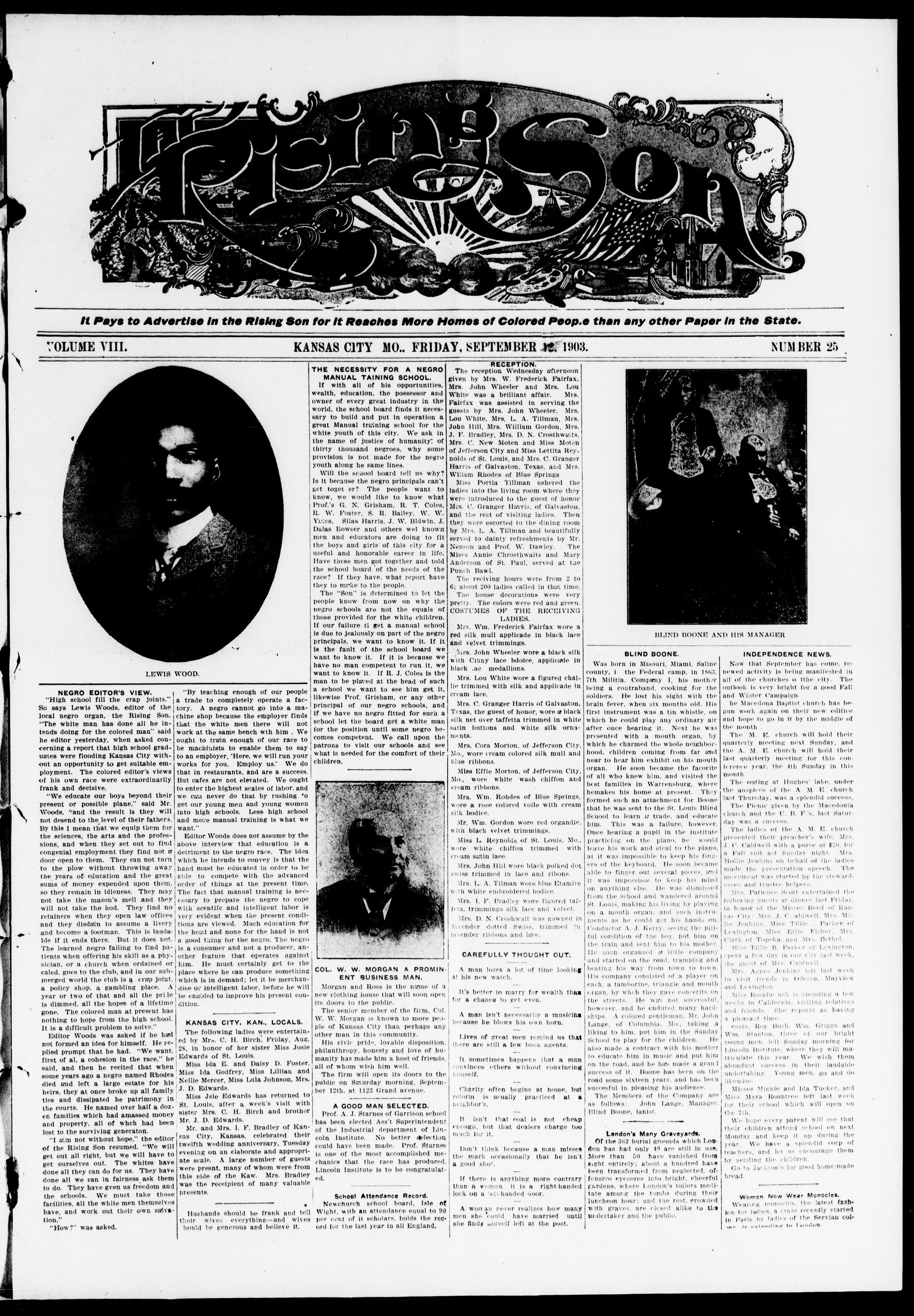
LEWIS WOOD
"High school fill the crap joints." So says Lewis Woods, editor of the local negro organ, the Rising Son. "The white man has done all he intends doing for the colored man" said he editor yesterday, when asked concerning a report that high school graduates were flooding Kansas City without an opportunity to get suitable employment. The colored editor's views of his own race were extraordinarily frank and decisive.
"We educate our boys beyond their present or possible plane," said Mr. Woods, "and the result is they will not desend to the level of their fathers. By this I mean that we equip them for the sciences, the arts and the professions, and when they set out to find congenial employment they find not a door open to them. They can not turn to the plow without throwing away the years of education and the great sums of money expended upon them, so they remain in idleness. They may not take the mason's mell and they will not take the hod. They find no retainers when they open law offices and they disdain to assume a livery and become a footman. This is laudable if it ends there. But it does not. The learned negro failing to find patients when offering his skill as a physician, or a church when ordained or caled, goes to the club, and in our submerged world the club is a crop joint a policy shop, a gambling place. A year or two of that and all the pride is dimmed, all the hopes of a lifetime gone. The colored man at present has nothing to hope from the high school it is a difficult problem to solve."
Editor Woods was asked if he had not formed an idea for himself. He replied prompt that he had. "We want, first of al, a cohesion in the race," he said, and then he recited that when some years ago a negro named Rhodes died and left a large estate for his heirs, they at once broke up all families and dissipated his patrimony in the courts. He named over half a dozen families which had amassed money and property, all of which had been lost to the surviving generator.
"I am not without hope," the editor of the Rising Son resumed. "We will get out all right, but we will have to get ourselves out. The whites have done all they can do for us. They have done all we can in fairness ask them to do. They have given us freedom and the schools. We must take those facilities, all the white men themselves have, and work out their own salvation."
"How?" was asked.
VOLUME VIII.
NEGRO EDITOR'S VIEW.
"How?" was asked.
"By teaching enough of our people a trade to completely operate a factory. A negro cannot go into a machine shop because the employer finds that the white men there will not work at the same bench with him. We ought to train enough of our race to be machinists to enable them to say to an employer, 'Here, we will run your works for you. Employ us.' We do that in restaurants, and are a success. But cafes are not elevated. We ought to enter the highest scales of labor, and we can never do that by rushing "get our young men and young women into high schools. Less high school and more manual training is what we want."
Editor Woods does not assume by the above interview that education is a detriment to the negro race. The idea which he intends to convey is that the hand must be educated in order to be able to compete with the advanced order of things at the present time. The fact that manual training is necessary to prepare the negro to cope with scentife and intelligent labor is very evident when the present conditions are viewed. Much education for the head and none for the hand is not a good thing for the negro. The negro is a consumer and not a producer, another feature that operates against him. He must certainly get to the place where he can produce something which is in demand; let it be merchandise or intelligent labor, before he will be enclosed to improve his present condition.
KANSAS CITY, KAN., LOCALS.
The following ladies were entertained by Mrs. C. H. Birch, Friday, Aug. 28, in honor of her sister Miss Josie Edwards of St. Louis.
Miss Ida E. and Daisy D. Foster, Miss Ida Godfrey, Miss Lillian and Nellie Mercer, Miss Lula Johnson, Mrs. J. D. Edwards.
Miss Jsie Edwards has returned to St. Louis, after a week's visit with sister Mrs. C. H. Birch and brother Mr. J. D. Edwards.
Mr. and Mrs. I. F. Bradley of Kansas City, Kansas, celebrated their twelfth wedding anniversary, Tuesday evening on an elaborate and appropriate scale. A large number of guests present, many of whom were from this side of the Kaw. Mrs. Bradley was the recipient of many valuable presents.
Husbands should be frank and tell their wives everything—and wives should be generous and believe it.
KANSAS CITY MO., FRIDAY, SEPTEMBER 12, 1903.
THE NECESSITY FOR A NEGRO MANHUA TINYING SCHOOL
MANUAL TAINING SCHOOL.
If with all of his opportunities, wealth, education, the possessor and owner of every great industry in the world, the school board finds it necessary to build and put in operation a great Manual training school for the white youth of this city. We ask in the name of justice of humanity; of thirty thousand groes, why some provision is not made for the negro youth along his same lines.
Will the school board tell us why? Is it because the negro principals can't get toget er? The people want to know, we would like to know what Prof.'s G. N. Grisham, R. T. Coles, R. W. Foster, S. R. Bailey, W. W. Yates, Silas Harris, J. W. Bldwin, J. Dalas Bowser and others well known men and educators are doing to fit the boys and girls of this city for a useful and honorable career in life. Have these men got together and told the school board of the needs of the race? If they have, what report have they to make to the people.
The "Son" is determined to let the people know from now on why the negro schools are not the equals of those provided for the white children. If our failure ti get a manual school is due to jealously on part of the negro principals, we want to know it. If it is the fault of the school board we want to know it. If it is because we have no man competent to run it, we want to know it. If R. J. Coles is the man to be played at the head of such a school we want to see him get it, likewise Prof. Grisham, or any other principal of our negro schools, and if we have no negro fitted for such a school let the board get a white man for the position until some negro becomes competent. We call upon the patrons to visit our schools and see what is needed for the comfort of their children.
A. B.
COL. W. W. MORGAN A PROMIN
ENT BUSINESS MAN.
Morgan and Ross is the name of a new clothing house that will soon open its doors to the public.
The senior member of the firm, Col. W. W. Morgan is known to more people of Kansas City than perhaps any other man in this community.
His civic pride, lovable disposition, philanthropy, honesty and love of humanity has made him a host of friends, all of whom wish him well.
The firm will open its doors to the public on Saturday morning, September 12th, at 1123 Grand avenue.
A GOOD MAN SELECTED.
Prof. A. J. Starnes of Garrison school has been elected Ass't Superintendent of the Industrial department of Lincoln Institute. No better selection could have been made. Prof. Starnes is one of the most accomplished mechanics that the race has produced. Lincoln Institute is to be congratulated.
School Attendance Record.
Newchurch school board, Isle of Wight, with an attendance equal to 90 per cent of it scholars, holds the record for the last year in all England.
The reception Wednesday afternoon given by Mrs. W. Frederick Fairfax, Mrs. John Wheeler and Mrs. Lou White was a brilliant affair. Mrs. Fairfax was assisted in serving the guests by Mrs. John Wheeler, Mrs. Lou White, Mrs. L. A. Tillman, Mrs. John Hill, Mrs. William Gordon, Mrs. J. F. Bradley, Mrs. D. N. Crostwastes, Mrs. C. New Moten and Miss Moten of Jefferson City and Miss Letta Reynolds of St. Louis, and Mrs. C. Granger Harris of Galvaston, Texas, and Mrs. William Rhodes of Blue Springs
Miss Portia Tillman ushered the ladies into the living room where they were introduced to the guest of honor Mrs. C. Granger Harris, of Galvaston, and the rest of visiting ladies. Then they were escorted to the dining room by Mrs. L. A. Tillman and beautifully served to dainty refreshments by Mr. Neison and Prof. W. Dawley. The Mises Annie Chrostwaits and Mary Anderson of St. Paul, served at the Punch Bowl.
The receiving hours were from 2 to 6; about 200 ladies called in that time. The house decorations were very pretty. The colors were red and green. COSTUMES OF THE RECEIVING LADIES.
Mrs. Wm. Frederick Fairfax wore a red silk mul applicable in black lace and velvet trimnings.
Mrs. John Wheeler wore a black silk with Cruny lace bdioce, applicable in black ac medallions.
Mrs. Lou White wore a figured chaille trimmed with silk and appliade in cream lace.
Mrs. C. Granger Harris of Galvaston, Texas, the guest of honor, wore a black silk net over taffetta trimmed in white satin buttons and white silk ornaments.
Mrs. Cora Morton, of Jefferson City, Mo., wore cream colored silk mull and blue ribbons.
Miss Effie Morton, of Jefferson City, Mo., wore white wash chiffon and cream ribbons.
Mrs. Wm. Rohdes of Blue Springs, wore a rose colored voile with cream silk bodice.
Mr. Wm. Gordon wore red organdie, with black velvet trimmings.
Miss L. Reynolds of St. Louis, Mo., wore white chiffon trimmed with cream satin lace.
Mrs. John Hill wore black polked dot swiss trimmed in lace and ribons.
Mrs. L. A. Tilman wore blue Etamire with white embroidered bodice.
Mrs. I. F. Bradley wore figured taffeta, trimmings silk lace and velvet.
Mrs. D. N. Croshwait was gowned in lavender dotted Swiss, trimmed in lavender ribbons and lace.
CAREFULLY THOUGHT OUT.
A man loses a lot of time looking at his new watch.
It's better to marry for wealth than for a chance to get even.
A man isn't necessarily a musician because he blows his own horn.
Lives of great men remind us that there are still a few book agents.
It sometimes happens that a man convinces others without convincing himself.
Charity often begins at home, but reform is usually practiced at a neighbor's.
It isn't that coal is not cheap enough, but that dealers charge too much for it.
Don't think because a man misses the mark occasionally that he isn't a good shot.
If there is anything more contrary than a woman it is a right-handed lock on a left-handed door.
A woman never realizes how many men she could have married until she finds herself left at the post.
THE FIGHT
BLIND BOONE AND HIS MANAGER
BLIND BOONE.
Was born in Missouri, Miami, Saline county, i. the Federal camp, in 1863, 7th Militia. Company I, his mother being a contraband, cooking for the soldiers. He lost his sight with the brain fever, when six months old. His first instrument was a tin whistle, on which he could play any ordinary air after once hearing it. Next he was presented with a mouth organ, by which he charmed the whole neighborhood, children coming from far and near to hear him exhibit on his mouth organ. He soon became the favorite of all who knew him, and visited the best families in Warrensburg, where he makes his home at present. They formed such an attachment for Boone that he was sent to the St. Louis Blind School to learn to trade, and educate him. This was a failure, however. Once hearing a pupil in the institute practicing on the piano, he would leave his work and steal to the piano, at it was impossible to keep his fingers of the keyboard. He soon became able to finger out several pieces, and it was impossible to keep his mind on anything else. He was dismissed from the school and wandered around St. Louis, making his living by playing on a mouth organ, and such instruments as he could get his hands on Conductor A. J. Kerry, seeing the pitiable condition of the boy, put him on the train and sent him to his mother. He soon organized it little company and started on the road, tramping and beating his way from town to town. His company consisted of a player on each, a tamarine, triangle and mouth organ, by which they gave concerts on the streets. He was not successful however, and he endured many hardships. A colored gentleman, Mr. John Lange, of Columbia, Mo., taking a liking to him, put him in the Sunday School to play for the children. He also made a contract with his mother to educate him in music and put him on the road, and he has made a grand success of it. Boone has been on the road some sixteen years, and has been successful in pleasing his audience.
The Members of the Company are as follows: John Lange, Manager Blind Boone, lanst.
London's Many Graveyards
Of the 362 burial grounds which London has had only 40 are still in use. More than 50 have vanished from sight entirely; about a hundred have been transformed from neglected, offensive eyesores into bright, cheerful gardens, where London's toilers meditate among the tombs during their luncheon hour; and the rest, crowded with graves, are closed alike to the undertaker and the public.
1.
INDEPENDENCE NEWS.
Now that September has come, renewed activity is being manifested in all of the churches o the city. The outbook is very bright for a good Fall and Winter Campaign.
he Macedona Baptist church has begun work again on their new edifice and hope to go in it by the middle of the month.
The M. E. church will hold their quarterly meeting next Sunday, and the A. M. E. church will hold their last quarterly meeting for this conference year, the 4th Sunday in this month.
The outing at Hughes' lake, under the auspices of the A. M. E. church last Thursday, was a splendid success.
The Picnic given by the Macedonia church and the U. B. F.'s, last Saturday was a success.
The ladies of the A. M. E. church presented their preacher's wife, Mrs. J. C. Caldwell with a purse of $20, for a fall suit ast Sunday night. Mrs. Mollie Jenkins on behalf of the ladies made the presentation speech. The movement was started by the stewardesses and trustee helpers. Mrs. Patience Scott entertained the following guests at dinner last Friday, in honor of the Miss Rees of Kansas City: Mrs. J. C. aldwell, Mrs. Mille Jenkins, Miss Tillie, Parker of Lexington, Miss Eftie Fisher, Mrs. Clark of Topeka and Mrs. Bethel. Miss Tillie R, Parker of Lexington, spent a few day in our city last week, the guest of Mrs. Caldwell. Mrs. Agnes Jenkins left last week to visit trends in Odessa, Mayview and Lexington.
Miss Rosalie ush is spending a few weeks in California, visiting relatives and friends. She reports as having a pleasant time.
essrs. Roy Bush, Wm. Griggs and Wm. Stanton, three of our bright young men, left Sunday morning for Lincoln Institute where they will matriculate this year. We wish them abundant success in their laudable undertaking. Young men, go and do likewise.
Misses Minnie and Ida Tucker, and Miss Myra Rountree left last week for their school which will open on the 7th.
We hope every parent will see that their children attend school on next Monday and keep it up during the year. We have a splendid corp of teachers, and let us encourage them by sending the children.
Go to Jackson's for good home-made bread.
Women New Wear Monocles.
Wearing monocles, the latest fashion for ladies, a craze recently started in Paris by ladies of the Servian colony, is extending to London.
NUMBER 25
---
Court of Quebec, Lieutenant Governor
of the Province of Quebec, and profes-
sor
L. Garrard
Al. T. Stone
UNITED STATES OF CANADA
ALASKA
GULF
OF ALASKA
ELNU KOOT
HENRY C. LADGE
GEO. TURNER
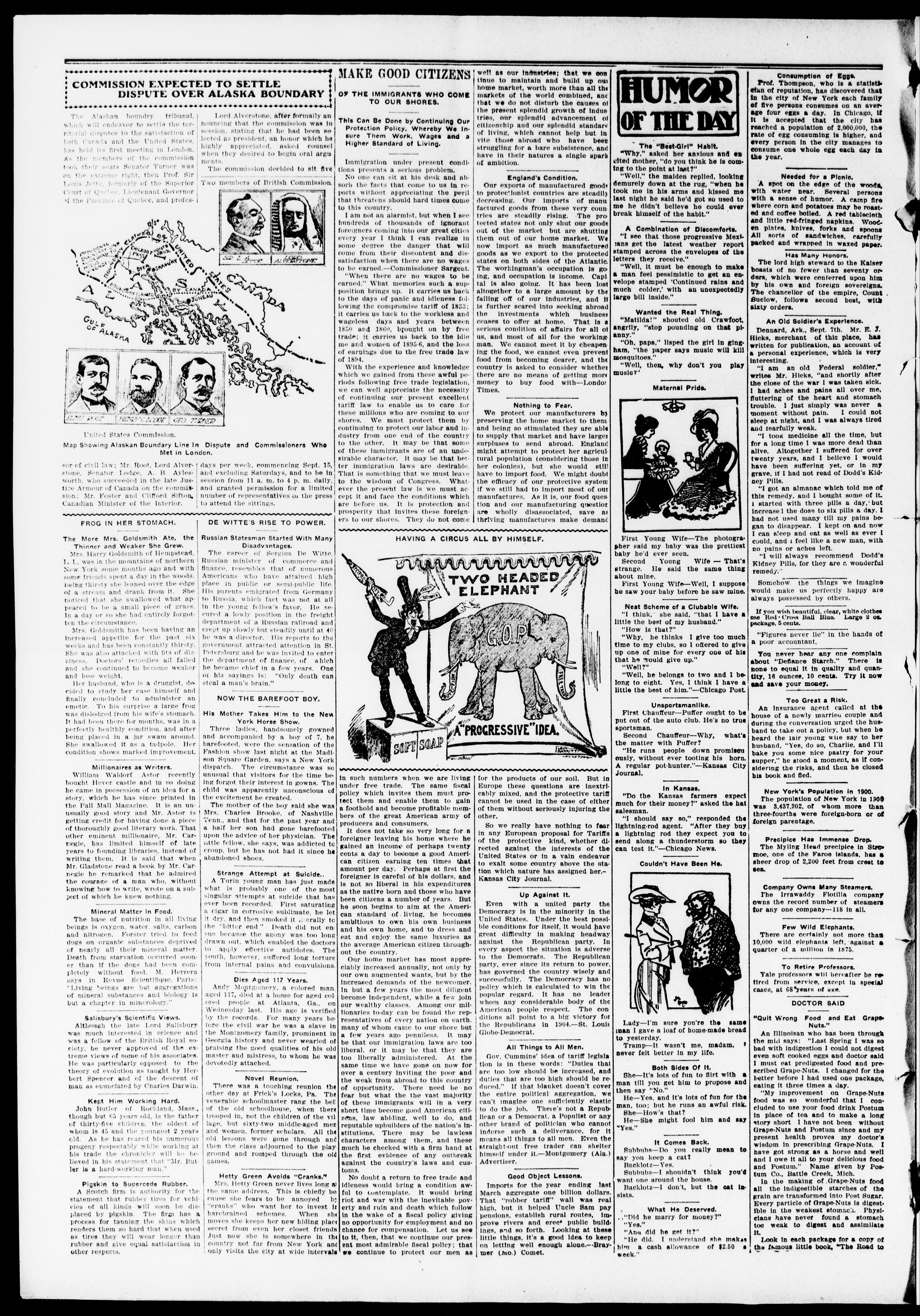
Map Showing Alaskan Boundary Line In Dispute and Commissioners Who Met in London.
The Alaskan boundary tribunal, which will endeavor to settle the territorial disputes to the satisfaction of both Canada and the United States, has held its first meeting in London. As the members of the commission took their seats Senator Turner was on the extreme right, then Prof. Sir Louis Jette, formerly of the Superior Court of Quebec, Lieutenant Governor of the Province of Quebec, and profes-
PROVINCIAL UNION
BOUNDARY OF ALASKA
BOUNDARY OF ALASKA
CLIMATE
CHALCOOT
UNITED
AUS
BOUNDARY OF ALASKA
BOUNDARY OF ALASKA
BY CANADA
GULF
OF ALASKA
LENO KOOT
HENRY CLADDGE
GEOR. TUCK
United States Commission.
sor of civil law; Mr. Root, Lord Alverstone, Senator Lodge, A. B. Aylesworth, who succeeded in the late Justice Armour of Canada on the commission; Mr. Foster and Clifford Sifton, Canadian Minister of the Interior.
FROG IN HER STOMACH.
The More Mrs. Goldsmith Ate, the Thinner and Weaker She Grew.
Mrs. Harry Goldsmith of Hempstead, L. L., was in the mountains of northern New York some months ago and with some friends spent a day in the woods, being thirsty she leaned over the edge of a stream and drank from it. She noticed that she swallowed what appeared to be a small piece of grass. In a day or so she had entirely forgotten the circumstance.
Mrs. Goldsmith has been having an increased appetite for the past six weeks and has been constantly thirsty. She was also attacked with fits of dizziness. Doctors' remedies all failed and she continued to become weaker and lose weight.
Her husband, who is a druggist, decided to study her case himself and finally concluded to administer an emetic. To his surprise a large frog was dislodged from his wife's stomach. It had been there for months, was in a perfectly healthy condition, and after being placed in a jar swam around. She swallowed it as a talpole. Her condition shows marked improvement.
Millionaires as Writers.
William Waldorf Astor recently bought Hever castle and in so doing he came in possession of an idea for a story, which he has since printed in the Pall Mall Magazine. It is an unusually good story and Mr. Astor is getting credit for having done a piece of thoroughly good literary work. That other eminent millionaire, Mr. Carnegie, has limited himself of late years to founding libraries, instead of writing them. It is said that when Mr. Gladstone read a book by Mr. Carnegie he remarked that he admired the courage of a man who, without knowing how to write, wrote on a subject of which he knew nothing.
Mineral Matter in Food.
The base of nutrition in all living beings is oxygen, water, salts, carbon and nitrogen. Forster tried to feed dogs on organic substances deprived of nearly all their mineral matter. Death from starvation occurred sooner than if the dogs had been completely without food. M. Herrera says in Revue Scientifique, Paris: "Living beings are but aggregations of mineral substances and biology is but a chapter in minecology."
Salisbury's Scientific Views
Although the late Lord Salisbury was much interested in science and was a fellow of the British Royal society, he never approved of the extreme views of some of his associates. He was particularly opposed to the theory of evolution as taught by Herbert Spencer and of the descent of man as enunciated by Charles Darwin.
Kept Him Working Hard.
John Butler of Rockland, Mass., though but 65 years old, is the father of thirty-five children, the oldest of whom is 45 and the youngest 2 years old. As he has reared his numerous progeny respectably while working at his trade the chronicle will be believed in his statement that "Mr. Butler is a hard-working man."
Bigskin to Supercede Rubber
A Scotch firm is authority for the statement that rubber tires for vehicles of all kinds will soon be displaced by pigskin. The firm has a process for tanning the skins which renders them so hard that when used as tires they will wear longer than rubber and give equal satisfaction in other respects.
Lord Alverstone, after formally an nouncing that the commission was in session, stating that he had been selected as president, an honor which he highly appreciated, asked counsel when they desired to begin oral arguments.
The commission decided to sit five
Two members of British Commission.
SID L. JOHNE
ALBERT STONE
CANADA
KAY
Dispute and Commissioners Who
don.
days per week, commencing Sept. 15, and excluding Saturdays, and to be in session from 11 a. m. to 4 p. m. daily, and granted permission for a limited number of representatives on the press to attend the sittings.
DE WITTE'S RISE TO POWER.
Russian Statesman Started With Many Disadvantages.
The career of Sergius De Witte, Russian minister of commerce and finance, resembles that of numerous Americans who have attained high place in public or semi-public life. His parents emigrated from Germany to Russia, which fact was not at all in the young fellow's favor. He secured a lowly position in the freight department of a Russian railroad and crept up slowly but steadily until at 40 he was a director. His reports to the government attracted attention in St. Petersburg and he was invited to enter the department of finance, of which he became chief in a few years. One of his sayings is: "Only death can steal a man's brain."
NOW THE BAREFOOT BOY.
His Mother Takes Him to the New York Horse Show.
Three ladies, handsomely gowned and accompanied by a boy of 7, he barefooted, were the sensation of the Fashion show last night at the Madison Square Garden, says a New York dispatch. The circumstance was so unusual that visitors for the time being forgot their interest in gowns. The child was apparently unconscious of the excitement he created.
The mother of the boy said she was Mrs. Charles Brooke, of Nashville, Tenn., and that for the past year and a half her son had gone barefooted upon the advice of her physician. The little fellow, she says, was addicted to croup, but he has not had it since he abandoned shoes.
Strange Attempt at Suicide
A Turin young man has just made what is probably one of the most singular attempts at suicide that has ever been recorded. First saturating a cigar in corrosive sublimate, he let it dry, and then smoked it morally to the "bitter end." Death did not ensue because the agony was too long drawn out, which enabled the doctors to apply effective antidotes. The youth, however, suffered long torture from internal pains and convulsions
Dies Aged 117 Years
Andy Montgomery, a colored man, aged 117, died at a home for aged colored people at Atlanta, Ga., on Wednesday last. His age is verified by the records. For many years before the civil war he was a slave in the Montgomery family, prominent in Georgia history and never wearied of praising the good qualities of his old master and mistress, to whom he was devotedly attached.
Novel Reunion.
There was a touching reunion the other day at Frick's Locks, Pa. The venerable schoolmaster rang the bell of the old schoolhouse, when there trooped in, not the children of the village, but sixty-two middle-aged men and women, former scholars. All the old lessons were gone through and then the class adjourned to the play ground and romped through the old games.
Hetty Green Avoids "Cranks."
Mrs. Hetty Green never lives long at the same address. This is chiefly because she fears to be annoyed by "cranks" who want her to invest in harebrained schemes. When she moves she keeps her new hiding place secret from even her closet friends. Just now she is somewhere in the country not far from New York and only visits the city at wide intervals.
TWO HEADED
ELEPHANT
G.O.P.
A "PROGRESSIVE" IDEA.
SOFT SOAP
MAKE GOOD CITIZENS
OF THE IMMIGRANTS WHO COME TO OUR SHORES.
This Can Be Done by Continuing Our Protection Policy, Whereby We Insure Them Work, Wages and a Higher Standard of Living.
Immigration under present conditions presents a serious problem. No one can sit at his desk and absorb the facts that come to us in reports without appreciating the peril that threatens should hard times come to this country.
I am not an alarmist, but when I see hundreds of thousands of ignorant foreigners coming into our great cities every year I think I can realize in some degree the danger that will come from their discontent and dissatisfaction when there are no wages to be earned.—Commissioner Sargent.
"When there are no wages to be earned." What memories such a supposition brings up. It carries us back to the days of panic and idleness following the compromise tariff of 1833; it carries us back to the workless and wageless days and years between 1850 and 1860, brought on by free trade; it carries us back to the idle me and women of 1855-6, and the loss of carurings due to the free trade law of 1894.
With the experience and knowledge which we gained from these awful periods following free trade legislation, we can well appreciate the necessity of continuing our present excellent tariff law to enable us to care for these millions who are coming to our shores. We must protect them by continuing to protect our labor and industry from one end of the country to the other. It may be that some of these immigrants are of an undesirable character. It may be that better immigration laws are desirable. That is something that we must leave to the wisdom of Congress. Whatever the present law is we must accept it and face the conditions which are before us. It is protection and prosperity that invites these foreigners to our shores. They do not come
HAVING A CIRCUS
TW
E
SOFT SOAP
In such numbers when we are living under free trade. The same fiscal policy which invites them must protect them and enable them to gain a foothold and become profitable members of the great American army of producers and consumers.
It does not take so very long for a foreigner leaving his home where he gained an income of perhaps twenty cents a day to become a good American citizen earning ten times that amount per day. Perhaps at first the foreigner is careful of his dollars, and is not so liberal in his expenditures as the native born and those who have been citizens a number of years. But he soon begins to aim at the American standard of living, he becomes ambitious to own his own business and his own home, and to dress and eat and enjoy the same luxuries as the average American citizen throughout the country.
Our home market has most appreciably increased annually, not only by our own augmented wants, but by the increased demands of the newcomer. In but a few years the most diligent become independent, while a few join our wealthy classes. Among our millionaries to-day can be found the representatives of every nation on earth, many of whom came to our shore but a few years ago penniless. It may be that our immigration laws are too liberal, or it may be that they are too liberally administered. At the same time we have gone on now for over a century inviting the poor and the weak from abroad to this country of opportunity. There need be no fear but what the the vast majority of these immigrants will in a very short time become good American citizens, law abiding, well to do, and reputable upbuilders of the nation's institutions. There may be lawless characters among them, and these much be checked with a firm hand at the first evidence of any outbreak against the country's laws and customs.
No doubt a return to free trade and
idleness would bring a condition awful
to contemplate. It would bring
riot and war with the inevitable poverty
and ruin and death which follow
in the wake of a fiscal policy giving
no opportunity for employment and no
chance for compensation. Let us see
to it, then, that we continue our pres-
ent most admirable fiscal policy; that
we continue to protect our men as
well as our industries; that we continue to maintain and build up our home market, worth more than all the markets of the world combined, and that we do not disturb the causes of the present splendid growth of industries, our splendid advancement of citizenship and our splendid standard of living, which cannot help but in invite those abroad who have been struggling for a bare subsistence, and have in their natures a single spark of ambition.
England's Condition.
Our exports of manufactured goods to protectionist countries are steadily decreasing. Our imports of manufactured goods from these very countries are steadily rising. The protected states not only shut our goods out of the market but are shutting them out of our home market. We now import as much manufactured goods as we export to the protected states on both sides of the Atlantic. The workingman's occupation is going, and occupation is income. Capital is also going. It has been lost altogether to a large amount by the falling off of our industries, and it is further scared into seeking abroad the investments which business ceases to offer at home. That is a serious condition of affairs for all of us, and most of all for the working man. We cannot meet it by cheapening the food, we cannot even prevent food from becoming dearer, and the country is asked to consider whether there are no means of getting more money to buy food with—London Times.
Nothing to Fear.
We protect our manufacturers by preserving the home market to them and being so stimulated they are able to supply that market and have larger surpluses to send abroad. England might attempt to protect her agricultural population (considering those in her colonies), but she would still have to import food. We might doubt the efficacy of our protective system if we still had to import most of our manufactures. As it is, our food question and our manufacturing question are wholly disassociated, save as thriving manufactures make demand
ALL BY HIMSELF.
WO HEADED
ELEPHANT
G.O.P.
PROGRESSIVE"IDEA.
for the products of our soil. But in Europe these questions are inextricably mixed, and the protective tariff cannot be used in the case of either of them without seriously injuring the other.
So we really have nothing to fear in any European proposal for Tariffs of the protective kind, whether directed against the interests of the United States or in a vain endeavor to exalt some country above the station which nature has assigned her.-Kansas City Journal.
Up Against It.
Even with a united party the Democracy is in the minority in the United States. Under the best possible conditions for itself, it would have great difficulty in making headway against the Republican party. In every aspect the situation is adverse to the Democrats. The Republican party, ever since its return to power, has governed the country wisely and successfully. The Democracy has no policy which is calculated to win the popular regard. It has no leader whom any considerable body of the American people respect. The conditions all point to a big victory for the Republicans in 1904.—St. Louis Globe-Democrat.
All Things to All Men.
Gov. Cummins' idea of tariff legislation is in these words: "Duties that are too low should be increased, and duties that are too high should be reduced." If that blanket doesn't cover the entire political aggregation, we can't imagine one sufficiently elastic to do the job. There's not a Republican or a Democrat, a Populist or any other brand of politician who cannot indorse such a deliverance, for it means all things to all men. Even the straight-out free trader can shelter himself under it.—Montgomery (Ala.) Advertiser.
Good Object Lessons.
Imports for the year ending last March aggregate one billion dollars. That "robber tariff" wall was real high, but it helped Uncle Sam pay pensions, establish rural routes, improve rivers and erect public buildings, and so forth. Looking at these little things, it's a good idea to keep on letting well enough alone.--Braymer (Mo.) Comet.
HUMOR OF THE DAY
"Why," asked her anxious and excited mother, "do you think he is coming to the point at last?"
"Well," the maiden replied, looking demurely down at the rug, "when he took me in his arms and kissed me last night he said he'd got so used to me he didn't believe he could ever break himself of the habit."
A Combination of Discomforts.
"I see that those progressive Mexicans get the latest weather report stamped across the envelopes of the letters they receive."
"Well, it must be enough to make a man feel pessimistic to get an envelope stamped 'Continued rains and much colder,' with an unexpectedly large bill inside."
Wanted the Real Thing.
"Matilda!" shouted old Crawfoot, angrily, "stop pounding on that pianny."
"Oh, papa," lisped the girl in gingham, "the paper says music will kill mosquitoes."
"Well, then, why don't you play music?"
Maternal Pride.
First Young Wife—The photographer said my baby was the prettiest baby he'd ever seen. Second Young Wife — That's strange. He said the same thing about mine.
First Young Wife—Well, I suppose he saw your baby before he saw mine.
Neat Scheme of a Clubable Wife.
"I think," she said, "that I have a little the best of my husband."
"How is that?"
"Why, he thinks I give too much time to my clubs, so I offered to give up one of mine for every one of his that he would give up."
"Well?"
"Well, he belongs to two and I belong to eight. Yes, I think I have a little the best of him."—Chicago Post.
Unsportsmanlike.
First Chauffeur—Puffer ought to be put out of the auto club. He's no true sportsman.
Second Chauffeur—Why, what's the matter with Puffer?
"He runs people down promisonously, without ever tooting his horn. A regular pot-hunter."—Kansas City Journal.
In Kansas.
"Do the Kansas farmers expect much for their money?" asked the hat salesman.
"I should say so," responded the lightning-rod agent. "After they buy a lightning rod they expect you to send along a thunderstorm so they can test it."—Chicago News.
Lady—I'm sure you're the same man I gave a loaf of home-made bread to yesterday. Tramp—It wasn't me, madam. I never felt better in my life.
Both Sides Of It
She—It's lots of fun to flirt with a man till you get him to propose and then say "No."
He—Yes, and it's lots of fun for the man, too; but he runs an awful risk.
She—How's that?
He—She might fool him and say "Yes."
It Comes Back.
Subbubs—Do you really mean to say you keep a cat?
Backlotz—Yes.
Subbubs-I shouldn't think you'd want one around the house.
Backlotz—I don't, but the cat insists.
"Anu did he get it?"
"He did. I understand she makes him a cash allowance of $2.50 a week."
Consumption of Eggs.
Prof. Thompson, who is a statistician of reputation, has discovered that in the city of New York each family of five persons consumes on an average four eggs a day. In Chicago, if it is accepted that the city has reached a population of 2,000,000, the rate of egg consuming is higher, and every person in the city manages to consume one whole egg each day in the year.
Needed for a Picnic.
A spot on the edge of the woods, with water near. Several persons with a sense of humor. A camp fire where corn and potatoes may be roasted and coffee boiled. A red tablecloth and little red-fringed napkins. Wooden plates, knives, forks and spoons All sorts of sandwiches, carefully packed and wrapped in waxed paper.
Has Many Honors.
The lord high steward to the Kaiser boasts of no fewer than seventy orders, which were conferred upon him by his own and foreign sovereigns. The chancellor of the empire, Count Buelow, follows second best, with sixty orders.
An Old Soldier's Experience
Dennard, Ark., Sept. 7th. Mr. E. J. Hicks, merchant of this place, has written for publication, an account of a personal experience, which is very interesting.
"I am an old Federal soldier," writes Mr. Hicks, "and shortly after the close of the war I was taken sick. I had aches and pains all over me, fluttering of the heart and stomach trouble. I just simply was never a moment without pain. I could not sleep at night, and I was always tired and rearfully weak.
"I took medicine all the time, but for a long time I was more dead than alive. Altogether I suffered for over twenty years, and I believe I would have been suffering yet, or in my grave, if I had not read of Dodd's Kidney Pills.
"I got an almanac which told me of this remedy, and I bought some of it. I started with three pills a day, but increase the dose to six pills a day. I had not used many till my pains began to disappear. I kept on and now I can sleep and eat as well as ever I could, and I feel like a new man, with no pains or aches left.
"I will always recommend Dodd's Kidney Pills, for they are a wonderful remedy."
Somehow the things we imagine would make us perfectly happy are always possessed by others.
If you wish beautiful, clear, white clothes me Red Cross Ball Blue. Large 2 oz. package, 5 cents.
"Figures never lie" in the hands of a poor accountant.
You never hear any one complain about "Defiance Starch." There is none to equal it in quality and quantity, 16 ounces, 10 cents. Try it now and save your money.
Too Great a Risk.
An insurance agent called at the house of a newly married couple and during the conversation urged the husband to take out a policy, but when he heard the fair young wife say to her husband, "Yes, do so, Charlie, and I bake you some nice pastry for your supper," he stood a moment, as if considering the risks, and then he closed his book and fled.
New York's Population In 1900
The population of New York in 1800 was 3,437,202, of whom more than three-fourths were foreign-born or of foreign parentage.
The Myling Head precipice in Stree
moe, one of the Faroe islands, has a sheer drop of 2,200 feet from crest to sea.
Company Owns Many Steamers.
The Irrawaddy Flotilla company owns the record number of steamers for any one company—118 in all.
Few Wild Elephants
There are certainly not more than 10,000 wild elephants left, against a quarter of a million in 1875.
To Retire Professors
Yale professors will hereafter be re tured from service, except in special cases, at 65 years of age.
DOCTOR SAID
"Quit Wrong Food and Eat Grape-Nuts."
An Illinoisan who has been through the midays: "Last Spring I was so bad with indigestion I could not digest even soft cooked eggs and doctor said I must eat predigested food and prescribed Grape-Nuts. I changed for the better before I had used one package, eating it three times a day.
"My improvement on Grape-Nuts food was so wonderful that I concluded to use your food drink Postum in place of tea and to make a long story short I have not been without Grape-Nuts and Postum since and my present health proves my doctor's wisdom in prescribing Grape-Nuts. I have got strong as a horse and well and I owe it all to your delicious food and Postum." Name given by Postum Co. Battle Creek, Mich.
In the making of Grape-Nuts food all the indigestible starches of the grain are transformed into Post Sugar. Every particle of Grape-Nuts is digestible in the weakest stomach. Physicians have never found a stomach too weak to digest and assimilate it. Look in each package for a copy of the famous little book, "The Road to
OLDEST NEGRO JOURNAL
... IN KANSAS CITY,
The paid circulation of THE RISING SON is more than double the combined circulation of all the other Kansas City Golored weekly newspapers.
Kansas City, Mo., March 3, 1903.
Office of the Postmaster,
Publishers, Rising Son.
In response to your inquiry, I beg to say your publication is duly entered as second class matter at this office and regularly mailed.
Very respectfully,
J. H. HARRIS.
Postmaster.
The Rising Son is the only paper published by Colored people in Kansas City, Mo., that is entered at the post office as second class mail.
NEGRO SOCIAL CLERKS
Anen the criticism of the "Plain-dealer," the "Son," desires to state that it is now and always has been opposed to these Negro social clubs. We simply called attention to the existence of the same in Topeka owned and controlled by Nick Chiles, owner of the Pikindealer. If he is so opposed to these clubs, why don't he close his owe? The people of Kansas City will, in time and in their own sweet way, look after these clubs. With us the incident is closed.
The special election for municipal bonds will come off shortly. The bonds are to be voted upon for the improvement of the parks, city hospital, water works, etc. The most important of these is the water works, which proposition should carry without fail. It is time that Kansas City should be placed in a position of safety from water famine and fire.
The Rev. Dr. Babbitt, a Christian gentleman of Brooklyn, N. Y., who believes that the majesty of the law of this country should be upheld by all true Americans, has answered Mr. Graves of Georgia by saying: "Lynchers are brutal, savage murderers." He assumes that more morality, less prejudice, stricter law quickly applied, fair play to the negro and the white man alike would reduce the danger of the race question and the mob problem. Another good man, thank God.
L. W. Carter, President; W. W. Yates, 1st Vive President; W. W. Waters, 2nd Vice President; Dr. T. C. Unthanks, Secretary; Theo. H. Clay, Treasurer; F. L. Lewis, Corresponding Secretary; Frank Wilson, Sergeant at-arm.
HAD TO HAVE THE HAT.
Striker's Wife Put Up Effective Plea for Finery.
A woman went into a little millinery shop in One hundredth street, near Amsterdam avenue, the other day and asked to see a hat. A chiffon creation, of which the price was $2 was shown her, and she expressed a keen desire for it. "May I have it now," she asked, "if I'll leave fifty cents on deposit, and bring in the rest later?" "That's very unusual," replied the milliner. "When could you pay the balance?" "That's just the point," said the woman. "I don't know. My husband is a plasterer. He makes $5.25 a day while he is working. But he has been on strike for four weeks, and we have nothing." "But how do you live in the meantime?" she was asked. "Hock everything we have, like the rest of the strikers," replied the woman. "Everything we own is in pawn, but I must have that hat." She got it.—New York Sun.
New Zealand Christian Endeavorers now number ten thousand. They publish a handsome quarterly.
Golgotha.
Our crosses are hewn from different trees.
But we all must have our Calvaries;
We may climb the height from a differ-ent tree;
But we each go up to be crucified;
As we scale the steep, another may share.
The dreadful load that our shoulders bear.
But the most sorrow is all our own—For on the summit we lived alone.
—Frederic Lawrence Knowles in Boston Transcript.
The Story of a Waif's Rescue
Birnamwood, Northern Wisconsin,
in the winter of 1882-83, was all but
snow-bound. There were only a few
houses in the town, all more or less
covered with snow and ornamented
with icicles. Their big mud and stone
outside chimneys belched forth columns
of smoke, which bespoke a
cheery fireplace within.
During this severely cold winter the little schoolhouse was well attended with strapping young lumber men, who being idle on account of the difficulty in getting out timber, patronized the school, principally for amusement, and as I remember it, they were remarkably successful in this pursuit. "Gentlemen" teachers were unpopular, and after a number of such had somewhat hastily resigned, assisted more or less by the "gentlemen" pupils the school board unanimously decided in favor of women teachers.
One freezing morning, before school commenced, the big stove in the center of the room was surrounded with a notley gathering of scholars of all sizes and ages. While they were laughing and talking, a little girl clad in a thin, dirty cotton dress, her lips blue with cold, entered the schoolroom timidly, and stood at loss, hesitating to join the group at the stove, who regarded her with evident astonishment and amusement. Her hair was snarly, and evidently not seen the comb for many a day. Her head was covered by something which had perhaps once been a hood, and her little brass-toed shoes were worn through in many places. She was an object to excite sympathy, but a titer of amusement was heard from the crowd, and the teacher, wrapped in heavy furs at her desk, looked at her wonderingly.
One of my sisters, who was in the crowd, flushed indignant, and tartly expressed her opinion of any one who had so little manners, not to speak of sympathy, as to laugh at a poor little abused girl. "I am going to give her my place at the stove," she concluded.
"Don't you do it," some one exclaimed. "She is them old Belgiums' girl."
"She is better than you, for all that," said my sister, as she brought the shrinking waif up to the redhot stove, and held the little one's chapped hands up to the grateful warmth.
So hold an attitude by one who was a leader in all the school's games and studies silenced the others immediately.
At noon time it was discovered that Annie Kupke, as the child was called, had no lunch. Furthermore, she was not to receive any until after school.
The need was imperative and immediate, so an assessment was levied upon the capacious lunch baskets near by, and enough was soon piled upon a convenient geography to feed several hungry little girls. And this one needed no second invitation to eat, but devoured the food hungryly, as if half starved, which she certainly was.
After lunch one of the girls attempted to comb Annie's snarled hair, but soon fled. It was too much of a job to undeat at one sitting.
"Why don't your mother comb your hair?" she asked in moan or
A girl in a long robe stands in front of a door.
"She is them old Belgium's girl"
haustion. She used the word "mother" vicariously, but the child shrank from it.
"She ain't my mother," was the disgusted reply.
"Who is she, then?" Annie was evidently at a loss for an answer to this question, so she did not attempt any.
"But why don't she comb your hair?" the other persisted.
"She ain't got no comb."
"Don't she comb her own hair?"
A shake of the head was the only answer. The girls looked at one another in horror.
The next day, as Annie did not come to school, a consultation was held, and my sister Retta was delegated to leave Annie's lunch at her
home. "Because," they agreed significantly, "she probably needs it." The next day Retta appeared at school, boiling over with indignation. "I just want to tell you folks what I saw," she declared in awful tones to the group around the stove. In response to eager questioning she began: "Well, in the first place, I could hardly get to the house, because those nasty dogs barked at me, and when the old man came out and drove them away, I went up to the door and saw that they were eating supper, or dinner or something. They asked me to "cooma een," but I declined with thanks. I was afraid I could not get out again for dirt. And where do you suppose Annie was? Sitting on the floor, eating a chunk of raw turnip." There was a chorus of horrified "Oh's," and my sister continued.
"I said: 'I came to see why Annie did not come to school to-day.' The old man laughed and said, 'Oh, she seek.' 'I don't wonder,' I thought to myself. 'We brought some lunch for her dinner at school, and as she did not come I will leave it here for her.' "I held out the basket and the old man came and got it, but I just know they ate it up and did not give it to Annie." "Mother," Retta exclaimed several
Missol
She was running as fast as she could for the schoolhouse.
days later. "We found out that the Kaupkes did eat Annie's dinner that I left there for her. Annie says they did, and she says they beat her ever so much, and, Ma, I asked her why she did not run away and leave them. She said she did not know where to go, and I told her she could come to our house. Now, can't she, Ma?" It began snowing early in the afternoon, and night settled down dark and stormy. The wind shrieked and moaned dismally, shaking the house and rattling the windows at times, with its fierce blasts.
"It is a fearful night," said father, as he left the supper table and joined the children around the big stove in the sitting room. "I pity any one out-to-night; they will be in danger of freezing to death."
He had hardly finished speaking before they came a tap at the door. Mother opened it, she being the nearest, and there on the steps, shivering with cold and fear, was little Annie Kaupke.
It was but the work of a moment to drag the child into the house. She was bareheaded, chilled through, and badly frightened, exclaiming continually, "You won't let them get me, will you?" "No, little one," said mother; "we won't let any one get you; don't be afraid. Come up to the stove, where it is warm. I will hold you on my lap, and you must tell us what has happened."
Though somewhat reassured, the child would start at the slightest unexpected noise, and look appealingly at mother, whom she regarded as her protector.
After she had been fed and cared for, she told how the old woman had sent her, a fragile seven-year-old, out into that dark, stormy night, to get a pail of water. The well was an open one, without casing or windlass, a pole with a hook on the end being used to reach for the water and haul it to the surface. Being afraid to approach this slippery place, she set the pail down near the well and ran as fast as she could for our house. Little by little mother succeeded in drawing out her pitiful story.
Her real name was Mary Thompson, and she was born in Canada. Her father found, one morning, that the wife of his bosom and the mother of his large family, had fled with another man, leaving all of the children with him to care for. They were small and as he was very poor, he was compelled to give them away. Mary fell into the hands of the Belgian couple, and she had known nothing since but hunger, cold and abuse. After the little ones and Mary had been put to bed, and father and mother were counseling together as to what should be done with her, we heard footsteps crunching the snow on the porch, and then a loud rap at the door.
I shall never forget what I saw as the door was opened. There stood the old Belgian, blinking at the shaft of yellow light that shone far out into the darkness, his big fur coat and cap white with snow. With a leer that was meant for friendly greeting, he inquired if Annie had come there. "Why," asked my mother, as she stepped forward as spokesman. "Did she not come home from school?" "Oh, yees, but she go out after nicht, and she no coom back." "What did she go for?" asked my mother.
"She go to get some water," was the answer.
"Maybe she fell into the well," mother volunteered, sympathetically.
"No, she no fall in de vell, I poke down in mit der pole, she no in vell."
"The old secondret, I would like to poke him with a pole," said father.
"I hear you don't treat her very well," he said to the Belgian. "You beat her, don't you?
"My wife sometime vip her, but me no vip her," he said evasively, and evidently concluding that we were not in sympathy with him, turned away into the darkness.
"That is the last of him," said father, and it was. They made no further effort that we knew of to find out where Annie, or Mary, rather, was, probably considering it unsafe for themselves to do so.
After a few days Mary had become so confident that she was free that she wanted to go to school with us, so mother fixed her up the best she could, curled her hair, which was naturally wavy, and off she went. A different girl. So different was her appearance that the scholars asked us who she was, not recognizing her. Of course the town soon knew the story, and one night not long after we were visited by a man named Sprague, who was accompanied by one of the village storekeepers, who also acted as constable, or some sort of a town officer. Mr. Sprague, after much hemming and hawing, and a good deal of small talk, intimated that he had some to get Annie Kaupke, as the town had bound her out to him.
"I rather guess," said father, after he had recovered from his astonishment, "that you have come to the wrong place. We would not consider such a thing at all, unless the child wished to go."
"But I have the law"—began Sprague.
"The law," father repeated, smiling; "you had better read up on the law before you do stunts like these. As long as the child has not been thrown on the town, the town can have nothing to say in the matter at all. I am surprised that Mr. Hunter should have to come with you on such an errand."
But Mr. Sprague was not to be put off.
"Can I see the young one?" he asked.
"She is in bed, but I can get her," said mother. Mary objected strongly to being shown, but mother brought her down in her arms, assuring her that she was safe.
Sprague tried to induce her, with many wheedlings, to come to him, but she hid her face and heeded none of his blandishments.
"You had better get her clothes and let her come with me," he persisted.
Mother went to a closet and returned with a bundle of ragged clothes and spread them out for his inspection.
"There is the clothing the child had when she came here," she said, "what she wears now I have gotten her."
"Well," said Sprague, rising to go, much to the relief of Hunter, "I shall try other proceedings." And he did, but they were in a manner totally unexpected to every one.
Things went smoothly for a time, and we had supposed that he had given up the idea of obtaining possession of the child, but one day his boys, who attended school, brought with them a good-sized bobsled, and began to be very friendly with the girls, taking them for rides on the sled during recess and noon time. Finally they insisted that it was Mary's turn, and the child, flattered by their attentions, was induced to get on the sled. Away they went, full speed, past the schoolhouse and down the road that led to their home in the forest.
As they passed the place where they had turned back with the other girls Mary grew suspicious and finally alarmed. Without a word she rolled off the sled, and before the boys knew what had happened, she was running as fast as she could for the schoolhouse. They promptly gave chase, but before they could catch her, they were near enough to the schoolhouse to be plainly seen, and realizing that they had lost their quarry, and that they would be ridiculed or disgraced by returning, they struck out for their home in the woods, and came no more to school that term.
Grandfather came down from Antigo to visit us that winter, and as their children were all grown, he took a fancy to Mary and wanted to take her home with him. Though loth to leave us, she thought she would like to go, and when the train pulled out of the Birnamwood station into the tunnel-like snow banks, we saw Mary Thompson, "alias" Annie Kaupke, for the last time. Several years later, however, we heard that she had been legally adopted by a wealthy couple, and they had moved to Milwaukee to educate her. She is now probably in the prime of youth, a shining star in that good city's society.—Hart Hall in Los Angeles Times.
Croker's Sons Start in Life.
Richard S. Croker, eldest son and namesake of the former Tammany leader, has become special partner in a firm of New York brokers, having put $100,000 into the business. His brother Frank has no taste for commerce, preferring a career in politics. Richard S. Croker is about 27 years old and is considered as more like his father than any of the Croker boys. He has the same heavy, determined features and the characteristic Croker reticence.
Desires to call special attention of his trade to the complete line of
we have recently added to our already complete line of LADIES CHILDREN'S & BOY'S SHOE STOCK. Will be glad to receive a call from all his patrons and show them the most
DAVID T. BEALS, President.
FERNANDO P. NEAL, Vice-Prest.
Union Nat
KANSAS
Statement as made to the Com-
close of business
RESOUR
Loans and discounts.....U. S. Bonds. at par.....Municipal Bonds at par.....Cash and Sigat Exchange.....
Union National Bank
KANSAS CITY, MO.
Statement as made to the Comptroller of the Currency at the close of business Feb. 6, 1903.
Loans and discounts.....$5,981,798.36.
U. S. Bonds at par.....$ 523,000.00
Municipal Bonds at par.....327,441.14
Cash and Sigat Exchange.....4,180,685.29 5,031,126.48
Total.....$11,012,94.79
LIABILITIES.
Capital Stock.....$ 600,000.00
Surplus Fund.....600,000.00
Undivided profits.....78,771.60
Unearned interest.....94,938.00
National Bank Notes Outstanding.....423,000.00
Deposits.....9,516,170.17
$11,-12,924.79
DIRECTORS.
Capital Stock ..... $ 600,000.00
Surplus Fund ..... 900,000.00
Undivided profits ..... 78,771.60
Unearned interest ..... 94.9;9.00
National Bank Notes Outstanding ..... 423,000.00
Deposits ..... 9,516,170.17
$11, -12,924.79
DIRECTORS.
David T. Beals.
Geo. R. Barse.
Edword George.
L. T. James.
C. W. Whitehead.
H. J. Rosecrans.
C. J. Schueiz r.
A. J. Snit
J. P. Merr
O. H. Dea
Shave or Hair Cut or Shampoo
GO TO
CREWS @ CAMPBELL
Barber Shop and Pool Hall.
All the choice brands of cigars and tobacco. Robert Simpson. H. M. Kennedy, Allan Bates, Barbers.
SUITS CLEANED AND PRESSED $100
Conts, 50c Vests 25c Pants 25
Overcounts $1.00 Suits Dyed $2.00
Ladies Garments Cleaned, Dyed & Pressed
Repairing and Alterations
Goods Called for and Satisfaction Guaranteed
delivered same day Your patronage solicited
Tel. 2643 Walnut. Kansas City, Mo
Quick and
Pleasant
FRISCO
SYSTEM
Excellent Service
to points in
Missouri,
Arkansas,
Tennessee,
Alabama,
Mississippi,
Florida
And the Southeast, and to
Kansas, Oklahoma,
Indian Territory,
Texas
And the Southwest.
Detailed information as to excursion dates,
rates, train service, etc., furnished upon appli-
cation to
James Donohue,
Assistant General Passenger Agent,
Kansas City, Mo.
Dressmaking and Plain Sewing.
Old clothes made over.
David T. Beals.
Geo. R. Barse.
Edward George.
A. J. Snider.
J. P. Merrill.
O. H. Dean.
1505 E. 17th St.,
Reasonable Price.
W. H. SEIGER, 2nd Vice-President
CHAS. H. V. LEWIS. Cashier
LIABILITIES.
G. W. Lovejoy.
Geo. W. Jones.
Geo. D. Ford.
E. W. Zea.
Ferando P. Nea.
W. E. Thorne
Felix L. La Force.
Sicures Enlarged and
View Work a Specificity
H. D. SIMMONS.
How much do you know about the qualities of a Piano or other Musical Instrument?
Couldn't you be deceived easily in that matter?
Nine out of ten people can be, and therefore trust to the honesty of the dealer.
arl Hoffman
MUSIC COMPANY
1033 M WALNUT ST. KANEAS CITY, MA
Telephone 2101.
```markdown
```
This wonderful hair pomade is the only safe preparation in the world that makes kinky or curly hair look straight. It imitates the scalp and prevents the hair from falling out or breaking off, cures dandruff and it is also a great gift for forty years and used by thousands. Warranted harmless, Testimonials free on request. It is straightening kinky hair. Beware of imitations. Get the Original Originalized Oxide hair straight, soft and beautiful. A toilet necessity for ladies, gentlemen and children. This wonderful pomade is that by its use you can straighten your own hair at home. Owing to its best and most economical, it is not possible for anybody to produce a preparation equal to this pomade. Sold by druggists and dealers or send us $40 cents for one bottle or $1.40 for three cents. Postal or express money order. Write your name and address pliably to
OZONIZED OX MARROW CO.
76 Wabash Avenue, Chicago, Illinois.
L. W. SUMPTER & SON,
UNDERTAKERS, EMBALMERS
Tel. 261 Main. 609 Main St.
A Bes $245
Ne st KE
Wa. Geo ENG
Sane NA
Mh I , ei
\\ tf a/ b
TRO OF in )
k i) OES | .
lac A cree
“Wm, Fairfax, Society Reporetr.
A.W. Walker, Agent, Lexington, Mo
Remember please—
Us the lttle bits we collect hore an thas @
That enables us to run from yeur to year.”
LOCALS.
Mrs. 1. Petters of Topeka, Kes., Is
In the city visiting her sister.
Miss Annie Burnett s met with a
bad accident on her hand
Dr. Birch is the happy father of a
ten pound boy, Both are doing nicely.
Col. J. Hume Childers of the Topeka
Plaindealer was in he city Sunday
Mrs. Ka Cuning is doing a nice busi-
ness at 12 East 12th street. Call and
see her,
Mrs. Ben McCormack of 1219 Vine
street, is in Triplie, Mo., visiting her
brother,
Thomas Gassoway, after being «b-
senf from the city for some time, is in
the city again,
Miss Maggie Kelly of Columbia, Mo.,
4s at the bed side of her brother James
at 1922 Flora avenue,
Mrs, Louise Rhodes, who has been
out of the city during past six weeks,
returned the latter part of last week
to prepare for the opening of Quindars
University.
The Vendome Dancing Academy,
1734 Grand avenue, Kansas City, Mo.
‘The only first class dancing academy
in the city, Equipped with electric
fans and soda fountain, Ice cream
soua and all soft drinks are served.
John D, West’s orchestra furnishes
music. Dancing every Monday and
Thursday evenings, Admission 15¢.
D. A. WILLIS, Manager.
Foster J. Bell was born in Atchi-
son, Kan., January 7, 1876, he departed
his life September 6, 1903, He was
27 years, 7 months, 6 days old. He
leaves # father, mother, and two sis-
ters, and a host of friends to mourn
his lost
Mrs Hattie Clay Barnette is at home
after a visit at her old home in Mexi-
co, Mo,
Mrs. John Hill gave a luncheon for
Mrs. C. Granger Harris, Wednesday
afternoon,
Mrs, John Wheeler entertained the
following ladies st breakfast, Satur-
Gay morning: Miss Lettita Reynold,
Mrs. C. Granger Harris, Prof. and Mrs.
Moten, and Miss Moten, and Mrs. Joan
Hill.
Mis Nettie Smith of Westport, will
give a dinner party for Mrs, Granger
Harris, Monday afternoon .
Miss Cora Yancy will entertain Mrs,
C. Granger Harris at her home next
week,
Miss Nelie Banks returned from a
trip from Chicago.
Mrs, Robt, Willey has returned from
a month visit to St. Paul, Minneapolis
and Lake Minetonka.
Mrs. Joseph Brice entertained 25
ladies Thursday afternoon in honor of
Mrs. C. Granger Harris.
Mrs, Thomas Mock returned from
Leke Min conka last Wednesday.
Mrs. C. Granger Harris, who has
been visiitng Mrs, W. Frederick this
summer will leave for Galvaston the
las of the week,
Miss Hazel White of Denver, Colo:
redo, pased through the city Sunday
evening enroute to Jefferson City tc
enter Lincoln Institute.
Miss Anna Crosthwait is visiting
Miss Edna Rhoades at Blue Springs.
Judge and Mrs, Bradley celebrie¢
the twelfth anniversary of their mar:
riage last Tuesday afternoon and eve
ning at their home, 400 Haskell ave.
Kansas City, Kan. Will give the ful
account of the affsir in our next issue
Miss Cora and Dollie Yancy enter
tained last Wednesday evening, it
honor of Mrs, C. Granger Harris,
Rev. F. J. Peck of Denver, Col., wil
preach at Alen Chapel next Sunday.
A SMOKER IN HONOR OF JOHN
LANGE.
The Rising Son will give a smoker
Friday night, September 11th, at the
Roosevelt club rooms, 117 West 6th
street, in honor of Mr. John Lange, of
the Bilnd Boone company. The serv-
ing of refreshments in variety and
abundance, is in contemplation.
‘The folowing are the invited guests:
Prof. W. W. Yates, Toastmaster; Drs,
Perry, Lambright, Shannon, Dibble,
Birch, Unthank, Chapman, Prof.’s Bai-
ley, Foster, Baldwin, Coffin, W. G.
Mosely, J. F. Cole, Prof. J. S. Harris,
Dr. Theo Smith, M. H. Bus, J. B, Car
ter, W. W, Walters, W. B. Smih, Wm.
Fairfwx, Rev, Bacote, Anderson Smith
John Rone, N. C, Grisham, R. T,
Coles, N. C. Crews, L. H. Jordan,
WHAT WILL BRING THE NEaRO}
INTO WORTHY PROMINENCE?
‘The above qustion is being dwily ask-
ed and we have thought to try our
hand at answering the same. To be-
come more prominent, we mean that
kind of prominence which will be help-
ful to the race, The negro must have
more ¢elf-respect. That kind of re-
spect which will make him despise to
do a mean act or condone it in others.
He must possess more honesty. ‘That
kind of honesty that wil not only en-
ale him co lve right, but will be an
inspiration to his neighbor. He must
have more manhood, that kind of man-
hood which will enable him to defend
‘the honor and good name of the women
‘of his race, We must have better
homes, more obedient children, better
wives, women who will take more
pleasure in careing for their homes
and properly rearing their children,
than they do in society, wives who love
and respect their husbands smd aid
him in saving his means instead of
spending his earnings in fine clothes
with which to attract notice of other
men. We must have men whose high.
est ambition will be to make theit
homes the happiest spot on earth
Men whoce love and money will all
go to his wife and his children,
‘We mist learn to combine our forces
and work for the good of the rave
We must engage in business and sup
port the same, We must set our mark
high and try to reach it, We mus
imitate such men as Booker T. Wash
ington of Tuskegee, or John Lange o
our own city. Let us be true to on¢
another, ovey law and order, and take
for our guide the life of the meek anc
lowly Nezarine, and we will be mor
prominent for the good of the race.
| Dr. J. E. Perry, who has practiced
in Columbia, Mo,, for eight years with
a flattering success, has recently lo-
cated in Kansas City, The doctor has
purchased a house at 1214 Vine street.
This he expects to oceupy in a very
few days. His office js located at 704
East 12th street, Office phone 1211
Grand, Residence phone 69 East.
The St. John church of the West
Bottoms will hold its fourth and last
quarterly meeting for this year, ou
next Sunday, Rev. J. P. Howard of
Texas, will preach the sacremental
sermon at 3 o'clock p. m, on Sunday.
WANTED—SEVERAL PERSONS of
character and good reputation in each
state (one in this county required ) to
represent and advertise old established
wealthy business house of solid fin-
ancial standing. Salary 21.0 weekly
with expenses aditional, all payable in
cash direct each Wednesday from head
office, Horse and carriage furnished
when necessary. References. Enclose
selfaddressed envelope. Colonial, 332
Dearborn St., Chicago.
William Jenkins is very sick at 1221
Baltimore avenue,
TEED IN 1838.
Way back in the year 1858 wae
Original Ozonized Ox Marrow was
used by colored people in the Nortn
and {s now used all over the country
from Maine to Texas and Oregon to
Florida. The continued use or the
preparation for such a long period
‘of time is a positive proof that it
gives perfect satisfaction to all. It
makes kinky or curly hair straight,
soft and beautiful. Stops falling hair,
cures dandruff and makes the hair
grow. Never fails. Warranted harm~
less. Only 50 cents a bottle. Get it
from your dealer or send us 50 cents
‘and we will ship you a bottle express
paid, Address Ozonized Ox Marrow
Co., 76 Wabash ave., Chicago, Ill.
Simply Forced to It.
“Lye found out why Snobbore is so
conceited. He told me himself.” "He
did? Well, that's refreshing.” Yes;
he said he spent half his life trying
to make people think well of him—
without success, Then be decided
the only way to get a thing done is
to do it yourself.”
The Hydrophobla Microbe.
“Coccus babyllus polymorphus Ms
sac” is the name given to the hydro-
phobia microbe by Its discoverer,
Prof. Sormani of the University of
Pavia.
Wanamaker's Insurance. |
John Wanamaker, of Philadelphia,
fs believed to carry more insurance |
than any other man, his policies
amounting to more than $2,500,000,
Will Use Marconi Apparatus.
The miksing link from Fashoda to
Ujiil in the telegraph line from Cape
‘town to Cairo will be supplied by
oetront wireless instruments,
Donkey a Pet of Sailors.
At the recent review before King
Edward at Malta the pet donkey of
the British warship Racchante march:
ed in front of the men
To Irrigate Miles of Desert.
‘The new Assuan reservoir now being
built on the Nile will irrigate 2,500
aquare miles of desert, and turn It
into farming land,
> Tree New to Science.
A notable discovery of the expedt-
tion 10 Lake Chad was a tree new
to science, the wood of which Is
lighter than cork,
Firat Woman Photographed.
Miss Draper, the first woman who
ever was photographed, died recently
at Hastings, New York, iu ber niuety-
Gfth vear,
HUMOR OF THE DAY.
FUNNY STORIES THAT ARE
WORTH PERUSAL.
The Fickleness of Mankind—Her De-
cided Negative—Sporting Editor the
Idol of the Small Boy—Feared They
Were After Her Cook.
The Evidence Against Him.
There was an embarrassed father
in an “L” train yesterday. His five:
year-old son sat beside him and chat-
ted about @ new sister the stork had
left at his house.
“That ugly baby kes mudder,” satd
the youngster jealously.
“Oh, yes, she likes your mother;
but she likes me, too,” chuckled the
father.
“Likes you!” echoed the child.
“Huh! ‘Then why does she cry when
she looks at you?"—New York Press.
‘Cpehin te Ghent Cai.
Hark! In the dark watches of the
night they covld plainly hear foot-
steps in the kitchen, “Burglars!” he
exclaimed, hastily covering up his
head.
“Oh, Henry,” sighed his wife, “I
wish I had your faculty for looking at
the bright side of things. I'm sure
it’s that Brown woman trying to en-
tice my cook away."@
A Desperate Man.
Tt was in a restaurant, and the
young wife looked anxiously at her
husband as he devoured a double por-
tion of lobster salad.
“I wish you wouldn't eat that, dear,”
she urged. “You know it never agrees
with you, especially at night.”
“It doesn't, but I don't care. “It's
my turn to take care of the baby to
night, anyhow.”
Hopes.
Tess—“It was Dr. Killam who at-
tended the late Mr. Oldgold, wasn't
it”
Jess—"Yes, He was called in only
a few days before the old gentleman
died. Why do you ask?”
Tess—"Old Mr. Roxley was taken
slightly 1 yesterday and his young
wife sent for Dr. Killam at once."
A Position of Trust.
“You say your son has risen to a
position of great trust in the com-
munity?”
| “That's what he has," answered
farmer Corntossel. “The folks say
they've made him custodian of thelr
most precious treasures. He drives an
ice wagon in summer an’ a coal cart
in winter "—Washington Star,
Entitled to Respect.
“Who's de ole guy wat fist went
by?” asked the telegraph _meseenger.
“De ole guy wid de whiskers?” re-
plied the office boy. “Aw, he's de
owner of de paper.”
“An’ who's de guy wid ‘im?*
“"Sh! Den't git gay! He ain't no
guy; dat’s de sportin’ editor!"
| ee
Miss McCall—"So that's really your
family coat of arms?”
Miss Newrich—"Yes.”
Miss McCall—"What’s that queer
device in the center?”
Miss Newrich—"Why-er-that’s pa’s
trade-mark, He insisted upon ringing
that in.”
thay Purnsee’in Sakina Olm:
Nell—“You're not really engaged to
M. Blank?”
Belle—“I am indeed. Why?"
Nell—“Why, I took him to be a
married man.”
Relle—"Well, that's what I've taken
‘him to be.”
Sulphurous.
Poet—"I asked the editor to give
me his opinton of my manuscript, but
he never even looked at it.”
‘Ancum—"Wouldn't give it even a
cursory glance, eh?”
Poet—"Cursory? That word sug:
gests his words rather than his
Lana
Quin Gkanda,
* wz a
na sige MG
Sere
4 "a ra Yd
& = Kl eo
ua aa
AN)
I hl i
a orn | ieee
oy Mi i NN
‘4
car WW
Ma |
“Do you love me, Arthur?”
“Way, my dear, haven't I just told
Per vea—but then men are so change:
able!”
| His Narrow Logic.
“if T had my way,” said the man of
high principles, “there would be no
money in polities.”
“But,” sald Senator Sorghum, “if
you didn't put any money in politics
it isn't likely you could have your
Way.”
Truth Comes Out.
“Are you blind by nature?” asked
the charitably inclined citizen
| “No, sir,” candidly replied the beg-
‘gar; “I'm blind by profession.”
= Wwe se.
SCHOOL BOOKS
= AN =
SCHOOL SUPPLIES.
Slates Sold at Cut Prices SURFAG Es
A Pencil and Sponge Free with each Slate. Vv {
A G sore N
18th & Lydia Avenue. © we 7 Bi aN
TOADS FOUND IN ROCKS.
cientist Explains the Reason of
Their Presence There.
“Amazing!” said a scientist, “is the
popularity of the belief that toads live
for long spaces of time in rocks. Only
Inst week @ quarryman sent to me a
toad that he had found imbedded, he
said, in a solid block of stone, Of
course there is no truth in the idea
that these reptiles can exist shut up
for years without food and air, but
there is truth in the stories of their
being found in rocks, The rocks,
though, are not solid, as the findere
incline to think, and the toads have
only been in them, it is probable, for
a few hours instead of for years and
years, Toads. you see, take naturally
to sequestered places—to clifts in
rocks or trees, A quarryman or a
lumberman breaks into @ rock or a
tree, finds a live toad imbedded and
thinks the reptile has been there
since time began. As a matter of
“fact the toad has but recently crawled
there throngh a little passage of some
sort. but the passage is so weil com
cealed that the eves of the man have
failed to discern it,”
THE PROPERTIES OF MUSK.
Im One Sense It Is as Powerful as
| Radium,
Radium was the subject under dis-
cussion, and a lawyer said: “1 don’t
see anything so very wonderful in
radium, Admit that it does throw off
ligot and heat in a kind of perpetual
motion without any loss of weight or
energy—well, won't a grain of musk
do the same thing? One single grain
of musk (this has been demonstrated)
will scent for several years a room
twelve feet square, and in the end the
erain will stil. remain entire, Con
sider what this means. A room twelve
feet square contains 2,085,984 cubic
inches, and each onetenth — eubic
inch at least must have its little mole:
cule of musk, or otherwise ail the ait
would not be perfumed, One grain
of musk, that is to say, will radiate
nilifons and millions of musk — frag,
ments for years, and still it will re:
main whole, Can radium beat that?”
Manners. 6f Bact New York.
A woman dropped her chatelaine
bag in a lower East Side street the
omer day, A nicely dressed young
man started forward and stooped to
yok itup, While he was in this de:
fenselexs position the woman brought
dewn her umbrella on the back of
his neck, A policeman rushed up,
and the woman accused the gallant
young man of attempted grand: lar:
cony. With great difficulty the young
man succeceded in pacifying her and
explaining to the policeman, who let
him go with this reprimand: “Them
manners don't fo down here, young
feller, Just keep yer bat on an’ blow
smoke in the ladies’ faces an’ you'll
be ail right."—New York Sun.
fadian Edita a Newecaner,
The first newspaper ever printed
ard published by an Indian has made
its appearance in Eufania, 1, 'T. The
Caitor is Alexander Posey, @ Creek,
and one of the most prominent: men
in the nation. Posey ix called the
Creek bard,” but he is only halt
Creek, His father was a Scotch
trader, He was born near Eufaula
on Aug, 23, 1873, and was educated
nt Bacone university, at Muscogee,
seven or eight years ago. He went
into educational work after his grad-
uation and was successfully «uperin-
tendent of the Creek orphan school,
supersntendent of public instruction
for the Creek nation and superintend-
ent of the Eufaula Creek high school.
Somewhat incongruous,
“Holy Joe” Dennett, the restaurant
man, who once ran a place in Chica-
xe and who now operates a number
of eating houses in New York, 1s
going to take down his "Wateh Your
Hat” signs. All the biblical quota
tions will remain, but sinee the su-
preme court decision relieves the pro-
prietors from responsibility. he is
‘going to yield the point which has
subjected ‘him to. so much good-na
‘tured raillery. Many Chicagoans will
remember the “Holy Joe” signs. One
Of them reads, “Trust In the Lord and
ie ‘of good cheer.” while directly un:
derneath appeared another, “Wate
your hat."—Chicago Chroncile.
Live in Dark Rooms.
In New York, at the lowest possible
average, 500,000 people live In rooms
which are dark and without any win-
dow or ventilation.
| For Stoves Ranges and Furnaces.
Phone 1214 Wain. §. A, METZNER, “Xinsis city. Ho"
And pains beset you more and more,
Then do not stop; run, skip or hop
To SMITH'S Apothocary Shop.
With drops and pills he'll cure your
ills
And “PIGE" will brisg eround the
| bills,
| Be Sure to Patronize SMITH The DRUGGIST.
“een ee TR RRR
He will deliver your goods free of charge if you will call
908 E. 12th St. Phone 12u Grand.
[age Qe Ghe <<
Be moat __ eR WILSON
hy a. : | —<—<—<$<—<—
aan at ass if Se
ne Ba Lee ie oe |
ms Pg Scant EXCELSIOR
eee la | SPRINGS MO
The above cut represeats the Wilson House at
Rxcelsion Springs, Mor Le iailneated withinnccess toall
the springs and its miaugement gives good accommod-
tions. It as the place to eo when you visit the Springs,
Advertise in The Rising Son---It Will Pay
This Store
is ready for you
with all that’s new
in
Clothing,
Shoes,
Hats,
Etc.
Fancy & Staple Groceries
atone.
Table Luxuries
Vegetables in Season,
Fresh & Salt Meats,
Teas & Coffees.
e. JONES,
€ i7th St, Kansas City, Me.
ae B. RAYMOND
Licensed Funerel Furs
; nisher and Embalmer,
No Eaten Charae tor Work ta
j Kansas (ity, Minsourt,
ene te kee
_ THE GREAT
SOUHERN
_ HAIR POMADE.
“THE GREAT HAIR GROWER
| AND STRAIGHTENER,
| PRICE 25c.
GOOD AGENTS WANTED.
Bod. NOTE, PARIS, MO.
| Enelosnd pleased PO) Money Order
for $1.00, 101 whieh send meas per your
Offer, $2.00 worthof the Great Southern
Hair Pomade aud terms to agents
Name .
Street .
Lown or City
County
state
Express Onice ‘
Nate of this order
SEND ALS ORDERS TO
F. J. NOTT, Box 81, Paris, Mo.
STRICTLY FIRST-CLASS
seeTB THB oe
CENTURY Dining Room
1923 Market Street,
ST. LOUIS, MO
MEALS AT ALL HOURS,
Oysters in any Style, Services atrtotly
fret-clase. Ladies and Gents dine up
stairs, Z, T, JORVAN, Mesager
LEARNING TO SWIM
HOW NEW YORK WOMEN ARE TAUGHT THE ART.
The Overcoming of Fear the First Qualification Absolutely Necessary —One Pupil Tells of Enjoyments Procured by a Few Lessons.
The only place in the city where swimming is scientifically taught to women, so far as careful search could determine, is in the basement of a building uptown, says the New York fun. Here a stalwart English woman, with muscles trained to steel-like texture, lambors over the lack of space at her disposal and does the best she can with ambitious pupils.
Six strokes will take an average swimmer across the tiny pool, and at first sight it would seem a mackery to attempt to teach an art which more than any other demands plenty of space and breathing room. But
A woman throws a ball at a man in the water.
Count Do Only the Six Strokes. the science of swimming, it seems, can be taught in space that would bring contempt to the heart of an agile gold fish. "If you can swim around this pool you have taken twelve strokes; if you can take twelve strokes you can keep on and take twentyfour; by the time you have taken twenty-four strokes without assistance you have mastered the greatest difficulty," says the instructor. "And that is?" "The innate fear, the lack of confidence. As soon as that is overcome the rest is easy." The aptest pupils, according to the English swimmer, are those who the most quickly conquer their dread. To teach the stroke is the easiest part of the lesson.
"One in whom this dread is not abnormally developed can be taught to keep afloat and make some progress in ten lessons. Twenty lessons makes an expert swimmer of one, and after that a pupil may be taught all sorts of fancy strokes, the Indian, or trudgion, the English or the American racing stroke, the dog stroke, to turn somersaults and even to dive. The water in the pool is at a temperature of 85 degrees, while the temperature of sea water is rarely above 75. This increase of warmth permits a longer stay in the water, but the pool lacks the stimulus of the salt, which makes swimming in the ocean so much easier than in lake or river, or, in fact, any fresh water.
"I always teach the new pupil to swim on her back first," the teacher announced. "You see it is comparatively easy for a woman to learn to float. All she has to do is to straighten herself out and remember that she can't sink even when she feels the water creep up over her face. It will never cover her mouth and nose and if she doesn't move she is all right. "As soon as she has learned to float she can easily be taught to move her hands and feet a little and then a lit-
A boy is fishing from a boat.
One of the First Strokes
the more untir she has mastored the breast stroke, which is the easiest of all."
"What do you think is the most graceful stroke for a woman?"
The teacher gave an exhibition of the side stroke, which to the onlooker certainly possesses merit of grace which the forward or breast stroke does not. More of the head is above water, the motion is more plainly visible, and that long, out-
ward sweep of the arm which makes swimming a delightful exercise to watch is there seen at its best.
The Indian or "trudgeon" stroke was then given. Next, the teacher turned forward and back somersaults turned over in the water as if she were rolling down a glassy slope and enjoyed it, too. It was wonderful what could be accomplished in the little space at her disposal.
There are many motives leading one to learn to swim. One woman frankly admitted her method of procedure. "I was dreadfully afraid of the water," she said. "Always have been so afraid that I simply could not make up my mind to go in, although I missed many a good time.
"One day I went to the swimming school and there acquired enough confidence not to scream when I found that my toes would not touch. I only took ten lessons, but that was sufficient for my purpose.
"The next time I was invited to take a swim of course I didn't apparently know any more than I ever had, but begged one of the men to teach me. There is nothing a man likes quite so well as to teach a woman to swim. Said he to me:
"You must have perfect confidence in me, trust me,' with an accent on the 'trust.'
"I turned my eyes toward him with a look of absolute confidence. I had learned it of the little English woman at the swimming school.
"You won't let me drown? I asked pleasingly.
"There was another girl, but she stood shucking on the shore.
"Brave little woman!" he remarked as we plunged in and started for the raft.
"I put one hand on his shoulder and used my other arm and feet as propellers as he told me, and when we reached the raft and he lifted me tenderly on it, he said:
"I'll make a swimmer of you yet."
"Of course, it wasn't up to me say anything, but I did smile when I saw my rival in her silk bathing suit—nine was only mohair—standing in the water up to her knees and looking with longing eyes toward us. It had only cost me $15 to get that advantage.
"Coming back I did feel a little afraid. The tide had risen and it was quite a distance from raft to shore. You know the way the sea surprises you sometimes. I clung to him and he soothed me gently.
"When we finally reached shore, he said:
"Do you know I like you better in
A woman in a dress stands in front of a window, her hands clasped together in front of her face. She appears to be in a contemplative or thoughtful state. The background is indistinct, with a few lines suggesting a wall or window frame.
In the Dressing Room at the Swimming School. the water than I ever have anywhere else; you always seem so sure of yourself and have little opinions of your own and don't need to be told things, but you were just adorable in the sea. A man does like a woman to have confidence in him, if a woman only understood that a little better."
Tale of a Horse.
There was much talk in Berlin when it became known that Emperor William, on the occasion of his recent visit to Rome, had taken with him his saddler. Now, however, a satisfactory reason has been given. The Kaiser, it appears, ordered that only one of his horses should be sent to "the Eternal City," and it happened that the horse selected for this purpose had a short tail.
The Emperor became aware of this fact at the last moment, and, thinking it very probable that he might desire to wear his hussar uniform in Rome, in which case he could not appear in public thus arrived on a horse with a short tail, long tailed horses being indispensable to buzzars, he at once ordered his saddler to accompany him, and to bring with him a long artificial charger at such times as it became desirable to hide its short caudal appendage.—Ohio State Journal.
Immense Apartment House
One of the largest apartment houses in Connecticut has just been completed at Hartford. It consists of seventy-five apartments, varying from one room and a bath to eight rooms and a bath a public dining room, public reception room, ten servants' rooms and a liberal supply of private storage rooms.
Twins Born in Dublin
Irish women can boast of having twins more frequently than any other women in the world. Twins are born in Dublin about once in every fifty-two births, as against a general world average of one in eighty.
FAMOUS YACHT AMERICA DID UNION CAUSE GOOD SERVICE
W.C.W.
THE AMERICA IN THE ST JOHNS RIVER
THE AMERICA BEING TOWED TO PORT ROYAL S.C.
THE AMERICAN
THE AMERICA OF THE CHARLESTOWN MAVY YARD 1863
Travelers on cars crossing the bridge between Charlestown and Chelsea, Mass., are often astonished to see some passenger fix an earnest gaze on an old schooner yacht that lies with a cover of boards over her deck, alongside the north pier at the bridge draw. The gaze of the interested passenger is so intent, and his look lingers on the old vessel so long that the other passengers wonder what there is about the craft to cause such an eager regard.
Sometimes they learn, and all then gaze, if in time, for the vessel is the most famous yacht afloat, being none other than the America.
For a number of years the America's winter berth has been at Chelsea bridge, and this year, not having been placed in commission by her owner, Butler Ames of Lowell, she has spent the summer there also.
After racing for the cup that bears her name, in August, 1851, the America was sold by her American owner to an English yachtman, Lord John de Blacquiere, who used her a couple of years and sold her to Lord Templetown of the Royal yacht squadron. In 1859 she was bought by a builder, who rebuilt her, and in the winter of 1860 sold her to a certain Capt. H. E
THE AMERIC
Decle, who in the winter of 1860-61
cruised in her in the West Indies
The result, and possibly the motive, of this cruise may be judged from the fact that in April, 1861, the America arrived at Savannah. She lay for some time in the Savannah river, while Capt. Decie was entertained by prominent confederates. Then she disappeared and her captain with her.
Capt. Decie had sold the vessel to the confederate government, and her first service was to carry Edward Anderson, a former United States navy officer, to Europe, as an agent of the confederacy, authorized to order gunboats and arms and fit out blockade running steamers.
Anderson's mission was entirely successful, and it was not until October, 1861, that the government was apprised of the service to which the America had been put by the confederates.
By that time plans were being perfected for tightening the blockade of
THE AMERICA
the southern coast, and Admiral Samuel F. DuPont, in command of the South Atlantic blockading squadron, was apprised of the possibility of the America appearing on the coast as a blackade runner or dispatch boat. In March, 1862, DuPont organized an expedition to seize the ports of eastern Florida. Lleut. Thomas H. Stevens (afterward a rear admiral, and now dead), was assigned to take his ship, the Ottawa, and some other light draft vessels, across the bar of the St. Johns river, to move against Jacksonville. That city surrendered March 12, without opposition, and Lleut. Stevens, hearing that there was some valuable shipping sunk up the river, pushed on with smaller vessels to find it.
His quest was highly successful. According to his official report, a boat was signted near Palatka from which two men fled to the bank. In this boat was found a letter signed by a person named Hemming, giving a report of the sinking of the America, by
```markdown
```
the writer, at Dunn's Creek, 140 miles above ralatka.
Lieut. Stevens took a steamer and two launches from the Wabash (DuPont's flagship, now a receiving ship at the Charlestown navy yard), and proceeded to the point described in the letter.
Here the America was found sunk in three fathoms of water, her port rail being out. Auger holes had been bored in her planking to cause her to sink.
After a week's work, Lieut. Stevens succeeded in raising the vessel. She was towed by the Ottawa to Port Royal, S. C., the base of the blockading squadron, and there was fitted with new sails and armed with three guns.
On the 19th of June, 1862, the America went into commission as a United States vessel, attached to the South Atlantic blockading squadron.
During this period of duty the America was commanded by Acting Master Jonathan Baker, a fearless man, who had entered the navy from civil life and without previous training had made an admirable officer. One of the most valuable prizes of the war was the steamer Princess Royal, which was forced ashore in-
A IN THE ST JOHNS RIVER
side the America's station on January
29, 1863.
The America was one of the first vessels to detect her attempting to sneak down the shore on a very dark night. Shots and rockets apprised the heavier vessels of the blockading deet of the passage of a prize, and the Housatonic joined the America, that, with the schooner Blunt, was sending shot after shot after the blockade runner.
The prize offered no resistance, but was run ashore on Long Island beach, her crew escaping to the land in their boats.
The vessel was saved, with her cargo, which consisted of heavy guns, rifles, gunpowder, army stores and engines for confederate ironclads then building. The vessel also carried English workmen brought over to instruct the confederates in the manufacture of steel-pointed projectiles.
When sold by a prize court of Phila-
BEING TOWED TO PORT RO
delphia the Princess Royal, with her
cargo, brought the government $360.
382.61. The prize was converted into
a union gunboat.
During the remainder of her stay on the blockade the America was concerned in a number of minor captures. Her post was one of the most dangerous on the blockade, as she was stationed in shoal water, and in the easterly gales that sometimes came up she had hard work to draw off the lee shore to a safe anchorage in deep water.
The famous vessel's service on the blockade ended May 5, 1863, when she started for Newport, R. L., by orders of the secretary of war. She had been pressed into service at Charlestown without having been condemned by a prize court. The officers who had raised her from the St. Johns river wished her to be turned over to the naval academy, as they regarded her with a great deal of sentiment, and wanted the youth in the institution where they had obtained their
M
training to have the use of so famous a craft.
The secretary of the navy therefore ordered her to be appraised and sold This was done in New York in May 1863, and the vessel was formerly bled in by the navy department fv $700, merely nominal price. The officer interested waived their rights to the prize money on condition that the vessel be given the naval academy and this was done.
The America was put into active service as soon as she was turned over to the academy, by being as signed on Jus. 15, to join in the chase of the confederate privateer bark Taony, then cruising off the New England coast.
The Tacony, owned in Philadelphia was seized off Cape Henry, June 12 1863, by the confederate hermaphrodite brig Clarence, Lleut. Charles W Reade of the confederate navy, commanding. Reade had been a cade at Annapolis. He had left the confederate steam privateer Clarence, a prize, on a dude-deril raid along the coast, carrying only twenty men and one small gun. On taking the Tacony he had transferred her crew to an other captured vessel, which he liberated on bond, had burned the Clar
ence, and had set out on the Tacony mounting "q taker" guns from his light spars as he sailed. The Tacony's crew got assore on the Delaware coast, and warned the navy department of the capture.
Tacony consisted of about thirty vessels, sailing craft and steamers. The America, commanded by Lieut. Theo F. Kane, was ordered to cruise as far south as the coast of North Carolina. She was out ten days, but she me moggy weather, and having carrier away her boistay in a blow, she returned to New York, June 25, without having seen the Tacony.
The Tacony meanwhile had worked up to the Maine coast, burning nine teen vessels on the way. Here, or the 25th of June, southeast of the island of Maine, she was burned and her crew was transferred to the schooner Archer of Southport, Me., captured fishing vessel.
In the Archer, Reade entered Port land harbor, and cut out in the night the cutter Caleb Cushing.
YAL S.C.
But that is another story.
The America remained in the service of the naval academy until 1873 when she was sold by order of the secretary of the navy to Gen. Benja min F. Butler. Naval men claimed that the sale was illegal, on the ground that the vessel was not con- demined by a board of survey, accord- ing to law, and there was but one bidder at the sale. The matter was made the subject of inquiry at a con- sional investigation in 1876. The America has remained in undisputed possession of Gen. Butler and his family since 1873.—Winfield M Thompson in Boston Globe.
Product of Potatoes
In bulk the world's product of pota toes equals that of wheat and corn combined.
London's Dead.
Twenty-three acres of ground are needed to bury London's dead of one year.
THE ODD CORNER
The Hen.
Who would not be a barnyard hen,
To scratch and peck and scratch again
To lay a calm egg now and then?
To cackle when the deed is done,
To welter in the dust and sun,
I think would be no end of fun.
To have a comb and yet no hair,
Seems careless, trite and debonair.
And yet I think 'twerre good to wear
A vigorous penetrating nose,
And widely radiating toes.
And from-one's-skin-projecting clothes.
Who would not be a barnyard hen.
To scratch and peck and scratch again
For families of eight or ten?
-Arthur Colton in. Harper's Magazine
Arthur Colton in Harper's Magazine
A Walled Town in Britain:
In the old days when might was right the city that was walled about was common enough, but there are very few towns in Britain which preserve their walls at the present day. Of those few, undoubtedly the most unique is Berwick-upon-Tweed, the old Border town, which has occupied many a page of the past history of the United Kingdom, and which to this very day enjoys the distinction of special mention as a place apart from the United Kingdom in every royal proclamation issued. Here the old battlements built in the time of Queen Elizabeth remain intact, with all but one of the ancient gateways, and even in some cases the very ponderous gates themselves on their old rusty hinges. In reality there are two walls, the outside and older one, of which now only some fragments remain standing, dating back to the far-off times of Edward the First, who in the great hall of Berwick castle—only a small part of which now remains—decreed that Ballol should be King of Scotland, a decree which, as every schoolboy knows, was soon set at defiance by Bruce and his hardy warriors. On this outer line of the ramparts still stands the tower in which the warning notes of the war bell were rung to denote the approach of an enemy, an object naturally of great interest to all visitors to the town.
Her Life for Her Child
Capt. Wells, formerly commander of the metropolitan fire brigade of London, thus describes the bravest deed he ever saw:
"The scene was a fire at an oilshop and house," he said. "A woman and her two children were on the top floor, and without a moment's thought she snatched up one of her children, and, fighting her way down the staircase, through smoke and heat, delivered the child in safety to a person in the street. Then she rushed through the burning shop and up the staircase with a view of reaching her room.
"She must have reached her child, clutched it, and tried to make her way out. But in the attempt the devoted mother was forced back, only to be found dead by our men, who had just arrived. She was still holding her child close to her, and had evidently kept her own back to the flames to protect the little one, while her arms and clothes were tightly sound the little one."
Cigars at $4 Apiece.
Those who have attended the big banquets at Delmonico's, such, for instance, as the one given to Cyrus Field upon the completion of the Atlantic cable, and which cost $50 a plate, had the privilege of smoking the choiceest Havana cigars, costing perhaps fifty cents apiece. But what would the dinner cost with cigars at $4 each? Yet there are such cigars being made in Havana to-day, and some have arrived in New York. Francisco E. Fonseca, a friend of President Palma, and who was born near where he lived in Cuba, received one of these a few days ago. It was wrapped in a piece of imported Japanese rice paper and inclosed in a handsomely decorated box. In fact, only one comes in a box, and each is sixteen inches long and an inch and a quarter in diameter at the middle. It is said that the tobacco can only be grown on one plantation in Cuba, and the duty on each is sixty-eight cents.
Horse Commits Suicide
When Commission Merchant W. K. Cassel went to his stables at Morrisstown, N. J., recently, he was grieved to find that his most valuable horse was dead and from all appearances the animal had committed suicide. The horse was lying in a most peculiar position. Its head was beneath its body and from the manner in which it was lying the horse must deliberately have broken its neck. The strap by which the animal had been tied was torn and the horse from all appearances had by brute strength done the act. Mr. Cassel went for Dr. Dengler, thinking perhaps that life might not yet be extinct, but upon the arrival of the veterinary he at once pronounced the case one of broken neck. The doctor said that the position of the animal was a most peculiar one and that the case seemed like one of suicide.
Coins Many Centuries Old
J. F. Bruce of Billerica, Mass., has just received from a missionary who is principal of an academy in Kuching, China, eight historic old coins. The oldest of the coins bears the date of 221 B. C. while the others range between 759 A. D. and 1270 A. D.
"It's the shots that hit that count." Winchester Rifle and Pistol Cartridges in all calibers hit, that is, they shoot accurately and strike a good, hard, penetrating blow. This is the kind of cartridges you will get, if you insist on having the time-tried Winchester make. ALL DEALERS SELL WINCHESTER MAKE OF CARTRIDGES.
SUFFERED FOR FIFTEEN YEARS.
Completely Restored to Health.
Mrs. P. Brunzel, wife of : Brunzel,
stock dealer, residence 3111 Grand
Ave., Everett, Wash., says: "For fifteen years I suffered
with terrible pain in
my back. I experimented with doctors and medicines
but got little if any
relief. I actually believe the aching in
in my back and
through the groin became worse. I did
not know what it
was to enjoy a
night's rest and
arose in the morning
feeling tired and
unrefreshed. My
I
suffering sometimes was simply indescribable. Finally, I saw Doan's Kidney Pills advertised and got a box. After a few doses I told my husband that I was feeling much better and that the pills were doing me good. When I finished that box I felt like a different woman. I didn't stop at that, though. I continued the treatment until I had taken five boxes. There was no recurrence until a week ago, when I began to feel miserable again. I bought another box and three days' treatment restored me to health. Doan's Kidney Pills act very effectively, very promptly, relieve the aching palms and all other annoying difficulties. I have recommended them to many people and will do so when opportunities present themselves.
A FREE TRIAL of this great kidney medicine, which cured Mrs. Brunzel, will be mailed to any part of the United States on application. Address, Foster-Milburn Co., Buffalo, N. Y. For sale by all drummets, price 50 cents per box.
TARGET
When Answering Advertisements Kindly Mention This Paper.
U.M.C.
Millions of U. M. C. Shot Shells are sold each year. They are made in the largest cartridge factory in the world.
The UNION METALLIC CARTRIDGE CO.
BRIDGEPORT, CONN.
Your dealer sells them.
Catalog sent upon request.
It is surprising how quickly some people get rich; also, how quickly others get poor.
HOME VISITORS' EXCURSIONS.
To Indiana, Western Ohio and Louis-
ville, Ky., via Missouri Pacific and
Iron Mountain Route.
A series of low rate excursions to
Eastern points will be inaugurated on
September 1st. They are called
"Home Visitors' Excursions," and
will be operated over the lines of the
Missouri Pacific Railway and Iron
Mountain Route in September and
October. Tickets will be on sale
September 1st, 8th, 15th and October 6th,
good for return passage within thirty
days from date of sale. They will be
sold to points in Indiana, Western
Ohio and to Louisville, Ky. Detailed
information will be furnished on ap-
plication to nearest agent, or by
addressing H. C. Townsend, General Pass-
enger and Ticket Agent, St. Louis.
The telephone girl is on speaking
terms with almost everyone.
Defiance Starch is guaranteed biggest and best or money refunded. 16 ounces, 10 cents. Try it now.
What a nerve a man must have who advertises a spiritualist seance and promises to bring back the dead.
Try One Package.
If "Defiance Starch" does not please you, return it to your dealer. If it does you get one-third more for the same money. It will give you satisfaction, and will not stick to the iron.
The Cut-Rate Clear
The cut-rate cigar has become one of the abominations of New York. A man may walk the length of a showcase looking in vain for a plain tencent cigar. In half the shops this traditional smoke can not be found. He can find any number of "two for 17s," "three for 11s" and "six for $1s," but that good old ten-cent cigar of his father's and his own early manhood has vanished—New York Letter
Around the World.
There is no route around the world is. which the railway and steamship lines make an effort at close connection. The matter of a circular ticket and connected time table is now being considered by companies which expect to make the time for the circuit forty-five days.
Cost of College.
The cost of living at Yale varies greatly. This year fifty-six of the seniors get through the various terms on $400 or less. Nine spent from $2,000 to $2,500, and six spent over $2,500. There were 110 who spent $1,000 or less, and 188 who spent over $1,000.
Typhoid Fever Statistics
Men over forty years old are rarely attacked by typhoid fever. There was only one case in the Soudan campaign of a man over forty dying of typhoid.
Singular.
By nature's happy arrangements, cloudbursts do not usually occur at points where rivers have already overflowed.—Providence (R. I.) Journal.
Tesla Promises Achievement.
Mr. Tesla promises to shock the earth with messages that will be felt and can be received by his coheer at its remotest confines.
Chicago Savings Deposit
Savings deposits in Chicago banks have passed the $100,000,000 mark. In the past year they have increased more than $22,000,000.
Mr. Tesla promises to shock the earth with messages that will be felt and can be received by his coherer at its remotest confines.
HESTER
TOL CARTRIDGES.
It hit that count." Winchester cartridges in all calibers hit, that is, and strike a good, hard, penetrate kind of cartridges you will get, the time-tried Winchester make.
WINCHESTER MAKE OF CARTRIDGES.
It's well enough to learn to say no,
but a girl will remain an old maid
unless she says yes at least once in
her life.
Ask Your Dealer for Allen's Foot-Ease.
A powder to shake into your shoes. It rests
the feet. Cures Swollen, Sore, Hot, Callous,
Aching, Sweating feet and Ingrowgists Nails.
Allen's Foot-Ease makes new or tight
Shoes easy. Sold by all Druggists and
shoe stores, 25c. Sample mailed FREE.
Address Allen S. Oimsted, Le Roy, N. Y.
It takes lots of sand to win a girl
who has the rocks.
If you don't get the biggest and
best it's your own fault. Defiance
Starch is for sale everywhere and
there is positively nothing to equal
it in quality or quantity.
It costs more to neglect a duty than
to perform it.
Defiance Starch is put up 16 ounces in a package, 10 cents. One-third more starch for the same money.
English As She Is Punctuated
In a recent number of the British Medical Journal the troublesome comma is responsible for the following wonderful animal story: "The driver having finished milking, his cow offered to take me into an adjoining room where the milk was cooled, saying that while he fetched the manager I could have a look around."
THE K. C. S. ALMANAC FOR 1903
The Kansas City Southern Railway's Almanac for 2013 is now ready for distribution. Farmers, stock-railers fruit-growers, truck gardeners, manufacturers, merchants and others seeking a new field of action or a new home at the very lowest prices, can obtain reliable information concerning Southwestern Missouri, the Cherokee and Choctaw Nations in the Indian Territory, Western Arkansas, Eastern Louisiana and the Coast country, of the business opportunities offered therein. Write for a copy of the K. C. S. Almanac and address, S. G. Warner, G. P. A., K. C. S. P. Kansas City, Mo.
Double-Headed Spakes.
The double-headed snake, hitherto supposed to be peculiar to Central America and the credulity of unscientific travelers, has turned up in California. One story says that it was headed for San Francisco, another toward Los Angeles.—Boston Transcript.
MANY CHILDREN ARE SICKLY.
Mother Grav's Sweet Powders for Children used by Mother Gray, a nurse in Children's Home, New York, cure Summer Complaint, Feverishness, Headache, Stomach Troubles, Teething Disorders and Destroy Worms. At all Drugists, 25c. Sample mailed FREE. Address Allen S. Olmsted, Le Roy, N. Y.
Shoes for All Pour Children.
SHOES for All Poor Children.
An anonymous donor has offered to provide footwear for every sheeled child in Sunderland, England. Eaah pair of boots is to be stamped with a notification that they are the property of the mayor, and any parent attempting to sell or any pawnbroker accepting them in pledge will be prosecuted
Pneumonia Is Deadly.
In Chicago and New York, according to recent statistics, pneumonia has now superseded pulmonary tuberculosis as the cause of greatest mortal
RATTLESNAKES OF GOOD OMEN
Where You Find Them You Find
Trout, Huckleberries and Health.
"I have always noticed one thing
about rattlesnakes," said Simon Kent
of Clinton county, "and that is that if
I am trout fishing and the trout are
biting good I am certain to run across
all the rattlesnakes any snake hunter
would care to find in a day's hunting
for them. But if the trout are not biting
briskly I will not run across a rat-
ter maybe all day long.
"I can't explain why it is, because I don't know. I can't account for it any more than I can account for the fact that there are always rattlesnakes where there are trout and huckleberries, or for that other curious fact that there is never malaria where you find this combination of reptile, fish and fruit. I am speaking of our own brilliant-hued and up-to-snuff rattlesnake, and not the lazy, overgrown, vindictive rattler of Florida, Texas and other unfavored localities where poisonous reptiles seem to breed along with fevers.
"Wherever you find one of our evercheerful rattlers giving forth its music and telling you to watch out, there you will find the purest water, the freshest air and the highest, dryest land. As long as you live in a country where you have to kick a rattler off your doorstep every now and then you needn't be afraid of chills and fever sneaking across your threshold."
"Instead of a locality being shunned because rattlesnakes abound therein it should be just the one for people to seek." - New York Sun.
HAS A DANGEROUS CARGO.
Treaure Ship en Route to Phillipinet
Not a Pleasure Craft
The fifteen million coins made at the Philadelphia mint for the Philippine Islands are now several days on their way. They are aboard the steamship Indraymo. They are in strange and dangerous company and it is not exaggerating one bit to say that every one aboard the ship will give a vociferous "Amen" when the long voyage is completed. Manila is 16,000 miles away and it will take the Indraymo at least fifty days to get there. Besides the coins, here is what the vessel has in her hold: Eight hundred cases of dynamite and high-class black powder, each case containing fifty pounds; seventeen cases of fuse, ten barrels of gasolene, ten barrels of kerosene and a quantity of calcium carbide.
Will the slumbers of the crew be peaceful upon this ship? It is not likely. The explosives she carries are enough to blow up the entire Philippine Islands. There will be no smoking aboard lest a stray spark from pipe or cigarette should find lodgment in the hold and be a sort of touchoff, for dynamite, oil and powder, Uncle Sam will also breathe easier when the cable announces the safe arrival of the treasure and powder ship at its destination.—Philadelphia Evening Telegram.
The French Legion of Honor
The popular impression is that the Legion of Honor is the only French decoration, but that is not at all the case. France possesses orders quite as ancient as those of most countries, though the oldest of them, St. Esprit, St. Michel, St. Louis, and St. Hubert, dating from the fifteenth and sixteenth centuries, are no longer conferred. Since the Legion of Honor, which was founded in 1802 by the first consul and modified by statute in 1816 and 1852, there have been established no fewer than seven decorations. The legion is the only honor than can be bestowed on foreigners and of two of the five classes of which it consists President Loubet left a generous supply behind on his recent visit to London. The silver palm of the academy, which M. Loubet conferred on the superintendent of the London Home for French Governesses, is, though a much-prized decoration, not one that comes within the category of national orders.
A Ballad of Better Day
Better Days.
How goes the world with you, old boy? Has everything been breaking right? Or has that feeting phantom, loy. Danced nimply just beyond your sight? Think you it is an uphill fight— The fight you wage for gold or bays? No matter—bid your heart be light, And sing a song of better days.
What though associates enjoy The pleasures of the sybarites— The sweets with which you fain would do Your seldom pampered appetite; Though disappointments may invite Your thoughts to grope in sorrow's maze Look to the stars beyond the night, And sing a song of better days.
Dame Fortune sometimes loves to toy Ere at the door she ends her flight; Ulysses tarried long at Troy He spilled a his might. The path that leads to yonder height Winds through forbidden, rock-strewn ways. But journey toward the summit white. And sing a song of better days.
Laugh at the moping cynic's fright.
Stand where the morning sunlight plays
Pray that the future may be bright.
And sing a song of better days.
Plum Tree Was Sent For
The other night the earth yawned in Peter Schlemmer's yard at Jackson, Pa., and into the depths of North Macanoy mine disappeared suddenly but quietly the pride of the village—a plum tree in full bloom. The balance of the ground in the yard has yet shown no signs of disturbance, though it is agreed that the flower bed may be engulfed at any moment.
Flowers That Can Be Distilled.
There are only two flowers that will withstand distillation—the rose and the orange flower
RED GROSS BALL BLUE
used every washday will make your clothes white as snow and as beautiful as when new. The most competent housekeepers in the country use Red Cross Ball Blue and no other. Just try it once and you will see the difference. All goods sell it. Large package 25c.
"Seeing Is Believing."
"I will not believe," a well known American lady who is staying in London told a Daily Express representative when questioned as to the fashion among women in America of wearing socks instead of stockings, "I will not believe, until I have some more convincing proof, that the New York 400" have gone quite crazy. Just so put what kind of proof was the fair American suggest?—London Judy.
London Parks
London, says the Earl of Meath, now possesses 313 parks and open spaces, which have cost £2,199,000. This gives a proportion of one acre to 752 of the population, which now numbers rather more than four and a half millions. Twenty years ago the number of parks was and their cost £820,350, affording one acre to 951 of the population of 3,834,000.
In the Irish house of lords, now the board room of the directors of the Bank of Ireland, are on view two great wooden chests, strongly bound in iron, which are believed to have contained the money with which King William III. paid his troops after the battle of Boyne.
First Woman Photographed
Miss Draper, the first woman who ever was photographed, died recently at Hastings, New York, in her ninety-fifth year.
Mrs. Winstow's Soothing Syrup:
For children teething, soothe the gums, reduces bumming, allys pain, curse wind cools. 35c a bottle.
Many a man has been boosted to the top, only to fall off with a d—l, s—g—t—d.
To Cure a Cold in One day.
Take Laxative Bromo Quinine tablets. All druggists refund money if it fails to cure. 35c.
A yacht race should be sailed under fast colors.
PUTNAM F/ DELESS DYES color Silk, Wool and Cotton at one boiling.
A man talks to amuse others and a woman talks to amuse herself.
Pise's Cure for Consumption is an infallible medicine for coughs and colds. - N. W. SAMUEL, Ocean Grove, N. J., Feb. 17, 1908.
The average man thinks the average man is far below his level.
Lewis' "Single Binder" straight be cigar. No other brand of cigars is so popular with the smoker. He has learned to rely upon its uniform high quality. Lewis' Factory, Peoria, Ill.
One bad turn deserves another revotion for the better.
**ARE YOUR CLOTHES FADED?**
Use Red Cross Ball Blue and make them white again. Large 2 oz. package, 5 cents.
Fortunate is the man whose friends are all good and his enemies all bad.
Try me just once and I am sure to come again. Defiance Starch.
Human rakes scrape very little together.
DATE OF ORIG. CITY OF KOLODON 185.
CARNEY COUNTY.
FRANK J. CHEENY makes oath that he is senior
partner of the firm of F. J. CHEENY & Co., doing
business in the City of Toledo, County and State
foreseen, and that the firm will pay the sum of one
TURKISH DOLLARS for each and every case of
TATARAH that cannot be cured by the use of HALL'S
TATARH CURE.
FRANK J. CHENY,
sworn to before me and subscribed in my prescense,
his 61st day of December, A. D. 1856.
A. W. GLEASON,
Notary Public.
Halls Caterah Cure is taken internally, and acts
directly on the blood and mucous surfaces of the
system, beard for testimonials free.
B. J. CHEENY & CO., Toledo, O.
Sold by all Druggists. 15c.
Halls Family Fills are the best.
A straight ticket is one with all the
crooked candidates left off.
RED CR
Used every washday will make your clothes
country use Red Cross Ball Blue and no out
Creates Suspicion.
"W'en Ah sees er man hauln' sugah t'er mewl!" said Charcoal Eph, as he heaved a brick at the off steed. "Ah wondahs of maybe he don' vary de monotony w'en he am at home by lickin' his wife, Mistah Jackson."—Baltimore News.
Curious Request
In accordance with her request, a fender was placed in the coffin of Mrs. Mary Ann Jefferies, who died at Webwyn at the age of seventy-seven, and was buried with her. The fender was made out of a cart-wheel which forty years ago ran over and killed her son, a boy of six.
British Railway Employes.
British railways employ 534,141 people, 20,461 engines, and 45,948 passenger carriages, besides 671,000 wagons for minerals, etc.
ALTON RESUMES FAST ST. LOUI
TRAIN SERVICE.
Passengers destined to St. Louis and points east should go via the Kansas City gateway, thereby securing the advantage of the Chicago & Alton's last night train, leaving Kansas City at 9 p. m., arriving in St. Louis at 7:08 a.m. Chair cars free of extra charge. Compartment sleeping cars. The Alton keeps then light a shining just ahead of the rest. Write to L. D. Cooper. Traveling Passenger Agent, Chicago & Alton Railway, Kansas City, do, for lowest rates.
Secured Prize in Boer War
Gen. Joubert's chair, made of ebony, bok horns and hides, and captured from his laager at Lisabon, near Lydenberg, is now treasured by Lieutenant Colonel Urmston at Glenmorven, Sound of Mul
GRATEFUL, HAPPY WOMEN
Miss Muriel Armitage.
Female Weakness is Pelvic Catarrh.
Female Weakness is Pelvic Catarrh.
Always Half Sick are the Women Who Have Pelvic Catarrh.
Catarh of any organ, if allowed to progress, will affect the whole body. Catarh without nervousness is very rare, but pelvic catarh and nervousness go hand in hand. What is so distressing a sight as a poor nall-sick, nervous woman, suffering from the many almost unbelievable symptoms of pelvic catarh? She does not consider
Who's Afraid
The childish confidence which this illustration portrays shows exactly the confidence of everyone who has ever used
Dr. Caldwell's Syrup Pepsin (A Laxative)
Perhaps no medicine ever put on the market has met with such phenomenal cures and the output of our laboratory has increased steadily 500 per cent every year. This speeds volumes for Dr. Caldwell's Syrup Pepsin which is positively guaranteed to cure dyspepsia, indigestion, constipation, malaria and all troubles cancer) and if you will purchase a 50 cent will be a complete revelation to you. He refreshing sleep, cures nervousness, and in the country.
tion, constipation, malaria and all troubles arising from the stomach (excepting cancer) and if you will purchase a 50 cent or $1.00 bottle from your druggist it will be a complete revelation to you. Heads off billions, induces sound and refreshing sleep, cures nervousness, and is praised by women in all parts of the country.
We will be glad to send you a sample bottle and a little booklet on stomach troubles if you will send us a postal.
PEPSIN SYRUP COMPANY, Monticello, Ill.
OSS BALL BLUE
white as snow and as beautiful as when new. The most competent housekeepers in the er. Just try it once and you will see the difference. All grocers sell it. Large package 25c
PILES
NO MONEY TILL CURED. 25 YEARS ESTABLISHED.
Wesen! FREE and postpaid a 700 page treatise on Piles, Fistula and Diseases of the Rectum; also 100 page illus. treatise on Diseases of Women. Off the thousands cured By you mild method, once put a cent treasured. We touch the names on application.
DRS. THORNTON & MINOR, 101 Oak St. Kansas City, Mo.
The Genuine TOWER'S
POMMEL
SLICKER
HAS BEEN ADVERTISED
AND SOLD FOR A
QUARTER OF A CENTURY.
LIKE ALL
TOWER'S
WATERPROOF
CLOETING.
It is made of the best
materials in black or yellow
fully guaranteed and sold by
reliable dealers everywhere
STICK TO THE
SIGN OF THE FISH.
TOWER CANADIAN CO. Limited. A J TOWER CO.
TORONTO, CAN. BOSTON MASS. U.S.A.
BROMO-
SELTZER
CURES ALL
Headaches
10 CENTS--EVERYWHERE
CHAMPION TRUSS FITTED WITH EASE
GET YOUR Physician's Advice. BOOKLET FREE.
Philadelphia Truss Co., 610 Locust St., Philadelphia, Pa.
PILES
THANK PE-RU-NA FOR THEIR RECOVERY AFTER YEARS OF SUFFERING.
Miss Muriel Armittage, 36 Greenwood Ave, Detroit, Mich., District Organizer of the Royal Templar of Temperance, in a recent letter, says; "I think that a woman naturally shrinks from making her troubles public, but restored health has meant so much to me that I feel for the sake of other suffering women it is my duty to tell what Peruna has done for me.
"I suffered for five years with uterine irregularities, which brought on hysteria and made me a physical wreck. I tried doctors from the different schools of medicine, but without any perceptible change in my condition. In my despair I called on an old nurse, who advised me to try Peruna, and promised good results if I would persist and take it regularly. I thought this was the least I could and procured a bottle. I knew as soon as I began taking it that it was affecting me differently from anything I had used before, and so I kept on taking it. I kept this up for six months, and steadily gained strength and health, and when I had used fifteen bottles I considered myself entirely cured. I am a grateful, happy woman to-day."—Miss Muriel Armitage.
Peruna cures catarrh of the pelvic organs with the same surety as it cures catarrh of the head. Peruna has become renowned as a positive cure for female amenities simply because the ailments are mostly due to catarrh. Catarrh is the cause of the trouble. Peruna cures the catarrh. The symptoms disappear.
herself ill enough to go to bed, but she is far from being able to do her work without the greatest exhaustion. This is a very common sight and is almost always due to pelvic catarrh.
It is worse than foolish for so many women to suffer year after with a disease that can be permanently cured. Peruna cures catarrh permanently. It cures old chronic cases as well as a slight attack, the only difference being in the length of time that it should take to effect a cure.
If you do not derive prompt and satisfactory results from the use of Peruna, write at once to Dr. Hartman, giving a full statement of your case, and he will be pleased to give you his valuable advice gratis.
WHOSE
AFRAID
W. L. DOUGLAS
'3.52 & '3 SHOES
UPLON MAIL
You can save from $3 to $5 yearly by
wearing W. L. Douglas $3.50 or $3 shoes.
That means those
that have been worn
you from $400
to $5.00. The im-
mense sale of W. L.
Douglas shoes prices
are higher over
other mall
PETER H.
Sold by retail shop dealers, everywhere. Look for name and price on bottom. Buy online. Coronaona cell prices there is valid in Douglas Shoe. Corona is the highest grade Paula jeans made. Our $49 gift date this cannot be equated at any price. Shoes by mail, 25 cents extra. Illustrated Catalog free, W. L. DOUGLAS Brockton, Mass.
FREE TO WOMEN
PAXTINE TO PET
To prove the heating and cleaning of your toilet. Autiseptic we will mail a large trial package with book of instruction only. Only a tiny sample, but a large package enough to co-incrue anyone of its value. Women all please bring a Paxtine to what it has done in local treat
PAXTINE
TOILET
ANTISEPTION
provide the healing and
cleaning toilet. Antiseptive we will mail a large trial package with book of instructions
with a little help. We offer a tiny package, but a larger package, enough to con-
tinue anyone of its value. Women all over the country
have all over the country for antiseptics. It has done in local treat-
ment of female illies, curing
all inflammation and discharges, wonderful as a
cleansing vaginal double, for severe throat mucus
earth, as a mouth wash, and to remove tart
and whiten the teeth. Send today a postcard will do.
The drugstores are postmast by no. 50
tennes, large box. Satisfaction guaranteed.
THE R. PAXTINE CO., Boston, Mass.
214 Columbus Ave.
PISO'S CURE FOR
CURES WHERE ALL GEEK FAILS.
Best Cough Eryp. Tastes Good. Use
in time, built by drugstores.
CONSUMPTION
QUINDARO KANSAS.
For the Moral, Intellectual and Industrial Training of our Youth.
Departments.
Theological, Classical, Normal, Preparatory, State Industrial,
Courses.
Theological, Classical, Normal, Prepacatory, Carpentry and Archi-
teoture, Printing and Hook-making, Dressmaking and Plain Sewing, | |
Tailoring, Business Course and Stenography. Farming, Stock raising |
and ‘Truck Gardening, Cooking and Laundering.
‘ Advantages.
Good Buildings, Healthy Moral Tone, A Faculty of Twelve Col-
loge-bred and In tustrially Trained Teachers.
Terms $7.50 Per Month. \¢ School Opens Sept. 14th.
For Illustrated Catalogue Just Out Write to
WILEIAM T. VERNON, A. M., D. D., Prest., Quindaro, Kas.
IS IS Really rue:
Yes! Some of the choicest qualities and
prettiest designs in Watches and Jewelry
are in the show window of : : : :
tgey .
Kansas City’s Pioneer Negro Jeweler,
J. A. WILSON,
'e16 W. Sth St., | KANSAS CITY, MO.
Mr. Wilson in soliciting the patronage of his friends
and the public either in buying his goods or in repair-
ing of watches and jewelry (which is a specialty)
assures nothing less than complete satisfaction.
Bargains in diamond rings, engagement and wedding rings,
baby rings, ludies' yold guards, etc., can always be obtained,
No Delay--Satisfaction Guaranteed--Teeth Examined Free
We are the mest reliable dentists in the city, We have the largest and
Jest practice in the city, Our success is due to the uniformly high
grade work done by gentlemanly operators of middle ages; no youths
We Guarantee to Please. %* Our Rejiability is Unquestioned.
This tiem is backed by a wealthy corp ration, and is therefore thor:
oughly respoasible, AU work is guaranteed for 15 years
Full Set of Teeth $2.00.
SSS. White Teeth... $4.00 Fanrun
Gold Crowns 22sec. $268
Lridge Work, per tooth $2.65
Platinum fillingesssseee 6 800
ZB. ie snine ciscssese. BO We do as we advertise—
(Mii Bey Atracied without pain FREE We are here to stay.
ESTABLISHED 20 YEARS,
1029 Main St. Grea bulge” Nien sti 8” Sout ge do to
J. L. WILLIAMS,
—GENERAL—
Blacksmithing, Horseshoeing and Wagon Repair
Shop. Good Material and First-Class
Workmanship guaranteed.
707 Independence Ave. Kansas City, Mo.
Only First Class Colored Shop in the City.
The Very Lowest Prices.
Residence 416 Laurel. Telephone 1052 Red.
.
s\\ ranger
wal Daily Trai
sy WaUAMNS Te)} Daily Trains
Kansas City to St. Louis.
Unsurpassed service, smooth track, fast time. All
trains on the Wabash run directly through the World's
Fair grounds, St. Louis, in full view of all the magnifi-
cent buildinys the Wabash is the only line that does it.
Wabash Train No 8.
Leaving Kansas City 6:15 p.m. arrives Niagra Falls
and Builalo next evening, aud New York and Boston
second morning, saving a day's travel. Through ser-
vice. Wabash is the only line that does it,
L. S. McCLELLAN,
Western Passenger Agent. Kansas City, Mo.
Mirth Ia Spontaneous.”
Tt dors not take much to make the
House of Commons laugh, ‘The fee
Diest_ joke or the most trivial slip of
the tongue will suffice to send our leg
Isiators into fits of hilarity. Kor in
stance the other night Lord Stanley
made a slight mix-up in his plurals
and referred to those useful animals,
oxen, as “oxes.” ‘The mistake evoked
much “loud laughter.""—Pearson’s
Weekly.
The Girl Was Always There.
A young man at Canova took his
best girl out for a ride, She fell out
of the buegy, and he drove twe miles
before he discovered she was missing.
When we were a young lover the hind
Whee! might come off, the spring
break or the horse fall cut of the
shafts without our knowing it, but the
girl was always” safely anchcred=
Hartford (Ala.) Times.
A. WEBER, MERCHANT TAILOR,
If you want a suit to order here is the place to
go and save money. Why? Because we pay
norent. & Come and sce us.
Style, Fit and Finish Up-to-Date.
2825 S. W. Blvd. Kansas City, Mo
City Excavated in Rock Salt.
One of the most remarkable cities
in the world is Kelburg, near Cracow,
Poland, for, besides being situated
underground, it is excavated cutirely
in rock salt, The inhabitants, to the
number of over 3.000, are, of course,
workers in the famous salt mines and
all the streets and houses are of the
purest white imaginable.
NEGRO ENTERPRISE.
Smoke a
Paul Laurence Dunbar Cigar.
PRICE 5 CENTS,
This cigar is made exe usively of high grade imported Havana Fil
COLORED-AMERICAN CIGAR CO.,
Main office Chicagy, i, DHHS Osten Man Na pT tston,
King's Band Disbanits.
King Edward has given orders for
the disbandment of his private band,
one of the ancient features of his
court, In its present form it was es
tablished by Charles HW, It ts com:
posed of thirty four musician. under
the direction of Sir Walter Perratt,
“master of the miusick.”
Pastor Believes in Athletics.
Rey. Earl Wiltley, pastor of the New
Castie, Pa, Christian chureh, occupied
the pitcher's box at @ game of base
ball played by local clubs last’ week.
Mr, Willey is an earnest advocate of
Clean athletic sports and does all in
bis power to encourage them.
SAMUEL DIGGS,
Wholesale and Retail Dealer in
J U N K.
—— CASH PAID FOR———
Scrap Iron, Rags, Bottles and Metals. |
Our business transaction will convince you of
our honest weights and fair dealings, ut
PHONE 126 HICKORY.
Orrico WAREHOUSE ISIS W! dike Kansas City, Mo.
Child Prodigy.
Torquato Tasso was famous throngh>
out Italy betore he was nine years olds
8s an accommpilshed Greek and Latio
scholar, and the author of clever and
‘polished verses; and at thirteen be
‘was the intellectual center of the Url
lant court at Urbino,
Horses ef Famous Men.
He in strange that no one seems to
know anything about the various
horses that George Washington rode,
and that the rames of them all seem
to have gone down into oblivion,
Every one knows about Marengo, the
white stallion Napoleon rode at
Waterloo, and whose remains are now
in the United Services Museum at
London. The Duke of Wellington
was astride of Copenhagen during the
battle and the horse lived to be
twenty-seven, Richard Ul, owned
White Surrey, and it was for him that
he wanted to trade a kingdom, Wil
am IIL's favorite horse was named
Sorrel, and was blind in one eye, as
Was Savoy, the favorite horse of
Charles VIil, of France,—Springfeld
mepuhilean:
‘WU TALKS OF FOOT BINDING.
Humorous Address of Former Chinese
Minister on the Subject.
| Minister Wu recently attended the
meeting of an association in Canton,
composed of Chinese and foreigners,
‘called the Natural Feet Society. It
Was like this irrepressible humorist
to begin his speech by solemnly as-
severating that he had never allowed
any daughter of his to bind her feet,
admitting, however, that he had no
daughters. To be sure, his wife had
small feet, but he confided to his
hearers that he deferred marriage
three ygars, hoping for a wife of sult-
able rank with natural feet, but when
his parents could find none he had
to marry one with bound feet or re
main single. His wife now thinks as
he does about the folly of ancient
customs. “But it ts very dimcult to
unloosen feet once bound, though I
can tell you sub rosa ny wife Is try-
ing to unloosen her feet. When she
heard of this meeting she urged me
to come, and she has authorized me
to say she will give a small contrl-
bution of $100 to the society.”"—New
York Tribune.
has 1 Seiad
| He was a drummer of the more
‘flashy type and had just finished tell-
ing a startling story to his newly
mate acquaintance In the railway car,
“That reminds me of one of Mun:
chansen’s yarns,” remarked the victim
for want of something better to say,
“Munchausen? Who is he?”
“Why, don't you know about him?
He is the most colossal example of
mendacity that civilization has pro
duced.”
A brief, painful silence ensued,
which was broken by the drummer,
in a tone that was almost timid,
“Excuse me, my friend,” he said, “if
T seem inquisitive, but would you mind
telling me what house he travels for?"
“Omit the Third Stanza.”
Mabelle had been unusually quiet at
church one Sunday, Ste was gener
allly a very restless Hstener. Her
mother noticing it asked her:
“What made you so good during
service this morning, daughter?”
“L was thinking,” answered the
child, “why the people who write the
hymns always put something bad tp
them that the minister can’t let the
people sing. He always says ‘omit
the third,’ or some other stanza, an¢
he says it over twice, so they'll be
sure not to sing it; so ft must be some
thing wicked.”
Believes Sea Serpent Exists)
The naturalist of the Belgica expe-
dition lately told the Zoological So-
ciety of Franco that he belleves the
sea serpent to exist, and that it {s
not &t all an imaginary creature of
song and story. He says it is not a
reptile, but a mammal of the order
of the pinnipeds, to which family the
seals belong. In form it resembles
somewhat the extinct _plesiosaurus,
attaining a length of 200 feet, the
heaa and neck being one-fourth of
the length, the trunk one-fourth and
the tall one-half. It never approaches
the coast except In pursuit of the fish
on which at lives.
Ghe Stoeltzing Stove and Hardware Co.
————“S ae O0888808 —
= Best Stoves Mads.
a Largest Stock In City.
per Rrmmennalineanhl Pricee the Lnweat.
Peete? Wrelese ere Re! Peninsular
eal aa Steel Ranges, Stee! Oven Cook Stoves, Base Bur
(Par: mes Pera ners, Furnaces, and all goods made by the..
Heer aio Peninsular Stove Co.
Rc ee er el aer ina onan
Te RY ea aa Oak Stoves, Schill Steel Ranges and Furnaces.
ov Bt) TIN WORK e@ Specialty.
89 Foreas§ i Pi aese Ineeh ee
i Peae, - AA Window and Door Screens and Refrigerators
i Eee. {| hoe "Phone 1451.
PRP yea ei
pe ie ee, 1329 Grand Ave,
TF new, non-failing and infallible com.
zi y ined treatment for the human Hair,
OZONO and CEDHOLINE, used con:
jointly, cannot ‘ail to lend t6 ‘the Hair
onsthy matte, tires and beauty One Year
fo thd dlrectorsof the BOSTON CHESTCAL
ee 6., with the sole purpose and intention to
oes Produce an absohitely perfect and reliable
es Sreatmont for the’ Hale, appropriated
the sum of $6.00 for’ this ‘purpose
Alone, Tho services of thres of the
‘ world’s most noted chemists were 8e-
Cured, who, aftor twelve months of
iD {nvestization and costiy experiments,
i have successfully formulated a treat
ict a9 potent and powerful, yet 80
harmitess and Innocent, thmt its immediate
edects upon the Hale border upon the
fniruchious, ‘This treatment can be used
in all faith’and confidence, as {eis certain
fo produce resulismost graiirsing. causing
the ‘Hair ta ‘grow ‘long ‘and. fuxuriang,
Stratcht,and of a most delieate and pliable
feriure, le prevents the tendency of the
Hair 6 arawyp, contract. curl,and tangle,
thus mating ft easy to dress the Hair in
‘any style desired. “It causes tho Hair to
° ARQWS (roe Cub on all bald spots, scant parting,
ww, Grin places and base teanples Tele sarees
Se prevent tho tain fom ‘falling, Breaking
Of, and splitting at the ends, This great
: combined treatment is now the most wonderful remedy
tearg eee forthe lialr in the whole wide world. .
Lo ‘The most generous offer ever made by any Arm
on earth. Cut out this advertisement, and send to us.
Smith onip"si-60, and: unmeaistoty upon recelyt of samy we
SAEs will send to you a full and complete treatment, consisting ot
i froextra larro boxesof OZONO, king ofall Halr‘Tonies, worth
$2.00; also two large bottles of CEDKOLINE, the lightaing
r Hair Grower, worth 2.005 also one largo package of our latest dis
3 covery, POWDERED EGG SHAMPOU, worth boc.; also one bar of
5 our celebrated and renowned PURITY SCALP SOAP, worth 2c. and
one pint, package of ANTI-ODOR, the mort, wonderful follet
speciaity ot the dag; North te, This grand collection, worth in ail
$500, will be sent on receipt of 1.50 and your name and address, with full, plain,
424d complete directions, together with our beautiful Souvenir Catalogue, Justly
Called the tollet educator of the day.
1 NOTE.—To,all whe havo ever bought OZONO wo wil send this groat bargain
offer, for only 91.06. ‘Your word will be eumetant. “simply ell us wien and where
$9u nought It.” nis uberal omer Ys made with the objeck ot wectrihi xood Aout,
Bho can'aimpiy coin money soiling our proparations, ‘No matter where you vo, Wo
Can get our goods safely to you, ‘Do not delay; order to-day. address ‘
BOSTON CHEMICAL CO., 310 E. Broad Street, Richmond, Va.
FAST MAIL SERVICE
A GOOD THING
MISSOURI
Nada 1
Fae
PUSH IT ALONG
The Train La ald the Missouri
The four flyers” that Teave Kansas
City Union depot daily for St. Louis
and all points East—note the leaving
time: 9:60 a. m., 1:10 p. m., 9:15 p, m.
and 10:45 p. m. No othor line from
Kansas City offers to the traveling
Duolic such train service via St. Louis,
Note the new departure of the fast
mail at 1:10 p. m. arives in St. Louis
at 10 p. m.; close coanections in St.
Louls with the Grand Union stations
with Ecstern and — South-eastern
trains. Tie only 1: leaving Kansas
City after the Operas, . ~4ge meetings
and Sunday night Chiru, service, at
10:45 p.m. and s-riving in st. Louis
<t 7:20 a. m., i. gare for all Eastern
connections,
9:55 p. m.—10:50 a, m.: Omaha & St.
Paul Expross.
Elegant equipment. Pullman Sleep-
ers and Compartment cars; Reclining
Chair cars, (all seats free). For all
Information and tickets call at
Union Depot and 901 Main 8t., City OM.
E, 8 JEWETT, Pass, & Ticket Agent.
1164 ..4.... Telephone ..,. .. alte
WALL’S
Laundry Co.,
First-Class Work & Prompt Delivery.
708 E,12th St., Kansas City, Me.
UD |
aS
OLD
WAX 12
HURCK
Wa, SUNDAY
ScHOos,
AND SECRET LODGES.
ee
Commy 41 tan Lodge No, 038. 0.0.0.0 0.8.
See ten eeten pea
Beet, N's: WR. Pattoreym, Be
‘Mt. Mary's Tabernacle, No.
eilralPridaye in enchant til Gras
Richter Mary Finley Sesothenas? ft
“Wh Hylyard Tabornacto No. 1 moeiaGratand
Test Toul ave BUW NCDP RB!
6. Ds
Siaaiter Ante L, bytes Soastwome, =
SRR SHEED eS Bod
Sind eridaye, ot each Month, Ove? Set Ae
eee RS. LEWIS, P.8
‘St Johu's Chapel, on Bell St. Between
Ma and St. Louls ave, Kev. N.C. Buren,
Panton: Sunday services “ia cme ned
Brayer mecting Wednesday" eveaing” aft
Teachers" meeting ‘Thureday evening.
Vine Street Baptist church, T. H.
Ewing. pastor. Sunday services 11s
wm. and 7:30 p.m. Sunday school, 2:30
Prayer meeting Friday evening.
_ Ebenezer A. M. E. Church, cur. 24
and Holmes. Rev. A. A. cue te
tor. Sunday services, 11 a. m. and 7:30
p.m. Sunday school, 3:30 p.m.
Pritchard Lodge Nu. 42, A. F. and
A. M,, meete second aad fourth Mon-
any evenings inthe month. J. W.
Crowe, W. M. H. J. Spigener, Sec’y,
| Allen Chapel, south-east corner 10th
and Charlotte streets Rev. O. J. W.
Seo, pastor. Sunday services 11 a m,
‘and 7:30 p.m. Sunday School, 2:30 p.m.
Clase Meeting Tuesday, 8 p.m. Praye:
Wednesday, 8 p.m. Choir practice
Monday evening.
Second Baptist «..urch, corner Teath
and Charlotte.. S. W. Buon'e, D. D.,
stor. Sunday services: Preaching,
FPacta, and-7:15 p. m.: Sunday echool,
2p.m.. Weekly meetings, Monday B.
Y. P. U. meeting, 8 p. m. Wednesday
night, prayer meatiog.
Highland Avenue Baptist church
Sunday services, 11 a. m. and 8 p. m
Preaching, Wednesday evening, 8 p.m
Praise meetings Monday evening B. ¥
B.U. Bunday school 2 p.m.
G. W, Royp. Pastor.
Mus. A. B. Cumtnas, Clerk,
Pleasant Vailey Baptist church,
Rosedale, Kansas, Sucday services;
Preaching 11 a.m. and 8 p.m.; Sunday
school, 9:30.0.m. BY, P.U..7 p.m
v7.11 K. and M. Society, Phuraday
evening praise meeting.
Rev. H. E, STRICKLAND, Pastor
Tucken, Clerk.
Pleasant Green Baptist church, In-
dependence and Tracy ave. Sunday
school, 9:30 a. m, Preaching, 11 a, m.
and 8 p.m. B. Y. P. U., 6:30 p. m.
Weekly services—Prayermeetingsand
missionary, Wednesday evenings at 8
o'clock p. m. Young People’s Literary
and Progressive Club, Thursday even-
ings. Church meeting, Friday before
the second Sunday in each month.
E. M. WILSON, Pastor.
Residence 1603 East 18th st.
Burns Chapel, M. E. Church.
Sunday School, 9:30 a, m.
Preaching, 11:00 a, m.
Cass Meeting, 2:30 p. m.
Epworth League, 7:00 p. m.
Preaching, 7:45 p. m.
Literary Tuesdays 8:00 p. m.
Prayer Meeting, Wednesday, 8:00
om.
Class Meeting, Thursdays 8:00 p.m.
Corner 11th and Highland, J. M.
farris, Pastor.