The Rising Son
Thursday, April 26, 1906
Kansas City, Missouri
Page text (machine-generated)
PICKERSON
It Pays to Advertise in the Rising Son for it Reaches More Homes of Colored People than any other Paper in the State.
P.
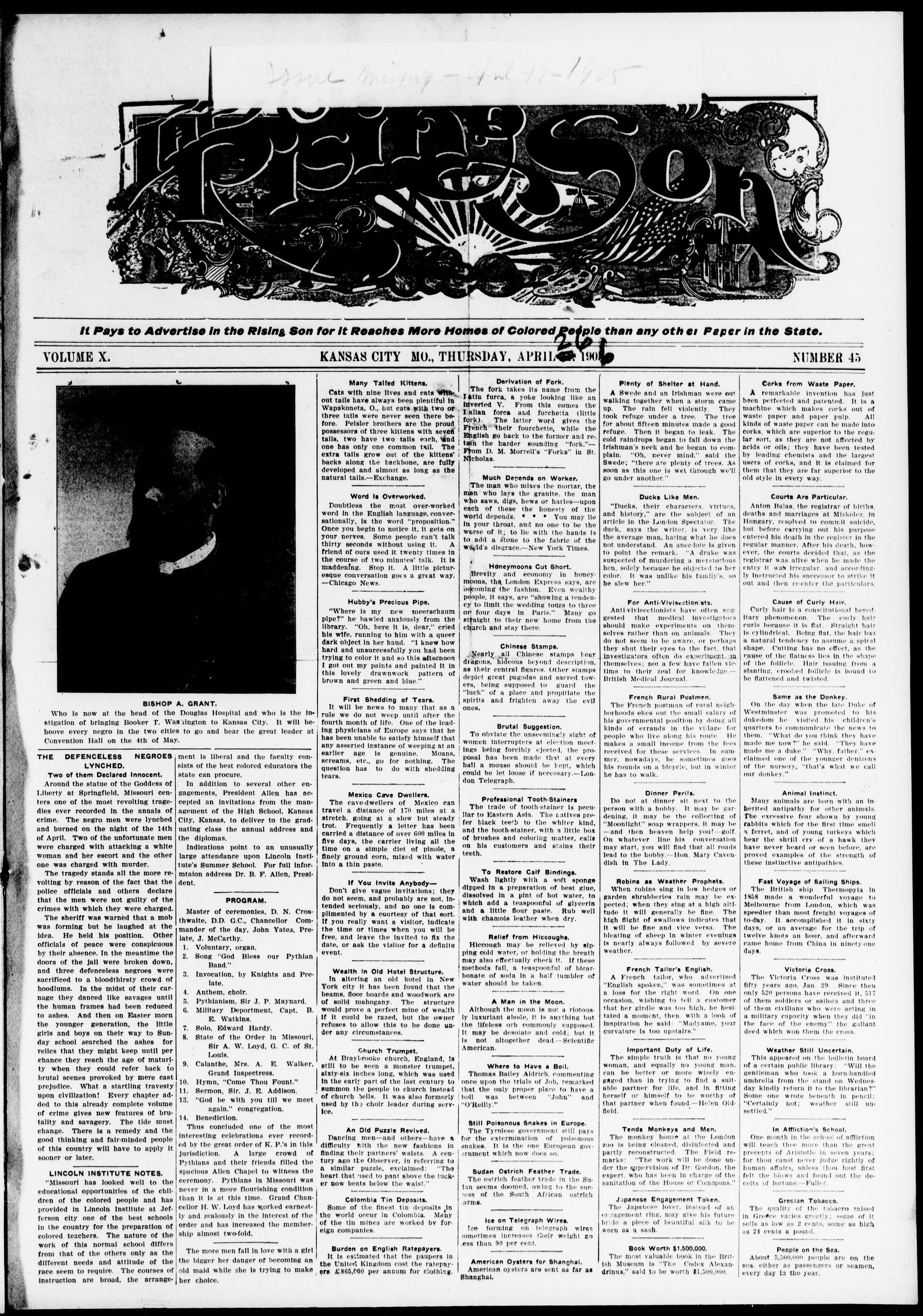
BISHOP A. GRANT. Head of the Douglas Hospital and who is the iner T. Washington to Kansas City. It will be two cities to go and hear the great leader at th of May.
Who is now at the head of the Douglas Hospital and who is the instigation of bringing Booker T. Washington to Kansas City. It will behoove every negro in the two cities to go and hear the great leader at Convention Hall on the 4th of May.
VOLUME X.
BISHOP
Who is now at the head of the stigation of bringing Booker T. Washove every negro in the two city Convention Hall on the 4th of May.
THE DEFENCELESS NEGROES
LYNCHED.
Two of them Declared Innocent.
Around the statue of the Goddess of Liberty at Springfield, Missouri centers one of the most revolting tragedies ever recorded in the annals of crime. The negro men were lynched and burned on the night of the 14th of April. Two of the unfortunate men were charged with attacking a white woman and her escort and the other one was charged with murder.
The tragedy stands all the more revolting by reason of the fact that the police officials and others declare that the men were not guilty of the crimes with which they were charged.
The sheriff was warned that a mob was forming but he laughed at the idea. He held his position. Other officials of peace were conspicuous by their absence. In the meantime the doors of the jail were broken down, and three defenceless negroes were sacrificed to a bloodthirsty crowd of hoodlums. In the midst of their carnage they danced like savages until the human frames had been reduced to ashes. And then on Easter morn the younger generation, the little girls and boys on their way to Sunday school searched the ashes for relics that they might keep until per chance they reach the age of maturity when they could refer back to brutal scenes provoked by mere cast prejudice. What a startling travesty upon civilization! Every chapter added to this already complete volume of crime gives new features of brutality and savagery. The tide must change. There is a remedy and the good thinking and fair-minded people of this country will have to apply it sooner or later.
LINCOLN INSTITUTE NOTES.
"Missouri has looked well to the educational opportunities of the children of the colored people and has provided in Lincoln Institute at Jefferson city one of the best schools in the country for the preparation of colored teachers. The nature of the work of this normal school differs from that of the others only as the different needs and attitude of the race seem to require. The courses of instruction are broad, the arrange-
ment is liberal and the faculty consists of the best colored educators the state can procure.
In addition to several other engagements, President Allen has accepted an invitations from the management of the High School, Kansas City, Kansas, to deliver to the graduating class the annual address and the diplomas.
Indications point to an unusually large attendance upon Lincoln Institute's Summer School. For full information address Dr. B. F. Allen, President.
PROGRAM.
Master of ceremonies, D. N. Croschwalte, D.D. G.C., Chancellor Commander of the day, John Yates, Prelate, J. McCarthy.
1. Voluntary, organ.
2. Song "God Bless our Pythian Band."
3. Invocation, by Knights and Prelate.
4. Anthem, choir.
5. Pythianism, Sir J. P. Maynard.
6. Military Deportment, Capt. B. E. Watkins.
7. Solo, Edward Hardy.
8. State of the Order in Missouri, Sir A. W. Loyd, G. C. of St. Louis.
9. Calanthe, Mrs. A. E. Walker, Grand Inspectress.
10. Hymn, "Come Thou Fount."
13. "God be with you till we meet again," congregation.
14. Benediction.
Thus concluded one of the most interesting celebrations ever recorded by the great order of K. P.'s in this jurisdiction. A large crowd of Pythians and their friends filled the spacious Allen Chapel to witness the ceremony. Pythians in Missouri was never in a more flourishing condition than it is at this time. Grand Chancellor H. W. Loyd has worked earnestly and zealously in the interest of the order and has increased the membership almost two-fold.
The more men fall in love with a girl the bigger her danger or becoming an old maid while she is trying to make her choice.
KANSAS CITY MO., THURSDAY, APRIL 1901
Many Tailed Kittens.
Cats with nine lives and cats without tails have always been plentiful in Wapakoneta, O., but cats with two or three tails were never seen there before. Pelsler brothers are the proud possessors of three kittens with seven tails, two have two tails each, and one has only one common tail. The extra tails grow out of the kittens' backs along the backbone, are fully developed and almost as long as the natural tails.—Exchange.
Word Is Overworked.
Doubtless the most over-worked word in the English language, conversationally, is the word "proposition." Once you begin to notice it, it gets on your nerves. Some people can't talk thirty seconds without using it. A friend of ours used it twenty times in the course of two minutes' talk. It is maddening. Stop it. A little picture-esque conversation goes a great way. —Chicago News.
Hubby's Precious Pipe.
"Where is my new meerschaum pipe?" he bawled anxiously from the library. "Oh, here it is, dear," cried his wife, running to him with a queer dark object in her hand. "I knew how hard and unsuccessfully you had been trying to color it and so this afternoon I got out my paints and painted it in this lovely drawnwork pattern of brown and green and blue."
First Shedding of Tears
It will be news to many that as a rule we do not weep until after the fourth month of life. One of the leading physicians of Europe says that he has been unable to satisfy himself that any asserted instance of weeping at an earlier age is genuine. Moans, screams, etc., go for nothing. The question has to do with shedding tears.
Mexico Cave Dwellers.
The cave-dwellers of Mexico can travel a distance of 170 miles at a stretch, going at a slow but steady trot. Frequently a letter has been carried a distance of over 600 miles in five days, the carrier living all the time on a simple diet of pinole, a finely ground corn, mixed with water into a thin paste.
If You Invite Anybody—
Don't give vague invitations; they do not seem, and probably are not, intended seriously, and no one is complimented by a courtesy of that sort. If you really want a visitor, indicate the time or times when you will be free, and leave the invited to fix the date, or ask the visitor for a definite event.
Wealth in Old Hotel Structure
In altering an old hotel in New York city it has been found that the beams, floor boards and woodwork are of solid mahogany. The structure would prove a perfect mine of wealth if it could be razed, but the owner refuses to allow this to be done under any circumstances.
Church Trumpet
At Braybrooke church, England, is still to be seen a monster trumpet, sixty-six inches long, which was used in the early part of the last century to summon the people to church instead of church bells. It was also formerly used by the choir leader during service.
An Old Puzzle Revived
Dancing men—and others—have a difficulty with the new fashions in finding their partners' waists. A century ago the Observer, in referring to a similar puzzle, exclaimed: "The heart that used to pant above the tucker now beats below the waist."
Colombia Tin Deposits.
Some of the finest tin deposits in the world occur in Colombia. Many of the tin mines are worked by foreign companies.
Burden on English Ratepayers
Benson on English Ratespayers
It is estimated that the paupers in the United Kingdom cost the ratepayers £855,000 per annum for clothing.
Derivation of Fork
The fork takes its name from the Latin furca, a yoke looking like an inverted V. From this comes the Italian forca and forchetta (little fork). The latter word gives the French their fourchette, while the English go back to the former and retain the harder sounding "fork."—From D. M. Morrell's "Forks" in St. Nicholas.
Much Depends on Worker
The man who mixes the mortar, the man who lays the granite, the man who saws, digs, hews or harles—upon each of these the honesty of the world depends. * * * You may lie in your throat, and no one to be the worse of it; to lie with the hands is to add a stone to the fabric of the world's disgrace.—New York Times.
Honeymoons Cut Short
Brevity and economy in honeymoons, the London Express says, are becoming the fashion. Even wealthy people, it says, are "showing a tendency to limit the wedding tours to three or four days in Paris." Many go straight to their new home from the church and stay there.
Chinese Stamps.
Nearly all Chinese stamps bear dragons, hideous beyond description, as their central figures. Other stamps depict great pagodas and sacred towers, being supposed to guard the "luck" of a place and propitiate the spirits and frighten away the evil ones.
Brutal Suggestion
To obviate the unseemingly sight of women interrupters at election meetings being forcibly ejected, the proposal has been made that at every hall a mouse should be kept, which could be let loose if necessary.—London Telegraph.
Professional Tooth-Stainers
The trade of tooth-stainer is peculiar to Eastern Asia. The natives prefer black teeth to the whiter kind, and the tooth-stainer, with a little box of brushes and coloring matter, calls on his customers and stains their teeth.
To Restore Calf Bindings
Wash lightly with a soft sponge dipped in a preparation of best glue, dissolved in a plint of hot water, to which add a teaspoonful of glycerin and a little flour paste. Rub well with chamois leather when dry.
Relief from Hiccoughs
Hiccough may be relieved by slipping cold water, or holding the breath may also effectually check it. If these methods fall, a teaspoonful of bicarbonate of soda in a half tumbler of water should be taken.
A Man in the Moon
Although the moon is not a riotously luxuriant abode, it is anything but the lifeless orb commonly supposed. It may be desolate and cold; but it is not altogether dead.—Scientific American.
Where to Have a Boil
Thomas Bailey Aldrich, commenting once upon the trials of Job, remarked that the only proper place to have a boll was between "John" and "O'Reilly."
Still Poisonous Snakes in Europe
Still Poisonous Snakes in Europe.
The Tyrolese government still pays for the extermination of poisonous snakes. It is the one European government which now does so.
Sudan Ostrich Feather Trade.
The ostrich feather trade in the Sudan seems doomed, owing to the success of the South African ostrich arms.
Ice on Telegraph Wires
Ice forming on telegraph wires sometimes increases their weight so less than 90 per cent.
American Oysters for Shanghai.
American oysters are sent as far as Shanghai.
Plenty of Shelter at Hand.
A Swede and an Irishman were out walking together when a storm came up. The rain fell violently. They took refuge under a tree. The tree for about fifteen minutes made a good refuge. Then it began to leak. The cold raindrops began to fall down the Irishman's neck and he began to complain. "Oh, never mind," said the Swede; "There are plenty of trees. As soon as this one is wet through we'll go under another."
Ducks Like Men.
"Ducks, their characters, virtues, and history," are the subject of an article in the London Spectator. The duck, says the writer, is very like the average man, hatting what he does not understand. An anecdote is given to point the remark. "A drake was suspected of murdering a meritorious hen, solely because he objected to her color. It was unlike his family's, so he slew her."
For Anti-Vivisectionists.
Antivivisectionists have often suggested that medical investigators should make experiments on themselves rather than on animals. They do not seem to be aware, or perhaps they shut their eyes to the fact, that investigators often do experiment on themselves; not a few have fallen victims to their zeal for knowledge. British Medical Journal.
French Rural Postmen
The French postman of rural neighborhoods ekes out the small salary of his governmental position by doing all kinds of errands in the village for people who live along his route. He makes a small income from the fees received for these services. In summer, nowadays, he sometimes goes his rounds on a bicycle, but in winter he has to walk.
Dinner Perils.
Do not at dinner sit next to the person with a hobby. It may be gardening, it may be the collecting of "Moonlight" soap wrappers, it may be—and then heaven help you!—golf. On whatever line his conversation may start, you will find that all roads lead to the hobby—Hon. Mary Cavendish in The Lady.
Robins as Weather Prophets
When robins sing in low hedges or garden shrubberies rain may be expected; when they sing at a high altitude it will generally be fine. The high flight of swallows indicates that it will be fine and vice versa. The bleating of sheep in winter evenings is nearly always followed by severe weather.
French Tailor's English
A French tailor, who advertised "English spoken," was sometimes at a loss for the right word. On one occasion, wishing to tell a customer that her girdle was too high, he hesitated a moment, then with a look of inspiration he said: "Madyame, your curvature is too upstairs."
Important Duty of Life
The simple truth is that no young woman, and equally no young man can be better or more wisely engaged than in trying to find a suitable partner for life, and in fitting herself or himself to be worthy of that partner when found.—Helen Old field.
Tenda Monkeys and Men
The monkey house at the London zoo is being cleaned, disinfected and partly reconstructed. The Field remarks: "The work will be done under the supervision of Dr. Gordon, the expert, who has been in charge of the sanitation of the House of Commons."
Japanese Engagement Token.
The Japanese lover, instead of an engagement ring, may give his future bride a piece of beautiful silk to be worn as a sash.
Book Worth $1,500,000
The most valuable book in the Brit
ish Museum is "The Codex Alexan
drusus," said to be worth $1,500,000.
NUMBER 45
Corks from Waste Paper.
A remarkable invention has just been perfected and patented. It is a machine which makes corks out of waste paper and paper pulp. All kinds of waste paper can be made into corks, which are superior to the regular sort, as they are not affected by acids or oils; they have been tested by leading chemists and the largest users of corks, and it is claimed for them that they are far superior to the old style in every way.
Courts Are Particular
Anton Balas, the registrar of births, deaths and marriages at Miskolez, in Hungary, resolved to commit suicide but before carrying out his purpose entered his death in the register in the regular manner. After his death, however, the courts decided that, as the registrar was alive when he made the entry it was irregular, and according instructed his successor to strike it out and then reenter the particulars
Cause of Curly Hair
Curly hair is a constitutional hereditary phenomenon. The curly hair curls because it is flat. Straight hair is cylindrical. Being flat, the hair has a natural tendency to assume a spiral shape. Cutting has no effect, as the cause of the flatness lies in the shape of the follicle. Hair issuing from a slanting, crooked follicle is bound to be flattened and twisted.
Same as the Donkey.
On the day when the late Duke of Westminster was promoted to his dukedom he visited his children's quarters to communicate the news to them. "What do you think they have made me now?" he said. "They have made me a duke." "Why, father," exclaimed one of the younger denizens of the nursery, "that's what we call our donkey."
Animal Instinct.
Many animals are born with an inherited antipathy for other animals. The excessive fear shown by young rabbits which for the first time smell a ferret, and of young turkeys which hear the shrill cry of a hawk they have never heard or seen before, are proved examples of the strength of these instinctive antipathies.
East Voyage of Sailing Ships
The British ship Thermopyla in 1858 made a wonderful voyage to Melbourne from London, which was speedier than most freight voyages of to-day. It accomplished it in sixty days, or an average for the trip of twelve knots an hour, and afterward came home from China in ninety-one days.
Victoria Cross.
The Victoria Cross was instituted fifty years ago, Jan. 29. Since then only 520 persons have received it, 517 of them soldiers or sailors and three of them civilians who were acting in a military capacity when they did "in the face of the enemy" the gallant deed which won them the cross.
Weather Still Uncertain.
This appeared on the bulletin board of a certain public library: "Will the gentleman who took a horn-handed umbrella from the stand on Wednesday kindly return it to the librarian?" Some one wrote beneath in pencil: "Certainly not; weather still unsettled."
In Affliction's School
One mouth in the school of affliction will teach the more than the great precepts of Aristotle in seven years; for thou canst never judge rightly of human affairs, unless thou hast first felt the blows and found out the deceits of fortune.—Fuller.
Grecian Tobacco
The quality of the tobacco raised in Greece varies greatly; some of it sells as low as 2 cents, some as high as 24 cents a pound.
People on the Sea.
About 3,500,000 people are on the sea, either as passengers or seamen, every day in the year.
A CHILD'S REMARKS
YOUNG AMERICA TOO MUCH IN
THE FOREGROUND.
Children Are Wont to Blurt Out Tact-
less Bits of Truth—Parents Are
Often Loonth to Check These Ino-
portune Speeches—Well-Bred Child-
ren Must Be Taught Not to Interrupt
Conversation — American
Children Too Much in the Fore-
ground — Impertinent Questions
Should Never Be Allowed—Hotel-
Bred Children Likely to Be Precocious.
BY MARGARET E. SANGSTER.
Everybody is familiar with the en-
fant terrible. In Maurier occasionally
drew him for our amusement, and
be figures in many jests and anecdotes.
This sometimes unforttable specimen of childhood is not necessarily disagreeable or soiled. He simply at his best state has a habit of appearing on the scene when he is not wanted, and of blurting out bits of truth that more tactful elders know enough to suppress. A child of this variety was one day sent by his mother to carry an extremely beautiful pair of slippers to a gentleman living in the neighborhood. She wrapped the gift in tissue paper and placed it in a box, with her card, adressing it carefully, but she forgot to tell her little messenger to leave the box at the door, and return directly. The boy had his own friendiness toward the neighbor, and waited to see how he would receive the gift. "Your mother is wonderfully good," said the gentleman. "These slippers are just what I wanted most. It was lovely in her to make them for me."
"Oh," exclaimed the child, "mother didn't make them for you; she made them for my father, and as they did not fit him she was so vexed she did not know what to do. At last she thought she would send them over here, and she wouldn't need to bother about buying you a Christmas gift." This rather dulled the edge of pleasure in the case, and made the recipient's thanks a trifle perturbatory.
"Ask your father," said Bobby's mother, "if he does not want to come to the library and see dear Aunt Fanny, who is soon going away." Off rushed the child, o be back in a minute, saying: "Father does not care about coming in to see Aunt Fanny. He says she is an old cat." When a little later, with an air of gentle bonhomie, Aunt Fannie's nephew by marriage presented himself, the situation was awkward and the old lady's manner a little strained.
At a table where several friends of the family were gathered, a young lady remarked to little Percy, eight years old, "If you won't play games with me I shall not come again."
"I hope you never will," frankly answered the child. "I don't like you, and I shall be glad when you go away."
There lives in a southern family a tradition that soon after his famous duel with Alexander Hamilton, Aaron Burr was a guest beneath its hospitable roof. Duelling was not in those days regarded in southern households as necessarily disgraceful, if preliminaries had been duly arranged, and the affair of honor had been conducted according to the code. Nevertheless, a good deal of commen of an unkindly nature followed Burr after that fatal ending of his duel with the popular Hamilton. The survivor was less fortunate than the victim. A child of the house wandered into the guest's room and, seeing there a silver-mounted pistol, possessed himself of it and entering the drawing room abruptly inquired: "Is this the pistol, Col. Burr with which you killed Gen. Hamilton?"
One may imagine the confusion and dismay of the older people at the innocent and inopportune remark.
Conscientious parents are often puzzled what to do with the enfant terrible. He would be less formidable if they remembered two time-worn and homely adages, namely, Little pitchers have big ears and, Children should be seen and not be heard.
Well-bred children do not interrupt conversation, say disgraceable things, or repeat what they should early learn will wound the feelings of others. American children are far too much in the foreground. Their pace is not where it should be in the happy privacy of the home, for foolish parents trot them out and make them show their paces until they are puffed up with vanity and importance. The pendulum in its swing from the severity of an earlier time, has gone too far in an opposite direction. Children are not happier for having unlimited liberty of speech. Unless a child be exceptionally stupid, and the enfant terrible as a rule is exceptionally clever, he does not put himself in evidence when he ought to be silent.
The parent in whose eyes truth is to be cultivated at any cost, rather prides herself on the candor of her offspring, when he tells a visitor that she has a wart on her nose or asks her why she wears such a queer bonnet. "Do your teeth come out at night?" inquires one of these little terrors, to the annoyance of a bashful man, who does not wish attention called to his looks. And the child goes unproved, because his mother is afraid that reproof may tend to make him deceitful.
The fact is that virtues and good qualities are relative and that in training children we must not lay the emphasis on one point more strongly than on another. What we need to do is to teach children the art of speak-
ting only the truth at all times, while at the same time they must learn the lesson that all truth not always to be spoken. Neither has anybody, child or adult, the right to ask impertinent questions or make impertinent comments. Truth is one item in home training, a foundation-stone in character. Charity and courtesy are foundation-stones equally as indispensable in preparation for the intercourse of the family, of business, and of society.
One of the greatest mistortunes that can occur in a child's life is the loss of a sweet and simple home-life. When children are brought up in hotels and boarding houses, are more or less noticed by strangers, and accustomed to publicity, or when they are very much left to the 'care of servants, they are likely to develop the traits that make childhood unloved. We say of such children that they know too much that too soon the exquisite vells of childish innocence have been torn away. When patents are forced to bring their children up in the glare instead of in the shade, in hotels instead of in quiet homes, extra pains should be taken to keep them modest, shy and silent in company. Certainly they should never be permitted to push themselves and their affairs to the front, while their parents and friends await their convenience before going on with their own proceedings.
Another specimen of the infant terrible seems to have inherited the traits of the savage. This child is far worse than the other, for he is cruel to cats and dogs and takes a barbarous delight in killing or malming squirrels and birds. This child is a degenerate, and is taking the initial step on the road that leads downward to the criminal court. A less hateful but not less unwelcome specimen is the child with a passion for hacking and destroying whatever comes in his path. He tears books, breaks furniture, uproots flowers and leaves the mark of his little hatchet wherever he goes. Happily, his energy being only misdirected, may be turned into safer channels; for him manual training is a boon, and he will probably emerge from his present state of vandalism into useful and attractive boyhood later on.
The cruel child must be taught in the only way that will appeal to him: if need be, he must suffer in his own person that he may learn what suffering means. No parent is without blame who does not take the infant terrible in hand and reduce him as soon as possible to good order.
(Copyright, 1906, by Joseph B. Bowles.)
FASHIONABLE PRINCESS.
Slender Figure Must Make Use of the Little Fancy Coats Designed for Princess Gowns.
No slight figure should attempt a princess with a yoke that covers the entire top of the shoulders. If she wears a princess skirt only, that is a different matter, but a full frock should have the fabric carried well into the shoulder seams. This gives a chance to fill the ugly hollows at the side of the arms, which are far more fatal to a good figure than a lack of bust, though many women do not think so.
The women for whom the princess is still too severe should always wear a loose jacket of lace or embroidery.
These are the last smart things in clothes. They can be made at home or bought at the shops. Some are in precious Irish weaves, or even duchess, but you can also get them in the cheaper makes.
The trouble is that one is apt to get them too patchy when made at home. Still if you have fine bits of lace or embroidery, here is your chance to use them. They are nothing more or less than shortened pelerine—just what we always have called zonaves. The sleeves make them different from a bolero. These are wide and short, usually cut circular. They are made in chiffon velvet, by the way, which seems a queer choice for spring unless one sees the remarkable amount of velvet used this season. Tafeta gowns are heaped with it. But there is nothing new in clothes, really, for this was a dominant fashion many years ago.
These little jackets are worn over so many various kinds of frocks that one would be a good investment for any woman. Over all white and pastel colored lingerie frocks they are charming and afford just that amount of warmth needed on summer evenings.
PRETTY INITIAL LETTER
Every Good Housewife Likes Her Linen Nicely Marked and We Show an Attractive Model.
The initial K shown here is worked in cross-stitch with a scroll of long
ATTRACTIVE LETTERING.
stitches running through. It is suitable for marking house linen, and should be worked with flax thread, washing-silk, or ingrain cotton.
French Commodity.
Potato starch is used in France to sweeten sour grape juice.
PROSPERITY INCREASING.
Will Continue Unchecked for Years If Discontent Does Not Creep In.
A bulletin just issued by the department of commerce states that American exports for eight months ending with February exceeded, in value those for eight months ending with February, 1905, by $190,000,000. Of this increase $133,000,000 was of agricultural products, while $45,000,000 was of manufactures.
By themselves, says the Chicago Inter Ocean, these figures mean little but considered in their proper relations they give a striking indication of our national prosperity. And to understand what these relations are we must remember that there are four great groups of articles of foreign commerce, three consisting of both imports and exports and a fourth of imports alone. The progress of foreign trade with respect to each of these groups is here summarized on the basis of the figures of each for the first seven or eight months of the last three fiscal years—the months ending with January or February.
1. Foodstuffs, agricultural exports, and food imports. This is still our largest class of exports. Its value was $700,000,000 for the period ending with February last, as against $567,000,000 and $658,000,000 for the same periods ending with February in 1905 and 1904. It grows, but irregularly, from year to year, according to the harvests here and abroad. Food imports are practically stationary, now ranging around $80,000,000 for the period. But for our failure so far to develop as we might sugar and coffee growing in our new possessions these imports would decline rapidly.
4. Luxuries; imports only. They were $6,000,000 for the period ending with February, 1901; $9,000,000 for the period ending with February, 1905, and about $12,500,000 for the period ending with last February.
These figures show prosperity all along the line. Those of the second and third groups are particularly interesting. The prosperity of our agricultural interests requires no argument. These figures show that not only is this nation one of the world's great food storehouses, but that it is also becoming its greatest workshop.
We are selling to other countries less of our materials and buying more of theirs. We are buying less of their manufactures and selling them more and more of ours. We are strengthening our position as increases of the value of commodities by industry. And our increasing purchases of luxuries show that not only are we doing more work, but that it is also profitable work, giving us money to spend for things not necessary.
There is no question about our great and increasing prosperity. And, while all things human are transitory, there is no question that this exuberant prosperity will be unchecked for some years, if we do not become discontented with it and spoil it by failing to treat the conditions and institutions under which it has been attained with common sense.
POINTERS AND OPINIONS
The average ad valorem rate of duty on durable imports for the fiscal year 1905 was 45.24 per cent. less than any preceding year under the Dingley tariff.-American Economist.
Petitioning the present congress to revise the tariff is a manifestation of the faith that moves mountains without disturbing the scenery.-Milwaukee News.
Ex-Senator David B. Hill says he is content to be a looker-on in politics. This is a good year undoubtedly to have a safe seat in the upper gallery.-N. Y. Tribune.
With William Jennings Bryan gaining strength daily in congress as a conservative leader of the Democracy, the only thing that Judge Parker can do is to stand aghast.-Chicago Inter Ocean.
Germany will not enforce her high tariff schedules against imports from America because there would be retaliation, and in a tariff war she would be heavily the loser.—Buffalo Commercial.
Northern papers are objecting that a southern man cannot be elected president in 1908 upon the Democratic ticket. Well, what difference does that make? We don't seem to be able to elect any other kind on the Democratic ticket.—Atlanta Journal.
Although there is no doubt that Mr. Heisler is capable of such a deed, it would, as he himself suggests, be interesting to know how he managed to "put his feet under the mahogany of the Democratic national committee and then stab his host in the back." Isn't it up to Mr. De Lancey Nicoll to explain?—Boston Transcript.
NOTHING LIKE A BARGAIN.
This Country Will Continue to Control Its Tariff and Administration
Although the concession is but for one year, it may be safely assumed that by next year at this time a permanent arrangement will be made, and that it will not be as the result of a fake reciprocity treaty or any other concession or agreement by virtue of which we lose control of the provisions of our tariff laws or the methods of their administration, says the San Francisco Chronicle.
Appearances indicate that the German government is about ready to accept in its dealings with us the American principle of impartial trade. We give to Germany in most cases and should give it all the benefit of our Dingley rates, which are our minimum rates. In return we expect Germany's minimum rates, and if we do not get them we shall have to create some maximum rates for the benefit of Germany and some other countries. A good many preposterous stories have got into print as to certain things which the "president" was to do for Germany "on the quiet" in return for the concession of her minimum rates to us. One was to the effect that the president was to instruct our delegates to the Algeciras conference to side with Germany against France. Another, equally absurd, was to the effect that the president was to instruct the treasury officials to shut their eyes to undervaluations of German commodities subject to ad valorem duties in this country. The president has no authority to do either of those things, and if he had the authority it is an insult to suggest that he would sell the American vote at a diplomatic conference, or order treasury officials to violate their official oath. There has been no bargain made. There will be no bargain made. Germany and the United States will remain two friendly nations and each will manage its revenue laws to suit itself. But, as we expect most favored nation treatment from Germany, we should give it to her in return, which means the abrogation of all treaties which prevent it.
THE SHOE PINCHES THERE
Point in Protective Tariff That Is Perfectly Plain to the Workingman.
Suppose that to please Gov. Guild and ex-Gov. Douglas and our manufacturers of boots and shoes we should repeal the duty on hides, says the American Economist. We should also, of course, at the same time repeal the duty on boots and shoes. That having been done, our market would be open to the product of foreign countries, and in a very short time there would be an inundation of footwear into this country against which our own manufacturers would have to compete. In order to meet this importation and be able to sell boots and shoes in our own market in competition with those from abroad it would be necessary to make them as cheaply. The cost of material being the same in both countries, there would remain nothing to bring about equality in the cost of production except wages. The consequence would be, the wages of all the people in this country engaged in making boots and shoes would have to go down to the level of wages abroad, which is about half the amount now paid here. This result would be most unfortunate in itself, but there would be other effects to follow. There are at present considerably over 200,000 people engaged in making boots and shoes, and the purchasing power of these people would at once be cut in half. In many towns and villages boot and shoe making is the only occupation of a large portion of the people. To cut in half the wages of the people would mean the large diminution of their trade with all classes of the community. This would be reflected in buying the merchandise of others, so that the result would be far spreading. It would be well to consider seriously before taking the duty off from hides and boots and shoes—to estimate thoroughly this matter of reduction of wages.
There Has Been a Change.
The disappearance of the German tariff war cloud upsets many calculations regarding the congressional campaign of 1906. The free traders welcomed the prospect and the American Reciprocal Tariff league was preparing to go into every doubtful district in the middle west and convert the present protectionist majority in the lower house into a tariff ripping force that by a coalition with the Democrats would control action in favor of wide open reciprocity in competitive products and an all-round revision of the Dingley schedules. Germany's unwillingness to begin hostilities has changed the situation. It gives reciprocity a serious setback and leaves the revisionists short of ammunition. The country is to be congratulated upon the good sense of the standpatters in refusing to be scared by the German threat.-American Economist.
Nobody but a pessimist can believe that this country will be as bad as the socialists say it is.—Toledo Blade.
Vesuvius should do all its spouting before Bryan gets around that way on his tour. Bryan is a dangerous rival.—Philadelphia Press.
We have neither tariff nor shipping laws that drive American boats from the oceans. All shipbuilding material is free. Every newspaper of foreign leanings is against the pending measure. That is a matter of course.—Buffalo News.
THE
CHURCH
AT
WORK
Progress Which the Interchurch Conference Is Making in Its Work.
The Inter-Church Conference on Marriage and Divorce at its recent meeting in New York city ordered the preparation and publication of a third appeal to the people of the United States on the subject with which the conference has to deal. There is no new argument to present. The conference is committed to enforce by repetition, and to emphasize by reiteration, the great truth of the sacredness of marriage as not a contract lightly formed and easily broken, but an estate of life, first among the institutions of God for man, and foremost among the sanctities of human life. It needs guarding against the profanation of thoughtlessness, of mere passion, of worldly advantage or social advancement, of mercenary or any other low motives. It needs the protection of wise laws, of sound public opinion, and of religious sanction. The scandal of frequent and facile divorce, with the remarriage that follows, often as the accomplishment and with the accomplish of the separation, is really a by-word and reproach to our country, remarks the Christian Work; and the radical cure can only be reached by going to the root and cause, namely, the nonrealization of the religious element in matrimony. First of all, then, the true bond and meaning of the marriage bond, "the union of one man with one woman for life." This the clergy ought to teach, "in season and out of season;" and this Christian men and women ought to impress deeply upon their own consciences, and to teach their children and their children's children, until the truth shall pervade society and prevail over the loose and low sentiments so common to-day. To this end a resolution was adopted by the conference at its last meeting declaring that it was "the sense of the conference that the Scriptural and most effectual way to meet and overcome the divorce evil is by education, with a view to elevating the moral sentiments of the people." Meanwhile the conference is encouraged by its own growth in membership; duly elected representatives from the Presbyterian church in the United States (South), and the Church of the New Jerusalem, having been present at its last meeting. Still more, both by its influence and by the increasing public conviction of the evil of divorce, the atmosphere seems to be clearing. This is noticeable in the public press, in the outspokenness of many clergymen, in the utterances of influential laymen, and in the serious consideration which the question is now receiving from the members of the bar.
Difficulties of Missionary in Syria. Dr. George T. Post, a missionary of long experience in Syria, writes:
"Missions in Turkey are embarrassed by the drain of emigration more than by all other drawbacks and hindrances. This is a factor against which energetic action is no antidote. Persecutions we can bear; opposition we can overcome; stubborn unbelief we can enlighten; stolid indifference we can interest; but what can we do with nothing? Multiplication of a minus quantity only increases the deficit. We have hoped for the reflex influence of the emigrants on their return laden with new ideas and inspiration, but with few exceptions we have had none of these offsets to the loss. Our only consolation is that He who sent us here is in some mysterious way at the bottom of this movement. His mill grinds slowly but it never closes and is never out of order. At least He can use the situation to exercise our faith in the infinite and far-reaching wisdom of God, who knows the end from the beginning."
Revival Meetings by Telephone.
Revival Meetings by Telephone.
A unique feature of the Torrey-Alexander meetings at Philadelphia has been the use of the telephone to extend the circle of influence of the meetings. A telephone company installed a megaphone just above the speakers' stand at the armory, through which the singing of Mr. Alexander and the sermons of Dr. Torrey were transmitted over the wires throughout the city. It was not necessary for the people to leave their homes in order to listen to the revival services; they could do so by merely taking the telephone receiver from the hook and asking Central to connect them with the armory. For five cents they could listen for 15 minutes to the singing and preaching. The use of the invention was probably unique in the history of revival meetings in America.
Good to Servants.
Lady Diana de Vere Huddleston, who died in London recently, left a will bequeathing $30,000 to her servants and directing that her ashes after cremation should be placed in the oak shrine awaiting them at Coutts' bank and buried with those of her husband, which she had carried with her wherever she went for 15 years.
Don't let droppings accumulate under the roosts. They throw off too much ammonia during warm days in winter*
READ AND YOU WILL LEARN
That the leading medical writers and authors of all the books in the school of practice endorse and recommend the strongest terms possible, each and every ingredient entering into the composition of Dr. Pierce's Golden Medical Discovery for the cure of weak stomach, dyspepsia, catarrh of stomach, "liver complaint" torpid liver, or biliousness, chronic bowel disease, or whatever region, name or nature. It is also a specific remedy for all such chronicle or long standing cases of catarrh affections and their resultants, as bronchial, throat and lung diseases (except consumption) accompanied with severe cough. It is not so good for acute colds and coughs, especially efficacious in producing perfect cures. It contains Black Cherrybark, Golden Seal root, Bloodroot, Stone root, Mandrake root and Queen's root—all of which are highly praised as remedies for all the above mentioned affections by such authors as Bartholow, of Jefferson Med. College; Prof. Hare, of the Univ. of Pa.; Prof. Finley Ellingwood, M. D., of Bennett Med. College, Chicago; Prof. John M. Scudder, M. D., late of Cincinnati; Prof. Ewilie M. D., late of Bennett Med. College, Chicago; scores of others equally eminent in their several schools of practice.
The "Golden Medical Discovery" is the only medicine put up for sale through drummets for like purposes, that has any such professional endorsement—worth a try. It is also the only monials. Open publicity of its formula on the bottle wrapper is the best possible guaranty of its merits. A glance at this published formula will show that "Golden Medical Discovery" contains no poisonous or harmful agents and no alcohol—which is not the case being used instead. Glycerine is entirely unobjectionable and besides is a most useful ingredient in the cure of all stomach as well as bronchial, throat and lung affections. There is the highest medical authority, or its use in all such cases. The "Golden Medical Discovery" is an eric extract of native, medicinal roots and is safe and reliable.
A booklet of extracts from eminent, medical authorities, endorsing its ingredients mailed free on request. Address Dr. R. V. Pierce, Buffalo, N. Y.
The First Stage Coach Into Denver. On the 17th of May, 1859, Denver turned out to welcome the first through coach of what was destined to grow into the "Overland Mail," an enterprise which, for sheer American pluck and daring, must be forever linked with the fame of the "Pony Express."
Red shirts drifted to the outskirts of the hamlet and dotted the hills around. Hard-faced bartenders made ready for the "hottest night that ever tore the camp loose." The artillery of holster and saddle-boot was unlimbered for an ecstatic fusillade. There was a lively betting in dust and nuggets that the first through stage had been gathered in by Indians, with takers as eager to stake their faith that the scalps of driver and guard would come through intact.
At length a swirl of dust showed far down the trail. It grew into a yellow cloud and crept toward the eager hamlet. Then six mules, stretched out on the gallop, emerged from the curtain and behind them was the lumbering, swaying stage come safely through, on time, and Denver was in touch with the world where men wore white shirts and lived in real houses. The cheers that roared a welcome to this heroic enterprise were echoed in every western town which hoped and longed for a link of its own with the home county, "way back east."—"The Story of the Overland Mall," in The Outing Magazine for April.
Deafness Cannot Be Cured
by local applications, as they cannot reach the diseased portion of the ear. There is only one way to cure deafness, and that is by constitutional remedies. Deafness is caused by an inflamed condition of the mucous lining of the Eustachian Tube. When this tube is inflamed you have a rumbling sound or imperfect hearing, and when it is entirely closed. Deafness is the result, and unless the inflammation can be taken out and this tube restored to its normal condition, hearing will be destroyed forever; nine cases out of ten are caused by Catarrh, which is nothing but an inflamed condition of the mucous surfaces.
We will give One Hundred Dollars for any case of Deafness (caused by catarrh) that cannot be cured by Hall's Catarrh Cure. Send for circulars, free.
F. J. CHENEY & CO., Toledo, Q.
Sold by Druggists. 75c.
Safe.
An official in the land office at Washington relates now Dr. Whipple, for a long time Bishop of Minnesota, once undertook to hold religious services near an Indian village in one of the western states.
It appears that the bishop's effects were scattered about the "lodge," and, when about to go out, he asked the chief if it were safe to leave them there while he went to the village for service.
"Plenty safe," grunted the Indian; "no white man in a hundred miles from here." -Harper's Weekly.
Must Ask Aldrich.
"Senator," she asked, "do you believe in foreordination?"
"If you will pardon me," replied the statesman, "I prefer not to answer that question, as I have never had occasion to ask Aldrich about it."—Chicago Record-Herald.
"Why are you bowing to that man? Do you know him?" asked Madge in surprise. "Yes," said her chum, "he walked over me so many times getting out between acts at the theater last night that we got real well acquainted."—Detroit Free Press.
DODD'S
KIDNEY
PILLS
FOR ALL KIDNEY DISEASES
CURSES RHEUMATISM
BRIGHTS DISEASE
DIABETES BACKACHE
COMBINING TREATMENT FOR
DISEASE. The patient may require
a course of antibiotics, told only in lesions.
Bubble
and
Squeak
By B. L. TAYLOR
With some extracts from the unpub-
lished work of the late Walker
Blackburn Harts.
(Copyright, 1908, by Joseph B. Bowles.)
```markdown
```
A relative is a person who claims the privilege of insulting you without being kicked for it. We sometimes forget without forgiving, and owe a grudge though we cannot remember why. When I get too much of myself I feel like killing the other fellow. The wise and the worldly-wise are farther apart than the sane and the insane. If it were not for the animal courage and ferocity of men, there would be no cowardice, and possibly without cowardice there would be no civilization. A writer wants an incentive to work, and where love fails a disappointing marriage will supply the spur—work taking the place of all else in life.
She, who here shall be nameless, tells me: "I respect you in the positive, I admire you in the comparative, and I love you in the superlative degree."
The conscience is often an unfair accuser, for it incorporates and weaves into its texture all sorts of inherited prejudices and legal falsities of its environment, and is in consequence a prolific source of suffering and irremediable mistakes.
Some men try to make their public characters atone for their private ones—blind to the fact that this hypocrisy but accentuates the blackness of both.
An epigram is only tentatively so until it gets into print.
WALTER BLURNER HARTE
WALTER BLACKBURN HARTE.
Concentration.
(Writing books is very exacting.
You must make up your mind to renounce everything for the time being."
—Gertrude Atherton.)
When I am working on a book
I cannot climb the Matterhorn,
And over glistening glaciers glide—
From dewy morn to dewy morn
My pen is occupied.
Oft when I'm writing I will say:
"I think I'll jaunt to Spain."
But now, I cannot get away—
I dip my pen again.
Or be it Russia or Algiers.
One's bow has but a single string,
One must all other things forego.
Writing is such a serious thing!
One must concentrate so!
We wish some statistician would figure up the amount of tobacco consumed annually in fiction and in newspaper interviews. It must be astonishingly large. An average cigar will last the present writer half an hour or more, but smokers in novels burn up Havanas at an alarming rate, while a man who is being interviewed by a reporter will dispose of three cigars per column. Capt. Mogg, a Pacific coast sea dog, talked a thousand words to an interviewer recently. He began by "closing his square jaws on the end of a fresh cigar," and after he had been talking about five minutes, "his brown eyes twinkled, and he fished a fresh cigar out of a gunmetal case." The hero of fiction "tisses away" a cigar or cigarette on every other page, if he be a pipe smoker he is continually "knocking the ashes out of his pipe." One thing should be said in praise of the smokers of romance—the seldom borrow matches, whereas smokers in real life procure them exclusively from their friends.
The Scrubbers announce "String Figures; a Study of Cat's-Cradle in Many Lands," by Caroline Furniss Jayne. Other important works to follow in this series are: "Continental Blind Man's Buff." "Comparative Leap-Frog," "Babylonian Duck-on-a-Rock" and "Tag; East and West."
Some Peculiar Rejections.
Every publication has its own way of declining a manuscript.
The Century usually notifies the author by wire, adding: "Letter giving details will follow."
Everybody's sends word on a souvenir postal card, showing "A Busy Day in Union Square."
The Cosmopolitan returns the manuscript with a neatly printed card reading "Nothing doing."
The editor of Alnlee's writes a long, friendly letter of regret and invites the author to lunch with him.
Harper's uses the long distance telephone whenever possible.
Every letter of rejection from the Associated Sunday Magazines is stained with the tears of William A. Taylor, or "Uncle Bill," as he is affectionately known.
McClure's returns a courteous note reading: "This is a very good story, but it is too interesting."
Munsey's never rejects anything.
A few periodicals employ the stuff "Declined with thanks" rejection slips, but more of them are delightfully informal in expressing their genuine regret that a manuscript must be returned.
Pugilist O'Brien says his favorite author is Balzac. He is hazy about Ibsen and he doesn't care for poetry, but he admires Balzac exceedingly. Well, a favorite author of a gentle lady of our acquaintance is Jack London. There is certainly no accounting for tastes—in literature any more than in wall paper.
Indiana now has a town of Ade, named after her favorite son. This is a genuine compliment, and we may expect in due season Riley Bend, Tarkington Four Corners, McCutcheon Center, East McCutcheon, West McCutcheon, South McCutcheon and McCutcheon Junction.
The Publicity Fad in Little Arady.
(From the Little Arady Across.)
(From the Little Arcady Argus.
At the first meeting of the Searchlight league in the town hall last Tuesday evening, our honored legal townman, James Dillenbaugh, was chosen president. Mr. Dillenbaugh is one of the great active advocates of publicity in Little Arcady, and has already earned an enviable reputation as the village Lawson. His article on "Frenzied Farming" appears on our sixth page. Mr. Dillenbaugh promised his readers that he will have something to say next month.
In response to the plainly evidenced desire of an aroused public sentiment the village board has promised to resign in a body. The board's defense of the outrageous act of burning the ballots cast in the recent election for sheriff is that there was no contest, only one candidate being voted for, and there was no necessity for saving the ballots. But President Dillenbaugh, of the Searchlight league, declared that the board is plainly unconstitutional and must go.
The disturbing fact has been brought to public notice that William Jodder, for nearly 40 years treasurer of Little Arcady village, has never given bond, and might at any time during that period have decamped with the funds entrusted to his care. Immediate action will be taken.
---
David Graham Phillips, author of "The Book Deluge," has been invited to address the next meeting of the Searchlight league. Topic, "The Novel of Business and Publicity." Tickets on sale at Chilcote's drug store.
Under a January date line the Messrs. Harper & Brothers inform us that William Dean Howells has closed his summer home at Kittery Point, Me." No reason is assigned for Mr. Howells' rather hurried flight for the city. Possibly the well froze up.
It is reported that the magazine "The Twentieth Century Home" will change its name to "The Apartment Hotel."
AMBITION OF PITCHERS.
Every pitcher that ever wrapped his fingers around a baseball hungers to shut out an opposing team without a hit or a run. It has been computed that only 33 times in the 30 years which have known great professional baseball, has the stunt been done. To sink the enemy, runless and hitless, requires an almost ideal combination in the twirler. He must have the fielding ability of a Wiltse, to grip bunts and stop the drives; he must have the coolness of a McGlinnity, the rapidity of delivery of a Waddell and the deliberate sure eye of a Mathewson. Which means perfection.
Five years after the establishment of the National league the achievement came. Lee Richmond, slinging the egg for Worcester, shut Cleveland out without a hit. He did not give a base on balls. Ward, of Buffalo, followed a year later against Providence. On May 5, 1904, the grand old warrior, "Cy" Young, leaped to the pinnacle and won imperishable baseball fame by sticking the Philadelphia American league team on the fence to dry, retiring every single man that came to bat nine long innings. The Boston bunch behind him committed not a single error, and Young's accuracy never faltered. He sent every man to glory in the blood-stirring, one-two-three order. Young was more hand-capped than his predecessors who made opponents hitless. They could exercise as much looseness of movement, nearly, as the man who delivers a cricket ball. They could run in, step back, to the side, balk, throw the ball any way they pleased. Young was circumscribed in his movements.
Corcoran, of Chicago, stands out as the only man who ever did the trick three times. "Cy" Young and Mathew-son have two each to their credit, Clarkson, of Boston, rubbed it into Providence in 1885. Clarkson, with the lovable old "Mike" Kelly, will be remembered as half the battery that was sold for $20,000 by Chicago, Amos Rusle in 1891, in revenge for Lovett, of Brooklyn, shaming the Giants on the hitless stage, put all his celebrated speed and skill into his arm and dashed Brooklyn over the cliffs similarly. Four games of this character were played in 1898, that year taking the palm. Henley and Hatty hold the 1905 record, one each.
The Japanese imperial library at Tokko has on its shelves something like 2,000 written and printed mathematical works, extending as far back as 1865.
AMBULANCE DOGS.
This Government to Use Canines in the Hospital Service of the Army.
San Francisco.—With a gallant record in the Red Cross service of the kaiser's army, "Fritz," a pretty black-and-white setter, has come to the United States to teach American dogs a new usefulness. "Fritz" was imported by Col. J. W. Hardie recently at the Presidio under waiting orders. Col. Hardie, with "Fritz" as a demonstration, hopes to awaken the medical department of Uncle Sam's army to the fact that it is several years behind the European armies in seeking the value of trained dogs for seeking out and carrying "first aid" to the wounded on the battle field. Col. Hardie will take the matter up with Lieut. Charles
HOSPITAL DOG EQUIPPED FOR SERVICE.
(Regular Feature of European Arms to Be Introduced in United States Army.)
Norton Barney, of the medical department of the United States army, who is already much interested in the subject.
In the armies of Italy, France, Germany and England the ambulance dog has long been an official worker, and Italy has even provided a pension for ambulance dogs. The dogs are trained to understand military orders, and claim one order as distinctly their own. At the command "Seek wounded" the four-footed helpers are off over the battlefield to nose out those who have fallen. Attached to their collars or in pockets inside their Red Cross blankets they carry a packet of stimulant and bandages, and if the wounded can help himself this "first aid" gives him strength and fortifies him until the dog, by climbing a near-by bank or eminence and barking sharply, attracts the attention of a field surgeon or nurse. Every dog is taught to regard a prostrate man as wounded, and the intelligent animals lose no time in calling for help
The German army has an especially fine lot of kennels, and the medical department takes great pride in its trained dogs. The scenting powers of the ambulance dog supply a means of seeking out the wounded for which human shrewdness has no substitute. Many times the human searchers will pass within a few feet of an unconscious soldier hidden in a trench or brush, or fail to catch the faint cry of a badly wounded man.
A NEW NATIONAL PARK.
Revival of Movement for Setting Apart 2,000,000 Acres for Play Ground in Appalachians.
Washington—There is reviving a movement to have the government establish a huge Appalachian forest reserve or national park to take in the most picturesque mountain section where Virginia, West Virginia, Kentucky, Tennessee and North Carolina converge. About 2,000,000 acres of the most nearly virgin land east of the Mississippi river is involved. The idea got into congress in 1902, and a bill passed the senate to appropriate $10,000,000 and was favorably reported by the house committee on agriculture. An association was formed of which Rutherford P. Hayes, a son of the late president, was the
MAP OF PROPOSED NEW NATIONAL PARK.
(Shaded Portion of Map Shows Location of Preserve in the Appalachian Mountain Range.)
head. It has been revived by persons who have just met at Asheville, N. C. Whether $10,000,000 now would buy the tract is very doubtful. However, a great deal of that land can be bought for the money if it is appropriated. The idea is to give the perhaps 60,000,000 people who are within 48 hours' ride of the region a permanent playground and nature spot, such as the Yellowstone National park is to the west. The highest mountains and most ravishing scenery east of the Rockies is included in the heart of the great watershed, from which so many rivers flow.
It is largely for the purpose of saving these rivers that the project is urged. Commercialism is making terrible inroads upon the country, leveling its-almost primeval timber, and scarring the mountain sides so that the surface soil is being swept away and floods and droughts alternately are the result. The plan, which no doubt will be fought bitterly by the many great commercial interests that are boring into this retreat of the dryad and faun, does not involve dispossessing the small farmers who now inhabit the region, but is to limit them to cultivation of 200 acres each. The country is not very adaptable to agriculture. It is claimed that only about 50,000 people are settled in this country, mostly in villages.
THE CHOICE OF PAINT.
Fifty years ago a well-painted house was a rare sight; to-day an unpainted house is rarer. If people knew the real value of paint a house in need of paint would be "scarcer than hen's teeth." There was some excuse for our forefathers. Many of them lived in houses hardly worth preserving; they knew nothing about paint, except that it was pretty; and to get a house painted was a serious and costly job. The difference between their case and ours is that when they wanted paint it had to be made for them; whereas when we need paint we can go to the nearest good store and buy it, in any color or quality ready for use. We know, or ought to know by this time, that to let a house stand unpainted is most costly, while a good coat of paint, applied in season, is the best of investments. If we put off the brief visit of the painter we shall in due time have the carpenter coming to pay us a long visit at our expense. Lumber is constantly getting scarcer dearer and poorer, while prepared paints are getting plentier, better and less expensive. It is a short-sighted plan to let the valuable lumber of our houses go to pieces for the want of paint.
For the man that needs paint there are two forms from which to choose; one is the old form, still favored by certain unprogressive painters who have not yet caught up with the times—lead and oil; the other is the ready-for-use paint found in every up-to-date store. The first must be mixed with oil, drilers, turpentine and colors before it is ready for use; the other need only be stirred up in the can and it is ready to go on. To buy lead and oil, colors, etc., and mix them into a paint by hand is, in this twentieth century, about the same as refusing to ride in a trolley car because one's grandfather had to walk or ride on horseback when he wanted to go anywhere. Prepared paints have been on the market less than fifty years, but they have proved on the whole so inexpensive, so convenient and so good that the consumption to day is something over sixty million gallons a year and still growing. Unless they had been in the main satis factory, it stands to reason there would have been no such steady growth in their use.
Mixed paints are necessarily cheaper than paint of the hand-mixed kind, because they are made in a large way by machinery from materials bought in large quantities by the manufacturer. They are necessarily better than paints mixed by hand, because they are more finely ground and more thoroughly mixed, and because there is less chance of the raw materials in them being adulterated. No painter, however careful he may be, can ever be sure that the materials he buys are not adulterated, but the large paint manufacturer does know in every case, because everything he buys goes through the chemist's hands before he accepts it.
Of course there are poor paints on the market (which are generally cheap paints). So there is poor flour, poor cloth, poor soap; but because of that do we go back to the hand-mill, the hand-loom and the soap-kettle of the backwoods No. we use our common sense in choosing goods. We find out the reputation of the different brands of flour, cloth and soap; we take account of the standing of the dealer that handles them, we ask our neighbors. So with paint; if the manufacturer has a good reputation, if the dealer is responsible, if our neighbors have had satisfaction with it, that ought to be pretty good evidence that the paint is all right.
"Many men of many kinds"—
Many paints of many kinds; but while prepared paints may differ considerably in composition, the better grades of them all agree pretty closely in results. "All roads lead to Rome," and the paint manufacturers, starting by different paths, have all the same object—to make the best paint possible to sell for the least money, and so capture and keep the trade.
There is scarcely any other article of general use on the market to day that can be bought with anything like the assurance of getting your money's worth as the established brands of prepared paint. The paint you buy today may not be like a certain patent medicine, "the same as you have always bought," but if not, it will be because the manufacturer has found a way of giving you a better article for your money, and so making more sure of your next order.
P. G.
Spelling Reform
The name of Andrew Carnegie appears to stand at the head of a long list identified with the spelling reform movement, though aside from his undoubted ability to successfully unance it, he may not be its most prominent factor. The revival of a simplification and a clarification of our orthography starts again the pleasantries with which previous attempts along the same lines have been greeted. But it is after all a serious matter. It has behind it some, even most, of the prominent literary men, scholars, publishers, lexicographers and so forth of the present day. They are the men who have made the deepest study of the language, who have familiarized themselves with its strength and its weaknesses, and they are in hearty accord as to the need, or at least the desirability, of reform—Boston Transcript.
WILL He Stay There.
"I see that they admit that young Willie Hoppe is the greatest living billard player."
"Hopped right to the front, eh?"
"Yes, but Willie stay there?"—Cleveland Plain Dealer.
UNCLE SAM'S WASTE BASKET
Paper Refuse of the Government Departments Is an Item of Importance.
Economy is said to consist in the care of trifles, and of this the waste paper department of the United States government's stationery office affords an excellent example.
An official of this department while in New York recently gave an interesting account of the system.
No less than $30,000 is saved annually by the government waste paper basket," he said. "It was not so very long ago that the wast- paper of the government offices was an unrecognized perquisite of the heads of departments and many of the minor officials, with the result that no small quantity of good stationery was thrown away and in some cases large amounts of government property were systematically misappropriated. Not only was this the case, but papers of an important and confidential character found their way into the hands of outsiders, sometimes with very unpleasant consequences.
"A visit to the waste paper department would forebice illustrate to you the enormous amount of correspondence and clerical work with which the various government offices have to deal.
"To the department—it is really a large warehouse—come 3,000 tons of waste paper every year, the average day's receipts varying from 10 to 20 tons. How vast is this amount will be better realized from the fact that if a single week's waste paper from the government offices was thrown into Washington square it would come pretty near burying the Washington monument. Vast as the present quantity is, it is steadily increasing at the rate of about 20 tons every year.
"The paper received is of the most miscelaneous character, consisting of old letters, state documents, printed matter, old account books, and the like. On receipt it is at once handed over to the sorters, who classify it under 12 heads and pack it separately in large sacks. The sacks are then shipped to a pulp mill. Confidential documents receive careful and effectual treatment. They are thoroughly sliced up by a cutting machine. When papers of an especially secret character are dealt with the middle section of each pile is taken out and placed in a separate receptacle from the rest. The cut fragments are then placed in a sealed sack, and are conveyed in charge of an officer to the pulp mill, and is there reduced to pulp under his eye.
Another section of the waste paper department contains the used ribbon from the Morse telegraph instruments. This pours in at the rate of about fifteen hundredweight per week, measuring approximately 900 miles."
WASHINGTON SOCIETY.
Its Principal Charm Is Its Truly Cosmopolitan Character, Says This Authority.
Washington is a peculiar city. It has a distinct physiognomy of its own. It is unlike any other town in the anion, and is continually in the eye of the public. The peculiarities of the administration may be criticised, not withstanding it is dear to all of us, says the Metropolitan Magazine. Pennsylvania avenue, by sheer force of its many historical associations, keeps alive in us an appreciation of the capitol.
The principal charm of it is perhaps its truly cosmopolitan character. Of course New York lays claim to the same distinction. But cosmopolitanism in New York is of a different kind. The term would only apply to its middle class and its large laboring contingency. Society is rather exclusive in that respect. Only a few titled foreigners, with the best of introductions, can hope to gain admittance. In Washington, on the other hand, society itself is cosmopolitan. The members of the foreign embassies, the army and navy officers, the representatives of the house, and the members of the senate, all nomads by inclination as well as by profession, make it so. Washington is the only city in the world where one may have the keen-witted daughter of a Russian diplomat, the wife of a Chinese minister in her quaint, flower-starred costume, and the ambassadress of some South American republic, at the same table.
Routed Longworth.
Representative Longworth visited the senate the other day. Fearing the ordeal of congratulations likely to occur he came in very quietly and was well within the chamber before he was seen. Senator Kean was quick to offer his congratulations and after him came a dozen or more senators. Longworth got red under the volley of remarks that fell upon him. Just as the incident was at the height of its interest the door opened again and in came Prince Cupid, of Hawaii. "Longworth is here," said Kean, "and Cupid came also." The next moment the young son-in-law of the president was making a hasty back toward the south end of the capitol.
Uncle's Books.
The Library of Congress now contains 1,344,618 books, 410,352 pieces of music, 183,724 prints and 82,744 maps and chats, according to the annual report of the librarian, Herbert Putnam, just presented to congress. The library gained 68,951 books and about 50,000 pictures and pieces of music during the last year. There were bought 22,998 books, 16,348 were received by gift, 11,763 by copyright and 6,474 gained by exchange with foreign governments.
MISS. LUCY M'GIVNEY
"PE-RU-NA WORKED SIMPLY MARVELOUS." Suffered Severely With Headaches— Unable to Work.
Miss Lucy V. McVitney, 452 3rd Ave., Brooklyn, N. Y., writes:
"For many months I suffered severely from headaches and pain in the side and back, sometimes being unable to attend to my daily work.
"I am better, now, thanks to Peruna, and am as active as ever and have no more headaches.
"The way Peruna worked in my case was simply marvelous."
We have in our files many grateful letters from women who have suffered with the symptoms named above. Lack of space prevents our giving more than one testimonial here.
It is impossible to even approximate the great amount of suffering which Peruna has relieved, or the number of women who have been restored to health and strength by its faithful use.
Not Alarmed by the Seethe.
We are now in the maelstrom grip of a seething vortex of municipal politics. The price of spring vegetables remains firm and the demand is strong, especially for onions. The prevailing Montana storm is something adverse to the administration. The vortices of the charybdis are seething. You can see 'em seethe any afternoon. Meanwhile the demand for local real estate is firm and strong. The banks have more money and are loaning more money than during any March month in their history. Let the seething vortex become still more ebullent.—Helena (Mont.) Independent.
ATTACKED THE HEART
ATTACKED THE HEART
Awful Neuralgia Case Cured to Stay Cured by Dr. Williams' Pink Pills.
Neuralgia in any form is painful but when it attacks the heart it is frequently fatal. Complicated with indigestion of a form that affected the vital organ it threatened serious consequences in an instance just reported. The case is that of Mr. F. L. Graves, of Pleasanthill, La., who tells of his trouble and cure as follows:
"I traveled considerably, was exposed to all kinds of weather and was irregular in my sleeping and eating. I suppose this was the cause of my sickness, as any rate, in May, 1905, I had got so bad that I was compelled to quit work and take to my bed. I had a good doctor and took his medicine faithfully but grew worse. I gave up hope of getting better and my neighbors thought I was surely going to die.
"I had smothering spells that it is awful to recall. My heart fluttered and then seemed to cease beating. I could not lie on my left side at all. My hands and feet swelled and so did my face. After reading about Dr. Williams' Pink Pills in a newspaper I decided to try them and they suited my case exactly. Before long I could see an improvement and after taking a few boxes I was entirely cured. I am glad to make this statement and wish it could cause every sufferer to try Dr. Williams' Pink Pills." Dr. Williams' Pink Pills do not simply deaden pain; they cure the trouble which causes the pain. They are guaranteed to contain no narcotic, stimulant or opiate. Those who take them run no danger of forming any drug habit. They act directly on the blood and it is only through the blood that any medicine can reach the nerves. Dr. Williams' Pink Pills are sold by all druggists or will be sent, postpaid, on receipt of price, 50 cents per box, six boxes for $5.00, by the Dr. Williams Medicines Co., Schenectady, N.Y.
Kent Away From Home.
"I yah husban' lookin' foh work?"
"Yes." answered Mrs. Pinkley.
"He's done foun' out dat it's less work to go out lookin' foh work dan it is to stay home an' chop wood an' carry water foh de wash tubs.—Washington Star.
In a Pinch, Use ALLEN'S FOOT:EASE.
A powder. It cures painful, smarting, nervous feet and ungrowing nails. It's the greatest comfort discovery of the age. Makes new shoes easy. A certain cure for sweating feet. Sold by all druggists, 25c. Trial package, FREE. Address A. S. Olmsted, Lo Roy, N. Y.
When Lean Meets Fat.
The Stout One—Really, my dear, I was never so embarrassed in all my life. I felt as if I could sink through the floor.
The Thin One—I don't wonder. These modern buildings are such filmy affairs—Brooklyn Life.
SUBSCRIPTION RATES
One Year.....15
One month.....16
Three months.....18
Four month.....19
Sometly paid in advance
Entered at the Post Office at Kansas City,
as Second Class Matter.
Correspondents wanted in every city
and town in this state. Write us.
All news matter intended for publication should reach our office not later than Tuesday, of each week and must be signed by the writer not for publication, but as guarantee of authenticity.
FICEI-No. 117 West Sixth, St. Kansas City, Mo.
Advertising Rates.
For one inch, one insertion . . . 8.00
For one inch, each subsequent insertion . . . 3.00
For two inches, three months . . . 8.00
For two inches, six months . . . 8.00
For two inches, nine months . . . 10.00
For two inches twelve months . . . 15.00
CLDEST NEGRO JOURNAL
... IN KANSAS CITY.
The paid circulation of THE RISING SON is more than double the combined circulation of all the other Kansas City Golored weekly newspapers.
The press throughout the United States denounce the Springfield Missouri lynching in the strongest terms.
In connection with the unfortunate calamity in San Francisco, God is simply warning a great and mighty nation that He is greater and mightier.
We are glad to know that Nelson C. Crews has been confirmed by the council for his old place. Elmer Jackson has been slated for assistant to Mr. Crews. The selection is a good one.
The good people of this country regardless of color or race commend Gov. Folk in his fearless attitude on lynching. The Governor is determined to uphold the majesty of the law at all risk.
The unnatural attitude of Mr. Paddock of Ft. Worth, Texas, on the lynching at Springfield asserted itself who he declared that the people of Springfield who took part in the lynching did exactly right. Such however is to be expected of a Texan generally speaking. The question of guilt did not alter his position nor modify his expression so long as the life of a defenceless negro is sacrificed.
The manager of the Son has asked the powers that be for a small bit of pie at the City Hall After fighting in the party battles for the past ten years we would like to inquire if the party leaders and those in power do not think he deserves something. We are in a position to know whether we are deserving of consideration.
The negroes of Kansas City and the state of Missouri keenly regret the unfortunate affair at Springfield. They feel that as a race they have been greatly wronged, especially so when two of the negroes who were lynched and burned were declared by the police officials to be innocent of crime. Indeed the tragedy was cold and cruel in every particular.
The good negroes of Kansas City and elsewhere do not condone the crimes of the bad element of their race but rather condemn the vile and criminal inclination of that class and frequently agitation is carried on by our societies and churches and individuals having for its purpose a removal of the cause of so much crime committed by the ignorant and careless class of the negro race. But their efforts are handicapped by the existence of a large number of places where crime is planned, and there are other impediments actually known to our white friends, which it seems an impossibility to remove. With all these disadvantages to fight down, the good element of the colored people are disposed to do what they can to improve upon the present condition.
NEGRO MEDICAL PROFESSION IN KANSAS CITY.
Few cities in the West offer a greater and more lucrative field for the Negro physicians than Kansas City. This fact, however, has become apparent only recently. Ten or fifteen years ago the colored people of Kansas City were somewhat indifferent toward employing physicians of
their own race. At that time there were not many Negro physicians in Kansas City and our people had not been properly informed as to the ability and qualification of our Medical fraternity. The fact that the Negro physicians of today are as well schooled as are those of the white race did not occur to our people. The Negro press took the question in hand and brought about confidence and shortly afterwards this field was sought by a number of physicians, the product of our race, whose merit asserted itself in a manner that can be vouchered for only by those whose bodily afflictions required the attention of the profession. The result of a methodical effort on the part of the profession assisted by the press has been very satisfactory. Cures of many cases, remarkable for their complications, have been effected by our Negro physicians and are of use to the credit of the profession. Drs. Holly, Unthank, Lambright and Shannon were among the first to evidence to the public that the profession commanded the same respect regardless of color. Then came Drs. Birch, Dibble, Perry, Ramsey and several others who are giving general satisfaction. Then we have two Negro dentists, Dr. Chapman and Dr. Carrion, who are doing a good business and building up a large clientage.
The Son is very proud of our professional men and it is with much pleasure that now and then we give them a line of praise.
For Gay Window Gardens.
The peasants of Europe vie with one another as to which will have the gayest window gardens—a little strife that would lead to good results in this country. Put plants in every window you can, train vines over them, hang up baskets filled with plants that are easy to cultivate, such as the asparagus fern or the tradescantia.—Brooklyn Eagle.
Nearly Akin.
Not being able to find an appropriate likeness of his satanic majesty, an old colored parson tore a picture of a racing automobile from a newspaper and held it before his congregation. "It de same thing." he explained "dsh heath thing makes es much noise es old Nick, does es much damage an ebenhes a horn sticking out in front."
Struggle for Lucky Pins.
According to an ancient bit of Sussex folk lore, when a bride returns home from church her single friends at once rob her of all the pins in her dress, under the impression that every maiden who is lucky enough to possess one will be married during the course of a year.
Rays of Radium Are Common.
Although it cannot be said that radium is plentiful in nature it has been discovered that the rays or influence which radium gives off are common everywhere. Very many of the most plentiful things and some of the most opposite character are known to be radioactive.
When Trees Explode
The shattering effects of lightning upon trees may be accounted for, in some degree, by the sudden evolution of heat and expansion of gases in the wood and the vaporizing of the water in the sap. A veritable explosion may thus be caused.
Must Be on the Move
Not long ago it was common, among all classes, to find a man living where his grandfather lived. Now, how many do so. It is barely respectable, it is at least dreadfully old-fashioned, to stop in one place ten years.—Exchange.
Penalties of Riches
Money is a mere medium of exchange until you begin to want more of it than you need. Thereafter in every increasing ratio the law of compensation exacts the payments and the penalties of riches.—John A. Howland.
Human Needs.
"Man wants but little here below," mused the philosopher, "but if he's thorough, he wants it right. If it's a little bird, he wants it hot; and if it's a little bottle he wants it cold."—Baltimore American.
Also. Elsewhere.
In England it is not what you know that is of importance, but whom you know; not what you are, but who you are; not what you do for yourself, but what others will do for you.—London Truth.
Musical Jewelry.
Musical jewelry is not unknown. A Milanese named Fassicomo is said to have given his wife a bracelet which tinkled forth three different tunes.
Desecrate Italian Churches
There is considerable excitement in Italy over the increasing number of thefts of works of art in churches and monasteries.
King is Great Linguist.
The king of Greece is the greatest linguist among monarchs. He reads twelve languages and speaks most of them.
THE MAY FIRST-OF-THE-MONTH SALE NEXT TUESDAY SHOULD INTEREST EVERY WOMAN IN KANSAS CITY AND THE SURROUNDING TERRITORY. IT WILL BE THE BIGGEST FIRST-OF-THE-MONTH SALE WE EVER HELD, AND THAT IS SAYING A GOOD DEAL. ALL THE APPROVED AND AUTHORIATIVE THINGS IN SPRING AND SUMMER APPAREL, AND THE MAGNIFICENT DISPLAYS FROM THE HOUSEFURNISHING SECTIONS, WITH THE EMERY, BIRD, THAYER GUARANTEE BACK OF EVERY PURCHASE, AND EVER ITEM MARKED AT
Special First-of-the-month prices
SHOULD PROVE AN IRRESISTIBLE MAGNET TO THE MAN OR WOMAN WITH SUMMER APPAREL OR FURNISHINGS FOR THE HOME TO BUY. REMEMBER THE DAY
TUESDAY, MAY FIRST.
Emery, Bird, Thayer Co
KANSAS CITY.
THE NEW CONGRESSMAN.
With joy he views those lofty halls
Whose noble, grand, historic walls
Have sheltered famous men;
And thinks how he'll the nation teach,
And soon with some magnetic
Speech
Awake those walls again.
He knows the folks at home await
His views upon concerns of state
With ill-concealed restraint:
With ill-concealed restraint;
But he'll not keep them waiting long,
And when he does burst forth in song,
What pictures he will paint!
He sees himself another Clay!
To seek the thickest of the fray
He earnestly doth yearn;
He earnestly doth yearn;
And if he's good, the leading chaps
Will let him make, some day, perhaps,
A motion to adjourn.
Switzerland's exports of machinery and implements in 1904 are valued at about $9,500,000. Electrical machinery and machines used for weaving, knitting and embroidery were the principal items. As this little country has no iron or coal, but must import these heavy materials by railroads, the exportation of machinery speaks well for its industrial skill.
Griggs—Borely has got a job at last; he's working now in Hicks' livery stable.
Briggs—What doing?
Griggs—Hicks has some horses that won't take the bit, so Borely has to talk to them till they yawn—Boston Transcript.
Among the clerks in the land office in Washington is Mrs. Anna Gridley, 80 years old, mother of the captain to whom Dewey said at Manila: "You may fire when ready." She is also the widow of a gallant naval officer who was killed in the fight between the Monitor and Merrimae.
Business Man—What do you want?
Applicant—I came to inquire if you were in want of an assistant.
Business Man—Very sorry, I do all the work myself.
Applicant—Ah! that would just suit me.—Tid Bits.
It is believed that a piece of wood unearthed in excavating for the foundation of a big office building near the lower end of Manhattan island must have come from a tree which stood where New York is now, before the glacial period in North America.
Distinguished Stranger (in the West)—"That is a well-drilled squad of soldiers."
American General—"Squad? Great Scott, man! That's an army!"
There are indications that an important oil field may be developed by the application of modern methods of petroleum production in the regions in Persia and Turkey lying north and northwest of the Persian gulf.
A. Weber
The well know MERCHANT TA
after an extended trip through California
west, is with us again. Everybody remem
Weber by the many stylish and well-made
has put up. He is now at
1206 1/2 East 18th S
ber
CHANT TAILOR.
rough California and the
everybody remembers Mr.
and well-made suits he
18th Street
The well know MERCHANT TAILOR, after an extended trip through California and the west, is with us again. Everybody remembers Mr. Weber by the many stylish and well-made suits he has put up. He is now at
Where he will be glad to see his old friends and customers.
---
It twins and curls, a silver stream. Through valleys hung with mist. Down past enchanted woods to where Romance walks ever young.
Where secret stairways tempt the bold,
Where pirate caves abound,
And many a chest of Spanish gold
May solemnly be found!
Through magic years it twines and creeps
Past towers of peacock blue.
Where still some captured princess sleeps
And dreams come always true.
Then gleam by gleam the light' goes out,
Then darkened, grief by grief,
It sighs into our Sea of Doubt
And manhood's unbelief!
—Arthur Stringer.
Why He Was Cheerful.
"No man," said Jerome K. Jerome, "should marry unless he is by nature a 'good provider'—unless without a twinge he can hand forth money right and left.
"Some men can in a sunny, cheerful way, spend $10 or $15 on a dinner in a fashionable restaurant, while they become morose, sour and fearful for the future when they are obliged to give their wives a dollar or two for the days meat.
"These men should remain single. Otherwise they will make such husbands and fathers as my old friend, Crust.
"Crust's daughter said one afternoon, in a tone of unutterable surprise:
"'Papa went away quiet gay and cheerful this morning.'
"Mrs Crust made an exclamation of annoyance.
"That reminds me,' she said. 'I forgot to ask him for any money.'"— Exchange.
Invented Electri Motor
Although unknown as an inventor and almost blind and heavily weighted with his 86 years, Wareham F. Chase invented fifty years ago the first electric motor, the model of which is now in the Vermont State house. The model will run today when an electric current is applied, as it did half a century ago, in his shop in Montpelier, Vt.
Young Japanese Professor
Yosaburo F. Sugita, of Toklo, has been given the chair of language and literature of Japan at the University of Notre Dame. He is the son of a wealthy Japanese coal merchant. He is 20 years old, speaks and writes English fluently, is a brilliant French conversationalist and in bearing is studious and thoughtful.
A Strangler's Mistake.
WESTERN UNIVERSITY
THE GREAT EDUCATIONAL INSTITUTION FOR KANSAS AND THE WEST. . . . . .
DEPARTMENTS:
State Industry
COURSES: Classical
sical (Instrum-
mony, Drawin-
and Book Binding,
Tailoring,
dering, Farming
ADVANTAGES: S
ences and Th
INFORMATION: F
to
WILLIAM
QUINDARO,
Phones: Office—
MENTS: Theological, College, Normal, Sub-National Estate Industrial.
AGES: Classical, College, Preparatory, Normal, Sub-National (Instrumental and Volcal), including piano, organ,phony, Drawing (Fine Arts and Mechanical), Carpenters and Book Binding, Business Course, Stenography and Tailoring, Tailoring, Dressmaking and Plain Sewing, Cooking, Farming and Gardening.
TAGES: Slipendid Location, Healthful Climate, Occasions and Thorough Teachers.
NATION: For terms, prices and all inducements of William T. Vernon, A. M., D. PRESIDENT,
QUINDARO, KANSAS
: Office—Bell—"White" 4302. Residence—Bell—"White"
DEPARTMENTS: Theological, College, Normal, Sub-Normal and State Industrial.
COURSES: Classical, College, Preparatory, Normal, Sub-Normal, Musical (Instrumental and Volocal), including piano, organ and harmony, Drawing (Fine Arts and Mechanical), Carpentry, Printing and Book Binding, Business Course, Stemography and Typewriting, Tailoring, Dressmaking and Plain Sewing, Cooking, Laundering, Farming and Gardening.
ADVANTAGES: Slpendid Location, Healthful Climate, Good Influences and Thorough Teachers.
INFORMATION: For terms, prices and all inducements offered write to
David T. Beals, President.
Edwin W. Zea, Cashier.
Statement of the Condition of the
Nation
KA
As made to the Co
RESOURCE-
Loans and di counts.
U. S. Bonds at par...1600 000
Municipal bonds and
other high class
bonds at par.....528 061
Cash and sight exchange...
Total...
DESIGNATE
Directors—C. W. Whitehead
Cill, O. H. Dean, Geo. W. Jon
David T. Beals, Fernando P.
Union National Bank
KANSAS CITY, MO.
into the Comptroller of the Currency at the business, April 6, 1906.
RESOURCES.
Counts. $ 7 428 872 07
Par. 1800 000 00
Dds and
class 528 061 80— 1 128 061 80
exchange 4 104 789 93
$12 751 673 80
LIABILITIES
Capital Stock
Nurplus
Undivided profits
Unsecured interest.
National bank notes outside
ing
Deposits
Total.
DESIGNATED UNITED STATES DEPOSITORY.
E. W. Whitehead, Edward George, L. T. James, C. J. Schm
Geo. W. Jones, Lee Clark, Geo. D. Ford, G. W. Lovejoy, F.
Fernando P. Neal, Wm. H. Seeger, Edwin W. Zea.
The Season is H
Bock Beer...
Union National Bank KANSAS CITY, MO.
As made to the Comptroller of the Currency at the close of business, April 6, 1906.
rectore, W. W. Whitehead, Edward George, L. T. James, C. J. Schmelzer, J. P. Merrell, O. L. W. Whitehead, Edward George, L. T. James, F. Felix L. LaForce, David T. Beals, Fernando P. Neal, Wm. H. Seeger, Wm. W. Zega
The Season is Here for Bock Beer......
THIS TRADE MARK IS THE GUARANTEE OF THE GENUINE POPULAR BREW.
The Most
Of all is M
Most Delicious HEL is Made By
The Most Delicious Of all is Made By HEIM
No matter-she and the whole family will "Just Love It," if it's JERSEY CREAM. The substitution so often attempted may be avoided by insisting on the Bread with the Silver Tag
Made by Matthaei's Bakery
Ask them; ask anybody in good health—they all say the same—"I am for something good to eat."
QUAKER BREAD—the bread with the blue Quaker tag. Observe the rigid rules of cleanliness enforced at Matthael's Bakery and you will always ask for Matthael's bread. All Grocers.
lege, Normal, Sub-Normal and
factory, Normal, Sub-Normal, Mu-
including piano, organ and har-
(mechanical), Carpentry, Printing
verse, Stenography and Typewrit-
Plain Sewing, Cooking, Laun-
Healthful Climate, Good Influ-
and all inducements offered write
ON, A. M., D. D.
T,
- - KANSAS.
Residence—Bell—"West 15.
F. P. Neal, Vice President.
W. H. Seeger, Second Vice President
on Bank
CITY, MO.
The Currency at the close of
16, 1906.
LIABILITIES.
Total Stock ... $ 600 000 00
Plus ... 400 000 00
Divided profits ... 32 944 68
Marned interest ... 86 574 00
Total bank notes outstanding ... 500 0 0 00
Insists ... 11 070 156 12
Total ... $12 751 673 80
TES DEPOSITORY.
L. T. James, C. J. Schmelzer, J. P. Mer-
ford, G. W. Lovejoy, Felix L. LaForce,
Edwin W. Zea.
St
Heim
BEER
HEIM
THE RISING SON.
NEWS & GASSIP
A. W. Walker, Agent, Lexington, Mo.
Remember please—
It's the little bits we collect here and there
that enables us to run from year to year."
LOCALS.
Mr. Jno. Day continues to improve.
You can secure a supply of Ozona by calling on The Rising Son.
Get the habit of going to McCampbell & Houston's Drug Store, 2300 Vine St.
McCampbell & Houston, the enterprising druggists, are doing a nice business.
John Kelly of St. Joseph, Mo., a prominent lawyer spent several days in the city.
If you have any news the Son will appreciate it if you will send it in here Tuesday of each week.
We are all going to McCampbell & Houston's Easter Sunday evening to their Soda Fountain Opening.
Meet your friends at McCampbell & Houston's Easter Sunday evening, and have a delicious cold drink with them.
FOR RENT:—Hall in good shape with gas and water, at 529 Missouri Ave. Anyone in need of such will please inquire in the saloon under the hall.
When you want the best news concerning the Negro, place your name on the subscription list of the "Son" and thus have it delivered to your door.
Mrs. T. C. Unthank and little daughter Louise will leave soon for Washington, D. C., where they will spend the summer.
Mrs. E. E. Jackson of Lynchburg, Va., has arrived in the city and will make her home with her daughter, Mrs H. O. Cook.
Miss C. M. Wright directress of St. Augustine's choir and Mrs. Sallie Booker, organist, tendered the young ladies of the choir a reception last Monday evening.
Get the latest in cold drinks at McCampbell & Houston's. Sherry and Apricot flipps, cherry glace, flowing stream, Queen's favorite. Rose and Violet are some of our winners.
St. Augustine will have splendid music as well as fitting decorations. The sermons selected for Easter Sunday will be very interesting and the attendance is expected to be very large.
Milwaukee, Wis., June 23rd, 1893.
Gentlemen: Please send me two bottles of Ford's Ozonized Ox Marrow for the hair. I think it is one of the best hair pomades made.
MRS. JOHN GAF.
The Easter services at the several churches were well attended. Special music and fitting discourses were the main feature. The decorations were beautiful and in keeping with the occasion.
Prof. J. W. Baldwin is slowly recovering from recent illness which has kept him confined to his room several weeks. His many friends are anxious to see him out again.
The business committee of St. Augustine's Mission presented Mr. R. T. Cole's layreader a beautiful solid gold cross Easter Morning for the excellent service rendered during the absence of a priest.
Mrs. Bowman, mother of Mrs. Wm. Fairfax is ill at her home 1322 E. 14 Street. On account of her illness the missionary tea for St. Augustine church was held at Mrs. Wiley's 1812 Woodland Ave., last Tuesday night.
You and your friends are cordially invited to attend McCampbell and Houston's Soda Fountain Opening Easter Sunday evening, April 15th, from 6 to 12 o'clock. Music souvenirs for the ladies, 2,300 Vine St.
Miss Victoria Overall has purchased a house at 1621 Woodland avenue, where she has established a studio divided in two departments, one for dancing and the other for cooking, in both of which she is making admirable success.
---
Messrs. Moore and Harris, the enterprising firm of Undertakers and Embalmers, contemplate some improvements on their establishment at 18th and Michigan. These men have proven themselves the acme of enterprise and thrift during their business career in this city.
The big store of Emery, Bird, Thayer Co. supplies one of the greatest center attractions for the Easter shopping. The show windows are a feature of magnificence. The Easter season brings on a stir on the part of anxious buyers, the most fastidious of whom seem to find the object of their fancy at the popular store.
Mr. Johnson of St. Louis, the grand lecturer of K. of P. lodge is in the city on his annual visit to the various lodges among which are, Lilly No. 8, McKinley No. 21, New Eva No. 40, Progress No 43, Kaw Valley No. 54, Kaw City No 53. Sir Knight Johnson is well pleased with the city and the growth of the work. He has been connected with the work a number of years.
The committee on arrangements for entertaining the K. P. Grand Lodge to be held here July 24, 25, 26 and 27 of which Dr. J. E. Perry is chairman met at their hall, 1734 Grand Ave., last week for the purpose arranging matters of business importance. The committee issued orders to secure Convention Hall on the night of July 25th. Watch the Son for information concerning the affair from now on.
The Son requests as much as do the patrons, that it has been compelled to turn over to the collector a long list of delinquents. We have tried in every way to avoid taking this action by calling or sending our local collector time and time again. These efforts have been met with promises. But this won't go all the time. A pay-day must finally come.
The services at Allen Chapel on Easter Sunday were very interesting. The floral decorations were beautiful and well arranged. Special selections of music were rendered by the ladies of the choir. From the appearance of the congregation of Allen Chapel on Easter Sunday it would seem that the negro is progressing nicely and to those who are not familiar with the social status of the negro this fact would appear more noticeable. Nearly every nationality was in evidence with a strong array of tasty apparel. Everybody looked his best and observed becoming department.
Every time that life seems wintry take it as evidence that the gardner meant for more than a summer squash.
"when suddenly he tackled me." "What do you mean by that?" she asked. "Why, in this case he caught me around the waist with both arms and I couldn't make him let go." "But why?" she inquired, with a sigh, "why under those circumstances did you want to make him let go?" Then she added, after a pause: "You men are queer creatures."—Cleveland Leader.
The average number of residents to the acre in Paris is no less than 128. There are nearly 700,000 apartments or lodgings in the French metropolis which rent for less than $100 a year. about 17,000 bring $800 or more.
LEXINGTON NEWS.
Rev. Woulridge preached the Knight Templars annual sermon on Easter Sunday at the M. E. church. Easter program rendered at the A. M. E. church Sunday night was quite interesting. Mr. Harvey Parker left Sunday or Monday for California. Mrs. Naney Hicks spent Sunday and Monday in Kansas City. Mr. A. W. Walker has been confined to his room for the last two weeks. Hope he will be better soon. Mrs. James Lawson spent several days in Jefferson City last week. CELEBRATION OF THE 22ND AN-
NIVERSARY OF THE KNIGHTS
OF PYTHIAS.
The K hnstfgioE890NNN.....N.....
The Knights of Pythias and the Order of Calanthe, N. A., S. A., E. A., and A of the jurisdiction of Missouri, celebrated their 22nd anniversary at Allen Chapel last Sunday. The celebration was conducted under the auspices of Lillie lodge No. 8, McKinley lodge No. 21, New Era lodge No. 40, Progress lodge No. 43, Kaw Valley lodge No. 54, Kansas City lodge No. 59, Prudence Court No. 166, Progress Court No. 5, Oriental Court No. 10 and White Rose Court No. 16. Headed by Sir A. W. Lloyd, Grand Chancellor and A. M. Williams, G. W. least 250 Sir Knights of uniform rank formed at the K. P. hall and marched to the church where an impressive ceremony was conducted.
LINCOLN INSTITUTE NOTES.
All classes are earnestly at work endeavoring to make a successful "finish" in June.
Members of the senior class are making daily flights into the starry heavens into the intricacies of psychology; while the sophomore normal, another graduating class is attempting to solve the mysteries of past ages and "the riddle of the universe" as deduced from the pages of ancient history.
The public rhetoricals of Friday, March 30, were of unusual excellence and interest. Nicholas Francis, senior '06, in an oration, "The Power of an Ideal," and Miss Ruth Cooper, junior, in a latin declamation, easily carried off the honors of the occasion. The musical selections were of pleasing variety and well rendered. The "Pink Tea" given by the seniors for the benefit of the class organization was highly enjoyable and a financial success.
Rev. T. A. Cuchon of Oklahoma, a recent visitor, gave a glowing account of the good work that is being accomplished along educational lines by Lincoln graduates who are teaching in that section.
Among those whom he mentioned as doing excellent work were the Henderson brothers, Misses Zenobia Bruce and Lillian Brown, Laura Jackson, Mr. Seamon Hill, Miss Aurora Perry, a summer school student, and several others who are holding aloft the banner of their Alma Mater in that part of the moral vineyard, with credit to themselves and to Lincoln Institute.
Because of these facts, school boards in the territories are accepting Lincoln Institute diplomas in lieu of examinations. Salaries are good, pay is certain, cost of living not exorbitant, land plentiful and fertile. All of which should be an incentive to ambitious young people desirous of making a successful start in life. President Allen's Sunday afternoon talkk, "Some Hindrances to Success," was full of interest for students, teachers and visiting friends in attendance, and contained as do all of the thes talks, at devotions, after dinner, and on Sundays, must valuable thought for the young and growing mind; and must in due time bear fruit in producing a thoughtful set of young people, duly impressed with the seriousness of life. All will admit that in our present condition as a race, this is one of our most urgent necessities—thoughtful people.
3 Rooms
Complete
$8.00 Cash,
MAY STE
$8.00 Cash, $1.25 a Week
MAY STERN & CO.,
11th and Main Streets.
Mrs. W. H. Hubbell's M
1906 Vine Street
Hats made to order. You
you can purchase an
line you
Hats made to order. Your old ones made new or you can purchase anything in the millinery line you may desire
We also have a nice line of Ladies Hose, Neckwear, Ribbons, etc. Also Boys waists, Men and Women's underwear. All kinds of notions.
We buy our goods at wholesale and can sell to our patrons as cheap as the downtown stores can. Save car fare and give us a trial.
We keep Ozone Face Powder, Electrical Skin Food, Scalp Soap, OZONE IS THE BEST FOR THE HAIR.
1906 VINE STREET, KANSAS CITY, MO.
The Bravest Men.
Undoubtedly the bravest class of men that ever trod the earth have been the poets. They could say more fool things about such sentiments as love, and get away with them, than all the rest of mankind would have the courage to stand for in a million years.
The Stradivarius.
Stradivarius violins are extremely rare, and of remarkable excellence in manufacture. Their age and their wonderful mechanical perfection necessarily make them sweeter in tone than less perfect and more modern instruments.
Written by Robert Burns
Lady Nairne has been credited with the authorship of the song, "The Land o' th Leal," for over a hundred years. It is now settled that Robert Burns wrote the song on his deathbod. Lady Nairne changed it, making it ridiculous.
To dig is better than to talk.— Springfield Union.
Furnished e, $89.00 $1.25 a Week RN & CO.,
millinery and Notion Store
Kansas City, Mo.
our old ones made new or
thing in the millinery
may desire
The Question Before the House
It is a question of where you buy as to what you get in Planos of lower price. The record of our past is your best protection. For more than a quarter of a century we have been selling in Kansas City the best Planos in the world in each class. We have built up here the greatest Piano business in the West and have done it by fair, square dealing. We shall continue to travel that road. We shall stick to one price to all alike. We do not pay commissions to anyone for bringing or sending plano customers to us. Our price is so low we cannot do it.
We sell $175 Planos for $125. We sell $250 Planos for $190. We sell $300 Planos for $210
Any of our Planos may be paid for in cash, or part cash, $10 or more down, and $6 or more a month. The price is the same whether you pay cash or buy on time. There is no increase for time payments, only interest at 6 per cent per annum for such time as you actually take—a very small item indeed.
We carry over 500 Planos in stock. Come and see. Count them yourself—one, two, three, four, etc.
J. W. Jenkins' Sons Music Co.
1013-1015 WALNUT STREET
W. Agents for the Metrostyle
Corbet
OF TAILORING
1025 Main S
for the Metrostyle Pianola. Best Place to
Corbett System
TAILORING FINEST ON EVERY
25 Main St., Kansas City, KS
Our Spring Goods are
on exhibition and we
you to call and inspect
and leave your order
your Easter suit.
Suits to order from $20 and
Overcoats to order from $20
Trousers to order from $6
e early and order your su
avoid the rush.
C. COLLINS
Corner 18th and Flora A
Our Spring Goods are now on exhibition and we invite you to call and inspect same and leave your order for your Easter suit.
Sults to order from $20 and up
Overcoats to order from $20 and up
Trousers to order from $6 and up
Come early and avo
C. C
Corner 181
Come early and order your suit and avoid the rush.
Do not pay car fare to go down town, but stop in and see our Grand Display Spring Millinery, Women's Spring and Summer Suits. Gents' and Boys' Furnishings. We can please you. Our prices are right.
C. C
Corner 18
C. COLLINS
corner 18th and Flora A
P
The Bostonian Shoe
$3.50
and
$4.00
Gentlemen who care to dress well find the big variety of styles to their liking in this make.
See the Button Blucher.
Try the Freak Vici Blucher.
OVIATT SHOE CO.
1105 Main.
who care to dress
the big variety of
their liking in this
Boston Blucher.
Seak Vici Blucher.
ST SHOE CO.
205 Main.
```markdown
```
Best Place to Buy a Piano.
It System
BIGGING FINEST ON EARTH
... Kansas City, Mo.
Spring Goods are now
exhibition and we invite
to call and inspect same
leave your order for
Easter suit.
Order from $20 and up
ents to order from $20 and up
ts to order from $6 and up
Order your suit and
d the rush.
OLLINS
h and Flora Ave.
OLLINS
h and Flora Ave.
John Kelly's
Spring Shoes
The new styles of these famous shoes are now on display in our window. Dressy comfortable styles that lead them all.
Price
$2.50 to $4.00
```markdown
```
STRONG & GARFIELD CO.
THE RENUNCIATION By MARTHA HENDERSON GRAY
Rev. Philip Ware looked thoughtfully around the sitting room of the tiny flat. It was very homelike; there were evidences of a woman's fingers in every little nook, and over all was the soft rose light from the lamp.
She had come into his parish six months before, and he had made his first call upon her in his capacity of minister. He had called many times — very many times, but these were not altogether in the capacity of minister.
This was noted by his devoted parish, and on this account the newcomer was promptly disliked by several. There was one girl who disliked her particularly; a tall dark girl, with beautiful hair, and the face of a saint. Besides, the report had been spread abroad, started by some one who "knew her before she came to M——" that she was separated from her husband.
Rev. Philip Ware thought of all this as he waited.
It would be very simple, he reasoned. He would not stay long, they would have a pleasant, friendly chat at first, and then as he was going, he would tell her. She would understand; she was a woman of the world, and would know what he meant without his telling it all.
Then feeling that he was not alone, he looked up and saw her standing in the doorway. She was looking at him with a peculiar intense expression in her eyes, and he caught the look before she had time to veil it behind her usual laughing manner.
At that look Rev. Philip Ware lost his wonderful self-control. Springing to his feet, he strode determinedly to the door and clasped the soft, womanly figure in his arms. She quivered a little and then was very still. Silently he laid her head against his shoulder and laid his lips upon hers. Somenow he had forgotten about the friendly chat and the little message just before he went.
Suddenly the sound of a bell in the next that brought them to consciousness. It was the woman who started back.
"Let me go, Philip," she said, quickly and firmly; "let me go."
But he made no motion except to clasp her more closely. There was a dogged look in his eyes which she did not like to see.
"Philip," she pleaded, and there was a ring almost of desperation in her voice, "for God's sake let me go."
At that name—the name of the King whose ambassador he was—some consciousness of what he was doing came to Rev. Philip Ware, and for God's sake—for His only—he let her go. "Listen to me, Marian," he cried. "My love for you is stronger than anything else, and—you must love me, you shall." Rev. Philip Ware's voice rang out as firmly and powerfully as was its wont when he read, "Thou shalt not," in the Commandments. Perhaps the woman thought of this, for she shivered slightly. "You know that to me," he went on, more quietly, "death alone has the power to separate those who have been joined together; but since in your eyes divorce is lawful. I will wait until you are freed. So now there can be nothing to keep us apart unless you say that you do not love me; but you do—is it not so, sweet?"
He bent nearer slowly, as if afraid of frightening her, but as he touched her hair she started back and, snatching away her hands, moved quickly to the other side of the room. Slowly she turned and faced him, and when she spoke her voice was calm and natural.
"I think you must surely be forgetting yourself. I did not know that I had ever given you cause to think that I loved you—until, perhaps, just now; but that was because—because you surprised me so that I did not realize what you were saying and doing."
Had she thought of it she would have been amused at herself for faltering—she to whom this was an old story.
But as she glanced at him there was something in his eyes that she could not bear to see—those eyes from whose depths she would have kept away the shadow of pain with her very life. She only knew that she loved him better than anything in the heavens above or the waters under the earth—the phrase came to her unhidden—and that she had given him his death-blow. Why could she not go to him as he sat there, with his head buried in his hands, and tell him this—tell him that she would do what he asked, would go with him anywhere?
If she alone were to be considered, she would do it; but he must be kept safe; his honor must never be bleemished, nor his career as a priest of God be spoiled. So this woman, of whom the world spoke so slightly, nerved herself to begin the struggle against him and her other self.
"I have always been called heartless," she said in an unemotional tone, "and I must be if I have made you believe that I love you, for I do not; I never have; I never can."
The last was uttered with difficulty, for he had lifted his eyes to her face, and she saw that they were haggard and drawn, even in the soft lamplight.
"Martian," he said, "must you take all? I have given you my love, myoner; must you take my faith, too?"
For if you have deceived me there is no one whom I can ever trust. Pity me, Marian! have mercy! tell me that you did not deceive me, that you do love me—only that, dearest; only that. A man can live without love or hope; he can even die without them; but he can neither live nor die without faith."
Slowly she gathered her scattered senses and looked up at him.
"You are right, Philip," she said softly, "I—I thought I was doing it the best way, but I didn't know, for I'm—I'm not good, you know. It is not because I do not wish to—to do as you want me to do, but because I will not, and I will not because I love you, dear."
"Oh, Philip, my darling, my life, I love you so—more than anyone else could ever love you. Yet you will marry her—the girl who hates me so, the girl who has always been good. How long would she love you if she knew of this, do you think? She loves you only because you are noble and reverent and good, while I"—her voice was harsh with pain"—oh, Philip, I would love you in heaven or earth of hell."
The man could bear no more. He caught her hands and pressed the palms passionately to his lips. His very touch seemed to soothe her, for she drew them gently away, and when she spoke her voice was low and sweet.
"I have never loved anyone, you know, dear, so perhaps that is what makes it so hard. I married because I had no home and he was good to me. Since then I have not cared whether men loved me or not. They were rather amusing, and I was not good enough for the women to care for me," she added bitterly. "But when you came into my life I knew then what it would have been to have the love of a good man." She paused and looked at him longingly. "Phillip," she said, pleadingly, yet with a note of shyness in her tone, "may I run my fingers through your hair? You must be very, very quiet and not touch me." The man looked at her with mute eyes that reminded her somehow of the eyes of a dog.
"I have always wanted to do this," she said. "You have such pretty hair, so thick, and black, and wavy. I believe that I love it best of all, but then I love all of you best." She paused a moment and looked at him critically.
"If you were less good, Philip—if you had made no struggle against it—perhaps I would have heard you, for I love you so. Now I will go back to him, the one who the law says is my husband, and you will marry the beautiful girl who does not know what wickedness means. I could never satisfy all of you, for I am not good enough." Her lip quivered a little, "Philip," she cried, "why did God forget to put a soul in when I was me."
```markdown
```
"GOOD NIGHT."
made? Perhaps he did give me one, but there was no one to help it to grow. Do you think," she asked suddenly, "that she would have loved you enough to give you up?"
But just then the clock chimed the hour. There were many strokes, and each one seemed to beat upon their consciousness the fact that now they must part.
"You must go, Philip," she said gently. The man rose.
"This is the end!" he asked in a hard, dry tone.
"This is the end," she repeated softly, and held out her hand.
He drew a quick breath and looked at her hand reproachfully.
"Not that way; surely, not that way, dear? May I not at least tell you good-by as I want?"
She wavered an instant, but looked up into his face with a brave smile.
"No; it would do no good and only make it harder for both of us. I know a better way—the way your mother would tell you good-by. Lean down a minute, Philip."
She slipped her arms around his neck and rested her soft lips for an ant on his forehead.
"Good-by, my life," she whispered, so low that he scarce' heard it. "Keep good always."
He took her hands and reverently lifted them to his lips, kissing them in the pretty pink palms.
"Just one thing, Philip," she said, wistfully. "Do you think that I have harmed you much? I would hate to harm the only one I have ever loved, you know," she added with a pathetic little break in her voice.
Strong man as he was, this was too much for him. Tears choked his voice so that he could not answer, but he shook his head.
"Good-night," she whispered, and watched him as he slowly descended the stairs without ever turning back. Then she mechanically went to her own apartment. The pretty rose-colored lamp went out and left her in merciful darkness.
20
OF LATEST MODE.
There are yokes on everything, short yokes and yokes long enough to meet the corsetlet skirt; but, one way or another, blouse and even outside wrap must be cut up by gimp or the simulation thereof. The fancy waist here pictured seems to us most attractive, graceful and latest mode. All-over lace is used for the upper part, the lower portion is of soft messaline, a shade darker than the light-weight cloth skirt with which worn. The sleeves come well above the elbow and a band of trimming encircles the arm, giving a full puff at the shoulder. The collar is quite high, a point to note with this new style of blouse. In the street gown suggested, the princess coat is so cut up by trimming as to give the appearance of a bolero. The sleeves are very short, disclosing a puff of lingerie between coat cuff and long glove.
Speaking of short sleeves for the street, have you seen the economical silk wristlet an enterprising dealer has put forth? It is merely a long glove without covering for the hands, wrinkles its way from elbow to wrist, where it is met by the real glove. One pair will outwear many pairs of gloves and one need not feel so extravagant about having all one's sleeves abbreviated.
Flat braid trimming is very much the thing for the tailored gown, for black, white or colored gown. So far we have seen no white serges on the street, but many very fetching ones have been made up for summer days. White will continue to be immensely popular, and a white wool or mohair frock is a fine thing to have in one's summer wardrobe; there are so many cool pleasant days when one wants to look summery and yet not blue-nosed, and such a frock as this answers the bill exactly.
Fine tucks look neat and trim and we find them employed a great deal on late frocks, much used for fitting in at the waist line bodice and princess. It takes an artist to do this
Suitable for' Mourning Wear
In England the wearing of mourning is much more the rule than on this side; we would say unrelieved mourning is rather the exception here. Of late at the southern resorts where people are wont to flock during the days of early spring, during the impossible days of the northern spring, there were noticeable all-white mourning costumes. These costumes were very plain, severely tailored morning dresses and simply trimmed crepe de chine in the evening. The latter were relieved only by tucks or folds of self-material. This fashion of donning white on sultry days is a very sensible
M. L. L.
one, black stuffs not only look hot and uncomfortable, but are so to a markedly unhealthful degree.
The gown here illustrated is of black veiling with trimmings of crape. The model is one of the modified princess robes and exceptionally good. The chemisette is of net crepe folds on the corsage give a curve where otherwise there might be severity of appearance, and the robe is bordered by a band of crape; the rosettes on the bodice are made of this material, and down either side of the front panel are closely clustered crape covered buttons. This last detail may be omitted if considered too fussy. Sometimes puffs of chiffon are used sparingly in trimming a mourning dress, and dull black beads are worn as necklaces. Materials favored for mourning are voile, veiling, pongue and a silk that is something between china
A MOURNING GOWN
well, but the result is most attractive when the skilled one has finished her work. How it is done we do not pretend to know, there are such cunningly hidden gores which come to a mers nothing at the walst and flare out most bourant below. The designers of the 1906 spring gowns have certainly shown much cleverness.
The loveliest flesh tones are seen in millinery and gown materials, many variations played on creamy pinks and pinky creams. The so-called "banana" is something much more charming than one would think from the sound, and all the tans are is highest favor, bid fair to rout the much exploited grays of earlier prophecy. Biscuit color we have had with us several years, but the biscuit-colored cloth is as good this year as when first brought forward. Fashion may be capricious often, but she is not wholly flickle, when she finds a good thing holds on to it longer than giver credit for.
A hat shining splendid from a show window the other day was a lustrous horsehair whose color was neither yellow nor pink, but a mingling of both. The long plume was decidedly straw colored, the whole a very beautiful combination. This would be effective either as a suit hat or to wear with a white lace gown. With black it might prove too much of a contrast. It is surprising how much velvet is to be used this spring and summer. Short coats and boleros are to be made of it, and it is employed extensively for trimming. The idea appeals to us, velvet is so generally becoming and such a beautiful fabric in itself. Oi light weight, lined with thinnest silk it need not be so very warm; the little velvet coat may well have place in the summer outfit.
The silk glove is fair rival to the kid as accompaniment to the elbow sleeve, and the shops are displaying long silk gloves in about every conceivable shade. They are most attractive and mold themselves to the arm so prettily.
silk and pongee. White crepe de chine we have spoken of for the best gown, and of the trim white wash suits. Black pongee makes cool and neat little utility dresses for summer.
Ribbons are either taffeta or grosgrain, the plainest of belting is employed. Nowadays a waterproof crape is to be had and one that does not get limp and bedraggled after a little use. Concerning hats, mourning millinery is not so harsh as formerly, much soft tulle and maline are brought into play, and coarse nets used with good effect. Trim toques are made of draped crape, whose only trimming is rosettes of the material. If a hat that will afford some protection is desired, the popular French sailor shape is selected and very simply trimmed with quill and rosette. Most comfortably cool hats are of maline, the trimming perhaps the same as the foundation of the hat, and always kept down to simplicity.
Some short sleeves are seen on mourning dresses, but usually the three-quarter length is preferred.
WOMAN WHO FINDS FLATS
One of the busiest women in the city to-day is a professional flat finder, says the New York Sun. While she is an all the year around flat hunter, just now her entire attention is devoted to hunting up quarters for women living in the suburbs or even so far away as Chicago who want to enjoy the delights of winter in New York.
"You know yourself," said the flat hunter in explaining the need of her existence, "how the glowing descriptions of agents often turn out.
"Bright, sunny rooms turn out to be dark, gloomy cells, and stylish furniture a rickety mess that you wouldn't use in your kitchen. With my knowledge of localities and agents I am able to secure some charming quarters for comparatively small commissions."
A Daily Experience.
Attorney for the Defense—Have you ever been cross-examined before?
The Witness—Have I? I'm a married man.—Tit-Bits.
Not Funny.
"No, he's not a gambler; he morely plays poker for fun, and always loses."
"Gee, I can't see any fun in that."—Houston Post
A. Daily Experience.
TRIUMPHANT RESULT DR. PRICE'S WHEAT FLAKE CELERY FOOD
is the triumphant result of forty years of earnest effort devoted entirely to the science of pure foods. The superiority of Dr. Price's Food over other cereal foods cannot be questioned. It's the kind of food that strengthens the nerves, restores tone to inactive muscles and assists in establishing healthy action to the bowels.
Palatable—Nutritious—Easy of Digestion and Ready to Eat
Can be served hot. Put in a hot oven for a few minutes; or cook in boiling milk to a mush.
Dr. Price, the famous food expert, the creator of Dr. Price's Cream Baking Powder, Delicious Flavoring Extracts, Ice Cream Sugar and Jelly Desserts, has never been compelled, notwithstanding strenuous Food laws, to change any of his products. They have always conformed to their requirements. This is an absolute guarantee of their quality and purity.
May we remark that the man who sells parasols is engaged in a shady business? There is no satisfaction keener than being dry and comfortable
RUNNING SORES ON LIMBS.
Little Girl's Obstinate Case of Eczema. —Mother Says: "Cuticura Remedies a Household Standby."
"Last year, after having my little girl treated by a very prominent physician, for an obstinate case of eczema, I resorted to the Cuticura Remedies, and was so well pleased with the almost instantaneous relief afforded that we discarded the physician's prescription and relied entirely on the Cuticura Soap, Cuticura Ointment, and Cuticura Pills. When we commenced with the Cuticura Remedies her feet and limbs were covered with running sores. In about six weeks we had her completely well, and there has been no recurrence of the trouble. We find that the Cuticura Remedies are a valuable household standby, living as we do, twelve miles from a doctor, and where it costs from twenty to twenty-five dollars to come up on the mountain. Mrs. Llzzle Vincent Thomas, Fairmount, Walden's Ridge, Tenn., Oct. 13, 1905."
Quite Realistic.
The youngsters had been consigned to the nursery, and strict injunctions had been laid upon them to "play a nice quiet game." In a few moments, however, sounds as of a thunderstorm, with a dash of boiler factory, issued from the room, and mother rushed up. "Mercy on us, children!" she exclaimed. "Whatever are you doing? You must not make such a terrible noise." "But, mamma," exclaimed one of the darlings, "we are only playing theater."
"Theater?"
"Yes, this scene is the storm at sea, and all of us except Tommy are shipwrecked people calling for help."
Mamma's attention was then directed to Tommy, who crouched in a corner emitting doleful howls.
"And what is Tommy doing?" she asked.
"Tommy is the scenery."
"The scenery?"
"Yes, he is the ocean shrieking in the teeth of the storm."—Answers.
Was Not Ungrateful.
Borroughs—I assure you, Lenders, I expect to remember that as long as I live—Philadelphia Ledger.
A BUSY WOMAN
Can Do the Work of 3 or 4 If Well Fed.
An energetic young woman living just outside of New York, writes: "I am at present doing all the housework of a dairy farm, caring for 2 children, a vegetable and flower garden, a large number of fowls, besides managing an extensive exchange business through the mails and pursuing my regular avocation as a writer for several newspapers and magazines (designing fancy work for the latter) and all the energy and ability to do this I owe to Grape-Nuts food. "It was not always so, and a year ago when the shock of my nursing baby's death utterly prostrated me and deranged my stomach and nerves so that I could not assimilate as much as a mouthful of solid food, and was in even worse condition mentally, he would have been a rash prophet who would have predicted that it ever would do so.
"Prior to this great grief I had suffered for years with impaired digestion, insomnia, agonizing cramps in the stomach, pain in the side, constipation, and other bowel derangements, all these were familiar to my daily life. Medicines gave me no relief—nothing did, until a few months ago, at a friend's suggestion, I began to use Grape-Nuts food, and subsequently gave up coffee entirely and adopted Postum Food Coffee at all my meals.
"To-day I am free from all the troubles I have enumerated. My digestion is simply perfect, I assimilate my food without the least distress, enjoy sweet, restful sleep, and have a buoyant feeling of pleasure in my varied duties. In fact, I am a new woman, entirely made over, and I repeat, I owe it all to Grape-Nuts and Postum Coffee." Name given by Postum Co., Battle Creek, Mich.
There's a reason. Read the little book, "The Read to Welleville," in pkgs.
There is no satisfaction keener
than being dry and comfortable
when out in the hardest storm.
YOU ARE SURE OF THIS
IF YOU WEAR
TOWER'S
FISH BRAND
WATERPROOF
OILLED CLOTHING
(BLACK OR YELLOW
OR UNMARKED WATERPROOF)
A.J. TOWER COL. BOSTON, MASS. U.S.A.
TOWER CANADIAN CO., LIMITED, TORONTO, CAN.
Positively cured by these Little Pills. They also relieve Dizziness from Dyspepsia, Indigestion and Too Heavy Eating. A perfect remedy for Dizziness, Nausea, Drowsiness, Bad Taste in the Mouth, Coated Tongue, Pain in the Side, TORPID LIVER. They Parely Vegetable.
CARTERS
LITTLE IVER PILLS.
Genuine Must Bear
Fac-Simile Signature
NEWFOOD
REFUSE SUBSTITUTES.
Young Men Wanted for the Navy
Ages 17 to 36 years; 810 to 780 per month; opportunity for advancement. All candidates must pass a physical examination showing them to be free from disqualifying alliments; able to speak, read and write English.
NAVY RECRUITING STATION, Rooms 447-409 Kansas City Life Bldg., Kansas City, Mo., or Room 6 Corby Bldg., St. Joseph, Ma.
Big Interest On Your Money
All profits paid in dividends. Others have made one hundred per cent in same business.
Sure income for life—and valuable legacy for family. Real estate deeded to Philadelphia trust company for protection of investors.
Beautifully illustrated booklets and paper free.
Write at once I, D. and C.O., except A. 738 Drexel Building, Philadelphia, Pa.
PATENTS
Send for "Inven-
ter's Primer" and
vice versa.
MILO B. STEVENS & CO.
Established 1884.
PENSIONS
Branches at Chicago, Cleveland, Detroit.
KIDDER'S PASTILLES.
A Sure
reason for Asthma.
Sold by all Druggists.
By mail, 25 cents.
Charlestown, Mass.
By the Auto Route.
Cholly (donning gloves in club gr-
nasium)—Pon me honor, old chap,
I once knocked the boxing instructor of
the Swelldom club flat on his back!
Jack—Did he take the number of
your auto?—Puck.
Cures Cancer, Blood Poison and Rheumatism.
If you have blood poison producing eruptions, pimples, ulcers, swollen glands, bumps and rising, burning, itching skin, copper-colored spots or rash on the skin, mucous patches in mouth or throat, falling hair, bone tars, skin, copper-colored tarsh, take Botanic Blood Balm B. B. B.) It kills the poison in the blood; soon all sores, eruptions heal, hard swellings subside, aches and pains stop and a perfect cure is made of the worst cases of Blood Poison. Swelling sores, ugly ulcers, persistent pimples of all kinds, take B. B. B. It destroys the cancer poison in the blood, heals cancer of all kinds, cures the worst humors or suppurating swellings. Thousands cured by B. B. B. after all else falls. B. B. B. composed of pure blood, causes the most digestion, makes the blood pure and rich, stops the awful itching and all sharp, shooting pains. Thoroughly tested for thirty years. Druggists, per large bottle, with complete directions for home cure. Sample free and available. Atlanta, Ga. Describe trouble and free medical advice also sent in sealed letter.
Insomnia is a poor substitute for an alarm clock.
Important to Mothers.
Examine carefully every bottle of CASTORIA, a safe and sure remedy for infants and children, and see that it
Bears the Signature of
Charles H. Pettit.
In Use For Over 30 Years.
The Kind You Have Always Bought.
Lots of people spend their money to make a show, and the show busts.
Lewis' Single Binder straight 5c. Many smokers prefer them to 100 cigars. Your dealer or Lewis' Factory, Peoria, Ill.
Has an elastic step—the India rubber man.
1.
IN THE METROPOLIS
THE METHODISTS HAVE NOT
ABANDONED THE BOWERY.
The Zulu at Columbia University—
A Wonderful Young Man—The
Immigrant of To-Day and
Yesterday.
EW YORK. — The
Methodist church
in New York has
entered upon an
interesting enter-
prise. It has in-
vaded the Bowery.
N
Not for the first time, of course. The denomination had in Forsythe and Willie's streets fine old churches which
were thriving institutions all through the tough days of the Bowery, when that was the most "fightingest" quarter of the city. Then the Bowery was native American with the Irish next in numbers. Of late the Jews have ruled there, the Bowery is a trade street and fighting is no longer fashionable. The two churches languished and were sold and torn down to make room for synagogues. Beneath the Willets street church they found human bones buried three deep. These were victims of the cholera epidemic of 1832, when every road leading out of the city was crowded with ox carts bearing people away, and there were not strong people enough left in town to care for the sick and bury the dead in the usual order.
But Methodists are not the give-up kind. They did not propose to abandon the Bowery. They have accordingly bought the Germania Assembly rooms—the name suggests memories of the middle period of the Bowery, when for a few years the Germans owned the street—paying $265,000 for the land, and they are to put $300,000 more into building and equipment to do missionary, club and settlement work such as Dr. Rainsford is doing in St. George's church. Being the Bowery, the work will be many-tongued. There will be a Hungarian pastor; the Hungarian quarter is just to the north. There will be an Italian one; the Italian quarter is just to the west. There will be one speaking Yiddish and one speaking Russian; the Jewish quarter is all about and particularly to the east, the Russian quarter a few blocks northeast. There is already a Chinese mission which will be incorporated; the Chinese quarter is south west.
The Heart of the City.
N TIME the Methodists may employ preachers speaking intimately 20 languages. Those named come first. Croatian, Bulgarian, Greek, Armenian—there are three varieties of these alone—and Syrian are a few of the tongues necessary to one who
N TIME the odists may preachers intimately guages. named con Croatian, an, Greek nian—the three vari these alo Syrian are of the tongsessary to would evangelize the Bowery.
The cry used to be in that quarter that the Catholic churches were driving out the Protestant ones. That is no longer the case. The old Catholic cathedral in Mott street is stranded near the heathen Chinee, and in Mulberry bend itself a picturesque little chapel, one of the quaintest in the city, though conducted by Italian priests, is being crowded out by Chinese. This little church was the center of the pistol battles that raged between rival tongues before the Chinese imperial commissioner and Judge Foster drew up a treaty of peace between the factions. Just across the street are two joss houses—Buddhist temples, strange in lacquer and gold, hidden away in tall tenement houses.
The fighting quarter of the town, and of course it was the mixture of succeeding races that made the Bowyer so pugnacious, has gone far upown. In such blocks as "Hell's Kitchen," three miles above city hall a fight is still a daily occurrence. And the ugliest of all race feuds are those upon the edge of the new colored settlements. Not Thompson street, famed as the seat of the "Pokah club," but an occasional "black and tan" block sandwiched away among other tenements, where respectable colored people are forced to pay exorbitant rentals and herd with the meanest of their kind because in other quarters there is "no room." Race feuds as fierce as that in Springfield, O., are among the ever present possibilities of New York. Southern men in New York predict them.
P
OSITIVELY race instinct is curious. There is the case of Pka Isake Seme. Mr. Seme is black enough. But he is a Zulu. Now why should that make a difference? Because his people were conquered, but never enslaved? Because he is a courtesy prince of the blood royal of a warlike race? There is the fact. Not only that he has won Columbia's coveted George William Curtis oratory medal, which is remarkable enough for a boy who could speak no
English eight years ago, but that he was elected a member of the best debating club in Columbia university, is popular in sports and is treated by all the other boys precisely as one of themselves. They do not even overdo it, which happens to negro students sometimes among the white students in Harvard.
A wonderful young man, in truth. He studied English in Zululand, not enough to talk well. Now his native town has trolley cars and electric lights. His father, though an important chief, had, of course, in these days of English rule, a small income, but he sent Seme to Columbia to learn the ways of a republic. The plan was that he should go thence to Oxford to study English law. But both father and mother are now dead. Mr. Seme has had to earn money. He has cooked on a yacht. He will be an automobile chauffeur this summer. He delivers lectures, does any honest work. He is in part assisted by a Zulu in Indiana, who helps along for patriotism. Another Zulu has studied white man's medicine by means of similar privations and sacrifices. Others are studying tailoring and like useful arts, to be of value to their people when they return. They all return.
HE Zulus had law courts of their own, and these still do rude justice as courts of original jurisdiction. But when cases are appealed to the higher English tribunal the natives get mixed in their legal principles. Both systems do justice.
HE Zulus had law courts of their own, and these still do rude justice as courts of original jurisdiction. But when cases are appealed to the higher English tribunal the natives get mixed in their legal principles. Both systems do justice, but it is a different justice. The young man will make it his work to harmonize the systems. So the Zulu graduate of an American medical college is trying to save what is good in the old fetch system of medicine—and there is much good in it, as Miss Kingsley insisted, and other black belt explorers—and combine it with the white man's medicine.
No student in the 5,000 at Columbia foresaw in early years his life-work and has pursued it with a more unfinching resolution than the Zulu. That does not make the difference I spoke of. Other colored men have done wonders in scholarship, which Mr. Seme has not. The point is that his white associates have with respect to him no race instinct of repugnance. They eat with him and live their daily lives with him without a thought of shrinking. So they would with a dark, thin-lipped Moor. So they would, and so New York women do, with quite dark Hindoos. The race feeling is not color, or not wholly that. What is it? Is it the lingering taint of slavery? If so, it is rather hard luck. I have never heard that any slave coast negro held out eager hands for his chains. Not his the fault, is it?
HE immigrant record will be beaten this year. The record is more than a million. It was set last year. The number will rise to a million and a quarter in 1906. Over 11,000 came in one day to Ellis island, though they could not all be handled in a day. A prob-
T
lem? I do not think so. You would not think so if you could spend a day at the island and see the sturdy yeomen, the gingery Magyar Haiduks, the swarthy Italians, who come hither in floods. Especially if you could sit for days in the courts of special inquiry, where doubtful cases are detained, where mothers and children meet after years apart, and where scenes are daily enacted that call for tears of joy and sympathy.
Here is a case. Marcellina Justiniano, of the Abruzzi, is detained. She is an Italian woman of 45, but with her early whitened hair she looks nearer 60. She has the fine features of the statue of a Roman matron. But she may become a public charge. After a day's delay at government cost she is called before the august court. The government employees, men of experience, Grand Army veterans mostly, who sit as judges question her. Meanwhile a messenger has slipped out quietly and returns by a side door, ushering in a good-looking young Italian, dressed in American fashion, obviously prosperous. He walks straight to the bar without seeing the old woman. But the joy that transforms her mobile features into a smile struggling through tears is not lost on the judges. They know what it means. Young Justiniano says yes, he sent for his mother, he paid for her ticket, he can provide for her. How much does he earn? Fo' dol's a day. Has he a bank book? He shows one. The questioning is ended. He turns in his confusion, sees his mother for the first time. Together they go away, hand in hand. You ought to see that; and a hundred scenes like it every day!
Immigrants swamping us? They are not so numerous in proportion to our number now as they were 52 years ago; not nearly. They ought to be able to read and write? Of course they ought! But more of them can than 50 years ago. Two-thirds of all the white people who immigrated to America in 1482 up to 1850 could do neither. And I very much suspect that some of our distant relatives may have been among the unlettered majority.
OWEN LANGDON
SYRUP OF FIGS
To sweeten, To refresh, To cleanse the system, Effectually and Gently;
Dispels colds and headaches when bilious or constipated; For men, women and children;
There is only one Genuine Syrup of Figs; to get its beneficial effects
Acts best on the kidneys and liver, stomach and bowels;
Always buy the genuine — Manufactured by the
CALFORNIA FIG SYRUP CO.
Louisville, Ky.
San Francisco, Cal.
New York.N.Y.
The genuine Syrup of Figs is for sale by all first-class druggists. The full name of the company—California Fig Syrup Co.—is always printed on the front of every package. Price Fifty Cents per bottle.
Woman's Bad Days
Cardui Relieves Pain
caused by curable female diseases. It acts directly on woman's delicate organs, and restores their natural activity. By making the organs work normally, pain disappears, strength returns to the system, roses to the cheeks, and the frowns and wrinkles of suffering are seen no more. Mrs. Lucinda Johnson, of Walworth, Wis., writes: "I suffered agonies at every monthly period. Nothing helped me until I took Cardui. Now I can truly say I am cured." Try it.
Sold by all Druggists
In Western Canada is the amount many farmers will realize from their wheat crop this year.
25 Bushels to the Acre Will be the Average Yield of Wheat.
The land that this was grown on cost many of the farmers absolutely nothing, while those who wished to add to the 100 acres the Government grants, can buy land adjoining at from $10 an acre.
Climate splendid, school convenient, railway close at hand, taxes low.
Send for pamphlets "20th Century Canada" and full particulars regarding rate, etc., to Superintendent of Immigration, Ottawa, Canada, or to the following authorized Canadian Government Agent—J. S. Crawford, No. 125 W. Ninth Street Kansas City Missouri (Mention thus paper.)
W. L. DOUGLAS
$3.50 & $3.00 SHOES FOR W. L. Douglas $4.00 Clit Edge Line cannot be equalled at any price.
W. L. DOUGLAS MAKES & SELLS MORE MEN'S $3.50 SHOES THAN ANY OTHER MANUFACTURED IN THE WORLD.
REWARD to anyone who can disprove this statement.
If I could take you into my three large factories at Brockton, Mass., and show you the infinitive value than any other $3.50 shoe, W. L. Douglas Pleasure Made Shoes for Men, $2.50, $2.00, Boys' School & Dress Shoes, $2.50, $2.15, $1.50 CAUTION, in the meantime hasten to wear these without his name and price stamped on bottom.
Fast Color Eyeglasses used; they will not wear brass. Write for illustrated Catalog.
W. L. DOUGLAS, Brockton, Mass.
Kidney Trouble Causes Weak Backs and a Multitude of Pains and Aches.
Col. R. S. Harrison, Deputy Marshal, 716 Common St., Lake Charles.
La., says: "A kick from a horse first weakened my back and affected my kidneys. I became very bad, and had to go about on crutches. The doctors told me I had a case of chronic rheumatism, but I could not believe them.
from a horse first weakened my back and affected my kidneys. I became very bad, and had to go about on crutches. The doctors told me I had a case of chronic rheumatism, but I could not believe them, and finally began using Doan's Kidney Pills for my kidneys. First the kidney secretions came more freely, then the pain left my back. I went and got another box, and that completed a cure. I have been well for two years."
Sold by all dealers, 50 cents a box. Foster-Milburn Co., Buffalo, N. Y.
Lost His Own Money
Wife—Have you had a bad day,
dear?
Financier—Yes, I lost over $250,000.
and the worst of it is that nearly $100
of that was my own money!—Life.
One Hundred Years Since Pike's Peak Was Discovered.
Elaborate plans are being made at Colorado Springs to celebrate in truly western style the Centennial of the day when Lieut. Zebulon M. Pike first sighted the famous peak, which was afterwards the landmark of the hardy pioneer whose wagon train wended its slow way across the plains.
The Chicago & North-Western Railway announces extensive preparations for this event on the part of Colorado Springs and Denver, as well as on behalf of the various railway lines.
It is understood that the last week in September is to be devoted to a round of festivities to be participated in by ten thousand United States Regulars and a concourse of Indians, representing the various tribes with which the intepid explorer came in contact on his toilsome march of discovery.
The National Guards, cadets, veterans, cowboys, ploneers, patriotic societies, fraternal societies and citizens generally will also take part in the program, which will include drills by the troops, war dances by the Indians, cowboys' sports, parades and tournaments.
Men have missed golden opportunities by merely doing something just to pass away the time.
Judicial Acumen.
The late Justice Daly, of New York, frequently enlivened the tedium of legal proceeding had before him by his kindly wit.
One day a suit was brought before him in which damages were claimed by reason of an assault. Plaintiff had been knocked down by the defendant and severely pummelled which prostrate. One of the witnesses seemed very reluctant to answer the questions put to him on cross-examination, in which he was upheld by the court.
"With all due respect to your Honor," complained the attorney for the plaintiff, "the court does not appear to take cognizance of the underlying principle in this case."
"In my opinion," replied his Honor, good-naturedly, "the underlying principal in this case is your client, Mr. Attorney."—Harper's Weekly.
Lewis' Single Binder straight to clear
your desk or Lewis' Factory, Pearl, IL.
Go After Big Game.
Until one of the big criminals has put on the stripes the criminals of small degree may well claim that injustice is done them. So long as guilty trustees of these great life insurance companies go free from the disqualifications of the present insurance law the enforcement of the law against smaller criminals is made a mockery. Restitution is a civil matter which concerns only the policyholders. It is in no sense a substitute for the criminal punishment of men who have willfully violated the penal code.—New York World.
Mrs. Winslow's Soothing symp. For children teach them the great life insurance, always pain, causes wind colloid.
A Union college professor wants legislation to compel the sons of rich men to go to work. Evidently the professor dispares of making rich students work himself." — Lewiston Journal.
FITS permanently cared. No note or new necessities first day's use of Dr. Kline's dental Nerve Restorations. Dr. R. H. Kline Ltd. Ars. Area. Philadelphia, Ph.
He Did Not Remit.
Husband—You know, my dear, my devotion to you is unremitting.
Wife—Yes, I've noticed; that when I've been away and wrote to you for money.—Baltimore American.
When a laxative is needed, nothing can be more effective than Garfield Tea, which is made of herbs. It cures sick headache, constipation and diseases of liver, kidneys, stomach and bowels; it purifies the blood, cleanses the system and clears the complexion.
The poor we have always with us especially poor excuses.
WORKING WOMEN
Their Hard Struggle Made Easier—Interesting Statements by a Young Lady in Boston and One in Nashville, Tenn.
Miss Frankie Orser Miss Pearl Ackers
All women work; some in their homes, some in church, and some in the whirl of society. And in stores, mills and shops tens of thousands are on the never-ceasing treadmill, earning their daily bread.
All are subject to the same physical laws; all suffer alike from the same physical disturbance, and the nature of their duties, in many cases, quickly drifts them into the horrors of all kinds of female complaints, tumors, ulceration, falling and displacements or perhaps irregularity on suppression, causing backache, nervousness, irritability and lassitude.
They especially require an invigorating, sustaining medicine which will strengthen the female organism and enable them to bear easily the fatigues of the day, to sleep well at night, and to rise refreshed and cheerful.
How distressing to see a woman struggling to earn a livelihood or perform her household duties when her back and head are aching, she is so tired she can hardly drag about or stand up, and every movement causes pain, the origin of which is due to some derangement of the female organism.
Miss F. Orser, of 14 Warrenton Street. Boston, tells women how to avoid such suffering; she writes:
Dear Mrs. Pinkham:
"I suffered misery for several years with female irregularities. My back ached; I had bearing-down pains, and frequent headaches;
W. N. U., KANSAS CITY, NO. 17, 1906.
I could not sleep and could hardly drag around. I consulted two physicians without relief, and as a last resort, I tried Lydia E. Pinkham's Vegetable Compound, and to my surprise, every ache and pain left me. I gained ten pounds and am in perfect health."
Miss Pearl Ackers, of 357 North Summer Street, Nashville, Tenn., writes:
Dear Mrs. Pinkham:
"I suffered with painful periods, severe backache, bearing-down pains, pains across the abdomen; was very nervous and irritable, and my trouble grew worse every month.
"My physician failed to help me and I decided to try Lydia E. Pinkham's Vegetable Compound, and it was displeasing me. All my pains and aches disappeared, and I no longer fear my monthly periods."
Lydia E. Pinkham's Vegetable Compound is the unfailing cure for all these troubles. It strengthens the proper muscles, and displacement with all its horrors will no more crush you.
Backache, dizziness, fainting, bearing-down pains, disordered stomach, moodiness, dislike of friends and society—all symptoms of the one cause—will be quickly dispelled, and it will make you strong and well.
You can tell the story of your sufferings to a woman, and receive helpful advice free of cost. Address Mrs. Pinkham, Lynn, Mass. The present Mrs. Pinkham is the daughter-in-law of Lydia E. Pinkham and for twenty-five years she has, under her direction and since her decease, been advising sick women free of charge.
Queen Victoria's Cats.
Queen Victoria was a great lover of cats, and when the court moved it was accompanied by a regular caravan of cats. Persian, Manx, Angora, Malese and tabby cats, all traveled in state to Barmoral, Osborne, Windsor or Buckingham palace, as the case might be. One Persian cat, of which the queen was particularly fond, wore around her neck a collar, on which appeared in silver letters the inscription, "I belong to the queen."
Black Snake a Fighter.
A writer has described the common black snake as the most pugnacious of all the reptile family. "He is always ready for a fight," he said, "and the man who doesn't understand his style of fighting will do well to apologize before the first blow is struck." A large number of the snakes in the Worcester farm are Florida rattlers caught by Mr. Brownell within the last three years.
Table Manners
Many things are not taught at school at the present day because they are declared to be obsolete, and some of us suspect that table manners are among them. If not, how are we to account for the ungraceful manipulation of knife and fork that we witness so frequently, and the misuse of tableware generally, which is at times almost barbaric?—I lady's Pictor'
Free Scores of Operas.
A German inventor has perfected an apparatus which, by easy manipulation, throws the words of an opera being sung on to the proxenium above the stage. The words appear line by line as they are sung, and there is nothing about it to disturb the spectators. The apparatus is controlled by the prompt, and is stated to be quite cheap.
Influence of Music
It was Roger Bacon who wrote: "Instrumental music and song brings power and vigor, stirs up nature and helps her in all her motions," and the man who takes a daily dose of music will not only live longer, but better, more satisfactorily to himself and those about him, than one who does not—Exchange.
Expert Evidence.
"When he goes to a Liberal meeting he is a Liberal and when he goes to a Tory meeting he is a Tory," said a voter's wife to a canvasser. "But," queried the canvasser, "what is he when he is at home?" and the lady gave the unexpected reply: "When he is at home he is a nuisance."—London Mail.
A Careful Merrimac Man
A prominent business man of Merrimac, Mass, while attending a horse trot, was accosted by a fakir, who said: "Take a hand." To this the Merrimac man replied, "No, sir; I have only two hands, and I have to keep one on my pocketbook and the other on my watch."
Judicial Reserve.
It may be doubted whether the English bench is able to maintain the same reserve which was one of its characteristics little more than a century ago. We have even heard of learned judges being seen jumping into omnibuses in Oxford street.—Solicitors' Journal.
"Pawning Agent."
A woman who appeared in a London police court the other day was described as a "pawning agent." She makes her living by paying things for her neighbors, who pay her a commission because they believe she can secure larger loans than they could.
Nothing More Amusing.
There is hardly anything more amusing than to watch a millionaire bargaining over a penny. But the chances are that if he had not bargained he would never have become a millionaire.—Neue Freie Presse, Vienna.
Ancient Military Leaders
Plutarch relates that when Hannibal was asked who were the greatest military leaders in the world's history, he gave the first place to Pyrrhus, the second to Scipio, his own conqueror, himself taking third place.
Family Umbrella.
There has been discovered at Greenock, England, an old-fashioned umbrella with whalebone ribs, which must be quite 120 years old. When opened it affords shelter for a whole family.
His Apology.
"I'd like to take you home to dinner, old chap," said Mr. Younghusband, "but this is one of the days my wife and the hired girl go to cooking school." -Woman's Home Companion.
Uncovers Famous Picture:
Leonardo da Vinci's "Mona Lisa" in the Paris Louvre has a new frame which reveals an edge of the famous picture heretofore covered.
When Male Vanity Shows Itself.
After a man has been told that his hair is getting thin on top for the first time in his life he finds out how to handle a hand glass.
Oysters in Ye Olden Dayes.
In Dresden, 300 years ago, "epicures" used to eat Venetian oysters that had been on the way three weeks.
Better Education for Girls
The greatest problem of education unsolved to-day relates to girls. Herefore their education has been a mere copy of that long ago established for boys. Some day a genius will come along and conceive thoughts which shall form the basis of an education which shall help girls to all their best possibilities without dissipating their strength on lines of effort established for natures in some respects entirely different—Collier's Weekly.
Remedy for Influenza.
Onion porridge is a good old-fashioned country cure for an influenza attack. Peel a large Spanish onion, divide it into fourths and put it into a saucepan with half a saltspoonful of salt, two ounces of butter and a pint of cold water. Let it simmer gently until it is quite tender, then pour into a heated bowl, dredge a little pepper over it and eat it as hot as possible before going to bed.
Followed Husband in Death:
A case of a widow burning is reported from Margpur village in the Hurnal district, India. A woman who lost her husband two or three years ago recently made a funeral pyre, set fire to it and perished in the flames in the presence of a large number of persons. All efforts to dissuade her proved unavailing. The police did not arrive in time to save her life.
The only things that do not pay are nefarious lies, mean deceptions, low trickery, and cheap cunning, or superficial smartness, all of which, while undermining systems, soon wear themselves out and by exposing their weakness in ultimate failure, accentuate the abiding strength and sterling worth of sincerity.—Los Angeles Times.
"Wolf Children."
Most of the known instances of wolf children have occurred in northern India. In the Cawnpore and Lucknow districts wolves have frequently carried off infants, always males; and while many of them must have been eaten, others have been brought up and educated after the wolf fashion.
Gallantry.
The average female brain, we learn from a lecture by Dr. Hollander, is about five ounces lighter than the male brain. It is astonishing what a number of men one meets who, no doubt from motives of gallantry, lead one to believe that the matter is the other way about.—London Punch.
Examples Influence Boys
Emerson was right when he said, "We send our boys to school that the teachers may educate them, but instead the boys whom they meet there educate them." The greatest influences over boys are the examples and sentiments of their associates—Exchange.
Why on Earth?
The majority of marriages present for the consideration of the curious one or two problems. The first is, "Why on earth that woman married that man?" The second is, "Why on earth that man married that woman?" — Barry Pain in The Tatler.
Improving on Tennyson.
"Bills to the right of us, bills to the left of us, bills that are ruinous!" papa dear thundered. "Frightful the charge was made! Senseless the price you paid!" Then on the table laid check for six hundred.—Lowell (Mass.) Citizen.
Cross Breeding of Plants
It is only within a century that hybridization or the cross breeding of plants has been practiced. Yet it seems to have been in Lord Bacon's mind, as a thing to be achieved, more than 30 years before.
Love's Labor Lost
A canvasser who was genially entertained at a house, finally asked the man who had talked with him for his vote. "I'm not on the register." was the response. "I'm only a balliff."—London Answers.
Reversing Things
"A man's hunt for health," said the philosopher, "is not conducted on the usual rules of races, for he never starts in pursuit of it until he finds it is already run down."—Baltimore American.
Don't Worry.
Learn to take things as they are marked on the calendar of life. Remember that it is not to-morrow that you will live, but it is to-day that you are living.
London's Lord Mayors have, during the past decade collected more than $100,000,000 for charitable and benevolent purposes.
Shed Antlers Once a Year
Deer shed their antlers once a year, about midwinter. Ascertaining the age or a deer by their antlers is rather uncertain.
The Bank of England contains silver ingots which have lain in the vaults since 1696.
Sparish Nobles
Every fifteenth man in Spain is a noble.
COLLEGE, NORMAL, PREPARATORY, INDUSTRIAL AND DOMESTIC.
COURSES: Classical, College Preparatory, Normal, Sub-Normal, Model Training School, Music (Instrumental and Vocal), Drawing, (Fine Arts and Mechanical), Carpentry, Woodworking, Blacksmithing, Machinery, Shoe-making, Farming and Gardening, Printing, Typewriting, Sewing, Cooking and Laundering.
ADVANTAGES: Good Location, Free Tuition, New Dormitories with Modern Improvements. Buildings Heated by Steam, Diplomas are licences to teach in any public school in the state. A few deserving students are assisted in their efforts to earn their way. All applicants must present testimonials of good moral character. For further information write to
BENJAMIN FRANKLIN ALLEN, A.M., L.L.D., Pres.
JEFFERSON CITY, MISSOURI.
Have YOU ever been in Chicago?
If so, you know the extremely convenient location of LA SALLE STREET STATION.
If you are a stranger in the city, however, it is of great importance that you learn about this magnificent and comparatively new terminal, used jointly by Rock Island-Frisco Lines—C. R. I. & P. Ry, and C. & E. I. R. R.
It is nearest the heart of the city—closely adjoining the business section—within easy walking distance of State Street shopping center and all the principal hotels.
Another advantage of entering the city through La Salle Station is the second-story viaduct directly connecting the main waiting-room with the Elevated Railroad loop—you can reach the North, Northwest, West or South sides of the city by elevated trains for a 5-cent fare WITHOUT DESCENDING TO THE STREET. You thus avoid the dangers and delays of the great, crowded city.
The Rock Island right-of-way into Chicago is elevated for more than eight miles out through the suburbs. Prompt arrival at Chicago terminal is thus assured. Englewood Union Station, seven miles out, affords ready access to southern suburbs—all through trains stop here.
Summer excursion tickets to Chicago on sale at all points in Kansas, Nebraska and Colorado daily, June 1 to September 20.
Rate: Fare and one-third for the round trip, with minimum of $20. Full details from
European Plan All Modern Improvements
HOTEL McRAY
721-723 Charlotte St., K. C., Mo
Room and Board $5.00 per week. Rooms without Board $2.
Single Meals 25 cents. Hot and Cold Baths Included.
BEN McRAY, Prop. and Mgr.
DEPARTMENTS:
COLLEGE, NORMAL, PREPARED
DUSTRIAL AND DOMINI
COURSES: Classical, College Preparatory, Model Training School, Music (Instruments Drawing. (Fine Arts and Mechanical), Gaming, Blacksmithing, Machinery, Shoe-ing, Gardening, Printing, Typewriting, and Laundering.
ADVANTAGES: Good Location, Free Tuition with Modern Improvements, Building Diplomas are licenses to teach in any state. A few deserving students are as able to earn their way. All applicants must of good moral character. For further information.
BENJAMIN FRANKLIN ALLEN, A.
JEFFERSON CITY, MISSISSippi
The Stoeltzing Stove and
COOKING STOVE
Have YOU ever in Chicago?
If so, you know the extremely convenient location of STATION.
If you are a stranger in the city, however, it is you learn about this magnificent and comparatively by Rock Island-Frisco Lines—C. R. I. & P. Ry. and it is nearest the heart of the city—closely adjoin within easy walking distance of State Street shopping cipal hotels.
Another advantage of entering the city through second-story viaduct directly connecting the main vated Railroad loop—you can reach the North, North of the city by elevated trains for a 5-cent fare WHILE THE STREET. You thus avoid the dangers and danger city.
The Rock Island right-of-way into Chicago is eight miles out through the suburbs. Prompt arrival at the sured. Englewood Union Station, seven miles out southern suburbs—all through trains stop here.
Summer excursion tickets to Chicago on sale at braska and Colorado daily, June 1 to September 30.
Rate: Fare and one-third for the round trip, with details from
J. A. STEWART,
General Agent Passenger Department,
412-413 Bryant Building,
KANSAS CITY. MO.
European Plan All Mo
HOTEL Mc
721-723 Charlotte St., K
Room and Board $5.00 per week. Rooms with
Single Meals 25 cents. Hot and Cold Baths Inc
BEN McRAY, P
KELLEY'S
BEST
HIGH PATENT
---
Best Stoves Made.
Largest Stock in City.
Prices the Lowest.
and Retail Peninsula
for...
Steel Oven Cook Stoves, Base Business,
and all goods made by the.
Peninsular Stove Or
ter, Soft Coal Basechester, Cole's Hole Tight for Coal and Wood, Clermont,
Schill Steel Hanges and Furnaces
ORK a Speoalalty
...A new line of...
Door Soreens and Refrigerator
'Phone 1451.
1329 Grand Ave.
ever been
ango?
location of LA SALLE STREET
r. it is of great importance that
tatively new terminal, used jointly
and C. & E. I. R. R.
adjoining the business section—
shopping center and all the prin-
through La Salle Station is the
main waiting-room with the Ele-
Northwest, West or South sides
WITHOUT DESCENDING TO
and delays of the great, crowded
o is elevated for more than eight
at Chicago terminal is thus as-
sues out, affords ready access to
sale at all points in Kansas, Ne-
er 30.
trip, with minimum of $20. Full
Rock Island
System
Modern Improvements
McRAY
, K. C., Mo
without Board $2.
Included.
Prop. and Mgr.
FLOUR
Kelley's Best
Beats all the Rest.
Kelley Milling Co.
K. C., U. S. A.
Not New or Experimental, but an Old, Reliable Preparation of Proven Merit.
Nelson's Hair Dressing is an ideal Hair Pomade. It contains no strong, dangerous caerules that can in any way injure the hair. You can use it just as long as you wish, or stop it any time without any bad effects. It does not affect the color of the hair, but it does not absorb the sun, absorb the sun, prevents it from becoming dry and brittle, and enables you to do the hair consistently with its length, at the same time giving it that rich, glossy look so much desired.
As a Hair Grower we consider Nelson's Hair Dressing the equal of anything made. It supplies the needed oil directly to the roots of the hair, softens and invigorates the scalp, there by removing dandruff and promoting the growth of the hair, and invigorates the scalp, there by removing dandruff and promoting the growth of the hair, always due to lack of nature oil in the hair.
Nelson's Hair Dressing is an excellent remedy for all kinds of Scalp Diseases such as Tetter, Itching and Scalling of the Scalp, Dandruff, &c.
Nelson's Hair Dressing is delightfully perfumed; put up in handsome 4-ounce square tin boxes (like one shown in cut), and sold everywhere by druggists and agents at 25 cents a box. If you cannot find it in your town, send us 30 cents in stamps and we will mail you a full size box, postage paid. Address.
Nelson Manufacturing Co., Richmond, Va.
WE WANT GOOD AGENTS. WRITE FOR PRICES, TERMS, ETC.
"Maine Anchor
Our new Spring Goods Have Arrived in the most Complete Styles for Men.
Suits
Hats
Shoes
and
Furnishing Goods
ONE PRICE
CLOTHIERS • GENTS FURNISHERS
SHOES
SAM. H. FINKELSTEIN, Prop.
Stetson Hats $1.50 Cleaned and Blocked.
Our Motto: "YOUR MONEY'S WORTH"
805 Main Street, Kansas City MO
"Hot Springs Special"
Long looked for Improved Train Service between Kansas City and Hot Springs, Arkansas, and return daily, is now provided for by the
Leaving Kansas City at 11:00 a. m. daily. Arrive in Hot Springs to Breakfast. This train runs via Paola, Garnett, Neodesha, Independence (Kan.), Coffeyville, Ft. Smith and Little Rock. Through Sleepers and Chair Cars (all seats free) to Hot Springs. A special feature on this "Hot Springs Special" is the Elegant Dining Cars. This train connects at Little Rock with the Iron Mountain Trains for all Southeastern Points in Arkansas, Louisiana and Texas.
Hot Springs Night Express 9:35 p. m. daily.
For Excursion Tickets, Sleeping Car Berths and all information, call or address
E. S. JEWETT, Gen'l Agt. Passenger Dept.
901 Main Street.
KANSAS CITY MO.
Home Telephone 6327 Main.
Bell Telephone 740 Hickory
MAKES' HARSH STUBBORN HAIR SOFT AND PLIANT REMOVES DANDRUFI
Not New or
Poor
Nelson's Hair
dangerous caesthea that
you wish, erase it any
hair. Nelson's Hair
event it from becoming d
with its length, at the sa-
Asa Hair Growth
of our hair makes it but ma-
divigates the scalp, the
Stops the hair from fallin-
always due to lack of nati
Diseases such as Tetter, I
Nelson's Hair
agents at 25 cents a box,
and we will mail you a fui
Nelson M
WE WANT GOOD A
Main
Our new Spring
Goods Have Arrived
in the most Com-
plete Styles for
Men.
Stetson
Our Motto
05 Main St
"Hot S
Long looked for
and Hot Springs, A
the
Hot Springs Little Rock
Leaving Kansas City
Breakfast. This tra-
dence (Kan.), Coffe-
Sleepers and Chair
feature on this "Hot
This train connects
all Southeastern Po-
Hot Springs Night
For Excursion T
call or address
E. S. JEWEL
NELSON'S
HAIR DRESSING
THIS CARD
FOR MAKING
HARSH, STUBBORN HAIR
SOFT GLOSSY-LUXURIOUS
PRICE $2.50 DTS
new or Experimental, but an Old
Preparation of Proven Merits.
Hair Dressing is an ideal Hair Pomade,
that can in any way injure the hair. You can
any time without any bad effects. It does not
Hair Dressing softens harsh, stubborn
dry and brittle, and enables you to do it up
the same time giving it that rich, glossy look so
we consider No Hair is Worse. It
supplies the needed oil directly to the roots,
thereby removing dandruff and promoting the
falling out, breaking off and splitting at the
natural oil in the hair.
Hair Dressing is an excellent remedy
for it. It loosens and balances of the Scalp, Dandruff
Hair Dressing is delightfully perfumed
boxes (like one shown in cut), and sold every
box. If you cannot find in cut, and sold every
a full size box, postage paid. Address,
Manufacturing Co., Richmo
AGENTS. WRITE FOR PRICE.
ONE PRICE
CLOTHIERS & GENTS FURNISHERS
SHOES
SAM. H. FINKELSTEIN, Prop.
On Hats $1.50 Cleaned and B
otto: "YOUR MONEY'S W
Street, Kansas
Springs Spe
for Improved Train Service between
, Arkansas, and return daily, is now
MISSOURI
PACIFIC
RAILWAY
City at 11:00 a. m. daily. Arrive I
train runs via Paola, Garnett, Ne
offeeyville, Ft. Smith and Little
Hair Cars (all seats free) to Hot Sp
"Hot Springs Special" is the Eleg
ects at Little Rock with the Iron Mo
Points in Arkansas, Louisiana and
Night Express 9:35 p. m. daily.
On Tickets, Sleeping Car Berths and
WETT, Gen'l Agt. Passen
KAL
June 6327 Main. Bell Telepho
PROMOTES
THE
GROWTH
OF THE
HAIR
PREVENTS
IT FROM
SPLITTING
AND
BREAKING
OFF
Ed, Reliable
It contains no strong
in use it just as long as
not affect the color of the
burn, refractory hair, pre-
p in any style consistent
no much desired.
Dressing the equa-
tion of the hair, softens and
the growth of the hair
ends, which is nearly
for all kinds of Scalp-
aff, &c.
put up in handsome
here by druggists and
us 30 cents in stamp
ond, Va.
Suits
Hats
Shoes
and
Furnishing Good
Blocked.
WORTH"
Kansas City M
eclal"
between Kansas City
now provided for by
Fort Smith
Coffeyville
In Hot Springs to
Deodesha, Independent
Rock. Through
Springs. A special
agent Dining Cars.
Mountain Trains for
Texas.
and all information,
Singer Dent.