The Rising Son
Thursday, May 31, 1906
Kansas City, Missouri
Page text (machine-generated)
Rising Son
It Pays to Advertise in the Rising Son for it Reaches More Homes of Colored People than any other Paper in the State.
[Name not visible in the image]
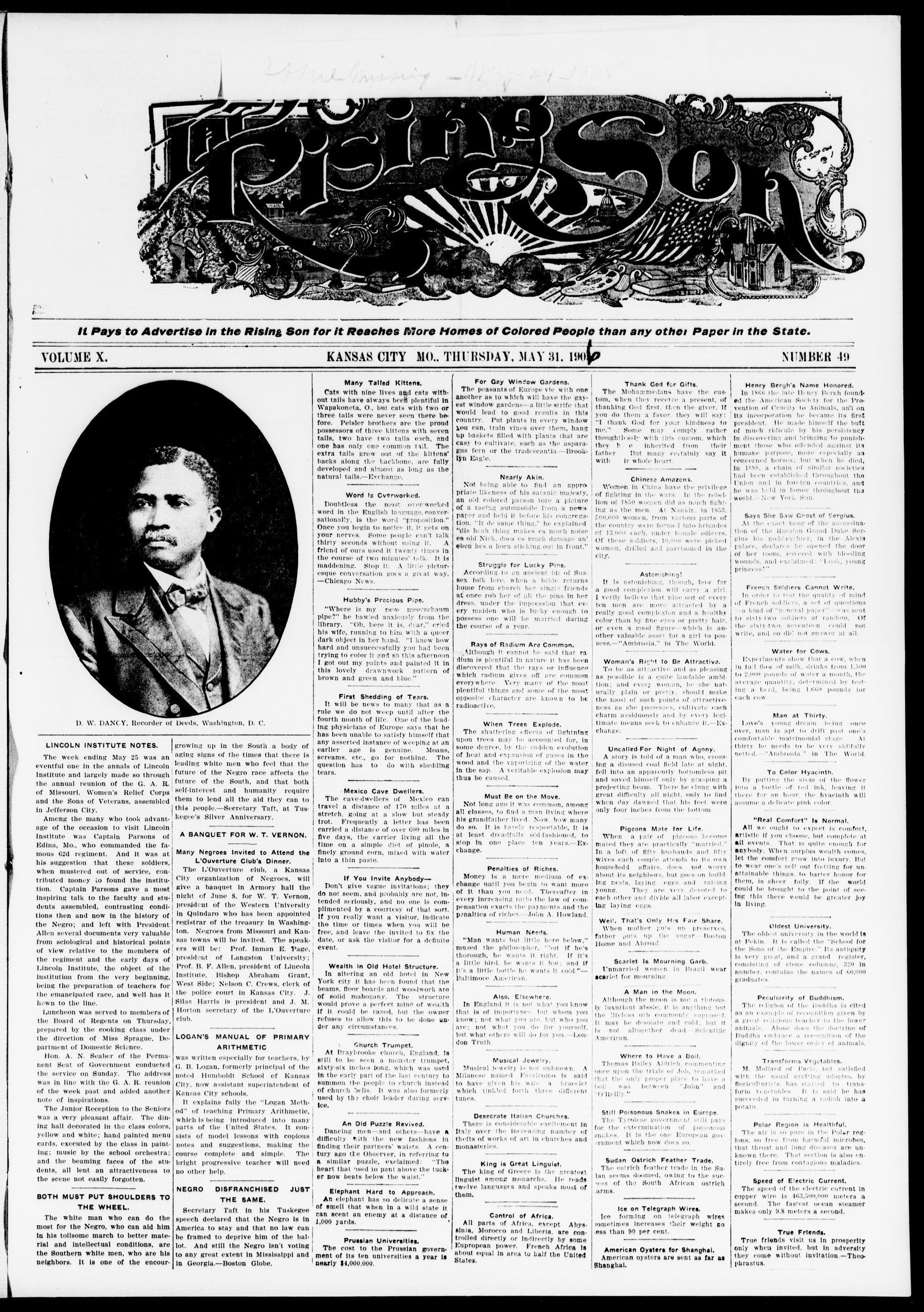
D. W. DANCY, Recorder of Deeds, Washington, D. C.
VOLUME X.
D. W. DANCY, Recorder
LINCOLN INSTITUTE NOTES.
The week ending May 25 was an eventful one in the annals of Lincoln Institute and largely made so through the annual reunion of the G. A. R. of Missouri, Women's Relief Corps and the Sons of Veterans, assembled in Jefferson City.
Among the many who took advantage of the occasion to visit Lincoln Institute was Captain Parsons of Edina, Mo., who commanded the famous 62d regiment. And it was at his suggestion that these soldiers, when mustered out of service, contributed money to found the institution. Captain Parsons gave a most inspiring talk to the faculty and students assembled, contrasting conditions then and now in the history of the Negro; and left with President Allen several documents very valuable from sciological and historical points of view relative to the members of the regiment and the early days of Lincoln Institute, the object of the institution from the very beginning, being the preparation of teachers for the emancipated race, and well has it hewn to the line.
Luncheon was served to members of the Board of Regents on Thursday, prepared by the cooking class under the direction of Miss Sprague, Department of Domestic Science.
Hon. A. N. Seaber of the Permanent Seat of Government conducted the service on Sunday. The address was in line with the G. A. R. reunion of the week past and added another note of inspirations.
The Junior Reception to the Seniors was a very pleasant affair. The dining hall decorated in the class colors, yellow and white; hand painted menu cards, executed by the class in painting; music by the school orchestra; and the beaming faces of the students, all lent an attractiveness to the scene not easily forgotten.
BOTH MUST PUT SMOULDERS TO THE WHEEL.
The white man who can do the most for the Negro, who can aid him in his tollsome march to better material and intellectual conditions, are the Southern white men, who are his neighbors. It is one of the encour-
growing up in the South a body of aging signs of the times that there is leading white men who feel that the future of the Negro race affects the future of the South, and that both self-interest and humanity require them to lend all the aid they can to this people.—Secretary Taft, at Tuskegee's Silver Anniversary.
A BANQUET FOR W. T. VERNON.
Many Negroes Invited to Attend the L'Ouverture Club's Dinner.
The L'Ouverture club, a Kansas City organization of Negroes, will give a banquet in Armory hall the night of June 8, for W. T. Vernon, president of the Western University in Quindarro who has been appointed registrar of the treasury in Washington. Negroes from Missouri and Kansas towns will be invited. The speakers will be: Prof. Inman E. Page, president of Langston University; Prof. B. F. Allen, president of Lincoln Institute. Bishop Abraham Grant, West Side; Nelson C. Crews, clerk of the police court in Kansas City. J. Silas Harris is president and J. M. Horton secretary of the L'Ouverture club.
LOGAN'S MANUAL OF PRIMARY
ARITHMETIC
was written especially for teachers, by G. B. Logan, formerly principal of the noted Humboldt School of Kansas City, now assistant superintendent of Kansas City schools.
It explains fully the "Logan Method" of teaching Primary Arithmetic, which is being introduced into many parts of the United States. It consists of model lessons with copious notes and suggestions, making the course complete and simple. The bright progressive teacher will need no other help.
NEGRO DISFRANCHISED JUST
THE SAME.
Secretary Taft in his Tuskegee speech declared that the Negro is in America to stay and that no law can be framed to deprive him of the ballot. And still the Negro isn't voting to any great extent in Mississippi and in Georgia.—Boston Globe.
Many Talled Kittens.
Cats with nine lives and cats without tails have always been plentiful in Wapakoneta, O., but cats with two or three tails were never seen there before. Pelsier brothers are the proud possessors of three kittens with seven tails, two have two tails each, and one has only one common tail. The extra tails grow out of the kittens' backs along the backbone, are fully developed and almost as long as the natural tails.—Exchange.
Word Is Overworked
Doubtless the most overworked word in the English language conversationally, is the word "proposition." Once you begin to notice it, it gets on your nerves. Some people can't talk thirty seconds without using it. A friend of ours used it twenty times in the course of two minutes' talk. It is maddening. Stop it. A little pictureque conversation goes a great way. —Chicago News.
Hubby's Precious Pine
"Where is my new meerschaum pipe?" he bawled anxiously from the library. "Oh, here it is, dear," cried his wife, running to him with a queer dark object in her hand. "I knew how hard and unsuccessfully you had been trying to color it and so this afternoon I got out my paints and painted it in this lovely drawnwork pattern of brown and green and blue."
First Shedding of Tears
It will be news to many that as a rule we do not weep until after the fourth month of life. One of the leading physicians of Europe says that he has been unable to satisfy himself that any asserted instance of weeping at an earlier age is genuine. Mouns, screams, etc., go for nothing. The question has to do with shedding tears.
Mexico Cave Dwellers.
The cave-dwellers of Mexico can travel a distance of 170 miles at a stretch, going at a slow but steady trot. Frequently a letter has been carried a distance of over 600 miles in five days, the carrier living all the time on a simple diet of pinole, a finely ground corn, mixed with water into a thin paste.
If You Invite Anybody—
Don't give vague invitations; they do not seem, and probably are not, intended seriously, and no one is complimented by a courtesy of that sort. If you really want a visitor, indicate the time or times when you will be free, and leave the invited to fix the date, or ask the visitor for a definite event.
Wealth in Old Hotel Structure.
In altering an old hotel in New York city it has been found that the beams, floor boards and woodwork are of solid mahogany. The structure would prove a perfect mine of wealth if it could be razed, but the owner refuses to allow this to be done under any circumstances.
Church Trumpet.
At Braybrooke church, England, is still to be seen a monster trumpet, sixty-six inches long, which was used in the early part of the last century to summon the people to church instead of church bellis. It was also formerly used by the choir leader during service.
An Old Puzzle Revived:
Dancing men—and others—have a difficulty with the new fashions in finding their partners' waists. A century ago the Observer, in referring to a similar puzzle, exclaimed: "The heart that used to pant above the tucker now beats below the waist."
Elephant Hard to Approach
Elephant Hard to Approach. An elephant has so delicate a sense of smell that when in a wild state it can scent an enemy at a distance of 1,000 yards.
Prussian Universities
The cost to the Prussian government of its ten universities a year is nearly $4,000,000.
For Gay Window Gardens
The peasants of Europe vie with one another as to which will have the gayest window gardens—a little strife that would lead to good results in this country. Put plants in every window you can, train vines over them, hang up baskets filled with plants that are easy to cultivate, such as the asparagus fern or the tradescantia—Brooklyn Eagle.
Nearly Akin.
Not being able to find an appropriate likeness of his satanic majesty, an old colored parson tore a picture of a racing automobile from a newspaper and held it before his congregation. "It de same thing," he explained "dish heath thing makes es much noisse es old Nick, does es much damage an ebenhes a horn sticking out in front."
Struggle for Lucky Pins.
According to an ancient bit of Sussex folk lore, when a bride returns home from church her single friends at once rob her of all the pins in her dress, under the impression that every maiden who is lucky enough to possess one will be married during the course of a year.
Rays of Badium Are Common
Although it cannot be said that radium is plentiful in nature it has been discovered that the rays or influence which radium gives off are common everywhere. Very many of the most plentiful things and some of the most opposite character are known to be radioactive.
When Trees Explode
The shattering effects of lighting upon trees may be accounted for, in some degree, by the sudden evolution of heat and expansion of gases in the wood and the vaporizing of the water in the sap. A veritable explosion may thus be caused.
Must Be on the Move
Not long ago it was common, among all classes, to find a man living where his grandfather lived. Now, how many do so. It is barely respectable, it is at least dreadfully old-fashioned, to stop in one place ten years.—Exchange.
Penalties of Riches
Money is a mere medium of exchange until you begin to want more of it than you need. Thereafter in every increasing ratio the law of compensation exacts the payments and the penalties of riches...John A. Howland.
Human Needs
"Man wants but little here below," mused the philosopher, "but if he's thorough, he wants it right. If it's a little bird, he wants it hot; and if it's a little bottle he wants it cold."—Baltimore American.
Also. Elsewhere.
In England it is not what you know that is of importance, but whom you know; not what you are, but who you are; not what you do for yourself, but what others will do for you.—London Truth.
Musical Jewelry.
Musical jewelry is not unknown. A Milanese named Fussicomo is said to have given his wife a bracelet which tinkled forth three different tunes.
Desecrate Italian Churches
There is considerable excitement in Italy over the increasing number of thefts of works of art in churches and monasteries.
King is Great Linguist
The king of Greece is the greatest linguist among monarchs. He reads twelve languages and speaks most of them.
Control of Africa
All parts of Africa, except Abyssinia, Morocco and Liberia, are controlled directly or indirectly by some European power. French Africa is about equal in area to half the United States.
Thank God for Gifts.
The Mohammedans have the custom, when they receive a present, of thanking God first, then the giver. If you do them a favor they will say; "I thank God for your kindness to me." Some may comply rather thoughtlessly with this custom, which they be inherited from their father. But many certainly say it with ir whole heart.
Chinese Amazons.
Women in China have the privilege of fighting in the wars. In the rebellion of 1850 women did as much fighting as the men. At Nankin, in 1853, 500,000 women, from various parts of the country were formed into brigades of 13,000 each, under female officers. Of these soldiers, 10,000 were picked women, drilled and garrisoned in the city.
Astonishing!
It is astonishing, though, how for a good complexion will carry a girl. I verily believe that nine out of every ten men are more attracted by a really good complexion and a healthy color than by fine eyes or pretty hair, or even a good figure—which is another valuable asset for a girl to possess,—"Ambrosia," in The World.
Woman's Right to Be Attractive.
Woman's Right to Be Attractive.
To be as attractive and as pleasing as possible is a quite laudable ambition; and every woman, be she naturally plain or pretty, should make the most of such points of attractiveness as she possesses, cultivate each charm assiduously and by every legitimate means seek to enhance it.—Exchange.
Uncalled-For Night of Agony
A story is told of a man who, crossing a disused coal field late at night, fell into an apparently bottomless pit and saved himself only by grasping a projecting beam. There he clung with great difficulty all night, only to find when day dawned that his feet were only four inches from the bottom.
Pigeons Mate for Life
When a pair of pigeons become mated they are practically "married." In a loft of fifty husbands and fifty wives each couple attends to its own household affairs, does not worry about its neighbors, but goes on building nests, laying eggs and raising young. They are very devoted to each other and divide all labor excepting laying eggs.
Well, That's Only His Fair Share. When mother puts up preserves, father puts up the sugar-Boston Home and Abroad.
Scarlet Is Mourning Garb. Unmarried women in Brazil wear scarlet for mourning.
A Man in the Moon.
Although the moon is not a riotously luxurious abode, it is anything but the lifeless or commonly supposed. It may be desolate and cold; but it is not altogether dead—Scientific American.
Where to Have a Boil
Thomas Bailey Aldrich commenting once upon the trials of Job, remarked that the only proper place to have a boil was between "John" and "O'Reilly."
Still Poisonous Snakes in Europe
Still Poisonous Snakes in Europe.
The Tyrolese government still pays for the extermination of poisonous snakes. It is the one European government which now does so.
Sudan Ostrich Feather Trade.
The ostrich feather trade in the Sudan seems doomed, owing to the success of the South African ostrich arms.
Ice on Telegraph Wires
Ice on Telegraph Wires.
Ice forming on telegraph wires sometimes increases their weight no less than 90 per cent.
American Oysters for Shanghai.
American oysters are sent as far as Shanghai.
NUMBER 49
Henry Bergh's Name Honored.
In 1868 the late Henry Berch founded the American Society for the Prevention of Cruelty to Animals, and on its incorporation he became its first president. He made himself the butt of much ridicule by his persistence in discovering and bringing to punishment those who offended against its humane purpose, more especially as concerned horses; but when he died, in 1888, a chain of similar societies had been established throughout the Union and in foreign countries, and he was held in honor throughout the world—New York Sun.
Says She Saw Ghost of Sergius.
At the exact hour of the assassination of the Russian Grand Duke Sergius his golddaughter, in the Alexis palace, declares he opened the door of her room, covered with bleeding wounds, and exclaimed: "Look, young princess!"
French Soldiers Cannot Write
In order to test the quality of mind of French soldiers, a set of questions—a kind of "general paper"—was sent to sixty-two soldiers at random. Of the sixty-two, seventeen could not write, and so did not answer at all.
Water for Cows.
Experiments show that a cow, when in full flow of milk, drinks from 1,500 to 2,000 pounds of water a month, the average quantity, determined by testing a bird, being 1,660 pounds for each cow.
Man at Thirty.
Love's young dream being once over, man is apt to drift past one's comfortable matrimonial stage. At thirty he needs to be very skilfully netted. "Ambrosla" in The World
To Color Hxacinth
By putting the stem of the flower into a bottle of red ink, leaving it there for an hour, the hyacinth will assume a delicate pink color.
"Real Comfort" Is Normal
All we ought to expect is comfort, artistic if you choose, but complete at all events. That is quite enough for anybody. When surplus wealth comes, let the comfort grow into luxury. But to wear one's self out freeting for unattainable things, to barbier honor for them, is sheer folly. If the world could be brought to the point of seeing this there would be greater joy in living.
Oldest University
The oldest university in the world is at Pekin. It is called the "School for the Sons of the Empire." Its antiquity is very great, and a grand register, consisting of stone columns, 320 in number, contains the names of 60,000 graduates.
Peculiarity of Buddhism.
The religion of the Buddha is cited as an example of recognition given by a great religious teacher to the lower animals. Alone does the doctrine of Buddha embrace a recognition of the dignity of the lower order of animals.
Transforms Vegetables
M. Mollard of Paris, not satisfied with the usual grafting adopted, by floricultists, has started to trans form vegetables. It is said he has succeeded in turning a radish into a potato.
Polar Region is Healthful.
The air is so pure in the Polar regions, so free from harmful microbes, that throat and lung diseases are unknown there. That section is also entirely free from contagious malades.
Speed of Electric Current
The speed of the electric current in copper wire is 463,500,000 meters a second. The fastest ocean steamer makes only 9.8 meters a second.
True Friends.
True friends visit us in prosperity only when invited, but in adversity they come without invitation—Theophrastus.
SCHOOLGIRL'S DRESS
SHOULD NOT THINK TOO MUCH
ABOUT THIS VEXATIOUS
MATTER.
Most Schoolgirls Too Young and Too Pretty to Require Much Ornament in Their Dress—Don't Worry About Your Figure If Your Dress Is Comfortable—Health Is the Great Beautifier.
BY MARGARET E. SANGSTER.
"Jessie has reached the age when she tusses and fidgets about her dress, looks at herself in the glass, worries because her cloak or her hat or her jacket or something else, is last year's style, and altogether behaves like a vain and silly girl," exclaimed Jessie'sunt Marion, who had no patience with such trivialous conduct.
"If Jesse had been the fourth daughter in a large family," said Mary Ellenboth, looking up with a smile, "she would have learned to be thankful for small favors. Until I had passed my thirteenth birthday I never once went out of the house with a costume every bit of which had been made for me. I usually wore Susan's last year's frocks and Mildred's last year's hats, retrimmed and freshened up, and when I had a jacket it had been worn before me by Ethel. Mother always bought good things that would last and they lasted until several children wore them out. I was cured of fussiness before so much as a wee leaf of it cropped up in my character. Generally speaking I had new shoes and that was a comfort."
is with an air of serious attention.
"I love pretty things," said she,
"and I hate ugly ones. Why shall sister
Louise, who is a young lady, wear
a corset that gives her a good figure
while I have no figure at all am
obliged to wear a cored waist, and
button my skirts to it?"
By this time I was so stirred up
that I was compelled to intrude my
views on the girls.
"What on earth can you be thinking of, Jessie? A school girl's first duty to herself is to wear heartful dress and although corsets are excellent and suitable in their place for grown up young women, they are not parts of hygienic dress for you. I hope that you spend a good many hours every day out of doors, and that your director of physical culture superintends your calisthenics and your exercises in the gymnasium. The gym is as much an educational place for you as the Latin class or the recitation room where you study and present any other abstruse subject in the school. For daily use a school girl needs well-made boosy fitting blouses and skirts, and the weight of her clothing should hang not from the hips but from the shoulder.
"Deep breathing is your great necessity; your lungs should be filled daily and often with the purest air and your chest have abundant room to expand. As for shoes, you must have common sense lasts broad enough in the sole and low enough in the heel to enable you to walk with ease and grace. A school girl must not wear a tight shoe nor a high heel. You are too young and too pretty to require much ornament in your dress, and there is no sense in your fussing over shirt-walts and simple stocks, hair ribbons and belt 4.
"Once your wardrobe is supplied with what is comfortable and you have equipped yourself with a golf cape, a rain-coat and a sailor hat, you are ready for every occasion."
"For reception and commence-
nents and Sunday evenings at home?"
queried Jessie, her dimples playing
hide and seek as she archly glanced
at me.
"I beg your pardon," I answered.
"A girl does need one or two dainty frocks for evening wear and they should preferably be white. The simpler they are the more suitable they are sure to be. A great many trucks, puffs, ruffles and lace insertions are misplaced in a girl's dress while she is yet in her teens. There may be, of course, some unobtrusive decorations, but not very much is needed for she herself sets off her gown. I like to think, too, that a girl who is growing up takes a little time now and then to bestow attention on the haundress who has to wash and iron the dainty muslins that are so elaborate and so beautifully finished with lace edges and delicate embroideries.
"A girl who has once or twice done her own laundry work, washed, and froned a white muslin gown, or a duck skirt, will know by experience that it is far from easy work, and she will be somewhat careful about frequently sending it to the tub, than her friend who has had no such personal knowledge of the labor involved."
No young girl has the slightest occasion to worry about her figure if only she has a dress that fits her comfortably, if she stands up straight throwing back her shoulders and holding up her head. The figure will take care of itself. Health is the great beautifier and sensible dress is for young people its best ally.
Fortunately for young girls, there is no question about the length of their skirts. For everyday wear frocks that reach the ankle, are comfortable and insure ease in walking, and immunity from contact with mud and dirt. For functions such as Jessie referred to in her naive question about receptions and Sunday evenings, a girl's best gown while she is in her teens may be instep length. Girls never wear trailing skirts in these
days. An excellent adjunct to cleanliness, comfort and health is a whisk broom or a clothes-brush scruppulously used every time a dress is taken off. If we would carefully brush our clothes and shake them out of an open window before hanging them in closets or wardrobes, we should rid ourselves of the danger of germs that may have lurked in outside dust.
Girls should be grateful that their lot is cast in the twentieth century. An eighteenth century girl, or one born in the early nineteenth, wore a short-wasted frock with the skirt beginning under the arm-pits. It was of clinging stuff and swept the floor as she walked. Her shoes were thin slippers without heels held on by strings crossed over the instep and around the ankles. On her head she often wore a construction of muslin and wire that was half turban and half cap. Her sleeves were short and her dresses half low at the neck, as a rule. Do you not think that you are much better dressed than she was, both for health and beauty? (Copyright, 1905, by Joseph B. Bowles.)
ADVICE ABOUT THE TEETH
Select the Brush with Care, Consult a Dentist Whenever Certain Symptoms Appear.
So many people show little discrimination in the choice of tooth brushes. It is equally wrong to have them too soft or too hard. This ought to be as certainable by the touch, and they should not be used for any length of time, but at once discarded. Cheap brushes with which the market is now flooded are an abomination, for the hairs are sure to come out and lodge between the teeth, causing much discomfort, and, moreover, the bristles are often secured in such a way with wire that it becomes dislodged, and pricks the gums. Teeth should always be closely watched, and if the gums recode or any decay is perceived, recourse should be had at once to a dentist, for in dentistry a stitch in time does not save nine but ninety. Once let decay get any deep hold little can be done, but it is easy to arrest it at the beginning.
Parents cannot be too careful in instilling into their children early the necessity of care and attention to the teeth. It seems quite a weakness in the young to shirk tooth cleaning, and moreover, mothers should watch the growth of the second teeth, that there is no overcrowding. In early youth many defects can be cured by proper treatment. Teeth that are growing far apart can be brought together easily; it would be a far more difficult matter later on when the gums are harder and the teeth have attained their full growth, but care should begin before the first teeth have been exchanged. It indicates something wrong if they decay, and it is a state of things that would be likely to repeat itself.
The writer remembers how as a child an old nurse who had been in the same post for two generations took infinite pains to teach her charges exactly how they should clean their teeth. She always said that pastes and liquid dentifrices were all very well in their way, but that powder should be used once a week at least, and that there was a great art in using a proper brush, which should be small and soft, and not too big for the mouth. It should be not only passed from one side to the other, but up and down, and great care taken to clean the back teeth as well as the front; finally it was essential to wash out the mouth with water, to which a few drops of fragrant dentifrices liquid should be added.
FROM FOREIGN LANDS.
One Can Put Great Deal of Money Into Tiny Turn-Overs of Exquisite Make.
It is strange what a little extra thrill of delight one has in possessing a dainty article of wearing apparel that came from a long, long distance, writes a lady in the Ohio Farmer.
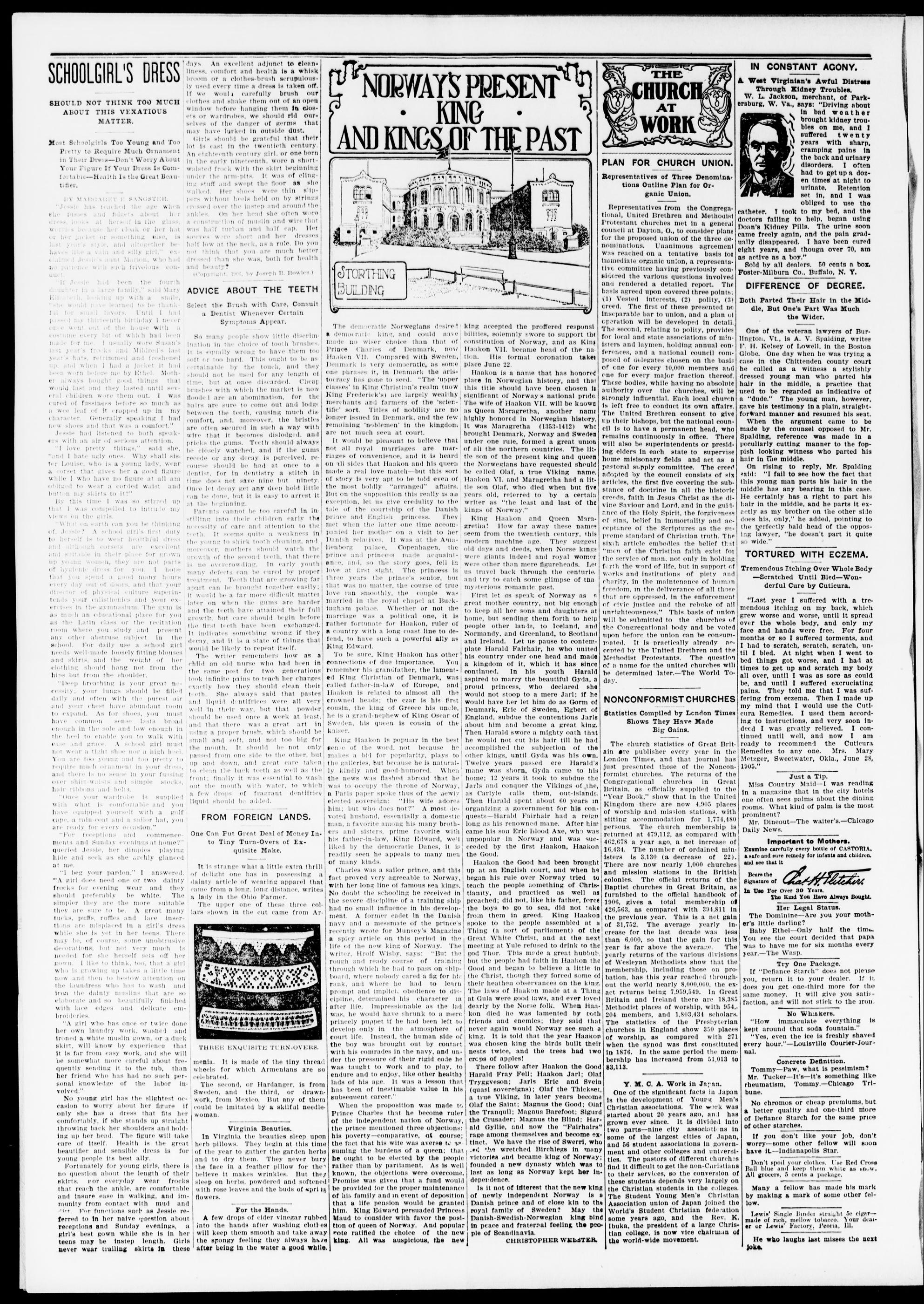
The upper one of these three collars shown in the cut came from Ard
THREE EXQUISITE TURN-OVERS.
menla. It is made of the tiny thread wheels for which Armenians are so celebrated.
The second, or Hardanger, is from Sweden, and the third, or drawwork, from Mexico. But any of them could be imitated by a skilful needle woman.
Virginia Beauties.
In Virginia the beauties sleep upon herb pillows. They begin at this time of the year to gather the garden herbs and to dry them. They never bury the face in a feather pillow for the believe it makes wrinkles. But they sleep on herbs, powdered and softened with rose leaves and the buds of spring flowers.
For the Hands.
A few drops of elder vinegar rubbed into the hands after washing cloths will keep them smooth and take away the spongy feeling they always have after being in the water a good while.
NORWAY'S PRESENT KING AND KINGS OF THE PAST
STORTHING
BUILDING
The democratic Norwegians desired a democratic king, and could have made no wiser choice than that of Prince Charles of Denmark, now Haaken VII. Compared with Sweden, Denmark is very democratic, as some one phrases it, in Denmark the aristocracy has gone to seed. "The 'upper classes' in King Christian's realm (now King Frederick's) are largely wealthy merchants and farmers of the 'scientific' title. Titles of nobility are no longer issued in Denmark, and the few remaining 'noblemen' in the kingdoms are not much seen at court.
It would be pleasant to believe that not all royal marriages are marriages of convenience, and it is heard on all sides that Haakon and his queen made a real love match—but this sort of story is very apt to be told even of the most boldly "arranged" affairs. But on the supposition this really is an exception, let us give credulity to the tale of the courtship of the Danish prince and English princess. They met when the latter one time accompanied her mother on a visit to her Danish relatives. It was at the Aumlénborg palace, Copenhagen, the prince and princess made acquaintance, and, so the story goes, fell in love at first sight. The princess is three years the prince's senior, but that was no matter, the course of true love ran smoothly, the couple was married in the royal chapel at Buckingham palace. Whether or not the marriage was a political one, it is rather fortunate for Haakon, ruler of a country with a long coast line to defend, to have such a powerful ally as King Edward.
To be sure, King Haakon has other connections of due importance. You remember his grandfather, the lamented King Christian of Denmark, was called father-in-law of Europe, and Haakon is related to almost all the crowned heads; the czar is his first cousin, the king of Greece his uncle, he is a grand-nephew of King Oscar of Sweden, his queen is cousin of the kaiser.
King Haakon is popular in the best sense of the word, not because he makes a bid for popularity, plays to the galleries, but because he is naturally kindly and good-humored. When the news was flashed abroad that he was to occupy the throne of Norway, a Paris paper spoke thus of the newly elected sovereign: "His wife adores him; but who does not?" A most devoted husband, essentially a domestic man, a favorite among his many brothers and sisters, prime favorite with his father-in-law, King Edward, well liked by the democratic Danes, it is readily seen he appeals to many men of many kinds.
Charles was a sailor prince, and this fact proved very agreeable to Norway, with her long line of famous sea kings. No doubt the schooling he received in the severe discipline of a training ship had no small influence in his development. A former cadet in the Danish navy and a messmate of the prince's recently wrote for Munsey's Magazine a spicy article on this period in the life of the new king of Norway. The writer, Hroelf Wisby, says: "But the rough and ready course of training through which he had to pass on shipboard, where nobody cared a fig for his rank, and where he had to learn prompt and implied, obedience to discipline, determined his character in after life. Impressionable as the lad was, he would have shrunk to a mere princely puppet if he had been left to develop only in the atmosphere of court life. Instead, the human side of the boy was brought out by contact with his comrades in the navy, and under the pressure of their rigid code he was taught to work and to play, to endure and to enjoy, like other healthy lads of his age. It was a lesson that has been of inestimable value in his subsequent career."
When the proposition was made to Prince Charles that he become ruler of the independent nation of Norway, the prince mentioned three objections: his poverty—comparative, of course; the fact that his wife was averse to assuming the burdens of a queen; that he ought to be elected by the people rather than by parliament. As is well known, the objections were overcome. Promise was given that a fund would be provided for the proper maintenance of his family and in event of deposition that a life pension would be granted him. King Edward persuaded Princess Maud to consider with favor the position of queen of Norway. And popular vote ratified the choice of the new king. All was auspicious, the new
king accepted the proffered responsibilities, solemnly swore to support the constitution of Norway, and as King Haakon VII, became head of the nation. His formal coronation taken place June 22.
Haakon is a name that has honored place in Norwegian history, and that this title should have been chosen is significant of Norway's national pride. The wife of Haakon VII. will be known as Queen Maragretha, another name highly honored in Norwegian history. It was Maragretha (1353-1412) who brought Denmark, Norway and Sweden under one rule, formed a great union of all the northern countries. The little son of the present king and queen the Norwegians have requested should be called Olaf, a true Viking name, Haakon VI. and Maragretha had a little son Olaf, who died when but five years old, referred to by a certain writer as "the least and last of the kings of Norway."
King Haakon and Queen Maragretha! How far away these names seem from the twentieth century, this modern machine age. They suggest old days and deeds, when Norse kings were giants indeed and royal women were other than more figureheads. Let us travel back through the centuries, and try to catch some glimpse of that mysterious romantic past.
First let us speak of Norway as a great mother country, not big enough to keep all her sons and daughters at home, but sending them forth to help people other lands, to Iceland, and Normandy, and Greenland, to Scotland and Ireland. Let us pause to contemplate Harald Fairhair, he who united his country under one head and made a kingdom of it, which it has since continued. In his youth Harald aspired to marry the beautiful Gyda, a proud princess, who declared she would not stoop to a mere Jarl; if he would have her let him do as Gorm of Denmark, Eric of Sweden, Egbert of England, subdue the contentious Jarls about him and become a great king. Then Harald swore a mighty oath that he would not cut his hair till he had accomplished the subjection of the other kings, until Gyda was his own. Twelve years passed ere Harald's mane was shorn, Gyda came to his home; 12 years it took to subdue the Jarls and conquer the Vikings of the, as Carlyle calls them, out-islands. Then Harald spent about 60 years in organizing a government for his conquests—Harald Fairhair had a reign long as his renowned mane. After him came his son Eric Blood Axe, who was unpopular in Norway and was succeeded by the first Haakon, Haakon the Good.
Haakon the Good had been brought up at an English court, and when he began his rule over Norway tried to teach the people something of Christianity, and practiced as well as preached; did not, like his father, force the boys to go to sea, did not take from them in greed. King Haakon spoke to the people assembled at a Thing (a sort of parliament) of the Great White Christ, and at the next meeting at Yule refused to drink to the god Thor. This made a great hubbub, but the people had faith in Haakon the Good and began to believe a little in the Christ, though they forced some of their heathen observances on the king. The laws of Haakon made at a Thing at Gula were good laws, and ever loved dearly by the Norse folk. When Haakon died he was lamented by both friends and enemies; they said that never again would Norway see such a king. It is told that the year Haakon was chosen king the birds built their nests twice, and the trees had two crocs of apples!
There follow after Haakon the Good Harald Fray Fell; Haakon Jarl; Olaf Tryggveson; Jarls Eric and Svein (quasi sovereigns); Olaf the Thickset, a true Viking, in later years become Olaf the Saint; Magnus the Good; Olaf the Tranquill; Magnus Barefoot; Sigurd the Crusader; Magnus the Blind; Harald Gyllie, and now the "Fairhairs" rage among themselves and become extinct. We have the rise of Swerrl, who did the wretched Birchlegs in many victories and became king of Norway; founded a new dynasty which was to last as long as Norway kept her independence. Is it not of interest that the new king of newly independent Norway is a Danish prince and of close kin to the royal family of Sweden? May the Danish-Swedish-Norwegian king bind in peace and fraternal feeling the people of Scandinavia.
CHRISTOPHER WEBSTER
THE
CHURCH
AT
WORK
PLAN FOR CHURCH UNION.
Representatives of Three Denominations Outline Plan for Organic Union.
Representatives from the Congregational, United Brethren and Methodist Protestant churches met in a general council at Dayton, O., to consider plans for the proposed union of the three denominations. Unanimous agreement was reached on a tentative basis for immediate organic union, a representative committee having previously considered the various questions involved and rendered a detailed report. The basis agreed upon covered three points: (1) Vested interests, (2) polity, (3) creed. The first of these presented no inseparable bar to union, and a plan of operation will be developed in detail. The second, relating to polity, provides for local and state associations of ministers and laymen, holding annual conferences, and a national council composed of delegates chosen on the basis of one for every 10,000 members and one for every major fraction thereof. These bodies, having no absolute authority over the churches, will be strongly influential. Each local church is left free to conduct its own affairs. The United Brethren consent to give up their bishops, but the national council is to have a permanent head, who remains continuously in office. There will also be superintendents or presiding elders in each state to supervise home missioners in each field and act as a postoral supply committee. The creed adopted by the council consists of six articles, the first five covering the substance of doctrine in all the historic creeds, faith in Jesus Christ as the divine Saviour and Lord, and in the guidance of the Holy Spirit, the forgiveness of sins, belief in immortality and acceptance of the Scriptures as the supreme standard of Christian truth. The sixth article embodies the belief that "men of the Christian faith exist for the service of man, not only in holding forth the word of life, but in support of works and institutions of piety and charity, in the maintenance of human freedom, in the deliverance of all those that are oppressed, in the enforcement of civic justice and the rebuke of all unrighteousness." This basis of union will be submitted to the churches of the Congregational body and be voted upon before the union can be consumed. It is practically already accepted by the United Brethren and the Methodist Protestants. The question of a name for the united churches will be determined later.—The World Today.
NONCONFORMIST CHURCHES
Statistics Compiled by London Times Shows They Have Made Big Gains.
The church statistics of Great Britain are publisher every year in the London Times, and that journal has just presented those of the Nonconformist churches. The returns of the Congregational churches in Great Britain, as officially supplied to the "Year Book," show that in the United Kingdom there are now 4,905 places of worship and mission stations, with sitting accommodation for 1,774,480 persons. The church membership is returned at 479,112, as compared with 462,678 a year ago, a net increase of 16,434. The number of ordained ministers is 3,139 (a decrease of 22). There are now nearly 1,000 churches and mission stations in the British colonies. The official returns of the Baptist churches in Great Britain, as furnished to the official handbook of 1906, gives a total membership of 426,563, as compared with 294,811 in the previous year. This is a net gain of 31,752. The average yearly increase for the last decade was less than 6,000, so that the gain for this year is far above the average. The yearly returns of the various divisions of Wesleyan Methodists show that the membership, including those on probation, has this year reached through out the world nearly 8,000,000, the exact returns being 7,959,549. In Great Britain and Ireland there are 18,385 Methodist places of worship, with 954,204 members, and 1,803,434 scholars. The statistics of the Presbyterian churches in England show 350 places of worship, as compared with 271 when the synod was first constituted in 1876. In the same period the membership has increased from 51,013 to 83,113.
Y. M. C. A. Work in Japan.
One of the significant facts in Japan is the development of Young Men's Christian associations. The work was started about 20 years ago, and has grown ever since. It is divided into two parts—nine city associations in some of the largest cities of Japan, and 56 student associations in government and other colleges and universities. The pastors of different churches find it difficult to get the non-Carolians to their services, so the conversion of these students depends very largely on the Christian students in the colleges. The Student Young Men's Christian Association union of Japan joined the World's Student Christian federation some years ago, and the Rev. K. Ibuka, the president of a large Christian college, is now vice chairman of the world-wide movement.
IN CONSTANT AGONY.
A West Virginian's Awful Distress Through Kidney Troubles.
in bad weather
brought kidney troubles on me, and I
suffered twenty
years with sharp,
cramping pains in
the back and urinary
disorders. I often
had to get up a dozen
times at night to
urinate. Retention
set in, and I was
obliged to use the
in bad weather brought kidney troubles on me, and I suffered twenty years with sharp, cramping pains in the back and urinary disorders. I often had to get up a dozen times at night to urinate. Retention set in, and I was obliged to use the catheter. I took to my bed, and the doctors falling to help, began using Doan's Kidney Pills. The urine soon came freely again, and the pain gradually disappeared. I have been cured eight years, and though over 70, am as active as a boy." Sold by all dealers. 50 cents a box. Foster-Milburn Co., Buffalo, N. Y.
DIFFERENCE OF DEGREE.
Goth Parted Their Hair in the Middle, But One's Part Was Much the Wider.
One of the veteran lawyers of Buril-
niont, Vt., is A. V. Spalding, writes
F. H. Kelsey of Lowell, in the Boston
Globe. One day when he was trying a
case in the Chittenden county court
he called as a witness a stylishly
dressed young man who parted his
hair in the middle, a practice that
used to be regarded as indicative of
a "dude." The young man, however,
gave his testimony in a plain, straight-
forward manner and resumed his seat.
When the argument came to be
made by the counsel opposed to Mr.
Spalding, reference was made in a
peculiarly cutting manner to the fop-
ish looking witness who parted his
hair in the middle.
On rising to reply, Mr. Spalding said: "I fail to see how the fact that this young man parts his hair in the middle has any bearing in this case. He certainly has a right to part his hair in the middle, and he parts it exactly as my brother on the other side does his, only." he added, pointing to the perfectly bald head of the opposing lawyer, "he doesn't part it quite so wide."
TORTURED WITH ECZEMA.
Tremendous Itching Over Whole Body
—Scratched Until Bied—Wonderful Cure by Cuticura.
"Last year I suffered with a tremendous itching on my back, which grew worse and worse, until it spread over the whole body, and only my face and hands were free. For four months or so I suffered torments, and I had to scratch, scratch, scratch, until I bled. At night when I went to bed things got worse, and I had at times to get up and scratch my body all over, until I was as asleep as could be, and until I suffered excruciating pains. They told me that I was suffering from eczema. Then I made up my mind that I would use the Cuticura Remedies. I used them according to instructions, and very soon indeed I was greatly relieved. I continued until well, and now I am ready to recommend the Cuticura Remedies to any one. Mrs. Mary Metzger, Sweetwater, Okla., June 28, 1905."
Just a Tip.
Miss Country Maid-I was reading in a magazine that in the city hotels one often sees palms about the dining rooms. What kind of palm is the most prominent?
Mr. Dineout-The waiter's.-Chicago Daily News.
Important to Mothers.
Examine carefully every bottle of CASTORIA, a safe and sure remedy for infants and children, and see that it
Charles H. Patterson
Over 30 Years
The Dominine—Are you your mother's little darling?
Baby Ethel—Only half the time. You see the court decided that papa was to have me for six months every year.—The Wasp.
Try One Package.
If "Defiance Starch" does not please you, return it to your dealer. If it does you get one-third more for the same money. It will give you satisfaction, and will not stick to the iron.
No Whiskers.
"How immaculate everything is kept around that soda fountain." "Yes, even the ice is freshly shaved every hour."—Louisville Courier-Journal.
Concrete Definition
Tommy—Paw, what is pessimism?
Mr. Tucker—It's—it's something like rheumatism. Tommy. Chicago Tribune.
No chromosomes or cheap premiums, but a better quality and one-third more of Defiance Starch for the same price of other starches.
If you don't like your job, don't worry—some other fellow will soon have it—Indianapolis Star.
Don't spoil your clothes. Use Red Cross Ball blue and keep them white as snow. All grocers, 5 cents a package.
Many a fellow has made his mark by making a mark of some other fellow.
Lewis' Single Binder straight 5c cigar—made of rich, mellow tobacco. Your dearer or Lewis' Factory, Peoria, Ill.
He who laughs last misses the next joke.
Bubble
and
Squeak
By B. L. TAYLOR
With some extracts from the unpub-
lished work of the late Walter
Blackburn Harte.
(Copyright 1906, by Joseph B. Bowles)
---
In condemning modern literature merely because it is modern, we should remember that that which we substitute and praise because it is ancient was once modern, and if worthy of praise should be perennial, and hence modern.
Independence is a very precious and pleasant quality, but we often have to mortify the flesh and the spirit in order to gain it.
It has always seemed to me that one who truly loved literature can belong to no nation in thought.
The only providence for old age is youthful prudence.
The best conversationalist may be a dail companion, for he is apt to monopolize all the talk.
* * * * *
The English insist upon their superiority so much over all other people in and cut of season that we cannot help suspecting that they are terribly afraid of being taken for what they really are.
* * * * *
England is particularly a nation despising itself in what it might call its descending scale.
the veneration of the old 14 less reasonable than the veneration of the new—an addition to the old. The worship of the old at the expense of the new is the worship of the acorn and scorn of the grand oak tree, full of sap and vitality. The lovers of bric-a-brac forget that their cups and saucers to-morrow will be bric-a-brac, too.
Credit is usually much more impressive than cash. The young man with an account everywhere is the envy of the young man who has to pay his way.
Three plays by story tellers—H. K. Viele, Rupert Hughes and Winston Churchill—have failed in swift succession. It is a very different game, but you can't make the story-teller believes it.
Mr. Clyde Fitch is of the opinion that if "Hamlet" were produced nowadays it would be referred to as "a bully Bowyer melodrama." Very likely And yet, curiously enough, "Hamlet" reads well in book form, whereas the plays of Mr. Fitch do not.
Told by the Press Agent.
John Kendrick Bangs has a little son whom he is fond of using for cop. He is a great reader of the newspapers, though of course he does not comprehend everything that is in them. "Papa," he asked the other morning "what are the powers doing at Morocco?" "The powers, my son," replied the parent, gravely, "have gathered at Morocco to bind the peace of Europe." Mr. Bangs' new book, "The Pink Cassoway," will be published next month by the Harpers.
---
A prepossessing young lady was recently asked at a studio tea what she thought the chief characteristic of Robert W. Chambers must be. She replied promptly, "Quick action." Pressed for an explanation, she said she gained the idea from his novels, in which all his heroes make a quick get-away and win the heroine's heart in a romp. The Appletons will bring out six new books by Mr. Chambers this spring.
. . .
It will be of interest to admirers of the automobile stories by the Williamsons to know that they were entirely written in a garage. Mr. Williamson usually lies under his motor while no writes, but Mrs. Williamson prefers a gasoline barrel for a desk. Their new book, "The Road Burners," will be ready in May.
Gossip about a successful author's methods of composition is always perfectly fascinating to those outside the profession of letters, as well as to those within the charmed circle. Mary E Wilkins-Freeman is one of the most conscientious of authors. She always decides on what her story is to be before she begins writing, and then writes on ruled paper, leaving every other line blank. When the tale is finished the blank lines are filled with coloral color and the manuscript is ready for the printer. Mrs. Freeman's new novel, "The Line Fence," is in press for June.
. . .
Mrs. Pearl John Oliver Cragle-Hobbes was recently presented to the Punjab of Hellebore. "Does she write?" asked the Punjab afterwards. Write? We should say: One of her
latest books is "The Flute of Pan," which Mr. Joseph Choate said was a perfect picture of court life in England. The princess of Wales consults it on all occasions. Her new novel is awaited in select circles with the u.most interest.
. . .
Henry Wallace Phillips, author of "Mr. Scraggs," is eccentric, like all geniuses. He wears a blue and white sweater and rubber boots when invited out to dinner, and recently appeared at a wedding in carpet slippers and a macintosh. Everybody will wish to read his forthcoming book, "Damn," which has sold two editions in advance of publication.
. . .
Manager Wilson, of the Pittsburg orchestra, states that people who formerly loved music are now paying more attention to bridge whist than to music. Mr. Wilson probably means "the people who formerly pretended to love music." People are becoming more honest, due to the efforts of the magazines and the professional exposers Besides, bridge whist is not an amusement, but a disease.
"When I fight," says Marle Corelli: "I do not hit below the belt, but give my straight blows in the open." My my! Anybody like to go four round with Terrible Marie of the double chin?
The Rival Buster Browns
Nothing has been talked of in the art world for weeks past except the rival Buster Brownns. The brazen attempt of the New York Herald to palm on an imitation of Mr. Outcault's super-art productions in the New York American has been severely criticised by artists and collectors.
John La Farge said: "It is the most important art controversy since the Capitoline Venus. I hear nothing else spoken of in the ateliers. I am preparing an article on it for the Century."
Sir Purdon Clarke said: "I am glad to assure you that all the Buster Brownns in the Metropolitan museums are genuine. It is not difficult to detect the imitation. The dot representing the eyeball is never exactly in the center of the circle."
Col. Freer of Detroit said: "I have given up collecting Whistlers, and collect nothing now except Buster Brown. The conduct of the Herald is outrageous."
P. A. B. Widener of Philadelphia said: "When this matter came to my attention I went through my Buster Brown gallery very carefully, and was relieved to find I had not been imposed upon in a single instance."
Mrs. Jack Gardner of Boston, who has been in retirement since the announcement of her engagement to Mr. Bourke Cockran, emerged long enough to express her entire sympathy with Mr. Outcault. "I have one entire room in my palace which is devoted to Buster Brown. I think it's horrid of the Herald."
John S. Sargent cabled from London: "Enormous excitement in art circles here and on continent. Kindly keep me informed."
Encouraged by the success of his new magazine, "The Scrap Book," Mr Munsey is arranging to publish still another to be called "The Waste Basket."
BERT LESTON TAYLOR.
MONKEYS OF ABYSSINIA.
Large Numbers Frequent the Hills and Move About in Organized Bands.
Very similar reports are made from different parts of North Africa in relegard to the monkey tribes that occupy that continent from Morocco to Abyssinia. Just how far far tribal relations may have tended to vary the species is a question quite as important as that of language, to which Prof. Garner has given so much study. Some points of interest are found in an English book, "A Visit to Abyssinia."
"I have mentioned that large numbers of monkeys frequent these hills. They move about in organized bands and their proceedings are arranged in the most orderly and tactical manner. They are difficult to approach, unless it is gradually and cautiously done; but I have succeeded on a camel in getting within a few yards of them when they were crossing the path of me, about 50 in single file following their leader, and looking with their manes like small lions.
"Their movements are full of interest, and well repay observation; they have chiefs, sentries, and advanced and rear guards on the march. The mothers carry their children on their backs exactly like the larger human creatures in these countries. They talk and chatter, the females being especially loquacious, quarrelsome and combative. These are clearly under the command of the elder males, whose gesture alone is sufficient to reduce them to obedience. They live in small caverns among the hills, but will most certainly avoid a direct return to their haunts if followed. They are less timid of men when these are mounted on camels than when on foot, experience having doubtless taught them that the former is usually traveling to a destination, and that his steady, jogging pace is rarely interrupted by his curiosity.
"On one occasion I saw a whole family tribe on the road home after a foraging excursion, and successfully tempted some of the younger ones to leave their ranks by quietly rolling pieces of bread and sugar to them; but the older members were above such weakness, and went on in a stately way up the hill, disappearing over the ledge, and reproving the youngsters as they retired."
Modest Gray In High Fashion
In the spring a young girl's fancy earnestly turns to thoughts of gown to wear on the momentous occasion she receives her diploma, and it is none too early to consider trocks of this character. The June bride, the July graduate, the summer girl, all take deepest interest just now in filmy finery.
And filmy it is to be sure, summer stuffs so fine and thin and cobwebby Colored slips will be worn under the transparencies, the wearer of course, choosing the most becoming color; bravely eschewing fashionable rose shades if they make her look blowy, keeping to that old standby—pale-blue—if it is most kindly to her complexion.
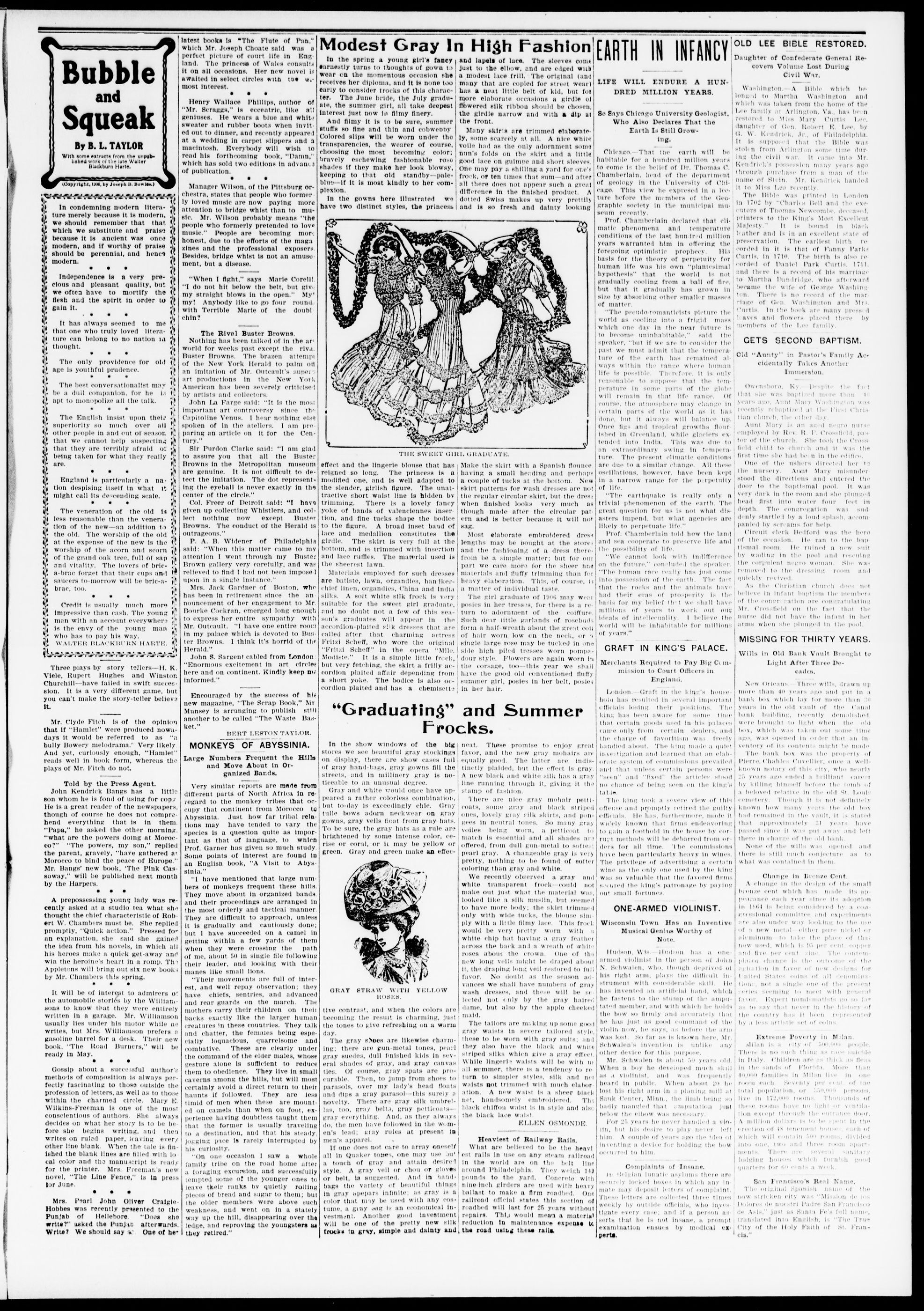
In the gowns here illustrated we have two distinct styles, the princess
3
FOLK DANCE
effect and the lingerie blouse that has reigned so long. The princess is a modified one, and is well adapted to the slender, girlish figure. The unattractive short waist line is hidden by trimming. There is a lovely fancy yoke of bands of valenciennes insertion, and fine tucks shape the bodice to the figure. A broad inset band of lace and medallion constitutes the girdle. The skirt is very full at the bottom, and is trimmed with insertion and lace ruffles. The material used is the sheerest lawn.
Make the skirt having a sma a couple of tu skirt patterns the regular cir when finished though made ern and is be sag.
Most elabor lengths may and the fash from be a sin part we care.
Materials employed for such dresses are batiste, lawn, organdies, hanker-chief linen, organdies, China and India silks. A soft white silk frock is very suitable for the sweet girl graduate, and no doubt not a few of this season's graduates will appear in the accordion-plaited silk dresses that are called after that charming actress Fritzi Scheff, who wore the original "Fritzi Scheff" in the opera "Mille, Modiste." It is a simple little frock, but very fetching, the skirt a frilly accordion plaited affair depending from a short yoke. The bodice is also accordion plaited and has a chemisette
"Graduating" Fro
"Graduating" and Summer Brocks.
In the show windows of the big stores we see beautiful gray stockings on display, there are show cases full of gray hand-bags, gray gowns fill the streets, and in millinery gray is noticeable to an unusual degree. Gray and white would once have appeared a rather colorless combination, but to-day is exceedingly chic. Gray tulle bows adorn neckwear on gray gowns, gray vells float from gray hats. To be sure, the gray hats as a rule are brightened by some intense color, cerise or coral, or it may be yellow or green. Gray and green make an effec-
GRAY STRAW WITH YELLOW ROSES.
tive contrast, and when the colors are becoming the result is charming, just the tones to give refreshing on a warm day.
The gray shoes are likewise charming; there are gun-metal tones, pearl gray suedes, dull finished kids in several shades of gray, and gray canvas tics. Of course, gray spats are procurable. Then, to jump from shoes to parasols, over my lady's head floats and dips a gray parasol—this surely a novelty. There are gray silk umbrellas, too, gray belts, gray petticoats—gray everything. And, as they always do, the men have followed in the women's lead; gray rules at present in men's apparel.
If one does not care to array oneself all in Quaker tones, one may use out a touch of gray and attain desired style. A gray veil or chon or gloves or belt, is suggested. And in handbags the variety of beautiful things in gray appears infinite; as gray is a color that may be used with any costume, a gray oag is an economical investment. Another good investment will be one of the pretty new silk frocks in gray, simple and dainty and
and lapels of lace. The sleeves come just to the elbow, and are edged with a modest lace frill. The original (and many that are copied for street wear) has a neat little belt of kid, but for more elaborate occasions a girdle of flowered silk ribbon should be chosen, the girdle narrow and with a dip at the front.
Many skir's are trimmed elaborately, some scarcely at all. A nice white volle had as the only adornment some nun's folds on the skirt and a little good lace on gulme and short sleeves. One may pay a shilling a yard for one's frock, or ten times that sum—and after all there does not appear such a great difference in the finished product. A dotted Swiss makes up very pretty and is so fresh and dainty looking
4
Make the skirt with a Spanish flounce having a small heading and perhaps a couple of tucks at the bottom. New skirt patterns for wash dresses are not the regular circular skirt, but the dress when finished looks very much as though made after the circular pattern and is better because it will not sag.
Most elaborate embroidered dress lengths may be bought at the store and the fashioning of a dress therefrom be a simple matter; but for our part we care more for the sheer nug materials and fluffy trimming than for heavy elaboration. This, of course, is a matter of individual taste.
The girl graduate of 1906 may wear posies in her tresses, for there is a return to adornment of the coiffure. Such dear little garlands of rosebuds form a half-wreath about the great coli of hair worn low on the neck, or a single large rose may be tucked in one side high piled tresses worn pompadour style. Flowers are again worn in the corsage, too—this year we shall have the good old conventioned fluffy summer girl, posies in her belt, posies in her hair.
and Summercks.
neat. These promise to enjoy great favor, and the new gray mohairs are equally good. The latter are indistinctly pladded, but the effect is gray. A new black and white silk has a gray line running through it, giving it the stamp of fashion.
There are nice gray mohair petticoats, some gray and black striped ones, lovely gray silk skirts, and ponges in neutral tones. So many gray voles being worn, a petticoat to match is essential and all shades are offered, from dull gun-metal to softer pearl gray. A changeable gray is very pretty, nothing to be found of softer coloring than gray and white.
We recently observed a gray and white transparent frock—could not make out just what the material was, looked like a slik muslin, but seemed to have more body; the skirt trimmed only with wide tucks, the blouse simply with a little filmy lace. This frock would be very pretty worn with a white chip hat having a gray feather across the back and a wreath of white roses about the crown. One of the new long veils might be draped about it, the draping long veil restored to full favor. No doubt as the season advances we shall have numbers of gray wash dresses, and these will be selected not only by the gray haired dame, but also by the apple cheeked maid.
The tailors are making up some good gray waists in severe tailored style; these to be worn with gray suits; and they also have the black and white striped silks when give a gray effect. While lingerlily waists will be with us all summer, there is a tendency to return to simpler styles, silk and net waists not trimmed with much elaboration. A new waist is a sheer black net, handsomely embroidered. The black chiffon waist is in style and also the black lace waist.
Heaviest of Railway Rails
What are believed to be the heaviest rails in use on any steam railroad in the world are on the belt line around Philadelphia. They weigh 142 pounds to the yard. Concrete with nine-inch girders are used with heavy ballast to make a firm roadbed. One railroad official states this section of roadbed will last for 25 years without repairs. This would mean a material reduction in maintenance expense to the road using these rails.
ELLEN OSMONDE
EARTH IN INFANCY
LIFE WILL ENDURE A HUNDRED MILLION YEARS.
So Says Chicago University Geologist. Who Also Declares That the Earth Is Still Grow-
Chicago. That the earth will be habitable for a hundred million years to come is the belief of Dr. Thomas C. Chamberlain, head of the department of geology in the University of Chicago. This view he expressed in a lecture before the members of the Geographic society in the municipal museum recently.
Prof. Chamberlain declared that climatic phenomena and temperature conditions of the last hundred million years warranted him in offering the foregoing optimistic prophecy. His basis for the theory of perpetuity for human life was his own "plantosimal hypothesis" that the world is not gradually cooling from a ball of fire, but that it gradually has grown in size by absorbing other smaller masses of matter.
"The pseudo-romantheists picture the world as cooling into a frigid mass which one day in the near future is to become uninhabitable," said the speaker, "but if we are to consider the past we must admit that the temperature of the earth has remained always within the range where human life is possible. Therefore, it is only reasonable to suppose that the temperature in some parts of the globe will remain in that life range. Of course, the atmosphere may change in certain parts of the world as it has done, but it always will balance up. Once figs and tropical growths flourished in Greenland, while glaciers extended into India. This was due to an extraordinary swing in temperature. The present climatic conditions are due to a similar change. All these oscillations, however, have been kept in a narrow range for the perpetuity of life.
"The earthquake is really only a trivial phenomenon of the earth. The great question for us is not what disasters impend, but what agencies are likely to perpetuate life."
Prof. Chamberlain told how the land and sea cooperate to preserve life and the possibility of life.
"We cannot look with indifference on the future," concluded the speaker.
"The human race really has just come into possession of the earth. The fact that the rocks and the animals have had their eras of prosperity is the basis for my belief that we shall have millions of years to work out our ideals of intellectuality. I believe the world will be inhabitable for millions of years."
CRAFT IN KING'S PALACE.
Merchants Required to Pay Big Commission to Court Officers in England.
London.—Graft in the king's house-hold has resulted in several important officials losing their positions. The king has been aware for some time that certain goods used in his palaces can only from certain dealers, and the charge of favoritism was freely banded about. The king made a quiet investigation and learned that an elaborate system of commissions prevailed and that unless certain persons were "seen" and "fixed" the articles stood no chance of being seen on the king's table.
The king took a severe view of this offense and promptly retired the guilty offenders. He has, furthermore, made it widely known that firms endeavoring to gain a foothold in the house by corrupt methods will be debarred from orders for all time. The commissions have been particularly heavy in wines. The privilege of advertising a certain wine as the only one used by the king was so valuable that the favored firms secured the king's patronage by paying out small fortunes.
ONE-ARMED VIOLINIST
Wisconsin Town Has an Inventive Musical Genius Worthy of
Hudson, Ws.—Hudson has a one-armed violinist in the person of John N. Schwalen, who, though deprived of his right arm, plays the difficult instrument with considerable skill. He has invented an artificial hand, which he fastens to the stump of the amputated member, and with which he holds the bow so firmly and accurately that he has just as good command of the violin now, he says, as before the arm was lost. So far as is known here, Mr. Schwalen's invention is unlike any other device for this purpose.
Mr. Schwalen is about 50 years old. When a boy he developed much skill as a violinist, and was frequently heard in public. When about 20 he lost his right arm in a planning mill at Sauk Center, Minn., the limb being so badly mangled that amputation just below the elbow was necessary.
For 25 years he never handled a violin, but his desire to play never left him. A couple of years ago the idea of inventing a device for holding the bow occurred to him.
Complaints of Insane
in Belgian lunatic asylums there are securely locked boxes in which any inmate may deposit letters of complaint. These letters are collected three times weekly by outside officials, who investigate every case; and if a person asserts that he is not insane, a prompt examination ensues by medical experts.
Daughter of Confederate General Recovers Volume Lost During Civil War.
Washington.—A Bible which belonged to Martha Washington and which was taken from the home of the Lee family at Arlington, Va., has been restored to Miss Mary Curtis Lee, daughter of Gen. Robert E. Lee, by G. W. Kendrick, Jr., of Philadelphia. It is supposed that the Bible was stolen from Arlington some time during the civil war. It came into Mr. Kendrick's possession many years ago through purchase from a man of the name of Stein. Mr. Kendrick handed it to Miss Lee recently.
The Bible was printed in London in 1702 by "Charles Bell and the executors of Thomas Newcombe deceased, printers to the King's Most Excellent Majesty." It is bound in black leather and is in an excellent state of preservation. The earliest birth recorded in it is that of Fanny Parks Curtis, in 1710. The birth is also recorded of Daniel Park Curtis, 1711 and there is a record of his marriage to Martha Dandridge, who afterward became the wife of George Washington. There is no record of the marriage of Gen. Washington and Mrs. Curtis. In the book are many pressed leaves and flowers placed there by members of the Lee family.
GETS SECOND BAPTISM.
Old "Aunty" in Pastor's Family Accidentally Fakes Another Immersion.
Owensboro, Ky—Despite the fact that she was baptized more than 40 years ago, Aunt Mary Washington was recently baptized at the First Christian church, the other day.
Aunt Mary is an aged negro nurse employed by Rev R. P. Crossfield, pastor of the church. She took the Crossfield child to church and it was the first time she had been in the edifice.
One of the ushers directed her to the nursery. Aunt Mary misunderstood the directions and entered the door to the baptismal pool. It was very dark in the room and she plunged head first into water four feet in depth. The congregation was suddenly startled by a loud splash, accompanied by screams for help.
Circuit clerk Bedford was the hero of the occasion. He ran to the baptismal room. He ruined a new suit by wading in the pool and rescuing the corpulent negro woman. She was removed to the dressing room and quickly revived.
As the Christian church does not believe in infant baptism the members of the congregation are congratulating Mr. Crossfield on the fact that the nurse did not have the infant in her arms when she plunged in the pool.
MISSING FOR THIRTY YEARS.
Wills in Old Bank Vault Brought to Light After Three Decades.
New Orleans—Three wills, drawn up more than 40 years ago and put in a bank box which lay for more than 30 years in the old vault of the Canal bank building, recently demolished were brought to light when the old box, which was taken out some time ago, was opened in order that an inventory of its contents might be made
The bank box was the property of Pierre, Chables Cuxellier, once a well-known notary of this city, who nearly 25 years ago ended a brilliant career by killing himself before the tomb of a beloved relative in the old St. Louis cemetery. Though it is not definitely known how many years the old box had remained in the vault, it is stated that approximately 31 years have passed since it was put away and left there in charge of the old bank.
None of the wills was opened and there is still much conjecture as to what was contained in them.
Change in Bronze Cent
A change in the design of the small bronze cent which has made its appearance each year since its adoption in 1844 is being considered by a congressional committee and experiments are also under way looking to the use of a new metal, either pure nickel or aluminum, to take the place of that now used, which is 95 per cent copper and five per cent zinc. The contemplation change is the outcome of the agitation in favor of new designs for United States coins of all denominations; not a single one of the present series seeming to meet with general favor. Expert numismatists go so far as to say that never in the history of the country has it been represented by a less artistic set of coins.
Extreme Poverty in Milan
milan is a city of 500,000 people. There is no such thing as race suicide in Italy. Children are as thick as fleas in the sands of Florida. More than 40,000 families in Milan live in one room each. Seventy per cent of the total population, or 350,000 persons, live in 172,000 rooms. Thousands of these rooms have no light or ventilation except through the entrance door. A million dollars is to be spent in the erection of 48 tenure houses, each of which will contain 500 rooms, divided into one, two and three room apartments. There are several sanitary lodging houses which furnish good quarters for 60 cents a week.
San Francisco's Real Name
The original Spanish name of the now stricken city was "Mission de los Dolores de nuestro Padre San Francisco de Asis," just as Santo Fe's full name, translated into English, is "The True City of the Holy Faith of St. Francis."
LEWIS WOODS.....Business Manager.
Published Every Week
BISING SON PUBLISHING CO
SUBSCRIPTION RATES:
See VW.
5X months
Three months
One month
15
Surgically paid in advance
Entered at the Post Office at Kansas City, as Second Class Matter.
Correspondents wanted in every city and town in this state. Write us.
All news matter intended for publication should reach our office not later than Tuesday, of each week and must be signed by the writer not for publication, but as guarantee of authenticity.
OFFICE!-No. 117 West Sixt. St., Kansas City, Mo.
Advertising Rates.
For one inch, one insertion $8.90 for one inch, each subsequent insertion $20 for two inches, three month $10 for two inches, six month $8.00 for two inches, nine months $10.00 for two inches twelve months $15.00
OLDEST NEGRO JOURNAL . . IN KANSAS CITY.
TWICE ALL
THE REST.
The paid circulation
of THE RISING SON
is more than double
the combined circulation of all the other
Kansas City Golored
weekly newspapers.
Wm. T. Vernon, who is to succeed Judson Lyons as registrar of the treasury, called upon the president last Saturday in connection with the work of the office which he will soon take charge of.
"No people have as often been betrayed by their 'leaders' as have the colored people. And yet there are those who blame the race because they will not trust their leading men."
Supt. G. V. Buchanan of the schools of Sedalia will be a candidate on the Republican ticket for superintendent of public institution. We do not know of a candidate backed by stronger influence and commendation than Prof. Buchanan and we believe he is the proper man for the place.
The pessimistic mood of the Freeman in connection with Negro leaders asserts itself when it says: "We often hear the statement that 'our people will not follow their leaders.' Now, why is this? We will tell you why. It is because not one out of a dozen of 'our leaders' can be trusted. No people have ever been defrauded by their own leaders as have the colored people."
The headquarters of the No. 11 Fire Co. on Independence avenue is in a deplorable condition. The roof leaks, the place is damp and diapated and is unfit for the boys to live in and keep healthy. If there is any place in the city government that needs looking after it is No. 11 Fire Co. We hope the proper officials will do what is right in connection with the matter.
Mr. Thos. K. Neidringhaus, chairman of the Republican State Committee, spent several days in Kansas City this week in the interest of political matters. Mr. Neidringhaus' views on the coming state election are very hopeful, taking his position from the fact that the conditions are such that every republican will be gotten to the polls next fall to cast his ballot for reform and progressiveness in the state.
After pounding over the great injustice which is exercised toward the colored race, in courts and out of courts, the Oklahoma Safeguard says:
"I believe when a man tells the truth the other people should say "amen." It is nothing else but the color of the skin which gives rise or decides whether a man must be lynched or not for his crime. I have seen a southern white man who was convicted for rape on his step-daughter, given a fair trial and sentenced to the pen, while Negroes who are merely accused, not guilty, are burned at the stake. This is a "miscarriage of justice," and the Negroes should not stand for it."
The Son requests as much as do the patrons, that it has been compelled to turn over to the collector a long list of delinquents. We have tried in every way to avoid taking this action by calling or sending our local collector time and time again. These efforts have been met with promises. But this won't go all the time. A pay-day must finally come.
GRAND JURY REPORT ON THE LYNCHING IN SPRING- FIELD. MO.
Innocent Negres Lynched and Burned.
The report of the grand jury to investigate the hanging and burning of three Negroes in Springfield, Mo., on the 11th of April has been effected. The jury reported that no attack had been committed by the two Negroes on Mrs. Mina Edwards as alleged; that it was impossible for the two Negroes, Duncan and Coker, to have been at the scene of the alleged attack at the time that it was committed; that Mrs. Edwards reputation was not good and that the sheriff and the police department were negligent in performing their duties.
As to the number of indictments found by the grand jury it is believed that there are not more than twenty-five. Of this number four are said to be for murder in the first degree and the others for murder in the second degree, perjury and breaking jail. In opening their report to Judge Lincoln the grand jury submitted the following:
Eloquent About Mob Law.
We preface our conclusions with the declaration that mob law is an excusable crime and a shameful stain on the reputation of any intelligent community of citizens, who should enjoy and accord protection to the humblest under our ample laws, involving as it does the denial of the right to trial of the party accused. It is dangerous to the lives and property of every citizen of the community. We find that the lynching of the Negroes the night of April 14 was not only unjustifiable and unlawful, but was without reason or excuse. The lynchers consisted mainly of a crowd of irresponsible drunken men, who had no respect for law or order and no regard for the rights of others, and who took advantage of the occasion to commit acts of lawlessness that were absolutely barbarous and fiendish, and these acts were nothing more or less than the outward exhibition of their real inward criminality.
Conceding that an attack was committed on the woman as told by her at the time, we have investigated the facts as to the whereabouts of two victims of the lynching, Duncan and Coker, and from the evidence taken, it is clear that those two Negroes could not have been guilty of the alleged attack. According to the testimony before us, the alleged assault could not have occurred later than 9:30 p. m. on the night of April 13 and these two men, Duncan and Coker, were at work for the Pick wick Transfer company that night and did not leave their work earlier than 10 o'clock.
THE REPUBLICAN PLATFORM.
Declarations for Rate Regulation and Enforcement of All Laws.
Excelsior Springs, Mo., May 31. The Republican platform adopted by the state convention here today follows.
We, the Republicans of Missouri, in state convention assembled, reaffirm our belief in and our devotion to the principles and doctrines of the Republican party, as enunciated in our national platforms, affirmed in state platforms and carried out in Republican national and state administrations. There is in our party no rainbow chasing for a paramount issue to be announced in one campaign and abandoned in the next, for the principles of Republicanism for the last forty-five years have been like its policies, parallel with American advancement and prosperity. The platforms of Lincoln, Grant, Garfield, Harrison, McKinley and Roosevelt have been carried out in their splendid administrations; and all the pledges therein made have resulted in the enactment of wise and beneficient laws, that, properly administered, have made our country great and glorious.
The convention selected as members at large of the committee Thomas K. Neidringhaus, St Louis; L. B. Woods, Princeton; W. F. Rankin, Tarkio; C. J. Williams, Boonville; A. W. Lloyd, St Louis; W. S. Dickey, Kansas City; J. H. Bothwell, Sedalia; Otto Stifel, St Louis; A. L. Reeves, Steelville. J. U. White of Brookfield was nominated for superintendent of schools and W. E. Flentze of Cape Girardeau for railroad and warehouse commissioner.
E. R. DURHAM.
The Popular U. S. Marshal.
It is not infrequent that comments are heard bearing upon the merits of the administrations of the several federal stations of the western district. From what has been said by those who have had dealings with the U. S. Marshal's office. Mr. Durham should feel that his administration is a very popular one. An official who does his duty always feels rewarded when he finds that the
same has received public appreciation. Mr. Durham received his appointment under Mr. McKinley and so admirably did he conduct the affairs of his office that he was reappointed by President Roosevelt. Mr. Durham is well and favorably known throughout the state where he has fought many party battles. Prior to his appointment as U. S. Marshal he was Assistant tSate Superintendent of Public Instruction.
The Republicans met at Turner Hall and elected delegates to the State Convention which was held in Excelsior Springs on the 31st of May and the Judicial Convention in Jefferson City July 26. The convention indorsed the administration of President Roosevelt, and commended the Republican state officials for their clean records and able administration of the affairs of their respective offices. A tribute was paid to Senator Warner and Congressman Ellis. The convention also indorsed the work of Thos. Neidinghaus, chairman of the state committee. Walter S. Dickey, state committeeman-at-large and P. S. Brown, committeeman from this congressional district were favorably mentioned in connection with their party worth.
The late Major B. G. Thomas of Lexington, Ky., left his faithful Negro servant $50,000. The lucky is Margaret Powers. She was in the employ of Major Thomas for forty years. It is not often we note incidents of such substantial remembrance of faithful Negro servants.
A Strangler's Mistake.
Distinguished Stranger (in the Westi—"That is a well-drilled squad of soldiers."
American General—"Squad? Great Scott, man! That's an army!"
There are indications that an important oil field may be developed by the application of modern methods of petroleum production in the regions in Persia and Turkey lying north and northwest of the Persian gulf.
Business Man—What do you want?
Applicant—I came to inquire if you were in want of an assistant.
Business Man—Very sorry, I do all the work myself.
Applicant—Ah! that would just suit me.—Tid Bits.
One half the world is down on automobiles, and the other half is down under them.
There are no return tickets issued from the frying pan into the fire.
Derivation of Fork
The fork takes its name from the Latin furca, a yoke looking like an inverted V. From this comes the Italian forca and forchetta (little fork). The latter word gives the French their fourchettle, while the English go back to the former and retain the harder sounding "fork."—From D. M. Morrell's "Forks" in St. Nicholas.
Much Depends on Worker:
The man who mixes the mortar, the man who lays the granite, the man who saws, digs, hews or harles—upon each of these the honesty of the world depends. * * * You may lie in your throat, and no one to be the worse of it; to lie with the hands is to add a stone to the fabric of the world's disgrace—New York Times
Honeymoons Cut Short
Brevity and economy in honeymoons, the London Express says, are becoming the fashion. Even wealthy people, it says, are "showing a tendency to limit the wedding tours to three or four days in Paris." Many go straight to their new home from the church and stay there.
Chinese Stamps.
Nearly all Chinese stamps bear dragons, hideous beyond description, as their central figures. Other stamps depict great pagodas and sacred towers, being supposed to guard the "luck" of a place and propitiate the spirits and frighten away the evil ones.
Brutal Suggestion:
To obviate the unseemingly sight of women interrupters at election meetings being forcibly ejected, the proposal has been made that at every hall a mouse should be beep, which could be let loose if necessary.—London Telegraph.
Professional Tooth-Stainers
The trade of tooth-stainer is peculiar to Eastern Asia. The natives prefer black teeth to the whiter kind, and the tooth-stainer, with a little box of brushes and coloring matter, calls on his customers and stains their teeth.
To Restore Calf Bindings.
Wash lightly with a soft sponge dipped in a preparation of best glue, dissolved in a pint of hot water, to which add a teaspoonful of glycerin and a little flour paste. Rub well with chamois leather when dry.
Relief from Hiccoughs
Hiccough may be relieved by slipping cold water, or holding the breath may also effectually check it. If these methods fail, a teaspoonful of bicarbonate of soda in a half tumbler of water should be taken.
Oricin of Russians.
Rurik the Rodsen, or Oarsman, a daring sea rover, landed in 862 on the Russian shore of the Baltic with his brothers, Sineus and Truwer. He subjugated the country from Novgorod to the Volga, and his followers were called Rodsen or Russians, Rodsen, in the Scandinavian tongue of the period, meaning oarsmen. Rurik died in 879. The Russian warship Rurik, it will be remembered, went down off Sakhalin last summer.
Steals 2.600 Pipes.
One of the strangest cases of kleptomania ever brought to light was heard of in Paris. A certain woman had such a passion for smoking and for coloring mecschaum pipes that she had been for a long time stealing pipes of this description from shops. In the flat which she occupied there was found no fewer than 2,600 pipes, not one of which, it is believed, she had paid for.
New Secret Order
One of the prosperous farmers of Etna, N. H., was informed by his hired man that in the town of Canaan there was a secret order which had a large membership and was very prosperous, and hearing such a glowing account he inquired the name of the order. The young man replied that he was not quite certain, but believed that it was "Knights of Paralysis."
Irishman or Indian.
Having been described in the Washington Post as a noble red man, lawyer Robert L. Owen has written a letter to the editor. "I hold as a self-evident truth," he says, "that a man who is ninety-nine parts Irish and one part Cherokee is to all intents and purposes an Irishman, even if he is by the statutes of the United States a Cherokee Indian."
Theory of Heat and Motion
The modern theory of heat and motion seems to have been quite clear to the mind of a Dutch professor named Van der Linden as early as 1642. In a medical treatise, written in Latin, the professor asserts his belief that the heat of the human body consists in the vibration of the most minute particles in its makeup.
The Lady in the Moon
A German astronomer has discovered that the man in the moon is a woman. "Hair, eyes, mouth, nose, chin, and bust," says he, may all be distinctly observed. In fact, the only thing that makes one doubt the accuracy of his observation is that he saw not one woman but two.—London Telegraph.
Oldest Architectural Ruins.
The oldest architectural ruins in the world are believed to be the rockcut temples at Ipsambool, on the left bank of the Nile, in Nubia. The largest of these ancient temples contains fourteen apartments hewn out of solid stone. The ruins are supposed to be 4,000 years old.
Rare Substance
Palladium, a rare substance little used, is the active agent in automatic gas lighting devices. Flame is produced as soon as the illuminating gas strikes a pellet of asbestos covered with a mixture of palladium and finely divided platinum, known as platinum black.
Railway Mileage
Europe, in comparison with America, has not one-fifth the railway mileage per capita, the figures being 4.5 miles per 10,000 of population, as against 25.9 miles in the United States. The mileage in Prussia per 10,000 of the population is about 18.
Imitate Jamaica Rum.
The government of Jamaica has begun, in England, a series of prosecutions of sellers of counterfeit Jamaica rum. The result of this illicit trade has been a reduction of distilleries in Jamaica from 150 to 108 in five years.
Immense Southern Swamps.
The two largest swamps in the south, the Everglades and the Okefinoke, cover an area of 500,000 square miles. The trees are very large and vegetation low. Both swamps teem with alligators and deadly moccasins.
Language of Italy and Sicily
Among the natives of Italy and Sicily there are about 100,000 who speak French; German is spoken by 12,000; Slavic by 20,000; Albanese by 110,000; Greek by 38,000; Catalanian by 10,000.
Horse Resents a Snub.
Mr. Boston Hitt Saturday morning went in the stable to curry his driving horse and failed to speak to it, so the horse began to kick, kicking him right badly. -Cu'pepper (Va.) Exponent.
Straw Blocks for Paving
Some of the streets of Warsaw, Poland, are paved with straw pressed into blocks and made hard enough to be used for this purpose.
Happiness in the Hollows
Dar never wuz no lowgrounds er sor row but a sunbeam found its way ter 'um en set some bird a-singln'.—Atlanta Constitution.
Huts of Russian Peasants
Nine-tenths of the peasants in Russia live in huts without floors and too low for a tall man to stand in.
WESTERN UNIVERSITY
THE GREAT EDUCATIONAL INSTITUTION
FOR KANSAS AND THE WEST.
DEPARTMENTS: Theological, State Industrial.
COURSES: Classical, College, Presidential (Instrumental and Voluntey, Drawing (Fine Arts and Book Binding, Business Writing, Tailoring, Dressmaking, Dering, Farming and Garden)
ADVANTAGES: Slipendid Locations and Thorough Teachers
INFORMATION: For terms, prices to
WILLIAM T. VERDEN
PRESENT
QUINDARO,
Phones: Office—Bell—"White"
MENTS: Theological, College, Normal, Sub-North State Industrial.
AGES: Classical, College, Preparatory, Normal, Sub-North (Instrumental and Volcal), including piano, organ, key, Drawing (Fine Arts and Mechanical), Carpentry, Book Binding, Business Course, Stenography and Tailoring, Dressmaking and Plain Sewing, Cooking, Farming and Gardening.
AGES: Slipendid Location, Healthful Climate, Gates and Thorough Teachers.
ATION: For terms, prices and all inducements off.
WILLIAM T. VERNON, A. M., D. D.
PRESIDENT,
INDARO, KANSAS
Office—Bell—"White" 4302. Residence—Bell—"White"
DEPARTMENTS: Theological, College, Normal, Sub-Normal and State Industrial.
COURSES: Classical, College, Preparatory, Normal, Sub-Normal, Musical (Instrumental and Volcal), including piano, organ and harmony, Drawing (Fine Arts and Mechanical), Carpentry, Printing and Book Binding, Business Course, Stenography and Typewriting, Tailoring, Dressmaking and Plain Sewing, Cooking, Laundering, Farming and Gardening.
ADVANTAGES: Slpendid Location, Healthful Climate, Good Influences and Thorough Teachers.
INFORMATION: For terms, prices and all inducements offered write to
David T. Beals, President.
Edwin W. Zea, Cashier.
Statement of the Condition of the
Union
National Bank
KANSAS CITY, MO.
As made to the Comptroller of the Currency at
business, April 6, 1906.
RESOURCES.
Loans and di counts. . . . $ 7 428 372 07
U. S. Bonds at par. . . . 600 000 00
Municipal bonds and
other high class
bonds at par . . . . 528 061 80— 1 128 061 80
Cash and sight exchange . . . . 4 194 789 03
LIABILITY
Capital Stock
Surplus
Undivided profits
Unearned interest
National bank notes ou
Irg.
Deposits.
Total. . . . $12 751 633 80
Total.
Union
National Bank
KANSAS CITY, MO.
to the Comptroller of the Currency at
business, April 6, 1906.
RESOURCES.
counts. $ 7 428 172 07
bear. 1600 000 00
iss and
class
528 061 80— 1 128 061 80
exchange 4 194 789 03
LIABILITIES
Capital Stock
Surplus
Undivided profits
Unearned interest
National bank notes outs
ing
Deposits.
Total. $12 751 633 80
Union National Bank KANSAS CITY, MO.
As made to the Comptroller of the Currency at the close of
DESIGNATED UNITED STATES DEPOSITORY.
Directors—C. W. Whitehead, Edward Gerrell, O. H. Dean, Geo. W. Jones, Lee Clark, David T. Beals, Fernando P. Neal, Wm. H. S.
A. Weber
The well know MERC after an extended trip the west, is with us again. Weber by the many stylis has put up. He is now at
1206 1/2 East
T. W. Whitehead, Edward George, L. T. James, C. J. Schm
Geo. W. Jones, Lee Clark, Geo. D. Ford, G. W. Lovejoy, F.
Fernando P. Neal, Wm. H. Seeger, Edwin W. Zea.
A. Weber
The well know MERCHANT TAILOR
after an extended trip through California and the
west, is with us again. Everybody remembers Mr.
Weber by the many stylish and well-made suits he
has put up. He is now at
206½ East 18th Street
Directors—U. W. Whitehead, Edward George, L. T. James, C. J. Schmelzer, J. P. Mer rilkir, T. Bens, Fernando P. Neal, Wm. H. Seeger, Wen Zena, Felix T. LaForce, T. Bens, Fernando P. Neal, Wm. H. Seeger, Wen Zena
The well know MERCHANT TAILOR, after an extended trip through California and the west, is with us again. Everybody remembers Mr. Weber by the many stylish and well-made suits he has put up. He is now at
Where he will be glad to see his old friends and customers.
---
---
THE RIVER OF YOUTH.
From all the golden hills of Dream,
Dew-cool and rainbow kissed.
It twines and curls, a silver stream.
Through valleys hung with mist.
Where kings ride forth to take the air
On steeds with velvet hung—
Where secret stairways tempt the
bold,
Where pirate caves abound.
And many a chest of Spanish gold
May solemnly be found!
Through magic years it twines and
creeps
Past towers of peacock blue.
Past towers of peacock blue,
Where still some captured princess
sleeps
And dreams come always true.
Then gleam by gleam the light goes
out,
Then darkened, grief by grief,
It sighs into our Sea of Doubt
And manhood's unbelief!
—Arthur Stringer.
Why He Was Cheerful.
"No man," said Jerome K. Jerome, "should marry unless he is by nature a 'good provider'—unless without a twinge he can hand forth money right and left.
"Some men can in a sunny, cheerful way, spend $10 or $15 on a dinner in a fashionable restaurant, while they become morose, sour and fearful for the future when they are obliged to give their wives a dollar or two for the days meat.
.
college, Normal, Sub-Normal and
laboratory, Normal, Sub-Normal, Mu-
), including piano, organ and har-
Mechanical), Carpentry, Printing
course, Stenography and Typewrit-
and Plain Sewing, Cooking, Laun-
g.
, Healthful Climate, Good Influ-
and all inducements offered write
ON, A. M., D. D.
ENT,
- - KANSAS.
02. Residence—Bell—"West 15.
F. P. Neal, Vice President.
W. H. Seeger, Second Vice President
Bank
CITY, MO.
the Currency at the close of
April 6, 1906.
LIABILITIES
Capital Stock $ 600 00 00
curplus 400 00 00
individed profits 32 944 68
earned interest 98 574 00
is local bank notes outstanding
ing 500 0 0 00
deposits 11 670 156 12
Total $12 751 673 80
L. T. James, C. J. Schmelzer, J. P. Mer
D. Ford, G. W. Lovejoy, Felix L. LaForce,
enger, Edwin W. Zea.
ER
HANT TAILOR.
Bough California and the
everybody remembers Mr.
and well-made suits he
18th Street
FORD'S
HAIR POMADE
Formerly known as
"OZONIZED OX MARROW"
80
STRAIGHTENS
The Ozonized Ox Marrow Co.
(None genuine without my signature)
Charles Ford Post
76 Wabaash Ave., Chicago, Ill.
Agents wanted everywhere.
NEWS & GOSSIP
A. W. Walker, Agent, Lexington, Mo
Remember please—
It's the little bits we collect here and there
that enables us to run from year to year."
LOCALS.
The Rising Son which has been in existence ten years in June, 1906, is going to prepare an extra anniversary number which will go before the public the latter part of June.
Mrs. John Wright of Topeka is visiting in the city.
Mrs. R. T. Coles has gone to Chicago to spend the summer.
Nice large unfurnished rooms for rent at 117 West 6th street.
You can secure a supply of Ozona by calling on The Rising Son.
A reputation smirched is the hardest thing to clean in this world.
Dr. L. J. Holly entertained a number of his gentlemen friends at cards Tuesday night.
Booker T. Washington says, "Draw the line." It sure needs to be drawn in Kansas City.
If you have any news the Son will appreciate it if you will send it in here Tuesday of each week.
Meet your friends at McCampbell & Houston's Easter Sunday evening, and have a delicious cold drink with them.
Mrs. T. C. Unthank and little daughter, Louise, left Wednesday night for Salsbury, N. C., before returning they will visit Washington, D. C.
When you want the best news concerning the Negro, place your name on the subscription list of the "Son" and thus have it delivered to your door.
The archdeacon of the Episcopal Diocese preached an able sermon at St. Augustine mission last Sunday night. Bishop Atwill was in the congregation.
Get the latest in cold drinks at McCampbell & Houston's. Sherry and Apricot flipps, cherry glace, flowing stream, Queen's favorite. Rose and Violet are some of our winners.
If the Knights of Pythias in this city wish to make the proper showing in connection with the Grand Lodge, which is shortly to convene, they must be up and doing. It is time to be getting in shape.
Mr. J. C. Stubbs of the Chicago postoffice spent a week in our city visiting his old classmate, C. H. Calloway. He will visit Lawrence and Topeka before his return to Chicago.
Milwaukee, Wis., June 23rd, 1893. Gentlemen: Please send me two bottles of Ford's Ozonized Ox Marrow for the hair. I think it is one of the best hair pomades made.
MRS. JOHN GAF.
The following officers for the Old Folks and Orphans Home for the next fiscal year: Pres. Mrs. J. W. Baldwin; Secretary Mrs. Luellen Williams; Treasurer Mrs. R. W. Foster. The new trustees Rev. Harris and Prof. Yates.
The punishment of the Springfield miscreants is a proposition that is squarely up to Governor Folk. Graffers have gone down before his unerring aim, but can he "land" bigger game in the shape of wanton murderers and "bandits" who openly "damn the law?"
The many friends of Miss Bessie Washington rejoice to know that she was reappointed assistant teacher in the Parkville school against all opposition. Miss Bessie is a good girl and comes from honest, working parents, and she merits the consideration which was given her.
We have repeatedly requested our readers and friends to send in their news items to the Son Tuesday of each week. The Son is not in a position to send out a reporter for this class of matter as the expense of such is too great for the support we get. Send in your items. Subscribe and pay for the Son and it will do its part.
---
Mrs. Shellkirk is very sick at this writing.
The McKiney No. 21 K. of P.'s will have their election on Tuesday evening.
W. T. Vernon will be banqueted at Armour Hall, June 8, by his friends of the two Kansas Citys.
W. C. Hueston and C. H. Calloway have formed a law partnership, and are now occupying neat and commodious offices at 117 W. 6th street.
Miss May Fisher left the city last week for Burlington, Vermont, to become a maid. Her friends wish her a pleasant stay and a safe return.
Every county in the state had a better representation than Jackson, notwithstanding of her large colored vote, but in a few days you will hear the same old song. Line up and help us carry the county and state. We know when we get a square deal to Republican slate maker.
Messrs. Moore and Harris, the enterprising firm of Undertakers and Embalmers, contemplate some improvements on their establishment at 18th and Michigan. These men have proven themselves the acme of enterprise and thrift during their business career in this city.
A woman should remember, above all else, that her greatest asset is character. No matter what her personal attractiveness, her ability or her equipment may be, the capital which is above all is character. The roots of character remain the same in all ages. The most pitiable object in all the world is a characterless woman.—Exchange.
Referring to the above clipping The Son would advise that a nobler thought could not be produced nor a better utterance made. Character indeed is a priceless jewel. It is admired in men but in women the admiration is two fold.
The Rising Son Pub. Co. prposes to issue a special number on the 30th of June, which date is the 19th Anniversary of its publication. No other Negro publication has been able to survive for the same length of time in this community.
The arrangement of this edition will have some features which will tend to give unusual interest to our readers. We shall be very glad to secure an ad. from you for this number. Our representative will call on you shortly and give you rates. Thanking you very kindly for past favors and hoping to be able to serve you in the future we are very respectfully.
The average number of residents to the acre in Paris is no less than 128. There are nearly 700,000 apartments or lodgings in the French metropolis which rent for less than $100 a year. about 17,000 bring $800 or more.
Invented Electri Motor.
Although unknown as an inventor and almost blind and heavily weighted with his 86 years, Wareham F. Chase invented fifty years ago the first electric motor, the model of which is now in the Vermont State house. The model will run today when an electric current is applied, as it did half a century ago, in his shop in Montpelier, Vt.
"Crust's daughter said one afternoon, in a tone of unutterable surprise:
"Papa went away quiet gay and cheerful this morning."
"Mrs Crust made an exclamation of annoyance.
"That reminds me,' she said. 'I forgot to ask him for any money.'"
Henpecked Men in India.
Henpecked husbands are found even in India. A writer says: "To live as I have done in a Hindoo house, especially when the real house mistress is a masterful and deeply religious widow, who is grandmother to the babies and mother to their parents, is no longer to wonder at the absolute terror with which men speak of the 'stri achchar.' For the men of India are—poor souls!—the most henpecked in the world."
"Manufactured Wool."
Manufacturers pleasantly name shoddy "manufactured wool." The term is speciously descriptive, for the material is made from the wools which have passed through the process of manufacture. Soft worsted rags of any kind—old stockings, or soft cloth made from long-stapled wools—are cleaned and torn into soft fluff in a machine resembling somewhat the ordinary willow machine.
Hair and Disease.
A Japanese scientist named Matsura has been studying the effects of diseases and the varying physical state of the body upon the growth and thickness of the hair. He finds that hair, especially in the case of persons whose hair is of coarse structure, is so sensitive to bodily condition that it contains a veritable history of the state of the individual to whom it belongs, for the period covered by its growth.
Before Inventory Sale
ON July 1st we will take our semi-annual inventory at which time every piece of goods must be measured up, every article counted, even to pins and needles.
It is, therefore, very important that we have as small a stock as possible so we can enter upon our fall business with a comparatively new stock.
There are just 26 selling days in June and every one of those 26 is going to be a Bargain Day at The Big Store.
This stock must be reduced before inventory. After years of experience we know the way to reduce stocks quickly is to reduce prices.
If you are in need of anything in furnishings for the home or personal apparel for any member of the family, this Emery, Bird, Thayer Before Inventory Sale offers an unusual opportunity to get it at a big saving.
You know at this Store we never consider a purchase complete until the customer is satisfied. When you find any article bought here unsatisfactory, return it at once in salable condition along with the duplicate check (or invoice if you buy by mail) and get your money back.
Could anything be fairer. The Sale starts Friday, June 1st, and will continue through the month.
Hundreds of people will save money by buying now.
Will you be one of them?
Emery, B.
Ave.
KANSA
Rooms
Comple
8.00 Cash
MAY STRE
nery, Bird, Thayer
KANSAS CITY, MO.
Rooms Furni
mplete, $89
Cash, $1.25 a
STERN &
Walnut
11th Sts.
Grand Ave.
Emery, Bird, Thayer Co.
Walnut
11th Sts.
Grand Ave.
KANSAS CITY, MO.
3 Rooms Furnished
$8.00 Cash, $1.25 a Week
MAY STERN & CO..
11th and Main Streets.
Mrs. W. H. Hubbell's Millinery and Not
H. Hubbell's Millinery and Not
Hats made to order. Your old ones made new or you can purchase anything in the millinery line you may desire
We also have a nice line of Ladies Hose, Neckwear, Ribbons, etc. Also Boys waists, Men and Women's underwear. All kinds of notions.
We buy our goods at wholesale and can sell to our patrons as cheap as the downtown stores can. Save car fare and give us a trial.
We keep Ozone Face Powder, Electrical Skin Food, Scalp Soap, OZONE IS THE BEST FOR THE HAIR.
1906 VINE STREET, KANSAS CITY, MO.
The Albany Hotel
will entertain colored guests in search of health and pleasure. Centrally located, modern, electric lighted, large hall and verandas. Mr. and Mrs. Sanford W. King, Props. Home phone 10. For terms call or write. EXCELSIOR SPRINGS, MO.
The Question Before the House
It is a question of where you pay as to what you get in Planos of lower price. The record of our past is your best protection. For more than a quarter of a century we have been selling in Kansas City the best Planos in the world in each class. We have built up here the greatest Piano business in the West and have done it by fair, square dealing. We shall continue to travel that road. We shall stick to one price to all alike. We do not pay commissions to anyone for bringing or sending piano customers to us. Our price is so low we cannot do it.
We sell $175 Planos for $125. We sell $250 Planos for $190. We sell $300 Planos for $210
Any of our Planos may be paid for in cash, or part cash, $10 or more down, and $6 or more a month. The price is the same whether you pay cash or buy on time. There is no increase for time payments, only interest at 6 per cent per annum for such time as you actually take—a very small item indeed.
We carry over 500 Planos in stock. Come and see. Count them yourself—one, two, three, four, etc.
J. W. Jenkins' Sons Music Co.
1013-1015 WALNUT STREET
S. W. Agents for the Metrostyle Pianola. Best P
C. COLLIN
Corner 18th and Flora
C. COLLINS
corner 18th and Flora A
Do not pay car fare to go down town, but stop in and see our Grand Display Spring Millinery, Women's Spring and Summer Suits. Gents' and Boys' Furnishings. We can please you. Our prices are right.
C. COLLINS
Corner 18th and
Corner 18th and Flora A
Corner 18th and Flora Ave.
JOHN KELLY has supplied us this spring
with an unusually delightful line of oxfords
and ties.
Every woman who has seen our new patent
kid dull quarter blucher oxford says "there's
nothing to equal it."
It's a welt.
Finely Stitched
Best of Shoemaking.
A high-class oxford, at
$3.50
The Bostonians
$3.50 and $4.00 Shoes Never so good, never so large an assortment to sell All leathers in high and low shoes to give your feet comfort possible for summer wear.
so good, never so large an assortment to sell hers in high and low shoes to give your feet comfort possible for summer wear.
Never so good, never so large an assortment to select from. All leathers in high and low shoes to give your feet all the comfort possible for summer wear. Cet Your Money's Worth.
Oviatt Sho
1105 Main
Corbett S
OF TAILORING FINE
1025 Main St., Kansas
Oviatt Shoe Co
1105 Main.
Oviatt Shoe Co.
1105 Main.
OF TAILORING FINEST ON EARTH 1025 Main St., Kansas City, Mo. Our Spring Goods are now on exhibition and we invite you to call and inspect same and leave your order for your Easter suit.
Suits to order from $20 and up
Overcoats to order from $20 and up
Trousers to order from $6 and up
Come early and order your suit and
avoid the rush.
Come early and order your suit and avoid the rush.
Swell Shoes
```markdown
```
Best Place to Buy a Piano
INS
lora Ave.
Flora Ave.
artment to select from.
give your feet all the
ner wear.
Worth.
e Co.
Johnny Becomes a Hero
(Copyright by Joseph B. Bowen)
Bat O'Connor rushed back and forth to and from the freight elevator of the department store.
Morrarity, Bat's driver, was in the freight clerk's office. Bat, having no help for the moment, was handling the lighter furniture; but wanting to get the truck loaded, he seized a heavy packing case and fitted it to the track.
"Look out there!" cried a voice.
But saw a small shoulder bracing the box.
His eyes twinkled as he looked down at a ragged little youngster with big brown eyes.
"Hello, pal, who are you?"
"I'm your helper."
"Is that so?" and what *may* your
*name* be?
"Yer kin call me Johnny."
"So," said Bat, placing his box, "you've been taken on for to-day?" "I guess that's about the size of it," and Johnny began to gig and beat his sides with his arms to keep warm. "What's your number, son?" "Thirteen—Oh, youuse needn't be afraid, tarn't no hoodoo." "Isn't it row?" said Moriarity, coming up, and he winked at Bat. "Start in then and let's see how smart you are."
The men went to work with a wilt. So did Johnny. Bat said 13 was "full of stunts." Moriarity remarked that some one was like a live wire.
"Bat," called Harris, the freight clerk, coming to the door, "you go up to the office and you'll hear what's what."
Johnny's eyes followed Bat. Presently he saw Bat leave the office and rush toward Moriarity.
"Pop," But's voice was shaky, "we re gain' to part. They've shoved me up, Made me a driver for good. They, were gain' to do it anyway the first of the year, but they've given it to me for a Christmas present."
"Look at that now." A dead cam had struck Moriarity turbulent voice. "Who's gain' to be your helper?"
"Why—" Bat looked around, Johnny's eye caught him, "—the kid, or course! Come on, John!"
"Ha, ha! Good luck to ye!" cried Moriarity.
When Dat took up the reins he turned to Johnny.
"This is to be a short trip," he said,
"but goodness knows where they'll send us on the next. It's goin' to be tough, too, it doesn't look as it this snow will let up for a week; but Jerry is a new horse, an' I got a fine helper, an—" But fell into his drawl—"I guess we're all right, hey, kid?" There was a thoughtful pause on Bat's part, then he said:
"John, I'm goin' to give you some advice—the some Mortality gave me the first day I started out with him. This waft it here," Bat opened his coat and displayed a wallet in his inside pocket, "that's where we keep the money, and we got to look out for it—understand?" Johnny nodded. Un Certainty was fading from his countenance, and the light of hope was dawning in his eyes. "Always sound by your driver—don't let any one track you off on that point," Bat held up a warning finger, "and never play a trap with your C. O. D. money, see? Hey, what's the rottter?"
The change that came over Johnny's face was pitiable.
"Nope," said Johnny, with a shake of his head. "Ysse, me old man gambled."
Bat looked startled, but he said, blankly:
"Is that so?" There was a pause, then Bat spoke softly: "Yer another is dead?"
"Yep, dead."
"An 'where's yer old man now'?"
"I don't know," and Johnny shook his head slowly.
"Deserted ye?" asked Bat.
"Nope, dead," said Johnny, seriously.
. . .
It was a terrible night in the city street. The wind blew a furious gale. The snow had ceased falling, but this was the waitest Christmas eve in the memory of old New Yorkers.
"Bat, yours is the first wagon that's showed up in two hours," said Harris. "I don't know what well do with the undelivered stuff! Maybe it is only your huck, but you've made more trips than any three wagons to day."
Hot coffee was served Bat and Johnny, as Harris continued:
"We don't know how you've done it, Bat, but—"
"Well, I'll tell you," interrupted Bat, "you can just thank that kid tge!"
Johnny started from a dream.
Johnny's eyes were dumb. He was standing with his frozen fingers clasped around the coffee cup. Johnny felt that if he sat down he would not be able to rise again. He became conscious now that his teeth were chattering and he raised the cup to his lips. Johnny would have dropped where he stood, but his imagination sustained him. Before he was startled out of his dream he saw the last load delivered, the greatest record ever known set down to Bat's credit. No laurier crowned victor ever made a triumphal entry to equal Johnny's mental picture of Bat's brilliant finish at the close of that most memorable day.
"Here's the last load," said Harris. "It's a long one, and a good one. Think you can do it?"
Bat looked at Johnny.
"What I've say, pal?"
Johnny took a long swallow of coffee, then answered steadily:
"I'll go yer!"
"Come on, then."
The fierce wind swept across the Hudson and whirled the snow into great drifts that stretched in a range of white hills in front of the dwellings on Riverside Drive.
Here deliveries tested the endurance of man and beast, but the day's tug was not reached until, when farther north, Pat tried to force Jerry up the steep of Manhattanville.
They were on their way down town again when Pat said:
"Here, this is the last for you;" he gave Johnny a bundle of parcels. "I'll do the rest, and you can meet me at the corner ground on Amsterdam avenue."
Johnny's head was light, his legs were heavy and so stiff he suffered agonies before they moved in obedience to his will; but he made his deliveries and reached the corner where, as he thought, he should meet Bat.
Johnny stood for awhile in the whistling blast. Bat's wagon was in sight on the avenue a short block away. Johnny started toward it. Then bells clung, shouts rent the air, a yell, a crash, and a trolley car hit the wagon and glided serenely on.
The wagon was not hurt, but Bat shot out over Jerry's head, and lay quiet in the snow.
When Johnny reached Bat, he saw that his eyes were closed, and that the snow was dyed red where Bat's head lay. They were alone, these two. No one in sight, not even a sound save the moaning of the wind and the stamping of the horse broke the stillness of the night. Johnny looked up, then Bat's lips mumbled something. Mechanically Johnny opened Bat's coat, took out the wallet and put it inside his own jacket.
"I got t' do it," said Johnny.
Two men came along, and soon after them a policeman. Then Johnny got into the wagon.
"I got t' do it!" he said, again, and he said it in a way that gave him strength to start Jerry.
It was four o'clock in the morning. Harris was still waiting in the stable. Bat, like many more drivers, had not
A man in a suit and a hat is sitting on a bench, holding a child in his arms. The background features a building with a large window.
BAT'S ARM DREW JOHNNY TO HIM,
yet got back. Bat was at home with
his head bound up, and Moriarity, who
lived in the same house, trying to
comfort him. Bat said that the
accident was his own fault, he
had no business on the ley track, and was
too dead tired to get off in time.
When Bat came to, the kid, wallet and
wagon were gone, and the policeman
told him the wagon and turned down
Eighth avenue. Harris now dispatched one of the men in that direction to look for Johnny.
It was four o'clock when Jonny
turned into Sixth avenue at Fifty-ninth street. Jerry hobbled along. Only at every elevated station he would swerve to the side street—the sable was on a station street—and Johny, with strength born of desperation, would hold the horse in.
Down the avenue they went. An occasional car clamped to them a "Merry Christmas." Overhead the electric trains whizzed by, but Johnny, with the reins clasped in his stiffened fingers, stared at the great white way stretched out before him.
Harris was walking up and down in the clerk's office in the stable.
"It's no use, Harris," said the clerk. "A kid like 13 never could do it."
Harris did not answer. A blast of wind shook the office windows, it shrieked and died away. Then from the quiet street came the sound of a horse pickling his way over the frozen pavement. The night watchman signaled the approach of a wagon. The men in the office rushed and threw open the door. Jerry staggered up the incline and a dozen arms reached out for 13.
Johnny's imagination had pictured a triumph for Bat, but in the wildest flight of his fancy he never dreamed of anything like this for himself. Whining hands and warm hearts worked over him, infusing new life. He was bathed, and rubbed, and anointed, wrapped in fur and rushed, in Harris' arms, 'round the corner and up two flights of stairs.
"There! What do you think of him?" Harris set Johnny on the sofa beside Bat, and threw back the turbob.
Bat's arm drew Johnny to him
Johnny looked 'round confused.
It was Moriarity that called out:
"What's the matter with 13?"
"He's all right!"
Johnny looked as if he had done
something to be ashamed of. And he
hid his face in Bat's shoulder as he retorted, shyly:
"G'wan youse!"
OF AID TO HOSTFSS
SUGGESTIONS FOR NOVEL AND PLEASING ENTERTAINMENTS.
A Cake-Guessing Contest-An Attractive Lily Luncheon - A Flower Party for the Children- Choosing Partners.
Cake Guessing Contest.
This is a clever little skirt to fill in a few moments that might lag. Write these questions on slips of paper and pass pencils, allowing 15 minutes for the guessing. For a prize to the person who has the most correct answers, give a prettily decorated cake.
What kind of cake should a jeweler eat? Gold and silver cake.
What kind for a politician? Election cake.
What kind for a man who lives on his friends? Sponge cake.
What for a maker of gloves? Lady fingers.
What for a gardener? Fruit cake.
What kind for a lover? Kisses.
What kind for a puglist? Pound cake.
What kind for a geologist? Layer cake.
What kind of a cake would a person have if he ate all of these? Stomachaches.
A Lily Luncheon.
This affair is most attractive. For the center piece use a large bunch of white lilies with the natural foliage; shade the candles with white; use glass holders, winding them with smilax. The place cards are in shape of lilies with the lettering in gold. Of course the hostess will wear white, and if there is any color it must be yellow. Serve the regulation buncheon menu, but the ice or cream may be frozen in "lily" forms or served in a real calla lily. This is a decided novelty, but is a practical one. White candles should be the only artificial light in the dining room and they make the proper setting for this unusually pretty affair.
Party for Children
A mother I know has planned such a unique afternoon party for her two children, aged eight and ten. If the weather is fair there will be games out of doors, and the hunt for flowers (artificial ones) will be most realistic. Each child is to be given a basket with a bow of ribbon on the handle. The one who finds the most blossoms will be given a box of marsh-mallows or buttercup candies, which is not to be opened until the child gets home. After the hunt a wreath of flowers is to adorn each child's head, and for the remainder of the time the guests will be called by the name of the flower composing the wreath. If anyone forgets and calls the real name, a forfeit is to be paid of a flower from their wreath. At the end of a half hour a count is taken and the one who has paid the fewest forfeits is permitted to choose the games to be played for the space of 15 minutes.
The dining room is going to be very pretty with a large gilded basket for the centerpiece, pink ribbons from it leading to the places for the little girls and green for the boys. The basket will contain a flower for each with a tiny gift tied to it. A simple menu is to be served, consisting of clam bouldon, wafers, lettuce, sandwiches, ice cream in tiny baskets, with a flower tied on the handle, lady fingers and maccaroons so dear to childish hearts.
To Choose Partners
The nickname of states provide a good way to select partners. Write the names of the states for the girls and the nicknames for the men, and then let them find each other. A live-time time is likely to ensue. To save the hostess from wracking her brains the list follows:
North Carolina—"Old North."
New York—"Empire State."
South Carolina—"Palmetto State."
Rhode Island—"Little Rhody."
Ohio—"Buckeye."
Connecticut—"Nutmeg State."
Delaware—"Blue Hen."
New Hampshire—"Granite State."
Pennsylvania—"Keystone State."
Louisiana—"Creole State."
Illinois—"Sucker State."
Indiana—"Hoosier State."
Massachusetts—"Bay State."
Texas—"Lone Star State."
Maine—"Pine Tree State."
Virginia—"Old Dominion."
Picture of Health
A woman who is the picture of health gives the following recipe for it. Deep breathing. Plenty of pure water—eight glasses a day. Fresh vegetables and salads. Sufficient sleep to keep the nerves quiet. Outdoor exercise every day. Little or no alcohol, tea, coffee or drugs of any sort, particularly the powders taken for nerves and insomnia.
Shampoo for White Hair
Shampoo tonic for white hair: Melt a small bar of pure castile soap in a quart of water, boiling down to one pint; cool and add one pint of bay rum, 30 grains of bisulphate of quinine and one tablespoonful of pure borax. Keep in a glass jar and use when shampooing the hair.
For Blackheads
The complexion brush used every night with warm water and castile soap will keep the complexion free from blackheads. Twice a week apply a saturate solution of sulphate of magnesia. Be careful of the diet, eating plenty of fresh fruits, drinking three pints of water a day.
Very Handsome and Effective Border Suitable for Trimming a Tea- Cloth or Sideboard Cover.
A very handsome and effective border for a tea cloth or sideboard cloth: Materials, Coat's cotton. No. 8. 8 ch, join round, fill the ring with 16 d —1st round, 1 ch, 1 tr in each double stitch. —2d round, 1 d in the 1st hole, 11 ch, turn, miss the 1st stitch, 1 single in each ch, 1 d in the next hole, 13 ch, miss the 1st stitch, 1 single in each of the 12 ch, repeat all around. Turn the work on the wrong side —3d round. 1 tr in each of the 10 single stitches, 3 d in the point, and treble down the other side of the peal to correspond, 1 single in the last stitch of the 12 single. In the next pedal, miss this petal, keeping it at the back, and work round every alternate petal in the same manner. —4th round. The same, but work 12 tr along the petals instead of 10. Turn the work to the front side. —5th round. Slip stitch to the top of the peal just finished. 1 d in
A RATHER INTRICATE PATTERN.
the center stitch, 9 ch, 1 tr in the
point of the next petal, 9 ch, repeat.
6th ch, 3 d, 4 ch, 3 d, 4 ch, 3 d, 4 ch,
3 d, under each loop of chain. Join the
patterns to each other twice by a middle
pict.
The Heading—1st row, 1 tr in the fit. It includes four new quick-firing middle pict of the group next but one to the joining, 11 ch thread 6 times round the needle; insert the hook in the middle pict of the next group, work off 3 stitches, then 3 times more round the needle; insert the hook in the middle pict of the next group of the next pattern, and work off all the stitches; 11 ch, 1 tr, in the next group; 11 ch, 1 d, in the next; 9 ch, 1 d, in the next; 11 ch, 1 tr, in the next; 11 ch, repeat—2d row. Double—3d row. Cotton 3 times round the needle, insert the hook in a double stitch of last row, work off 2 stitches, cotton again round the needle, miss 2 stitches, insert hook in next stitch, work off all the stitches, 2 ch, 1 tr, in the center of the group just worked, 2 ch, miss 2 stitches; repeat—4th row. Double, taking up back thread only.
The Edge—1st row. 1 d in the middle pictor of a group, 3 ch. 1 tr, in the same place; repeat. At the joining of the pattern work 1 tr in the free pictor, 1 tr in the free pictor of the next pattern—2d row. 3 ch. 1 d, in the loop of 5 ch. 1 tr, between the 2 tr. 5 ch. 1 single in the loop of the treble just worked 3 times; repeat.
A LACE JACKET APPEARS.
It Is Quite Short and Half Fitting and May Be Made of Heavy Embroidery.
So far the only novelty that is promised for the summer season is the lace jacket.
It is a charming little affair quite short and half fitting. It is made of embroidery quite as often as it is of lace. Handsome frocks show it as well as simple ones as an accessory.
There is every reason to believe it will be popular and usually becoming. It redeems a very plain gown from being too severe for afternoon occasions. They can be made at home, but all the shops are showing so many of them that it is possible they will be very reasonable in price when the hot weather comes in.
Those made of heavy embroidery mixed with Irish lace are lovely and will be worn over all kinds of thin white frocks. There are others of German lace edgeed with ribbon or chenilie in faint colors that are fetching. They go over the very sneer frocks that are unlined and show colored ribbon through. The hat or its feathers match in color and the whole costume makes for artistic effect.
Of course these jackets, no matter what made of, are unlined. The sleeves are short and quite full. Not that they are gathered but they do swing in a wide circle from the shoulder.
Stand Well
The woman who stands well must learn to hold her shoulders back and level; she must acquire the art of resting upon the balls of the feet; she must learn that the chin should be held up and the head a little back; and that the hands should be maintained in some easy, conventional attitude. When she has learned these things she can stand well. But to be seated well is another matter.
Mouth Wash
Peroxide is excellent as a mouth wash and throat gargle, warding off sore throat and generally curing it even after it has secured a foothold Used once a week or so as a face lotion it has a whitening and cleansing effect, but it must be kept from the hair and eyebrows because of its bleaching qualities.
IS WORK OF HEROES
WHAT SURVEY FOR GUNNISON
TUNNEL HAS COST.
The story of the survey for the Gunnison tunnel is one replete with thrilling incidents and hair-breadth escapes which shows what government employees are called upon to endure in carrying out the great projects for the reclamation of some of the western arid lands. A. L. Fellows and J. W. McConnell, members of the reclamation service of the government, are the heroes.
When the order came from Washington to the resident engineer of the reclamation service at Denver, reading as follows: "Advise me if it is feasible to divert Gunnison to Uncompahgre valley by tunnel under Vernal mesa;" signed "Chief Engineer." Fellows set his square jaw, quietly made his preparations, took along one assistant, and went surveying down Gunnison canyon.
No man, so far as known, had ever gone through the canyon alive. Stoutly built rafts of logs launched at the head of the canyon had emerged at its mouth smashed into kindling wood. It was popular belief that no man could go down the canyon and live to tell of his experiences.
With their instruments and provisions on an inflated rubber mattress, Fellows and his companion set forth on their expedition. There was hardly an hour of the time they were in the canyon that their lives were not in deadly peril; there was not a minute that was not filled with heart-breaking hardships. It all ended by Fellows and his companion saved two things—their lives and their note books. Everything else went down with the flood. When the men emerged at the Devil's Slide, weary, bruised, and bleeding, friends who had been waiting to pick up their mangled bodies hailed them as if they had returned from the dead.
When Fellows sent his report to Washington there was in it no word of the perils and hardships of survey work in a roaring canyon. It was brief and to the point: "Gunnison tunnel project is feasible."
Soon the order came from Washington: "Complete surveys for construction."
The next man on the scene was J. W. McConnell, now constructing engineer of the Gunnison tunnel.
About two miles, or a little more than one-third, of the great Gunnison tunnel has now been completed. Night and day, unceasingly, the drills are bliting their way into the granite through the Vernal mesa, which di-
THE CAVALRY
GUNNISON CANYON, JUST BELOW DAM SITE.
vides the watersheds of the Gunnison and Uncompahgre rivers.
The Uncompahgre valley, which is to be made fertile by the waters of the Gunnison river, comprises parts of Curay, Montrose and Delta counties. It has a general elevation above 5,000 feet. Most of the land under the government project is in private ownership, the cultivated arcs being largely in orchards, alfafa, and grain. The well-watered orchard lands in bearing are easily worth $500 per acre, and this fruit has a ready sale in the Eastern markets of the United States and in Europe.
The completion of this work will add 2,000 homes to the Uncompahgre valley, and will increase the taxable wealth of Colorado by not less than $10,000,000. The estimated cost of the whole project is approximately $2,500,000, which sum must be returned to the government in not less than ten years after completion by the owners of the lands which are to be irrigated.
No Time Lost.
Bridegroom—I say, will you see the minister for me? I—I quite forgot the wedding fee.
Father-in-Law—Young man, you are beginning early. I at least expected you back from your honeymoon before this began.—Cassell's Journal.
Then He Departed
Staylate (looking at his watch)—
Why, my watch has run down.
Miss Wearyun (suppressing a yawn)
—Well, there's a calendar in the hall.
At a hearing before the Committee on Public Health, of the Massachusetts Legislature, on a bill designed to prevent this wholesale dosing of the public, the following eminent Boston physicians testified against the healthfulness of Rochelle Salts, and strongly recommended the passage of a law which would prohibit the sale of baking powders which left this dangerous drug in food.
Dr. Hartung Dr. F. B. Foster Dr. C. O. Kepler Dr. G. M. Palmer
Calumet Baking Powder
leaves the food free from Rochelle Salts, Alum or any injurious substance. Therefore, recommended by leading physicians and chemists.
USED IN MILLIONS OF HOMES.
ALMOST A CATASTROPHE.
Exuberance of Love Spasmodically Manifested Results in Mortification.
She was seated in the gloaming, a happy smile on her pretty, pensive face, when her elderly aunt entered. Then, as she looked upon the kind old face, a feeling rushed upon her that she must share her wonderful news with somebody—she must let someone into the secret which till then had been the sole possession of herself and Harold. She sprang up and flung her arms about her aunt's neck.
"Oh, auntie," she cried impulsively, "you do love me, don't you? Kiss me, auntie, and tell me you do—kiss me!" But only an alarming gurgle came from the old lady for a moment. Then she said, gasping indignantly:
"Kiss you, if you ain't careful I'll shake the life out of you. You very nearly made me swallow my teeth!"
FRANK J. CHENRY makes oath that he is senior partner of the firm of F. J. CHENRY & Co., doing business under the U.S. Patent Office, and that said firm will pay the sum of ONE HUNDRED DOLLARS for each and every year that the firm cannot be cured by the use of HALL'S CATARTRY CURE.
FRANK J. CHENRY. Sworn to before me and in my presence, this 6th day of December, A.D. 1858, A. W. GLEASON,
NOTARY PUBLIC
Hall's Catarrh Cure is taken internally and acts
directly on the blood and mucous surfaces of the
system. Send for testimonial, free.
J. J. CHENEY CO., Toledo, O
Sold by all Druggers
Take Hall's Family Plus for constipation.
Laconic.
"Circumstances over which I have no control compel me to reject your offer of marriage. Yours, etc."
He wired:
"What circumstances? Reply prepaid."
She wired:
Insist on Getting It
Some grocers say they don't keep Defiance Starch. This is because they have a stock on hand of other brands containing only 12 oz. in a package, which they won't be able to sell first, because Defiance contains 16 oz. for the same money.
Bum Restaurant.
"Paw, what's that orchestra playing here for?"
"Money, Tommy. They couldn't possibly be playing for the kind of meal they would get here."—Chicago Tribune.
Perplexing.
"Vot a kever langviches!" exclaimed the foreigner, who was trying to learn the American tongue. "You say de man is 'all in' ven you mean he is all owl!"—Chicago Tribune.
Easier to Do
"Some o' de gloomy conversation," said Uncle Eben, "is caused by de fact dat it's easier to talk hard times dan it is to do hard work."—Washington Star.
Position Filled
Sweet Singer—Sir, I already have a press agent—Chicago ally News.
When you see a man reading "How to Make Easy Money in Wall Street," it's time to collect that quarter he owes you. Puck.
DODD'S
KIDNEY
PILLS
FOR ALL KIDNEY DISEASES
CURES RHEUMATISM
BRIGHTEN DISEASE
DIABETES BACKACHE
The service has been discontinued to use our devices
for medical use. The public may fly donations
on smallbuses, sold only in licensed
---
THE PASSING SHOW IN NEW YORK
The Gaikwar Came, Saw and Conquered----Day of the Dog----Many Italians in Farm Colony.
The Gaikwar Came, Saw and Conquered----Day of the Dog----Many Italians in Farm Colony.
NEW YORK.—Seldom has a foreign prince made a better impression in the metropolis than that made by his highness, the Gaikwar of Barvoda. This potentate from India was known to be in the very highest rank of princess; he was known to be enormously rich; he was known to own $20,000,000 in jewels alone, to have solid gold cannons to protect his private quarters in the great Barvoda palace, and a chariot overlaid with solid gold for his queen to ride in. But what manner of man he was New York did not know.
The Gaikwar came, he saw and he has conquered. New York likes him. He is not bad looking. He speaks good English. He does not wear his $500,000 pearl necklace, but just plain clothes. He is earnest and democratic. He goes to places where he will meet people. He wants to know about all American educa
leaves in republics and isn't sure that India wouldn't be people were ready for it.
His wife, her highness the Maharani, has made a little woman, very gracious, ready and charming, a studio reception,
ratic things she would not dare do in India, where they the wails of a lovely garden.
these orientalists. Nothing in this country can of a palace like that of the Gaikwar's at Barvoda, less them! do help out a little. They always serve when everything else fails.
OG DOCTORS.
tional institutions. He believes in republics and isn't sure that India wouldn't make a good republic if the people were ready for it.
Moreover the Gaikwair's wife, her highness the Maharani, has made a hit. She is a simple, sweet little woman, very gracious, ready and charming, I saw her the other day at a studio reception.
She does all the democratic things she would not dare do in India, where her life is circumscribed by the wails of a lovely garden.
New York cannot dazzle these orientalists. Nothing in this country can look gorgeous to the owner of a palace like that of the Gaikwair's at Barvoda, though the skyscrapers, bless them! do help out a little. They always serve to astonish the foreigners when everything else fails.
SOCIETY DOGS AND DOG DOCTORS.
This has been the work of the show by the Ladies' Kennel association at Hempstead, and society has had a great out-of-door diversion on the eve of the flitting season. Mrs. "Jimmy" Kenochan, the famous huntress, has been a leading spirit in this enterprise. Altogether this may be marked as distinctively a smart set function and the outdoor dog show is certain to grow in popularity each year. Speaking of society dogs, it is no longer considered extraordinary that canine hospitals should flourish, or that very able veterinaries should devote their life to dog doctoring. The other day I met a well-known veterinary who remarked that he was very tired.
Speaking of society dogs, it is no longer considered extraordinary that canine hospitals should flourish, or that very able veterinaries should devote their life to dog doctoring. The other day I met a well-known veterinary who remarked that he was very tired.
"I was up all night," he said, "at a birth."
"A birth?" I queried.
"Yes, a greyhound. Mother and children are doing very well."
The mother was the petted darling of one of the richest and most fashionable households in millionaires' row.
netted darling of one of the richest and most fash- onaires' row. a hard-worked, high-priced practitioner. His offices as those of any fashionable doctor. He has a fine the latest scientific appointments—and he has bites are the one drawback to his career. Many nute have rather cut into his fine income.
TY INTERESTS NEW YORK.
This doctor of dogs is a hard-worked, high-priced practitioner. His offices are fitted up as elegantly as those of any fashionable doctor. He has a fine operating table, with all the latest scientific appointments—and he has many bites. In fact the bites are the one drawback to his career. Many weeks in the Pasteur institute have rather cut into his fine income.
A CITY FARM NOVELTY INTERESTS NEW YORK.
Balton Hall's notion that big pieces of unused land within the city, and often well within the city limits, should not lie in waste, has resulted in something practical.
A big piece of Astor land in the upper part of the town was turned over to the reformers, divided into half acre sections, and little farms are springing up in an astonishing way.
Around the old Bank homestead on the Astor estate are clustered a curious group of city farmers to whom the concessions were made at a merely nominal rental. The work has been carried on under the supervision of H. V. Bruce, an energetic young New Yorker, who has carried out his difficult task with discretion.
Many nationalities are represented in the colony, the Italians being strongly to the fore, experiment, much ridiculed at the outset, but it is of which the average New Yorker as yet knows characteristics of New York—its ignorance of itself, amazingly on the suburban side that more than ever the other half lives. Sometimes it seems as if until the settlement workers as reformers push forism that really counts, then something is the abolition many of the slum of parks. Chinatown is to go in this way. Sanquake to get rid of hers. New York is taking the .
TO RISE.
Most valuable of all land in New York probably is that at Broadway and Wall street, and it is just here, across the way from Trinity church, that the newest and queuest skyscraper is to be built. The owners of the ground call themselves the "No. 1 Wall Street Corporation," and No. 1 Wall street now holds a low, old-fashioned building 25 feet wide. For a long time it has been known from other sales that this land is worth over $600 a square foot—square foot, not running foot—and various rumors as to skyscraper plans have echoed in the Street for years.
A big piece of Astor land in the upper part of the town was turned over to the reformers, divided into half-acre sections, and little farms are springing up in an astonishing way.
Around the old Bank homestead on the Astor estate are clustered a curious group of city farmers to whom the concessions were made at a merely nominal rental. The work has been carried on under the supervision of H. V. Bruce, an energetic young New Yorker, who has carried out his difficult task with discretion.
Many nationalities are represented in the colony, the Italians being strongly to the fore, it is already a success, a success of which the average New Yorker as yet knows nothing at all.
This is one of the characteristics of New York—its ignorance of itself. The town has grown so amazingly on the suburban side that more than ever one-half doesn't know how the other half lives. Sometimes it seems as if the one-half didn't care, until the settlement workers as reformers push forward with some new radicalism that really counts.
A reform that is to mean something is the abolition many of the slum sections lay the creation of parks. Chinatown is to go in this way. San Francisco needed an earthquake to get rid of hers. New York is taking the simple expedient of a park.
Most valuable of all land in New York probably is that at Broadway and Wall street, and it is just here, across the way from Trinity church, that the newest and queenest skyscraper is to be built. The owners of the ground call themselves the "No. 1 Wall Street Corporation," and No. 1 Wall street now holds a low, old-fashioned building 25 feet wide. For a long time it has been known from other sales that this land is worth over $600 a square foot—square foot, not running foot—and various rumors as to skyscraper plans have choked in the Street for years.
Now the tower is actually to rise. Twenty-five by forty will be the ground dimensions of the building. Its height will be 245 feet—18 stories. This is not a record height, of course, but the building will be the tallest for its ground size in New York.
peculiarity. I have seen the architect's plans and the floor—a big room upon which the three elevally this one room will be partitioned variously on if the newest steel construction and trimmed with every inch of space in it is already rented . announcement is that of a 100-story building to be from Wall street. Probably this will come some its looks like the prophecy of a concrete company, he coming medium—it is already here. Steel and obination, though I believe even concrete is not steel is.
EN POLICE
It will have another peculiarity. I have seen the architect's plans and they show but one room to the floor—a big room upon which the three elevators open directly. Naturally this one room will be partitioned variously on each floor.
The building will be of the newest steel construction and trimmed with statuary bronze. I fancy every inch of space in it is already rented.
A really sensational announcement is that of a 100-story building to be built on Broadway not far from Wall street. Probably this will come some day, but this announcements looks like the prophecy of a concrete company. Concrete, by the way, is the coming medium—it is already here. Steel and concrete—this is the combination, though I believe even concrete is not earthquake proof, as the steel is.
It was only a joke, of course—though this is denied—that so many citizens of Bayonne should sign a petition asking for the appointment of women policemen, but the proposition has occasioned a good deal of talk.
The proposition is not entirely new. Every time local conditions become unbearable somebody suggests that if women had the management of things they would be different. Women police have been seriously and not merely sarcastically proposed in many parts of the west. In various quarters committees have been organized. But they have not been real police. Nothing but a "uniformed force" will answer to the popular craving.
Mayor Garvin, of Bayonne, has not yet actively aided the policewomen idea. Mrs. Julia Goldzier, the leader of the movement, is quoted
uniforms are concerned there need be no obstacle, "omming" hat are quite possible—not merely a stage practical one.
than that of clothes, the difficulty of a division of man and the policewomen, is said not to be impossitaken up the question by declaring that an auxiliary quite possible with a view to improving municipal vice need not be asked to arrest 300-pound men who would expect to tap spitters on the shoulder and but they would report or arrest statute violators of ways help keep city streets decent.
that women police could in no way be more servi er the men policemen. They need a lot of watching.
OWEN LANGDON.
as saying that so far as uniforms are concerned there need be no obstacle. Divided skirts and a "becoming" hat are quite possible—not merely a stage policewoman idea, but a practical one.
The difficulty greater than that of clothes, the difficulty of a division of labor between the policewoman and the policewomen, is said not to be impossible. Women's clubs have taken up the question by declaring that an auxiliary police force of women is quite possible with a view to improving municipal housekeeping. Women police need not be asked to arrest 300-pound men who are violent—though they would expect to tap spitters on the shoulder and order them to the station—but they would report or arrest statute violators of many kinds, and in various ways help keep city streets decent.
One reformer suggests that women police could in no way be more servicable than in looking after the men policemen. They need a lot of watching.
A
DOG
A man sweeping the street.
"FREAK" BUILDING TO RISE.
Most ably is the is just he that the be built, selves the No. 1 W loned but has been is worth not runn scraper years.
Now five by the build stories, but the b
T
IN A LAND OF INDIAN ATMOSPHERE
Of Quiet Lake and Still Forest-The Old Days and the Present-Fishermen Lured Hither.
Spring and fall, summer and winter,
I have stolen away to the north woods,
and never once found them wanting.
The long inhabitants up there may
complain of untimely cold or heat,
of unreasonable depth of snow, the ice
too slow in breaking up; but some
kindly fate has ever attended me.
I have had little to complain of as to
weather or view or pleasures.
A recent sojourn deepens the impression; I am tempted to an eternal goodbye to town life, and in the seclusion and beauty of the north woods lose myself—rather, find myself. And not alone the woods and beauty draw me, but the aspect of the people. Such bright eyes, such glowing health, such northern vitality. One sees no old people, or at least no feeble looking old people, none that are content merely to sit by the fire and let the world go by. At Solon Springs—that interesting settlement fast losing its Lumber Jack characteristics and developing the aesthetic, attractive cottage down by the lake, groves as carefully tended as an English deer park; here it is now woodman, spare thine axe where once it was cut down every merchantable tree within sight, for beauty has become merchantable, and must be preserved. I call on the oldest inhabitant, and find him this spring, spryer than ever, his age still problematic. It must be four-score and more, and from his sunken chest and
```markdown
```
```markdown
```
hacking cough one judges he long has been deficient of lung; but in this fine air that seems to make small difference, he promises to hold out for many years to come. I find L'Or up on the steep roof of his cottage patching the shingles; politely, and with considerable agility, he descends to greet his visitor and chat of late news, old days. In fancy I travel back with him through the changes of years; where Solon Springs now stands, see the L'Or homestead, the "four forties," all forest covered. And I hear of rough raids and of Indian troubles, and, listening, look about in appreciation of the Indian atmosphere over the land.
asleep nor go to aly seen comes too membrane: "The and the story of the isolated cabin in a one as to soot woman alone in Wisconsin. Not through chinks in coward paleface ed slumber. But fears and wearing joy the sparkle of hiding behind the way to watch the their morning di trails blazed by
Beautiful Lake St. Croix is so quiet, so breathless, the surrounding woods stand in a silence full of portent, like the lull before a tempest. The only sound in harmony with the place would be the paddle of a canoe, the only figure in harmony an Indian paddler of that canoe. I walk down under the outspreading white pines and plumed Norways to the lake and step softly not to break the spell. When I reach the shore I meditate how like, how like the still forests and unpeopled waters of those Indian tales of my impressionable youth.
Selecting a boat tied conveniently near—this is a hospitable land, and one may help oneself—I cross over to the other side where the summer people have not yet encamped. Back away from the shore I come upon a trio of black-eyed, nut-brown children gathering arbutus, and find among them shy hospitality. That straight and very black hair, those keen and very black eyes bespeak the original American, the race that ruled before the white men took possession. The children are named May and Andy and Dewey, have a very considerable admixture of white man's blood, but their great-grandfather was Osaugee, a Chippewa chief. Another ancestor, their grandfather, is L'Or.
I watch Osaugee's grandchildren at their task and mark how different is arbutus fresh plucked from arbutus sold on Chicago streets. The children are particular, select only the most waxy blossoms or those deepest pink, and, lacking greed for gain, as well as lacking Japanese idea of flower arrangement, sip off leaves and make of each posy a compact nosegay of blossoms. And later I find wherever go, whether down in the Indian village west of the town, or here on the east side of St. Croix, the compact bouquet ideal, no green of leaf, as many flowers as possible crowded in a cup; and wonder if this is significant of the Indian's decorative sense, is to be classed with his drawings and color forms in basketry.
Miles east of the big lake -as well excluded Deerprint lake and Deerprint
---
cabin, and hither one glorious May day Leo drives May and me. Shy May has kindly responded to my request for a companion, and alone with Osaugee's great-granddaughter I pass some very happy hours deep in the woods, Perhaps we feel a bit lonely when stalwart Leo drives away and leaves us, but mayhap the bit of fear gives zest to the experience. In the long twilight of the Lake Superior region we remain out of doors, the better to realize the loneliness and think how brave we are. But when two loons rise from the water, and high overhead give voice to the loneliness, I think a little longingly of the much-populous city. Down by the lake some pee-wees hold a day's-end chatter, and likewise give voice to the loneliness. However, the frogs answer back with hoarse defiance, and with them I say: "Who's afraid?"
But at last the long twilight fades, it gets dark, then suddenly all is black. On all sides the woods present impenetrable, oppressive darkness; time to go indoors and light the candles. Fortunately, May is unimpressed by Night and distance from neighbors, and in her silent sturdiness nerves are quieted; one takes it, all's well. In the woods a restful, sufficient companion the great-granddaughter of Osaugee. The night is safely lived through, but the coward baleface can neither tail
```markdown
```
asleep nor go to sleep—a play recently seen comes too vividly back to remembrance: "The Sabine Woman," and the story of the girl alone in the isolated cabin in Arizona is not such a one as to soothe to slumber a woman alone in an isolated cabin in Wisconsin. Not till dawn comes in through chinks in the logs does the coward paleface sink into an exhausted slumber. But the next morning all fears and weariness flee away. What joy the sparkle of the sun on the lake; hiding behind the boshes near the runway to watch the deer come down for their morning drink; to follow the trails blazed by Leo leading on and on in the timber. Out with fears and foolish "Sabine Woman," in broad daylight the coward paleface is bold as a sunaw.
The white winter forest is exquisite, in summer the pine woods are all abloom, in the autumn the coloring is incomparable, but May days seemed to be pretty good. Then the wild-hay mendows, which break the tree spaces here and there, are green (almost) as rice fields; in the middle and along the borders of the wood's roads the brave pasque flowers upraise; everywhere the fragrance of arbutus fills the air. And of course the constant wintergreeks give their note of green and red. But it is the air that is best of all "unbreathed" air, illimitable, clean." Such a contrast to poor, dust-swept, smoke-choked Chicago, which unhappy town 'Gene Field doubts' had in mind when he said:
"If 'tweren't for sight and sound and smell,
I'd like a city pretty well."
But fortunately the townman can quickly whirl away from town sight and sound and smell to seek recreation in the re-creating woods; and every time I take the train for Solon Springs I find fellow travelers ben; on this quest. Trout fishing was on when I was up there last time, and all about one saw reminder of hopeful fishermen. I came upon one that seemed to be fishing where there was no water at all, the infinitesimal stream well hidden from view; and was told this was a likely spot. Miles beyond another stream, misrepresented under the name of Mud creek, tempted the trout fisher to a long tramp, and Ox creek should not be forgotten. Not far off winds the Brule, river beloved of trout and lure for fishermen from far and near.
And now that open season for fishing begins, what man is there not tempted to shut ledger with a snap, close office desk with a bang, and start forth on fisherman's luck? Who cares about stocks and bonds, rise or fall in the market? brook and pool and lake are calling to the woods, the woods way. KATHERINE POPE.
More Converts
Every Year
KC
15 OUNCES FOR
25
BAKING POWDER
JAQUES MFG. CO.
CHICAGO
FORE TRADE CITY
Every day in every year
that comes, more housewives
are giving up their exhorbitant
priced Baking Powders and
turning to KC, the honest and
reliable, which has stood so well
the test of years. They are find-
ing out that
KC BAKING
POWDER
costs one-third the price of
powder anywhere near KC
quality, and makes better, purer, more
healthful baking. 25 ounces for 25c.
Send postal for "Book of Presents."
JAQUES MFG. CO.
Chicago, Ill.
All Up-to-Date Housekeepers use Defiance Cold Water Starch, because it is better, and 4 oz. more of it for same money.
The original chauffeurs, it seems, were robbers. Which is another instance showing the descent of man.
Lewis' Single Binder straight 5c. Many smokers preter them to 100 cigars. Your dealer or Lewis' Factory, Peoria, Ill.
The man who talks about civic righteousness ought to keep his own backyard clean.
Good housekeepers use the best. That's why they buy Red Cross Ball Blue. At leading grocers, 5 cents.
Cash is the cold cream that can beautify even the plainest face.
Mrs. Winslow's Soothing Syrup. For children teething, the games, reduces inflammation, pain, curds water colds.
Love of graft also laughs at locksmiths. -Puck.
A WOMAN'S ORDEAL
DREADS DOCTOR'S QUESTIONS
Thousands Write to Mrs. Pinkham, Lynn, Mass, and Receive Valuable Advice Absolutely Confidential and Free
There can be no more terrible ordeal to a delicate, sensitive, refined woman than to be obliged to answer certain questions in regard to her private fills, even when those questions are asked by her family physician, and many
Mrs T.C.Willadsen
continue to suffer rather than submit to examinations which so many physicians propose in order to intelligently treat the disease; and this is the reason why so many physicians fail to cure female disease.
This is also the reason why thousands upon thousands of women are corresponding with Mrs Pinkham, daughter-in-law of Lydia E. Pinkham, at Lymn, Mass. To her they can contide every detail of their illness, and from her great knowledge, obtained from years of experience in treating female ills, Mrs Pinkham can advise sick women more wisely than the local physician. Read how Mrs Pinkham helped Mrs.T.C. Willadsen of Manning, Ha. she writes: Dear Mrs. Pinkham: I can truly say that you have saved my life, and I express my gratitude in words. Before I I express my gratitude in how I felt, I had doctored for over two years steady, and spent lots of money in medicines tides, but it all failed to doome any good. I had female trouble and would daily have fainting spells, backache, bearing-down pains, and finally ceased. I wrote to you for your advice and received a letter full of instructions just what to do, and also commenced to take Lydia E. Pinkham's Vegetable Compound, and I have been restored to perfect health, and I have been forced to for you I would have been in my grave to see you.
Mountains of proof establish the fact that no medicine in the world equals Lydia E. Pinkham's Vegetable Compound for restoring women's health.
SICK HEADACHE
Positively cured by these Little Palls. They also relieve Distress from Dyspnea, Indigestion and Too Heavy Eating. A perfect remedy for Bizziness, Nausea, Brownsiness, Bad Taste in the Mouth, Coated Tongue, Pain in the Sore TONID LIVER. They
CARTER'S LITTLE IVER PILLS.
ALLEN'S FOOT-EASE
A Certain Cure for Tired, Hot, Aching Foot.
DO NOT ACCEPT A SUBSTITUTE.
W.L. DOUGLAS
SHOES
ALL PRICES
BEST
IN
THE
WORLD
THE WORLD'S CRASTEST SHOES MADE
SOLVE AGENTS FOR
W.L. DOUGLAS SHOES
ESTABLISHED
JULY 6 1878
CAPITAL $2,930,000
W. L. DOUGLAS MAKES & SELLS MORE
MEN'S $3.50 SHIETES ANY OTHER
MANUFACTURER IN THE WORLD.
$10,000 REMAINS to anyone who can
dish with me.
It could take you into my Three large factories at Brockton, Mass., and show you the intiite
machines each pair of shoes is made. You would realize how much work the cost more to make, why they hold their shape, it better, wear longer, and are of greater
W. L. Dougins Strong Made Shoes for
Men, $2.50, $2.00, Boys' School &
Dress Shoes, $2.50, $2.00, $1.75, $1.50
Ins shoes. Take no substitute. None gouging
without his name and price stamped on bottom.
Fair Color Duplexes use; they will not wear brass.
Writing on shoes. W. L. DOUGLAS, Brockton, Mass.
MKT Travel Right to Oklahoma
The Missouri, Kansas & Texas R'y has recently inaugurated additional daily train for Oklahoma City, Guitrie, Cleveland, Bartlesville, Coffeyville, etc. With this added service the M. K. & T. R'y is the logical line between St. Louis and Kansas City and all principal points in Oklahoma.
Change of cars is one of the greatest inconveniences of travel. You don't have to change cars if you travel via the Missouri, Kansas & Texas Railway. The Missouri, Kansas & Texas Railway between St. Louis and Kansas City and Oklahoma City, Dallas, Fort Worth, San Antonio and Galveston. All through trains have Chair Cars and Pullman Cars.
How to Go
When you have occasion to travel, use the same discrimination in buying a ticket that you would in buying anything else. Assure yourself in advance of what you may expect in the way of comfort and convenience en route. If there is any information you want about a prospective trip, write me. I will gladly give you the information. Address
W. S. ST. GEORGE
General Passenger Agent, M. K. & T. R.
St. Louis, Missouri
G. A. MENUTT
Birmingham House, Kansas City, Mo.
WE PAY YOUR FARE
TO CALIFORNIA
If you buy from us, California homes on small monthly payments, from $500 up, without interest or taxes. Beautiful residence sites, lower empowered homes, orchard tracks, in an earthly paradise, where there is no frost snow, excessive heat, cyclones lighting or tempests. Every day a June day. At San Diego, the first American port north of the Panama Canal and the metric pollin of the gr. at San West. This is your opportunity. See it. Write to day. Invest gate us.
HCMELAND IMPROVEMENT COMPANY San Diego, California
DAISY
AT HILLS
Queen Victoria's Cats.
Queen Victoria was a great lover of cats, and when the court moved it was accompanied by a regular caravan of cats. Persian, Manx, Angora, Malese and tabby cats, all traveled in state to Barmoral, Osborne, Windsor or Buckingham palace, as the case might be. One Persian cat, of which the queen was particularly fond, wore around her neck a collar, on which appeared in silver letters the inscription, "I belong to the queen."
Black Snake a Fighter
A writer has described the common black snake as the most pungacious of all the reptile family. "He is always ready for a fight," he said, "and the man who doesn't understand his style of fighting will do well to apologize before the first blow is struck." A large number of the snakes in the Worcester farm are Florida ratlers caught by Mr. Brownell within the last three years.
Table Manners
Many things are not taught at school at the present day because they are declared to be obsolete, and some of us suspect that table manners are among them. If not, how are we to account for the ungrateful manipulation of knife and fork that we witness so frequently, and the misuse of tableware generally, which is at times almost barbaric?—lady's Pictor
Free Scores of Operas
A German inventor has perfected an apparatus which, by easy manipulation, throws the words of an opera being sung on to the proscenium above the stage. The words appear line by line as they are sung, and there is nothing about it to disturb the spectators. The apparatus is controlled by the prompter, and is stated to be quite cheap.
Influence of Music
It was Roger Bacon who wrote: "Instrumental music and song brings power and vigor, stirs up nature and helps her in all her motions," and the man who takes a daily dose of music will not only live longer, but better more satisfactorily to himself and those about him, than one who does not—Exchange.
Expert Evidence.
"When he goes to a Liberal meeting he is a Liberal and when he goes to a Tory meeting he is a Fory," said a voter's wife to a canvasser. "But," queried the canvasser, "what is he when he is at home?" and the lady gave the unexpected reply: "When he is at home he is a nuisance"—London Mail.
A. Careful Merr mac Nan
A prominent business man of Merrimac, Mass, while attending a horse trot, was accosted by a fakir, who said: "Take a hand." To this the Merrimac man replied, "No, sir; I have only two hands, and I have to keep one on my pocketbook and the other on my watch."
Judicial Reserve.
It may be doubted whether the English bench is able to maintain the same reserve which was one of its characteristics little more than a century ago. We have even heard of learned judges being seen jumping into omnibuses in Oxford street.—Solicitors' Journal.
"Pawning Agent."
A woman who appeared in a London police court the other day was described as a "pawning agent." She makes her living by paying things for her neighbors, who pay her a commission because they believe she can secure larger loans than they could.
Nothing More Amusing.
There is hardly anything more amusing than to watch a millionaire bargaining over a penny. But the chances are that if he had not bargained he would never have become a millionaire—Neue Freie Presse, Vienna.
Ancient Military Leaders
Plutarch relates that when Hannibal was asked who were the greatest military leaders in the world's history, he gave the first place to Pyrrhus, the second to Scipio, his own conqueror, himself taking third place.
Family Umbrella
There has been discovered at Greenock, England, an old fashioned umbrella with whalebone ribs, which must be quite 129 years old. When opened it affords shelter for a whole family.
His Apology
"I'd like to take you home to dinner, old chap," said Mr. Younghusband, "but this is one of the days my wife and the hired girl go to cooking school." — "Woman's Home Companion.
Uncovers Famous Picture.
Leonardo da Vinci's "Mona Lisa" in the Paris Louvre has a new frame which reveals an edge of the famous picture heretofore covered.
When Male Vanity Shows Itself.
After a man has been told that his hair is getting thin on top for the first time in his life he finds out how to handle a hand glass.
Oysters in Ye Olden Dayes.
In Dresden, 300 years ago, "optures" used to eat Venetian oysters that had been on the way three weeks.
Better Education for Girls.
The greatest problem of education unsolved to-day relates to girls. Here-tofore their education has been a mere copy of that long ago established for boys. Some day a genius will come along and conceive thoughts which shall form the basis of an education which shall help girls to all their best possibilities without dissipating their strength on lines of effort established for natures in some respects entirely different—Collier's Weekly.
Remedy for Influenza.
Onion porridge is a good old-fashioned country cure for an influenza attack. Peel a large Spanish onion, divide it into fourths and put it into a saucepan with half a saltspoonful of salt, two ounces of butter and a pint of cold water. Let it simmer gently until it is quite tender, then pour into a heated bowl, dredge a little pepper over it and eat it as hot as possible before going to bed.
Followed Husband in Death
A case of a widow burning is reported from Margpur village in the Hurnal district, India. A woman who lost her husband two or three years ago recently made a funeral pyre, set fire to it and perished in the flames in the presence of a large number of persons. All efforts to dissuade her proved unavailing. The police did not arrive in time to save her life.
Tricks That Do Not Pay.
The only things that do not pay are nefarious lies, mean deceptions, low trickery, and cheap cunning, or superficial smartness, all of which, while undermining systems, soon wear themselves out and by exposing their weakness in ultimate failure, accentuate the abiding strength and sterling worth of sincerity.—Los Angeles Times.
"Wo'f Children."
Most of the known instances of wolf children have occurred in northern India. In the Cawnpore and Lucknow districts wolves have frequently carried off infants, always males; and while many of them must have been eaten, others have been brought up and educated after the wolf fashion.
Gallantry.
The average female brain, we learn from a lecture by Dr. Hoilander, is about five ounces lighter than the male brain. It is astonishing what a number of men one meets who, no doubt from motives of gallantry, lead one to believe that the matter is the other way about—London Punch.
Examples Influence Boys:
Emerson was right when he said, "We send our boys to school that the teachers may educate them, but instead the boys whom they meet there educate them." The greatest influences over boys are the examples and sentiments of their associates—Exchange.
Why on Earth?
The majority of marriages present for the consideration of the curious one or two problems. The first is, "Why on earth that woman married that man?" The second is, "Why on earth that man married that woman?" - Barry Pain in The Tatler.
Improving on Tennyson.
"Bills to the right of us, bills to the left of us, bills that are rumished!" papa dear thundered. "Frightful the charge was made! Senseless the price you paid!" Then on the table laid check for six hundred.—Lowell (Mass.) Citizen.
Cross Breeding of Plants
It is only within a century that hybridization or the cross breeding of plants has been practiced. Yet it seems to have been in Lord Bacon's mind, as a thing to be achieved, more than 30 years before.
Love's Labor Lost.
A canvasser who was genially entertained at a house, finally asked the man who had talked with him for his vote. "I'm not on the register," was the response. "I'm only a balliff."—London Answers.
Reversing Things.
"A man's hunt for health," said the philosopher, "is not conducted on the usual rules of races, for he never starts in pursuit of it until he finds it is already run down."—Baltimore American.
Don't Worry.
Lean to take things as they are marked on the calendar of life. Remember that it is not to morrow that you will live, but it is to-day that you are living.
London's Lord Mayors have, during the past decade collected more than $100,000,000 for charitable and benevolent purposes.
Shed Antlers Once a Year.
Deer shed their antlers once a year, about midwinter. Ascertaining the age or a deer by their antlers is rather uncertain.
Aged Silver Ingots.
The Bank of England contains silver ingots which have lain in the vaults since 1686.
Every fifteenth man in Spain is a noble.
DEPARTMENTS:
COLLEGE, NORMAL, PREPARED, DUSTRIAL AND DOMES
COURSES: Classical, College Preparatory, Model Training School, Music (Instruc Drawing. (Fine Arts and Mechanical), Cai ning, Blacksmithing, Machinery, Shoe-mat Gardening, Printing, Typewriting, New Laundering.
ADVANTAGES: Good Location, Free Tuition with Modern Improvements. Buildings Diplomas are licenses to teach in any p state. A few deserving students are assis to earn their way. All applicants must of good moral character. For further in
BENJAMIN FRANKLIN ALLEN, A.M.
JEFFERSON CITY, MISSO
The Stoeltzing Stove and
AL, PREPARATORY, IN- AND DOMESTIC.
Stage Preparatory, Normal, Sub-Normal, Pol, Music (Instrumental and Vocal), and Mechanical), Carpentry, Woodwork- machinery, Shoe-making, Farming and Typewriting, Sewing, Cooking and
Education, Free Tuition, New Dormitories
ments. Buildings Heated by Steam,
to teach in any public school in the
students are assisted in their efforts
applicants must present testimonials
er. For further information write to
N ALLEN, A.M., L.L.D., Pres.
CITY, MISSOURI.
ove and Hardware Co.
COLLEGE, NORMAL, PREPARATORY, INDUSTRIAL AND DOMESTIC.
COURSES: Classical, College Preparatory, Normal, Sub-Normal, Model Training School, Music (Instrumental and Vocal), Drawing, (Fine Arts and Mechanical), Carpentry, Woodworking, Blacksmithing, Machinery, Shoe-making, Farming and Gardening, Printing, Typewriting, Sewing, Cooking and Laundering.
ADVANTAGES: Good Location, Free Tuition, New Dormitories with Modern Improvements. Buildings Heated by Steam, Diplomas are licenses to teach in any public school in the state. A few deserving students are assisted in their efforts to earn their way. All applicants must present testimonials of good moral character. For further information write to
BENJAMIN FRANKLIN ALLEN, A.M., L.L.D., Pres.
JEFFERSON CITY, MISSOURI.
Wholesale and Retail Agents for.... Peninsular Steel Ranges, Steel Oven Cook Stoves, Base Burners, Furnaces, and all goods made by the.. Peninsular Stove Or German Heater, Soft Coal Baseheater, Cole's Ho Blast, Air Tight for Coal and Wood, Clermont Oak Stoves, Schill Steel Ranges and Furnaces TIN WORK a Specialty .....A new line of..... Window and Door Screens and Refrigerators 'Phone 1454.
OU ever been Chicago?
very convenient location of LA SALLE STREET
city, however, it is of great importance that and comparatively new terminal, used jointly R. I. & P. Ry. and C. & E. I. R. R.
city—closely adjoining the business section—State Street shopping center and all the prin-
ing the city through La Salle Station is the connecting the main waiting-room with the Elec- the North, Northwest, West or South sides a 5-cent fare WITHOUT DESCENDING TO the dangers and delays of the great, crowded
by into Chicago is elevated for more than eight Prompt arrival at Chicago terminal is thus as- ain, seven miles out, affords ready access to mains stop here.
Chicago on sale at all points in Kansas, Ne- 1 to September 30.
or the round trip, with minimum of $20. Full
Have YOU ever in Chicago?
If so, you know the extremely convenient location STATION.
If you are a stranger in the city, however, it is you learn about this magnificent and comparatively by Rock Island-Frisco Lines—C. R. I. & P. Ry, and do it is nearest the heart of the city—closely adjoin within easy walking distance of State Street shopplcipal hotels.
Another advantage of entering the city through second-story viaduct directly connecting the main vated Railroad loop—you can reach the North, North of the city by elevated trains for a 5-cent fare WT THE STREET. You thus avoid the dangers and d city.
The Rock Island right-of-way into Chicago is ele miles out through the suburbs. Prompt arrival at C suured . Englewood Union Station, seven miles out southern suburbs—all through trains stop here.
Summer excursion tickets to Chicago on sale at braska and Colorado daily, June 1 to September 30.
Rate: Fare and one-third for the round trip, w details from
Have YOU ever been in Chicago?
If so, you know the extremely convenient location of LA SALLE STREET STATION.
If you are a stranger in the city, however, it is of great importance that you learn about this magnificent and comparatively new terminal, used jointly by Rock Island-Frisco Lines—C. R. I. & P. Ry, and C. & E. I. R. R.
It is nearest the heart of the city—closely adjoining the business section—within easy walking distance of State Street shopping center and all the principal hotels.
Another advantage of entering the city through La Salle Station is the second-story viaduct directly connecting the main waiting-room with the Elevated Railroad loop—you can reach the North, Northwest, West or South sides of the city by elevated trains for a 5-cent fare WITHOUT DESCENDING TO THE STREET. You thus avoid the dangers and delays of the great, crowded city.
The Rock Island right-of-way into Chicago is elevated for more than eight miles out through the suburbs. Prompt arrival at Chicago terminal is thus assured. Englewood Union Station, seven miles out, affords ready access to southern suburbs—all through trains stop here.
Summer excursion tickets to Chicago on sale at all points in Kansas, Nebraska and Colorado daily, June 1 to September 30.
Rate: Fare and one-third for the round trip, with minimum of $20. Full details from
J. A. STEWART,
General Agent Passenger Department,
412-413 Bryant Building,
KANSAS CITY. MO.
European Plan All Mo
HOTEL Mc
721-723 Charlotte St., K
Room and Board $5.00 per week. Rooms with
Single Meals 25 cents. Hot and Cold Baths In
BEN McRAY, P
All Modern Improvements
L McRAY
Charlotte St., K. C., Mo
ceek. Rooms without Board $2.
and Cold Baths Included.
McRAY, Prop. and Mgr.
European Plan All Modern Improvements
HOTEL McRAY
721-723 Charlotte St., K. C., Mo
Room and Board $5.00 per week. Rooms without Board $2.
Single Meals 25 cents. Hot and Cold Baths Included.
BEN McRAY, Prop. and Mgr.
KELLEY'S
BEST
HIGH PATENT
Kelley Milling Co
K. C., U. S. A.
---
COOKING STOVE
Best Stores Made.
Largest Stock in City.
Prices the Lowest.
1329 Grand Ave.
Rock Island
System
Kelley's Best Beats all the Rest.
NELSON'S
Hair Dressing
MAKES
HARSH
STUBBORN
HAIR
SOFT
AND
PLIANT
REMOVES
DANDRUFF
NELSON'S
HAIR DRESSING
FOR MAKING
HARSH STUBBORN HAIR
SOFT GLOSSY LUXURIOUS
PROMOTES
THE
GROWTH
OF THE
HAIR
PREVENTS
IT FROM
SPLITTING
AND
BREAKING
OFF
Not New or Experimental, but an Old, Reliable Preparation of Proven Merit.
Nelson's Hair Dressing is an ideal Hair Pomade. It contains no strong, dangerous caemacias that can in any w-y injure the hair. You can use it just as long as you wish, or stop it any time without any bad effects. It does not affect the color of the hair. Nelson's Hair Dressing softens harsh, stubborn, refractory hair, prevents it from becoming dry and brittle, and enables you to do it up in any style consistent with your hair. It also gives a rich, glossy look so much desired. As a Hair Grower we consider Nelson's Hair the equal of anything made. It supplies the needed oil directs to the roots of the hair, softens and invigorates the scalp, thereby removing dandruff and promoting the growth of the hair. Stops the hair from falling cut, breaking off and splitting at the ends, which is nearly always due to lack of natural oil in the hair.
Nelson's Hair Dressing is an excellent remedy for all kinds of Scalp Diseases such as Tetter, Itching and Scaling of the Scalp. Dandruff, &c.
Nelson's Hair Dressing is delightfully perfumed; put up in handsome 4-ounce square tin boxes (like one shown in cut), and sold everywhere by druggists and agents at 25 cents a box. If you cannot find it in your town, send us 30 cents in stamps and we will mail you a full size box, postage paid. Address.
Nelson Manufacturing Co., Richmond, Va.
WE WANT GOOD AGENTS. WRITE FOR PRICES, TERMS, ETC.
Our new Spring Goods Have Arrived in the most Complete Styles for Men.
ONE PRICE
CLOTHIERS & GENTS FURNISHERS
SHOES
SAM. H. FINKELSTEIN, Prop.
Stetson Hats $1.50 Cleaned and Blocked.
Our Motto: "YOUR MONEY'S WORTH"
805 Main Street, Kansas City Mo
"Hot Springs Special"
Long looked for Improved Train Service between Kansas City and Hot Springs, Arkansas, and return daily, is now provided for by the
Hot Springs Little Rock
MISSOURI PACIFIC RAILWAY
Fort Smith Coffeyville
Leaving Kansas City at 11:00 a. m. daily. Arrive in Hot Springs to Breakfast. This train runs via Paola, Garnett, Neodesha, Independence (Kan.), Coffeyville, Ft. Smith and Little Rock. Through Sleepers and Chair Cars (all seats free) to Hot Springs. A special feature on this "Hot Springs Special" is the Elegant Dining Cars. This train connects at Little Rock with the Iron Mountain Trains for all Southeastern Points in Arkansas, Louisiana and Texas. Hot Springs Night Express 9:35 p. m. daily. For Excursion Tickets, Sleeping Car Berths and all information, call or address
E. S. JEWETT, Gen'l Agt. Passenger Dept.
901 Main Street. KANSAS CITY MO
Home Telephone 6327 Main. Bell Telephone 740 Hickory
Staple and Fancy Groceries, Fresh and Salt Meats, Oysters and Game in Season
Bell Phone 2415 Main Y
Home Phone 3595
211 W. 6th St