The Rising Son
Thursday, November 1, 1906
Kansas City, Missouri
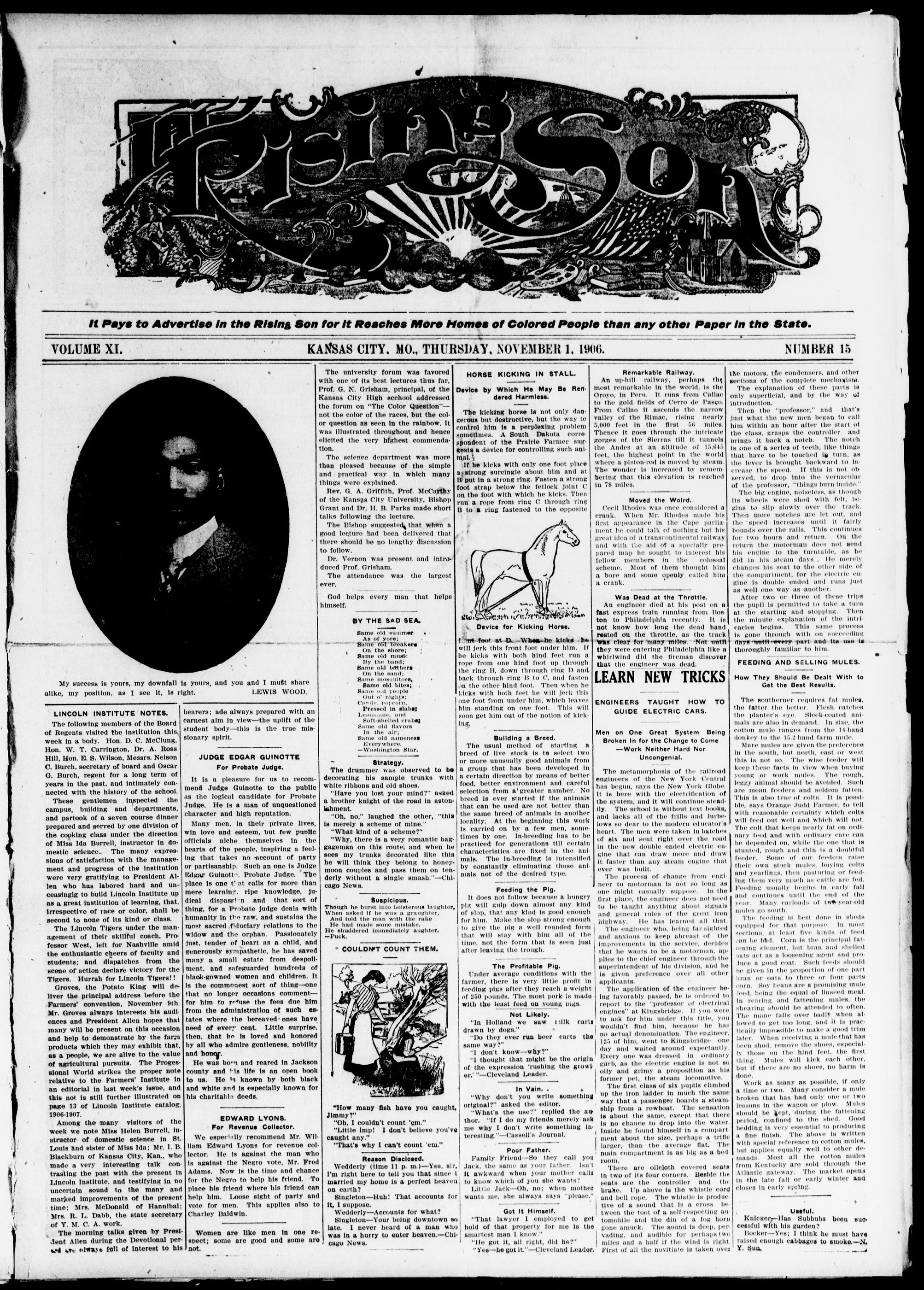
Page text (machine-generated)
Rising Son
It Pays to Advertise in the Rising Son for it Reaches More Homes of Colored People than any other Paper in the State.
My success is yours, my downfall is yours, and you and I must share alike, my position, as I see it, is right. LEWIS WOOD.
VOLUME XI.
My success is yours, my downfall is alike, my position, as I see it, is ri
LINCOLN INSTITUTE NOTES.
The following members of the Board of Regents visited the institution this week in a body. Hon. D. C. McClung, Hon. W. T. Carrington, Dr. A. Ross Hill, Hon. E. S. Wilson, Messrs. Nelson C. Burch, secretary of board and Oscar C. Burch, regent for a long term of years in the past, and intimately connected with the history of the school.
These gentlemen inspected the campus, building and departments, and partook of a seven course dinner prepared and served by one division of the cooking class under the direction of Miss Ida Burrell, instructor in domestic science.. The many expressions of satisfaction with the management and progress of the institution were very gratifying to President Allen who has labored hard and unceasingly to build Lincoln Institute up as a great institution of learning, that, irrespective of race or color, shall be second to none of its kind or class.
The Lincoln Tigers under the management of their skillful coach, Professor West, left for Nashville amid the enthusiastic cheers of faculty and students; and dispatches from the scene of action declare victory for the Tigers. Hurrah for Lincoln Tigers!!
Groves, the Potato King will deliver the principal address before the Farmers' convention, November 9th. Mr. Groves always interests his audiences and President Allen hopes that many will be present on this occasion and help to demonstrate by the farm products which they may exhibit that, as a people, we are alive to the value of agricultural pursuits. The Progessional World strikes the proper note relative to the Farmers' Institute in an editorial in last week's issue, and this not is still further illustrated on page 13 of Lincoln Institute catalog 1906-1907.
Among the many visitors of the week we note Miss Helen Burrell, instructor of domestic science in St. Louis and sister of Miss Ida; Mr. I. B. Blackburn of Kansas City, Kan., who made a very interesting talk contrasting the past with the present in Lincoln Institute, and testifying in no uncertain sound to the many and marked improvements of the present time; Mrs. McDonald of Hannibal; Mrs. R. L. Dabb, the state secretary of Y. M. C. A. work.
The morning talks given by President Allen during the Devotional period elude full of interest to his
hearers; ade always prepared with an earnest aim in view—the uplift of the student body—this is the true missionary spirit.
JUDGE EDGAR GUINOTTE
For Probate Judge.
It is a pleasure for us to recommend Judge Gulnotte to the public as the logical candidate for Probate Judge. He is a man of unquestioned character and high reputation.
Many men, in their private lives, win love and esteem, but few public officials niche themselves in the hearts of the people, inspiring a feeling that takes no account of party or partisanship. Such an one is Judge Edgar Guinotte. Probate Judge. The place is one that calls for more than mere learning, ripe knowledge, judicial dispassion and that sort of thing, for a Probate judge deals with humanity in the raw, and sustains the most sacred fiduciary relations to the widow and the orphan. Passionately just, tender of heart as a child, and generously sympathetic, he has saved many a small estate from despairment, and safeguarded hundreds of black-gowned women and children. It is the commonest sort of thing—one that no longer occasions comment—for him to refuse the fees due him from the administration of such estates where the bereaved ones have need of every cent. Little surprise, then, that he is loved and honored by all who admire gentleness, nobility and honor.
He was born and reared in Jackson county and his life is an open book to us. He is known by both black and white and is especially known for his charitable deeds.
EDWARD LYONS.
For Revenue Collector.
We especially recommend Mr. William Edward Lyons for revenue collector. He is against the man who is against the Negro vote, Mr. Fred Adams. Now is the time and chance for the Negro to help his friend. To place his friend where his friend can help him. Loose sight of party and vote for men. This applies also to Charley Baldwin.
Women are like men in one respect; some are good and some are not.
KANSAS CITY, MO., THURSDAY, NOVEMBER 1, 1906.
The university forum was favored with one of its best lectures thus far, Prof. G. N. Grisham, principal, of the Kansas City High school addressed the forum on "The Color Question"—not the color of the races, but the color question as seen in the rainbow. It was illustrated throughout and hence elicited the very highest commendation.
The science department was more than pleased because of the simple and practical way in which many things were explained.
Rev. G. A. Griffith, Prof. McCarthy of the Kansas City University, Bishop Grant and Dr. H. B. Parks made short talks following the lecture.
The Bishop suggested that when a good lecture had been delivered that there should be no lengthy discussion to follow.
Dr. Vernon was present and introduced Prof. Grisham.
The attendance was the largest ever.
God helps every man that helps himself.
BY THE SAD SEA
Same old summer
As of yore;
Same old breakers
On the shore;
Same old music
By the band;
Same old bathers
On the sand;
Same mosquitoes,
Same old bites;
Same old people
Out o' nights;
Candy, popcorn,
Pressed in slabs;
Lemonade, and
Soft-shelled crabs;
Same old flavors
In the air;
Same old sameness
Everywhere.
—Washington Star.
Strategy.
The drummer was observed to be decorating his sample trunks with white ribbons and old shoes.
"Have you lost your mind?" asked a brother knight of the road in astonishment.
"Oh, no," laughed the other, "this is merely a scheme of mine."
"What kind of a scheme?"
"Why, there is a very romantic baggageman on this route, and when he sees my trunks decorated like this he will think they belong to honey-moon couples and pass them on tenderly without a single smash."—Chicago News.
Suspicious.
"How many fish have you caught, Jimmy?"
"Oh. I couldn't count 'em."
"Little imp! I don't believe you've caught any."
"That's why I can't count 'em."
Reason Disclosed.
Wedderly (time 11 p. m.)—Yes, sir, I'm right here to tell you that since I married my home is a perfect heaven on earth?
Singleton—Huh! That accounts for it, I suppose.
Wedderly—Accounts for what?
Wedderly—Accounts for what?
Singleton—Your being downtown so late.
I never heard of a man who was in a hurry to enter heaven.—Chicago News.
HORSE KICKING IN STALL.
Device by Which He May Be Ren dered Harmless.
The kicking horse is not only dangerous but destructive, but the way to control him is a perplexing problem sometimes. A South Dakota correspondent of the Prairie Farmer suggests a device for controlling such animal. If he kicks with only one foot place a strong surcingle about him and at B put in a strong ring. Fasten a strong foot strap below the fetlock joint C on the foot with which he kicks. Then run a rope from ring C through ring B to a ring fastened to the opposite
Device for Kicking Horse.
fart foot at D. When he kicks he will jerk this front foot under him. If he kicks with both hind feet run a rope from one hind foot up through the ring B, down through ring D and back through ring B to C, and fasten on the other hind foot. Then when he kicks with both feet he will jerk this one foot from under him, which leaves him standing on one foot. This will soon get him out of the notion of kicking.
Building a Breed.
The usual method of starting a breed of live stock is to select two or more unusually good animals from a group that has been developed in a certain direction by means of better food, better environment and careful selection from a' greater number. No breed is ever started if the animals that can be used are not better than the same breed of animals in another locality. At the beginning this work is carried on by a few men, sometimes by one. In-breeding has to be practiced for generations till certain characteristics are fixed in the animals. The in-breeding is intensified by constantly eliminating those animals not of the desired type.
Feeding the Pig.
It does not follow because a hungry pig will gulp down almost any kind of slop, that any kind is good enough for him. Make the slop strong enough to give the pig a well rounded form that will stay with him all of the time, not the form that is seen just after leaving the trough.
The Profitable Pig.
Under average conditions with the farmer, there is very little profit in feeding pigs after they reach a weight of 250 pounds. The most pork is made with the least feed on young pigs.
Not Likely.
"In Holland we saw milk carts drawn by dogs."
"Do they ever run beer carts the same way?"
"I don't know—why?"
"I thought that might be the origin of the expression 'rushing the growler.'"—Cleveland Leader.
In Vain. .
"Why don't you write something original?" asked the editor.
"What's the use?" replied the author. "If I do my friends merely ask me why I don't write something interesting."—Cassell's Journal.
Poor Father.
Family Friend—So they call you Jack, the same as your father. Isn't it awkward when your mother calls to know which of you she wants? Little Jack—Oh, no; when mother wants me, she always says "please."
Got It Himself.
"That lawyer I employed to get hold of that property for me is the smartest man I know." "He got it, all right, did he?"
"Yes—he got it."—Cleveland Leader.
Remarkable Railway
An up-hill railway, perhaps the most remarkable in the world, is the Oroyo, in Peru. It runs from Callac to the gold fields of Cerro de Pasco. From Callao it ascends the narrow valley of the Rimac, rising nearly 5,000 feet in the first 56 miles. Thence it goes through the intricate gorges of the Sierraras till it tunnels the Andes at an altitude of 15,645 feet, the highest point in the world where a piston-rod is moved by steam. The wonder is increased by remembering that this elevation is reached in 78 miles.
Moved the Woird.
Cecil Rhodes was once considered a crank. When Mr. Rhodes made his first appearance in the Cape parliament he could talk of nothing but his great idea of a transcontinental railway and with the aid of a specially prepared map he sought to interest his fellow members in the colossal scheme. Most of them thought him a bore and some openly called him a crank.
Was Dead at the Throttle.
An engineer died at his post on a fast express train running from loston to Philadelphia recently. It is not know how long the dead hand rested on the throttle, as the track was clear for many miles. Not until they were entering Philadelphia like a whirlwind did the fireman discover that the engineer was dead.
LEARN NEW TRICKS
ENGINEERS TAUGHT HOW TO GUIDE ELECTRIC CARS.
Men on One Great System Being Broken In for the Change to Come —Work Neither Hard Nor Uncongenial.
The metamorphosis of the railroad engineers of the New York Central has begun, says the New York Globe. It is here with the electrification of the system, and it will continue steadily. The school is without text books, and lacks all of the frills and furbebows so dear to the modern educator's heart. The men were taken in batches of six and sent right over the road in the new double ended electric engine that can draw more and draw it faster than any steam engine that ever was built.
The process of change from engineer to motorman is not so long as one might casually suppose. In the first place, the engineer does not need to be taught anything about signals and general rules of the great iron highway. He has learned all that. The engineer who, being far sighted and anxious to keep abreast of the improvements in the service, decides that he wants to be a motorman, applies to the chief engineer through the superintendent of his division, and he is given preference over all other applicants.
The application of the engineer being favorably passed, he is ordered to report to the "professor of electrical engines" at Kingsbridge. If you were to ask for him under this title, you wouldn't find him, because he has no actual denomination. The engineer, 125 of him, went to Kingsbridge one day and waited around expectantly. Every one was dressed in ordinary garb, as the electric engine is not so oily and grimy a proposition as his former pet, the steam locomotive.
The first class of six pupils climbed up the iron ladder in much the same way that a passenger boards a steamship from a row boat. The sensation is about the same, except that there is no chance to drop into the water. Inside he found himself in a compartment about the size, perhaps a trifle larger, than the average flat. The main compartment is as big as a bedroom.
There are oilcloth covered seats in two of its four corners. Beside the seats are the controller and the brake. Up above is the whistle cord and bell rope. The whistle is productive of a sound that is a cross between the toot of a self-respecting automobile and the din of a fog horn gone amuck. The sound is deep, pervading, and audible for perhaps two miles and a half if the wind is right. First of all the noviate is taken over
NUMBER 15
the motors, the condensers, and other sections of the complete mechanism. The explanation of these parts is only superficial, and by the way of introduction. Then the "professor," and that's just what the new men began to call him within an hour after the start of the class, grasps the controller and brings it back a notch. The notch is one of a series of teeth, like things that have to be touched in turn, as the lever is brought backward to increase the speed. If this is not observed, to drop into the vernacular of the professor, "things burn inside."
The big engine, noteless, as though its wheels were shod with felt, begins to slip slowly over the track. Then more notches are let out, and the speed increases until it fairly bounds over the rails. This continues for two hours and return. On the return the motorman does not send his engine to the turntable, as he did in his steam days. He merely changes his seat to the other side of the compartment, for the electric engine is double ended and runs just as well one way as another.
After two or three of these trips the pupil is permitted to take a turn at the starting and stopping. Then the minute explanation of the intricacies begins. This same process is gone through with on succeeding days until every part and its use is thoroughly familiar to him.
FEEDING AND SELLING MULES.
How They Should Be Dealt With to Get the Best Results.
the southerner requires fat mules, the fatter the better. Flesh catches the planter's eye. Sleek-coated animals are also in demand. In size, the cotton mule ranges from the 14-hand donkey to the 15.2-hand farm mule.
Mare mules are given the preference in the south, but north, east or west this is not so. The wise feeder will keep these facts in view when buying young or work mules. The rough, leggy animal should be avoided. Such are mean feeders and seldom fatten. This is also true of colts. It is possible, says Orange Judd Farmer, to tell with reasonable certainty which colts will feed out well and which will not. The colt that keeps nearly fat on ordinary feed and with ordinary care can be depended on, while the one that is stunted, rough and thin is a doubtful feeder. Some of our feeders raise their own stock mules, buying colts and yearlings, then pasturing or feeding them very much as cattle are fed. Feeding usually begins in early fall and continues until the end of the year. Many carloads of tw*year-old mules go south.
The feeding is best done in sheds equipped for that purpose. In most sections, at least five kinds of feed can be lhd. Corn is the principal fattening element, but bran and shelled oats act as a loosening agent and produce a good coat. Such feeds should be given in the proportion of one part bran or oats to three or four parts corn. Soy beans are a promising mule feed, being the equal of linseed meal in rearing and fattening mules, the shearing should be attended to often. The mane falls over badly when allowed to get too long, and it is practically impossible to make a good trim later. When receiving a mule that has been shod, remove the shoes, especially those on the hind feet, the first thing. Mules will kick each other, but if there are no shoes, no harm is done.
Work as many as possible, if only a time or two. Many consider a mule broken that has had only one or two lessons in the wagon or plow. Mules should be kept, during the fattening period, confined to the shed. Good bedding is very essential to producing a fine finish. The above is written with special reference to cotton mules, but applies equally well to other demands. Most all the cotton mules from Kentucky are sold through the Atlantic gateway. The market opens in the late fall or early winter and closes in early spring.
Useful.
Nklicker—Has Subbubs been successful with his garden?
Bocker—Yes; I think he must have raised enough cabbages to smoke.—N.
Y. Sun.
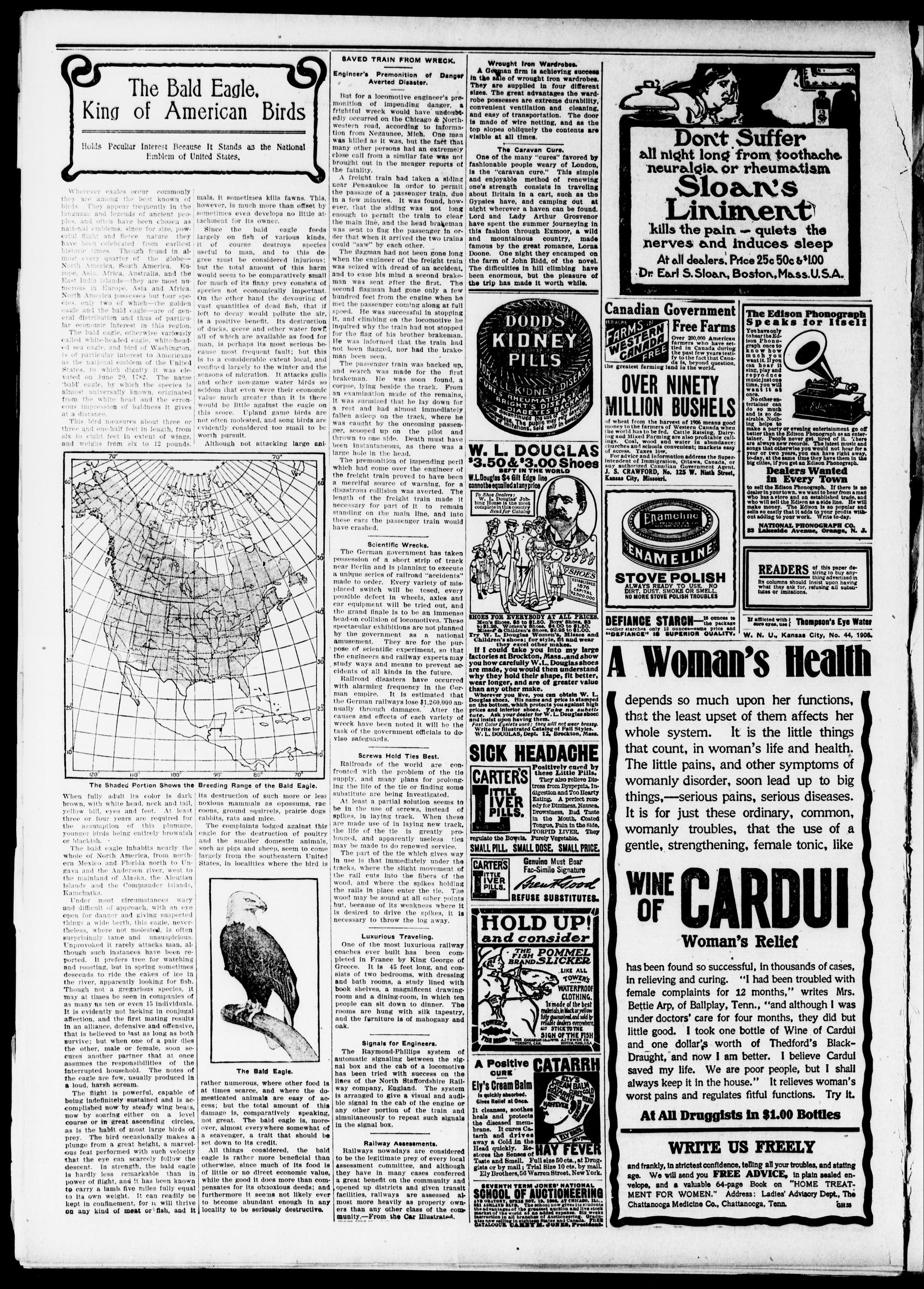
Holds Peculiar Interest Because It Stands as the National Emblem of United States.
70° 70°
60°
50°
40°
30°
20°
10°
120° 110° 100° 90° 80° 70°
The Shaded Portion Shows the Breeding Range of the Bald Eagle.
Wherever eagles occur commonly they are among the best known of birds. They appear frequently in the language and legends of ancient peoples, and often have been chosen as national emblems, since for size, powerful flight and fierce nature they have been celebrated from earliest historic times. Though found in almost every quarter of the globe—North America, South America, Europe, Asia, Africa, Australia, and the East India islands—they are most numerous in Europe, Asia and Africa. North America possesses but four species, only two of which—the golden eagle and the bald eagle—are of general distribution and thus of particular economic interest in this region.
The bald eagle, otherwise variously called white-headed eagle, white-headed sea eagle, and bird of Washington, is of particular interest to Americans as the national emblem of the United States, to which dignity it was elevated on June 20, 1782. The name 'bald' eagle, by which the species is almost universally known, originated from the white head and the erroneous impression of baldness it gives at a distance. This bird measures about three or three and one-half feet in length, from six to eight feet in extent of wings, and weighs from six to 12 pounds.
The Shaded Portion Shows the
When fully adult its color is dark brown, with white head, neck and tail, yellow bill, eyes and feet. At least three or four years are required for the assumption of this plumage, younger birds being entirely brownish or blackish. The bald eagle inhabits nearly the whole of North America, from northern Mexico and Florida north to Ungava and the Anderson river, west to the mainland of Alaska, the Aleutian islands and the Commander islands, Kamchatka.
Under most circumstances wary and difficult of approach, with an eye open for danger and giving suspected things a wide berth, this eagle, nevertheless, where not molested, is often surprisingly tame and unsuspicious. Unprovoked it rarely attacks man, although such instances have been reported. It prefers tree for watching and roosting, but in spring sometimes descends to ride the cakes of ice in the river, apparently looking for fish. Though not a gregarious species, it may at times be seen in companies of as many as ten or even 15 individuals. It is evidently not lacking in conjugal affection, and the first mating results in an alliance, defensive and offensive, that is believed to last as long as both survive; but when one of a pair dies the other, male or female, soon secures another partner that at once assumes the responsibilities of the interrupted household. The notes of the eagle are few, usually produced in a loud, harsh scream.
The flight is powerful, capable of being indefinitely sustained and is accomplished now by steady wing beats, now by soaring either on a level course or in great ascending circles, as is the habit of most large birds of prey. The bird occasionally makes a plunge from a great height, a marvelous feat performed with such velocity that the eye can scarcely follow the descent. In strength, the bald eagle is hardly less remarkable than in power of flight, and it has been known to carry a lamb five miles fully equal to its own weight. It can readily be kept in confinement, for it will thrive on any kind of meat or fish, and it
---
mals, it sometimes kills fawns. This, however, is much more than offset by sometimes even develops no little atachment for its owner.
Since the bald eagle feeds largely on fish of various kinds, it of course destroys species useful to man, and to this degree must be considered injurious; but the total amount of this harm would seem to be comparatively small for much of its finny prey consists of species not economically important. On the other hand the devouring of vast quantities of dead fish, that if left to decay would pollute the air, is a positive benefit. Its destruction of ducks, geese and other water fowl all of which are available as food for man, is perhaps its most serious because most frequent fault; but this is to a considerable extent local, and confined largely to the winter and the seasons of migration. It attacks gulls and other non-game water birds so seldom that even were their economic value much greater than it is there would be little against the eagle on this score. Upland game birds are not often molested, and song birds are evidently considered too small to be worth pursuit.
Although not attacking large ants
Breeding Range of the Bald Eagle.
its destruction of such more or less noxious mammals as opossums, raccoons, ground squirrels, prairie dogs, rabbits, rats and mice.
The complaints lodged against this eagle for the destruction of poultry and the smaller domestic animals, such as pigs and sheep, seem to come largely from the southeastern United States, in localities where the bird is
EAGLE
The Bald Eagle.
rather numerous, where other food is at times scarce, and where the domesticated animals are easy of access; but the total amount of this damage is, comparatively speaking, not great. The bald eagle is, moreover, almost everywhere somewhat of a scavenger, a trait that should be set down to its credit.
All things considered, the bald eagle is rather more beneficial than otherwise, since much of its food is of little or no direct economic value, while the good it does more than compensates for its obnoxious deeds; and furthermore it seems not likely ever to become abundant enough in any locality to be seriously destructive.
---
SAVED TRAIN FROM WRECK.
Engineer's Premonition of Danger Averted Disaster.
But for a locomotive engineer's promotion of impending danger, a frightful wreck would have undoubtedly occurred on the Chicago & Northwestern road, according to information from Negaunee, Mich. One man was killed as it was, but the fact that many other persons had an extremely close call from a similar fate was not brought out in the meager reports of the fatality.
A freight train had taken a siding near Pensaukee in order to permit the passage of a passenger train, due in a few minutes. It was found, however, that the siding was not long enough to permit the train to clear the main line, and the head brakeman was sent to flag the passenger in order that when it arrived the two trains could "saw" by each other.
The flagman had not been gone long when the engineer of the freight train was seized with dread of an accident, and to ease his mind a second brakeman was sent after the first. The second flagman had gone only a few hundred feet from the engine when he met the passenger coming along at full speed. He was successful in stopping it, and climbing on the locomotive he inquired why the train had not stopped for the flag of his brother brakeman. He was informed that the train had not been flagged, nor had the brakeman been seen.
The passenger train was backed up, and search was made for the first brakeman. He was soon found, a corpse, lying beside the track. From an examination made of the remains, it was surmised that he lay down for a rest and had almost immediately fallen asleep on the track, where he was caught by the oncoming passenger, scooped up on the pilot and thrown to one side. Death must have been instantaneous, as there was a large hole in the head. The premonition of impending peril which had come over the engineer of the freight train proved to have been a merciful source of warning, for a disastrous collision was averted. The length of the freight train made it necessary for part of it to remain standing on the main line, and into these cars the passenger train would have crashed.
Scientific Wrecks.
The German government has taken possession of a short strip of track near Berlin and is planning to execute a unique series of railroad "accidents" made to order. Every variety of misplaced switch will be tesed, every possible defect in wheels, axles and car equipment will be tried out, and the grand finale is to be an immense head-on collision of locomotives. These spectacular exhibitions are not planned by the government as a national amusement. They are for the purpose of scientific experiment, so that the engineers and railway experts may study ways and means to prevent accidents of all kinds in the future.
Railroad disasters have occurred with alarming frequency in the German empire. It is estimated that the German railways lose $1,260,000 annually through damages. After the causes and effects of each variety of wreck have been noted it will be the task of the government officials to devise safeguards.
Screws Hold Ties Best.
Railroads of the world are confronted with the problem of the tie supply, and many plans for prolonging the life of the tie or finding some substitute are being investigated. At least a partial solution seems to be in the use of screws, instead of spikes, in laying track. When these are made use of in laying new track, the life of the tie is greatly prolonged, and apparently useless ties may be made to do renewed service. The part of the tie which gives way in use is that immediately under the tracks, where the slight movement of the rail cuts into the fibers of the wood, and where the spikes holding the rails in place enter the tie. The wood may be sound at all other points but, because of its weakness where it is desired to drive the spikes, it is necessary to throw the log away.
Luxurious Traveling.
One of the most luxurious railway coaches ever built has been completed in France by King George of Greece. It is 45 feet long, and consists of two bedrooms, with dressing and bath rooms, a study lined with book shelves, a magnificent drawing-room and a dining-room, in which ten people can sit down to dinner. The rooms are hung with silk tapestry, and the furniture is of mahogany and oak.
Signals for Engineers.
The Raymond-Phillips system of automatic signaling between the signal box and the cab of a locomotive has been tried with success on the lines of the North Staffordshire Railway company, England. The system is arranged to give a visual and audible signal in the cab of the engine or any other portion of the train and simultaneously to repeat such signals in the signal box.
Railway Assessments
Railways nowadays are considered to be the legitimate prey of every local assessment committee, and although they have in many cases conferred a great benefit on the community and opened up districts and given transit facilities, railways are assessed almost more heavily as property owners than any other class of the community.—From the Car Illustrated.
Wrought Iron Wardrobes.
A German firm is achieving success in the sale of wrought iron wardrobes. They are supplied in four different sizes. The great advantages the wardrobe possesses are extreme durability, convenient ventilation and cleaning, and easy of transportation. The door is made of wire netting, and as the top slopes obliquely the contents are visible at all times.
The Caravan Cure.
One of the many "cures" favored by fashionable people weary of London, is the "caravan cure." This simple and enjoyable method of renewing one's strength consists in traveling about Britain in a cart, such as the Gypsies have, and camping out at night wherever a haven can be found. Lord and Lady Arthur Grosvenor have spent the summer journeying in this fashion through Exmoor, a wild and mountainous country, made famous by the great romance, Lorna Doone. One night they encamped on the farm of John Ridd, of the novel. The difficulties in hill climbing have been enormous, but the pleasure of the trip has made it worth while.
DODD'S
KIDNEY
PILLS
FOR ALL KIDNEY DISEASES
CURES RHEUMATISM
BRIGHT DISEASES
DIABETES BACKACHE
discontinued the use of our
products of imitations. Gold only in benzene.
W. L. DOUGLAS
*3.50 & *3.00 Shoes
BEFT IN THE WORLD
W.L.Douglas $4 Gilt Edge line
cannot be equalled at any price
To Shoe Dealer:
W. L. Douglas Job-
bing House is the most
complete in this country
Send for Catalog
SHOES
ESTABLISHED
1876
CAPITAL
$2,500,000
**SHOES FOR EVERYBODY AT ALL PRICES**
Men's Shoes, $8 to $1.50. Boy's Shoes, $3
to $1.25. Women's Shoes, $4.00 to $1.60.
Missed & Children's Shoes, $2.25 to $1.00.
Try W. L. Douglas Women's, Misses and
Children's shoes; for style, $2 and wear
they need other makes.
If I could take you into my large factors at Brockton, Mass., and show you how carefully W.L. Douglas shoes are made, you would then understand why they hold their shape, fit better, wear longer, and are of greater value than any other make.
Wherever you live, you can obtain W. L. Davenport on the bottom, which protects you against high prices and inferior shoes. Take no aubergine and insist upon having them.
Fast Color Eyelids used; they will not wear brass. Write for Illustrated Catalog of Fall Styles. W. L. DOUGLAS, Dept. 12, Brockton, Mass.
SICK HEADACHE
CARTER'S
LITTLE
LIVER
PILLS.
Positively cured by these Little Pills. They also relieve Distress from Dyspepsia, Indigestion and Too Hearty Eating. A perfect remedy for Dizziness, Nausea, Drowsiness, Bad Taste in the Mouth, Coated Tongue, Pain in the Side, TORPID LIVER. They regulate the Bowels. Purely Vegetable.
SMALL PILL. SMALL DOSE. SMALL PRICE.
CARTERS
LITTLE
IVER
PILLS.
Genuine Must Bear
Fac-Simile Signature
CREWTOOD
REFUSE SUBSTITUTES.
HOLD UP!
and consider
THE POMMEL
BRAND SLICKER
LINE ALL
TOWER'S
WATERPROOF
CLOTHING.
Is made of the best
materials in black or yellow
hily guaranteed, and sold by
reliable dealers everywhere.
417 STICK TO THE
SIGN OF THE FISH
TOWER CANADA CO., LIMITED, AT 100 W. 10TH ST.
TORONTO, CAN. BOSTON, MA. 02701
TOWER'S
FOR BRAND
A Positive CURE
Ely's Cream Balm
is quickly absorbed.
Gives Relief at Once.
It cleanses, soothes
heals and protects
the diseased mem-
brane. It cures Catarrh
and drives away a Cold in the
Head quickly. Restores the Senses of
Taste and Smell. Full size 50 cts., at Drug-
gists or by mail. Trial Size 10 cts. by mail.
Ely Brothers, 56 Warren Street, New York.
SEVENTH TERM JONES' NATIONAL
SCHOOL OF AUCTIONEERING
AND ORDERS OPEN HOT, 18, 1906, AT CHICAGO, IL.
SRI SANILAND BAY. The school now gives its students
the largest area of grades 9-12. The market
market of the world is the added expense. Six weeks
instruction in all branches of Auctioneering. Graduates
now enrolled in eleventh grade and Cannot.
CATARRH
ELY'S CREAM BALM
CURES COLD HEAD
HATFEVER
ELY BROTHS
.
STOVE POLISH
ALWAYS READY TO USE. NO
DIRT, DUST, SMOKES OR SMELLS.
NO MORE STOVE POLISH TROUBLES
DEFIANCE STARCH—18 ounces to
the package
—other starches only 12 ounces—same price and
"DEFIANCE" IS SUPERIOR QUALITY.
depends so much that the least upset whole system. It that count, in woman The little pains, and womanly disorder, things,—serious pain It is for just these womanly troubles, gentle, strengthening
WINE OF CA Woman has been found so success in relieving and curing. female complaints for Bettie Arp, of Ballplay, The under doctors' care for little good. I took one and one dollar's worth Draught, and now I am saved my life. We are always keep it in the how worst pains and regulate
At All Druggist
Woman's Health
is so much upon her fun,
the least upset of them affect
system. It is the little
count, in woman's life and
male pains, and other symptoms
of disorder, soon lead up to
—serious pains, serious diarrhea
or just these ordinary, com-
monly troubles, that the use
strengthening, female tonic
THE CARDU
Woman's Relief
I found so successful, in thousands,
ing and curing. "I had been troubled
complaints for 12 months," writ-
up, of Ballplay, Tenn., "and although
factors' care for four months, they
did. I took one bottle of Wine o
the dollar's worth of Thedford's
and now I am better. I believe
my life. We are poor people, but
keep it in the house." It relieves
ins and regulates fitful functions.
All Druggists in $1.00 Bott
A Woman's Health
depends so much upon her functions, that the least upset of them affects her whole system. It is the little things that count, in woman's life and health. The little pains, and other symptoms of womanly disorder, soon lead up to big things,—serious pains, serious diseases. It is for just these ordinary, common, womanly troubles, that the use of a gentle, strengthening, female tonic, like
WINE OF CARDUI
has been found so successful, in thousands of cases, in relieving and curing. "I had been troubled with female complaints for 12 months," writes Mrs. Bettie Arp, of Ballplay, Tenn., "and although I was under doctors' care for four months, they did but little good. I took one bottle of Wine of Cardui and one dollar's worth of Thedford's Black-Draught, and now I am better. I believe Cardui saved my life. We are poor people, but I shall always keep it in the house." It relieves woman's worst pains and regulates fitful functions. Try it.
At All Druggists in $1.00 Bottles
WRITE US FREELY
and frankly, in strictest confidence age. We will send you FREE velope, and a valuable 64-page MENT FOR WOMEN." Adc Chattanooga Medicine Co., Chat
In strictest confidence, telling all your troubles will send you FREE ADVICE, in plain and a valuable 64-page Book on "HOME OR WOMEN." Address: Ladies' Advisory a Medicine Co., Chattanooga, Tenn.
and frankly, in strictest confidence, telling all your troubles, and stating age. We will send you FREE ADVICE, in plain sealed envelope, and a valuable 64-page Book on "HOME TREATMENT FOR WOMEN." Address: Ladies' Advisory Dept., The Chattanooga Medicine Co., Chattanooga, Tenn.
READERS of this paper desiring to buy any thing advertised in its columns should insist upon having what they ask for, refusing all substitutes or imitations.
If afflicted with { Thompson's Eye Water
sore eye, use
W. N. U., Kansas City, No. 44, 1906.
upon her functions,
of them affects her
is the little things
man's life and health.
other symptoms of
soon lead up to big
ns, serious diseases.
ordinary, common,
that the use of a
g, female tonic, like
RDUI
s Relief
ful, in thousands of cases,
"I had been troubled with
2 months," writes Mrs.
enn., "and although I was
our months, they did but
bottle of Wine of Cardui
of Thedford's Black-
better. I believe Cardui
poor people, but I shall
use." It relieves woman's
fitful functions. Try it.
in $1.00 Bottles
telling all your troubles, and stating ADVICE, in plain sealed en- tise Book on "HOME TREAT-ress: Ladies' Advisory Dept., The Ancoga, Tenn.
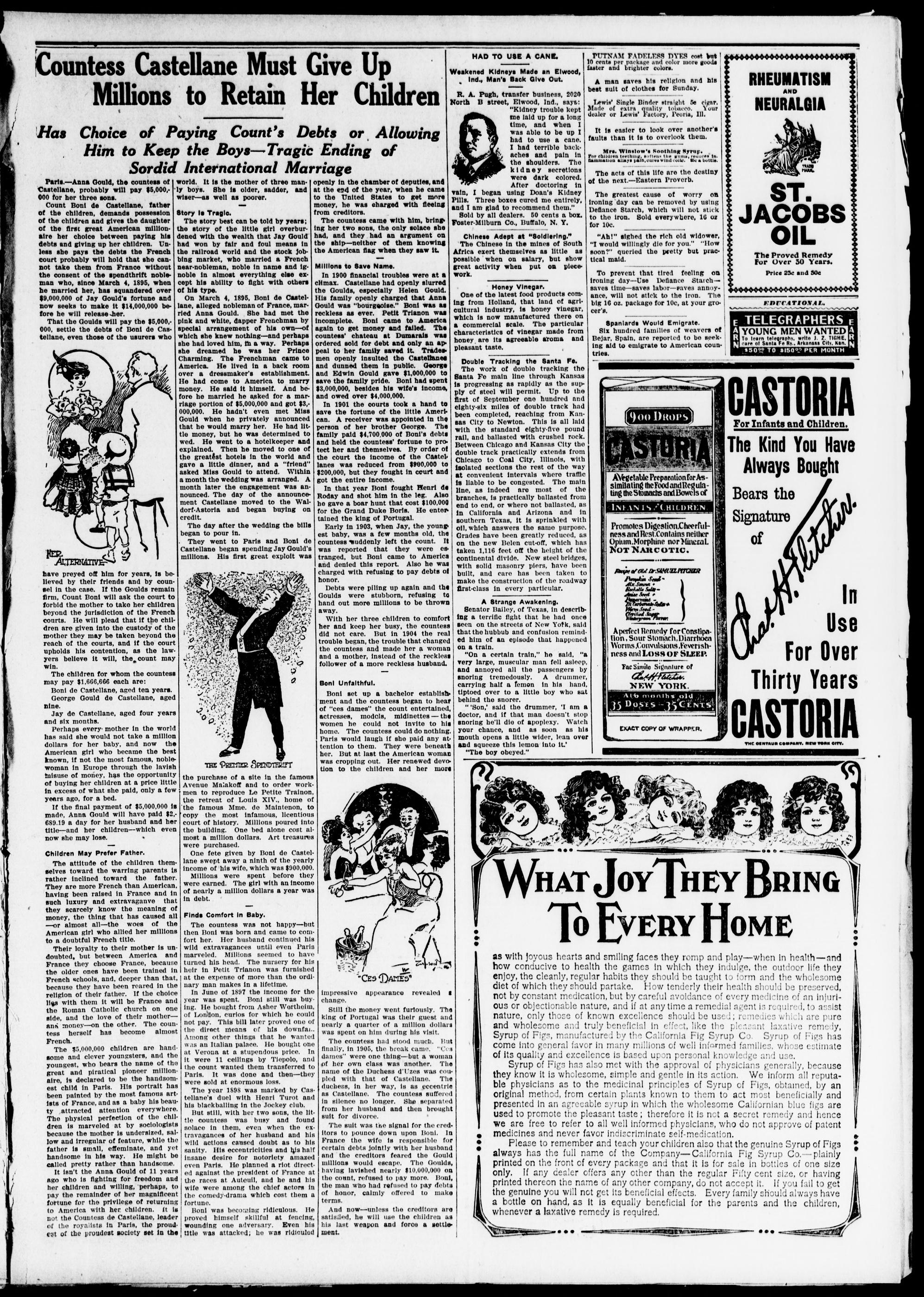
Countess Castellane Must Give Up Millions to Retain Her Children
Has Choice of Paying Count's Debts or Allowing Him to Keep the Boys—Tragic Ending of Sordid International Marriage
Paris.—Anna Gould, the countess of Castellane, probably will pay $5,000,000 for her three sons.
Count Boni de Castellane, father of the children, demands possession of the children and gives the daughter of the first great American millionaire her choice between paying his debts and giving up her children. Unless she pays the debts the French court probably will hold that she cannot take them from France without the consent of the spendthrift nobleman who, since March 4, 1895, when he married her, has squandered over $9,000,000 of Jay Gould's fortune and now seeks to make it $14,000,000 before he will release her.
That the Goulds will pay the $5,000,000, settle the debts of Boni de Castellane, even those of the usurers who
HER ALTERNATIVE
have preyed off him for years, is believed by their friends and by counsel in the case. If the Goulds remain firm, Count Boni will ask the court to forbid the mother to take her children beyond the jurisdiction of the French courts. He will plead that if the children are given into the custody of the mother they may be taken beyond the reach of the courts, and if the court upholds his contention, as the lawyers believe it will, the count may win.
The children for whom the countess may pay $1,666,666 each are:
Boni de Castellane, aged ten years.
George Gould de Castellane, aged nine.
Jay de Castellane, aged four years and six months.
Perhaps every mother in the world has said she would not take a million dollars for her baby, and now the American girl who became the best known, if not the most famous, noblewoman in Europe through the lavish misuse of money, has the opportunity of buying her children at a price little in excess of what she paid, only a few years ago, for a bed.
If the final payment of $5,000,000 is made, Anna Gould will have paid $2,689.19 a day for her husband and her title—and her children—which even now she may lose.
Children May Prefer Father.
The attitude of the children themselves toward the warring parents is rather inclined toward the father. They are more French than American, having been raised in France and in such luxury and extravagance that they scarcely know the meaning of money, the thing that has caused all—or almost all—the woes of the American girl who allied her millions to a doubtful French title.
Their loyalty to their mother is undoubted, but between America and France they choose France, because the older ones have been trained in French schools, and, deeper than that, because they have been reared in the religion of their father. If the choice lies with them it will be France and the Roman Catholic church on one side, and the love of their mother—and money—on the other. The countess herself has become almost French.
The 5,500,000 children are handsome and clever youngsters, and the youngest, who bears the name of the great and piratical pioneer millionaire, is declared to be the handsome child in Paris. His portrait has been painted by the most famous artists of France, and as a baby his beauty attracted attention everywhere. The physical perfection of the children is marveled at by sociologists because the mother is undersized, sallow and irregular of feature, while the father is small, effeminate, and yet handsome in his way. He might be called pretty rather than handsome.
It isn't the Anna Gould of 11 years ago who is fighting for freedom and her children and willing, perhaps, to pay the remainder of her magnificent fortune for the privilege of returning to America with her children. It is not the Countess de Castellane, leader of the royalists in Paris, the proudest of the proudest society set in the
world. It is the mother of three manly boys. She is older, sadder, and wiser-as well as poorer.
Story Is Tragic.
The story best can be told by years; the story of the little girl overburdened with the wealth that Jay Gould had won by fair and foul means in the railroad world and the stock jobbing market, who married a French near-nobleman, noble in name and ignoble in almost everything else except his ability to fight with others of his type.
On March 4, 1895, Boni de Castellane, alleged nobleman of France, married Anna Gould. She had met the pink and white, dapper Frenchman by special arrangement of his own—of which she knew nothing—and perhaps she had loved him, in a way. Perhaps she dreamed he was her Prince Charming. The Frenchman came to America. He lived in a back room over a dressmaker's establishment. He had come to America to marry money. He said it himself. And before he married he asked for a marriage portion of $5,000,000 and got $3,000,000. He hadn't even met Miss Gould when he privately announced that he would marry her. He had little money, but he was determined to wed. He went to a hotelkeeper and explained. Then he moved to one of the greatest hotels in the world and gave a little dinner, and a "friend" asked Miss Gould to attend. Within a month the wedding was arranged. A month later the engagement was announced. The day of the announcement Castellane moved to the Waldorf-Astoria and began buying on credit.
The day after the wedding the bills began to pour in.
They went to Paris and Boni de Castellane began spending Jay Gould's millions. His first great exploit was
A
THE PREMIER SPENDTHRIFT
the purchase of a site in the famous
Avenue Malakoff and to order work-
men to reproduce Le Petite Trainon,
the retreat of Louis XIV., home of
the famous Mme. de Maintenon,
to copy the most infamous, licentious
court of history. Millions poured into
the building. One bed alone cost
almost a million dollars. Art treasures
were purchased.
One fete given by Boni de Castel-
lane swept away a ninth of the yearly
income of his wife, which was $300,000.
Millions were spent before they
were earned. The girl with an income
of nearly a million dollars a year was
in debt.
Finda Comfort in Baby.
The countess was not happy—but then Boni was born and came to comfort her. Her husband continued his wild extravagances until even Paris marveled. Millions seemed to have turned his head. The nursery for his heir in Petit Trianon was furnished at the expense of more than the ordinary man makes in a lifetime.
In June of 1897 the income for the year was spent. Boni still was buying. He bought from Asher Wortheim, of London, curios for which he could not pay. This bill later proved one of the direct means of his downfall. Among other things that he wanted was an Italian palace. He bought one at Verona at a stupendous price. In it were 11 ceilings by Tiepolo, and the count wanted them transferred to Paris. It was done and then—they were sold at enormous loss.
The year 1898 was marked by Castellane's duel with Henri Turot and his blackballing in the Jockey club. But still, with her two sons, the little countess was busy and found solace in them, even when the extravagances of her husband and his wild actions caused doubt as to his sanity. His eccentricities and his half insane desire for notoriety amazed even Paris. He planned a riot directed against the president of France at the races at Auteuil, and he and his wife were among the chief actors in the comedy-drama which cost them a fortune. Boni was becoming ridiculous. He proved himself skillful at fencing, wounding one adversary. Even his title was attacked; he was ridiculed
openly in the chamber of deputies, and at the end of the year, when he came to the United States to get more money, he was charged with fleeing from creditors. The countess came with him, bringing her two sons, the only solace she had, and they had an argument on the ship—neither of them knowing the American flag when they saw it.
Millions to Save Name.
In 1900 financial troubles were at a climax. Castellane had openly slurred the Goulds, especially Helen Gould. His family openly charged that Anna Gould was "bourgeolise." Boni was as reckless as ever. Petit Trianon was incomplete. Boni came to America again to get money and failed. The countess' chateau at Dumarais was ordered sold for debt and only an appeal to her family saved it. Tradesmen openly insulted the Castellanes and dunned them in public. George and Edwin Gould gave $1,000,000 to save the family pride. Boni had spent $3,000,000, besides his wife's income, and owed over $4,000,000.
In 1901 the courts took a hand to save the fortune of the little American. A receiver was appointed in the person of her brother George. The family paid $4,700,000 of Boni's debts and held the countess' fortune to protect her and themselves. By order of the court the income of the Castellanes was reduced from $900,000 to $200,000, but they fought in court and got the entire income.
In that year Boni fought Henri de Roday and shot him in the leg. Also he gave a boar hunt that cost $100,000 for the Grand Duke Boris. He entertained the king of Portugal.
Early in 1903, when Jay, the youngest baby, was a few months old, the countess suddenly left the count. It was reported that they were estranged, but Boni came to America and denied this report. Also he was charged with refusing to pay debts of honor.
Debts were piling up again and the Goulds were stubborn, refusing to hand out more millions to be thrown away.
With her three children to comfort her and keep her busy, the countess did not care. But in 1904 the real trouble began, the trouble that changed the countess and made her a woman and a mother, instead of the reckless follower of a more reckless husband.
Bonl Unfaithful.
Boni set up a bachelor establishment and the count began to hear of "ces dames" the count entertained, actresses, models, mildinettes—the women he could not invite to his home. The countess could do nothing. Paris would laugh if she paid any attention to them. They were beneath her. But at last the American woman was cropping out. Her renewed devotion to the children and her more
"CE9 DANES"
impressive appearance revealed a change.
Still the money went furiously. The king of Portugal was their guest and nearly a quarter of a million dollars was spent on him during his visit.
The countess had stood much. But finally, in 1905, the break came. "Ces dames" were one thing—but a woman of her own class was another. The name of the Duchess d'Uzes was coupled with that of Castellane. The duchess, in her way, is as eccentric as Castellane. The countess suffered in silence no longer. She separated from her husband and then brought suit for divorce.
The suit was the signal for the creditors to pounce down upon Boni. In France the wife is responsible for certain debts jointly with her husband and the creditors feared the Gould millions would escape. The Goulds, having lavished nearly $10,000,000 on the count, refused to pay more. Boni, the man who had refused to pay debts of honor, calmly offered to make terms.
And now—unless the creditors are satisfied, he will use the children as his last weapon and force a settlement.
?
WHAT JOY THEY BRING TO EVERY HOME
as with joyous hearts and smiling faces they romp and play—when in health—and how conducive to health the games in which they indulge, the outdoor life they enjoy, the cleanly, regular habits they should be taught to form and the wholesome diet of which they should partake. How tenderly their health should be preserved, not by constant medication, but by careful avoidance of every medicine of an injurious or objectionable nature, and if at any time a remedial agent is required, to assist nature, only those of known excellence should be used; remedies which are pure and wholesome and truly beneficial in effect, like the pleasant laxative remedy, Syrup of Figs, manufactured by the California Fig Syrup Co. Syrup of Figs has come into general favor in many millions of well informed families, whose estimate of its quality and excellence is based upon personal knowledge and use.
Syrup of Figs has also met with the approval of physicians generally, because they know it is wholesome, simple and gentle in its action. We inform all reputable physicians as to the medicinal principles of Syrup of Figs, obtained, by an original method, from certain plants known to them to act most beneficially and presented in an agreeable syrup in which the wholesome Californian blue figs are used to promote the pleasant taste; therefore it is not a secret remedy and hence we are free to refer to all well informed physicians, who do not approve of patent medicines and never favor indiscriminate self-medication.
Please to remember and teach your children also that the genuine Syrup of Figs always has the full name of the Company—California Fig Syrup Co.—plainly printed on the front of every package and that it is for sale in bottles of one size only. If any dealer offers any other than the regular Fifty cent size, or having printed thereon the name of any other company, do not accept it. If you fail to get the genuine you will not get its beneficial effects. Every family should always have a bottle on hand, as it is equally beneficial for the parents and the children, whenever a laxative remedy is required.
HAD TO USE A CANE.
Weakened Kidneys Made an Elwood, Ind., Man's Back Give Out.
R. A. Pugh, transfer business, 2020
North B street, Elwood, Ind., says:
"Kidney trouble kept me laid up for a long time, and when I was able to be up I had to use a cane.
I had terrible backaches and pain in the shoulders. The kidney secretions were dark colored. After doctoring in
Kidney trouble kept me laid up for a long time, and when I was able to be up I had to use a cane. I had terrible backaches and pain in the shoulders. The kidney secretions were dark colored. After doctoring in vain, I began using Doan's Kidney Pills. Three boxes cured me entirely, and I am glad to recommend them."
Sold by all dealers. 50 cents a box.
Foster-Milburn Co., Buffalo, N. Y.
Chinese Adept at "Soldiering."
The Chinese in the mines of South
Africa exert themselves as little as
possible when on salary, but show
great activity when put on piece-
work.
Honey Vinegar.
One of the latest food products coming from Holland, that land of agricultural industry, is honey vinegar, which is now manufactured there on a commercial scale. The particular characteristics of vinegar made from honey, are its agreeable aroma and pleasant taste.
Double Tracking the Santa Fe.
Double Tracking the Santa Fe. The work of double tracking the Santa Fe main line through Kansas is progressing as rapidly as the supply of steel will permit. Up to the first of September one hundred and eighty-six miles of double track had been completed, reaching from Kansas City to Newton. This is all laid with the standard eighty-five pound rail, and ballasted with crushed rock. Between Chicago and Kansas City the double track practically extends from Chicago to Coal City, Illinois, with isolated sections the rest of the way at convenient intervals where traffic is liable to be congested. The main line, as indeed are most of the branches, is practically ballasted from end to end, or where not ballasted, as in California and Arizona and in southern Texas, it is sprinkled with oil, which answers the same purpose. Grades have been greatly reduced, as on the new Belen cut-off, which has taken 1,116 feet off the height of the continental divide. New steel bridges, with solid masonry piers, have been built, and care has been taken to make the construction of the roadway first-class in every particular.
A Strange Awakening.
Senator Bailey, of Texas, in describing a terrific fight that he had once seen on the streets of New Yok, said that the hubbub and confusion reminded him of an episode that happened on a train.
"On a certain train," he said, "a very large, muscular man fell asleep, and annoyed all the passengers by snoring tremedously. A drummer, carrying half a lemon in his hand, tiptoed over to a little boy who sat behind the snorer.
"Son," said the drummer, "I am a doctor, and if that man doesn't stop snoring he'll die of apoplexy. Watch your chance, and as soon as his mouth opens a little wider, lean over and squeeze this lemon into it."
"The boy obeyed."
900 DROPS
CASTORIA
A Vegetable Preparation for Assimilating the Food and Regulating the Stomachs and Bowels of
INFANTS, CHILDREN
Promotes Digestion, Cheerfulness and Rest. Contains neither Opium, Morphine nor Mineral. NOT NARCOTIC.
Recipe of Old Dr. SANUEL PITCHER
Pumpkin Seed -
Almond Milk -
Ricotta Salad -
Mint Sweet -
Hempseed -
Dill Oregano Salad
Whey Seed -
Cinnamon Sugar
Wintergreen Parsnip
Aperfect Remedy for Constipation, Sour Stomach, Diarrhoea Worms, Convulsions, Feverishness and LOSS OF SLEEP.
Fac Simile Signature of
Cha H. Hitchner.
NEW YORK.
At 6 months old
35 DOSES - 35 CENTS.
EXACT COPY OF WRAPPER.
CASTORIA
For Infants and Children.
The Kind You Have Always Bought
Bears the Signature of
Cha H. Hitchner.
In Use
For Over Thirty Years
CASTORIA
THE GENTAUR COMPANY, NEW YORK CITY.
PUTNAM FADELESS DYES cost but 10 cents per package and color more goods faster and brighter colors.
A man saves his religion and his best suit of clothes for Sunday.
Lewis' Single Binder straight 5e cigar. Made of extra quality tobacco. Your dealer or Lewis' Factory, Peoria, Ill.
It is easier to look over another's faults than it is to overlook them.
Mrs. Winslow's Soothing Syrup. For children teething, paints the gums, reduces inflammation always pain, curves wind colds. See a bottle.
The acts of this life are the destiny of the next—Eastern Proverb.
The greatest cause of worry on ironing day can be removed by using Defiance Starch, which will not stick to the iron. Sold everywhere, 16 oz for 10c.
"Ah!" sighed the rich old widower, "I would willingly die for you." "How soon?" queried the pretty but practical maid.
To prevent that tired feeling on ironing day—Use Defiance Starch—saves time—saves labor—saves annoyance, will not stick to the iron. The big 16 oz. package for 10c, at your grocer's.
Spaniards Would Emigrate.
Six hundred families of weavers of Bejar, Spain, are reported to be seeking aid to emigrate to American countries.
RHEUMATISM
AND
NEURALGIA
ST.
JACOBS
OIL
The Proved Remedy
For Over 50 Years.
Price 25c and 50c
EDUCATIONAL.
TELEGRAPHERS
YOUNG MEN WANTED
To learn telegraphy, write J. Z. TIGHE,
care of Santa Fe RI, Arkansas City, Kan.
150¢ TO 3150¢ PER MONTH
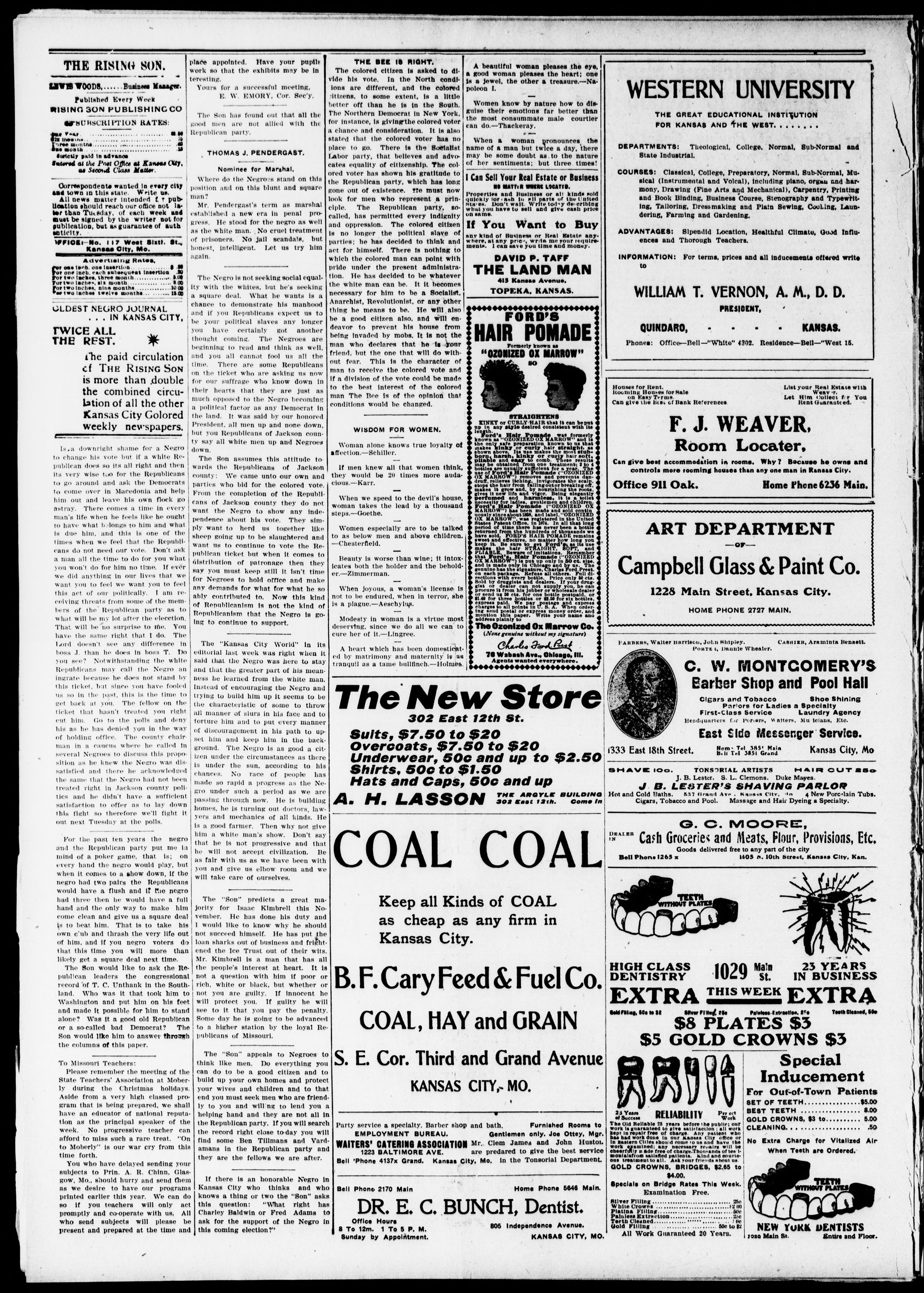
LWB WOODS.....Business Manager.
Published Every Week
RISING SON PUBLISHING CO
Entered at the Post Office at Kansas City,
as Second Class Matter.
Correspondents wanted in every city
and town in this state. Write us.
All news matter intended for pub-
llication should reach our office not la-
ter than Tuesday, of each week and
must be signed by the writer not for
publication, but as guarantee of auth-
enticity.
OFFICE—No. 117 West Sixth. St.
Kansas City, Mo.
Advertising Rates,
For one inch, one insertion .8.00
For one inch, each subsequent insertion .30
For two inches, three months .8.00
For two inches, nine months .10.00
For two inches, twelve months .10.00
OLDEST NEGRO JOURNAL
... IN KANSAS CITY.
TWICE ALL THE REST. The paid circulation of THE RISING SON is more than double the combined circulation of all the other Kansas City Golored weekly newspapers.
Is, a downright shame for a Negro to change his vote but if a white Republican does so its all right and then its very wise too for the Republicans to go around and ask the Democrats to come over in Macedonia and help him out and leave his own flock go astray. There comes a time in every man's life when he feels like he ought to have what belongs to him and what is due him, and this is one of the times when we feel that the Republicans do not need our vote. Don't ask a man all the time to do for you what you won't do for him no time. If ever we did anything in our lives that we want you to feel we want you to feel this act of our politically. I am receiving threats from some of the members of the Republican party as to what will be my lot after the election. That will be no surprise to me. You have the same right that I do. The Lord doesn't see any difference in boss J. than he does in boss T. Do you see? Notwithstanding the white Republicans may call the Negro an ingrate because he does not stand by this ticket, but since you have fooled us so in the past, this is the time to get back at you. The fellow on the ticket that hasn't treated you right cut him. Go to the polls and deny his as he has denied you in the way of holding office. The county chairman in a caucus where he called in several Negroes to discuss this proposition as he knew the Negro was dissatisfied and there he acknowledged the same that the Negro had not been treated right in Jackson county politics and he didn't have a sufficient satisfaction to offer as to lay down this fight so therefore we'll fight it out next Tuesday at the polls.
For the past ten years the negro and the Republican party put me in mind of a poker game, that is; on every hand the negro would play, but when it comes to a show down, if the negro had two pairs the Republicans would have a flush and if the negro had three then he would have a full hand and the only way to make him come clean and give us a square deal is to beat him. That is to take his own c'ub and thrash the very life out of him, and if you negro voters do that this time you will more than likely get a square deal next time.
The Son would like to ask the Republican leaders the congressional record of T. C. Unthank in the Southland. Who was it that took him to Washington and put him on his feet and made it possible for him to stand alone? Was it a good old Republican or a so-called bad Democrat? The Son would like him to answer through the columns of this paper.
To Missouri Teachers:
Please remember the meeting of the State Teachers' Association at Moberly during the Christmas holidays. Aside from a very high classed program that is being prepared, we shall have an educator of national reputation as the principal speaker of the week. No progressive teacher can afford to miss such a rare treat. "On to Moberly" is our war cry from this time forth.
You who have delayed sending your subjects to Prin. A. R. Chinn, Glasgow, Mo., should hurry and send them as we desire to have our programs printed earlier this year. We can do so if you teachers will only act promptly and co-operate with us. All who send subjects will please be present and prepared at the time and
place appointed. Have your pupils work so that the exhibits may be interesting.
Yours for a successful meeting,
E. W. EMORY, Cor. Sec'y.
The Son has found out that all the good men are not allied with the Republican party.
THOMAS J. PENDERGAST.
Nominee for Marshal.
Where do the Negroes stand on this position and on this blunt and square man?
Mr. Pendergast's term as marshal established a new era in penal progress. He stood for the negro as well as the white man. No cruel treatment of prisoners. No jail scandals, but honest, intelligent. Let us try him again.
The Negro is not seeking social equality with the whites, but he's seeking a square deal. What he wants is a chance to demonstrate his manhood and if you Republicans expect us to be your political slaves any longer you have certainly got another thought coming. The Negroes are beginning to read and think as well, and you all cannot fool us all the time. There are some Republicans on the ticket who are asking us now for our suffrage who know down in their hearts that they are just as much opposed to the Negro becoming a political factor as any Democrat in the land. It was said by our honored President, all men up and none down, but you Republicans of Jackson county say all white men up and Negroes down.
The Son assumes this attitude towards the Republicans of Jackson county: We came unto our own and parties who bid for the colored vote. From the completion of the Republicans of Jackson county they do not want the Negro to show any independence about his vote. They simply want to herd us together like sheep going up to be slaughtered and want us to continue to vote the Republican ticket but when it comes to distribution of patronage then they say you must keep still it isn't time for Negroes to hold office and make any demands for what for what he so ably contributed to. Now this kind of Republicanism is not the kind of Republicanism that the Negro is going to continue to support.
The "Kansas City World" in its editorial last week was right when it said that the Negro was here to stay and that the greater part of his meanness he learned from the white man. Instead of encouraging the Negro and trying to build him up it seems to be the characteristic of some to throw all manner of slurs in his face and to torture him and to put every manner of discouragement in his path to upset him and keep him in the background. The Negro is as good a citizen under the circumstances as there is under the sun, according to his chances. No race of people has made so rapid a progress as the Negro under such a period as we are passing through now. He is building homes, he is turning out doctors, lawyers and mechanics of all kinds. He is a good farmer. Then why not give him a white man's show. Don't say that he is not progressive and that he will not accept civilization. Be as fair with us as we have been with you and give us elbow room and we will take care of ourselves.
The "Son" predicts a great majority for Isaac Kimbrell this November. He has done his duty and I would like to know why he should not succeed himself. He has put the loan sharks out of business and frightened the Ice Trust out of their wits. Mr. Kimbrell is a man that has all the people's interest at heart. It is not a question with him if poor or rich, white or black, but whether or not you are guilty. If innocent he will protect you. If guilty he will see to it that you pay the penalty. Some day he is going to be advanced to a higher station by the loyal Republicans of Missouri.
The "Son" appeals to Negroes to think like men. Do everything you can do to be a good citizen and to build up your own homes and protect your wives and children and to that end you must seek men who are friendly to you and willing to lend you a helping hand and they are not all in the Republican party. If you will search the record right close to day you will find some Ben Tillmans and Vardamans in the Republican party and they are the fellows we are after.
If there is an honorable Negro in Kansas City who thinks and who knows a thing or two the "Son" asks this question: "What right has Charley Baldwin or Fred Adams to ask for the support of the Negro in this coming election?"
Suits, $7.50 to $20 Overcoats, $7.50 to $20 Underwear, 50c and up to $2.50 Shirts, 50c to $1.50 Hats and Caps, 50c and up A. H. LASSON THE ARGYLE BUILDING 302 East 12th. Come In
COAL COAL
Keep all Kinds of COAL as cheap as any firm in Kansas City.
B.F.Cary Feed& Fuel Co. COAL, HAY and GRAIN
S. E. Cor. Third and Grand Avenue KANSAS CITY, MO.
Party service a specialty. Barber shop and bath. Furnished Rooms to
EMPLOYMENT BUREAU. Gentlemen only. Joe Ottey, Mgr.
WAITERS' CATERING ASSOCIATION Mr. Clem James and John Huston
1223 BALTIMORE AVE. are predicated to give the best service
Bell 'Phone 4137x Grand. Kansas City, Mo. In the Tonsorial Department.
DR. E. C. BUNCH, Dentist.
THE BEE IS RIGHT.
THE BEE IS RIGHT.
The colored citizen is asked to divide his vote. In the North conditions are different, and the colored citizens, to some extent, is a little better off than he is in the South. The Northern Democrat in New York, for instance, is giving the colored voter a chance and consideration. It is also stated that the colored voter has no place to go. There is the Socialist Labor party, that believes and advocates equality of citizenship. The colored voter has shown his gratitude to the Republican party, which has long gone out of existence. We must now look for men who represent a principle. The Republican party, so-called, has permitted every indignity and oppression. The colored citizen is no longer the political slave of parties; he has decided to think and act for himself. There is nothing to which the colored man can point with pride under the present administration. He has decided to be whatever the white man can be. It it becomes necessary for him to be a Socialist, Anarchist, Revolutionist, or any other thing he means to be. He will also be a good citizen also, and will endeavor to prevent his house from being invaded by mobs. It is not the man who declares that he is your friend, but the one that will do without fear. This is the character of man to receive the colored vote and if a division of the vote could be made to the best interest of the colored man The Bee is of the opinion that conditions would be changed.
WISDOM FOR WOMEN.
Woman alone knows true loyalty of affection.—Schiller.
If men knew all that women think, they would be 20 times more audacious.—Karr.
When we speed to the devil's house, woman takes the lead by a thousand steps.—Goethe.
Women especially are to be talked to as below men and above children.—Chesterfield.
Beauty is worse than wine; it intoxicates both the holder and the beholder.—Zimmerman.
When joyous, a woman's license is not to be endured, when in terror, she is a plague.—Aeschylus.
Modesty in woman is a virtue most deserving, since we do all we can to cure her of it.—Lingree.
A heart which has been domesticated by matrimony and maternity is as tranquil as a tame bullfinch.—Holmes.
The New
302 East
Suits, $7.50 to
Overcoats, $7.50
Underwear, 50c
Shirts, 50c to $
Hats and Caps,
A. H. LASSO
COAL
Keep all Kin
as cheap as
Kansas City
B.F. Cary Fe
COAL, HAY
S. E. Cor. Third a
KANSAS
Party service a specialty. Barber shop
EMPLOYMENT BUREAU.
WAITERS' CATERING ASSOCIATION
1223 BALTIMORE AVE.
Bell 'Phone 4137x Grand. Kansas C
Bell Phone 2170 Main
Office Hours
8 To 12m. 1 To 5 P. M.
Sunday by Appointment.
A beautiful woman pleases the eye, a good woman pleases the heart; one is a jewel, the other a treasure.—Napoleon I.
Women know by nature how to disguise their emotions far better than the most consummate male courtier can do.—Thackery.
When a woman pronounces the name of a man but twice a day, there may be some doubt as to the nature of her sentiments; but three times!
Properties and Business or all kinds sold quickly ior cash in all paris of the United States. Don't wait. Write today describing what you have to sell and give cash price on same.
If You Want to Buy
any kind of Business or Real Estate anywhere, at any price, write me your requirements. I can save you time and money.
DAVID P. TAFF
THE LAND MAN
415 Kansas Avenue.
TOPEKA, KANSAS.
FORD'S
HAIR POMADE
Formerly known as
"OZONIZED OX MARROW"
80
STRAIGHTENS
KINKEY or CURLY-HAIR that it can be put
in any style desired with its fit
New Store
at 12th St.
$20
$50 to $20
c and up to $2.50
$1.50
50c and up
ON THE ARGYLE BUILDING
302 East 12th. Come In
COAL
ands of COAL
is any firm in
y.
ed & Fuel Co.
Y and GRAIN
and Grand Avenue
CITY,- MO.
p and bath. Furnished Rooms to
Gentlemen only. Joe Ottey, Mgr.
Mr. Clem James and John Hustol.
are prepared to give the best service
City, Mo. in the Tonsorial Department.
Home Phone 5646 Main.
805 Independence Avenue.
KANSAS CITY, MO.
WESTERN UNIVERSITY
THE GREAT EDUCATIONAL INSTITUTION FOR KANSAS AND THE WEST. . . . . .
DEPARTMENTS: Theological, College, State Industrial.
COURSES: Classical, College, Preparatory (Instrumental and Volcanic mony, Drawing (Fine Arts and Book Binding, Business Coing, Tailoring, Dressmaking and dering, Farming and Gardenin
ADVANTAGES: Slpendid Locations and Thorough Teachers
INFORMATION: For terms, prices to
WILLIAM T. VERNER
PRESIDENT
QUINDARO,
Phones: Office—Bell—"White" 43
MENTS: Theological, College, Normal, Sub-National Industrial.
OB: Classical, College, Preparatory, Normal, Sub-National (Instrumental and Volcal), including piano, organ, Drawing (Fine Arts and Mechanical), Carpentry, Book Binding, Business Course, Stenography and Tailoring, Dressmaking and Plain Sewing, Coaching, Farming and Gardening.
AGES: Sipendid Location, Healthful Climate, Less and Thorough Teachers.
ATION: For terms, prices and all inducements of
WILLIAM T. VERNON, A. M., I.
PRESIDENT,
INDARO, KAN.
Office—Bell—"White" 4302. Residence—Bell—
DEPARTMENTS: Theological, College, Normal, Sub-Normal and State Industrial.
COURSES: Classical, College, Preparatory, Normal, Sub-Normal, Musical (Instrumental and Volcal), including plano, organ and harmony, Drawing (Fine Arts and Mechanical), Carpentry, Printing and Book Binding, Business Course, Stenography and Typewriting, Tailoring, Dressmaking and Plain Sewing, Cooling, Laundering, Farming and Gardening.
ADVANTAGES: Slpendid Location, Healthful Climate, Good Influences and Thorough Teachers.
INFORMATION: For terms, prices and all inducements offered write to
WILLIAM T. VERNON, A. M., D. D.
QUINDARO, KANSAS.
Phones: Office—Bell—"White" 4302. Residence—Bell—"West 15.
Houses for Rent. Rooming Houses for Sale on Easy Terms. Can give the Best of Bank References
F. J. WE
Room I
Can give best accommodation in room
controls more rooming houses th
Office 911 Oak.
ART DEPART
Campbell Glass
1228 Main Street
F. J. WEAVER, Room Locater. best accommodation in rooms. Why? Because tools more rooming houses than any one man in Ran
Can give best accommodation in rooms. Why? Because he owns and controls more rooming houses than any one man in Kansas City.
ART DEPARTMENT
or
Campbell Glass & Paint
1228 Main Street, Kansas City
1228 Main Street, Kansas City.
HOME PHONE 2727 MAIN.
Walter Harrison, John Shipley. CASHIER, Aramit
PORTE T, Dannie Whealer.
C. W. MONTCOME
Barber Shop and Pool
Cigars and Tobacco Shoe
Parlors for Ladies a Special
First-Class Service Laundry
Headquarters for Porsers, Watters, Musicians
East Side Messenger Se
PARBERS, Walter Harrison, John Shipley. CASHIER, Araminta Benaett.
PORTE T, Dannie Whealer.
C. W. MONTGOMERY'S Barber Shop and Pool Hall
Cigars and Tobacco Shoe Shining
Parlors for Ladies a Specialty
First-Class Service Laundry Agency
headquarters for Porsers, Watters, Mucians, Etc.
Hom- Tel 385' Main
Bell Tel 3851 Grand
1333 East 18th Street. Home To B.ell Tel.
SHAVE 100. TONSORIAL J.
J. B. Lester. S. L. C.
J. B. LESTER'S S
Hot and Cold Baths. 537 Grand Ave. C
Cigars, Tobacco and Pool. Mass.
100. TONSORIAL ARTISTS HAIR J. B. Lester. S. L. Clemons. Duke Mayes. B. LESTER'S SHAVING PAR Baths. 537 Grand Ave. Kansas City. 4 Ne. Tobacco and Pool. Massage and Hair Dyeing a
SHAVE 100. TONSORIAL ARTISTS HAIR CUT 250
J. B. Lester. S. L. Clemons. Duke Mayes.
J. B. LESTER'S SHAVING PARLOR
Hot and Cold Baths. 537 Grand Ave. Kansas City, Mo. 4 New Porcelain Tubs.
Cigars, Tobacco and Pool. Massage and Hair Dyeing a Specialty.
G. C. MOORE.
DEALER IN Cash Groceries and M Goods delivered free Bell Phone 1265 x
ish Groceries and Meats, Flour, Pro
Goods delivered free to any part of the city
e 1265 x 1605 N. 10th Street, Kan
Cash Groceries and Meats, Flour, Provisions, Etc.
Goods delivered free to any part of the city
Bell Phone 1265 x 1605 N. 10th Street, Kansas City, Kan.
TEETH
WITHOUT PLATES
HIGH CLASS
DENTISTRY
1029
EXTRA THIS
Gold Filling, 50c to $2
Silver Filling, 25c
$8 PLAY
$5 GOLD C
HIGH CLASS DENTISTRY 1029 Main St. 23 IN B
EXTRA THIS WEEK EX
Old Phing, 60s to 32 Silver Plate, 26s Palletless Extraction, 27s
$8 PLATES $3
$5 GOLD CROWNS
Spec
Induce
For Out-of-Tow
SET OF TEETH...
BEST TEETH...
The Old Reliable 28 years before the public our work is guaranteed to give satisfaction; all work kept in repair free of charge may not out who has had work done in our Kansas City office or in Eastern Cities should come to us and have the work examined, any necessary repairs will be carefully a safe free of charge. Thousands of see monialsal from satisfied patients. Kind and courteous treatment to all. Ask your friends about us. GOLD CROWNS, BRIDGES, $2.65 to $4.00.
Specials on Bridge Rates This Week.
Examination Free.
Silver Filling ..... 25c
White Crowns ..... 12.00
Platina Filling ..... 50c
Painless Extraction ..... 25c
Teeth Cleaned ..... 70c
Gold Filling ..... 50c to $2
All Work Guaranteed 20 Years.
---
PETER H. BURGESS
College, Normal, Sub-Normal and
laboratory, Normal, Sub-Normal, Mu-
tic), including piano, organ and har-
mechanical), Carpentry, Printing
course, Stenography and Typewrit-
and Plain Sewing, Cooling, Laun-
g.
Healthful Climate, Good Influ-
and all inducements offered write
NON, A. M., D. D.
ENT,
KANSAS.
002. Residence—Bell—"West 15.
List your Real Estate with Weaver.
Let Him Collect for You Rent Guaranteed.
CAVER,
Locater,
ans. Why? Because he owns and man any one man in Kansas City.
Home Phone 6236 Main.
ARTMENT
ss & Paint Co.
t, Kansas City.
CASHIER, Araminta Bennett.
Whealer.
MONTGOMERY'S
Shop and Pool Hall
Tobacco Shoe Shining
s for Ladies a Specialty
Service Laundry Agency
Workers, Watters, Mucians, Etc.
The Messenger Service.
ARTISTS HAIR OUT 250
Hemons. Duke Mayes.
HAVING PARLOR
Kansas City, Mo. 4 New Porc-lain Tubs.
Image and Hair Dyeing a Specialty.
MOORE,
Beats, Flour, Provisions, Etc.
No any part of the city
205 N. 10th Street, Kansas City, Kan.
W
Main
St.
23 YEARS
IN BUSINESS
WEEK EXTRA
Painless Extraction, 21c
Teeth Cleaned, 58c
TES $3
ROWNS $3
Special
Inducement
For Out-of-Town Patients
SET OF TEETH.....$5.00
BEST TEETH.....8.00
GOLD CROWNS, $3 to.....5.00
CLEANING.....50
No Extra Charge for Vitalized Air
When Teeth are Ordered.
TEETH
WITHOUT PLATES
NEW YORK DENTISTS
1020 Main St.
Entire and Floor.
Kansas City, Mo
—
A Bes 224
eM a NE
{PE NV)
5 Sime Nd)
rere Lt
Tn aE
9 Sad OSS Sra)
PE (Vy?
"Remember plewe—
Iv's the little bits we collect here ana t sere
‘hat enables us to run from year w year.”
LOCALS.
Samuel Taylor of Bloomington, I11.,
visited his mother and father, Mr. and
Mrs, Tom Taylor, at Kansas City, Mo,,
last week.
Mrs. A. EB, Browh will preach her
farewell sermon Sunday night at the
Second Baptist church, 10th and
Charlotte.
* Mrs, Oden, 1221 Highland, {s on the
sick list. She contemplates going to
Topeka soon,
National Printing Co., has moved
from 6th and Delaware to 1311 Inde-
pendence avenue.
Tom Taylor and J. M. Woodford
were made Knights of Pythias last
Sunday by McKinley Lodge, No. 21.
For piano and furniture moving and
express, call Geo. Jones, Home phone,
5185 Main. Packing, Shipping and
storage.
Phone your news to the Rising Son,
with an order for a year’s subscrip-
tion, Bell Phone 4713X Main; Hpme
Phone 58 Main.
WATCH, WATCH, WATCH,
for bills and tickets to the Great Un-
bleached Minstrels at Convention hall,
November 9th,
Sincere regrets are extended to the
bereaved daughter and father and son
ot the deceased, Mrs. Mercer, who
died in California.
Mrs. Fannie Green entertained some
of the members of William & Walker
Company last Wednesday evening at
her home, 1551 Main.
Use Chowley’s Anti-Sweat Powder.
For bad odor {t has no equal. Price
25e by mall. 6113 Dearborn street,
Chicago, “Ill, Agents wanted.
WANTED—Two first-class barbers;
steady employment. Address Harry
Robinson, 814 Felix street, St. Joseph,
Mo, Answer at this address at once.
I have some vacant lots that I will
exchange for rooming houses, furni-
ture in storage or equity in cottages.
C, WEAVER, 911 Oak St.
Mrs. Clinkseale of Topeka who has
been visiting her daughter, Mrs. C.
Smith, for the past few weeks re-
turned to her home yesterday after-
noon.
Dear Reader—The Codaya Circle Is
an idea, its personelle is those men,
women and children, who are in sym-
pathy with that idea, For further in-
formation attend Convention Hall,
Nov. 9
The death of C. W. Briscoe of Col-
umbia last week was a ‘sad blow to
his wife and relatives and his many
friends throughout the country. He
was buried in Columbia, Mo. We pre-
dict bright future for Dr. Briscoe had
he lived.
Mrs, Annie E, Brown, the great
evangelist 1s doing a great work in
the city. You are missing a great
treat when you do not hear her. At
this writing she is holding a series
of meeting in the Second Baptist
church, 10th and Charlotte.
The Kansas City schools are mak-
ing a great showing this fall, The
Lincoln High school registers 299, the
Lincoln ward, 615; the Attucks, 524;
Garrison, 376; Douglas, 316; Phelps,
242; Sumner, 112; Bruce, 107; Penn,
53; Booker T. Washington, 46; Page,
25; Blue Valley, 25. According to the
Negro population of Kansas City the
percentage ofstbe children in school
is very small, The Attucks school Is
‘one of the best filled and best regu:
lated schools in this city and it will
inspire any to visit the Attucks school
at this time. Prof. Bowser claims
that he has a better working force of
teachers than he has had in many a
day.
Mrs, T. W. Rich, formerly Mrs.
Madge Jones, has returned from a
trip to the northern states and will
stay with her sister, Mrs. Richardson,
at 2325 East Sixteenth street.
When you want the best news con-
cerning the Negro, place your name
on the subscription list of the “Son”
and thus have {t delivered to your
mm
The Question Before the House |
It 18 a question of where you paz as to what you get in Pianos of
lower price. The record of our past is your best protection. For more
than a quarter of a century we have been selling in Kansas City the best.
Pianos in the world in each class, We have built up here the greatest
Piano business in the West and have done it by fair, square dealing . We
shall continue to travel that roaa = We shall atick to one price to all alike,
We do not pay commissions to anyone for bringing or se nding plano cus-
tomers to us. Our price is so low we cannot do it.
We sell $175 Pianos for $125. We sell $250 Pianos for $190. We sell
$200 Pianos for $210
Any of our Pianos may be pald for in cash, or part cash, $10 or more
down, and $6 or more a month. The price ts the same whether you pay.
cash or buy on time. There {# no increase for time payments, only ine
terest at 6 per cent per annum for such time as you actually take—a
very small item indeed.
We carry over 500 Pinos In stock. Come and see, Count them your-
self—one, two, three, four, ete.
J. W. Jenkins’ Musi
. W. Jenkins’ Sons Music Co.
1013-1015 WALNUT STREET
S, W. Agents for the Metrostyle Pianola, Best Place to Buy a Piano.
END.OF-THE-MONTH.SALE
Monday, Tuesday and Wednesday
the 29th, 30th and 3ist.
FIRST-OF-THE-MONTH.S ALE
November Ist, 2d and 3d. i
These two sales will keep interest centered
at the Big Store all next week. Many
money-saving opportunities will be presented
on men’s, women’s and children’s wearing’
apparel and complete furnishings for the
home,
Smuy, Bind TRayerGo
Mr. Henry Compton has succeeded
Boa MeRay in the hotel venture at
#21 Charlotte street. No man is bet:
ter fitted to take charge of this piace
than Mr. Compton,
Dr. Wm. J. Thompkins, recently of
the staff of physicians and surgeons
‘of Freedman's hospital, Washington,
'D. C., wishes to announce his office
at 704 East 12th -street; residence,
Compton hotel, Both phones,
‘The Hon. Tom Pendergast, who 1s
now nominated for county marshal,
the Negroes will not be a bit alarmed
{f he gets the office. We know he
will treat them right. And if he
makes any promises he will make
good,
The pretty little stars are laughing
love,
The sky looks calm and clear
‘The moon {s shining brightly from
above,
“Tis time you was here;
You said that you would surely come
at eight e
And with the twinkling stars,
Down by grandpa’s meadow
‘You would meet me at the bars.
| Home Phone 5225 Main. Lady Atendant, |
| Bell Phone East 538 X. |
She ; |
|
A. T. Moore Undertaking Co.
Funeral Directors and Embalmers. |
Parlors 1820 East 18h St., KANSAS CITY, MO.
S Meri
hoes of Merit
have caused Oviatt’s to become the popular Shoe Store of
Kansas City. The public has learned that “The Best” in
Shoes is the cheapest in the longrun. Not that a Good Shoe
need be a high-priced shoe, but it
Ought to be a shoe on which the
manufacturer is proud to stamp his \
name. We carry sucha stock, made
up of the world’s most famous 2
makes, such as the John Kelly, the + a
Harry H. Gray, and the Dorothy /
Dodd Shoes for women; and the
Strong & Garfield, the Stacy-Adams
and the Bostonians for men.
@ The price of our Wo-
‘ 4 men’s Shoes range from $3.
STRONG & to $5; and our Men's Shoes
GARFIELD i from $3. to $6. We can fit
co. & y any foot on earth, at a mod-
e erate price, and with a Shoe
Ww that is guaranteed to please
& 4 you in all respects.
— Mail, too.
OVIATT SHOE CO.,
HOS Main Street, 520 Minnesota Avo..
Kansas city. Mo. Kansas City, Kansas.
N. P. Dudley of Philadelphia isn
Kansas City giving demonstrations of
the “Manikin from the University of
Heldleberg.” He shows mothers how
they can,save a great deal of sickness
and expense in caring for their chil-
dren; in fact he gives away some im-
portant Information which has been
guarded very carefully by the medical
profession, and if he has not called
at your home already he wishes you
to drop him a card to the “Son” of
fice, and he will call before he leaves
the city. He makes no charge for his
visit and every family should notify
him if they have been missed.
The Best Paying Business
For the Least Amount of Money Invested
wuis...
Having a Billiard and Pool Room
No Bad Debts.
Cash in the Drawer Every Night
* We can fit you out with a complete Hall
for very Little money.
Ghe K. C. Billiard Table Mig. Co,,
MAKERS OF GOOD TABLES AT LOW PRICES
1321 Main Stroet.
REHEARSAL, REHEARSAL!
_ ‘The next full rehearsal of the Un-
‘bleached Minstrels will be Sunday at
3:30 o'clock, Oct. 28th, at the Arling:
ton Hall, 18th and Harrison.
All members of the Chorus must
‘be present at this meeting. Mr Will
Marlon Cook will conduct the re-
‘hearsal.
| UNBLEACHED MINSTRELS.
Convention Hall, Nov. 9, meet your
friend in the balcony, in a box, or
especially on the arena floor tripping
the light fantastic toe, or else at the
refreshment. table.
Prof. J. Wesley Hall finds that he
will be unable to appear on that oc-
casion. However the dancing will be-
gin at 10 p, m, and the grand march
will be lead.
Have you stopped to consider the
attractions—100 of Kansas City's best
male voices under the, direction of
Will Marion Gook. In him you have
Creatore and Sousa peculiarly blended.
Mrs. Will Marion Cook, nee Abble
Mitchell, the lamented Dunbar was
toting of her when he was compos
ing “When Malinda Sings.”
|Our own Miss Emma Collins, the
debonair contralto, who declares Will
Cook has the widest range that she
has heard in along time, He has been
to Europe this year éven,
The silver medal now on exhibition
at the People's Drug store, a Negro
jeweler's work, to be awarded to the
favorite minstrel,
Dancing Have you ever danced in
the big hall? Do it Nov. 9.
Kansas City’s best Negro orchestra,
CholSest Refreshments.
Home ‘Phone 5478 Main Bell "Phone 3156 Main
P.L. PRATT.
CZ IQS
REAL ESTATE RENTAL
And INSURANCE.
Hliouses For Sale
On Easy Terms, Like Rent.
127 Weet Sth Street
KANSAS City, MISSOURI.
David T. Beals, President. F. P. Neal, Vice President.
Edwin W. Zea, Cashier. ‘W.H, Seeger, Second Vice Presiden
Statement of the Condition of the
U i
N ti ] Bank
KANSAS CITY, MO.
‘As made to the Comptroller of the Currency at the close of
¢ business, June 18, 1906.
RESOURCES, LIABILITIES.
Capital stock oo... 8 600,000.00
Loans and discounte,.........8 7,052,640.10 | Surplus fund. cess 4000.0
Les "ponds nt pnr- £000,000 00, Undivided profite s000.. lastaan.t8
Munictpat bonds and Uneaened: Interest Tiara
-other high class National bank notes ows
Bonds ate parce $00,000 1.200.49001) ttaning. ss « £109,000,00
Cantand sigh exchangeesse. HO1OROT | Deporitan ss rl IO Mesan
Total... 5 sssveccseeerveees$12,208,08080 | ‘Totals . . . secsseessvecsssee 61208, 080.87
DESIGNATED UNITED STATES DEPOSITORY.'
Directore—c, W. Whitehead, award George, LT. James, C.J. ¥chmelzer, J. P.Mter.
FIO Hs Denn, Ged. W. donens Lee Cnr. eur by Ford Ge Wehovedos, Fella 1 hakulett
| David ts Heals, Fernando P Neal, Win. He Seeger Ravin W: Zen
iS a. ee
] SAMUEL DIGGS, a member of McKinley Lodge
9 No. 21, am engaged in the undertaking business,
and wish your lodge and brethren to give me-a call
whenever you need anything in my line. It is my
aim in this great highway as a business man of the
race to give first class accommodation and quick
service, Will be pleased to have each and all of the
brethren to pay my place a call at any time.
Yours fraternally,
SAMUEL DIGGS,
Undertaker, Embalmer and
Funeral Director.
1012 North Third St., Kansas City, Kan.
Home Phone, 905 West; Bell Phone, 1094 West. |
Gee cls ciaeege
THE MISSOURI VALLEY TEMP.
LARS ASSOCIATION.
Representing commandartes of Mis
sourl, Kansas and Nebraska Will hold
{ts conclave banquet and ball at Con-
vention Hall, Thanksgiving day and
night, Nov, 29, 1906, under the
auspices of Far West Commandery
No, 3 and Emanuel Commandery No.
25, Knights Templars.
The general public are invited to
attend. Grand street parade at 3:00
p. m., headed by the K. P. band.
Templars banquet at Convention
hall from 5 to 8 p. m. Special guest
of honor, Hon. William TT. Vernon of
Washington, D. C., register of the U.
8. treasury; Hon, Geo. H. Green, Right
Eminent Commander of Kansas.
The competitive drill for the hand.
some silver trophy will commence
promptly at 8 p.m, and will last until
9:30, all commanderies competiting
At 9:30 promptly the grand march be
gins. Music by Melford’s Orchestra
of 30 pieces.
General admission 50 cents. Box
seats 25 cents extra.
Committee of Arrangements:
B. B, FRANCIS, Chairman,
T. W. H. WILLIAMS, Secretary,
P. C. KINKAID, Cor. Secretary.
| Home or Bel! Phones 253 West. Prompt Service.
EMPLOYMENT OFFIGE
COLORED HELP A SPECIALTY;
MALE AND FEMALE |
OFFICE HOURS:
poner tmspm
| MRS. EMMA STOVALL |
| 1014 North 5th St., Kansas City, Kansas. |
FOR ALL STOVES AND RANGES.
“an GS. A. METZNER 7°%inets cis, moe”
God forbid any negro to be gu'ity of
voting for a man who will deliberate:
ly deny you the rights of a man.
COMPTON’S HOTEL
7a! Cherictte Street, Kanees City, Mo.
STRICTLY FIRST-CLASS ACCOMMODATIONS
Bel Phone 94 Mai ‘A. COMPTON, Mar.
Have the negroes as much right to
deny you their votes as, you have to
‘deny him representation?
THE GIRL AT THE MILLINER'S
By ISABEL HOWARD
"I don't quite like this hat you trimmed for me. Can you alter the arrangement while I wait?" "Certainly, Miss Hilda. I am very sorry it did not give satisfaction." "Oh, there isn't much the matter!" and the young girl proceeded to instruct the milliner as to the alterations she desired. "If you will sit down a few minutes, Miss Hilda, I will take the hat to the workroom and put it right." Miss Hilda, however, could not sit still for long. She moved about the showroom, examining the goods with critical eye and, while thus engaged, the curtains which shut off this department from the shop opened and a lady and gentleman entered. The former was tall and dignified, albeit young and beautiful.
that she would rest most savagely. "Why, Theo, I has come over you used to be quite of my looking out. "Well, I have a prefer to do the Forgive me, Cisso to be a bear, but edge that the face aged your own arm prove that your would be equally and love do not. "You used to sit ser," she pouted. "And do you love. Would you be he Jack?" "Oh, well—I c
Bestowing the merest glance upon Hilda, she said, in somewhat haughty tones:
"Will you please show me some sailor hats?"
"Certainly, madam. White or black?"
"Oh, of course—white!"
It was easy to select a goodly number from the pile on the table, and Hilda handed one after another, trying to make some apropos remark respecting each.
But a sudden confusion overwhelmed her on discovering that the man's eyes were fixed upon her face. Could he be anyone she ought to know? Surely she had never seen him before. If so, what must he think?
Luckily at that moment the milliner returned, and Hilda made a sign to her to attend to her new customer while she herself slipped into the background, feeling rather hot and uncomfortable.
When the two had departed, she said:
"They took me for one of your assistants, so I—"
"Oh!!" the tone was quite shocked, but Hilda laughed gaily.
Meanwhile the other lady and her brother were riding home in a smart little dogcart.
"You know, Theo, there is nothing for you but a rich marriage," the was saying. "Where should I be now if I had not married well?"
"Exactly so!"
An irritated expression came into his eyes. "It is so different for a woman, though" he said. "And moreover, you were safely married before the crash came."
"Yes, thank goodness! But I don't understand the other part of your remark."
"Why, a man ought to be able to fend for himself, without wanting his wife to keep him. No, I can't do it!" "Can't do what?" "Make a mercenary marriage." "Why, dear boy, only this morning you said that you had never been in love—that one woman was the same as another to you, and that you did not care whom you married so long as she was passable to look at!" "Yes, but I am not going to marry; I intend to have just one little fling for the next few months while my cash lasts, and then go—oh—to the Klondike, the Philippines—anywhere." "Theo! Are you mad?" "No—just recovering my senses and my self-respect." "Everyone says that Miss Eversley is very pretty, and she is fabulously rich."
"Oh, hang Miss Eversley!" And mentally, he continued: "But that little milliner! What glorious eyes she has, and what exquisite coloring, and what a mouth! The idea of such a divinity having to earn her living in a place like that."
"At all events, you will see her next week, and then you can judge for yourself."
"See—whom?"
"Why, Miss Eversley, of course. Were we not speaking of her?"
She would have been hugely disturbed could she have watched Theodore during the ensuing days. He haunted the little market town of Norton until he felt that he knew every pane of glass in every one of the windows, and before the draper's he planted himself for a full hour at a time every morning, reading the various tickets, examining the goods, and now and then venturing boldly inside to buy a pair of gloves or a necktie, until the proprietor began to regard him as an amiable lunatic.
"And to think she is a shop girl!" he said. "Her face, her voice, her accent are all perfect! Of course her dress must be—they have to dress well to keep up the horror of the establishment. Oh, hang it all! Why is so unkind? I know Cissie will be wild if she gets a glimmer of the state of affairs, but—either that girl shall be my wife or I will remain a bachelor."
On reaching Mrs. Bertram's house, one morning he found that lady in a great state of excitement.
"I have seen her!" were her first words.
"And who is 'her'?"
"Miss Eversley. She is a lovely little thing, Theo, and—she is fancy free, for her own mother said so."
"To you! On first acquaintance?"
"To you! On first acquaintance?
"No, indeed! I happened to overhear a remark she was making to an old friend of hers. I went to return their call to-day, and though I only had two minutes of the girl's company, I am convinced she would satisfy even you!"
"And I am quite equally convinced
"Oh, of course—white!"
"Exactly so!"
"Theo! Are you mad?"
"See—whom?"
"And who is 'her'?"
that she would not!" he returned, almost savagely.
"Why, Theo, I cannot imagine what has come over you just lately. You used to be quite agreeable to the idea of my looking out for a wife for you."
"Well, I have changed my mind and prefer to do the looking out myself. Forgive me, Cissie, I did not mean to be a bear, but you must acknowledge that the fact of your having managed your own affairs so well does not prove that your direction in mine would be equally satisfactory. Money and love do not always go together."
"You used to say love did not matter," she pouted.
"And do you indorse that statement? Would you be happy if you disliked Jack?"
"Oh, well—I couldn't do that, you know. He is—Jack. But you will see her to-morrow night at the Smith's dinner."
A desperate resolution had come to him. He must see the girl at Parker's. Accordingly, he wrote a note, trying to express all he felt. Then he walked into Norton, marched boldly into Par-
Pablo Picasso
ker's shop and through the curtains, as if he might be intending to order millinery for his sister.
To his disappointment, only the elder milliner was there and, with some difficulty, he made her understand that he wished the epistle delivered to the girl he had seen on his former visit.
The good woman was fairly nonplussed at first, then after a moment's thought said she would deliver the missive.
When her day's work was at an end she walked to the other end of town, went up a long drive leading to a fine old country house, at the door of which she asked to see Miss Hilda.
The young lady received her very kindly, but blushed a good deal on hearing what she had to say.
"And who is the gentleman?" she asked.
"A Mr. Wilding—brother-in-law to Mr. Bertram, who has just rented the Bonner's home for the summer," answered the milliner.
"Really, Theo, I shall have to leave you at home if you are so absent-minded!" remonstrated Mrs. Bertram on the following evening.
"I wish you would!" he made answer, gloomily. "Jack is quite able to take care of you without me."
"Certainly. But you were expressly invited, and unmarried men are more welcome than Benedicts, as a rule."
They were the first arrivals at Mrs. Smith's, and in quick succession after them came sundry dowagers with heavy husbands, sporting sons and countrified daughters.
"The Eversley's are late," remarked Mrs. Smith. But just then the door opened and they were announced.
Theodore looked up with an air of vexed inquiry. What would this girl be like whom his sister was trying to force down his throat?
He saw an exquisite dress, a faultless figure and—the face of his little milliner!
Though he had not the happiness of taking Miss Hilda Eversley in to dinner, he sat next to her and, under cover of other people's conversation, managed to say:
"Is it really you or is it your double?"
"Here or in Parker's shop?" was the saucy reply.
"Then you are one and the same! I cannot understand!"
"I am not surprised at that. I will explain some time."
Then he summoned up courage to say:
"Did you receive my letter?"
Her eyes dropped and she answered
`Yes.`
"Are you offended? I could not
help it."
"Why should I be if you really could not help it?"
"And your reply?" he was emboldened to ask.
"I thought it would be better to deliver it in person."
It was an odd place for a proposal—a noisy dinner table—but two hearts were as happy as if they had had the whole universe to themselves, and it never even struck Theodore to remember that, after all, he would be making a wealthy marriage.
"Yes."
MARY J. BURNS
Elbow Sleeves for Society.
Doilies in Flower Designs.
Uncovered Arms Are a Mistake in the Counting Room or at the Typewriter—Simple Dress Should Rule.
BY MARGARET E. SANGSTER.
When the girl in society wears elbow sleeves, the girl in business is very likely to wear them, too. No possible objection can be made to this if the latter will only confine herself to the pretty fashion during the hours in which she is not occupied in the counting room or at the typewriter, but is entertaining friends in her own home.
The girl behind the counter, the girl who in any degree serves the great world of business, should wear a trim business dress and leaves frills and furbelows, short sleeves and V-shaped necks for her evening toilette. A woman's arm bare to the elbow, with its dainty curves and pretty dimples, is always lovely, but unless she is either standing at the wash-tub or rolling pastry or else is pouring tea for her friends at five o'clock, the arm should be covered. Uncovered arms in a place where many people are coming and going, where a woman sits at her desk in the same office with men, young and old, and where the essential is that no attention be directed to her personal charms, are a great mistake.
It has been observed that the fashion, creeping in with the early spring, gained in general favor during the terribly hot summer that has just passed away. Autumn days are here, and the elbow sleeves linger. Girls seem reluctant to conceal the delicate arms and wrists that once, as a matter of course, were never seen except when full dress was worn. The excuse that the short sleeves were cooler and that the fashion was convenient, was offered in the summer. A sleeve to the wrist is not necessarily uncomfortable, even on sultry days, and if it be severely plain, it is never in the way. The girl who is conspicuously neat wears some sort of shielding cuffs easily removed when she leaves her works. She is thus enabled to present an appearance of perfect freshness when she enters and leaves her office.
An error often made by young women in business is based on the assumption that some extra indulgence is due them on account of sex. They forget that in the business world a girl stands in relation to her employers on precisely the same footing that a man does. She is to be paid for value received, and must render service accordingly. For her own protection she must be simple, straight-forward and dignified, and must, so far as she can, be entirely impersonal. Whatever the grade of work for which she is fitted, and which she undertakes, she should be above silly firtations and absurd vanities.
In former days, a frequent theme of romance was the factory girl who was wedded by the son of the great mill owner, or the stenographer whose beauty and wit captivated the grave man of affairs from whom she took dictation. These heroes are drawn from imagination, and not from reality. While there is no reason why a rich man should not marry a working girl, and be the more fortunate partner in the transaction, yet, all things considered, both girl and man have a better outlook for happiness if
Dollies of wild rose, carnations, daisies, forget-me-nots and buttercups. The edges of the dollies are button-holed, the scrolls are worked in the cross stitch, using colors corresponding with the flowers. The wild roses are worked in the soft shades of pink, making the top of the petals lighter and shading down toward the center; the buds are darker than the full blown roses. The roses should be worked solid in the kinslington stitch, the leaves of the designs are of dark green, using the darker shades at the base of the leaf, they should be worked in the long and short stitch; stems are worked with the outline stitch, using a very dark green. The forget-me-nots are of the forget-menots blues, make small French knots of light yellow, in the center of each. Work the violets in the kinslington stitch, using the violet shades, making some of the flowers darker than others, the carnations can be worked in the kinslington stitch or any other pretty stitch and may be worked in yellow, pink or white. The daisies are worked in white or yellow, using any pretty stitch; the centers of the flow
courting is never mingled with bust
ness. Sentiment and business, in certain
aspects, are irresconcilable. They
do not belong together. A young
woman may be vastly the superior of
her employer in all that constitutes
good breeding. She may, on the other
hand, be his social inferior. Whichever she is has little bearing on the
case. As a woman under salary and
working during certain stipulated
hours, she is an integral part of the
business in that particular shop. She
is there to do her work. Nothing in
her dress or demeanor should have
the faintest tinge of coquery or hint
that she is a girl, young, pretty and
fond of wholesome fun in its proper
place.
Equally inappropriate with elbow sleeves are low shoes with high heels open-work stockings and a display of jewelry. A business dress should be comfortable, simple and somewhat severe. Shirt waists of white muslin have the advantage of being readily laundered, and they are suitable in every season. Skirts, preferably black in color, and short, clearing the ground with ease, tidy, well-fitting shoes, in good order as to heel and buttons. a trim toque or sailor hat, and a jacket selected in its season for either heat or cold, complete the costume of a young woman who daily goes to business.
Young working women constitute an important asset in the management of business in our period. A mighty host of young people, of both sexes, set out every morning, and return every night, to and from great centers of industry. The street rings with the resolute tramp of their march, as, without a thought of complaint or a murmur of dissatisfaction, they undertake heavy tasks and strenuous toll. All honor to the business woman who asks no odds of any one and is conscientious and brave-hearted in carrying out her portion of daily toll. Generally, this means daily bread, not for herself alone, but for parents growing old or little brothers and sisters whom she is helping to cloth, feed and educate.
No class in our midst compares in generous unselfishness with our working girls, and none of their contemporaries surpass them in real goodness, honesty and stability of character. They do themselves a wrong when their dress or occasionally their behavior in public conveyances lays them open to the charge of heedless frivolity. Most of them are at the age when they have a right to be frivolous, provided they have finished their tasks and are free for the rest of the day. They then have precisely the same right to enjoyment, to pretty dress and to any bit of pleasure that is safe and legitimate that the daughter of wealth and the belle in society have in their respective places.
A girl should leave business behind her when she leaves the office, and if she can lay aside the uniform of business and assume a smarter and dainter toilette for her home evening, putting on here a ribbon and there a flower, she is doing what every daughter of Eve has a right to do. Home toilettes should be beautiful, and they may be so without being costly or loud. A loud toilette can never be beautiful. Colors that shout at each other, styles that are extreme, and fashions that throw the wearer in the shade by their peculiar emphasis, are not in good taste, and are becoming neither to the rich girl nor her poorer sister.
The point of my plea is that elbow sleeves and what they stand for are appropriate in hours of recreation, but not in the business day.
(Copyright, 1906, by Joseph B. Bowles.)
ars are of two shades of yellow, using the light yellow in the center, using
```markdown
```
tercurs are worked in the kinslington or any other neat stitch.—Southern Home Journal.
FOR SOLDIERS AND SAILORS.
How Letters Should Be Addressed to Reach Them Promptly.
"Now that so many of our naval officers, marines and sailors are shifting their stations and positions because of the Cuban incident, a word of suggestion to their relatives and friends who may desire to communicate with them by mail will be apropos," said a postal official.
"In order to secure as prompt a delivery as possible of all mail matter intended for persons in the United States service, the sender thereof should be, particular to include in the address a complete designation of the organization, company and regiment, vessel or other branch of the service to which the addresssee belongs. The postage thereon should be fully-prepaid. Correspondents in these instances should make the superscription on the envelope, or the package sent, very plain and full. Care as to the legibility of the address should be exercised, and the writing should be as clear and as distinct as possible.
"Remember that all mail matter, whatever its class, addressed to persons in the United States service, whether civil, military or naval, serving in this country, or in any of its possessions, or en route to or from this country, or any of its possessions, whose change of address is caused by official orders, will be transmitted as rapidly as possible until it reaches the person or persons for whom it is intended.
"The actual location of the addressee for the time being will be considered as the original destination of the piece of mail matter. This transmission is not considered as 'forwarding' in the sense in which that word is usually used in the postal service, and no additional postage shall be required therefor."
TRIUMPH FOR MRS. LEITER.
Well-Deserved Snubbing Administered to Titled Neighbor.
A Washington friend of Mrs. Levi Leiter has been telling how that capable woman held her own among the lords and dukes in Scotland, where she rented an ancestral palace for the summer. Mrs. Leiter was returning the call of a much bettled neighbor, when she was shown through the premises. The kitchen garden was particularly attractive, and she admired the vegetables and small fruits, and when her host said that he would send a basket to her carriage she gladly acquiesced.
A few days after, the same lord called over the 'phone and asked if she would have other vegetables and fruits, and not liking to refuse the courtesy of a live lord, she assented. This continued for a month or more, when one day she received a bill from my lord's steward which made her open her eyes. She had been charged a good round sum for every article which had been sent.
Mrs. Leiter paid the bill, but immediately after she called up her thrifty neighbor, insisted on speaking to him personally, and she asked sweetly how he was selling garden stuff, because if his prices were exorbitant she would send to the market in the future.
Washington's Death Rate.
It is a convincing reply that the district commissioners made to the charge that Washington is the most unhealthy city in the country. The death rate of Washington is shown to be lower than that of Augusta, Me.; Atlanta, Ga.; Annapolis, Md.; Lynchburg, Va.; Key West, Fla.; Jacksonville, Fla.; Mobile, Al.; Savannah, Ga.; Saratoga, N. Y.; San Antonio, Tex.; San Francisco, Cal.; Wilmington, N. C.; Troy, N. Y.; Richmond, Va., and San Diego, Cal. The death rate of Washington is essentially the same as that of Memphis, the city in which the charge against Washington was given publication.
The death rate in Washington is somewhat higher than in a number of large cities because of the high death rate among the colored population. There are more colored people in Washington than in any other city in the United States—more than in New Orleans, the metropolis of the black belt.
To Detect Counterfeit Notes.
"I will give you a pointed or two about counterfeits and good United States notes and certificates," said a treasury department chief of a division, "which may be found handy for reference from time to time.
"All United States notes are printed in sheets of four notes of each denomination on each sheet. Each note is lettered in its respective order, in the upper and lower corners diagonally opposite, A, B, C and D, and we have this system for numbering our notes: All numbers, on being divided by 4 and leaving 1 for a remainder, have the check letter A; 2 remainder, B; 3 remainder, C; even numbers, or with no remainder, D. Any United States note the number of which can be divided by four without showing the above result is a counterfeit, and while this rule is not infallible in all instances, it will be found of service in the detection of counterfeits."
Was Long in Public Service.
Thomas K. Wallace, who died recently in Washington, was for 52 years connected with the treasury department. He was born in Philadelphia and was a descendant of Gen. William Brooke, of Haverford, Pa., a family that contributed to revolutionary history a number of noteworthy figures.
She Is Made Well by Lydia E. Pinkham's Vegetable Compound, and Writes Gratefully to Mrs. Pinkham.
For the wonderful help that she has found Miss Cora Goode, 255 E. Chicago Avenue, Chicago, Ill., believes it her duty to write the following letter for publication, in order that other women afflicted in the same way may be
Miss Cora Goode
benefited as she was. Miss Goode is president of the Bryn Mawr Lawn Tennis Club of Chicago. She writes:
"I tried many different remedies to build up my system, which had become run down from loss of proper rest and unreasonable hours, but nothing seemed to help me. Mother is a great advocate of Lydia E. Pinkham's Vegetable Compound for female troubles, having used it herself some years ago great success. So I began to take it, and in three months I was able to bed and out of doors, and in three months I was entirely well. Really I have never felt so strong and well as I have since."
No other medicine has such a record of cures of female troubles as has Lydia E. Pinkham's Vegetable Compound.
Women who are troubled with painful or irregular periods, backache, bloating (or flatulence), displacement of organs, inflammation or ulceration, can be restored to perfect health and strength by taking Lydia E. Pinkham's Vegetable Compound.
Mrs. Pinkham invites all sick women to writeher for advice. She has guided thousands to health. Her experience is very great, and she gives the benefit of it to all who stand in need of wise counsel. She is the daughter-in-law of Lydia E. Pinkham and for twenty-five years has been advising sick women free of charge. Address, Lynn, Mass.
SALESMEN WANTED
We want a live, active and thoroughly experienced salesperson buy outright his first month's supply of our Bluestellty Low Pressure Hollow Wire Gauze home and fully complying with insurance cruises. To such a man we will give exclusive rights and time to work with us in our latest inages. Further particulars on request. The Standard-Giltt Light Co. $90 N. Halsted St., Chicago, Ill.
Senator Spooner's Ehooting.
Senator Spooner, of Wisconsin, is a successful hunter of big game. On one of his trips he had for his guide Bill Murray. They were out looking for bear or deer one day, when Murray suddenly threw up his rifle and fired. The senator saw an animal fall heavily, and called: "We've got him this time, Bill."
"We!" sneered the guide. "There's no we about it. I killed him plain enough."
Quickly making their way to where their quarry lay, they found a fine specimen of Jersey calf.
"We've killed somebody's calf!" yelled the guide.
Senator Spooner gave him a withering look and said: "William, you should be more particular in your choice of pronouns. 'We' isn't adapted to this particular instance."—Milwaukee Sentinel.
Artistic Marriage Certificates.
The smart wedding invitation or announcement is engraved as simply as possible nowadays, but if the bride wants elaborate treatment of her marriage certificate she can have it. These may be done by hand and beautifully illuminated on parchment or Japanese vellum, and some brides are having theirs framed and hung in the boudoir.
NERVOUS COLLAPSE
NERVOUS COLLAPSE
Sinking Spells, Headaches and Rheumatism all Yield to Dr. Williams' Pink Pills.
Mrs. Lizzie Williams, of No. 416 Cedar street, Quincy, Ill., says: "Ever since I had nervous prostration, about thirteen years ago, I have had periodical spells of complete exhaustion. The doctor said my nerves were shattered. Any excitement or unusual activity would throw me into a state of lifelessness. At the beginning my strength would come back in a moderate time after each attack, but the period of weakness kept lengthening as until at last I would lie helpless as many as three hours at a stretch. I had dizzy feelings, palpitation of the heart, misery after eating, hot flashes, nervous headaches, rheumatic pains in the back and hips. The doctor did me so little good that I gave up his treatment, and really feared that my case was incurable
"When I began taking Dr. Williams' Pink Pills my appetite grew keen, my food no longer distressed me, my nerves were quieted to a degree that I had not experienced for years and my strength returned. The fainting spells left me entirely after I had used the third box of the pills, and my friends say that I am looking better than I have done for the past fifteen years."
Dr. Williams' Pink Pills are recommended for diseases that come from impoverished blood such as anemia, rheumatism, debility and disorders of the nerves such as neuralgia, nervous prostration and partial paralysis. They have cured the most stubborn indigestion. Dr. Williams' Pink Pills agree with the most delicate stomach, quiet all nervousness, stir up every organ to do its proper work and give strength that lasts. Sold by all drugstores, or sent postpaid, on receipt of price, 50 cents per box, six boxes for $3.50; by the Dr. Williams Medicine Co., Schenectady, N. Y.
Gossip of New York
An Interesting Church That Has Just Celebrated Its 150th Birth day—Has Had But Six Pastors During All Those Years, and All Were Men of Reputation—Other Gotham Chatter.
An Interesting Church That Has Just Celebrated Its 150th Birth day—Has Had But Six Pastors During All Those Years, and All Were Men of Reputation—Other Gotham Chatter.
NEW YORK.—October marks the milestones in the history of one of New York's most interesting churches, the Scotch Presbyterian. It has just celebrated its one hundred and fiftyth anniversary with a series of services and ceremonies lasting through two weeks, in which many noted men in the denomination from Europe and American took part.
In its long life the Scotch church has had four places of worship and only six pastors. It was the question of psalm singing that led to the formation of the church, which early records say was in 1756, although members of the church who have studied the matter think the date was much earlier. The first house of worship was in Cedar street, between Broadway and Nassau street. It was a modest wooden building, much smaller than the present church. At the time George III. was king of Great Britain New York was a village public buildings. The church was used as barracks for the Hessian troops and in this way was much damaged. An appeal was made to the inhabitants of New York and the sum of 963 pounds, three shillings and sixpence were paid to the church officials with which to make repairs.
It was several years afterward, in 1756, that the original chapel, which it is thought was built soon after the organization of the church, was replaced by a more pretentious structure.
The third pastor was Rev. Robert B. E. McLeod. He served the church for 12 years. It was Dr. McLeod who drew up the plan of union between the general assembly and the Associate Reformed church.
The fourth pastor was Rev. Joseph McElroy. He was shepherd of the flock for 49 years, until he died, on December 16, 1874, being 64 years old.
honor was unpaid on December 10, 1874, being 63 years old.
The fifth pastor was Dr. Hamilton, who preached during the celebration ceremonies. He was called to the Scotch church from Belfast, Ireland, October 19, 1873, and remained for 17 years, then accepting the pastorate of the Warren Memorial Presbyterian church, Louisville, Ky.
Dr. Wylie, the present pastor, is rounding out his sixteenth year in the church. When he had been in charge 15 years the congregation sent him and Mrs. Wylie on a trip to the Holy Land, Egypt and Europe.
Col. W. D. Mann, of Town Topics fame, who figured in the news dispatches very prominently for a considerable period, now has a new trouble to deal with in connection with Tom Watson's Magazine.
It will probably be a surprise to many people to learn that Col. Mann is in any way interested in the publication which bears the name of the Populist leader and philosopher. Col. Mann is the chief stockholder in the magazine of which Mr. Watson is the editor, and he and Mr. Watson had a dispute about money due for editorial services. When Mr. Watson asked for money Col. Mann criticised the magazine. Mr. Watson found himself helpless in a fight with Mann, for the colonel had the advantage of a majority of ownership of the stock, while Mr. Watson owned only about one-fifth.
Col. Mann didn't like the September number. He and his friends said it was hardly right to burden a magazine for the general public with a 27-page article, venting Mr. Watson's personal feelings against the editor of the Macon (Ga.) Telegraph. Mr. Watson, he held, had used much space in previous issues to vent personal animosity against political enemies in Georgia.
This unsatisfactory state of affairs led to the announcement from Thomson, Ga., that Mr. Watson had resigned as editor and would no longer write for the magazine. It is understood that Mr. Watson, who is now in the solut, has disposed of his stock in the company. The magazine will continue to use Watson's name, although there may be a fight by Mr. Watson to have the name changed.
New Orleans. In 1811 it reported deposits amounting to $5,900,000, loans amounting to $15,000,000 and specie to the value of $5,000,000. Its dividends paid up to 1811, when congress refused to renew its charter, averaged eight and one-half per cent, a year.
One of the causes of the failure of this plan of national finance was the fact that more than $7,000,000 of its total capitalization of $10,000,000 was acquired by foreign holders, thus engendering fear that the country's money might come under foreign control. The abolition of the institution was due in large part to the opposition of Henry Clay.
A similar institution was established in the United States in 1816, the proposal coming from New York members of congress. The bill was approved by President Madison and the bank, with a capital of $25,000,000, was established. Eighteen branches were created in different cities and in 1822 it held total deposits of $14,500,000. Its loans and discounts aggregated $6,000,000 at the maximum.
President Jackson in 1829 announced that the bank had failed to establish a uniform and sound currency and suggested that it be replaced with a national institution founded upon the credit of the government and its revenue. In 1832 President Jackson vetoed a measure for the renewal of the bank's charter, which expired four years later and ended the experiment.
Benediction of the new wings of St. Luke's hospital, the gift of Mrs. Robert Graves, former widow of Henry B. Plant, took place recently and the building is now occupied by patients. It is to be known as the Margaret J. Plant Pavilion and has cost more than $400,000 since it was begun in March, 1904.
Designed by Ernest Flagg in the style of the French Renaissance, the new structure is eight stories in height, it has been constructed of white sandstone and marble and occupies a commanding position, overlooking Morningside Drive. It is nearly a block in extent and is fitted throughout with the most approved hospital furnishings and appliances. Sixty-five rooms for patients have been provided, as well as separate kitchens, operating rooms and attendants' quarters. From a medical point of view, the thoroughly equipped hydro-therapeutic and electro-therapeutic departments are the most remarkable features of the new building.
Mrs. Graves made the gift in accordance with the expressed wishes of Mr. Plant. It was his desire that his name should be connected with some charitable institution of a non-sectarian character. St. Luke's hospital answers this description, caring for members of all religions and sects without discrimination.
2
than the present
was king of Green
of from 8,000 to 10,000 inhabitants and the
public buildings. The church was used as
and in this way was much damaged. An or
of New York and the sum of 963 pounds,
paid to the church officials with which to m
It was several years afterward, in 1756
it is thought was built soon after the or
placed by a more pretentious structure.
HAS HAD SIX REMARKABLE PASTORS.
All of the six pastors have been men have made their impress on the city of York, not only in their ministry to the cotton but by their connection with various zations, religious, patriotic, social and civil Rev. Dr. John Mason was the first and he was born in Lingingtowgshire, Scotland and was sent from that country, May 25, 1791 take charge of the parish. He served as chie in the revolutionary war. He received the title of doctor of divinity from Princeton unit in 1798.
His son, Rev. Dr. John M. Mason, such remaining pastor for 17 years. The Dr. Mason was educated in Columbia and University of Edinburgh. He was called Prince of Preachers," and was an orator founded Columbia Grammar School, was a of Columbia college and later became pr of Dickinson college.
The third pastor was Rev. Robert B. E. for 12 years. It was Dr. McLeod who drew general assembly and the Associate Reform The fourth pastor was Rev. Joseph M flock for 49 years, until he died, on December The fifth pastor was Dr. Hamilton, who ceremonies. He was called to the Scotch tober 19, 1873, and remained for 17 years, to Warren Memorial Presbyterian church, Lou Dr. Wylie, the present pastor, is round church. When he had been in charge 15 ye Mrs. Wylie on a trip to the Holy Land, Eg.
All of the six pastors have been men who have made their impress on the city of New York, not only in their ministry to the congregation but by their connection with various organizations, religious, patriotic, social and civic. Rev. Dr. John Mason was the first pastor, and he was born in Linghtigwowshire, Scotland, and was sent from that country, May 25, 1762, to take charge of the parish. He served as chaplain in the revolutionary war. He received the degree of doctor of divinity from Princeton university in 1798.
His son, Rev. Dr. John M. Mason, succeeded him, remaining pastor for 17 years. The second Dr. Mason was educated in Columbia and the University of Edinburgh. He was called "the Prince of Preachers," and was an orator. He founded Columbia Grammar School, was provost of Columbia college and later became president of Dickinson college.
NEW TROUBLE FOR COL. W. D. MANN.
WATSON'S
D-B-T-BII
!!!!! D-!
!!!!! D-!
!!!!! D-!
!!!!! D-!
OUT
ber. He and his friends said it was hard the general public with a 27-page article, vings against the editor of the Macon (Ga.) had used much space in previous issues to political enemies in Georgia.
This unsatisfactory state of affairs ledson, Ga., that Mr. Watson had resigned as for the magazine. It is understood that Mr. has disposed of his stock in the company. Watson's name, although there may be a name changed.
ASK FOR ESTABLISHMENT OF CENTRAL
An almost forgotten institution which held an important place in national finance recalled by a proposal by the chamber of mercy for the establishment of a central l which the government would be interested.
This idea was first evolved 116 years ago Alexander Hamilton, who proposed the element of the Bank of the United States, similar in constitution to the Bank of E. A charter for this bank was passed by co despite the opposition of Jefferson, Madis Edmund Randolph, and when taken into the act was sustained by Chief Justice M. It was established in Philadelphia with a of $10,000,000, of which the government to fifth. The stock of the bank was oversub two hours after the books were opened. B were established at New York, Boston, Bk Washington, Norfolk, Charleston, Savann New Orleans. In 1811 it reported deposit amounting to $15,000,000 and specie to the paid up to 1811, when congress refused to and one-half per cent. a year.
One of the causes of the failure of this fact that more than $7,000,000 of its total acquired by foreign holders, thus engender might come under foreign control. The air in large part to the opposition of Henry Clay.
A similar institution was established proposal coming from New York members by President Madison and the bank, with lished. Eighteen branches were created in total deposits of $14,500,000. Its loans are at the maximum.
President Jackson in 1829 announced lish a uniform and sound currency and su national institution founded upon the creed enue. In 1832 President Jackson vetoed bank's charter, which expired four years l
ASK FOR ESTABLISHMENT OF CENTRAL BANK.
An almost forgotten institution which once held an important place in national finance was recalled by a proposal by the chamber of commerce for the establishment of a central bank in which the government would be interested. This idea was first evolved 116 years ago by Alexander Hamilton, who proposed the establishment of the Bank of the United States, to be similar in constitution to the Bank of England. A charter for this bank was passed by congress, despite the opposition of Jefferson, Madison and Edmund Randolph, and when taken into court the act was sustained by Chief Justice Marshall. It was established in Philadelphia with a capital of $10,000,000, of which the government took one-fifth. The stock of the bank was oversubscribed two hours after the books were opened. Branches were established at New York, Boston, Baltimore, Washington, Norfolk, Charleston, Savannah and
NEW MEMORIAL HOSPITAL OPEN.
A woman washing a man's face.
ments are the most remarkable features of Mrs. Graves made the gift in accordance Mr. Plant. It was his desire that his nana charitable institution of a non-sectarian of swers this description, caring for members discrimination.
DR. WYLIE.
od. He served the church plan of union between the ch. He was shepherd of the 174, being 84 years old. Med during the celebration from Belfast, Ireland, Occipting the pastorate of the Ky. his sixteenth year in the congregation sent him and Europe.
Of Town Topics fame, who spatches a prominently god, now has a new trouble action with Tom Watson's a surprise to many people a is in any way interested bears the name of the philosopher. Col. Mann is in the magazine of which or, and he and Mr. Watson money due for editorial servon asked for money Col. magazine. Mr. Watson found flight with Mann, for the age of a majority of own-ble Mr. Watson owned only like the September num- to burden a magazine for Mr. Watson's personal feel-aph. Mr. Watson, he held personal animosity against announcement from Thom- and would no longer write in, who is now in the solut-agazine will continue to use Mr. Watson to have the K.
HIC
JACET
FARM OF THE
LIMITED STATES
1790
hunting to $5,900,000, loans of $5,000,000. Its dividends its charter, averaged eight of national finance was the utilization of $10,000,000 was that the country's money of the institution was due United States in 1816, the less. The bill was approved.
A New Future for Three Great Water Highways
Coming Meeting of Rivermen at St. Louis in November to Be Marked by Exploitation of Great Project.
Years ago before the great iron trails were stretched across the country and the swift, flery steads were passing over them drawing their loads of human freight and merchandise, the rivers of the land, especially the Mississippi and the Ohio, were the busy highways of commerce: But as the railway systems developed the river business declined, steamers that had plowed their way back and forth between the thriving river towns ceased to run, and wharves fell into decay—for the railroad was too strong a rival, and soon monopolized the commerce of the country.
But of late years there has been a revival in the direction of the water highways, and a determined effort towards utilizing the splendid facilities of trade which they afford. New York has by direct vote of the people appropriated $101,000,000 to build a ship canal from Lake Erie to the Hudson, so that a cargo loaded in Chicago or Duluth may sail direct to Hamburg, Havre, or Liverpool. The city of Manchester, England, has spent $100,000,000 to get an outlet to the sea. Germany, France and England are expending even larger sums in the construction of absolutely new cross country waterways. The Sault Ste. Marie canal has already paid for itself in the immense volume of trade that rushes through its locks. And all this shows the tendency towards water communication.
Movements are on foot both along the Ohio and the Mississippi river, as well as along the Missouri, for the improvement of those waterways so as to admit of the use of the larger steamers. The slogan of the Ohio River Improvement association is "Dam the Ohio river from Pittsburgh to Cairo," and there is a similar slogan being declared by the Mississippi River Improvement association, which says, "Dam the Mississippi river from St. Paul to New Orleans." And at a meeting of these two associations at St. Louis during November
```markdown
```
Site of One of the Proposed Wing Dams.
the matter is to be energetically ex- of the United States is in the gr ploited river which divides Missouri and
The fact that one Mississippi river tug can convey in six days from St. Louis to New Orleans boats carrying 10,000 tons of grain, which would require 70 railroad trains of 15 cars each, shows the possibilities of the project.
The gathering of rivermen in St. Louis in November will be the greatest coming together of people interested in America's interior waterways in the history of the country. At its very outset, the Ohio River Improvement association set itself resolutely to the task of educating congress and the people of the river states to the vast commercial importance of deepening the channel from Pittsburg to Calgo. Its leaders took the declaration of Andrew Carnegie, that "the republic now has more than 10,000 miles of connected river and lake navigation, which supplies the cheapest inland transportation for materials in the world," and they added: "The improvement of the Ohio will make it still cheaper."
The Upper Mississippi River Improvement association was brought about by an equally patriotic and farseeing declaration. Four years ago a committee of representative citizens called upon the mayor of Quincy, Ill. urging some local river improvements. After a protracted interview as to the value of purely local improvements, the mayor said: "Do you know of any attempt having been made on the part of any congressmen who represent any of the five states bordering on the upper Mississippi to influence congress to make an appropriation for river improvement? Has any effort been made by the commercial organizations, or cities along the river, to influence congress to this end?" "No," was the answer. "But," responded one citizen, "It will be done at once."
On that declaration the association was virtually organized. Its fourth annual meeting was held in Minneapolis in October. In November the association will join with the Ohio association in a great waterways' congress, which will, debate the possibilities of, and make recommendations for, the development of a heavy freight travel from St. Paul and Minneapolis to New Orleans and from Great Falls, Mont., on the upper Missouri, to Pittsburg on the Ohio An
annual appropriation of $50,000,000 for river and harbor improvements will be necessary, but there are Mulberry Sellers' possibilities in the project, before which the preliminary expenditure sinks into insignificance. Already Buffalo, Cleveland and eastern ports along the great lakes have awakened to the situation, and are asking what shall be done in their interests when the ship canal from Chicago to St. Louis shall divert the traffic of Lake Superior, Lake Huron and Lake Michigan to St. Louis and New Orleans instead of to the eastern ports.
Preparatory to the reassembling of this great waterways' congress, which held a session in Washington last winter, with 600 river representatives present, with 600 river representatives present, with a few freshly compiled facts and figures concerning the interests at stake will be found of value.
The centers of population and activity in all lines of production have steadily advanced westward, until, without exception, they are now located in the Mississippi valley. One half of the population of the United States resides in what may be correctly termed the Mississippi valley. This population has more than doubled itself every 25 years of the past century. Should this rate of increase be maintained the year 2000 would find the population no less than 660,000,000. The area of the Mississippi valley, 1,240,000 square miles, all told, is two-fifths of the whole continental area of the United States, and more than two-thirds of its arable surface. The population has shown a steady increase. In 1810 the valley dwellers numbered but 1,000,000. In 1850 the number had increased to 8,000,000.
Nor has the supremacy of the Mississippi valley been confined alone to its increase of people. The centers of corn, cotton, oats and wheat production, of the number, area and value of farms, are all within its confines. The center of the corn production
```markdown
```
of the United States is in the great river which divides Missouri and Illinois, about midway the length of Missouri.
The center of wheat production is 75 miles west of Des Moines, in the west central portion of Iowa.
The center of oats production is about 100 miles east of Des Moines, in the east central portion of Iowa.
The center of the number of farms is in Illinois, 110 miles east of St. Louis.
The center of the value of farms is 39 miles west by northwest of Springfield, Ill.
The center of the farm area of the country is 48 miles southwest of Jefferson City, Mo.
The center of cotton production is 34 miles north of Jackson, Miss.
The center of manufacturers is 59 miles west of Cleveland, O.
The center of population in 1900 had advanced westward until it stood six miles southeast of Columbus, Ind. These are important factors in what has been called the "resuscitation of the Mississippi river." The produce and the products are in the valley waiting to be moved; the people are in the valley ready to ship and to travel. All that is needed is the crystallizing of the rapidly growing sentiment into money with which to "dam the Mississippi river" and revive the waning glory of the packet and of the freighter.
With the construction of the Chicago-St. Louis canal, freighters loaded with grain or ore at Duluth could reach the Gulf of Mexico without breaking cargo, and begin their trans-Atlantic voyage there, as they will from New York, by way of the Erie canal.
The completion of the Panama canal will further revolutionize the traffic problem. By means of the canal steamers loaded in Duluth, Minneapolis, St. Louis, Pittsburg, any port along the great waterways system, may reach San Francisco, Seattle, Honolulu, Manila, Yokohama, Hongkong, without breaking cargo, at great saving of time and money. Even the completion of the Tehuantepec railroad across the isthmus of Tehuantepec, Mexico, is not without far-reaching result, as freight can be transferred across the isthmus, from ship hold to ship hold in two days' time and at an expense of only about two dollars a ton.
---
IDEAL FOR A HOME
ADVANTAGES OF RESIDENCE IN WASHINGTON.
Capital City Is Having a Rapid and Steady Growth in Prosperity and Beauty—Opportunities for Young Men.
Over a century ago, largely through the influence of George Washington, congress consented to locate the national capital on the banks of the Potomac, about 12 miles above Mount Vernon. For many years after the actual removal of the seat of government from Philadelphia, the new city had a hard struggle for existence. Public coffers were practically empty and taxes wehe hard to collect, says the Washington Star.
The period from 1870 to 1874 marked a new era in the capital's history. During this time Gov. Shepherd, a truly remarkable man, who appears to some to have been a crafty politician, and who is recognized by all as having been the founder of the new Washington, was at the very height of his power. He graded streets, planted trees, dug sewers costing what then seemed fabulous sums, and spent about $3,000,000 for wooden street pavements, which soon rotted away. In about three years he incurred a debt equal to the price paid to Spain for the Philippines. Congress was agast at this enormous expenditure, although much of it was justified, as results have shown. And so, in 1874, the government was changed from the then existing territorial form to the system now in operation. After three quarters of a century of vicissitudes, the city was finally firmly established. The last three decades, which really include all of its life since Washington has been a city of any size, have brought uniform prosperity. In less than a half century the population has grown wonderfully, increasing from 75,000 in 1860 to 225,000 in 1906.
Popular Residential City.
Popular Residential City. This rapid and steady growth leads so naturally to the conclusion that Washington possesses such advantages as a place of residence as to have prompted many young men to make their homes by the Potomac. These advantages may be very conveniently grouped as sanitary, economic, political and educational.
Properly enough, the first consideration which influences a choice of a home is health. Of prime importance to the health of a city are the natural features, location and climate; and of equal value are all artificial sanitary measures for the prevention and cure of disease. Washington is situated on the banks of the Potomac at its junction with the Anacostia river, so that a water front of considerable extent is obtained. Naturally, portions of the city near the rivers are low and flat, but elsewhere the land is rolling and well drained. Capitol Hill rises about 100 feet above tide water; and the chain of hills which belt the city on the north and west, and which include the suburbs, are from three to four times as high.
Opportunities for Young Men.
Opportunities for Young Men. Excellent opportunities are extended to young men not only in the government service, but in the professions, and in other walks as well. Positions open in private firms are much more numerous and desirable than are generally supposed. Washington is not principally a manufacturing city, yet the value of its products in 1900 reached the very creditable total of $47,667,622. The local industries give employment to many experts, and to much unskilled labor likewise. Then, too, a population of 325,000 affords a wide field for the practice of law and medicine in all their branches.
The United States government requires an army of 175,000 to keep its machinery in operation. Men of every walk of life, from the scientist and the diplomat to the clerk, the mechanic and the printer, find employment in its service. The scientific work of the government appeals to men of talent. It is useless to repeat the many very pleasant features of government service which private employment does not as a rule afford. Such are moderate working hours, annual leave and comfortable buildings in which to work.
Fine Public Institutions.
To many the National museum will prove of as much value as the libraries. Excepting the British museums, there are few similar institutions which surpass it, and it is scarcely equaled on this side even by the Metropolitan of New York and the Field Columbian of Chicago.
Appelling to fewer persons perhaps than museums, and yet with a greater power for the spread of culture, is an art gallery. In this regard the national capital is extremely fortunate in possessing the Corcoran collection, so adequately and so beautifully housed. The gallery makes no claim to equal some of the superb collections abroad, but contains nevertheless many paintings of excellence, and is a source of joy to all lovers of beautiful pictures and statuary. In attempting to enumerate the works of art in Washington one must not forget to mention the mural decoration of the Library of Congress, and some, out by no means all, of the statues about the city.
New Paymaster General
Col. Culver C. Sniffin, who has just been appointed paymaster general, is a native of New York, and one of the most popular men in the army. He served in Cuba during the Spanish war and for several years was stationed at Washington.
SAVED BABY LYON'S LIFE.
Awful Sight from That Dreadful Complaint, Infantile Eczema—Mother Praises Cuticura Remedies.
"Our baby had that dreadful complaint, infantile Eczema, which afflicted him for several months, commencing at the top of his head, and at last covering his whole body. His sufferings were untold and constant misery, in fact, there was nothing we would not have done to have given him relief. We finally procured a full set of the Cuticura Remedies, and in about three or four days he began to show a brighter spirit and really laughed, for the first time in a year. In about ninety days he was fully recovered. Praise for the Cuticura Remedies has always been our greatest pleasure, and there is nothing too good that we could say in their favor, for they certainly saved our baby's life, for he was the most awful sight that I ever beheld, prior to the treatment of the Cuticura Remedies. Mrs. Maebellie Lyon, 1826 Appleton Ave., Parsons, Kan., July 18, 1905."
A Letter from School.
They were talking about boarding schools, and a lawyer drew a letter from his pocket.
"My son," he said, "started in at a new boarding school last week, and here is a letter that I got from him this morning."
The letter was passed about. It said:
"Dear pa I think I have got apendaseets. The boys at this school are not very nice, but I will try not to larn eny bad habbits. I do not think the food is good, but I would not mind if I was a little stronger.
"The piece of meat enclosed is what we had on Sunday, but on other days it is tuffer. Do not mind my being so uncomfortable, as I do not think I will last long. Please send me a dollar as I owe a boy a dollar.
Sheer white goods, in fact, any fine wash goods when new, owe much of their attractiveness to the way they are laundered, this being done in a manner to enhance their textile beauty. Home laundering would be equally satisfactory if proper attention was given to starching, the first essential being good Starch, which has sufficient strength to stiffen, without thickening the goods. Try Defiance Starch and you will be pleasantly surprised at the improved appearance of your work.
Women Have Pet Snakes.
A great many snakes are imported into England. There is a brisk demand for snake pets among rich ladies. It's a funny kind of pet, perhaps, but they seem to like them, and get quite fond of them. I suppose it's because ladies nowadays like the unusual. Of course, these pet snakes are all nonpoisonous.—London Morning Leader.
A Good Record.
Out of all the external remedies on the market we doubt if there is one that has the record of that world-renowned porous plaster—Allcock's. It has now been in use for sixty years, and still continues to be as popular as ever in doing its great work of relieving our pains and aches. It is the remedy we all need when suffering from any ache or pain resulting from taking cold or overstrain. Allcock's Plasters are sold by Druggists all over the world.
Infant Trained to Steal.
A woman has been arrested in Paris carrying in her arms a four-year-old child which has been trained to snatch watches and scarp pins as its mother carried it through the streets. The infant was seen to grab two watches and seven plus in less than half an hour.
The extraordinary popularity of fine white goods this summer makes the choice of Starch a matter of great importance. Defiance Starch, being free from all injurious chemicals, is the only one which is safe to use on fine fabrics. Its great strength as a stiffener makes half the usual quantity of Starch necessary, with the result of perfect finish, equal to that when the goods were new.
First Persian Parliament.
The members of the new Persian parliament will be elected by the agevotes of all male Persians between the ages of 30 and 70 who are able to read and write, are not in the service of the state, and have not been convicted of crime.
How's T'uis?
We offer One Hundred Dollars Reward for any
that cannot be cured by Hail
Caterpillar Cars
Carmine Careers
F. J. CHENEY & CO., Toldeo, O.
We, the understudied, have known F. J. Cheney for many years. We have been horrible in all business transactions and financially able to carry out any obligation made by his firm. Warwick Warwick.
Wholesale Brigades, Toldeo, Hall's Carrath Care is taken internally, acting directly from the Carrath Care system. Testimonials sent free. Price 25 cents per bottle. Sold by all brigades. Confirmation.
Early Labor Strike.
In 1832 there was a ten-hour movement among the shipwrights and callers of New England, and several strikes resulted, which proved successful.
Defiance Starch is the latest invention in that line and an improvement on all other makes; it is more economical, does better work, takes less time. Get it from any grocer.
When a woman knows her husband like a book it is usually his pocket book.
You always get full value in Lewis' Single Binder straight be cigar. Your dealer or Lewis' Factory, Peoria, Ill.
Many a man's popularity is due to his lack of self-respect
STUDENTS' PATH OF LEARNING MADE EASY.
Device at Columbia University by
Whitman All Parts of a Locomotive
in Action Can Be Studied
in Workshop.
From the foot of the grand stairs leading up to the library of Columbia university we pass round to the left of the great library and come to the entrance of the school of engineering. We find here lecture rooms, laboratories, drawing rooms and museums, and in connection with these school departments is a pattern shop, a store and machine shop—in fact, everything a young man needs in serving to be a first class engineer. "No go downstairs and enter a fine large shop, and there, on its track, stands a passenger locomotive, the Columbia—just such a grand fellow as Kipling's engine hero in his story entitled "0.007."
Here is a locomotive turned schoolmaster. We walk round the grand old fellow and stand before the great driving wheels. Here we are at the edge of a deep pit in the floor. In it we see a pair of massive wheels supported on great timbers. Each wheel is exactly under and rests against one of the great, "drivers," and when the drivers move the wheels in the pit move, too, and in this way the engine can move its wheels and yet stand perfectly still. To give perfect security, the first wheels of the engine are blocked up.
By this device it is possible to have an engine "run" at full speed while we sit beside the track and see just how it works. On the road the engine flies along so quickly that it is impossible to see anything, still less learn anything. Think what an immense advantage we have in this school of the locomotive! Here in this quiet, comfortable room we can walk all about the great machine, learn the name and use of every part, and actually see how it works.
The assistant teacher in this school of the locomotive climbs into the cab with several students while a part of the class are studying the action of the pistons in the steam cylinders. Others can study steammaking, the work of the running gear, or the wheels. One boy can study oiling, while another is studying the use of the airbrake. Again, a boy may flag the train to see if the boy at the lever knows the rules of the road. A dozen boys can thus study an engine turning its wheels at 40 miles an hour in perfect case and safety, while 50 more can learn much of the lesson by looking on and listening to the explanations of the teacher.
A locomotive is a grand, scientific tool used in a certain way for a certain end. An engineer uses this splendid tool in a scientific way, and he must be himself a man of science. It is not enough to know how to "stop her," or "start her," or run "on time," according to the rules of the road. He must know his engine; know every part; how it is made and used. He should be able to make complete working drawings of the whole machine, from the headlight to the drawbar. He must know how the steam behaves inside that cylinder and must be able to take the cylinder apart and put it together again. He must know how every part is made and be able instantly to decide when the engine works badly, and why, and be able, as far as possible, to cure its little ills and disorders. He must know it all; must be fireman, machinist, railroad man, engineer and man of science. He must have strong, calm nerves, and must never get confused, or "lose his head," or make mistakes. A hundred lives may depend on his knowledge and skill.
The men who build locomotives in the great shops at Philadelphia see that this is the way to teach. So they made this splendid engine a gift to the university, that in its cab young men and boys can have a better chance to learn to be engineers than did their fathers, who picked up their education on the road.
No more will the Columbia make her 60 miles an hour. Never again will her headlight gleam on the polished rails. Her whistle will never startle the echoes in the mountains to wake the sleepy towns along the river. She is here at rest, and will never go out again along the line. She is here to teach—and to teach is the greatest thing any man or machine can do. Perhaps the captive engine misses the road, and dreams of the lights and signals beside the way, and longs to fly along the track. Or perhaps Columbia knows she is at school, and is really and truly a teacher on the staff of a great university—Charles O. Barnard, in St Nicholas.
New Use for Locomotives.
In a small town in Massachusetts recently there occurred what is probably the first instance of the kind on record—a locomotive employed to run a factory. The establishment had outgrown the power developed by its old plant of boilers, and, not wishing to shut down long enough to install a new battery, the proprietors conceived the plan of availing themselves of use of the surplus locomotives from the shops of a near-by railroad. The engine was a small freight engine. It was side-tracked near the factory. The pipes leading to the cylinder heads were disconnected, and one of them connected to the steam dome of the locomotive, leading therefrom to the engine room of the factory. The plan was perfectly successful.
SOME VALUABLE THINGS FOR THE SHOPPER TO KNOW.
How to Detect the Difference in the Quality of Linen—Finding a Cotton and Linen Mixture.
Fineness of the threads in the weave denote the quality of linen and the greater the number to the square inch the better the sheeting and the napery.
Between the real grades it is more difficult to tell which is the better, and then a small magnifying glass such as all linen clerks carry should be asked for by the shopper, and the one who is interested can count the threads herself and determine which is the better.
Threads pulled from the edge of a piece of linen may fray, while those taken from cotton snap when pulled in two. An old-time test is to wet the finger, place it under a piece of linen and watch the surface get damp.
If the moisture does not appear, you may be perfectly sure that the goods is cotton, for it does not absorb water as linen does.
Another test for linen is to ravel one thread of the warp and another of the wool and burn them.
If one is cotton it will be charred immediately, while it will take the linen a trifle longer to be destroyed.
There is less chance of being mistaken in buying silk than in purchasing linens and an all-silk piece can be told immediately by the touch. There is quite a little difference to be considered in judging certain silks, for some are more valuable on account of their heavy qualities, while others are costly on account of their sheerness. Ponges that are being sold so extensively this season cost more when they are thick and heavy than when of lighter grade.
With louisine the softer and finer the quality the more expensive. The softer taffeta is the better, as a rule, especially when it has a high sheen or luster. It also has an unmistakable swish that stamps it as good as soon as heard. Materials in which the threads running both ways are silk, are springy and to the touch are full of life, while those with half silk and cotton are not so elastic. A lighted match touched to the threads will show at once whether one is of cotton, for if it is it will roll up in smoke before the silken one has fairly started to burn.
The same test applied to wool will show quite as quickly whether there are any cotton threads, for they will burn rapidly and leave the woolen or worsted ones burning slowly, and making a black charred ash that has an unmistakable odor of burning wool. A piece of all wool is very soft to the touch, while one of half wool or cotton has a very hard surface, and worsted is quite rough when rubbed. A test that never fails on woolens is made with muratic or nitric acid. A piece of all wool dipped in either of these powerful chemicals turns it to a reddish yellow color. If there are cotton threads they are destroyed, leaving the piece with nothing but the yellow warp or woof.
For Babies on Sleeping Cars.
When travel with a baby in a sleeping car, says Good Housekeeping. Insure a good night's rest for yourself and the baby, not to mention your fellow travelers, by putting him to sleep in a little hammock which is to be found in the berth.
This procedure is practicable for all infants under one year of age, and is the only absolutely safe sleeping place for them.
Provide yourself in advance with a piece of cotton rope two feet in length. With this one end of the hammock is to be made fast to the lower end of the chain or cable by which the upper berth is suspended; the other end of the hammock is left on the hook from which it usually hangs.
The hammock is thus suspended diagonally across the berth; now put in two pillows end to end. These serve the double purpose of spreader and bedding. If the hammock is strung tightly it will swing clear of the person sleeping below and the rougher the road the more the hammock swings and the sounder the baby sleeps.
A Hat of Snow-White Neapolitan.
A Hat or Snow-White Neapolitan.
A beautiful hat was a snow-white Neapolitan, a large sailor shape, tilted by a wide bandeau well up the right side. This bandeau was covered with pale-brown tulle, and the low crown was surrounded with a double wreath of shaded roses in white and cream color, also pale yellow ones, with deeper centers; these were separated slightly into groups of three and four, with a very little brown mottled foliage where the hat rose quite high at the side, two very wide and full ostrich tips shading from white to pale yellow falling over the wearer's dark hair. Nothing but masses of tan-colored tulle filled in the back under the brim.
To Cure Dark Circles.
Dark circles under the eyes generally indicate a sluggish circulation or torpidity of the liver. Kidney disorders are other causes. Exercise daily, breathe deeply, live on simple, nutritious food, and get enough sleep to thoroughly rest you. Every morning bathe the eyes with diluted witch Hazel or strong salt water. At night massage around the eyes gently with orange flower skin food.
AUTHORITY
In his first success at Drury Lane, Edmund Kean overheard a knot of old stage carpenters discussing vigorously the various players of Hamlet they had seen in their day. "Well," said one, "you may talk of Henderson and Kemble and this gew man, but give me Bannister's Hamlet—he was always done 20 minutes sooner than any of 'em."
D UNIVERSITY
MEDICAL DEPARTMENT
(medical, Dental and Pharmaceutical Colleges.)
BETTON, - - - D. C.
Fourth Annual Session
11, 1906, and continue Eight Months.
Scheduled for Day Instruction, Only.
is' graded course in Medicine.
graded course in Dental Surgery.
is' graded course in Pharmacy.
by didactic lectures, quizzes, clinics, and practi-
tations, well equipped labatories in all depart-
sital facilities.
Register before October 12, 1906.
Other information, apply to
HOWARD UNIVERSITY
MEDICAL DEPARTMENT
(Including Medical, Dental and Pharmacology)
WASHINGTON.
Thirty-Ninth Anniversary
Will begin Oct. 1, 1906, and continue.
Students Matriculated for Daily Instruction
Four Years' graded course
Three Years' graded course
Three Years' graded course
Instruction is given by didactic lectures, cal laboratory demonstrations, well equipments. Unexcelled hospital facilities.
All students must register before October.
For catalogue or further information, a F. J. S.
The Albany
will entertain colored guests
health and pleas
centrally located, modern,
large hall and ver.
Mr. and Mrs. Sanfo
Home phone 10. For terms call or write. E
The Stoeltzing Stove and
HOWARD UNIVERSITY
(Including Medical, Dental and Pharmaceutic Colleges.)
WASHINGTON. D. C.
Students Matriculated for Day Instruction, Only.
Four Years' graded course in Medicine.
Three Years' graded course in Dental Surgery.
Three Years' graded course in Pharmacy.
Instruction is given by didactic lectures, quizzes, clinics, and practical laboratory demonstrations, well equipped labatories in all departments. Unexcelled hospital facilities.
All students must register before October 12, 1906.
For catalogue or further information, apply to
F. J. SHADD, M. D..
Secretary, 901 R Street.
Albany Hotel
in colored guests in search of
health and pleasure.
eated, modern, electric lighted,
ge hall and verandas.
and Mrs. Sanford W. King, Props.
perms call or write. EXCELSIOR SPRINGS, MO.
Stove and Hardware Co
The Albany Hotel
The Albany Hotel
will entertain colored guests in search of health and pleasure. Centrally located, modern, electric lighted, large hall and verandas. Mr. and Mrs. Sanford W. King, Props. Home phone to. For terms call or write. EXCELSIOR SPRINGS, MO.
The Stoeltzing Stove and Hardware Co
Best Stoves Made.
Largest Stock in City.
Prices the Lowest.
Wholesale and Retail Peninsular
Agents For...
Steel Ranges, Steel Oven Cook Stoves, Base Bunners, Furnaces, and all goods made by the...
Peninsular Stove Or
German Heater, Soft Coal Baseheater, Cole's He Blast, Air Tight for Coal and Wood, Clermon Oak Stoves, Schill Steel Ranges and Furnaces
TIN WORK a Specialty
.....A new line of....
Window and Door Soreens and Refrigerators
'Phone 1451.
1329 Grand Ave.
to Pacific Coast
Points
$25 to Pacific
Daily
One-way, second-class
Rock Island Lines ev
31, 1906.
$25 from Kansas C
Kansas to Los Ang
Portland, Tacoma, S
couver.
The Rock Island r
daily on fast thru tra
service.
$25 to Pacific Coast Points
Daily to October 31.
way, second-class tickets on sate via Island Lines every day until October 306.
from Kansas City and all points in to Los Angeles, San Francisco, and, Tacoma, Seattle, Victoria, Van-
Rock Island runs Tourist Sleepers on fast thru trains. Fine dining car.
One-way, second-class tickets on sate via Rock Island Lines every day until October 31, 1906.
$25 from Kansas City and all points in Kansas to Los Angeles, San Francisco, Portland, Tacoma, Seattle, Victoria, Vancouver.
The Rock Island runs Tourist Sleepers daily on fast thru trains. Fine dining car service.
Your choice of two excellent routes. Write today for illustrated Tourist folder, containing full details and map.
J. A. STEWART, Gen. Agent Pass. Dept., KANSAS CITY, MO.
---
---
KELLEY'S
BEST
HIGH PATENT
---
---
```markdown
```
Rock Island
System
No fee charged unite-s collection is made We make collections in all parts of the United States. 413 Kansas Ave. Topeka, Kansas.
Kelley's Best Beats all the Rest.
NELSON'S Hair Dressing
Not New or Experimental, but an Old, Reliable Preparation of Proven Merit.
Nelson's Hair Dressing is an ideal Hair Pomade. It contains no strong, dangerous chemicals that can in any way injure the hair. You can use it just as long as you wish, or stop it from breaking. Nelson's Hair Dressing softens hair, stubborns refractory hair, prevents it from becoming dry and brittle, and enables you to do it up in any style consistent with its length, at the same time giving it that rich, glossy look so much desired.
As a Hair Grower we consider Nelson's Hair Dressing the equal of anything made. It supplies the needed oil directly to the roots of the hair, softens and moistens hair, and stops hair from falling out, breaking off and splitting at the ends, which is nearly always due to lack of natural oil in the hair.
Nelson's Hair Dressing is an excellent remedy for all kinds of Scalp Diseases such as Tetter, Itching and Scaling of the Scalp, Dandruff, &c.
Nelson's Hair Dressing is delightfully perfumed; put up in handsome 4-ounce square tin boxes (like one shown in cut), and sold everywhere by druggists and agents at 25 cents a box. If you cannot find it in your town, send us 30 cents in stamps and we will mail you a full size box, postage paid. Address.
Nelson Manufacturing Co., Richmond, Va.
WE WANT GOOD AGENTS. WRITE FOR PRICES, TERMS, ETC.
SAM H. FINKELSTEIN, Prop. All the Latest Fall Shapes in Stetson and No Name Hats.
ONE PRICE
CLOTHIERS & GENTS FURNISHERS
SHOES
Our Motto: "YOUR MONEY'S WORTH"
805 Main Street, Kansas City MO
"Hot Springs Special"
Long looked for Improved Train Service between Kansas City and Hot Springs, Arkansas, and return daily, is now provided for by the
Hot Springs
Little Rock
MISSOURI
PACIFIC
RAILWAY
Fort Smith
Coffeyville
Leaving Kansas City at 11:00 a. m. daily. Arrive in Hot Springs to Breakfast. This train runs via Paola, Garnett, Neodesha, Independence (Kan.), Coffeyville, Ft. Smith and Little Rock. Through Sleepers and Chair Cars (all seats free) to Hot Springs. A special feature on this "Hot Springs Special" is the Elegant Dining Cars. This train connects at Little Rock with the Iron Mountain Trains for all Southeastern Points in Arkansas, Louisiana and Texas. Hot Springs Night Express 9:35 p. m. daily. For Excursion Tickets, Sleeping Car Berths and all information, call or address
E. S. JEWETT, Gen'l Agt. Passenger Dept.
901 Main Street.
KANSAS CITY MO.
Home. Telephone 6327 Main.
Bell Telephone 740 Hickory.
Staple and Fancy Groceries, Fresh and Salt Meats, Oysters and Game in Season
Bell Phone 2415 Main Y
Home Phone 5393
211 W. 6th St.
Up-to-Date Fall Styles Arriving Daily. No trouble to show goods.
NELSON'S
HAIR DRESSING
THREE MARS
FOR MAKING
MARSH, STUBBORN HAIR
SOFT, GLOSSY, LUXURIOUS.
PRICE $2.00.
Suits, Hats, Shoes and Furnishing Goods.