The Rising Son
Thursday, November 8, 1906
Kansas City, Missouri
Page text (machine-generated)
Rising Son
It Pays to Advertise in the Rising Son for It Reaches More Homes of Colored People than any other Paper in the State.
A SWEEPING VISTORY FOR THE REPUBLICAN TICKET.
On Tuesday the Republicans carried Jackson county by such overwhelming majorities on most of the candidates that it shows the people's attitude on the bosses. Ellis beat Wallace by 17,000 or more majority. The following Republican candidates were elected: Isaac B. Kimbrell, prosecuting attorney; Al Heslip, county marshall; Fred C. Adams, county collector; Dr. G. W. Thompson, coroner; Samuel Boyer, county clerk; Oscar Hochland, circuit clerk; A. C. Warner, treasurer; Charles P. Baldwin, sheriff; Andrew E. Thomas, criminal clerk; C. E. Moss, judge county court; J. M. Patterson, presiding judge county court; Geo. J. Dodge judge county court. Eastern district. Three Republican elected to legislature as follows: M. E. Ditzler, second district; W. A. Shope, third district; E. S. Noyes, sixth district.
LINCOLN INSTITUTE NOTES.
LINCOLN INSTITUTE JOURNAL
The following members of the Board of Regents visited the institution this week in a body. Hon. D. C. McClung, Hon. W. T. Carrington, Dr. A. Ross Hill, Hon. E. S. Wilson, Messrs. Nelson C. Burch, secretary of board and Oscar G. Burch, regent for a long term of years in the past, and intimately connected with the history of the school.
These gentlemen inspected the campus, building and departments, and partook of a seven course dinner prepared and served by one division of the cooking class under the direction of Miss Ida Burrell, instructor in domestic science.. The many expressions of satisfaction with the management and progress of the institution were very gratifying to President Allen who has labored hard and unceasingly to build Lincoln Institute up as a great institution of learning, that, irrespective of race or color, shall be second to none of its kind or class.
The Lincoln Tigers under the management of their skillful coach, Professor West, left for Nashville amid the enthusiastic cheers of faculty and students; and dispatches from the scene of action declare victory for the Tigers. Hurrah for Lincoln Tigers!!
Groves, the Potato King will deliver the principal address before the Farmers' convention, November 9th. Mr. Groves always interests his audiences and President Allen hopes that many will be present on this occasion and help to demonstrate by the farm products which they may exhibit that, as a people, we are alive to the value of agricultural pursuits. The Progessional World strikes the proper note relative to the Farmers' Institute in an editorial in last week's issue, and this not is still further illustrated on page 13 of Lincoln Institute catalog, 1906-1907.
Among the many visitors of the week we note Miss Helen Burrell, instructor of domestic science in St. Louis and sister of Miss Ida; Mr. I. B. Blackburn of Kansas City, Kan., who made a very interesting talk contrasting the past with the present in Lincoln Institute, and testifying in no uncertain sound to the many and marked improvements of the present time; Mrs. McDonald of Hannibal; Mrs. R. L. Dabb, the state secretary of Y. M. C. A. work.
The morning talks given by President Allen during the Devotional period are always full of interest to his hearers; ado always prepared with an earnest aim in view—the uplift of the student body—this is the true missionary spirit.
When you want the best news concerning the Negro, place your name on the subscription list of the "Son" and thus have it delivered to your door.
Women are like men in one respect; some are good and some are not.
THE MUSTERING OUT OF THE NEGRO TROOPS.
A great calamity has befallen the negroes who serve the United States in the capacity of soldiers. President Roosevelt has issued orders for companies B, C. and D of the Twenty-fifth infantry to be dismissed without honor. Some of the negro soldiers have served for 20 years. Even old Mingo Sanders, first sergeant of company B, must go. The majority of the negroes have faithfully served Uncle Sam from a period covering ten to twenty years. All must go. No place in this country is the negro safe from the stern, severity of the powerful white man and his combined forces to eliminate the black man.
President Roosevelt is commander-in-chief of army and navy and head of the entire nation. Yet the president is assuming this great responsibility. The military regulations provide that no man can be dishonorably discharged unless proved guilty by general court martial as read in the 62 article of the army regulation rules.
Again if the negro troops are to be dismissed as some say the law provides, why not discharge the white officers commanding them as the law also provides in the army regulation rules?
Effect of College Education
Effect or College Education.
It would be interesting to trace in detail, and after careful study of facts, to just how great a degree the 'varsity bred man influences us in respect of dress, says Men's Wear. For instance, the knee drawer, which retailers could not get enough of during summer, is nothing more or less than the running "pant" of track athletics, as the jersey that is coming to be worn with them is the jersey of the "gym." The turning up of the trousers to show fancy hose is an outcome of turned up tennis trousers, not for 'varsity' sake but for expediency and comfort.
So, the list of what we owe to college men in matters of dress might be lengthened. The collegian is certainly a force to be reckoned with by makers and sellers of men's wear.
Broad Classification
"What kind of an automobile do you prefer?"
"I know of only two kinds," answered Mr. Cumrox; "those that are running and those that are out of repair."
Distinction and Difference-
"I ain' got no use foh avarice," said Uncle Ebent, "but it sho' is safer foh a man to hand on to money foolish dan it is to spend it foolish."
PHENOMENON.
"Ah, Touchem!" cried the man with the close-fitting eyebrows, "isn't this the most remarkable day you ever saw?"
"I see nothing unusual about it," replied Touchem.
"But haven't you noticed that it has had four afternoons, four nights and four mornings in it, and here we are on the fifth afternoon—all in the same day?"
"What!"
"Am I not right? You borrowed a ten of me this morning, or one of the mornings of this day, and told me you would pay me to-morrow, as sure as the sun rose on a to-morrow. So I cannot reason the thing out any other way."—Judge.
Parlor Car Diversion
"Porter," said the fussy lady in the parlor car, "I wish you would open this window."
The lady in the seat directly across heard the request, and drew a cloak about her.
"Porter, if that window is opened," she snapped, testily, "I shall freeze to death."
"And if the window is kept closed," returned the other passenger, "I shall surely suffocate."
The porter stood timidly between the two fires.
"Porter," remarked the commercial traveler, "your duty is very plain. Open the window and freeze one lady. Then close it and suffocate the other." —Puck.
KANSAS CITY, MO., THURSDAY, NOVEMBER 8, 1906.
COURAGE OF RUSSELL SAGE.
Close Friend Sheds New Light on Char acter of Financier.
Twenty years ago few persons could get into the presence of Russell Sage without passing Inspection by John E. McCann, who for a long time was Mr. Sage's confidential clerk, says the Wall Street Journal. Mr. McCann served efficiently in that position, but he had a soul for poetry, and after ten years he left finance for literature,
Now that Mr. Sage has died, Mr. McCann contributes to the Journalist a remarkable tribute to his character. He speaks of him as a genius. He says he was a deeply religious man who had often during a lull in the storm of business "muttered a little prayer," and who in the panic of May, 1884, "when the universe seemed crashing about his ears, looked and acted like one in deep communion with the infinite." He declares that Mr. Sage was a "true man and a gentleman." While it was impossible for him to cringe, he did not know how to offend deliberately. The proof of his moral courage was to be found in the fact that for nearly 34,000 days he insisted on living his own life in his own way, regardless of criefism, whereas a weaker man would have been made a reckless spendthrift by the ridicule to which Mr. Sage was subjected because of the carefulness of his personal expenditures.
THAT'S WHAT HE MEANT.
Hubby Knew What He Was Waiting for, All Right.
The words "chiffonier" and "chauffeur" look very much alike when written, though in conversation there is sufficient difference in the pronunciation to distinguish very readily. Recently the following dialogue occurred in which the words were used, though one of the parties thought for a while that his friend didn't know any better:
"What are you waiting for, old man?"
"Waitin' for my chiffonier. We are going driving in my auto."
"O, no; you mean you are waiting for your chiffour—the man that drives your car."
"Nope; I'm waiting for my chiffonier," stubbornly replied the man.
"I beg your pardon," replied the other. "A chiffonier is a swell dresser, and a chauffeur is one who drives your car."
"That's all right," replied the one who knew, as a pretty woman, handsomely dressed, came down the stairway and got in the machine. "I'm waiting for a 'chiffonier' all right."
Discovery of Coal.
Coal was first accidentally discovered on the summit of Sharp mountain (now the site of the town of Summit Hill), nine miles west of Mauch Chunk, Carbon county, in 1791, by a hunter named Philip Glinter. Ginter had taken up his residence in that section of the country, supporting himself by the proceeds of his rifle, which he exchanged for the necessities of life at the nearest station. The story runs that on his return home in a dizzying rain after an unsuccessful day he stumbled over something which was thrown forward, and observing that the object was black and hearing of the many tales in regard to coal in that section, he picked it up and carried it home, where he decided that it must be the stove coal spoken of in tradition. The next day he took the specimen to a Col. Jacob Welss, who resided at a place called Allen, now Weissport, and he in turn took it to Philadelphia, where the mineralists decision proved it to be anthracitic coal.
Poor Father.
Family Friend—So they call you Jack, the same as your father. Isn't it awkward when your mother calls to know which of you she wants?
Little Jack—Oh, no; when mother wants me, she always says "please."
Got It Himself.
"That lawyer I employed to get hold of that property for me is the smartest man I know."
"He got it, all right, did he?"
"Yes—he got it."—Cleveland Leader.
BY THE SAD SEA
Same old summer
As of yore;
same old breakers
On the shore;
Same old music
By the band;
Same old bathers
On the sand;
Same mosquitoes,
Same old bites;
Some of the
Out of nights;
Candy, popcorn,
Pressed in slabs;
Lemonade, and
Soft-shelled crabs;
Same old flavors
In the air;
Same old sameness
Everywhere.
—Washington Star.
Strategy.
The drummer was observed to be decorating his sample trunks with white ribbons and old shoes.
"Have you lost your mind?" asked a brother knight of the road in astonishment.
"Oh, no," laughed the other, "this is merely a scheme of mine."
"What kind of a scheme?"
"Why, there is a very romantic baggageman on this route, and when he sees my trunks decorated like this he will think they belong to honeymoon couples and pass them on tenderly without a single smash."—Chicago News.
Suspicious.
Though he burst into boisterous laughter.
When asked if he was a grauthaker,
And told the man with the rake
He had made some mistake.
He shuddered immediately aughter.
-Puck.
COULDN'T COUNT THEM.
"How many fish have you caught, Jimmy?" "Oh. I couldn't count 'em."
"Little imp! I don't believe you've caught any." "That's why I can't count 'em."
Reason Disclosed
Wedderly (time 11 p. m.)—Yes, sir,
I'm right here to tell you that since I
married my home is a perfect heaven
on earth?
Singleton—Huh! That accounts for
it, I suppose.
Wedderly—Accounts for what?
Wendy Reckons for what
Singleton—Your being downtown so
late. I never heard of a man who
was in a hurry to enter heaven.—Chi-
cago News.
The Fly in the Ointment
Watt Smatter—How does your wife like the new flat?
Heezall Wright—She is delighted with it. She could be perfectly happy if it were not for the fact that there's a lot of families occupying the other apartments in the building.—Chicago Tribune.
A Man of Deeds.
"I know my rival has untold acres of real estate while I have nothing but the words in which I tell my love; but—"
"That will do, Mr. Slimpurse; I intend to marry a man of deeds, not of words."—Houston Post.
Not Romantic.
Mother—You shouldn't have laughed when Charlie was proposing.
Dora—I couldn't help, it, mother;
he was so scared his teeth chattered.
—Detroit Free Press.
Remuneration.
Nickler—How are your boys getting on?
Bocker—One gets a five dollar salary and the other ten-dollar wages.
—N. Y. Sun.
Remarkable Railway
An up-hill railway, perhaps the most remarkable in the world, is the Oroyo, in Peru. It runs from Callac to the gold fields of Cerro de Pasco. From Callao it ascends the narrow valley of the Rimac, rising nearly 5,000 feet in the first 56 miles. Thence it goes through the intricate gorges of the Sierra till it tunnels the Andes at an altitude of 15,645 feet, the highest point in the world where a piston-rod is moved by steam. The wonder is increased by remembering that this elevation is reached in 78 miles.
Moved the Woird.
Cecil Rhodes was once considered a crank. When Mr. Rhodes made his first appearance in the Cape parliament he could talk of nothing but his great idea of a transcontinental railway and with the aid of a specially prepared map he sought to interest his fellow members in the colossal scheme. Most of them thought him a bore and some openly called him a crank.
Was Dead at the Throttle.
An engineer died at his post on a fast express train running from Boston to Philadelphia recently. It is not know how long the dead hand rested on the throttle, as the track was clear for many miles. Not until they were entering Philadelphia like a whirlwind did the fireman discover that the engineer was dead.
LEARN NEW TRICKS
ENGINEERS TAUGHT HOW TO
GUIDE ELECTRIC CARS.
Men on One Great System Being Broken In for the Change to Come —Work Neither Hard Nor Uncongenial.
The metamorphosis of the railroad engineers of the New York Central has begun, says the New York Globe. It is here with the electrification of the system, and it will continue steadily. The school is without text books, and lacks all of the frills and turbelles so dear to the modern educator's heart. The men were taken in batches of six and sent right over the road in the new double ended electric engine that can draw more and draw it faster than any steam engine that ever was built. The process of change from engineer to motorman is not so long as one might casually suppose. In the first place, the engineer does not need to be taught anything about signals and general rules of the great iron highway. He has learned all that.
The engineer who, being far sighted and anxious to keep abreast of the improvements in the service, decides that he wants to be a metorman, applies to the chief engineer through the superintendent of his division, and he is given preference over all other applicants.
The application of the engineer being favorably passed, he is ordered to report to the "professor of electrical engines" at Kingsbridge. If you were to ask for him under this title, you wouldn't find him, because he has no actual denomination. The engineer, 125 of him, went to Kingsbridge one day and waited around expectantly. Every one was dressed in ordinary garb, as the electric engine is not so oily and grimy a proposition as his former pet, the steam locomotive.
The first class of six pupils climbed up the iron ladder in much the same way that a passenger boards a steamship from a rowboat. The sensation is about the same, except that there is no chance to drop into the water. Inside he found himself in a compartment about the size, perhaps a trifle larger, than the average flat. The main compartment is as big as a bedroom.
There are oilcloth covered seats in two of its four corners. Beside the seats are the controller, and the brake. Up above is the whistle cord and bell rope. The whistle is productive of a sound that is a cross between the toot of a self-respecting automobile and the din of a fog horn gone amuck. The sound is deep, pervading, and audible for perhaps two miles and a half if the wind is right. First of all the noviitate is taken over
NUMBER 16
No motors, the condensers, and other sections of the complete mechanism. The 'explanation of these parts is only superficial, and by the way of introduction. Then the "professor," and that's just what the new men began to call him within an hour after the start of the class, grasps the controller and brings it back a notch. The notch is one of a series of teeth, like things that have to be touched in turn, as the lever is brought backward to increase the speed. If this is not observed, to drop into the vernacular of the professor, "things burn inside."
The big engine, notseless, as though its wheels were shod with felt, begins to slip slowly over the track. Then more notches are let out, and the speed increases until it fairly bounds over the rails. This continues for two hours and return. On the return the motorman does not send his engine to the turntable, as he did in his steam days. He merely changes his seat to the other side of the compartment, for the electric engine is double ended and runs just as well one way as another.
After two or three of these trips the pupil is permitted to take a turn at the starting and stopping. Then the minute explanation of the intricacies begins. This same process is gone through with on succeeding days until every part and its use is thoroughly familiar to him.
FEEDING AND SELLING MULES.
How They Should Be Dealt With to Get the Best Results.
The southerner requires fat mules, the fatter the better. Flesh catches the planter's eye. Sleek-coated animals are also in demand. In size, the cotton mule ranges from the 14 hard donkey to the 15.2 hard farm mule.
Mare mules are given the preference in the south, but north, east or west this is not so. The wise feeder will keep these facts in view when buying young or work mules. The rough, leggy animal should be avoided. Such are mean feeders and seldom fatten. This is also true of colts. It is possible, says Orange Judd Farmer, to tell with reasonable certainty which colts will feed out well and which will not. The colt that keeps nearly fat on ordinary feed and with ordinary care can be depended on, while the one that is stunted, rough and thin is a doubtful feeder. Some of our feeders raise their own stock mules, buying colts and yearlings, then pasturing or feeding them very much as cattle are fed. Feeding usually begins in early fall and continues until the end of the year. Many carloads of two-year-old mules go south.
The feeding is best done in sheds equipped for that purpose. In most sections, at least five kinds of feed can be bad. Corn is the principal fattening element, but bran and shelled oats act as a loosening agent and produce a good coat. Such feeds should be given in the proportion of one part bran or oats to three or four parts corn. Soy beans are a promising mule feed, being the equal of linseed meal in rearing and fattening mules; the shearing should be attended to often. The manne tails over badly when allowed to get too long, and it is practically impossible to make a good trim later. When receiving a mule that has been shod, remove the shoes, especially those on the hind feet, the first thing. Mules will kick each other, but if there are no shoes, no harm is done.
Work as many as possible, if only a time or two. Many consider a mule broken that has had only one or two lessons in the wagon or plow. Mules should be kept, during the fattening period, confined to the shed. Good bedding is very essential to producing a fine finish. The above is written with special reference to cotton mules, but applies equally well to other demands. Most all the cotton mules from Kentucky are sold through the Atlantic gateway. The market opens in the late fall or early winter and closes in early spring.
Useful.
Nklicker—Has Subbubs been successful with his garden?
Bocker—Yes; I think he must have raised enough cabbages to smoke.—N.
Y. Sun.
WHAT IS THE HIDDEN SECRET?
Mystery of Writing on Yellow Slip of Paper That Ended Contest for $60,000,000.
Something in Written Memorandum in the Fine Hand of William Weightman Humbled the Pride of Mrs. Jones Wister and Drove Lawyers Out of Court—Neither Side Will Talk.
MISS MARTHA WERGHTEAN
ED. T. DAVIS
MRS. JONES WISTER
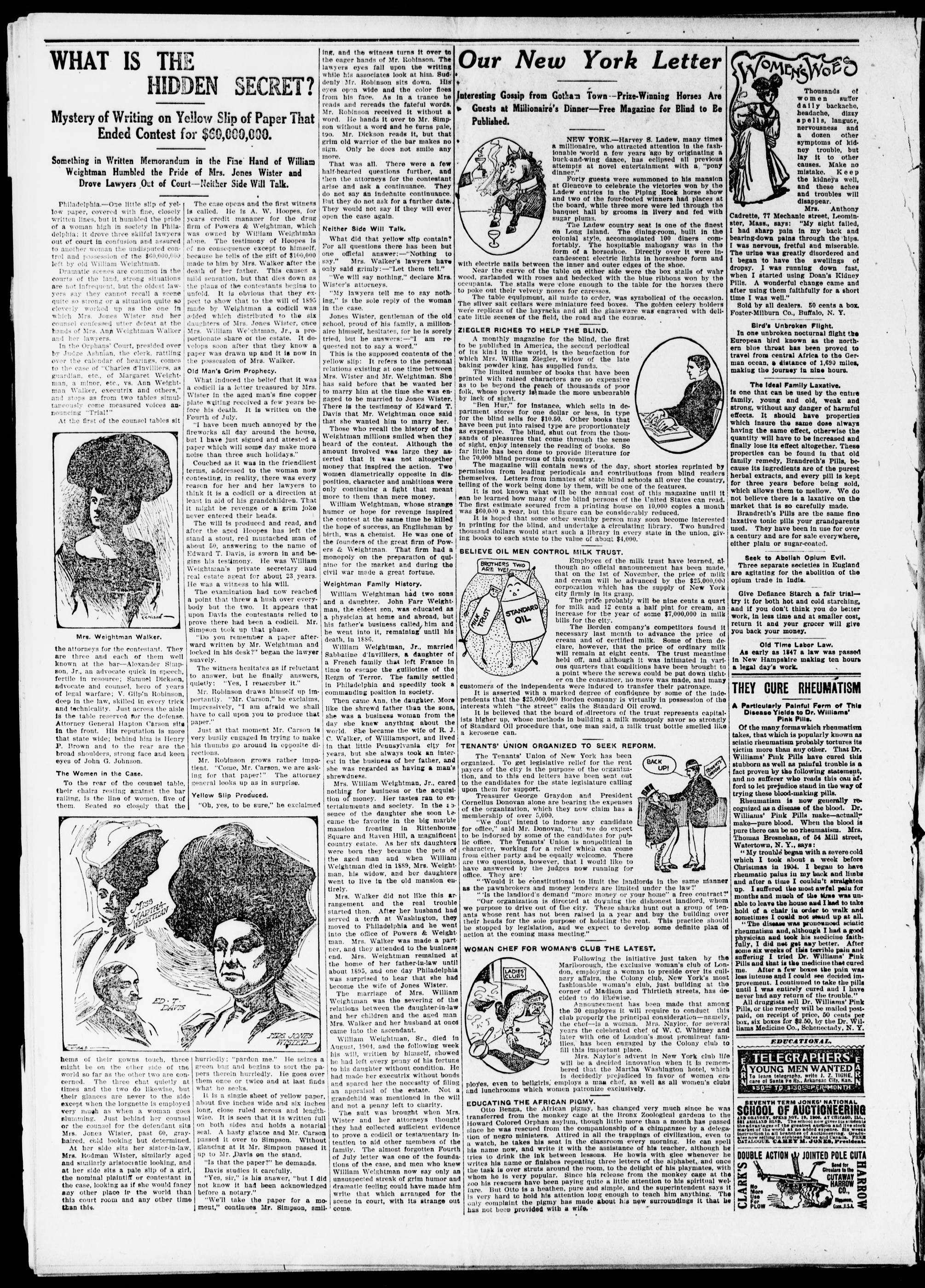
Philadelphia.—One little slip of yellow paper, covered with fine, closely written lines, but it humbled the pride of a woman high in society in Philadelphia; it drove three skilful lawyers out of court in confusion and assured to another woman the undisputed control and possession of the $60,000,000 left by old William Weightman. Dramatic scenes are common in the courts of the land, strong situations are not infrequent, but the oldest lawyers say they cannot recall a scene quite so strong or a situation quite so cleverly worked up as the one in which Mrs. Jones Wister and her counsel confessed utter defeat at the hands of Mrs. Ann Weightman Walker and her lawyers.
In the Orphans' Court, presided over by Judge Ashman, the clerk, rattling over the calendar of hearings, comes to the case of "Charles d'Invilliers, as guardian, etc., of Margaret Weighman, a minor, etc., vs. Ann Weighman Walker, executrix and others," and stops as from two tables simultaneously come measured voices announcing "Trial!" At the first of the counsel tables sit
Krisen
Mrs. Weightman Walker.
the attorneys for the contestant. They are three and each of them well known at the bar—Alexander Simpson, Jr., an advocate quick in speech, fertile in resource; Samuel Dickson, advocate and counsel, hero of years of legal warfare; V. Gilphn Robinson, deep in the law, skilled in every trick and technicality. Just across the aisle is the table reserved for the defense. Attorney General Hapton Carson sits in the front. His reputation is more that state wide; behind him is Henry P. Brown and to the rear are the broad shoulders, strong face and keen eyes of John G. Johnson.
The Women in the Case.
To the rear of the counsel table, their chaira resting against the bar railing, is the line of women, five of them. Seated so closely that the
MISS
MADITHA
NEIGHTHAN
ED: T.
DAVIS
hems of their gowns touch, three might be on the other side of the world so far as the other two are concerned. The three chat quietly at times and the two do likewise, but their glances are never to the side except when the lorgnette is employed very mugh as when a woman goes slumming. Just behind her counsel or the counsel for the defendant sits Mrs. Jones Wister, past 60, gray-haired, cold looking but determined. At her side sits her sister-in-law, Mrs. Rodman Wister, similarly aged and similarly aristocratic looking, and at her side sits a pale slip of a girl, the nominal plaintiff or contestant in the case, looking as if she would fancy any other place in the world than this court room and any other time than this.
---
The case opens and the first witness is called. He is A. W. Hoopes, for years credit manager for the drug firm of Powers & Weightman, which was owned by William Weightman alone. The testimony of Hoopes is of no consequence except to himself, because he tells of the gift of $160,000 made to him by Mrs. Walker after the death of her father. This causes a mild sensation, but that dies down as the plans of the contestants begins to unfold. It is obvious that they expect to show that to the will of 1895 made by Weightman a codicill was added which distributed to the six daughters of Mrs. Jones Wister, once Mrs. William Weightman, Jr., a proportionate share of the estate. It develops soon after that they know a paper was drawn up and it is now in the possession of Mrs. Walker.
Old Man's Grim Prophecy.
What induced the belief that it was a codicil is a letter treasured by Mrs. Wister in the aged man's fine copper plate writing received a few years before his death. It is written on the Fourth of July.
"I have been much annoyed by the fireworks all day around the house, but I have just signed and attested a paper which will some day make more noise than three such holidays."
Couched as it was in the friendliest terms, addressed to the woman now contesting, in reality, there was every reason for her and her lawyers to think it is a codicil or a direction at least in aid of his grandchildren. That it might be revenge or a grim joke never entered their heads.
The will is produced and read, and after the aged Hoopes has left the stand a stout, red mustached man of about 50, answering to the name of Edward T. Davis, is sworn in and begins his testimony. He was William Weightman's private secretary and real estate agent for about 23 years. He was a witness to his will.
The examination had now reached a point that threw a hush over everybody but the two. It appears that upon Davis the contestants relied to prove there had been a codicil. Mr. Simpson took up that phaze.
"Do you remember a paper afterward written by Mr. Weightman and locked in his desk?" began the lawyer suavely.
The witness hesitates as if reluctant to answer, but he finally answers, quietly: "Yes, I remember it."
Mr. Robinson draws himself up importantly. "Mr. Carson," he exclaims, impressively, "I am afraid we shall have to call upon you to produce that paper."
Just at that moment Mr. Carson is very busy engaged in trying to make his thumbs go around in opposite directions.
Mr. Robinson grows rather impatient. "Come, Mr. Carson, we are asking for that paper!" The attorney general looks up as in surprise.
Yellow Slip Produced.
"Oh, yes, to be sure." he exclaimed
MRS. JONES
WISTER
hurriedly; "pardon me." He seizes a green bag and begins to sort the papers therein hurriedly. He goes over them once or twice and at last finds what he seeks.
It is a single sheet of yellow paper, about five inches wide and six inches long, close ruled across and lengthwise. It is seen that it is written full on both sides and holds a notarial seal. A hasty glance and Mr. Carson passed it over to Simpson. Without glancing at it Mr. Simpson passed it up to Mr. Davis on the stand.
"Is that the paper?" he demands. Davis studies it carefully.
"Yes, sir," is his answer, "but I did not know it had been acknowledged before a notary."
"We'll take the paper for a moment," continues Mr. Simpson, smil-
---
ing, and the witness turns it over to the eager hands of Mr. Robinson. The lawyers eyes fall upon the writing while his associates look at him. Suddenly Mr. Robinson sits down. His eyes open wide and the color flees from his face. As in a trance he reads and rereads the fateful words. Mr. Robinson received it without a word. He hands it over to Mr. Simpson without a word and he turns pale, too. Mr. Dickson reads it, but that grim old warrior of the bar makes no sign. Only he does not smile any more.
That was all. There were a few half-hearted questions further, and then the attorneys for the contestant arise and ask a continuance. They do not say an indecent continuance. But they do not ask for a further date. They would not say if they will ever open the case again.
Neither Side Will Talk.
What did that yellow slip contain?
For all questions there has been but one official answer:—"Nothing to say." Mrs. Walker's lawyers have only said grimly:—"Let them tell."
"We will say nothing," declare Mrs. Wister's attorneys.
"My lawyers tell me to say nothing," is the sole reply of the woman in the case.
Jones Wister, gentleman of the old school, proud of his family, a millionaire himself, hesitates, for he is sorely tried, but he answers:—"I am requested not to say a word."
This is the supposed contents of the yellow slip: It refers to the personal relations existing at one time between Mrs. Wister and Mr. Weightman. She has said before that he wanted her to marry him at the time she was engaged to be married to Jones Wister. There is the testimony of Edward T. Davis that Mr. Weightman once said that she wanted him to marry her. Those who recall the history of the Weightman millions smiled when they heard of the contest. Although the amount involved was large they asserted that it was not altogether money that inspired the action. Two women diametrically opposite in disposition, character and ambitions were only continuing a fight that meant more to them than mere money.
William Weightman, whose strange humor or hope for revenge inspired the contest at the same time he killed the hope of success, an Englishman by birth, was a chemist. He was one of the founders of the great firm of Powers & Weightman. That firm had a monopoly on the preparation of quinine for the market and during the civil war made a great fortune.
Weightman Family History.
William Weightman had two sons and a daughter. John Farr Weightman, the eldest son, was educated as a physician at home and abroad, but his father's business called him and he went into it, remaining until his death, in 1886.
William Weightman, Jr., married Sabbatine d'Inviliers, a daughter of a French family that left France in time to escape the gullotine of the Reign of Terror. The family settled in Philadelphia and speedily took a commanding position in society.
Then came Ann, the daughter. More like the shrewd father than the sons, she was a business woman from the day she knew anything about the world. She became the wife of R. J. C. Walker, of Williamsport, and lived in that little Pennsylvania city for years, but she always took an interest in the business of her father, and she was regarded as having a man's shrewdness.
Mrs. William Weightman, Jr., cared nothing for business or the acquisition of money. Her tastes ran to entertainments and society. In the absence of the daughter she soon became the favorite in the big marble mansion fronting in Rittenhouse Square and Raven Hill, a magnificent country estate. As her six daughters were born they became the pets of the aged man and when William Weightman died in 1889, Mrs. Weightman, his widow, and her daughters went to live in the old mansion entirely.
Mrs. Walker did not like this arrangement, and the real trouble started then. After her husband had served a term at Washington, they moved to Philadelphia and he went into the office of Powers & Weightman. Mrs. Walker was made a partner, and they attended to the business end. Mrs. Weightman remained at the home of her father-in-law until about 1895, and one day Philadelphia was surprised to hear that she had become the wife of Jones Wister. The marriage of Mrs. William Weightman was the severing of the relations between the daughter-in-law and her children and the aged man Mrs. Walker and her husband at once came into the ascendant.
William Weightman, Sr., died in August, 1904, and the following week his will, written by himself, showed he had left every penny of his fortune to his daughter without condition. He had made her executrix without bonds and spared her the necessity of filing an appraisal of the estate. Not a grandchild was mentioned in the will and not a penny left to charity. The suit was brought when Mrs. Wister and her attorneys thought they had collected sufficient evidence to prove a codiell or testamentary intention to aid other members of the family. The almost forgotten Fourth of July letter was one of the foundations of the case, and men who knew William Weightman now say only an unsuspected streak of grim humor and dramatic feeling could have made him write that which arranged for the scene in court, with its strange out come.
Our New York Letter
Interesting Gossip from Gotham Town-Prize-Winning Horses Are Guests at Millionaire's Dinner-Free Magazine for Blind to Be Published.
NEW YORK—Harvey S. Ladew, many times a millionaire, who attracted attention in the fashionable world a few years ago by originating a buck-and-wing dance, has eclipsed all previous attempts at novel entertainment with a "pony dinner."
Forty guests were summoned to his mansion at Glencove to celebrate the victories won by the Ladew entries in the Piping Rock horse show and two of the four-footed winners had places at the board, while three more were led through the banquet hall by grooms in livery and fed with sugar plums.
The Ladew country seat is one of the finest on Long Island. The dining-room, built in the colonial style, accommodated 100 diners comfortably. The hospitable mahogany was in the form of a horseshoe. Directly over it were incandescent electric lights in horseshoe form and the inner and outer edges of the shoe.
Near the curve of the table on either side were the box stalls of wahw wood, garlanded with roses and bedecked with the blue ribbons won by the occupants. The stalls were close enough to the table for the horses there to poke out their velvety noses for caresses.
The table equipment, all made to order, was symbolical of the occasion. The silver salt cellars were miniature feed boxes. The golden celery holders were replicas of the hayracks and all the glassware was engraved with delicate little scenes of the field, the road and the course.
The magazine will contain news of the day, short stories reprinted by permission from leading periodicals and contributions from blind readers themselves. Letters from inmates of state blind schools all over the country, telling of the work being done by them, will be one of the features.
It is not known what will be the annual cost of this magazine until it can be learned how many of the blind persons of the United States can read. The first estimate secured from a printing house on 10,000 copies a month was $60,000 a year, but this figure can be considerably reduced.
It is hoped that some other wealthy person may soon become interested in printing for the blind, and undertake a circulating library. Two hundred thousand dollars would start such a library in every state in the union, giving books to each state to the value of about $4,000.
Employees of the milk trust have learned, although no official announcement has been made, that on the 1st of November, the price of milk and cream will be advanced by the $25,000,000 corporation which has the supply of New York city firmly in its grasp.
The price probably will be nine cents a quart for milk and 12 cents a half pint for cream, an increase for the year of some $7,000,000 in milk bills for the city.
The Borden company's competitors found it necessary last month to advance the price of cream and of certified milk. Some of them declare, however, that the price of ordinary milk will remain at eight cents. The trust meantime held off, and although it was intimated in various quarters that conditions have been brought to a point where the screws are put down tighter on the consumer, no move was made, and many customers of the independents were induced to transfer their patronage.
It is asserted with a marked degree of confidence by some of the independents that the $25,000,000 Borden company is virtually in possession of the interests which "the street" calls the Standard Oil crowd.
It is believed that the board of directors of the trust represents capitalists higher up, whose methods in building a milk monopoly savor so strongly of Standard Oil procedure that, one man said, a milk trust bottle smelled like a kerosene can.
TENANTS' UNION ORGANIZED TO SEEK REFORM.
"Would it be constitutional to limit the landlords in the same manner as the pawnbrokers and money lenders are limited under the law?"
"Is the landlord's demand "more money or your home" a free contract?"
"Our organization is directed at downing the dishonest landlord, whom we purpose to drive out of the city. These sharks hunt out a group of tenants whose rent has not been raised in a year and buy the building over their heads for the sole purpose of holding the rent. This practice should be stopped by legislation, and we expect to develop some definite plan of action at the coming mass meeting."
WOMAN CHEF FOR WOMAN'S CLUB THE LATEST.
Following the initiative just taken by the Marlborough, the exclusive woman's club of London, employing a woman to preside over its culinary affairs, the Colony club, New York's most fashionable woman's club, just building at the corner of Madison and Thirtieth streets, has decided to do likewise.
Announcement has been made that among the 30 employees it will require to conduct this club properly the principal consideration—namely the chef—is a woman. Mrs. Naylor, for several years the celebrated chef of W. C. Whitney and later with one of London's most prominent families, has been engaged by the Colony club to fill this important place.
Mrs. Naylor's advent in New York club life will be a decided innovation when it is remembered that the Martha Washington hotel, which is decidedly prejudiced in favor of women employs a man chef, as well as all women's clubs men patronize exclusively.
ployes, even to belligris, employs a man chef, as well as all women's clubs and lunchrooms which women patronize exclusively.
EDUCATING THE AFRICAN PIGMY.
Otto Benga, the African pigmy, has changed very much since he was transferred from the monkey cage at the Bronx Zoological gardens to the Howard Colored Orphan asylum, though little more than a month has passed since he was rescued from the companionship of a chimpanzee by a delegation of negro ministers. Attired in all the trappings of civilization, even to a watch, he takes his seat in the classroom every morning. He can spell his name now, and write it with the assistance of his teacher, although he tries to drink the ink between lessons. He howls with glee whenever he writes his name or finishes repeating three letters of the alphabet, and once the task is over struts around the room, to the delight of his playmates, with whom he is very popular. Since his release from the monkey cage at the zoo his rescuers have been paying quite a little attention to his spiritual welfare. But Otto is a heathen, pure and simple, and the superintendent says it is very hard to hold his attention long enough to teach him anything. The only complaint the pigmy has made about his new surroundings it that he has not beep provided with a wife.
WINE
candescent electric 1 with electric nails between the inner and outer 2. Near the curve of the table on either side of wood, grained with roses and bedecked with occupants. The stall was close enough to the poke out their velvety cress to cress. The table equipment, all made to order, was the silver salt cellars were miniature feed boxes were replicas of the hayracks and all the glasses cate little scenes of the field, the road and the _____
ZIEGLER RICHES TO HELP THE BLIND.
A monthly magazine for the blind, the first to be published in America, the second periodical of its kind in the world, is the benefaction for which Mrs. William Ziegler, widow of the late baking powder king, has supplied funds.
The limited number of books that have been printed with raised characters are so expensive as to be beyond the reach of thousands of poor folk, whose poverty is made the more unbearable by lack of sight.
"Ben Hur," for instance, which sells in department stores for one dollar or less, in type for the blind sells for $10.50. Other books that have been put into raised type are proportionate as expensive. The blind, shut out from the thousands of pleasures that come through the sens of sight, enjoy intensely the reading of books. So far little has been done to provide literature for the 70,000 blind persons of this country.
The magazine will contain news of the day permission from leading periodicals and control themselves. Letters from inmates of state blind telling of the work being done by them, will be on it. It is not known what will be the annual can be learned how many of the blind persons of the first estimate secured from a printing house was $60,000 a year, but this figure can be considered it is hoped that some other wealthy person in printing for the blind, and undertake a circle thousand dollars would start such a library in books to each state to the value of about $41.
A monthly magazine for the blind, the first to be published in America, the second periodical of its kind in the world, is the benefaction for which Mrs. William Zlegler, widow of the late baking powder king, has supplied funds.
The limited number of books that have been printed with raised characters are so expensive as to be beyond the reach of thousands of poor folk, whose poverty is made the more unbearable by lack of sight.
"Ben Hur," for instance, which sells in department stores for one dollar or less, in type for the blind sells for $10.50. Other books that have been put into raised type are proportionately as expensive. The blind, shut out from the thousands of pleasures that come through the sense of sight, enjoy intensely the reading of books. So far little has been done to provide literature for the 70,000 blind persons of this country.
BELIEVE OIL MEN CONTROL MILK TRUST.
BROTHERS TWO ARE WE!
MILK TRUST
STANDARD OIL
customers of the independents were induced to
It is asserted with a marked degree of con-
pendents that the $25,000,000 Borden company is
interests which "the street" calls the Standard
It is believed that the board of directors or
ists higher up, whose methods in building a mil-
of Standard Oil procedure that, one man said, a
kerosene can.
TENANTS' UNION ORGANIZED TO SEEK FOR
The Tenants' Union of New York has been
organized. To get legislative relief for the re-
payers of the city is the purpose of the organi-
tation, and to this end letters have been sent to
to the candidates for the state legislature calli-
up upon them for support.
Treasurer George Graydon and Preside-
Cornellus Donovan alone are bearing the expense
of the organization, which they now claim has
membership of over 5,000.
"We don't intend to indorse any candidates
for office," said Mr. Donovan, "but we do expe-
to be indorsed by some of the candidates for pub-
lic office. The Tenants' Union is nonpolitical
character, working for a relief which can con-
from either party and be equally welcome. The
are two questions, however, that I would like
have answered by the judges now running
office. They are:
"Would it be constitutional to limit the
as the pawnbrokers and money lenders are lim-
"Is the landlord's demand "more money on
"Our organization is directed at downing
we purpose to drive out of the city. These shi-
shants whose rent has not been raised in a yea
their heads for the sole purpose of hoisting the
be stopped by legislation, and we expect to a
action at the coming mass meeting."
WOMAN CHEF FOR WOMAN'S CLUB THE
The Tenants' Union of New York has been organized. To get legislative relief for the rent payers of the city is the purpose of the organization, and to this end letters have been sent out to the candidates for the state legislature calling upon them for support.
Treasurer George Graydon and President Cornellus Donovan alone are bearing the expenses of the organization, which they now claim has a membership of over 5,000.
"We don't intend to indorse any candidate for office," said Mr. Donovan, "but we do expect to be indorsed by some of the candidates for public office. The Tenants' Union is nonpolitical in character, working for a relief which can come from either party and be equally welcome. There are two questions, however, that I would like to have answered by the judges now running for office. They are:
LADIES
CLUBS
EDUCATING THE AFRICAN PIGMY.
Otto Benga, the African pigmy, has cha transferred from the monkey cage at the B Howard Colored Orphan asylum, though little since he was rescued from the companionship of negro ministers. Attired in all the tr a watch, he takes his seat in the classroom his name now, and write it with the assistant tries to drink the ink between lessons. He writes his name or finishes repeating three le the task is over struts around the room, to the whom he is very popular. Since his release zoo his rescuers have been paying quite a littl fare. But Otto is a heathen, pure and simple, is very hard to hold his attention long enough only complain the pigmy has made about he has not been provided with a wife.
A
short stories reprinted byations from blind readers schools all over the country, of the features, of this magazine until it the United States can read, on 10,000 copies a monthably reduced. May soon become interested library. Two hundred ry state in the union, give. milk trust have learned, advancement has been made, member, the price of milk advanced by the $25,000,000 the supply of New York will be nine cents a quart a half pint for cream, an of some $7,000,000 in milkany's competitors found it to advance the price of milk. Some of them de the price of ordinary milk cents. The trust meantime it was intimated in variations have been brought to could be put down tight-move was made, and many transfer their patronage. Hence by some of the indefinitely in possession of the crowd. the trust represents capital-monopoly savor so strongly milk trust bottle smelled like FORM.
BACK UP!
TENANTITY UNION
LAWRENCE
alllords in the same manner and under the law?" your home" a free contract?" the dishonest landlord, whom he hunt out a group of ten and buy the building over rent. This practice should develop some definite plan of TEST.
WOMEN
WOMEN'S WOES
Thousands of women suffer daily backache, headache, dizzy spells, languor, nervousness and a dozen other symptoms of kidney trouble, but lay it to other causes. Make no mistake. Keep the kidneys well, and these aches and troubles will disappear.
Mrs. Anthony
Mrs. Anthony Cadrette, 77 Mechanic street, Leominster, Mass., says: "My sight failed, I had sharp pain in my back and bearing-down pains through the hips. I was nervous, frettful and miserable. The urine was greatly disordered and I began to have the swellings of dropsy. I was running down fast, when I started using Doan's Kidney Pills. A wonderful change came and after using them faithfully for a short time I was well." Sold by all dealers. 50 cents a box. Foster-Milburn Co., Buffalo, N. Y.
Bird's Unbroken Flight.
In one unbroken nocturnal flight the European bird known as the northern blue throat has been proved to travel from central Africa to the German ocean, a distance of 1,690 miles, making the journey in nine hours.
The Ideal Family Laxative.
is one that can be used by the entire family, young and old, weak and strong, without any danger of harmful effects. It should have properties which insure the same dose always having the same effect, otherwise the quantity will have to be increased and finally lose its effect altogether. These properties can be found in that old family remedy, Brandreth's Pills, because its ingredients are of the purest herbal extracts, and every pill is kept for three years before being sold, which allows them to mellow. We do not believe there is a laxative on the market that is so carefully made. Brandreth's Pills are the same fine laxative tonic pills your grandparents used. They have been in use for over a century and are for sale everywhere, either plain or sugar-coated.
Seek to Abolish Opium Evil.
Three separate societies in England are agitating for the abolition of the opium trade in India.
Give Defiance Starch a fair trial—try it for both hot and cold starching, and if you don't think you do better work, in less time and at smaller cost, return it and your grocer will give you back your money.
Old Time Labor Law.
As early as 1847 a law was passed in New Hampshire making ten hours a legal day's work.
THEY GURE RHEUMATISM
A Particularly Paintful Ferm of This Disease Yields to Dr. Williams' Pink Pills.
Of the many forms which rheumatism takes, that which is popularly known as sciatic rheumatism probably tortures its victim more than any other. That Dr. Williams' Pink Pills have cured this stubborn as well as painful trouble is a fact proven by the following statement, and no sufferer who reads this can afford to let prejudice stand in the way of trying these blood-making pills. Rheumatism is now generally recognized as a disease of the blood. Dr. Williams' Pink Pills make—actually make—pure blood. When the blood is pure there can be no rheumatism. Mrs. Thomas Bresnehan, of 54 Mill street, Watertown, N. Y., says:
"My trouble began with a severe cold which I took about a week before Christmas in 1904. I began to have rheumatic pains in my back and lain and after a time I couldn't straighten up. I suffered the most awful pain for months and much of the time was unable to leave the house and I had to take hold of a chair in order to walk and sometimes I could not stand up at all.
"The disease was pronounced scatic rheumatism and, although I had a good physician and took his medicine faithfully, I did not get any better. After six weeks of this terrible pain and suffering I tried Dr. Williams' Pink Pills and that is the medicine that cured me. After a few boxes the pain was less intense and I could see decided improvement. I continued to take the pills until I was entirely cured and I have never had any return of the trouble."
All druggists sell Dr. Williams' Pink Pills, or the remedy will be mail postpaid, on receipt of price, 50 cents per box, six boxes for $2.50, by the Dr. Williams Medicine Co., Schenectady, N. Y.
SEVENTH TERM JONES' NATIONAL
SCHOOL OF AUCTIONEERING
HARVARD, SPECIAL NO. 107, ATHENS, GA.
SRI AHILAND HARD. The school now gives its students
the advantages of the greatest auction and live stock
selling. The school has a well-established
instruction in all branches of Auctioneering. Graduates
now selling in eighteen States and Canada. FREE
CATALOGUE CAREY M. JONES, President.
DOUBLE ACTION JOINTED POLE CUTA
Send for Circulation to
CUTAWAY
HARROW
CO.
(inc. U.S.A.
CLARK'S
No More
For
PLOW
THE HISTORY OF POLICEMAN FLYNN BY ELLIOTT FLOWER
PREACHING AND PRACTICE
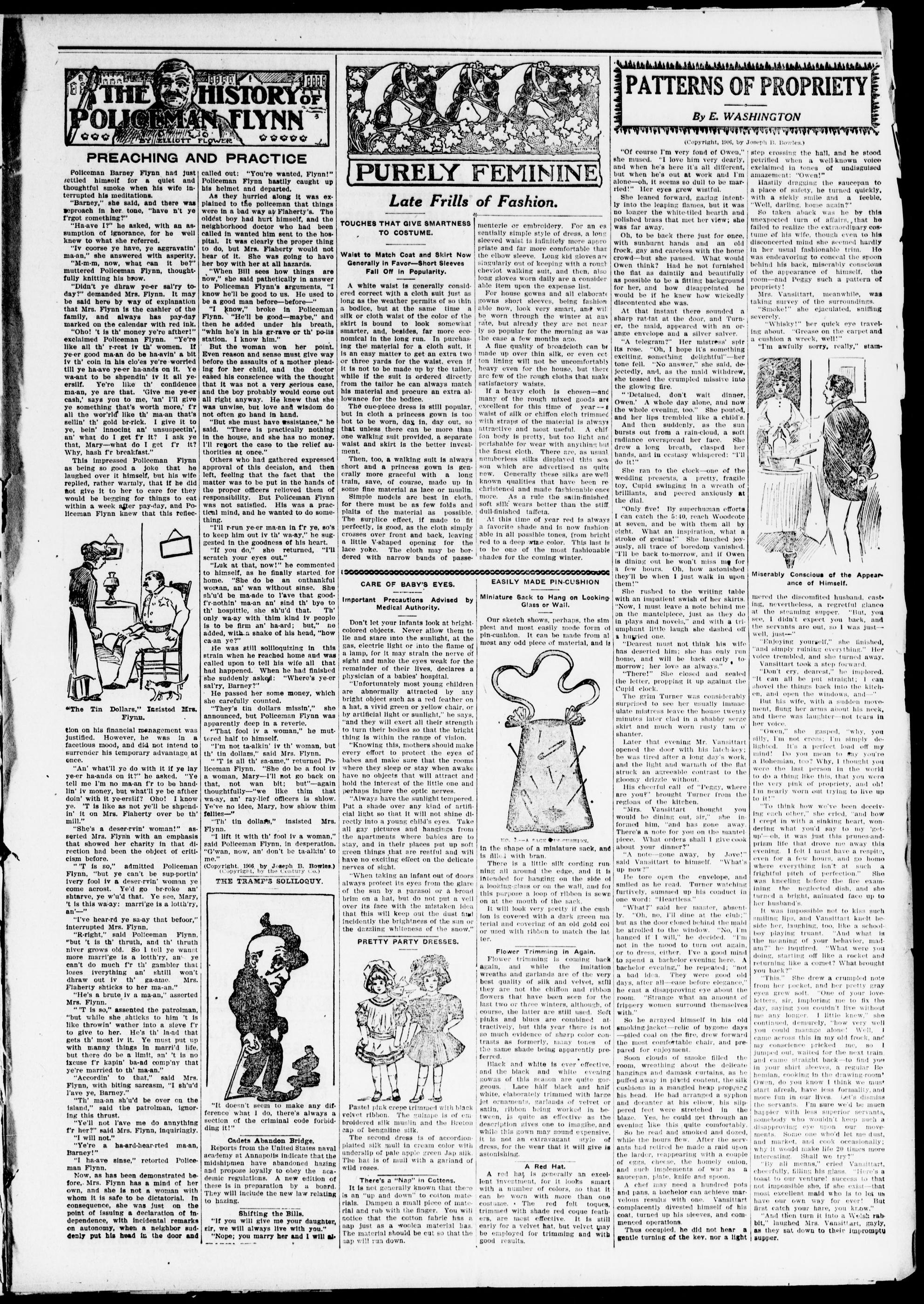
Policeman Barney Flynn had just settled himself for a quiet and thoughtful smoke when his wife interrupted his meditations.
"Barney," she said, and there was approach in her tone, "have n't ye frggot something?"
"Ha-ave I?" he asked, with an assumption of ignorance, for he well knew to what she referred.
"Iv coarse ye have, ye aggravatin' ma-an," she answered with asperity.
"M-m-m, now, what can it be?" muttered Policeman Flynn, thoughtfully knitting his brow.
"Didn't ye dhraw ye-er sal'ry today?" demanded Mrs. Flynn. It may be said here by way of explanation that Mrs. Flynn is the cashier of the family, and always has pay-day marked on the calendar with red ink.
"Oho! 't is th' money ye're ather!'" exclaimed Policeman Flynn. "Ye're like all th' r-rest iv th' women. If ye-er good ma-an do be ha-avin' a bit iv th' coin in his clo'se' ye're-worried till ye ha-ave ye-er ha-ands on it. Ye wa-ant to be shipdin' iv it all yeersliff. Ye're like th' confidence ma-an, ye are that. 'Give me ye-er cash,' says you to me, 'an' I'll give ye something that's worth more, 'fr all the wor'rld like th' ma-an that's sellin' th' gold br-rick. I give it to ye, bein' innocint an' unsuspectin', an' what do I get fr it? I ask ye that, Mary—what do I get fr it? Why, hash fr breakfast."
This impressed Policeman Flynn as being so good a joke that he laughed over it himself, but his wife replied, rather warmly, that if he did not give it to her to care for they would be begging for things to eat within a week after pay-day, and Policeman Flynn knew that this reflect-
A
"The Tin Dollars," Insisted Mrs. Flynn.
tion on his financial management was justified. However, he was in a facetious mood, and did not intend to surrender his temporary advantage at once.
"An' what'll ye do with it if ye lay ye-er ha-ands on it?" he asked. "Ye tell me I'm no ma-an fr to be handlin' iv money, but what'll ye be afther doin' with it ye-erslif? Oho! I know ye. 'T is like as not ye' be shpendin' it on Mrs. Flaherty over be th' mill."
"She's a deser-rvin' woman!" asserted Mrs. Flynn with an emphasis that showed her charity in that direction had been the object of criticism before.
"T is so," admitted Policeman Flynn. "but ye can't be sup-portin' ivory fool iv a deser-rvin' woman ye come acrost. Ye'd go br-roke an' shtarve, ye w'd that. Ye see, Mary, t' is this wa-ay: marrige is a lotth'ry, an—"
"I've hear-rd ye sa-ay that befoor," interrupted Mrs. Flynn.
"R-right," said Policeman Flynn. "but t' is th' thruth, and th' thruth niver grows old. So I tell ye wanst more marrige is a lotth'ry, an' ye can't do much fr' th' gambier that loses iverything an' shtill won't dhraw out iv th' ga-ame. Mrs. Flaherty sticks to her ma-an."
"He's a brute iv a ma-an," asserted Mrs. Flynn.
"T is so," assented the patrolman,
"but while she ahticks to him 't is
like throwin' wather into a sieve fr
to give to her. He's th' la-ad that
gets th' most iv it. He must put up
with manny things in marrid' life,
but there do be a limit, an' t' is no
n excuse fr kapin' ba-ad company that
ye're married to th' ma-an."
"Accordin' to that," said Mrs.
Flynn, with biting sarcasm, "I sh'u'd
lave ye, Barney."
"Th' ma-an sh'u'd be over on the
island," said the patrolman, ignoring
this thrust.
"Ye'll not lave me do anything
fr her?" said Mrs. Flynn, inquiringly.
"I will not."
"Ye're a ha-ard-hear-rted ma-an,
Barney!"
"I ha-ave sinse," retorted Police-
man Flynn.
Now, as has been demonstrated before, Mrs. Flynn has a mind of her own, and she is not a woman with whom it is safe to be dictatorial. In consequence, she was just on the point of issuing a declaration of independence, with incidental remarks on autonomy, when a neighbor suddenly put his head in the door and
called out: "You're wanted, Flynn!" Policeman Flynn hastily caught up his helmet and departed. As they hurried along it was explained to the policeman that things were in a bad way at Flaherty's. The oldest boy had hurt himself, and the neighborhood doctor who had been called in wanted him sent to the hospital. It was clearly the proper thing to do, but Mrs. Flaherty would not hear of it. She was going to have her boy with her at all hazards. "When Bill sees how things are now," she said pathetically in answer to Policeman Flynn's arguments, "I know he'll be good to us. He used to be a good man before—before—" "I know," broke in Policeman Flynn. "He'll be good—maybe," and then he added under his breath, "whin he's in his gr-rave or th' po-lis station. I know him."
But the woman won her point. Even reason and sense must give way before the assaults of a mother pleading for her child, and the doctor eased his conscience with the thought that it was not a very serious case, and the boy probably would come out all right anyway. He knew that she was unwise, but love and wisdom do not often go hand in hand.
"But she must have assistance," he said. "There is practically nothing in the house, and she has no money. I'll report the case to the relief authorities at once."
Others who had gathered expressed approval of this decision, and then left, feeling that the fact that the matter was to be put in the hands of the proper officers relieved them of responsibility. But Policeman Flynn was not satisfied. His was a practical mind, and he wanted to do something.
"I'll r-run ye-er ma-an in fr ye, so's to keep him out lv th' wa-ay," he suggested in the goodness of his heart.
"If you do," she returned, "I'll scratch your eyes out."
"Luk at that, now!" he commented to himself, as he finally started for home. "She do be an onthankful woman, an' anw without since. She sh'u-d be ma-ade to Iave that good-fr-nothin' ma-an an' sind th' bye to hospittie, she sh'u-d that. Th' only wa-ay with thim kind iv people is to be firm an' ha-ard; but," ne added, with a snake of his head, "how ca-an ye?"
He was still solloquizing in this strain when he reached home and was called upon to tell his wife all that had happened. When he had finished she suddenly asked: "Where's ye-er sal'ry, Barney?"
He passed her some money, which she carefully counted.
"They's tin dollars missin'," she announced, but Policeman Flynn was apparently deep in a reverie.
"That fool is a woman," he muttered half to himself.
"I'm not ta-alkin iv th' woman, but th' tin dollars," said Mrs. Flynn.
"T is all th' sa-ame," returned Policeman Flynn. "She do be a fool iv a woman, Mary—I'll not go back on that, not wan bit; but"—again thoughtfully—"we like thim that wa-ay, an' ray-lief officers is shlow. Ye've no idea, Mary, how shlow thim fellies—"
"Th' tin dollars," insisted Mrs. Flynn.
"I lift it with th' fool iv a woman," said Policeman Flynn, in desperation.
"G'wan, now, an' don't be ta-alkin' to me."
(Copyright, 1966, by Joseph B. Bowles.)
(Copyright, by the Century Co.)
THE TRAMP'S SOLILLOQUY.
A
"It doesn't seem to make any difference what I do, there's always a section of the criminal code forbidding it!"
Cadets Abandon Bridge.
Reports from the United States naval academy at Annapolis indicate that the midshipmen have abandoned hazing and propose loyalty to obey the academic regulations. A new edition of these is in preparation by a board. They will include the new law relating to hazing.
Shifting the Bills
"If you will give me your daughter
sir, we will always live with you."
"Nope; we marry her and I will al-
M. W. H.
PURELY FEMININE
Late Frills of Fashion.
TOUCHES THAT GIVE SMARTNESS
TO COSTUME.
Waist to Match Coat and Skirt Now Generally in Favor—Short Sleeves Fall Off in Popularity.
A white waist is generally considered correct with a cloth suit just as long as the weather permits of so thin a bodice, but at the same time a silk or cloth waist of the color of the skirt is bound to look somewhat smarter, and, besides, far more economical in the long run. In purchasing the material for a cloth suit, it is an easy matter to get an extra two or three yards for the waist, even if it is not to be made up by the tailor, while if the suit is ordered directly from the tailor he can always match his material and procure an extra allowance for the bodice.
The one-piece dress is still popular, but in cloth a princess gown is too hot to be worn, day in, day out, so that unless there can be more than one walking suit provided, a separate waist and skirt is the better investment.
Then, too, a walking suit is always short and a princess gown is generally more graceful with a long train, save, of course, made up in some fine material as lace or muslin. Simple models are best in cloth, for there must be as few folds and plaits of the material as possible. The surplice effect, if made to fit perfectly, is good, as the cloth simply crosses over front and back, leaving a little V-shaped opening for the lace yoke. The cloth may be bordered with narrow bands of passe-
Important Precautions Advised by Medical Authority.
Don't let your infants look at bright-colored objects. Never allow them to lie and stare into the sunlight, at the gas, electric light or into the flame of a lamp, for it may strain the nerve of sight and make the eyes weak for the remainder of their lives, declares a physician of a babies' hospital.
"Unfortunately most young children are abnormally attracted by any bright object such as a red feather on a hat, a vivid green or yellow chair, or by artificial light or sunlight," he says, "and they will exert all their strength to turn their bodies so that the bright thing is within the range of vision.
"Knowing this, mothers should make every effort to protect the eyes of babes and make sure that the rooms where they sleep or stay when awake have no objects that will attract and hold the interest of the little one and perhaps injure the optic nerves.
"Always have the sunlight tempered. Put a shade over any kind of artificial light so that it will not shine directly into a young child's eyes. Take all gay pictures and hangings from the apartments where babies are to stay, and in their places put up soft green things that are restful and will have no exciting effect on the delicate nerves of sight.
"When taking an infant out of doors always protect its eyes from the glare of the sun by a parasol or a broad brim on a hat, but do not put a veil over its face with the mistaken idea that this will keep out the dust that incidently the brightness of the sun or the dazzling whiteness of the snow."
PRETTY PARTY DRESSES.
Pastel pink crepe trimmed with black velvet ribbon. The gulpe is of embroidered silk muslin and the Breton cap of bengaline silk. The second dress is of accordion-piated silk mull in cream color with undershift of pale apple green Jap silk. The hat is of mull with a garland of wild roses.
There's a "Nap" in Cottons.
It is not generally known that there is an "up and down" to cotton materials. Dampen a small piece of material and rub with the finger. You will notice that the cotton fabric has a nap just as a woolen material has. The material should be cut so that the nap will run down.
menterle or embroidery. For an essentially simple style of dress, a long sleeved waist is infinitely more appropriate and far more comfortable than the elbow sleeve. Long kid gloves are singularly out of keeping with a rough cheviot walking suit, and then, also long gloves worn daily are a consider able item upon the expense list.
For house gowns and all elaborate gowns short sleeves, being fashion able now, look very smart, and will be worn through the winter at any rate, but already they are not nearly so popular for the morning as was the case a few months ago.
A fine quality of broadeloth can be made up over thin silk, or even cotton lining will not be uncomfortably heavy even for the house, but there are few of the rough cloths that make satisfactory waists.
If a heavy cloth is chosen—and many of the rough mixed goods are excellent for this time of year—a waist of silk or chiffon cloth trimmed with straps of the material is always attractive and most useful. A chiffon body is pretty, but too light and perishable for wear with anything but the finest cloth. There are, as usual, numberless silks displayed this season which are advertised as quite new. Generally these silks are well known qualities that have been re-christened and made fashionable once more. As a rule the satin-finished soft silk silks wears better than the stiff dull-finished taffeta.
At this time of year red is always a favorite shade and is now fashionable in all possible tones, from bright red to a deep white color. This last is to be one of the most fashionable shades for the coming winter.
Miniature Gack to Hang on Looking Glass or Wall.
Our sketch shows, perhaps, the slim plest and most easily mode form of pin-cushion. It can be made from all most any odd piece of material, and is
```markdown
```
in the shape of a miniature sack, and is filled with bran.
There is a little silk cording running all around the edge, and it is intended for hanging on the side of a looking-glass or on the wall, and for this purpose a loop of ribbon is sewn on at the mouth of the sack.
It will look very pretty if the cushion is covered with a dark green material and covering of an old gold col or used with ribbon to match the latter.
Flower Trimming In Again.
Flower trimming is coming back again, and while the imitation wreaths and garlands are of the very best quality of silk and velvet, still they are not the chiffon and ribbon flowers that have been seen for the last two or three winters, although, of course, the latter are still used. Soft pinks and blues are combined attractively, but this year there is not so much evidence of sharp color contrasts as formerly, many tones of the same shade being apparently preferred.
Black and white is ever effective, and the black and white evening gowns of this season are quite gorgeous. Lace half black and half white, elaborately trimmed with large jet ornaments, garlands of velvet or satin, ribbon being worked in between, is quite as effective as the description gives one to imagine, and while this gown may sound expensive, it is not an extravagant style of dress, for the wear that it will give is astonishing.
A. Red Hat.
A red hat is generally an excellent investment, for it looks smart with a number of colors, so that it can be worn with more than one costume. The red felt toques, trimmed with shade red coque feathers, are most effective. It is still early for a velvet hat, but velvet may be employed for trimming and with good results.
PATTERNS OF PROPRIETY By E. WASHINGTON
"Of course I'm very fond of Owen," she mused. "I love him very dearly, and when he's here it's all different, but when he's out at work and I'm alone—oh, it seems so dull to be married!" Her eyes grew wistful.
She leaned forward, gazing intently into the leaping flames, but it was no longer the white-tiled hearth and polished brass that met her view; she was far away.
Oh, to be back there just for once, with sunburn hands and an old frock, gay and careless with the home crowd—but she paused. What would Owen think? Had he not furnished the flat as daintily and beautifully as possible to be a fitting background for her, and how disappointed he would be if he knew how wickedly discontented she was.
step crossing the petrified when exclaimed in to amazement: "O! Hastily drags a place of safety with a sickly sly "Well, darling. So taken aba unexpected turn failed to realize tune of his wife disconcerted min in her usual fault was endeavoring behind his back of the appearar room—and Pega propriety! Mrs. Vansitt taking survey of
At that instant there sounded a sharp rat-tat at the door, and Turner, the maid, appeared with an orange envelope and a silver salver.
"A telegram?" Her mistress' swirls rose. "Oh, I hope it's something exciting, something delightful"—her tone fell. "No answer," she said, dejectedly, and, as the maid withdrew, she tossed the crumpled missive into the glowing fire.
"'Detained, don't wait dinner, Owen.' A whole day alone, and now the whole evening, too." She poured, and her lips trembled like a child's.
And then suddenly, as the sun bursts out from a rain-cloud, a soft radiance overspread her face. She drew a long breath, clasped her hands, and in cestasy whispered: "I'll do it!"
She ran to the clock—one of the wedding presents, a pretty, fragile toy, Cupid swinging in a wreath of brilliants, and peered anxiously at the dial.
"Only five! By superhuman efforts I can catch the 5:10, reach Woodoteat seven, and be with them all by eight. What an inspiration, what a stroke of genius!" She laughed joyously, all trace of boredom vanished. "I'll be back to-morrow, and if Owen is dining on he won't miss me for a few hours. Oh, how astonished they'll be when I just walk in upon them!" She rushed to the writing table with an impatient swish of her skirts. "Now, I must leave a note behind me on the mantelpiece, just as they do in plays and novels," and with a triumphant little laugh she dashed off a hurried one.
"Dearest must not think his wife has deserted him; she has only run home, and will be back early tomorrow; her love as always."
"There!!" She closed and sealed the letter, propping it up against the Cupid clock.
The grim Turner was considerably surprised to see her usually immaculate mistress leave the house twenty minutes later clad in a shabby serge skirt and much worn rusty tam of shanter.
Later that evening Mr. Vansittart opened the door with his latch key; he was tired after a long day's work, and the light and warmth of the flat struck an agreeable contrast to the gloomy drizzle without.
His cheerful call of "Peggy, where are you?" brought Turner from the regions of the kitchen.
"Mrs. Vansittart thought you would be dining out, sir," she informed him, "and has gone away. There's a note for you on the mantel piece. What orders shall I give cook about your dinner?" "A note—gone away, by Jove!" said Vansittart to himself, "What's up now?" He tore open the envelope, and smiled as he read. Turner watching furtively, summed up his conduct in one word: "Heartless."
"What?" said her master, absently. "Oh, no. I'll dine at the club;" but as the door closed behind the maid he strolled to the window. "No, I'm hanged if I will," he decided. "I'm not in the mood to turn out again, or to dress, either. I've a good mind to spend a bachelor evening here. A bachelor evening," he repeated; "not a bad idea. They were good old days, after all—case before elegance." he cast a disapproving eye about the room. "Strange what an amount of frippery women surround themselves with." So he arrayed himself in his old smoking jacket—relic of bygone days—piled coal on the fire, drew forward the most comfortable chair, and prepared for enjoyment.
Soon clouds of smoke filled the room, wreathing about the delicate hangings and damask curtains, as he puffed away in placid content, the silk cushions in a mangled heap propping his head. He had arranged a syphon and decanter at his elbow, his slipped feet were stretched In the blaze. Yes, he could get through an evening like this quite comfortably.
So he read and smoked and dozed, while the hours flew. After the servants had retired he made a raid upon the larder, reappearing with a couple of eggs, cheese, the homely onion, and such implements of war as a saucepan, plate, knife and spoon.
A chef may need a hundred pots and pans, a bachelor can achieve marvelous results with one. Vansitart complacently divested himself of his coat, turned up his sleeves, and commenced operations.
Thus occupied, he did not hear a gentle turning of the key, nor a light
step crossing the hall, and he stood petrified when a well-known voice exclaimed in tones of undisguised amazement: "Owen!"
Hastily dragging the saucepan to a place of safety, he turned quickly, with a sickly smile and a feeble, "Well, darling, home again?"
So taken aback was he by this unexpected turn of affairs, that he failed to realize the extraordinary costume of his wife, though even to his disconcerted mind she seemed hardly in her usual fashionable trim. He was endeavoring to conceal the spoon behind his back, miserably conscious of the appearance of himself, the room—and Peggy such a pattern of propriety!
Mrs. Vansittart, meanwhile, was taking survey of the surroundings. "Smoke!" she ejaculated, sniffing severely.
"Whisky!" her quick eye traveling about. "Grease on the carpet and a cushion a wreck, well!"
"I'm awfully sorry, really," stam-
A man stands in front of a mirror, looking at himself with a surprised expression. He is wearing a dark jacket and white shirt. The mirror reflects his image, showing him with a similar expression. The table in front of him is covered with a cloth.
Miserably Conscious of the Appearance of Himself.
mered the discomfited husband, casting, nevertheless, a regretful glance at the steaming supper. "But, you see, I didn't expect you back, and the servants are out, so I was just—well, just—"
"Enjoying yourself," she finished, "and simply ruining everything." Her voice trembled, and she turned away. Vansittart took a step forward. "Don't cry, dearest," he implored. "It can all be put straight; I can shovel the things back into the kitchen, and open the windows, and—"
But his wife, with a sudden movement, flung her arms about his neck, and there was laughter—not tears in her voice.
"Owen," she gasped, "why, you silly. I'm not cross. I'm simply delighted. It's a perfect load off my mind! Do you mean to say you're a Bohemian, too? Why, I thought you were the last person in the world to do a thing like this, that you were the very pink of propriety, and oh! I'm nearly worn out trying to live up to it."
"To think how we've been deceiving each other," she cried, "and how I crept in with a sinking heart, wondering what you'd say to my 'get-up'—oh, it was just this prunes-and-prism life that drove me away this evening. I felt I must have a respite, even for a few hours, and go homo where everything isn't at such a frightful pitch of perfection." She was kneeling before the fire examining the neglected dish, and she turned a bright, animated face up to her husband's.
It was impossible not to kiss such smiling lips, and Vansittart knelt beside her, laughing, too, like a schoolboy playing truant. "And what is the meaning of your behavior, madam?" he inquired. "What were you doing, starting off like a rocket and returning like a comet? What brought you back?"
"This." She drew a crumpled note from her pocket, and her pretty gray eyes grew soft. "One of your love letters, sir, imploring me to fix the day, saying you couldn't live without me any longer. I little knew," she continued, demurely, "how very well you could manage alone! Well. I came across this in my old frock, and my conscience pricked me, so I jumped out, waited for the next train and came straight back—to find you in your shirt sleeves, a regular Behemian, cooking in the drawing room' Owen, do you know I think we must start afresh, have less formality, and more fun in our lives. Let's dismiss the servants. I'm sure we'd be much happier with less superior servants, somebody who wouldn't keep such a disapproving eye upon our movements. Some one who'd let me dust, and market, and cook occasionally; why it would make life 20 times more interesting. Shall we try?"
"By all means," cried Vanittart, cheerfully, filling his glass. "Here's a toast to our venture! success to that not impossible she, if she exist—that most excellent maid who is to let us have our own way for ever! But first catch your hare, you know." "And then turn it into a Welsh rabbit," laughed Mrs. Vanittart, gaily, as they sat down to their impromptu supper.
THE 311 SON.
RISING SON PUBLISHING CO
OLDEST NEGRO JOURNAL . . IN KANSAS CITY.
TWICE ALL
THE REST.
The paid circulation
of THE RISING SON
is more than double
the combined circula-
tion of all the other
Kansas City Golored
weekly newspapers.
.
THE GREAT REPUBLICAN PLATFORM AND ITS VICTORY AS A BENEFIT TO THE NEGROES.
Fredrick Douglass in a wave of enthusiasm voiced these sentiments: "The Republican Party is the ship and all else is the sea." What does this mean? It means when the negro has left the mighty, Republican party his light has gone out and like a meteor which breaks away from the law of gravitation and from the controlling influence of some sun, goes wandering in the stylogan darkness of endless space. The great party which
gave life and motion to this black mass of eleven million negroes. Let sober minded negroes think what this great victory throughout the country means for the negro. Two more years of prosperity. Two more years of good government, alohsgide with law and order. Two more years of the unbroken order of harmony. The continuation of the golden thread stretching through the centuries, pointing to God's masterpiece in this country. "A perfect civilization." The Utopia of America. Yet I doubt not, through the ages, One increasing purpose runs, And the thoughts of men are broadened Do the success of the sun
Has the president of these United States forgotten the bravery of the negro soldiers in time of war? Has he forgotten that he dares muster the negro soldiers out the Indian wars in the colonial period when every negro shouldered a musket though he were a slave?
Has he forgotten the war of 1776, or even during the time when Crispus Attucks fell on Boston Commons? Has he forgotten the war of 1812 when negroes died as soldiers under General Jackson?
Has he forgotten the Mexican war when negroes crossed the borders with white troops to fight for Old Glory?
Has he forgotten the Civil war when thousands of negro soldiers died that this Union might be saved? That the policies of this government might be carried out?
Has he forgotten the Spanish-American war in which he figured so conspicuously. In which if it were not for the bravery of these troops combined with the Ninth and Tenth Cavalry he would have perished? Let us render justice where it is due. Let us remember the saying of the Bible, "When a man slaps you on one side of the face turn the other. In this country where the negro has no regrets save for the few that were granted to him by the 13th, 14th and 15th amendments to the Constitution let us practice the Christian doctrine of forgiveness. Let us bear our trials like Job. Let us remember that when all else is lost we must turn our faces to God. For with him we can stand all the artillery of the white man's guns.
To Missouri Teachers:
Please remember the meeting of the State Teachers' Association at Moberly during the Christmas holidays. Aside from a very high classed program that is being prepared, we shall have an educator of national reputation as the principal speaker of the week. No progressive teacher can afford to miss such a rare treat. "On to Moberly" is our war cry from this time forth. You who have delayed sending your subjects to Prin. A. R. Chinn, Glasgow, Mo., should hurry and send them
as we desire to have our programs printed earlier this year. We can do so if you teachers will only act promptly and cooperate with us. All who send subjects will please be present and prepared at the time and place appointed. Have your pupils work so that the exhibits may be interesting.
Yours for a successful meeting.
E. W. EMORY, Cor. Sec'y.
The 'Weaker Sex."
Old women and new woman, it makes no difference. This cry about the feminine lack of courage and strength is out of date. A few months ago Evelyn Walsh, daughter of the Colorado multimillionaire, was almost killed in a motor accident. Her life hung by a thread for weeks and she was taken to her old home in Colorado as a last resort. There the bracing air cured her, and one day last week she stepped into her motor car and reeled off 15 miles in 20 minutes. No fear there. And as for strength, Mary Wheatland, aged 72. is giving exhibitions in England of fancy swimming and diving in the sea. She has been an expert swimmer for 57 years. But why go so far afield? Consider the average woman how she shops and the society woman how she dances. And what daring of mere man, demands the Cleveland Leader, matches the hardihood of woman in defying the weather lest she be false to fashion? As for the touch and stamp of the age, when did woman ever refuse risks for what she greatly desired? It's nothing new for her to be venturesome. Courage is an old story—as old as her fortitude. Has she not been compelled to make the best and most of man, the most destructive and dangerous of animals?
China's Reform.
The issuance of an edict by the Chinese government prohibiting opium smoking, and even the cultivation of the poppy, must be classed among the important events of modern times. One of the main charges against British influence in China has been the introduction and promotion of the use of opium by the people. It was a species of immoral commercialism of which other nations have been guilty and which forms a strong count in the indictment against so-called civilized peoples. Doubtless the use of opium has had much to do with reducing the energies of the people, and, in the long run, with shaping the national character. The question, says the Indianapolis News, is whether it can be eradicated. The Chinese government has very arbitrary power, but in dealing with opium it has tackled a very large problem. It is a question of prohibition on a much larger scale than has ever been attempted of personal habits in any other country. It will be interesting to watch whether the government can enforce it. If it succeeds in doing so, perhaps other nationalities had better go there and take lessons in the enforcement of law.
The following is a copy of the epitaph of a watachmaker, written by himself, in which he is compared to a watch that has run down: 'Here lies, in horizontal position, the outside case of George Ritter, whose abiding place in that line was an honor to his profession. Integrity was his mainspin, and prudence the regulator of all the actions of his life. Humane, generous, and liberal, his hand never stopped till he had relieved distress. He never went wrong, except when set agoing by people who did not know his key. Even then he was easily set right again. He had the art of dispensing of his time so well that his hours glided by in one continual round of pleasure and delight, till an unlucky minute put an end to his existence. His case rests and molders and decays beneath the turf, but his good works will never die."
Some of the people of England are criticising the London Times for being "too American" in its make-up. We feel it our duty to say for the benefit of those who do not get the Times regularly that it has not as yet begun to use red ink in its headlines.
French dealers are putting American labels on their shoes to insure their sale. They are repaying us for sardines and cottolene with a little our practice of branding our wines, French before raising the price.
It is said that the sultan of Turkey's illness was due to a shot fired by one of his jealous wives. The sultan should make his wives take a civil service examination on the subject of jealousy before marrying them.
A big insurance company is about to abandon business in Russia. Every one who really needs life insurance in the czar's domains is pretty sure to cash in on the policy before the company's profits begin to grow.
The second fatal football accident of the year has come. Considering the short time the new rules have been in use, they are almost as efficient as a mauser.
The Kansas City schools are making a great showing this fall. The Lincoln High school registers 299, the Lincoln ward, 615; the Attucks, 524; Garrison, 376; Douglas, 316; Phelps, 242; Sumner, 112; Bruce, 107; Penn, 53; Booker T. Washington, 46; Page, 35; Blue Valley, 25. According to the Negro population of Kansas City the percentage of the children in school is very small. The Attucks school is one of the best filled and best regulated schools in this city and it will inspire any to visit the Attucks school at this time. Prof. Bowser claims that he has a better working force of teachers than he has had in many a day.
Women know by nature how to disguise their emotions far better than the most consummate male courtier can do.—Thackeray.
When a woman pronounces the name of a man but twice a day, there may be some doubt as to the nature of her sentiments; but three times!
WISDOM FOR WOMEN.
Woman alone knows true loyalty of affection.—Schiller.
If men knew all that women think, they would be 20 times more audacious.—Karr.
When we speed to the devil's house, woman takes the lead by a thousand steps.—Goethe.
Women especially are to be talked to as below men and above children.—Chesterfield.
Beauty is worse than wine; it intoxicates both the holder and the beholder.—Zimmerman.
When joyous, a woman's license is not to be endured, when in terror, she is a plague.—Aeschylus.
Modesty in woman is a virtue most deserving, since we do all we can to cure her of it.—Lingree.
A heart which has been domesticated by matrimony and maternity is as tranquil as a tame bullfinch.—Holmes.
STOVE
STOVE REPAIRS
FOR ALL STOVES AND RANGES.
The New
302 East
Suits, $7.50 to
Overcoats, $7.50
Underwear, 50
Shirts, 50c to $
Hats and Caps,
A. H. LASSC
COAL
Keep all Kin
as cheap as
Kansas City
B.F. Cary Fe
COAL, HAY
S. E. Cor. Third a
KANSAS
Party service a specialty. Barber shop
EMPLOYMENT BUREAU.
WAITERS' CATERING ASSOCIATION
1223 BALTIMORE AVE.
Bell 'Phone 4137x Grand. Kansas C
Bell Phone 2170 Main
DR. E. C. BU
Both Phones, 1214 Main. S. A. METZNER 304 West Sixth Street, Kansas City, Mo.
Suits, $7.50 to $20 Overcoats, $7.50 to $20 Underwear, 50c and up to $2.50 Shirts, 50c to $1.50 Hats and Caps, 50c and up A. H. LASSON THE ARGYLE BUILDING 302 East 12th. Come In
COAL COAL
Keep all Kinds of COAL as cheap as any firm in Kansas City.
S. E. Cor. Third and Grand Avenue KANSAS CITY, MO.
Party service a specialty. Barber shop and bath. Furnished Rooms to EMPLOYMENT BUREAU. Gentlemen only. Joe Ottey, Mgr. WAITERS' CATERING ASSOCIATION Mr. Clem James and John Huston are predared to give the best service 1223 BALTIMORE AVE. Bell 'Phone 4137x Grand. Kansas City, Mo. in the Tonsorial Department.
Office Hours
8 To 12m. 1 To 5 P. M.
Sunday by Appointment.
I Can Sell Your Real Estate or Business
NO BATTLE WHERE LOCATED.
Properties and Business or all kinds sold
quickly torash to all parts of the United
States. Don't wait. Write today describing
you have to sell and give cash price
on same.
any kind of Business or Real Estate anywhere, at any price, write me your requirements. I can save you time and money.
DAVID P. TAFF
THE LAND MAN
415 Kansas Avenue,
TOPEKA, KANSAS.
FORD'S
HAIR POMADE
Formerly known as
"OZONIZED OX MARROW"
SO
STRAIGHTENS
KINY or CURY HAIR that it can be put up, in any style desired consistent with its length.
Ford's Hair Pomade was formerly known as Kinky or curly hair straight, as the only safe preparation, known to us that makes kinky or curly hair straight, as born, hardy, kinky or curly hair soft, pliable and easy to comb. These results are used in all hair styles and in all bottles are usually sufficient for a year. The use of Ford's Hair Pomade ("OZONIZED OX Hair Pomade") invigorates the scalp, stops the hair from falling out or breaking off, and gives it new life and vigor. Being elegantly perfumed and harmless, it is a toilet brush for Ford's Hair Pomade ("OZONIZED OX Hair Pomade") and lash. "OZONIZED OX MARROW" was registered in the United States period of time there has never been a bottle returned from the hundreds of thousands we sweep and post or deliver orders and sweets and effective, no matter how long you keep it. Be sure to get Ford's, as its use is limited. Beware of imitations. Remember that Ford's, Hair Pomade ("OZONIZED OX Hair Pomade") and is made only in Chicago and by us. The genuine has the signature, Charles Ford Prest. and is made postal or delivery receipts with every bottle. Price only 50 cts. Sold by druggists and dealers. If your druggist procures it from his jobber or wholesale dealer or send us 50 cts. for one bottle postpaid, or express paid. We pay postage and express charges to all points in U.S. A. When ordering this paper, write your name and address plainly to
The Ozonized Ox Marrow Co.
(None genuine without my signature)
Charles Ford Prest
76 Wabash Ave., Chicago, Ill.
Agents wanted everywhere.
NEW STORE
at 12th St.
to $20
1.50 to $20
1.50c and up to $2.50
$1.50
1.50c and up
ON THE ARGYLE BUILDING
302 East 12th. Come In
COAL
bands of COAL
is any firm in
y.
eed & Fuel Co.
Y and GRAIN
and Grand Avenue
CITY, MO.
op and bath. Furnished Rooms to
Gentlemen only. Joe Ottey, Mgr.
Mr. Clem James and John Huston
are predared to give the best service
City, Mo. in the Tonsorial Department
UNCH, Dentist.
805 Independence Avenue.
KANSAS CITY, MO.
Home Phone 5646 Main.
MANUFACTURERS
We make all kinds of New Hats and Repair old ones so they are as good as new.
WESTERN UNIVERSITY
WESTERN UNIVERSITY
THE GREAT EDUCATIONAL INSTITUTION FOR KANSAS AND THE WEST. . . . . .
DEPARTMENTS: Theological, Ge-
State Industrial.
COURSES: Classical, College, Prep-
sical (Instrumental and Volca-
mony, Drawing (Fine Arts and
and Book Binding, Business C
ing, Tailoring, Dressmaking and
dering, Farming and Gardenin
ADVANTAGES: Slpendid Locati-
ences and Thorough Teacher
INFORMATION: For terms, prices
to
WILLIAM T. VERN
PRESIDENT
QUINDARO,
Phones: Office—Bell—"White" 42
MENTS: Theological, College, Normal, Sub-National Industrial.
OBJECTS: Classical, College, Preparatory, Normal, Sub-National (Instrumental and Volcal), including piano, organ, Drawing (Fine Arts and Mechanical), Carpentry, Book Binding, Business Course, Stenography and Tailoring, Dressmaking and Plain Sewing, Cooking, Farming and Gardening.
AGES: Sipendid Location, Healthful Climate, Lessons and Thorough Teachers.
ATION: For terms, prices and all inducements of
WILLIAM T. VERNON, A. M., PRESIDENT,
INDARO, KANADA
Office—Bell—"White" 4302. Residence—Bell—
DEPARTMENTS: Theological, College, Normal, Sub-Normal and State Industrial.
COURSES: Classical, College, Preparatory, Normal, Sub-Normal, Musical (Instrumental and Volcal), including piano, organ and harmony, Drawing (Fine Arts and Mechanical), Carpentry, Printing and Book Binding, Business Course, Stenography and Typewriting, Tailoring, Dressmaking and Plain Sewing, Cooling, Laundering, Farming and Gardening.
ADVANTAGES: Slpendid Location, Healthful Climate, Good Influences and Thorough Teachers.
INFORMATION: For terms, prices and all inducements offered write to
QUINDARO, KANSAS. Phones: Office—Bell—"White" 4302. Residence—Bell—"West 15.
Houses for Rent.
Rooming Houses for Sale
on Easy Terms.
Can give the Best of Bank References
Room Locater,
Can give best accommodation in rooms. Why? Because
controls more rooming houses than any one man in
Office 911 Oak. Home Pho
ART DEPARTMENT
OF
Campbell Glass & Paint
1228 Main Street, Kansas
best accommodation in rooms. Why? Because
tools more rooming houses than any one man in Ran
1911 Oak. Home Phone
ART DEPARTMENT
or
Campbell Glass & Paint
1228 Main Street, Kansas City
Can give best accommodation in rooms. Why? Because he owns and controls more rooming houses than any one man in Ransas City.
1228 Main Street, Kansas City.
HOME PHONE 2727 MAIN.
SHAVE 100. TONSORIAL ARTISTS HAIR C
J. B. Lester. S. L. Clemons. Duke Mayes.
J. B. LESTER'S SHAVING PARL
Hot and Cold Eaths. 557 Grand Ave. Kansas City, Mo. 4 New P
Cigars, Tobacco and Pool. Massage and Hair Dyeing a Spe
100. TONSORIAL ARTISTS HAIR
J. B. Lester. S. L. Clemons. Duke Mayes.
B. LESTER'S SHAVING PARK
Baths. 557 Grand Ave. Kansas City, Mo 4 Ne
s, Tobacco and Pool. Massage and Hair Dyeing a
SHAVE 100. TONSORIAL ARTISTS HAIR OUT 250
J. B. Lester. S. L. Clemons. Duke Mayes.
J. B. LESTER'S SHAVING PARLOR
Hot and Cold Baths. 557 Grand Ave. Kansas City, Mo 4 New Porcelain Tubs.
Cigars, Tobacco and Pool. Massage and Hair Dyeing a Speciality.
G. C. MOORE.
DEALER IN Cash Groceries and M
Goods delivered free
Bell Phone 1265 x
ish Groceries and Meats, Flour, Pro
Goods delivered free to any part of the city
e 1265 x 1605 N. 10th Street, Karn
DEALER IN Cash Groceries and Meats, Flour, Provisions, Etc. Goods delivered free to any part of the city Bell Phone 1265 x 1605 N. 10th Street, Kansas City, Kan.
TEETH
WITHOUT PLATES
HIGH CLASS
DENTISTRY
1029
EXTRA THIS WAY
Sold Filling, 60e to $2
Silver Filling, 25e
$8 PLAT
$5 GOLD C
HIGH CLASS DENTISTRY 1029 Main St. 23 IN B
EXTRA THIS WEEK EX
Gold Filling, 50e to $2 Silver Filling, 25e Pallette Extraction, 25e
$8 PLATES $3
$5 GOLD CROWNS
Spec
Induce
For Out-of-Town
SET OF TEETH...
The Old Reliable 28 years before the public, our work is guaranteed to give satisfaction. all work kept in repair free of charge. Any patient who has the Clear Code in our Kansas City office or in Eastern Cities should come to us and have the work examined; any necessary repairs will be carefully made free of charge. Thousands of test-monitors from satisfied patients. Kind and courteous treatment to all. Ask your friends about us.
GOLD CROWNS, BRIDGES, $2.65 to $4.00.
Specials on Bridge Rates This Week.
Examination Free.
Silver Filling.....25c
White Crowns.....12.00
Platina Filling.....50c
Painless Extraction.....20c
Tape Filling.....50c
Gold Filling.....50c to $2
All Work Guaranteed 20 Years.
Guaranteed 20 Years. 1020 Main St.
College, Normal, Sub-Normal and
Saratory, Normal, Sub-Normal, Mu-
), including piano, organ and har-
Mechanical), Carpentry, Printing
Course, Stenography and Typewrit-
and Plain Sewing, Cooling, Laun-
g.
Healthful Climate, Good Influ-
and all inducements offered write
NON, A. M., D. D.
DENT,
KANSAS.
002. Residence—Bell—"West 15.
List you Real Estate with Weaver.
Let Him Collect for You Rent Guaranteed.
ns. Why? Because he owns and man any one man in Kansas City.
Home Phone 6236 Main.
ARTMENT
ss & Paint Co.
et, Kansas City.
ARTISTS HAIR OUT 250
Elemsons. Duke Mayes.
HAVING PARLOR
Kansas City, Mo. 4 New Porcelain Tubs.
Image and Hair Dyeing a Specialty.
OORE,
Seats, Flour, Provisions, Etc.
To any part of the city
205 N. 10th Street, Kansas City, Kan.
W
Main
St.
23 YEARS
IN BUSINESS
WEEK EXTRA
Painless Extraction, 25c
Teeth Cleaned, 50c
TES $3
BROWNS $3
Special
Inducement
For Out-of-Town Patients
SET OF TEETH.....$5.00
BEST TEETH.....8.00
GOLD CROWNS, $3 to.....5.00
CLEANING.....50
TEETH
WITHOUT PLATES
NEW YORK DENTISTS
1020 Main St. Entire and Floor.
NEWS & GOSSIP
Remember please—
It's the little bits we collect here and we are
hat enables us to run from year to year."
LOCALS.
Mrs. Elmer Jackson, 1936 Tracy is on the sick list.
Rev. F. Jesse Peck was called out of town this week.
Mrs. Janie Kellum Johnson left this week for Warrensburg, Mo.
See Dr. J. N. Birch if you wish to secure one of his new flats.
Mr. Ralph Shaw, of Des Moines, Iowa is visiting in our city this week.
Miss Zella Coles of St. Louis is visiting Miss Alberta Bailey at 1005 Agnes.
National Printing Co., has moved from 6th and Delaware to 1311 Independence avenue.
Mrs. Brown the evangelist made an excellent talk at the 2nd Baptist church Monday night.
Lawyer Phillips of Sedalia was in town to attend the minstrels and to supervise the football contest.
Mr. Wm. T. Washington is again with the Rising Son;; pay him your subscription and give him an ad.
Serg't. Samuel Mills, U. S. A., retired is visiting J. Howard Clark a member of his regiment at 708 E. 17th.
Prof. J. Silas Harris one of Kansas City's best principals was appointed to vacancy as principal of Sumner school.
For piano and furniture moving and express, call Geo. Jones, Home phone, 5185 Main. Packing, Shipping and storage.
Phone your news to the Rising Son, with an order for a year's subscription. Bell Phone 4713X Main; Home Phone 58 Main.
A fire occurred at the home of Mrs. Walker, 1225 Highland doing considerable damage to the belongings of Dr. Johnson the druggist.
Prof. Coffin recently married, has brought his wife to his new residence at 1710 E. 10th St. The people in the city should bid her welcome.
Use Chowley's Anti-Sweat Powder. For bad odor it has no equal. Price 25c by mail. 5113 Dearborn street, Chicago, Ill. Agents wanted.
WANTED—Two first-class barbers; steady employment. Address Harry Robinson, 314 Felix street, St. Joseph, Mo. Answer at this address at once.
I have some vacant lots that I will exchange for rooming houses, furniture in storage or equity in cottages. See F. J. Weaver, 911 Oak St.
Mrs. Clinkscale of Topeka who has been visiting her daughter, Mrs. C. Smith, for the past few weeks returned to her home yesterday afternoon.
A week ago several fires burning from four to five negro houses to the ground occurred in the neighborhood of 21st and Highland. The negroes lost all their furniture in addition to their property which they had been paying for a number of years. This should teach every negro to carry a fire insurance policy.
Mr. M. J. Cartwright entertained at luncheon at home, 556 Forest Ave., last Monday evening in honor of Mr. Ralph Shaw of Des Moines, Ia., and Miss Ros Buford, 723 Troost Ave. Among those present were Mrs. Mary Shields, 1019 Pacific St., Miss Georgia Moore, Brookfield, Mo., and Mr. Wm. Smith, Independence.
Mr. and Mrs. W. H. Coates entertained at dinner Sunday, Nov. 4. 1906, in honor of Mr. and Mrs. Ridgeway, of Colorado Springs, Colo., and Mr. W. B. Greer of Denver. The parlor and dining room were decorated with pink and white carnations and ferns. Those present were: Mr. and Mrs. Ridgeway, Colorado Springs; Miss Sarah Ridgeway, Colorado Springs; Mr. W. B. Greer Denver, Colo.; Mr. and Mrs. Ben Thomas and son, Kansas City, Kansas.
November Sale of Carpets, Rugs, Linoleum Curtains, Draperies, Wall Paper, Furniture
Approximately $360,000.00 worth of dependable Housefurnishings from which to choose in this November Sale.
Inventory is less than 60 days away and stocks are too heavy. Had our buyers been less enthusiastic in buying such enormous stocks, we would not have to adopt such unusual means to reduce stocks—and you, on the other hand, would not have such a grand opportunity to save money on practical Housefurnishings.
Do you need a new Rug? New Curtains? Is the home to be repapered this year? Have you decided that now is the time to get that pretty Brass or Iron Bed you have been thinking about so long? Or how about a Table for the Thanksgiving dinner?
Now consider this advertisement carefully. It is no ordinary offer from an ordinary firm. It is an offer to save YOU 25¢ on every dollars' worth of home needs you buy this month—backed by a firm who for 42 years has been supplying the needs of thousands of people in the Southwest, a firm that backs up everything it sells by an iron-clad guarantee of satisfaction or money refunded.
*Talk it over with the folks. Make up a list. Then come down town and look around—make comparisons—see for yourself that these are real reductions.
*If you live out of town send in a list of the things you need and we will write you at once giving descriptions and prices.
Mr. Henry Compton has succeeded Bon McRay in the hotel venture at 721 Charlotte street. No man is better fitted to take charge of this place than Mr. Compton.
Dr. Wm. J. Thompkins, recently of the staff of physicists and surgeons of Freedman's hospital, Washington, D. C., wishes to announce his office at 704 East 12th street; residence, Compton hotel. Both phones.
The pretty little stars are laughing love,
The sky looks calm and clear
The moon is shining brightly from above,
'Tis time you was here;
You said that you would surely come at eight
And with the twinkling stars,
N. P. Dudley of Philadelphia is in Kansas City giving demonstrations of the "Manikin from the University of Heildleberg." He shows mothers how they can save a great deal of sickness and expense in caring for their children; in fact he gives away some important information which has been guarded very carefully by the medical profession, and if he has not called at your home already he wishes you to drop him a card to the "Son" office, and he will call before he leaves the city. He makes no charge for his visit and every family should notify him if they have been missed.
ENTERTAINED AT COMPTON
HOTEL.
Geo. W. Little of Columbian Hotel, entertained a number of friends and relatives in the lovely parliars and dining room at the Compton Hotel, Thursday, Nov. 1, 1906. James Taylor and wife, Dave Harris and wife, Robert Trotters and wife, John Smith and wife, A. May, and wife, Mrs. Eller Greer, Mrs. Gertrude McFold, Miss Wilson, Mr. Louis Washington, Mr. Walter Clark, Mr. Anthina Brown, Mr. Walter Brown, Mr. G. W. Little, Mr. Harry Taylor. The evening was spent in games and dancing, refreshments were served and the party left the hotel at a late hour saying they had spent a pleasant evening.
THE MISSOURI VALLEY TEMP-
LARS ASSOCIATION.
Representing commandaries of Missouri, Kansas and Nebraska will hold its conclave banquet and ball at Convention Hall, Thanksgiving day and night, Nov. 29, 1906, under the auspices of Far West Commandery No. 3 and Emanuel Commandery No. 25, Knights Templars.
The general public are invited to attend. Grand street parade at 3:00 p. m., headed by the K. P. band.
Templars banquet at Convention hall from 5 to 8 p. m. Special guest of honor, Hon. William T. Vernon of Washington, D. C., register of the U. S. treasury; Hon. Geo. H. Green, Right Eminent Commandery of Kansas.
The competitive drill for the handsome silver trophy will commence promptly at 8 p. m. and will last until 9:30, all commanderies competing. At 9:30 prompt the grand march begins. Music by Melford's Orchestra of 30 pieces. General admission 50 cents. Box seats 25 cents extra. Committee of Arrangements: B. B. FRANCIS, Chairman, T. W. H. WILLIAMS, Secretary, P. C. KINKAID, Cor. Secretary.
Best Values in Footwear!
This Store is famous as the Home of Dependable Footwear. It is the Bread-winner's favorite Shoe Store, because it not only offers the opportunity to save money on every pair of Shoes purchased, but also provides extra value for the mon-
ey in the wearing qualities of the Shoes it sells. The experienced buyer of GOOD Shoes immediately recognizes our line as second to none in the superiority of style. Among Women's Shoes we handle the DOROTHY DODD, the JOHN KELLY and the HARRY H. GRAY.
STRONG & GARFIELD CO.
$3.50 to $5.50
VIATT SHOE CO
Street.
ty. Mo.
520 Minn
Kansas Cl
David T. Beals, President.
Edwin W. Zea, Cashier.
Statement of the Condition of the Union National Bank
KANSAS CITY, MO.
As made to the Comptroller of the Currency at business, June 18, 1906.
RESOURCES.
Loans and discounts..... $ 7,652,646.19
U. S. bonds at par. $000,000.00
Municipal bonds and other high class bonds at par. 500,000.00 1,100,466.01
Cash and sigh exchange..... 3,515,568.07
Total. ..... $12,208,680.2.
LIABILITY
Capital stock .....
Surplus fund .....
Undivided profits .....
Unearned interest .....
National bank notes standing .....
Deposits .....
Total. .....
Union National Bank
KANSAS CITY, MO.
into the Comptroller of the Currency at the
business, June 18, 1906.
RESOURCES.
accounts..... $ 7,652,646.19
par. $400,000.00
dis and
class
car..... 500,000.00 1,100,466.00
exchange..... 3,515,568.07
LIABILITIES.
Capital stock .....
Surplus fund .....
Undivided profits .....
Unearned interest .....
National bank notes or
standing.....
Deposits.....
Total..... $12,288,680.2
Union National Bank KANSAS CITY, MO.
As made to the Comptroller of the Currency at the close of business, June 18, 1906.
DESIGNATED UNITED STATES DEPOSITORY.
Directors—C. W. Whitehead, Edward George, L. T. James, C. J. Sehr
rill, O. H. Dean, Geo. W. Jones, Lee Clark, Geo. D. Ford, G. W. Lovejoy, F.
David T. Beals, Fernando P. Neal, Wm. H. Seeger Edwin W. Zea
C. W. Whitehead, Edward George, L. T. James, C. J. Schr
Geo. W. Jones, Lee Clark, Geo. D. Ford, G. W. Lovejoy, F.
Fernando P. Neal, Wm. H. Seeger Edwin W. Zea
Directors—C. W. Whitehead, Edward George, L. T. James, C. J. Schmelzer, J. P. Merter, L. T. James, C. J. Schmelzer, Felix L. LaFoettle David T. Beals, Fernando P. Neal, W. H. Seeger W. Zee
Home or Bell Phones 253 West.
EMPLOYMENT
COLORED HELP A
MALE AND
EMPLOYMENT OFFICE
COLORED HELP A SPECIAL
MALE AND FEMALE
E HOURS:
m., 1 to 5 p. m.
RS. EMMA STOVA
EMPLOYMENT OFFICE
COLORED HELP A SPECIALTY
MALE AND FEMALE
OFFICE HOURS:
9 to 12 a. m., 1 to 5 p. m.
MRS. EMMA STOVALI
1014 North 5th St., Kansas City, Kane
---
1105 Main Street,
Kansas City, Mo.
A
Our Men's line includes such high-grade makes as STACY-ADAMS, STRONG and GARFIELD and BOSTONIANS.
We will be pleased to have you visit this store at any time.
We successfully fill Mail Orders
520 Minnesota Ave.. Kansas City, Kansas
P. F. Neal, Vice President.
W. H. Seeger, Second Vice President
BANK
ITY, MO.
the Currency at the close of
se 18, 1906.
LIABILITIES.
capital stock $ 600,000.00
urplus fund 400,000.00
undivided profits 108,560.16
nearned interest 113,574.00
bank notes outstanding 500,000.00
deposits 10,546,507.1
Total. $12,268,680.2
Prompt Service.
NT OFFICE
A SPECIALTY
FEMALE
STOVALL
Kansas City, Kansas.
---
The Question Before the House
It is a question of where you buy as to what you get in Planos of lower price. The record of our past is your best protection. For more than a quarter of a century we have been selling in Kansas City the best Planos in the world in each class. We have built up here the greatest Planos business in the West and have done it by fair, square dealing. We shall continue to travel that road. We shall stick to one price to all alike. We do not pay commissions to anyone for bringing or sending piano customers to us. Our price is so low we cannot do it.
We sell $175 Planos for $125. We sell $250 Planos for $190. We sell $300 Planos for $210
Any of our Planos may be paid for in cash, or part cash, $10 or more down, and $6 or more a month. The price is the same whether you pay cash or buy on time. There is no increase for time payments, only interest at 6 per cent per annum for such time as you actually take—a very small item indeed.
We carry over 500 Planos in stock. Come and see. Count them yourself—one, two, three, four, etc.
J. W. Jenkins' Sons Music Co.
1013-1015 WALNUT STREET
S. W. Agents for the Metrosty
Bests for the Metrostyle Pianola. Best Place to B
phone 5225 Main.
East 538 X.
Lady A
The
S. W. Agents for the Metrostyle Pianola. Best Place to Buy a Piano.
Home Phone 5225 Main.
Bell Phone East 538 X.
A. T. Moore Undertaking Co.
Funeral Directors and Embalmers.
820 East 18th St., KANSAS CITY
The Best Paying Business
The Best Paying Business
For the Least Amount of Money Invested
Having a Billiard and Pool Room
No Bad Debts.
Cash in the Drawer Every Night
---
We can fit you out with a complete Hall
for very Little money.
The K. C. Billiard Table Mfg. Co.
MAKERS OF GOOD TABLES AT LOW PRICE
1321 Main Street.
The K. C. Billiard Table Mfg. Co
MAKERS OF GOOD TABLES AT LOW PRICE
1321 Main Street.
The K. C. Billiard Table Mfg. Co.,
MAKERS OF GOOD TABLES AT LOW PRICES
1321 Main Street.
P.L. REAL EST And
R. L. PRATAL ESTATE RENTAL AND INSURANCE
REAL ESTATE RENTAL And INSURANCE. Houses For Sale
SAMUEL DIGGS, a member of McKinley Lodge No. 21, am engaged in the undertaking business, and wish your lodge and brethren to give me a call whenever you need anything in my line. It is my aim in this great highway as a business man of the race to give first class accommodation and quick service. Will be pleased to have each and all of the brethren to pay my place a call at any time. Yours fraternally.
SAMUEL DIGGS.
Undertaker, Embalmer and Funeral Director. 1012 North Third St., Kansas City, Kan. Home Phone, 905 West; Bell Phone, 1094 West.
COMPTON'S HOTEL
721 Charlotte Street, Kansas City, Mo.
STRICTLY FIRST-CLASS ACCOMMODATIONS
Bell Phone 207.8 Male. A. COMPTON, Mgr.
KANSAS CITY, MO.
Room
Night
Mfg. Co.,
LOW PRICES
Bell 'Phone 3136 Main
ATT.
RENTAL
NCE.
Sale
like Rent.
eet
MISSOURI.
NG
The American as Host in Scottish Highlands
Many Sumptuous Shooting Lodges Over Which the Stars and Stripes Float.
THE MUSEUM OF THE ARTS
Charlton House, home of Count and Countess of Suffolk, who was Miss Daisy Leiter.
English moorland and Scottish glens are coming to hold more and more attraction for Americans and it is no uncommon sight as one traverses the country to see the stars and stripes floating side by side with the British Jack over some sumptuous shooting lodge which is peopled by Americans. During the shooting season these places are centers of social activities in which the Americans shine as hosts and prove that American hospitality in the picturesque mansions holds a peculiar charm. There is a growing appreciation of the beauty of English and Scottish country places, and while the hunting season is at its height these hunting lodges are the center of a little world all their own.
Life in a Scottish country house is different from that in an English abode. Train journeys are long, Highland railways are slow, and although motors have done much, yet the drive from the station often means a matter of many miles. A shooting invitation to Scotland often implies a visit of several weeks, and the familiar Monday to Thursday, or Tuesday to Saturday, of English country house parties is unknown north of the Tweed. Every arrangement is therefore made to suit the business on hand. Mrs. Leiter at Tulloch Castle, near Inverness, has placed motors at the disposal of her guests, and several very successful fishing and shooting excursions have been made. Lady Suffolk, her daughter, is a capital shot, and on several occasions has joined some of the neighboring shooting parties and brought down a very creditable number of birds to her gun.
Henry Phipps of Pittsburgh occupies
Glenoich, a grand place they call a
Charlton House, home of Count and Co
Daisy Le
ledge for courtesy sake, not far from Inverary. Dinner in a Scottish house is always a brilliant affair, but the craze for the real Scottish dances, with the pipers playing, is more in vogue this year than ever before. At Glenoich Mr. Philips has followed the fashion of his native neighbors, and reels and flings have afforded the chief amusement for all his guests every night after dinner. The old pipers line up'n the great hall, and the men in kills lead out the daughters of the host and the other American girls staying there. The Hon. Mrs. Frederick Guest, the oldest of the Philips daughters, is the best dancer of the lightsome reel, while Mrs. Jay Philips has mastered the intricacies of the Strathspey dance better than any of her rivals for Scottish dance honors. Always the most his some figure in the great ballroom has been Miss Gladys Grace, the youngest and only unmarried daughter of M. P. Grace of Battle Abbey. She has mastered all the highland figs, reels, and flings, and is a much-sought-for partner in these graceful dances.
Mr. Philipps' house parties embrace the highest Scotch nobility, and Miss Grace has been the constant partner of Lord Lovat, who is one of the best sword dancers in all Scotland. He is highly fastidious about his choice of partners, and is at no pain to conceal that he has a strong preference for Miss Grace. As head of the Frasers he wears the tartan of his clan, and he and his charming little American partner make a most graceful appearance as they swing about the ballroom in the Highland dances. Miss Grace has only just emerged from her school frocks, and has not yet made her maiden curtsey at Buckingham Palace. The Duchess of Roxburghe, who was Miss May Goelet, has taken a series of lessons from an old piper at Dunbar, but has not yet mustered up courage enough to attempt any of the reels or flings in the Glenoich ballroom. Lady Craven, daughter of Bradley Martin, dances the reels very gracefully, and her little son, Lord Uflington, promises to be one of the most expert two-sword dancers in Inverness-shire. Young Mrs. Bradley Martin has had many lessons in the eightsomes and Strathshey reels, but she has not been able to attain the proficiency of either Miss Grace or Mrs. Jay Phipps.
Scotch architecture has an interest of its own and defies classification. The material is gray stone, and its special features are narrow windows and pointed towers tapering like spires, with walls of vast thickness
and an inner court, and often quaint stairways and secret passages. High Cliffe Castle, the Scotch home of Mrs. George Cavendish Bentinck, who was Miss Livingston, of Stansteds, N. Y., is a splendid specimen of the school. Some one has said that in London you meet the best people, but do not see them at their best. In Scotland this is not the case. In the Highlands one associates with the same salt of the earth, but the open-air life and healthy amusement bring out the best and brightest in character and temperament. At High Cliffe Castle Mrs. Cavendish Bentinck lives the life of the people and follows the customs of the country roundabout. Breakfast is an early meal and dinner often a late one, being put off till nine o'clock on account of the uncertain return of the shooters. Late hours at night are not the rule, as even the youngest guests are too tired out for dancing or for bridge.
The women enthusiastically share the amusements of men; they walk with the guns, shoot straight, ride, drive, motor, and can cast a fly with the best, and they lunch with the sportsmen on the moors or in a keeper's judge according to the weather. A shooter's luncheon is a luxurious meal, with meat entrees and game, kept warm by hot-water dishes; sweets, ices, fruit, liquors, claret and champagne cup. Oatmeal is much to the fore in the form of oatcakes, as well as hot porridge for breakfast. Scotch soup, hotch-potch, and mutton broth as stock, duly seasoned, with vegetables. Haggis—the national dish
—is compounded of sheep's heart, lungs, and liver chopped up with suet, onions, and oatmeal, well boiled and
Countess of Suffolk, who was Miss Leiter.
strongly seasoned—a savory dish with a taste more decided than delicate. Breakfast and five o'clock tea are both good square meals in Scotland.
The Disgruntled Novelist.
"It is whispered," said a magazine editor, "that Mark Twain will tell in his autobiography a story about a famous novelist.
"This novelist loves praise when he is sure of its sincerity. Sincere praise indeed, is dearer to him than untold gold. And sometimes, in the hope of getting a little of it, he hides his identity and talks to people in book stores and libraries about his own works.
One day he went into Brentano's to get some novels for summer reading. The salesman, who didn't know him, after bringing forth Howell's latest, and Conrad's, and Tarkington's, and George Moore's, threw down one of the man's own books.
"Will you try this, sir?" he said.
"Will you try this, sir? he said.
"The novelist, eager for praise,
threw up his hands before his own
book, exclaiming:
"Dear me! I can't stand that
man's stuff."
"Can't you, sir?" said the salesman.
"Well, to tell the truth, I can't el-
ther."
To Burn Wood or Fuel.
Quite a number of years ago the schoolhouse in what is called the East district in South Coventry, Ct., had got rather out of repair, so they took hold and fixed it up in good shape. After the work was done some one proposed to buy a coal stove and heat with a coal fire instead of wood, but that met with so much opposition that they had to call a school meeting to settle the question by a vote of the district.
The meeting was held, accordingly, with a full house, and Uncle Stephen Hall was chosen chairman. Before he put a question he said: "It seems that we have got into a little dispute about how the schoolhouse shall be heated, and that is the object of this meeting, and now, gentlemen," said he, "the question before the house is whether we shall burn wood or fuel."
Has "Automobile Heart."
William Flinn, the Pittsburg Republican leader, is suffering from a disease which physicians diagnose as "automobile heart." Mr. Flinn, who is worth about $15,000,000, for a long time has spent most of his leisure hours in motoring about the city, and doctors say his present alliment has been produced by the constant vibra-tions of the machine as it passes over cobblestones.
WOMAN'S
MAGAZINE
Worked in Tilo Matting.
Hints for the Hostess.
Proper Way to Get Up Enjoyable Stein Supper--A Recipe for Happiness.
DAINTY ARTICLES MADE FROM
THIS MATERIAL.
Better Than Reffia for Decorative Purposes- Veil and Glove Cases May Be Made Especially Effective.
Tilo matting made from the fir tree of old Japan has entirely superseded reffia as a means of practical decoration. It is soft and smooth to the touch, pliable, and possesses that charm and simplicity characteristic of the products of the versatile Jap. The shavings are taken from the tree by a unique stripping process; are exceedingly thin, quite long, most of them ranging 33 to 36 inches and about an inch wide. They are carefully rolled, then woven into matting of a checker weave pattern, which comes out a neutral tone and beautifully fine in texture. Tilo matting is purchased for one dollar a square yard. Tilo strands, which are the shavings of the fir tree before being woven into matting, are used for various decorative purposes ornamenting the matting, braiding and binding the edge of the articles
Dainty Cases.
together, also for unusing off the edge. It is cheaper than raffla, which varies from 10 to 25 cents a bundle, according to the quality and color.
The well buckets of Japan are es-
Hints for the Proper Way to Get Up En Recipe for H
At a stein supper the guests are usually men; such an affair is the delight of the college boy. In most cases the success of the evening depends upon the never-tiring mother, good sisters, or even interested girl friends, who disappear behind the scenes, after attending to the table decorations, arranging the table, etc. Beer may or may not be served; cider is a favorite beverage, also hot spiced lemonade and punch which are served in covered stelns. The new semi-porcelain dishes of Holland and English manufacture are especially adapted to these affairs. Egg-shell china, lace table cloths and such dainty accessories are out of place at "star" parties. Toasts are always a pleasing feature at any gathering and especially so at these suppers. The following are all apropos for name cards or to be memorized for this and other occasions:
"Here's to one; may she be won."
"Large was his bounty, and his soul sincere."
"Lo, now has come our joyful'st feast; let every man be jolly!"
If drinking beer would bring her here,
I'd drink the old place dry."
"Here's to those that love us, if we only cared;
Here's to those that we'd love, if we only dared."
"May our joys be as deep as the ocean,
And our misfortunes as light as its foam."
"Drink ye to her that each loves best."
"Here's to our sweethearts and our wives;
May our sweethearts soon become our wives,
And our wives ever remain our sweethearts."
"May the hinges of friendship never grow rusty."
"May we never want bread to make toast, or a cook to prepare it."
"Happy are we met, happy have we been.
Happy may we part, and happy meet again."
"A glass is good, a lass is good.
And a pipe to smoke in cold weather.
The world is good and the people are good.
And we're all good fellows together."
"May we always mingle in the friend-ly bowl."
The feast of reason and the flow of soul."
A good menu is: Oysters, vegetable soup, broiled steak smothered in
pecially attractive. The border may be of any color raffa desired. There are five parts to each bucket, the four sides and the base. The buckets or baskets are suspended from a bamboo rod. The inside buckets of tin
Flower Baskets
capped from Japanese
Wall Buckets
or zinc should have sealed edges to prevent the dampness or water from coming through the matting. A* book cover may be similarly designed as the portfolio with Grecian design in raffia. As many compartments as desired may be added for the portfolio.
The music roll is fashioned on the same principle, with braided handle, combining one or more colors. Cases for vells, gloves and kerchiefs, with facing of silk and a dash of delicate sachet, are especially dainty and admit of water color treatment that is especially effective in formal designs.
A number of such articles may be made from one yard square, as this size cuts to very good advantage.
onions, fried potatoes, rolls, spagnetti with cheese, lobster salad, individual apple pies, coffee, crackers and Roque-fort cheese.
A Recipe for Happiness.
A college man who entertained recently at a "smoker" for six of his chums confided to his sister that he would like "something different" from the ordinary place cards. And this is what he found on red cardboard panels done in india ink at each place resting against small steins of Austrian ware. This clever "recipe" was illustrated with neat little sketches sprinkled over the panel in a most attractive manner. Each chap declared them worthy of a frame or at least "passe-par-touting." The recipe for happiness is as follows: To make it—Take a hall dimly llt, A pair of stairs where two may sit, Of music soft a bar or so,
Two pairs of—just two pairs—you know?
Of little pats, one or two,
Or one squeezed hand instead will do;
A waist the size to be embraced;
And two ripe lips—rose bud—to taste;
And if the lips are soft and sweet
You'll find your happiness complete.
MADAME MERRL
The Transparent Gown.
A decidedly new frill has crept into society. A few years ago it would have been frowned down as bad taste, but this season it is the thing of all things. It is the smartest and newest frill of all.
This new fashion is that of the transparent gown. The diaponous dress of summer has been brought forward into winter, and the prospects are that it will reign for a long season at least. It is quite different from the former thin gowns.
Very thin taffeta, of the kind called chiffon, or gauze taffeta, or taffeta mull, is made up into dinner and afternoon gowns. The style of the making of the gown is perfectly plain, and the material is so thin that you can see through it.
It is very much like the silk mull summer dress, which is quite familiar to all. It is very thin, and you can see the lingerie plainly through it. It is necessary to wear a very handsome under waist, and to trim the same with ribbons of a color to show through in a smart way.
Glass Candlesticks.
Glass candlesticks are much in demand now. The pressed glass can be had at remarkably low prices, while the cut glass is not prohibitive in price. Many persons object to touching any brass object, and also dislike the labor of cleaning brass. Glass is more desirable on this account, and looks very pretty upon the dining table, either with or without shades. It is growing to be more and more a glass age. Glass shelves are used in cabinets and china closets, and in up-to-date bathrooms even the tuu is of heavy glass.
These Handsome Dishes
with every large size
family package of
Quaker Oats
You will enjoy eating Quaker Oats, because Quaker Oats is the best rolled oats made. There is a delicious taste to Quaker Oats that you never find in other brands. Quaker Oats cost no more than inferior rolled oats, and in addition you receive a handsome plate, vegetable dish or cup and saucer, of semi-porcelain, beautifully decorated in dainty tints and gold, with every large sized family package.
Quaker Oats
has a larger sale all over the world than all other b
oats combined.
This of itself proves the superiority of Quaker
have not used Quaker Oats already, you don't know
wholesome and satisfying rolled oats can be made.
Remember, you get these exquisitely decorated
large sized family package retailing at 25c. Rem
better Oats and better china than you have ever boun
package and at the same price. Quaker Oats is m
tastes better, and goes farther than any other brand.
Do not allow your dealer to substitute inferior oats f
The Quaker Oats Corp
There's a new Quaker product, Quaker Best Corr
in sealed packages, 3 lbs. 10 cents. Ask your
Those
who believe in quality
use
KG BAKING
POWDER
25 ounces for 25 c
Made from pure, carefully
materials.
Makes all baking healthful
Why pay more for inferior
powders?
YOU CANNOT
CURE
man all other brands of rolled
arity of Quaker Oats. If you
you don't know how delicious,
can be made.
likely decorated dishes in every
g at 25c. Remember, you get
have ever bought in a family
Quaker Oats is more economical,
any other brand of rolled oats.
inferior oats for Quaker Oats.
ats Company
Quaker Best Cornmeal, sold only
ents. Ask your grocer.
quality
BAKING
POWDER
for 25 cents
e, carefully tested
g healthful.
for inferior
JAQUES MFG. CO.
Chicago
Young
has a larger sale all over the world than all other brands of rolled oats combined.
This of itself proves the superiority of Quaker Oats. If you have not used Quaker Oats already, you don't know how delicious, wholesome and satisfying rolled oats can be made.
Remember, you get these exquisitely decorated dishes in every large sized family package retailing at 25c. Remember, you get better Oats and better china than you have ever bought in a family package and at the same price. Quaker Oats is more economical, tastes better, and goes farther than any other brand of rolled oats.
Do not allow your dealer to substitute inferior oats for Quaker Oats.
The Quaker Oats Company
There's a new Quaker product, Quaker Best Cornmeal, sold only in sealed packages, 3 lbs. 10 cents. Ask your grocer.
Those
who believe in quality
use
KG BAKING
POWDER
25 ounces for 25 cents
Made from pure, carefully tested
materials.
Makes all baking healthful.
Why pay more for inferior
powders?
JAQUES MFG. CO.
Chicago
married women are amongst the worst sufferers from female diseases. Thousands write: "I have 'not known a well day since I was married." Unaccustomed as they are to the cares of married life, these weak women all need
WINE OF CARDUI
WOMAN'S RELIEF
THIS PAPER IS ON FILE IN CHICAGO
and NEWYORK AT THE OFFICES C
A. N. KELLOGG NEWSPAPER CO.
---
---
all inflamed, ulcerated and catarrhal conditions of the mucous membrane such as nasal catarrh, uterine catarrh caused by feminine ills, sore throat, sore mouth or inflamed eyes by simply dosing the stomach. But you surely can cure these stubborn affections by local treatment with Paxtine Toilet Antiseptic which destroys the disease germs, checks discharges, stops pain, and heals the inflammation and soreness.
Paxinthe represents the most successful local treatment for feminine illies ever produced. Thousands of women testify to this fact. 50 cents at druggists. Send for Free Trial Box THE R. PAXTON CO., Boston, Mass.
THE CANADIAN WEST IS THE BEST WEST
The testimony of thousands during the past West is the best West. Year by year the agrarian increased in volume and in value, and still the Cainian 160 screen FREE for every bona fide saint.
FARMS
WESTERN
CANADA
Some of the Advantages
The phenomenal increase in railway mileage, main lines and branches, has put almost every person, school, market, campus, school, markets, cheap fuel and every modern convenience.
THE MILLION BISHEL WHRAT CROP of this year means $0,000,000.00 to the farmers of other grains and cattle. Apart from the results of other advice and information address the SUPERIOR ORDERS, Canada, or any authorized government Agent.
J. S. CRAWFORD, No. 125 W. Ninth Street, Kansas City, Missouri.
DEFIANCE Gold Water Starch
laundry laundry a pleasure 16 oz. pack 100
to give them strength to do their work. Says Mrs. J. Bennett, of El Paso, Tex.: "I suffered from painful periods, backache, dizziness and nervous prostration. Cardui gave me immediate relief." Try it.
At all Druggists
WRITE for Free Advice, stating and describing your symptoms, to Lakes Acupuncture, Bapst, Chattanooga Medicine Co., Chattanooga, Tenn. CL20
WATCH ENGINE RUN
STUDENTS' PATH OF LEARNING MADE EASY.
Device at Columbia University by Whilen All Parts of a Locomotive in Action Can Be Studied in Workshop.
From the foot of the grand stairs leading up to the library of Columbia university we pass round to the left of the great library and come to the entrance of the school of engineering. We find here lecture rooms, laboratories, drawing rooms and museums, and in connection with these school departments is a pattern shop, a large and machine shop—in fact, everything a young man needs in learning to be a first-class engineer. We go downstairs and enter a fine, large shop, and on its track, stands a passenger locomotive, the Columbia—just such a grand fellow as Kipling's engine hero in his story entitled "0007."
Here is a locomotive turned schoolmaster. We walk round the grand old fellow and stand before the great driving wheels. Here we are at the edge of a deep pit in the floor. In it we see a pair of massive wheels supported on great timbers. Each wheel is exactly under and rests against one of the great "drivers," and when the drivers move the wheels in the pit move, too, and in this way the engine can move its wheels and yet stand perfectly still. To give perfect security, the first wheels of the engine are blocked up.
By this device it is possible to have an engine "run" at full speed while we sit beside the track and see just how it works. On the road the engine files along so quickly that it is impossible to see anything, still less learn anything. Think what an immense advantage we have in this school of the locomotive! Here in this quiet, comfortable room we can walk all about the great machine, learn the name and use of every part, and actually see how it works.
The assistant teacher in this school of the locomotive climbs into the cab with several students while a part of the class are studying the action of the pistons in the steam cylinders. Others can study steammaking, the work of the running gear, or the wheels. One boy can study oiling, while another is studying the use of the airbrake. Again, a boy may flag the train to see if the boy at the lever knows the rules of the road. A dozen boys can thus study an engine turning its wheels at 40 miles an hour in perfect ease and safety, while 50 more can learn much of the lesson by looking on and listening to the explanations of the teacher.
A locomotive is a grand, scientific tool used in a certain way for a certain end. An engineer uses this splendid tool in a scientific way, and he must be himself a man of science. It is not enough to know how to "stop her," or "start her," or run "on time," according to the rules of the road. He must know his engine; know every part; how it is made and used. He should be able to make complete working drawings of the whole machine, from the headlight to the drawbar. He must know how the steam behaves inside that cylinder and must be able to take the cylinder apart and put it together again. He must know how every part is made and be able instantly to decide when the engine works badly, and why, and be able, as far as possible, to cure its little ills and disorders. He must know it all; must be fireman, machinist, railroad man, engineer and man of science. He must have strong, calm nerves, and must never get confused, or "lose his head," or make mistakes. A hundred lives may depend on his knowledge and skill.
The men who build locomotives in the great shops at Philadelphia see that this is the way to teach. So they made this splendid engine a gift to the university, that in its cab young men and boys can have a better chance to learn to be engineers than did their fathers, who picked up their education on the road.
No more will the Columbia make her 60 miles an hour. Never again will her headlight gleam on the polished rails. Her whistle will never startle the echoes in the mountains to wake the sleepy town along the river. She is here at rest, and will never go out again along the line. She is here to teach—and to teach is the greatest thing any man or machine can do. Perhaps the captive engine misses the road, and dreams of the lights and signals beside the way, and longs to fly along the track. Or perhaps Columbia knows she is at school, and is really and truly a teacher on the staff of a great university.—Charles O. Barnard, in St. Nicholas.
New Use for Locomotives.
In a small town in Massachusetts recently occurred what is probably the first instance of the kind on record—a locomotive employed to run a factory. The establishment had outgrown the power developed by its old plant of boilers, and, not wishing to shut down long enough to install a new battery, the proprietors conceived the plan of availing themselves of use of the surplus locomotives from the shops of a near-by railroad. The engine was a small freight engine. It was side-tracked near the factory. The pipes leading to the cylinder heads were disconnected, and one of them connected to the steam dome of the locomotive, leading therefrom to the engine room of the factory. The plan was perfectly successful.
TO TEST FABRICS.
SOME VALUABLE THINGS FOR THE SHOPPER TO KNOW.
How to Detect the Difference in the Quality of Linen—Finding a Cotton and Linen Mixture.
Fineness of the threads in the weave denote the quality of linen and the greater the number to the square inch the better the sheeting and the napery.
Between the real grades it is more difficult to tell which is the better, and then a small magnifying glass such as all linen clerks carry should be asked for by the shopper, and the one who is interested can count the threads herself and determine which is the better.
Threads pulled from the edge of a piece of linen may fray, while those taken from cotton snap when pulled in two. An old-time test is to wet the finger, place it under a piece of linen and watch the surface get damp.
If the moisture does not appear, you may be perfectly sure that the goods is cotton, for it does not absorb water as linen does.
Another test for linen is to ravel one thread of the warp and another of the woof and burn them.
If one is cotton it will be charred immediately, while it will take the linen a trifle longer to be destroyed.
There is less chance of being mistaken in buying silk than in purchasing linens and an all-silk piece can be told immediately by the touch. There is quite a little difference to be considered in judging certain silks, for some are more valuable on account of their heavy qualities, while others are costly on account of their sheerness. Ponges that are being sold so extensively this season cost more when they are thick and heavy than when of lighter grade.
With louisine the softer and finer the quality the more expensive. The softer taffeta is the better, as a rule, especially when it has a high sheen or luster. It also has an unmistakable swish that stamps it as good as soon as heard. Materials in which the threads running both ways are silk, are springy and to the touch are full of life, while those with half silk and cotton are not so elastic.
A lighted match touched to the threads will show at once whether one is of cotton, for if it is it will roll up in smoke before the silken one has fairly started to burn.
The same test applied to wool will show quite as quickly whether there are any cotton threads, for they will burn rapidly and leave the woolen or worsted ones burning slowly, and making a black charred ash that has an unmistakable odor of burning wool. A piece of all wool is very soft to the touch, while one of half wool or cotton has a very hard surface, and worsted is quite rough when rubbed. A test that never falls on woolens is made with muratic or nitric acid. A piece of all wool dipped in either of these powerful chemicals turns it to a reddish yellow color. While if there are cotton threads they are destroyed, leaving the piece with nothing but the yellow warp or woof.
For Babies on Sleeping Cars.
When traveling with a baby in sleeping car, says Good Housekeeping, insure a good night's rest for yourself and the baby, not to mention your fellow travelers, by putting him to sleep in a little hammock which is to be found in the berth. This procedure is practicable for all infants under one year of age, and is the only absolutely safe sleeping place for them. Provide yourself in advance with a piece of cotton rope two feet in length. With this one end of the hammock is to be made fast to the lower end of the chain or cable by which the upper berth is suspended; the other end of the hammock is left on the hook from which it usually hangs.
The hammock is thus suspended diagonally across the berth; now put in two pillows end to end. These serve the double purpose of spreader and bedding. If the hammock is strung tightly it will swing clear of the person sleeping below and the rougher the road the more the hammock swings and the sounder the baby sleeps.
A Hat of Snow-White Neapolitan.
A beautiful hat was a snow-white Neapolitan, a large sailor shape, tilted by a wide bandeau well up the right side. This bandeau was covered with pale-brown tulle, and the low crown was surrounded with a double wreath of shaded roses in white and cream color, also pale yellow ones, with deeper centers; these were separated slightly into groups of three and four, with a very little brown mottled foliage where the hat rose quite high at the side, two very wide and full ostrich tips shading from white to pale yellow falling over the wearer's dark hair. Nothing but masses of tan-colored tulle filled in the back under the brim.
To Cure Dark Circles.
Dark circles under the eyes generally indicate a sluggish circulation or torpidity of the diver. Kidney disorders are other causes. Exercise daily, breathe deeply, live on simple, nutritious food, and get enough sleep to thoroughly rest you. Every morning bathe the eyes with diluted witch Hazel or strong salt water. At night massage around the eyes gently with orange flower skin food.
In his first success at Drury Lane, Edmund Kean overheard a knot of old stage carpenters discussing vigorously the various players of Hamlet they had seen in their day. "Well," said one, "you may talk of Henderson and Kemble and this new man, but give me Bannister's Hamlet—he was always done 20 minutes sooner than any of 'em."
D UNIVERSITY
MEDICAL DEPARTMENT
(medical, Dental and Pharmaceutic Colleges.)
BETON, . . . D. C.
Fourth Annual Session
11, 1906, and continue Eight Months.
Scheduled for Day Instruction, Only.
's' graded course in Medicine.
graded course in Dental Surgery.
's' graded course in Pharmacy.
by didactic lectures, quizzes, clinics, and practi-
rations, well equipped labatories in all depart-
s hospital facilities.
Register before October 12, 1906.
Other information, apply to
F. J. SHADD, M. D..
Secretary, 901 R Street.
Albany Hotel
ain colored guests in search of
health and pleasure.
located, modern, electric lighted,
ge hall and verandas.
d Mrs. Sanford W. King, Props.
terms call or write. EXCELSIOR SPRINGS, MO.
Bing Stove and Hardware Co.
HOWARD UNIVERSITY
MEDICAL DEPARTMENT
(Including Medical, Dental and Physiological)
WASHINGTON,
Thirty-Ninth Anniversary
Will begin Oct. 1, 1906, and continue
Students Matriculated for Daily
Four Years' graded course
Three Years' graded course
Three Years' graded course
Instruction is given by didactic lectures, cal laboratory demonstrations, well equipments, Unexcelled hospital facilities.
All students must register before October
For catalogue or further information, a
F. J. S.
The Albany
will entertain colored gue
health and plea
Centrally located, modern,
large hall and ve
Mr. and Mrs. Sanfo
Home phone 10. For terms call or write. E
The Stoeltzing Stove and
HOWARD UNIVERSITY
Four Years' graded course in Medicine.
Three Years' graded course in Dental Surgery.
Three Years' graded course in Pharmacy.
Instruction is given by didactic lectures, quizzes, clinics, and practical laboratory demonstrations, well equipped labatories in all departments. Unexcelled hospital facilities.
All students must register before October 12, 1906.
For catalogue or further information, apply to
F. J. SHADD. M. D..
Secretary, 901 R Street.
The Albany Hotel
The Albany Hotel
will entertain colored guests in search of health and pleasure. Centrally located, modern, electric lighted, large hall and verandas. Mr. and Mrs. Sanford W. King, Props. Home phone 10. For terms call or write. EXCELSIOR SPRINGS, MO.
The Stoeltzing Stove and Hardware Co.
Steel Ranges, Steel Oven Cook Stoves, Base Burners, Furnaces, and all goods made by the...
Peninsular Stove Co
German Heater, Soft Coal Baseheater, Cole's Hot Blast, Air Light for Coal and Wood, Clermont Oak Stoves, Schill Steel Ranges and Furnaces
TIN WORK a Specialty
...A new line of....
Window and Door Screens and Refrigerators
'Phone 1451.
1329 Grand Ave.
$25 to Paci
Daily
One-way, second-class
Rock Island Lines ev
31, 1906.
$25 from Kansas C
Kansas to Los Ang
Portland, Tacoma, S
couver.
The Rock Island r
daily on fast thru tra
service.
$25 to Pacific Coast Points
Daily to October 31.
way, second-class tickets on sate via Island Lines every day until October 1006.
from Kansas City and all points in to Los Angeles, San Francisco, and, Tacoma, Seattle, Victoria, Van-
Rock Island runs Tourist Sleepers on fast thru trains. Fine dining car.
One-way, second-class tickets on sate via Rock Island Lines every day until October 31, 1906.
$25 from Kansas City and all points in Kansas to Los Angeles, San Francisco, Portland, Tacoma, Seattle, Victoria, Vancouver.
The Rock Island runs Tourist Sieepers daily on fast thru trains. Fine dining car service.
Your choice of two excellent routes. Write today for illustrated Tourist folder, containing full details and map.
J. A. STEWART, Gen. Agent Pass. Dept., KANSAS CITY, MO.
---
---
KELLEY'S
BEST
HIGH PATENT
.
---
CHEF'S COOKER
Rock Island
System
1910
No fee charged unlea-
sage collection is made
We make collections
in all parts of the
United States.
413 Kansas Ave,
Topeka, Kansas.
Anthony P. Wilson, Atty.
Best Stoves Made.
Largest Stock in City.
Prices the Lowest.
Kelley's Best Beats all the Rest.
Not New or Experimental, but an Old, Reliable Preparation of Proven Merit.
Nelson's Hair Dressing is an ideal Hair Pomade. It contains no strong, dangerous chemicals that can in any way injure the hair. You can use it just as long as you wish, or stop it at any time without an injury. It does not affect the hair, and it is gentle on the skin. Nelson's Dressing softens hair, stabilizes it, refractory hair, prevents it from becoming dry and brittle, and enables you to do it up in any style consistent with its length, at the same time giving it that rich, glossy look so much desired.
As a Hair Grower we consider Nelson's Hair Dressing the equal of anything made. It supplies the needed oil directly to the roots of the hair, softens and lustrous the hair, and stimulates the growth of the hair. It stops the hair from falling out, breaking off and splitting at the ends, which is nearly always due to lack of natural oil in the hair.
Nelson's Hair Dressing is an excellent remedy for all kinds of Scalp Diseases such as Teetr, Itching and Scaling of the Scalp. Dandruff, &c.
Nelson's Hair Dressing is delightfully perfumed; put up in handsome 4-ounce square tin boxes (like one shown in cut), and sold everywhere by dandys and agents at 25 cents a box. If you cannot find it in your town, send us 60 cents in stamps and we will mail you a full size box, postage paid. Address.
Nelson Manufacturing Co., Richmond, Va.
SAM H. FINKELSTEIN, Prop. All the Latest Fall Shapes in Stetson and No Name Hats.
ONE PRICE
CLOTHIERS: GENTS FURNISHERS
SHOES
Our Motto: "YOUR MONEY'S WORTH"
808 Main Street, Kansas City MO
"Hot Springs Special"
Long looked for Improved Train Service between Kansas City and Hot Springs, Arkansas, and return daily, is now provided for by the
Hot Springs
Little Rock
MISSOURI
PACIFIC
RAILWAY
Fort Smith
Coffeyville
Leaving Kansas City at 11:00 a. m. daily. Arrive in Hot Springs to Breakfast. This train runs via Paola, Garnett, Neodesha, Independence (Kan.), Coffeyville, Ft. Smith and Little Rock. Through Sleepers and Chair Cars (all seats free) to Hot Springs. A special feature on this "Hot Springs Special" is the Elegant Dining Cars. This train connects at Little Rock with the Iron Mountain Trains for all Southeastern Points in Arkansas, Louisiana and Texas.
Hot Springs Night Express 9:35 p. m. daily.
For Excursion Tickets, Sleeping Car Berths and all information, call or address
E. S. JEWETT, Gen'l Agt. Passenger Dept.
901 Main Street.
Home Telephone 6327 Main.
KANSAS CITY MO.
Bell Telephone 740 Hickory
M. Brancato Q Brc.
Staple and Fancy Groceries, Fresh and
Salt Meats, Oysters and Game in Season
Bell Phone 2415 Main Y
Home Phone 3595
211 W. 6th St.
Up-to-Date Fall Styles Arriving Daily. No trouble to show goods.
NELSON'S
HAIR DRESSING
FOR MAKING
MARSH, STUBBORN HAIR
SOFT GLOSSY-LUXURIOUS
PRICE 25.00
For Experimental, but an Old
Preparation of Proven Merit.
Mr Dressing is an ideal Hair Pomade,
that can in any way injure the hair. You can
time without any bad effects. It does our
dry and brittle, and enables you to do it up
same time giving it that rich, glossy look so
power we consider Nelson's Hair M
supplies the needed oil direct to the roots.
If you remove dandruff and promoting
ting out, breaking off and splitting at the
natural oil in the hair.
Mr Dressing is an excellent remedy
litening and Scaling of the Scalp. Dandruff.
Mr Dressing is delightfully perfumed
like one shown in cut), and sold everyw
If you cannot find it in town, send
full size box, postage paid. Address,
Manufacturing Co., Richmo
AGENTS. WRITE FOR PRICE.
me" Ar
FINKELSTEIN
all Shapes in Stetson and N
J
ONE PRICE
CLOTHIERS: GENTS FURNISHERS
PROMOTES
THE
GROWTH
OF THE
HAIR
PREVENTS
IT FROM
SPLITTING
AND
BREAKING
OFF
d, Reliable
t.
It contains no strong,
and use it just as long as
not affect the color of the
arm, refractory hair, pre-
up in any style consistent
so much desired.
Dressing the equal
tats of the hair, softens us
and the growth of the hair,
the ends, which is nearly
for all kinds of Scap
uff, &c.
d; put up in handsome
where by dressings and
and us 60 cents in stamps
Mond, Va.
CES, TERMS, ETC.
N, Prop.
No Name Hats.
Suits, Hats, Shoes and Furnishing Goods.