The Rising Son
Thursday, November 15, 1906
Kansas City, Missouri
Page text (machine-generated)
Rising Son
It Pays to Advertise in the Rising Son for it Reaches More Homes of Colored People than any other Paper in the State.
THE MUSTERING OUT OF THE NEGRO TROOPS.
A great calamity has befallen the negroes who serve the United States in the capacity of soldiers. President Roosevelt has issued orders for companies B. C. and D of the Twenty-fifth infantry to be dismissed without honor. Some of the negro soldiers have served for 20 years. Even old Mingo Sanders, first sergeant of company B, must go. The majority of the negroes have faithfully served Uncle Sam from a period covering ten to twenty years. All must go. No place in this country is the negro safe from the stern, severity of the powerful white man and his combined forces to eliminate the black man.
President Roosevelt is commander-in-chief of army and navy and head of the entire nation. Yet the president is assuming this great responsibility. The military regulations provide that no man can be dishonorably discharged unless proved guilty by general court martial as read in the 62 article of the army regulation rules.
Again if the negro troops are to be dismissed as some say the law provides, why not discharge the white officers commanding them as the law also provides in the army regulation rules?
It would be interesting to trace in detail, and after careful study of facts, to just how great a degree the 'varsity bred man influences us in respect of dress, says Men's Wear. For instance, the knee drawer, which retailers could not get enough of during summer, is nothing more or less than the running "pant" of track athletics, as the jersey that is coming to be worn with them is the jersey of the "gym." The turning up of the trousers to show fancy hose is an outcome of turned up tennis trousers, not for 'varsity's sake but for expediency and comfort.
So, the list of what we owe to college men in matters of dress might be lengthened. The collegian is certainly a force to be reckoned with by makers and sellers of men's wear.
"What kind of an automobile do you prefer?"
"I know of only two kinds," answered Mr. Cumrox; "those that are running and those that are out of repair."
Distinction and Difference.
"I aln' get no use of foh avarice," said Uncle Eben, "but it sho' is safer foh a man to hold on to money foolish dan it is to spend it foolish."
"Ah, Touchem!" cried the man with the close-fitting eyebrows, "isn't this the most remarkable day you ever saw?"
"I see nothing unusual about it," replied Touchem.
"But haven't you noticed that it has had four afternoons, four nights and four mornings in it, and here we are on the fifth afternoon—all in the same day?"
"What!"
"Am I not right? You borrowed a ten of me this morning, or one of the mornings of this day, and told me you would pay me to-morrow, as sure as the sun rose on a to-morrow. So I cannot reason the thing out any other way."—Judge.
Parlor Car Diversion.
"Porter," said the fussy lady in the parlor car, "I wish you would open this window."
The lady in the seat directly across heard the request, and drew a cloak about her.
"Porter, if that window is opened," she snapped, testily, "I shall freeze to death."
"And if the window is kept closed," returned the other passenger, "I shall surely suffocate."
The porter stood timidly between the two fires.
"Foster" remarked the commercial traveler, "your duty is very plain. Open the window and freeze one lady. Then close it and suffocate the other." —Puck.
VOLUME XI.
LINCOLN INSTITUTE NOTES
Farmers' Convention at Lincoln Institute. President Allen Emphasizes the Value of Agricultural Pursuits For the Negro.
The Fifth Farmers' Convention at Lincoln Institute was held Friday, November 9, 1906.
President Allen's annual address was a masterly effort and presented a strong plea for agricultural pursuits and attendant industries as the bed rock in the development of the negro, or, indeed of any primitive race, and upon this bed rock should be placed the professions, the arts and slences.
Farmer Abram Jackson of Boone county brought an excellent exhibit of agricultural products from his farm near Brown's Station and with farmer Logan of Calloway county gave a most interesting account of their struggles from humble beginnings to the present day when they own large and well-stocked farm with fruit-bearing orchards and other accessories of progressive farming.
Various counties of the state were represented by students from the respective counties. Many of these young men and women are sons and daughters of farmers and expressed their determination to return to the farm after graduating from the Institution, believing that the practical nature of the educations received here will enable them to make farming a remunerative pursuit.
Thus is Dr. Allen helping to solve one of the most perplexing problems that today confronts the people of the United States, ie., "How to keep Farmers' Boys and Girls on the Farm in Sufficiently large numbers."
In fact too much praise can not be given this Christian gentleman and scholar for the great work he is doing in enlarging the horizon and scope of education for the negro of the great Middle West, nor are the result of his work confined to any section. The Globe Democrat of Sunday, November 11, and other metropolitan papers of wide circulations, gave extended accounts of the proceedings of the Farmers' Convention. The people of Missouri may well be proud of the great work that is being carried on at Lincoln Institute by President B. F. Allen, L. L. D., and his body of splendid instructors. You can scarcely go into any portion of the country without finding both men and women employed in prominent and responsible positions who are graduates of this school. May President Allen ever continue in his work for the institution and let both whites and negroes see that he is encouraged instead of being hampered in the good work."
Lincoln Institute's foot ball team under the scientific coaching of Professor R. A. West is scoring the usual victories on the gridiron. November 12 the game between the Institute and Columbia High School resulted in a score of 45-0 in favor of Lincoln Institute!!
By the combined support of all the 35,000 negroes the new manager of the Son expects to make this paper the leading and most authentic negro journal. From point of news, social and education.
Mr. M. J. Cartwright entertained at luncheon at home, 556 Forest Ave., last Monday evening in honor of Mr. Ralph Shaw of Des Moines, Ia., and Miss. Pos Buford, 723 Troost Ave. Among those present were Mrs. Mary Shields, 1019 Pacific St., Miss Georgia Moore, Brookfield, Mo., and Mr. Wm. Smith, Independence.
Effect of College Education.
Broad Classification
Distinction and Difference.
PHENOMENON.
"What!"
Parlor Car Diversion.
M. B.
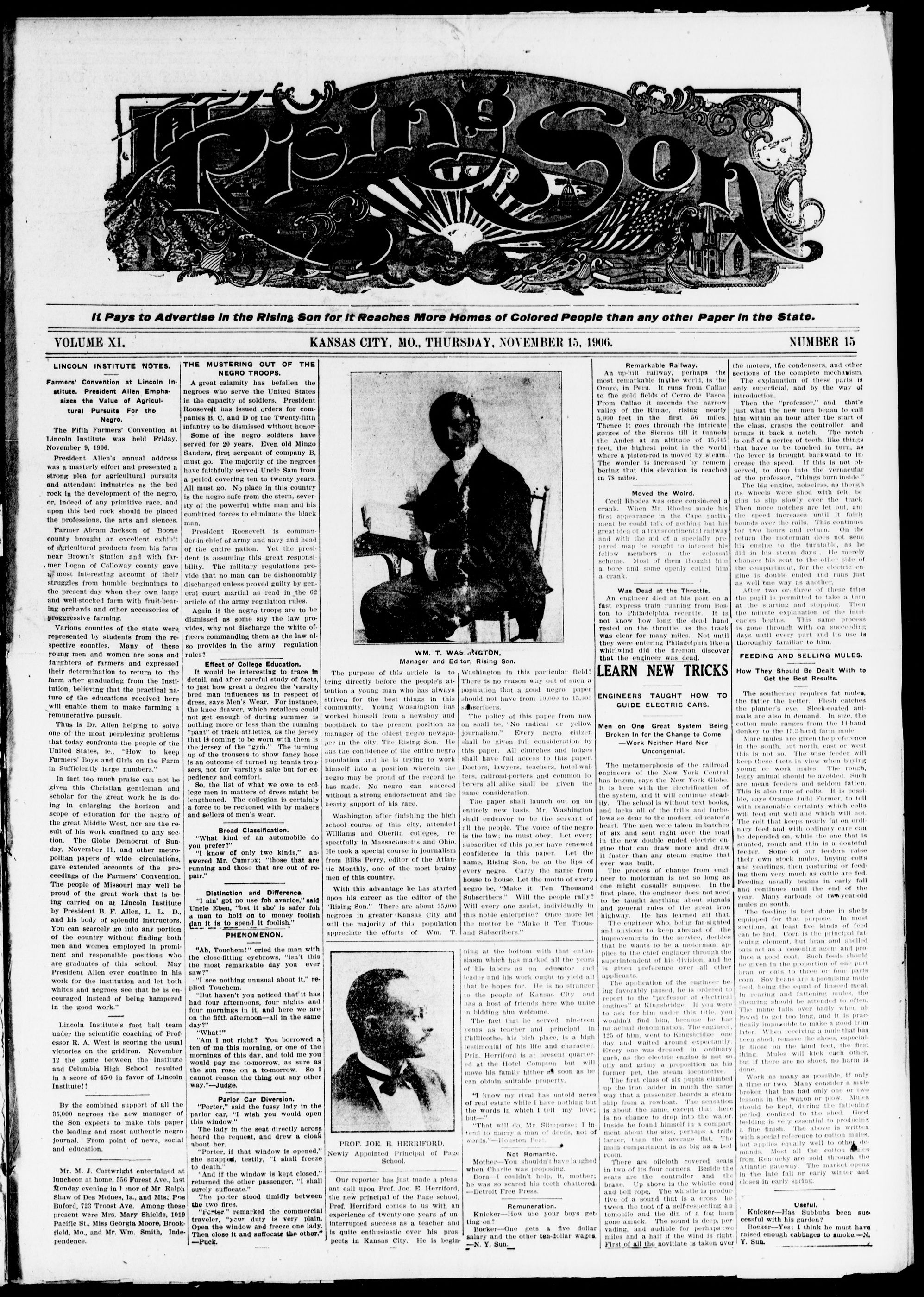
WM. T. WASINGTON
Manager and Editor, Rising Son.
The purpose of this article is to bring directly before the people's attention a young man who has always striven for the best things in this community. Young Washington has worked himself from a newsboy and bootblack to the present position as manager of the oldest negro newspaper in the city, The Rising Son. He has the confidence of the entire negro population and he is trying to work himself into a position wherein the negro may be proud of the record he has made. No negro can succeed without a strong endorsement and the hearty support of his race.
Washington after finishing the high school course of this city, attended Williams and Oberlin colleges, respectfully in Massachusetts and Ohio. He took a special course in journalism from Bliss Perry, editor of the Atlantic Monthly, one of the most brainy men of this country.
With this advantage he has started upon his career as the editor of the "Rising Son." There are about 35,000 negroes in greater-Kansas City and will the majority of this population appreciate the efforts of Wm. T.
J.
Our reporter has just made a pleasant call upon Prof. Joe. E. Herriford, the new principal of the Page school, Prof. Herriford comes to us with an experience of twenty-one years of uninterrupted success as a teacher and is quite enthusiastic over his prospects in Kansas City. He is begin
Washington in this particular field? There is no reason way out of such a population that a good negro paper should not have from 10,000 to 15,000 subscribers. The policy of this paper from now on shall be, "No radical or yellow journalism." Every negro citizen shall be given full consideration by this paper. All churches and lodges shall have full access to this paper. Doctors, lawyers, teachers, hotel waiters, railroad-porters and common lo berers all alike shall be given the same consideration.
The paper shall launch out on an entirely new basis. Mr. Washington shall endeavor to be the servant of all the people. The voice of the negro is the law; he must obey. Let every subscriber of this paper have renewed confidence in this paper. Let the name, Rising Son, be on the lips of every negro. Carry the name from house to house. Let the motto of every negro be, "Make it Ten Thousand Subscribers." Will the people rally? Will every one assist, individually in this noble enterprise? Once more let the motto be "Make it Ten Thousand and Subscribers."
ning at the bottom with that enthusiasm which has marked all the years of his labors as an educator and leader and his work ought to yield all that he hopes for. He is no stranger to the people of Kansas City and has a host of friends here who unite in bidding him welcome.
The fact that he served nineteen years as teacher and principal in Chillicothe, his birth place, is a high testimonial of his life and character. Prin. Herriford is at present quartered at the Hotel Compton but will move his family hither soon as he can obtain suitable property.
"I know my rival has untold acres of real estate while I have nothing but the words in which I tell my love; but—"
"That will do, Mr. Slimpurse; I intend to marry a man of deeds, not of words."—Houston Post.
Not Romantic.
Mother—You shouldn't have laughed when Charlie was proposing.
Dora—I couldn't help, it, mother; he was so scared his teeth chattered.
—Detroit Free Press.
Knicker—How are your boys get ting on?
Bocker—One gets a five dollar salary and the other ten-dollar wages.
-N. Y. Sun.
Not Romantic.
Remuneration.
Remarkable Railway.
Remarkable Railway.
An uphill railway, perhaps the most remarkable in the world, is the Oroyo, in Peru. It runs from Callac to the gold fields of Cerro de Pasco. From Callao it ascends the narrow valley of the Rimac, rising nearly 5,000 feet in the first 56 miles. Thence it goes through the intricate gorges of the Sierrares till it tunnels the Andes at an altitude of 15,645 feet, the highest point in the world where a piston-rod is moved by steam. The wonder is increased by remem bering that this elevation is reached in 78 miles.
Moved the Woird.
Cecil Rhodes was once considered a crank. When Mr. Rhodes made his first appearance in the Cape parliament he could talk of nothing but his great idea of a transcontinental railway and with the aid of a specially prepared map he sought to interest his fellow members in the colossal scheme. Most of them thought him a bore and some openly called him a crank.
Was Dead at the Throttle
An engineer died at his post on a fast express train running from Boston to Philadelphia recently. It is not know how long the dead hand rested on the throttle, as the track was clear for many miles. Not until they were entering Philadelphia like a whirlwind did the fireman discover that the engineer was dead.
LEARN NEW TRICKS
ENGINEERS TAUGHT HOW TO GUIDE ELECTRIC CARS.
Men on One Great System Being Broken In for the Change to Come —Work Neither Hard Nor Uncongenial.
The metamorphosis of the railroad engineers of the New York Central has begun, says the New York Globe. It is here with the electrification of the system, and it will continue steadily. The school is without text books, and lacks all of the frills and furblows so dear to the modern educator's heart. The men were taken in batches of six and sent right over the road in the new double ended electric engine that can draw more and draw it faster than any steam engine that ever was built.
The process of change from engineer to motorman is not so long as one might casually suppose. In the first place, the engineer does not need to be taught anything about signals and general rules of the great iron highway. He has learned all that. The engineer who, being far sighted and anxious to keep abreast of the improvements in the service, decides that he wants to be a motorman, applies to the chief enginer through the superintendent of his division, and he is given preference over all other applicants.
The application of the engineer being favorably passed, he is ordered to report to the "professor of electrical engines" at Kingsbridge. If you were to ask for him under this title, you wouldn't find him, because he has no actual denomination. The engineer, 125 of him, went to Kingsbridge one day and waited around expectantly. Every one was dressed in ordinary garb, as the electric engine is not so oily and grimy a proposition as his former pet, the steam locomotive.
The first class of six pupils climbed up the iron ladder in much the same way that a passenger boards a steam ship from a rowboat. The sensation is about the same, except that there is no chance to drop into the water. Inside he found himself in a compartment about the size, perhaps a trifle larger, than the average flat. The main compartment is as big as a bed room.
There are oilcloth covered seats in two of its four corners. Beside the seats are the controller and the brake. Up above is the whistle cord and bell rope. The whistle is productive of a sound that is a cross between the toot of a self-respecting automobile and the din of a fog horn gone amuck. The sound is deep, pervading, and audible for perhaps two miles and a half if the wind is right. First of all the novitiate is taken over
NUMBER 15
the motors, the condensers, and other sections of the complete mechanism. The explanation of these parts is only superficial, and by the way of introduction. Then the "professor," and that's just what the new men began to call him within an hour after the start of the class, grasps the controller and brings it back a notch. The notch is one of a series of teeth, like things that have to be touched in turn, as the lever is brought backward to increase the speed. If this is not observed, to drop into the vernacular of the professor, "things burn inside."
The big engine, noiseless, as though its wheels were shod with felt, begins to slip slowly over the track. Then more notches are let out, and the speed increases until it fairly bounds over the rails. This continues for two hours and return. On the return the motorman does not send his engine to the turntable, as he did in his steam days. He merely changes his seat to the other side of the compartment, for the electric engine is double ended and runs just as well one way as another.
After two or three of these trips the pupil is permitted to take a turn at the starting and stopping. Then the minute explanation of the intricacies begins. This same process is gone through with on succeeding days until every part and its use is thoroughly familiar to him.
FEEDING AND SELLING MULES.
How They Should Be Dealt With to Get the Best Results.
The southerner requires fat mules, the fatter the better. Flesh catches the planter's eye. Sleek-coated animals are also in demand. In size, the cotton mule ranges from the 14 hand donkey to the 15.2 hand farm mule.
Mare mules are given the preference in the south, but north, east or west this is not so. The wise feeder will keep these facts in view when buying young or work mules. The rough, leggy animal should be avoided. Such are mean feeders and seldom fatten. This is also true of colts. It is possible, says Orange Judd Farmer, to tell with reasonable certainty which colts will feed out well and which will not. The colt that keeps nearly fat on ordinary feed and with ordinary care can be depended on, while the one that is stunted, rough and thin is a doubtful feeder. Some of our feeders raise their own stock mules, buying colts and yearlings, then pasturing or feeding them very much as cattle are fed. Feeding usually begins in early fall and continues until the end of the year. Many carloads of tw year-old mules go south.
The feeding is best done in sheds equipped for that purpose. In most sections, at least five kinds of food can be had. Corn is the principal fattening element, but bran and shelled oats act as a loosening agent and produce a good coat. Such feeds should be given in the proportion of one part bran or oats to three or four parts corn. Soy beans are a promising mule feed, being the equal of linseed meal. In rearing and fattening mules, the shearing should be attended to often. The mane falls over badly when allowed to get too long, and it is practically impossible to make a good trim later. When receiving a mule that has been shod, remove the shoes, especially those on the hind feet, the first thing. Mules will kick each other, but if there are no shoes, no harm is done.
Work as many as possible, if only a time or two. Many consider a mule broken that has had only one or two lessons in the wagon or plow. Mules should be kept, during the fattening period, confined to the shed. Good bedding is very essential to producing a fine finish. The above is written with special reference to cotton mules, but applies equally well to other demands. Most all the cotton mules from Kentucky are sold through the Atlantic gateway. The market opens in the late fall or early winter and closes in early spring.
Useful.
Nklicker—Has Subbubs been successful with his garden?
Bocker—Yes; I think he must have raised enough cabbages to smoke.—N.
Y. Sun
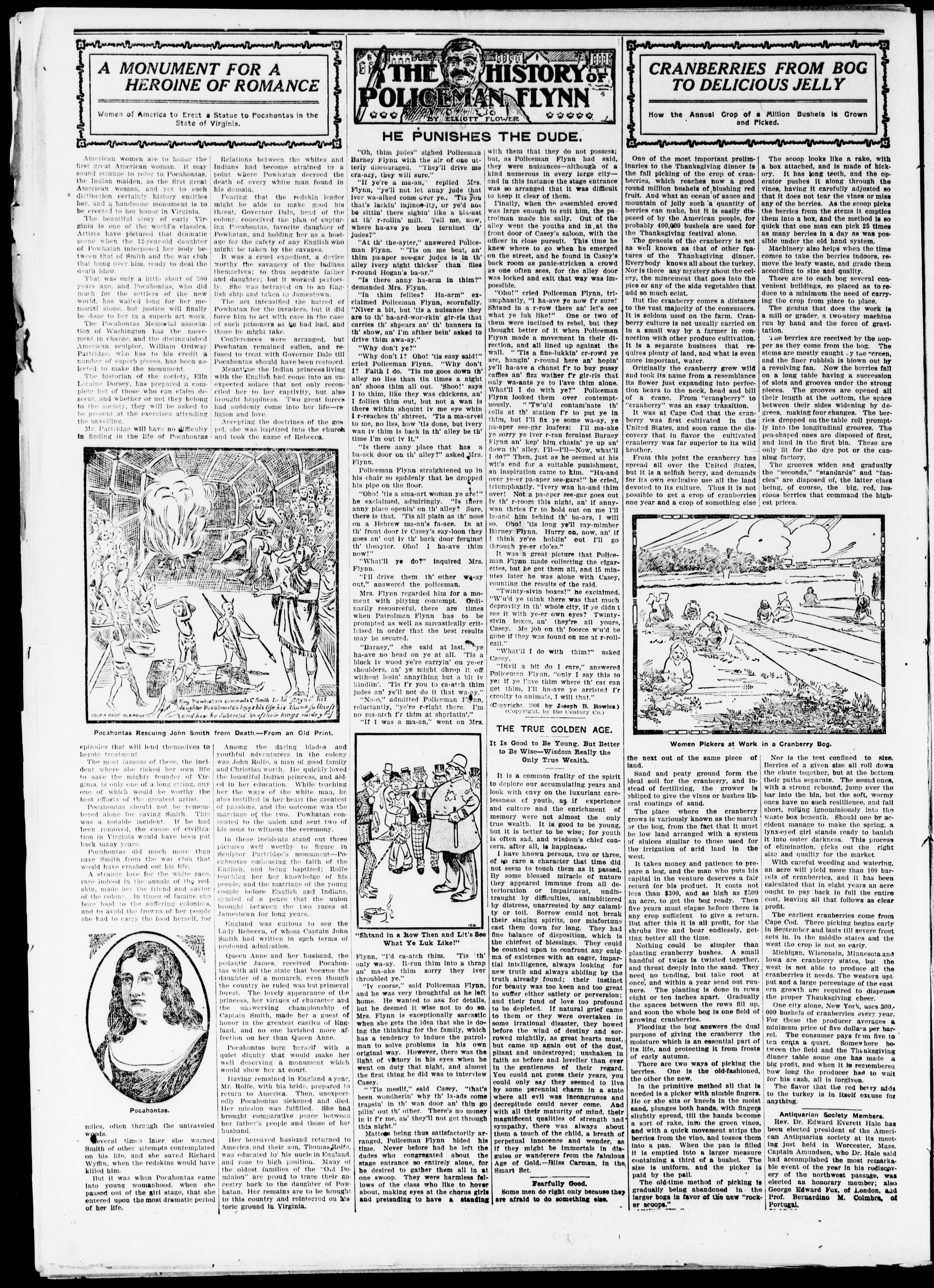
A MONUMENT FOR A HEROINE OF ROMANCE
King Powhatan commands C. Smith to be stayed his daughter Pocahuntas begins his life his thank politicis and how he disbarred so of their kings reside.
Pocahontas Rescuing John Smith from Death.—From an Old Print.
American women are to honor the first great American woman. It may sound strange to refer to Pocahontas, the Indian maiden, as the first great American woman, and yet to such distinction certainly history entitles her, and a handsome monument is to be erected to her honor in Virginia.
The beautiful story of early Virginia is one of the world's classless. Artists have pictured that dramatic scene when the 12-year-old daughter of Powhatan interposed her body between that of Smith and the war club that hung over him, ready to deal the death blow.
That was only a little short of 300 years ago, and Pocahontas, who did much for the settlers of the new world, has waited long for her memorial stone, but justice will finally be done to her in a superb art work.
The Pocahontas Memorial association of Washington has the movement in charge, and the distinguished American sculptor, William Ordway Partridge, who has to his credit a number of superb pieces, has been selected to make the monument.
The historian of the society, Ella Loneine Dorsey, has prepared a complete list of those who can claim descent, and whether or not they belong to the society, they will be asked to be present at the exercises attending the unveiling.
Mr. Partridge will have no difficulty in finding in the life of Pocahontas
King Powhatan
daughter Pocahontas
and how he
FRONT A RARE, OLD PRINT
Pocahontas Rescuing John Smith
episodes that will lend themselves to heroic treatment.
The most famous of these, the incident where she risked her own life to save the mighty founder of Virginia, is only one of a long string, any one of which would be worthy the best efforts of the greatest artist.
Pocahontas should not be remembered alone for saving Smith. This was a notable incident. If he had been removed, the cause of civilization in Virginia would have been put back many years.
Pocahontas did much more than save Smith from the war club that would have crushed out his life.
A strange love for the white race, rare indeed in the annals of the red-skin, made her the friend and savior of the colony. In times of famine she bore food to the suffering colonists, and to avoid the frowns of her people she had to carry the food herself, for
[Illustration of a woman with long hair, wearing a dress with a high collar.]
miles, often through the untraveled woods.
Several times later she warned Smith of other attempts contemplated on his life, and she saved Richard Wyffin, when the redskins would have killed him.
But it was when Pocahontas came into young womanhood, when she passed out of the girl stage, that she entered upon the most dramatic period of her life.
Relations between the whites and Indians had become strained to a point where Powhatan decreed the death of every white man found in his domain.
Fearing that the redskin leader might be able to make good his threat, Governor Dale, head of the colony, conceived the plan of capturing Pocahontas, favorite daughter of Powhatan, and holding her as a hostage for the safety of any English who might be taken by the savages.
It was a cruel expedient, a device worthy the savagery of the Indians themselves; to thus separate father and daughter; but it worked perfectly. She was betrayed on to an English ship and taken to Jamestown.
The act intensified the hatred of Powhatan for the invaders, but it did force him to act with care in the case of such prisoners as he had had, and those he might take.
Conferences were arranged, but Powhatan remained sullen, and refused to treat with Governor Dale till Pocahontas should have been restored. Meantime the Indian princess living with the English had come into an unexpected solace that not only reconciled her to her captivity, but also brought happiness. Two great forces had suddenly come into her life—religion and love. Accepting the doctrines of the gospel, she was baptized into the church and took the name of Rebecca.
itan commands C. Smith to be stayed his
calumnes beg his life his thankfulness
he subtreated so of their kings raidey his
from Death.—From an Old Print.
Among the daring blades and youthful adventurers in the colony was John Rolfe, a man of good family and Christian worth. He quickly loved the beautiful Indian princess, and aided in her education. While teaching her the ways of the white man, he also instilled in her heart the greatest of passions, and the outcome was the marriage of the two. Powhatan consented to the union and sent two of his sons to witness the ceremony.
In these incidents stand out three pictures well worthy to figure in Sculptor Partridge's monument—Pocohontas embracing the faith of the English, and being baptized; Rolfe teaching her her knowledge of his people, and the marriage of the young couple before English and Indians, symbol of a peace that the union brought between the two races at Jamestown for long years.
England was curious to see the Lady Rebecca, of whom Captain John Smith had written in such terms of profound admiration.
Queen Anne and her husband, the pedantic James, received Pocahontas with all the state that became the daughter of a monarch, even though the country he ruled was but primeval forest. The lovely appearance of the princess, her virtues of character and the unswerving championship of Captain Smith, made her a guest of honor in the greatest castles of England, and no one lavished more affection on her than Queen Anne.
Pocahontas bore herself with a quiet dignity that would make her well deserving a monument which would show her at court.
Having remained in England a year, Mr. Rolfe, with his bride, prepared to return to America. Then, unexpectedly Pocahontas sickened and died. Her mission was fulfilled. She had brought comparative peace between her father's people and those of her husband.
Her bereaved husband returned to America, and their son, Thomas Rolfe, was educated by his uncle in England, and rose to high position. Many of the oldest families of the "Od Dominion" are proud to trace their ancestry back to the daughter of Powhatan. Her remains are to be brought to this country and reinterred on historic ground in Virginia.
---
THE HISTORY OF POLICEMAN FLYNN BY ELLIOTT FLOWER
HE PUNISHES THE DUDE.
"Oh, thim judes" sighed Policeman Barney Flynn with the air of one utterly discouraged. "They'll drive me cra-azy, they will sure."
"If ye're a ma-an," replied Mrs. Flynn. "you'll not let anny jude that iver wa-alked come over ye. "Tis you that's lackin' injinoe-ity, or ye'd not be sittin' there sigin' like a bia-st at th' r-rollin' mill. Tell me, now, where ha-ave ye been ferninst th' judes?"
"At th' the-ayter," answered Policeman Flynn. "Tis on me beat, an' thim pa-aper see-gar judes is in th' alley ivery night thicker than files r-round Hogan's ba-ar."
"Is there anny ha-arm in thim?" demanded Mrs. Flynn.
"In thim fellies? Ha-arm" exclaimed Policeman Flyn, scornfully. "Niver a bit, but 'tis a nuisance they are to th' ha-ard-wr-krin' gir-ris that carries th' shpears an' th' banners in th' show, an' I'm afther bein' asked to drive thim awa-ay."
"Why don't ye?"
"Why don't I? Oho! 'tis easy said!" cried Policeman Flynn. "Why don't I? Faith I do. 'Tis me goes down th' alley no liss than tin times a night an' shoos thim all out. 'Shoo!' says I to thim, like they was chickens, an' I follies thim out, but not a wan is there within shquint iv me eye whin I r-reaches th' shtreet. 'Tis a ma-arvel to me, no liss, how 'tis done, but ivery wan iv thim is back in th' alley be th' time I'm out iv it."
"Is there any place that has a ba-ack door on th' alley?" asked Mrs. Flynn.
Policeman Flynn straightened up in his chair so suddenly that he dropped his pipe on the floor.
"Oho! 'tis a sma-art woman ye are!" he exclaimed, admiringly. "Is there anny place openin' on th' alley? Sure, there is that. 'Tis all plain as th' nose on a Hebrew ma-an's fa-ace. In at th' front door iv Casey's say-loon they goin' an out iv th' back door ferninst th' theayter. Oho! I ha-ave thim now!"
"What'll ye do?" inquired Mrs. Flynn.
"I'll drive them th' other wa-ay out," answered the policeman.
Mrs. Flynn regarded him for a moment with plying contempt. Ordnarily resourceful, there are times when Patrolman Flynn has to be prompted as well as sarcastically criti-cised in order that the best results may be secured.
"Barney," she said at last, "ye ha-ave no head on ye at all." "Tis a block iv wood ye're carryin' on ye-er shoulders, an' ye might dhrop it off without losin' anything but a bit iv kindin'. "Tis fr you to ca-atch thim judes an' yell not do it that wa-yo." "No-o," admitted Policeman Funn, reluctantly, "ye're r-right there. I'm no ma-atch fr thim at shprintin'."
"If I was a ma-an," went on Mrs.
18.19
"Shtand in a Row Then and Lit's See What Ye Luk Like!"
Flynn, "I'd ca-atch thim. 'Tis th' only wa-ay. R-run thim into a thrap an' ma-ake thim sorry they liver throubled ye."
"Iv coarse," said Policeman Flynn, and he was very thoughtful as he left home. He wanted to ask for details, but he deemed it wise not to do so. Mrs. Flynn is exceptionally sarcastic when she gets the idea that she is doing the thinking for the family, which has a tendency to induce the patrolman to solve problems in his own original way. However, there was the light of victory in his eyes when he went on duty that night, and almost the first thing he did was to interview Casey.
"Tis meslift," said Casey, "that's been wonderin' why th' la-ads come trapsin' in th' wan door an' thin go pilin' out th' other. There's no money in it fr me, an' they'll not get through this night."
Mattes being thus satisfactorily arranged, Policeman Flynn bided his time. Never before had he left the dudes who congregated about the stage entrance so entirely alone, for he desired to gather them all in at one swoop. They were harmless follows of the class who like to hover about, making eyes at the chorus girls and pretending to have a standing
with them that they do not possess; but, as Policeman Flynn had said, they were nuisances—although of a kind numerous in every large city—and in this instance the stage entrance was so arranged that it was difficult to keep it clear of them.
Finally, when the assembled crowd was large enough to suit him, the patrolman made his sally. Out of the alley went the youths and in at the front door of Casey's saloon, with the officer in close pursuit. This time he knew where to go when he emerged on the street, and he found in Casey's back room as pane-stricken a crowd as one often sees, for the alley door was locked and exit that way was impossible.
"Ooh!" cried Policeman Flynn, trumphandly, "I ha-ave ye now fr sure! Shtand in a r-row there an' let's see what ye luk like!" One or two of them were inclined to rebel, but they thought better of it when Policeman Flynn made a movement in their direction, and all lined up against the wall. "Tis a fine-lukkin' cr-road ye are, hangin' r-round here an' hopin' ye'll ha-ave a chanst fr to buy pussy caffles an' fizz wather fr gir-rls that only wa-ants ye to lave thim alone. What'll I do with ye?" Policeman Flynn looked them over contemptuously. "Ttw'd contam'nte th' cells at th' station fr to put ye in thim, but I'll fix ye some wa-ay, ye pa-aper see-gar loafers: I'll ma-ake ye sorry ye lver r-ran ferninst Barney Flynn an' kep' him chasin y up an' down th' alley, I'll—I'll—Now, what'll I do?" Then, just as he seemed at his wits end for a suitable punishment, an inspiration came to him. "Ha-and over ye-er pa-aper see-gars!" he cried, triumphantly. "Ivery wan ha-and thim over! Not a pa-aper see-gar goes out lv th' r-room this night, an' if anywn wan thries fr to hold out on me I'll la-and him behind th' ba-ars, I will so. Oh! 'tis long ye'll ray-mimber Barney Flynn. Hurry on, now, an' if I think ye're holdin' out I'll go through ye-er cloes."
It was a great picture that Policeman Flynn made collecting the cigarettes, but he got them all, and 15 minutes later he was alone with Casey, counting the results of the raid.
"Twinty-sivin boxes!" he exclaimed.
"Wu'd you think there was that much deprivacy in th' whole city, if ye didn't see it with ye-er own eyes? Twinty-sivin boxes, an' they're all yours, Casey. Me job on th' foorece wu'd be gone if they was found on me at r-roll-call."
"What'll I do with thim?" asked Casey.
"Divil a bit do I care," answered Policeman Flynn, "only I say this to ye: if ye have thim where th' cat can get thim, I'll ha-save ye aristred fr croolty to animals, I will that."
(Copyright, 1966 by Joseph B. Bowles)
(Copyright, by the Century Co.)
THE TRUE GOLDEN AGE.
It Is Good to Be Young, But Better to Be Wise—Wisdom Really the Only True Wealth.
It is a common frailty of the spirit to deplore our accumulating years and look with envy on the luxuriant carelessness of youth, as if experience and culture and the enrichment of memory were not almost the only true wealth. It is good to be young, but it is better to be wise; for youth is often sad, and wisdom's chief concern, after all, is happiness.
I have known persons, two or three, of so rare a character that time did not seem to touch them as it passed. By some blessed miracle of nature they appeared immune from all deterioration or impairment, undistraught by difficulties, unimbittered by distress, unarrested by any calamity or toil. Sorrow could not break their singing spirits, nor misfortune cast them down for long. They had fine balance of disposition, which is the chiefest of blessings. They could be counted upon to confront any enigma of existence with an eager, impartial intelligence, always looking for new truth and always abiding by the truth already found; their instinct for beauty was too keen and too great to suffer either satiety or perversion; and their fund of love too profound to be depleted. If natural grief came to them or they were overtaken in some irrational disaster, they bowed before the wind of destiny and sorrowed mightily, as great hearts must, but came up again out of the dust, pilant and undestroyed; unshaken in faith as before and lovelier than ever in the gentleness of their regard. You could not guess their years, you could only say they seemed to live by some perennial charm in a state where all evil was in incongruous and decrepitude could never come. And with all their maturity of mind, their magnificent qualities of strength and sympathy, there was always about them a touch of the child, a breath of perpetual innocence and wonder, as if they might be immortals in disguise or wanderers from the fabulous Age of Gold.—Bliss Carman, in the Smart Set.
Fearfully Good.
Some men do right only because they are afraid to do something else.
CRANBERRIES FROM BOG TO DELICIOUS JELLY
One of the most important preliminaries to the Thanksgiving dinner is the fall picking of the crop of cranberries, which reaches now a good round million bushels of blushing red fruit. And what an ocean of sauce and mountain of jelly such a quantity of berries can make, but it is easily disposed of by the American people, for probably 400,000 bushels are used for the Thanksgiving festival alone.
The genesis of the cranberry is not as well known as that of other features of the Thanksgiving dinner. Everybody knows all about the turkey. Nor is there any mystery about the celery, the mincemeat that goes into the pies or any of the side vegetables that add so much eelat.
But the cranberry comes a distance to the vast majority of the consumers. It is seldom used on the farm. Cranberry culture is not usually carried on in a small way by a farmer in connection with other produce cultivation. It is a separate business that requires plenty of land, and what is even more important, water.
Originally the cranberry grew wild and took its name from a resemblance its flower just expanding into perfection bears to the neck, head and bill of a crane. From "cranberry" to "cranberry" was an easy transition.
It was at Cape Cod that the cranberry was first cultivated in the United States, and soon came the discovery that in flavor the cultivated cranberry was far superior to its wild brother.
From this point the cranberry has spread all over the United States, but it is a selfish berry, and demands for its own exclusive use all the land devoted to its culture. Thus it is not possible to get a crop of cranberries one year and a crop of something else
```markdown
```
THE TEA PLANT
the next out of the same piece of land.
Sand and peaty ground form the ideal soil for the cranberry, and instead of fertilizing, the grower is obliged to give the vines or bushes liberal coatings of sand.
The place where the cranberry grows is variously known as the marsh or the bog, from the fact that it must be low land arranged with a system of sluices similar to those used for the irrigation of arid land in the west.
Nor is the test of Berries of a given the chute together, their paths separate with a strong rebound bar into the bin, but ones have no such short, rolling ignon waste box beneath. cident manage to m lynx-eyed girl stand it into outer darkens of elimination, ple size and quality for
It takes money and patience to prepare a bog, and the man who puts his capital in the venture deserves a fair return for his product. It costs not less than $300, and as high as $500 an acre, to get the bog ready. Then five years must elapse before there is any crop sufficient, to give a return. But after this it is all profit, for the shrubs live and bear endlessly, getting better all the time.
Nothing could be simpler than planting cranberry bushes. A small handful of twigs is twisted together, and thrust deeply into the sand. They need no tending, but take root at once, and within a year send out runners. The planting is done in rows eight or ten inches apart. Gradually the spaces between the rows fill up, and soon the whole bog is one field of growing cranberries.
Flooding the bog answers the dual purpose of giving the cranberry the moisture which is an essential part of its life, and protecting it from frosts of early autumn.
There are two ways of picking the berries. One is the old-fashioned, the other the new.
In the primitive method all that is needed is a picker with nimble fingers. He or she sits or kneels in the moist sand, plunges both hands, with fingers slightly spread, till the hands become a sort of rake, into the green vines, and with a quick movement strips the berries from the vine, and tosses them into a pan. When the pan is filled it is emptied into a larger measure containing a third of a bushel. The size is uniform, and the picker is paid by the pail.
The old-time method of picking is gradually being abandoned in the larger bogs in favor of the new "rocker scoops."
The scoop looks like a rake, with a box attached, and is made of hickory. It has long teeth, and the operator pushes it along through the vines, having it carefully adjusted so that it does not tear the vines or miss any of the berries. As the scoop picks the berries from the stems it empties them into a box, and the method is so quick that one man can pick 25 times as many berries in a day as was possible under the old hand system.
Machinery also helps when the time comes to take the berries indoors, remove the leafy waste, and grade them according to size and quality.
There are to each bog several convenient buildings, so placed as to reduce to a minimum the need of carrying the crop from place to place.
The genius that does the work is a mill or grader, a two-story machine run by hand and the force of gravitation.
The berries are received by the hopper as they come from the bog. The stems are mostly caught by the screen, and the finer rubbish is blown out by a revolving fan. Now the berries fall on a long table having a succession of slots and grooves under the strong pieces. The grooves are opened all their length at the bottom, the space between their sides widening by degrees, making four changes. The berries dropped on the table roll promptly into the longitudinal grooves. The pea-shaped ones are disposed of first, and land in the first bin. These are only fit for the dye pot or the canning factory.
The grooves widen and gradually the "seconds," "standards" and "fancies" are disposed of, the latter class being, of course, the big, red, luscious berries that command the highest prices.
THE RAILWAY
Nor is the test confined to size. Berries of a given size all roll down the chute together, but at the bottom their paths separate. The sound ones, with a strong rebound, jump over the bar into the bin, but the soft, wormy ones have no such resilience, and fall short, rolling ignominiously into the waste box beneath. Should one by accident manage to make the spring, a lynx-eyed girl stands ready to banish it into outer darkness. This process of elimination, picks out the right size and quality for the market. With careful weeding and watering, an acre will yield more than 100 barrels of cranberries, and it has been calculated that in eight years an acre ought to pay back in full the entire cost, leaving all that follows as clear profit.
The earliest cranberries come from Cape Cod. There picking begins early in September and lasts till severe frost sets in. In the middle states and the west the crop is not so early.
Michigan, Wisconsin, Minnesota and Iowa are cranberry states, but the west is not able to produce all the cranberries it needs. The western upt put and a large percentage of the eastern growth are required to dispense the proper Thanksgiving cheer.
One city alone, New York, uses 300,000 bushels of cranberries every year. For these the producer averages a minimum price of five dollars per barrel. The consumer pays from five to ten cents a quart. Somewhere between the field and the Thanksgiving dinner table some one has made a big profit, and when it is remembered how long the producer had to wait for his cash, all is forgiven.
The flavor that the red berry adds to the turkey is in itself excuse for anything.
Antiquarian Society Members.
Rev. Dr. Edward Everett Hale has been elected president of the American Antiquarian society at its meeting just held in Worcester, Mass.
Captain Amundsen, who Dr. Hale said had accomplished the most remarkable event of the year in his rediscovery of the northwest passage, was elected an honorary member; also George Edward Fox, of London, and Prof. Bernardino M. Colmbra, of Portugal.
---
WM. T. WASHINGTON,
Manager and Editor.
Published Every Week
RISING SON PUBLISHING CO
SUBSCRIPTION RATES:
One Year..... 11 10
Two months..... 10
Three months..... 10
One month..... 10
Sterically paid in advance
Entered at the Post Office at Kansas City,
as Second Class Matter.
Correspondents wanted in every city
and town in this state. Write us.
All news matter intended for publication should reach our office not later than Tuesday, of each week and must be signed by the writer not for publication, but as guarantee of authenticity.
WFIOE-No. 117 West Sixth. St., Kansas City, Mo.
Advertising Rates,
For one inch, one insertion . . . 8.50
For one inch, each subsequent insertion . . . 9.00
For two inches, three months . . . 8.00
For two inches, six months . . . 8.00
For two inches, nine months . . . 10.00
For two inches, twelve months . . . 15.00
CLDEST NEGRO JOURNAL
... IN KANSAS CITY,
TWICE ALL
THE REST.
The paid circulation of THE RISING SON is more than double the combined circulation of all the other Kansas City Golored weekly newspapers.
The negro like a child will wait for the Republicans to do their duty by us.
Will the Republicans take care of the faithful negroes who followed their banner.
As there are many janitorship jobs to be given away, will the negro get his per rata share?
Now that the Republican party has captured the entire county what will be their attitude on Negro appointments.
As there are some intelligent negroes who served the party during the recent campaign. Will they land two or three clerical jobs for negroes, out of the many hundred jobs.
THE GREAT REPUBLICAN PLAT-
FROM AND ITS VICTORY AS A
BENEFIT TO THE NEGROES.
一
Fredrick Douglass in a wave of enthusiasm voiced these sentiments: "The Republican Party is the ship and all else is the sea." What does this mean? It means when the negro has left the mighty Republican party his light has gone out and like a meteor which breaks away from the law of gravitation and from the controlling influence of some sun, goes wandering in the stylian darkness of endless space. The great party which gave life and motion to this black mass of eleven million negroes. Let sober minded negroes think what this great victory throughout the country means for the negro. Two more years of prosperity. Two more years of good government, alongside with law and order. Two more years of the unbroken order of harmony. The continuation of the golden thread stretching through the centuries, pointing to God's master piece in this country. "A perfect civilization." The Utopia of America. Yet I doubt not, through the ages,
One increasing purpose runs,
And the thoughts of men are broadened
Has the president of these United States forgotten the bravery of the negro soldiers in time of war? Has he forgotten that he dares muster the negro soldiers out the Indian wars in the colonial period when every negro shouldered a musket though he were a slave?
Has he forgotten the war of 1776, or even during the time when Crispus Attucks fell on Boston Commons? Has he forgotten the war of 1812 when negroes died as soldiers under General Jackson?
Has he forgotten the Mexican war when negroes crossed the borders with white troops to fight for Old Glory?
Has he forgotten the Civil war when thousands of negro soldiers died that this Union might be saved? That the policies of this government might be carried out?
Has he forgotten the Spanish-American war in which he figured so conspicuously. In which if it were not for the bravery of these troops combined with the Ninth and Tenth Cavalry he would have perished? Let us render justice where it is due. Let us remember the saying of the Bible.
"When a man slaps you on one side
of the face turn the other. In this country where the negro has no rechts save for the few that were granted to him by the 13th, 14th and 15th amendments to the Constitution let us practice the Christian doctrine of forgiveness. Let us bear our trials like Job. Let us remember that when all else is lost we must turn our faces to God. For with him we can stand all the artillery of the white man's guns.
The 'Weaker Sex."
Old women and new woman, it makes no difference. This cry about the feminine lack of courage and strength is out of date. A few months ago Evelyn Walsh, daughter of the Colorado multimillionaire, was almost killed in a motor accident. Her life hung by a thread for weeks and she was taken to her old home in Colorado as a last resort. There the bracing air cured her, and one day last week she stepped into her motor car and reeled off 15 miles in 20 minutes. No fear there. And as for strength, Mary Wheatland, aged 72, is giving exhibitions in England of fancy swimming and diving in the sea. She has been an expert swimmer for 57 years. But why go so far affeld? Consider the average woman how she shops and the society woman how she dances. And what daring of mere man, demands the Cleveland Leader, matches the hardihood of woman in defying the weather lest she be false to fashion? As for the touch and stamp of the age, when did woman ever refuse risks for what she greatly desired? It's nothing new for her to be venturesome. Courage is an old story—as old as her fortitude. Has she not been compelled to make the best and most of man, the most destructive and dangerous of animals?
China's Reform.
The issuance of an edict by the Chinese government prohibiting opium smoking, and even the cultivation of the poppy, must be classed among the important events of modern times. One of the main charges against British influence in China has been the introduction and promotion of the use of opium by the people. It was a species of immoral commercialism of which other nations have been guilty and which forms a strong count in the indictment against so-called civilized peoples. Doubtless the use of opium has had much to do with reducing the energies of the people, and, in the long run, with shaping the national character. The question, says the Indianapolis News, is whether it can be eradicated. The Chinese government has very arbitrary power, but in dealing with opium it has tackled a very large problem. It is a question of prohibition on a much larger scale than has ever been attempted of personal habits in any other country. It will be interesting to watch whether the government can enforce it. If it succeeds in doing so, perhaps other nationalities had better go there and take lessons in the enforcement of law.
The following is a copy of the epitaph of a watachmaker, written by himself, in which he is compared to a watch that has run down: 'Here lies, in horizontal position, the outside case of George Ritter, whose abiding place in that line was an honor to his profession. Integrity was his mainspring, and prudence the regulator of all the actions of his life. Humane, generous, and liberal, his hand never stopped till he had relieved distress. He never went wrong, except when set agoing by people who did not know his key. Even then he was easily set right again. He had the art of dispensing of his time so well that his hours glided by in one continual round of pleasure and delight, till an unlucky minute put an end to his existence. His case rests and molders and decays beneath the turf, but his good works will never die."
Some of the people of England are criticising the London Times for being "too American" in its make-up. We feel it our duty to say for the benefit of those who do not get the Times regularly that it has not as yet begun to use red ink in its headlines.
French dealers are putting American labels on their shoes to insure their sale. They are repaying us for sardines and cottolene with a little our practice of branding our wines, French before raising the price.
It is said that the sultan of Turkey's illness was due to a shot fired by one of his jealous wives. The sultan should make his wives take a civil service examination on the subject of jealousy before marrying them.
A big insurance company is about to abandon business in Russia. Every one who really needs life insurance in the czar's domains is pretty sure to cash in on the policy before the company's profits begin to grow.
The second fatal football accident of the year has come. Considering the short time the new rules have been in use, they are almost as efficient as a mauser.
The Kansas City schools are making a great showing this fall. The Lincoln High school registers 299, the Lincoln ward, 615; the Attucks, 524; Garrison, 376; Douglas, 316; Phelps, 242; Sumner, 112; Bruce, 107; Pena, 53; Booker T. Washington, 46; Page, 35; Blue Valley, 25. According to the Negro population of Kansas City the percentage of the children in school is very small. The Attucks school is one of the best filled and best regulated schools in this city and it will inspire any to visit the Attucks school at this time. Prof. Bowser claims that he has a better working force of teachers than he has had in many a day.
Women know by nature how to disguise their emotions far better than the most consummate male courtier can do.—Thackeray.
When a woman pronounces the name of a man but twice a day, there may be some doubt as to the nature of her sentiments; but three times!
WISDOM FOR WOMEN.
Woman alone knows true loyalty of affection.—Schiller.
If men knew all that women think, they would be 20 times more audacious.—Karr.
When we speed to the devil's house, woman takes the lead by a thqusand steps.—Goethe.
Women especially are to be talked to as below men and above children.—Chesterfield.
Beauty is worse than wine; it intoxicates both the holder and the beholder.—Zimmerman.
When joyous, a woman's license is not to be endured, when in terror, she is a plague.—Aeschylus.
Modesty in woman is a virtue most deserving, since we do all we can to cure her of it.—Lingree.
A heart which has been domesticated by matrimony and maternity is as tranquil as a tame bullfight.—Holmes.
BELL PHONE 2474XM
S. M. CH
Pool Hall 112 and B
New Pool Tables and First-class Barbers
We solicit your tra
Little Rose
M. CHANDLER
Hall 112 and Barber Shop 114 B
and First-class Barbers in Shop. Pool Hall ju
We solicit your trade. Give us a call.
New Pool Tables and First-class Barbers in Shop. Pool Hall just newly fitted up We solicit your trade. Give us a call.
Little Rose Bud Cafe
People's Best Eating Place.
Only real French Cafe for N
Open all night. Courteous
We suit the people.
A. P. SEYMOUR, Prop.
You are cordially
inspect the swell Ba
just opened for acco
ored trade at 100g
tric light; gas and
MRS.
F. J. WEAVER, Prop.
COAL
Keep all Kin
as cheap as
Kansas City
B.F. CaryFe
COAL, HAY
S. E. Cor. Third a
KANSAS
Party service a specialty. Barber shop
EMPLOYMENT BUREAU.
WAITERS' CATERING ASSOCIATION
1223 BALTIMORE AVE.
Bell 'Phone 4137x Grand. Kansas C
Bell Phone 2170 Main
DR. E. C. BU
Real French Cafe for Negroes. Meals at all
all night. Courteous treatment. Good w
at the people.
YMOUR, Prop. 709 Wyando
are cordially invited to
the swell Bachelor Apartment
dened for accommodation
made at 1005 McGee St.
ent; gas and bath.
MRS. CLARA HALE,
VER, Prop.
OAL CO
Keep all Kinds of COAL
as cheap as any firm in
Kansas City.
Cary Feed & Fuel
OAL, HAY and GRA
Cor. Third and Grand
KANSAS CITY, MO.
A specialty. Barber shop and bath.
Furniture BUREAU.
Gentlemen only.
TERING ASSOCIATION
Mr. Clem James and
ALTIMORE AVE.
are predared to give
37x Grand. Kansas City, Mo. in the Tonson
70 Main
Home Ph
E. C. BUNCH, De
Only real French Cafe for Negroes. Meals at all hours. Open all night. Courteous treatment. Good waiters. We suit the people.
A. P. SEYMOUR, Prop. 709 Wyandotte Street
You are cordially invited to call and inspect the swell Bachelor Apartments just opened for accommodation of Colored trade at 1005 McGee St. Electric light; gas and bath.
MRS. CLARA HALE, Landlady.
F. J. WEAVER, Prop.
COAL COAL
Keep all Kinds of COAL as cheap as any firm in Kansas City.
S. E. Cor. Third and Grand Avenue KANSAS CITY, MO.
Party service a specialty. Barber shop and bath. Furnished Rooms to EMPLOYMENT BUREAU. Gentlemen only. Joe Ottey, Mgr. WAITERS' CATERING ASSOCIATION Mr. Clem James and John Huston. are predated to give the best service 1223 BALTIMORE AVE. Bell 'Phone 4137x Grand. Kansas City, Mo. in the Tonsorial Department.
Office Hours
8 To 12m. 1 To 5 P. M.
Sunday by Appointment.
I Can Sell Your Real Estate or Business
NO Matter, WHERE LOCATED.
Properties and Business or all kinds sold
quickly for cash in all parts of the United
States. Don't wait. Write today describing
what you have to sell and give cash price
on same.
If You Want to Buy
any kind of Business or Real Estate any
where, at any price, write me your requirements. I can save you time and money.
DAVID P. TAFF
THE LAND MAN
415 Kansas Avenue.
TOPEKA, KANSAS.
FORD'S
HAIR POMADE
Formerly known as
"OZONIZED OX MARROW"
SO
STRAIGHTENS
ANDLER, Barber Shop 114 E. 6th in Shop. Pool Hall just newly fitted up made. Give us a call. Bud Cafe
Negroes. Meals at all hours.
treatment. Good waiters.
No. 709 Wyandotte Street
y invited to call and
bachelor Apartments
accommodation of Col-
5 McGee St. Elec-
bath.
CLARA HALE, Landlady.
COAL
ands of COAL
is any firm in
y.
ed & Fuel Co.
Y and GRAIN
and Grand Avenue
CITY, MO.
and bath. Furnished Rooms to
Gentlemen only. Joe Ottey, Mgr.
Mr. Clem James and John Hustol.
are predared to give the best service
city, Mo. in the Tonsorial Department.
Home Phone 5646 Main.
UNCH, Dentist.
805 Independence Avenue. KANSAS CITY, MO.
We make all kinds of New Hats and Repair old ones so they are as good as new.
WESTERN UNIVERSITY
THE GREAT EDUCATIONAL INSTITUTION FOR KANSAS AND THE WEST. . . . . . .
DEPARTMENTS: Theological, State Industrial.
COURSES: Classical, College, Presidential (Instrumental and Volunteer, Drawing (Fine Arts and Book Binding, Business Writing, Tailoring, Dressmaking, Dering, Farming and Gardening).
ADVANTAGES: Slipendid Locations and Thorough Teaching.
INFORMATION: For terms, price to
WILLIAM T. VERNE
PRESENT
QUINDARO,
Phones: Office—Bell—"White"
The New
302 East
Suits, $7.50 to Overcoats, $7.50 Underwear, 50c Shirts, 50c to $ Hats and Caps,
A. H. LASSO
ART DEPARTMENT
Campbell Glacier
1228 Main Street
MENTS: Theological, College, Normal, Sub-M
state Industrial.
B: Classical, College, Preparatory, Normal, Sub-M
ial (Instrumental and Volcal), including piano, organ
y, Drawing (Fine Arts and Mechanical), Carpent
ry, Book Binding, Business Course, Stenography and
Tailoring, Dressmaking and Plain Sewing, Coo
ling, Farming and Gardening.
AGES: Slpendid Location, Healthful Climate,
Jobs and Thorough Teachers.
ATION: For terms, prices and all inducements o
WILLIAM T. VERNON, A. M., I.
PRESIDENT,
INDARO, KAN.
Office—Bell—"White" 4302. Residence—Bell—
e New St
302 East 12th St.
Arts, $7.50 to $20
Carcoats, $7.50 to $20
Werwear, 50c and up to
Arts, 50c to $1.50
S and Caps, 50c and up
N. LASSON
THE ARGY
302 East 12th
ART DEPARTMENT
OF
Campbell Glass & Paint
1228 Main Street, Kansas City
DEPARTMENTS: Theological, College, Normal, Sub-Normal and State Industrial.
COURSES: Classical, College, Preparatory, Normal, Sub-Normal, Musical (Instrumental and Volical), including piano, organ and harmony, Drawing (Fine Arts and Mechanical), Carpentry, Printing and Book Blinding, Business Course, Stenography and Typewriting, Tailoring, Dressmaking and Plain Sewing, Cooling, Laundering, Farming and Gardening.
ADVANTAGES: Slpendid Location, Healthful Climate, Good Influences and Thorough Teachers.
INFORMATION: For terms, prices and all inducements offered write to
QUINDARO, KANSAS.
Phones: Office—Bell—"White" 4302. Residence—Bell—"West 15.
The New Store
Suits, $7.50 to $20 Overcoats, $7.50 to $20 Underwear, 50c and up to $2.50 Shirts, 50c to $1.50 Hats and Caps, 50c and up THE ARGYLE BUILDING
A. H. LASSON THE ARGYLE BUILDING 302 East 12th. Come In
1228 Main Street, Kansas City.
HOME PHONE 2727 MAIN.
SHAVE 100. TONSORIAL ARTISTS HAIR C
J. B. Lester. S. L. Clemons. Duke Mayes.
J. B. LESTER'S SHAVING PARLO
Hot and Cold Baths. 557 Grand Ave. Kansas City, Mo. 4 New Por-
Cigars, Tobacco and Pool. Massage and Hair Dyeing a Special
NOO. TONSORIAL ARTISTS HAIR
J. B. Lester. S. L. Clemons. Duke Mayes.
B. LESTER'S SHAVING PAR
Eaths. 557 Grand Ave. Kansas City, No. 4 New
s, Tobacco and Pool. Massage and Hair Dyeing a
SHAVE 100. TONSORIAL ARTISTS HAIR CUT 250
J. B. Lester. S. L. Clemons. Duke Mayes.
J. B. LESTER'S SHAVING PARLOR
Hot and Cold Baths. 557 Grand Ave. Kansas City, Mo. 4 New Porcelain Tubs.
Cigars, Tobacco and Pool. Massage and Hair Dyeing a Specialty.
G. C. MOORE,
DEALER IN Cash Groceries and M Goods delivered free Bell Phone 1265 x
ish Groceries and Meats, Flour, Pro
Goods delivered free to any part of the city
1265 x
1605 N. 10th Street, Kann
DEALER IN Cash Groceries and Meats, Flour, Provisions, Etc. Goods delivered free to any part of the city Bell Phone 1265 x 1605 N. 10th Street, Kansas City, Kan.
TEETN
WITHOUT PLATES
HIGH CLASS
DENTISTRY
1029
EXTRA THIS
Gold Filling, 50e to $2
Silver Filling, 25e
$8 PLAT
$5 GOLD C
HIGH CLASS DENTISTRY 1029 Main St. 23 IN B
EXTRA THIS WEEK EX
Gold Filling, 60e to $2 Silver Filling, 25e Pa'ness Extraction, 25e
$8 PLATES $3
$5 GOLD CROWNS
Special Inducer
For Out-of-Town
SET OF TEETH....
The Old Reliable 23 years before the public ours
is guaranteed to give satisfaction; all work
that we do is done by our staff. We have
had work done in our Kansas City office or
in Eastern States should come to us and have the
work done by any necessary resisting
cheerfully made from satisfied customers.
Kind and courteous treatment to all satisfied patients. Kind and courteous about us.
GOLD CROWNS, BRIDGES, $2.65 to
$2.90
Silver Filling ..... 25c
White Crowns ..... 12.00
Platina Filling ..... 50c
Pahilas Extraction ..... 25c
Teeth Cleaned ..... 50c
Gold Filling ..... 50c to $2
All Work Guaranteed 20 Years.
college, Normal, Sub-Normal and
paratory, Normal, Sub-Normal, Mu-
al), including piano, organ and har-
d Mechanical), Carpentry, Printing
Course, Stenography and Typewrit-
and Plain Sewing, Cooling, Laun-
ing.
Healthful Climate, Good Influ-
ers.
and all inducements offered write
NON, A. M., D. D.
DENT,
KANSAS.
302. Residence—Bell—"West 15.
New Store
12th St.
$20
50 to $20
c and up to $2.50
$1.50
$50c and up
NON THE ARGYLE BUILDING
302 East 12th. Come In
DEPARTMENT
Pess & Paint Co.
et, Kansas City.
ARTISTS HAIR CUT 250
Clemons, Duke Mayes.
HAVING PARLOR
Kansas City, Mo. 4 New Porcelain Tubs.
Message and Hair Dyeing a Specialty.
MOORE,
Meats, Flour, Provisions, Etc.
to any part of the city
605 N. 10th Street, Kansas City, Kan.
W
9 Main St. 23 YEARS IN BUSINESS
WEEK EXTRA
Pa'nless Extraction, 25e Teeth Cleaned, 50e
TES $3
CROWNS $3
Special
Inducement
For Out-of-Town Patients
SET OF TEETH.....$5.00
BEST TEETH.....8.00
GOLD CROWNS, $3 to.....5.00
CLEANING.....50
No Extra Charge for Vitalized Air
When Teeth are Ordered.
TEETH
WITHOUT PLATES
NEW YORK DENTISTS
1920 Main St.
Entire and Floor.
NEWS&GOSSIP
HORACE MARSHALL, Solicitor.
Remember please—
It's the little bits we collect here and there
that enables us to run from year to year."
LOCALS
Go to Sam Chandler's new place 112-14 E. 6th.
See Dr. J. N. Birch if you wish to secure one of his new flats.
Charles Wilson is the Son's adv. solicitor. Let him have your ad.
Pantheon Club will be entertained at 1529 Park. Anna H. Jones will lecture.
National Printing Co., has moved from 6th and Delaware to 1311 Independence avenue.
Serg't. Samuel Mills, U. S. A., retired is visiting J. Howard Clark a member of his regiment at 708 E. 17th,
Prof. J. Silas Harris one of Kansas City's best principals was appointed to vacancy as principal of Sumner school.
Mrs. F. J. Weaver will have an embroidery contest for benefit of the Phyllis Weatley Art Club, Dec. 15, at 911 Oak.
For plano and furniture moving and express, call Geo. Jones, Home phone, 5185 Main. Packing, Shipping and storage.
Phone your news to the Rising Son, with an order for a year's subscription. Bell Phone 4713X Main; Home Phone 58 Main.
Have you seen Weaver, if, not tell your troubles to him and he will furnish you a house. 911 Oak, don't forget the number.
Prof. Coffin recently married, has brought his wife to his new residence at 1710 E. 10th St. The people in the city should bid her welcome.
Use Chowley's Anti-Sweat Powder. For bad odor it has no equal. Price 25c by mail. 5113 Dearborn street, Chicago, Ill. Agents wanted.
WANTED—Two first-class barbers; steady employment. Address Harry Robinson, 314 Felix street, St. Joseph, Mo. Answer at this address at once.
Horace Marshall a young student of Lincoln High School is a solicitor for the Rising Son. Encourage this young man by giving him your subscription.
A week ago several fires burning from four to five negro houses to the ground occurred in the neighborhood of 21st and Highland. The negroes lost all their furniture in addition to their property which they had been paying for a number of years. This should teach every negro to carry a fire insurance policy.
Mr. and Mrs. D. A. Doyle entertained at home, 1621 East 13th street Saturday evening, Nov. 10th in honor of Mr. and Mrs. Ridgeway of Colorado Springs, Colo. Among those present was Mrs. May Owens and Miss Ridgeway of Cripple Creek, Colo. Mr. and Mrs. C. H. Birch and Miss Beulah Douglass of Kansas City, Kans. Mrs. Cora Shyde of Jefferson City, Mr. and Mrs W. H. Coats, Mr. Marshall Cox and Mr. Samuel Robinson, City.
To Missouri Teachers:
Please remember the meeting of the State Teachers' Association at Moberly during the Christmas holidays. Aside from a very high classed program that is being prepared, we shall have an educator of national reputation as the principal speaker of the week. No progressive teacher can afford to miss such a rare treat. "On to Moberly" is our war cry from this time forth.
You who have delayed sending your subjects to Prin. A. R. Chinn, Glasgow. Mo. should hurry and send them as we desire to have our programs printed earlier this year. We can do so if you teachers will only act promptly and co-operate with us. All who send subjects will please be present and prepared at the time and place appointed. Have your pupils work so that the exhibits may be interesting.
Yours for a successful meeting,
E. W. EMORY, Cor. Sec'y.
HUNDREDS OF NEGRO LABORERS EMPLOYED BY METROPOLITAN ST. RY. CO.
C. N. Black as General Manager.
As one goes along twelfth street where a new car track is being laid you can see hundreds of negroes who are earning their bread through employment of them by the Metropolitan.
There is no other corporation in the city that has as large a force of negroes working for them. In all instances the colored men have proved themselves efficient laborers, honest and hard working.
It is through the kindness of the officials of this company that these negroes are able to earn good livings for their families.
C. N. Black, the general manager of the company, is one of the big white men of the country who believes in negro help. Rather than to be a sentimentalist he believes in giving the negro something to do whereby he can become a bread winner. These are the kind of men the negroes must attach their hope. Men who believe he should earn an honest dollar. This shows the attitude of the Metropolitan street railway towards the negro.
Now the negroes should be equal to the occasion by acting as gentlemen and women on the street cars. They should condemn and repudiate any negroes who act otherwise. They must show such white men by their good behavior that he appreciates such favors. Let every negro from this on see to it that all riotous acts by our race are resented and the ones concerned exposed and punished.
Mr. Henry Compton has succeeded Bon McRay in the hotel venture at 721 Charlotte street. No man is better fitted to take charge of this place than Mr. Compton.
Dr. Wm. J. Thompkins, recently of the staff of physicians and surgeons of Freedman's hospital, Washington, D. C., wishes to announce his office at 704 East 12th street; residence, Compton hotel. Both phones.
The pretty little stars are laughing love,
The sky looks calm and clear
The moon is shining brightly from above,
'Tis time you was here;
You said that you would surely come at eight
And with the twinkling stars,
Down by grandpa's meadow
You would meet me at the bars.
N. P. Dudley of Philadelphia is in Kansas City giving demonstrations of the "Mankin from the University of Heidleberg." He shows mothers how they can save a great deal of sickness and expense in caring for their children; in fact he gives away some important information which has been guarded very carefully by the medical profession, and if he has not called at your home already he wishes you to drop him a card to the "Son" office, and he will call before he leaves the city. He makes no charge for his visit and every family should notify him if they have been missed.
ENTERTAINED AT COMPTON
HOTEL.
Geo. W. Little of Columbian Hotel, entertained a number of friends and relatives in the lovely parlors and dining room at the Compton Hotel, Thursday, Nov. 1, 1906. James Taylor and wife, Dave Harris and wife, Robert Trotters and wife, John Smith and wife, A. May and wife, Mrs. Eller Greer, Mrs. Gertrude McFold, Miss Wilson, Mr. Louis Washington, Mr. Walter Clark, Mr. Anthina Brown, Mr. Walter Brown, Mr. G. W. Little, Mr. Harry Taylor. The evening was spent in games and dancing, refreshments were served and the party left the hotel at a late hour saying they had spent a pleasant evening.
THE MISSOURI VALLEY TEMP.
LABS ASSOCIATION.
Representing commandaries of Missouri, Kansas and Nebraska will hold its conclave banquet and ball at Convention Hall, Thanksgiving day and night, Nov. 29, 1906, under the auspices of Far West Commandery No. 3 and Emanuel Commandery No. 25. Knights Templars.
The general public are invited to attend. Grand street parade at 3:00 p. m., headed by the K. P. band.
Templars banquet at Convention hall from 5 to 8 p. m. Special guest of honor, Hon. William T. Vernon of Washington, D. C., register of the U. S. treasury; Hon. Geo. H. Green, Right Eminent Commander of Kansas.
The competitive drill for the handsome silver trophy will commence promptly at 8 p. m. and will last until 9:30, all commanderies competing. At 9:30 promptly the grand march begins. Music by Melford's Orchestra of 30 pieces.
General admission 50 cents. Box seats 25 cents extra.
Committee of Arrangements:
B. B. FRANCIS, Chairman,
T. W. H. WILLIAMS, Secretary,
P. C. KINKAID, Cor. Secretary.
A
LADIES BUST FORM.
Madame De Vaul Vincent, expert seamstress and dressmaking teacher. Mrs. Vincent's work is doing a great good among the negro women. In this community is a lady seamstress who, because of her individual efforts has rallied around her a number of negro girls who are learning every day the art of sewing. Mrs. Vincent has been especially fitted for the work because of her training in the ladies tailoring schools of New York and Chicago; having attended "S. T. Tallor" school of Tailoring in New York and the MacDowel Systematic school of Chicago. In addition to this she finished the technical course of Ladies Artistic Suit designing in the New York School of Kansas City.
Best Values in This Store is famous as the Horse wear. It is the Bread-winner's favo it not only offers the opportunity to s of Shoes purchased, but also provide
Best Values in Footwear!
This Store is famous as the Home of Dependable Footwear. It is the Bread-winner's favorite Shoe Store, because it not only offers the opportunity to save money on every pair of Shoes purchased, but also provides extra value for the money in the wearing qualities of the Shoes it sells. The experienced buyer of GOOD Shoes immediately recognizes our line as second to none in the superiority of style. Among Women's Shoes we handle the DOROTHY DODD, the JOHN KELLY and the HARRY H. GRAY.
STRONG & GARFIELD CO.
$3.50 to $5.50
OVIATT SH
Statement of the Condition of the Union National Bank KANSAS CITY, MO. As made to the Comptroller of the Currency at
Union National Bank KANSAS CITY, MO.
As made to the Comptroller of the Currency at the close of
business, November 12, 1906.
RESOURCES.
Loans and Discounts.....$7,376,384.35
U. S. Bonds, at
par. ..... $625,000.00
Municipal Bonds
and other high
class bonds, at
par. ..... 447,940.08 - 1,072,940.08
Cash and Sight Exchange. ..... 4,312,928.49
Total ..... $12,762,252.92
DESIGNATED UNITED STAT
Directors—W. Whitehead, Edward George,
rlll, O. H. Dean, Geo. W. Jones, Lee Clark, Geo. D.
David T. Beals, Fernando P. Neal, Wm. H. Seeger
Directors—C. W. Whitehead, Edward George, L. T. James, C. J. Schmelzer, J. P. Merz
Directors—C. W. Whitehead, Edward George, F. Felix T. LaFoett
David T. Beals, Fernando P. Neal, Wm. H. Seeger Edwin W. Zea
Home or Bell Phones 253 West.
EMPLOYMENT
COLORED HELP A
MALE AND
EMPLOYMENT OFFICE
COLORED HELP A SPECIALTY
MALE AND FEMALE
OFFICE HOURS:
9 to 12 a. m., 1 to 5 p. m.
MRS. EMMA STOVALI
1014 North 5th St., Kansas City, Kane
1105 Main Street,
Kansas City. Mo.
David T. Beals, President.
Edwin W. Zea, Cashier.
After this she took the post graduating course of Systematic Walst designing which gives to her four diplomas in her trade. This undoubtedly puts Mrs. Vincent in the rank with the best dressmakers of the city white or black. Mrs. DeVaul Vincent was born in Dayton, O 1872 and since coming to this city fourteen years ago she has followed the dressmaking trade exclusively, as she has worked in all of the first class white places of this city until two years ago when she opened up a school for the training of colored women in that art. Her work entitles her with the support of all the negroes' Any girl who lacks a trade or something by which they can become bread winners should apply to her for a special course. Mothers who have daughters should also send them to her for an entire sewing season.
When you want the best news concerning the Negro, place your name on the subscription list of the "Son" and thus have it delivered to your door.
I have some vacant lots that I will exchange for rooming houses, furniture in storage or equity in cottages. See F. J. Weaver, 911 Oak St.
Have You Heard?
THEN come and see Rice and Stewart's fine apartment house for gentlemen. 711 E. 12th. You should come. Up-to-date Rooms. Uneed a Room. in Footwear! The Home of Dependable Foot's favorite Shoe Store, because it to save money on every pair provides extra value for the mon-
J. W. H.
Our Men's line includes such high-grade makes as STACY-ADAMS, STRONG and GARFIELD and BOSTONIANS.
We will be pleased to have you visit this store at any time.
We successfully fill Mail Orders
F. P. Neal, Vice President.
W. H. Steger, Second Vice President
ion
l Bank
CITY, MO.
of the Currency at the close of
ENT OFFICE
LP A SPECIALTY
D FEMALE
A STOVALL
Kansas City, Kansas.
520 Minnesota Ave..
Kansas City, Kansas
Prompt Service.
The Question Before the House
It is a question of where you buy as to what you get in Planos of lower price. The record of our past is your best protection. For more than a quarter of a century we have been selling in Kansas City the best Planos in the world in each class. We have built up here the greatest Piano business in the West and have done it by fair, square dealing. We shall continue to travel that road. We shall stick to one price to all alike. We do not pay commissions to anyone for bringing or sending piano customers to us. Our price is so low we cannot do it.
We sell $175 Planos for $125. We sell $250 Planos for $190. We sell $300 Planos for $210
Any of our Planos may be paid for in cash, or part cash, $10 or more down, and $6 or more a month. The price is the same whether you pay cash or buy on time. There is no increase for time payments, only interest at 6 per cent per annum for such time as you actually take—a very small item indeed.
We carry over 500 Planos in stock. Come and see. Count them yourself—one, two, three, four, etc.
J. W. Jenkins' Sons Music Co.
1013-1015 WALNUT STREET
Itts for the Metrostyle Pianola. Best Place to
Phone 5225 Main. Lady A
East 538 X.
The
S. W. Agents for the Metrostyle Pianola. Best Place to Buy a Piano.
Home Phone 5225 Main.
Bell Phone East 538 X.
A. T. Moore Undertaking Co.
Funeral Directors and Embalmers.
820 East 18th St., KANSAS C
The Best Paying Business
Parlors 1820 East 18th St..
The Bes
The Best Paying Business
For the Least Amount of Money Invested
Having a Billiard and Pool Room
No Bad Debts.
Cash in the Drawer Every Night
---
We can fit you out with a complete Hall
for very Little money.
The K. C. Billiard Table Mfg. Co.
MAKERS OF GOOD TABLES AT LOW PRICE
1321 Main Street.
The K. C. Billiard Table Mfg. Co.
MAKERS OF GOOD TABLES AT LOW PRICE
1321 Main Street.
The K. C. Billiard Table Mfg. Co...
MAKERS OF GOOD TABLES AT LOW PRICES
1321 Main Street.
Home 'Phone 5478 Main P.L. REAL ES
E. L. PRAT REAL ESTATE RENT And INSURANCE
REAL ESTATE RENTAL And INSURANCE.
On Easy Terms, Like Rent. 127 West 8th Street KANSAS CITY, MISSOURI.
SAMUEL DIGGS, a member of McKinley Lodge No. 21, am engaged in the undertaking business, and wish your lodge and brethren to give me a call whenever you need anything in my line. It is my aim in this great highway as a business man of the race to give first class accommodation and quick service. Will be pleased to have each and all of the brethren to pay my place a call at any time.
SAMUEL DIGGS,
Undertaker, Embalmer and Funeral Director. 1012 North Third St., Kansas City, Kan. Home Phone, 905 West; Bell Phone, 1094 West.
The
Lady Attendant.
KANSAS CITY, MO.
oom
light
Mfg. Co.,
W PRICES
Bell 'Phone 3136 Main
ATT.
RENTAL
COUGHS AND COLDS
ARE
COMMON
IN
NOVEMBER
PE-RU-NA
FOR
CATARRH
OF THE
HEAD, THROAT
LUNGS, STOMACH,
KIDNEYS, BLADDER
AND
PELVIC
ORGANS
BATARRI
ELY'S
CREAM BALM
BATARRI COLD
HOUSE COOLER
HAY FEVER
ELY BRIE
HAY FEVER
It cleans, soothes
heals and protects
the dissolved mem-
brane. It cures Ca-
trath and drives
away a Cold in the
Head quickly. Re-
stores the Senses of
Taste and Smell. I
gists or by mail;
Honey From Spain and Germany.
1
By following the directions, which are plainly printed on each package of Defiance Starch, Men's Collars and Cuffs can be made just as stiff as desired, with either gloss or domestic finish. Try it, 16 oz. for 10c, sold by all good grocers.
Each to His Own Trade.
A story is told of a Scotch minister who gave the rural joiner an order to make a small wooden cupboard. When the pastor received the account he complained to the joiner about the amount, and said he could have got a second-hand cupboard, which would have answered his purpose equally well, at much less cost. "Yes," retorted the joiner; "and I could buy a guild sermon for threepence; but ee'e wadna' care aboot preaching them at that price!"—Stray stories.
HOW DEBILITY SHOWS
HOW DEBILITY SHOWS
And Why Dr. Williams' Pink Pills Are a Specific for Dangerous Physical Declines.
The symptoms of general debility vary according to the cause but weakness is always present, a tendency to perspire and fatigue easily, ringing in the ears, sometimes black spots passing before the eyes, weak back, vertigo, wakefulness caused by inability to stop thinking, and unrefreshing sleep. The cause of the trouble may be some drain on the system or it may be mental or physical overwork, sometimes insufficient nutrition due to digestive disturbance. In the latter case there is generally a loss of appetite and a coated tongue as well as general languor and debility.
Miss Lula M. Metger, a stenographer, living at 71 Mill Street, Watertown, N.Y., suffered for over a year from general debility. "It was caused by overstudy," she says, "and I had no ambition, didn't want to go anywhere, my food didn't taste good, I was run down, lifeless and listless. I took medicines but they failed to help me. Finally friends recommended Dr. Williams' Pink Pills to my mother and she got some for me. I took them for some time and was entirely cured and have had no return of the trouble." Dr. Williams' Pink Pills cure debility because they actually make new, red, rich blood, and as the blood carries nourishment to all the organs and tissues of the body, nerves as well as muscles, the new blood stimulates the organs to do the work that nature expects of them and normal health follows. Not only is this treatment sufficient to cure debility but many severe nervous disorders as well.
The pills are sold by all druggists, or will be sent postpaid, on receipt of prices, 50 cents per box, six boxes $2.50, by the Dr. Williams Medicine Co., Schenectady, N. Y. Sound for free diet book.
INDORSEWOOD PAVING
INDORSEWOOD PAVING
FAILURES DUE TO POOR FOUNDATIONS, SAY EXPERTS.
Experiments in Many Cities Being Watched with Great Interest—Precautions Urged Against Decay.
Washington.—Despite the unfavorable experience of many cities, the bureau of forestry of the government maintains that paving blocks of wood make a very satisfactory and economical street if adequate foundations are laid and if proper precautions against decay are taken. The government forest experts say that the failures of the past have occurred because round cedar blocks were used, without precautions against decay and without a sufficiently strong foundation.
The forestry bureau is now conducting an experiment which will go far toward deciding which woods are best. The progress of the experiment can be profitably watched by all cities in which street paving with wood is considered. An experimental pavement has just been laid in Minneapolis as a cooperative undertaking between the city government and the forest service. Different woods were used and all were treated with creosote. A publication of the bureau of forestry says of the experiment:
"The woods used were longleaf pine, Norway pine, tamarack, white birch, western larch and Washington fir. All blocks were laid with the grain vertical, and were four inches in depth, four inches wide, and from four to ten inches long. These blocks were impregnated with creosote and laid upon a foundation of Portland cement concrete. Successive sections of the pavement were laid in different woods. Also the angles of the courses were varied, one being at right angles to the traffic, another at 45 degrees, and a third between the two, or 675 degrees.
"This experimental pavement was laid on a street which carries the heaviest traffic of the city, so that comparative results can be obtained in as short a time as possible. Traffic records will be made twice a month, on different days of the week, and from these records an accurate knowledge of traffic conditions may be obtained.
"This investigation should furnish definite information on the following points: The suitability of the various woods, the relative value of heartwood and sapwood, the best dimensions for the blocks, and the most serviceable angle for the courses."
The government experts are positive in their belief that wood pavements have decided advantages. They say:
Recent use of rectangular wooden blocks for street pavements has given excellent results. Many engineers believe that these blocks, when properly crescented and laid on a concrete foundation, make a pavement which possesses high excellence in a greater number of essential qualities than any other now in use. Among these qualities are great smoothness, low traction resistance, minimum noise, and considering its smoothness, comparatively little slipperiness. Slipperiness has sometimes proved objectionable, but is not greater for wood than for sheet asphalt, all temperature conditions considered; and wood is much less variable in this particular than is asphalt. It is probable that no other pavement with equally slight traction resistance will be found less slippery. Wood pavement is also easy to clean and to maintain, and when well laid gives promise of proving more durable than any other except one constructed of the hardest granite.
"Two main causes have militated against a wider adoption of the creosoted block pavement: One has been the prejudice which was engendered by the former experience with wood; the other is the rise in price of longleaf or Georgia pine, which is the wood now principally used. The forest service is making investigations to find out what woods are most suitable for use in paving, and whether less expensive woods could not be used to supplement the Georgia pine. The investigations have been upon three lines—to learn the present situation, to make tests of the suitability of various woods, and to lay experimental pavements and note their wear under actual traffic conditions."
Canada's Population Increasing.
The census of 1901 showed the Canadian population to be 5,711,315, an increase of about half a million over 1891; a calculation based on a census of the northwest, the immigration returns and other official sources of information, estimates that since 1891 there has been a million increase in the population, a far larger growth than has been shown in any decadal census since confederation, in 1865, and one-fifth of the total growth of the Dominion during the whole of the nineteenth century.
So They Laugh.
The laughter of the different nations is said to vary greatly. The Italian laugh is languid but musical; the Germans laugh in a deliberate fashion. The French are spasmodic and uncertain, the upper-class English guarded and not always genuine, the lower-class English explosive, the Scottish of all classes hearty, and the Irish rollicking. The Chinese laugh is not so expressive as the European. It is usually a titter rather than a genuine outburst of merriment.
WEBSTER
All Around the House.
LITTLE THINGS FOR ORNAMENT AND UTILITY.
Quaint Bib for the Small Sovereign of the Home—Two New Ideas in Cushions—Pretty Gift Baby's Mother Would Like.
The quaintest baby bibs are being made for small, cunning little mortals. They are long, full sleeves in addition to the deep bib itself, which is big and loose enough to slip comfortably over the dress, and buttons in the back, so that there are no strings to knot up unpleasantly.
Beautiful and inexpensive hall curtains can be made of bobinet with inch and a half hems all around. Down one side and across the bottom is a design four inches wide in the old-fashioned darning pattern.
A pretty cushion for the dresser is in the shape of a bag, and comes in pink, blue or yellow. It is tied about three-quarters of the way from the top with green ribbon to represent stems, calyx and leaves, while the remaining quarter of the ribbon is tied firmly, then wrought into a wild rose, a pansy or a poppy.
One cushion, which is to lie flat on the dresser, represents a big rose and leaves. Satin is used to form the rose itself, the stem being of wire firmly wound with green ribbon, the leaves being formed in the same fashion. A collection of these ribbon pin cushions would form a good representation of an old-fashioned flower garden.
As if the matter of initials hadn't been properly taken care of by people who embroider, and supplemented by tiny machine-made ones as well, lacemakers have invented the prettiest cobweb affairs imaginable. It is an open bit, as open and lacy as can be, the only heavy part about it the strong little edge, and the letter, which apparently "happens" right in the center. Even if there's no lace on chemise or corset cover, such an initial adds a pretty little touch of individuality without adding the work of embroidering.
A pretty gift for baby's mamma is a clasp-pinholder, which is made by taking a strip of white flannel, 20 inches in length and two in width. Pin the edges evenly. Then take a strip of satin ribbon the same length, but a little wider. Midway between each end of the ribbon-flannel cut a slif large enough to admit the head of a tiny bisque doll. Gather materials tightly at the waist, and tie a sash of narrow ribbon, ending in a bow and streamers, about the waist. A similar bit of ribbon should then be tied about the neck and a loop made at the back, from which is suspended the holders. Clasp-pins of various sizes should be placed evenly in the flannel.
LETTER BOARD FOR HALL.
Enables One's Own Correspondence to be Seen at Glance.
This board is intended for hanging in the hall, and is of simple construction. Bands of elastic run across and
across, under which letters are easily slipped in and taken out when required, and the names of the owners can be read at a glance. For the foundation a piece of stout cardboard must be obtained, and this should be covered with a nice dark green art serge, and edged all round with a cording. It is suspended from the wall by means of a loop of ribbon with a small bow at the top.
A Hat Tied On.
The automobile has done a great deal to rationalize women's dress. A few years ago a woman with her hat really securely tied on by a veil could not be found outside a turnip patch—now such an object is the sweltest thing in sight, because her automobile is supposed to be just around the corner.
Mink and Tulle Combined.
A striking example of the becoming, if somewhat incongruous, mixing of tulle and fur in headgear is shown in a delightful little toque of mink and tucked brown tulle, trimmed with a large white paradise plume, which is held in place with a head and two tails of mink.
SET OFF DINNER TABLE.
Two Suggestions in the Latest Fashionable Designs.
No home-maker ever despises the gift of a hand-made centerpiece, to add to her linen drawer, and the mountmellick stitches are specially adapted for general use. Nowadays
```markdown
```
no refined woman cares for a lot of linen too fine to use, for she no longer has the care of them herself, and prefers the washable kinds above all others. White satin jean makes a good, durable material to have stamped if satin damask seems too expensive. Of course, linen is the most durable, but there are housekeepers who draw such a fine line of distinction that if they use a damask cloth they must have a damask centerpiece. However, that is but a matter of preference.
This mountmellick work is splendid on the damask, but the eyelet dolls need to be stamped on linen. Here
are two suggestions in fashionable designs which would add much to Thanksgiving dinner tables, some to be used on trays, others in small sizes to be placed under ramekins and finger bowls.
CHEAP GLOVES NOT ECONOMY
Wear Out Quickly and Never Look Well—Their Proper Care.
Bargain sales may be attractive in most lines of goods, but the woman is wise who does not patronize bargain sales of gloves. Economy in this line does not pay, for the wearing qualities which are had with the more expensive glove makes up for the extra cost. Cheap black suede gloves in particular are a poor investment, for the finger tips will grow white quickly.
Economy in gloves lies also in the care of them. New ones put on for the first time must be carefully treated. The hands should be perfectly dry, and care should be taken that the fingers are worked well down into their proper places. It is said that French women possess, best of all, the art of putting on their gloves to perfection. They give plenty of time to the process, and when buying gloves they see that they are well powdered and stretched a little. The rule is to first turn back the glove, keeping the thumb outside until all the fingers are fitted in place. In taking off a glove, turn the wrist part back as far as the knuckles, then loosen the finger tips and pull the glove off. It is not the best way to pull them off inside out. In putting gloves away they should be smoothed out lengthwise and made to look as much as possible as they did when they were new. To clean white suce gloves, French clay is the best.
Like Hats in Old Pictures.
The newest hats in the millinery emporiums are almost exact reproductions of those seen in the old paintings by Watteau and his contemporaries. There are queer, cumbersome shapes, often of heavy velvet, but undeniably picturesque. In general, hats are not so large as they were, but they are still architectural in construction.
Plaid Skirts and Velvet Jackets.
Dark tartan plaid skirts with a plain cloth or velvet bolero jacket, the latter trimmed with an embroidered thistle on the collar and silver buttons, are among the new and striking costumes. This outfit, worn with a turndown linen collar, bow of black moire and dainty lace jabot, looks extremely smart.
Quaker Oats
You will always welcome breakfast-time when Quaker Oats is served, because it is so delicious and satisfying.
You will quickly detect the superior flavor of Quaker Oats, once you eat it. Freer from hulls, daintier to the taste, easier to digest, Quaker Oats is unquestionably the best rolled oats made.
The new, large sized Family Package, now contains a piece of handsome, decorated, semi-porcelain, that will delight any housewife.
Large Sized Family Package With Dainty China Dishes 25c
—either plate, vegetable dish or cup and saucer.
Should anyone tell you that some other brand of rolled oats is "just as good" as Quaker Oats, or that some other china is as pretty and serviceable as Quaker Semi-Porcelain—remember that you can find out for yourself. You will never believe such a statement after you have purchased a large sized Family Package of Quaker Oats.
The Quaker Oats Company
Try the new Quaker product-Quaker Best Cornmeal. Sold only in sealed packages, three pounds 10c. Ask your grocer.
```
The man who sows his life in the furrows of human need will reap a rich reward.—W. Smith.
Marion Harland.
The celebrated authoress, so highly esteemed by the women of America, says on pages 103 and 445 of her book, "Eve's Daughters; or, Common Sense for Mald, Wife and Mother": "For the aching back—should it be slow in recovering its normal strength—an Allcock's Plaster is an excellent comforter, combining the sensation of the sustained pressure of a strong warm hand with certain tonic qualities developed in the wearing. It should be kept over the seat of uneasiness for several days—in obstinate cases, for perhaps a fortnight." "For pain in the back wear an Allcock's Plaster constantly, renewing as it wears off. This is an invaluable support when the weight on the small of the back becomes heavy and the aching incessant."
FISH IN NEW PLACES.
Wild Ducks Found to Bear Fish Egge
Ready to Hatch.
A correspondent from Saffi wrote in our June issue expressing his mystification as to how small fish come to be in inclosed waters. A naturalist suggests an explanation. He says: "If the wild ducks, etc., of Morocco are similar to those elsewhere there is no mystery. For some years there was open-mouthed wonder as to how perch, bream and crayfish could get into newly cut dams near the Macquarie river in New South Wales. "In some cases the water had hardly settled after the rain had filled the dam than the fish were observed, and the farmers started a large theory of spontaneous production.
"This obtained till a Sydney professor chanced to pick up a wild duck and found its breast feathers and webbed feet well dotted with fertile and almost hatched fish-ova, on which the 'spontaneous production' theory was promptly withdrawn." — Chambers' Journal.
DODDS
KIDNEY
PILLS
FOR ALL KIDNEY DISEASES
CURES RHEUMATISM
BRIGHT'S DISEASE CHE
DIBETE BACKACHE
The drug has been continued here for 40 years.
The public may rely on
the advice of
mitations. Sold only in jewelers.
DOUBLE ACTION JOINTED POLE CUTA
CLARK'S
Send for
Circulation to the
CUTAWAY
HARROW
CO.,
Magnum,
Com. U.S.A.
No More
For
PLOW
STAND FIRM
When you buy an
OILED SUIT
OR SLICKER
demand
TOWER'S
FISH BRAND
It's the easiest and
only way to get
the best
Sold everywhere
419 A TOWER BR, BOSTON AVE.
TOWER CANADA CO. TORONTO CAN.
NEW WHEAT LANDS IN THE CANADIAN WEST
5,000 additional miles of railway from this railway largely increased territory to the progressive farmers of Western Canada and the government of the Dominion continues to give OVERSE AND CITY SERVICE.
FARMS
WESTERN
CANADA
FREE
THE COUNTRY HAS NO SUPERIOR
Coal, wood and water in abundance; churches and schools convenient; markets easy of access; perimeter zone. Law and order prevails everywhere. For advice and information address the MEMORIAL OF IMMIGRATION Ottawa, Canada, or any authorized Canadian Government Agent. J. S. CRAWFORD, No. 125 W. Ninth Street, Kansas City, Missouri.
READERS of this paper describe and understand their skills in its columns should insist upon having them refusing all substitutes or imitations.
FIGHTING FAMILIES
EVEN TO THE THIRD AND FOURTH GENERATION IN THE ARMY AND NAVY.
LEUTENANT
ULYSSES·S·GRANT
GENERAL
FITZHUGH LEE
GENERAL
ULYSSES·S·GRANT
GEN·FRED K·D·GRANT
GENERAL
ROBERT·F·LEE
CAPT. FITZHUGH LEE
Nearly all the people of the army and navy have history back of them. Their own sons are representatives of their distinguished ales passing through adolescence to the same rank and equal or higher honors. Sometimes, in fact most times, they miss it. But enough of them attain rank and place to hold their families in distinctive position, and we have presented to our social life two phases of persistently recruited aristocracy—the army and the navy.
It is quite reasonable that admirals should beget captains and that generals should be the stem upon which colonels and majors grow; but in our American service they bud perennially. Not infrequently they give new luster to the family tree, more often they do not, and like limbs of a great oak whose stock is established, they are only branches whose source of existence is the splendid trunk that holds them up.
The civil war broke up many lines that had been previously maintained, among them the Perrys, who gave two distinguished admirals, from Rhode Island—Oliver Hazard Perry and his brother, William C. Perry, who carried our flag with honor to Japan. Each had sons who followed their distinguished sires into the navy. But the family drifted into Georgia and the civil war broke up the line, only to be renewed again at a later period when two more of that name appear again on the navy list—Thomas Perry, a captain, and another descendant, Newman K. Perry, a junior lieutenant with more assured rights as a descendant of Oliver Hazard Perry, of Lake Erie.
Historic Lee Family.
The Lees, of Virginia, were even
LEUTENANT
WYSCLES·S·GRANT
GEN·FREED·D·GRANT
more firmly entrenched in the army. "Light-horse" Harry Lee held a commission in the Colonial service; the name appears in all subsequent army lists until the civil war, when it is shown as Robert E. Lee, general of the Confederacy. After that there is a hiatus, but we find the family again named and distinguished in the person of the late Consul General at Cuba, Fitzlugh Lee, and in a half dozen more in both services. In both branches the name of Lee appears as illustrating the permanency of this distinguished name. It has been borne by members of the family by 34 officers of the army and 16 of the navy. The remotest relation was that of a second cousin, the highest ranks were by two admirals and eight generals.
Since General Gates fought the battle of Saratoga his name is preserved without break by lineal descendents in the army and navy, and so, too, is that of Greene and Schuyler, and with a break of a generation that of Arnold, the latter in the army.
The civil war started new families. Ulysses S. Grant is represented by a son, General Frederick D. Grant, and a grandson, Lieutenant Ulysses S. Grant, 3d.
Great Names in Both Services.
Other generals perpetuated their names in both services. W. L. Pitcher entered the Naval Academy in 1868, "bilged" in his third class year, entered the army by Presidential appointment as a second lieutenant, and is now lieutenant colonel of the Twenty-eighth infantry. His father was superintendent of West Point, having served with Grant, and while in that office his second son, John Pitcher, entered as a cadet, graduated, and is now a major in the Sixth cavalry. In the same class at Annapolis with W. L. Pitcher entered John C. Fremont, son of the General and Patrici finder. He graduated, and is now nearly at the head of the commanders' list. His brother, Francis P. Fremont, is a graduate of West Point and a major in the regular army,
---
and John C. Fremont, Jr., is an ensign in the navy. Probably the direct line in the army and navy has been more faithfully maintained in the latter branch by the family of Solfridge than any other. The first Selfridge, Thomas Olive, was a master when that rank had peculiar duties aboard ship. Our navy in its early days was a reproduction of the English service and the office of a master was taken over with other ranks. The master stored cargo, saw to the water supplies, checked the requisitions in the several departments of the boatswain, gunner, carpenter, and sailmaker. He was a non-combatant and not in 'he line of promotion to flag rank; but he was the real sailorman when the crews of men-of-war were fighting men rather than seamen.
Back to Colonial Days.
The first Selfridge served with the Barry in Colonial times. His son, also Thomas O. Selfridge, entered the navy in 1793 and became a commodore in 1843, serving until 1863. The commodore's son, also Thomas Oliver Selfridge, entered the service in 1832 and lived till within a few years, dying a rear admiral.
His son, also Thomas O. Selfridge, born in 1836, entered the navy in 1850, graduated at the head of his class in 1854, was a lieutenant on the Cumberland when she was sunk by the Merrimac, served at Vicksburg, commanded the Huron in both attacks on Fort Fisher, served as chief of surveys on the Isthmus of Darien, commanded the European squadron 1895-98, retired in April of the latter year as a rear admiral and lives in Washington in honored dignity, old age and distinguished services. His son
GENERAL
BUTTHUGH L.
GENERAL
JESSE S. GRANT
GENERAL
ROBERT F. LEE
James R. Selfridge, is a captain in the navy and was recently ordinance officer of the Boston navy yard. Captain Selfridge's son is Duncan I. Selfridge, a midshipman in the third class in the Naval Academy and looks forward to being an admiral like his paternal ancestors, a rank which his father will also attain within three years. Here was a family that had three flag officers—father, son and grandson—on the navy list at one time, all distinguished officers and who traced their origin to the infant days of the service, and who moreover were further represented by two generations of descendants wearing the blue.
Long Continued Service.
This is perhaps the most marked instance of long continued service of one family in one paternal line in either service.
But the name of Porter presses it closely. Commodore David Porter, son of a Continental naval officer, served in the war of 1812, and in the Essex, sloop of war, fought off the English frigate, Cherub until, driven ashore, his ship was burned. He returned home to find himself regarded as a hero and to undergo the hero's experience with republics, which are notoriously ungrateful. He resigned and entered the Mexican service with a flag rank, became disgusted and resigned. Three of his sons entered the navy. One of them was Admiral David D. Porter, one of the three full admirals our naval service has ever known. Of the other sons, one died young, the other attained captain's rank and survived the civil war, in which he participated. Admiral D. D. Porter, son, entered Annapolis in the famous class of '65, graduating in 1869, and is now a commander. Another son entered the marine corps, but died young.
The Truxtons, descendants of the famous old Commodore Thomas Truxton, are represented in the service by two names in the junior grade. But this is an atavism, for this family, having figured in the service for near-
ly 100 years, dropped out and reappeared after an interval of a generation.
Professor Dennis Mahan occupied for many years the chair of mathematics at West Point. His brother is Captain Alfred T. Mahan, of the navy, retired, the authority on naval strategy and the author of "Sea Power." Professor Mahan's son is Dennis H. Mahan, a captain in the navy. A summary showing the occupation of parents of cadets at West Point from 1850 to 1900 proved that 382 were officers of the army and 69 officers of the navy. A similar table prepared about the same time and for the same period for Annapolis showed that 290 midshipmen were sons of naval officers and 154 sons of army officers, and only the profession of lawyers had contributed more sons to both services.
Worthy Sons of Great Fathers.
It was Macaulay who said of a noble house of Scotland that its virtues grew by repetition through generations, and there could be no doubt of the fact that, with reference to this family, eventually, the world as we know it would become too common for the Argyles. But that was only a political diatribe. So long as the army and navy breeds in direct line through generations, and men arise like Admiral Casey, Captain Rogers, General Fred Grant, Admiral Taylor, the Lees, the Frenchs, the Quinbys, the Crowninshields and the Cromwells, no better source could be found at which to recruit our list of future admirals and generals. They have the best historic associations to inspire them. Our army and navy may indeed through their maternity seek an aristocracy, but in their paternal
CAPT. FYT ZHUGH LEE
lines they are still a democracy, pure and undefiled, out of which Deweys and Schleys are always ready to swing.
$10.000 FOR A BOOK.
Early Edition of Shakespeare Brought Fancy Price.
Nearly a quarter of a century ago John Loveday, a well-known bibliophile of England, announced to the literary world that, in examining a dark corner of his library, he found a little brown volume hidden behind two rows of books. He opened it, and saw that the title of the first work in it was a poem by James Gresham, printed in 1626, on a Cencl theme. At first he thought that the book had better be put on the fire, but on turning over a few leaves he esploded the title of the second poem, "The Passionate Pilgrime; or Certain Amorous Sonnets Between Venus and Adonis," being the third edition, published by William Jaggard in 1612. There were also "The Mirror of Maryrs," 1601; "The King's Prophecie; or, Weeping Joy;" "Spenser's 'Britain's Ida.'" 1628; and John Marston's "The Scourge of Villanelle," 1598.
The value of teh little volume, however, lies in the Shakespearean poem, and although this is of the third edition, it is believed that only one other copy of that edition is extant—the specimen in the Bodleian. The second edition is apparently lost. Of the first, two copies are known, one having been found in a garret at Sir Charles Isham's house. For some time many collectors have been angling for this little volume, and now the book has been sold for $10,000. It is almost unnecessary to add that the find has gone to America, where the $8,750 "Richard III" quarto, discovered at Great Missenden, went.
Big Sum for Prohibition Cause
J. B. Martin, an Ohio man, who owns large mining properties in Alaska, asserts that he will give $500,000 a year to the cause of prohibition.
From New York Town
Newsy Gossip of Gotham Doings by Our Correspondent--"Pat" Sheedy to Open Unique Gallery of Art--City to Have Music Central.
NEW YORK—Patrick F. Sheedy, long of Chicago, who makes no pretense of loving "art for art's sake," is about to realize the dream of a lifetime by opening a picture gallery on West Thirty-fourth street. One of the attractions of his gallery will be an assemblage of old and modern paintings collected by "Jack" Carr, who recently passed from this life at Copenhagen. These works of art were supposed to have been acquired by their owner in an entirely informal manner. Many were picked up here and there at cut rate prices, like the Meyer von Bremen recently offered in this city, or quietly selected from private collections. There are a hundred or so of them, and the last one was obtained 28 years ago, according to Sheedy. They, however, have been kept from the public eye so long that questions of titles are not likely to be raised. The fact that such an artistic treasure
move existed in Europe was pointed out several weeks ago in a cable distach from Paris.
gave existed in Europe was pointed out several patch from Paris.
Sheedy has been in communication with the they deliver the paintings in New York he will be arrangements for their disposition.
These canvases will not constitute the entire ing which the noted amateur, who has now become from Raisuln, the bandit, will also be on view. Two some of them from the brushes of old masters a varnish, will be displayed.
It was through the mediation of Sheedy that the duchess of Devonshire, which was stolen, was returned to its owner.
was pointed out several weeks ago in a cable dis-
communication with the present owners and when
in New York he will be able to make satisfactory
position.
not constitute the entire stock, for the famous paint-
leur, who has now become a professional, acquired
will also be on view. Two hundred other art works,
pushes of old masters and a few now innocent of
diation of Sheedy that the famous Gainsborough of
which was stolen, was recovered in Chicago and
LEPHONE.
Sheedy has been in communication with the present owners and when they deliver the paintings in New York he will be able to make satisfactory arrangements for their disposition.
These canvases will not constitute the entire stock, for the famous painting which the noted amateur, who has now become a professional, acquired from Raisull, the bandit, will also be on view. Two hundred other art works, some of them from the brushes of old masters and a few now innocent of varnish, will be displayed.
It was through the mediation of Sheedy that the famous Gainsborough of the duchess of Devonshire, which was stolen, was recovered in Chicago and returned to its owner.
TO SEND MUSIC BY TELEPHONE.
Within a few weeks New Yorkers will have the benefit of one of the most wonderful electrical inventions of the age—the telharmonic. This is an instrument for the transmission of music from a central keyboard to the homes, hotels, restaurants and public places of a city.
At a cost of more than $50,000 the central musical "plant" has been established at a convenient point in Manhattan. The instrument is virtually perfected, and in a short time, it is expected, the company will be ready to offer its musical wares to the public. At no great cost the householder, flat dweller or restaurant proprietor may have a telharmonic installed, connected by wire with the central instrument or instruments, and by simply pushing a button will be able to turn on the music. The instrument that will be placed in the homes is a small affair and can easily be hidden by a grouping of flowers or pots.
ted plants. Four grades of music will be available—grand opera, pipe organ, orchestral or piano.
ted plants. Four grades of music will be available orchestral or piano.
Tests thus far made show that the rich tones are preserved in transmission, and there is no no mrasping sound of the phonograph. The inventor of capitalists who are backing him are confident that only have connections with thousands of homes in almost universally by the restaurant keepers.
FEDERAL BUILDING CATS WELL CARED FOR
The cats in the basement of the Federal building receive better treatment than any other such aggregation in New York. This is particularly true of Black Tom and his three crowes. Besides coming in for the best of fare from their guardian, old Barney, the watchman, the quartette has a feast twice a week on catnip, while it is in season. Every Tuesday and Friday he brings in a bundle of the herb from his country place in Long Island, or if he is staying in the city he has his gardener make a special trip to bring it in.
As regularly as these days come along Black Tom and his four pals drop in and stroll around. If there is any delay on the part of Taylor, the postmaster's colored man, to spread the feast, Mr. Willcox is apprised of it by the four cats solemnly filing into his private office, taking up their station on his desk and gazing at him.
of music will be available—grand opera, pipe organ,
show that the rich tones of the central instrument
vision, and there is no marring of the music by the
graph. The inventor of the telharmonic and the
ing him are confident that the instrument will not
thousands of homes here, but will soon be used
restaurant keepers.
ITS WELL CARED FOR.
Tests thus far made show that the rich tones of the central instruments are preserved in transmission, and there is no marring of the music by the rasping sound of the phonograph. The inventor of the telharmonic and the capitalists who are backing him are confident that the instrument will not only have connections with thousands of homes here, but will soon be used almost universally by the restaurant keepers.
FEDERAL BUILDING CATS WELL CARED FOR
The cats in the basement of the Federal building receive better treatment than any other such aggregation in New York. This is particularly true of Black Tom and his three crowes. Besides coming in for the best of fare from their guardian, old Barney, the watchman, the quartette has a feast twice a week on catnip, while it is in season. Every Tuesday and Friday he brings in a bundle of the herb from his country place in Long Island, or if he is staying in the city he has his gardener make a special trip to bring it in.
As regularly as these days come along Black Tom and his four pals drop in and stroll around. If there is any delay on the part of Taylor, the postmaster's colored man, to spread the feast, Mr. Willcox is apprised of it by the four cats solemnly filing into his private office, taking up their station on his desk and gazing at him.
In addition to this the cats have become used
to drinking nothing but the soft, pure rain water which accumulates for their special benefit in a cistern on the roof. Barney discovered this taste of his pets by watching them trot out on the roof and eagerly lap up the water in the gutters after every rainfall. Stopping at nothing to keep the four in good humor he bait a small cistern on the roof.
to drinking nothing but the soft, pure rain water a special benefit in a cistern on the roof. Barnoy pets by watching them trot out on the roof and the gutters after every rainfall. Stopping at noon humor he bait a small cistern on the roof.
e soft, pure rain water which accumulates for the!'n on the roof. Barnoy discovered this'taste of his out on the roof and eagerly lap up the water in infall. Stopping at nothing to keep the four in good stern on the roof.
TINY BOY WINS FIGHT TO ENTER SCHOOL.
The happiest boy in New York is little Max Birenbach, the seven-year-old son of Solomon Birenbach, for he has been allowed to again take his place among his companions in school, who have long teased him for being too small to enter their classes.
Ever since the fall term opened Max has been trying his best to be admitted, but the teachers refused to let him stay in school.
In height he is only a little over two feet, while the teachers of the school gave a broad guess that he weighed only 17 pounds. Their excuse was that they feared to step on him or that he would be injured by the larger children, and that he would surely some day drop through a crack, fall into an ink bottle or in some other way lose himself.
The boy's father put the matter before the board of education, and a committee was appointed
board connection and a committee was appointed to sit the Birenbach home the other evening, defense:
"They say I weigh only 17 pounds," said he, "and see if you don't think I weigh more than that. The little fellow drew himself up. The visitor evident Max had their sympathy it was also play 'We'll settle the matter,' said one of them, 'by the store downstairs and placing him on the scales.' Max led the way and nine anxious Birenbachs stepped on the scales and bore down with all his m he tipped the bar. There was a shout of joy from This decided the matter with the board memb the Rivington street principal, ordering him to ad without delay.
CRUISER'S PLATE VANISHES BUT REAPPEAR
military was appointed
one the other evening. Max spoke in his own
ly 17 pounds," said he, "but that isn't so. Now book
I weigh more than that."
"Himself up. The visitors looked, but while it was
empathy it was also plain that they doubted soo-
said one of them, "by taking the boy to the grocery
ing him on the scales."
"Une anxious Birenbachs followed. The little follow
bore down with all his might. At exactly 33 pounds
was a shout of joy from the boy.
er with the board members. They wrote a note to
pal, ordering him to admit Max Birenbach to school.
ISHES BUT REAPPEARS.
to visit the Birenbach home the other evening. Max spoke in his own defense:
"They say I weigh only 17 pounds," said he, "but that isn't so. Now hook and see if you don't think I weigh more than that."
The little fellow drew himself up. The visitors looked, but while it was evident Max had their sympathy it was also plain that they doubted "soo. We'll settle the matter," said one of them, "by taking the boy to the grocery store downstairs and placing him on the scales."
Max led the way and nine anxious Birenbachs followed. The little fellow stepped on the scales and bore down with all his night. At exactly 33 pounds he tipped the bar. There was a shout of joy from the boy.
This decided the matter with the board members. They wrote a note to the Rivington street principal, ordering him to admit Max Birenbach to school without delay.
CRUISER'S PLATE VANISHES BUT REAPPEARS.
Capt. Colwell, of the United States cruiser Denver, after the manner of all careful, if hospitable, hosts, did not neglect to count his spouses and his plate when the ball, which he and his officers tendered Havana society Wednesday night, October 24, was drawing to a brilliant close. The result of this more or less perfunctory attention to a mere housekeeping detail was, to say the least, extraordinary.
The Denver was the first American man of war to reach Havana harbor at the height of the late unpleasantness, when the capital seemed on the verge of capture by the insurgents.
Social amenities of various sorts followed, the culmination being the announcement of a ball on the Denver on the eve of the departure of that vessel for northern waters and the susceptible Cuban heart beat warmly in response.
At eight o'clock on the cruiser was outlined in incandescent lights, which the flags of all nations made a brilliant canoe. Capt. Colwell was presented with a handsome the Cubans. Capt. Colwell expressed his deep gaze follows:
"Some of the cups of the rich and artistic ser day of its baptism by the citizens of Denver have know perfectly well that there has been no robber of you are going to carry away in the tail pocket smelling of champagne punch, merely for the value appreciate that it has been merely the prompting a desire to retain a souvenir of the Denver, but I the cups were returned."
At eight o'clock on the night set for the ball in incandescent lights, with huge deck clusters overons made a brilliant canopy, presented with a handsome gold watch in the name of all expressed his deep gratitude and then spoke as to the rich and artistic service given this boat on the citizens of Denver have disappeared. Of course, I there has been no robbery committed, and that none away in the tail pockets of your dress suits a cup,ench, merely for the value of the same. I thoroughly in merely the prompting of an artistic impulse, and air of the Denver, but I would be very much obliged to.
At eight o'clock on the night set for the ball the cruiser was outlined in incandescent lights, with huge deck clusters over which the flags of all nations made a brilliant canopy.
Capt. Colwell was presented with a handsome gold watch in the name of the Cubans. Capt. Colwell expressed his deep gratitude and then spoke as follows:
"Some of the cups of the rich and artistic service given this boat on the day of its baptism by the citizens of Denver have disappeared. Of course, I know perfectly well that there has been no robbery committed, and that none of you are going to carry away in the tail pockets of your dress suits a cup smelling of champagne punch, merely for the value of the same. I thoroughly appreciate that it has been merely the prompting of an artistic impulse, and a desire to retain a souvenir of the Denver, but I would be very much obliged the cups were returned."
He got the plate back.
POLICE
SINGING
TOMMY'S
He got the plate back.
weeks ago in a cable dis-
present owners and when
table to make satisfactory
lock, for the famous painte-
t a professional, acquired
hundred other art works,
and a few now innocent of
the famous Gainsborough of
recovered in Chicago and
grand opera, pipe organ, of the central instrument ring of the music by the telharmonic and the instrument will not there, but will soon be used
which accumulates for the! discovered this taste of his eagerly lap up the water in going to keep the four in good
NK
Max spoke up in his own
but that isn't so. Now look
is looked, but while it was
in that they doubted -oo-
ing the boy to the grocery
followed. The little fellow
right. At exactly 33 pounds
the boy.
ers. They wrote a note to
it Max Direnbach to school
5.
the night set for the bal-
lance with huge deck clusters over
opy.
gold watch in the name of
attitude and then spoke as
once given this boat on the
disappeared. Of course, I
committed, and that none
of your dress suits a cup
of the same. I thoroughly
of an artistic impulse, and
could be very much obliged
A PUBLIC DUTY.
Montpelier, O., Man Feels Compelled to Tell His Experience.
Joseph Wilgus, Montpeller, O., says: "I feel it my duty to tell others about Doan's Kidney Pills. Exposure and driving brought kidney trouble on me, and I suffered much from irregular passages of the kidney secretions. Sometimes there was retention
Doan's Kidney Pills. Exposure and driving brought kidney trouble on me, and I suffered much from irregular passages of the kidney secretions. Sometimes there was retention and at other times passages were too frequent, especially at night. There was pain and discoloration. Doan's Kidney Pills brought me relief from the first, and soon infused new life. I give them my indorsement." Sold by all dealers. 50 cents a box, Foster-Milburn Co., Buffalo, N. Y.
Love's First Awakening.
One is always a little hypocritical in the beginnings of love. How can you expect a woman, a reasonable woman, to confess to herself frankly that a man whom she did not know yesterday occupies already a larger place in her heart than all her relatives, friends or enemies? She will spend entire months, a year, perhaps, in seeking for her preoccupations all sorts of names before giving to them their true one.—Madame Emile de Grardin.
RUNNING SORES ON LIMBS
Little Girl's Obstinate Case of Eczema
—Mother Says: "Cuticura Remedies a Household Standby."
"Last year, after having my little girl treated by a very prominent physician, for an obstinate case of eczema, I resorted to the Cuticura Remedies, and was so well pleased with the almost instantaneous relief afforded that we discarded the physician's prescription and relied entirely on the Cuticura Soap, Cuticura Ointment, and Cuticura Pills. When we commenced with the Cuticura Remedies her feet and limbs were covered with running sores. In about six weeks we had her completely well, and there has been no recurrence of the trouble. We find that the Cuticura Remedies are a valuable household standby, living as we do, twelve miles from a doctor, and where it costs from twenty to twenty-five dollars to come up on the mountain. Mrs. Lizzie Vincent Thomas, Fairmount, Walden's Ridge, Tenn., Oct. 13, 1905."
First Flower of Spring.
In the northern United States the snowdrop is the only garden flower that we can count on year after year as the earliest sign of spring. Its pendulous white blossoms, with "heart-shaped seal of green" sung by Rossetti often appear before the last snow has gone. Luckily, even city families need not be without snowdrops, for they have been known to thrive in narrow passageways between all houses. Most bulbous plants like the baking hot sun of midsummer in order to ripen their bulbs, but the snowdrop thrives best in partial shade. It blooms earlier if it has a chance at the March sun, but is one of the very few that will flower regularly, though less freely, in dense shade and with a northern exposure.—Country Life in America.
Dyspepsia of Women
Caused by Female Disorders and Cured by Lydia E. Pinkham's Vegetable Compound
A great many women suffer with a form of indigestion or dyspepsia which does not seem to yield to ordinary treatment. While the symptoms seem to be similar to those of ordinary indigestion, yet the medicines universally prescribed do not seem to restore the patient's normal condition.
Mrs. M. Wright
Mrs. Pinkham claims that there is a kind of dyspepsia that is caused by a derangement of the female organism, and which, while it causes a disturbance similar to ordinary indigestion, cannot be relieved without a medicine which not only acts as a stomach tonic, but has a peculiar tonic effect on the female organism.
As proof of this theory we call attention to the case of Mrs. Maggie Wright, Brooklyn, N. Y., who was completely cured by Lydia E. Pinkham's Vegetable Compound after everything else had failed. She writes:
"For two years I suffered with dyspepsia which so degenerated the entire system that I felt weak and nervous, and nothing that I ate tasted good and it caused a disturbance in my stomach. I tried different dyspepsia cures, but nothing seemed to help me. I was advised to give Lydia E. Pinkham's Vegetable Compound a trial, and was happily surprised to find that it acted like a fine tonic, and in a day gave my stomach a recovery that was ripped, and in five weeks I was a well woman. I have recommended it to many suffering women."
No other medicine in the world has received such widespread and unqualified endorsement or has such a record of oures of female troubles, as has Lydia E. Pinkham's Vegetable Compound.
WATCH ENGINE RUN
STUDENTS' PATH OF LEARNING MADE EASY.
Device at Columbia University by Whalen All Parts of a Locomotive in Action Can Be Studied in Workshop.
From the foot of the grand stairs leading up to the library of Columbia university we pass round to the left of the great Library and come to the entrance of the school of engineering. We find here lecture rooms, laboratories, drawing rooms and museums, and in connection with these school departments is a pattern shop, a large and machine shop—in fact, everything a young man needs in learning to be a first-class engineer. We go downstairs and enter a fine, large shop, and there, on its track, stands a passenger locomotive, the Columbia—just such a grand fellow as Kipling's engine hero in his story entitled "0007."
Here is a locomotive turned schoolmaster. We walk round the grand old fellow and stand before the great driving wheels. Here we are at the edge of a deep pit in the floor. In it we see a pair of massive wheels supported on great timbers. Each wheel is exactly under and rests against one of the great "drivers," and when the drivers move the wheels in the pit move, too, and in this way the engine can move its wheels and yet stand perfectly still. To give perfect security, the first wheels of the engine are blocked up.
By this device it is possible to have an engine "run" at full speed while we sit beside the track and see just how it works. On the road the engine flies along so quickly that it is impossible to see anything, still less learn anything. Think what an immense advantage we have in this school of the locomotive! Here in this quiet, comfortable room we can walk all about the great machine, learn the name and use of every part, and actually see how it works.
The assistant teacher in this school of the locomotive climbs into the cab with several students while a part of the class are studying the action of the pistons in the steam cylinders. Others can study steammaking, the work of the running gear, or the wheels. One boy can study oiling, while another is studying the use of the air-brake. Again, a boy may flag the train to see if the boy at the lever knows the rules of the road. A dozen boys can thus study an engine turning its wheels at 40 miles an hour in perfect case and safety, while 50 more can learn much of the lesson by looking on and listening to the explanations of the teacher.
A locomotive is a grand, scientific tool used in a certain way for a certain end. An engineer uses this splendid tool in a scientific way, and he must be himself a man of science. It is not enough to know how to "stop her," or "start her," or run "on time," according to the rules of the road. He must know his engine; know every part; how it is made and used. He should be able to make complete working drawings of the whole machine, from the headlight to the drawbar. He must know how the steam behaves inside that cylinder and must be able to take the cylinder apart and put it together again. He must know how every part is made and be able instantly to decide when the engine works badly, and why, and be able, as far as possible, to cure its little fills and disorders. He must know it all; must be fireman, machinist, railroad man, engineer and man of science. He must have strong, calm nerves, and must never get confused, or "lose his head," or make mistakes. A hundred lives may depend on his knowledge and skill.
The men who build locomotives in the great shops at Philadelphia see that this is the way to teach. So they made this splendid engine a gift to the university, that in its cab young men and boys can have a better chance to learn to be engineers than did their fathers, who picked up their education on the road.
No more will the Columbia make her 60 miles an hour. Never again will her headlight gleam on the polished rails. Her whistle will never startle the echoes in the mountains to wake the sleepy towns along the river. She is here at rest, and will never go out again along the line. She is here to teach—and to teach is the greatest thing any man or machine can do. Perhaps the captive engine misses the road, and dreams of the lights and signals beside the way, and longs to fly along the track. Or perhaps Columbia knows she is at school, and is really and truly a teacher on the staff of a great university.—Charles O. Barnard, in St. Nicholas.
New Use for Locomotives.
In a small town in Massachusetts recently there occurred what is probably the first instance of the kind on record—a locomotive employed to run a factory. The establishment had outgrown the power developed by its old plant of boilers, and not wishing to shut down long enough to install a new battery, the proprietors conceived the plan of availing themselves of use of the surplus locomotives from the shops of a near-by railroad. The engine was a small freight engine. It was side-tracked near the factory. The pipes leading to the cylinder heads were disconnected, and one of them connected to the steam dome of the locomotive, leading therefrom to the engine room of the factory. The plan was perfectly successful.
TO TEST FABRICS.
SOME VALUABLE THINGS FOR THE SHOPPER TO KNOW.
How to Detect the Difference in the Quality of Linen—Finding a Cotton and Linen Mixture.
Fineness of the threads in the weave denote the quality of linen and the greater the number to the square inch the better the sheeting and the napery.
Between the real grades it is more difficult to tell which is the better, and then a small magnifying glass such as all linen clerks carry should be asked for by the shopper, and the one who is interested can count the threads herself and determine which is the better.
Threads pulled from the edge of a piece of linen may fray, while those taken from cotton snap when pulled in two. An old-time test is to wet the finger, place it under a piece of linen and watch the surface get damp.
If the moisture does not appear, you may be perfectly sure that the goods is cotton, for it does not absorb water as linen does.
Another test for linen is to ravel one thread of the warp and another of the wool and burn them.
If one is cotton it will be charred immediately, while it will take the linen a trifle longer to be destroyed.
There is less chance of being mistaken in buying silk than in purchasing linens and an all-silk piece can be told immediately by the touch. There is quite a little difference to be considered in judging certain silks, for some are more valuable on account of their heavy qualities, while others are costly on account of their sheerness. Ponges that are being sold so extensively this season cost more when they are thick and heavy than when of lighter grade.
with louisine the softer and finer the quality the more expensive. The softer taffeta is the better, as a rule, especially when it has a high sheen or luster. It also has an unmistakable swish that stamps it as good as soon as heard. Materials in which the threads running both ways are silk, are springy and to the touch are full of life, while those with half silk and cotton are not so elastic.
A lighted match touched to the threads will show at once whether one is of cotton, for if it is it will roll up in smoke before the silken one has fairly started to burn.
The same test applied to wool will show quite as quickly whether there are any cotton threads, for they will burn rapidly and leave the woolen or worsted ones burning slowly, and making a black charred ash that has an unmistakable odor of burning wool. A piece of all wool is very soft to the touch, while one of half wool or cotton has a very hard surface, and worsted is quite rough when rubbed. A test that never fails on woolens is made with muratic or nitric acid. A piece of all wool dipped in either of these powerful chemicals turns it to a reddish yellow color. If there are cotton threads they are destroyed, leaving the piece with nothing but the yellow warp or wool.
For Babies on Sleeping Cars.
When traveling with a baby in a sleeping car, says Good Housekeeping, insure a good night's rest for yourself and the baby, not to mention your fellow travelers, by putting him to sleep in a little hammock which is to be found in the berth. This procedure is practicable for all infants under one year of age, and is the only absolutely safe sleeping place for them. Provide yourself in advance with a piece of cotton rope two feet in length. With this one end of the hammock is to be made fast to the lower end of the chain or cable by which the upper berth is suspended; the other end of the hammock is left on the hook from which it usually hangs.
The hammock is thus suspended diagonally across the berth; now put in two pillows end to end. These serve the double purpose of spreader and bedding. If the hammock is strung tightly it will swing clear of the person sleeping below and the rougher the road the more the hammock swings and the sounder the baby sleeps.
A Hat of Snow:White Neapolitan.
A beautiful hat was a snow-white Neapolitan. Neapolitan, a large sailor shape, tilted by a wide bandeau well up the right side. This bandeau was covered with pale-brown tulle, and the low crown was surrounded with a double wreath of shaded roses in white and cream color, also pale yellow ones, with deeper centers; these were separated slightly into groups of three and four, with a very little brown mottled foliage where the hat rose quite high at the side, two very wide and full ostrich tips shading from white to pale yellow falling over the wearer's dark hair. Nothing but masses of tan-colored tulle filled in the back under the brim.
To Cure Dark Circles.
Dark circles under the eyes generally indicate a sluggish circulation or torpidity of the liver. Kidney disorders are other causes. Exercise daily, breathe deeply, live on simple, nutritious food, and get enough sleep to thoroughly rest you. Every morning bathe the eyes with diluted witch Hazel or strong salt water. At night massage around the eyes gently with orange flower skin food.
In his first success at Drury Lane, Edmund Kean overheard a knot of old stage carpenters discussing vigorously the various players of Hamlet they had seen in their day. "Well," said one, "you may talk of Henderson and Kemble and this new man, but give me Bannister's Hamlet—he was always done 20 minutes sooner than any of 'em."
ED UNIVERSITY
MEDICAL DEPARTMENT
(medical, Dental and Pharmaceutical Colleges.)
BETON, - - - D. C.
South Annual Session
11, 1906, and continue Eight Months.
Calculated for Day Instruction, Only.
's' graded course in Medicine.
graded course in Dental Surgery.
's' graded course in Pharmacy.
by didactic lectures, quizzes, clinics, and practi-
rations, well equipped labatories in all depart-
ospital facilities.
Register before October 12, 1906.
Other information, apply to
F. J. SHADD, M. D.,
Secretary, 901 R Street.
Albany Hotel
ain colored guests in search of
health and pleasure.
elated, modern, electric lighted,
ge hall and verandas.
d Mrs. Sanford W. King, Props.
terms call or write. EXCELSIOR SPRINGS, MO.
Stove and Hardware Co.
HOWARD UNI MEDICAL DEPA (Including Medical, Dental and Pha
HOWARD UNIVERSITY
(Including Medical, Dental and Pharmaceutic Colleges.)
Thirty-Ninth Annual
Will begin Oct. 1, 1906, and con-
Students Matriculated for Daily
Four Years' graded course
Three Years' graded course
Three Years' graded course
Instruction is given by didactic lectures
cal laboratory demonstrations, well equip-
ments, Unexcelled hospital facilities.
All students must register before Octob-
For catalogue or further information, ap-
F. J. S.
The Albany
will entertain colored gue
health and plea
Centrally located, modern,
large hall and ve
Mr. and Mrs. Sanfo
Home phone 10. For terms call or write. E
The Stoeltzing Stove and
Four Years' graded course in Medicine. Three Years' graded course in Dental Surgery. Three Years' graded course in Pharmacy. Instruction is given by didactic lectures, quizzes, clinics, and practical laboratory demonstrations, well equipped labatories in all departments. Unexcelled hospital facilities. All students must register before October 12, 1906. For catalogue or further information, apply to
The Albany Hotel
will entertain colored guests in search of health and pleasure.
Centrally located, modern, electric lighted, large hall and verandas.
Mr. and Mrs. Sanford W. King, Props.
Home phone 10. For terms call or write. EXCELSIOR SPRINGS, MO.
The Stoeltzing Stove and Hardware Co
Wholesale and Retail Agents For.... Peninsular
Steel Ranges, Steel Oven Cook Stoves, Base Burners, Furnaces, and all goods made by the...
Peninsular Stove Co
German Heater, Soft Coal Baseheater, Cole's Hot Blast, Air Tight for Coal and Wood, Clermont Oak Stoves, Schill Steel Ranges and Furnaces
TIN WORK a Spoolalty
Window and Door Screens and Refrigerators
'Phone 1451.
1329 Grand Ave.
to Pacific Coast
Points
$25 to Pacific
Daily
One-way, second-class
Rock Island Lines ev
31, 1906.
$25 from Kansas C
Kansas to Los Ang
Portland, Tacoma, S
couver.
The Rock Island re
daily on fast thru trai
service.
$25 to Pacific Coast Points
Daily to October 31.
way, second-class tickets on sate via Island Lines every day until October 106.
from Kansas City and all points in to Los Angeles, San Francisco, and, Tacoma, Seattle, Victoria, Van-
Rock Island runs Tourist Sleepers on fast thru trains. Fine dining car.
One-way, second-class tickets on sate via Rock Island Lines every day until October 31, 1906.
$25 from Kansas City and all points in Kansas to Los Angeles, San Francisco, Portland, Tacoma, Seattle, Victoria, Vancouver.
The Rock Island runs Tourist Sleepers daily on fast thru trains. Fine dining car service.
Your choice of two excellent routes. Write today for illustrated Tourist folder, containing full details and map.
J. A. STEWART, Gen. Agent Pass. Dept., KANSAS CITY, MO.
---
---
KELLEY'S FLOUR
KELLEY'S
BEST
HIGH PATENT
---
---
WASHINGTON.
CHEF'S COOKING STOVE
Rock Island
System
PETER HARRIS
No fee charged unle-s collection is made We make collections in all parts of the United States. 413 Kansas Ave. Topcape, Kansas.
Anthony P. Wilson, Atty.
Best Stoves Made.
Largest Stock in City
Prices the Lowest.
Kelley's Best Beats all the Rest.
Not New or Experimental, but an Old, Reliable Preparation of Proven Merit.
Nelson's Hair Dressing is an ideal Hair Pomade. It contains no strong, dangerous chemicals that can in any way injure the hair. You can use it just as long as you wrist or stop it. It is gentle on the skin, does not affect the color of hair. Nelson's Hair Dressing softens harsh, stubborn, refractory hair, prevents it from becoming dry and brittle, and enables you to do it up in any style consistent with its length, at the same time giving it that rich, glossy look so much desired.
As a Hair Grower we consider Nelson's Hair Dressing the equal of anything made, applies the needed moisture to the hair, invigorates the scalp, the body, and dandruff and promoting the growth of the hair. Stops the hair from falling out, breaking off and splitting at the ends, which is nearly always due to lack of natural oil in the hair.
Nelson's Hair Dressing is an excellent remedy for all kinds of Scalp Diseases such as Titter, Itching and Scaling of the Scalp, Dandruff, &c.
Diseases such as letter, rhinning and scaling of hands, blisters.
Nelson's Hair Dressing is brightly furnished; put up in handmade
nolesmons (good quality box, flat cut), and sold ever where by druggists and
agents at 25 cents a box. If you cannot find it in your town, send us 30 cents in stamps
and we will mail you a full size box, postage paid. Address.
Nelson Manufacturing Co., Richmond, Va.
WE WANT GOOD AGENTS. WRITE FOR PRICES, TERMS, ETC.
SAM H. FINKELSTEIN, Prop. All the Latest Fall Shapes in Stetson and No Name Hats.
ONE PRICE
CLOTHIERS + GENTS FURNISHERS
SHOES
Our Motto: "YOUR MONEY'S WORTH"
805 Main Street, Kansas City MO
"Hot Springs Special"
Long looked for improved Train Service between Kansas City and Hot Springs, Arkansas, and return daily, is now provided for by the
Hot Springs
Little Rock
MISSOURI
PACIFIC
RAILWAY
Port Smith
Coffeyville
Leaving Kansas City at 11:00 a. m. daily. Arrive in Hot Springs to Breakfast. This train runs via Paola, Garnett, Neodesha, Independence (Kan.), Coffeyville, Ft. Smith and Little Rock. Through Sleepers and Chair Cars (all seats free) to Hot Springs. A special feature on this "Hot Springs Special" is the Elegant Dining Cars. This train connects at Little Rock with the Iron Mountain Trains for all Southeastern Points in Arkansas, Louisiana and Texas.
Hot Springs Night Express 9:35 p. m. daily.
For Excursion Tickets, Sleeping Car Berths and all information, call or address
E. S. JEWETT, Gen'l Agt. Passenger Dept.
901 Main Street.
KANSAS CITY MO.
Home Telephone 6327 Main.
Bell Telephone 740 Hickory
M. Brancato & Bro.
Staple and Fancy Groceries, Fresh and
Salt Meats, Oysters and Game in Season
Bell Phone 2415 Main Y
Home Phone 5395
211 W. 6th St.
MAKES HARSH STUBBORN HAIR SOFT AND PLIANT REMOVES DANDRUFF
Not New or Pre
Nelson's Hair N
dangerous chemicals that
you wish, or stop it any time
hair. Nelson's Hair
vents it from becoming dry
with its length, at the same
As a Hair Grower
of an inch square its hair, there
invigorates the scalp, there
Stops the hair from falling
always due to lack of nature
Nelson's Hair N
Diseases such as Tetter, Ic
Nelson's Hair N
4-ounce square six boxes (
agents at 25 cents a box. I
and we will mail you a full
Nelson M
WE WANT GOOD A
"Maine"
SAM H. P
All the Latest Fall
Up-to-Date
Fall Styles
Arriving Daily.
No trouble
to show goods.
NELSON'S
HAIR DRESSING
THIS MAIN
FOR MAKING
HARSH, STUBBORN HAIR
SOFT.GLOSSY.LUXURIOUS.
CAPE & CO.
For Experimental, but an Old Preparation of Proven Merit.
Dr Dressing is an ideal Hair Pomade, that can in any way injure the hair. You can time without any bad effects. It does not dry and brittle, and enables you to do it up same time giving it that rich, glossy look. So we consider Neilson's Hair. It supplies the needed oil directly to the roots thereby removing dandruff and promoting the curling out, breaking off and splitting at the natural oil in the hair.
Dr Dressing is an excellent remedy for Dr Dressing and Sealing of the Scalp. Dr Dressing, like one shown in cut), and sold everywhere. If you cannot find it in your town, seach full size box, postage paid. Address,
Manufacturing Co., Richmond
AGENTS. WRITE FOR PRICE.
"Are"
FINKELSTEIN
T
ONE PRICE
CLOTHIERS GENTS FURNISHERS
PROMOTES
THE
GROWTH
OF THE
HAIR
PREVENTS
IT FROM
SPLITTING
AND
BREAKING
d, Reliable
It contains no strong,
can use it just as long as
not affect the color of the
cap, refractory hairs, pre-
up in any style consistent
so much desired.
Dressing the equal
of the hair, softens and
the growth or the hair,
e ends, which is nearly
for all kinds of Scarp
aff. & c.
d put up in handsome
where by druggists and
us 30 cents in stamps
Cond, Va.
CES, TERMS, ETC.
N, Prop.
No Name Hats.
Suits, Hats, Shoes and Furnishing Goods.