Savannah Tribune
Saturday, September 21, 1901
Savannah, Georgia
Page text (machine-generated)
“Che Savarnal Tribune
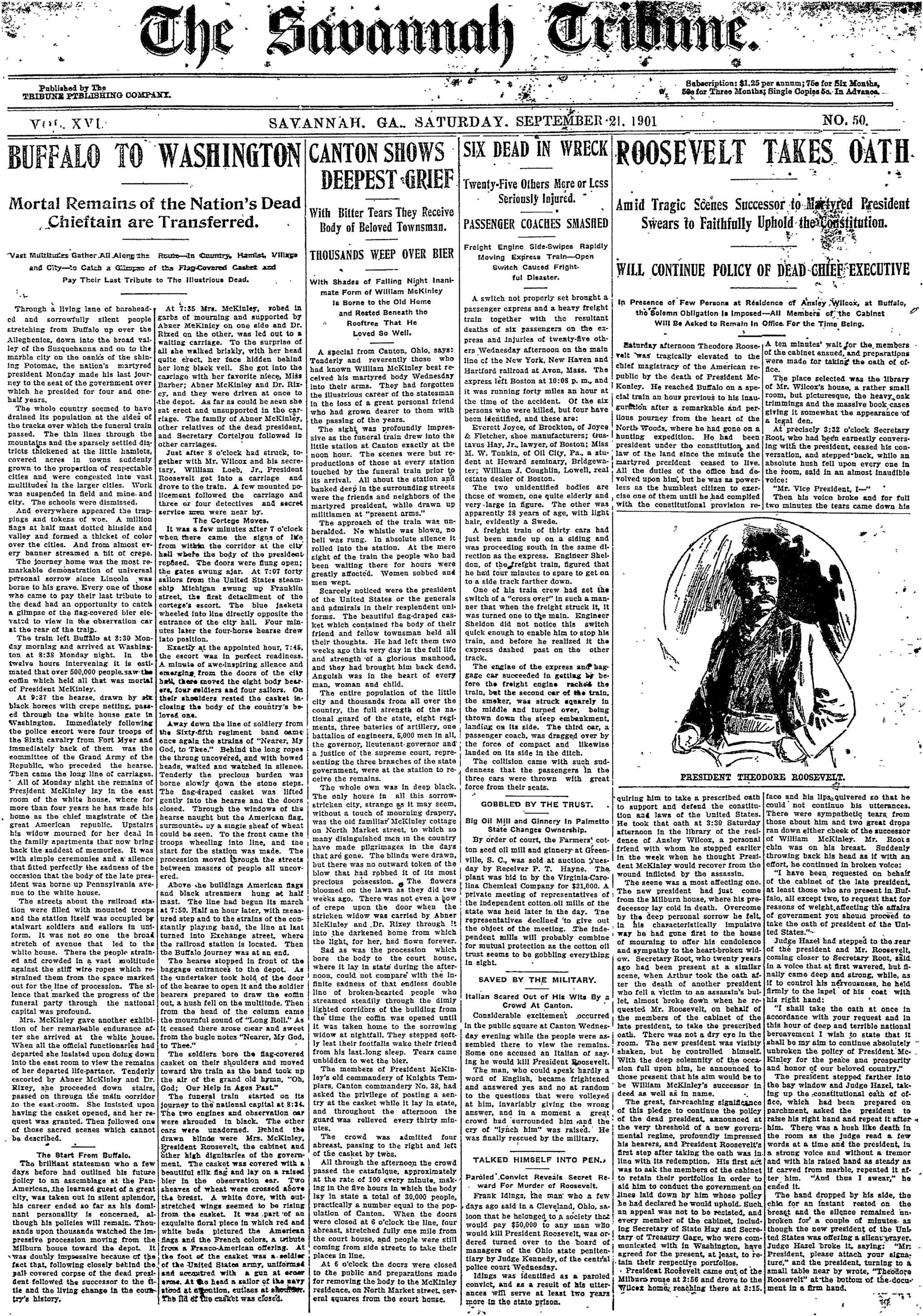
BUFEALO TO WASHINGTON |CANTON SHOWS |SiX DEAD IN WRECK|ROQSEVELT TAKES. OATE
Mortal Remains of the Nation’s Dead
_Chieftain are Transferred. .
“Vast Multitutes Gather. All Along the Route—in Country, Hanilst, Village
and City—to Catch a Giimpao of the Flagtovered Castet and
Pay Their Last Tribute to The Ilustrious Dead. _
‘Through a living lane of barshead-
ed and sorrowfully silent people
stretching from Buffalo up over the
Alleghenles, down into the broad val-
ley cf the Susquehanna and on to the
marble city on the panks of the shin-
ing Potomac, the nation’s martyred
President Monday made his last jour-
ney to the seat of the government over
which he presided for four and one-
half years,
‘The whole country seemed to have
drained its population at the sides of
tho tracks over which the funeral train
passed. The thin lines through the
mounta{ns and the sparsely settled dis:
tricts thickened at the Ittle hamlets,
covered acres in towns suddenly
grown to the propertion of respectable
cities and were congested inte vast
pultitudes In the larger citles. Work
wes suspended in field and mine. and
elty. The schools were dismissed.
And everywhere appeared the trap
pings and tokens of woe, A million
flags at half mast dottcd hiuside and
valley and formed a thicket of color
over the cities. And from almost ev-
ery banner streamed a bit of crepe.
The journey home was the most re-
markable demonstration of universal
personal sorrow since Lincoln was
borne to his grave. Every one of those
who came to pay their last tribute to
the dead had an opportunity to catch
a glimpse of the flag-covered bier ele-
vated to view In the observation car
at the rear of the traip.
The train left Buffilo at 8:30 Mon-
day mornixg and arrived at Washing:
ton at 8:38 Monday night. In the
twelve hours intervening it is esti.
mated that over 500,000 people saw: the
coffin which held all that was mortal
of President McKinley.
At 9:37 the hearse, drawn by st
black horses with crepe netting, pass
ed through tne white house gate in
Washington. Immediately following
the police escort were four troops ot
the Sixth cavalry from Fort Myer and
immediately back of them was the
committee of the Grand Army of the
Republic, who preceded the hearse.
Then came the Jong line of carriages
* All of Monday night the remains ot
President McKinley Izy in the eas
room of the white house, where fo1
more than four years he has made his
home as the chief magistrate of the
gteat American republic. Upstairs
his widow mourned for her dead fr
the family apartments that now bring
back the saddest of memories. It wa:
with elmple ceremonies and a’ silence
that fitted perfectly the sadness of the
occasion that the body of the late pres
ident was borne up Pennsylvania ave
nue to the white house,
‘The streets about the railroad sts
tion were filled with mounted troop:
and the station itself was occupled by
atalwart soldiers and eallors in unt
form. It was not so one the broat
stretch of avenue that led to th
white house. There the people strain
ed and crowded in a vast moltitud
against the stiff wire ropes which re
strained them from the space market
out for the Hine of procession, The s!
lence that marked the progress of th
funeral party through the nationa
capital was profound.
Mrs. McKinley gave another exhib!
tion of her remarkable endurance af
ter she arrived at the white house
‘When all the officia? functionaries hat
departed she insisted upon dolzg dow
into the east room to view the remain
of her departed life-partner. Tender
escorted by Abner McKinley and Dr
Rixey, she proceeded down stalrs
passed on througn the main corrido
to the east.room. She insisted upo:
having the casket opened, and her re
quest was granted. Then followed on
of those sacred scenes which canno
. be described.
° .
The Start From Buffalo.
‘Tho brilHant statesman who a few
days before had outlined his future
Bolicy to an assemblage at the Pan-
American, the learned guest of a great
city, was taken out in silent splendor,
his career ended so far as his dom!-
nant personality is eoncerned, al.
though his policies will remaiz. Thou-
ands upon thousands watched the im.
pressive procession moving from the
Milburn house toward the depot. It
‘was doubly impressive because cf the
fact that, following closely bekind the
pall covered corpse of the dead presl-
Gent followed the successor to the fl.
tle and the living change In the cow
try’s history,
Bards OF Mourning aaa suppres eT
Abner McKinley on one side and Dr.
Rized on the other, was led out to *
walting carriage. To the surprise of
all she walked briskly, with her head
quite erect, her face hidden behind
her long black vell. She got into the
casriago with her favorite niece, Miss
Barber; Abner McKinley and Dr. Riz-
ey, and they were driven at once to
the depot. As far as could be seen she
sat erect and unsupported in tho car-
riage. The family of Abner McKinley,
other relatives of the dead president,
and Secretary Cortelyou followed in
other carriages. .
Just after 8 o’clock had struck, to-
gether with Mr. Wilcox and his secre-
tary, William Loeb, Jr., President
Roosevelt got into a carriage and
drove to the train. A few mounted po-
cement followed the carriage and
three or four detectives and secret
service men were near by.
‘The Cortege Moves.
It was a few minutes after 7 o'clock
when there came the signs of lie
trom within the corridor at the city
hall whete the body of the presideat
repbeed. The doors were flung open;
the gates swung ajar. At 7:07 forty
sailors from the United States steam-
ship Michigan swung up Franklin
street, the first detaclment of the
cortege’s escort. The blue jaekets
wheeled into Hne directly opposite the
entrance of the city hall. Four mla-
utes later the four-horse hearse drew
Sato positfon.
Exaetly at the appointed hour, 7:45,
the escort was in perfect readiness.
A minute of awe-Inspiring silence and
emerging from the doors of the city
hail, there moved the eight body bear-
ers, four esldiers and four sailors. On
thelr shoalders rested the casket in-
closing the body of the country’s be
loved one.
Away down the line of soldiery from
the Sixty-ffth regiment band oame
once agaln the strains of “Nearer, My
God, to Thee.” Behind the long ropes
the throng uncovered, and with bowed
heads, waited ana watched in silence.
Tenderly the precious burden was
borne slowly down the stone steps.
The flag-draped casket was lifted
gently into the hearse and the doors
closed. Through the windows of the
hearse naught but the American flag,
surmountes vy a single sheaf of wheat
could ba seen. To the front came the
troops wheellng into line, and tne
start for the station was made. The
procession moved through the streets
between masses of people all uncov-
ered.
Above che buildings American flags
and black streamers hung at halt
mast. The line had begun Its march
at 7:50. Half an hour later, with meas-
ured step and to the strains of the con-
stantly playing band, the Ino at lest
turned into Exchange street, where
the railroad station is located. Then
the Buffalo journey was at an end,
The hearse stopped In front of the
baggage entrances to the depot. As
the undertaker took hold of the door
of the hearse to open it and the soldier
bearers prepared to draw the eoffin
out, a hush fell on the multitude. Then
from the head of the column came
the mournful sound of “Long Roll.” As
It ceased there arose ciear and sweet
from tho bugle notes “Nearer, My God,
to Thee.” ;
The soldiers bore the flag-covered
casket on thelr shoulders and moved
toward the train as the band took up
the alr of the grand old hymn, “Oh,
God; Our Help in Ages Past.”
‘The funeral train started on its
journey to the national capital at 8:24
The two engines and observation car
were shrouded in black. The ether
cars were unadorned. Behind the
drawn blinds were Mrs. McKinley,
Bresident Rovsevelt, the cabinet and
dther high dignitaries of the govern
ment. The casket was covered with a
Deautiful silk flag and lay on a ralsed
bler in the observation ear. Two
sheaves of wheat were crossed shore
tha breast. A white dove, with out-
stretched wings seemed to be rising
from the casket. It was part ‘of an
exquisite floral plece in which red and
white buds pictured the Ameriean
flags and the French colors, a utbute
|trom 2 Franco-Ameriean offering. At
the foot of the ensket was a. seldter
of the United States army, uniformed
end accautred with a gun at eroer
arms. At fio head a sailor of the nary
| atvod at affention, entlacs at sherdt@er,
Nee aoe Se eee ane en ee ae
CANTON SHOWS -
DEEPEST GRIEF
With Bitter Tears They Receive
Body of Beloved Townsman.
THOUSANDS WEEP OVER BIER
With anaes of Falling Night Inani-
mate Form of Willlam McKinley
1g Borne to the Old Home
and Rested Beneath the
. Rooftree That He
Loved So Well.
A special from Canton, Ohio, says:
‘Tonderly and reverently those who
had known Willlam McKinley best re-
celved his martyred body Wednesday
into thelr arms. They had forgotten
the illustrious career of the statesman
in the loss of a great personal friend
who had grown dearer to thom with
‘the passing of the years.
‘Phe sight, was profoundly impres-
‘sivo as the funeral train drew into the
‘Httle station at Canton exactly at the
‘noon hour. The scenes were but re-
productions of those at every station
touched by the funeral train prior to
its arrival. All about the station and
banked deep in the surrounding streets
were the friends and neighbors of the
martyred prosident, while drawn up
militiamen at “present arms.”
The approach of the traln was un-
heralded. Ne whistle was blown, no
bell was rung. In absolute silence It
rolled Into the station. At the mere
sight of the train the people who had
been waiting there for hours were
greatly affected. Women sobbed and
men wept.
Scarcely noticed were the president
of the United States or the generals
and admirals in their resplendent unl
forms. The beautiful flag-draped cas-
ket which contained the body of their
friend and fellow townsman held all
their thoughts. He had left them two
weeks ago this very day in the full life
and strength ‘of a glorious manhood,
and they had brought him back dead.
Anguish was in the heart of every
man, woman and child.
‘The entire population of the little
clty and thousands from all over the
country, the full strength of the na-
tional .gnard of the state, eight regi-
) ments, three bateries of artillery, one
battalion of engineers, 5,000 men !n all,
the governor, llcutenant- governor and
a justice of the supreme court, repre-
| senting the three branches of the state
government, were at the station to re-
ceive the remains.
‘The whole own was in deep black.
The only house in all this sorrow-
| stricken city, strange gs it may seem,
without a touch of mourning drapery,
was the old familiar McKinley cottage
on North Market street, to which so
' many disinguished men in the country
|have made pilgrimages in the days
| that aré gone. ‘The blinds were drawn,
but there was no outward token of the
blow that had robbed it of its most
precious possession. g The flowers
bloomed or the lawn as they did two
| weeks ago. There was not even a Low
of crepe upon the door when the
stricken widow was carried by Abner
McKinley and .Dr. Rixey through !
into the darkened home from which
the light, for her, had flown forever.
Sad as was the procession whlch
Dore the body to the court house,
where it lay in state during the after-
| noon, could not compare with the In-
finite sadness of that endless double
line of broken-hearted people who
streamed steadfly through the dimly
lighted corridors of the building from
the time the coffin was opened until
it was taken home to the sorrowing
widow at nightfall. They stepped gott-
ly lest their footfalls wake thelr friend
from his last-long sleep. Tears came
unbidden to wet the bier.
The members of President MeKin-
ley’s old commandery of Knights Tem-
plars, Canton commandery No. 38, had
asked the privilege of posting a sen-
try at the casket while it lay In state,
and throughout the afternoon the
guard was relieved every thirty min-
utes.
The crowd was admitted fonr
abreast, passing to the right and left
of the casket by twos.
All through the afternoon the crowd
passed the ratafalque, approximately
at the rate of 100 every minute, mak-
ing in the five hours in which the body
lay in state a total of 30,000 people,
practically a number equal to the pop-
ulation of Canton. When the doors
were closed at 6 o'clock the line, four
abreast, stretched fully one mile from
the court house, and people were still
; coming from side streets to take thelr
places in line.
| At 6 o'clock the doors were closed
to the public and preparations made
for removing the body to the McKinley
residence, on North Market street, sey-
eral squares from the eourt house,
SIX DEAD IN WRECK
Twenty-Five Others Mere or Less
- Seriously Injured. ~
PASSENGER COACHES SMASHED
Freight Engine Side-Swipes Rapidly
Moving Express Traln—Open
Switch Caused Fright-
ful Disaster.
A switch not properly set brought a
passenger express and a heavy freight
train together with the resultant
deaths of six passengers on the ex-
press and Jnjurles of twenty-five otb-
ers Wednesday afternoon on the main
line cf the New York, New Haven and
Hartford railroad at Avon, Mass. The
express left Boston at 10:08 p. m, and
it was running forty miles an hour at
the time of the accident. Of the six
persons who were killed, but four have
been idetitified, and these are:
Everett Joyce, of Brockton, of Joyce
& Fletcher, shoe manufacturers; Gus-
tavus Hay, Jr., lawyer, of Boston; Miss
M. W. Tonkin, of Oll City, Pa. a stu-
dent at Howard seminary, Bridgewa.
ter; William J. Coughlin, Lowell, real
estate dealer of Boston.
| The two unidentified bodies are
| these of women, one quite elderly and
-very-large in figure. ‘The other was
apparently 28 years of age, with light
hair, evidently a Swede.
A freight train of thirty cars had
just been made up on 2 siding and
was proceeding south in the same dl-
rection as the express. Engisieer Shel.
don, of the,frefght train, figured that
he had four minutes to spare to get on
to a side track farther down. _
One of his train crew had sot the
switch of a “cross over” in such a man.
ner that when the freight struck it, it
was turned one to the main. Engineer
Sheldon did not notice this switch
| quick enough to enable him to stop his
‘train, and before he realized it the
express dashed past on the other
‘track.
| ‘The engine of the express an® bag:
Gage car succeeded In getting by be:
fore the freight engine racheé the
| train, bat the second car ef the train,
/the smoker, was struck aquarely in
the middle and turned over, boing
| thrown down the steep embankment,
landing on {ts side. The third car, 2
| passenger coach, was dragged over by
the foree of compact and Mkewise
landed on Its side in the ditch.
| “The collision came with such sud.
denness that the passengers in the
J three cars were thrown with great
force from their seats.
GOBBLED BY THE TRUST. .
Big Olt Mill and Ginnery In Palmetto
State Changes Ownership.
By order of court, the Farmers’ cot:
ton sced oll mill and ginnery-at Gfeen-
ville, 8. C., was sold at auction ‘tues.
day by Receiver P. T. Hayne. The
plant was bid in by the Virginia-Caro-
lina Chemical Company for $21,000. A
private meeting of representatives of
the Independent cotton.oll mills of the
state was held later in the day. Tne
representatives declined ‘to give out
the object of the meeting. The inde-
pendent mills will probably combine
for mutual protection as the cotton oll
trust seems to be gobbling everything
in sight. -
SAVED BY THE MILITARY.
Itallan Scared Out of His Wits By a
Crowd At Canton. .
Considerable excitement occurred
in the public square at Canton Wednes-
day evening while the people were as-
sembled there to view the remains.
Some one accused an Italfan of say-
ing he would kill President Roosevelt.
‘The man, who could speak hardly a
word of English, became frightened
and answered yes and no at random
to the questions that were volleyed
at him, invartably giving the wrong
answer, and in a moment a_ great
crowd had ‘surrounded him sand the
ery of “lynch him” was raised.’ He
was finally rescued by the military.
TALKED HIMSELF INTO PEN.»
Pardled’.Convict Reveals Secret Re-
- ward For Murder of Roosevelt.
Frank Idings, the man who a few
days ago said in a Cleveland, Ohio, sa.
loon that he belonged to p society thes
would pay $50,000 to any man wito
would kill President Roosevelt, was or:
dered turned over to the board of
managers of the Ohio state peniten-
tlary by Judge Kennedy, of the central
police court Wednesday.
Idings was fdentified as a paroled
convict, and 2s a result of Mis utter-
ances will serve at least two years
more in the state prison. 7
eo .
ROOSEVELT TAKES. OATH.
Amid Tragic Scenes Successor t0-Habtyred President
-— Swears to Faithfully Uphold the*onstitution.
[WILL CONTINUE POLICY OF DEAD-GHIER“EXECUTIVE
In Presence of Few Peraona at Résidence of Ansley “Wilcox, at Buffalo,
thé’Solemn Obligation Is imposed—All_ Members. of: the Cabinet
WIIl Be Asked to Remain In Office. For the Time Being. .
Of Meo
ig] ig 7 |
i ee > ae .
| Oe ee a | 4
y) i "a se ,
N fa} LRA i G
oa eae hes Hane t Ca ge ¥
SERS
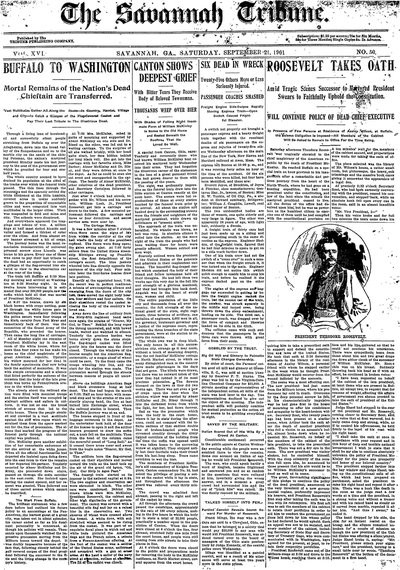
PRESIDENT THEODORE ROOSEVELT.
Baturday afternoon Theodore Roose
Velt ‘was tragically elevated to the
chief magistracy of the American re
public by the death of President Mc
Konley. He reached Buffalo on a spe
cfal train an houy previous to his Inau-
gurfticn after a remarkable anf per
flous pourney from the heart of the
North Woods, where he had gone on a
hunting expedition. He had been
president under the constitution znd
law of the land since the minute the
martyred president ceased to live
All the duties of the office had de
volved upon him, but he was 2s power
less es the humblest citizen to exer
cise one of them unt!l he had complied
with the constitutfonal provision re
‘quiring him to take a prescribed cath
to support and defend the constitu-
tion and laws of the United States.
He took that oath at 3:30 Saturday
afternoon in the library of the resi-
dence of Ansley Wilcox, a personal
friend with whom he stepped earller
in the week when he thought Preai-
dent McKinley would recover from the
wound infilcted by the assassin.
‘The seene was a most affecting one.
The new president had just come
from the Milburn house, where his pre-
decessor Jay cold in death. Overcome
by the deep personal sorrow he felt,
in his characteristically impulsive
way he had gone first to the house
of mourning to offer his condolence
and sympathy to the heart-broken wid-
ow. Secretary Root, who twenty years
ago had been present at a similar
scene, when Arthur took the oath af-
ter tho death of another president
who fell a victim to an assassin’s bul-
let, almost broke down when he re-
quested Mr. Roosevelt, on behalf of
the members of the cabinet of the
late president, to take the prescribed
oath, There was not a dry eye in the
room. The new president was visibly
shaken, but he controlled himself.
‘With the deep solemnity of the occa-
sion full upon him, he announced to
those present that his aim would be to
be William McKinley's successor in
deed as well ad in name. *
The great, farreaching significance
of this pledge to continue the policy
of the dead president, announced at
the very threshold of a new govern:
mental regime, profoundly impressed
his hearers, and President Roosevelt's
first step after taking the oath was in
Mno with its redemption. His first act
was to ask the members of the cabinet
to retain their portfolios in order ta
ald him to conduct the government on
dines lald down by him whose pollcy
he had declared he would uphold. Such
an appeal was not to be resisted, and
every member of the cabinet, includ.
ing Secretary of State Hay and Secré.
tary of Treasury Gage, who were com-
municsted with in Washington, have
agreed for the present, at Jeast, to re
-tain thelr respectlye portfolios.
+ President Roofevelt came out of the
Milbuea rouge at 2:56 and drove to the
‘Wicet home; reaching there at 3:15.
A ten minutes’ walt for the, members
of the cabinet ensued, and preparations
were made for taking the oath of of-
fice.
The place selected was the lUbrary
of Mr. Wilcox’s house, a rather small
room, but picturesque, the heavy,oak
trimmings and the massive book cases
giving it somewhat the appearance ‘of
a legal den.
At precisely 3;32 o'clock Secretary
Root, who had been earnestly convers-
ing with the president, ceased his con-
versation, and stepped*back, while an
absolute hush fell upon every one in
the oom, sald in an almost inaudible
voice:
“Mr. Vice President, I~" *
Then his voice broke and for full
two minutes the tears came down his
face and his lips.quivered so that he
could’ not continue his utterances.
There were sympathetic tears, from
those about him and two great drops
ran down either cheek of the successor
of William McKinley. Mr. Roots
chin was on his breast. Suddenly
throwing back his head as if with an
effort, he continued in broken voice;
“I have been requested on behaff
of the cabinet of the late president,
at least those who are present in But-
falo, all except two, to request that for
reasons of weight affecting the affaira
of government you shoud proceed to
take the oath of president of the Uni-
ted States."~ 2s
Judge Hazel had stepped to the rear
of thé president and Mr. Roosevelt,
coming closer to Secretary Root, said
in a voice that at first wavered, but f-
nally camo deep and strong, while, as
if to control his nérvousness, he held
firmly to the Inpel of his coat with
his right hand: ®
“I shall take the oath at once in
accordance with your request and In
this hour of deep and terrible national
bereavement I wish to state that it
shall be my aim to continue absolutely
unbroken the policy of President Mc-
Kinley for the peace gna prosperity
and honor of our beloved country.”
The president stepped farther Into
the bay window and Judge Hazel, tak-
ing up the constitutional oath of of-
fice, which had been prepared on
parchment, asked the president to
raise his right hand and repeat It after
him. There was a hush like death in
the room es the judge read a few
words at a time and tho president, in
Ja strong voice and without a tremor
and with his raised hand as steady as
if carved from marble, repeated it af-
ter him, “And thus I swear,” he
ended it.
The hand dropped by his side, the
chia for an instant rested on the
breagt and the silence remained nn-
broken for‘ a couple of minutes. aa
though the new president of the Untr
ted States was offering a sllenv'yrayer.
Judge Hazel broke it, saying: “Mr;
President, please attach your signa;
ture,” and the president, turning to a
small table near by wrote, “Theodora
Roosevelt” at-the bottom of the-docu-
ment in s firm hand. oe
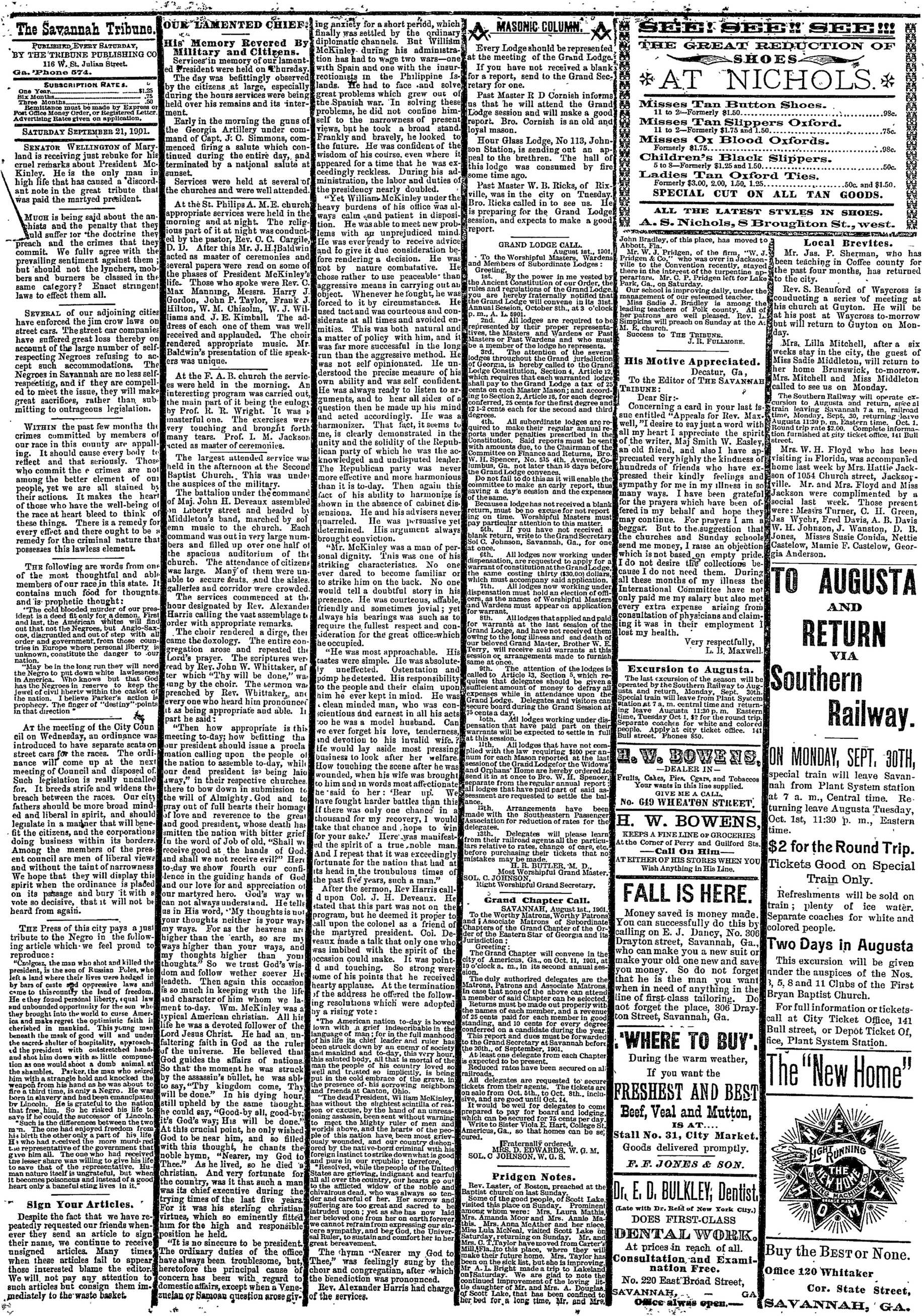
PUBLISHED, EVERY SATURDAY,
BY THE TRIBUNE PUBLISHING CO
116 W. St. Julian Street.
Ga. Phone 574.
SATURDAY SEPTEMBER 21, 1901.
SENATOR WELLINGTON of Maryland is receiving just rebuke for his cruel remarks about President McKinley. He is the only man in high life that has caused a 'discordant note in the great tribute that was paid the martyred president.
Much is being said about the anarchists and the penalty that they could suffer for the doctrine they preach and the crimes that they commit. We fully agree with the prevailing sentiment against them; but should not the lynchers, mobbers and burners be classed in the same category? Enact stringent laws to effect them all.
SEVERAL of our adjoining cities have enforced the jim crow laws on street cars. The street car companies have suffered great loss thereby on account of the large number of selfrespecting Negroes refusing to accept such accommodations. The Negroes in Savannah are no less selfrespecting, and if they are compelled to meet the issue, they will make great sacrifices, rather than submitting to outrageous legislation.
WITHIN the past few months the crimes committed by members of our race in this county are appalling. It should cause every body to reflect and that seriously. Those who commit the e crimes are not among the better element of our people, yet we are all stained by their actions. It makes the heart of those who have the well-being of the race at heart bleed to think of these things. There is a remedy for every effect and there ought to be a remedy for the criminal nature that possesses this lawless element.
The following are words from one of the most thoughtful and able members of our race in this state. It contains much food for thoughts, and is prophetic thought:
"The cold blooded murder of our president is a deed fit only for a demon. First and last, the American whites will find out that not the Negroes, but Anglo-Saxons, disgruntled and out of step with all order and government, from those countries in Europe where personal liberty is unknown, constitute the danger to our nation." May be in the long run they will need the Negro to put down white lawlessness in America. Who knows but that God has the Negroes in reserve to keep the jewel of civil liberty within the casket of the nation. I believe Parker's action is prophecy. The finger of "destiny" points in that direction.
At the meeting of the City Council on Wednesday, an ordinance was introduced to have separate seats on street cars for the races. The ordinance will come up at the next meeting of Council and disposed of. Such legislation is really uncalled for. It breeds strife and widens the breach between the races. Our city fathers should be more broad minded and liberal in spirit, and should legislate in a manner that will benefit the citizens, and the corporations doing business within its borders. Among the members of the present council are men of liberal views and without the taint of narrowness. We hope that they will display this spirit when the ordinance is placed on its passage and bury it with a vote so decisive, that it will not be heard from again.
THE Press of this city pays a just tribute to the Negro in the following article which we feel proud to reproduce: "Czolgosz, the man who shot and killed the president, is the son of Russian Poles, who left a land where their lives were hedged in by bars of castle and oppressive laws and came to this county the land of freedom. He e they found personal liberty, equal law and unbounded opportunity for the son who they brought into the world to curse America and make regret the optimistic faith in cherished in mankind. This young man beneath the mask of good will and under the sacred-shelter of hospitality, approached the president with outstretched hand and shot him down with as little compunction as one would shoot a dumb animal at the shambles. Parker, the man who seized him with a strangle hold and knocked the ecpahot in his hand, he was shot in only a Negro. He was born in slavery and had been emancipated by Lincoln. He is grateful to the nation that free him. So he risked his life to save if he could the successor of Lincoln.
"Such is the differences between the two man. The one had enjoyed freedom from his birth the other only a part of his life. He who had received the more murder-red representation of the government was the one who had received the lesser share was willing to give his life to save that of the representative. Human nature itself is ungrateful, but when it becomes poisonous and instead of a good heart only a baneful sting lives in it."
Sign Your Articles.
Despite the fact that we have repeatedly requested our friends whenever they send an article to sign their name, we continue to receive unsigned articles. Many times when these articles fail to appear those interested blame the editor. We will not pay any attention to such articles but consign them immediately to the waste basket.
His Memory Revered By Military and Citizens. Services in memory of our lamented President were held on Thursday. The day was befittingly observed by the citizens at large, especially during the hours services were being held over his remains and its interment.
Early in the morning the guns of the Georgia Artillery under command of Capt, J: C. Simmons, commenced firing a salute which continued during the entire day, and terminated by a national salute at sunset. Services were held at several of the churches and were well attended.
At the St. Phillips A. M.E. church appropriate services were held in the morning and at night. The religious part of it at night was conducted by the pastor, Rev. O. C. Cargile, D. D. After this Mr. J. H. Baldwin acted as master of ceremonies and several papers were read on some of the phases of President McKinley's life. Those who spoke were Rev. C. Max Manning, messrs. Harry J. Gordon, John P. Taylor, Frank J. Hilton, W. M. Chisolm, W. J. Williams and J. E. Kimball. The address of each one of them was well received and applauded. The choir rendered appropriate music. Mr. Baldwin's presentation of the speakers was unique.
At the F. A. B. church the services were held in the morning. An interesting program was carried out, the main part of it being the eulogy by Prof. R. R. Wright. It was a masterful one. The exercises were very touching and brought forth many tears. Prof. I. M. Jackson acted as master of ceremonies.
The largest attended service was held in the afternoon at the Second Baptist Church. This was under the auspices of the military.
The battalion under the command of Maj. John H. Deveaux assembled on Liberty street and headed by Middleton's band, marched by solemn music to the church. Each command was out in very large numbers and filled up over one half of the spacious auditorium of the church. The attendance of citizens was large. Many of them were unable to secure seats, and the aisles, galleries and corridor were crowded. The services commenced at the hour designated by Rev. Alexander Harris calling the vast assemblage to order with appropriate remarks.
The choir rendered a dirge, then came the doxology. The entire congregation arose and repeated the Lord's prayer. The scriptures were read by Rey. John W. Whittaker, after which "Thy will be done," was sung by the choir. The sermon was preached by Rev. Whittaker, and every one who heard him pronounced it as being appropriate and able. In part he said:
"Then how appropriate is this meeting to-day; how befitting that our president should issue a proclamation calling upon the people of the nation to assemble to-day, while our dead president is being laid away," in their respective churches there to bow down in submission to the will of Almighty. God and to gray out of full hearts their homage of love and reverence to the great and good president, whose death has smitten the nation with bitter grief In the word of Job of old, "Shall we receive good at the hands of God, and shall we not receive evil?" Here to-day we show fourth our confidence in the guiding hands of God and our love for and appreciation of our martyred hero. God's way we can not always understand. He tells us in His word, "My thoughts is not your thoughts neither is your ways my ways. For as the heavens are higher than the earth, so are my ways higher than your ways, and my thoughts higher than your thoughts." So we trust God's wisdom and follow wether soever He leadeth. Then again this occasion is so much in keeping with the life and character of him whom we lament to-day. Wm. McKinley was a typical American christian. All his life he was a devoted follower of the Lord Jesus Christ. He had an unfultering faith in God as the ruler of the universe. He believed that God guides the affairs of nations. So that the moment he was struck by the assassin's bullet, he was able to say, "Thy kingdom come, Thy will be done." In his dying hour, still upheld by the same thought, he could say, "Good-by all, good-by, it's God's way; His will be done." At this crucial point, he only wished God to be near him, and so filled with this thought, he chants the noble hymn, "Nearer, my God to Thee." As he lived, so he died a christian. And very fortunate for the country, was it that such a man was its chief executive during the trying times of the last five years. For it was his sterling christian virtues, which so eminently fitted him for the high and responsible position he held.
"It is no sinecure to be president. The ordinary duties of the office have always been troublesome, but, heretofore the principal cause of concern has been with regard to domestic affairs, except when a Venezuelan or Samoan question arose giv-
ing anxiety for a short period, which finally was settled by the ordinary diplomatic channels. But William McKinley during his administration has had to wage two wars—one with Spain and one with the insurrectionists in the Philippine Islands. He had to face and solve great problems which grew out of the Spanish war. In solving these problems, he did not confine himself to the narrowness of present views, but he took a broad stand. Frankly and bravely, he looked to the future. He was confident of the wisdom of his course, even where it appeared for a time that he was exceedingly reckless. During his administration, the labor and duties of the presidency nearly doubled.
"Yet William McKinley under the heavy burdens of his office was always calm and patient in disposition. He was able to meet new problems with an unprejudiced mind. He was ever ready to receive advice and to give it due consideration before rendering a decision. He was not by nature combatative. He chose rather to use peaceable than aggressive means in carrying out an object. Whenever he fought, he was forced to it by circumstances. He used tact and was courteous and considerate at all times and avoided embitter. This was both natural and a matter of policy with him, and it was far more successful in the long run than the aggressive method. He was not self opinionated. He understood the precise measure of his own ability and was self confident. He was always ready to listen to arguments, and to hear all sides of a question then he made up his mind and acted accordingly. He was a harmonizer. That fact, it seems to me, is clearly demonstrated in the unity and the solidity of the Republican party of which he was the acknowledged and undisputed leader. The Republican party was never more effective and more harmonious than it is to-day. Then again this fact of his ability to harmonize is shown in the absence of cabinet dissensions. He and his advisers never quarreled. He was persuasive yet determined. His argument always brought conviction.
"Mr. McKinley was a man of personal dignity. This was one of his striking characteristics. No one ever dared to become familiar or to strike him on the back. No one would tell a doubtful story in his presence. He was courteous, affable, friendly and sometimes jovial; yet always his bearings was such as to require the fullest respect and consideration for the great office-which he occupied.
"He was most approachable. His tastes were simple. He was absolutely uneffected. Ostentation and pomp he detested. His responsibility to the people and their claim upon him he ever kept in mind. He was a clean minded man, who was conscientious and earnest in all his acts too he was a model husband. Can we ever forget his love, tenderness, and devotion to his invalid wife? He would lay aside most pressing business to look after her welfare. How touching the scene after he was wounded, when his wife was brought to him and in words most affectionate he said to her: 'Bear up. We have fought harder battles than this If there was only one chance in a thousand for my recovery, I would take that chance and hope to win for your sake.' Here was manifested the spirit of a true noble man. And I repeat that it was exceedingly fortunate for the nation that had its head in the troubulous times of the past five years, such a man."
After the sermon, Rev Harris called upon Col. J. H. Deveaux. He stated that this part was not on the program, but he deemed it proper to call upon the colonel as a friend of the martyred president. Col. Deveaux made a talk that only one who was imbied with the spirit of the occasion could make. It was pointed and touching. So strong were some of his points that he received hearty applause. At the termination of the address he offered the following resolutions which were adopted by a rising vote:
"The American nation to-day is bowed down with a grief indescribable in the language of man; for in the full manhood of his life its chief leader and ruler has been struck down by an enemy of society and mankind and to-day, this very hour, this saluted body, all that is mortal of the man the people of his country loved so well and trusted so implicitly, is being put in the cold embrace of the grue, in the presence of his sorrowing neighbors and friends." "The dead President, Wilam McKinley, has without the slightest scintilla of reason or excuse, by the hand of an unreasoning assassin, been sent without warning to meet the Mighty ruler of men and worlds above, and the hearts of the people of this nation have been most grievously wounded, and our country dishonored by the native-born criminal with his foreign instinct to strike down what is good and pure in our republic; therefore,
"Resolved, while the people of the United States are grieving, indignant and tearful all all over the country, our hearts go out to the afflicted widow of the noble and chivalrous dead, who was always so tender and careful of her. Her sorrow and suffering and sacred and sacred to her intruded upon; yet as she her new her beloved one from her on earth forever we cannot refrain from expressing our sincere sympathy, and beg God, the Universal Ruler, to sustain and comfort her in her great bereavement.
The hymn "Nearer my God to Thee," was feelingly sung by the choir and congregatian, after which the benediction was pronounced.
Rev. Alexander Harris had charge of the services.
Every Lodge should be represented at the meeting of the Grand Lodge. If you have not received a blank for a report, send to the Grand Secretary for one.
Past Master R D Cornish informs us that he will attend the Grand Lodge session and will make a good report. Bro. Cornish is an old and loyal mason.
Hour Glass Lodge, No 113, Johnson Station, is sending out an appeal to the brethren. The hall of this lodge was consumed by fire some time ago.
Past Master W. B. Ricks, of Rixville, was in the city on Tuesday. Bro. Ricks called in to see us. He is preparing for the Grand Lodge session, and expects to make a good report.
GRAND LODGE CALL.
August 1st, 1901.
To the Worshipful Masters, Wardens and Members of Subordinate Lodges: Greeting.
By the power in me vested by the Ancient Constitution of our Order, the rules and regulations of the Grand Lodge, you are hereby fraternally notified that the Grand Lodge will convene in its 31st Annual Session, October 8th, at 3 o'clock p. m., A. L. 5901.
2nd. All lodges are required to be represented by their proper representative the Masters and Wardens or Past Masters or Past Wardens and who shall be a member of the lodge he represents.
3rd. The attention of the several lodges throughout the Grand jurisdiction of Georgia, is hereby called to the Grand Lodge Constitution, Section 4, Article 12, which requires that each warranted lodge shall pay to the Grand Lodge a tax of 25 cents for each member and according to Section 2, Article 16, for each conferred, 25 cents for the first degree and 12-1-2 cents each for the second and third degrees.
4th. All subordinate lodges are required to make their regular annual reports under penalties prescribed in the Constitution. Said reports must be sent with amounts due, to the Chairman of the Committee on Finance and Returns, Bro. W. Stephenson, N.A. Avenue, Columbus, Ga. not later than 15 days before the Grand Lodge convenes.
Do not fail to do this as it will enable the committee to make an early report, thus saving a day's session and the expenses of the same.
Because a lodge has not received a blank return, must be no excuse for not reporting on time. Worshipful Masters must pay attention to this matter.
5th. If you have not received a blank return, write to the Grand Secretary C. Johnson, Savannah, Ga., for one at once.
6th. All lodges now working under dispensation, are requested to apply for a warrant of constitution at the Grand Lodge, the same costing thirty ($30.00) dollars, which must accompany said application.
All lodges now working under dispensation must apply for a warrant, as the names of Worshipful Masters and Wardens must appear on application for warrant.
8th. All lodges that applied and paid for warrants at the last session of the Grand Lodge, and have not received them owing to the long illness and sad death of our beloved Grand Master, Brother W. E. Terry, will receive said warrants at this session or arrangements made to furnish same at once.
9th. The attention of the lodges is called to Article 13, Section 5, which requires that delegates should be given a money to defray the expenses while in attendance at the Grand Lodge. Delegates and visitors can secure board during the Grand Session at 75 cents a day. 10th. All lodges working under dispense will have paid part on their warrants will be expected to settle in full at this session.
11th. All lodges that have not complied with the law requiring $100 per annum for each Mason reported at the last session of the Grand Lodge for the Widows' and Orphans' Home are hereby ordered to send it in at once to Bro. W. H. Spencer, separate from the regular annual report; all lodges that have not part of said assessment are requested to settle the balance.
12th. Arrangements have been made with the Southeastern Passenger Association for reduction of rates for the delegates. Delegates will please learn from their railroad agents all the particulars relative to rates, change of cars, etc. before purchasing their tickets that no mistakes may be made.
H. R. BUTLER, M. D.
Most Worshipful Grand Master.
SOL. C. JOHNSON.
Right Worshipful Grand Secretary.
Grand Chapter Call.
SAVANNAH, August 1st, 1601.
To the Worthy Matrons, Worthy Patrons,
and Associate Matrons of Subordinate
Chapters of the Grand Chapter of the Order
of the Eastern Star of Georgia and its
Jurisdiction;
Gregorian.
The Grand Chapter will convene in the
city of Americus, Ga., on Oct. 11, 1901, at
19 o'clock a. m., in its second annual session.
The duly authorized delegates are the Matrons, Patrons and Associate Matrons. In case that none of the above can attend a member of said Chapter can be selected. Returns must be made out properly with the names of each member, and a revenue of 25 cents paid for each member in good standing, and 10 cents for every degree conferred on a candidate during the year. This report and dues must be forwarded to the Grand Secretary at Savannah before the 20th, of September, 1901.
At least one delegate from each Chapter is expected to be present.
Reduced rates have been secured on all railroads.
All delegates are requested to secure tickets from their agents. The tickets are on sale from Oct. 5th, to Oct. 8th, inclusive, and are good until Oct. 14.
It would be well for delegates to come prepared to pay for board and lodging, which can be secured for 75 cents per day. Write to Sister Viola E. Hart, College St. Augustus, Ga., so that homes can be seized.
Fraternally ordered.
MRS. D. EDWARDS, W. G. M.
SOL. C JOHNSON, W. G. S.
Pridgen Notes.
Rev. Laster, of Boston, preached at the Baptist church on last Sunday.
Some of the good people, of Scott Lake, visited this place on Sunday. Prominent among whom were: Mrs. Laura Mathis, Mrs. Amanda Moor and Mrs. Annie Mathis, Mrs. Anna McAther and her niece, Miss Lula McNeal, visited Scott Lake on Saturday, returning on Sunday. Mr. and Mrs. Taylor have moved from Carter's Mill Fla., this place, where they will make their farm, and Taylor has been on the sick list, but she is not Mr. A. L. Bright made a trip to Lakehaven on Saturday. We are glad to note the continued improvement of the loving little daughter of Mr. and Mrs. A. Douglas, of Scott Lake, that has been confined to her bed for a long time, Mr. and Mrs.
John Bradley, of this place, has moved to Abbott, Fla.
Mr. W. J. Pridgen, of the firm, "W. J. Pridgen & Co." who was over in Jacksonville to the Convention recently, stayed there in the interest of the turpentine apparment. Mr. C. P. Pridgen left for Lake Park, Ga., on Saturday.
Our school is improving daily, under the management of our saeledem teacher. Miss Sadie J. Bradley is among the least teachers of Old county. All of her patricia will well please. Rev. Simpkins will preach on Sunday at the A: M. E. church.
Success to THE TRIBUNE.
J. R. FULLMORE.
His Motive Appreciated.
Decatur, Ga.
To the Editor OF THE SAVANNAH
TRIBUNE:
Dear Sir:-
Concerning a card in your last issue entitled "Appeals for Rev. Maxwell," I desire to say just a word with all my heart I appreciate the spirit of the writer, Maj Smith W. Easley, an old friend, and also I have appreciated very highly the kindness of hundreds of friends who have expressed their kindly feelings and sympathy for me in my illness in so many ways. I have been grateful for the prayers which have been offered in my behalf and hope they may continue. For prayers I am a beggar. But to the suggestion that the churches and Sunday schools send me money, I raise an objection which is not based on empty pride. I do not desire the collections because I do not need them. During all these months of my illness the International Committee have not only paid me my salary but also met every extra expense arising from consultation of physicians and claiming it was in their employment I lost my health.
Very respectfully,
L. B. Maxwell.
Excursion to Augusta.
The last excursion of the season will be operated by the Southern Railway to Augusta and return, Monday, Sept. 30th. Special train will leave from Plant System station at 7 a.m. central time and return time, August 11:30 p.m. Eastern time, Tuesday Oct. 12 for the round trip. Separate coaches for white and colored people. Apply at city ticket 141 Bull street. Phones 850.
H. W. BOWENS,
Fruits, Cakes, Pies, Cgars, and Tobacos
Your wants in this line supplied.
GIVE ME A CALL.
No. 649 WHEATON STREET.
H. W. BOWENS.
KEEPS A FINE LINE OF GROCERIES
At the Corner of Perry and Guilford Sts.
Call On Him
CALL ON HIM
AT EITHER OF HIS STORES WHEN YOU
Wish Anything in His Line.
FALL IS HERE.
Money saved is money made. You can successfully do this by calling on E. J. Dancy, No. 306 Drayton street, Savannah, Ga., who can make you a new suit or make your old one new and save you money. So do not forget that he is the man you want when in need of anything in the line of first-class tailoring. Do not forget the place, 306 Drayton Street, Savannah, Ga.
'WHERE TO BUY'.
During the warm weather,
If you want the
FRESHEST AND BEST
Beef, Veal and Mutton,
IS AT....
Stall No. 31, City Market.
Goods delivered promptly.
F. F. JONES & SON.
Dr. E. D. BULKLEY; Dentist.
(Late with Dr. Reid of New York City.)
DOES FIRST-CLASS
DENTAL WORK.
At prices in reach of all.
Consultation and Examination Free.
No. 220 East Broad Street,
SAVANNAH, GA
Office always open.
Mr. Jas. P. Sherman, who has been teaching in Coffee county for the past four months, has returned to the city.
Rev. S. Beauford of Waycross is conducting a series of meeting at his church at Guyton. He will be at his post at Waycross to-morrow but will return to Guyton on Monday.
Mrs. Lilla Mitchell, after a six weeks stay in the city, the guest of Miss Sadie Middleton, will return to her home Brunswick, to-morrow.
Mrs. Mitchell and Miss Middleton called to see us on Monday.
The Southern Railway will operate excursion to Augusta and return, spice a train leaving Savannah 7 a.m., railroad from Augusta to Sept. 30, returning leave Augusta 11:30 p.m. Eastern time, Oct. 1. Round trip rate $2.00. Complete information furnished at city ticket office, 141 Bull street.
Mrs. W. H. Floyd who has been visiting in Florida, was accompanied home last week by Mrs. Hattie Jackson of 1054 Church street, Jacksonville. Mr. and Mrs. Floyd and Miss Jackson were complimented by a social last week. Those present were: Messrs Turner, C. H. Green, Jas Wych, Fred Davis, A. B. Davis W. H. Johnson, J. Wanston, D. B. Jones, Misses Susie Conida, Nettie Castelow, Mamie F. Castelow, Georgia Anderson.
TO AUGUSTA
AND
RETURN
VIA
Southern
Railway.
ON MONDAY, SEPT. 30TH, special train will leave Savannah from Plant System station at 7 a. m., Central time. Returning leave Augusta Tuesday, Oct. 1st, 11:30 p. m., Eastern time.
$2 for the Round Trip.
Refreshments will be sold on train; plenty of ice water. Separate coaches for white and colored people.
Two Days in Augusta
This excursion will be given under the auspices of the Nos. 3, 5, 8 and 11 Clubs of the First Bryan Baptist Church.
For full information or tickets-call at City Ticket Office, 141 Bull street, or Depot Ticket Of, office, Plant System Station.
NEW
LIGHT RUNNING
THE
NEW HOME
SEVING MACHIN CO.
ORANGE MASS.
Buy the Best or None.
Office 120 Whitaker
Cor. State Street,
SAVANNAH, GA.
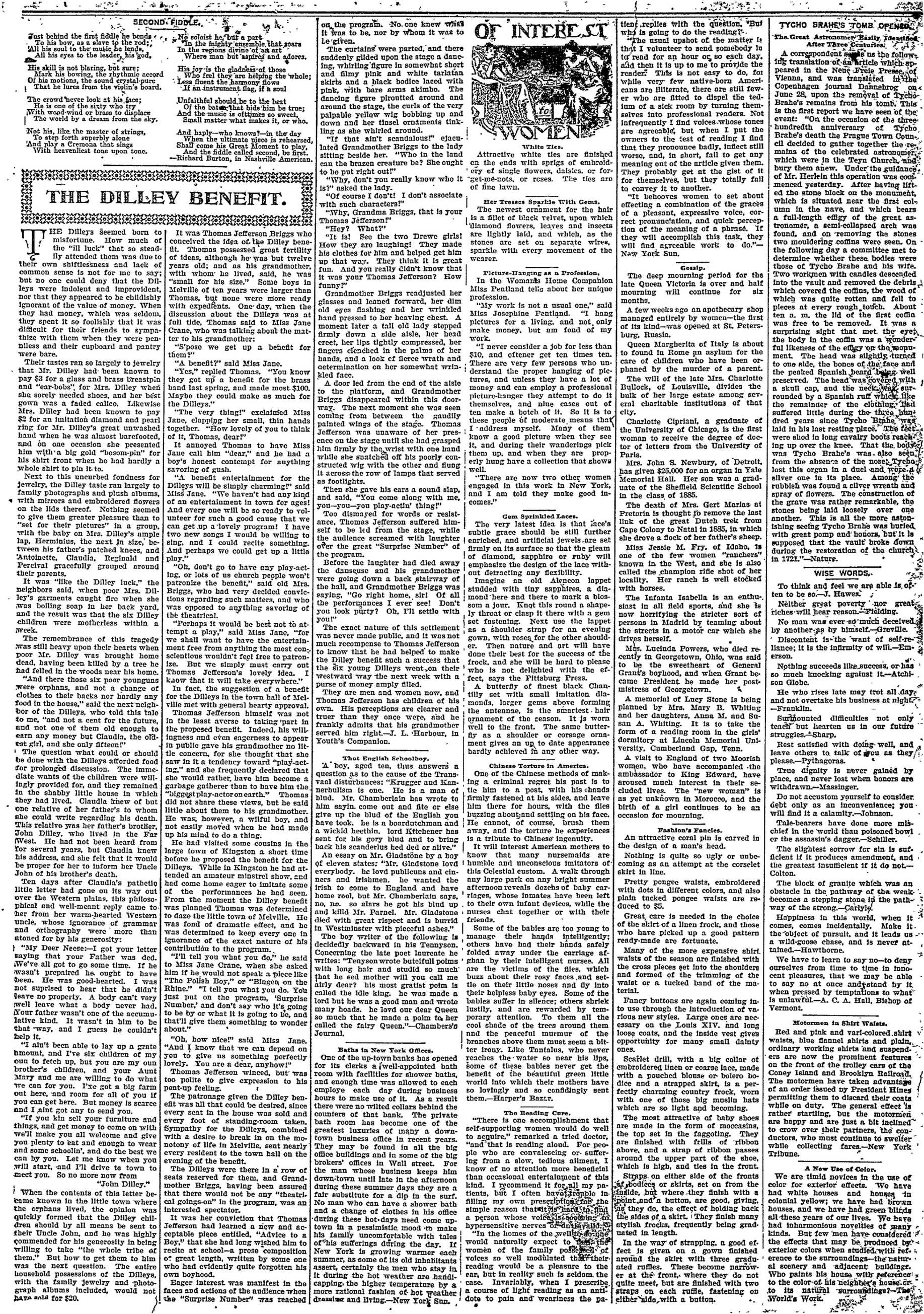
THE DILLEY BENEFIT.
22
Just behind the first fiddle he bends
To his bow, as a slave to the rod;
All his soul to the music he leans,
All his eyes to the leader, his god.
His skill is not blaring, but sure;
Mark his bowing, the rhythmic accord
Of his motions, the sound crystal-pure
That he lures from the violin's board.
The crowd beaver look at his face;
He is one of the sixty who try
With wood-wind or brass to displace
The world by a dream from the sky.
Not his, like the master of strings,
To step forth superbly alone
And play a Cremona that sings
With heaveniest tone upon tone.
THE Dilleys seemed born to misfortune. How much of the "ill luck" that so steadily attended them was due to their own shiftlessness and lack of common sense is not for me to say; but no one could deny that the Dilleys were indolent and improvident, nor that they appeared to be childishly ignorant of the value of money. When they had money, which was seldom, they spent it so foolishly that it was difficult for their friends to sympathize with them when they were penless and their cupboard and pantry were bare.
Their tastes ran so largely to jewelry that Mr. Dilley had been known to pay $3 for a glass and brass breastpin and "ear-bobs" for Mrs. Dilley when she sorely needed shoes, and her best gown was a faded calico. Likewise Mrs. Dilley had been known to pay $2 for an imitation diamond and pearl ring for Mr. Dilley's great unwashed hand when he was almost barefooted, and on one occasion she presented him with a big gold "bosom-pin" for his shirt front when he had hardly a whole shirt to pin it to.
Next to this uncurbed fondness for jewelry, the Dilley taste ran largely to family photographs and plush albums, with mirrors and embroidered flowers on the lids thereof. Nothing seemed to give them greater pleasure than to "set for their pictures" in a group, with the baby on Mrs. Dilley's ample lap, Herminius, the next in size, between his father's patched knees, and Antolnette, Claudia, Reginald and Percival gracefully grouped around their parents.
It was "like the Dilley luck," the neighbors said, when poor Mrs. Dilley's garments caught fire when she was bolling soap in her back yard, and the result was that the six Dilley children were motherless within a week.
The remembrance of this tragedy was still heavy upon their hearts when poor Mr. Dilley was brought home dead, having been killed by a tree he had felled in the woods near his home
"And there those six poor younguns were orphans, and not a change of clothes to their backs nor hardly any food in the house," said the next neighbor of the Dilleys, who told this tale to me, "and not a cent for the future, and not one of them old enough to earn any money but Claudia, the oldest girl, and she only fifteen."
The question what could or should be done with the Dilleys afforded food for prolonged discussion. The immediate wants of the children were willingly provided for, and they remained in the shabby little house in which they had lived. Claudia knew of but one relative of her father's to whom she could write regarding his death. This relative was her father's brother, John Dilley, who lived in the Far West. He had not been heard from for several years, but Claudia knew his address, and she felt that it would be proper for her to inform her Uncle John of his brother's death.
Ten days after Claudia's pathetic little letter had gone on its way out over the Western plains, this philosophical and well-meant reply came to her from her warm-hearted Western uncle, whose ignorance of grammar and orthography were more than uttoned for by his generosity:
} "My Deer Neese:-I got your letter saying that your Father was ded. We've all got to go some time. If he wasn't prepared he ought to have been. He was good-hearted. I was not suprised to hear that he didn't leave no property. A body can't very well leave what a body never had. Your father wasn't one of the accumulative kind. It wasn't in him to be that way, and I guess he couldn't help it.
"I ain't been able to lay up a grate amount, and I've six children of my own to fetch up, but you are my own brother's children, and your Aunt Mary and me are willing to do what we can for you. I've got a big farm out here, and room for all of you if you can get here. But money is scarce and I ain't got any to send you.
"If you kin sell your furniture and things, and get money to come on with we'll make you all welcome and give you plenty to eat and enough to wear and some schoolin', and do the best we can by you. Let me know when you will start, and I'll drive to town to meet you. So no more now from "John Dilley." When the contents of this letter became known in the little town where the orphans lived, the opinion was quickly formed that the Dilley children should by all means be sent to their Uncle John, and he was highly commended for his generosity in being willing to take "the whole tribe of them." But how to get them to him was the next question. The entire household possessions of the Dilleys, with the family jewelry and photograph albums included, would not have sold for $20.
No solist he, but a part
In the fhighty ensemble, that soars
In the regions divine of art
Where man but aspires and adores.
His joy is the gladness of those
Who feel they are helping the whole;
Less fluent the harmony flows
If an instrument flag, if a soul
Unfaithful should, be to the beat
Of the batte, that bids him be true;
And the music is oftimes so sweet,
Small matter what makes it, or who,
And haply—who knows!—in the day
When the ultimate piece is rehearsed,
Shall come his Great Moment to play.
And the fiddle called second, be first
-Richard Burton, in Nashville, American
It was Thomas Jefferson Briggs who conceived the idea of the Dilley benefit. Thomas possessed great fertility of ideas, although he was but twelve years old; and as his grandmother, with whom he lived, said, he was "small for his size." Some boys in Melville of ten years were larger than Thomas, but none were more ready with expedients. One day, when the discussion about the Dilleys was at full tide, Thomas said to Miss Jane Crane, who was talking about the matter to his grandmother: "S*spos we get up a benefit for them?"
"A benefit?" sald Miss Jane.
"Yes," replied Thomas. "You know they got up a benefit for the brass band last spring, and made most $100. Maybe they could make as much for the Dilleys."
"The very thing!" exclaimed Miss Jane, clapping her small, thin hands together. "How lovely of you to think of it, Thomas, dear!"
It annoyed Thomas to have Miss Jane call him "dear," and he had a boy's honest contempt for anything savoring of gush.
"A benefit entertainment for the Dilleys will be simply charming!" said Miss Jane. "We haven't had any kind of an entertainment in town for ages! And every one will be so ready to volunteer for such a good cause that we can get up a lovely program! I have two new songs I would be willing to sing, and I could recite something. And perhaps we could get up a little play."
"Oh, don't go to have any play-acting, or lots of us church people won't patronize the benefit," said old Mrs. Briggs, who had very decided convictions regarding such matters, and who was opposed to anything savoring of the theatrical.
"Perhaps it would be best not to attempt a play," said Miss Jane, "for we shall want to have the entertainment free from anything the most conscientious wouldn't feel free to patronize. But we simply must carry out Thomas Jefferson's lovely idea. I know that it will take everywhere." In fact, the suggestion of a benefit for the Dileys in the town hall of Melville met with general heart approval.
Thomas Jefferson himself was not in the least averse to taking 'part in the proposed benefit. Indeed, his willingness and even eagerness to appear in public gave his grandmother no little concern, for she thought that she saw in it a tendency toward "play-acting," and she frequently declared that she would rather, have him become a garbage gatherer than to have him the "biggest play-actor on earth." Thomas did not share these views, but he said little about them to his grandmother. He was, however, a wilful boy, and not easily moved when he had made up his mind to do a thing.
He had visited some cousins in the large town of Kingston a short time before he proposed the benefit for the Dilleys. While in Kingston he had attended an amateur minstrel show, and had come home eager to imitate some of the performances he had seen. From the moment the Dilley benefit was planned Thomas was determined to daze the little town of Melville. He was fond of dramatic effect, and he was determined to keep every one in ignorance of the exact nature of his contribution to the program.
"I'll tell you what you do," he said to Miss Jane Crane, when she asked him if he would not speak a piece like "The Polish Boy," or "Blingen on the Rhine." "I tell you what you do. You just put on the program, 'Surprise Number,' and don't say who it's going to be by or what it is going to be, and that'll give them something to wonder about."
"Oh, how nice!" said Miss Jane, "And I know that we can depend on you to give us something perfectly lovely. You are a dear, anyhow!" Thomas Jefferson winced, but was too polite to give expression to his pont-up feeling.
The patronage given the Dilley benefit was all that could be desired, since every scat in the house was sold and every foot of standing-room taken. Sympathy for the Dilleys, combined with a desire to break in on the monotony of life in Melville, sent nearly every resident to the town hall on the evening of the benefit.
The Dilleys were there in a row of seats reserved for them, and Grandmother Briggs, having been assured that there would not be any "theatrical goings-on" in the program, was an interested spectator.
It was her conviction that Thomas Jefferson had learned a new and acceptable piece entitled, "Advice to a Boy," that she had long wished him to recite at school—a prose composition of great length, written by some one who had evidently quite forgotten his own boyhood.
Enger interest was manifest in the faces and actions of the audience when the "Surprise Number" was reached
on the program. No one knew what it was to be, nor by whom it was to be given.
The curtains were parted, and there suddenly gilded upon the stage a dancing, whirling figure in somewhat short and filmy pink and white tataran skirts and a black bodice laced with pink, with bare arms akimbo. The dancing figure ploutted around and around the stage, the curls of the very palpable yellow wig bobbing up and down and her thresel ornaments tinkling as she whirled around.
"If that ain't scandalous" ejaculated Grandmother Briggs to the lady sitting beside her. "Who in the land can the brazen creature be? She ought to be put right out!"
"Why, don't you really know who it is?" asked the lady.
"Of course I don't! I don't associate with such characters!"
"Why, Grandma Briggs, that is your Thomas Jefferson!"
"Hey? What?"
"It is! See the two Drewe girls! How they are laughing! They made his clothes for him and helped get him up that way. They think it is great fun. And you really didn't know that it was your Thomas Jefferson? How funny!"
Grandmother Briggs readjusted her glasses and leaned forward, her dim old eyes flashing and her wrinkled hand pressed to her heaving chest. A moment later a tall old lady stepped firmly down a side aisle, her head creet, her lips tightly compressed, her fingers clenched in the palms of her hands, and a look of fierce wrath and extermination on her somewhat wrinkled face.
A door led from the end of the alco to the platform, and Grandmother Briggs disappeared within this doorway. The next moment she was seen coming from between the guadliy painted wings of the stage. Thomas Jefferson was unaware of her presence on the stage until she had grasped him firmly by the wrist with one hand while she snatched off his poorly constructed wig with the other and flung it across the row of lamps that served as footlights.
Then she gave his ears a sound slap, and said, "You come along with me, you—you—you play-actin' thing!" Too dismayed for words or resistance, Thomas Jefferson suffered himself to be led from the stage, while the audience screamed with laughter over the great "Surprise Number" of the program.
Before the laughter had died away the danseuse and his grandmother were going down a back stairway of the hall, and Grandmother Briggs was saying, "Go right home, sirl! Of all the performances I ever see! Don't you look purty? Oh, I'll settle with you!"
The exact nature of this settlement was never made public, and it was not much recompense to Thomas Jefferson to know that he had helped to make the Dilley benefit such a success that the six young Dilleys went on their westward way the next week with a purse of money amply filled.
They are men and women now, and Thomas Jefferson has children of his own. His perceptions are clearer and truer than they once were, and he frankly admits that his grandmother served him right—J. L. Harbour, in Youth's Companion.
That English Schoolbox
A boy, aged ten, thus answers a question as to the cause of the Transval disturbances: "Krugger and Kannerbullism is one. He is a man of blud. Mr. Chamberlain has wrote to him sayin. come out and fite or else give up the blud of the English you have took. he is a boartutchman and a wickid heethin. lord Kitchener has sent for his gory blud and to bring back his scanderlus hed ded or alve." An essay on Mr. Gladstone by a boy of eleven states: "Mr. Gladstone love everybody. he lovd publiccuns and cinners and irishmen. he wanted the Irish to come to England and have home rool, but Mr. Chamberlain says, no, no. so alars he got his blud up and kildd Mr. Parnel. Mr. Gladstone died with great respect and is burrid in Westminster with pieceful ashes."
The boy writer of the following is decidedly backward in his Tennyson. Concerning the late poet laurate he writes: "Tenyson wrote butchfull polms with long hair and studd so much that he sed mother will you call me airly dear? his most gratist polm is called the idle king. he was made a lord but he was a good man and wrote many heads. he lovd our dear Queen so much that he made a polm to her called the fairy Queen."—Chambers's Journal.
Baths in New York Offices.
One of the up-town banks has opened for its clerks a well-appointed bath room with facilities for shower baths, and enough time was allowed to each employee each day during business hours to make use of it. As a result there were no wilted collars behind the counters of that bank. The private bath room has become one of the greatest luxuries of many a downtown business office in recent years. They may be found in all the big office buildings and in some of the big brokers' offices in Wall street. For the man whose business keeps him down-town until late in the afternoon during these summer days they are a fair substitute for a dip in the surf. No man who can have a shower bath and a change of clothes in his office during these hot days need come up-town in a pessimistic mood to make his family uncomfortable with tales of his sufferings during the day. If New York is growing warmer each summer, as some of its old inhabitants assert, certainly the men who stay in it during the hot weather are hand-capping, the higher temperature by a more rational fashion of hot weather dressing and living—New York Sun.
to
WOMEN
White Ties.
Attractive white ties are finished on the ends with sprigs of embroidery of single flowers, daisies, or forget-me-nots, or roses. The ties are of fine lawn.
Her Tressas Sparkle With Gems.
The newest ornament for the hair is a fillet of black velvet, upon which diamond flowers, leaves and insects are lightly laid, and which, as the stones are set on separate wires, sparkle with every movement of the wearer.
Picture-Hanging as a Profession.
In the Womans Home Companion Miss Pentland tells about her unique profession.
"My work is not a usual one," said Miss Josephine Pentland. "I hang pictures for a living, and not, only make money, but am fond of my work.
"I never consider a job for less than $10, and oftener get ten times ten. There are very few persons who understand the proper hanging of pictures, and unless they have a lot of money and can employ a professional picture-hanger they attempt to do it themselves, and nine cases out of ten make a botch of it. So it is to these people of moderate means that I address myself. Many of them know a good picture when they see it, and during their wanderings pick them up, and when they are properly hung have a collection that shows well.
"There are now two other women engaged in this work in New York, and I am told they make good incomes."
Gem Sprinkled Laces.
The very latest idea is that lace's subtle grace should be still further enriched, and artificial jewels are set firmly on its surface so that the gleam of diamond, sapphire or ruby will emphasize the design of the lace without detracting any flexibility.
Imagine an old Alecon lappet studded with tiny sapphires, a diamond here and there to mark a blossom a jour. Knot this round a shapely throat or clasp it there with a gem set fastening. Next use the lappet as a shoulder strap for an evening gown, with rose for the other shoulder. Then nature and art will have done their best for the success of the frock, and she will be hard to please who is not delighted with the effect, says the Pittsburg Press.
A butterfly of finest black Chantilly set with small limitation diamonds, larger gems above forming the antennae, is the smartest hair ornament of the season. It is worn well to the front. The same butterfly as a shoulder or corsage ornament gives an up to date appearance hardly achieved in any other way.
---
Chinese Torture in America.
One of the Chinese methods of making a criminal regret his past is to tie him to a post, with his chants firmly fastened at his sides, and leave him there for hours, with the files buzzing about and settling on his face. He cannot, of course, brush them away, and the torture he experiences is a tribute to Chinese ingenuity. It will interest American mothers to know that many nursemals are humble and unconscious imitators of this Celestial custom. A walk through any large park on any bright summer afternoon reveals dozehs of baby carriages, whose inmates have been left to their own infant devices, while the nurses chat together or with their friends.
Some of the babies are too young to manage their hands intelligently; others have had their hands safely folded away under the carriage afghan by their intelligent nurses. All are the victims of the flies, which buzz about their rosy faces and settle on their little noses and fly into their helpless baby eyes. Some of the babies suffer in silence; others shriek lustily, and are rewarded by temporary attention. To them all the cool shade of the trees around them and the peaceful murmur of the branches above them must seem a bitter irony. Like Tantalus, who never reaches the water so near his lips, some of these babies never get the benefit of the beautiful green little world into which their mothers have so lovingly and so confidingly sent them.-Harper's Bazzr.
The Reading Care.
"There is one accomplishment that self-supporting women would do well to acquire," remarked a tried doctor, "and that is reading aloud. For people who are convalescing or suffering from a slow, tedious alliment, I know of no attention more beneficial than occasional entertainment of this kind. I recommend it for all my patients, but I often have trouble infilling my own prescription for the simple reason that it is hard to find a person whose voice is soothing to hypersensitive nerves that daily alluded, "In the homes of the well-educated would naturally expect to hear the women of the family possessed of voices so well modulated that their reading would be a pleasure to the ear, but in reality such is seldom the case. Invarially, when I prescribe a course of light reading as an antidote to pain and weariness the pa-
tien, replies with the question, "But who is going to do the reading?" The usual upshot of the matter is that I volunteer to send somebody in to read for an hour or so each day, and then it is up to me to provide the reader. This is not easy to do, for while very few native-born Americans are illiterate, there are still fewer who are fitted to dispel the tedious of a sick room by turning themselves into professional readers. Not infrequently I find volces-whose tones are agreeable, but when I put the owners to the test of reading I find that they pronounce badly, inflect still worse, and, in short, fall to get any meaning out of the article given them. They probably get at the gist of it for themselves, but they totally fall to convey it to another.
"It behooves women to set about effecting a combination of the graces of a pleasant, expressive voice, correct pronunciation, and quick perception of the meaning of a phrase. If they will accomplish this task, they will find agreeable work to do."—New York Sun.
Gossip.
The deep mourning period for the late Queen Victoria is over and half mourning will continue for six months.
A few weeks ago an apothecary shop managed entirely by women—the first of its kind—was opened at St. Petersburg, Russia.
Queen Margarita of Italy is about to found in Rome an asylum for the care of children who have been orphaned by the murder of a parent.
The will of the late Mrs. Charlotte Bullock, of Louisville, divides the bulk of her large estate among several charitable institutions of that city.
Charlotte Cipriani, a graduate of the University of Chicago, is the first woman to receive the degree of doctor of letters from the University of Paris.
Mrs. John S. Newbury, of Detroit, has given $25,000 for an organ in Yale Memorial Hall. Her son was a graduate of the Sheffield Scientific School in the class of 1885.
The death of Mrs. Gert Marlas at Pretoria is thought to remove the last link of the great Dutch trek from Cape Colony to Natal in 1885, in which she drove a flock of her father's sheep.
Miss Jessie M. Fry, of Idaho, is one of the few women "ranchers" known in the West, and she is also called the champlon rifle shot of her locality. Her ranch is well stocked with horses.
The Infanta Isabella is an enthusiast in all field sports, and she is now horrifying the stricter sort of persons in Madrid by teaming about the streets in a motor car which she drives herself.
Mrs. Lucinda Powers, who died recently in Georgetown, Ohio, was said to be the sweetheart of General Grant's boyhood, and when Grant became President he made her postmistress of Georgetown.
A memorial of Lucy Stone is being planned by Mrs. Mary B. Whiting and her daughters, Anna M. and Susan A. Whiting. It is to take the form of a reading room in the girls' dormitory at Lincoln Memorial University, Cumberland Gap, Tenn.
A visit to England of two Moorish women, who have accompanied the ambassador to King Edward, have aroused much interest in their secluded lives. The "new woman" is as yet unknown in Morocco, and the birth of a girl continues to be an occasion for mourning.
Fashion's Fancies.
An attractive coral pin is carved in the design of a man's head.
Nothing is quite so ugly or unbecoming as an attempt at the corselet skirt in line.
Pretty pongee waists, embroidered with dots in different colors, and also plain tucked pongee waists are reduced to $5.
Great care is needed in the choice of the skirt of a linen frock, and those who have picked up a good pattern ready-made are fortunate.
Many of the more expensive shirt, waists of the season are finished with the cross pieces set into the shoulders and formed of the trimming of the waist or a tucked band of the material.
Fancy buttons are again coming into use through the introduction of various new styles. Large ones are necessary on the Louis XIV. and long loose coats, and the inside vest gives opportunity for many small dainty ones.
Scarf drill, with a big collar of embroidered linen or coarse lace, made with a pouched blouse or bolero bodice and a strapped skirt, is a perfectly charming country crock, worn with one of those big muslin hats which are so light and becoming.
The most attractive of baby shoes are made in the form of moccasins, the top set in the fagging. They are finished with frills of ribbon above, and a strap of ribbon passes around the upper part of the shoe, which is high, and ties in the front. Straps on either side of the fronts of bodices or skirts, set on from the inside, but where they finish with a point, and a button, are good, giving, as they do, the effect of holding back the sides of a skirt. They finish many stylish frocks, frequently being graduated in length.
In the way of strapping, a good effect is given on a gown finished around the skirt with three graduated ruffles. These become narrower at the front, where they do not quite meet, but are finished with two straps on each ruffle, fastening on either side, with a button.
The Great Astronomer, Fully Identified
After Three Centuries
A correspondent sends us the following translation of an article which appeared in the Neue Freie Presse, of Vienna, and was translated in the Copenhagen journal Dannehrog on June 28, upon the removal of Tycho Brahe's remains from his tomb. This is the first report we have seen of the event: "On the occasion of the three hundredth anniversary of Tycho Brahe's death the Prague Town Council decided to gather together the remains of the celebrated astronomer, which were in the Teyn Church, and bury them anew. Under the guidance of Mr. Herlein this operation was commenced yesterday. After having lifted the stone block on the monument, which is situated near the first column in the nave, and which bears a full-length effigy of the great astronomer, a semi-collapsed arch was found, and on removing the stones two mouldering coffins were seen. On the following day a committee met to determine whether these bodies were those of Tycho Brahe and his wife. Two workmen with candles descended into the vault and removed the debris which covered the coffins, the wood of which was quite rotten and fell to pieces at every rough touch. About ten a.m. the lid of the first coffin was free to be removed. It was the easy sight that met the eye the body in the coffin was a wonderful likeness of the effigy or the monument. The head was slightly turned to one side, the bones of the face and the peaked Spanish beard were well preserved. The head was covered with a skull cap, and the neck was surrounded by a Spanish ruff which like the remainder of the clothing, had suffered little during the three hundred years since Tycho Brahe was laid in his last resting place. The feet were shod in long cavalry boots reaching up over the knee. That the body was Tycho Brahe's was also seen from the absence of the nose. Tycho lost this organ in a duel and wore a silver one in its place. Among the rubbish was found a silver wreath and spray of flowers. The construction of the grave was rather remarkable, the stones being laid loosely over one another. This is all the more astonishing seeing Tycho Brahe was buried with great pomp and honors, but it is supposed that the vault broke down during the restoration of the church in 1721."—Nature.
WISE WORDS.
To think and feel we are able is, of ten to be so.—J. Hawes.
Neither great poverty nor great riches will hear reason.—Fielding.
No man was ever so much deceived by another as by himself.—Greville.
Discontent is the want of self-reliance; it is the infirmity of will.—Emerson.
Nothing succeeds like success, or has so much knocking against it.—Atchison Globe.
He who rises late may trot all day and not overtake his business at night.—Franklin.
Surmounted difficulties not only teach but hearten us in our future struggles.—Sharp.
Rest satisfied with doing well, and leave others to talk of you as they please.—Pythagoras.
True dignity is never gained by place, and never lost when honors are withdrawn—Massinger.
Do not accustom yourself to consider. debt only as an inconvenience; you will find it a calamity—Johnson.
Tale-bearers have done more mischief in the world than poisoned bowl cr the assassin's dagger—Schiller.
The slightest sorrow for sin is sufficient if it produces amendment, and the greatest insufficient if it do not—Colton.
The block of granite which was an obstacle in the pathway of the weak becomes a stepping stone in the pathway of the strong—Carlyle.
Happiness in this world, when it comes, comes incidentally. Make it the object of pursuit, and it leads us a wild-goose chase, and is never attained—Hawthorne.
We have to learn to say no—to deny ourselves from time to time in innocent pleasures, that we may be able to say no at once and stand by it when pressed by temptations to what is unlawful—A. C. A. Hall, Bishop of Vermont.
Motormen in Shirt Waists.
Red and pink and varl-colored, shirt waists, blue flannel shirts and plain, ordinary working shirts and suspenders are now the prominent features on the front of the trolley cars of the Coney Island and Brooklyn Railroad. The motormen have taken advantage of an order issued by President Hines permitting them to discard their costs while on duty. The general effect is rather startling, but the motormen are happy and are just a bit inclined to crow over their partners, the conductors, who must continue to swelter while collecting fares.—New York Tribune.
A New Use of Color.
We are timid novices in the use of color for exterior effects. We have had white houses and houses in colonial yellow; we have had brown houses, and we have had green blinds all these years of our lives. We have had inharmonious novelties of many kinds. But few men have considered the effects that may be produced by exterior colors when studied, with reference to the surroundings—the natural scenery and adjacent buildings. Who paints his house with reference to the color of his neighbor's house, or to its natural surroundings?—The World's Work.
'And one of them was rich and proud,
Whom people served for broad,
And whom he loved the crowd
Will honor—when he's dead.
—Chicago Record-Herald.
THE waiter brought us the change out of Tom Morton's halt sovereign. I pushed the latter over toward him with my left hand, and with my right raised the water bottle.
"Your change, Tom," said I.
"Yes, of course," said Tom, who was absorbed in the story he was telling me. He put out his hand as if to pick the money up, but seemed to remember something, for he drew his hand back suddenly.
"Good heaven!" said he, "and I had forgotten that."
He took out his handcereclef and wrapped around the forefinger of his right hand, and then, with the forefinger so covered gently scraped the money toward him, piece by piece, and carnely looked at each coin.
"Now, look here, Tom," said I, "this is a very pretty story that you have been telling me, but don't try and give it an air of reality by a performance like that."
"You can believe it or not, just as you like," said Tom, "but I tell you. Fred, that piece of money is coming along this way some day. I have seen it once, and—I left it on the table. You don't catch me touching any coin while I am certain that one is in circulation. But let me conclude what I was telling you:
"Urgua is one of the most peculiar places you could think of, and one of our first duties was to present ourselves to the Grand Llanna. We had to get a palanquin, for it was only meet that Europeans of our importance should go in state, and it was while en route that we suddenly came to the praying mill. This was a sort of 'round-about,' with huge wooden posts sticking out at the side, which every Buddhist passing was supposed to take hold of, and push the mill round at least once.
"What caused Phil to do what he did then I don't know, but something seemed to impel him to get out of the palanquin, make a run over to the mill, catch hold of one of the wooden posts and commence to push it around at its topmost pace. The square where the mill was erected was pretty well filled with people, and when some of those saw what had been done they came rushing toward us, shouting and gesticulating. Phil had undoubtedly committed a sacrilege, and I was fearful for his safety. These fanatical Mongolians, once their religion is assailed in any shape or form, would certainly have no mercy upon the assailant.
"Phill came hurriedly back to me, jumped into the palanquin, and ordered the bearers to get on. The mob came to us, smashed in the doors of the palanquin, dragged us out, and for two minutes there was the liveliest fight on record going on. We got the worst of it, and bruised, bleeding and insensible, were carted off to prison.
"We were taken before the Grand Llama, and then and there he ordered us to be sent across the Siberian frontier with the utmost dispatch. The next day we were hurried along under an escort of soldiers, and it was not long before we arrived at the frontier, the town of Mlamatshin, which really is the Mongolian portion of Klikta. We were taken to the yellow posts which marked the actual frontier, and there the soldiers of Llama stopped. We were removed from the palanquin in which we had been carried, and were commanded to sit down a few yards from the posts. Not twenty feet away were the black and white posts of the Russians, and it was indeed something to gladden our eyes to see the brown coat and the astrachan fez of the Russian Cossack who stood there on sentry.
"Our guards spread themselves out, then there came forward a Bhuddist priest, who began to talk to us in a jargon which, of course, we could not understand. He finished at length and produced from his robe a wire on which were threaded some hundreds of brass 'cash', which the Chinese always carry. He took two of the 'cash' off the wire and laid them in front of us on the ground.
("Then the priest began waving his arms about, and the Mongolians took out their hand prayer mills and began turning them for all they were worth. The voice of the priest then rose on the air. He said three or four words and spat deliberately at each of the coins, which had been put on the ground before us.
"That was all." The priest departed, the soldier escorted us to the posts, the Russian sentry presented his rifle and we presented our passports. We passed over and breathed the comparatively free air of Russia. Our first duty when we were in Kinkata, was to go straight to the Governor and lay our complaint before him. He was agitated when he heard of the ceremony at the frontier, and told us that the Bhuddist priest had put into circulation two colons which had received the sun god's curse, and that these colons would circulate
throughout the world, harmless to everybody except the two they were destined for. The instant possession of either of these by the person cursed would mean immediate destruction. "Nor was this all—the coins might not come to us as brass 'cash', they might come to us as a koech piece, or as a rouble, as marks or prennigs, as francs or centimes, as anything, wherever we might be. We should never know when they were coming; we should take them in the ordinary way; we should handle them, but only for one moment; the next moment we should be dead."
One day Tom sent for me, and it was so tell me that he was going to be married. This struck me as something peculiar, for I had thought Tom Morton was one of the last men likely to fall in love. The wedding duly came off, everybody was pleased, and Tom and his bride went away to the south of France. A few more weeks rolled by and Tom returned. There was to be a reception at their London house, and the invitation which was sent me was one which I could not well refuse.
In the evening I had the opportunity of a chat with Tom. We had gone out on the balcony, which overlooked the garden, and there I purposely made reference to the superstition which he had for the Llama's coin.
"Perhaps," said I, "now that you have gone unscathed all these years, you are beginning to lose faith in the potency of that prophecy?"
"Well, to tell the truth," said Tom, "I am getting a little shaky about it, and when one begins to reason, superstition on any subject is likely to get knocked out. It has struck me that after all it may be but mere foolery."
We entered the room once more, but I was dying for a smoke, and, making some excuse, I slipped away to the smoke room. I had been sitting there about five minutes when Tom Morton came in.
"What do you think?" he said. "My wife has got this Mongolian story into her head so much that she is perfectly ridiculous. She has been telling everbody about it, and, of course, they are all laughing, and the worst of it all is that she is laughing with them at me. But come, come, old fellow, I want to show you something."
I rose, threw my cigarette end away, and followed him. We went along the corridor to the drawing-room, which was crowded, and even as we entered I heard Mrs. Morton's voice. "I really do believe it will be such fun!" she was saying. "Here comes Tom, and now we will try. A coin, if you please, from each of you. Let me see—how many are there here? twenty-six, good! then I want twenty-six coins."
"Now, Tom," she said, "take off that wretched glove and let us demonstrate that you can touch money with your ungloved hand."
Tom was pale, and I saw his brow shining with perspiration. He muttered something, but what it was was lost in the launter and banter which went around the room. With a quick, impulsive movement, he drew off his right glove.
"Well," he said, and I saw his lips wreathe into a hard, unmurthful smile. "I will take the coins just to show you that I am not afraid." Then, one by one, his wife counted out the coins into his hand. Twenty were already there, when, unable to control the impulse which came over me, I started up, and cried: "Drop it, Tom. Why challenge such a thing as that?" He looked at me, and I saw how pale and how stern was his face. He sgirl nothing to me, but merely turned to his wife with the whisper: "Go on!"
"Twenty-one, twenty-two, twenty-three twenty-four, twenty-five, twenty-six, twenty-seven—"
"Twenty-seven," I cried, "what it that, there are only twenty-six people here, there is a mls—" But I could get no further. Tom had staggered back, his body shrank in size. He fell to the floor. A death-like silence fell over the assemblage. I strode over to my friend's prostrate form.
Tom was dead and cold, and in his right hand there were twenty-seven coins. I looked at the top one; it was a German piece, value twenty marks. I took it to the light and gazed upon it. Across the profile of Emperor William II. I saw a mark which described a true square, and then I knew that Llama's curse at length had had effect.—Penny Pictorial Magazine.
Cologne's Great Cathedral.
Augustine Birrell waxes enthusiastic in the Century over the beauties of the cathedral at Coloree.
The first thing that strikes you about Cologne cathedral is its glorious profusion, its boundless wealth. There is so much of everything. Bricks and mortar were never so multiplied, magnified and glorified. I should like to see the original specifications. It is more than a building; it is a city by itself. The materials that go to compose the flying buttresses alone would build cottages for 10,000 men. The grinning gargoyles, the enchanting turrets, the forests of stone foliage, the poetry of waterspouts, the quiet humors of the wood-carving, the depth of the cornices, the twists and turns of the roofing, the great population of statues, the rich mosaics—who can pretend to charge his memory with more than a miserable fraction of all this detail, or to say he knows Cologne cathedral? A man who is bored with Cologne cathedral had better at once betake himself to another world; this one can provide him with nothing more interesting.
THE CAUSE OF BALDNESS
A NEW THEORY THAT BAD BREATHING IS RESPONSIBLE.
Polson In Stargant Air—Decomposed In Unused Part of the Lungs, It Produces Substance Which Kills Hair. Proved on Dogs and Birds.
That baldness is merely a matter of breathing is a theory which has been promulgated by Dr. Delos L. Parker, of Detroit, Mich. Dr. Parker, who is lecturer on materia medica in the Detroit College of Medicine, has made a series of interesting experiments in support of his hypothesis, the results of which he gives at length in the Medical Record.
Dr. Parker believes that air which is drawn into the lungs and allowed to remain in the air cells there is decomposed by the moist warmth of the body, throwing off a poison, "trichotoxicon," into the blood, which causes the hair to fall out. The reason why baldness is so much more common among men than among women, he says, is that the habit of wearing corsets forces women to use the upper part of the lungs in breathing, and it is there that the hair poison is chiefly generated.
In order to prove his theory, Dr. Parker had bald headed men exhale their breath into a vessel free from air, and it was transferred into bottle partly filled with water. After permitting it to remain in the bottle long enough to impregnate the water with the hair poison the water was injected under the skin of dogs, hens and pigeons. The result was that the hair of the dogs and the feeders of the hens and pigeons fell out while the injections were continued and grew again when they ceased.
Millions of thiny hollow spaces known as "air cells" occur in the lungs. They vary in size from one two-hundredth to one-seventhth of an inch in diameter. If they could all be opened and spread out they would cover an area from 100 to 130 times greater than the area of the skin. These air cells are gathered into groups less than an inch in diameter, and each group is connected with the bronchial tubes. Owing to this arrangement air may be taken into and expelled from some of the groups of air cells while it remains motionless or stargant in others.
When the ribs which enclose the upper portion of the chest are raised and lowered in breathing air is taken into and expelled from every part of the lungs, because all the ribs are connected, and the upper ones cannot be raised without raising the lower ones, thus expanding the entire cavity. Women usually employ this method of breathing, but when the lower ribs are raised it does not follow that the extreme upper ribs must move, too. Dr. Parker also points out that in ordinary breathing only one-sixth of the air in the lungs is driven out with each breath. The air expelled from the lungs contains very small quantities of organelle matter, as well as hydrogen, and marsh gas has been established by research. From birth to death the lungs are never entirely empty of stagnant air containing these substances.
Persons who lead sedentary lives are especially likely to become bald, because lack of exercise reduces the amount of oxygen obtained by the blood and tends to prevent full breathing. The habit of bending over desks, which contracts the upper parts of the lungs and keeps them contracted, has the same effect. In old age baldness becomes quite common because the ribs grow more rigid and are less easily moved.
When Dr. Parker began his experiments he obtained from a middle-aged man who had long been bald, a large bag full of expired air. This was transferred to a bottle partly filled with water, and placed in an incubator, where it was kept for ten days at a temperature of ninety-eight degrees. Injections of the impregnated water were made daily in a fox terrier and a hen. After fourteen injections the dog commenced to lose its hair and the hen its feathers. After fifty-two injections large bare patches were visible on both subjects. Neither subject showed any signs of disturbed health during the progress of the experiments. The dog played as usual, and seemed to be in good spirits, while the hen continued to lay eggs. Their weight remained unchanged. After the injections ceased a new coat of hair covered the bare patches in the dog and the hen got her feathers back.
Convinced that his theory was correct, Dr. Parker determined to make a new set of experiments, in October of last year. First he obtained the breath of a man who was not bald, then he filled a flask with the breath of a man who was bald, and finally one containing ordinary atmospheric air. All these were placed in the incubator to allow decomposition to take place. In this experiment he used one fox terrier, five hens and five pigeons, all fully grown. Injections into the dog from the two flasks of expired air, one from a bald man and the other from a man not bald, had the same effect as in the first experiment. Similar treatment of the hens and pigeons was followed by the same results. Only those which were treated with the liquid from the first two birds were affected.
Dr. Parker concludes from these experiments, when human breath is kept in a dough to allow decomposition, the organic matter which it contains takes place it creates a polisoluble in the blood of certain animals, upon the hair and similar tissues, and has no other effect. Summing up the results of his investigations, Dr. Parker says: "It seems not unreasonable to conclude that baldness, of the type under
consideration, is created by an auto-infection in respirable photoxicon is taken up by the air from the aircells of the lungs, where it has been elaborated during decomposition of organic matter normally present in respired air." Though Dr. Parker does not suggest it, it is possible for any person threatened with baldness to test the theory by habitually breathing with the entire lungs. If Dr. Parker is correct, this expedient ought to stop the calling of the hair.
To Chloroform a Petton
To chloroform a lesson.
The only way to render a person unconscious by the use of chloroform is in the way practiced by surgeons in the operating room. And this is by no means an easy task. There are several ways of doing it. The chloroform may be dropped on a handkerchief, which is then held over the face at some little distance, or it may be dropped on a sponge, or it may be used in one of the innumerable machines invented for the purpose. But the vapor must be mixed with air before it is breathed. That is the reason the handkerchief or the sponge is held some inches from the face. As a rule, it takes from five to eight minutes to make the person unconscious, and during this time he generally struggles very violently.
It is probable that many of the charges of chloroform which have been made are false. Sometimes the pretended victim asserts that he has become unconscious immediately. But it has been shown in evidence that the time necessary to bring about this result is at least four or five minutes. Sometimes he says he could not cry out; yet he describes all the circumstances of the administration minutely. Now, the first effect of the chloroform is to produce confusion of the mind, while, on the other hand, the patient can cry out almost up to the last. He becomes mentally confused before he loses the power of speech. These few facts are sufficient perhaps to demonstrate that some charges of possible chloroforming are necessarily untrue.—London Mall.
The Meaning of a Trade-Mark
The meaning of a trade-mark.
In a case recently decided by the United States Supreme Court, covering the trade-mark laws of the country, Chief Justice Miller delivered the opinion, in the course of which he called attention to several gallent points. Attention was first called to the early use of the term "trade-mark" and its meaning as a distinctive mark of authenticity, through which the products of particular manufacturers or the vendible commodities of certain merchants may be distinguished from those of others.
A trade-mark may consist of any symbol or any form of words, but as its office is to point out distinctively the origin or ownership of the articles to which it is affixed, it follows that no sign or form of words can be appropriated as a valid trade-mark which, from the nature of the fact conveyed by its primary meaning, others may employ with equal truth, and with equal right for the same purpose. A general rule has been established to the effect that words that do not in and of themselves indicate anything in the nature of origin, manufacture or ownership, but are merely descriptive of the place where an article is manufactured or produced, cannot be monopolized as a trade-mark.
Fitted to His Position:
Sir Henry Poland, a British magistrate noted for his brilliancy, is careless in his dress. Once his family persuaded him to go to Poole and order a fashionably suit suit. To the chagrin of the household Sir Henry looked more outlandish in the new clothes than in his old ones. His brother-in-law went to see Poole about it. "It is not my fault, sir," the tailor assured him. "Every care was taken, but how could we sit a gentleman who would insist upon being measured sitting down?" And the only satisfaction that could be obtained from Sir Harry Poland himself later on was the dry comment: "Well, it's my business, and not yours. I like to be comfortable. I spend three parts of my life sitting down, and I prefer to be measured so."—New York Tribune.
Remarkable Memory Shown by Canaries.
"St. Andreasberg people know nothing of the canny of the encyclopaedia, which can imitate perfectly the nightingale, or even enunciate some words in imitation of the human voice," declares Ida Shaper Hoxie, in telling about St. Andreasberg, "The Singing Village of Germany," in The Ladies' Home Journal. "The birds of one breed, subjected to the same influences, have songs that vary with the throat muscles and vocal chords of each individual. But so remarkable is the canny memory that a bird bred to a certain song, if removed from the cage in which he has heard it from his parent, when six weeks old, will later, when he himself begins to sing, give the same song though never having heard it in the intervening period."
For Country Holidays.
A few days in the country—away from the clangor of the city and the broiling heat of the pavements—out in the open fields, with nothing in sight above nearer than the sky and everywhere birds and flowers and shady trees and running brooks and growing crops! Who does not long for that now and then, whatever his condition in life, and however great the comfort in which he spends his days? And then think what it means to puny children who have had no playground but the street or the alley, whose home is a few narrow rooms in a stiff block or a cottage on which the summer sun beats blisteringly. indiana polls News.
READ DOWN. Receive May 12, 1901. READ UP.
110 1'6 52 96 114 NORTH AND SOUTH 22 35 5 1.7 1.9
16.45p 718a 1.86a 5.92a 1.46a Ar. Washington. Lv 150a 725a 715p 8.86a 10.45p
114p 125p 8.15p 10.84a 9.24a Ar. Cleveland. Lv 115p 53a 855p 11.06a 745p
... 408a ... 729p Ar. Washington. Lv 905a 657p ... 745a
... 789a ... 1108a Ar. Washington. Lv 450a 349p ... 745a
... 854a ... 1084a Ar. Philadelphia. Lv 255a 145p ... 745a
... 1112a ... 356a Ar. Philadelphia. Lv 1250p 1183p ... 745a
... 200p ... 708a Ar. New York. Lv 925p 805a ... 745a
... 900p ... 800a Ar. Boston. Lv 100p 121r ... 745a
25 53 Via Jesup 24 12 20 15 53 Via Montgomery 24 78
500p 510a Lv.Sayannah.Ar Ar... Jesup. Lv 830a 12 20a 500p 516a 830a 115a
649p 621a Lv 645a 10 45p ... Lv 840a 115a
300a 125p ... 100a 10 45p ... Lv 810a 630p 745p 62a
520a 850p ... Atlanta. 10 45p 12 05p 710p 650p 745p 62a
945a 850p ... Atlanta. 10 45p 12 05p 710p 650p 745p 62a
730p 750a Louisville. 745a 745p 705a 710p 250a 212a
730p 750a Louisville. 745a 745p 705a 710p 250a 212a
730p 745a Cincinnati. 830a 745p 705a 710p 110p 545a
704a 600p St. Louis. 915p 803a 720a 355p 823a
715a 610p Chicago. 903a 900a 782a 800p 150p
540a 415a Lv.Antla. Ar Ar... Memphis. Lv 10 58p 11 30a 803a 915p 700p 150p
805p 415a Lv.Antla. Ar Ar... Memphis. Lv 10 58p 11 30a 803a 915p 700p 150p
340a 710a Kansas City. 820a 903a 803a 915p 700p 150p
Through Pullman Sleeping Car service to North, East and West, and to Florida.
412p 305a Ar... Mobile. Lv 125pp 1220p
830p 307p New Orleans. Lv 745p 745p
500p 610p Lv.Savannah. Ar 830p 1220p
200p 115p Ar... Tifton. Lv 145p 1200p
345a 210p Albany. * 1201a 345p
599p Columbus. * 1000a
Connections made at Port Tampa with U.S. mail steamships of the Peninsular and Occidental Steamship Line, leaving Port Tampa Tuesdays, Thursdays and Sundays at 11:00 p.m.
J. H. Polhemus, T. P. A., Ward Clark, City Ticket Agent, DeSoto Hotel, Phone 73.
B. W. WRENN, Passenger Traffic Manager, gswwannGn.
States in Great Britain:
"The states," as the legislative assemblies of Guernsey, Jand Jersey are called, are historically interesting on account of their origin, dimly traceable to remote Norman times. In Guernsey you will hear a quaint plurality of language used—indifferent French, English and occasionally a strange-sounding jargon which is really a corrupted dialect of old Norman-French. In Guernsey all the members remain seated while delivering themselves of their opinions, while an undecided member may remain in his place and boldly exclaim, "I do not vote," instead of walking out of the house before a division as a member of parliament would do.
The state's house of Jersey is a much more imposing building than the royal court house of Guernsey. As at present constituted, the states of the latter island consist of two branches, the legislative one being called etats de deliberation, and the electoral one, etats d'election. The lieutenant-governor and the controller have the right to speak but not to vote; while the bailiff has the casting vote, but no other. The states of deliberation consist of forty-six voting members besides.
The states of election consist of the bailiff, twelve jurats, the rectors of the ten parishes, the procurator general, the whole body of "duoueniers," 180 in number, and twenty parochial officers called "constables," who are elected by the ratepayers for three years. Almost the only functions of this body of 224 members are to elect jurats and sheriffs when vacancies occur. The purely legislative powers of the states are limited. In Jersey the jurats are elected by the whole body of ratepayers, and are thus more directly representative than in the sister island—London Express.
How to Learn to Like Pictures.
How to Learn to Enquire
The following suggestions, if you please, are not from an artist, nor even from a connoisseur, the writer being nothing more than an ordinary picture-lover. In general the principle to be followed is to get as much in an atmosphere of pictures as possible. Always go to the museums when you are traveling; and if you live near enough, make occasional picture-visits to Boston, Chicago or New York. Do not make the mistake of staying too long in a gallery; you only tie yourself. Half an hour is quite long enough; but do not endeavor to look at every picture in the gallery in that time. Look long at a few good ones. And let those you look at be those you like, or at least those which you prefer above the others. Also ask yourself why you prefer them. Always get a catalogue. Sometimes the pictures are not marked, and you, as a student, want always to know the painter of your picture—Frederick Smith, in the Woman's Home Companion.
The cattle king of Australia is Samuel McCaughey, an Irishman, who went to Australia in 1856 with practically nothing. He did not succeed well at first but started again with a small flock, and from year to year he has added to his holdings, until now he has more sheep than any other man in the world. He has more acres of land than sheep, and his possessions are in the best parts of Australia. One of his farms on the Darlington Downs is thirty-six miles long and forty miles wide. Altogether he owns more than a million acres and leases about a million or so more.
The Australian commonwealth's new navy—the first line of defense—will cost $5,000,000 a year to maintain. The practical independence of the new commonwealth is proving a costly luxury at this early stage of its existence.
THE AMERICAN SOLDIER.
Our New Army Should Be the Best in the World.
The *London's Times* correspondent, William Russell, the man whom the Americans nicknamed "Bull Run Russell," afterwards, said early in 1861 that the United States soldiers were the poorest he ever saw on parade, but the best in battle. He spoke, of course, of the volunteers, says the St. Louis Globe Democrat, for the regulars at the beginning of the war of secession were so few and were scattered over so wide a territory that it was very difficult for anybody to get a, glimpse of any of them. The same encomium was passed on them by other foreign military critics later on in the war, with this difference, that there was no disparagement then cast on their appearance on either parade or in battle.
Lord Wolscley, the highest military authority in Great Britain, has just paid a fine tribute to the American army by declaring that it was the best fighting force for its size in the world. He directly referred, of course, to the armies which have done the fighting in the Spanish and Philippine conflicts, composed of regulars and volunteers. The praise is well deserved, as other critics have frequently testified in the past year or two. In a recent book reviewing the performance of the soldiers of the different nations in the wars of the past three years—in Cuba, the Philippines, South Africa and China—the first place in general efficiency is given to the fighting men of the United States.
A new army has just been created in this country which will be superior in some respects to any which has 'ever been raised in this or any other country. It consists of 75,000 men, all regulars. A large proportion of the privates and the nen-commissioned officers in this force have already seen service in the recent wars of the United States. The men are picked, physically and mentally With a population of 75,000,000 to draw from, and only 75,000 men to obtain, the Government has had a larger liberty of choice than was ever presented to any other country in selecting a fighting force. The officers of the new army are all either West Pointers or are men who have seen service long, or short, usually for two or three years or more in the ranks. Some of them have been in the service for many years. An army of 75,000 of this sort of men can, it is easy to see, adequately meet all the requirements which are likely to present themselves in the near future, and if more is needed a large number of the same sort can be had.
The Difference.
On one of the Cunard boats a member of the crew (while the passengers were at dinner) picked up a menu, and seeing on top, "Table, vhote," inquired of one of his mates the meaning of it. Joe, taking the menu, guzed on it with a puzzled air, scratched his head and said:
"I can't make nothing of it. Let's ask the bo'sun; he's a scholard, and sure to know." On giving the menu to the boatswain, he thoughtfully stroked his chin, and said:
"Well, look 'ere, mates, it's like this 'ere. They swells down in the saloon have some soup, a bit of fish, a bit of this and a bit of that, and a bit of sumatime else and calls-it 'table dottie.' We have 'table dottie,' only we mixes it all together and calls it Irish, stew or hash."
A correspondent states that the saloens in Sweden are closed on Saturdays, which is the universal pay day, instead of on Sundays. There is at least something intensely practical about this day.
me er bs 2% ay RS ie OU Se Og ge ge eS, eee
we : . . ° t 4 ; < 7 ee Ege 5. ar * Sa aR gw
es NE NE PELE E ATENEO WE A SE It MOMMA Aeon Ime RHEE: Tk Remar: tee ine yee, x : sos B, *
ep a i be A ae ee ee ee Be ~ _ .
. : Ti, yp ry TREMENDOUS CRUSH Romance of Old Houses} «= Y=] TALLUVLAH FALLS EXPOSITION WE PAY B. B. FARE axp unven $5,
; AY. ‘There are standing at the present day | One Fare Ronnd Trip From All Points Depoalt, Guarantes
Pe Sead nent Ne eBags ne ED Se + i z% Elizabethan houses known to contain “In Georgia . . she
: oa . : * hidden cliambers; the very positions of | sccount pine Bldge and Tallulah Falls tf
ah a : In Capitol Building Causes Ia-| orion chvorties et teks reee’ytne | Eepstlon Sep th eth and tht. Fer OM MOI
os : * + * ron Ciencias 3 re tnformation apply to I. Tt. tloket agent or TEL. DOanD.
remained inviolate’ for centuries, the 200 TREE SCHOLANSHIFS, 1
. Funeral Ceremonies Over Hlustrious | jury of Scotes of People, | remained involaetfor "cetu is,_the ty, a ewin, Secretary, Ttllah Fal, On| EER Ge Aa Sake
‘e a W: L = —_ same being undiscoverable. Some day | _ ‘There is one savingx bank in New York |————————____
edd at ashington.. x tho accident ict. City which has deposits of more than $63; | 2" y
. 7 a + ital touch of a girl's finger | City w! ie more then $68, OO's iL
8 oy MANY TRAMPLED UNDER’ FOOT | rs,“ s"<Shaan ct Sone Sorainns | pi end a carplan of tore San Fey | © i
3 . —— &® panel sliding, or a door in a picture | SR fe 5S epne
* oes - frame retreating on invisible hinges, and g ‘SHOES yo
HANYJGRIEVING THOUSANDS CROWD: GREAT: EBIFIGE |e were neat wsnen_ ant | messes nie hey an : PD Te? 2
a ? : <| .Children—One?}Room In Build: | vealed. The place of mystery in these | * rue reputation of We Ty, Douglas $3.
; a3 Ing Was" Turned Into a Tem: ancient granges that served ag a shelter AC. LIP | | 28 Beer ace cor ale, comtors
Under Great Dome of Capitol Building Vast Thronge of Sorrowing Human- porary Hospital. Oe ee See pececerares somal | ase sy Senne re eae
ity"Are Given a Last Glimpse of the Features of Martyréd Presi- a Wadbingt veapeeill ee house. ‘The Priest's hole behind a fire- “T have used your Hair Vigor sihet bo eed ie ter
3 ee ae Nag fashington special says: At*1 | place was easily converted into an oven! | f for five years and am greatly | rep or tas bes fe
S“dent—Even the, Elements Were In Accord With Nation's O'clock Tuesday afternoon, shortly at- | There were staircases which the foot of | f pleased with it. If certainly re- | has: aiware Rem vieces ao hibh that
Great Grief—Procession Moved Through Drizzling Rain. = fede the remaine of the nresident an | itiend might press in perfect security: | @ stores the original color to gray ff] | wearer reneives teore wales fom his mone
xi, ae Vas Assassin’s ‘Rublet Potsoned. *
' Beneath the great white dome of the
* capitol bufllding in Washington funeral
servicesjof state were held Tuosday
ever.the remains of the dead présl-
dent. The services were conducted in
accordance with the rites of the Meth
odist Episcopal church, of which the
president was a felong member.
They consisted chiefly of hymns, &
prayer, an address and a benediction.
Gathered around the bier were rep.
resentatives of overy phase of Amer-
ican national life, including the pres!:
dent and the only surviving ex-presl
dent of the United States, together
with representatives at the capital of
almost every nation on earth. Great
Britain, France, Germany, Italy, Spain
and all the republics to the southward
of tho United States mingled thelt
tears with those of the American peo-
ple.
As the sweet notes of Mr. McKin-
leys’ favorite hymn, “Lead, Kindly
“Light,” floated ‘through the great ro-
tunda, the assemblage rose to Its feet.
Bared heads were bowed and eyes
streamed with tears. At the conclu:
sign of the hymn,.as Rey. Dr. Naylor,
presiding elder of the Washington dis-
trict, rose to offer prayer, the hush
that fell upon the people was profound.
When, in conclusion, he repeated the
Lord's prayer, the great gudiehco
joined solemnly with him.
Searcely had the word “amen” been
breathed when the words of the song,
“Some Time We'll Understand,” went
straight to the heart of every auditor.
‘The solo was sung by Mrs. Thomas C.
Noyes, of Washington, and the refrain
was echoed and re-echoed by the dow:
ble quartet choir.
‘The Venerable Bishop Edwin G. An-
drews, of Ohio, the oldest bishop of
the Methodist Episcopal church, then
took his position at the head of ‘the
bier, and the “peace. that passeth all
understanding” seemed to rest upon
the venerable man’s countenance “tis
he began his eulogy of the life and
works of William McKinley. His words
were simple, bat his whole heart was
in every one of them. His tribute to
the Christian fortitude of the dead
president was impressive. Upon the
conclusion of the sermon the audience,
as if by prearrangement, joined the
choir In singing “Nearer, My God, to
Thee.” All present seemed to be im-
bued with a sentiment of resignation
as the divine blessing was asked by
Rey. W. H. Chapman, acting pastor ot
the Metropolitan Metaodist Episcopal
eburch,
‘Mrs. BMcKinley did not attend the
services at the capitol. It was deem-
ed wise that she should not undergo
the ordeal.
Arrangements for the movement of
the funeral cortege from the white
house to the capitol were completed
Tuesday night after the remains of
tho president had been deposited in
the historic east room of the manston.
While the men of note were arriv-
Ing at the white house the funeral es-
cort, under the command of Major
General John R. "Brooke, was forming
Immediately In front of the white
‘house. Besides regular soldiers, sall;
ors and marines, the escort was made
up of a detachment of the national’
guard, members of the Grand Army of
the Republic, Loyal Legion and kin-
dred bodies and civic organizations
and reprecentatives of all branches of
the national government and the gov-
ernors of states and their staffs.
At precisely 9 o'clock a silent com-
mand was given and the body bearers
reverently raised to thelr stalwart
shoulders the casket containing” all
that was mortal of the illustrious dead
an€ placed it In a black carved
hearse drawn, by six coal black horses,
caparisoned in black net with trailing
tassels, with a stalwart groom at the
herd of each.
As the hearse moved away the
mourners from the white house en-
tered carrlages and followed the body
on its march to the capitol, where the
funeral services were to Be held.
Slowly down the white housé drive-
way, thrangh.a fine drizrling-rafn,the,
solemn cortege wound Its way to the
mate Jeaing tothe: ‘atchue sndvhatted:
et Wits 6 grand, solemn ‘swing, tho
artijerybeads tne Denchee ion,
Sills Acblastifrom the iule suds
RT NEO CE
“2n@ Oniclaly announcement .of “thé
physicians as a result of thelr antopay
on the president's body that death re-
‘sulted from gangrene of the wounds
Jed to much discussion of the causes
leading up to this gangrene. It devel-
oped that Dr. Wasdin, one of the con-
sulting physicians and sn expert of
high stan@ing in the marine hospital
service, ntrowslse supported “the view
that the murderous bollet had been
ed “march,” and the head of the pro
cession was moving on Its way to the
capitol. “
Both sldea of Pennsylvania avenue
from the white house to the capitol
were massed with an impenetrable cor-
don of people wishing jn this way to
pay final tribute of love and respect
for the dead. As the funeral cortege
passed down the broad thoroughfare
to the solemn notes of the “Dead
March from Saul," the sorrowing peo-
ple bared thelr heads despite the rain,
and many tearstained faces bespoke
thelr §flef; more eloquently than
words. Not a sound wa’ heard. The
people recognized as one of the mourn-
ers former President Cleveland. They
recognized, toa, the new president.
‘With sflent salute they greeted him,
and with them he mingled his tears in
sorrow for the dead.
‘The procézsion occupied an hour and
a half In passing a given pofnt.
As the hearse halted In front of'the
main entrance to the capitol, the
troops, responding to almost whisper-
ed commands, presented arms.
As the eight sturdy body bearers,
four from the army and four from the
navy, tenderly drew the flag-draped
casket from the hearse, thg bands
sweetly walled the ploading motes of
“Nearer, My God, to Thee.” Every
héad In the vast attendant throng wag
bared. Tear-bedimmed eyes were
raised to heaven and a silent prayer
went up from the thousands of hearts.
‘With careful and solemn tread the
body bearers began the ascent of the
staircase with their precious burden
Land tenderly bore ft to the catafalque
in the rotunda.
At the conclusion of the funeral ser-
vices in the rotunda the casket lid was
removed in qrder that the immediate
friends of the dead president might be
afforded the comfort of a last glance
at his features. During the six hours
in which the body was lying in state,
it 1s estimated that 55,000 people re-
viewed the remains.
When the body of the dead pres!-
dent wero finally closed forever to
the view of Washington people, the
cavalry escott.egajn was formed and
convéyed them to the special train,
which was to bearthemto Canton, Tho
magnificent display of floral offerings,
numbering 125 pleces, and making the
most remarkable floral tribute ever
seen in Washington, were placed
aboard a special car.
The Last Journey.
‘Tho funeral train left over the Penn-
sylvania railroad at 8:20 o'clock Tues-
day night. .
The escort for the body from the
capitol. to the train consisted of com-
maittees from the army and navy and
two squadrons of the Eleventh caval-
ry. The route was down Pennsylvania
avenue, which was lined on either side
by troops of the District of Columbia.
‘Twenty cars’ In three trains were re-
quired. for the transportation of the
funeral party to Canton.
| President Ropseyelt arrived at the
train at 7:50. Mrs. McKinley declin-
ed to use a rolling chair from her car-
riage to her car, and walked with sur-
prising firmness to her place, assisted
by Abner McKinley and Dr. Rixey.
The observation car bearing the re-
mains ‘was ficoded with light, go that
eVen at the train awept through the
night the people ‘in the country could
sea the casket. &
‘The countless thousands extending |
from the station of the route into the
suburbs of the national capital, walt- |
ing patiently there in the drenching |
rain to'pay thelr last farewell, had an
opportunity to catch a last, fleeting |
glimpse of the flag-covered casket ax
the train sped by- 5
; FEARS FOR MRS. McKINLEY.
Friends Are Apprehensive That Col-
Jape WIM Follow Close of Tragedy.
* ‘The friends of Mrs. McKinley are se-
Yously alarmed about her. They speak
ywith grave paprehension of the days
that ate, coon to come when shp will
‘be porne up no longer by her sense of
duty and the sustaining force of her
desire-to -pertorm-her-full-part-in the
Seremontes that the nat{onal eaataster
and “tragle“ent- of her, distinguished
husbati’ ‘make’ Appropriete.. After
théad” Are -endéd itm feared the col-
lapas wilktomo’ Tr-
polgoned, Zand ‘that this was one of
‘the, moylag, causes, of the Zangrenous
condition... Uthor phyalcians disagreed
with this view of the case. .
‘The area of.the dead and gangrened
flesh was a source of much surprise
to the surgeans,- reaching a elrcum-
ference’ about the size of a silver dol-
lar about the internal wound.
Aside trom thelr offietal signed state:
ment, the doctors were rather averse
to discussing the autopsy, ° _
TREMENDOUS CRUSH
In Capitol Building Causes In-
jury of Scotes of People,
MANY TRAMPLED UNDER’ FOOT
Victinia Were Mostly Women and
.Children—One?Room In Bulld-
ing Was’ Turned Into a Tem:
porary Hospital.
A Washington special says: At‘1
o'clock Tuesday afternoon, shortly at-
tér- the remains of the president ar-
rived, a frightful calamity was narrow-
Iy averted’at the east front of the cap-
tol. Forthours the vast throng of peo-
‘ple had been massed In front of the
capitol awaiting an opportunity to en:
ter the rotuniia. When the doors
were opened tens of thousands of peo-
ple rushed glmost frantically to the
main staircase. The pollce and mill-
tary guards were swept aside and al-
most in a twinkling there was a tre-
mendous crush at the foot of the great
stalrease. The immense throng
swept backward and forward lke a
surging of a mighty sea. Women and
children, a few of the latter babes in
arms, were caught in the crowd and
many were badly hurt, Strong men
held children, aiid even women, high
above the heads of the surging crowd
to protect them from bodily Injury.
Despite the etforts'of the police and
military and the cooler heads of the
throng, approximately a.hundred peo-
ple were inujred. Some of the morse
seriously hurt were carried into the
rotunda and into various adjoining
apartments of the capitol, where the
first ald treatment was given them,
A number were hurried to hospitals in
ambulances, but the majority either
were taken to or subsequently went
unagsisted to thelr homes. After the
crush had been abated upon the stair-
case and plaza, immediately in front of
it were found tattered pleces of men’s
and women's wearing apparel of all
kinds, crushed hats, gloves and even
shoes, watches, pocket-books, keys
and Knives were picked up.
The most terrible congestion was on
the capitol steps and at the entrance
door. At the latter point there was
such extreme pressure.that numbers
of women fainted, Many who thus be-
came helpless were lfted up bodily
and carried out over the heads of the
crowd, while others, less Yortunate,
were trampled under foot and serlous-
ly bruised. Of the latter twelve or
twenty-five were taken into the capi
tol. The room immediately under the
rotunda where the president's remains
lay was a temporary hospital, filled
with screaming women, lying prore
upon improvised couches. One of
them had a broken arm and another
had suffered internal injuries which
caused excruciating pain.
The office of the captain of police
also was used to accommodate the in,
Jured, as were several other places
about the building. Indeed, the ro-
tunda itself was used to that end by,
some of the less badly injured ani by
many who had their clothing torn, as.
hundreds had. |
CZOLGOSZ REFUSES TO TALK.
When Brought Before Court For Sec-
cond Time Anarchist Refuses
» to Speak Even One Word,
Leon F. Czolgosz, the assassin of
President McKinley, was arralgned
before Judge Emory In the county
court at Buffalo at 3 o'clock Tuesday
‘afternoon on the indictment for mur-
der returned by the grand jury. Again
the stubborx prisoner refused to plead
or eves to utter a word, or sound, and
‘the Hon. Horan L. Lewis, ex-supreme
court justice, entered a plea of not
guilty. The accused will be tried in
the supreme court Monday.
Crowds again flocked to the clty hall
to see the prisoner, but the uncertain-
ty surrounding the question as to
whether or not counsel could be se
cured for’ him, saved eongestion of
the ‘court room and corridors of the
hall. .
‘ANARCHIST LEADER ARRAIGNED.
Herr Most Hauled Up In New York,
Court and Held Under Bond,
John Most, whozwas arrested in New
‘York Thursday night on the charge of
circulating incendlary literature calcu-
Jated to inelte unlawful acts, was ar
ralgned in police court Friday. At the
| prisoner’s request bis examination was
set for Monday. The assistant district
attorney asked that Bost be held in
42,500 bail, but the magistrate sald
‘the prisoner was only charged with
a misdemeanor and fixed the bail xt
$1,000. Most was locked up in detaujt
vf ball.
, NEW MOVE AGAINST TIGERS. _
Muntelpal Officers Will Try:-New Tact
Against Liquor Seilers. °
With, the ratification pf the ordi
<Nance, making it-unlawful’to sell Ho
‘uor in Charleston, $..C., “fayor Smyth
and Chief of Police Boyle are prepared
to open war on the’ 500 blind tigers,
and the keepers of these places,will be
required to pay heavily for the privk
lege of selling.
Romance of Old Houses}
‘There are standing at the present day
Elizabethan houses known to contain
hidden climbers; the very positions of
these chambers can be shown, say the
London Chronicle, yet their secrets have
remained inviolate’ for centuries, the
spring that should serve as the open se-
#ame being undiscoverable. Some day
the accidental touch of a girl's finger
may set a column of stone rotating, of
x panel sliding, or a door in a picture
frame retreating on invisible hinges, and
the secret—if any remain—will be re-
vealed. The place of mystery in these
ancient granges that served as a shelter
to a friend in distress might equally
prove the deathtrip of an enemy of the
house. The priest's hole behind a fire-
place was easily converted into an oven!
There were staircases which the foot of
a friend might press in perfect security;
another, not instructed how to tread,
sets his foot apparently on the same
place—the stair yawns open, and at the
end of the pit is the water, Here is
much romance, Ba
‘To Identify Her Pleture,
she pictured her room with her photo-
graph smiling down at him from over
the mantel, while another of her pic-
tures tooked demurely at him from a
leather case on the dresser,
She could see him often standing in
front of her mirrored fikeness and, mak-
ing vows of constancy and fidelity. She
knew he would'rather part with anything
he had than those pictures. But they
had quarreled, and she felt she must ask
him to return her photographs, and she
wrote to him a -ordingly. .
When she received his reply she nearly
fainted, Here is what the wretch wrote:
“Dear Mabel: I would like awfully
much to return your pictures, but, hon-
‘eitly, you girls all dress and péte so
much alike for pictures that I can’t tell
any two of you apart. If you like I
will send you over three or four hundred
pictures that I have of miscellaneous
girls and you can pick yours out. Hop-
ing this will be satisfactory, I am, sine
cerely, ete, etc.”—Chicago Tribune,
A PRELIMINARY SPURT.
faSket fear you will find me full of
fanits.
He—Darling. itoshall be the dearest
office of my life to correct them.
She—Indeed you shan’t—Chicago Rec-
ord-Herald,
THWARTING HIS WIFE'S PUR-
POSE,
Lawyer—In this will you really insist
upon being buried at sea?
“Yes. You see, my wife says that
when I’m dead she's going to dance on
my grave.’—Life, “
Value of » Man's Life.
The Supreme Courla havo decided that the
‘ito of the averago mien ia worth fost whet he
fs able to-carn. A man's earnings depend to
& great extent upon his physisal heals. ‘The
stomach is the sieasarecf Health and strength.
Every man moy be bright and active iti
digestion ts normal. If {t is not. Hostetter’
Slomach Bilerswil make ito. ry it fo
a digestion, constipation, bilioss:
tees, Ratcleneys liver se klangy teebhen
‘There are more Chinese (107,000) in the
United States than Duteh- (81,000), and
alniost as thany ax Freach (119,000).
fund 100, for eve © of Pox.
yan Faptesas Dre Unt Had to eee sitiatec-
ton. Monroe Dreg Co., Unionville, Mo.
“The shortest terms of Governors are in
Massachusetts and Rhode “Island — one
year exch,
It's the hard rubs of the world that
danke a ten belght.
‘There is more Catarrh in this section of the
country than all other diseases put together,
and until the last fow years was suppoted fo be
Sncurable, For a great many years doctors
prorounced its locul dlaesce aad prosoribed
Jocal remedies, and by constantly failing to
cure with local treatment, pronounced it in~
carsble. Science has proven catarzh to bo «
constitutional disease ‘and therefore sequires
conatitational treatesent, Halle Oatarth Gare,
manvfactored by F. 3. Cheney & Co., Toledo,
‘Oblo, is the only constitutional cure on the
mstket, It is taken internally in doses from
4 drops toa teaspoonful, It acts directly on
the blood and mucous mrtaees of the system,
‘They-offer one hundred dollars for eny caso
Halls tocare. end for elzeulars and test
monials Addrous ¥.d.Curexzr & Co,,Toledo,
Bold by Druggisie, 780.
Hall's Famally Pls aro tho bert.
South Dakota has more Indians (11,000)
than any other Btate. (Of the Territories
Indien Territory has 06,000 and Arizona
25,000.
‘Best For the Bowels.
No mutter what alla you, headache to a
aancer, you will never get ‘well until your
Dowels'sre put right. Cascunzrs help naire,
enre you without « grips or pain, produce
‘easy natural movements, cost you fast 10
conte teatart getting your health back. Cas-
giszze Gandy Cathartic, he genuine, pol up
in metal boxes, every’ tablet bas '0.C.d,
stamped onit, Beware of imitations.
‘The longest State in California (170
miles; the widest, Texas (760). ‘The next
in breadth js Montena (530),
‘When the Eyes Are Sick
Something must be done and done quickly.
Lite neglects brine ble dlacases. Weq ic
syenara sore or tntamod aen John Q, Dickey"
Gla Hoitable Hya-watar, Ie stops indsnimaiion,
fereudls “sbeolutely ‘ao paar ascis, Dickey
Drug Co., Bristol, Toan, ~ 7
je aren of Texas is 206,000 square
miley oF Hhods mond, ee
‘FITS pormarently cured, Nofls ornéryour-
eas aftor fired day's use of Dr. Klins’s Great
Ferre Restorer. 92 tztal ‘bottle and treatise free
‘Dr. B. H. Kiore, Ltd,, 951 Arch 81., Phila, Pa,
‘The girl who is lost in admiration
easily Gndx herself in Jove.
Sep advortioomont of ERM Catartli Cure tn
ancther column—tte best remedy made,
From 1800 to 1900 the population of Ne-
vada fell from 45,700 to 42,300; the popu-
Istion of Otlshoma increased from 61800
to 393.290 7
Ars, Winslow's Soothing Syrap for chiar
teetlag ott the gums, redaces foammaae
ton, allays pata, cures wind colic. 2554 battle
‘Times must be pretty bird When aman
can't even collect his thoughts
Ido not believe Piso's Garo for Comamp-
ton bas gnoqual for coughs and colds.—Jons
Boyan! rioity Springs, ind, Web. is, 1905,
‘Taking eve! into consideration
the suspensi qrergthing | io ‘without, a pier.
DO YOU SHOOT?_
If you do you shotild send your name and address on a postal card for a
FS Be.
ee 3
GUN CATALOGUE. IT'S FREE.
Irlllastratos and describes all the different Winchester Ries, Shotguns and
-Ammuniton, and contains mach valuable information. Send at once to the
"Winchester Repeating Arms Co. New Haven, Conn.
wee ee KK RR RK KK KK KK KK
Rk ke RK kk eR RK KR RK KK KK
*
* You e ay *
*,, shoot 9 VY FD is Book!:
x a
a IT SHOULD BE JN EVERY HOUSEHOLD AS IT MAY *
x BE NEEDED ANY MINUTE. *
* , A Slight Miness Treated at Once Will Frequently Prevent oy
x Long Sickness, With Its Heavy Expenses and Anxieties,
* nn Enea gneeae *
x
+ EVERY MAN HES OWN DOCTOR -
r, By J, HAMILTON AYERS, A, M., M.D. *
* ‘This is a most Valuable Book for the Housahold, teaching an It does the
* easily-distinguished Symptoms of different Diseases, the Causes and Means
«x of Preventing such Diseeses, and the Simplest Remedies which will alleviate
% OF Cura, 598 Pagos, Profusely Hiustrated. *
* Pe ee
+, every-day English, and in fr
,* \ Ged GeTiacbaleal tevan which peter,
" Vg most socter. books 20 valueless to
* We Bou Satta "be Sse y
* Pixs = in the Family, and ie so werded as ©
Kags NARS, ty (2 bs readily “understood by all’
Sy ae .
x" GERRI SO Cts... +
“xb Qeeus ee Fac) The low price only being made
x - gay y f BET poribie “by ‘ibe, immense “edition ’
3p £4 Uy Bi) printed. Not only docs this Book
"hg pas is gontain so much faforsation Bale *,
3 5} ive to Discases, but very
« » Sgeger 2 wy gives a Complete Analycis af every. >
x R a thing pertaining to Courtship, Mar?
* Oe Hage and the-Production and’ Rear. +
« guess fg, of Healthy’ Families; together
eo! : . with Valuable Recipes and Prescrip- >.
x Yous, Eeplanations of Botanical Practio, Correct Uso of Ordinary Tesbe.™
"x New Edition, Revised and Enlarged with Complete Index. With this
Book in the house there is no exeuse for not knowing what to do in an em-
ce " x
* “Don't walt until you have iliners in family befc Srder, but
K "wend at once for this valaable volume, ONLY & GENTS TOSTEAID, | »
* Bend postal potes or postage stampe of any denomination not larger than ©,
— Scente, aif
Atlanta Publishing House, 113 Loyd St., Atlanta, Ga.
“Ce 6S os oo SS: Oo So HO ee E&P
“TALLULAH FALLS EXPOSITION
One Fare Round Trip From Alt Points
“InGeorgia * *
Account Bias Eldge and Tallulah Falls
Exposition Sopt. 17th, 18th and 19th. For
tatormation apply tol. ticket agent or
W.8. Erwin, Secretary, Tailulah Falls, Ga,
‘There is one savings benk in New York
Gity which has deposits of more then $08
00,000 and a surplus of more tian $7,600;
“] have used your Hair Vigor
for five years and am greatly
pleased with it. I¢ certainly re-
stores the original color to gray
hair. Itkeeps my hair sott.”—hirs,
Helen Kilkenny, New Portiand, Me.
Ayer’s Hair Vigor has
been restoring color to
gray. hair for fifty years,
and it never fails to do
this work, either.
You can rely upon it §
for stopping your hair |
from falling, for keeping
your scalp clean, and for
making your hair grow. |
‘140 a Bottle, AML drvariste. .
sais eee GER Stee sine Tes |
Foie bettn. Be sateand give tne samo |
Bf yournentest expreneotice. Addreas, fi
‘J.C. ATER CO., Lowell, Mass, L
A Bad Breath
A bad breath means a bad
stomach, a eed digestion, 2
bad liver. Ayer’s Pills are
liver pills. They cure con-
stipation, biliousness, dys-
pepsia, sick headache.
25e. All druggists.
“Want your mousiasbe or beard a beautifal
wiowarrien acct, fen dae * "8"
BUCKINGHAM'S DYE (#hifvore
soare ertmvanams, ot Mot 8 Gon, Babe RM
Cures Catarrh, Hay Fever, Asth-
ma, Bronchitis and Colds.
fiche SnfCe By lade cam uses "We give nn
Houcehal guarantee that its proper ues will
ture CATARIN or your jouer refunded.
fteterences: Dunn's, Bradstre't's or any
bank'in Xtiantas EE-M fo Rot omakeahtte,
Portobacco users we oiske LE-M medfoated
Cleats and rmoking tobncen, carrying same
itedieal propartive xe the compends | Sain
Plcntrecs One oreone months treatment,
dae dollar, postpaid.
EE-M Company, - Atlanta, Ga.
Rreuaat SIN NN NY
raph, Cottore, Louisville, y.capen tbe whole
erage Conces, Lowiariiins Flo P onsale tree,
Af) Fer Bonth “Anite
$15 108200 52 Premiums Free
Addrest, SCOTT REMEDY: CO. Loulsvilie,
So When you welte mention this paper.
Sue Basco thar made WestDelat famous?”
McILHENNY’S TABASCO.
PIGS TE
ome ree pace Ee
Best Cough Syrup. ‘Tastes Goo Uso Bay
Pea ta tine. “bala br aroceista ff
” CONSUMPTION
WE fal GB. B. FARE AND UNDER QOW¥
(Litiion
200 FREX SCHOLARSHIFS. LOARD AT
BEE SGIOEANSEISS, DEAD
mois manta” acest an,
$3°9 HUGLAS
‘cD ee
7 wir
| l ¥or More Thana Quarter of aCentury-
Ba ryan, of, 2, Denes #08
Repu a cee ines
a =
2 lest gop ytaion net
See eee, eh ees adhrceie ie
Ee Oe
pendence tart foo aac
thas always been placed so high that tho
Se hen be Berea BPs
Boe see we eustnnsepegeme
WL, Dougies selfs more $3.60 «2033.50
ecaavaammereaae aes
fei or at eertie
Me a ee
arene ta oe
tg, eS Sa
ny fh =a
ne —.. SA a:
Le Em, A RE
Bree Wak
i) Fa §) Oe
yy bE Wy é
i. Coun By
i eee. /
AY, Her Uke
ES Be? Am nes
PUABIN\. 5. SNOEEI AW). SAGE
BASINS ES
i KDSS BRUNE i
: I tt aN
Loe? DN rN ee
WE Sates BEGG aes oe
alek belith Site ects
gest Rees ees Bene ve
Spade Heaters used ia_5,
Re oH Bee fae en eee rwhcre,
demesne tiasmatestne
urrranes te aan rates,
sora desanen Stale ues Bes
Se Rae Sree att
Resumes} ccstou departioesr mill mabe zoek,
oe Garathitesante pee
BRS Soy mente tae ioenscrennenta oe
PSS 9G, Sp Wat ad thownon modcieatats
Bn gon ata es
ERS ap yee ead a
EGF nha Bp Oana
sts Pr Se a Bie TPE
‘Fast Color Eyelets wrod. SI, Coad
ean SE Bhan cree,
$900 TO $1500 A YEAR
‘We want inteltigent Mes and Womew ag
sate pe remit Mes sed, Someries
salary Fe 3° $1960" a see and. at epeaeee,
Se ich eStdanttine en % tears
Tecan seg Sr far eaten ce
puis RELL COMPANY, Thldelpuie, Pa,
ASTHMA-HAY. FEVER
ae ED BY._/ =
Bem TALENE
STP sr ron
) is FREE TRIAL BOTTLE,
sbooress Da.TAFT.73 EISOZSIZNY.CITY
RED RIPPER HAY PRESS
ay Heras Seaside
ESS ES 0 ee Oe
DROP SY fe praueee ey
PROPS SS
Use CERTAIN £22" CURE,
Mention this Paper “noasnae gens