Savannah Tribune
Saturday, January 4, 1902
Savannah, Georgia
Page text (machine-generated)
Now Men Play the Hold-Up Act Without the Trimmings.
Engineer Is Covered With Guns and
Forced To Do Bidding of Would-
Be Bandits All Are
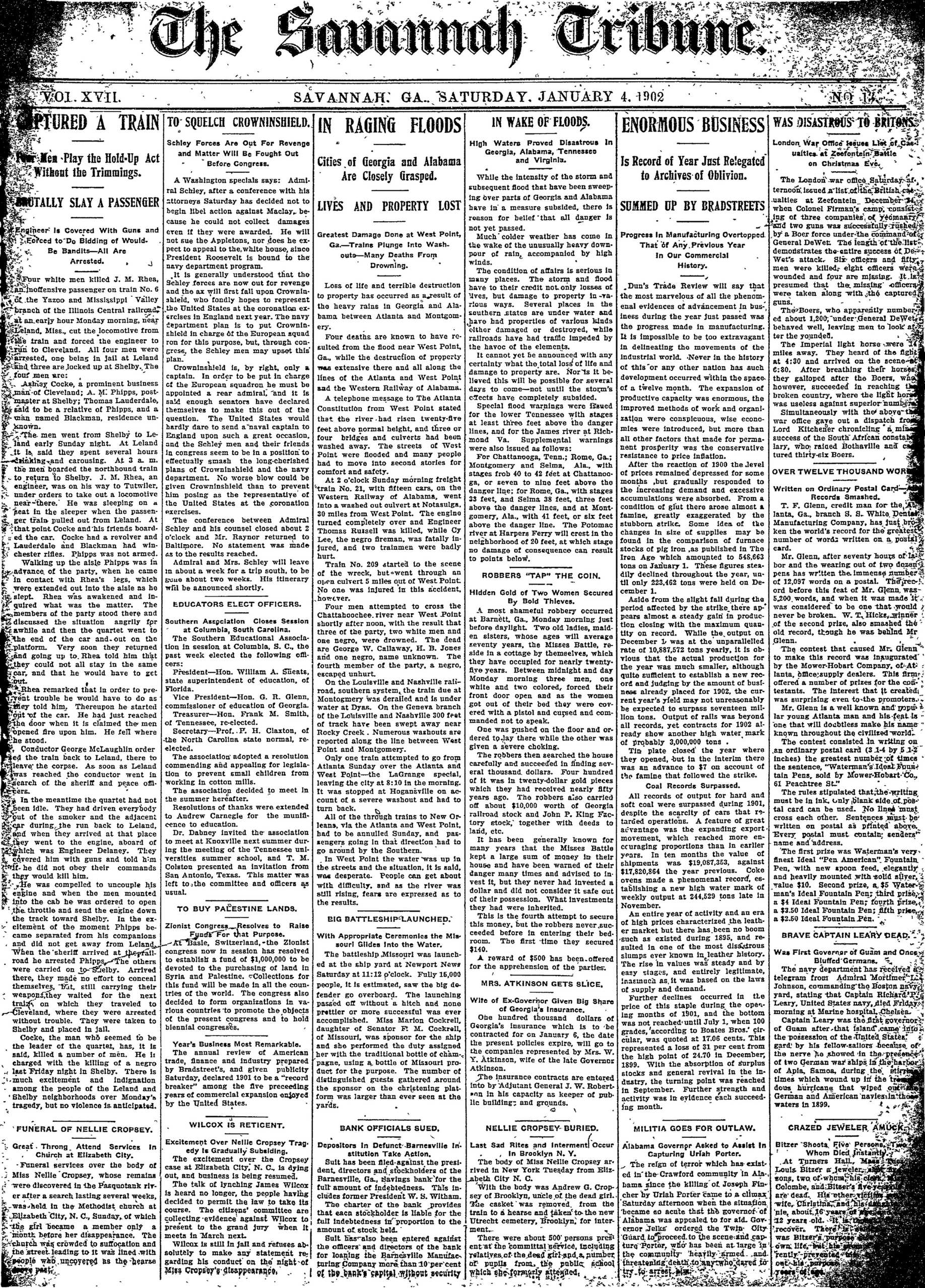
Four white men killed J. M. Rhea, an inoffensive passenger on train No. 6 of the Yazoo and Mississippi Valley branch of the Illinois Central railroad, at an early hour Monday morning, near Leland, Miss., cut the locomotive from the train and forced the engineer to run to Cleveland. All four men were arrested, one being in jail at Leland and three are locked up at Shelby. The four men are: Ashley Cocke, a prominent business man of Cleveland; A. M. Phipps, postmaster at Shelby; Thomas Lauderdale, said to be a relative of Philps, and a man named Blackman, residence unknown.
The men went from Shelby to Leeland early Sunday night. At Leland it is said they spent several hours drinking and carousing. At 3 a.m. the men boarded the northbound train to return to Shelby. J. M. Rhea, an engineer, was on his way to Tutwiler, under orders to take out a locomotive near there. He was sleeping on a seat in the sleeper when the passenger train pulled out from Leland. At that point Cocke and his friends boarded the car. Cocke had a revolver and Lauderdale and Blackman had winchester rifles. Philips was not armed.
Walking up the alsei Phipps was in advance of the party, when he came in contact with Rhea's legs, which were extended out into the alsei as he slept. Rhea was awakened and inquired what was the matter. The members of the party stood there and discussed the situation angrily for awhile and then the quartet went to the end of the car and-out on the platform. Very soon they returned and going up to, Rhea told him that they could not all stay in the same car, and that he would have to get out. Rhea remarked that in order to prevent trouble he would have to do as they told him. Thereupon he started out of the car. He had just reached the door when it is claimed the men opened fire upon him. He fell where he stood.
Conductor George McLaughlin ordered the train back to Leland, there to leave the corpse. As soon as Leland was reached the conductor went in search of the sheriff and peace officers.
In the meantime the quartet had not been idle. They had driven everybody out of the smoker and the adjacent car during the run back to Leland, and when they arrived at that place they went to the engine, aboard of which was Engineer Delaney. They covered him with guns and told him if he did not obey their commands they would kill him.
He was compelled to uncouple his engine and when the men mounted into the cab he was ordered to open the throttle and send the engine down the track toward Shelby. In the excitement of the moment Phipps became separated from his companions and did not get away from Leland. When the sheriff arrived at the trailroad he arrested Phipps. The others were carried on to Shelby. Arrived there, they made no effort to conceal themselves. But, still carrying their weapons, they waited for the next train, on which they traveled to Cleveland, where they were arrested without trouble. They were taken to Shelby and placed in jail.
Cocke, the man who seemed to be the leader of the quartet, has, it is said, killed a number of men. He is charged with the killing of a negro last Friday night in Shelby. There is much excitement and indignation among the people of the Leland and Shelby neighborhoods over Monday's tragedy, but no violence is anticipated.
FUNERAL OF NELLIE CROPSEY.
Great. Throng. Attend Services In Church at Elizabeth City.
Funeral services over the body of Miss Nellie Cropsey, whose remains were discovered in the Pasquotank river after a search lasting several weeks, was held in the Methodist church at Elizabeth City, N. C., Sunday, of which the girl became a member only a month before her disappearance. The church was crowded to suffocation and the street leading to it was lined with people who uncovered as the hearse posed.
TO- SQUELCH CROWNINSHIELD.
Schley Forces Are Out For Revenge and Matter Will Be Fought Out Before Congress.
A Washington speculists says: Admiral Schley, after a conference with his attorneys Saturday has decided not to begin libel action against Maclay, because he could not collect damages even if they were awarded. He will not sue the Appletons, nor does he expect to appeal to the white house, since President Roosevelt is bound to the navy department program.
It is generally understood that the Schley ferences are now out for revenge and the ax will first fall upon Crowninshield, who fondly represents the United States at the coronation exercises in England next year. The navy department plan is to put Crowninshield in charge of the European squadron for this purpose, but, through congress, the Schley men may upset this plan.
Crowninshield is, by right, only a captain. In order to be put in charge of the European squadron he must be appointed a rear admiral, and it is said enough senators have declared themselves to make this out of the question. The United States would hardly dare to send a naval captain to England upon such a great occasion, and the Schley men and their friends in congress seem to be in a position to effectually smash the long-cherished plans of Crowninshield and the navy department. No worse blow could be given Crowninshield than to prevent him posing as the representative of the United States at the coronation exercises. The conference between Admiral Schley and his counsel closed about 2 o'clock and Mr. Raynor returned to Baltimore. No statement was made as to the results reached.
Admiral and Mrs. Schley will leave in about a week for a trip south, to be gone about two weeks. His itinerary will be announced shortly.
EDUCATORS ELECT OFFICERS.
Southern Association Closes Session at Columbia, South Carolina.
The Southern Educational Association in session at Columbia, S. C., the past week elected the following officers:
President—Hon. William A. Sueats, state superintendent of education, of Florida.
Vice President—Hon. G. R. Glenn, commissioner of education of Georgia.
Treasurer—Hon. Frank M. Smith, of Tennessee, re-elected.
Secretary—Prof. P. H. Claxton, of the North Carolina state normal, re-elected.
The association adopted a resolution commending and appealing for legislation to prevent small children from working in cotton mills.
The association decided to meet in the summer hereafter.
Resolutions of thanks were extended to Andrew Carnegie for the muni-ficence to education.
Dr. Dabney invited the association to meet at Knoxville next summer during the meeting of the Tennessee universities summer school, and T. M. Colston presented an invitation from San Antonio, Texas. This matter was left to the committee and officers as usual.
TO BUY PALESTINE LANDS.
Zionist Congress _Resolves to Raise
Funds For that Purpose
At Basle, Switzerland, the Zionist congress now in session has resolved to establish a fund of $1,000,000 to be devoted to the purchasing of land in Syria and Palestine. Collections for this fund will be made in all the countries of the world. The congress also decided to form organizations in various countries to promote the objects of the present congress and to hold biennial congresses.
Year's Business Most Remarkable. The annual review of American trade, finance and industry prepared by Bradstreet's, and given publicity Saturday, declared 1901 to be a "record breaker" among the five preceding years of commercial expansion enjoyed by the United States.
WILCOX IS RETICENT.
Excitement Over Nellie Cropsey Tragedy is Gradually Subiding.
city is gradually subsiding.
The excitement over the Cropsey case at Elizabeth City, N. C., is dying out, and business is being resumed.
The talk of lynching James Wilcox is heard no longer, the people having decided to permit the law to take its course. The citizens' committee are collecting-evidence against Wilcox to present to the grand jury when it meets in March next.
Wilcox is still in fall and refuses absolutely to make any statement regarding his conduct on the night of Miss Cropsey's disappearance.
SAVANNAH. GA.. SATURDAY. JANUARY 4. 1902
IN RAGING FLOODS
Cities of Georgia and Alabama Are Closely Grasped.
LIVES AND PROPERTY LOST
Greatest Damage Done at West Point, Ga.-Trains Plunge Into Wash-outs-Many Deaths From Drowning.
Loss of life and terrible destruction to property has occurred as a result of the heavy rains in Georgia and Alabama between Atlanta and Montgomery.
Four deaths are known to have resulted from the flood near West Point, Ga., while the destruction of property was extensive there and all along the lines of the Atlanta and West Point and the Western Railway of Alabama.
A telephone message to The Atlanta Constitution from West Point stated that the river had risen twenty-five feet above normal height, and three or four bridges and culverts had been washed away. The streets of West Point were flooded and many people had to move into second stories for comfort and safety. At 2 o'clock Sunday morning freight train No. 21, with fifteen cars, on the Western Railway of Alabama, went into a washed out culvert at Notasulga. 30 miles from West Point. The engine turned completely over and Engineer Thomas Russell was killed, while Cy Lee, the negro fireman, was fatally injured, and two trainmen were badly hurt.
Train No. 209 started to the scene of the wreck, but went through an open culvert 5 miles out of West Point. No one was injured in this accident, however.
Four men attempted to cross the Chattahoochee river near West Point shortly after noon, with the result that three of the party, two white men and one negro, were drowned. The dead are George W. Callaway, H. B. Jones and one negro, name unknown. The fourth member of the party, a negro, escaped unhurt.
On the Louisville and Nashville railroad, southern system, the train due at Montgomery was derailed and is under water at Dyas. On the Geneva branch of the Louisville and Nashville 300 feet of track have been swept away near Rocky Creek. Numerous washouts are reported along the line between West Point and Montgomery.
Only one train attempted to go from Atlanta Sunday over the Atlanta and West Point—the LaGrange special, leaving the city at 8:10 in the morning. It was stopped at Hogansville on account of a severe washout and had to turn back.
All of the through trains to New Orleans, via the Atlanta and West Point, had to be annuled Sunday, and passengers going in that direction had to go around by the Southern.
In West Point the water was up in the streets and the situation, it is said, was desperate. People can get about with difficulty, and as the river was still rising, fears are expressed as to the results.
BIG BATTLESHIP LAUNCHED.
With Appropriate Ceremonies the Missouri Glides Into the Water.
The battleship Missouri was launched at the ship yard at Newport News Saturday at 11:12 o'clock. Fully 15,000 people, it is estimated, saw the big defender go overboard. The launching passed off without a hitch and none prettier or more successful was ever accomplished. Miss Marlon Cockrell, daughter of Senator F. M. Cockrell, of Missouri, was sponsor for the ship and she performed the duty assigned her with the traditional bottle of champagne, using a bottle of Missouri product for the purpose. The number of distinguished guests gathered around the sponsor on the christening platform was larger than ever seen at the yards.
BANK OFFICIALS SUED.
Depositors in Defunct-Barnesville Institution Take Action.
Suit has been filed against the president, directors and stockholders of the Barnesville, Ga., Savings bank for the full amount of indebtedness. This includes former President W. S. Witham.
The charter of the bank provides that each stockholder is liable for the full indebtedness in proportion to the amount of stock held.
Suit has also been entered against the officers and directors of the bank for loaning the Barnesville Manufacturing Company more than 10 per cent of the bank's capital without security
IN WAKE OF FLOODS.
High Waters Proved Disastrous In Georgia, Alabama, Tennessee and Virginia.
While the intensity of the storm and subsequent flood that have been sweeping over parts of Georgia and Alabama have in a measure subsided, there is reason for belief that all danger is not yet passed.
Much colder weather has come in the wake of the unusually heavy downpour of rain accompanied by high winds.
The condition of affairs is serious in many places. The storm and flood have to their credit not only losses of lives, but damage to property in various ways. Several places in the southern states are under water and have had properties of various kinds either damaged or destroyed, while railroads have had traffic impeded by the havoc of the elements.
It cannot yet be announced with any certainty what the total loss of life and damage to property are. Nor is it believed this will be possible for several days to come—not until the storm's effects have completely subsided.
Special flood warnings were issued for the lower Tennessee with stages at least three feet above the danger lines, and for the James river at Richmond Va. Supplemental warnings were also issued as follows:
For Chattanooga, Tenn.; Rome, Ga.; Montgomery and Selma, Ala., with stages frob 40 to 42 feet at Chattanooga, or seven to nine feet above the danger line; for Rome, Ga., with stages 23 feet, and Selma 38 feet, three feet above the danger lines, and at Montgomery, Ala., with 41 feet, or six feet above the danger line. The Potomac river at Harpers Ferry will crest in the neighborhood of 20 feet, at which stage no damage of consequence can result to points below.
ROBBERS "TAP" THE COIN.
Hidden Gold of Two Women Secured
By Bold Thieves.
A most shameful robbery occurred at Barnett, Ga., Monday morning just before daylight. Two old ladies, maiden sisters, whose ages will average seventy years, the Misses Battle, reside in a cottage by themselves, which they have occupied for nearly twenty-five years. Between midnight and day Monday morning three men, one white and two colored, forced their front door open and as the women got out of their bed they were covered with a pistol and cursed and commanded not to speak.
One was pushed on the floor and ordered to lay there while the other was given a severe choking.
The robbers then searched the house carefully and succeeded in finding several thousand dollars. Four hundred of it was in twenty-dollar gold pieces which they had received nearly fifty years ago. The robbers also carried off about $10,000 worth of Georgia railroad stock and John P. Kling Factory stock, together with deeds to land, etc.
It has been generally known for many years that the Misses Battle kept a large sum of money in their house and have been warned of their danger many times and advised to invest it, but they never had invested a dollar and did not consider it safe out of their possession. What investments they had were inherited.
This is the fourth attempt to secure this money, but the robbers never succeeded before in entering their bedroom. The first time they secured $140.
A reward of $500 has been offered for the apprehension of the parties.
MRS. ATKINSON GETS SLICE.
Wife of Ex-Governor Given Big Share of Georgia's Insurance.
One hundred thousand dollars of Georgia's insurance which is to be contracted for on January 6, the date the present policies expire, will go to the companies represented by Mrs. W. Y. Atkinson, wife of the late Governor Atkinson.
The insurance contracts are entered into by 'Adjutant General J. W. Robertson in his capacity as keeper of public building; and grounds.
NELLIE CROPSEY-BURIED.
Last Sad Rites and Interment Occur
In Brooklyn N. Y.
The body of Miss Nellie Cropsey arrived in New York Tuesday from Elizabeth City N. C.
With the body was Andrew G. Cropsey of Brooklyn, uncle of the dead girl.
The casket was removed, from the train to a hearse and taken to the new Utrecht cemetery, Brooklyn, for interment.
There were about 500 persons present at the committal service, including relatives of the dead girl and a number of pupils from the public school which she formerly attended.
ENORMOUS BUSINESS
Is Record of Year Just Relegated to Archives of Oblivion.
SUMMED UP BY BRADSTREETS
Progress In Manufacturing Overtopped That of Any. Prevlous Year In Our Commercial
Dun's Trade Review will say that the most marvelous of all the phenomenal evidences of advancement in business during the year just passed was the progress made in manufacturing. It is impossible to be too extravagant in delineating the movements of the industrial world. Never in the history of this or any other nation has such development occurred within the space of a twelve month. The expansion of productive capacity was enormous, the improved methods of work and organization were conspicuous, wise economies were introduced, but more than all other factors that made for permanent prosperity was the conservative resistance to price inflation.
After the reaction of 1900 the level of prices remained depressed for some months, but gradually responded to the increasing demand and excessive accumulations were absorbed. From a condition of glut there arose almost a famine, greatly exaggerated by the stubborn strike. Some idea of the changes in size of supplies may be found in the comparison of furnace stocks of pig iron, as published in The Iron Age which amounted to 548,663 tons on January 1. These figures steadily declined throughout the year, until only 223,462 tons were held on December 1.
Aside from the slight fall during the period affected by the strike, there appears almost a steady gain in production closing with the maximum quantity on record. While the output on December 1 was at the unparalleled rate of 10,887,572 tons yearly, it is obvious that the actual production for the year was much smaller, although quite sufficient to establish a new record and judging by the amount of business already placed for 1902, the current year's yfield may not unreasonably be expected to surpass seventeen million tons. Output of rails was beyond all records, yet contracts for 1902 already show another high water mark of probably 3,000,000 tons.
Tin plate closed the year where they opened, but in the interim there was an advance to $7 on account of the famine that followed the strike.
Coal Records Surpassed.
All records of output for hard and soft coal were surpassed during 1901, despite the scarcity of cars that retarded operations. A feature of great advantage was the expanding export movement, which reached more encouraging proportions than in earlier years. In ten months the value of shipments was $19,087,353, against $17,820,864 the year previous. Coke ovens made a phenomenal record, establishing a new high water mark of weekly output at 244,529 tons late in November.
An entire year of activity and an era of high prices characterized the leather market but there has been no boom such as existed during 1895, and resulted in one of the most disgustrous slumps ever known in leather history. The rise in values was steady and by easy stages, and entirely legitimate, inasmuch as it was based on the laws of supply and demand.
Further declines occurred in the price of this staple during the opening months of 1901, and the bottom was not reached until July 1, when 100 grades, according to Boates Bros.' circular, was quoted at 17.06 cents. This represented a loss of 31 per cent from the high point of 24.70 in December, 1899. With the absorption of surplus stocks and general revival in the industry, the turning point was reached in September. Further strength and activity was in evidence each succeeding month.
MILITIA GOES FOR OUTLAW.
Alabama Governor Asked to Assist In Capturing Urlah Porter.
The reign of terror which has existed in the Crawford community in Alabama since the killing of Joseph Fincher by Urlah Porter came to a climax Saturday afternoon when the situation became so acute that the governor of Alabama was appealed to for aid. Governor Jelks ordered the Twin City Guard in proceed to the scene and capture Porter, who has been at large in the community heavily armed, and threatening death to any who dared to try to arrest him.
The London war office Saturday afternoon issued a list of the British casualties at Zeefontein December 21 when Colonel Firman's camp, consisting of three companies of yeomanry and two guns was successfully rushed by a Boer force under the command of General Dewet. The length of the list demonstrates the entire success of DeWet's attack. Six officers and fifty men were killed, eight officers were wounded and four are missing. It is presumed that the missing officers were taken along with the captured guns.
The Boers, who apparently numbered about 1,200, under General DeWet, behaved well, leaving men to look after the younded.
The Imperial light horse were 14 miles away. They heard of the fight at 4:30 and arrived on the scene at 6:30. After breathing their horses, they galloped after the Boers, who however, succeeded in reaching the broken country, where the light horse was useless against superior number. Simultaneously with the above the war office gave out a dispatch from Lord Kitchener chronicling a minute success of the South African constabulary, who raised Bothaville and captured thirty-six Boers.
OVER TWELVE THOUSAND WORDS
Written on Ordinary Postal Card—Records Smashed.
T. F. Glenn, credit man for the Atlanta, Ga., branch S. S. White Dental Manufacturing Company, has just broken the world's record for the greatest number of words written on a postal card.
Mr. Glenn, after seventy hours of labor and the wearing out of two dozen pens has written the immense number of 12,097 words on a postal. The record before this feat of Mr. Glenn was 5,200 words, and when it was made it was considered to be one that would never be broken. W. T. Hicks, winner of the second prize, also smashed the old record, though he was beheadd Mr. Glenn.
The contest that caused Mr. Glenn to make this record was inaugurated by the Mower-Hobart Company, of Atlanta,ince; supply dealers. This firm offered a number of prizes for the contestants. The interest that it created was surprising even to the promoters. Mr. Glenn is a well known and popular young Atlanta man and his seat is one that will doubtless make his name known throughout the civilized world. The contest consisted in writing on an ordinary postal card (3 1-4 by 5 1-2 inches) the greatest number of times the sentence, "Waterman's Ideal Foundation Pens, sold by Mower-Hobart Co., 61 Peachtree St."
The rules stipulated that the writing must be in ink. Only blank side of postal card can be used. No lines must cross each other. Sentences must be written on postal as printed above. Every postal must contain senders' name and address.
The first prize was Waterman's very finest Ideal "Pen American" Fountain Pen, with new spoon feed, elegantly and heavily mounted with solid silver, value $10. Second prize, a $5 Waterman's Ideal Fountain Pen; third prize, a $4 Ideal Fountain Pen; fourth prize, a $3.50 Ideal Fountain Pen; fifth prize, a $2.50 Ideal Fountain Pen.
BRAVE CAPTAIN LEARY DEAD.
Was First Governor of Guam and Once Bluffed Germans.
The navy department has received a telegram from Admiral Mortimer L. Johnson, commanding the Boston navy yard, stating that Captain Richard P. Leary, United States navy, died Friday morning at Marine hospital, Chelsea. Captain Leary was the first governor of Guam after that island came into the possession of the United States. gard by his fellow-sailors because of the nerve he showed in the presence of two German war ships in the harbor of Apla, Samoa, during the strife times which wound up in the troubled hurricane that wiped out German and American navies in those waters in 1899.
Bitzer Shoots Five Persona Times
Whom Died Instantly
Whom died instantly?
At Turners Hall, Mass. Nissan
Louis Bitzer a jeweler, and his
sons, two of whom, his clerk,
Mary Colombe, and Bitzer's five-year-old
are dead. His other victim was
wife, Christina, and his daughter,
nle, about 16 years of age, and
12 years-old. it is the only
recover. There is evidence that
was Bitzer's purpose in own life, but his
princently prevented him
out his purpose. Wife
years of age.
SUBSCRIPTION RATES:
One Year.....$1.25
Six Months.....75
Six Months.....50
Remittance must be made by Express or
Post Office Money Order, or Registered Letter
Advertising Rates given on application.
THE meeting of the Republican State Central Committee on Saturday at Atlanta was a most harmonious and interesting one. The resignation of Hön. W. H. Johnson was received with sincere regret and Hon. Judson W. Lyons paid a warm tribute to the retiring chairman because of his long continued fidelity to the Republican party. Resolutions expressing faith and confidence in Hon. W. A. Pledger who assumed the chairmanship of the committee were passed unanimously. The administration of President Roosevelt was endorsed in glowing terms by resolutions presented by Ex Governor R. B. Bullock. The Georgia legislature was thanked for refusing to pass the Hardwick disfranchisement bill.
The Day Observed.
Wednesday, Emancipation Day, was duly celebrated in this city. The weather was perfect, and the streets were thronged with people during the hours of the celebration. At the designated time the military companies and the Emancipation Association gathered at the rendezvous. The parade was participated in by Cos. A, G, D, and F of the First Battalion, the Georgia Artillery, a juvenile company, R. G. Shaw's Post Grand Army of the Republic, the Emancipation Association and the Arlington Club. Col. John H. Deveaux was in command of the military. The civic part of the parade was in charge of Chief Marshal, Dr. C. Bryant Whaley.
Headed by Middleton's band and Col. Deveaux and his staff, the parade wended its way through some of the principal streets to the park which was thronged with people. The military took position west of the park, presented arms while the Emancipation Association passed, by after which the Artillery formed on the east side and fired the ungual salute. At the termination of the firing of the salute the battalion was reformed by the adjutant for its parade and review. At this juncture the crowd became so dense that it was necessary for two mounted officers to keep it back to the centre walk of the parade grounds. The parade and review of the battalion were gone through without a hitch. Especially inspiring was the dipping of the colors while the band played "The Star Spangled Banner." These ceremonies were gone through to the admiration of the great throng.
The line of march was again 'taken up to St. Philips A. M. E church on Charles and West Broad streets, where the literary part of the celebration was carried out. After leaving the church, the battalion marched to Col. Deveaux's residence where the colors were received and the battalion dismissed.
The display of the military on this occasion was very creditable and shows the kind of material that our officers and men are made of.
The services at the church consisted of the following program:
Doxology.
Invocation, by Rev. F. R. Sims:
Hymn, "Come thou fount of every blessing," led by kev. W. L. P. Weston.
Prayer, Rev. J. W. Carr, D. D. Hymn, America Reading of Emancipation Proclamation, by Mrs. Katie E. Jones. Oration, by Rev. C. L. Bonner. Rev. C. C. Cargile introduced the reader, and the orator was introduced by Rev. Alexander Harris. The speaker was at his best and held his audience spell bound from start to finish with eloquence and thought; every now and then bringing in an anecdote which pleased the hearers and at the same time brought out the thought which he intended. Rev. Bonner treated the subject of his speech under three general headings, the first of which is given below. Those present expressed themselves as being highly pleased indeed.
Rev. C. C. Cargile after speaking of the oration in high terms, offered a motion that a rising vote of thanks be extended Rev. Bonner. Rev. F. R. Sims also made remarks and motioned that thanks be extended Mrs. Jones for the distinct and smooth manner in which she read the Proclamation.
Rev. Alexander Harris, the president of the' Association, under whose auspices the services at the church were held, made remarks calling attention to the fact that the association needed money to finish paying the expense of the celebration, and a collection was taken for this purpose. After remarks by Rev. A. Cooper, the benediction was pronounced by Rev. P. F. Curry.
Following is the first topic of the oration:
Mr. President, Members of the Association, Ladies, and Gentlemen:
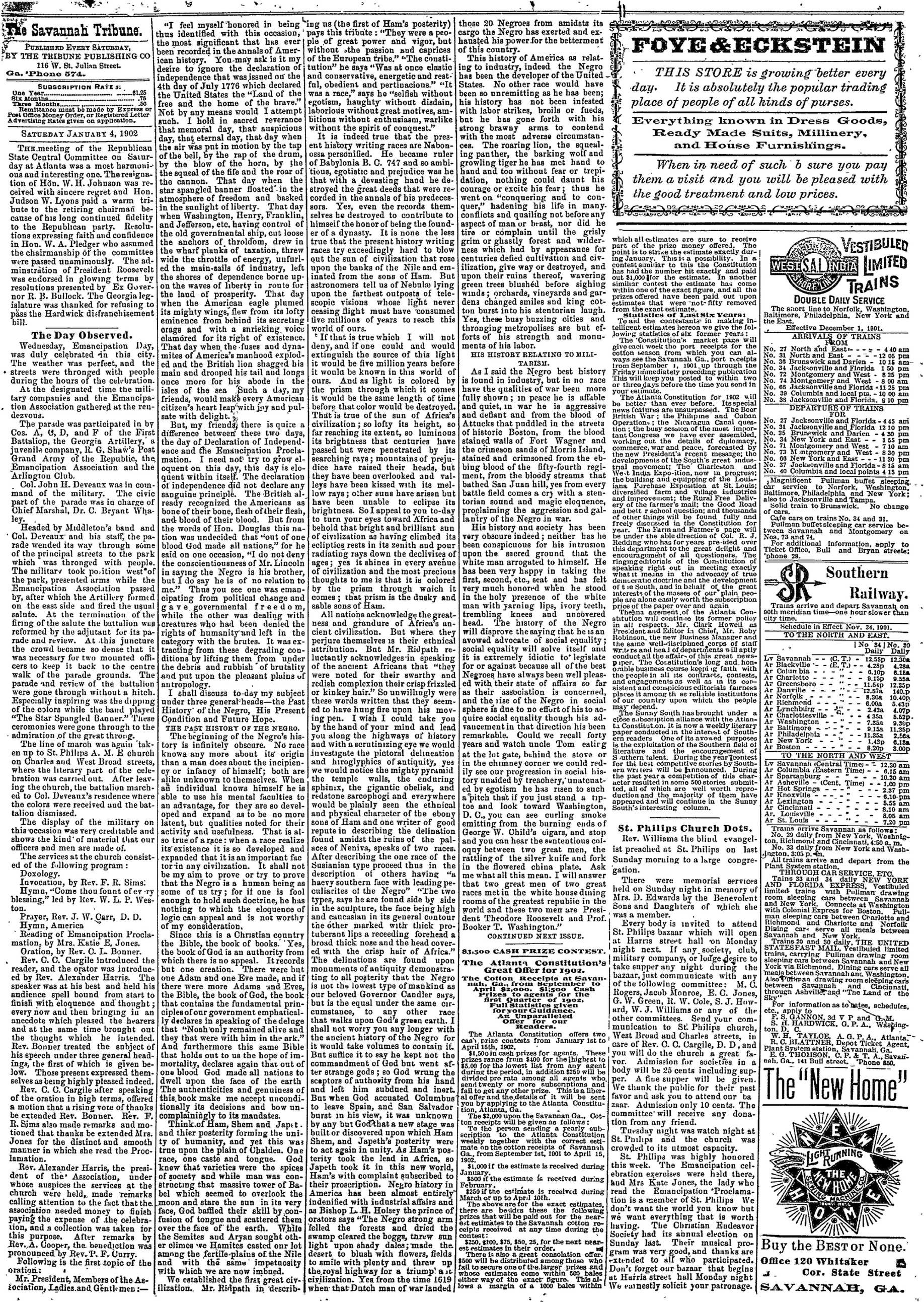
"I feel myself honored in being thus identified with this occasion, the most significant that has ever been recorded in the annals of American history. You may ask is it my desire to ignore the declaration of independence that was issued on the 4th day of July 1776 which declared the United States the "Land of the free and the home of the brave." Not by any means would I attempt such. I hold in sacred reverence that memorial day, that auspicious day, that eternal day, that day when the air was put in motion by the tap of the bell, by the rap of the drum, by the blow of the horn, by the squeal of the fife and the roar of the cannon. That day when the star spangled banner floated in the atmosphere of freedom and basked in the sunlight of liberty. That day when Washington, Henry, Franklin, and Jefferson, etc, having control of the old governmental ship, cut loose the anchors of throldom, drew in the wharf planks of taxation, threw wide the throttle of energy, unfurled the main-sails of industry, left the shores of dependence borne upon the waves of liberty in routes for the land of prosperity. That day when the American eagle plumed its mighty wings, flew from its lofty eminence from behind its secreting orags and with a shrieking, voice clamored for its right of existence. That day when the fuses and dynamics of America's manhood exploded and the British lion shagged his main and drooped his tail and longs once more for his abode in the isles of the sea. Such a day, my friends, would make every American citizen's heart leap with joy and pulsate with delight.
But, my friends, there is quite a difference between these two days, the day of Declaration of Independence and the Emancipation Proclamation. I need not try to grow eloquent on this day, this day is eloquent within itself. The declaration of independence did not declare any sanguine principle. The British already recognized the Americans as bone of their bone, flesh of their flesh, and blood of their blood. But from the words of Hon. Douglas this nation was undecided that "out of one blood God made all nations," for he said on one occasion, "I do not deny the conscientiousness of Mr. Lincoln in saying the Negro is his brother, but I do say he is of no relation to me." Thus you see one was emancipating from political change and gave governmental freedom, while the other was dealing with creatures who had been denied the rights of humanity and left in the category with the brutes. It was extracting from these degrading conditions by lifting them from under the debris and rubbish of brutality and put upon the pleasant plains of antropology.
I shall discuss to-day my subject under three general heads—the Past History of the Negro, His Present Condition and Future Hope.
THE PAST HISTORY OF THE NEGRO.
The beginning of the Negro's history is infinitely obscure. No race knows any more about its origin than a man does about the incipiency or infancy of himself; both are alike unknown to themselves. When an individual knows himself he is able to use his mental faculties to an advantage, for they are so developed and expand as to be no more latent, but qualities noted for their activity and usefulness. That is also true of a race; when a race realize its existence it is so developed and expanded that it is an important factor in any civilization. It shall not be my aim to prove or try to prove that the Negro is a human being as some of us try; for if one is fool enough to hold such doctrine, he has nothing to which the eloquence of logic can appeal and is not worthy of my consideration.
Since this is a Christian country the Bible, the book of books. 'Yes, the book of God is an authority from which there is no appeal. It records but one creation. There were but one Adam and one Eve made, and if there were more Adams and Eves, the Bible, the book of God, the book that contains the fundamental principles of our government emphatically declares in speaking of the deluge that "Noah only remained alive and they that were with him in the ark." And furthermore this same Bible that holds out to us the hope of immortality, declares again that out of one blood God made all nations to dwell upon the face of the earth. The authenticities and genuiness of this book make me accept unconditionally its decisions and bow uncomplainingly to its mandates.
Think.of Ham, Shem and Japet, and thier posterity forming the unity of humanity, and yet this was true upon the plain of Chaldea. One race, one caste and tongue. God knew that varieties were the spices of society and while man was constructing that massive tower of Babel which seemed to overlook the moon and stare the sun in its very face, God baffled their skill by confusion of tongue and scattered them over the face of the earth. While the Semites and Aryan sought other climes and Hamites casted our lot among the fertile-plains of the Nile and with the same impetuosity with which we are now imbued.
We established the first great civilization. Mr. Ridpath in describ-
ing us (the first of Ham's posterity) pays this tribute: "They were a people of great power and vigor, but without the passion and caprices of the European tribe." "The constitution" he says "Was at once elastic and conservative, energetic and restful, obedient and pertinacious." "It was a race," says he "selfish without egotism, haughty without disdain, laborious without great motives, ambitions without enthusiasm, warlike without the spirit of conquest."
It is indeed true that the present history writing races are Nabonossa personified. He became ruler of Babylonia B. C. 747 and so ambitious, egotistic and prejudice was he that with a devastating hand he destroyed the great deeds that were recorded in the annals of his predecessors. Yes, even the records themselves he destroyed to contribute to himself the honor of being the founder of a dynasty. It is none the less true that the present history writing races try exceedingly hard to blow out the sun of civilization that rose upon the banks of the Nile and eminated from the sons of Ham. But astronomers tell us of Nebula lying upon the farthest outposts of telescopic visions whose light never ceasing flight must have consumed five millions of years to reach this world of ours.
If that is true which I will not deny, and if one could and would extinguish the source of this light it would be five million years before it would be known in this world of ours. And as light is colored by the prism through which it comes it would be the same length of time before that color would be destroyed. That is true of the sun of Africa's civilization; so lofty its height, so far reaching its extent, so luminous its brightness that centuries have passed but were penetrated by its searching rays; mountains of prejudice have raised their heads, but they have been overlooked and valleys have been kissed with its mellow rays; other suns have arisen but have been unable to eclipse its brightness. So I appeal to you to-day to turn your eyes toward Africa and behold that bright and brilliant sun of civilization as having climbed its ecliptics rests in its zenith and pour radiating rays down the declivites of ages; yes it shines in every avenue of civilization and the most precious thoughts to me is that it is colored by the prism through waich it comes; that prism is the dusky and sable sons of Ham.
All nations acknowledge the greatness and grandure of Africa's ancient civilization. But where they perjure themselves is their ethnical attribution. But Mr. Ridpath reluctantly acknowledges in speaking of the ancient Africans that "they were noted for their swarthy and redish complexion their crisp frizzled or kinkey hair." So unwillingly were these words written that they seemed to have hung fire upon his moving pen. I wish I could take you by the hand of your mind and lead you along the highways of history and with a scrutinizing eye we would investigate the pictorial delineation and hirogllyphics of antiquity, yes we would notice the mighty pyramid the temple walls, the enduring sphinx, the gigantic obelisk, and redstone sarcophogi and everywhere would be plainly seen the ethnical and physical character of the ebony sons of Ham and one writer of good repute in describing the delineation found amidst the ruins of the palaces of Neniva, speaks of two races. After describing the one race of the Susianian type proceed thus in the description of others having "a haier southern face with leading peculiarities of the Negro" "The two types, says he are found side by side in the sculpture, the face being high and caucasian in its general contour the other marked with thick protuberant lips a receiving forehead a broad thick nose and the head covered with the crisp hair of Africa." The delinations are found upon monuments of antiquity demonstrating to all posterity that the Negro is not the lowest type of mankind as our beloved Governor Candler says, but is the equal under the same circumstance, to any other race that walks upon God's green earth. I shall not worry you any longer with the ancient history of the Negro it would take volumes to contain it. But suffice it to say he kept not the commandment of God but went after strange gods; so God wrung the scavengers of authority from his hand and left him subdued and inert. But when God accustomed Columbus to leave Spain, and San Salvador burst in his view, it was unknown by any but God that a new stage was built or discovered upon which Ham Shem, and Japeth's posterity were to act again in unity. As Ham's posterity took the lead in Africa, so Japeth took it in this new world, Ham's with complaint subscribed to their proscription. Negro history in America has been almost entirely indemnified with industrial affairs and as Bishop L. H. Holsey the prince of orators says "The Negro strong arm felled the forests and dried the swamp cleared the boggs, threw sun light upon shady dales; made the desert to blush with flowers, fields to smile with plenty and threw up the royal highway for a trump' a civilization. Yes from the time 1619 when that Dutch man of war landed
those 20 Negroes from amidits its cargo the Negro has exerted and exhausted his power for the betterment of this country.
This history of America as relating to industry, indeed the Negro has been the developer of the United States. No other race would have been so unremitting as he has been; his history has not been infested with labor strikes, broils or fuels, but he has gone forth with his strong brawny arms to contend with the most adverse circumstances. The roaring lion, the squealing panther, the barking wolf and growling tiger he has met hand to hand and too without fear or trepidation, nothing could daunt his courage or excite his fear; thus he went on "conquering and to conquer," hadening his life in many conflicts and quailing not before any aspect of man or beast, nor did he tire or complain until the grisly grim or ghastly forest and wilderness which had by appearance for centuries defied cultivation and civilization, give way or destroyed, and upon their ruins thereof, wavering green trees blushed before sighing winds; orchards, vineyards and gardens changed smiles and king cotton burst into his stentorian laugh. Yes, these busy buzzing cities and thronging metropolises are but efforts of his strength and monuments of his labor.
As I said the Negro best history is found in industry, but in no race have the qualities of war been more fully shown; in peace he is affable and quiet, in war he is aggressive and defiant and from the blood of Attucks that puddled in the streets of historic Boston, from the blood stained walls of Fort Wagner and the crimeson sands of Morris Island, stained and crimson from the eubing blood of the fifty-fourth regiment, from the bloody streams that bathed San Juan hill, yes from every battle field comes a cry with a stentorian sound and magic eloquence, proclaiming the aggression and gallantry of the Negro in war.
His history and society has been very obscure indeed; neither has he been conspicuous for his intrusion upon the sacred ground that the white man arrogated to himself. He has been very happy in taking the first, second, etc., seat and has felt very much honored when he stood in the holy presence of the white man with yarning lips, ivory teeth, trembling knees and uncovered head. The history of the Negro will disprove the saying that he is an avowed advocate of social equality; social equality will solve itself and it is extremely idiotic to legislate for or against because all of the best Negroes have always been well pleased with their state of affairs so far as their association is concerned, and the rise of the Negro in social sphere is due to no effort of his to acquire social equality though his advancement in that direction his been remarkable. Could we recall forty years and watch watch Tom eating at the lot gate, behind the stove or in the chimney corner we could reddily see our progression in social history unaided by treachery, unattuced by egotism he has risen to such a pitch that if you just stand a tiptoe and look toward Washington, D.C., you can see curling smoke emitting from the burning ends of George W. Child's cigars, and stop and you can hear the sententious colony between two great men, the rattling of the silver knife and fork in the flowered china plate. Ask me what all this mean. I will answer that two great men of two great races met in the white house dining rooms of the greatest republic in the world and these two men are President Theodore Roosevelt and Prof. Booker T. Washington."
CONTINUED NEXT ISSUE.
The Atlanta Constitution's Great Offer for 1902.
The Atlanta Constitution offers two
cases of fees from January 1st to
April 15th, 1892.
$1,500 in cash prizes for agents. These prizes range from $40 for the highest to $3.00 for the lowest. In addition, all prizes offered in addition to $250 will be divided pro rata among all agents who send twenty or more subscriptions and fail to get any other prize. This is a liberal offer and the details of it will be sent to the Atlanta Constitution, Atlanta, Ga.
The $2,000 upon the Savannan Ga., Cotton receipts will be given as follows:
To the person sending a yearly subscription to the Atlanta Constitution wife, together with the vowed mate on the cotton receipts of Savannah Ga., from September 1st, 1901 to April 15, 1902.
$1,00 if the estimate is received during January.
$500 if the estimate is received during February.
$250 if the estimate is received during March or up to April 10th.
The above are for the exact estimates, there are besides these the following prizes that will be paid out for the nearest estimates to the Savannah cotton receipts received at any time during the contest:
$250, $100, $75, $50, 25, for the next nearest estimates in their order. There is also a great consolation offer. $500 will be distributed among those who fail to secure one of the larger prizes and whose estimates come within 500 bales either way of the exact figure. This allows a margin of a 1000 bales within
THIS STORE is growing better every day. It is absolutely the popular trading place of people of all kinds of purses.
Everything known in Dress Goods, Ready Made Suits, Millinery, and House Furnishings.
When in need of such b sure you pay them a visit and you will be pleased with the good treatment and low prices.
which all estimates are sure to receive part of the prize money offered. The point is to strain the estimate exactly during January. This is a possibility. In a contest similar to this the Constitution has had the number hit exactly and paid out $1,000 for the estimate. In another instance, within one of the exact figure, and all the prizes offered have been paid out upon estimates that were not fifty removed from the exact estimate.
**Statistics of Last Six Years:**
The Constitution has made intelligent estimates because we give following statistics of six former years:
The 'Constitution's' market page will give each week the port receipts for the cotton season from which you can always see the Savannah Ga., port receipts from September 1, 1901, up through the Friday immediately preceding publication of your post to within two or three days before the time you send in your estimate.
The Atlanta Constitution for 1902 will be better than ever before. Its special news features are unsurpassed. The Boer British War; the Philipine and Cuban Operation; the Nicaragua Canal question; the busy session of the most important working out the details of diplomacy, commerce, war and peace, forecasted by the new President's recent message; the developments of the South's great industrial movement; the Charleston and Wet-It India Expoition, now in progress; the building and equipping of the Louisville train at St. Louis; diversified farm and village industries and improvement; the Rural Free Delivery of the farmer's mail; the Good Road and bett r school question; and thousands of other things will be found fully and freely discussed in the Constitution for this department. We will be under the able direction of Col. R. J. Redding who has for years pre-ided over this department to the great delight and encouragement of all questioners. The ringingeditorials of the Constitution of speaking right out in meeting exactly what it means in the advocacy of true democracy, and in behalf of the great interests of the masses of our plain people are alone easily over the subscription price of the paper over and again
Thema argument of the Atlanta Constitution will continue its former policy in all respects. Mr. Clark Howell as President and Editor in Chief, Mr. Roby Robinson, the Business Manager and writer of the newspaper, and writers and heal of departments will aptly conduct all the affair of this great newspaper. The Constitution's long and honorable business course keeps faith with the people in all its contracts, contests, and engagements as well as in its consistent and conspicuous editorials farness of the well-known vehile institutions of our country upon which the people may depend.
The Sunny South has brought under a close subscription alliance with the Atlanta Constitution. It is now a weekly literary paper conducted in the interest of Southern readers. One of its avowed purposes is the publication of material that promotes literature and the encouragement of Southern talent. During the year contest for the best competitive stories by Southern writers will be announced. During the past year a competition of this character resulted in some 500 stories submitted to the contest, and the majority of them have appeared and will continue in the Sunny South's interesting column.
St. Philips Church Dots.
Rev. Williams the blind evangelist preached at St. Phillips on last Sunday morning to a large congregation. There were memorial services held on Sunday night in memory of Mrs. D. Edwards by the Benevolent Sons and Daughters of which she was a member.
Every body is invited to attend St. Philips bazaar which will open at Harris street hall on Monday night next. If any society, club, military company, or lodge desire to take supper any night during the bazaar, just communicate with any of the following committee: M. C. Rogers, Jacob Monroe, E. C. Jones, G. W. Green, R. W. Cole, S. J. Howard, W. J. Williams or any of the other committees. Send your communication to St. Philips church, West Broad and Charles streets, in care of Rev. C. C. Cargile, D. D, and you will do the church a great favor. Admission for societies in a body will be 25 cents including supper. A fine supper will be given. We thank the public for their past favor and ask you to attend our bazaar. Admission only 10 cents. The committee will receive any donation from any friend.
Tuesday night was watch night at St. Philips and the church was crowded to its utmost capacity. St. Philips was highly honored this week. The Emancipation celebration exercises were held there, and Mrs Kate Jones, the lady who read the Emancipation 'Proclamation is a member of St. Philips. We don't want the world you know but we want everything that is worth having. The Christian Endeavor Society has its annual election on Sunday last. Their musical program was very good, and thanks are extended to all who participated. Don't forget our bazaar that begins at Hairy street hall Monday night. We earnestly solicit your patronage.
VESTIBULED
LIMITED
TRAINS
WEST SAL INDIA
SHORT LINE
DOUBLE DAILY SERVICE
The short line to Norfolk, Washington,
Baltimore, Philadelphia, New York and
the East.
Magnificent Pullman buffet sleeping car service to Norfork, Washington, Baltimore, Philadelphia and New York; also to Jacksonville and Tampa. Solid train to Brunswick. No change of cars. Cafe cars on trains No. 34 and 31. Pullman buffet sleeping car service between Savannah and Montgomery on Nos. 73 and 74. For additional information, apply to Ticket Office, Bull and Bryan streets; 'phone 28.
Southern Railway.
Trains arrive and depart Savannah on 90th meridian time—one hour slower than city time.
| No 24 | No 24 |
| :--- | :--- |
| Daily | Daily |
Lv Savannah - - (C. T.) - - 12.55p | 12.30a |
Ar Blackville - - (E. T.) - - 4.28p | 4.28a |
Ar Colun bia - - - - - - 6.10p | 6.15a |
Ar Charlotte - - - - - - 9.15p | 9.55a |
Greensboro - - - - - - 11.54p | 12.35p |
Ar Danville - - - - - - 12.57a | 140p |
Ar Norfolk - - - - - - 8.30a | 10.40p |
Ar Richmond - - - - - - 6.00a | 5.43p |
Ar Lynchburg - - - - - - 2.42a | 4.07p |
Ar Charlottesville - - - - - - 4.35a | 5.52p |
Ar Washington - - - - - - 7.55a | 9.39p |
Baltimore - - - - - - 9.15a | 11.35p |
Philadelphia - - - - - - 11.35a | 2.66a |
New York - - - - - - 1.43p | 6.18a |
Ar Boston - - - - - - 8.20p | 3.00p |
TO THE NORTH AND WEST
Lv Savannah (Central Time) - - 12.30 a |
Ar Columbia (Eastern Time) - - 6.15 a |
Ar Spartanburg - - - - - - 10.20 a |
Ar Asheville - (Cent. Time) - - 1.00 p |
Ar Georgetown - - - - - - 2.37 p |
Ar Knoxville - - - - - - 6.10 p |
Ar Lexington - - - - - - 4.55 a |
Ar Cincinnati - - - - - - 9.15 a |
Ar Louisville - - - - - - 8.05 a |
Ar St. Louis - - - - - - 7.20 p
town, Richmond and Cincinnati, 4:50 a.m.
No. 33 daily from New York and Washington, 3:05 p.m.
All trains arrive and depart from the Plant System station.
THROUGH CAR SERVICE, ETC.
Tains 33 and 34 daily NEW YORK
ANTIQUE CAR SERVICE. Yestebuld
limited trains with Pulliess drawing
room sleeping cars between Savannah
and New York. Connects at Washington
with Colonial Express for Boston. Pullman sleeping cars between Charlotte and
Richmond and Charlotte and Norfolk
car service all meals between Savannah and
New York. Trains 20 and 30 daily, THE UNITED
STATESFAST MAIL. Yestebuld limited trains, carrying Pullman drawing room
sleeping cars between Savannah and New
York via Richmond. Dining cars serve all meals between Savannah anc. Washington.
Trains 20 and 30 drawing room sleeping cars between Savannah and Cincinnati,
through Ashville, and "The Land of the Sky"
For information as to dates, schedules,
etc., apply to
B. ON 3d V P and G.M.
S. HARDWICK, G.P. A. Washington.
D. S. H.
The "New Home"
NEW
LIGHT RUNNING
THE
NEW HOME
SEWING MACHINE CO.
TRAMS MARK
Buy the BEST or None. Office 120 Whitaker Cor. State Street SAVANNAH, GA.
The grandest event of the season will be the Parker lecture on Monday night next.
Mrs. L. A. Waters has returned home from New York, visiting her parents and friends.
If you fail to get your paper this week you may know the reason why if you are indebted to us.
A brand new baby boy was added to the family of Mr. and Mrs. W. K. Callen on New Years day.
Miss Sallie M. Miller came in to see us on Friday of last week, and placed her name on the subscription list.
Miss Mamie E. Burke is again at home after quite a stay in New York and other points. Her many friends are glad to welcome her back.
Mrs. M. B. Branham and little Jeanette Branham are spending the holidays in Charleston and are taking the exposition. They are the guests of Miss Florence A. Clyde.
Miss Anna E. Maxwell, after spending the Christmas holidays in the city with her mother, has returned to Guyton to resume her teaching in the high school there.
Mr. and Mrs. Harry Lark entertained at dinner last Sunday, Messrs Edward Miles, John Butts, John Habersham, Sidney Jackson, and James Williams. It was an enjoyable affair.
Miss Pauline Anderson of Guyton after spending the holidays in the city, the guest of her sister, returned home on Thursday. Miss Anderson is engaged in teaching at Dover, Ga.
Miss Anna Pease of Williamstown, Mass., and Miss Clara Graham of South Norwalk, Cohn., are spending a few weeks in the city the guests of Mrs. Mulledge on East Gordon street.
Miss Carrie McIntyre, sister of Mrs. W. H. Harvey, and Miss Matilda McCray both of Brunswick, spent the holidays in the city, the guests of Mrs. Harvey. They returned home on Thursday.
Mr. Willie White Chatters of Augusta, was in the city this week, and spent a few days with Mr. and Mrs. B. M. Davis on Bullock street. Mr. Chatters had been on a visit to his sister in Brunswick.
The marriage of Dr. E. D. Bulkley to Miss Daisy C McLain which was to have taken place on Tuesday evening last, was postponed until next Tuesday. This was made necessary by the illness of the doctor.
The new year is here now and THE TRIBUNE is compelled to ask the many subscribers who are indebted to us remit. We cannot run a paper on promises, and especially when such promises are so easily broken.
Mr. G. Dunlap of Alachua Fla, arrived in the city Monday night and spent Tuesday with Mr. and Mrs E. W. Sherman. Until recently Mr Dunlap was a resident of Lyons, Ga., but is now residing at Alachua. He left Wednesday for Lyons to dispose of some of his valuable property at that place and returns home to-day. Mr. Dunlap is one of the solid men of the race.
A most exciting game of foot ball was played on Wednesday afternoon between the G. S. I. C. and a team from Clafin University, Orangeburg, S. C. The park was thronged with spectators and the ladies presented a beautiful picture. It was surely a society event. The Clafin team was heavier than our boys and won the game. Our boys were lacking in size when compared to Clafin but made up with pluck and daring. Several beautiful plays were made by them that received hearty applause.
Special services will be held at Turner Temple A. M. E Church, formerly a church held by the Baptist of this city, but recently purchased by the A. M. E. connection. It is located on 38th street. Sunday night next at 8 o'clock services will begin and will possibly continue all that week and including the second Sunday. These services will be conducted by Rev. D. L. Williams, blind poet, and evangelist of South Carolina, who is wintering in this city, and doing effectual work. All are cordially invited to attend these services. Rev. J. T. Smith is pastor of the church.
Hear Jas. B. Parker.
On Monday night next he hero James B. Parker, will lecture at Ford s opera house under the auspices of the Adelphia Club. Mr. Parker will be remembered as the gentleman who saved the late President Wm. McKinley from instant death at the hands of the assassin. He will tell just how it was done and in a manner that will interest every attendant. He deserves a large attendance of our people and it is hoped that the opera house will be crowded to its utmost to hear this famous hero. The admission is only 25 cents Local talent will furnish voca and instrumental music. Let everybody come out in time and give him the rousing reception that he deserves
Brilliant Neen Wedding. The prettiest set of invitations sent out for a wedding was that for the Jackson-Sheftall wedding which took place at noon on Wendnesday last at St. Stephen's Episcopal church. Promptly at 12 o'clock the bridal party arrived and entered the church which was becoming decorated with palms, evergreen, etc., and the altar was almost hidden by a bank of beautiful pot flowers.
To the sweet strains of a wedding march the party was ushered in by Messers Jas. M. Dowse and Walter S. Scott. The maid of honor, Miss Eureka L. Jackson, led followed by the best man, Mr. Chas. H. Sheftall, and the groom. The bride leaning gracefully on the arm of her father, followed. At the chancel the usual circle was formed. The impressive Episcopal ceremony was conducted by Rev. Richard Bright, the rector. The bride and maid of honor looked bewitchingly in their tan traveling dresses and were the cynosure of the eyes of the attendants. The gentlemen of the party wore cutaway coats and light trousers.
After the ceremony the party was driven home for lunch after which the bride and groom left at two o'clock for Charleston to spend a few days. They will return in time for the reception on Monday evening next. The presents received were many and costly.
The bride Miss Sarah Ann Sheftall is the eldest daughter of Mr. Jackson B. Sheftall, and a young lady of excellent qualities. Mr. Joseph L. Jackson, is one of our enterprising young business men, the.son of the late Albert Jackson. Mr. Jackson conducts a successful plumbing business and is well-known and liked by a large number of acquaintances. The many friends of this happy couple bid them bon voyage on the matrimonial sea.
Mr. Tucker's Death.
Mr. Willis Tucker died on Friday evening last after several months of illness. Mr. Tucker has been residing in our city for quite a number of years. Since his residence among us he has proven himself to be a quiet, conservative and good citizen. He was not a man to make any ado about anything but went along on the even tenor of his way striving to do his duty. He was employed at the Oglethorpe Club and by his strictness to duty and his lowest deportment he had gained the confidence of his employers who regretted very much his loss.
Mr. Tucker was a member of the Second Baptist church, from which the funeral occurred on Sunday afternoon. Dr. Durham paid a beautiful tribute to his memory. The funeral was largely attended by the citizens. He was a member of Crescent Lodge, K. of P. and was under the watch care of Armour Lodge of Odd-Fellows, both of which attended the funeral. Besides a wife and four children here, the deceased leaves two daughters, one of which is Mrs. Lee O'Neal The many friends join them in their sad hour of bereavement.
A Society Event.
A select entertainment was given at Morse's hall on Monday evening last. The hall was beautifully decorated and pretty costumes were in evidence. The table was tastefully laden with the delecacies of the season. Enchanting music was rendered and the participants enjoyed themselves until the wee sma hours. The following ladies chaperoned the party: Mrs. F. Starr, Mrs Noisette, Mrs Holmes, and Mrs L. Gleun-Milledge. The following were the guests of the evening:
Misses Gertrude Savage, Willie Holmes, Marie Jones, Clarissa Marlon, Rena Goldson, Ella Burke, Mittio Milleged, Amanda Robinson, Alethea Herb, Marie Hamilton, Cecile Bowman, Gertie Mcintosh, Alethea McDougall, Lilia Roberts, Florence Banks Florida Tate, Beatrice Hazel, Birdie DeLyon, Meta Bougha, Bessie Moore, Mrs, Jennie Bryan, Mrs. SIB Rivers, Messrs. Daniel Monroe, saml King, Joseph King, Henry Ward, James Coston, Jessie Hopkins, Robt Smith, Robt Fields, Willie Wilson, Chas Burke, Willie Williams, Solomon Larshay, Walter Chisolim, Rufus Glenn, Alonzo Davis, Chas Graham, Julian Hohenstein, Moses Bryan, Thos Rivers, Marion Johnson, Mr. Daniel<sup>1</sup>, Edw. Midleton, John Moore, Dr. Davls.
His Bank Restored.
As announced in THE TRIBUNE and several other journals, the last legislature honored Col. Deveaux in a signal manner by passing a special enactment restoring his rank of lieutenant colonel. In compliance with that enactment a commission, as such has been forwarded him, accompanied by the following letter from the Adjutant General J. W. Robertson:
"State of Georgia, Adjutant General's Office, Atlanta, Ga., Atlanta, Ga., January 1st, 1802 Lt. Col. J. H. Deveaux, Comd'g 1st, Batt., Int., G. S. T., Col'd, Savannah 1st, My Dear Sir! - I enclose you a commission as Lieut-Col, and wish you a happy New Year. Please return your commission as major. Very respectfully J. W. Robertson, Adjutant General"
The name of Jim Parker should conjure the admiration of every Negro. Come out and hear him Monday. Mr. Geo. Enell, the popular blacksmith, rear of 311 Congress street, west, will be pleased to have the continued patronage of his old patrons and at the same time solicit new trade.
AMUSEMENT COLUMN.
Coming Events in The Social World.
Club No. 3 of First Bryan Baptist church, will give a ten nights floral bazaar at Labor hall, Bryan and Abercorn streets, beginning on Monday night Jan. 6th, benefit of the ceiling fund. Admission 10c. This club will award a $45.00 drop head Singer sewing machine to the lady soliciting the largest amount of money. Mr. Daniel Wright is the captain of the club.
The Y. G. E's. Aid and Social Club will give their fourth anniversary entertainment at Odd-Fellows hall, Harris street, Monday evening Jan. 20. Admission 50c, double 75c. Committee. Messrs. Arthur Holmes, Chas. Stephens, J. Williams, Lucius Smith, John H. Law, Thos. Young, Daniel A. Noble, Henry Holmes, Jas. C. Stephens, Wm. D. Kennedy, chairman, Chas. Hayward, ex-officio.
The Young Adelphia Aid and Social Club will give their annual select dance at Morse's hall, Monday night Jan. 20th. Choice refreshments and music. Admission 35c, double 50c. The following gentlemen compose the committee : Messrs. J. Emery Johnson, Irvin Schriner, Harry Felton, W. Henry Bohler, Richard Johnson, Richard Whaley. Benj. Densler, T. Benj. Bliger, secretary, J. Willard Burns, chairman, A. Samuel Rogers, exofficio.
The Cheerful Workers of the Charity Hospital are made up of a number of some of our well known young ladies who have volunteered to work for the hospital They ought to be encouraged, since the object is a praiseworthy one This organization will on the evening of the 15th of January give a pink and blue entertainment at Morse's hall, Herndon street, to assist in meeting the current expenses of said hospital. All are invited to come and help this worthy cause.
The price of the admission is 15 cents.
Everybody is invited to attend the New Year's full dress supper and hop at Labor hall. Bryan and Abercorn streets, on Monday evening Jan. 20, 1902, for the benefit of Charity Hospital. The physicians, under whose auspices the entertainment is planned, will spare no pains to make it pleasant and comfortable for all who may attend. Dress suit or no dress suit, come out and help a worthy cause for sweet charity sake.
Price of admission to entertainment, single tickets 50c, lady and gentleman 75c. Supper free. Music, entrancing Harpers. Dr T Jas. Davis, Manager.
Local Brevites.
For copy of music entitled "Bouncing Bet" send ten cents in postage or currency to B W. Wrenn, Passenger Traffic Manager, Plant System, Savannah, Ga Go to Fords opera house Monday night and hear the big man who saved a president's life from instant death.
. Fit For Any Home.
THE NEW-YORK TRIBUNE'S plans and programme for 1902 contemplate improvement all along the line, so as to keep it in the front rank of the newspaper procession. What THE DAILY TRIBUNE is and what it stands for pretty nearly everybody knows. That it keeps pace in enterprise with the spirit of the age, without sacrificing decency or accuracy, it is needless to say.
But a word as to the other publications issued from THE TRIBUNE office may be timely. For instance, it may not be generally known that the famous old Weekly grew and grew until it became imperatively necessary to divide it in two—THE TRIBUNE REVIEW and THE TRIBUNE FARMER. THE REVIEW is suited alike to persons of the highest culture, to those who are educating themselves and to all who wish the history of the week summarized in full. Special attention is given to municipal affairs, domestic and foreign politics and to books and literary news. It is published every Saturday. Price 5 cents a copy, or $1 a year.
THE FARMER, issued every Thursday, is one of the handsome agricultural papers publish-d in this or any other country. The illustrations are superb, and the articles embrace everything relating to farms or farm work. It is a paper of high interest and high interest deals with them cannot well afford to get along without. $1 a year.
THE TRI WEEKLY TRIBUNE occupies a field all of its own. It was learned by experience that thousands of persons in various parts of the country wanted a New York newspaper, and yet they didn't want one. That sounds paradoxical, but it isn't so much so as one might think at first glance. What they were really after was a condensed New York newspaper which wouldn't tax either their purse or their time too much. So it came to pass that THE TRI WEEKLY TRIBUNE took the place of the old Semi-Weekly. The "Tri" as it is familiar called, appears on Monday, Wednesday and Friday, and in these three issues one may find the cream of the matter in the seven issues of The Daily Tribune. Price $1.50 a year.
THE TRIBUNE ALMANAG for 1902 will be bigger and more valuable than ever. All the records and statistics worth having. On Sale January 1. Price. 25 cents.
(Late with Dr. Reid of New York City.) DOES FIRST-CLASS
No. 220 East Broad Street,
SAVANNAH, GA
Office alwas open.
HOLIDAY GOODS
An invitation to one and all to call and examine our Stock.
Fine Dress Suits. Hats, Necktie, etc., for Men and Boys. Cloaks, Skirts, Gloves. Belts, etc., for the Ladies and Misses Call and Inspect.
St. Stephen's Episcopal Church
On Habersham street between Macon and
Harris. Services Sunday 11 a.m. and 8:00
p.m. Sunday school 3:30 p.m. Services on
Wednesday night at 8:00. Stranger are
always welcomed.—Rev. Richard Bright,
Rector.
LOGAN'S
Solicitor for Leonard Iron & Metallic Co.
Pine Wood, Oak Wood, Light Wood.
Guaranteed full load and good wood.
Terms cash to everybody.
Hall's Washing Liquid.
The great labor saver of the age for
Housekeeping and Wash Women.
5 per Quart, 15c per Gallon.
W. H. LOGAN, Sole Agent,
Perry and Randolph Street's,
Ga. 'Phone 969. Savannah, Ga.
J. WALTER WILLIAMS, M.D
511 WEST BROAD STREET.
.....Office Hours.....
8 to 10 a.m.; 2 to 4 p.m.; 6 to 8:30 p.m.
Office, Bell 'Phone 1111.
Savannah, Georgia.
Dr. L. S. Parks,
—DENTIST—
240 Barnard St., Savannah-Ca.
Does all kind of high grade dental work
of the best quality and workmanship. Gold
crowns and bridge work. White Porcelain
Pivot, and Gold Crowns mounted on the
natural roots. Gold Fillings, Cement Fill-
ings, and Silver or Amalgam Fillings, from
nine to a full set of teeth $7.00 and $8.00.
Broken Plates mended and teeth added to
old ones for a small cost.
All Gold
Crowns Guaranteed 23 1-2 K.
Gold.
E. W. BOWENS.
Fruits, Cakes, Pies, Cgars, and Tobacco.
Your wants in this line supplied.
GIVE ME A CALL.
No. 649 WHEATON STREET.
FALL IS HERE.
Money saved is money made. You can successfully do this by calling on E. J. Dancy, No. 306 Drayton street, Savannah, Ga., who can make you a new suit or make your old one new and save you money. So do not forget that he is the man you want when in need of anything in the line of first-class tailoring. Do not forget the place, 306 Dray-Street, Savannah, Ga.
Knowles Building. Boys' Hall. Stone Hall. Girls' Hall. Model Home.
ATLANTA UNIVERSITY, Atlanta, Ga.
An unsectarian Christian Institution, devoted especially to advanced instruction. Online courses in College Preparation and English. High School courses, with Industrial Training, advantages in Music and Printing. Athletics for boys. Physical education for girls. and training. Aid given to needy and deserving students. Term begins the first Wednesday in October. For catalogue and information, address
MONEY TO LOAN
ON.....
Improved City Property.
Low Rate of Interest.
One to Five Years.
Chas F. FULTON.
H. W. BOWENS,
KEEPS A FINE LINE or GROCERIES
At the Corner of Perry and Guilford Sta.
—Call On Him
AT EITHER OF HIS STORES WHEN YOU
Wish Anything in His Line.
.'WHERE TO BUY'.
During the warm weather,
If you want the
FRESHEST, AND BEST
Beef, Veal and Mutton,
IS AT....
Stall No. 31, City Market.
Goods delivered promptly.
F. F. JONES & SON.
CAPITAL $100,000
Shares in it now on sale in this city.
Metropolitan Merseytile and Raslity Go's st ek can be bought in Savannah in blocks of , 10, 15, 20 and upwards, at $5 per share. A uly colored concern doing business in the states of New York and New Jersey. One dollar down and forty cents per month until paid up.
This company did 870,000 worth of business in eleven months end ng last June. A l stocks paid up by July 1st, next will participate in the July dividends which will according to present success, amount to about 10 pe cent.
JOHN W. ARMSTRONG,
Sole Agent:
RING UP
'PHONE 1575,
The Forest City Laundry
—AND HAVE YOUR—
Linens Laundried
To your satisfaction.
206—210 Park Avenue, East.
C. H. SHEFTALL, Prop.
—Suffering Ackop! Look at
Blogs! Did you ever see such
needy-looking clothes?
Buggs—They are surely a trifle bad, that's true.
Biggs—But when I knew him he used to wear expensive and well-fitting clothes.
"Yes; but he's rich now."—San Francisco Bulletin.
Hair Falls
"I tried Ayor's Hair Vigor to stop my hair from falling. One-half a bottle cured me."
J. C. Baxter, Braidwood, Ill.
Ayer's Hair Vigor is certainly the most economical preparation of its kind on the market. A little of it goes a long way.
It doesn't take much of it to stop falling of the hair, make the hair grow, and restore color to gray hair.
$1.00 a bottle. All drugstores.
If your druggist cannot supply you, send us one dollar and we will express you a bottle. Do sure and give the name of your nearest express office. Address:
J. C. AYER CO., Lowell, Mass.
Sold by 63
DOUGLAS
stores direct
to winer
at one
profit; also
by the best
shoe
dealers
every-
where.
BEST
IN THE
WORLD.
$3.00
W.L. DOUGLAS
SHOES $3.50
UNION MADE.
Notice increase of sales in table below;
1891 W. Louis College
1890 = $98,182 Palrs.
1900 = 1,259,754 Palrs.
1901 = 1,566,720 Palrs.
Business More Than Doubled in Four Years.
THE REASONS:
W. L. Douglas makes and sells more men's shoes than any other two manufacturers in the world.
W. L. Douglas $3.00 and $6.00 shoes placed side by side with $5.00 and $6.00 shoes of other makes, are found to be just as good.
W. L. Douglas two pairs of ordinary $3.00 and $5.00 shoes.
Made of the best leather, including Patent Corona Kid, Corona Colt, and National Kangaroo.
W. L. Douglas "Gilt Edge Line" cannot be equalled at any price.
W. L. Douglas Brooks College.
41 S. Forsyth St., Atlanta, Ga.
Engines and Boilers
Steam Water Heaters, Steam Pumps and
Fanberthy Injectors.
Manufacturers and Dealers in
SAW MILLS.
Corn Mills, Feed Mills, Cotton Gin Machi-
ery and Grain Separators.
SOLID and INSERTED Saws, Saw Teeth and Locks, Knight's Patent Dogs, Birdseat Saw Mill and Engine Repairs, Governors, Grate Bars and a full line of Mill Supplies. Price and quality of goods guaranteed. Catalogue free by mentioning this paper.
The life of a tire, ease of repair and its lasting qualities determine its worth. G & J Tires are made from the best quality of rubber. They are light enough to be resilient, strong enough to be durable, and easy riding, which insures comfort and safety. Catalogue at our Agent's or by mail.
G & J TIRE COMPANY,
Indienapolis, Ind.
WE PAY R. R. FARE AND UNDER $5,000
Deposit, Guarantee
Positions
200 FREE SCHOLARSHIPS. BOARD AT COST. Write Quick to GA-ALA.
BUSINESS COLLEGE, MACON, GA.
DROPSY NEW DISCOVERY: give
quick relief and cure worst
causes. Book of testimonials and 10 days' treatment.
Free. Dr. K. M. GREEN, 820 KN, Nor. B. Atlanta.
Gold Medal at Buffalo Expedition.
McILHENNY'S TABASCO
GOLD'S CURE FOR
Cough. All the falls.
Best Cough Arym. Tussas Good. Use
for time. Good by drugstore.
CONSUMPTION
Magnified with
week eyes, neop.
Thompson's Eye Water
SOUTHERN PROGRESS.
The New Industries Reported In the South During the Past Week.
Among the more important of the new industries reported for the past week are agricultural implement works at Harrison, Ark.; bottling works at Chattanooga, Tenn.; a box factory at Tuscaloosa, Ala.; a $30,000 building and manufacturing company at Vicksburg, Miss.; a company at Frog Level, N. C., to manufacture builders' supplies, coffins, furniture, etc.; a $150,000 canning factory at Pascagoula, Miss.; a $25,000 coal company at Madisonville, Ky.; a $25,000 coal company at Huntington, W. Va.; a $300,000 coal company at Wheeling, W. Va.; a $60,000 coal and coke company at Charles, W. Va.; coal mines at Fairmont, W. Va.; a cold storage plant at New Orleans, La.; a $50,000 cotton barging and tie factory at Norfolk, a; a cotton gin at Boyce, La.; an excelsior factory at Vigor, Va.; a $200,000 fertilizer factory at Atlanta, Ga.; a $40,000 fertilizer factory at Nashville, Tenn.; $10,000 fence works at Knoxville, Tenn.; flouring mills at High Point and Lytch, N. C., Pomaria, S. C., and Bentonville, Va.; a $35,000 flouring mill at Bluefield, W. Va.; a foundry at Henderson, Ky.; a gas plant at Raleigh, N. C.; a grist mill at Danville, Va.; a $10,000 hardware company at Columbus, Miss.; a hardware company at Weston, W. Va.; a $25,000 ice factory at Jacksonville, Fla.; a knitting mill at Gadsden, Ala.; a $50,000 land company at Appalachia, N. C.; a lumber company at Cordele, Ga.; a $30,000 lumber company at Columbia, Miss.; a $20,000 lumber company at Dallas, Texas; a $100,000 lumber company at Houston, Texas; a $25,000 lumber company at Richmond, Va.; a $25,000 mining company at Princeton, Ky.; a $150,000 oil company at Beaumont, Texas; an oil mill at Cleveland, Tenn.; a $50,000 planting mill and lumber company at Charles, W. Va.; a $3,000,000 railway and electric company at Atlanta, Ga.; a $25,000 roofing and supply company at Wheeling, W. Va.; a sash and blind factory at Bagdad, Fla.; a saw mill at Jimps, Ga.; a shoe and harness factory at Birmingham, Ala.; a $24,000 tar and turpentine company at Pensacola, Fla.; a tobacco factory at Bedford City, Va., and a zinc mining company at Chattanooga to develop zinc mines in Tennessee—Tradessman (Chattanooga, Tenn.)
ARMY JOURNALS PROTEST.
Roosevelt and Root Are Scored For
Brutal Treatment of Miles.
The service papers, the Army and Navy Journal and the Army and Navy Register, are strongly of the opinion that the president and the secretary of war went too far in rebuking General Miles for his Cincinnati interview The Journal says in part: "We greatly regret to learn that there is a substance of truth in the statement appearing in the dispatches from Washington to the effect that the president openly rebuked the lieutenant general commander in the presence of others during the visit of General Miles to the white house. The army regulations forbid such a showing of disrespect toward even a noncommissioned officer by his superior in rank."
The Army and Navy Register says: "The impression prevails that the tone of the Root letter is unnecessarily severe—out of all proportion to the offense. There are even those who think the language employed is brutal and that the publicity given the correspondence was a cruel advertisement of the president's displeasure. The attempt has been made to publicly disgrace Miles, an effect which may not have been fully realized in view of the opinion on the matter entertained by the majority of the people. However much people may differ in opinion on the justice or necessity of a fierce rebuke of Miles and its publication in semi-official form, there can be no doubt on that other incident, said to have occurred at the white house, where General Miles was personally criticised by the president in the presence of other visitors. If this is so, General Miles' friends may very well find their patience exhausted."
FIRE STOPS FESTIVAL.
Christmas Tree Starts Blaze Which
*Destroyed Big Building.
At Chicago, Saturday night, a Christmas tree loaded with inflammable ornaments and candles caused a fire that destroyed the Alexander apartment building, a six-story structure corner of Bowen and Cottage Grove avenues. The loss will exceed $100,000.
Twenty families lived in the building and the flames spread so rapidly that a score of persons barely escaped with their lives.
Chile-Argentine Protocol Is Unsafe
Factory-In Some Respects.
factory in Some Respects.
Advices received Sunday by Senon Infante, the Chilean charge at Washington, confirmed the news already published that the Argentina minister, at Santiago had informed the Chilean minister of foreign affairs that Argentina could not accept all the terms of the protocol heretofore signed by the settlement of the dispute and that some changes would be necessary in the instrument.
Census Figures Relating to Financial
Status of the Trusts Are
Truly Startling.
Census statistict made public at
Washington Monday on industrial
combinations show a total authorized
capitalization May 31, 1,000, for the 183
corporations reported of $3,607,503,200,
and capital stock issued $3,085,600,868.
Of this total the authorized capital
includes $270,127,250 in bonds; $1,259,
540,900 in preferred stock and $2,077,
071,050 common stock. The capital
stock issued comprises $216,412,759 in
bonds; $1,066,525,963 in preferred
stock and $1,802,262,146 common stock.
The total value of all the products of the combinations reported is $1,661,-295,564, and subtracting the value of the products of the hand trades, or the mechanical and neighborhood industries, which amount to $1,216,165,160, the products of the industrial combinations in 1900 is found equivalent to over 20 per cent of the total products of the manufacturing industries of the country, as they existed in 1890. The 183 corporations employed an average of 399,192 wage-earners, receiving $194,534,715 in wages. Employment was also given to 24,585 salaried officials, clerks, etc., receiving a total of $22,653,628 in salaries. Miscellaneous expenses of these combinations aggregated $151,851,077. The total cost of material used was $1,085,083,828.
Gross Value of Products.
The gross value of products, less the value of material purchased in partly manufactured form, gives the net or true value of products of these combinations as $1,051,981,586. This represents the increase in the value of the raw materials resulting from the various processes of manufacture.
The 183 corporations reported control 2,029 plants that were active during the census year, and 174 reported as idle during that period. The returns show an average of eleven active plants to each corporation.
The statistics of industrial combinations exclude all corporations manufacturing and distributing gas and electric light and power, it being impossible to trace all of the latter, and they do not generally possess the same economical significance.
The returns show that the iron and steel industry is at the head of the list, with a gross product of $508,626,482, which is more than double the value of the products of any other group, except food and kindred products, and represents nearly one-third of the total gross value of products of all the industrial combinations.
The Capital Invested.
The capital invested and value of products in the various classes of industrial combinations, respectively, follows:
Iron and steel and their products, $341,779,954 and $508,626,482.
Food and allied products, $240,622,633 and $282,408,081.
Chemicals and allied products, $175,002,887 and $182,301,744.
Metal and metal products other than iron and steel, $118,519,401 and $180,154,703.
Liquors and beverages, $118,489,153 and $93,432,274.
Vehicles for land transportation, $85,965,683 and $85,985,533.
Tobacco, $16,191,818 and $71,063,029.
Textiles, $92,468,606 and $21,888,202.
Leather and its finished products, $62,734,011and $45,684,829.
Paper and printing, $59,271,691 and $44,418,417.
Clay, glass and stone products, $46,878,928 and $23,258,182.
Lumber and its manufactures $24,470,281 and $20,378,815.
Miscellaneous industries, $45,408,869 and $48,605,073.
NEW VALET WELL PAID.
For Two Weeks' Work He Gets $50,
000 Worth of Jewelry.
Mr. and Mrs. Paul G. Thebaud, of Madison avenue, New York, have been robbed of jewelry worth $50,000. The robbery is said by the police, and also by Mr. Thebaud, to have been the work of a newly engaged valet, who had been employed by Mr. Thebaud but two weeks. The valet is missing, and the butler, who recommended him is under constant police surveillance.
OUTLAW HATFIELD KILLED.
Arizona Sheriff Gets Drop on Member of Kentucky Gang.
Robert H. Hatfield, one of the Kentucky clan, has been shot and killed at the Troy mining camp in the Pinal mountains of Arizona.
His slayer was Deputy Sheriff Devine, who bore a warrant for his arrest on the charge of wife beating.
Hatfield sent word to the officer that he would kill any man who tried to take him. Devine was forced to use his gun.
URIAH PORTER SURRENDERS.
Fire of Playing the Role of Desperado and Calls on Sheriff.
After more than a week of terror, bloodshed, and disorder, the people of Crawford and Russell county, Alabama, can now rest safe, for Uriah Porter; who, it is said, killed Joseph Fincher; and carried terror into many homes in Russell county, is now safe in the Lee county jail in Opelika.
Porler arrived in Opelika Monday morning about 3 o'clock and surrendered to Deputy Sheriff John L. Moon.
WORSHIP OF THE BEARD.
Laws Have Been' Made and Wars Fought for it.
The rulers of the world, who are supposed to rule, have converted a man's beard, which surely concerns the man himself and nobody else, into a subject of eternal contention.
Laws have been made for it; wars have been fought for it. The mysterious reverence with which we invest trifling things seems to have been responsible.
The old Roman father who struck dead the man who touched his beard in the capitol was not mad or cruel; he was but the victim of one of those delusions which afflict whole nations.
Ages back the beard was the sign manual of the true man in Israel, and Islam used it as a stepping stone to paradise.
The hairs which came from it in combing were broken in two and buried by the faithful followers of Islam, and when, at the beginning of the sixteenth century, a sultan atose who shaved his beard, the Mohammedan world was shocked. That was the age of reverence for the beard; the age of intolerance was to come.
It came in, as intolerance has nearly always come, with the church, which forgets that charity is greater than faith and hope. It was a bishop of Worcester who carried a small knife about with him as to cut off offending locks of hair as the wearer knelt humbly and confidingly before him.
Cutting off a handful, the bishop would throw the hair in the wearer's face, telling him to cut off all the rest or he would go to hell.
The Archbishop of Canterbury, in the reign of Henry I. thought long hair such a grave offence that he ex-communicated all who wore it, and one of the king's chaplains was so enraged by the fashion of wearing long hair at court that after preaching a sermon before Henry on the unspeakable terrors and torments awaiting wearers of long hair in the other world, he took a pair of scissors from his pocket and cut the king's hair in the presence of his court.
But it was in vain that the church denounced the long-haired generation. It is chronicled of this period that men, "forgetting their birth, transformed themselves, by the length of their hairs, into the semblance of womankind," and that, when their hair decayed, they knit about, their heads rolls of false hair—Black and White.
THE FAVORITE'S JOKE
The sultan was going through his morning mall. Suddenly he developed a terrible scowl, and, passing a page over to his favorite, he exclaimed:
"Wouldn't that jar you?"
"What is it, your majesty," asked the favorite, for she knew not how to read.
"A note from the powers," snapped the sultan.
"Ah," murmured the lady, with a dark-brown look in her eyes, "I have heard of jarring notes, but this is the first time I knew they produced the discord in the concert of the powers."
Which goes to show that a college education is not necessary to one who is naturally witty.—Portland Oregonian.
Two Women and a Deer in a Kitchen.
A deer went into, the town of Michigamme and entered the kitchen of Peter Malway's house through an open door. The animal upset a table, smashed the dishes and nearly trampled upon Mrs. Malway and another woman who was in the kitchen with her. After making a few plunges about the room the deer got out and started for the lake, a short distance away. It entered a boat house through the front door and then leaped into the water. The deer was shot by Frank Goodroe and Frank Muck. The animal was a doe and weighed 125 pounds dressed. —Chicago Record-Herald.
Each package of PUTNAM FADLESS DYE colors more goods than any other dye and colors them better too. Sold by all druggists.
The trouble with most men who once do good deeds is that they waste the rest of their lives admiring them.
Deainess Cannot be Cured
by local applications as they cannot reach the diseased portion of the ear. There is only one way to cure deafness, and that is by constitutional remedies. Deafness is caused by an inflamed condition of the mucous lining of the Eustachian Tube. When this tube is inflamed von have a rumbling sound or imperfect hearing, and when it is entirely closed Deafness is the result, and unless the inflammation can be corrected, it is sustained by its inflamed condition, hearing will be destroyed forever. Nine cases out of ten are caused by catarrh, which is nothing but an inflamed condition of the mucous surfaces.
We will give One Hundred Dollars for any case of Deafness (caused by catarrh), that cannot be cured by Hall's Catarrh Cure. Circulars sent free. F. J. CHENXY & Co., Toledo, O. Sold by Druggists, 75c. Hall's Family Pills are the best.
"This is uncalled for," remarked the faecious postmaster, as he put the letter in the unclaimed box:
Best For the Bowels.
No matter what asks you, headache to a cancer, you will never get well until your bowels are put right. Cascarats help nature, cure you without a gripe or pain, produce easy natural movements, cost you just 10 cents to start getting your health back. Cascarats Candy Curticash, the genuine, put up in metal boxes, every tablet has C. C. C. stamped on it. Beware of imitations.
A man might be said to have reached a ripe old age when he begins to fall off.
FITS permanently cured. No file or nervousness after first day's use of Dr. Kline's Great Nervest Restorer. $31 bottle and treatfree Dr. B. H. KLINZ, Ltd., 931 Arch St.; Phila. Pa.
The revolver may not be a sociable weapon, but it never goes off by itself.
The chap who built obelisks must have been paid by the column.
I do not believe Piso's Cure for Consumptivity has an equal for coughs and colds.—John F. Boryx, Trinity Springs, Ind., Feb. 15, 1900.
When a tramp asks for a meal he makes a sort of after-dinner speech.
ROYAL
WORCESTER
AND BON TON
CORSETS.
STRAIGHT FRONT
The aome of perfection in corset making.
Have no equals for ease, grace, and elegance.
ASK YOUR DEALER
TO SHOW THEM.
Royal Worcester Corset Co.
WORCESTER,
MASS.
LION COFFEE
For the round Lion heads cut from the fronts of LION COFFEE wrappers we mail FREE the most valuable presents ever offered.
Here are some of the LION'S LATEST GIFTS:
"Have you ever done anything to better the condition of any part of the human race?" said the very serious man.
"Of course I have," answered the person with the cold gray eye. "Am I not a part of the human race?"—
Our Presidents' Danger.
All of the presidents of the United States have been in the habit of mingling freely with the people, but the danger of this procedure was very emphatically pointed out in the tragedy, of a few months ago. It is also dangerous to tride with unknown medicines for indigestion, dyspopia, natuleny, constipation, biliousness or malaria, fever and ague. The safest medicine to take is Hostetzer's Stomach Bitters. It will positively cure these diseases. Try it and see.
The hay harvested in the United States in 1901 amounted to 51,000,000 tons.
Ring Worm Bouted.
'Send box of Tetterline. It's the only thing that makes any impression on a stubborn Ring Worm."—Mrs. Katie Oldham, Montalba, Anderson County, Texas. 500. by mail from J. T. Shuprinte, Savannah, Ga., if your drug-gist don't keep it.
The coming man often has a bill to collect.
ROYAL WORCESTER
AND E
CO
ST
The some of
Have no equa
TO
Royal Worcesters
WORCE
MAS
LION CO
LION
FANCY ROASTED
COFFEE
MOOLSON'S
Sold only in 1-lb
Premium List in Eve
For the round Lion heads cut from the
wrappers we mail FREE the most
offered.
Here are some of the LION'S
Colored Wax Crayons—sch
COTTON COTTON
MORE COTTON
to the acre at less cost, means
more money.
More Potash
In the Cotton fertilizer improves the soil; increases yield—larger profits. Send for our book (free) explaining how to get these results. GERMAN KALI WORKS,
93 Nassau St., New York. Mention this Paper In writing to advertisers. 4NU-09-1903.
|