Savannah Tribune
Saturday, June 13, 1903
Savannah, Georgia
Page text (machine-generated)
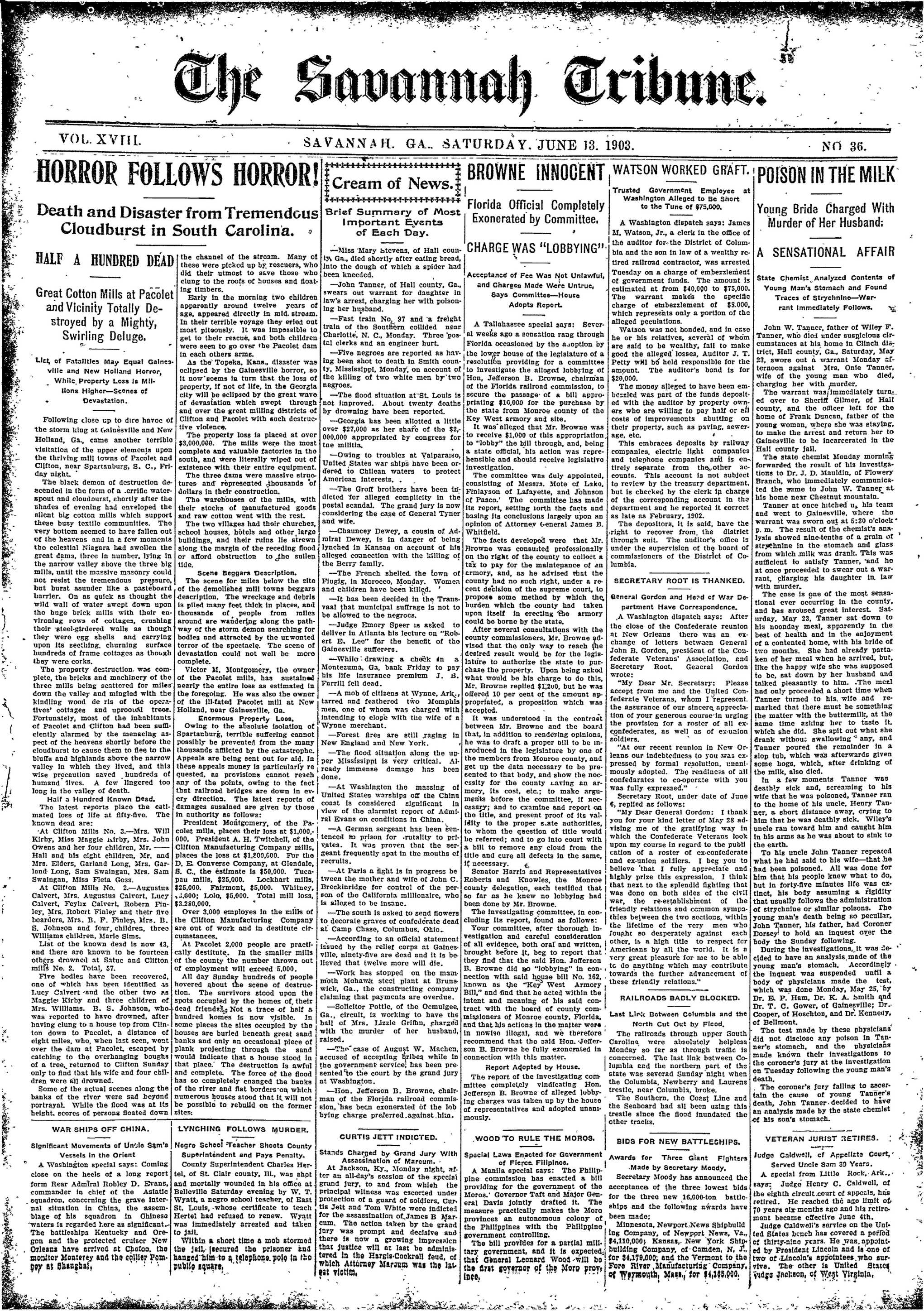
HORROR FOLLOWS HORROR!
VOL. XVIII.
HORROR FOLL
Death and Disaster
Cloudburst in
HALF A HUNDRED DEAD
Great Cotton Mills at Pacolet and Vicinity Totally Destroyed by a Mighty, Swirling Deluge.
List of Fatalities May Equal Galnesville and New Holland Horror, While Property Loss is Millions Higher—Scenea of Dexstation
Following close up to dire havoc of the storm king at Galnesville and New Holland, Ga., came another terrible visitation of the upper elements upon the thriving mill towns of Pacolet and Clifton, near Spartanburg, S. C., Friday night.
The black demon of destruction descended in the form of a terrific waterpout and cloudnourst, shortly after the shades of evening had enveloped the silent big cotton mills which support these busy textile communities. The very bottom seemed to have fallen out of the heavens and in a few moments the colostial Niagara had swollen the great dams, three in number, lying in the narrow valley above the three big mills, until the massive masonry could not resist the tremendous pressure, but burst asunder like a pasteboard barrier. On as quick as thought the wild wall of water swept down upon the huge brick mills with their environning rows of cottages, crushing their steel-gtrdered walls as though they were egg shells and carrying upon its seething, churning surface hundreds of frame cottages as though they were corks.
The property destruction was complete, the bricks and machinery of the three mills being scattered for miles down the valley and mingled with the kindling wood de ris of the operatives' cottages and uproured trees. Fortunately, most of the inhabitants of Pacolet and Clifton had been sufficiently alarmed by the menacing aspect of the heavens shortly before the cloudburst to cause them to flee to the bluffs and highlands above the narrow valley in which they lived, and this wise precaution saved hundreds of humand flives. A few lingered too long in the valley of death.
Half a Hundred Known Dead.
The latest reports place the estimated loss of life at fifty-five. The known dead are:
At Clifton Mills No. 3—Mrs. Will Kirby, Miss Maggle Airby, Mrs. John Owens and her four children, Mr.—Hall and his eight children, Mr. and Mrs. Elders, Garland Long, Mrs. Garland Long, Sam Swaingan, Mrs. Sam Swaingan, Miss Fleta Goss.
At Clifton Mills No. 2—Augustus Calvert, Mrs. Augustus Calvert, Lucy Calvert, Feylix Calvert, Roben Finley, Mrs. Robert Finley and their five boarders, Mrs. B. F. Finley, Mrs. B. S. Johnson and four, children, three Williams children, Marle Sims.
List of the known dead is now 43, and there are known to be fourteen others drowned at Satuc and Clifton mills No. 2. Total 57.
Five bodies have been recovered, one of which has been identified as Lucy Calvert and the other two as Maggie Kirby and three children of Mrs. Williams. B. S. Johnson, who was reported to have drowned, after having clung to a house top from Clinton down to Pacolet, a distance of eight miles, who, when last seen, went over the dam at Pacolet, escaped by catching to the overhanging boughs of a tree, returned to Clifton Sunday only to find that his wife and four children were all drowned.
Some of the actual scenes along the banks of the river were sad beyond portrayal. While the flood was at its height, scores of persons floated down
WAR SHIPS OFF CHINA.
Significant Movements of Uncle Sam's Vessels in the Orient
A Washington special says: Coming close on the heels of a long report form Rear Admiral Robley D. Evans, commander in chief of the Asiatic squadron, concerning the grave internal situation in China, the assemblage of his squadron in Chinese waters is regarded here as significant. The battleships Kentucky and Oregon and the protected cruiser New Orleans have arrived at Chotoo, the monitor Monterey and the collier Pompey at Shanghai,
The Savannah Tribune.
the channel of the stream. Many of these were picked up by rescuers, who did their utmost to save those who clung to the roofs of houses and floating timbers.
Early in the morning two children apparently around twelve years of age, appeared directly in mid.stream. In their terrible voyage they eried out most pituitously. It was impossible to get to their rescue, and both children were seen to go over the Pacolet dam in each others arms.
As the 'Topeka, Kans., disaster was oclipsed by the Calnesville horror, so it now'soems in turn that the loss of property, if not of life, in the Georgia city will be oclipsed by the great wave of devasiation which swept through and over the great milling districts of Clifton and Pacolet with such destructive violence.
The property loss is placed at over $3,000,000. The mills were the most complete and valuable factories in the south, and were literally wiped out of existence with their entire equipment. The three dams were massive structures and represented thousands of dollars in their construction. The warehouses of the mills, with their stocks of manufactured goods and raw cotton went with the rest. The two villages had their churches, school houses, hotels and other large buildings, and their ruins lie strewn along the margin of the receding flood or afford obstruction to the sullen tide.
Scene Beggars Description.
The scene for miles below the site of the demolished mill towns beggars description. The wreckage and debris is piled many feet thick in places, and thousands of people from miles around are wandering along the pathway of the storm demon searching for bodies and attracted by the urwonted terror of the spectacle. The scene of devastation could not well be more complete.
Victor M. Montgomery, the owner of the Pacolet mills, has sustained nearly the entire loss as estimated in the foregoing. He was also the owner of the ill-fated Pacolet mill at New Holland, near Galanesville, Ga.
Enormous Property Loss.
Owing to the absolute isolation of Spartanburg, terrible suffering cannot possibly be prevented from the many thousands afflicted by the catastrophe. Appeals are being sent out for aid. In these appeals money is particularly requested, as provisions cannot reach any of the points, owing to the fact that railroad bridges are down in every direction. The latest reports of damages susanlae are given by those in authority as follows:
President Montgomery, of the Pacolet mills, places their loss at $1,000,-000. President A. H. Twitchell, of the Clifton Manufacturing Company mills, places the loss at $1,800,000. For the D. E. Converse Company, at Glendale, S. C., the estimate is $50,000. Tucapau mills, $25,000. Lockhart mills, $25,000. Fairmont, $5,000. Whitney, $3,000; Lolo, $5,000. Total mill loss, $3,280,000.
Over 3,000 employees in the mills of the Clifton Manufacturing Company are out of work and in destitute circumstances.
At Pacolet 2,000 people are practically destitute. In the smaller mills of the county the number thrown out of employment will exceed 5,000.
All day Sunday hundreds of people hovered about the scene of destruction. The survivors stood upon the spots occupied by the homes of their dead friends. Not a trace of half a hundred homes is now visible. In some places the sites occupied by the houses are buried beneath great sand banks and only an occasional piece of plank projecting through the sand would indicate that a house stood in that place. The destruction is awful and complete. The force of the flood has so completely enchanged the banks of the river and flat borders on which numerous houses stood that it will not be possible to rebuild on the former sites.
LYNCHING FOLLOWS MURDER.
Negro School Teacher Shoots County Superintendent and Pays Penalty.
County Superintendent Charles Hertel, of St. Clair county, Ill., was shot and mortally wounded in his office at Belleville Saturday evening by W. T. Wyatt, a negro school teacher, of East St. Louis, whose certificate to teach Hertel had refused to renew. Wyatt was immediately arrested and taken to jail.
Within a short time a mob stormed the jail, secured the prisoner and hanged him to a telephone pole in the public square.
SAVANNAH. GA. SATURDAY. JUNE 13. 1903.
OR!
Cream of News.
Brief Summary of Most Important Events of Each Day.
—Miss Mary Stevens, of Hall county, Ga., died shortly after eating bread, into the dough of which a spider had been kneeded.
—John Tanner, of Hall county, Ga., swears out warrant for daughter in law's arrest, charging her with poisoning her husband.
BROWNE INNOCENT
Florida Official Completely Exonerated by Committee.
CHARGE WAS "LOBBYING"
Acceptance of Fee Was Not Unlawful, and Charges Made Were Untrue, Says Committee—House Adopts Report.
—Fast train No. 97 and a freight train of the Southern collided near Charlotte, N. C., Monday. Three postal clerks and an engineer hurt.
—Five negroes are reported as having been shot to death in Smith county, Mississippi, Monday, on account of the killing of two white men by two negroes.
—The flood situation at St. Louis is not improved. About twenty deaths by drowning have been reported.
—Georgia has been allotted a little over $27,000 as her share of the $2,000,000 appropriated by congress for the militia.
—Owing to troubles at Valparaiso, United States war ships have been ordered to Chilean waters to protect American interests.
—The Groff brothers have been indicted for alleged complicity in the postal scandal. The grand jury is now considering the case of General Tyner and wife.
—Chauncey Dewey, a cousin of Admiral Dewey, is in danger of being lynched in Kansas on account of his alleged connection with the killing of the Berry family.
—The French shelled the town of Flugig, in Morocco, Monday. Women and children have been killed.
—It has been decided in the Transvaal that municipal suffrage is not to be allowed to the negroes.
—Judge Emory Speer is asked to deliver in Atlanta his lecture on "Robert E. Lee" for the benefit of the Gafnosville suffurers.
-Whilo: drawing a check in a Montezuma, Ga, bank Friday to pay his life insurance premium J. B. Farrill fell dead.
- A mob of citizens at Wynne, Ark., tarred and feathered two Memphis men, one of whom was charged with intending to elope with the wife of a Wynne merchant.
- Forest fires are still raging in New England and New York.
- The flood situation along the upper Mississippi is very critical. Already immense damage has been done.
- At Washington the massing of United States warships off the China coast is considered significant in view of the alarmist report of Admiral Evans on conditions in China.
—A German sergeant has been sentenced to prison for brutality to privates. It was proven that the sergeant frequently spat in the mouths of recruits.
—At Paris a fight is in progress be tween the mother and wife of John C. Breckinridge for control of the person of the California millionaire, who is alleged to be insane.
—The south is asked to send flowers to decorate graves of confuciate dead at Camp Chase, Columbus, Ohio.
—According to an official statement issued by the relief corps at Gainesville, ninety-five are dead and it is believed that twelve more will die.
—Work has stopped on the mammoth Mohawk steel plant at Brunswick, Ga., the constructing company claiming that payments are overdue.
—Solicitor Pottle, of the Ocmulgee, Ga., circuit, is working to have the ball of Mrs. Lizzie Griffin, charged with the murder of her husband, raised.
—The case of August W. Machen, accused of accepting tribes while in the government service; has been presented to the court by the grand jury at Washington.
—Iron. Jefferson B. Browne, chairman of the Florida railroad commission, has been exonerated of the job byging charge preferred against him.
CURTIS JETT INDICTED.
Stands Charged by Grand Jury With Assassination of Marcum.
At Jackson, Ky., Monday night, after an all-day's session of the special grand jury, to and from which the principal witness was escorted under protection of a guard of soldiers, Curtis Jett and Tom White were indicted for the assassination of James B Marcum. The action taken by the grand jury was prompt and decisive and there is now a growing impression that justice will at last be administered in the Hargis-Cockrell feud, of which Attorney Marcum was the latest victim.
BROWNE INNOCENT
Florida Official Completely Exonerated by Committee.
Acceptance of Fee Was Not Unlawful,
and Charges Made Were Untrue,
Says Committee—House
Adopts Report.
A Tallahassee special says: Several weeks ago a sensation rang through Florida occasioned by the adoption by the lower house of the legislature of a resolution providing for a committee to investigate the alleged lobbying of Hon, Jefferson B. Browne, chairman of the Florida railroad commission, to secure the passage of a bill appropriating $10,000 for the purchase by the state from Monroe county of the Key West armory and site.
It was alleged that Mr. Browne was to receive $1,000 of this appropriation to "jobby" the bill through, and, being a state official, his action was reprehensible and should receive legislative investigation.
The committee was duly appointed, consisting of Messrs. Mote of Lake, Finlayson of Lafayette, and Johnson of Pasco.' The committee has made its report, setting forth the facts and basing its conclusions largely upon an opinion of Attorney (general James B. Whitfield.
The facts developed were that Mr. Browne was consulted professionally on the right of the county to collect a tax to pay for the maintenance of an armory, and, as he advised that the county had no such right, under a recent decision of the supreme court, to propose some method by which the burden which the county had taken upon itself in erecting the armory could be borne by the state.
After several consultations with the county commissioners, Mr. Browne advised that the only way to reach the desired result would be for the legislature to authorize the state to purchase the property. Upon being asked what would be his charge to do this, Mr. Browne replied $1,200, but he was offered 10 per cent of the amount appropriated, a proposition which was accepted.
It was understood in the contrast between Mr. Browne and the board that, in addition to rendering opinions, he was to draft a proper bill to be introduced in the legislature by one of the members from Monroe county, and get up the data necessary to be presented to that body, and show the necessity for the county having an armory, its cost, etc.; to make arguments before the committee, if necessary; and to examine and report on the title, and present proof of its validity to the proper sate authorities, to whom the question of title would be referred; and to go into court with a bill to remove any cloud from the title and cure all defects in the same, if necessary.
Senator Harris and Representatives Roberts and Knowles, the Monroe county delegation, each testified that so far as he knew no lobbying had been done by Mr. Browne.
cluding its report, found as follows: Your committee, after thorough investigation and careful consideration of all evidence, both oral and written, brought before it, beg to report that they find that the said Hon. Jefferson B. Browne did so "lobbying" in connection with said house bill No. 162, known as the "Key West Armory Bill," and find that he acted within the intent and meaning of his said contract with the board of county commissioners of Monroe county, Florida, and that his actions in the matter were in nowise illegal, and we therefore recommend that the said Hon. Jefferson B. Browne be fully exonerated in connection with this matter.
The report of the investigating committee completely vindicating Hon. Jefferson B. Browne of alleged lobbying charges was taken up by the house of representatives and adopted unanimously.
WOOD TO RULE THE MOROS.
Special Laws Enacted for Government of Fierce Filipinos.
A Manila special says: The Philippine commission has enacted a bill providing for the government of the Moros.' Governor Taft and Major General Davis jointly drafted it. The measure practically makes the Moro provinces an autonomous colony of the Philippines with the Philippine government controlling.
The bill provides for a partial military government, and it is expected, that General Leonard Wood will be the first governor of the Moro proy- ince,
WATSON WORKED GRAFT.
Trusted Government Employee at Washington Alleged to Be Short to the Tune of $75,000.
A Washington dispatch says: James M. Watson, Jr., a clerk in the office of the auditor for the District of Columbia and the son in law of a wealthy retired railroad contractor, was arrested Tuesday on a charge of embezzlement of government funds. The amount is estimated at from $40,000 to $75,000. The warrant makes the specific charge of embezzlement of $8,000, which represents only a portion of the alleged peculations.
Watson was not bonded, and in case he or his relatives, several of whom are said to be wealthy, fall to make good the alleged losses, Auditor J, T. Petty will be held responsible for the amount. The auditor's bond is for $20,000.
The money alleged to have been embezzled was part of the funds deposited with the auditor by property owners who are willing to pay half or all costs of improvements abutting on their property, such as paving, sewerage, etc.
This embraces deposits by railway companies, electric light companies and telephone companies and is entirely separate from the other accounts. This account is not subject to review by the treasury department, but is checked by the clerk in charge of the corresponding account in the department and he reported it correct as late as February, 1902. The depositors, it is said, have the right to recover from the district through suit. The auditor's office is under the supervision of the board of commissioners of the District of Columbia.
SECRETARY ROOT IS THANKED.
General Gordon and Head of War Department Have Correspondence.
A Washington dispatch says: After the close of the Confederate reunion at New Orleans there was an exchange of letters between General John B. Gordon, president of the Confederate Veterans' Association, and Secretary Root. General Gordon wrote:
"My Dear Mr. Secretary: Please accept from me and the United Confederate Veterans, whom I represent. the assurance of our sincere appreciation of your generous course in urging the provision for a roster of all exconfederates, as well as of ex-union soldiers.
"At our recent reunion in New Orleans our indebtedness to you was expressed by formal resolution, unanimously adopted. The readiness of all confederates to co-operate with you was fully expressed." Secretary Root, under date of June 6, replied as follows:
"My Dear General Gordon: I thank you for your kind letter of May 28 advising me of the gratifying way in which the Confederate Veterans look upon my course in regard to the publication of a roster of ex-confederate and ex-union soldiers. I beg you to believe that I fully appreciate and highly prize this expression. I think that next to the splendid fighting that was done on both sides of the civil war, the re-establishment of the friendly relations and common sympathies between the two sections, within the lifetime of the very men who fought so desperately against each other, is a high title to respect for Americans by all the world. It is a very great pleasure for me to be able to do anything which may contribute towards the further advancement of these friendly relations."
RAILROADS BADLY BLOCKED.
Last Link Between Columbia and the North Cut Out by Flood.
The railroads through upper South Carolina were absolutely helpless Monday so far as through traffic is concerned. The last link between Columbia and the northern part of the state was severed Sunday night when the Columbia, Newberry and Laurens trestle, near Columbia, broke.
The Southern, the Coast Line and the Seaboard had all been using this trestle since the flood inundated the other tracks.
BIDS FOR NEW BATTLECHIPS.
Awards for Three Giant Fighters
Made by Secretary Moody.
Secretary Moody has announced the acceptance of the three lowest bids for the three new 16,000-ton battleships and the following awards have been made:
Minnesota, Newport.News Shipbuilding Company, of Newport News, Va.
$4,110,000; Kansas, New York Shipbuilding Company, of Camden, N.J.
for $4,179,000; and the Vermont to the Fore River Manufacturing Company,
of Weymouth, Mass., for $4,165,000.
POISON IN THE MILK
Young Bride Charged With Murder of Her Husband:
State Chemist Analyzed Contents of Young Man's Stomach and Found Traces of Strychnine—Warrant Immediately Follows.
John W. Tanner, father of Wiley F. Tanner, who died under suspicious circumstances at his home in Clinch district, Hall county, Ga., Saturday, May 23, swore out a warrant Monday afternoon against Mrs. Onle Tanner, wife of the young man who died, charging her with murder.
The warrant was immediately turned over to Sheriff Gilmer, of Hall county, and the officer left for the home of Frank Duncan, father of the young woman, where she was staying, to make the arrest and return her to Galnesville to be incarcerated in the Hall county jail.
The state chemist Monday morning forwarded the result of his investigations to Dr. J. D. Mauldin, of Flowery Branch, who immediately communicated the same to John W. Tanner at his home near Chestnut mountain. Tanner at once hitched u, his team and wert to Gainesville, where the warrant was sworn out at 5:20 o'clock p. m. The result of the chemist's analysis showed nine-tenths of a grain of strychnine in the stomach and glass from which milk was drank. This was sufficient to satisfy Tanner, and he at once proceeded to swear out a warrant, charging his daughter in law with murder.
The case is one of the most sensational ever occurring in the county, and has aroused great interest. Saturday, May 23, Tanner sat down to his noonday meal, apparently in the best of health and in the enjoyment of a contented home, with his bride of two months. She had already partaken of her meal when he arrived, but, like the happy wife she was supposed to be, sat down by her husband and talked pleasantly to him. The meal had only proceeded a short time when Tanner turned to his, wife and remarked that there must be something the matter with the buttermilk, at the same time asking her to taste it, which she did. She spit out what she drank without swallowing any, and Tanner poured the remainder in a slop tub, which was afterwards given some hogs, which, after drinking of the milk, also dled.
In a few moments Tanner was deathly sick and, screaming to his wife that he was poisoned, Tanner ran to the home of his uncle, Henry Tanner, a short distance away, crying to him that he was deathly sick. Wiley's uncle ran toward him and caught him in his arms as he was about to slink to the earth.
To his uncle John Tanner repeated what he had said to his wife—that he had been poisoned. All was done for him that his people knew what to do, but in forty-five minutes life was extinct, his body assuming a rigidity that usually follows the administration of strychnine or similar poisons. The young man's death being so peculiar, John Tanner, his father, had Coroner Dorsey to hold an inquest over the body the Sunday following.
During the investigations, it was decided to have an analysis made of the young man's stomach. Accordingly the inquest was suspended until a body of physicians made the test, which was done Monday, May 25, by Dr. E. P. Ham, Dr. K. A. Smith and Dr. T. C. Gower, of Gainesville; Dr. Cooper, of Hoschton, and Dr. Kennedy, of Bellmont. The test made by these physicians did not disclose any poison in Tanner's stomach, and the physicians made known their investigations to the coroner's jury at the investigation on Tuesday following the young man's death. The coroner's jury falling to ascertain the cause of young Tanner's death, John Tanner decided to have an analysis made by the state chemist of his son's stomach.
VETERAN JURIST RETIRES.
Judge Caldwell, of Appellate Court,
Served Uncle Sam 30 Years.
A special from Little Rock, Ark...
says: Judge Henry C. Caldwell, of
the eighth circuit court of appeals, has
retired. He reached the age limit of
70 years six months ago and his retirement became effective June 4th.
Judge Caldwell's service on the United States bench has covered a period of thirty-nine years. He was appointed by President Lincoln and is one of two of Lincoln's appointees who survive. The other is United States Judge Jackson, of West Virginia.
SUBSCRIPTION RATES.
One Year. $1.25
Six Months. $7.50
Three Months. $50
Remittance must be made by Express or Post Office Order, or Registered Letter.
Advertising Rates given on application.
SATURDAY JUNE 13, 1903.
On account of the crowded condition of our columns many important articles have been left out.
The school census is being taken. Parents must see to it that all of their children are reported. Much depend upon this being done.
ALTHOUGH our people are very poor, yet they could do no better act than contributing a few cents toward the sufferers in the localities where recent fatalities occurred.
THE following editorial clipped from the Waycross Journal is a commendable one coming from the source it did. It shows that a terrible state of semi-slavery exists in this state and it has its hot bed in Ware county. Space forbids a full account of the case, but suffice to say that a colored woman was charged with a crime, found not guilty. A lawyer whom she claimed she did not hire, charged fifty dollars for his services, not having the money she said she was forced to go to the farm of the McKee brothers and work it out. Although she was already married her captors compelled her to marry, again. She was not only whipped but compelled to sign certain papers giving the McKees charge of a young son. The case was called to the attention of the Ware county officials with the result that she was released. It is said that there are a number of colored persons at that farm illegally. The following editorial speaks
The following editorial speaks for itself:
In presenting the testimony of Lula Frazier, we do not vouch for its accuracy or its verity. We are merely giving the public the result of the county commissioners' efforts to discover the facts about certain citizens of this county, who are alleged to have been mistreated. The public must be judge of the truth.
Indeed, we wish that Lula Frazier might be held accountable for about that blamelessness of truth. It was better for her to lie than for the great state of Georgia to be harboring a condition so rotten that the putrid smell of its mellow carcass foils even the vulturer sense of joy.
If there be the slightest shade of truth in Lula Frazier's story before the commissioners, we would pipe for revolution and a change in the color of the victim's skin would bring it on.
The burden of guilt. If Lula's story be true, falls on the McRees but incidentally a few of our nearer neighbors have been caught in its meshes. But we charge our readers to reflect before they place themselves in the arms of bears the brunt of blame at this end of the line. Mr. Crawley tells the truth when he says he has done no "more than the officers of the court do when they allow the McRees to pay fines of convicts and carry them to their camps". If, as she says, the McRees have her a fee of fifty dollars to defend her, and if that fee were excessive, it is a personal matter and not a matter of public concern but when Mr. Crawley traded her off to the proprietors of a private convict camp where she was locked up, beaten and even forced into the unlawful state of bigamy, and forced into the unlawful state of bigamy and the public must demand correction or bear the infamy of such a shame.
But stop: Mr. Crawley is not responsible for this condition. He is no more to blame than the serrufa and solicitors all over the state of Georgia, who practice the same methods here, the year, the place, only cases, the place, McRae is not the only camp. It is practiced all over the state and under the laws of the state' and the state of Georgia is behind this barter in flesh and blood. It is the fee system which governs the laws of Georgia and constables and crime-hunters like our One Arm Charles, to dig up cases, real and fanciful, against men, and convict them if possible, whether guilty or not. The fee system forces hundreds into jail who, like Bula Frazier, have committed crimes, counsel and pay for some by long terms of servitude in private camps.
The lawyers, as a rule, are against the repeal of the fee system, because the system makes business for them. It brings more people into court, and increases fees, and is committed, where there should be no need of a lawyer as in the case of Lula Frazier. Attorneys tell us that a repeal of the fee system will not prevent a continuance of the court, and vice versa and taking them into their service for any length of time the parties may willingly or unwillingly agree to serve. It may not, but it will do this; it will destroy the comity existing between the parties, and will wate convict camps and when that cordial entents is destroyed, the crimes these private leses commit by whipping and confining Negroes, will no longer be overlooked or condoned, and when that conviction up and beat them at will, they will no longer contract for such labor, and the results will be the Negro convicts will no longer have their fines paid, and consequently, they will have to serve out their terms in the public roads where they properly belong.
It is time the state of Georgia were going out of the slave business, and when the governor decided to private convict camps, lawyers will sell no more men and women for their fees.
Hawkinsville Briefs.
Mrs. W. D. Savage is able to be outgain Mrs. Sarah Rutherford of Cordale's visiting relatives and friends. Mrs. Ella Howard of Dublin brought her baby over last Sunday week very sick. It lived a few days and died. Mr. Jim Thomas spent Sunday in Dublin with Mr. and Mrs. William McCall. Both have been very sick. Prof. L. A. Thomas of Macon, state organizer of the B. Y. P. U. spent Saturday and Sunday in the city visiting the union here. He preached a fine sermon at 11 o'clock Sunday at the Baptist church. The many friends of Mr. and Mrs. Jim Way - mpathe with them in the death of their little baby girl. The young men gave an entertainment Monday night. The occasion was grand and largely attended. Misses
Boozman of the G.S. I College of College, Gs. and Anna Pate of Ballard of Macon, are at home for the vacation. Miss, Bell Beid of Spellman who was to spend the summer in Virginia with her brother, came home instead of going to Virginia. Mr. B. West and Miss Mary Jackson were happily married June 2. The contract of painting the Baptist church was let to Messers Mike Williams and Abner Horne. There will be an ice cream picnic given by the members of the baptist church Friday afternoon and night June 12. The others left Monday for a three days trip to Macon. It is said that Hawkissville was noted for three things—good water, hospitality and pretty girls.
The Lodges Court of the Heroines of Jerico had its annual installation of officers on Sunday last. The ceremonies were very impressive. M. Mattie E. Savage did much to make the occasion a successful one. Though somewhat indisposed, Mrs. Savage graced the hall with her appearance. Our old and dear friend E. W. Sherman, was booked for an address on this occasion but he failed to get his man to take his turn. We hope to have it over next spring and have all the boys out. Rev. S. M. Cook acted as Grand Master and W. F. Thomas, Marshal. Our genial friend W. D. Savage, was master of ceremonies: Little Lula Savage rendered a very fine welcome address, responded to by Prof. J. C. Styles. The following were installed: F. A. Miller, M. A. M; M. Brantly, S. M; E. Mallow, Treas.; A. E. Butler, Secy.; Ida L. Cook, I. G. K; G. F. Thomas, M. W. J.; S. M. Cook, D. W. Savage, A. J. Miller, C. Ds.; M Hill, O. G. K. After installation Mrs. Savage, appropriate to the occasion, presented to the newly elected M. A. M., Mrs. Miller, the warrant of the court
St. Philip's Dots.
Sunday was communion day and there was a large congregation out at each service. Rev. Dr. Newton prescheduled three great sermons. Rev. Smith, son of Presiding Elder T. N. M. Smith, was with us on Tuesday night at class meeting, also Rev. Cole, the state Sunday school supervisor. Remember our rally that is to take place on third Sunday in June. We want to make it a grand success as we have some very important debts to pay by July 1. We hope our members will do their best and ask our friends to assist us all they can in raising this money. Don't forget our big excursion to Beaufort, S. O. on Monday, July 27. It will be one of the best of the season. Fare for the round trip 50'cts. children 25 cents. Mrs. Susan Law, wife of Capt. Nelson Law, was buried from our church on Thursday, June 4. Mrs. Law was a member of St. Philips church for the past twelve years and a liberal member and faithful Christian. She has gone to receive her reward. Mr. Samuel Daniels was buried from St. Philips church on Wednesday afternoon. Mr. Daniels was sick for quite a while. He was a faithful member of St. Philips church and a member of class No. 18. Mr. Edward L. Daniels, no relation to Mr. Samuel Daniels, was also buried from the church on Wednesday afternoon. Mr. Daniels died in the christian faith. The usual services will be held on Sunday. Everybody is invited; free seats.
Union Baptist Church.
There were regular services at the Union Baptist church on last Sunday. At 5 a.m., the regular prayer meeting was conducted by the deacons until 7:30. At that hour they started to the Bay street bridge, at which place eight souls were baptized; at 11:15 the pastor preached from the subject, "Light and Truth," and there was a very large attendance. Sunday school at 2:30 p. m., deacon E. Sweagin superintendent; at 4 p. m., the communion service began and the right hand of fellowship was extended to the candidates. There were several visiting ministers present. The service was conducted by Rev. W. L. P. Weston of Mt. Zion Baptist church and all present were greatly benefited. At 5:15 the pastor preached from the subject, "The World's Need and its Remedy," and we were the happy recipients of the Holy Ghost. On Sunday morning there will be regular prayer meeting at 5 a.m.,; at 11 a. m., the pastor will preach from the subject, "Activeness"; Sunday school at 3 p. m.; B. Y. P. U. meeting at 5 p. m.; at 8:15 p. m., preaching by the pastor subject, "Growing in Grace." The public is cordially invited to attend these services.
On Monday night the ladies of the church will begin a ten nights social entertainment in the lecture room of the church. Admission free.
Last Sunday was a high day in the church; seven members received the sacrament of baptism and fourteen were received into full membership. Rev. S. J. Thomas preached the communion sermon which was a spiritual treat.
Children's Day.
St James Sunday school and members will carry out a beautiful and well prepared program on to-morrow it being one of the general days of the church. At 11 a. m., Rev. J. A. Hadley the pastor, will deliver a special discourse; 3 p. m., Sunday school exercises; 8 p. m., the Union Aid Society will have their anniversary sermon preached by the pastor. The public is invited to attend these services.
The 25th, anniversary of the Colquitt Blues, Co. F, First Battalion G. S. T. Colorad will be celebrated at Harris street hall on Tuesday evening June 23. Music by Middleton's orchestra. Admission, single 50 double 75 cents.
Masonic Column,
Grand Lodge Call.
Office of the G. M., Atlanta April 1, 1903.
To the Worthiful Masters and Members of Subordinate Lodges A. F. and A. M. Members.
1st. By the power in me vested by the Ancient Constitution of our Order, the rules and regulations of the Grand Lodge you are hereby, fraternally notified that the Grand Lodge will convene in its 32nd meeting high twelve 1903, A. L. 503 at Americas, G. 2nd. All lodges are required to be represented by their proper representatives the Master and Wardens or Past Masters or Past lodges and who must be a member of the lodge he represents and in good standing.
3rd. The attention of the several lodges throughout the Grand jurisdiction of Georgia is hereby called to the Grand Lodge Constitution, Section 4, Article 12, which requires that each warranted lodge shall pay to the Grand Lodge a tax of 28 dollars and an accounting to Section 2, Article 18, for each degree conferred 25 cents for the first degree and 12 1-2 cents each for the second and third degrees.
4th. All subordinate lodges are required to make their regular annual reports under penalties prescribed in the Constitution. Said reports must be sent with amounts due to the Chairman of the Lodge, the General Manager, W. H. Spencer, No. 615 th Avenue, Columbus Ga., not later than 15 days before the Grand Lodges convenes.
Do not fall to do this as it will enable the committee to make an early report, thus saving a day's session and the expenses of the same.
No report has not received a blank return must be no excuse for not reporting on time. Worshipful Masters must pay particular attention to this matter.
5th. If you have not received a blank return, write to the Grand Secretary, Bro Sol C. Johnson, Savannah Ga., for one or more.
6th. New or U. D. Lodges now working under dispensation must apply for a Warrant of Constitution at the Grand Lodge, the same coating thirty (43.00) dollars which must accompany application.
7th. All lodges now working under dispensation must hold an election of officers, names of Worshipful Masters and Wardens must appear on application for a warrant.
8th. The attention of the lodges is called to Article 13, Section 5, which requires that delegates should be given a sufficient amount of money to defray all costs of the Grand Lodge. Delegates and visitors can secure board during the Grand Session at 75 cents a day.
9th. All lodges working under dispensation that have paid part on their warrant and must pay at this session will receive their warrants.
10th. All lodges that have not compiled with the law-requiring 75 cents per annum for each Master Mason reported at the last session of the Grand Lodge for the Widows and Orphan's Home are hereby required to separate from the regular annual report; all lodges that have paid part of said assessment are requested to settle the balance, as per law from their treasuries.
11th. The lodges that have not been required to settle the assessment are not paid their Grand Lodge excess and assessment law, for Masonic Home for widows and orphans of worthy deceased Master Masons must settle up at this session or show cause why their charters should not be arrested. All lodges that have paid all required resume work. Lodges are urged to place themselves in working order at once.
12th. Arrangements have been made with the Southeastern Passenger Association for reduction of rates for the delegation of a plane to a central舱 plan with 25 cents additional charge? Ask agent for certificates.
13th. Delegates will please learn from their railroad agents all the particulars of their service, name of cars, etc., before purchasing their tickets that no mistakes may be made.
14th. All return blanks to the Grand Lodge must be made with ink in the lodge hall while the lodge is in communication, and there seated and signed by the W. M. and Secretary. Under no circumstances will any alterations be tolerated.
15th. Every lodge is expected to excel in all reports this year, over those of last.
16th. Our Wilds and Orphans Home will be cleared of all debt by this session, and will be dedicated and consecrated to God and the Orphans of deceased master craftsmen and will be opened in the coming Fall.
17th. All lodges that have reported their officers for 1903 will receive their minutes promptly. Those that will report at once will receive, theirs at once.
18th. Let us all come up with our large
supports this year as a dedicatory
offerment.
GOL. O. JOHNSON
H. R. BUTLER,
M. R. BURTON
Grand Secretary
Grand Master.
Your Best Chance
In this issue on the local page will be seen Mr. E. E. G. Black's auction notice of the sale of lots for July 2, on the premises beginning at Waldburg and Paulsen streets. These lots are to be sold exclusively to colored persons. The location is good and the neighborhood promises to be one of the best for colored people in the city.
Each lot has a thirty foot front and a depth of from 105 to 121 feet. All the lots that have been sold are to representative colored business men. We commend Mr. Black's position and trust that his undertaking to furnish the better class of colored citizens with a good respectable section to build their homes will meet with unprecedented success.
We are advised that Mr. Wm. Durden, the plasterer, has bought and build his own home. Mr. E. W. Sherman, the Railway Mail Clerk, has just completed a most attractive residence and Dr. J. H. Bugg have purchased three of the lots, upon which residences will be built in a very short time.
With these parties already located in this section, it is a guarantee within itself that Mr. Black's undertaking will not suffer for want of purchasers at this sale.
Local Brevities.
The Adelphia excursion to Beaufort, is to take place on Tuesday June 23, instead of the 16th, as mentioned last issue. There was a private picnic given at Montgomery by Mr. and Mra. Edwards to their summer place.on last Friday. They all spent an en-
joyable day. Among the guests were Mr. and Mrs. Goldwire, Misses Florence Lake, Carrie Gordon, Lockey Gordon, J. N. Love, Mattie Mumford, Mrs. F. Pinckney, R. Gurley, Mary L. Walker, Mr. S. Bines, Mr. J. Philips and Mr. Walker from Guyton.
The Golden Harp Aid and Social Club is a recent organization among a number of well known young ladies. They gave a very pleasant entertainment on Monday night last. The following are the officers: Miss Mabel Elliott, Pres.; Miss Viola Brown, Vice Pres.; Miss Lizzie Greatt, Secy.; Miss Maggie Mitchell Trees; Miss Essie Hamilton, Clerk of Order; Miss Mabel Brown, Chairman of Finance Committee.
Driven to Desperation.
Living at an out of the way place remote from civilization, a family is often driven to desperation in case of accident, resulting in Burns, Cuts, Wounds, Ulcers etc. Lay in a supply of Bucklen's Arnica Salve. It's the best on earth. 25c, at Knight's Pharmacy Company.
Strlking Evidence.
Fresh testimony in great numbers is constantly coming in, declaring Dr. King's New Discovery for Consumption Conghs and Colds to be unequaled. A recent expression from T. J. McFarland Bentorville, Va., serves as example. He writes: "I had Bronchitis for three years and doctored all the time without being benefited. Then I began taking Dr. King's New Discovery, and a few bottles wholly cured me. Equally effective in curing all Taroat and Lung troubles, Consumption, Pneumonia and Grip. Guaranteed by Knight's Pharmacy Company. Trial bottles free, regular sizes 50c and $1 00."
Petition for Incorporation.
STATE OF GEORGIA
CHATHAM COUNTY
To the Superior Court of said County :
The petition of Moses Jones, J. W. Powell, Rosa Williams, D. W. Johnson, Minnie Schlom, Sherine Goshea, Canella Chisolm, M. C. Suger, John Williams, respectfully shows:
PARAGRAPH 1.
That they desire for, themselves and their associates, successors, and assigns to be incorporated for the full term of (20) twenty years with the privilege of renewal under the corporate name and style Sons and Daughters of Jacob No. 1, of Georgia.
PABAGBAPH 2.
The object of said Association is not for pecunial gain, but for benevolent and charitable purposes; and for the benefit of the community, by organizing persons of sound minds and bodies, and of good moral character into a fraternal association and to provide a fund for the relief of those holding memorials of deceased persons. If someone disable by disease or accident; and to provide the family or families of the deceased or those deceased, with means incur their dead according to such rules and regulations, as said association may adopt.
PARAGRAPH 3.
There is no capital stock; but the income of said association shall be derived from dues, assessments, fines, and initiation fees and assessments said association shall have the power to levy and collect; and constitution and enact-by-laws as is necessary for the conduct of its business and the government of it members.
PARAGRAPH 4.
Pettitioners show, that said association shall have a representative form of government with the right to have a lodge system with ritualistic form of work. The lodge constitutes a supreme council to hold office for one year or until their successors shall be chosen by whom all benefits, charities or relief shall be payable except slok benefits which may be paid by local or subordination. Said supreme council shall have power to elect officers, provide rules of admission of members, fix membership fees, weekly and monthly dues; and fix the amount and make payment of benefits, and exercise a general control over the business of said association.
PARAGRAPH 5.
the principal office of said association shall be in the city of Savannah, County of Chatham but petitioners pray the right branch but organizations or subordinate associations in any city by county recognizes corporation of like character.
PARAGRAPH 6.
Petitioners pray the right to sue and to be aued, to have and to use a common or otherwise to sell, mortgages, purchase, or encumber the same; such property, real or personal as may be necessary for the purposes aforesaid.
HENRY ORE petitioners pray for an order making both book or document der the name and style aforesaid with all of said rights and privileges.
HENRY A. MACBETH.
Petitioners Attorney
Filed in office this the 25 day of May 1903.
SEABOARD
Air Line Railway.
$2.00
To Jacksonville,
Sunday, June 14.
leaves Union Station, West Broad Street, at 7:45 a. m., City Time. Returning leaves Jacksonville same day 7:30 p. m., arriving Savannah 11 p. m., R. R. Time.
Your Shoes Half Soled,
50 Cents In Ten Minutes.
AT DILWORTH'S,
327 West BroadStreet,
COMMERCIAL BANK
OF SAVANNAH, GA.
J. H. H. ENTLEMAN, Pres't. J. FERRIS CANN, Vice-Pres't.
BARRON CARTER, CASHIER.
4 Per Cent
Conducts a General banking Business and maintains a Savings Department wherein 4 per cent. per annum is allowed on deposits and computed quarterly. Deposits in this department made prior to the 10th of any month draw interest for the full month. This bank makes a specialty of receiving and handling small accounts and invite the accounts of individuals, Lodges Societies, etc., and guarantees prompt and courteous attention.
A Special Trip
will be made especially for the chil dren of the pubic ie schools, and others who can not go on the morning trip. Music and refreshments. Steamer Clayton leaves Whitaker street 9 a m, and 2 p m.
Fare 50 c. Children 25 c.
W. G. WILLIAMS, Chairman.
C. I. BROWN, Ex-Oficio.
One Thing to be Noticed.
The season is now open for cool drinks. Do not forget to call on Turner and Wiggins for cool drinks of all description. We have opened first place for the enjoyment of people You can find us at
218 WEST BROAD Street.
Petition For Incorporation
STATE OF GEORGIA.
COUNTY OF CHATHAM
To the Superior Court of said County;
the petition of L S. Real, Julian Smith
and J. Walter Williams, all of the county
and state aforesaid, shows :
1. That they, their associates and successors, desire to be incorporated, for a period of twenty (20) years under the name of THE UNION BENEFIT ASSOCIATION.
2. That the object of said association is to help its members, or their beneficiaries, in case of death, sickness or physical disability by paying said member, or their legal representatives, or such person or persons as may be designated in the application for membership, such beneficiaries, in the application for institution and By-Laws of said association.
3. That the Association will have no capital stock but desires the right to hold such property, real and personal, as may be necessary to carry out the aforesaid object.
4. That the association desires the right to collect such dues, fines and assessments from its members as may be provided for in the Constitution and By-Laws of said association.
5. That the principal place of business will be the city of Savannah, county and state aforesaid, but they desire the right to create subordinate branches of said association in the state and in the United States.
WHEREFORE, your petitioners pray that they, their associates and successors, may be incorporated, for a period of twenty years under the name of The Union Benevolent Association, the rights prayed for in said petition, and other powers as are incidental to such corporations in the state of Georgia.
And your petitioners will ever pray, TUCKER & MORSE, Petitioners' Attorneys' Association.
Original department: JAMES L MURPHY, Dept. Clerk S. C. C. G.
The Fine and Speedy Steamer TWO STATES, IS PEN FOR CHARTER FOR COLORED PEOPLE, We have secured WILMINGTON ISLAND as a picnic ground for colored people, and the Two States will take them to the island. E. SEABROOK, Pilot and Solicitor. For further information, see Hadden Bros, foot of Bull Street.
The Fine and Speedy STEAMER TWO STATES,
Savannah, Ga., has a "Wage Earners' Loan and Investment Company," with a capital stock of $50,000. It is offered from top to bottom by colored men, and is liberally supported by the laboring element, in interest, organized L. E. William president, W. W. president, and W. Walter S. Scott is secretary and treasurer. The Negro is causing to be a cipher in the world of business—Tuskegee Student.
Petition For Incorporation.
State of Georgia
Chatham County
To the Superior Court of said County
The petition of Joseph L. Jackson,
Thomas A. Milledge, Walter S. Scott,
Jackson D. Hughes, Joseph Collins, Wesley J Millen, W. O. Young, Joseph Mitchell, Thomas H. Green and W. H. Logan, proper and discreet pereons, citizens of the county and state aforesaid, respectively shows:
First. That they, their associates and successors, desire to be incorporated under the name and that the COLOR FRIENDLY SOCIETY, for a term of twenty years.
Second. That the object of said Society is the general material advancement of its members in all the various avocations of life that tend to the material and moral uplift of its members in such business, as in their wisdom will best affect the aforementioned objects.
FOURTH. That the organization has no capital stock and is not organized for individual pecuniary gain or profit and is not authorized to hold the title of owner or to tax their members, collect suchdues, fines and assessments as may be necessary to meet the obligations of said organization, to receive donations of money, to receive personal or real property by gift or to receive property held in trust, tenure allowed by the laws of the state, and they desire the right to transfer or convey the same in any manner or form known to the laws of Georgia; to have a common seal, to sue and to be sued, to have a common seal, to sue and to be sued, and by-laws as shall be deemed best for the government of said organization.
FIFTH. That the principal office or place of business of said Society shall be in the county of Clatham, city of Savannah, and in the county of Savannah, city of Savannah, to organize suzordinate branches in any county in said state and of the United States of America.
SIXTH. That they desire to be incorporated for a term of twenty.[20] years in the degree of renewal at the end of said period.
WHEREFORE, your petitioners pray the Court to pass an order granting the within application, declaring your petitioners, their associates and successors, incorporated under the name and style aforesaid, and for the purposes of the objects, with the power aforesaid and with all the rights, powers and privileges incident to such corporations under the common, or statute law.
And your petitioners will ever pray etc, TURNER A. MORSE,
H. A. MACBETH, PETERS Attorneys.
Original filed in office June, 1, 1903.
JAMES L. MURPHY.
Dept. Clerk S. C. G. C. Ga.
Do not fail to take in the popular excursion via Seaboard Air Line By to Darden and Brunswick every Sunday. Only $1.00 for the round trip.
$1.10 Savannah to Fernandina, Fla., via Seaboard Air Line Railway every Sunday during summer season. Train leaves Union Station 7:10 a.m. and allows full day to be spent at this point.
$1.00 Savannah to Brunwick and Darien via Steamboat Air Line Railway every Sunday Train leaves Union Station 5:10 a.m. allowing full day to be spent at the cepheos
Everything Fresh.
Always call at Bowen & Bennett green grocers, corner Perry lane and Houston stree, where you can get a choice supply of specialties. Politeness and good weight is our motto.
BOWEN & BENNETT.
Bell 'Phone 964.
Dr. E. D. Bulkley,
"THE DENTIST,"
No. 211 East Broad Street.
Bell 'phone 1124.
Dr. A. W. McKane, Bay Street Extension, near Dundee Bridge.
Dr. C. McKane, 53 North Farm Street, City, Near Baltimore Wharf. Diseases of Women and Private Diseases of Men. From 8 a.m. to 8 p.m.
PIEDMONT ICE CREAM PARLOR
506 West Gwinnett street. We are the acknowledged leaders of them all, in our line of business. Our delicious ice cream has won the praise of those who have visited our place. Our artistically arranged parlor, with our handsome soda water fountain makes it a place much to be admired. Polite attention giyen all. S. N, and W. G. Williams.
BUDGET
FOR
WOMEN
AN ODD SHIRT WAIST.
An odd shirt waist which is sure to appeal to the girl who loves things original is made of linen, with stitched linen straps in a contrasting color as the trimming. The waist itself is ge-
ply plain, but across the bust and way below it and the waist line e are five slashes just large enough a stitched linen band to be run high. A shirt waist made in this style was of mercerized linen. i the stitched straps in light blue a, each strap finished with a narb blue cotton fringe. The straps e fastened at the neck and shoulders of the waist, and then were drawn rough the two slashes. The upper rt of the sleeve was slashed in the in way as the front of the waist, and one strap was used as the decorations.—Woman's Home Companion.
'TWAS EVER THUS:
She was trying to buy a hat, but with the usual uncertainty of mind as the kind she wanted, or whether she wanted a hat at all. After trying on early every model in the shop she pounced with glove on one she had overlooked. "Here's something pretty" she said. "Why did you not show me this more?" Without waiting for an answer, she appealed to her patient friend. "There's some style about his, isn't there? How do I look?" she friend distinctly sniffed. "It makes you look a hundred, and it is very lowdy." she said. The other tried the hat at another angle. "It is rather lowdy," she admitted at this juncture; perhaps I won't risk it, after all. "voice behind her made its third attempt to gain a hearing. "If you've mute done with my hat," it said, very bitterly, "I should rather like to put it in."—New York Commercial Advertiser.
WHAT THE FACE INDICATES.
The oblong face has the highest standing for physical beauty. People with this face have been perception and are very imaginative, but are not usually highly intellectual, although they are often talented. The possessor of the oval face is also self-reliant and intolerable, besides being constant in their friendship.
The round-faced woman is amiable, impulsive and often fickle. Unlike her oval-faced sister, she does not possess the quality of perseverance. Liking case too much to succeed in anything that alls for hard work and sacrifice of comfort.
The pryiform, or pear-shaped face, usually goes with the high, broad forehead and is an indication of intellectuality. The features are delicate and clearly defined. The neck is slender. The woman with this type of face is usually tall and her chest is narrow, and she is lacking in physical endurance.—American Queen.
DUCHESS OF BEAUFORT.
The Duchess of Beaufort, whose husband holds the hereditary right of hold the Queen's crown, was the widow Saron Carlo de Turlil when she married the Duke, at that time Marquis of receter, and who had long been sed upon as a confirmed bachelor. Duchess, niece Miss Louise Harford, gater of Mr. William Henry Hard, of Oldown, Gloucester, is immsely popular in her hu-band's counhome, and great were the rejoicening, a little while ago, the much-shed-for son and heir arrived, so the title Marquis of Worcester, which the Duke only dropped in 1890, he succeeded to the Dukedom, not long been in abeyance, says man's Life. The young Duchess is most daring horsewoman, and it is that hers was a romance of the ig field, where her prowess and je are particularly noteworthy, sixth of the little Marquis of Wormade a great difference in the acts of Mr. Somerset, son of Lady Somerset, who till then was re- as the future Duke.
LADY OF THE LABLAT.
amberlain can handle a rope with a exertor that has made her famous through the cattle regions of the West. She is a wonderful horsewoman and a skillful general in a round-up. Born in Michigan, Mrs. Chamberlain has spent the last eight years in the West. Her husband has been coaching her in the work for years, but some of her most remarkable swings she invented herself. Using a fifty-yard rope, Mrs. Chamberlain can capture a racing broncho with astounding certainty and ease. In a stampede she is as cool as the best, and few are quicker and surer with the rope than she.
She dresses for her work in a blouse and bloomers and rides astride. Such dexterity as her would be impossible in skirts. She takes exercises that would entail the usual beauty-skewer who swings a two-pound dumbbell. With her stylish rope, Mrs. Cham
berlain, standing well poised, throws circles back of her, in front, over or at the side, the spinning rope being started with a small circle which gradually enlarges as the rope is paid out. She next holds the circling rope, first in her right hand, then upon the wrist and forcarm, then on the left hand, wrist and arm. This is called the "shifting circles act," and is one of the most difficult known.
Then encircled by the spinning rope, the woman leaps into and out of the revolving loop without marring the curve. An instant's hesitancy, a single move, would send the fifty yards of rope out in a horizontal line and cause it to collapse in an instant.—Chicago Inter-Ocean.
Govdoir CHAT:
Medicine as a profession for women is growing in popularity in London. Women now holding medical degrees in Great Britian number more than 500.
The Magpie Club of Skagway was occupied the past winter with the history of Alaska, lightened by novels, accounts of travel and stories relating to the life of the country.
Mine. Loubet, wife of the French President, believes in co-education. Recently at a society of French mothers she brought down upon herself severe criticism by advocating American methods of training girls.
Berlin has few clubs outside of housewives' associations. Lately there has been established there a society, for the improvement of the dress of women. It is said that some really beautiful "reformed" gowns have been designed for the society.
Miss Laura Mirlam Cornellius, a fullblood Oneida, who lives on an Indian reservation in Wisconsin, is making a book of the traditions and legends of her tribe. She also contemplates a novel dealing with the history of the Oneidas, and has made a grammar and dictionary of her native tongue.
In the opinion of a physician who has been a close observer of the effect of athletics upon women, hand ball is one of the best physical exercises. It is better than tennis, with its "high reach," and again it is much better than golf. It brings many muscles into moderate exercise, and does not tax a few only, as do some of the other popular forms of athletics.
A non-clubwoman thus writes: "So many such organizations are merely selfish social sets, affording opportunity for display and petty social bickering, with feeble attempts at self-improvement—which they need, to be sure, quite badly enough to excuse their spending their efforts on themselves for awhile possibly. I feel that I have not time for such things."
Lady Wilfrid Laurier is the only woman who has ever spoken in the Parliament House of Canada. At a reception given in the House by the Speaker some one noticed Lady Laurier standing at the foot of the throne, and there arose a demand for a speech from her. The call was only half-meant at first, but at length grew so persistent that Lady Laurier was obliged to comply.
A pongee parasol, with lace insets is ultra-smart.
A Chantilly bolero, with ruffles like revers, is very smart.
Velvet pansies make one of the pretty Leghorn hat trimming.
Narrow point de Venise applique edges chiffon ruffles effectively.
A straight-across effect on hats, either in flowers or foliage, is noted.
Leghorn and chip are the prime favorites for midsummer large hats.
Cherries, black and red, are among the very attractive hat trimmings.
High girdles that end in sash ends at the back are among the latest ideas.
Egyptian and Bulgarian embroidery are equally smart on suits of linen and cloth.
Ring nets are among the prettiest foundations for lace and silk appliqué work.
Lovely ribbon scrolls fulled in ripple effect are a sensation in imported costumes.
One Marie Antolinette wreath is often placed upon the front brim of a picture hat.
June roses are used in true form and they are among the prettiest of embroideries.
Red shoes, parasol and hat trimming are a vivid finish to a white frock for country wear.
Silk fringe a good inch in width figures in long rows on a pink parasol fresh from Paris.
Wreaths are among the loveliest garnitures, and may be embroidered in silk, in ribbon or set on en applique.
Four big buttons in some instances catch together the lower parts of some sleeves—voluminous ones, of course.
Ribbons are still run through laces. Baby widths through headings and the edges of wide laces, and even broad sash ribbons through some very open laces.
Fancy haudkerschlefs are developing to a marked extent. The Intestidea is an all-over checked gray, green tint or blue.
It is quite as novel to shape a big sleeve down to a funnel-shaped cush as it is to have the cush in a separate piece.
CHILDREN'S DEPARTMENT:
THE MAN WITH ONE EYE.
The man in the moon made a wonderful spoon.
betrothed the princess to the son of the enemy, for the good of the kingdoms.
The princess protested, out her pro
On a night when all were sleeping.
To drink the cloud whey from the wide
milky way,
And he set all the little stars weeping!
But the man in the sun made a frosted
snow bun,
And declared it far sweeter than whey.
At what hour moon cried till it left him
Bxrd red
A CURIOUS WATER WHEEL
Hollow a large cork and insert a straw about five inches long through the bottom. Another piece of straw is fixed to the other end with the help of scaling wax, after boring a small hole in the centre of the cork to connect the second piece of straw with the first (A). After closing the two ends of the piece of straw holes are bored next to them on the opposite sides, into which small pieces of straw are fastened with scaling wax (B-B), says the Pittsburgh Dispatch.
Three pieces of thread fastened to the rim of the cork at equal distances connect with a button suspended by a thread running through its centre (see illustration). The water wheel is now ready, and if you let a small stream of water run into the cork the water will run through the straw and set the apparatus into quick motion. If it appears too hard to join the pieces of straw with scaling wax little corks can
C
B
A
C
be used, as shown in the centre figure of our illustration. Should straw be too fragile metal tubes can be substituted. The end of the tube going through the bottom of the cork is cut and bent (as shown in C of centre illustration) and suspended from a thin wire, around which the whole wheel turns. Instead of two, four side tubes can be used, and by bending the ends carefully the job of joining smaller tubes can be avoided. Suspend the apparatus over the table after the lamp is lighted. Pour hot alcohol into the corks, light the small stream coming from the small tubes, then extinguish the lamp and a miniature rain of fire will fall on the pudding or cake placed under the wheel.
THE KING'S HORSE.
Once upon a time there was a king who had no sons, but one daughter. It was a great disappointment not to have a son, but those who cast the horoscope of the daughter told him that his daughter would be a great blessing to the kingdom while she lived, and at her death would bequeath untold riches. As this story was widely known the princess had many admirers who sought betrothal with her. And the king was greatly distressed as to choice of the right one. When she was grown she was very beautiful—so beautiful that myriads of pilgrims came to the temple to beg for the gift of beauty and to burn incense. This brought prosperity, and thus the prophecy of her birth was fulfilled. But the king could no longer delay the betrothal of his daughter, as so many princes desired her that the kingdom was continually in trouble with other kingdoms. One day the princess' father was out hunting, when a powerful king surprised him and carried him away captive to a far-away kingdom. The prime minister and privy councillors met and issued an edict saying the hand of the princess would be given to the man who rescued the king.
High up in the clouds was a demigod who loved the princess, but since she was a mortal woman could not wed her, but when this trouble came he entered the body of the king's favorite horse, which broke away from the groom, went straight to the king and brought him back. But the prime minister, being horrified when the horse brought back the king, ordered the horse to be killed at once. But the king who had carried away the father of the princess was very powerful, and came again and again against the king, and it was finally decided by the king and his counsellors that it was bad to
betroth the princess to the son of their enemy, for the good of the kingdom. The princess protested, out her protestations were of no avail.
Wheed the hour came for the wedding she resisted, weeping, struggling valiantly with her attendants. A servant, hearing the outcry, came into the court yard dragging with him the skin of a horse, which he was about to cut into strings. But the soul of the demi-l哥 lover in the skin of the horse awoke and he wrapped the skin around the princess and she became the first cocoon.
In the silk-growing district of Chekiang every year when the silk worms begin to call for food—that is, when they come out of their shells—you will see the little children playing with toy horses. This is to win the favor of the silkworm goddess, by reminding her of her faithful lover. - Washington Star.
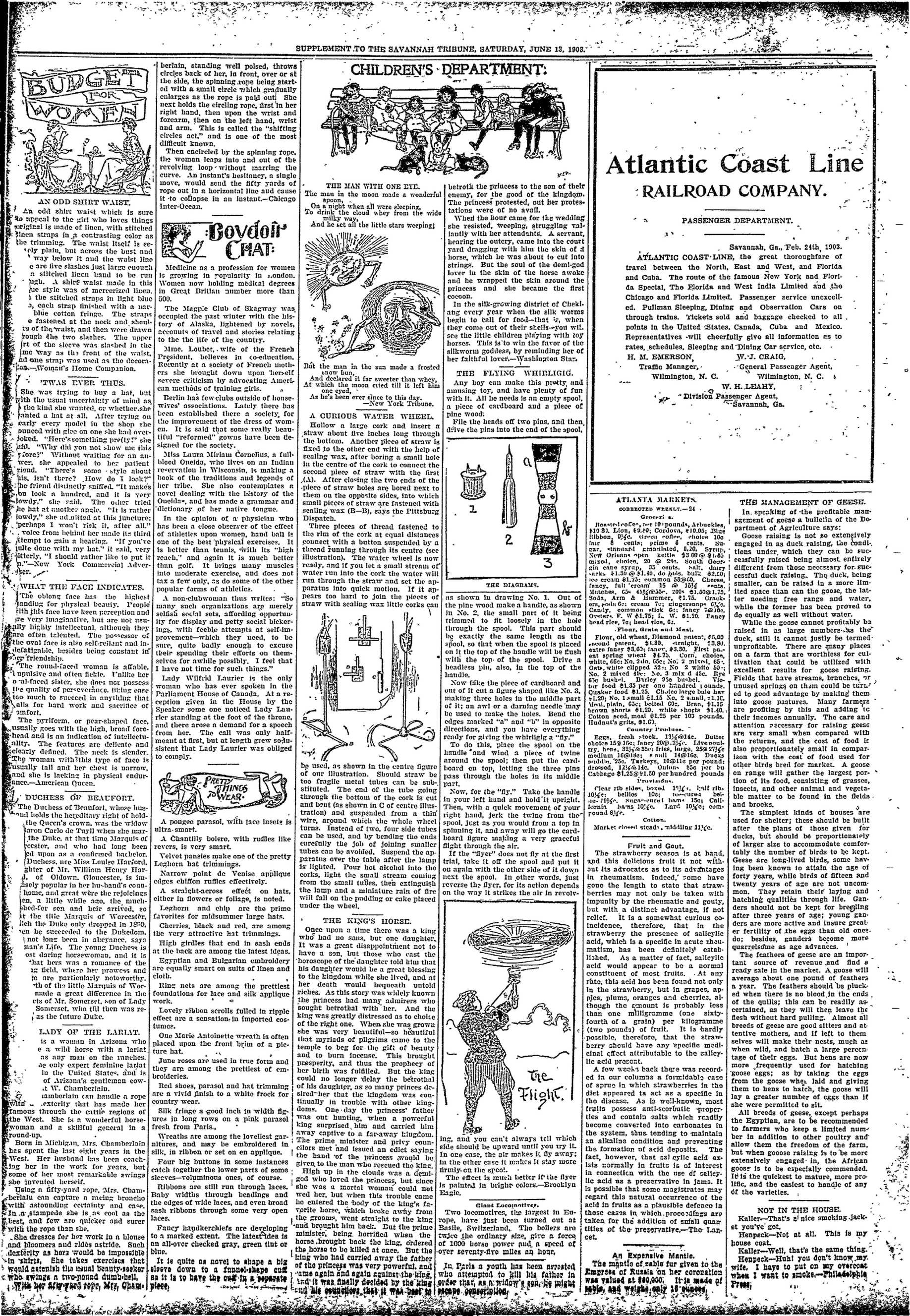
THE FLYING WHIRLIGIG.
Any boy can make this pretty, and amusing toy, and have plenty of fun with it. All he needs is an empty spool, a piece of cardboard and a piece of pine wood. File the heads off two pins, and then drive the pins into the end of the spool.
1
2
a
3
as shown in drawing No. 1. Out of the pine wood make a handle, as shown in No. 2, the small part of it being trimmed to fit loosely in the hole through the spool. This part should be exactly the same length as the spool, so that when the spool is placed on it the top of the handle will be flush with the top of the spool. Drive a headless pin, also, in the top of the handle.
Now fake the piece of cardboard and out of it cut a figure shaped like No. 3, making three holes in the middle part of it an awl or a darning needle may be used to make the holes. Bend the edges marked "a" and "b" in opposite directions, and you have everything ready for giving the whirligig a "fly."
To do this, place the spool on the handle and wind a piece of twine around the spool; then put the cardboard on top, letting the three pins pass through the holes in its middle part.
Now, for the "fly." Take the handle in your left hand and hold it upright. Then, with a quick movement of your right hand, jerk the twine from the spool, just as you would from a top in spinning it, and away will go the cardboard figure making a very graceful flight through the air.
If the "flyer" does not fly at the first trial, take it off the spool and put it on again with the other side of it down next the spool. In other words, just reverse the flyer, for its action depends on the way it strikes the air in revolv-
The Flight.
ing, and you can't always tell which side should be upward until you try it. In one case, the air makes it fly away; in the other case it makes it stay more firmly on the spot. The effect is much better if the flyer is painted in bright colors—Brooklyn Eagle.
Giant Locomotiles.
Two locomotives, the largest in Europe, have just been turned out at Basle, Switzerland. The boilers are twice the ordinary size, give a force of 1600 horse power and a speed of over seventy-five miles an hour. In Paris a youth has been arrested who attempted to kill his father in order that, as a widow, a son, he might escape genocide.
Atlantic Coast Line RAILROAD COMPANY.
ATLANTIC COAST-LINE, the great thoroughfare of travel between the North, East and West, and Florida and Cuba. The route of the famous New York and Florida Special, The Florida and West India Limited and the Chicago and Florida Limited. Passenger service unexcelled. Pullman Sleeping, Dining and Observation Cars on through trains. Tickets sold and baggage checked to all points in the United States, Canada, Cuba and Mexico. Representatives will cheerfully give all information as to rates, schedules, Sleeping and Dining Car service, etc. H. M. EMERSON. W.J. CRAIG.
ATLANTA MARKETS.
Roasted coffee, per 10 pounds, Arbuckle,
$10.80. Linen, $9.90. Cordovan, $10.05. Blue
Bibbon, Wide. Green coffee, choice 100
four & cents. prime 6 cents. Sugar,
standard granulated, 5.20. Syrup,
New Orleans open kettle $3.00 @ $1.05
mixed, choice, 20 @ 230. South Georgia
cane syrup, 35 cents. milk, dairy
sacks $1.30 @ $1.40. do quis, bulk $2.20.
ice cream $1.23. common 55% Cheese,
Cheese, common 55% Cheese,
Munster, 65% @ $55. 100% @ $1.05.
Soda, Arm & Hammer, $1.75. Crackers,
polls 6; creme 7; cingersnaps 8;
Candy, common stick 6; fainty 100.
Oysters. F. W $1.75. L. W $1.20. Fancy
bond rice, 7; head rice, 6.
. Flour, Grain and Meal.
Flour, old wheat, Diamond patent; $6.00
second patent; $1.80, straight; $3.80,
extra fancy $3.63; fancy; $3.30. First
parent spring wheat $4.75. Corn, choice,
white; 65c: No. 240; No. 2 miteol; 65:
Oats, white clipped $52; No. 2 white 50;
No. 2 miteol 40c: No. 3 mix d 45c. Irye
65c bush-el. Burley 95 bush-el. Victor
food $103 per hundred pounds.
Quantum Chocolate Cheese $100.
No. 1 small $1.15 No. small $1.15.
Meal, plain; 65c; bolted 60s; Bran; $1.15
brown shorts $1.20. shorts $1.40.
Cotton seed, meal $1.25 per 103 pounds.
Hudnut's seed, $1.63.
Country Produce.
Eggs, fresh stock. 13% @14c. Butter
choice 15% @16c; fancy 20% @25c. Live
culture, 15% @16c; fries 15% @25c;
dumplings, 15% @16c; 14% @25c;
paddles, 25c. Turkeys, 10% @11c per
pound; dressed, 12% @14c. Onions, 55c per
bur Cabbage 12% @15.50 per hundred pounds
Provisious.
Clear rib sides, boxed 10%¹⁰; half rib
10%¹⁰; bellios 10%; jucured rib
belio 15%¹⁰; sugar-cured hams 15%¹⁰; Call-
formans 10%¹⁰; Lard 10%¹⁰; com-
pound 8%¹⁰.
Cotton.
Market closed stead, middling 11%¹⁰.
Fruit and Gout.
The strawberry season is at hand, and this delicious fruit it not without its advocates as to its advantages in rheumatism. Indeed, some have gone the length to state that strawberries may not only be taken with impunity by the rheumatic and gouty, but with a distinct advantage, if not relief. It is a somewhat curious coincidence, therefore, that in the strawberry the presence of salicylic acid, which is a specific in acute rheumatism, has been definitely established. As a matter of fact, salicylic acid would appear to be a normal constituent of most fruits. At any rate, this acid has been found not only in the strawberry, but in grapes, apples, plums, oranges and cherries, although the amount is probably less than one milligramme (one sixty-fourth of a grain) per kilogramme (two pounds) of fruit. It is hardly possible, therefore, that the strawberry should have any specific medicinal effect attributable to the salicylic acid present.
A few weeks back there was recorded in our columns a formidable case of spruce in which strawberries in the diet appeared to act as a specific in the disease. As is well-known, most fruits possess anti-scorbutic properties and contain salts which readily become converted into carbonates in the system, thus tending to maintain an alkaline condition and preventing the formation of acid deposits. The fact, however, that salicyl acid exists normally in fruits is of interest in connection with the use of calylic acid as a preservative in jams. It is possible that some magistrates may regard this natural occurrence of the acid in fruits as a plausible defence in those cases in which procedures are taken for the addition of small quantities of the preservative.—The Lancet.
---
An Expensive Mantle
The mantle of sable fur given to the Empress of Russia on her coronation was valued at $80,000. It is made of sable, and weighs only 18 ounces.
THE MANAGEMENT OF GEese. In speaking of the profitable management of geese a bulletin of the Department of Agriculture says: Goose raising is not so extensively engaged in as duck raising, the conditions under, which they can be successfully raised being almost entirely different from those necessary for successful duck raising. The duck, being smaller, can be raised in a more limited space than can the goose, the latter needing free range and water, while the former has been proved to do equally as well without water.
While the goose cannot profitably be raised in as large numbers as the duck, still it cannot justly be termed unprofitable. There are many places on a farm that are worthless for cultivation that could be utilized with excellent results for goose raising. Fields that have streams, branches, or unused springs on them could be turned to good advantage by making them into goose pastures. Many farmers are profiting by this and adding to their incomes annually. The care and attention necessary for raising geese are very small when compared with the returns, and the cost of food is also proportionately small in comparison with the cost of food used for other birds bred for market. A goose on range will gather the largest portion of its food, consisting of grasses, insects, and other animal and vegetable matter to be found in the fields and brooks.
The simplest kinds of houses are used for shelter; these should be built after the plans of those given for ducks, but should be proportionately of larger size to accommodate comfortably the number of birds to be kept. Geese are long-lived birds, some having been known to attain the age of forty years, while birds of fifteen and twenty years of age are not uncommon. They retain their laying and hatching qualities through life. Ganders should not be kept for bregling after three years of age; young ganders are more active and insure greater fertility of the eggs than old ones; besides, ganders become more quarrelsome as age advances.
The feathers of geese are an important source of revenue and find a ready sale in the market. A goose will average about one pound of feathers a year. The feathers should be plucked when there is no blood in the ends of the quills; this can be readily ascertained, as they will then leave the flesh without hard pulling. Almost all breeds of geese are good sitters and attentive mothers, and if left to them selves will make their nests, much as when wild, and hatch a large percentage of their eggs. But hens are now more frequently used for hatching geese eggs; as by taking the eggs from the goose whee, laid and giving them to hens to hatch, the goose will lay a greater number of eggs than if she were permitted to sit.
All breeds of geese, except perhaps the Egyptian, are to be recommended to farmers who keep a limited number in addition to other poultry and allow them the freedom of the farm, but when goose raising is to be more extensively engaged in, the African goose is to be especially commended. It is the quickest to mature, more prolific, and the easiest to handle of any of the varieties.
NOT IN THE HOUSE.
Kaller—That's a nice smoking jack-
et you've got.
Henpeck—Not at all. This is my
house coat.
Kaller—Well, that's the same thing.
Henpeck—Huh! you don't know my
wife. I hays to put on my overcoat
when I want to smoke. Philadelphia
Press.
By Richard Burton.
Translated From the Polish of Henryk Sienkiewicz by M. Tyrand.
How an easy thing, if you want to know
How sweet the summer is, just to go
Down in the fields, or deep in the wood,
Or rain toward the swash of the sea.
For they all will teach you how heavenly
good
good
Such with these places.be.
If you seek the soul's warm summer, too,
Don't dream, but do!
Don't set at home with your. brain-born
book
And balance questions and pry and Look
Ask a question or wonder how
That matches with your ancient doubt;
But get in touch with the throbbing now,
And let your heart go out
To your fellow-men who are spat and bluc
Don't dream, but do!
HE snow was hard and not very deep. Klein, with his long legs, was walking briskly on the road from Zagrab to Penikla. He was scantily clothed with his short coat, his cloak still shorter, and his summer trousers not quite reaching his ankles. And then—his shoes were so much worn out. He pressed his fute amorously against his heart. He had a few small glasses of rum in his stomach and a great deal of contentment in his head. For that very morning he had signed an engagement as organist with the curate of Penikla.
Until that day he had been roaming like a Tighane, from inn to inn, from one fair to another, from wedding to wedding, wretchedly getting his daily bread by playing the fute or the organ. And, let it be said, by the lye, he played the organ better than any one else in the country. Now, at last, he could settle down and live decently. A house and a garden, 150 roules a year, without reckoning the extras, and above all the consideration attached to a position in a church, to a profession devoted to the glory of God! He had never wished as much in his most ambitious dreams. All those who leaked at him as a kind of trump should be compelled now to treat him as a gentleman.
For a long time Klen had coveted the position without any hope of getting it while old Mielnitzkl still persisted in living. The fingers of the latter were mostly paralyzed, but the curate would never have consented to replace him, in consideration of their twenty years' friendship. At last Mielnitzkl died through an accident and Klen hastened to apply for the situation. The curate, well acquainted with his talcant, engaged him immediately. Klen was really a remarkable artist. He never had studied music, but he played marvelously well not only the flute and the organ, but also several other instruments. It was not a case of heredity nor of education. His father, a soldier during most of his life, had turned a plain ropemaker in his old age, and the good man practiced no other wind instrument than his smoking pipe, which. It is true, seldom left the corner of his mouth.
Yet Klen, from his childhood, had shown a decided talent. Michutzki had given him some organ lessons. But the urchin one day suddenly departed with a band of strolling players. He wandered for several years. Then the troop dispersed by degrees, one dying, another disappearing without leaving any trace. Klen returned to his native village of Zagrab. He was as thin as a church mouse.
So far he had just shifted by playing for a trifle, but often for the love of God. People wondered at his irregular and precarious life, but they were unanimous when praising his talent. From Zagrab to Ponikla all declared readily: "When Klen begins to play the Lord is pleased and men are in raptures."
That did not prevent them from adding with much concern: "He must be possessed by a peculiar and devilish spirit." The remark was judicious, for at times he had the look of a sorcerer, particularly when during these last years, on some holidays, he replaced old Mielnitzki at the organ of Ponikla. Then he was unconscious of all that was not his adored instrument. It happened that in the middle of mass, when the congregation was the most deeply engaged in prayers, and when the priest, enwrapped in the fumes of incense, gave his benediction, Klen's organ seemed to spread over the whole an impalpable gauze, and to raise slowly toward heaven the priest, the censor, the vapors of perfume, the congregation, and even the tinkling of the bells.
Klen positively did not realize that he was the one who, performed these marvels. He completely imagined that the organ played unalided, that the sounds sprang by themselves out of the leaden pipes, to scatter first like rain, then like dew, in order to fill up the church and make vibrate together the altars and the hearts. Sometimes he was terrified at the thunderbolts starting from the magic instrument, and the next moment he enjoyed listening to a melody falling like the pearls of a rosary. When he came down from his seat after mass he looked haggard, and tootled as if lnebrlated, or rather as one suddenly awakened. The curate, putting some money in his hand, complimented him. The people bowed respectfully to the vagrant in wlom, at that moment, they felt an eminent superlarity.
Klen did not loiter before the church in order to enjoy praises. It was to contemplate in passing what was the most deary to him in the world, after music of course. We mean Olka, the daughter of a working man of Zagatha. He admitted her eyes, the color of the hair, help the color of gold, and he
Work in the world for the folk thereof;
With every deed that is done in love
Some crisscross matter is smoothed for age;
The spirit sees straight and clear;
You may worry over God's grinding laws, You may.probe and probe for the great first cause;
felt at his heart a sharp pain like the piercing of a knife.
This restored him to his full reason, and he repeated to himself a thousand times that never would Olkin's father give his daughter to a vagrant, and that he had better think no more of the young girl. This was easily said, but the knife had penetrated so deeply that the strongest pincers could not have withdrawn it.
Olkin, on her side, at first had loved Klen's music, then she had loved the musician. That penniless fellow, queer with wild-looking eyes, dark complexion, with clothes. always too narrow and too short, with long and thin legs like those of a stork, had at last become dear to her. The father, though he himself also had often empty pockets, did not wish to hear anything of Klen.
"My daughter will have no trouble to find better," he declared. "Does not every one admire her beauty? She will never be reduced to accept a man on whose arm she would be ashamed to present herself."
It was then, with ill grace that he opened his door to the musician—which did not often happen. But the death of Melnitzkil changed everything. As soon as Klen had signed his contract with the curate he hastened to announce it to Oika. The father for the first time invited him to sit down and offered him one after another several little glasses of rum. And when the young girl came in he gravely told her that henceforth Klen was going to be a gentleman—much better, the first in Ponikla, after the dean.
Then, also for the first time, the musician had been authorized to remain near Olka from noon until evening, and night was coming as he returned to Pontkla with the snow crackling under his feet. The frost was sharp, but Klen had never been so happy, and he felt very warm at heart in recalling the smallest incidents of that decisive day. Along the deserted road, to the fields buried under the snow, he carried his joy like a light across the increasing darkness.
"What do I care for prosperity?" Olka had told him sweetly. "With you I would go beyond the seas, to the end of the world! But for father it is better that your position be settled."
Then he had kissed her hands religiously, murmuring:
"Olka, dear Olka, may God return to you all the happiness you give me in speaking so!"
But now, thinking it over, he was mortified at, his own foolishness. He ought to have said many things differently; omitted this, added that, and particularly answered better to so important a declaration; think of a young girl telling a young man that, if it was not for her father she would follow him all over the world! It seemed to him that both were walking together on the white road. This did not prevent him from hurrying his steps, as the snow was cracking in a manner more and more alarming. "H! my Olkal! unique treasure, you are going to be a lady, my lady!"
His heart swelled with gratitude. Ha! had she really been near him how he would press her in his arms with all his might! This is, yes, this is what he ought to have done one hour before at Zagrab! But it is always so. At certain moments one feels dizzy, and the tongue goes astray precisely when it ought to say so many, many things. Decidedly it is much more easy to play on the organ than to express in words what one has in one's heart. In the cold sky the stars began to twinkle with a sparkling light. Klen felt that his ears burned. To save time he took a small, familiar path across fields. His shadow longened funnily on the white earth.
"If I played on my flute it might revive my fingers." A few sharp notes flew away in the night. They seemed like birds frightened by the surrounding silence, the intense frost, and the shroud which covered the land. And Klen modulated the gayest tunes of his reportoire, those Olka had asked him to play in accompaniment to her small voice.
An old song, called "The Green Pitcher," had particularly pleased the father and the daughter. It was a dialogue between a lord and a maiden, which began thus:
"Do not cry, child;
I shall, pay for thy broken pitcher!"
Olka, of course, figured the maiden
with the green pitcher, and Klen the
lord. This prodigiously amused the
old workingman.
And now, along the little-path across
fields, Klen, with an ecstatic smile,
played "The Green Pitcher," or rather
attempted to play it.
His fingers did not revive; he had to give up this journeying tool, his
breath more and more at every moment.
He had not thought that the snow was less hard and deeper in the fields than on the roads, and that he could not always trace the path. He allowed himself to be directed by chance. Then he tumbled at every step, burying his long legs in some unseen ditch.
The stars sparkled still colder, and then the wind rose again. Klen was in perspiration, but he shivered. He tried once more to play on his fute. But he could not feel his fingers and could hardly move his lips. An impression of overwhelming solitude dawned upon him. He thought of the well-heated house which was ready for him at Ponikla; then of the one where he had spent the afternoon.
"Olka must have retired at this hour; and, thank God, under her roof it is warm."
The certainty that Olaa was warm made him happy, but caused him to suffer from the cold still more.
He had passed the fields and was stepping through prairies bristling with bushes. He was so tired that he thought only of sitting down, no matter where.
"I am going to rest a moment against the wind, near these bushes. My! Not I should freeze on the spot."
He walked again—not much. Exhausted, he let himself fall down.
"If I sleep, I am lost"
He stretched his eyelids, shook his arms, moved his fingers, unfastened his lips and played on his flute the first notes of "The Green Pitcher." A few thin sounds rose in the ice night, and died away, slow and melancholy.
Klen let fall his flute, but continued to struggle against the unconquerable slumber. He felt astonished to be alone in that desert of snow.
"Olkal! Where are you?" he murmured.
He moved once more his fingers, opened once more his eyes, and whispered:
"Olka!"
Dawn lightened; near a bush of broom, a human form with long and thin legs. A flute lily by its side. The blush face wore still an expression of wonder and attention. Klen died in listening to the old song:
The Tale of the Tall.
A writer in tracing the ancestry of the dog wolf and jackal notices typical differences in the cast of their eyes, their body colors and markings, the habit of turning around three times before lying down, and other interesting peculiarities, but he does not mention the most striking and infallible way of distinguishing them, namely, by the fashion in which they carry their tails. Wolves and coyotes have a sneaking way of carrying their tails low, almost hanging on the ground, while dogs carry their tails up, and the further removed they are from the general type, says Charles Hallock, the higher they carry them. Shepherds and collies, which retain many of their racial characteristics, carry their tails lowest of all; setters and pointers, a few degrees higher, stiffening out straight their tails to the spinal line; St. Bernard and Newfoundlands effect a curve over the back, while pugs actually come to a full twist. An old plainsman could tell a wolf or coyote as far as he could see him, and in buffalo days this was a most useful indication of buffalo herds being not far away. These predatory creatures always followed a moving hard—Philadelphia Record.
Reminder of British VanGallisin.
A vivid reminder of the burning of the Capitol by the British in 1814 came to hand recently in the repairs which are being made in the document room of the House of Representatives. This room is a three-concerned space in the northwest corner of the old hall of the House, or Statuary Hall, as it is called now. In making the repairs the old window sashes were taken out. Underneath was a charred window case, and when that, too, had been removed there was a quantity of lead found; the old window weight had been melted in the fire and run down into the crevice of the stone wall. This was dug out by Joel Grayson, and is being preserved by him as a memento. The window sashes were covered with a coat of dirty white paint, but their weight attracted the attention of the workmen, and the paint was scraped off sufficiently to show that they were solid mahogany, showing that nothing was thought too good to use in the original construction of the Capitol.—Washington Star.
The British Beat Us.
It isn't often that a British boat crew heats an American; the balance of victory hangs heavily on our side, but recently in Sydney the Yankee jackets got an awful walloping. Some months ago the supply ship Glacier made her regular call at Sydney for a cargo of meat for the Philippines. In the harbor lay the British flagship Royal Arthur, and the crew of the Glacier challenged her crew to a boat race. While the conditions were being talked over it came time for the American ship to leave so the race was postponed. According to British reports when the Glacier got back to Manila she got the picked oarsmen in the American fleet to take back to Sydney with her. The day of the race was made almost a holiday in Sydney. Practically all the town was on the water or on land where they could see the sport, and when the Britishers beat the Yankees by ten lengths in two miles bedlam reigned. — New York Commercial Advertiser.
Bad Inverfiments.
Get-rich-quick marriages usually have
the same wind-up as the office invest-
ments of the same kind - New York
Borough
True
Tales of
Pluck Adventure.
```markdown
```
HE act of Deans Ryer stands out in splendid isolation. Ryer rescued a woman from the sixth story of a burning building. He dashed into the adjoining tenement, and ran up the stairs to a window on the sixth floor. Horrified, the crowd saw him rest one foot on the coping below his window, and reach with his right hand for the window in which the woman stood. But he could not make it; he could barely touch the edge of the easing with the tips of his fingers. Some ornamental iron piping separated the buildings, and this he had practically to straddle. It seemed an impassable barrier, but Ryer stretched forth his right foot, barely placing his toes upon the desired coping. He was suspended six stops up, with only one hand grasping the easing—a none too firm hold—and, this he knew he must gradually release as he extended his reach to the other window. By working the fingers of his left hand to groove to groove he was enabled to move over and cautiously curl the tips of his right hand around the edge of the easing of the burning window, by the pressure of his bent finger-tips against the wood. He was so finely polished that a feather-weight would have unbalanced. Little by little Ryer worked the fingers of his right hand along until he got a slight hold on the inside of the window, and then, the cheers of some and the groans of others, he entered the burning room. There he found the woman unconscious on the floor, the flameslicking her shirts. A rope with which some citizens had attempted the poor creature's rescue dangled from the roof in front of the window. Seizing this, Ryer passed it twice around the woman's body under her arms, and made the other end fast about his own waist. Then he lowered her from the window, and himself straddling the sill, brought the sash down upon his leg, so to hold himself from falling. With wonderful muscular power he began to swing the woman like a pendulum. Back and forth she went over the heads of the horror-striken crowd, then with a last tremendous effort he projected the woman into the outstretched arms of some firemen in the window which he had quitted—Woman's Home Companion.
A STRENUOUS LIFE.
Lord Lyveden, who is to bring over a party of Parliamentarians this fall and show them the United States and Canada, is big and tall and vigorous and only forty-five. He has been a soldier, a sailor, a waiter on the Bowery, a ship's steward, an actor and a nursery man.
Lyveden was a clergyman's son. As Percy Vernon he enlisted in the artillery, but bought himself out and joined Mr. Bancroft's Haymarket company in London for a time. Twenty years ago he came to this city with SIG cash capital and became a Bowery waiter.
Presently he turned up in Charlotte, N. C., without money. "Like a young fool," he says, according to M. A. P., "I went to the best hotel and stayed three days. I had no money and was turned out, but as I was leaving the door a clerk pressed fifty cents into my hand, saying, 'I guess you'll want a bed-to-night, old man.' I lodged over a stable and in the morning got work driving a carriage. Eventually the hotel-keeper became my partner and best friend."
In 1890 Mr. Vernon returned to England, married and started in the nursery business, originating a tomato, but the enterprise failed and he sailed as third steward on an Irish sea boat, as assistant steward on the unlucky City of Paris, and as bedroom steward on the steamship Nile, sailing to the Brazilis.
In Buenos Ayres he contracted yellow fever, and on his recovery he became saloon steward in the Isle of Man service. He served two seasons with this company, then joined the Polytechnic steam yacht Ceylon as chief steward. Afterward, employing his own name, he became caterer on the Hamburg-Harwleh line. This position he resigned before he succeeded to the title.
In 1883 Lord Lyveden was in Charleston. "I was then the partner in a small fishing boat," he says "and as we returned to the harbor, laden, going over the bar we shipped an enormous sea and the boat went to the bottom. The three hands and myself were fortunate enough to be rescued, but we lost everything. To crown all, the earthquake came on that same night."
FRIGHT IN BATTLES.
"A most unusual thing," said the sergeant, "happened in our company in West Virginia. There had been a skirmish in the mountains across the river from camp and our company was ordered up the road. We found signs of the enemy in less than a mile, and finally heard the noise of a heavy advancing column. The company was posted to command the mountain road, and the captain with two men went forward to reconnoiter. They came, at a sharp turn of the road, not ten yards away, face to face with the enemy's advance guard, and the captain, who was carrying a musket, blazed away without an instant's hesitation and killed the officer in command of the enemy. Thereupon the Confederates threw themselves bodily on the captain and his two men and all were sent to Bielmond."
"I suppose," said the corporal by roar, "that the captain was confused
foby carrying a musket. But in the Tilrteenth Massachusetts, which saw a good deal of service in the Army of the Potomac (we were in over twenty engagements), the adjutant, sergeant, major, captains and leutenants generally came out of a fight with rifles in their hands and empty cartridge boxes. The boys were in the habit of saying that the shoulder straps picked up rifles to keep up their courage, but we know they did it from choice. As the most of the commissioned officers had come up from the ranks, they felt more at home in a fight with rifles than with swords.
"It is true, nevertheless, that men in battle often joked with each other to keep up their courage. At that time I had a very full eye—an ox eye, the boys called it—and as I was one of the shortest men in the company, I came, as a rule, next to our left guide, old Jerry B., whose face showed how he felt when the bullets began to fly. But no matter how badly scared Jerry was, he always called my attention to the fact that my eyes were sticking out so that he could hang his hat on them. This was said to me a hundred times, and a hundred times I told Jerry that if he was half as scared as I was he would run."—Chicago Inter-Ocean.
THE BULLY WEAKENED.
"At the battle of Fredericksburg our regiment was on the skirmish line for eighteen hours, and hard at it all the time. When the assault was ordered we were directed to lie down, that the advancing line might run over us. Then we were to rally on the reserve, eighty rods to the rear. To reach the reserve we had to cross an open field over which bullets were flying like hail. Even in that crisis I hesitated to run the eighty rods, fearing that after facing the enemy for eighteen hours I would get a bullet in my back. So I side-steped that eighty rods and was laughed at by the boys who made a glick run.
"We had in our regiment one of the old-style bullies, who made a good deal of noise in battle. He was always urging our boys and shouting threats to the enemy. Most of the younger men in the regiment thought the loud talker was a great fighter, but at Fredricksburg he received a slight flesh wound in the leg which took all the conceit out of him. He blubbered like a 'whipped boy under his trifling wound, while dozens of men with serious wounds stood grim and silent, fighting to the last. We never could get our bully into another fight, and came to the conclusion that he was brave through ignorance, and that when he learned from experience that bullets would hurt he lost his nerve."—Correspondence Chicago Inter-Ocean.
IN CIVIL WAR DAYS.
Out in Chaitanooga they tell this story of Civil War days: Chaitanooga Creek was the dividing line between the outposts of the Federal and Confederate armies, and during a lull in hostilities the pickets of both cultivated one another's acquaintance, having agreed not to fire on one another. One day when the captain of the Union guard saw General Grant with his staff approaching he said to his men: "Turn out the guard for the commanding general." The Confederates on the other side of the creek, not more than fifty feet away, heard the order, and their captain, concealing the idea of paying a compliment to the enemy, shouted: "Turn out the guard for the commanding general of the Federal army." The ragged Confederate pickets stood at attention for several moments, and then saluted Grant as he rode away.
A DRAMATIC REPRIEVE.
On the stage it happens that the hero is reprieved at the eleventh hour when on the scaffold, and there are cases recorded in history. Few, however, have been so close to death as Joe Campbell, a negro, who had been condemned to death for murder at Yazoo City, Mo. The negro had the halter about his neck, and the trap door was ready to be sprung open. Campbell then turned to the shriek and confessed the name of his accomplice. He was instantly reprieved—New York: Commercial Advertiser.
Philosophy of Railway Esakes.
The fundamental principle governing the application of the brake to a car, says an engineer who has recently investigated the subject, is to stop short of the point where the wheels begin to slip or "skid." When this occurs it not only flattens the wheel, but effective braking ceases. "Skidding," however, ought not to occur in practice, for by the use of sand cars may be stopped as quickly as is consonant with the passengers' safety. Sometimes, even, the cars stop too quickly for comfort, and "it looks," as a critic says in an electrical journal, "as if any material increase in brake efficiency would have to be followed by putting the passengers into padded compartments." Hand brakes are found to be quite ineffective, and most of the brakes on trolley cars are hardly powerful enough to secure perfect safety—Success.
Two Cents For a Washer.
American women who complain of the annoyance of professional masheres in the streets of Paris might profit from an experience I heard a bright American girl relate the other day. She was walking along in the daytime, accompanied by another girl, and noticed a man following them. An idea struck her. Reaching in her purse she found a small piece of white paper, then looked around shyly. The masher, encouraged, caught up and grazed at the paper she had in her hand. Instead, however, of receiving the little note evidently expected he found himself clutching two soins (two canes). Needless to say, he did not follow further—New York Herald.
The Funny Side of Life.
THE HERO OF THE HOUR.
You want to lionize him and
He gladly lets you.
He smiles and shakes you by the hand
And their forgets you.
—Washington Star.
DEEP MOURNING.
"Mrs. Jones seems to be heartbroken
over her husband's death."
"Yes, even her hair has turned black
again."—Brooklyn Life.
DEVOTED.
She—"You say you are devoted to
tart. What is the particular art that
you love best?"
The Exasperated One—"I'm afraid,
it, this town isn't big enough to hold
both of us."
The Imperurbable—"H'm—why don't
you stitch a suburb?"—Tit-Bits.
HER DEVOTED KNIGHT.
"I ain't got no ceat to lay down for you to walk on, like that feller in the story, books, but I'll be hanged if I'm a goin' to beat be in perilness by a further anyway."—New York Times.
MATTER OF SEX.
She—"At the conclusion of an argument between a man and a woman the man is silenced if not convinced." He—"Yes, and the woman is convinced, but never silenced."—Chicago News.
AN ULTIMATUM
Mrs. Jupeck—"Henry, are you going to put up that shelf to-day or not?" Jupeck—"Well, my dear, you see—" Mrs. Enpeck—"That will do, now. Either put up or shut up."-Chicago News.
NOT A GOLD MINE
"But I don't believe," he said, "that a man profits by his mistakes." "You don't?" "No. I don't." Why, I've made enough mistakes to be rich if I could profit by them."—Chicago Post.
SOMEWHAT DIFFERENT
"Why, George, what an enormous pile of letters," exclaimed the bride of a week. "Billets doux, I suppose." "No, my dear," replied the other half of the sketch. "They are billles overduc."—Chicago News.
HARMONY DESIRED
Knippe:"Why did Johnson hire all such portly people for his servants?" Tueque:"He-says that his wife in sisted upon having them like that, so they would match her new heavy dining-room furniture." -Syracuse Herald
SOPORIFIC
Mrs. Sharpe—"My husband's been troubled with insomnia terribly of late, but he got some sound sleep last night." Mrs. Nexdore—"Some new medicine?" Mrs. Sharpe—"Well, yes. I told him I was sure I heard burglar's down stairs."—Philadelphia Press.
EASY.
CAPR J.
"Johnny, what's become of the jam?
"Guess, ma."—New York Journal.
ALL MARKED DOWN.
"Oh, yes, he's saved a good many lives."
"Then I suppose he has saved a good deal of money, too?"
"No, he's poor."
"That's strange. How about the rewards from the grateful people he has pulled out of the water?"
"Oh, the trouble with them is that they put their own valuation on the goods saved."—Olivera Plains Dealer
AUCTION SALE OF VALUABLE LOTS FOR RESIDENCES THURSDAY, JULY 2d., 1903, AT 4 P. M.
on the premises beginning at Paulsen and Waldburg Streets. We will offer about TWELVE LOTS to RESPECTABLE COLORED PEOPLE ONLY. Terms will be One Third Cash, balance easy payments 7 per cent. interest. I have sold from this block of lots already to Wm. Durden, E. W. I mention the names of former purchasers to insure prospective buyers of who their neighbors will be. This is the first time in the history of Savclusively for colored residences. It is now for you to let the opportunity pass or take advantage. For information prior to the sale, see,
The Savannah Tribune.
SATURDAY JUNE 13, 1903.
Mrs. S. J. Wayring left last week for New York.
For Jacksonville to-morrow $2 00 round trip, S. A. L.
Miss Anna Smith left an Saturday last for Philadelphia.
A number of excursionists left for New York on Wednesday.
Miss Mollie Yarborough of Columbus, spent a few days in the city this weak.
Mrs. S. G. Flournoy, after spending a few weeks in Beaufort, has returned home.
Mr. J. W. Russell, one of the big merchants of Americus, was in the city a few days.
Mrs. H. N. Walton left on Wednesday for New York where she will spend the summer.
B. L. Perry, tonsorial artist. All work satisfactory done by first class barbers. 308 Drayton street.
Mrs. J. H. Brown Patterson, Miss Maud Burke and little Alberta Patterson graced our sanctum last week.
Ring up Ga. Phone 870 or call at 22 State west and have Jackson the plumber give an estimate on your sewer connections.
Miss Madeline Shivery has returned home after the closing of a pleasant school term at Fort Valley, Ga.
Tomorrow morning at 11 o'clock Rev. Lillard will preach a special sermon to the young men at the First Congregational church.
Republicans of the First G. M. District will meet Wednesday night at Golden hall. A large attendance is expected. Business of importance.
Go to Jacksonville to-morrow via the S. A. L., from Union Station at 7:45 a. m., city time. Fare $2.00. Leaves Jacksonville same day at 7:30 p. m.
After attending school at the Georgia State College, Miss Ophelia Bozeman left for her home Hawkinsville, Ga., on Thursday morning of last week.
Mrs. P. L. Smith left on the 26th ult. for New York, where she will spend two months. The remainder of the summer will be spent at Worcester, Mass., with her friend, Mrs. Jennie Brooks.
Misses Essie D. Anderson, Janie L. Morton and Ruth E. Price returned home on Thursday of last week from N. C., where they have been attending Scotia Seminary. They report a successful term.
The annual afternoon social trip of the First Congregational church will be given on Tuesday July 7, on the steamer Clifton. The trip will be made unusually pleasant in that it will go around the Horn.
Mr. O. C. Wigg of the firm of Wigg and Green, general merchandisers and turpentine dealers, of Summertown was in the city and came in to see us. Mr. Wigg is a of man business ability and is making much success.
Rev. Dr. E. W. D. Isaac, after two weeks of hard labor, lecturing and preaching at the different churches, left on Tuesday morning for Washington, Ga., where he will attend the Missionary Baptist Convention of Georgia.
Mr. W. H. Briscoe, an old Savannah boy, but now one of the popular letter carriers of Atlanta, spent two weeks in the city, visiting his relatives and friends. During his vacation he never forgets his old home. He returns to Atlanta on Monday.
Don't wait until the city force you to make your sewer connections but see Jackson the plumber at No. 22 State street, west and have him to attend to your plumbing at once and save you further trouble. Terms reasonable, satisfaction guaranteed. Ga. Phone 870.
A missionary meeting will be held on Tuesday night at Mt. Tabor Baptist church, Rev. N. H. Whitmire, pastor. Papers and addresses on mission work will be the features. The main address will be by Rev. Alexander Harris. The admission will be free but after the services refreshments will be served. The public is invited.
The Happiest Woman; is the hardworking one. The best satisfaction comes of service performed. Only it is necessary to keep the bowels regular and the organs active. There's nothing like Dr. King's New Life Pills for that. They render service gently, yet thoroughly. 25c at Knight's Pharmacy Company.
Musical Event.
The musical event of the season was the "Musang feast" at the Beach on Wednesday night last under the auspices of the Forest City Glee Club. The chapel of the Beach was crowded and each number was heartily applauded. The program as was published in THE TRIBUNE last week was carried out with the addition of the very excellent and tense address on music by Rev. R. H. Singleton. He was attentively listened to and in fact was so pleasing in his speech that when he terminated his hearers were not in the least tired. The features mentioned were well received. The club, by this entertainment has added to its reputation. The manager, leader and the members are to be commended for the excellent program presented.
A Unique Celebration.
The anniversary of Co. D, Capt. J. H. Bugg commanding, was celebrated in a unique manner. On Sunday night the company attended the First Congregational church where an excellent sermon was delivered by Rev. Lillard. The next night with Middleton's band and the Welcome band from Jacksonville the cars were taken for Maj. Royall's pleasant place near Thunderbolt, where a jolly time was spent. The men were well cared for by Maj. and Mrs. W. H. Royall. Speeches were made by Rev. Alex. Harris, Col. Deveaux, Maj. Royall and others. Each attendant enjoyed himself.
Locals.
Rev. Joseph Tostona of Lake city, Fla. spent the week in the city. In company with Mr. Wm. R. Reddick he gave us a call. He is in the mission work of the A. M. E. Church.
Mrs. Fannie H Starr, president of the Woman's Home Mission of the Second Baptist church, leaves on Tuesday for Cartersville, Ga, to attend the State Convention of that organization.
Mrs. Susis Lee entertained a few friends at the residence of Mrs. Lucy Crumbly on Gaston street east, On Monday evening. A number of guests were present and an enjoyable time was had.
Rev. T. M. Williamson, B.D., will attend the General Missionary and Educational Convention which meets in Cartersville, Ga. next week. Before returning he will visit Atlanta and other cities in the state, preaching and lecturing. Rev. Williamson is an able preacher and Christian gentleman, and carries with him the esteem of the best people of our city. He is favorably known in Georgia and other states, and we trust that success may attend his efforts.
Mr. T. T. Harden of St. Augustine, Fla, spent Monday in the city. He came to visit his sister, Mrs L. H. Lawson and Miss Ida Harden, and other friends. Mr. Harden will be remembered by many of the older citizens as the publisher of the Echo, the leading Negro paper at its time. In company with Miss Harden he gave us a pleasant call, which took us back to the time when we were a "devil" in the Echo office.
Mr. and Mrs. Henry T. Tompkins, of Atlanta are pleasant visitors to the city this week. This is Mr. Tompkins' old home. He has been residing in Atlanta several years and is now on the mail carrier's force. This is Mrs. Tompkins' first visit to Savannah, and from expressions she is well pleased with it. They are the guests of Mr. and Mrs. Jos. L. Jackson on east McDonough street. They will return to Atlanta next week.
Rev. P. F. Curry, presiding elder of the Millen District of the A. M. E. Church, reports a very successful and interesting session at the District Conference, held at Higgston last week. A large number of persons were in attendance. The reports showed the district to be in a healthy condition. The collection for missions amounted to $85.78 and for theological Chair $50 00 Since January there have been 374 conversions. Rev. Curry is an indefatigable worker and is commended for his efforts.
Worst of All Experiences.
Can anything be worse than to feel that every minute will be your last? Such was the experience of Mrs. N. H. Newson, Decatur, Ala. "For three years" she writes, "I endured insufferable pain from indigestion, stomach and bowel trouble. Death seemed inevitable when doctors and all remedies failed. At length I was induced to try Electric Bitters and the result was miraculous. I improved at once and now I'm completely recovered. For Liver, Kidney, Stomach and Bowel troubles Electric Bitters is the only medicine. Only 50c. It's guaranteed by Knight's Pharmacy Company.
AMUSEMENT COLUMN.
Coming Events in The Social World.
A grand picnic will be given at Lincoln Park on Thursday June 25 by Protection Lodge No. 2300. Admission 15 cents.
A picnic will be given at Lincoln Park on Thursday July 9, by the Twelve Brothers of the United Protection Club. Admission 15 cents.
The first outing of the Letter Carriers Branch No. 578, will be given at Lincoln Park on Thursday June 18. Admission 25 cents.
An excursion will be given to Beaufort on Tuesday June 23, by Adelphia Club Steamer Clifton leaves wharf foot of Whitaker street at 9.a.m. Fare 50 and 25 cents.
Ezra Presbyterian church and Sunday school will picnic at McIntosh, Monday June 15 Train leaves over the Atlantic Coast Line at 9 a.m. arrive McIntosh 10. Fare 500, children half fare.
An excursion will be given to Beaufort S. C., on Monday July 13, by Hyacinth Aid and Social Club. Steamer Clifton leaves foot of Whitaker street at 9 a.m. Fare Adults 50 cents. Child 25 cents.
A concert will given under the auspices of the Woman's Mission Band on Monday night June 15, at Second Baptist church. Admission 10 cents.
The Twilight Reapers Aid and Social Club will give an anniversary excursion to Dauphinie Tuesday June 30. For the benefit of the school children two trips will be made Steamer Clayton leaves foot of Whitaker street at 9 a m and 2 p. Fare 500, children 250.
A picnic will be given at Lincoln Park on Tuesday next by Deborah Lodge No. 1, G. U. O. of S. and D. of Ezekiel. Admission 150.
The annual picnic of Olympia Lodge No. 10, and Joshua Company No. 2, U. R., K. of P., will be given at Lincoln Park on Monday June 22nd. Admission 15 cents.
The nineteenth annual trip of the Porters Benevolent Association will be given to Beaufort, S. C., on Sunday June 21. Steamer Clayton has been engaged for the occasion. Fare adult 50 cents, child 25 cents.
The I. P. O's will give their 2nd annual excursion to Daufuskie on Monday July 6th. The Steamer Clayton will leave foot of Whitaker street at 9:30 a. m., sharp. Music by Oriental Orchestra. Fare 50 cents, children 25 cents.
The Orion Aid and Pleasure Club will give an excursion to Daufuskie Island on Monday June 15th. Music and refreshments on board. Steamer Clayton will leave foot of Whitaker street at 9 a. m. Fare Adults 50 cents, child 25 cents.
There -ill be given a delightful excursion to Daufuskie Island on Wednesday July 1st, for benefit St. Benedict Catholic church. Go and enjoy a day on the salts. A fine band of music will be in attendance. A choice line of refreshments will be on hand. The committee will look after your every want. Steamer Clayton leaves wharf foot of Whitaker street at 10:30 a.m and leaves island at 7:30 p.m. Whole ticket 50 cents, children 25 cents.
Vocal and Instrumental.
On July 1st, I will organize a summer class in Vocal and Instrumental Music, (beginners or advanced.) Special attention paid to HARMONY and EXPRESSION, and only the latest methods of teaching employed. Terms very reasonable.
Call on or address:
CHAS, MCDOWELL, Park Ave. E.
After Jung 188.
Notice.
The undersigned begs to inform his patrons that all bills and accounts must hereafter be paid to him until notice to the contrary is given through the columns of this paper. Harry H. Smalls is no longer his collector.
T. James Davis, M. D.
220 East Broad street.
Stiles' Park.
This is one of the finest pleasure resorts, situated on the line of the Electric Railway on Dale Avenue. This is an ideal spot for pionics and pleasures of that kind. Parties desiring to rent same resort can apply to Mr. W. H. Stiles, at the Park, Dale Avenue, near Thunderbolt road.
For Rent.
For Rent, houses thirty-first and East Broad streets. Large rooms, running closets, $5.00 and $4.50 per month. Apply to Chas. F. Fulton.
For rent, splendid houses on Gwinnett and Paulsen streets. Five rooms, running water-closets, $5.50 and $6.50 per month. Apply to Chas. F. Fulton.
For Rent
I have for rent on 38th street, East of East Broad, a number of very nice fourroom houses. This is a first-class neighborhood. The Mission Baptist church is right-in center of these houses. I will rent them for $4 and $5 per month. C. Mendel, 16 Bryan ekst.
ORIONS UNION
EAST END JCE CREAM PARLOR.
341 East Broad, cor. Charlton street,
Is the most popular and up-to-date
Ice Cream parlor in the city. Our
delicious Ice Cream is the talk of
the town; a select line of Cool
Drinks, Cakes, Candies etc. We
invite you once, because we know
you will come again.
MUSE & WILLIAMS, Props.
"If you want to know what smartly dressed men will wear this season, ask to see our styles.
CALL ON US If You Want to be Correctly Dressed SUITS that FIT at PRICES to PLEASE.
A Complete Stock to Select From. Latest Style: Best Fit.
block of lots already to Wm. Durden, E. W. Sherman, Sol. C. Johnson, Dr. J. H. Bugg. This is the first time in the history of Savannah that a section has been set aside ex- For information prior to the sale, see, E. G. BLACK, Auctioneer, 16 Bryan Street, East.
MAKE YOUR MONEY WORK.
Money Deposited with us
DRAW 5 Per Cent.
per annum, compounded quarterly.
THE WAGE EARNERS LOAN AND IN-
VESTMENT COMPANY.
20 State Street. West.
240 Barnard St., Savannah Ga.
Does all kind of high grade dental work of the best quality and workmanship, Gold crowns and bridge work. White Porcelain Piet, and Gold Crowns mounted on the natural roots. Gold Filling, Concrete Filling, and Siliver or Amalgam Filling, from one to a full set of teeth $7.00 and $8.00. Broken Plates mounted and teeth added to old ones for a small cost. All Gold Crowns Guaranteed 23 x 2 K. Gold.
SEABOARD
AIR LINE RAILWAY
— TO THE
North, East, South and West.
The best rates to all EASTERN CITIES, FLORIDA
POINTS, SAVANNAH,
AMERICUS, FITZGERALD,
COLUMBUS, ALPANY
COLUMBUS, ALBANY,
MONTGOMERY, MOBILE.
Through PULLMAN CARS
to NEW YORK. CAFE CARS
serving meals a la carte.
For detailed information, literature
time tables, rates, etc., apply to any
agent of the SEABOARD AIR LINE
RAILWAY or to
CHAS. F. STEWART,
Ast. Gen. Pass'r Agent,
Savannah Ga.
BLE LOTS
2d., 1903, A
will offer about T-WEL
St. Stephen's Episcopal Church
On Haberham street between Macon an
Harris. Services Sunday 11 a.m, and 8-0
p.m. Sunday school 3:50 p.m. Services on
Wednesday night at 8:00. Strangers are
always welcomed—Bev. Richard Bright,
Rector.
HOW TO KEEP WELL.
Eat the best meats. You can find this by visiting the OLD RELIABLE Stall No. 31; City Market. Beef, Veal and Mutton, And all kinds of game in season. Goods delivered promptly. F. E. JONES & SON. Both 'Phone 689.
You will find the most delicious Ice Cream and all sorts of Cool Drinks sered in a beautiful parlor made of Japanese portiers, and a neat dining room wh e first-class Lunches are served. Also a choice line of Grocaries and Confectionaries. You will be entertained every Sunday by one of Edison's phonographs. Come, you will be delighted.
Metropolitan Mercantile CAPITAL.
Waldorf Cafe.
Don't fail to visit the Waldorf Cafe. The neatest, cleanest and best Restaurant for colored people in Savannah. 236 West Broad Bld Private dinning rooms for ladies.
L.S. REED.
Real Estate, Loan and Insurance.
Buys, sells and exchanges real estate. Special attention given to the collection of rents. Loans negotiated—any amount $10.00 to $10000,00 L. S. Reed, 22 State Street, W. Ga.'phone, 870.
LOGAN'S
WOOD & WASHING LIQUID CO.
Pine Wood, Oak Wood, Light Wood.
Guaranteed full load and good wood.
Terms cash to everybody.
Hall's Washing Liquid.
The great labor saver of the age for
Housekeeping and Wash Women.
5c per Quart, 15c per Gallon.
W. H. LOGAN, Sole Agent; 3
Perry and Randolph Streets,
Gz. 'Phone 989.
and Reality Company.
$100,000
and expense. A greater midsirection of capital and energy would result than has been possible since the organization of modern economic machinery. Mr. Morgan or any other capitalist might be expending millions of dollars in building new railways or cotton mills when there was no necessity for them, while a hundred other industries beneficial to the public were stagnant for the lack of capital. There would be no safe guide as to whether the world needed more railroads and fewer cotton mills, or more cotton mills and fewer railroads. Great sums would be wasted in bootless enterprises, which would prove unprofitable and carry down their owners to ruin. All the capital represented, all the labor, thought, foresight and inventive genius involved in them, would be sacrificed to the lack of an effective public organ for pointing out the direction in which capital was needed.—The Atlantic.
The Nervous Strain in One Type of Conversation
embarrasses him to be caught now and then in a mistake; indeed your correction is welcomed as an agreeable interruption, and serves as a starting point for a new series of observations.
The pleasure of conversation is enhanced if one feels assured not only of wide margins of ignorance, but also of the absence of any uncanny quickness of mind.
I should not like to be neighbor to a wilt. It would be like being in proximity to a live wire. A certain insulating film of kindly stupidity is needed to give a margin of safety to human intercourse. There are certain minds whose processes convey the impression of alternating currents of high voltage on a wire that is not quite large enough for them. From such I would withdraw myself.
One is freed from all such apprehensions in the companionship of people who, make no pretensions to any kind of cleverness. "The laughter of fools is like the crackling of thorns under a pot." What cheerful sounds: The crackling of the dry thorns and the merry bubbling of the pot—Atlantic Monthly.
own position in the midst of the world, at its greatness and interest and at their insignificance, a great deal of society's wasted feeling in sorrow and disappointment would be saved.
Let us look at the matter fairly. What right have we above all others to expect our ambition to be speedily gratified? What right have we to expect fame or happiness beyond the common share? Does not the world abound with cleverer and wiser and worthier persons? We are of limited importance, to ourselves and to the world. Even the greatest of men drop away from the front of life's march and are scarcely missed. Last year they may have had a power that could bear influence in every part of the world. This year they may be old gentlemen tending about a garden in retirement. What then are we of the rank and file that we should set up as persons of consideration whose lot the world ought to understand and appreciate? The truth is that we are quite unimportant and had much better feel our insignificant relation to the whole.
If we once fairly and squarely consider this question aright, we shall see that there is nothing worth striving for in this world in comparison with the common aims of being good men, clean of life, straight in our dealings, tender in our consideration for others, simple in our pleasures and hopes.
You cannot afford to waste time and attention on your own importance. Once begin to think too seducciously of that, and you will think of little else. It will warp your nature and spoil your manners. The man or woman who is possessed by a feeling of self-importance is never fully at ease, and never a really desirable companion, being quick to resent supposed slights, whereas the people who do not worry themselves with thoughts about themselves will be natural and dignified, with an unconscious elevation of spirit that makes their presence desired by all who know them—Waverley Magazine.
jester, or an anarchist, but the President is something different. He is an idea. He is the eldolon of the Government. The people go to see him not only from curiosity, not only "to be able to say that I've seen him," as the phrase goes; there is also an element of patriotism in their feeling for him; they want to pay him respect.
An absence of the critical spirit or mood, usually so characteristic of the American attitude toward individuals, is noticeable among the groups of people who are waiting in the White House in anticipation of seeing the President. There is unmitigated, unqualified pleasure from the anticipation. There is absolute joy from the touch of his right hand, the common property of the Nation. There is nearly always awkwardness in their greeting of him. Proud as they have been in the thought of coming into actual personal contact with the head of the Government, and proud as they will afterward be of the honor of their visit, many of the President's callers shake his hand in visible reepidation, and are eager to pass on, dreading apparently lest he speak in such a way as to require a response. Even the pert, who are determined to address him, are clearly embarrassed, and rarely say precisely what they intended. To the mass of American citizens who are represented in these visiting bodies—neighborhood expulsionists, temperance, Masonic, commercial travelers, and other flocks of citizenship—the office of President is impressive—still the most impressive of American institutions.
The American may entitlely disapprove of his President and his policy; may even believe the lies that are told concerning his personal habits; may on the street, at his office, or in his shop, or even at home, deride him, and express contempt for his political opinions; may go so far as to look upon him as an enemy of the country, for the American partisan is extravagant and even hysterical; but when he is in the presence of the President he seems tongue-tied, as if he were before what they call in monarchies "our august ruler." Thus we catch a glimpse of the true sentiment of the private American citizens for the impersonal President—The Century.
Mrs. Robert Broderick, who resides at 1015 Virginia St., in San Antonio, Texas, tells an experience that will interest every reader; it shows as well
A woman is seated at a table, working on a piece of paper. She is wearing a white apron and a black dress. The background is a simple, light-colored room with a window.
S
---
the early part of the year 1902 I had been a sufferer from kidney troubles for many years. The pain in my back became worse and worse until it was a daily burden that interfered with every duty. I was much afflicted with headaches and dizzy spells and was unable to rest well nights. In May, 1902, after using Donn's Kidney Pills I made a statement for publication declaring that they had entirely relieved me of the pain in my back. I have since then had a year's time in which to study the effects of the medicine, and while I have had slight touches of the trouble since, the use of the pills has always driven away all signs of the disorder, and I have become convinced of the fact that the first treatment was practically permanent in its effects, and I know that a box of Donn's Kidney Pills kept on hand is a sufficient guarantee against any suffering from the kidneys or back. I should advise every sufferer to take Donn's Kidney Pills, and I know that they will be surprised and pleased with the result."
O
A FREE TRIAL of this great kidney, medicine which cured Mrs. Broderick will be mailed on application to any part of the United States. Address Foster-Milburn Co., Buffalo, N.Y. For sale by all druggists, price 50 cents per box.
Man Born Unto Trouble.
"Of course," said the optimist, "if a man gets into the habit of hunting trouble, he's sure to find it."
"Yes," replied the possimist, "and if he's so lazy that he always tries to avoid it it will find him. So what's the difference?"
Clder by the Hour
Clder is now so cheap in German Switzerland that it is being supplied in unlimited quantities in many cafes at so much per hour, the consumer drinking "at discretion."-Exchange.
FITS permanently cured. No flats or nerves after first day's use of Dr. Kline's Great NerveRestore. $31ral bottle and treatfree Dr. R. H. KLINE, Ltd., 931 Arch St., Phila, Pa. Birmingham's sewage works are the largest in the world, after those of Paris and Berlin.
M
33
Ak Your Denier For Allen's Foot-Ease,
Anowder. It rests the feet. Cures Corn,
Bunions, swollen, Sore, Hot, Callous, Aching,
Sweating Feet and Ingrowing Nails. Allen's
Achnas has new or tight shoes easy. At
all Drugists and Newborns are
no substitute. Sample mulled FREE.
Address, Allen S. Olmsted, LeRoy, N. Y.
At Canterbury Cathedral there are
always about forty workmen engaged in the
structure.
Do not bellow Ply's Cure for Consum-
tations as a qualifier for colds and -Joxx
3. Jovee, Trinity Springs, Ind., Feb. 15, 1990.
Japan's shipyards turned out forty-one
steamers last year.
Old Sylas, Backs of Chairs, etc., can be
died with PUTAM FADLESS DYES.
Twelve hotels in New York City have
more than 200 telephones each.
To all who suffer, or to the friends of those who suffer with Kidney, Liver, Heart, Bladder, Gall, bladder, bowel, heart, bladder, Gin and Buchu, the great southern Kidney and Liver Medicine, will be sent absolutely free of cost. Mention this paper. Address STUART DRUG MFG CO., 23 Wall St., Atlanta, Ga.
When the sun gets big and round,
Hires Rootbeer should be around.
A package makes five gallons.
CHARLES E. HIRES CO.
Malvern, Pa.
U.M.C.
T
Stands for Union Metallic Cartridges. It also stands for uniform shooting and satisfactory results.
Ask your dealer for U.M.C. ARROW and NITRO CLUB Smokeless Shot Shells.
The Union Metallic Cartridge Co., BRIDGEPORT, CONN.
Best SAW MILLS
Small Mills for Farmers; Larger Mills for Lumbermen.
mills are fitted with the famous Heacock-Klue Pat. Variable Feed Worker, the simplest, most durable machine. MANUFACTURED BY THE SALEM IRON WORKS, WINSTON SALEM, N. G.
Olive the name of this paper when writing to advertisers. (in 212, '08)
UPPOSE for a moment that the stock markets of the world were closed, that it was no longer possible to learn that railways were paying dividends, what their stocks were worth, how industrial enterprises were faring—whether they were loaded up with surplus goods or had orders ahead. Suppose that the information afforded by public quotations on the stock and produce exchanges were wiped from the slate of human knowledge. How would the average man, how even would a man with the intelligence and foresight of a Pierpont Morgan, determine how new capital should be invested? He would have no guide except the most isolated facts gathered here and there great trouble.
By S. M. Crothers.
NE very serious drawback to a too well informed person involved. We are always wrong comes to the end of his resource discourses with surprising aid we feel a delicacy in changing trick, like suddenly remoring about to sit down for the event in a great many things he has difficulty. If he has passed his him to be caught now and that he is welcomed as an agreeable inferior a new series of observations. Pleasure of conversation is enhanced margins of ignorance, but also of the would not like to be neighbor to a wife in a live wire. A certain insulating a margin of safety to human interprocesses convey the impression of a that is not quite large enough for myself. Is freed from all such apprehensions like no pretensions to any kind of the cractling of thorns under a purge of the dry thorns and the mercury.
Undesirable
UCII unhappiness springs from importance given mere emotions lives and lost lovers and bigglions go on forever, and we exist in an agony of these romantic agonies are importance of the individual and the great mistake of not real and the transitory character of people could be induced to location in the midst of the world, at significance, a great deal of society treatment would be saved. Is look at the matter fairly. What our ambition to be speedily gratified happiness beyond the common share owner and wiser and worthier persons and to the world. Even the great life's march and are scarcely missed that could bear influence in every kind gentlemen toddling about a girl of the rank and file that we should not the world ought to understand and quite unimportant and had much be whole.
Once fairly and squarely consider there is nothing worth striving for common alms of being good men, clean our consideration for others, simple cannot afford to waste time and aim to think too sedulously of that, and up your nature and spoil your mankind by a feeling of self-importance is desirable companion, being quick to tell who do not worry themselves with and dignified, with an unconscouse desired by all who know them.
President and Peer
The Sentiment of the For the Impersonal
NE very serious drawback to our pleasure in conversation with a too well informed person is the nervous strain that is involved. We are always wondering what will happen when he comes to the end of his resources. After listening to one who discourses with surprising accuracy upon any particular topic we feel a delicacy in changing the subject. It seems a mean trick, like suddenly removing the chair on which a guest is about to sit down for the evening. With one who is interested in a great many things he knows little about there is no such difficulty. If he has passed the first flush of youth it no longer
UCIH unhappiness springs from self consciousness, and the undue importance given mere emotions. The wallings over hopeless lives and lost lovers and blighted careers and unrealized ambitions go on forever, and we read of people cutting short their existence in an agony of misplaced self-pity. Of course all these romantic agonies are misreadings of the relative importance of the individual and the world. They spring from the great mistake of not realizing one's personal unimportance and the transitory character of almost all disappointments. If people could be induced to look clearly and impartially at their
The Sentiment of the American Citizen For the Impersonal Executive. By Henry Loomis Nelson.
HE President is an object of curiosity, but he is also the most distinguished man in the country. Crowds, it is true, flock at railway stations to see other men, and there is a catholic and democratic indiscrimination in the popular eagerness to behold with the eye of sense those who are in the newspapers. The attraction may be a prize fighter, or a soldier, or a prince, or an anarchist, but the President is something different, an idea. He is the eldolon of the Government. The people go to see not only from curiosity, not only "to be able to say that I've seen him," phrase goes; there is also an element of patriotism in their feeling for they want to pay him respect.
HE President is an object of curiosity, but he is also the most distinguished man in the country. Crowds, it is true, flock at railway stations to see other men, and there is a catholic and democratic indiscrimination in the popular eagerness to behold with the eye of sense those who are in the newspapers. The attraction may be a prize fighter, or a soldier, or a prince, or a
A.
Every working girl who is not well is cordially invited to write to Mrs. Pinkham, Lynn, Mass., for advice; it is freely given, and has restored thousands to health.
"I want to thank you for what you have done for me, and recommend Lydia E. Pinkham's Vegetable Compound to all girls whose work keeps, them standing on their feet in the store. The doctor said I must stop work; he did not seem to realize that a girl cannot afford to stop working. My back ached, my appetite was poor, I could not sleep, and menstrual day when I suffered was delayed to take Lydia E. Pinkham's Vegetable Compound, and found that it helped me. I continued its use, and soon found that my menstrual periods were free from pain and natural; everyone is surprised at the change in me, and I am well, and cannot be too grateful for what you have done for me."—Miss JANEER PAINE, 530 West 135th St., New York City. —$5000 forfett to have letter proving gentleness cannot be produced.
Take no substitute, for it is Lydia E. Pinkham's Vegetable Compound that curses.
Capudine
Cures Nervousness
AND HERVOUS HEADACHE.
10, 25 and 50c. at Drugstores
WINCHESTER REPEATING
No matter what your preferen-
some one of the eight differen-
will suit you. Winchester Ri-
ble for shooting any game,,
and in many styles and wei-
select, you can count on its
reliable in action and a strong
FREE! Our 160-pa-
WINCHESTER REPEATING A
Cotton Gins
MAD
CONTINENT
Birmingham
ENGINES
Send for new catalogue just iss
WINCHESTER
REPEATING RIFLES
No matter what your preferences are about a rifle,
some one of the eight different Winchester models
will suit you. Winchester Rifles are made in calibers suit-
able for shooting any game, from rabbits to grizzly bears,
and in many styles and weights. Whichever model you
select, you can count on its being well made and finished,
reliable in action and a strong, accurate shooter.
FREE! Our 160-page illustrated catalogue.
WINCHESTER REPEATING ARMS CO. NEW HAVEN, GONN.
Cotton Gins and Presses
MADE BY
CONTINENTAL GIN CO.
Birmingham, Ala.,
ENGINES and BOILERS
Send for new catalogue just issued.
RIPANS
Avery &
succ
-AVERY &
51-53 South For-
-ALL
PILES
"I have suffered with plies for thirty-eight years. Oxycodone is the best thing I can do. Oxycodone for constipation. In the course of a week I noticed the plies began to disappear and at the end of six days they did not appear. I have done wonders forme. I am entirely cured and feel like a new man." George Kryder, Napolon, Co.
Best For
The Bowels
ANCARENS
CANDY GATHARTIC
THEY WORK WHILE YOU SLEEP
Pleasant, Palatable, Potent, Textio Good, Do Good, Nausea, Tremor or Griep, 20c, 25c, 30c
sold in bulk. The warehouse has stocked O.C. Guaranteed to cure or your money back.
Sterling Remedy Co., Chicago or N.Y. 523
ANNUAL SALE, TEN MILLION BOXES
MARK HARRIS
The Apple Orchard
There is nothing more common than to hear farmers in all the eastern section of the country say "we cannot grow apples any more as we once did." Now, the climate is not to blame for this, and if apples once grew well with you is it not worth while to study the cause of their failure now?
Men realize that for the growing of their annual crops they must cultivate well and keep up the fertility of the soil. They do not try to grow corn and wheat at the same time on the same field, for they know that it cannot be done successfully, but when it comes to the orchard they assume that a tree can not only take care of itself like the trees in the forest, but that they can crop the land for other things at the same time and still get crops of apples. Herein lies the greatest of all the troubles in apple growing. So long as the soil was a virgin soil and abounding in plant food the trees thrive in spite of neglect, but as they gradually robbed the soil assisted by the crops planted among them there was soon a failure, for trees as well as other crops need plenty of available plant food in the soil.
Another thing that apple trees especially need is an abundance of soil moisture. It is useless to apply fertilizers to any plant if there is not moisture enough in the soil to dissolve them. Hence the importance for providing a soil abounding in vegetable decay to retain the moisture needed for the solution of the plant food applied. Few growers fully realize the amount of the various forms of plant food that an apple orchard takes from the soil. At the recent American Apple Growers' Congress in St. Louis Professor Clothier gave some very striking figures in this regard which were taken from the experiments made at the Agricultural Experiment Station of Cornell University. He showed that with an average yield (and this is a small one in a good orchard) of 200 bushels per acre, that this 200 bushels of fruit would remove from the soil thighteen pounds of nitrogen, only one pound of phosphoric acid and nineteen pounds of potash, and the apples alone would remove from each acre $2.45 worth of plant food. Then the growth of the wood and the leaves of the tree must be taken into account, and it takes a very considerable, amount of food to keep up the activity of a large tree. Altogether there was in the orchard a demand for plant food to a total value of $0.01 per acre.
He compared this with a crop of corn making fifty bushels per acre, and showed that the corn removed little more than the fruit trees, and yet every farmer knows that he cannot expect fifty bushels of corn per acre unless he keeps up the fertility of the soil, and yet we see the same men trying to get apples from a soil that has been drained by the trees in this way for a generation, and not only drained by the trees, but called upon to grow a hay crop or to pasture stock. Is it any wonder that we cannot grow apples as well as we once did?
The statement we have given shows that the demand for phosphoric acid is very small as compared with that for nitrogen and potash, and the trees will demand more potash than a crop of corn of fifty bushels per acre, and demand it every year, for there can be no rotation of crops here. In their young state, when growth is what we want, applications of stable manure will be of great help, not only in furnishing nitrogen but in giving some humus making matter to the soil. If Kalit has been used in the preservation of this manure it will not only make the manure better in preventing the loss of nitrogen, but it will add potash that is needed. When the trees have reached maturity we advise the seeding down to grass. But not in grass to be cut for hay, but grass to be cut only as a mulch for the trees and left on the ground, cutting it several times during the season. Then give the grass a top dressing annually of a fertilizer composed of 800 pounds of acid phosphate, 800 pounds of cottonseed meal and 400 pounds of muriate of potash to make a ton. Use this liberally and get a good growth of grass and every time you cut the grass spread it to decay under the trees as far as the limbs extend and a little further. Then if you attend to the spraying you can grow apples just like you did in your boyhood and probably better.—W. F. Massey.
The Height of Daring.
Willie Littleboy—What's a hero anyhow?
Bob Thickneck—A hero is a feller that dast to a tic a tin can to a bulldog's call—June Smart Set.
"I have used your Hair Vigor for five years and am greatly pleased with it. It certainly restores the original color to gray hair. It keeps my hair soft."—Mrs. Helen Kilkenny, New Portland, Me.
Ayer's Hair Vigor has been restoring color to gray hair for fifty years, and it never fails to do this work, either.
You can rely upon it for stopping your hair from falling, for keeping your scalp clean, and for making your hair grow.
$1.05 a bottle. All draughts.
If your dragons cannot supply you, you can buy them and we will supply you a bottle. But we can give the name your dragon to your dragon offices. Address: AYER CO., Lovell, Mass.
FREE MEDICAL ADVICE
Miss Palne's Experience.
RIPAANS Tabules Doctors find A good prescription For mankind.
The Desert packet is enough for an ordinary occasion. The family bottle (price GO cents) contains a supply for a year.
Sale Greater Than the World's Product of Other Skin Soaps.
Sold Wherever Civilization Has Penstrated.
Millions of the world's best people use Catticaure Soap, assisted by Catticaure Ointment, the great skin cure, for preserving, purifying and beautifying the skin, for cleansing the scalp of crusts, sclegs and dandruff, and the stopping of fall hair, for softening, whitening and soothing red, rough and sore hands, for baby rashes, itchings and chalings, for annoying irritations, or too free or offensive perspiration, for ulcerative weaknesses, and many sanative, antiseptic purposes which readily suggest themselves to women, especially mother, as well as for all the purposes of the toilet, bath and nursery.
Cuticula Soap combines delicate emollient properties derived from Cuticurn, the great skin cure, with the purer of cleansing ingredients and the most refreshing of flower odors. No other medicated soap ever compounded is to be compared with it for preserving, purifying and beautifying the skin, scalp, hair and hands. No other foreign or domestic toilet soap, however expensive, is to be compared with it for all the purposes of the toilet, bath and nursery. Thus it combines in one soap on one probe the most effective and the purest and sweetest toilet, bath and nursery soap ever compounded. Sold throughout the world, Cuticula Resedent, Bioderm of Lincester Control Fills, Inc. per vial of 0.12 oz. House No. 5, A Place in the City, Boston, NH Columbia, Mo. Soap for "All About the Cuticula Soap and Hair."
HESTER
ING RIFLES
ences are about a rifle,
nt Winchester models
rifles are made in calibers suita-
from rabbits to grizzly bears,
rights, 'Whichever model you
being well made and finished,
ing, accurate shooter.
Image illustrated catalogue.
ARMES CO. NEW HAVEN, GONN.
and Presses
MADE BY
TAL GIN CO.
ham, Ala.,
and BOILERS
issued.
Avery & Company
- AVERY & McMILLAN,
51-53 South Forsty St, Atlanta, Ga
- ALL KINDS OF-
Reliable Frick Engineers. Dollers, all Sizes. Wheat Separators.
BEST IMPROVED SAW MILL ON EARTH
Large Engines and Dollars supplied
promptly. Shingles Mills, Corn Mills,
Circular Saws, Saw Teeth, Patent Dogs,
Steam Governors. Full Line Engines &
Mill Supplies. Send for free Catalogue.
AFCO Female Pills
make WEAK WOMEN
strong and delayed peptic
ulcers. Packaged
agreements. By mail
for 25 two-cent stamps,
with a book of valuable information
for both sexes. Admit
to Company, P.O. Box 653,
Jacksonville, Fla.
AFCO Female Pills
make WEAK WOMEN
very irritable,
riids easy. Every peac-
eign guaranteed. By mail
for 95 two-cent stamps.
For not less than
look of valuable informa-
tion for both sexes. Ad-
vertisement
Company, P.O. Box 653,
Jacksonville, Fla.
CANCER CURED WITHOUT CUTTING.
A New Vegetable Remedy.
Cure Guaranteed in Every
Fatula and Sore.
NATIONAL CANCER MEDICINE COMPANY,
Austell Building, Atlanta, GA.
HISO SECRETARY
FOR
THE MEDICAL
DEPARTMENT
Best Lung System
Tastes Good. Use
Cured.