Savannah Tribune
Saturday, July 11, 1903
Savannah, Georgia
Page text (machine-generated)
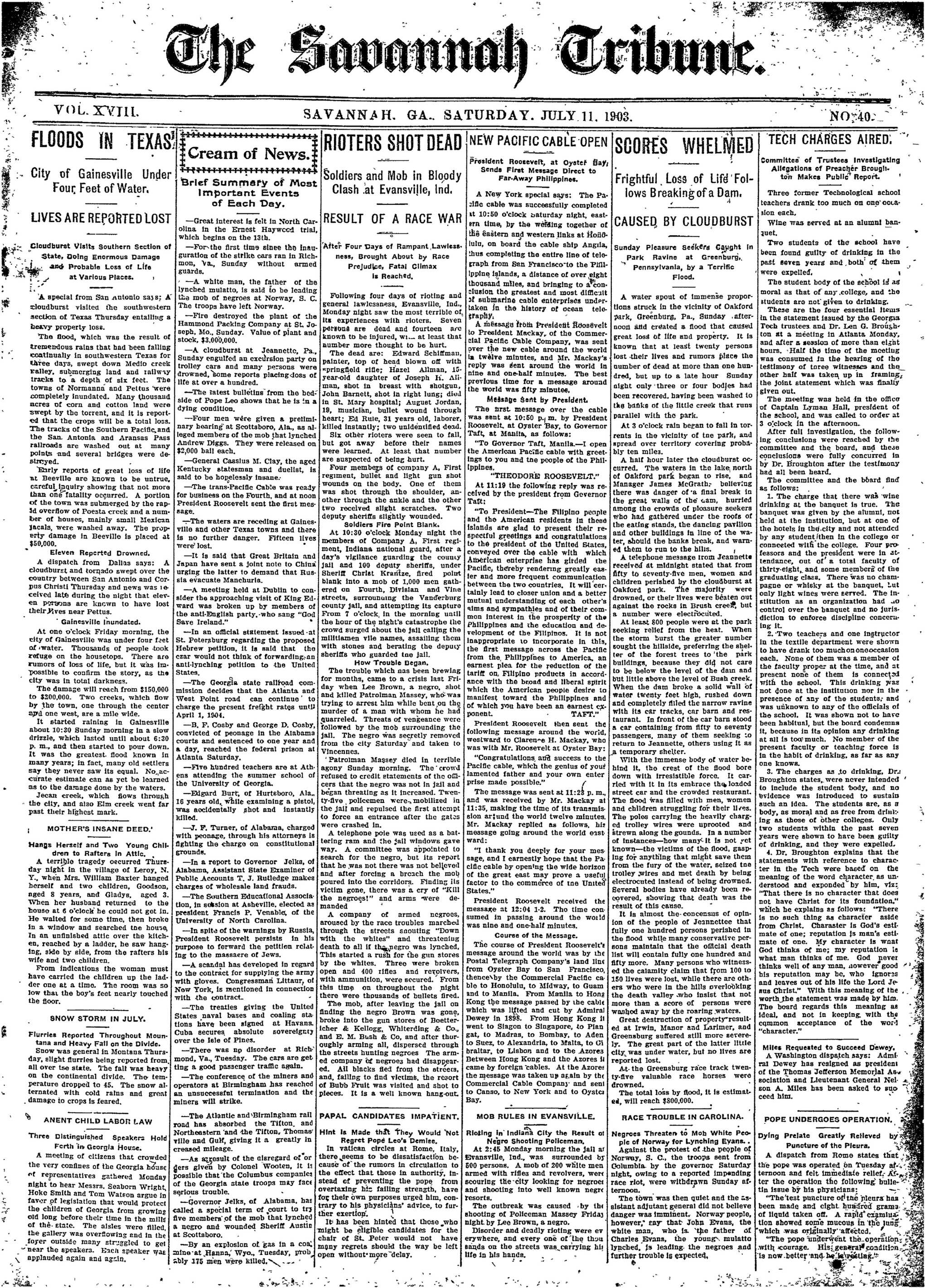
FLOODS IN TEXAS
City of Gainesville Under Four Feet of Water.
Cloudburst Visits Southern Section of State, Doing Enormous Damage and Probable Loss of Life at Various Places.
A special from San Antonio says: A cloudburst visited the southwestern section of Texas Thursday entailing a heavy property loss.
The flood, which was the result of tremendous rains that had been falling coattually in southwestern Texas for three days, swept down Medio creek valley, submerging land and railway tracks to a depth of six feet. The towns of Normann and Pettus were completely inundated. Many thousand acres of corn and cotton land were swept by the torrent, and it is reported that the crops will be a total loss. The tracks of the Southern Pacific, and the San Antonia and Aransas Pass railroads are washed out at many points and several bridges were destroyed.
Early reports of great loss of life at Beeville are known to be untrue, careful inquiry showing that not more than one fatality occurred. A portion of the town was submerged by the rapid overflow of Poesta creek and a number of houses, mainly small Mexican jacals, were washed away. The property damage in Beeville is placed at $50,000.
Eleven Reported Drowned.
A dispatch from Dallas says: A cloudburst and tornado swept over the country between San Antonio and Corpus Christi Thursday and news was received late during the night that eleven persons are known to have lost their lives near Pettus.
Gainesville Inundated.
At one o'clock Friday morning, the city of Gainesville was under four feet of water. Thousands of people took refuge on the housetops. There are rumors of loss of life, but it was impossible to confirm the story, as the city was in total darkness.
The damage will reach from $150,000 to $200,000. Two creeks, which flow by the town, one through the center and one west, are a mile wide.
It started raining in Gainesville about 10:30 Sunday morning in a slow drizzle, which lasted until about 6:30 p. m., and then started to pour down. It was the greatest flood known in many years; in fact, many old settlers say they never saw its equal. No, accurate estimate can as yet be learned as to the damage done by the waters.
Jecan creek, which flows through the city, and also Elm creek went far past their highest mark.
MOTHER'S INSANE DEED.
Hangs Herself and Two Young Children to Rafters in Attic.
A terrible tragedy occurred Thursday night in the village of Leroy, N. Y., when Mrs. William Baxter hanged herself and two children, Goodson, aged 8 years, and Gladys, aged 3. When her husband returned to the house at 6 o'clock he could not get in. He waited for some time, then broke in a window and searched the house. In an unfinished attic over the kitchen, reached by a ladder, he saw hanging, side by side, from the rafters his wife and two children. From indications the woman must have carried the children up the ladder one at a time. The room was so low that the boy's feet nearly touched the floor.
SNOW STORM IN JULY.
Flurries Reported Throughout Mountana and Heavy Fall on the Pluide.
tana and Heavy Fall on the Divide. Snow was general in Montana Thursday, slight flurries being reported from, all over the state. The fall was heavy on the continental divide. The temperature dropped to 45. The snow alternated with cold rains and great damage to crops is feared.
ANENT CHILD LABOR LAW
Three Distinguished Speakers Hold Forth in Georgia House.
A meeting of citizens that crowded the very confines of the Georgia house of representatives gathered Monday night to hear Messrs. Seaborn Wright, Hoke Smith and Tom Watson argue in favor of legislation that would protect the children of Georgia from growing old long before their time in the mills of the state. The alses were filled, the gallery was overflowing and in the forer outside many struggled to get near the speakers. Each speaker was applauded again and again.
Great interest is felt in North Carolina in the Ernest Haywccd trial, which begins on the 13th.
For the first time since the inauguration of the strike cars ran in Richmon, Va., Sunday without armed guards.
A white man, the father of the lynched mulatto, is said to be leading the mob of negroes at Norway, S. C. The troops have left Norway.
Fire destroyed the plant of the Hammond Packing Company at St. Joseph, Mo., Sunday. Value of plant and stock, $3,000,000.
A cloudburst at Jeannettc, Pa., Sunday engulfed an excursion party on trolley cars and many persons were drowned, some reports placing loss of life at over a hundred.
The latest bulletins from the bedside of Pope Leo shows that he is in a dying condition.
Four men were given a preliminary hearing at Scottsboro, Ala., as alleged members of the mob that lynched Andrew Diggs. They were released on $2,000 ball each.
General Cassius M. Clay, the aged Kentucky statesman and duellist, is said to be hopelessly insane.
The trans-Pacific Cable was ready for business on the Fourth, and at noon President Roosevelt sent the first message.
The waters are receding at Gainesville and other Texas towns and there is no further danger. Fifteen lives were lost.
—It is said that Great Britain and Japan have sent a joint note to China urging the latter to demand that Russia evacuate Manchuria.
—A meeting held at Dublin to consider the approaching visit of King Edward was broken up by members of the anti-English party, who sang "God Save Ireland."
—In an official statement issued at St. Petersburg regarding the proposed Hebrew petition, it is said that the czar would not think of forwarding an anti-lynching petition to the United States.
—The Georgia state railroad commission decides that the Atlanta and West Point road can continue to charge the present freight rates until April 1, 1904.
—B. F. Cosby and George D. Cosby, convicted of peonage in the Alabama courts and sentenced to one year and a day, reached the federal prison at Atlanta Saturday.
—Five hundred teachers are at Athens attending the summer school of the University of Georgia.
—Edgard Burt, of Hurtsboro, Ala., 16 years old, while examining a pistol, was accidentally shot and instantly killed.
—J. F. Turner, of Alabama, charged with peonage, through his attorneys is fighting the charge on constitutional grounds.
—In a report to Governor Jelks, of Alabama, Assistant State Examiner of Public Accounts T. J. Rutledge makes charges of wholesale land frauds.
—The Southern Educational Association, in session at Asheville, elected as president Francis P. Venable, of the University of North Carolina.
—In spite of the warnings by Russia, President Roosevelt persists in his purpose to forward the petition relating to the massaere of Jews.
—A scandal has developed in regard to the contract for supplying the army with gloves. Congressman Littaur, of New York, is mentioned in connection with the contract.
—The treaties giving the United States naval bases and coaling stations have been signed at Havana. Cuba secures absolute sovereignty over the Isle of Pines.
—There was no disorder at Richmond, Va., Tuesday. The cars are getting a good passenger traffic again.
—The conference of the miners and operators at Birmingham has reached an unsuccessful termination and the miners will strike.
—The Atlantic and Birmingham railroad has absorbed the Tifton, and Northeastern and the Tifton, Thomasville and Gulf, giving it a greatly in creased mileage.
—As a result of the ulsregard of orders given by Colonel Wooten, it is possible that the Columbus companies of the Georgia state troops may face serious trouble.
—Governor Jelks, of Alabama, has called a special term of court to try five members of the mob that lynched a negro and wounded Sheriff Austin at Scottsboro.
By an explosion of gas in a con mine at Hanna, Wyo., Tuesday, probably 175 men were killed.
SAVANNAH. GA., SATURDAY. JULY 11. 1903.
RIOTERS SHOT DEAD
Soldiers and Mob in Bloody Clash at Evansville, Ind.
RESULT OF A RACE WAR
After Four Days of Rampant Lawlessness, Brought About by Race Prejudice, Fatal Climax is Reached
Following four days of rioting and general lawlessness, Evansville, Ind., Monday night saw the most terrible of its experiences with rioters. Seven persons are dead and fourteen are known to be injured, wi- at least that number more thought to be hurt. The dead are: Edward Schiffman, painter, top of head blown off with springfield rifle; Hazel Allman, 15-year-old daughter of Joseph H. Allman, shot in breast with shotgun, John Barnett, shot in right lung; died in St. Mary hospital; August Jordan, 18, musician, bullet wound through heart; Ed Rule, 31 years old, laborer, killed instantly; two unidentified dead. Six other rioters were seen to fall, but got away before their names were learned. At least that number are suspected of being hurt.
Four members of company A, First regiment, bullet and light gun shot wounds on the body. One of them was shot through the shoulder, another through the ankle and the other two received alight scratches. Two deputy sheriffs slightly wounded.
Soldiers Fire Point Blank.
At 10:30 o'clock Monday night the members of Company A, First regiment, Indiana national guard, after a day's vigilance guarding the county jail and 100 deputy sheriffs, under Sheriff Christ Krantze, fired point blank into a mob of 1,000 men gathered on Fourth, Divisian and Vine streets, surrounding the Vanderburg county jail, and attempting its capture From 7 o'clock, in the morning until the hour of the night's catastrophe the crowd surged about the jail calling the militiamen vile names, assailing them with stones and berating the deputy sheriffs who guarded the jail.
How Trouble Began.
The trouble which has been brewing for months, came to a crisis last Friday when Lee Brown, a negro, shot and killed Patrolman Massey, who was trying to arrest him while bent on the murder of a man with whom he had quarreled. Threats of vengeance were followed by the mob surrounding the jail. The negro was secretly removed from the city Saturday and taken to Vincennes.
Patrolman Magsey died in terrible agony Sunday morning. The crowd refused to credit statements of the officers that the negro was not in jail and began threatening as it increased. Twenty-five policemen were mobilized in the jail and repulsed the first attempt to force an entrance after the gates were crashed in.
A telephone pole was used as a battering ram and the gall windows gave way. A committee was appointed to search for the negro, but its report that he was not there was not believed and after forcing a breach the mob poured into the corridors. Finding its victim gone, there was a cry of "Kill the negroes!" and arms were demanded.
A company of armed negroes, aroused by the race troubles marched through the streets snouting "Down with the whites" and threatening death to all if the negro was lynched. This started a rush for the gun stores by the whites. Three were broken open and 400 rifles and revolvers, with ammunition, were secured. From this time on throughout the night there were thousands of bullets fired.
The mob, after leaving the jail on finding the negro Brown was gone, broke into the gun stores of Boettercher & Kellogg, Whiterding & Co., and E. M. Bush & Co, and after thoroughly arming all, dispersed through the streets hunting negroes The armed company of negroes had disappeared. All blacks fled from the streets, and, failing to find victims, the resort of Bubb Fruit was visited and shot to pieces. It is a well known hang-out.
PAPAL CANDIDATES IMPATIENT.
Hint Is Made that They Would Not Regret Pope Leo's Demise.
In vatican circles at Rome, Italy, there seems to be dissatisfaction because of the rumors in circulation to the effect that those in authority, instead of preventing the pope from overtaxing his falling strength, have for their own purposes urged him, contrary to his physicians' advice, to further exertion.
It has been hinted that those who might be eligible candidates for the chair of St. Peter would not have many regrets should the way be left open without more delay.
NEW PACIFIC CABLE OPEN
President Roosevelt, at Oyster Bay, Sends First Message Direct to Far-Away Philippines.
A New York special says: The Pacific cable was successfully completed at 10:50 o'clock Saturday night, eastern time, by the welding together of the eastern and western links at Honiolaulu, on board the cable ship Angula, thus completing the entire line of telegraph from San Francisco to the Philippine islands, a distance of over eight thousand miles, and bringing to a conclusion the greatest and most difficult of submarine cable enterprises undertaken in the history of ocean telegraph.
A message from President Roosevelt to President Mackay, of the Commercial Pacific Cable Company, was sent over the new cable around the world in twelve minutes, and Mr. Mackay's reply was sent around the world in nine and one-half minutes. The best previous time for a message around the world was fifty minutes.
Message Sent by President
The first message over the cable was sent at 10:50 p.m. by President Roosevelt, at Oyster Bay, to Governor Taft, at Manila, as follows:
"To Governor Taft, Manila—I open the American Pacific cable with greetings to you and the people of the Philippines.
"THEODORE ROOSEVELT."
At 11:19 the following reply was received by the president from Governor Taft:
"To President—The Filipino people and the American residents in these islands are glad to present their respectful greetings and congratulations to the president of the United States, conveyed over the cable with which American enterprise has girded the Pacific, thereby rendering greatly easier and more frequent communication between the two countries. It will certainly lead to closer union and a better mutual understanding of each other's aims and sympathies and of their common interest in the prosperity of the Philippines and the education and development of the Filipinos. It is not inappropriate to incorporate in this, the first message across the Pacific from the Philippines to America, an earnest plea for the reduction of the tariff on Filipino products in accordance with the broad and liberal spirit which the American people desire to manifest toward the Philippines and of which you have been an earnest exponent. TAFT."
President Roosevelt then sent the following message around the world, westward to Clarence H. Mackay, who was with Mr. Roosevelt at Oyster Bay: "Congratulations and success to the Pacific cable, which the genius of your lamented father and your own enter prise made possible."
The message was sent at 11:23 p. m., and was received by Mr. Mackay at 11:35, making the time of its transmission around the world twelve minutes. Mr. Mackay replied as follows, his message going around the world eastward:
"I thank you deeply for your message, and I earnestly hope that the Pacific cable by opening the wide horizon of the great east may prove a useful factor to the commerce of the United States."
President Roosevelt received the message at 12:04 1:2. The time consumed in passing around the world was nine and one-half minutes.
Course of the Message.
The course of President Roosevelt's message around the world was by the Postal Telegraph Company's land line from Oyster Bay to San Francisco, thence by the Commercial Pacific cable to Honolulu, to Midway, to Guam and to Manila. From Manila to Hong Kong the message passed by the cable which was lifted and cut by Admiral Dewey in 1898. From Hong Kong it went to Slagon to Singapore, to Panagat, to Madras, to Bombay, to Aden to Suez, to Alexandria, to Malta, to Gibraltar, to Lisbon and to the Azores Between Hong Kong and the Azores it came by foreign cables. At the Azores the message was taken up again by the Commercial Cable Company and sent to Canso, to New York and to Oyster Bay.
MOB RULES IN EVANSVILLE.
Rioting in 'Indiana City the Result of Negro Shooting Policeman
At 2:45 Monday morning the Jail at Evansville, Ind., was surrounded by 500 persons. A mob of 200 white men armed with rifles and revolvers, were scouring the city looking for negroes and shooting into well known negro resorts.
The outbreak was caused by the shooting of Policeman Massey Friday night by Lee Brown, a negro.
Disorder and deadly rioting were everywhere, and every one of the thousands on the streets was carrying his life in his hands.
SCORES WHELMED
Frightful Loss of Life Follows Breaking of a Dam.
CAUSED BY CLOUDBURST
Sunday Pleasure Seekers Gaught in Park Ravine at Greenburg. Pennsylvania, by a Terrific
A water spout of immense proportions struck in the vicinity of Oakford park, Greenburg, Pa., Sunday afternoon and created a flood that caused great loss of life and property. It is known that at least twenty persons lost their lives and rumors place the number of dead at more than one hundred, but up to a late hour Sunday night only three or four bodies had been recovered, having been washed to the banks of the little creek that runs parallel with the park.
At 3 o'clock rain began to fall in torrents in the vicinity of the park, and spread over territory covering probably ten miles.
A half hour later the cloudburst occurred. The waters in the lake, north of Oakford park began to rise, and Manager James McGrath, believing there was danger of a final break in the great walls of the dam, hurried among the crowds of pleasure seekers who had gathered under the roofs of the eating stands, the dancing pavilion and other buildings in line of the water, should the banks break, and warned them to run to the hills.
A telephone message from Jeannette received at midnight stated that from fifty to seventy-five men, women and children perished by the cloudburst at Oakford park. The majority were drowned, or their lives were beaten out against the rocks in Brush creek, but a number were electrocuted.
At least 800 people were at the park seeking relief from the heat. When the storm burst the greater number sought the hillside, preferring the shelter of the forest trees to the park buildings, because they did not care to be below the level of the dam and but little above the level of Bush creek. When the dam broke a solid wall of water twenty feet high, rushed down and completely filled the narrow ravine with its car tracks, car barn and restaurant. In front of the car barn stood a car containing from fifty to seventy passengers, many of them seeking to return to Jeannette, others using it as a temporary shelter.
With the immense body of water behind it, the crest of the flood bore down with irresistible force. It carried with it in its embrace the loaded street car and the crowded restaurant. The flood was filled with men, women and children struggling for their lives. The poles carrying the heavily charged trolley wires were uprooted and strewn along the gounds. In a number of instances—how many it is not yet known—the victims of the flood, gasping for anything that might save them from the fury of the water, seized the trolley wires and met death by being electrocuted instead of being drowned. Several bodies have already been recovered, showing that death was the result of this cause.
It is almost the concensus of opinion of the people of Jeannettee that fully one hundred persons perished in the flood while many conservative persons maintain that the official death list will contain fully one hundred and fifty more. Many persons who witnessed the calamity claim that from 100 to 150 lives were lost, while there are others who were in the hills overlooking the death valley who insist that not more than a score of persons were washed away by the roaring waters. Great destruction of property resulted at Irwin, Manor and Larimer, and Greensburg suffered still more severely. The great part of the latter little city, was under water, but no lives are reported lost. At the Greensburg race track twenty-five valuable race horses were drowned.
The total loss by flood, it is estimated, will reach $800,000.
Negroes Threaten to Mob White People of Norway for Lynching Evans.. Against the protest of the people of Norway, S. C., the troops sent from Columbia by the governor Saturday night, owing to a reported impending race riot, were withdrawn Sunday afternoon. The town was then quiet and the assistant adjutant general did not believe danger was imminent. Norway people, however, say that John Evans, the white man, who is the father of Charles Evans, the young mulatto lynched, is leading the negroes and further trouble is expected.
NO 40.
Committee of Trustees Investigating Allegations of Preacher Broughton Makes Public Report.
Three former Technological school teachers drank too much on one occasion each.
Wine was served at an alumni banquet.
Two students of the school have been found guilty of drinking in the past seven years and both of them were expelled.
The student body of the school is as moral as that of any college, and the students are not given to drinking.
These are the four essential items in the statement issued by the Georgia Tech trustees and Dr. Len G. Broungton at a meeting in Atlanta Monday, and after a session of more than eight hours. Half the time of the meeting was consumed in the hearing of the testimony of three witnesses and the other half was taken up in framing, the joint statement which was finally given out.
The meeting was held in the office of Captain Lyman Hall, president of the school, and was called to order at 3 o'clock in the afternoon.
After full investigation, the following conclusions were reached by the committee and the board, and these conclusions were fully concurred in by Dr. Broungton after the testimony had all been heard.
The committee and the board find as follows:
1. The charge that there was wine drinking at the banquet is true. The banquet was given by the alumni, not held at the institution, but at one of the hotels in the city and not attended by any student/then in the college or connected with the college. Four professors and the president were in attendance, out of a total faculty of thirty-eight, and some members of the graduating class. There was no champagne or whisky at the banquet, but only light wines were served. The institution as an organization had no control over the banquet and no jurisdiction to enforce discipline concerning it.
2. Two teachers and one instructor in the textile department were shown to have drank too much on one occasion each. None of them was a member of the faculty proper at the time, and at present none of them is connected with the school. This drinking was not done at the institution nor in the presence of any of the students; and was unknown to any of the officials of the school. It was shown not to have been habitual, but the board condemns it, because in its opinion any drinking at all is too much. No member of the present faculty or teaching force is in the habit of drinking, as far as any one knows.
3. The charges as to drinking. Dr. Broughton states, were never intended to include the student body, and no evidence was introduced to sustain such an idea. The students are, as a body, as moral and as free from drinking as those of other colleges. Only two students within the past seven years were shown to have been guilty of drinking, and they were expelled.
4. Dr. Broughton explains that the statements with reference to character in the Tech were based on the meaning of the word character as understood and expended by him, viz; "That there is no character that does not have Christ for its foundation," which he explains as follows: "There is no such thing as character aside from Christ. Charaster is God's estimate of one; reputation is man's estimate of one. My character is what God thinks of me; my reputation is what man thinks of me. God never thinks well of any man, however good his reputation may be, who ignores and leaves out of his life the Lord Jesus Christ." With this meaning of the worth the statement was made by him. The board regards this meaning as ideal, and not in keeping with the common acceptance of the word "character."
Miles Requested to Succeed Dewey.
A Washington dispatch says: Admiral Dewey has resigned as president of the Thomas Jefferson Memorial Association and Lieutenant General Nelson A. Miles has been asked to suceed him.
POPE UNDERGOES OPERATION.
A dispatch from Rome states that the pope was operated on Tuesday afternoon and felt immediate relief. After the operation the following bulletin issue by his physicians:
"The test puncture of the pleura has been made and eight hundred grams of liquid taken off. A rapid examination showed some mucous in the lung which was originally affected.
"The pope underwent the operation with courage. His general condition is now better and he is resting."
The Savannah Tribune.
PUBLISHED EVERY SATURDAY,
BY THE TRIBUNE PUBLISHING CO
116 W. St. Julian Street.
Ga. Phone 574.
SUBSCRIPTION RATE.
One Year $1.25
Six Months .75
Three Months .50
Remittance must be made by Express or
Post Office Money Order, or Registered Letter
Advertising Rate given on application.
SATURDAY JULY 11, 1903.
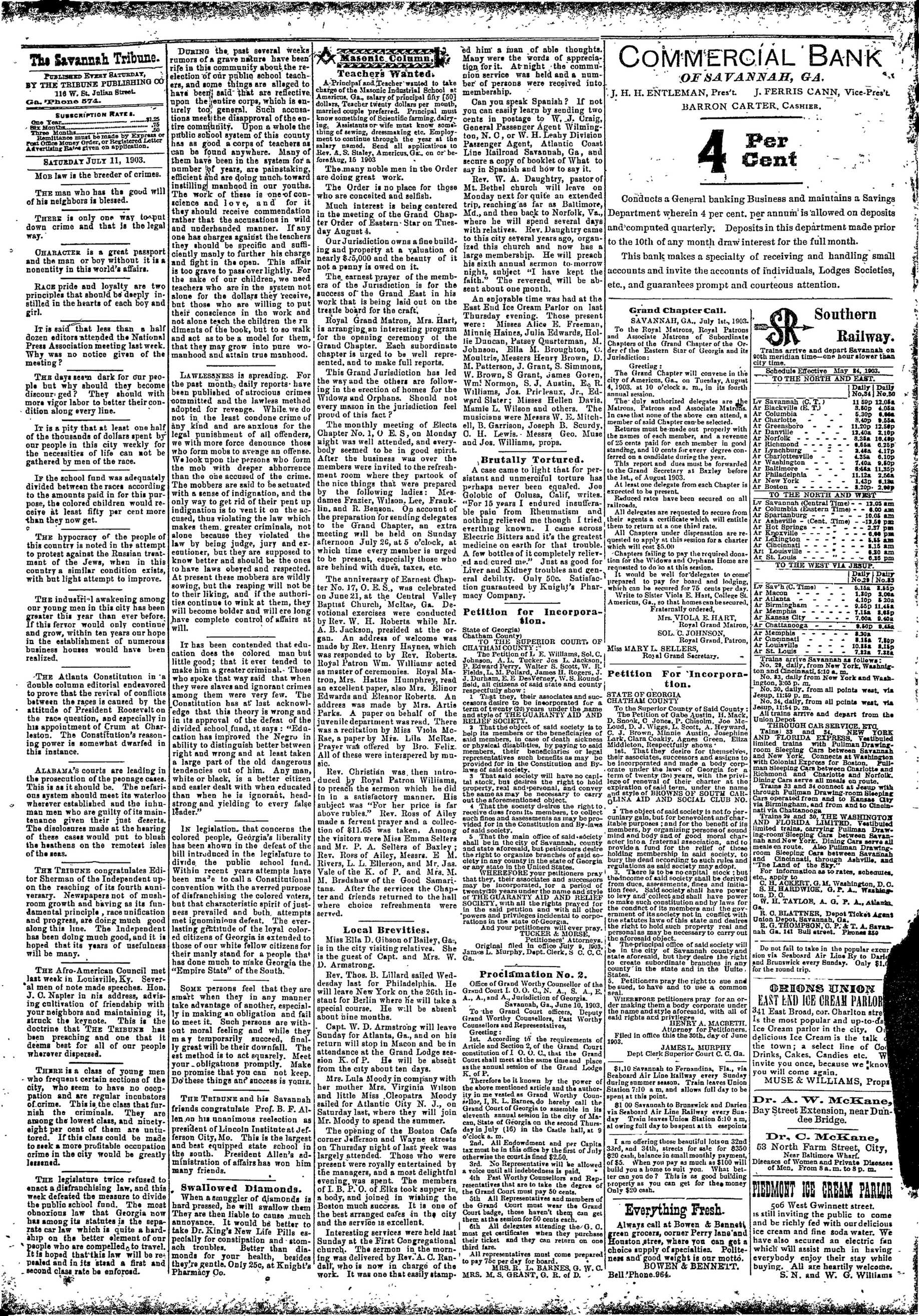
Mob law is the breeder of crimes.
The man who has on the good will
of his neighbors is blessed.
THERE is only one way to put
down crime and that is the legal
way.
CHARACTER is a great passport and the man or boy without it is a nonentity in this world's affairs.
RACE pride and loyalty are two principles that should be deeply instilled in the hearts of each boy and girl.
It is said that less than a half dozen editors attended the National Press Association meeting last week. Why was no notice given of the meeting?
The days seem dark for our people but why should they become discouraged? They should with more vigor labor to better their condition along every line.
It is a pity that at least one half of the thousands of dollars spent by our people in this city weekly for the necessities of life can not be gathered by men of the race.
If the school fund was adequately divided between the races according to the amounts paid in for this purpose, the colored children would receive at least fifty per cent more than they now get.
The hypocracy of the people of this country is noted in this attempt to protest against the Russian treatment of the Jews, when in this country a similar condition exists, with but light attempt to improve.
THE industrial awakening among our young men in this city has been greater this year than ever before. If this fervor would only continue and grow, within ten years our hope in the establishment of numerous business houses would have been realized.
THE Atlanta Constitution in a double column editorial endeavored to prove that the revival of conflicts between the races is caused by the attitude of President Roosevelt on the race question, and especially in his appointment of Crum at Charleston. The Constitution's reasoning power is somewhat dwarfed in this instance.
ALABAMA's courts are leading in the prosecution of the peonage cases. This is as it should be. The nefarious system should meet its waterloo wherever established and the human men who are guilty of its maintenance given their just deserts. The disclosures made at the hearing of these cases would put to blush the heathens on the remotest isles of the seas.
THE TRIBUNE congratulates Editor Sherman of the Independent upon the reaching of its fourth anniversary. Newpapers not of mushroom growth and having as its fundamental principle, race unification and progress, are doing much good along this line. The Independent has been doing much good, and it is hoped that its years of usefulness will be many.
THE Afro-American Council met last week in Louisville, Ky. Several men of note made speeches. Hon. J. C. Napier in his address, advising cultivation of friendship with your neighbors and maintaining it, struck the keynote. This is the doctrine that THE TRIBUNE has been preaching and one that it deems best for all of our people wherever dispersed.
THERE is a class of young men who frequent certain sections of the city, who seem to have no occupation and are regular incubators of crime. This is the class that furnish the criminals. They are among the lowest class, and ninety-eight per cent of them are unintended. If this class could be made to seek a more profitable occupation crime in the city would be greatly lessened.
THE legislature twice refused to enact a disfranchising law, and this week defeated the measure to divide the public school fund. The most obnoxious law that Georgia now has among its statutes is the separate car law which is quite a hardship on the better element of our people who are compelled to travel. It is hoped that this law will be repealed and in its stand a first and second class rate be enforced.
DURING the past several weeks rumors of a grave nature have been rife in this community about the re-election of our public school teachers, and some things are allied to have been said that are reflective upon the sentire corps, which is entirely too general. Such accusations meet the disapproval of the entire community. Upon a whole the public school system of this county has as good a corps of teachers as can be found anywhere. Many of them have been in the system for a number of years, are painstaking, efficient and are doing much toward instilling manhood in our youths. The work of these is one of conscience and love, and for it they should receive commendation rather that the accusations in wild and underhanded manner. If any one has charges against the teachers they should be specific and sufficiently manly to further his charge and fight in the open. This affair is too grave to pass over lightly. For the sake of our children, we need teachers who are in the system not alone for the dollars they receive, but those who are willing to put their conscience in the work and not alone teach the children the rudiments of the book, but to so walk and act as to be a model for them, that they may grow into pure womanhood and attain true manhood.
LAWLESSNESS is spreading. For the past month, daily reports have been published of atrocious crimes committed and the lawless method adopted for revenge. While we do not in the least condone crime of any kind and are anxious for the legal punishment of all offenders, we with more force denounce those who form mobs to avenge an offense. We look upon the persons who form the mob with deeper abhorrence than the one accused of the crime. The mobbers are said to be actuated with a sense of indignation, and the only way to get rid of their pent up indignation is to vent it on the accused, thus violating the law which makes them, greater criminals, not alone because they violated the law by being judge, jury and executioner, but they are supposed to know better and should be the ones to have laws obeyed and respected. At present these mobbers are wildly sowing, but the reaping will not be to their liking, and if the authorities continue to wink at them, they will become bolder and will ere long have complete control of affairs at will.
It has been contended that education does the colored man but little good; that it ever tended to make him a greater criminal. Those who spoke that way said that when they were slaves and ignorant crimes among them were very few. The Constitution has at last acknowledge that this theory is wrong and in its approval of the defeat of the divided school fund, it says: "Education has improved the Negro in ability to distinguish better between right and wrong and at least taken a large part of the old dangerous tendencies out of him. Any man, white or black, is a better citizen and easier dealt with when educated than when he is ignorant, headstrong and yielding to every false leader."
IN legislation, that concerns the colored people, Georgia's liberality has been shown in the defeat of the bill introduced in the legislature to divide the public school fund. Within recent years attempts have been made to call a Constitutional convention with the averred purpose of disfranchising the colored voters, but that characteristic spirit of justness prevailed and both attempts met ignominious defeat. The everlasting gratitude of the loyal colored citizens of Georgia is extended to those of our white fellow citizens for their manly stand for a people that has done much to make Georgia the "Empire State" of the South.
SOME persons feel that they are smart when they in any manner take advantage of another, especially in making an obligation and fail to meet it. Such persons are without moral feeling and while they may temporarily succeed, finally great will be their downfall. The est method is to act squarely. Meet your_obligations promptly. Make no promise that you can not keep. Do these things and success is yours.
THE TRIBUNE and his Savannah friends congratulate Prof. B. F. Allen, on his unanimous reelection as president of Lincoln Institute at Jefferson City, Mo. This is the largest and best equipped state school in the south. President Allen's administration of affairs has won him many friends.
Swallowed Diamonds.
When a smuggler of diamonds is hard pressed, he will swallow them They are then liable to cause much annoyance. It would be better to take Dr. King's New Life Pills especially for constipation and stomach troubles. Better than diamonds for your health, besides they're gentle. Only 25c, at Knight's Pharmacy Co.
Masonic Column.
Teachers Wanted.
A. Principal and Teacher wanted to take charge of the Masonic Industrial School at Americas, Ga., salary of principal fifty [50] dollars, Teacher twenty dollars per mouth, married couple preferred. Principal must know something of Scientific farming, dairying. Assistants or wife must know something of sewing, dressmaking etc. Employment to continue through the year at the salary named. Send all applications to Rev. A. S. Staley, Americus, Ga., on or before Aug. 15, 1903.
The many noble men in the Order are doing great work.
The Order is no place for those who are conceited and selfish.
Much interest is being centered in the meeting of the Grand Chapter Order of Eastern Star on Tuesday August 4.
Our Jurisdiction owns a fine building and property at a valuation of nearly $25,000 and the beauty of it not a penny is owed on it.
The earnest prayer of the members of the Jurisdiction is for the success of the Grand East in his work that is being laid out on the treasble board for the craft.
Royal Grand Matron, Mrs. Hart, is arranging, an interesting program for the opening ceremony of the Grand Chapter. Each subordinate chapter is urged to be well represented, and to make full reports.
This Grand Jurisdiction has led the way and the others are following in the erection of homes for the Widows and Orphans. Should not every mason in the jurisdiction feel proud of this fact?
The monthly meeting of Electa Chapter No. 1, O E. S, on Monday night was well attended, and everybody seemed to be in good spirit. After the business was over the members were invited to the refreshment room where they partook of the nice things that were prepared by the following ladies: Mesdames Frazier, Wilson Lee, Franklin, and R. Benson. On account of the preparation for sending delegates to the Grand Chapter, an extra meeting will be held on Sunday afternoon July 26, at 5 o'clock, at which time every member is urged to be present, especially those who are behind with dues, taxes, etc.
The anniversary of Earnest Chapter No. 17, O. E. S., was celebrated on June 21, at the Central Valley Baptist Church, McRae, Ga. Devotional exercises were conducted by Rev. W. H. Roberts while Mr. A. B. Jackson, presided at the organ. An address of welcome was made by Rev. Henry Haynes, which was responded to by Rev. Roberts, Royal Patron Wm. Williams acted as master of ceremonies. Royal Matron, Mrs. Hattie Humphrey, read an excellent paper, also Mrs. Elinor Edwards and Eleanor Roberts. An address was made by Mrs. Artis Parks. A paper on behalf of the juvenile department was read. There was a recitation by Miss Viola McRae, a paper by Mrs. Lila McRae, Prayer was offered by Bro. Felix. All of these were interspersed by music.
Rev. Christian was then introduced by Royal Patron Williams, to preach the sermon which he did in in a satisfactory manner. His subject was "For her price is far above rubies." Rev. Ross of Ailey made a fervent prayer and a collection of $11.65 was taken. Among the visitors were Misa Emma Sellers and Mr. P. A. Sellers of Baxley; Rev. Ross of Ailey, Messrs. E M. Rivers, L. L. Ellerson, and Mr. Jas. Vale of the K. of P. and Mrs. M. M. Bradshaw of the Good Samaritans. After the services the Chapter and friends returned to the hall where choice refreshments were served.
Local Brevities.
Miss Ella D. Gibson of Bailey, Ga., is in the city visiting relatives. She is the guest of Capt. and Mrs. W. D. Armstrong.
Rev. Thos. B. Lillard sailed Wednesday last for Philadelphia. He will leave New York on the 26th instant for Berlin where he will take a special course. He will be absent about nine months.
Capt. W. D. Armstrong will leave Sunday for Atlanta, Ga., and on his return will stop in Macon and be in attendance at the Grand Lodge session K. of P. He will be absent from the city about ten days.
Mrs. Lula Moody in company with her mother Mrs. Virginia Wilson and little Miss Cleopatra Moody sailed for Atlantic City N. J., on Saturday last, where they will join Mr. Moody to spend the summer.
The opening of the Boston Cafe corner Jefferson and Wayne streets on Thursday night of last week was largely attended. Those who were present were royally entertained by the managers, and a most delightful evening was spent. The members of I.B.P.O. of Elks took supper in a body, and joined in wishing the Boston much success. It is one of the best arranged cafes in the city and the service is excellent.
Interesting services were held last Sunday at the First Congregational church. The sermon in the morning was delivered by Rev.A.C. Randall, who is now in charge of the work. It was one that easily stamp-
ed him a man of able thoughts. Many were the words of appreciation for it. At night the communion service was held and a number of persons were received into membership.
Can you speak Spanish? If not you can easily learn by sending two cents in postage to W. J. Craig, General Passenger Agent Wilmington, N. C., or W. H. Leahy Division Passenger Agent, Atlantic Coast Line Railroad Savannah, Ga, and secure a copy of booklet of What to say in Spanish and how to say it.
Rev. W. A. Daughtry, pastor of Mt. Bethel church will leave on Monday next for quite an extended trip, reaching as far as Baltimore, Md., and then back to Norfolk, Va., where he will spend several days with relatives. Rev. Daughtry came to this city several years ago, organized this church and now has a large membership. He will preach his sixth annual sermon to-morrow night, subject "I have kept the faith." The reverend, will be absent about one month.
An enjoyable time was had at the East End Ice Cream Parlor on last Thursday evening. Those present were: Misses Alice E. Freeman, Minnie Haines, Julia Edwards, Holie Duncan, Patsey Quarterman, M. Johnson, Ella M. Broughton, C. Moultrie, Messers Henry Brown, D. M. Patterson, J. Grant, S. Simmons, W. Brown, S Grant, James Goven, Wm! Normon, S. J. Austin, E$_3$ R. Williams, Jos. Pricileaux, Jr., Edward Slater; Misses Hellen Davis, Mamie L. Wilson and others. The musicians were Messrs W. E. Mitchell, B. Garrison, Joseph B. Scurdy, C. H. Lewis. Messrs Geo. Muse and Jos. Williams, props.
Brutally Tortured.
A case came to light that for persistent and unmerciful torture has perhaps never been equaled. Jos Golobic of Olusia, Calif, writes. "For 15 years I endured insufferable pain from Rheumatism and nothing relieved me though I tried everything known. I came across Electric Bitters and it's the greatest medicine on earth for that trouble. A few bottles of it completely relieved and cured me." Just as good for Liver and Kidney troubles and general debility. Only 50c. Satisfaction guaranteed by Knight's Pharmacy Company.
Petition for Incorporation.
State of Georgia)
Chatham County)
TO THE SUPERIOR COURT. OF
CHATHAM COUNTY.
The Petition of L. E. Williams, Sol. C. Johnson, A. L. Tucker Jos. L. Jackson, P. Edward Perry, Walter S. Scott, W. R. Fields, L. M. Pollard, James H. Rogers, J. D. Durham, E. E. DesVernay, W. S. Roundfield, all citizens of said state and county residents. 3 That they, their associates and successors desire to be incorporated for a term of twenty (20) years under the name and style of THE GUARANTY AID AND RELIEF SOCIETY. 3 That the object of said society is to help the object of the beneficiaries of said members, in case of death sickness or physical disabilities, by paying to said members, their beneficiaries or legal representatives such benefits as may be provided for in the Constitution and By-laws of said society. 3 That the society will have no capital stock, but desires the right to hold property, real and personal, and convey the same as may be necessary to carry out the aforementioned object. 4 That the society desires the right to receive dues from its members, to collect such fines and assessments as may be provided for in the Constitution and By-laws of said society.
5 That the main office of said society shall be in the city of Savannah, county and state aforesaid, but petitioners desire the right to organize branches of said society or Georgia or any state in the United States.
WHEREFORE your petitioners pray that they, their associates and successors may be incorporated, for a period of twentyfour years under the name and style THE GLARAN AND RELIEF SOCIETY, with all the right required in the said petition and with all the powers and privileges incidental to corporations in the state of Georgia.
And your petitioners will ever pray.
TUCKER & MORSE,
P petitioners Attorney,
Original filed July 9, 9,
James L. Murphy, Dept. Clerk, S C. C. C. Ga.
Proclamation No. 2.
Office of Grand Worthy Counselor of the Grand Court I. O. O. C., N. A., S. A., E. A., a., and A., Jurisdiction of Georgia.
Savannah, Ga., June 10, 1903.
To the Grand Court officers, Deputy Grand Worthy Counselors, Past Worthy Counselors and Representatives,
Greeting:
1st. According to the requirements of Article and Section 2, of the Grand Court constitution of I. O. O. C., that the Grand Court shall meet at the same time and place as the annual session of the Grand Lodge K. of P.
Therefore be it known by the power of the above mentioned article and the authority in me vested as Grand Worthy Counselor, I, R. L. Barnes, do hereby call the Grand Court of Georgia to assemble in its eleventh annual session in the city of Macan, State of Georgia on the second Thursday in July (16) in the Castle hall, at 9 o'clock a. m.
2nd. All endowment and per Capita tax must be in this office by the first of July otherwise the court is found $2.50.
3rd. No Representative will be allowed a voice until all indebtedness is paid.
4th Past Worthy Counselors and Rep-
legents of the Grand Court must pay 50 cents
6th All delegates attending the G. G.
must get certificates when they purchase
their ticket and they can return on one
third fare.
All representatives must come prepared
to pay 75c per day for board.
MRS. R. L. BARNES. G. W. C.
MRS. M. S. GRANT. R. B. of D.
COMMERCIAL BANK OF SAVANNAH, GA.
J. H. H. ENTLEMAN, Pres't. J. FERRIS CANN, Vice-Pres't. BARRON CARTER, CASHIER. 4 Per Cent
Conducts a General banking Department wherein 4 per cent. and computed quarterly. Deposit to the 10th of any month draw in This bank makes a specialty accounts and invite the accounts etc., and guarantees prompt and
Conducts a General banking Business and maintains a Savings Department wherein 4 per cent. per annum is allowed on deposits and computed quarterly. Deposits in this department made prior to the 10th of any month draw interest for the full month. This bank makes a specialty of receiving and handling small accounts and invite the accounts of individuals, Lodges Societies, etc., and guarantees prompt and courteous attention.
Grand Chapter Call.
SAVANNAH, GA., July 1st, 1903. To the Royal Matrons, Royal Patrons and Associate Matrons of Subordinate Chapters of the Grand Chapter of the Order of the Eastern Star of Georgia and its Jurisdiction:
Greeting:
The Grand Chapter will convene in the city of Americas, Ga., on Tuesday, August 4, 1903, at 10 o'clock a. m., in its fourth annual session.
The duly authorized delegates are the Matrons, Patrons and Associate Matrons. In case that none of the above can attend, a member of said Chapter can be selected.
Returns must be made out properly with the names of each member, and a revenue of 25 cents for each member in good standing, and 10 cents for every degree conferred on a candidate during the year.
This report and dues must be forwarded to the Grand Secretary at Baxley before the 1st., of August 1903.
At least one delegate from each Chapter is expected to be present.
Reduced rates have been secured on all railroads.
All delegates are requested to secure from their agents a certificate which will entitle them to return at a one third rate.
All Chapters under dispensation are requested to apply at this session for a charter which will cost $5.00
Chapters failing to pay the required donation for the Widows and Orphans Home are requested to do so at this session.
It would be well for delegates to come prepared to pay for board and lodging, which can be secured for 75 cents per day.
Write to Sister Viola E. Hart, College St. Americus, Ga., so that homes can be secured.
Fraternally ordered,
Mrs. VIOLA E. HART,
Royal Grand Matron,
SOL. C. JOHNSON,
Royal Grand, Patron,
Miss MARY L. SELLERS,
Royal Grand Secretary.
Petition For `Incorporation.
To the Superior County of Said County,
The Petition of Gabe Austin, H. Mack,
D. Snook, G. Jones, P. Chisolm, Joe McLoud, D. J. Wiggs, L. Scott, A. Heyward,
C. J. Brown, Minnie Austin, Josephine Clark, Alma Agnes Green, Elliza Middleton (Requeeve) in
1st. that they desire for themselves,
their associates, successors and assigns to
be incorporated and made a body corporate under the laws of Georgia for a term of twenty (20) years, with the privilege of renewal of their charter at the expiration of said term, under the name and style of BROWNS OF SOUTH CAROLINA AID AND SOCIAL CLUB NO.
2 The object of said society is not to per-curient gain, but for benevolent and charitable purposes; and for the benefit of its members, by organizing persons of sound mind and body and of good moral character into a fraternal association, and to provide a fund for the relief of those in need; and to bury the dead according to such rules and regulations as said society may adopt.
3. There is to be no capital stock; but the income of said society shall be derived from dues, assessments, fines and initiation fees. Said society shall have power to make such constitution and by laws for the conduct of its members and the government of its society not in conflict with the statutes laws of this state and desires the right to hold such property real and personalas may be necessary to carry out the duties of the office. 4. The principal office of said society will be in the city of Savannah county and state aforesaid, but they desire the right to create subordinate branches in any county in the state and in the Uluot, States. Citizens pray the right to sue and be sued, to have and to use a common seal.
WHEREFORE petitioners pray for an order making them a body corporate under the name and style aforesaid, with all of said rights and privileges
HENRY A. MACBETH.
Attorney for Petitioners.
Filed in office this the 20th, day of June 1903.
JAMES L. MURPHY
Dept Clerk Superior Court C. C. Ga.
$1.10 Savannah to Fernandina, Fla., via
Seaboard Air Line Railway every Sunday
during summer season. Train leaves Union
Station 7:10 a.m. and allows full day to be
spent at this point.
$1.00 Savannah to Brunswick and Darien
via Seaboard Air Line Railway every Sunday.
Train leaves Union Station 5:10 a.m.
al owing full day to be spent at the epospits.
I am offering those beautiful lots on 32nd
33rd, and 34th, streets for sale for $350
$20 cash, balance in small monthly payment,
of $5. When you pay as much as $100 will
build you a home to suit you. What better
can you do? This is as good building
property as you can get for the money
Only $20 cash.
Everything Fresh.
Always call at Bowen & Bannatj
green grocers, corner Perry lane and
Houston stree, where you can get a
choice supply of specialties. Polite-
ness and good weight is our motto.
BOWEN & BENNETT.
Bell Phone 964.
STATE OF GEORGIA
CHATHAM COUNTY
Business and maintains a Savings per annum is allowed on deposits sits in this department made prior terest for the full month. of receiving and handling small of individuals, Lodges Societies, courteous attention.
Southern Railway.
Trains arrive and depart Savannah on both meridian time—one hour slower than city time.
Scheduled Executive May 14, 2005.
TO THE NORTH AND EAST.
Daily No.50
Daily No.54
Lv Savannah (C. T.) - 11.59p 12.05a
Ar Blackville (E. T.) - 8.60p 12.05a
Ar Columbia - 5.30p 12.06a
Ar Charlotte - 8.40p 12.05a
Ar Galloway - 11.09p 12.05a
Ar Danville - 12.40p 2.10p
Ar Norfolk - 8.38p 10.48p
Ar Richmond - 8.65a 0.25p
Ar Lynchburg - 2.48a 4.17p
Ar Charlotteville - 4.55a 6.10p
Ar Washington - 7.40a 9.10p
Ar Milton - 8.64a 11.25p
Ar Philadelphia - 11.12a 6.50a
Ar New York - 1.43p 6.18a
Ar Boston - 8.20p 2.00p
TO THE NORTH AND WEST
Lv Savannah (Central Time) - 12.05am
Ar Columbia (Eastern Time) - 6.00am
Ar Spartanburg - 10.05am
Ar Asheville (Cent. Time) - 12.58pm
Ar Hot Springs - 2.37pm
Ar Knoxville - 6.00pm
Ar Kingston - 5.45am
Ar Chicago - 8.00am
Ar Louisville - 6.30am
Ar St. Louis - 6.30pm
TO THE WEST VIA JRMP
| | Daily No.29 | Daily No.23 |
| :--- | :--- | :--- |
| Lv Sav'h (C. Time) | - - - | 5.15a 8.55p |
| Ar Atlanta | - - - | 1.80p 3.00a |
| Ar Birmingham | - - - | 4.10p 7.00a |
| Ar Memphis | - - - | 9.65p 11.48p |
| Ar Kansas City | - - - | 7.00a 9.40a |
| Ar Chattanooga | - - - | 8.50p 8.46a |
| Ar Memphis | - - - | 8.30a |
| Ar Cincinnati | - - - | 8.15a 7.89p |
| Ar St. Louis | - - - | 10.18a 8.15p |
| Traina arrive Savannah as follow | - - - | 7.22a |
No. 28, daily, Boston; Washington
and Cincinnati, 5:10 a.m.
No. 23, daily from New York and Washington, 8:05 p. m.
No. 30, daily, from all points west, via
Jesup, 11:59 p. m.
No. 34, daily, from all points west, via
Jesup, 11:54 p. m.
All trains arrive and depart from the Union Depot
THROUGH CAR SERVICE, ETQ, NEW YORK
AND FLORIDA EXPRESS. Vestibulated limited trains with Pullman Drawing-room Sleeping Cars between Savannah and New York. Connects at Washington with Colonial Express for Boston. Pull-room Sleeping Cars between Charlottes and Richmond. Dining Cars serve all meals on route.
Trains S3 and S4 connect at Jesup with through Pullman Drawing-room Sleeping Cars operated from and to Kansas City and from and from to Cincinnati via Chattanooga.
Trains S2 and S0, THE WASHINGTON AND FLORIDA LIMITED. Vestibulated limited trains, carrying Pullman Drawing-room Sleeping Cars between Savannah and New York. Dining Cars serve all meals on route. Pullman Drawing-room Sleeping Cars between Savannah and Cincinnati, through Ashville, and "The Land of the Sky."
For information as to rates, scheumes, etc. apply
G. G. KERT, G. M. Washington, D. C.
S. H. HARDWICK, G. P. A., Washington, D. C.
W. H. TAYLOB, A. G. P. A., Atlanta
Ga.
R. G. BLAITTNER, Depot Ticket Agent Union Depot, Savannah, Ga.
E. G. THOMPSON, O. P. & T. A. Savannah Ga. 141 Bull street. Phones 250
Do not fail to take in the popular excursion via Seaboard Air Line Ry to Darling and Brunswick every Sunday. Only $1.0 for the round trip.
ORIIONS UNION
EAST END ICE CREAM PARLOR
341 East Broad, cor. Charlton street
Is the most popular and up-to-date
Ice Cream parlor in the city. Our
delicious Ice Cream is the talk of
the town; a select line of Cool
Drinks, Cakes, Candies etc. We
invite you once, because we know
you will come again.
MUSE & WILLIAMS, Props
Dr. A. W. McKane,
Bay Street Extension, near Dundee Bridge.
Dr. C. McKane,
53 North Farm Street, City,
Near Baltimore Wharf.
Diseases of Women and Private Diseases
of Men, from 8 a.m. to 8 p.m.
PIEDMONT IGB CREAM PARLOR
506 West Gwinnett street. is still inviting the public to come and be richly fed with our delicious ice cream and fine soda water. We have also secured an electric fan which will assist much in having everybody enjoy their stay while buying. All are heartily welcome. S.N. and W.G. Williams
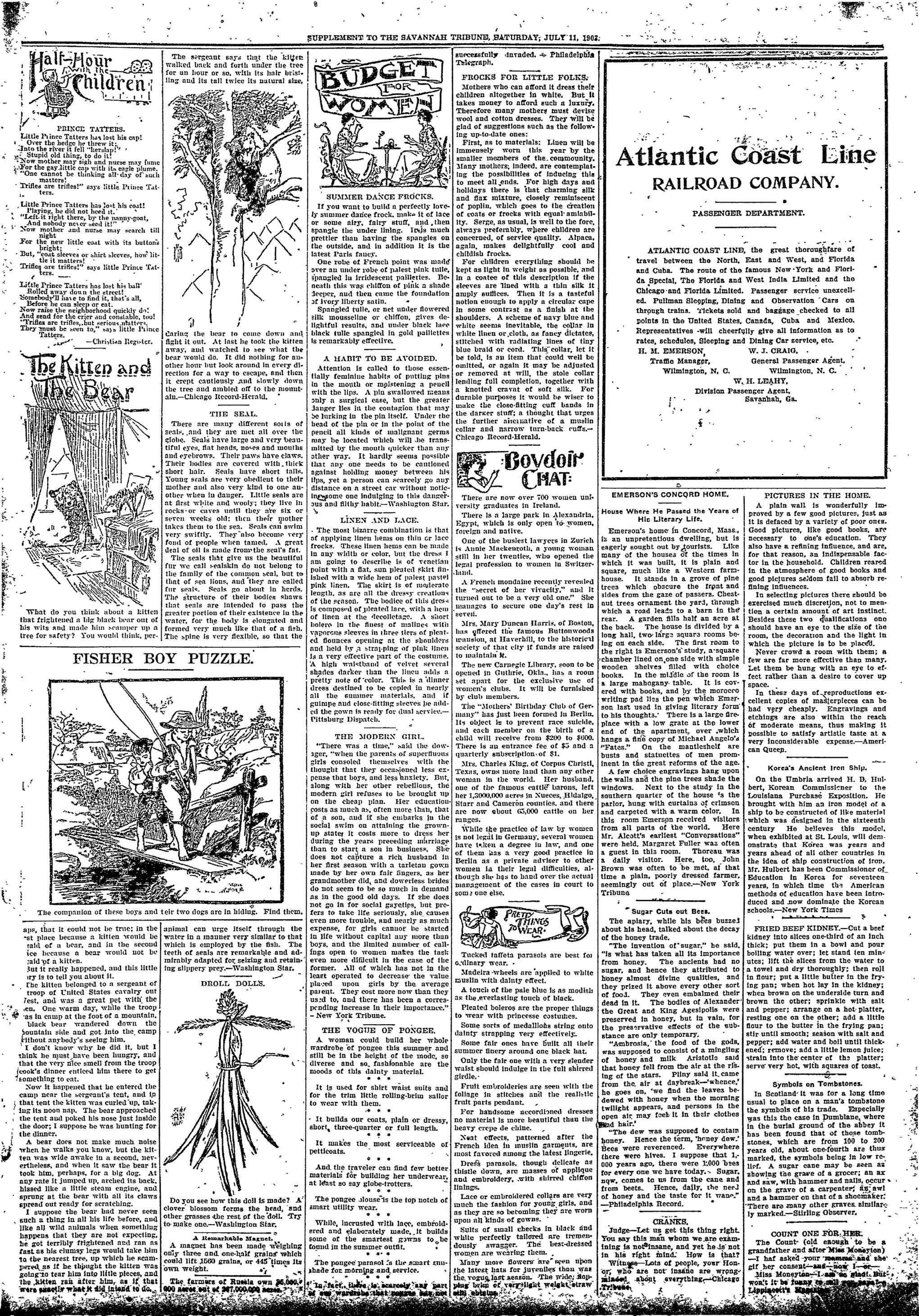
FISHER BOY PUZZLE.
THE FISHING BOAT
The companion of these boys and teir two dogs are in hiding. Find them.
Half-Hour With the Children
"Now mother may sigh and nurse may funn
"For the gay little cap with its eagle plume.
"One cannot be thinking all day of such
matters!
Trifles are trifles!" says little Prince Tatters.
Little Prince Tatters has lost his coat! Playing, he did not heed it. "Left it right there, by the manny-goat, And nobody never seed it!" Now mother and nurse may search till night For the new little coat with its buttons bright; But, "coat sleeves or shirt sleeves, how little it matters! Trifles are trifles!" says little Prince Tatters.
Before he can sleep or eat.
Now raise the neighborhood quickly do!
And send for the crier and constable, too!
"Trifles are trifles, but serious natters.
They must be seen to," says little Prince
Tatters.
The Kitten and
The Bear
What do you think about a kitten that frightened a big black bear out of his wits and made him scamper up a tree for safety? You would think, per-
FISHER BO
The companion of these boys and
aps, that it could not be true; in the first place because a kitten would be raid of a bear, and in the second ice because a bear would not be raid of a kitten.
But it really happened, and this little cry is to tell you about it.
The kitten belonged to a sergeant of troop of United States cavalry out test, and was a great pet with the en. One warm day, while the troop was in camp at the foot of a mountain, black bear wandered down the mountain side and got into the camp without anybody's seeing him.
I don't know why he did it, but I think he must have been hungry, and that the very nice smell from the troop cook's dinner enticed him there to get something to eat.
Now it happened that he entered the camp near the sergeant's tent, and in that tent the kitten was curled up, taking its noon nap. The bear approached the tent and poked his nose just inside the door; I suppose he was hunting for the dinner.
A bear does not make much noise when he walks you know, but the kitten was wide awake in a second, nevertheless, and when it saw the bear it took him, perhaps, for a big dog. At any rate it jumped up, arched its back, hissed like a little steam engine, and sprung at the bear with all its claws spread out ready for scratching.
I suppose the bear had never seen such a thing in all his life before, and like all wild animals when something happens that they are not expecting, he got terribly frightened and ran as fast as his clumsy legs would take him to the nearest tree, up which he scampered as if he thought the kitten was going to tear him into little pieces, and the kitten rain after him, as if that were exactly what it did intend to do.
The sergeant says that the kilten walked back and forth under the tree for an hour or so, with its hair bristling and its tall twice its natural size.
潮
Caring the bear to come down and fight it out. At last he took the kitten away, and watched to see what the bear would do. It did nothing for another hour but look around in every direction for a way to escape, and then it crept cautiously and slowly down the tree and ambled off to the mountain—Chicago Record-Herald.
THE SEAL
There are many different soils of seals, and they are met all over the globe. Seals have large and very beautiful eyes, flat heads, noses and mouths and eyebrows. Their paws have claws. Their bodies are covered with thick short hair. Seals have short tails. Young seals are very obedient to their mother and also very kind to one another when in danger. Little seals are at first white and wooly; they live in rocks or caves until they are six or seven weeks old; then their mother takes them to the sea. Seals can swim very swiftly. They also become very fond of people when tamed. A great deal of oil is made from the seal's fat.
The seals that give us the beautiful fur we call sealskin do not belong to the family of the common seal, but to that of sea lions, and they are called fur seals. Seals go about in herds. The structure of their bodies shaws that seals are intended to pass the greater portion of their existence in the water, for the body is elongated and formed very much like that of a fish. The spine is very flexible, so that the
DY PUZZLE.
tier two dogs are in hiding. Find them.
animal can urge itself through the water in a manner very similar to that which is employed by the fish. The teeth of seals are remarkable and admirably adapted for seizing and retaining slippery prey.—Washington Star.
DROLL DOLLS.
Do you see how this doll is made? A clover blossom forms the head, and other grasses the rest of the doll. Try to make one.-Washington Star.
A Remarkable Magnet.
A magnet has been made weighing only three and one-half grains which could lift 1560 grains, or 445 times its own weight.
SUPPLEMENT TO THE SAVANNAH TRIBUNE, SATURDAY; JULY 11, 1902.
BUDGET FOR WOMEN
successfully invaded. Philadelphia Telegraph.
FROCKS FOR LITTLE FOLKS:
Mothers who can afford it dress their children altogether in white. But it takes money to afford such a luxury. Therefore many mothers must devise wool and cotton dresses. They will be glad of suggestions such as the following up-to-date ones:
First, as to materials: Linen will be immensely worn this year by the smaller members of the community. Many mothers; indeed, are contemplating the possibilities of inducing this to meet all ends. For high days and
SUMMER DANCE FROCKS.
If you want to build a perfectly lovely summer dance frock, make it of lace or some airy, fairy stuff, and then spangle the under lining. It's much prettler than having the spangles on the outside, and in addition it is the latest Paris fancy.
One robe of French point was made over an under robe of paleest pink tulle, spangled in iridescent paillettes. Below this was chiffon of pink a shade deeper, and then came the foundation of ivory liberty satin.
Spangled tulle, or net under flowered silk mousselline or chiffon, gives delightful results, and under black lace black tulle spangled in gold paillettes is remarkably effective.
A HABIT TO BE AVOIDED
Attention is called to those essentially feminine habits of putting pins in the mouth or moistening a pencil with the lips. A pin swallowed means only a surgical case, but the greater danger lies in the contagion that may be lurking in the pin itself. Under the head of the pin or in the point of the pencil all kinds of malignant germs may be located which will be transmitted by the mouth quicker than any other way. It hardly seems possible that any one needs to be cautioned against holding money between his lips, yet a person can scarcely go any distance on a street car without noticeing one indulging in this dangerous and filthy habit.—Washington Star.
LINEN AND LACE.
The most bizarre combination is that of applying linen hems on thin or lace frocks. These linen hems can be made in any width or color, but the dress I am going to describe is of venetian point with a flat, sun pleated skirt finished with a wide hem of palest pastel pink linen. The skirt is of moderate length, as are all the dressy creations of the season. The bodice of this dress is composed of pleated lace, with a hem of linen at the decolletage. A short bolere in the finest of mallines with vaporous sleeves in three tiers of pleated flounces opening at the shoulders and held by a strapping of pink linen is a very effective part of the costume. A high waistband of velvet several shades darker than the linen adds a pretty note of color. This is a dinner dress destined to be copied in nearly all the summer materials, and if guippe and close-fitting sleeves be added the gown is ready for dual service.—Pittsburg Dispatch.
THE MODERN GIRL.
"There was a time," said the dowager, "when the parents of superfluous girls consolled themselves with the thought that they occasioned less expense that boys, and less anxiety. But, along with her other rebellious, the modern girl refuses to be brought up on the cheap plan. Her education costs as much as, often more than, that of a son, and if she embarks in the social swim on attaining the grown-up state, it costs more to dress her during the years preceding marriage than to start a son in business. She does not capture a rich husband in her first season with a tarlet gown made by her own fair fingers, as her grandmother did, and dowerless brides do not seem to be so much in demand as in the good old days. If she does not go in for social gayeties, but prefers to take life seriously, she causes even more trouble, and nearly as much expense, for girls cannot be started in life without capital any more than boys, and the limited number of callings open to women makes the task even more difficult in the case of the former. All of which has not in the least operated to decrease the value placed upon girls by the average parent. They cost more now than they used to, and there has been a corresponding increase in their importance." - New York Tribune.
THE VOGUE OF PONGEE
A woman could build her whole wardrobe of pongee this summer and still be in the height of the mode, so diverse and so fashionable are the moods of this dainty material.
It is used for shirt waist suits and for the trim little rolling-brim sailor to wear with them.
It builds our coats, plain or dressy, short, three-quarter or full length.
It makes the most serviceable of petticoats.
And the traveler can find few better materials for building her underwear, at least so say globe-trotters.
The pongee slouse is the top notch of smart utility wear.
While, incrusted with lace, embroidered and elaborately made, it builds some of the smartest gowns to be found in the summer outfit.
The pongee parasol is the smart sunshade for morning and service.
In fact, there is scarcely any part of our wardrobe that seems but not
successfully invaded. Philadelphia Telegraph.
FROCKS FOR LITTLE FOLKS:
Mothers who can afford it dress their children altogether in white. But it takes money to afford such a luxury. Therefore many mothers must devise wool and cotton dresses. They will be glad of suggestions such as the following up-to-date ones:
First, as to materials: Linen will be immensely worn this year by the smaller members of the community. Many mothers, indeed, are contemplating the possibilities of inducing this to meet all ends. For high days and holidays there is that charming silk and flax mixture, closely reminiscent of poplin, which goes to the creation of coats or frocks with equal ambiability. Serge, as usual, is well to the fore, always preferably, where children are concerned, of service quality. Alpaca, again, makes delightfully cool and childish frocks.
For children everything should be kept as light in weight as possible, and in a coattee of this description if the sleeves are lined with a thin silk it amply suffices. Then it is a tasteful notion enough to apply a circular cape in some contrast as a finish at the shoulders. A scheme of navy blue and white seems inevitable, the collar in white linen or cloth, as fancy dictates, stitched with radiating lines of tiny blue braid or cord. This collar, let it be told, is an item that could well be omitted, or again it may be adjusted or removed at will, the stole collar lending full completion, together with a knotted cravat of soft silk. For durable purposes it would be wiser to make the close-fitting cuff bands in the darker stuff; a thought that urges the further alternative of a muslin collar and narrow turn-back cuffs.—Chicago Record-Herald.
Boydoir CHAT:
There are now over 700 women university graduates in Ireland.
There is a large park in Alexandria, Egypt, which is only open to women, foreign and native.
One of the busiest lawyers in Zurich is Annie Mackenroth, a young woman still in her twenties, who opened the legal profession to women in Switzerland.
A French mondaine recently revealed the "secret of her vivacity," and it turned out to be a very old one." She manages to secure one day's rest in seven.
Mrs. Mary Duncan Harris, of Boston, has offered the famous Buttonwoods mansion, at Haverhill, to the historical society of that city if funds are raised to maintain it.
The new Carnegie Library, soon to be opened in Guthrie, Okla., has a room set apart for the exclusive use of women's clubs. It will be furnished by club members.
The "Mothers' Birthday Club of Germany" has just been formed in Berlin. Its object is to prevent race suicide, and each member on the birth of a child will receive from $200 to $600. There is an entrance fee of $5 and a quarterly subscription of $1.
Mrs. Charles King, of Corpus Christi, Texas, owns more land than any other woman in the world. Her husband, one of the famous cattle barons, left her 1,300,000 acres in Nueces, Hidalgo, Starr and Cameron counties, and there are now about 65,000 cattle on her ranges.
While the practice of law by women is not legal in Germany, several women have taken a degree in law, and one of them has a very good practice in Berlin as a private adviser to other women in their legal difficulties, although she has to hand over the actual management of the cases in court to some one else.
Tucked taffeta parasols are best for ordinary wear.
Madeira wheels are applied to white muslin with dainty effect.
A touch of the pale blue is as modish as the everlasting touch of black.
Pleated boleros are the proper things to wear with princesse costumes.
Some sorts of medallions string onto dainty strapping very effectively.
Some fair ones have built all their summer finery around one black hat.
Only the fair one with a very slender waist should indulge in the full shirred girdle.
Fruit embroideries are seen with the foliage in stitches and the realistic fruit parts pendant.
For handsome accordioned dresses no material is more beautiful than the heavy crepe de chine.
Neat effects, patterned after the French idea in muslin garments, are most favored among the latest lingerie.
Dress parsols, though delicate as thistle down, are masses of appliqué and embroidery, with shirred chiffon linings.
Lace or embroidered collars are very much the fashion for young girls, and as they are so becoming they are worn upon all kinds of gowns.
Suits of small checks in black and white perfectly tailored are tremendously swagger. The best-dressed women are wearing them.
Many more flowers are seen upon the latest hats for juveniles than was the vogue last season. The wide, flopping brim of very light weight straw with abstraction
Atlantic Coast Line RAILROAD COMPANY.
EMERSON'S CONCORD HOME.
House Where He Passed the Years of Hip Literary Life.
Emerson's home in Concord, Mass., is an unpretentious dwelling, but is eagerly sought out by tourists. Like many of the houses of the times in which it was built, it is plain and square, much like a Western farmhouse. It stands in a grove of pine trees which obscure the front and sides from the gaze of passers. Chestnut trees ornament the yard, through which a road leads to a barn in the rear. A garden fills half an acre at the back. The house is divided by a long hall, two large square rooms being on each side. The first room to the right is Emerson's study, a square chamber lined on one side with simple wooden shelves filled with choice books. In the middle of the room is a large mahogany table. It is covered with books, and by the morocco writing pad lies the pen which Emerson last used in giving literary form to his thoughts. There is a large fireplace with a low grate at the lower end of the apartment, over which hangs a fine copy of Michael Angelo's "Fates." On the mantleshelf are busts and statuettes of men prominent in the great reforms of the age.
A few choice engravings hang upon the walls and the pine trees shade the windows. Next to the study in the southern quarter of the house 's the parlor, hung with curtains of crimson and carpeted with a warm color. In this room Emerson received visitors from all parts of the world. Here Mr. Alcott's earliest "Conversations" were held. Margaret Fuller was often a guest in this room. Thoreau was a daily visitor. Here, too, John Brown was often to be met, af that time a plain, poorly dressed farmer, seemingly out of place.—New York Tribuna
Sugar Cuts out Bees.
The aplary, while his bees buzzed about his head, talked about the decay of the honey trade.
"The invention of 'sugar,' he said, "is what has taken all its importance from honey. The ancients had no sugar, and hence they attributed to honey almost divine qualities, and they prized it above every other sort of food. They even embalmed their dead in it. The bodies of Alexander the Great and King Agesipolis were preserved in honey, but in vain, for the preservative effects of the substance are only temporary.
"Ambrosia," the food of the gods, was supposed to consist of a mingling of honey and milk Aristotle said that honey fell from the air at the rising of the stars. Pliny said it came from the air at daybreak—whence, he goes on, "we find the leaves bedewed with honey when the morning twilight appears, and persons in the open air may feeb it in their clothes and hair."
"The dew was supposed to contain honey. Hence the term, 'honey dew.' Bees were reverenced. Everywhere there were hives. I suppose that 1,000 years ago, there were 1,000 bees for every one we have today. Sugar, nqw, comes to us from the cane and from beets. Hence, daily, the need of honey and the taste for it wane."—Philadelphia Record.
CRANKS
Judge—Let us get this thing right.
You say this man whom we are examin ing is not insane, and yet he is not in his right mind. How is that?
Witness—Lots of people, your Honor, who are not insane are wrong minded about everything—Chicago
PICTURES IN THE HOME.
A plain wall is wonderfully improved by a few good pictures, just as it is defaced by a variety of poor ones. Good pictures, like good books, are necessary to one's education. They also have a refining influence, and are, for that reason, an indispensable factor in the household. Children reared in the atmosphere of good books and good pictures seldom fail to absorb refining influences.
In selecting pictures there should be exercised much discretion, not to mention a certain amount of art instinct. Besides these two qualifications one should have an eye to the size of the room, the decoration and the light in which the picture is to be placed.
Never crowd a room with them; a few are far more effective than many. Let them be bung with an eye to effect rather than a desire to cover up space.
In these days of reproductions excellent copies of masterpieces can be had very cheaply. Engravings and etchings are also within the reach of moderate means, thus making it possible to satisfy artistic taste at a very inconsiderable expense.—American Queen.
Korea's Ancient Iron Shlu.
On the Umbria arrived H. B. Hulbert, Korean Commissioner to the Louisiana Purchase Exposition. He brought with him an iron model of a ship to be constructed of like material which was designed in the sixteenth century. He believes this model, when exhibited at St. Louis, will demonstrate that Korea was years and years ahead of all other countries in the idea of ship construction of iron. Mr. Hulbert has been Commissioner of Education in Korea for seventeen years, in which time the American methods of education have been introduced and now dominate the Korean schools.-New York Times
FRIED BEEF KIDNEY.—Cut a beef kidney into slices one-third of an inch thick; put them in a bowl and pour boiling water over; let stand ten minutes; lift the slices from the water to a towel and dry thoroughly; then roll in flour; put a little butter in the frying pan; when hot lay in the kidney; when brown on the underside turn and brown the other; sprinkle with salt and pepper; arrange on a hot-platter, resting one on the other; add a little flour to the butter in the frying pan; stir until smooth; season with salt and pepper; add water and boil until thickened; remove; add a little lemon juice; strain into the center of the platter; serve very hot, with squares of toast.
Symbols on Tombatones.
In Scotland it was for a long time usual to place on a man's tombstone the symbols of his trade. Especially was this the case in Dumblane, where in the burial ground of the abbey it has been found that of those tombstones, which are from 100 to 200 years old, about one-fourth are thus marked, the symbols being in low relief. A sugar cane may be seen as showing the grave of a grocer; an ax and saw, with hammer and nails, occur on the grave of a carpenter; ag awl and a hammer on that of a shoemaker; There are many other graves similarly marked—Stirling Observer.
COUNT ONE FOR HER
The Count (old enough to be a grandfather and after Miss Moneyton) —I haf asked your mamma and she gif her consent—and—now I—or— Miss Moneyton—I am no glad! But won't it be funny to tell you papa Lippincott's Mamma
CHANGE OF SCENE.
T
AYLOR was Rockton's most distinguished citizen. While the celebrity of a few of his fellow-townsmen reached beyond the county lines, his name was known throughout the land, or at least where newspapers penetrated and libraries flourished Rockton was proud of Taylor; it had tendered him a dinner which had been one of the chief events of the Rockton social season, and he had worn with ease and grace the laurel wreath which the town's best oratory had wreathed upon his brow.
Yet life in Rockton had lost its best for the young man. It was not, to paraphrase classic language, that he liked the town less, but that he disliked the coldness of its fairest daughter more. He and Elsie Matthews had been engaged. There had been a misunderstanding and a returned ring. Elsie had been haughty and had refused to listen to explanations. Clever as Taylor was in smoothing out the tangles in imaginary loves and making all end happily, he had come to the gloomy conclusion that his own very real love affair was a failure. This was the true inwardness of his feeling that he needed a change of scene.
When Wilcox rang the doorbell imperiously one evening shortly after the brief stop at Rockton of the Eastern express, Taylor's delight at greeting his old friend showed very plainly in his face.
"Hello, old man," cried Wilcox with characteristic breastiness, "you're surprised to see me, I suppose. Well, I'm on my way back to New York from Chicago, and I've stopped over q train to shake hands and smoke a pipe with you. How are you nowadays? I've been reading your last story on the train; it's great. I suppose you know that your name's up among the mixed pickle and oatmeal signs in the Chicago street cars? I hope I'm not interfering with the blaze of genius to-night."
From the depths of easy chairs, with clouds of tobacco smoke drifting between them, Taylor and Wilcox talked. The latter informed his friend that the fires of inspiration were burning low.
"I haven't written a line for a month," he said, "but it's time I begin. I have an idea for a new story. A young fellow has a falling-out with his girl, goes to New York, conquers the town, and comes back in triumph for his bride. Sounds very trite, doesn't it? But it all depends upon the way it's worked up—contrast between village and metropolis, sociological problem of the drift to cities touched upon, and all that sort of thing, you know. But I can't write it."
"Why not?"
"Because I haven't the material. I want to make the young fellow a newspaper reporter, so that he will see a great many phases of city life. But I've never been inside a New York newspaper office in my life."
Wilcox puffed vigorously on his cigar for a moment.
"It's easy, easy," he exclaimed, suddenly, and "with enthusiasm." "Dumcan, the managing editor of the Globe, is a good friend of mine; besides, the governor has influence with the publisher. They won't suspect that Thomas Taylor, applicant for a job as reporter, is Mr. Livingston Taylor, successful novelist. This is a great scheme. Throw your things together, old man, and come along with me on the midnight train. I'd wait till tomorrow if I hadn't promised to see the Harrington girls off to Europe in the morning. But you have time enough. Great Scott, or rather, great Taylor, it was a happy thought of mine to stop off and see you."
Taylor smiled and smoked thoughtfully. "After all, why not?" he mollated. The adventurous element in the suggestion appealed to him. It would be a distraction, in addition to giving him valuable material. As for the suddenness of his departure there was no one to consult—his parents were dead—but Mrs. McMahon, the housekeeper. She had retired, but he would leave her a note.
"I have half a mind to do it," he exclaimed.
"And I have a whole mind that you shall," responded Wilcox quickly, "so we have a mind and a half made up on this. Now pack your things in a hurry."
As Taylor was taking a farewell look around his disheveled room he failed to observe that the note he had left for Mrs. MacMahon had, in the flurry of his preparations, been pushed into a half-open drawer among some old papers.
On the second morning afterward the young; men were escorted by a boy through a big room with long tables to the little office in the corner. The editor rose and shook hands cordially with Wilcox.
"Please resume your cold editorial manner, Duncan," exclaimed the latter, laughingly, after he had introduced Taylor. "We have come on a business errand. Mr. Taylor wants to be a newspaper man. He's done—some writing. At college, I remember, he was considered bright at it. If you could squeeze him in, I should consider it a taylor."
The editor glanced keenly at Taylor. Ever been on a paper?" he asked. "Never," replied Taylor.
The editor tapping his desk gently with a pencil, took another look at the manman's eye, resting for an in
"We are pretty full just now, and we could give you only beginners' pay, but if you want, to try it on that basis I guess we can give you a chance."
"Thank you," said Taylor. "Shall I begin now?"
"Why, just as you please," answered Mr. Duncan in a careless manner that caused Wilcox to smile slyly and wink at his friend.
It would be interesting but impractical to recount the new reporter's experiences of the next few days. He learned several things, one of which was that writing "good stuff" at the rate of a thousand words a day was quite a different matter from gathering facts and writing them out at the rate of a thousands words or more an hour. Duncan had it made evident to him that his weakness was this gathering of facts. He accepted in a humble spirit the childings of the city editor and the unseeing superiority of the "star reporters." He was waiting for his chance.
The city editor strode over to him and laid the damp sheet of a rival afternoon edition in front of him on the table. Huge black letters reached across the page, announcing:
"LIVINGSTON TAYLOR HAS DISAPPEARED."
"Mr. Taylor," said the city editor, not noticing that the young man he was addressing was sitting rigid in his chair and staring at the letters blankly, "just read this story of the disappearance of your namesake, the novelist, and go up and see Mr. Wilcox, who knows him. I think. The novelist may be in the city, and if he, Wilcox may be able to help us locate him. If you should happen to find the disappearing Tayler, get a good interview with him. There may be a beat for us in this."
Taylor seized his hat. He wanted to get out into the open air as quickly as possible. On the steps leading to the street he read the story. It was brief enough. Tucked away under the big headlines were a few sentences to the effect that Mrs. MacMahon, the housekeeper of Livingston Taylor, had notified the police of Rockton that the young man had disappeared in the night about two weeks before, and that she had neither seen nor heard from him since. His departure had evidently been very hurried, as his room had been left in a state of great disorder. That night he had had a caller, a stranger to Mrs. MacMahon. Although it was not known that he had an enemy in the world, murder was feared. Taylor laughed. It was painfully evident that Mrs. MacMahon has not found his note.
but he wanted to consider this matter sanely. He could not do it here in this seeming thoroughfare, so he enterel a cafe and sought out a little stall. His name pursued him. A man at the bar was reading the story. This thing must be stopped. He decided that the first thing to do was to put the fears of Mrs. MacMahon and Rockton at rest by telegraphing. What would he do next? He ordered something to aid him in helping to solve this problem. In a moment his course became clear to him. After an interval of an hour and a half—the time he had decided to give himself in running down and interviewing the novellist—he went back to the office, reported to the city editor as briefly as possible that he had found his man, and began to write.
Taylor, the novelist, had evidently been in an expansive mood when he was interviewed by Taylor, the reporter, for his remarks touching upon the sensations of a man who discovers in the newspapers that he has disappeared were very clever and humorous. His talk had a literary flavor unusual in newspaper interviews. After the copy reader had glanced over a few paragraphs of the story he looked across the room at Taylor with the light of appreciation in his eyes. But when he reached the last page he frowned and came over to the young man, with the copy in his hand.
"Mr. Taylor," he said, "this is good stuff, very good stuff, but you'll have to be more specific in your location of the novelist. This is the point of the story, you know. Just 'in the city' won't do? Where did you see him?"
Taylor turned red. He could think of nothing to say. The address of his own boarding house came suddenly into his mind and he hastily mentioned it, justifying himself with the remembrance of his face in the mirror there that morning.
"Now it's all right. It's a very good story," repeated the copy reader reassuringly, jotting down the address.
Taylor did not wait at the office to see how his announcement of the discovery of the lost novelist looked in print, but while he was lingering over his coffee in a French restaurant up town a newsboy offered him the paper. They had given the interview a prominent place; it read very well, he thought.
Afterward, while he was waiting for a car in front of the playhouse a newsboy offered him the paper. Taylor took it hastily. He had caught sight of his ubiquitous name again. It was the night.edition that had first printed the story of his disappearance. Its headlines were as assertive as those of the afternoon. They stated with much poeticness:
"TAYLOR HAS NOT BEEN FOUND."
The landlady had waited up for him.
"Mr. Taylor," she cried, hurrying out of the back parlor and catching him on the stairs, "I've been having the funniest time this evening. There's been at least a dozen newspaper reporters here asking for Livingston Taylor, the novelist. None of them seemed to believe me at first when I told them I had never seen, much less, boarded him. I told them that you were the only Mr. Taylor I had. They've got you mixed up some way. Funny, wasn't it?" "Very," answered Taylor from a dry throat. He had listened to the narrative with an expression of mingled amusement and conservation. As he went to bed he wondered what they would have to say to him at the office in the morning.
They had nothing to say. There was an ominous-looking envelope in his letter box. The typewritten note within, signed by Duncan, was very brief. Taylor glanced at it and sauntered out, no longer a member of the Globe's staff. He was chagrilled, for newspaper work was beginning to fascinate him, but his paramount feeling was one of relief. He now had nothing to conceal. He decided to continue to gather in New York material for his next story. On his way up-town to see Wilcox he drew from his pochette a bopy of the Rockton Globe of the day before. He had been getting the paper regularly from a newspaper advertising agency whose door he had passed every morning. Staring him in the face on the front page of the Globe was a long article about his disappearance. He read it with amusement until he reached the last paragraph, which was as follows:
"Miss Elsie Matthews, who was engaged to Mr. Taylor, has been prostrated by the news of his strange disappearance. She is under the doctor's care at her home on Riverside avenue."
"But say, old man," complained Wilcox an hour later, "it's not the square thing for you to rush off like this. I've hardly had a look at you since you've been here. I want to get up a little dinner in your honor."
"All right, Harry," exclaimed Taylor, heartily but hurriedly, "I'll come back in about a week—I'll let you know the day—and then I'll eat a dozen dinners, but now I've got to say goodbye. I wouldn't miss that train for a fortune."
The next day Wilcox called on Duncan. "I'm sorry for his sake that you had to fire young Taylor," he remarked. "However, Livingston Taylor has not disappeared any more than I have. He'll be in town in a day or two. I'm going to give him a dinner, and I want you to be toastmaster, Duncan. You are the best man for that sort of thing I know." Duncan bowed and smiled modestly in acknowledgment of the compliment. He accepted the invitation.
Through partly drawn curtains in a wide doorway could be seen a long table that glistened with china and silver and was gay with flowers. The guests had almost all arrived. Wilcox had by the arm a very well-groomed and alert-looking young man, and was leading him toward another who was younger and slenderer, but equally unusual in appearance.
"Mr. Taylor, I want to present Mr. Duncan, who is to be our toastmaster, and tell us all what a fine writer you are," said Wilcox, grinning.
The two stared hard at each other for an instant as they gripped hands. "We've met before," remarked Duncan dryly.
"I believe we have," replied Taylor, smiling.
When at last Duncan rose to make his speech of presentation he wore a very grave expression. After he had secured the attention of the table he paused, as if sorely troubled how to say what was in his mind. Suddenly, with a quivering finger pointing at Taylor and a voice that seemed to be trembling with indignation, he exclaimed:
"Ladies and gentlemen, that man there, our guest of honor, is a buco-steerer."
"Good! Good!" cried Bobby Carruthers. There was applause and laughter and the pounding of glasses. Duncan swallowed a "lump in his throat and went on. He told of his experience with a green reporter named Taylor. He gave a strong humorous coloring to the story. It was very effectively done, and Duncan sat down amid great applause. Slowly and smilingly Taylor arose, smoothing down his vest. He called attention to the fact that the executive head of a great newspaper did not know real merit when he saw it; that every day for nearly two weeks at least a hundred dollars' worth of literature had been thrown into the waste basket, Easily and pleasantly Taylor rambled on, touching in a jocular vein upon the primary cause of his disappearance.
"A month ago," he said, "This was a tremendously serious matter to me. Now, you observe. I smile over it. Things have happened in the meantime. As you know, I disappeared. My home paper reported that I had been unseen for two weeks. Excellent paper! It has taught me that sometimes one must be unseen to be appreciated. It will give me great pleasure to send each of you a piece of wedding cake.' —New York Times.
The Bedrooms of the Sultan
All the bedrooms of the Sultan of Turkey have bullet-proof steel walls His Majesty fears almost constantly assassination, and he has ordered all his sleeping rooms to be provided that way. Only a few minutes before he retires for the night he decides upon the room to be used.
It has been decided by the London School Board to appoint six obollets at hotel cost of $4966, for one year to examine the area of the obollets.
THIS is the story of a shark and a cable ship—an anecdote told by a veteran seaman of a thrilling experience aboard a "cabler" with one of the monster mahcaters who infest the waters of the Mediterranean. And this is how he told it to a brother seaman as they were comparing notes on the ability of the man-eaters to live out of the water for a great length of time:
"The long Grapnel," said he; "wha' s cable ship and we were at St. Helena, anchored close in, and the second engineer got a hook, baited it with a fistful of olly waste from the engine room and began to fish for a huge shark that was hanging about our stern.
"As it happened, the Governor of St. Helena, or some big pot, was coming to dinner that day, and the table in the saloon was set out with the best glass and phineapples and bananas and what not, all in the sway of dessert. Well, the shark was a bit toy, but just as four bells were striking he gobbled the bait.
"The old man was ashore and we clean forgot about, the Governor coming to dinner, forgot everything but the shark plunging and tugging at the line.
"Well, we had hoisted the brute ten feet er so clear from the water when the first roller struck us, pointing our bow milks at the sky and swinging the shark out till his tail nearly touched the water, then, swash, we went into the trough, pitching our propeller up to the sky and swinging the shark in board.
"The bight of rope slipped, and smash! came the shark on to the aftergratings; twenty-two foot he was, and as thick as a Pickford's van almost. "Swish! came the next roller, and as we went into the trough the shark shot on to the deck, skidded along as if he were on skates, cannoned against the starboard bulwarks, and as the next roller took us on the starboard bow it shot him head first down the saloon companionway, clean out of sight, and you wouldn't have known there was a shark on board only for the screams of the second saloon steward, who was coming up with a tray of dishes just as old blow-hard was going down.
"The shark lay head to the open saloon door. He gave his tail a flap and seemed undecided whether he would go on into the saloon or come tail first into the cable tank; the next roller decided the question, for it shot him right into the saloon and banged the door on him, for all the world as if he had pulled it behind him.
"I heard various sounds from the saloon, where all our best glass was put out and covers had for fifteen people; but I did not go in. Well, you may fancy the state we were in, the ship pitching and all."
"Just then our old man came aboard, and there was a gay time, I tell you. We got rifles and tried to shoot the brute through the skylight. You could see him rolling about in pineapples and bothouse flowers and broken glass; but he had jammed his head between the legs of the table, which had split in two, and the after part of the table fitted him just like a sunbonnet and the bullets glanced off it; so we gave over.
"At G in the morning the skipper called the second engineer, and told him as he had brought the brute aboard he must get rid of him, or he'd stop his grog and shove him down the saloon skylight to keep his friend company.
"Well, the second engineer thought, and thought and thought. Then he got a leg of mutton and dangled it down the skylight on a string till it was under the table-flap of old Chase-MeCharley's sunbonnet. He couldn't resist it; he turned on his back, open his mouth, and the hydrographer, who was ready with his gun, shot him clean through the heart."
A MIRACULOUS ESCAPE.
A writer In Outing says that the grizzly bear, like other ferocious and resourceful beasts, has his superstitious side, which inclines him at tires to cowardice; and it was an accidental play upon this weakness which enabled a hunter, Mr. James B. Holmes, of Pasadena, California, to live to tell the following story:
In August, 1896, Mr. Holmes was chatting with a guide up among the Coast Range Mountains, in San Joaquin Valley, California. As they talked they heard a crackling of twigs behind them.
"I believe it's deer," said Mr. Holmes.
"No," said the guide, but he changed his mind a moment later, when the crackling became louder.
"They're deer, sure Look out!" said Holmes softly.
Both men were then on their feet, waiting. Mr. Holmes had a rifle in his hand, and he and the guide stood watching the thicket above them, whence the crackling sound came. As they looked the gray nose of a grizzly was protruded through the foliage and the men stepped backward. Mr. Holmes is a crack shot, but he had never had experience with grizzlies. However, the nose of the bear made a fine mark, and he raised his rifle to blaze away. Just as he was about to fire there was more crackling of brush, and two other and larger grizzlies thrust their heads through the thicket toward the men. The guide turned them.
"Run for the hill! Rutt for your life!" yelled the guide.
Mr. Holmes did not catch the instructions to go for the hill, but he ran. Near the crest of the hill was a 'clump of trees, and he made for them, hoping to find a shelter or a hiding place. The bears, with frightful bellowings, went bouldering over 'stones and chaparral after him: The old male grizzly was nearest. Just as Mr. Holmes felt the hot breath of this beast, he resolved to do something desperate. He wheeled round quickly, made a last effort to get his gun into position and fired. Then he was knocked down.
The bear burped his teeth in Mr. Holmes' right leg just below the hip, tearing open the flesh. The pain was well-night killing. The female then came up and made a vicious snap at his rills, but succeeded only in driving her teeth through a postboard matchbox, which ignited the matches. She gave an angry roar; shook her head and snapped at his face, and he gave his head a feeble jerk. It was just in time. He heard the teeth snap in his face with a sound like the closing of a steeltrap. Then he swoooned. When he recovered consciousness, and rising, recounted the situation, he saw the larger bears, with the cub at their heels, disappearing in the brush. Peeping over the brow of the hill, he perceived the guide, who rushed toward him, saying:
"Thank God, sir, you're alive! It's the narrowest squeeze I ever saw; there was one chance in a million for you to escape alive from three grizzlies. That box of burning matches scared them off."
THE TRAINER AND THE TIGER.
How wild animals are punished for an infraction-of good behavior is one of the sights not for the public. At the big Barnum & Bailey show there was an instance of punishment just before the show appeared at Madison Square Garden in this city for the last time. A trainer named Walters who had a particularly vicious tiger name Maharajah under control was driven out of the animal's cage during a performance. No amount of wielding of the blacksnake whip led to a conquering of the brute. As the lash was brought down again and again on the snewy back there was none of the usual cowing which follows punishment, and Walters saw that a fight was imminent and that it was best for the time being to withdraw.
That would have been the last of the trainer and his control of the brute had he not-gotten "back at it" that night. The sight of a wild animal punished is not a pleasant one. The pain is fitted to the crime and to the feelings of the offender. Hot irons are used on elephants and animals where a searing of the skin is not of importance in spoiling the brute for exhibition purposes. Hot irons, therefore were out of the question in the case of Maharath. Pitchforks were used instead.
Walters entered the cage, guarded from without by a dozen men armed with pitchforks. The tiger had not lessened in its anger against the trainer, and with the first appearance of the man jumped at him. Then came the punishment. For half an hour the unfortunate brute was prodded and goaded by stabs from the forks without until it fell exhausted. At the end of that time Walters applied his whip, and in the four years of life remaining to the man he was never again molested by his charge.
Aside from the difficulty of training tigers there is but one other reason why they are not more often used for exhibition purposes. That is the relative appearance of the lion and the tiger. While the latter is the more dangerous and bloodthirsty brute handle, the lion has the better of hair in spectacular appearance.—New York Commercial Advertiser.
NEW KIND OF LIFE-SAVING.
Frank Mullen, a Joplin wood hauler, has his faithful dog to thank for his life. He was hauling wood from Shoal Creek, near Joplin, one day last week when his wagon partially broke down under a big load. He had to crawl under the wagon to make repairs. He knew it was dangerous, but he took the risk. While he was working the wagon completely gave way, and Mullen was hurled under a pile of cordwood. He was not hurt, but was imprisoned so he could not escape.
He was in a secluded part of the wood, and his chances seemed good for starving to death. Finally he be-thought him of his dog. Calling him—"Go home, Bruno"—he commanded. The dog obeyed, and the morning after the accident Mrs. Mullen, who had worried all night about her husband's absence, was attracted to the door by the animal's scratching and howling. When she opened the door she noticed he had a bad cut on one of his shoulders. He had been hit there by a stick from the falling load.
Mrs. Mullen immediately got a buggy, and ordering the dog to return to his master, set out, following him. The dog led her directly to where Mullen was, several miles distant, and with the aid of the man who accompanied her, Mrs. Mullen was able to extricate her husband. He was half starved, but unhurt. Kansas City
The Funny Side of Life.
She used to read novels
With heroes so fine
Whose speech and whose manners
She vowed were divine.
She relied 'em devouly
Whilst of the law.
Then married a fellow.
Who cats with his knife.
—Washington Star.
OVERWORKED.
Gobaug—"Ukerdek seems to be a man of few words."
Chliphone—"Yes, but he keeps them busy."—Puck.
MEMORIES OF CHILDHOOD.
The Rooster—"What? You're my long-brother? Get out!"
The Duck—"Sure I am. Don't you remember when I tried to teach you to swim, and you were afraid of the water?"—New York Journal.
POWER OF WORDS.
"What does your wife say when you come home late?"
"Say, do you*expect me to reck off a three-volume serial at a moment's notice?" -Cleveland Plain Dealer.
JUDGMENT .SUSPENDED.
Mrs. Homer—"What did your husband say about your new tallor-made gown?" Mrs. Nextdoor—"Not a word. He hasn't seen the bill yet."—ChIcage News.
TRIED BY FIRE.
"Well, rather. Why, we tested it last night?"
"How?"
"We dared him to dine at a swell restaurant and come out without tipping the waiter, and he did it."—Chicago Post.
INFORMINC
"Indeed! When did she die?"
"If she had lived till next Sunday
she would have been dead a year."—
Kansas City Journal.
ORIGINAL HARRY.
Gunner "Yes; Harry Blueplace won the prize at the automobile show." Guyer "But I thought Harry didn't own an auto." Gunner "He didn't. He bought an old traction engine from a farmer and every one thought it was some new idea in racing motors."-Duck.
CAUTIOUS.
"You are absolutely certain about your statement?" asked the lawyer.
"Absolutely certain," assented the witness.
"Er-well-yes, if I got the right odds." - Town Topics.
Dologenes was still hunting for the honest man.
"But, why," demanded the indignant public, "don't the old stuff spend $3000 of our money and then put in a bill for it?"
Sneering at his obsolete methods, they promptly stoned him and ran him out of town—New York Sun.
Husband—"But, my dear, we can't afford to give a dinner party."
Wife—"I know we can't, but if we don't give it everybody will know we can't afford it."—New York Journal.
RELIEF
Carrie—"Oh, how do you do, Kate! I'm so glad to see you! Consistance'gown is the dowdleest thing I ever saw,"
Kate—"Inn't that a queer way o opening a conversation?"
Carrie—"Yes, I suppose it is; but I just told Constance her frock was the most beautiful and the most becoming thing she ever wore, and I was looking to say what I thought about the frock."—Bernard Thompson
Only $2.00 for the round trip to Jacksonville tomorrow via S. A. L.
Mrs. Mary Moore Sams is spending the summer in New York City.
Spend a pleasant day with St. Stephens Church at Wilmington, on Monday next.
Miss Anna E. Maxwell and little Arthur, spent two weeks pleasantly among friends at Guyton.
Miss M. Marie Hardwick left last Sunday for Darien, where she will remain two or three weeks.
Mrs. M. Hall has been seriously ill for the past three weeks, much to the regret of her many friends.
Mr. S. C. Caffey has been on the sick list for the past few days. His friends wish him a speedy recovery.
Mr. W. F. G. Sherman left last week for Denver, Col., as a delegate to the Christian Endeavor Convention.
Mrs. Laura P. Jarrett left on Sunday last for Washington, Ga., where she will spend a month with relatives.
Mrs. Angeline Rivers made a flying trip to Guyton and was accompanied home by her little daughter Marie.
Mrs. Jennie E. Mongin left on Tuesday last for Marietta, to spend the summer. We wish her a pleasant stay and safe return.
Mr. Herman Preston of Jacksonville spent a few days in the city with his aunt Mrs. W. R. Fields He leaves to-day for New York.
Go to Jacksonville tomorrow via the S. A. L. Fare only $2 00 round trip. Train leaves Union Station at 7:45 a.m. city time. Returning leaves Jacksonville same day 7 p.m. The most unique and pleasant trip of recent years was given by the First Congregational Church on Tuesday afternoon last. The attendance was large and each person spoke enthusiastically of it. Rev. A. K. Wood is now in charge of Gaines A. M. E. church. Rev. Wood is well-known in the city and is an able young divine. Since joining the ministry he has made rapid strides. THE TRIBUNE wishes him much success in his work.
Rev. E. Jonathan Nelson has been on the sick list for several weeks. We are glad to note that he is much batter. He is the efficient secretary of the Evangelical Union, a report of which was sent us last week, but on account of need for space, was not published.
The excursion to Daufuskie by the I. P. C.'s on Monday carried quite a large and representative crowd. The day was most pleasantly spent without a single unpleasant occurrence. Chairman Robert B. Fields and the other committee deserves credit for the way things were carried out.
Arrangements have been made for a mass meeting of citizens on Friday night of next week at the Second Baptist Church. The meeting will be under the auspices of the Negro Business League. Addresses will be delivered and music will also be one of the features. The public is invited to attend.
Messrs. M. W. Bryan and H. Paris Pollard left the city Friday night of last week, and spent the 4th of July in Macon. Mr. Bryan took his mother-in-law and Mrs. M. W. Bryan on a surprise. They were royally entertained. They returned Sunday morning accompanied by Mrs. Bryan. Mr. Bryan says there is no more bachelor's hall.
Some of the ministers of the city will hold a mass meeting on July 29, at Rev. Jackson's Church, Gwinnett Street. Everybody is invited to be present and hear the speeches that will be delivered by various ones. The meeting is in the interest of the mission work that Mrs. Georgia Anderson is working in the interest of. She is preparing to sail to West Coast of Africa in September, and is soliciting aid for an industrial school at that point. The assistance of the public is solicited. B. L. Perry, tonsorial artist. All work satisfactory done by first class barbers. 308 Drayton street.
Ring up Ga. Phone 870 or call at 22 State west and have Jackson the plumber give an estimate on your sewer connections.
For first-class boarding and lodging call at Mrs. Kate L. Tucker, No 512 Gaston street. Furnished or unfurnished rooms forrent reasonably.
Don't wait until the city force you to make your sewer connections but see Jackson the plumber at No. 22 State street, west and have him to attend to your plumbing at once and save you further trouble. Terms reasonable, satisfaction guaranteed. Ga. Phone 870.
No Pity Shown.
"For years fate was after me continuously" writes, F. A. Gulledge, Verbena, Ala. "I had a terrible case of Files causing 24 tumors. When all failed Bucklen's Arnica Salve cured me. Equally good for Burns and all aches and pains. On lv-250 at Knight's Pharmacy Co.
St. Phillip's Dots.
Sunday was communion day. Each service was largely attended. Rev. Sims delivered two noble sermons. The third quarterly conference of St. Philips church was held on Friday and the reports from the various departments were very good notwithstanding the various changes that have been made in the past quarter. Bro R. W. Cople will be absent from the city for a short period and Dr. John H. King will have charge of his class until his return. The excursion to Beaufort on Monday, July 27 is expected to carry the largest crowd of the season. You had better get your 50 cents for the time is drawing near. The very best of refreshments will be on hand. We are glad to know that quite a number of Sunday school scholars were among the public school graduates of this city, and a good many have returned from the various colleges and seminaries. Let the work go on. The following services will be held Sunday: prayer meeting at 5 a. m.; preaching at 11 a. m., by Presiding Elder W. O. P. Sherman; Sunday school at 3 p. m.; Allen Christian Endeavor at 5' p. m.; preaching at 8:30 p. m. Our friends and the public are cordially invited to attend these services. Seats free.
Second Baptist Church.
Services were well attended all day last Sunday and the pastor Dr. Durham, preached two strong and instructive sermons. At 11 o'clock a. m. the pastor preached from 1 Sam. 8:5 subject, "Israel asking for an evil thing," at 8 p. m. he preached from Luke 19:14 subject "Rejecting Christ." To movr at 8:30 p. m. the pastor will deliver a special discourse on the subject "Some men who have risen from very humble condition to great eminence." The discourse will be encouraging to the race and inspiring to its young men and women. The public is cordially invited.
It will do your soul good to visit the Sunday School on Sunday afternoon and hear the singing. The school is now using their new books recently purchased which contains the latest songs, some of them the sweetest ever heard.
Union Baptist Church.
There were regular services at the Union Baptist church this week. On last Sunday the crowd for the day was very large. At 11 a.m., the pastor preached from the subject "Finished Redemption"; at 2 p.m. Sunday school began, and at 4 p.m. the Lord's supper was administered by Rev. W. L P. Weston, assisted by Rev. W. Berrien, with the pastor present; at 8:15 p.m., the pastor preached from Zech. 2:4, subject "Timely Warning," which was a beautiful discourse. To-morrow at 5 a.m., prayer meeting; preaching at 11 by the pastor, subject, "Steadfastness"; Sunday school at 2:30 p.m.; B. Y. P. U. at 5; preaching at 8:15 by the pastor, subject, "Our Conquered Enemies." The public is cordially invited to attend these services.
Locals.
Prof. L. B. Thompson is spending awhile in New York.
Dr. L. A. Falligant died suddenly the first of the week.
Read ad of cheap rate to Jacksonville tomorrow via S. A. L.
Mr. J. A. Woodard spent the week in the city. His many friends, and especially the madame were glad to welcome him.
Rev. Fortune E. Washington, well-known in this county, died on the Ogeechee last week. He has been in ill health several years.
Mrs. J. R Noweli and little daughter Susie, of Columbia, S. C., are spending awhile at the pleasant home of Major and Mrs. W. H. Royall. The captain came down to see them last Sunday.
Miss Florence A. Fields leaves today for Baltimore where she will spend about two months with her aunt Mrs. Wicks and her sister, Miss Wilhelmina Fields. She may visit several northern points before returning.
-Revs. Carr, Kemp, Whitmire, and Messrs. G. H. Ebbs, L. A. Washington, R. H Hooks left on Wednesday to attend the Mt. Olive Baptist Association which convened at the First A. B. Church, Brunswick, Rev. S. M. Sprattling, pastor. Rev. Whitmire preached the introductory sermon.
The Grand Lodge of Knights of Pythias and the Grand Court of Calanthe will be in session at Macon next week. A large delegation will go from Savannah, among whom will be Prof. J. C. Ross, Dr. T. Jas. Davis, Messrs. F. M. Cohen, F. J. Hilton, A. W. White, J. J. Bolen, W. H. Burgess, Mrs. R. L: Barnes, Miss M. A. Cole, Mrs. Mary Harper.
Tuesday evening last Miss A. N. Rahn and Mr. Benjamin Herb.were joined in holy wedlock by Rev. T. B. Lillard. There, were no cards. The happy event was quite a surprise to the friends of the contracting parties, all of whom join in extending them hearty congratulations. The bride is well-liked by her many friends and is a lady of an amiable disposition. Mr. Herb is well known and thought of.
AMUSEMENT COLUMN.
Coming Events in The Social World.
Spend tomorrow in Jacksonville by going over the S. A. L. for $2.00 the round trip. It will be pleasant.
"The G. H. A. and S. C., will give their annual entertainment at Harris street on Monday night July 20th. Admission 15 cents.
"G. P. S. Club will give their seventh annual picnic at Lincoln Park on Thursday July 16th. Dancing from 11 to 12 p.m. Admission 15 cents.
The Broads Aid and Social Club will give a picnic to Lincoln Park on Tuesday July 28. Music and refreshments on hand. Admission 15 cents.
The Evergreen and Allen Star will give a social trip to Beaufort Sunday July 12th. Steamer Clifton leaves foot of Whitaker street at 9:30 a.m. Fare 500, children 250.
Juvenile Society No. 113. G. U. O. of O. F. will give a picnic at Lincoln Park on Tuesday July 14. Admission 150, children too. The public is invited.
The Robert G. Shaw Post No. 8. G. A. R. will give an excursion to Wilmington Island on Monday July 20. Steamer Two States leaves foot of Bull street at 9 a.m. Fare Adult 50 cents. Children 25 cents.
An excursion will be given to McIntosh by Ezra Presbyterian and St. Paul C. M. E. churches on Monday July 20. Train leaves Union Station via Atlantic Coast Line at 9 a.m. Fare from Savannah 50 cents.
An excursion will be given to Beaufort S. C. on Monday July 13, by Hyacinth Aid and Social Club. Steamer Clifton leaves foot of Whitaker street at 9 a.m. Fare Adult 50 cents. Child 25 cents.
Armour Lodge No. 1884. G. U. O. of O. F., will celebrate its Silver Anniversary by giving an excursion to Beaufort on Tuesday Aug 11. Fare Adult 50 cents, Child 25 cents. Music and refreshments on board. Steamer Clifton leaves foot of Whitaker street at 9:30 a.m. promptly.
St. Stephen's church and Sunday school announces to its friends and well-wishers that its annual outing will be given Monday July 13, at Wilmington Island on the fast palace saloon and commodoal steamer Two States,'only one trip. Boat leaves foot of Bull street at 8:30 sharp. Whole tickets 50 cents. Half tickets 25 cents.
Base Ball.
The three games of ball played this week between the Chatham and the Macon bass ball teams, drew out a large crowd to the park each day. The games were by far the most interesting played here this season The Chatham put up a hard fight in trying to lower the excellent record of the Macon team, but only succeeded in winning the last one out of the games. Score: First two games, 6-1 and 9-3 favor Macon; third game, 8-9 favor Chatham.
In Death's Shadow.
It often happens that a couple is united in marriage when one is afflicted with Consumption or a deep-seat Cough or Cold. There's danger in this, it is marrying in the shadow of death. Immediate steps should be taken to expel the trouble. There's nothing that will so quickly remove the danger as Dr. King's New Discovery for Consumption, Coughs and Colds. It's equally safe and sure for Lung and Throat troubles. Cure is guaranteed by Knight's Pharmacy Co. Price 50c. and $1 00. Trial Bottles free.
Beautiful building lots on Anderson street between Price and East Broad in the best of Savannah's home section, get the best beautiful homes to suit, on reasonable terms. For information-call on L. S. Reed, 20 west State street, Ga. Phone, 870.
Energetic Ladies Wanted.
We want to place a pair of the sheer cut sheers in the hands of every lady in the city. They are the best thing ever offered in the way of sheers. So in order to do this we will give employment to at least five young ladies who are not afraid to work, if instructions are followed, we guarantee ten dollars per week. Only live and energetic young women need appl. For full information concerning the Sheer-cut sheers call on Reed and Gaddsen, 26 State street West.
Important.
I am in a position to give you a line of credit with one of the largest and best houses in the south, a place where you can get what you want, and at a price that save you money, all I ask is that you meet your payments when you promise to. For full information, and letters of credit call at my office 20 State Street, West, L. S, Reed.
For Rent.
For Rent, houses thirty-first and East Broad streets. Large rooms, running closets, $5 00 and $4.50 per month. Apply to Chas. F. Fulton.
For rent, splendid houses on Gwinnett and Paulsen streets. Five rooms, running water-closets, $5 50 and $6.50 per month. Apply to Chas. F. Fulton.
For Rent.
I have for rent on 38th street, East of East Broad, a number of very nice fourroom cottages. This is a first-class neighborhood. The Mission Baptist church is right in center of these cottages I will rent them for $4 and $5 per month. C. Mendel, 16 Bryan east.
For Rent.
For rent, I have several very desirable cottages near the new water works which I rent for $3 and $4 per month.
C. Mendel, 16 Bryan street, east.
One of the ideal places near Savannah for picnics, pleasure parties, etc. Large dancing pavilion over the water where it is cool and pleasant. Facilities for bathing etc. Refreshments of all kind served to parties. I driving out stop and refresh yourself. For information apply to G. J. MOORE, Proprietor.
"If you want to know what smartly dressed men will wear this season, ask to see our styles.
CALL ON US If You Want to be Correctly Dressed SUITS that FIT at PRICES to PLEASE.
A Complete Stock to Select From. Latest Style. Best Fit.
MAKE YOUR MONEY WORK.
Money Deposited with us DRAW 5 Per Cent. per annum, compounded quarterly. THE WAGE EARNERS LOAN AND INVESTMENT COMPANY. 20 State Street. West.
240 Barnard St., Savannah, Ga.
Does all kind of high grade dental work of the best quality and workmanship. Gold crowns and bridge work. White Perlacain Pivot, and Gold Crowns mounted on the natural roots. Gold Filling, Cement Filling, and Silver or Amalgam Filling, from nine to a full set of teeth $7.00 and $5.00. Broken Plates mended and teeth added to old ones for a small cost. All Gold Crowns Guaranteed ag 1-s K. Gold.
SEABOARD
AIR LINE RAILWAY
TO THE
North, East, South and West.
The best rates to all
EASTERN CITIES, FLORIDA
POINTS, SAVANNAH,
AMERICUS, FITZGERALD,
COLUMBUS, ALBANY,
MONTGOMERY, MOBILE,
NEW ORLEANS,
—the South and South-west.—
Through PULLMAN CARS
to NEW YORK. CAFE CARS
serving meals a la carte.
For detailed information, literature
time tables, rates, etc., apply to any
agent of the SEABOARD AIR I M
RAILWAY or to
MELROSE END RESTAURANT.
109 Montgomery Street.
We serve regular meals for 10 cents, and you will certainly like our meals. Special orders properly served. We also serve cool drinks of all kinds. Come to see us.
J. H. TURNER, Prop.
The shoe work you get here renews your old faith in mankind The work is done honestly, properly and punctually.
A. L. CLARKE
Cor. Walburg and Burrough Sts.
Guarantee satisfaction. Work call for at nooe.
Full Paid and Non- sse able Shares $5.00 Each. A Negro enterprise managed and controlled exclusively by colored men with years of experience in business affairs. All we said before and more too, we'll do. Call or address: 150 Nsssau Street, New York City; 226 orth 18th Street, Birmingham, Ala 109 Drayton Street, Savannah, Ga., or P. O. Box 38, Lakeland, Fla
Seaboard Air Line Railway. SpecialTrain leaves Union Station, West Broad Street, at 7:45 a. m. City Time. Returning, leaves Jacksonville same day 7:00 p. m., Arriving in Savannah-11:00.
St. Stephen's Episcopal Church
On Haberham street between Macon
Harris. Services Sunday 11 a.m., and 8-0
p.m. Sunday school 3:30 p.m. Services on
Wednesday night at 8:00. Strangers are
always welcomed.—Lev. Richard Bright,
Reater.
HOW TO KEEP WELL.
Eat the best meats.
You can find this by visiting the
OLD RELIABLE
Stall No. 31; City Market.
Beef, Veal and Mutton,
And all kinds of game in season.
Goods delivered promptly.
F. F. JONES & SON.
Both 'Phone 689.
You will find the most delicious Ice Cream and all sorts of Cool Drinks ser ed in a beautiful parlor made of Japanese portiers, and a neat dining room wh e first-class Lunches are served. Also a choice line of Groceries and Confectionaries. You will be entertained every Sunday by one of Edison's phonographs. Come, you will be delighted.
BOSTON CAFE.
BOSTON CAFE,
Jefferson and Wayne Sts.
When you are looking for a first class Restaurant in style and service. Our regular meals are the beat in the city, and the prices you will like. The best of cool drinks of all kinds. We serve meals on European or American plan.
THOMAS & JOHNSON PRESS
L.S. REED.
Real Estate, Loan and Insurance.
Buys, sells and exchanges real estate. Special attention given to the collection of rents. Loans negotiated—any amount $10.00 to $10000.00 L. S. Reed, 22 State Street, W. Ga.'phone; 870.
LOGAN'S
WOOD & WASHING LIQUID CO. Pine Wood, Oak Wood, Light Wood. Guaranteed full load and good wood. Terms cash to everybody. Hall's Washing Liquid.
Proud "Will Crooks, M. P."
From workhouse to House of Commons is the proud record of Will Crooks. When only a child of nine he became an inmate of Poplar workhouse. It was only sheer hard necessity that drove his mother and her five children there, but a few months afterward they were able to get their discharge, and young Will then first commenced to earn money by delivering cans on a milk route after school hours. At eleven he left school and went to work at a blacksmith's. Today he is chairman of the Poplar Board of Guardians, member of the London County Council, manager of the Metropolitan Asylums Board, and now member of Parliament for the Woolwich division—Tid-Bits.
NEW TO HER.
"He says that he loves me more than his life, and that he can't live without me."
"Oh, all young men say that."
"That may be; but they don't say it to me."—The New Yorker.
Your Hair
"Two years ago my hair was falling out badly. I purchased a bottle of Ayer's Hair Vigor, and soon my hair stapped coming out."
Miss Minnie Hoover, Parle, Ill.
.
Perhaps your mother had thin hair, but that is no reason why you must go through life with halfstarved hair. If you want long, thick hair, feed it with Ayer's Hair Vigor, and make it rich, dark, and heavy.
$1.00 a bottle. All druggists.
If your druggist cannot supply you, send us one dollar and we will express you a bottle. Be sure and give the name of your nearest express office. Address, J. C. AYER CO., Lowell, Mass.
CANCER CURED WITHOUT CUTTING,
A New Vegetable Remedy,
Cure Guaranteed in Every Case Treated,
NATIONAL CANCER MEDICINE COMPANY,
Austell Building, Atlanta, Ga.
U.M.C. cartridges and shot shells are made in the largest and best equipped ammunition factory in the world.
AMMUNITION
of U. M. C. make is now accepted by shooters as "the worlds standard" for it snoots well'n any gun.
The Union Metallic
Cartridge Co.
Bridgeport, - - Conn.
The Greatest thing on Ice
Hires
Rootbeer
The coolest drink for hot weather
A package makes five gallons
Sold everywhere, or by mail for $c.
CHARLES E. HIRES CO.,
Malvern, Pa.
MARILYN MONROE
CAPUDINE CURES Indigestion. Effects felt immediately. 10, 25 and 50c. at Drugstores.
Do You Want Your Money TO EARN 7% INTEREST PER ANNUM?
Write me for particulars of a safe, secure investment paying seven per cent. on amounts of one hundred dollars or more. W. II. BOKE, York, Penna.
Inlane University of Louisiana.
He advantages for practical instruction, both in ample
laboratories and abundant hospital aftershaves in
qualified. This course is given to the greatest Charity How-
dler with best results. 600 students are instructed in
instruction is given daily at the bedside of the sick.
The next session begins October 21st, 1886. For rate
and information please contact Deree Graff, M. D., Dean, P. O. Drawer 351, New Orleans, La.
Best SAW MILLS
Small Mills for Farmers
Mills for Lumbermen.
All mills are fitted with the famous Heacock-King
machine and information is available. The most
durable and best feed on the market.
MANUFACTURED BY THE
SALEM IRON WORKS,
WINSTON-SALEM, N. G.
Give the name of this paper when
writing to advertisers--(at 28, '03)
UNDER CHARGE OF PEONAGE
Florida County Official is Arrested Story of the Alleghen Victim. $ ^{3} $John S. Bennett, chairman of the board of commissioners of Bradford county, Fla., has been arrested charged with peonage. The charge is brought by Maggie Williams, an orphan white girl, 16 years of age. She had been working for Bennett, according to her story, grew dissatisfied with her treatment, and started to walk to Jacksonville. When she had gone six miles she was overtaken by Bennett and her brother in law and forced to walk back by a road, which was in places under water. She had to wade through water knee deep, according to her story.
She charged that when she got back Bennett beat her with a hickory stick, and she shows the bruises. The next day the sheriff of the county went to the house, and being told of the whipping carried the girl to Jacksonville and placed her in St. Joseph's orphanage, where she now is. The sheriff investigated the case, with the result that a warrant was issued and Bennett was arrested. Bennett's friends say he will disprove the serious charges made against him.
TWENTY BODIES RECOVERED.
Later Advice from Scene of Sunday's Disaster at Oakford Park.
A special from Jeannette, Pa., says: As a result of the breaking of the Oakford park dam Sunday twenty persons are known to be dead and sixteen are missing. The property loss in the valley will reach $1,500,000 and the distress is so great that outside relief will have to be asked for. From a happy, prosperous, contented valley, this region in a single day has been transformed into a great household of mourning. Homes have been wrecked and great workshops forced into idleness. All during Sunday night and Monday volunteers searched along the path of the torrent. While many men searched among the debris for the dead, others called the citizens of Jeannette together to provide means of relief for the suffering residents of the valley.
BIG PACKING PLANT BURNED.
Hammond Company at St. Joseph Suffers Loss of Million and Half.
The main building of the Hammond Packing plant at St. Joseph, Mo., was destroyed by fire Sunday afternoon. The loss is estimated as high as $1,500,000. It is entirely covered by insurance. Two men lost their lives in the flames.
For a time the entire stock yards district was threatened. By hard work the Nelson Morris plant, 300 feet north of the Hammond plant, was saved, and this saved the Swift plant, which is to the north of the Nelson Morris building.
The fire started a little after 2 o'clock. By 9 o'clock most of the building was gone.
PETER IN GREAT LUCK
Ruler of Belgrade Rescinds Old Order for His Execution.
A dispatch from Belgrade states that one of the first government acts of the new king was to remove his name from the list of the persons billed to be executed the moment they are caught. He has been on the list since 1868 and had to be very careful not to enter Servian territory. The king was also pleased to restore himself his real estate confiscated by Milan, among other parcels several Belgrade houses.
The king also remembered that his esteemed father-in-law, the prince of Montenegro, still owes him the million francs he promised to give him when he married his daughter, now dead. Montenegro always stuck to the principal, paying the interest only "in driblets when hard pushed." Now that Peter is a full-fledged sovereign, his highness of the Black mountains will have to disgorge.
General Wheeler was a guest of the president and Mrs. Roosevelt at Oyster Bay, N. Y., Monday.
SOUGHT TO LYNCH WOMAN
Mob in Peoria, Illinois, Wanted to Avenge Whipping of a Boy.
At Peoria, Ills., Sunday night, a mob composed of 300 white persons sought the life of Minnie Pearl, colored, who beat Perry Combs, a white boy 11 years old with a club Sunday afternoon until his body was covered with deep cuts and welts.
The woman was arrested and taken to the police station before the mob could reach the house. When the mob discovered that she was gone they tore down her house and threw the furniture into the river.
FLORIDA'S PEONAGE CASE.
County Commissioner- Bennett Arraigned and Released Under Bond. J. S. Bennett, chairman of the board of commissioners of Bradford county, accused by Maggie Williams of holding her in a state of peonage, was arraigned before United States Commissioner Locke at Jacksonville Tuesday, waived examination and placed under s. $500 bond, which he gave.
"The Motempsychosis of the Orders," by Edward S. Van Zile, the novelette with which the July number of The Smart Set opens, is as humorous a piece of fiction as has recently appeared; and for summer reading it will be found delightful to while away a pleasant hour. The father of a beautiful young society girl, through the instrumentality of an apparently harmless Oriental curio which he possesses, is forced to assume, for a short time, his daughter's identity. The adventures which befall them are ludicrous in the extreme. There is a laugh in every line of the story.
The same issue is rich in the number and variety of short stories. Cyrus Townsend Brady contributes a strong tale of the plains, entitled "How The Kid' Went Over the Range." "Jane'a Gentieman," oy Owen Oliver, is a charming blit. "Envoy Extraordinary and Minister Plenipotentiary," by Guy Wetmore Carryl, is vivid and dramatic. "The Fatter Calf," by Juliet Wilbor Tompkins, is a striking episode from the page of a woman's life. Other stories of equal merit are: "Fayal, the Unforgiving," by Miriam Michelson; "Blue Blood," by G. B. Burgin; "At the Year's End," by Martha Fishel; "The Beautiful Woman's Narrative," by the Baroness vut Hut ten; "Exhibit A," by Kate Jordan, and "The Blue Shorn of Kashgar," by Edward Boltwood. Alfred Henry Lewis, in his usually happy vein, writes a remarkably distinctive article under the title, "Break a Heart and Make an Actor."
The verse in the July Smart Set is musical and seasonable. There is the usual abundant supply of light quips and jests. All in all, the July Smart Set is one of the best numbers ever issued.
Features of Alnslee's for July.
The Ribboned Way, novel, by S. Carleton; A Recruit in Diplomacy, short story, by Justus Miles Forman; A Leaf from His Salad Days, short story, by Baroness Von Hutten; The Ideal Man, essay, by Kate Masterson; The Passing of Lon Twitchell, short story, by Chauncey C. Hotchkiss; "Twixt Cup and Lip, short story, by Guy Wetmore Carryl; How Julla Was Saved, short story, by George Horton; Dr. Polintzki, short story, by Arlo Bates; The Perils and Pitfalls, short story, by Joseph C. Lincoln; Under the Surface, short story, by Annie C. Muirhead.
Other contributors are: Ella Wheeler Wilcox, Charles G. D. Roberts, Arthur Stringer, Mrs. Reginald De Koven, Robert Loveman, Lucia Chambral, Frank S. Arnett, Florence Holmes Beach, W. Bert Foster, Edmund Vance Cooke.
Vulcanized Timber.
A considerable amount of interest, says Scientific American, has been aroused by the announcement, as the result of a prolonged series of experiments, of a method of so treating timber as to secure even from soft wood a largely increased toughness and hardness. The process is described as one of vulcanizing, comparable in some respects with Bessmer's process of converting iron into steel, and is the invention of Mr. Powell, a Liverpool merchant. The treatment to which the timber is subjected is, roughly speaking, that of saturation at boiling point with a solution of sugar, the water being afterwards evaporated at a high temperature. The result is to leave the pores and interstices of the wood filled in with solid matter, and the timber vulcanized, preserved and seasoned. The nature of moderately soft wood, it is claimed, is in this way changed to a tough and hard substance, without brittleness, and also without any tendency to split or crack. It is also rendered remarkably impervious to water. Hard wood similarly treated derives similar benefits. Moreover, it is claimed that the process may be completed and timber turned out ready for use in a few days.
FITS permanently cured. No fits or nervousness after first day's use of Dr. Kline's Great Nervilestorer. 2trial bottle and treattisfree Dr. R. H. KLINE, Ltd., 931 Arch St., Phila, Pa
When a bashful young man falls in love he generally expects the girl to act as pacemaker.
• Use Allen's Foot-Ensue
It is the only cure for Swollen, Smarting, Tired, Aching, Hot, Swelling Feet, Corns and Bunions. Ask for Allen's Foot-Ensue, a powder to be shaken into the shoes. Cures while you walk. At all Drugglists and Shoe Stores, 25c. Don't accept any substitute. Sample sent FREE. Address, Allen S. Olmsted, LoRoy, N.Y.
The Himalavas have several peaks over 28,000 feet, and more than 1000 which have been measured exceed 20,000 feet.
Fiso's Cure cannot be too highly spoken not as a cough cure.—J. W. O'Brien, 322 Third Avenue, N., Minneapolis, Minn., Jan. 6, 1900.
Even the most stingy woman can't keep a secret.
H. H. GREEN's Sons, of Atlanta, Ga., are the only successful Drepsey Specialists in the world. See their liberal offer in advertisement in another column of this paper.
The tubes in the boilers of a large ship would reach ten miles if placed end to end.
Any young lady who will send her address on a postal at once to Rey. J. M. RHOES, Littleton, N. C., will receive literature worth very much more to her than a penny.
The quarrelsome man should remember that an ounce of prevention is worth a pound on the nose.
To all who suffer; or to the friends of those who suffer with Kidney, Liver, Heart, Bladder or Blood Disease, a sample bottle of Stuart's Gin and Balm, the great southern Kidney and liver medicine, and the most cost! Mention: this paper, Address STUART, DRUG M'F GO, 29 Wall, Atlanta, GA.
Free Medical
Advice to
All Letters
Are Strictly Confident
vice to Women.
strictly
idential
ing woman,
who suffers monthly,
is approaching maternity.
All Letters Are Strictly Confidential
Every woman who feels that life is a burden,
Every woman who has tried all other means to
Every woman who is going through that criticism
is invited to write to Mrs. Pinkham, Lynn, Mass.
the most expert advice telling exactly how to obtain
lutely free of cost.
The one thing that qualifies a person to
is experience—experience creates knowledge.
No other person has so wide an experience
a record of success as Mrs. Pinkham has had.
Over a hundred thousand cases come be
personally, others by mail. And this has been
day after day, and day after day.
Twenty years of constant success—this
gained! Surely women are wise in seeking
such an experience, especially when it is free.
Mrs. Hayes, of Boston, wrote to Mrs.
in great trouble. Her letter shows the re-
thousands of such letters in Mrs. Pinkham.
"DEAR Mrs. PINKHAM:—I have been under
troubles for some time, but without any relief,
fibroid tumor. I cannot sit down without great
up my spine. I have bearing down pains both
is swollen, I cannot wear my clothes with any
swollen, and I have had flowing spells for thor-
good. I cannot walk or be on my feet for any lea-
good.
"The symptoms of Fibroid Tumor, given i
describe my case, so I write to you for advi-
dley St. (Boston), Roxbury, Mass.
"DEAR Mrs. PINKHAM:—I wrote to you d
asked your advice. You replied, and I followed
for several months, and to-day I am a well wom-
"The use of Lydia E. Pinkham's Vege
with your advice, carefully followed, entirely ex-
pened the whole system. I can walk miles now.
"Your Vegetable Compound is worth five
women who are afflicted with tumors, or any for
advice, and give it a faithful trial."—Mrs.
(Boston), Roxbury, Mass.
Mrs. Hayes will gladly answer any an
addressed to her asking about her illness
helped her.
$5000 FORFEIT If we cannot forthwith produce
above testimonial, which will prove its absolu-
ly Lydia E. Pinkh
has tried all other means to regain health without success, is going through that critical time—the change of life—Mrs. Pinkham, Lynn, Mass., in regard to her trouble, and is telling exactly how to obtain a CURE will be sent abso-
that qualifies a person to give advice on any subject experience creates knowledge.
has so wide an experience with female ills nor such as Mrs. Pinkham has had.
thousand cases come before her each year. Some mail. And this has been going on for twenty years, any after day.
if constant success—think of the knowledge thus men are wise in seeking advice from a woman with especially when it is free.
Boston, wrote to Mrs. Pinkham when she was her letter shows the result. There are actually letters in Mrs. Pinkham's possession.
HAM:—I have been under doctors' treatment for female ill, but without any relief. They now tell me I have a lot sit down without great pain, and the soreness extends occurring down pains both back and front. My abdomen wear my clothes with any comfort. Womb is dreadfully and flowing spells for three years. My appetite is not for be on my feet for any length of time.
Of Fibroid Tumor, given in your little book, accurately I write to you for advice."—Mrs. E. F. HAYES, 252 Doxbury, Mass.
HAM:—I wrote to you describing my symptoms, and you replied, and I followed all your directions carefully and to-day I am a well woman.
Mrs E. Pinkham's Vegetable Compound, together fully followed, entirely expelled the tumor, and strengthened. I can walk miles now.
Compound is worth five dollars a drop. I advise all need with tumors, or any female trouble, to write you for a faithful trial."—Mrs. L. F. HAYES, 252 Dudley St. Mass.
I gladly answer any and all letters that may be asking about her illness, and how Mrs. Pinkham
if we cannot forthwith produce the original letter and signature ofonial, which will prove its absolute genuineness.
Lydia E. Pinkham Medicine Co., Lynn, Mass.
Every woman who has tried all other means to regain health without success,
Every woman who is going through that critical time—the change of life—is invited to write to Mrs. Pinkham, Lynn, Mass., in regard to her trouble, and the most expert advice telling exactly how to obtain a CURE will be sent absolutely free of cost.
The one thing that qualifies a person to give advice on any subject is experience—experience creates knowledge.
No other person has so wide an experience with female ills nor such a record of success as Mrs. Pinkham has had.
Over a hundred thousand cases come before her each year. Some personally, others by mail. And this has been going on for twenty years, day after day, and day after day.
Twenty years of constant success—think of the knowledge thus gained! Surely women are wise in seeking advice from a woman with such an experience, especially when it is free.
Mrs. Hayes, of Boston, wrote to Mrs. Pinkham when she was in great trouble. Her letter shows the result. There are actually thousands of such letters in Mrs. Pinkham's possession.
"DEAR Mrs. Pinkham: — I have been under doctors' treatment for female troubles for some time, but without any relief. They now tell me I have a fibroid tumor. I cannot sit down without great pain, and the soreness extends up my spine. I have bearing down pains both back and front. My abdomen is swollen, I cannot wear my clothes with any comfort. Womb is dreadfully swollen, and I have had flowing spells for three years. My appetite is not good. I cannot walk or be on my feet for any length of time.
"The symptoms of Fibroid Tumor, given in your little book, accurately describe my case, so I write to you for advice." — Mrs. E. F. Hayes, 252 Dudley St. (Boston), Roxbury, Mass.
"DEAR Mrs. Pinkham: — I wrote to you describing my symptoms, and asked your advice. You replied, and I followed all your directions carefully for several months, and to-day I am a well woman.
"The use of Lydia E. Pinkham's Vegetable Compound, together with your advice, carefully followed, entirely expelled the tumor, and strengthened the whole system. I can walk miles now.
"Your Vegetable Compound is worth five dollars a drop. I advise all women who are afflicted with tumors, or any female trouble, to write you for advice, and give it a faithful trial." — Mrs. E. F. Hayes, 252 Dudley St. (Boston), Roxbury, Mass.
Mrs. Hayes will gladly answer any and all letters that may be addressed to her asking about her illness, and how Mrs. Pinkham helped her.
$5000 FORFEIT if we cannot forthwith produce the original letter and signature of
above testimonial, which will pay the cost.
Karla T. Hickham Medicium Co., Iran, Masc.
Husband—How much are your clothes going to cost you next year?
Wife—How can I tell what the other women in the neighborhood are going to wear?—Life.
Ella—That fellow is perfectly killing.
Stella—It's heredity; his father was a motorman—Town Topics.
Doan's Kidney Pills
PRICE: 30 CENTS.
A SPECIFIC TON.
KIDNEY COMPLIANCE
NAME
P. O.
STATE
For free trial box, mail this coupon to
Foster-Milburn Co., Buffalo, N. Y. If above
space is insufficient, write address on sepa-
rate slip.
CHESTER
CALIBER RIM FIRE CARTRIDGES.
Ber .22 Caliber Cartridges shoot when you want and where you point your gun. Buy the time-chester make, having the trade-mark "H" on the head. They cost only a few cents more the unreliable kind, but they are dollars better.
LE BY ALL DEALERS EVERYWHERE.
WINCHESTER
.22 CALIBER RIM FIRE
Winchester .22 Caliber Cartridges
them to and where you point you
tried Winchester make, having
stamped on the head. They cost
a box than the unreliable kind, but
FOR SALE BY ALL DEALERS
Dropsy
CURED
Gloves
Quick
Relief.
H WINCHESTER
.22 CALIBER RIM FIRE CARTRIDGES.
Winchester.22 Caliber Cartridges shoot when you want them to and where you point your gun. Buy the time-tried Winchester make, having the trade-mark "H" stamped on the head. They cost only a few cents more a box than the unreliable kind, but they are dollars better.
TARRANTS
HITZER
APERIENY
Founded for New York
City in 1842
Removes all swelling in 18 to 20 days; effects a permanent cure in 30 to 60 days. Trial treatment given free. Notleigh be faire Write Dr. H. H. Green's Sons, Specialists, Box B Atlanta, Ga.
Every sick and alling woman.
PREPOSTEROUS.
HEREDITY.
It's the people who doubt and become cured while they doubt who praise Doan's Pills the highest. Aching backs are cased, hip, back, and loin pains overcome. Swelling of the limbs and dropsy signs vanish. They correct urine with brick dust sediment, high acid, pain in passing, drubbing, wetting. Doan's Kidney Pills remove calculi and gravel. Relieve heart palpitation, sleeplessness, headache, nervousness, dizziness. Aytoravlaxx. Miss—"I tried to get weak back and got no relief until I used Doan's Pills."
A. B. B.
UP-TO-DATE.
"Your pastor must be a financier." "I should say so! Why, he has a scheme to fund the church debt at 2 1 2 per cent., and I believe that some day he'll capitalize the church and issue common and preferred stock."—Puck.
It is officially reported that the growing of cotton in West Africa has been very successfu'
The reason you can get this trial free is because they龟 Kidney Ills and will prove it to you.
WEEK BRANCH MICR—Doctor Kidney Ills in the case, which was an unusual desire to urinate—had to get up five or six times of a night. I think diabetes was well under way, the feet and ankles were tense and the tense pain in the back, the beat of which would feel like putting one's hand up to a lamp chimney. I also used the free trial and two full trial tests to satisfy of feeling that I am cured. They are the remedy par excellence."
B. F. BALLEN
Cuticura Ointment is beyond question the most successful curative for torturing, disfiguring humours of the skin and scalp, including loss of hair, ever compounded, in proof of which a single anointing preceded by a hot bath with Cuticura Soap, and followed in the severer cases, by a dose of Cuticura Resolvent, is often sufficient to afford immediate relief in the most distressing forms of itching, burning and scaly humours, permit rest and sleep, and point to a speedy cure when all other remedies fail. It is especially so in the treatment of infants and children, cleansing, soothing and healing the most distressing of infantile humours, and preserving, purifying and beautifying the skin, scalp and hair.
Cuticura Ointment possesses, at the same time, the charm of satisfying the simple wants of the toilet, in caring for the skin, scalp, hair, hands and feet, from infancy to age, for more effectively, agreeably and economically than the most expensive of toilet emollients. Its "Instant relief for skin-tortured babies," or "Sanative, antiseptic cleansing," or "One-night treatment of the hands or feet," or "Single treatment of the hair," or "Use after athletics," cycling, golf, tennis, riding, sparring, or any sport, each in connection with the use of Cuticura Soap, is sufficient evidence of this.
Fold throughout the world. Cuticura Receives the Dr. O'Connor Award, most recent, 56c, Scox, 25c. Deporter London, 37 Charlhouse Sq. Paris, 5 Rue de la Paix Boston, 137 Columbus Ave. New York, 10010. For the Cuticura skin link.
SUCCESSORS TO
AVERY & McMILLAN,
51-53 South Forryth St., Atlanta, Ga
-ALL KINGS OF-
Rellable Frick Engines. Bollers, all Sizes Wheat Separators.
Rellable Frick Engines. Boilers, all Sizes. Wheat Separators.
BEST IMPROVED SAW MILL ON EARTH.
Large Engines and Boilers supplied promptly. Shingle Mills, Corn Mills, Circular Saws,Saw Teeth,Patent Dogs, Steam Governors. Full line Engines & Mill Supplies. Send for free Catalogue.
RIPANS
RIPA.NS Tabules Doctors find A good prescription For mankind.
The Bent packet is enough for an ordinary occasion. The family bottle (price GO ceans) contains a supply for a year.
PIMPLES
"I tried all kinds of blood remedies which failed
to do any good but I have found the right thing
to do. I know how to cure a cold and black
heads. After taking Cascarets they all left. I am
continuing the use of them and recommending
short-term friends. I have written it in the
morning. Hope to have a chance to recommend
Cascarets."
Fred C. Witten, 70 Elm St., Newark, N. J.
Best For
The Bowels
Cascarets
CANDY CATHARTIC
THEY WORK WHILE YOU WELCOME
Pleasant. Palatable. Potent. Taste Good. Do Good.
Never Stoken. Weaken or Grign. 10c. Sfc. Lc. Never
Garantied so cure or your money back.
Sterling Remedy Co., Chicago or N.Y. 553
ANNUAL SALE, TEN MILLION BOXES
RISO'S CURE FOR
COHES WHERE ALL USE FAILS.
Best Cough Strip. Tastes Good. Use
in time. Sold by drugrists.
CONSUMPTION
=e
“Lon se