Savannah Tribune
Saturday, December 10, 1904
Savannah, Georgia
Page text (machine-generated)
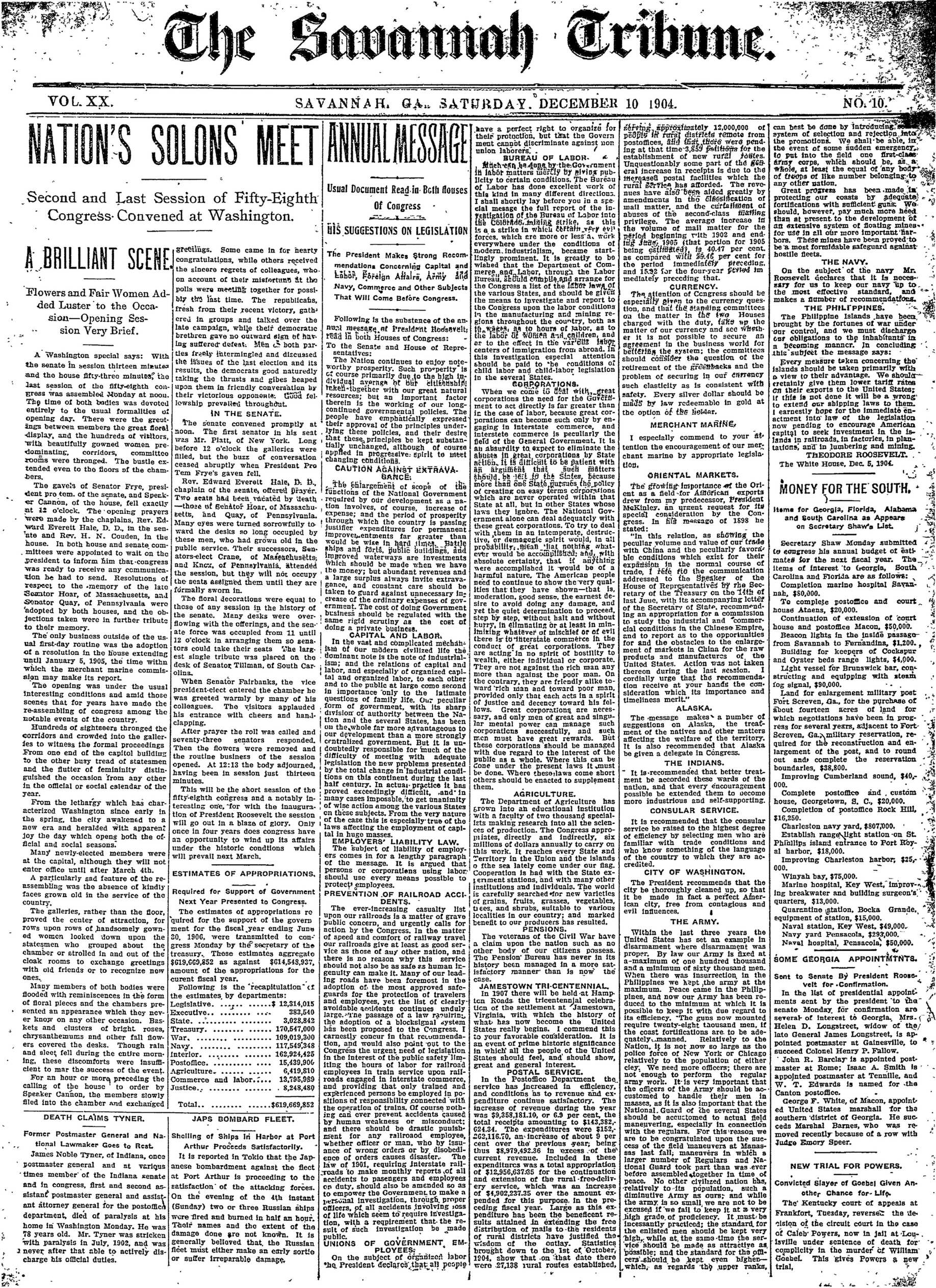
NATION'S SOLONS MEET
Second and Last Session of Fifty-Eighth Congress Convened at Washington.
Flowers and Fair Women Added Luster to the Occasion—Opening Session Very Brief.
A Washington special says: With the senate in session thirteen minutes and the house fifty-three minutes, the last session of the fifty-eighth congress was assembled Monday at noon. The time of both bodies was devoted entirely to the usual formalities of opening day. There were the greetings between members the great floral display, and the hundreds of visitors, with beautifully gowned women predominating, corridors, committee rooms were thronged. The bustle extended even to the floors of the chambers.
The gavels of Senator Frye, president pro tem, of the senate, and Spenker Cannon, of the house, fell exactly at 12 o'clock. The opening prayers were made by the chaplains, Rev. Edward Everett Hale, D. D., in the senate and Rev. H. N. Couden, in the house. In both house and senate committees were appointed to wait on the president to inform him that congress was ready to receive any communication he had to send. Resolutions of respect to the memory of the late Senator Hoar, of Massachusetts, and Senator Quay, of Pennsylvania were adopted by both houses, and the objections taken were in further tribute to their memory.
The only business outside of the usual first-day routine was the adoption of a resolution in the house extending until January 5, 1905, the time within which the merchant marine commission may make its report.
The opening was under the usual interesting conditions and amid those scenes that for years have made the re-assembling of congress among the notable events of the country.
Hundreds of sightseers thronged the corridors and crowded into the galleries to witness the formal proceedings From one end of the capitol building to the other busy tread of statesmen and the flutter of femininity distinguished the occasion from any other in the official or social calendar of the year.
From the lethargy which has characterized Washington since early in the spring, the city awakened to a new era and heralded with apparent joy the day which opens both the official and social seasons.
Many newly-elected members were at the capital, although they will not enter office until after March 4th.
A particularly sad feature of the reassembling was the absence of kindly faces grown old in the service of the country.
The galleries, rather than the floor, proved the center of attraction, for rows upon rows of handsomely gowned women looked down upon the statesmen who grouped about the chamber or strolled in and out of the cloak rooms to exchange greetings with old friends or to recognize new ones.
Many members of both bodies were flooded with reminiscences in the form of floral pieces and the chambers presented an appearance which they never know on any other occasion. Baskets and clusters of bright roses, chrysanthemums and other fall flowers covered the desks. Though rain and sleet fell during the entire morning, these discomforts were insufficient to mar the success of the event. For an hour or more preceding the calling of the house to order by Speaker Cannon, the members stowly filed into the chamber and exchanged
DEATH CLAIMS TYNER.
Former Postmaster General and National Lawmaker Go to Rest.
James Noble Tyner, of Indiana, once postmaster general and at various times member of the Indiana senate and in congress, first and second assistant postmaster general and assistant attorney general for the postoffice department, died of paralysis at his home in Washington Monday. He was 78 years old. Mr. Tyner was stricken with paralysis in July, 1902, and was never after that able to actively discharge his official duties.
The
SOLONS MEET
Session of Fifty-Eighth
ned at Washington.
greetings. Some came in for hearty congratulations, while others received the sneeze regrets of colleagues, who on account of their mistrust at the polls were meeting together for possibly the last time. The republicans, fresh from their recent victory, gathered in groups and talked over the late campaign, while their democratic brethren gave no outward sign of having suffered defeat. Men of both parties freely intermingled and discussed the issues of the last election and its results, the democrats good naturely taking the thrusts and gibes heaped upon them in friendly conversation by their victorious opponents. Good fellowship prevailed throughout.
IN THE SENATE.
the senate convened promptly at noon. The first senator in his seat was Mr. Platt, of New York. Long before 12 o'clock the galleries were filled, but the buzz of conversation ceased abruptly when President Pro Tem Frye's gave fell. Rev. Edward Everett Hale, D. B. chaplain of the senate, offered prayer. Two seats had been vacated by death—those of Senator Hoar, of Massachusetts, and Quay, of Pennsylvania. Many eyes were turned sorrowfully toward the desks so long occupied by these men, who had grown old in the public service. Their successors, Senators-elect Crane, of Massachusetts, and Knox, of Pennsylvania, attended the session, but they will not occupy the seats assigned them until they are formally sworn in.
The floral decorations were equal to those of any session in the history of the senate. Many desks were overflowing with the offerings, and the senate force was occupied from 11 until 12 o'clock in arranging them so senators could take their seats. The largest single tribute was placed on the desk of Senator Tillman, of South Carolina.
When Senator Fairbanks, the vice president-elect entered the chamber he was greeted warmly by many of his colleagues. The visitors applauded his entrance with cheers and hand-clapping.
After prayer the roll was called and seventy-three senators responded. Then the flowers were removed and the routine business of the session opened. At 12:13 the body adjourned, having been in session just thirteen minutes.
This will be the short session of the fifty-eighth congress and a notably interesting one, for with the inauguration of President Roosevelt the session will go out in a blaze of glory. Only once in four years does congress have an opportunity to wind up its affairs under the historic conditions which will prevail next March.
ESTIMATES OF APPROPRIATIONS.
The estimates of appropriations required for the support of the government for the fiscal year ending June 30, 1906, were transmitted to Congress Monday by the secretary of the treasury. These estimates aggregate $619,669,852 as against $614,543,937, amount of the appropriations for the current fiscal year.
Following is the "recapitulation" of the estimates by departments:
Legislative. ..... $ 12,314,015
Executive. ..... 383,540
State. ..... 3,028,842
Treasury. ..... 170,547,000
War. ..... 109,019,300
Navy. ..... 117,549,348
Interior. ..... 162,924,425
Postoffice. ..... 15,439,906
Agriculture. ..... 6,419,810
Commerce and labor. ..... 13,795,989
Justice. ..... 8,248,480
JAPS BOMBARD FLEET.
Shoiling of Ships in Harbor at Port Arthur Proceeds Satisfactorily.
It is reported in Tokio that the Japanese bombardment against the fleet at Port Arthur is proceeding to the satisfaction of the attacking forces. On the evening of the 4th instant (Sunday) two or three Russian ships were fired and burned in half an hour. Their names and the extent of the damage done are not known. It is generally beloved that, the Russian fleet must either make an early sortie or suffer irreparable damage.
ANNUALMESSAGE
Usual Document Read in Both flouses
HIS SUGGESTIONS ON LEGISLATION
The President Makes Strong Recommendations Concerning Capital and Labor, Foreign Affairs, Army and Navy, Commerce and Other Subjects That Will Come Before Congress.
Following is the substance of the annual message of President Roosevelt, read in both Houses of Congress: To the Senate and House of Represen- tation.
The Nation continues to enjoy noteworthy prosperity. Such prosperity is of course primarily due to the high individual average of our citizens' skill together with our great natural resources; but an important factor therein is the working of our long-continued governmental policies. The people have emphatically expressed their approval of the principles underlying these policies, and their desire that these principles be kept substantially unchanged, although of course applied in progressive spirit to meet changing conditions.
CAUTION AGAINST EXTRAVA-
GANCE;
The enlargement of scope of the functions of the National Government required by our development as a nation involves, of course, increase of expense; and the period of prosperity through which the country is passing justifier expenditures for permanent improvements far greater than would be wise in hard times. Battle ships and forts, public buildings, and improved waterways are investments which should be made when we have the money; but abundant revenues and a large surplus always invite extravagance, and constant care should be taken to guard against unnecessary increase of the ordinary expenses of government. The cost of doing Government business should be regulated with the same rigid scrutiny as the cost of doing a private business.
CAPITAL AND LABOR
In the vast and complicated mechanism of our modern civilized life the dominance of the is the note of industrialism; and the relations of capital and labor, and especially of organized capital and organized labor, to each other and to the public at large come second in importance only. Our latimate questions of family life. Our peculiar form of government, with its large division of authority between the Nation and the several States, has been on the whole far more advantageous to our development than a more strongly centralized government. But it is undoubtedly responsible for much of the difficulty of meeting with adequate legislation the new problems presented by the total change in Industrial conditions on this continent during the last half century. In actual practice it has proved exceedingly difficult, and in many cases impossible, to get unanimity of wise action among the various States on these subjects. From the very nature of the case this is especially true of the laws affecting the employment of capital in huge masses.
EMPLOYERS' LIABILITY LAW.
ERS LIABILITY LAW.
The subject of liability of employers comes in for a lengthy paragraph of the message. It is argued that persons or corporations using labor should use every means possible to protect employees.
PREVENTION.OF RAILROAD ACCIDENTS.
The ever-increasing casualty list upon our railroads is a matter of grave public concern, and urgently calls for action by the Congress. In the matter of speed and comfort of railway travel our railroads give at least as good service as those of any other nation, and there is no reason why this service should not also be as safe as human ingenuity can make it. Many of our leading roads have been foremost in the adoption of the most approved safeguards for the protection of travelers and employees, yet the list of clearly avoidable accidents continues unduly large. In order to improve the adoption of a blockslim system, has been proposed to the Congress. I earnestly concur in that recommendation, and would also point out to the Congress the urgent need of legislation in the interest of the public safety limiting the hours of labor for railroad employees in train service upon railroads engaged in interstate commerce, and providing that only trained and experienced persons be employed in positions of responsibility connected with the operation of trains. Of course nothing can over prevent accidents caused by human weakness, miscommunication and there should be drastic punishment for any railroad employee, whether officer or man, by by issuance of wrong orders or by disobedience of orders causes disaster. The law of 1801, requiring Interstate railroads to make monthly reports of all accidents to passengers and employees on duty, should also be amended so as to empower the Government to make a personal investigation, through proper officers, of all accidents involving loss of life which seem to require investigation, with a requirement that the result of such investigation be made public.
UNIONS OF GOVERNMENT, EMPLOYEES:
On the subject of organized labor
the President declares, that all people
have a perfect right to organize for their protection, but that the Government cannot discriminate against nonunion laborers.
BUREAU OF LABOR
Michigan has by the Government in labor matters directly by giving publicity to certain conditions. The Bureau of Labor has done excellent work of this kind in many different directions. I shall shortly lay before you in a special message the full report of the investigation of the Bureau of Labor into the Colorado mining strike, as this is a strike in which certain very forces, which are more or less a work everywhere under the conditions of modern industrialism, became startlingly prominent. It is greatly to be wished that the Department of Commerce, and Labor, through the Labor Bureau, should compile and arrange for the Congress a list of the labor laws of the various States, and should be given the means to investigate and report to the Congress upon the labor conditions in the manufacturing and mining regions throughout the country, both as wages, as to hours of labor, as to the labor of women and children, and as to the effect in the various labor centers of immigration from abroad. In this investigation especial attention should be paid to the conditions of child labor and child-labor legislation in the several States.
GORPORATION8.
GORGORATIONS.
When we come to deal with, great corporations the need for the Government to act directly is far greater than in the case of labor, because great corporations can become such, by engaging in commerce, and engaging in commerce is peculiarly the field of the General Government. It is an absurdity to expect to eliminate the abuses in great corporations by State action. It is difficult to be patient with an argument that such matters should be left to the States, because more than one State pursues the policy of creating on easy terms corporations which are never operated within that State at all, but in other States whose laws they ignore. The National Government alone can deal adequately with these great corporations. To try to deal with them in an intemperate, destructive, or demagogic spirit would, in all probability, mean that nothing whatever were accomplished it would be of a harmful nature. The American people need to continue to show the very qualities that they have shown—that is, moderation, good sense, the earnest desire to avoid doing any damage, and yet the quiet determination to proceed, step by step, without halt and without hurry, in eliminating or at least in minimizing whatever of mischief or of evil there is to interstate commerce in the conduct of great corporations. They are acting in no spirit of hostility to wealth, either individual or corporate. They are not against the rich man any more than against the poor man. On the contrary, they are friendly alike toward rich man and toward poor man provided only that each acts in a split justice and decency toward his fellow great corporations are necessary, and only men of great and singular mental power can manage such corporation, necessary and such men must have their rewards. But these corporations should be managed with due regard to the interest of the public as a whole. Where this can be done under the present laws it must be done. Where these laws come short others should be enacted to supplement them.
AGRICULTURE.
The Department of Agriculture has grown into an educational institution with a faculty of two thousand specialists making research into all the sciences of production. The Congress appropriates, directly and indirectly, six millions of dollars annually to carry on this work. It reaches every State and Territory in the Union and the islands o the sea lately come under our flag. Cooperation is had with the State experiment stations, and with many other institutions and individuals. The world is carefully searched for new varieties of grains, fruits, grasses, vegetables, trees, and shrubs, suitable to various localities in our country; and marked benefit to our producers has resulted.
PENSIONS.
The veterans of the Civil War have a claim upon the nation such as no other body of our citizens possess. The Pension Bureau has never in its history been managed in a more satisfactory manner than is now the case. JAMESTOWN TRI-CENTENNIAL. In 1907 there will be held at Hampton Roads the tricentenial celebration of the settlement at Jamestown, Virginia, with which the history of what has now become the United States really begins. I commend this to your favorable consideration. It is an event of prime historic significance in which all the people of the United States should feel, and should show, great and general interest.
POSTAL SERVICE.
In the Postoffice Department, the service has increased in efficiency, and conditions as to revenue and expenditure continue satisfactory. The increase of revenue during the year was $9,358,181.10, or 6.9 per cent, the total receipts amounting to $143,382.64.34. The expenditures were $152,262,116.70, an increase of about 9 per cent over the previous year, being thus $8,979,492.36 in excess of the current revenue. Included in these expenditures was a total appropriation of $12,956,632.35 for the continuation and extension of the rural-free-delivery service, which was an increase of $4,902,237.35 over the amount expended for this purpose. In the preceding fiscal year. Large as this expenditure has been the beneficent results attained in extending the free distribution of mails to the residents of rural districts have justified the wisdom of the outlay. Statistics brought down to the 1st of October, 1904, show that on that date there were 27,138 rural routes established.
solving approximately 12,000,000 of people in rural districts remote from post offices, and that there were pending at that time 3,859 fountains for the establishment of new rural fountains. Unquestionably some part of the general increase in receipts is due to the increased postal facilities which the rural service has afforded. The revenues have also been added greatly by amendments in the classification of mall matter, and the curtailment of abuses of the second-class mailing privilege. The average increase in the volume of mall matter for the period beginning with 1902 and ending 1905, 1905 (that portion for 1905 being estimated) is 40.47 per cent, as compared with 25.46 per cent for the period immediately preceding, and 15.82 for the four-year period immediately preceding that.
CURRENCY.
The attention of Congress should be especially given to the currency question, and that the standing committees on the matter in the two Houses charged with the duty, take up the matter of our currency and see whether it is not possible to secure an agreement in the business world for bettering the system; the committees should consider the question of the retirement of the greenbacks and the problem of securing in our currency such elasticity as is consistent with safety. Every silver dollar should be made by law redeemable in gold at the option of the holder.
MERCHANT MARINE,
I especially commend to your attention the encouragement of our merchant marine by appropriate legislation.
ORIENTAL MARKETS.
The growing importance of the Orient as a field for Antiocean exports drew from my predecessor, President McKinley, an urgent request for its special consideration by the Congress. In his message of 1898 he stated:
"In this relation, as showing the peculiar volume and value of our trade with China and the peculiarly favorable conditions which exist for their expansion in the normal course of trade, I refele to the communication addressed to the Speaker of the House of Representatives by the Secretary of the Treasury on the 14th of last June, with its accompanying letter of the Secretary of State, recommending an appropriation for a commission to study the industrial and commercial conditions in the Chinese Empire, and to report as to the opportunities for and the obstacles to the enlargement of markets in China for the raw products and manufactures of the United States. Action was not taken thereon during the last session. I cordially urge that the recommendation receive at your hands the consideration which its importance and timeliness merit."
ALASKA.
The message makes a number of suggestions on Alaska, the treatment of the natives and other matters affecting the welfare of the territory. It is also recommended that Alaska be given a delegate in Congress.
THE INDIANS.
It is-recommended that better treatment be accorded these wards of the nation, and that every encouragement possible he extended them to become more industrious and self-supporting.
CONSULAR SERVICE.
It is recommended that the consular service be raised to the highest degree of efficiency by selecting men who are familiar with trade conditions and who know something of the language of the country to which they are accredited.
CITY OF WASHINGTON.
The President recommends that the city be thoroughly cleaned up, so that it be made in fact a perfect American city, free from contagious and evil influences.
THE ARMY.
Within the last three years the United States has set an example in disarmament where disarmament was proper. By law our Army is fixed at a maximum of one hundred thousand and a minimum of sixty thousand men. When there was insurrection in the Philippines we kept the army at the maximum. Peace came in the Philippines, and now our Army has been reduced to the minimum at which it is possible to keep it with due regard to its efficiency. "The guns now mounted require twenty-eight thousand men, if the coast fortifications are to be adequately manned. Relatively to the Nation, it is not now so large as the police force of New York or Chicago relatively to the population of either city. We need more officers; there are not enough to perform the regular army work. It is very important that the officers of the Army should be accustomed to handle their men in masses, as it is also important that the National. Guard is also important to the field maneuvering, especially in connection with the regulars. For this reason we are to be congratulated upon the success of the field maneuvers in Manassas last fall; maneuvers in a larger number of Regulars and National Guard took part than was ever before assembled together in time of peace. No other civilized nation has, relatively to its population, such a diminutive Army as ours; and while the army is so small we are not to be the excuse if we fall to keep it at a very high grade of proficiency. It must be incessantly practiced; the standard for the enlisted men should be kept very high, when the same time the service should be made as attractive as possible; and the standard for the officers should be kept even higher—which, as regards the upper ranks,
can best be done by introducing a system of selection and rejection into the promotions. We shall be able, in the event of some sudden emergency, to put into the field one first-class army corps, which should be, as a whole, at least the equal of any body of troops of like number belonging to any other nation.
Great progress has been made in protecting our coasts by adequate fortifications with sufficient guns. We should, however, pay much more heed than at present to the development of an extensive system of floating mines for use in all our more important harbors. These mines have been probed to be a most formidable safeguard against hostile fleets.
THE NAVY.
On the subject of the navy Mr. Roosevelt declares that it is necessary for us to keep our navy up to the most effective standard, and makes a number of recommendations.
THE PHILIPPINES.
The Philippine Islands have been brought by the fortunes of war under our control, and we must discharge our obligations to the inhabitants in a becoming manner. In concluding this subject the message says:
Every measure taken concerning the islands should be taken primarily with a view to their advantage. We should certainly give them lower tariff rates on their exports to the United States; if this is not done it will be a wrong to extend our shipping laws to them. I earnestly hope for the immediate enactment into law of the legislation now pending to encourage American capital to seek investment in the islands in railroads, in factories, in plantations, and in lumbering and mining.
TREODORE ROOSEVELT.
The White House, Dec. 5, 1904.
MONEY FOR THE SOUTH.
Items for Georgia, Florida, Alabama and South Carolina as Appeare on Secretary Shaw's Liet.
Secretary Shaw Monday submitted to congress his annual budget of estimates for the next fiscal year. The items of interest to Georgia, South Carolina and Florida are as follows: Completion marine hospital Savannah, $80,000. To complete postoffice and court house Ataens, $20,000. Continuation of extension of court house and postoffice Macon, $50,000. Beacon lights in the inside passage from Savannah to Fernandina, $1,200. Building for keepers of Cockspur and Oyster beds range lights, $4,000. Light vessel for Brunswick bar, constructing and equipping with steem fog signal, $30,000.
Land for enlargement military post Fort Screven, Ga., for the purchase of about fourteen acres of land for which negotiations have been in progress for several years, adjacent to Fort Screven, Ga., military reservation, required for the reconstruction and enlargement of the post, and to round out and complete the reservation boundaries, $38,800.
Improving Cumberland sound, $40,000.
Complete postoffice and custom house, Georgetown, S. C., $20,000.
Charleston navy yard, $807,000.
Establish range light station on St.
Phinllips island entrance to Port Royal
harbor, $18,000.
Improving Charleston harbor, $25,
000.
Winyah bay, $75,000.
Marine hospital, Key West, Improving breakwater and building surgeon's quarters, $13,000.
Quarentine station, Bocka Grande, equipment of station, $15,000.
Naval station, Key West, $49,000.
Navy yard Pensacola, $293,000.
Naval hospital, Pensacola, $50,000.
SOME GEORGIA APPOINTMENTS.
Sent to Senate By President Roosevelt for-Confirmation.
In the list of presidential appointments sent by the president to the senate Monday for confirmation are several of interest to Georgia, Mrs. Helen D. Longstreet, widow of the late General James Longstreet, is appointed postmaster at Galensville, to succeed Colonel Henry P. Fallow.
John R. Barclay is appointed postmaster at Rome; Isaac A. Smith is appointed postmaster at Tennille, and W. T. Edwards is named for the Canton postoffice.
George F. White, of Macon, appointed United States marshall for the southern district of Georgia. He succeeds Marshal Barnes, who was removed recently because of a row with Judge Emory Speer.
Convicted Slayer of Goebel Given Another Chance for Life
The Kentucky court of appeals at Frankfort, Tuesday, reversed the decision of the circuit court in the case of Caleb Powers, now in jail at Louisville under sentence of death for complicity in the murder of William Goebel. This gives Powers a new trial.
SUBSCRIPTION RATES.
One Year.....$1.25
Two Months.....75
Three Months.....50
Remittance must be made by Express or
Post Office Money Order, or Registered Letter.
Advertising Rates given on application.
ONE of the main purposes of our people should be the making of friends among our white neighbors and retaining that friendship.
JUDGE CANN in his charge is to be commended for the stand, he has taken on the race issue. Such gentlemen as he can do much to make conditions more conciliating.
GEORGIA, unlike many of the other Southern States, have repeatedly refused to disfranchise its colored voters. For this commendation should be given.
We are demanding no special legislation in behalf of our people. We are American citizens and should be dealt with upon that wide plane. Special enactments of laws in our favor will only the more sharpen race prejudice.
'LEGISLATION of any kind will not give to the colored man what he most desires. It requires a sentiment based upon justice. We are thankful that there are a number of our white friends with sufficient backbone to rise against prejudice and make a plea for justice for a people who is the most dooile in the world.
In Chatham county there are nearly a thousand colored men, who annually pay their tax,0 many of them on valuable pieces of property. Unfortunately many of these men do not register, and those who do register fail to vote. All of these tax payers should be more patriotic by registering and casting their votes at the proper time. This is supplemented by a demand upon the young men to be patriotic and take advantage of their enfranchisement.
NOTWITHSTANDING the action of some sore heads in Georgia, many of whom haven't the best interest of the race at heart; along with other aspirants, Hon. Judson W. Lyons will be reappointed as Register of the Treasury of the United States. The attempt of small bore Negro politicians in this State to defeat him shows plainly how much native loyalty they have, and how well they are playing in the hands of the enemies of the race.
The Colored man is a part and parcel of the South. He has assisted in making the South what it is to-day. Many of his number are large property holders and are captains of industry. He is of a class of citizen not inimical to the best interest of this section and country. Thus he is to be counted strongly as a part of the South. The South can not consistently be reckoned without him. It is therefore out of place for the assertion to be made whenever the President recognizes a colored man that it is a stab at the South.
In proportion to population the colored man holds but few federal positions, and so far as the several states are concerned he is completely ostracised as positions are concerned. The complaint is made that in federal appointments a large number of them are credited to the south than elsewhere. That can be easily understood. The bulk of the colored people are in the south and generally they are the rank and file of the party in ascendency, hence the recognition that is given them. Now, why should any one kick.
Make Roosevelt's Election Unanimous.
The following from the Atlanta Evening News, is commended to all parties concerned: Editor Atlanta News:
Now that the smoke of battle is over and the dead have all been buried, and the wounded sent to the hospital, the prisoners all paroled; and the campaign ended in complete and perfect defeat, with some of our strong forts in possession of our antagonist, and their forces scattered largely over our territory, is it not time for the southern Democrats to calmly survey the field, consider the situation, and ask, "Where are we at?"
In making this survey of the field, and considering the Democratic party, of which the south seems to be its home, and that by a largely decreased vote, the thoughtful mind must come to several conclusions.
First, That the south cannot afford to array itself against the north any more than it could in 1865. It is not our desire to do so, as we are parties of this glorious union. Neither is it to our interest to do so.
Millions of dollars of northern capital have been invested in the south, and with our broad acres needing cultivation, and with our rich undeveloped mines, water-powers, forest and other possibilities, we wish developed, we wish emigration; we wish capital, and we wish a broader and more extensive field of usefulness. Now, can we have these things by adopting the views of some of our Democratic editors who insist upon making the south an Ireland? In other words to fight the government and to fight the overwhelming sentiment of the whole union? I do not think so.
Second, President Roosevelt was very bitterly and unjustly attacked, I think for his course in entertaining Booker Washington. At the time that was done, Democratic politicians and Democratic editors were trying to make a mountain out of a mole-hill, and I wrote an article upon the subject. Booker Washington is the representative of ten millions of people. He had been entertained by the crowned-heads of Europe, and he had been doing a noble work for his people. Now, was it not the duty of the president of the United States, as president of the entire people, of which Booker Washington represented about one-eighth to show him some attention. If Booker Washington had lived in England and been appointed ambassador to the United States, would he not have been received by the president? And so with France, China, and even Hayti, and so on with other countries. Of course he would. Therefore, I think the Democratic politicians and Democratic editors, by antagonizing that incident and giving it undue publicity, were much more responsible in trying to bring on a race question than was the president. Thank God, I and my wife and daughters do not need any laws to prevent social equality with the Negroes. I do not believe in that, and no self-respecting man north or south, believes in it. If the papers and southern politicians had not stirred it up, and given undue prominence to it, I do not know that it would have ever been heard of. Tom Watson showed that President Cleveland had gone equally as far as President Roosevelt. Now, let the south drop the Negro question.
Proposition third. The Negro of to-day is quite different from the Negro of 1865, and he is not going to be content to occupy the position of "hawers of wood and drawers of water." He is a citizen of this country and here he is to stay, Bishop Turner, a great leader of the African race, has for years urged upon the Negro that he leave this country and settle in Eiberia. Of course this proposition is thoroughly impracticable. In the first place, the Negro will not go. In the second place, if every Negro in the south was willing and wanted to go, we of the south would not permit them to go, and there would be just as much of a storm raised when they started as when the Jews started to leave Egypt, and
Fourth. The south doesn't want them to go. Georgia has laws against emigration agents. "Peg" Williams has been run out of several counties in North Carolina, South Carolina, Georgia and Louisiana and other places for trying to carry them away to Mexico and other states.
Now let's treat Roosevelt justly, and not damn and denounce him because he has recognized a leading member of the Negro race, whose president he is, just as much as he is ours.
The north has said "nu" and therefore we must recognize that fact.
Fifth, We might also recognize the fact that our Philippine possessions are part of the United States. I believe that the constitution should follow the flag and I can see no difference between our treatment of the territory we conquered and bought from Mexico, where we made states and territories of them, and that of the Philippines and Porto Rico, which we conquered and bought from Spain, and as we say we hold them as colonies, and that, by the way, was the only difference between the two parties in the last contest. Republicans say we will hold them as colonies, and Democrats say let them go, we give them up. For the third time now, in the elections the country has voted to hold the Philippines, and therefore I think the Democratic party should drop this issue.
Sixth. We have demagogued and constantly insisted upon self government, and sought to create the impression that we of the south were the only custodians of that treasure. I suppose Pennsylvania, with half a million majority for Roosevelt, would be just as jealous of local self-government as would be the state of Texas with its 200,000 majority for Parker. So we might as well quit demagoguing upon that question. Seventh. During the campaign I heard much of imperialism, and the impression sought to be created was that President Roosevelt was a ver bad man, and now that the ballo
have all been cast, the Democratic paper have suddenly discovered that he is a very popular man.
Eighth. Any careful thinker who will take up the Democratic platform of 1886 up to date will see how we have boxed the compass and been upon all sides of the question. We have fought the tariff bitterly, fought the coinage, fought trusts, and yet, when we take up the last platform, we find that, we have not done much of either. What we need in this country are two active, energetic, earnest parties, fighting upon principal, and aside from the Philippine question it would require a Philadelphia lawyer to show much difference in the two platforms as interpreted by the two distinguished candidates for presideut. Now, what is the remedy?
As we cannot fight the north with arms as in 1861-1965, for the south has been broken, and as no one wants a solid south against a solid north, I am going to make a very radical suggestion which I know will raise a storm, and that is that now everybody concedes President Roosevelt to be a good man; strong man, and a man of good intentions, that our candidate and our Democratic executive committees request all of their Democratic electors to cast their ballots for President Roosevelt and thereby make his election unanimous, and thereby show to the north that the south is not fighting them and that it is not the purpose of the south, broken as it is, to make a mere factional opposition, but that we recognize the existing status of affairs. After that is done Mr. Editor, I believe that four years from to-day the broken south and the solid north would divide upon new issues—upon economic questions, and that we would have a much better status of affairs than by seeking to keep the broken south, like Ireland, as a protest to the powers that be. I believe that this action would make the south bloom as the rose. Ninth. I am no politician. There is no office I want I always declined political honors. I have never cast any but a democratic vote, but I am a well-wisher of my country in its entirety.
I am a well-wisher for the south for which I fought as a boy, when I was subject to no law, and I am a lover of Georgia which honored my father, and in whose sacred soil repose the mortal remains of my loved ones. Now, I honestly believe, as a Democrat, that the best thing for us, the south, to do is for Judge Parker and the Democratic executive committee to request the southern electors to cast their votes for President Roosevelt and make his election unanimous. He is a good man, half southern, and we of the south ought to be able to trust him. JULIUS L. BROWN
Masonic Notes.
Returns are already being received of the election of officers in the various Lodges. Let all of the Lodge officers be prompt in rendering their returns and do not fail to attach the seal and enclose the post office addresses of the officers.
Eastern Star Lodge No. 58, will have installation service on the 27th. Several addresses will be delivered.
Look well to the East brathren and do not forget a competent secretary.
Worshipful Masters should systematize the lecture and make same attraction for the members.
Masonry is progressive in that it will not tolerate those who are ignorant of its teachings.
At this time of the year, when their is a deep feeling of "Good will to all men," as Masons we must not forget those poor orphans in the Masonic Home at Americus. Let us make their hearts glad by sending them an extra donation. Groceries also clothing would be as acceptable. Send to Bro. J. C. Styles, or Mrs. Viola E. Hart, Americus, Ga.
Grand Master Butler is still working assiduously to plant the flag of Masonry at every place of note in the state.
Next month the Masonio Lodges expect to meet in its new temple, thus will be under its own vine and fig tree.
Each Eastern Star chapter will have election and installation this month before Dec. 27. The ladies are asked to remember the poor orphans at the home in Americus. From indications the Masonic Temple on West Gwinnett street will prove very popular with the amusement loving public. Dates are already being asked for, which will keep the temple open nearly every night for the next several months. Bathany Lodge No. 131 of which Bro Chas. H. Lindsey is W. M.; is making rapid strides forward. The lodge is constantly adding new members.
Night Was Her Terror.
"I would cough nearly all night long" writes Mrs. Chas. Applegate of Alexandria, Ind., "and could hardly get any sleep. I had consumption so bad that if I walked a block I would cough frightfully and spit blood, but, when all other medicines failed, $1.00 bottles of Dr. King's New Discovery wholly cured me and I gained 58 pounds," It's absolutely guaranteed to cure Conghs, Colds 'La Gripe, Bronchitis and all Throat and Lung Troubles. Price 500 and $1.00. Trial bottles free at all druggist.
FALL CLOTHING
«FOR MEN AND BOYS»
IS JUST COMING IN
SPECIAL
SUITS AND PANTS
...FOR BOYS...
FOR THE FOLLOWING WEEK
Leopoto. Holler.
BROUGHTON & BULL STS.
The Largest Department Store in Georgia.
CAPITAL STOCK, $500,000.
Full Paid. Non-assessible.
The strongest and most progressive Negro Company, offers to the investing public a block of $20,000 worth of its capital stock at $7 per share. This offer holds good for the next sixty days, after which it will go to $8 per share. It can be bought by paying seven dollars down on 5 shares and $3 per month until paid. If paid for cash a discount of 6 per cent will be allowed. Stock bought before January first will participate in the annual dividends in full. From January first and not later than April first half dividends will be paid. Have sold nearly $20,000 worth this in state alone in the last two years. It is backed by more than a hundred and fifty thousand dollars worth of real estate at appraised valuation. Thus insuring the investor against any possible loss. This is the last chance to acquire an iron-clad investment in this company for $7 that will go to $8 then $9 and shortly to $10. The actual value of which is now $7.25. As the profit increases your investment increase. No watered stock. We build in the ground. The Savings bank offers also to the public a durable investment seven per cent allowed, compounded quarterly. Call or address 222 W. Broughton St. Savannah Ga. Bell 'Phone 1144.
L. C. COLLINS, Secretary. F. M. COHEN, Teller.
J. W. ARMSTRONG, General Manager.
Both Solid Vestibuled Traius, with Day Coaches of Newest Design, Pullman Drawing-Room Sleeping Cars and Elegant Dining Cars.
We solicit your savings account, whether you are a wage earner or a capitalist. $1.00 starts an account here.
Call & Get a Steel Bank
A sick and death benefit organization that pays larger benefits than any other and pays them quicker. Has 150,000 members and paid out to its members more than a hundred thousand dollars in the last year. Gives employment to fifteen hundred intelligent men and women as agents, book keepers, typewriters, etc. A work heretofore not open to colored women. The mother of this company is the Metropolitan Mercantile and Realty Co., 150 Nassan street, New York. Southern headquarters, 222 W. Broughton St., Savannah, Ga., J. W. Armstrong, Director
J. W. Armstrong, Director General Southern States.
Mrs. W. H. Burgess,
518 W. Broad Cor. Minis St.
is conducting a neat Dress Making and Millinery Store. She solicits the patronage of the public. Guaranteeing perfect fit and polite attention. Orders promptly filled.
For a Good Shave or
Hair-Cut
Visit The
FOREST CITYSHAV-
ING PALACE
Good work and polite attention
is our Motto. Razors
horned and set.
FOREST CITY SHAVING PALACE,
308 Drayton Street, opposite
DeSoto Hotel.
R. T. WASHINGTON, PROP.
50 YEARS'
EXPERIENCE
PATENTS
TRADE MARKS
COPYRIGHTS & C.
Anyone sending a sketch or any quickly ascertain our opinion free whether an invention is probably patentable. Communication is confidential. HANDBOK on Patents and Patent Applications. Patents taken through Munn & Co. receive special notice, without charge, in the Scientific American. A handsomely illustrated weekly. Largest edition of any scientific journal. Terms, 85 a year four months. 82. Sold by all newadvertisers. MUNN & Co. 80 Broadway, New York Office, 80 West 42nd Street, New York.
and, in that full belief, he rushed off for his mother's family physician, to find Dr. Callender also not available. And then, to stand disconsolately on a street corner, wondering what on earth would become of Miss Theo, just as a doctor's carriage passed him—evidently a doctor's, and a well-to-do one, too, as witness the footman with folded arms, the proud stepping horse, the handsome robe.
And ragged little Tim, all unaware he was an instrument of unalterable fate, succeeded in attracting Dr. Pennington's attention.
"Say, you! you're wanted down to Miss Theo Vincent's—No. SG Pollard street—sharp, too! Goin'?"
Theo Vincent! Clyde Pennington was surprised, and conscious of a pleasureable sensation along with it.
"All right, my boy! I'll be there before you are."
And sure enough, when Tim reached home, there stood the doctor's carriage at the door, an object of envious admiration for a score of archins, while Dr. Pennington was sitting in Aunt Ibey's sung parlor explaining the cause of his appearance and listening to her account of Theo's illness.
"And now, if you allow me to see my patient," he said.
And then he went in to find Theo delirious and talkative and entirely unconscious.
"Of course it is not true," she said, as he sat down beside the pure white cot. "I never flirted with Mr. Harry Sylvester or Dr. Pennington either. It wasn't fair of her to turn me off without a character, was it? And Aunt Ibey and I are so poor!"
And, although he knew there was no recognition in her bright eyes, still his face fushed.
"She is very slick," he said, gravely, "I will see her again this afternoon, Mrs. Bley." That was the beginning of their friendship, and when, three months later, Theo was sufficiently recovered to accept a situation as travelling companion to a society lady she knew that her most valued friend in all the world was Dr. Pennington.
III.
A perfect afternoon, even for la belle Paris, and Mrs. Sylvester, leaning back in her chair beside the window of her grande salon, thought that life in the gay city was the one thing desirable, and would be the one thing most glorious were it not for her son Harry.
For her son, her darling, her chief pride, for whom nothing in all the world was too good, for whom marriageable maidens and shrewd mothers had angled visibly and invisibly, who never yet had been disappointed or thwarted in all his life, was in a state of desperation and distress that made Mrs. Sylvester wonder, in agitation and dismay, what would be the result of it all.
And "it all" meant that Harry Sylvester was in love with Mrs. Van Renseller's charming young friend and companion—Theo Vincent, whom, two years before, Mrs. Sylvester had turned out of doors.
"She will not listen to me," Harry hud said to his mother before he went out that afternoon. "I tell you I must have her answer—her favorable answer, too—before another twenty-four hours go over my head, mother. Unless I get her for my wife I'll shoot myself just as sure as fate. I love her—by George! I never cared so much for anything or anybody before, and it's only the memory of your cruel treatment of her—the feeling that she thinks you would not sanction an engagement—that keeps us apart."
"You think that?" said Mrs. Sylvester, tremblingly—a little dismayed.
"I know it," he answered, hotly. "She is gracious and kind, but beyond that, I tell you, her just pride restrains her. See here, mother, if you want to do me a favor—if you don't want to have me brought in dead some time—you will go and tell her you want her for your daughter."
And Mrs. Sylvester knew as she looked upon her son's handsome, haggard face, that even if it killed her to humble herself she must do it for his sake.
"It is awfully cruel of you!" she said, pleriously, and he interrupted her firmly:
"You can take your choice—Theo Vincent for your daughter, or —get along without me!"
"Harry!"
"I mean it. She won't refuse me. If you ask her. By jove! she is the only woman in the world! I shall ever ask. She shall accept me!"
"I think there is no danger of her refusing such an offer," said his mother, a little of the old scornfulness in her voice.
"Of course you will go," he answered, decidedly. "When I come back at 7 o'clock to dinner I will hear what you have to say from her."
Then he had gone, and Mrs. Sylvesh had sat in trouble and dismay, thinking it all out, wondering how she could ac-
Who in the moon the long road lies,
T moon stands blank above,
Who in the moon the long road lies
T letts me from my love.
T 6 o'clock of a March night, bleak and blustering outside, with streets filled with flying dust, Mrs. Sylvester leaned back in her a sigh of selfish comfort as a Japanese screen between face and the ardent fire.
A
She was a handsome woman, who wore diamonds and velvet as a queen wears royal robes; a wealthy woman used to command and control, haughty and dogmatic in her positiveness. And this evening she was in her most positive, imperious mood, as she sat there making her decision about Theo. Vincent. Then she rang for lights, and by the servant sent a message for Miss Vincent to wait upon her as soon as Master Garnier and Miss Giralda could dispense with her services.
It was ten minutes later when Theo obeyed the summons and came into Mrs. Slyvester's presence—a slender, pale-faced girl of sixteen or seventeen, with lovely brown, eyes, soft as velvet, and a great, mass of brown hair—a delicate, refined, thoughtful looking girl, who bore indisputable traces of having worked almost beyond her strength. She came quietly near to Mrs. Slyvester and stood awaiting that lady's pleasure.
"I sent to have a word with you on a subject very distasteful to me, indeed, Miss Vincent," Mrs. Sylvester began, coldly. "I refer to a display of forwardness and boldness on your part toward certain gentlemen I might name which has been called to my attention more than once. I desire to say that I shall not tolerate any further attempts on your part, Miss Vincent, to flirt with gentlemen visiting at the house—notably with Dr. Pennington—Ah, do not not interrupt me, and I am indignantly sorry to say, my son also!"
"Mrs. Sylvester, you—"
Theo attempted to gasp her protest, but the cold, relentless voice resolutely hushed her.
"Dandals are more than useless, Miss Vincent. It is a notorious fact that you, a mere servant, a common nursery governess and a seamstress, boldly attempted to engross Dr. Pennington's attention last night, and one or two evenings last week when you were ordered to attend the children in the drawing room. Again, upon more than one occasion you have invigiled my son into conversation with you—you, whom his mother hires as a servant! Miss Vincent, I have—"
Theo was standing there, white and shivering, her eyes full of a horrified mortification and insulted pride.
"Mrs. Sylvester," she interrupted, hotly, "I cannot permit you to launch such a torrent of abuse at me. It is not true that I have tried to flirt with your guest or your son. Dr. Pennington spoke to me and I answered, as any one would have done. As to your son—"
And her lips curled—a feature which did not escape Mrs. Sylvester's eyes. "We will not discuss the subject further. You have acted in this matter disgracefully, and in justice to my little innocent children I have decided to remove you from their care over them. You are discharged from to-night, and in place of a month's notice you can have a month's wages—as is my custom with all my servants. As to a character," and the cold eyes took a malicious look at the pale, trembling girl, "of course that is out of the question. You are excused. Miss Vincent."
She pushed along a roll of bills, but Theo did not touch it. Instead the girl's face grew suddenly gold and haughty, and she walked out without a syllable of further protest.
And somehow Mrs. Sylvester realized that she had done something more than simply discharge a servant.
11.
"It's a shame—a burning shame!" Aunt Ibby said, indignantly. "It seems to me that nowadays the rich do nothing but grind the poor. You poor child, you—don't cry any more about it! That Sylvester woman isn't any very great shakes herself, you take my word for it, or she'd not be thinking such things about you. Don't cry, Theo. Chirk up, and we'll go out for a walk to Central Park this afternoon, eh?"
But Theo could not "chirk" up, nor old she go with dear old Aunt Ibby for a walk to Central Park. Instead she had cried and worried herself into a hot fever that defied all home remedies—a dever that ran higher and hotter, until even Aunt Ibby thought it was best to send for a doctor, and a doctor was sent for by little Tim Maguffin, next floor above.
"And be quick about it, too," said Aunt Ibby, slipping a penny in his grimmy hand. "You can run around to Dr. Perry's office in a few minutes, I know, and tell him to come right around."
"But Dr. Perry wasn't home—out of town for several days—and Tim's wits were puzzled to know whether, so long as Miss Theo was so awfully slick one doctor wasn't just as good as another.
The world is round, so travelers tell,
And straight though reach the track,
Trudge on, trudge on, 'twill all be well,
The way will guide one back.
I
III.
"Harry!"
T
135 mervilher deaths through being bitten by polsonous snakes. But then, says Pearson's Weekly, India is a large country, and the ordinary rural carrier will not take precautions.
He insists on going barefooted and barelegged in regions known to be infested with venomous reptiles, and he will calmly lie down for a nap in a tiger haunted jungle. Nor can he be induced to arm-himself properly. All his forefathers carried, when on similar errands, was a small spiked stick, and that is all the true native postman will consent to carry to-day.
There are several postoffice in Switzerland at a height of 7000 or more feet; and a letterbox on the very summit of the Languard, from which four collections are made daily, is nearly 10,000 feet above the sea level. Near here, some few years ago, three letter carriers were crushed to death by an avalanche. In an adjacent canton, in the summer of 1863, a postman fell into a crevasse while crossing a glacier, his two full bags on his back. All efforts to recover either the body or the mails were fruitless; but thirty-four years afterward, in 1897, the glacier cast forth its prey many miles lower down the valley, and the long-lost letters were delivered to as many of the addresses as could be traced.
Not infrequently, too, these Alpine postmen are attacked by the huge, fierce eagles that soar hungrily above the less frequented passes. Usually the men are able to beat off their featured assailants, but not always.
In July, 1899, a postman who carried the mails on foot between the villages of Sospello and Puget Themlers was fatally mauled by three of such birds. Of two men who attempted to avenge his death, one was killed outright, and another injured so severely that his life was for a long time in danger. The camel postman of the Sahara Hinterland is another letter carrier who has need of plenty of pluck. The wild tribesmen of the desert look upon him as their natural prey, so that he never knows, when he sets out in the morning, whether he will reach his destination at night. But he trots his eighty miles a day, and regards a stray shot from a lurking "snailer" or an ambush of spearmen as part of the ordinary routine incidental to his business.
In Japan the rural post runner still swings his baskets across his shoulders precisely as his ancestors did centuries ago. In Formosa also the mails are carried to this day by a man on foot, who jogs along with a paper lantern and an umbrella. Siberia, except along the line of the new railway, has to rely on post sledges; and there are towns, and fair sized towns, too, where more than two deliveries a year, would be exceptional. The postmen of the Landes, in southwestern France, strike across the waste on gigantic stilts, their feet a fathom or more above the ground.
In the interior of China, except in a few districts, there is no regular letter delivery, and consequently no postmen. But many of the mandarins and taotals maintain semi-public services of their own, and keep their runners up to the mark by the simple expedient of beheading laggards.-Youth's Companion.
The last craft to get through at the end of the season often gains something of a reputation. Practical reasons prevent any stoppage until the last moment possible. The longer a vessel runs, the greater the freights earned, and often chances are taken. No boat ever had a more typical and exciting trip than the Hutchinson in the year just passed. On the evening of November 20 the Hutchinson, in a high sea and driving snow storm, ran on an uncharted rock in Lake Superior. The sharp points tore a hole through the bottom of the big vessel. In sudden terrpr some of the firemen and crew made for the small boats, but were driven back by the captain. Rockets pierced the darkness, and a huge bale of inflammable stuff soaked in kerosene was set flamming at the masthead. Flies were lighted on the steel decks, and all night long the signals of distress burned. With the notification of the life saving station the life savers put off through the winter seas. During two days the crew and the life saving men remained on the ship. In the meantime the underwriters had learned of the wreck; and the Hutchinson being abandoned by the owners, Captain Charles M. Davis, a lake veteran of seventy, a famous wrecker, was sent to take charge. Wrecking outfits were summoned from the "Soo," and a working party engaged. At once the work of jettisoning the cargo began. Six-inch centrifugal pumps poured water into the holds filled with flaxseed, until fourteen inch pumps could suck up the valuable stuff and force it overboard. Fifty thousands bushels, worth $50,000, were pumped into the lake in thirty-two hours. A wrecking tug then started to pull the Hutchinson off, but so violent a storm came on that the immediate breaking up of the vessel seemed unavoidable. With this apparently inevitable, the crew and the wreckers left her. Before leaving the heavy anchor was let go. On the following day, however, with the subidence of the tempest the astonished wreckers found that the waves, instead of destroying the
complish her errand and yet not, sage-
lice her pride—how she could conciliate
Theo Vincent, and yet give the girl so
understand it was an honor she had
come to offer.
She ordered her carriage and dressed
in a most elaborate toilet, was driven
to Mrs. Van Ranseller's, where,
surrounded by all the luxurias of wealth
and refinement, Theo Vincent had been
made not only a confidential friend, but
a beloved daughter and choice companion.
As Mrs. Van Ranseller's friend soclety
had opened its most exclusive
doors, and Theo had found herself a
favorite in pleasant social circles,
where her personal attractiveness, her
sweet winniness, her refined intelligence,
held the position given her.
And Harold Sylvester had renewed
his acquaintance with his mother's
discharged governess, and—
This was the result—Mrs. Sylvester waiting in Mrs. Van Renseller's parlor for Theo Vincent to come, with whom she was to plead in her son's behalf.
It seemed like some impossible burlesque as she waited, and there was a sharp struggle within her between pride and love for her son—that idol and darling who never had been denied, and who ruled her with a rod of iron. She humbled herself for his sake; only, solely for his sake.
And then Theo Vincent came in, a vision of elegance and loveliness and sweetness, in her soft, white dress.
She greeted Mrs. Sylvester in a courteous way, and then waited inquiringly, and perhaps just a trifle haughtily.
And Mrs. Sylvester rushed at once into her arrand.
"No doubt you will be quite surprised to receive a message of which I am bearer, because usually such messages are delivered personally, Miss Vincent. But as I am willing to remove any obstacles from the way to my son's happiness I determined that in no better way could the accomplishment of his wishes be decided than by my coming in a perfectly friendly way to you."
She certainly had not sacrificed her dignity, and certainly had spoken very well.
And Theo, her face expressive of surprise, listened, then replied:
"I think I do not at all understand you, Mrs. Sylvester. You have'evidently undertaken some commission for your son, but what, might I inquire?"
This from the girl she had disgraced! But she put the curb on herself and went blandly on for her son's sake.
"Your delicacy certainly does you credit. I cannot express how delightfully charming I find it, my dear Miss Vincent. Yes, I am commissioned by my son to make you an offer of his hand, his name, his position, his infections. And, Miss Vincent, if you will charitably permit me, I cordially indorse whatever will conduce to Harold's happiness."
And for the first time in her life Mrs. Sylvester realized that she had eaten humble ple. A curious look swept over Theo's face.
"Will you tell Mr. Sylvester, for me, please, that in the society in which I move it is not customary for gentlemen to do their proposals of marriage by proxy. Will you also be kind enough to tell him that under any circumstances I could not possibly consider his offer? And will you inform him that I have been engaged to Dr. Clyde Pennington for the past three months? And, as Mrs. Van Renselle's carriage is waiting, and I have an engagement at half-past, 5 o'clock, be so good as to excuse me, Mrs. Sylvester." And so Theo's turn came, and like a young duchess, she bowed to the woman who had, all unconsciously, been her fate. While Mrs. Sylvester went back to her son.
But as, a year afterward, Mrs. Dr. Pennington, sitting in her luxurious parlor on Fifth avenue, read aloud to Aunt Ibby the notice of Harold Sylvester's marriage, it was self-evident he did not commit the suicide he threatened — unless, rushing into marriage with a pretty girl after a month's acquaintance be considered as such.—Saturday Night.
The Sense of Smell in the Horse.
Evidently the sense of smell, the scent, in the horse is not as well known or appreciated as it should be by their owners and drivers.
This sense is claimed to be as accurate in some horses as it is in the dog; and for those who have to drive at night, such as physicians, a knowledge of this fact is likely to prove valuable.
One who has ridden hundreds of miles on dark nights says he has never known this power to fail. He consequently advises that the horse "be not checked in traveling at night. Give the horse a free head then, and one may rest assured that he will never go wrong."
This is not praising the horse too highly, though it is quite probable that what thus appears is due quite as much to the splendid eyes of the noble animal as it is to the quality named. Home and Farm.
Russian and Jap.
In the excessively cold climate of northern Russia all classes of people wear 'linen underclothes instead of woolens, and such a malady as a cold is unknown. The Russian of those latitudes does not understand the meaning, of rheumatism, bronchitis, cataract or consumption. Japan is a country essentially humid and rainy. There are from 180 to 200 rainy days in the year. The changes of temperature are sudden. The winter is very cold. The houses are exposed to every wind. The dress of the natives leaves the chest naked, winter and summer, and the legs uncovered. The ordinary folks do not wear hats. The country people pass half their lives with their legs in the water of the rice fields. This war has shown that the Japanese are the hardest nation on earth.
I LETTER CARRYING
WENTY-SEVEN native
postmen were killed and
eaten by tigers and other
wild beasts last year in India,
while no fewer than
A. STRUGGLE WITH THE ICE
Hutchinson, had lifted the boat off the rock and that she was riding in safety. Then began one of the runs to be celebrated in lake history. Nineteen feet of water was in one compartment and fourteen in another. The remaining cargo had, to be stowed so that it would not shift in the heaviest seas. The pumps were kept going the entire time. In this condition the vessel plowed steadily through the heavy waves, the thickening ice. At one time, in zero weather and with a blinding snowstorm a fifty mile gale blew about the boat. She rolled heavily, and because she was so weighted down with the thick coating of ice the water broke over her at every plunge. Two ferry boats opening a way were needed to help her to make Polnte au Pelee.
At the port of destination the appearance of the battered warrior of the waters aroused the greatest enthusiasm. The whistle of everything that had steam up was set going. The wailing sirens of the great boats, the tooting of the smaller, welcomed the arrival in a cacophonous chorus. Three hundred and fifty thousands dollars were saved to the underwriters by the exploit—and the last boat of the year was "in."—George Hibbard, in Harper's Magazine.
RECKLESSNESS IN MIDAIR.
That familiarity breeds contempt of danger is shown by an article printed in the Pittsburg Leader. "See that?" asked an engineer of the East River bridge, pointing to a small ladder set into one of the steel pliers at an elevation of more than 200 feet above the street. So closely did the ladder sling to the smooth surface of the steel that it seemed almost impossible to get the fingers between the rungs and the plier.
"Those steps were intended to be used only under the most pressing circumstances," continued the engineer, "and only then with great care. Yet the men would leap for the ladder from a platform about three feet away, snatch at a rung and climb up rather than use a safe and guarded scaffolding erected for the express purpose only a few yards away. Warning notices were posted that any one did it would be discharged, yet the very day the decree went forth a man jumped for the ladder. He struck the side of the steps with his head and was dashed to the ground. Of course he was killed instantly.
"That stopped the ladder climbing, but the men still do all sorts of reckless things. For instance, they climb out on a narrow beam projecting over the river from the very top of the structure, and stand there on one leg to be photographed.
"Not long ago one of our foremen found a man taking an after dinner nap on a girder at a height equal to that of a twenty-story building. The girder was just wide enough for him to lie on, and there was nothing but air between him and the ground. Yet he was quite indignant when the foreman woke him up and threatened to discharge him."
"Our window cleaners are as rash as any workman," said the superintendent of a skyscraper. "Each of our windows is fitted with heavy iron eyebolts, into which the cleaners are expected to snap steel hooks attached to broad canvas belts that are buckled about their waists.
"You would not imagine that any man would dare to stand on the tan-inch window sills without seeing that the belt is hooked into the eyebolts as firmly as it will go. There is absolutely nothing else for the cleaners to hold on to, and in front of them is the smooth face of the glass. The men stand bolt upright, and even lean back a little. Yet every day we catch one or more of them climbing out on those narrow sills, twelve stoiles and more above the sidewalk, with the belt unhooked."
FREE AFTER FORTY YEARS.
In 1874 I was traveling in the Australian bush—New South Wales—when I came across a respectable old man, over sixty years of age, who told me an extraordinary story. He said his name was Edmund Galley. He and a man named Oliver were tried at Exeter in 1836 for the murder of a yeoman farmer named May, on July 10, 1835. They were both convicted and sentenced to be executed. Oliver, in the dock, turned to the Judge and said: "This man, Galley, is quite innocent." Mr. Cockburn, afterward Lord Chief Justice, who defended Galley, and a shorthand reporter, who was also present at the trial, made such strenuous efforts that Galley's sentence of death was not carried out, but he was transported to New South Wales, where he arrived in 1889. Oliver was executed. Many years afterward, a man named John Longley, on his deathbed, confessed that he and Oliver were the murderers of May, and Galley was innocent.
A number of people, and I among them, wrote to my fine old friend, Silt Eardley Wilmot, M. P., who took up the case and presented it to the House of Commons in a simple, clear and effective manner. Galley did not like to marry until he received a free pardon. The proceedings in the House of Commons are fully reported in Hansard, especially the great speech of John Bright. After an exciting debate, it was resolved to recommend the Queen to grant a free pardon to Galley, which was accordingly given in 1879, forty-three years after the conviction of this poor old Australian shepherd.—J: H. H., in the London Times.
As trade now stands, there is not enough gold out of the earth, if it were all coined, to transact the business of a day.
Absurdity of an Old Superstition How to Keep Well.
Some people seem to think that they have to have at least one heavy cold every fall. They accept the idea as they accept unpleasant November winds, or slippery pavements or cold rooms. Especially Americans seem to be fatalists about taking colds.
And it is really a perfectly absurd attitude of mind. One might as well say, "Oh, the pipes have burst with the first frost," or "I must have my hands frosted every winter," or "I must be uncomfortable because there is a change of season."
A cold is just as abnormal as a headache or toothache, and is a condition to be prevented rather than remedied. "I don't see how it's going to be prevented," the person with the annual cold will answer. "Goodness knows I bundle up enough."
Of course he does, and that's one of the troubles. In fact, there are two sure ways of getting a fall cold, one is bundling up the shoulders and throat so that they are moist with perspiration and sensitive to every breath of air, and the other is to forget that a cold bath is as much a luxury in winter as in summer, and much more important to good health in cold weather. It stands to reason that the return of winter will bring draughts and cold winds and uneven temperatures, and there are naturally ways provided for meeting these difficulties. If one's circulation is stimulated, if one has plenty of fresh air and if clothes are at once warm and light it is possible to entirely avoid colds, uniness, there is catarral or tubercular weakness.
First, there is the important task of stimulating the circulation, which can be done by cold baths, proper breathing and exercise, especially tramping. The cold bath is the beginning of good health in frosty weather. It should be, of necessity, taken in a warm room. If the bath room or bed-room is not heated then use a small gas or oil stove that will heat a small room in a few minutes.
Fill a tub half full of distinctly cold water, very cold indeed when you get used to the shock, and if you have sufficient re-action, step at once into the tub, kneel, dash the water about the throat and chest, and the wrist, and then stand, quickly splash over the hips and legs.
Dry quickly with a crash towel and rub with alcohol.
To insure the water quickly opening the pores, and starting the circulation, it must be soft. The best method to soften any water is by using a little pure borax, four teaspoonfuls to a half a tub of water. The borax water will not only render water more cleansing, but actually contains properties that are stimulating to the skin, and so, beneficial to the circulation.
If there is no tub in the house, there the cold bath must be a sponge. Add one teaspoonful of borax to a pail of cold water, rub dry as the bath progresses and use the alcohol over chest and throat.
Where the cold plunge is found a little too severe at the start, it is good to begin by standing at the edge of the tub, splashing the water over the neck and arms, drying the upper part of the body and then to plunge in one leg at a time. This will prevent a chill, and insure nothing but benefit from bath.
It is an excellent plan to do breathing exercise while the bath room is heating, and the tub filling. Throw a woolen bath gown around you, stand erect near an open window, hold the chest high, the spine straight, the hips back, and draw in long, slow breaths through the nose and exhale the air as slowly as possible through the mouth. Five minutes of this breathing in pure air will freshen the lungs, start the blood moving briskly through the veins, and thoroughly prepare one to face a cold plunge without a shudder, and to get full benefit from it.
Travel in China.
A word regarding railroad accommodations in China. The train upon which we traveled had three classes, the second being for Chinese of the middle classes, and the third, open box cars for the coolie class. To term our own accommodations "first class" (for which our tickets called) would be unnecessarily ironcal. We were given an unheated compartment with hardwood seats on both sides. The temperature outside was about fifteen degrees above zero, says a writer in the Sunset Magazine. There was no dining car attached, so we made our eleven-hour journey cold and miserable and without a meal from 7 a. m. to 6 p. m. At the latter hour, we arrived at Yinkow, and obtained a meal and a bed at a wretched little structure called the Railway Hotel, paying therefor about the same price we would have done for the same articles at the London Carlton or the Waldorf Astoria.
Intelligence of Dory:
A shepherd in Scotland, to prove the value of his dog, which was lying before the fire in the house where we were talking, said to me in the middle of a sentence concerning something else: "I'm thinking, sir, the cow is in the potatoes." The dog, which appeared to be asleep, immediately jumped up, and leaping through the open window, scrambled up the turf roof of the house, where he could see the potato field. He then, not seeing the cow, ran and looked into the byre, where she was, and finding that all was right came back to the house. The shepherd said the same thing again, when the dog once more made its patrol. But on the doubt being uttered a third time it got up, looked at its master, and when he laughed, growled and curled up again by the fire—Wild Sports of the Highlands.
SOTHERN MOONLIGHT.
A moon of the South, maiden of
midnight glory,
With your tenuous veil of orient amber
apun,
Ah, but you tell me still the same love-
memoried story
Of the asphodelian slopes, and the young
Eddymion.
Clinton Scollard, in Lippincott's Magazine.
T all sounds so easy when you read about it in books and terse quotations—the road to success. A few abstract, smooth-rolling phrases about perseverance and courage, with very little concerning the snags, and the pitfalls, and nothing at all to say of the balm to use for stumped purposes and broken limbs of resolution.
I am young, and I awake early repeating to myself again and again: "I will make this a day of great things!" And on that, "I will" I stop the trivial buttoning of my waist to crush my hand in determination; my chin unconsciously take on a John L. Sullivan angle, and my mouth goes rigid. Let him oppose who darest Then I go on buttoning my waist and the button rolls off just the same, taking with it a large lump of my determination. And all day long buttons keep rolling off, (figuratively). I hasten to add) until by night, perhaps, there is not a single one left, and my determination, detached, has slipped off.
I go out alone at twilight for an thoughtful walk. Success germs are literally swarming all over me. I say to myself, softly, "I will succeed! Others have, so will I!" Again the hand clinches and something within me swells, "I will!" I say again to the sunset, and then to some fancied obstacle, "You shall not daunt me!" In such a tone that any but the rudest obstacle would surely scuttle scared away.
My idea of success is rather dim, but it puffs me up and makes me feel alright and apart from the world. The horizon of my dreams looks rosy colored and far away—it is a great, big, world-encompassing dream that I take with me on my twilight walk.
I read sketch after sketch of lives of great men in the magazines, in the papers, everywhere. On all sides I meet with these little biographies of success. They stir me and stimulate me. So I say, "They did; I will. I will work hard as they worked hard, and I, too, will succeed. I will persevere without ceasing; I will make sacrifices to my work, worship always at its shrine; and then I will do things that shall make the world stop in its course and wonder."
One thing ranks a little. Always in the biographies there were pretty tales of the hero's determination, poverty bound though his youth was, to go to college, and just as-sure as his path was littered with difficulties, so sure was he to trample them down and pass on triumphantly to the open doors of the college. Now, I, in my very young days, hugged to myself a dream of college life. It pillowed me to sleep many a night. Not that there seemed the slightest probability of its fulfillment, indeed there was every reason to suppose it could not possibly come to pass, but what mattered that to my dream? (Indeed, would a dream be a dream, all pumped up with probability?) So I cherished it none the less and felt perfectly certain that I could not possibly be cheated of my rightful heritage. I saw pleading philanthropists trooping forward to help in such a good cause. But the day of graduation came to hand and the expected philanthropists had forgotten their cue and failed to appear upon the stage of my well ordered dreams. The stupid problem of work presented itself to me with the same harshness that it would to any ordinary mon-heroine being. It was my unmistakable part to pitch in and help the family finances—it might sound well in books and biographies, but in real life it was prosic, deadly dull—and inevitable.
Of course, I might have chucked duty, borrowed money of, some abundantly provided friend and gone on to college, leaving the family to shoo the wolf away without my help. And I admit th: If I had been truly great I could have managed to get my college education and still have kept the family going with the proceeds of chocolate fudge or Welsh rarebit concocted at odd hours for classmates. But my greatness was not that great, and I gulped down with a hard swallow my college dream and delved into work—some small newspaper position, in which I chose to see large possibilities. My eyes are of the kind that naturally adjust themselves to magnifying glasses.
And so my career began. It was hard, cruelly hard, with snags and tumbles unnumbered during that first year. But it could be only a little while, I though, before some brilliant future would open up to me. I worked hard, so hard that sometimes there came tears of bitterness that blurred the magnifying glasses for a moment. It was work so distasteful, so unlike my dreams had pictured. But then my thoughts reverted to the biographies. All great people had been so hammered. I took comfort, resorted to
the "I will" process; I turned my thoughts' successward and redoubled my energies. With perhaps a small feeling of pride in the self sacrifice; I gave up my friends and frivolities and stuck to my work.
To be sure, all my efforts were not without their reward. The monthly stipend grew somewhat stouter, responsibilities were added to me, and occasional compliments began, to drift my way from the editor's desk. My position was changed until, after three years, I began in a tiny way to be somebody. "Kind friends, sweet friends," began to meet me with pleasant words on my "wonderful success," and dear old ladies congratulated my mother on her daughter's "brilliant career," until her head was quite turned. I admit I felt at times a bit puffed up with importance, but in the noon glare of my consciousness I had to hide a smile at the absurdity of all it for. I knew in my dream-filled heart that this they called success was not even a faint shadowing of what I had determined on. I tried to write now and then things that my best fancy dictated, and though there were words of praise from a scattered few, I knew that the callous editor read them not at all, or, if he did, probably commented, "pretty good rot. I guess, if anybody likes that kind of stuff."
Four years, five years have gone and the horizon is still far, far away and a little cloudy; the brilliant future, it seems, is under lock and Fate appears to have mislaid the key. I stop a bit and look about me. I have never loosened my grasp for a moment on the dream of success, indeed I have fed it fatter all the time and have worked toward it always; but so far as results go, I seem just as many leagues away from that future. I have written a dozen or more things that I thought really good, quite worthy to go to the magazines as fore-runners of what is to come from my pen in the day of my greatness. The dozen or more, somewhat solled and travel worn, are still in my desk, having shown no disposition to stay long away from me.
I can think of nothing the subjects of biographies could possibly have done that I have not done. And now, taking a pause to look about me, I sit right down in the middle of the road—the same that I have been traveling at such a furious pace, seeming to get nowhere in particular—and ponder a little. Could they have been wrong, all those biographies, or is it that I am all wrong? With such perfect unanimity they told the same story, only the names and dates varying.
Now what am I to do, poor, misled worker that I am? Having heretofore walked always with my nose down to the rules of success carefully laid out in the books, I think in future I shall throw biographies to the winds and begin living out a new, strange biography all my own. I shall work as I wish, unfettered, unguided by others' experience; and though, and probably, the little thou God Success may still turn up his little thine nose at me, I shall have my joy and my freedom. Biographies of the great ones may go hang!-National Magazine.
The Danger of Dust:
One other cause of illness prevalent in hot, dry weather. is dust, and this, with a little attention, might be abated. The usual practice of municipal authorities is still to sweep the perfectly dry and dust-laden streets in the small and early morning hours by means of powerful machine brushes, with the net result that the dust—at least, its finer particles—is sent whirling into the air only to fall again; the particles are rearranged, not removed.
The problem has been solved in the cities of London, Westminster and Paris, and perhaps in others, by washing the streets in the early morning and sweeping them afterward if necessary. This insures the removal of the dust without playing at the eternal Sisphus-like task of stirring up over and over again the same dust particles, a sort of 'scavenger's labor lost.' With regard to country roads, the plan of applying a chemical substance greedy of water, such as calcium chloride, to the roadway has been tried with advantage. "Westrumite," a combination containing this substance, has been used in many places with success so far as bicycles and motors are concerned. The hydroscopic body absorbs moisture from the air, and thus keeps the roads damp. The question of the influence of such substance on horses' hoofs and on rubber tires has still to be considered—British Medical Journal.
Fashionable London Fad.
It has become a fad in fashionable society in London for women, to have their prayer books bound to match their dresses, which bit of frivolity so shocked Archbishop Diggle, of Birmingham, that he denounced from the pulpit the practice, and those who made it the fashion. Not all prelates show the same feeling, for on inquiry at Pater Noster row, the home of religious publications, it was found that an Angelical bishop had just given an order for a prayer book to he-bound in cream color with silver monogram clasps for the use of his daughter. It is a fad that may not last but is now all the rage.
Naming the Czars.
It has been a tradition since the time of Nicholas I. to name the Czarowitzes alternately Alexander and Nicholas. But the murder of Alexander II caused his name to be considered unlucky, so there will be no more Alexanders on the Russian throne, as there will be no more Pauls or Peters. The Czarowitz was, therefore, named Alexis, after the father of Peter the Great; He was a powerful and successful ruler.—New York Tribune.
OUR GIRLS AND BOYS
MY FISH.
Papa and I've been fishing;
And we had fun!
Papa caught a lot of fish,
And I caught one.
preled 'Who's afraid,' he came sliding down tall first, and went striding on to meet the cow like a pigmy to meet giant. 'Bossy' lowered her head and prepared for battle but 'Himmy' fouled.
The biggest fish you ever saw
About so—long!
You wouldn't a pose a boy like me
Could be so strong!
May be it was scared of me—
I can't say—
But after it had looked at me,
It got away.
BOATS WITH EYES.
In China, where so many hundreds of people live their entire lives on boats, there is a very strange idea that an eye must be painted on the bow of the boat that it may see its way through the water.
An Englishman traveling in China sat in the front of a small boat with his feet hanging over the painted eye. The owner became very much excited and begged the traveler not to cover the eye of the boat, as it must see its way.
When the first railroad was built through China the native workmen were anxious to paint an eye on the front of the locomotive. They thought it was not safe to allow such a fierce looking creature as an engine to run about blind.
B OOKS IN SERIES.
While it is certainly a pretty sight to see a long row of books in a neat and uniform binding, like soldiers on parade, there is a distinct loss of individuality. As you glance over your books upon their shelves, it is pleasant to recognize them from their outward dress. They keep themselves better in mind if each one is not exactly like its neighbors. You are even likely to forget what you have if you cannot know them from across the room. We often go to the bookcase looking simply for "something to read," and then it is an advantage to know each book at first glance. Of course this does not apply so strongly to the works of a single author. These belong in a uniform, and you know what is among them.—From Books and Authors, in St. Nicholas.
A POETRY PARTY
Girls often,like to have suggestions for methods of making their meetings attractive—something besides the usual "talk and refreshments"—what some eminent man of letters in a waggish way described as "giggle, gabble, gobble and gilt."
A series of little meetings, each in celebration of some poet's birthday or other anniversary, would be an excuse for making interesting additions to the usual program. Thus there would be no great difficulty in arranging a Shakespeare party or a Milton party, in which quotations from the works of either poet were used in invitations, dinner cards, bills of fare and so on. Or an American poet might be chosen. Oliver Wendell Holmes would furnish lines of a cheering nature, fit for mild festivities; or you might introduce your guests to some of the beautiful poems of Celia Thaxter, or of Jean Ingelow, if you do not mind going outside of our own land—From Books and Authors, in St Nicholas.
PROPER BREATHING.
The Japanese, although men of very small stature, are among the strongest in the world. Any boy of fourteen or fifteen who will faithfully practice their system of producing strength will find himself, at the end of a few months, able to cope in feats of power with the average man of twenty-five, and all this without the dangerous practice of lifting very heavy weights.
It should always be remembered that rest must be taken after each exercise. While resting try deep breathing. Stand erect, though not in a strained position, and at each breath draw the abdomen in and throw the chest out. As the breath is exhaled let the chest fall inward again, and the abdomen outward. From twenty minutes to half an hour is a long enough time to devote to jujitsu, and this includes the time spent in breathing during rests—for deep, correct breathing is in itself one of the best exercises possible. In inhaling draw the breath through either the nostrils or the mouth, as preferred; in exhaling always let the breath escape through the mouth. St Nicholas.
A BEAR AND A COW.
Mr. Ernest Harold Baynes, the Woman's Home-Companion naturalist, relates of the amusing doings of a black bear cub. He says:
"Jimmy" had an interview with a cow the other day, and the result was amusing. The cow had a calf with her, so she was much bolder than usual. "Jimmy" didn't want her calf, but the cow didn't know that, and started after him with a strong suggestion of business in her eye. But "Jimmy" was not asleep, and before the horns' came near enough to look dangerous he was safe in the crotch of a tree with a very impudent look on its naughty little face. Then with a growl, which might have been inter-
preled 'Who's afraid,' he came slidin' down tall first, and went striding out to meet the cow like a pligmy to meet a giant. 'Bossy' lowered her head and prepared for battle, but 'Jimmy' fought according to rules of his own. As the cow came near the cub rose on his hind legs, and 'squaring off' like a prize-fighter, he swung for the jaw with right and left in rapid succession, and landed twice. This trick astonished the cow, who stepped-back in a hurry, and before she could recover 'Jimmy', with what looked very much like a sanger, turned and bolted up the tree again. Finally I drove the cow away and we continued our walk."
A TRICK FOR GIRLS:
This is a trick for girls, though there is no reason why the boys should not do it, too, if the can. A little familiarity with needles and thread, by the way, can do a boy no harm and may he very useful to him.
The trick is most easily done with loosely woven thread and a coarse needle with a long eye. First thread the needle in the ordinary way with a thread two or three yards long. Draw the ends to the same length, untwist the threads a little about four inches from the needle and pass the point of the needle through both threads, as shown in figure 1.
Draw the needle, with its loop of threads, - completely through both threads, as shown in figure 2, and
AS THE THREADED NEEDLE LOOKS.
keep on pulling until you have drawn the double thread out straight as it was at first. There will be two tiny knots where you have drawn the thread through itself, but they will be almost or quite invisible, so that the needle and thread will look like any other needle and thread. Now hold the needle, vertical with the point up, in the right hand. With the left finger and thumb pick up one of the threads between the needle and the invisible knots—that is to say, an inch or two from the eye of the needle—and pull it in the direction of the arrow in figure.3—that is, pull away from the needle until you bring the little invisible knots up to and through the eye of the needle. Now you have the needle threaded with three threads. Continue pulling all three, always in the same direction, until the little knots slip through the eye again and bring two or more threads with them. Go on in this way, gaining two threads at each passage of the knots, until the eye becomes too full to hold any more thread.
The threaded needle now has the appearance of the right-hand drawing. The left hand one shows it after the loops of thread have been cut at the bottom.
This is one of the tricks that are more easily done than described. You will be surprised to find how easy it is though if you did not know how to do it it would seem impossible.
But if you want to surprise people very much, indeed, just show them the threaded needle with the invisible knots, which you have prepared in secret and which they will take for
1
3
2
an ordinary threaded needle, and announce that you will put in the other twenty or more threads without seeing the needle. Then proceed as before, holding your hands under the table, or if you prefer allow yourself to be blindfolded. Of course, you must practice a little before attempting this in public—New York Evening Mall.
4. Collapsible Heat.
A Collapsible Boat.
A boat large enough to carry six persons may be carried in a trunk or vallse. This is because the principle of the pneumatic tire has been applied with much success to boat building.
I T is not generally known that a combination of indigo and linseed, oil is a prolific source of destructive fires. Fabrics dyed with indigo and finished with a preparation of linseed oil will, if stored in a confined place, take fire of themselves. It was only a few years ago that a dry goods house was nearly destroyed because the proprietor did not know the destructive qualities of oil and Indian dye. Lampblack, when packed away in an ill-ventilated room, often generates enough heat to set itself afire. The laboratory of a perfuser was nearly wrecked by an explosion. The maker of scents believed that a discharged employee had set fire to the building, but it was shown that the fire was due to the evaporation of a high spirit in a room in which a small laboratory gas stove had been left burning.
In all manufacturing establishments a frequent cause of fires is the rubbing of leather belting against the edges of the aperture through which it passes from floor to floor.
In a fancy goods house a large iron vault was blown open by some force generated within and there issued a sheet of flame. Nobody had been in the vault for at least twelve hours. The steel box was filled with paper dolls, between each pair of which there was a film of celluloid. A three-inch steam pipe was placed against the rear of the vault, and the heat it gave out had raised the temperature to such a degree that the celluloid had taken fire. Gun cotton is one of the component parts of celluloid films and the explosion was the natural result of a combination of the gun cotton and high temperature. One of the most stubborn fires' which ever visited St. Louis had its origin in a plate glass window. The pane concentrated the heat of the August sun upon a celluloid comb. The comb blazed and sputtered and soon other samples of celluloid which were around it were on fire. The flames communicated to the remainder of a stock of inflammable merchandise.
The overwhelming fondness of mice for sulphur has been the cause of many fires. A fireman told the writer that he had in several cases seen nests of matches which the rats and the mice had made between the floors of buildings. It is no unusual thing to find that rodents have lined their abodes with the brimstone anointed sticks. The mice and rats will steal an old-fashioned sulphur match whenever they get an opportunity and take it, away to chew at their leisure. The gnawing process results in the igniting of the matches, and there follows a mysterious and suspicious fire. The rodent regards paraffin as a choice delicacy. If the insulation of an electric wire contains this waxy product of petroleum the rats will eat it. The bared wire thus becomes a ready means of starting a blaze.
In many cases the steamfitter is responsible for destructive fires. If a steam pipe is too close to woodwork a slow process of carbonizing takes place. A little extra heat or a draught of air may fan a flame from the carbonized wood. Another cause of conflagrations is the carelessness of carpenters. From time immemorable it has been a habit of the trade to sweep the shavings in between the joists of floors. If either the wire or the shavings were properly insulated there would be no trouble. But in one way or another the wire is exposed and communicates a spark to the shavings which may be lying near it. The sparks may smolder for days, and then, in the dead of night, there comes a cry of "Fire!"
FIRE TRAPS OF. THE RICH.
The houses of the wealthy, even in these days of fireproof construction, are often greater fire traps than the meenest tenements. The flues in the abodes of wealth and luxury are often defective. In many cases only the width of a brick intervenes between intense heat and highly varnished and inflammable cabinet work. Rich hangings and upholstered furniture give the food upon which the fire feeds. Defective electric wiring has many sins to answer for in these days. Electricians who are supposed to be competent will cross wires and violate nearly every principle of common sense and electrical science. Some of them lead strands of wire through wooden boxes, which, in the event of fire, become roaring flues. Some of the most destructive fires known in the large cities have been due to carelessness in placing the wires for electric lighting.
There is a mysterious property in dust which, under certain conditions, produces violent explosions. There have been instances in postoffice where the dust of the mail bags suspended in the rear of a close room exploded with terrific force. Dust explosions are of frequent occurrence in flour and drug mills.
Spontaneous combustion covers a multitude of sins of carelessness. The origin of many fires in tailor shops may be traced to the so-called dry cleaning of clothes. A rag dipped in naphtha is frequently used in removing grease spots from garments. The rag soaked with inflammable fluids is thrown upon the floor.
When the shop is closed up and the air is confined the naphtha soaked material will of itself generate fire. Bales of cotton placed in the hold of a ship
are often the cause of dissistrous fists.
Frequently a spark from a cigar flies
a resting place in a cotton bale, where
it smolders for weeks.
One of the most prolific causes of te
ement house fire is the dark hall. Frequently persis
come in after night and strike matches in order to fld
their way. In many cases their senses
are befuddled with drink, and the
burning match sticks are thrown upon
the floor. Here the matches may come
in contact with greatly matting or whi
bits of paper and start a fire which
smolders for hours and in the early
morning spreads through the house.
Rainy days cause all manner of fire.
It is the custom of the housewife to hang wet garments in the kitchen when the weather conditions will not admit of the drying of the family wash in the
yard or upon the root. Frequently she
leaves the damp clothes hanging in the
kitchen near the store. The garments
dry out during the night, and becoming
lighter are easily blown against the
stove by draughts of air. They take
fire and before many minutes the
whole kitchen is in flames.
Frequent recommendations have been made by the chiefs of city fire departments that the swinging gas bracket be abolished by law. Whenever the authorities get a chance they order such brackets to be removed or made stationary. Hundreds of fires have been caused by the carelessness of persons who left these swinging brackets in such a position that the flame could come in contact with lace curtains. With a special reference apparently to causing as many fires as possible the gasfitter too frequently puts a swinging bracket where he knows the housekeeper will wish to hang a lace curtain. The combination of curtain and bracket is often fatal.
One of the most active causes of fires is the mantel decoration. In many homes a silken scarf is hung from the mantel itself. Whenever there is a fire in the grate there is danger of the filmy scarf taking fire. In tenement houses small stoves are often placed before the mantel. The mantel shelves are none the less duly decorated with yards of embroidered and tinselled cloth; in many cases this decoration has caught fire from the stove, fallen to the floor and ignited fat soaked carpet or matting. In some houses there are wardrobes and clothes closets near the chimneys. The clothing hung behind the closed doors and subjected in the winter time to a steady heat from the chimney is liable to combustion.
In places where chemicals are kept the varieties of fires are almost countless. Comparatively innocent substances in themselves may come in contact and generate heat sufficient to start a lively blaze. One of the Atlantic freighters came to port recently, with a cargo composed of crude chemicals and cotton. There had been an explosion of acids and a fire. It seemed impossible to check the flames, which had communicated to the cotton. The fire, however, generated heat sufficient to liberate the chlorine from a quantity of bleaching powder. The chlorine materially aided in keeping the fire in check, although its suffocating fumes nearly caused the death of some of the sailors who went into the hold to fight the flames.
In the storage of all, kinds of materials too much care cannot be exercised. The fact must be taken into consideration that where air does not circulate the chances of fire are greatly increased. The observance of the simple rules laid down by fire departments would frequently obviate the necessity of investigating the origin of mysterious fires. Investigation shows that less than one per cent of "suspicious" fires aire the result of deliberate attempts to destroy property.-St. Louis Globe-Democrat.
New Carbon Compound.
At a recent meeting of the Academy of Sciences of France, held at Paris, M. Henri Molissan presented a paper concerning the preparation and characteristics of a new carbon compound containing molybdenum. This compound is obtained by heating charcoal with melted molybdenum and aluminum in an electric furnace. The resultant metallic mass is treated with a concentrated solution of potash, and needles of well defined crystals of the new carbon compound are obtained. The substance is very hard, is hardly attacked by acids other than nitrile, and is not decomposed by water or steam at a temperature below 600 degrees C. It resembles the carburet of tungsten, already known, which is not considered surprising, as the metals tungsten and molybdenum are much alike. It is thought that this new compound may play a role in molybdenum steels.
The method of preparation shows that even at a rather high temperature (that of boiling aluminum) a molybdenum compound is obtained which contains twice as much carbon as the compounds formed at the highest heat obtainable in the electric furnace. United States Consul Covert, Lyons France.
Queer Plants.
Plants so highly charged with essential oil that fragments of their leaves move about on water in a mysterious fashion, owing to capillary action, due to the spreading of the oil on the surface, are described by M. Virgile Brandcourt.
SATURDAY DECEMBER 10, 1904.
Mrs Ida Morgan who has been so extremely ill is much improved this week.
Messrs Wigg and Green, the well-know merchants of Summertown, were in-the city yesterday.
Miss Belle Harrison left on Monday last for Waycross where she was called on account of the serious illness of her sister. Her stay will be indefinite.
Mr. Thomas I. Logan of Jacksonville, Fla, who has been on the sick list for a number of weeks has improved, much to the delight of his many friends.
Mr. and Mrs. Frank F. Brown left on Wednesday last for Clearfield, Pa. their future home. Mrs Brown was formerly Miss Cleopatra Sawyer of this city.
The concert at Beach next Friday night will be an interesting one. The patrons and friends of the institution are invited to attend. The fund is for the piano recently purchased.
Little Miss Corrilla Davis, daughter of Mr. R. M. Davis, who has been quite ill for several weeks at the Charity Hospital, is now so much improved that she will be removed to her home in a few days.
Rev. Thos. B. Lillard of the First Congregational church, left on Monday last for Thomasville, where he will remain for the next several weeks. During his absence his pulpit will be supplied by Prof. Geo. B. Hurd of Beach.
The friends of Mrs. Bertie McNichols, nee Erwin, one of Savannah's accomplished young school teachers whose marriage to Mr. Henry McNichols was recently announced in this city, will be pleased to learn that the happy young couple is delightfully situated at their home in New York City.
A surprise party was given on Wednesday night Nov. 30, 1904 at residence Mrs. M. C. Johnson, 310 Alice street, West. The surprise was given in honor of Mrs. Johnson, by the E. K. Love Benevolent Association and other ladies and gentlemen. She was well supplied with everything in the line of groceries, and besides a large sum of money. Mrs. Johnson was very much delighted over surprise.
Dr. E. D. Bulkley has purchased the buildings and lot on East Broad, Taylor and Jones street lane. The Taylor street corner has a well built two story brick, building suitable for store on first floor and residence and office on second floor. The rear of the lot has a one story frame structure that is constantly rented. The doctor has made no mistake in this purchase.. About the first of the year he will remove his office there.
On to-morrow Rev. Barnes will preach at 11:30 a.m. At 3:30 p.m. memorial services of the late Mrs. Emma P. Watson, and other members of Gaines Chapel who have died this year will be held, by interesting program, with closing eulogistic address by Dr. T. N. M. Smith, subject "The percentage of human" character." Representatives of the H. H. of Ruth and of the Court of Calanthe of which Mrs. Watson was a member will be present and take a part in the program. Relatives and friends invited. As this will be the last Sunday before Conference the pastor, Rev. D. H. Porter will preach a special sermon at 8 o'clock p. m. A cordial welcome extended to all.
The E. A. and S. C. entertained on Wednesday evening of last week at Odd Fellows Hall, Harris street, from 8:30 to 2 a.m. The hall was beautifully decorated with buntings, palms, etc. Another feature of the affair was the ladies parlor tastefully arranged with plush furniture, face curtains, rugs and out flowers, where those of the guests who did not indulge in the allurements of the terpischorean art, entertained their friends with games suited to their fancy. The entertaining committee spared no pains in trying to make it pleasant for all present. The gentlemen were also remembered in the arrangements as the committee prepared an elaborate "Smoker" where they could regale themselves. At 11:30 o'clock the straits of music ceased and the guests were called to order by Mr. J. R. DeLorme who announced the Installation in order. Mr. W. G. Williams, president of the I. P. O., was introduced who installed the officers. His address was, an able one, and quite impressive. As each officer was installed, his badge of office was pinned on by Mrs. Bartha Brown. Mr. Henry N. Clayton, R. S., of the E. A. and S. C. in behalf of the club, expressed their appreciation both to Mr. Williams and the guests, assuring them of their intention to excel. Immediately after the installation Mr. J. R. DeLorme invited the guests to the dining room where a amputious repast was served by Mrs. C. M. Brinson aby assisted by Mrs. M. C. Maxwell, Mrs. R. M. Johnson, Mrs. H. N. Clayton, Mrs. W. M. Mitchell, Mrs. Rob't. Mason, Mrs. Sylvia Jenkins, Mrs. T. N. Rlyers, Mrs. J. C.
Bruce and Miss Olif Fughsley. Dr. L. S. Parks invoked the blessing at the supper table, which was spread with all the delicacies of the season.
The death of Mr. Johnson.
Mr. J. H. Johnson, the well-known and popular undertaker died on Wednesday afternoon last from blood poison, the germs of which he received about nine month ago. It became more pronounced about a month ago and was the direct cause of his death.
Mr. Johnson came to this city a number of years ago from Augusta. The first business of his own that he embarked in was soda water and ice cream on Broughton street, last. After successfully operating this business he became an undertaker. He had one of the finest and best stocked business of the kind in the state and was well patronized.
Mr. Johnson was a man of excellent business acumen, and was well liked by all whom he was known.
He leaves a wife, two sons, several brothers and sisters and other relatives.
The funeral will take place on Sunday directly after the morning ing service on from the Second Baptist church.
The funeral is expected to be a large one. It will be attended by Protection Lodge No. 3200 of Odd of which the deceased was a member.
Minister's Union.
The Evengelical Ministers met at 11:55 a.m., Rev. F. R. Sims, B. D., presiding. Devotional services were conducted by Rev. L. Martin The 23d Ps. was read. Revs. L. Martin, a superanate of the A. M. E. church and J. M. Jones of the Baptist church were introduced and accorded the usual courtesies. On sermonic reports Rev. James Jackson preached from Ps. 37:5, subject, "The simplicity of trust." This excellent discourse was criticised by Rev. J.A. Hadley, J. M. Jones and F. R. Sims, B. D. This being the last meeting of the Union prior to the sessions of the various Annual Conferences, a number of the members took the occasion to indulge in felicitous remarks and expressions of good will. The doxology was then sung and the Union adjourned to meet on Tuesday the 20 inst.
Second Baptist Church. Services at the Second Baptist church last Sunday were well attended at 11 a.m. the pastor preached from Joel 2:15, Subject, "Sanctify a feast and gather the people." This sermon was up to the standard. At 8 p.m. the pastor preached from Matt 5:8, "The pure in heart shall see God." On the third Sunday in January there will be a voluntary rally and the members and friends are requested to attend the regular services of the church in order that they might keep well informed. Sermon begin promptly at 11 a.m. and 8 p.m. and dismiss at an early hour. Visitors are always welcome.
Conference Notes.
The Georgia Conference of the A. M. E. church will convene at Millen, Ga., on Wednesday Dec. 14 at 12 M. Bishop H. M. Turner, D. D., Senior Bishop of the church, presiding. This is the Bishop's third term as the Episcopal head of this District and the District and State have never been in a more prosperous condition, spiritually or materially. All of the other conferences hold have excelled their past record and the "Old Georgia," the mother conference of the State will not fall behind the daughters. Special cars for ministers and delegates will leave the Central Railroad station at 10 p. m., Tuesday Dec. 13 and 8 a. m., Wednesday the 14th. Ministers and delegates from Southeast Georgia can leave on either train.
First A. B. Church.
A glorious time was the happy lot of those that attended this church last Sunday. The manifested presence of the Holy Ghost begun in the covenant meeting Thursday night. At 11 a.m. Dr. Carr preached a good sermon to a very appreciative audience, which was highly commended and well received. The Sunday School at 2:30 p.m. was very interesting. Col. J. H. Deveaux will address the Sunday School next Sunday at 3 p.m. I hope all Sunday School workers will not fail to witness this grand treat. Col. Deveaux is an interesting speaker and a large audience should greet him. At 8:30 p.m. the pastor was greeted with a massive audience, at which time he delivered a special sermon to the Evening Call, Aid and Social club, and the Sons and Daughters of Benevolent. We wish lastly to speak of our large communion services in the afternoon. About a thousand members communed. Many cups ran over, and many rejoiced in the God of their salvation. To-morrow at 11 a.m., the pastor will preach text, "Ye shall not do this thing." At 8 p.m. the pastor will deliver a special sermon to the W. J. Campbell club. All are invited to attend these services.
For Rent.
New stable and carriage house. The latter can hold one carriage or two buggies. Liberal terms to the right party. Apply 52r Harris St. East.
Monumental Notes.
Dr. R. H. Singleton will presach his last sermon as pastor of this church on to morrownight. Every body is invited to this service. The Union Society will attend the service in a body. Dr. Singleton completes 5 years of service at this historic church and will leave for the Annual Conference at Millen on Wednesday morning. The report for five years will be made on Tuesday night, when farewell souvenirs will be distributed to the members and friends.
Savannah, Ga., Dec. 6, 1904.
Editor of THE TRIBUNE, Dear Sir:
Kindly allow us space in your paper to thank the committee of ladies why served the supper on Wednesday evening, Nov. 30, 1904. We appreciate the kindness of the committee and the general manner in which they served the guests; courteously quickly and abundantly. We feel that the committee's labor tended to make the Anniversary a brilliant success. Therefore ladies accept our sincere thanks, individually and collectively.
Very Respectfully E. S. and S. C.
Richard M. Johnson, Genl. Mgr.
Brutally Tortured.
A case came to light that for president and unmerciful torture has perhaps never been equaled. Joe Golobick of Coluso, Calif, writes. "For 15 years I endured insufferable pain from Rheumatism and nothing relieved me though I tried everything known. I eame across Electric Bitters and it's the greatest medicine on earth for that trouble. A few bottles of it completely relieved and cured me." Just as good for Liver and Kidney troubles and general debility. Only 50c. Satisfaction guaranteed by all drummers.
No Pity Shown.
"For years fate was after me continuously" writes F. A. Gulledge, Verbena, Ala. "I had a terrible case of Piles causing 24 tumors. When all failed Bucklen's Arnica Salve cured me. Equally good for Burns and all aches and pains. Only 25 cents at all Drug Stores.
To the Public.
Robert B.-Coleman is not employed by this company and any money paid him will be at risk of members. Metropolitan Mutual Benefit Association.
Metropolitan Mutual Benefit Association AMUSEMENT COLUMN.
Coming Events in The Social World.
The rag party at Morse's hall next Monday night will be an enjoyable affair. Don't fail to attend.
The fair by the Knights of Pythias Joint Committee will continue during next week. Every sir knight and friend of the order should attend.
There will be a nine nights fete at Duffy street hall given by the Takers commencing Dec. 19th Admission 10 cents.
The Union Sisters Aid No 3 G. U. O. of U. L. A. will give a ten nights fete at Duffy street hall, beginning January 2d Admission 10 cents.
The Twilight Reapers wishes you a Happy New Year and announces that they will give their New Year Solace at Harris street hall, Monday night January 2nd, Admission, single 35, double 50 cents.
Attend the grand entertainment given by the Broads Aid and Social club at the Our Hall Monday night December 12th, Admission, Single 15, double 25 cents.
A Rag Party will be will given by the Cheerful Reapers at Morse's hall Monday night Dec. 12. A prize will given be for the raggiest person. Admission 15 cents.
A Mystic Maze entertainment will be given by joint committee I. O. O. C. at Morse's hall, Monday night Dec. 19. Admission 15 cents.
There will be a grand 10 nights fair given by The Saint John's Baptist church, commencing Dec. 5th, for the benefit of completing the new church. We solicit the patronage of our friends and well wishers. There you will find Mr. Santa Claus awaiting your arrival with toys for the little ones and presents for all lovers. The fair will be in the basement of the church on Hartridge street. Admission 5 cents. Season tickets 25 cents.
Rev. Wm, Gray, Pastor.
Program of the ten nights K. of P. Bazaar, at Harris street hall, December 5th to 16 inclusive. The Bazaar will be opened by Crescent Lodge No 2, K. of P. and Labor Union Band. Tuesday night Joshua company U. R. under command of Maj. P. H. Bacon, Col. F. M. Cohen and Col. J. M. Northington, will be in attendance. Wednesday bight there will be first class cake walk by the latest cake walkers Thursday the 8th B. K. Bruce Lodge K. of P, will attend in a body and the first week will close with a grand musical concert on Friday night under the direction of Sir Jas. A. Nelson and Mr. J. E. Johnson. Monday night Dec. 12, Olympia Lodge No 10 K, of P. will attend in a body and Progressive Lodge No. 97 K. of P., Joshua Volunteer club and Chas. Sumner Lodge No. 87 K. of P. will attend in a body on Tuesday, Wednesday and Thursday nights respectively. Friday night Dec. 15, the Ladies' Courts will attend in a body, Opal 41, White Rose 72 and L. B. Mawwell, also the general public are invited. The committee promises' to make this entertainment: the grandest of the season. Good music and refreshments, and order each night. Tickets to cents. Season tickets 35. J. A. Nelson, Secy. J. M. Northington, Chairman W. and M. Committee, W. D. Armstrong Ex-officio. decto
Working Night And Day. The busiest and mightiest little thing that ever was made is Dr. King's New Life Pills. These pills change weakness into strength, listlessness into energy, brain-flag into mental power. They're wonderful in building up the health. Only 25 cents per box. Sold by all drummists.
DENTIST
240 Barnard St., Savannah, Ga
Does all kind of high grade dental work of the best quality and workmanship. Gold crowns and bridge work. White Porcelain Pivot, and Gold. Crowns mounted on the natural roots. Gold Fillings. Cement Fillings, and Silver or Amalgam Fillings, from nine to a full set of teeth $7.00 and $3.00, Broken Places mended and teeth added to old ones for a small cost. Bell Phone 1244
All. Gold Crowns Guarantee
284 K. Golds
MEN'S FINE FALL SUITS
The Largest and Best Line in the City.
We carry a fine line of Groceffies, Fruits, Cigars, Tobacco, Wood and Coal. Our motto: Moderate Prices. Quick delivery. Polite attention Give us a trial
Wanted.
Young lady Stenographer and Typewriter. One quick at figures preferred. Fair salary to begin with. Apply Metropolitan Mercantile & Realty Co's. office, 222 W. Broughton street, Savannah Ga. tf.
Grocery Store and Restaurant.
I wish to announce to my many friends and patrons that I have reopened my Restaurant at No. 464 West Broad street, next to the Wage Earners Bank, where I will also conduct my Grocery store. I will furnish first class meals as before, and keep on hand constantly a full-line groceries. The patronage of the public is solicited.
R. H. HOOKS, Prop.
464 West Broad Street
HOW TO KEEP WELL
Eat the best meats. You can find this by visiting the OLD RELIABLE
Christina and Marilyn - For the education of young men and women in the higher studies.
Collegiate, Normal and High School Courses, with Industrial-Training. New Practice Schools and Hindargarten building for training teachers. Athletics. Superior advantages in Music and teachers and leaders. For needy and deserving students. Term begins the first Wednesday in October. For catalogue, address:
President HORACE BUMSTEAD, D.D., Atlanta, Ga.
```markdown
```
Mrs. Elizabeth H. Thompson, of Lillydale, N.Y., Grand Worthy Wise Templar, and Member of W.C.T.U., tells how she recovered by the use of Lydia E. Pinkham's Vegetable Compound.
"DRAR MRS. PINHAM—I am one of the many of your grateful friends who have been cured through the use of Lydia E. Pinkham's Vegetable Compound, and who can to-day thank you for the fine health I enjoy. When I was thirty-five years old, I磨损 severe backache and frequent bearing down pains; in fact, I had womb trouble, was very anxious to get well, and reading the cures your Compound had made, I decided to try it. I took only six bottles, but no unmounted me eutroplastic mouthpiece."
My family and relatives were naturally as gratified as I was. My niece had heart trouble and nervous prostration, and was considered incurable. She took your Vegetable Compound and it cured her in a short time, and she became well and strong, and her home to her great joy and her husband's delight was blessed with a baby. I know of a number of others who have been cured of different kinds of female trouble, and am satisfied that your Compound is the best medicine for sick women." — Mrs. ELIZABETH H. THOMPSON, Box 105, Lillydale, N.X. — $5000 forfit if original of above letter proofing genuineness cannot be produced.
Write Quick FOR A Big Bargain
To better advertise the South's Leading Business College, four scholarships are offered young persons of this county at less than cost. WRITE TODAY.
GA-ALA. BUSINESS COLLEGE, Macon, Ga.
A NEW-STYLE CASKET.
An Innovation Which Does Away With the Uncomfortable-Appearing Coffin. It is not so much what you pay for, nor what you pay, but what you get that needs your attention in the selection of a casket, for the genius of the twentieth century has been just as busy in the way of funeral furnishings as in other line, until today the styles of caskets are quite different from what they were fifty years ago and changing every day. This is especially true in Metallic Caskets, the old style heavy cast iron goods having given away to the more up-to-date copper linings which are neatly fitted into the best grades of varnished or cloth covered work.
One of the latest designs as recently brought out by the National Casket Co. is what is designated as a Couch Casket, which has the appearance of a comfortable couch when open, yet retains all the requisite outlines of the best styles in regular casket work when closed.
The especial advantage of the Couch Casket is found in its relief from that stiffness usually noted in all other designs, and impressing the minds of the friends as well as that of the family with a feeling of peace and restfulness not known before.
If it is desired to retain all of the preservation qualities as found in the copper linings, the Couch Casket can be enclosed in a metal lined outside box, which will then answer the double purpose of preserving both the casket as well as the remains.
All undertakers in the south should be in a position to furnish these latest improved goods, as the National Casket Co.'s large plant at Nashville, Tenn., has been especially fitted up for furnishing them on short notice, and large sales already proves that their efforts are being appreciated by the best class of people everywhere.
Potash
is necessary for cotton to produce high yields and good fibre.
Write for our valuable books on fertilization; they contain information that means dollars to the farmers. Sgn. free on request.
Write now while you think of it to the
GERMAN KALI WORKS
New York—
93 Nassan St., or
Albany, Ga.—
23½ Sq. Road
Street.
"The roar of the ostrich resembles the roar of the lion, because the ostrich stole from the lion this sound, even as one playwright steals from another a plot."
An ornithologist made that odd assertion in a taxidermist's shop. He went on to elaborate it as follows:
"Birds from the ostrich down are imitative. The ostrich, where he lives alone, is silent, but in a country where lions abound he roars. Why? Because for centuries, admiring the majesty and grandeur of the lion's roar, he gradually learned to roar himself. Believe me, it is fine to see an ostrich throw back his little head and emit a roar like thunder.
"Buntings imitate pipits, and green-finches imitate yellow hammers. They seek their food in the winter together, and they gradually steal each other's calls."
"The jay is an insatiable imitator. Some jays will include in their repertory not only the whoo-oo of the kite, the scream of the buzzard and the hoof of the owl, but also the bleat of the lamb and the neigh of a horse. "Even the nightingale imitates. In a nightingale's perfect song I have often heard the tip-splissis of the wood-warrior and the bub-ub-ubble of the nuthatch."—Washington Post.
About Yawning.
Yawning is not considered a very graceful act, and I think it should be avoided in unseemly places; but Health Culture considers it an important effort of nature to rest and otherwise benefit the body. The writer is of opinion, though, that if practiced too much a yawning habit may be cultivated which may be more troublesome than useful. But the publication referred to says whenever you feel like yawning, just yawn. Don't try to suppress it because you thing it is impolite to yawn. Put your hand over your mouth if you want to, but let the yawn come. And if you are where you can stretch at the same time that you yawn, just stretch and yawn. This is nature's way of stretching and relaxing the muscles.
Don't be afraid to open the mouth wide and yawn and stretch whenever very tired but do not feel like yawning. there is nothing that will rest you so quickly as to sit on a straight-back chair and lifting your feet from the floor push them out in front of you as far as possible, stretch the arms, push the head back, open the mouth wide and make yourself yawn.
A poultice of finely scraped beets is well recommended for cuts with glass or wounds from rusty iron. It should be frequently renewed in order to keep the wound moist for several hours.
EITSpermanually cured. No fits or nervousness after first day's use of A. Kline's Great NerveRestorer, $312l bottle and treatise free Dr. R. H. Kline, Ltd., 931 Arch St., Philn., Pn.
There are places in Europe where women plow.
Pice's Cure is the best medicine we ever used for all infections of throat and lungs. -Wm. O. ENDSLEY, Vanburen, Ind., Feb. 10, 1900.
There is said to be a shortage in the world's supply of wool.
Itch cured in 30 minutes by Woolford's Sanitary Lotion. Never fails. Sold by all druggists. $1. Mail orders promptly filed by Dr. E. Detchon, Crawfordsville, Ind.
There are 30,000 dry goods stores in the United States.
On the occasion of the hundredth anniversary of the death of Schiller (May 9, 1905), the Swiss Government intends to give every pupil in the public schools a copy of that poet's play, "William Tell." The sum of $20,000 has been set aside for this purpose.
Deafocas Cannot Be Cured
Deafness Cannot Be Cured by localization of the diseased portion of ear. There is only one way to cure deafness, and that is by constitutional remedies. Deafness is caused by an inflamed condition of the mucous lining of the Eustachian Tube. When this tube is inflamed, the air pressure is too forceful hearing, and when it is entirely closed Deafness is the result, and unless the inflammation can be taken out and this tube restored to its normal condition, hearing will be restored by earctar, which is not caused by earctar, which is nothing but an inflamed condition of the mucous surfaces.
We will give One Hundred Dollars fqgan case of Deafness (caused by catarrh) that cannot be cured by Hall's Catarrh Cure. Send for circuits from T. J. Carruth & Co., Toledo, O. Sen. by Dr. Douglas. Take Hall's Family Pills for constipation.
A man brought up at St. Albans as an incorrigible rogue was proved to have married his aunt. His children are, therefore, his first cousins and he is his own uncle.' His grandmother and her mother-in-law are the same person. Apparently the judge sympathized with him, for he was discharged.
(At50-04)
The Reready Enlarged Title
WEBSTER'S
INTERNATIONAL
DICTIONARY
CONTAINS
25,000 NEW WORDS, Etc.
New Gazetteer of the World
New Biographical Dictionary
2380 Quarto Pages.
New Plates.
5000 Illustrations.
Should be in Every
Home, School, and Office
Rev. Lyman Abbott, D.D. Editor of
The Outlook, says: Wealth has always
been the favorite in our honschool, and I have
seen no reason to transfer my allegiance to any
of his competitors.
FREE, "A Text in Pronunciation," instructive
and entertaining. Also illustrated pamphlets.
G. O. C. MERRIAM CO.,
Publishers, Springfield, Mass.
Non-NoireBindHorses Two Species Ophthalmia
Sore Eyes. Barry Co. Iowa. Iowa. Ia. have a sure cure
HOUSEHOLD AFFAIRS
FRIED BOLOGNA SAUSAGE.
This is much improved by being dipped first in cracker crumbs. All the slices are to be cooked in "deep fat" and then lifted out. Next put them into a shallow frying pan and scramble up beaten eggs with them.
BANANA SANDWICHES
Among fruit sandwiches, banana takes the lead, and to this a slight variety can be given by spreading each lengthwise slice with whipped cream rather sparingly. Upon this sprinkle shredded coconut, pressing the latter well down with a silver knife. Boston brown bread thus treated will be excellent.
CANNED GRAPES.
Wash and pulp the grapes, dropping the pulp in one dish and the skins in another. Stew the pulp until soft, then sift through a coluder, which will retain the seeds. Put the pulp and skins together, and allow one pound of sugar to each your pounds of the fruit. Put over the fire in a preserving kettle, bring to a boll, and seal. Canned in this way, grapes will be found good for either sauce' or pies.
KIDNEY OMELET
Chop cold cooked kidney very fine; make an omelet mixture with three tablespoonfuls of milk, three eggs, salt and pepper to season; put one teaspoonful of butter in a frying pan; when it is melted turn in the mixture; cook slowly until a crust is formed on the bottom; In the meantime, sprinkle over the omelet the chopped kidney and chopped parsley; fold the omelet in half, lift it to a hot platter and serve at once.
SOUR CREAM NUT CAKE
Two eggs, one cup granulated sugar, half cup rich, sour cream, two cups flour measured before sifting, half teaspoonful soda, one level teaspoonful baking powder, pinch salt. Beat the eggs till whites and yolks are well blended, add sugar; dissolve soda in cream, stirring it then into the eggs and sugar; sift into the mixture the flour, baking powder and salt, and beat well. Bake in three-layer cake tins. Filling—One cup pecan or walnut meats.
APPLE AND ORANGE JELLY.
Use an equal number of apples and oranges. Wash the apples, slice and core them; put them over the fire in the preserving kettle with enough cold water to cover them and shimmer them until they are reduced to a pulp. Pour the apple pulp into a jelly bag to strain out the juice. Measure the juice, and to each pint of apple juice add one of boiled orange juice and a pound of sugar, and roll them together, removing the scum that rises, until a little, cooled upon a saucer, forms a jelly. Then take the kettle off the stove, let the jelly partly cool, and pour into glasses. When cold, seal up like any other preserve.
STUFFED TOMATOES.
Twelve large, smooth, sound tomatoes, one coffee cupful of finely chopped cold cooked meat, two cupfuls of fine bread crumbs, one-half cupful of water, one tablespoonful of minced onion, one large teaspoonful of salt, one-half teaspoonful of pepper, one-half teaspoonful of powdered summer savory. Cut a thin slice from the stem-end of each tomato; with a teaspoon scoop out the inside juice and pulp. Put a tablespoonful of butter in a saucepan, and place it over the fire; when it melts add the chopped onion, cook until it turns yellow, then add the tomato pulp and water; cook five minutes, then add the meat and half the crumbs. Season with salt, pepper and summer savory; remove from the fire, and when cool fill the tomatoes full. Sprinkle the top of each with the other cupful of crumbs and dot with butter. Arrange them in a baking pan and brown in a hot oven for forty minutes. Serve as soon as baked. Garnish with parsley.
HOUSEHOLD HINTS
Alcohol will take out candle grease. Lamb chops are delicious if dipped in lemon juice just before broiling.
A weak solution of alum and soda will revive the colors in a dusty carpet.
Soak lamp wicks in vinegar and then dry them thoroughly to keep the lamp from smoking.
Brooms should be occasionally dipped into boiling suc., and then they will keep longer.
Clean plaster ornaments by dropping in cold starch, brushing the powder up lightly when dry.
Equal parts of skimmed milk and water, warmed, will remove fly specks from varnished woodwork or furniture.
Just before a heavy frost comes gather the leaves of the rose geranium and scatter them in the linen shelves and drawers.
Don't forget to have your matresses turned daily for at least one hour before making the beds. The mattress will last much longer.
Keep a bag in the kitchen in which all pieces of string may be placed as they are removed from the parcels. They may come in handy.
EVERY WALK IN LIFE
A. A. Boye, a farmer, living three
and a half miles from Trenton, Mo.
A. A. Boye, a farmer, living three
and a half miles from Trenton, Mo.
says: "A severe cold settled in my kidneys and developed so quickly that I was obliged to lay on work on account of the aching in my back and sides.
severe cold bottled in my kidneys and developed so quickly that I was obliged to lay off work on account of the aching in my back and sides. For a time I was unable to walk at all, and every make-shift I tried and all the medicine I took had not the slightest effect. My back continued to grow weaker until I began taking Doan's Kidney Pills, and I must say I was more than surprised and gratified to notice the back ache disappearing gradually until it finally stopped."
Donn's Kidney Pills sold by all dealers or mailed on receipt of price, 50 cents per box. Foster-Milburn Co., Buffalo, N. X.
Poison In Oriental Bugs.
A salesman employed in the rug department of a big Market street store died of blood poisoning the other day, and since then no one in the establishment has been permitted to handle any new importations, that have not been fumigated unless, gloves are worn. The salesman in question had scratched one of his fingers with a opening a bale of rugs that had just come from the Orient he had become inoculated with poison, which resulted fatally.
"It's a wonder to me," said a friend of the victim, "that such cases are not more common. I have traveled through Turkey and Armenia, where most of the rugs are manufactured on hand looms all fifth and equalor almost indescribable, where the most loathsome of diseases are everywhere in evidence. These products, while beautiful from an artistic point of view, may readily carry germs to other countries that might spread all sorts of horrible contagion."—Phila delphia Record.
"Spolled Parents."
A correspondence in one of the morning papers, on the "spoiled children" of the present day; has brought to the front many interesting aspects of family training. It seems generally felt that there is in many cases an undue laxity nowadays on the part of the parents, with disastrous results to the children. One writer has traced this tendency to one of sources by pointing out that frequently it is the parents who are spoiled: He says:
"Indifferent and ease-loving fathers, weak and vacillating mothers, one moment will scold and punish; and the next coddle and pity their children, with the result that the children, with their wonderful powers of observation and imitation treat the degrees and feelings of their parent with corresponding contempt."
Good parents are few and far between, and that is because the qualities of firmness, self restraint, and wisdom, so needful in family training, are so rare among men and women—London Christian.
You cannot buy a whip in the city of Moscow since a local law prohibits the use of whips on horses. The result of this humane law is seen in the beauty, good condition and good behavior of the horses.
HAPPY CHILDHOOD.
Right Foot Makes Happy Children Be-
cause They Are Healthy.
Sometimes milk does not agree with children or adults. The same thing is true of other articles of food. What agrees with one sometimes does not agree with others.
But food can be so prepared that it will agree with the weakest stomach. As an illustration—anyone, no matter how weak the stomach, can eat, relish and digest a nice hot cup of Postum coffee with a spoonful or two of Grape-Nuts poured in, and such a combination contains nourishment to carry one a number of hours, for almost every particle of it will be digested and taken up by the system and be made use of.
A. lady writes from the land of the Magnolia and the mocking bird way down in Alabama and says: "I was led to drink Postum because coffee gave me sour stomach and made me nervous. Again Postum was recommended by two well known physicians for my children, and I feel especially grateful for the benefit derived.
"Milk does not agree with either child, so to the eldest, aged four and one-half years, I give Postum with plenty of sweet cream. It agrees with her splendidly, regulating her bowels perfectly, although she is of a constipated habit.
"For the youngest, aged two and one-half years, I use one half Postum and one-half skimmed milk. I have not given any medicine since the children began using Postum, and they enjoy every drop of it.
"A neighbor of mine is giving Postum to her baby lately weaned, with splendid results. The little fellow is thriving famously." Name given by Postum Co., Battle Creek, Mich. Postum agrees perfectly with children and supplies adults with the hot, invigorating beverage in place of coffee. Literally thousands of Americans have been helped out of stomach and nervous diseases by leaving off coffee and using Postum Food Coffee. Look in package for the little book, "The Road to Wellville."
FIRMS OF SOLIDITY AND REPUTATION
The capacity and reliability of these firms is of such superiority
that their goods sell anywhere by mail or personal order--allike
they get the most careful attention. Kindly keep this ad. ad a re-
ference--it may assist you some time in the future.
SOUTHERN SHORETHAND & BUSINESS-UNIVERSITY.
Positions open daily for Bookkeepers and Stenographers. Over 11,000 graduates.
placed. Learn now. Send for catalogue. A present to all answering this. Address
A. C. BRISGEOE. Pres. or L. W. ARNOLD. Vice Pres. Department B. Atlanta, Ga.
THE LIGHT RUNNING NO. 9 WHEELER & WJILSON
DEALERS AND AGENTS WANTED.
Address WHEELER & WILSON MFG. CO. Atlanta, Ga.
The Voice of the Negro. The recognized authority of the Negroes of the Southern States. A magazine of, for, and by the Negro. Subscription price $10 per year. Agents wanted. Send 100 for sample copy. THE VOICE OF THE NEGRO CO., Atlanta, Georgia.
100
W.L.D. shoes in a lent style, easy fitting, shoes made in my factory, stand wide, longer, and are of great sales for the year ending, W.L. Douglas must take no substitute. So SUPERIORE
*I have satisfied you with W.L. Douglas usable be the finest Patent.
GUARANTEED CURB blood, wind on the eyes pains after eating, life starts chrook all times CASCARETS today right. Take our advice, booklet free. Address
WRITE
H. erase
RA for
SOUTH GEO
FARMERS!
ATTENTION!
NO LINIMENT WAS EVER
MADE THAT EQUALS
SLOAN'S
LINIMENT
FOR HORSES AND OTHER
STOCK AND ALL FAMILY USES
It Kills Pain and Kills Germs
DR. EARL S. SLOAN, GIS ALBANY ST., BOSTON, MASS.
W. L. Douglas makes and sells more men's $3.60 shoes than any other manufacturer in the world.
The reason W. L. Douglas $2.60 shoes are the greatest sellers in the world is because of their excellent quality fitting and superior weaving qualities. It is could show you the difference between the shoes made in my factory and those of other makes and the high-grade leathers used, you would understand why W. L. Douglas $2.60 shoes can more to make up they hold their shoes, it better wear longer than any other made in the world.
We are going to take part in the effort of the best of the year ending July 1, 1984, were $6,203,040.00.
We are going to be the best of the year ending July 1, 1984, were $6,203,040.00.
We are going to take part in the effort of the best of the year ending July 1, 1984, were $6,203,040.00.
GUARANTEED CURE for all bowel troubles, appendicitis, biliomasus, bad breath, bad blood, wind on the stomach, blotted bowels, foil mouth, headache, indigestion, pimples, pain after eating, liver trouble, sallow skin and dizziness. When your bowels don't move regularly you are sick. Constipation kills more people than all other diseases together. It brings alimenta and long years of suffering. No matter what ailts you with CASCHEM, you should take care of your bowels. Right take our advice, start with Cascache today under absolute guarantee to cure or money refunded. The genuine tablet stamped C C C. Never sold in bulk. Sample and booklet free. Address Sterling Remedy Company, Chicago or New York. 502
Removes all swelling in 8 to 10 days
in joto 60 days. Trial treatment
given free. Nothing can be beaker
used. Box B. Atlanta, Gn
O
JOHN B. BURKE
The Wattkins "Boy" Huy Press. Cheap. Simple. Durable.
Two bays can operate in one other bay over the roof. It is great for handling to big press. It does lots of other things and costs only $25. For write forcensure. We buy and sell Lumber. E. E. LOWE CO. Atlanta, Gz.
ONLY $1.00 for one of the famous Ingersoll Watches—sent by mail, mall, prepail, to anybody for a one dollar bill. These watches are guaranteed for 12 months, and in America today they have been for years. Remember that when in need of anything known to Hardware, Silverware, Stoves, Ranges or Cottage, we are the largest in the south. Write for anything you want.
'NEW RIVAL' BLACK POWDER SHELLS. It's the thoroughly modern and scientific system of loading and the use of only the best materials which make Winchester Factory Loaded "New Rival" Shells give better pattern, penetration and more uniform results generally than any other shells. The special paper and the Winchester patent corrugated head used in making "New Rival" shells give them strength to withstand reloading. BE SURE TO GET WINCHESTER MAKE OF SHELLS.
RIPPAS TABLES ARE the best 30-day
dredging millions of them have been scalded
dredging millions of them have been scalded
burned, sick headache, dizziness, bad
airstream from a disrupted stomach
airstream from a disrupted stomach
One will generally give a very nice
nuts. The five-count package is enough
to satisfy your appetite.
= eee Sees
= eel ee
sf fags See
=
=e
a
2
Se
ca