Savannah Tribune
Saturday, December 17, 1904
Savannah, Georgia
Page text (machine-generated)
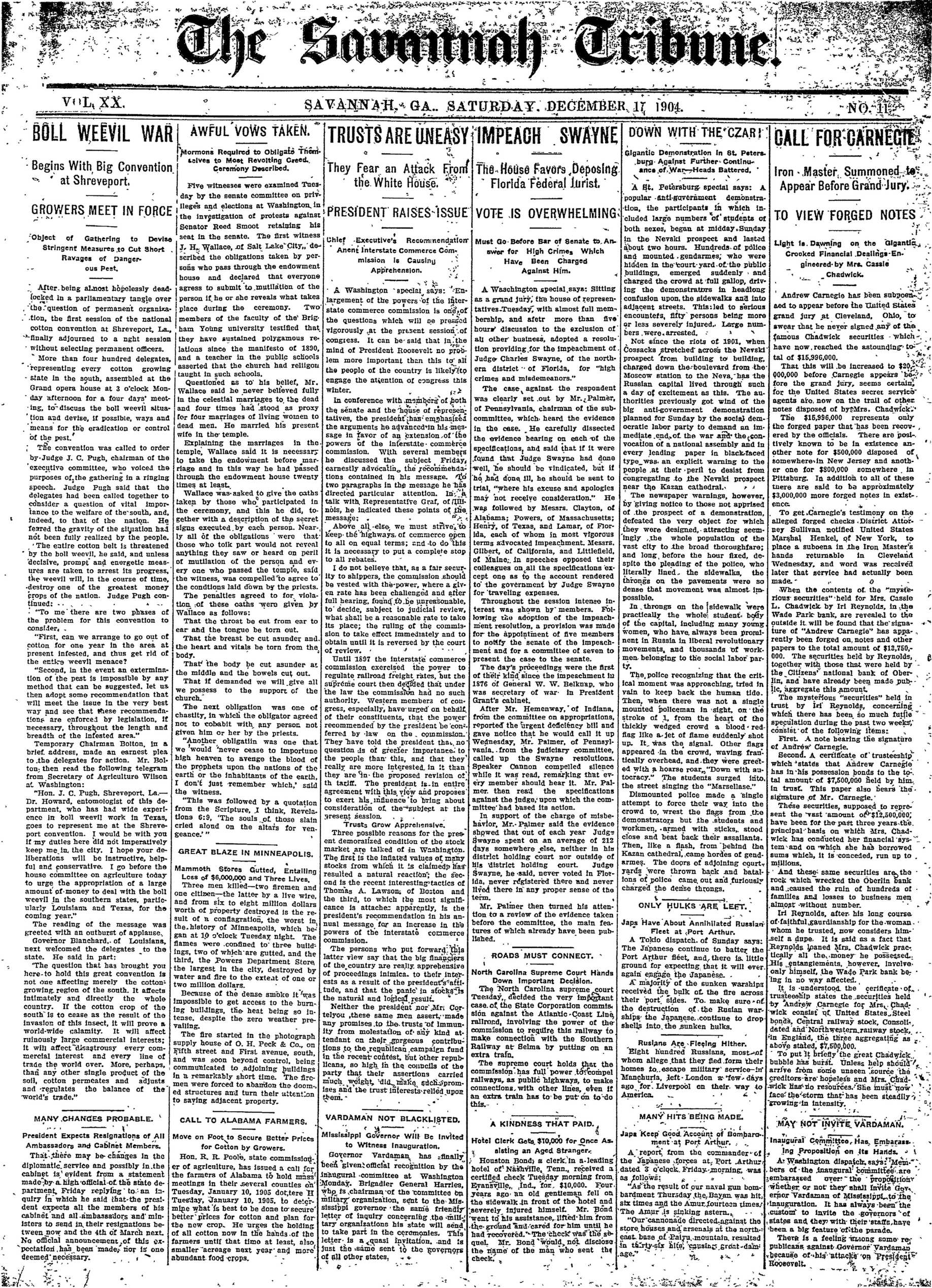
Begins With Big Convention at Shreveport.
GROWERS MEET IN FORCE
Object of Gathering to Devise Stringent Measures to Cut Short Ravages of Dangerous Pest.
After being almost hopelessly deadlocked in a parliamentary tangle over the question of permanent organization, the first session of the national cotton convention at Shreveport, La., finally adjourned to a night session without selecting permanent officers.
More than four hundred delegates, representing every cotton growing state in the south, assembled at the Grand opera house at 3 o'clock Monday afternoon for a four days' meeting, to discuss the boll weevil situation and devise, if possible, ways and means for the eradication or control of the pest.
The convention was called to order by Judge J. C. Pugh, chairman of the executive committee, who voiced the purposes of the gathering in a ringing speech. Judge Pugh said that the delegates had been called together to consider a question of vital importance to the welfare of the south, and, indeed, to that of the nation. He feared the gravity of the situation had not been fully realized by the people.
The entire cotton belt is threatened by the holl weevil, he said, and unless decisive, prompt and energetic measures are taken to arrest its progress, the weevil will, in the course of time, destroy one of the greatest money crops of the nation. Judge Pugh continued: "To me there are two phases of the problem for this convention to consider. "First, can we arrange to go out of cotton for one year in the area at present infested, and thus get rid of the entire weevil menace? "Second, in the event an extermination of the pest is impossible by any method that can be suggested, let us then adopt some recommendation that will meet the issue in the very best way and see that these recommendations are enforced by legislation, if necessary, throughout the length and breadth of the infested area."
Temporary Chairman Bolton, in a brief address, made an earnest plea to the delegates for action. Mr. Bolton; then read the following telegram from Secretary of Agriculture Wilson at Washington: "Hon. J. C. Pugh, Shreveport, La.-Dr. Howard, entomologist of this department, who has had wide experience in boll weevil work in Texas, goes to represent me at the Shreveport convention. I would be with you if my duties here did not imperatively keep me in the city. I hope your deliberations will be instructive, helpful and conservative. I go before the house committee on agriculture today to urge the appropriation of a large amount of money to deal with the boll weevil in the southern states, particularly Louisiana and Texas, for the coming year."
The reading of the message was greeted with an outburst of applause. Governor Blanchard., of Louisiana, next welcomed the delegates to the state. He said in part:
"The question that has brought you here-to hold this great convention is not one affecting merely the cotton-growing region of the south. It affects intimately and directly the whole country. If the cotton crop of the south is to cease as the result of the invasion of this insect, it will prove a world-wide calamity. It will affect ruinously large commercial interests; it will affect 'disastrousy every commercial interest and every line of trade the world over. More, perhaps, than any other single product of the soil, cotton permeates and adjusts and regulates the balance of the world's trade."
President Expects Resignations of All Ambassadors and Cabinet Members. That there may be changes in the diplomatic service and possibly in the cabinet is evident from a statement made by a high official of the state department. Friday replying to an inquiry in which he said that the president expects all the members of his cabinet and all ambassadors and ministers to send in their resignations between now and the 4th of March next. No official announcement of this expectation has been made, nor is one deemed necessary.
AWFUL VOWS TAKEN.
Mormons Required to Obligate Themselves to Most Revolting Creed. Ceremony Described.
Five witnesses were examined Tuesday by the senate committee on privileges and elections at Washington in the investigation of protests against Senator Reed Smoot retaining his seat in the senate. The first witness J. H. Wallace, of Salt Lake City, described the obligations taken by persons who pass through the endowment house and declared that everyone agress to submit to mutilation of the person if he or she reveals what takes place during the ceremony. Two members of the faculty of the Brigham Young university testified that they have sustained polygamous relations since the manifesto of 1830, and a teacher in the public schools asserted that the church had religion taught in such schools.
Questioned as to his belief, Mr. Wallace said he never believed fully in the celestial marriages to the dead and four times had stood as proxy for four marriages of living women to dead men. He married his present wife in the temple.
Explaining the marriages in the temple, Wallace said it is necessary to take the endowment before marriage and in this way he had passed through the endowment house twenty times at least.
Wallace was asked to give the oath taken by those who participated in the ceremony, and this he did, together with a description of the secret signs executed, by each person. Nearly all of the obligations were that those who talk part would not reveal anything they saw or heard on peril of mutilation of the person and every one who passed the temple, said the witness, was compelled to agree to the conditions laid down by the priests.
The penalties agreed to for violation of these oaths were given by Wallace as follows:
That the throat be cut from ear to ear and the tongue be torn out.
That the breast be cut asunder and the heart and vitals be torn from the body.
That the body be cut asunder at the middle and the bowels cut out.
The next obligation was one of chastity, in which the obligator agreed not to cobabit with any person not given him or her by the priests.
"Another obligatilin was one that we would 'never cease to importune high heaven to avenge the blood of the prophets upon the nations of the earth or the inhabitants of the earth, I don't just remember which,' said the witness.
"This was followed by a quotation from the Scripture, I think, Revelations 6:9, 'The souls of those slain cried aloud on the altars for vengeance.'"
GREAT BLAZE IN MINNEAPOLIS.
Mammoth Stores Gutted, Entailing Less of $6,000,000 and Three Lives. Three men killed—two afromen and one citizen—the latter by a live wire, and from six to eight million dollars worth of property destroyed is the result of a conflagration, the worst in the history of Minneapolis, which began at 10 o'clock Tuesday night. The flames were confined to three buildings, two of which are gutted, and the third, the Powers Department Store the largest in the city, destroyed by water and fire to the extent of one or two million dollars. Because of the dense smoke it was impossible to get access to the burning buildings, the heat being so intense, despite the zero weather prevailing.
The fire started in the photograph supply house of O. H. Peck & Co., on Fifth street and First avenue, south, and was soon beyond control, being communicated to adjoining buildings in a remarkably short time. The firemen were forced to abandon the doomed structures and turn their attention to saying adjacent property.
CALL TO ALABAMA FARMERS.
Move on Foot to Secure Better Prices for Cotton by Growers.
Hon. R. R. Poole, state commissioner of agriculture, has issued a call for the farmers of Alabama to hold mass meetings in their several counties on Tuesday, January 10, 1905 dottere H Tuesday, January 10, 1905, to determine what is best to be done to secure better prices for cotton and plan for the new crop. He urges the holding of all cotton now in the hands of the farmers until that time at least, also smaller acreage next year and more abundant food crops.
A Washington special says: Enlargement of the powers of the interstate commerce commission is one of the questions which will be pressed vigorously at the present session of congress. It can be said that in the mind of President Roosevelt no problem more important than this to all the people of the country is likely to engage the attention of congress this winter.
In conference with members of both the senate and the house of representatives, the president has emphasized the arguments he advanced in his message in favor of an extension of the powers of the inferstate commerce commission. With several members he discussed the subject, Friday, earnestly advocating the recommendations contained in his message. To two paragraphs in the message he has directed particular attention. In a talk with Representative Graf, of Illinois, he indicated these points of the message: Above all else, we must strive, to keep the highways of commerce open to all on equal terms; and to do this it is necessary to put a complete stop to all rebates.
I do not believe that, as a fair security to shippers, the commission should be vested with the-power, where a given rate has been challenged and after full hearing, found to be unreasonable, to decide, subject to judicial review, what shall be a reasonable rate to take its place, the ruling of the commission to take effect immediately and to obtain until it is reversed by the court of review.
Until 1897 the interstate commerce commission exercised the power to regulate railroad freight rates, but the supreme court then decided that under the law the commission had no such authority. Western members of congress, especially, have urged on behalf of their constituents, that the power recommended by the president be conferred by law on the commission. They have told the president that, no question is of greater importance to the people than this, and that they really are more interested in it than they are in the proposed revision of tariff. The president is in entire agreement with this view and proposes to exert his influence to bring about consideration of the subject at the present session.
Trusts Grow Apprehensive.
Three possible reasons for the present demoralized condition of the stock market are talked of in Washington. The first is the inflated values of many stocks from which it is claimed has resulted a natural reaction; the second is the recent interesting tactics of Thomas A. Lawson, of Boston and the third, to the most significance is attaches: apparently, is the president's recommendation in his annual message for an increase in the powers of the interstate commerce commission.
The persons who put forward this latter view say that the big financiers of the country are really apprehensive of proceedings inimical to their interests as a result of the president's attitude, and that the panic in stocks is the natural and logical result.
Neither the president nor Mr. Cortelyou, these same men assert; made any promises to the trusts of immunity from molestation of any kind attendant on their gorgeous contributions to the republican campaign fund in the recent contest, but other republicans, so high in the councils of the party that their assertions carried much weight, did make such promises and the trust interests relied upon them.
Governor Vardaman has finally been given official recognition by the inaugural committee at Washington Monday. Brigadier General Harris, who is chairman of the committee on military organization, sent to the Mississippi governor the same friendly letter of inquiry concerning the military organizations his state will send to take part in the ceremonies. This letter is a quasil invitation, and is just the same sent to the governors of all other states.
The House Favors Deposing Florida Federal Jurist.
Must Go Before Bar of Senate to Answer for High Crimes Which Have Been Charged Against Him.
A Washington special says: Sitting as a grand jury, the house of representatives Tuesday, with almost full membership, and aftr more than five hours' discussion to the exclusion of all other business, adopted a resolution providing for the impeachment of Judge Charles Swayne, of the northern district of Florida, for "high crimes and misdemeanors."
The case, against the respondent was clearly set out by Mr. Palmer, of Pennsylvania, chairman of the subcommittee, which heard the evidence in the case. He carefully dissected the evidence hearing on each of the specifications, and said that if it were found that Judge Swayne had done well, he should be vindicated, but if he had done ill, he should be sent to trial, "where his excuse and apologies may not receive consideration." He was followed by Messrs. Clayton, of Alabama; Powers, of Massachusetts; Henry, of Texas, and Lamar, of Florida, each of whom in most vigorous terms advocated impeachment. Messrs. Gilbert, of California, and Littlefield, of Maine; in speeches opposed their colleagues on all the specifications except one as to the account rendered to the government by Judge Swayne for traveling expenses.
Throughout the session intense interest was shown by members. Following the adoption of the impeachment resolution, a provision was made for the appointment of five members to notify the senate of the impeachment and for a committee of seven to present the case to the senate. The day's proceedings were the first of their kind since the impeachment in 1876 of General W. W. Belknap, who was secretary of war in President Grant's cabinet.
After Mr. Hemenway, of Indiana, from the committee on appropriations, reported the urgent deficiency bill and gave notice that he would call it up Wednesday, Mr. Palmer, of Pennsylvania, from the judiciary committee, called up the Swayne resolutions. Speaker Cannon compelled silence while it was read, remarking that every member should hear it. Mr. Palmer, then read the specifications against the judge, upon which the committee had based its action. In support of the charge of misbehavior, Mr. Palmer said the evidence showed that out of each year Judge Swayne spent on an average of 212 days somewhere else, neither in his district holding court nor outside of his district holding court. Judge Swayne, he said, never voted in Florida, never registered there and never lived there in any proper sense of the term.
Mr. Palmer then turned his attention to a review of the evidence taken before the committee, the main features of which already have been published.
North Carolina Supreme Court Hands Down Important Decision.
Down Important Decision.
The North Carolina supreme court Tuesday, decided the very important case of the State Corporation commission against the Atlantic-Coast Line railroad, involving the power of the commission to require this railway to make connection with the Southern Railway at Selma by putting on an extra train.
The supreme court holds that the commission has full power to compel railways, as public highways, to make connections, with other lines, even if an extra train has to be put on to do this.
A KINDNESS THAT PAID.
Houston Bond; a clerk in a leading hotel of Nashville, Tenn., received a certified check Tuesday morning from Evanville, Ind., for $10,000. Four years ago an old gentleman fell on the sidewalk in front of the hotel and severely injured himself. Mr. Bond went to his assistance, lifted him from the ground and cared for him until he had recovered. The check was the sequel. Mr. Bond would, not disclose the name of the man who sent the check.
DOWN WITH THE CZAR!
Gigantic Demonstration In St. Petersburg Against Further Continuance of War—Heads Battered.
A St. Petersburg special says: A popular anti-government demonstration, the participants in which included large numbers of students of both sexes, began at midday.Sunday in the Nevski prospect and lasted about two hours. Hundreds of police and mounted gendarmes; who were hidden in the court yard of the public buildings, emerged suddenly and charged the crowd at full gallop, driving the demonstrators in headlong confusion upon the sidewalks and into adjacent streets. This led to serious encounters, fifty persons being more or less severely injured. Large numbers were, arrested.
Not since the riots of 1901, when Cossacks stretched across the Newski prospect from building to building, charged down the boulevard from the Moscow station to the Neva, has the Russian capital lived through such a day of excitement as this. The authorities previously got wind of the big anti-government demonstration planned for Sunday by the social democratic labor party to demand an immediate end of the war and the convocation of a national assembly and in every leading paper in black-faced type was an explicit warning to the people at their peril to desist from congregating to the Newski prospect near the Kazan cathedral.
The newspaper warnings, however, by giving notice to those not apprised of the prospect of a demonstration, defeated the very object for which they were designed, attracting seemingly the whole population of the vast city to the broad thoroughfare; and long, before the hour fixed, despite the pleading of the police, who literally lined, the sidewalks, the throngs on the pavements were so dense that movement was almost impossible.
In throngs on the sidewalk were practically the whole student-body of the capital, including many young women, who have always been prominent in Russia in liberal revolutionary movements, and thousands of workmen belonging to the social labor party.
The police recognizing that the critical moment was approaching, tried in vain to keep back the human tido. Then, when there was not a single mounted policeman in sight, on the stroke of 1, from the heart of the thickly wedged crowd a blood-red flag like a jet of flame suddenly shot up. It was the signal. Other flags appeared in the crowd, waving frantically overhead, and they were greeted with a hoarse roar. "Down with autocracy." The students surged into, the street singing the "Marsellase."
Dismounted police made a single attempt to force their way into the crowd to, wrest the flags from the demonstrators but the students and workmen, armed with sticks, stood close and beat back their assailants. Then, like a flash, from behind the Kazan cathedral, hordes of gendarmes. The doors of adjoining courtyards were thrown back and batalions of police came out and furiously charged the dense throngs.
ONLY HULKS ARE LEET.
A Tokio dispatch. of Sunday says: The Japanese continue to batter the Port Arthur fleet, and, there is little ground for expecting that it will ever again engage the Japanese.
A majority of the sunken warships received the bulk of the fire across their port sides. To make sure of the destruction of the Russian warships the Japanese. continue to drop shells into the sunken hulks.
Ruslans Are. Fleeing Hither.
Eight hundred Russians, most of whom allege that they fled form their homes to. escape military service in Manchuria, left London a few days ago for Liverpool on their way to America.
A report from the commander of the Japanese forces at Port Arthur dated 3 o'clock Friday morning, was as follows:
"As the result of our naval gun bombardment Thursday the Bayan was hit, six times and the Amur fourteen times. The Amur is sinking astern.
"Our cannonade directed against the store houses and arsenals at the northeast base of Palmy, mountain resulted in thirty-six hits, causing great damage."
Iron Master. Summoned to Appear Before Grand Jury.
Light is. Dawning on the Giantic Crooked Financial Dealings-En-
Andrew Carnegie has been subpoenaed to appear before the United States grand jury at Cleveland, Ohio, to swear that he never signed any of the famous Chadwick securities which have now, reached the astounding total of $15,996,000.
That this will be increased to $20,000,000 before Carnegie appears before the grand jury, seems certain, for the United States secret service agents are now on the trail of other notes disposed of by Mrs. Chadwick.
The $15,996,000 represents only the forged paper that has been recovered by the officials. There are positively known to be in existence another note for $500,000 disposed of somewhere in New Jersey and another one for $800,000 somewhere in Pittsburg. In addition to all of these there are said to be approximately $3,000,000 more forged notes in existence.
To get.Carnegie's testimony on the alleged forged checks.District Attorney Sullivan notified United States Marshal Henkel, of New York, to place a suboena in the Iron Master's hands returnable in Cleveland Wednesday, and word was received later that service had actually been made.
When the contents of the "mysterious securities" held for Mrs. Cassie L. Chadwick by Irl Reynolds, in the Wade Park bank, are revealed to the outside it will be found that the signature of "Andrew Carnegie" has apparently been forged on, notes and other papers to the total amount of $13,750,000. The securities held by Reynolds, together with those that were held by the Citizens' national bank of Oberlin, and have already been made public, aggregate this amount.
The mysterious "securities" held in trust by Iri Reynolds, concerning which there has been so much fufle speculation during the past two weeks, consist of the following items: First. A note bearing the signature of Andrew Carnegie.
Second. A certificate of trusteeship which states that Andrew Carnegie has in his possession bonds to the total amount of $7,500,000 held by him in trust. This paper also bears the signature of Mr. Carnegie.
These securities, supposed to represent the vast amount of $12,500,000, have been for the past three years the principal basis on which Mrs. Chadwick has conducted her financial system and on which she has borrowed sums which, it is conceded, run up to millions.
And these same securities are the rock which wrecked the Oberlin bank and caused the ruin of hundreds of families and losses to business men almost without number.
Iri Reynolds, after his long course of faithful guardianship for the woman whom he trusted, now considers himself a dupe. It is said as a fact that Reynolds loaned Mrs. Chadwick practically all the money he possessed. His entanglements, however, involve only himself, the Wajo Park bank being in no way affected.
It is understood the certificate of trusteeship states the securities held by Andrew Carnegie for Mrs. Chadwick consist of United States Steel bonds, Central railway stock, Consolidated and Northwestern railway stock, in England, the three aggregating as above stated, $7,500,000.
To put it briefly the great Chadwick bubble has burst. Unless help should arrive from some unseen source the creditors are hopeless and Mrs. Chadwick has no resources. She must now face the storm that has been steadily growing in intensity.
MAY NOT INVITE VARDAMAN.
Inaugural Committee, Has Embarassing Proposition on Its Hands.
A Washington dispatch says: Members of the inaugural committee are embarrassed over the proposition whether or not they shall invite Governor Vardaman of Mississippi, to the inauguration. It has always been the custom to invite the governors of states and they with their staffs have been a big feature of the parade.
There is a feeling among some republicans against Governor Vardaman because of his attacks on President Hoosevelt.
One Year..... 51,25
Six Months..... 78
Three Months..... 50
Resilience must be made by Express or
Post Office Money Order, or Registered Letter
Advertising Rates given on application.
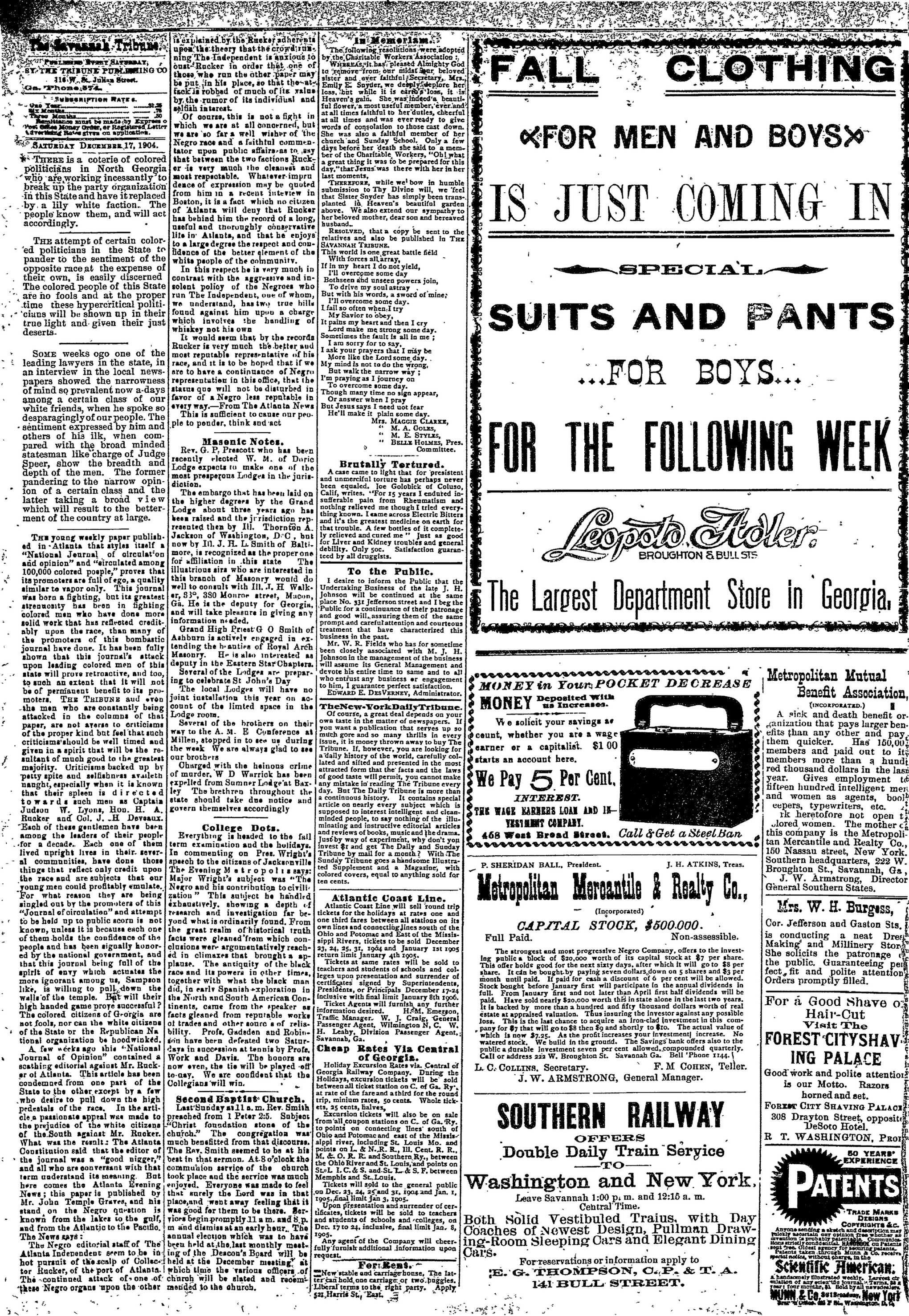
THERE is a coterie of colored politicians in North Georgia who are working incessantly to break up the party organization in this State and have it replaced by a lily white faction. The people know them, and will act accordingly.
THE attempt of certain colored politicians in the State to pander to the sentiment of the opposite race at the expense of their own, is easily discerned The colored people of this State are no fools and at the proper time these hypercritical politicians will be shown up in their true light and given their just deserts.
Some weeks ogo one of the leading lawyers in the state, in an interview in the local newspapers showed the narrowness of mind so prevalent now a-days among a certain class of our white friends, when he spoke so desparagingly of our people. The sentiment expressed by him and others of his ilk, when compared with the broad minded statesman like charge of Judge Speer, show the breadth and depth of the men. The former pandering to the narrow opinion of a certain class and the latter taking a broad view which will result to the betterment of the country at large.
The young weekly paper published in Atlanta that styles itself a "National Journal of circulation and opinion" and "circulated among 100,000 colored people," proves that its promoters are full of ego, a quality similar to vapor only. This journal was born a fighting, but its greatest strenuosity has been in fighting colored men who have done more solid work that has reflected creditably upon the race, than many of the promoters of this bombastic journal have done. It has been fully shown that this journal's attack upon leading colored men of this state will prove retroactive, and too, to such an extent that it will not be of permanent benefit to its promoters. THE TRIBUNE and even the men who are constantly being attacked in the columns of that paper, are not averse to criticisms of the proper kind but feel that such criticisms should be well timed and given in a spirit that will be the resultant of much good to the greatest majority. Uriticisms backed up by patty spite and selfishness availeth naught, especially when it is known that their spleen is directed toward a such men as Captain Judson W. Lyons, Hon. H. A. Rucker and Col. J. H. Deveaux. Each of these gentlemen have been among the leaders of their people for a decade. Each one of them lived upright lives in their several communities, have done those things that reflect only credit upon the race and are subjects that our young men could profitably emulate. For what reason they are being singled out by the promoters of this "Journal of circulation" and attempt to be held up to public scorn is not known, unless it is because each one of them holds the confidence of the people and has been signally honored by the national government, and that this journal being full of the spirit of envy which actuates the more ignorant among us, Sampson like, is willing to pull down the walls of the temple. But will their high handed game prove successful? The colored citizens of Georgia are not fools, nor can the white citizens of the State or the Republican National organization be hoodwinked.
A few weeks ago this "National Journal of Opinion" contained a scathing editorial against Mr. Rucker of Atlanta. This article has been condemned from one part of the State to the other except by a few who desire to pull down the high pedestals of the race. In the article a passionate appeal was made to the prejudice of the white citizens of the South against Mr. Rucker. What was the result: The Atlanta Constitution said that the editor of
the journal was a "good nigger," and all who are conversant with that term understand its meaning. But here comes the Atlanta Evening News; this paper is published by Mr. John Temple Graves, and his stand on the Negro question is known from the lakes to the gulf, and from the Atlantic to the Pacific. The News says:
The Negro editorial staff of The Atlanta Independent seem to be in hot pursuit of the scalp of Collector Rucker, of the port of Atlanta. The continued attack of one of these Negro organs upon the other
is explained by the Rucker adherents upon the theory that the crowd running The Independent is anxious to oust Rucker in order that one of those who run the other paper may be put in his place, so that the attack is robbed of much of its value by the rumor of its individual and selfish interest.
Of course, this is not a fight in which we are at all concerned, but we are so far a well wisher of the Negro race and a faithful commentator upon public affairs as to say that between the two factions Bucker is very much the cleanest and most respectable. Whatever imprudence of expression may be quoted from him in a recent interview in Boston, it is a fact which no citizen of Atlanta will deny that Bucker has behind him the record of a long, useful and thoroughly conservative life in Atlanta, and that he enjoys to a large degree the respect and confidence of the better element of the whites people of the community.
In this respect he is very much in contrast with the aggressive and insolent policy of the Negroes who run The Independent, one of whom, we understand, has two true bills found against him upon a charge which involves the handling of whiskey not his own.
It would seem that by the records Rucker is very much the better and most reputable representative of his race, and it is to be hoped that if we are to have a continuance of Negro representation in this office, that the status quo will not be disturbed in favor of a Negro less reputable in every way.—From The Atlanta News
This is sufficient to cause our people to ponder, think and act
Masenic Notes.
Rev. G. P. Prescott who has been recently elected W. M. of Doric Lodge expects to make one of the most prosperous Lodges in the jurisdiction.
The embargo that has been laid on the higher degrees by the Grand Lodge about three years ago has been raised and the jurisdiction represented then by Ill. Thornton A. Jackson of Washington, D.C., but now by Ill. J. H. L. Smith of Baltimore, is recognized as the proper one for affiliation in this state. The illustrious sirs who are interested in this branch of Masonry would do well to consult with Ill. J. H. Walker, 33°, 380 Mouner street, Macon, Ga. He is the deputy for Georgia, and will take pleasure in giving any information needed.
Grand High Priest G O Smith of Ashburn is actively engaged in extending the beauties of Royal Arch Masonry. He is also interested as deputy in the Eastern Star Chapters. Several of the Lodges are preparing to celebrate St John's Day. The local Lodges will have no joint installation this year on account of the limited space in the Lodge room. Several of the brothers on their way to the A.M. E Conference at Millen, stopped in to see us during the week We are always glad to see our brothers
Charged with the heinous crime of murder, W D Warrick has been expelled from Sumner Lodge at Baxley. The brethren throughout the state should take due notice and govern themselves accordingly
College Dots.
Everything is headed to the fall term examination and the holidays. In commenting on Pres. Wright's speech to the citizens of Jacksonville The Evening Metropolis says: Major Wright's subject was "The Negro and his contribution to civilization" This subject he handled exhaustively, showing a depth of research and investigation far beyond what is ordinarily found. From the great realm of historical truth facts were gleaned from which conclusions were argumentatively reached in climaxes that brought a applause. The antiquity of the black race and its powers in other times, together with what the black man did, in early Spanish+exploration in the North and South American Continents, came from the speaker as facts gleaned from reputable works of trades and other sources of reliability. Profs. Gadsden and Robinson have been defeated two Saturdays in succession at tennis by Profs. Work and Davis. The honors are now even, the tie will be played off to-day. We are confident that the Collegians will win.
Second Baptist Church
Second Baptist Church.
Last Sunday at 11 a.m. Rev. Smith preached from 1 Peter 2:5. Subject "Christ foundation stone of the church." The congregation was much benefitted from that discourse. The Rev. Smith seemed to be at his best in that sermon. At 8 o'clock the communion service of the church took place and the service was much enjoyed. Everyone was made to feel that surely the Lord was in that place, and went away feeling that it was good for them to be there. Services begin promptly 11 a.m. and 8 p.m. and dismiss at an early hour. The annual election which was to have been held at the last monthly meeting of the Deacon's Board will be held at the December meeting at which time the various officers of church will be slated and recommended to the church.
The following resolutions, were adopted by the Charitable Workers Association ;
WHENAS it has pleased Almighty God to remove from our midafar beloved sister and ever faithful Secretary, Mrs. Emily E. Snyder, we deeply deplore her loss, but while it is earth's loss, it is Heaven's gain. She was indeed a beautiful flower, a most useful member, ever and at all times faithful to her duties, cheerful at all times and was ever ready to give words of consolation to those cast down. She was also a faithful member of her church and Sunday School. Only a few days before her death she said to a member of the Charitable Workers, "Oh! what a great thing it was to be prepared for this day," that Jesus was there with her in her last moments.
THEREFORE, while we bow in humble submission to Thy Divine will, we feel that Sister Snyder has simply been transplanted in Heaven's beautiful garden above. We also extend our sympathy to her beloved mother, dear son and bereaved husband.
RESOLVED, that a copy be sent to the relatives and also be published In THE SAVANNAH TRIBUNE.
This world is one great battle field
With forces all array,
If in my heart I do not yield,
I'll overcome some day
Bothseen and unseen powers join,
To drive my soul astray
But with his words, a sword of mine;
I'll overcome some day.
I fall so often when I try
My Savior to obey.
It pains my heart and then I cry
Lord make me strong some day.
Sometimes the fault is all in me;
I am sorry for to say,
I ask your prayers that I may be
More like the Lord some day.
My mind is not to do the wrong,
But walk the narrow way;
I'm praying as I journey on
To overcome some day.
Though many time no sign appear,
Or answer when I pray
But Jesus says I need not fear
He'll make it plain some day.
Mrs. MAGGIE CLARKE,
"M. A. GOLES,
"M. E. STYLES,
"BELLE HOLMES, Pres.
Committee.
Brutally Tortured.
A case came to light that for presistent and unmerciful torture has perhaps never been equaled. Joe Golobick of Coluso, Calif, writes. "For 15 years I endured insufferable pain from Rheumatism and nothing relieved me though I tried everything known. I came across Electric Bitters and it's the greatest medicine on earth for that trouble. A few bottles of it completely relieved and cured me." Just as good for Liver and Kidney troubles and general debility. Only 50c. Satisfaction guaranteed by all drummers.
To the Public.
I desire to inform the Public that the Undertaking Business of the late J. H. Johnson will be continued at the same place No. 331 Jefferson street and I beg the Public for a continuance of their patronage and good will, assuring them of the same prompt and careful attention and courteous treatment that have characterized this business in the past.
Mr. W. R. Fields who has for sometime been closely associated with M. J. H. Johnson in the management of the business will assume its General Management and devote his entire time to and to all who entrust any business or engagement to him, I guarantee perfect satisfaction.
Of course, a great deal depends on your own taste in the matter of newspapers. If you want a publication that serves up so much gore and so many thrills in every issue, it is money thrown away to buy The Tribune. If, however, you are looking for a daily history of the world, carefully collated and sifted and presented in the most attracted form that the facts and the laws of good taste will permit, you cannot make any mistake in reading The Tribune every day. But The Daily Tribune is more than a continuous history. It contains special article on nearly every subject which is supposed to interest intelligent and clean-minded people, to say nothing of the illuminating and instructive editorial articles and reviews of books, music and the drama. Just by way of experiment, why don't you invest $r and get The Daily and Sunday Tribune by mail for a month? With The Sunday Tribune goes a handsome Illustrated Supplement and a Magazine, with colored covers, equal to anything sold for ten cents.
Atlantic Coast Line.
Atlantic Coast Line will sell round trip tickets for the holidays at rates one and one third fares between all stations on its own lines and connecting lines south of the Ohio and Potomac and East of the Mississippi Rivers, tickets to be sold December 23, 24, 25, 31, 1904 and January 1st 1905 return limit January 4th 1905.
Tickets at same rates will be sold to teachers and students of schools and colleges upon presentation and surrender of certificates signed by Superintendents, Presidents, or Principals December 17-24 inclusive with final limit January 8th 1906.
Ticket Agents will furnish any further information desired. H.M. Emegson, Traffic Manager. W. J. Craig, General Passenger Agent, Wilmington N, C. W. H. Leahy, Division Passenger Agent, Savannah, Ga.
Cheap Rates Via Central of Georgia.
Holiday Excursion Rates via. Central of Georgia Railway Company. During the Holidays, excursion tickets will be sold between all ticket station on C. of Ga. Ry. at rate of the fare and athird for the round trip, minimum rates, 50 cents. Whole tickets, 25 cents, halves.
Excursion tickets will also be on sale from all coupon stations on C. of Ga. Ry. to points on connecting lines' south of Ohio and Potomac and east of the Mississippi river, including St. Louis Mo. and points on L. & N. R. R. Ill. Cent. R. R. M. & O. R. R. and Southern Ry., between the Ohio River and St. Louis, and points on St. L. I. C. & S. and St. L. & S. F. between Memphis and St. Louis.
Tickets will sold to the general public on Dec. 23, 24, 25 and 31, 1904 and Jan. 1, 1905, final limit Jan 3, 1905.
Upon presentation and surrender of certificates, tickets will be sold to teachers and students of schools and colleges, on Dec. 17 to 24, inclusive, final limit Jan. 8, 1905.
Any agent of the Company will cheerfully furnish additional information upon request.
For Rent.
New stable and carriage house. The latter can hold, one carriage or two, buggies. Liberal terms to the right party. Apply 62s, Harris St., East.
FOR THE FOLLOWING WEEK
MONEY in Your POCKET DECREASE
CAPITAL STOCK, $500.000.
Full Paid. Non-assessible.
The strongest and most progressive Negro Company, offers to the investing public a block of $20,000 worth of its capital stock at $7 per share. This offer holds good for the next sixty days, after which it will go to $8 per share. It can be bought by paying seven dollars, down on 5 shares and $3 per month until paid. If paid for cash a discount of 6 per cent will be allowed. Stock bought before January first will participate in the annual dividends in full. From January first and not later than April first half dividends will be paid. Have sold nearly $20,000 worth this in state alone in the last two years. It is backed by more than a hundred and fifty thousand dollars worth of real estate at appraised valuation. Thus insuring the investor against any possible loss. This is the last chance to acquire an iron-clad investment in this company for $7 that will go to $8 then $9 and shortly to $10. The actual value of which is now $7.25. As the profit increases your investment increase. No watered stock. We build in the ground. The Savings bank offers also to the public a durable investment seven per cent allowed, compounded quarterly. Call or address 222 W. Broughton St. Savannah Ga. Bell 'Phone 1144.
L. C. COLLINS. Secretary.
F. M COHEN, Teller.
J. W. ARMSTRONG. General Manager.
SOUTHERN RAILWAY
Both Solid Vestibuled Traius, with Day Coaches of Newest Design, Pullman Drawing-Room Sleeping Cars and Elegant Dining Cars.
For reservations or information apply to E. G. THOMPSON, C. P. & T. A. 141 BULL STREET.
We solicit your savings account, whether you are a wage earner or a capitalist. $100 starts an account here.
---
Metropolitan Mutual
A sick and death benefit organization that pays larger benefits than any other and pay them quicker. Has 150,000 members and paid out to its members more than a hundred thousand dollars in the last year. Gives employment to fifteen hundred intelligent men and women as agents, bool ceepers, typewriters, etc.
erk heretofore not open to
colored women. The mother of
this company is the Metropolitan Mercantile and Realty Co.,
150 Nassau street, New York.
Southern headquarters, 222 W.
Broughton St., Savannah, Ga.
J. W. Armstrong, Director
General Southern States.
Mrs. W. H. Burgess,
Cor. Jefferson and Gaston Sts.
is conducting a neat Dress
Making and Millinery Store.
She solicits the patronage
of the public. Guaranteeing per-
fect, fit and polite attention.
Orders promptly filled.
For a Good Shave or
Hair-Cut
Visit The
FOREST CITYSHAV-
ING PALACE
Good work and polite attention
is our Motto. Razors
horned and set.
FOREST CITY SHAVING PALACE
308 Drayton Street, opposite
DeSoto Hotel.
50 YEARS' EXPERIENCE
PATENTS
TRADE MARKS DESIGNS
COPYRIGHTS & C.
Anyone sending a sketch of a description may quickly ascertain our opinion regarding invention is probably patentable. Communications with confidential. HANDBOOK on Patents kept Free. Oldest grantee, without patent. Patents taken through Munn & Co. receive special notice, without charge, in the
Scientific American:
handually illustrated weekly. Lawyer circulation of any scientific journal. Tarmas, 54 a year; four months, 54 Sold by all newdealers.
MUNN & Co. 501 Broadway, New York
Broadway "O'Connell" N. 21st, Washington, D.C.
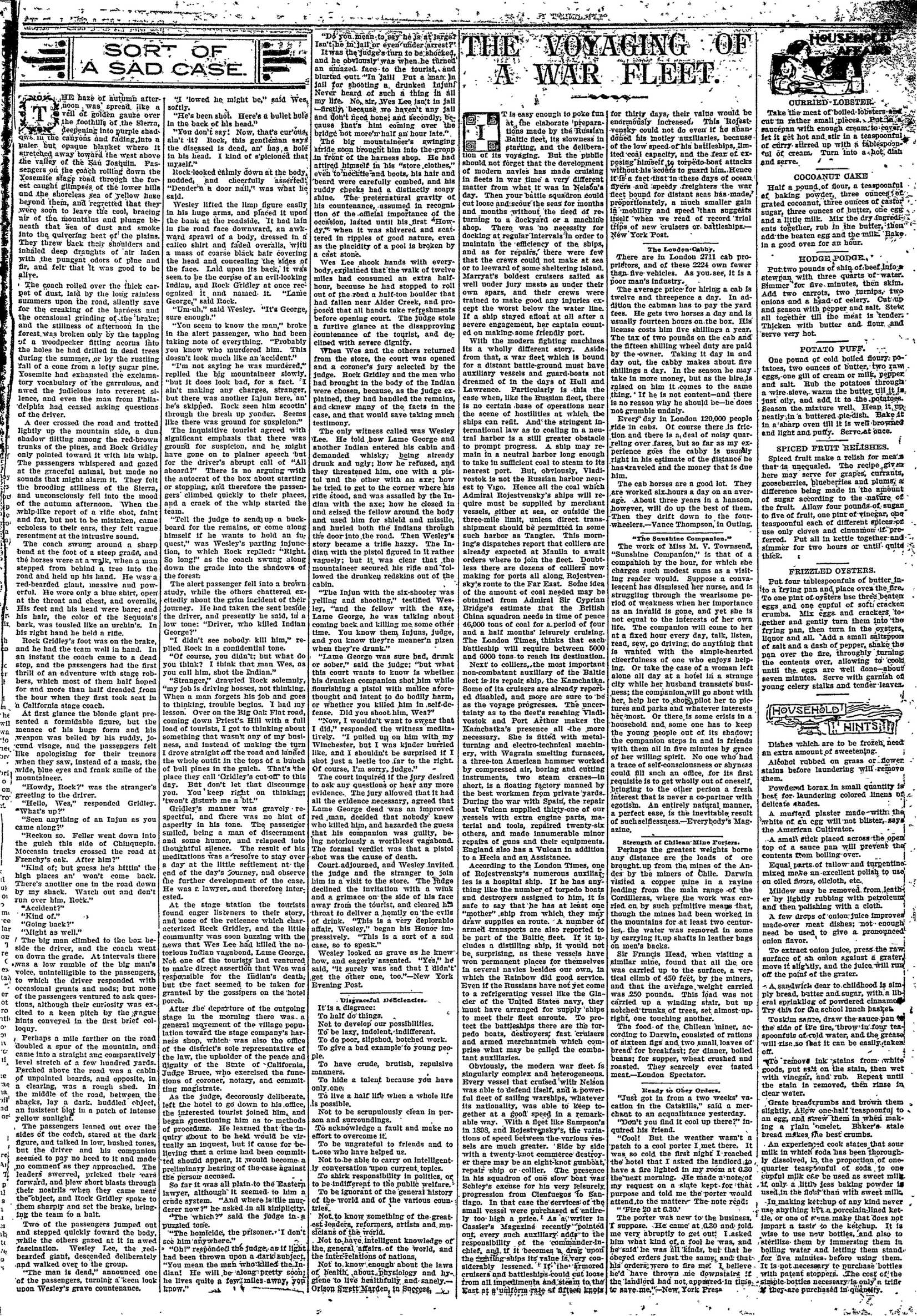
HE haze of autumn afternoon, was spread jike a moon of golden gauze over the foothills of the Sierra, deepening into purple shadows in the canyons and fading, into a paler but opaque blanket where it stretched away toward the west above the valley of the San Joaquin. Passengers on the coach rolling down the Xosemite stage road through the forest caught glimpses of the lower hills and the shoreless sea of yellow hue beyond them, and regretted that they were soon to leave the tool, bracing air of the mountains and plunge beneath that sea of dust and smoke into the quivering heat of the plains. They threw back their shoulders and inhaled deep draughts of air laden with the pungent odors of plue and fir, and felt that it was good to be ally.
The coach rolled over the thick carpet of dust, laid by the long rainless summers upon the road, silently save for the creaking of the harness and the occasional grinding of the brake, and the stillness of afternoon in the forest, was broken only by the tapping of a woodpecker fitting acorns into the holes he had drilled in dead trees during the summer, or by the rustling fall of a cone from a lotty sugar pine. Yosemite had exhausted the exclamatory vocabulary of the garrulous, and awned the judicious into reverent silence, and even the man from Philadelphia had ceased asking questions of the driver.
A deer crossed the road and trotted lightly up the mountain side, a dun shadow flitting among the red-brown trunks of the pines, and Bock Gridley only pointed toward it with his whip. The passengers whispered and gazed at the graceful animal, but made no sounds that might alarm it. They felt the brooding stillness of the Sierra, and unconsciously fell into the mood of the autumn afternoon. When the whip-like report of a rifle shot, faint and far, but not to be mistaken, came echelosch to their ears, they felt vague resentment at the intrusive sound. The coach swung around a sharp bend at the foot of a steep grade, and the horses were at a walk, when a man stepped from behind a tree into the road and held up his hand. He was a red-bearded glaut, massive and powerful. He wore only a blue shirt, open at the throat and chest, and overall, His feet and his head were bare; and his hair, the color of the Sequiai's bark, was touched like an urchin's. In his right hand he held a rifle.
Rock Gridley's foot was on the brake, and he had the team well in hand. In an instant the coach came to a dead stop, and the passengers had the first thrill of an adventure with stage robbers, which most of them half hoped for and more than half dreaded from the hour when they first took seat in a California stage coach. At first glance the blonde giant presented a formidable figure, but the menace of his huge form and his weapon was beiled by his ruddy, jocund vlage, and the passengers felt like apologizing for their tremors when they saw, instead of a mask, the wide, blue eyes and frank smile of the mountaineer.
"Howdy, Rock?" was the stranger's greeting to the driver.
"Hello, Wes," responded Gridley. "What's up?"
"Seen anything of an Injun as you came alone?"
"Reckon so. Feller went down into the gulch this side of Chinquipin. Moccasin tracks crossed the road at Frenchy's oak. After him?"
"Kind of; but guess he's hittin' the high places an' won't come back. There's another one in the road down by my shack. Watch out and don't run over him. Rock."
"Accident?"
"Kind of."
"Going back?"
"Might as well."
/ The big man climbed to the box beside the driver, and the coach went on down the grade. At intervals there was a low rumble of the big man's voice, unintelligible to the passengers, to which the driver responded with occasional grunts and nods; but none of the passengers ventured to ask questions, although their curiosity was excited to a keen pitch by the gorge hints conveyed in the first brief colloquy.
Perhaps a mile farther on the road doubled a spur of the mountain, and came into a straight and comparatively level stretch of a few hundred yards. Perched above the road was a cabin of unpainted boards, and opposite, in a clearing, was a rough shed. In the middle of the road, between the shacks, lay a dark, huddled object, an insistent blot in a patch of intense yellow sunlight. The passengers leaned out over the sides of the codch, stared at the dark figure, and talked in low, bushed tones, but the driver and his companion seemed to pay no heed to it and made no comment as they approached. The leaders swerved, pricked their ears forward, and blew short blasts through their nostrils when they came near the object, and Rock Gridley spoke to them sharply and set the brake, bringing the team to a halt.
Two of the passengers jumped out and stepped quickly toward the body, while the others gazed at it in awed fascination. Wesley Lee, the red-bearded gint, descended deliberately and walked over to the group. "The man is dead," announced one of the passengers, turning a keen look upon Wesley's grave countenance.
"I lowed he might be," said Wes, softly.
"He's been shot. Here's a bullet hole in the back of his head."
"You don't say! Now, that's curious, aln't it? Rock, this gentleman says the disease is dead, an has a hole in his head. I kind of splecioned that myself."
Rock-looked calmly down at the body, nodded, and cheerfully asserted:
"Deader'n a door nail," was what he said.
Wesley lifted the lump figure easily in his huge arms, and placed it upon the bank at the roadside. It had lain in the road face downward, an awkward sprawl of a body, dressed in a calico shirt and faded overalls, with a mass of coarse black hair covering the head and concealing the sides of the face. Laid upon its back, it was seen to be the corpse of an evil-looking Indian, and Rock Gridlet at once recognized it and named it. "Lanie George," said Rock.
"Um-uh," said Wesley. "It's George, sure enough."
"You seem to know the man," broke in the alert passenger, who had been taking note of everything. "Probably you know who murdered him. This doesn't look much like an accident."
"I'm not saying he was murdered," replied the big mountainer slowly, "but it does look bad, for a fact. I can't making any charges, stranger, but there was another Tajun here, an he's skipped. Rock seen him scootin' through the bresh up yonder. Seems like there was ground for suspicion."
The inquisitive tourist agreed with significant emphasis that there was ground for suspicion, and he might have gone on to planer speech but for the driver's abrupt call of "All aboard?" There is no arguing with the autocrat of the box about starting or stopping, and therefore the passengers' climbed quickly to their places, and a crack of the whip started the team.
"Tell the judge to send up a buckboard for the remains, or come himself if he wants to hold an fuguest," was Wesley's parting injunction, to which Rock replied: "Right. So long!" as the coach swung along down the grade into the shadows of the forest.
The alert passenger fell into a brown study, while the others chattered excitedly about the grim incident of their journey. He had taken the seat beside the driver, and presently he said, in a low tone: "Driver, who killed Indina George?"
"I didn't see nobody. kill him," replied Rock in a confidential tone.
"Of course, you didn't; but what do you think? I think that man Wes, as you call him, shot the Indian."
"Stranger," drawled Rock solemnly, "my job is driving hoses, not thinking. When a man forgets his job and goes to thinking, trouble begins. I had my lesson. Over on the Big Oak Flat road, coming down Priest's Hill with a full load of tourists, I got to think about something that wasn't any of my business, and instead of making the turn I drove straight off the road and landed the whole outfit in the tops of a bunch of bull pines in the gulch. That's the place they call 'Griddler' cut-off to this day. But don't let that discourage you. You keep right on thinking; 'twon disturb me a bit.'
Gridley's manner was gravely respectful, and there was no hint of asperity in his tone. The passenger smiled, being a man of discernment and some humor, and relapsed into thoughtful silence. The result of his meditations was a "resolve to stay over a day at the little settlement at the end of the day's journey, and observe the further development of the case. He was a lawyer, and therefore interested.
At the stage station the tourists found eager listeners to their story, and none of the reticence which characterized Reck Gridley, and the little community was soon buzzing with the news that Wes Lee had killed the notorious Indian vagabond, Lame George. Not one of the tourists had ventured to make direct assertion that Wes was responsible for the Indian's death, but the fact seemed to be taken for granted by the gossipers on the hotel porch.
After the departure of the outgoing stage in the morning there was a general movement of the village population toward the stage company's harness shop, which was also the office of the district's sole representative of the law, the upholder of the peace and dignity of the State of California, Judge Bruce, who exercised the functions of coroner, notary, and committing magistrate.
As the judge, decorously deliberate, left the hotel to go down to his office, the interested tourist joined him, and began questioning him as to methods of procedure. He learned that the inquiry about to be held would be virtually an inquest, but if cause for believing that a crime had been committed should appear, it would become a preliminary hearing of the case against the person accused.
So far it was all plain to the Eastern lawyer, although it seemed to him a crude system. "And where is the murderer now?" he asked in all simplicity, "the which?" said the judge in a puzzled tone. "The homicide, the prisoner." I don't see him anywhere.
"Oh!" responded the judge, as if light had been thrown upon a dark subject. "You mean the man who killed the Indian! He will be along pretty soon he lives quite a few miles away, you know."
"Do you mean to say he is at large? Isn't he in jail or even under arrest?" It was the judge's turn to be shocked, and he obviously was when he turned an sinned face to the tourist, and blurted out: "In jail! Put a man in jail for shooting a drunken Injuf! Never heard of such a thing in all my life. No air, Wes Lee isn't in jail — firstly, because we haven't any jail and don't need honey; and secondly, because that's him coming over the bridge hot more半 an hour late."
The big mountainer's swinging stride soon brought him into the group in front of the harness shop. He had attired himself in his "store, clothes," even to "necktie" and boots, his hair and beard were carefully combed, and his ruddy cheeks had a distinctly soapy shine. The preternatural gravity of his countenance, assumed in recognition of the official importance of the occasion, lasted until his first "Howdy," when it was shivered and scattered in ripples of good nature, even as the placidity of a pool is broken by a cast stone. Wes Lee shook hands with everybody, explained that the walk of twelve miles had consumed an extra half-hour, because he had stopped to roll out of the road a half-ton boulder that had fallen near Alder Creek, and proposed that all hands take refreshments before opening court. The judge stole a furtive glance at the disapproving countenance of the tourist, and declined with severe disgust.
When Wes and the others returned from the store, the court was opened and a coroner's jury selected by the judge. Rock Gridley and the men who had brought in the body of the Indian were chosen, because, as the judge explained, they had handled the remains, and knew many of the facts in the case, and that would save taking much testimony.
The only witness called was Wesley Lee. He told how Lame George and another Indian entered his cabin and demanded whiskey; being already drunk and ugly; how he refused, and they threatened him, one with a pistol and the other with an axe; how he tried to get to the corner where his rife stood, and was assailed by the Indian with the axe; how he closed in and seized the fellow around the body and used him for shield and missile, and hurled both the Indians through the door into the road. Then Wesley's story became a trifle hazzy. The Indian with the pistol figured in it rather vaguely; but it was clear that the mountainer secured his rife and followed the drunken redskins out of the cabin.
"The Injun with the six-shooter was yelling and shooting" testified Wessler, "and the fellow with the axe, Lame George, he was talking about coming back and killing me some other time. You know them Injuns, judge, and you know they're manner n plzen when they're drunk."
"Lame George was sure bad, drunk or sober," said the judge; "but what this court wants to know is whether his drunken companion shot him while flourishing a pistol with mallice aforethought and intent to do bodily harm, or whether you killed him in self-defense. Did you shoot him, Wes?"
"Now, I wouldn't want to swear that I did," responded the witness meditatively. "I pulled up on him with my Winchester, but I was kinder hurried like, and I shouldn't be surprised if I shot just a leetle too far to the right. Of course, I'm sorry, judge."
The court inquired if the jury desired to ask any questions or hear any more evidence. The jury allowed that it had all the evidence necessary, agreed that Laine George dead was an improved red man, decided that nobody knew who killed him, and hazarded the guess that his companion was guilty, being notoriously a worthless vagabond. The formal verdict was that a pistol shot was the cause of death.
Court adjourned, and Wesley invited the judge and the stranger to join him in a visit to the store. The judge declined the invitation with a wink and a grimace on the side of his face away from the tourist, and cleared his throat to deliver a homily on the evils of drink. "This is a very deplorable affair, Wesley," began his Honor impressively. "This is a sort of a sad case, so to speak."
Wesley looked as grave as he knew how, and eagerly assented. "Yes," he said, "it surely was sad that I didn't get the other one, too."—New York Evening Post.
To give a bad example to young people.
To have crude, brutish, repulsive manners.
To hide a talent because you have only one.
To live a half life when a whole life is possible.
Not to be scrupulously clean in person and surroundings.
To be ungrateful to friends and to those who have helped us.
Not to be able to carry on intelligently conversation upon current topics.
To shirk responsibility in politics, or to be indifferent to the public welfare.
To be ignorant of the general history of the world and of the various countries.
Not to know something of the greatest leaders, reformers, artists and musicians of the world.
Not to have intelligent knowledge of the general affairs of the world, and the inter-relations of nations.
Not to know enough about the laws of health, about physiology and hygiene to live healthfully, and sanely.—Orison Sgert Marden, in Success
THE VOYAGING OF A WAR FLEET.
It is easy enough to poke fun at the elaborate preparations made by the Russian Battle fleet, its slowness in starting, and the deliberation of its voyaging. But the public should not forget that the development of modern navies has made cruising in fleets in war time a very different matter from what it was in Nelson's day. Then your battle squadron could cut loose and scour the ses for months and months without the need of returning to a dockyard or a machine shop. There was no necessity for docking at regular Intervals in order to maintain the efficiency of the ships, and as for repair, there were few that the crews could not make at sea or to leeward of some sheltering island. Marryat's boldest cruisers sailed as well under jyms masts as under their own spars, and their crews were trained to make good any injuries except the worst below the water line. If a ship stayed afloat at all after a severe engagement, her captain counted on making some friendly port.
With the modern fighting machines its a wholly different story. Aside from that, a war fleet which is bound for a distant battle-ground must have auxiliary vessels and guard-boats not dreamed of in the days of Hull and Lawrence. Particularly is this the case when, like the Russian fleet, there is no certain base of operations near the scene of hostilities at which the ships can reef. And the stringent international law as to coaling in a neutral harbor is a still greater obstacle to prompt progress. A ship may remain in a neutral harbor long enough to take in sufficient coal to steam to its nearest port. But, obviously, Vladivostok is not the Russian harbor nearest to Vigo. Hence all the coal which Admiral Rojevstensky's ships will require must be supplied by merchant vessels, either at sea, or outside the three-mile limit, unless direct transhipment should be permitted in some harbor as Tangier. This morning's dispatches report that colliers are already expected at Manila to await orders where to join the fleet. Doubtless there are the dozens of colliers now making for ports all along Rojevstensky's route to the Far East. Some idea of the route to the Far East. Some idea may be obtained from Admiral Sir Cyprian China squadron needs in time of peace 46,000 tons of coal for a period of four and a half months' leisurely cruising. Each battleship will require between 5000 and 6000 tons to reach its destination.
Next to collers, the most important non-combatant auxiliary of the Baltic fleet is its repair ship, the Kamchatta. Some of its cruisers are already reported disabled, and more are sure to be as the voyage progresses. The uncertainty as to the fleet's reaching Vladivostok and Port Arthur makes the Kamchatta's presence all the more necessary. She is fitted with metalturning and electro-technical machinery, with Wagrain smelting furnaces, a three-ton American hammer worked by compressed air, boring and cutting instruments, two steam cranes—in short, is a floating factory manned by the best workmen from private yards. During the war with Spalp, the repair boat Vulcan supplied thirty-one of our vessels with extra engine parts, material and tools, repaired twenty-six others, and made innumerable minor repairs of guns and their equipments. England also has a Vulcan in addition to a Hecla and an Assistance.
According to the London Times, one of Ro杰vestvsky's numerous auxiliaries is a hospital ship. If he has anything like the number of torpedo boats and destroyers assigned to him, it is safe to say that he has at least one "mother" ship from which they may draw supplies en route. A number of armed transports are also reported to be part of the Baltic fleet. If it includes a distilling ship, it would not be, surprising, as these vessels have won permanent places for themselves in several navies besides our own, in which the Rainbow did good service. Even if the Russians have not yet come to a refrigerating vessel like the Glacier of the United States navy, they must have arranged for supply ships to meet their fleet enroute. To protect the battleships there are the torpedo boats, destroyers, fast cruisers and armed merchantmen which comprise what may be called the combatant auxiliaries.
Obviously, the modern war fleet is singularly complex and heterogeneous. Every vessel that cruised with Nelson was able to defend itself, and a powerful fleet of sailing warships, whatever its nationality, was able to keep together at a good speed in a remarkable way. With a fleet like Sampson's in 1808, and Rojetygenysky's, the variations of speed between the various vessels are much greater. 'Side by side with a twenty-knot commerce destroyer there may be an eight-knot gunbust, repair ship or collier. The presence in his squadron of one slow boat was Schley's excuse for his very leisurely progression from Cienfugos to Santiago. In that case the services: of the small vessel were purchased at entirely too high a price. As a writer in Cassier's Magazine recently "pointed out, every such auxiliary adds to the responsibility of the commander-in-chief, and if it becomes a drug upon the responsibility of the commander-in-chief, and if it becomes a drug upon the responsibility lessened. 'If the armored cruisers and battleships could cut loose from all impedimenta and steam to the East at uniform rate of fifteen knots
for thirty days, their value would be enormously increased. This Rofst-veness could not do even if his shandoned his motley auxiliaries, because of the low speed of his battleships, limited coal capacity, and the fear of exposing himself to torpedo-boat attacks without his secrets to guard him. Hence it is a fact that in these days of ocean ships and speedy freighters the war fleet bound for distant seas has made, proportionately, a much smaller gain in mobility and speed than suggests itself when we read of record trial trips of new cruisers or battleships.—New York Post.
The London Cabby.
There are in London 2711 cab proprietors, and of these 2224 own fewer than five vehicles. As you see, it is a poor man's industry.
The average price for hiring a cab is twelve and thencepence a day. In addition the cabman has to pay the yard fees. He gets two horses a day and is usually fourteen hours on the box. His license costs him five shillings a year. The tax of two pounds on the cab and the fifteen shilling wheel duty are paid by the owner. Taking it day in and day out, the cabby makes about five shillings a day. In the season he may take in more money, but as the hire is raised on him it comes to the same thing. If he is not content—and there is no reason why he should be—he does not crumble endly.
Every day in London 120,000 people ride in cabs. Of course there is friction and there is n, deal of呜声搀eling over fares, but so far as my experience goes the cabby is usually right in his estimate of the distance he has traveled and the money that is due him. The cab horses are a good lot. They are worked six hours a day on an average. About three years in a hansom, however, will do up the best of them. Then they drift down to the forwheelers.- Sixth Thompson, in Outing,
"The Sunshine Companion."
"The Sunshine Companion."
The work of Miss M. V. Townsend, "Sunshine Companion," is that of a companion by the hour, for which she charges such modest sums as a visiting reader would. Suppose a convalescent has dismissed her nurse, and is struggling through the wearliness period of weakness when her importance as an invalid is gone, and yet she is not equal to the interests of her own life. The companion will come to her at a fixed hour every day, talk, listen, read, sew, go driving, do anything that is wanted with the simple-hearted cheerfulness of one who enjoys helping. Or take the case of a woman left alone all day at a hotel in a strange city while her husband transacts business; the companion, will go about with her, help her to show pilot to her pictures and parks and whatever interests her most. Or there, is some crisis in a household and some one has to keep the young people out of its shadow; the companion steps in and is friends with them all in five minutes by grace of her willing spirit. No one who had a trace of self-consciousness or shyness could fill such an office, for its first requisite is to get wholly out of oneself, bringing to the other person a fresh interest that is never a co-partner with egotism. An entirely natural manner, a perfect ease, is the inevitable result of such selflessness.—Everybody's Magazine.
Strength of Chilean: Nine Ports
Strength of Chilean Mine Porters.
Perhaps the greatest weights borne any distance are the loads of ore brought up from the mines of the Andes by the miners of Chile. Darwin visited a copper mine in a rayine leading from the main range of the Dordilleras, where the work was carried on by such primitive means that, though the mines had been worked in the mountains for at least two centuries, the water was removed in some by carrying it up shafts in leather bags on men's backs.
Sir Francis Head, when visiting a similar mine, found that all the ore was carried up to the surface, a vertical climb of 450 feet, by the miners, and that the average, weight carried was 250 pounds. This load was not carried up a winding stair, but up notched trunks of trees, set almost upright, one touching another.
The food of the Chilean miner, according to Darwin, consisted of rations of sixteen figs and two small, loaves of bread for breakfast; for dinner, bolled beans; for supper, wheat crushed and roasted. They scarcely ever tasted meat—London Spectator.
Ready to Buy Orders.
"Just got in from a two weeks' vacation in the Catakills," said a merchant to an acquaintance yesterday. "Don't you find it cool up there?" inquired his friend.
"Cool! But the weather wasn't a patch to a cool porter I met there. It was so cold the first night I reached the hotel that I asked the landlord to have a fire lighted in my room at 0.30 the next morning. He made a note of my request on a slate kept for that purpose and told me the porter would attend, to the matter. The note read: "Fire 20 at 0.30."
The porter was new to the business. I suppose. He came at 0.30 and told me very abruptly to get out. I asked him what kind of, a foul he was, and he said he was all kinds, but that he obeyed orders just the same, and that his orders, were to fire me. I believe he'd have thrown me downstairs if the landlord had not appeared in time, to save me."—New York Press
HOUSEHOLD ARTISTS
CURRIED-LOBSTER
Take the meat of boiled lobsters and cut in rather small pieces. Put in saucepan with enough cream to cover, let it get hot and stir in a teaspoonful of curry stirred up with a tablespoonful of cream. Turn into a hot dish and serve.
COCOANUT CAKE
Half a pound of flour, a teaspoonful of baking powder, three ounces of grated coconut, three ounces of cashew sugar, three ounces of butter, one egg and a little milk. Mix the dry ingredients together, rub in the butter, then add the beaten egg and the milk. Bake in a rood oven for an hour.
HODGE PODGE,
Put two pounds of ship of beef info
stewpan with three quarts of water.
Simmer for five minutes, then skim.
Add two carrots, two turnips, two
onions and a head of celery. Cut up
and season with pepper and salt. Stew
all together till the meat is tender.
Thicken with butter and flour, and
serve very hot.
POTATO PUFF.
One pound of cold boiled flour. potatoes, two ounces of butter, two raw eggs, one gill of cream or milk, pepper and salt. Rub the potatoes through a wire sieve, warm the butter till it is just oily, and add it to the potatoes. Season the mixture well. Heap it up neatly, in a buttered piled dish. Bake it in a sharp oven till it is well browned and light and puffy. Serve at once.
SPICED FRUIT BELISHES.
Spliced fruit make a relish for meat that is unequaled. The recipe, given here may serve for grapes, currants, gooseberries, blueberries and plums, a difference being made in the amount of sugar according to the nature of the fruit. Allow four pounds of sugar to five fruit, one pound of vinegar, one teaspoonful each of different spices or use only cloves and cinnamon if preferred. Put all in kettle together and smimmer for two hours or until quite thick.
FRIZZLED OYSTERS.
Put four tibblespoonfuls of butter into a frying pan and place ovens the fire. To one pint of oysters use three beaten eggs and one cupful of soft cracken crumbs. Mix eggs and crackers together and gently turn them into the frying pan, then turn in the oysters, liquor and all. Add a small saltspoon of salt and a dash of pepper, shake the pan over the fire, throughly turning the contents over, allowing to cool until the eggs are well done—about seven minutes. Serve with garnish of young celery stalks and tender leaves.
Dishes which are to be frozen need an extra amount of sweetening.
Alcohol rubbed on grass or flower stains before laundering will remove them.
Powdered borax in small quantity is host for laundering colored linens on delicate shades.
A mustard plaster made with the white of an egg will not blister, says the American Cultivator.
A small stick placed across the open top of a sauce pan will prevent the contents from boiling over.
Equal parts of toallow and turpentine mixed make an excellent polish to use on oiled forks, oilcloth, etc.
Mildew may be removed from leather by lightly rubbing with petroleum and then polishing with a cloth.
A few drops of onion juice improves made-over meat dishes; not enough need be used to give a pronounced onion flavor.
To extract onion juice, press the raw surface of an onion against a grater, move it slightly, and the juice will run off the point of the grater.
A sandwich dear to childhood is simply bread, butter and sugar, with a liberal sprinkling of powdered cinnamon. Try this for the school lunch basket.
Toskim sante, draw the sauce pan on the side of the fire, throw in four teaspoonfuls of cold water, and the grease will rise so that it can be easily taken off.
To remove ink stains from white goods, put salt on the stain, then wet with vinegar, and rub. Repeat until the stain is removed, then rinse in clear water.
Grate breadcrumbs and brown them slightly. Allow one-half teaspoonful to an egg, andrew them in when making a plain omelet. Bake it. Stale bread makes the best crumbs.
An experienced cook states that sour milk in which soda has been thoroughly dissolved, is the proportion of one-quarter teaspoonful of soda, to one cunful milk can be used as sweet milk. If only a little less baking powder is used in the flour than with sweet milk.
In making ketchup of any kind never use anything but a porcelainlined kettle, or one of nine make that does not impart a taste to the ketchup. It is wise to use new bottles, and also to sterilize them by immersing them in boiling water and letting them stand for five minutes before using them. It is not necessary to purchase bottles with patent stoppers. The cost of the simple-bottles necessary is only a trifle there are purchased in quantity.
"Oh have you the old Tatters out because
I saw the dog team go to day.
And then I fell asleep again and dreaded
of awful things that any dog could know.
And when next day I saw a throng of boys
About a team and heard a lot of noise
I rushed away as hard as I could go.
I know the fellows chased me, and I ran
And doubled back and forth, till all worn
out
-And looked around to sea baby's shoe
-by the spot where I was
-placed.
And then I barked, and jumping up, could not refrain
From plunging in—when I came up again
I held her by some fluffy thing around her waist.
So that's the reason why I do not fear
The dog team now—my license you can use
Upon my collar-piece, and ain't it queer
That everybody thinks so much of me.
For I am staying at that big house on the hill.
"Are all I have to do is just to curl
Myself up on a rug, of romp and play.
While when folks come I hear a lady say:
"That's the dog that saved my little girl."
Yet how I miss the boys and all the fun
We used to go in up that alley dimi
And we walked when we were out to drive
I save them going down the dock to have a swim.
The driver held me so I could not go.
Yet, while I barked at them in glad surprise.
They shouted: "Jimmy! Look at Tatters," and he knew
That I still loved him. As they passed from view
I saw him draw his sleeve across his eyes.
—Dan W. Gallagher, in Boston Globe.
THE WARNING LETTERS.
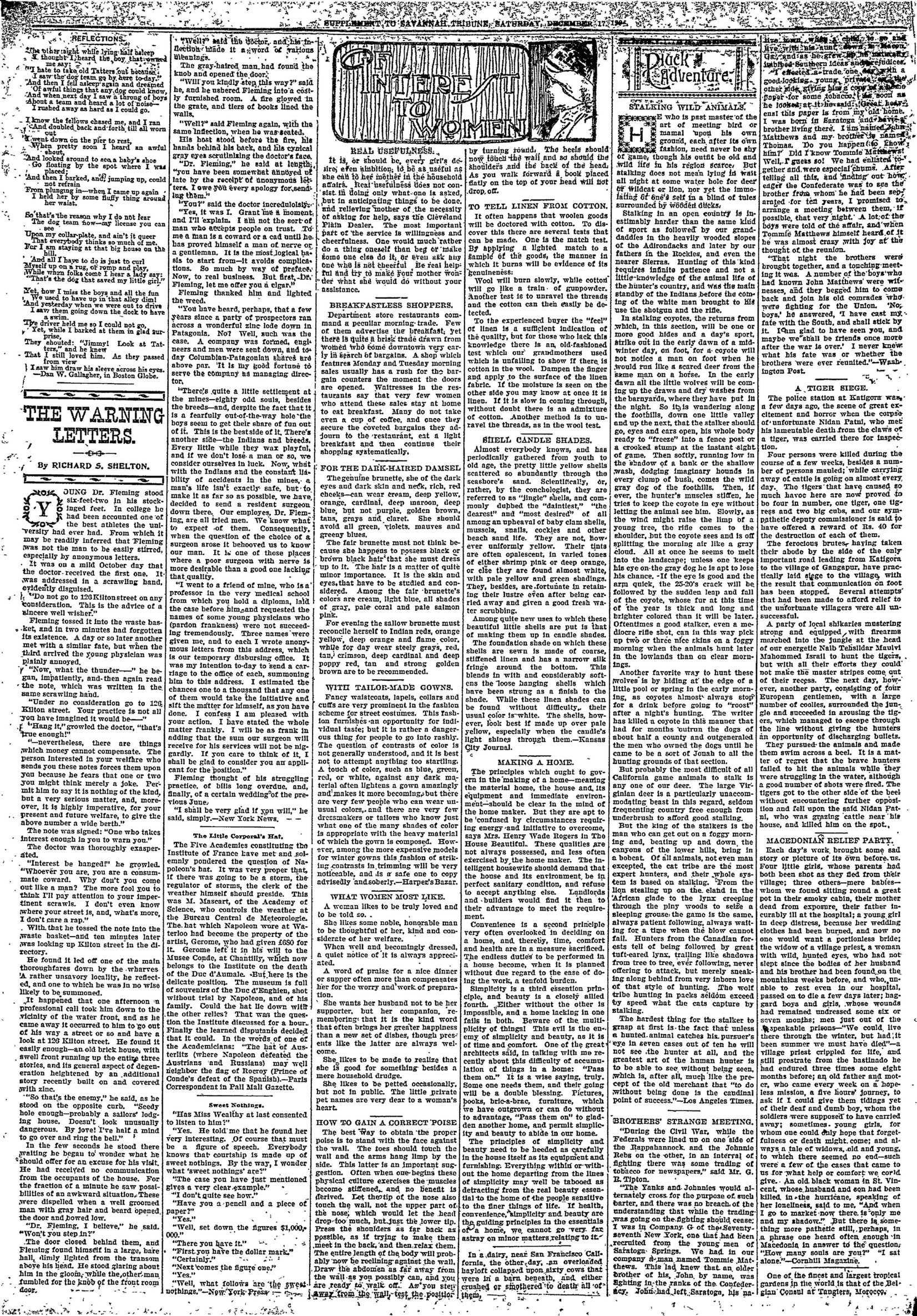
OUNG Dr. Fleming stood six-feet-two in his stockinged feet. In college he had been accounted one of the best athletes the university had ever had. From which it may be readily inferred that Fleming was not the man to be easily stirred, especially by anonymous letters.
It was on a mild October day that the doctor-received the first one. It was addressed in a scrawling hand, evidently disguised.
"Do not go to 120 Kilton street on any consideration. This is the advice of a sincere well wisher."
Fleming tossed it into the waste basket, and in two minutes had forgotten its existence. A day or so later another met with a similar fate, but when the third arrived the young physician was plainly annoyed.
"Now, what the thunder—" he began, impatiently, and then read the note, which was written in the same scrawling hand.
"Under no consideration go to 120 Kilton street. Your practice is not all you have imagined it would be—"
"Hang it," growled the doctor, "that's true enough."
"—nevertheless, there are things which money cannot compensate. The person interested in your welfare who sends you these notes forces them upon you because he fears that one or two you might think merely a joke. Perk him to say it is nothing of the kind, but a very serious matter, and, moreover, it is highly imperative, for your present and future welfare, to give the above number a wide berth. The note was signed: "One who takes interest enough in you to warn you." The doctor was thoroughly exasperated.
"Interest be hanged!" he growled. "Whoever you are, you are a consumate coward. Why don't you come out like a man? The more fool you to think I'll pay attention to your impairment scrawls. I don't even know where your street is, and, what's more, I don't care a rap." With that he tossed the note into the waste basket—and ten minutes later was looking up Kilton street in the directory.
He found it led off one of the main thoroughfares down by the wharves. 'A rather unsavory locality, he reflected, and one to which he was in no wise likely to be summoned.
It happened that one afternoon a professional call took him down to the vicinity of the water front, and as he came away it occurred to him to go out of his way a street or so and have a look at 120 Kilton street. He found it easily enough—an old brick house, with swell front running up the enting three stories, and its general aspect of degeneration heightened by an additional story recently built on and covered with zinc.
"So that's the enemy," he said, as he stood on the opposite curb. "Seedy hole enough—probably a sailors' lodging house. Doesn't look unusually dangerous. By joke! I've half a mind to go over and ring the bell."
In the few seconds he stood there waiting he began to wonder what he should offer for an excuse for his visit. He had received no communication from the occupants of the house. For the fraction of a minute he saw possibilities of an awkward situation. These were dispelled when a well groomed man with gray hair and beard opened the door and bowed low. "Dr. Fleming, I believe," he said. "Won't you step in?" The door closed behind them, and Fleming found himself in a large, bare hall, dimly lighted from the transom above his head. He stood glaring about him in the gloom, while the other man fumbled for the knob of the front room door.
"Well?" said the doctor, and his inflection made it a word of various cleanings.
The gray-haired man had found the knob and opened the door.
"Will you kindly step this way?" said he, and he ushered Fleming into a costly furnished room. A fire glowed in the grate, and tiers of books lined the walls.
"Well?" said Fleming again, with the same inflection, when he was seated.
His host stood before the fire, his hands behind his back, and his cynical gray eyes scrutinizing the doctor's face.
"Dr. Fleming," he said at length, "you have been somewhat abused of late by the receipt of anonymous letters. I owe you every apology for sending them."
"You?" said the doctor incredulously.
"Yes, it was I. Grant me a moment and I'll explain. I am not the sort of man who accepts people on trust. To me a man is a coward or a cad until he has proved himself a man of nerve or a gentleman. It is the most logical basis to start from—it avoids complications. So much by way of preface. Now, to real business. But first, Dr. Fleming, let me offer you a cigar." Fleming thanked him and lighted the weed.
"You have heard, perhaps, that a few years since a party of prospectors ran across a wonderful zinc lode down in Patagonia. Not Well, such was the case. A company was formed, engineers and men were sent down, and today Columbian-Patagonian shares are above par. It is my good fortune to serve the company as managing director.
14There's quite a little settlement at the mines—eighty odd souls, besides the breeds—and, despite the fact that it is a fearfully out-of-the-way hole the boys seem to get their share of fun out of it. This is the best side of it. There's another side—the Indians and breeds. Every little while they wax playful, and if we don't lose a man or so, we consider ourselves in luck. Now, what with the Indians and the constant liability of accidents in the mines, a man's life isn't exactly safe, but to make it as far as possible, we have decided to send a resident surgeon down there. Our employees, Dr. Fleming, are all tried men. We know what to expect of them. Consequently, when the question of the choice of a surgeon arose it behooved us to know our man. It is one of those places where a poor surgeon with nerve is more desirable than a good one lacking that quality.
"I went to a friend of mine, who is a professor in the very medical school from which you hold a diploma, lald the case before him and requested the names of some young physicians who (pardon frankness) were not succeeding tremendously. Three names were given me, and to each I wrote anonymous letters from this address, which is our temporary disbursement office. It was my intention to-day to send a carriage to the office of each, summoning him to this address. I estimated the chances one to a thousand that any one of them would take the initiative and sift the mitter for himself, as you have done. I confess I am pleased with your action. I have stated the whole matter frankly. I will be as frank in adding that the sum our surgeon will receive for his services will not be niggarly. If you care to think of it, I shall be glad to consider you an applicant for the position."
Fleming thought of his struggling practice, of bills long overdue, and, finally, of a certain wedding of the previous June.
"I shall be very glad if you will," he said, simply—New York News. --
The Little Corporal's Hat.
The Five Academies constituting the Institute of France have met and solemnly pondered the question of Napoleon's hat. It was very proper that, if there was going to be a storm, the regulator of storms, the clerk of the weather himself should preside. This was M. Mascart, of the Academy of Science, who controls the weather at the Bureau Central de Meteorologie. The hat which Napoleon wore at Waterloo had become the property of the artist, Gerome, who had given £80 for it. Gerome left it in his will to the Musee Conde, at Chantilly, which now belongs to the Institute on the death of the Duc d'Aumale. But here is the delicate position. The museum is full of souvenirs of the Duc d'Englien, shot without trial by Napoleon, and of his family. Could the hat lie down with the other relics? That was the question the Institute discussed for a hour. Finally the learned disputants decided that it could. In the words of one of the Academicians: "The hat of Austerlitz (where Napoleon defeated the Austrians and Russians) may well neighbor the flag of Rocroi (Prince of Conde's defeat of the Spanish)--Paris Correspondent in Pall Mall Gazette.
Sweet Nothings.
"Has Miss Wealthy at last consented to listen to him?" "Yes. He told me that he found her very interesting. Of course that must be a figure of speech. Everybody knows that courtship is made up of sweet nothings. By the way, I wonder what 'sweet nothings' are?" "The case you have just mentioned gives a very clear example." "I don't quite see how."
REAL USEFULNESS.
It is, or should be, every girl's duties, even ambition, to be as useful as she can to her mother in the household affairs. Real usefulness does not consist in doing only what one is asked, and relieving 'mother of the necessity of asking for help, says the Cleveland Plain Dealer. The most important part of the service is willingness and cheerfulness. One would much rather do a thing oneself than beg or make some one class do it, or even ask any one who is not cheerful. Be real helpful and try to make your mother wonder what she would do without your assistance.
BREAKEASTLESS SHOPPERS.
Department store restaurants command a peculiar morning trade. Few of them advertise the breakfast, yet there is quite a brisk trade drawn from women who come downtown very early in search of bargains. A shop which features Monday and Tuesday morning sales usually has a rush for the bargain counters the moment the doors are opened. Waitresses in the restaurants say that very few women who attend these sales stay at home to eat breakfast. Many do not take even a cup of coffee, and once they secure the coveted bargains they adjourn to the restaurant, eat a light breakfast and then continue their shopping systematically.
FOR THE DARK-HAIBED DAMSEL
The genuine brunette, she of the dark eyes and dark skin and neck, rich, red cheeks—can wear cream, deep yellow, orange, cardinal, deep maroon, deep blue, but not purple, golden brown, tans, grays and claret. She should avoid all green, violets, mauves and greeny blues.
The fair brunette must not think because she happens to possess black or brown black hair that she must dress up to it. The hair is a matter of quite minor importance. It is the skin and eyes, that have to be studied and considered. Among the fair brunette's colors are cream, light blue, all shades of gray, pale coral and pale salmon pink.
For evening the sallow brunette must reconcile herself to Indian reds, orange yellow, deep orange and flame color, while for day wear steely grays, red, tan, crimson, deep cardinal and deep poppy red, tan and strong golden brown are to be recommended.
WITH TAILOR-MADE GOWNS
Fancy waistcoats, lappets, collars and cuffs are very prominent in the fashion scheme for street costumes. This fashion furnishes an opportunity for individual taste; but it is rather a dangerous thing for people to go into rashy. The question of contrasts of color is not generally understood, and it is best not to attempt anything too startling. A touch of color, such as blue, green, red, or white, against any dark material often lightens a gown amazingly and makes it more becoming, but there are very few people who can wear unusual colors, and there are very few dressmakers or tailors who know just what one of the many shades of color is appropriate with the heavy material of which the gown is composed. However, among the more expensive models for winter gowns this fashion of striking contrasts in trimming will be very noticeable, and is a safe one to copy advisedly and soberly.—Harper's Bazar.
WHAT WOMEN MOST LIKE.
A woman likes to be truly loved and to be told so.
She likes some noble, honorable man to be thoughtful of her, kind and considerate of her welfare.
When well and becomingly dressed, a quiet notice of it is always appreciated.
A word of praise for a nice dinner or supper often more than compensates her for the worry and work of preparation.
She wants her husband not to be her supporter, but her companion, remembering that it is the kind word that often brings her greater happiness than a new set of dishes, though presents like the latter are always welcome.
She likes to be made to realize that she is good for something besides a mere household drudge.
She likes to be petted occasionally, but not in public. The little private pet names are very dear to a woman's heart.
HOW TO GAIN A CORRECT POISE
The best Way to obtain the proper pose is to stand with the face against the wall. The toes should touch the wall and the arms hang limp by the side. This latter is an important suggestion. Often when one begins these physical culture exercises the muscles become stiffened, and no benefit is derived. Let the tip of the nose also touch the wall, not the upper part of the nose, which would let the head drop-too much, but just the lower tip. Press the shoulders as far back as possible, as if trying to make them meet in the back, and then relax them. The entire length of the body will probably now be reclining against the wall. Draw the abdomen as far away from the wall as you possibly can, and you are ready to walk off. As you step away from the wall, test the position.
by turning round. The heels should now touch the wall and so should the shoulders and the back of the head. As you walk forward a book placed flatly on the top of your head will not drop off.
TO TELL LINEN FROM COTTON.
It often happens that woolen goods will be doctored with cotton. To discover this there are several tests that can be made. One is the match test. By applying a lighted match to a sample of the goods, the manner in which it burns will be evidence of its gentleness. Wool will burn slowly, while cotton will go like a train of gunpowder. Another test is to unravel the threads and the cotton can then easily be detected. To the experienced buyer the "feel" of linen is a sufficient indication of the quality, but for those who lack this knowledge there is an old-fashioned test which our grandmothers used which is unfailing to show if there is cotton in the wool. Dampen the finger and apply to the surface of the linen fabric. If the moisture is seen on the other side you may know at once it is linen. If it is slow in coming through, without doubt there is an admixture of cotton. Another method is to unravel the threads, as in the wool test.
SHELL CANDLE SHADE:
Almost everybody knows, and has periodically gathered from youth to old age, the pretty little yellow shells scattered so abundantly through the seashore's sand. Scientifically, or, rather, by the conchologist, they are referred to as "jingle" shells, and commonly dubbed the "dalmitest," "the dearest" and "most desired" of all among an upheaval of baby clam shells, mussels, snails, cockles and other beach sand life. They are not, however uniformly yellow. Their tints are often opalescent, in varied tones of either shrimp pink or deep orange, or else they are found almost white, with pale yellow and green shadings. They, besides, are fortunate in retaining their lustre even after being carried away and given a good fresh water scrubbing.
Among quite new uses to which these beautiful little shells are put is that of making them up in candle shades. The foundation shade on which these shells are sewn is made of coarse, stiffened linen and has a narrow silk fringe around the bottom. This blends in with and considerably softens the loose hanging shells which have been strung as a finish to the shade. While these linen shades can be found without difficulty, their usual color is white. The shells, however, look best if made up over pale yellow, especially when the candle's light shines through them—Kansas City Journal.
MAKING A HOME.
The principles which ought to govern in the making of a home—meaning the material home, the house and its equipment and immediate environment—should be clear in the mind of the home maker. But they are apt to be confused by circumstances requiring energy and initiative to overcome, says Mrs. Henry Wade Rogers in The House Beautiful. These qualities are not always possessed, and less often exercised by the home maker. The intelligent housewife should demand that the house and its environment, be in perfect sanitary condition, and refuse to accept anything else. Landlords and builders would find it then to their advantage to meet the requirement. Convenience is a second principle very often overlooked in deciding on a home, and thereby, time, comfort and health are in a measure sacrificed. The endless duties to be performed in a house become, when it is planned without due regard to the ease of doing the work, a tenfold burden.
Simplicity is a third essence principle, and beauty is a closely allied fourth. Either without the other is impossible, and a home lacking in one falls in both. Beware of the multiplicity of things! This evil is the enemy of simplicity and beauty, as it is of time and comfort. One of the great architects said, in talking with me recently about this difficulty of accumulation of things in a home: "Pass them on." It is a wise saying, truly. Some one needs them, and their going will be a double blessing. Pictures, books, bri-bra-cab, furniture, which we have outgrown or can do without to advantage, "Pass them on" to gladden another home, and permit simplicity and beauty to abide in our home.
The principles of simplicity and beauty need to be heeded as carefully in the house itself as its equipment and furnishing. Everything within or without the home departing from the lines of simplicity may well be tabooed as detracting from the real beauty essential to the home of the people sensitive to the finer things of life. If health, convenience, simplicity and beauty are the guiding principles in the essentials of a home, we cannot go very far astray on minor matters relating to it.
In a dairy, near San Francisco California, the other day, an overloaded hayloft collapsed upon sixty cows that were in a barn beneath, and either crushed or smothered to death all of them.
E who is past master of the art of meeting bird or mamal upon his own ground, each after its own fashion, need never be shy of game, though his outfit be old and wild life in his region source. But stalking does not mean lying in wait all night at some water hole for deer of wildcat or lion, nor yet the immolating of one's self in a blind of tules surrounded by wobbled dicks. Stalking in an open country is inestimably harder than the same kind of sport as followed by our granddaddies in the heavily wooded slopes of the Adirondacks and later by our fathers in the Rockies, and even the nearer Sierra. Hunting of this kind requires infinite patience and not a little-knowledge of the animal life of the hunter's country, and was the main standby of the Indians before the coming of the white man brought to his use the shotgun and the rifle.
In stalking coyotes, the returns from which, in this section, will be one or more good hides and a day's sport, strike out in the early dawn of a midwinter day, on foot, for a coyote will not notice a man on foot when he would run like a scared deer from the same man on a horse. In the early dawn all the little wolves will be coming up the draws and dry washes from the barnyards, where they have put in the night. So it is wandering along the foothills, down one little valley and up the next, that the stalker should go, eyes and cars open, his whole body ready to "freeze" into a fence post or a crooked stump at the instant sight of game. Then softly, running low in the shadow of a bank or the shallow wash, dodging imaginary hounds in every clump of bush, comes the wild gray dog of the foothills. Then, if ever, the hunter's muscles stiffen, he tries to keep the coyote in eye without letting the animal see him. Slowly, as the wind might raise the limp of a young tree, the rifle comes to the shoulder, but the coyote is and is off splitting the morning air like a gray cloud. All at once he seems to melt into the landscape; unless one keeps his eye on the gray dog he is apt to lose his chance. If the eye is good and the arm quick, the 25-20's crack will be followed by the sudden leap and fall of the coyote, whose fur at this time of the year is thick and long and brighter colored than it will be later. Oftentimes a good stalker, even a medicine rifle shot, can in this way pick up two or three nice skins on a foggy morning when the animals hunt later in the lowlands than on clear mornings.
Another favorite way to hunt these wolves is by hiding at the edge of a little pool or spring in the early morning, as coyotes almost always stop for a drink before going to "roost" after a night's hunting. The writer has killed a coyote in this manner that had for months outrun the dogs of about half a county and outgeneraled the men who owned the dogs until he came to be a sort of Jonah to all the hunting grounds of that section.
But probably the most difficult of all California game animals to stalk is any one of our deer. The large Virginian deer is a particularly unaccommodating beast in this regard, seldom frequenting country free enough from underbrush to afford good stalking.
But the king of the stalkers is the man who can get out on a foggy morning and, beating up and down the canyons of the lower hills, bring in a bobcat. Of all animals, not even man excepted, the cat tribe are the most expert hunters, and their whole system is based on stalking. From the lion stealing up on the eland in the African glade to the lynx creeping through the pliny woods to seize a sleeping grouse: the game is the same, always patient following, always waiting for a time when the blow cannot fall. Hunters from the Canadian forests tell of being followed by great tuff-eared lynx, trailing like shadows from tree to tree, ever following, never offering to attack, but merely sneaking along behind from very innoble love of that style of hunting. The wolf tribe hunting in packs seldom exceed by speed what the cats capture by stalking.
The hardest thing for the stalker to grasp at first is the fact that unless a hunted animal catches his, pursuer's eye in seven cases out of ten he will not see the hunter at all, and the greatest art of the human hunter is to be able to see without being seen, which is, after all, much like the precept of the old merchant that "to do without being done is the cardinal point of success." -Los Angeles Times.
BROTHERS' STRANGE MEETING
"During the Civil War, while the Federales were lined up on one side of the Rappahannock, and the Johnnie Rebs on the other, in an interval of fighting there was some trading of tobacco for newspapers," said Mr. G. R. Tipton.
"The Yanks and Johnnies would alternately cross for the purpose of such barter, and there was no breach of the understanding that while the trading was going on the fighting should cease; I was in Company G of the Seventy-seventh New York, one that had been recruited from the young men of Saratogn. Springs. We had in our company A man named Tommie Matthews. This lad knew that an older brother of his, John, by name, was Eighting in the ranks of the Confederacy. John-had left Saratogn, his na-
"That night the brothers were brought together, and a touching meeting it was. A number of the boys who had known John Matthews were witnesses, and they begged him to come back and join his old comrades who were fighting for the Union. 'No boys,' he answered, 'I have cast my fate with the South, and shall stick by it. I am glad to have seen you, and maybe we shall be friends once more after the war is over.' I never knew what his fate was or whether the brothers were ever reunited."—Washington Post.
A TIGER SIEGE.
The police station at Katigorn was, a few days ago, the scene of great excitement and horror when the corpse of unfortunate Nidan Fatni, who met his lamentable death from the claws of a tiger, was carried there for inspection.
Four persons were killed during the course of a few weeks, besides a number of persons mailed; while carrying away of cattle is going on almost every day. The tigers that have caused so much havoc here are now proved to be four in number, one tiger, one tigress and two big cubs, and our sympathetic deputy commissioner is said to have offered a reward of Rs. 40 for the destruction of each of them.
The ferocious brutes, having taken their abode by the side of the only important road leading from Kafigora to the village of Gangapur, have practically laid sigge to the village, with the result that communication on foot has been stopped. Several attempts that had been made to afford relief to the unfortunate villagers were all unsuccessful.
A party of local shikarles mustering strong and equipped, with firearms marched into the jungle at the head of our energetic Nalb Tehillar Maulvi Mahommed Israil to hunt the tigers, but with all their efforts they could not make the master stripes come out of their recess. The next day, however, another party, consigling of four European gentlemen, with a large number of coolies, surrounded the jungle and succeeded in arousing the tigers, which managed to escape through the line without giving the hunters an opportunity of discharging bullets.
They pursued the animals and made them swim across a beel. It is a matter of regret that the brave hunters failed to hit the animals while they were struggling in the water, although a good number of shots were fired. The tigers got to the other side of the beel without encountering further opposition and fell upon the said Nidan Patni, who was grazing cattle near his house, and killed him on the spot.
MACEDONIAN BELIEF PARTY.
MACEDONIAN RELIEF PARTY.
Each day's work brought some sad story or picture of its own before us. Four little girls, whose parents had both been shot as they died from their village; three others—many babies—whom we found sitting round a great pot in their smoky cabin, their mother dead from exposure, their father incurably ill at the hospital; a young girl in deep distress, because her wedding clothes had been burned, and now no one would want a portionless bride; the widow of a village priest, a woman with wild, hunted eyes, who had not slept since the bodies of her husband and his brother had been found on the mountains weeks before, and who, unable to rest even in our hospital, passed on to die a few days later; hagged boys and girls, whose wounds had remained undressed some six or seven months; men just out of the speakable prisons—"We could, live there through the winter, but had it been summer we must have died"—a village priest crippled for life, and still prostrate from the blastado he had endured three times some eight months before; an old father and mother, who came every week on a hopeless mission, a five hours' tour, to ask if I could give them tidings yet of their deaf and dumb boy, the soldiers were supposed to have carried away; sometimes, young girls, for whom one could only hope that forgetfulness or death might come; and always a tale of widows, old and young, to which there seemed no end—such were a few of the cases that came to us for what help or comfort we could give. An old black woman in St. Vincent, whose husband and son had been killed in the hurricane, speaking of her loneliness, said to me, "And when I go to market now there is 'only me and my shadow.' But there is something more pathetic still, perhaps, in a phrase one heard often enough in Macedonia in answer to the question, 'How many souls are you?' "I sat alone."—Cornhill Magazine.
One of the finest and largest tropical gardens in the world is that of the Belgian Consul at Tangiers, Morocco.
SATURDAY DECEMBER 17, 1904.
Mrs W. H. Burgess, has removed her place of business to Jefferson and Gaston streets.
Miss Emma Swangin has returned home from school. On account of her health she was unable to remain.
Miss Simpson Muore of Branfort, S. C. is here spending a while with Mrs. Janie Holmes, No. 520 Gwinnett street, east.
Mr. M. McNair of Atlanta is in the city for the purpose of setting up the machines in the factory of Mohr Sons. He is an expert machinist.
From indications the violin recital at the Beach on Friday evening next will also be a social affair. The music loving people will be present in large numbers. Cards are out announcing the wedding of Mr Andrew Bouls of this city and Miss Essie Frazier of Beau fort which will take place on Wednesday night December 21. Editor B J. Davis of the Independent, Atlanta, spent Monday and Tuesday in the city. Mr. Davis was here on Odd-Fellows business, and was well cared for by a number of brothers.
Mr. I. M. Moody of Baxley, was a pleasant caller on Monday last. Mr Moody is a prosperous young business man of Baxley and is connected with one of the best families in that section.
Mr. Lovick Fields and Miss Belle Fair were united in the holy bond of Matrimony on Thursday evening last at the residence of the bribe on Abercorn street, by the Rev. E. Jonathan Nelson.
Miss Lillian A. Williams of this city has completed a three years course in nurse training and received her diploma on Thursday from the Lincoln's Hospital of New York City. The invitations had her announced being from Hartford, which is a mistake.
Rev. W. J. White, D. D. of the Georgia Baptist was in the city on Sunday last to attend the funeral of Mr. Johnson. The host of friends of this veteran worker are always glad to give him a royal welcome whenever he comes to the city. He left for Brunswick on Monday.
The many friends of Mrs. W. M. Stovall of 517 Minis street, who has been very ill for the past three months will be glad to know that she is able to be out again. Her daughter, Miss Aunie Willis of Coal City, Ala., is spending a few days with her and will probably remain until after the holidays.
It is a fact, that needs no proof, Savannah should have a Colored Young Men Christian Association. It is the duty of every colored man to take a hand in its organization. Are you willing to do your part? Any suggestions or plans of organization will be must be cured, fully received. Address communications to the Colored Y. M. C. A., 462 West Broad street.
On Monday night last, Grand Secretary Dayis attended the meeting of Mt. Sier Lodge of Odd Fellows and gave the members a talk on endowment. Mt. Sier with Armour and Protection Lodges, three of the strongest lodges in the state, and over a hundred other lodges have refused to accept the endowment plan as new in vogue. Mr. Davis endeavored to influence the members to accept the plan but to a man they voted against. The members were threatened with suspension of the Lodge next month, but even this did not deter them from voting otherwise Under the present endowment laws, Armour Protection and Mt Sier Lodges in this city and many others in the state, will suffer suspension rather than submitting.
Household of Ruth IIS held its annual election Dec. 2, with the following result, annual officers: Sister L. B. Raid, W. R. Bro. E. Bailey, W. T.; Sisters L. Coleman, W. P; J. T. Reid, W. Conn; Semi-annual; Sisters F. Johnson, N. G; F. Mason, R. N. G; C. Maxwell, M. N. G; S. Sanders, P. M. N. G; V. Davis, W. Cham; M. Inman, W. S. M. Brown, W. U; P. Scott and L. Holley, S. S; G. Whitfield and R. Rafe, J. S; R. L. Barnes, F. A: Merchison, C. A. Bailey, Worthy Trustees.
The following named persons have been appointed by the Chief Marshal R. N. Rutledge, as aides on his staff for Emancipation Day: Messrs. T. A. Bright, O. D Brown, Henry Huger, Wiley Smith, W. O P Sherman, Jr., Robert Holzendorf, T Z. Massay, J H Greene, H. A. Houston T. H. Greene, J. T. Myers, M M. Moore, W. D. Armstrong, J S Scrugge, J. H. Dennis, J. H. Flade, Chas. Graham, L. A. Riley, J. L. Jackson, A. Wicks, W. G. Williams, J C. Williams, Janab Wright, Each aide is requested to provide himself with a badge, and see the Chief Marshal, R. N. Rutledge.
Working Night And Day. The busiest and mightiest little thing that ever was made is Dr. King's New Life Pills'. These pills change weakness into strength, listlessness into energy, brain-fag into mental power. They're wonderful in building up the health. Only 25 cents per box. Sold by all druggists.
Mr. Johnson's Funeral
One of the greatest tributes to the memory of a citizen, was paid to the late J. H. Johnson, whose death was announced in the last issue of THE TRIBUNE. The funeral took place from the Second Baptist Church and long before the corpse arrived the church was crowded with people. The service was conducted by the pastor, Rev. S. H. Smith, D. D. He was assisted by Rev. W. J. White, D. D., of Anguita; Rev. J. W. Carr, D. D., Rev. W. G. Clarke and Rev. Hill. The pastor spoke in sympathetic vein about the deceased and gave words of consolation to the family. Rev. Carr read the obituary and also gave testimony to the worth of the deceased Rev. White bore testimony to the early life and training. He spoke in commendatory terms of the nobleness of the entire family and of the progressive spirit that the deceased displayed even in boyhood days. The tribute paid by Dr. White was in keeping with the noble character of the deceased. Among the large concourse of people were the members of Protection Lodge of Odd Fellows, of which the deceased was a past officer and faithful member. Resolutions from this institution were read and unanimously approved. The service was continued at the Cemetery, and the remains were followed by many. Even along the streets were lined with hundreds of people. The Odd Fellows concluded the service by rendering their impressive ceremony.
The last tribute paid the deceased was truly in keeping with his standing in the community.
The floral offerings were many and beautiful, and the grave was beautifully banked with them.
Among the family out of the city who were in attendance were Mr. J. H. Rivers, a brother, of Blackville, S. C., Mrs. Louisa J. Foster, a sister, of Blackville, S. C.; Messrs. A. L. Johnson, and Robert Johnson, brothers, New York City; Miss Elliza Johnson, neice, Haines Institute, Auguata; Mrs. J. P. Washington, neice, Waycross; Mrs. Hester, Lee; sister of Mrs. Johnson, and Mr. Thos Hughes, of Blackville, S. C.
Mr. Johnson has left a host of relatives and friends to mourn his death.
The words of sympathy and letters of condolence extended the family were many. They have the sympathy of the entire community.
Bare Musical Treat.
On Friday evening Dec 23, Mr. Joseph H. Donglass, the celebrated violinist and grandson of the late Frederick Douglass will appear in a violin recital at the Beach Institute, supported by vocalists of known ability. This will be interspersed with piano solos, that will prove enchanting. Mr. Douglass is among the beat known and most expert violinists in the country. His is a natural gift backed by training from some of the masters. He will use the violin costing $1000.00 which was the gift of his grandfather. This recital is expected to be an extraordinary one, and a rare chance for the lovers of good music to enjoy them selves. It is also very seldom that many of our people have a chance to attend such an affair being debarred from the theatre. As the seating capacity of the Beach chapel is limited, it would be well for the patrons to come early. Promptly at 8:30 o'clock the recital begins. The recital is given under the auspices of the First Congregational church. The tickets are on sale at 25 cents each.
Pastoral Anniversary.
The pastoral anniversary of Rev. H. L. Haywood was celebrated last week beginning Tuesday night. The opening sermon was preached by Rev. G. W. Griffin, D. D. His congregation was present and music was rendered by his choir. He selected for his text Neh 6:3, subject, "Doing a great work." He proved himself to be master of the situation. Wednesday night a sermon was preached by Rev. S. H. Smith, D. D. His text was from Rev. 6:10, subject, "The triumphant leaders." At this hour the Holy Spirit seemed to take possession of the congregation. Rev. N. H. Whitmire was present with his choir which readened very excellent music. Thursday night Rev. W. A. Daughtry preached a powerful sermon from Matt. 5:15, subject, "Christ, the charming light." Music was rendered by the Mt. Zlon Baptist church choir. Friday night Rev. J. W Carr, D. D. preached from Jer. 3:15, subject "The pastor." Dr. Carr was never more at home than he was at this service. He captured his congregation which was the largest one of the occasion. Mrs. J. W Carr, the musical directress at this hour rendered excellent music for the occasion. Sunday morning early prayer meeting led by Deacon E. Swangin. Preaching at 11 a.m. by the pastor. He selected for a text I Kings vii2-13, subject "God dwelling with Isreal." A large congregation was present who enjoyed the discourse. Sunday School at 3 p.m. The pastor preached a very interesting sermon to the Ancient Knights. No 14 at 8:30. He selected for his text, Psalms 86:10, subject, "The unity of God." Each heart was made to re-
joice! There was a large attendance At 7:30 before preaching our pastor, Rev H. B. Haywood had the pleasure of usiting Mr. David Davis and Miss Lena Tolbert in wedlock. They are well known in this city, Also Mr. George Owens and Miss Lillie Simpkins were joined in wedlock the week before God has blessed us in these past four with our pastor. We believe him to be a true christian sent to us by the Armighty. Sunday morning he will preach from Jer 36:4, subject "Harness the forces." At 8 p.m. he will discuss "Christian giving." The public is cordially invited to these services.
Birth-day Parties
A birthday party was given on Tuesday afternoon last in honor of little Miss Lily Palmer Spring, at the residence of her parents on West Wayne street. Little Mises, Lenita Smith and Alzada East repeated pretty verses applicable to the occasion. Each little guest was presented on leaving, with a favor of some kind. Among the little guests were: Mises Alzada East, Katie Wilson, Lenita Smith, Lucile Spencer, Eureka and Ernestine Calhoun, Erma Patrick, Erma Perkins, Evolia Weston, Ammie Batey, Jannie and Lily Aiken, Lillian Johnson, Fredrica Price, Toledo Governor, Lily and Marguerite Spring. Masters, Joseph Marshall, Horace and Albert Oliver, Eustice Calhoun, Nathaniel Prey, Onozine Governor, Willie Weston, Alonza East and Henry Spring.
In the evening the birthday party of Miss Luella Gratz Spring was observed by the gathering of a number of her young friends and they had a very enjoyable time. The parlor and dining room were beautifully decorated and the lighted candles representing the age of the hostess, reflected the beauty of the surroundings. The dainty refreshments which were served in abundance, were enjoyed by all present, among whom were: Misses Marie Tolbert, Mattle Brown, Mattie May Houston, Marie and Flossie Hall, Ernestine DeLyons, Edith Weston, Lillian and Hazel Heffron, Leola Jordan, Catherine Flagg, Viola Johnson, Virginia Rogers, Sadie Freeman, Rita Houston, Alethia Hamilton, Lorene Jefferson, Florence Callen, Beatrice Foster, Othelia Gadsden, Christina Wilson, Katie Deleware, Carrie Belle Coles, Ruth Batey, Beatrice Batey, Willie Jenkins, Camilla Marshall, Addie Spring, Luella Spring and Masters Houston Tolbert, Roy Hill. Freddie Governor, Jabez Marshall, Richard Flishburne, Carl Oliver, and William Rogers.
No Pity Shown.
"For years fate was after me continuously" writes F. A/ Gulledge, Verbena, Ala. "I had a terrible case of Piles causing 24 tumors. When all failed Bucklen's Arnica Salve cured me. Equally good for Burns and all aches and pains. Only 25 cents at all Drug Stores.
AMUSEMENT COLUMN.
Coming Events in The Social World.
There will be a nine nights fete at Duffy street hall given by the Takers commencing Dec. 19th. Admission 10 cents.
The Twilight Reapers wishes, you a Happy New Year and announces that they will give their New Year Soirée at Harris street hall, Monday night January 2nd, Admission, single 35, double 50 cents.
A Mystic Maze entertainment will be given by joint committee I, O, O, C. at Morse's hall, Monday night Dec. 19. Admission 15 cents.
The Brotherhood Union will give a five night fete at Harris street hall, beginning Monday night Jan. 9th. A prize of $10.00 in gold will be given the club that turns out with the largest number and take supper at 25 cents. Admission 10 cents.
The Mt. Zion Sunday School will give one of their famous concerts on Monday night Dec. 19 at their church on West Broad street, between Gaston and Minis, at 8:30 o'clock. Admission 10 cents. Come and see us for the last time this year. Don't miss this treat. Mrs. L. F. Coleman, Mrs. A. H. Crettendon, Directress; R. L. Lockley, Superintendent,
The Y. L. and G. S. C, Club will give a New Year's dance on Monday night Jan.2, at Margaret street hall. Good music and plenty of fun. Admission 10 cents.
A prize biscuit entertainment of $2.50 in gold will be given by the P. P. A. Club, Monday night Dec. 19, at Our Hall, East Broad and Anderson streets. Admission 10 cents. Music and refreshments will be on hand.
Night Was Her Terror.
"I would cough nearly all night long" writes. Mrs. Chas. Applegate of Alexandra, Ind., "and could hardly get any sleep. I had consumption so bad that if I walked a block I would cough frightfully and spit blood, but, when all other medicines failed, three $1.00 bottles of Dr. King's New Discovery wholly cured me and I gained 58 pounds." It's absolutely guaranteed to cure Coughes, Colds' La Gripe, Bronchitis and all Throat and Lung Troubles. Price 50c and $1.00. Trial bottles free at all druggist.
DR. L. S. PARES,
240 Barnard St., Savannah, Ga
Does all kind of high grade dental work of the best quality and workmanship. Gold crowns and bridge work. White Porcelain Pivot, and Gold Crowns mounted on the natural roots. Gold Fillings, Cement Fillings, and Silver or Amalgam Fillings, from nine to a full set of teeth $7.00 and $3.00. Broken Fillings mentioned and teeth added to old ones for a small cost. Bell Phone 1244 All Gold Crowns Guarantee $28 K Gold
MEN'S FINE FALL SUITS
The Largest and Best Line in the City.
We carry a fine line of Groceries, Fruits, Oigars, Tobacco, Wood and Coal. Our motto: Moderate Prices. Quick delivery. Polite attention Give us a trial
Bell Phone 1124. 211 East Broad Street, Cor. Oglethorpe Lane. Estimates cheerfully given. Unsurpassed Modern Dental Work. Savannah, Ga
Wanted.
Young lady Stenographer and Typewriter. One quick at figures preferred. Fair salary to begin with. Apply Metropolitan Mercantile & Realty Co's. office, 222 W. Broughton street, Savannah Ga. tf.
FLORIDA
Florida and West Indian Limited leaves Savannah 9:12 a. m. (10:12 a. m. city time), arrive Jacksonville 1:45 p. m. Sanford 6:15 p. m., Tampa 10:30 p. m., Tampa Bay Hotel 10:40 p. m., Port Tampa 11:00 p. m. Close connection at Port Tampa with steamships for Key West and Havana, sailing from Port Tampa Sundays, Tuesday and Thursdays at 11:40 p. m., arriving Key West 6:30 p. m. Mondays, Wednesdays and Fridays, arriving Havana 6:30 a. m. Tuesdays, Thursdays and Saturdays, passing under the guns of Morro Castle about sunrise. Less than 48 hours from Savannah. This train carries through Pullman sleeper Savannah to Port Tampa. Dining car Savannah to Jacksonville.
Grocery Store and Restaurant.
I wish to announce to my many friends and patrons that I have reopened my Restaurant at No. 464 West Broad street, next to the Wage Earners Bank, where I will also conduct my Grocery store. I will furnish first class meals as before, and keep on hand constantly a full line groceries. The patronage of the public is solicited.
New York and Florida Express leaves Savannah 4:15 a. m., city time, arrives Jacksonville 8:40 a. m., making close connection with trains leaving Jacksonville 9:45 a. m. for all points South, carrying Pullman Buffet Parlor Cars to Po rt Tampa and St. Petersburg. Connections made for principal resorts in Florida. Savannah and Jacksonville Express leaves Savannah 4:00 p. m., city time (Train is made up at Savannah and is always on time.) arrives Jacksonville 9:15 p. m., connecting with train leaving Jacksonville 9:35 p. m., carrying Pullmam Sleepers to Tampa and Eort Myers.
R. H. HOOKS, Prop.
464 West Broad Street.
Effective Jau. 10, the famous New York and Florida Special, a train representing the highest standard of perfection in passenger service, solidly vestibules, consisting of Pullman Drawing-room, Sleeping Compartment, Dining and Observation Cars will leave Savannah 11:55 a. m., city time, arriving Jacksonville 2:50 p. m., St Augustine 4:00 p. m.
HOW TO KEEP WELL
Atlantic Coast Line offers the public train service unsure in elegance, speed and luxury. H. M. EMERSON, Trait W. J. CRAIG, Gen. Pass. Agt., Wilmington, N. C. H LEAHY, Div. Pass. Agent, M. WALSH, Trav. Pas Sangannah, Ga.
Eat the best meats. You can find this by visiting the OLD RELIABLE
Knowles Building. Boys' Hall. Stone Hall. Girls' Hall. Model Home.
ATLANTA UNIVERSITY, Atlanta, Ga.
Christian and unsectarian. For the education of young men and women in the higher studies. Collegiate, Normal and High School Courses, with Industrial Training. New Practice School and Kindergarten building for training teachers. Graduates secure most important positions as teachers and leaders. Home life and training. Athletics. Superior advantages in Music and Printing. Aid given to needy and deserving students. Term, begins the first Wednesday in October. For catalogue, address:
Mrs. Anderson a great woman.
"DEAR MRS. PINKHAM:—There are but few wives and mothers who have not at times endured agonies and such pain as only women know. I wish such women knew the value of Lydia E. Pinkham's Vegetable Compound. It is a remarkable medicine, different in action from any I ever knew and thoroughly reliable.
"I have seen cases where women doctored for years without permanent benefit, who were cured in less than three months after taking your Vegetable Compound, while others who were chronic and incurable came out cured, happy, and in perfect health after a thorough treatment with this medicine. I have never used it myself without gaining great benefit. A few doses restores my strength and appetite, and tones up the entire system. Your medicine has been tried and found true, hence I fully endorse it."—MRS. R. A. ANDERSON, 225 Washington St., Jacksonville, Fla.
Mrs. Reed, 2425 E. Cumberland St., Philadelphia, Pa., says:
"DEAR MRS. PINKHAM:—I feel it my duty to write and tell you the good I have received from Lydia E. Pinkham's Vegetable Compound.
"I have been a great sufferer with female trouble, trying different doctors and medicines with no benefit. Two years ago I went under an operation, and it left me in a very weak condition. I had stomach trouble, backache, headache, palpitation of the heart, and was very nervous; in fact, I ached all over. I find yours is the only medicine that reaches such troubles, and would cheerfully recommend Lydia E. Pinkham's Vegetable Compound to all suffering women."
When women are troubled with irregular or painful menstruation, weakness, leucorrhoea, displacement or ulceration of the womb, that bearing-down feeling, inflammation of the ovaries, backache, flatulence, general debility, indigestion, and nervous prostration, they should remember there is one tried and true remedy. Lydia E. Pinkham's Vegetable Compound at once removes such troubles.
The experience and testimony of some of the most noted women of America go to prove, beyond a question, that Lydia E. Pinkham's Vegetable Compound will correct all such trouble at once by removing the cause and restoring the organs to a healthy and normal condition. If in doubt, write Mrs. Pinkham at Lynn, Mass, as thousands do. Her advice is free and helpful.
No other medicine for women in the world has received such widespread and unqualified endorsement. No other medicine has such a record of cures of female troubles. Refuse to buy any substitute.
$5000 FORFEJT If we cannot forthwith produce the original letters and signatures of above testimonials, which we have received from Kydia E. Pinkham Medicine Co., Lynn, Mass.
"I to w from p o v from wit an cone header na
When women are troubled with
mala, leucorrhea, displacement or ulc
feeling, inflammation of the ovaries
indigestion, and nervous prostration,
and true remedy. Lydia E. Pinkt
removes such troubles.
The experience and testin
women of America go to prove,
Pinkham's Vegetable Compou-
once by removing the cause ane
and normal condition. If in de
Mass, as thousands do. Her ad
No other medicine for women
spread and unqualified endorsem
record of cures of female troubles.
$5000 FORFEIT if we cannot forth-
above testimonials, which will p
Better Fruits—Better Profits
Better peaches, apples, pears and berries are produced when Potash is liberally applied to the soil. To insure as full crop of choicest quality, use a fertilizer containing not less than to per cent. actual
Potash
Send for our practical books of information; they are not advertising numbers, booming special fertilizers, but are authoritative treatises. Sent free for the asking.
Courtnis Stollton
Business, shortand and type-
writing College, Loulusville, Ky. open the whole
year. Students can enter any time. Catalog free.
If afflicted with weak
eyes, use
Thompson's Eye Water
COULDN'T FOOL HER.
Mrs. Boardman—What did those
ples taste like which we had for dinner?
Mr. Boardman—Sawdust.
"Exactly! That accounts for it! I heard the boarding-house woman tell
her husband to order some kindling
wood, as she 'wanted to make some
ples for dinner!"—Yonkers States-
man.
Wonders of Botany.
The wonders of botany are apparently inexhaustible. One of the most remarkable specimens is the Mexican maguey tree, which furnishes a needle and thread ready for use. At the tip of each dark green leaf is a slender thorn needle that must be carefully drawn from its sheath. At the same time it slowly unwinds the thread, a strong, smooth fiber attached to the needle and capable of being drawn put to a great length.
COMPLETELY RESTORED.
Mrs. P. Brunzel, wife of P. Brunzel,
stock dealer, residence 3111 Grand
avenue, Everett, Wash., says: "For
fifteen years I suffered with terrible
pain in my back. I
did not know what
it was to enjoy a
night's rest and arose
in the morning feeling
tired and unrefreshed. My suffer-
ing sometimes was
simply indescribable.
When I finished the
first box of Doan's
Kidney, Pills I felt
like a different, two-
nineteen years I suffered with terrible pain in my back. I did not know what it was to enjoy a night's rest and arose in the morning feeling tired and unrefreshed. My suffering sometimes was simply indescribable. When I finished the first box of Donn's Kidney Pills I felt like a different woman. I continued until I had taken five boxes. Donn's Kidney Pills act very effectively, very promptly, relieve the aching pains and all other annoying difficulties. Foster-Milburn Co., Buffalo, N. Y. For sale by all druggists. Price 50 cents per box.
TOBOGGANING IN THE ALPS.
Slide Upon Which Record of Almost Mile a Minute Has Been Made.
St. Moritz is one of the highest villages in the Engadine, having an altitude of about 0,000 feet, and is a great centre of winter sports; it is consequently much frequented by English and other nationalities who enjoy the sports of skating, curling, tobogganing, skiing and sandy, which can here be obtained under the best conditions. Good tobogganing may be had in other places, but of St. Moritz it is carried to a fine art, and only an expert can expect to compete successfully on the renowned "Cresta" toboggan run, with its wonderful curves and banks. The name, Cresta, is derived from a small village of that name hear the finish of the course.
The course is a little over three-quarters of a mile in length, with a difference of elevation, from the start to finish, of about 600' feet; the gradient varies, at different points, being most steep at the church lean.
As only one toboggan can occupy the track at a time, the faces are all decided by the time taken to complete the course. The record time from the start to the finish is at present 61 6-10 seconds, this entailing a speed of sixty miles an hour or more on the fastest parts. The curves of frozen snow are built up with high banks accurately shaped to allow the tobogganer to go round them at the greatest speed, the highest bank being about twenty-five feet in height. These different banks have well known names, such as the Battledore and Shuttlecock, Scylla and Charybdis and Bulpitt Corner. The whole track is practically of ice, and after passing the finish it has for a short distance a steep upward gradient, the great momentum obtained carrying the tobogganer uphill.
The tobogans used are of the "skeleton" pattern, with steel runners, the toboganer lying in a prone position and steering with his feet, by means of spikes attached to the toes of his boots. The principal race run on the Cresta 'is the Grand National, which takes place at the end of February or beginning of March, and might be called the Derby of toboganing, competitors coming from Dayos and other places to take part in this contest.-Electrical Review.
Square With the Government.
Two years ago Mr. M. H. Sherrod resigned from the position of postmaster at Charlotte. He was checked up and his successor installed, and that closed the affair to Mr. Sherrod's thinking. But the other day he got a formidable looking document from the Post Office Department enclosing a check drawn with all the elaborateness that would mark a draft for $2,000,000, for the sum of 2 cents. A final checking up of his accounts had shown that he overpaid the Government in that amount.—Goodland News.
How He Escaped.
An American man-of-war's man, ashore at Gravesend, near London, Eng., awoke the other morning to find himself attired in the uniform of a British soldier. No sooner had he wandered out into the street than a picket stopped him and told him to button up his tunic or he would be taken to barracks. He sought refuge in a police station, where it was discovered that a deserter had changed clothes with him while he slept.
An association in Manchester, England, known as the Minnehaha Amateur Minstrels, has made a business for the last twenty-five years of giving performances for charity. In that time it has raised $97,130.
FLTS performantly cured. No fits or nervousness after first day's use of Dr. Klinn's Great Nervosestorer, $215 bottle and treatise Dr. B. H. Klinn, Ltd. 331 Arlst. Philn, Pa.
New York stone setters receive 65% to
33% cents per hour.
The Peruma Almanac in $,000,000 Homes.
The Peruma Lucky Day Almanac has
become a fixture in over eight million
homes. It can be obtained from all
druggists free. Be sure to inquire early.
The 1903 Almanac is already published,
and the supply will soon be exhausted.
Do not put it off. Get one to-day.
Piso's Cure cannot be too high spokaneo
a snough cure—J. W. O'Brien, 322 Third
Avenue, N., Minneapolis, Minn., Jan. 6, 1903.
The Queenstown (Canada) quarries
strike is settled.
Ich cured in 20 minutes by Woodford
Sanitary Lolion. Never fails. Sold by all
druggists. St. Mail orders promptly filled
by Dr. E. Detchon, Crawfordsville, Ind.
German sugar factories consume yearly
3,200,000 tons of beets
New Shell With a Tracer.
The artillery forces at Fort Riley are experimenting with a new shell fitted with what is known as the Semi-tracer. This tracer is a small cylinder at the base of the shell, filled with a composition which is ignited by the discharge of the gun.
In burning it traces the trajectory of the shell from the gun to the point of fall. It furnishes a quick means of determining range at night. Traveling at about 2,000 feet a second, the shells have the appearance of comets. At the point of the fall the tracer leaves the shell and shoots straight up into the air about 100 feet and then, turning all aglare, shoots to the ground like a shooting star over the spot where the shell strikes.
"I hope he's not as green as he looks."
"Who?"
"The. man who just sat down on that newly-painted bench"—Cleveland Plain Dealer.
GOOD LUCK
Baking Powder
PREMIUMS
The next time you need Baking Powder be sure to ask your grocer for the Good Luck brand. You will get the greatest satisfaction from Good Luck Baking Powder because of its positive purity, great levening force and the reasonable price at which it is sold. Furthermore, by using Good Luck you can get beautiful free premiums. The gift clock shown above is one of the presents you can get by saving Good Luck coupons. There is a coupon on the label of each can. Cut them out, save them and get the numerous useful gifts. A little book inside of each can illustrates and explains all about the premiums, and tells how to get them free. So great is the demand for
GOOD LUCK Baking Powder
This is the Company found on every can.
that we are shipping it in carload and trainload bits to all parts of the country. Don't forget in buying "Good Luck" you get the most of the best at the lowest cost. Start to-day with a pound can (100), enjoy your baking and get the beautiful premiums. If your grocer doesn't sell "Good Luck" send us his name and we will see that you are supplied.
THE SOUTHERN, MFG CO., Richmond, Virginia.
Japanese Imperial Mind. One of the earliest Western institutions established in Japan was the Imperial Mind at Osaka, and it has been one of the most successful and useful. In the convention which was signed at Yeddo, in 1868, between the representatives of the Japanese Government and those of the foreign Powers, the establishment of a mind was stipulated. The Japanese Government purchased from the British Government a clan, Which had been established at Hong Kong, but which the latter had resolved to discontinue.
The mint is how managed entirely by Japanese, and, judging from the report of the director for the year ended March 31, 1904, it maintains its reputation not only for the amount of its production, but also for the efficiency and exactness of the work done. The report, which is printed in English, is a model of its kind. It states that the coinage for the financial year under review consisted of gold, silver and nickel coins in six denominations, amounting to 13,316,571 pieces, of the value of 25,801,086 yen, against 5,351,126 pieces of the preceding year, valued at 38,300,563 yen in 10 yen gold and 50 yen silver coins. In addition, to these, 5,131,096 pieces of silver yen were struck during the year.—Engineering.
A Scotch Collie's Religion
At the disruption in 1843 the bulk of the shepherds joined the Free Kirk. But one collie held by the Establishment principle, and refused to "come out." Every Sabbath he went alone to the Established Church, where he had been wont to accompany his master. His masten refused to coerce him. "Na, na," he said, "he's a wise dog; I'll no meddle wil' his convictions." The collile's adherence to the Establishment had, however, a disastrous end. He was accustomed to lie during the sermon on the pulpit stairs, no doubt better to hear the discourse. Below him were placed the long stovepipe hats of the elders. On one unfortunate day he fell asleep, rolled off his step and managed to get his head firmly fixed inside one of the hats. Bitterly mortified the dog fled from the kirk, and ever afterward, as his master said, "had nae trokings wil' reelegon."—The Spectator.
Broker—No more margh to but up?
Why, when the account was opened
you told me you were well off.
Lambelgh—So I was, but I didn't
know it—Town Topics.
In Bohetia.
New Yorker—"Oh, yes, I'm a thoroughbred Bohemian. My artistic nature requires atmosphere. There is so much in that, you know."
Cousin-from-out-of-town — "Yes, I suppose so. I never was in but one Bohemian place, and I thought there was a good deal in that atmosphere—it was principally, toba-c雾 smoke!"
Detroit Free Press.
STATE OF OHIO, CITY OF TOLEDO,
Lucas COUNTY.
FRANK J. CHENX make oath that he is senior partner of the firm of F. J. CHENX & Co., doing business in the City of Toledo, where heate aforesaid, and that said firm will lay down its own smoke parlors for each and every case of catarin that cannot be cured by the use of HALL's Catarin Cure.
FRANK J. CHENX.
Swoorn to before me and subscribed in my presence, this 6th day of December, A.D. 1886.
Notary Public.
Hall's Catarin Cure is taken internally, and acts directly on the blood and mucous surfaces of the system. Send for testimonials, free.
F. J. CHENX & Co., Toledo, O
A Chronic Case.
"Oh, he's never satisfied with a job. He's kicking about the one he's got now."
"Why, I understood it was a clutch. He told me he had absolutely nothing to do."
"Yes, but he's kicking because he has to do it."—Philadelphia Press.
MORE THAN ALL ELSE.
"Did you see anything in Italy that appealed to you particularly?"
"Yes; the 'beggafs!'—New Orleans Times-Democrat.
MR and MRS. SCHWANDT.
Janborn;
Minn.
MR and MRS.
NO. QATKINSON.
Independence;
Mo.
Ask Your Druggist for Free Peruna Almanac for 1905.
Our new 200 page Tool Catalogue will be mailed free to any carpenter, blacksmith or machinist. This new edition is the most complete mechanic's tool catalogue in the south. Order at once, FREE.
King Hardware Co.,
ADV. DEPT.,
ATLANTA, GA.
Under date of January 10, 1897, Dr. Hartman received the following letter:
"My wife has been a sufferer from a complication of diseases for the past twenty-five years. Her case has baffled the skill of some of the most noted physicians. One of her worst troubles was chronic constipation of several years' standing. She was also passing through that most critical period in the life of a woman—change of life.
"In June, 1893, I wrote to you about her case. You advised a course of Peruna and Manalin, which we at once commenced, and have to say it completely herein.
"About the same time I wrote you about my own case of catarrh, which had been of twenty-five years' standing. At times I was almost past going.
I commenced to use Peruna according to your instructions and continued its use for about a year, and it has completely cured me. Your remedies to all that you claim for them, and even more!"—John O. Atkinson.
In a letter dated January 1, 1900, Mr. Atkinson says, after five years' experience with Peruna:
"I will ever continue to speak a good word for Peruma, I am still cured of catarrh."—John O. Atkinson, Independence, Mo., Box 272.
Ask Your Druggist for Free
Mechanic's Tools
KING HARDWARE CO.
ATLANTA, GA.
MALSBY & CO.
41 South Forsyth St., Atlanta, Ga.
Portable and Stationary
Engines, Boilers,
Saw Mills
AND ALL KINDS OF MACHINERY
Complete line carried in stock for
IMMEDIATE shipment.
Best Machinery, Lowest Frices and Best Terms
Write us for catalogue, prices
etc., before buying.
aking powder
Mrs. Alla Schwandt, Sanborn, Mjnn,
writes:
"I have been troubled with rheumatism and catarrh for twenty-five years. Would not have been so much worse if Peruna I can sleep and nothing bother me now. If I ever am affected with any kind of stinkness Peruna will be better off. I have secured of catarrh of the larynx by Peruna."—Mrs. Alla Schwandt.
Why Old People Are Especially Liable to Systemic Catarx. When old age comes in, catarral diseases come also. Systemic catarx is almost universal in old people. This explains why Peruna has become so indispensable to old people: Peruna is their safeguard. Peruna is the only remedy yet developed for mea- tures. Nothing but an effective exsatic remedy can cure them.
A reward of $10,000 has been deposited in the Market Exchange Bank, Columbus, Ohio, as a guarantee that the above testimonials are genuine; that we hold in our possession authentic letters certifying to the same. During many years advertising in part as a single spurious testimonial. Every one of our testimonials are genuine and in the words of the one whose name is appended.
Our new 200 page Tool Catalogue will be mailed free to any carpenter, black-mith or machinist. This new edition is the most complete mechanic's tool catalogue in the south. Order at once, FREE.
King Hardware Co.,
ADV. DEPT.,
ATLANTA, GA.
INSOMNIA
"I have been using Cancarets for Incombe, with which I have been over my years, and I can say that Cancarets have given me more relief than any other remedy have ever tried. I shall recommend them to my friends as being all they are represented." Thos. Gillard, Elgin, ILL.
Best For the Bowels
Cancarets
CANDY CATHARTIC
THEY WORK WHILE YOU SLEEP
Pleasant Palatable, Potent Taste Good, Do Good, Guaranteed to euro or your money back.
Sterling Remedy Co., Chicago or N.Y. 597
ANNUAL SALE, TEN MILLION BOXES
CK
f=
BEF