Savannah Tribune
Saturday, January 28, 1905
Savannah, Georgia
Page text (machine-generated)
-_ : 4 Be 4 4: ety he 2 4 pea VeteatwW oe”
am 2 | wees PLRARSHABAPR é Bok Rhee eee owe .
* Che Savanah Criuuw.
2 VOL. XX, ' SAVANNAH. GA. SATURDAY. JANUARY 28. 1905. FE NOM: _
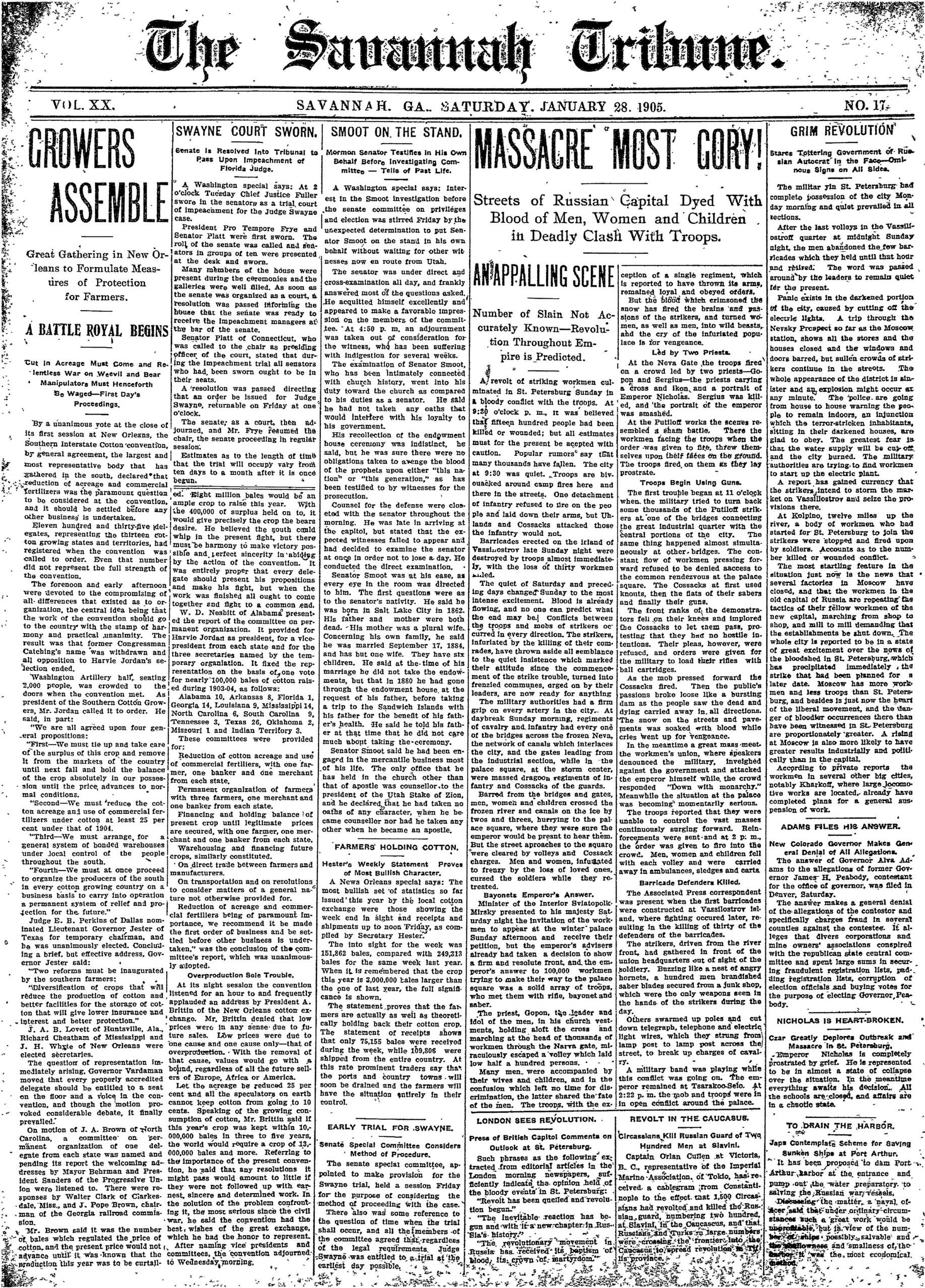
; 1 T}: SWAYNE COURT SWORN, | SMOOT ON. THE STAND, NAL cm? T + GRIM REVOLUTION
GROWERS Senate Is Resolved Into Tribunal to! Mormon Senator Testifies In His Own MASSACRE MOST GORY! Btares Tottering Government of Rui
: Rass Upon Impeachment of Behalf Before Investigating Com- ae ° y I alan Autocrat In the Faco—Omb-
. Florida Judge, mittes — Tells of Past Life. ‘ = r ' nous Signe on 4 Au sides,
- I Norrie goon, favs: at 2] A weskiogton special ayes inter ——— - ‘The militar yin St. Petersburg: be
fr [swore to the senators a3 a trial court &*t M the Smoot investigation betore | Streets of Russian’ Gapital Dyed With |samets possesion ot the city a
of impeacament for the Judge Swayne ~t@ senate committee on priviléges : ics ek day morning and qulst prevailed in a
- case. Land election was stirred Friday bythe} Blood of Men, Women and Children | frets 2
Great Gathering in New Or-
“leans to Formulate Meas-
ures of Protection
. for Farmers.
A BATTLE ROYAL BEGINS
‘ : 2
Tut In Acreage Must Come and Re-
“lentless War on Weevil and Bear
* Manipulators Must Henceforth
Be Waged—First Day's
Proceedings,
‘By a unanimous vote at the close
its first session at New Orleans, th
Southern Interstate Cotton ‘convention
by general agreement, the largest anc
most representative body that ha:
wathered in the south, declared*tha
seduction of acreage and commercia
fertilizers was the paramount questiaz
to bo considered at the convention
and it should be settled before an
other business is undertaken,
Eleven hungred and thirty-five (del
egates, representing the thirteen cot
ton growing states and territories, hac
Tegistered when the convention wa:
called to order. Even that number:
did not represent the full strength o
the convention,
‘The forenoon and early afternoon
were devoted to the compromising o!
all. differences that existed as to or.
ganization, the central idea being that
the work of the convention shobld go
to the country with the stamp of har.
mony and practical unanimity. The
result was that former Congressman
Catching’s name ‘was withdrawn and
all opposition to Harvie Jordan's se-
‘ection ended.
‘Washington Artillery half, seating
2,000 people, was crowded to the
doors when the convention met. As
president of the Southern Cottdén Grow-
ers, Mr. Jordan called it to order. He
sald, in part:
“We are all agréed upon four gen-
~eral propositions:
“First—We must tle up and take care
of the surplus of this crop and remove
It from the markets of ‘the country
until next fall and hold the balance
of the crop absolutely in our posses-
sion until the price, advances to_nor-
mal conditions. : .
“Second—We must ‘reduce the cot-
ton acreage ani use of commercial fer-
tillzers under cotton at Jeast 25 per
cent under that of 1904.
“Third—We must arrange, for a
general system of bonded warehouses
under local control of the people
throughout the south. his
“Fourth—We must at once proceed
to organize the producers of the south
in every cotton growing country on a
Dusiness basis to carry into operation
a permanent system of relief and pro-
ection for the future.”
Judge E. B. Perkins of Dallas nom-
inated Lieutenant Governor Jester of
Texas for temporary chaifman, and
be was unanimously elected. Conclud-
Ing a brief, but effective address, Gov-
ernor Jester sald: ‘
“Two reforms muat be inaugurated
by the southern farmers: we
“Diversification of crops that wi
reduce the production of cotton and
better facllitles for the storage of cot-
ton that will give lower insurance und
Interest and better protection.”
J, A. B. Lovett of Huntsville, Ala.,
Richard Cheatham of Mississippi and
J. H. Whyte of New Orleans were
elected secretaries.
‘The questior of representation im-
mediately arising, Governor Vardaman
moved that every properly accredited
delegate should be entitled to a seat
on the floor and a volce In the con-
vention, and though the motion pro-
yoked considerable debate, {t finally
prevailed.
On motion of J. A. Brown of storth
Carolina, a committee’ on jer-
manent organization of one del-
egate from each state was named and
pending its report the welcoming ad~
dresses by Mayor Bebrman and Pres-
{dent Sanders of the Progressive Un-
fon were listened to. There were re-
sponses by Walter Clark of Ciarkes-
dale, Miss, and J. Pope Brown, chalr-
man of the Georgia railroad commis-
ston.
Mr. Brown said it was the number
of, bales which regulated the price of
cotton, and the present price Would not ;
advance until! jt -was-known that the
production this year was ta be curtajl-
-e as .
SWAYNE COURT SWORN,
Senate Is Resolved Into ‘Tribunal to
Rass Upon Impeachment of
Florida Judge.
| 4 Washington special says: At 2
o'clock Tudeday Chief Justice Fuller
‘Swore in the senators as a trial, court
of Impeachment for the Judge Swayne
case.
President Pro Tempore Frye and
Senator Platt were frst sworn. The
roll, of the senate was called and se1-
ators in groups of ten were presented
at the desk and sworn.
Many mtmbers of the hduse were
[present during the ceremonies and the
galleries were well filled, As soon as
the senate was organized as a court, &
resolution was passed inforining the
house that the sefiate was ready to
receive the Impeachment managers af
the bar of the senate.
Senator Platt of Connecticut, who
was called to the chair es presiding
pfficer of the court, stated thet dur-
ing the Impeachment trial all senators
who had, been sworn ought to be in
‘their seats,
A esolution was passed directing
that an order be Issued for Judge
Swayne, returnable on Friday at one
o'clock,
‘Tho senate; as a court, then ad:
journed, and Mr. Frye Fesumed the
chair, the senate proceeding Ih regular
session:
Estimates as to the length of tim’
that the trial will occupy vaty fro
ten days to a month after it is oncé
begun. e
ee ee eee eee, | pee
[she 400,000 of surplus held on to, it
‘would give precisely the crop the bears
desire. He believed the south canld
whip In the present fight, but there
must’be harmony té make victory pos-
‘sibfe and perfect sincerity In ‘abldigg
by the action of the convention. It
was entirely proper that every dele-
gate should present his propositions
and make hls fight, but when the
work was finished all ought to conte
together end fight to e common end.
W. D. Nesbitt of Alabama presents
ed the report of the committee on per-
manent organization. It provided for
Harvie Jordan as president, for a vice-
president from each state and for the
‘three secretaries named by the tem-
porary organiation. It fixed the rep-
resentation on the basis of,one voto
for nearly"100,000 bales of cotton rais-
ed during 1903-04, as follows:
Alabama 10, Arkansas 8, Florida 1,
Georgia 14, Louisiana 9, Mississippi 14,
North Carolina 6 South Carolina 9,
‘Tennessee 3, Texas 26, Oklahoma 2,
Miseourl 1 and Indian Territory 3.
These committees were provided
for:
Reduction of cotton acreage and use
of commercial fertiliers, with one far
mer, one banker and dne merchant
from each state, :
Permanent organization of farmers
with three farmers, one merchant and
one banker from each state.
Financing and holding balance /of
present crop until legitimate prices
are secured, with one farmer, one mer-
chant and one banker from each state,
‘Warehousing and financing future
crops, similarly constituted.
“On direct trade between farmers and
manufacturers.
On transportation and on resolutions
to consider matters of a general na~
ture not otherwise provided for.
Reduction of acreage and commer-
clal fertiliers being of paramount {m-
portance, We recommend it be made
the first order of business and be set-
tled before other business Is under-
taken,” was the conclusion of the com-
mittee’s report, which was unanfmous-
ly adopted.
Overproduction Sole Trouble,
At its night session the convention |
stened for an hour to and frequently
applauded an address by President A.
Brittin of the New Orleens cottor ex-
change. Mr, Brittin denfed that low
prices were in any sense: que to fu-
ture sales. Low prices were due to
one catise and one cause only—that of
overproduction. - With the removal of
that cause, values would go with a
bolind, regardless of all the future sell-
ers of Europe, Africa or America.
Let the acreage be reduced 25 per
cent and all the speculators on earth
cannot keep cotton from going to 10
cents. Speaking of the growing con-
sumption of cotton, Mr. Brittin sald if
his year’s crop was kept within 10,-
000,000 bales in three to five years,
he world would require a crop of 13,-
900,000 bales and more. Referring to
he Importance of the present convea-
fon, he said that any resolutions it
might pass would amount to little if
hey were not followed up with ear
rest, sincere and determined work. In
he solution of the problem contront-
ng it, the most serious since the civil
var, he said the convention had the
yest, wishes of the great exchange,
which he had the honor to represent.
After naming vice presidents and
committees, the convention adjourned:|
6 Weillnesdsymorning, | > |”
SMOOT ON. THE STAND.
Mormon Senator Testifies In His Own
Behalf Before Investigating Com-
mitte,s — Tells of Past Life.
A Washington special says: Inter-
est in the Smoot investigation before
the senate committée on priviléges
jana election was stirred Friday by the
unexpected determination to put Sen-
ator Smoot on the stand In his own
behalt without waiting for other wit
nesses now en route from Utah.
‘The seustor was under direct and
cross-examination all day, and frankly
answered most of the questions asked,
‘He acquitted himself excellently and
‘appeared to make a favorable impres-
‘slo on the members of the commit-
fee. “At 4:50 p. m, an adjournment
was taken out of consideration for
the witness, whe has been suffering
with indigestion for several weeks.
The exdmmation of Senator Smoot,
who has been Intimately connectéd
with church history, went into his
Wuty toward the church as compared
to his duties as a senator. He sald
he had not taken any oaths that
would Interfere with his loyalty to
his government.
His recollection ct the endgwment
house cereniony was indistinct, he
sald, but he was sure there were no
obligations taken to avenge the blood
of the prophets upon either “this nar
tion” or “this generation,” as has
been testified to by witnesses for the
prosecution. ’
Counsel for the defense were clos-
eted with the senator throughout the
morning. He was late in arriving at
the capitol, but stated that the er-
pected witnesses falled to appear amd
had decided to examine the senator
at ongg In order not to Jose a day. He
conducted the direct examination, -
Senator Smoot was at his ease, as
every eye in the room was directed
to him. ‘The frst questions were as
to the senator's nativity. He sald he
was born in Salt Lake City im 1862.
His father and mother were both
dead. -His mother was a plural wife.
Concerning his own family, he sald
he was married September 17, 1884,
and has but one wife. They have stx
children, He sald at the-time of his
marriage he did not take the endow-
ments, but that In 1880 he had gone
through the endowment house, at the
request of his father, before taking
a trip to the Sandwich Islands with
his father for the benefit of hig fath-
er’s health. He safd he told his fath-
er at that time that he did not care
much bot taking the-ceremony,
Senator Smoot sald he had been en-
gaged in the mercantile business most
of his life. ‘The only office that he
has held in the church other than
that of apostle was counsellor.to the
president of the Utah Stake of Zion,
and he declired, that he had taken no
oaths of any character, when he be
came counsellor nor had he taken any
other when he became an apostle,
“FARMERS HOLDING COTTON,
Hester’e Weekly Statement Proves
of Most Bullish Character,
A News Orleans special says: The
most bullish set ‘of statistics so fax
Issued’ this year by the local cottor
exchange were those showing the
week end In Sight and receipts and
shipments up to noon Friday, as com-
plled by Secretary Hester.
‘The into sight for the week was
161,862 bales, compared with 249,313
bales for the same week last year.
‘When it fs remembered that the crop
this year is 3,000,000 tales larger than
the one of last year, the full signif
cance is shown.
‘The statement proves that the fan
mers are actually as well as theoretl-
cally holding back their cotton crop.
The statement of receipts shows
that only 75,155 bales were recelyod
daring the week, while 169,806 were
shipped from the entire country. At
this rate prominent traders say tha®
the ports and country towns . will
soon be drained ang the farmers will
have the situation qntirely in thelr
control. nv
EARLY TRIAL FOR SWAYNE.
‘Senaté Special Committee Considers
* Method of Procedure.
‘The senate special committee, ap-
polnted to make provision for the
Swayne trial, Held a session Friday
for the purpose of considering the
‘method of proceeding with the case.
There ‘also wad some reference to
the question of time when the trial
shall occur, and all Saaleembers of
the committee agreed that-regardless
of the legal requirements, Judge
‘Swaynd was entitled to g.izial af ‘the
earllést day possible -s. , * %
oe ee =|
FOr - WUE:
Streets of Russian‘ Gapital Dyed With
Blood of Men, Women and Children .
in Deadly Clash With Troops.
) :
- . SS
AN APPALLING SCENF lca. oon ==
. fs reported to have thrown its arms,
| remained loyal and obeyed ofders.
: = But the b16dd which erimsoned the
Number of Slain Not Ac- ae et tag eiikerh aad terned Wo:
curately Known—Revolu- |"? tee ve OC he iicoiea bean:
.tion Throughout Em- lace Is Yor vengeance.
pireis Predicted, ~ | ,. bed by Two Prieta =
AJrevolt of striking workmen cul-
minated in St. Petersburg Sunday in
& bloody condict with the troops. At
9:3) o’clock p. m., It was’ believed
thaf fitteen hundred people had been
killed or wounded; but all estimates
must for the present be acepted with
caution. Popular rumors* say {Hat
many thousands have fallen. The city
at 9:30 was quiet. Troops are biv-
ounéked around camp fires here and
there in the streets, One detachment
of infantry refused to fre on the peo
ple and laid down their arms, but Uh-
lands and Cossacks attacked those
the infantry would not.
Barricades erected on the icland of
‘Vassiuostroy late Sunday night were
destroyed by troops almost immediate-
Jy, with the loss of thirty workmen
auled.
The quiet of Saturday and preced-
ing days changed Sunday to the most
intense excitement. Blood !s already
flowing, and no one can predict what
the end may be| Conflicts between
the troops and mobs of strikers oc
curred in every direction. The strikers,
infurlated by the killing of thefr com-
rades, have thrown aside all zemblanco
to the quiet insistence which marked
their attitude since the commence-
ment of the strike trouble, turned into
frenzied communes, arged on by thelr
leaders, are now rendy for anything
‘The military authorities had a firm
grip on every artery in the city. At
daybreak Sunday morning, regiments
of cavalry and infantry had every oné
jot the bridges across the frozen Neva,
‘the network of canals which interlaces
‘the city, and the gates leading from
the industrial section, while in the
palace square, at the storm center,
were massed dragoon regiments of {n-
fantry and Cossacks of the guards.
Barred from the bridgos and gates,
men, women and children crossed tha
frozen river and canals on tha ice by
twos and threes, hurrying to the pal
ace square, where they were sure the
emperor would be presnt to hear them.
But the street aproaches to the square
"were cleared by volleys and Cossack
charges. Men and women, infugated
to frenzy by the loss of loved ones,
cursed the soldiers while they re-
treated.
Bayonets Emperors Answer.
Minister of the Interior Sviatopolk-
Mirsky presented to his majesty Sat-
urday night the invitation of the work-
men to appear at the winter” palace
Sunday afternoon and recelve their
Petition, but the emperor's advisers
already had taken a decision to show
8 firm and resolute front, and the em-
peror’s answer to 100,000 workmen
trying to make their way to the pslaco
square Was a solld array of troops,
who met them with rifle, bayonet and
saber.
‘The priest, Gopon, the leader and
{dol of the men, in his church vest-
ments, holding aloft the cross and
marching at the head of thousands of
workmen through the Narva gate, mi-
raculously escaped a ‘volley which lald
Jow half a hundred persons. - -
Meany men. were accompanied by
thelr wives and children, and in tho
confusion which left no time for dls-
crimination, the latter shared the’fate
of the men. The troops, with the ex-
———
Press of British Capitol! Commenta on
Outlook at St. Pétersburg.
Such phrases as the following” ex:
tracted from editorial articles in the
London morning newspapers, sut-
fictently indicatd, the. opinion held of
the bloody events’in St. Petersburs:
“Revolt has been quefled and revolu-
ton begun.”
+ “The Inevitable: reaction has be-
gun and with ‘if new-chapter:in Rus-
‘Bla’s- history.” .- - te
“The, xqvolotionary “movement in
Russia has. ‘recel¥ed~ $8, baptism ‘of
‘blood, tts; cyoyn vor; martyrdom” |
ception of a singlé regiment, which
fs reported to have thrown its arms,
remained loyal and obeyed otders.
But the bléd¢ whtch erimsoned the
snow has fired the brains ‘and pas-
sions of the strikers, and turned wo-
men, as well as men, into wild beasts,
ahd the cry of the infuriated popu-
lace fs Yor vengeance.
Lad by Two Priesta. *
At the Neva Gate the troops firea’
on a crowd led by two priests—Go-
pop and Sergius—the priests carying
éross and tkon,and a portrait of
Emperor Nicholas. Sergius was kill-
ed, and ‘the portrait of the emperor
was smashéd,
At the Puttloff works the scemes re-
sembled a shatn battle, There the
workmen facing the troops when the
order -was given to Site, threw them-
selves upon thél¥ faées om the g¥outid.
The troops fired,on them #s they lay
prostrate. *
‘Troops Begin Using Guns.
‘The first trouble began at 11 o'clock
when. the military tried to turn back
some thoussnds of the Putilof strik-
ers atone of the bridges connecting
the great Industrial quarter with the
entral portions of the city. The
same thing happened almost simulta-
neously at other. bridges. The con-
stant flow of workmen pressing for-
ward refused to be denied aaccess to
the common rendezvous at the palace
square, The Cossacks at first used
knouts, then the flats of their sabers
and finally their guns.
The front ranks of, the demonstra-
tors fell on thelr knees and implored
fhe Cossacks to let tnem pass, pro-
testing that they hea no hostile in-
tentions. Their pleas, however, were
refused, and orders were given for
the military to load their rifles with
ball cartridges.
As the mob pressed forward the
Cossacks fired. Then the public's
passions broke loose lke a bursting
dam as the people saw the dead and
dying carried away in. all directions.
The snow on the streets and pave-
ments was soaked qith blood while
erles Went up for vengeance.
In the meantime a great mass -meet-
the workmen’s unton, where speakers
denounced the military, invelghéed
against the government and attacked
the emperor himself while, the crowd
responded “Down with monarchy.”
Meanwhile the situation at the palace
was becoming* momentarily serious.
‘The troops feported that they were
unable to control the vast masses
continuously surging forward. Rein-
forcements were sent-and at 2 p: m.,
the Srder was given to fire into the
crowé. Men, women and children fell
with each volley and were carried
away in ambulances, sledges and carts
Barricade Defenders Killed,
The Associated Press correspondent
was present when the first barricades
were constructed at Vassilostroy {sl-
and, where fighting occured later, re-
sulting in the Killing of thirty of the
defenders of the barricades.
‘The strikers, driven from the river
front, had gathered in front of the
union headquarters out of sight of the
soldiery. Buzzing like a nest of angry
hornets, @ hundred men brandished
saber blades secured from a junk shop,
which were the only weapons seen in
the hands. of the strikers during the
day.
Others swarmed up poles and cut
down telegraph, telephone and electric
Wight wires, which they strung from|
lamp post to lamp post xcross the
street, to break up charges of caval-
ry. - .
A military band was playing while
this confilct was going on. ‘the em-
peror remained at TsarakooSefo. At
2:22 p. m. the tnob and troops were in
in open confilct around thé palace.
REVOLT IN THE CAUCASUS,
Circasstana Kil! Russian Guard of Twa
Hundred Men at Slavini.
Captain Orlan Curlen xt Victoria,
B. ©, representative of the Imperis!
Marine -Assdclatlon, of ‘Toklo, has: re-
celved cablesram jfrom Constantl-
nople to the effect. maat 1,609 Cireas:
signs had revolted and killed the-Rus-
sian,guard, numbering two hundred,
oe ea nn ener ee
Russians: irks x1 , )
ae else the" Foner iale Abe
‘Cancastivtoyepredd revolotian cry!
us‘provinte.® 1 seo e. RAT!
ete ke eee ae A re “85 ae
GRIM REVOLUTION’
Btares Tottering Government of Rus
slan Autocrat in the Face—Oml-
nous Signs on All Sides.
| ‘The militar yin St. Petersburg had
‘completo possession of the city Mon-
day morning and qulet prevailed in all
Aections, %
After the last volloys in the Vassill-
ostroff quarter at midnight Sunday
‘aight, the men abaiidoned the few bar-
Hicades which they held until that hour
Bnd rbtired: The word was pasted
eround™by the leaders to remals quiet
tér the present.
Panic exists in the darkened portion
of the city, caused by cutting off the
clectrle Mghts, A trip through the
Nevsky Prespect so far as the Moscow
station, shows all the stores and the
houses closed and the windows and
floors barred, but sullen crowds of atri-
jKers contiuue in the streets. The
whole appearance of the district is aln-
Ister and sp, explosion might occur et
any minute. ‘The ‘police. are going
from house to house warning the peo~
‘Ble to remain indoors, an injunctton
which the terrorstricken inhabitants,
sitting in thelr darkened houses, ero
glad to obey. The greatest fear is
that the water supply will be cu} off.
and the city burned. The military.
authorities are trying,to find workmen
te start up the electric plant. ’
A report has gained currency that
‘the strikers intend to storm the mar
ket on Vassiliostroy and selze the prov
visions there.
At Kolpino, twelve miles up the
river, a body of workmen who bad
started for St, Petersburg to join the
strikers were stopped and fired upon
by soldiers. Accounts as to the num-
ber killed or wounded conflict. 2
The most startling feature in tha
‘situation just now 1s the news that
several factories in Moscow have
‘closed, and that the workmen In the
old capital of Russia are repeating tha
tactics of their réllow workmen of the
new capital, marching from shop to
‘shop, and mill to mill demanding that
the establishments be shut down. The
whole clty is yeported to be in a state
of great excitement over the nows of
the bloodshed In St, Petersburg, which
hes precipitated immediately , the
strike that bad been planned for a
later date. Moscow has more work:
men and less troops than St. Peters:
burg, and besides 1s just now the heart
of the Uberal movement, and the Yan
ger of bloodler occurrences there than
have been witnessed in St. Petersburg
are proportionately ‘greater. A rising
at Moscow ja also more lkely to have
greater results industrially and polit!
cally than in the-capital,
According to private reports tha
workmen In several other big cites,
notably Kharkoff, where large Jocomo-
tive works are located, already hava
completed plans for a general sus-
pension of work.
ADAMS FILES His ANSWER.
New Colorado Governor Makes Gen
eral Denial of All Allegations,
The answer of Governor Alva Ad-
ams to the allegations of former Goy-
ernor James H, Peabody, contestant
for the office of gorernor, was filed in
Denver, Saturday. ‘
The answer makes a general denial
of the-allegations of the contestor and
specifically charges fraud in severat
counties against the contestes. If al-
leges that dtvers corporations and
mine owners’ associations conspired
with the republican state central com-
mittee and spent large sums in secur-
ing fraudulent registration Usts, pad-
ding gegistration lists, corruption of
election officials and buylng votes for
the purpose of electing Governor, Pes-
body. 7 “8
bie
NICHOLAS 18 HEART-BROKEN,
Czar Greatly Deplores Outbreak and
Maasacre In St. Petersburg,
-Bmperor Nicholas {s completely
Brostrated by grief. He ts represented
to be in almost a state of collapse
over the situation. In the meantime
everything awaits his decision, All
the schools are-clospd, and aftairs ato
fn @ chsotic state. * 7
‘TO DRAIN THE HARBOR.
Lae eS >
Japa Contemplate Scheme for Saving
"Sunken Ships at Port Arthur.
“It has been Proposed ‘to dam Port
‘Arthur Rarbor ef the, entrance and
pump -ont' the water preparatory. ‘to
sdiving the ;Russlani war;véskels,
~Dicewseing “the smattér, 2 ‘naya}, of-
Sicor jsald that‘ ubger ordinarycircum-
stances Buch a ‘great work woilld be
ubpromtabls, "but tiview of the num-
verYatzahips « posstbly.,salvable’ and
Se etorasee = (easiness ofythe
i Swed the, ost ecodomical.
SUBSCRIPTION RATES.
One Year. $1.25
Six Months. 75
Ten Months. 60
Remittance must be made by Express or
Post Office Money Order, or Registered Letter
Advertising Rates given on application.
AND will the cotton planters reduce the acreage? The coming season's production will only tell.
TOMORROW will be President McKinley's birthday. In his honor it is called carnation day on account of his love for carnations.
The death of Rev. O. L. Bradwell is announced. It occurred in Atlanta last week. Rev. Bradwell was one of the oldest ministers in the A. M. E. church.
NOTWITHSTANDING the expose that has been given the pionage business, reports of it continue to be published. This modern way of enslaving laborers should not be tolerated.
THE TRIBUNE can give permanent employment to a young man of hustling qualities Apply immediately. One with experience preferred.
Some practical movement should be made to break up the dives where a large number of our young girls and boys congregate and are being ruined. Many of these dives are being conducted openly.
WITHIN the past three weeks the remains of two small infants were found in the city. At first both of them were reported as being colored, but on closer examination it was found out they were of white parentage. The inhumane ones should be caught and punished.
THE man of "Leopard's Spots" fame, Thomas Dixon, Jr., has written another book. It is called the "Clansman," and is companion to the first book. We have not read the book but it is said to be on the same line of "Leopard's Spots." If that is a fact the Negro is shown in an unenviable light.
TROUBLE without and trouble within is what Russia is now wrestling with. The popular uprising of the natives seem to be just and in their appeal for more freedom they are receiving the approval of their sympathizers under every flag. No doubt this means much for a change in the policy of the government toward the populace.
CITY COUNCIL has again honored itself, by re-electing Dr. J. H. Bugg as one of the city physicians. The doctor had no opposition whatever. His faithful attendance to duty and efficiency in its discharge has gained for him a deserved popularity. All of the doctors' friends and patrons join in commending council for his re-election.
IN the recommendation to cut down the number of city physicians it was truly said that the two colored physicians did seventy-two per cent of the work while the white physicians who are in the majority did only twenty-eight per cent. This speaks well for our physicians and shows that they are faithful in the discharge of their duties.
MR. J. G. St. AMAND, of Atlanta has a displayed notice in the Constitution asking all white voters of Rulton county, and Atlanta who are in sympathy with the National administration to communicate with him. Possibly Mr. St. Amand is paving the way to the formation of a lily white party in the State. This movement will be watched and any attempt that is made in that direction will prove as disastrous as similar attempts in other states.
THE pianist, Paderewski claims that he does not know about "Hiawatha." His ignorance in this respect does not add to his reputation. "Hiawatha" has struck a tender chord the globe around and is known by peasants and nobles. Its composer, Mr. Samuel Coleridge Taylor is one of the greatest composers England ever produced. We are proud to claim him as one of ours.
It has been decided that the great Peabody fund will be divided, and in the division, as generally in every thing else, our people is slightly considered. The trustees have decided to appropriate one million dollars to the George Peabody College of Nashville, for teachers. Of course our teachers will be excluded. The remainder of the fund 1,200,000 will be divided, two thirds among Southern institutions and the other part in the North. What benefit our people will derive from the division remains to be seen.
EARLY Wednesday morning a large number of prisoners were seen on the streets being taken from jail to the court house. Among them were several women and two very small boys. The hardened look of those accused was immediately apparent, and it was clearly noted that not one of them had the least rudiment of an education. The most pathetic scene was the presence of the two small boys who were no doubt convicted of whatever crime they were charged with and sent among hardened criminals on the chaining and there to be educated in crime. This makes a strong appeal for a reformatory for this class of offenders.
NEXT month the Farmer's Conference at the Georgia State Industrial College will be in session. It behooves every farmer in this section to be in attendance. There will be present prominent men with experience and ability along the line of agriculture and who will deliver addresses and answer questions along the various lines. All of this information will be given free. No farmer of a progressive spirit can afford to miss this Conference. The railroad rates will be cheap and the time lost to attend the Conference will be amply repaid in the information received.
The city of our dead is held sacred by all of us and especially so by those who have the remains of loved ones reposing therein. It is a place that should not be desecrated in any manner. The person who is to take care of such a place should be a man of mature age, respectable in every way and one who enjoys the fullest confidence of the people. The recent report of charges against the keeper of our Cemetery grates upon the feeling of all who are interested in that place. The city administration owes to the colored citizens a management of this place that will only reflect credit.
At this season of the year a large number of tourists from various parts of the country visit this city. From the discussion of the race question, many of them will no doubt note the condition of our people. In many instances these visitors take as a criterion the members of our race that they see. in large numbers on the streets and in the crowded tenement districts. This would be unjust to us. The more intelligent and thrifty of our race are not to be seen on street corners and promiscuously on the streets, neither does this element to a large extent reside in the crowded lanes and alleys of the city. If these visitors are desirous of getting a true idea of the progress and intelligence of our people, they should visit the localities where many of them own commodious and well built homes, fastily furnished and well conducted. They should also note the business that we are conducting. If this much is done a better rating will be given us.
SOME weeks ago THE TRIBUNE found it necessary to speak of those ministers who do not practice what they preach by not supporting race enterprises. This struck a popular chord among the mass of our readers and many were the favorable comments that have been made, but some these preachers are mad as hornets about it. THE TRIBUNE does not care a snap about this because it is felt that a principle is at stake and that principle is being upheld. Those preachers who fail to deal justly by the race and expect to be upheld, are badly mistaken. While we cannot in any manner commend them, yet on the other hand, we have still a larger class who never fail by word or action to do those things that have caused race progress. They are the ones who are lending inspiration to the younger ones of the race and cause the business men to look up with much hope. This class of clergymen makes it possible to a great extent for THE TRIBUNE to give employment to a number of our young men and young ladies, and for that support there will be nothing unmindful.
RETRICTION comes to some persons quickly and to others years elapse before its work is done. In this case it came in short order: On Wednesday, at Cecil, this state, a white man was superintending the construction of a fence. He had several men working under him. He became enraged at one of them and struck him with the stock of a musket, as he did so the musket discharged and he received the full contents of load in his abdomen. In citing this cause we are not gloating over the untimely death of the white man, but only wish to note that if he was a man of a different disposition he would be living to-day. It was not necessary for him to have struck that man with a gun or anything else. If the employee was not giving satisfaction he should have been discharged: By taking the law in his hand and assaulting another he was immediately punished by his own folly. On many farms and public works throughout the South there are men of his impatient disposition who take the liberty of assaulting unoffensive work men.
the yellow journals of this section would come, out in scarecrow headlines denoting it a "race war." It is not necessary to use force or harsh words on the laboring class of our people. We are told that in this state alone there are many humane farmers who treat their employees in a kindly manner the result of which is batter service in every respect.
The February Woman's Home Companion makes good the promise for the New-year. "Among the feature articles are: "The International Sunday School Invason of the Holy Land;" "Bread-Making the World Over;" "The Central Kitchen," a suggestive discussion of cooperative housekeeping, and Ice Yachting—The New Sport for Women." The fiction is unusually varied; "The King of Diamond," by Louis Tracy, reaches the height of its interest; "Our Last Effort" is in an extremely humorous bee story by G. I. Evans; "Uncle Peleg's Queer will," by Fredrick Smith, sets a problem to its readers, and offers prizes for the solution. The Household Departments are as full, as suggestive and as timely as ever. Published by the Crowell Publishing Company, Springfield, Ohio; one dollar a year; ten cents a copy.
Masonic Notes.
In many of the letters received from the brethren in various parts of the state. It proves that Masonry is growing, not alone in the quality of timber that is being hewn, but that the true principle is being inculcated. Each Lodge should foster this spirit.
Let us not be unmindful of the cries of the widows and the orphans. At this season while the weather is bleak and cold our hearts should go out to the less fortunate ones. This should cause every brother to contribute liberally in support of the home in Americus.
No mason should be ignorant of the laws or workings of the Order. Write to the Grand Secretary at Savannah for any kind of masonic books and keep informed.
The masonic initiation makes a lasting impression on a candidate. It is beautiful, it is instructive and it contains not a line or word that will do other than benefit all of its patrons. This is made more so when it is intelligently given.
Blessed indeed is the Lodge with a competent set of officers. It means growth along every line.
Bro. Stewart of Lanier contributes a timely article on the manner in which certain brethren act toward candidates in making the initiation more of a matter of fun than otherwise. Worshipful Masters should not allow this. There is no "tomfoolery" about masonry and its work should only be given as handed down.
Rey. J. P. Tisdal, Worshipful Master of Mt. Olive Lodge at Mt. Pleasant, was in the city Wednesday and called to see us. Bro. Tisdal is a wide awake Mason and has the best interest of the craft at heart. He intends assisting in spreading its growth in his section
Past Master H. R. Bryant is now pastoring in this city. In company with Mrs. Bryant he gave us a call on Wednesday.
Better Than Gold.
"I was troubled for several years with chronic indigestion and nervous debility," writes F. J. Green, of Lancaster, N. H. "No remedy helped me until I began using Electric Bitters, which did me more good than all the medicines I ever used. They have also kept my wife in excellent health for years. She says Electric Bitters are just splendid for female troubles; that they are a grand-tonic and invigorator for weak, run down women. No other medicine can take its place in our family." Try them. Only 50c. Satisfaction guaranteed by all Druggists.
Cheap Rates.
Winter Tourists Rates via Central Railway.
Excursion tickets on sale, daily until April 30, 1905, to resorts in Florida, Cuba, Nassau, Texas, etc. Final limit of tickets May 31, 1905.
For further information relative to rates, schedules, etc. Apply to nearest Ticket Agent.
To Montgomery, Ala. Interstate Sugar Cane Growers Association, Jan. 25—27 1905. One fare plus 25 cents for the round trip. Tickets on sale from points in Alabama Jan. 24th and 25th, and from all other points Jun. 23rd and 24. 1905 final limit Jan. 30, 1905.
To New Orleans La. Interstate Cotton Convention, Jan. 24—25, 1905. One fare plus 25 cents for the round trip. Tickets on sale Jan. 23rd, and for trains scheduled to teach New Orleans before Noon Jan. 24, 1905; final limit Jan. 28, 1905.
To Cincinnati, Ohio: Annual Convention National Association Retail Grocers, Jan. 24—26, 1905. One fare plus 25 cents for the round trip. Tickets on sale Jan 23, 1905; final limit Jan. 28, 1905.
For further information apply to your nearest ticket,agent!
The Inaguration Picture of the President.
A new drawing, a real work of art worthy of the highest taste is now available to all American homes.
Roosevelt's Guilding Spirit, 22x28 inches, the most attractive. Litho Chromo for framing yet published, in many places will be considered worth a dollar per copy, while we mail it, postpaid to any one sending us 25 cents, cash, or stamps. Satisfaction guaranteed or money refunded. Order atcelen.
WINTER CLOTHING
FOR MEN AND BOYS
IS JUST COMING IN
SPECIAL
SUITS AND PANTS
FOR BOYS
FOR THE FOLLOWING WEEK
Leopoto. Holer.
BROUGHTON & BULL STS.
The Largest Department Store in Georgia,
The holidays are over, let us offer you our splendid corporate facilities for saving. Resolve that you begin now to make this company the greatest in the world not respecting this colored. The stock and banking departments both are on safe and sound business principles. Thus asuring good income on investments. To more evenly divide the profits of the Company with the people, seven per cent is allowed on sums of Ten Dollars and upwards, compounded quarterly. WE GUARANTEE SEVEN DOLLARS ON THE HUNDRED INSTOCK INVESTMEMTS. Yes, we build churches, halls, houses, in fact anything in the building line.
Calligor address 222 W. Broughton St. Savannah Ga. Bell 'Phone 1144.
L. C. COLLINS, Secretary. F.M. COHEN, Teller. J. W. ARMSTRONG, General Manager.
SOUTHERN RAILWAY
Washington and New York.
Both Solid Vestibuled Traius, with Day Coaches of Newest Design, Pullman Drawing-Room Sleeping Cars and Elegant Dining Cars.
We solicit your savings account, whether you are a wage earner or a capitalist. $1.00 starts an account here.
Name
Metropolitan Mutual
A sick and death benefit organization that pays larger benefits than any other and pays them quicker. Has 150,000 members and paid out to its members more than a hundred thousand dollars in the last year. Gives employment to fifteen hundred intelligent men and women as agents, book keepers, typewriters, etc. A
rk heretofore not open to
olored women. The mother of
this company is the Metropolitan
Mercantile and Realty Co.,
150 Nassau street, New York.
Southern headquarters, 222 W.
Broughton St., Savaunah, Ga.
J. W. Armstrong, Director
General Southern States.
Mrs. W. H. Burgess,
Cor. Jefferson and Gaston Sts. is conducting a neat Dress Making and Millinery Store. She solicits the patronage of the public. Guaranteeing perfect fit and polite attention. Orders promptly filled.
For a Good Shave or
Hair-Cut
Visit The
FOREST CITYSHAVING PALACE
Good work and polite attention
is our Motto. Razors
horned and set.
FOREST CITY SHAVING PALACE,
308 Drayton Street, opposite
DeSoto Hotel.
R T. WASHINGTON, PROP.
50 YEARS' EXPERIENCE
PATENTS
TRADE MARKS DESIGNS
COPYRIGHTED
Anyone sending a sketch and description may quickly ascertain our opinion free whether as invention, probably patented. Communications are strictly confidential. HANDDOWN on Patents sept free. Oldest agency for securing patents.
Patents taken through Munn & Co. receive special notice, without charge, in the
Scientific American.
A handsomely filed report weekly. Lawyer opinion of any action the journal. Terms, 50 rises; four months. $1. Doll by all newspapers.
MUNN & Co. at Thriving, New York.
FOR THE
YOUNG FOLKS
My house upon my back I bear,
And so, however far I roam.
By climbing backward up my stair
In balf a minute I'm at home.
I travel show, but never speak;
I've bows—but never try to shove.
Because my horns are soft and weak.
Like a degree of an empty glove.
What is it?
In.
Two servants listen, two look out.
Two fetch and carry for their share.
And two are sturdy knaves and gout.
Well used their master's weight to bear.
And may I not be proud and bold:
With eight such servants, tried and true,
That never wait until they're told.
But know themselves what they've to do?
(What is it?)
Doll's Trousseau.
A doll's trousseau recently made is a marvel of beauty. It contains a bridal outfit, from the wedding gown down to the "rotting" suit of black and white checked taffeta. The lingerie follows the latest Parisian ideas and is trimmed with afly face and neatly beribboned in the most approved style. Machine stitching is almost entirely eliminated from a fashionable doll's outfit, and in its place is used the finest kind of handsewing, which will not draw. Doll's trunks have every convenience, and usually contain several trays in order that the dainty dresses will not be crushed in packing—Indianapolis News.
Fireproofing Material.
You have probably heard the word "asbestos" used in connection with theatre curtains, and with various methods of rendering a theatre or other building fireproof. Asbestos is a fibrous mineral that cannot be burned. Chemically, it is a silicate of lime and magnesium. When torn to pieces in machines made for that purpose, it looks like a mass of cotton, and these fibres can be spun into threads or strings, and then woven into fabrics useful for various purposes. The Welsbach mantles of our gaslights are tied to a supporting wire by a piece of asbestos string—From Nature and Science in St. Nicholas.
The Smart Twins.
"Well, there's one good thing about Lyal having a black eye and Earl a scratched nose," said the boys' Aunt Jo to their Uncle Frank. "I'll be able to tell them apart for a few days, until the result of their last battle wears off."
"What did they quarrel about this time?" inquired Uncle Frank, who took a lively interest in the little twin nephews who were visiting at the farm.
"Lyal wanted to go fishing in the brook, but Earl insisted it was more fun to fish in the pond, so they used their fists in settling the matter."
"Those boys fight altogether too often." Uncle Frank had a worried look on his benign face. "I believe I'll give them something to do, for work's an excellent thing to keep folks out of mischief, and I'll make the punishment fit the offense. I'm not going to allow either of them to go fishing again until they pick up all those loose stones in the road, and put them in a pile in the pasture."
When Earl and Lyal heard the decree their spirits fell. They obediently put the fishing rods away and began to pick up the stones from the road, put them in to the spot in the pasture designated by their uncle.
Before they had worked long their legs and backs began to ache, and the twins sat down on a bank to rest.
"I don't think it's polite of Uncle Frank to make us work when we're visiting him," said Lyal, with a pout.
"Maybe it wasn't polite of us to fight," remarked Earl, pulling a field daly to pieces.
"I've thought of something!" screamed the brother, dancing up and down in the middle of the road.
"We'll put up a target by the stone pile, and throw the stones at it instead of carrying them. Won't it be fun?
The other twin assented eagerly, and soon the stones were flying through the air toward the target at a lively rate.
"This is more fun than the beau bags at Eagles Mere!" panted Lyal.
Hearing the shouts of laughter, a boy who was visiting at the next farm came over to join in the fun, then another came, and soon every boy in the neighborhood was throwing stones at the target, and the highway was soon cleared of all stones.
Uncle Frank and Aunt Jo were discussing the stone-throwing frolic in the farmhouse, and Uncle Frank said with a resounding slap on his knee. "Well, those twins are even smarter than I thought they were! They have every child in the neighborhood helping them and thinking it's a privilege to clear the road of stones. Boys who can turn work into play this way will get through the world all right; but at this rate it will keep me busy to find work to keep them out of mischief."—A. E. Myrick in the Youth's Companion.
He Pays the Penalty.
One little, two little, three little invalids,
Four little, five little, six little invalids,
Seven little, eight little, nine little invalids,
Nine little invalid boys.
That is the way nine, happy little mortals in the children's ward of the
hospital sang the rhyme. Happy! Why, yes. Of course, they were invalids and unfortunate. They were all sufferers, and all belonged out in the green fields, free and sieve as the birds, but their lot had turned out differently, and they were in the white ward of the hospital instead. Still it might have been worse. Their nurse was all sunshine, the doctors were cheerful, and sometimes friends would bring a treat or a surprise that would make their aches and pains easier to bear.
But what these nine little invalids wanted now was a tenth one, so that they could sing the song as it should be sung. He soon came in the person of Nathaniel Roskey. He wasn't exactly an invalid until the doctors made him one, and he wasn't so very unfortunate. He had been born with a peculiar lip, like a rabbit's. You know they call it a hare lip. It did give him a deformed and unattractive appearance, but what cared Nathaniel for that? He could have just as much fun; he could laugh and talk and run and eat. Besides, he had a comfortable home. The idea of being shut up for weeks in a hospital to have his lip made over! He rebelled against it; but he was only nine. His mother wished him to look well, and she knew that in a few years her boy would care very much how he looked. Therefore her wish was carried out. The doctors performed a slight operation while Nathaniel was drowsy; and when he became wide awake he found his face all bandaged up so that he could scarcely open his mouth at all. He couldn't laugh, he couldn't whistle, and he did not see how he was going to eat.
It was supper time and Nathaniel thought everybody better off than himself. What was a broken leg or curvature of the spine compared with having your mouth bound, almost shut, with court-plaster and bandages? At first he refused to taste the gruel that was offered to him with a small spoon. But he was hungry and there seemed to be no escape. After supper when the nurses were out for a few minutes, the ward song was started up, and a lusty emphasis put upon the last line."
"Ten little invalid boys."
"What's your name?" asked the invalid in the cot next to Nathaniel's.
valid in the cot next to Nathaniel's.
Now Nathaniel was not proud of his name. It was too long to suit him, and he would have found it difficult just then to pronounce anyway. Besides that, he was, not in his pleasantest humor and had not yet decided whether he wished to be neighborly or not. Again the song was sung, with emphasis on the ten as before.
"He will not tell his name!" shouted a boy across the room.
"Call him 'No. 10'" another proposed. Some way Nathaniel disliked that. He tried to make a grimace at the boy who proposed it, but as that was impossible, he muttered "Nat" as well as he could with a tied jaw.
"Hurrah!" came the greeting in chorus, and because Nat could do no better, he just kicked up his lega and swung his arms. Once more the song was sung, and the nurse came in—a signal for quiet.
The second day after this was Sunday, and a friend of the hospital sent the ward a five-pound box of chocolates. The box was passed around twice, so that each invalid had two, and then it was put on top of a cupboard in one corner of the room. There all could see it and long for the time when it would come around again.
If there was one thing Nat loved more than another it was chocolate creams. He had never had all that he wanted. He would have traded his chance of a new lip for what was left in the box. Of course, he had to press them out flat in his fingers before he could push them into his mouth, but they melted just as deliciously after they got there.
Late in the afternoon when the ward was very quiet, the nurse tiptoed out of the room. Some of the boys were sleeping, but there was one who was very wide awake and wishing for just that kind of a chance. Quick as a wink he slipped out of his cot, ran to the cupboard, climbed a chair, reached the box and scampered back to bed.
He was scarcely under the cover when he had crushed one of the sweet morsels and pushed it between his lips—another—O. how good they were!
The other invalids saw them disappear, and at once began pleading in low tones:
"Give us one!"
"Pass it around!"
"Don't be a pig!"
"Oh, say!"
Nat was more or less of a pig, yet he had some little fellow-feeling for his nine comrades in misfortune; so he made a flying tour of the room, giving each fellow just two lumps. Then hurrying back he dived under the covers, box and all. And the way he placed himself outside of that candy was little short of magic.
The nurse came back and caught him in the act. The box was nearly empty. Nathaniel, was nearly choked. His hands and his face were smeared. Worst of all the bandages and some of the plaster were so loosened that the doctors had to commence all over again. The time he would have to stay in the hospital was just that much longer, and that was the price Nat paid for his chocolate creams.—Indianapolis News.
Filtratious to the Last.
"It's bad enough to have him executed," sobbed Mrs. Gobbler. "But—oh; did you see what he did a, whole minute after his head was off?" "No," replied Miss Turk, sympathetically. "What?" "He winked his eye at that hussy, Miss' Gulnea 'Hen."-Puck.
Woman kind
Chance for All.
There is no woman, no matter how plain, who cannot be greatly improved by beautifying, by getting some good, hard common sense ideas in her head and living up to them. Beauty should not be the exception; it should be the rule. If some other woman can be clever, lovely, charming and sought after, so can you. God gave us all the same minds and hearts and what one can do another can accomplish. Goodness, cheerfulness, love, sympathy, enthusiasm, all weave halos for woman and make her lovely to those who know her. A great love for humanity, a powerful realization of the magnificence of life and the world and all there is in it will make the most simple person of dazzling loveliness. Philadelphia Inquirer.
Signs of Long Life.
The woman who desires long life must have eyes round and wide, rather than long and narrow, and if they are brown or hazel life will be longer than if they be black or violet. The brow must be ample and slope back slightly from an absolute perpendicular. The head must be wide behind and over the ears. The brow must be wide and full and well set and the chin square and firm.
well set and the chin square and firm. The nose must be wide and full through its whole length, and have open, easy, dilating nostrils. This indicates a good heart and good lungs. If the orifice of the ear is low, indicating a deeply seated brain, there is a better chance of long life. The woman who appears taller in proportion when sitting down than when standing has a good chance to live long. If the body is long in proportion to the limbs, the heart, lungs and digestive organs are large.—Chicago News.
It must be youthful.
Chiffon is soft and becoming, but perishable. Brussels net is more durable and as attractive.
Net needs a quantity of lace trimming.
Crepe de chine is unequalled for real serviceableness.
It cleans very well and can be dyed for a second year.
Salin-finished crepe is as soft and pretty as the new crepes and less expensive.
White liberty satin is extremely effective and youthful looking fabric.
Liberty silk is pretty, but a poor investment where economy is a factor.
Peau de sole in white may be worn, but the colored silk is too old.
A white cloth costume will be useful for many occasions later, and may be draped softly, so as not to appear stiff.
Fashion and Odd Moments.
There is abroad a false impression that all women of fashion are but fluttering butterflies. If the truth were known we should find that these butterflies do more good hard work than we give them credit for.
Here is an instance of the diligence of one society woman. On the table of her living room stands a large closed work basket. In this basket are always kept a thimble, a needle, thread and an unfinished bit of lingerie. This woman, always elegantly gowned, apparently thoughtless and superficial, makes for herself and friends the most exquisite lingerie. It is all accomplished at odd moments, too. Those moments are the moments which most of us waste hopelessly. When she waits for the carriage, when she waits for her guests, when she is a moment early for dinner or luncheon, out comes the needle, the thimble and the cambric. How many of us do as much with the spare moments?
Wedding Customs
Wedding customs are as subject to change as those of fashion, and with the first batch of the season's weddings there have been inaugurated any number of new fads and original ideas. First of all, it is no longer popular to have a large number of bridesmaids, one reason being that such a long train of attendants detracts attention from the bride. Four may be the limit, and several winter brides expect to have none but a maid of honor.
Again, house reception, even when there is a crush at the church ceremony, are often most informal. The custom of paying one's social耻辱ness, by asking one to the church, reserving the reception for only intimate friends, is growing in favor. There is something particularly appropriate in a bride surrounding herself with only her close friends upon such an occasion, and that this custom will be followed largely this winter, even when there are ample accommodations for a crowd is already evident. The idea of having the presents on view the night of the wedding has fallen into disuse nowadays. Instead for a couple of days before the ceremony they are spread out at the
bride's home for her intimate freedies to see. Cards, however, are always removed.
There is a growing tendency to simplicity in the decoration of both church and house at weddings. Green, either of palms, smilax or asparagus fern, is without doubt the most effective background, and for a flower decoration, nothing quite equals the ragged yellow chrysanthemums. American beauty roses are effective for house decoration, but other varieties lack character.
As to the marking of the trousseau, practically the same style prevails here as formerly, that is, the marking of the garments and linen with the bride's name, though in England today the custom of using the husband's names is becoming quite common.
Long ago it was deemed highly unlucky, indeed, almost improper, to embroider or mark the bride's married name upon her trousseau linen and upon that of the household, which, of course, she supplied. Some people even went so far as to declare that the wedding would never come off if the clothes were so marked. Then common sense stepped in and presented the problem in a different light, pointing out how very absurd it was for a wife to retain upon her clothing her maiden name, instead of that which she bore as a married woman.
The very universal plan of sending the linen to a laundry instead of having it washed and got up.at home, as was the general custom formerly, made the change inevitable and now all the laundry, and house linen is marked with the husband's name. This custom, universal in England though it is, is not observed throughout America, where the old-fashioned plan of marking the linen with the malden name prevails.
The Dressaing Table.
A visit, to any drug store or department store will prove that the feminine world in America has gone beauty mad. Counters are loaded with trifles which will make a woman more attractive if not more beautiful, and grooming is the craze of the hour. Among the complexion novelties offered this season is a vacuum massage brush. This is built of rubber with indentations the size of a hat pin. It is pressed against the face, and as it is withdrawn, the suction fairly lifts the flesh and stimulates the skin. This is supposed to be helpful to the woman who cannot afford the professional masseur.
Rubber wash cloths, in the same shape as the ordinary Turkish article, have numberless little teeth scattered over them, guaranteed to open the pores of the face in the most approved fashion. A trifle more compact are the rubber wash cloths the size of a hand, with straps across the back which slip over the lower part of the fingers, just as a curry-comb is used by a horseman.
The woman who washes to stimulate her hair buys a scalp sprayer. This looks very much like a curry-comb with half a dozen or more teeth in highly polished nickel, attached to a rubber bulb, such as is seen on an atomizer. The teeth are hollow and are filled with hair tonic by compressing the bulb and then suddenly allowing it to expand. When the patient is ready to spray her scalp, she runs this comb through her hair, close to the skull, and presses on the bulb, thus forcing the fluid straight into the pores of the head. It is a much simpler process than rubbing tonic in with the fingers, a brush or a sponge. Another little beauty trinket which will appeal to the tidy woman is a comb cleaner which shows a pin and a comb combined.
After the shampoo the hair will take on a much more pleasant odor if sprayed with a delicate toilet water. The newest atomizer for this purpose has a cylindrical bottle with a screw head in gold, silver or nickel. By pressing the centre of this top, a circular piece the size of a nickel, spring up. This connects with a concealed rubber bulb, and by raising or lowering this central button, the fluid is sent spraying out through a tiny hole in the side of the top.
The modern toilet table is equipped with many brushes, and these have brought into foyer dainty racks in nickel, silver and decorated china. One rack will hold the tooth and nail brushes, a tiny brush for rubbing vaseline into the eyebrows at night, and another for shaping each time the toilet is made. It will also hold on one arm the silver spool of dental floss for cleaning the teeth.
Every well-groomed woman takes pleasure in running wash ribbons through her underwear. The ribbon should be purchased in several sizes, as it does not look pretty if used in a width too large for slipping easily through the beading. To avoid curling or turning the ribbon, the shopper can now buy a flat bodkin with fine teets which catch the ribbon at either edge and run it flatly through the beading.
NUMBERS INCREASE AND THEY
CAUSE MANY DEATHS.
The Peculiar Nature, of the Poison-
Indians Who Have a Secret Antidote—Studying the Habits—About Eighteen Inches in Length.
That the Gila monster is the most dangerous creature to human life in the desert regions of the southwest, and that there is no remedy known to science which will act as an antidote to its poison, is the opinion of Prof. William Wetherbee, who for nearly a year has been making a scientific study of this reptile in the interests of experiments which for some time have been prosecuted by the state of Californias.
To prove his assertion that death eisues in almost every instance where the poison of that creature enters the human system, Prof. Wetherbee gives the results of his long sojourn in the deserts of Arizona and California, where during twelve months of experiment twenty cases come under his notice, all but three of which ended fatally. Since the thinning out of the Indians the Gila monster is rapidly increasing in number, and is becoming a serious menace to life in those regions. During the last two years five little children, four women, seven half-breeds and Indians have fallen victims of the Gila's bite, and it is probable that there are other cases which have never been heard of. Several of the fatalities occurred during the sweltering summer weeks that I was withi Prof. Wetherbee.
So formidable do these facts appear that President Diaz has been asked to use his influence in discovering the remedy which has long been known to exist among the Hualipis, a Mexican tribe of Indians who have always kept their antidote a secret and have baffled the attempts of many scientists to secure it, among them the famous Dr. Shufeldt. This is not the first time that President Diaz has been interested in the matter of securing a remedy for the Gila's bite. A number of years ago the medical authorities of California asked him to secure the prescription used among the Hualipis, and it is said that not only did Diaz detail special officers to the work, but when they failed, the president went personally among the Hualipis in his efforts to secure the antidote. Because of a superstitious belief that the remedy, which is also said to be efficacious in combating the fatal effects of rattlesnake poison, was a direct blessing from their gods, and should be kept secret, the Hualipis refused to disclose it. Afterward, Shufeldt and several California physicians went personally among the Indians, but with as little success. That an antidote must be found is realized by both the medical authorities of California and Arizona. The regions infested by the "mottled terror" are rapidly becoming inhabited, and each year sees a big increase in the white population. For many years, perhaps for hundreds of them, the Pima, Apache, Maricopa and Yuma Indians, who little feared the bites of rattlesnakes or centipedes, waged a cautious and systematic war of extermination against the Gilas, but as these tribes have thinned out the "monsters" have increased admiringly, until there are now some places where scores of them may be met with in a single day. With the increasing population of white people, the majority of whom as yet bear no especial enmity toward the Gila, it is thought that the annual death list from their bites will rapidly grow.
To prosecute his experiments Prof. Wetherbee followed the course of the Gila river, where the "monsters" have always been found in the greatest number. For weeks at a time he watched the reptiles in their natural homes before attempting to capture them. In his cabin near Castle Dome mountains he at one time had 50 of them captive, and it was then that he succeeded in securing for the first time enough poison to experiment with. Irritating the creatures, he succeeded in getting them to bite viciously at the edge of a thin plate, where the poison gradually accumulated in the form of a thick, syrupy secretion. In contrast to most serpent venoms, which are acid, the Gila's poison was of an alkaline nature. During these experiments one of the reptiles caught a Mexican assistant by the thumb. Screaming with terror, the-man beat the creature frantically against the side of the cabin, until Prof. Wetherbee secured a knife and chopped it in two. Every stimulant and remedy at hand were in turn employed, but the Mexican gradually fell into a stupor, and within twenty minutes was dead.
The Gila is about eighteen inches in length and in girth about the size of a boy's arm. Its tail is one-third the length of the body, and it has a mottled skin in reddish yellow and dark brown. Its mouth is similar in shape to that of an alligator, and its little black eyes have the sleepy appearance of those of the alligator family. It weighs from three to four pounds. It has four stubby legs shaped and placed like those of a lizard, but it has none of the rapidity of that animal, and instead of being found in damp, cool spots, it frequents the hottest sands and sunbaked soil Rattlesnakes cannot remain in a heat that the Gila enjoys, and it is doubtful if even a salamander could stand a daily temperature of 135 degrees for hours, which the Gila grows fat on during midsummer weeks.
The stories which have been generally believed that Ghas will pursue human belings, and that they will crawl into houses in search of victims, have been disproved: The Gila is a stupid creature and it will not wantonly at
took. The great, dangerous bite stopped on the toenail, where it was much the color of desert sand; and sunbaked earth. In these places the Gila will flatten itself out and go to sleep. When stepped on it, it catches fowlersly on to the human foot, and its teeth betetrate to the touchest boot.
These teeth are in double rows, thick and very sharp. They belong to the "bulldog of reptile," for anything once caught between them is held as if in a steel trap. The Indians have a saying that a Gila will not release a piece of flesh between its jaws until the big spirit causes a thunder, even if it takes all summer. In one instance where Prof. Wetherbee allowed a Gila to bite an Indian dog the reptile maintained its hold for 36 hours after the animal's death. It is known by both whites and Indians that it is useless to attempt to force a Gila to release its hold, for that only increases the wound, and the reptile in a rage manufactures fresh venon in the poison sacs, which are in the roof of its mouth. The chief results of the Arizona experiments are to show that no poison antidotes now known can avert the fatal effects of a Gila's bite, except in instances where the bite is not much more than a scratch, when large quantities of whiskey taken internally seems to be good. Next summer Prof. Wetherbee will go among the Huallpis, and will try to win, by fair means or foul, their wonderful secret.
GUANT AND CURIOUS.
W. N. Wright of Westwood, N. J.
believes that cement is the best thing
to build household things of. He has
a cement stove which gives out a gentle
and equable heat, a cement icebox,
a cement dog kennel and his pantry
shelves are of cement.
The smallest-island inhabited in the
world is that on which the Eddystone
lighthouse stands, for at low water it
is only 30 feet in diameter. At high
water the base of the lighthouse
which has a diameter of only a little
over 28 feet, is completely covered by
water.
Swiss match makers have now added a phonograph to some of their wonderful watches. A small rubber disc is put in the watch and arranged in such a way that the record is repeated every hour. Anything can be put on the record that the owner wishes.
In captivity elephants always stand up when they sleep, but when in the jungle, in their own land and home, they lie down. The reason given for the difference between the elephant in captivity and in freedom is that the animal never acquires complete confidence in his keepers and always longs for liberty.
Close to the shore of the Eastern river in West Dresden, Me., there is an apple tree which has few equals. It stands 30 feet high, measures feet and three inches around it spreads 50 feet. Its owner, Mr. Hair has gathered in some years 30 bust els of apples from this tree, which it said to be more than 100 years old.
A trial was recently made in Austria to decide in how short a time living trees could be converted into newspapers. At Elsenthal, at 7.35 in the morning, three trees were sawn down; at 9.30 the wood, having been stripped of bark, cut up, and converted into pulp, became paper, and passed from the factory to the press, whence the first printed and folded copy was issued at 10 o'clock. So that in 145 minutes the trees had become newspapers.
A Havre-fisherman's wife drying codfish caught by her husband on the coast of France noticed that one fish had a hard substance inside. On investigation she found in the fish a golden bracelet. How the ornament came into its strange receptacle is, of course, not known; but it is conjectured that it must have slipped from the wrist of some fair passenger leaning over the bulwark of a trans-Atlantic liner, and been seized by the cod on reaching the water. As the shoals of codfish have only recently left the Newfoundland Banks, and are just beginning to make their appearance in French waters, it is probable that the bracelet has traversed the Atlantic in the fish's interior. Perhaps its owner will come forward to claim it.
Various Kinds of Ghosts.
Morgan Robertson, the writer of so a stories, has four or five newspaper clippings which give him a laugh every time he looks at them.
"Sometime ago," he explains, "I gave an order to a concern which furnishes newspaper clippings, telling the manager that I wanted ghost stories. I undertook to explain that what I wanted was fiction that dealt with spirits and spooks, but the clipping man said he understood and would fix me all right.
"In a few days I began receiving clippings about ghosts. One of the clips was taken from a country paper in Pennsylvania and it said that a rival sheet had "given up the ghost." Another clipping, taken from a Louisville paper, was a perf paragraph from some other paper regarding Bryan and the Democracy, over which was the caption: "Hamlet Without the Ghost."
"Another clipping referred to the production of Ibeen's 'Ghost' in London, while the fourth was an editorial paragraph from a North Carolina paper in which a political convention was referred to as a 'ghost dance.' I never realised before that there were so many kinds of ghosts."—Sunday
He came in the seizure and rain,
His eyes held a passionate pain,
His dawn damped on the halr
I know not the form, form,
The voice of undying despair
That craved for a test from the storm.
I opened my door straight and wide,
and beckoned him safe to my side.
He ligered near me; each day
brought a gladder, new sense of dismay,
a closer he crept to my heart,
the wind, the wind,
I never dared him depart.
For I knew there would nestle behind
Grave sorrow, uncending regret,
For something too fond to forget.
One morning I rose unaware,
and wibble in my heart's secret stair,
And gazed through the half open door.
My guest sat across me while
His dread quiver lay on the floor,
And I knew it was Love, who alone
Had braved all the tempest's and strife
To teach me the glory of Life.
-Ethna Gorbery, in November Lippin-
cott's.
LARRY'S PERVERSENESS
HERF was so much talk about Professor Chusney before he arrived that Larry declared herself sick of the subject. Amurista.
HERE was so much talk about Professor Chessen before he arrived that Larry declared herself sick of the subject. Augustus, having spent several weeks in his company the previous summer at the house of their mutual friend, Mrs. Marston, felt she had a prior right to him—a mortgage on him! Larry said, in her british impertinence. Gortrude, who had met him several times, and was considered very clever, called him "a congenial spirit." Mrs. Austin, knowing his social standing and large income, declared him to be "a model man; one in a thousand." Mr. Austin pronounced him "a right down good fellow." Even Jim Anstler, their cousin and adopted brother, expressed approbation of him.
Larry was the only one of the family who had not met him, and with her usual perversity made up her mind not to like him. He was learned in mathematics, which only scored against him, in her eyes.
The Wednesday the professor was expected Larry went for a long walk; she met Ned Freskine and Harry Winthrop, two young artists with whom she was good friends, and enjoyed herself very much, getting in barely in time to stress for dinner. They were all assembled around the table when she slipped into her place, and there was a prooof in her mother's voice as she hit: "by third daughter, Larinda, Proof Cheesey." If there was anything that her "third angler" hated it was being addressed by her baptismal name. Opposite to her she saw a tall, thin man with brown hair and a short brown beard, and mustache thickly stroked with gray, a broad forehead, and near-sighted gray eyes that looked kindly at her through his sneakers.
He was a little surprised at the hostess expression in the brilliant brown eyes, which surprise deepened into astonishment when, in answer to a low-voiced remark from Jim, the young lady replied, also in a low tone, but so distinctly that he heard every word: "I think he is an old fossil." Several of her friends came in during the evening, and she devoted herself to their entertainment, completely ignoring the professor. When she kept up this behavior for nearly a week it attracted the attention of her family as well as that of the visitor; and when gentle blinks were scorned, Larry was severely reminended.
"What is your objection to him?" asked her mother. "To me he appears most kindly, estimable gentleman—" "Uight" cried her spotted daughter, with a gesture of disgust. "If there is one thing that I despise more than another, it is that word 'estimable.'" "You are exceedingly impertinent," answered Mrs. Austin, who was now very angry. "I insist on your being polite to Professor Cheesney and doing your share toward entertaining him, or I shall certainly complain of you to your father." A little ashamed and wholly angry, Larry whisked out of the room, almost into the professor's arms with such force as to rather stagger him. With a hasty "Excuse me," she spelled along the corridor and up the stairs, while the "estimable gentleman" stood and looked after her. "An old fossil" he murmured, with a slight smile, stroking his head.
Shortly after this, to the surprise of all, Larry suddenly changed her tactics, and at dinner one day addressed the professor. He answered courteously, and very readily joined in an argument between herself and Jim. Her remarks were bright and amusing, if somewhat crude, and the brown eyes and changeless face were very attractive. In the evening she played and sang for him, and was as sweet and whitching as the heart of man could desire, much to the surprise of some and the annoyance of officers of her family.
Unable to account for the change in Larry's manner, the professor nevertheless found her very agreeable; and, though never neglecting any one else, it soon became evident that she was the attraction.
Larry was cried up in a deep, window still overlooking the park, beating in the sun, for she was a veritable Persian in her love of sunlight, when Professor Cheesen came into the room, "I'm going away to my mother."
Larry, 'he said. "My plight will
has come to an end until soon."
to an end in you soon.
"I to-motion!" echoed the girl, sitting up straight. "I am very sorry you are going."
And much to her own surprise, she realized that the remark was perfectly sincere.
"I am glad to hear you say that," said the professor, trying to keep his voice steady. "It makes it a little easier to say something that is in my heart."
Then he told his story in warm, eager words, yes, unlike his usual calm ones—words that stirred Larry staggerly. There was a queer expression on her pale face as she stood there before him.
"Professor Cheesney," she said, will quivering lips, "I am not worth the love you offer me. You'll realize that when I tell you that I have only been pleasant and civil to you all these weeks not from any litter for you, but to- to plague the others."
Thoroughly ashamed, she bent her head, unable to meet his eyes.
"You mean that you have deliberately played a part all these weeks? You, whom I thought so frank and truel. How could you do it? Then you've not the slightest love for me in your heart—that, I suppose is out of the question?"
There was a hurt, shocked tone in his voice that touched Larry keenly.
"I don't love you," she answered,
"but I shall be very grateful if, after what I have told you, you will let me be your friend."
She put out her hands and moved a step nearer to him, but her extended hands remained untouched.
"I did not ask for your friendship," he said, steadily; "and just at present I want only what I asked for. By-and-by I may be able to appreciate your offer; I shall try, but you've taught me a hard lesson, Larry, and one I'm not likely to forget. Perhaps I ought to have known better, but," with a break in his voice, "I'm not used to women—I'm only an old fossil, after all."
And without another word he left her.
Up in her room Larry was still more surprised to find a fit of crying necessary.
The professor left the next afternoon while Larry was out. A box of white roses lay on the table, addressed to her, a card attached, on which was written, "From your friend, Roger Cheesney." With trembling fingers she made three parts of the flowers and gave them to her mother and sisters.
"I don't want them," she said, proudly. In answer to her mother's remonstrance, "I was only civil to please you all."
One bright morning early in June Jim opened the door of Mrs. Austin's sitting room. Larry was there alone. She had an industrious fit on her, and with the sleeves of her blue morning dress turned back, displaying two pretty rounded arms, feather duster in hand, she was wisking the dust off some rare pieces of old china.
"Larry, here is an old friend of yours," Jim announced. "Treat him well, for he sails for Egypt to-morrow, never to return. I'll be back in a minute."
He vanished; and there, inside the closed door, stood Professor Cnesney, thinner, grayer, but with the old kindly smile on his lips that she remembered so well. Starled out of her self-possession, Larry stood with her duster suspended over grandma's hundred-year-old teapot.
"I call for Egypt to-morrow," said the professor, taking a few steps into the room, and I may never return. Won't you wish me godspod, Larry? Crash went grandma's priceless teapot in a dozen pieces on the polished floor, and the next thing Larry knew she was crying.
The professor approached her.
"Are you crying because I am going away, or because you have broken the teapot?" asked the visitor.
"Both" cried Larry, with a convulsive soh, which was smothered in the folds of the professor's coat as the arms of that "estimable gentleman" closed around her—New York News.
Not Humility of Spirit:
A young preacher in an uptown church, was much struck one Sunday by the seeming effect his sermon was having upon one of his congregation, a shabby-genteel man with white hair, who throughout the entire discourse, sat with hand bowed in deep reverent attitude. After the sermon the minister pushed his way to the man and proudly said: "I'm glad to noe that my sermon infected you. Did it make you see the 'error of your ways'?"
"Oh, it wasn't that," said the man, sheepishly. "You see, my waistcoat is too short and I had to bend over to hide my shirt."—Cleveland Leader.
Admiral Pawey's Own Story.
As early as 9 o'clock Admiral Dewey walks into his office in the Mills Building, diagonally across from the Navy Department, sits down at his desk and gets to work with the same precision that he might use if still aboard the Olympia. In a corner opposite his desk is a cedar chest which was made for the Admiral in Manila. He pointed to it and said: "In that chest will be found the real records of the Battle of Manila, never yet published. I hope to prepare them for publication and that they will be made public after my death." National Magazine.
To Populate Travel
The authorities of the Congo, Free State are endeavoring to popularize travel through its territory, and it has just been officially announced that the Congo railway, has reduced the rate for first-class fares to 12 for a journey of 240 miles. This is a great reduction in travel for the world.
OME details of, 8, *remark-
ulate date* by *bjetylta* have
recently been made public
by the commander of the
Recent Swedish expedition
OME details of a remarkable story by Philippe have recently been made public by the commander of the recent Swedish expedition to the south polar regions. The three men who shared the hardships of that dreadful antarctic winter were Dr. J. Gunnar Anderson and two of the ships men who left the steamer in an endeavor to reach by sledge Doctor Nordenskold's tainp, nine hundred and fifty miles, to the southwest. Sledging proved to be exceedingly difficult, and by the time the little party reached land their strength and resources were nearly exhausted.
The twilight was lengthening, the long night would soon fall, and they knew that if they tried to make the march of one hundred miles southward they would certainly perish. There was nothing to do but to go into camp and live out the winter somehow or other. They had about three weeks' supply of food, three sleeping-hags, a piece of tarpaulin and a tent, a few knives and cooking utensils, one needle, and nothing to wear but sumner clotting.
They put up their tent and enclosed it with a stone wall. Over the whole they spread their tarpaulin. When the snow came it covered all have the entrance. They were thus able throughout the winter to keep an average temperature of only a little below the freezing point.
Within a few miles there were plenty of penguins waiting to be shot, and by the time the winter night had fairly fallen they had killed and frozen about four hundred of these birds.
Penguins are not good eating, but they were the staff of life to those three men, that winter, eked out by a mouthful or two of bread each day, a bite now and then of preserved meat, and the flesh of seals occasionally killed for oil. Every one has head of the revolution of stomach and livers from which men suffer when they try to eat a quail a liray for thirty days. It can be imagined, then; that nothing but the fear of death would drive them to eat the coarse and greasy penguin every day for seven months. The accomplishment of the feat shows what men can do when necessity drives. But the hardest part of their lot, after all, was the protracted confinement during the long, stormy winter, Seal blubber was too scarce to be used excepting when the meals were to be cooked, and so, for days at a time, the three men curled up in their sleeping-bags in pitchy darkness with nothing to do but listen to the howling of the polar storm. For seven long months they led such a life.
When the spring came they found their way to the camp. They were so changed that Doctor Nordenskold did not recognize them until they told their names. They were black as coal from head to foot, with long black hair hanging down over their shoulders. The dogs took fright at the forbidden black creatures, and bolted in every direction.
A full description of their experiences will be of service to future explorers in distress during the survey of the desolate and stormy southern land.
TWO GHOSTS.
Nora Teck was afraid of ghosts. Parents argued, friends jested; yet she would wake at midnight, to crouch, trembling, beneath the bedclothes at a bit of drapery stirred by the wind.
It was at the close of a sultry Sabbath that Nora attended alone St. Stephen's vesper service. Whether the rector's voice was more melodious than usual, or whether the heavy, perfumed air drowsed her senses, it is certain that, comfortably enclosed in the dusky pew corner, she leaned her head upon her hand and slept.
Worshipers went their way, the sexton hurriedly completed his task, and the girl, in her filly white gown, slumbered unnoticed.
Late that evening the soprano of St. Stephen's chanced to want a piece of music which she had left in the church, across the way from her home, and her young friends challenged her to fetch it unattended. Accordingly, possessing herself of a key and a candle, she entered the gloomy building just as the tower clock struck eleven.
The small candle threw weird shadows about her white-clad figure as she crossed the vestry and entered the choir. Then a sudden gust slammed the door by which she had come and put out the light. She was not left in total darkness, for the moonshine, illuminating the stained-glass windows, enabled her to keep her bearings.
In passing the altar, a slight rustle drew her eyes to the left, and there, far down the nave, she saw dimly the figure of a woman—a woman in white! The soprano was no believer in apparitions, but for an instant her heart qualled before the uncanny sight. The figure did not sit, but seemingly stood gazing back at her. Then her well-balanced mind asserted its power, and just as she concluded it was somebody who had been locked in the church, the white figure, without a sound, dropped to the floor.
When Nora came to herself in the arms of the supposed ghost, with plenty of lights and the people, from across the street, to hear-them, company, explanations were made-explanations that ended in jeet and laughter. Awakened by the slamming of the door, Nora had believed herself, to be looking at a veritable spirit, and verri-
died beyond measure, she was alluding flight盲目的侵入 by the gases of the poored disposition.
With it, more delicate organization, such as a flight, might have had desperate results; but Note felt only good effects from the grusome experience. Her foolish belief seemed to have passed with her swoon; she had been a ghost herselt, and she could laugh at the remembrance.
Come close enough to the cause of superstitious fear its supposed-power is found to be powerless, and its misty atmosphere of ill vanishes in the suit-shine of reason.—Youth's Companion.
A NARROW ESCAPE.
The arrest of a foreign suspect of being a spy during the naval maneuvers off Milford Haven, England, temblors a correspondent of Smith's Weekly of the narrow escape of a friend of his, a retired officer of the German Army, who made himself useful to his Government by gathering information in and around Paris. He was walking in the neighborhood of fortifications, making mental notes of what he saw, when suddenly three polished jiffed out upon him and asked him what he was doing there. He had a plausible answer ready, but their suspicions were aroused by his accent and his soldierly bearing, and they insisted on his accompanying them to the police station. Then the situation became serious, for he was carrying three compartmenting letters in his pocket.
On their arrival at the station they found the inspector was out, and that they must wait for his return. The spy said he supposed he might smoke, and the policemen said "Certainly!" Then he offered each a cigar, took one himself, brought out one of the compromising letters from his pocket, slowly twiste dit into a squill, lighted it at the fire in the most careless way imaginable, gave a light to each of the policemen, lighted his own cigar and flung the rest of the letter into the fire. There were still two letters to be got rid of, and the inspector was expected every instant. If he were caught it meant at least five years' penal servitude. He had never known such an anxious moment. He decided it would be quicker to let his cigar go out rather than smoke if through and light another. It seemed as if the cigar would not go out, and every instant he thought he heard footsteps outside.
At last he got rid of the second letter without exciting suspicion. They lie puffed away at his cigar with all possible speed, and had just lighted another when the inspector came in. The spy was searched, and the search revealing nothing that compromised him, he was released with apologies. But had the inspector arrived a quarter of a minute sooner the German would have been undone.
THE BROKEN WHEEL
The members of a mission station, in time of war, were forced to flee from hostile surroundings. With their belongings packed in wagons, drawn by slow-moving oxen, they escaped to the forest, hoping to make their way over a long distance to a point on the river where, on a certain afternoon, a small steamer would touch at a landing. It was weary travelling, the roads were rough, and the plodding animals could not be hastened. The little party anxiously counted the miles between each sunrise and sunset, hoping and praying that they might be in time. The last day came, with a goodly number of miles still to be covered, but not more than they thought might be accomplished, when, suddenly, one of the wagon wheels broke, crushed in such a manner that further progress was impossible.
Back somewhere on the road a deserted blacksmith shop had been noticed, and they could only turn back and with such skill and tools as they could muster, repair the damage. The delay cost so much time, however, that darkness felt, and they could not reach their destination. But when the morrow came, and, weary and disheartened, they reached the river bank; the first sight that greeted their eyes was the steamer. Hindered by shifting currents and sand bars, it also was a day late, and it specially took the party on board and bore them to safety. Later it was learned that a band of ruffians had, also been watching for the boat, determined to murder every refugee. They had waited far beyond the usual time for its appearance, and then gone sullyly current. The broken wheels and contrary currents are often God's favoring providence—Indiana Farmer.
GIRL SAVES A BOY'S LIFE.
Robert Taylor Fox, the fourteen-year-old son of Charles T. Fox, of Wayne, Pa., tried to board a moving train at the Pennsylvania Railroad station at Haverford. As Nora Burke, a household, walked across the platform she saw young Fox hanging helplessly to the handrail of one of the cirs. He was being dragged along the platform by the train. Ahead, in his path, lay the baggage stand, projecting above the level of the platform. Even if he had not fallen down between the platform and the train, the boy would probably have been crushed to death between the train and this projection. Realizing his predicament young Fox let go the handrail and tried to fling himself out on the platform, but the momentum of the train rolled him over toward the edge. Nora seized the boy, as one leg was hanging over the platform and dragged him, to safety.
A Belgian swimmer made a wager,
recently that he could, stay in the
water ten hours, swimming the whole
time. He won the wager, performing the
feet at the Antwerp baths.
NCE famous in two contests strange to speak of catching a war-
nents as a scientist associated in times gone by on
terms of more of less intimacy with such men of
fairs and science as Lord
NCE famous in two contents as a scientist associated in three gone by on terms of more of less intimacy with such men of affairs and science as Lord Cholmondelein and science as Lord Rothschild, Professor Emszark; of the University of Christiana; August Belmont and Dr. Behr, George Washington Dunn finds himself in the ninety-first year of his life an inmate of the almshouse of San Francisco, Cal.
On the morning of August 25 last, a telephone bell rang in one of the emergency hospitals of the city, and in response to the call the ambulance drew up in front of a queer residence. This dwelling place was an old converted ark set on up stilts, out on the sand dunes of North Beach, just below Fisherman's Wharf. When the doctor and his assistants entered this queer abode they found a dazzling collection of beautiful butterflies; hundreds of strangely winged beetles, and a great number of brilliant-haed insects of other species. Guarding these priceless specimens was a silvery hairied old man, for the first time in his long life bowed down by illness. This was George Washington Dunn and his home;
He was removed and fugely comfortably established in the almshouse, where he afterward told the story of his life:
"Yes, I'm old now," he said, "but I never looked at it that way until a fortnight ago. Why, when I was eighty-five years old I climbed up to the top of Mount Lowe, in Southern California, with a party of young university students, and I wasn't the last one to reach the summit, either," added the old man, with a smile.
"Perhaps the remarkable health I so long enjoyed was due to my habits. I never used tobacco or liquor and lived the greater part of the time in the open air. Often I would start out in the morning with a half of a loaf of graham bread and a mask of water. Other than my net, I seldom carried more.
"I love the flowers, but insects have always interested me most. I have talked with and listened to many well-known scientists, but in most instances I found that these men might better have been called 'bookenlists,' because most of what they knew they got from someone else. You must really live your life with nature if you would know her.
"When I was a boy I could not let insects alone, and my father used to get out of patience with me. 'Why do you wish to learn the names of those nasty things?' he would say to me, and the old man laughed at the recollection.
"But it was impossible for me to become interested in anything else. I got a teacher's certificate when I was only fourteen years old, back in Wayne County, New York, and was teaching in Seneca County was I was fifteen. But I could not let plants and animals alone, and wherever I went I carried a net to catch specimens.
"I came to California in 1849, and turned up in Sonora. I never cared for money, I always looked upon it as an incumbrance. My wants were very few, and gold did not in the slightest attract me. In those early days in the land of El Dorado money was plentiful, and, would you believe it, I made $10,000 a year for two years and never once forsook my beloved occupation of collecting bugs and plants. I did it simply by carrying a rifle along with my net. In this virgin country it was a simple matter to kill deer and bear, and the miners paid me $20 apiece for the former and $1 a pound for the meat of the latter. In a little cleared spot on the borderland of what was then considered civilization I had a cabin and paid a man $127 a month for raising a small patch of potatoes for me. I was making a collection of plants at that time which in later years I donated to the California Academy of Sciences. They still possess the collection, one of the 'completest in the West.
"Most of my work has been done in California or the tropics. I have made dozens of trips to Central and South America, on two of them being accompanied by Lord Cholmodeley, and on one by Professor Essmark. On many of these trips my sole purpose was to gather rare specimens of butterflies, I was acting for Baron Walter Rothschild, who was anxious to add to his great collection at Tring, England. He was kind enough to write to me, telling me that he considered me one of the greatest living authorities on lepidopter. I shipped specimens to him through his agent in New York, August Belmont. The baron's collection at that time was valued at $250,000. Since that time I have donated to various museums throughout the country collections which I am now told are worth more than $25,000.
"I never did adopt the safeguards thought so necessary by most college men. The snake is not man's worst enemy by far. The trouble is so few people know reptiles and their habits. If one bit me because I had uncere, monotonically disturbed him, I simply put my lips to the wound and withdrew the poison. Several times I have done this and I have never experienced any evil effects from the stings.
"As for guides, I generally found them-useless. They generally left me when I got in a tight place. But so their desiations in two instances I owe my life. I might, add also that my insect net played an important part in these adventures. "It sounds rather
strange to speak of catching a warp-faired Apache with a little bug net, but this is what I really did. I do not mean to say that I swooped, down and enmeshed him in the usual style of the entomologist, but I so caught his attention that he allowed me to go on my way unarmed, believing no doubt from my white hair and beard that I was some god, and that the net I carried was a weapon of terrible destruction.
"It was at a time when Arizona was swarming with bloodthirsty Apaches. I was encamped twenty-five miles from the town of Benson. I had just caught a net full of insects and had sat down to examine them, when a shadow fell across my lap. Looking up, there stood an Apache in his war paint, gazing in wonderment. My guide had seen him and fled toward the camp. The Indian made no move toward me, and I edged out. I could not understand at that time why he did not kill me, and my surprise was greater when the next morning my two companions in camp were found butchered.
"A few weeks later I was searching for specimens in the Whestone Mountains, some miles away. I had crawled up on a shelf to look for water, when I suddenly came upon three Apache bucks and a squaw, as savage as I ever saw. My queer little net was in my hand, and again it saved my life. They gave me a drink when I made signs to them, and as I started to back away from them the squaw came forward and felt of my beard and hair. When she saw that it was genuine they seemed satisfied and allowed me to go. Two men were killed near my camp that same night.
"I was sent to the World's Columbian Exposition to name and arrange insect collections there, and some months ago I was again asked to perform a like task at the St. Louis Exposition. I accepted, but in the interim I became ill. I did not go to the local commissioners at the appointed time. Perhaps they thought that I had given up the idea of going. Howsoever that may be, I did not go to the Exposition. I came here instead."—Washington Post.
As the Guide Understood It.
A party of hunters who returned recently from a sojourn in the wilds of North Carolina tell many stories of their native guide.
The party wishing to cross the lake upon the banks of which they were camped made the necessary preparations. Then they asked the guide if he could row.
"Ro?' he queried in answer. "Ro't No, I reck'n not. Reck'n I never tried it."
Under these circumstances the party made arrangements to do the rowing themselves, and were consequently astonished when the guide, stepping into the boat, seated himself at the oars and prepared to be the motive power.
"Why," exclaimed one of the party, "I thought you said you couldn't row."
The guide was plainly puzzled, and could be heard to repeat to himself several times "Ro'r ro'!
"I reck'n'd you all meant ro' like a lion. I can't do that. But pull an o', why, I've done that all my life. I shorely can pull an o'."—Louisville Courrier-Journal.
Last Cowhide Boots In Genate.
With the coming retirement of Senator Cockrell of Missouri will go the last pair of cowhide boots from the Senate. When he first took his seat, twenty-nine years ago, he wore this ante-bellum footgear, and he still clings to it.
In the earlier period of his Senatorial career the Missouriian's general appearance suggested the typical Uncle Sam. He wore cowhide boots. He wore chin whiskers. He wore faded broadcloth made up in frock coat effects. His vest was cut low and partly unbuttoned. It exposed a snowy expense of frilled linen. His trousers were baggy and just a bit short. He wore a black string tie or none at all.
Senator Cockrell is tall, broad shoulder, but a gaunt, lean man. He stools a little when he walks and bends his head forward, with a hand spread, fan shape behind his ear when he desires to listen—Kansas City Journal.
A Considerate Clerk.
"They are such considerate people in Chicago, you know," said the old lady, as she returned to her village after a shopping excursion to that metropolis. "You got your right change every time, did you?" was asked.
"La, yes; and I must tell you how they treated me in a 'birla-bat' store. I went in there to look at some Indian relics, and the clerk took the greatest palms to show me everything. I finally mentioned that when my dear husband was crossing the plains some twenty years ago he was killed and scaled by the Indians, and that clerk almost wept with me. He said he was awful sorry, about my husband being, killed, but as they had the scalp look of the Indian who killed him, and as it seemed to be a sorrowful case, I might have the relic for $7 to hang on the parlor wall."—Chicago News.
Bret Hertz GmbH
Bret Harte's consultability at Glasgow was a sort of joke. William Black told me that once when he was returning from a tour with Harte, as they slowly, entered a city, Bret said: "What huge, ugly place is this?" "It is," said Black, "the city in which you have been consul four years." From Moncree Daniel Conway's Autobiography.
The Savannah Tribune
SATURDAY, JANUARY 28, 1905.
Mr. A. G. Doster spent two weeks in Atlanta with his family.
Rev. S. E. Ornse, of Ulyo, was in the city this week.
Savannah's coldest weather this season was experienced, during the week.
The subway on Gwinnett street is not half finished. The work was to be completed January 1.
Miss Iona S. Coston, one of our popular young ladies is teaching at Stilson, Ga.
Messrs. LaFayette, Campfield, Geaty and Graham, letter carriers, have been indefinitely suspended.
Mrs. P. Edward Perry has been on the sick list the past several weeks; we are pleased to know that she is somewhat improving. $ ^2 $ Mr. L. E. Williams has a commodious two story house erected on his lot on Montgomery street. The work has just been completed. $ ^3 $ Property valued at $2,000 was awarded Miss Emma Williams. The property was contented for by a white family. Mrs Williams mother's name was Mrs. Deveraux. $ ^4 $ Mr. H. G. Young of Atlanta, superintendent of the Union Mutual Association, reports his business to be in fine shape. $ ^5 $
Miss S. C. Boifeuillet, after visiting relatives and friends in New York, New Haven and Boston, during the past five months, returned home on Friday of last week.
Miss Florence A. Fields the efficient book keeper of the Guaranty Aid and Relief Society has been on the sick list this week.
We acknowledge the receipt of an invitation to the celebration of the silver wedding of Mr. and Mrs. John Hutcherson which will take place at their residence Meridian, Ga., Jan. 29.
Cards are out for the marriage of Miss Katie A. Plant to Mr. Grant R. Lewis on Wednesday evening February 5, at the residence of the bride's mother, on Bay Street extension.
Three white men burgularized the Star clothing house on Sunday morning last. Luckily two of them were shot and all captured. The Negro was not in it.
Mrs. Sophia B. Davis formerly Miss Sophia D. Lockley of this city but now a resident of Philadelphia, Pa. have been spending the holidays with Mrs M.; Simkins, at 249 Randolph Street. She will return home in a few days and we wish her a pleasant journey.
The fire that occurred in the kitchen of the Pulaski house on Monday night caused much alarm for a time in the business section. The damage amounted to about $1,500.
Mr. T. J. Williams of 415 East Broad Street, Mr. D. Gadsen, of Wheaton Street, and Mr. Delegal, 620 Bolton Street, east are conducting a flourishing business in fruits and groceries.
The mayor and his newly elected board of aldermen were installed into office on Monday last. Judge Cann administered the oath.
At a special meeting of city council on Monday night, city officers were elected. Dr. J. H. Bugg was re-elected as physician. Dr. R. H. Johnson was also elected. The keeper of the cemetery was re-elected.
Mrs. L. C. Hume, solicitor for the Voice of the Negro, a monthly magazine published at Atlanta, spent a few days in the city during the week in the interest of her work.
The Knights of Pythias-Joint Committee will meet next Thursday night at the residence of the chairman, Capt. W. D. Armstrong, 519 Bolton street, west at S o'clock. An addition to the committee was made in the persons of Messrs E. W. Sherman, C P Davis and E. M. Wilson of Forest City Lodge. Each member of the committee is urged to be present.
Services at the Second Baptist church last Sunday were well attend ed. Rey. Smith delivered interesting discourses at both services The Woman's Mission Society is in a flourishing condition also the B. Y. P. U. Sunday School begins promptly at 3:30. All are invited to attend the meeting of the B. Y. P. U. at 6:30. Interesting subjects will be discussed Sunday evening.
Miss Eurus R. Carr entertained informally on Wednesday evening at her home. The parlor's already beautiful in their furnishing were made more beautiful by the floral decorations. The evening was pleasantly spent. Miss Carr is quite a charming hostess. Those at the table were Misses J. G. and E. L. Monroe and Mesara J. H. Hopkins and Willie Carr. Miss Carr was assisted by the affable Mrs. J. W. Carr.
Nearly Forgets His Life
A runaway almost ending fatally, started a horrible ulcer on the leg of J. B. Orner, Franklin Grove, Ill. For four years it defied all doctors and all remedies. But Bucklen's Arnica Salve had no trouble to cure him. Equally good for Burns, Bruises, Skin Eruptions and Piles. For any Drug Store.
Mr. Ashton's Funeral
The death of Mr. Albert A. Ashton, which occurred on Thursday night of last-week, was announced in our last issue. The funeral took place on Sunday afternoon from his late residence East Henry street. The service was conducted by Rev. Richard Bright of St. Stephen's. A large number of the friends of the deceased and of the family were at the home and cemetery to pay their last tribute of respect.
Mr. Ashton was, well known, and among our ablest young men. Among the floral offerings was a beautiful one presented by the clerks of the post office.
Thunderbolt Dots.
The services at the Baptist church at Thunderbolt was a grand affair on Last Sunday; everyone present enjoyed a feast of good things from the word of God. Services began at 11 a.m. by a voluntary by the choir. After a hymn was sung and reading of the scripture, Rev. J. M. Jones took for his text 118 Psalm 23 verse and Luke 19:17, subject "God's Method," this subject was ably discussed. The Sunday School is in a healthy condition. The Lord's Supper was administered at 4 p. m. and at 7:45 the evening service begau. Rev. J. M. Jones preached a very instructive sermon. Two deacons were ordained. At all of these services Mrs. Himes of the G. S. I. C. was at the organ. The collection was good. Rev. R. H. Thomas, the pastor is doing a good work in that community Rev. N. H. Whitmire, Rev. D. Mills, Rev. J. M. Jones and Rev. H. Maxwell were present.
Farmers Conference.
Prof. R. R. Wright has been out this week, meeting many of the farmers who expect to attend the Farmers Conference, and organizing farmers institutes. He has visited Eastman, and many other towns in that section. He is making preparation to entertain a great number of farmers and it is expected that many will attend.
St. James Dots.
Sunday last was rally day. The Pastor, Rev. Hadley, preached at 11 a.m. Sunday school at 3:30 p.m. was well attended. Rev. Montgomery preached at 8 p.m. a very interesting sermon. The female mass meeting on Monday 3 p.m. was well attended. The sisters are preparing for their rally Sunday February 26. The object of the rally is to complete the basement of the church, under the auspices of the ladies of the church. They ask the friends to help in the work, and cordially invite all members and friends to attend their meeting every Monday at 3 p.m. The Woman's Home and Foreign Missionary Society met on Wednesday at 4 p.m.
Rev Mrs Hadley is visiting relatives and friends at Valdosta, Ga. Prof Hurd of Beach, will speak at the First Congregational Church Sunday. Morning subject, "Human judgment," from text, "Judge not that ye be not judged." Evening subject "Divine sympathy" from text, "Jesus wept." Prof Hurd's discourses are always related to practical every life life and experience.
F. A. B. Church.
The services were well attended last Sunday. Dr. Carr preached a most gratifying sermon at 11 a. m. from the Sunday School lesson. At our annual conference on the 16th, Prof. I. M. Jackson was elected Superintendent of the Sunday School and Mr. H. Augustus Snyder, Assistant Superintendent; Mr. W. G. Williams was elected Clerk of the church, Mr. R. H. Hooks, Treasurer and Mrs J W. Carr, Organist. The celebration of the 117 Anniversary of the church began on the 24th. The church is beautifully and elaborately decorated, very befitting for the occasion. An elegant program has been prepared, which is being executed with much satisfaction. The pastors of the city are manifesting their appreciation in the church and its pastor. The church is much delighted with the way Dr. Carr is conducting matters that pertain to its interest. Dr. Carr has been recently appointed a delegate to the World's Baptist Congress which will meet in London England next July to represent the National Baptist Convention. The church is much elated over such honor and distinction coming to its pastor, and it fully endorsed his appointment in its annual conference. Our anniversary is being well attended. All christians and the public are cordially invited to attend. To-morrow at 11 a. m. Rev. J. H. Gadson D. D., of Tuskegee, Ala.; and a teacher in Tuskegee Industrial Institute will preach, he will also preach the Anniversary sermon at S p. m. The anniversary will close on the 31st. There will be refreshment each night.
Mysterious Circumstance.
Mysterious Circumstance. One was pale and sallow and the other fresh and rosy. Whence the difference? She who is blushing with health uses Dr. Kings's New Life. Pills to maintain it. By gently arousing the lazy organs they compel good digestion and head off constipation. Try them. Only use at any Drug.
Surprises Her Friends.
Her many friends will be surprised to know that Miss Willie M. Palmer was married to Mr. F. W. White of Savannah on September 26, 1904 at Savannah, Rev W' L. P. Western of that city officiating. She has continued and will continue her duties as instructor at Walker Baptist Institute, while Mr. White's duties in connection with the Pullman service keep him in Savannah and Birmingham alternately. Friends are showering congratulations upon Mrs. Willie Palmer White and hope to have, an opportunity soon to extend same to Mr. White in person. Georgia Baptist.
Endowment Not Accepted
All of the Odd Fellow Lodges in the city and in other parts of the State that have not accepted the endowment plan of the District Grand Lodge have been served with a notice of suspension. Some of the strongest lodges in the State have been thus served. Armour Lodge of this city and several others have already declared that suspension will be suffered rather than submitting to the plan that is now invogue. With this same spirit existing among the other lodges throughout the state there is bound to be some radical changes.
AMUSEMENT COLUMN.
Coming Events in The Social World.
A grand entertainment and dance will be given at Our Hall by Rosebud, No. 625 U. O. T. R. Monday night, February 20 Admission to cents.
The DeSoto Bellmen will give their third annual Ball at Harris street Hall Monday, night, Feb. 20th. Admission, 25 cents.
The Y. M. C. will give their Ten Nights Fete at Morse's Hall, commencing Monday night, February, 6th. Admission 10 cents; Season tickets 50 cents.
The first annual dance of the Twilight Reapers Aid and Social Club Branch will take place at Harris Street Hall Tuesday evening February 28th. Admission 35 cents; Double 50 cents.
The Y. L. I. C. will give their ninth entertainment at Harris Street Hall, Tuesday evening, February 21st. Admission single or double 50 cents.
A grand select dance will be given by the Young Adelphia Aid and Social Club at Harris Street Hall, Wednesday night February 22nd. Admission, 35 cents; Double 50 cents.
There will be a grand ten nights fete given by the Ladies and Gentlemen Soree Club at Duffy street hall, commencing Monday night, February 6th. Admission 10 cents.
The Evening Call A. and S. Club, will give a five nights fete at Margaret street hall, commencing February 6th. Admission 10 cents.
The U. S. and D. of Gospel Travelers, will give a grand oyster supper at Chatham hall Monday, night January 30th. Admission 15 cents.
The Southern Progressive Club will give a grand Barbecue and Ball at the Margaret street Hall, on Monday night January 23rd. Admission 15 cents.
The Broad's Aid and Social Club will give a five nights Fete at Harris street hall commencing Monday night, January 23rd, Admission 10c. Season ticket 25c. mission 35c. Double 50c. The Mutual Aid and Social Club will give a five nights Fete at Duffy street hall, beginning Monday night, January 30th. Admission 10c.
Escaped an Awful Fate.
Mr. H. Haggins of Melbourne, Flawrites, "My doctor told me I had Consumption and nothing could be done for me. I was given up to die. The offer of a free trial bottle of Dr. King's New Discovery for consumption, induced me to try it. Results were startling. I am now on the road to recovery and owe all to Dr. King's New Discovery. It surely saved my life." This great cure is guaranteed for all throat and lung diseases by all Druggists. Price 50c & $1 00 Trial Bot tle free.
Special Notice.
Office of THE WAGE EARNERS LOAN and INVESTMENT COMPANY.
On and after February 1st,1905, stock of this company will be sold at $2.00 premium each share, the total cost of stock being $12.00. This advance in stock is to equalize the value of future sales of stock with stock already issued according to the surplus of the Company.
By orders of the Board of Directors, WALTER S. SCOTT,
House 540 Taylor St. E. 8 Room and bath. Desirable neighborhood. Reasonable Rent. Apply to Walter S. Scott, 462 West Broad street.
For Rent
Rooms, at present, occupied by the Eureka Lodge.
M. J. Doyle.
Notice.
Notice.
Stock in the Metropolitan Mercantile and Realty Co., has been advanced to $8.00 per share effective January 15, I. W. ARMSTRONG, Gen. Mgr.
Notice.
Interest for the 4th quarter saving department Metropolitan Mercantile and Realty Co. is now due, and payable at the Company's office. Depositors will please leave pass book. F. M. COHEN, Teller.
L. S Reed,
Money,
Real Estate,
Insurance
MEN'S AND BOYS'
Tailor Made Suits, Dress Skirts, Furs, Cloaks, Flannel Waists, and Outing Gowns, Skirts and Kimonas
When Goods Are Charged 25 and 50 per cent discounts will be Applied as Heretofore
B.H. LEVY, BRO. & CO 5 Broughton Street, West.
We carry a fine line of Groceries, Fruits, Cigars, Tobacco, Wood and Coal. Our motto: Moderate Prices. Quick delivery. Polite attention Give us a trial.
DR. L. S. PARKS,
240 Barnard St., Savannah, Ga
Does all kind of high grade dental work of the best quality and workmanship. Gold crowns and bridge work. White Porcelain Pivot, and Gold Crowns mounted on the natural roots. Gold Fillings, Cement Fillings, and Silver or Amalgam Fillings, from nine to a full set of teeth $7.00 and $3.00. Broken Places mended and teeth added to old ones for a small cost. BellPhone 1244
All Gold Crowns (Guaro
23% K Gold
Grocery Store and
Restaurant.
I wish to announce to my many friends and patrons that I have reopened my Restaurant at No. 464 West Broad street, next to the Wage Earners Bank, where I will also conduct my Grocery store. I will furnish first class meals as before, and keep off hand constantly a full line groceries. The patronage of the public is solicited.
R. H. HOOKS, Prop.
464 West Broad Street.
HOW TO KEEP WELL
Eat the best meats. You can find this by visiting the OLD RELIABLE Stall No. 31, City Marker. Beef, Veal and Mutton, And all kinds of game in season. Goods delivered promptly.
The Farmers' Annual Conference Will be held at the
Beginning Thursday February 16th, 1905, continuing TWO DAYS.
Entertainment free to all farmers.
All who intend to come are requested to communicate with the President, R. R. Wright, as soon as possible.
ABLE SPEAKERS WILL ADDRESS THE CONFERENCE.
President Wright will be pleased to accept invitations to meet the farmers of any section and organize farmers' institutes.
Every Saturday from now until the conference opens, will be given for this purpose.
When purchasing tickets to attend the Conference, secure a certificate so you will be able to return at reduced rates.
Florida and West Indian Limited leaves Savannah 9:12 a.m. (10:12 a.m. city time), arrive Jacksonville 1:45 p.m. Sanford 6:15 p.m. Tampa 10:30 p.m. Tampa Bay Hotel 10:40 p.m. Port Tampa 11:00 p.m. Close connection at Port Tampa with steamships for Key West and Havana, sailing from Port Tampa Sundays. Tuesday and Thursdays at 11:40 p.m. arriving Key West 6:30 p.m. Mondays, Wednesdays and Fridays, arriving Havana 6:36 a.m. Tuesdays, Thursdays and Saturdays, passing under the guns of Morro-Castle about sunrise. Less than 46 hours from Savannah. This train carries through Pullman sleeper-Savannah to Port Tampa. Dining car Savannah to Jacksonville. New York and Florida Express leaves Savannah 4:15 a.m., city time, arrives Jacksonville 8:40 a.m., making close connection with trains leaving Jacksonville 9:15 a.m. for all points South; carrying Pullman Buffet Parlor Cars to Port Tampa and St. Petersburg. Connections made for principal resorts in Florida. Savannah and Jacksonville Express leaves Savannah 4:00 p.m., city time (Train is made up at Savannah and is always on time). arrives Jacksonville 9:15 p.m., connecting with train leaving Jacksonville 9:35 p.m., carrying Pullman Sleepers to Tampa and Fort Myers.
Effective Jau. 10, the famous New York and Florida Special, a train representing the highest standard of perfection in passenger service, solidly vestibules, consisting of Pullman Drawing-room, Sleeping Compartment, Dining and Observation Cars, will leave Savannah 11:55 a. m., city time, arriving Jacksonville 2:50 p. m., St Augustine 4:00 p. m.
Atlantic Coast Line offers the public train service unsurpassed in elegance, speed and luxury. H. M. EMERSON, Traffic Mgr., W. J. CRAIG, Gen. Pass. Agt., Wilmington, N. C., W. H. LAHY, Div. Pass. Agent, M. WALSH, Trav. Pass. Agent, Savannah, Ga.
Entertainment free to all farmers. All who intend to come are requeste the President, R. R. Wright, as soon ASLE SPEAKERS WILL ADDRESS President Wright will be pleased to meet the farmers of any section and dates. Every Saturday from now until the given for this purpose. When purchasing tickets to attend certificate so you will be able to ret. R. R.
FLORIDA
R. R. WRIGHT, President.
THE DISCOVERER
Of Lydia E. Pinkham's Vegetable Compound, the Great Woman's Remedy for Woman's Ills.
Yours for Health
Lydia E. Pinkham
No other female medicine in the world has received such widespread and unqualified endorsement.
No other medicine has such a record of cures of female troubles or such hosts of grateful friends as has Lydia E. Pinkham's Vegetable Compound.
It will entirely cure the worst forms of Female Complaints, all Ovarian Troubles, Inflammation and Ulceration. Falling and Displacement of the Womb, and consequent Spinal Weakness, and is peculiarly adapted to the Change of Life.
It has cured more cases of Backache and Leucorrhoea than any other remedy the world has ever known. It is almost infallible in such cases. It dissolves and expels tumors from the Uterus in an early stage of development.
Irregular, Suppressed or Painful Menstruation, Weakness of the Stomach, Indigestion, Bloating, Flooding, Nervous Prostration, Headache, General Debility quickly yield to it. Womb troubles, causing pain, weight and backache, instantly relieved and permanently cured by its use. Under all circumstances it invigorates the female system, and is as harmless as water.
It quickly removes that Bearing-down Feeling, extreme lassitude, "don't care" and "want-to-be-left-alone" feeling, excitability, irritability, nervousness, Dizziness, Faintness, sleeplessness, fatulency, melancholy or the "blues" and headache. These are sure indications of Female Weakness, or some derangement of the Uterus, which this medicine always buries. Kidney Complaints and Backache, of either sex, the Vegetable Compound always cures.
Those women who refuse to accept anything else are rewarded a hundred thousand times, for they get what they want—a cure. Sold by Druggists everywhere. Refuse all substitutes.
10,000 Plants for 16c.
More gardens and farms are planted to keep seeds than any other in America. There is reason for this. We have grown this seed in the section of our warranted seeds. In order to induce you to try them, we make you kindly following three dedicated offers:
For 16 Cents Postpaid
1000 Postpaid
2000 Fine Judy Twigs
3000 Fine Harry Twigs
4000 Blessed Olga
5000 Gloriously Brilliant Flavors
6000 Gloriously Brilliant Flavors
Above each package contain enrichments to grow plants like fishing bushes or brilliant flavescents and tomatoes with our green vegetables, together with our green potatoes, flowers, small fruits, etc. All for 16c in stamps and this notice.
See John A. Salzer Seed Co. at La Crosse, Wis.
Gouanta's Shallon
Business: Shortland and type-writing College, Louisville, Ky. open the whole year. Students can enter any time. Catalog free.
DRESS HERE AT LES MALKS.
Date Dress Here at Les Malks.
Time 10 a.m. Sold by appointment.
Better Fruits—Better Profits
Better peaches, apples, pears and berries are produced when Potash is liberally applied to the soil. To insure a full crop, of choicest quality, use a fertilizer containing not less than 10 per cent, actual Potash
Send for our practical books of information; they are not notetable, but are authoritative treasures. Sent free for the salamns.
GERMAN KALI WORKS
New York - 91 Nassau St., or
Atlanta - 610 Nassau Broad Street.
If satisfied with weak types, use Thompson's Eye Water.
ALWAYS
CALL FOR A CIGAR
BY ITS NAME
"CREMO"
MEANS MORE THAN
ANY OTHER NAME
BROWN BANDS GOOD FOR PRESENTS
"Largest Seller in the World."
Rhlnoceros Butta Train.
A collision recently occurred on the Uganda Railway, British East Africa, that would be possible nowhere else on earth. A hugh bull rhinoceros rushed out of the bush and charged at full speed the so-called "up-mixed" train, which was slowing down as it approached the station Sultan Hamond, 218 miles from Mombasa. The train was stopped, and the "rhino" was discovered about 100 yards down the track. Slowly he returned to the jungle, and was lost to sight. He did not escaped unharmed, for pieces of his thick skin were found adhering to the train, but the fierceness of his assault smashed the engine step and splintered the inch and a half footboard of the first carriage.—St James' Gazette.
---
NICE ENOUGH TO EAT.
Jack Dumley—I'm afraid there's not much chance for me with May.
Cousin Nell—Nonsense! Why do you say that?
Jack Dumley—She told me I was a lobster last night.
Cousin Nell—You goo! Don't you know she's passionately fond of lobsters—Philadelphia Press.
George III. was wondering how the apple got into the dumpling. "Because the policeman on our beat prefers it that way," explained Queen Charlotte. From that moment the King's mind began to totter.—New York Sun.
How's Titler
We other One. Hundred. Dollars Reward for any case of Catarh that cannot be cured by Hall's Catarh Cure.
F. J. CHENZY & Co., Toledo, O.
We, the Chenzy, for the last 18 years, and believeth perfectly honorable in all business transactions and financially able to carry out any obligations made by their firm.
WEST & TRUAX, Wholesale Druggists, Toledo, O.
Iedo, O,
WALDING, KINNAN & MARVIN, Wholesale
Hall's Cathedral Curse taken internally, eating directly upon the blood and mucous surfaces of the system. Testimonials sent free. Take Hall's Family Pills for constipation.
No Notion of Real Trouble:
"I bet I get into more trouble, than any man in this State," volunteered the young fellow. "Nothing in the trouble line overlooks me. Why, I'd be afraid to marry"——
"What! Ain't you married?" ejaculated the elderly party. "Hoy, you don't know what trouble is."—Louisville (Courier-Journal).
Side Lights on History.
"My name's Macbeth," remarked that gentleman as Mr. Macduff approached.
"The devil himself," rejoined Macduff pleasantly, "could not pronounce a title more hateful to mine ear."
"Lay on, Macduff," exclaimed the other hotly, "and damned be he who first cries 'Hold, enough!'"
"Gentlemen, gentlemen," protested out of the party, "pray lower your voices if you are going to talk like that or people will think this is a match between Col. Bill Greene and Tom Lawson."
Whereupon the embattled heroes were much mortified—Chicago Journal.
SEX AND AGE IN THE CENSUS. More Men Than Women In the United States, But the Women Live Longer.
Men are in the majority in the United States to the extent of 216 in each ten thousand of the population, according to a bulletin issued by the census bureau. In 1890 the excess of males was 242. The divisions of continental United States with the smallest proportion of males are the District of Columbia (47.4 per cent), Massachusetts (48.7 per cent), and Rhode Island (49.1 per cent); those with the largest are Wyoming (52.9 per cent), and Montana (61.1 per cent). A curious divergence of sexes appears in the returns for cities and country districts. In the cities having a population of 2,500 or more in 1890 there were 6,929 more males than females; in 1900 this proportion had been reversed and the females in cities of this size were 201,959 in excess. As against this change the excess of 1,519,559 males in country districts in 1890 became an excess of 1,840,280 in 1900. Among the Negroes there are a few more females than males; among the Indians a few more males, than females. About five-thirds of the immigrants are males.
The excess of males in the total population is offset to some extent by the longer age of females. In the period from 33 years of age to the end of life the absolute number of females is larger than that of males, and also in the period from 16 to 25, although the census experts ascribe the latter superiority to falsified returns rather than to an absolute majority. The death rate of males in the registration area in 1900 was 19 per thousand and that of females was 16.6. The difference in the death rate is least between the ages of 5 and 14, and greatest at the extremes of life. There is a period between the ages of 5 and 21 when the death rate of females is in excess of that of males. In spite of the fact that four-fifths of the child-births occur between the ages of 20 and 30, the death rate of women at that time is smaller than that of men. In 1900 the median age, the age which exactly divides the total population, was 22.85 years, an increase of nearly seven years in the last century. The productive age-group in the United States, that part of the population between 15 and 60, comprises nearly three-fifths of the population, a larger proportion than is to be found in most European, countries. Nearly one-fourth of the population is less than ten years of age.
Having taken a terrifer dog on board his yacht and sailed to Holland, where he landed, Mr. Henry Robertson, Washington Hall, Hunts, was yesterday summoned for having brought the dog back to England without the license of the Board of Agriculture, the Board contending that the dog became "a foreign dog" by landing in Holland. Mr. Robertson was ordered to pay the costs, £7 1s. 8d—London Mall.
FITS permanently cured. No fits or nervousness after first day's use of Dr. Kilne's Great NerveRestorer. $2trial bottletreatfree Dr. R. H KLINE, Ltd., 933 Arsh St., Phila., Pa.
The most costly leather in the world is known as piano leather.
A Guaranteed Cure For Piles.
Itching. Blind. Bleeding or Protruding Piles. Druggifts will refund money if Pazo Ointment fails to cure in 6 to 14 days. $5c.
The latest novelty in stationery is postal cards made from peat.
Taylor's Cherokee Remedy of Sweet Gum and Mullen is Nature's great remedy - Cures Coughs, Colds, Croup and Consumption, and all narc and lung troubles. At druggists, 25c, 50c, and $1.00 per bottle.
The average depth of the Atlantic is about 16,000 feet.
Mrs. Winslow's Soothing Syrup for children teething, soften the gums, reduces inflammation, allays pain, cures wind colic, 25c a bottle.
Many of the smaller German universities now admit women.
Do not believe Piso's Cure for Consumption has aequal for coughs and colds - JOHN P. BORZEN, Trinity Springs, Ind., Feb. 15, 1900.
Switzerland's income from tourists is said to be about $25,000,000.
To Cure a Cold in One Day
Take Laxative Bromo Quinine Tablets. All druggists refund money if it fails to cure. E. W. Grove's signature is on box. 25c.
It costs $1.25 to telephone from Berlin to Paris.
Itch cured in 30 minutes by Woolford's Sanitary Lotion. Never fails. Sold by all druggists. $1. Mail orders promptly filled by Dr. E. Detchon, Crawfordsville, Ind.
The Chinese Government is formulating a scheme of state lotteries.
DISFIGURING ULCER
People Looked at Her in Amazement-
Pronounced Incarable-Face Now Clear
as Ever-Thanks God For Cuticura.
Mrs. P. Hackett, of 400 Van Buren St.
,Brooklyn, N. Y. says "I wish to give
thanks for the marvelous cure of my mother
by Cuticura. She had a severe ulcer,
which physicians had pronounced incurable.
It was a terrible disfigurement, and
people would stand in amazement and look
after her. After there was no hope from
doctors she began using Cuticura Soap,
Ointment and Pills, and now, thank God,
she is completely cured, and her face is as
smooth and clear as ever."
Rheumatism can be thoroughly eradicated by a plentiful diet of ripe fruit.
Among those who have received the highest award—the Grand Prize—at St. Louis World's Fair, was the A.J. Tower Co., the makers of the Fish Brand Slickers. Many of our readers who went to the Fair, will recall their fine exhibit in which waterproof garments were shown adapted to so many uses that almost every department of the world's work sought the. The Grand Prize reserved to one of the oldest manufacturing concerns in the country. The Mexican dollar is disappearing from international circulation.
1000 THE NARRYS (EXIST?
Their Being Called Into Question by
Named Scientists.
At a recent meeting of the British Association for the Advancement of Science a discussion of the so-called N-rays took place which was remarkable in that their existence was practically denied by the German and British physicists present. The N-rays, it will be remembered, are a form of radiation first noticed and described by Blondlot in 1902, and produced in many and curious ways, such as by the nerves of the human body, by plants, by incandescent burners, and are detected by an increase in the luminosity of a fluorescent screen on which they fall. The experiments of Blondlot were repeated an extended by a number of French scientists, and have officially noticed by the French Academy. On the other hand, remarks Harper's Weekly, British and German investigators have uniformly failed in their attempts to detect the new radiation, and believe that the phenomena are for the greater part subjective, and depend entirely on the observer. This brings about a most curious state of affairs, as we find the scientists of one nation defending a certain group of investigations, which are disputed by those of other nations. Nevertheless, the French physicists are persisting in their work, and with further experiments they may be able to convince even the foreign doubters.
WISE WORDS.
Gratitude helps to kill greed.
The preacher's life is the life of his preaching.
Divine favor makes a feast of a barren board.
The lights of men never think lightly of men.
Borrowing is not much better than begging.—Lessing.
A woman whom we truly love is a religion.—Emile de Giraudin.
Not until we know all that God knows can we estimate to the full the power and the sacredness of some one life which may seem the humblest in the world.—John Ruskin.
The Emperor Francis Joseph has a rule of life which greatly perturbs some members of his court. He dines every day at half past 5, and he has done this since the beginning of his reign. As that hour does not suit everybody, it follows that the personages who are honored with invitations to dine with the Emperor find it very difficult to muster an appetite for dinner at tea time. They suffer in silence for the most part, but it is said that a certain great lady resolved to act.
She was invited to dine with the Emperor, but she sat at table and ate nothing. The kindly sovereign feared she was indisposed. No, she was quits well. Then why did she send every dish away? "Sire," she answered, "I never eat between meals." The repartee has had a success at Vienna. But the Emperor still dines at half past 5, without the society of that great lady.—London Chronicle.
Missouri Girls to Carry Pistols
A number of young ladies of Joplin are forming themselves into a very unique club, the purpose of which will be to protect themselves from mashers, with which the town is overrun. The club will not have a flowery name and a set of beautifully worded by-laws. The girls, profiting by experiences they or their friends have had recently, are intending to carry pistols when forced to be out at night unattended, and in the future when some fair one has a hand shoved deeply into her coat pocket or beneath her jacket she may be clasping the handle of a weapon, which may become dangerous in the hands of one so strongly determined to learn how to use it as the girl who enters the new club. The club is composed of girls who are employed in stores, business and telephone offices and others who are forced to be out late at night.-Joplin Correspondence, Kansas City Journal.
Reason For Extravagance.
George H. Daniels, of the New York Central Railroad, knows a man "up the State" who bears a local reputation for extreme stinginess.
One day the man of frugal tendencies was met by a friend, who observed that the other was rigged out in his best attire, including a silk hat that was taken out of its box on only the most festive occasions.
The stingy man said: "Heard the news?"
"No. What is it?"
"Twins!" he exclaimed, jerking his thumb over his shoulder in the direction of his domicile.
The friend began to understand. "I congratulate you," said he. "That explains the holiday make-up."
"Sure!" responded the close-fisted man disgustedly. "What's the use in my trying to be economical?"—Sunday Magazine.
Up-State Attorney's Fees.
There is a good story going the rounds about a brace of popular young attorneys whose shingle adorns the front of an office on State street. They were retained to defend a man whose business is dealing in dogs, and they carried his case to a successful issue. Imagine how they felt when they sent him a bill for legal services and in response he called at their office and informed them that they would have to take their pay in pups. They rebelled, but it was a case of take how-wows or nothing and they settled on the basis of two bull pups, a black and tan and two water spaniels. The next dog fancier who invades that legal law will be given a warm welcome.—Alba-ny Journal.
CAUGHT BY THE GRIP RELEASED BY PE-RU-NA.
"The World of Medicine Recognises Grip as Epidemic Catarrh." Medical Talk.
I t spares no class or nationality. The cultured and the ignorant, the aristocrat and the paturer, the masses and the classes are alike subject to la gripe. None are exempt—all are liable. The original French term, la gripe, has been shortened by the busy American to read "grip." Without intending to do so, a new word has been coined that exactly describes the case. As if some hideous giant with awful fury, Men, women children, whole towns and cities are caught in the baneful grip of a terrible monster.
Have you the grip? Or, rather, has the grip got you? If so, read the following letters.
The testimonium speak for themselves as to the efficacy of Peruna in cases of la gripe or its after-effects:
A Southern Judge Cured.
Judge Horatio J. Goss, Hartwell, Gs. write:
I five or six years ago I had a very severe spell of grip which left me with systemic catarrh.
She—Is skin grafting a very late discovery?
He—No, it is only a new branch of a very old arf; all grafting is a skin process—Detroit Free Press.
A COMPROMISE.
Miranda—No, Fred; I won't take the arm chair; you take it.
Fred—Er—suppose we both take it—Life.
The U. S. Dept. of Agriculture gives to Salzer's Oats its heartiest endorsement. Salzer's New National Oats yielded in 1904 from 150 to 300 bu. per acre in 30 different States, and you, Mr. Farmer, can beat this in 1905, if you will.
Speltz or Emmer, given 80 bushels grain and four tons hay beeds per acre. It's wonderful. Salzer's seeds are pedigree seeds, bred up through careful selection to big yields.
Farmer. yielded 121 bu.
Salzer's Beardless Bailey corn.... 300 bu.
Salzer's Home Builder Corn.... 80 bu.
Spetz and Macaroni Wheat.... 80 bu.
Salzer's Victoria Rape.... 60,000 lbs.
Salzer's Teosite Fodder.... 100,000 lbs.
Salzer's Billion Dollar Grass.... 50,000 lbs.
Salzer's Pedigree Potatoes.... 1,000 bu.
Now, such yields pay and you can have them, Mr. Farmer, in 1905.
SEND 10C IN STAMPS
and this notice to the John A. Salzer Seed Co., La. Crossie, Wis., and you will get their big catalog and lots of farm seed samples free. [A. C. L.]
EVIDENCE IN HAND.
"Do you think love really is blind?"
"It must be. A Wisconsin man eloped with his mother-in-law."— Judge.
(At4'05)
CONSTANT ACHING
Back ache all the time. Spoils your appetite, wearles the body, worries the mind. Kidneys cause it all and Doan's KidneyPillsrelieve and give it
A man and a woman sit at a table in a restaurant. The man is seated in a chair and is facing the woman, who is standing behind the table. The woman is wearing a dress and is holding a tray with food on it. The restaurant has a large window with a view of the street.
H. B. McCarver, of 201 Cherry St., Portland, Ore., inspector of freight for the Trans-Continental Co., says: "Insed Doan's Kidney, Pills for back ache and other symptoms of kidney trouble which had ammoved me for months. I think a cold was responsible for the whole trouble. It seemed to settle in my kidneys. Doan's Kidney Pills rooted it out. It is several months since I used them, and up to date there has been no recurrence of the trouble." Doan's Kidney Pills for sale by all dealers. Price 50 cents per box. Foster-Milner Co., Buffalo, N. Y.
"A friend advised me to try your Peruna, which I did, and was immediately benefited and cured. The third bottle completed the cure."—H. J. Goss.
Cured in a Few Weeks.
Miss Jean Cowgill, Griswold Opera House, Troy, N. Y., is the leading lady with the Aubrey Stock Co. She writes the following:
"After past winter of 1801, I suffered for several weeks from a severe attack of grip, which left a serious catarrhale condition of the throat and head.
"Some one suggested Peruna. As a last resort, after wasting much time and money on physicians, I tried the remedy faithfully. I felt weeks was as well as ever."—Jean Cowgill.
Saved by Pe-ru-na.
Hon. James R. Guill is one of the oldest and most esteemed men of Omaha, Neb. He has done much to make it what it is, serving on public boards a number of times. He endorses Peruna in the following words: "I am 68 years old, am hale and hearty and Peruna has helped me attain at. Two years ago I had the gipppe—my life was despaired of. Peruna save me."—J. R. Guill.
Best on Earth
Gantt's Planters and Distributors
WE GUARANTEE THEM.
BEWARE OF IMITATIONS.
Write for Prices and Catalogue.
GANTT MFG. CO.; Macon, Ga.
Portable and Stationary
Engines, Boilers,
Saw Mills
AND ALL KINDS OF MACHINERY
Complete line carried in stock for
IMMEDIATE shipment.
Best Machinery, Lowest Prices and Best Terms
Write us for catalogue, prices,
etc., before buying.
Piedmont Barb Wire
No. 14 Wire, With Two-Point Barbs, Three
Inches Apart. The Barbs are half as Long
as Common Barbs. Its Just as Effective
as Common Barbs. Wires, and Does Not
Cut Your Stock all to Pieces.
It is put up on 1/4 mile reels only, and is sold by
the mile, not by the pound. We will prepay
freight to any railroad station in Georgia,
Alabama and South Carolina, at $1.50 per mile.
(MENTION THIS PAPER.)
ANDERSON HARDWARE CO., Atlanta, Ga.
BAD BLOOD
"I had trouble with my bowls which made my blood impure. My face was covered with pimples which bothered me and would move. I gifted your Gascarets and greet was my joy when the I have recommended them to all my friends and quite a few have found relief."
C. J. Pusch, M Park Ave, New York City, N.Y.
Best For
The Bowels
abcarets
CANDY CATHARTIC
THEY WORK WHILE YOU SLEEP
Pleasant, Palatable, Potent, Taste Good, Do Good, New York City, N.Y.
sold in bulk. The genuine tablet stamped G.O.G.
Garanteed to cure or your money back
Sterling Kennedy Co., Chicago or N.Y.
ANNUAL SALE, TEN MILLION BOXED