Savannah Tribune
Saturday, February 11, 1905
Savannah, Georgia
Page text (machine-generated)
The
SHIP COTTON GOODS
And Not So Much Raw Material Advises Metcalf.
BUSINESS MEN BANQUET
Notable Gathering at High Point, N. C., at Which Secretary of Commerce Suggests Important Move for the South.
A notable gathering of manufacturers and railroad men gathered in High Point, N. C., Monday at a banquet, given by the Manufacturer's Club.
The guests of honor arrived on a special train from Washington over the Southern railway. The party consisted of Secretary Metcalf, Don Galonza de Quesada, the Cuban minister at Washington; Senatore Slimmons and Overman, Representatives R. N. Page and John H. Small of North Carolina and J. M. Dixon of Montana, President Samuel Spencer, W. W. Finley, L. McManus and L. S. Brown of the Southern Railway and several newspaper men.
The first speaker of the evening was Secretary Victor H. Metcalf of the department of commerce and labor, who discussed industrial conditions in North Carolina and the south and the need of an expansion of our foreign trade.
Secretary Metcalf devoted some attention to the south* at large, saying that the lumber and timber industry show greater expansion here than elsewhere in the United States. Of "the production of cotton and the manufacturer thereof," the speaker said;
"During the recent years the world's commercial output of raw cotton has averaged approximately 15,000,000 bales a year. The average production of the United States for the last seven years has been a little less than 11,000,000 bales a year, or about 75 per cent of the total commercial supply. The continuance of this condition, of this proportion of American supply of the world's requirements, will depend primarily upon the ability of the south to meet the demand at prices which England, Europe, Japan and other customers will regard as fair and reasonable. But the interests of the United States and of the southern states especially, no longer lie in being only a source of supply for raw material. Those interests now lie in the shipments of the finished product, the manufactured articles. It is better to ship yarn than to ship raw cotton, but it is better still to ship the woven cloth.
Senator Simmons spoke on immigration, emphasizing the need of more labor in the south. He said in part: "That this is a question of great and pressing urgency is now conceded by weil-nigh every one in the south, including most of those who until recently denied that the south was confronted by either a present or prospective labor problem, who pronounced as dangerous if not revolutionary, any and every movement looking to the introduction of foreigners; into that section.
"The difficulty grows out of the objection, of the white wage earners to being brought into competition with the negro whose wants compared with his life-mager, and who is contented to live upon a lower plane than will satisfy his aspirations. This has been the main obstacle, and is to an extent still an obstacle to getting desirable wage training immigrants to settle in the south but whatever may have been true or otherwise in this resisted in the past there is but little in the present industrial status of the negro in the south from which to base this objection.
SHARED QUESTIONS with the Cuban minister, delivered an address palacated by applause and laughter from other
President Samuel Spencer and various annotators.
1010 010241
TOMO YOTOZIHUAW T.
COLORED PROFESSOR SLAIN.
Irato School Ourls which
Takes courses prior to the process
of the Georgia State college for
oreducing students at third grade was strung
on the Georgia State college for the
termon the Sample of the
student's sample will be taken when
he dies in therop Savannah hospital.
rest, takes the process of the Georgia State
and takes the process of the Georgia State
room for taking the process of the Georgia State
wide apart whereon the drawn line is to no
whereon the drawn line is to no
whereon the drawn line is to no
JORDAN ISSUES A CALL.
President of Cotton Growers' Association Asks Farmers to Assemble Jn Force on Dates Specified
President Harvie Jordan of the Southern Cotton Association, has issued a call to the cotton planters of the south, urging them to organize to carry out the will of the great New Orleans cotton convention.
"The people of the cotton-growing states are aroused to the imperative necessity to do something," says he, and he urges that in accordance with the 'plan or organization adopted at New Orleans the people assemble in their respective voting precincts, beat or militia districts on February the 11th at 1 o'clock, elect a precinct chairman and appoint a committee of three on cotton acreage; this committee to immediately request the signature of every cotton grower in that precinct to a pledge to reduce his acreage 25 per cent. The farmers will further at this gathering on the 11th elect three representatives to a county convention to be held at each council seat on Thursday, February 16th, which county convention shall elect its own officers and elect one representative to a state convention to be held February 21st in every state capitol.
After reviewing the situation and telling of the work accomplished at New Orleans and calling for the gatherings as announced, President Jordan explains the entire plan of organization adopted, and urges that the farmers stand together as one man. From his call it is evident that the Southern Cotton Association proposes to get down to work at once and that before the end of the present month there will be a complete working association in every state in the south and sub-associations in every county and precinct.
CONVENTION IS TELLING
As Result of New Orleans Meeting Cotton Has Sharply Advanced. A Brownwood, Texas, dispatch says: The following signed statement has been issued by C. H. Jenkins of the executive committee of the Southern Growers' Association:
"Since the first call was issued for the farmers to organize for the purpose of securing a 25 per cent reduction of acreage and fertilizers, cotton has advanced $2.50 per bale. Upon the basis of 4,000,000 bales being still in the hands of the producers, this means a gain of $10,000,000 to the cotton growers of the south. If the farmers and business men of the south will stand by the program agreed upon at the New Orleans convention, this gain will amount to $40,000,000 on the crop in hand-by June 1, and the gain on the next crop will be at least $125,000,000. Can we not afford to pay something both in labor and money for such combination as this?
"The essentials are reduction in the next crop and holding the present crop. The present crop cannot be held economically without warehouses; therefore, my advice is to build warehouses and do it now. Let the farmers and business men of every county get together at once and raise the necessary fund to build a warehouse."
cums to hear. Failure.
Heart failure, said to have been brought on by the taunts of classmates in a public school in New York, has caused the death of Joseph Krauer, seven years old. The lad, with one or two others, failed to receive promotion to the succeeding grade, and was greatly annoyed by his fortunate classmates. He fell from his seat dead after undergoing their jests for a time.
Six Strikers. Killed and Forty-Eight Wounded in Lodz, Poland. In a conflict between troops and strikers at the Kounltzer factory in Lodz, Poland, Friday, the soldiers fired, killing six persons and wounding forty-eight. Shooting also occurred at the Kellar lace factory.
(DYNAMITERS AT WORK.
Determined Warfare Against Blind Tigers In Mississippi Town... 61
A fighting of dynamites are at work in Haddockburg. The tigers enter stores seeming to be directed against places suspected of harboring gloves. The tigers place was examined. Saturday night, when an attacker knew many to blow, the tigers is a negro. of whom no injuries. Previous attempts were made on grocery stores owned by the man both stores being partially wrecked.
SAVANNAH. GA.. SATURDAY. FEBRUARY 11 1905.
SWAYNE'S ANSWER
Facts in the Impeachment Charges are Admitted:
DENIES-ALL CULPABILITY
Sets Forth That Alleged Wrongful Acts Were No Violation of Law or Ethics and Claims Justification in Every Article.
A Washington dispatch says: Through his counsel Judge Swayne Friday made formal responses in the senate to the articles of impeachment made by the house of representatives. The answer was a formidable document in point of size. Each of the twelve articles of impeachment was answered at length. In every case the fact charged was admitted, but explained from Judge Swayne's point of view, and in addition it was contended that even if the conditions were true as charged, they were not of a character to justify proceedings for impeachment for "high crimes and misdemeanors." The answer is a typewritten document of fifty or sixty pages, and was read by ex-Senator Thurston.
Mr. Thurston took up specifications of the charges in detail contending that they were not such as should be taken cognizance of by the senate. Taking up first the charge of receiving $10 per day for expenses while holding court in Texas while the judge's expenses were not so great, he admitted the receipt of the money as charged, but denied that his conduct in this respect was contrary to law, as the allowance of $10 per day was intended to be a fixed and definite allowance for judges when holding court outside their districts.
The charge thut, in 1903, Judge Swayne had for his own use a railway car of the Jacksonville, Tampa and Key West Railway Company, was denied. Judge Swayne admitted the use of the car, but claimed that it was occupied by himself and friends in going from Delaware to Florida on invitation of the receiver of the road. He declared that no expense was incurred by the railroad company on account of his use of the car. Judge Swayne also denied that he failed to establish a residence in his district in Florida, and said that he has resided in that state since 1885, and in Fensacola since 1894.
The charge of committing E. T. Lewis for contempt, he admitted, but justified it as a duty, but with reference to the charge that he had presided in a suit relating to real estate in Florida in which he was interested, Judge Swayne denied the holding of such interest. He attributed this charge to a conspiracy on the part of three lawyers in the case for the purpose of securing delay and thwarting justice.
He also admitted dying and ordering to prison Attorney Samuel Belden and Attorney E. T. Davis, on the charge of contempt for their conduct toward him in the real estate case, and said his conduct in that mater was justifiable, as was shown by the fact that the sentence was affirmed by Judge Pardee of the United States circuit court. Judge Wayne also justified his course in punishing W. C. O'Neal, saying that his course in this case had been due to the fact that O'Neal had made a murderous assault upon a trustee in bankruptcy appointed by him (Swayne) in a bankruptcy proceeding. 165
On motion of Mr. Fairbanks, an order was adopted giving the managers of the house until 2 p. m., February 6, to present a replication of other pleading which the house may desire to make. The order further directed that all subsequent pleadings should be filed with the secretary of the senate and that all pleadings must be closed before the 9th, so that the trial may proceed at 2 p. m., on the 10th.
Replication to Answer of Judge Adopt.
The house has made a deal before it the Swayheen improvement cause. MrPinker of Palm's Village presented the replication to the manor house of the house to the answer of the judge. The replication settles the judge. Swayheen gamydr the nighttime. The replication is the house of representatives are read to prove the same. The house of any kind the replication was adopted.
NEARS THIRTEEN MILLION
Census Report Just Issued Gives Number of Cotton Bales Ginned to January 16 as 12,767,000.
A report issued by the census bureau at Washington Tuesday shows the quantity of cotton ginned from the growth of 1904 to January 16 to be 12,767,000, counting round as half bales. These consist of 12,524,777 square bales, 289,425 round bales and 98,110 sea island bales.
Counting the amount as running bales by the total is 12,912,312. This was ginned by the 30,221 ginneries which were operated at some time this season prior to January 16. The statistics of the cotton ginned to the corresponding date of 1904 show a total of 9,559,277 bales, embracing 9,058,890 square bales and 7,407,480 round bales and 72,907 sea island bales and 30,171 active ginneries. In the canvass this January 824 ginneries have refused returns or failed to report and the quantities previously returned by them have been brought forward for this report without any addition. The total quantity of cotton thus brought forward is 227,243 running bales.
A maximum estimate of the quantity ginned by these establishments between December 13 and January 16 is 32,724 running bales. This estimate of 32,724 bales is not included in the above totals. In this report no account has been taken of linters obtained by cotton seed oil mills from working cotton seed.
The final report of the season will be issued about March 25. The final report will distribute the crop by counties, segregate upland and sea island cotton and give weights of bales.
In connection with the census director, the report says that every complaint regarding the accuracy of the returns of individual ginners which has reached the census office has been carefully investigated and no material errors have so far been found.
The report by states and running bales follows:
bales follows:
States. Bales.
Alabama 1,422,426
Arkansas 826,528
Florida 81,855
Georgia 1,903,668
Indian Territory 463,549
Kentucky 1,882
Louisiana 1,005,328
Mississippi 1,576,853
Missouri 44,203
North Carolina 704,801
Oklahoma 222,727
South Carolina 1,144,514
Tennessee 298,132
Texas 3,098,908
Virginia 15,938
KILLED WIFE AND NIECE.
Bigler Johnson Brazelyn Confesses-g
Heinous Deed.
In court at Towanda, Pa., Bigler
Johnson pleaded guilty to the charge
that he murdered his wife, Maggie B.
Johnson, and her niece, Analeen B.
Benjamin, ten years old, on September
last, and afterward burned, the hod-
les.
The prisoner made his pleas of agility
and signed the indictment, without the
faintest indication of any innocence. He
is 26 years old, and his wife was 20.
At the December term his offer brother,
Charles Johnson, was convicted of first degree murder as an accessory,
and is, now, awaiting argument, on a new trial.
His mother, Mrs. Sophie Merrill,
and his sister and brother, Nancey and
Alanison Johnson, were put on trial
for the same crime Tuesday.
The five members of the family,
it is, charged, went to Maggie, John
girl's, house, one, night, and killed her
and the little girl with un-axed sprinkled the premises with roses, and
saw the millies on the fence.
Camden, Cotton, Mills, Solids, and
Than Camden, 80 Cyl. cotton millies
were sold Monday to Tuesday at $100
per millie. The millies were reorganized on Wednesday, posted on the
the sale, and the millies will be hummed at its full capacity.
2012 X 1992
GRAFTERSQIER TO PENTENTIARY
NY1990 TWEMT27V1 bna
Macham and the Grotschadeal Wash-
Cation of the free society system of the
postmodern department of the institution
as a result of the promotion and
Diller B. Groff and Gosnell A.
Groff, convinced the connection with
the promotion of a better box fastening
scheme, led me with a variety of
different duties in the Mountville district
shorter after longer Tuesday night
to serve the service of the prisonment.
IN A CLOSE ICY GRIP
Wide Section of the South is Tightly Grasped.
GREAT DAMAGE IS DONE
Traffic in Many Cities and Towns
Come to a Standstill While Telegraph and Telephone Systems Are Blocked.
Telephone and telegraph service over a wide area of the, south was almost completely crippled by heavy sleet' Sunday and Monday.
Railroad service also suffered and in the lighting and street car facilities were suspended. The die-up was the most complete in many years, and although the telegraph companies and railroads have large forces of men at work, it may be several days before normal conditions prevail. The storm which covered Kentucky, Tennessee, Arkansas, Oklahoma, Indian Territory, Mississippi, Alabam, Louisiana, and Georgia had prevailed intermittently for three days, and the wires broke under the accumulated ice. The fall of snow and sleet varying from 1 to 3 inches extended as far north as Louisville.
For several hours Atlanta and New Orleans were cut off from the rest of the country. All wires were down from Memphis to Natchez and New Orleans and the telegraph companies sent messages for those points to New York and down the coast, but even this service was interrupted for a time. Two hundred poles went down in Mississippi.
In Chattanooga the streets were filled with broken wires and a lineman was killed by a live wire. The lighting and street car currents were turned off to avoid further damage to pedestrians and linemen.
At Atlanta City Electrician T. J. Harper at 7 o'clock Sunday night ordered the Georgia Railway and Electric Company to shut down its current on all overhead wires supplying the street car system of the city and the street lights, except those in the immediate vicinity of the center of the city, fed by underground wires. The execution of the order caught a large number of trolley cars on the streets, where they were left overnight.
This had, tombbledons' because of the telephone wires, trailing and sagging on the arb and inaccessent and trollled wires and thorny wires constant danger of kehidans' being set on fire, asqa liy munud tol.
The fire alarm signs were practically all cut out of working during the night. Chinislayer believed that immuffled were infrared during the afternoon, 'only two break' agonized early in the night, and at 8:30 o'clock all of the wires were unintentionally by oiden of the board of education there were no injuries.
NO.19.
As Set Forth In Official Call Issued by President Jordan of Southern Cotton Association,
Following is the official call promulgated by President Jordan of the Southern Cotton Association, setting forth the plan which is to be adopted by the growers of the south:
The cotton producers, merchants, bankers, manufacturers and members of the different profession of each voting precinct or political subdivision (or by whatever name-called) of each county or parish in each cotton growing state or territory is hereby called to meet on the 11th day of February, 1905, for the purpose of organizing and electing officers, and after so organizing, shall elect three representatives of that precinct to the county or parish association to be held on the 16th day of February, at the parish or county seat.
Each parish or county shall convene, organize by the election of its own officers, and elect one representative to the state or territory association to be held at the capital of each cotton growing state or territory, on he 21st day of February, 1905; provided, that the Tennessee state convention shall be held at Memphis, and the Indian Territory convention to be held at South McAllister. The state or territory organization shall elect, in addition to its own officers, the members of the national executive committee as follows:
Alabama 3 members, Arkansas 2, Florida 1, Georgia 3, Louisiana 2, Mississippi 1, North Carolina 2, South Carolina 2, Tennessee 1, Texas 5, Oklahoma 1, Missouri 1 and Indian Territory 1.
The membership fee for all persons joining this association shall be 25 cents, and fees thus collected to be turned over to the treasurer of the county or parish association, who shall retain one-half of the amount so collected for the use of the county, or parish association, forwarding one-half to the treasurer of the state or territorial association. The treasurer of the state or territorial association to forward one-half of the amount received by him to John A. Latham of Dublin, Texas, the treasurer of the Southern Cotton Association, and report the amount thus sent to Richard Cheatham, secretary, Monticello, Ga. The parish or county association shall pay its own treasurer.
The county or parish association shall fix a reasonable compensation to be paid the township or political subdivision canvassers for collecting the above named pledges and statistics to be paid out of the county funds. Every township or political subdivision not heretofore organized is urgently requested to perfect its organization at once. Such precincts and counties as heretofore organized for the purposes herein stated, under whatever name, are requested to hold their meetings in accordance with the above call and become members of this association.
The people must act, pow and shake off obstacles in the way of prosperity of this section, or it may be another decade before we get the desired relief. In unity there is strength. Let all our people stand together in a common cause.
HARVIE JORDAN,
President Southern Cotton Association.
INDISCREET policemen with the ever ready club and pistol has no business on the force.
THE crying need of this community is a formatory. Too many of our young boys are being ruined by contact with hardened criminals on the changang.
THE February number of the Colored American Magazine, published by the Moore Publishing and Printing Company of New York, is an interesting one. It is more interesting when it is noted that all of the work on the magazine is done by members of the race After all no enterprise of this kind is a credit to us that has other than Negro capital, managed by him and use exclusively Negro printers, pressmen, writers, etc. The Colored American Magazine deserves the support of the race because it is a thoroughly Negro enterprise. Ten cents per copy or one dollar per year.
"We agree with the south. We think the suffrage is not a national born right, to be exercised by every man who has come to years of discreation, but an acquired prerogative to be conferred upon those who have established, as a condition precedent, the ability to exercise it honestly and intelligently"—The Outlook "This apropos of The Constitution's declaration that suffrage is privilege, not a right. North and south are getting pretty close together at last on all essential points."—Constitution. Regardless of discrepation, acquired prerogative and "ability to exercise it honestly and intelligently," nearly every Southern State except Georgia, has the grand father's clause of voting. Place every man regardless of race on the same footing, and there will be no cause for complaint.
THE tragedy enacted in this county last week is deeply deplored especially when the place and circumstances are considered. It shows what a boy who is disobedient and disrespectful is capable of doing. This affair should cause parents and guardians to urge their children to be more respectful to their elders and especially their teachers. Much of the trouble that the teachers now have, under the moral sasion law, is from disrespectful children, who in many cases are upheld by their parents. There should be a clearer und restanding between teacher and parent which would undoubtedly have a more beneficial effect.
ALONG with other comments from Georgia papers on the refusal of Gov. Terrell to allow the Colored troops to go to Washington, the Morning News says:
"The Augusta Chronicle, commenting upon the refusal of Gov. Terrell to allow the Lincoln Guards (colored) to participate in the inaugural parade, says: 'Frankly we considered, at the very outset, Gov. Terrell's course in this matter a useless mistake. We know he has been warmly commended by Gov. Vardaman of Mississippi and by the Vardaman's of the Georgia press—but this all the more confirms us in the opinion that he has made a gratuitous blunder.'"
The other comments were favorable to the Governor, but they are from sources not to be compared with the standing of the Chronicle, whose editor proves to be broad minded and with a desire for fair play.
UNTIL recently Berea College at Lexington, Ky., was a co-educational institution. To prohibit its continuance the legislature enacted a law prohibiting it, inflicting a penalty of one thousand dollars for its violation. A case was made out against the college and a verdict of guilty was rendered. It was appealed upon its constitutionality to the supreme court of the state. This appeal was overruled. The case will now be taken to the supreme court of the United States. The findings in this case will be far reaching as it will effect similar statutes in several southern states. On account of this law in Georgia, the $8,000 from the Land Script Fund, was withheld by the State from Atlanta University, which resulted in the organization of the Georgia State Industrial College. The colored people are not particularly anxious for co-education of the races but they do discountance any constitutional abridgement of their rights.
The other night a small colored boy was riding a wheel on Oglethorpe Ave. For some reason Policeman Dooley suspected that some law was being infringed. He attempted to arrest the boy, who said that he is aware of the tendency of the policeman to illtreat persons and for that reason ran. In doing so, the policeman shot him in the back. The boy ran to the barracks, where the matter was reported. The boy has since
been in a serious condition. The policeman was suspended from the force and placed under $1,000 bond. The father of the boy has employed counsel and will see that the officer is vigorously prosecuted. This is as it should be. The affair was a cowardly one. It is bad enough to shoot a burglar, but it is reprehensible for an officer to shoot down a boy who possibly violated a petty ordinance. The assault of prisoners by certain officers is too prevalent anyhow, and it is hoped that in the future the Mayor, when such is reported, will act in a manner that will break it up. In the meantime it is expected that the officer will receive his just deserts.
Good for the Officer.
"The action of the colored officer who wrote to the military department in Georgia relative to mustering out his company has created favorable comment. It seems that he lodged no protest and suggested no comments, announcing officially that it is not the province of a captain to criticise his superior officers.
"Now that man has good stuff in him. He has the making of a real captain. We trust that when the colored troops are organized, instead of being disbanded, this mah will be kept in charge of one of the new companies. As far as we have noticed we think that the colored troops need encouragement rather than disbanding. They have failed to come up to the requirements and have been repeatedly warned that their commands were not up to the standard, but then some of the white companies have been a little lax and the Pick bill does not seem to improve the situation. The question of what to do with the colored companies will be a question for the legislature to consider. If the colored man is to become a citizen and to share his responsibility we believe that it would be better to throw the scattered companies into a few good commands and insist upon a higher degree of efficiency. The announcement that the colored military is to be done away with would be misunderstood at this time."
The above article is taken from the Press, the editor of which is one of the members of the legislature from this county. The article can be considered as a significant one. In one point the article is misleading when it says that the colored troops have "failed to come up to the requirements." By a perusal of the report of the Inspector General it will be found that the troops are more efficient than ever before. The colored troops appreciate what Editor Stova'i has said and they will not be unmindful of it.
Farmers' Conference.
Next Thursday and Friday are the days selected for the sixth annual Farmers' Conference at the Georgia State Industrial College. The chief questions to be considered are Agriculture in its many phases; The Negro's agricultural problem; the servant question—service by the day, month, etc.; The Temperance question.
The conference will open on Thursday morning by an address by President R. R. Wright. At 10:30 and at 2:30 there will be familiar talks by P of Carver of Tuskegee Dr. J. H. King will speak on the effect of alcoholic drinks at 11 o'clock. At 3 o'clock Hon. Harvie Jordan's subject will be the value of Farmers' Institutes, and Mrs. Frances Baylor Barnum will speak on "Domestic service honorable and profitable." She will be accompanied Mrs. W. W. Gordon and a few of her lady friends. At 4:30 Dr. S. P. Lloyd will talk on "Tuberculosis" and its prevention.
An educational address will be delivered at 8 p.m. by Hon W. B. Marritt, State School Commissioner, and the "Farmer and his home" by Rev. S. X Floyd, follow by a reception.
Friday morning at 9 o'clock there will be an experience meeting conducted by Prof. Carver, who will continue his "familiar talk"
At 10:30 Dr. J. W. Williams will discuss "Phneumonia and its Prevention," followed by "The use of fertlerizers and high farming" by Dr. R. J. Redding, director of the State Experiment Station, Dr. W. A. Orton, pathologist, U. S. Agricultural Department, will speak on "The Cotton plant and its diseases," at 11:30 o'clock. At 2 o'clock President Wright will conduct the "Farmer's experience meeting" and Dr. Orton will give a talk on "How to grow healthy cotton." Hon J. Pope Brown of Hawkinsville will tell about the successful farmers at 3:45.
. The final session will be held at night, when Prof. M. N. Work will speak on "The Negro's Agricultural Problem," followed by Hon Dudley M. Hughes, president of the State Agricultural Association, on "The value of Negro to the farming interest of Georgia." The final talk will be Dr. W. A. Orton on "Soil fertility and soil inoculation." At the termination a reception will be held and seeds distributed.
Prof. D. C. Sugga will have charge of the music.
It can be readily seen that the above subjects are important ones and will be handled by well-known and able men. It is hoped, that not only the farmers of this and other counties will be present in large numbers, but the citizens of both sex will also attend and lend influence to this movement which will help the race in more wave than one.
Miss Fannie Roscoe Minor
Quite a sadness was thrown ever
Brunswick last Sunday when the
news of the death of Miss Fannie
Roscoe Minor was spread. Miss
Minor has been teaching at Mayport, Ga., and her death was unexpected, she being the very picture of health and had not been ill long enough for even all of her relatives to know. She reached the home of her uncle, Mr. Charles A Clark, Friday the 27th, and appeared not to be seriously ill but Saturday night at 10 o'clock she lay a corps; pneumonia which resulted in a congestion of the lungs, was the cause of her death.
The funeral services were held at the First African Baptist Church last Monday morning at 10:30 o'clock. On account of the illness of the pastor, Rev Jno. Williams, the services were conducted by Rev William Daniels, assisted by R. v. S. O Roberts.
The church was crowded with friends and acquaintances who came to pay their respects for one whose usefulness in the community was unexcelled Rev Daniels paid a very high and deserving tribute to the deceased in preaching the funeral sermon.—Brunswick Herald.
Silver Wedding.
On the 29th ult. Mr. and Mrs. John Hutcherson of Meridian, McIntosh county, Ga., celebrated their 25th wedding anniversary at their residence. The occasion was indeed a well arranged affair, and one long to be remembered. Quite a number of guests were present, and the happy couple was the recipient of many valuable and useful pieces of silver. Among the presents were a set of silver tea spoons from Mr. and Mrs. Edward Sullivan, of Savannah, Ga.; a silver salt and pepper cruse from Mr. and Mrs. John Starr, of Savannah, Ga.; a silver salt and pepper cruse from Mrs. F. L. McGhee, New York; a silver sugar dish, from Mr. and Mrs. J. L. Grant Darrien, G. I. Also many other silver dishes, spoons, and pieces of silver coins, presented by some of the reputable persons of their community. Mr. and Mrs. Hutcherson have been prosperous during the past twenty five years, and their friends predict for them a brighter future the remaining part of their life. Esco.
Masonic Notes.
The Grand Secretary on looking over his roll book finds that over fifty Lodges have failed to make returns of election. Do not delay in this important matter.
Next month the last quarterly payment on the Widow and Orphan Home will be due. The brethren should prepare to pay in this amount so that the same can be forwarded without any delay.
Keep well informed by reading the literature of the Order. The Grand Secretary can supply you with any kind of book needed.
Intelligent degree work beng fit the Lodges.
Masonic charity is unbounded. Individually and collectively it should be unstintingly practiced.
A true Mason is an unselfish one. Increase the standard of your Lodge by refusing entrance to unworthy candidates.
Let the profane world feel that it means something more than wearing a pin or being in a Masonic procession, to be a Mason.
We have no objection to our contemporaries clipping our articles if due credit is given, with due respect to the editor of the Masonic column of our esteemed contemporary the Philadelphia Tribune.
Like Finding Money.
Finding health is like finding money so says those who are sick. When you have a cough, cold, sore throat, or chest irritation, better act promptly like W. C. Barber, of Sandy Level, Va. He says "I had a terrible chest trouble, caused by smoke and coal dust on my lungs; but, after finding no relief in other remedies, I was cured by Dr. King's New Discovery for Consumption, Coughs and Colds". Greatest sale of any cough or lung medicine in the world. At any drug store; soc and $1.00; guaranteed. Trial bottle free.
"Saphire Waltz."
We have just received a copy of the most popular, piece of music ever published in this country, called, "Saphire waltz," composed by Charlie Baker. It is written in an easy style and can be played on either piano or organ. The title page is very handsome in four colors. This piece of music should be found in every household throughout the entire country. Price 50 cents per copy. Upon receipt of 15 cents in postage stamps, a copy of this beautiful waltz will be mailed to any address in the United States by The Theatrical Music Supply Co., 44 West 28th Street, New York.
Special Notice.
Office of THE WAGE EARNERS.LOAN and INVESTMENT COMPANY.
On and after February 1st 1905, stock of this company will be sold at $2.00 premium each share, the total cost of stock being $12.00. This advance in stock is to equalize the value of future sales of stock with stock already issued according to the surplus of the Company.
By orders of the Board of. Directors,
WALTER S. SCOTT,
Sec'y. and Treas.
Young Man Wanted.
THE TRIBUNE can give perms
nent employment to a reliable young
man of steady habits and with an
ambition to succeed. NO other need
WINTER CLOTHING
«FOR MEN AND BOYS»
IS JUST COMING IN
SPECIAL
SUITS AND PANTS
...FOR BOYS...
FOR THE FOLLOWING WEEK
Leopoto Holler.
BROUGHTON & BULL STS.
The Largest Department Store in Georgia.
---
The holidays are over, let us offer you our splendid corporate facilities for saving. Resolve that you begin now to make this company the greatest in the world not respecting this colored. The stock and banks ing departments both are on safe and sound business principles Thus asuring good income on investments. To more evenly divide the profits of the Company with the people, seven per cent is allowed on sums of Ten Dollars and upwards, compounded quarterly. WE GUARANTEE SEVEN DOLLARS ON THE HUNDRED INSTOCK INVESTMEMTS. Yes, we build churches, halls, houses, in fact anything in the building line.
Call or address 222 W. Broughton St. Savannah Ga. Bell 'Phone 1144.]
L. C. COLLINS. Secretary. F. M. COHEN, Teller.
J. W. ARMSTRONG, General Manager.
SOUTHERN RAILWAY
Trains leaving 4:25 p. m. is the famous "Southern's Palm Limited," composed exclusively of the newest Pullman compartment, observation, club-library and drawing-room sleeping cars.
A sick and death benefit organization that pays larger benefits than any other and pays them quicker. Has 150,000 members and paid out to its members more than a hundred thousand dollars in the last year. Gives employment to fifteen hundred intelligent men and women as agents, book keepers, typewriters, etc. A work heretofore not open to colorged women. The mother of this company is the Metropolitan Mercantile and Realty Co., 150 Nassan street, New York. Southern headquarters, 222 W. Broughton St., Savannah, Ga., J. W. Armstrong, Director
J. W. Armstrong, Director General Southern States.
Mrs. W. H. Burgess,
Cor. Jefferson and Gaston Sts. is conducting a neat Dress Making and Millinery Store. She solicits the patronage of the public. Guaranteeing perfect fit and polite attention. Orders promptly filled.
For a Good Shave or
Hair-Cut
Visit The
FOREST CITYSHAVING PALACE
Good work and polite attention
is our Motto. Razors
horned and set.
FOREST CITY SHAVING PALACE,
308 Drayton Street, opposite
DeSoto Hotel.
R. T. WASHINGTON PROF.
50 YEARS EXPERIENCE PATENTS
Have you ever heard, my laddies, of that, But wondrous mountain-peak On which we all would like to live, which Will even children seek? It has cared its lofty summit ever since. Her the child she held You will know it when I name it—tis the At Mountain of the Can. It lies beyond the valley where so many For people dwell (The valley of the Can't, it's called. We Nob all that place well) And the pathway rugged leading up Swe the mountain side That few there are who reach the top to And dwell there satisfied.
But sometimes a man morel venturesome and plucky than the rest
Will climb through rocks and bramble till he stands upon the crest.
Here he pauses, filled with wonder as he gates far and wide
At the top of the buildings, at the wealth on every side.
For behold the grandest castles raise their turrets to the sky;
Noblest bridges span the waters that go swiftly tumbling by.
Sweetest flowers fill the gardens of each place; piece; piece;
And Happiness and honor dwell beneath each gilded dome.
3 IV.
Oog may start out some fine morning when the sun is shining bright,
Saying, "Pooh! That rath is easy. I will bat by noon to hop by night.
By by noon the clouds gather, and a mist obscures the sky.
'And he stumbles over bowlers and falters in dismay.
He is weary and discouraged; he begins to puff and pant;
So he hurries o'leighly backward toward the Valley of the Canyon.
Here he meets again the neighbors whom he thought to leave behind;
'And henceforth dwells among them, with the lame and halt and blind.
by start out some fine morning when the sun is shining bright.
"Pooh! That rath is easy. I will each the top by night."
unno the storm-clouds gather, and insist obscures the way.
a tumble over boulders and falls in disarray and discouraged; he begins to off and pant.
turns his footstep backward toward the Valley of the Can't.
meets again the neighbors whom thought to leave behind;
nearceff dwells among them, with lame and halt and blind.
Now, my laddie, where will you dwell when you grow to be a man—In the Valley of the Can't or on the Mountain of the Can't—
Here dwell artists, poets, statesmen—men of letter, and renown.
Who by honest toil and patience have achieved a victor's crown.
Here they live and learn and study, and in daily knowledge grow.
While their brethren in the valley pay them homage from below;
Pay them homage—yet forgetting that should go, yet persever.
They might some one reach the summit with them men whom they reweave.
Forgetting that each lesson learned, each slight accomplishment;
Brings them on just one step farther up the mountain's steep ascent.
Gertrude Morton, in St. Nicholas
BILLY'S SCHOOL OF INSTRUCTION.
By WILLIAM, H. HAMBY.
T strikes me," began Billy Houck, judiciously squinting his left eye, "that it is about time that herd of shinin' lights from Sarvis Point was learnin' how to publie.
Fifteen minutes of wasted. The minist nervously at the sub grow eloquent with as he reached the he tall young man shuttled
I
Fifteen minutes of the time had been wasted. The minister hurled himself nervously at the subject and began to grow eloquent with earnestness. Just as he reached the height of his theme, the tall young man near the front shuffled his feet, rose slowly, picked up his hat and coat, crowded by those in the end of the seat and started leisurely down the aisle, his surms cluttered.
7 This sentiment was received with emphatic approval. Several even volunteered to shed their blood if necessary, to help teach that much needed lesson.
As he neared the door two men rose and quietly stepped in front of him. One of them—it was Billy—said in an undertone:
"Don't get too violent, now, boys; they may come out wonderful when they learn some. If about twenty of you will jine in and foller directions, we'll help make men of 'on.'"
"Supposint' we go back to our scats and hear the rest of the serabn." There was a craning of necks, the preacher paused, and a tingle of excitement touched the crowd. The other five Pointers sprang up and, hurried down the aisle menacingly. Their faces indicated a determination to demolish the obstruction at the door on quick time.
When Billy proposed a plan there were always plenty of volunteers to carry it out.
The "shinit" lights referred to were six young men from Sarvis Point who had been making life burdensome for Buckeye Ridge for three months. It had begun when these young men created a disturbance at a school exhibition and were arrested and fined $20 apiece and costs. After that they originated a more lawful plan for creating disturbance.
Four men on each side rose up quietly and closed in, a solid line across the door. Four rose up on each side of the aisle, and four came down the aisle after the Pointers. The audience, after it caught its breath, was ready to break into a panic.
It had worked very satisfactorily. When there was a public meeting they simply waited until it was well started and then one, with his spurs dangling, would slowly walk in and take a seat. In a few minutes another would come in and then another and another until all six were seated. When the meeting was half over, one went out. A few minutes would clapse and then another and another, until the six were out and the meeting spoiled.
"Parson," said Billy in a reassuring tone, "you'll excuse me for sayin' a word. All you people just keep your seats, perfectly quiet, there ain't goin' to be a bit of trouble. Now, parson, give out a hymn, and all of you sing good and loud." "I'll be hanged if there won't be trouble mighty quick if you don't clear that door," said the leader of the Pointers, starting forward.
Their special delight was to disturb the Methodist preacher, for the Justice of the Peace belonged to that church. The minister was a meek, sweet-spirited little man who suffered long and never upbraided; but it always spoiled his sermon when they came, and they did not often miss.
Billy stepped squirrelly in front of him,
"Don't get excited now, boys," he said, mildly. "You ain't got out that door and I'll be better not to make a fuss, and I wouldn't use any cuss words—there's women and children here."
When Billy explained his plan for a school of instruction on public behavior, some of the timid ones advised against it.
The audience had caught its cue and was singing with nervous loudness. The Pointers drew close together. They looked ugly. Their hands were at their hip pockets; several revolvers were half drawn. At a nod from Hilly the twelve men drew around, in a close circle. They were picked men, coolheaded, but obstinate eponge to fight to the death to enforce their order.
"Let's have them arrested for disturbing the peace," suggested one. "Aln't any law again' a man comin' in and goin' out when he pleases," snapped a friend of the little idea. "Maybe," suggested a weak-eyed class leader, "they will get some good out of the meeting. We should not keep the vilest slimmer from the house of the Loid."
"Boys," said Billy, still speaking in an even tone. "go back and sit down in the front seat and stay till you are told to leave. I'll be better to listen to the preacher now than to have him preachin' over you to-norrow when you can't hear."
"Well, now, I ain't overly strong on religion," said Billy, "but it strikes me the circuit rider at Buckeye Bridge has a right to do his talk without any interference from Sarvis Point. I amn't objectin' to these simmers goin' to the house of the Lord. It's on them leavein' it too soon. Educate 'em. A little information on manners won't keep out the grace, and maybe it will act quicker."
The rowdies glanced around the circle and knew these men were not bluffing, nor were they, to be bluffed. They parlayed a minute among themselves. "We don't have to go back," said the leader.
Billy prevailed, as he always did, and the school of instruction was set for the following Sunday evening.
"Maybe not," said Billy; "then I'm afraid we'll have to carry you." The circle drew a little closer, alert, ready.
It was a beautiful night and the little church was crowded. Buckeye Bridge thought a great deal of its church, and when "preachin' day" was fine, saint and sinner flocked together in crowds. The songs and prayers were over, the preacher read his text and began to outline his sermon. The audience was strictly attentive. A heavy step sounded in the vestibule, the familiar clink, clink of a loose spur, and a tall young man stalked down the aisle and took a seat near the front.
The rowdies turned about sullenly and walked back to the front seat. Four citizens sat down in the ends of the seat beside them, eight in the seat behind. The services proceeded with the best of order.
When the congregation arose to be dismissed, Billy leaned forward and said: "Just stay where you are, boys, till all the crowd's gone."
The minister was slightly annoyed, for, of course, no one could listen while his attention was being 'spurred away from the subject. There was the sound of heavy feet, stamp, stamp, stamp, and the clink, clink, clink of a spur. Another robust citizen of Sarvis Point came down the aisle and took a seat near the front.
Directly all were gone but the Pointers and their guards. There was a few minutes' pause.
"Jimmy" said Billy to one of the younger men, "give us a little poetry. It has a powerful refin' influence."
Jimmy went to the front and recited "Curfew Must Not Ring To-night," and at calls for more gave the "Sallor Boy" and "Bingen on the Rhine."
Once more the preacher rallied, With a supreme effort he got the attention of the congregation. The sound of feet again, again the clink, clinkery clink of spurs. By the time the third was finally seated the minister was so distracted he gave out a hymn and sat down to try to collect his thoughts.
The Potters, stirred in their seats and one of them swore under his breath.
"Quilet," commanded one of the guards.
"Now, Dick," said Billy, "read 'us' a chanter on Elliet."
No one came in during the singing, but as soon as the minister renewed his attack on the text, another Pointer came dangling his-spurred feet down theaiser a little later another, and really the sixth.
Dick produced a nine hundred page compendium of universal knowledge and read twenty pages on how to dress, how to care for the hair and nails, how to dance, how to carry on conversation and how to act in public. He read
Pluck and Adventure.
the whole country one vast skating rink, we stood in the road putting on our skates—for walking was anything but safe—when a faint, musical "halloo" and the baying of hounds drifted toward us from the thicket toward the Ohio River. It was a hunting party.
A few strokes carried us up the hill directly into the run where the rabbit must break from cover, and here we had hardly posted ourselves, expectantly, till a brownish gray ball bounded into the open field and rolled along at a tremendous speed, followed by the rush of hounds in full cry. A few minutes, and there was a rushing, scraping sound, and out swept the party of hunters, each mounted upon skates, breaking the rise with long, swift strokes, throwing sparkles of ice from the steel runners at every stride. It was a novel sight, such as had probably never been seen before anywhere, this chase on skates. On they came, wheeling into the level again to cross the little hillocks. It seemed as if some of them must surely fall, and in falling endanger the others by the discharge of his shotgun, but each kept his feet, swaying and bending right and left, forward and backward, like a ship in a storm, until the level meadow was reached. We fell in behind them.
It needed only a few strokes to rouse all the enthusiasm of the skater and hunter, for skating and hunting are each glorious sports, and this combination of both was worthy of the gods. Talk about snowshoeing after large game! Why, the poor things can't run in deep snow, nor can the hunter make any great speed, while we were racing after our rabbit at a three-minute gall, sometimes faster, sometimes slower, with all the excitement of getting over fences and ditches and coasting down hills,' the termination of which we knew nothing of. It was the excitement of riding to hound and fox trebled.
For a half mile the chase swept over level ground, blinding white fields, with the sunshine up on them; then the country dropped toward a creek. Once upon this decline there would be no turning back at the speed at which we were flying along. The rabbit had its round over it, the hounds close behind. Look at them! Down goes the foremost one, madly kicking and pawing the air, yet whisking along toward the bank of the stream, apparently some fifteen feet high. The others follow, now up, now down, yelping and struggling against fate, until the last one pitches over the bank. However, they are safe, for we hear their baying again.
The hunters also have struck the descent. Guns are unbreached and cartridges removed, for there is no telling what may happen at the bottom of the hill. Feet close together, the hunters sail down abreast with constantly increasing speed, swiffer and wiltter, the breath is snatched away from the lips before it can be inhaled. It is terrific, and the wonder is that the men can keep their feet. The keen air prickles the face as if needles were firing against it, and each man stoops low to break the force of a possible fall. We hear no sound but the whizzing of the steel runners, see nothing but the glistening ice path before us. The whole being is absorbed in the madness of motion. It seems minutes, yet is only seconds, before we are at the edge of the bank. A quick cry: "Look out!" A breathless unmanable sensation of falling, a moment's flying through space, followed by clanking of gun barrels and skates upon the ice, and the party has crossed the creek. Some kept their feet, almost reaching the top of the opposite bank by the force of the descent; others accomplished the crossing in less dignified manner, while one or two gather themselves up grunting and grooming, rubbing their exposed parts with woebegone faces. But for a wonder, nobody is hurt, and if there had been it would hardly have detained the mad hunt, which is again breasting the hill and reaching across the level, drawn by the music of the hounds. Was there ever anything like it before?
Now through the woods, dodging branches, skirting thicketts or tripping over dead twigs, and now and then some one falling to a chorus of laughter.
Here the rabbit doubles; and back we go toward the creek, but the game is tired. The hounds are nearly upon him. Some one lifts his gun; there is a flash and bunny tumbles over two or three times and the sport is done.
No, not done, for the way home is one grand race over gullies, level fields, fences and roads, with the rhythmical ring of the skates to time its speed.
Do you wish to know the sequest? An awful stiffness in joints, an aching back, very tender hips and a general demoralization of every muscle next morning. But we would all go again to-morrow if the ice had not melted.—Indianaapolis Journal.
"Killing men by daylight, with the blood flowling before your eyes," writes Sub-Leutenant Grigorenko, "is horrible enough, but it is nothing compared with the hideous uncertainties and suggestions of terror of a midnight surprise. In my first night attack we sought two enemies, for an extraordinary thunderstorm rage, all the time."
slowly and, it was-1110 when he en-
sailed. The whisky was dying out in
the Pointers and they began to feel
sleepy and mean.
"Say," said the leader, in an an
attempt to be friendly, "din't that, about
enough?"
"Dick," said Billy, "I see he ain't
naught the points in the last chapter.
Read it again."
There was no further interruption.
There was no further interruption. "Tom," said Billy, "these fellers missed the lesson to night. They need a little Scripture, seech' it is Sunday, Supposin' you read us a Chronicle or two." It was quarter past midnight when he finished.
The Pointers were weary, fearfully weary. They were sleepy, too, and fifteen miles from their beds. They looked around appealingly, but there was no encouragement.
"Now," said Billy, "these young men need a little history knowledge. Alf, you may read the Declaration of Independence." It was finished at 1.30.
The bench was very hard. One of the weary Pointers twisted in his seat. Another dozed, but a terrific jab in the ribs from the elbow of one of the guards brought him back with a grunt. "Give us the Constitution," called Billy.
It was half-past 2 when the last section was read.
"That'll do AIT," said Billy. "We'll save Washington's Farewell speech till the boys come again. Guess we might adjourn."
To date, the Sarvis Point "shinny lights" are in the dark as to the contents of Washington's Farewell Address.—The Cragston
His Little Dose of Spice.
No one noticed how it began, but the elderly little man was disputing with the six-footer for a position at the "L" car door.
"There's plenty of room over there," said the giant. "You needn't be crowding me."
"I won't budge an-inch," came the retort.
"I'll show you if you won't," said the other angrily. "I'll teach you a thing or two."
And at every word he elbowed him violently away. The little man was like a feather before him and he realized it. He allowed himself to be hustled along without offering the slightest resistance. Only a crimson glow flooded his gray-bearded cheeks.
A third man sprang angrily in front of the enraged bully and growled into his face:
"You ought to be ashamed of yourself, sir; yes, heartily ashamed of yourself, a big, heavy man like you!"
The man addressed looked sheepishly down and said nothing. But the little elderly man calmly remarked to his ally:
"Don't pay any attention to it, sir; we need a little variety in life."—New York Press.
Scrambled.
A salesman in a department store who possesses considerable wilt entered a restaurant in the central section of the city the other day, and, finding the waiter to have been a recent arrival at the place, told him he wanted two fried eggs.
"I want one egg fried on one side, and the other egg fried on the other side, and I want them quick," the salesman added.
"Would you kindly write that on a piece of paper?" said the waiter.
"I haven't got time. Be quick, I tell you."
"One fried egg fried on both sides and the other fried egg on the other side," muttured the waiter as he was leaving the table.
In a few minutes the salesman heard much commotion in the kitchen. There were loud words and they were punctuated with sounds which seemed like blows.
Presently the waiter appeared very much excited, and, rushing up to the salesman, exclaimed: "Say, I had a terrible fight wild the cook about those eggs and you'll have to take them scrambled." — Philadelphia Press.
Looking Up.
Not many years ago there lived in a small town in Vermont a worthy Deacon Barker, who had managed to put by a tidy sum, the proceeds of the business done at his notion store.
Now, Deacon Barker thought pretty well of himself, and as he progressed towards the realization of his ideal, which was to become the richest man in the town, it was observed by the majority of his neighbors that his self-esteem increased in direct ratio to his wealth. So that in time the worthy Barker actually deemed Himself the most important personage in the vicinity—almost, in fact, its patron salant.
One day a man from a place near by was visiting the deacon. Said he: "Deacon, it certainly seems that your townsmen hold you in high esteem."
The deacon smiled complacently. "I guess that's right," replied he. "The people hereabouts do kinder look up to me, friend. And, I—well, I look up to God!"-Harper's Weekly.
They Are Everywhere.
"While I am not what you would call a widely traveled man," observed the deacon, "I have noted that every town has its liar, its spanker, its smart Alec, its blatherskite, its richest man, a few pretty girls, its weather prophet, its neighborhood feud, a considerable number of innatics, its woman who tattles, its justice of the peace, its man who knows it all, its boy who carries on in church, its middlesome old women, its wildower who is too gay for his age, its girl who goes to the postoffice every time the mail comes in, its legion of bright men, who know how the editor should run his paper, its woman who thinks she could cut a dash in society, if she were only East, and its man who laughs at his own jokes. New York
QUEER RABBIT HUNT.
EEW weeks ago, when all Southern Indiana was cased in a glare of ice, silver and white, the scene bordered by dark woods and brown fields of weeds,
A
LIGHTNING AND BULLET
during the Hailcheng business. I was asleep so soundly, from exhaustion that I did not hear the firing, and yawned. and, nately, went to sleep-gain when my 'denchick' came in and shook me. He pulled me out tunicless, giving me my sword and revolver.
"I rushed out into the scene of appalling confusion. The whole world around, it seemed, was being bombarded, not with shot and shell, but with gigantic hallstones which banged my bare head so hard that I put up my hands to protect it. Then there was a bright flash of pink lightning, and on the hill beyond I saw three companies of our battalion lying flat on the ridge and dring.. I rushed up, breathless and stung by the hail, and took up my position. Two officers, lay on the ground dead or wounded. No one else had been hit. But every few seconds after the lightning flashed a roar broke from the Japanese rifles beneath, which I should have taken for thunder had it not been preceded by a storm of lead.
"Every moment we thought we were being surrounded. The men shot wildly. One bright flash which flickered three or four times showed about thirty faces peering over a black ridge of rock. The men poured in a volley. Then some one swore, and I heard Captain Krebisfort shouting, 'Idiots, don't fire; those are our men.'
"The men from the ridge soon crept up, terrified and pale as ghosts, so panicky and nervous that they-would have bayoneted their own mothers. We had wounded one of them, a poor lad of nineteen, and he had been left there untended among a thousand real and imaginable horrors. A corporal named Ovtcharoff volunteered to fetch hib, and, taking another man, set off in the pitch dark. They lost their way. When the lightning flashed again we saw them running quickly up a wrong hill, and the top of the hill was crowded with Jap infantry. They never came back.
"The hull had ceased, but the thunder and lightning jumped and flashed as before. Then there was a lull. Pitch darkness ensued, and we waited in tense terror, with the Japanese, as we knew, creeping up the hillside in overwhelming force. One man laid down his rifle, crossed himself and began to pray. Another followed his example, and the sight of these two white faces hanging, as it seemed, in the black air gave me a nightmare feeling.
- "To break the suspense the men were ordered to fire volleys every half-minute down the slopes. But the rifle flashes gave our position away, and the Japanese, who had dragged a machine gun up the hill, poured in a tempest of lead. We crept a few yards down the slope for shelter, waiting vainly for supports or orders from headquarters. Neither came.
"The Japanese decided to end the fight with the bayonet. In the last faint flash of lightning we saw them in a confused, thick mass, not fifty yards away. We poured in a volley, and must have killed many, but the rest rushed us. There was no idea of fighting. Our men gave way before the rush like an acrobat's paper hoop, and in a shouting, screaming mob we raced down the hill. Seven men were bayoneted and a few shot down. But it was nerves, not bullet or steel, that lost the fight.
"Next morning, when the enemy had cleared off, a party set out to bury the dead. Seventeen among them were Japanese. But among our corpses were two, unwounded, who had been spared by bullet and steel but slain by lightning."-London Daily News.
---
ADVENTURE IN MOROCCO.
A. E. W. Mason, talking recently with a friend about the vivid account of Morocco in his new novel, "The Trunants," said: "I was out for the second time in Morocco in the early months of last year, when the rebellion was on. I was stopped at Tangiers owing to the condition of the country, but my servants were willing to risk it, so I got up country by running away one morning, and reached Fez. Was lent a house belonging to some missionaries who had been sent for safety to the coast; found the Sultan very hospitable—an intelligent man interested in things and people European. He had a billiard-table from a French exhibition, brought up, of course, on camels—there are no roads in Morocco—and he played a good game. He gave me permission to go through the very troubled country by Mequinez to the coast. The danger is the single man with a gun who has no family, and knows he will get to heaven if he polishes off a Christian. Such a man nearly finished it. It was in the Bent Hassan country, where they don't like strangers. I had sixteen soldiers with me, and I stopped at a little inn to water my horse while the guards rode on with the caravan, except one soldier, who stopped behind with me. I let my horse have his drink, and rode up a clay bank at the river. There was a hedge of prickly pear running along the track at the top, and behind it was a man with a long brass-bound gun. I said "Good morning" to him and rode on at a walk. After I had gone about twelve yards I heard a shout and turned around. The man with the gun was kneeling in the middle of the road, taking an undisturbed and careful aim at the small of my back, just twelve yards away. It was the soldier behind who had shouted, and the man with the gun had not seen him. He got up and ran instead of running. I thought of following him, but the soldier told me if we got him we would have to ride back two days to get him tried, so we let him go.
The amount of money advanced to Irish bananas for the purchase of their hands under the various acts of Parliament passed last year is according to a parliamentary panel. 1122
Tomfootery
OH. ROMEO!
A youth went back home to Eau Claire
His love to a girl to declare,
But a thought about pop
Made a heart take a frog
UP TO THE RABBIT.
Seth—"Do you think you can hit a rabbit?"
Josie—"Depends where the rabbit is when the gun goes off."—Philadelphia Telegraph.
A HIT AND A BLOW.
D'Auber—"Thereel don't you think that's a fine piece of work? I expect that to be a hit."
Crittick—"Don't be too sanguine or it may merely be a blow."—Philadelphia Press.
ECONOMIC BUILDING.
First Sparrow—"There is one advantage if having your house in a tree."
Second Sparrow—"What is it?"
First Sparrow—"You don't have to pay any ground rent."—Philadelphia Telegraph.
A SELFISH MOTIVE.
Farmer—"Here, duckle, duckle, duckle; come get the corn."
Duck—"No, thanks, Si; I don't want corn for breakfast half as bad as you want duck for dinner."—Philadelphia Telegraph.
RELATIVE GREATNESS.
Little Irwin—"My father is a trust magnate, so there!"
Little Terrence—"Oh, he. is, is he? Well, I'll have you know my father's a baseball magnate, so there!"—Philadelphia Bulletin.
HENRY'S SAFE.
Mrs. Crisscross—"How do you find Henry, doctor?"
Doctor—"He needs rousing; I think a mild shock would help hit."
Mrs. Crisscross—"That's easy; I'll tell him I ordered three new dresses this morning."—Chicago News.
A MEAN TRICK
David—"Does jumbles talk back when his wife starts to howl at him?" Sampson—"Not any more. He couldn't keep pace with her, so he put his 'holler,' in a talking machine and starts up that on her."—Philadelphia Bulletin.
IN DEMAND.
Baltimore is to have a college for the instruction of servants.
But they certainly can't expect any of the maid servants to graduate.
Think of the offers of marriage they are sure to receive!-Cleveland Plain Dealer.
THE DESCRIPTION.
First Bachelor—"Supposes you saw some beautiful scenery coming over the Rocklees? What was it like?"
Second Ditto—"It has gray eyes and brown hair and a blue gown; it sat just across the alley from me."—Detroit Free Press.
YN'ROUTE
She—"My husband told me to put my purse in my grip so I wouldn't lose it."
He—"Did it make any difference?"
She—"Yes; instead of losing only my purse in the train, I left the grip."—Detroit Free Press.
JUST 'AS GOOD.
Mrs. Conny-suer—"What a fup collection you have of old Roman war knives."
Mrs. Upstart — "Yes, aren't they great? I inherited them from my grandfather, he used to be a butcher."
—Detroit Free Press.
Sutor—"Why do you look that way when I tell you that I love your daughter and would die for her?"
Papa—"I said that same thing about my old girl, but you never heard of the hearse backing up to the door, did you?"
Philadelphia Telegraph.
FADDED FIGURES.
FADDED FIGURES.
Smarter. Your town has a population of 20,000 now, you say. It is a seaside resort, isn't it?
Sands—Yes, and in the summer it has a floating population of 1,250,750.
Sharley—There. I've you send your population's only 20,000, you say, 75,000 of 'em delphia Press.
OUR GIRLS AND BOYS
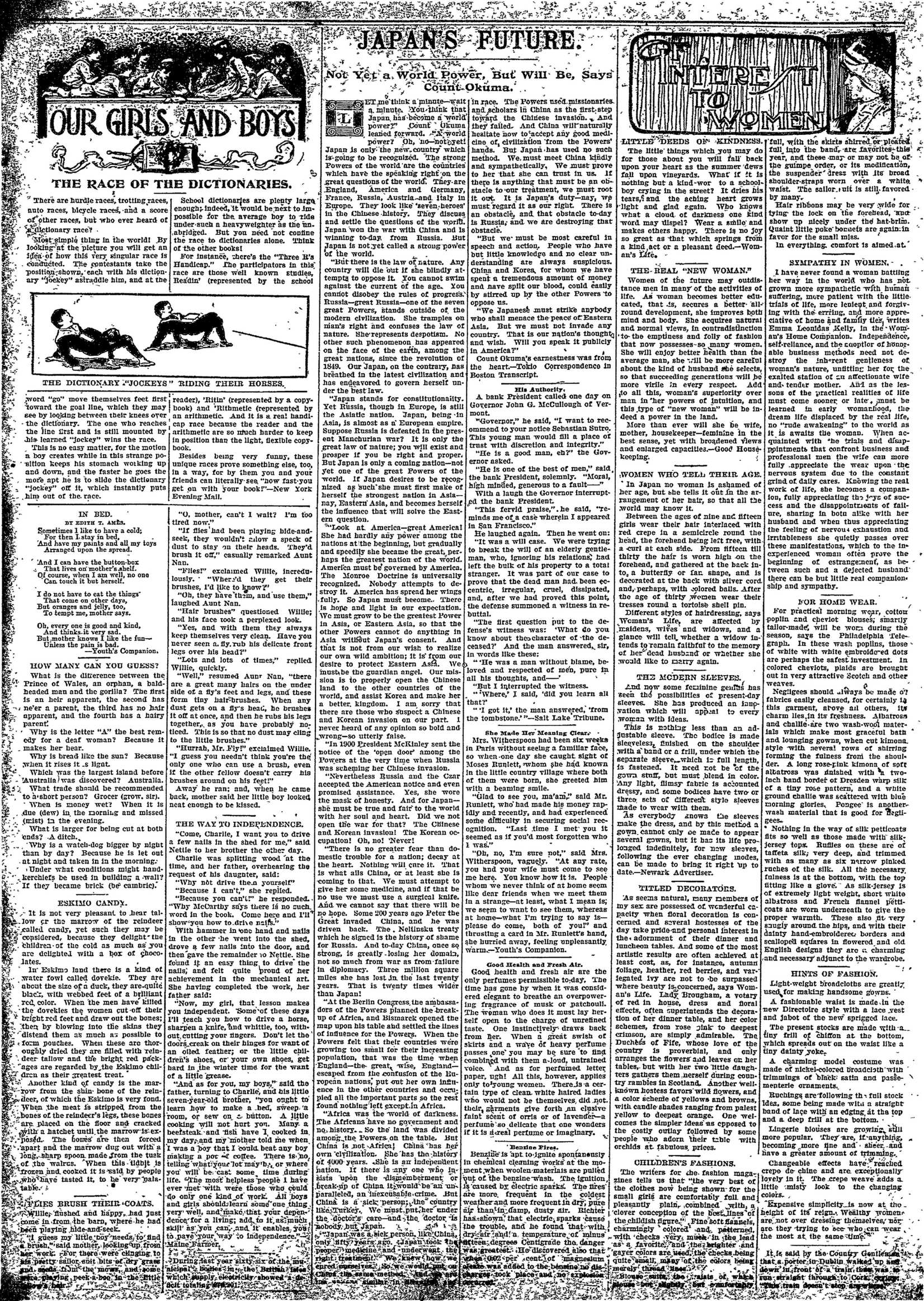
THE DICTIONARY "JOCKEYS" RIDING THEIR HORSES.
There are hurdle races, trotting races, auto races, bicycle races, and a score of other races, but who ever heard of dictionary race?
Most simple thing in the world! By looking at the picture you will get an idea of how this very singular race is conducted. The contestants take the position-shown, each with his dictionary "jockey" astraddle him, and at the
THE DICTIONARY "JOCKEYS
word "go" move themselves feet first toward the goal line, which they may see by looking between their knees over the dictionary. The one who reaches the line first and is still mounted by his learned "jockey" wins the race. This is no easy matter, for the motion a boy creates while in this strange position keeps his stomach working up and down, and the faster he goes the more apt he is to slide the dictionary "jockey" off it, which instantly puts him out of the race.
IN BED.
BY EDITH T. AMBS.
Sometimes I like to have a cold;
For then I stay in bed.
And when my pockets are all my toys
Arranged upon the spread.
And I can have the button-box
That lives on mother's shelf.
Of course, when I need no one
Can touch it but herself.
I do not have to eat the things
That come on other days.
But oranges and kiyo, too.
To tempt me, mother says.
Oh, every one is good and kind,
And thinks it very sad.
But mother knows the fun—
Unless the pain is bad.
Youth's Companion
HOW MANY CAN YOU GUESS?
What is the difference between the Prince of Wales, an orphan, a bald-headed man and the gorilla? The first is an anil apparent, the second has neer a parent, the third has no hair apparent, and the fourth has a hairy parent.
Why is the letter "A" the best remedy for a deaf woman? Because it makes her hear.
Why is bread like the sun? Because when it rises it s. lign.
Which was the largest island before Australia? was discovered? Australia.
What trade should be recommended to a short person? Grocer (grow, sir).
When is money wet? When it is due (dew) in the morning and missed (mist) in the evening.
What is larger for being cut at both ends? A ditch.
Why is a watch-dog bigger by night than by day? Because he is let out at night and taken in in the morning: Under what conditions might handkerchiefs be used in building a wall? If they became brick (be'cambrite).
ESKIMO CANDY.
It is not very pleasant to hear tailow or the marrow of the reindeer called candy, yet such they may be considered, because they delight the childarea of the cold as much as you are delighted with a box of chocolates. In Eskimo land there is a kind of water fowl called dovekie. They are about the size of a duck, they are quite black, with webbed feet of a brilliant red color. When the men have killed the dovekie the women cut off their bright red feet and draw out the bones; then by blowing into the skins they distend them as much as possible to form pouches. When these are thoroughly dried they are filled with reindeer tallow and the bright red packages are regarded by the Eskimo children as their greatest treat.
Another kind of candy is the marrow from the shin-bone of the reindeer, of which the Eskimo is very fond. When the meat is stripped from the bones of the reindeer's legs, these bones are placed on the floor and cracked with a hatchet until the marrow is exposed. The bones are then forced apart and the marrow dug out with a long, sharp spoon made from the tusk of the walrus. When this didbt it is frozen and cooked it is said by people who have tasted it, to be very palatable.
FLIES BRUSH THEIR COATS.
Willie, nushed and happy, had just come in from the barn, where he had been playing hide-and-seek. "I guess my little boy needs to find a brush," said mother, looking up from her work. For there were clinging to his pretty sailor suit bits of grass and seeds from the mow, and some glaze playing peek-a-boo in the little brown hair.
School dictionaries are plenty large enough, indeed, it would be next to impossible for the average boy to ride under such a heavyweighter as the unabridged. But you need not confine the race to dictionaries alone. Think of the other books!
For instance, there's the "Three R's Handicap." The participants in this race are those well known studies, Readin' (represented by the school
reader), "Ritin" (represented by a copy-book) and "Rhythmic" (represented by an arithmetic. And it is a real handicap race because the reader and the arithmetic are so much harder to keep in position than the light, flexible copy-book.
Besides being very funny, these unique races prove something else, too, in a way, for by them you and your friends can literally see "now fast you get on with your book!"—New York Evening Mall.
"O, mother, can't I wait? I'm too tired now."
"If files had been playing blade-and-seek, they wouldn't allow a speck of dust to stay on their heads. They'd brush it off," casually remarked Aunt Nan.
"Files!" exclaimed Willie, incredulously. "Wher'd they get their brushes, I'd like to know?"
"Oh, they have them, and use them," laughed Aunt Nan.
"Hair brushes?" questioned Willie; and his face took a perplexed look. "Yes, and with them they always keep themselves very clean. Have you never seen a fly, rub his delicate front legs over his head?" "Lots and lots of times," replied Willie, quickly.
"Well," resumed Aunr Nan, "there are a great many hairs on the under side of a fly's feet and legs, and these form tiny hairbrushes. When any dust gets on a fly's head, he brushes it off at once, and then he rubs his legs together, as you have probably noticed. This is so that no dust may cling to the little brushes."
"Hurrah, Mr. Fly!" exclaimed Willie. "I guess you needn't think you're the only one who can use a brush, even if the other fellow doesn't carry his brushes around on his feet!"
Away he ran; and, when he came back, mother said her little boy looked neat enough to be kissed.
THE WAY TO INDEPENDENCE.
"Come, Charlie, I want you to drive a few nails in the shed for me," said Nettle to her brother the other day. Charlie was splitting wood at the time, and her father, overhearing the request of his daughter, said:
"Why not drive then yourself?"
"Because I can't," she replied.
"Because you can't," he responded.
"Why McCarthy says there is no much word in the book. Come here and I'll show you how to drive nails."
With hammer in one hand and nails in the other he went into the shed, drove a few nails into the door, and then gave the remainder to Nettle. She found if an easy thing to drive the nails; and felt quite proud of her achievement in the mechanical art. She having completed the work, her father said:
"Now, my girl, that lesson makes you independent. Some of these days I'll teach you how to drive a horse, sharpen a knife, and whittle, too, without cutting your fingers. Don't let the door,creak on their hinges for want of an oiled feather; or the little children's shoes, or your own shoes, get hard in the winter time for the want of a little grease.
"And as for you, my boys," said the father, turning to Charlie, and his little seven-year-old brother, "you ought to learn how to make a bed, sweep a room, or sew on a button. A little cooking will not hurt you. Many a beekeast and fish have I cooked in my days and my mother told me when I was a boy that I could beat any boy making a porch coffee. There is no telling what you lot may be, or where you will be cast, some time during life. The most helpless people I have ever met with were those who could do only one kind of work. All boys and girls should learn some one thing very well, and make that your dependence for a living; add to it, as much skill as you can, and it enables you to pave your way to independence." Malne Farmer.
During last year sixty six of the muscular bodies in the, the British lives which supply electricity showed a deal totaling 4901.
Not Yet a World Power, But Will Be, Says Count Okuma.
LET me think a minute - wait in race. The Powers used missionaries and scholars in China as the first step toward the Chinese invasion. And they failed. And China naturally healate now to accept any good medicine of civilization from the Powers'
ET me think a minute—wait a minute. You think that Japan has become a world power? Count Uganda leaned forward. 'Sword power?' Oh, no—not yet Japan is only the new country which is going to be recognized. The strong Powers of the world are the countries which have the speaking right on the great questions of the world. They are England, America and Germany, France, Russia, Austria and Italy in Europe. They look like 'seven, heroes' in the Chinese history. They discuss and settle the questions of the world. Japan won the war with China and is winning to-day from Russia. But Japan is not yet called a strong power of the world.
"But there is the law of nature. Any country will die out if she blindly attempts to oppose it. You cannot swim against the current of the age. You cannot disobey the rules of progress. Russia—great Russia—one of the seven great Powers, stands outside of the modern civilization. She tramples on man's right and confuses the law of nature. She represents despotism. No other such phenomenon has appeared on the face of the earth, among the great nations, since the revolution of 1849. Our Japan, on the contrary, has breathed in the latest civilization and has endeavored to govern herself under the best law.
"Japan stands for constitutionality. Yet Russia, though in Europe, is still the Asiatic nation. Japan, being in Asia, is almost as n' European empire. Suppose Russia is defeated in the present Manchurian war? It is only the great law of nature; you will exist and prosper if you be right and proper. But Japan is only a coming nation—not yet one of the great Powers of the world. If Japan desires to be recognized as such she must first make of herself the strongest nation in Asia—nay, Eastern Asia, and becomes herself the influence that will solve the Eastern question.
"Look at America—great America. She had hardly any power among the nations at the beginning, but gradually and speedily she became the great, perhaps the greatest nation of the world. America must be governed by America. The Monroe Doctrine is universally recognized. Nobody attempts to destroy it. America has spread her wings fully. So Japan must become. There is hope and light in our expectation. We must grow to be the greatest Power in Asia, or Eastern Asia, so that the other Powers cannot do anything in Asia without Japan's consent. And that is not from our wish to realize our own wild ambition; it is from our desire to protect Eastern Asia. We must be the guardian angel. Our mission is to properly open the Chinese land to the other countries of the world, and assist Korea and make her a better kingdom. I am sorry that there are those who suspect a Chinese and Korean invasion on our part. I never heard of any opinion so bold and wrong—so utterly false.
"In 1900 President McKinley sent the notice of the 'open door' among the Powers at the very time when Russia was scheming her Chinese invasion.
"Nevertheless Russia and the Czar accepted the American notice and even promised assistance. Yes, she wore the mask of honesty. And for Japan--she must be true and fair to the world with her soul and heart. Did we not open the war for that? The Chinese and Korean invasion! The Korean occupation! Oh, no! Never!
"There is no greater fear than domestic trouble for a nation; decay at the heart. Nothing will cure it. That is what alls China, or at least she is coming to that. We must attempt to give her some medicine, and if that be no use we must use a surgical knife. And we cannot say that there will be no hope. Some 200 years ago Peter the Great invaded China, and he was driven back. The Nellinsku treaty which he signed is the history of shame for Russia. And to-day China, once so strong, is greatly-losing her domain, not so much from war as from failure in diplomacy. Three million square miles she has lost in the last twenty years. That is twenty times wider than Japan!
"At the Berlin Congress, the ambassadors of the Powers planned the break-up of Africa, and Bismarck opened the map upon his table and settled the lines of influence for the Powers. When the Powers felt that their countries were growing too small for their increasing population, that was the time when England—the great, wise, England—escaped from the confusion of the European nations, put out her own influence in the other countries and occupied all the important parts so the rest found nothing left except in Africa.
"Africa was the world of darkness. The Africans have no government and no history. So the land was divided among, the Powers, on the table. But China is not Africa! China has her own civilization. She has the history of 4000 years. She is an independent nation. If there is any one who insists upon the dismemberment or break-up of China it would be an unparalleled, an inexecutable crime. But China is a sick person, the country like Turkey. We must put her under the doctor's care—and the doctor is nobody, but Japan.
"Japan was a sick person like China, only fifty years ago, Japan took the proper medicine and underwent the right treatment. We knew how we cured ourselves. So we would put on China the same method, and we are now similar in treatment."
in race. The Powers used missionaries and scholars in China as the first step toward the Chinese invasion. And they failed. And China will naturally heatate now to accept any good medicine of civilization from the Powers' hands. But Japan has used no such method. We must meet China kindly and sympathetically. We must prove to her that she can trust in us. If there is anything that must be an obstacle to our treatment, we must root it out. It is Japan's duty—nay, we must regard it as our right. There is an obstacle, and that obstacle to-day is Russia, and we are destroying that obstacle.
"But we must be most careful in speech and action. People who have but little knowledge and no clear understanding are always suspicious. China and Korea, for whom we have spent a tremendous amount of money and have split our blood, could easily be stirred up by the other Powers to oppose us.
"We Japanese must strike anybody who shall menace the peace of Eastern Asia. But we must not invade any country. That is our nation's thoughts and wish. Will you speak it publicly in America?" Count Okuma's earnestness was from the heart.-Tokio Correspondence in Boston Transcript.
His Authority.
A bank President called one day on Governor John G. McCullough of Vermont.
"Governor," he said, "I want to recommend to your notice Sebastian Sutro. This young man would fill a place of trust with discretion and integrity."
"He is a good man, eh?" the Governor asked.
"He is one of the best of men," said the bank President, solemnly. "Moral, high minded, generous to a fault——"
With a laugh the Governor interrupted the bank President.
"This fervid praise," he said, "reminds me of a case wherein I appeared in San Francisco."
He laughed again. Then he went on: "It was a will case. We were trying to break the will of an elderly gentleman, who, ignoring his relations, had left the bulk of his property to a total stranger. It was part of our case to prove that the dead man had been eccentric, irregular, cruel, dissipated, and, after we had proved this point, the defense summoned a witness in rebuttal. "The first question put to the defense's witness was: 'What do you know about the character of the deceased?' And the man answered, sir, in words like these: "He was a man without blame, beloved and respected of men, pure in all his thoughts, and—"
"But I interrupted the witness.
"Where, I said, 'did you learn all that?
"I got it, the man answered, 'from the tombstone.'"—Salt Lake Tribune.
She Made Her Meaning Clears
She Made Her Mealing Clear.
Mrs. Witherspoon had been six weeks in Paris without seeing a familiar face, so when one day she caught sight of Moses Runlett, whom she had known in the little country village where both of them were born, she greeted him with a beaming smile.
"Glad to see you, ma'am," said Mr. Runlett, who had made his money rapidly and recently, and had experienced some difficulty in securing social recognition.
"Last time I met you it seemed as if you'd most forgotten who I was."
"Oh, no, I'm sure not," said Mrs. Witherspoon, vaguely. "At any rate, you and your wife must come to see me here. You know how it is. People whom we never think of at home seem like dear friends when we meet them in a strange—at least, what I mean is; we seem to want to see them, whereas at home—what I'm trying to say is—please do come, both of you!" and thrusting a card in Mr. Runlett's hand, she hurried away, feeling unpleasantly warm. Youth's Companion.
Good Health and Fresh Air.
Good health and fresh air are the only perfumes permissible to-day. The time has gone by when it was considered elegant to breathe an overpowering fragrance of musk or patchouli. The woman who does it must lay herself open to the charge of unrefined taste. One instinctively draws back from her. When a great swish of skirts and a wave of heavy perfume passes one you may be sure to find combined with them a joad, untrained voice. And as for perfumed letter paper, nigh! All this, however, applies only to young women. There is a certain type of clean white haired ladies who would not be themselves, did not their garments give forth an elusive faint scent of orris or of lavender-a perfume so delicate that one wonders if it is its ideal perfume or imaginary.
' Benzine Fires.
Benzine is apt to ignite spontaneously in chemical cleaning works at the moment when woolen-materials are pulled out of the benzine-wash. The ignition is caused by electric sparks. The fires are more frequent in the coldest weather and more frequent in dry, pure air than in damp, dusty air. Hichter has shown, that electric sparks cause the trouble, and he found that with dry-air and a temperature of minus fifteen degrees Centigrade the danger was greatest. He discovered also that when 002 per cent of magnesium oleate was added to the benzine no discharges took place, and no explosion occurred.
INTEREST TO WOMEN
LITTLE 'DEEDS OF' KINDNESS
The little things which you may do for those about you will fall back upon your heart as the summer dews fall upon vineyards. What if it is nothing but a kind-wor to a schoolboy crying in the street? It dries his tears, and the aching heart grows light and glad again. Who knows what a cloud of darkness one kind word may dispel? Wear a smile and makes others happy. There is no joy so great as that which springs from a kind act or a pleasant deed.—Woman's Life.
THE REAL "NEW WOMAN."
Women of the future may outdistance men in many of the activities of life. As woman becomes better educated, that is, secures a better all-round development, she improves both mind and body. She acquires natural and normal views, in contradiction to the emptiness and folly of fashion that now possesses—so many women. She will enjoy better Health than the average man, she—will be more careful about the kind of husband she selects, so that succeeding generations will be more virile in every respect. Add to all this, woman's superiority over man in her powers of intuition, and this type of "new woman" will be indeed a power in the land.
More than ever will she be wife, mother, housekeeper—feminine in the best sense, yet with broadened views and enlarged capacities.—Good Housekeeping.
WOMEN WHO TELL THEIR AGE.
In Japan no woman is ashamed of her age, but she tells it out in the arrangement of her hair, so that all the world may know it.
Between the ages of nine and fifteen girls wear their hair interlaced with red crepe in a semicircle round the head, the forehead being left free, with a curl at each side. From fifteen till thirty the hair is worn high on the forehead, and gathered at the back into a butterfly or fan shape, and is decorated at the back with silver cord and, perhaps, with colored balls. After the age of thirty women wear their tresses round a tortoise shell pin.
Different styles of hairdressing, says Woman's Life, are affected by maidens, wives and widows, and a glance will tell, whether a widow intends to remain faithful to the memory of her dead husband or whether she would like to marry again.
THE MCDERN SLEEVES.
And now some feminine genius has seen the possibilities of present-day sleeves. She has produced an innovation which will appeal to every woman with ideas.
This is nothing less than an adjustable sleeve. The bodice is made sleeveless, finished on the shoulder with a band or a frill, under which the separate sleeve, which is full length, is fastened. It need not be of the gown stuff, but must blend in color. Any light, films fabric is accounted dressy, and some bodices have two or three sets of different style sleeves made to wear with them.
As everybody knows the sleeves make the dress, and by this method a gown cannot only oe made to appear several gowns, but it has its life prolonged indefinitely, for now sleeves, following the ever changing modes, can be made to bring it right up to date—Newark Advertiser.
TITLED DECORATOES.
As seems natural, many members of my sex are possessed of wonderful capacity when floral decoration is concerned and several hostesses of the day take pride and personal interest in the adornment of their dinner and luncheon tables. And some of the most artistic results are often achieved at least cost, as, for instance, autumn foliage, heather, red berries, and variegated lily are not to be surpassed where beauty is concerned, says Woman's Life. Lady Brougham, a votary of red in house, dress and floral effects, often superintends the decoration of her dinner table, and her color schemes, from rose pink to deepest crimson, are simply admirable. The Duchess of Fife, whose love of the country is proverbial, and only arranges the flowers and leaves on her tables, but with her two little daughters gathers them herself during country rambles in Scotland. Another well-known hostess favors wild flowers, and a color scheme of yellows and browns, with candle shades ranging from palest yellow to deepest orange. We welcome the simpler ideas as opposed to the costly outlay followed by some people who adorn their table with orchids at fabulous prices.
CHILDREN'S FASHIONS
The writers for the fashion magazines tells us that "the very best of the clothes now being shown for the small girls are comfortably full and pleasant plain, combined with a clever conception of the best lines of the childish figure." Fine soft frames, charmingly colored and patterned, with checks very much in the lead as a favorite, and the heighter and gayer colors are used, the checks being quite small, many of the colors being merely thread lines.
Blows out the rains of which clothes but slightly but comfortably.
full, with the skirts shirred or pleated, full into the band, are favorites this year, and these may or may not be of the guipme order, or its modification, the suspender'd dress with its broad shoulder-straps worn over a white waist. The sailor,uit is still favored by many.
Hair ribbons may be very wide for trying the lock on the forehead, and show up nicely under the hat-brim. Quaint little poke bonnets are again: in favor for the small miss.
In everything, comfort is aimed at.
SYMPATHY IN WOMEN.
I have never found a woman battling her way in the world who has not grown more sympathetic with human suffering, more patient with the little trials of life, more lenient and forgiving with the erring, and more appreciative of home and family ties, writes Emma Leonidas Kelly, in the *Woman's Home Companion*. Independence, self-reliance, and the copilot of honorable business methods need not destroy the inherent gentleness of woman's nature, unitting her for the exalted station of an affectionate wife and tender mother. And as the lessons of the practical realities of life must come sooner or later, must be learned in early womanhood, the dream life displaced by the real life, no "rude awakening" to the world as it is awaits the woman. When acquainted with the trials and disappointments that confront business and professional men the wife can more fully appreciate the wear upon the nervous system due to the constant grind of daily cares. Knowing the real work of life, she becomes a companion, fully appreciating the joy of success and the disappointments of failure, sharing in both alike with her husband and when thus appreciating the feeling of nervou' exhaustion and irritability she quietly passes over these manifestations, which to the inexperienced woman often prove the beginning of estrangement, as between such and a defected husband there can be but little real companionship and sympathy.
FOR HOME WEAR.
For practical morning wear, cotton poplin and chevot blouses; smartly tailor-made, will be worn during the season, says the Philadelphia Telegraph. In these wash poplin, those of white with white embroidered dots are perhaps the safest investment. In colored chevot, plaids are brought out in very attractive Scotch and other weaves.
Negligees should always be made of fabrics easily cleansed, for certainly 14 this garment, above all others, its charm lies, in its freshness. Athatross and chalie-are two wash-wool materials which make most graceful bath and lounging gowns, when cut kimono, style with several rows of shirring forming the fulness from the shoulder. A long rose-pink kimono of soft albatross was dulled with a two-inch band border of Dresden warp silk of a tiny rose pattern, and a white ground chalie was scattered with blue morning glories. Pongee is another-wash material that is good for negligees.
Nothing in the way of silk petticoats fits so well as those made with silk-jersey turs. Ruffles on these are of taffetta silk; very deep, and trimmed with as many as six narrow pinked ruches of the silk. All the necessary, ruiness is at the bottom, with the top fitting like a glove. As silk-jersey is of extremely light weight, short white albatross and French flannel petticoats are worn underneath to give the proper warmth. These also fit very sanguely around the hips, and with their dainty hand-embroidered borders and scalloped squares in flowered and old English designs they are a charming and necessary adunct to the wardrobe.
HINTS OF FASHION.
Light-weight broadcloths are greatly used for making handsome gowns. A fashionable waist is made in the new Directore style with a lace vest and jabot of the new spriged lace. The present stocks are made with a tiny frill of chiffon at the bottom, which spreads out on the waist like a tiny dainty yoke. A charming model costume was made of nickel-colored broadcloth with trimmings of black satin and passementer ornaments. Ruchings are following the full stock idea, some being made with a straight band of lace with an edging at the top and a deep frill at the bottom. Lingerie blouses are growing still more popular. They are, if anything, becoming more fine and sheer, and have a greater amount of trimming. Changeable effects have reached crepe de chine and are exceptionally lovely in it. The crepe weave adds a little misty look to the changing colors.
Expensive simplicity is now at the height of its reign. Wealthy women are not over dressing themselves, nor are they trying to see who can wear the most at the same time.
It is said by the Country Gentleman that a porter, in Dublin, walked up and down in front of a train, there was an run, straight through to Cork, occupying "This train doesn't stop anywhere."
ees
TR et
*The Savannah Tribune
‘ae
Sarwapay, FeBHUARY 11, 1905.
Stat Go Noailiing ip ver? wick
SSOapt. SF. Spaulding ts,very -sick
shee home, East Park Ate.
pe, TARR ODIVSLELE LAOLMCE eee
feboro;'S C., is visiting frends ix
¥Springtietd, Mass.
oS Mrs, El.cabeth Emery baa tetarn
Seduhome alter visiting New, York
eDity, Rateigh and Charivtte, N. C.
ae sMina S.A. Roundfeld, dne of ous
eeflcient Gounty School teachers;
agree on the sick het this week.
se* Hon. J. B. Bascomb one of Tax
(sERipUS e's staunch eupporters, in
Scompany with -his aon, Mr. J. H.
*Bascomb, cume in to se¢ us last
4} week.
‘* Mias Lizzie Charleton and Mr.
SU yses Lawrence were quietyy mar-
Sried-on Monday and ‘left ‘Tueadey
F eyening for New York.
The friends of Mrs. 0, J. Holmes
will be glad to learn that she has re-
Y:covered from an injury she received
._ at Palm Beach, Florida,
“& Mr.J R. Davie, a pronmient bar-
oh of Savannah, Ga, made a flying
“grip to the city this week and spesit
- the time pleasantly with Dr. WC.
Smale. He has charge of the shop
“at the union gration in Savannah
“nnd is prosp2ring.—Jucksonvilie
* Metropotes. ~ .
“Rev. S Beanford, of Waycross
., Was in the city this wrk. Hin
house was recently dratroyed by
firéand along with it his lbrary,
“which, contained many valuuble
books. .
Acard party was given in honor
of Mrs Bunch of New York at the
. residence of Mr. and Mra. J. B
Young of 318 W. Gaston St, on
+ Thursday evening last. A number
of friends were present and a delight-
fal time was hed by all.
| _Mre, Nellie S, Williams of New
_Xork ia in the city, the guest of Mrr,
Ophelia Geary on Lincoln ¢ ree’,
Mrs. Williams baa traveled ex-,
: tonsively and basa fund of informa |
ztion of places visited and things
teen. * |
...The many friends of M's Edun
Simpkine will regret to hear of her
indisposition. During her atay at
Hudson N, Y, she has taken an
active part in church work. On re-
“count of her interest and uncelfish
- work in this direction she was pre-
sented two useful articles.
* ‘Mra. Lousia” A Alexander met
with a serions and painful accident.
On January 28, a needle broke off in
-her left hand, and after two unguc-
cessful operations it was extricated
after much pain. And after being
indispnsad for the Isat nine days, is
able to be ont again,
Mr, James B. Alston, one of our
old citizens died on Thursday morn-
ing and was buried yesterday. Mr.
Alston was the oldest barber in the
city and was well known and liked.
‘He was a member of Protection
~Lodge of Odd Fellowe, and Jin fuct
one of the urganizers of that lodge.
He leaves a wife, daughter and sev-
eral song. The family has the sym-
pathy of friends.
Mre. Sarsh’ Caine, daughter of
Hon. R. M. Sawyer, died at the
home of her father on Alba y atreet
‘last Thursday night after lingering
illness. Funeral seryicee,were held
at Grace’Church, Rev. Daniele offici-
sting, on Friday evening, and she
was laid away amid a concourse of
sorrowing friends and rolatiyes in
‘Greenwood cemetery.—Brunawick
Usion. <
Mies Lottie E. Heyward, a daugh-
terof Mr and Mra, Isaac Heyward,
died on Thursday night after an
illuess of about threa weeks at their
residence in Woodville. She was a
christian and faithful member of
Friencship Baptist church. She
leaves a father, mother, six sisters,
four brothers and mapy relatives and
friends to mourn her death. Inter-
ment at Woodville.
Mra, Dora DeLyons died on Fri-
day morning of last week. She had
been ailing for sometime. Mrs.
DeLyons was well known, For years
she kept «stall in the city market
She was friendly and kind hearted
which won her many friends. The
faneral took place Sunday morning.
dhterment at White Bloff. Besides
other relativesshe Ieft a daughter,
¢ Attacked By a Mob.-
and beaten, ic'a labor riot; “until -covered
yswith Sores, a Chicago streetcar conductor
sapplied.Bucklen’s Arnica Salve,and was
“soon sound"and. well. ."['use.it ingmy
Shamily,?- writes G..T, Welch of Tekonsha;
Mick, Uand Gnd'it perfect.” Sleiply great
Ge" cate ‘and:barad-Onlyfise at.eny drug
gare paN tt. EP AP a ES:
A Pleasant Time Spent..
“Lhe fifth anniversary of the Bran.
cea By W. Harper Literdry and
Séefal Circle was held Friday Eve-
ning of, Jast-week,at the residence of
of Dr. and Mrs. J. W, Williams.
The vrightly lighted rooms, the gay
music and pretty gowne made it a
muat enjoyable effarr ‘Che members
ef the Circle and thefr guests were
(Weicumed by the hostesr, Bre Will-
fama, who looked most charthing in
an 1830” creem costume with
cream lvce and wine colored ailk
trimmings. The literary part of the
program Wes opened with a sung by’
the Cirel-. ‘I'he president, Mies O.
Etnma L-wia, m her geacefal digni-
ficd manner made the guests feel
how glad the Girele wus to have
them present Myre. L. M. Hutchinz
son Teed a must interesting paper,
the eubject being “Lhe Outlook ”
In well chosen words she depicted
the struggles and enccesaes of the
Circle for the last five yrurs, saying
that “The Outlook” could easily be
imagined from such x past. ‘The.
hext number ar instramental duet,
by Misa Samie Edwards and Mrs.
Clarence F. Jones was brilliantty.
played and greatly eujoyed by all.
Mra. Nona Mitchell ‘then read an
origina! poem. The value of each,
member was told in veree in a moat
unique manner. She was heartily,
applauded. “Summer Flowers” a
vues] duet by the Misses Georgia
Haord and Mamie Whitmire was
sweetly rendered’and proved a most
enjuyable number. ‘The editor,
Sirs U. F. Jones then read the news'!
of the week for the eulightenment
of all present A bountiful supper
was served, the doslies used haying
been especially prepared for the.
Circle by Tue Trrpusx, During
aupprr quotations from different,
authors were given and the other
partof the evening was spent in
dancing by the younger members,
and in playing “Flinch”,
by the others. The guests of the’
Circle were Doctors - Williams,’
Watts, Parks, and Ioyd, Prof.
Gudsden, Messre. Geo. W. Johnson,
J. F Jones, stitchell, Judkigs, |
Rilwarda: |
St. James Dots.
Last Susday was a cold rainy
day and attendance poor.- ‘The pas-
tor, Rev, J. A. Hadley preached
two very interesting sermon. At
1L a. m-auhject, “Christian Citizen-
ship,” 8 p. m, “Evidence of Ubriati-
unity.” Both of these subj-cte were
most forcibly discussed and exhibit-
cd profoand thonghta aud careful
study. Asa pulpit logician, Kev.
Hadley has but few equals in the
city. His thoughts are always pure
and have the desired effect. Rev.
Hadley has been a successful pas‘or
for two years, and much crecit is
due him for the way he haa manag
ed hig church uffairs. Mrs. Hadley
also by her sweet disposition has
won many friends, She has ro-
organized the Woman’s Home and
Foreign Missionary Society, and ut
present it has a good membership
and is in a flourishing condition.
Mrs, Margaret Waters is the Presi-
dent. The Woman’s Iome and
Foreign Missionary Society meets
the fourth Wedoeeday in every month
Mra. Loutsa A. Alexander, is or-
ganist and has charge of the pro-
gram committee. .A. good program
1s promised at their next meeting
Friends are cordially invited. To-
morrow will be three services, as
the weather did not permit last Sun-
day, At Ila. m, Rev. Hadley’s
subject Will be, “Thou art weighed
—found wanting.” At4p, m., the
holy communion will be adminia
tered, AtS p.m., Dr. W.H. Heard
of Philadelphia, a general officer
ofthe A. M. E,charch and secreta
ry of the O. P, A. will preach The
ladies are meeting with success in
their forward movement.
First A. B. Church.
Our anniversary services were
very enjoyable, and well attended.
The anniversary sermon by Rev. J.
H. Gadson was greatly appreciated
by the entire church. Rev. Gadson
isa member of our church, and we
are proud of the success he {8
making in the ministry. Hia sery
mons were logical and very instruc-
tive, The young ministers of to-
day should copy his example, and
gets good education and m-Ke pro-
ficient men of themselves. The com-
raunion services have been extended
to the afternoon of the .3rd-Sunday of
this month, becanse of the inclem-
ancy of the weather last Sunday.
‘We trnst all of the members of the
church will tuke notice aud govern
themselves accordingly. The ser-
yicea’to-morrow at 11 a. m. and 8 p.
m. will be very interesting. Sun-
dey school at3 p.m. The B.Y.P.
U.at 7:30 p.m. All are cordially
invited to attend these services, |
—————+-2-+_______
Ate You Engigced? _
- Engaged people should remember thar,
after ‘marriage, many quarrels can be
avoided by ‘Keeping their digestion I
good condition with Electric Bitters. S.A;
Brown, of Bennettsville,S. C., says: For
years’ my;wile suffered intensly-from dis:
pepsia, complicated witha torpid liver,
until she lost hér strength and vigor’ and
becamé amere wreck of her former, self:
Then, ghe tried..Eléctric Bitters, which
helped her ‘at once;’andGnall yx made her
entirely *iwell'- She Sis,now, strong’ ‘and
healthy: All-druggigte Sells. “and :gharan:
eves thasiakigoes be ee
T. W, WALKER, President; ‘ WM. DRISKELL, 8et'y & Genz Mgt.,'t
“Birmingtiam, Ala* . ? Athaata, Ga;
. H: GRIFFIN YOUNG?District Manager, (1 , &
oS 219 West Braad’Street, SAVANNAH, GA: | z
UNION MUTUAL -ASSOCIATION,
4 Maio. Office For Geofgin, 313 tAnbuyn' Avenue, Adantaj.Ga:. |
* Thejlargest Negré.Iodustrial Compaay of’ its’ kind ia,the worig... Owned and *
‘Sfetated exclutively by Negroes PEmploys more: Negroes than aiy,otNer.Ag- 7
\~ ‘stitution'in exiatences-4 Rranch Offices thronghoug the SealeiSiks Ss Ss Pie,
s ; business: Written mesr'$1,008,000-: tye
+" ,. Pays $1100 Se $0 60 per week forsSick and AccMent; sad; from, B10 G0 62".
P jp8{00S0 fn case of Nesth it 9:2 sy ETE EO a Tandy
= es banter ieee 5 a all just Stakes. 9 vat Se }
CBee Sane oc saet Ouch.
| Setend Baptist, Church.
_Services_at the Sicord ‘Baptiat
church Jag Sunday were atjendéd fiir
ly well, conaldering the weather., Rev.
Smith delivered twos discourses,
which wore indeed {nteresting. Ser-
yices'as usual Sdoday: Fe B. Y. P.
U. meeting at 6:30, Woman's Mission.
Monday aftérnoon at 4 o’cluck.,
‘The Fred Douglass Lyceum, which
was connected? with the Secand
Baptist church a few’years ago, will
he re-organizd Yinc a fw weeks
Vaose interested in literary work.
are pouch to attend the business
meeting, the dute of meeting will
be announced m,next week’e issue.
<r ——
THE TI@E PIECE ON THE WALL. |
Tick, tack, I hear you say *
‘AS you beckon one and all
And you seem to point with grace,”
‘The time of day, upon your face.
But, is this your duty,
‘And were you soinstalled,
To point and beckon one and all
‘The way of,life, the end of faith ?
This is my duty, said thexclock :
As Ltick, my daily watch, -
And as she swang, her pendulum slow,
She told.of time, that would be no
' ae ° R
Tick on fen, ob !-time peace of faith
‘Tell inf to posterity, :
Anhelp its, ifsleepor wake, .
Striving always, to be great. >
=B= E.G. Tate, ,
Hot Springs, Va. Ee Soe
ABUSEMERT COLUMN.
Coming Events im The Ser
‘etal Warld.’
A grand entertainment and dance will be
given at Our Hall by Rosebud, No.
625 U. O. T. R. Monday night, Febriary 20
Admission fo cents,
The DeSoto Bellmen will glve their
third annual Ball at Harris street Hall
Monday, night, Feb. 20th. Admissfon,
25 cents,
‘The ¥. M. C. will give their Ten Nights
Fete at Morce’s Hall, commencing Mon-
day‘aight, February, 6th. Admissioo, 10
cents; Season tickers So cents.
The first anoual dance of the Twilight
Réapers Aid and ¥ocial Club Branch will
take place at Harris Street Hall Tuesday
evening February 28th. Admission 35
cents; Double So cents.
The-¥. L,I. C. will give their ninth
entertainment at Harris Street Hall,
Tuesday evening, Feoruary 21st. Admis-
sion single or double So ‘cents,
‘A.grand select dance will be given by
the Youg Adelphia Aid and Social Club
at Har is Street Hall, Wedaesday night
February aznd. Admission, 39 weats;
Double So cents.
There will be a grand ten nights fete
given by the Ladies and Gentlemen
Soree Club at Duffy street hall, commenc-
ing Monday night, February 6tn. Ad-
mission to cents. 2
‘The Evening Call A, atd S. Club, will
give afive nights fete at Margaret street
hall, commencing February 6th, Admis-
sion ro certs. 3
A candy entertainment will be given at
Morse’s Hall, by Charity Circle on Wed-
nesday afternoon February 22, 1905, at 3
o’ clock. Admission 5c.
Got Off-Cheap.
He may well think, be bas got off
cbeap who, after having contracted consti-
pation or indigestion, is stil! able to per-
fectly restore his heatth, Nothing will do
this but Dr. Kiog's Now Life Pillst A
quick, pleasang, and certain cure for head-
ache, conétipation, etca esc at any
deug store; guaranteed,
Cemetery Lots.
Oolored citizens that have re-
ceipts for Lots in the Cemetery it
would be well for them to carry
game to Col. Russel, at the Court
House.
A
Cheap Rates.
Excursion Rates via. Central of Georgia
Ry. to New Orleans, La., ,Mobile, Ala.,
and Pensacola, Fla. Mardi Gras Celebra-
tion March 27% 1905. One fare plus 25
cents for the roundtrip. Tickets on sale
March rst to 6th, inclusively, limited to
leave destination not later than March 11,
1905, unless ticket is deposited by original
purchaser, with Special Agent, and fee of
50 cents paid at time of deposit, in which
case an extension to March 25, 1905 can be
obtained.
To Wasbington, D, CO, Presidential, In.
auguration ceremonies March 4, 1905. For
individuals and membera of organizations
not distinctly military, one fare plus “25
cents for the round trip ; for military Com-
panies and Brass Bands in whiform, 20 or
‘more on one ticket, one cent per mile in
each direction. From points on and east
of a line drawn from Savannah to Chatta-
nooga, through Macon, Atlaata and Rome,
tickets will be sold March 1, 2 and 3, 1905.
Holders of such tickets must leaye Wash-
ington returning, not later than March 8,
1905, unless ticket is deposited with
Special Agent, and fee of $1 00 paid at
time of deposit, in which case an extension
to March 18, 1995 may be obtained.
For futher information apply to your
nearest Ticket Agent.
Grocery Store and
Restaurant, .
I wish to announce to: my many
frienda aud Ratrons that I have re-
opened. my Restaurant at No. 464
‘eat Broad street, next to the Wage
Earners Bank, where I will also oon
duct my Grocery store. I 'will fur-
nish first class meals as before, aud
keep on hand constantly « fall line
groceries. The patronage of the pub-
lic is solicited. . 2
BR. H. HOOKS, Prop.
7 464 Weat Broad Street..
Winter Suits, Overcoats
and Single Trousers .. |
25 per cent Discount.
eon : eg |
_. Women’s and Misses’.
Tailor Made Suits;Dress Shirts,’ Furs, Cloaks, .
. Flannel Waists, and Outing Gowns,
: Skirts and Kimonas é a
HALF PRICE. -
= - — eee — . ~ #
SS
When Goods’Are Charged 25 and 50 per cent discounts will ‘be
“ . Applied as Heretofore eo!
B.H. LEVY,BRO. & CO
‘ 5 Broughton Street, West...
names, epee wera ER odiemaiae:
The Farmers’ Annual Conference’
Will be held at the \ - 2
Georgia State Industrial-College, |
Beginning Thursday February 16th, 1905, continuing
TWO DAYS,
Entertainment free to all farmers. :
All who intend to come are requested to communicate-with
the President, R. R, Wright, as soon as possible.
ABLE SPEAKERS WILL ADDRESS THE CONFERENCE,
President Wright will be pleased to accept invitations to
meet the farmers of any section and organize farmers’ insti:
tates. ¢
Every Saturday from now until the conference upens, will .
be given for this purpose, 7 So 3
When purchasing tickets to attend the Conference, secure ,
a certificate so you will be able to return at reduced rates,
. R. R. Wataut, President,
R.B, Fields. TIN. Rivers.
FIELDS & RIVERS,
GROCERIES,
730 Gwinnett St. E.,
Cor§Wilson Court. °
We carry a fine line of Groceries,
Fruits, Cigars, Tobacco, Wood and
Goal. Oar motto: Moderate Prices.
Quick delivery. Polite attention
= us « trial, Zi
——_—_———
LL Ss,
= CEWTIST. =
240 Barnard St., Savannah, Ga
Does all kind of high grade dental work
of the best quality and workmanship. Gold
crowns and bridge work. White Porcelain
Pivot, and Gold Crowas mounted on the
aatural roots. Gold Fillings, Cement Filj-
ings, and Silveror Amalgam Fillings. from
nine to 2 fall Set of teeh $7.00 and. $3.00.
Broken Places fnended®and teeth added, to
old ones for a small cost. _.,BellPhone 1244
All Gola Crowns @
Rok KEK Gola a
AEEANTIC COAST LINE
= OFFERS UNEXCELLED SERVICE. :
| Florida and West Indian Limited leaves Savannah guza. m.
(ro:r2 a, m, city time), arrive Jacksonville 1:45 p,m. Sanford
6:15 p. m., Tampa 10:30 p.m, Tampa Bay Hotel 10:40 p, muy |
Port Tampa 11:00 p.m, Close connection at Port Tampa with
steamships for Key West and Havana, salling from Port Tampa;
Sundays, Tuesday acd Thursdays at 11-40 p. m., arriving Key”
‘West 6:30 p. m, Mondays, Wednesdays and Fridays, arriving Ha-
vana 6:30 a. m. Tuesdays, Thursdays and Saturdays, passing ua-
+ er the guns of Morro Castle about sunrite, Less thaa 46 hours
from Savannah. “This train carries through Pallman sleeper Sa-
| vannak to Port Tampa. Dining car Savannah to Jacksonvilles
New York and Florida Express leaves Savannah 4:15 a.m, clty
i "time, arrives Tacksdaville 8:40 a, m., making close connection
« with trains leaviog Jacksonville 9:45 a. ra. for all_points. South,
carryingPullman Buffet Parlor’ Cars to Port Tampa and St.
Petersburg. Connections made for principal resorts in Florida.
Savannah and Jatksonville Express leaves'Savannah 4:00 p. m.,
city time (Train is made up at Savannah and is always on time.)
arrives Jacksonville gu5 p. mi, connecting withZtrain leaving
Jacksonville 9.35 P. ms carrying Pullmam Sleepers to Tampa and
Sort Myers. ert 2 q
Effective Jau. 10, the famous Néw York and;Florida’Special, =.
| train representing the highest standard of ‘perfection Ia passenger
service; solidly vestibules; consisting’of Pullman Drawlog-room,'
| BSleeping Compartinent, Dining and Observation Cara. will Ieave,
{Savannah 2:55 a, m., city time, arriving Jacksonville 2:50°p."m.4f
St ‘Augustine 4:00 or. m = |
<@ Atlantic Coast Line offers the publié train service unstirpas, ed.
‘ Bio-etegence, speed and Iuxury. H. M: Emgason, Trafic Mgr.,|
BW. J. Cratc, Gen. Pass: -Agt, Wilmington, N.C.) We.
.Lxiny, Div. Pass. Ageat;}. M..WAtsH, Trav, , Pass cAgent,
SS Savagnak§Ge. . se ee oe ee
Eat the best meats.
You can find this by visiting the
OLD BELIASLE
Stall Ne. 314 Glty Marker
Beef, Veal aad Muttes,
And all kinds of game in season.
- Goods deliverett promptly. .
_ ¥. B. JOKES & 808.
Both 'Phona 689, ©
pada
s For Reat.j massa |
House sqo Taylor St..E, 8Room; ahd
pM te
West Broa sue
cee
‘Reat 4 ;
Rooms at hala eed Me the He,
reka Lodge, é 2
_ . MJ. Doyles!
West Side: Pharmacy.
at GSE K dA 16 i NED acy:
* _ ” %511d West Broad Street; = a? -/
; ‘The fopaldridowt:to-date”’ .!m <5 8 FW XS
* + COLORED "DRUG STORE... 5!
yy Be A oa" Senna A ae Sk, ate, Re Sth aoe! Say Sine
~., 4 Oarries a fall. lins.of- Drags, “Toilets,: Cigars "Tobapoo’:. ~
285 Contectionsties nad Stationeries.. Prescriptions osretanyes {7
5: “opmipetulded.- -Open until: 9. o'clock“at night Brasspt,-
7 Galiveny werviowand reasyuable prices. <2 2:25 yd
aimee Nees tree: Chlkever plore tot WENE ten eae,
mee ead Dr, F, Pasco =