Savannah Tribune
Saturday, February 25, 1905
Savannah, Georgia
Page text (machine-generated)
VOL. XX.
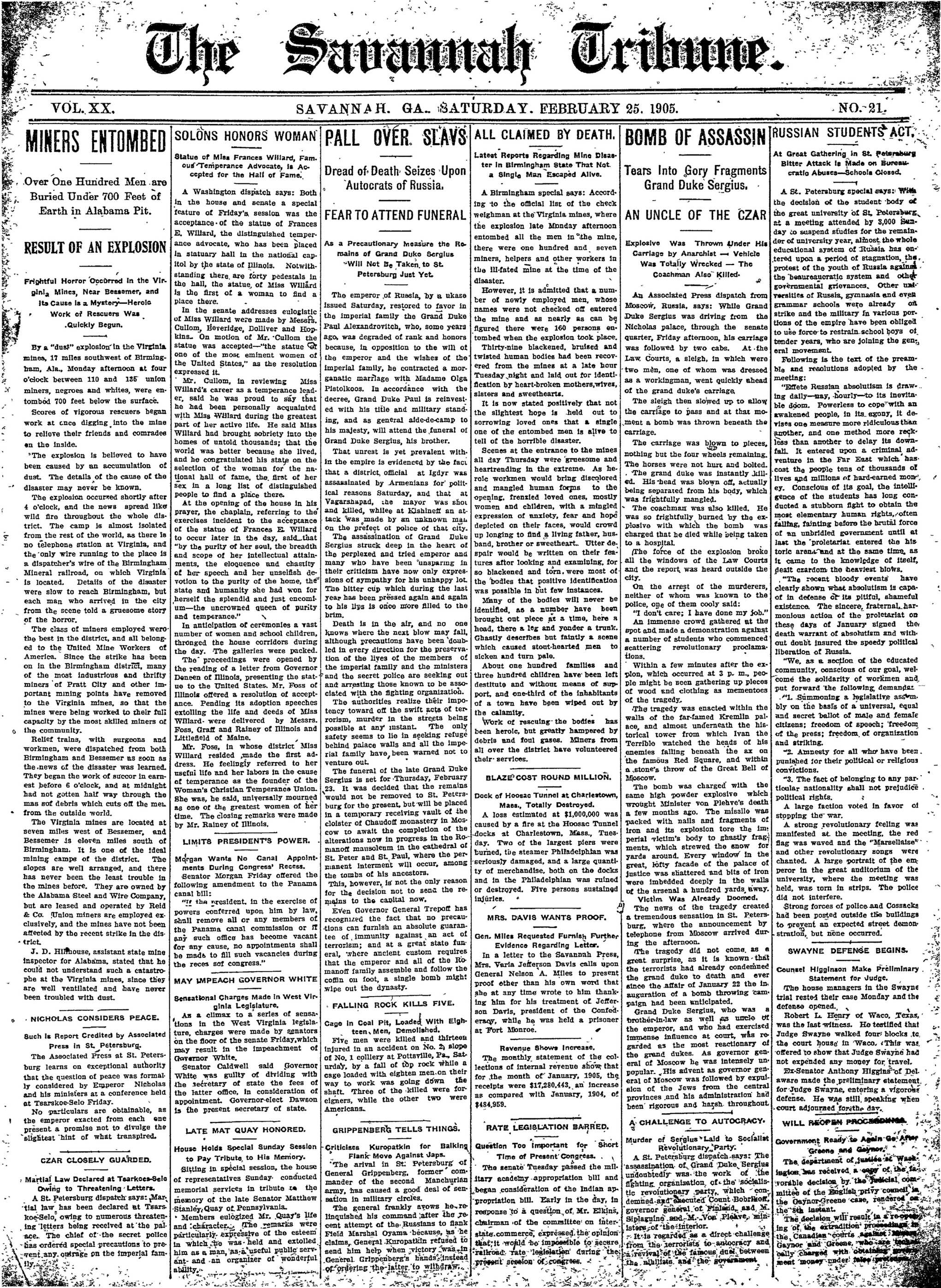
MINERS ENTOMBED
Over One Hundred Men are Buried Under 700 Feet of Earth in Alabama Pit.
RESULT OF AN EXPLOSION
Frightful Horror Occurred in the Virginia Mines, Near Beasemer, and Its Cause is a Mystery—Heroic Work of Rescuers Was Quickly Begun.
By a "dust" explosion in the Virginia mines, 17 miles southwest of Birmingham, Ala., Monday afternoon at four o'clock between 110 and 135 union miners, negroes and whites, were entombod 700 feet below the surface.
Scores of vigorous rescuers began work at once digging into the mine to relieve their friends and comrades on the inside.
The explosion is believed to have been caused by an accumulation of dust. The details of the cause of the disaster may never be known.
The explosion occurred shortly after 4 o'clock, and the news spread like wild fire throughout the whole district. The camp is almost isolated from the rest of the world, as there is no telephone station at Virginia, and the only wire running to the place is a dispatcher's wire of the Birmingham Mineral railroad, on which Virginia is located. Details of the disaster were slow to reach Birmingham, but each man who arrived in the city from the scene told a gruesome story of the horror.
The class of miners employed were the best in the district, and all belonged to the United Mine Workers of America. Since the strike has been on in the Birmingham district, many of the most industrious and thrifty miners of Pratt City and other important mining points have removed to the Virginia mines, so that the mines were being worked to their full capacity by the most skilled miners of the community.
Relief trains, with surgeons and workmen, were dispatched from both Birmingham and Bessemer as soon as the news of the disaster was learned. They began the work of succor in earnest before 6 o'clock, and at midnight had not gotten half way through the mas soft debris which cuts off the men from the outside world.
The Virginia mines are located at seven miles west of Bessemer, and Bessemer is eleven miles south of Birmingham. It is one of the ideal mining campe of the district. The slopes are well arranged, and there has never been the least trouble in the mines before. They are owned by the Alabama Steel and Wire Company, but are leased and operated by Reid & Co. Union miners are employed exclusively, and the mines have not been affected by the recent strike in the district. J. D. Hillhouse, assistant state mine inspector for Alabama, stated that he could not understand such a catastrophe at the Virginia mines, since they are well ventilated and have never been troubled with dust.
Such is Report Credited by Associated Press in St. Petersburg.
The Associated Press at St. Petersburg learns on exceptional authority that the question of peace was formally considered by Emperor Nicholas and his ministers at a conference held at Tsarskoe-Selo Friday.
No particulars are obtainable, as the emperor exacted from each one present a promise not to divulge the slightest hint of what transpired.
CZAR CLOSELY GUARDED.
Martial Law Declared at Tearkees-Selo Owing to Threatening Letters.
A St. Petersburg dispatch says: Martial law has been declared at Tsarskoe Selo, owing to numerous threatening letters being received at the palace. The chief of the secret police has ordered special precautions to prevent any outrage on the imperial family.
SOLÔNS HONORS WOMAN
Statue of Miss Frances Willard, Famous Temperance Advocate, is Accepted for the Hall of Fame.
A Washington dispatch says: Both in the house and senate a special feature of Friday's session was the acceptance of the statue of Frances E. Willard, the distinguished temperance advocate, who has been placed in statuary hall in the national capitol by the state of Illinois. Notwithstanding there are forty pedestals in the hall, the statue, of Miss Willard is the first of a woman to find a place there.
In the senate addresses eulogistic of Miss Willard were made by Messrs. Cullom, Beveridge, Dolliver and Hopkins. On motion of Mr. Cullom the statue was accepted—the statue of one of the most eminent women of the United States," as the resolution expressed it.
Mr. Cullom, in reviewing Miss Willard's career as a temperance leader, sald he was proud to say that he had been personally acquainted with Miss Willard during the greatest part of her active life. He said Miss Willard had brought sobriety into the homes of untold thousands; that the world was better because she lived, and he congratulated his state on the selection of the woman for the national hall of fame, the first of her sex in a long list of distinguished people to find a place there.
At the opening of the house in his prayer, the chaplain, referring to the exercises incident to the acceptance of the statue of Frances E. Willard to occur later in the day, said that "by the purity of her soul, the breadth and scope of her intellectual attainments, the eloquence and chastity of her speech and her unselfish devotion to the purity of the home, the state and humanity she had won for herself the splendid and just encomium—the uncrowned queen of purity and temperance." In anticipation of ceremonies a vast number of women and school children, thronged the house corridors during the day. The galleries were packed.
The proceedings were opened by the reading of a letter from Governor Deneen of Illinois, presenting the statue to the United States. Mr. Foss of Illinois offered a resolution of acceptance. Pending its adoption speeches extolling the life and deeds of Miss Willard- were delivered by Messrs. Foss, Graff and Rainey of Illinois and Littlefield of Maine.
Mr. Foss, in whose district Miss Willard resided, made the first address. He feelingly referred to her useful life and her labors in the cause of temperance as the founder of the Woman's Christian Temperance Union. She was, he said, universally mourned as one of the greatest women of her time. The closing remarks were made by Mr. Rainey of Illinois.
LIMITS PRESIDENT'S POWER.
Morgan Wants No Canal Appointments During Congress' Recess. Senator Morgan Friday offered the following amendment to the Panama canal bill: "If the president, in the exercise of powers conferred upon him by law, shall remove all or any members of the Panama canal commission or if any such office has become vacant for any cause, no appointments shall be made to fill such vacancies during the recess so congress."
MAY IMPEACH GOVERNOR WHITE
Sensational Charges Made in West Virginia Legislature.
As a climax to a series of sensations in the West Virginia legislature, charges were made by senators on the floor of the senate Friday, which may result in the impeachment of Governor White.
Senator Caldwell said Governor White was guilty of dividing with the secretary of state the fees of the latter office, in consideration of appointment. Governor-elect Dawson is the present secretary of state.
LATE MAT QUAY HONORED.
House Holds Special Sunday Session to Pay Tribute, to His Memory. Sitting in special session, the house of representatives Sunday conducted memorial services in tribute to the memory of the late Senator Matthew Stanley, Quay of Pennsylvania. Members eulogized Mr. Quay's life and character. The remarks were particularly expressive of the esteem in which he was held and extolled him as a man, as a useful public servant and an organizer of wonderful ability.
SAVANNAH. GA.. SATURDAY. FEBRUARY 25. 1905.
PALL OVER. SLAVS
Dread of Death Seizes Upon Autocrats of Russia.
FEAR TO ATTEND FUNERAL
As a Precautionary Measure the Remains of Grand Duke Sergius Will Not Be Taken, to St. Petersburg Just Yet.
The emperor of Russia, by a ukase issued Saturday, restored to favor in the imperial family the Grand Duke Paul Alexandrovitch, who, some years ago, was degraded of rank and honors because, in opposition to the will of the emperor and the wishes of the imperial family, he contracted a morganatic marriage with Madame Olga Pistolkoos. In accordance with the decree, Grand Duke Paul is reinvested with his title and military standing, and as general alde-de-camp to his majesty, will attend the funeral of Grand Duke Sergius, his brother.
That unrest is yet prevalent within the empire is evidenced by the fact that a district, official at Igdyr was assassinated by Armenians for political reasons Saturday, and that at Vagarshapad, the mayor was shot and killed, while at Kishineff an attack was made by an unknown man on the prefect of police of that city. The assassination of Grand Duke Sergius struck deep in the heart of the perplexed and tried emperor and many who have been 'unsparing in their criticism have now only expressions of sympathy for his unhappy lot. The bitter cup which during the last year has been pressed again and again to his lips is once more filled to the brim.
Death is in the air, and no one knows where the next blow may fall, although precautions have been doubled in every direction for the preservation of the liyes of the members of the imperial family and the ministers and the secret police are seeking out and arresting those known to be associated with the fighting organization. The authorities realize their impotency toward off the swift acts of terrorism, murder in the streets being possible at any instant. The only safety seems to lie in seeking refuge behind palace walls and all the imperial family have, been warned not to venture out.
The funeral of the late Grand Duke Sergius is set for Thursday, February 23. It was decided that the remains would not be removed to St. Petersburg for the present, but will be placed in a temporary receiving vault of the cloister of Chaudoff monastery in Moscow to await the completion of the alterations now in progress in the Romanoff mausoleum in the cathedral of St. Peter and St. Paul, where the permanent interment will occur, among the tombs of his ancestors. This, however, is not the only reason for the decision not to send the remains to the capital now.
Even Governor General Trepoff has recognized the fact that no precautions can furnish an absolute guarantee of immunity against an act of terrorism; and at a great state funeral, where ancient custom requires that the emperor and all of the Romanoff family assemble and follow the coffin on foot, a single bomb might wipe out the dynasty.
FALLING ROCK KILLS FIVE.
Cage in Coal Pit, Loaded With Eligh-
teen Men Demolished.
Five men were killed and thirteen injured in an accident on No. 2, slope of No. 1 colliery at Pottsville, Pa., Saturday, by a fall of 10p rock while a cage loaded with eighteen men on their way to work was going down the shaft. Three of the killed were foreigners, while the other two were Americans.
GRIPPENBERG TELLS THINGS.
Criticizes Kuropatkin for Balking
Strikes Move Against Jans
The arival in St. Petersburg of General Grippenberg, former commander of the second Manchurian army, has caused a good deal of sensation in military circles.
The general frankly ayows he relinquished his command after the recent attempt of the Russians to flank Field Marshal Oyama because, as he claims, General Kuropatkin refused to send him help when victory was in General Grippenberg's hands, instead of ordering the latter to withdraw.
ALL CLAIMED BY DEATH.
Latest Reports Regarding Mine Disaster in Birmingham State That Not a Single Man Escaped Alive.
A Birmingham special says: According to the official list of the check weighman at the Virginia mines, where the explosion late Monday afternoon entombed all the men in the mine, there were one hundred and seven miners, helpers and other workers in the ill-fated mine at the time of the disaster.
However, it is admitted that a number of newly employed men, whose names were not checked off entered the mine and as nearly as can be figured there were 160 persons entombed when the explosion took place. Thirty-nine blackened, bruised and twisted human bodies had been recovered from the mines at a late hour Tuesday night and laid out for identification by heart-broken mothers, wives, sisters and sweethearts. It is now stated positively that not the slightest hope is held out to sorrowing loved ones that a single one of the entombed men is alive to tell of the horrible disaster.
Scenes at the entrance to the mines all day Thursday were gruesome and heartrending in the extreme. As heroic workmen would bring discolored and mangled human forms to the opening, frenzied loved ones, mostly women and children, with a mingled expression of anxiety, fear and hope depicted on their faces, would crowd up longing to find a living father, husband, brother or sweetheart. Utter despair would be written on their features after looking and examining, for so blackened and torn, were most of the bodies that positive identification was possible in but few instances.
Many of the bodies will never be identified, as a number have been brought out piece at a time, here a head, there a leg and yonder a trunk. Chastly describes but faintly a scene which caused stout-hearted men to sicken and turn pale. About one hundred families and three hundred children have been left destitute and without means of support, and one-third of the inhabitants of a town have been wiped out by the calamity. Work of rescuing the bodies has been heroic, but greatly hampered by debris and foul gases. Miners from all over the district have volunteered their services.
BLAZE COST ROUND MILLION.
Dock of Hoosac Tunnel at Charlestown
Moe. Totally. Destroyed
A loss estimated at $1,000,000 was caused by a fire at the Hoosac Tunnel docks at Charlestown, Mass., Tuesday. Two of the largest piers were burned, the steamer Philadelphian was seriously damaged, and a large quantity of merchandise, both on the docks and in the Philadelphian was ruined or destroyed. Five persons sustained injuries.
MRS. DAVIS WANTS PROOF.
Gen. Miles Requested Furnish Further Evidence Regarding Letter.
In a letter to the Savannah Press, Mrs. Varla Jefferson Davis calls upon General Nelson A. Miles to present proof either than his own word that she at any time wrote to him thanking him for his treatment of Jefferson Davis, president of the Confederacy, while he was held a prisoner at Fort Monroe.
Ravenue Shows Increase.
The monthly statement of the collections of internal revenue show that for the month of January, 1905, the receipts were $17,280,443, an increase as compared with January, 1904, of $484,959.
RATE LEGISLATION BARRED.
Question Too Important for Short Time of Present Congress. The senate Tuesday passed the military academy appropriation bill and began consideration of the Indian appropriation bill. Early in the day, in response to a question of Mr. Elkins, chairman of the committee on interstate commerce, expressed the opinion that it would be impossible to secure railroad rate legislation during the present session of congress.
BOMB OF ASSASSIN
Tears Into Gory Fragments Grand Duke Sergius.
AN UNCLE OF THE CZAR
Explosive Was Thrown Under His Carriage by Anarchist - Vehicle Was Totally Wrecked - The Speech Was Killed
An Associated Press dispatch from Moscow, Russia, says: While Grand Duke Sergius was driving from the Nicholas palace, through the senate quarter, Friday afternoon, his carriage was followed by two cabs. At the Law Courts, a sleigh, in which were two men, one of whom was dressed as a workingman, went quickly ahead of the grand duke's carriage. The sleigh then slowed up to allow the carriage to pass and at that moment a bomb was thrown beneath the carriage.
The carriage was blown to pieces, nothing but the four wheels remaining. The horses were not hurt and bolted. The grand duke was instantly killed. His head was blown off, actually being separated from his body, which was frightfully mangled. The coachman was also killed. He was so frightfully burned by the explosive with which the bomb was charged that he died while being taken to a hospital. (The force of the explosion broke all the windows of the Law Courts and the report was heard outside the city. On the arrest of the murderers, neither of whom was known to the police, one of them cooly said:
"I don't care; I have done my job."
An immense crowd gathered at the spot and made a demonstration against a number of students who commenced scattering revolutionary proclamations.
Within a few minutes after the explon, which occurred at 3 p. m., people might be seen gathering up pieces of wood and clothing as mementoes of the tragedy.
The tragedy was enacted within the walls of the far-famed Kremmlin palace, and almost underneath the historical tower from which Ivan the Terribile watched the heads of his enemies falling beneath the ax on the famous Red Square, and within a stone's throw of the Great Bell of Moscow.
The bomb was charged with the same high powder explosive which wrought Minister von Plehve's death a few months ago. The missile was packed with nails and fragments of iron and its explosion tore the imperial victim's body to ghastly fragments, which strewed the snow for yards around. Every window in the great, lofty facade of the palace of justice was shattered and bits of iron were imbedded deeply in the walls of the arsenal a hundred yards away. Victim Was Already Doomed. The news of the tragedy created a tremendous sensation in St. Petersburg, where the announcement by telephone from Moscow arrived during the afternoon.
The tragedy did not come, as a great surprise, as it is known that the terrorists had already condemned the grand duke to death and ever since the affair of January 22 the inauguration of a bomb throwing campaign had been anticipated.
Grand Duke Sergius, who was a brother-in-law as well as uncle of the emperor, and who had exercised immense influence at court, was regarded as the most reactionary of the grand dukes. As governor general of Moscow he was intensely unpopular. His advent as governor general of Moscow was followed by expulsion of the Jews from the central provinces and his administration had been rigorous and harsh throughout
Murder of Sergius Laid to Socialist Revolutionary Party.
A St. Petersburg dispatch says: The assassination of Grand Duke Sergius undoubtedly was the work of the fighting organization of the socialistic revolutionary party, which condemned and executed Count Bobrikov, governor general of Finland, and M. Sipilagine and M. Von Pleave, ministers of the interior.
It is regarded as a direct challenge from the terrorists to anticocracy and a revival of the famous dust between the militants and the government
At Great Gathering in St. Petersburg Bitter Attack Is Made on Bureaucratic Abuses—Schools Closed.
A St. Petersburg special says: With the decision of the student body of the great university of St. Petersburg at a meeting attended by 3,000 Sunday to suspend studies for the remainder of university year, almost the whole educational system of Russia has entered upon a period of stagnation, the protest of the youth of Russia against the beaureauoratic system and other governmental grievances. Other universities of Russia, gymnasia and even grammar schools were already on strike and the military in various portions of the empire have been obliged to use force to restrain school boys of tender years, who are joining the general movement.
Following is the text of the preamble and resolutions adopted by the meeting:
"Effete Russian absolutism is drawing daily—may, hourly—to its inevitable doom. Powerless to cope with an awakened people, in its agony, it devises one measure more ridiculous than another, and one method more reckless than another to delay its downfall. It entered upon a criminal adventure in the Far East which has cost the people tens of thousands of lives and millions of hard-earned money. Conscious of its goal, the intelligence of the students has long conducted a stubborn fight to obtain the most elementary human rights, often falling, fainting before the brutal force of an unbridled government until at last the proletariat entered the historic arena and at the same time, as it came to the knowledge of itself, dealt czardom the heaviest blows.
"The recent bloody events have clearly shown what absolutism is capa- of in defense of its pitiful, shameful existence. The sincere, fraternal, harmonious action of the proletariat on these days of January signed the death warrant of absolutism and without doubt insured the speedy political liberation of Russia.
"We, as a section of the educated community, conscious of our goal, welcome the solidarity of workmen and put forward the following demands:
1. Summoning a legislative assembly on the basis of a universal, equal and secret ballot of male and female citizens; freedom of speech; freedom of the press; freedom of organization and striking.
2. Amnesty for all who have been punished for their political or religious convictions.
3. The fact of belonging to any particular nationality shall not prejudice political rights.
A large faction voted in favor of stopping the war.
A strong revolutionary feeling was manifested at the meeting, the red flag was waved and the "Marsellaise" and other revolutionary songs were chanted. A large portrait of the emperor in the great auditorium of the university, where the meeting was held, was torn in strips. The police did not interfere.
Strong forces of police and Cossacks had been posted outside the buildings to prevent an expected street demonstration, but none occurred.
SWAYNE DEFENSE BEGINS.
Counsel Higginson Make Preliminary Statement for Judge. The house managers in the Swayne trial rested their case Monday and the defense opened. Robert L. Henry of Waco, Texas, was the last witness. He testified that Judge Swayne walked four blocks to the court house in Waco. This was offered to show that Judge Swayne had not expended any money for travel. Ex-Senator Anthony Higgins of Delaware made the preliminary statement for Judge Swayne, entering a vigorous defense. He was still speaking when court adjourned for the day.
Government Ready to Again Go After Greene and Gaynor.
The department of justice at Washington has received a copy of the favorable decision by the judicial committee of the English privy council in the Gaynor Greene case, rendered on the 6th instant.
The decision will result in a re-opening of the extradition proceedings in the Canadian courts against Mileson Gaynor and Greene, who are technically charged with obtaining government money under false pretenses.
POINT to a man who is loyal to his race and you will behold one who is every inch a man.
PARENTS should be more careful with their girls. If it is necessary for them to be sent on errands, be sure to insist upon them not stopping on street corners or loitering about.
NEXT Saturday President Roosevelt and Vice President Fairbanks will be inaugurated. It will be the most imposing ceremony that has ever taken place in this country.
THE Farmers' Conference at the State College last week was a success. President Wright is to be commended for it. Much good will be the result. Each farmer that attend ed should carry the news to his neighbor and insist upon their attendance next year.
THE TRIBUNE is not in favor of outtailing the pleasures of our young people, but there should be a reform in the manner many of them act at entertainments. Young boys' and girls can be found going from these places of entertainments at intervals in barrooms and imbiding intoxicating drinks. A reform along this line is badly needed.
Our people should get more to the point where they will enjoy the essential things of life and especially those things that effect us as a race. For instance the excellent lecture delivered by Mrs. Mary Church Terrell on Wednesday night should have been listened to by an overflowing audience instead of that number present. What she said had a tendency to uplift, and that is what most of us need.
RECENTLY a contractor at Griffin Ga., secured a number of foreigners to work at that place. The claim is made that Negro labor is scarce and not reliable. There is no wonder that Negro labor is scarce around Griffin. Constant readers of the newspapers are aware of the treatment that is accorded them there, hence the scarcity. Wherever Negro labor is scarce, it can be readily attributed to the unjust treatment of the race in that locality. The farmers that treat the Negro kindly Are always supplied with faithful workers.
THE boisterous and in many instances, lawless manner in which many of our boys act, cause much concern to those who have the best interest of the race at heart. It is appalling too, to think that a majority of these boys are from the homes of some of our best citizens, the reflection of which is not at all salutatory. The effect of the action of these boys will be far reaching, not only in influencing others less inclined but upon their future life. Vigorous methods should be adopted to teach these boys a lasting lesson. In many cases their parents are not to be blamed, but their association. If the high regard for the parents of these boys were to be lost sight of and they be dealt with by the strong arms of the law, possibly that will have a tendency to reform them and act as a check upon others.
The white people of the South will find it hard to get the outside world to believe in their sincerity in denouncing social equality with Negroes, as long as southern white men continue to be the fathers of children whose mothers are Negroes and some of them as black as God knows how to make them. These men rear and rant about social equality with Negroes all day long and sleep with Negro, women all night long. Go in to our Negro school in any city, town or in the country and the little children's complexion will tell what's been going on with mother and some white fellow.—Georgia Baptist.
The Negro Physician.
From the four Southern medical schools for Negroes over 1,200 students have taken their degrees and probably 1,000 of these are now in the practice of this profession. These physicians have a chance for great usefulness and power. In no calling is there more scope for the best leadership in reform and true social progress. A people struggling up from such conditions as have enveloped the Negroes hitherto, first in Africa and then in America, needs above all things to be taught the simple laws of life—life's physical laws as underlying each religious duty and every moral obligation. A treatment is wanted that
will root out voodooism, still emotional excesses, lay a strong hand on heavily ferocities, enforce cleanly habits, and make good homes. Science must slay superstition. The man of science is the physician.
Negro physicians in their quiet unostentations way are nobly undertaking this service for their people. The evidences of it may be seen in all the larger cities. They are doing more than to follow the routine of a luxurative practice; they are helping to organize associations for improved sanitation and social betterment; they are building up with patient toil, in a soore of cities, modest hospitals and nurse schools for their people; and they are giving the vigor of clear sighted intelligence to churches, schools, clubs, and every sort of movement for popular uplift. Southern Workman.
Masonic Notes.
And yet a large number of Lodges have failed to make returns to this office.
Each Mason should feel proud of the great good that is being accom plished at the Widows and Orphans Home, and contribute to its main tance. The annual donation of of seventy five cents should not deter any one from giving additional donations for this noble cause. The ladies of the O E S should also be interested in this institution. Let them send donations to our Royal Grand Matron, Mrs. Viola E. Hart of Amerious, who has worked so faithfully and indefatigably for its upbuilding. Our charitable feeling in this direction should be more apparent.
The members of Jericho Court No. 6, H. of J. of which Mrs. L. Williams is M. A. M. and Mrs. F. Johnson, is C. S. are requested to attend a call meeting at the residence of Mrs. V Cannorn, 309 Gwinnett street lane west, on Monday evening next at 7 o'clock. Bro. M. A. Lovett of Temple Star was in the city this week.
Our old friend and Bro. F. D. James of Mystic Tie smiled on us this week. He is a truefriend of THE TRIBUNE and is a mason true and tried. Everything about him is square.
Second Baptist Church.
Services last Sunday at the Second Baptist Church were well attended. Rev. Smith delivered two interesting discourses in the morning and at night. Rev. Smith preached from texts given by the congregation which proved quite interesting. 'The B. Y. P. U, is in a flourishing condition, and the prospects are indeed encouraging. The Woman's Mission meets at 4:30 o'clock Monday afternoon. On Tuesday night Rev. William Beckham, Field Secretary of the National Baptist Convention, will preach at the church in the interest of his work. Dr. Beckham has traveled extensively, and his address will be quite interesting. All are invited to hear him.
St. Phillip Dots.
Our services on Sunday were not well attended on account of the disagreeable weather. Those that were out, heard two very interesting sermons. The Fisher Division closed their ten nights entertainment in the Ladles Exchange on Friday night. To-morrow is Rally day and it will be rally, rally all day. The division are hustling around. The Japs say, they are going to capture everything in sight. The Russians say they have won the battle already. The pastor and officers have invited every friend and well wisher of St. Philip's church to come out on Sunday and help us in this great cause. The following service will be held on Sunday at 11 a.m. preaching by Rev. Sims and at 2 p.m. the beginning of the Rally. Sunday school at 3 p.m. Rev. Carr of the First African Baptist church and his congregation and choir will be in attendance. Rev. Carr will preach a special rally sermon on this occasion. At 8 p.m. preaching and the conclusion of the rally and the report from the two divisions. Everybody is invited.
Ordination Services.
By the request of the New Zion Baptist Church of Mill Haven, a council of ministers was called together Wednesday night of last week to consider the fitness of Mr. Cato Priestar to enter the ministry. He preached his sermon from Luke 15:18, "I will arise and go to my Father," subject, "The Prodigal's son return." After the sermon the applicant was examined and found worthy for the ministry. He was then ordained by the council. At the conclusion of the services, the members of the council and church went to the home of Mr. Andergon, where refreshments in abundance were served. The members of the council were Rev G. W. Griffin, D. D., Rev. W. A. Daughtry, and Rev. D. Mills.
Got OG Cheap.
He may well think, he has got off cheap who, after having contracted constipation or indigestion, is still able to, perfectly restore his health. Nothing will do this but Dr. King's New Life Pills, A quick, pleasant, and certain cure for headache, constipation, etc. 25c! at any drug store; guaranteed.
Miss L. Charlton and Mr. U. H. Lawrence both of this city were quietly wedded recently. The bride is the daughter of Mrs. Maggie Charlton of this city and the groom the son of Mr. and Mrs. Frank Lawrence, also of this city. Both of them are popular young people. A pleasant recaption was tendered the happy couple at the residence of Mrs. T. Lawrence, 550 W. 39th street New York City, on Tuesday evening of last week. A number of the friends of both the bride and groom were present and joined in extending congratulations, among whom were Mrs. M. O. Middleton, Mrs. Jennie Miller, Mrs. M. Washington, Mrs. A. E. Smith, Mrs. K. Henderson, Mrs. Marie Bell, Mrs. Rosa Shellman, Miss Louise Whaley, Messrs A. E. Bridget, J. S. Williams, W. Engliss, S. Prentis, S. A. Armstrong, Freddie Allen, Ohns Whitfield and Geo. Bossel.
Thanksgiving Proclamation.
Savannah, Ga., February 17th, 1905. To the Grand, Court Officers, Grand Representatives, Members of the Grand Court, Worthy Counsellors and Members of the Courts, Greeting:
In compliance with the law and the establishing of the Knights of Pythias, and Court of Calanthe, and in compliance with the order from the Supreme Worthy Counsellor, and by the power in me vested as Grand Worthy Counsellor of the State of Georgia, I call every Court in the State out Sunday the 60th day of March with badges to a church or hall or wherever the K. of P. go. On this day let praises from more than two thousand five hundred and fifty members in this State be given to Almighty God for the continued blessings he has bestowed upon our Order and that love and harmony may reign supremely. Any member failing to turn out without a lawful 'excuse and so accepted by their Court shall be fines $1.00. You can get badges from this office by applying for them before the 15th. I shall expect every Court in the Jurisdiction to comply with the above proclamation to the letter.
Yours in F. H. & L.
Mrs. R. L. BARNES, G. W. C.
Mrs. M. S. GRANT, G. R. of D.
Like Finding Money.
Finding, health is like finding money -so says those who are sick. When you have a cough, cold, sore throat, or chest irritation, better act.promptly like W. C. Barber, of Sandy Level, Va. He says "I had a terrible 'chest trouble, caused by smoke and, coal dust on my lungs; but, after finding no relief in other remedies, I was cured by Dr. King's New Discovery for Consumption, Coughes and Colds." Greatest sale of any cough or lung medicine in the world. At any drug store; 50c and $1.00; guaranteed, Trial bottle free.
To the Public.
On account of the death of Brother Jas. Day, Brother C. S. Perry of No. 2441, has been elected as Hall Agent for the Duffy Street Hall. His residence is 413 Bolton Street, West. Brother A. J. Nicholson of 1663 has been elected as secretory. Done by order of the Associated Board of
Notice to Debtors and Creditors.
CHATHAM COUNTY.)
Notice is hereby given to all persons having demands against Joseph H. Johnson late of said County, deceased, to present them to me, properly made out, within the time prescribed by law, so as to show their character and amount; and all persons indebted to said deceased are required to make immediate payment to me. Savannah, Ga., February 15, 1905.
EDWARD E. DESVERNEY.
Administrator Estate of Joseph H. John son deceased.
1-18-6w
Special Notice.
Office of THE WAGE EARNERS LOAN and INVESTMENT COMPANY
and INVESTMENT COMPANY.
On and after February 1st 1905, stock of this company will be sold at $2.00 premium each share, the total cost of stock being $12.00. This advance in stock is to equalize the value of future sales of stock with stock already issued according to the surplus of the Company.
By orders of the Board of Directors,
WALTER S. SCOTT,
Cheap Rates.
Special Excursion to New York Via Central of Ga. Ry. to Savannah; thenze Ocean Steamship Co. Tickets at very low round trip rates will be sold Feb. 28th; final return limit March 14, 1905. Rates include meals and berth while at sea in both directions. For total rates and information relative to schedules, Stateroom reservations, etc., apply to your nearest Ticket Agent.
Parlor Car Service between Atlanta and Albany via Central of Georgia Ry. Commencing Feb. 17, 1905. Parlor cars will be operated daily between Atlanta and Albany on train leaving Atlanta at 7:50 a. m., arriving Albany 3:40 p. m. and leaving Albany 11:54 a. m., arriving Atlanta 7:55 p. m. Seat Fares as follows:
Between Atlanta and Albany 50 cents. Between Atlanta and Macon 25 cents. Between Macon and Albany 25 cents. Excursion-Rates via. Central of Georgia Ry to New Orleans, La., Mobile, Ala., and Pensacola, Fla. Mardi Gras Celebration March 2-7, 1905. One fare plus 25 cents for the round trip. Tickets on sale March 1st to 6th, inclusively, limited to leave destination not later than March 11, 1905, unless ticket is deposited by original purchaser, with Special Agent, and fee of 50 cents paid at time of deposit, in which case an extension to March 25, 1905 can be obtained.
To Washington, D. Q. Presidential Inauguration ceremonies March 4, 1905. For individuals and members of organizations not distinctly military, one fare plus 25 cents for the round trip; for military Companies and Brass Bands in uniform, 20 or more on one ticket, one cent per mile in each direction. From points on and east of a line drawn from Savannah to. Chattanooga, through Macon, Atlanta and Rome, tickets will be sold March 1, 2 and 3, 1905. Holders of such tickets must leave Washington returning, not later than March 8, 1905, unless ticket, is deposited with Special Agent, and fee of $1 00 paid at time of deposit, in which case an extension to March 18, 1905 may be obtained.
For further information apply to your nearest Ticket Agent.
WINTER CLOTHING
FOR MEN AND BOYS
IS JUST COMING IN
SPECIAL
SUITS AND PANTS
...FOR BOYS...
FOR THE FOLLOWING WEEK
Leopato Holler.
BROUGHTON & BUILLS.
The Largest Department Store in Georgia,
Call & Get a Steel Ban
The holidays are over, let us offer you our splendid corporate facilities for saving. Resolve that you begin now to make this company the greatest in the world not respecting this colored. The stock and banks ing departments both are on safe and sound business principles Thus asuring good income on investments. To more evenly divide the profits of the Company with the people, seven per cent is allowed on sums of Ten Dollars and upwards, compounded quarterly. WE GUARANTEE SEVEN DOLLARS ON THE HUNDRED INSTOCK INVESTMEMTS. Yes, we build churches, halls, houses, in fact anything in the building line.
Call or address 222 W. Broughton St. Savannah Ga. Bell Phone 1144.
L. C. COLLINS, Secretary.
F. M. COHEN, Teller.
J. W. ARMSTRONG, General Manager.
SOUTHERN RAILWAY
Trains leaving 4:25 p. m. is the famous "Southern's Palm Limit ed," composed exclusively of the newest Pullman compartment, observation, club library and drawing-room sleeping cars.
A sick and death benefit organization that pays larger benefits than any other and pays them quicker. Has 150,000 members and paid out to its members more than a hundred thousand dollars in the last year. Gives employment to fifteen hundred intelligent men and women as agents, book keepers, typewriters, etc. A w k heretofore not open to colored women. The mother of this company is the Metropolitan Mercantile and Realty Co., 150 Nassau street, New York. Southern headquarters, 222 W. Broughton St., Savannah, Ga, J. W. Armstrong, Director
J. W. Armstrong, Director General Southern States.
Mrs. W. H. Burgess.
Cor. Jefferson and Gaston Sts. is conducting a neat Dress Making and Millinery Store. She solicits the patronage of the public. Guaranteeing perfect fit and polite attention. Orders promptly filled. For a Good Shave or
Hair-Cut
Visit The
FOREST CITYSHAV-
ING PALACE
Good work and polite attention
is our Motto. Razors
horned and set.
FOREST CITY SHAVING PALACE,
308 Drayton Street, opposite
DeSoto Hotel.
R. T. WASHINGTON, PROP.
60 YEARS EXPERIENCE
PATENTS
TRADE MARKS
DESIGNS
COPYRIGHTS & C.
Anyone sending a sketch and description may assume our opinion free whether as investigators, our opinion confidential, HANDBOK on Patents strictly confidential, HANDBOK on Patents, Patents taken through Manny, Manny, receive special notice, without charge, in the
Scientific American.
A handsomely illustrated weekly. Lorem ipsum
is dummy text used in design. Tumor, 84
a year; four months, 81. Sold by all newcomers.
WUNN & Co. 301 Broadway, New York
Brown & Office, 41 St. Washington, N. W.
LAUS MORTIS.
Nay, why should I fear Who gives us life, and in ex
He is like cordial Spring That lifts above the soil each
Like Autumn, kind and The frost that chills the brace
Like Winter's stormy That spread their fleece of a
The lordliest of all the Life lends us only feet, Death
Fearing no covert the Let me walk onward, arm
Dreading no unseen k Across Death's threshold st
O all ye frightened for Whether ye wear a crown of
Laid in one equal bed When once your coverlet of
What daybreak need The love will rule you there
Where Life, the Sower Scattering the ages from his
Thou waitest, Resperer Until the multitudinous gra
Scythe-bearer, when the Harvests my flesh, let me be
God's husbandman the In His unwithering sheaves—Frederick L
A False Lover
why should I fear Death,
us us life, and in exchange takes breath?
is like cordial Spring
above the soil each buried thing—
are Autumn, kind and brief—
that chills the branches, frees the leaf—
are Winter's stormy hours
head their fleece of snow to save the flowers—
are lordliest of all things—
us only feet, Death gives us wing.
arring no covert thrust,
walk onward, armed with valiant trust;
leading no unseen knife,
death's threshold step from life to life!
all ye frightened folk,
ye wear a crown or bear a yoke,
and in one equal bed,
cease your coverlet of grass is spread,
that daybreak need you fear?
will rule you there which guides you here!
where Life, the Sower, stands,
g the ages from his swinging hands,
you waitest, Resper lone,
multitudinous grain hath grown.
the-bearer, when thy blade
my flesh, let me be unafraid!
his husband man thou art!
unwithering sheaves,oh, bind my heart!
—Frederick Lawrence Knowles (Dana Estes & Co.).
Lover and a True.
A False Lover and a True.
By E. L. A.
LL her friends, and they were many, knew the secret which Jacques kept locked up in that much-tried heart of hers.
until one night, downcast and miserable, thinking he had gone forever, she met him suddenly.
It was in the refreshment room at a dance. It was not often Jacques went
She was a tall and pleasant-natured girl who, having married a man two years before, by the advice of her friends and against her own feminine instincts, had been deserted for her pains after a brief twelve months of married misery; by one who had turned out a reprobate of the finest water. The cruelest part of it was that, though the iron fetters of matrimony still lay upon her, the black Shadow to which she was linked had made no sign after his fight, had sent no token to say whether he was alive or dead, or if he would return some day.
And while poor Jacques was thus waiting there came on the scene handsome young Captain Danegarth, fresh from campaigning in the Philippines, and he fell hopelessly in love with her the very first time they met.
Had it been an ordinary case, Danegarth would have been man enough to get him gone at once when he realized that fact. But it was not an ordinary case, he told himself when his love began to grow, and he to argue on it. The Shadow might already have drunk himself to death, he told himself; and if that were so— Nol he could not, and would not, leave her while all was so uncertain. Thus it came about that the soldier circled ever near and more near the flame, and the poor lady was so gracious all that bitter time that shallow observers said she had no heart, and only her close friends noticed how her hands tightened when there came a chance ring upon the door-bell. At first she had been aware of the gallant captain only as a graceful presence added to the circle of her friends. Later on he became a welcome interest, and then, as he came more often, and the magnetism of his hidden sympathy fell upon her, something to look for, something to which her troubled heart, groping about for encouragement and support, instinctively felt it could turn without chance of rebuff.
At last the poor, distraught captain bethought himself of asking advice, and, as often happens, got little good by it. First, he went to a certain veteran colonel, knowing in the ways of the world, and having propitiated the oracle with its most favorite cigars, poured out his soul.
"Well, my boy," said the voice of the old warrior from behind the blue Havana cloud, "there are but two things to be done, and you won't particularly like either of them. One is to take the fool's way of desperation, and the other the wise man's way of waiting; you will wait, and a kindly Providence will make a note of your good behavior."
"Yes," said the downcast lover, "I suppose that is the only thing for it." So the poor man went off, very little comforted, his chin upon his chest, and for a day or two locked himself in the seclusion of his rooms, brooding, and planning all sorts of ridiculous ways out of the dilemma. He was away so long that acquaintances began to make inquiries of each other when they met, while shaking their heads ominously—young men were so impatient—always trying, to force the hands of Providence and oblige dull-footed time to jump according to their faunics. As for the lady, she, too, noted his absence, and as the color which began to bud a little in her cheeks died down again, she learned for the first time, with a pang of self-reproach, how sweet his presence had become to her.
Where had he gone? She did not believe for a moment he would do anything desperate, but he might have been wise, which was just as fatal from her point of view; he might have fled while there was yet time, and her poor little heart went where herolines' hearts are supposed to be at the bare ideal. She listened day after day with consuming eagerness for some mentions of him, and egged on his friends as well as she could to make inquiries,
A
until one night, downcast and miserable, thinking he had gone forever, she met him suddenly.
It was in the refreshment room at a dance. It was not often Jacques weft, to such things of late, but there she was that evening, left pretty and sadeyed in a corner, while a chance partner braved the terrors of the crush by the tables in search of an ice for her. Then suddenly appeared Captain Danegarth, just as if her perpetual thought had conjured him into a material being from the air. It was, however, no apparition, but the soldier in real flesh and blood, a little pale and grim-looking until his eyes lit on hers, and then the lady in a voice which was unduly glad in spite of all she could do, held out her hand and cried:
"Oh, Captain Danegarth, I am so glad to see you again! We thought you had gone away. Where have you been?"
"In hiding; lonely and miserable."
"Why miserable?" she asked, looking away to where in the distance a small bald head was struggling out of the throng, while a hand held up above it an approaching plate that tossed like a ship in a cross sea.
"You ask me why?" he said.
"Yest" she replied, with a curious foreboding flutter in her heart.
The captain also saw the returning partner, and, moved by the impulse of the moment, stooped as near as he dared to the ear of the fair girl before him and whispered, "Why, why? Because I know your story, and cannot rescue you; because I am miserable and perplexed; because I love you."
Never to this day has the lady made up her mind whether she suffered a more exquisite pain, or pleasure at that moment. She was not often frightened out of her self-control, but she was woman enough to lose her head on this occasion in a whirl of sweet and bitter confusion, and before she could recover again the interfew that altered all her life took place.
"Here you are, vanilla ice and ham sandwiches!" cried the other gentleman, arriving much out of breath.
"All the biscuits gone—had to bring ham sandwiches. Will they do?"
"Ob, thank you so much!" said the martyr, smiling-gratefully by a strong effort; "I fear they will not go well with the ice; will you ent them for me?" And then, turning to her companion, she held out her hand and went on in a low voice: "Good-by, Captain Danegarth!" "But surely I may have one dance with you?"
"I fear not."
"Then may I come and see you soon?"
"No."
"You are angry, with me?"
"Oh, I don't know. I know I ought to be—horribly, dreadfully angry. Oh, please do go—see how the people are looking at us!" And again she held out her dainty hand.
He took it and hesitated; he would have liked to have kissed it, but dared not, bending slightly over it instead, and then, with a heavy heart, turned away into the crowd as she hid him.
A few weeks later the Ladies Auxiliary to the hospital arranged a Charity Fair and Bazaar, and the popular young captain had consented to arrange a booth with the war trophies he had brought home with him. The hapless lover was coaxed into taking a part in this by friends who were trying everything in their power to tempt him back into an ordinary, everyday frame of mind, and he had grudgingly consented, little guessing how momentous the decision was to be. Jacquesa was amused, the invited, and, though she had at first refused, yet she, too, in due time, gave way to the plandishments of friendly advisers.
After the captain's reckless invowal it would have been, more seemingly if she had avoided any place where he could by any chance be met. But the circumstances were exceptional, and a bevy of friends would surround her, so she, too, went to face him.
The soldier was there, selling snail nacks to fair customers, as though he had been caught up to it all his life.
HAT the sudden appearance and, wonderfully rapid expansion of the new star, in the constellation Perses have, constituted a standing puzzle to astronomers has already been stated in these columns. According to the observers of Lick and Yerkes observatories, the only tenable, theory is that a star has exploded, been converted into gas, and blown at a velocity of thousands of miles a second to spread itself throughout the entire universe. Can this be true? In Knowledge and Scientific News Prof. A. W. Hickerson puts and answers the question as follows:
"Is it conceivable, with the known laws of matter and energy, that a force can be generated great enough to blow a star to pieces? A calculation shows that were the entire star an explosive, it would have to be a score of thousands of times stronger than dynamite. Is there in nature anything in which such a store of energy exists? This question must undoubtedly be answered in the affirmative, and the source of the energy is the attractive force of gravitation. The force with which the sun attracts matter, and the enormous distance through which this force extends, gives us an energy so great that, without any original motion, a particle falling from the nearest star upon the sun would reach it with a velocity of three hundred and ninety miles a second. This velocity would possess an energy·hundreds of millions of times greater than that of an express train, and the temperature produced by the stoppage of the motion would·excel that of an electric furnace a score of thousands of times.
"Hence, in the collision of suns we have an agent that may generate energy sufficient to cause the sun to explode; but so enormous is the mass of a sun that the energy of collision has been shown to be too small to blow the sun into a nebula; but the probabilities of a direct complete collision between suns is small indeed. Any original motion or any attraction of other bodies acting during their fall toward one another would tend to make the impact of a tangential character, and it is upon the study of tangential impact that the solution of our problem depends. The velocity with which two suns would sweep past one another would be so great that a slight graze would not stop them. They would fly past one another, scarred by the encounter; but the portions that lay in one another's path and that did actually come into collision would be swept from the remainder, would coalese, and would form a new body in space. The tremendous motion would be converted into heat, and the mass of the new body, if the graze were not deep, might be so small that the explosive pressure produced would blow it into a nebula that would continue to expand with an enormous velocity, and every particle be finally dissipated into free space, in some cases leaving the very universe itself.
and telling was tales in the same good cause, with an unreal, cheerfulness. And, the tails light in his face, turned to as touchingly real one, when poor Jacques, all the lovelier, for the telltale paleness in his face, came into the robe, where saw were set assembled, saw him, as was inevitable, and after a moment of tow, inward self-expression, came, over to him, in air of assumed indifference.
"Have you any small articles, Captain Danegerget," she said, smiling, after the first greeting, was over, "that one of little means but large sympathy could, buy?"
"Really, I hardly know, what to offer you," he replied, the ardent lover differently velled behind, the shopwalker. "Here are some shells, all with their teeth drawn. That one wreaked a field, cannon and then killed man! it would make a good paperweight. And here are spent-carridge cases, dny number of them, mostly blood-gully, and ugly things at the best for a dalinity table." Then, grancing round, the stall, and not knowing how close Fate was at hand, he explained: "Stay! There are a few trophiles I brought back myself, and one of them, this silver locket, has quite a history attached to it. A pretty thing, isn't it?" he said, taking from its tray and holding up before her a silver ornament, heart-shaped, and about as big as a silver dollar, with an involved monogram curved upon pne side of it. "The poor chap who owned this was fighting against us with the natives. He charged gallantly up a hill we held, and was mortally wounded by one of our tropers. I went out to him when the rush was over, gave him a drink of water, and held his head upon my knees, though he was an evil-looking customer, while he died. We buried him where he fell, and I took the locket from his breast, and possessed—why I know not—by an idle fancy that somewhere and somehow I might be able to restore it to the sweetheart or wife who gave it. Good God! What is the matter?"
All the time he he was speaking that much-tried woman had kept her eyes fixed upon the locket; and, as he ended, from out of her heart and over her trembling lips went forth a cry—a human cry of irrepressible emotion—clear and unequivocal. She tyrned away as though she might have fainted; and in a moment the soldier's arm was around her waist, supporting her. But shestruggled from him, and— "Open it!" she cried. "Oh, open it and make sure! I may be mistaken." "Open the locket! It will not open, I have often tried." "Yes—yes it will! The little spring at the top, press that!"
There was a spring; though so cunningly concealed among the ornamentation that the captain had never before noticed it. But now he stepped back, the locket in his hand, and pressed it as he was blidden. At the touch the side fiew back, and there before his eyes was a miniature of a girl—a beautiful girl! Who was it? Why, was he dreaming, was it possible? No; he was not dreaming. Another look, and the fact leaped into certainty—it was Jacques herself! "Nurely this is your portrait?" said the soldier in amazement. "Yes, and I gave it to him when we were first engaged."
"Then the man who fell on that hillside, from whose breast I took this thing, which I have had through all these weeks of uncertainty—the man who died in my arms—was your husband."
"Yes," answered the widow simply and forthwith, sitting down on a convenient camp-stogl, hid her face again in her hands and wept without reserve or shame.—The American Queen.
Servian Press and King Peter.
The ukase directed against the freedom of the Servian press, which was issued by King Peter, was the retort of that monarch to a number of newspapers which have recently held him up to approbrium. The Narodny List was the greatest offender in this respect, for each day it came out with a question of which the following are samples:
"Who is the biggest rascal in Servia, and in what high place does he sit?"
"Who has fomented all the troubles of the last reign?" "On whose conscience lies the guilt of the murders of Prince Michael Obrenovitch and King Alexander?" "Who condones crime and puts a premium on treason?"
True, the monarchical journals are no less squeamish in their manner of dealing with opponents. Referring to the Narodny List, a semi-official journal says: "The scurrulous opposition rag evidently alludes to our sovereign," and add that it should be suppressed. —London Chronicle.
How a Hot Turned Out
Yesterday morning an elderly man of clerical aspect slipped while crossing State street, near Lake, and sat down in the mud.
"Set you a dollar he swears when he gets up," said a bystander.
"Done!" said another bystander.
They went out into the street and assisted the Mallon man to rise.
Then he turned to them, pointed to his mouth, and made a few rapid signs with his fingers.
But as neither of them understood the deaf and dumb alphabet the wager was declared off—Chicago Tribune.
D. H. Ball of Battstown
In the blinding snowstorm Wednesday night the sole passenger on a trolley car into Buttown was a young 600-pound bull. He was picked up somewhere by the renter and thus carried for miles by the half-conscious motorman. When the car stopped at Buttown he made himself known by kicking through the vestibule window, lights, and once getting free, scampered away into the snowdrifts. The tree press.
"It is thus seen that the numbers and distribution of the stars must demonstrate laws of nature, produce an explosion; and it is highly probable that all the so-called temporary stars that have appeared at intervals in the heavens, usually increasing in brilliancy for some hours, or a day or two, and then gradually disappearing, are caused by partial impacts of stars or, in most cases, of dead suns. For all these bodies have similar spectra crossed with double lines, the one showing recession, and the other approach, indicating the two scarred suns that have struck one another; while the brilliant continuous spectrum seen in all new stars, for some time after the outbreak, is due to the mass of flaming gas that must expand at the rate of some millions of miles an hour.
"The velocity with which these bodies pass one another would cause the impact to be over in an hour or less; and in this time a body is produced with a higher temperature than that of any ordinary star. This brilliant body would soon expand until the globe of fire would be thousands of times the volume of the sun."
Tycho Brahe, the celebrated Danish astronomer, tells of a "nova," or new star, of his time that grew to be more brilliant than Jupiter, than Venus at quadrature, so as to be visible at noonday. Professor Bickerton thinks that this was doubtless formed in the same way, and that its disappearance, which is chronicled by Tycho, was due to the decrease of luminosity consequent on its rapid expansion. The writer goes on:
"Herschel has told us that the only possible explanation of the character of the many planetary nebulae that he discovered was that they were hollow shells of gas. Every stellar explosion that is produced by a partial impact must result, at one stage of its history, in a planetary nebula that may be permanent or evanescent according to the attractive power of the new body as compared with its temperature.
"Thus evanescent planetary nebulae would be produced by slight grazes, whereas a deeper graze might produce a permanent planetary nebula, and still deeper grazes might result in a large ration of the molecules being attracted back, and producing a star in the centre of the nebula. Examples of this are comparatively numerous in the celestial vault.
"So that our observers were doubt-less right in the conclusion, they came to that 'Nova Person,' was a 'easelful explosion in which a star had been blown to pieces.' And this fragment of the study of impact shows how important an agent impact is in astronomical evolution for it must be feasible.
bered that all kinds of impacts may mere graze through deep cuts, up to a complete impact. Impacts may take place between dead suns or lucid stars. They may take place between meteorite warms, or between star clusters. The impact of sputula may range from a mere graze through deep cuts, up to entire coalescence; and every form of impact save direct centre to centre must result in rotation, and obviously furnish an explanation of the spiral character of so many thousands of nebulae. Again, such vast bodies as the two magellanic clouds may be approaching one another, and after copulless ages may impact; and should they strike deep enough into one another, coalescence of a whirling character would result, giving a galaxy of stars of a double spiral character, and spreading the poles of the ring with masses of nebulous matter, a configuration that exactly corresponds with the structure of our universe, and hence may we not ask the question. 'Is not our visible universe a result of the coalescence impact of two previously existing universes, and if so may not such cosmic systems exist in endless number throughout the infinity of space?
"Such are the lofty conceptions that develop themselves from the study of impact, carried fearlessly to its legitimate conclusions."
Japanese Jugglers.
The marvellous performances of the jugglers of Japan have been widely known ever since the isolation of the Island Empire was broken. More than thirty years ago Bayard Taylor, the American traveler and literator, told this story:
"I was witness to some astonishing specimens of illusion. After a variety of tricks with tops, cups of water and paper butterflies, the juggler exhibited, to the spectators a large open fist, which he held in his right hand, then threw it into the air, caught it by the handle in his left hand, squinted down, fanned himself, and then turning his head in profile, gave a loud sigh, during which the image of a galloping horse issued from his mouth. Still fanning himself, he shook from his right sleeve an army of little men, who presently, bowing and dancing, vanished out of sight. Then he bowed, closed the fan and held it in his two hands, during which time his own head disappeared, then became visible, but of colossal size, and finally reappeared in its natural dimensions, but multiplied four or five times. They set a jar before him, and in a short time he issued from the neck, rose slowly in the air and vanished in clouds along the ceiling."—Waverley Magazine.
Kewarn the Hard Toothbrush.
Beware the Hard Toothbrush.
"In spite of all that is printed nowadays about the care of the teeth," said an experienced New York dentist, "we should have to go out of business if we depended upon the patronage of men and women who have passed the prime of life. It is a mistake to assume that most of the false teeth are made for old persons. I venture to say that scarcely a day passes that a patient well in the sixties does not come to my office for some slight treatment to an almost perfectly sound set of teeth.
"I have frequently treated men and women past fifty who never had a tooth out, and but one or two slight cavities that required filling. On the other hand, we are repeatedly called upon to make artificial teeth for very young persons. I attribute it to the use of the hard toothbrush, which is a comparatively modern invention. The use of a hard brush, even occasionally, is a great mistake. The softest kind of hogs' bristles makes the best toothbrush."—New York Press.
Mother of the Czar.
The present Empress of Russia seems not to have fallen under the clerical influence, and to be what would be called liberal in Russia. But the Empress' mother is clerical and anti-liberal. She is the ally of the priests and those statesmen who are the most reactionary. It has been largely due to her influence that Alexieff has kept his place as Viceroy in Manchuria. The reigning Empress has never supported him or any of the retrograde measures of the Russian ministers. It is surprising that the Russians should allow a foreign widow to meddle in their affairs because she was the wife of an Emperor who is dead, but I suppose that it is rendered possible by these ladies professing in religion to be more Russian than the Russians. Were I a Russian Emperor, I should, I hope, treat my mother with affection and respect, but she would have as little political influence as the wife of Frederick the Great in Prussia during his reign—London Truth.
Corritations of Uncle Ben
A genius is one who does things with his soul.
To see ourselves as many see us we would have to use microscopes.
The older the sage the greener he grows to feel.
When men conclude they are good enough their conclusion is wholly bad.
In looking things over if it is well to overlook nothing.
A man who has learned to know himself is inclined to cut the acquaintance.
A Mother Tells How to Handle Dollar Stimulation Mostly.
When one of the boys or young men talks to invite either of my daughters (who are still in their teens), to a trick or other function, I usually ask to welcome him; writes a mother in Good Housekeeping. A little conversation follows in which I try to make him feel at ease, and let him see what an interest I take; in him as well as in my girl, and without saying it in so many words let him realize the honor and trust I put in him. Then I depart, leaving the young folks to talk over their plans unembarked. If the young gentleman seems to be satisfactory—and a mother's intuition is seldom at fault in such matters—I usually acquiesce in the plan or invitation, but if the boy or the function appears unsatisfactory, the proposal is turned down with a tact that avoids giving either the boy or the girl the effect of a refusal. Mother's judgment recognizes that the daughter must go out into the world, but to have this done in such a way as to develop character in both the boy and the girl. Above all, avoid having your girls become "common," or too free in their actions. Self-respect and the charm of girlhood make a delightful combination that attracts the best in young men, and paves the way for genuine womanhood. The girl's mother who makes the best boys like her, seldom has the trials and tribulations common to mothers of the other kind.
WISE WORDS
Bad habits have big harvests.
Meekness is the mask of might.
A selfish saint is like a black sun.
Politics make a good test of plety.
The best democracy is a theocracy.
The will gives worth to our work.
Erudition never needs to advertise.
"A man of words and not of deeds, is like a garden full of weeds."
No power comes of the steam made by pouring cold water on warm zeal.
dry pouring cold water on warm zeal.
If the mind is filled with tranquility and peace, there is no room for discontent.
Whatever a man thinks most worth while that is the object of his true worship.
Some men complain because they are choked trying to eat the table instead of the dinner.
There is nothing harder on the nerves, or worse for the clothes than packing water on both shopliders.
Let us do our duty in our shop or our kitchen, the market, the street, the office, the school, the home, just as faithfully as if we stood in the front rank of some great battle, and we knew that victory for mankind depended on our bravery, strength and skill.
When we do that, the humblest of us will be serving in that great army, which achieves the welfare of the world—Theodore Parker.
He Apologized Promptly.
Smithers is a rather suspicious person, and the other evening when a young man overtook him on the street and courteously inquired whether he had ever been a resident of Nashua, N. H. Smithers was abrupt in his denal.
"I've seen you several times on the street," the young man continued, "and you look so much like my old friend that I was moved to ask."
"Well, I'm not," said Smithers, sourly. "I never was in Nashua, never was in New Hampshire, never want to be."
"This friend of mine used to be in the consular service in China," went on the stranger.
"Never was in the consular service," declaimed Smithers.
"Of course not," agreed the young man soothingly. "You see I mistook you for a gentleman, I apologize for the error. Good evening."
Smithers contends that it was a good thing that the stranger turned into a side street just then; and, anyhow, he apologized, you know.—New York Press.
Electric Fans in Winter
The electric fan is generally associated with hot weather, because at that time we are accustomed to resort to its use for cooling and ventilating our offices and living rooms; but it has its uses in cold weather, and in many offices and stores it maintains its position throughout the entire year. Its use in winter is principally to secure ventilation, though at times it is very convenient for obtaining a more uniform temperature throughout a room. An electric fan placed above a heater will distribute the warm air which would otherwise rise toward the ceiling and only reach the lower-regions when displaced by still warmer air. The thorough circulation and stirring-up brought about by the fan generally insure a pretty uniform temperature throughout the entire room.—Electrical Review.
Flamingoes in England.
Fjamingoes are reported from the Medway, and though details as to numbers are not available, the story has a basis of solid fact. One was recently shot in the Gillingham Marshs, by a man who thought it was a strange sort of goose, and this example has been sent to a local naturalist for preservation. It is said that others were seen, which is not improbable; for these birds often wander up the Rhone, Valley, and have breeding stations in the delta of the Rhone, and at the mouth of the Gaudagutte. The last person previously mentioned in Britain was shot near Portsmouth in 1803, and a well-known ornate bird certified that if it was is good condition and showed no sign of having been shot.
CHILDREN'S DEPARTMENT
A QUESTION.
Little Lucy Locket
She hasn't any pocket—
No place to carry anything at all;
While Lucy's brother Benny
He has so very, many.
In which to put his marbles, top, or ball,
That when he's in a hurry
Tis sometimes quite a worry
To find the one he wants: among them all.
II.
Now why should Lucy Locket
Not have a little pocket—
A handy little pocket in her dress?
Another brother Benny,
Who doesn't need so many.
De favored with a dozen, more or less?
The reason, if you know it,
Be kind enough to show it.
For really 'tis a puzzle, I confess!
—Ellen Manly, in St. Nicholas.
FUNNY JAPANESE CUSTOM.
On New Year's day in Japan every house is decorated with one or more rakes, on which the goddess of good fortune or a money safe appears.
These rakes of Kumades are plain or very handsome, according to the state of one's purse. The wealthy people think that they attract good fortune for the next year if they buy an elaborate rake, often paying as high as twenty-five dollars for the emblem.
THE AMERICAN EAGLE.
Our bald-headed eagle, so called because of the feathers on the top of his are white, was called the Washington Eagle by Audubon, the great naturalist. Like Washington, he is brave and fearless, and as his name and greatness are known the world over, so can the eagle soar to heights beyond others. The eagle was adopted as the emblem of the United States in 1785, since when it has been used on the tips of flagpoles, coins, United States seals and on the shield of liberty.
A SEE-SAW SWIMMER.
Cut the tops of two long corks into wedge shape, insert the corks firmly in the necks of two bottles of equal height and place the bottles on the table about ten inches apart with the edges of the corks parallel to each other. Now try to balance, a table knife on one of the sharpened corks. If you succeed, reject that knife and try one with a heavier handle, for we must have two knives that will not balance unaided. Having found two such knives hold them level on the corks with their points almost in contact, moving the bottles if necessary.
A hand holding a glass over two bottles.
HOW TO HOLD THE SEESAW.
and set on their points a small, thin wine glass or tumbler containing just enough water to make the whole affair balance when you take your hands off it.
So far you have accomplished a striking and "ticklish" balancing feat and that is all. Now attach a bullet, coin or any small heavy object to a thread, and carefully lower it into the water in the little glass. As soon as the coin touches the water the glass begins to go down, the kulves turning like see-saws on the corks and the more of the coin you submerge the lower goes the glass, so that if the coin is large you will have a smash before it is half under water. But you can pull it up at any instant. As you do the glass follows as if it were glued to the coin and so you can keep it seesawing up and down.
Perhaps the reason of this is not clear to you. The coin is held up by the thread and does not touch the glass, so how can it affect it? Well, the coin is not held up by the thread alone. The part that is under water is held partly by the thread and partly by the water which buoys it up with a force equal to the weight of an equal bulk of water. The coin, therefore, presses the water, and consequently the glass, downward with an equal force.
Now when you pull out the coin this extra weight is taken off, so the glass rises to its original position—New York Evening Mall.
"I wish it would hever, rain again."
"Bain, rain, go in, Spain!—Hello, there's Aunt Fannie."
Brantjen had a night and day of terror while lost on the yast Hackensack Meadows. He was exposed for twenty-four hours without food or shelter of any kind, and made a fearful fight for life. When found half frozen, starved and almost crazy from suffering, the boy still was running up and down in a small open place as he had been doing since he realized that he was lost. If the boy had tried to find his way out of the dreary waste, or had allowed himself to go to sleep, he undoubtedly would have lost his life. The boy is the son of Carl Brantjen, of No. 436 Columbia avenue, Hudson City. With four compals he started for the Hackensack Swamps. They were to go across the frozen waste for about four miles to the elderberry swamps near Secaucus.
It was a lively little band of explorers, and the older boy acted as leader. There were many tortuous paths and trails to be followed through the tall meadow grass, and many creeks and streams, with treacherous banks, to be crossed. Brantjen wandered away and the other boys began to call for him. They heard a faint response, but finally could get no answer and lost all trace of him.
After they had searched for some time the boys returned and told Brantjen's parents, that he had been lost. The father organized a searching party, and, guided by one of the boys, searched with lanterns over the frozen meadows all night, returning to their homes next morning worn out and loneless.
All boatmen along the Hackensack were notified to watch out for young Brantjen, and soon after daylight there were more than a hundred men looking for the boy. Fred Solider and Edward Marx, who own a boathouse on one of the tributaries of the Hackensack, near Secaucus, found the boy during the afternoon. He was running up and down and acted as though delirious. He was taken to a house where he could be warmed and was given warm food. The boy seemed to recover, but wept hysterically when he first saw his father, who had come to claim him. It was feared that his mind might have been affected by the suffering he had undergone.
The boy said that after he lost his companions he wandered about until dark, and then decided to halt until daylight. But he kept moving to avoid freezing to death. He walked back and forth through the long hours of the night, and at daybreak tried to go where he had seen lights during the night, but was stopped by a creek. Then he decided that his only hope was to keep from freezing until found, and he kept moving about until rested.
SPORT SPICED WITH DANGER.
During Commander Peary's journey into arctic seas with the Kite a boat expedition in search of walrus was organized with an Eskimo as guide. In the book entitled "From Franklin to Nansen" a description of this hunt is given:
They had not proceeded very many miles up Inglefield Gulf before a tight breeze when they saw, on a floating piece of ice, a dozen or so of the animals huddled together, apparently asleep. Sailing gently toward them, every one with a rifle ready, a sudden pumf of wind sent the boat ahead quicker and farther than was intended, and it struck the ice. The walrus, never having seen a sailing boat before, looked round at it without paying any more attention than if it had been another piece of ice. But the sight of so many valuable creatures within reach of his harpoon was too much for the little Eskimo, and he buried the weapon in the nearest.
At once the attitude of the walrus changed. The wounded member of the herd tried to escape, bellowing in its pain, and the rest slid off the ice into the water and surrounded the boat. Others from neighboring ice patches charged rapidly on to the scene, and the situation of the boat and its occupants was dangerous in the extreme. The poor Eskimo crouched down in the boat, evidently expecting to be annihilated by the furious animals that surged round. As they came up to the boat, they tried to get their great, powerful tusks over the gunwales, and had one succeeded in doing this, there would have been slight hopes of any one escaping. Had the boat been capsized, no one could possibly have survived, and to keep the angry crowd off was no easy matter.
The white men fired at them, and directly one group disappeared another hastened forward to greet the volley of bullets. There was always the danger of one of the huge creatures rising under the boat and capsizing it; but the occupants had no time to think of this.
The boat was meanwhile gradually approaching the shore, and as the water, became more shallow the walrus exhibited less desire to come to close quarters, until, at last, the adventurers found that they had beaten of the last of the herd. Several of those which had been shot, however, were floating on the water, and were secured without any interruption from the survivors.
soaked earth, were suddenly withdrawn, and the patter of three pairs of feet were heard racing at a lively rate toward the door.
"Hello, little folks! What does this mean? You look solemn as owls."
"We are," answered Flora, positively.
"You are owls?" quizzically laughed Aunt Fannie. "Then go off in the dark somewhere, and blink. I don't want anything to do with owls. I came here to have a jolly time with a hand of jolly children."
"How can anybody be jolly on a rainy day?" demanded Hugh, the elder of the two brothers.
"Why, easier than being in the dumps, I should think. Why don't you try to do something to amuse Hary and cheer him up? You soon would forget your disappointment."
Hugh's disappointment was that he was to have gone to a picnic that day, but the rain had spilled it.
"I couldn't think of anything to do," Hugh began, to say. "There is nothing to make amusement of after you have been cheated out of a picnic."
"Tahawk! exclaimed Aunt Fannie.
"The cheapest materials in the world will do. Here, fly around and get some old spools, a few small round nails and a piece of pine box, and I'll show you how to make bushels of fun."
In a few moments Hugh came back with the things he had been directed to find, wearing a more hopeful look on his face.
"Now!" commanded Aunt Fannie, "should we to cut the ends off the spools so as to make wheels of them-four; two from the large spools for the hind wheels and two from the smaller spools for the front wheels. Here, Flora, hurry and stir up the fire. Then put a little flour and water in a tin cup, and we'll boll some paste. Now, Harry, go bring me that sheet of paper off the table."
By the time the paste was boiled, Hugh had cut the ends off the spoils and Aunt Fannie was trying to show him how to fasten them with the round nails to a block of wood so as to make the body and wheels of the wagon.
"Now use your knife," she said, "to shave out some thin bass-wood side and end pieces for the wagon box. We can them together with pins. Hurry up, Florn, with your paste, and while I'm pasting this cover on you take the scissors and cut out of the rest of the sheet of paper a lot of little men and women just about the size to ride in this wagon."
Aunt Fannie bent a piece of paper bow-shaped, so as to make a white cover for the wagon, and this she fastened on to the sides with the paste which Flora had made.
"Now hurry up with your little men and women," she said, "and we will all go to the plenic in splite of the rain, for our wagon has a nice waterproof cover like the prairie schooners in which the people used to go West." "Then let's take them West, Aunt Fannie," said Hugh. "I don't care for plenics any more. I'd a great deal rather go out West." "So would I," said Flora. "Me too," exclaimed Harry.
He, 100. exclaimed Harry.
And so the little paper men and women were hustled into the little paper-covered prairie schooner, and Harry promised to be very careful (for he was to be horses and driver), while Hugh, armed with the knife with which he had been whittling and a stick for a gun, marched beside as a bodyguard against wolves and Indians and Flora and Aunt Fannie went ahead to start a little camp fire and have everything ready for the people to camp out at the end of their first day's journey across the plains.
"What lots of fun!" exclaimed Hugh and Flora in concert, as the afternoon drew to a close.
"Aunt Fannie is a fairy!" exclaimed Harry.
"She makes such beautiful things out of nothing."
"I if I am a fairy," she laughingly replied, "I am glad I am a rainy-day fairy, because I think fairies are needed worse on rainy days than they are on bright ones."—Reformed Church Record.
A Change of Opinion.
"But, darling," objected the urgent lover, "only a little while ago you said you believed in short engagements; that, when two people loved each other they should become helpmates at once, and waste no time in starting out to bear the burdens of life together."
"Yes, dear," replied the future helpmate. "But that was before we were engaged. Since then I have discovered that to get a real swell trousseau I must go to Europe. That will take six months, and then I want six more to make the other girls feel envious. You'd just as soon: wait a year, wouldn't you, dear?"—Cincinnati Commercial-Tribune.
Thunderer and Foot:
An early volume of Swinburne's "Poems and Ballads" volumes (1868), came into the hands of Dallas, then chief literary reviewer to the London Times, who, after ruminating on what we call the pygmy poems, strode off to Moxon's with an ultimatum. Either said he, let them withdraw the book or he would denounce it and destroy it. As they had no wish to be denounced or destroyed themselves, they preferred to accept the former alternative. John Camden Hottes brought out the book. Fortnightly Review.
mond Valley, "Is a civil engineer with an expert knowledge of mining."
Near the beginning of a wandering life, he worked in the mines at Kimberley as mining engineer to J. Wernher. While there he often discussed with a French engineer the possibilities of diamonds being found in Borneo.
* Many years followed of vague globetrotting. Eventually the turn of the wheel brought the young engineer to Borneo, where he assisted Mr. Van der Hoven in surveying his tobacco estate. He devoted much time to prospecting for diamonds.
One day he took a light canoe and paddled up the Labuk River, through forests of dense tropical vegetation. Coming to a tiny native village, he pushed inland toward some hills.
It was here, in a valley between the hills and on the slopes of the hills themselves, that he came upon the famous blue ground, a sigh almost maddening to the trained prospector. "It was the real diamond-bearing ground," he said afterward. "It is identical with the Kimberley blue clay, with all the pieces of carbon and burnt garnets in it." Hugging his secret, he went away. Circumstances forced him to leave Borneo, and he found it impossible to return.
For sixteen years he nursed his secret. His thoughts were always colored by that lonely journey to the hills and the secret which he alone possessed. When he slept he dreamed of the silent boulder-strewn valley and the outcrops of the blue ground that is the joy of the prospector's heart.
But circumstances ruled that he should not return, and after sixteen years of silence he gave his secret to the British North Borneo Chartered Company. His letter was accompanied by a rough sketch that strangely suggests Stevenson's boyish maps of Treasure Island. He made no conditions with the company, but an Express representative was given to understand that in the event of the discovery proving valuable he will be duly recompensed. London Express.
HIS LAST DAY ON EARTH.
The following statement is given without any attempt to exaggerate it. I give it for what it is worth. Whether the man knew that this was his last day on earth, or only thought so, no one except himself could tell.
We had been following a band of Comanches who made their headquarters on the edge of the Staked Plains west of the Double Mountains in Texas ever since 1807, and while getting a few of them from time to time for years, never could capture their main camp.
We had driven them across the plains in 1871, and the following year had put in the whole summer hunting for them, and finally found them late in September, 1872, on the north fork of the Red River, a few miles above where McCliellan Creek falls into it. We had got a large party of recruits that spring, and among them was a boy, named Kelly, from Pittsburg. On account of his having come from there, and his being only a boy (he was not yet nineteen) I took an interest in him, and when I had any chance to do it made his work as light as possible for him.
When we first came in sight of the camp that day we were riding in column across the prairie, but on seeing the camp, two miles away, we formed our left front into line at a gallop. As I rode to my place on the left of the line—I was left guide—I found Kelly next to me. A corporal should have been here, but he was 'absent. When we had come down to a trot again after forming in line, Kelly held out his hand, to me, and calling me by name instead of rank, something that he had never before this done, he said: "I want to bld you goodbye now; this is my last day here. I will be killed over yonder."
"Now, don't get scared, Kelly," I said to him. "None of us will be killed. Those fellows yonder could not hit a haystack. I know it; they have tried to hit me more than once."
"They will hit me, then," he said; "but you won't have to drive me in. I am going in."
The "file closers" were supposed to drive a man in if they saw him hanging back. I never had to drive but one man in anywhere, and he never had to be driven in again after that. I hated to do it then, but that is what I was there for. He would be in no more danger there than I would be; less, in fact, as he might be told to lie down, while I might have to keep standing. We rode up to the very edge of the camp without, being, fired on. We had taken the camp by surprise. Then our troop was dismounted and sent in on foot. We were the only troop present who had magazine guns.
We drove the Indians out of the lodges and down the river bank into the water, where they made a stand behind rocks and trees, while we lined up on top of the bank and opened on them. Hardly half a dozen shots had been fired when Kelly fell with a ball through his breast. I dragged him down behind the bank for cover. He was not dead; in fact he lived nearly twenty-four hours after this; so this was really not his last day here, after all.
The next man to fall was another recruit named Doras. He never knew what, had hurt him, a ball going through his head killed him instantly. These were the only men we lost, but about 130 of the Indians had spent their last day here before the trumpet sounded. "Cause dring."—Correspondence in Forest and Stream.
In Germany, employers of labor are
compelled to grind out one hour's rest 'at
mid-day, and, women with, household
careers may only care for their own hour.
The Greatest American Weekly Newspaper, ONE DOLLAR PER YEAR.
The South's Standard Literary Weekly, FIFTY CENTS PER YEAR,
THE combination of these. two weekly papers—the one for news, the other purely literary—makes an ideal offer for every Southern hou sehold.
THE WEEKLY CONSTITUTION, 12 to 16 pages, contains the news of the week carefully prepared and intelligently presented. Its cigricultural features alone are worth many times its subscription price. Its market page is always complete. Its Woman's Kingdom and Children's Department are the best read and most appreciated pages at the fireside. Its special articles and contributions are of the highest standard.
THE SUNNY SOUTH is the recognized literary leader of the South, popular throughout its wide territory, and known by its great work in the introduction of new Southern writers to the literary world. Many of its short story contests have brought to light authors whose fame and fortune have been made possible by The Sunny South. It is welcomed in over 50,000 homes today and is destined to be the leading American story and household paper.
This wonderful combination blends all that is desirable in a home reading offer, two complete papers every week, and 1905' will demonstrate to you its value and insure your enrollment as a lifetime subscriber.
The Great Agents' Offer
One Hundred Dollars a Month to Active Agents. We have a most attractive agents' offer—the most liberal of any American publication—by which agents may earn from Fifty to One Hundred Dollars per Month, Agents wanted in every community. Write for agency particulars and put yourself in a way to make money on a good proposition.
Send your subscription to either paper at its price, or take both at the combination rate. Remit by safe methods, addressing all orders to
The Atlanta Constitution,
ATLANTA, GA.
Job Printing
IS NEXT TO NEWSPAPER ADVERTISING, THE BEST ADVERTISING IN THE WORLD. We have been very fortunate in securing the services of one of the best and most experienced printers in the state, and are now able to execute Job Printing of every description in all leading styles. The class of work turned out by us is acknowledged to be the finest and the prices the lowest of any printers anywhere.
EVERY MAN HIS OWN DOCTOR.
By J. HAMILTON AYERS, M. B.
A 600-page Illustrated Book, containing valuable information pertaining to diseases of the human system, showing how to treat and cure with simplest of medicines. The book contains analysis of marriage and marriage rearing and management of children, besides valuable prescriptions, recipes, etc., with a full complement of facts in materia medica that everyone should know.
This most indispensable adjunct to every well-regulated household will be mailed, postpaid, to any address on receipt of price, SIXTY CENTS. Address
ATLANTA PUBLISHING HOUSE
SATURDAY, FEBUARY 25, 1905.
Mrs. Florida Holmes has been seriously sick for some time but to the delight of her many friends she is improving.
A meeting of the joint committee, K. of P., will be held at the residence of Capt. W. D. Armstrong, Wednesday night. next at 8 o'clock, at 519 Bolton street, west.
Mrs. Etta Dickon, nee Habersham, died on Thursday last after an illness of some length. She was buried yesterday afternoon. Her family has the sympathy of friends.
Messrs W. G. Williams, James M. Dowse and Matt N. Horn have been regularly appointed as carriers in the post office. Each of these three are excellent young men and their friends join in congratulating them in their appointment.
Mrs. A. Lane, Rosebud Lecturer of the Southern Grand Division of the G. F., U. O. T. R., is in the city in interest of her work. In company with Mr. R. H. Williams, who is State Deputy of the order, she gave us a pleasant call on Thursday. Dr. C. T. Walker, 'D. D., of Augusta, the "Black Spurgeon" will lecture at the F A B church on Friday evening March to miss hearing Dr. Walker is to miss a rare treat. He will undoubtedly be received by a large audience.
Rev. U. H. Morrison of Thebes, was in the city on Wednesday.
Mr. O. M. Brinson is seriously sick at his residence 911 West Broad Street.
Miss Nettle A. Houston, one of our efficient teachers, was on the sick list during the week.
For the past two weeks Mrs. Amelia Ward has been suffering with la gripe. Her many friends wish her better.
Dr. J. H. Bugg and THE TRIBUNE man were honored by being appointed as aides on the staff of the commander of the civic division in the inauguration parade in Washington next Saturday.
Among those who leave next week for Washington to witness the inauguration are Col. John H. Deveaux, Dr. J. H. Bugg, Judge J. H Kinckle Dr. E. D Bulkley, Mr. P. E Perry, Capt. John Starr; and a TRIBUNE representative.
Mrs. R. M. West was suddenly called on the 12th inst., to Fernandina on account of the serious illness of her sister, Miss Willie Blake. Both of them arrived in the city Wednesday of last week. Miss Blake has improved greatly to the delight of her friends.
Mrs. R. L. Plant now announces the marriage of her daughter Katie Albertha, to Mr. Grant A Lewis, on Wednesday evening, 8th inst. They kindly thank their distinguished friends for the many compliments. They also extend many thanks to the Middleton's band for their grand serenade.
Mr. Benj. J. Edwards, Jr., arrived home last week after serving an enlisted term in Co. G, Ninth Cavalry. Mr. Edwards was enlisted in this city and assigned to the Ninth. He has visited the Phillipines, China, Japan, and the Honolulu. He was given an honorable discharge at Ft. Leavenworth, Kansas.
The companies at headquarters of the First Battalion, Col. Deveaux, commanding, were inspected on Wednesday. The records of each company and that of the acting quarter master of the battalion were carefully scrutinized. At night the companies were inspected and drilled. Each company showed up well in drill and record. Col. Obear and Lient Rucker were the inspectors
Services at First Congregational Church on Habersham street next Sunday. Morning text "For as he thinketh in his heart so is he." Eyeing text, "The rich and poor meet together, the Lord is the maker of all." As Prof. Hurd attends the convention at Tuskegee this week, he will doubtless bring back much thoughts of interest to our people from the meeting.
Mrs. R. H. Ryals entertained the Married, Woman's Pleasure club with a valentine party at her residence 615 W. Anderson street; on the 17th inst. Those who assisted Mrs. Ryals were: Mrs. B Denslow, Mrs. Howard and Mrs. Martha Sanders. The guests were: Mrs. Kirkland, Mrs. E. Alexander, Mrs. S. Nixon, Mrs. E. Williams, Mrs. J. E. Edwards, Mrs. C. E. Thurman, Mrs. H. Richardson, Mrs. L. Miller, Mrs. M. Scriven, Mrs. S. Crawford; Misses F. Forbes, M. Daniels.
At the recent meeting of the Brotherhood Union the following officers were elected: S. M. Mallard, president; J. T. Smalls, vice-president; S. J. Wright, financial secretary; John H. Holmes, recording secretary; W. H. Fields, advocate; Sam'l J. Washington, treasurer; Lee Gilmore, chaplain; Nathan Roberts, chairman of health; S. W. Carter, chairman of examining committee; E. L. Wright, Sergt-at-Arms This Club is one of the strongest institutions in the city and has among its membership young men who are well known and industrious. The officers will be installed on Tuesday night March 7th at Harris street hall by THE TRIBUNE man.
Attacked By a Mob.
Lecture and Reception. Mrs. Mary Church Terrell lectured. at the F.A.B. church on Wednesday evening last under the auspices of the teachers of the East Broad street school. Mrs. Terrell was cordially received and her lecture was an effective one, full of food for thought, inspiring and gilded with race patriotism.
Mrs. Terrrell was tendered a reception immediately after the lecture by the ladies of the F. E. W. Harper Literary and Social Circle at the residence of Dr. and Mrs. J. Walter Williams, 'West Broad street. The reception was a success in every way.
An Evening With Dunbar.
Miss Juliet G. Monroe entertained on Monday evening at her home with, "An evening with Dunbar." The parlors were decorated with pink and white carnations and fern. Selections were rendered from Dunbar, by Misses Eurna R. Carr, J. G. and Amable I. Monroe. The Apollo Piano Player furnished music for the occasion. Each guest was presented with a favor. The invited guests were Miss E R. Carr, Mrs. J. W. Carr, Messrs R. . M. Cooper, L. B. Thompson, J. H. Hopkins, Willie Carr, A. B. Cummings and Dr. J. H. King. Miss Monroe was assisted by Mrs. M. M. Monroe.
Birth-day Celebrations.
The pleasant little gathering of young folks were nicely entertained at the home of Mr. and Mrs. Harrison Aiken in honor of the birth-day party of their little daughter and son, Master Herbert and Miss Lilly Aiken. The attendance of little ones were as follows; Little Misses Lillian Johnson, Lenita Smith, Eureka Hart, Erma Toomer, Mabel Hart, Hazel Hart, Ethel Young, Helen Cuyler, Artist Parkhurst, Wilhmenia Patterson, Chester. Johnson, Marguerite Parkhurst Vivian Clark; Masters Andrew Monroe, Joseph Marshall, Joseph Young, Hannibal Gaston, Frank Rogers, Albert Oliver, Ernest Johnson, Roscoe Sanders, Alexander Young, Henry Springs, Herman Mitchell, Edward Gasson, Nelson Cuyler, Allie Clark.
Mr. and Mrs James Crawford entertained very delightfully at their residence 1613 Burroughs street on Thursday evening of last week, the occasion being the 32d birthday, of Mr. Crawford. It was an unique affair, quite a number of friends being present. Messrs M. Merchison, Lee Gilmore and Daniel Wright offered fervent prayers with the hope that the host would live to celebrate many other birthdays, after which refreshments were served. A number of presents were received. Those present were: Mr. and Mrs. Lee Gilmore, Mr. and Mrs. I S Honly, Mrs. S. Sheffal, Mrs. J A. Eichards, Mrs. A. Williams, Mrs. F. Mitchell, Mrs. M. A. Campbell, Misses G. Simmons and Marie E. Crawford, Messrs. R B. Holmes, D. Wright and M. Merchison.
On Feb. 5th Mrs. Mary Penton at 211 West Oglethorpe Ave., had a birthday party in honor of her son, Mr. James Middleton, Jr. the eldest son of Prof. James Middleton, who had arrived at his majority. A number of friends were present and a very pleasant time was had. Sentiments appropriate to the occasion were expressed in honor of young Mr. Middleton and he received the congratulations of all present on his arrival to manhood.
A New Court.
Crystal Court No. 210, I. O. O. C., was organized on Friday night of last work by Miss M. A. Coles, Deputy Grand Worthy Counsellor, assisted by Worthy Grand Counsellor, Mrs. R. L. Barnes. A large number of candidates were initiated and the work was well done. Members of of the various courts assisted in the work. Following are the officers: Mrs. M. Grant, W. C.; Mrs. F. Starr, W. In'px; Mrs. N. Brown, W. Inpr; Mrs. A. Baker, S. D.; Mrs. M. Andrews, J D; Mrs. R. Smalls, O.; Mrs. I. Foster, R. D.; Mrs. P. Pinkney, R. A; Mrs. M. Lee, R. of D.; Mrs. O. Wilson, E.; Mrs. H. Ralph, Con.; Mrs. M. F. Green, Ass. Con.; Mrs. T. Griffin, H.; Sir B. J. Scott, Protector.
First A. B. Church.
Dr. Carr has returned from Waynesboro, Ga., where he conducted a series of meetings for Dr. W. T. Cowan, the pastor of the Thomas Grove Baptist church. The meeting resulted in 52 accessions to the church. The people were well pleased with the doctor's methods in bringing souls to Christ, it was said that ne is the greatest gospel preacher that ever visited Waynesboro. The pastor delivered a powerful sermon at 11 a. m. from the subject "The impartiality of God." At 8 p. m. Rev. J. J. Johnson of Edisto Island. S. C., preached a good sermon. Tomorrow at 11 a. m. Rev. Wm Beckham D. D., of Nashville Teen., will preach. He will also preach at 8 p. m. Beckham is a fine speaker, and those who hear him will be greatly edified. The lecture of Mrs. Terrell of Washington D. C., on the 22nd was a rare treat, she is a cultured lady and an accomplished lecturer. Sunday School at 3 p. m. and B. Y. P. U. at 7:30 p. m. The public is cordially invited to attend.
Main Office For Georgia, 212 Anburn Avenue, Atlanta, Ga. The largest Negro Industrial Company of its kind in the world. Owed and operated exclusively by Negroes. Employs more Negroes than any other institution in existence. Branch Offices throughout the State. Business. Written near $1,000,000. Days $100 to $1000 per week for Sick and Accident, and from $1000 to $1000 in case of Death. One Motto. Prompt Payment of all Inst Claims.
Cruiser.
Collectio of the Port J. H. Deveaux called upon Commander Hoch of the German cruiser Bremen Tuesday morning. The revenue steamer Tybee was use for the trip. The call was purely an official one. The collector welcomed the commander of the Bremen in the name of the United States, and extend the facilities of the government to the Bremen. Commander Hoch expressed his appreciation for this attention on the part of the government. The collector spent about fifteen minutes with Capt. Hoch in a most agreeable manner. Col. Deveaux's visit was received with all-honors' due the U. S. Government by a visiting foreign war vessel.
The collector states that the published reasons for his not visiting the Bremen, given in the morning paper, were entirely erroneous and without foundation.
Bright Young Life Ended.
Miss Lottie Heyward, daughter of Mr. and Mrs. Isaac Heyward a faithful and progressive member of Friendship Baptist Church, and secretary of the Sunday School Convention of the Union Missionary Baptist Association, departed this life on the 9th inst., at Woodville, and was burled from her church by her pastor, Rev. A. Hudson assisted by Revs. J. R. Maxwell and W. H. Smith. Miss Heyward leaves besides her parents four brothers and six sister; to mourn her death. Born February 18th, 1883 at Columbia, S. C. G. Coming to Savannah several years ago she professed Christ and early became active in the work of the church. She was anxious that others should breath in the same religious atmosphere as herself and she worked zealously for the upbuilding of the Master's kindom. Her family has lost a true, and obedient child; the church a faithful worker and the Sunday School Convention more than a secretary, for her heart and soul was in the winning of souls for Christ.
St. James Dots.
The pastor, Rev. J. A. Hadley preached two able; sermons last Sunday. The Woman's Home and Foreign Missionary Society met Wednesday last at 4 p.m. The following officers were elected for the year. President, Mrs. Margaret Waters; 1st vice-president, Mrs. J. T. Lockhart; 2nd vice-president, Mrs. Ella Freeman; 3rd vice-president, Mrs. Cindora H Jones; corresponding secretary, Mrs. H. B. Sales; recording secretary, Mrs. Louisa A. Alexander; treasurer, Mrs. F. L. Hadley; organist, Miss Zella Lester; chaplain, Mrs. Flora Shaw; directors, Mrs. Dicey Freeman, Mrs. Rosa Williams, Mrs. Janie Preston, Mrs. Lizzie Heywood, Mrs. Hattie Carter. Tomorrow is Woman's Rally Day. The sisters expect to "Hold the Fort."
AMUSEMENT COLUMN.
Coming Events in The Social World.
Golden harvest Union Association No. 1
G. U. O. of U. L. A., will give a masquerade ball at Chatham Hall, Monday night, February 27th. Admission 15 cents.
A grand ball will be given by the Six Brown Brothers at Margaret Street hall Monday night February 27th. Admission; Single 15 double 25 cents.
The first annual dance of the Twilight Reapers Aid and Social Club Branch will take place at Harris Street Hall Tuesday evening February 28th. Admission 35 cents; Double 50 cents.
The Friendly Brothers Social Club No. 1 of Savannah, will celebrate its 17th anniversary by an entertainment at Harris Street hall, Monday night, March 20th, Admission, single 40, double 75 cents.
A grand spring entertainment will be given by the Y. L. and G. S. C. Club at Margaret street hall, Monday night March 6th. Admission 10 cents.
Attend the inauguration ball at Harris Street hall, given by the Porters Benevolent Association Monday night March 6th. Admission, single 35, double 50 cents.
Are You Engaged?
Engaged people should remember that, after marriage, many quarrels can be avoided by keeping their digestion in good condition with Electric Bitters.S. A. Brown, of Bennetttsville, S. C., says: "For years' my wife suffered intensely from dispepsia, complicated with a torpid liver, until she lost her strength and vigor' and became a mere wreck of her former self. Then she tried Electric Bitters, which helped her at once, and finally made her entirely well, She is now strong and healthy. All druggists sells and guarantees them, at 50c a bottle.
Grocery Store and Restaurant.
I wish to announce to my many friends and patrons that I have reopened my Restaurant at No. 464 West Broad street, next to the Wage Earners Bank, where I will also conduct my Grocery store. I will furnish first class meals as before, and keep on hand constantly a full line groceries. The patronage of the public is solicited.
R. H. HOOKS, Prop.
464 West Broad Street.
T. W. WALKER, President
Birmingham, Ala.
MEN'S AND BOYS'
Tailor Made Suits,Dress Skirts, Furs, Cloaks, Flannel Waists, and Outing Gowns, Skirts and Kimonas
When Goods Are Charged 25 and 50 per cent discounts will be Applied as Heretofore
B.H. LEVY, BRO. & CO 5 Broughton Street, West.
FIELDS & RIVERS, GROCERIES,
We carry a fine line of Groceries, Fruits, Oigars, Tobacco, Wood and Coal. Our motto: Moderate Prices. Quick delivery. Polite attention Give us a trial.
Tickets to be sold March 2 and 3, with limit March 8, but can be extended to March 18 upon payment of $1.00.
Lv. Savannah 12:15 am., 1:30 pm., 4:25 pm. (Railroad Time.)
Finest Pullman Cars and Elegant Dining Car Service on All Trains.
For information or reservation apply
City Ticket Office. E. G. THOMSON,
141 Bull Street. C. P. & T. A.
DR. L. S. PARKS
240 Barnard St., Savannah, Ga.
Does all kind of high grade dental work of the best quality and workmanship. Gold crowns and bridge work. White Porcelain Pivot, and Gold Crowns mounted on the natural roots. Gold Fillings, Cement Fillings, and Silver or Amalgam Fillings, from nine to a full set of teeth $7.00 and $3.00. Broken Places mended and teeth added to old ones for a small cost. BellPhone 1244
All Gold Crowns G
Presidential Inauguration
HOW TO KEEP WELL
Eat the best meats. You can find this by visiting the OLD RELIABLE
For the inauguration Atlantic Coast Line will sell round trip tickets to Washington at one fare plus 25 cents ($17.75 from Savannah) tickets sold March 2nd and 3rd with return limit March 8th 1905. Tickets may be extended to March 18th by deposit and payment of $1.00. Round trip tickets can be purchased from Washington to Baltimore for $2.00, to Philadelphia for $6.00, to New York for $10.00 good to return within 10 days, which will make the through rate Savannah to Baltimore and return $19.75, Philadelphia and return $23.75, New York and return $27.75. Make your Pullman reservations early, DeSoto Hotel Tickets Office both phones 73.
Beef, Veal and Mutton,
And all kinds of game in season.
Goods delivered promptly.
F. F. JONES & SON.
Both 'Phones 689.
Three trains daily, Florida and West-Indian Limited, New York and Florida Special (electriclighted, ) New York Express. "Take the best, it cost no more."
For Rent.
House 540 Taylor St. E. 8 Room and bath. Desirable neighborhood. Reasonable Rent. Apply to Walter. Scott, 462 West Broad street.
For Rent
Rooms, at present occupied by the Eureka Lodge.
M. J. Doyle.
WM. DRISKELL, Sec'y & Gen. Mgr. Atlanta, Ga.
G. District Manager.
GAKANNAH GA.
West Side Pharmacy
Carries a full line of Drugs, Toilets, Cigars, Tobacco Confectioneries and Stationeries. Prescriptions carefully compounded. Open until 12 o'clock at night. Prompt delivery service and reasonable prices. Bell]Phone 8374. Call over phone for what you want. C.P. Watts and Dr.J. F. Ford, Drumbull
A Subject Much Discussed at Women's Clubs The Future of a Country Depends on the Health of Its Women.
Mrs.T.C.Willadsen' Miss Mattie Henry
WHAT'S THE USE OF
SAYING "GIVE ME A
5-CENT CIGAR," WHEN
BY ASKING FOR A : :
"CREMO"
YOU GET THE BEST
5-CENT CIGAR IN
AMERICA
"The World's Largest Seller"
Field Seeds
Lydia E. Plinkham's Vegetable Compound Successes Where Others Fall.
NASHVILLE PRODUCE CO. J. J., DIL, Manager. at Strike Home and-if he cares to do so-can tell my little about the bulk coffee he know, where it originally came from.
Truths that Strike Home
Your grocer is honest and—if he cares to do so—can tell you that he knows very little about the bulk coffee he sells you. How can he know, where it originally came from;
LION COFFEE is carefully peeled at our factories, and until opened in your home, has no chance of being adulterated, or of coming in contact with dust, dirt, germs, or unclean hands.
LION COFFEE you get one full Insist upon getting the genuine age.)
heads for valuable premiums.)
OCERS EVERYWHERE
WOOLSON SPICE CO., Toledo, Ohio.
hand in without only, 64.
In each package of LION COFFEE you get one full pound of Pure Coffee. Insist upon getting the genuine (Lion head on every package.) (Save the genuine for valuable premiums.)
At the New York State Assembly of Mothers, a prominent New York doctor told the 500 women present that healthy American women were so rare as to be almost extinct.
This seems to be a sweeping statement of the condition of American women. Yet how many do you know who are perfectly well and do not have some trouble arising from a derangement of the female organism which manifests itself in headaches, backaches, nervousness, that bearing-down feeling, painful or irregular menstruation, leucorrhoea, displacement of the uterus, ovarian trouble, indigestion or vomiting, urinary tract infections and true remedy for all these allergies. Lyda E. Pinkham's Vegetable Compound has restored more American women to health than all other remedies in the world. It regulates, strengthens and cures diseases of the female organism as nothing else can. For thirty years it has been curing the worst forms of female complaints.
Such testimony as the following should be convincing. Mrs. T. C. Willadsen, of Manning, Ia., writes:
Dear Mrs. Pinkham:—
"I can truly say that you have saved my life and I cannot express my gratitude to you in words. For two years I spent lots of money in doctoring without any benefit for meastral irregularities and I had given up all hopes of over being well again, but I was permahed to try Lyda E. Pinkham's Vegetable Compound and three bottles have rested me to perfect health. Had it not been for me I would have been in my grave today."
Lydia E. Plakham's Vegetable Com
GOOD POTATOES
BRING FANCY PRICES
To crow a large crop of good potatoes, the soil must contain plenty of Potash.
Tomatoes, melons, cabbage, turnips, lettuce
in fact, all vegetables remove large quantities of Potash from the soil. Supply
Potash
generally by the use of fertilizers containing not less than 10 per cent. actual Potash.
Pierer and more profitable yields are sure to follow.
Our samples are not advertising circular boors special fertilizers, but contain valuable information to farmers. Sent free for the asking. Write now.
GERMAN KALI WORKS
New York-93 Nassau Street, or Atlanta, Ga.-321 South Broad St.
Truths that S
Your grocer is honest and—you that he knows very little sells you. How can he know,
2
In each package of LION
pound of Pure Coffee. Insist
(Lion head on every package.)
(Save the Lion-heads for
SOLD BY GROCER
WO
ATLANTA.
Commercial College.
150 words per minute in Bryne Shorthand in
seven to twelve weeks. Bookkeeping without
theory. Write for catalog B. B. Atlanta, Ga.
Bryant's Station
Hustiness...Shorthand and Telegraphy College, Duluthville, KY, open the whole year. Students can enter any time. Catalog free.
(AtB-05)
Miss Mattie Henry, Vice-President of Danville Art Club, 429 Green Street, Danville, Va., writes:
"Dear Mr. Pinkham: Many years' suffering with female weakness in feminism and a broken down system makes me more anxious to die than to live, by Lydia E. Pinkham. I am not a victim of the system and I am no grateful for it that I want every suffering woman to know what Lydia E. Pinkham's Vegetable Compound will do further."
When women are troubled with irregular, suppressed or painful manstruation, weakness, leucorrhoea, displacement or ulceration of the womb, that bearing down feeling, inflammation of the ovaries, backache, bloating (or flatulency), general debility, indigestion, and nervous prostration, or are beset with such symptoms as dizziness, faintness, lassitude, excitable irritability, nervousness, sleepiness, melancholy, "all-gone" and "wanted-to-leave-alone" feelings, blues, and hopelessness, they should remember there is one tried and true remedy. Lyda E. Pinkham's Vegetable Compound at E. Pinkham's Pharmacy. No other medicine in the world has occurred until unqualified endorsement. No other medicine has such a record of cures of female troubles. Refuse to buy any other medicine, for you need the best.
A lightheart, a cheerful comtence, and all the charms of grace and beauty are dependent upon proper action of the bodily organs. You cannot look well unless "you feel well."
Mrs. Pinkham invites all sick women to write her for advice. Her advice and medicine have restored thousands to health. Address, Lynn. Mass.
Country mechants and farmers can save 10 to 25 per cent by writing the Nashville Produce Company's address on the back of the seed house. The only strictly coah field seed house in the South. Write today
how it was blended—or with what
—or when roasted? If you buy your
coffee loose by the pound, how can
you expect purity and uniform quality?
LION COFFEE, the LEADER OF
ALL PACKAGE COPFEES, is of
necessity uniform in quality,
strength and flavor. For OVER A
QUARTER OF A CENTURY, LION COFFEE
has been the standard coffee in
millions of homes.
Bronco, Bill—Just before Rearin
Dan was lynched he mild he hoped
he would meet all'd boys in heaven.
Grizzly Pete—Bid, oh?
Bronco' Bill—Tes, an' de' boys said
dey hoped so, too, so dey could have
de fun of lynchin' him over agn'—
Judge.
EITSparmanally cured. No fits or nervousness after first day's use of Dr. Kluek's Great Nervous Restorer; $morial bottland treatise free DR. K. H. Kline, 981 ArohSt., Palm, Pa.
Over 13,000,000 persons are enrolled in the Sunday-schools of the country.
To. Cure a Cold in One Day
Take A bromo Quinine Tablets. All drugstore money if it fails to cure.
E. W. Grove's signature is on box. 20.
The woman inventor is broadening her field of labor.
Blotches on Hands, Harts and Ankles For Three Years - Instant Belief and Speedy Cure by Cuticura.
"Thanks to Cuticura I am now rid of that fearful past, weeping estes, for the first time in three years. It first appeared on my hand, a little pimple, growing into several blotches, and then on my ears and ankles. They were exceedingly painful, itching, and always raw. After the first day's treatment with Cuticura Soap, Qintment and Pills, there was very little of the bursing and itching, and the cure now seems to be complete. (Signed) S. B. Hge, Passenger Agent B. & O. R. R., Washington, D. C."
The First White House
The residence of Daniel Parke Custis, first husband of Marta Bundridge, was called the White House. George Washington lived there for a short time after their marriage, and from it the White House at Washington was named.
How's This?
Woose One Hundred Dollars Rewarder for any case of Catarrh that cannot be cured by Hall's Catarrh Cure.
P. J. CARNY & Co., Toledo, O.
We, the undersigned, have known F. J. Cheney for the last eight years, and believe him perfectly honorable in his business transactions and financially able to carry out any obligations made by their firm.
WEST, & TRUAX, Wholesale Druggists, Toledo.
WARDING, RIXMAN & MARVIN, Wholesale Druggists, Toledo.
Hall's Caitarre Curest taken internally, ailing directly upon the blood and mucous-surfaces of the system. Testimonials sent free. Sold by all Drugstalls. Take Hall's Family Picture.
Alt Due Precautions Taken:
Nervous Old Lady (on seventh floor of hotel)—"Do you know what precautions the proprietor of the hotel has taken against fire?" Potter—"Yes, mum; he has the place inhooled for twice not it's worth."—Pittsburg Gazette.
Half 'This Man's Suferings Would Have Killed Many & Person, But Donn's Kidney Fills Cured Him.
A. G. Sprague, stock dealer, of Normal, Ill., writes: "For two whole years I was doing nothing but buying medicines to cure my kidneys. I do not think that any man ever suffered as I did and lived. The pain in my back was so bad that I could not sleep at night. I could not ride a horse, and sometimes
A. C. APRAGUE
was unable even to ride in a car. My condition was critical when I sent for Doan's Kidney Pills. I used three boxes and they cured me. Now I can go anywhere and do as much as anybody. I sleep well and feel no discomfort at all." A TRIAL FREE-Address Foster-Milburn Co., Buffalo, N. Y. For sale by all dealers. Price, 50 cts.
Porto Rico is the most lightly taxed country on earth.
Taylor's Cherokee Remedy of Sweat Gum and Mullen is Nature's great remedy—Ours Coughs, Colds, Croup and Consumption, and all throat and lung troubles. At druggifts, 25c, 50c, and $1.00 per bottle.
Forty per cent. of the people of London attend public worship.
Mrs. Winslow's Soothing Syrup for children teething, soften the gums, reduces inflammation, allays pain, cures wind colic, 25c a bottle.
Two thousand vessels of all descriptions disappear every year.
Piso's Cure cannot be too high spoken on aa soough cure. J. W. O'Brien, $22 Third Avenue, N., Minneapolis, Minn., Jan 6, 1900.
The cholera is now almost extinct in Turkish territory.
A Guaranteed Cure For Piles.
Itching, Blinding, or Protruding Piles. Druggists will refund money if Pazo Ointment fails to cure in 6 to 14 days. $0c.
Brazil's foreign funded debt exceeds $230,000,000.
Itch cured in 30 minutes by Woolford's Sanitary Lotion. Never Falls. Sold by all druggists. $1. Mail orders promptly filled by Dr. R. Detchon, Crawfordsville, Ind.
Of 1400 earthquakes that occur every year in Japan, fifty are noticeable.
HILLIANA in Oats.
Salzer's New National Oats yielded in Mich., 240 bu., in Mo., 255 bu., in N. D., 310 bu., and in 30 other states from 160 to 300 bu. per acre. Now this Oat if generally grown in 1905, will add millions of bushels to the yield and millions of dollars to the, farmer's purse!
---
Homebuilder Yellow Dent Corn grows like a weed and yields from 157 to 280 bushels and more per acre! It's the biggest yielder on earth! It's more Barley, Macaroni Wheat, Pen Oat, Billion Dollar Grass and Earlest Cane, are money makers for you, Mr. Farmer.
JUST SEND THIS NOTICE AND 100 in stamps to John A. Salzer Seed Co., La Crosse, Wis., and receive their big catalog and lots of farm seed samples. [A. C. L.]
The rice, paper tree is one of the most interesting of the boys of China.
GOOD LUCK
Get Double Returns
on your money by saving the freight-car coupons on Good Luck Baking Powder can labels. In exchange for them we send you free your choice of 56 useful premiums—valuable articles of jewelry, dress and honeo furnishings. The Premium Book found in each can tells all about them.
The absolute, unquestioned purity of
GOOD LUCK Baking Powder
is another reason why you ought to use it. It is so pure—its leaving force is so great—that it takes only a heaping teaspoonful to a quart of sifted flour to produce the finest results. The lightest, whitest baking is sure to follow the use of Good Luck—lightest, because it generates most gas, whitest, because of its freedom from all adulteration. It is the least expensive, too—costs only 10 cents a pound. Send us your grocer's name if he doesn't sell Good Luck—we'll see that you get it.
IN CUT OUT OUT COUPON FOLLOW THIS LINE
Solid Carbond Good Luck Baking Powder
CUT OUT THIS CAR AND SAVE IT. THEY ARE GOOD FOR VALUABLE ANTICLES. SEE LIST IN EACH CAN. A doorsthe DEPARTMENT STORE OF THE SOUTHERN WYTE CITY CENTER RECORDS WLLA.
1-KB
THE SOUTHERN MFG. CO.
Birmingham.
Virginia.
NEWEST TABLE LINEN.
An authority, on tea table linens describes the newest and, smartest effects as a mixture of cutwork and fillet lace insertions. A large cloth made to fit an oblong diningroom table has on its edge a row of hemistitching. A second row of hemistitching comes just inside the edge of the table, that part hanging being otherwise absolutely plain. The top of the table is entirely covered with work, upon which the silver, crystal and china tea things are daintily set off. First for decoration inside the hemistitching there is a wide band of cut work in English embroidery design, the pattern accented at wide intervals with a small fillet lace motif. The polished mahogany must gleam through the design; only with rich lace cloths does one put silk or cloth of gold or silver beneath. The very center of the cloth in question is decorated only with two rows of fillet insertion having a square or fillet at each corner, the inner row of insertion and squares being narrower than the outer one.
The corresponding hemistitched napkins have an inset square of filet at each corner, the design of this lace being quaint with medieval figures. Philadelphia Bulletin.
General Wadworth's Silver
General Wadsworth, Silver
Representative Wadsworth, of New
York, is a son of General James S.
Wadsworth, who was killed at the Battle
of the Wilderness. He sent his
orderly back to get some dinner for
him. The orderly brought up some
meat and bread and a silly fork and
spoon and a silver-handled knife
marked with the Wadsworth monogram.
The general ate and in 30 minutes
was shot and killed.
The orderly kept the knife, fork and spoon, says the Oswego Times. He went to Tompkins, County, N. Y., at the close of the war, and after a time decided he had no right to use the general's silver. He went to the County Clerk of Tompkins County and told him he wanted to leave the silver there, as he did not know any Wadsworth and the silver did not belong to him. The County Clerk tied the silver up in a piece of paper, tagged it and put it in the safe. It remained there many years. Recently Representative Dwight, who lives in Tompkins County, was told about the silver by the County Clerk, who found it in the safe. Mr. Dwight took it to Representative Wadsworth, who cherished it highly as a memento of his father.
TO DEFECT ADULTERATIONS.
One who has handled coffee for many years says that adulterations can be detected in many ways. The more common way is to press a sample of ground coffee in the palm of the hand, and if it contains chlory or any substance besides pure coffee it will form into a little mass, the particles sticking together. Another method of detecting the presence of a substance other than coffee is to put a little ground coffee in a glass of clear cold water. Cover the top of the glass and shake thoroughly. If the coffee is pure, the water will remain almost clear and the grounds will float on the surface. Pure coffee contains an olly substance which prevents the grains from mixing with the cold water. Adulterations are not so protected, and soon color the water noticeably.
"Going out, eh?" she enceded, after their quarrel.
"Yes," replied her husband, "I'm going to congratulate Ned Pinkington."
"You're slow. The engagement was announced six weeks ago."
"Yes, but it was only broken off yesterday."—Philladelphia Public Ledger.
Fashionable Mother—Editha, I trust you fance, is a worthy young man?
Into Daughter—Oh, yes, mamma; but rather shy.
Fashionable Mother—Good heavens! You don't mean of money, I hope?
Congressman Moekison Gives Praises to Pe-ru-na For His Recovery.
[Illustration of a man with a mustache and a bow tie.]
Hon. David Meekison, Napoleon, Ohio, ex-member of Congress, Fifty-fifth District, writes:
"I have used several bottles of Peruna and I feel greatly benefited, thereby from my earlob of the head. I feel encouraged to believe that if I use it a short time longer I will be fully able to eradicate the disease of thirty years' standing."—David Meekison.
ANOTHER SENSATIONAL CURE: Mr. Jacob L. Davis, Galena, Stone County, Mo., writes: "I have been in bad health for thirty-seven years, and after taking twelve bottles of your Peruna I am cured."—Jacob L. Davis.
If you do not derive prompt and satisfactory results from the use of Peruna, write at once to Dr. Hartman, giving a full statement of your case, and he will be pleased to give you his valuable advice results.
"I have used one of your Fish Brand
Slickers for five years and now wint
a few more for you. I would not be without one for twice
the cost. They are just as far ahead
of a common stock," a common one
is ahead of nothing.
(NAME OR APPLICATION)
Be sure you don't get one of the com-
mon kind—this is the
mark of excellence.
A. J. TOWER CO.
BOSTON, U. S.A.
TOWER CANADIAN CO., LIMITED
TORONTO, CANADA
Makers of Wet Weather Clothing and Hats
RES
Biliousness
"I have used your valuable Carcasses and find them perfect. Couldn't do without them. I have used them for some time for indication and亿亿ousness and am now completely cured. Recommend them to everyone. Once tried, you will never be without them. Edward A. Marx, Albany, N.Y.
Best For
The Bowels
Sarcarets
CANDY CATHARTIC
THEY WORK WHILE YOU SEE!
Plousant, Palatable, Potent, Taste Good, Do Good,
New Waste, Waste to Go, the Family Go, the News
sold in bulk. The genuine tables stamped OOO.
Guaranteed to cure or your money back.
Sterling Remedy Co., Chicago or N.Y., 605
ANNUAL SALE, TEN MILLION BOXES
Portable and Stationary
Engines, Boilers,
Saw Mills
AND ALL KINDS OF MACHINERY
Complete line carried in stock for
IMMEDIATE shipment.
Best Machinery, Lowest Prices and Best Terms
Write us for catalogue, prices,
etc., before buying
==