Savannah Tribune
Saturday, April 8, 1905
Savannah, Georgia
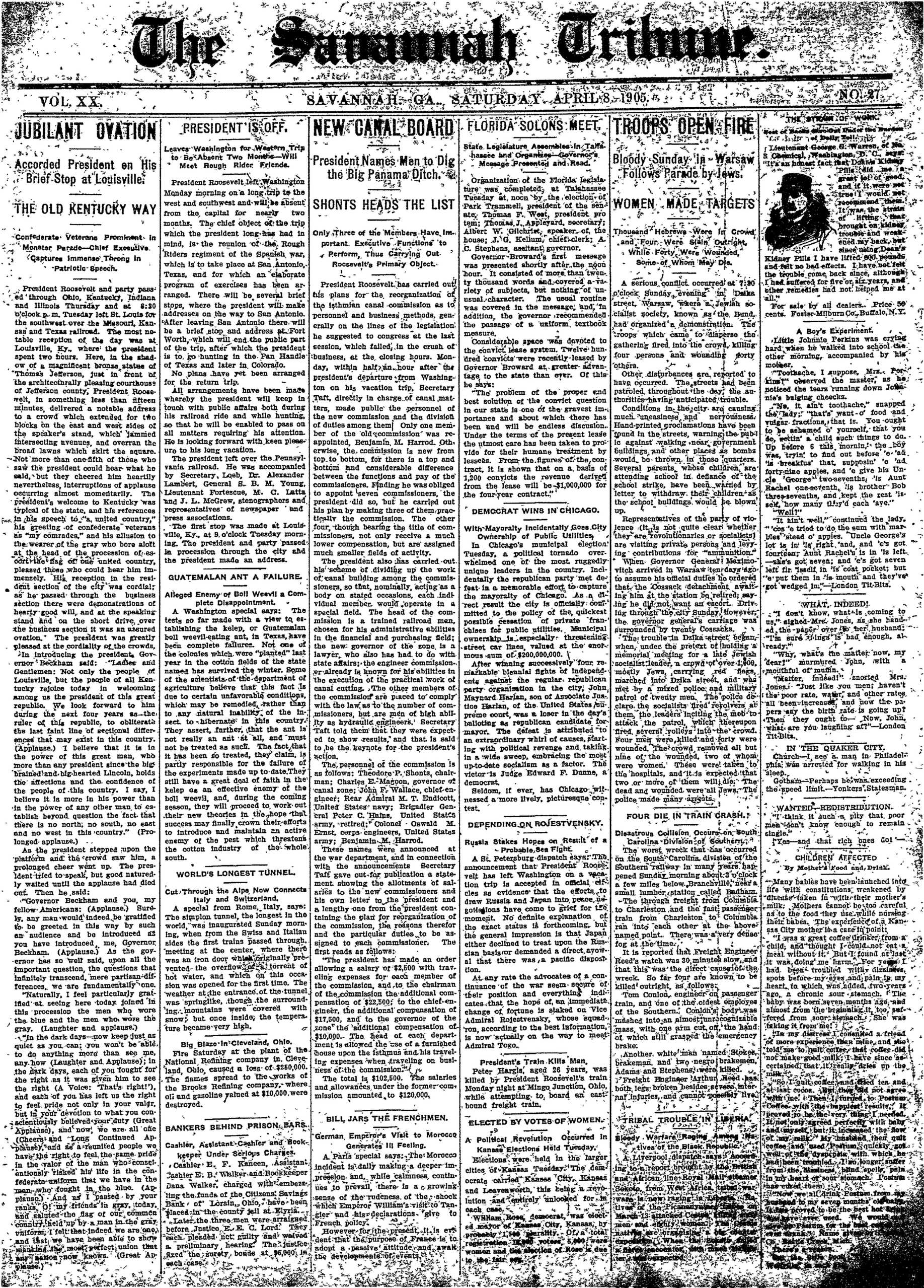
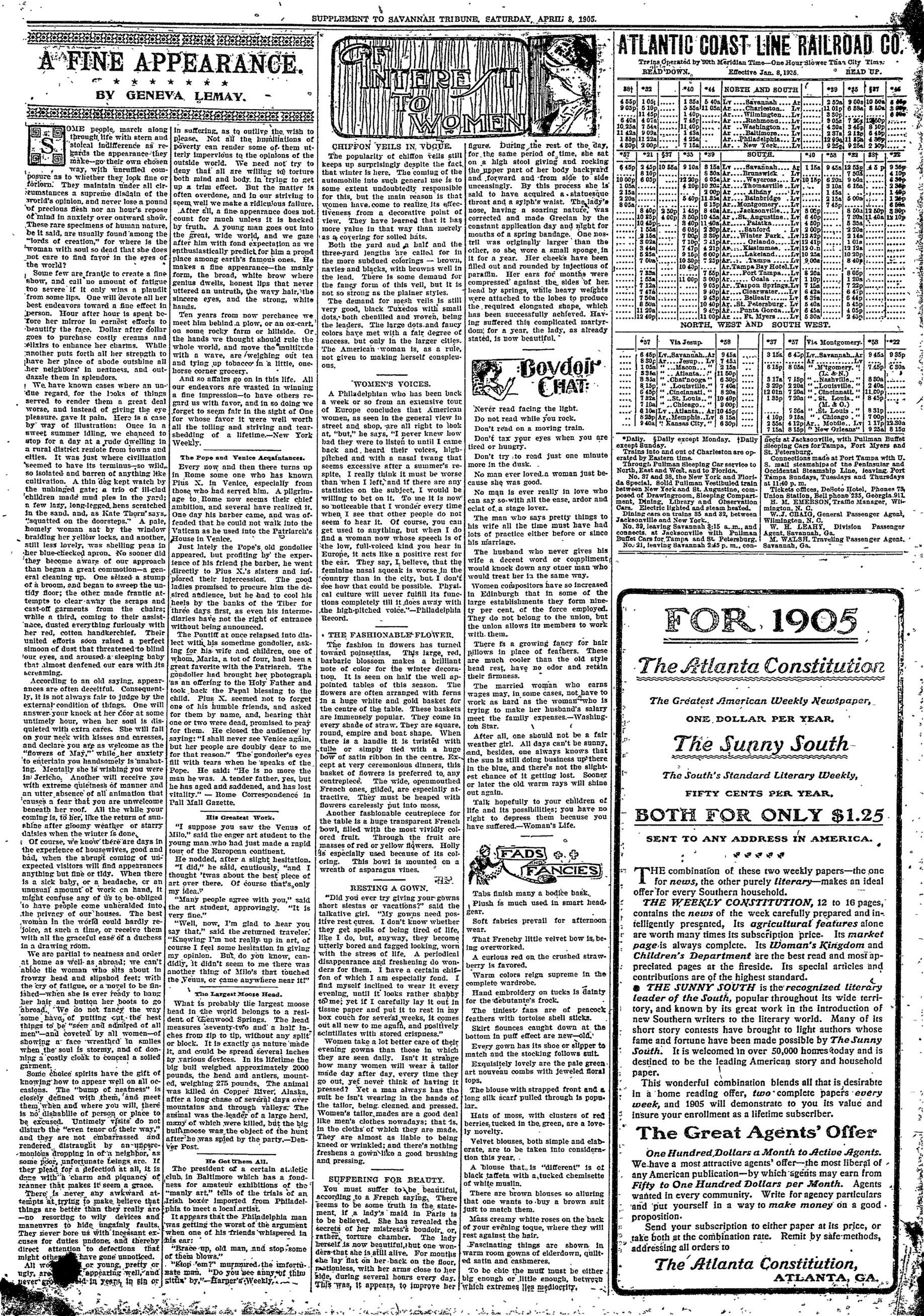
Page text (machine-generated)
Confederate Veterans Prominent In Monster Parade—Chief Executive. Captures Immense Throng In Patriotle Speech.
President Roosevelt and party passed through Ohio, Kentucky, Indiana and Illinois Thursday and at 8:30 o'clock p. m. Tuesday left St. Louis for the southwest over the Missouri, Kansas and Texas railroad. The most notable reception of the day was at Louisville, Ky., where the president spent two hours. Here, in the shadow of a magnificent bronze statue of Thomas Jefferson, just in front of the architecturally pleasing courthouse of Jefferson county, President Roosevelt, in something less than fifteen minutes, delivered a notable address to a crowd which extended for two blocks on the east and west sides of the speaker's stand, which hammed intersecting avenues, and overran the broad lawns which skirt the square. Not more than one-fifth of those who saw the president could hear what he said, but they cheered him heartily nevertheless, interruptions of applause occurring almost momentarily. The president's welcome to Kentucky was typical of the state, and his references in his speech to "a united country," his greeting of confederate veterans as "my comrades," and his allusion to the weaver of the gray who bore aloft at the head of the procession of escort the flag of one united country, pleased those who could hear him immensely. His reception in the resident section of the city was cordial; as he passed through the business section there were demonstrations of hearty good will, and at the speaking stand and on the short drive, over the business section it was an assured ovation. The president was greatly pleased at the cordiality of the crowds. In introducing the president, Governor Beckham said: "Ladies and Gentlemen: Not only the people of Louisville, but the people of all Kentucky rejoice today in welcoming among us the president of this great republic. We look forward to him during the next four years as the ruler of this republic, to obliterate the last faint line of sectional differences that may exist in this country. (Applause.) I believe that it is in the power of this great man, who more than any president since the big brained and big-hearted Lincoln, holds the affections and the confidence of the people of this country. I say, I believe it is more in his power than in the power of any other man to establish beyond question the fact that there is no north, no south, no east and no west in this country." (Prolonged applause.)
As the president stepped upon the platform and the crowd saw him, a prolonged cheer went up. The president tried to speak, but good naturely waited until the applause had died out. Then he said: "Governor Beckham and you, my fellow Americans: (Applause). Surely, any man would indeed be gratified to be greeted in this way by such an audience and be introduced as you have introduced, me, Governor Beckham. (Applause). As the governor has so well said, upon all the important question, the questions that infinitely transcend, mere partisan differences, we are fundamentally one.
"Naturally, I feel particularly gratified at seeing here today joined in this procession the men who wore the blue and the men who wore the gray. (Laughter and applause.)
In the dark days—now keep just as quiet as you can; you won't be able to do anything more than see me, any how (Laughter and Applause); in the dark days, each of you fought for the right as it was given him to see the right (A Voice: That's right!), and eath of you has left us the right to feel, pride not only in your valor, but in your devotion to what you conscientiously believed your duty (Great Applause), and now, we are all one (Cheers and Long Continued Applause) and so a reunited people we have the right to feel the same pride in the valor of the man who conscientiously risked his life in the confederate uniform that we have in the man who fought in the blue. (Applause) And as I passed by your ranks, O! my friends in gray, today, and saluted the flag of our common country held up by a man in the gray uniform, I felt that indeed, we are one, and that we have been able to show mankind the most perfect union that any nation now knows. (Great Applause.)
Leaves: Washington for Western Trip to Be Absent Two Months-Will Meet Rough Rider Friends.
President Roosevelt left Washington Monday morning on a long trip to the west and southwest and will be absent from the capital for nearly two months. The chief object of the trip which the president long has had in mind, is the reunion of the Rough Riders regiment of the Spanish war, which is to take place at San Antonio, Texas, and for which an elaborate program of exercises has been arranged. There will be several brief stops, where the president will make addresses on the way to San Antonio, after leaving San Antonio there will be a brief stop and address at Fort Worth, which will end the public part of the trip, after which the president is to go hunting in the Pan Handle of Texas and later in Colorado.
No plans have yet been arranged for the return trip.
All arrangements have been made whereby the president will keep in touch with public affairs both during his railroad ride and while hunting, so that he will be enabled to pass on all matters requiring his attention. He is looking forward with keen pleasure to his long vacation.
The president left over the Pennsylvania railroad. He was accompanied by Secretary, Leob, Dr. Alexander Lambert, General S. B. M. Young, Leutenant Fortescue, M. C. Latta and J. L. McGrew, stenographers and representatives of newspaper 'and press associations.
The first stop was made at Louisville, Ky., at 9 o'clock Tuesday morning. The president and party passed in procession through the city and the president made an address.
QUATEMALAN ANT A FAILURE.
Alleged Enemy of Boll Weswil a Complete Disappointment.
A Washington special says: The tests so far made with a view to establishing the kelep, or Guatemalan boll weevil-eating ant, in Texas, have been complete failures. Not one of the colonies which were "planted" last year in the cotton fields of the state named has survived the winter. Some of the scientists of the department of agriculture believe that this fact is due to certain unfavorable conditions, which may be remedied, rather than to any natural inability of the insect, to hibernate in this country. They assert, further, that the ant is not really an ant at all, and must not be treated as such. The fact that it has been so treated, they claim, is partly responsible for the failure of the experiments made up to date. They still have a great deal of faith in the kelep as an effective enemy of the boll weevil, and, during the coming season, they will proceed to work out their new theories in the hope that success may finally crown their efforts to introduce and maintain an active enemy of the pest which threatens the cotton industry of the whole south.
WORLD'S LONGEST TUNNEL.
Cut Through the Alpa Now Connects Austria and Switzerland.
A special from Rome, Italy, says: The simpson tunnel, the longest in the world, was inaugurated Sunday morning, when from the Sylis and Italian sides the first trains passed through, meeting at the center, where there was an iron door which originally prevented the overflow of a torrent of hot water, and which on this occasion was opened for the first time. The weather at the entrance of the tunnel was springlike, though the surrounding mountains were covered with snow, but once inside; the temperature became very high.
Bld. Blaze In Cleveland, Ohio.
Big Blaze in Cleveland, Ohio.
Fire Saturday at the plant of the
National Refining company in Cleveland,
Ohio, caused a loss of $250,000.
The names spread to the works of
the Brooks Refining company, where oil and gasoline valued at $10,000, were destroyed.
BANKERS BEHIND PRISON BARS.
Cashier, Assistant-Cashier and Book-
keeper Under Serious Charges
Cashler E. F. Kanceen, Assistant
Jashter E. B. Walker and Bookkeeper
Dana Walker, charged with embezzling the funds of the Citizens Savings Bank of Lorain, Ohio, have been placed in the county jail at Elyria.
Later, the three men were arraigned before Justice E. E. C. Lord. They each pleaded not guilty and waived a preliminary hearing. The justice fixed the surety, bonds at $6,000, in each case.
President Names Men to Dig the Big Panama Ditch.
Only Three of the Members Have Important. Executive Functions to Perform. Thus Carrying Out Roccevelt's Primary Object.
President Roosevelt has carried out his plans for the reorganization of the isthmian canal commission as to personnel and business methods, generally on the lines of the legislation he suggested to congress at the last session, which failed, in the crush of business, at the closing hours. Monday, within half an hour after the president's departure from Washington on his vacation trip, Secretary Taft, directly in charge of canal matters, made public the personnel of the new commission and the division of duties among them. Only one member of the old commission was reappointed, Benjamin M. Harrod. Otherwise, the commission is new from top to bottom, for there is a top and bottom and considerable difference between the functions and pay of the commissioners. Finding he was obliged to appoint seven commissioners, the president did so, but he carried out his plan by making three of them practically the commission. The other four, though bearing the title of commissioners, not only receive a much lower compensation, but are assigned much smaller fields of activity.
The president also has carried out his scheme of dividing up the work of canal building among the commissioners, so that, nominally, acting as a body on stated occasions, each individual member would operate in a special field. The head of the commission is a trained railroad man, chosen for his administrative abilities in the financial and purchasing field; the new governor of the zone is a lawyer, who also has had to do with state affairs; the engineer commissioner-already is known for his abilities in the execution of the practical work of canal cutting. The other members of the commission are placed to comply with the law, as to the number of commissioners, but are men of high ability as hydraulic engineers. Secretary Taft told them that they were expected to show results, and that is said to be the keynote for the president's action.
The personnel of the commission is as follows: Theodore P. Shonts, chairman; Charles E. Magoon, governor of canal state; John F. Wallace, chief engineer; Rear Admiral M. T. Endicott, United States navy; Brigadier General Peter C. Hahn, United States army, retired; Colonel Oswald M. Ernst, corps engineers, United States army; Benjamin M. Harrod.
These names were announced at the war department, and in connection with the announcements Secretary Taff gave out for publication a statement showing the allotments of salaries to the new commissioners and his own letter to the president and a lengthy one from the president containing the plan for reorganization of the commission, the reasons therefor and the particular duties to be assigned to each commissioner. The first reads as follows:
"The president has made an order allowing a salary of $2,500 with traveling expenses for each member of the commission, and to the chairman of the commission the additional compensation of $22,500; to the chief engineer, the additional compensation of $17,500, and to the governor of the zone the additional compensation of $10,000. The head of each department is allowed the use of a furnished house upon the fistmus and his traveling expenses when travelling on business of the commission.
The total is $102,500. The salaries and allowances, under the former commission amounted, to $120,000.
A Paris special says: The Morocco incident is daily making a deeper impression and, while calmness continues to prevail, there is a growing sense of the rudeness of the shock which Emperor William's visit to Tangier and his declarations give to French policy. However for the present, it is evident that the purpose of France is to adopt a passive attitude and await the developments of events.
State Legislature Assembles in Talahassee and Organizes Governor's Message Presented and Read.
Organization of the Florida legislature was completed, at Talahassee Tuesday at noon, by the election of Park Trammell, president of the senate, Thomas F. West, president pro tem; Thomas J. Appleyard, secretary; Albert W. Gilchrist, speaker of the house; J. G. Kellum, chief clerk; A. C. Stephens, assistant governor. Governor-Broward's first message was presented shortly after the noon hour. It consisted of more than twenty thousand words and covered a variety of subjects, but nothing of unusual character. The usual routine was covered in the message, and, in addition, the governor recommended the passage of a uniform textbook measure.
Considerable space was devoted to the convict lease system. Twelve hundred convicts were recently leased by Governor Broward at greater advantage to the state than ever. Of this he says:
"The problem of the proper end best solution of the convict question in our state is one of the gravest importance and about which there has been and will be endless discussion. Under the terms of the present lease the utmost care has been taken to provide for their humane treatment by lessees. From the figures of the contract, it is shown that on a basis of 1,200 convicts the revenue derived from the lease will be $1,000,000 for the four-year contract."
DEMOCRAT WINS IN CHICAGO.
With Mayoralty Incidentally Goes City Ownership of Public Utilities In Chicago's municipal election Tuesday, a political tornado overwhelmed one of the most ruggedly unique leaders in the country. Incidentally the republican party met defeat in a memorable effort to capture the mayoralty of Chicago. As a direct result the city is officially committed to the policy of the quickest possible cessation of private franchises for public utilities. Municipal ownership is especially threatening street car lines, valued at the enormous sum of $200,000,000.
After winning successively four remarkable biennial fights of independents against the regular republican party organisation in the city, John Maynard Harlan, son of Associate Justice Harlan, of the United States supreme court, was a loser in the day's balloting as republican candidate form mayor. The defeat is attributed to an extraordinary whirl of causes, starting with political revenge and taking in a wide sweep, embracing the most up-to-date socialism as a factor. The victor is Judge Edward F. Dunne, a democrat. Beldom, if ever, has Chicago witnessed a more lively, picturesque contest.
Russia Stakes Hopes on Result of a
Probable Sea Flight
A St. Petersburg dispatch says: The announcement that President Roosevelt has left Washington on a vacation trip is accepted in official circles as evidence that the efforts to draw Russia and Japan into peace negotiations have come to grief for the moment. No definite explanation of the exact status is forthcoming, but the general impression is that Japan either declined to treat upon the Russian basis or demanded a direct, soval that there was, a pacific disposition.
At any rate the advocates of a continuance of the war seem secure of their position and everything indicates that the hope of an immediate change of fortune is staked on Vice Admiral Rojevtensky, whose squadron, according to the best information, is now actually on the way to meet Admiral Togo.
President's Train, Killa Man.
Peter Hargis, aged 26 years, was killed by President Roosevelt's train Monday night at Mingo Junction, Ohio, while attempting to board an east-bound freight train.
ELECTED BY VOTES OF WOMEN.
A Political Revolution Occurred in Kansas Elections Held Tuesday. Elections were held in the larger cities of Kansas Tuesday. The democrats carried Kansas City, Kansas and Leavenworth, this being a revolution and entirely unlocked for in each case.
WHHam Rose, democrat, was elected mayor of Kansas City, Kansas, by probably 1,500 plurality. Of a total registration 1,500 votes, 5,000 were women and the election of Rose is due to the fair sex.
TROOPS OPEN FIRE Bloody Sunday in Warsaw Follows Parade by Jews.
Thousand Hebrews Were in Crowd and Four Were Stain Outright While Forty Were Wounded Some of Whom May Die.
A serious conflict occurred at 7:30 o'clock Sunday evening in Dallas street, Warsaw, where a Jewish socialist society, known as the Bund, had organized a demonstration. The troops which came to disperse the gathering fired into the crowd, killing four persons and wounding forty others.
Other disturbances are reported to have occurred. The streets had been patrolled throughout the day, the authorities having anticipated trouble.
Conditions in the city are causing much uneasiness and neryousness. Hand-printed proclamations have been found in the streets, warning the public against walking near government buildings, and other places as bombs would be thrown in those quarters. Several parents, whose children are attending school in defiance of the school strike, have been warred by letter to withdraw their children as the school buildings would be blown up.
Representatives of the party of violence (it is not quite clear whether they are revolutionaries or socialists) are visiting private persons and levying contributions for "ammunition." When Governor General Maximovitch arrived in Warsaw ten days ago to assume his official duties he ordered that the Cossack detachment awaiting him at the station be retired, saying he did not want an escort. Driving through the city Sunday, however, the governor general's carriage was surrounded by twenty Cossacks. The trouble in Dzika street began when, under the pretext of holding a memorial meeting for a late Jewish socialist leader, a crowd of over 1,009, mostly Jews, carrying red flags, marched into Dzika street, and was met by a mixed police and military patrol of twenty men. The police declare the socialists fired revolvers at them, the leaders inciting the mob to attack the patrol, which thereupon fired several policles into the crowd. Four men were killed and forty were wounded. The crowd removed all but nine of the wounded, two of whom were women. These were taken to the hospitals, and it is expected that two or more of them will die. The dead and wounded were all Jews. The police made many arrests.
Carolina Division of Southern.
The worst wreck that has occurred on the South Carolina division of the Southern railway in many years happened Sunday morning about 3 o'clock a few miles below Branchville, near a small number, station called Badham. The through freight from Columbia to Charleston and the fast, passenger train from Charleston to Columbia ran into each other at the above-named point. There was a very dense fog at the time.
It is reported that Freight Engineer Reed's watch was 30 minutes slow, and that this was the direct cause of the wreck. So far four are known to be killed outright, as follows:
Tom Coulon, engineer on passenger train, and one of the oldest employees of the Southern. Coulon's body was mashed into an almost unrecognizable mass, with one arm cut off, the hand of which still grasped the emergency brake.
THE STORM OF WORK
Best of Books One On Hide the Burden
Daily Tell!
Lieutenant George G. Warren, of No
8 Chemical, Washington, D. C., says
If an honest fact that Donna Kidney
V
great lot of good,
and if it, were not
trust it, would not
recommend them.
It was, the strain
of Hitting, that
brought on kiding,
trouble and weak-
ened my back, but
since using Dean's
Kidney Pills I have lifted 500 pounds and felt no bad effects. I have not felt the trouble come back since, although I had suffered for five or six years, and other remedies had not helped me at all."
For sale by all dealers. Price 50 cents. Foster-Milburn Co. Buffalo, N.Y.
A Boy's Experiment.
Little Johnnie Perkins was crying hard when he walked into school the other morning, accompanied by his mother.
Toothache. I suppose, Mrs. Perkins! observed the master, as he noticed the tears running down Johnnie's bulging cheeks.
"No, it ain't toothache," snapped the lady; "that's want-o' food and vulgar fractions, that is. You ought to be ashamed o' yourself, that you do, wein't a child such things to do. Up before 6 this morning, the boy was, tryin' to find out before 'o' aaf 'is breakfast' that supposin' 'o' ad forty-nine apples, and 'e' give his Uncle George' two-seventh' is Aunt Rachel one-seventh' is brother Bob three-seventh', and kept the rest 'iself, how many tilly'd each 'aye.' "Well!"
"It itn' well well," continued the lady, "cos 'o' tried to do the sum with marbles 'ahead o' appies. Uncle George' lot is in 'is' right, 'and, and 'e's got four-year. Aunt Rachel is in 'is' left, -ahes got seven; and 'e's got seven left 'iself, in 'is' coat pocket; but 'e' put them in 'is' mouth and they've got wedged in." -London Tit-Bits.
WHAT, INDEED!
"I don't know, what-is coming to us," sighed Mrs. Jones, as she handed the paper over to her husband.
"I'm sure things is bad enough, already."
"Why, what's the matter now, my dear?" murmured John, with a mouthful of mumin.
"Matter, indeed!" snorted Mrs. Jones. "Just like you men; haven't the poor rate, water, and other rates, all been increased, and how the papers the birth rate is going up? Then they ought to— Now, John, what are you laughing at?"—London Titt-Bitt.
IN THE QUAKER CITY.
Church—I see a man in Philadelphia was arrested for walking in his sleep.
Gothain—Perhaps he was exceeding the speed limit—Yonkers, Statesman.
WANTED—HEDISTRIBUTION.
"I think it such a pity that poor men don't know enough to remain single."
Many babies have been launched into life with constitutions, weakened by disease taken in with their mother's milk. Mothers cannot be too careful as to the food they use, while nursing their babies. The experience of a Kansas City mother is a case in point: "I was a great coffee drinker, from a child, and thought I could not eat a meal without it." But I found at last it was, doing me harm. For years I had, been troubled with dizzyness, spots before my eyes, and pain in my heart, to which was added, two years ago, n chronic sour stomach. The baby was born seven months ago, and almost from the beginning it, too, perfused from n sour stomach. She was taking it from me!
In my distress I contended a friend of more experience than mine, and she told me to quit coffee, that coffee did not make good milk. I have since ascertained that it really dries up the milk.
So I quit coffee, and dried tea and at last cocoa. But they did not agree with me. Then I turned to Postum. Coffee with the mapple! result, it proved to be the very thing I needed. It not only agreed perfectly with baby and myself, but it increased the flow of my milk. My husband, then quit coffee, and used Postum quickly got well of the dyspeptic with which he had been troubled. I no longer suffer from the blissful blind, spells pain in my heart or some stomach. Postum has cured them.
Now we all drink Postum from my husband to my seven months' old baby. It has proved to be the best hot drink we have ever used. We would only give Postum for the best coffee ever drunk. Name given to it by Bette Brooks, Morn.
There is a reason. But the baby good. We will be in such good health.
SUBSCRIPTION RAYS.
One Year. $25.50
Six Months. $70
Twelve Months. $100
Remittance must be made by Krysane or
Papst Office Money Order, or Registered Letter
Advertising Rates given on applications.
All of our young men should have a high aim in life for self betterment.
THE ambition of many of our young men should tend toward the mercantile field.
If success in business does not come to you at first do not become discouraged, but stick to it.
RESPONSIBILITY ybegets manhood and independence. Becoming a property holder tends much in this direction.
GAIN a solid foothold wherever you are located. Whatever you have accumulated retain under every circumstance.
FAITHFULNESS to duty shows the character of a man or a people. Along this line many of us could make greater improvement.
THERE are too many of our small boys and girls loitering around the streets. This will do them no good and reflects discredit on the race.
WHENEVER a colored man wants to become great in the eyes of a certain class that is prejudiced to the race, all he has to do is to say something that belittles his race.
THE management of the show that has been going on in Emmet park during the past two weeks, was afraid of contamination with the colored people and requested the authorities to keep them away. The authorities very wisely declined to do so. The management said that a special day would be provided for the colored people. Just how many of them attended this show is not known, but it is assured that none of them with the least spark of race pride was found near the grounds, and as for the special day nothing has been heard from it. If it was had we are sure that the attendance was very small and too by small "fry" persons. All of us should learn to keep away from places where there is no welcome for us.
THE death of Major Wm. H. Royall was a distinct shock to his friends, especially to those who knew him best. To have known him was to ever retain a high regard for him. He had a big heart, liberal and friendly. He was kind to a fault and kept nothing in him for any one. No one has ever appaled to Major Royall in vain. In this respect friends and strangers shared alike. He was a race man truly and many are the unfortunate ones that he has assisted while in trouble. If it was not for his liberality he would have left a fortune second to but a few in this county. His living has given us all a finer insight of God's noble creation and also inspirations of unselfishness. Peace be to his ashes and divine blessing is implored upon his posterity.
'Much is being said about the conduct of some of our girls who seek employment in the North. What is said is not in the least commendable. In a recent preachers meeting held in Brooklyn, the following statement was made:
"That many girls from the south came to New York to find employment, or for better wages offered through employment bureaus, and are largely dumped into evil and degrading surroundings, which are next to impossible to overcome until one has lost her virtue and chastity. These girls come from the south all alone—no parent, no relatives, no guardian, to unknown places, and, to unknown people or agents; they were active in religious work, honest, chaste, and virtuous, but being among strangers of so strong evil influence that their good record at home and their good intentions here were lost in the stream that surround them. Schnoh has been the confession of some of these girls to the ministers in their meetings, and they have decided to have letters published in
Negro papers warning girls of the South and asking parents; guardians not to let their girls come North alone or unprotected, and to unknown places and people."
Everybody concerned should ponder over the above and give heed to it.
The following comments were clipped from the Georgia Baptist:
The sad intelligence that Rev. Thomas B. Lillard, pastor of the First Congregational church of Savannah, Ga., has passed away, will cause many hearts to grieve. He had been in poor health for a few months, and had gene to Maryvill, Tenn., where he died Thursday night March 30th. Rev. Lillard will be remembered by many in Augusta, who heard him preach during the Congregational convention that met in our city a few months ago. He was not married.
Our old friend, J. B. Sheftall of Savannah, passed away last week. He has engaged in business as a butcher and green grocer for years and accumulated a fine property. He was highly regarded in business circles as well as in social circles. He stood high in the masonic order Our sincerest sympathy is extended to Mrs. Sheftall and the children.
The many friends of Major. W. H Royall of Savannah will regret to learn that he passed away last week and was buried on Sunday. Major Royall had been in poor health for some time. He was for a long time Captain of the Savannah Light Infantry and was promoted to the office of Major of the First Battalion of Colored Infantry of Savannah. He was the oldest undertaker in Savannah and was largely patronized. He was for long years a faithful deacon of the First Bryan Baptist church of which Rev. Griffin is pastor. He was a member of Eureka Masonic Lodge and also of the Odd Fellows Lodge. He was buried with Military and Masonic honors. A vast multitude were present at the funeral. The Georgia Baptist extends its condolence to the bereaved family.
Masonic Notes.
The first gathering in the new temple was held by Eureka Lodge, the mother of them all The first regular meeting was held by Electa Chapter on Monday night. On Tuesday night Prince Hall Lodge met and representatives of all of the Lodges were present and encouraging sentiments were expressed. Wednesday night Eureka meeting was largely attended, as was that of Mt. Moriah Chapter on Thursday night and Mt. Moriah Lodge on last night. All of the brethren feel elated over their temple and seem determined to do everything to foster masonry in this city. Pythagoras Lodge meets on Monday night next and Sanctorum Lodge on Tuesday night, and Hilton on Wednesday night.
The Lodges in this city are more united now than ever before harmony and brotherly love are apparent all around.
Grand Master Butler is still receiving the enconiums of the brethren on his conservative and able management of affairs of the Grand Lodge. In an encouraging letter from him this week, he says that "there is peace, harmony, joy and prosperity throughout the Jurisdiction. The lodges are paying in their assessments, purchasing property, building halls, caring for their widows and sending their orphans to the Home at Americus which is doing good work in its School department. Every lodge is striving to excel itself and all other lodges in making the best report at the grand session in Jüne."
A Chapter O. E. S., will be organized next Monday at Ocilla. Another one will be organized at Barney, within the next few weeks. The worth of a Mason is known by his charitable inclination. The more study one makes of Masonry the better he will become in love with it.
All eyes are now turned toward Americus. In June the Grand Lodge meets. We should make this communication the grandest of them all. The watchword should be harmony and progressiveness. Each Lodge should excell its report of the preceding year. It can be done by a united pull by officers and members.
Eastern Star Lodge No. 58 added two pieces of timber to the building last Saturday. This Lodge is in a prosperous condition.
The annual observance day of the O. E. S. will be on the third Sunday of the month. Each chapter must observe it.
The Collegians regret very much to learn of the death of Rev. Lillard, pastor of the 1st Congregational church of Savannah. Mr Lillard was a young man of great promise. It was unfortunate that after finishing his education in this country and subsequently studying abroad that he was cut off before he could render to his people the service he anticipated.
Everything is headed toward the commencement. The annual speakers have not all 'been elected but will be by the next "Dots."
St. Philip's Dots.
Large congregation was out at Communion on Sunday. Rev. Sims preached at each service and his sermons were very appropriate for occasion. Our revival services began on Sunday night and will continue all the week or longer, for the harvest is great and the laborers are few. Everybody is invited to attend these meetings. We will be assisted by some well-known divines each night. Rev. Orthon, the state Evangelist of the A.M.E. church will assist in the meetings. The second quarterly conference convened on Friday night of last week. The reports were very encouraging. Rev. Sims and Bro. W. Quarterman returned from the District Conference last week. The usual services will be held to morrow. Everybody is invited.
Second Baptist Church.
Services at the Second Baptist church last Sunday were well attended. Rev. S. H. Smith deliyered an interesting discourse at 11 a. m., after the morning service the baptism of the converts from the revival took place. At 8 o'clock the pastor delivered another interesting discourse, which was indeed instructive as are all of his sermons. The death of Mrs. David Waters and Mr. Wm. Tucker occurred last week and the latter was buried from the church Monday afternoon. The Sunday School is preparing for the Easter exercise. A prize will be awarded the class and the individual presenting the largest collection and on Monday night after Easter a collection will be tendered the School. The B. Y. P. U. will meet at 6:30 Sunday afternoon, and the Woman's Mission 4:30 Monday afternoon. Young people, a prayer meeting Tuesday evening. Communion service Sunday afternoon 3:30. All are cordially invited.
Not a sick Day Since.
"I was taken severely sick with kidney trouble. I tried all sorts of medicines, none of which relieved me. One day I saw an and, of your Electric Bitters and determined to try that. After taking a few doses I felt relieved, and soon thereafter was entirely cured, and have not seen a sick day since. Neighbors of mine have been cured of Rheumatism; Neuralgia, Liver and Kidney troubles and General Debility." This is what B. F. Bass, of Fremont, N. C. writes. Only 50c, at any Druggist.
Cheap Rates.
Excursion rates to Albany, Ga., and return, via Central of Georgia Railway. Account Georgia Chautauqua, April 30; May 7, 1905. One fare plus 50c for the round trip, from Macon, Perry, Columbus, Fort Gaines, Eufaula, Florida and intermediate points; tickets to be sold April 20 to May 8, 1905, inclusive, final limit May 8, 1905. From all other points beyond territory described above, rate of fare and one third plus 25 cts. on certificate plan will apply. For Military companies and Brass bands in uniform, twenty or more on one ticket, one cent per mile in each direction. For further information, apply to your nearest ticket agent.
Low excursion rates via Central of Georgia Railway. To Macon, Ga., Grand Chapter and Council of Georgia, R. A. M., April 25-27, 1905. Fare and one-third plus 25 cts. for the round trip from all points in Georgia. Tickets on sale April 24th and 25th, final limit April 20th, 1905.
To Aniston, Ala., Grand Lodge, L. O. O. F. of Alabama, May 9th 1905. Kare and one third for the round trip from all points in Alabama. Tickets will be sold May 7, 8 and 9; final limit May 14, 1905. To Savannah, Ga. Fourth Annual Tournament. Southern Golf Association, May 9—13 1905. One fare plus 28 cts. for the round trip from all points in the Southeast. Tickets on sale May 7, 8 and 9; final limit May 15, 1905.
To Kansas City, Mo. Southern Baptist Convention May 10—17, 1905. One fare plus 50 cts. for the round trip from all points in the Southeast; tickets to be sold May 7, to 11th, inclusive; final limit May 23, 1905.
To Macon, Ga. Grand Lodge, Knights of Pythias, May 16—19, 1905. One fare plus 25 cts. for the round trip from all points in Georgia. *Tickets to be sold May 14, and for trains scheduled to May 19, and for noon March 16th. Tickets will also be sold for train arriving Macon from Savannah, at 11:00 p. m. final limit May 12, 1905.
Central of Georgia 'Railroad Company Passenger Department.'
To St. Louis, Mo. National Baptist Anniversary, May 16 to 24 1905. One fare plus 25 cents for the round trip from all points in the South-east. Tickets on sale May 14, 15 and 16; final limit May 27, 1905.
To Atlanta, Ga. National Association of Manufacturers, May 16-18, 1905. One fare plus 25 cents for the round trip. From points within 250 miles of Atlanta, tickets will be gold May 15th, and for trains scheduled to arrive in Atlanta before noon May 16th, from points more than 250 miles of Atlanta, tickets on sale May 14th and 15th, and for trains scheduled to arrive in Atlanta before noon May 16th 1905; final limit May 20, 1905, except that exten
MONEY in Your POCKET DECREASES
An unestarian Christian Institution, devoted especially to advanced education. College, Normal, and College Preparatory. Courses, with Industrial Training. Superior advantages in giving to a few needy, and deserving students. Term begins the first Wednesday in October. Catalog and information, address President HORACE BUMSTEAD, D.D.
tion to June 15th, can be obtained under usual conditions.
To.Forth Worth, Texas. General. Assembly Southern Presbyterian Church, May 18-26, 1905. One fare plus $2.00. for the round trip. Tickets on Sale May 15, 15 and 17. Tickets will be limited to leave Fort Worth not later than May 31, 1905.
Savings Department Metropolitan Mercantile and Realty Co. Invest first (1) quarter is now due and payable at the Company's office. M. Coyne Tallis (2)
Notice
The officers and members of the various local Allen Christian Endeavor societies are herewith notified that the Union meeting which was held have been held on Sunday the 26th institute, has postponed until the second Sunday in April at St. Phillips A. M. E. church, Charles St at 5 p. m. Dearms Park, Brentwood.
Help Wanted
Male and Female to fill positions of all kinds. All you need to do if you need a position is to call and see us. We have calls for all kinds of mechanical, clerical, domestic and manual laborers, Positions guaranteed or no charge. Wise business men call on us when in need of competent help. We save them all the advertising and guarantee first class help. Come to see us and let us get acquainted and better our circumstances.
SOUTHERN BUSINESS BUREAU,
36 Bull St., Savannah, Ga.
Bring Us
YOUR
JOB
PRINTING.
SEABOARD
AIR LINE RAILWAY
—TO THE—
North, East, South and West,
The best rates to all EASTERN CITIES, FLORIDA POINTS, SAVANNAH, AMERICUS, FITZGERALD, COLUMBUS, ALBANY, MONTGOMERY, MOBILE, NEW ORLEANS, the South and South-west. Through FULLMAN CARS to NEW YORK. CAFE CARS serving meals a la carte.
For detailed information, litter time tables, rates, etc., apply to any agent of the SEABOARD AIB I NZE WIVW G CHAS, F, STREWART, Asst. Gen, Pass' Aget n Savannah Ga.
MONEY Deposited With us Increases.
We solicit your savings account, whether you are a wage earner or a capitalist. $1.00 starts an account here.
We Pay 5 Per Cent. INTEREST.
THE WAGE HARMERS LOAN AND IN-INVESTMENT COMPANY.
468 West Bread Street
Bell Phone 1198 Ga. Phone 2029
THE MOST POPULAR
SEWING MACHINES
is the
LIGHTRUNNING
NEW HOME
BEST MADE
SIMPLE
STRONG
SWIFT
SURE
HAS NO
EQUAL
ALWAYS
AND WILL
ORDER
LAST
A LIFETIME
SURPASSES OTHERS
Johnson Clark & Co.
30-UNION SQ. NEW YORK
CHICAGO, IL.
ORANGE MASS
B. J. WARD,
FIRST CLASS BARBER SHOP
NO SHRUDY WORKMEN
BUT EVERYTHING UP
TO DATE. No bump. No
burning face when we are
through with you.
Come and see me
439 King Street,
Charleston, - South Carolina
FINE HOUSE PAINTING,
Graining,
Interior Decorating,
Kalsomining and Glazing,
ALL JOBS PROMPTLY ATTENDED
TO AT REASONABLE RATES,
S L SCREVEN,
623 Jefferson St, - Savannah, Ga.
50 YEARS' EXPERIENCE
PATENTS
TRADE MARKS DESIGNS
COPRIGHTS & C.
Anyone sending a sketch or question
question to Munn & Co. opting for whether an
invention is probably patentable. Communications
strictly require a written proof of the
agency's legal agency for securing patents.
Patents taken through Munn & Co. receive
special notice, without charge, in the
Scientific American.
A handsomely illustrated weekly. Latest
circulation of any scientific journal. Terms, $3
a year; four months. $1. Sold by all new dealers.
MUNN & Co. 381 Broadway, New York
Branch Office, GS F 25, Washington, D.C.
Educate Your Bowels With Cascaretta.
Candy Cathartie, cure constipation forever.
10c, 25c. If G.C.G. fall, druggists refund money.
CKET DECREASES
---
Call & Get a Steel Bank
RSITY, Atlanta, Ga.
Doesn't Respect Old Age
Its shameful when youth falls to show proper respect for]old age, but just the contrary in the case of Dr. King's New Life Pills. They cut of maladies. no matter how severe and irrespective of old age. Dyspepsia, Jaundice, Fever, Constipation all yield to the perfect Pill. age, at all Drug Stores.
I respectfully invite your attention to my furnished rooms at 32 Jones street, east, 3rd door from Habersham street. Call and see them. Gentlemen preferred: Mrs. S. L. WASHINGTON.
Special Notice.
Office of THE WAGE EARNERS LOAN
Office of THE WAGE EARNERS TOWAN
AND INVESTMENT COMPANY.
On and after February 1st 1905, stock of
this company, the total cost of
premium each share, the total cost of
stock being $12.00. This advance in stock is
to equalize the value of future sales
of stock with stock already issued according
to the surplus of the Company.
By orders of the Board of Directors,
WALTER S. SCOTT,
Sec'y. and Treas.
LISTEN! THE SMART SET Better known to you as The Golden Leaf Club,
Are making great preparation to royally
entertain you, on Tuesday Evening,
April 25th, at Masonic Temple. Ad-
mission, single 35 cents, double SOC.
DON'T MISS IT.
Grocery Store and
Restaurant.
I wish to announce to my many friends and patrons that I have reopened my Restaurant at No. 464 West Broad street, next to the Wage Earners Bank, where I will also conduct my Grocery store. I will furnish first class meals as before, and keep on hand constantly a full line groceries. The patronage of the public is solicited.
R. H. HOOKS, Prop.
464 West Broad Street
G. James.
215 Randolph Street, corner of Jackson street.
Beef, Pork, Veal and Poultry, Also carry a fine line of Groceries, Cigars, Tobacco, etc.
les, Cigars, Tobacco, etc. Prompt attention will be given to all patronage.
Letusbe Your Tailor.
We have arranged with The American Woolen Mills Co., of Chicago, to handle their lines of made to order Suits, Trousers and Mackintoshes. As this is the largest and most responsible concern in the country making clothing to order by measure we are sure that our patrons will be satisfied in the style, fit and durability of their garments.
Sults - - $10 to $35 00.
Trousers - - $3 00 to $10 00.
Order your Spring Suits now.
Full line Von Zandt, Jacobs & Co., all linen collars, 2 for 25c.
SCOTT BROS,
462 WEST BROAD STREET.
Metropolitan Mutual Benefit Association.
A sick and death benefit organization that pays larger benefits than any other, and pays them quicker. Has 150,000 members and paid out to its members more than a hundred thousand dollars in the last year. Gives employment to fifteen hundred intelligent men and women as agents, book eepers, typewriters, etc. A week heretofore not open to colored women. The mother of this company is the Metropolitan Mercantile and Realty Co., 150 Nassan street, New York. Southern headquarters, 222 W. Broughton St., Savannah, Ga., J. W. Armstrong, Director
J. W. Armstrong, Director General Southern States.
In my dreams I often hear them, hear the far off voices calling
From the hillside, from the red road, from the rolling waste of plain;
Have you left us altogether? (some one told us in the township)
Is it really true, old fellow, you will not come back again?
In my dreams I often see them, see the shadow people waiting
On the hillside, on the red road, on the rolling waste of plain;
And my lips would fain give answer something hopeful, if not certain
But a mocking spirit whispers, "You shall not return again."
In my dreams I often see it, see the dear old shanty standing,
With the briar scented breezes playing the open door;
Nothing great, nor grand, nor gaudy, but a quaint old wooden building,
Just a kind of way back tavern and a sort of way back store.
And I often hear the voices of the sturdy station children,
Kind of little shadow children in the middle of the road;
And I guess that they are waiting for the teamster and his wagon
And the dear old looy bullocks with their precious border load.
Shadow plains roll out before me with a mob of cattle charging,
And I hear the yelping brindle as she turns them on the rise;
And, anon, a shadow figure by the old slip panel waiting,
And I note the look of longing and the sorrow in her eyes.
Must the dreamer go on dreaming what the sickle goddess pictures?
Must he wake to find the vision all too solidum what it seems?
God! who fashioned all things perfect, grant that one day you will find me
Sleeping somewhere in the ranges with the shadows of my dreams.
—Pall Mall Gazette.
---
---
IBBY ANDERSON hung the dishcloth on its accustomed nail, and stood there surveying it. It was plain, from the way she looked,
IBBY ANDERSON hung the dishcloth on its accustomed nail, and stood there surveying it. It was plain, from the way she looked, that she was determined to speak.
"Ma," she asked of the woman who was sitting before the little round stove, "what were those names Dave put in his pocket as I came in?"
"Some things he was showin' me."
"Ma," she asked, quiveringly, "you didn't sign anything, did you?"
"I didn't sign your name, to anything." And the needles clashed again. She knew her mother too well to press further.
"I just couldn't understand Dave coming here this time of year," she ventured; "and I thought he acted queer."
The old woman was folding her knitting.
"I'm going to bed, and you'd better come along, too." was her reply.
A week went by, and although Libby had twice forgotten to feed the chickens, and had several times let the kettle burn dry, she was beginning to feel more settled in her mind.
She did up her work one morning and went to town.
Her first call was at the solicitor's, and there she heard the worst. Ma had assigned their home to Dave. She did not make any fuss; she was too old-fashioned for hysterics.
It was not until the old place came in sight that she broke down.
"It's not fair," she cried out, "when I've stayed here and worked—it's not fair!" And, for the first time in many years, she was crying—passionately crying.
It was a feeling of outraged justice that made her speak, for she was just a woman—the daughter of pa.
"Ma," she said, "do you think pa would like to think of your assigning the place to Dave, when I've stayed here and kept it up the best I could for twenty years?" The old woman put down her knitting.
"La, now, Libby," she said, not kindly, "don't take on. You'll never want for nothin'!" Libby stood there looking at her.
"I think you don't realize what you've done," she said; and turned to the bedroom to take off her things. It was not until the next month, the blustering month of March, that all was made clear. It was early in the afternoon when Libby looked from the window and saw a man coming in at the big gate.
"That friend of Dave's from the city is coming, ma," she said.
"Gracious!" exclaimed Mrs. Andersen, "and such a day as 'tis!"
The stranger warmed his hands, and disbursed a number of pleasantries. "Well, Mrs. Anderson," he said finally, "your son wants me to make a little proposition to you." Mrs. Anderson looked pleasantly expectant.
"Dave's always makin' propositions," she chuckled.
"He's been a good deal worried about you this winter—afraid you were not just comfortable out here—you two, all alone."
"Dave's always thinkin' of his mother's comfort," she asserted; and looked triumphantly over to Libby.
"Well," he resumed, turning back to the older woman, "it worries Dave to think of your being out here alone now that you're getting along in years, so he's rented a nice little place in town, and he feels sure it would be better all around if you'd just go in and take it."
"If that ain't for all the world like Davel—always some new idea in his head. But you just tell him, Mr. Murray, not to be bothering. We don't want to move to town—do we, Libby?"
"Not if we can help it," she replied. "Dave's been away from the place so long that he don't see just how 'tis," ma explained. "Libby and me wouldn't feel at home no place else."
"It's too bad you feel that way," he went on persuasively, "for Dave was so sure you'd like the idea that he's gone ahead and made all arrangements, and I'm afraid there might be a little trouble about unmaking them." He turned to Libby.
"How soon do you think you could more?" By the 1st of May?"
way to the green on the hills that curved in and out around her old home.
As long as she could, Libby let her have her dream. Her heart was not hard toward ma now. Ma had not understood. And Libby was glad she could have those few spring days before she was torn from the old home.
"Ma," she began one morning, "I think I will have to be packing up this week."
"Packing up what?"
"Why, don't you remember, ma, we're going to town the 1st of May?"
"Oh, in, Libby, I've give that up long ago! I'm going to die on the old place."
"But you know, ma, the arrangements have all been made. I'm afraid we'll have to go."
She turned to her crossly.
"There's no use to argue wi' me, Libby Anderson. Paintn't goin'!"
"But what about Dare?
"You can jest write Dave, and say his mother don't want to leave the place. Dave won't have nothin' further to say."
She looked off-at the meadowland as if it were all settled. Libby would have to tell her.
"Ma," she said, "it's no use to write to Dave."
"Why not?" she demanded, in a half-frightened, half-aggressive voice.
"Hold, sold the place, ma!"
"He's sold the place, ma!"
"What's that you say? Something about Dave selling my place? Are you gone crazy, Libby?"
"You know you deeded it to him, ma. It was his after you did that. And he's sold it, and we'll have to move out."
Hearing no answer, she turned around, and it was then she coveted Dave's gift of saying things smoothly. The old woman was crouched low in her chair, and her face was quivering, and looked sunken and gray.
"I didn't think he'd do that," she faltered.
"Never mind, ma," Libby said awkwardly. "Poor ma!"
It was the nearest to a caress that had passed between them since Libby was a little girl.
Nothing more was said until after ma had gone to bed. Libby supposed she was asleep, when she called quaveringly to her.
"Libby," she said, "you mustn't be thinkin' hard of Dave. He must have thought it for the best."
Libby was used to caring for ma, and she needed care now.
"Yes, ma," she answered; "I'm sure he must."
It was not until the morning of the fourth day that the silence between them was broken. Libby got up to take down the clock, when she heard a strange noise behind her, and, turning, she saw that ma's head was down low in her hands, and she was rocking passionately back and forward, and crying as though her old heart had broken.
She put down the clock, and agaith she wished for a little of Dave's silkiness of speech. But she did not have it, and the best she could do was to pull ma's chafr out from the barren room out into the sunshine of the porch. The hills, she thought, would still look like home.
Ma did not get up at all next day. Perhaps she was ill, or perhaps it was only that she did not want to go out in the sitting room and see how unlike home it looked. But the next day she did not get up either, and then Libby went to town for the doctor. He said the excitement had weakened her, and did not seem very certain she would ever get up again. That night Libby wrote a letter to Dave, asking him again to let his mother die on the old place. A week passed, and an answer had not come, and still ma had not left her bed. The packing was all done, it was the 1st of May, and she was just waiting—she did not know for what.
Her whole soul rose up against moving ma from the old place now, when her days were so surely numbered; and so she sent a telegram to Dave, telling him his mother was ill, and asking leave to stay a little longer. There came a reply from his partner, saying that Dave was away, and would not be home for two weeks.
That night the old woman raised herself and sobbed out the truth.
And then the way opened before Libby, and she saw her path.
The disinherited child wrote a letter that night, and to it she signed her brother's name. Out in the world they might have applied to it an ugly word, but Libby was only caring for ma. She was a long time about it, for it was hard to put things in Dave's round, bold hand, and it was hard to say them in his silky way.
The doctor said next morning that it was a matter of, but a few days at most, for ma was much worse.
"It ain't that I goin' to die," she said, when Libby came in and found her crying; "but I was thinkin' of Dave. I keep thinkin' and thinkin' of him when he, was a little boy, and how he used to run about the place, and how pretty he used to look; and then, just as I begin to take a little comfort in rememberin' some of the smart things he said, I have to think of what he has done, and it does seem like he might have waited till—" But the words were too bitter to be spoken, and with a hard, scraping sound in her throat, she turned her face to the wall. Libby-put her hand to something in her pocket, and thought of last night's work with thankfulness. About 11 o'clock she entered the room with the sheets of a letter in her hand. "Ma,'i she said, tremulously, "here's a letter just come from Dave."
"I knew it'd come—I knew it!" And the old voice filled the room with its triumphant ring. Then there crept into her face an anxious look. "What does he say?"
"He's sorry about selling the place, ma. He really thought you'd like it better in town. But he's fixed it up for us to stay. He says you'll never have to leave the place."
"I knowed it—I knew it well enough! You don't know Dave like I do. But read me the letter."
She did read it, and the old woman listened with tears—glad tears now—falling over her withered cheeks.
"You can just unpack the things," she cried, when it was finished, "and get this place straightened out. The idea of your packin' up, and think we was goin' to move to town! Nice mess you've made of it! Jest as if Dave would hear of us leavin' the place. I always known you'd never 'preclated Dave.'"
Before morning broke ma was dead. Happy, because she had back her old faith in Dave—the blind, beautiful faith of the mother in the son. And Libby—the homeless, and unloved Libby—was happy, too, for she had finished well her work of caring for ma.—London Answers.
Torsely Put.
Bobby has just reached English composition in his school, and his father is a newspaper man, who prides himself on his concise style. Bobby came home from school the other day in high glee because his teacher had praised his composition on George Washington. He showed the production to his father with pride, but was somewhat crestfallen at his parent's criticism: "Too many words, my son. Too many words altogether. Why can't your teachers instruct you how to express your ideas tersely? Now, just sit down at that table, take this pencil, cut out every word you can spare without leaving out a single idea, and if your mother does not agree with me that the result is better than this composition which your teacher praises, I'll give you half a dollar." The lad took the pencil and fell to work, while his father read the paper. After a long time Bobby brought the heavily scored manuscript to him, saying: "It was hard work to keep in something on 'every one of the things Washington is famous for, dad, and I guess I did it.' This is how the result read:
"George Washington became the Father of His Country, because he had no little boy of his own to whip for cutting down cherry trees, and he is remarkable among American statesmen because he would not tell a lie." Mamma awarded the half-dollar to Bobby.—New York Tribune.
Troublesome Children.
Everything is relative, after all, even age; yet one might suspect that the "children" of one of Mr. Muzzey's "Men of the Revolution" might have arrived at years of some discretion and proper regard for behavior.
When I saw the old soldier, says Mr. Muzzey, he was the sole survivor of those who witnessed the battle of Bunker Hill. At the age of ninety-five years he was attending a Whig celebration held at Boston in 1850, and there I met him. He was a good-looking old man with a large, well-shaped head, blue eyes and mild expression. His whole countenance beamed with benevolence.
I asked him if he had any children.
"Oh, yes, I have two sons," he replied.
"Why did you not bring them with you?"
The old man's smooth brow wrinkled into the semblance of a frown as he said:
"I didn't want to be plagued with those boys on an occasion of this sort." "Why, how old are they?" I asked, wondering if he could mean his grandchildren. "Oh, one is seventy and the other is seventy-two. But I couldn't be bothered with them."-Youth's Companion.
Defects in Fok Signalling.
The present arrangements for fog signalling are antiquated, and out of touch with the requirements of the times. While perfectly satisfactory for the more leisurely working of railways prevalent during the seventies of last century, they are not adopted to the ideas of working and time-keeping held by the business departments of railways, or by passengers, at the present time. Their defects are numerous—Electrical Review.
A rule, whales do not venture below the coast of Nova Scotia, but occasionally one gets astray and makes a tour of the eastern coast, and he generally comes to grief. A large, lone finback was sighted off the coast of Maine by a whaling steamer, and of course preparations were promptly made to capture him. A boat was lowered, and manned with the captain, his mate and four sailors. The captain, with a large, heavy whalegun, in which was an explosive bomb-lance, took the bow of the boat, while the mate steered. Upon approaching the whale, it was seen that he would be an ugly customer to deal with, as he showed no inclination to run, but kept slowly milling around, evidently waiting to be attacked.
Then ensued some maneuvering, and finally the captain fired, but the motion of the boat impaired the aim, and the whale, although badly wounded, was not hit in a vital part, says W. Alva, who tells the story in Golden Days. He made for the boat, and, passing under it, struck it with his flukes, tossing it quite thirty feet into the air with its crew, throwing the men out. As the boat descended the whale again struck it with his tail and completely demolished it.
While the whale was destroying the boat, the crew fortunately secured an oar plane and swam out of danger. On board the steamer the mishap, was seen. Another boat was lowered and the men were picked up and taken on board, much exhausted.
Nothing daunted, everything was got in readiness. Two guns were loaded, each with an explosive lance, the captain taking one and the mate the other, and, taking their positions on the bow of the steamer, word was given to go ahead.
The whale, in the meantime, was lying still among the debris of the wrecked boat, occasionally throwing its flukes into the air. As the ship neared the monster, he left the wrecked boat and made for the steamer, with the evident intention of striking her on the port bow. By a quick turn of the rudder, the steamer cleared him by a few feet, with no chance for a shot.
The whale then turned and again made for the steamer, coming down from the windward for about midships of the vessel. Seeing that the whale evidently intended to breach the vessel, word was given to go ahead at full speed.
As the whale reared its huge body into the air, the little steamer forged ahead, and the whale fell into the water with a terrible noise, and just cleared the steamer's stern by a few feet. When the whale struck the water it made such a heavy swell that the men were unable to stand on the deck. Seeing that it was impossible to get a shot at the levlathan without great risk to the steamer and crew, another plan was resorted to. A large, strong water cask, holding 250 gallons, was emptied of its contents and then hung tightly. The steamer was once more headed for the fighter, and as she approached him he again came to the attack. The cask was thrown overboard to attract his attention, and the vessel retreated to a safe distance.
The whale instantly went for the cask, throwing it high in the air with his flukes, but such was its strength and buoyancy no damage was done to it.
After several futile attempts to smash the cask with his flukes, he commenced to swim slowly around it, occasionally striking it with his head and trying to bite it, evidently forgetful of the ship, the captain and crew of which were watching his every movement closely.
Here was the captain's chance, and silently but swiftly the little steamer glided up behind the whale, and before he was aware of its approach he received the contents of both the whale-guns.
The steamer sheered off to a place of safety, the whale swam about 100 yards, and commenced to break and lash the sea into foam in his frenzy and dying struggles. After about five minutes' furry, he commenced to slowly mill around, and finally, giving one last breach into the air, came down on his side, dead.
KIT CARSON, DISPATCH BEARER
There was needed a messenger to the Government at Washington. Who better could serve at this than this iron-framed little rider, Kit Carson? He started on September 15, 1846, and had won across the Rocky Mountains when he met General Kearney's column and was ordered to return to California. In this return the Kearney column was assailed by the California Mexicans, stern fighters themselves, who pushed Kearney's forces into a desperate situation! The beleaguered troops needed a messenger out to San Diego. Kit Carson and Leutenant Beale of the Navy undertook the task. The hardships of the march wrecked the mind and body of Beale, who was an invalid for two years thereafter. It was nothing to Kit Carson. In March, 1847, he was started once more as a dispatch bearer to Washington. This time he met the Indians on the Gila, fought them, got through, crossed New Mexico, descended the Arkansas River, and in the month of June arrived at Washington, after having made 3000 miles in three months' time. The Journey requires little more than three days now, but we do not make it horseback.
At Washington, as some sort of reward for his services, Carson was appointed Lieutenant of the Rifle Corps of the U. S. Army. His commission, however, was never ratified, though this he did not learn until some months later. He was sent back to California with dispatches. He crossed the Missouri River, fought the Comanches at the Point of Rocks, got through them, passed the Rockies, and had won as far through as the Virgin River before he met his next Indian fight. He and fifteen companions here stood off 300 Indians. In time, he reached Monterey, and later, simply to keep himself in practice; took service against the Mexicans on the border for a time.
There was no man of all those known to the Army officers who had the resources' or was so well qualified as a dispatch rider as Kit Carson. He was sent back once more to Washington, in the spring of 1848. The physical frame of any other man except himself had been by these journeyings too far racked to enable him to make this long and hazardous trip. The souls of most men would have failed them long ere this. Yet this hardy, tough little man, just big enough for steady riding, cheerfully undertook this third journey across a continent as dispatch bearer—Emerson Hough, in Outing.
PAYING FOR HIS BOARD.
That little "Rikki-tikki-tavvi" is not wholly a creature of the "Jungle Tales;" that he makes life-saving excursions into the real, every-day world, is shown by an incident described in Pearson's Weekly. A gentleman who had been ill in India was lying on his cot, eating fruit and biscuits, when all at once he saw a little sharp-nosed, bright-eyed creature, looking something like a rat and something like a squirrel, come creeping styly along the floor. He threw it a bit of banana, which at first startled it; but in a moment it thought better of it and snapped up the morsel. The man kept on feeding the small animal until it grew quite friendly; then, as some one approached, it ran away. The invalid soon composed himself for a nap. Just as he was dozing off something roused him, and he saw a horrible sight. What it was he describes himself.
Creeping into the room from the veranda, coll after coll, was a huge hooded cobra, the dendellest snake in all India, more than seven feet long and as thick as a man's arm. I tried to call for help, but my voice was so weak it could not have been heard in the next room.
On came the snake, rearing up its horrid spotted head. It had already got to the foot of the bed and was, just preparing to crawl up when I heard a "skirr" of tiny feet across the floor, and saw my squirrel-like rat friend.
The brave little fellow never hesitated an instant, but went right at the cobra like a tiger, and gave it a bite that drew blood like a cut. Again and again he attacked the reptile, biting and biting and always escaping the enemy's blows, until he conquered and the cobra lay dead. Just as this happened the snake, in its dying throes, knocked a glass off the table, and the attendants in the house, hearing the crash, came rushing in.
My little rat-squirrel wana mongoose,
823 MILES ON HORSEBACK.
"General Kearney was ordered from Santa Fe across to California with the Dragoons; and wanted to get his report back to Washington as soon as it could be done," relates Thomas Tobin, "and asked me if I would carry it to Fort Leavenworth. I agreed to do it, and started with only one day's notice. I carried only a blanket, a lariat, knife, Hawkins' rifle with about a hundred rounds, a dragon plotl, and about two spoonfuls of salt. I depended on my rifle for meat and on finding Indian herds for fresh horses. I weighed about 140 pounds and was tough as leather. I got my first remount from St. Vrain at Mora, about eighty miles from Santa Fe, and rode it two days, till I found a camp of Utes hunting buffalo, and got a fresh horse from their herd, in the night. I had to be very careful about falling in with any Indians, for they would have killed a lone man, for his outfit, and half a dozen times, or more. I hid in some draw on the prairie till night, or rode miles off the trail to keep away from their hunting parties or camps. It was very risky, too, riding into their herds, and roping a fresh horse, and I always led him away some distance before I tried to change my saddle, so that if he made any noise, it wouldn't stampede the herd and wake the camp. I didn't dare make a fire in the daytime, but at night could cook a little meat on the coals, and the little I slept was while lying on my larat, so that my horse couldn't get away with it out of my reach. I followed the Arkansas as far as Big Bend, and then bore off across the country to Council Grove, and from there northeast, following the plain trail to Fort Leavenworth; in all, 832 miles, as measured later. I rode it in little less than eleven days and used nine horses; the last two I got from Government trains which I overtook after leaving the Arkansas."—Major Henry Romeyn, U. S. A., in Outing.
SET A WOLF ON FIRE.
Hans Peterson, a farmer of Wakworth County, Wisconsin, conceived an original way of escaping from a pack of wolves that gave him chase and treed him within half a mile of his home. He took some matches from a box and succeeded in dropping a lighted one on the back of a big animal that was determined to climb after him. The woolly back of the wolf took fire, causing him to howl with pain and fright. He made for the timber, followed by the whole pack. Peterson was then able to make tracks for his house.
HOUSEHOLD
AFFAIRS
A COSY KITCHEN.
There should be comfortable chairs in the kitchen, a table with drawers—a settle table, which may be so adjusted as to provide an ironing table or a comfortable seat, and the box seat may be used as a receptacle, for kitchen lore, magazines or domestic science.
There should also be a good clock, a calendar, a slate for memoranda and a thermometer.—Newark Advertiser.
THE NOON'DAY LUNCH.
The habit of giving one's self, sufficient time for one's lunch, and, perhaps, ten or fifteen minutes in which to rest afterward, is one well worth cultivating. Then by all means try to dispense with the so-called woman's lunch. A piece of roast beef eaten at noon will do you more good than all the salads and sweetments that were ever concocted. One should never eat when one is extremely tired; the practice of resting twenty minutes after each meal will go a long way toward curing an obstinate case of dyspepsia.
THE WINDOW DRESSER.
Men who dress the windows of the large stores in the shopping districts wear bags of cotton cloth over their shoes, presumably to protect the fine fabrics they have often to walk over. Slippers would no doubt answer as, well, but the bags are in general use. To wear them may be a trade condition. Much of the fixing up is done at night in this rush season, and the men may often be seen at work behind drawn shades. When the shades do not quite reach to the bottom of the window the swaddled feet moving about so actively are rather a queer sight.
THE SERVANT PROBLEM
"I've found a solution of the servant problem in the learning of the Swedish language," said a housekeeper, the other day. "I've taken to employing women of that nationality, and I've found that the best way to keep them is to know their tongue. You know these women have a way of coming to you as green as grass. They really are of no use ordinarily until you teach them their duties and the English language. Then they go where they can get better wages. I went through that experience several times, and at last my husband asked me if it wouldn't be easier to learn Swedish than to run a continuous kindergarten for teaching English. I found it did not take long to pick up enough words to say all I needed. Then, when I got a cook and a maid who had just landed, I used no English with them. They have their Swedish friends, and so have not tried to pick up our language. The result is I have had them three years, and expect to keep them a long time—unless they should marry."
TO RENOVATE PORTIERES.
Nothing is better for this, than gasoline, but one can not be cautioned too often or too strongly to handle this dangerous fluid carefully. To clean a pair of chenille or velour portieres, six to eight gallons of gasoline is necessary, and the work must be performed out of doors. Spread the hangings on the grass and brush lengthwise and across, and on both sides; never hang on a line to brush or beat, as the strain is very likely to break the warp. Look them over carefully for soiled spots and dust streaks, and mark each spot and streak with a white thread. Put the hangings in a tub and cover with gasoline; rub the soils, and afterwards the whole curtain with the hands and work up and down in the fluid until it looks clean. Gently squeeze out the gasoline, but on no account wring; rinse in another tub of fresh gasoline and hang to dry in the shade, without wringing or shaking, and use as few pins as possible. As the curtains dry, occasionally pull them out smooth and straight. The odor will disappear in drying.—Household.
HOUSEHOLD RECIPES
Daisy-Whites of three eggs, one-half cup of butter, one cup of sugar, one and one-half cups of flour, one teaspoonful of yeast powder and a teaspoonful of lemon or rose. This is a very nice cake, and is especially pretty when frosted with yellow frosting.
Bean Barebilt-Melt two tablespoonfuls of butter and add one-fourth teaspoonful of paprika, one-half teaspoonful of salt, one cupful of cold baked beans, well mashed, and three-fourths of a teaspoonful of good table sance. When thoroughly heated add two-thirds cupful of milk and three-fourths cupful of mild, soft cheese, finely cut. Stir until the cheese is melted.
Rice Pudding—Boll half a pound of rice in milk until it is quite tender, heat it well with a wooden spoon to mash the grains; add three-quarters of a pound of sugar and the same of melted butter; half a nutmeg, six eggs, some grated lemon peel; put a paste in the dish and bake it. For a change it may be boiled and eaten with butter, sugar and wine.
Dessert Puffs—Take one pint of milk and cream each, the whites of four eggs beaten to a stiff froth, one heaping cupful of sifted flour, one scant cupful of powdered sugar, add a little grated lemon peel and a little salt. Beat these ingredients all together until very light, bake in gem pans, sift pulverized sugar over them and eat with a sauce fragranced with lemon.
A FINE APPEARANCE.
BY GENEVA LEMAY.
OME people, march along through life with stern and stolical indifference as regards the appearance—they make—go their own chosen way with unruffled comfort.
In suffering, as to outlive the wish to please. Not all the humiliations of poverty can render some of them utterly impervious to the opinions of the outside world. We need not try to deny that all will be suffering.
posure as to whether they look fine or forlorn. They maintain under all circumstances a supreme disdain of the world's opinion, and never lose a pound of precious flesh nor an hour's repose of mind in anxiety over outward show. These rare specimens of human mature, be it said, are usually found among the "lords of creation," for where is the woman with soul so dead that she does not care to find favor in the eyes of the world?
Some few are frankie to create a fine show, and call no amount of fatigue too severe if it only wins a plaudit from some lips. One will devote all her best endeavors toward a fine effect in person. Hour after hour is spent before her mirror in earnest efforts to beautify the face. Dollar after dollar goes to purchase costly creams and sellixirs to enhance her charms. While another puts forth all her strength to have her place of abode outshine all her neighbors' in neatness, and outdazzle them in splendors.
We have known cases where an unde regard, for the looks of things served to render them a great deal worse, and instead of giving the eye pleasure, gave it pain. Here is a case by way of illustration: Once in a sweet summer tiling, we chanced to stop for a day at a rude dwelling in a rural district remote from towns and cities. It was just where civilization seemed to have its terminus—so wild, so isolated and barren of anything like cultivation. A thin dog kept watch by the unhinged gate; a trio of ill-clad 'children made mud piles in the yard; a few lazy, long-legged, hens scratched in the sand, and, as Kate Thornt says, "squatted on the doorsteps." A pale, homely woman sat by the window brailing her yellow locks, and another,
still less lovely, was shelling peas in her blue-checked apron. No sooner did they become aware of our approach than began a great commotion—a general cleaning up. One sized a stump of a broom, and began to sweep the untidy floor; the other made frantic attempts to clear away the scraps and cast-off garments from the chairs; while a third, coming to their assistance, dusted everything furiously with her red, cotton handkerchief. Their united efforts soon raised a perfect slimoon of dust that threatened to blind our eyes, and aroused a sleeping baby that almost deafened our ears with its screaming.
According to an old saying, appearances are often deceitful. Consequently, it is not always fair to judge by the external condition of things. One will answer your knock at her 60or at some untimely hour, when her soul is disquieted with extra cares. She will fall on your neck with kisses and caresses, and declare you are as welcome as the "flowers of May" while her anxiety to entertain you handsomely is mabatting. Mentally she is wishing you were in Jericho. Another will receive you with extreme quietness of manner and an utter absence of all animation that causes a fear that you are unwelcome beneath her roof. All the while your coming is, to her, like the return of sunshine after gloomy weather or starry daisies when the winter is done.
Of course, we know there are days in the experience of housewives, good and bad, when the abrupt coming of unexpected visitors will find appearances anything but fine or tidy. When there is a sick baby, or a headache, or an unusual amount of work on hand, it might confuse any of us to be obliged to have people come heralded into the privacy of our houses. The best woman in the world could hardly rejoice, at such a time, or receive them with all the graceful ease of a duchess in a drawing room.
We are partial to neatness and order at home as well as abroad; we can't ablude the woman who sits about in frowny head and slipsod feet with the cry of fatigue, or a novel to be finished—when she is ever ready to hang her hair and button her boots to go abroad. "We do not fancy the way some have of putting out the best things to be "seen and admired of all men" and coveted by all women-of showing a face wreathed in smiles when the soul is stormy, and of donning a costly cloak to conceal a soiled garment.
Some choice spirits have the gift of knowing how to appear well on all occasions. The "bump of neatness" is closely defined with them, and meet them when and where you will, there is no dishabille of person or place to be excused. Untimely visits do not disturb the "even tenor of their way," and they are not embarrassed and rendered distraught by an unpure-monious dropping in of a neighbor, as some poor, unfortunate beings are. If they plead for a defection at all, it is done with a charm and pluancy of manner that makes it seem a grace. There is never, any awkward attempts at trying to make believe that things are better than they really are—no resorting to wily devices and maneuvers to hide ungainly faults. They never bore us with incessant excuses for duties undone, and thereby direct attention to defections that might otherwise have gone unnoticed.
or young, pretty or
appearing well, and
at in years, in sin or
S
in suffering, as to outlive the wish to
inplease. Not all the humiliations of
poverty can render some of them utterly impervious to the opinions of the outside world. We need not try to deny that all are willing to torture both mind and body in trying to get up a trim effect. But the matter is often overdone, and in our striving to seem well we make a ridiculous failure. After all, a fine appearance does not count for much unless it is backed by truth. A young man goes out into the great, wide world, and we gaze after him with fond expectation as we enthusiastically predict for him a proud place among earth's famous ones. He makes a fine appearance—the manly form, the broad, white brow where genius dwells, honest lips that never uttered an untruth, the wavy hair, the sincere eyes, and the strong, white hands.
Ten years from now perchance we meet him behind a plow, or an ox-cart, on some rocky farm or hillside. Or the hands we thought should rule the whole world, and move the multitude with a wave, are/weighing out tea and tying up tobacco in a little, one horse corner grocery.
And so affairs go on in this life. All our endeavors are wasted in winning a fine impression—to have others regard us with favor, and in so doing we forget to seem fair in the sight of One for whose favor it were well worth all the tolling and striving and tear-shedding of a lifetime.—New York Weekly.
The Pone and Venice Against
Every now and then there turns up in Rome some one who has known Plus X. in Venice, especially from those who had served him. A pilgrimage to Rome now seems their chief ambition, and several have realized it. One day his barber came, and was offended that he could not walk into the Vatican as he used into the Patrarch's House in Venice.
Just lately the Pope's old gondoler appeared, but profiting by the experience of his friend the barber, he went directly to Plus X's sisters and implored their intercession. The good ladies promised to procure him the desired audience, but he had to cool his heels by the banks of the Tiber for three days first, as even his intermediaries have not the right of entrance without being announced.
The Pontifit at once relapsed into dialect with his sometime gondoller, asking for his wife and children, one of whom, Marla, a tot of four, had been a great favorite with the Patrarch. The gondoller had brought her photograph as an offering to the Holy Father and took back the Papal blessing to the child. Plus X. seemed not to forget one of his humble friends, and asked for them by name, and, hearing that one or two were dead, promised to pray for them. He closed the audience by saying: "I shall never see Venice again, but her people are doubly dear to me for that reason." The gondoller's eyes fill with tears when he speaks of the Pope. He said: "He is no more the man he was. A tender father, yes, but he has aged and saddened, and has lost vitality." — Rome Correspondence in Pall Mall Gazette.
His Greatest Work.
"I suppose you saw the Venus of Milo," said the eager art student to the young man who had just made a rapid tour of the European continent. He nodded, after a slight hesitation. "I did," he said, cautiously, "and I thought 'twas about the best piece of art over there. Of course that's only my idea." "Many people agree with you," said the art student, approvingly. "It is very fine." "Well, now, I'm glad to hear you say that," said the returned traveler. "Knowing I'm not really up in art, of course I feel some hesitation in giving my opinion. But, do you know, candidly, it didn't seem to me there was another thing of Milo's that touched the Venus, or came anywhere near it!"
The Largest Moose Head.
What is probably the largest moose head in the world belongs to a resident of Glenwood Springs. The head measures seventy-two and a half inches from tip to tip, without any split or block. It is exactly as nature made it, and could be spread several inches by various devices. In its lifetime the big bull weighed approximately 2000 pounds, the head and antlers, mounted, weighing 275 pounds. The animal was killed on Copper River, Alaska, after a long chase of several days over mountains and through valleys. The animal was the leader of a large herd, many of which were killed, but the big bulworm moose was the object of the hunt after he was spied by the party—Denver Post.
He Got Them All.
The president of a certain atlantic club, in Baltimore which has a fondness for amateur exhibitions of the "manly art," tells of the trials of an Irish boxer imported from Philadelphia to meet a local artist.
It appears that the Philadelphia man was getting the worst of the argument when one of his friends whispered in his ear:
"Brace up, old man, and stop some of them blows."
"stop 'em?" murmured, the imfortunate man. "Do you see any of them still 'by'." - Harper's weekly.
SUPPLEMENT TO SAVANNAH TRIBUNE, SATURDAY, APRIL 8, 1905. OF INTEREST TO WOMEN
CHIPFIELD YELLS IN, VOYAGE.
The popularity of chiffon vells still keeps up surprisingly despite the fact that winter is here. The coming of the automobile into such general use is to some extent undoubtedly responsible for this, but the main reason is that women have, come to realize its effectiveness from a decorative point of view. They have learned that it has more value in that way than merely as a covering for solled hats.
Both the yard and a half and the three-yard lengths are called for in the more subdued colorings — brown, navies and blacks, with browns well in the lead. There is some demand for the fancy form of this vell, but it is not so strong as the plainer styles.
The demand for mesh veils is still very good, black Tuxedos with small dots, both chenilled and woven, being the leaders. The large dots and fancy colors have met with a fair degree of success, but only in the larger cities. The American woman is, as a rule, not given to making herself conspluous.
WOMEN'S VOICES.
A Philadelphia man who has been back a week or so from an extensive tour of Europe concludes that American women, as seen in the general view in street and shop, are all right to look at, "but," he says, "I never knew how bad they were to listen to until I came back and heard their voices, high-pitched and with a nasal twang that seems excessive after a summer's respite. I really think it must be worse than when I left, and if there are any statistics on the subject, I would be willing to bet on it. To me it is now so noticeable that I wonder every time when I see that other people do not seem to hear it. Of course, you can get used to anything, but when I do find a woman now whose speech is of the low, full-voiced kind you hear in Europe, it acts like a positive rest for the ear. They say, I believe, that the feminine nasal squeak is worse in the country than in the city, but I don't see how that could be possible. Physical culture will never fulfill its functions completely till it does away with the high-pitched voice."—Philadelphia Record.
· THE FASHIONABLE FLOWER.
The fashion in flowers has turned toward pollinettas. This large, red, barbaric blossom makes a brilliant note of color for the winter decoration. It is seen on half the well appointed tables of this season. The flowers are often arranged with ferns in a huge white and gold basket for the centre of the table. These baskets are immensely popular. They come in every shade of straw. They are square, round, empire and boat shape. When there is a handle it is twisted with tulle or simply tied with a huge bow of satin ribbon in the centre. Except at very ceremonious dinners, this basket of flowers is preferred to any centrepiece. The wide, openmouthed French ones, gilded, are especially attractive. They must be heaped with flowers carelessly put into moss.
Another fashionable centrepiece for the table is a huge transparent French bowl, filled with the most vividly colored fruit. Through the fruit are masses of red or yellow flowers. Holly is especially used because of its coloring. This bowl is mounted on a wreath of asparagus vines.
RESTING A GOWN
"Did you ever try giving your gowns short slastas or vacations?" said the talkative girl. "My gowns need positive rest cures. I don't know whether they get spells of being tired of life, like I do, anyway, they become utterly bored and fagged looking, worn with the stress of life. A periodical disappearance and freshening do wonders for them. I have a certain chiffon of which I am especially fond. I find myself inclined to wear it every evening, until it looks rather shabby to me; yet if I carefully lay it out in tissue paper and put it to rest in my box couch for several weeks, it comes out all in me again, and positively scintillates with stored crispness."
Women take a lot better care of their evening gowns than those in which they are seen daily. Isn't it strange how many women will wear a tailor made day after day, every time they go out, yet never think of having it pressed? Yet a man always has the suit he isn't wearing in the hands of the tailor, being cleaned and pressed. Women's tailor, mades are a good deal like men's clothes nowadays; that is, in the cloths' of which they are made. They are almost as liable to being knee or wrinkled; and there's nothing freshens a gown like a good brushing and pressing.
SUFFERING FOR BEAUTY
You must suffer to be beautiful, according to a French saying. There seems to be some truth in the statement, if a lady's maid in Paris is to be believed. She has revealed the secrets of her mistress's boudoir, or, rather, torture chamber. The lady herself is now beautiful, but one wonders that she is still alive. For months she lay flat on her back on the floor, motionless, with her arms close to her side, during several hours every day. This was, it appears, to improve her
figure. During the rest of the day, for the same period of time, she sat on a high stool giving and rocking the upper part of her body backward and forward and from side to side unceasingly. By this process she is said to have acquired a statuesque throat and a sylph's waist. The lady's nose, having a soaring nature, was corrected and made Grecian by the constant application day and night for months of a spring bandage. One nostril was originally larger than the other, so she wore a small sponge, in it for a year. Her cheeks have been filled out and rounded by injections of paraffin. Her ears for months were compressed against the sides of her head by springs, while heavy weights were attached to the lobes to produce the required elongated shape, which has been successfully achieved. Having suffered this complicated martyrdom for a year, the lady, as already stated, is now beautiful.
Bovdoir
CHAT
Don't read on a moving train.
Don't tax your eyes when you are tired or hungry.
Don't try to read just one minute more in the dusk.
No man ever loved a woman just because she was good.
No man is ever really in love who can say so with all the ease, ardor and ecist of a stage lover.
The man who says pretty things to his wife all the time must have had lots of practice either before or since his marriage.
The husband who never gives his wife a decent word or compliment would knock down any other man who would treat her in the same way.
Women compositors have so increased in Edinburgh that in some of the large establishments they form ninety per cent, of the force employed. They do not belong to the union, but the union allows its members to work with them.
There is a growing fancy for hair pillows in place of feathers. These are much cooler than the old style head rest, have no odor and retain their firmness.
The married woman who earns wages may, in some cases, not have to work as hard as the woman who is trying to make her husband's salary meet the family expenses.—Washington Star.
After all, one should not be a fair weather girl. All days can't be sunny, and, besides, one always knows that the sun is still doing business up there in the blue, and there's not the slightest chance of it getting lost. Sooner or later the old warm rays will shine out again.
Talk hopefully to your children of life and its possibilities; you have no right to depress them because you have suffered.—Woman's Life.
Tabs finish many a bodice bask.
Plush is much used in smart headgear.
Soft fabrics prevail for afternoon wear.
That Frenchy little velvet bow is, being overworked.
A curious red on the crushed strawberry is favored.
Warm colors reign supreme in the complete wardrobe.
Hand embroidery on tucks is dainty for the debutante's frock.
The tiniest fans are of peacock feathers with tortoise shell sticks.
Skirt flounders caught down at the bottom in puff effect are new-old.
Every gown has its shoe or slipper to match and the stocking follows suit.
Exquisitely lovely are the pale green art nouveau combs with jeweled floral tops.
The blouse with strapped front and a long silk scarf pulled through is popular.
Hats of moss, with clusters of red berries, tucked in the green, are a lovely novelty.
Velvet blouses, both simple and elaborate, are to be taken into consideration this year.
A blouse that is "different" is of black taffeta with a, tucked chemlsette of white muslin.
There are brown blouses so alluring that one wants to buy a brown suit just to match them.
Mass creamy white roses on the back of your evening toque, where they will rest against the hair.
Fasciating things are shown in warm room gowns of elderdown, quilted satin and cashmeres.
To be chic the muff must be either big enough or little enough, between which extremes lies mediocrity.
ATLANTIC COAST LINE RAILROAD
READ DOWN. Effective Jan. 8, 1925. READ UP.
NORTH AND SOUTH
455p 1.05i 1.55s 5.40s Lv. Savannah. Ar 2.52a 9.00s 10.50a 5.40p
9.05p 5.10p 5.55a 11.05a Ar. Charleston. Lv 11.01p 6.58a 8.50a 3.00p
11.42p 1.40p 1.40p Ar. Wilmington. Lv 3.80p 7.20p 12.50p
6.40a 4.07a 7.45p 7.45p Ar. Richmond. Lv 9.05s 7.45p 8.10p
10.25a 7.54a 11.40p 11.40p Ar. Washington. Lv 4.30a 3.45p 8.10p
11.42a 9.09a 1.43a 4.35a Ar. Baltimore. Lv 2.37a 2.12p 4.45p
1.55p 11.22a 4.25a 4.25a Ar. Philadelphia. Lv 12.99a 11.52a 4.35p
4.20p 2.00p 7.15a 7.15a Ar. New York. Lv 9.25a 2.00p 7.15a 7.15a
SOUTH
455p 2.45p 10.55a 9.10a 8.15a Lv. Savannah. Ar 1.15a 9.45a 12.55p 4.5p 9.35p
8.10p 8.10p 12.30p 6.05a Lv. Wayside. Lv 10.15p 6.20a 7.50a 4.10p
1.05a 1.05a 4.20p 10.20a 2.00p Ar. Thamesville. Lv 3.10a 6.15a 2.36p
2.15a 2.20a 5.40p 11.35a 11.35a Ar. Balnbridge. Lv 2.15a 5.00a 1.25a 1.25a
8.05a 8.05a 2.50p 1.45p 6.15p Ar. Montgomery. Lv 8.05p 8.50a 12.50p 3.90p
10.25a 10.25a 8.20p 10.45a 10.45a Ar. St. Augustine. Lv 4.00p 7.80a 11.40a 12.10p
10.45p 10.45p 8.40p 11.40a 11.40a Ar. Palatka. Lv 4.00p 5.35a 11.40a 12.10p
1.55a 1.55a 6.05p 2.80p Ar. Sanford Lv 2.00p 2.20a 2.10a
2.15a 2.15a 7.00p 3.80p Ar. Winter Park. Lv 12.42p 2.14a 3.02a 7.10p 3.11p Ar. Orlando. Lv 12.41p 1.01a 3.44a 7
NORTH, WEST AND SOUTH WEST.
*57 Via Jesup. *58 Via Mor.
6 45p Lv. Savannah. Ar 9 45a Lv. Savar
8 30p Ar. Jesup. Lv 7 45i Ar.
1 05a " Macon. " 2 15a " M'ttg.
3 85a " Atlanta. " 11 50p (Lt.
8 35a " Chat'nogua " 6 30p (Lt.
8 15p " Louisville. " 7 40a " Louu
4 55p " Cincinnati. " 4 20a " Cnch
7 10a " St. Louis. " 10 40p (St.
7 10a " Chicago. " 9 00p (M.
6 10e Lv. Atlanta. Ar 10 45p (St.
6 25p Ar. Memphis. Lv 8 15a " Ch.
9 40a " Kansas City. " 6 30p Ar. Mc
*57 Via Jesup. *58 Via Mor.
3 15a 6 45p Lv. Savar
8 30p Ar. Jesup. Lv 7 45i Ar.
1 05a " Macon. " 2 15a " M'ttg.
3 85a " Atlanta. " 11 50p (Lt.
8 35a " Chat'nogua " 6 30p (Lt.
8 15p " Louisville. " 7 40a " Louu
4 55p " Cincinnati. " 4 20a " Cnch
7 10a " St. Louis. " 10 40p (St.
7 10a " Chicago. " 9 00p (M.
6 10e Lv. Atlanta. Ar 10 45p (St.
6 25p Ar. Memphis. Lv 8 15a " Ch.
9 40a " Kansas City. " 6 30p Ar. Mc
*37 *57 Via Mor.
3 15a 6 45p Lv. Savar
8 30p Ar. Jesup. Lv 7 45i Ar.
1 05a " Macon. " 2 15a " M'ttg.
3 85a " Atlanta. " 11 50p (Lt.
8 35a " Chat'nogua " 6 30p (Lt.
8 15p " Louisville. " 7 40a " Louu
4 55p " Cincinnati. " 4 20a " Cnch
7 10a " St. Louis. " 10 40p (St.
7 10a " Chicago. " 9 00p (M.
6 10e Lv. Atlanta. Ar 10 45p (St.
6 25p Ar. Memphis. Lv 8 15a " Ch.
9 40a " Kansas City. " 6 30p Ar. Mc
*57 Vla Jesup *58 *57 *57 Vla Montgomery *58 *22
... 6 45p Lv., Savannah., Ar 945a ... 3 15a 6 45p Lv., Savannah., Ar 945a 9 35p
... 8 30p Ar., Jesup 7 45a ... 8 05a Ar., Jesup 7 45p 6 90s
... 11 30p Atlanta., 11 50p ... 8 15p Mggomery., 7 45p 6 90s
... 8 35a "Chat.nooga" 6 30p ... 3 17a 7 15p (L. & N.)
... 8 15p "Louisville" 7 40a ... 3 20p 2 20a "Nashville." 8 80a
... 6 45p "Cincinnati" 8 20a ... 12 01n 7 20a "Louisville." 2 40a
... 7 22a "St. Louis." 10 40p ... 13 5p 7 20a "Cincinnati." 11 50p
... 6 10a "Chicago" 10 05p ... 7 20a "St. Louis." 8 45p
... 6 10a Lv., Athens., Ar 10 05p ... 7 20a "St. Louis." 8 45p
... 6 29p "Memphis., Lv" 8 15a ... 7 20a "St. Louis." 8 31p
... 9 40a "Kansas City," 8 60p ... 4 10p 9 16a "Chicago." 7 00p
... 9 40a "Kansas City," 8 60p ... 2 55a 4 12p Ar., Mobile., Lv 1 17p 12.30a
... 9 40a "Kansas City," 8 60p ... 7 15a 4 12p New Orleans." 9 25a 8 15n
*Daily. Daily except Monday. Daily
needs at Jacksonville, with Pullman Buffet
except Sunday.
Trains into and out of Charleston are operated by Eastern time.
Through Pullman Sleeping Car service to North, East, and West, and to Florida.
No. 37 and 38, the New York and Florida
No. 32, Full Pullman Vestibled train
between New York and St. Augustine, com-
posed of Drawingroom, Sleeping Compart-
ment, Electric lighted and steam heated.
Dining cars on trains 35 and 32, between
Jacksonville and New York.
No. 39, leaving Savannah 3:15 a.m. m, and con-
ducting to Tampa 3:45 a.m.
Buffet cars for Tampa and St. Petersburg.
No. 21, leaving Savannah 2:45 p.m. m,
FOR 1905
The Atlanta Constitution
The Greatest American Weekly Newspaper,
ONE DOLLAR PER YEAR.
The Sunny South
The South's Standard Literary Weekly,
FIFTY CENTS PER YEAR.
BOTH FOR ONLY $1.25
THE combination of these two weekly papers—the one for news, the other purely literary—makes an ideal offer for every Southern household.
THE WEEKLY CONSTITUTION, 12 to 16 pages, contains the news of the week carefully prepared and intelligently presented. Its agricultural features alone are worth many times its subscription price. Its market page is always complete. Its Woman's Kingdom and Children's Department are the best read and most appreciated pages at the fireside. Its special articles and contributions are of the highest standard.
THE SUNNY SOUTH is the recognized literary leader of the South, popular throughout its wide territory, and known by its great work in the introduction of new Southern writers to the literary world. Many of its short story contests have brought to light authors whose fame and fortune have been made possible by The Sunny South. It is welcomed in over 50,000 homes today and is destined to be the leading American story and household paper. This wonderful combination blends all that is desirable in a home reading offer, two complete papers every week, and 1905 will demonstrate to you its value and insure your enrollment as a lifetime subscriber.
The Great Agents' Offer
One Hundred Dollars a Month to Active Agents. We have a most attractive agents' offer—the most liberal of any American publication—by which agents may earn from Fifty to One Hundred Dollars per Month. Agents wanted in every community. Write for agency particulars and put yourself in a way to make money on a good proposition.
Send your subscription to either paper at its price, or take both at the combination rate. Remit by safe methods, addressing all orders to
The Atlanta Constitution.
*37 *57 Via Montgomery.
9 15a 6 45p Lv. Savannah. Ar. Lv
..... ..... Ar. ..... Lv
1 5p 8 05 ..... ..... 7 45p G 30a
3 17a 7 15p ("L. & N.)
3 20p 2 20a "Nashville."
3 20i 2 20a "Louisville."
1 35p 7 20a "Chincinnati."
1 35p 7 20a "St. Louis."
1 35p 7 20a "St. Louis."
7 85a 7 85a "St. Louis."
4 10p 9 12p "Chicago."
2 55a 9 12p Ar. Lv.
7 15a 8 19p "New Orleans."
seats at Jacksonville, with Pulman Buffet
Sleeping Cars for Tampa, Fort Myers and
St. Petersburg.
Connections made at Port Tampa with U.
s. mall steamships of the Peninsula and
Occidental Steamship Line, leaving Port
Tampa Sundays, Tuesdays and Thursdays
at 11:40 p. m.
Tickets offices, DeSoto Hotel, Phone 763
U. S. bld. Bell phone 235, Georgia 911
H. M. EMERSON, Traffic Manager, Wilmington, N. G.
W. J. CRAIG, General Passenger Agent,
Wilmington, N. G.
M. WALSH. Traveling Passenger Agent. Savannah, Ga.
YOUR FEET
Will gre you best
service in proper
Shoe. Ask your
dealer to fit your
feet with shoes which will give you Comfort,
Style and Longest Wear. The Right Shoe
for all sorts of wear will be found in
"ALWAYS JUST CORRET"
CLOVER BRAND
SHOES
If your particular dealer really means to give you YOUR OREY'S WORTH
he will sell you CLOVER BRAND. Buy a pair of "AMO SHOES today
Wertheimer-Swarts Sne On.
LARGEST FINE SHOE EXCLUSISTS
ST. LOUIS, U. S. A.
Truths that Strike Bme
Your grocer is honest and—if he cares to do—can tell you that he knows very little about the bu he sells you. How can he know, where it originalhame from,
In each package of LION COFFEE you gone full pound of Pure Coffee. Insist upon getting genuine. (Lion head on every package.)
GOOD POTATOES
BRING FANCY PRICES
To grow a large crop of good potatoes, the soil must contain plenty of Potash.
Worm castings, manure, unleaved lettuce—in fye, all vegetables remove large quantities of Potash from the soil. Supply
obligately by the use of fertilizers containing not less than 10 per cent. actual Potash. Better and more profitable yields are sure to follow
Our samplelets are not advertising circulators but are special fertilizers, but contain valuable information to farmers. Seat free for the asking. Write now.
GERMAN KALI WORKS
New York—93 Nassau Street, or
Atlanta, Ga.—224 South Broad St.
MALSBY & CO.
41 South Forsyth St., Atlanta, Ga.
Portable and Stationary
Engines, Boilers,
Saw Mills
AND ALL KINDS OF MACHINERY Complete line Carried in stock for IMMEDIATE DELIVERY. Best Machinery, Lowest Prices and Best Terms Write us for catalogue, prices, etc., before buying.
Coryant & Shutton
Huntington, Monroe and Telegraphy College, Louisville, Ky., open the whole year. Students can enter any time. Catalog free.
NEEDLES, SHUTTLES, REPAIRS.
FOR ALL SEWING MACHINES. Standard Goods Only. Free Catalogue to Dealers. BLELOCK MFG. CO. 913 ST. LOUIS, MO.
YOUR FEET
feet with shoes which
Style and Longest Wear
for all sorts of wear will
"ALWAYS JU
CLOVER SHOP
If your particular dealer really needs he will sell you CLOVER BRAND.
Wertheimer-S
LARGEST FINE S
ST. LOUIS
Truths that S
Your grocer is honest and—you that he knows very little sells you. How can he know,
TOMB
In each package of LION
pound of Pure Coffee. Insi-
lation (Lion head on every package.)
(Save the Lion-heads for
SOLD BY GROCER
On the Trait
with a Fish Brand
Pommel Sticker
"I followed the trail from Texas to Montana with a FISH BRAND Basket, based for an overcoat when cold, a wind coat when windy, a rain coat when it rained, and for a sweater if it were to bed, and I will say that I have gotten more comfort out of your sweater than any other one article that I ever owned."
The name and address of the writer of this unlicensed letter may be had on application. Wet Weather Garments for Riding, Walking, Working or Sporting.
HIGHEST AWARD WORLD'S FAIR, 1904.
A. J. TOWER CO.
BOSTON, U.S.A.
TOWER CANADIAN
CO., Limited
TORONTO, CANADA
Thompson's Eya Water
OPERATION AVOIDED
EXPERIENCE OF MISS MERKLEY.
Sho Was Told That an Operation Was Invisitable. How Sho Escaped It
When a physician tells a woman suffering with ovarian or womb trouble that an operation is necessary, the very thought of the knife and the operating table strikes terror to her heart, and, our hospitals are full of women coming for ovarian or womb operations.
Min Magret Merkley
There are cases where an operation is the only resource, but when one considers the great number of cases of ovarian and womb-trouble cured by Lydia E. Pinkham's Vegetable Compound after pysilators have advised operations, no woman should submit to one without first trying the Vegetable Compound and writing Mrs. Pinkham, Lynn, Mass., for advice, which is free.
Miss Margret Merkley of 275 Third Street, Milwaukee, Wis., writes:
Dear Mrs. Pinkham:
"Loss of strength, extreme nervousness shooting pains though the pelvic organs, bearing down pains and cramps compelled me to seek medical vitica. The doctor, after making an examination, said I had ovarian trouble and bleedism and advised an operation. Lydia E. Pinkham's Vegetable Compound. The situation quickly healed, all the bad symptom disappeared and I am once more strong, kovorous and well."
Ovarian and womb troubles are steadily on the increase among women. If the monthly pardes are very painful, or too frequent and excessive—if you have pain or swiding low down in the left side, bearin' down pains, leucorrhoea, don't neglit yourself: try Lyda E. Pinkham's Vegetable Compound.
Will give you best
service in proper
Shoe. Ask your
dealer to fit your
which will give you Comfort,
best Wear. The Right Shoe
will be found in
JUST GORRET"
ER BRAND
HOES
Rally means to give you YOUR HONEY'S WORTH
BRAND. Buy a pair of "AMO SHOES today
-Swarts Sne Co.
NE SHOE EXCLUSISTS
LOUIS, U. S. A.
at Strike Bme
and—if he cares to do—can tell
y little about the bu coffee he
know, where it originallame from,
how it was blended—britt what
—or when roasted! If you buy your
coffee loose by the poul how can
you expect purity and unm quality!
LION COFFEE.
LION COFFEE, THEADER OF ALL PACKAGE COFFES, is of necessity uniform quality, strength and flavor, or OVER A QUARTER OF A CENTURY, LION COFFEE has been the standalcoffee in millions of homes.
LION COFFEE is cally packed at our factories, and unopened in your home, has no chance being adulterated, or of coming in con with dust, dirt, germs, or unclean hair.
LION COFFEE you gone full
Insist upon getting genuine
age.)
heads for valuable premiums.)
OCERS EVERYWRE
WOOLSON SPICE CO., Lafayette, Chio.
THE DSIOE.
THE DSIOE.
Fuddy—You knat that Miss Bonney threatened bring suit for breach of promiscuallst Tom Lollard, and that themally agreed to leave it to arbitr?
Fuddy—Yes, I near something of the sort. How it come out?
Fuddy—The arbors have unantiously decided it Miss Bonney ought to give Tom,000 for breaking his promise—on Transcript.
FRIENDLY MENT.
Miss Pepprey—he didn't like your eyebrows. Had they were too black.
Miss Painter—Then!
Miss Pepprey—Her, I assured him they were,not black as they were painted.—Phibia Press.
When the average young couple get married, they start out, on the false assumption that love is a habit, like the dope habit, that nothing will break up, and they will never want any other amusement in life more thrilling than holding each other's hands.
This is a mistake. You can tire of squeezing the most illly white hand in mighty short order, and even the diversion of gazing into another's eyes palls upon you pretty soon, when it is always the same eyes. It is then up, to both husband and wife to keep things moving if they want to be happy.
Nothing is going to happen of itself. If the woman wants to keep her husband interested she has' got to make a home for him that is comfortable, attractive and cheerful.
When you hear a man say that he had rather go home to dinner than eat at a fashionable restaurant, it is a certificate of domestic happiness so strong that you could draw money on it at the bank.
If she wants to make married life interesting for her husband a woman must keep up the charm and allurement with which she caught him.
Even the recording angel must wink at the peccadilloes of the man who has to go home at night to a fault-finding, peevish, fretting, nagging woman in a wrapper
The Winter Palace's History.
The Winter Palace of the Czar is a fitting center from which to carry on the fell work of repression alotted to Trepoff. Almost every stone of the walls and every square yard of the plaster lining cost a life. Nicholas had given the order that the palace must be rebuilt in a year, and what was human life against the despot's will? Six thousand men were kept at work day and night, with the palace heated at 30 Reamur to dry the walls rapidly, while the temperature outside was often 30 degrees below zero Reamur. The men could only work with ice packs on their heads, and experiencing a daily change of 60 degrees, they died by the score every day. By the end of the year the death roll was some thousands, but the palace was finished. To understand the full meaning of this achievement, it should be remembered that the Winter Palace is as large as Buckingham Palace, Kensington Palace and the National Gallery.—London Globe.
Church—There is a law against expectorating in the cars in New York, is there not?
Gotham—Oh, yes.
"And is there not a law against standing on the platform?"
"Certainly there is,"
"I suppose, of course, there's a rule against getting off a car while it is in motion?"
"Oh, yes, there are laws and rules against doing everything in the cars except standing up!"—Yonkers Statesman.
ENCOURAGEMENT.
"Miss Grasper—Isabel—hear me. In all the excitement of money getting, in every transaction, my one thought is of you. May I not hope?" "You must give me a day to consider; but, in the meantime, try, for my sake, to keep on the right side of the market."—Brooklyn Life.
Who Owns the Railroads?
H. T. Newcomb, of the District of Columbia Bar, has compiled statistics showing that 5,174,718 depositors in savings banks of six Eastern States are directly interested in the joint ownership of $42,354,086 of steam railroad securities, that insurance companies doing business in Massachusetts hold $54,859,038 of steam railroad stocks and bonds, and 74 educational institutions depend on $47,469,327 invested in similar securities for a portion of their income. Other fiduciary institutions own enough railroad securities to bring such holdings up to more than a billion and a half dollars, about one-sixth of the entire capital invested in railroad property. These investments represent the savings of the masses, there being twenty million holders of life insurance policies in the country, as many more of fire insurance policies, and an even greater number of depositors in banking and trust institutions, where investments are largely in railroad securities.
Crowds of Russian refugees now wander about London.
Itch cured in 30 minutes by Woolford's Sanitary Fiction. Never Falls. Sold by all druggists. $1 Mail orders promptly filled by Dr. E. Detechon, Crawfordsville, Ind.
Carp Beers, of Bangor, Me., runs a worm farm. He raises them for bait.
Taylor's Cherokee Remedy of Sweet. Gum and Mullet in Nature's great remedy—Cures Coughs, Colds, Group and Consumption, and all throat and lung troubles. At druggists, 25c., 60c. and $1.00 per bottle.
Cuba's immigration last year was 20,000. Three-fourths were Spaniards.
STATE OF OHIO, CITY OF TOLEDO, LUGAR COUNTY, ss.
FRANK J. CHERKY make oath that, he's senior partner of the firm of E. J. CHERKY and business in the City of Toledo. County attorney is a storeaid, and that said firm will pay the sum of $100,000 dollars for each and every case wherein that cannot, be cured by the use of HALF GATARAH CUNK. FRANK J. CHERK.
Sworn to before me and subscribed in my presence, this 6th day of December, bary A.D. 1886. A.W. GLLEASON. Notary Public. Hall's Catarach Curels take internally, and acts directly on the blood and surfaces of the system. Send for testimonials, free. F.J. CHEXAY & Co., Toledo, O. Solly by all Dressings, 750. Take Hall's Family Pills for constipation. A doctor has discovered that you can take the gold cure for pneumonia.
HOW TWO BEAUTIFUL WOMEN ESCAPED PELVIC CATARRH BY AID OF PE-RU-NA.
Mrs. Mable Bradford, 13 Church street, Burlington, Vt., Secretary Whittier Oratorio Society, writes:
"Peruna is certainly a wonderful medicine for the ills of women. I have heard it spoken of in the highest praise by many, and certainly my experience is well worthy of a good word.
"I began to have severe pains across my back about a year ago, brought on by a cold, and each subsequent month brought me pain and distress.
"Your remedy was prescribed, and the way it acted upon my system was almost too good to be true. I certainly have regained my health and strength, and I no longer suffer periodical pains and extreme insatiude."—Mable Bradford.
Get Premiums with Your Baking Powder
Year by Correspondence—This is What Dr. Hartman Proposes to Do For You Without Charge.
Women who suffer should read the evidences presented here. We have thousands of letters from grateful friends who tell the same story.
When the fills that are peculiarly woman's own are of a catarral character. Female weakness was not understood for many years.
Dr. Hartman deserves the credit of having determined its real character. He has it costs $1.25 to telephone from Berlin to Paris.
Scalp Humor Cured by Cuticura Soap and Ointment After All Else Failed.
"I was troubled with a severe scalp humor and loss of hair that gave me a great deal of annoyance. After unsuccessful efforts with many remedies and so-called hair tonics, a friend induced me to try Cuticura Soap and Ointment. The humor was cured in a short time, my hair was restored as healthy as ever, and I can gladly say I have since been entirely free from any further annoyance. I shall always use Cuticura Soap, and I keep the Ointment on hand to use as a dressing for the hair and scalp. (Signed) Fred's Busche, 213 East 57th St., N. Y. City."
Butter color is made from analine and the shade is called "azo."
Dahillas, 20 kinds, $1. H. Burt, Taunton, Mass.
Vienna, Austria, has the largest public bath in Europe.
Mrs. Lizzie Redding, 3124 B Clifton Place, St. Louis, Mo., writes:
"I found after trying many different medicines to restore me to health, that Peruna was the only thing which could be depended upon. I began taking it when I was in a decline, induced by female weakness and overwrought nerves.
"I began to feel stronger during the first week I took Peruna and my health improved daily until now. I am in perfect health and enjoy life as I never did before."—Lizzie Redding.
MRS. LIZZIE. REDDING.
made catarrh and catarral dis-
eases, including pelvic catarrh, a
life long study.
Peruna cures catarrh, whether of the
pelvic organs or any other organ of the
human body.
Pe-ru-na, a Natural Beautifier.
Peruna produces clean, mucous membranes, the basis of facial symmetry and a perfect complexion.
The women have not been able to discover that a course of Peruna will do more toward restoring youthful beauty than all the devices known to science.
Many a girl has regained. her faded beauty, many a matron has lengthened the day, her comely appearance by using Peruna.
FITS permanently curved. Notions or nervousness after first day's use of Dr. Kline's Great Nurse Restorer, $231l bottle and treatise free Dr. R. H. KLINZ, Ltd., S31 Arch St., Phila, Pa.
More than half of Russia's export profits come from the sale of grain.
Mrs. Winslow's Soothing Syrup for children teething, soften the gums, reduces inflammation, allays pain, paines wind collis, 25c a bottle.
The wildest birds generally make the tameest pets, and vice versa.
I do not believe Piso's Cure for Consumption nanequile for coquils and colds—Jonny E. BORAN, Trinity Springs, Ltd., Feb. 15, 1900.
A Forest School has been established in the suburbs of Berlin, Germany.
A NEW CARD TRICK. Five cards hold at
the tip of fingers instantly dimple
cards inside them. A card can be
performer destine. Full instructions by mail to
S. Address, J.H. Vanderhaves, Tawarves, Fl.
In Peruna these women find a prompt and permanent cure.
Thousands of testimonials to this effect are received by Dr. Hartman every year. The good that Peruna has accomplished in this class of cases can scarcely be overestimated.
If you do not derive prompt and satisfactory results from the use of Peruna, write at once to Dr. Hartman, giving a full statement of your case, and he will be pleased to give you his valuable advice gratis
Address Dr Hartman, President of the Hartman Sanitarium, Columbus, Ohio. All correspondence held strictly confidential.
PILES
"I have suffered with piles for thirty-xx years. Our family has been suffering with piles for constipation. In the course of a week I posted the piles began to disappear and at the end of six weeks they did not trouble me. All Occasion have done wonders for me, I am entirely surprised feel like a new man." George Krydz, Napoleon, the Best For The Bowels Cascaretta CANDY CATHARTIC THEY WORK WHILE YOU SLEY
Pleasant, Palatable, Taste Good, Do Good,
Never Stinken, Weaken or Gritse, Jc. 25c, Never
Guaranteed to Ease or Grow, GGG
Guaranteed to Ease or your money back
Sterling Remedy Co., Chicago or N.Y.
ANNUAL SALE, TEN MILLION BOXES
oS eee eee ee
see eee
35 Sora Seales
—~ Seer: Serena Se
=e
SF
a