Savannah Tribune
Saturday, July 15, 1905
Savannah, Georgia
Page text (machine-generated)
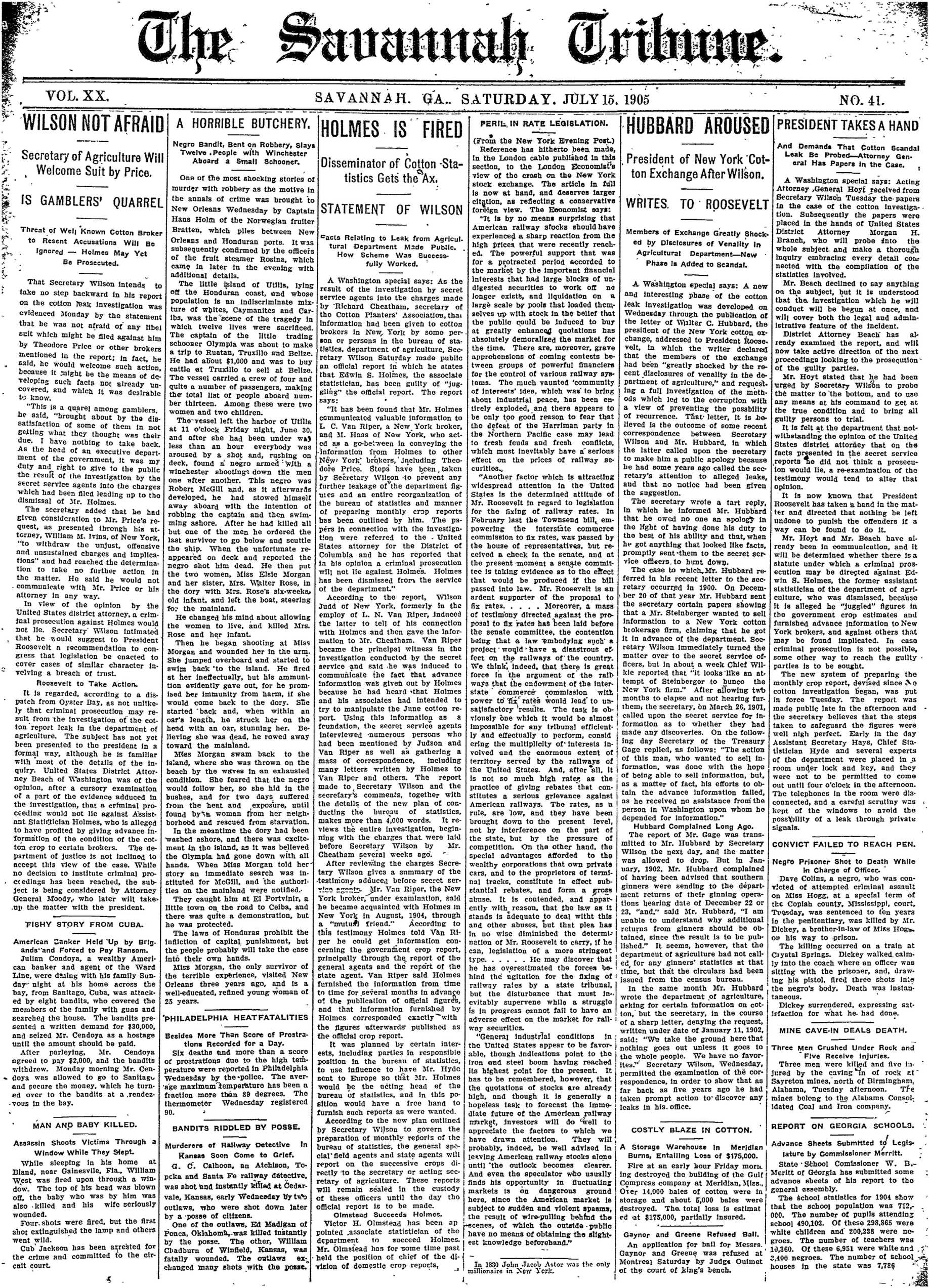
VOL. XX.
Secretary of Agriculture Will Welcome Suit by Price. IS GAMBLERS' QUARREL
Threat of Well Known Cotton Broker to Resent Accusations Will Be Ignored — Holmes May Yet Be Prosecuted.
That Secretary Wilson intends to take no step backward in his report on the cotton leak investigation was evidenced Monday by the statement that he was not afraid of any libel suit which might be filed against him by Theodore Price or other brokers mentioned in the report; in fact, he said, he would welcome such action, because it might be the means of developing such facts not already uncovered, and which it was desirable to know.
"This is a quarel among gamblers, he said, "brought about by the dissatisfaction of some of them in not getting what they thought was their due. I have nothing to take back. As the head of an executive department of the government, it was my duty and right to give to the public the result of the investigation by the secret service agents into the charges which had been filed leading up to the dismissal of Mr. Holmes. The secretary added that he had given consideration to Mr. Price's request, as presented through his attorney, William M. Irvins, of New York, "to withdraw the unjust, offensive and unsustained charges and implications" and had reached the determination to take no further action in the matter. He said he would not communicate with Mr. Price or his attorney in any way.
In view of the opinion by the United States district attorney, a criminal prosecution against Holmes would not lie. Secretary Wilson intimated that he would suggest to President Roosevelt a recommendation to congress that legislation be enacted to cover cases of similar character involving a breach of trust.
Roosevelt to Take Action
It is regarded, according to a dispatch from Oyster Bay, as not unlikely that criminal prosecution may result from the investigation of the cotton report leak in the department of agriculture. The subject has not yet been presented to the president in a formal way, although he is familiar with most of the details of the inquiry. United States District Attorney Beach of Washington was of the opinion, after a cursory examination of a part of the evidence adduced in the investigation, that a criminal proceeding would not lie against Assistant Statistician Holmes, who is alleged to have profited by giving advance information of the condition of the cotton crop to certain brokers. The department of justice is not inclined to accept this view of the case. While no decision to institute criminal proceedings has been reached, the subject is being considered by Attorney General Moody, who later will take up the matter with the president.
FISHY STORY FROM CUBA.
American Sanker Held 'Up by Brig-ands' and Forced to Pay Ransom.
Julian Condoya, a wealthy American banker and agent of the Ward Line, were dealing with his family Sunday night at his home across the bay, from Santiago, Cuba, was attacked by eight bandits, who covered the members of the family with gus and searched the house. The bandits presented a written demand for $30,000, and seized Mr. Cendoya as a hostage until the amount should be paid.
After parleying, Mr. Cendoya agreed to pay $2,000, and the bandits withdrew. Monday morning Mr. Cendoya was allowed to go to Sanitago and secure the money, which he turned over to the bandits at a rendez-vous in the bay.
MAN AND BABY KILLED.
Assassin Shoots Victims Through a Window While They Stept.
While sleeping in his home at Bland, near Gainesville, Fla., William West was fired upon through a window. The top of his head was blown off, the baby who was by him was also killed and his wife seriously wounded.
Four shots were fired, but the first shot extinguished the lamp and others went wild.
Cub Jackson has been arrested for the crime and committed to the circuit court.
Negro Bandit, Bent on Robbery, Slays Twelve People with Winchester Aboard a Small Schooner.
One of the most shocking stories of murder with robbery as the motive in the annals of crime was brought to New Orleans Wednesday by Captain Hans Holm of the Norwegian fruiter Bratten, which plies between New Orleans and Honduran ports. It was subsequently confirmed by the officers of the fruit steamer Rosina, which came in later in the evening with additional details.
The little island of Uitilla, lying off the Honduran coast, and whose population is an indiscriminate mixture of whites, Caymanites and Caribs, was the 'scene of the tragedy in which twelve lives were sacrificed. The captain of the little trading schooner Olympia was about to make a trip to Ruatan, Truxillo and Bellze. He had about $1,000 and was to buy cattle at Truxillo to sell at Bellze. The vessel carried a crew of four and quite a number of passengers, making the total list of people aboard number thirteen. Among these were two women and two children.
The vessel left the harbor of Utilla at 11 o'clock Friday night, June 30, and after she had been under was less than an hour everybody was aroused by a shot and, rushing on deck, found a negro armed with a winchester shootings down the men one after another. This negro was Robert McGill and, as it afterwards developed, he had stowed himself away aboard with the intention of robbling the captain and then swimming ashore. After he had killed all but one of the men he ordered the last survivor to go below and scuttle the ship. When the unfortunate reappeared on deck and reported the negro shot him dead. He then put the two women, Miss Elsie Morgan and her sister, Mrs. Walter Rose, in the dory with Mrs. Rose's six-weeks old infant, and left the boat, steering for the mainland.
He changed his mind about allowing the women to live, and killed Mrs. Rose and her infant. Then he began shooting at Miss Morgan and wounded her in the arm. She jumped overboard and started to swim back to the island. He fired at her ineflectually, but his ammunition evidently gave out, for he promised her immunity from harm, if she would come back to the dory. She started back and, when within an oar's length, he struck her on the head with an oar, stunning her. Believing she was dead, he rowed away toward the mainland.
Miss Morgan swam back to the island, where she was thrown on the beach by the waves in an exhausted condition. She feared that the negro would follow her, so she hid in the bushes, and for two days suffered from the heat and exposure, until found by woman from her neighborhood and rescued from starvation. In the meantime the dory had been washed ashore, and there was excitement in the island, as it was believed the Olympia had gone down with all hands. When Miss Morgan told her story an immediate search was instituted for McGill, and the authorities on the mainland were notified. They caught him at El Portvinir, a little town on the road to Celba, and there was quite a demonstration, but he was protected.
The laws of Honduras prohibit the infliction of capital punishment, but the people probably will take the case into their own hands.
Miss Morgan, the only survivor of the terrible experience, visited New Orleans three years ago, and is a well-educated, refined young woman of 25 years.
Besides More Than Score of Prostrat-
ions Recorded for a Day.
Six deaths and more than a score of prostrations due to the high temperature were reported in Philadelphia Wednesday by the police. The average maximum temperature has been a fraction more than 89 degrees. The thermometer Wednesday registered 90.
BANDITS RIDDLED BY POSSE.
Murderers of Railway Detective In Kansas Soon Come to Grief.
G. C. Calhoon, an Atchison, Topeka and Santa Fe railway detective, was shot and instantly killed at Cedarvale, Kansas, early Wednesday by two outlaws, who were shot down later by a posse of citizens.
One of the outlaws, Ed Madigan of Ponca, Oklahoma, was killed instantly by the posse. The other, William Chadburn of Winfield, Kansas, was fatally wounded. The outlaws exchanged many shots with the posse.
SAVANNAH. GA.. SATURDAY. JULY 15. 1905
Facts Relating to Leak from Agricultural Department Made Public. How Scheme Was Successfully Worked.
A Washington special says: As the result of the investigation by secret service agents into the charges made by Richard Cheatham, secretary of the Cotton Planters' Association, that information had been given to cotton brokers in New, York by some person or persons in the bureau of statistics, department of agriculture, Secretary Wilson Saturday made public an official report in which he states that Edwin S. Holmes, the associate statistician, has been guilty of "juggling" the official report. The report says:
"It has been found that Mr. Holmes communicated valuable information to L.C. Van Riper, a New York broker, and M. Haas of New York, who acted as a go-between in conveying the information from Holmes to other New York brokers, including Theodore Price. Steps have been taken by Secretary Wilson to prevent any further leakage of the department figures and an entire reorganization of the bureau of statistics and manner of preparing monthly crop reports has been outlined by him. The papers in connection with the investigation were referred to the United States attorney for the District of Columbia and he has reported that in his opinion a criminal prosecution will not lie against Holmes. Holmes has been dismissed from the service of the department."
According to the report, Wilson Judd of New York, formerly in the employ of L. N. Van Riper, induced the latter to tell of his connection with Holmes and then gave the information to Mr. Cheatham. Van Riper became the principal witness in the investigation conducted by the secret service and said he was induced to communicate the fact that advance information was given out by Holmes because he had heard that Holmes and his associates had intended to try to manipulate the June cotton report. Using this information as a foundation, the secret service agents interviewed numerous persons who had been mentioned by Judson and Van Riper as well as gathering a mass of correspondence, including many letters written by Holmes to Van Riper and others. The report made to Secretary Wilson and the secretary's comments, together with the details of the new plan of conducting the bureau of statistics, makes more than 4,000 words. It reviews the entire investigation, beginning with the charges that were laid before Secretary Wilson by Mr. Cheatham several weeks ago.
After reviewing the charges Secretary Wilson gives a summary of the testimony adduced before secret service agents. Mr. Van Riper, the New York broker, under examination, said he became acquainted with Holmes in New York in August, 1904, through a "mutual friend." According to this testimony Holmes told Van Riper he could get information concerning the government crop report, principally through the report of the general agents and the report of the state agent. Van Riper said Holmes furnished the information from time to time for several months in advance of the publication of official figures, and that information furnished by Holmes corresponded exactly with the figures afterwards published as the official crop report.
It was planned by certain interests, including parties in responsible position in the bureau of statistics, to use influence to have Mr. Hyde sent to Europe so that Mr. Holmes would be the acting head of the bureau of statistics, and in this position would have a free hand to furnish such reports as were wanted. According to the new plan outlined by Secretary Wilson to govern the preparation of monthly reports of the bureau of statistics, the general special field agents and state agents will report on the successive crops directly to the secretary or acting secretary of agriculture. These reports will remain sealed in the custody of these officers until the day the official report is to be made.
Olmstead Succeeds Holmes.
Victor H. Olmstead has been ap pointed associate statistician of the department to succeed Holmes.
Mr. Olmstead has for some time past held the position of chief of the division of domestic crop reports,
Tribune.
PERIL, IN RATE LEGISLATION.
(From the New York Evening Post.) Reference has hitherto been made, in the London cable published in this section, to the London Economist's view of the crash on the New York stock exchange. The article in full is now at hand, and deserves larger citation, as reflecting a conservative foreign view. The Economist says:
"It is by no means surprising that American railway stocks should have experienced a sharp reaction from the high prices that were recently reached. The powerful support that was for a protracted period accorded to the market by the important financial interests that had large blocks of undigested securities to work off no longer exists, and liquidation on a large scale by pools that loaded themselves up with stock in the belief that the public could be induced to buy at greatly enhanced quotations has absolutely demoralized the market for the time. There are, moreover, grave apprehensions of coming contests between groups of powerful financiers for the control of various railway systems. The much vaunted 'community of interests' idea, which was to bring about industrial peace, has been entirely exploded, and there appears to be only too good reason to fear that the defeat of the Harriman party in the Northern Pacific case may lead to fresh feuds and fresh conflicts, which must inevitably have a serious effect on the prices of railway securities.
"Another factor which is attracting widespread attention in the United States is the determined attitude of Mr. Roosevelt in regard to legislation for the fixing of railway rates. In February last the Townsend bill, empowering the interstate commerce commission to fix rates, was passed by the house of representatives, but received a check in the senate, and at the present moment a senate committee is taking evidence as to the effect that would be produced if the bill passed into law. Mr. Roosevelt is an ardent supporter of the proposal to fix rates. . . . Moreover, a mass of testimony directed against the proposal to fix rates has been laid before the senate committee, the contention being that a law embodying such a project would have a disastrous effect on the railways of the country. We think, indeed, that there is great force in the argument of the railways that the endowment of the interstate commerce commission with power to fix rates would lead to unsatisfactory results. The task is obviously one which it would be almost impossible for any tribunal efficiently and effectually to perform, considering the multiplicity of interests involved and the enormous extent of territory served by the railways of the United States. And, after all, it is not so much high rates, as the practice of giving rebates that constitutes a serious grievance against American railways. The rates, as a rule, are low, and they have been brought down to the present level, not by interference on the part of the state, but by the pressure of competition. On the other hand, the special advantages afforded to the wealthy corporations that own private cars, and to the proprietors of terminal tracks, constitute in effect substantial rebates, and form a gross abuse. It is contended, and apparently with reason, that the law as it stands is adequate to deal with this and other abuses, but that plea has in no wise diminished the determination of Mr. Roosevelt to carry, if he can, legislation of a more stringent type. . . . He may discover that he has overestimated the forces behind the agitation for the fixing of railway rates by a state tribunal, but the disturbance that must inevitably supervene while a struggle is in progress cannot fail to have an adverse effect on the market for railway securities.
"General industrial conditions in the United States appear to be favorable, though indications point to the iron and steel boom having reached its highest point for the present. It has to be remembered, however, that the quotations of stocks are already high, and though it is generally a hopeless task to forecast the immediate future of the American railway market, investors will do well to appreciate the factors to which we have drawn attention. They will probably, indeed, be well advised in leaving American railway stocks alone until the outlook becomes clearer. And even the speculator who usually finds his opportunity in fluctuating markets is on dangerous ground here, since the American market is subject to sudden and violent spasms, the result of wire-pulling behind the scenes, of which the outside public have no means of obtaining the slightest knowledge beforehand."
In 1830 John Jacob Astor was the only millionaire in New York.
HUBBARD AROUSED
Members of Exchange Greatly Shocked by Disclosures of Venality In Agricultural Department—New Phase Is Added to Scandal.
A Washington special says: A new and interesting phase of the cotton leak investigation was developed on Wednesday through the publication of the letter of Walter C. Hubbard, the president of the New York cotton exchange, addressed to President Roosevelt, in which the writer declared that the members of the exchange had been "greatly shocked by the recent disclosures of venality in the department of agriculture," and requesting a full investigation of the methods which led to the corruption with a view of preventing the possibility of recurrence. That letter, it is believed is the outcome of some recent correspondence between Secretary Wilson and Mr. Hubbard, in which the latter called upon the secretary to make him a public apology because he had some years ago called the secretary's attention to alleged leaks, and that no notice had been given the suggestion.
The secretary wrote a tart reply, in which he informed Mr. Hubbard that he owed no one an apology in the light of having done his duty to the best of his ability and that, when he got anything that looked like facts, promptly sent-them to the secret service officers to hunt down.
The case to which Mr. Hubbard referred in his recent letter to the secretary occurred in 1900. On December 20 of that year Mr. Hubbard sent the secretary certain papers showing that a Mr. Steinberger wanted to sell information to a New York cotton brokerage firm, claiming that he got it in advance of the department. Secretary Wilson immediately turned the matter over to the secret service officers, but in about a week Chief Wilde reported that "it looks like an attempt of Steinberger to bunco the New York firm." After allowing two months to elapse and not hearing further, the secretary, on March 26, 1901, called upon the secret service for information as to whether they had made any discoveries. On the following day Secretary of the Treasury Gage replied, as follows: "The action of this man, who wanted to sell information, was done with the hope of being able to sell information, but, as a matter of fact, his efforts to obtain the advance information failed, as he received no assistance from the person in Washington upon whom he depended for information."
Hubbard Complained Long Ago. The report of Mr. Gage was transmitted to Mr. Hubbard by Secretary Wilson the next day, and the matter was allowed to drop. But in January, 1902, Mr. Hubbard complained of having been advised that southern ginners were sending to the department returns of their ginning operations hearing date of December 22 or 23, "and," sald Mr. Hubbard, "I am unable to understand why additional returns from ginners should be obtained, since the result is to be published." It seems, however, that the department of agriculture had not called for any ginners' statistics at that time, but that the circulars had been issued from the census bureau.
In the same month Mr. Hubbard wrote the department of agriculture, asking for certain information on cotton, but the secretary, in the course of a sharp letter, denying the request, written under date of January 11, 1902, said: "We take the ground here that nothing goes out unless it goes to the whole people. We have no favorites." Secretary Wilson, Wednesday, permitted the examination of the correspondence, in order to show that as far back as five years ago he had taken prompt action to discover any leaks in his office.
COSTLY BLAZE IN COTTON.
A Storage Warehouse in Meridian Burns, Entailing Loss of $175,000.
A Storage Warehouse in Meridian Burns, Entailing Loss of $175,000.
Fire at an early hour Friday morning destroyed the building of the Gulf Compress company at Meridian, Miss..
Over 14,000 bales of cotton were in storage and about 5,000 bales were destroyed. The total loss is estimated at $175,000, partially insured.
Gaynor and Greene Refused Ball.
An application for bail for Messrs. Gaynor and Greene was refused at Montreal Saturday by Judge Oulmet of the court of king's bench.
And Demands That Cotton Scandal Leak Be Probed—Attorney General Has Papers in the Case.
A Washington special says: Acting Attorney, General Hoyt received from Secretary Wilson Tuesday the papers in the case of the cotton investigation. Subsequently the papers were placed in the hands of United States District Attorney Morgan H. Branch, who will probe into the whole subject and make a thorough inquiry embracing every detail connected with the compilation of the statistics involved.
Mr. Beach declined to say anything on the subject, but it is understood that the investigation which he will conduct will be begun at once, and will cover both the legal and administrative feature of the incident.
District Attorney Beach has already examined the report, and will now take active direction of the next proceedings looking to the prosecution of the guilty parties.
Mr. Hoyt stated that he had been urged by Secretary Wilson to probe the matter to the bottom, and to use any means at his command to get at the true condition and to bring all guilty persons to trial.
It is felt at the department that notwithstanding the opinion of the United States district attorney that on the facts presented in the secret service reports he did not think a prosecution would lie, a re-examination of the testimony would tend to alter that opinion.
It is now known that President Roosevelt has taken a hand in the matter and directed that nothing be left undone to punish the offenders if a way can be found to do it.
Mr. Hoyt and Mr. Beach have already been in communication, and it will be determined whether there is a statute under which a criminal prosecution may be directed against Edwin S. Holmes, the former assistant statistician of the department of agriculture, who was dismissed, because it is alleged he "juggled" figures in the government crop estimates and furnished advance information to New York brokers, and against others that may be found implicated. In case criminal prosecution is not possible, some other way to reach the guilty parties is to be sought.
The new system of preparing the monthly crop report, devised since cotton investigation began, was put in force Tuesday. The report was made public late in the afternoon and the secretary believes that the steps taken to safeguard the figures were well nigh perfect. Early in the day Assistant Secretary Hays, Chief Statistician Hyde and several experts of the department were placed in a room under lock and key, and they were not to be permitted to come out until four o'clock in the afternoon. The telephones in the room were disconnected, and a careful scrutiny was kept of the windows to avoid the possibility of a leak through private signals.
CONVICT FAILED TO REACH PEN.
Negro Prisoner Shot to Death While in Charge of Officer.
Dave Collins, a negro, who was convicted of attempted criminal assault on Miss Hogg, at a special term of the Copiah county, Mississippi, court, Tuesday, was sentenced to ten years in the penitentiary, was killed by Mr. Dickey, a brother-in-law of Miss Hogg on his way to prison.
The killing occurred on a train at Crystal Springs. Dickey walked calmly into the coach where an officer was sitting with the prisoner, and, drawing his pistol, fired three shots into the negro's body. Death was instantaneous.
Dickey surrendered, expressing satisfaction for what he had done.
MINE CAVE-IN DEALS DEATH.
Three Men Crushed Under Rock and Five Receive Injuries.
Three men were killed and five injured by the caving in of rock at Sayreton mines, north of Birmingham, Alabama, Tuesday afternoon. The mines belong to the Alabama Consolidated Coal and Iron company.
Advance Sheets Submitted to Legislature by Commissioner Merritt.
State School Commissioner W. B.
Meritt of Georgia has submitted some advance sheets of his report to the general assembly.
The school statistics for 1904 show that the school population was 712,000. The number of pupils attending school 490,103. Of these 298,865 were white children and 200,238 were negroes. The number of teachers was 10,360. Of these 6,951 were white and 2,400 negroes. The number of school houses in the state was 7,786
PUBLISHED EVERY SATURDAY,
BY THE TRIBUNE PUBLISHING CO.
116 W. St. Julian Street.
Ga.'Phone 574.
SUBSCRIPTION RATES.
One Year.....$1.25
Six Months.....75
Three Months.....50
Residence must be made by Express or
Post Office Money Order, or Registered Letter
advertising Rates given on application.
SATURDAY, JULY 15, 1905.
"Positively, there is no better time than now to begin to teach your girls and boys that all labor is honorable and should be engaged in. It is a curse to the race to allow the child to mope along through life without an aim. There is scouring to be done, dishes to be washed and weeds to be cut and errands to be run while there in filth and ignorance sits, or more properly, lolls the pet morsel of twelve or fourteen summers. Mothers, do you not feel the world and all in it on the move? Is there nothing to which you can point and ask your child to emulate its example. If, not, why not?"—Express.
"One other lesson which we must impress upon our young men and women as they go out from our schools and colleges is the fact that the war has been over forty years, and that the white people in the North and in the South are coming closer together. The Negro must cease opposition, as far as it is manly and consistent to do so, and work in hearty co-operation and sympathetic touch with the white man who is his neighbor. No one but the ignorant and narrow-minded white man and the same class of colored men are attempting to keep up friction and discord between the races. Wherever we find a man of either race stirring up strife, he is an enemy to the peace and prosperity of the South."—Booker T. Washington.
"Because of an expression of hatred of miscegenation, Juryman Waldo Stewart of Providence, R. I., was rebuked in the supreme court today by Judge Wilbur. The defendants at the bar were, Lemuel Brown, a Negro, and Mabel Brown, white, who were charged with conducting a nuisance. They were married some time ago. Stewart explained that his prejudice would not permit him to render a true verdict, as he would be apt to decide against the couple. Judge Wilbur said with considerable force that something must be wrong with the juror's mental apparatus. The law, said his honor, permitted intermarriages such as this one. He said that all people in this republic were free and equal, and that one was as good as another. Such a prejudice as a reason for not serving on a jury was ridiculous, he declared. Mr. Stewart was excused and the trial proceeded."—Globe.
Dr. Bradley of Atlanta gave utterance to the following able words:
"Sometimes I am lacking in courage to live up to my highest thought, but I want to indorse what I heard a distinguished, learned and broad-minded minister once say at a conference of clergymen.
"That man said: 'If I could I would like to see every Negro in the land raised to my own level.' He was interrupted by one of his auditors, who asked if he would really want to be on an equality with Negroes. Another man present said. 'Don't stop to answer such an interruption as that; go on with your great speech.' And it was a great speech, and I want to here and now indorse it.
"The social caste that has grown up among us has led many of us to believe that somehow because we happened, without any choice or any merit of own, to be born with a white skin the Lord loves us better and thinks a little more of us than he does anybody with a darker skin.
"But I want to say to you that the man who does not admit and live up to the fraternity of the Negro—yes, the fraternity, that is the word—whatever else he may be he is not a christian."
"I am not afraid of race equality, and I'll tell you my opinion of the man who is. It is this, that his social status must be very, very insecure, that he should be so infinitely solicitous about safeguarding it. Dr. Bradley also referred in strong terms to the Watkinsville lynching, denouncing the
perpetrators of the killings and the officials to whose custody the slain prisoners had been before the mob got them.
"Another of our dangers is too much democracy," said the speaker, "it tends in some instances to make us think that there is no higher law than our own will, and no higher officers than our own selves. We had a siriking illustration of that in Georgia last week, and we have had many in recent years.
"There were more lynchings in the state of Georgia last year than there were in the entire British Isles—yes; than there were in the British Isles for the last five years. Statistics prove that.
"The men who committed outrage at Watkinsville were white-livered cowards. They stole in, masked at night to do that which no one of them would have dared to do, unmasked and in the fair light of day. They were not content to wait until universal man spoke in the word called law. They sneak in like the cowards that they were and smirched the fair name of the state.
"I have the heartiest contempt, too for the jailor who gave up his key because somebody pointed a pistol at his face. Suppose the same mob had demanded that he send his daughter out to them. If that had been the case the scoundrel, coward though he is would have died first.
"I'll tell you these outrages will not stop until we get men in office who are not afraid to die in the performance of duty enjoined by their solemn oath."
The church was filled with people, and the remarks of Dr. Bradley created a most profound impression.
"The Way of the World" is broad both in the range of subjects treated, and the discussion of them. The most important and convincing paper written by a Negro on the ethnological aspect of the great problem of America is to be found in this number. It is from the pen of James M. Boddy, one of the leading scientific writers of America, who has made an especial study of climatology and ethnology. The paper is valuable and illuminating. Other contributors to the July number are Ella Wheeler Wilcox, Carrie W. Clifford, who writes most interestingly of Cleveland Colored people; "Deesha," who writes authentically on "Prejudice in the West Indies." The poetry is contributed by Thomas Malone and James Tinus, both of whom have written beautiful songs. The single editorial is "On the Boycotting of Street Mailways." The various notes of progress are certainly reassuring. The book is full of high class matter, and profusely illustrated. Ten cents. News stands or Pearl and Cedar Streets, New York.
Glenwood Dots.
The Quarterly meeting that was held here Saturday and Sunday last was a successful one. The P. E. being called to the bed side of his Secretary could not be present, Rev. N. W. West of McRae, Ga. was P. E. protem., he acted his part well. At 11 a. m. he delivered a soul stirring sermon to a large congregation. At 2 p. m. the Lord's supper was administered. The entire day was spent at the church. Mr. S. D. Davis is suffering very much from a carbuncle on the knee.
Mrs. M. Blue who has been visiting parents and friends, returned home Monday last. Mrs. J. R. Linder of Dublin, Ga., is visiting her sister-in-law and friends. Mr. John Tanner left for Harrison, Ga. Sunday last. Mr. Jim Choats who has been visiting parents and relatives in Macon returned home. Mrs. Choats did not return with him. To-morrow is preaching day at the Baptist church, let every body attend. Crops are looking fine now.
Spoiled Her Beauty.
Harriet Howard of New York, at one time had her beauty spoiled with skim trouble. She writes : "I had Salt Rheum or'Eczema for years, but nothing would cure it, until I used Bucklen's Arnica Salve." A quick and sure healer for cuts burns, and sores. 25c at any drug store.
Instrumental and Vocal Institution.
Beginning the first week in July, I will take a few pupils in Piano and will organize a class in vocal music if a sufficient number will apply. Call or drop me a postal. CHAS. McDOWELL, 218 East Park Ave
ITS SIXTEETH SESSION.
The Knights and Calanthes Had Gala Week.
Hundreds of visitors and delegates were in the city this week on account of the Grand Lodge session of Knights of Pythias and Grand Court of Calanthe. On Sunday the delegates begun arriving and on Monday along West Broad street was a scene of much activity caused by the arrival of the bulk of the delegates. The entire program as printed in THE TRIBUNE of last week was carried out and in such a manner as to reflect credit not only on the executive powers of the local committee, but on those who took parts.
The pleasures begun on Monday night when local talent presented the ancient play of Damon and Pythias at the Masonic Temple. The spacious auditorium was nearly filled by an appreciative audience. The play was presented in a very satisfactory was, which would under the circumstances be creditable to professionals. The applause they received was hearty.
The session began on Tuesday morning at the Masonic Temple. Long before that time the temple and its vicinity presented an animating scene. The program for the opening as was laid down was carried out. Our Geo. S. Williams outdid himself in his very cordial welcome address. In his annual address, Dr. S. Palmer Lloyd added to his reputation as an able, practical and fluent speaker. The others speakers also made good impression.
The committee on credentials was unable to render its report until the afternoon, and the P. C. degree was conferred on a larger number of candidates than at any other session. In fact there was a larger attendance of delegates, Past Chancellors, members of the uniformed ranks and visitors than ever before. On account of the rain the trip around the harbor was not as largely attended as anticipated, but those who went enjoyed the ride and the sights.
Tuesday night the memorial service at St. John's Baptist church was largely attended. The addresses and papers read were well received. Wednesday morning much business was transacted The reports of Grand Chancellor Creswill, Grand Master of Exchequer, F. M. Cohen, Grand Keeper of Record and Seal, B. W. Warren, and the other officers were excellent and showed the order to be in a prosperous condition.
The pleasing feature of the session was the parade in the afternoon. Chief Marshal E. L. Martin led the procession, followed by the staff officers and the companies, numbering seven, three of them being local, members of subordinate lodges followed. In the rear in carriages were Supreme Chancellor S. W. Stark of West Virginia, Grand Chancellor Creswill, Grand Vice Chancellor Clark and the other Grand Lodge officers and the ladies of Calanthe led by Mrs. R. L. Barnes, the able Grand Worthy Counsellor.
The parade impressed all who saw it. It terminated at the fair grounds, where the prize drill took place. The Macon company won the first prize. The grounds were thronged with people.
After the parade the Grand Lodge held an all night session and did not adjourn until near mid day on Thursday. Grand Chancellor C. D. Creswill was re-elected after a spirited contest. Prof. G. R. Hutto, was elected vice chancellor, Sirs F. M. Cohen and B. W. Warren were unanimously re-elected to their respective positions. Dr. H. R. Butler and Dr. G. N. Stoney were given Supreme Lodge honors. The Grand Lodge closed Thursday afternoon after one of the most memorable gatherings it has ever held to meet next year at Macon.
The Grand Court I. O. O. C. met Thursday morning on the third floor of the Masonic Temple. The lodge room was crowded. The degree was conferred on a large number of Past Worthy Counsellors. The session was interesting throughout. The much beloved Mrs. R. L. Barnes in her able manner presided and the members showed
their appreciation, by unanimously re-electing her. The session closed Thursday night. The banquet was largely attended. Many of the delegates are still in the city.
College Dots.
President Wright is in Boston. Benjamin and Emma Young formally Collegians but residents of Tallahassee, spent some time at the College as guests of Mrs. Roston and Mrs. Pearson. Their father, President Young, came for them last Thursday. Miss Julia Wright and her sister Miss Edwena have returned from Pine Bluff, Ark., where they spent the Winter. Miss Wright was teaching, in the Arkansas Baptist College and Miss Edwena was attending school there.
Most of the teachers will spend their vacation at College.
Vice President Suggs and Mrs. Suggs left last week for their North Carolina home at Greenboro. Mrs. Cooper is spending some time in the Gate City.
Prof. Thompson's cottage on Meldrim's Ave., is completed. Who is to occupy it? Rumor says Mijs—
Dr. and Mrs. H. R. Butler, and Butler, junior, and Mrs. M. E. Tolbert, were welcomed visitors on Monday afternoon.
Special Notice.
Savannah, Ga., June 26, 1905 Notice is herewith given that, for the entrance fee into the United Order of True Reformers is reduced to $3.00. Persons desiring to open conventions or to enter any already opened, should address the Chief.
R. H. Williams
512 HuntingdonSt., W
Cemetery Lots For Sale.
Lots -10x20 in the well located Oak Grove Cemetery, just four miles from the city, on one of the main paved roads, are now on sale. The choice lots can be bought for $5.00 a piece. This cemetery contains thirty acres, and is high and dry. In a short time Laurel Grove cemetery will have to be closed, therefore you had better purchase choice lots at Oak Grove cemetery. Apply to H. Maxwell, Waters Avenue.
THE GUARANTY AID and Relief Society.
(State Charter Perpetual)
Large Premiums.
Thousands of Dollars paid to Policy holders.
HOME OFFICE.
468 West Broad St.
SAVANNAH, GA.
Lucrative employment given agents, male or female.
SEABOARD AIR LINE RAILWAY TO THE North, East; South and West, The best rates to all EASTERN CITIES, FLORIDA POINTS, SAVANNAH
POINTS, SAVANNHE, AMERIOUS, FITZGERALD, COLUMBUS, ALBANY, MONTGOMERY, MOBILE, NEW ORLEANS,
—the South and South-west.—Through PULLMAN CARS to NEW YORK. CAFE CARS serving meals a la carte.
For detailed information, literature time tables, rates, etc., apply to any agent of the SEABOARD AIR I RAILWAY or to GEAS. F. STEWART.
Asst. Gza. Pace'r Again in Savannah Ga.
50 YEARS' EXPERIENCE
PATENTS
TRADE MARKS
DESIGNS
COPYRIGHTS AG.
Airons sealing is already well known by
family, maintain our opinion free whether an
invention is probably patentable. Communications
strictly confidential. HANDBOOK on Patents
provides 91 and more information on the patents.
Patents taken through Mann & Co. receive
general notice, without charge, in the
Scientific American.
A handsomely illustrated weekly. Largest edition of any science journal. Ternan, 36 a
year; four months, $1. Sold by all new dealers.
MUNN & Co. 881 Broadway, New York
Metropolitan Mercantile and Realty Compay.
Shares $9 each. Full Paid. Non-assessable.
An Iron-clad Investment
of the highest order, combining safety, profit, pleasure and prestige for the present and something to fall back on in after years. No preferred stock. All share and share alike. No watered stock. When stock was $5.00 we sold it for $5.00. When it was worth $6, $7 and $8 we sold it at those figures. When it reaches $10 we will sell it for $10, and nothing less, nothing more.
Investment in the Bank
is just as good. 7 per cent paid compounded quarterly. If you do not get this in other banks, you are not getting a fair share of the earning capacity of your money. All companies that do any business at all can pay 7 per cent. Any how we can and will Our minimum earning capacity is 21 per cent. We divide it as follows: 7 to the investor; 7 to run the company; 7 to the sinking fund, which enhances the value of the investment and strengthens the company.
$50,000 TO LOAN
on good city and suburban thing. Terms the easies
222 W. Broughton St., Sa
F. M. Cohen, Teller. J. W.
Bring Us
YOUR
on good city and suburban real estate. We build any thing. Terms the easiest and best. Call-or address 222 W. Broughton St., Savannah, Ga. Bell Phone 1144 F. M. COHEN, Teller. J. W. ARMSTRONG, Gen'l Mangr.
Jo Printing.
```markdown
```
Buy Wall Paper Right
If you are going to paper one room or the whole house, look at our new design. Every kind of wall paper from the simplest designs to the most elaborate.
The right hayling of wall paper is the difference between an artistic home and an ordinary house. The danger of wrong buying is eliminated when selections are made from our stock.
Agents for the celebrated
CHAS. M. K. HILLEN Wall Paper,
PHILADELPHIA.
KILL THE OOUGH
AND CURE THE LUNGS
WITH Dr. King's
New Discovery
FOR CONSUMPTION
COUGHS and
OLDDS
Price
50c & $1.00
Free Trial.
Surest and Quickest Cure for all
THROAT and LUNG TROUBLES,
or MONEY BACK.
(Incorporated)
a Bank in which to deposit savings, SAFETY ought to be the first consideration—and last. A high rate of interest is of no consequence whatever if the principal is endangered. Safety may be judged by the management of the bank.
THE WAGE EARNERS LOAN
AND INVESTMENT COMPANY
is a safe banking institution. It does not engage in any other business and its management has always been along lines of strict conservatism and reasonable progressiveness. It was founded in 1900 and has enjoyed steady continuous growth ever since. 5 Per Cent compounded interest is paid on savings because we can pay it with safety. THE WAGE EARNERS LOAN & INVESTMENT CO.
Let us be Your Tailor.
We have arranged with The American Woolen Mills Co., of Chicago, to handle their lines of made-to-order SUITS, TROUSERS and MACKINTOSHES. As this is the largest company making Clothing to order by measure we are sure that our patrons will be satisfied in the style, fit and durability of their garments.
```markdown
```
$10 to $35 00
Trousers -
$3 00 to $10 00
Order your Spring Suits
now. Full line Von Zandt,
Jacobs & Co's., All Linen
Collars, 2 for 25 cents.
SCOTT BROS,
462 WEST BROAD STREET.
Metropolitan Mutual
Benefit Association.
(INCORPORATED.)
In addition to our sick and death benefit policies we are offering the public industrial insurance in straight life policies ranging from $100.00 to $500.00. Premiums within the reach of all. A fair value for your money in a reputable company is what all of us are looking for. This is what we are giving. See any of our agents or call at the company's office for rates and particulars.
Energetic men and women can make anywhere from $5.00 to 25.00 a week working for this company.
Office 222 W. Broughton St. Savannah, Ga.
How It Was Brought Here and the Damage It Did:
UT the greatest insect war ever known was the battle waged against the gipsy caterpillar in the State of Massachusetts:
little effect upon the great numbers, so it was abandoned for more deadly methods.
The vitality of the gipsy caterpillar and its eggs injured to be extinguished.
The whole trouble, which caused years of labor and the expenditure of hundreds of thousands of dollars, arose from a handful of eggs blown into some grass by an arring puff of wind. Some thirty odd years ago, a certain French artist and naturalist, Leopold Trouvelot, lived in Medford, Mass. He was studying the habits of the native birds and insects, and was carrying on experiments with silkworms. One day he received by post a cluster of the eggs of the gossypia moth from a friend in Europe, which he placed on a table near an open window. A passing puff of wind blew the eggs into the grass outside.
Trouvilot did not miss them, or remember them, until, a year later, he discovered a number of young gipsy caterpillars — hairy, gray creepers, speckled with red and blue. He attempted to stamp the colony out of existence, but finding, the next season, that they were more numerous, he gave pub its warning of what had happened, and advised the community to be on the watch. His warning was regarded as the vaping of a half-crazy collector of eggs.
Trouvelot left for Paris, and for some time nothing more was thought of the gipsy moth, though a few people noticed that near the old Trouvelot home caterpillars were plentiful, and that they did some damage to foliage. From 1893 to 1899 the parent colony was extending its territory, and wherever it went trees were defollated. The damage was placed to any account but the real one, generally to the charge of the well-known cankerworm, or to the tent caterpillar.
At last, in 1899, a season arrived when the gipsy caterpillars and moths had so greatly increased in numbers that their food supply gave out. Armies appeared in districts where they had never been known before, and destroyed every green thing. Their progress was checked on the south of Medford by salt marshes, but they began to spread east, west and north. Passing from tree to tree the hungry host swarmed over all the country side.
In the June of 1859 the plague had settled so heavily on Medford that the whole town was black with caterpillars. All the houses were covered with them. People going into their houses were oblived first to sweep their doorsteps clear. Brooms were commonly left outside the street doors for the use of callers. On the pavements the insects were so numerous that the pedestrians could slide on their crushed bodies.
The caterpillars crowded one another off the trees, and gathered in armies on the ground and on the fences. They entered the windows of houses, destroying all flowering plants, and penetrated to every corner, so that the people were afraid to go to bed. They dropped in showers from the trees, while the harvae, hanging from invisible threads, brushed tae faces of those who passed beneath. In the heat of the still summer nights, a slickening odor arose. It began to look as though the town must be abandoned. Throughout the summer the people spent most of their spare time in fighting the pest. They attacked with fire, water and oil, but with little avail. Cartloads of bodies were removed, and millions of caterpillars were killed in the shell by destruction of egg-clusters, each cluster containing some 600 eggs. But still the plague increased, and it began to be regarded as of fearful portent to the entire nation.
At last a specimen of the pest was sent to the State Board of Agriculture, where it was quickly identified as a well-known European scourge. A commission was appointed, public interest was aroused, and an act appropriating some $25,000 for the extermination of the gipsy moth was passed. A large staff of men, gradually increased until about 100 were employed, went about the country, clearing away infested woods and orchards, destroying eggs and caterpillars. And so began a war that was destined to rage fiercely for ten years, and to eclipse any other insect war of the kind ever known.
An inspection made by the State officers in 1890 showed that fifty square miles of country were infested. An elaborate campaign was planned for the next year; £50,000 were appropriated to the work; the country was divided up into districts, and inspectors with gangs of men were employed to night the plague in each district. But in spite of all efforts the insects steadily increased, until they extended over 500 square miles of territory.
At first an attempt was made to destroy the caterpillars by spraying them with arsenic, which is fatal to the cankerworm, the tent-caterpillar and other insects. It was found that the gipsy caterpillar rather enjoyed arsenic. Method after method was tested to find a quick means of exterminating caterpillars, pupae, moths and eggs. Great hopes were built on a moth-trapping scheme. The female moths cannot fly, but the males are gift on the wing, and it was found that captured females attracted the males from distances of fully half a mile. So the officers went about setting traps for the males, baited with females, and some tens of thousands were thus caught in a short time. But this had
little effect upon the great numbers, so it was abandoned for more deadly methods.
The vitality of the glpsy caterpillar and its eggs pierced to be extraordinary. Voracious as it is; the caterpillar can starve for weeks without injury; it will live for days in water, and can endure intense cold as well as intense heat. The eggs might be covered with ice and snow in the forests, and yet would hatch in the spring, while they would take little harm from small fires that burned the twigs and leaves of the trees on which they were.
The most effective weapon was found to be the littense heat given off from the flame of vaporized kerosene. Agents armed with long hoses attached to barrels of kerosene, went into the woods, and directed jets upon all trees within reach, and in this and other ways millions of the gipsy kind were destroyed by each worker. In spite of the insufficient funds, causing pauses in the work, and the enormous difficulties that had to be overcome, the Board of Agriculture succeeded in preventing the plague spreading beyond the 220 square miles of infested country; and slowly but surely in each district; by a method of double, triple, and even quadruple checking; it was stamped out. It had it not been for these energetic steps, the appalling amount of damage that the gipsy meth might have done is almost beyond imagination. It was reckoned by the authorities that the increase of a single pair of gipsy moths, if unrestricted, would suffice to destroy the entire vegetation of the United States within eight years — Pearson's Magazine.
HOW ICEBERGS ARE FORMED IN GREENLAND
As the Glaciers Sweep Into the Sea They "Calve" or Throw Off These Nighty Chunks.
Icebergs are the product of the Greenland glaciers and are formed by the thousand in the far northern florida. As the glaciers sweep into the sea they "calve" or throw off mighty blocks, and these are what we know as icebergs. Some are of stupendous dimensions. Dr. Kane's Arctic expedition saw one two and a half miles long and two and a half miles wide aground in half a mile of water in Melville Bay. This, of course, broke up into small pieces in time, which sun and sea and tide molded into the beautiful and fantastic forms familiar to the Arctic voyager. As they drift south and the sun plays on their facade, it melts them into shimmering cascades which leap into the sea, while below the tide frets them into delicate traceries. Then the berg gets top-heavy, turns over and exhibits an absolutely new contour, and so the process continues until they disappear in the Gulf Stream. The Labrador current, which carries them on its bosom, extends from the Polar Sea to the south of Newfoundland, an oceanic river 2000 miles long and 100 wide, and generously beweaved with these gorgeous creations; and, as an irreverent tourist remarked last summer, they represent enough cold storage to put the ice trust out of business and give every American citizen a refrigerator stock of his own.—McClure's Magazine.
Newspaper: Anonymity
In a recent speech delivered before the Newspaper Society in London, Winston Churchill, M. P., said that while newspaper machinery every day expanded, the men who did the work seemed to him to have sunk somewhat into the background in our great social hierarchy. It was not so in France. In many ways the press of France was inferior to ours, but there were powerful individual journalists in France as there were not in England—men who wielded a power in directing the course of the policy of their country much greater than that wielded by the average member of the Chamber of Deputies. It was a great pity that individual journalists had not the same influence at home. It was certainly not because we did not possess writers of equal capacity. He ventured to think that anonymity had a great deal to do with it. If more articles were signed, individual journalists would acquire a greater weight and authority in the politics of the country.
'A Sea Telescope'
A recent invention, the hydroscope, enables a spectator at the sea's surface to view objects at the bottom of the sea. The inventor is an Italian, Cavaliere Guisepe Pino. The machine is constructed of steel, and in shape is like a huge telescope. Pointed downward into coral caverns or sunken ships, instead of upward at the sun or the stars, its complex system of lenses, twelve in number, answers to the objective glass of a celestial telescope. By the internal mirrors they produce a clear picture of the sea bottom, the rays of light passing up the tube to a sort of camera-obscura house at the top, which floats above the surface, and is capable of holding four persons.
Georgia's Wheat Crop.
In spite of the many jokes that are made at the expense of the Georgia peach crop, that State produced more peaches than any of the Eastern States. It is said that there are over 7,000,000 trees that bear peaches in the State.
INTEREST TO WOMEN
MAN'S WAY.
When a man and his wife start to go anywhere, says a Missouri paper, he tells her to get out his good suit, fix the buttons in his shirt; tie his cuffs, good shoes, tie his necktie, brush his hat; perfume his handkerchief and a few other little jobs. Then he puts on his hat and says "Great Scott! Ain't you ready yet?"—Kansas City Journal.
EVERYTHING CHECKED.
EVERY CHECKED.
It was said last year that checks had had their day; but if the stuffs in smart shops are an indication we shall be checked, the coming summer as we haven't been checked for many a year. Every possible fabric has its check phase, says the Philadelphia Bulletin. There are checked taffetas, checked louisines, checked cottonts, checked volles, black and white shepherd checks, checks that borrow the pastel blues of pink-and-white and blue-and-white gingham, and all those various mercerized checks which wash and cost the price of the cotton and yet delude the unknowing into the belief that you are sporting a silk frock. It may be, said, too, that the lousis checks in livery and mauve are particularly delightful. In buying checks bear this in mind. For morning, for church, for runabout and street wear and visiting the check is smart and admirable. Anywhere the best shirt-waist frock can go it can go. But when it comes to the realm of the actually dressy, or a gown that must do service for both afternoon and evening the check is, of course, not to be thought of. It is neat and modish and pretty for the tailored phase, but there is something about its accuracy of design which confines it to that phase, where it is very good, indeed, and a welcome revival.
THE NERVOUS WOMAN.
The nervous woman, heaven pity her! She makes herself and everybody around her perfectly miserable, declares the Hartford Post. Sometimes there's a cause for the nervousness and then she's to be pitied and sometimes it's just a habit one gets into of being unreasonable and fussy, and generally loking on the blue side of everything.
When the nervous system gets out of order the whole system lags in sympathy. The digestive system, the liver and the heart all refuse to do their work. Every nervous woman should eat three meals, have a lunch between meals and never omit the warm drink taken just before she goes to bed. Gentle exercise and work are as necessary to the woman with nerves as food and fresh air. An active interest in life will be her salvation, but generally the woman in such a condition thinks she isn't interested in a thing in life, so she must keep at work until she develops an interest.
A celebrated physician has said: "If you wish never to be nervous live with reason, have a purpose in life and work for it; play joyously, strive not for the unattainable, be not annoyed by trifles, aim to attain neither great knowledge nor great iches, be not self-centered, but love the good and thy neighboras thyself." A celebrated and charming actress, whose age it would be rude to chronicle, but who still looks quite young, though she is a grandmother gives the following prescription for the preservation of youth and beauty: "You must work until you are tired, sleep until you are rested, have plenty of fresh air, live in cool rooms, take a daily sponge bath and eat the simplest food."
THE ATHLETIC GIRL
Rather a remarkable letter, signed "An Athletic Girl," was recently received by a writer in T. P.'s Weekly, who had had something flattering to say of women who went in for sports. The only question is, Did a woman write the letter? Here it is: "I am an athletic girl; I hunt all the winter and golf all the summer. I am a 'jolly good sort,' and all that—we are in a way palys to every man, especially if he is very young and afraid of any more feminine woman. But no one wants to marry us except some penilleless subattern or equally penilleless curate. Last summer I was at a garden party with many 'sportswoman.' I heard a man—a real man—say, 'They all look as if they had their best clothes on!' I was staggered, but I looked—we did—and as if they were some one else's best clothes into the bargain. I look at my image in the glass when I got home, and wondered what man on earth would want to kiss my broad, hard hand, or whose heart could beat one stroke more at the heart of my clumsy figure. At this same party was a smooth, white, cool woman, whose voice was not a rusty hinge like music, and whose movements were music, too—without rolling of hips and shoulders. Her clothes grew to her as naturally as her satin skin. The very sportsmen—hunting men and golfers—were spellbound; they were tiers. As my sister said, we went home like two cubish boys bulking along in petticoats. Even a hunting man—who my sister says would be satisfied as to beauty if one dressed a stableman in a habit and strapped in his waist, provided he rode well—even he takes us as rather inferior men, though 'splendid across country.' Athletics and sports are all
rights for young girls, but at twenty-five some of us wish we had never seen them. I have never envied golf players since I saw two well known artists amazed at such shapes. Well, if I ever marry at all I shall have to put up with a hunting man, and no one ever influences all of these but his groom. I tell you, I am slick of athletics, and coarseness, and the 'toleration' of sportsmen."
PARENT AND CHILD.
G. E. Sargent says: "Parents, your child is the blank paper on which is to be written the record of your own lives. Be careful, then, what you allow to be written there," for the world will read it."
Example is always better than precept. We should act as we wish our children to act. Never try to deceive a child, because they think more than we are willing to give them credit for. We should treat our children with confidence and love, for in this way only can we expect our influence to keep them from evil. Did you ever see a child that did not love to have his or her mother's confidence?
A certain author has said: "The crying sin of Americans is their unwillingness to let their children grow. They wish to transform them into immortal geniuses. They have more faith in art than in nature, in books and schoolrooms than in brooks and groves."
Is not this true? We forget our children must first have good physical bodies before they are hampered with education more than their childish wishes dictate.
I do not wish to be understood by this that education is not important, but that children must not be cramped, so to speak; for just as soon as too much is demanded of a young child it takes from its physical forces.
"Every mother is the guardian of a bud of promise, and whether she will or not must hold herself responsible for the blossom, and let her not hasten to rid herself of that responsibility."
That bud will open soon enough. No bud develops as rapidly as a human bud. Let it remain a bud as long as possible.
The rose acquires its perfume while its petals are folded, and the longer it remains a bud the sweeter will be the blossom.
A child can no more fully develop mentally, morally or physically without amusements than can a plant develop without sunshine.
It is the duty of all parents to make home pleasant, and every child feels it has a right to a pleasant home and childhood. When they are denied this they are denied one of their rights, because it is in the power of all parents, be they rich or poor, to have pleasant homes.
Let us give the children amusements and not be above participating in them ourselves sometimes. We all need time of recreation. It is as much our duty to do this for our children as to furnish food and shelter. If we take time to become companions of our children we can by so doing win their love and confidence.
There can such a bond of sympathy exist between parent and child that a child cannot do wrong without confessing it to the parent. But so often we several this bond by expecting too much of our children. They cannot always see things as we older ones see them, and we ought not expect them to. We ought to put ourselves on this level and realize that their joys and their sorrows are just as real to them as ours are to us.—Drover's Journal.
Pretty Things to Wear
Lighter patterns in silk braid are the vogue.
Horizontal tucks for the bottom of skirts are all very large.
The keynotes of good style in embroidered trimmings is the broderie anglaise.
Fluted or "ruffled" braids are very much favored among fashionable garnitures.
Transverse tucks make a very effective trimming for tulle, Brussels net or chiffon.
Velvet bands and bows will give just the right touch to the spring costume of fancy silk.
A very smart trimming for silk or fine cloth is a combination of Venice lace and broderie anglaise.
A three-inch Hercules braid, embroidered in silk in Persian colors, is a recent idea in dress garnitures.
Laces will adorn everything this season and Valenciennes, the most exquisite in fine lace, is in highest vogue.
Yellow damask linen shirt waists that are of all intents and purposes fashioned from one's table linen are popular.
Little ribbon and silk bows, sometimes so small they suggest tuffings, are used to dot surfaces and spaces that otherwise would be flat, trimming skirt flounces, bodice yokes, etc.
Australia's exports of wool to the United States have doubled within a year.
Trains Operated by 90th Meridian Time—One Hour Slower Than City Time.
READ DOWN. Effective-May 15, 1908 READ UP.
†22 †32 †20 †40 †144 NORTH AND SOUTH †39 †85 †19 §45 †21
7 15p 1 05i 7 00a 1 35a 5 40a Lv ... Savannah ... Ar 2 50a 9 05a 11 45 6 45p 11 15p
12 55a 5 40p 12 30p 1 35a 5 55a Lv ... Charleston ... Lv 12 01p 7 00a 8 00 3 65p 7 45p
11 46p 11 49p 1 40p 7 45p Lv ... Wilmington ... Lv 3 80p 7 25p 6 00a
4 07p 7 56a 11 40p 7 45p Lv ... Richmond ... Lv 4 05a 7 25p 3 45p
9 09a 9 69a 149p 7 45p Lv ... Washington ... Lv 2 87a 2 12p
11 22a 12 58a 149p 7 45p Lv ... Baltimore ... Lv 2 37a 11 55a
153p 153p 7 15a 7 15a Lv ... Philadelphia ... Lv 12 09a 11 55a
Af ... New York ... Lv 9 25p 9 25a
*57 *21
9 15a 8 15a Lv ... Savannah ... Ar 1 15a 9 50a 12 55p
8 15a 8 80a Lv ... Brunswick ... Lv 10 15p 6 20a 9 00a
6 00p 6 00a Lv ... Waycross ... Lv 3 10d 6 15a 3 85p
1 05a 4 20p 10 20a Lv ... Thomasville ... Lv 2 15a 3 85p
2 15a 11 00a Albany Lv 1 40n 5 00a 1 25p
2 20a 5 40p 11 35a Lv ... Batabridge Lv 7 45p 6 50a
8 05a 6 15p Lv ... Montgomery Lv 8 05p 8 60a 8 30p
8 40p 1 45p 8 40a Lv ... Jacksonville ... Lv 4 50p 5 35a
11 15p 8 05a 11 00a Palatka Lv 2 00p 2 05a
2 15p 6 90p 1 55p Lv ... Sanford Lv 12 42p 12 52a
8 40p 7 36p 8 05p Lv ... Orlando Lv 10 25a 10 20p
6 10a 9 40p 8 50p Lv ... Lakeland Lv 9 00a 8 40p
7 55a 11 00p 6 55p Lv ... Tampa Lv 8 44a 8 20p
8 05a 11 10p 7 05p Lv ... Tampa Bay Hotel Lv 8 26p 8 00a
8 35a 11 30p 7 25p Lv ... Port Tampa Lv 8 26p 8 00a
11 20a 9 15p St. Petersburg Lv
12 40p 10 35p Ar ... Ft. Myers Lv 5 80a 4 05p 2 45p
NORTH WEST AND SOUTH WEST.
*57 Via Jesup *58
*37 *57 Via Mon.
6 45p Lv. Savannah. Ar 9 45a ... 8 15a Lv. Sava Ar.
8 30p Ar. Jesup. Lv 2 15a ... 8 15p Lv. Sava Ar.
7 05a "Macon..." 2 15a ... 6 15p 8 05a "Mtge"
"Atlanta..." 11 50p (L. A)
8 53a "Chat'nooga" 6 30p ... 3 17p 7 15p "Nash"
8 15p "Loukville" 7 40a ... 3 20p 7 20a "Louh"
6 45p "Cincinnati" 9 20a ... 12 10n 7 20a "St. L"
7 10a "Chicago" 10 90p ... 1 35p 7 20a "St. L"
6 10p Lv. Atlanta. Ar 10 15p ... 7 86a "St. L"
8 25p Memphis. Lv 8 15a ... 4 10p 9 15a "Chi"
9 40a "Kansas City" 6 30p ... 2 55a 4 12p Ar. Mo
7 15a 8 15p "New C"
No. 38, leaving Savannah 3:15 a. m., connects at Jacksonville with Pullman Buffet Cars for Tampa and St. Petersburg.
No. 21, leaving Savannah 2:45 p. m., connects at Jacksonville, with Pullman Buffet Sleeping Cars for Tampa.
Savages a
By Prince Krop
savages and Brutes
By Prince Kropotkin of Russia
OR the primitive savage, animals are mysterious beings, possessed of a wide knowledge of nature. They know much more than they are, in some way or another, by the aid of some defined than ours, and by telling to each other notice in their rambles and flights, they know them round. And if a man has been "fired" they will warn him of a coming danger, and, but they will take no heed of him in his actions. Snakes and birds (the owls, the monoceroses, most ruminants, the hares, and so on, perfectly know their own one of their relatives to be slaughtered by another, honest revenge) are conceptible note origin.
When a savage is hunting, he is bound to reside in the animals, and he must perform certain savage tasks. Most of these ceremonies are rigorous clans, especially as regards those of a town that two men belonging to two different tribes are mixing the blood of the two, obtained from one purpose. But it was also quite habitual for some animal. The tales continually mention to spare it, and if the hunter acceded to the task. And then the monkey, the bear, the doe, any one of the sociable animals—will take care in the critical circumstances of his life, and different tribes to warn him or help him come too late, or is misunderstood, and bring him back to life, and they fall they the man had been one of their own kin. Desyed to Siberia I was often struck, without much by Tunus or Mongol guide would take the fact that every life is respected by a name in contact with Europeans. If he killed nothing, but he does not destroy life, as the wolf of the slaughter.
There are rascals among the animals—the hyenas, or the man eating tiger; but these do not great animal world as a whole, savage creature in it an extension of their own kin.
Savages and Brutes
By Prince Kropotkin of Russia.
OR the primitive savage, animals are mysterious, problematic beings, possessed of a wide knowledge of the things of nature. They know much more than they are ready to tell us. In some way or another, by the aid of senses much more refined than ours, and by telling to each other all that they notice in their rambles and flights, they know everything for miles round. And if a man has been "just" toward them, they will warn him of a coming danger, as they warn each other; but they will take no heed of him if he has not been
straightforward in his actions. Snakes, snakes), mammals and insects, lizards and continually communicate their obse-
inside this vast brotherhood there are hoods of beings "of one blood." The mphants and the rhinoceroses, most run-
dents, the crocodiles, and so on, perfect not tolerate any one of their relatives in, in one way or another, honest reve-
an extremely remote origin.
Even now, when a savage is hunting of propriety toward the animals, and he monies after his hunt. Most of these ce-
nowadays in the savage clans, especially the allies of man.
It is well known that two men belong become brothers by mixing the blood of made for that purpose. But it was also brotherhood with some animal. The taim asks a hunter to spare it, and if they become brothers. And then the monkey dille, or the bee—any one of the sociable of the man brother in the critical circu-
animal brothers of different tribes to war. And if the warning comes too late, or if they all will try to bring him back to life, just as if the man had been one.
When I journeyed to Siberia I was with the care which my Tunus or Monk kill any animal. The fact is that every it was before he came in contact with it for food or for clothing; but he does not mere excitation of the slaughter.
Of course, there are rascals among or the shrewmouse, or the man eating the outlaws. As to the great animal world to respect it and see in it an extension
straightforward in his actions. Snakes and birds (the owl is a leader of the snakes), mammals and insects, lizards and fishes—all understand each other, and continually communicate their observations to one another.
Inside this vast brotherhood there are, of course, the still closer brotherhoods of beings "of one blood." The monkeys, the bears, the wolves, the elephants and the rhinoceroses, most ruminants, the hares, and most of the rodents, the crocodiles, and so on, perfectly know their own kin, and they will not tolerate any one of their relatives to be slaughtered by man without taking, in one way or another, honest revenge. This conception must have had an extremely remote origin.
Even now, when a savage is hunting, he is bound to respect certain rules of propriety toward the animals, and he must perform certain expiatory ceremonies after his hunt. Most of these ceremonies are rigorously enacted, even nowadays in the savage clans, especially as regards those species considered the allies of man
It is well known that two men belonging to two different clans or tribes can become brothers by mixing the blood of the two, obtained from small incisions made for that purpose. But it was also quite habitual for man to enter into brotherhood with some animal. The tales continually mentioned it. An animal asks a hunter to spare it, and if the hunter accedes to the demand the two become brothers. And then the monkey, the bear, the doe, the bird, the crocodile, or the bee—any one of the sociable animals—will take all possible care of the man brother in the critical circumstances of his life, sending his, or her animal brothers of different tribes to warn him or help him out of a difficulty. And if the warning comes too late, or is misunderstood, and he loses his life, they all will try to bring him back to life, and they fail they will take due revenge, just as if the man had been one of their own kin.
When I journeyed to Siberia I was often struck, without understanding it, with the care which my Tunus or Mongol guide would take not to uselessly kill any animal. The fact is that every life is respected by a savage, or rather it was before he came in contact with Europeans. If he kills an animal, it is for food or for clothing; but he does not destroy life, as the whites do, for the mere excitement of the slaughter.
Of course, there are rascals among the animals—the hyena, for instance, or the shrewmouse, or the man eating tiger; but these do not count; they are outlaws. As to the great animal world as a whole, savage children are taught to respect it and in it an extension of their own kin.
A Wise Mine Mule.
In a certain mino in Schuykill county, Pennsylvania, is a mule drawing loaded coal cars on a circular track 600 feet beneath the surface of the ground. No one has for a long period either driven him or said a word to him in connection with his work which he has been carrying on for many years. When he hears the click made by attaching the second car to his chain he moves off with the load. If three cars are attached he will not budge. Neither will he move if one is attached. No amount of beating changes this resolution. When the whistle blows at 12 o'clock he immediately goes to the place where his feed is left, cats it with gusto, then lies down to rest until the 1 o'clock whistle blows. He then gets up and places himself in a position to draw cars again. When the 6 o'clock whistle blows, no matter where he is, he stops work, and no amount of coaxing or beating makes the slightest impression or alteration on his mind.—Fuel.
Russia's olive crop is reported to be a complete failure.
F
Tickets offices, DoSoto Hotel, Phone 723
Union Station, Bell phone 235, Georgia 911,
H. M. EMERSON, Traffic Manager, Wilmington, N. C.
W. J. CRAIG, General Passenger Agent, Wilmington, N. C.
and Brutes
spotkin of Russia.
age, animals are mysterious, problematic a wide knowledge of the things of nach more than they are ready to tell us, by the aid of senses much more reby telling to each other all that they and flights, they know everything for a man has been "just" toward them, of a coming danger, as they warn each take no heed of him if he has not been and birds (the owl is a leader of the and fishes—all understand each other, observations to one another.
are, of course, the still closer brothermonkeys, the bears, the wolves, the elephants, the hares, and most of the rottly know their own kin, and they will be slaughtered by man without takeenge. This conception must have had, he is bound to respect certain rules he must perform certain expiatory. cereemonies are rigorously enacted, even as regards those species considered engaging to two different clans or tribes can the two, obtained from small incisions so quite habitual for man to enter into males continually mentioned it. An ant-hunter accedes to the demand the two, the bear, the doe, the bird, the crocodile animals—will take all possible care曼s of his life, sending his or her earn him or help him out of a difficulty. is misunderstood, and he loses his life, life, and they fail they will take due reof their own kin.
often struck, without understanding it. oftoguide would take not to uselessly life is respected by a savage, or rather Europeans. If he kills an animal, it is destoy life, as the whites do, for the animals—the hyena, for instance, bigger; but these do not count; they are as a whole, savage children are taught of their own kin.
Ungallant Labouchere.
Apropos of Dr. Oster and his theory that a man is useless after he passes his 40th year it is well to remember similar assertions if less serious ones. In all the chatter evoked, why did not some one remember Henry Labouchere's ungallant remark that all women over 40 should be strangled? And has not Bernard Shaw asserted that "Every man over 40 is a scoundrel?" So the American scientist is politer than the Englishman or the Irishman. —James Huneke in the Metropolitan Magazine.
Likely to Be Thwarted.
Mrs. Gaye—So your husband insists on moving 50 miles from town? Economy, I suppose?
Mrs. Flye—Yes, but won't I take it out of him on traveling costumes!—Chicago News.
Footlight—Did you say your friend was playing in "Twelfth Night" yet? Sue Brette—No; the company busted up before it reached the twelfth. Yonkers Statesman.
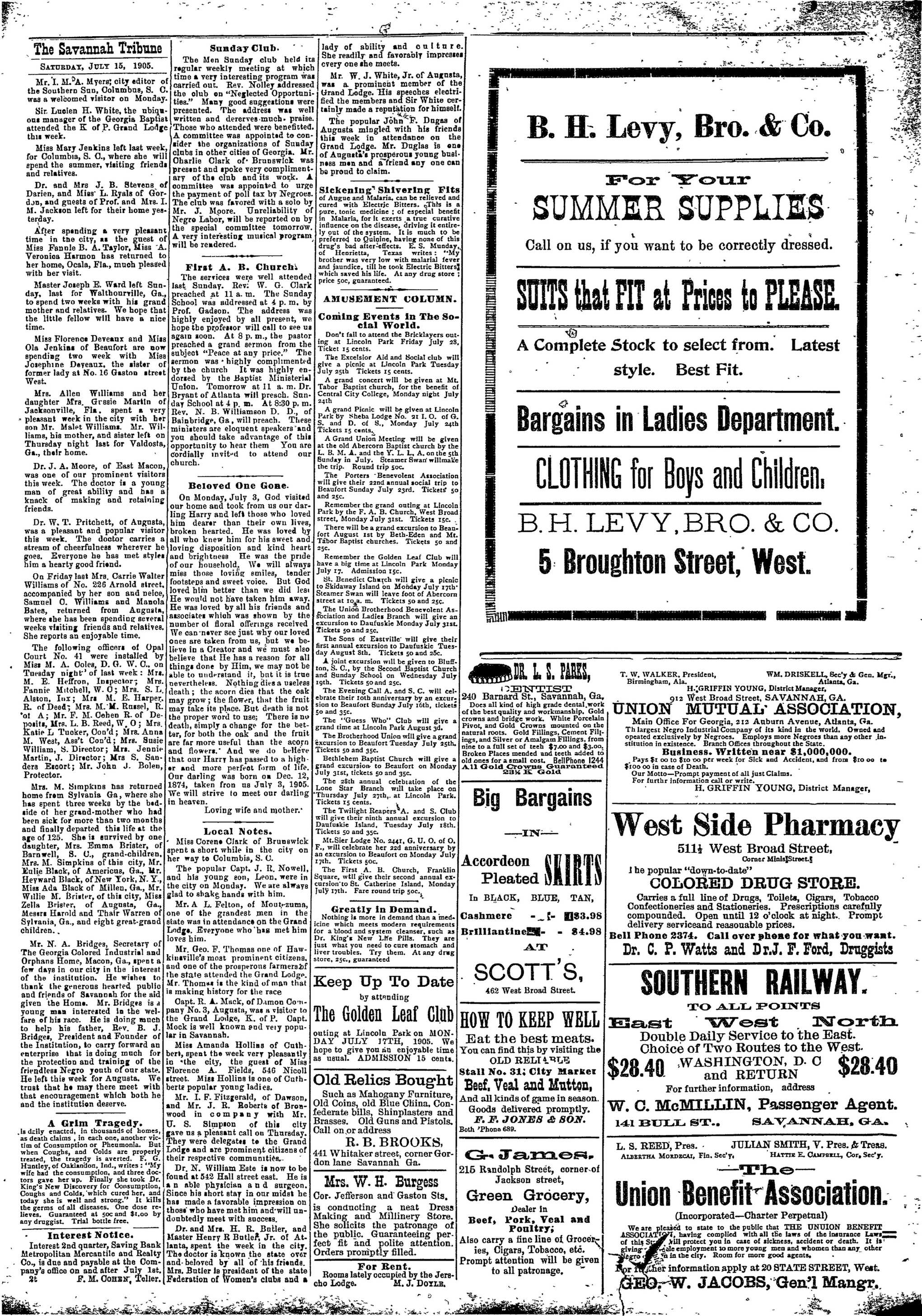
‘The Savannah Tribune
Saturpay, Juty 15, 1905.
ous manager of the Georgia baptist
attended the K of P. Grand Lodge
this week.
Miss Mary Jenkins left last week
for Columbia, 3. O., where she will
apend the summer, visiting friends
and relatives. fi
Dr. and Mrs J. B. Stevens of
Darien, and Miss’ L. Ryals of Gor-
don, and guests of Prof. and Mrs. I
M. Jackson left for their home yes-
terday.
After spending a very pleasant
time in the city, as the guest of
Mies Fannle B. A. Taylor, Miss “A.
Veroniea Hermon has returned to
her home, Ocala, Fla., much pleased
with her visit.
Master Joseph E. Ward left Sun-
day, last for Walthourville, Ga,
to spend two weeks with his grand
mother and relatives. We hope that
the little fellow will have a nice
time.
Miss Florence Deveanx and Mias
Ola Jenkias of Beaufort are now
spending two week with Miss
osephine Deyeaux, the sister of
former lady at No. 16 Gaston atreet
West.
Mrs. Allen Williams and her
daughter Mrs. Grssie Martin of
Jacksonville, Fla, spent a very
pleasant week in the city with her
son Mr. Malet Williams. Mr. Wil-
liama, his mother, and sister left on
Thursday night last for Valdosta,
Gs., thelr home. .
Dr. J. A, Moore, of East Macon,
was one of our prominent visitors
this week. The doctor ia a young
man of great ability and bas a
knack of making and retaining
friends.
Dr. W. T. Pritchett, of Augusta,
was a pleasant and popular visitor
this week. The doctor carries a
stream of cheerfulness wherever he
goes, Everyone he has met styles
him a hearty good friend.
On Friday last Mra, Carrie Walter
Williams of No. 226 Arnold atreet,
accompanied by her gon and nelce,
Samuel O. Williams and Manola
Bates, returned from Auguste,
where she has been spending several
weeks visiting friends and relatives,
She reports an enjoyable time. |
The following officera of Opal
Court No. 41 were installed by
Miss M. A. Ooles, D. G. W.C., on
Tneaday night” of last week: Mra,
M. E. Heffron, Inepector; Mrs.
Fannie Mitchell, W. 0; Mra. S. L,
Alston, Iux; Mra M. 5. Harper.
R. of Deed; Mra. M.'M. Russel, R.
“ot A; Mr. F. M. Cohen R. of ‘De-
osits, Mrs. L. B. Reed, W,O; Mrs.
Katie L Tuoker, Oon’d; Mra Anna
M. West, Ass’t Con’d; Mra. Susie
William, S. Director; Mrs. Jennie
Martin, J. Director; Mrs S. San-
dera Esoort; Mr. John J. Bolen,
Protector.
Mrs. M. Simpkins has returned
home frem Sylvania Ga, where she
hag spent three weeke by the bed-
side ot her grand-mother who had
been sick for more than two months
and finally departed this life at the
age of 125. She is survived by one
daughter, Mrs. Emma Brister, of
Barnwell, 8. U., grand-children,
Mra. M. Simpkins of this city, Mr.
Eulie Black, of Americus, Ga, Mr.
Heyward Black, of New York, N. Y.,
Miss Ada Black of Millen, Ga., Mr.
Willie M. Brister, of this city, Mies
Zella Brister, of Augusta, Ga.,
Mesere Harold and Thair Warren of
Sylvania, Ga., and eight great-grand
children. |
Mr. N. A. Bridges, Secretary of|
The Georgia Colored Industrial and
Orphans Home, Bacon, Ga., spent a
few days in our city in the interest
of the institution, He wishes to
thank the generous hearted public
and friends of Savannah for the aid
given the Home. Mr. Bridges isa
young man interested in the wel-
fare of his race. He is doing much
to help his father, Rev. B. J.
Bridges, President and Founder of
the Institution, to carry forward an
enterprise that is doing much for
the protection and training of the
friendless Negro youth of our state.
He left thie week for Auguste, We
trust that he may there meet with
that encouragement which both he
A Grim Tragedy.
sdcily enacted, in thousands of homes,
as death claims , in each one, another vic-
tim of Consumption or Pheumonia. But
when Coughs, and Colds are properl:
treated, the tragedy is averted. F. c
Huntley, of Oaklandon, Ind., writes : “My
wife had’ the consumption, and three doc:
tors gave herup. Finally she took Dr.
King’s New Discovery for Consumption,
Coughs and Colds, which cured her, and
today sheis well and strong.” It kills
the germs of all diseases. One dose re-
lieves, Guaranteed at socand $1.00 by
aay druggist, Trial bottle free.
e Interest Notice.
Interest 2nd quarter, Saving Bank
Metropolitan Mercantile and Realty
Co., ia due and payable at the Com-
pany’s office on and after Solr Ast.
Qt FB. M. Oonzew. Teller.
Sunday Club. ~~
The Men Sunday club held ita
regular weekly meeting at which
time a very interesting program was
carried out. Rey. Nolley addressed
‘the olub on “(Neglected Opportuni-
ties.” Many good suggestions were
presented. The address was well
written and dererves-much- praise.
‘Those who attended were benefitted.
e committee was appointed to con-
sider the organizations of Sunday
clubs in other cities of Georgia. Mr.
Oharlie Clark of: Brunswick was
present and spoke very compliment-
ary ofthe club andits work. A
committee was appointed to urge
the payment of poll tax by Negroes.
The club was favored with a solo by
Mr. J. Moore. Unreliability of
Negro Labor, will be reported on by
the special committee tomorrow.
A very interesting musical program
will be remdered. 1
First A. RB. Churchis
The services were well attended
last, Sunday. Rev: W. G. Clark
preached at lla.m. The Sunday
School was addressed at 4 p.m, by
Prof. Gadeon. The address was
highly enjoyed by all present, we
hope the professor will cal] to see us
again soon. At 8 p.m., the pastor
preached a grand sermon from the
gubject “Peace at any price.” The
sermon was * highly complimented
bythe church It was highly en-
dorsed by the Baptist Ministerial
Union. Tomorrow at 11 a.m. Dr.
Bryant of Atlanta will preach. Sun-
day School at4 p.m. At 8:30 p,m.
Rev. N. B. Williamson D. D., of
Bainbridge, Ga, will preach. These
ministers are eloquent speakers “and
you should take advantage of this
opportunity to hear them You are
cordially invited to attend our
church. :
Beloved One Gone.
On Monday, July 3, God visited
our home and took from us our dar.
ling Harry and left those who loved
him dearer than their own lives,
broken hearted. He was loved by
all who knew him for his sweet and
loving disposition and kind heart
and brightness He was the pride
of our household, We will always
mies those loving emiles, tender
footsteps and sweet voice. But God
loved him better than we did les
He wou!d not Have taken him away,
He was loved by all his friends and
associates which was shown by the
number of floral offerings received
We oan-never see just why our loved
ones are taken from us, but we be-
lieve in a Creator and we must also
believe that He has a reason for all
things done by Him, we may not be
able to understand it, but it is trae
‘vevertheless. Nothing dies.a useless
death; the acorn dies that the oak
may grow ; the flower, that the fruit
may take its place. But death is not
the proper word to use; There is nv
death, simply a change for the bet-
ter, for both the oak and the fruit
are far more useful than the acorn
and flowers.” And we do belleve
that our Harry has passed to a high-
er and more perfect form of life.
Our darling was born om Dec. 12,
1874, taken fron us July 3, 1905.
We will strive to meet our darling
in heaven.
Loving wife and mother.*
Local Notes.
* Miss Corene Clark of Brunswick
spent a short while in the city or
her way to Columbia, S. C.
The popular Capt. J. R, Nowell
and his young eon, Leon, were in
the city on Monday. We are alway:
glad to shake hands with him.
Mr.A L, Felton, of Mout-zumga.
one of the grandest men in the
state was in attendance on the Grand
Lodge. Everyone whohas met him
loves him.
Mr, Geo. F. Thomas one of Haw-
kKinaville’s most prominent citizens,
jand one of the prosperous farmerspf
‘the state attended the Grand Lodge.
Mr. Thomes is the kind of man that
is making history for the race
- Oapt. R. A. Mack, of Damon Con-
pany No.3, Augusta, was a visitor to
the Grand Lodge, K. of P, Oapt.
Mock ia well known end very popu-
lar in Savannah.
Mise Amanda Hollins of Cuth-
bert, spent the week very pleasantly
in ‘the city, the guest of Miss
Florence A. Fields, 546 Nicoll
street. Mise Holling is one of Cuth-
berte popular young ladies,
Mr. I. B. Fitzgerald, of Dawson,
and Mr. J. R. Boberts of Bron-
wood in company with Mr,
U. S. Simpson of this city
gare us a pleasant call on Thursday.
hey were delegates te the Grand
Lodge and are prominent citizens of
their respective communitiés.-
Dr, N. William Este ia now to be
found at 542 Hall street east. He is
an able physician and surgeon.
Since his short stay in our midst he
has made a favorable impression on
those who have met him and-will un-
doubtedly meet with success.
Dr. and Mra. H. R. Batler, and
Master Henry R Butlef, Jr. of At-
Janta, spent the week in the city.
The doctor is known the state over
and-beloved by all of “his frienda.
Mrs, Butler la President of the state
Federation of Women’s clubs and a
lady of sbitity and culture.
She readily and favorably impresses
every one she meets.
Mr W. J. White, Jr. of Augusta,
was a prominent member of the
Grand Lodge. His speeches eleatri-
fied the members and Sir White cer-
tainly made a reputation for himself.
The popular John -F. Dugas of
Augusta mingled with his friends
this week in attendance on the
Grand Lodge. Mr. Duglas is ene
of Anugarta’s prospérous young buei-
‘ness men and & friend sny one can
be proud to claim.
Sickening’ Shivering Fits
of Augue and Malaria, can be relieved and
cured with Electric Bitters. (This is a
pure, tonic medicine ; of especial benefit
in Malaria, for It exerts a truc curative
influence on the discase, driving it entire-
ly out of the system. Itis much to be
Preferred to Quinine, having none of this
drug’s bad after-effects. E.S. Munday,
of Henrietta, Texas writes: ‘My
brother was very low with malarial fever
and jaundice, till he tonk Electric Bitters]
which saved his life. At any drug store ;
price soc, guaranteed.
AMUSEMENT COLUMN.
Coming Events in The So-
elal World.
Don’t fail to attend the Bricklayers out:
ing at Lincoln Park Friday July 28
Ticket 15 cents.
The Excelsior Aid and Social club will
give a pienic at Lincoln Park Tuesday
July asth Tickets 15 cents.
‘A grand concert will be given at Mt.
Tabor Baptist church, for the benefit o:
Central City College, Monday night July
2gth
‘A grand Picnic will be given at Lincolr
Park By Sheba Lodge No. 21 I. 0. of G.
S. and D. of 8, Monday July 24th
Tickets 15 cents,
A Grand Union Meeting will be giver
at the old Abercorn Baptist church by the
L. B, M, A. and the Y. L. L, A. onthe sth
Sunday in July. Steamer Swai willmake
the trip. Round trip soc.
The Porters ~Benevolent Association
will give their 22nd annual social trip to
Beaufort Sunday July 23rd. Ticket? 50
and 25c.
Remember the grand outing at Lincoln
Park by the F. A. B. Church, West Broad
street, Monday July gist. Tickets r5c. .
‘There will be a grand excursion to Bean-
fort August 1st by Beth-Eden and Me.
Tabor Baptist churches. Tickets so and
25¢.
Remember the Golden Leaf Club will
have a big time at Lincoln Park Monday
July 17. Admission 15c.
St. Benedict Church will give a picnic
to Skidaway Island on Monday July 17th’
Steamer Swan will leave foot of Abercorn
street at roa. m. Tickets 50 and 2sc.
‘The Union Brotherhood Benevolent As-
Seciation and Ladies Branch will give an
excursion to Daufuskie Monday July 3rst.
Tickets so and 25c,
The Sons of Eastville’ will give their
first annual excursion to Daufuskie Tues-
day August 8th, Tickets so and 25c.
A joint excursion will be given to Bluft-
ton, S.C., by the Second Baptist Church
and Sunday School on Wednesday July
igth. Tickets soand 2sc.
The Evening Call A. and S.C. will cel-
ebrate their roth anniversary by an excur-
sion to Beaufort Sunday July 16th, tickets
go and 35c.
The ‘Guess Who" Club will give a
grand time at Lincoln Park August 3.
The Brotherhood Union will give agrand
€xcursion to Beaufort Tuesday July 2sth,
Tickets so and 35c.
Bethlehem Baptist Church will give a
grand excursion to Beaufort on Monday
July grst, tickets 50 and 35¢.
The 28th annual celebration of the
Lone Star Branch will take place on
‘Thursday July 27th, at Lincoln Park.
Tickets 15 cents. ‘
The Twilight Reapers*A. and S. Club
Will give their ninth annual excursion to
Daufuskie Island, Tuesday July 18th.
Tickets 50 and 35¢.
|, Mt.Sier Lodge No, 2441, G. U. O. of O.
F,, will celebrate her 22d ‘anniversary by
an excursion to Beaufort on Monday July
r7th. Tickets soc,
The First A. B. Church, Franklio
Square, wtil give their second ‘annual ex-
cursion‘to St. Catherine Island, Monday
Jul¥ 17th. Fare round trip soc.,
Greatly in Demand._
Nothing is more in demand than a med
icine which meets modern requirements
for a blood and system cleanser, such as
Dr. King’s New Lie Pills. They are
just what you need to cure stomach and
liver troubles, Try them, Atany drug
store, 25¢, guaranteed
Keep Up To Date
by attending
outing at Lincoln Parkon MON-
DAY JULY 17TH, 1905. We
hope to give you sin enjoyable time
as usual. ADMISSION 15 cents.
Old Relics Bought
Such as Mahogany Furniture,
Old Coins, old Blue China, Con-
federate bills, Shinplasters and
Brasses. Old Guns and Pistols,
Call on or address
R. B. BROOKS,
441 Whitaker street, corner Gor-
don lane Savannah Ga.
Mrs. W. H. Burgess
Cor. Jefferson and Gaston Sts,
is conducting a neat Dress
Malcing and Millinery Store.
She solicits the patronage of
the public. Guaranteeing per-
fect fit and Polite attention.
Orders proniptly filled.
For Rent.
Rooms lately occupied by the Jers-
cho Lodge. M. J. Dorre.
| B. HE Levy, Bro. & Co. |
| For arene |
- SUMMER SUPPLIES:
SUITS that FIT at Prices to PLEASE.
| A Complete Stock to select a, Latest |
| . -° style. Best Fit. .
Bargains in Ladies Department.
CLOTHING for Boys and Children,
B.H. LEVY,BRO. & CO.
| 5: Broughton Sireet, West.
iam ——
ARYL. §, PARES,
T..W, WALKER, President, WM, DRISKELL, Bec'y & Gen. Mgr.,
‘Birmingham, Ala. Atlanta, Ga.
H.{GRIFFIN YOUNG, District Manager,
- 912 West Broad Street, SAVANNAH, GA.
UNION MUTUAL’ ASSOCIATION,
Main Office For Georgia, 212 Auburn Avenue, Atlanta, Ga.
Th largest Negro Industrial Company of its kind in the world, Owned and
opeated exclusively by Negroes. Employs more Negroes than any other in.
stitution in existence. Branch Offices throughout the State.
Business. Written near $1,000,000.
. Pays $r 00 to $10 v0 per week for Sick and Accident, and from $1000 te
$100 00 in case of Death. 7 F
‘Our Motto—Prompt payment of all just Claims.
For furthr information call or write.
8 H, GRIFFIN YOUNG, District Manager,
SSN Toany7n
240 Barnard St., Savannah, Ga,
Does all kind of high grade dental work
of the best quality and workmanship, Gold
crowns and bridge work, White Porcelain
Pivot, and Gold Crowns mounted on the
natural roots. Gold Fillings, Cement Filj-
ings, and Silver or Amalgam Fillings, from
nine to a full set of teeh $7.00 and $3.00,
Broken paces ere pod tee added to
old ones for a small cost,
Mi Sala Crowne: oe etons ae
23% EK Gola
Big Bargains
—IN— ‘
Accordeon NAN
Pleated
In BLACK, BLUE, TAN,
Cashmere -_f- 9183.98
BrilliantineE- = $4.98
AT :
’
. SCOTT §S,
462 Weat Broad Street.
West Side Pharmacy
5114 West Broad Street, .
Corner Minis[Street.£
She popular ‘down-to-date”
COLORED DRUG STORE.
Carries a fall line of Drugs, Toilets, Cigars, Tobacco
Confectioneries and Stationeries. Prescriptions carefully
compounded. Open until 12 o’clock at night.. Prompt
delivery serviceand reasouable prices.
Bell Phone 2374. Call over phone for what you-want.
Dr. C. P, Watts and DrJ. F. Ford, Druggists
SOUTHERN RAILWAY. |
TO ALL POINTS
Bast West Worth
Double Daily Service to the Hast.
Choice of Two Routes to the West.
WASHINGTON, D. C ;
$28.40 and RETURN $28.40
: For farther information, address _
W. C. McMILLIN, Passenger Agent.
141 BULL ST.. SAVANNAH, GA.
Eat the best meats.
You can find this by visiting the
OLD RELI43L5
Stall No. 31; City Marker
Beef, Veal and Mutton,
And all kinds of game in season.
Goods delivered promptly.
F. F. JONES & SON.
Both ’Phono 689.
L. 8. REED, Pres. - JULIAN SMITH, V. Pres. & Treas.
ALBERTHA MoxDEcAt, Fin, Sec’ys Harrie E. Qasrrorit, Cor, Sec’y.
—rhe—
2 fi . A 5 2 .
Union Benefit-Association.
(Incorporated—Charter Perpetual)
Weare pie ta state to the public that THE UNUION BENEFIT
ASSOCIA’ , having complied with all the laws of the insurance Laws
of this Stag will protect you in case of sickness, accident or death. It is”
giving -M-dale employment io more young men and whomen than any_ other
ro ¢ ya in the city. Room for more good agents, :
Ir gher information apply at 20 STATE STREET, West.
; 7 W. JACOBS, ’Gen’?l Mangr,.
—s ~ t ae
G. Jamen,
215 Randolph Streét, corner-of
Jackson street,
Green Grocery,
| Dealer in
Beef, Pork, Veal and
: Poultry;
Also carry a fine line of Grocer:
| ies, Cigars, Tobacco, eté.
Prompt attention will be given
| to all patronage, =~
Lydia E. Pinkham's Vegetable Compound Has an Unique Record of Cures—Mrs. Pinkham's Advice Is Confidential, Free, and always Helpful
First—That almost every operation in our hospitals performed upon women becomes necessary through neglect of such symptoms, backaches, irregular and painful menstruation, leucorrhoea, displacements of the uterus, pain in the side, burning sensation in the stomach, bearing-down pains, nervousness, dizziness and sleeplessness.
Second—The medicines that holds the record for the largest number of absolute cures of female ilis is Lydia E. Pinkham's Vegetable Compound. It regulates, strengthens, and cures diseases of the female organism as nothing else can.
For thirty years it has been helping women to be strong, curing backache, nervousness, kidney troubles, all uterine and ovarian inflammation, weakness and displacements, regulating menstruation perfectly and overcoming its pains. It has also proved itself inable in preparing for childbirth and the change of life.
THIRD.—The great volume of unsolicited and grateful testimonials on file at the Pinkham Laboratory at Lynn, Mass., many of which are from time to time published by permission, give absolute evidence of the value of Lydia E. Pinkham's Vegetable Compound and Mrs. Pinkham's advice.
FOURTH.—Every ailing woman in the United States is asked to accept the following invitation. It is free, will bring you health and may save your life.
Mrs. Pinkham's Standing Invitation to Women.—Women suffering from any form of female weakness are invited to promptly communicate with Mrs. Pinkham, at Lynn, Mass. All letters are received, opened, read and answered by women only. From symptoms given, your trouble may be located and the quickest and surest way of recovery advised. Out of the vast volume of experience in treating female ill Mrs. Pinkham probably has the very knowledge that will help your case. Surely, any woman, rich or poor, is very foolish if she does not take advantage of this generous offer of assistance.
FOR THE LIVER AND BOWELS
Nothing can equal MOZLEY'S LEMON FLUXIR. It promptly causes constipation, biliary indigestion, your stomach, and all derangements of the stomach and bowels. See a bottle at all drug stores.
ATE EVIDENCE AGAINST HIM
Prisoner Stops Trial by Chewing and Swallowing a Forged Check.
The Kings county court was thrown into disorder and dismay, says a Seattle special to the St. Louis Post-Dispatch, when the prisoner at the bar, H. B. McTavish, at all the evidence in the case on trial. McTavish was being tried on a charge of forging a $15 check. The check lay on the trial table, marked "exhibit A." McTavish sat beside his counsel, who was engaged in cross-examining a witness for the prosecution.
The case was going against McTavish when his eye fell on the check, which was about to be introduced in evidence. Like a half-starved man and with a look of hunger in his eye, the prisoner pounced upon "exhibit A" and chewed it to pulp.
With soulful satisfaction he gulped it down. The prosecution was in consternation, for its main piece of evidence was gone, and demanded that a stomach pump be used forthwith. While the lawyers argued pro and con, the prisoner calmly picked his teeth with a whittied match, plainly the master of the situation. The defense argued that the ball of paper in the Defendant's stomach could in no wise be construed as documentary evidence, and that a dismissal was proper.
The case of the state of Washington against H. R. McTavish is now in statu quo pending the unantling of the legal question involved from the defendant's impromptu luncheon.
WANTED TO SLEEP
A minister speaks of the curious effect of Grape-Nuts food on him and how it has relieved him.
"You will doubtless understand how the suffering with indigestion with which I used to be troubled made my work an almost unendurable burden, and why it was that after my Sabbath duties had been performed, sleep was a stranger to my pillow till nearly daylight.
"I had to be very careful as to what I ate, and even with all my care I experienced poignant physical distress after meals, and my food never satisfied me.
"Six months have elapsed since I began to use Grape-Nuts food, and the benefits I have derived from it are very definite. I no longer suffer from indigestion, and I began to improve from the time Grape-Nuts appeared on our table. I find that by eating a dish of it after my Sabbath work is done (and I always do so now) my nerves are quieted and rest and refreshing sleep are insured me. I feel that I could not possibly do without Grape-Nuts food, now that I know its value. It is invariably on our table—we feel that we need it to complete the meal—and our children will eat Grape-Nuts when they cannot be pergued to touch anything else." Name given by Postum Co. Battle Creek, Mich.
"There's a reason.
Read the famous little book, 'The Read to Wellville,' in each pkg.
Intelligence Apparent In These Tiny Busy Insects.
The female hornet has a rapid-fire armament with a recoverable projectile. It uses it for both attack and defence, and with remarkable aim and efficiency. The first stroke of a hornet is penetrating as an electric shock. At the base of its sharp sting there is a sac containing poison, which, when injected into the substance of its enemy, causes pain, swelling and discomfort, facts to which most persons are able to testify by experience. Should the injection be upon the end of the thumb or pose, or upon the tongue, there is danger from it. Strong ammonia applied to the wound is the best antidote. Yet the hornet when treated politely and with gentle ceremony is as docile as a butterfly, says a writer in Farm and Fireside. In the mountains of West Virginia I had a wire fly trap, which by the seductive influence of molasses, persuaded the house files infesting my stave-built office to enter. Once within, they remained incarcerated until hot water cured. For several days a persistent black and white striped hornet amused me by its futile endeavors to seize files from the buzzing horde of prisoners. At last it found its way in, and, to my astonishment, after capturing a fly, found its way out. It had remembered the way of its entrance even in the excitement of the chase. The did not paralyze its prey, as does the mud wasap and other species. It did not stop to eat a single fly, so far as my observation extended. It had a victualing job on hand, and attended faithfully to it. Such selfishness excited admiration. During one of its absences I placed my hand over the trap entrance, and upon it laid a piece of ripe peach. Upon the hornet's return it lit upon my hand and ran confusedly over it, yet soon tried, to get under the covering fingers. Failing, it went to the peach and took a hearty meal. While it was eating I quietly moved my hand from the opening. After preening itself the hornet entered and continued its fly raid. After many dozens of trips it brought a comrade with it, and personally conducted it into the fly pound. Thereafter they always worked together. To be sure of this, by slow approaches of an affectionate finger I was enabled to stroke them while lunching. I marked them both with a spot of red ink. Many continued experiences convinced me that hornets work in pairs, lilie detectives. Several other hornets from the same nest visited the cage, tried to enter it, but found the problem too much for them. In no instance did the pair offer these instructions or pay any attention to them. They all partook of my lunches freely and in harmony. But the favorite pair guarded the secret. Were they selfish? Did they receive special plaudits at the home nest for their phenomenal success in fly capture? Or were they simply governed by hornet manners?
I grew fond of these winged warriors. I introduced them to my several fingers by placing tempting sweets upon them. They learned to come to me and after they had emptied the trap of prisoners, and gradually became companionable. Following the direction of their home flight, and noting the range of trees, their nest was easily found. It hung on the end of a branch of mountain rhododendron. The glossy, green leaves overhanging it were undisturbed in their position, but were so built into the outer layer of papier-mache covering as to give the best natural concealment. Whether this was intentional or not, or whether the leaves simply became an obstruction as the nest was increased in size by dismantling the inside and building upon the outside, I do not know, but the evidence was in favor of the engineering, reason, intention, rather than accident. Hornets were the first users of wood pulp for paper manufacture. They make it from wood and leaf fibre, and there are both forethought and economy in tearing out the insides of their nests to make room for larger tiers of cells in which to raise their young, and in using the material to enlarge the nursery.
King Edward's Comb.
When King Edward made his famous Indian tour as Prince* of Wales the rajahs vied with each other in laying the choicest productions of their native arts at his feet. One of the most interesting specimens he brought home was a haircomb of ruby and emerald Jeypore enamel, pointed in gold, and surmounted by a curved row of large pearls, each pearl topped with a green glass bead. Superb in design, it is one of the finest pieces of Indian jewelry made in modern times—but one marvels to see a ordinary glass set with gems of such price. No one has given a satisfactory explanation of this. I think it is because the artist worked solely for color and was disdainful of value. The glass happened to give the tone desired, better than the emerald, so he took it. Not a question of economy, of affording real stones or not, as the occasion was one of lavish expenditure and he could have what he wanted. The motif of his eye-poem was pearls, the producer wished all else to be subordinate, and green beads to give simply a minor note.—Everybody's Magazine.
Tommy Asks.
Tommy Figgjam (on his first trip to New York harbor)—Paw, what are those big boats out there?
Paw Figgjam—Those are the Standard Oil company's vessels outward bound for Europe.
Tommy Figgjam—Say, Paw, is a trip like that what the Blue means by "sailin" of "a cruise of or a Baltimore American.
Plantation Chill Cure is Guaranteed.
Mr. Newedd—"Well, we are begin-
ning housekeeping, and I presume the
simplest plan will be for me to give
you a regular amount every week for
expenses. Just figure up what it will
cost."
Mrs. Newedd—"I could never do
that in the world—so many things
to count, you know; but let—me—see.
Oh, I have it! I have thought of a
much simpler plan."
"All right, my angel! What is it?"
"You figure up what it will cost you
for tobacco, tram fares, and lunches,
and give me the rest."
Huntrures of Indians Want Work.
John R. Breauan, Indian agent at Pine Ridge agency, has sent a circus lar broadcast over the Western country, stating that he has at his disposal 800 able bodied Ogallala Sloux Indians who want employment for the season. He calls the attention of contractors to the fact that these men are good workers. They will work at railroad grading, ditch digging, sheep herdling or ranching.
FITSpermanently aured. Nofts or nervousness after first day's use of Dr. Kline's Great Nerve Restorer, $2trial bottle treatise $20 Dr. R. H. KLISZ, Ltd., 931 Arch St., Phila., Pa.
The flag of Austria-Hungary was adopted March 6, 1869.
Use Allen's Foot-Ease.
It is the only cure for Swollen, Smintling, Tired, Aching, Hot, Swearing Feet, Corns and Bunions. Ask for Allen's Foot-Ease, a powder to be skinned into the shoes. Cures while you2. Don't accept any substitute. Sample sent FREX, Address, Allen N. Olmsted, Lotoy, N.Y.
The tricolor of France dates from the revolution of 1780.
Mrs. Winslow's Soothing Syrup for Children teething, soften the gums, reduces inflammation, allays pain, cures wounds, 255 m. bottle
Walter Rothschild has a zebra which he has broken to harrow.
Fiso's Cure cannot be too highly spoken 'p'sa cough cura—J, W. O'Barrs, 222 Third Avenue, N., Minnesota, Minn., Jan. 6, 1933.
The oldest flag in existence is that of Denmark.
The Oldest Nurse in Georgia.
Mrs. S. K. Kennedy, one of the oldest and best known nurses in Georgia, states that in all her expertise with bowel troubles, she has been able to help Hukilberry Corchal is the best remedy.
Sold by all Druggists, 25 and 60s, bottle
Charity covers a multitude of sins, but it doesn't remove them.
New York Lady Proves That Every Woman May Have 14 by Using Cuticura Soap.
Mrs. R. Reichenburg, wife of the well-known jeweler, of 146 Fulton St., New York, says: "I had a friend who was justly proud of her completion." When asked what gave her such a brilliant and lovely complexion, she replied, "A healthy woman can be sure of a fine skin if she will do as I do, use plenty of Cuticura Soap and water." She insisted that I follow her example, which I did with speedy conviction. I find that Cuticura Soap keeps the skin soft, white and clear, and prevents redness and roughness."
Carl Beers, of Langen, Mr. runs a worm farm. He raises them for bat
Cures Blood Follies, Cancer, Dicers.
If you have offensive pimples or eruptions, ulcers on any part of the body, aching bones, or fullness in the feet, patches, swollen glands, skin itches and bursa, sore lip or gume, eating, festering sores, sharp, grazing pains, then you suffer from serious blood poison or the beginnings of deadly cancer. You may be permanently cured by taking Botanie Blood Balm (I.D. B.) and, especially to cure the sores, sore lips or ulcers, even deadly cancer, stops all aches and pains and reduces all swellings. Botanie Blood Balm cures all malignant blood troubles, such as eczema, scabs and scabs, pimples, running sores, carbuncles, scrofa. Draggings, $1 per large bottle, 3 bottles, $2.50, 6 bottles, $3, express, prepaid. This is the cure of Blood Balm to free and prepay by writing Blood Balm Co., Atlanta, Ga. Describe trouble and free medical advice sent in sealed letter.
Count Cassini, the Russian Ambassador, wears a single eyeglass.
Ever Trud This Way?
It is a well-known fact that even the best of housekeepers cannot make really good coffee without having the proper materials.
They will NEVER make it with coffee of doubtful origin, adulterated, queerly blended, and possibly dirty coffee that has, perhaps, been mixed up with all kinds of coffee. Int let them take a package of LION COFFEE—the purest and cleanest—and the brand universally used throughout the United States for over twenty-five years. Millions of it is made in the five ways. Try it once and you will never want to try any other brand of coffee.
HOW TO MAKE GOOD COFFEE.
Use LION COFFEE, because to get best results you must use the best coffee.
Grind you LION COTTEN; rather fine
Use a "tablespoonful to each cup" and one
extra for the pot." First mix it with a
little cold water, enough to make a thick
paste, and add white of an egg (if egg is
to be used as a settler), then follow one of
the following rules:
1st - With boiling water - Add boiling
water, and let it boil three minutes only
little cold water and set aside five
minutes.
2nd - With cold water - Add four cold
water to the paste and bring it to a boil.
Then set aside, add a little cold water, and
in five minutes it's ready to serve.
THREE DON'TS.
Don't let it stand more than ten minutes before serving.
Don't use water that has been boiled before.
TWO WAYS TO SETTLE COFFEE.
1st-With eggs—Use part of the white of an egg, mixing it with the ground LION COFFEE before boiling.
2nd-With cold water instead of eggs. Add a tablespoon of cold water and set aside for eight or ten minutes, then serve through a strainer.
FOR WOMEN
Amigo
$2.50
A Shoe Which is the STYLISH WOMAN'S Favorite.
It Must Be Worn to Be Appreciated.
INSIST UPON HAVING IT.
IT'S A MONEY SAVER. IT'S AN "ALWAYS JUST
CORRECT" CLOVER BRAND SHOE.
Wertheimer-Swarts Shoe Co.
LARGEST FINE SHOE EXCLUSIVISTS
ST. LOUIS, U. B. A.
Say Plainly to Your Grocer
That you want LION COFFEE always, and he, being a square man, will not try to sell you anything else. You may not care for our opinion, but
SOLD BY GROCERS EVERYWHERE
WINCHESTER
"LEADER" AND "REPEATER" SHOTGUN SHELLS Carefully inspected shells, the best of powder, shot and wadding, loaded by machines which give invariable results account for the superiority of Winchester "Leader" and "Repeater" Factory Loaded Smokeless Powder Shells. Reliability, velocity, pattern and penetration are determined by scientific apparatus and practical experiments. They are THE SHELLS THE CHAMPIONS SHOOT
LION
WIN
"LEADER" AND
Carefully inspect
shot and wadd
give invariable
ity of Winches
Factory Loade
Reliability, ve
are determi
and practical
THE SHELLS
Checkers
TULANE UNIVERSITY OF LOUIBIANA.
Its advantages for practical instruction, both in the classroom and in the laboratory, are unequaled. Free access is given to the great Charity Hospital with 900 beds and 1000 beds of medical equipment given daily at the bedside of the sick. The UJUG. For catalogue and information addresses
PROF, M. E. CHAILLE, M. D., Dean,
P. O. Drawer 261. NEW ORLEANS, LA.
LOOKING FORWARD.
By some future railway genius
The records will all be broke.
He'll invent a noiseless whistle
And discover smell-less smoke.
—Washington Star.
CONSTANT ACHING.
Back aches all the time. Spoils your appetite, wearles the body, worries the mind. Kidnaps cause it all and Doan's Kidney Pillsrelieve and cure it.
Ane While You Are
II. B. McCarrer,
of 201 Cherry St.
Portland, Ore., inspector of freight
for the Trans-Continental Co., says:
"I used Doan's Kidney Pills for back
ache and other symptoms of kidney
trouble which had annoyed me for
months. I think a cold was responsible
for the whole
trouble. It seemed to settle in my kidneys. Doan's Kidney Pills rooted it out. It is several months since I used them, and up to date there has been no recurrence of the trouble."
Doan's Kidney Pills are for sale by all dealers price 50 cents per box. Foster-Milburn Co., Buffalo. N. Y.
ONE WOMAN'S WORK.
He—"Do you read all the popular novels of the day?"
She—Gracious, no! I have just time to so how they end."—Puck.
Confidence of the People and ever increasing popularity? LION COFFEE is carefully selected at the plantation, shipped direct to our various factories, where it is seldily roasted and carefully packed in scaled packages--unlike loose coffee, which is exposed to germs, dust, insects, etc. LION COFFEE reaches you as pure and clean as when it left the factory. Sold only in 1 lb. packages.
on every package.
needs for valuable premiums.
CHESTER EVERYWHERE
WOOLSON SPICE CO., Toledo, Ohio.
"REPEATER" SHOTGUN SHELLS
detected shells, the best of powder,
ing, loaded by machines which
results account for the superior-
ster "Leader" and "Repeater"
red Smokeless Powder Shells.
locity, pattern and penetration
ed by scientific apparatus
experiments. They are
THE CHAMPIONS SHOOT
—if you have been told you cannot live—
that your disease is incurable—do not despair! Buy a large $1 bottle of Checkers
and watch the result. Sample bottle free,
write to-day—you'll forget it to-morrow.
COTTON GINS
GANTT'S NOISELESS GEARED GINS
Completely does away with the brush belt and
pullers. This means satisfaction. Time and
money saved to you in gluing cotton.
Practically No Wear-Out to It.
We guarantee satisfaction. Write for prices
and illustrated catalogue.
GANTT MFG. CO., Macon, Ga.
PAXTINE
TOILET
ANTISEPTIC
FOR WOMEN
troubled with jills peculiar to
them. Thoroughly cleans, kills disease germs,
stops discharges, heals inflammation and local
oerness, cure leucorhea and nasal catarrh.
Particle is in powder form to be dissolved in pure
chemical and economical than liquid antiseptics for all
THE DAISY FLY KILLER destroys all the flies and every combo in home-in-place, room-in-place and all places where flies are trouble-prone. Quail, pigeon, chicken and will not soil or harm them. They then once and you will never be without them for 20c. HAROLD SOMAN. 149 DeKalb Ave. Brooklyn, X. X.
Bruin&Shotton
Business. Shorthand and Tele-
graphy College. Louisville, Ky. open the whole year. Students can enter any time. Catalog free.
FISCO'S CURE FOR
RUNNS WHILE ALL LES FAILS.
Best Congh Syrup. Tastes Good. Use
in-time. Sold by druggists.
CONSUMPTION
If afflicted with weak
cures, use
Thompson's Eye Water
Cure is Gua merchant, so why not try
MILLIONS OF WOMEN
USE
Cuticura
SOAP
Assisted by Cuticura Ointment,
the great Skin Cure, for preserving,
purifying, and beautifying the skin,
for cleansing the scalp of crusts,
scales, and dandruff, and the stopping
of falling hair, for softening,
whitening, and soothing red, rough,
and sore hands, for baby rashes,
itchings, and chafings, in the form
of baths for annoying irritations
and inflammations, or undue
perspiration in the form of washes for
ulcerative weaknesses, and for
many sanative, antiseptic, purposes
which readily suggest themselves,
as well as for all the purposes of
the toilet, bath, and nursery.
Sold through the website. Poster Price $10.00 Corp.
Sold through the website. Poster Price $10.00 Corp.
41 South Forsyth St., Atlanta, Ga.
Portable and Stationary
Engines, Boilers,
Saw Mills
AND ALL KINDS OF MACHINERY
Complete line Carried in stock for
IMMEDIATE DELIVERY.
Best Machinery, Lowest Prices and Best Terms
Write us for catalogue, prices,
etc., before buying.
BAD BLOOD
"I had trouble with my bowels which made my blood impure. My face was covered with pimples which had no sample and sample had remove. I tried your Cascarets and great was my joy when the pimper disappeared after treatment. I have received samples from all my friends and quite a few have found relief."
G. J. Pinch, 50 Park Ave., New York City, N. X.
Best For
The Bowels
ascarets
CANDY CATHARTIC
THEY WORK WHILE YOU SLEEP
Pleasant. Palatable. Potent. Taste Good. Do Good. No Sickness. Thicken or Gritty. 25c. 36c. Never sold in the UK. The strained GOG. Guaranteed to cure or your money back
Sterling Remedy Co., Chicago or N.Y. 600
ANNUAL SALE, TEN MILLION BOXES
BUSINESS
EDUCATION
—134— FREE
SCHOLARSHIPS
Clip this notice and present or send it to
DRAUGHON'S
PRACTICAL BUSINESS COLLEGE
ATLANTA MONTGOMERY, COLUMBIA,
KNXWXLE OR ET. WORTH
KNOWWILE OR FT. WORTH
and you will receive booklet containing
all you need to muffle spills and
that we give spray. ABSOLUTELY
FRIDE. 134 baggages to those finding
most mis-spelled words in the booklet.
Miss instructive contest ever conducted.
Booklet and business letters from
bunkers and business men giving
reasons why you should attend one of D. P.
R. C. Those who fail to get free scho-
lars will receive a free letter of cents for each mis-spelled word found. Let us tell you all about our great educational contest and our
GREAT SUMMER DISCOUNT.
OUR SPECIALTY
3 4 5
Three two dollar shirts for five dollars,
MADE TO YOUR MEASURE.
Write for samples and measurement blanks.
MODEL SHIRT CO..
Dept. S.
Indianapolis, Ind.
NEEDLES,
SHUTTLES,
REPAIRS.
FOR ALL SEWING MACHINES. Standard Goods Only. Free Catalogue to Dealer. BLOCK MFG CO. 919 St. ST. LOUIS, MO.
ranleed ? Price 50c.