Savannah Tribune
Saturday, August 12, 1905
Savannah, Georgia
Page text (machine-generated)
ENVOYS PRESENTED
Jap and Russian Peace Makers Guests of Roosevelt.
AN INFORMAL CEREMONY
President Acts Host on the Mayflower
and Presents the Commissionalers
to Each Other With
History was made in Oyster Bay Saturday.
President Roosevelt, on behalf of the United States and its people, extended formal greetings to the representatives of Russia and Japan, introduced the plenipotentiaries to one anbither, and entertained them at an elaborate luncheon at which Russians and Japanese fraternized with one another and as comrades rather than enemies.
During the luncheon President Roosevelt proposed a notable toast, in which he expressed the earnest nope and prayer, in the interest not only of these two great powers, but of all civilized mankind, that a just and lasting peace may speedily be concluded between them.
The occasion was impressive. It was attended not by pomp and ceremony, but by a simplicity and frankness characteristic of the president and the people of America. Due honor was paid the distinguished guests of the president and of the country, and they were received with all the dignity to which their exalted rank entitled them. The day was, ideal.
The handsome war yacht, Mayflower, one of the most beautiful vessels of the United States navy, on which the formal reception of the Russian and Japanese plenipotentaries took place, swung easily at anchor just at the entrance of Oyster Bay from Long Island sound.
In order that no questions of precedence should arise it was determined that the luncheon should be a buffet function. In this way was avoided the necessity of seating the envoys at table with the president. No set addresses were delivered.
Baron Komura presented to the president the twelve members of his suite.
The president then introduced the envoys to the army and naval officers present, after which, with Baron Komura and Minister Takahira, he retired to an inside cabin for a brief consultation prior to the arrival of the Russian mission.
The cruiser·Chattanooga, with the Russian envoys on board, anchored a third of a mile from the Mayflower at 1:05 p. m., and fifteen minutes later the Chattanooga's nineteen gun salute announced the departure of the Russians for the Mayflower. A few minutes afterward the form of M. Witte, Russla's chief plenlpotentiary, appeared at the starboard gangway of the Mayflower. He was followed by Baron Rosen, the Russian ambassador, and second peace envoy, and eight members of his suites. They were received precisely as the Japanese had been.
After receiving the members of the suite and presenting all in turn to his presidential guests, the president then brought the two sets of envoys together, introducing them formally to one another.
The ceremony ended, the president returned to Sagamore Hill and the envoys boarded vessels in waiting and began the journey to Portsmouth.
Three Innocent Persons Wounded Dur-
ing Wild Chase of Robbers
Four officers of the Chicago police force Saturday night sent a fusillade of shots after two robbers who had stolen goods valued at $2,500 from a baggage car standing in the yards on West Sixteenth street. The thieves escaped without their booty, but three innocent persons were shot by the officers, none seriously, however.
MANY REFUGEES IN ATLANTA.
People from Fever Stricken Sections Flock to Georgia Capital.
Refugees from New Orleans, Mobile and all coast and interior cities in the yellow fever stricken section are flying to Atlanta, and it is estimated that the hotels, lodging houses and boarding houses of the city, to say nothing of private homes, could show a total influx of not far from 2,000 people. These refugees are loud in their praises of the spirit of the city which at once opened its arms to them.
POLICE FIRE AT RANDOM.
The
BURIAL OF COL. HOWELL
All Atlanta Paid Loving Tribute to the Memory of Her Peerless Citizen and Georgia's Distinguished Son;
All Atlanta paid a loving tribute to the late Captain Evan P. Howell Tuesday morning. Hundreds of citizens in all walks of life attended the funeral at 10 o'clock and the spacious residence in Wbst End was crowded to overflowing with friends and admirers who gathered to honor the memory of the much beloved man.
The funeral service at the residence was brief and simple. Just such a service as would have appealed most strongly to Captain Howell. Rev. Bernard P. Smlth, pastor of the West End Christian church, officiated. He read a number of Captain Howell's favorite selections from the scripture and prayed in an impressive manner. In view of the beautiful tributes that have been paid the deceased in the public press there was no eulogy.
The choir sang "Asleep in Jesus," and "Lead Kindly Light." Bowed in grief, elderly men who had known Captain Howell during the entire time of his residence in Atlanta and who had associated daily with him, stood with heads bared during the ceremony. Younger men who had known him during the later years of his life, but who loved him none the less, mingled with the pioneers who had gathered to honor their comrade.
Seldom has such a representative gathering of citizens assembled to participate in the last rifles over any Atlantan. Captain Howell's friends were not confined to any one class or condition of men. He opened his generous heart to those who possessed the traits of character he loved and who were worthy of his friendship and interest.
Prominent among those present at the funeral were Governor Terrell and the state house officials, former Governor A. D. Candler, Senator A. S. Clay, scores of confederate veterans, among them Jesse Hardage, a survivor of Howell's battery; Mayor Woodward and the present city council; the former mayors of Atlanta, now living, and the city council of 1903 and 1904, which served while Captain Howell was mayor of Atlanta; the Pioneer Citizens of Atlanta, Atlanta camp 159 U. C. V., an honorary escort from the Federation of Trades, headed by President J. B. Hewitt; the entire staff of the Constitution, of which Captain Howell was editor and owner for so many years.
Herr Erich Zoepfel Quellenstein, the German consul, was present in his official capacity, and wore the regalja of his office. He was a warm personal friend of Captain Howell and wore his uniform in honor of Captain Howell's distinction and achievements as a soldier.
Bishop Henry M. Turner and a number of other well known colored citizens were present to pay a last mark of respect to one who had befriended them upon many occasions.
PROGRESS OF YELLOW FEVER.
Situation in New Orleans Tuesday as Given Out by Health Officials.
Following is the official yellow fever record for Tuesday in New Orleans up to 6 p. m.: New cases, 60; total cases to date, 616; deaths Tuesday, 4; total deaths to date, 112.
These figures vary slightly from those that have been sent out lately, but are the official record, which was checked up for the day, and corrected to date.
The large number of new cases and sub-foci is surprising, when contrasted with the encouraging reports of the past three days, but no attempt is being made to account for it. Of the new sub-foci three are uptown and the balance downtown. Two dead men were found in a shanty in the woods, and it was found that they had died of yellow fever. They were Italians who had refugeged either from the infected district or from the fishing camp at Milneburg and died from lack of attention.
The state board of health took up the question of enforcing a sensible system of quarantine in the state and one in accordance with the state law,
MEMPHIS TIGHTLY CLOSED.
Tennessee City Takes Drastic Precautions Against Yellow Jack.
A rigid quarantine was decided on by the Memphis city council and put in operation at noon Monday.
Armed guards were placed about the city and inspectors board every train. No one can enter the city without a permit from the Memphis board of health.
In a conference with railroad representatives the board of health agreed that passengers holding coupon tickets through Memphis would be allowed to transfer from one train to another.
SAVANNAH, GA.. SATURDAY. AUGUST 12, 1905
NEAR SHREVEPORT
Three Fever Cases are Reported by Authorities.
Governor of Mississippi Is Suspicious of Memphis and Wires for Information as to Exact Conditions in the Tennessee City.
Based upon a report that yellow fever was in Memphis, and as a matter of expediency and to safeguard the interests of the state of Mississippi against the possible outbreak of yellow fever in the Tennessee city, Governor James K. Vardaman, Monday called up Dr. J. A. Crisler over the telephone to ascertain if possible the exact conditions existing in Memphis.
Dr. Crisler assured Governor Vardaman that he would investigate the matter, and later, after a full investigation, the following telegram, signed by Dr. Heber Jones, president of the board of health, and twenty-eight leading physicians of Memphis, was sent to the governor:
"Dear Sir: We, the undersigned physicians, practicing in the city of Memphis, and having been informed by Drs. Holder and Crisler that you had communicated with them today over the long distance telephone to the effect that a physician had informed you that yellow fever was already in Memphis, and the knowledge of its presence was being withheld by the board of health and physicians generally, beg to emphatically state to your excellency that no such conditions obtain here to the best of our knowledge and belief, and, moreover, solemnly pledge ourselves to report the first suspicious case that comes within our practice or knowledge."
A similar telegram of assurance was sent by the business exchanges. The following message in reply was received from Governor Vardaman:
"Jackson, Miss., August 7. J. T. Willingham, President Business Men's League, and Others, Memphis: I have your message of today and accept your assurances that there is no yellow fever in Memphis implicit. Should your city be so unfortunate as to be visited by this dread disease, we shall rely upon you to notify us at once. God grant that you may escape the pestilence.
"JAMES K. VARDAMAN." A unique feature of the situation was presented when George R. James, a well known Memphis citizen, applied for an injunction restraining the board of health from interfering with the return to the city of his wife and daughters who are visiting in the state of Illinois. Chancellor Heiskell granted a temporary injunction, but explained that he reserved the right to deny the petitioner's prayer should members of the board of health come before him and present their side of the case.
At Shreveport, La., Monday night, Dr. Goldsberger of the United States marine hospital service, gave out the following statement on conditions as he finds them at the detention camp outside of the city:
"(1) Barney Tracey, convalescing from yellow fever; (2) Ed Haslit, post mortem examination shows yellow fever. The case was not seen by me in life; (3) Ed Jones, malarial fever; (4) Albert Miller. This case was seen by me at a stage where diagnosis was impossible. in the opinion of the local authorities this was a case of yellow fever. All the cases were of men who tried to enter the city, from other points, but were stopped on the outskirts by the quarantine inspectors and conveyed under proper precautions to a detention camp and there carefully screened. There appears to be no danger of spread and no cases are known to be present in the city."
LIQUOR TAX AGAIN CHANGED.
Georgia Solons Reconsider Action and Reduce the Figures.
The Georgia house of representatives Tuesday reconsidered its action in fixing the tax on liquor dealers and dispensaries at $1,000, killed the amendment calling for that amount, and by a vote of 94 to 69 adopted another one making the tax $500, which is an increase of $300 over the present amount. The $500 tax, however, has yet to run the gauntlet of the senate before it can become enacted into law.
YELLOW .FEVER STATUS.
Increase of New Cases Shown for Two Days, But No Unusual Alarm in Felt on That Score.
Though there was an increase Saturday over Friday in the number of yellow fever fatalities in New Orleans, the fact that the whole situation is to pass immediately to the control of the federal government had such an encouraging effect locally that it is felt on all sides that there has been a distinct improvement over conditions during the past few days. Saturday's report up to 6 p. m. was as follows: New cases, 30; total to date, 505; deaths for the day, 8; totals deaths, 97.
The report Sunday showed a great improvement over those during the middle of the week, and the fact that there were only two new sub-foci, one uptown and one downtown, was a source of special encouragement. An effort is being made to determine the number of cases of fever under treatment and allowing ten days, which is a liberal estimate for a patient to either recover or die, it is figured that there are now 233 cases under treatment.
President Roosevelt and Surgeon General Wyman have both been wired by the citizens' committee of New Orleans that all the funds that the service may require outside its own stated expenditures will be supplied by the people of the city. Sunday's report is as follows: New cases, 28; total cases to date, 533; deaths for the day, 8; total deaths to date, 105.
Mrs. Sanford Creates Another Sensational Denouement.
The jury resumed the consideration of the Sanford case at Rome, Ga., at 8 o'clock Saturday night, Mr. Brandon having returned at that hour from attending the funeral of his mother, Mr. Brandon, on his return, went immediately to the jury room and consideration of the case was resumed. At 10 o'clock, seeing there was little hope of a verdict during the night, Judge Wright left for his home in the country. He stated that he would receive no verdict, if made, until Monday morning.
One of the most dramatic statements in connection with the trial was the declaration of Mrs. Sanford that she is utterly indifferent as to the fate of her spouse. She also affirms that she has wronged her lawyer, Mr. Copeland, whom it was reported would not be retained longer as her advisory counsel, and in fact, wishes him to continue to represent her, saying: "I was unduly influenced into making the statement, and I consented in sheer desperation. It was against my judgment and my sense of justice to Mr. Copeland. In truth, I am a lone woman with no one to turn to in this hour of my sore need. When my husband's brothers came with protestations of friendship and offers of help, I felt I must lean on this support.
"But I know I have wronged Mr. Copeland, and have done him a grave injustice. He may have been at fault in giving out my divorce case before it was filed, but that fact does not justify me in repudiating his services when he has been one of the few who have been, kind to me in this hour.
"I want him to continue as my lawyer, and I think I can explain to him the pressure brought to bear to force that statement out of me against my will. I did not realize then fully its significance, but I do now."
PRESIDENT PALMA DEFIED.
Candidate Gomez Denles His Right to Inspect Municipalities. Jose Miguel Gomez, governor of Santa Clara province and liberal candidate for the presidency of Cuba, has given out an interview full of defiance to the Palma government. With reference to the Vuelta case and the Cuban government's assumption of the right to inspect municipalities without reference to the provincial authorities, Gomez says the national government has no right, under the law, to take such action.
ENGLAND MUCH INTERESTED.
John Bull Will Back Up Any Peace Terms Demanded by Japs. Japan comes to the Washington conference assured, that whatever her peace terms, they will have the sympathetic approval of Great Britain. Several suggestions from Washington to London that the cause of peace would be served by an explanation to Japan from her ally favoring moderation in her demands upon Russia have not availed to change the British government in its apparently unalterable determination to stand by Japan, however severe she makes her conditions of peace.
SCOURGE EXPANDS
Deaths and New Cases Increase at New Orleans.
CATHOLIC PRELATE DIES
Feeling of Depression Selzes the People for First Time Since Outbreak of the Fever—A Day Devoted to Home Cleaning.
The first day since the fever appeared in New Orleans in which there was any apparent depression in the community was Wednesday, and there were two reasons for it. One was the death of Archbishop Chappelle, who succumbed to an attack of the prevailing illness, and the other was the general closing of stores in accordance with the mayor's proclamation urging everybody in the city to devote the day to a general home cleaning up.
Surgeon White took active control of affairs, and opened a new set of offices in the Louisiana National bank building, which had been placed at his disposal by the bank. He inspected the emergency hospital and took formal charge, retaining the present staff. Three of the officers assigned arrived during the day, Passed Assistant Surgeon. Ruperr Blue and Assistant Surgeons F. C. Smith and E. M. Steger. Several others are dally expected. Dr. Paul M. Gesener, a local physician, has been placed in immediate charge of the sanitation work with five assistants.
Chairman Janvier received a telegram from Governor Blanchard stating that more than a majority of the members of the legislature had replied favoring the appropriation of $100,000 to the fever fund, so the loan will be effected with the fiscal agents at once. The city's contribution, of $50,000 will be available in a day or two: In the -meantime the citizens are coming forward and the fund will be completed in a short time.
News outside of the city shows that there are only two new cases at Patterson, and one case in a new locality in St. Charles parish.
Wednesday's record of cases was again large and there was an increase in the number of cases. The new cases are swelling largely as a result of the vim and energy which federal control of the situation has inspired and from a gradual overcoming of the disinclination of some of the doctors to make known their cases. The overwhelming preponderance of cases continues below Canal street and the disease has nowhere got a firm hold above.
The official report for Wednesday was as follows: New cases, 63; total to date, 679; deaths up to 6 p. m., 7; total deaths to date, 119; cases under treatment, 265.
A New Orleans special says, regarding the death of Archbishop Chapelle: A sudden change in the condition Wednesday speedily culminated in the death of Archbishop Chapelle. He was taken ill on Friday. He had returned to the city three days before, having just completed a tour of Louisiana and announced on his arrival his inention of co-operating in the effort then in full swing to stamp out the fever. The archbishop, however, left his house only on one occasion before he wds taken sick.
On Friday he complained of the symptoms which are the forerunner of yellow fever. Dr. LaRue, the archbishop's physician, was immediately called. He diagnosed the case as a genuine attack of yellow fever. From the first Dr. LaRue was apprehensive as to the results of the attack, owing to the physique of his patient. Archbishop Chappelle was very stout to, build, full-blooded and past 60 years of age, and the fever is always alarming in a patient under those conditions.
WOUNDED WOMAN RETURNS.
Drenched With Blood, Unfortunate Female is Sent to Her Home.
Miss Sarah Jackson, the young woman who was stabbed by Charles Carr at Rossville, Ga., Tuesday afternoon, walked into Ringgold, Ga., Wednesday afternoon.
The woman was suffering from cuts in her neck, right shoulder and arm and her clothes were saturated with blood. She spent Tuesday night in a cabin and walked twelve miles across country Wednesday. She was almost dead from exhaustion when she reached Ringgold.
FIRST MEETING OF ENVOYS
Russian and Jan Commissioners Exchange Their Respective Credentials, Pessimistic Opinions Prevalent.
The first meeting of the plenipotentiaries at Portsmouth, N.-H., Wednesday, was of an entirely informal character, so informal in fact, that Baron Komura did not bring his letter of credence to the Portsmouth navy yard, whereas M. Witte was armed with the original document in Russian setting forth the powers conferred upon him and also with a translation of the document. The latter he read. Later in the afternoon, however, copies of the credentials were informally exchanged in order that they might be examined before the next meeting.
It is now known that the credentials differ slightly. In exactly what respect could not be ascertained Wednesday night, but the Associated Press correspondent is assured both by the Japanese and Russian emissaries that the difference is not essential, and constitutes no obstacle to the official opening of the negotiations. Indeed, the president was officially informed Wednesday night that the credentials were full, ample and satisfactory to both sides. It was decided to hold two daily sessions, one in the morning at 9:39 and one in the afternoon beginning at 3.
Opinion as to the outcome of the conference among those who are congregated in Portsmouth to watch the proceedings has become decidedly pessimistic. This is due to the growing conviction that Japan's conditions will not prove as moderate as were at one time anticipated and especially in the matter of indemnity may preclude the possibility of their acceptance by the Russian envoys as a basis of negotiation.
The firm attitude of Mr. Witte in private conversation against the payment of an indomitity, and the insistent reports emanating from Japanese quarters that a stiff war contribution approximating the cost of the war, variously stated at from $600,000,000 to $500,000,000, constitutes one of Japan's demands, indicates a wide, if not an irreconcilable, difference between Japan's irreducible minimum and what Russia is prepared to accept.
Gloomy forebodings, however, may be premature at this juncture, as everything indicates the plenipotentiaries upon both sides are sincerely desirous of concluding a treaty of peace.
"IS A LIAR," SAYS BLEASE.
Sensational Incident of South Carolina Dispensary Investigation. A sensational incident marked the second day's session of the South Carolina dispensary investigation committee at Spartanburg. At the hearing Tuesday and Wednesday morning, much was heard with reference to a settlement by Senator Cole L. Blease, a member of the committee, with former Beer Dispenser Morris, as attorney for the Atlanta Brewing company.
Please arose from his seat, and in a determined manner said he was tired of having his name mentioned in connection with the affair. He said his name was being brought into the matter by Lyon and Christensen, also members of the committee, who were his political enemies of the deepest dye, and any one who said his conduct in Spartanburg in connection with the investigation was other than that of a gentleman, was a liar.
CHARGED WITH WHITECAPPING.
Prominent Men Arrested for Alleged Beating of a Colored Witness.
Warrants were served at Valdosta, Ga., Wednesday morning on Justice of the Peace Corbett, R. W. Wheeler, D. W. Dane, P. I. Carter and Henry Connell, all prominent citizens of Lake Park, charging them with whitecapping. They are accused of taking a negro named Bill Pierce from his home and of beating him nearly to death. The negro is said to have been a witness against Wheeler, who is a merchant, and was accused of selling whiskey without a license.
Prof. Ono Relled Solely on Jiu-Jitsu Against Brute Strength.
In the presence of 2,000 people, Professor Ono, Japanese instructor of jiu-jitsu at the Annapolis naval academy, defeated "Big Tom" Frisble of Madison county, N. C., in a mixed wrestling match at the auditorium in Asheville.
The Jap welghed 207 pounds and is 5 feet 6 1-2 inches high, while Frisble tipped the scales at 305 pounds and is 6 feet 5 1-2 inches high. The American used catch as catch can tactics, while the Japanese expert relied solely on jiu-jitsu.
---
The Savannah Tribune.
PUBLISHED EVERY SATURDAY,
BY THE TRIBUNE PUBLISHING O
116 W. St. Julian Street.
Ga. 'Phone 574.
SUSSCRIPTION RATE &
One Year.....$1.25
Six Months.....70
Three Months.....50
Remittance must be made by Express
Post Office Money Order, or Registered Letter
Advertising Rates given on application.
SATURDAY, AUGUST 12, 1905.
DESPITE discouragement the
tinge of optimism should not be
lost.
An ambitious young man
with a high aim in life, if he
perseveres will not be disappointed,
even though discouraged at times.
Some of the leading business men of the race will gather in New York next week. By that gathering the possibility of the Negro can be ascertained.
The eighth annual session of the National Afro-American Council will be held at Detroit, Mich., August 30 31- Sept, 1 The officers are anticipating a representative meeting.
The shrunken face and emaciated form of many of our young men prove too much dissapation.
THE tragedy that took place on Tuesday last at Daufuski could have been avoided, if the men concerned were more tolerant and conservative in action Our men and boys should learn to enjoy themselves without in dulging too deeply in the ardent spirits, the result of which is trouble and a broken constitution.
VARDAMAN is now trying to "pick a fuss" with the governor of Louisiana. He has left the Negro alone for a minute Anything to play to the galleries, that is Vardaman the knight-errant of old, with his milk-white riding habit and hair flowing in the breeze.—Guardian
It is estimated, and conservatively too, that there are about 12,000 colored men in the city who earn on an average of five dollars a week. This amounts to $60,000 a week. If these colored men would spend at least ten per cent of their earnings among their men in business, a better showing could be made along every line.
If the city authorities are desirous of having the death rate in the city decreased, they can do so easily by ordering the demolishing of all of the unsanitary buildings in the city. Through Yamacraw, the Old Fort, Frogtown and certain other sections, buildings of this description can be found and many of them occupied. These places are incubators of diseases and should be declared a nuisance and demolished.
THE National Negro Business League which meets in New York City on the 16th will be asked to meet in Atlanta, Ga, next year. The league cannot go to Atlanta unless it sacrifices its manhood, as it is now understood that the Terminal Railroad Station or Depot has a Jim Crow passage way for the entrance and departure of colored passengers. With Jim Crow street car seats, Jim Crow elevators, Atlanta is the champion Jim Crow city of the South.
Masonic Notes.
Efforts are being made to have minutes out earlier than ever. The copy is in the hands of the printer.
The Grand Master will soon have the warrants of the several U. D. Lodges delivered.
Our plan of lecture as presented in a few issues ago is approved by a number or the brethren who have spoken to us abort it. Let the matter be taken up. If anyone has a better plan let him present it.
The entire attention of the ladies is turned to the Grand Chapter Session.
Any Chapter failing to receive a copy of the call or returns, should write to the Gaand Patron at Savannah for same.
The initiation service can not be made too impressive. The ban should be placed on levity. A lady who is a constant reader of the "Masonic Notes," thinking thereby, we suppose, that she can cull some secret, told us the other day that if she could, the Masonic order would be the only one she would join. From these "notes" she believes that the teachings are grand, especially as no spiritual liquors are allowed at meetings or banquets.
11
The Grand Chapter O. E S will meet on Tuesday Aug. 29, at 9 a.m. at the Home in Americus. Let every d I g a e be at the post at the time lam d. ness is insisted on in all departments of the work. citizens of Montgomery the association of lasting gratitude. The election re
Georgia Normal And Industrial Institute.
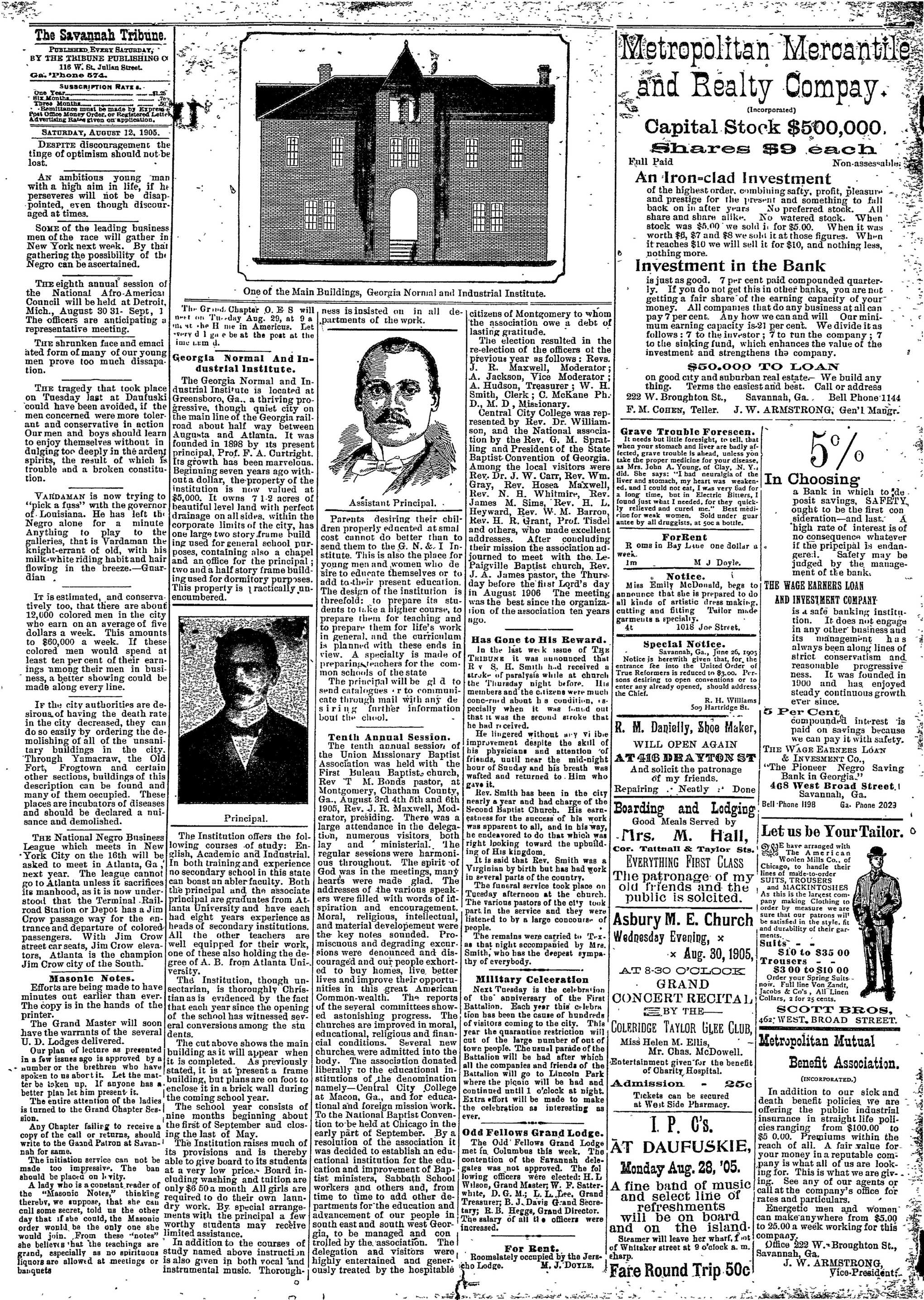
The Georgia Normal and Industrial Institute is located at Greensboro, Ga., a thriving progressive, though quiet city on the main line of the Georgia railroad about half way between Augusta and Atlanta. It was founded in 1898 by its present principal, Prof. F. A. Curtright. Its growth has been marvelous. Beginning seven years ago without a dollar, the property of the institution is now valued at $5,000. It owns 712 acres of beautiful level land with perfect drainage on all sides, within the corporate limits of the city, has one large two story frame building used for general school purposes, containing also a chapel and an office for the principal; two and a half story frame building used for dormitory purposes. This property is practically unencumbered.
M. H.
Principal. The Institution offers the following courses of study: English, Academic and Industrial. In both training and experience no secondary school in this state can boast an abler faculty. Both the principal and the associate principal are graduates from Atlanta University and have each had eight years experience as heads of secondary institutions. All the other teachers are well equipped for their work, one of these also holding the degree of A. B. from Atlanta University.
The Institution, though unsectarian, is thoroughly Christian as is evidenced by the fact that each year since the opening of the school has witnessed several conversions among the students.
The cut above shows the main building as it will appear when it is completed. As previously stated, it is at present a frame building, but plans are on foot to enclose it in a brick wall during the coming school year.
The school year consists of nine months beginning about the first of September and closing the last of May.
The Institution raises much of its provisions and is thereby able to give board to its students at a very low price. Board including washing and tuition are only $650 a month All girls are required to do their own laundry work. By special arrangements with the principal a few worthy students may receive limited assistance. In addition to the courses of study named above instruction is also given in both vocal and instrumental music. Thorough-
ness is insisted on in all departments of the work.
Assistant Principal.
Assistant Principal. Parents desiring their children properly educated at small cost cannot do better than to send them to the G. N. & I Institute. This is also the place for young men and women who desire to educate themselves or to add to their present education. The design of the institution is threefold: to prepare its students to take a higher course, to prepare them for teaching and to prepare them for life's work in general, and the curriculum is planned with these ends in view. A specialty is made of preparing teachers for the common schools of the state
The principal will be gld to send catalogues or to communicate through mail with any desiring further information about the chool.
Tenth Annual Session.
The tenth annual session of the Union Missionary Baptist Association was held with the First Buleau Baptist church, Rev T M. Bonds pastor, at Montgomery, Chatham County, Ga., August 3rd 4th 5th and 6th 1905, Rev J. R. Maxwell, Moderator, presiding. There was a large attendance in the delegation, numerous visitors, both lay and ministerial. The regular sessions were harmonious throughout. The spirit of God was in the meetings, many hearts were made glad. The addresses of the various speakers were filled with words of inspiration and encouragement. Moral, religious, intellectual, and material development were the key notes sounded. Promiscuous and degrading excursions were denounced and discouraged and our people exhorted to buy homes, live better lives and improve their opportunities in this great American Common-wealth. The reports of the several committees showed astonishing progress. The churches are improved in moral, educational, religious and financial conditions. Several new churches were admitted into the body. The association donated liberally to the educational institutions of the denomination namely—Central City College at Macon, Ga., and for educational and foreign mission work. To the National Baptist Convention to be held at Chicago in the early part of September. By a resolution of the association it was decided to establish an educational institution for the education and improvement of Baptist ministers, Sabbath School workers and others and, from time to time to add other departments for the education and advancement of our people in south east and south west Georgia, to be managed and controlled by the association. The delegation and visitors were highly entertained and generously treated by the hospitable
citizens of Montgomery to whom the association owe a debt of lasting gratitude. The election resulted in the re-election of the officers of the previous year as follows: Revs. J. R. Maxwell, Moderator; A. Jackson, Vice Moderator; A. Hudson, Treasurer; W. H. Smith, Clerk; C. McKane Ph. D., M. D. Missionary.
Central City College was represented by Rev. Dr. Williamson, and the National association by the Rev. G. M. Sprattling and President of the State Baptist Convention of Georgia. Among the local visitors were Rev. Dr. J. W. Carr, Rev. Wm. Gray, Rev. Hosea Maxwell, Rev. N. H. Whitmire, Rev. James M. Sims, Rev. H. L. Heyward, Rev. W. M. Barron, Rev. H. R. Grant, Prof. Tisdel and others, who made excellent addresses. After concluding their mission the association adjourned to meet with the LePaigville Baptist church, Rev. J. A. James pastor, the Thursday before the first Lord's day in August 1906 The meeting was the best since the organization of the association ten years ago.
Has Gone to His Reward.
In the last week issue of The Tribune it was announced that Rv S. H. Smith had received a stroke of paralysis while at church the Thursday night before. His members and the citizens were much concerned about his condition, especially when it was found out that it was the second stroke that he had received.
He lingered without any visible improvement despite the skill of his physicians and attention of friends, until near the mid-night hour of Sunday and his breath was wafted and returned to Him who gave it.
Rev. Smith has been in the city nearly a year and had charge of the Second Baptist Church. His earnestness for the success of his work was apparent to all, and in his way, he endeavored to do that which was right looking toward the upbuilding of His kingdom.
It is said that Rev. Smith was a Virginian by birth but has had work in several parts of the country.
The funeral service took place on Tuesday afternoon at the church. The various pastors of the city took part in the service and they were listened to by a large concourse of people.
The remains were carried to Texas that night accompanied by Mrs. Smith, who has the deepest sympathy of everybody.
Military Celebration
Next Tuesday is the celebration of the anniversary of the First Battalion. Each year this celebration has been the cause of hundreds of visitors coming to the city. This year the quarantine restriction will cut of the large number of out of town people. The usual parade of the Battalion will be had after which all the companies and friends of the Battalion will go to Lincoln Park where the picnic will be had and continued until 1 o'clock at night. Extra effort will be made to make the celebration as interesting as ever.
Odd Fellows Grand Lodge.
For Kent.
Roomslately occupied by the Jerscho Lodge.
M. J. Doyle.
Metropolitan Mercantil and Realty Compay.
Shares $9 each Full Paid Non-assessable
of the highest order, combining safety, profit, pleasure and prestige for the present and something to fall back on in after years No preferred stock. All share and share alike. No watered stock. When stock was $5.00 we sold it for $5.00. When it was worth $6, $7 and $8 we sold it at those figures. When it reaches $10 we will sell it for $10, and nothing less, nothing more.
Investment in the Bank
is just as good. 7 per cent paid compounded quarterly. If you do not get this in other banks, you are not getting a fair share of the earning capacity of your money. All companies that do any business at all can pay 7 per cent. Any how we can and will Our minimum earning capacity is 21 per cent. We divide it as follows: 7 to the investor; 7 to run the company; 7 to the sinking fund, which enhances the value of the investment and strengthens the company.
$50,000 TO LOAN
on good city and suburban real estate. We build any thing. Terms the easiest and best. Call or address 222 W. Broughton St., Savannah, Ga. Bell Phone 1144 F. M. COHEN, Teller. J. W. ARMSTRONG, Gen'l Mangr.
Grave Trouble Forescen. It needs but little foresight, to tell, that when your stomach and liver are badly affected, grave trouble is ahead, unless you take the proper medicine for your disease, as Mrs. John A. Young, of Clay, N. Y., did. She says: "I had neuralgia of the liver and stomach, my heart was weakened, and I could not eat, I was very bad for a long time, but in Electric Bitters, I found just what I needed, for they quickly relieved and cured me." Best medicine for weak women. Sold under guaranty by all druggists, at 50c a bottle.
5% In Choosing a Bank in which to do posit savings, SAFETY ought to be the first consideration—and last.
In Choosing
a Bank in which to de posit savings, SAFETY ought to be the first con sideration—and last. A high rate of interest is of no consequence whatever if the principal is endangered. Safety may be judged by the management of the bank.
Notice
Miss Emily McDonald, begs to announce that she is prepared to do all kinds of artistic dress making, cutting and fitting. Tailor made garments a speciality.
4t 1018 Joe Street.
THE WAGE EARNERS LOAN
AND INVESTMENT COMPANY
is a safe banking institution. It does not engage in any other business and its management has always been along lines of strict conservatism and reasonable progressiveness. It was founded in 1900 and has enjoyed steady continuous growth ever since.
Special Notice.
Savannah, Ga., June 26, 1905 Notice is herewith given that, for the entrance fee into the United Order of True Reformers is reduced to $3.00. Persons desiring to open conventions or to enter any already opened, should address the Chief.
R. H. Williams
50g Hartridge St.
compounded interest is paid on savings because we can pay it with safety. THE WAGE EARNERS LOAN
R. M. Danielly, Shoe Maker,
"The Pioneer Negro Saving Bank in Georgia."
468 West Broad Street.! Savannah, Ga.
Bell·Phone 1198 Ga. Phone 2023
Let us be Your Tailor.
WE have arranged with The American Woolen Mills Co., of Chicago, to handle their lines of made-to-order SUITS TROUSERS
```markdown
```
EVERYTHING FIRST CLASS The patronage of my old friends and the
and MACKINTOSHES As this is the largest company making Clothing to order by measure we are sure that our patrons will be satisfied in the style, fit and durability of their garments. Suits
Asbury M. E. Church Wednesday Evening, x
$10 to $35 00
Trousers - -
AT 8:30 O'CLOCK GRAND
$3 00 to $10 00
Order your Spring Suitsnow.
Full line Von Zandt,
Jacobs & Co's, All Linen
Collars, 2 for 25 cents.
CONCERT RECITAL BY THE
SCOTT BROS. 462: WEST, BROAD STREET.
Metropolitan Mutual
Benefit Association.
In addition to our sick and death benefit policies we are offering the public industrial insurance in straight life policies ranging from $100.00 to $5 0.00. Premiums within the reach of all. A fair value for your money in a reputable company is what all of us are looking for. This is what we are giving. See any of our agents or call at the company's office for rates and particulars.
A fine band of music and select line of
Energetic men and women can make anywhere from $5.00 to 25.00 a week working for this company.
will be on board and on the island. Steamer will leave her wharf, foot of Whitaker street at 9 o'clock a. m. sharp.
Office 222 W. Broughton St.,
Savannah, Ga.
J. W. ARMSTRONG,
Vice-President.
Fare Round Trip 50c
AT THE ELEVENTH HOUR
It doesn't pay to give advice,
Although it costs you little thought,
For he who,gets it seldom seems
one-tenth as grateful as he ought.
Unless, when he requires your help,
You tell him what he wants to hear,
He phaint shows his deep contempt,
And listens coldly, with a sneer.
A
COLD, dismal morning, the gray mist, rising sullenly from the damp earth, slowly revealing the outlines of a roughly built farmhouse of the usual Australian type. The locality was in the northern part of South Australia, and, as the gray morning light crept slowly over the silent earth, it could be seen that the whole place from farmhouse to fencing was in a state of despair.
Inside the house, in a barely furnished room, a man lay sleeping on a rough bush bed. Presently he awoke, and, stretching his arms above his head, yawned and shivered beneath the coarse gray blankets; with an effort he sat up and stared around; then, as if some notion had jumped into his mind, he threw off the blankets and began, very quietly and cautiously, to dress himself in the rough clothes which lay budded on the floor.
Having dressed, he took his boots in his hand, and, stepping softly along the cold flagged floor, he left the room, pausing at the door facing the one he had left to listen intently for any sound from within.
Reassured by the silence, he continued his cautious tread till he reached rough stone kitchen. The room was very bare, and the floor—made of puddled clay—sent thrills of cold through his stockinged feet. Sitting down on an old packing-case, he proceeded carefully to whittle some tiny spars of wood, listening intently all the time.
He carried the splinters to the fireplace, and slowly and inbornoily built up a fire with chips and gum-roots which lay on the floor. Filling up the battered kettle from a bucket of water, he lifted it on to the fire and stood watching the growing blaze.
A piece of wood crackled, making a slight report; the man started and bent forward in a listening attitude, but as no sound came from the front room his face cleared, and he proceeded with his tasks.
With clumsy hands he cut slices of bread from a rough loaf and laid them on the packing-case which served as a table. Going down on his hands and knees in a corner of the room he burrowed about in a zinc-lined box until he found a small piece of bacon, from which, with infinite care, he cut some rashers.
All the man's movements were stealthy and wonderfully quiet, without apparent reason, and had it not been for the intensity with which he worked the effect would have been bulrush, but there was something in his restrained actions, in his uncouth deviators to move noiselessly, and in the sternness of his face, that forbade any idea of laughter had there been an onlooker.
As the light from the rising sun illumened the room it could be seen that he was still a young man, with a face tanned and weather-worn; his curly brown hair and a short beard and mustache of the same color added to his manliness—alonger he was a handsome fellow enough, except for an expression of care which clouded his face.
When the water in the kettle began to boil, and the fire itself grew into a fierce flame, he took down a battered teapot, and, with many doubling looks, at last made up his mind as to the quantity of tea he should use. Having filled up the pot with water, he put it to draw in a recess of the big fireplace; then with puckered browns he began to toast the bread before the fire, and presently spread over each slice a liberal quantity of dripping.
Now his task seemed nearly over, for, slipping a pan on the fire, he put the bacon in to fry, and as it frizzled and hissed his face grew brighter. He turned and returned the succulent slices, and, having taken them from the pan, he placed them between two plates and put them before the fire.
With even more caution than before he stepped slowly to the back door and opened it, letting in a blust of cold air. Pulling on his boots, and softly closing the door, he made his way to a ramshackle old shed, whence he soon emerged bearing two eggs. Across the rough, wheel-cut back yard he made his way until he reached what had evidently once been a garden, and here he found a few daisies struggling for existence. Picking them quickly he returned to the kitchen and boiled the eggs in the kettle. Then, with an almost boyish expression of gladness on his face he selected an old tin tray and, covering it with a clean duster, spread the meal upon it, placing pepper and salt in one saucer and sugar in another. With the daisies lying in the centre the meal looked fairly tempting, and the clumsy fellow's face fairly beamed with delight as he bore it to the room at which he had listened.
Having placed the tray on the floor, he opened the door; he drew the rough blind from the window. A young girl of about three or four-twenty was lying in the bed. Her face was very wan and white, and she breathed heavily in her sleep. At
If, on the other hand, you try
To counsel what he wants to do,
And things go wrong, he'll put the blame,
Without exception, all on you.
So don't consent to give advice,
For, if you do, you re bound to see
That he who gets it never is
As grateful as he ought to be.
By G. H. COSSINS.
the noise she woke and uttered an exclamation.
"Now then, Annie," cried the man, with assumed roughness, "It's past seven o'clock! Where's my breakfast?" "Oh, Tom. I am so sorry, dear!" the girl said sorrowfully. "I've oversteep myself, but I'll be up in a minute." And she spread out her arms to kiss him as he bent over her.
"Will you, wife?" he said, huskily. "I guess you will do what I tell you, and that is lie down at once, you little baggage." She looked at him inquiringly, with a feeble smile on her thin face. He went to the door and reappeared with his hurdlen. Then she burst into tears. "Oh, Tom," she cried, "how good you are to me! Oh, how good, Tom!"
"Shut up," he said in affected anger, "and eat every bit of that breakfast, or I'll look you up in here all day."
And the girl, smiling through her tears, tried hard to swallow the food, while her lips quivered, and she muttered:
"Oh, Tom! How good you are!"
With a happier face he went back to the kitchen to get his own breakfast.
"She'll have a good rest to-day, anyway," he muttered to himself, as standing by the small window he ate his meal. Having finished his hastily eaten food, he hurried back to his wife. "Annie, my girl," he said, gently, "I want you to do me a favor—will you promise?
"Not to lie in bed, Tom," she said, pleadingly. "I can't bear that you should wait on me, dear, and I feel so much better to-day—the breakfast was so good."
The man looked at her in silence for a moment.
"I'm going to the settlement, dear, and there's nothing to do in the house. Promise me to lie in bed till I come back. It's a wet, miserable sort of morning, and you'll be better in bed." She saw he was in carnest, and nodded cheerfully.
"Very well, Tom, I'll have a long rest. The breakfast was so good, you dear old clumsy thing! Did you use all the bacon, Tom?" she added wistfully.
"Not half!" he said impatiently, as if knowing what was coming.
"Oh, my dear, my dear!" she cried.
"Have you had nothing but bread and tea?"
"I had an egg, and that's all I wanted, Amie girl, and now I'm off, so good-by."
He kissed her tenderly and went out of the room and out of the house, into the fine, soft rain that was falling steadily. There was no dog to bark a welcome; a rusty old plow lay near the shed, but there was nother horse nor cattle about—no living thing except four or five fowl; the whole place was lonely and deserted.
The man looked at his surroundings with a scowling face.
"What a home for Annie!" he muttered, "and to think that for three years I've sown and waited and waited, and no rain came, and now, when I've no seed wheat, the rain has come."
He strode moodily along the rough road mile after mile, till he reached the store—a grocery, bakery, butcher's shop, postoffice and smithy combined. He turned moodily away with a single letter in his hand.
"Have a drink before you go?" cried the proprietor of the store.
"Thanks-no--I've no heart for drink," he said, gloomily.
"Your wife no better?"
"Better?" he answered, bitterly.
"She's dying, dying, and she's only four-and-twenty, poor girl!"
The storekeeper hesitated. He went on the road to ruin himself, and as he thought of the bright young couple who had come up so full of hope and energy fresh from their English home four years before, he turned into the store and reappeared with a small box.
"There's some arrowroot, and a tin of cocoa, and a few odd things I don't want in there," he said awkwardly as he held out the box. "Maybe your wife would fancy them; they're no good to me," he added hastily as the other made a gesture of dissent.
"I can't pay for them, Myles. My rent is over two years in arrears; I've no steek, no crop in, and we are nearly through our provisions!"
"So bad as that?" the other excaculated. "What'll you do?"
"What can I do? I can't get work—the squatters won't give work to a miserable failure like me. I can't go away, I've no money, and, if I had, what could I do?"
"Well, take that box anyhow, man," said the storekeeper, tendering it again.
And, as he watched the other's retreating form, he sighed heavily.
"Who was that, dad?" cried a girl, peering into the store from an inner room.
"Tom Weston—he's on his last legs now; no crop in for want of seed wheat, no cattle, and behind with his rent!
Poor fellow, I plty him and his young wife."
"We're nearly as bad, dad."
"Yes, in some ways, but we've got health, and anyhow I can't get a job somewhere, and so don't you, Mary, till times gets better; but that poor girl was never strong, and I guess she'll not live long."
Weston walked doggedly home through the mud and slush, the rain, which might have meant so much to him had he been able to sow any wheat, falling steadily the whole time, and drenched him thoroughly.
He tried to assume a brighter look as he entered his wife's room, but the loving eyes saw through his disguise at once.
"Oh, Tom, there were no letters, after all!"
"Only this," he replied gloomily as he drew out the large official envelope he had received. "Another letter from the commissioner, informing me that 'the rent is in arrears, and must be paid, or the matter will be placed in the hands of the public attorney! I know as well as if I had read it." His wife kissed him as he bent over her.
"I've been very good, Tom, and had quite a long sleep; I really feel quite strong."
"You don't fool me like that, Annie," he said. "I know your little game. You want to get up and work, that's what you want to do—but you just won't, so there. I'm going out to get in some more wood, and we'll have a big blaze in the kitchen; when it's quite warm you shall get up and sit there for an hour or two, but you must not move about."
"Oh, you tyrant!" she said, quaveringly.
Weston only laughed grimly and went out, carefully closing the door behind him, and made his way to the scanty woodpile. He had only just got to work when he heard his wife's voice scream:
"Tom! Tom! Tom!" In a minute he was back, and bend ing over the bed again, speechless with agony. She held up the despised letter with a shaking hand.
"Oh, read it!" she cried.
"Thank Heaven!" he said. "Oh, my darling, it has come at the eleventh hour!"
The letter was from Annie's father—the father who had closed his heart and home against her when she married, but who now wrote in kindly terms, granting the forgiveness which she had asked for so often in vain, and imploring her and her husband to return to England and brighten his old age with their presence; the draft enclosed was, he said, to help them if they stood in need of any little comforts for their return journey.
"Comforta!" cried Tom. "It's necessities we want, and we'll have them now darling!"
They spent two hours in the warm kitchen, and Tom, almost for the last time, bushed himself in preparing some of the little delicacies the good-natured storekeeper had pressed on him for his wife.
"He shall never regret it." Annie said when her husband told her how the things had been forced on him. "We will do something for them in return." "We will, indeed," assented the man. "But, oh, Tom, how could you be so careless? The letter was from the general postoffice, enclosing father's, because it had been in the sea water when the mats were being trans shipped and the envelope was almost destroyed; it's a wonder we ever got it!" Already the color seemed to be creeping back to the wan cheeks, the young eyes were brightening at the prospect of seeing her old home again. "Tom," she whispered, "we shall see it all again, just think of it! The lanes, the hedgerows, the farmhouses and the old village—and father!" And they did.--New York Weekly.
Cleaned Him Out.
They were exchanging the gossip of the mining camps of Nevada.
"Did you hear," said the fellow with the diamond, scarf pin in his sweater, "how they did up Sullivan over in Kawich?"
"Really?"
"Yep. Sullivan's saloon at Kawleh is busted flatter than the bank at Goldfield. You haven't been over to Kawleh, have you? It's forty-five miles out in the wilderness, and water, when there is any in camp, is worth its weight in radium. Well, a fellow went into Sullivan's the other day with seven friends, and just out of pure cussedness they all ordered water."—San Francisco Chronicle.
Table Overturned by Lightning.
A tenant house of Mr. B. S. Fliggs, occupied by Hubert Hastings, in Wicomico County, was recently struck by lightning. The table, which had been set for supper, was turned upside down, breaking all the dishes.
In the adjoining room, where the most damage was done, an infant was lying on the bed, but was unharmed.
A can containing a half gallon of coal oil, which was in the kitchen closet, was fired by the lightning and would have destroyed the building but for the fact that Mr. Hastings seized a bucket of water close at hand and with it extinguished the flames.-Baltimore Sun.
Bolt on Erbed Wire Kills Cottle.
During a recent thunderstorm in Brown County a bunch of cattle on Asa. Hull's farm backed up against a barbed wire fence for protection. A bolt of lightning ran along one of the wires and killed eight of the cattle.-Kansas City Journal.
THE CALIFORNIA KING SNake
THE CALIFORNIA KING-SNAKE
That a small, harmless little snake, scarcely larger round than one's finger, and only fifteen to twenty inches long, should be called the, "king-snake" seems rather odd, but the little fellow has certainly earned the name. A pet king-snake in a mining camp out on the desert mountains east of San Bernardino, California, was named "King." He soon learned his name, and when called would come crawling rapidly out from various hiding-places, such as crevices in the stone walls of the cabin, under the bed, among clothes, and from his favorite place in the coat pocket of Jim, one of the miners.
One day Jim was going down an abandoned shaft. When he had nearly reached the foot of the ladder he heard a slight rustle, and quick as a flash Jim jumped out of his pocket and dropped to the bottom. There was a thrashing sound and also the noise of a rattlesnake's rattle; then all, was quiet. Jim waited a moment or two before going farther down, and as it was too dark to see well, he struck a match and lighted his candle and held it cautiously down. There lay a dead rattlesnake, and King coiled beside him, watching.
Another day, as the boys were talking in the cabin, Jim looked out the door and saw a very large rattlesnake slowly crawling up the sandy arroyo about thirty or forty feet from the cabin door. King was called immediately, and quickly came out from under the bed. Jim took him on the palm of his hand and stepped to the door to show the rattler to him, but King saw him, and sprang from Jim's hand quick as a flash. Then ensued one of the oddest battles, which showed how King earned his name, and why rattlesnakes are so terrified when they see a king snake.
King sped like an arrow after the rattler. The rattler saw King, and at once put all the energy he had into his speed. He saw King coming, and knew that he would soon overtake him. His only safety lay in coiling and if possible striking King.
The rattlesnake just had time to raise his head about six inches when King overtook him. It looked as if King was going on by the rattlesnake. But when the middle of King's body was opposite the head of the rattler, with a motion too quick to be seen, King wrapped his entire length round the rattlesnake. King's head was next to the rattler's, but so tightly was King colled round that the rattler could scarcely move even his jaws. His tongue ran out and death came almost immediately. King hung on until the snake was dead, and then slowly uncolled and came back to the cabin. Youth's Companion.
SAVED THE DOG
Recently in the city of Omana happened an incident that ought to be carefully considered by every human being. It had the elements of tragedy and there was in it a bit of comedy, too. It was fraught with lessons of love and of life, lessons which might give courage to the hopeless, lessons which might inspire the prosperous.
A man, brought to the depths of despair through his own folly, feeling that his career of usefulness was at an end, went to the river's bank determined to end it all. Those who thought they knew this hopeless creature might have been pardoned by concluding that it would have been just as well had the man been permitted to carry out his purpose. But something happened which saved this being from a suicide's grave. We are told that just as this man was about to plunge into the current of the Missouri some one threw a little dog from the bridge. Instantly the better nature of the would-be suicide was aroused. His desire to destroy his own life was forgotten in his consideration for the little animal struggling in the waves. Instead of plunging into the water bent upon taking the life which it was his duty to preserve and use for the benefit of the world—he plunged into the stream and rescued the little dog.
Newspaper reports say that "with the wet, shivering dog nestling in his arms," the wet, shivering unn applied for shelter at the police station. He refused to part company with his little protege and the newspaper reports state, "when he went to sleep on the bench in the hallway at the police station the little black dog was curled up on his breast."—The Commoner. T
BATTLE OF NAVARINO.
In the year 1827 the British Admiral, Omanney, took part in the battle of Navarino, in which the English, French and Russian ships entered the harbor of Navarino, in Greece, and annihilated the Turkish and Egyptian vessels, which were unable to leave their moorings. The battle lasted four hours. Admiral Omanney tells this of Sir Edward Codrington, the Admiral in command: "His escapes from death were marvelous. So that he might command a good view of the battle he stood on the poop of the Asia, the most exposed part of the ship. He was talking with the master when a shot came and killed the latter at his side. A shot killed the officer of marines who was on the quarter deck just below the poop. The Admiral left the poop only once to go forward to talk to the boatswain, and while talking to him the boatswain also was killed at his side.
"A bullet went through his hat, in which it made two holes, and another bullet went through jis loose coat
sleeve. Another bullet smashed his gold watch. When on the poop he stooped his head under a rolled awning, and while bent like that a shot passed through the awning's folds. At another time he had just turned from a spot on the poop when the place where he had been standing was covered with wreckage from aloft, which would have crushed and buried him. And yet throughout the battle, when men were being slain and wounded everywhere around him Codrington escaped uninjured."
Other incidents of the same battle: "An Irishman seized a musket and, with a roar of 'Make way, there!' he swept a road through the Turks by swinging his weapon from slide to slide with crushing force. One of my fellow midshipmen named Hicks was among the boarders, many of whom had forgotten to take their pistols. Hicks shouted to the first lieutenant, 'Give them cold shot, sir!' And the boarders did, for they picked up the cold shot which was lying about ready for the guns and hurled it down upon the Turks."
APACHE SHREWDNESS.
With the Apaches, a really brave man does not stand as high in public estimation as does a clever thief. His chief excellence, from an Apache standpoint, lies in his ability to outwit the white man, says Mr. Cremony, the author of "Life Among the Apaches." I was sitting, says Mr. Cremony, in front of my fent, writing a letter, when a young Apache came up and asked what I was doing. I replied I was talking to my friend in Washington.
"How can you talk to your friend so far away?"
"When an Apache wishes to talk of speed to a distant friend," I answered, "he sends him a picture of a bird; if he talks of something sweet he sends a picture of a flower. Instead of pictures the white man has these little signs which all understand."
The Indian took up the letter and scrutinized it carefully.
"I do not believe you," he said. "You try to make a fool of me. These little signs are all alike."
"I will give you proof. I will write on this little piece of paper that the sutter is to give you some tobacco. Go take it to the store and see if I do not speak the truth."
The Indian snatched the paper and was off. A few moments later I saw him slowly coming toward me, a piece of tobacco in his hand and a look of bewilderment on his face. Suddenly his expression changed to satisfaction and he hurried forward.
"Did you get the tobacco?" I asked.
"Yes; but I do not believe you. You and he had an understanding before so that you might deceive me. Now if you will write some more of those little signs on paper, telling the sutter to give me much tobacco, and if he does, then will I believe you."
But the Indian's ruse failed. I did not "rise" to the occasion.
A. STIRRING STORY.
Three nights after the Sophocles had left Albany, West Australia, an outbreak of fire was detected in the store room. Officers and men allike took turns in descending into the hold. "As they went down," said one of the crew, "they collapsed and had to be hauled up again. They were laid out on the hatches and brought round, but whenever they recovered they were ready to go down again. The captain himself was overcome by the fumes. The fourth officer lost consciousness three times, and the second officer twice. Once the latter had to be dragged from the hold by a life line."
Still, however, the fire made headway, and the captain determined to turn back to Fremantle. The Sophocles was then fully 400 miles from that port. The captain's first desire had been to spare his passengers—many of whom were ladies—any anxiety, and he was so successful in this that only the gentlemen knew that a fire had broken out. And so, with fire raging below, the Sophocles made for port. The engines were worked to their utmost capacity, and the ship's hose was kept constantly playing on the fire. Men were lowered into the holds by relays, with life lines around their waists, and worked until they had to be dragged back to the fresh air and safety. Night and day they toiled, sustained with little more than coffee and ship's biscuits, handed to them by the ship's stewards.
No precaution was omitted to insure the safety of the passengers and crew in the last resort. The life boats were surreptitiously provisioned, that the ladies might not be alarmed. The officers, when they were not helping to put out the fire, went about their ordinary duties with cheerful faces. And still the women in the after part of the ship knew nothing of their imminent danger. Fremantle was reached at last, and all anxiety was put at an end. Ten days later the Sophocles, her ruined cargo replaced, for ballast purposes, with eighty tons of lead bars and logs of timber, sailed for London. "And," said on the officers, with a touch of pride, "every one of the passengers stood by the ship, in spite of the fright they had got."—Lelisure Hours.
Model Train Wreck-
In a train wreck on the Missouri Pacific Railway every car except one went into the ditch at the side of the track, but not a person on the train was seriously injured. The train was running at twenty-five miles an hour, yet not a car was damaged by the sudden stopping. The cars were new and heavy and of firm steel framework.—Kansas City Times.
Asparagus is so abundant on the Russian steppes that the cattle eat it like grass.
HOUSEHOLD AFFAIRS
WHEN THERE IS ILLNESS.
When there is illness, in the family some housewives use, in addition, thick comforters of unbleached cotton, which can be easily washed. Pillows and bolsters are often covered with cheap cotton or calico to protect the ticking.
AN EGG HINT
It is, not gen-rally, known that eggs covered with boiling water and allowed to stand for five minutes are more nourishing and more easily digested than eggs placed in boiling water and allowea to boil furiously for three and a half minutes.
MENDING KNIFE HANDLES.
When the handles of steel knives and forks come off they can be easily mended with resin. Pour a little powdered resin into the cavity in the handle. Heat the part of the knife that fits into the handle until it is red hot, and thrust into the handle. It will become firmly fixed by the resin when it becomes cool. Protect the blade from the heat.
SERVING POTATOES :
A writer in the Housekeeper gives the following way of serving potatoes: Imitation New Potatoes—Into a cheesecloth sack put small, round, peeled potatoes. Place the sack in a pan containing boiling milk and water in equal parts, sufficient to cover the potatoes, with a little salt. Boll slowly till done, lift out the sack and allow all the liquid to drain off; then place in the oven five minutes or so while you are preparing a white sauce with butter, flour, milk and a little salt. Turn the potatoes from the sack into this and serve immediately in a deep vegetable dish.
Quick Potatoes—Slice raw potatoes thin and boll ten minutes or so in salted water. Drink, sprinkle with a dash of pepper, add small bits of butter and pour over the whole about half a cupful hot cream. Serve at once in a heated dish.
Syracuse Hot Salt Potatoes—Boil the vegetables in a rather strong brine and drain on a piece of cheesecloth stretched almost tight across the top of a pan. They will be covered with salt crystals and will be very mealy inside.
Fairy Gingerbread—Three eggs, one half cup butter, one cup molasses, three cups flour, one cup sugar, two teaspoonfuls baking powder, one cup milk, one tablespoonful ginger, level. Rub sugar and butter together, add eggs, then milk and molasses mixed, then dry ingredients mixed. Bake in a moderately hot oven.
Banded Apples—Use six large apples. In paring, leave a band half an inch wide around the centre of each. Remove cores, fill cavities with red jelly, and spice it, liked. Place in a baking dish, add one cupful water and sprinkle with one cupful of sugar. Bake until tender in a moderate oven. Serve hot, with cream. They may be served plain with their own syrup.
Fricassee Chicken — Boll in salted water until tender. Remove large bones, dredge with salt, pepper and flour and brown in butter. Serve on toast. Pour over it all a sauce or gravy made of the broth (in which the chicken was cooked), thickened with flour, one tablespoonful to a pint. Celery salt and lemon juice may be added.
Purée of Green Peas — One quart green peas, one quart water, one pint milk, one-half teaspoonful salt, one-quarter teaspoonful pepper, one-half teaspoonful sugar, one tablespoonful butter, one tablespoonful flour. Cook the peas in one pint boiling water until soft. Mash them in this, and rub them through a strainer, adding gradually a plint of hot water. Put on to boll again. Cook butter and flour in a small saucepan, being careful not to brown them. Add salt, sugar, pepper and milk, using enough to make the consistency you prefer.
Domino Cakes-Make a sponge cake, or any other simple cake mixture, and bake it in shallow tins, making the cake about half an inch thick when cooked; when cool ice with white ice; allow this to set, then with a sharp knife cut it into small oblongs about three inches long by one and one-half inches wide; melt a little chocolate, and, with a small brush, paint spots to represent dominoes. If wished, the little cakes may be split open and spread with jam before ice.
Orange Pile — One dozen sound oranges cut into thin slices, seeds and cores removed, covered with six quarts of water, allowed to soak for twenty-four hours; then put all on to boll; boll slowly for three hours; then add seven pounds of granulated sugar, and boll till clear; pour off into a crock, allow to set, and you then have the filling. Line pie plates with puff paste trimmings, making a raised edge, spread well with the filling; bake; when done spread with an orange flavored custard; on it pipe a fancy meringue; brown quickly; serve. This is one of the most delicious plies it is possible to make.
Berlin railways are running special "tree blossom" trains to the outlying districts to enable town dwellers to enjoy the spring flowers and foliage.
ROGER'S SONG
Who loves the rose without a thorn!
Not L.
No guardian-darfs around her close,
For every passing hand she blows.
With every touch its arm stunned.
I love no rose without a thorn.
Not L.
Who loves the bee without a sting? Not L.
Who but a stupid, idle drone
Mary
```markdown
```
图
How Binks Milked the Cow.
HE "real" cow which the Blukses were to have with their summer farm finally apperted one evening, in company with a wild headed boy, and when she had been turned into the yard, Mr. Blinks went up to the house and said: "Well, she's here at last; and now for the romantic dairy business. Come out and look the winniewee thing over, and see me do the milking act." She was a cow with a "crumpled horn." More than that, she was undersized and scrubby, and her eye did not have that frank, innocent expression always to be found in the humble minded cow.
"I don't like her looks," was Mrs. Binks' verdict, after a long survey.
"What did you expect?" asked Binks. "Did you imagine she'd have two humps, like a camel, or a trunk, like an elephant? A cow is a cow. If you are looking for a rhinoceros or a buffalo you'll have to go further."
"I've seen cows before," replied the lady, with a little pepper in her tones.
"She may be better than she looks; but I think you'll be disappointed in her. She's evidently very common stock."
"Oh, is she, eh? That shows how much you know about cows. She's pure Leghorn."
"I never heard of a Leghorn cow," exclaimed Mrs. Binks.
"Haven't you? that's wonderful! Perhaps you never heard of a Southdown or a Merloin cow? There are lots of things for you to learn yet, especially about farming. I don't say this cow is handsome, or as graceful as an antelope; but what we are after is milk and cream. She's a Leghorn, if I know anything about cows, and she'll probably have to be milked about five or six times a day. I will now open the performance."
"I don't believe you have ever milked a cow in your life," she said.
"Don't you? Well, prepare for a surprise. The day you put on short dresses I milked sixteen cows and churned twenty pounds of butter. I may be rusty; but—"
"But what?"
"I was just thinking whether you milked a Leghorn cow on the right or left side. It's on the left, I think."
"All cows are milked on the right-hand side, Mr. Binks."
"Perhaps so; but we'll try this one on the left. I'll use that old soap box for a milk stool. You can sit down on that stone and sing while I play the dairymal. This was one of the things that induced me to hire this farm for the summer—coming out to milk our own Leghorn cow as the shades of evening—"
The shades of evening didn't fall, but the cow picked up a hind foot, and sent the milk pall whirling twenty feet away, and as Mr. Binks dodged he fell off the box.
"By the mud of New Jersey," he shouted, as he turned over and got up, "but I'll have her life to pay for this."
"I told you it was the wrong side," protested his wife.
"Wrong side be hanged! What's the difference to a cow? She's here to be milked, and she can't have her own way about things. If she tries that little game on me again I'll break her in two! We'll drive her into a corner over there. Come to remember, Leghorn cows always have to be driven into a corner to be milked."
This time Binks approached her on the right-hand side, and, after patting her hip in a fatherly way for a minute, he said:
"Whoa, now, and back up! That's the style! Mrs. Binks, you walk up and down and sing something. What this cow lacks is confidence in us. She can't tell what our designs are. Sing a couple of verses of 'Come Into the Garden, Maude', and give her to understand she is among friends."
"And you be easy in taking hold. Some cows have to be petted, you know."
"I'll attend to the petting business. I know this is the right side, after all; but I'll have her taught to be milked on both sides within a week. I want no one-sided cows around me. Jeewhiz! what was that?" The cow had lifted both hind feet at once, but missed both pall and Mr. Binks.
"You never milked a cow in all your life," exclaimed Mrs. Binks.
"Then I'll begin now, or perish in the attempt!" he shouted. "Confound her! does she think this is a circus, and she is trying to jump backward through a paper hoop? Back up, or look out for a storm. Now then, start that singing again. Never milked a cow! I'll show you whether I ever did or not!"
Mr. Binks started in with grim determination.
Once or twice in his life he had seen a man milk a cow. He distinctly remembered that it was all hand work.
and that no machinery was employed either, above or below. Mrs. Binks had finished the second line of the song, when the cow made a sudden movement with her left leg. It was a combination of football, sliding for a base, and forked lightning. The milk pail flew past her, and hit the fence with a bang, but Mr. Binks, and his box, and grim determination flew the other way. He wasn't exactly sure what had happened, and he asked no questions until his breath returned, and he could sit up.
Then he querled:
"Was it the—the cow?"
"It was the cow," answered Mrs. Binks. "I told you that you knew nothing about milking."
"She—she kicked me, did she?"
"She did. Give me the pall, and I'll see what I can do. You had better go in and lie down."
"I think I will for—for a minute or two, and then I'll come out and see who kicked the cow and made her kick me! I'll break her back with a hatchet!"
Mrs. Binks got the pall and box, and sat down to the cow. Ten minutes inter she entered the house.
"Well, Mr. Binks, Green has given you a nice sort of a cow, hasn't he?"
"Did you milk her?" he groaned.
"There was no milk to be had. She hasn't been a milch cow. If I were you—"
"Stop! I am now in what is probably a dying state, having received a ten-thousand-pound blow in the pit of the stomach. If I die you will have accomplished your cold-blooded purpose; if I survive until morning you and I and the cow will have a little talk, and straighten things out."
"But what did I do?"
"Never you mind. A woman who will kick a cow to make that cow.kick and kill her husband is guilty of murder, and she's no wife of mine. Just keep away from me until I die or recover, and then this thing can be settled in about two minutes."
"And you say I kicked the cow?"
But Mr. Binks only glared at her for a moment, and then turned his face to the wall, and refused to speak again. The iron had entered his soul.—New York Weekly.
Blind Man Who Tells the Time.
Charles Bohannan, of Taylorsville, is totally blind. Light and darkness are the same to him, but he makes his certain way about the streets with the aid of a cane, and sometimes puts to shame men possessed of two good optics. Yesterday Charlie visited the county jail. After talking a while he pulled out his watch, an ordinary gold timepiece, with a double case, held it in his hands a moment in the usual way, and then snapped it shut with a sigh of relief.
"Well, it's time for me to start home," he remarked.
"What time is it, Charlie?" he was asked quizzically.
"One minute to three," was the prompt response.
Every watch in the crowd except Charlie's came into view. It required longer for the men with good eyes to verify Charlie's observation than it did for him to ascertain the time, but he was declared correct almost to the second.
"Good-by," and he was off, without waiting to hear the discussion his feat had precipitated.—Loulsville Courler-Journal.
How Plants See.
An interesting theory of the mechanism by which the direction of incident light is perceived by plants has been put forward by G. Haberland, a German botanist. "He believes that the epidermic cells are, so to speak, the eyes of the plant. Thus, according to his view, when light strikes a leaf at right angles to the surface it results, from the plano-convex form of the epidermic cells, that the inner wall of each cell is illuminated more brightly in the centre than at the periphery. This makes it possible for the leaf to orientate itself in regard to light. Thus, suppose the plant to be moved so that the light now strikes the leaf obliquely, the bright patches of light on the inner cell walls will no longer be central. This change may be believed to constitute a stimulus calling forth a curvature of the leaf stalk by which the leaf is brought again to its normal position at right angles to the incident light. Thus, the leaf moves when the bright patch is not central, and comes to rest when each of its epidermic cells is centrally illuminated."-Nature.
Lightning Looped the Loon.
Wednesday night's electric storm was one of the worst and also one of the most peculiar that I have ever seen, and as I worked throughout the night I had unusual opportunities for its observation.
One of the strange features of the storm was the peculiar shape some of the flashes of lightning assumed. One flash actually looped the loop. Starting from the clouds, it traveled earthward, toward the south. Then it suddenly made an upshoot skyward and then coming down it completed the loop, crossing its own path and Dying out in darkness as it neared the ground.-Chicago News.
Much Ado About Nothing:
An old woman who entered a country savings bank not long ago was asked whether she wanted to draw or deposit.
"Nayther; ol wants to put some money in," was the reply.
CHILDREN'S DEPARTMENT
THE FLY CARRIED AWAY HELEN'S BIT OF PAPER.
When I was as little as some of you are
I had something to keep for my own—
The most beautiful thing that the dream-
man could bring,
In the loveliest dream ever known.
It was white, with black streaks (that
came off on my cheeks).
When I hugged it too hard in warm
weather;
Its collar was red, its smile was well bred,
And we were so happy together.
I'm coming to that—'twas a great plaster
cat,
Oh, almost as big as myself!
At night she was placed on a chair near
my bed.
And daytimes she lived on a shelf.
'Twas a very sad day when the shelf it
gave way,
And she fell on the carpet and died.
I saved all the pieces, and more than a
weep.
Off and on between meals, I cried.
'Twas a long time ago, as maybe you know,
But I'm still hoping, sometime or other.
By searching the shops where they, sell
plaster, cats,
I may possibly find me another.
But there's always a something that all of
them lack;
They never are quite to my mind;
For either the spots are too big and too
black,
Or the smile's not exactly refined.
And if smile and if spot are correct—but
they're not—
It is sure to be true, I have found,
That the claws are all wrong and the paws
are not right,
Or the tail is too long or to round.
—Valentine Adams, in St. Nicholas.
A PASTIME FOR RAINY DAYS.
Three of our readers were spending
some vacation days in the country at
an old farmhouse owned by an uncle.
During fair weather they had lots and
lots of delightful things to do out of
doors, but at last there came a day
when the rain came down in torrents
and out-of-door pleasures were entirely
out of the question.
What to do puzzled the youngsters at first. They explored the place thoroughly, but the minutes dragged and no solution came; nothing which promised fun. George, the younger man of the party, aged ten, was moodily catching files, of which there were
THE FLY CARRIED AWAY
vast numbers, while his sisters, Helen and Bcátrice, looked idly on.
"I wish you would not do that, George," said Helen, at length. "You hurt those files catching them that way, even if you do let them go at once, and it is cruel."
"Well, what's a fellow to do?" asked George, surrilly. "You'll find me something better to do and I'll stop." Suddenly Helen clapped her hands.
"Oh, dandy!" she cried. "I know something that is loads more fun and which won't hurt the poor little files at all!" She ran into the sitting-room and got a piece of light tissue paper, sending Beatrice for the glue pot. While Beatrice was gone Helen cut the paper into tiny bits half an inch square. She had twelve pieces, and on four she put her own initial, H, on four a big B. and a G. on the remaining four. Then she drew a circle with chalk on the table, the circle being about two feet in diameter.
When Beatrice returned with the glue Helen spread a very little over each bit of paper on the side not marked by the initial which each piece bore. Then she laid all twelve bits of paper In the circle, Initials down, and on the glue side of each sprinkled a bit of pulverized sugar.
"Now," she said, "we have each four bits of paper marked with our initials. The files will light on them to get the sugar and be stuck fast by the glue. Then they will try to get away, and whichever one of us has one of our four bits of paper first carried out of the circle by a fly wins the game?"
The others clapped their hands and drew chairs to the table all agerness. No glumness now, no cross looks nor sharp words. All three watched, keen as hawks, for the first fly.
In a minute one lt on a bit of paper bearing a G., and George danced about like an Indian.
"Oh, look!" he cried. "I've got one! I'm going to win!" But the fly had two legs free, and instead of attempting to fly, he started to crawl away, dragging the paper after him. Just then another lit on one of Beatrice's pieces, got stuck fast and attempted to fly away, but he was a small fly and the paper was too heavy for him. He would wave his wings furiously and drag the paper two or three inches each time he tried, but then he would have to rest.
ATLANTIC COAST LINE RAILROAD CO.
*57 Via Jesup *58
45p Lv.Savannah..Ar
80p Ar. Jesup..Ly
70p "Atlanta." 215a
83a "Atlanta." 1150p
83a "Chatnooga." 630p
81p "Louisville." 740a
64p "Cincinnati." 820a
78a "St. Louis." 1004p
71a "Chicago." 900p
610a Lv.Atlanta..Ar 1015p
82p Ar.Memphis.Ly 81a
940 "Kansas City." 630p
*57* Via Jesup.
*58* *37* Via Montgomery.
*58* *22*
G 45p Lv. Savannah, Ar. £45a ... $15s 642p Lv. Savannah, Ar. £453 955p
802p Ar... Jesup... Lv. 2151 615p 805a Mr. G. M'tgomery... Lv. 45p 80a
700s "Macon... Lv. 215a" 615p (L. & N.)
335a "Chatnoga" 1150p 317a 715p "Nashville." 830a
855a "Chatnoga" 630p 820p 220a "Louwville." 240a
615p "Louisville" 740s 1201n 720a "Chinatown" 1100p 1500p
750s "St. Louis" 1040p 150p 720a St. Louis 845p
710a "Chicago" 900p (NL & O.)
610a Lv... Atlanta... Lv. 1050p 750s St. Louis 815p
825p Ar... Memphis... Lv. 815a 410p 015a "St. Louis" 700p
940a "Kansas City" 650p 255a 412p Ar... Mobile... Lv. 1200a 1250a 815p "New Orleans" 925a 815p
*Dally. $Dally except Sunday. $15m 3. S. mail steamships of the Peninsular and Occidental Steamship sailing Sundays, Tuesdays and Thursdays at 11:40 p.m. No. 83 and 86, the Florida and West Indian Limited, finest all the year round between Southern and Eastern cities, solid vestibule train, drawing room, sleeping cars, dining car and Pullman high class conches. Schedule and services inequalled. P�. H. E. LEAH. Division Passenger Acksonville and New York.
*Dally. $Dally except Sunday. $15m 3. S. mail steamships of the Peninsular and Occidental Steamship sailing Sundays, Tuesdays and Thursdays at 11:40 p.m. No. 83 and 86, the Florida and West Indian Limited, finest all the year round between Southern and Eastern cities, solid vestibule train, drawing room, sleeping cars, dining car and Pullman high class conches. Schedule and services inequalled. P1. H. E. LEAH. Division Passenger Acksonville and New York.
No. 29, leaving Savannah 8:15 a.m., connects at Jacksonville with Pullman Buffet Cars for Tampa and St. Petersburg $^8$.
No. 21, leaving Savannah 2:45 p.m., connects at Jacksonville, with Pullman Buffet Sleeping Cars for Tampa.
We Do Jo
Of All
We Can P
Let the Wo
By the Rev. Tha
HELEN'S BIT OF PAPER.
We Do Job Printing
Of All Kinds.
We Can Please You.
Let the Woman Alone
HE newspapers are fun. The woman of today morbidly introspective Through summer convention, and confer voting themselves wi to the task of self-ins close and "scientific" moral condition.
As a result of the business we have an," the "Coming Woman," the "Emand Woman," the "Kangaroo Woman," an Woman," with the returns still coming In the meantime the creature that and called "Good," is gasping like a filialyzed, diagnosed, criticised and discus on much longer there will be nothing to The thing to do is to let woman also slick but that she may recover, provided a time.
As a result of the business we have the "New Woman," the "Ideal Woman," the "Coming Woman," the "Emancipated Woman," the "Physical Culture Woman," the "Kangaroo Woman," and last, but not least, the "S' Shaped Woman," with the returns still coming in!
In the meantime the creature that God made to work along with Adam, and called "Good," is gasping like a fish out of the water. She is being analyzed, diagnosed, criticised and discussed to death, and if the business goes on much longer there will be nothing left of her.
The thing to do is to let woman alone. She may be sick, but she is not so sick but that she may recover, provided she is left in peace and quietness for a time.
Before this everlasting self-inspection set in, with the innumerable provisos going along with it, for the "promotion of individuality," and the "realization of the ideal," woman was all right. If there was anything in particular, the matter with her she didn't know it. It is to be noted, in passing, that this troubled woman was the mother of such sons and daughters as do not seem to be coming into the world these days.
She gave to the world the Shakespearees, Newtons, Goethes, Humboldts, Darwins, Washingtons, Franklin, Jeffersons, Websters, Lincolns, Emersons.
She was simply a woman, and yet she was the mother of these giants, these great creative men, whose genius has-made the world what it is.
The Greek women, the mothers of the handsomest, brainiest, manliest men that planet has ever known, the immortal poets, orators, artists, statesmen, whose glory will abide forever, were simply women who lost no sleep in dreaming of the "promotion of their individuality" and the "realization of the ideal."
The mothers of the magnificent men who built the "grandeur which was Rome," had no "pink tea" theories about the "emancipation of the sex" and the "reduction of the diaphragm to the line of beauty."
They strove to be healthy, to be sensible, to be faithful to their duties as wives and mothers, and that, they felt, was enough—New York American-
Still both files were getting nearer and nearer to the circle's edge, although they were going in opposite directions, and the race was very exciting. Suddenly, swoop! down came another fly, alighting on one of Helen's papers. He was fast in a second, but he immediately flew away with it, going out of the circle like a shot, paper and all. Helen had won, but only by a very narrow margin, for an instant later George's fly crawled over the circle's edge.
Although Helen had scored the first point, the game was by no means over, for there were still papers left in the ring and files were coming thick and fast. First one, then another player scored points, and the game ended by two files carrying off the last remaining two papers marked B. Little Beatrice had won, for now all four of her papers were gone from the circle!
Helen, George and Beatrice know now what to do on rainy days during fly-time. Suppose you try it when you are in the position in which they found themselves.—New York Evening Mall
DOGS AS POLICEMEN.
The Philadelphia police are using dogs as helpers in their work. They have found that the famous St. Bernard dogs can be easily trained to discover unconscious men in alleyways or doorways or under wagons, who, because of drink, are succumbing to the cold, and if left uncared for, would soon be beyond recovery. Returning to his master, the dog speedily gives the policeman to understand that he is needed, by dragging at his coat until he follows him to the place where the unfortunate man is lying. And not until the latter has been transferred to the ambulance or the patrol wagon will the dog give his attention to other things. With their marvelously keen scent, these dogs are quick to detect the smell of fire, and therefore it has been easy to teach them to give warning to the police whenever they ferret out the presence of an incipient confagnation. One dog, named Rex, has discovered no less than five fires before a sign of
smoke had revealed the danger to the watchman. Discovered thus early, while still in a smouldering condition, the fire was easily quenched, and thousands of dollars' worth of property thereby saved. The St. Bernard dogs are also effective in the recovery of lost children. A little training has taught them that a crying child in the midst of a group of people is probably lost, and they have several times brought to the station house some little boy or girl who has strayed away from home or friends. The dog police auxiliary has not yet been officially recognized in Philadelphia, but it is, nevertheless, a very efficient branch of the service. The demonstration of the ability of the dogs and the interests of public safety may lead in the future to the use of the St. Bernards in other cities and towns as adjuncts to the police force.
A MAGIC QUARTER.
A marked quarter is borrowed and a large ball of worsted is brought. Presto! The worsted is unwound, and out falls the money that a minute before was in the owner's pocket. Here is the solution: First procure a few skins of thick worsted, next a piece of tin in the shape of a flat tube large enough for a quarter to pass through, and about four inches long. Now wind the worsted on one side of the tube to a good-sized ball, having a quarter of your own in your right hand. You may now show the trick. Place the worsted anywhere out of sight, borrow a marked quarter, and, taking it in your left hand, look at it and say, "It is good." Place the one in your right hand on the end of the table farthest from the company, then fetch the worsted, and while so do fetch the marked quarter through the tube, pull the tube out and wind the worsted a little to conceal the hole. Put the ball into a tumbler, and taking the quarter you left on the table, show it to the company (who will imagine it to be the borrowed quarter), saying "Presto! Fly! Pass!" Give the end of the ball to one of the audience and request him to unwind it, which, being done, the money will fall out, to the astonishment of all.—Good Literature.
A Berlin doctor lays it down that the piano should never be used by a child under sixteen years of age.
NORTH WEST AND SOUTH WEST.
HE newspapers are full of woman's argument about herself. The woman of today is intensely, persistently, I may say morbidly introspective. Through summer's heat and winter's cold, in club, and convention, and conference and congress, the women are devoting themselves with a tremendous ardor and enthusiasm to the task of self-inspection; analyzing themselves, making close and "scientific" diagnoses of their physical, mental and moral condition.
*37 | *27 | Via Montgomery-
315a | 645p | Via Savannah, Lv
.... | ..... | Ar. Lv
15p | 865a | "M. gromery." (L. & N.)
317a | 715p | "Nashville."
280p | 254a | "Louwville."
162a | 720a | "Richmond."
150p | 720a | "St. Louis." (M. & O.)
.... | ..... | "St. Louis."
410p | 918a | "Chicago."
255a | 124p | Ar. Mobile, Lv
715a | 815p | "New Orleans."
Connections made at Port Tampa with U. S. mail steamships of the Peninsular and Occidental Steamship sailing Sundays, Tuesdays and Thursdays at 11:40 p. m.
Tickets offices, Desoto Hotel, Phone 793, United Station, Bell phone 283, Georgia 811, H. M. EMERSON, Traffic Manager, Wilmington, N. O.
W. J. CRAIG, General Passenger Agent,
Wilmington, N. C.
R. G. BLATNNER, Depot Ticket Agent
Union Station, Savannah, Ga.
Mrs. J. S. Himes and little Harry are in Hendersonville, N. C., to spend the remainder of the summer.
The military picnic at Lincoln Park on Tuesday next will be largely attended.
Miss Belle Harrison is confined to bed with malaria fever. Her many friends hope her a speedy recovery.
Mr. H. B. Garnett of Brunswick, spent several days in the city this week. He left on Wednesday for New York, via Philadelphia.
Mrs. Blanche Williams and Mrs. Ada Welch left on Tuesday to spend a month with Mrs. W. M. Coulry in Columbia, S. C., stopping at Ashvale and Fitzgerald before returning home.
Mrs. J. A. Ward of No. 620 Waldburg street is on the sick list this week. We hope she will soon recover.
Mrs. Geo. S. Williams left on Wednesday for a northern and eastern trip.
Miss Ida N. Lee, after spending a very pleasant stay in Beaulort attending the Teacher's Institute, has returned home.
Mrs. G. H. Christopher of Brunswick, accompanied by her two daughters, Misses Maud and Myrtle Christopher, left on Thursday for Boston, Mass, their future home. Mr.Joseph E. Ward returned home on the 23rd ult., from Walthourville Ga., where he was spending two weeks with his grand-mother and other relatives.
Miss Catherine J. Steele left this morning for Augusta to spend a fort night with Mr. and Mrs. Joseph Cumming.
Miss Locie B. Robinson of Atlanta is in the city spending a short while as the guest of Miss Clinton Clark on Drayton street.
Mr. John W. Armstrong left on Wednesday for New York to attend the league meeting. He will represent the local league on the program and we know that he will give a good account of himself.
Miss Belle Hamilton left on Steamer Chatham on Wednesday last for New York via Philadelphia, to visit friends in New York and East Orange, N. J.
To spend a day of recreation, no better place can be selected than Mrs. Rachel Moore's place at Cattle Park, Picnic and private parties can be delightfully entertained. Fine paved road leads to the park.
Mrs. J. D. Hamilton, accompanied by little Winfred, of Atlanta, left on Tuesday last for Beaufort, S. O, where they will visit relatives and friends.
On account of the quarantine restrictions at Beaufort, S O., against excursions from Savannah, the excursion of Armour Lodge No. 1884 Tuesday next has been called off.
J. H. Law, Chairman.
All of the members of Mrs. Patterson's club of True Reformers are earnestly requested to come out on Monday evening 14th inst., prepared to pay up, as the $300 dispensation closes on the 31st. It will then be the usual $4.60. We wish to be set up on the 21st.
The celebration of the forty-second birth day of Rev. G. W. Griffin, D. D., will take place at the First Bryan Baptist church on Wednesday next. Most of the ministers of the city will take part. There will be plenty of refreshments on hand.
Mrs Anna Scott of 220 East Broad street, will leave Tuesday for Washington, New York and other northern cities on two months vacation. She will be accompanied by little Miss Cassie May Scott and Miss Jessie Jones of Atlanta. While out of the city her business will be in charge of Mrs. E. A. DeLyons.
A club of you g boys has w itten to Mrs Patterson expressing a desire to get up an entertainment for the purpose of raising funds for her proposed school. It is very commendable in these boys. Prof. McDowell is also to give an entertainment in the near future for the same purpose. Any club, person or persons who desire to help this worthy cause in this or any other way will be conferring a great favor.
Any friend who desires to donate towards the funds for Mrs. J. H. Patterson's school will please make their donations to any holder of a book for that purpose, to Mrs. Patterson herself, or to any of the following directors: Dr. S. P. Lloyd, Messra. Sol. C. Johnson, A. L. Tucker, J. F. Jones, E. W. Sherman, J. W. Armstrong, Drs. P. E. Love, J. H. Bugg, J. Walter Williams, Profs. J. H. C. Butler, and R. W. Gadsden. The same will be thankfully received.
Fraud Exposed.
A few counterfeiters have lately been making and trying to sell imitations of Dr. King's New Discovery for Consumption, Coughs, and Colds, and other medicines, thereby defrauding the public. This is to warn you to beware of such people, who seek to profit through stealing the reputation of remedies which have been successfully curing disease, for over 35 years.
A sure protection, to you, is our name on the wrapper. Look for it, on all Dr. King's or Bucklen's remedies, as all others are mere imitations. H. E. BUCKLEN & CO. Chicago, Ill., and Windsor, Canada
Mr. J. A. Ward on the sick last this week.
Mies Raven Garey left on Wednesday last for New York via Philadelphia on a vacation.
The friends of Mr. F. P. Edwards the well known mail carrier, Sympathize with him on the death of his wife. She was buried on Wednesday afternoon.
Mr. and Mrs. A. L. Tucker are rejoicing over the safe arrival of a bouncing boy. No wonder the colonel has been all smiles during the week.
Mr. and Mrs. Ross E. Johnson arrived in the city on Thursday from Tampa. They spent two days in Jacksonville, where they were delightfully entertained at the home of Mr D. G. Gantly. They leave today for New York, where Mr. Johnson goes to secure helps for his hotel. A grand union meeting will be held at the South Valley Baptist church on the third Sunday in August. The public is invited. Miss. Albertha Mordecal left the city on last Tuesday on a vacation of a few weeks with friends in B aufort.
Mr. and Mrs. W. B. Pollard of New York are spending a week at Cattie Park, the gucats of Mrs. Rachal Moore. They were there last summer and became delighted with the place, hence their return. Mr. R. R. Holmes left on Monday last for Caremont, Va., where he will have charge of the industrial department of Temperence Industrial and Collegiate Institute. Mr. Holmes has been well trained in this direction, and his friends expect him to make an unenviable record.
Prof. J. S. Himes is conducting a flourishing blacksmithing, wheelwrighting and horse shoeing shop at 300 Hall street, west. He has only experienced workmen and modern appliances to turn out work speedily and satisfactorily. Those having work in that line would do well to give him a trial.
Mr. Walter S. Scott, the able secretary and treasurer of the Wage Earners Loan and Investment Company has been given a short and much needed vacation by the directors. He left on Wednesday on Steamer Chatham for New York, via Philadelphia. While in New York he will attend the meeting of the National Negro Business League. Mr. Scott is a popular young man whose business integrity is unquestioned.
Mrs. C. H. Kaintuck, departed this life Saturday last at the residence of her daughter Mrs. S. J. Wayring, 519 Charles, St. Her remains were taken to Besufort, S. C., and interred beside her husband. Funeral service took place at Tabernacle Baptist church. Revs. Bythwood and Robinson officiated. The ladies of the Young Independent Circle wishes to thank their many friends and well wishers for the large attendance given them at Lincoln Park, Monday afternoon and evening Aug. 7. The picnic was quite a success, a neat sum being realized. Miss L. L. Wicks, president, Mrs. E. B. Hamilton, secretary.
Sunday Club.
The success of the Men's Sunday Club is beyond expectation. The Sunday meetings are well attended. The meetings are interesting and the Club is doing practical work. Last Sunday Prof. Work, President of the Club, delivered an address on crime; the following is an extract: "The past 25 years have witnessed a remarkable growth of urban, or city populations. One half of the people of the United States are now living in cities and towns. "The congestion of populations in great city centers has had three notably bad effects. The ratio of illiteracy in cities has been increased, and the crime and death rates have been raised.
"The number of Negroes in urban communities is rapidly increasing. Over two million or one fourth of them now live in cities. We are vitally concerned in the problems of education, sanitation and crime. For we have the greatest amount of illiteracy and the poorest educational facilities; we live under the most unfavorable sanitary conditions and have the highest death rates; we have the least protection before the law and furnish the greatest amount of crime. In matters of illiteracy, education, high death rates, and crime, the Negroes of Savannah are no exception. It is very important therefore, that at this time crime among us in this city should be considered.
"I. Gambling particularly through policy. shobs.
"2. There is too much of a tendency for us to have each other arrested for any cause, and to carry our differences into courts.
"3. Lincoln Park is said by many to be a great source of immorality and vice.
4. Parental neglect is another fruitful source of crime. We have only to notice the large number of children on the streets and in questionable places at all hours of the day and night to find out how lax parents are in this respect. The mother's clubs now being organized can be of great service here, also the proposed day nursery.
5. The 12 or 14 low dance houses known as Free and Easles are probably our greatest source of crime. A large percentage of the murders and other offenses against the person are committed in them. In one month of last year, besides numerous cutting, affrays, two persons were killed in them.
"The amount of crime among us can be decreased if all or some of the following things are done: increase the number of mother's clubs now being organized in the various churches; Increase our educational facilities. The school census for 1903 give the number of colored pupils in the city, between the ages. 6 and 18 as being 8023. The total number of colored pupils enrolled during the school year of 1903 was 2312, only 28.8 per cent of the entire number of colored children of school age. The private schools of the city furnish accommodations for perhaps 800 pupils. This leaves between 4000 and 5000 children unprovided with school facilities. Some of these have occupations. Hundreds of them however, roam the streets and for habits of vice and crime, thus increasing the amount of our criminality. Establish a juvenile court and reformatory; have discharged convicts properly looked after.
"The Men's Sunday club can aid in this matter by increasing the number of mother's clubs, by spreading sanitary knowledge, by seeing that the present educational facilities are used to their fullest extent, and add to these facilities by starting a night school, by seeing what can be done with the Free and Easies and minors entering saloons and other disreputable places. By co-operating with the county authorities in forming a society to aid discharged convicts, by respectfully petitioning the county and city authorities to establish a juvenile court in this city
Prof. Matthews of Atlanta was present and made a few on courageing remarks. The club is always pleased to have visitors come and see what we are doing and let us hear from them. To-morrow Mr. Samuel Grant will speak on "The Negro as a political factor." The music rendered by the Taylor Gee club is a special feature each week. The night meeting will be held at St. James church at which time Dr. Blackman will speak on Sanitation Mr. Kelson on the Men's Sunday club, Mrs John Mitchell on Mothers Circle.
Frances Harper Circle. The ladies of the Frances E. W. Harper Literary and Social Circle are requested to meet Wednesday Afternoon August 16th at 5 o'clock at the residence of Mrs. L. M. Hutchinson, 510 Hartridge St. Business of importance.
Agonizing Burns.
are instantly relieved, and perfectly healed, by Buckler's Arnica Salve. C. Rivenbark, Jr., of Norfolk Va, writes: "I burnt my knee dreadfully; that it blistered all over. Bucklen's Arnica Salve stopped the pain, and healed it with out a scar." Also heals all wounds and sores. 25c at any druggist.
AMUSEMENT COLUMN.
Coming Events in The Social World.
The Friendly Brothers No. 1, A. and B.
Club will give their grand outing to Beau-
fort Sunday Aug. 13th. Fare 50 cents.
A grand picnic will be given at Stiles
Park Monday August 14th by First Bryan
Baptist Sunday School. Tickets 25 and 20c.
A grand Moonlight Excursion will be
run from Thunderbolt to Wilmington
Island by the Seven Brothers Yacht Club,
Monday night Aug' 14th. Tickets 40 and
25 cents.
The Long Travelers Lodge No. 3, K. of
P. will give a grand Dance Monday night,
August 14th. Tickets 15c.
The Savannah Dramatic Club will reproduc-
the great ancient play, "Damon and
Pythias," at Masonic Temple, under the
auspices of Joshua Volunteer Club, Mon-
day night, Aug 14th. Tickets 15 and 25c.
Attend the anniversary and re-union of of the first Battalion, G. S, T. $ ^{C} $ , at Lincoln Park Tuesday Aug. 15th ; tickets 15c.
Weldon Lodge No 26, I. B. P. O. of E will give their second annual, ball at Masonic Temple on Wednesday night August 16th, Tickets 25 cents.
Juvenile Society No. 113, G. U. O. of O. F. will give their annual pleasure outing at Lincoln Park, Thursday August 17th, Tickets 10 and 15 cents.
Polsons in Food.
Perhaps you don't realize that many pain poisons originate in your food, but some day you may feel a twinge of dyspepsia that will convince you, Dr. King's New life pills are guaranteed to cure all sickness due to poison of undigested food, or money back. 25c at any drug store. Try them.
AMONG THE GREAT
closing events of the season will be The Golden Leaf Club's Outing. At Lincoln Park, in September. We will tell you more about it later. R. A. G.
J. S. HIME'S,
BLACKSMITH & WHEELWRIGHT,
309 Hall St., W.
Modern Machinery,
Tools & Appliances:
Blacksmithing,
Wheelwrighting, Horseshoeing,
and Clipping promptly and satisfactorily done. Special attention given to Horseshoeing.
Old Relics Bought
Such as Mahogany Furniture, Old Coins, old Blue China, Confederate bills, Shinplasters and Brasses. Old Guns and Pistols. Call.on or address
R. B. BROOKS,
441 Whitaker street, corner Gordon lane Savannah Ga.
A Complete Stock to select from. Latest style. Best Fit.
UNION MUTUAL ASSOCIATION
Main Office For Georgia, 212 Auburn Avenue, 212 Thlargest Negro Industrial Company of its kind in the world, operated exclusively by Negroes. Employs more Negroes than any situation in existence. Branch Offices throughout the State.
Business. Written near $1,000,000.
Pays $1 00 to $10 00 per week for Sick and Accident, and from $10 00 to $100,00 in case of Death.
Our Motto - Prompt payment of all just Claims.
For further information call or write.
H. GRIFFIN YOUNG, District Manager,
Big Bargains
West Side Pharmacy
1N
Accordeon SKIRTS
Pleated
In BLACK, BLUE, TAN,
Cashmere - - $3.98
Brilliantine - - $4.98
AT
SCOTT'S,
462 West Broad Street.
Carries a full line of Drugs, Toilets, Cigars, Tobacco Confectioneries and Stationeries. Prescriptions carefully compounded. Open until 12 o'clock at night. Prompt delivery service and reasonable prices. Bell Phone 2374. Call over phone for what you want. Dr. C. P. Watts and Dr.J. F. Ford, Druggists
SOUTHERN RAILWAY.
East West North Double Daily Service to the East. Choice of Two Routes to the West. $28.40 WASHINGTON, D. C $28.40 and RETURN
HOW TO KEEP WELL
Eat the best meats. You can find this by visiting the OLD RELIABLE Stall No. 31, City Marker. Beef, Veal and Mutton, And all kinds of game in season. Goods delivered promptly. F. F. JONES & SON. Both 'Phone 689.
W. C. McMILLIN, Passenger Agent
141 BULL ST.. SAVANNAH, GA.
L. S. REED, Pres. JULIAN SMITH, V. Pres. & Treas.
ALBERTHA MORDÉCAI, Fin. Sec'y. HATTIE E. CAMPBELL, Cor. Sec'y.
G. James.
215 Randolph Street, corner of Jackson street,
Union Benefit Association.
Green Grocery,
Dealer in
Beef, Pork, Veal and
Poultry,
Also carry a fine line of Grocer-
We are pleased to state to the public that THE UNION BENEFIT ASSOCIATION, having complied with all the laws of the insurance Laws of this State, will protect you in case of sickness, accident or death. It is giving profitable employment to more young men and whomen than any other Negro concern in the city. Room for more good agents.
WOMAN'S ORDEAL
DREADS DOCTOR'S QUESTIONS
Thouarands Write to Mra,Pinkham,Lynn,
Mass., and Receive Valuable Advice
Absolutely Confidential and Free
There can be no more terrible ordeal
to a delicate, sensitive, refined woman
than to be obliged to answer certain
questions in regard to her private ill,
even when those questions are asked
by her family physician, and many
Mrs T.C.Willadsen
continue to suffer rather than submit to examinations which so many physicians propose in order to intelligently treat the disease; and this is the reason why so many physicians fail to euro female disease.
This is also the reason why thousands upon thousands of women are corresponding with Mrs. Pinkham, at Lynn, Mass. To her they can confide every detail of their illness, and from her great knowledge, obtained from years of experience in treating femaleills, Mrs. Pinkham can advise women more wisely than the local physician. Road how Mrs. Pinkham helped Mrs. T. G. Willadsen, of Manning, Is. She writes: Dear Mrs. Pinkham: I can truly say that you have saved my life, and I cannot express my gratitude in words. Before I wrote to you telling you now I. I had doctored for over two years
spent lots of money in medicines
t all failed to do me any good. I
ouble and would daily have faint-
akacha, bearing-down pains, and
periods were very irregular and
I wrote to you for your ad-
a letter full of instructions
and also commenced to take
am's Vegetable Compound,
restored to perfect health.
you I would have been in
of establish the fact
the world equals
Vegetable Com-
women's health.
MALTY
5
five dollars.
URE.
cent blanks.
O..
napolis, Ind.
OR
S.
d. Use
ON
ISTALK.
Atlanta, Ga.
a man who fortunately ad of saying the times and in all cir acquaintance of his severe injuries in a railway wreck, including a broken nose, the loss of three or four teeth, and a gash across one of his cheeks; but his hurts were not serious, and he was soon on the street again, some what disfigured, but in good working order.
One of the first men to greet him after his recovery was Mr. Griggsfield, who grasped him cordially by the hand and exclaimed:
"Hello, Williams! I understand you have been pretty badly hurt. I am glad to see you so much improved."
Later, when he reflected upon it, he understood why Mr. Williams responded to this greeting with such a queer smile.—Youth's Companion.
The Difference.
We were pleased with an instance we came across the other day of the readiness of an attache at the British Embassy in St. Petersburg. At dinner at the palace he had the misfortune to upset his glass of claret. "Falt-on cela en Angleterre?" asked the Czar from the other end of the table. "Oh, yes," came the answer, but in England, "on ne le remarque pas."—London Saturday Review.
BABY'S INSTINCT
Shows He Knew What Food to Stick To
Forwarding a photo of a splendidly handsome and healthy young boy, a happy mother writes from an Ohio town:
"The enclosed picture shows my 4-year-old Grape-Nuts boy.
"Since he was 2 years old he has eaten nothing but Grape-Nuts. He demands and gets this food three times a day. This may seem rather unusual, but he does not care for anything else after he has eaten his Grape-Nuts, which he uses with milk or cream, and then he is through with his meal. Even on Thanksgiving Day he refused turkey and all the good things that make up that great dinner, and ate his dish of Grape-Nuts and cream with the best results and none of the evils that the other foolish members of the family experienced.
"He is never sick, has a beautiful complexion, and is considered a very handsome boy. May the Postum Company prosper and long continue to furnish their wholesome food." -Name given by Postum Co., Battle Creek, MIch.
There's a reason. Read the little book, "The Road to Wellville," in very pkg
Tomfoolery
SUGAR.
An urchin one day stuck his tongue
Through a hole in a bar' called th
longe.
THE OLD STORY.
"I," announced Pa Twaddles yesterday, "am going to get a new set of false teeth."
"I wish you wouldn't," sighed Tommy T., wearily. "Mall be cutting down your old ones now an' make' me wear 'em!"—Cleveland Leader.
A STARTLING STATEMENT.
"Yes, I believe that brevity is the soul of wit."
"Don't be hasty. Look at little Codling—four-feet-one in his socks. He's the briefest thing we have about here, and he doesn't know wit from a watermelon!"—Cleveland Plain Dealer.
HEROIC TREATMENT.
"A Connecticut man fell down stairs and cured himself of rheumatism by breaking both his legs." "Next thing we know some other man will fall down stairs and 'cure himself of tonsilitis by breaking his neck." -Cleveland Plain Dealer.
FEMININE INTUITION
"A woman should know without asking what her husband is happy," said the modest wife.
"I can tell," answered young Mrs. Torkins. "When Charley comes home late to dinner and can't speak above a whisper I know the home team has won another game." Washington Star.
HARD TO PLEASE
He—"Then I am to understand that you have given me the mitten, as it were?"
She—"You have said it."
He—"And is this all?"
She—"Of course it is. What more do you want—a pair of socks?"—Columbus Dispatch.
A GUARANTEE.
"I don't believe in valentines," said Miss Cayenne.
"Why not?"
"If a man really loves a girl he will be willing to take a chance on making his arowal in his own handwriting and over his own signature."—Washington
Praying
"He tried to keep a straight face."—Life.
DREAMS OF SUMMER.
"Really now," remarked the observer of events and things, "when you are shivering with the cold at night, with your head partly covered and your feet not at all, wouldn't you just love to hear the music of a summer mosquito as he approached and kissed your frozen nose?"—Yonkers Statesman.
HA! HA! HA!
"I'm undeclided," said the dressy man, "whether to get white flannel or linen trousers this summer."
"Well," remarked Jokely, "there's two things I'd never have for trousers."
"What? Flannel and linen?"
"No, a coat and vest."—Philadelphia Press.
COMING TO HIM.
"She is very rich, but she has a violent temper. Why, she throws anything she can lay her finger on at her husband."
"Why doesn't he leave her?"
"Because he's hoping that some day she'll forget herself and throw her money at him, too."—Detroit Free Press.
GOOD SIGN.
"There's only one good thing about that young puppy that came to see you last night," said the irascible father, "and that is he's healthy." "I'm surprised to hear you admit that much," replied the dutiful daughter. "I wouldn't except for the fact that when you met him in the hall last night I heard you say, 'Oh, George, how cold your nose is!'—London Tit-Bits.
NOT THE SAME.
"Oh, yes, he's tender-hearted. I really believe if a beggar approached him and he had no money about him he'd actually take off his coat and give it to him."
"Well, I'm not tender-hearted, but some of these nervy beggars make me feel like taking off my coat and giving it to them—good and proper."—Philadelphia Press.
Plantation Chill Cure is Guaranteed To cure, or money refunded by your merchant, so why not try it? Price-50c.
A Brittany Wedding-Feast. Mile. Anne Marie Guynamant, daughter of the Mayor of Serignac, has been married to M. Blanchard, a solicitor's clerk, at Pouillabuen, according to the rites of their native Brittany. Over one thousand guests were bidden to the rejoilings. They sat down to the feast in a field belonging to the bride's father. Tables had been built in a simple way by digging trenches. The diners sat on one edge of the ditches and the meal was served on the other. Fires were lit in the middle of the field, at which seventeen bullocks were roasted, besides a dozen calves and a score or so of sheep. The service was easily managed by relatives of the happy pair, driving round the field in haycarts and filling up the plates as they passed—London Telegraph.
---
Ali Africa Appropriated.
By the King of Italy's award respecting the Anglo-Portuguese frontier in Barotseland (Northwestern Rhodesie) the last place of land not definitely appropriated in Africa has been disposed of.
The new Anglo-Portuguese boundary is formed by a line following the Kwando River from the Zambésie to the 24th meridian of east longitude and thence along the moridian as far as the 13th parallel of south latitude, following that parallel until the Congo Free State frontier is reached.—London Mall.
Too Cordial.
King Oscar of Sweden had a curious experience a short time ago, while visiting one of the principal towns in the south of his kingdom. The town was brightly decorated throughout, but the best-decorated house was a large building, and outside it was hanging in large letters, "Welcome, Your Majesty!" "What house is that?" asked the king, of an attendant. "The town prison, your Majesty." "I appreciate their loyalty," he said, "but really it is a little too cordial!" Penny Pictorial.
FITSpermanbably cured. No its ornervousness after first day's use of Dr. Kline's Great Newellestor, $21ral bottle and treatise food Dr. R. H. KLINA, Ltd., 991 Arch St, Phila., Pa.
Caruso, the celebrated Italian tenor, is the son of a Naples engineer.
Ileo's Cure is the best medicine we ever used for all infections of throat and lungs. Wm O. Endsley, Vanburen, Ind, Feb. 10, 1904
The State Forester of Massachusetts urges the study of forestry.
Mrs. Winslow's Soothing Syrup for Childrentoaching, softens the gums, reduces inflammation, allays pain, paines wind colle, 22c. a bottle
A brochure is a small book, stitched, not bound.
Is it right?
Is it right for you to lose $1.20 that a dealer may make 50 cents more by selling fourteen gallons of fresh house paint, at $1.20 per gallon, than your agent will make by selling you eight gallons of L. & M., and six gallons of linedeer oil, which make fourteen gallons of a better paint, at $1.20 per gallon?
Is it right?
Sold everywhere and by Longman &
Martinings, New York. Paint Makers-for
Fifty Years:
"By-law" owes the first part of itself
to the word "bye."
GRATEFUL TO GUTICURA
"I wish you would publish this letter so that others suffering as I have may be helped. For months awful sores covered my face and neck, scabs forming, itching terribly day and night, breaking open, and running blood and matter. I had tried many remedies, but was growing worse, when I started with Cuticura. The first application gave instant relief, and when I had used two cakes of Cuticura Soap and three boxes of Cuticura Ointment, I was completely cured. (Signed) Miss Nellie Vander Wiele, Lakeside, N. Y."
FEMININE AMENITIES:
Clare—But, my dear, it is a secret.
I vowed on my honor never to tell.
Marie—Well, I'm listening—Le
Frou-Frou.
TWENTY YEARS OF IT.
Emaciated by Diabetes; Tortured With
Gravel and Kidney Pains.
Henry Soule, cobbler of Hammondspor-
t, N. Y., says: 'Since Doan's Kidney Pills cured me eight years ago,
I've reached seventy and hope to live many years longer. But twenty years ago I had kidney trouble so bad I could not work. Backache was persistent and it was agony to lift anything. Gravel
I've reached seventy and hope to live many years longer. But twenty years ago I had kidney trouble so bad I could not work. Backache was persistent and it was agony to lift anything. Gravel,
whirling headaches, dizziness and terrible urinary disorders ran me down from 168 to 100 pounds. Doctors told me I had diabetes and could not live. I was wretched and hopeless when I began using Doan's Kidney Pills, but they cured me eight years ago and I've been well ever since." Foster-Milburn Co., Buffalo, N. Y. For sale by all dealers. Price, 50 cents per box.
AN INSURANCE VIEW
Howell—Don't you wish you could live your life over again?
Powell—Well, I should say not!
I've got a twenty-year endowment policy maturing next month—Judge, Judge.
FEAR FOR NIAGARA
IMMENSE VOLUME OF WATER DI
VERTED FROM FALLS.
Commercial Enterprises Are Making Heavy Drains on This Famous Show-Place—Its Tremendous Electrical Power or the Induction.
Niagara Falls, August 7—The volume of water being diverted from the historic Niagara Falls is reaching such proportions that the people of the State are trying to pass laws which will prevent the possibility of a practical widing out of this sublime natural spectacle.
Water sufficient to develop nearly five hundred thousand horse-power continuously, twenty-four hours per day, for industrial purposes, is now being taken from the river above the Falls, and further developments requiring more water are contemplated. Probably the largest user of the electricity produced by the waters of the mighty river is the concern which by the five or six thousand degree heat of the electric furnace brings lime and coke into unwilling union, thereby producing what is known as Calcium Carbide. Dry calcium carbide is lifeless as so much broken rock, but in contact with water it springs into activity and begets abundantly the gas Acetylene. The light resulting from the ignition of acetylene is the nearest approach to sunlight known.
These facts, though of comparatively recent discovery, were soon selzed by men with an eye to the commercial possibilities and to-day calcium carbide is being shipped everywhere and used for dispelling darkness in buildings-of all descriptions, from the ordinary barn of the farmer to the country villa of the wealthy, as well as for lighting the streets of a large number of towns. Acetylene can be easily and cheaply installed, and the manufacture and sale of acetylene generators has became a business of recognized standing, has assumed large proportions and is steadily growing.
ANCIENT LONDON CHURCH.
All Hallows in the Wall an Interesting Relic.
All Hallows in the Wall is one of the London city churches which have a special interest for the antiquary, because adjoining it is a piece of the old wall of London. The church itself, however is not a thing of beauty or interest. Dance, Jr., who built it in 1765-67, not having been exactly a great architect, says the London Graphic.
The first church that stood on the site, its north wall probably resting, as the present one does, on the ancient wall of the city, was built; it is said, in the eighth century, the city wall being then 500 years old. Later the church, of course, became Gothic, and an old print shows it as a small building with two aisles and a low tower of timber. Old Stowe evidently thought little of it, for in his survey he merely mentions the fact that the church is called "Allhallowes in the Wall of standing close to the Wall of the Cittie." After mentioning some monuments of his own period, and the fact that the bounds of the parish contain no great extent of ground, and are "needless to be spoken of," he ends his brief account by recording the fact that "Mr. Andrew Geneway, the parson, used him there very kindly." The New View of London (1703) says that the church was of the Gothic and Tuscan orders, and "not having been consumed by the late fire, is not so beautiful as those that are wholly new erected." The really interesting part of the church is its vestry, which is formed of one of the bastions of the wall, and from which a flight of stairs leads through the north wall of the church into the nullah.
Now there is exposed a part of the Gothic church of All Hallows in the Wall which is not mentioned by the guide books, old or new, so far as the present writer is aware. In New Broad street behind the church, that is to say, beyond its north side, a row of nine fine old eighteenth century houses is being demolished to make way for new offices, and you can walk right through any of them and obtain a view of the north side of the church. There, in rules, but of exceeding interest and high picturesqueness, are some considerable remains of apparently the fourteenth century architecture of All Hallows.
His Strenuous Finish.
"Yes," said the sad-faced young man in the smoking car, "I'm out of baseball for keeps. Why, in my first game this season they got onto me in the third inning and pounded me all over the field."
"Oh, you shouldn't let a little thing like that discourage you," replied the hardware drummer. "Many a good pitcher has been up against similar luck."
"Yes," continued the victim, "but, you see, I wasn't the pitcher; I happened to be the umpire."—Chicago Daily News.
FOR THE LIVER AND BOWELS
NORTHWOOD TOWN, OMAHA
MOZLEY'S LEMON ELIXIR
IT PROMPTLY CURSES CONSTIPATION, BILIDURNESS, INDICATION, BURST STOMACH AND ALL DERANGEMENTS OF THE STOMACH AND BOWELS, AND CENTS A NOYLE AT ALL DRUDD STOMER.
Myer—I wonder why young De Bullyon does not marry? He has all kinds of money. Gyer—Oh, I suppose he thinks a wife isn't necessary. Money talks, you know—Chicago Daily News.
YOU CAN LIVE IN A SWAMP AND STILL BE WELL
Chills and Fevers will have no terrors for you if you use OXIDINE Made in Regular and Tasteless Forms. For sale by all Druggists.
M'd by, PATTON-WORSHAM DRUG CO.
PRICE 50 CENTS DALLAS, TEXAS AND MEMPHIS, TENNESSEE.
Truths that Strike Home
In each package of LION COFFEE you get one full pound of Pure Coffee. Insist upon getting the genuine. (Lion head on every package.) (Save the Lion-heads for valuable premiums.)
SOLD BY GROCERS EVERYWHERE
WOOLSON SPICE CO., Toledo, Ohio.
WINCHESTER
RIFLE AND PISTOL CARTRIDGES Winchester Rifle and Pistol Cartridges of all calibers are loaded by machinery which sizes the shells, supplies the exact quantity of powder, and seats the bullets properly. By using first-class materials and this up-to-date system of loading, the reputation of Winchester Cartridges for accuracy, reliability and excellence is maintained. Ask for them. THEY SHOOT WHERE YOU HOLD
SIR KNIGHT
THE LIMIT IN LEATHER
FOR MEN
YOU Shoewise Unless you are not Shoewise are wearing the SIR KNIGHT $4 SHOE.
It's Different--It's STYLE, COMFORT, SERVICE and ECONOMY ALL in one pair of SHOES.
Every Dealer Who Has His Customers' Interest at Heart, Sells These Shoes.
Werthheimer-Swarts Shoe Co.
ST. LOUIS. LARGEST FINE SHOE EXCLUSIVISTS U. S. A.
BANK OF THE UNITED STATES
In each package of LION pound of Pure Coffee. Insist (Lion head on every package.) (Save the Lion-heads for SOLD BY GROCER
11
SIR KNIGHT
YOU are not Shoew
SIR KNIGHT
It's Different--It's STYLE, CO
OMY ALL in one
Every Dealer Who
Interest at Heart.
Werthpimer-S
LARGEST FINE
MALSBY & CO.
41 South Forsyth St., Atlanta, Ga.
Portable and Stationary
Engines, Boilers,
Saw Mills
AND ALL KINDS OF MACHINERY
Complete line Carried in stock for
IMMEDIATE DELIVERY.
Best Machinery, Lowest Prices and Best Ternac
Write us for catalogue, prices,
etc., before buying.
COTTON GINS
WITHOUT BELTS
GANTT'S NOISELESS GEARED GINS
Completely does away with the brush belt and pulleys. This means satisfaction of time and money saved to you in ginning cotton.
Practically No Wear-Out to It.
We guarantee satisfaction. Write 102 prices and illustrated catalogue.
GANTT MFG. CO.
Macon, Ga.
NEEDLES,
SHUTTLES,
REPAIRS.
FOR ALL SEWING MACHINES, Standard Goods
Only. Free Catalogue to Dealers.
BLELOCK
MFG. CO., 913 Locust St., ST. LOUIS, MO.
(At32'05)ure is Guaerchant, so why not try
and—if he cares to do so—can tell y little about the bulk coffee he know, where it originally came from, how it was blended—or with what or when roasted? If you buy your coffee loose by the pound, how can you expect purity and uniform quality?
LION COFFEE, the LEADER OF ALL PACKAGE COFFEES, is of necessity uniform in quality, strength and flavor. For OVER A QUARTER OF A CENTURY, LION COFFEE has been the standard coffee in millions of homes.
LION COFFEE is carefully packed at our factories, and until opened in your home, has no chance of being adulterated, or of coming in contact with dust, dirt, germs, or unclean hands.
LION COFFEE you get one full Insist upon getting the genuine. age.)
heads for valuable premiums.)
OCERS EVERYWHERE
WOOLSON SPICE CO., Toledo, Ohio.
CHESTER
AND PISTOL CARTRIDGES
Rifle and Pistol Cartridges of all loaded by machinery which sizes supplies the exact quantity of seats the bullets properly. By glass materials and this up-to-date loading, the reputation of Win-ridges for accuracy, reliability and is maintained. Ask for them.
OOT WHERE YOU HOLD
THE LIMIT IN LEATHER
FOR MEN
ewise Unless you are wearing the NIGHT-$4 SHOE.
STYLE, COMFORT, SERVICE and ECON- L in one pair of SHOES.
Or Who Has His Customers'
Heart, Sells These Shoes.
Mer-Swarta Shoe Co.
OF FINE SHOE EXCLUSIVISTS
U.S.A.
Co.
a, Ga.
Biliousness
"I have used your valuable Cascarets and find them perfect. Couldn't do without them. I have used them for time for medication and billions and am now completely cured. Recommend them to everyone. Once tried, you will never be without them. A family."
Edward A. Marx, Albany, N.Y.
Best For
The Bowels
CASCARETS
CANDY GATHARTIC
THEY WORK WHILE YOU SLEEP
Pleasant, Palatable, Potent, Taste Good. Do Good. Need to be sold in bark. The genuine tablet stamped GCC. Guaranteed to cure or your money back.
Sterling Remody Co., Chicago or N.Y. 602
ANNUAL SALE. TEN MILLION BOXES
PAXTINE
TOILET
ANTISEPTIC
FOR WOMEN
troubled with fills peculiar to
their sex, used as a douche is marvelously
successful. Thoroughly cleanses, kills disease germs,
stops discharge, keeps skin clean and local
soreness, curses leucorrhea and nasal catarrh.
Paxtine is in powder form to be dissolved in pure
water, and is far more cleaning, healing, germicidal
and economical than liquid antiseptics for all.
TOILET AND WOMEN'S SPECIAL USES
For sale at druggists, 60 cent a box.
Trial Box and Book of Instructions Free.
THE R. PAYTON COMPANY BOSTON, MASS.
If amiled with weak
eyes, use Thompson's Eye Water
guaranteed
try it? Price-50c.
s
=e
ape