Savannah Tribune
Saturday, August 19, 1905
Savannah, Georgia
Page text (machine-generated)
Be ~~ <0 ° “oe = OO ga 2 . oe Es
pas : is a i S . . , copes Big @ zi : " ee . “3 oe
<j Ite aPNBRPSARRARPSERG 3 EERE R es
Che Savanna Criewe. ~
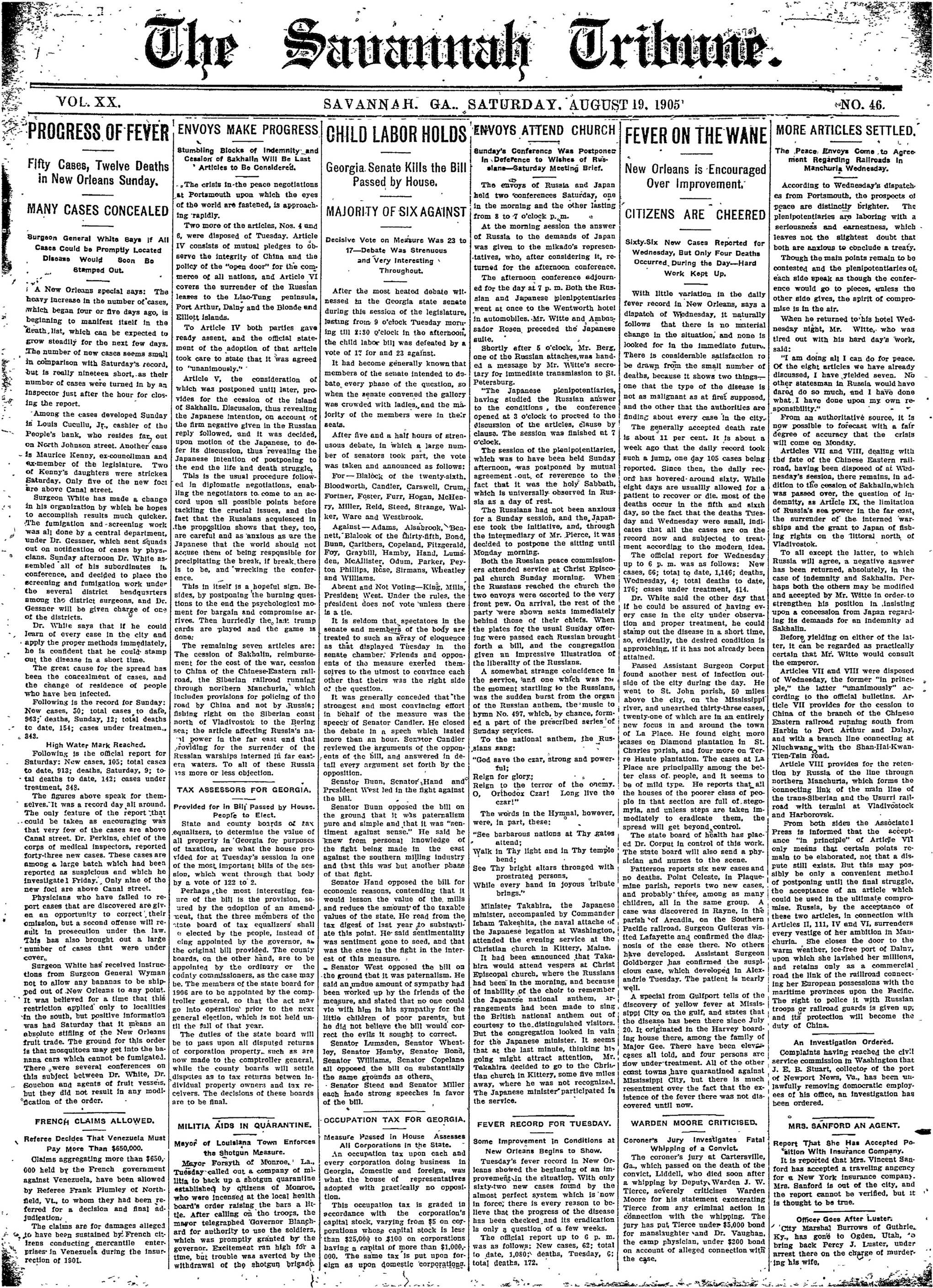
3 VOL. XX, SAVANNAH. GA. SATURDAY. AUGUST 19, 1905" “NO. 46.
‘PROGRESS OF FEVER
Fifty Cases, Twelve Deaths
in New Orleans Sunday,
MANY CASES CONCEALED
Surgeon General White Bays if All
Cases Could be Promptly Located
. Discase Would Soon Bo
. oo. Stemped Out.
++ —
§ A New Orleans special says: The
heavy Increase in the number of’cases,
iwhich began four or five days ago, is
beginning to manifest itself in the
Meath st, which can be expected to
grow steadily for the next few days.
, ‘The number of new casea seems small
in comparison with Saturday's record,
‘Dut is really nineteen short,.as their
number of cases were turned in by an
Inspector just after the hour for clos
ing the report. 7
“Among the cases developed Sunday
is Louis Cucullu, Jr. cashier of the
People’s bank, who resides far, out
on North Johnson street. Another’ caso
~ 4s Maurice Kenny, ex-councilman and
e@x-member of the legislature. Two
of Kenny's daughters were stricken
Saturday. Only five of the new foct
‘ro above Canal street.
Surgeon White has made » change
in his organization by which he hopes
to accomplish results much quicker.
Whe fumigation and-screenlag work
was alj done by a central department,
under Dr. Gessner, which sent squads
out on notifeation of cases by physe
clans. Sunday afternoon Dr. White as-
sembled “all of his subordinates [u
conference, and decided to place the
screening and fumigation work under
tho several district headquarters
among tho district surgeons, and Dr.
Gessner will be given charge of ore
of the districts. *
Dr. While says that If he could
learn of every case in the city and
: apply the proper methods immediately,
he is confident that he could stamp
ut the disease in a short time.
‘The great cause for the spread has
been the concealment of cases, and
the change of residence of people
who have ben infected.
Following 1s the record for Sunday:
New cases, 50; total cases to date,
963; deaths, Sunday, 12; total deaths
te date, 154; cases under treatmen.,
. 843.
High Water Mark Reached.
Following is the official report for
Saturday: New cases, 105; total cases
to date, 913; deaths, Saturday, 9; to-
- tal deaths to date, 142; cases under
treatment, 343.
‘The figures above speak for them-
selves. It was a record day all around.
‘The only feature of the report “that
-could be taken as encouraging was
that very few of the cases are abovo
Canal street. Dr. Perkins, chief of the
corps of medical inspectors, reported
forty-three new cases. These cases are
among a large batch which had been
reported as suspicious and which he
investigatel Friday. , Only nine of tho
new foc! are above Canal street.
Physicians who have failed to re-
port cases that are discovered are glv-
en an opportunity to correct’ their
omtsston, but a second offense will re-
sult In prosecution under the law.
‘This bos also brought out a large
‘mumber of cases that were under
cover.,
Surgeon White has received instrue-
tions from Surgeon General Wyman
not to allow any bananas to be ship-
ped out of New Orleans to any point.
‘It was believed for a time that this
restriction applied’ only to localities
stn the south, but positive information
was had Saturday that it means an
absolute stifiing of the New Orleans
fruit trade. The ground for this order
4s that mosquitoes may get into the ba-
nena cars which cannot be fumigated.
‘There ,were several conferences on
this subject between Dr. White, Dr.
Souchon and agents of fruit vesseis,
but they did not result in any mod!
“gcation of the order. -
FRENCH CLAIMS ALLOWED,
Referee Decides That Venezuela Must
Pay Mose Than $650,000.
Olaims aggregating more than $650,
600 held by the French government
against Venezuela, have been allowed
by Referee Frank Plumley of North-
field, Vt, to whom they had been re-
ferred for 2 decision and fins} ad-
Judteation: |
‘The claims are for damages alleged
i6 have been sustained by: French cit-
Yzens conducting, mercantile enter.
prises: in Venezuela during the insur-
rection of 1S01.
ENVOYS MAKE PROGRESS
stumbling Blocks of Indemnity: and
Cession of Sakhalln WIll Be Last
” articles to Be Considered,
bigke orisis in-the peace negotiations
.&t Portsmouth upon which the eyes
of the world are fastened, is approach-
ing ‘rapidly.
Two more of the articles, Nos. 4 and
6, were disposed of Tuesday. Article
IV consists of mutual pledges to ob.
servo the integrity of China and the
policy of the “open door” for the com:
meree of all nations, and Article VI
covers the surrender of the Russian
leases to the Liso-Tung peninsula,
Port Arthur, Dalny and the Blonde and
Elliott islands.
To Article IV both parties gave
ready assent, and the official state
ment of the adoption of that article
took care to state that It was agreed
to “unanimously.” *
Article V, the cons{deration of
which was postponed until later, pro-
vides for the cession of the Island
of Sakhalin, Discussion, thus revealing
the Japanese intention, on account of
the firm negative given in the Russlan
reply followed, and it was decided,
upon motion of the Japanese, to de-
fer Its discussion, thus revealing the
Japanese {ntention of postponing to
the end the life and death struggle,
This is the usual procedure foliow-
ed in diplomatic negotiations, enab-
ling the negotiators to. come to an ac-
cord upon all possible points before
tackling the cruciat issues, and the
fact that the Russians acquiesced In
the propgsition shows that they, too,
are careful and as ‘anzlous as are the
Japanese that the world should not
aceuse them of being respqnsible for
precipitating the break, if break, there
Is to be, and “wrecking the eonfer-
ence. ~
‘This in itself s a hopeful sign. Be-
sides, by postponing ‘the burning ques-
tions to the end the psychological mo-
ment for bargain and compromise ar-
tives. Then hurriedly the, last tramp
ecards are played and the game 15
done:
The remaining seven articles are:
The cession of Sakhalin, reimburse-
ment for the cost of the war, cession
to China of the ChineseEastern rall-
road, the Siberlan railroad running
through northern Manchuria, which
includes provisions for policing of tho
road by China and not by Russia;
fishing right on the Slberlan coast
north of Vladivostok to the Bering
sea; the article affecting Russla’s na-
“ul power {n the far cast end that
soviding for the surrender of the
Resslan warships interned |i far east-
etn waters. To all of these Russia
42s more or less objection.
TAX ASSESSORS FOR GEORGIA,
Provided for in Bilt Passed by House.
Peopfe to Elect.
State and county boards of tax
equalizers, to determine the value of
all property in ‘Georgia for purposes
of taxation, are what the house pro-
vided for at Tuesday's session in one
of the most important bills of the ses-
sion, which went through that body
by & vote of 122 to’ 2.
Perbaps the most interesting fea-
ure of the bill is the provision, se-
uted by the adoption of an amend-
nent, that the three mémbers of the
state board of tax equalizers’ shall
© elected by the people, instead of
cing appointed by the governor, a»
the original bill provided. The county
boards, on the other hand, are to be
appointea by the ordinary or the
cotinty comnussioners, as the case may
be. The members of the state board for
1906 are to be appointed by the comp-
troller general, co that the act may
go Into operation’ prior to the next
general election, which {s not held un-
til the fall of that year.
‘The duties of the state board will
be to pass upon all disputed returns
ef corporation property, such as are
now made to the comptroller general,
while the county boards will settle
disputes as to tax returns betwen In-
dividual property owners and tax re-
ceivers. The decisions of these boards
are to be final.
MILITIA AIDS IN QUARANTINE.
Mayo? of Loulsiana Town Enforces
the Shotgun Measure.
Mayor Forsyth of Monroe,’ La.,
Tuésday-called out a company of mi-
Utia to back up a shotgun quarantine
established by qitizens of Monroe,
who were incensed at the local health
poard’s order raising the bars a It-
tle. After calling on the troors, the
mayor telegraphed ‘Gavernor Blangh-
ard for authority to use the soldiers,
which was promptly granted by the
governor. Excitemeat ran high f6r a
time, but trouble was averted by the
withdrawal of the shotgun brigade.
a eee. eek tate "De es FE ee
GHILD LABOR HOLDS
Georgia. Senate Kills the Bill
Passed by House.
MAJORITY OF SIX AGAINST
Decisive Vote on Measure Was 23 to
17—Debate Was Strenuous
and Very Interesting +
i Throughout.
After the most heated debate wit-
nessed tn the Georgia state senate
during this session of the legislature,
Yesting fromm 9 o'ctock Tuesday moru-
ing tll 2:80 g’clock in tho afternooii,
the child labor bil] was defeated by a
yote of 17 for and 23 against.
‘It had become génerally known that
members of the senate intended to ds-
bate every phase of the question, so
when the senate convened the gallery
was crowded with ladles,,and the ma-
jority of the members were in their
seats,
After five and a half hours of stren-
usous debate, in Which a large num-
Der of senators took part, the vote
was taken and announced as follows:
For— Blalock of the twenty-sixth,
Bloodworth, Candier, Carswell, Crum,
Fortner, Foster, Furr, Hogan, McHen-
ry, Miller, Reld, Steed, Strange, Wal-
ker, Ware and Westbrook.
Against— Adams, Alsabrook, \Ben-
nett,"Blalook of the fhirty-ffth, Bond,
Bunn, Caritkers, Copeland, Fitzgerald,
Foy, Graybill, Hamby, Hend, Lums-
den, McAllister, Odum, Parker, Pey-
ton Phillips, Rése, Sirmans, Wheatley
and Williams. : .
Absent and Not Voting—King, Mills,
President West. Under the rules, the
president does not vote ‘unless there
is a tle.
It ts seldom that spectators In the
senate and memker$ of the body are
treated to such an afray of eloquence
as that displayed Tiesday in the
senate chamber. Friends and oppon-
ents of the measure exerted them-
selves to the utmost to convince each
other that theirs was the right slde
of the question.
It was generally conceded that "the
strongest and most convincing effort
in behalf of the measure was the
speech’ of Senator Candler. He closed
the debate In a spech which lasted
more than an hour. Sen3tor Candler
tevlewed the arguments of the oppon-
ents of the bill, and answered in de-
tall every argument set forth By the
opposition. (i ;
Senator Buon, Senator’,Hand and’
President West led in the fight against
the bill. 2
Senator Bunn opposed the bill on
the groung that it wis paternalism
pure and simple and that it was “sen-
timent against sense.” He sald be
‘knew from persona} Imowledge of
the fight being made in the east
against the southern milling Industry
and that this was but another phase
of that fight.
Senator Hand opposed the bill for
economic reasons, contending that it
would lesson the value of the, mills
and reduce the amount’ of the taxable
values of the state, He read from the
tax digest of Isst year do substanti-
ate this point. He sald sent!mentality
‘was sentiment gone to seed, and that
was the cace in the fight in the inter-
est of this measure. >
= Senator West opposed the pill oa
the ground that it was paternalism. He
sald an ndue amount of sympathy had
been worked up hy the friends of the
meagure, and stated that no one could
yio with him in his sympathy for the
little children of poor parents, but
he dia hot beliave the bill would cor-
rect the evils It sought to correct.
Senator Lumsden, Senator Wheat-
ley, Senator Hamby, Senator Bona,
Senator Williams, Senator Copelana
all opposed the bill on substantially
the same grounds as others,
- Senator Steed and Senator Miller
each made strong speeches Jn favor
of the bill. ‘
Measure Passed In House Assesses
All Corporations in the State. ~
An occupation tax upon each and
every corporation doing business in
Georgia, domestic and foreign, was
what the Louse of representatives
adopted with practically no oppost-
tlon.
This occupation tax is graded in
gecordance with the corporation’s
capital stock, varying from $5 on cor-
porations whose capital stock Is less
‘than $25,009 to $100 on corporations
baving a capital of more than $1,000,
000, The same tax Js put upon for-
elgn @$ upon domestic ‘corporations.
ENVOYS ATTEND CHURCH
@unday's Conference Was Postponec
In \Deference to Wishes of Rus-
- slane—Saturday Meeting Brief,
| The envoys of Russias and Japan
paela two conferences Saturday, one
iin the morning and the other lasting
from 8 to 7 o'clock p.m. e
At the morning session the answer
of Russla to the demands of Japan
was given to the mikado’s represen-
-tatives, who, after considering it, re-
turned for the afternoon conference.
The afternoon conference edjourn-
ed for the day at 7 p. m. Both the Rus.
sian and Japanese jplenipotentiaries
iwent at once to the Wentworth hotel
in automobiles. -Mr. Witte and Ambas:
sador Rosen, preceded the Japanese
suite, * :
Shortly after 6 o'clock, Mr. Berg,
one of the Russian attaches,was hand-
ed a message by Mr. Wiltte’s secre-
tary for immediate transmission to St.
Petersburg.
| “The Japanese plenipotentiarles,
baving studied the Russian answer
to the conditions , the conference
opened at 3 o'clock to proceed to the
@iscussion of the articles, clause by
clausa. The session was finished at 7
o'clock,
‘The session of the plonipotentiaries,
which was to have been held Sunday
afternoon, was postponed by mutual
agreement -out, of reverence to the
fact that it was the holy Sabbath,
which 1s universally observed in Rus:
sia as a day of rest.
‘The Russians had not been anxious
for a Sunday session, and the, Japan-
ese took the Initiative, and, through
the intermediary of Mr. Pierce, it was
decided to postpone the sitting until
Monday morning.
Both the Rueslan peace commisston-
ers attended service at Christ Episco-
pal church Sunday morning. When
the Russians reached the church the
two envoys were oscorted to the very
front pew. On arrival, the rest of the
party ‘were shown seats immediately
behind those of their chefs. When
the plates for the usual Sunday offer-
ing were passed each Russian brought
forth a Dill, and the congregation
given an Impressive illustration of
the liberality of the Russians.
A somewhat strange coincidence in
the service, ‘and one whfch was for
the moment startling to the Russians,
was the sudden burst from the organ
of the Russian anthem, the*music to
bymn No. 497, whicb, by chance, form-
ed a part of the prescribed series’of
Sunday services. 7
To the national anthem, the Rus-
Slans sang: «=
“God save the czar, strong and power-
ful;
Relgn for glory; un %
Reign to the terror of the onemy.
©, Orthodox Czar! Long live the
ezari"
The words In the Hymnal, however,
were, in part, these: «
“See barbarous nations at Thy sates
a attend;
Walk in Thy light ond in Thy temple
bend; :
See Thy bright altars thronged with
prostrateg persons, 7
While every hand in joyous tribute
brings.”
Minister Takabira, the Japanese
minister, accompanied by Commander
Isham Takeshita, the naval attache of
the Japanese legation at Washington,
attended the evening service at the
Christlan church in Kittery, Maine.
It bad been emnounced that Taka-
hira would attend vespers at Christ
Episcopal church, where the Russians
had been in the morning, and because
of inability of the choir to remember
the Japanese national anthem, ar-
rangements aad been made to sing
the British national anthem out of
courtesy to the.distinguished visitors.
But the congregation looked in vain
for the Japanese minister. It seems
that at the last minute, thinking hi»
going might attract attention, Mr.
Takahira decided to go to the Chrit-
tlan church in Kittery, some five miles
away, where he was not recognized.
The Japanese minister’ participated {a
the service. :
FEVER RECORD FOR TUESDAY.
Some Improvement in Conditions at
New Orleans Begins to Show.
‘Tuesday's fever record in New Or-
leans shotved the begluning of an im-
provemefityin the sitvation. With only
sixty-two new cases fowmd by the
almost perfect system which is ‘now
In force; there is every reason to be-
Heve that the progress of the disease
has been checked and its eradication
Is only 3 question of a few weeks.
The official report up to G p. m.
yas as follows: New cases, 62; total
to date, 1,080;\ deaths, Tuesday, 6;
total deatks, 172. ©
FEVER ON THE WANE
New Orleans is Encouraged
Over Improvement,
CITIZENS ARE CHEERED
Sixty.Six New Cases Reported for
Wednesday, But Only Four Deaths
Occurred During the Day—Hard
Work Kept Up,
‘With ttle variation in the daily
fever record in New Orleans, says a
dispatoh of Wpdnesday, it naturally
follows that there ts no muterial
change in the situation, and none fs
looked for in the immediate future.
There is considerable satisfaction to
be drawn from the small number of
deaths, because tt shows two things—
one that the type of the disease is
not as malignant as at first supposed,
and the other that the authorities are
finding about every case jn the city.
The generally accepted death rate
is about 11 per cent. It ts about a
week ago that the daily record took
such # jump, one day 105 cases belng
reported. Since then, the dally rec-
ord has hoyered- around sixty, While
eight days are usuallly allowed for a
patient to recover or die. most of the
deaths occur in the fifth and sixth
day, so the fact that the deaths Tues-
day and Wednesday were small, indi-
cates that all the cases are on the
record now and subjected to treat
ment according to the modern, idea.
The official report for Wednesday
up to 6 p. m. was as follows: New
cases, 66; total to date, 1,146; deaths,
Wednesday, 4; total deaths to date,
176; cases under treatment, 414.
Dr. White said the other day that
If he could be assured of having ev-
ery case in the city under observa-
tion and proper treatment, he could
stamp out the disease in a short time,
80, evidently, the desired condition is
approaching, if it has not already been
attained.
Passed Assistant Surgeon Corput
found unother nest of Infection out-
side of the city during the day. He
went to St. John parish, 50 miles
aboye the city, on ‘the Mississippi
river, and unearthed thirty-three cases,
twenty-one of which are in an entirely
new focus in and around the town
of La Place. He found eight more
‘cases on Diamond plantation In St.
Charles parish, and four more on Ter-
re Haute plantation. The cases at La
Place are principally among the be!-
ter class of. people, and {t seems to
be of mild type. He reports that_ail
the houses of the poorer class of peo-
ple in that section are full of stezo-
myia, and unless steps are taken im-
modiately to eradicate them, the
spread will get beyond, control.
‘The state board of health has plac-
ed Dr. Corput in control of this work.
‘The state board will also send a phy-
siclan and nurses to the scene.
Patterson reports six new cases and
no deaths. Point Celeste, in Plaque-
mine parish, reports two new cases,
and probably’ thfee, among as many
children, all in the same group. A
case was discovered in Rayne, in the
parish ‘of Arcadia, on the Southern
Paelfic railroad, Surgeon Guiteras vis-
{ted Lafayette anq confirmed the diag-
mosis of the case there. No others
hve developed. Assistant Surgeon
Goldberger has confirmed the suspi-
cous case, which developéa in Alex-
andrie Tuesday. The patient is nearly
well.
‘A special from Gulfport tells of the
discovery of yellow fever at Missis-
sippl City on the gulf, and states that
the disease has been there since July
20. It originated in the Harvey board-
ing house there, among the family of
Major Gee. There have been elevor
cgses all told, and four persons are
wow under‘treatment. All of the other
coast towns have quarantined against
Mississippl City, but there is much
resentment over the fact that the ex-
istence of the fever there was not dis-
covered until now.
Coroner’s Jury Investigates Fatal
Whipping of a Convict.
‘The coroner's jury at Cartersville,
Ga., which passed on the death of the
convict, Liddell, who died soon after
a whipping by Deputy, Warden J. W.
Tierce, se¥erely criticises Warden
Moore for his statement exonerating
‘Tieree from any criminal action in
cdnnection with the whipping. The
jury has pat, Tlerce under $5,000 bond
for manslaughter sand Dr. Vaughan,
the camp physician, under $200 bond
on account of alleged connection wit
the case,
MORE ARTICLES SETTLED,
The Peace, Envoys Come a ‘Agree
mient Regarding Railroads In
Manchuria Wednesday.
According to Wednesday's dispatch
es from Portsmouth, tho prospects of
Deace are distinctly Brighter. The
plentpotentlaries are laboring with a
seriousness and earnestness, which
leaves not the slightest doubt that
both are anxlous to cbnclude a treaty.
| Though the main points remain to bo
contested and the plenipotentiaries of:
each side speak as though the confer-
ence would go to pleces, amless the
other side gives, the spirit of compro-
mise js in the air,
‘When he returned to’his hotel Wed-
nesday night, Br. Witte, who was
tired out with his hard day's Work,
sald: .
“I am doing all I can do for peace.
Of the eight articles we have already
discussed, I have ylelded seven. No
other statesman in Russia would havo
dareq do so much, and I have done
what.I have done upon my own re-
_sponstbility.” : - +
From an authoritativé source, it ts
now possible to forecast with a fair
degree of accuracy that the crisis
will come on Monday.
Articles VII and VIII, dealing with
thd fate of the Chinese Eastern rail-
road, having been disposed of at Wed-
nesday’s session, there remains, in ad-
dition to te cession of Sakhalin,which
was passed over, the question of in-
demnity, as Article IX, the limitation
of Russla’s sea power in the far east,
the surrender of the interned ‘war-
ships and the grant to Japan of fish-
ing rights on the ‘littoral north of
Viadivostok. s
To all except the latter, to which
Russia will agree, a negative answer
has been returned, absolutely, in the
case of indemnity and Sakhalin. Per-
haps both the others may be modified
and accepted by Mr. Witte in order-to
strengthen his position in insisting
upon a concession from Japan regard-
{ng its demands for en indemnity ad
Sakhalin.
Before, yielding on elther of the Iat-
ter, it can be regarded as practically
certain that Mr, Witte would consult
the emperor.
Articles VIE and VIII were disposed
of Wednesday, the former “in princi
ple,” the latter “unanimously” ac-
cording to the official bulletins. Ar-
ticle VII provides for the cession to
China of the branch of the Chinese
Eastern railroad running south from
Harbin to Port Arthur and Dalny,
and with a branch Ine connecting at
Niuchwang with the Shan-Hai-Kwan-
Tien-Tsin foad.
Article VIII provides for the reten-
tlon by Russia of the Ine througn
northern Manchuria, which forms the
connecting link of the main line of
the trans-Siberlan and the Usurri rail-
road with termini at Viadivostock
and Harborovsk. :
From both sides the Assdclate!
Press is informed that the accept-
ance “in principle” of Artidle Vil
only means that certain polnts re-
main to be elaborated, not that a dis-
pute still exists, But this may pos-
sibly be only a convenient methot
of postponing until the final struggle,
the acceptance of an article which
could be used in the ultimate compro-
mise. Russia, by the acceptance of
these two articles, in connection with
Articles II, 111, IV and VI, surrenders
every vestige of her ambition In Man-
churia. She closes the door to the
warm weather, ice-free port of Dalny,
upon which she lavished her millfons,
and retains only as a commercial
road the link of the raillroad connect-
Ing her European possessions with the
maritime provinces upon the Pacific.
The right to police it with Russian
troops or railroad guards is given up;
and its protection will become the
duty of China.
An Investigation Ordered.
Complaints having reached the clv!l
service commission im Washington that
J. E. B. Stuart, collector of the port
of Newport News, Ve., has been un-
Jawfully removing democratic employ-
ees of his office, an investigation has
been ordered.
Ce
MRS. SANFORD AN AGENT.
jes <
Report That She Has Accepted Po-
“sition With Insurance Company.
It is reported that Mrs. Vincent San-
ford has accepted a traveling angency
for @ New York insurance company.
Mrs. Sanford is out of the city, and
the report cannot be verified, but 1t
ia thought to be true.
Officer Goes After Luster:
’ ‘City Marshal Burrows of Guthrie,
Ky., has goné to Ogden, Utah, *o
bring back Perey J. Luster, under
arrest there on the chayge of murder-
‘ine his wife, - .
SUBSCRIPTION RATES.
One Year.....B125
Six Months.....B126
Ten Months.....B128
Remittance must be made by Express or Post Office Money Order, or Registered Letter Advertising Rates given on application.
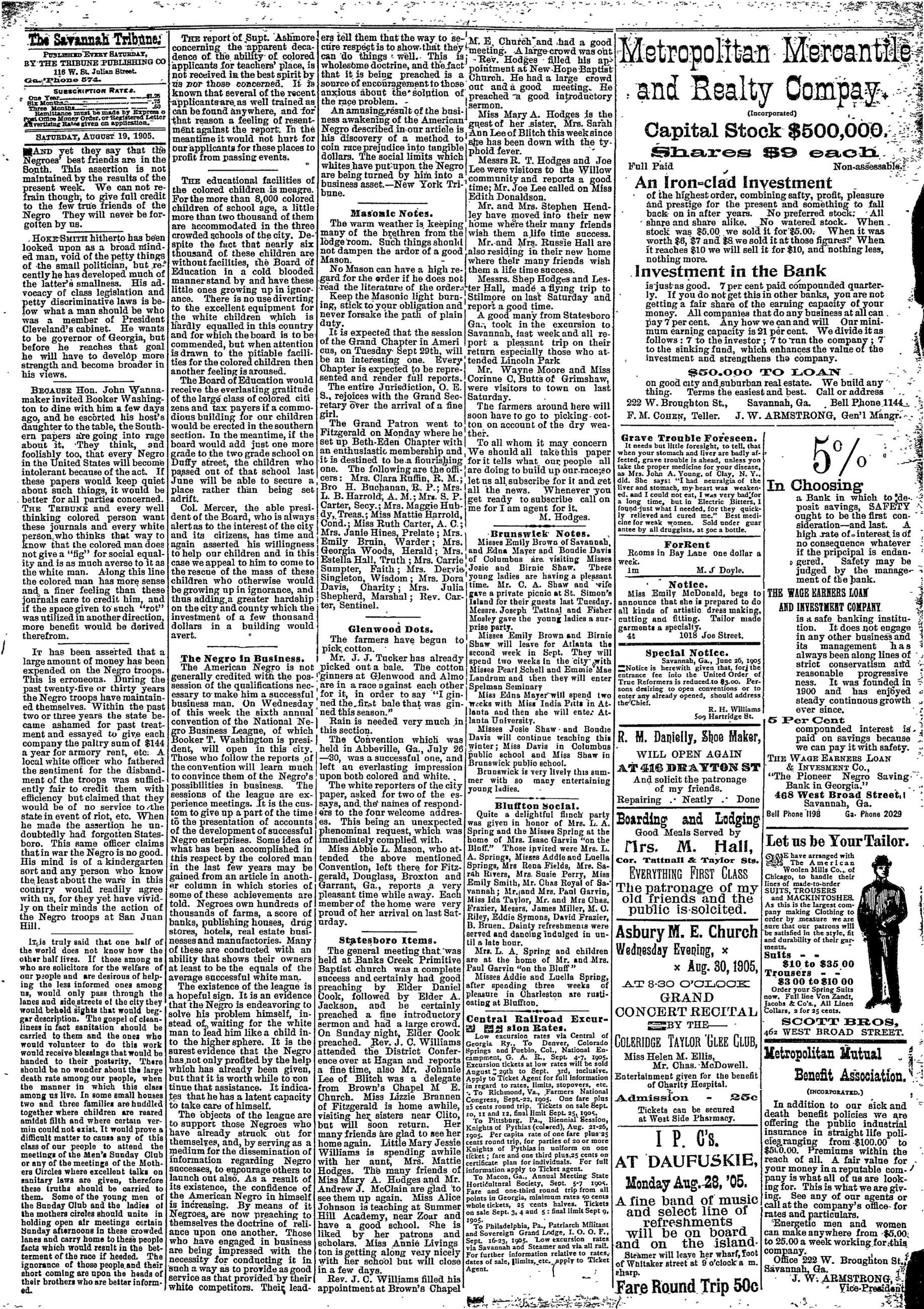
SATURDAY, AUGUST 19, 1905.
AND yet they say that the Negroes' best friends are in the South. This assertion is not maintained by the results of the present week. We can not refrain though, to give full credit to the few true friends of the Negro. They will never be forgotten by us.
Hoke-Smith hitherto has been looked upon as a broad minded man, void of the petty things of the small politician, but recently he has developed much of the latter's smallness. His advocacy of class legislation and petty discriminative laws is below what a man should be who was a member of President Cleveland's cabinet. He wants to be governor of Georgia, but before he reaches that goal he will have to develop more strength and become broader in his views.
BEOAUSE Hon. John Wannamaker invited Booker Washington to dine with him a few days ago, and he escorted his host's daughter to the table, the Southern papers are going into rage about it. They think, and foolishly too, that every Negro in the United States will become intolerant because of the act. If these papers would keep quiet about such things, it would be better for all parties concerned. THE TRIBUNE and every well thinking colored person want these journals and every white person, who thinks that way to know that the colored man does not give a "fig" for social equality and is as much averse to it as the white man. Along this line the colored man has more sense and a finer feeling than these journals care to credit him, and if the space given to such "rot" was utilized in another direction, more benefit would be derived therefrom.
It has been asserted that a large amount of money has been expended on the Negro troops. This is erroneous. During the past twenty-five or thirty years the Negro troops have maintained themselves. Within the past two or three years the state became ashamed for past treatment and essayed to give each company the paltry sum of $144 a year for armory rent, etc. A local white officer who fathered the sentiment for the disbandment of the troops was sufficiently fair to credit them with efficiency but claimed that they would be of no service to the state in event of riot, etc. When he made the assertion he undoubtedly had forgotten Statesboro. This same officer claims that in war the Negro is no good. His mind is of a kindergarten sort and any person who know the least about the wars in this country would readily agree with us, for they yet have vividly on their minds the action of the Negro troops at San Juan Hill.
It is truly said that one half of the world does not know how the other half lives. If those among us who are solicitors for the welfare of our people and are desirous of helping the less informed ones among us, would only pass through the lanes and side streets of the city they would behold sights that would beggar description. The gospel of cleanliness in fact sanitation should be carried to them and the ones who would volunteer to do this work would receive blessings that would be handed to their posterity. There should be no wonder about the large death rate among our people, when the manner in which this class among us live. In some small houses two and three families are huddled together where children are reared amidst filth and where certain vermin could not exist. It would prove a difficult matter to cause any of this the meetings of the Men's Sunday Club or any of the meetings of the Mothers Circles where excellent talks on sanitary laws are given, therefore these truths should be carried to them. Some of the young men of the Sunday Club and the ladies of the mothers circles should unite in holding open air meetings certain Sunday afternoons in these crowded lanes and carry home to these people facts which would result in the betterment of the race if heeded. The ignorance of those people and their short coming are upon the heads of their brothers who are better informed.
The report of Supt. Ashimore concerning the apparent decadence of the ability of colored applicants for teachers' place, is not received in the best spirit by us nor those concerned. It is known that several of the recent applicants are as well trained as can be found anywhere, and for that reason a feeling of resentment against the report. In the meantime it would not hurt for our applicants for these places to profit from passing events.
THE educational facilities of the colored children is meagre. For the more than 8,000 colored children of school age, a little more than two thousand of them are accommodated in the three crowded schools of the city. Despite the fact that nearly six thousand of these children are without facilities, the Board of Education in a cold blooded manner stand by and have these little ones growing up in ignorance. There is no use diverting to the excellent equipment for the white children which is hardly equalled in this country and for which the board is to be commended, but when attention is drawn to the pitiable facilities for the colored children then another feeling is aroused.
The Board of Education would receive the everlasting gratitude of the large class of colored citizens and tax payers if a commodious building for our children would be erected in the southern section. In the meantime, if the board would add just one more grade to the two grade school on Duffy street, the children who passed out of that school last June will be able to secure a place rather than being set adrift.
Col. Mercer, the able president of the Board, who is always alert as to the interest of the city and its citizens, has time and again asserted his willingness to help our children and in this case we appeal to him to come to the rescue of the mass of these children who otherwise would be growing up in ignorance, and thus adding a greater hardship on the city and county which the investment of a few thousand dollars in a building would avert.
The Negro in Business.
The Negro in Business. The American Negro is not generally credited with the possession of the qualifications necessary to make him a successful business man. On Wednesday of this week the sixth annual convention of the National Negro Business League, of which Booker T. Washington is president, will open in this city. Those who follow the reports of the convention will learn much to convince them of the Negro's possibilities in business. The sessions of the league are experience meetings. It is the custom to give up a part of the time to the presentation of accounts of the development of successful Negro enterprises. Some idea of what has been accomplished in this respect by the colored man in the last few years may be gained from an article in another column in which stories of some of these achievements are told. Negroes own hundreds of thousands of farms, a score of banks, publishing houses, drug stores, hotels, real estate businesses and manufactories. Many of these are conducted with an ability that shows their owners at least to be the equals of the average successful white man.
The existence of the league is a hopeful sign. It is an evidence that the Negro is endeavoring to solve his problem himself, instead of waiting for the white man to lead him like a child into the higher sphere. It is the surest evidence that the Negro has not only profited by the help which has already been given, but that it is worth while to continue that assistance. It indicates that he has a latent capacity to take care of himself.
The objects of the league are to support those Negroes who have already struck out for themselves, and, by serving as a medium for the dissemination of information regarding Negro successes, to encourage others to launch out also. As a result of its existence, the confidence of the American Negro in himself is increasing. By means of it Negroes, are now preaching to themselves the doctrine of reliance upon one another. Those who have engaged in business are being impressed with the necessity for conducting it in such a way as to provide as good service as that provided by their white competitors. Their lead-
ers tell them that the way to secure respect is to show that they can do things well. This is wholesome doctrine, and the fact that it is being preached is a source of encouragement to those anxious about the solution of the race problem.
An amusing result of the business awakening of the American Negro described in our article is his discovery of a method to coin race prejudice into tangible dollars. The social limits which whites have put upon the Negro are being turned by him into a business asset.—New York Tribune.
Masonic Notes.
The warm weather is keeping many of the brethren from the lodge room. Such things should not dampen the ardor of a good Mason.
No Mason can have a high regard for the order if he does not read the literature of the order.
Keep the Masonic light burning, stick to your obligation and never forsake the path of plain duty.
It is expected that the session of the Grand Chapter in Americus, on Tuesday Sept 29th, will be an interesting one. Every Chapter is expected to be represented and render full reports.
The entire Jurisdiction, O. E. S., rejoices with the Grand Secretary over the arrival of a fine girl.
The Grand Patron went to Fitzgerald on Monday where he set up Beth-Eden Chapter with an enthusiastic membership and it is destined to be a flourishing one. The following are the officers: Mrs. Clara Ruffin, R. M.; Bro H. Buchanan, R. P.; Mrs. L. B. Harrold, A. M.; Mrs. S. P. Carter, Secy.; Mrs. Maggie Hubdy, Treas.; Miss Mattie Harrold, Cond.; Miss Ruth Carter, A. C.; Mrs. Janie Hines, Prelate; Mrs. Emily Bruin, Warder; Mrs. Georgia Woods, Herald; Mrs. Estella Hall, Truth; Mrs. Carrie Sumpter, Faith; Mrs. Dervie Singleton, Wisdom; Mrs. Dora Davis, Charity; Mrs. Julia Shepherd, Marshal; Rev. Carter, Sentinel.
Glenwood Dots.
The farmers have begun to pick cotton.
Mr. J. J. Tucker has already picked out a bale. The cotton ginners at Glenwood and Almo are in a race against each other for it, in order to say "I ginned the first bale that was ginned this season."
Rain is needed very much in this section.
The Convention which was held in Abbeville, Ga., July 26—30, was a successful one, and left an everlasting impression upon both colored and white.
The white reporters of the city paper, asked for two of the essays, and the names of responders to the four welcome addresses. This being an unexpected phenominal request, which was immediately complied with.
Miss Abbie L. Mason, who attended the above mentioned Convention, left there for Fitzgerald, Douglass, Broxton and Garrant, Ga., reports a very pleasant time while away. Each member of the home were very proud of her arrival on last Saturday.
Statesboro Items.
The general meeting that was held at Banks Creek Primitive Baptist church was a complete success and certainly had good preaching by Elder Daniel Cook, followed by Elder A. Jackson, and he certainly preached a fine introductory sermon and had a large crowd. On Sunday night, Elder Cook preached. Rev. J. C. Williams attended the District Conference over at Hagan and reports a fine time, also Mr. Johnnie Lee of Blitch was a delegate from Brown's Chapel M E. Church. Miss Lizzie Brannen of Fitzgerald is home awhile, visiting her sisters near Clito, but will soon return. Her many friends are glad to see her home again. Little Mary Jessie Williams is spending awhile with her aunt, Mrs. Mattie Hodges. The many friends of Miss Mary A. Hudges and Mr. Andrew J. McClain are glad to see them up again. Miss Alice Johnson is teaching at Summer Hill Academy, near Zoar and have a good school. She is liked by her patrons and scholars. Miss Annie Livington is getting along very nicely with her school but will close in a few days.
Rev. J. C. Williams filled his appointment at Brown's Chapel
M. E. Church and had a good meeting. A large crowd was out Rev. Hodges filled his appointment at New-Hope Baptist Church. He had a large crowd out and a good meeting. He preached a good introductory sermon. Miss Mary A. Hodges is the guest of her sister, Mrs. Sarah Ann Lee of Blitch this week since she has been down with the typhoid fever. Messrs B. T. Hodges and Joe Lee were visitors to the Willow community and reports a good time; Mr. Joe Lee called on Miss Edith Donaldson. Mr. and Mrs. Stephen Hendley have moved into their new home where their many friends wish them a life time success.
Mr. and Mrs. Russie Hall are also residing in their new home where their many friends wish them a life time success. Messrs. Shep Hodges and Lester Hall, made a flying trip to Stilmore on last Saturday and report a good time. A good many from Statesboro Ga., took in the excursion to Savannah, last week and all report a pleasant trip on their return especially those who attended Lincoln Park. Mr. Wayne Moore and Miss Corinne C. Butts of Grimshaw, were visitors to town on last Saturday. The farmers around here will soon have to go to picking cotton on account of the dry weather.
To all whom it may concern
We should all take this paper
for it tells what our people all
are doing to build up our race; so
let us all subscribe for it and get
all the news. Whenever you
get ready to subscribe call on
me for I am agent for it.
Brunswiek: Notes.
Brunswick Notes.
Misses Emily Brown of Savannah, and Edna Mayer and Boudie Davis of Columbus are visiting Misses Josie and Birnie Shaw. These young ladies are having a pleasant time. Mr. C. A. Shaw and wife gave a private picnic at St. Simon's Island for their guests last Tuesday. Messrs. Joseph Tattnal and Fisher Mosley gave the young ladies a surprise party.
Misses Emily Brown and Birnie Shaw will leave for Atlanta the second week in Sept. They will spend two weeks in the city with Misses Pearl Schell and Emmie Mae Landrum and then they will enter Spelman Seminary.
Miss Edna Mayer will spend two weeks with Miss India Pitts in Atlanta and then she will enter Atlanta University.
Misses Josie Shaw and Bondie Davis will continue teaching this winter; Miss Davis in Columbus public school and Miss Shaw in Brunwick public school. Brunswick is very lively this summer with so many entertaining young ladies.
Bluffton Social.
Quite a delightful flunch party was given in honor of Mrs. L. A. Spring and the Misses Spring at the home of Mrs. Isaac Garvin "on the Bluff" Those invited were Mrs. L. A. Springs, Misses Addie and Luella Springs, Mrs Rena Fields, Mrs. Sarah Rivers, Mrs. Susie Perry, Miss Emily Smith, Mr. Chas Royal of Savannah; Mr. and Mrs. Paul Garvin, Miss Ida Taylor, Mr. and Mrs Chas. Frazier, Messrs, James Miller, M. C. Riley, Eddie Symons, David Frazier, B. Brun. Dainty refreshments were served and dancing indulged in until a late hour.
Mrs. L. A. Spring and children are at the home of Mr. and Mrs. Paul Garvin "on the Bluff"
Misses Addie and Luella Spring, after spending three weeks of pleasure in Charleston are rustiating at Bluffton.
Central Railroad Excursion Rates.
Low excursion rates via Central of Georgia Ry., To Denver, Colorado Springs and Pueblo, Col., National Encompassment. Excursion tickets at low rates will be sold 20th to Sept. 3rd, inclusive. Apply to Ticket Agent for full Information in regard to rates, limits, stopovers, etc. - To Richmond, Va., Farmers National Congress, Sept.-22, 1905. One fare plus 25 cents round trip. Tickets on sale Sept. 10, 11 and 12, final limit Sept. 25, 1905.
To Pittsburgh, Pa., Biennial Session, Knights of Pythias (colored), Aug. 21-26, 1905. Per capita rate of one fare plus 25 cents round trip, for parties of 20 or more Knights of Pythias in uniform on one ticket; fare and one third plus 25 cents on certificate plan for individuals. For full information apply to Ticket agent.
To Macon, Ga., Annual Meeting State Horticultural Society, Sept. 5-7 1905. Fare and one-third round trip from all points in Georgia, minimum rates 50 cents whole tickets, 25 cents halves. Tickets on sale Sept. 3, 4 and 5: final limit Sept 9, 1905.
To Philadelphia, Pa., Patriarch Militant and Sovereign Grand Lodge, I. O. F. O., Sept. 16-23, 1995. Low excursion rates via Savannah and Steamer and via all rail. For further information relative to rates, dates of sale, limits, etc., apply to Ticket Agent.
---
Metropolitan Mercantile and Realty Compay.
Shares $9 each Full Paid Non-assessable
An Iron-clad Investment
of the highest order, combining safety, profit, pleasure and prestige for the present and something to fall back on in after years. No preferred stock: All share and share alike. No watered stock. When stock was $5.00 we sold it for $5.00. When it was worth $6, $7 and $8 we sold it at those figures. When it reaches $10 we will sell it for $10, and nothing less, nothing more.
Investment in the Bank
is just as good. 7 per cent paid compounded quarterly. If you do not get this in other banks, you are not getting a fair share of the earning capacity of your money. All companies that do any business at all can pay 7 per cent. Any how we can and will Our minimum earning capacity is 21 per cent. We divide it as follows: 7 to the investor; 7 to run the company; 7 to the sinking fund, which enhances the value of the investment and strengthens the company.
$50.000 TO LOAN
on good city and suburban real estate. We build any thing. Terms the easiest and best. Call or address
222 W. Broughton St., Savannah, Ga. Bell Phone 1144
F. M. Cohen, Teller. J. W. ARMSTRONG, Gen'l Mangr.
Grave Trouble Foreseen.
It needs it little foresight, to tell, that when your stomach and liver are badly affected, grave trouble is ahead, unless you take the proper medicine for your disease, as Mrs John A. Young, of Clay, N. Y., did. She says: "I had neuralgia of the liver and stomach, my heart was weakened, and I could not eat, I was very bad for a long time, but in Electric Bitters, I found just what I needed, for they quickly relieved and cured me." Best medicine for weak women. Sold under guar antee by all druggists, at 50c a bottle.
ForRent
Rooms in Bay Lane one dollar a week.
1m M. J Doyle.
Notice.
Miss Emily McDonald, begs to
announce that she is prepared to do
all kinds of artistic dress making,
cutting and fitting. Tailor made
garments a specialty.
4t 1018 Joe Street.
Special Notice.
Savannah, Ga., June 26, 1905
Notice is herewith given that, for the
entrance fee into the United Order of
True Reformers is reduced to $3.00. Persons destining to open conventions to
earn already opened, should address
the Chief.
R. H. Williams
509 Hartridge St.
R. M. Danielly, Shoe Maker,
WILL OPEN AGAIN
AT 416 DRAYTON ST
And solicit the patronage
of my friends.
Repairing . . Neatly . . Done
Boarding and Lodging
Good Meals Served by
Mrs. M. Hall,
Cor. Tattnall & Taylor Sts.
EVERYTHING FIRST CLASS
The patronage of my
old friends and the
public is solicited.
Asbury M. E. Church Wednesday Evening, x
AT 8:30 O'CLOCK
GRAND
CONCERT RECITAL
BY THE
COLERIDGE TAYLOR 'GLEE CLUB,
Miss Helen M. Ellis.
Mr. Chas. McDowell.
Entertainment given for the benefit
of Charity Hospital.
Admission - 25c
Tickets can be secured
at West Side Pharmacy.
I P. O's.
AT DAUFUSKIE,
Monday Aug.28,'05.
A fine band of music
and select line of
refreshments
will be on board and on the island. Steamer will leave her wharf, foot of Whitaker street at 9 o'clock a m. sharp.
(Incorporated)
Stock $500,000.
S $9 each
Non-assessable.
Investment
Combining safety, profit, pleasure
present and something to fall
s. No preferred stock: All
No watered stock. When
sold it for $5.00. When it was
sold it at those figures? When
sell it for $10, and nothing less,
In the Bank
Cent paid compounded quarter-
this in other banks, you are not
of the earning capacity of your
s that do any business at all can
now we can and will. Our mini-
is 21 per cent. We divide it as
vestor; 7 to run the company; 7
which enhances the value of the
thens the company.
TO TO LOAN
Urban real estate. We build any
siest and best. Call or address
Savannah, Ga. Bell Phone 1144
W. ARMSTRONG, Gen'l Mangr.
5%
In Choosing
a Bank in which to deposit savings, SAFETY ought to be the first consideration—and last. A high rate of interest is of no consequence whatever if the principal is endangered. Safety may be judged by the management of the bank.
THE WAGE EARNERS LOAN
AND INVESTMENT COMPANY
is a safe banking institution. It does not engage in any other business and its management has always been along lines of strict conservatism and reasonable progressiveness. It was founded in 1900 and has enjoyed steady continuous growth ever since.
5 Per Cent
compounded interest is paid on savings because we can pay it with safety.
THE WAGE EARNERS LOAN
& INVESTMENT CO.
"The Pioneer Negro Saving Bank in Georgia."
468 West Broad Street
Savannah, Ga.
Bell Phone 1198 Ga. Phone 2029
Let us be YourTailor.
WE have arranged with
The American
Woolen Mills Co., of
Chicago, to handle their
lines of made-to-order
SUITS. TROUSERS
```markdown
```
and MACKINTOSHES.
As this is the largest company making Clothing to order by measure we are sure that our patrons will be satisfied in the style, fit and durability of their garments.
Suits - -
$10 to $35 00
Trousers - -
$3 00 to $10 00
Order your Spring Suits now. Full line Von Zandt, Jacobs & Co's., All Linen Collars, 2 for 25 cents.
SCOTT BROS,
462 WEST BROAD STREET
Metropolitan Mutual Benefit Association.
(INCORPORATED.)
In addition to our sick and death benefit policies we are offering the public industrial insurance in straight life policies ranging from $100.00 to $540.00. Premiums within the reach of all. A fair value for your money in a reputable company is what all of us are looking for. This is what we are giving. See any of our agents or call at the company's office for rates and particulars.
Energetic men and women can make anywhere from $5.00 to 25.00 a week working for this company.
Office 222 W. Broughton St.
Savannah, Ga.
"O. Soul, a fissure shears your heart
Like wound of bloody sword!
Who did this thing? 'The Soul replied;
'That was a friendly word!'
"O. Soul, you shun within my hand,
I scarce see where you be!
Who did this thing? 'The Soul replied;
'A woman pitied me."
"The Fool laid down his Soul and wept,
And knelt him down beside
He soothed and questioned all the night,
No Soul of him replied."
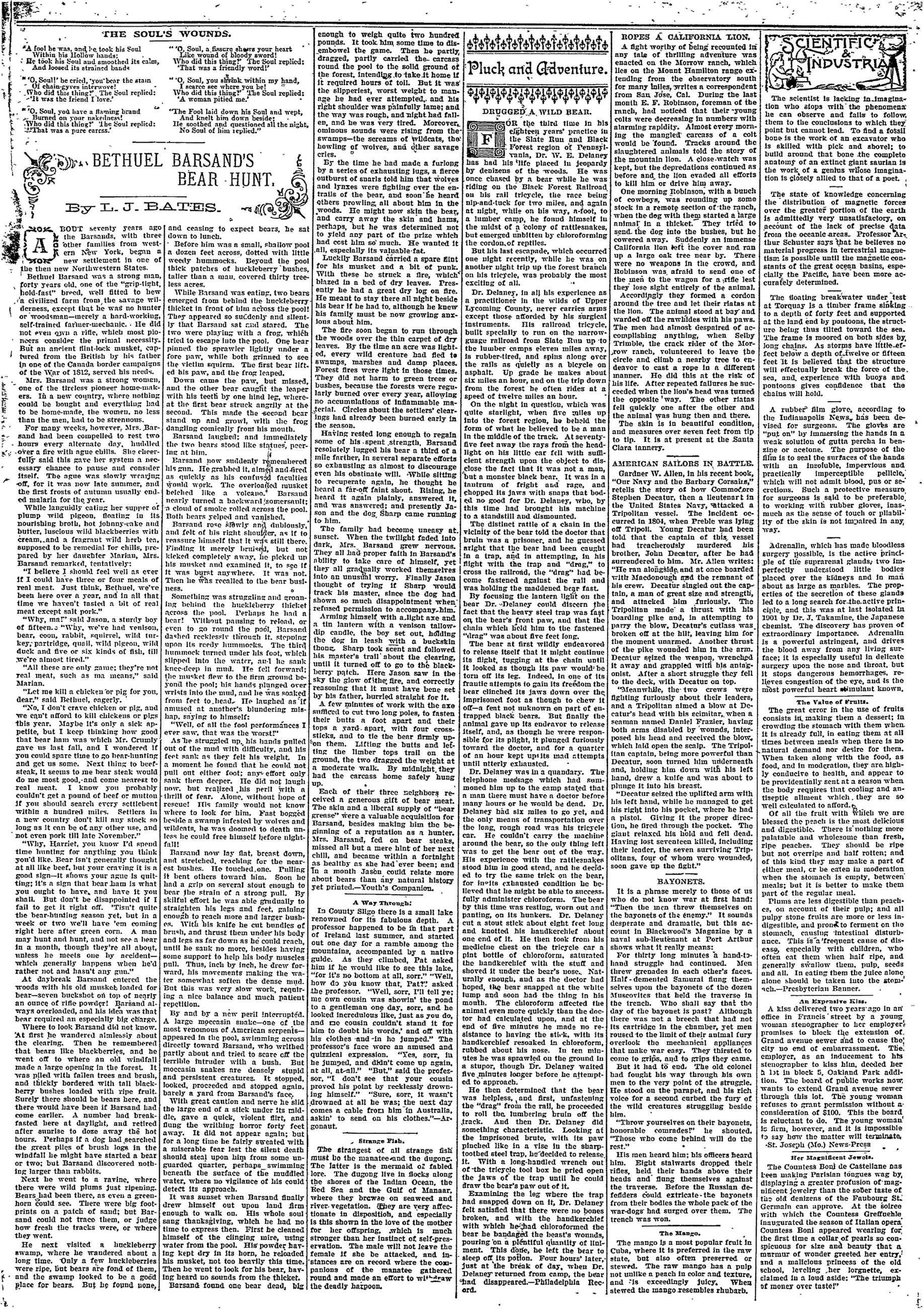
BETHUEL BARSAND'S BEAR HUNT.
BY L.J.BATES.
and ceasing to expect bears, he sat down to lunch.
Before him was a small, shallow pool a dozen feet across, dotted with little weedy hummocks. Beyond the pool thick patches of huckleberry bushes, taller than a man, covered thirty treeless acres.
While Barsand was eating, two bears emerged from behind the huckleberry thicket in front of him across the pool! They appeared so suddenly and silently that Barsand sat and stared. The two were playing with a frog, which tried to escape into the pool. One bear pinned the sprayer lightly under a fore paw, while both grinned to see the victim squirm. The first bear lifted his paw, and the frog leaned.
Down came the paw, but missed,
and the other bear caught the leaper
with his teeth by one hind leg, whereat
the first bear struck angrily at the
second. This made the second bear
stand up and growl, with the frog
dangling comically from his mouth.
Barsand laughed; and immediately
the two bears stood like statues, peering at him.
Barsand now suddenly remembered
his gun. He grabbed it, almost and fired
as quickly as his confused faculties
would work. The overloaded musket
belched like a volcano. Barsand
nearly turned a backward somersault;
a cloud of smoke rolled across the pool.
Both bears rebeled and vanished.
Barsand rose slowly and dubiously, and felt of his right shoulder, as it to reassure himself that it was still there.
Finding it merely bruised, but not kicked completely away, he picked up his musket and examined it, to see if it was burst anywhere. It was not. Then he was recalled to the bear business.
Something was struggling and groaning behind the huckleberry thicket across the pool. Perhaps he had a bear! Without pausing to reload, or even to go round the pool, Barsand dashed recklessly through it, stopping upon its reedy mummocks. The third hummock turned under his foot, which slipped into the water, and he sank knee-deep in mud. He fell forward; the musket flew to the firm ground beyond the pool; his hands plunged over wrists into the mud, and he was soaked from feet to head. He laughed as if amused at another's blundering mishap, saying to himself:
"Well, of all the fool performances I ever saw, that was the worst!" As he struggled up, his hands pulled out of the mud with difficulty, and his feet sank as they felt his weight. In a moment he found that he could not pull out either foot; any effort only sank their deeper. He did not laugh now, but realized his peril with a thrill of fear. Alone, without hope of rescue! His family would not know where to look for him. Fast bogged beside a swamp infested by wolves and wildcats, he was doomed to death unless he could free himself before nightfall!
Barsand now lay flat, breast down, and stretched, reaching for the nearest bushes. He touched one. Pulling it bent others toward him. Soon he had a grip on several stout enough to bear the strain of a strong pull. By skillful effort he was able gradually to straighten his legs and feet, gaining enough to reach more and larger bushes. With his knife he cut bundles of brush, and thrust them under his body and legs as far down as he could reach, until he sank no more, besides having some support to help his body muscles pull. Thus, inch by inch, he drew forward, his movements making the water somewhat soften the dense mud. But this was very slow work, requiring a nice balance and much patient repetition.
By and by a new peril interrupted.
A large moccasin snake—one of the most venomous of American serpents—appeared in the pool, swimming across directly toward Barsand, who writhed partly about and tried to scare off the terrible intruder with a bush. But moccasin snakes are densely stupid and persistent creatures. It stopped, looked, proceeded and stopped again, barely a yard from Barsand's face.
With great caution and nerve he slid the large end of a stick under its middle, gave a quick, violent flirt, and flung the writhing horror forty feet away. It did not appear again; but for a long time he fairly sweated with a miserable fear lest the silent death should steal upon him from some unguarded quarter, perhaps the swimming beneath the surface of the muddled water, where no vigilance of his could detect its approach.
It was sunset when Barsand finally drew himself out upon land firm enough to walk on. His whole soul sang thanksgiving, which he had no time to express then. First he cleaned himself of the clinging mire, using water from the pool. His powder having kept dry in its horn, he reloaded his musket, not too heavily this time. Then he went to look for his bear, having heard no sounds from the thicket. Barsand found one bear dead, big
"A fool he was, and he took his Soul
Within his Hollow hands;
He took his Soul and smoothed its calm,
And loosed its strained bands
"O. Soul! he cried, 'you bear the stain
Of chain-gives interwave!
Who did this thing? The Soul replied:
'It was the friend I love'
"O. Soul, you have a flaming brand
Burned on your nakedness!
Who did this thing? The Soul replied:
'That was a pure carass.'
BODT seventy years ago the Barsands, with three other families from western New York, began a new settlement in one of new Northwestern States.
the then new Northwestern States.
Bethuel Barsand was a strong man, forty years old, one of the "grip-tight, bold-fast" breed, well fitted to hew a civilized farm from the savage wilderness, except that he was no hunter or woodsman—merely a hard-working, self-trained farmer-mechanic. He did not even gyn a rifle, which most pioneers consider the primal necessity. But an ancient flint-lock musket, captured from the British by his father in one of the Canada border campaigns of the War of 1812, served his needs.
Mrs. Barsand was a strong woman, one of the tireless pioneer home-makers. In a new country, where nothing could be bought and everything had to be home-made, the women, no less than the men, had to be strenuous.
For many weeks, however, Mrs. Barsand had been compelled to rest two hours every alternate day, huddled over a fire with ague chills. She cheerfully said this gave her system a necessary chance to pause and consider itself. The ague was slowly weaving off, for it was now late summer, and the first frosts of autumn usually ended malaria for the year.
While languidly eating her supper of plump wild pigeon, floating in its nourishing broth, hot johnny-cake and butter, luscious wild blackberries with cream, and a fragrant wild herb ten, supposed to be remedial for chills, prepared by her daughter Marian, Mrs. Barsand remarked, tentatively:
"I believe I should feel well as ever if I could have three or four meals of real meat. Just think, Bethuel, we've been here over a year, and in all that time we haven't tasted a bit of real meat except salt pork."
"Why, ma!" said Jason, a sturdy boy of fifteen. "Why, we've had venison, bear, coon, rabbit, squirrel, wild turkey; partridge, quail, wild pigeon, wild duck and fire or six kinds of fish, till we're almost tired."
"All these are only game; they're not real meat, such as ma means," said Marian.
"Let me kill a chicken or pig for you, dear," said Bethuel, eagerly.
"No, I don't crave chicken or plig, and we can't afford to kill chickens or pigs this year. Maybe it's only a sick appetite, but I keep thinking how good that bear ham was which Mr. Crumly gave us last fall, and I wondered if you could spare time to go bear-hunting and get us some. Next thing to beefsteak, it seems to me bear steak would do me most good, and come nearest to real meat. I know you probably couldn't get a pound of beef or mutton if you should search every settlement within a hundred miles. Settlers in a new country don't kill any stock so long as it can be of any other use, and not even pork till late November."
"Why, Harriet, you know I'd spend time hunting for anything you think you'd like. Bear isn't generally thought at all like beef, but your craving it is a good sign—it shows your ague is quitting; it's a sign that bear ham is what you ought to have, and have it you shall. But don't be disappointed if I fail to get it right off. "Tisn't quite the bear-hunting season yet, but in a week or two we'll have 'em coming right here after green corn. A man may hunt and hunt, and not see a bear in a month, though they're all about, unless he meets one by accident—which generally happens when he'd rather not and hasn't any gun."
At daybreak Barsand entered the woods with his old muskebuck loaded for bear—seven buckshot on top of nearly an ounce of riffle powder! Barsand always overloaded, and his idea was that bear required an especially big charge
Where to look Barsand did not know. At first he wandered aimlessly about the clearing. Then he remembered that bears like blackberries, and he went off to where an old windfall made a large opening in the forest. It was piled with fallen trees and brush, and thickly bordered with tall blackberry bushes loaded with ripe fruit. Surely there should be bears here, and there would have been if Barsand had come earlier. A number had breakfasted here at daylight, and retired after sunrise to doze away the hot hours. Perhaps if a dog had searched the great piles of brush logs in the windfall he might have started a bear or two; but Barsand discovered nothing larger than rabbits.
Next he went to a ravine, where there were wild plums just ripening. Bears had been there, as even a green-horn could see. There were big footprints on a patch of sand; but Barsand could not trace them, or judge how fresh the tracks were, or where they went.
He next visited a huckleberry swamp, where he wandered about a long time. Only a few huckleberries were ripe, but bears are fond of them, and the swamp looked to be a good place for bears. But he found none,
٤
enough to weigh quite two hundred pounds. It took him some time to disembowel the game. Then he partly dragged, partly carried the carcass round the pool to the solid ground of the forest, intending to take it home if it required hours of toll. But it was the slipperiest, worst weight to manage he had ever attempted, and his right shoulder was painfully lame; and the way was rough, and night had fallen, and he was very tired. Moreover, ominous sounds were rising from the swamps—the screams of wildcats, the howling of wolves, and other savage cries.
By the time he had made a furling by a series of exhausting lugs, a fierce outburst of snarls told him that wolves and lynxes were fighting over the entrails of the bear, and soon he heard others prowling all about him in the woods. He might now skin the bear, and carry away the skin and hams, perhaps, but he was determined not to yield any part of the prize which had cost him so much. He wanted it all, especially its valuable-fat.
Luckily Barsand carried a spare flint for his musket and a bit of punk. With these he struck a fire, which blazed in a bed of dry leaves. Presently he had a great dry log on fire. He meant to stay there all night beside his bear if he had to, although he knew his family must be now growing anxious about him.
The fire soon began to run through the woods over the thin carpet of dry leaves. By the time an acre was lighted, every wild creature had fled to swamps, marshes and damp places. Forest fires were light in those times. They did not harm to green trees or bushes, because the forests were regularly burned over every year, allowing no accumulations of inflammable material. Circles about the settiers' clearings had already been burned early in the season.
Having rested long enough to regain some of his spent strength, Barsand resolutely lugged his bear a third of a mile farther, in several separate efforts so exhausting as almost to discourage even his obstinate will. While sitting to recuperate again, he thought he heard a far-off faint shout. Rising, he heard it again plainly, answered it, and was answered; and presently Jason and the dog Sharp came running to him.
The family had become uneasy at sunset. When the twilight faded into dark, Mrs. Barsand grew nervous. They all had proper faith in Barsand's ability to take care of himself, yet they all gradually worked themselves into an unusual worry. Finally Jason thought of trying if Sharp would track his master, since the dog had shown so much disappointment when refused permission to accompany him. Arming himself with a light axe and a tin lantern with a venison tallow-dip candle, the boy set out, holding the dog in leash with a buckskin thong. Sharp took scent and followed his master's trail about the clearing, until it turned off to go to the blackberry patch. Here Jason saw in the sky the glow of the fire, and correctly reasoning that it must have been set by his father, hurried straight for it.
A few minutes of work with the are sufficed to cut two long poles, to fasten their butts a foot apart and their tops a yard apart, with four cross-sticks, and to the the bear firmly upon them. Lifting the butts and letting the limber tops trail on the ground, the two dragged the weight at a moderate walk. By midnight, they had the carcass home safely hung up.
Each of their three neighbors received a generous gift of bear meat. The skin and a liberal supply of "bear grease" were a valuable acquisition for Barsand, besides making him the beginning of a reputation as a hunter. Mrs. Barsand, fed on bear steaks, missed all but a mere hint of her next chill, and became within a fortnight as healthy as she had ever been; and In a month Jason could relate more about bears than any natural history yet printed.—Youth's Companion.
A Way Through:
In County Silgo there is a small lake renowned for its fabulous depth. A professor happened to be in that part of Ireland last summer, and started out one day for a ramble among the mountains, accompanied by a native guide. As they climbed, Pat asked him if he would like to see this lake, "for it's no bottom at all, sorr." "Well, how do you know that, Pat?" asked the professor. "Well, sorr, I'll tell you; me own cousin was shown' the pond to a gentleman one day, sorr, and he looked incredulous like, just as you do, and we cousin couldn't stand it for him to doubt his words,' and off with his clothes and in he jumped." The professor's face wore an amused and quizzical expression. "Yes, sorr, in he jumped, and didn't come up again, at all, at-all." "But," said the professor, "I don't see that your cousin proved his point by recklessly drowning himself." "Sure, sorr, it wasn't drowned at all he was; the next day comes a cable from him in Australia, askin' to send on his clothes."—Argonaut.
Strange Flab.
The strangest of all strange fish must be the manatee and the dugong. The latter is the mermaid of fabled lore. The dugong live in flocks along the shores of the Indian Ocean, the Red Sea and the Gulf of Manaar, where they browae on seaweed and river-vegetation. They are very affectionate in disposition, and especially is this shown in the love of the mother for her offspring, which is much stronger than her instinct of self-preservation. The male will not leave the female if she be attacked, and instances are on record where the companions of the manatee gathered round and made an effort to withdraw the deadly harpoon.
DRUGGED A WILD BEAR.
OR the third time in his eighteen years' practice in the Slate Run and Black Forest region of Pennsylvania, Dr. W. E. Delaney has had his life placed in jeopardy by denizens of the woods. He was once chased by a bear while he was riding on the Black Forest Railroad, on his rail tricycle, the race being nip-and-tuck for two miles, and again at night, while on his way, a-foot, to a lumber camp, he found himself in the midst of a colony of rattlesnakes, but emerged unbitten by chloroforming the cordon, of reptiles.
But his last escapade, which occurred one night recently, while he was on another night trip up the forest branch on his tricycle, was probably the most exciting of all.
Dr. Delaney, in all his experience as a practitioner in the wilds of Upper Lycoming County, never carries arms except those afforded by his surgical instruments. Its railroad tricycle, built specially to run on the narrow-language railroad from Slate Run up to the lumber camps eleven miles away, is rubber-tired, and spins along over the rails as quietly as a bicycle on asphalt. Up grade he makes about six miles an hour, and on the trip down from the forest he often rides at a speed of twelve miles an hour.
On the night in question, which was quite starlight, when five miles up into the forest region, he behold the form of what he believed to be a man in the middle of the track. At seventy-five feet away the rays from the headlight on his little car fell with sufficient strength upon the object to disclose the fact that it was not a man, but a monster black bear. It was in a tranum of fright and rage, and chopped its jaws with snaps that boded no good for Dr. Delaney, who, by this time had brought his machine to a standsill and dismounted. The distinct rattle of a chain in the vicinity of the bear told the doctor that brain was a prisoner, and he guessed aright that the bear had been caught in a trap, and in attempting, in his flight with the trap and "drug," to cross the railroad, the "drag" had become fastened against the rail and was holding the maddened bear fast.
By focusing the lantern light on the bear Dr. Delaney could discern the fact that the heavy steel trap was fast on the bear's front paw, and that the claim which field him to the fastened "drag" was about five feet long. The bear at first wildly endeavored to release itself that it might continue its flight, tugging at the chain until it looked as though its paw would be torn off its leg. Indeed, in one of its frantic attempts to gain its freedom the bear clenched its jaws down over the imprisoned foot as though to chew it off—a fent not unknown on part of entrapped black bears. But finally the animal gave up its endeavor to release itself, and, as though he were responsible for its plight, it plunged furiously toward the doctor, and for a quarter of an hour kept up its mad attempts until utterly exhausted.
Dr. Delaney was in a quandary. The telephone message which had summoned him up to the camp stated that a man there must have a doctor before many hours or he would be dead. Dr. Delaney had six miles to go yet, and the only means of transportation over the long, rough road was his tricycle car. He couldn't carry the machine around the bear, so the only thing left was to get the bear out of the way. His experience with the rattlesnakes stood him in good stead, and he decided to try the same trick on the bear, for its exhausted condition he believed that he might be able to success. fully administer chloroform. The bear by this time was resting, worn out and panting, on its hunkers. Dr. Delaney cut a stout stick about eight feet long and knotted his handkerchief about one end of it. He then took from his medicine chest on the tricycle car a pint bottle of chloroform, saturated the handkerchief with the stuff and shoved it under the bear's nose. Naturally enough, and as the doctor had hoped, the bear snapped at the white lump and soon had the thing in his mouth. The chloroform affected the animal even more quickly than the doctor had calculated upon, and at the end of five minutes he made no resistance to having the stick, with its handkerchief resooked in chloroform, rubbed about his nose. In ten minutes he was sprawled on the ground in a stupor, though Dr. Delaney waited five minutes longer before he attempted to approach.
He then determined that the bear was helpless, and first, unfastening the "drag" from the rail, he proceeded to roll the lumbering bruin off the track. And then Dr. Delaney did something characteristic. Looking at the imprisoned brute, with its paw pinched like in a vise in the sharp-toothed steel trap, he decided to release it. With a long-handled wrench out of the tricycle tool box he pried open the jaws of the trap until he could draw the bear's pay out of it.
Examining the leg where the trap had snapped down on it, Dr. Delaney felt satisfied that there were no bones broken, and with the handkerchief with which he had chloroformed the bear he bandaged the beast's wounds, pouring on a plentiful quantity of liliment. This done, he left the bear to sleep off its poison. Four hours' later, just at the break of day, when Dr. Delaney returned from camp, the bear had disappeared.—Philadelphia Record.
ROPES A CALIFORNIA LION.
A fight worthy of being recounted in any tale of thrilling adventure was enacted on the Morrow ranch, which lies on the Mount Hamilton range extending from the observatory south for many miles, writes a correspondent from San Jose, Cal. During the last month E. F. Robinson, foreman of the ranch, had noticed that their young colts were decreasing in numbers with alarming raidicity. Almost every morning the mangled carcass of a colt would be found. Tracks around the slaughtered animals told the story of the mountain lion. A close-watch was kept, but the depredations continued as before and the lion evaded all efforts to kill him or drive him away.
One morning Robinson, with a bunch of cowboys, was rounding up some stock in a remote section of the ranch, when the dog with them started a large animal in a thicket. They tried to send the dog into the bushes, but he cowered away. Suddenly an immense California lion left the cover and ran up a large oak tree near by. There were no weapons in the crowd, and Robinson was afraid to send one of the men to the wagon for a rifle lest they lose sight entirely of the animal.
Accordingly they formed a cordon around the tree and let their riatas at the lion. The animal stood at bay and warded off the rawlides with his paws. The men had almost despaired of accomplishing anything, when Selby Trimble, the crack rider of the Morrow ranch, volunteered to leave the circle and climb a nearby tree to endeavor to cast a rope in a different manner. He did this at the risk of his life. After repeated failures he succeeded when the lion's head was turned the opposite way. The other riatas fell quickly one after the other and the animal was hung then and there. The skin is in beautiful condition, and measures over seven feet from tip to tip. It is at present at the Santa Clara tannery.
AMERICAN SAILORS IN BATTLE.
Gardner W. Allen, in his recent book, "Our Navy and the Barbary Corsair", retells the story of how Commodore Stephen Decatur, then a lieutenant in the United States Navy, attacked a Tripolitan vessel. The incident occurred in 1804, when Preble was lying off Tripoli. Young Decatur had been told that the captain of this vessel had treacherously murdered his brother, John Decatur, after he had surrendered to him. Mr. Allen writes: "He ran alongside and at once boarded with Macdonough and the remnant of his crew. Decatur singled out the captain, a man of great size and strength, and attacked him furiously. The Tripolitan made a thrust with his boarding pike and, in attempting to parry the blow, Decatur's cutlass was broken off at the hilt, leaving him for the moment unarmed. Another thrust of the pike wounded him in the arm. Decatur spized the weapon, wrenched it away and grappled with his antagonist. After a short struggle they fell to the deck, with Decatur on top.
"Meanwhile, the two crews were fighting furiously about their leaders, and a Tripolitan aimed a blow at Decatur's head with his scimitar, when a seaman named Daniel Frazier, having both arms disabled by wounds, interposed his head and received the blow, which had open the scalp. The Tripolitan captain, being more powerful than Decatur, soon turned him underneath and, holding him down with his left hand, drew a knife and was about to plunge it into his breast.
"Decatur seized the uplifted arm with his left hand, while he managed to get his right into his pocket, where he had a pistol. Giving it the proper direction, he fired through the pocket. The giant relaxed his hold and fell dead. Having lost seventeen killed, including their leader, the seven surviving Tripolitans, four of whom were wounded, soon gave up the fight."
BAYONETS.
It is a phrase merely to those of us who do not know war at first hand: "Then the men threw themselves on the bayonets of the enemy." It sounds desperate and dramatic, but this account in Blackwood's Magazine by a naval sub-leutenant at Port Arthur shows what it really means: For thirty long minutes a hand-to-hand struggle had continued. Men threw grenades in each other's faces. Half-demented Sanural fung themselves upon the bayonets of the dozen Muscovites that held the traverse in the trench. Who shall say that the day of the bayonet is past? Although there was not a breech that had not its cartridge in the chamber, yet men roused to the limit of their animal fury overlook the mechanical appliances that make war easy. They thirsted to come to grips, and to grips they came.
But it had to end. The old colonel had fought his way through his own men to the very point of the struggle. He stood on the parapet, and his rich voice for a second curbed the fury of the wild creatures struggling beside him.
"Throw yourselves on their bayonets, honorable comrades!" he shouted. "Those who come behind will do the rest."
His men heard him; his officers heard him. Eight stalwarts dropped their rifles, held their hands above their heads and flung themselves against the traverse. Before the Russian defenders could extricate—the bayonets from their bodies the whole pack of the war-dogs had surged over them. The trench was won.
The Mango.
The mango is a most popular fruit in Cuba, where it is preferred in the raw state, but also often preserved or stewed. The raw mango has a pulp not unlike a peach in color and texture, and 'is exceedingly juicy. When stewed the mango resembles rhubarb.
SCIENTIFIC AND INDUSTRIA
The scientist is lacking in imagination who stops with the phenomena he can observe and falls to follow them to the conclusions to which they point but cannot lead. To find a fossil bone is the work of an excavator who is skilled with pick and shovel; to build around that bone the complete anatomy of an extinct giant saurian is the work of a genius willose imagination is closely allied to that of a poet.
The state of knowledge concerning the distribution of magnetic forces over the greater portion of the earth is admittedly very unsatisfactory, on account of the lack of precise data from the oceanic areas. Professor Arthur Schuster says that he believes no material progress in terrestrial magnetism is possible until the magnetic constants of the great ocean basins, especially the Pacific, have been more accurately determined.
The floating breakwater under test at Torquay is a timber frame sinking to a depth of forty feet and supported at the land end by pontoons, the structure being thus tilted toward the sea. The frame is moored on both sides by long chains. As storms have little effect below a depth of twelve or fifteen feet it is believed that the structure will effectly break the force of the sea, and experience with buoys and pontoons gives confidence that the chains will hold.
A rubber film glove, according to the Indianapolis News, has been devised for surgeons. The gloves are "put on" by immersing the hands in a weak solution of gutta percha in benzine or acetone. The purpose of the film is to seal the surfaces of the hands with an insoluble, impervious and practically imperceptible pellicle, which will not admit blood, pus or secretions. Such a protective measure, for surgeons is said to be preferable, to working with rubber gloves, inasmuch as the sense of touch or pliability of the skin is not impaired in any, way.
Adrenalin, which has made bloodless surgery possible, is the active principle of the suprarenal glands, two imperfectly understood little bodies placed over the kidneys and in man about as large as marbles. The properties of the secretion of these glands led to a long search for the active principle, and this was at last isolated in 1001 by Dr. J. Takamine, the Japanese chemist. The discovery has proven of extraordinary importance. Adrenalin is a powerful astringent, and drives the blood away from any living surface; it is especially useful in delicate surgery upon the nose and throat, but it stops dangerous hemorrhages, relieves congestion of the eye, and is the most powerful heart stimulant known,
The Value of Fruits
The great error in the use of fruits consists in making them a dessert; in crowding the stomach with them when it is already full, in eating them at all times between meals when there is no natural demand nor desire for them. When taken along with the food, as food, and in moderation, they are highly conducive to health, and appear to be providently sent at a season when the body requires that cooling and antiseptic aliment which, they are so well calculated to afford. Of all the fruit with which we are blessed the peach is the most delicious and digestible. There is nothing more palatable and wholesome than fresh, ripe peaches. They should be ripe but not overripe and half rotten; and of this kind they may make a part of either meal, cr be eaten in moderation when the stomach is empty, between meals; but it is better to make them part of the regular meal.
Plums are less digestible than peaches, on account of their pulp; and all pulpy stone fruits are more or less digestible, and prone to ferment on the stomach, causing intestinal disturbance. This is a frequent cause of disease, especially with children, who often eat them when half ripe, and generally swallow them, pulp, seeds and all. In eating them the juice alone should be taken into the stomach—Passerbyterian Banner.
An Expensive Kiss.
A kiss delivered two years ago in an office in Francis street by a young woman stenographer to her employer promises to block the extension of Grand avenue sewer and to cause the city no end of embarrassment. The employer, as an inducement to his stenographer to kiss him, deeded her a lot in block 5, Oakland Park addition. The board of public works now wants to extend Grand avenue sewer through this lot. The young woman refuses to grant permission without consideration of $100. This the board is reluctant to do. The young woman is firm, however, and it is impossible to say how the matter will terminate. -St. Joseph (Mo.) News-Press
Her Magnificent Jewels.
The Countess Boni de Castellane has been making Parisian tongues wag by, displaying a greater profusion of magnificent jewelry than the sober taste of the old denizens of the Faubourg St. Germain can approve. At the soirée with which the Countess Greffeuehle inaugurated the season of Italian opera, Countess Boni appeared wearing for the first time a collar of pearls so conspicuous for size and beauty that a murmur of wonder greeted her entry; and a malicious princess of the old school, leveling her lorgnette, exclaimed in a loud aside: "The triumph of money over taste!"
I was not asked if I should like to come,
I have not seen my host here since I
came,
Or had a word of welcome in his name,
Some say that we shall never see him,
some
That we shall see him elsewhere, and then
know
Why we were bid. How long I am to
stay
I have not the least notion. None, they
say.
Was it told when he should come or go.
But every now and then there bursts up
The song and mirricks a lamentable noise.
A sound of shricks and sobs that strikes
our joys.
Dumb in our breasts, and then some one is
goofy.
They say we meet him. None, knows
where or when;
We know we shall not meet him* here
again.
A STORY OF THE DEAD ROOM.
By CAPT. BARCLAY.
PRESUME, doctor, there are many sorrowful scenes which present themselves in your profession." I remarked to the surgeon of our regiment, as I spent an evening in his tent, while we lay encamped near the river in a Southern seaport town.
"Yes, indeed," he replied, with an air of nonchalance. "But then, captain, you are a soldier, and you know how a fellow will get used to almost anything. You do not shudder now at seeing dead men lying around, as you used to, do you?
"Well, no," I replied, "that is too true."
"I remember one incident in my life, when a student of medicine in the office of old Dr. F——," continued the doctor, "that never has been erased from my memory. It is fully a quarter of a century since it occurred, and yet I remember it well. I would to heaven it could pass from mind.
"War is full of horrors," continued the doctor, "and I have been in hospitals where the shrieks of the wounded and the groans of the dying mingled, and went about my business almost as the weaver listens to the sound of his looms. But this is a story of the deadroom, where no sound is heard but the sharpening of the scalpel and the almost nolessless tread of the surgeon.
"Among the professors in the medical college at that time was an English surgeon. He was a man of brilliant attainments, both as a scholar and as a surgeon."
"He was probably sixty years of age, and had no family, at least he never spoke of one. Why he left his native land, and why he hardly ever smiled, no one seemed to know, and probably no one cared to ask. We, as students, paid our money for a knowledge of medicine and surgery, and did not trouble ourselves about the history of those who taught us.
"The winter season of lectures had commenced, and students from nearly every section of the United States were in the city to attend them. Subjects for dissection were required, and sometimes, like other articles in the market, the supply exceeded the demand, and at other times the dead-room was short. Body-snatchers were employed at the current rates, and were paid for the bodies furnished according to the law of supply and demand. Subjects were scarce and in demand the winter I have named, and prices rose accordingly.
"I happened in the English professor's room one morning to examine a medical work on a subject that required my attention. A gentle rap came on the door, and the doctor said, 'Walk in.' "I knew the visitor and his calling at a glance. His soulless eyes glanced cautiously around the room, and then he asked, in a whisper:
"All right, doctor?"
"Yes; one of my students,' replied the surgeon.
"Have a fresh stuff, doctor. Found it floating in the harbor at daylight this morning. Female, about fifty, and good form. From an English vessel, no doubt."
"What is the price?' asked the surgeon.
"Cannot deliver it at the college for less than a hundred,' was the reply.
"Too much,' answered the surgeon. 'You are above the market price.'
"Sorry we cannot agree,' said the man, with a scowl; 'but the fact is, doctor, no class of individuals take such risks and work as hard for our money as us, and mostly for the benefit of science.'
"He was about to depart when the surgeon called him back."
"Make it seventy-five, and you can bring the subject."
"Sorry, doctor, but I can't. You see, Jim and I are in partnership in this sliff, as he happened to be in the boat with me, and come to divide the price, it is only fifty each. We honestly earn every cent we ask."
"Well, replied the surgeon, 'bring the subject to the dead-room to-night, and your price shall be paid.'"
"The following day the professor announced in his morning lecture that a fine female subject had been obtained, and that in the afternoon he should dissect it in their presence and for their benefit in the science of obstetrics. A full class and a careful hearing were demanded.
"The subject had been placed on the dissecting table of the dead-room, and a white sheet carefully secured it from view. A full class was in attendance at the afternoon exercises.
"The professor dwelt with warmth upon this delicate branch of medical
science, and said the theme was profound, and in part revealed the wonder of our creation.
"Stepping from the platform with scalpel in hand, he then advanced to the table, removed the sheet from the corpse, and while gazing upon the face of the dead woman, the color left his checks, the scalpel shook in his hand, he gasped for breath, and said:
"Jane, Jane! Great Heaven, it is Jane! and fell in my arms.
"Restoratives were applied to his bloodless lips, and, when he had recovered sufficiently to speak, he said:
"Gentlemen, I am ill. There will be no dissection this afternoon. Leave the room. To-morrow meet me at the usual hour."
"What became of the dead body we never learned. It was removed that night, by whom and to what place were never known to us. The surgeon also disappeared that night, and never entered the college again. What became of him always remained a mystery. He may have departed for Europe in the morning upon some vessel leaving port, or he may have committed suicide. A body resembling the doctor was found floating in the East River, New York, some weeks after, but it was too much decomposed for identification.
"The mystery connected with the dead-room was never fully explained. Rumor had it, but it was never fully confirmed, that the doctor's wife had deserted him in England many years previous to this event, and ran away with a British sea captain, and that the doctor came to America under an assumed name. Being a skillful surgeon, he readily obtained the honored position he held.
"How the woman met her untimely death no one ever knew. Her paramour may have become tired of her, as is the general result in such cases, and she may have welcomed death in a watery grave, or she may have accidentally fallen from the ship's deck. That she was the doctor's wife there can be no doubt.
"Now, captain," continued the doctor, "I have told you the story of the dead-room. The mystery connected with the affair can only be left to conjecture."—New York Weekly.
Can Birda Smell?
Most sportsmen are agroed that when a carcass is hidden, by never so slight a screen, it is safe from the attacks of vultures and other carrion caterers. It is customary, in the tropies, when a single hunter has killed an animal too large for him to carry home alone, to disembowel it and hide the body in some near-by bush or hole. On returning with natives to remove the carcass a circle of vultures will always be found surrounding the spot where they have deroured the offal, quite unaware that the best part of the killing lies hidden within a few feet of them. Although all birds seem to have small olfactory bulbs, there is considerable evidence indicating that they have no sense of smell whatever. Mr. Alex Hill, of Downing College, reports a number of interesting experiments to test this question. All he could find in support of the view that birds can smell is the belief which prevails among bird fanciers and game keepers that birds like the odor of noise and valerian. This Mr. Hill considers doubtful. He placed various substances of powerful odor in and beneath the feeding dishes of a pair of turkeys, and in no case did he see any indication of a sense of smell. Camphor, carbon bisulphide, acetylene, chloroform, prussle acid were placed so that the odor in full strength surrounded the heads of the turkeys, and, except in the case of the vapors of chloroform and prussle acid, which partially poisoned the birds, there was absolutely no effect produced.
Views and Nations.
President Hadley of Yale and a young man whose appearance was that of a student once met, says the Scarchlight, in Yellowstone Park, in the midst of the wonders of nature. President Hadley turned to the young man for sympathetic comment. "This is a wonderful scene, isn't it?" he said.
The young man smiled and nodded, and turned without speaking to gaze at the prospect spread before them. "Do you think," asked President Hadley, confirmed in his idea that he was talking to an ardent student, "that this chasm was caused by some great upheaval of nature, or, it is the result of erosion or glacial action? What are your views—"
"My views," said the stranger, quickly, opening a bag containing photographs, "are only two dollars a dozen, and dirt-cheap. Let me show you some."
Don't Roll Your Gems.
Dr. A. Charrin, a distinguished French savant, fed two groups of guinea pigs on carrots. One group took the vegetable after it had been sterilized by boiling and all germs thus destroyed; the other after it had been sprinkled over with dust, or with the soil in which the carrots had been grown. Of seventeen subjects in the first group twelve died before those in the second, and the investigation showed that the total absence of germs in the sterilized food impaired the digestion and lowered the assimilative power of the animals. Only five altogether were lost of the group fed on the germ containing food.—Springfield Republican.
The Heat of It.
To date, the champion fish story of the season has been told by the Boston Globe. It says that two Maine men went out fishing lately and saw a big fish under their boat. The fish would not be hooked, so one of the men dived overboard and caught the fish by the tall with his teeth. The second man pulled the two into the boat.
SUPPLEMENT TO SAVANNAH TRIBUNE, AUGUST 19, 1905. OF INTEREST TO WOMEN
TO BIND UNRULY LOOKS.
Mischievous breezes are to have no more chance to ruffle woman's hair, for there has appeared a new net which covers not only the "bun," but the pompadour and entire head. These nets are made of human hair, both single and double mesh, and are hardly perceptible. They need to be worn over a fluffy head, and by a pretty girl, and will do much to keep unruly locks in order.—Philadelphia Bulletin.
LIKE UNTO MAN'S.
The woman who can buy but one separate wrap and who has a dressy tailored suit is very apt to select something on the raglan order. The new wraps of this sort partake in texture and cut of the characteristics displayed in uisters for men's wear. The back is usually pleated from neck to hem, the pleats being stitched down as far as the waist line and then well pressed to the hem, with a shallow half belt to hold them in place. The fronts are loose, and usually double-breasted, the sleeves big and roomy, and a touch of color contrast is given by emplements of plain cloth that decorate the flat collar, cuffs and pocket flap.
GETTING BACK TO OLDEN DAYS.
A gift certain to be enthusiastically received by the bride or young house-keeper is a trunk containing freshly-laundered and neatly-marked disk-cloths, kitchen hand towels, cleaning clothes, cotton flannel broom cloths, flatiron holders, ironing board covers and sheets of unbleached cotton with which to cover the furniture on cleaning day. Dust cloths of dainty silkline and wash cloths with crocheted borders are tied in bundles, with narrow white ribbon and meet the eye on raising the cover of the tray. For a more elaborate outfit cambric bags in which to hang gowns or suits of clothes in summer may be added, as well as numerous other articles more often included in the bride's traditional linen chest.-Utica Observer.
MINGLING WORK AND PLAY.
Still harping on the "new woman," an English authority has discovered that the woman who works for her living isn't just because of this the new one at all—in the long age of Jane Austen and Charlotte Bronte, women earned their bread and butter. The really and truly new woman, it appears, is the woman who plays. Women who figured in the pages of these two authors never played if they belonged to the wage-earning class. They took life very seriously; they resolved themselves in time into drudges, without the capacity for enjoyment and without any inclination to do anything but toil from daylight till dark. They were, as a rule, creatures without spirit and prone to tears. And it really isn't to be wondered at, considering the truth we all know lies in the prophecy of what happens to Jack when he has all work and no play. It is then the ability of the modern working woman to so divide her life that work and pressure balance agreeably that she produced the genuine "new woman." She takes life seriously enough to know that work does her no harm, but is rather a benefit when it does not degenerate into drudgery, and apprecates sufficiently the virtue of pleasuring and even frivolizing to arrange that it shall be a frequent occurrence with her.—Rochester (N. Y.) Union-Advertiser.
UP-TO-DATE FASHIONS.
Taffeta and velling gowns are apparently to be within the reach of every woman who can afford even a small amount for her wardrobe. The department shops are filled with most attractive models of gowns in both these materials, and the prices asked are surprisingly low in comparison with the prices demanded by private dressmakers. But it is possible to make most attractive velling and taffeta gowns at home in this season's styles, and at a cost that is within the limits of a very moderate dress allowance.
The distinction between the gown that has skirt and waist of the same material, and the regular shirt waist gown is not easily discernible, but the former is always on more finished lines, as it were, very simple in detail, and made without lining, on the same order of garment as the original shirt waist
Tafetta silks, plain and changeable, are more fashionable this season than are the figured foulards. They are to be had in a softer, lighter texture than ever, but under the best of circumstances they do not make such cool gowns as do foulards, so for that reason the purchase of a foulard is quite a wise thing. There never were so many different colorings and designs. -Harper's Bazar.
HOW TO COLOR LACES
To get just that soft "old" look to face, dye it in tea, using about a tablespoonful of green tea to a quart of water to make an infusion of the right strength. The lace will come out a discouraging shade at first, but boll it a few moments in water in which a pinch of baking soda has been dropped, and the color will fade to just the right shade. Don't use coffee. It's sure to take on too yellow a tone.
THE AMIABLE GIRL
The amiable girl, the girl who makes friends wherever she goes, is always bright, charming and delightful. She comes into a room like a sea breeze, fresh, laughing, nodding right and left with happyp, impartiality. She is ready for anything, and never throws cold water on your plans. She generally sees the pleasant side of things, and she has such a wholehearted way of describing them that you feel as if you had seen them yourself. She does not retail gossip, though, as she is never spitful, or sarcastic, or bitter, and she never exaggerates to produce an impression.
She knows how to be clever and funny without being unkind, untruthful or coarse. She likes everybody, not considering it is her duty to suspect every one of evil until they have been proved unworthy of her estimation.
She prefers to consider the world good and honest until it proves itself otherwise. She always gets along, for she has friends everywhere. Her heart is big enough to contain everybody, and she never forgets her friends, or is forgotten by them.
Goydoir CHAT
A word of praise for a nice dinner or supper often more than compensates a woman for the worry and work of preparation.
The man who breaks his dinner engagement with you before you are married will break your heart afterward.
A perfect man would be an awful bore. You would never have anything to forgive him. Why, you'd never even be jealous of him, and you couldn't reform him or make him think you were ten times better than he.
As far as appearance goes the bachelor girl who prevails at the present time would delude the unwary into thinking that she was of the old school.
Poor bachelor girl! She has troubles of her own. As far as any one knows, the bachelor girl never was anything but a nice, sensible girl without fads, a girl who was obliged for one reason or another to support herself and live independently.
It's her very imperfections that constitute a woman's perfection. The very dimple in her chin is an imperfection. Surely the good angel who makes girl babies' faces doesn't put holes in them on purpose. And no man ever holds it against a girl because she has freckles. The very kninks in a woman's hair make her forehead more feminine.
But it is not always the college—it is sometimes the mother. Here is what Magistrate Crane says: "It is not always poverty that furnishes the mother the excuse for lack of attention to her children. Mothers go to clubs, they rush into politics, they shine in society, and the home is forgotten. True, they feed and clothe their children, but the minds, the moral side, and the heart is left to starve. Too often the mother herself starts the boy on the downward road by her own thoughtlessness; thoughtlessness that in my estimation is a crime."
Pretty Things to Wear
Yellow and orange are dominant colors in millinery.
Many of the new shirt waist suits are made cf volle and light wool fabrics.
Self colored embroidery in rich effects decorates the higher grade of hosery.
White linen and muslin gowns are being shown in all the shops, and are being made in quantities.
Wash silks make practical little house jackets, and so do the thin wools such as albatross, chalis, etc.
The bareges, collonnees, crepes and fine jacquard weaves are all copied in full lines of tones and tints in these mixtures.
There is a growing tendency for semi-decollete dresses, with elbow sleeves, for theatre as well as for restaurant wear.
Lavender, pink, blue and yellow are the shades most chosen, the combination of pink and blue being particularly swagger.
A chiffon taffeta in a rather bright blue was made with a skirt pleated in groups of three and a surplice waist pleated on the shoulders and if the back.
No accessory of dress is made more of lately than the belt. The craze for ribbons is partially responsible, but every variety of linen belt and girlie is also being shown.
The multitude of inexpensive silk and cotton mixtures, with glossy, mercerized surfaces, displayed in the stores, opens up wonderful possibilities for dainty tea jackets and other negligees for the coming warm months.
Horse racing in Italy is dead since the introduction of automobile speed contests.
ATLANTIC COAST LINE RAILROAD CO.
NORTH WEST AND SOUTH WEST.
*57 Via Jesup *58
*57 *57 Via Mo
6 45p Lv. Savannah. Ar Ar. Jesup. Lv 45a 215a ... 3 15a 6 45p Lv. Sav Ar. Ar. Jesup. Lv 45a 215a ... 6 15p 8 05a "Mtg (L. Macon." "Macon." 215a ... 6 15p 8 05a "Mtg (L. Atlanta." 11 50p ... 3 17a 7 50p "Nas Louis." "Chatnooga." 6 30p ... 3 20p 2 50a "Louis Gleuchat." 220a ... 10 15p 120a "Chine St. Louis." 10 04p ... 1 35p 7 20a "St. Chicago." 900p ... 7 16a "St. Lv. Atlanta. Ar Ar. Memphis. Lv 10 15p ... 7 16a "St. Lv. Atlanta. Ar Ar. Memphis. Lv 10 15p ... 4 16p 1 15a "Ch. Ar. Mo. Kansas City." 6 30p ... 2 55a 12 19p "New
| Jesup | *58 | | *57 | *57 | Via Moor |
| :--- | :--- | :--- | :--- | :--- | :--- |
| Vannanab. Ar | 145a | ... | 315a | 645p | Lv. Savv Ar |
| Jesup Lv | 1251a | ... | ... | ... | "Mt. |
| Hooa | 215a | ... | 615p | 805a | (Lt. |
| Ithanta | 1150p | ... | ... | ... | "Mt. |
|巾noogao | 630p | ... | 317a | 755p | (Lt. |
| Louisville | 740p | ... | 320p | 210a | "Lou. |
| Incinnat. | 820a | ... | 1201n | 210a | "Chin. |
| Louis. | 1004p | ... | 135p | 720a | "St. |
| Chicago | 900i | ... | ... | ... | (Mt. |
| Lautau Ar | 1015p | ... | ... | 716a | "St. |
| Amphils. Lv | 815a | ... | 416p | 115p | "Ch. |
| Cass City. | 620p | ... | 255a | 412p | Ar. Moor |
| | | ... | 715a | 112p | New |
*57 Via Jesup. *58 Via Montgomery. *57 Via Montgomery. *58 *22
6 45p Lv. Savannah. Ar 1 45a ... 3 15a 6 45p Lv. Savannah. Ar Ar 2 45a 9 35p
8 20p Ar. Jesup. Lv 2 15a ... 3 15a 8 05a Lv 7 45p C 30a
7 05a "Macon. 2 15a ... 6 15p 8 05a "Mtgomery. 7 45p
8 30a "Alanta. 1 50p ... 3 17a 7 45p "Nashville. 8 30a
8 30a "Louisville. 6 30p ... 3 20p 7 45p "Louisville. 2 40a
8 15p "Louisville. 7 40a 12 01n 7 20a "Cincinnati. 11 60p
6 45p "Cincinnati. 8 20a 13 5p 7 20a "St. Louis. 8 45p
7 32a "St. Louis. 10 04i ... 3 16a (M. & O.) 8 45p
7 10a "Chicago. 9 00g ... 3 16a (St. Louis. 8 31p
6 10a Lv. Alanta. 10 15p 1 16a (St. Louis. 7 00p
6 25p Ar. Memphis. Lv 8 15a 1 16a (St. Louis. 12 30a
8 50p Kansas City. 6 30p 2 55a 1 12p Ar. Moldo. Lv 1 17p 9 25a 8 15p
7 15a 7 15a "New Orleans." 9 25a
*Daily: §Daily except Sunday. Sunday only. Connections made at Port Tampa with U. mail steamships of the Peninsula and Occidental into and out of Charleston are operated by Eastern time.
Nov. 32 and 36, the Florida and West Indian Limited, finest all the year round between Southern and Eastern cities, solid vestibued train, drawing room, sleeping cars, dining car and Pullman high class coaches. Schedule and service unequaled. Dining cars on trains 35 and 32, between Jacksonville and New York. No. 39, leaving Savannah 3:15 a. m., connects at Jacksonville with Pullman Buffet Cars for Tampa and St. Petersburg. No. 21, leaving Savannah 2:45 p. m., connects at Jacksonville with Pullman Buffet Sleeping Cars for Tampa.
Mothern
Woman Su
Poi
By Laura Clay.
"Motherhood From Woman Suffragists... Point of Use in Clay.
IN THE eulogy of Frances E. Willard by her on the occasion of the unveiling of the Lily in Statuary hall at the nation's capital, her father of all mothers, the sister of all wives, lover, Frances E. Willard sacrificed her compassion of her sisters. For, after all, she her gifts and all the halo of her God-sent best mother was yet greater far than she. Why should such an estimate of her She was above all a Christian, and this was answered the woman who blessed the sea, rather blessed are they that hear the is, then, something possible for woman the most exalted mother. For mere mother with a function cannot be the highest achieved intelligence and soul. How clearly this would end of the name of Frances Willard, had us Phillips Brooks and said: "The humblest father extravagant praise of the "humblest mother of of "race sulcide" is now so much discuss sulcide at all, it is not from a deficiency of that it aspires to little more than to makes no thought of the conditions which sucide the dangers lie when they tell such a woman die before they attain the age of five understanding of Frances Willard, illuminated and taught that the world needs a to be capable of rearing children in health the self-respect to desire their share of politics and secure better conditions in which to now prevail. She bespends for mothers to lose words of hers, chosen to be inscribed large you give them power to protect alone whom they have so loved."
Our Uncle Sam
The Loyalty," Compared with For Other Countries.
Motherhood From the Woman Suffragist Point of View By Laura Clay.
N THE eulogy of Frances E. Willard by Senator Beveridge, on the occasion of the unveiling of the Illinois statue of her in Statuary hall at the nation's capital, he says: "The mother of all mothers, the sister of all wives, to every child the lover, Frances E. Willard sacrificed her own life to the happiness of her sisters. For, after all, she knew that, with all her gifts and all the halo of her God-sent mission, the hum blest mother was yet greater for than she."
Frances Willard? She was above all a idea. When Jesus answered the woman, he said: "Yea, rather blessed are keep it." There is, then, something than to be even the most exalted mother function, and such a function cannot be dowed with intelligence and soul. He the orator, instead of the name of Fra Washington or Phillips Brooks and said er than he!"
Perhaps this extravagant praise of cause the question of "race suicide" is a danger of race suicide at all, it is not which is so humble that it aspires to the world, and takes no thought of the tistics show where the dangers lie when one-half the children die before they ate.
The noble understanding of Frances er heart, apprehended and taught that clently elevated to be capable of rearing be possessed of the self-respect to desire them to seek out and secure better con- than those that now prevail. She best in the laws in those words of hers, che her statue: "I charge you give them po highway those whom they have so love
"Our Un-
"Vague Loyalty," Co- For Other
Why should such an estimate of herself be imputed to Frances Willard? She was above all a Christian, and this is not a Christian idea. When Jesus answered the woman who blessed the mother who bore him, he said: "Yea, rather blessed are they that hear the word of God and keep it." There is, then, something possible for womanhood more blessed than to be even the most exalted mother. For mere motherhood is a physical function, and such a function cannot be the highest achievement of a being endowed with intelligence and soul. How clearly this would have appeared if the orator, instead of the name of Frances Willard, had used that of George Washington or Phillips Brooks and said: "The humblest father was yet greater than he!"
Perhaps this extravagant praise of the "humblest mother" was given because the question of "race sulcide" is now so much discussed. But if there is danger of race sulcide at all, it is not from a deficiency of that motherhood which is so humble that it aspires to little more than to bring children into the world, and takes no thought of the conditions which surround them. Statistics show where the dangers lie when they tell such a dreary fact as that one-half the children die before they attain the age of five years.
The noble-understanding of Frances Willard, illuminated by her great mother heart, apprehended and taught that the world needs a womanhood sufficiently elevated to be capable of rearing children in health and virtue; and to be possessed of the self-respect to desire their share of political power to enable them to seek out and secure better conditions in which to rear their children than those that now prevail. She besought for mothers the boon of a voice in the laws in those words of hers, chosen to be inscribed on the pedestal of her statue: "I charge you give them power to protect along life's treacherous highway those whom they have so loved."
"Our Uncle Sam"
"Vague Loyalty," Compared with Feeling For Other Countries.
By Dr. Talcott Williams.
HE Frenchman, when called upon to repe- honor of his native land, pictures to him-ure, and glows with enthusiasm for La- German speaks of his fatherland with mi- that respect for paternal authority which absent from the German conception of mind of the Briton turns to his mother co- born, to a great extent, of a wonderful re- spirit of a great woman. But the Ameri- am. If he has any feeling of affection for me. Any idea of paternal authority is eve- ever thought of an American administra-
HE Frenchman, when called upon to respond to the toast in honor of his native land, pictures to himself a feminine figure, and glows with enthusiasm for La Belle France. The German speaks of his fatherland with mingled affection and that respect for paternal authority which is never entirely absent from the German conception of government. The mind of the Briton turns to his mother country with the love born, to a great extent, of a wonderful reign animated by the spirit of a great woman. But the American—the American
spirit of a great wem-
speaks of Uncle Sam. If he has any fay
is a very mild one. Any idda of pater
probability no one ever thought of an A
one.
We think of Uncle Sam as a beneve
affection for his nephews and nieces, b
huggle for themselves. He gives us a
river and harbor bills, to make water fi
intended that it should—but in general
him for guidance and support, and the l
mediate and unquestioning obedience.
Along with this feeling for Uncle
nephews and nieces, and a readiness
to exhibit a capacity to hustle for themse
I
T
*37 *37 Vin Montgomery.
3 15a 6 45p Lv. Savannah..Ar
6 15p 8 05a Ar. "Wilmer."
6 15p 8 05a "Wilmer."
(L. & N.)
7 15p 7 15p "Nashville."
7 20a 7 20a "Louisville."
12 01n 7 20a "Cincinnati."
1 35p 7 20a "St. Louis."
1 35p 7 20a "St. Louis."
(M. & O.)
... 7 16a "St. Louis."
4 16p 4 16p "Chicago."
2 55n 4 12p Ar. Mobile..Lv.
7 15a 4 12p "New Orleans."
Connections made at Port Tampa with U. S. mall steamships of the Peninsular and Occidental Steamship sailing Sundays, tuesdays and Thursdays at 11.40 p. m.
Tickets offices, Desoto Hotel, Phone 743
Union Station, Bell phone 233, Georgia 911,
11 M. EMERSON, Traffic Manager, W
mington, N. C.
W. J. CRAIG, General Passenger Agent,
Wilmington, N. C.
R. G. BLATTNER, Depot Ticket Agent
Union Station, Savannah, Ga.
COMMODORE
NICHOLSON
COMMODORE Somerville Nicholson of the United States Navy, in a letter from 1837 R street, Northwest, Washington, D. C., says: "Your Peruna has been and is now used by so many of my friends and acquaintances that I am convinced of its qualitative qualities and I unhesitatingly recommend it to all persons suffering from that complaint." Our army and our navy are the natural protection of our country. From the natural protection of the army and the vicissitudes of climate and exposure.
We have on file thousands of testimonials from prominent people in the army and navy.
We can give our readers only a slight glimpse of the vast array of unsolicited endorsements Dr. Hartman is constantly receiving for his widely known and effusive personality. If you do not derive prompt and satisfactory results from the use of Perus, write at once to Dr. S. B. Hartman, President of the Hartman Sanitarium, Columbus, Ohio.
PERRY'S MISSION TO JAPAN.
The President's Letter in 1853 Courteed Japan's Friendship and Trade. The letter which Commodore Perry bore from our government to the Miitado asked for a mutual treaty. The original instrument was drafted in May, 1851, by Daniel Webster, then Secretary of State, and was signed by esidern Pilmore. There it rested. In November, 1852, Mr. Webster's successor, Edward Everett, fished it out of the departmental pigeonholes, took it to pieces and refashioned it. Three copies were prepared and were splendidly engrossed in English, Dutch and Chinese. These were inclosed together in a sumptuous gold case; and, to make the whole presentment still more impressive to the Japanese mind, the gold case was enshrined in a coffer of rosewood.
The document intrusted to Commodore Perry asked the Japanese court two things, friendship and trade—first and foremost, friendship, for the safety of our seamen. Many a helpless crew had been driven into their ports by storm or wrecked on their rocky coast, escaping the perils of the deep only to be welcomed by those truculent silanders to a dungeon or a cage on shore. This wrong must be stopped at all hazards. And if, in addition, we could persuade Japan to enter into friendly relations of trade, the two countries, by mutual interchange of productions, might each promote its own prosperity and the welfare of the other. It was thought that Orientals might see that as well as Yankees. In the end they did. But it cannot be said that Japan, any more than an oyster, ever really ycarned to be "opened." From John S. Sewell's "With Perry in Japan" in the Century.
Life Insurance Companies will not insure a man suffering from heart trouble. The reason is obvious. This is a serious matter to the husband or father who is solicited for the future of his dear ones. Often the heart trouble is caused by an unexpected thing, and can be corrected if taken in time and properly treated. A man in Colorado writes: "I was a great coffee Grinder for many years, and was not aware of the injurious effects of the habit till I became a practical invalid, suffering from heart trouble, indigestion and nervousness to an extent that made me wretchedly miserable myself and a misuse to those who witnessed my sufferings.
"I continued to drink Coffee, however, not suspecting that it was the cause of my ill-health, till, on applying for life insurance I was rejected on account of the trouble with my heart. Then I became alarmed. I found that leaving off coffee helped me quickly, so I quit it altogether, and having been attracted by the advertisements of Postum Food Coffee I began its use.
"The change in my condition was remarkable, and it was not long till I was completely cured. All my ailments vanished. My digestion was completely restored, my nervousness disappeared, and most important of all, my heart steadied down and became normal, and on a second examination I was accepted by the life insurance Co. Quitting Coffee and using Postum worked the cure." Name given by Postum Co., Battle Creek, Mich.
There's a reason, and it is explained in the little book, "The Road to Wellville" in each pkg.
HOUSEHOLD AFFAIRS
CLEANING SILVER.
Silver if lying near guttapercha gets tarnished very quickly. If put in a pantry where gas is used it should always be kept well wrapped up in chamois leather.
When asparagus Is to be served cold as a salad, boll and drain as usual, and after draining let cold water run gently over the stalks to keep him firm and fresh looking.
TO CLEAN OUT CORNERS.
A flat paint brush is a handy household utensil for cleaning out troublesome corners. When too worn for this purpose, it is more convenient than anything else for applying stone polish especially in the ornamental parts of a stove.
KILLING OFF INSECTS.
In the war with insect life, kerosene is a sure weapon of defense. If the kitchen table is seized upon by roaches, and used as a nest for their eggs, do not burn it up after ineffective scrubbings and scaldings. But it in the yard and soak it with kerosene. Not an egg will live. In like manner treat any insect infected furniture.
TO CLEAN A CARPET.
To clean a soiled carpet make a suds, creamlike in consistency, of good soap and soft water, and apply with a small scrubbing brush, cleaning, only a small space at a thigh, sponging it off at once with clean cold water and rubbing dry with soft clean cloths. A weak solution of alum or soda is used to revive colors.
EGGS A LA MARTIN.
Have ready a dish that can be put into the oven and baked. It should be like a deep, ordinary soup-plate without the white rim. It is easy enough to find plenty such at any store. Have it heated, but not too hot. Put into a small saucepan a tablespoonful of flour (or more, if it is preferred thicker), and then very slowly, after the flour is well mingled, a cup of milk or cream. Then add four tablespoonfuls of grated cheese. Shrill well, and when thoroughly heated pour into the dish you have ready, and with great care (so as to keep the shape) drop into the mixture four eggs. The ordinary dish will hold about four eggs and look well, but it may be possible to find larger ones. Put at once into the oven, and when the eggs are not serve at once. A few bits of parsley make the dish look more inviting.
RECIPES
Rice Fry Balls—Boil hard six eggs, remove the shells and put through a sieve with an equal amount of boiled rice; season with salt, pepper and butter; form into balls, dip into raw eggs, then into bread crumbs and fry in hot fat; drain and place on small pieces of buttered toast. Ferve hot.
Chocolate Biscuites—Breat the yolks of four eggs, adding to them one tablespoonful of grated chocolate, two ounces of flour and four ounces of sugar; beat thoroughly and then add the whites of the eggs, beaten very stiff; place on buttered paper, on a flat pan in small spoonfuls and bake in a quick oven.
Rice Bread—One cupful of cold boiled rice, one cupful white Indian corn meal, one cupful wheat flour, one teaspoonful baking powder, two eggs, half teaspoonful salt, one tablespoonful of melted butter, one cupful milk. Mix the dry ingredients, add beaten eggs mixed with milk and the melted butter, pour into shallow, grated pans. Bake thirty minutes in a moderate oven.
Salmi of Chicken—Put a tablespoonful of clarified beef dripping into a saucepan, and when it bubbles up over the fire add three or four thin slices of bacon and let the whole dry until nicely browned, mixing with it a tablespoonful of flour and a glassful of flavoring extract. Turn in, a little at a time, a cupful of hot water. Season with salt, pepper, a dash each of allspice, cloves and cayenne and a spoonful of lemon juice. Cut the chickens, which you have parboiled, into large pieces, and cook them in the sauce for an hour and a half. When done nicely, arrange on a platter, pour sauce over them and garnish with rounds of lemon and French fried potatoes.
Olive and Tomato Jelly—Put half a can of tomatoes in an agate stew pan, add one bay leaf, three cloves, one blade of mace, small slice of onion, half a teaspoonful of salt and a dash of cayenne or paprika; cover the pan and let simmer fifteen minutes; soak one-third box gelatine in one-third cupful of cold water; when it has soaked one hour add it to the tomatoes, stir until gelatine has dissolved, then rub through a stranger and add two tablespoonfuls of tarragon vinegar; rinse timbale moulds in cold water; stand in the bottom of each mould three olives that have been pitted, standing them upright; pour in a little jelly, and, when hardened, add enough jelly to fill the mould; serve on a lettuce leaf and garnish with mayonnaise dressing, putting a little on top of each jelly.
Plantation Chill Cure is Guaranteed
AMERICA'S BRIGHTEST WOMAN.
Mary E. Lease Fecla It Her Duty to Rec
command Douan's Kidney Fills.
ommand Donn's Kidney Pills.
Mary E. Lease, formerly political leader and orator of Kangas, now author and lecturer—the only woman ever voted on for United States Senator, writes: Dear Sifs—As many of my friends have used Donn's Kidney Pills and have been cured of bladder and kidney troubles, I feel it my duty to recommend the medicine to those
United States Senator, writes: Dear Sifs-As many of my friends have used Donan's Kidney Pills and have been cured of bladder and kidn-y troubles. I feel my duty to recommend the medicine to those
who suffer from such diseases. From personal experience I thoroughly endorse your remedy, and am glad of an opportunity for saying so. Yours truly. (Signed) MARY ELIZABETH LEASE. Foster-Milburn Co., Buffalo, N. Y. Sold, by all dealers. Price, 50 cents per box.
VEGETABLE IVORY BUTTONS.
Half of World's Product is Made in This Country.
In this season of campaign buttons, which are so prevalent locally, it is interesting to know that of the buttons of the other kind, those used to hold one's clothes on, probably half of all the world uses are made in this country. A considerable portion of this product is turned out in Philadelphia and vicinity, but this is not a button center and other places are much larger producers.
Nearly all the buttons manufactured in the United States two now made of vegetable ivory, says a local dealer, and of the world's output of this substance nineteenth is so used. Practically this country takes all the vegetable ivory that is grown. The best of it and a very large proportion of it comes from South America, that from the banks of the Margalona River in Columbia being especially choice. It is also grown in Mexico, which produces an excellent quality, and in California. So far the California nut is inferior, at least for buttons, but attempts are being made to improve it, and it is believed they will in time be successful.
Buttons made from vegetable ivory are still distinguished in the trade as ivory, pearl, rubber, horn or bone buttons, and they look like what they are called owing to the closeness of the imitation and the perfection of the processes. They may be stained almost any color or highly polished. The nut is not used until dry and hard. Then it is cut into slabs, and the forms desired are cut out by dies, which perform successfully the operation of shaping, making the thread holes, counter sinking and finishing. Then the button goes to the polisher. Nuts of bad color or spotted are used for buttons which are to be subsequently colored, a process in which certain dyes are used in connection with wax. White buttons are made from the best nuts. There is considerable waste of material in some of the processes, but the resulting produced is still cheap. The remaining one-tenth of the vegetable ivory not converted into buttons is nearly all used to make poker chips.
HUNDREDS STRUCK BLIND.
Mysterious Eye Disease Asserting It self in Central Africa.
A somewhat remarkable eye diseases is at present prevalent in several parts of British Central Africa, Northeastern Rhodesia, and in Portuguese Zambela. At first it was noticeable in cattle, sheep and goats, and only recently was it found to have attacked the natives.
The disease it at present raging from Port Herald, a British station on the Zambesi, right on toward Tete, a distance of over 200 miles, and at this latter place it is reported to be quite an epidemic.
Mr. William Arnott, a traveler, who recently returned from Tete, states that he observed hundreds who were suffering from the disease, and a large number were totally blind. One of the sights of Tete on a Sunday morning is the long lines of blind people who enter the town to beg, each string being led to a little boy or girl.
At first a white spot is observed on the eyeball, and this in a short space of time becomes highly inflamed. The eye then discharges a white, milky fluid, and the whole of the eye becomes covered with a white film. This is the critical stage of the malady, and if the disease is very severe the eyeball bursts, thus destroying the sight entirely—London Mall.
Columbus.
A school teacher was trying to impress upon his pupil's mind that Columbus discovered America in 1492, so he said, "Now, John, to make you remember the date when Columbus discovered America, I will make it in a rhyme so you won't forget, it: 'Columbus sailed the ocean blue in 1492.' Now, can you remember that, John?" "Yes, sir," replied John.
The next morning when he came to school his teacher said, "John, when did Columbus discover America?" "Columbus sailed the dark blue sea in 1493."
King Edward has met with many amusing adventures during his wanderings on the continent, and a good story is told of an episode which befall him in Belgium. He was walking through the country lanes with a party of friends, when they came to a farmhouse, and King Edward thought he would like a glass of milk. As it chanced, the farmer and his wife were just taking a milk can into the house, and one of the party made known what was wanted.
The King was just about to drink the milk when the farmer's wife, speaking in rapid Flemish to her husband, sald:
"I wonder how much I can get out of the long nosed Englishman for that."
King Edward laughed, and, handing her an English crown, sald, in her own language:
"Allow me to present you with a portrait of the long-nosed Englishman!"
The woman's consternation can be better imagined than described—Penny Pictorial.
FITSpermanently cured. Noris ornervousness after first day's use of OLD MILLE. Great NerveRestorer. $251 bottleneck treat from Dr. R. H. Klinn, Ltd., $313 Arch St., Phila, Pn. There are practically no illiterates in Norway.
Mrs. Winslow's Soothing Syrup for Children leeching, soot the joints, reduces inflammation, always paineswind collar, 25c a bottle.
Backwheat is a corruption of "beechwheat."
Pisa's Cura cannot be too highly spoken; a rough cura—J. W. O'Malley, 322 Thirl Avenue, N. Minneapolis, Minn., Jan. 6, 1930.
Bombs, ib is said, were first thrown March 24, 1890.
"I'll GREEN's Soxs, of Atlanta, GA, are only successfully Dropsy Specialists in the world: See these liberal offer in advertisement in another column of this paper.
The word "billion" in England means a million millions.
NO SLEEP FOR MOTHER
Baby Covered With Sores and Scrotal-
Could Not Tell What She Looked Like
Marvellous Cure by Cutcurea.
"At four months old my baby's face and
body was covered with sores and large
scrotal you could not tell what she looked
like. She could ever had a worse case. Her
face was being eaten away, and even her
finger nails fell off. It itched so she could
not sleep, and for many weary nights we
could get no rest. At last we got Cutcurea
Soap and Ointment. The sores-began to
heal at once, and she could sleep at night,
and in one month she had not one sore on
her face or body—Mrs. Mary Sanders, 700
liping St., Camden, N. J."
The mighty have surely fallen when
such a power as Russia has been can
be defied for days by a handful of
men aboard a single battleship, de-
clares the Manchester (N. H.) Union.
Doctor Brigham Says MANY PHYSICIANS PRESCRIBE Lydia E. Pinkham's
Vegetable Compound
The wonderful power of Lydia E. Pinkham's Vegetable Compound over the diseases of womankind is not because it is a stimulant, not because it is pulvinate but simply because it is the most wonderful tonic and reconstructor ever discovered to act directly upon the generative organs, positively curing disease and restoring health and vigor.
Marvelous cures are reported from all parts of the country by women who have been cured, trained nurses who have witnessed cures and physicians who have recognized the virtue of Lydia E. Pinkham's Vegetable Compound, and are fair enough to give credit where it is due.
If physicians dared to be frank and open, hundreds of them would acknowledge that they constantly prescribe Lydia E. Pinkham's Vegetable Compound in severe cases of female fills, as they know by experience it can be relied upon to effect a cure. The following letter proves it.
Dr. S. C. Brigham, of 4 Brigham Park, Fitchburg, Mass., writes:
"It gives me great pleasure to say that I have found Lydia E. Pinkham's Vegetable Compound very officiacous, and often prescribe it in my practice for female difficulties.
"My oldest daughter found it very beneficial for uterine trouble some time ago, and my youngest daughter is now taking it for a few months, and is surely gaining in health and strength.
"I freely advocate it as a most reliable specific in all diseases to which women are subject, and give it honest endorsement."
Women who are troubled with painful or irregular menstruation, bloating (or fatulence), leucorrhea, falling, inflammation or ulceration of the uterus, ovarian troubles, that bearing-down feeling, dizziness, faintness, indigestion, nervous prostration or the blues, should take immediate action to ward off the problem, and restored to perfect health and strength by taking Lydia E. Pinkham's Vegetable Compound, and then write to Mrs. Pinkham, at Lynn, Mass., for further free advice. No living person has had the benefit of a wider experience in treating femaleills. She has guided thousands to health. Every suffering woman should ask for and follow her advice if she wants to be strong and well.
Philadelphia is trying to rid itself of the overhead trolley, says the New York Tribune. Meantime, a searching investigation is going on as the underground ways that lead to its City Hall.
ARE YOU SICK?
IS IT CHILLS?
TAKE OXIDINE
Every Bottle is Guaranteed. Made in Regular and Tasteless Forms.
Manufactured by PATTON-WORSHAM DRUG CO., Price 50c
For sale by all Druggists.
Dallas, Tex. and Memphis; Tenn.
BEST FOR THE BOWELS
Cascarets
CANDY
CATHARTIG
THEY WORK WHILE YOU FEED
GUARANTEED CURE for all bowel troubles, appendicitis, billouness, bad breath, bad blood, wind on the stomach, bloated bowels, foul mouth, headache, indigestion, plumps, pain after eating, for you with skin and dizziness. What your bowel doesn't disburse regularly you are sick. Constipation kills more people than all other diseases together. It starts chronic ailments and long years of suffering. No matter what ails you, start taking Cascarets every day for you while awake, with had and without you get your bowels right. Take our advice, start with Cascarets today under absoluto garantie to cure or money refunded. The genuine tablet stamped C.C.C. Never sold in bulk. Sample and booklet free. Address Sterling Remedy Company, Chicago or New York. 502
GETTING HIS PROPER REWARD
"You're not going to bar me out,
are you?" asked the newly arrived
spirit.
"Let me see," replied St. Peter,
"you were a street railway magnate,
weren't you?"
"Yes, sir."
"Well, just hang onto one of those
straps over there for a couple of
thousand years or so."—Philadelphia
Ledger.
Use Longman & Martinez Paint.
Don't pay $1.50 a gallon for linseed oil,
which you do in ready-for-use paint.
Buy oil fresh from the barrel at 60 cents per gallon, and mix it with Longman & Martinez L. & M. Paint.
It makes paint cost about $1.20 per gallon.
James S. Barron, President Manchester Colton Mills, Rock Hill, S. C., writes: "In 1883 I painted my residence with L. & M. It looks better than a great many houses painted three years ago."
Sold everywhere and by Longman & Martinez, New York. Paint Makers for Fifty Years.
Twenty-five thousand persons are employed in the watch factories of Switzerland.
HE SPOKED THOUGHTLESSLY.
"He said he'd never marry a woman for her money."
"That was before he knew what it was to need it—Cleveland' Plain Dealer.
Mozley's Lemon Elixir.
THE BEST FAMILY MEDICINE
For Constipation, Biliousness, Indigestion, Sour Stomach, Colic, Dizziness, Headache and anything caused by a disordered Liver, Removes
"That Drowsy Feeling"
by putting your digestive organs to work, increasing your appetite, and, in fact, makes you feel like a "NEW MAN."
50c. and $1.00 per Bottle
at all Drug Stores.
One Dose Convincibles.
A SPLENDID OPPORTUNITY. I—I tell you Roosha an 'Japan' I'll have big war taxes to pay when all this is over. Silas—Yew betcher. I'll give 'em a bully chance to purtect their home industries.—Puck.
SALESMEN WANTED. Three salesmen County, Township and Railroad Surveys of Georgia, Florida and New York have a splendid compilation of facts, figures and drawings and of wonderful value. Counties and towns fully indexed and population data and distances between all stations are shown; congressional districts outlined, numbered and population given. Other features too nuanced to energetic men. A splendid opportunity
RAND, MCNALLY & CO., Chicago, Ill.
Dropsy
CURED
Gives
Quick
Relief.
Removes all swelling in 8 to 20 days; affects a permanent cure in 30 to 60 days; painful; not nothing can be faireer.
Write Dr. H. H. Green's Sons,
Specialists, Box B Atlanta, Ga.
THERE IS MONEY IN THE CORN STALK.
Write for free catalog I. A. Madden, Atlanta, Ga.
BEST FOR
CASE
FILEY WORKWHITE
GUARANTEED CURE for all bowel trouble, blood, wind on the stomach, bloated bowels, rashes after eating. Ifever trouble, allow skin to regularly you are sick. Constipation bills must start chronic ailments and long years of suff. CASCARETS today, for you will never get tired. Make over advice, start with Cascares money refunded. The genuine tablet stamp booklet free. "Address Sterling Remedy Company."
WANTED- Address of (1) person of
(2) name not living with any tribe,
(3) of men who were drafted in North
America, or (4) denied pension on account of their
reliability, or (5) in the army, or (6) the nearest仁 of such
soldiers or sailors, now deceased.
NATHALIA W. HORNEY,
Washington, D. C.
NEEDLES, FOR ALL SEWING MA-
CHINES. Standard Goods
SHUTTLES, Only. Free Catalogue to
REPAIRS.
MFG. CO. 915 Louset
St. ST. LOUIS, MO.
FISO'S CURE FOR
GURES WHERE ALL ELSE FAILS.
Best Cough Syrup. Tastes Good. Use
in time. Sold by drugrists.
CONSUMPTION
ure is Gua
erchant, so why not try
To better advertise the South's Leading Business College, four scholarships are offered young persons of this county at less than cost. WRITE TODAY.
GA-ALA, BUSINESS COLLEGE, Macon, Ga.
Crab Orchard Water...
TRADE MARK
A SPECIFIC FOR
3 DYSPEPSIA,
SICK HEADACHE,
CONSTIPATION.
The three "Ills" that make life a burden.
Nature's great remedy. In use for almost
a century. Sold by all druggists.
CRAB ORCHARD WATER CO.
Louisville, Ky.
COTTON GINS
WITHOUT BELTS
GANTT'S NOISELESS GEARED GINS
Completely does away with the brush belt and pulleys. This means satisfaction. Time and money saved to you in ginning cotton.
Practically No Wear-Out to It.
We guarantee satisfaction. Write for prices and illustrated cataloger
GANTT MFG. CO.
Macon, Ga.
BUCCULSIONS TO
AVERY & McMILLAN,
51-53 South Forstyh St, Atlanta, Ga.
-ALL KINDS OF-
Reliable Frick Engines, Bollers, all Sizes. Wheat Separators.
BEST IMPROVED SAW MILL ON EARTH.
Large Engines and Bollers supplied promptly. Shingle Mills, Corn Mills, Circular Saws,Saw Teeth,Patent Dogs, Steam Governors. Full Line Engines & Mill Supplies. Send for free Catalogue.
THE BOWELS
carets
CANDY
CATHARTIG
uses, appendicitis, billiouness, bad breath, bad
foul mouth, headache, indigestion, pimples,
disease. When your bowels don't move
are people than all other diseases together,
it is raring. No matter what sills you, start taking
well and stay well until you get your bowels
would and absolutely guarantee to cure or
ed C Cc. Never sold in bulk. Sample and
pany, Chicago or New York.
DAXTINE
TOILET
ANTISEPTIC
FOR WOMEN
troubled with his peculiar to
their sex, used as a douche is marvelously suc-
cessful, horribly cleanses, kills disease germs,
ultra discharge, helps in inflammatory and local
goreness, curets licecornia and nasal catarrh.
Paxtine is in powder form to be dissolved in pure
water. It is a secure cleaning, heating, germicidal
and economical than wound antiseptics for
TOILET AND WOMEN'S SPECIAL USES
For sale at drugstores, 50 cents a box.
Trial Box and Book of Instructions Prec.
THE R. PAXTON COMPANY BOSTON, MASS.
aranteed
it? Price 50c.
=
=