Savannah Tribune
Saturday, September 16, 1905
Savannah, Georgia
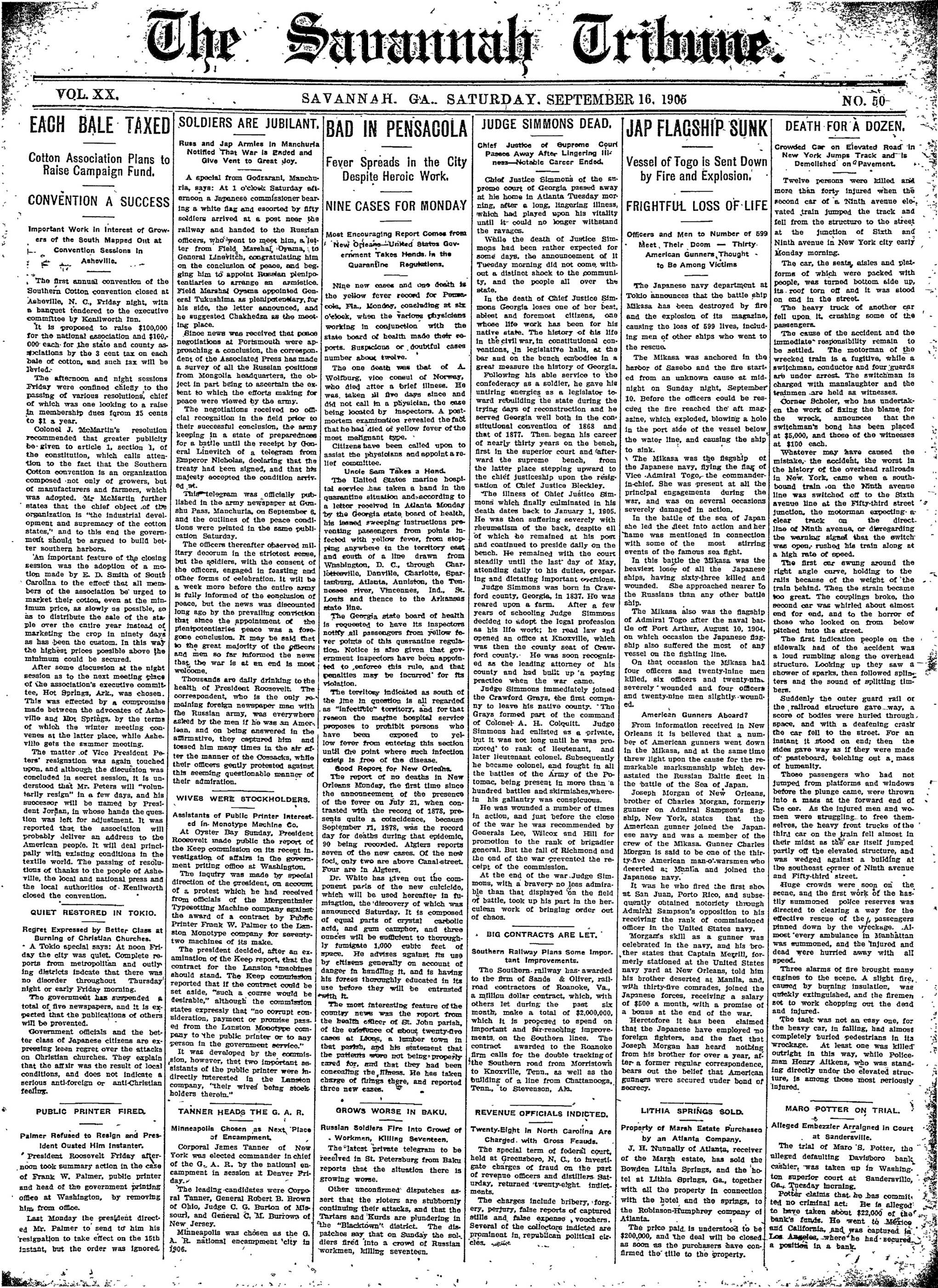
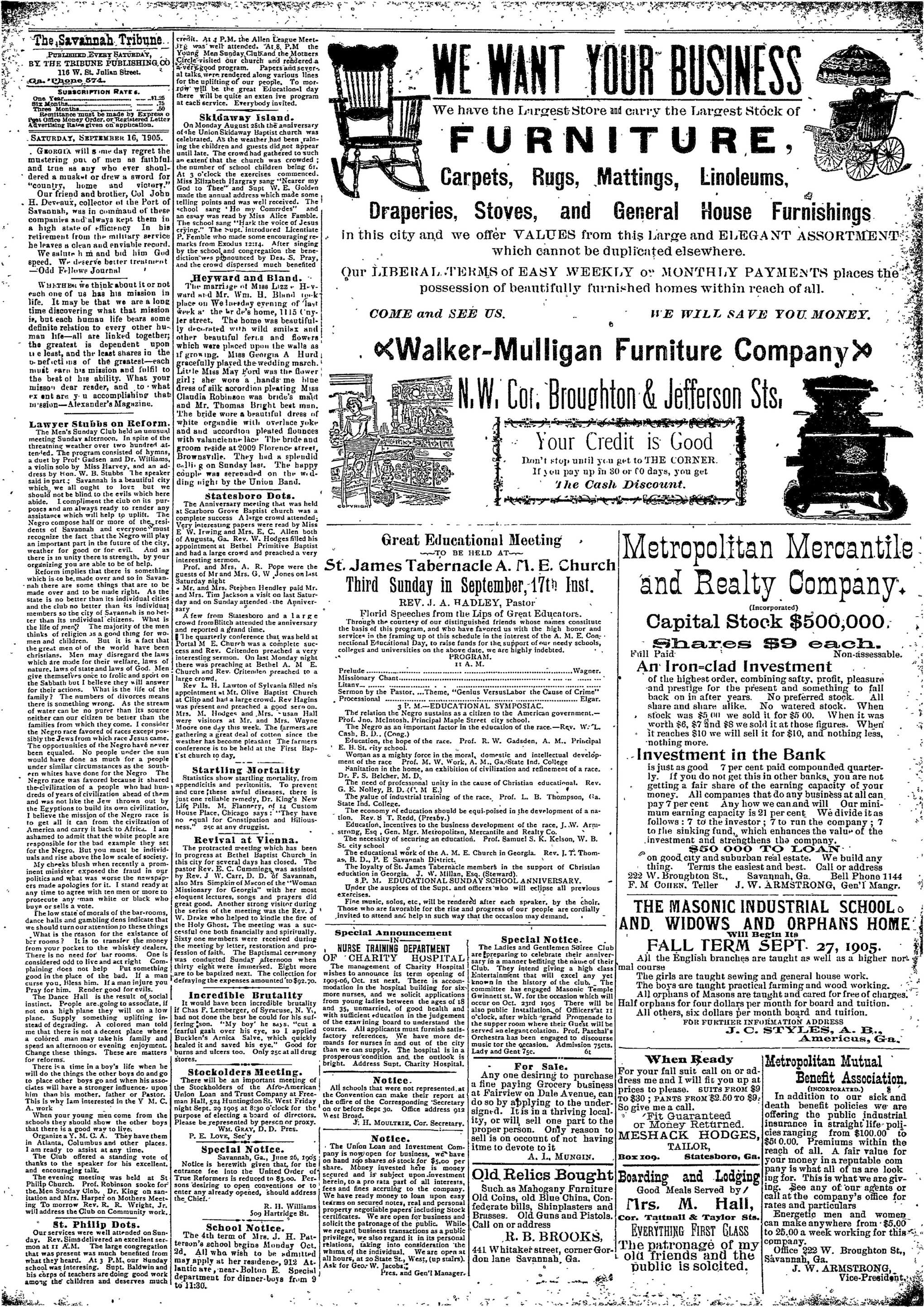
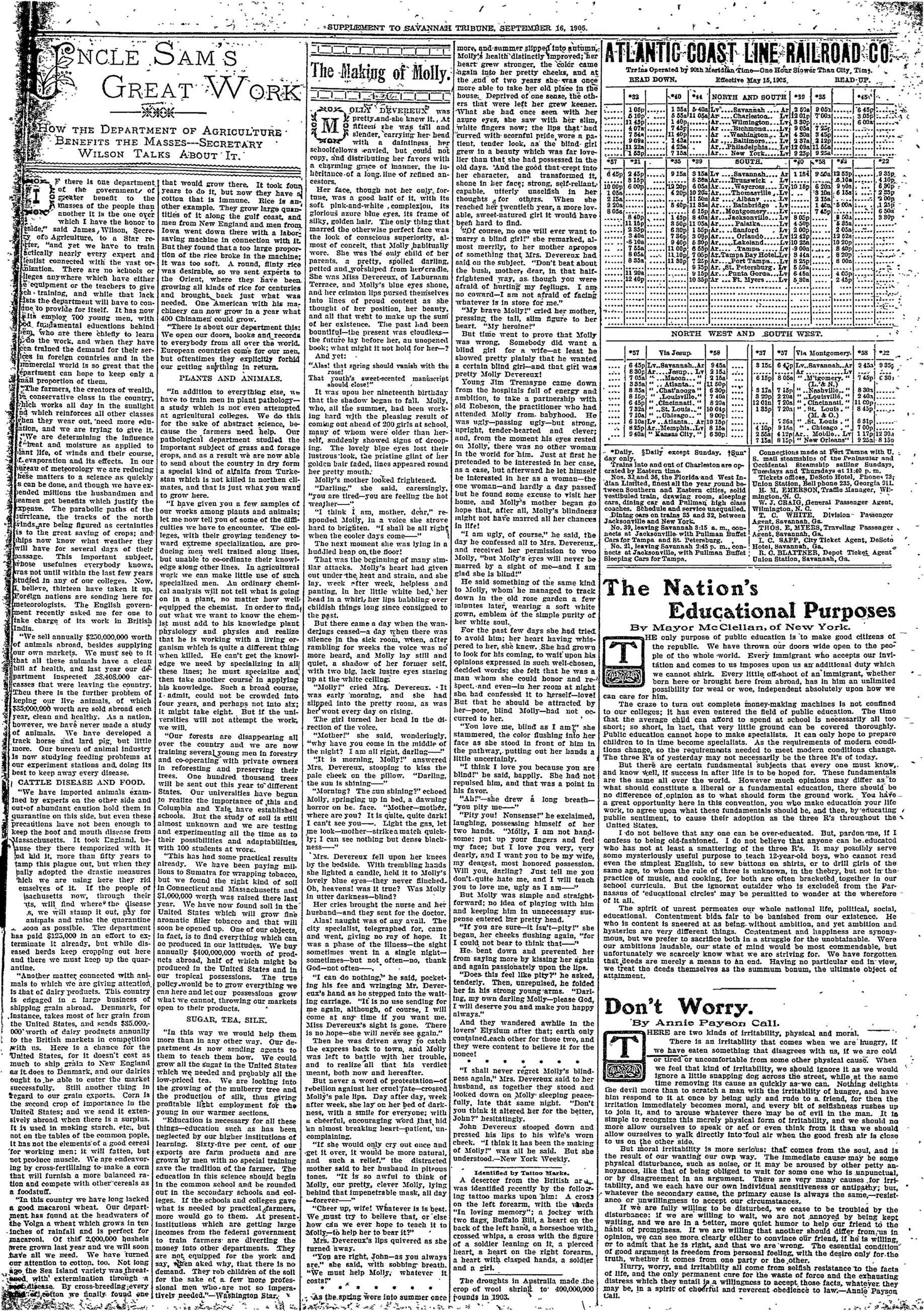
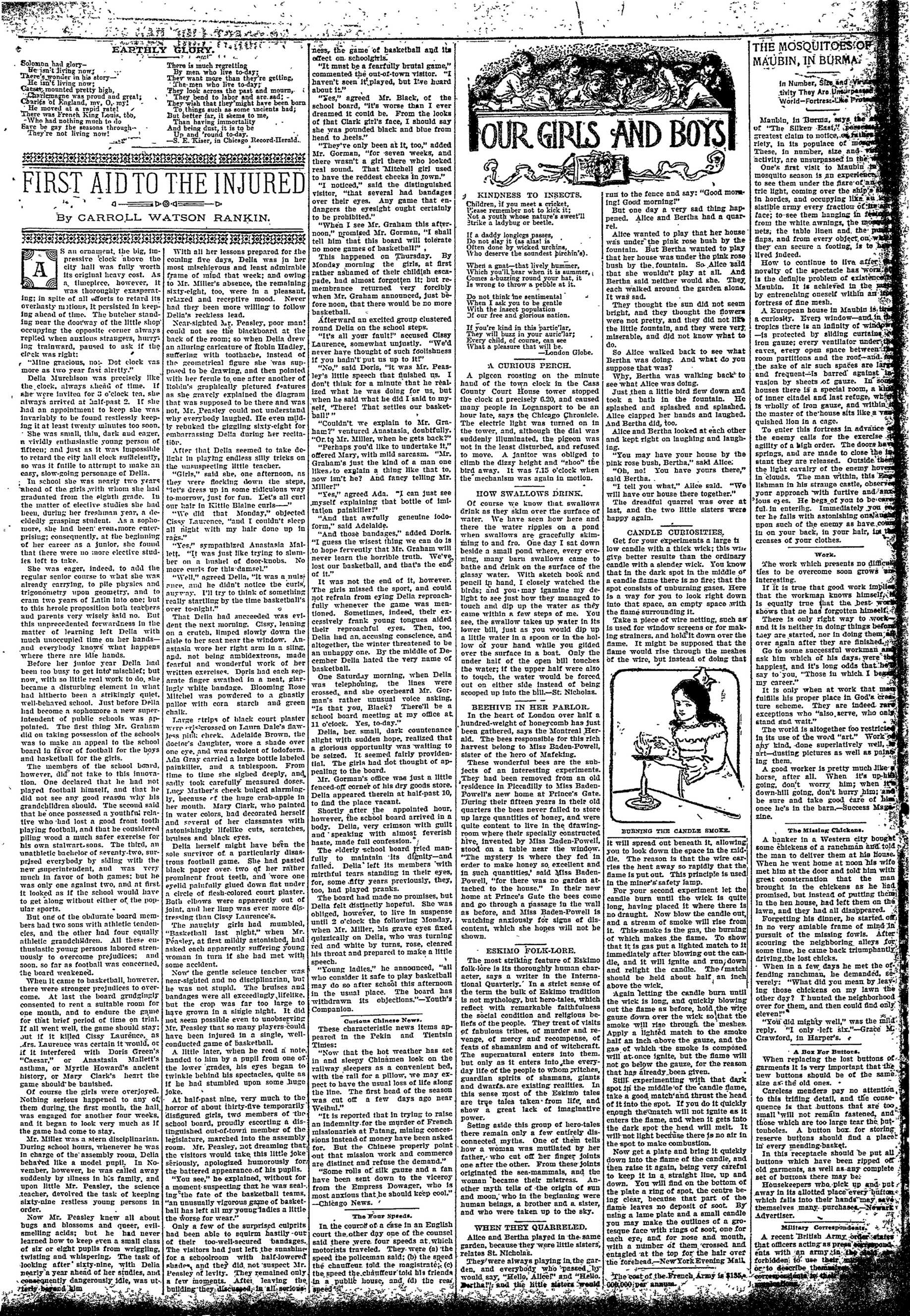
Page text (machine-generated)
VOL. XX.
Cotton Association Plans to Raise Campaign Fund.
Important Work in Interest of Growers of the South Mapped Out at Convention Sessions In Asheville.
The first annual convention of the Southern Cotton convention closed at Asheville, N. C., Friday night, with a banquet tendered to the executive committee by Kenilworth Inn. It is proposed to raise $100,000 for the national association and $100,000 each for the state and county associations by the 3 cent tax on each bale of cotton, and such tax will be levied.
The afternoon and night sessions Friday were confined chiefly to the passing of various resolutions, chief of which was one looking to a raise in membership dues from 25 cents to $1 a year.
Colonel J. McMartin's resolution recommended that greater publicity be given to article 1, section 1, of the constitution, which calls attention to the fact that the Southern Cotton convention is an organization composed not only of growers, but of manufacturers and farmers, which was adopted. Mr. McMartin further states that the chief object of the organization is "the industrial development and supremacy of the cotton states," and to this end the government should be argued to build better southern harbors.
An important feature of the closing session was the adoption of a motion made by E. D. Smith of South Carolina to the effect that all members of the association be urged to market their cotton, even at the minimum price, as slowly as possible, so as to distribute the sale of the staple over the entire year instead of marketing the crop in ninety days as has been the custom. In this way the highest prices possible above the minimum could be secured.
After some discussion at the night session as to the next meeting place of the association's executive committee, Hot Springs, Ark, was chosen. This was effected by a compromise made between the advocates of Ashville and Hot Springs, by the terms of which the winter meeting convenes at the latter place, while Ashville gets the summer meeting.
The matter of Vice President Peters' resignation was again touched upon, and although the discussion was concluded in secret session, it is understood that Mr. Peters will "voluntarily resign" in a few days, and his successor will be named by President Jordan, in whose hands the question was left for adjustment. It was reported that the association will probably deliver an address to the American people. It will deal principally with existing conditions in the textile world. The passing of resolutions of thanks to the people of Asheville, the local and national press and the local authorities of Kenlworth closed the convention.
QUIET RESTORED IN TOKIO.
Regret Expressed by Better Class at
Burning of Christine, Church
Burning of Christian Churches.
A Tokio special says: At noon Friday the city was quiet. Complete reports from metropolitan and outlying districts indicate that there was no disorder throughout Thursday night or early Friday morning.
The government has suspended a total of five newspapers, and it is expected that the publications of others will be prevented.
Government officials and the better class of Japanese citizens are expressing keen regret over the attacks on Christian churches. They explain that the affair was the result of local conditions, and does not indicate a serious anti-foreign or anti-Christian feeling.
PUBLIC PRINTER FIRED.
Palmer Refused to Realign and President Ousted Him Instanter.
President Roosevelt Friday afternoon took summary action in the case of Frank W. Palmer, public printer and head of the government printing office at Washington, by removing him from office.
Last Monday the president directed Mr. Palmer to send to him his resignation to take effect on the 15th instant, but the order was ignored.
Russ and Jap Armies in Manchuria Notified That War is Ended and Give Vent to Great Joy.
A special from Godzaranl, Manchuria, says: At 1 o'clock Saturday afternoon a Japanese commissioner bearing a white flag and escorted by fifty soldiers arrived at a post near the railway and handed to the Russian officers, who went to meet him, a letter from Field Marshal Oyama, to General Linevitch, congratulating him on the conclusion of peace, and begging him to appoint Russian plenipotentiaries to arrange an armistice. Field Marshal Oyama appointed General Tukushima as plenipotentiary, for his side, the letter announced, and he suggested Chakhedra as the meeting place.
Since news was received that peace negotiations at Portsmouth were approaching a conclusion, the correspondent of the Associated Press has made a survey of all the Russian positions from Mongolia headquarters, the object in part being to ascertain the extent to which the efforts making for peace were viewed by the army. The negotiations received no official recognition in the field prior to their successful conclusion, the army keeping in a state of preparedness for a battle until the receipt by General Linevitch of a telegram from Emperor Nicholas, declaring that the treaty had been signed, and that his majesty accepted the condition arrived at.
This telegram was officially published in the army newspaper at Gunshu Pass, Manchuria, on September 6, and the outlines of the peace conditions were printed in the same publication Saturday.
The officers thereafter observed military decorum in the striotest sense, but the goldiers, with the consent of the officers, engaged in feasting and other forms of celebration. It will be a week more before the entire army is fully informed of the conclusion of peace, but the news was discounted long ago by the prevailing conviction that since the appointment of the prentpotentiaries peace was a foregone conclusion. It may be said that to the great majority of the officers and men so far informed the news that the war is at an end is most welcome.
Thousands are daily drinking to the health of President Roosevelt. The correspondent, who is the only remaining foreign newspaper man with the Russian army, was everywhere asked by the men if he was an American, and on being answered in the affirmative, they captured him and tossed him many times in the air after the manner of the Cossacks, while their officers gently protested against this seeming questionable manner of their admiration.
WIVES WERE STOCKHOLDERS.
Assistants of Public Printer Interested in Monotype Machine Co-
at in Monotype Machine Co.
At Oyster Bay Sunday, President Roosevelt made public the report of the Keep commission on its recent investigation of affairs in the government priting office at Washington.
The inquiry was made by special direction of the president, on account of a protest which he had received from officials of the Mergenthaler Typesetting Machine company against the award of a contract by Public Printer Frank W. Palmer to the Lanson Monotype company for seventy-two machines of its make.
The president decided, after an examination of the Keep report, that the contract for the Lanson machines should stand. The Keep commission reported that if the contract could be set aside, "such a course would be desirable," although the commission states expressly that "no corrupt consideration, payment or promise passed from the Lanson Monotype company to the public printer or to any person in the government service."
It was developed by the commission, however, that two important assistants of the public printer were indirectly interested in the Lanson company, "their wives being stockholders therein."
Minneapolis Chosen as Next Place of Encampment.
Corporal James Tanner of New York was elected commander in chief of the G. A. R. by the national encampment in session at Denver Friday.
The leading candidates were Corporal Tanner, General Robert B. Brown of Ohio, Judge C. G. Burton of Missouri, and General C. M. Burrowa of New Jersey.
Minneapolis was chosen as the G. A. R. national encampment 'city in 1906.
SAVANNAH. GA.. SATURDAY. SEPTEMBER 16. 1905
BAD IN PENSACOLA
NINE CASES FOR MONDAY
Most Encouraging Report Comes from New Orleans-United States Government Takes Hands in the Quarantine Regulations.
Nine new cases and one death is the yellow fever record for Pennsylvania, Fla., Monday, concluding at six o'clock, when the various physicians working in conjunction with the state board of health made their reports. Suspicious or doubtful cases number about twelve.
The one death was that of A. Wolfburg, vice consul of Norway, who died after a brief illness. He was taken all five days since and did not call in a physician, the case being located by inspectors. A postmortem examination revealed the fact that he had died of yellow fever of the most malignant type. Citizens have been called upon to assist the physicians and appoint a relief committee.
Uncle Sam Takes a Hand.
The United States marine hospital service has taken a hand in the quarantine situation and according to a letter received in Atlanta Monday by the Georgia state board of health, his issued sweeping instructions preventing passengers from points infected with yellow fever, from stopping anywhere in the territory east and south of a line drawn from Washington, D. C., through Charlotteville, Danville, Charlotte, Spartanburg, Atlanta, Aniston, the Tennessee river, Vincennes, Ind., St. Louis and thence to the Arkansas state line.
The Georgia state board of health is requested to have its inspectors notify all passengers from yellow fever points of this quarantine regulation. Notice is also given that government inspectors have been appointed to enforce this rule, and that penalties may be incurred for its violation. The territory indicated as south of the line in question is all regarded as "infectible" territory, and for that reason the marine hospital service proposes to prohibit persons who have been exposed to yellow fever from entering this section until the point where such infection exists is free of the disease.
Good Report for New Orleans. The report of no deaths in New Orleans Monday, the first time since the announcement of the presence of the fover on July 21, when contrasted with the record of 1878, presents quite a coincidence, because September 11, 1878, was the record day for deaths during that epidemic, 90 being recorded. Algters reports seven of the new cases. Of the new foci, only two are above Canal-street. Four are in Algters.
Dr. White has given out the component parts of the new sulcicide, which will be used hereafter in fumigation, the discovery of which was announced Saturday. It is composed of equal parts of crystal carbolic acid, and gum camphor, and three ounces will be sufficient to thoroughly fumigate 1,000 cubic feet of space. He advises against its use by citizens generally on account of danger in handling it, and is having his forces thoroughly educated in its use before they will be entrusted with it.
The most interesting feature of the country news was the report from the health officer of St. John parish, of the existence of about twenty-five cases at Lions, a lumber town in that parish, and his statement that the patients were not being properly cared for, and that they had been concealing the fitness. He has taken charge of flings there, and reported three new cases.
Russian Soldiers Fire Into Crowd of
Workmen, Killing Seventeen.
The latest private telegram to be
received in St. Petersburg from Baku
reports that the situation there is
growing worse.
Other unconfirmed dispatches
assert that the rioters are subbornly
continuing their attacks, and that the
Tartars and Kurds are plundering in
the "Blacktown" district. The
dispatches say that on Sunday the
soldiers fired into a crowd of Russian
workmen, killing seventeen.
Tribune.
JUDGE SIMMONS DEAD.
Chief Justice of Supreme Court Passes Away After Lingering Illness—Notable Career Ended.
Chief Justice Simmons of the supreme court of Georgia passed away at his home in Atlanta Tuesday morning, after a long, lingering illness, which had played upon his vitality until it could no longer withstand the ravages.
While the death of Justice Simmons had been rather expected for some days, the announcement of it Tuesday morning did not come, without a distinct shock to the community, and the people all over the state.
In the death of Chief Justice Simmons Georgia loses one of her best, ablest and foremost citizens, one whose life work has been for his native state. The history of his life in the civil war, in constitutional conventions, in legislative halls, at the bar and on the bench embodies in a great measure the history of Georgia.
Following his able service to the confederacy as a soldier, he gave his untiring energies as a legislator toward rebuilding the state during the trying days of reconstruction and he served Georgia well both in the constitutional convention of 1868 and that of 1877. Then began his career of nearly thirty years on the bench, first in the superior court and afterward the supreme bench, from the latter place stepping upward to the chief justiceship upon the resignation of Chief Justice Bleckley.
The illness of Chief Juítico Simmons which finally culminated in his death dates back to January 1, 1805. He was then suffering severely with rheumatism of the back, despite all of which he remained at his post and continued to preside daily on the bench. He remained with the court steadily until the last day of May, attending daily to his duties, preparing and dictating important questions.
Judge Simmons was born in Crawford county, Georgia, in 1837. He was reared upon a farm. After a few years of schooling Judge Simmons decided to adopt the legal profession as his life work; he read law and opened an office at Knoxville, which was then the county seat of Crawford county. He was soon recognized as the leading attorney of his county and had built up a paying practice when the war came.
Judge Simmons immediately joined the Crawford Grays, the first company to leave his native county. 'The Grays formed part of the command of Colonel A. H. Colquitt. Judge Simmons had enlisted as a private, but it was not long until he was promoted' to rank of lieutenant, and later lieutenant colonel. Subsequently he became colonel, and fought in all the battles of the Army of the Potomac, being present in more than a hundred battles and skirmishes,wherein his gallantry was conspicuous.
He was wounded a number of times in action, and just before the close of the war he was recommended by Generals Lee, Wilcox and Hill for promotion to the rank of brigadier general. But the fall of Richmond and the end of the war prevented the receipt of the commission.
At the end of the war. Judge Simmons, with a bravery no less admirable than that displayed on the field of battle, took up his part in the herculean work of bringing order out of chaos.
. BIG CONTRACTS ARE LET.
Southern Railway Plans Some Important Improvements.
The Southern railway has awarded to the firm of Sands & Oliver, railroad contractors of Roanoke, Va., a million dollar contract, which, with others let during the past six month, make a total of $2,000,000, which it is proposed to spend on important and far-reaching improvements, on the Southern lines. The contract awarded to the Roanoke firm calls for the double tracking of the Southern road from Morristown to Knoxville, Tenn., as well as the building of a line from Chattanooga, Tenn., to Stevenson, Ala.
Charged with Gross Feuds.
The special term of federal court, held at Greensboro, N. C., to investigate charges of fraud on the part of revenue officers and distillers Saturday, returned twenty-eight indictments.
The charges include bribery, forgery, perjury, false reports of captured stills and false expense, vouchers.
Several of the collectors indicted are prominent in republican political circles.
JAP FLAGSHIP SUNK
FRIGHTFUL LOSS OF LIFE
Officers and Men to Number of 599 Meet Their Doom Thirty American Gunners Thought to Be Among Victims The Japanese navy department at Tokio announces that the battle ship Mikasa has been destroyed by fire and the explosion of its magazine, causing the loss of 599 lives, including men of other ships who went to the rescue.
The Mikasa was anchored in the harbor of Sasebo and the fire started from an unknown cause at midnight on Sunday night, September 10. Before the officers could be rescued the fire reached the aft magazine, which exploded, blowing a hole in the port side of the vessel below the water line, and causing the ship to sink.
The Mikasa was the flagship of the Japanese navy, flying the flag of Vice Admiral Togo, the commander-in-chief. She was present at all the principal engagements during the war, and was on several occasions severely damaged in action.
In the battle of the sea of Japan she led the fleet into action and her name was mentioned in connection with some of the most stirring events of the famous sea fight.
In this battle the Mikasa was the heaviest loser of all the Japanese ships, having sixty-three killed and wounded. She approached nearer to the Russians than any other battle ship.
The Mikasa also was the flagship of Admiral Togo after the naval battle off Port Arthur, August 10, 1904, on which occasion the Japanese flagship also suffered the most of any vessel on the fighting line.
On that occasion the Mikasa had four officers and twenty-inne men killed, six officers and twenty-nine severely wounded and four officers and twenty-nine men slightly wounded.
American Gunners Aboard?
From information received in New Orleans it is believed that a number of American gunners went down in the Mikasa, and at the same time threw light upon the cause for the remarkable marksmanship which devastated the Russian Baltic fleet in the battle of the Sea of Japan.
Joseph Morgan of New Orleans, brother of Charles Morgan, formerly gunner on Admiral Sampson's flagship, New York, states that the American gunner joined the Japanese navy and was a member of the crew of the Mikasa. Gunner Charles Morgan is said to be one of the thirty-five American man-o'-warsmen who decerted a: Manlia and joined the Japanese navy.
It was he who fired the first show at San Juan, Porto Rico, and subsequently obtained notoriety through Admiral Sampson's opposition to his receiving the rank of commissioned officer in the United States navy. Morgan's skill as a gunner was celebrated in the navy, and his brother states that Captain Merrill, formerly stationed at the United States navy yard at New Orleans, told him his brother deserted at Manila, and, with thirty-five comrades, joined the Japanese forces, receiving a salary of $500 a month, with a promise of a bonus at the end of the war.
Hercetofore it has been claimed that the Japanese have employed no foreign fighters, and the fact that Joseph Morgan has heard nothing from his brother for over a year, after a former regular correspondence, bears out the belief that American gunners were secured under bond of secrecy.
LITHIA SPRINGS SOLD.
Property of Marsh Estate Purchased by an Atlanta Company.
J. H. Nunnally of Atlanta, receiver of the Marsh estate, has sold the Bowden Lithia Springs, and the hotel at Lithia Springs, Ga., together with all the property in connection with the hotel and the springs, to the Robinson-Humphrey company of Atlanta. The price paid is understood to be $200,000, and the deal will be closed as soon as the purchasers have confirmed the title to the property.
Crowded Car on Elevated Road in New York Jumps Track and is Demolished on Pavement.
Twelve persons were killed and more than forty injured when the second car of a Ninth avenue elevated train jumped the track and fell from the structure to the street at the junction of Sixth and Ninth avenue in New York city early Monday morning.
The car, the seats, aisles and platforms of which were packed with people, was turned bottom side up, its roof torn off and it was stood on end in the street.
The heavy truck of another car fell upon it, crushing some of the passengers. The cause of the accident and the immediate responsibility remain to be settled. The motorman of the wrecked train is a fugitive, while a switchman, conductor and four guards are under arrest. The switchman is charged with manslaughter and the trainmen are held as witnesses. Corner Scholer, who has undertaken the work of fixing the blame for the wreck, announces that the switchman's bond has been placed at $5,000, and those of the witnesses at $100 each.
Whatever may have caused the mistake, the accident, the worst in the history of the overhead railroads in New York, came when a southbound train on the Ninth avenue line was switched off to the Sixth avenue line at the Fifty-third street junction, the motorman expecting a clear track on the direct line of Ninth avenue, or deregarding the warning signal that the switch was open, rushed his train along at a high rate of speed.
The first car swung around the right angle curve, holding to the rails because of the weight of the train behind. Then the strain became too great. The couplings broke, the second car was whirled about almost end for end, and to the horror of those who looked on from below pitched into the street.
The first indication people on the sidewalk had of the accident was a loud rumbling along the overhead structure. Looking up they saw a shower of sparks, then followed splinters and the sound of splitting timbers.
Suddenly the outer guard rail or the railroad structure gave way, a score of bodies were hurled through space, and with a deafening crash the car fell to the street. For an instant it stood on end; then the sides gave way as if they were made of pasteboard, belching out a mass of humanity.
Those passengers who had not jumped from platforms and windows before the plunge came, were thrown into a mass at the forward end of the car. As the injured men and women were struggling to free themselves, the heavy front trucks of the third car on the train fell almost in their midst as the car itself jumped partly off the elevated structure, and was wedged against a building at the southeast corner of Ninth avenue and Fifty-third street.
Huge crowds were soon on the scene, and the first work of the hastily summoned police reserves was directed to clearing a way for the effective rescue of the passengers pinned down by the wreckage. Almost every ambulance in Manhattan was summoned, and the injured and dead were hurried away with all speed.
Three alarms of fire brought many engines to the scene. A slight fire, caused by burning insulation, was quickly extinguished, and the firemen set to work chopping out the dead and injured.
The task was not an easy one, for the heavy car, in falling, had almost completely buried pedestrians in its wreckage. At least one was killed outright in this way, while Policeman Henry Altkens, who was standing directly under the elevated structure, is among those most seriously injured.
Alleged Embezzler Arraigned in Court at Sandersville.
The trial of Maro S. Potter, the alleged defaulting Davisboro bank cashier, was taken up in Washington superior court at Sandersville, Ga. Tuesday morning.
Potter claims that he has committed no criminal act. He is alleged to have taken about $22,000 of the bank's funds. He went to Mexico and California, and was captured in Los Angeles, where he had secured a position in a bank.
The Savannah Tribune
PUBLISHED EVERY SATURDAY,
BY THE TRIBUNE PUBLISHING CO.
116 W. St. Julian Street.
Qa. 'Chone 574.
SUBSCRIPTION RATE 6.
One Year..... $1.25
Six Months..... 70
Three Months..... 50
Remittance must be made by Express or Post Office Money Order, or Registered Letter Advertising Rates given on application.
SATURDAY, SEPTEMBER 16, 1905.
GEORGIA will some day regret the mustering out of men as faithful and true as any who ever shouldered a musket or drew a sword for "country, home and victory." Our friend and brother, Col John H. Deveaux, collector of the Port of Savannah, was in command of these companies and always kept them in a high state of efficiency. In his retirement from the military service he leaves a clean and enviable record. We salute him and bid him God speed. We deserve better treatment—Odd Fellows Journal
WHAT THEY we think about it or not each one of us has his mission in life. It may be that we are a long time discovering what that mission is, but each human life bears some definite relation to every other human life—all are linked together; the greatest is dependent upon the least, and the least shares in the prefections of the greatest—each must earn his mission and fulfil to the best of his ability. What your mission dear reader, and to what extent are you accomplishing that mission—Alexander's Magazine.
Lawyer Stubbs on Reform.
The Men's Sunday Club held an unusual meeting Sunday afternoon. In spite of the threatening weather over two hundred attended. The program consisted of hymns, a duet by Prof Gadsen and Dr. Williams, a violin solo by Miss Harvey, and an address by Hon W. B. Stubbs. The speaker said in part; Savannah is a beautiful city which we all ought to love but we should not be blind to the evils which here abide. I compliment the club on its purposes and am always ready to render any assistance which will help to uplift. The Negro compose half or more of the residents of Savannah and everyone must recognize the fact that the Negro will play an important part in the future of the city, weather for good or for evil. And as there is in unity there is strength, by your requesting you are able to be of help.
Reform implies that there is something which is to be made over and so in Savannah there are some things that are to be made over and to be made right. As the state is no better than its individual cities and the club no better than its individual members so the city of Sayannah is no better than its individual citizens. What is the life of men? The majority of the men thinks of religion as a good thing for women and children. But it is a fact that the great men of the world have been christians. Men may disregard the laws which are made for their welfare, laws of nature, laws of state and laws of God. Men give themselves once to frolic and sport on the Sabbath but I believe they will answer for their actions. What is the life of the family? The numbers of divorces means there is something wrong. As the stream of water can be no purer than its source neither can our citizen be better than the families from which they come. I consider the Negro race favored of races except possibly the Jews from which race Jesus came. The opportunities of the Negro have never been equaled. No people under the sun would have done as much for a people under similar circumstances as the southern whites have done for the Negro. The
In whites have gone for the Negro. The Negro race was favored because it shared the civilization of a people who had hundreds of years of civilization ahead of them and was not like the Jew thrown out by the Egyptians to build its own civilization. I believe the mission of the Negro race is to get all it can from the civilization of America and carry it back to Africa. I am ashamed to admit that the white people are responsible for the bad example they set for the Negro. But you must be individuals and rise above the low scale of society.
My cheeks blush when recently a prominent minister exposed the fraud in our politics and what was worse the newspapers made apologies for it. I stand ready at any time to agree with ten men or more to prosecute any man white or black who buy or sells a vote.
The low state of morals of the bar-rooms, dance halls and gambling dens indicate that we should turn our attention to these things
What is the reason for the existence of bar rooms? It is to transfer the money from your pocket to the whiskey dealers. There is no need for bar rooms. One is considered odd to live and act right. Complaining does not help. Put something good in the place of the bad. If a man curse you, bless him. If a man injure you Pray for him. Render good for evils. The Dance Hall is the result of social instinct. People are going to associate, if not on a high plane they will on a low plane. Supply something uplifting instead of degrading. A colored man told me that there is not a decent place where a colored man may take his family and spend an afternoon or evening enjoyment. Change these things. These are matters for reforms.
There is a time in a boy's life when he will do the things the other boys do and go to place other boys go and when his associates will have a stronger influence upon him than his mother, father or Pastor. This is why I am interested in the Y M. C. A. work
When your young men come from the schools they should show the other boys that there is a good way to live.
Organize a Y. M. C. A. They have them in Atlanta, Columbus and other places. I am ready to assist at any time.
The Club offered a standing vote of thanks to the speaker for his excellent, and encouraging talk.
The evening meeting was held at St Phillp Church. Prof. Robinson sooke for the Men Sunday Clnb. Dr. King on sanitation and Mrs. Harper on Mothers Meeting To morrow Rev. R. R. Wright, Jr. will address the Club on Community work.
St. Philip Dots.
Our services were well attended on Sunday. Rev. Sims delivered an excellent sermon at 11 A.M. The large congregation that was present was much benefited from what they heard. At 3 P.M. our Sunday school was interesting. Supt. Baldwin and his corps of teachers are doing good work among the children and deserves much
credit. At 4 P.M. the Allen League Meet-
ing was well attended. At 8 P.M. the
Young Men Sunday, Club and the Motners
Circle visited our church and rendered a
very good program. Papers and severa-
talks were rendered along various lines
for the uplifting of our people. To morrow
will be the great Educational day
there will be quite an extensive program
at each service. Everybody invited.
Sklóaway Island.
On Monday August 28th the anniversary of the Union Skidaway Baptist church was celebrated. As the weather had been raining the children and guests did not appear until late. The crowd had gathered to such an extent that the church was crowded; the number of school children being 61. At 3 o'clock the exercises commenced. Miss Elizabeth Hargray sang "Nearer my God to Thee" and Supt W. E. Golden made the annual address which made some telling points and was well received. The school sang "Ho my Comrides" and an essay was read by Miss Alice Famble. The school sang "Hark the voice of Jesus crying." The Supt introduced Licentiate P. Femble who made some encouraging remarks from Exodus 12:14. After singing by the school and congregation the benediction was pronounced by Dea. S. Pray, and the crowd dispersed much benefited
Heyward and Bland.
Heyward and Bland.
The marriage of Miss Luzie Heyward and Mr. Wm. H. Bland took place on Wednesday evening of last week at the bride's home, 1115 Cnyler street. The home was beautifully decorated with wild smilax and other beautiful ferns and flowers which were placed upon the walls as if growing. Miss Georgia A Hurd gracefully played the wedding march. Little Miss May Ford was the flower girl; she wore a hands-me blue dress of silk accordion pleating Miss Claudia Robinson was bride's maid and Mr. Thomas Bright best man. The bride wore a beautiful dress of white organdie with overlace yoke and accordion pleated flounces with valuencienne lace. The bride and groom reside at 2009 Florence street, Brownsville. They had a splendid calling on Sunday last. The happy couple was serenaded on the wedding night by the Union Band.
Statesboro Dots.
The Anniversary meeting that was held at Scarboro Grove Baptist church was a complete success A large crowd attended. Very interesting papers were read by Miss E W. Irwing and Mrs. E, C. Allen both of Augusta, Ga. Rev. W. Hodges filled his appointment at Bethel Primitive Baptist and had a large crowd and preached a very interesting sermon.
Prof. and Mrs. A. R. Pope were the guests of Mr. and Mrs. G, W. Jones on last Saturday night
*Mr. and Mrs. Stephen Hendley paid Mr. and Mrs. Tim Jackson a visit on last Saturday and on Sunday attended the Anniversary
A few from Statesboro and a large crowd from Blitch attended the anniversary and reported a grand time.
The quarterly conference that was held at Portal M E. Church was a complete success and Rev. Critenden preached a very interesting sermon. On last Monday night there was preaching at Bethel A. M E. Church and Rev. Critenden preached to a large crowd.
Rev L. H. Lawton of Sylvania filled his appointment at Mt. Olive Baptist Church at Clito and had a large crowd. Rev Hagins was present and preached a good sermon on Mrs. M. Hodges and Mrs. Susan Hall were visitors at Mr. and Mrs. Wayne Moore one day this week. The farmers are gathering a great deal of cotton since the weather has become pleasant. The farmers conference is to be held at the First Baptist church to day.
Startling Mortality
Statistics show startling mortality, from appendicitis and peritonitis. To prevent and cure these awful diseases, there is just one reliable remedy, Dr. King's New Life Pills. M. Flannery, of 14 Custom House Place, Chicago says: "They have no equal for Constipation and Biliousness," 25c at any druggist.
Revival at Vienna.
The protracted meeting which has been in progress at Bethel Baptist Church in this city for several days has closed. The pastor Rev. E. C. Cummings was assisted by Rev. J W. Carr, D. D. of Savannan, also Mrs Simpkin of Macon of the "Woman Missionary for Georgia" with her most eloquent lectures, songs and prayers did great good. Another strong visitor during the series of the meeting was the Rev. J W. Drake who helped to kindle the fire of the Holy Ghost. The meeting was a successful one both financially and spiritually. Sixty one members were received during the meeting by letter, restoration and profession of faith. The Baptismal ceremony was conducted Sunday afternoon when thirty eight were immersed. Eight more are to be baptized next. The collection for defraying the expenses amounted to $92.70.
It would have been incredible brutality if Chas F. Lemberger, of Syracuse, N. Y., had not done the best he could for his suffering son. "My boy" he says, "cut a fearful gash over his eye, so I applied Bucklen's Arnica Salve, which quickly healed it and saved his eye." Good for burns and ulcers too. Only 25c at all drug stores.
Stockolders Meeting
There will be an important meeting of the Stockholders of the Afro-American Union Loan and Trust Company at Freeman Hall, 524 Huntingdon St. West Friday night Sept. 29 1905 at 8:30 o'clock for the purpose of electing a board of directors. Please be represented by person or proxy. Wm. GRAY, D. D. Pres. P. E. LOVE, See'y
Special Notice.
Savannah, Ga., June 26, 1905
Notice is herewith given that, for the entrance fee into the United Order of True Reformers is reduced to 83.00. Persons desiring to open conventions or to enter any already opened, should address the Chief.
R. H. Williams
509 Hartridge St.
School Notice.
The 4th term of Mrs. J. H. Patterson's school begins Monday Oct. 2d. All who wish to be admitted may apply at her residence, 912 Atlantic ave, near Bolton E. Special department for dinner-boys from 9 to 11:30.
```markdown
```
WE WANT YOUR BUSINESS
We have the Largest Store and carry the Largest Stock of
Draperies,
in this city and we
Our LIBERAL TE
possess
COME and SE
. Walke
in this city and we offer VALUES from this Large and ELEGANT ASSORTMENT which cannot be duplicated elsewhere. Our LIBERAL TERMS of EASY WEEKLY or MONTHLY PAYMENTS places the possession of beautifully furnished homes within reach of all.
COPYRIGHT
Great Education TO BE St. James Taberna Third Sunday in S
Great Educational Meet
TO BE HELD AT
s Tabernacle A. M.
Sunday in September, 1
REV. J. A. HADLEY. Pastor
Florid Speeches from the
Through the courtesy of our distinguishe
the basis of this program, and who ha
services in the framing up of this scher
nectional Educational Day, to raise fun
colleges and universities on the above.
PROC
II
P. M. - EDUCATION
The relation the Negro sustains as a
Prof. Jno, McIntosh. Principal Maple.
The Negro as an important factor in
Cash, B. D., (Cong.)
Education, the hope of the race. P.
E. B. St. city school.
Woman as a mighty force in the mo
ment of the race. Prof. M. W. Work.
Sanitation in the home, an exhibition
Dr. F. S. Belcher, M. D.
The need of professional unity in the
G. E. Nolley, B. D. (C. M. E.)
The value of industrial training of the
State Ind. College.
The economy of education should be
tion. Rev. S. T. Redd, (Presby.)
Education, incentives to the business
strong, Esq, Gen. Mgr. Metropolitan.
The necessity of securing an educati
St. city school
The educational work of the A. M. B
as, B. D., P. E Savannah District.
The loyalty of St. James Tabernacle
education in Georgia. J. W. Millan,
8 P. M. EDUCATIONAL SUN
Under the auspices of the Supt. and
exercises.
Fine music, solos, etc, will be rendered.
Those who are favorable for the rise are
invited to attend and help in such way.
Speeches from the Lips of Great B
bury of our distinguished friends whose
program, and who have favored us with the
coming up of this schedule in the interest of
normal Day, to raise funds for the support of
persitions on the above date, we are highly in
PROGRAM.
II A. M.
Castor, ...Theme, "Genius Versus Labor the
3 P. M.—EDUCATIONAL SYMPOSIAS
Negro sustains as a citizen to the Ameri-
cosh. Principal Maple Street city school,
an important factor in the education of the
ing.)
cope of the race. Prof. R. W. Gadsden,
Pool.
ighty force in the moral, domestic and in-
Prof. M. W. Work, A. M., Ga. State Inde-
home, an exhibition of civilization and re-
M. D.
professional unity in the cause of Christian
D. (C. M. E.)
industrial training of the race. Prof. L. H.
education should be equi-poised in the de-
Redd, (Presby.)
intives to the business development of the
M. Mgr. Metropolitan, Mercantile and Real-
securing an education. Prof. Samuel S.
work of the A. M. E. Church in Georgia.
Javannah District.
St. James Tabernacle members in the sur-
gia. J. W. Millan, Esq. (Steward).
EDUCATIONAL SUNDAY SCHOOL ANN
poss, etc, will be rendered after each speak
vocable for the rise and progress of our po-
and help in such way that the occasion may
Florid Speeches from the Lips of Great Educators.
Through the courtesy of our distinguished friends whose names constitute the basis of this program, and who have favored us with the high honor and services in the framing up of this schedule in the interest of the A. M. E. Connec tional Educational Day, to raise funds for the support of our needy schools, colleges and universities on the above date, we are highly indebted.
PROGRAM.
11 A. M.
Prelude ..... Wagner.
Missionary Chant ..... Litany.
Sermon by the Pastor, ...Theme, "Genius VersusLabor the Cause of Crime"
Processional ..... Elgar.
3 P. M.—EDUCATIONAL SYMPOSIAC.
The relation the Negro sustains as a citizen to the American government.—Prof. Jno. McIntosh, Principal Maple Street city school.
The Negro as an important factor in the education of the race.—Rev. W. L. Cash, B. D., (Cong.) Education, the hope of the race. Prof. R. W. Gadsden, A. M., Principal E. B. St. city school.
Woman as a mighty force in the moral, domestic and intellectual development of the race. Prof. M, W. Work, A, M. Ga-State Ind, College
Sanitation in the home, an exhibition of civilization and refinement of a race. Dr. F. S. Belcher, M. D.
The need of professional unity in the cause of Christian educational. Rev. G. E. Nolley, B. D. ('C, M E.)
The value of industrial training of the race. Prof. L. B. Thompson, Ga. State Ind. College.
The economy of education should be equi-poised in the development of a nation. Rev. S. T. Redd, (Presby.) Education, incentives to the business development of the race, J.W. Armstrong, Esq, Gen. Mgr. Metropolitan, Mercantile and Realty Co. The necessity of securing an education. Prof. Samuel S. K. Kelson, W. B. St. city school The educational work of the A. M. E. Church in Georgia. Rev. J. T. Thomas, B. D., P. E. Savannah District.
The loyalty of St. James Tabernacle members in the support of Christian education in Georgia. J. W. Millan, Esq. (Steward). 8 P. M. EDUCATIONAL SUNDAY SCHOOL ANNIVERSARY. Under the auspices of the Supt. and officers who will eclipse all previous exercises. Fine music, solos, etc. will be rendered after each speaker, by the choir. Those who are favorable for the rise and progress of our people are cordially invited to attend and help in such way that the occasion may demand.
Special Announcement
NURSE TRAINING DEPARTMENT OF CHARITY HOSPITAL
OF CHARITY HOSPITAL
The management of Charity Hospital wishes to announce its term opening of 1905-06, Oct. 1st next. There is accommodation in the hospital building for six more nurses, and we solicit applications from young ladies between the ages of 18 and 35, unmarried, of good health and with sufficient education in the judgement of the examining board to understand the course. All applicants must furnish satisfactory references. We have more demands for nurses in and out of the city than we can supply. The hospital is in a prosperous condition and the outlook is bright. Address Supt. Charity Hospital.
All schools that were not represented, at the Convention can make their report at the office of the Corresponding Secretary on or before Sept 30. Office address 912 West Broad. J. H. Moultrie, Cor. Secretary.
The Union Loan and Investment Company is now/open for business, we have on hand 100 shares of stock for $5,00 per share. Money invested here is money secured and is subject upon investment herein, to a pro rata part of all interests, fees and fines accruing to the company. We have ready money to loan upon easy teams on secured notes, real and personal property negotiable papers including Stock certificates. We are open for business and solicit the patronage of the public. While we regard business transactions as a public privilege, we also regard it in its personal relations, taking into consideration the whims of the individual. We are open at all hours, at 20 State St., West, (up stairs). Ask for Geo. W. Jacobs; Pres, and Gen'l Manager.
Notice
Notice.
The Lips of Great Educators.
We favored us with the high honor and
module in the interest of the A. M. E. Con-
dards for the support of our needy schools,
update, we are highly indebted.
A. M.
Wagner.
Ninius Versus Labor the Cause of Crime"
Elgar.
NONAL SYMPOSIAC.
Citizen to the American government.—
Street city school.
The education of the race.—Rev. W. L.
Prof. R. W. Gadsden, A. M., Principal
domestic and intellectual develop-
A. M., Ga. State Ind. College
of civilization and refinement of a race.
The cause of Christian educational. Rev.
The race. Prof. L. B. Thompson, Ga.
Equi-poised in the development of a na-
sis development of the race. J. W. Arm-
mercantile and Realty Co.
Prof. Samuel S. K. Kelson, W. B.
E. Church in Georgia. Rev. J. T. Thom-
members in the support of Christian
Esq. (Steward).
DAY SCHOOL ANNIVERSARY.
Officers who will eclipse all previous
ed after each speaker, by the choir,
and progress of our people are cordially
that the occasion may demand.
Special Notice:
The Ladies and Gentlemen Söirree Club are preparing to celebrate their anniversary in a manner befitting the name of their Club. They intend giving a high class Entertainment that will excel any yet known in the history of the club. The committee has engaged Masonic Temple Gwinnett st. W. for the occasion which will occur on Oct. 23rd 1905. There will be also public Installation of Officers' at 11 o'clock, after which 'grand Promenade to the supper room where their Guest will be served an elegant colation. Prof. Paschal' Orchestra has been engaged to discourse music for the occasion. Admission 75cts. Lady and Gent 75c. 6t
For Sale.
Any one desiring to purchase a fine paying Grocery business at Fairview on Dale Avenue, can do so by applying to the undersigned. It is in a thriving locality, or will sell one part to the proper person. Only reason to sell is on account of not having itme to devote to it
Old Relics Bought
Such as Mahogany Furniture
Old Coins, old Blue China, Confederate bills, Shinplasters and Brasses. Old Guns and Pistols.
Call on or address
R. B. BROOKS,
441 Whitaker street, corner Gordon lane Savannah, Ga.
II A. M.
Metropolitan Mercantile and Realty Company.
Capital Stock $500,000. Shares $9 each. Full Paid Non-assessable. An Iron=clad Investment of the highest order, combining safety, profit, pleasure and prestige for the present and something to fall back on in after years. No preferred stock. All share and share alike. No watered stock. When stock was $500 we sold it for $500. When it was worth $6, $7 and $8 we sold it at those figures. When it reaches $10 we will sell it for $10, and nothing less, nothing more.
Investment in the Bank
is just as good 7 per cent paid compounded quarterly. If you do not get this in other banks, you are not getting a fair share of the earning capacity of your money. All companies that do any business at all can pay 7 per cent Any how we can and will Our minimum earning capacity is 21 per cent. We divide it as follows: 7 to the investor; 7 to run the company; 7 to the sinking fund, which enhances the value of the investment and strengthens the company.
$50 000 TO LOAN
on good city and suburban real estate. We build any thing. Terms the easiest and best. Call or address
222 W. Broughton St., Savannah, Ga. Bell Phone 1144
F. M. COHEN. Teller J. W. ARMSTRONG, Gen'l Mangr.
THE MASONIC INDUSTRIAL SCHOOL AND. WIDOWS AND ORPHANS HOME Will Begin Its
All the English branches are taught as well as a higher normal course The girls are taught sewing and general house work. The boys are taught practical farming and wood working. All orphans of Masons are taught and cared for free of charges. Half orphans for four dollars per month for board and tuition.
When Ready
For your fall suit call on or address me and I will fit you up at prices to please. SUITS FROM $9 TO $30 ; PANTS FROM $2.50 TO $9; So give me a call.
Fit Guaranteed or Money Returned. MESHACK HODGES, TAILOR, Box 109. Statesboro, Ga. Boarding and Lodging Good Meals Served by Mrs. M. Hall, Cor. Tattnall & Taylor Sts. EVERYTHING FIRST GLASS The patronage of my old friends and the public is solicited.
THE WOODEN COOKER
On Mercantile
Company.
(corporated)
Stock $500,000.
$9 each.
Non-assessable.
Investment
Dining safely, profit, pleasure
ment and something to fall
No preferred stock. All
No watered stock. When
it for $5 00. When it was
did it at those figures. When
it for $10, and nothing less,
The Bank
It paid compounded quarter-
in other banks, you are not
the earning capacity of your
that do any business at all can
we can and will Our mini-
21 per cent We divide it as
; 7 to run the company; 7
th enhances the value of the
ans the company.
TO LOAN
A real estate. We build any
and best. Call or address
Vannah, Ga. Bell Phone 1144
ARMSTRONG, Gen'l Mangr.
INDUSTRIAL SCHOOL
AND ORPHANS HOME
Begin Its
SEPT. 27, 1905.
We taught as well as a higher nor-
and general house work.
All farming and wood working.
Bought and cared for free of charges.
Month for board and tuition.
Month board and tuition.
FORMATION ADDRESS
STYLES, A. B.,
Americus, Ga.
Metropolitan Mutual
In addition to our sick and death benefit policies we are offering the public industrial insurance in straight life policies ranging from $100.00 to $510.00. Premiums within the reach of all. A fair value for your money in a reputable company is what all of us are looking for. This is what we are giving. See any of our agents or call at the company's office for rates and particulars
Energetic men and women can make anywhere from $5.00 to 25.00 a week working for this company.
Office 222 W. Broughton St., Savannah, Ga.
J. W. ARMSTRONG,
Vice-President
UNCLE SAM'S GREAT WORK
HOW THE DEPARTMENT OF AGRICULTURE BENEFITS THE MASSES---SECRETARY WILSON TALKS ABOUT IT.
F there is one department of the government of greater benefit to the masses of the people than another it is the one over which I have the honor to aside," said James, Wilson, Secretary of Agriculture, to a Star reporter, "and yet we have to train practically nearly every expert and dentist connected with the vast organization. There are no schools orleges anywhere which have either equipment or the teachers to give school training, and while that lack lists the department will have to continue to provide for itself. It has now its employ 700 young men, with good fundamental educations behind them, who are there chiefly to learn do the work, and when they have can trained the demand for their services in foreign countries and in the commercial world is so great that the department can hope to keep only a small proportion of them.
The farmers, the creators of wealth, are conservative class in the country, which works all day in the sunlight and which reinforces all other classes when they wear out, 'need more education, and we are trying to give it. We are determining the influence of heat and moisture as applied to plant life, of winds and their course, of evaporation and its effects. In our bureau of meteorology we are reducing these matters to a science as quickly as can be done, and though we have expanded millions the husbandmen and seamen get benefits which justify the expense. The parabolic paths of the hurricane, the tracks of the north winds, are being figured as certainties is to the great saving of crops; and ships now know what weather they will have for several days of their passage. This important subject, whose usefulness everybody knows, was not until within the last few years studied in any of our colleges. Now, I believe, thirteen have taken it up. Foreign nations are sending here for meteorologists. The English government recently asked me for one to take charge of its work in British India.
"We sell annually $20,000,000 worth of animals abroad, besides supplying our own markets. We must see to it that all these animals have a clean bill of health, and last year our department inspected $3,408,000 carcasses that were leaving the country. Then there is the further problem of keeping our live animals, of which $3,000,000 worth are sold abroad each year, clean and healthy. As a nation, however, we have never made a study of animals. We have developed a track horse and lard pig, but little more. Our bureau of animal industry is now studying feeding problems at our experiment stations and, doing its best to keep away every disease.
CATTLE DISEASE AND FOOD.
"We have imported animals examined by experts on the other side and out of abundant caution hold them in quarantine on this side, but even these precautions have not been enough to keep the hoof and mouth disease from Massachusetts. It took England, because they there temporized with it and hid it, more than fifty years to tamp this plague out, but when they pally adopted the drastic measures which we are using here they rid themselves of it. If the people of lachusetts now, through their its, will find where the disease, we will stamp it out, play for animals and raise the quarantine soon as possible. The department has paid $125,000 in an effort to exterminate it already, but while diseased herds keep cropping out here and there we must keep up the quarantine.
"Another matter connected with animals to which we are giving attention is that of dairy products. This country is engaged in a large business of shipping grain abroad. Denmark, for instance, takes most of her grain from the United States, and sends $15,000,000' worth of dairy products annually to the British markets in competition with us. Here is a chance for the United States, for it doesn't cost as much to ship grain to New England as it does to Denmark, and our dailies ought to be able to enter the market successfully. Still another thing in regard to our grain exports. Corn is the second crop of importance in the United States; and we send it extensively abroad when there is a surplus. It is used in making starch, etc., but not on the tables of the common people. It has not the elements of a good cereal for working men; it will fatten, but not produce muscle. We are endeavoring by cross-fertilizing to make a corn that will furnish a more balanced ration and compete with other cereals as a foodstuff.
"In this country we have long lacked a good macaroni wheat. Our department has found at the headwaters of the Volga a wheat which grows in ten inches of rainfall and is perfect for macaroni. Of this 2,000,000 bushels were grown last year and we will soon have all we need. We have turned our attention to cotton, too. Not long ago the Sea Island variety was threatened with extermination through a pest disease. By cross-breeding, every inch of cotton we finally found one
that would grow there. It took four years to do it, but now they have a cotton that is immune. Rice is another example. They grow large quantities of it along the gulf coast, and men from New England and men from Iowa went down there with a labor-saving machine in connection with it. But they found that a too large proportion of the rice broke in the machine; it was too soft. A round, flinty rice was desirable, so we sent experts to the Orient, where they have been growing all kinds of rice for centuries and brought back just what was needed. One American with his machinery can now grow in a year what 400 Chinamen could grow.
"There is about our department this: We open our doors, books and records to everybody from all over the world. European countries come for our men, but oftentimes they explicitly forbid our getting anything in return.
PLANTS AND ANIMALS.
"In addition to everything else, we have to train men in plant pathology—a study which is not even attempted at agricultural colleges. We do this for the sake of abstract science, because the farmers need help. Our pathological department studied the important subject of grass and forage crops, and as a result we are now able to send about the country in dry form a special kind of alfalfa from Turkestan which is not killed in northern climates, and that is just what you want to grow here.
"I have given you a few samples of our works among plants and animals; let me now tell you of some of the difficulties we have to encounter. The colleges, with their growing tendency toward extreme specialization, are producing men well trained along lines, but unable to co-ordinate their knowledge along other lines. In agricultural work we can make little use of such specialized men. An ordinary chemical analysis will not tell what is going on in a plant, no matter how well equipped the chemist. In order to find out what we want to know the chemist must add to his knowledge plant physiology and physics and realize that he is working with a living organism which is quite a different thing when killed. He can't get the knowledge we need by specializing in all these lines; he must specialize and then take another course in applying his knowledge. Such a broad course, I admit, could not be crowded into four years, and perhaps not into six; it might take eight. But if the universities will not attempt the work, we will.
"Our forests are disappearing all over the country and we are now training several young men in forestry and co-operating with private owners in reforesting and preserving their trees. One hundred thousand trees will be sent out this year to different States. Our universities have begun to realize the importance of this and Columbia and Yale have established schools. But the study of soil is still almost unknown and we are testing and experimenting all the time as to their possibilities and adaptabilities, with 100 students at work.
"This has had some practical results already. We have been paying millions to Sumatra for wrapping tobacco, but we found the right kind of soil in Connecticut and Massachusetts and $1,000,000 worth was raised there last year. We have now found soil in the United States which will grow fine aromatic filler tobacco and that will soon be opened up. One of our objects, in fact, is to find everything which can be produced in our latitudes. We buy annually $400,000,000 worth of products abroad, half of which might be produced in the United States and in our tropical possessions. The true policy would be to grow everything we can here and let our possessions grow what we cannot, throwing our markets open to their products.
SUGAR, TEA, SILK
"In this way we would help them more than in any other way. Our department is now sending agents to them to teach them how. We could grow all the sugar in the United States which we needed and probably all the low-priced tea. We are looking into the growing of the mulberry tree and the production of silk, thus giving profitable light employment for the young in our warmer sections.
"Education is necessary for all these things—education such as has been neglected by our higher institutions of learning. Sixty-five per cent, of our exports are farm products and are grown by men with no special training save the tradition of the farmer. The education in this science should begin in the common school and be rounded out in the secondary schools and colleges. If the schools and colleges gave what is needed by practical farmers, more would go to them. At present institutions which are getting large incomes from the federal government to train farmers are diverting the money into other departments. They are not equipped for the work and say, When asked why, that there is no demand. They rob children of the soil for the sake of a few more professional men who are not so imperatively needed."—Washington Star.
SUPPLEMENT TO SAVANNAH TRIBUNE. SEPTEMBER 16. 1905.
schoolfellows envied, but could not copy, and distributing her favors with a charming grace of manner, the inheritance of a long, line of refined ancestors.
Her face, though not her only, fortune, was a good half of it, with its soft pink-and-white, complexion, its glorious azure blue eyes, its frame of silky, golden hair. The only thing that marred the otherwise perfect face was the look of conscious superiority, almost of conceit, that Molly habitually wore. She was the only child of her parents, a pretty, spilled darling, petted and wrestled from her cradle, She was Miss Devereux, of Laburnum Terrace, and Molly's blue eyes shone, and her crimson lips pursed themselves into lines of proud content as she thought of her position, her beauty, and all that welt to make up the sum of her existence. The past had been bountiful—the present was cloudless—the future lay before her, an unopened book; what might it not hold for her—? And yet:
"Alas! that spring should vanish with the rose!"
That youth's sweet-scented manuscript should close."
It was upon her nineteenth birthday that the shadow began to fall. Molly, who, all the summer, had been working hard with the pleasing result of coming out ahead of 200 girls at school, many of whom were older than herself, suddenly showed signs of drooping. The lovely blue eyes lost their lustrous look, the pristine glint of her golden hair faded, lines appeared round her pretty mouth.
Molly's mother looked frightened.
"Darling," she said, caressingly, "you are tired—you are feeling the hot weather—"
"I think I am, mother, dear," responded Molly, in a voice she strove hard to brighten. "I shall be all right when the cooler days come—"
The next moment she was lying in a huddled heap on the floor!
That was the beginning of many similar attacks. Molly's heart had given out under the heat and strain, and she lay, week after week, helpless and panting, in her little white bed, her head in a whirl, her lips babbling over childish things long since consigned to the past.
But there came a day when the wanderlings ceased a day when there was silence in the sick room, when, after rambling for weeks the voice was no more heard, and Molly lay still and quiet, a shadow of her former self, with two big, lack lustre eyes staring up at the white ceiling.
"Molly!" cried Mrs. Devereux. It was early morning, and she had slipped into the pretty room, as was her wont every day on rising.
The girl turned her head in the direction of the voice.
"Mother!" she said, wonderingly, "why have you come in the middle of the night? I am all right, darling—" "It is morning, Molly!" answered Mrs. Devereux, stooping to kiss the pale cheek on the pillow. "Darling, the sun is shining—" "Morning? The sun shining?" echoed Molly, springing up in bed, a dawning horror on he. face. "Mother—mother, where are you? It is quite, quite dark! I can't see you—" Light the gas, let me look—mother-strike match quickly; I can see nothing but dense blackness—" Mrs. Devereux fell upon her knees by the bedside. With trembling hands she lighted a candle, held it to Molly's lovely blue eyes—they never finched. Oh, heavens! was it true? Was Molly in utter darkness—blind? Her cries brought the nurse and her husband—and they sent for the doctor.
Alas! naught was of any avail. The city specialist, telegraphed for, came and went, giving no ray of hope. It was a phase of the illness—the sight sometimes went in a single night—sometimes—but not often—no, thank God—not often—
"I can do nothing," he said, pocketing his fee and wringing Mr. Deveroux's hand as he stepped into the waiting carriage. "If is no use sending for me again, although, of course, I will come at any time if you want me. Miss Deveroux's sight is gone. There is no hope—she will never see grain."
Then he was driven away to catch the express back to town, and Molly was left to battle with her trouble, and to realize all that his verdict meant, both now and hereafter.
But never a word of protestation—of rebellion against her cruel fate—crossed Molly's pale lips. Day after day, week after week, she lay on her bed of darkness, with a smile for everyone; with a cheerful, encouraging word that hid an almost breaking heart—patient, uncomplaining.
"If she would only cry out once and get it over, it would be more natural, and such a relief," the distracted mother said to her husband in piteous tones. "It is so awful to think of Molly, our pretty, clever Molly, lying behind that impenetrable mask, all day forever—"
"Cheer up, wife! Whatever is is best. We must try to believe that, or else how can we ever hope to teach it to Molly—to help her to bear it?"
Mrs. Devereux's lips quivered as she turned away.
"You are right, John—as you always are," she said, with sobbing breath. "We must help Molly; whatever it costa!"
Tres Operated by 90th Meridian Time—One Hour Slower Than City, Time
READ DOWN.
Effective May 15, 1905.
READ UP.
*33*
*40*
*44*
NORTH AND SOUTH
*39*
*35*
*45*
*40p*
Lv...Savannah...Ar
250a
9053
645p
610p
555a
1105a
Ar...Charleston...Lv
1201p
7003
305p
1145p
140p
Ar...Wilmington...Lv
330p
600a
407p
745p
745p
1140p
Ar...Richmond...Lv
7903
725p
754p
1140p
Ar...Washington...Lv
430a
345p
909a
143a
Ar...Baltimore...Lv
237a
212p
1122a
Ar...Philadelphia...Lv
1209a
1162a
Ar...New York...Lv
925p
925a
*57*
*21*
*35*
*39*
SOUTH...
*40*
*58*
*22*
*45p*
245p
915a
315a
Lv...Savannah...Ar
115a
950a
1255p
335p
815p
820p
1220p
605a
605a
1010p
105a
215a
215a
220a
230a
240a
250a
260a
270a
280a
290a
300a
310a
320a
330a
340a
350a
360a
370a
380a
390a
400a
410a
420a
430a
440a
450a
460a
470a
480a
490a
500a
510a
520a
530a
540a
550a
560a
570a
580a
590a
600a
610a
620a
630a
640a
650a
660a
670a
680a
690a
700a
710a
720a
730a
740a
750a
760a
770a
780a
790a
800a
810a
820a
830a
840a
850a
860a
870a
880a
890a
900a
910a
920a
930a
940a
950a
960a
970a
980a
990a
1000a
1010a
1020a
1030a
1040a
1050a
1060a
1070a
1080a
1090a
1100a
1110a
1120a
1130a
1140a
1150a
1160a
1170a
1180a
1190a
1200a
1210a
1220a
1230a
1240a
1250a
1260a
1270a
1280a
1290a
| | *57 | Via Jesup | *58 | | *37 | *57 | Via Morr |
| :--- | :--- | :--- | :--- | :--- | :--- | :--- | :--- |
| ... | 6 45p | Lv. Savannah..Ar | 9 45a | ... | 3 15s | 6 45p | Lv. Savannah..Ar |
| ... | 7 09a | Ar. Jesup..Lv. | 2 15a | ... | 6 15p | 8 05a | "Mitt..Lv. |
| ... | 8 35a | Marathon | 7 15a | ... | ... | ... | (Lt. |
| ... | 8 35a | "Atlanta." | 11 50p | ... | 3 17a | 7 15p | ... |
| ... | 8 35a | Ar. "Chatnoaogu" | 6 30p | ... | 3 20p | 2 20a | "Lou. |
| ... | 8 15p | "Louisville." | 7 40a | ... | 12 01n | 7 20a | "Cnne. |
| ... | 8 15p | "Cincinnati." | 8 20a | ... | 1 35p | 7 20a | "St. |
| ... | 7 32a | "St. Louis." | 10 04p | ... | ... | ... | (M. |
| ... | 7 10a | "Chicago." | 9 00p | ... | ... | ... | ... |
| ... | 6 10a | Lv. Atlanta..Ar | 10 15p | ... | ... | 7 36a | "St. I. |
| ... | 8 25p | Ar. Memphis..Lv. | 8 15a | ... | 4 10p | 9 15a | "Chi. |
| ... | 9 40a | "Kansas City." | 6 30p | ... | 2 55a | 4 12p | Ar. Mo. |
| | | | | 7 15a | | 1 81p | New |
Nos. 32 and 36, the Florida and West Indian Limited, finest all the year round between Southern and Eastern cities, solid vestibulated train, drawing room, sleeping cars, dining car and Pullman high class coaches. Schedule and service unequalled. Dining cars on trains 32 and 32, between Jacksonville and New York.
No. 39, leaving Savannah 3:15 a.m. m., connects at Jacksonville with Pullman Buffet Cars for Tampa and St. Petersburg.
No. 21, leaving Savannah 2:45 p.m. m., connects at Jacksonville, with Pullman Buffet Sleeping Cars for Tampa.
The Nation's Educational Public By Mayor McClellan, of New York
HE only purpose of public education is to make the republic. We have thrown our doors wide ple of the whole world. Every immigrant institution and comes to us imposes upon us an act we cannot shirk. Every little off-shoot of an born here or brought here from abroad, has a possibility for weal or woe, independent absolon care for him.
The craze to turn out complete money-making machine to our colleges; it has even entered the field of public education that the average child can afford to spend at school is short; so short, in fact, that very little ground can be of Public education cannot hope to make specialists. It can o children to in time become specialists. As the requirements change, so the requirements needed to meet modern The three R's of yesterday may not necessarily be the three. But there are certain fundamental subjects that ever and know well, if success in after life is to be hoped for, are the same all over the world. However much opinion what should constitute a liberal or a fundamental education no difference of opinion as to what should form the group a great opportunity here in this convention, you who make work, to agree upon what these fundamentals should be, and public sentiment, to cause their adoption as the three United States.
I do not believe that any one can be over-educated. I confess to being old-fashioned. I do not believe that anyone who has not at least a smattering of the three R's. It is some mysteriously useful purpose to teach 12-year-old boys even the simplest English, to sew buttons on shirts, or a same age, to whom the rule of three is unknown, in the practice of music, and cooking, for both are often bracket school curricula. But the ignorant outsider who is exch nassus of 'educational circles' may be permitted to wonders of it all.
The spirit of unrest permeates our whole national educational. Contentment bids fair to be banished from who is content is seered at as being without ambition, and hysterics are very different things. Contentment and has mous, but we prefer to sacrifice both in a struggle for the our ambitions laudable, our state of mind would be most unfortunately we scarcely know what we are striving for. that deeds are merely a means to an end. Having no par we treat the deeds themselves as the summum bonum, the attainment.
The Nation's Educational Purposes
The craze to turn out complete money-making machines is not confined to our colleges; it has even entered the field of public education. The time that the average child can afford to spend at school is necessarily all too short; so short, in fact, that very little ground can be covered thoroughly. Public education cannot hope to make specialists. It can only hope to prepare children to in time become specialists. As the requirements of modern conditions change, so the requirements needed to meet modern conditions change. The three R's of yesterday may not necessarily be the three R's of today.
But there are certain fundamental subjects that every one must know, and know well, if success in after life is to be hoped for. These fundamentals are the same all over the world. However much opinions may differ as to what should constitute a liberal or a fundamental education, there should be no difference of opinion as to what should form the ground work. You have a great opportunity here in this convention, you who make education your life work, to agree upon what these fundamentals should be, and then, by educating public sentiment, to cause their adoption as the three R's throughout the United States.
I do not believe that any one can be over-educated. But, pardon me, if I confess to being old-fashioned. I do not believe that anyone can be educated who has not at least a smattering of the three R's. It may possibly serve some mysteriously useful purpose to teach 12-year-old boys, who cannot read even the simplest English, to sew buttons on shirts, or to drill girls of the same age, to whom the rule of three is unknown, in the theory, but not in the practice of music, and cooking, for both are often bracketed together in our school curricula. But the ignorant outsider who is excluded from the Parnassus of 'educational circles' may be permitted to wonder at the wherefore of it all.
The spirit of unrest permeates our whole national life, political, social, educational. Contentment binds fair to be banished from our existence. He who is content is sneered at as being without ambition, and yet ambition and hysterics are very different things. Contentment and happiness are synonymous, but we prefer to sacrifice both in a struggle for the unobtainable. Were our ambitions laudable, our state of mind would be most commendable, but unfortunately we scarcely know what we are striving for. We have forgotten that deeds are merely a means to an end. Having no particular end in view, we treat the deeds themselves as the summum bonum, the ultimate object of attainment.
Don't Worry.
Don't Worry.
HERE are two kinds of irritability, physical a There is an irritability that comes when we have eaten something that disagrees with or tired or uncomfortable from some other物 we feel that kind of irritability, we should if ignore a little snapping dog across the street time removing its cause as quickly as we can the devil more than to scratch a man with the irritability him respond to it at once by being ugly and rude to a irritation immediately becomes moral, and every bit of a to join it, and to arouse whatever there may be of evil simple to recognize this merely physical form of irritability more allow ourselves to speak or aef or even think from
HERE are two kinds of irritability, physical and moral.
There is an irritability that comes when we are hungry, if we have eaten something that disagrees with us, if we are cold or tired or uncomfortable from some other physical cause. When we feel that kind of irritability, we should ignore it as we would ignore a little snapping dog across the street, while at the same time removing its cause as quickly as we can. Nothing delights the devil more than to scratch a man with the irritability of hunger, and have him respond to it at once by being ugly and rude to a friend, for then the irritation immediately becomes moral, and every bit of selfishness rushes up to join it, and to arouse whatever there may be of evil in the man. It is simple to recognize this merely physical form of irritability, and we should no more allow ourselves to speak or acf or even think from it than we should allow ourselves to walk directly into foul air when the good fresh air is close to us on the other side.
But moral irritability is more serious: that comes from the soul, and is the result of our wanting our own way. The immediate cause may be some physical disturbance, such as noise, or it may be aroused by other petty annoyances, like that of being obliged to wait for one who is unpunctual, or by disagreement in an argument. There are very many causes for irritability, and we each have our own individual sensitiveness or antipathy; but, whatever the secondary cause, the primary cause is always the same—resistance or unwillingness to accept our circumstances.
If we are fully willing to be disturbed, we cease to be troubled by the disturbance: if we are willing to wait, we are not annoyed by being kept waiting, and we are in a better, more quiet humor to help our friend to the habit of promptness. If we are willing that another should differ from us, in opinion, we can see more clearly either to convince our friend, if he is willing, or to admit that he is right, and that we are wrong. The essential condition of good argument is freedom from personal feeling, with the desire only for the truth, whether it comes from one party or the other.
Hurry, worry, and irritability all come from selfish resistance to the facts of life, and the only permanent cure for the waste of force and the exhausting distress which they entail is a willingness to accept those facts, whatever they may be, in a spirit of cheerful and reverent obedience to law—Annie Payson (all)
more, and summer slipped into autumn, Molly's health distinctly improved; her heart grew stronger, the color came again into her pretty cheeks, and at the end of two years she was once more able to take her old place in the house. Deprived of one sense, the others that were left her grew keener. What she had once seen with her azure eyes, she saw with her slim, white fingers now; the lips that had curved with scornful pride, wore a patient, tender look, as the blind-girl grew in a beauty which was far lovelier than that she had possessed in the old days. 'And the good that crept into her character, and transformed it, shone in her face; strong, self-reliant, capable, utterly unselfish in her thoughts for others. When she reached her twentieth year, a more lovable, sweet-natured girl it would have been hard to find.
"Of course, no one will ever want to marry a blind girl" she remarked, almost merrily, to her mother apropos of something that Mrs. Devereux had said on the subject. "Don't heat about the bush, mother, dear, in that half-frightened way, as though you were afraid of hurting my feelings. I am no coward—I am not afraid of facing whatever is in store for me."
"My brave Molly!" cried her mother, pressing the tall, slim figure to her heart. "My heroine!"
But time went to prove that Molly was wrong. Somebody did want a blind girl for a wife—at least he showed pretty plainly that he wanted a certain blind girl—and that girl was pretty Molly Devereux!
Young Jim Tremayne came down from the hospitals full of energy and ambition, to take a partnership with old Robeson, the practitioner who had attended Molly from babyhood. He was ugly—passing ugly—but strong, upright, tender-hearted and clever; and, from the moment his eyes rested on Molly, there was no other woman in the world for him. Just at first he pretended to be interested in her case, as a case, but afterward he let himself be interested in her as a woman—the one woman—and hardly a day passed but he found some excuse to visit her home, and Molly's mother began to hope that, after all, Molly's blindness might not have marred all her chances in life!
"I am ugly, of course," he said, the day he confessed all to Mrs. Devereux, and received her permission to woo Molly, "but Molly's eyes will never be marred by a sight of me—and I am glad she is blind!"
He said something of the same kind to Molly, whom he managed to track down in the old rose garden a few minutes later, wearing a soft white gown, emblem of the simple purity of her white soul.
For the past few days she had tried to avoid him; her heart having whispered to her, she knew. She had grown to look for his coming, to wait upon his opinions expressed in such well-chosen, decided words; she felt that he was a man whom she could honor and respect, and even in her room at night she had confessed it to herself-love! But that he should be attracted by her-poor, blind Molly-had not occurred to her.
T
"You love me, blind as I am!" she stammered, the color flushing into her face as she stood in front of him in the pathway, putting out her hands a little uncertain.
"I think I love you because you are blind!" he said, happily. She had not repulsed him, and that was a point in his favor.
"Ah!"—she drew a long breath—"you pity me——"
"Pity you! Nonsense!" he exclaimed, laughing, possessing himself of her two hands. "Molly, I am not handsome: put up your fingers and feel my face; but I love you very, very dearly, and I want you to be my wife, my dearest, most honored possession. Will you, darling? Just tell me you don't quite hate me, and I will teach you to love me, ugly as I am——"
But Molly was simple and straightforward; no idea of playing with him and keeping him in unnecessary suspense entered her pretty head.
“If you are sure—it isn’t—plity!” she began, her cheeks flushing again, “for I could not bear to think that—”
He bent down and prevented her from saying more by kissing her again and again passionately upon the lips.
“Does this feel like pity?” he asked, tenderly. Then, unrepulsed, he folded her in his strong young arms. “Darling, my own darling Molly—please God, I will deserve you and make you happy always.”
And they wandered awhile in the lovers' Elysium after that; earth only contained each other for those two, and they were content to believe it for the nonce!
“I shall never regret Molly’s blindness again,” Mrs. Devereux said to her husband, as together they stood and looked down on Molly sleeping peacefully, late that same night. “Don’t you think it altered her for the better, John?” hesitatingly.
John Devereux stooped down and pressed his lips to his wife's worm check. "I think it has been the making of Molly!" was all he said. But she understood.—New York Weekly.
Identified by Tattoo Marks.
A deserter from the British art was identified recently by the following tattoo marks upon him: A cross on the left forearm, with the words "In loving memory"; a jockey with two flags, Buffalo Bill, a heart on the back of the left hand, a horseshoe with crossed whips, a cross with the figure of a soldier leaning on it, a pierced heart, a heart on the right forearm, a heart with clasped hands, a soldier and a girl.
The droughts in Australia made the crop of wool shrink to 400,000,000 pounds in 1903.
NORTH WEST AND SOUTH WEST.
*37 *27 Via Montgomery.
3 15s 6 4½p Lv. Savannah..Ar
Ar. Lv.
6 16p 8 05a "Wygamom. "L.
(L. & N.)
3 12a 7 15p "Nashville. "
2 20p 2 20a "Louisville. "
1 201n 7 20a "Cinchnat. "
1 35p 7 20a "St. Louis. "M. & O.)
.... 7 26a "St. Louis. "
4 10p 9 16a "Chicago.
2 55a 8 12p Ar. Mobile. "
7 15a 8 12p "New Orleans."
Connections made at Port Tampa with U.
S. mail steamships of the Peninsular and
Occidental Steamship sailing Sundays,
Tuesdays and Thursdays at 11:40 p. m.
By Mayor McClellan, of New York. HE only purpose of public education is to make good citizens of the republic. We have thrown our doors wide open to the people of the whole world. Every immigrant who accepts our invitation and comes to us imposes upon us an additional duty which we cannot shirk. Every little off-shoot of an immigrant, whether born here or brought here from abroad, has in him an unlimited possibility for weal or woe, independent absolutely upon how we
By Annie Payson Call.
HERE are two kinds of irritability, physical and moral.
There is an irritability that comes when we are hungry, if we have eaten something that disagrees with us, if we are cold or tired or uncomfortable from some other physical cause. When we feel that kind of irritability, we should ignore it as we would ignore a little snapping dog across the street, while at the same time removing its cause on suddenly come. Neither delight
---
Solomon had glory-
He isn't living now-
There's wonder in his story-
He isn't living now-
Caesar, mounted pretty high,
Charlemagne was proud and great;
Charles of England, my, O, my;
He moved at a rapid rate!
That man was living Louis tbo-
Who had nothing more to do.
Sare, he, ray, the seasons through-
S an ornament, the big, impressive clock 'above the city hall was fully worth its original heavy cost. As a timepiece, however, it was thoroughly exasperat-
S an ornament, the big, impressive clock above the city hall was fully worth its original heavy cost. As a timepiece, however, it was thoroughly exasperating; in spite of all efforts to retard its overhasty motions, it persisted in keeping ahead of time. The butcher standing near the doorway of the little shop occupying the opposite corner always replied when anxious strangers, hurrying trainward, paused to ask if the clock was right:
"Mine gracious, not: Dot clock was more as two year fast already."
Della Murchison was precisely like the clock, always ahead of time. If she were invited for 3 o'clock tea, she always arrived at half-past 2. If she had an appointment to keep she was invariably to be found restlessly keeping it at least twenty minutes too soon. She was small, thin, dark and eager, a vividly enthusiastic young person of fifteen, and just as it was impossible to retard the city hall clock sufficiently, so was it futile to attempt to make an easy, slow-going personage of Della.
In school she was nearly two years ahead of the girls with whom she had graduated from the eighth grade. In the matter of elective studies she had been, during her freshman year, a decidedly grasping student. As a sophomore, she had been even more enterprising; consequently, at the beginning of her career as a junior, she found that there were no more elective studies left to take.
She was eager, indeed, to add the regular senior course to what she was already carrying, to pile physics and trigonometry upon geometry, and to cram two years of Latin into one; but to this herole proposition both teachers and parents very wisely said no. But this unprecedented forwardness in the matter of learning left Della with much unoccupied time on her hands—and everybody knows what happens where there are idle hands.
Before her junior year Della had been too busy to get into mischief; but now, with so little real work to do, she became a disturbing element in what had hitherto been a strikingly quiet, well-behaved school. Just before Della had become a sophomore a new intendent of public schools was appointed. The first thing Mr. Graham did on taking possession of the schools was to make an appeal to the school board in favor of football for the boys and basketball for the girls.
The members of the school board, however, did not take to this innovation. One declared that he had not played football himself, and that he did not see any good reason why his grandchildren should. The second said that he once possessed a youthful relative who had lost a good front tooth playing football, and that he considered piling wood a much safer exercise for his own stalwart-sons. The third, an unathletic bachelor of seventy-two, surprised everybody by sliding with the new superintendent, and was very much in favor of both games; but he was only one against two, and at first it looked as if the school would have to get along without either of the popular sports.
But one of the obdurate board members had two sons with athletic tendencies, and the other had four equally athletic grandchildren. All these enthusiastic young persons labored strenuously to overcome prejudices; and soon, so far as football was concerned, the board weakened.
When it came to basketball, however, there were stronger prejudices to overcome. At last the board grudgingly consented to rent a suitable room for one month, and to endure the game for that brief period of time on trial. If all went well, the game should stay; out if it killed Cissy Laurence, as Mrs. Laurence was certain it would, or if it interfered with Doris Green's "Caesar," or Anastasia Mallett's asthma, or Myrtle Howard's ancient history, or Mary Clark's heart the game should be banished.
Of course the girls were overjoyed. Nothing serious happened to any of them during the first month, the hall was engaged for another four weeks, and it began to look very much as if the game had come to stay.
Mr. Miller was a stern disciplinarian. During school hours, whenever he was in charge of the assembly room, Della behaved like a model pupil. In November, however, he was called away suddenly by illness in his family, and upon little Mr. Peasley, the science teacher, devolved the task of keeping sixty-nine restless young persons in order.
Now Mr. Peasley knew all about bugs and blossoms and queer, evil-smelling acids; but he had never learned how to keep even a small class of six or eight pupils from wriggling, twisting and whispering. The task of looking after sixty-nine, with Della nearly a year ahead of her studies, and consequently dangerously idle, was utterly him.
There is much regretting
By men who live to-day;
They want more than they're getting,
The men who live to-day;
They look across the past and mourn,
They are dead and are sad;
They wish that flurry'might have been born
To things such as some ancients had;
But better far, it seems to me,
Than having immortality
And being dust, it is to be
Up and 'round to-day.
—S. E. Kiser, in Chicago Record-Herald.
With all her lessons prepared for the coming five days, Della was in her most mischievous and least admirable frame of mind that week; and owing to Mr. Miller's absence, the remaining sixty-eight, too, were in a pleasant, relaxed and receptive mood. Never had they been more willing to follow Della's recticle lead.
Near-sighted Mr. Peasley, poor man! could not see the blackboard at the back of the room; so when Della drew an alluring caricature of Robin Hadley, suffering with toothache, instead of the geometrical figure she was supposed to be drawing, and then pointed with her ferrule to one after another of Robin's graphically pictured features as she gravely explained the diagram that was supposed to be there and was not, Mr. Peasley could not understand why everybody laughed. He even mildly rebuked the giggling sixty-eight for embarrassing Della during her recitation.
After that Della seemed to take delight in playing endless silly tricks on the unsuspecting little teacher.
"Girls," said she, one afternoon, as they were flocking down the steps, "let's dress up in some ridiculous way to-morrow, just for fun. Let's all curl our hair in Kittle Blaine curls—"
"We did that Monday," objected Cissy Laurence, "and I couldn't sleep all night with my hair done up in rags."
"Yes," sympathized Anastasia Mallett. "It was just like trying to slumber on a bushel of door-knobs. No more curls for this damsel."
"Well," agreed Della, "It was a nuisance, and he didn't notice the curls, anyway. I'll try to think of something really startling by the time basketball's over to night."
That Delia had succeeded was evident the next morning. Cissy, leaning on a crutch, limped slowly down the nisle to her seat near the window. Anastasia wore her right arm in a sling, and not being ambidextrous, made fearful and wonderful work of her written exercises. Doris had each separate finger swathed in a neat, glaringly white bandage. Blooming Rose Mitchel was powdered to a ghastly pallor with corn starch and green chalk.
Large strips of black court plaster were eyecrossed on Laura Dale's flawless pink cheek. Adelalde Brown, the doctor's daughter, wore a shade over one eye, and was redolent of iodofarm. Ada Gray carried a large bottle labeled painkiller, and a tablespoon. From time to time she sighed deeply, and sadly took carefully measured doses. Lucy Mather's cheek bulged alarmingly, because of the huge crab-apple in her mouth. Mary Clark, who painted in water colors, had decorated herself and several of her classmates with astonishingly lifelike cuts, scratches, bruises and black eyes.
Della herself might have been the sole survivor of a particularly disastrous football game. She had pasted black paper over two of her rather prominent front teeth, and wore one eyelid painfully glued down flat under a circle of flesh-colored court plaster. Both elbows were apparently out of joint, and her limp was ever more distressing than Cissy Laurence's.
"The naughty girls had mumbled, "Basketball last night," when Mr. Peasley, at first mildly astonished, had asked each apparently suffering young woman in turn if she had met with some accident.
Now the gentle science teacher was near-sighted and no disciplinarian, but he was not stupid. The bruises and bandages were all exceedingly lifelike, but the crop was far too large to have grown in a single night. It did not seem possible even to unobserving Mr. Pensley that so many players could have been injured in a single, well-conducted game of basketball.
A little later, when he read a note, handed to him by a pupil from one of the lower grades, his eyes began to twinkle behind his spectacles, quite as if he had stumbled upon some huge joke.
At half-past nine, very much to the horror of about thirty-five temporarily disfigured girls, two members of the school board, proudly escorting a distinguished out-of-town member of the legislature, marched into the assembly room. Mr. Peasley, not dreaming that the visitors would take this little joke seriously, apologized humorously for the battered appearance of his pupils. "You see," he explained, without for a moment suspecting that he was sealing the fate of the basketball teams, "an unusually vigorous game of basketball has left all my young ladies a little the worse for wear."
Only a few of the surprised culprits had been able to squirm hastily-out of their too-well-secured bandages. The visitors had just left the sunshine for a schoolroom with half-lowered shades, and they did not suspect Mr. Pensley of leftright. They remained only a few moments. After leaving the building they discussed, in all serious
ness, the game of basketball and its effect on schoolgirls.
"It must be a fearfully brutal game," commented the out-of-town visitor. "I haven't seen it played, but I've heard about it."
"Yes," agreed Mr. Black, of the school board, "It's worse than I ever dreamed it could be. From the looks of that Clark girl's face, I should say she was pounded black and blue from head to heels."
"They've only been at it, too," added Mr. Gorman, "for seven weeks, and there wasn't a girl there who looked real sound. That Mitchell girl used to have the reddest cheeks in town."
"I noticed," said the distinguished visitor, "that several had bandages over their eyes. Any game that endangers the eyesight ought certainly to be prohibited."
"When I see Mr. Graham this afternoon," promised Mr. Gorman, "I shall tell him that this board will tolerate no more games of basketball!"
This happened on Thursday. By Monday morning the girls, at first rather ashamed of their childish escapade, had almost forgotten it; but remembrance returned very forcibly when Mr. Graham announced, just before noon, that there would be no more basketball.
Afterward an excited group clustered round Delia on the school steps.
"It's all your fault!" accused Clissy Laurence, somewhat unjustly. "We'd never have thought of such foolishness if you hadn't put us up to it!"
"No," said Doris, "it was Mr. Peasley's little speech that finished us. I don't think for a minute that he realized what he was doing for us, but when he said what he did I said to myself. There! That settles our basketball!"
"Couldn't we explain to Mr. Graham?" ventured Anastasia, doubtfully. "Or, tq Mr. Miller, when he gets back?" "Perhaps you'd like to undertake it," offered Mary, with mild sarcasm. "Mr. Graham's just the kind of a man one likes, to explain a thing like that to, now isn't he? And fancy telling Mr. Miller!"
"Yes," agreed Ada. "I can just see myself explaining that bottle of imitation painkiller!"
"And that awfully geneulne iodoform," said Adelalde.
"And those bandages," added Doris. "I guess the wisest thing we can do is to hope fervently that Mr. Graham will never learn the horrible truth. We've lost our basketball, and that's the end of it."
It was not the end of it, however. The girls missed the sport, and could not refrain from eye Della reproachfully whenever the game was mentioned. Sometimes, indeed, their excessively frank young tongues aided their reproachful eyes. Then, too, Della had an accusing conscience, and altogether, the winter threatened to be an unhappy one. By the middle of December Della hated the very name of basketball.
One Saturday morning, when Della was telephoning, the lines were crossed, and she overheard Mr. Gorman's rather unusual voice asking, "Is that you, Black? There'll be a school board meeting at my office at 11 o'clock. Yes, to-day."
Della, her small, dark countenance alight with sudden hope, realized that a glorious opportunity was waiting to be seized. It seemed fairly providential. The girls had not thought of appealing to the board.
Mr. Gorman's office was just a little fenced-off corner of his dry goods store. Della appeared therein at half-past 10, to find the place vacant. Shortly after the appointed hour, however, the school board arrived in a body. Della, very crimson with guilt and speaking with almost feverish haste, made full confession. The elderly school board fried manfully to maintain its dignity—and failed. Della left its members with murthful tears standing in their eyes, for some fifty years previously, they, too, had played pranks. The board had made no promises, but Della felt distinctly hopeful. She was obliged, however, to live in suspense until 2 o'clock the following Monday, when Mr. Miller, his grave eyes fixed quizzically on Della, who was turning red and white by turns, rose, cleared his throat and prepared to make a little sneech.
"Young ladies," he announced, "all who consider it safe to play basketball may do so after school this afternoon in the usual place. The board has withdrawn its objections."—Youth's Companion.
Curious Chinese News.
These characteristic news items appeared in the Pekin and Tientsin Times;
"Now that the hot weather has set in and sleepy Chinamen look on the railway sleepers as a convenient bed, with the rail for a pillow, we may expect to have the usual loss of life along the line. The first head of the season was cut off a few days ago near Weihul."
"It is reported that in trying to raise an indemnity for the murder of French missionaries at Patang, mining concessions instead of money have been asked for. But the Chinese properly point out that mission work and commerce are distinct and refuse the demand."
"Some rolls of silk gauze and a fan have been sent down to the viceroy from the Empress Dowager, who is most anxious that he should keep cool." - Chicago News.
The Four Speeds.
In the course of a case in an English court the other day one of the counsel said there were four speeds at which motorists traveled. They were (a) the speed the policeman said; (b) the speed the chauffeur told the magistrate; (c) the speed the chauffeur told his friends in a public house, and (d) the rear speed
OUR GIRLS AND BOYS
KINDNESS TO INSECTS.
Children, if you meet a cricket,
Please remember not to kick it;
Not a youth whose nature's sweet'll
Strike a ladybug or beetle.
run to the fence and say: "Good morning! Good morning!"
But one day a very sad thing has
opened. Alice and Bertha had a qu
If a daddy longlegs passes,
Do not slay it (as alas! is
Often done by wicked urchins,
Who deserve the soundest pirchin's).
When a gnat—that lively hummer,
Which you'll hear when it is summer,
Come a buzzing round your hat, it
Is wrong to throw a pebble at it.
Do not think he sentimental
When I ask you to be gentle
With the insect population
Of our free and glorious nation.
If you're kind in this particlar,
They will buzz in your auriclar;
Every child, of course, can see
What a pleasure that will be.
A CURIOUS PERCH.
A pigeon roosting on the minute hand of the town clock in the Cass County Court House tower stopped the clock at precisely 6.20, and caused many people in Logansport to be an hour late, says the Chicago Chronicle. The electric light was turned on in the tower, and, although the dial was suddenly illuminated, the pigeon was not in the least disturbed, and refused to move. A janitor was obliged to climb the dizzy height and "shoo" the bird away. It was 7.15 o'clock when the mechanism was again in motion.
HOW SWALLOWS DRINK.
Of course we know that swallows drink as they skim over the surface of water. We have seen how here and there the water ripples on a pond when swallows are gracefully skimming to and fro. One day I sat down beside a small pond where, every evening, many barn swallows came to bathe and drink on the surface of the glassy water. With sketch book and pencil in hand, I closely watched the birds; and you may igamine my delight to see just how they managed to touch and dip up the water as they came within a few steps of me. You see, the swallow takes up water in its lower bill, just as you would dip up a little water in a spoon or in the hollow of your hand while you gilded over the surface in a boat. Only the under half of the open bill touches the water; if the upper half were also to touch, the water would be forced out on either side instead of being scooped up into the bill—St. Nicholas.
BEEHIVE IN HER PARLOR.
In the heart of London over half a hundred-weight of honeycomb has just been gathered, says the Montreal Herald. The bees responsible for this rich harvest belong to Miss Baden-Powell, sister of the hero of Mafeking.
These wonderful bees are the subjects of an interesting experiments. They had been removed from an old residence in Piscadilly to Miss Baden-Powell's new home at Prince's Gate. During their fifteen years in their old quarters the bees never failed to store up large quantities of honey, and were quite content to live in the drawing-room where their specially constructed hive, invented by Miss Baden-Powell, stood on a table near the window. "The mystery is where they fed in order to make honey so, excellent and in such quantities," said Miss Baden-Powell, "for there was no garden attached to the house." In their new home at Prince's Gate the bees come and go through a passage in the wall as before, and Miss Baden-Powell is watching anxiously for signs of discontent, which she hopes will not be shown.
ESKINO FOLK-LORE.
The most striking feature of Eskimo folk-lore is its thoroughly human character, says a writer in the International Quarterly. In a strict sense of the term the bulk of Eskimo tradition is not mythology, but hero-tales, which reflect with remarkable faithfulness the social condition and religious beliefs of the people. They treat of visits of fabulous tribes, of murder and revenge, of mercy and recompense, of feats of shamanism and of witchcraft. The supernatural enters into them, but only as it enters into the everyday life of the people to whom witches, guardian spirits of shamans, giants and dwarfs are existing realities. In this sense most of the Eskimo tales are true tales taken from life, and show a great lack of imaginative power.
Seting aside this group of hero-tales there remain only a few entirely disconnected myths. One of them tells how a woman was mutilated by her father, who cut off her finger joints one after the other. From these joints originated the sea-mammals, and the woman became their mistress. Another myth tells of the origin of sun and moon, who in the beginning were human beings, a brother and a sister, and who were taken up to the sky.
WHEN THEY QUABRELED.
Alice and Bertha played in the same garden, because they were little sisters, relates St. Nicholas. They were always playing in the garden, and everybody who passed, by would say, "Hello, Alice!" and "Hello, Bertha!" and the little sisters would
run to the fence and say: "Good morning! Good morning!"
But one day a very sad thing happened. Alice and Bertha had a quarrel.
Alice wanted to play that her house was under the pink rose bush by the fountain. But Bertha wanted to play that her house was under the pink rose bush by the fountain. So Alice said that she wouldn't play at all. And Bertha said neither would she. They, each walked around the garden alone. It was sad.
They thought the sun did not seem bright, and they thought the flowers were not pretty, and they did not like the little fountain, and they were very miserable, and did not know what to do.
So Alice walked back to see what Bertha was doing. And what do you suppose that was?
Why, Bertha was walking back to see what Alice was doing.
Just then a little bird flew down and took a bath in the fountain. He splashed and splashed and splashed. Alice clapped her hands and laughed. And Bertha did too.
Alice and Bertha looked at each other and kept right on laughing and laughing.
"You may have your house by the pink rose bush, Bertha," said Alice.
"Oh, no! You have yours there," said Bertha.
"I tell you what," Alice said. "We will have our house there together."
CANDLE CURIOSITIES
Get for your experiments a large it low candle with a thick wick; this wick give better results than the ordinary candle with a slender wick. You know that in the dark spot in the middle of a candle flame there is no fire; that the spot consists of unburning gases. Here is a way for you to look right down into that space, an empty space with the flame surrounding it.
Take a piece of wire netting, such as is used for window screens or for making strainers, and hold it down over the flame. It might be supposed that the flame would rise through the meshes of the wire, but instead of doing that
BURNING THE CANDLE SMOKE.
It will spread out beneath it, allowing you to look down the space in the middle. The reason is that the wire carries the heat away so rapidly that the flame is put out. This principle is used in the miner's safety lamp.
For your second experiment let the candle burn until the wick is quite long, having placed it where there is no draught. Now blow the candle out, and a stream of smoke will rise from it. This smoke is the gas, the burning of which makes the flame. To show that it is gas put a lighted match to it immediately after blowing out the candle, and it will ignite and run down and relight the candle. The match should be held about half an inch above the wick.
Again letting the candle burn until the wick is long, and quickly blowing out the flame as before, hold the wire gauze down over the wick so that the smoke will rise through the meshes. Apply a lighted match to the smoke half an inch above the gauze, and the gas of which the smoke is composed will at once ignite, but the flame will not go below the gauze, for the reason that has already been given.
Still experimenting with that dark spot in the middle of the candle flame, take a good match and thrust the head of it into the spot. If you do it quickly enough the match will not ignite as it enters the flame, and when it gets into the dark spot the head will melt. It will not light because there is no air in the spot to make combustion.
Now get a plate and bring it quickly down into the flame of the candle, and then raise it again, being very careful to keep it in a straight line, up and down. You will find on the bottom of the plate a ring of spot, the centre being clear, because that part of the flame leaves no deposit of soot. By using a lame plate and a small candle you may make the outlines of a grotesque face with rings of soot, one for each eye, and for nose and mouth, with a number of them crossed and entagled at the top for the hair over the forehead.—New York Evening Mall.
The cost of the French Army is $155,
006,000 per annum.
In Number, Size and Virtue, activity They Are Unsurpassed World-Fortress-Like Protections.
Manblin, in Burma, says the most of "The Silken East," possesses the greatest claim to notice, or rather, rarely, in its populace of mosquitoes. These, in number, size and activity, are unsurpassed in the world. One's first visit to Maublin in mosquito season is an experience to see them under the flare of an artificial light, coming over the ship's hides, and occupying like an insistible army every fraction of its face; to see them hanging in feathers from the white awnings, the mosquitoes, the table linen and the musk flaps, and from every object on which they can secure a footing, is to be lived indeed.
How to continue to live after a novelty of the spectacle has worn out is the definite problem of existence Maublin. It is achieved in the past by entrenching oneself within an innfortress of fine mesh. A European house in Maublin is the curiosity. Every window—and in tropics there is an infinity of window—is protected by sliding curtain iron gauze; every ventilator under the leaves, every open space between the room partitions and the roof—and in the sake of air such spaces are large and frequent—is barred against invasion by sheets of gauze. In some houses there is a special room, a kind of inner citadel and last refuge, which is wholly of iron gauze, and within the master of the house sits like a vanquished lion in a cage.
To enter this fortress in advance of the enemy calls for the exercise agility of a high order. The doors have springs, and are made to close the stent they are released. Outside them the light cavalry of the enemy hover in clouds. The man within, this Elisishman in his strange castle, observes your approach with furtive and anxious eyes. He begs of you to be careful in entering. Immediately you enter he falls with astonishing onslaught upon such of the enemy as have come in on your back, in your hair, in the creases of your clothes.
Work.
The work which presents no difficulties to be overcome soon grows an interesting.
If it is true that good work implies that the workman knows himself, it is equally true that the best work shows that he has forgotten himself.
There is only right way to work and it is neither in doing things before they are started, nor in doing them all over again after they are finished.
Go to some successful workman and ask him which of his days, were the happiest, and it's long odds that he say to you, "Those in which I begin my career."
It is only when at work that man fulfills his proper place in God's creature scheme. They are indeed rare exceptions who "also serve, who only stand and wait."
The world is altogether too restricted in its use of the word "art." Work on any kind, done superlatively well, art—dusting pictures as well as painting them.
A good worker is pretty much like a horse, after all. When it's up hill going, don't worry him; when it's down hill going, don't hurry him; and be sure and take good care of him once he's in the barn—Success Magazine.
The Missing Chickens.
A banker in a Western city bought some chickens of a ranchman and told the man to deliver them at his house. When he went home at noon his wife met him at the door and told him with great consternation that the man brought in the chickens as he had promised, but instead of putting them in the hen house, had left them on the lawn, and they had all disappeared. Forgetting his dinner, he started off in no very amiable frame of mind in pursuit of the missing fowls. After scouring the neighboring alleys for some time, he came back triumphantly, driving the lost chicks. When in a few days he met the offending ranchman, he demanded, severely: "What did you mean by leaving those chickens on my lawn the other day? I hunted the neighborhood over for them, and then could find only eleven."
"You did mighty well," was the mild reply. "I only left six."—Grace M. Crawford, in Harper's.
A Box For Buttons:
When replacing the lost buttons of garments it is very important that the new buttons should be of the same size as the old ones.
Careless menders pay no attention to this trifling detail, and the consequence is that buttons that are too small will not remain fastened, and those which are too large tear the buttonholes. A button box for storing reserve buttons should find a place in every mending-basket.
In this receptacle should be put all buttons which have been ripped off old garments, as well as any complete set of buttons there may be.
Housekeepers who pick up and put away in its allotted place every button which falls into their hands may save themselves many purchases. Newark Advertiser.
A recent British Army order states that officers acting as press correspondents with an army in the area are forbidden; to use their military or to describe themselves correspondents to their
The Savannah Tribune
SATURDAY, SEPTEMBER 16, 1905.
Mrs. Mamie Whigham has been
the sick list recently.
Rev. A Hudson is getting to be
myself again after an indisposition
a few days.
The concert at the Beach on Mon-
day night will be an interesting one.
avi your friends to attend.
Miss Emily R. Smith left on Sat-
rday last for Fessenden, Fla., where
he will teach in Fessenden Acade-
ny.
Mrs. F. M. Cohen and young
territt returned on Monday from
facon, after several week's stay.
Mr. C G. Jordan made a flying trip to Macon on Sunday last to visit his daughters. The oldest one is in very poor health.
Miss M. A Cole left this week for Augusta and Warrenton, when she will spend a vacation of two or three weeks.
Mr W. O. P. Sherman, Jr, left to day for Montgomery, Ala., where he will spend a few days, returning via Bainbridge and Wavcross, Ga.
Mrs. L. A. Springs and children have returned from Bluffton. They are now residing at 310 Huntingdon street, West.
Mr. and Mrs. J. W. Millen celebrated their tenth wedding anniversary last night. A number of friends were present and extended their congratulations.
Mrs. Maria Simmons leaves today for home in South Carolina where she will enjoy herself with parents and friends until Oct. 15.
We wish to announce that, in the memorial notice of Mrs. Mary Foster in our last issue, the name of Mrs. Anna East was unintentionally left out.
Miss Lillian I. Addison has returned from New York, after a very pleasant stay of five months with her uncle, Mr. Frank W. Addison.
Mr. Wm. F. Addison left recently for Key West, Fla., where he has an appointment at the Naval Station. Mr. Addison made an excellent average in his examination.
St. Stephen's Kindergarten and Primary school will open Monday Oct 2d. A first class institution for the thorough training of young children. For Particulars apply to Rev R. Bright, 313 Harris St, E.
Miss A. E Ingram, the daughter of Mr. J. C. Ingram of Oaky, Ga., who is visiting relatives in New York City has been notified by the County School Commissioners of Effingham County of her election as teacher in the colored high school of Guyton, Effingham County
Mrs. J. H. Davis of 507 West Bolton street, has been on the sick list for the past two weeks. She is improving somewhat Her friends are anxious for her complete recovery.
Miss Etta Garrett, of Beaufort, S. C., after spending a very pleasant stay in the Forest City, the guest of Miss Albertha Mordecai, has returned home, much delighted with her trip.
Mrs. Sarah A. Roundfield and little Lottie spent the past three weeks in Macon, the guests of Mrs. M. L. Smith, who did everything to make their stay a pleasant one.
Mrs. Mollie L. Sharpe, accompanied by her two lovely little boys, Eddie and Freddie Sharp, left on Monday for Quitman, Ga., to visit relatives and friends. They will also visit Thomasville, Valdosta and Brunswick before returning.
Mrs. M. Williams Cruse, accompanied by Miss L. A. Scruggs, made a flying trip to the city on Saturday to take a part in the C.E. exercises and rally on Sunday at Bethel A.M. E Church. There were lovely solos, duets, choruses, papers and addresses made. The rally was a great success, to the delight of Mrs. L. Holly, the noble president.
At a recent meeting of the First Congregational Church, Rev. W. L. Cash, who has been acting as a supply, was called to the pastorate. Rev. Cash has made a favorable impression on all whom he has met since being here.
Mr. H. E. Perry, the able and affable insurance agent, is being quite successful in his work. He has done a better business here among our people than any other agent. His recent trip to his old home, Houston, Texas, where he visited his parents, seemed to have added an incentive to his work.
The anniversary of the Nicholsonsboro Baptist Church was celebrated on Sunday last. Revs. Hosea Maxwell and N H. Whitmire were present and preached acceptable sermons. One of the features of the occasion was the eulogy paid the lates Maj. W. H. Royall and Capt. S. F. S. stauling, two friends of the church who were constant attendants upon the annual occasions. Dr. J. H. Bugg presided at this service and the eulogy was made by Col. J. H. Deveaux. Rev. Alex. Harris, the pastor, should certainly feel proud of the loyalty of his friends and members.
Mrs Willie Palmer White has left for Augusta, where she will resume her position at Walker Baptist College
Bethlehem Baptist Church, corner Cuyler street and Park ave., Rev. L. L Blair, pastor. Sunday service as follows: preaching 11 a. m.; Sunday School 2:30 p. m.; Communion at 3:30; preaching at 8. The public is invited; seats are all free.
Tomorrow will be endowment day at St Philips A. M. E. Church An appropriate program has been arranged. Services at 6 a. m., 11 a. m., 3 p. m.; and 8:30 p. m.
The Teachers Union of the Bean Sunday School Convention will meet at the Second Baptist Church on Wednesday Sept. 20 h at 8 p.m. All schools are expected to be represented. "The public is invited.
Meers Mickell and English, two entertainers of note and merit, assisted by local talent, will give a concert at Beach Institute on Monday night next for the benefit of first Congregational church. Everything will be high class and quite a treat, to those who attend Admission 10c
When you are in need of nicley furnished rooms, call and see Mrs. S I Washington, 320 Jones St. East, for gentlemen only.
Mr Hartwell S. Green, an old Savannah boy, but who has been in New York for a number of years spent the week in the city among friends. He is a full-fledged lawyer and has the air of prosperity and a number of clients.
Mrs. J. H Deveaux, accompanied by Miss Fannie Deveaux left on Saturday last for Hampton Va. where they will spend awhile with Mr. John H. Deveaux, Jr., who holds a responsible position at the Hampton Institute.
Dr. Harper B. Jefferson passu through the city on Monday. He went to Augusta. He graduated in medicine during the last term of his college and after taking the state examination he will locate in Hawkinsville. The citizens of Hawkinsville will be very fortunate in securing such a capable young man and THE TRIBUNE commends him fully to them.
After spending two weeks in the city Mr. W. H Sykes returns to-day for Washington D.C., where he will resume his duties. Mr Sykes has recently had a very tempting offer by the Panama Isthmain Canal Commission to go to Colon as stenographer at a salary of $1800, but not wishing to leave the country and especially his mother he declined the tempting offer. Preference was shown him in this case on account of his real worth and efficiency.
Bethel A. M. E. Church East Broad and Gwinnett Streets Rev. E. Lowery, pastor, will have a grand rally for christian Education on Sunday Sept. 17, 1905. Will have special sermon at the different services. The Subject for a 11 oclock will be the true Idea of Education-An all around Man." Dr. J. W. Carr pastor of the first A. B. Church will parach at 3:30 P.M. The pastor will preach a special sermon at 8:30 P.M. The services will be entertaining and profitable to all that will attend. The chief object of the services will be to inspire the people to take still higher ground and contribute more abundant to the support of Education. Please come and enjoy the services and help us in our collection.
Mr. and Mrs. Chas. F. Hart entertained very pleasantly a few of their friends on Tuesday evening. Dancing and various games were indulged in until a late hour, when refreshments were served. Everyone reported having had an enjoyable time. Those present were Mr. and Mrs. John Mitchell, Mr. and Mrs. J. H. Klinekle, Misses Florence Fields, Hattle Bryan, Addie Lyons, Annie Rannair, Florence Banks, Georgla Seabrooks, Janie DeLyons, Messrs James Holmes, Samuel King, Clarence Brown, Matt Horn, Philip Quinney, Wille Bryant, Dr. Watts and Dr. Este.
A social was given at the residence of Miss Mamie Williams, 1714 W. Duff St in honor of Miss Susie Mitchell of Jacksonville, Fla. One of the main features of the occasion was the music rendered by the Imperial Glee Club under the leadership of Mr. W. H. Williams, assisted by Messrs E. J. Robinson and T. H. Greene of the Forest Glee Club. The evening was spent in playing various games, after which the best part was played that was refreshment. Those present were ? Misses Julia Frazier May Winters, Ethel Cole. Lizzie Squire, Claudia 'Roberson, Gertrude Hembry, Christola King, Mable Hembry, Mamie Williams and Miss Susie Mitchell of Jacksonville Fla. Messrs Gus Simmons, A. H. Rutledge, H. W. Irby, Chaz Allen, N. W. J. Timmons, J. Whiteld, S. Smalls, H. McCullough, Raymond Hill, W. H. Willey.
The Colonel's Waterloo.
Colonel John M. Fuller, of Honey Grove. Texas, nearly met his Waterloo from Liver and Kidney trouble. In a recent letter, he said: "I was nearly dead of these complaints, and, although I tried my family doctor, he did me no good; so I got a 50c bottle of your great Electric Bitters, which cured me. I consider them the best medicine on earth, and thank God who gave you the knowledge to make them." Sold, and guaranteed to cure Dyspepsia, Billousness and Kidney Disease, by any drugist, at 50c a Bottle.
Skating Bink.
The Colored Forest City Skating Club Rink on West Broad and Broughton Street Lane has proven a great success. The best colored people of Savannah are attending this rink with pleasure. It is the largest and best managed rink in Savannah. Capt. Pinkney and assistant W. T. Wylly are doing all in their power to make every body have a good time and learn to skate. The best of order is maintained and ladies and children are given special attention. Large crowds watch the skaters every night. Rink is open every afternoon from 3:00 to 6:00. At night from 8 p.m. to 10 p.m. Prize contest every Tuesday and Friday Nights. Tickets will be given to all who rent skates and a hand some prize will be awarded to the lucky number, at the end of each
In Memory
of my beloved wife MARGARET JOHNSON.
A voice is heard on earth of kinfolks weeping,
The loss of one they love;
But she has gone where the redeemed are keeping.
A festival above.
The mourners throng the ways and from the steeple
The funeral bells toll slowly;
But on the golden streets the holy people Are passing to and fro.
And saying as they meet rejoice, another Long waited for is come;
The Saviour's heart is glad a younger sister Has reached the Father's home.
Husband, BEN JOHNSON.
AMUSEMENT COLUMN.
The Guess who Club will introduce the first skating contest at their Moonlight Soirée at Lincoln Park, Monday September 18th. Tickets 15 cents.
The V. L. and G. S. C. Club will give a grand dance at the B. M. A. Hall, Margaret street, on Monday Sept. 18, tickets 15 and 25c.
Arag time reception and piano players contest will be given for the benefit of the Old Folks Home at Masonic Temple, Monday night Sept., 18th Tickets 25cts The Willing Workers Club will give an entertainment at the residence of Mrs Lena Carter, 625 31st street, west, Monday night. Sept. 18th for the benefit of the old folks home. Music by Labor Union Band. Admission 5 cents.
Crescent Lodge No. 2, K. of P, will give a grand picnic at Lincoln Park, Tuesday, Sept. 19. Tickets 15 cents.
The I. P. G. will give a grand Picnic and skating contest at Lincoln Park on Thursday Sept. 21 admission 150
Strikes Hidden Rocks
When your ship of health strikes the hidden rocks of Consumption, Pneumonia etc. you are lost if you don't get help from Dr. King's New Discovery for Consumption. J. W. McKinnon, of Talliedge Springs, Ala., writes: "I had been very ill with Pneumonia, under the care of two doctors, but was getting no better when I began, to take Dr. King's New Discovery. The first dose gave relief, and one bottle cured me." Sure cure for sore throat, bronchitis, coughs and colds. Guaranteed at all drug stores. Price 50c and $1.00, Trial bottle free.
Smashed in the Head.
The prices for music have been smashed to pieces. Why pay $10 to $12 dollars for music when you can get good music for one-half that amount. Something unbeamed of before, we furnish from a piano player to an Orchestra at the lowest prices. For information call at No. 123 W. Gaston St. cor. Barnard. Bell Phone 2500.
H. W. PASCHAL
The Opening Fair
Of the season will be given at MASONIC TEMPLE by the Young G. E. Club
Commencing Oct 2d to 13th
Amusements and dancing each night. Various clubs will visit the fair. Prize waltz Thursday night Oct. 5. Skating contest Oct. 12th. Admission 10 cents. Thomas G. Young, Pres;
E. B. Roberts, Jr., Chairman.
Skating Rink
Harris Street Hall
Largest Floor Space.
BALL -- BEARING SKATES
Staff in Attendance:
Stephen Maxwell, Floor Mgr.
Miss Jessie Bell, Cashier.
A, J. Cochran, Instructor
S. S. McFall, Refreshments.
Competent instructor
for Ladies and
Children.
5%
In Choosing
x Bank in which to de posit, savings, SAFETY ought to be the first consideration—and last. A high rate of interest is of no consequence whatever if the principial is endangerel. Safety may be judged by the management of the bank.
is a safe banking institution. It does not engage in any other business and its management has always been along lines of strict conservatism and reasonable progressiveness. It was founded in 1900 and has enjoyed steady continuous growth ever since
5 Per Cent
compounded interest is paid on savings because we can pay it with safety.
THE WAGE EARNERS LOAN
& INVESMENT CO.
"The Pioneer. Negro Saving Bank in Georgia."
468 West Broad Street
Savannah, Ga.
B. H. Levy, Bro. & Co.
For Your SUMMER SUPPLIES Call on us, if you want to be correctly dressed.
A Complete Stock to select from. Latest style. Best Fit.
240 Barnard St., Savaunah, Ga.
Does all kind of high grade dental work of the best quality and workmanship. Gold crowns and bridge work. White Porcelain Pivot, and Gold Crowns mounted on the natural roots. Gold Fillings. Cement Fillings, and Silver or Amalgam Fillings, from nine to a full set of tech $7.00 and $3.00. Broken Places mended and teeth added to old ones for a small cost. BellPhone 1244
All Gold Crowns Guaranteed
23K Gold
R. M. Danielly, Shoe Maker,
WILL OPEN AGAIN
AT 416 DRAYTON ST
And solicit the patronage
of my friends.
Repairing . . Neatly . . Done
J. S. HIMES,
BLACKSMITH &
WHEELWRIGHT,
309 Hall St., W.
Modern Machinery,
Tools & Appliances.
Blacksmithing, Wheelwrighting, Horseshoeing, and Clipping promptly and satisfactorily done. Special attention given to Horseshoeing. Bell Phone 2638.
HOW TO KEEP WELL
Eat the best meats. You can find this by visiting the OLD RELIABLE
Stall No. 31, City Market,
Beef. Veal and Mutton,
And all kinds of game in season.
Goods delivered promptly.
F. F. JONES & SON.
Both 'Phone 689.
G. James.
215 Randolph Street, corner of
Jackson street,
Green Grocery,
Dealer-in
Beef, Pork, Veal and
Poultry,
Also carry a fine line of Groceries, Cigars, Tobacco, etc. Prompt attention will be given to all patronage.
Main Office For Georgia, 212 Auburn Avenue, Atlanta, 2a. Thlargest Negro Industrial Company of its kind in the world. Owned and operated exclusively by Negroes. Employs more Negroes than any other institution in existence. Branch Offices throughout the State
West Side Pharmacy
West Side Pharmacy
Carries a full line of Drugs, Toilets, Cigars, Tobacco Confectioneries and Stationeries. Prescriptions carefully compounded. Open until 12 o'clock at night. Prompt delivery service and reasonable prices. Bell Phone 2374. Call over phone for what you want. Dr. C. P. Watts and Dr.J. F. Ford, Druggists
A
An unantacterian Christian Institution, devoted especially to advanced education. College in normal, and College Preparatory Courses, with Industrial Training. Superior advantages in music and printing. Aid given to a few needy and deserving students. Term begins the first Wednesday in October. Catalogue and information address President HORACE BUMSTEAD, D.D.
L. S. REED, Pres. JULIAN SMITH, V. Pres. & Treas. ALBERTHA MORDECAI, Fin. Sec'y. HATTIE E. CAMPBELL, Cor. Sec'y.
Union Benefit Association.
We are pleased to state to the public that THE UNIUION BENEFIT ASSOCIATION, having complied with all the laws of the insurance Laws of this State, will protect you in case of sickness, accident or death. It is giving profitable employment to more young men and whom than any other Negro concern in the city. Room for more good agents.
For further information apply at 20 STATE STREET, West.
GEO. W. JACOBS, Gen'l Mangr.
T. W. WALKER, President,
Birmingham, Ala.
WM. DRISKELL, Sec'y & Gen. Mgr. Atlanta, Ga.
14
PE-RU-NA STRENGTHENS THE ENTIRE SYSTEM.
F. S. Davidson, Ex-Lient. U. S. Army, Washington, D. C. care U. S. Pension Office, writes: "To my mind there is no remedy for catarrh comparable to Peruna. It not only strikes at the root of the malady, but it strengthens the system in a timely, conderful way. That has been in my case. I cheerfully and unhesitatingly recommend it to those afflicted as I have been."—F. S. Davidson.
If you do not derive prompt and satisfactory results from the use of Peruna at once to Dr. Hartman, giving a full statement of your case, and he will be pleased to give you his valuable advice gratis
Aureus, Dr. S. B. Hartman, President of
the Hartman Sanitarium, Columbus,
Ohio.
By the Sweat of His Brow. "When I was on the stage," remarked Chief Clerk McDermott, of the St. Francis, who eternally delights to recall his many triumphs as a Thesplan, "I once played the waves in 'Monte Cristo.' You remember the scene where Edmund Dantes climbs up on the rock, with the billowy, bounding deep surging madly around him? He poses horically on the rock, looks up at the gallery and says, 'The world is mine!' Well, I played the billowy bounding deep in that scene. The waves consisted of a piece of green canvas attached to a rocker. I worked the rocker and made the waves roll. Now and then another fellow tossed a bucket of real water up against the rock to add a little realism to the scene. The first night I played that part one of those buckets of water
missed the target and caught me in the neck. The stage manager took one look at me when the curtain was rung down. I was dripping wet. Fine! he said. 'Great! You're the first fellow that ever perspired playing that part.' "And I was engaged for the whole season right there and then."—San Francisco Chronicle.
Making Child Linguals.
A new method of teaching languages by interchanging children between different countries is being popularized by an institution which has its headquarters in Paris. Sir Oliver Lodge has adopted this method of teaching his children French, by exchanging them for a limited period with members of the family of M. Toni-Mathleu, the director of the society. In its first year the society has been the means of exchanging no fewer than eighty-eight children and young people between families in England, France, Germany and Austria—London Mall.
STRONGER THAN MEAT.
A Judge's Opinion of Grape-Nuts.
A gentleman who has acquired a judicial turn of mind from experience on the bench out in the Sunflower State, writes a carefully considered opinion as to the value of Grape-Nuts as food. He says: "For the past five years Grape-Nuts has been a prominent feature in our bill of fare. "The crisp food with the delicious, nutty flavor has become an indispensable necessity in my family's everyday life. "It has proved to be most healthful and beneficial, and has enabled us to practically abolish pastry and pies from our table, for the children prefer Grape-Nuts and do not crave rich and unwholesome food.
"Grape-Nuts keeps us all in perfect physical condition—as a preventive of disease it is beyond value. I have been particularly impressed by the beneficial effects of Grape-Nuts when used by ladies who are troubled with face blemishes, skin eruptions, etc. It clears up the complexion wonderfully.
"As to its nutritive qualities, my experience is that one small dish of Grape-Nuts is superior to a pound of meat for breakfast, which is an important consideration for any one. It satisfies the appetite and strengthens the power of resisting fatigue, while its use involves none of the disagreeable consequences that sometimes follow a meat breakfast." Name given by Postum Co., Battle Creek, Mich.
There's a reason.
The revival of nightseps is suggested as a cure for insomnia.
The British Medical Journal asserts that men's necks are longer than they used to be.
Dunnite, invented by Colonel Beverly W. Dunn, of the Sandy Hook station, is said to be the most powerful explosive known.
Sir Frederick Treves is authorily for the statement that the use of alcohol has steadily decreased in the medical profession during the last 25 years.
The Prince of Monaco is rendering to aerial navigation a service more valuable than the invention of flying machines. He is making a really systematic study of the air currents in the upper atmosphere.
Australia is considering the introduction of the metric system and a bill providing for its use will be introduced at the next session of the commonwealth parliament. The idea is to make the system permissive for a certain time; reserving the right to make it compulsory at a given period.
A Viennese naturalist declares that nearly all reptiles that die from natural causes close their lives between nightfall and midnight, only a few between midnight and morning and fewer still in daylight. Host reptiles seem aware of their approaching death, seeking out particular places and there awaiting the end, while those lives are spent underground come to the surface before death.
THE VJOLET COLOR OF OLD GLASS.
A Curious Change That Occurs After the Passage of Time.
In many old-buildings one sees window panes which have turned pale amethyst color. Manganese is added to the glass to neutralize the green color which is caused by the presence of ferricus iron, and, in the course of time, this manganese changes from its colorless state, and, turning violet, gives its hue to the old glass. It has been observed that radium will cause this change in glass when its rays are allowed to act for only a short time. The suggestion has been made that the turning of glass under ordinary circumstances is due to the action of the minute quantities of radio-active minerals which are present in many localities.
Sir William Crookes has been making a study of these phenomena and concludes that the change in glass is not due to radium. The sun's rays possess all the powers of radium rays only in a vastly smaller degree. He believes, that the long-continued action of the sunlight in the cause of the change noticed in the color of glass: It was shown some years ago that some of the sun's rays are prevented from reaching the earth by the blanket of the earth's atmosphere, and these rays which are taken away are the ones most active in effecting such changes as the one in glass. A striking confirmation of this is afforded by the fact that the most rapid coloring has been observed at high elevations in tropical regions. Here the layer of the atmosphere is thinner and the sun's rays more powerful. Some especially deeply colored specimens of glass have been found in South America in the region of the Andes.—Collier's Weekly.
What Corn Accomplishes.
Corn-fed pork furnishes our tables with millions of hams and sausages, besides bacon and lard. Corn produces the best of poultry and eggs, of which alone we, as a nation, consume more (when measured by dollars) than we do of wheat. Of corn-starch we use about. $7,000,000 per year, to say nothing of the enormous consumption of glue, combs and other products made from the horns, hoops and hair of those corn-fed animals. To all these we must add a product of corn-oil (maximum $16,000 daily) largely used in pallets; and the by-products of corn-oil, starch, glucose, whiskey and alcohol, dried and sold in cakes, for animal food, amounting to millions of dollars per year. Nor is that all that corn accomplishes. Besides giving food and clothing in the form of animal and vegetable products, as indicated, it gives life and strength to millions of horses, mules and oxen that till our fields and haul our multitude of farm products to the thousands of country markets, from Maine to California, and from the Dakota to Florida and Texas.-Harper's Weekly.
Origin of Dog Days.
According to the generally accepted doctrine, the dog days begin on July 3 and end on August 11, but there have been disputes as to every possible point about them. It was universally agreed that they were connected with the Dog Star, but which one? The real Dog Star, Sirius—or Procyon, the Little Dog? Then there were disagreements as to the particular astronomical performance of the star that fixed the dog days; as to their number, which varied in different estimates between 30 and 64; and whether they were to be reckoned before, after or around the star's performances. The 40 settled on precede the rising of Sirius with the sun. A belief grew up that in these days dogs went mad, but terrestrial dogs have really nothing to do with it. The original belief was that the star sun together brought intense heat and all sorts of plagues.—London, Chronicle.
Plantation Chill Cure is Guaranteed
Muscular Lancashire Malds.
The maids of Blackburn are making an engagment in regard to the development of the rock
They have organized a club under the name of The Blackburn and District Ladies' Natural Health Society, and they have a membership of about forty.
"The society," said the secretary, "aims at the development of a purer and nobler womanhood and manhood."
The specific objects of the club are:
To discourage the wearing of corsets, to discourage the unnecessary physical weakness of women to promote the consideration of the health question, to elutivate a proper pride regarding the care of the body, to discourage prudery and ignorance regarding vital physical facts, to foster a love for outdoor exercise as a means to develop health and strength, and to discourage the use of tobacco and intoxicants among male friends and acquaintances.
All young unmarried girls residing in Blackburn and district are eligible for membership provided they subscribe to the principles of the society.
A field has been rented by the club for the, purpose of engaging in outdoor sports, and an instructress in gymnastics has been engaged to take the members in hand in the winter months. It is proposed to establish a library of books on all matters pertaining to physical culture, health and hygiene.-London Daily Express.
Lawyer—No action will lie.
Client—But my witnesses will.
FITSpermanently eured. No fists or gavens pass after first day's use of Dr. Kline's Great Nerve Eosterer. Stitral bottle and treatfree Dr. R, H, KLINE, Ltd., 381 Arch St., Phila, Pa.
Virgil in his day spoke of the "waving woode" of Italy.
Mr. Winnlow's Boothine Syrup for Children leathing, soften the arms, reduces inflammation, allays pain, sures wind colle, 25c a bottle.
Thackeray once saw Napoleon on the Island of St. Helena.
Piso's Care is the best medicine we ever use for all infestations of throat and lunes. W. O. EXDELXY, Vanburen, Ind., Feb. 10, 1900.
The ink plant of New Granada is a curiosity
In Your Home
Sloan's Liniment is the best antiseptic to keep handy Kills yellow fever and malaria germs
About 1,500,000 persons are employed in the coal mines of the world.
Would crack Open and Scab Caution Terrible Itching—Cured by Cuticure.
"Our baby had a yellow crust on his head which I could not keep away. When I thought I had succeeded in getting his head clear, it would start again by the crown of his head, crack and scale, and cause terrible itching. I then got Outicure Soap and Ointment, washing the scab with the soap and then applying the Ointment. A few treatments made a complete cure. I have advised many mothers to use Outicure, when I have been asked about the same ailment of their babies. Mr. John Boyce, Pine Brush, N. Y."
HUMAN NATURE.
Mr. Podger—What are you reading there, Jimmy? "Deadshot Dick!" The idea. Gimme me that book.
Mr. Podger (an hour later)—Say, Maria, that's about the best story I ever read. I'll have to get the sequel to it. It's out next week.
English inhabitants of the Transvaal are much worried over the increase in the Aslatic elements in the population.
U. S. SENATOR TOWNE
Credits Doan's Kidney Pills With a Gratifying Oure.
Hon. Charles A. Towne, Ex-U. S.
Senator from Minnesota, brilliant orator, clever business man, brainy lawyer, whose national prominence made him a formidable candidate for the Presidential nomination in 1904, writes us the following:
P
Gentlemen — I am glad to endorse Doan's Kidney Pills. The remedy was recommended to me a few months ago when I was feeling miserable; had severe pain in the back; was restless and lurgig; had a dull headache and neuralgic pain in the limbs and was otherwise distressed. A few boxes of the pills effectually routed my aliment and I am glad to acknowledge the benefit I derived.
(Signed) CHARLES A. TOWNE.
Foster-Milburn Co., Buffalo, N. X.
For sale by all dealers. Price, 50 cents per box.
THE PURSUIT OF THE PRACTICAL
"You are not saying as much about the trust as you used to"
"No," answered Farmer Corntossel.
"There's altogether too much temptation for a man to keep chasin' octopuses when he ought to be pickin' potato buge."—Washington Star.
Scientists have successful use of blazing Real Mammals and Rubies From the Cenible of the Furnace.
Recent advances from France, state that Professor Mossan, the eminent scientist and inventor, has actually succeeded in making gentle diamonds and rubies. He employs for this purpose the electric furnace, which has been so improved that a degree of heat can be produced approaching the extreme temperatures which were muddoubtly a factor in the formation of minerals and gems in the interior of the earth.
The rubies obtained are of large size, weighing ten or fifteen carats, and in quality and color equal and even airy passes found in the earth. The natural forces attending the formation of diamonds seem to have Leen more complicated, and so far the diamonds resulting from the efforts of the scientists have been very small, but still they are positively identified as the carbon crystal—the diamond. They are remarkably clear and bright, and on a small scale as fine specimens as nature's own product. The electric furnace has enriched chemistry with a whole series of new compounds. Probably—the one of most value to mankind at large is Calcium Carbide. The simple application of water to Calcium Garbide, generates the gas Acetylene, which is now being commonly used for lighting.
The peculiar merits of Acetylene light are its brilliance and high candle power, ease of installation, economy and its adaptability for lighting buildings of every description, regardless of their location.
How to Listen to Music.
People often get intensely excited in listening to music—letting their emotions run rampant and suffering in consequence a painful reaction of fatigue. If they would learn to yield so that the music could pass over their nerves as it passes over the strings of a musical instrument, and then, with the new life and vigor derived from the enjoyment, would turn to some useful work, they would find a great expansion in the enjoyment of the music as well as a new pleasure in their work. If we enjoy good music and gloat over our personal pleasure in it, so to speak, it takes the life out of us. If we let the music carry us along instead of trying, in our excitement, to carry the music, it brings new life to us.
WHY TAKE
CALOMEL?
When Mozley's Lemon
Elixir, a purely vegetable
compound, with a pleasy
ant taste, will relieve you
of Biliousness, and all
kindred diseases without
griping or nausea, and
leave no bad effects.
50c. and $1.00 per bottle
at all Drug Stores.
MOZLEY'S
LEMON ELIXIR
"ONE DOSE CONVINCER."
WET WEATHER COMFORT
"I have used your FISH BRAND
Slicker for five years and can truth-
fully say that I never have had
anything give me so much com-
fort and satisfaction. Enclosed
find my order for another one."
TOWER'S
YEAR
FUJI BRAND
FRENZIED FINANCE.
The Farmer (excitedly)—Say, Mister Constubble, I've jest bin bunkered out uv every durn cent! The Policeman (irritably)—Wells don't holler to me, you come on. I unnt no magazine publisher—Puck.
A Frame House 100 Years Old.
A frame house can be kept in good order for a hundred years, if painted with the Longman & Martinez Ll. & M. Paint. It won't need to be painted more than once because the L. & M. Zinc hardens the L. & M. White Lead, and gives it enormous life.
Four gallons Longman & Martinez L. & M.
Four gallons three gallons lined
oil will paint & brush
W. B. Barr, Charleston, W. Va., writes: "Painted Frankenburg Block with L. & M. stands out as though-varnished." Years and covers like gold. Shows everywhere and by Longman & Martins New York. Paint Makers for Fifty Years.
Germany's African war has already cost nearly $3,000,000.
Theatre-goers in Spain can produce a separate ticket for each act, and often do not stay, to see more than one act at a time.
For Malaria and Chills it is Absolutely Guaranteed. Made in Regular and Tasteless Forms. For sale by all Drugsists. Price 60 cts. Manufactured by PATTON-WORSHA31 DRUG CO., DALLAS, TXLS - AND - MEMPHIS, TENNESSEE.
The Cause of Miss Irene Crowsh Is One of Thousands of Cures Made by Lydia E. Pinkham's Vegetable Compound.
How many women realize that institution is the balance wheel of a woman's life, and while no woman is entirely free from periodical suffering, it is not the plan of nature that women should suffer so severely.
Miss Irene Crosby
Thousands of American women, however, have found relief from all monthly suffering by taking Lydia E. Pinkhamla Vegetable Compound, as it is the most thorough female regulator known to medical science. It cures the condition which causes so much discomfort and robs menstruation of its terrors.
Miss Irene Crosby, of 813 Charlton
Street East Savannah. Ga. writes:
*Lyda E. Pinkham's Vegetable Compound* is a true friend to woman. It has been of great benefit to me, curing me of irregular and painful menstruation when everything else had failed, and I gladly recommend it to other suffering women."
Women who are troubled with painful or irregular menstruation, backache, bloating (or flatulence), leucorrhoea, falling, inflammation or ulceration of the uterus, ovarian troubles, that "bearing-down" feeling, dizziness, faintness, indigestion, nervous prostration or the blues, should take immediate action to ward off the serious consequences, and be restored to perfect health and strength by taking Lydia E. Pinkham's Vegetable Compound, and then write to Mrs. Pinkham, Lynn, Mass., for further free advice. Thousands have been cured by so doing.
Write Quick FOR A Big Bargain
To better advertise the South's Leading Business College, four scholarships are offered young persons of this county at less than cost. WRITE TODAY.
GA-ALA, BUSINESS COLLEGE, Macm, Ga.
Malaria comes in so many forms
LET OXIDI
For Malaria and Chills it is Abol-
tula and Tasteless Forms. For s
Manufactured by PATTON-
DALLAS, TEXAS - - - AND
CONCENTRATED
CRAB ORCHARD
WATER:
Nature's great remedy for Dyspepsia, Sick Headache, Constipation.
Stimulates the Liver, regulates the Bowels and keeps the entire system in healthy condition. A natural product with a record of a century! If afflicted try it.
Sold by all druggists.
Crab. Orchard Water Co.,
LOUISVILLE, KY.
A Few
CUTTING
REMARKS
The purpose of a saw is to cut.
It should cut easily, cut cleanly,
and cut with every movement.
If proper knife is used, the blade
is "Silver Steel," recognized the
world over as the finest crucible
for working with steel, and its
time. It is hard, close-grained and
tough. It holds a sharp cutting edge
longer than that of a blade
made above perfectly from thick to
thin, from handle to tip. Thus it
makes leeway for itself, runs easily
and is perfect. When bent by a crooked
thrust, it springs into shape to linkkng.
The Atkins Sawcats—and does it best of any.
We make all types and sizes of saws, but only one grade is best.
Atkins Saws, Corn Knives, Perfection Floor Scrapers, etc. are sold by all good hardware dealers. Catalogue on request.
E. C. ATKINS & CO., Inc. Largest Saw Manufacturers in the World. Factory and Executive Office, Indianapolis, Indiana. BRANCHES: New York, Chicago, Minneapolis, Portland, Oregon, Seattle, San Francisco, Memphis, Atlanta and Toronto, Canada. Accept no Subscriptions—Jack on the Atkins Brand
SOLD BY GOOD DEALERS EVERYWHERE.
ure is Gua
erchant, so why not try
W. L. DOUCLAS
$3.50 & $3.00 SHOES
W. L. Douglas 34.00 Cift Edge
W. L. Douglas beqalied at any price
W.L.DOUELS
ONES
ALL PRICES
BEST
IN
THE
WORLD
W.L.DOUELS
ONES
ALL PRICES
THE MOPPLES GREATEST SHOPHOLDER
SOLE AGENTS, MOP
(W.L.DOUELS) SHOPS
Catalog Named
July 8, 1907
W.L. DOUGLAS MAKES AND MILLS
MORE MEN'S $5.50 SHOES THAT
ANY OTHER MANUFACTURER.
$10,000 REWARD to anyone who can
disprove this statement.
W. L. Douglas $3.50 shoes have by their
qualities, achieved the largest sale of any $3.50
shoe in the world. They are just as good as
those that cost you $3.00 to $7.00—the only
difference is the price. It would be much
the largest in the world under one roof, making-men's
shoes, and show you the care with which each
pale of Douglas shoes is made, you would re-
spect. The shoes are the best shoes produced in the world.
I could show you the difference between the shoes made in my factory and those of other makes, you would understand why you go to a factory that makes their shape, fit better, wear jersey, and are of greater intrinsic value than any other $3.80 you on the market to-day.
W.L. Douglas Strong Made Shares Man, $2.50, $2.00. Boys School Gross Shares, $2.50, $2.00. $2, $14.75. $14.75.
CAUTION—I don't have to have the two. I'm too short. Take no substitute. None, even if I will go to the home and price stamped on bottom.
WANTED. A shoo dealer in every town where W.L. Douglas Shoes are not sold. Full life of samples sent free for sale. They will not be paid.
Fear Color Epits used in the new brochure.
Write for Illustrated Catalog of Fall Styles.
W.L. DOUGLAS, Brockton, Mass.
CURED
DROSY
gives quick
Sales.
Removes all swelling in 5 to 7 days; effects a permanent cure in 50 to 60 days. Trial treatment given free. Alumni who later
DANGER. (1) Men who were detailed to Dr. H. H. Green's Song.
Specialists, Box B Alante, G2.
ANTED
Address of (1) persons of part-Indian blood to the stout living with any tribe, not living with a Enthusiast.
(2) of men who were drafted in the year 1840.
(3) of mothers of the family of them.
(4) detailed pension on account of their marriage. (1) of men who served in the Federal省份.
(5) of the children who were born in the city of South Carolina, New York.
NATHAN BICKFORD, Attorney,
NEEDLES, SHUTTLES, REPAIRS.
FOR ALL SEWING MACHINES. Standard Goods Only. Free Calls. Mail to Dearman BLEELOCK MFG. CO. 913-Locust St. BT. LOUIS, MO.
(A137-'05)
It is often hard to diagnose a case.
NE DETERMINE For You
Utely Guaranteed. Made in Reg. calls by all Druggists. Price 60 cts.
WORSHAM DRUG CO.,
MEMPHIS, TENNESSEE.
Avery & Company
BUCUSESSIONS TO
AVERY & McMILLAN,
51-53 South Forth St, Atlanta; Ga.
-ALL KINDS OF-
Reliable Frick Engines. Bollers, all Sizes. Wheat Separators.
BEST IMPROVED SAW MILL ON EARTH.
Large Engines and Bollers supplied promptly. Shingle Mills, Corn Mills, Circular Saws, Saw Teeth, Patent Dogs, Steam Governors. Full line Engines & Mill Supplies. Send for-free Catalogue.
PAXTINE TOILET ANTISEPTIC
FOR WOMEN
troubled with ill pearlor to their sex, used as a docho is marvelously successful. Thoroughly cleans, kills diseasogerms, stops discharges, heals inflammation and local soreness, cure leucorrhea and nasal catarrh.
For sale at druggists, 60 cents a box.
Trial Box and Book of Instructions Prec.
THE R. PAXTON COMPANY BOSTON, MAKE.
PISO'S CURE FOR
CURES WHERE ALL ELSE FAILS.
Best Cough Bypm. Tastes Good. Use
In tins. Sold by druggists.
CONSUMPTION
granteed
t? Price 50c.