Savannah Tribune
Saturday, January 13, 1906
Savannah, Georgia
Page text (machine-generated)
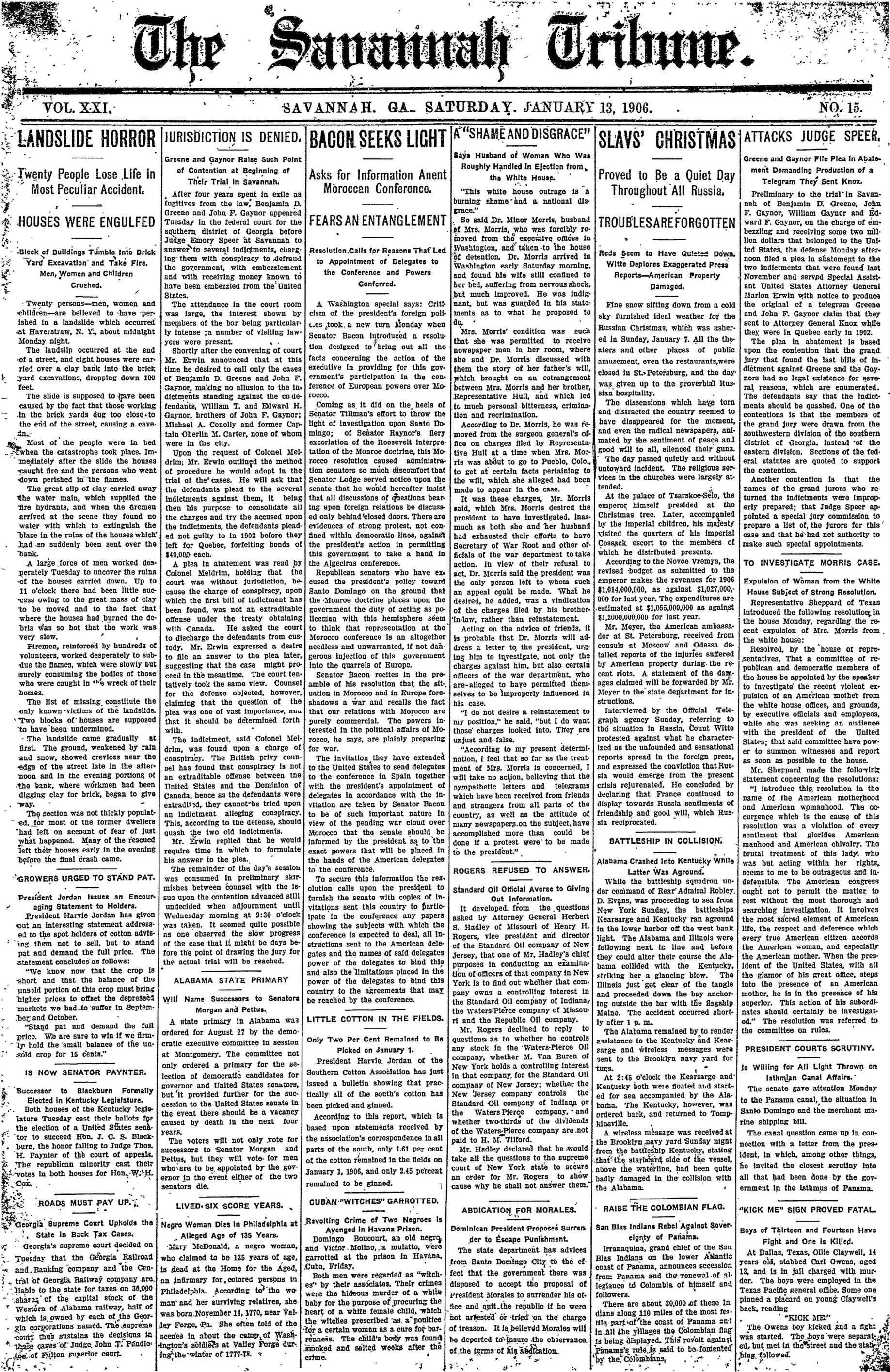
VOL. XXI.
Twenty People Lose Life in Most Peculiar Accident.
Block of Buildings Tumble Into Brick Yard Excavation and Take Fire. Men, Women and Children
Crushed.
Twenty persons—men, women and children—are believed to have perished in a landslide which occurred at Haverstraw, N. Y., about midnight Monday night.
The landslip occurred at the end of a street, and eight houses were carried over a clay bank into the brick yard excavations, dropping down 100 feet.
The slide is supposed to have been caused by the fact that those working in the brick yards dug too close to the end of the street, causing a cave-in.
Most of the people were in bed when the catastrophe took place. Immediately after the slide the houses caught fire and the persons who went down perished in the flames.
The great slip of clay carried away the water main, which supplied the fire hydrants, and when the firemen arrived at the scene they found no water with which to extinguishe the blaze in the ruins of the houses which had so suddenly been sent over the bank.
A large force of men worked desperately Tuesday to uncover the ruins of the houses carried down. Up to 11 o'clock there had been little success owing to the great mass of clay to be moved and to the fact that where the houses had burned the debris was so hot that the work was very slow.
Firemen, reinforced by hundreds of volunteers, worked desperately to subdue the flames, which were slowly but surely consuming the bodies of those who were caught in the wreck of their homes.
The list of missing constitute the only known victims of the landslide. Two blocks of houses are supposed to have been undermined.
The landslide came gradually at first. The ground, weakened by rain and snow, showed crevices near the edge of the street late in the afternoon and in the evening portions of the bank, where workmen had been digging clay for brick, began to give way.
The section was not thickly populated, for most of the former dwellers had left on account of fear of just what happened. Many of the rescued left their houses early in the evening before the final crash came.
GROWERS URGED TO STAND PAT.
President Jordan Issues an Encouraging Statement to Holders.
President Harvie Jordan has given out an interesting statement addressed to the spot holders of cotton advising them not to sell, but to stand pat and demand the full price. The statement concludes as follows:
"We know now that the crop is short and that the balance of the unsold portion of this crop must bring higher prices to offset the depressed markets we had to suffer in September and October.
"Stand pat and demand the full price. We are sure to win if we firmly hold the small balance of the unsold crop for 15 cents."
IS NOW SENATOR PAYNTER.
Successor to Blackburn Formally Elected in Kentucky Legislature.
Both houses of the Kentucky legislature Tuesday cast their ballots for the election of a United States senator to succeed Hon. J. C. S. Blackburn, the honor falling to Judge Thos. H. Paynter of the court of appeals. The republican minority cast their votes in both houses for Hon. W. H. Cox.
ROADS MUST PAY UP.
Georgia Supreme Court upholds the State in Back Tax Cases. Georgia's supreme court decided on Tuesday that the Georgia Railroad and Banking company and the Central of Georgia Railway company are liable to the state for taxes on 36,000 shares of the capital stock of the Western of Alabama railway, half of which is owned by each of the Georgia corporations named. The supreme court thus sustains the decisions in these cases of Judge, John T. Pendleton of Fulton superior court.
JURISDICTION IS DENIED.
Greene and Gaynor Raise Such Point of Contention at Beginning of Their Trial in Savannah.
After four years spent in exile as fugitives from the law, Benjamin D. Greene and John F. Gaynor appeared Tuesday in the federal court for the southern district of Georgia before Judge Emory Speer at Savannah to answer to several indictments, charging them with conspiracy to defraud the government, with embezzlement and with receiving money known to have been embezzled from the United States.
The attendance in the court room was large, the interest shown by members of the bar being particularly intense; a number of visiting lawyers were present.
Shortly after the convening of court Mr. Erwin announced that at this time he desired to call only the cases of Benjamin D. Greene and John F. Gaynor, making no allusion to the indictments standing against the co-defendants, William T. and Edward H. Gaynor, brothers of John F. Gaynor; Michael A. Conolly and former Captain Oberlin M. Carter, none of whom were in the city.
Upon the request of Colonel Meldrim; Mr. Erwin outlined the method of procedure he would adopt in the trial of the $^c$ cases. He will ask that the defendants plead to the several indictments against them, it being then his purpose to consolidate all the charges and try the accused upon the indictments, the defendants pleaded not guilty to in 1902 before they left for Quebec, forfeiting bonds of $40,000 each.
A plea in abatement was read by Colonel Meldrim, holding that the court was without jurisdiction, because the charge of conspiracy, upon which the first bill of indictment has been found, was not an extraditable offense under the treaty obtaining with Canada. He asked the court to discharge the defendants from custody. Mr. Erwin expressed a desire to file an answer to the plea later, suggesting that the case might proceed in the meantime. The court tentatively took the same view. Counsel for the defense objected, however, claiming that the question of the plea was one of vast importance, and that it should be determined forth with.
The indictment, said Colonel Meldrim, was found upon a charge of conspiracy. The British privy counsel has found that conspiracy is not an extraditable offense between the United States and the Dominion of Canada, hence as the defendants were extradited, they cannot be tried upon an indictment alleging conspiracy. This, according to the defense, should quash the two old indictments.
Mr. Erwin replied that he would require time in which to formulate his answer to the plea.
The remainder of the day's session was consumed in preliminary skirmishes between counsel with the issue upon the contention advanced still undecided when adjournment until Wednesday morning at 9:30 o'clock was taken. It seemed quite possible as one observed the slow progress of the case that it might be days before the point of drawing the jury for the actual trial will be reached.
ALABAMA STATE PRIMARY
Will Name Successors to Senatora Morgan and Pettus.
A state primary in Alabama was ordered for August 27 by the democratic executive committee in session at Montgomery. The committee not only ordered a primary for the selection of democratic candidates for governor and United States senators, but it provided further for the succession to the United States senate in the event there should be a vacancy caused by death in the next four years. The voters will not only vote for successors to Senator Morgan and Pettus, but they will vote for men who are to be appointed by the governor in the event either of the two senators die.
Negro Woman Dies in Philadelphia at Alleged Age of 135 Years.
Mary McDonald, a negro woman, who claimed to be 135 years of age, is dead at the Home for the Aged, an infirmary for colored persons in Philadelphia. According to the woman and her surviving relatives, she was born November 14, 1770, near Valley Forge, Pa. She often told of the scenes in about the camp of Washington's soldiers at Valley Forge during the winter of 1777-78.
SAVANNAH. GA.. SATURDAY. JANUARY 13, 1906.
BACON SEEKS LIGHT
Asks for Information Anent Moroccan Conference.
FEARS AN ENTANGLEMENT
Resolution.Calls for Reasons That Led to Appointment of Delegates to the Conference and Powers
A Washington special says: Criticism of the president's foreign policies took, a new turn Monday when Senator Bacon introduced a resolution designed to bring out all the facts concerning the action of the executive in providing for this government's participation in the conference of European powers over Morocco.
Coming as it did on the heels of Senator Tillman's effort to throw the light of investigation upon Santo Domingo; of Senator Raynor's fiery excorlation of the Roosevelt interpretation of the Monroe doctrine, this Morocco resolution caused administration senators so much discomfort that Senator Lodge served notice upon the senate that he would hereafter insist that all discussions of questions bearing upon foreign relations be discussed only behind closed doors. There are evidences of strong protest, not confined within democratic lines, against the president's action in permitting this government to take a hand in the Algeciras conference.
Republican senators who have excused the president's policy toward Santo Domingo on the ground that the Monroe doctrine places upon the government the duty of acting as policeman with this hemisphere seem to think that representation at the Morocco conference is an altogether needless and unwarranted, if not dangerous injection of this government into the quarrels of Europe.
Senator Bacon recites in the preamble of his resolution that the situation in Morocco and in Europe foreshadows a war and recalls the fact that our relations with Morocco are purely commercial. The powers interested in the political affairs of Morocco, he says, are plainly preparing for war.
The invitation they have extended to the United States to send delegates to the conference in Spain together with the president's appointment of delegates in accordance with the invitation are taken by Senator Bacon to be of such important nature in view of the pending war cloud over Morocco that the senate should be informed by the president as to the exact powers that will be placed in the hands of the American delegates to the conference.
To secure this information the resolution calls upon the president to furnish the senate with copies of invitations sent this country to participate in the conference any papers showing the subjects with which the conference is expected to deal, all instructions sent to the American delegates and the names of said delegates power of the delegates to bind this and also the limitations placed in the power of the delegates to bind this country to the agreements that may be reached by the conference.
LITTLE COTTON IN THE FIELDS.
Only Two Per Cent Remained to Be Picked on January 1.
President Harvie, Jordan of the Southern Cotton Association has just issued a bulletin showing that practically all of the south's cotton has been picked and ginned.
According to this report, which is based upon statements received by the association's correspondence in all parts of the south, only 1.61 per cent of the cotton remained in the fields on January 1, 1906, and only 2.45 percent remained to be ginned.
CUBAN "WITCHES" GARROTTED.
Revolting Crime of Two Negroes is Ayenged in Havana Prison.
Domingo Boucourt, an old negro and Victor Molino, a mulatto, were garrotted at the prison in Havana, Cuba, Friday.
Both men were regarded as "witches" by their associates. Their crimes were the hideous murder of a white baby for the purpose of procuring the heart of a white female child, which the witches prescribed as a poultice for a certain woman as a cure for barrenness. The child's body was found smoked and salted weeks after the crime.
A "SHAME AND DISGRACE"
Says Husband of Woman Who Was Roughly Handled In Ejection from the White House.
"This white house outrage is a burning shame and a national disgrace."
So said Dr. Minor Morris, husband of Mrs. Morris, who was forcibly removed from the executive offices in Washington, and taken to the house of detention. Dr. Morris arrived in Washington early Saturday morning, and found his wife still confined to her bed, suffering from nervous shock, but much improved. He was indignant, but was guarded in his statements as to what he proposed to do.
Mrs. Morris' condition was such that she was permitted to receive newspaper men in her room, where she and Dr. Morris discussed with them the story of her father's will, which brought on an estrangement between Mrs. Morris and her brother, Representative Hull, and which led to much personal bitterness, crimination and recrimination. According to Dr. Morris, he was removed from the surgeon general's office on charges filed by Representative Hull at a time when Mrs. Morris was about to go to Pueblo, Colo., to get at certain facts pertaining to the will, which she alleged had been made to appear in the case.
It was these charges, Mr. Morris said, which Mrs. Morris desired the president to have investigated, inasmuch as both she and her husband had exhausted their efforts to have Secretary of War Root and other officials of the war department to take action. In view of their refusal to act, Dr. Morris said the president was the only person left to whom such an appeal could be made. What he desired, he added, was a vindication of the charges filed by his brother-in-law, rather than reinstatement.
Acting on the advice of friends, it is probable that Dr. Morris will address a letter to the president, urging him to investigate, not only the charges against him, but also certain officers of the war department, who are-alleged to have permitted themselves to be improperly influenced in his case.
"I do not desire a reinstatement to my position," he said, "but I do want those charges looked into. They are unjust and false."
"According to my present determination, I feel that so far as the treatment of Mrs. Morris is concerned, I will take no action, believing that the sympathetic letters and telegrams which have been received from friends and strangers from all parts of the country, as well as the attitude of many newspapers on the subject, have accomplished more than could be done if a protest were to be made to the president."
Standard Oil Official Averse to Giving Out Information. It developed from the questions asked by Attorney General Herbert S. Hadley of Missouri of Henry H. Rogers, vice president and director of the Standard Oil company of New Jersey, that one of Mr. Hadley's chief purposes in conducting an examination of officers of that company in New York is to find out whether that company owns a controlling interest in the Standard Oil company of Indiana, the Waters-Pleure company of Missouri and the Republic Oil company.
Mr. Rogers declined to reply to questions as to whether he controls any stock in the Waters-Pierce Oil company, whether M. Van Buren of New York holds a controlling interest in that company, for the Standard Oil company of New Jersey; whether the New Jersey company controls the Standard Oil company of Indiana or the Waters-Pierce company, and whether two-thirds of the dividends of the Waters-Pierce company are not paid to H. M. Tilford.
Mr. Hadley declared that he would take all the questions to the supreme court of New York state to secure an order for Mr. Rogers to show cause why he shall not answer them.
ABDICATION FOR MORALES.
Dominican President Proposes Surrender to Escape Punishment. The state department has advices from Santo Domingo City to the effect that the government there was disposed to accept the proposal of President Morales to surrender his office and quit the republic if he were not arrested or tried on the charge of treason. It is believed Morales will be deported to insure the observance of the terms of his abdication.
SLAVS' CHRISTMAS
Proved to Be a Quiet Day Throughout All Russia.
TROUBLESAREFORGOTTEN
Reds Seem to Have Quieted Down. Witte Deplores Exaggerated Press Reports—American Property Damaged.
Fine snow sitting down from a cold sky furnished ideal weather for the Russian Christmas, which was ushered in Sunday, January 7. All the theaters and other places of public amusement, even the restaurants, were closed in St. Petersburg, and the day was given up to the proverbial Russian hospitality.
The dissensions which have torn and distracted the country seemed to have disappeared for the moment, and even the radical newspapers, animated by the sentiment of peace and good will to all, silenced their guns. The day passed quietly and without untoward incident. The religious services in the churches were largely attended. At the palace of Tsarskoe-Selo, the emperor himself presided at the Christmas tree. Later, accompanied by the imperial children, his majesty visited the quarters of his imperial Cossack escort to the members of which he distributed presents.
According to the Novoe Vremya, the revised budget as submitted to the emperor makes the revenues for 1906 $1,014,000,000, as against $1,027,000,000 for last year. The expenditures are estimated at $1,055,000,000 as against $1,2000,000,000 for last year.
Mr. Meyer, the American ambassador at St. Petersburg, received from consuls at Moscow and Odessa detailed reports of the injuries suffered by American property during the recent riots. A statement of the damages claimed will be forwarded by Mr. Meyer to the state department for instructions.
Interviewed by the Official Telegraph agency Sunday, referring to the situation in Russia, Count Witte protested against what he characterized as the unfounded and sensational reports spread in the foreign press, and expressed the conviction that Russia would emerge from the present crisis rejuvenated. He concluded by declaring that France continued to display towards Russia sentiments of friendship and good will, which Russia reciprocated.
BATTLESHIP IN COLLISION:
Alabama Crashed Into Kentucky While Latter Was Aground.
While the battleship squadron under command of Rear Admiral Robley, D. Evans, was proceeding to sea from New York Sunday, the battleships Kearsarge and Kentucky ran aground in the lower harbor off the west bank light. The Alabama and Illinois were following next in line and before they could alter their course the Alabama collided with the Kentucky, striking her a glancing blow. The Illinois just got clear of the tangle and proceeded down the bay anchoring outside the bar with the flagship Malne. The accident occurred shortly after 1 p. m.
The Alabama remained by to render assistance to the Kentucky and Kearsarge and wireless messages were sent to the Brooklyn navy yard for tugs.
At 2:45 o'clock the Kearsarge and Kentucky both were floated and started for sea accompanied by the Alabama. The Kentucky, however, was ordered back, and returned to Tompkinsville.
A wireless message was received at the Brooklyn navy yard Sunday night from the battleship Kentucky, stating that the starboard side of the vessel, above the waterline, had been quite badly damaged in the collision with the Alabama:
San Blas Indians Rebel Against Sovereignty of Panama.
Irranaquina, grand chief of the San Blas Indians on the lower Atlantic coast of Panama, announces secession from Panama and the renewal of allegiance to Colombia of himself and followers.
There are about 30,000 of these Indians along 110 miles of the most fertile part of the coast of Panama and in all the yllages the Colombian flag is being displayed. This revolt against Panama's rule is said to be fomented by the Colombians.
Greene and Gaynor File Plea in Abatement Demanding Production of a Telegram They Sent Knox.
Preliminary to the trial in Savannah of Benjamin D. Greene, John F. Gaynor, William Gaynor and Edward F. Gaynor, on the charge of embezzling and receiving some two million dollars that belonged to the United States, the defense Monday afternoon filed a plea in abatement to the two indictments that were found last November and served Special Assistant United States Attorney General Marlon Erwin with notice to produce the original of a telegram Greene and John F. Gaynor claim that they sent to Attorney General Knox while they were in Quebec early in 1902.
The plea in abatement is based upon the contention that the grand jury that found the last bills of indictment against Greene and the Gaynors had no legal existence for several reasons, which are enumerated. The defendants say that the indictments should be quashed. One of the contentions is that the members of the grand jury were drawn from the southwestern division of the southern district of Georgia, instead of the eastern division. Sections of the federal statutes are quoted to support the contention.
Another contention is that the names of the grand jurors who returned the indictments were improperly prepared; that Judge Speer appointed a special jury commission to prepare a list of, the jurors for this case and that he had not authority to make such special appointments.
TO INVESTIGATE MORRIS CASE.
Expulsion of Woman from the White House Subject of Strong Resolution.
Representative Sheppard of Texas introduced the following resolution in the house Monday, regarding the recent expulsion of Mrs. Morris from the white house:
Resolved, by the house of representatives, That a committee of republican and democratic members of the house be appointed by the speaker to investigate the recent violent expulsion of an American mother from the white house offices, and grounds, by executive officials and employees, while she was seeking an audience with the president of the United States; that said committee have power to summon witnesses and report as soon as possible to the house.
Mr. Sheppard made the following statement concerning the resolutions: "I introduce this, resolution in the name of the American motherhood and American womanhood. The occurrence which is the cause of this resolution was a violation of every sentiment that glorifies American manhood and American chivalry. The brutal treatment of this lady, who was but acting within her rights, seems to me to be outrageous and indefensible. The American congress ought not to permit the matter to rest without the most thorough and searching investigation. It involves the most sacred element of American life, the respect and deference which every true American citizen accords the American woman, and especially the American mother. When the president of the United States, with all the glamor of his great office, steps into the presence of an American mother, he is in the presence of his superior. This action of his subordinates should certainly be investigated." The resolution was referred to the committee on rules.
Is Willing for All Light Thrown on Isthmian Canal Affairs.'
The senate gave attention Monday to the Panama canal, the situation in Santo Domingo and the merchant marine shipping bill.
The canal question came up in connection with a letter from the president, in which, among other things, he invited the closest scrutiny into all that had been done by the government in the Isthmus of Panama.
"KICK ME" SIGN PROVED FATAL.
Boys of Thirteen and Fourteen Have Fight and One is Killed.
At Dallas, Texas, Ollie Claywell, 14 years old, stabbed Carl Owens, aged 13, and is in jail charged with murder. The boys were employed in the Texas Pacific general office. Some one pinned a placard on young Claywell's back, reading
"KICK ME"
The Owens boy kicked and a fight was started. The boys were separated, but met in the street and the stabbing followed.
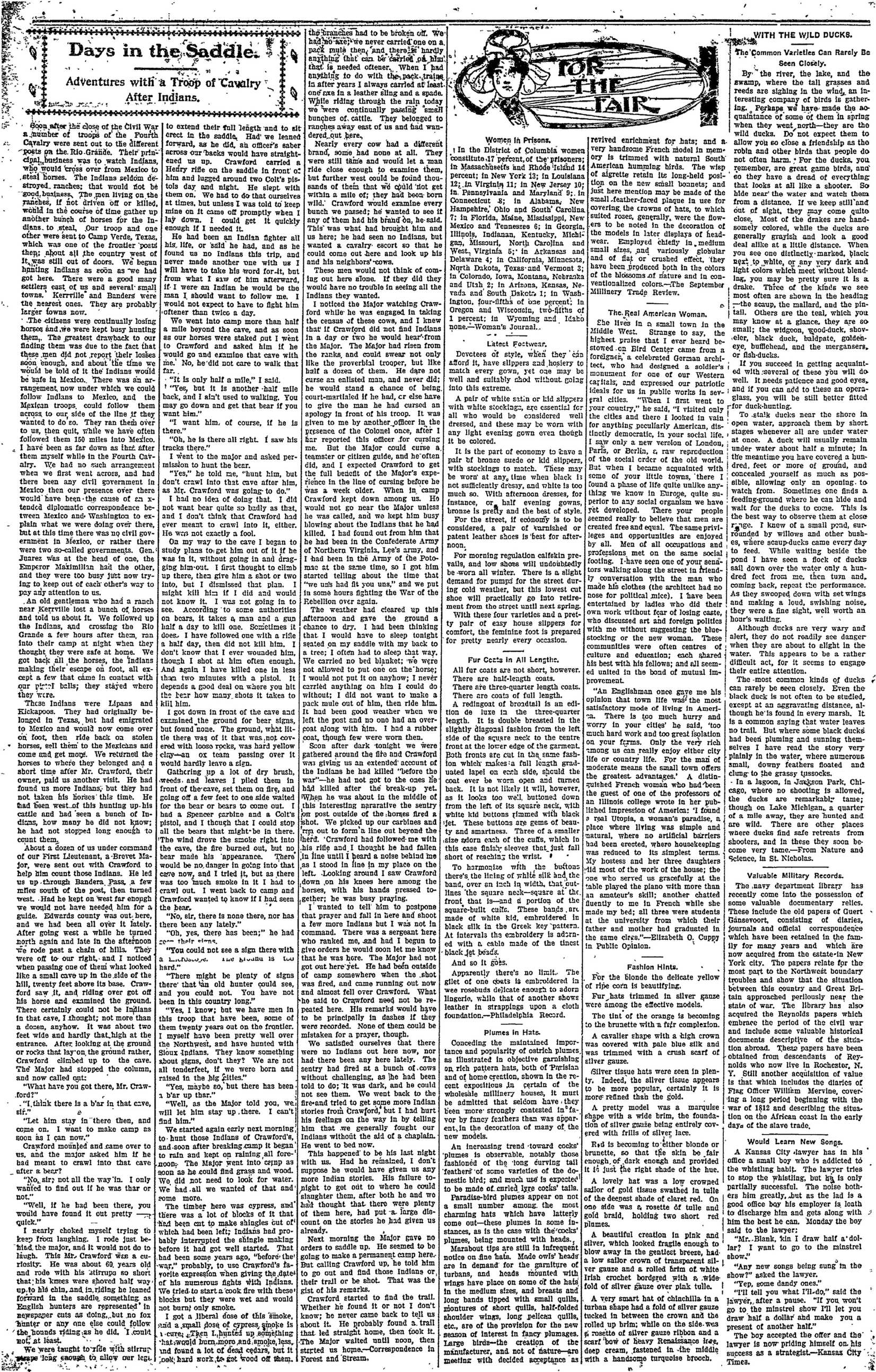
Soon after the close of the Civil War a number of troops of the Fourth Cavalry were sent out to the different posts on the Rio Grande. Their principal business was to watch Indians, who would cross over from Mexico to steal horses. The Indians seldom destroyed, ranches; that would not be good, business. The men living on the ranches, if not driven off or killed, would in the course of time gather up another bunch of horses for the Indians, to steal, our troop and one other were sent to Camp Verde, Texas, which was one of the frontier posts then; about all the country west of it was still out of doors. We began hunting Indians as soon as we had got here. There was a good many settlers cast of us and several-small towns. Kerrville and Banders were the nearest ones. They are probably larger towns now.
to extend their full length and to sit erect in the saddle. Had we leaned forward, as he did, an officer's saber across our backs would have straightened us up. Crawford carried a Henry rifle on the saddle in front of him and lugged around two Colt's pistols day and night. He slept with them on. We had to do that ourselves at times, but unless I was told to keep mine on it came off promptly when I lay down. I could get it quickly enough if I needed it.
He had been an Indian fighter all his life, or said he had, and as he found us no Indians this trip, and never made another one with us I will have to take his word for it, but from what I saw of him afterward, if I were an Indian he would be the man I should want to follow me. I would not expect to have to fight him oftener than twice a day.
The citizens were continually losing horses and we were kept busy hunting them. The greatest drawback to our finding them was due to the fact that these men did not report their losses soon enough, and about the time we would be told of it the Indians would be safe in Mexico. There was an arrangement, now under which we could follow Indians to Mexico, and the Mexican troops, could follow them across to our side of the line if they wanted to do so. They ran their over to us, then quit, while we have often followed them 150 miles into Mexico. I have been as far down as that after them myself while in the Fourth Cavalry. We had no such arrangement when we first went across, and had there been any civil government in Mexico then our presence over there would have been the cause of an extended diplomatic correspondence between Mexico and Washington to explain what we were doing over there, but at this time there was no civil government in Mexico, or rather there were two so-called governments. Gen. Junrez was at the head of one, the Emperor Maximilian had the other, and they were too busy just now trying to keep out of each other's way to pay any attention to us.
An old gentleman who had a ranch near Kerrville lost a bunch of horses and told us about it. We followed up the Indians, and crossing the Rio Grande a few hours after them, ran into their camp at night when they thought they were safe at home. We got back all the horses, the Indians making their escape on foot, all except a few that came in contact with our pearl balls; they stayed where they wired.
These Indians were Lipans and Kickapoos. They had originally belonged in Texas, but had emigrated to Mexico and would now come over on foot, then ride back on stolen horses, sell them to the Mexicans and come and get mop. We returned the horses to where they belonged and a short time after Mr. Crawford, their owner, paid us another visit. He had found us more Indians; but they had not taken his horses' this time. He had been west of this hunting up his cattle and had seen a bunch of Indians, how many he did not know; he had not stopped long enough to count them.
About a dozen of us under command of our First Leutenant, a-Brevet Major, were sent out with Crawford to help him count those Indians. He led us up through Bandera, Pass, a few miles west of the post, then turned west. Had he kept on west far enough we would not have needed him for a guide. Edwards county was out here, and we had been all over it lately. After going west a while he turned north again and late in the afternoon we rode past a chain of hills. They were off to our right, and I noticed when passing one of them what looked like a small cave up in the side of the hill, twenty feet above its base. Crawford saw it, and riding over got off his horse and examined the ground. There certainly could not be Indians in that cave, I thought; not more than a dozen, anyhow. It was about two feet wide and hardly that high at the entrance. After looking at the ground or rocks that lay on the ground rather, Crawford climbed up to the cave. The Major had stopped the column, and now called out:
"What have you got there, Mr. Crawford?"
"I think there is a bar in that cave, sif."
"Let him stay in thero then, and come on. I want to make camp as soon as I can now."
Crawford mounted and came over to us, and the major asked him if he had meant to crawl into that cave after a beer?
"No, sir; not all the way in. I only wanted to find out if he was thar or not."
"Well, if he had been there, you would have found it out pretty — outck."
I nearly choked myself trying to keep from laughing. I rode just behind the major, and it would not do to laugh. This Mr. Crawford was a curiosity. He was about 60 years old and rode with his attirups so short that his knees were shoved half way up to his chin, and in riding he leaned forward in the saddle something as English hunters are represented in newspaper cuts as doing, but no fox hunter or any one else could follow the hounds riding as he did. I could not, at least.
We were taught to ride with stirrups long enough to allow our legs
to extend their full length and to sit erect in the saddle. Had we leaned forward, as he did, an officer's saber across our backs would have straightened us up. Crawford carried a Henry rifle on the saddle in front of him and lagged around two Colt's pistols day and night. He slept with them on. We had to do that ourselves at times, but unless I was told to keep mine on it came off promptly when I lay down. I could get it quickly enough if I needed it.
He had been an Indian fighter all his life, or said he had, and as he found us no Indians this trip, and never made another one with us I will have to take his word for it, but from what I saw of him afterward, if I were an Indian he would be the man I should want to follow me. I would not expect to have to fight him oftener than twice a day.
We went into camp more than half a mile beyond the cave, and as soon as our horses were staked out I went to Crawford and asked him if he would go and examine that cave with me. No, he did not care to walk that far.
"It is only half a mile," I said.
"Yes, but it is another-half mile back, and I ain't used to walking. You may go down and get that bear if you want him."
"I want him, of course, if he is there."
"Oh, he is there all right. I saw his trucks there."
I went to the major and asked permission to hunt the beer.
"Yes," he told me, "hunt him, but don't crawl into that cave after him, as Mr. Crawford was going to do."
I had no idea of doing that. I did not want bear quite so badly as that, and I don't think that Crawford had ever meant to crawl into it, either. He was not exactly a fool.
On my way to the cave I began to study plans to get him out of it if he was in it, without going in and dragging him-out. I first thought to climb up there, then give him a shot or two into, but I dismissed that plan. I might kill him if I did and would not know it. I was not going in to see. According to some authorities on bears, it takes a man and a gun half a day to kill one. Sometimes it does. I have followed one with a ride a half day, then did not kill him. I don't know that I ever wounded him, though I shot at him often enough. And again I have killed one in less than two minutes with a pistol. It depends a good deal on where you hit the bear how many shots it takes to kill him.
I got down in front of the cave and examined the ground for bear signs, but found none. The ground, what little there was of it that was, not covered with loos rocks, was hard yellow clay—an ox team passing over it would hardly leave a sign.
Gathering up a lot of dry brush, weeds, and leaves I piled them in front of the cave, set them on fire, and going off a few feet to one side waited for the bear or bears to come out. I had a Spencer caribine and a Colt's pistol, and I though that I could stop all the bears that might be in there. The wind drove the smoke right into the cave, the fire burned out, but no bear made his appearance. There would be no danger in going into that cave now, and I tried it, but as there was too much smoke in it I had to crawl out. I went back to camp and Crawford wanted to know if I had seen the bear.
"No, sir, there is none there, nor has there been any lately."
"Oh, yes, there has been," he had seen their stems.
"You could not see a sign there with a lushouse. The ground is too hard."
"There might be plenty of signs there that an old hunter could see, and you could not. You have not been in this country long."
"Yes, I know; but we have men in this troop that have been, some of them twenty years out on the frontier. I myself have been pretty well over the Northwest, and have hunted with Sioux Indians. They know something about signs, don't they? We are not all tinderfeet, if we were born and raised in the big cities."
"Yes, maybe so, but there has been a bar up thar."
"Well, as the Major told you, we will let him stay up there. I can't find him."
We started again early next morning to hunt those Indians of Crawfords, and soon after breaking camp it began to rain and kept on raining all forenoon. The Major went into cemp as soon as he could find grass and wood. We did not need to look for water. We had all we wanted of that and some more.
The timber here was cypress, and there was a lot of blocks of it that had been cut to make shingles out of which had been left; Indians had probably interrupted the shingle making before it had got well started. That had been some years ago, "before the war," probably, to use Crawford's favorite expression when giving the date of his numerous fights with Indians. We tried to start a cook fire with these blocks but they were wet and would not burn only smoke.
I got a liberal dose of this smoke,
and a small dose of cypress. smoke is
a cure. Then I hunted up something
that would burn, more and smoke, less,
and found a lot of dead cedars, but it
look hard work to get wood off them.
the branches had to be broken off. We had no take; we never carried one on a pack mule then, and there is hardly anything that can be carried on him that is needed ottener. When I had anything to do with the pack, train in after years I always carried at least one one in a leather siling and a spade. While riding through the rain today we were continually passing small bunches of cattle. They belonged to ranches away east of us and had wandered out here.
Nearly every cow had a different brand, some had none at all. They were still tame and would let a man ride close enough to examine them, but further west could be found thousands of a them that we could not get within a mile of; they had been-born wild. Crawford would examine every bunch we passed; he wanted to see if any of them had his brand on. he said. This was what had brought him and us here; he had seen no Indians, but wanted a cavalry escort so that he could come out here and look up his and his neighbors' cows. These men would not think of coming out here alone. If they did they would have no trouble in seeing all the Indians they wanted.
I noticed the Major watching Crawford while he was engaged in taking the census of these cows, and I knew that If Crawford did not find Indians in a day or two he would hear from the Major. The Major had risen from the ranks, and could swear not only like the proverbial trooper, but like half a dozen of them. He dare not curse an enlisted man, and never did; he would stand a chance of being court-martialled if he had, cr else have to give the man he had cursed an apology in front of his troop. It was given to me by another officer in the presence of the Colonel once, after I har reported this officer for cursing me. But the Major could curse a teamster or citizen guide, and he often did, and I expected Crawford to get the full benefit of the Major's experience in the line of cursing before he was a week older. When in camp Crawford kept down among us. He would not go near the Major unless he was called, and we kept him busy blowing about the Indians that he had killed. I had found out from him that he had been in the Confederate Army of Northern Virginia, Lee's army, and I had been in the Army of the Potomac at the same time, so I got him started telling about the time that "we uns had fit you uns", and we put in some hours fighting the War of the Rebellion over again.
The weather had cleared up this afternoon and gave the ground a chance to dry. I had been thinking that I would have to sleep tonight seated on my saddle with my back to a tree; I often had to sleep that way. We carried no bed blanket; we were not allowed to put one on the horse; I would not put it on anyhow; I never carried anything on him I could without; I did not want to make a pack mule out of him, then ride him. It had been good weather when we left the post and no one had an overcoat along with him. I had a rubber coat though few were worn then.
Soon after dark tonight we were gathered around the fire and Crawford was giving us an extended account of the Indians he had killed "before the war"—he had not got to the ones he had killed after the break-up yet. When he was about in the middle of this interesting narrative the sentry on post outside of the horses fired a shot. We picked up our carbines and ran out to form a line out beyond the herd. "Crawford had followed me with his rifle and I thought he had fallen in line until I heard a noise behind me as I stood in line in my place on the left. Looking around I saw Crawford down on his knees here among the horses, with his hands pressed together; he was busy praying.
I wanted to tell him to postpone that prayer and fall in here and shoot a few more Indians but I was not in command. There was a sergeant here who ranked me, and had I begun to give orders he would soon let me know that he was hore. The Major had not got out here yet. He had been outside of camp somewhere when the shot was fired, and came running out now and almost fell over Crawford. What he said to Crawford need not be repeated here. His remarks would have to be principally in dashes if they were recorded. None of them could be mistaken for a prayer, though.
We satisfied ourselves that there were no Indians out here now, nor had there been any here lately. The sentry had fired at a bunch of cows without challenging, as he had been told to do; it was dark, and he could not see them. We went back to the fire and tried to get some more Indian stories from Crawford, but I had hurt his feelings on the way in by telling him that we generally fought our Indians without the aid of a chaplain. He went to bed now.
This happened to be his last night with us. Had he remained, I don't suppose he would have given us any more Indian stories. His failure tonight to get out to where he could slaughter them, after both he and we had thought that there were plenty of them here, had put a large discount on the stories he had given us already.
Next morning the Major gave no orders to saddle up. He seemed to be going to make a permanent camp here. But calling Crawford up, he told him to go out and find those Indians or their trall or be shot. That was the rist of his remarks.
Crawford started to find the trail.
Whether he found it or not I don't know; he never came back to tell us about it. He probably found a trail that led straight home, then took it.
The Major waited until noon, then started us home—Correspondence in Forest and Stream.
FOR
THE
FAIR
Women In Prisons.
In the District of Columbia women constitute 17 percent, of the prisoners; in Massachusetts and Rhode Island 14 percent; in New York 13; in Louisiana 12; in Virginia 11; in New Jersey 10; in Pennsylvania and Maryland 9; in Connecticut 8; in Alabama, New Hamshire, Ohio and South Carolina 7; in Florida, Maine, Mississippi, New Mexico and Tennessee 6; in Georgia, Illinois, Indianan, Kentucky, Michigan, Missouri, North Carolina and West, Virginia 5; in Arkansas and Delaware 4; in California, Minnesota, North Dakota, Texas and Vermont 3; in Colorado, Iowa, Montana, Nebraska and Utah 2; in Arizona, Kansas, Nevada and South Dakota 1; in Washington, four-fifths of one percent; in Oregon and Wisconsin, two-fifths of 1 percent; in Wyoming and Idaho none—Woman's Journal.
Latest Footwear.
Devotees of style, when they can afford it, have slippers and hosiery to match every gown, yet one may be well and suitably chod without going into this extreme.
A pair of white satin or kid slippers with white stockings, are essential for all who would be considered well dressed, and these may be worn with any light evening gown even though it be colored.
It is the part of economy to have a pair of bronze suede or kid slippers with stockings to match. These may be worn at any time when black is not sufficiently dressey, and white is too much so. With afternoon dresses, for instance, or half evening gowns, bronze is pretty and the best of style.
For the street, if economy is to be considered, a pair of varnished or patent leather shoes is best for afternoon.
For morning regulation calfskin prevails, and low shoes will undoubtedly be worn all winter. There is a slight demand for pumps for the street during cold weather, but this lowest cut shoe will practically go into retirement from the street until next spring. With these four varieties and a pretty pair of easy house slippers for comfort, the feminine foot is prepared for pretty nearly every occasion.
Fur Coats In All Lengths.
All fur coats are not short, however.
There are half-length coats.
There are three-quarter length coats.
There are coats of full length.
A redingot of broaddall is an edition de luxe in the three-quarter length. It is double breasted in the slightly diagonal fashion from the left side of the square neck to the centre front at the lower edge of the garment. Both fronts are cut in the same fashion which makes a full length graduated lapel on each side, should the coat ever be worn open and turned back. It is not likely it will, however, as it looks too well, buttoned down from the left of its square neck, with white kid buttons rimmed with black jet. These buttons are gems of beauty and smartness. Three of a smaller size dorsum each of the cuffs, which in this case finish sleeves that just fall short of reaching the wrist.
To harmonize with the buttons there's the lining of white silk and the band, over an inch in width, that outlines the square neck—square at the front that is—and a portion of the square-built cuffs. These bands are made of white kid, embroidered in black silk in the Greek key pattern. At intervals the embroidery is adorned with a cable made of the finest black fet beads.
And so it goes.
Apparently there's no limit. The glet of one coat is embroidered in wee rosbusda enough to adorn lingerie, while that of another shows leather in strappings upon a cloth foundation—Philadelphia Record.
Plumes in Hate
Conceding the maintained importance and popularity of ostrich plumes as illustrated in objective garnishing on rich pattern hats, both of Parisian and of home creation, shown in the recent expositions in certain of the wholesale millinery houses, it must be admitted that seldom have they been more strongly contested in favor by fancy feathers than was apparent, in the decoration of many of the new models.
An increasing trend toward cocks' plumes is observable, notably those fashioned of the long curving tail feathers' of some varieties of the domestic bird; and much use is expected to be made of curled lyrge cocks' tails.
Paradise-bird plumes appear on not a small number among the most charming hats which have latterly come out—these plumes in some instances, as is the case with the 'cocks' plumes, being mounted with heads.
Marabout tips are still in infrequent notice on dane hats. Made owls' heads are in demand for the garniture of turbans, and heads mounted with wings have place on some of the hats in the medium sizes, and breasts and long bands tipped with small quilts, montures of short quilts, half-folded shoulder wings, long pelican quilts, etc., are of the provision for the new season of interest in fancy plumages. Large birds—the creation of the manufacturer, and not of nature—are meeting with decided acceptance as
revived enrichment for hats; and a very handsome French model in memory is trimmed with natural South American humming birds. The wisp of algrette retain its long-held position on the new small bonnets; and just here mention may be made of the small feather-faced plaque in use for covering the crowns of hats, to which suited roses, generally, were the flowers to be noted in the decoration of the models in later displays of headwear. Employed chiefly in medium small sizes, and variously globular and of flat or crushed effect, they have been produced both in the colors of the blossoms of nature and in conventionalized colors.-The September Millinery Trade Review.
The.Real American Woman.
She lives in a small town in the Middle West. Strange to say, the highest praise that I ever heard bestowed on Bird Center came from a foreigner, a celebrated German architect, who had designed a soldier's monument for one of our Western capitals, and expressed our patriotic ideals for us in public works in several cities. "When I first went to your country," he said, "I visited only the cities and there I looked in vain for anything peculiarly American, distinctly democratic, in your social life. I saw only a new version of London, Paris, or Berlin, a raw reproduction of the social order of the old world. But when I became acquainted with some of your little towns, there I found a phase of life quite unlike anything we know in Europe, quite superior to any social organism we have yet developed. There your people seemed really to believe that men are created free and equal. The same privileges and opportunities are enjoyed by all. Men of all occupations and professions met on the same social footing. I have seen one of your senators walking along the street in friendly conversation with the man who made his clothes (the architect had no nose for political mice). I have been entertained by ladies who did their own work without fear of losing caste, who discussed art and foreign politics with me without suggesting the blue-stocking or the new woman. These communities were often centres of culture and education; each shared his best with his fellows; and all seemed united in the bond of mutual improvement.
"An Englishman once gave me his opinion that town life was the most satisfactory mode of living in America. There is too much hurry and worry in your cities' he said, 'too much hard work and too great isolation on your farms. Only the very rich among us can really enjoy either city life or country life. For the man of moderate means the small town offers the greatest advantages.' A distinguished French woman who had been the guest of one of the professors of an Illinois college wrote in her published Impression of America: 'I found a real Utopia, a woman's paradise, a place where living was simple and natural, where no artificial barriers had been erected, where housekeeping was reduced to its simplest terms. My hostess and her three daughters did most of the work of the house; the one who served us gracefully at the table played the piano with more than an amateur's skill; another chatted fluently to me in French while she made my bed; all three were students at the university from which their father and mother had graduated in the same cress."—Elizabeth O. Cuppy in Public Opinion.
Fashion Hints
For the blonde the delicate yellow of ripe corn is beautifying.
Fur_hats trimmed in silver gauze were among the effective models.
The tint of the orange is becoming to the brunette with a fair complexion.
A cavallier shape with a high crown was covered with pale blue silk and was trimmed with a crush scarf of silver gauze.
Silver tissue hats were seen in plenty. Indeed, the silver tissue appears to be more popular, certainly it is more refined than the gold.
A pretty model was a marquise shape with a wide brim, the foundation of silver gauze being entirely covered with frills of silver lace.
Red is becoming to either blonde or brunette, so that the skin be fair enough, of dark enough and provided it is just the right shade of the hue.
A lovely hat was a low crowned sailor of gold tissue swathed in tulle of the deepest shade of claret red. On one side was a rosette of tulle and gold braid, holding two short red plumes.
A beautiful creation in pink and silver, which looked fragile enough to blow away in the gentlest breeze, had a low sailor crown of transparent silver gauze and a rolled brim of white Irish crochet bordered with a wide fold of silver gauze over pink tulle.
A very smart hat of chinchilla in a turban shape had a fold of silver gauze tucked in between the crown and the rolled up brim; while on the side was a rosette of silver gauze ribbon and a scarf of heavy Renaissance tree, deep cream, fastened in the middle with a handsome turquoise brooch.
The Common Varieties Can Rarely Be Seen Closely.
By the river, the lake, and the swamp, where the tall grasses and reeds are sighing in the wind, an interesting company of birds is gathering. Perhaps we have made the so acquaintance of some of them in spring when they went north—they are the wild ducks. Do not expect them to allow you so close a friendship as the robin and other birds that people do not often harm. For the ducks, you remember, are great game birds, and so they have a dread of everything that looks at all like a shooter. So hide near the water and watch them from a distance. If we keep still and out of sight, they may come quite close. Most of the drakes are handsomely colored, while the ducks are generally grayish and look a good deal alike at a little distance. When you see one distinctly marked, black neck to white, or any very dark and light colors which meet without blending, you may be pretty sure it is a drake. Thrice of the kinds we see most often are shown in the heading—the scaup, the mallard, and the pintail. Others are the teal, which you may know at a glance, they are so small; the wildgoon, good-duck, shoveler, black duck, baldpate, goldeneye, buffheed, and the mergansers, or fish-ducks.
If you succeed in getting acquainted with several of these you will do well. It needs patience and good eyes, and if you can add to these an opera glass, you will be still better fitted for duck-hunting.
To stalk ducks near the shore in open water, approach them by short stages whenever all are under water at once. A duck will usually remain under water about half a minute; in the meantime you have covered a hundred, feet or more of ground, and concealed yourself as much as possible, allowing only an opening to watch from. Sometimes one finds a feeding ground where he can hide and wait for the ducks to come. This is the best way to observe them at close range. I know of a small pond, surrounded by willows and other bushes, where scaup ducks came every day to feed. While waiting beside the pond I have seen a flock of ducks sail down over the water only a hundred feet from me, then turn and, coming back, repeat the performance. As they swooped down with set wings and making a loud, swishing noise, they were a fine sight, well worth an hour's waiting.
Although ducks are very wary and alert, they do not readily see danger when they are about to alight in the water. This appears to be a rather difficult act, for it seems to engage their entire attention.
The most common kinds of ducks can rarely be seen closely. Even the black duck is not often to be studied, except at an aggravating distance, although he is found in every marsh. It is a common saying that water leaves no trail. But where some black ducks had been plumming and sunning themselves I have read the story very plainly in the water, where numerous small, downy feathers floated and clung to the grassy tussocks.
- In a lagoon, in Jackson Park, Chicago, where no shooting is allowed, the ducks are remarkably tame; though on Lake Michigan, a quarter of a mile away, they are hunted and are wild. There are other places where ducks find safe retreats from shooters, and in these they soon become very tame—From Nature and Science, in St. Nicholas.
Valuable Military Records.
The navy department library has recently come into the possession of some valuable documentary relics. These include the old papers of Guert Gansevoort, consisting of diaries, journals and official correspondence which have been retained in the family for many years and which are now acquired from the estate-in New York city. The papers relate for the most part to the Northwest boundary troubles and show that the situation between this country and Great Britain approached perilously near the state of war. The library has also acquired the Reynolds papers which embrace the period of the civil war and include some valuable historical documents descriptive of the situation abroad. These papers have been obtained from descendants of Reynolds who now live in Rochester, N.Y. Still another acquisition of value is that which includes the diaries of Flag Officer William Mervine, covering a long period beginning with the war of 1812 and describing the situation on the African coast in the early days of the slave trade.
Would Learn New Songs
A Kansas City lawyer has in his office a small boy who is addicted to the whistling habit. The lawyer tries to stop the whistling, but he is only partially successful. The noise bothers him greatly, but as the lad is a good office boy his employer is loath to discharge him and gets along with him the best he can. Monday the boy said to the lawyer:
"Mr. Blank, kin I draw half a 'dollar? I want to go to the minstrel show."
"Any new songs being sung in the show?" asked the lawyer.
"Yep, some dandy ones."
"I'll tell you what I'll do," said the lawyer, after a pause. "If you won't go to the minstrel show I'll let you draw half a dollar and make you a present of another half."
The boy accepted the offer and the lawyer is now priding himself on his success as a strategist—Kansas City Times.
A volume on psychology,
And two books on liquid air,
The many phases of the sea,
The aspects that the planets wear
By busy authors are laid bare:
Some write upon the social trend
And how the poorer classes fare
Of making books there is no end.
The scientists work busily,
The poets give us quite a scare
They rhyme with such facility,
The do not wear such rate
We, long suffering, declare
Their works no great enchantment lend,
We have to stand a certain share
Of making books there is no end.
ENVOY.
Prince, when the subjects grow quite rare
This project then they recommend:
"About a book a book prepare:
Of making books there is no end!
—Nathan L Levy, in Leille's Monthly Magazine.
CONSOLATION.
Mrs. Jefferson was not more than thirty-five years of age, and she had spent fourteen years of married life in India. She had seen three of her children buried in an unhealthy station, and had been to England once, seven years before, to take two little girls home to be educated. It was on her return voyage from visiting her children that I met her.
She was so much less aggressive than most of the women on board, and demanded so much less attention, that it was restful to a lazy man like myself just to sit quietly by her deck chair, share my books and newspapers with her, and enjoy my evening glar
by her side. Mrs. Jefferson did not object to smoking; she seemed so diffident, so humble and unexacting that I found myself wondering what the man must be like who was her husband, and hoping that he was not a selfish brute who sat upon the little woman. She was not communicative, and I found cut very little about her during our long chats. Perhaps I am egotistical and talk a good deal about myself when I get a patient listener. Be that as it may, I gleaned nothing of Mrs. Jefferson's own history from her, and at last I determined to ask the captain of the ship if he knew anything about her.
"It is odd that you should ask me that," said Captain Hargreaves, "for it was only today that I began to recall Mrs. Jefferson to my recollection. She told me her malden name this morning and said that she had traveled out with me once before, and I re-collected the circumstances immediately.
"She was going out to India to be married to this man Jefferson, and a very pretty girl she was in those days, though one would hardly guess it now to look at her—one gets accustomed to that sort of thing on board these P. and O. vessels—one year a pretty girl with pink cheeks and her lover's photograph on her cabin table, going out to be married and to be happy ever afterward, and a few years later, the same girl with all the roses washed out of her cheeks, bringing home a little boy or girl to say good-bye to them in England, and to go back to some plantation in the hills, where perhaps her husband's is the only white face she sees for most days in the year."
"Yet they'll continue to go while the world lasts," said I. "I hope Jefferson was the right sort of man!"
"So far as I can hear," said Captain Hargreaves, "he is very much the reverse! He got into some trouble over a business affair, and lost a good billot down in Calcutta; then he came into a little money, and bought a tea plantation somewhere in the back of beyond. But he was always something of a bounder, I fancy, and his misfortune, as men of Jefferson's type always call their misdongs, soured him. He took to drink, I believe, and this little woman doesn't have the best of times with him. She has got children at home, and has lost several others out in India."
Naturally one avoided the subject of Mr. Jefferson ever afterward when talking to his wife, and I heard nothing about him till the very last day of the voyage.
It was horribly hot weather-quite exhausting for ladies. Mrs. Jefferson had been confined to her cabin tor some days with a bad attack of fever and headache. She looked pathetically small and weak when she came on deck again, and curled herself up in my big deck chair which I had prepared with cushions for her, giving me at the same time a look so full of gratitude that it was enough to make any decent man feel ashamed of himself.
The rest of the passengers began to go below, card tables were put away, the principal electric lights were put out, but still Mrs. Jefferson sat in the big deck chair, looking small and weak among the pillows, and I took it into my head suddenly that she wanted to say something to me, but that speech was difficult to her, and in a flash I knew intuitively that she had learned the silence which so many women have to learn.
"I want to thank you," she-said at last, "for all your goodness to me on this voyage." Her voice was so low and gentile that I had to lean forward to catch exactly what she said, and as I did so she laid her hand in mine.
"Perhaps you don't know," she said slowly, "quite what your friendship has been to me."
I stumbled and said something bald and stupid in response, and Mrs. Jefferson went on:
"For seven years I have lived for nothing but this visit home to Engi-
land. When anything in my life was a little disappointing, I always said to myself, I have the children to go back to. And every week I had their precious, foolish little letters, which told me so little and kept me hungering to see them."
"It must have been awful to leave them again," I said, and in the dark I took again the little hand which had lain in mine.
"They were so fond of me," said Mrs. Jefferson, still in the same halting fashion, like one who speaks an unfamiliar language. "I mean when they were little things. I do not think quite tiny children could ever have been more fond of their mother. And"—she hesitated for a moment, and said, with so much difficulty that it seemed almost like cruelty to allow her to proceed—"I always thought they would remember me, although they were so little." She paused again and went on: "You mustn't think that I was silly about them, or that I expected too much. * * * I always thought at first they might be a little bit shy of me. * * * But they didn't even know me, and they were certainly disappointed in me. * * * One of them was five years old when I said good by to her. Now she is a school girl of thirteen. * * * Her only photograph of me was taken long ago, so it is no wonder that she didn't know me."
I did not fill in the pause by any banal remark.
"They have been brought up in a very prim household," went on the gentle voice, "in which love, I fear, is not a thing that is reckoned with or encouraged. They rather despised me for laughing and crying over them when we met, and—it is only natural, of course—all their little confidence were for the people who brought them up, and all their ways of thinking are their ways, and not mine. One of my little girls, I found, is not a very truthful child, and the other, when I asked her what she would like best to do seemed more content at home."
"But you made friends and got over all that before you left?" I said encouragingly.
"If only I had had a little more time!" said Mrs. Jefferson.
It would have been so much better for her if she could have wept. She locked her thin hands together, and said with a sort of wall in her voice—"If only I had had a little more time!" After a while she went on quite quietly, and told me that her husband had sent for her to return to him, and she had been obliged to leave the children.
"Of course a man wants his wife in a solitary life like ours," she went on, excusingly. "And so I said good-by to them. * * * I don't think any one was very sorry when I came away."
The decks were quite deserted now. Tomorrow they would be alive with passengers preparing to leave the ship, and friends meeting friends fromombay, and ship's officials, and hurrying agents, and perspiring stewards. Tonight they were quite deserted save for Mrs. Jefferson and me.
"We live quite an isolated life, at the tea garden," she said presently, "but I left a little dog there of which I am very fond. * * * I am afraid you will think me very morbid and imaginative," she added in her deprecatory little way, "but I think I have based all my possibilities of bearing things upon the question of whether or not my dog knows me again and is glad to see me."
I still held Mrs. Jefferson's hand in mine, and now I raised it to my lips and. kisseshr hretohrdetahr hr hrdlu and kissed it. "You will let me know," I said huskily, and found to my surprise that I could not say more. "Yes, I will let you know," said Mrs. Jefferson. And one day I got a little note from her which said: "The dog knew me," and that was all.-S. Macnaughtan in Temple Bar.
The Bible on Football.
(Eastern papers are surprised at the announcement that the football team of the Ohio university is studying the Bible.)
By searching the Scriptures the football player will find many texts suited to the game and how it should be played. Glance at the list:
"They RUSH with one accord."—Acts, xix., 29.
"Many shall RUN to and fro."—Daniel, xlf., 4.
"That my FOOTSTEPS SLIP not."—Psalms, xvll., 5.
"RUN not to excess."—I. Peter, iv., 4.
"I will SCATTER them."—Jeremiah xiii, 24.
"The TACKLING loosed."—Isalah, xxvii, 23.
"TRAMPLE them."—Isalah, lkill. 3.
"Require a SIGN" (signal).—I. Corinthians, s., 22.
"Speak that they go FORWARD."
—Exodus, xiv., 15.
"Time to KILL."—Ecclesiastes, ill.
3.—Portland Telegram.
Effect of the Auto Craze.
Just how badly some men have the automobile habit was shown on Broadway the other night by a man and woman who were splaining down that thoroughfare in a little open touring car. The man, who was driving the car, was in formal evening dress, a crush hat on his head and his white tie and waistcoat showing under his long gray top coat. The woman by his side, wore a heavy white veil over her ball and her gown was covered with a big cloak. Seated by her side at her feet on the step was the chauffeur, whose duties so far as that run was concerned, were purely ornamental.—New York Press.
Too Much Anglo-American Brotherhood By G. K. Chesterton.
England is too snobbish and oligarchical; but is American influence even tending to make it less snobbish or less oligarchical? America is too cheap and vulgar; but does English influence, where there is English influence, even tend to make it less cheap and vulgar? Is it not unfortunately the fact that the very thing that modern America admires in us is our aristocracy, that the very thing that we admire in America is her mere pertness and "push?" English praise is not a force recalling America to her primal republican ideal. American praise is not a force recalling us to Merry England. We are not even flattering each other's powers; we are encouraging each other's weaknesses. America finds it convenient to be a little less republican; that is, a little less American. England finds it convenient to be a little less chivalrous; that is, a little less English. This simultaneous falling away they choose to call a falling together.
Americans on whom Benjamin Franklin would have turned his back embrace Englishmen whom Dr. Johnson would have kicked down stairs; and behold the wounds of an old war are healed! But neither people learns anything—except, perhaps, slang. England certainly does not learn democracy. The Americanized English nobleman does not become an inch less of a nobleman; he only becomes rather less of a gentleman.
Lord Lansdowno at a Fourth of July festivity said that the mention of that date now involved no bitterness. This is quite true. The fourth of July has lost all its venom; and the simple reason is that it has lost all its meaning. What the Fourth of July originally meant we have no space here to inquire; it meant a great many things.
But one of the things it certainly meant was this, that there ought to be no such person as "Lord" Lansdowno in the world.
What Japanese Loans Are Based On
cipal being the national credit. Would they have been accepted as a guarantee, however, for ten times the amount? Most certainly not. Therefore, had 10 times the amount had been offered, instead of it all being taken, none would have been taken at all. Again, it must be remembered that banks have not been the real takers of these loans. The bulk of the money has come from individual Englishmen and Americans, who in view of reputable banking firms underwriting the loans, accepted them as a good investment at the market price, which nets about eight percent. It is amusing to see the turn which the pro-Japanese propaganda, both east and west, has given the acceptance of these two loans in England and America. It is everywhere in Japan hailed by the propaganda as evidence that the British and American governments are backing the Japanese government in the war, and that these two wealthy countries stand ready to continue to provide the funds. It is hardly necessary to point out the error of this belief. People in America and England invest in the Japanese loans just as they do in Galveston municipal bonds, on purely business principles. As long as they think the security is good they will continue to invest, but the moment they begin to suspect the security offered they will not have them at all except at a discount which compensates them for the risk taken. The Japanese statesmen who are financing the war undoubtedly know this, but the masses of the people are encouraged to entertain some very elusive hopes and expectations.—From "The Financial Prospects of Japan."
What Children Say
By Agnes Repplier.
lect of the child. Anxious friends, hearing them, wonder now and then why the father does not consult a specialist, and make sure that his child is not feeble of mind. But there is no need for this concern. The chances are that what the child really said wasn't half so bad as the thing we hear repeated. It is the editing of such speeches which gives them their alarming fatuity.
At least they are becoming more infrequent in print, and for what we do not receive let us be truly grateful. Perhaps it is because English people see less of their children than we do, and hear them less, that they are so ready to read about them in the said pages of Punch. Punch rings true. I mean we are mournfully sure that the things it tells really happened—that there was a live child who, being put to bed on a steamer, said: "This isn't a bed. It is a chest of drawers." The anecdote has that chastened humor which Mr. Howells has taught us to recognize as the pride of the veritist, and the affliction of the light-minded reader. The suppression of such a jest adds materially to the gayety of life.—Life.
Large Families Desirable By A. S. Williamson.
come the best children, and that from the class of ignorant and vicious parents come the criminals and vicious. In view of this, are only the ignorant to produce children and the cultured to spend their time in literary, artistic, and scientific pursuits? This is the question which Mr. Roosevelt would like to see answered by the best people raising children—and by the best people is not meant the fashionable or rich exclusively, but those who by their superior intelligence and well-nourished bodies can produce children endowed from birth with intelligence and strength. Of this class of children we cannot have too many. The cultured will never overrun the world, while the vicious may and, but for the laws of nature, would. These will always be in the majority. It is too much to be hoped for that a great proportion of the world's population will ever be cultured, but we can raise the proportion of good to bad by having the cultured leave children in such numbers that the good will increase. By this means, and not by the repression of the bad, will we attain this desirable condition of relatively general culture.—Harper's Weekly.
W
olligarchical? And where there is E
Is it not uni
admires in us is
ica is her mere y
English prai
ideal. Americans
not even fatterl
weaknesses. And
is, a little less A
alrous; that is,
choose to call a
Americans o
brace Englishmen
hold the wounds
thing—except, po
The Americanizee
man; he only be
Lord Lansdow
that date now in
has lost all its ving.
What the B
quire; it meant t
But one of t
no such person a
T
cipal being the n tee, however, for 10 times the amo have been taken been the real tain individual English underwriting the market price, whi which the pro-Jaance of these two halfed by the pro ments are backin wealthy countrie necessary to poi land invest in the bonds, on purely good they will ce security offered th pensates them for the war undoubt to entertain some Prospects of Jap
T
lect of the child, the father does not feeble of mind, what the child re It is the editing of At least they not receive let us less of their child to read about the we are mournful was a live child It is a chest of Howells has taught fiction of the lightly to the gale
Larg
I
come the best chil-
ents come the cris-
produce children
scientific pursuits
see answered by
not meant the fast
intelligence and the
birth with intelligence
too many. The c
and, but for the la
it is too much to
will ever be be
having the culture
crease. By this m
this desirable con
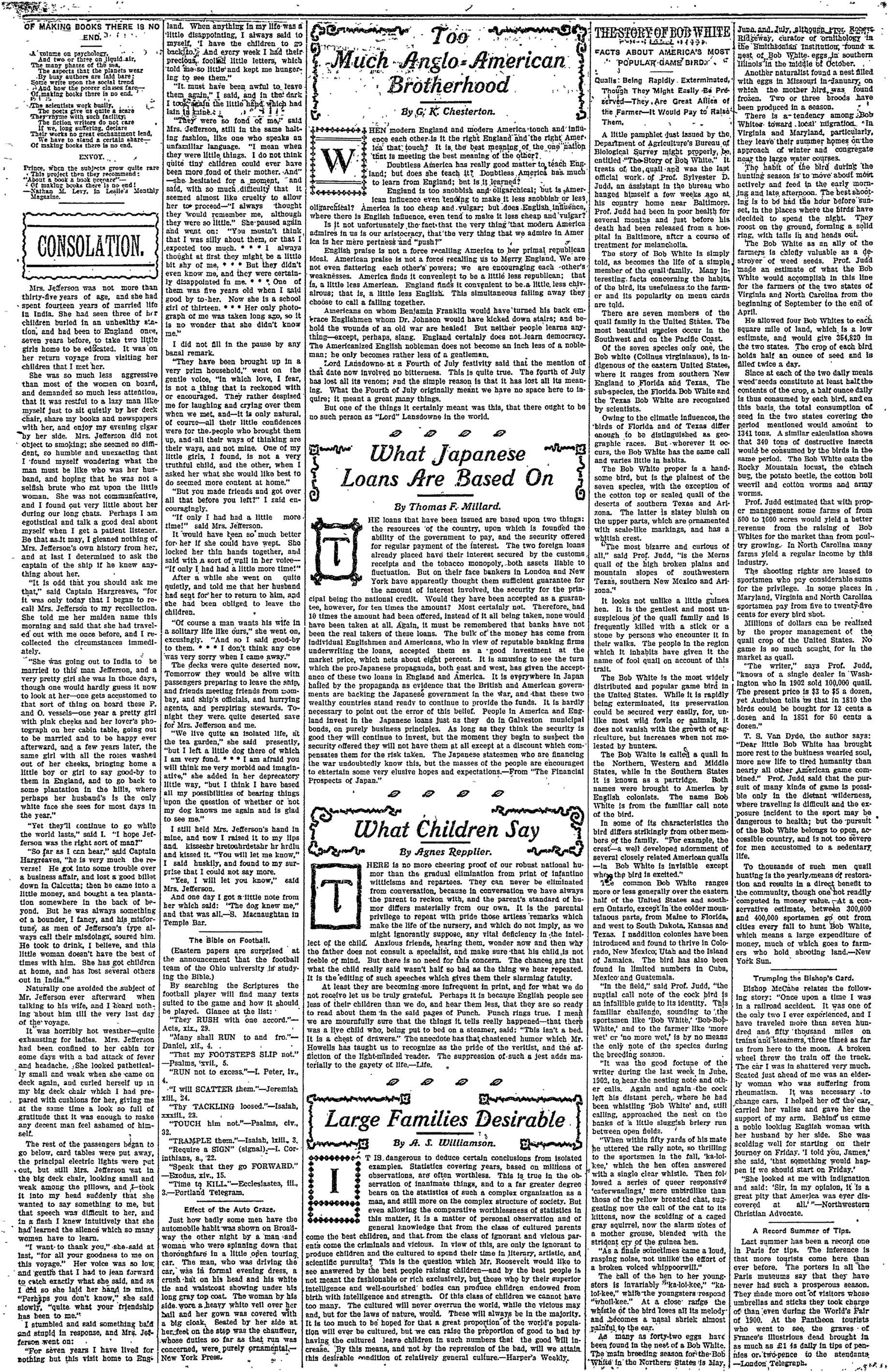
HEN modern England and modern America touch and influence each other is it the right England and the right America that touch? It is the best meaning of the one nation that is meeting the best meaning of the other?
Doubtless America has really good matter to teach England; but does she teach it? Doubtless America has much to learn from England; but is it learned?
By Thomas F. Millard.
HE loans that have been issued are based upon two things: the resources of the country, upon which is founded the ability of the government to pay, and the security offered for regular payment of the interest. The two foreign loans already placed have their interest secured by the customs receipts and the tobacco monopoly, both assets liable to fluctuation. But on their face bankers in London and New York have apparently thought them sufficient guarantee for the amount of interest involved, the security for the prin-
HERE is no more cheering proof of our robust national humor than the gradual elimination from print of infantino witticisms and repartoes. They can never be eliminated from conversation, because in conversation we have always the parent to reckon with, and the parent's standard of humor differs materially from our own. It is the parental privilege to repeat with pride those artless remarks which make the life of the nursery, and which do not imply, as we might ignorantly suppose, any vital deficiency in the intel-
T IS dangerous to deduce certain conclusions from isolated examples. Statistics covering years, based on millions of observations, are often worthless. This is true in the observation of inanimate things, and to a far greater degree bears on the statistics of such a complex organization as a man, and still more on the complex structure of society. But even allowing the comparative worthlessness of statistics in this matter, it is a matter of personal observation and of general knowledge that from the class of cultured parents
THE STORY OF BOB WHITE
FACTS ABOUT AMERICA'S MOST
POPULAR GAME BIRD.
Qualis: Being Rapidly. Exterminated,
Though They Might Easily Be Preserved—They Are Great Allies of
the Farmer—It Would Pay to Raisse
Them.
A little pamphlet just issued by the Department of Agriculture's Bureau of Biological Survey might properly, be entitled "The Story of Bob White." It treats of the, quail, and was the last official work, of Prof. Sylvester D. Judd, an assistant in the bureau who hanged himself a few weeks ago at his country home near Baltimore. Prof. Judd had been in poor health for several months and just before his death had been released from a hospital in Baltimore, after a course of treatment for melancholia.
The story of Bob White is simply told, as becomes the life of a simple member of the quail family. Many interesting facts concerning the habits of the bird, its usefulness to the farmer and its popularity on mean cards are told.
There are seven members of the quail family in the United States. The most beautiful species occur in the Southwest and on the Pacific Coast. Of the seven species only one, the Bob white (Colinus virginianus), is indigenous of the eastern United States, where it ranges from southern New England to Florida and Texas. The sub-species, the Florida Bob White and the Texas Bob White are recognized by scientists. Owing to the climatic influences, the birds of Florida and of Texas differ enough to be distinguished as geographic races. But wherever it occurs, the Bob White has the same call and varies little in habits.
The Bob White proper is a handsome bird, but is the plainest of the seven species, with the exception of the cotton top or scaled quail of the deserts of southern Texas and Arizona. The latter is slaty bluish on the upper parts, which are ornamented with scale-like markings, and has a whitish crest.
"The most bizarre and curious of all," said Prof. Judd, "is the Merns quall of the high broken plains and mountain slopes of southwestern Texas, southern New Mexico and Arizona."
It looks not unlike a little guinea hen. It is the gentlest and most unsuspicious of the quall family and is frequently killed with a stick or a stone by persons who encounter it in their walks. The people in the region which it inhabits have given it the name of fool quall on account of this trait. The Bob White is the most widely distributed and popular game bird in the United States. While it is rapidly being exterminated, its preservation could be secured very easily, for, unlike most wild fowls or animals, it does not vanish with the growth of agriculture, but increases when not molested by hunters.
The Bob White is called a quail in the Northern, Western and Middle States, while in the Southern States it is known as a partridge. Both names were brought to America by English colonists. The name Bob White is from the familiar call note of the bird. In some of its characteristics the bird differs strikingly from other members of the family. "For example, the crest—a well developed adornment of several closely related American quails—in Bob White is invisible except when the bird is excited."
The common Bob White ranges more or less generally over the eastern half of the United States and southern Ontario, except in the colder mountainous parts, from Malne to Florida, and west to South Dakota, Kansas and Texas. I addition colonies have been introduced and found to thrive in Colorado, New Mexico; Utah and the Island of Jamaica. The bird has also been found in limited numbers in Cuba, Mexico and Guatemala.
"In the field," said Prof. Judd, "the nuptial call note of the cock bird is an infallible guide to its identity. This familiar challenge, sounding to the sportsmen like 'Bob White,' 'Bob-Bob-Hite,' and to the farmer like 'more wet' or 'no more wet,' is by no means the only note of the species during the breeding season.
"It was the good fortune of the writer during the last week in June, 1902, to hear the nesting note and other calls. Again and again the cock left his distant perch, where he had been whistling 'Bob White' and, still calling, approached the nest on the banks of a little sluggish briery run between open fields.
"When within fifty yards of his mate he uttered the rally note, so thrilling to the sportsmen in the fall, 'ka-lolkee,' which the hen often answered with a single clear whistle. Then followed a series of queer responsive 'caterwauilings,' more unbirdlike than those of the yellow breasted chat, suggesting now the call of the cat to its kittens, now the scolding of a caged gray squirrel, now the alarm notes of a mother grouse, blended with the strident cry of the guinea hen.
"As a finale sometimes tame a loud, rasping noise, not unlike the effort of a broken voiced whippoorwill."
The call of the hen to her youngsters is invariably "ka-loi-kee," "ka-loi-kee," while the youngsters respond "wholl-kee." At a close rafthe whistle of the bird loses all its melody and hecomes a nasal shriek almost painful, to the ear.
As many as forty-two eggs have been found in the nest of a Bob White. The main breeding season for the Bob White in the Northern States is May,
Juna, and July, although for Robert Ridway, curator of ornithology in the Smithsonian Institution, found a nest of Bob White eggs in southern Illinois in the middle of October. Another naturalist found a nest filled with eggs in Missouri in January, on which the mother bird was found frozen. Two or three broods have been produced in a season. There is a tendency among Bob Whiteer toward local migration. In Virginia and Maryland, particularly, they leave their summer homes on the approach of winter and congregate near the large water courses.
The habit of the bird during the hunting season is to move about most actively and feed in the early morning and late afternoon. The best shooting is to be had the hour before sunset, in the places where the birds have decided to spend the night. They roost on the ground, forming a solid ring, with tails in and heads out. The Bob White as an ally of the farmers is chiefly valuable as a destroyer of weed seeds. Prof. Judd made an estimate of what the Bob White would accomplish in this line for the farmers of the two states of Virginia and North Carolina from the beginning of September to the end of April.
He allowed four Bob Whites to each square mile of land, which is a low estimate, and would give 354,820 in the two states. The crop of each bird holds half an ounce of seed and is filled twice a day.
Since at each of the two daily meals weed seeds constitute at least half the contents of the crop, a half ounce daily is thus consumed by each bird, and on this basis, the total consumption of seed in the two states covering the period mentioned would amount to 1341 tons. A similar calculation shows that 340 tons of destructive insects would be consumed by the birds in the same period. The Bob White eats the Rocky Mountain locust, the chinch bug, the potato beetle, the cotton boll weevil and cotton worms and army worms.
Prof. Judd estimated that with proper management some farms of from 500 to 1000 acres would yield a better revenue from the raising of Bob Whites for the market than from poultry growing. In North Carolina many farms yield a regular income by this industry.
The shooting rights are leased to sportsmen who pay considerable sums for the privilege. In some places in Maryland, Virginia and North Carolina sportsmen pay from five to twenty-five cents for every bird shot.
Millions of dollars can be realized by the proper management of the quall crop of the United States. No game is so much scught, for in the market as quall.
"The writer," says Prof. Judd,
"knows of a single dealer in Washington who in 1902 sold 100,000 quail. The present price is $3 to $5 a dozen, yet Audubon tells us that in 1810 the birds could be bought for 12 cents a dozen and in 1851 for 50 cents a dozen."
T. S. Van Dyde, the author says: "Dear little Bob White has brought more rest to the business weared soul, more new life to tired humanity than nearly all other American game combined." Prof. Judd said that the pursuit of many kinds of game is possible only in the distant wilderness, where traveling is difficult and the exposure incident to the sport may be dangerous to health; but the pursuit of the Bob White belongs to open, accessible country, and is not too severe for men accustomed to a sedentary life.
To thousands of such men quail hunting is the yearly means of restoration and results in a direct benefit to the community, though one not readily computed in money value. At a conservative estimate, between 300,000 and 400,000 sportsmen go out from cities every fall to hunt Bob White, which means a large expenditure of money, much of which goes to farmers who hold shooting land.New York Sun.
Trumping the Bishop's Card.
Bishop McCabe relates the following story: "Once upon a time I was in a railroad accident. It was one of the only two I ever experienced, and I have traveled more than seven hundred and fifty thousand miles on trains and steamers, three times as far as from the moon. A broken wheel throw the train off the track. The car I was in shattered very much. Scared just ahead of me was an elderly woman who was suffering from rheumatism. It was necessary to change cars, I helped her off the car, carried her valise and gave her the support of my arm. Behind us came a noble looking English woman with her husband by her side. She was scolding well for starting on their journey on Friday. I told you, James," she said, "that something would happen if we should start on Friday."
"She looked at me with indignation and said: 'Sir, in my opinion, it is a great pity that America was ever discovered at all.'"—Northwestern Christian Advocate.
A Record Summer of Tlps.
Last summer has been a record one in Paris for tips. The inference is that more tourists come here than ever before. The porters in all the Paris museums say that they have never had such a prosperous season. They made more out of visitors whose umbrellas and sticks they took charge of than even during the World's Fair of 1900. At the Pantheon tourists who went to see, the graves of France's illustrious dead brought in as much as £14 1s daily in tips of paniels or two-pence to the attendants.
SAVANNAH may have a Jimerson case growing out of the arrest of two men last week for resenting the jeerings of white men while on parade. The recorder unreasonably fined them fifty dollars each or thirty days on the chaingang. The case has been appealed and every citizen should help in seeing that justice is done.
On Wednesday a colored citizen went into the United States Court and unwittingly took a seat. He was soon informed by a baliff that he was in "white folks' seat," and ordered to the jim crow section. As any self-respecting man would do, he left the court room, but before leaving, as reported by the morning paper, he was met by marshal White and ordered not to be seen in the court room during the trial of the case. This Marshal has undoubtedly usurped much power, in fact more power than his superiors in authority would usurp in ordering a citizen who has committed no crime from a public building. This assumed authority of the marshal is resented, and his conduct should be reported to his superiors. Some men with brief authority go farther than they should, and in this case this marshal of recent appointment should be made to treat citizens civilly.
THE SAVANNAH TRIBUNE is trying to get the Georgia black man to pay his poll tax the price of his ballot. The Dallas Express is trying to do the same thing in Texas.—Express.
The ex-slave holders of Georgia have decided to take some of the money which their former slaves made for them between 1619 and 1865, and build a home for ex-slaves and there are Negro newspapers big enough fools to think that the act shows Christianity. When paying a debt is one's duty, every ex-slave holder should pay his ex-slave.—Express.
WHEN you see a colored gentleman or a colored lady pass by a Negro store with an armful of bundles, or a box of shoes or a hat in a bag, and drop their bundles quickly down by their side, and step briskly past without hardly looking towards the Negro store,—or when they pass by on the other side and glance sheepishly across the way at the place where their associates are buying and selling—don't feel put out with them; smile pleasantly at them, for their conscience are doing all the condemnation that is necessary; for there is hope as long as there is a conscience. No conscience no hope. And the Negro man who can stumble over his own race to enrich others' is without conscience—Herald.
Farmers' Conference. The annual Farmers" Conference will be held at the State College next month. It will be the best of them all.
Negro Settlement Work. One of the most gratifying results of the introduction of settlement work among the Negroes of Washington is the valuable volunteer service it has called forth from students in the city. A young volunteer student in the Settlement gathers about her a group of neighborhood children, singing with them a lullaby in a voice trained to soft sweetness and her little class, in eager emulation, catch the pretty air and unconsciously imitate the softness and sweetness of her voice. It is thus that the young people of the schools are bringing what enriches their own lives and sharing it with those with meager opportunities. A girl student of the high school of a nearby city recently wrote in behalf of her class asking for the story of the work here, especially the part done by the students with the thought of attempting some social service work in her own city.—Southern Workman
A Notable Gathering of Negro Educators. There met in the historic city of Richmond, Va., during the holidays, the fourth annual session of the National Association of Colored Agricultural and Mechanical Colleges and Schools for Secondary and Higher Education. This association which is the leading one of its kind, was organised at Chattanooga, Tenn., and was first composed of the presidents of A. and M. Colleges. So many other schools asked for admission into this association that it was enlarged to include all schools engaged in educating Negroes Eleven states and twenty-five colored institutions of learning were represented at the Richmond meeting.
The program was in a large measure an examination of the present system of Negro education and plans by which the system could be improved. Some of the subjects discussed are Courses of Study in Colored Colleges, Legislation Affecting Negro Schools, and The relation of the School to the Community. Two notable lines of work have been undertaken. One is to increase educational interest in each state; and the other to bring the colleges in closer touch with the community.
The most notable address was by Ex-Senator H. W. Blair of New Hampshire, author of the famous "Blair Educational Bill." He spoke of his efforts for over ten years to have that bill become a law and how they, who he thought his main supporters, at the final test, after the bill had already three times passed the Senate and had been favorably reported on in the House, voted against it. He also told of his efforts in behalf of the Morrel Bill, under which A and M. colleges are at present maintained. Although greatly disappointed because his bill did not become a law, and as a result the Negro did not receive National aid for his education; and in spite of the betrayal of trust by those in whom he had placed so much confidence he declared he had not yet lost faith in this nation and believes that it will ultimately do justice to the Negro.
The Convention was not marked by any great oratorical display or bombastic enthusiasm, but by cold, dispassionate discussion of facts. The profoundest interest was manifested by all present. The meeting was characterized by earnestness and a disposition on the part of the members to sacrifice self and personal advancement for the good of the race. Pres. R. R Wright, of the Georgia State Industrial College, who was the founder of the Association and has been its president since its organization, was unanimously re-elected to that office. The next meeting of the Association will be at New Orleans.
The Bishops' Council.
The Bishops' Council of the A. M. E. Church was the event of the week. The public meeting Thursday night was well attended. The published program was carried out. Impromptu and timely addresses were given by Bishop Derrick and Col. Deveaux. The several churches will have a chance to hear some of the visiting clergymen. The commission decided on Notfolk, Va., as the next place of meeting of the General Conference.
Second Baptist Church
Second Baptist Church
Last Sunday was a gala and memorable day in the history of the church with its members. It is a long standing custom of the church to spend the first Sunday in each year in singing, praying and giving testimonials. The bulk of the people gathered in the afternoon, and enthusiastic speeches and touching testimonials were given. At half past five o'clock the church was called together and Deacon W. R. Fields was made moderator. It was ordered that the fourth Lord's Day in January at half past four o'clock p. m. be the designated time to call a pastor. When the votes was taken moderator Fields announced that it was unanimous and that it is a good sign. Doxology was sung and Deacon R. M. Davis pronounced the benediction. All went to their homes elated over the result of the day's services Next Sunday promises to be a day of mush interest. It will be the first celebration of the Lord's Supper in the New Year and Dr. Jno. H. May will be present to preach at eleven o'clock and commune the people at 3:30 p. m., and will preach at 8 p. m. Dr. May comes highly recommended as a church worker, scholar and pastor. You are cordially invited to hear him.
St. Phillin's Dots.
Rev. J. A. Lindsey, preached at 11 a.m., on last Sunday and there was a large congregation out to hear him. Rev. Lindsey is a very forceful speaker and his sermon was reviving. At 4 p. m., communion services were held. At 6 p. m. Rev. Lindsey delivered a special sermon to the Adelphia Club, which was beneficial to the club along various lines. We are glad to note that Mr. R. B. Reppard is taking quite an interest in our Sunday School and is in attendance nearly every Sunday and is trying to assist in training our children to be useful men and women. Too much credit can not be given the committee on the banquet that was given, to the visiting bishops and general officers of
our church and the other, ministers of city of other denominations. Everything was in ample order. Rev. Lindsey and family arrived in our city on last Wednesday evening from Marietta, Ga., they are now comfortable at our parsonage. Dr. Chappelle, general manager of the Sunday school department who is in attendance at the bishop's council, will address our Sunday School at 3 p. m. on to-morrow. At each service on Sunday one of the bishops will preach at our church. Next Sunday will be quarterly conference day. The following services will be held on Sunday. Prayer meeting at 6 a. m.; Preaching at 11 a. m.; Sunday School at 3 p. m.; Preaching at 8 p. m. Strangers are cordially invited.
"NUF-SED" HEARS PROF. WORK.
Lawyers Out in Streng Force.
Dear Mr. Editor—Having got some what tired hearing "Alexander," "Cosy Corner," "Nobody," and "Teasing"; and having adopted a contemporary's parody of "In the Shade of the old Apple Tree," which is as follows:
"In the shade of the old apple tree,
You can hear the blame buzz of the bee, with a big carving knife,
That I swiped from my wife,
I'm waiting and watching by glee!
Of daggers, I have two or three
And an ax and a catas you see,
And I'll stick all these things,
In the next guy who sins,
In the next of the old Apple Tree."
In the shade of the old apple tree.
I decided to hear Prof. Work's vocal recital. Remembering what Shakespeare said about the fellow who could not enjoy music. I thought I'd better make a little run down to Beach Institute to hear the distinguished singer; and I'll tell you as I turned my lamps on the audience I believe everybody was there but that "class of so much cloth, skin and bones who parade our streets passing for men," but who for shortness is known as "De small variety of doctors." Well sir, as I looked around I had the great pleasure of seeing two lawyers out—this is a very good acquisition for the Sunday Club, because you know this little song which came to me when I saw the lawyers, viz:
"Git on board! Little children,
Git on board! Little children,
Git on board! Little children,
I believe the Sunday Club is broad enough in its scope and character to offer a fruitful field of work to any man or class of men who wish to help their fellowman up. We as a people are way behind the times in things, respecting the law, we do not know even the rudimentary knowledge concerning arrests, warrants, contracts, etc. What an inviting field then this is for the lawyers to enter and lift this mass of struggling humanity out of degradation on account of its ignorance to a state of lawfulness on account of its intelligence! There is no man or men, who can do this better than the lawyer because it is he who has made this a particular study. Give us some advice along this line, lawyers, and thus save the chaining from its full quote of men and women who are compelled to go there not in many cases because there are naturally bad, but because they are ignorant of the law.
Well sir, the recital was certainly a success. It gave to Savannah an opportunity to hear some real first class music. In this age of rag-time music, when certain of our young' folks are going crazy about rag-time music, this recital came in good to show up the beauty of high class music. Real genius can be seen at a mere glance. The Professor deserved all praise and credit given him.
Now, you know there are many people who have good voices to sing or speak who refuse to make use of them as a result nature supports no useless organ and their talents pass away. When asked to sing for a church, an association Sunday School or other body, they always refuse thereby burying the talent which they have. As later years come and their talents are taken from them they find themselves confronted on every hand by Mr. R. E. Morse.
Boys and girls, look at these three performers : the singer, the speaker and the player, and remember to press forward if you would achieve success. "For if at first you don't succeed, try, try again."
It is only by slow growth that the acorn becomes the mighty oak of the forest; and it will only be through trials, doubts and difficulties that you make a success. How many of our girls and boys have had pianos for one, two and three years and when asked to play by any one refuse to play even "Koon-jang-bay koon-jang." You can't succeed this way; you can't attain perfection like a mushroom grows. When people ask you to play, they don't expect you to excel Paderewski; when they ask you to sing, they don't expect you to take Patti's laurels away from her, and when they ask you to speak, they don't expect you to make Dan O'Connell or Frederick Douglass look like 30 cents.
Yours truly,
"Nuf-Sed."
I have something up my sleeve to draw on the society people next week.
For Sale:
Moving picture machine in perfect condition with 500 ft of film. Address care of SAVANNAH TRIBUNE
THE SELECT
Pressing Club
and Tailoring Co.
CLEANING
PRESSING AND REPAIRING
NEATLY DONE.
Monthly Pressing $1 per Month.
Ladies Work a Specialty.
WARD & TURNER Props.
914 West Broad Street.
KILL THE OOUCH
AND CURE THE LUNGS
WITH Dr. King's
New Discovery
FOR CONSUMPTION
COUCHS and
COLDS
Price
30s & $1.00
Free Trial.
Surest and Quickest. Oure for all
THROAT and LUNG TROUBLES,
or MONEY BACK.
Died, Jan. 7, 1904.
Cold, cold, cold, winter's biting wind;
Dark, dark, dark, hanging clouds above;
Damp, damp, damp, unkind earth beneath;
Ope, ope, ope, cruel grave below;
Deep, deep, deep in peaceful sleep.
The day they laid her low—my sister.
Short, short, short, services performed;
Soft, soft, soft, the voice and song;
Sad, sad, sad, our earthly loss;
Joy, joy, joy, as Heaven's gain;
Peace, peace, peace, in perfect peace.
The day, they laid her low—my sister,
(The grave)
Green turf above, grow freshly here,
Fierce winter wind, blow gently here,
Hot summer sun, shine lightly here,
Pure evening star, shed calmly here,
Cold winter rain freeze not here,
Upon the grave of her—my sister.
E. W. Houghton
'A Year Book and Guide.
You frequently hear mention of dead languages. Well, some facts are even deader, but these are not the kind that The-Tribune Almanac deal in. By way of verifying that, just take a cursory glance over the issue for 1906, which is now on sale. It is not an Almanac in the dictionary sense of the word, but is really a ready reference and guide book, containing everything that such a compilation ought to have. And the material has been garnered and sifted and tested with utmost care so as to secure absolute accuracy, or at least get as near to it as honest, painstaking endeavor will bring one.
Herein will be found a perfect gold mine of information on topics of interest, not only to every American, but likewise to all who care to know about us, our laws, population, officials, and so forth.
(And, by the way, if you have any friends in Europe, just send them a copy and see if they don't appreciate it.)
There isn't anything missing in the way of records which the average man will want to know about. It doesn't matter what the subject—pension legislation, sporting statistics, facts about universities, colleges, patriotic societies, population, public officials, returns, railroads, foreign commerce, immigration, foreign rules, or New-York State and city affairs.
In fact, is really not an exaggeration to say that of a hundred and one things a sane person wants to know, at least ninety nine will be found in The Tribute Almanac.
Through Train A. C. L.
Through train and sleeping car service between Jacksonville, Fla, and intermediate points to Augusta, Ga. Effective January 10, 1906, the Atlantic Coast Line will inaugurate through Pullman and Sleeping car service between Jacksonville, Fla., intermediate points and Augusta, Ga. These cars will be handled on Florida and West Indian Limited, No. 82, and New York and Florida Express. No. 89, with dining car service northbound and buffet service southbound. Trains will arrive at Augusta 9:45 p. m., daily, depart at 10:30 p. m. affording best possible service between South Georgia points and Augusta. For detailed schedule or other information see ticket agents or write. T. C. White, T. E. Myers, D. P. A., Sav'h, Ga. T. P. A., Sav'h, Ga.
Notice.
The Union Loan and Investment Company is now open for business, we have on hand 100 shares of stock for $5.00 per share. Money invested here is money secured and is subject upon investment herein, to a pro rata part of all interests, fees and fines accruing to the company. We have ready money to loan upon easy tears on secured notes, real and personal property negotiable papers including Stock certificates. We are open for business and solicit the patronage of the public. While we regard business transactions as a public privilege, we also regard it in its personal relations, taking into consideration the whims of the individual. We are open at all hours, at 20 State St., West, (up stairs). Ask for Geo. W. Jacobs, Pres. and Gen'l Manager.
Free Life Insurance
During the past THIRTY-FIVE YEARS over one hundred thousand discriminating customers, many of whom could not be rushed elsewhere, found complete and lasting satisfaction and a solution of the piano question by purchasing of the LUDDEN & RATESS M. H
LUDDEN & BATES S. M. H.
Let us prove we can do as well for you.
We guarantee in our New Scale $400
LUDDEN & BATES PIANO
that we give you an instrument that will
compare in tone, and general construction
with any $400 piano in your
neighborhood—purchased elsewhere.
We warrant this piano "FOR A LIFE TIME"
and besides we give a limited number of
purchasers FREE LIFE INSURANCE. In case
of death your heirs—wife, sister or children
are handed a RECEIPT IN FULL FOR ANY
AMOUNT YOU MAY OWN ON THE INSTRUMENT.
Isn't this a fair and a safe proposition—a
safeguard to keep the piano in the home.
This offer holds good only for our.
This one holds good only for our
THIRD LUDDEN & BATES
PIANO CLUB—Just forming for one hundred
NEW SCALE $400 LUDDEN and BATES PRINOS to one hundred Club members at $287 cash or $287 on terms of $10 cash and $8 monthly with interest. Larger payments for quarterly or yearly terms.
Call at the store or write for membership blanks, and full particulars—this club will soon be filled.
Our two Clubs just completed saved two hundred members in all $22,600 and made us two hundred more friends. We want your friendship.
Bachelor and
Bachelor in
Savannah, Ga.
Gentlemen: —Please send me
particulars, your third Piano Club
and FREE LIFE INSURANCE PLAN
Name..... P. O..... State.....
LUDDEN & BATES, S. M. H.
Ball and York,
Savannah, Ga.
FOYE'S Great Annual Clearing
Annual Clearing Entire Winter Stock
Immensely
Ladies and Children Cle
and Separate
Absolutely Sl
During the con
Unusual Ind
In Embroideries and M
FOY
Broughton and Ba
Metropolitan
and Realty
(Incorpora
Capital Stock
Shares $1
Full Paid and Non
d Children Cloaks, Suits
and Separate Skirts
Absolutely Slaught
uring the coming week
Aual Inducen
oideries and Muslin Un
TOYE'S
Brighton and Barnard Str
Metropolitan Merge
Realty Comp
(Icorporated)
Local Stock $500,0
shares $10 ea
Full Paid and Non-assessable.
Ladies and Children Cloaks, Suits, Waists and Separate Skirts
Unusual Inducements In Embroideries and Muslin Underwear. FOYE'S Broughton and Barnard Streets.
Metropolitan Mercantile and Realty Company.
Shares $10 each. Full Paid and Non-assessable.
Six Years of Success
and service tells a tale unprece
of Race Enterprise.
Six years of experience and
epoc of corporate adventure and
Six years of pluck and push,
Six years of progress and pro
prestige.
Six years WORK and worry;
THIS IS THE HISTORY of the
e tells a tale unprecedented in 'the enterprise. s of experience and extension in corporate adventure and business achieves of pluck and push, trials and tribes of progress and prosperity, pati es WORK and worry, wisdom and HISTORY of the great race in
and service tells a tale unprecedented in the annals of Race Enterprise. Six years of experience and extension marks an epoc of corporate adventure and business achievement. Six years of pluck and push, trials and tribulations. Six years of progress and prosperity, patience and prestige.
Six years WORK and worry; wisdom and winning. THIS IS THE HISTORY of this great race institution. This with Real Estate is behind your investment. We pay SEVEN PER CENT annually. We build Churches, Halls and Houses. We employ ouer two thousand men and women. We are here to stay. Make an investment with us and see your money grow.
F. M. COHEN, Teller. J. W. ARMSTRONG, Gen'l Mangr. 222 W. Broughton St., Savannah, Ga. Bell Phone 1144
Pullman cars on all trains through to Jacksonville and Tampa. Schedules and detailed information at City Ticket Office, No. 7 Bull street. Phone 28.
ATLANTA UNIVERSITY, Atlanta, Ga.
An unsectarian Christian Institution, devoted especially to advanced education. College Normal, and College Preparatory Courses, with Industrial Training. Superior advantage is music and pricking. Ald given to a few needy and deserving students. Term begins the second Wednesday in October.
catalogue and information, address President HOPACE BUMSTEAD, D.D.
JOB PRINTING
‘The Savannah Tribune
- SaTurpaY, Janvazy 13, 1906,
hae Sev, Richa Origat cordiany in
vites the getoral public and-strangers whi
are visiting the city-to the services of Bt
siephes's Episcopal Charch at the corne
Hebersham and Harris Sts. All the seat
aretiree, come and sit where, you please
Hearty congregational singing. The gos
petof Jesus Christ preached. Hours o
service; Sundays 1ra,m. and 8p, m
Wednesdays 8 p.m. ts
Mr, Henry Carter-spent the holt
days at Green Ooye Sprifig, Fis. with
« bja daughter, Mrs. Mittie Jenkine
He reports a very pleasant trip
Mrs. Eliza 0. Wilkins of Obleago
Il, is visiting ber sister, Mrs
Blanche Williams, 512 West Broad
Bt. She will remain a montb, *
Mr. Nathan Roberta is wearing
8 broad smile that wont come of
over tho safe arrival of a fourteen
-ponnd baby girl on last Saturday
Mother snd daughter are doing
well. :
‘The 118th anniyersary of the F.
B. B, Ohurch, Rey. G. W. Griffin, D.
D., pastor, will commence Monday
night and continues ‘during the
week, An interesting program ie
arrenged. The publicis ihvited to
each service.
The F.A.B. Church Rev. J. W.
Carr, D. D., pastor will celebrate its
118th anniversary next week. The
‘celebration begins on Monday night.
The program fs replete gocd
thingé for the edification those
who attend.
Mr. Albert LG. Williams, for many
years in the employ of S. P. Shotter
Co., died on Wednesday night Jast.
He was well and favorably known
He leaves a wife and other relatives.
The funeral takes placs to-morrow
from the Second Baptist Church.
Miss Stella Freeman, who hag a
most flourishing school at Sylvania,
Ga,, spent the holidays pleasantly at
home sccompadied by the Mistes
Lizzie and Ella Scott. They returo-
ed on Sunday last.
The remaina of Mr. Jamies H,
Coston, who was drowned in Florl-
de, come weeks ago, were brought
to the city this week, and the funeral
service was held on Wednesday
afternoon and attended by many of
his friends. The family has the
deep condolence of all friends. |
Miss Hattie: Reynolds, who has
been attending St. Auguatine’s
School at Raleigh, N. ©., returned
home on Friday much to the re-
gretof teachers and students with
whom she was a great favorite.
Poor health avd the severity of the
climate made it impossible for her
to finish the term. *
The friends of Mr. and Mrs. Ed-
ward Nelson will be pained to learn
of the death of the latter on Monday
of last week at their home on Mag-
nolia street. The body accompanied
by the bereaved husband and Ed-
ward, Jr,, was carried to Jackgonboro,
8. 0. for interment The family has
the sympathy of a large eircle ot
friends.
Mra. Abbie Heya, mother of
Messra J. L. Lloyd, J. M. Liovd and
C, W. Lloyd and Mrs. Susie Bush
and Mrs. Katie Goll, died on Thurs-
day morning of last week at the
home of Mrs. Bush, 556 Broughton
street. She leaves a host of grand
children to mourn her desth, and|:
among them is Miss Elmira Lloyd]'
who resides in New York. «ik
The friends of Mr. W. Smith, the]'
ficient permavent secretary of Mt.
Sier Lodge of Odd Fellows are con-
rratulating bim on his re-eléction to}:
hat position forthe dinth year. The}:
lodge donated him six dollars as af!
Christmag present. The lodge also}:
rave smaller donations to Mr. Foster]
Robingon; the W. T., Mr. Frank]!
Dudley, Marshal, and Mr.J. S. Cau-
ey. ‘
Rey. G. A. Morgan, of Edgefield,
3. O., is in the city, the gnest of
dey. G. W. Griffin, D.D., pastor of]!
he First Bryan Baptiat Church,);
fey. Morgan preached on Tharsday|s
ight to an appreciative audienos. | 1
Rey, Morgan will remain in the city|‘
ntil, next week and asst Rev.|}
triffin at the church anni¥ersary.|,
tev. Morgan ordained Rev. Griffin|+
nany years ago, and naturally feels} ¢
rand of the enocesa that he isi”
_ Beattiful cottage, 1512: Ogerchee Ave-
nee, {foot of gist St.) Water in thehouse,
Jerge'y2z, viable, garden tc froct, 5
‘per-scoath, Apply to Youmans, & .Dem-
{ a:
FP - f: Frederick Werk’s
; Beeitai.
The vocal recital of Prof. Wor!
and the “readings by, Mra. Florid
L. DesVerney last Tuesday night s
Beach Tustitute under the auspice
of the Youog Men‘s Sunday Olut
proved to be the treat of the eeasor
to the lovers of the beautiful anc
high srt. The appearance of thes
two entertataers brought forth «
round of soglanse,
Prof. Work possesses a true tenol
voice and at all times bad perfec!
control of it by reason of his long
training in yoice-culture, He SP
peared at bis best, his voice was fall,
clear and well under control, his ex-
pressions and modulations were
smooth and the beauty of it oll was
tbat bis worda were so clearly poured
forth aa to be distinctly heard by all.
Prot, Work possesses & rich voice
which has a wide range, not so well
suited to make low tones, but for
making with the greatest ease, the
highest ana moat difficult notes
which tenor singers experience, he ia
certainly a master.
In sll Prof. Work sang seven
pieces whieh charmed the cultured
audience which had gathered. While
all his renditions were joyfally re-
ceived by the dudience, he was es-
pecially effective in singing Mendela-
sohn's “Be Thou Faithiul,* Buck's
“Tempest,” Nevin‘a “Mighty Laka
Rose; And in rendering Prislomi-
ni’s “Ora Pro Nobis,* DeKoven‘s
“Nita Gitana and the beantifal eolo
“Comfort Ye my people in the
“Messiah. |He will ever hold a place
as a firat class singer. The rendition
of those three lest named numbers.
would receive praise and commen
dation by any audience.
Prof. Work is a graduate of F'sk
University and at present he is
teacher of music at Olark Unirersi-
ty, Atlanta, Ga.
To accompany Prof. Work, one of
Fisk‘s most gifted pianists played,
one who hag won many laurels ag a
pianist, and one in whom We are
doubly proud because he is our own
Prof, Chas McDowell. Thess two
worked in perfect accord.
Mra. DesVerney was on the pro-
gram for two numbers of select read-
ing, but so well delivered and so
plessed were those of the audience
that she was “‘encored. She recited
n a masterly way “Lasca.* “The
Polish Boy‘ and “Guilty. Mrz.
DesVerney as an elocutionist will
ver hold first rank, becanee she pos-
euses those qualitiéa which are ea-
ential to makean elocutioniat, In
hege three numbers especially “Tha
olish Boy, she completely held her
udience apell bound. °
The whote entertainment was 8
rreat auccess. *
Urs. Durkam’s Death.
Thursday Morning, December 28th sur.
rounded by hea husband, son, mother, z
sister, two brothers and other friends,
Mrs. M.E.Durham, wife of the well known
Rev. Dr. J.J.Durham, after a long seasor
of failing health, calmly and peacefully
fell asleep. Truly for death bad no ter-
rors. Aftercalllog the family and other
friends to her bed side and bidding them
good bye with the request that they meet
her ia heaven, she willingly without fear
or dread, departed in the full triumph of
faith, with the sure and steadfast hope of a
blessed immortality and a glorious resur-
rection. She was laidto rest from the
Macedonia Baptist Church at Edgefield, SO
of which she was a member, The funeral
services which were lasgely attended, were
conducted by Rev. F. A. Weaver. the pas-
tor and Rev, Dr. G. W. Raiford of Aiken,
who paid a most eloquent and beautiful
tribute to the christian virtues and exalted
charater of the deceased,
Mrs Durkam was a woman of uausual
intelligence, high ideals, strong convictions
great force of character and represented the
highest type of true and chaste womaahood,
She was a faithful wife, a devoted mother,
and leaves'a husband, son, mother, a sister,
five brothers aad avhost of friends to mourn
her loss--Georgia Baptist.
The New-York Tri-Weekly
Tribune.
For those who want toget the New York
news And news of things the world over
and don't want to spend the money or time
in buying and reading a metropolitan paper
‘seven days in the week, The Tri-Weekly
Tribune fills the bill. It is issued on Mon-
day, Wednesday soa Feidey ceevery week,
and contains the essence of The Daily Tri-
Dune for the whole week, To those who
are interested In the prices of flour, graia,
wheat, cotton, Jive stock, butter, cheese,
eggs and other farm precuces, its market
reports fre invaluable, because of their
correctness. Price, $1 50 ayear. Fora
for a free sample copy send a postal card to
The New-York Tribune, New York. Com-
bination. Offer. Harper's Bazar, with the
Tri-Weekly Tribune, one year $ 65, The
Metropolitan Magazine, with The Tri-
Weekly Tribune, one year $1.65. All three
for $2.50,
The Christain Martyr.
The Rev. Richard Bright is
preaching some wholesome and in-
atroctive sérmons -hese days. His
subject for Sunday night will be
“St. Stephen, the Firat Christian
Martyr.” Itcontains scope for his
toric research and should appeal to
lovers of martyrdom whether in re-
ligions or .civil life. Mr. Bright’s
sermon last Sunday night wae a gem
‘of practical thought and those whd
heard him must have been enlight-
ened.
tte
“raranteed 5
to 1. What we say, Patent
BMev.c---. all kinds. Female Ton-
ie 2. “nfton Tonio, Hair Tonic,
tian. acu cther kinds of Patent
Qe w« the benefit ‘of St.
«sGuo1as Poor and Orpkad School,
. BOs Torry -
Btali 27 Savankak’ Mazket.
AMUSEMENT COLUMN,
Coming Events In The Se-
“ealal Werld. ° |
The Independent smart ‘sef will give z
grand ballat Margaret street hall Monday
night January 29th, Tickets 15 and agc.,
A joint new year entertainment will be
given et Harris street Hall on Monday
night Jan, rth by the Longshoremen
Cotton Men and the Mutual Social Club.
Prise dance and Prize singing and exhibi-
tion drill will take place, Admission 35
and soc. :
A grand Masquerade Ball will, be given
at Chatham Hall, Montgomery street, by
the Golden Harvest Union Association,
Tuesday night Jan, a3rd Tickets rscand 2s¢.
‘Thermopolea Fountain, Na 2074 will
give a public installation and entertain-
ment at Our Hall, Monday night Jan. rth
Tickets;15 cents,
Light Inheritance Lodge No. 133: I. O.
G.S. and & of D, will give an entertain-
ment at Harris Street Hall, Monday night
Feb. 5. Tickets'25 and 40 cents.
AMid.Winter Ball will be given at
Harris Street ball by tie Imperial Aid and
Social club Tuesday right Feb 6thy
Tickets 25 and 40, cents. %
The Y. G. E. A, and SC, will give their
eighth sualversaty. entertaiament at Maso-
alc Temple Tuesday evening Jan. 16th,
Tickets 50 and 75 cents.
Suveniles No. 113-G. U. 0. of O. F. will
give aa entertainment at Harris Street
fall Tuesday night Jan. 16th, Tickets 10
and 15 cents.
A Valentine Masquerade Entertainment
will be given by White Rose Court Nes
72, 1.0, 0. C, at Masonic Temple
Wednesday night, Feb. rgth. Tickets 25
amiate.
Interest Notice. :
Interest for 4th quarter ‘on deposits in
the Savings Department of THE WAGE
EARNERS LOAN & INVESTMENT CO.
is due and payable on demand,
Jan. 1, 908, =,
W. 8. Scorr,Sec’y and Tseas,
Interest Notice.
Interest for 4th quarter is now due and
will be payable on and after Jan. rst.
Please leave pass books, Savings Depart-
aaeut Metropolitan Mercantile and Realty |
0.
F. M, Congn, Teller. |
| ; :
_ JS. HIMES,
BLACKSMITH &
WHEELWRIGH?
309 Hall St.. W.
Modern Machinery,
Tools & Appiances.
Blacksmithing,
Wheelwrighting, Horseshoeing,
and Clipping promptly and sat-
isfactorily done. Special atten-
tion given to Horseshoeing.
Bell Phone 2638.
In Choosing:
a Bank in which -tode-
posit savings, SAFETY
| . ‘ought to bé the first con
sideration—and last. A
| high rate of interest is o:
no consequence whatevel
if the pripcipal is endan-
gered. Safety may be
judged by the manage.
ment of the bank.
THE WAGE RARKERS LOAN. =
SND LEYESTHENT COMPANY
is a safe banking institu-
tion. It does not engage
in any other business and
its management has
always been along lines of
strict’ conservatism and
- Yeasonable progressive
: ness. It was founded in
1900 and has enjoyed
steady continuous growth
ever since.
& Per Cent . ‘
compounded interesc is
paid on savings because
we can pay it with safety.
Tux Wacr Earners LOAN -
& Invesment Co.,
“The Pioneer Negro Saving
Bank in Georgia.” ~~
468 West Broad Street
Bell Phene 198 Ga» Phone 2029
ad 60 YEARS*
Par EXPERIENCE
‘Trace MARaB
Desians -
seperate
galieirce cy gets fetes
ieeiee diet eee enc
fe ee
Scientific America,
suet er frtly Ga, deren
TR Eo oer ow Tart
.. is HERE.
And the numerous dictation of the fashion plate
requires the Li to do alittle more thinking ©
: for himself than heretofore. It’s nota question of”.
= getting an Overcoat, but what kind of Overcoat, .
for- the season has brought with it numerous
syl-s adapted to every occasion and al] walks in
- Hfe. You will find here notalone all the new and
. ddeas but an assortment.-of them that is equalled
..nowhere elsein the State. 7,
The Greator £'ull Length Coat, $11 to $30. -.
_ PhePaddock, $16.50 to $35. ; “yk
- The Top or Box Coat, $15 to $35. :
Se
| B.HOLEV.Y.BRO. & CO.
;
-- & Broughton Street, West. -
) | : « ; . .
ee ce A - “a
SCOTT BROS. 462 West Broad.
a T.ct us be your Tailor.
Pp my Suits $10.00 to $32.00 — Pants $3.00 to $10.00
fi) Shoes, Hats and Caps direct from New York,
ig for Men, Women and Children.
Wu Underwear, Collars, Overalls, Notions, Socks
ie av * Tres, Suspenders. |
i ie. Do you trade at Scott’s—Ifnot, why not? | °
#-@, (Mail orders promptly filled.
Dr. J. W. Jamerson,
DENTIST.
Go tofoim fandifbave’your work done
Crowns, gold and white, looking like, the
natural teeth, Filliog gold, silver acd ce-
ment, Plates, full or partial, Bridge neatly
done. Extracting done with ease. All work
doae neatly in a neat first clase pice:
Provided with ll modern appliances.
23 WEST BROAD SSTREET,
| Bet. Huntingdon and Hall.
i
| ‘
Metropolitan,Wutual
Benefit Association.
INCORPORATED.)
In addition to our sick and
death benefit policies we; are
offering the public industrial
insurance in straight life poli-
cies ranging from $100.00 to
35( 0.00, Premiums within the
reach of all. A fair value for
your money inarepatable com
pany is what all of,us are look
ing for. This is what we are giv-
ing. See any of our aga or
call at the company’s office for
rates and particulars,
Energetic men and ‘ women
can make anywhere from $5.00
to 25.004 week working for this
company.
Office 222 W. Broughton St,
Savannah, Ga.
J W. ARMSTRONG,
* Vica-President.
DOW Feet:
fi SI. elsoin place of O14 heallabie
sf PIKB'S \ pixe's’ MAGNOLIA,
((¢Aoagriolia\ rictatstaittt
A WHISKEY: fioriticet ss te rio mace.
NG soma feo ne em
Samra 92 Beeecnsare tot. 3, YrcR”
L. 8. REED, Pres, “JULIAN SMITH, V. Pres. & Treas.
AumenTHa Morpzcat, Fin. Sec’y. Harm E, Oaurszzz, Cor Sec’y,
° —-Phe—
U B fi A
hion benetit Assocation.
. 'Cncorporated—Charter Perpetual) :
Weare pleased to] state'fto thefpublic that THE {UNUION BENEFIT
ASSOCIATION, having complied with all the laws of the insurance Lawsire
of this State, will protect,youin case of sickness, accident or death. It is
giving profitable employment 10 more;young men and whomen than any other
Negro concern ja the'city.. Room for more good agents.
For further information apply at 20 STATE STREET, West.
GEO. W. JACOBS Gen’l Mangr.=
ue
HOW 10 KEEP WELL
Eat the best meats.
Yon can find this by visiting the
OLD RELIASLE
Stall No. 31; City Market
Beef, Veal and Mutton,
And all kinds of game in season.
Goods delivered piomptly.
BE. FB. JONES & SON.
Both *Phone 689.
Dr. E. D. Bulkley,
—DENTIST—
All Branches,. . .
». . Of Dentistry.
"B11 Fast Broad;Streety —*
e Gir! Ogteriogpe Lane)
(EpHONE TIM? |
ty Mle ein gs LY Nu ee
ILL Ps?
BNTIST
240 Barnard St., Savannah, Ga,
Does all kind of high grade dental work
of the.best quality and workmanship, Gold
‘crowns and bridge work, White Porcelain
Pivot, and Gold Crowns mounted on the
‘natural roots. Gold Fillings, Cement Filj-
Angs,and Silver or Amalgam Fillings, from
nine to a full set of tech $7.00 end $3.00,
Broken Places mendea and teeth added to
old ones for 2 2 small costs BellPhone 1244
s.
Al Gola Soy Gola need
(
W. HE. LLOYD. |
Dealer in
GROCERIES, WOOD AND:
: COAL,
621 Oglethorpe Avenue, east,
| Ga.618—Puowse—Bell.606.
6g ED
Se WHER: i
SOUR. CLodK a BTORS f
* -Biiking abd. your Wateh ga’
a as a
ag We BROWN. -
ba ae Welehaiaker aud Jowslsr a a :
POOH WY eat Broad. Vor.
And a True Story of How the Vegetable Compound Had Its Birth and How the "Panic of '73" Caused it to be Offered for Public Sale in Drug Stores.
WINCHESTE
"NUBLACK" BLACK POWDER SHELLS The "Nublack" is a grand good shell. It is good in construction, primed with a quick and sure primer, and carefully loaded with this brand of powder and shot. It is a favorite among hunters and other users of black powder shells on account of its uniform shooting, evenness of pattern and strength to withstand reloading. ALL DEALERS SELL THEM
This remarkable woman, whose
male name was, Eates, was born in
Lycae, Maa, February 9th, 1819, coming
from a good old Quaker family.
For some years she's taught school, and
because known as a woman of an alert
Yours for Health
Lydia & Bridham
and investigating mind, an earnest seeker after knowledge, and above all, possessed of a wonderfully sympathetic nature.
In 1843 she married Isaac Pinkham, a builder and real estate operator, and their early married life was marked by prosperity and happiness. They had four children, three sons and a daughter. In those good old fashioned days it was common for mothers to make their own home medicines from roots and herbs, nature's own remedies—calling in a physician only in specially urgent cases. By tradition and experience many of them gained a wonderful knowledge of the creative properties of the various roots and herbs.
Mrs. Pinkham took a great interest in the study of roots and herbs; their characteristics and power over diseases. She maintained that just as nature so boundly provides in the harvest-fields and orchards vegetable foods of all kinds; so, if we but take the pains to find them; in the roots and harbs of the-field there are remedies expressly designed to cure the various ills, and weaknesses of the-body, and it was her pleasure to search these out, and prepare simple and effective medicines for her own family and friends.
Chief of these was a rare combination of the choiceest medicinal roots and herbs found best adapted for the cure of the ills and weaknesses peculiar to the female sex, and Lydia E. Pinkham's friends and neighbors learned that her compound relieved and cured and it became quite popular among them.
All this so far was done freely, without money and without price, as a labor of love.
But in 1873 the financial crisis struck Lynn. Its length and severity were too much for the. large real estate interests of the Pinkham family, as this class of business suffered most from fearful depression, so when the Centennial year dawned it found their propriety sweet away. Some other sources of income had to be found. At this point Lynn E. Piakrain's Vegetable Compound was made known to the world. The three sons and the daughter, with their mother, combined forces to
WINC
"NUBLACK" B
The "Nublack" is good in construc
and sure primers,
the best brands of
favorite among
black powder s
uniform shootin
and strength
ALL DEAL
The London County Council now
uses motor repair wagons to attend
to breakdowns on the street railways.
Hoch eured in 60 minutes by Woolford's
Banffary Lotion, never fails. Sold by
Druggists. Mall orders promptly filled
by Dr. Detchon, Crawfordsville, Ind. $1.
Mud baths were first used as complexion
restorers in India.
A cousin of Lord Curzon, late Vic-
teroy of India, is a truck driver in this
city.
DOES YOUR BACK ACHE?
Cure the Midnays and the Paid Will
Never Return.
Only one way to cure an aching
back. Cure the cause, the kidneys.
Thousands tell of
Thousands tell of tuesdays made by Donan's Kidney Pills, John G. Coleman's prominent merchant of Swainson, Ga. sapit: "Fobit several years my kidneys were affected, and my back ached day and night. I was
thousands ten or
cures made by
Doan's Kidney Pills,
John O. Coleman, a
prominent merchant
of Swainsonboro, Ga.
says: "Fords several
years my kidneys
were affected, and
my back ached day
and night. I was
languid, nervous and lame in the
morning. Doan's Kidney Pills helped
me right away, and the great relief
that followed has been permanent."
Sold by all dealers. 20 cents a box.
Marjorie Mittenau, Go., Bannale, N. Y.
restore the family fortune. They argued that the medicine which was good for their woman Friends and neighbors was equally good for the women of the whole world.
The Pinkhame had no money, and little credit. Their first laboratory was the kitchen, where roots and herbs were steeped on the store, gradually filling a gross of bottles. Then came the question of selling it, for always before they had given it away freely. They hired a job printer to run off some pamphlets setting forth the merits of the medicine, now called Lydia E. Pinkham's Vegetable Compound, and these were distributed by the Pinkham sons-in-Boston, New York, and Brooklyn.
The wonderful curative properties of the medicine were, to a great extent, self-advertising, for whoever used it recommended it to others, and the demand gradually increased.
In 1977, by combined efforts the family had saved enough money to commence newspaper advertising and from that time the growth and success; of the enterprise were assured, until today Lydia E. Pinkham and her Vegetable Compound have become household words everywhere, and many tons of roots and herbs are used annually in its manufacture. Lydia E. Pinkham herself did not live to see the great success of this work. She passed to her reward years ago, but not till she had provided means for continuing her work as effectively as she could have done it herself.
During her long and eventful experience she was ever methodical in her work and she was always careful to preserve a record of every case that came to her attention. The case of every sick woman who applied to her for advice and there were thousands—received careful study, and the details, including symptoms, treatment and results were recorded for future reference, and to-day these records, together with hundreds of thousands made since, are available to sick women the world over, and represent a vast collaboration of information regarding the treatment of woman'sills, which for authenticity and accuracy can hardly be equaled in any library in the world.
With Lydia E. Pinkham worked her daughter-in-law, the present Mrs. Pinkham. She was carefully instructed in all her hard-won knowledge, and for years she assisted her in her vast correspondence.
O her hands naturally fell—the direction of the work when its origina-
tion passed away. For nearly twenty-fi-
re years she has continued it, and nothing in the work shows when the
first Lydia E. Pinkham dropped her pen, and the present Mrs. Pinkham,
moved the mother of a large family, took it up. With woman assistants, some as
capable as herself, the present Mrs. Pinkham continues this great work, and
probably from the office of no other person have so many women been ad-
vised how to regain health. Sick women, this advice is "Yours for Health"
freely given if you only write to ask for it.
Such is the history of Lydia E. Pinkham's Vegetable-Compound; made
from simple roots and herbs; the one great medicine for women's saliments,
and the fitting monument to the noble woman whose name it bears.
BLACK POWDER SHELLS is a grand good shell. It is tion, primed with a quick and carefully loaded with f powder and shot. It is a hunters and other users of shells on account of its ing, evenness of pattern to withstand reloading. ERS SELL THEM
THE PAGE IN GOTHAM
"Our friend Jones wants to be considered a truical New Yorker."
"Yes; and he works very hard to that end. He pretends that he can't recall any scandal that happened more than a week back."
Cures Cancer, Blood Poison and Scrofula.
If, you have blood poison producing eruptions, plumps, ulcers, swollen glands, bumps and rings, burning, itching skin, copper-colored apes or rash on the skin, mucous patches in mouth or throat, falling hair, bone pain, oolium or foul earring, take potassium Blood Balm (B.B.) It kills the poison in the blood; soon as the eruption subsides, the skin, pubis, urethra and pains stop and a perfect cure is made of the worst cases of Blood Poison.
For cancers, tumors, swellings, eating sores, ugly ulcers, persistent-plimples of all kinds, take B. B. B. It destroys the cancer poison in the blood, heals cancer of all kinds, cures the worst tumors or supporting swellings. Thousands cuted by B. B. B. after all else falls. B. B. B. composed of pure botanic ingredients. Improves the digestion; makes the blood pure and rich, stops the awful itching and all sharp, shooting pains. Thoroughly tested for thirty years. Druggists. $1 per bottle, with complex direction for home care. Sample free and prepaid by writing Blood Brain Co., Atlanta, Ga. Describe trouble and free medical advice also sent a sealed letter.
Every good citizen is opposed to bosses, but very few of them have the nerve to tell writer
FITS permanently named. Noble and perseverance after first day's use of Dr. Duke's Great Nerve Restore. $311 bottle and at leastfree Dr. E. H. HELLIN, Ltd., 911 Arch St., Philadelphia, Pa.
The only Englishman who ever became Pope was Adrian IV.
A Guaranteed Cure For Piles, Ichlor, Blind, Bleeding, Protruding Piles, Drugs are authorized to retard mow if Pazo Cintment falls to curela 6 to 16 days, 50c.
The number of babies born on Manhattan Island in 1904 was 59,166.
Nobbled in Church.
Just think what an outrage it is to be robbed of all the benefits of the services by continuous coughing throughout the congeniture, when Anti-Gripine is guaranteed to cure. Sold everywhere. 25 cts. W. W. Diemer, M. D., manufacturer, Springfield, Mo.
Japanese counterfeiters in Hawaii are turning out American money.
On Cure a Cold in One Day
Take Lazartine, Promo Quinla Tablets, Drugsista refund money if fails to cure. E. W. Grove's signature on each box. 25c.
Science has discovered several new kinds of mosquitoes.
Do not believe Piso's Cure for Constipation has reason and colds. — Tony E. Borkin, Trinity Springs, Ind., Feb. 15, 1933.
BOX OF WAXFERS FREE—NO DRUGS
—CURES BY ABSORPTION.
Cures Baiting of Gas. Bad Breath and Bad. Stomach Short Breath. Bloating. Sour Eruptions. Irregular Hair. Kite.
Take a Muli's Anti-Belch Wafers any time of the day or night, and note the immediate good effect on your stomach. It absorbs the gas disinfects the stomach, kills the poison germs and cures the disease. Catarrh of the head and throat, unwholesome food and overeating make bad stomachs. Scarcely any stomach is entirely free from taint of some kind. Muli's Anti-Belch Wafers will make your stomach healthy by the indigestible food and by re-enforcing the lining-of the stomach, enabling it to thoroughly mix the food with the gastric juices. This eures stomach trouble, promotes digestion, sweetens the breath, stops belching and fermentation. Heart action becomes strong and regular through this process.
Discard drugs, as you know from experience they do not cure stomach trouble. Try a common-sense (Nature's) method of healing, sensing healing sensation results instantly.
We know Muli's Anti-Belch Wafers will do this, and we want you to know it.
SPECIAL OFFER—The regular price of Mull's Anti-Bell Walters is $3c. a box, but to introduce it to thousands of sufferers we will send two (2) boxes upon receipt of $3c. and this advertisement, or we will send you a free sample for this coupon.
Send this coupon with your name and address and name of a druggist who does not sell it for a free sample box of Mull's Anti-Belch Wafers to MULL'S GRAPE TONIC Co., 323 Third Ave., Rock Island, Ill. Gites Full Address and Write Plainly. Sold by all druggists, 500. per box, or sent by mail. Berlin, Germany, has a population of 2,033,900 souls. Taylor's Cherokee Remedy of Sweet Gum and Mullen is Nature's great remedy—Curea Coughs, Colds, Croup and Consumption, and all throat and lung troubles. At druggists, 250. $50, and $1.00 per bottle.
Tyler Cobb Told Him a Way.
Some years ago, when Tyler Cobb ran a general store at the corner of Main and High streets, in Brockton, Mass., in what is now the Metropolitan hotel, his store was the gathering place for the wits and story tellers of the vicinity. Some of them are now wealthy merchants of Brockton, and one of them tells this story:
"The stories told of Tyler's queer sayings are legion. This one illustrates his shrewdness as well as his wit. He had a man working for him whom he several times caught taking home meal which he kept for his horses. The hired man, who was unaware that he had been detected, one day asked Tyler for a raise in pay. Upon being asked why he should receive more, he answered that he could not support his family and buy food for them with what he got.
"Lord a mighty, man," said Tyler, "take more meal, take more meal."
OUTCLASSED.
Argus was boasting of his hundred eyes.
"That's nothing." we returned, "did you ever think of how many mouths belong to 'They Say'?"
Herewith he acknowledged himself beaten by a mere sewing circle
Artist Gibson has left the country, but the girls will continue the effort to live up to his pictures.
INCIPIENT CONSUMPTION:
How Food Headed On the Insidious Disease,
The happy wife of a good, old-fashioned Mich. farmer says:
"In the spring of 1002, I was taken sick—a general breaking down, as it were. I was excessively nervous, could not sleep well at night, my food seemed to do me no good, and I was so weak I could scarcely walk across the room.
"The doctor said my condition was due to overwork and close confinement and that he very much feared that consumption would set in. For several months I took one kind of medicine after another, but with no good effect—in fact, I seemed to grow worse.
"Then I determined to quit all medicines, give up coffee and see what Grape-Nuts food would do for me. I began to eat Grape-Nuts with sugar and cream and bread and butter three times a day.
"The effect was surprising! I began to gain flesh and strength forthwith, my nerves quieted down and grew normally steady and sound, sweet sleep came back to me. In six weeks' time I discharged the hired girl and commenced to do my own housework for a family of six. This was two years ago, and I am doing it still, and enjoy it." Name given by Postum Co., Battle Creek, Mich.
There's a reason. Read the little book, "The Road to Welfville," in pks.
The Children's Hour
Golden-Rod.
When the year is growing sober,
When September nears October,
Till the summer sunshine lingers,
Treasured up by unseen fingers
In cheerful sprays of golden-rod.
When 'October leaves September',
Pressing onward toward November,
When the chilling blasts grow stronger,
Summer chings a little longer
To yellow sprays of golden-rod.
As November days grow duller
Colds of old then changes color;
Suits itself and season
Wit a tact akin to reason.
And flings a faded banner out.
Then faunts it as the winds grow colder,
And gracefully grows old and older.
Though the storms are overbearing,
And the wintry chill unsparing.
Without a sign of fear or doubt.
So may age touch us with lightness.
Though youth's gold must turn to white
nees.
If we stay, with persistence.
Prize the good things of existence,
And turn our faces toward the sun.
And of what three is that's left us,
When sands sinking be us,
Gather what we may of sweetness.
Till our days have reached completeness.
compete
And our hands shall fold over work
done.
24886. Charlotte, Le Baron, In Our Dumb Animals
$ \mathrm {P o l g}_{s} $
We have recently read an account of a polo match at Peterhoff, Russia, resulting in the death of one of the players. From the account we take the following touching description: Horse and rider still lay motionless. Was it possible that the shock could have killed them both? The man lay just as he had been sitting, turned to one side in readiness to strike the ball; so that, while his feet were still in the stirrups, his head and shoulders had fallen back on the ground. At this death-like stillness a shudder passed through all that vast assembly; and in the carriage next to us a lady fell suddenly back against the cushions, falting. Then two or three officers, sprang forward, while the players leaped from their horses to assist their fallen comrade. Never have I seen a sign of higher intelligence in a brute than was then exhibited by that little Cossack pony.
As two or three of the officers, stooping, took him by the head to raise him, he looked up at them with pleading, pathetic eyes, as though entreaturing them to be careful. Then slowly, cautiously, he allowed himself to be drawn away from that prostrate figure, raising himself as much as possible, that he might not crush or injure his beloved master.
No sooner was this weight removed than the officer turned with a quick convulsive movement, and the next moment stiffened as though suddenly changed to stone. It made everyone shiver to see that ominous ghastly motion. The horse was no sooner on his feet than, shaking his head free from the hand that held his bride, and stepping, oh, so carefully, he passed around to where his master's head lay. The great fur cap had fallen backwards, leaving the bronzed forehead bared. Then—the bystanders all the while looking on in pitying silence—the poor bear came close up, and putting out his tongue, touched the officers face lovingly, licking the temples and brow and running his nose carefully under his chin, as though he would force his master to raise his head and speak to him. Finding this to be of no avail, he lifted his own head sorrowfully, and, looking around at the mute observers of this touching scene, gave a low, pitiful whinny, which said as plainly as words could have done:
"Can no one here help him?"
A choking sensation came into my throat, and in 'the carriages close around there were scarcely any eyes without tears. But there was no help. He had injured his spinal column, and snapped some ligament connecting with the brain so that—although he was taken to the hospital and did not cease to breathe for several days—he was virtually a dead man—Wide Awake.
The Sword of Damocles.
There was once a king whose name was Dionysius. He was so unjust and cruel that he won for himself the name of Tyrant. He knew that almost everybody hated him, and so he was always in dread lest somebody should take his life.
But he was very rich, and he lived in a fine palace, where there were many costly and beautiful things; and he was waited on by a host of servants who were always ready to do his bidding. One day a friend of his, whose name was Damocles, said to him:
"How happy you must be! You have everything that a man can wish."
"Perhaps you would like to change places with me," said the tyrant.
"No, not that, O King! said Damocles; "but I think that if I could only have your riches and your pleasures for one day I should not want any greater happiness."
"Very well," said the tyrant; "you shall have them."
And so on the next day Democles was led into the palace, and all the servants were bidden to treat him as their master. He sat down at table in the banquet hall, and rich foods were placed before him. Nothing was wanting that could give him pleasure. There were costly foods and beautiful flowers, and rare perfumes, and delightful music. He rested himself among soft cushions and felt that he was the happiest man in the world.
Then he chained to raise his eyes
foward, the ceiling. What was it that
was dangling above him, with its point almost touching his head?
It was a sharp sword, and it hung only by a single horse-hair. What if the hair should break? There was danger every moment that it would do so.
Then the smile faded from the lips of Damocles. His face became ashen pale. His hands trampled. He wanted no more food; he took no more delight in the music. He longed to be out of the palace and away, he cared not where.
"What is the matter?" sold the tyrant.
"That sword! that sword!" cried Damocles. He was so badly frightened that he dared not move.
"Yes," said Dionysius, "I know there is a sword above your head, and that it may fall any moment. But why should, that trouble you? I have a sword over my head all the time. I am every moment in dread lest something may cause me to lose my life.
"Let me go," said Damocles, "I see now that I was mistaken and that the rich said the powerful are not so happy as they seem. Let me go back to my old home in the poor little cottage among the mountains."
And so long as he lived he never again wanted to be rich, or to change places for a moment, with a king.
The Tale of an Unloved Lad.
Had the boy been of more importance more would have been known about him. As it was, he just happened into the neighborhood of the water-front, and, not molesting anybody, was left unmolested.
Where bread is none too plentiful, and where meat, only graces the table on payday, time is spent in working and worrying, and fads do not thrive very well. And in that district little was known about genology and hereditary influence So "Bub," as they called him; getting his legacy from Heaven knows where, was different from the rest of the tribe, and therefore lived much alone.
But he did not mind. His days were not worth while recording. Food had to be procured by earning or stealing, and, that done, the busylife of the shore afforded the best hiding for such a little, unimportant lad. With night came the difference. Then the timber cave under the pler, where "Bub" had spent the winters and summers of what should have been his childhood, became the abode of a mighty sovereign, whose realm was in the sky above.
He was a tyrant, and some nights he frowned sinister when some bright star had altered its position and smiled at him from farther down the filmy, vapory dome. His astronomy was not glinted with Saturns, milky paths and planets. All there above him was his land of longing, and every glistening orb was his dear comrade, subjected to the whims of exacting friendship. He spoke to them with severe chiding for having hidden themselves on the night before behind a wall of impenetrable mists, and just as freely-praised their supernal lustre when they above glowed in empirean sheen. Such was his strain, this longing, and, left undisturbed, it flourished mightily.
Another walt, much older and much closer to earth's sorrows, of which he had had his fill, trespassed upon "Bub"s domain one night while the lad was talking to his stars. The other's faith in stars had vanished because his star had fallen long ago. He wanted hiding, sleep, forgetfulness, and, throwing himself upon the dirty floor, he grenched his command to "Bub": "Ah, shut up. There's nothing up above there. Walt till you get as old as me, and then you'll know it's all a sham."
Of Course, "Bub" kept quiet then, and huddled himself into a corner. The pler was old and had to be repaired. So the men came in the morning and found "Bub" and the tramp. The tramp was lazy and indifferent, but the lad was sick. "Swamp fever," said some.
"Exhaustion," said the others; but neither side insisted much on the right of its opinion. They sent for the ambulance—the coach which gives to lazy tramps and little unimportant lads their only free ride—and stood about as people then do.
"Bub" never spoke. He looked straight ahead and his eyes just swept the visible fringe of the sky. So he laid till a tremor shook his slight frame and a thin arm reached for something afar.
"What's the matter with him now?" asked one of the mon.
The tramp looked down on the poor little lad and sneered as he gave his answer.
"Ah, that kid is just grabbing for one of them stars."
Tramps, hate the truth, but this tramp did not lie.
"Bub" had reached for his star, and had found it. His smile stayed on.
Then the tramp and his sneer sneaked away.
In a small shop in New York city, managed by a woman, flowers of wonderful coloring are made from the scales of various fish.
HELPFUL
HINTS
FOR THE
HOME
Novelettes for the Table.
Melon dishes are among the novelties shown in the china shops. These are small stands of white porcelain, decorated with gold, and the bowl is just the size to hold half a, cantaloupe. For grapefruit there are 'decorated glass.stands on the same order, shaped to hold half a fruit. Another novelty is a glass similar to a deep goblet. This is etched with bunches of grapes and is intended for cleaning that fruit.
Grapefruit Marmalade.
Grapefruit marmalade is quite as good as orange marmalade. Buy the largest grapefruit in the market, take out the pulp from the half of each, but crosswise, with a spoon; squeeze the juice from the skins. Scrape the entire white lining from the skins, leaving only a thin yellow rind, which cut into very narrow-strips and add to the pulp. Weigh this and to each pound add a quart of cold water; mix and let it stand twenty-four hours. Take as many pounds of sugar as you had fruit before adding the water, stir all well, and allow it to simmer for three hours.
Watch the Drain Pipes.
Look well to the ways of pipes, now that you're back in your house! Nothing else is so insidious in its harboring of general troubles, and, when a little care will prevent not only unpleasant odors, but actual illness, it's mighty well looking to.
Go over the house every little while—every few days if there is even a suspicion of odor about them—and pour disinfectants down every drain. In the kitchen sink put a little caustic soda and let the water carry it down; but in using caustic soda be careful not to let it touch your flesh—it will make a bad burn well into the flesh.
About the House.
An old-fashioned brass stewing kettle makes an artistic jardiniere for wild flowers or for a green plant. The kettle should be kept well polished. No other receptacle is prettier for a bunch of nasturtiums than a brass or copper bowl. Raspberry shrub is greatly improved by squeezing into each glass a little lemon juice. Raspberry shrub in turn makes a delicious sauce for ice cream. If the housekeeper is unable to obtain a regular brush for cleaning polished floor, a substitute can be made by covering an ordinary broom with a soft muslin bag. For sweeping rooms that are covered with matting, dampen the bag.
For removing grease from a woollen or silk dress, try sprinkling the spot with warmed flour. Rub the surface quite hard, then brush the floor off and repeat the process. The spot will gradually disappear. French chalk may also be used for removing grease. Rub the roots well with the chalk and then hang the garment in a dark closet for a few days. If the spot has not entirely disappeared, repeat the process.
Recipes.
Cream a la Celestine—Six yolks of eggs, one white of egg, one pound of chocolate, two cups of sugar, one quart of cream, one pint of milk, Flavor with vanilla. Beat the yolks, add the white of one, and sugar, and beat all firm. Then add the cream, stirring slowly and well mixed. Let the milk come to a boil and add the chocolate. When well mixed add it to the eggs, sugar, etc. Shr gently, strain. Allow to cool and then freeze.
Galnsborough Pudding—Boil one quart of milk and one pint of bread crumbs together. Sweeten to taste and flavor with lemon. When cool, add the yolks of two eggs well beaten and one ounce of butter. Place in a pie dish and bake slowly for half an hour. Let it cool a little, then squeeze over the juice of a lemon, and spread with jam. Whip the whites of eggs to a stiff froth and pile on the pudding and just set in the oven.
Rice Meringue—To one-half cup of cold boiled rice add two cupsful of scalded milk and soak until very soft. Beat the yolks of two eggs, add one half cupful of sugar, a teaspoonful salt and then gradually the hot milk and rice. Cook until it becomes a soft custard. Add flavoring to taste and pour into a pudding dish. Make a meringue of the whites of the eggs and powdered sugar, cover the pudding and brown in the oven.
Omelet Souffle—To the well-beaten yolks of four eggs add one-third of a cupful of powdered sugar, a sailepoonful of salt and three tablespoonfuls of lemon juice. Beat the whites of the eggs to the stiffest possible froth, then cut and fold into the yolks. Have ready a small baking dish, buttered and spread with a layer of strawberry or other fruit jam; pour the omelet over it and bake in a moderate oven for 20 minutes. Serve at once.
Stolen dogs are said to be 'sold in Paris to butchers who sell the meat particularly the hind legs, as "namb."
AN ELOGUEUT SUNDAY SERMON BY
THE. REV.W.J., J. THOMPSON.
Brooklyn, N. Y.-Sunday's Simpson M. E. Church celebrated its sixty-first anniversary. The Subject of: Pastor W. J. Thompson's morning sermon was "Faith and Love in the Warp, Pastors and Membrain the Wool." The text was from I. Thessalonians 12. Mr. Thompson said:
The warp consists of the threads running lengthwise through the entire fabric. The woof consists of the threads crosswise, and prompted by the weaver's fancy, may vary with each shot of the shuttle.
The warp of Simpson Church is that which through these sixty-one years has remained unchanged and is unchangeable. The woof, comprising pastors and members, by inexorable necessity and purposeful design changes and evermore must change.
Faith is a prominent thread in the warp. Conscious of our spiritual growth we reach out after God if happily we may find and be aided by Him. God is not found out by searching. The futility of the quest adds welcome to Jesus who reveals the sought-for God as the Father. We hold forth Jesus the authoritative reveler of God and our relation to Him as the light of the world. Absorbed in His talks and walks, we are caught up in His life, and by that life conformed to his likeness. Thus Jesus saves men by His life. Also by His death. The obstructions to the tunnel-boring under Manhattan and the rivers, overcome by the engineers' sacrifice, measure their devotion to their ideal—randi transit.
Christ's sacrifice of His life revealed His complete love for His ideal, the salvation of man, and makes that salvation complete. We preach Christ and Him crucified as the all-sufficient sartour of men who receive Him. Philosophers reason men into discipleship. Without violence to reason, and invoking it only so far as it is a part of conscience, we command men everywhere to repent and believe. Repent by ceasing to do evil; believe by the trustful appropriation of the Christ life and death. Our forerunners in this are John the Baptist, Peter and flaming evangelons on to Whitfield and Moody. Our justification is the witness of sins forgiven, and lives bringing forth the fruits of righteousness.
Fear is in the warp. It is ours by generous hereditary jeacar, and compasses things, beasts, men and devils. When fear is uppermost it dwarfs. Neither moral nor religious giants are the product of fear. What pygmies wormment, fear of disaster, makes intimidation from eclipsees and comets science shows to be baseless. The fear of beasts, which vanishes before the prowess of the hunter. Fear of physical man departing with war. Fear to speak one's convictions and advocating measures he disbelieves, thus counting for less than nothing, and deserving expatriation from a democracy—these are all unwholesome fears. The sooner-banished the better.
Moral fear. Wordsworth calls duty the "Stern Daughter of the Voice of God." She is a task mistress over us. Our superior therefore we fear. Her commands, like a chrysalis, metamorphoses into the pleasures of duty. Fear of the law drives the criminal to outward legal acts. The best citizens are moved without fear. William Floyd Garrison, the great moral champion, the centennial of whose birth this day, is when dragged through the streets of Boston by a mob, said "his soul was devoid of fear."
Fear is the beginning and not the end of morality. Godly fear. Petronius argued fear made the gods. Some religions have goeth about as a devouring lion. The Old and New Testaments have 515 references to fear.
It may be needful for the beginnings and salutary with certain temperaments, but fear is only the beginning of wisdom.
The almightiness of Jehovah makes us tremble. But He draws near to us in the flesh as we become one with Him. His power is for us. Fear from the least to the king of Terrors is abolished. All power is for our good and we can no longer fear. Fear gives place to love and sinks to the neither side of the warp in remembrance of the judgments of the lawyer. The terrors of the law are replaced by the grace of the gospel. Fear is the beginning of wisdom, its end is love. In our necessitated helplessness in infancy and youth we depended upon our fathers. That dependence met, brought forth as the foremost fetal feeling, love. All men have this turtleage, and to them Jesus reveals God as the Father who excels the most devoted father in giving good things.
The devotee of many gods may be sober until he is intoxicated at the feast of Dionysius and be righteous throughout all. To the same devotee wisdom is a virtue if he is a stateman and courage if he is a soldier. There are different virtues for different times and different people. Jesus revealed Dicty as one God and Father, therefore virtue is one and love is the fulfilling of all virtue. To extend in one point of love is to be guilty of all, because righteousness is a unit. The acknowledged master in my craft addresses my ambition with. "You can be an artisan equal to me and I will aid you." He has my heart's best love. The absolutely perfect God addresses my loftest ambition with. "Be ye perfect as I am perfect and My profered grace, all-sufficient, is yours for the asking." It follows my heart's supreme love wells up to God. The most prominent thread in the warp is, "Love God with all your heart, mind, soul and strength."
God the Father of all—then geography, national boundaries, is a matter of the bead and not of the heart and merchandise a commodity in things and not in men. Accordingly, in the beginning of this era it was predestined a William Knoll-Garrison should toll the death knoll of slavery. Buddhistic love is individualistic and does no mighty deeds; Christian love is social and does. It inculcates love to the neighbor and unites to the true religion the loftiest morals and inspires the mightiest deeds of man for man. Thomas Hobbes set the English-thinking world agog, with, "Self-love the only love; we tolerate, but can-
not love another." This cynic would view the Samaritan's succor, of the wounded man not to mitigate his burialings, but himself to exhilarate in power possessed. Adam Smith has shown with his pen what so many have with their lives that sympathy is an integral part of our nature, Sympathy, to feel with another, is a prerequisite of love. The tragic stimulates it. Accordingly, in the Christian religion the death of Jesus is most prominent. His betrayal, triple denial by Peter, stripped of His robe, mocked, scourged, carrying the cross, bound to it, nailed; His agonizing cries, death, burial—the whole* is detailed with minutise. Add to this the remembrance of a young man radiant with hopes that are stifled; the long-for Messiah, Son of God, founder of a religion, whose life was all for human weal, crucified in the populous capital of His nation as a malefactor, and the tragedy of Calyx becomes pathetic in the extreme. If the Oberammergau play is so heartfelt, the loving disciples of Jesus must have had an experience in pathos rarely felt by mortal. It is a wonder some of them did not die from sheer plty.
To-day we observe Passion Week and the forty days of Lent. Art, literature and sermons picture the pathetic profile of Jesus and melt our hearts. The courageous man of Calvary is less viewed, and wisely so. We need to be infused with the passion of Jesus to give us the heart to feel. The melted heart first.
Darwin ruled sympathy out of order in this world of struggle. A recent republican ecologist shows how sympathy evidenced in mutual aid has made possible the life of the animate world and the progress of man. In the highest form of life the offspring is fewest and weakest. Pity absent, and such would perish. God pitying perishing man brought redemption. Jesus magnified sympathy. It melts the heart to love. There is false sympathy. A sect, the Janists, so pity venomous insects as not to kill them. The Doukhobors absurdly pity the puffing engine. Sentimentalists so pity the perpetrators of horrible murder as to foll justice; parents their disobedient child as to spare the rod and spoil. False philanthropists feed the lazy and pauperize those who ought not to eat because they do not work. We must sympathize aright.
The woman who cares for the orphan; the nurse who ceases not her virgils in the epidemic; the neighbor who grants a loan to a deserving man in a hard place; the friend with his fity spoken word to lighten the weighted heart and gladden the recording angel—these are all illustrations of sympathetic oright. The highest form is the poor sympathizing with the rich in their loneliness, and the rich with the poor in their needs. When the highest and lowest feel as one, sympathy has its perfect work. The heart thus sympathetic will go down in pity, out in love to enemies and up in love to God, and throughout enneth not. Thus this most blessed faculty of the heart is pure. We preach "Love one another with a pure heart, ferrently." Love, the most prominent thread warp, is more than "mere morality." Knowledge of the good does not overcome the inertia to its doing. The imperatives of duty must be divinely spoken and warmed. It's not the act, but the motive that gives quality. The love of God to us in Christ Jesus drawing us into fellowship with the Infinite heart imparts the highest quality to our deeds.
Hate is another thread in the war, Hate have earned advanced university degrees in this accomplishment. Instance civil wars and religious inquisitions. There is an Orientalism in Thulgism, whose votaries worship the sword as the Greek his icon. Killing is worship wherein they do the will of their goddess. Asceticism could have a patent office all its own for instruments of flagellation devised to scourge monks into hatred of this beautiful world. Count the number of those you hate. We naturally love friends and hate enemies. From Christ we learn to hate aright.
The Pharisee's law was: "Be holy, as the Lord your God is holy." Jesus sat at meat in a Pharisee's house. There were good Pharisees. There were others whom the Master branded as "generation of vipers, straining at a gnat and swallowing a camel; without whited sepulchres, and full of dead men's bones within." Not the Pharisees, but their sins, Jesus hated. The cross shows God's immeasurable hatred of sin. Paul delivered the most drastic philippies against sin, the destroyer of soul. To describe sin as the glory of the imperfect is worse than criminal. We ought to hate sin with all passion.
Work is a prominent thread in the warp. Love, hate, fear are emotional. John Wesley, in his experience of saving faith, says the heart was strangely warmed. The Sermon on the Mount is a message to the heart. The feelings have reared the great faiths. "Out of the abundance of the heart the mouth speaketh." Torunse our feelings for themselves is irreligious. They must issue in acts. Hunger leads us to eat, not for the titillation of the palate, but to restore lost tissue and complete the body. The blessing of hungering and thirsting after righteousness is in leading to the activity that falls us with the fullness of God. True character is within. But "no man liveth to himself." "Let your light shine" is the command to objectify that character. To be seen, it must be in good works, and those best seen are to men's bodily needs. Eleemosynary provisions must always characterize Christians.
Why He Studied the Bible.
Why is he studied the Bible.
The Rev. Russell Biglow Pope, of the Methodist Episcopal Church, who recently died in his skirtle year, accomplished that which seems almost to be beyond belief. He read the Bible through 150 times, thirty-eight times in one year, and once in one day. He made his own concordance, and could give almost any chapter and verse in any part of the Bible at call. For forty years he read the Greek Testament through carefully once a quarter. His reason for this close and accurate searching of the Scriptures is given by Dr. Pope in the Christian Adrocat, as follows: "Once upon a time I called at a drug store and asked for a certain medicine. The clerk went to the back of the store and laid his hand on the unmarked vial. 'How do you know that this is the medicine I inquired for?' He replied, 'I know my store,' and then I made up my mind that I would know the entire Word like that."
Our joy is a good exchange for many toys.
Living things do not keep to a dead level.
It is never too soon to begin a good thing.
Every laggard believes he is a born leader.
There is no consecration without preparation.
You do not get berries by beating about the bush.
What makes life dreary in the want of motive—George Eliot.
Courage of soul is necessary for the triumphs of genius.—Madame de Stael.
TO COOK VENISON, STEAK.
Must Be Put In a Red Hot Griddle,
Sayne Male Game Warden.
"For the next two weeks," esfd Game Warden Ross, "the deer that are captured in the Maine woods will be worth the shooting. More than half of the 2,000 animals which have been slain so far have been either jean and flabby does or fawns which no merciful hunter will think of shooting, but now that the love making season is coming on the big fat bucks will lose their shyness and come forth into the clearings, where an average marksman can slay them with ease. If a hunter wishes to know how real venison tastes he must wait until the great bucks roam abroad and pick the finest and sleekest of the herds.
"The cook books and guides tell of more than fifty ways of cooking venison steaks, when as a matter of fact there has always been but one method, which was discovered by some old hunter centuries ago and which remains the only way today. The first requisite is to get the venison steak, then cut it into thick slices—about twice as thick as one would cut beefsteak. Next put an old-fashioned cast iron spider on the coals and heat it until it is red hot—the thicker the iron in the spider is and the hotter it is the better.
"Now chuck in the slices of raw venison and let them smoke and sputter and smell until the under side is black and reduced to coal. Then flip the meat over and use the other side the same way. After this turn the meat into a hot plate, gash it deeply with a sharp knife and pile on the butter until the steak swims. No printed directions are needed to tell one what to do next. The odor of the cooked meat will suggest every detail."—Machias correspondent of the New York Sun.
Newspapers of the World.
Among European countries, according to the Revue Hebdomadulaire, Germany stands at the head with 5500 newspapers, of which 800 are dailies. England occupies second place with 3000—809 dailies. France has 2819, of which, however, only one-quarter appear daily or two or three times a week. Italy publishes 1400 newspapers, followed in their order by Austria-Hungary, Spain, Russia, Greek and Switzerland. The total number of newspapers published in Europe is about 20,000. In Asia not less than 3000 newspapers appear periodically; the largest number in Japan and the British Indies. Africa has the smallest number of newspapers, only 200 dailies being published in the whole continent, of which 30 are published in Egypt, the balance in the European colonies.
Newspapers published in the United States at the close of 1903 are given by Rowell's directory as: Weeklies, 14,455; semi-weeklies, 499; tri-weeklies, 54; dailies, 2215; total newspapers, 17,233; total periodicals, 3262; total newspapers and periodicals, 20,435. The daily and weekly newspapers published in the United States are in number nearly equal to the dailies and weeklies published in all Europe.
A Chinese Beggar's Explanation.
Mark Ten Sule, a Chinese merchant of this city, relates the following story of a beggar in Shanghai: A wealthy European resident was riding along in his rickshaw one day when a native woman carrying a baby held out her hand and appealed for a copper. The man produced a handful of small change and dumped the coppers into the woman's hand. Then he noticed that it was not a baby the woman was carrying, but merely a large doll.
"I thought that was a baby!" exclaimed the man angrily.
"Too much hot sun, so we leave baby home!" explained the wily native woman, without even the semblance of a smile—Seattle Post-Intelligence.
The Angels' Pictures
When Dorothy came from kintergarten the other day she asked if mother were home. The mald wishing to tease her, said, "No." On finding that her mother was home, Dorothy went to the mald, and said, "Mary, I can never trust you again. You told me a wrong truth."
One day an elderly teacher was questioning Dorothy as to her knowledge. As Dorothy was only four, the questions asked were rather deep. The teacher was satisfied, however, when, on asking Dorothy, what a dream was, the child replied: "Dreams are the pictures the angels show us when we are asleep."
Richard II created esquires by putting about their-necks the collars of S. S. and bestowing upon them a pair of silver spurs.
There is only One Genuine Syrup of Figs,
The Genuine is Manufactured by the California Fig Syrup Co.
The full name of the company, California Fig Syrup Co. is printed on the front of every package of the genuine.
The Genuine--Syrup of Figs--is for Sale, in Original Packages Only, by Reliable Druggists Everywhere
Knowing the above will enable one to avoid the fraudulent imitations made by piratical concerns and sometimes, offered by unreliable dealers. The imitations are known to act injuriously and should therefore be declined.
Buy the genuine always if, you wish to get its beneficial effects. It cleanses the system gently yet effectually, dispels colds and headaches when bilious or constipated, prevents fevers and acts best on the kidneys, liver, stomach and bowels, when a laxative remedy is needed by men, women or children. Many millions know of its beneficial effects from actual use and of their own personal knowledge. It is the laxative remedy of the well-informed.
Always buy the Genuine- Syrup of Figs
MANUFACTURED BY THE
BOY'S TERRIBLE EOZEMA
Mouth and Eyes Covered With Crusta-
Hands Pinned Down-Miraculous Care by Cuticura.
"When my little boy was six months old he had oceema. The scores extended so quickly over the whole body that we at once called in the doctor. We then went to another doctor, but he could not help him, and in our despair we went to a third one. Matters became so bad that he had regular holes in his cheeks, large enough to put a finger into. The food had to be given with a spoon, for his mouth was covered with crusts and thick as a finger, and whenever he opened the mouth they began to bleed and amputate, as did also his eyes. Hands, arms, chest and back, in short, the whole body, was covered over and over. We had no rest by day or night. Whenever he was laid in his bed we had to pin his hands down, otherwise he would scratch his face, and make an open sore. I think his face must have itched most fearfully.
"We finally thought nothing could help, and I had made up my mind to send my wife with the child to Europe, hoping that the sea air might cure him, otherwise he was to be put under good medical care there. But, Lord be blessed, matters came differently, and we soon saw a miracle. A friend of ours spoke about Cuticum. We made a trial with Cuticum Soap, Diment and Hesolvent, and within ten days or two weeks we noticed a decided improvement. Just as quickly as the sickness had appeared it also began to disappear, and within tea weeks the child was absolutely well, and his skin was smooth and white-as-never before. F. Hoehrh, President of the C. L. Hoehrh Company, Manufacturers of Silk Ribbons, 4 to 20 Rink Alley, South, Bethlehem, Pa. June 5, 1005."
Caterzh Cannot Be Cured
With LOCAL APPLICATIONS, as they cannot reach the seat of the disease. Catarrh is a blood or constitutional disease, and in order to cure it you must take internal remedies. It is prescribed directly on the mucous surfaces Hall's Catarrh Care is not a quack medicine. It was prescribed by one of the best physicians in this country for years, and is a regular prescription. It is composed of the mucous surfaces of the blood purifiers, acting directly on the mucous surfaces. The perfect combination of the two ingredients is what produces such wonderful results in curing catarrh. Send for testinulators, free. O. Props., Tolcoled O. Fold by drugsalt, price, 75c. 'Take mall's Family Pills for constipation
Sending Messages In Paris.
The telephone system of Paris leaves considerable to be desired and meets with constant complaint on the part of the subscribers. One of the latter endeavored to test the speed of the various means of communication of the city, sending messages in different ways from his room in the Rue Richellen, in the centre of the city, to a friend on the Avenue de la Grande Armes, near the Bols de Boulogne. He found that a bicycle messenger had made the trip. in 11 minutes and 15 seconds, as compared with 22 minutes for a cab. A message sent via the Metropolitan Railway required 31 minutes, by omnibus 34 minutes, a telegram 35 minutes, a message by the pneumatic tube three hours, while the message sent by telephone did not arrive at all—Harper's Weekly.
A. TRAGEDY.
Kleene Gawn—Is there a more beautiful spectacle on earth that the moon rising full orbed from the peaceful bosom of the lakes?
Gladdi Kister—No, indeed! I could sit here hour after hour waiting for it to—
Policeman (suddenly appearing)—Hil there! young, felly! Teko yr arm away from him that gnaw's waited or I'll run yez in—Chicago Tribune.
PRICE FIFTY CENTS PER BOTTLE.
IS GUARANTEED TO CURE
GRIP, BAD COLD, HEADACHE AND NEURALGIA.
I won't sell Anti-Gripine to a dealer who won't guarantee it.
Call for your MONEY BACK IF IT DOESN'T CURE
F. W. Diemer, M.D., Manufacturer Springfield, Me
MALSBY & CO.
41 South Forsyth St., Atlanta, Ga.
Engines, Boilers,
Saw Mills
AND ALL KINDS OF MACHINERY
Complete line Carried in stock for
IMMEDIATE DELIVERY.
Best Machinery, Lowest Fees and Best Terms
Write us for catalogue, prices,
etc., before buying.
ATLAS
ENGINES AND BOILERS
Builders of the most complete line of engines and
balloons used by any one manufacturing concern in
the world.
EXAMINE EVERY INCH OF THE SHOE YOU ARE GOING TO BUY. TAKE NOTHING BR
EXAMINE EVERY INCH OF THE SHOE YOU ARE GOING TO BUY. TAKE NOTHING LESS THAN YOUR MONEY'S WORTH.
WHEN YOU BUY A PAIR OF CLOVER BRAND SHOES
WRITE THE DATE IN THE LINING, In ink.
CLOVER BRAND SHOES
Are LEATHER--THE BEST of it, too. ALL THROUGH they are EVERYTHING that you demand. Good Shoes.
THE DEALER WHO WONT SELL EM TO YOU IS SIMPLY REFUSING TO GIVE YOU YOUR MONEY'S WORTH
Merthheimer Shirts Shoe Co.
LARGEST, FINE SHOE EXCLUSIVATES
ST. LOUIS, LA.
TO CURE THE GRIP
IN ONE DAY
ANTI-GRIPINE
THAS NO EQUAL RESTRICTION
Portable and Stationary
$5.00
to be spent for information and will give five dollars for a POSTAL CARD giving the first reliable news of a chance to set a horizontal steam engine on our styles, within our range of sizes. We do this in this time 'for' vertice, fraction of gas.
ATLAS ENCINE WORKS
Elders excels in all directions INDIANAPOLIS
Couture, Po Box 701, Automatic, Hibiscus-Comp,
Water Tank, Water Tank, Portable Bottles
If affected
would
Thompson's Eye Water
Ferulizers
Virginia-Carolina
Chemical
Co.
COTTON!
It is a well known fact that cotton, or any other crop, produced with Virginia-Carolina, fertilizers will bring the highest prices on the market. Mare healthy, strong, developed, early cotton, with full grown bolls on the fruit limb at the bess as wide as the top of the crop top and tip ends of the branches of the cotton plants, by liberally using
Virginia-Carolina Fertilizers
INGHAM-CAROLINA FERTILIZERS.
They contain all the materials necessary
for the cultivation of plants
which have been taken from it
by repeated cultivation year after year.
These fertilizers will greatly increase
your yield and will not require no sub-
stitutes from your dealer.
Virginia-Carolina Chemical Co.
Bichmond, Va. Atlanta, Ga.
Norfolk, Va. Savannah, Ga.
Dallas, N. G. Montgomery, Ala.
Charleston, S. C. Penn.
Baltimore, Md. Shreveport, La.
The Opportunity of a Like Time
if you want your county for the productive
and Nicholas Potterman-Safety Hermes
and Nicholas Potterman-Safety Hermes
once. We will sell you the county rights at
a reasonable price, and you can make more
quicker than you ever did in your life if
cannot afford to let this opportunity go by.
CUMBERLAND Harness Co. Nashville, Tenn.
PISO'S CURE FOR
JUICES WHAT ALL ELSE FAILS.
Bentonite. Use
in time. Sold by druptress.
CONSUMPTION
has been named by President Dudley M. Highes, of the State Agricultural Society, as one of the delegates at large from Georgia to the convention of the Southern Cotton Association at New Orleans.
Pidcock Sells His Interests.
J. W. Pidcock, president of the Georgia Northern railroad and a prominent lumberman, has sold his interest in the road to C. W. Pidcock.
The latter will assume the presidency and general management of the Georgia Northern. The headquarters of Mr. Pidcock are at Moultrie.
The largest mortgage on Georgia property ever made in Atlanta was filed a few days ago by H. M. Atkinson, president, and R. E. Cullinane, secretary, of the Atlanta, Birmingham and Atlantic railroad to the Old Colony Trust company of, Boston, for $30,000,000 in gold coupon bonds. This money is to be used in the construction of this new railroad, and
Will Employ an Expert.
The commissioners of roads and revenues of Laurens county have decided to employ an expert accountant to examine the books of the county officers. In times gone by this work has been done by a committee from the grand jury. The work has never been satisfactorily done, and the commissioners have decided to employ an accountant to do the work.
---
Knows Nothing of "Revolution." Railroad Commissioner Joseph M. Brown makes emphatic denial of a report published in the Atlanta Journal to the effect that the commission had In contemplation a general reduction that would amount to 10 per cent in the freight rates within the state. The commission, he said, will continue to force reductions where unjust rates were shown, but he knew nothing of the coming revolution.
```markdown
```
Want a Wider Latitude.
The state board of health, at its annual meeting held in Atlanta the past week, reelected its old officers for the ensuing year. The board also decided to ask the legislature to give it more authority in dealing with the health situation. As it now stands, it was pointed out, the board has not the power either to sue or be sued, and it particularly wished full authority, in the matter of its dealings with the local boards. The legislature at its coming session will be asked to amend the laws governing the board.
New Railway Projected.
A railroad meeting was recently held in the court house at Dahlonega with a view to considering the project of building a railroad from Atlanta to Dahlonega, through Roswell, Cummings and Alpharetta. Dr. G. R. Glein stated the object of the meeting, Colonel W. A. Charters presided, J. F. Moore and H. D. Gurley were appointed a committee to solicit donations for a fund to defray expenses of preliminary work, and to co-operate with like committees from other places along the route.
---
Trustees in a Quandary.
Captain R. B. Park, state treasurer,
The board of trustees for the Georgia academy for the Blind went up against a problem in attempting to award the contract for the new building all because a few days ago, and unless there, are some very material changes this body will have to appeal to the legislature for additional funds before they can proceed.
The board has only about $55,000 with which to erect this building.
There were fourteen bids opened at the meeting and the lowest figures were $90,000. Others ranged as high as $120,000.
The board rejected all bids, ordered the architect to modify plans and will attempt to bring the specifications within the amount of funds in hand.
Georgia Troops, to Be Inspected.
General orders for the annual inspection of the Georgia troops, or national guard of Georgia, as the troops are now designated, have been issued from the office of Adjutant General, W. Harris.
The Inspection of the Georgia troops will begin February 1, and will be concluded on April 19.
The inspections in behalf of the United St. tes war department will be made by Major F. B. McCoy of the seventeenth United States infantry, stationed at Fort McPherson, and Lieutenant L. S. D. Rucker of the sixteenth United States infantry. The inspections on behalf of the grade will be made by Colonel W. G. Gray, at the same time the inspections are made by the United States corps.
Georgia has made formal announcement of his intention to seek gubernatorial honors and will henceforth be actively in the race.
Mr. Smith declares himself to be the friend of the farmers and an earnest advocate of the improvement of the white common schools of the state, and favors longer terma and better salaries for the teachers.
Believing that "to elevate the negro higher than the level of his opportunities, injures rather than benefits him," he declares for a division of the school fund between the races, according to taxes.
Mr. Smith declares that he is opposed to all the announced candidates and expects the farmers and business men to rally to him in his fight.
Baker Wants New Court House.
Baker county wants a new court house to replace the ancient frame structure which for many years has stood in the center of the public square at Newton. "The board of county commissioners has gone about the matter in the proper manner by calling an election for February 17, at which time the voters of the county will be asked to approve an issue of $20,000 of 4 per cent gold bonds, in denominations of $1,000, one bond and the interest to be payable annually, will bear interest at 5 per cent per annum. The bonds are made payable thirty years from date, January, 1936.
The mortgage on the railroad was made January 1, 1906, but was not filed until a few days later. The railroad runs from Montzuma, Ga., to or near to Brimingham, Ala., an extension being proposed to Atlanta, Ga. The road will run through Montezuma, Oglethorpe, Talbotten and LaGrange, in Georgia, and through several Alabama towns.
---
Arrest of Boy Not Endorsed.
Rich Edge, the young man who was shot some ten days ago by Night Operator Travis at the Hapeville station, near Atlanta, and who subsequently revealed his identity by declaring to the surgeon who was called to attend the wound, that he intended to whip the life out of Travis unless he apologized for the shooting, is now resting upon a cot in the hospital ward in the Fulton county jail.
That statement reached Travis' ears and within a short time he had sworn out a warrant for Edge, charging him with being the party who had made frequent attempts to slay the night operator at Hapeville, himself included.
The arrest of Edge is not endorsed by the people of that section of Clayton county, for few, if any, of the residents of that section believe he is guilty of the charges.
Edge has friends who are determined to stand by him and as soon as his physical condition will permit his appearance in court for a preliminary trial there will be bondsmen in abundance to secure for him his liberty until his final trial comes on. Already his friends are at work, as is shown by the fact that a warrant has been sworn out for Night Operator Travis, charging him with assault with intent to murder.
---
Will Pay Schools $800,000.
The largest single payment ever made to the schools of the state will be sent out to the various counties on or about January 25 by State School Commissioner W. B. Merritt. The state treasurer, Captain R. D. Park, will begin writing the checks on January 22, at which time the school fund money will be in hand, and they will be turned over to the state school commissioner for forwarding to the various counties very shortly thereafter. This payment will amount to 4623 per cent of the entire 1905 school fund, or a total of nearly $800,000.
Up to December only 531.3 per cent of the 1905 school fund had been paid out, as the funds were not in hand. This left nearly half the amount to await the collection of taxes in December and January. Much of the school money from various sources is yet to come in, but it will practically all be in hand by January 20, and the checks will then be drawn and forwarded.
Heretofore only about one-fifth of the school fund has been sent out at each payment, the largest total payment aggregating about $350,000, or perhaps a little more.
This month, however, almost one-half of the fund will be sent out in a lump and this will pay the teachers of the state all of their back salary for 1905.
CORPORATION TO HOLD GOTTON
Mississippi Growers Have a Great Scheme on Foot.
The Mississippi delegates to the New Orleans cotton convention will go with instructions to try to secure the adoption by the convention of what is known at the Witherspoon plan. This was decided on at the meeting of the Mississippi division the past week.
The Witterspoon plan, in brief, is that a corporation to be known as the Southern Cotton.company shall be formed, with a capital of $119,000,000, the whole to be used in purchasing cotton, at 10 cents per pound, regardless of the market price, and it is not to be sold till the price shall have reached 11 cents.
Colored Business and Professional Men SAVANNAH, GA.
They Respectfully Ask the Patronage of Their Friends and the Public In General.
Dealera In Groceries.
Dealers in Groceries and Green Grocer.
Dealer in Groceries and Green Grocer, 510 Berrison, Dealer in Groceries and Green Grocer, 48 Foy Co., Dealers in Groceries and Green Grocer, 615 Jon, Dealer in Groceries and Green Grocer, 610 Oak, 1.
Grocery Co., N. W. Roberson and Dr. E. D. Bull St., West.
Dealer in Green Groceries, Bolton and West.
Dealer in Groceries and Fresh Meats, 25 Randolph Street.
Masonic Green Grocery Co., N. W. Roberson and Dr. E. D. Bulkey., Proprietors
Sylvester St., West.
Charles H. Sheffield, Dealer in Green Groceries, Bolton and West Broad Sts.
Green James, Dealer in Groceries and Fresh Meats, 25 Randolph St., Cornar of Jackson street.
Dealers In Groceries, Confectionaries, Etc.
A. Darby, Dealer in Groceries and Confectioneries, wil Russell St.
A. F. Houston, Dealer in Groceries and Confectioneries, 790 Gwannett St., East.
A. Clpton, Dealer in Groceries and Confectioneries, Bolton St., East and Walters
Road.
Thomas T. Freeman, Dealer in Groceries and Confectioneries, 465 Montgomery St, Corner Garten St. Henry Oliver, Dealer in Fruits of all Kinds; Headquarters care of A. Putzel,
George Anderson, Dealer in Groceries and Confectioneries, 541 McDonough St., cor-
gina, Houston, TX
J. B. Grant, Dealer in Groceries and Confectioneries, 415 East Broad St, corner Jones St. Lane.
President St. West,
W. L. Williams, First-class Restaurant and Confectioneries, 921 West Boundary St.
Mrs. L. Emery, Restaurant (Meals Carefully served), 92 West Boundary St.
R. H. Hooks, First-class Restaurant (Best Attention Given), 444 West Broad
Street.
Jasper Turner, Proprietor, The Lone Star Restaurant, 109 Montgomery St.
Mrs. Louvain梨 Pearson, First-class Restaurant, 643 Broughton St., West.
Coleman & Herb, First-class Restaurant and-Dealer in Oysters, 403 Dratton St.
Miss Mary Smith, Boarding and Lodging (Best Attention Given), 517 Harris St., West.
John H. Harris, First-class Restaurant; also Boarding and Lodging, corner East Broad and Charlton Sts.
P. F. Quinney, Restaurant and Lodging, 245 East Broad St. near Liberty St.
Francis M. Bell, Restaurant, Barber Shop, Back and Transfer Business.
(Orders promptly executed at or high), 28 East Palm St., Palm Beach, FL 33487, Tatty St., Tatty St. and Taylor St., Mrs. P. Madison, Restaurant and Confectioneries, corner Bull and Best Sts. Samuel Myers, Proprietor Union Restaurant (meals at all hours), 24 Farm St. R. L. Drayton, Proprietor Palace Restaurant (meals at all hours), 14 North
Barber Establishments.
Ames, Tonsorial Barber Shop, 461 West Broad, near Grant, Tonsorial Barber Shop, 113 Whitaker St., Art, Shaving and Hair Cutting Saloon, 506 St. Julian St. (Better Known as Doc, the Barber), Shaving and New York St. Lane, East. Ed., Proprietor Forest City Shaving Parlors, 506 Dresbury Lane. First-class Barber and Shaving Parlors, 443 West, First-class Shaving Parlor, 578 Bryan St., West First-class Shaving and Hair Cutting Parlor, Gwynedd. First class, Shaving and Hair Cutting Parler, Burton.
Wm. H. Blake, First class, Shaving and Hair Cutting Parler, Burroughs St., near Waldburg St.
Boot and Sheemaking Establishments.
Boy, First-class Shoe Maker and Repairer (shop), 440
Boy, Shoe Repairing and Leather/Dealer (shop), 223
Boy, Maker and General Repairing (shop), 206 Park
Boy, Maker, Shoes Bought, Sold and Exchanged (s
on, Shoes Repaired, Bought, sold and Exchanged (s
Shoe Maker and General Repairer (shop), 114 W
Boy, Boot and Shoe Maker, First-class Work Guar
West
General Repairing (shop), 348 Price St.
Holstering, Cabinet-Making, Carpentering, Glazing
Upholsterer, Carpenter, Glazier and General Jobb
eed, Upholster and First-Class Repairing; Residence
Upholsterer and General Repairer, Gordon Lane, e
Jes. H. Taylor, First-class Shoe Maker and Repairer (shop), 440 Drayton St.
S. A. Bellinger, Shoe Repairing and Leather/Dealer (shop), 312 Jefferson St.
H. Mobley, Shoe Maker and General Repairing (shop), 266 Macleay St.
Paul Noble, Shoe Maker, Shoes Bought, Sold and Exchanged (shop), 414 Jeffar-
W. M. Newton, Shoes Repaired, Bought, sold and Exchanged (shop), 532 West Broad St.
Alex Ranahier, Shoe Maker and General Repairer (shop), 1147 West Broad St.
W. L. Anderson, Boot and Shoe Maker, First-class Work Guaranteed (shop), 507
Edward Spring, Upholsterer and Repairer of Furniture, etc., 24 Hull St., West, con-
ner Whitleks St.
R. B. Brooks, Cabinet Maker and Antique bought and sold, 110 Gordon St., West,
Caracters, Builders and Contractors.
Dr. Middleton J. Graham, Dealer in Drugs, Cigars and Suedries, 421 Bell St. Dry Goods.
Scott Bros., Dealers in Men's and Women's Furnishings, Shoes, Dry Goods and Notions, 441 West Broad St.
Banks, Loan and Investment Companies.
The Wage Barners Loan and Investment Co. pays 5 per cent on Deposits; stock 112.00 per share, 12 per cent Dividends; L. E. Williams, President; W. S. Scott, Secretary and Treasurer, 408 West Broad St.
The Afro-American Union Savings Loan and Trust Co., 215 Whitaker St.
The Metropolitan Mercantile and Realty Co; the Metropolitan Savings Bank; the Metropolitan Mutual Benefit Association, J. W. Armstrong, Manager, 222 West Broughton St.
The Guaranty Aid and Relief Society; Insure with Us. We pay the largest Bick and Death Benefit. 466 West Broad St.
The Savannah Tribune, Sol. C. Johnson, Editor and Manager, 118 West St. Julian St.
Undertakers and Embalmera.
Estate-W. H. Royal, Undertaker; C. H. Royall, Mgr., 119 Oglethorpe Ave., West Bell 'Phone 877.
Bent 100
Estate-J. H. Johnson; Wm. R. Fields, Mgr., 355 Jefferson St., Boll Phone 674.
Albert Jackson, Undertaker, 355 Liberty St., Ga., Phone 2016.
Plumbing, Electriolan and Black Smiths.
E. B. Knight, Plumber, (Work Guaranteed), 224 Paulsen St.
Jos. L. Jackson, First, class plumber; prompt service and perfect satisfaction
guaranteed. Jefferson St., Phong —
J. W. Bearies, Electrical Contractor; Manager the Georgia Electric Supply and Wiring Co. Will wire houses for electric lights, electric fans, electric bells; will also clean and repair electric fans at reasonable prices. 20 Barnard St., Bell Phone St.
L. H. Macobin, Lawyer, 20 State St., West.
L. S. Reed, Broker, Real Estate Dealer, and Notary Public, 20 State St., West.
H. D. May, Dealer in Real Estate, (Sunny Side).
Bred M. Cohn, Notary Public, Chatham County, Mercer St., or 222 Broughton St., West.
S. S. McFall, Notary Public, Chatham County, Reynolds and Anderson St.
Jos. C. Hamilton, Notary Public, Chatham County, 650 Walker St.
Sol C. Johnson, Notary Public, Chatham County, Tribune Office, St. Julian St.
Dr. Linton S. Parks, Office, 210 Barnard St; Residence, 112 Duffy St. East.
Dr. Edward W. Bulkley, Office, 211 East Broad St; Residence, 615 Anderson St.
East.
Dr. J. W. Jamerson, Office, 623 West Broad St
Physicians.
Dr. E. M. Pinckney, Office and Residence, 644 Hall St. East.
Dr. C. B. Tyson, Office and Residence, 766 Gwinnett St. East.
Philip E. Loye, Office, 314 Jefferson St; Residence, 611 Huntingdon St., West.
Dr. J. H. Bugg, Office, 211 East Broad St.
Hair Dresser, Jeweler and Repairer of Watches, Eto.
R. M. Bennett, Hair Dresser, 22 Grove St.
W. H. Brown, Watch Maker and Jeweller, 625 West Broad St.
Mrs. A. E. Sidney, Hair Dresser and Dressmaker, 627 Lincoln St., near Broughton St.
ey, Office and Residence, 644 Hall St. East.
Office and Residence, 788 Gwinnett St., East
Office, 814 Jefferson St., Residence, 811 Hunting
Office, 811 East Broad St.
Presser, Jeweler and Repairer of Watches,
Hair Dresser, 22 Grove St.
Watch Maker and Jeweller, 604 West Broad St.
y, Hair Dresser and Dressmaker, 604 Lincoln St.
Dr. E. M. Pinckney, Office and Residence, 544 Hall St. East.
Dr. C. B. Tyson, Office and Residence, 168 Gwinneth St. East.
Philip E. Loye, 314 Jefferson St.; Residence, 611 Huntingdon St., West.
Dr. J. H. Bugg, Office, 211 East Broad St.
Hair Dresser, Jeweler and Repairer of Watches, Etc.
R. M. Bennett, Hair Dresser, 23 Grove St.
W. H. Brown, Watch Maker and Jeweller, 66 West Broad St.
Mrs. A. E. Sidney, Hair Dresser and Dressmaker, 66 Lincoln St., near Broughton St.
Butchers, Meat and Poultry Dealers.
Paul A. J. McDowell, Butcher, Stall 43, City Market.
F. F. Jonas, Butcher, Dealer in Beef, Veal, Mutton, Lamb and Port, Stall H City Market.
Toby Lloyd, Dealer in Poultry and Game, Stall No. 1 City Market.
G. L. Bowen, Dealer in Poultry and Game of all kinds, Stall A, City Market.
S. Chappman, Dealer in Poultry and Game, Stall B, City Market.
S. Scott, Dealer in Poultry and Game in season, Stall B, City Market.
Richard Maner, Dealer in Poultry, Stall — City Market.
Lewis A. Thomas, Dealer in Ments of all kinds and Game in Season, Stall 35, City Market.
I. Datts Co., Dealers in Poultry, Game, Eggs and Country Produce, Stall No. 1, City Market.
Bowall, Butcher, Stall 45, City Market.
Cacher, Dealer in Beef, Veal, Mutton, Lamb and
Dealer in Poultry and Game, Stall No. 1 City Market.
Dealer in Poultry and Game of all kinds, Stall
Dealer in Poultry and Game in season, Stall B, City
Dealer in Poultry, Stall — City Market.
Dealer in Ments of all kinds and Game in
Dealers in Poultry, Game, Eggs and Country Rails.
Skating Rinks.
Books, Skating Rink, 624 Gwinnett St. East.
Coer Co. W. J. Duhham, Proprietor, 62 East B.
Harness Makora and Piasterera.
Harness Makora and General Repairer, 621
First-class Piasterer, 708 Waldberg St., East.
NC COAST LINE RAILWAY
Published by 90th Moridian Time—One Hour Slower Than
WN.
Effective May 15, 1905.
*10* *14* NORTH AND SOUTH *19* *30*
1 35a 5 40a Lv ... Savannah ... Ar 2 59a 9 60
5 55a 11 05a Ar ... Charleston ... Lv 12 01p 7 0
1 40p ... Wilmington ... Lv 8 30p 6 0
7 45p ... Richmond ... Lv 9 05a 8 30
11 40p ... Washington ... Lv 4 80a 7 0
1 43a ... Baltimore ... Lv 2 37a 2 1
4 25a ... Philadelphia ... Lv 12 09a 11 0
7 15a ... New York ... Lv 9 25p 9 2
*35* *39* SOUTH. *40* *50*
9 15a 3 15a Lv ... Savannah ... Ar 1 15a 9 5
8 30a 6 05a Ar ... Brunswick ... Lv 10 15p 6 0
12 20p 10 20a Ar ... Waycross ... Lv 3 20p 3 2
4 20p 10 20a Ar ... Thomasville ... Lv 1 20p 3 2
5 40p 11 30a Ar ... Albany ... Lv 1 40p 3 2
5 40p 11 30a Ar ... Bathbridge ... Lv 7 40p 3 2
6 15p Ar ... Montgomery ... Lv 8 55p 7 40p
1 45p 8 40a Ar ... Jacksonville ... Lv 4 50p 7 40p
8 50p 11 05a Ar ... Palatka ... Lv 2 00p 7 40p
6 80p 1 55p Ar ... Sanford ... Lv 12 42p 7 40p
7 36p 3 08p Ar ... Orlando ... Lv 10 28a 7 40p
9 40p 5 30p Ar ... Lakeland ... Lv 10 28a 7 40p
11 00p 6 53p Ar ... Tampa ... Lv 9 00a 7 40p
11 10p 7 65p Ar ... Tampa Bay Hotel ... Lv 8 44a 7 40p
11 30p 7 25p Ar ... Port Tampa ... Lv 8 24p 7 40p
9 35p Ar ... St. Petersburg ... Lv 5 00a 7 40p
9 15p Ar ... Punta Gorda ... Lv 6 45a 7 40p
10 35p Ar ... Ft. Myers ... Lv 5 80a 7 40p
Alonzo J. Ranier, Harms Maker and General Reporter, 211 Congress St. West.
Wm. M. Durden, First-class Plasterer, 708 Waldburg St. East.
ATLANTIC COAST LINE RAILROAD CO.
READ DOWN.
Effective May 15, 1905. READ UP.
*82
*40
*44
NORTH AND SOUTH
*39
*38
*45
105p 135a 540a Lv...Savannah...Ar 252a 905a 645p
510p 555a 1105a Ar...Charleston...Lv 1201p 700a 305p
1145p 140p Ar...Wilmington...Lv 880p 600a
407a 745p Ar...Richmond...Lv 905a 725p
754a 1140p Ar...Washington...Lv 430a 645p
909a 1430a Ar...Baltimore...Lv 237a 212p
1122a 425a Ar...Philadelphia...Lv 1209a 1152a
1230a 1153a Ar...New York...Lv 925p 925a
*87
*33
*39
SOUTH.
*40
*58
*32
*22
645p 245p 915a 315a Lv...Savannah...Ar 115a 950a 1255p 935p
815p 830a 830a Ar...Branswick...Lv 1015p 620a 900a 410p
600p 1220p 605a Ar...Wayorose...Lv 1015p 620a 900a 630p
105a 420p 1020a Ar...Thomasville...Lv 1015p 310a 615a 235p
215a 1150a Ar...Albany...Lv 1015p 215a 235p
200a 540p 1153a Ar...Bathbridge...Lv 1015p 508a 125p
805a 615p 615p Ar...Montgomery...Lv 1015p 745p 650a
840p 145p 840s 840s Ar...Jacksonville...Lv 865p 860a 830p
115p 860p 1105a 860p Ar...Palatka...Lv 450p 535a 206a
235p 680p 155p 850p Ar...Sanford...Lv 200p 206a 340a 736p 308p 300p
610a 940p 530p 530p Ar...Lakeland...Lv 1026a 1020p 1100p 653p 653p
755a 1100p 755p 755p Ar...Tampa...Lv 900a 840p 805a 835a 1110p 755p 755p Ar...Tampa Bay Hotel...Lv 844a 820p 800a 835a 1180p 755p 755p Ar...Port Tampa...Lv 825p 800a 835a 935p 935p Ar...St. Petersburg...Lv 530a 450p 1050p 1035p 1035p Ar...Ft Myers...Lv 530a 245p 245p
Ala Jesup.
Vaayanah. Ar.
Jesup. Lv
Macon. " "
Ittanta. " "
atnooga. " "
coulseville. " "
lethnati. " "
Louis. " "
Chicago. " "
Affinia. " "
Amphila. Lv
Lasas City. "
*58
9 45a
2 15a
2 15a
11 50p
8 30p
7 40p
8 20a
19 04p
9 09p
10 15p
8 15a
6 30p
*37
9 15a
....
6 15p
3 17a
3 90p
12 01n
1 35p
7 85a
4 10p
2 55a
7 15a
*67
9 45p
8 05a
7 15p
2 90a
7 20a
7 20a
....
9 15a
4 12p
8 15p
Via Mon.
Lv. Sava. Ar.
"M'igc. (L. &
Nash.
"Louis.
Clash.
"St. L. (M. &
St. L.
"Chic.
Ar. Mob. "New C.
*57 Via Jesup. *58 Via Montgomery. *59 *60
645p Lv.Savannah.Ar 945a ... 915a Lv.Savannah.Ar 945a 935p
850p Ar.Jesup. Lv 215a ... Ar.Jesup. Lv 705a "Mason..." 215a ... 815p "Mtgomery." 745p C30a
835a "Atlanta..." 1150p "Mtgomery." 745p C30a
835a "Chatnooga" 630p "Lushville." 830p
815p "Louisville." 740p "Chaplainti." 840p
645p "Chaplainti." 820a "Chaplainti." 1100p
735a "St. Louis." 1904p "St. Louis." 845p
710a "Chicago." 900p "M. & O."
610a Lv.Attica. Ar 1015p "St. Louis." 831p
825p Ar.Memphis. Lv 815a "Chicago." 700p
940a "Kansas City." 630p "Chicago." 1230a
*Daily. $Daily except Sunday. $Sun.
day only. Connections made at Port Tampa with U.
S. mail steamships of the Poinsular and
Trains into and out of Charleston are operated by Eastern time.
Nos. 32 and 56, the Florida and West Indian Limited, finest all the year round between Southern and Eastern cities, solid vestibulated car, drawing room, sleeping cars, dining car and Pillman high class coaches. Schedule and services unequaled. Dining cars on trains 33 and 32, between Jacksonville and New York. No. 39, leaving Savannah 31:5 a.m., m., connects at Jacksonville with Pullman Buffet cars for Tampa and St. Petersburg.
No. 21, leaving Savannah 2:45 p. m. connects at Jacksonville, with Pullman Buffet Sleeping Cars for Tampa.
Job Printing IS NEXT TO NEWS THE BEST ADVERT
We have been very Fortunate in secur the best and most experienced p and are now able to execute Job Print in all the leading Styles.
Printing IS NEXT TO NEWSPAPER AND THE BEST ADVERTISEMENT it been very Fortunate in securing the best and most experienced printers It now able to execute Job Printing of e-leading Styles.
We have been very Fortunate in securing the services of one of the best and most experienced printers IN THE STATE, and are now able to execute Job Printing of every description in all the leading Styles.
The class of work turned out by us is acknowledged to be the FINEST and the PRICES the LOWEST of any printers anywhere.
A TRIAL ORDER WILL CONVIXCE YOU. LET IT COME.
SATISFACTION GUARANTEE. FOOL WORK IS UNKNOWN TO US.
BEST QUALITY PAPER.
City Market.
General, Mutton, Lamb and Pork, Stall H City
Stall No. 1 City Market.
Name of all kinds, Stall A, City Market.
Name, Stall B, City Market.
Season, Stall B, City Market.
City Market.
Kinds and Game in Season, Stall 35,
Eggs and Country Produce, Stall No. 1.
Rinks.
Lewinnett St. East.
Proprietor, 41 East Broad St.
Steve and Plasterers.
National Repairer, 41 Congress St. West.
Waldburg St. East.
LINE RAILROAD CO.
One Hour Slower Than City Time.
May 15, 1905. READ UP.
ND SOUTH
*99
*35
*45
Emannah ... Ar
Weston. Lv
Lington. Lv
Mondon. Lv
Lington. Lv
More. Lv
Delphia. Lv
York. Lv
TH.
*40
*58
*52
*22
Emannah ... Ar
Wickw. Lv
Cross. Lv
Asville. Lv
Any. Lv
Bridge. Lv
Merry. Lv
Nville. Lv
Kaka. Lv
Ord. Lv
Ando. Lv
Land. Lv
Apa. Lv
Bay Hotel. Lv
Tampa. Lv
Parsburg. Lv
Gorua. Lv
Yers. Lv
85p
45p
200p
124p
102p
90a
84a
82ap
50a
64a
53a
950a
620a
310a
215a
140a
745p
850a
53a
206a
128a
1020p
840p
820p
800a
405p
245p
950a
90a
90a
610a
600a
725y
645p
212p
1152a
925a
1255p
90a
615a
598a
850a
53a
206a
128a
1020p
840p
820p
800a
405p
245p
950a
90a
90a
610a
600a
725y
645p
212p
1152a
925a
1255p
90a
615a
598a
850a
53a
206a
128a
1020p
840p
820p
800a
405p
245p
950a
90a
90a
610a
600a
725y
645p
212p
1152a
925a
1255p
90a
615a
598a
850a
53a
206a
128a
1020p
840p
820p
800a
405p
245p
*ST *57 VIA Montgomery. *53 *92
9 15a 6 45p Lv.Savannah.Ar 945a 935p
6 15p 805a "M'tgomery." 745p C50a
(L & N.)
3 17a 715p "Nashville." 830a
3 90p 20a "Louisville." 340a
12 01n 720a "Cinema.1160p"
1 35p 720a "St.Louls." 845p (M. & O.)
... St. Louis "810p"
4 10p 916a "Chicago" 700p
2 55a 412p Ar. Mobile.Lv 117p 1230a
7 15a 815p "New Orleans" 925a 815p
Connections made at Port Tampa with U.S. mail steamships of the Peninsular and Occidental Steamship sailing Sundays. Tuesdays and Thursdays at 11:40 p.m.
Tickets offices, DeSoto Hotel, Phone 785 Union Station, Boll phone 235, Georgia 911, H. M. EMEISON, Traffio Manager, Wilmington, N. O. W. J. CEAIG, General Passenger Agent, Wilmington, N. G. N. O. WHITE, Division Passenger Agent, Savannah, Ga. THOS. E. MYERS, Travelling Passenger Agent, Savannah, Ga. I. C. SAPP, City Ticket Agent, DeSoto Hotel, Savannah, Ga. R. C. BLATTNER, Depot Ticket Agent Union Station, Savannah, Ga.
=