Savannah Tribune
Saturday, January 20, 1906
Savannah, Georgia
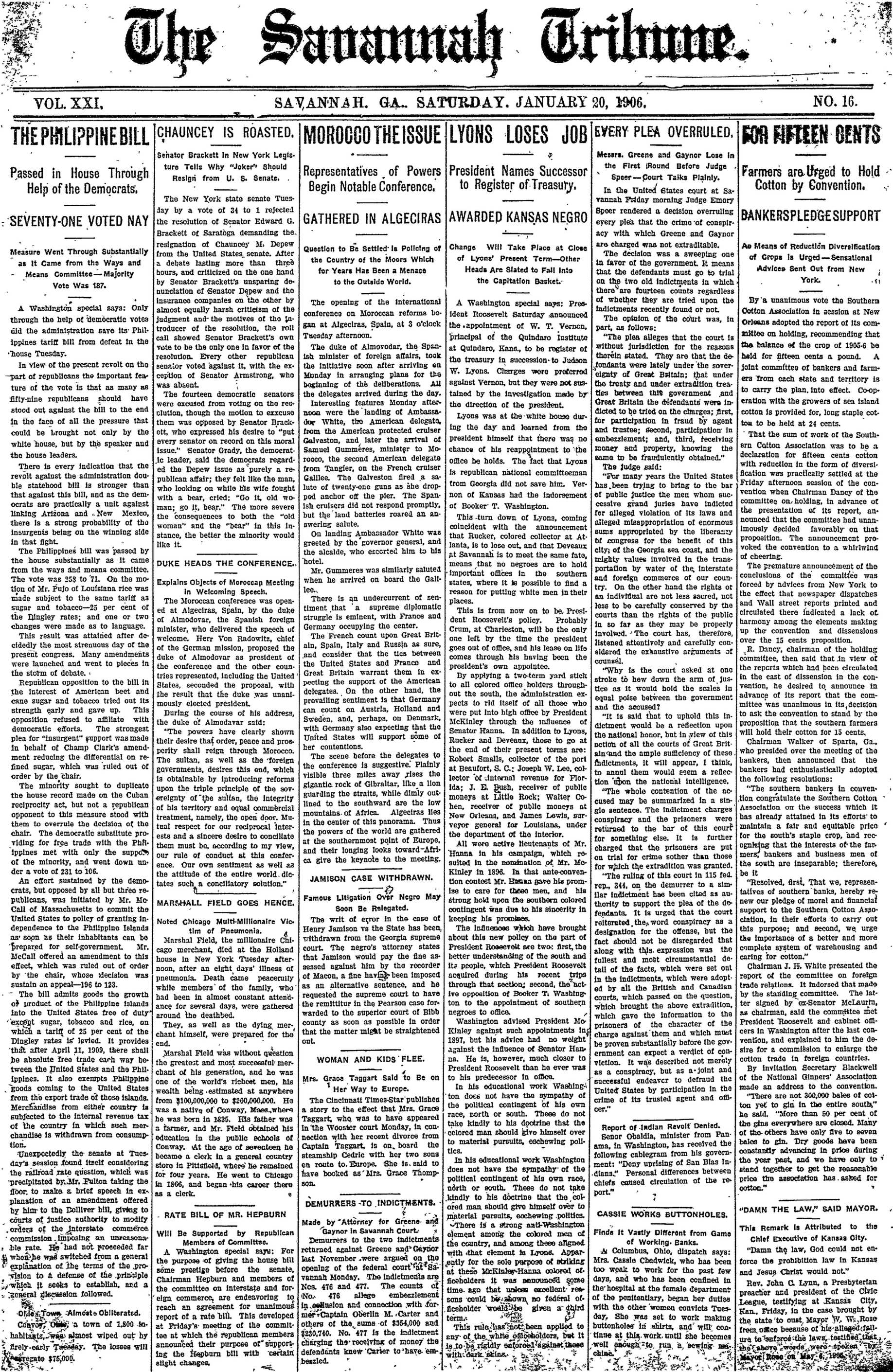
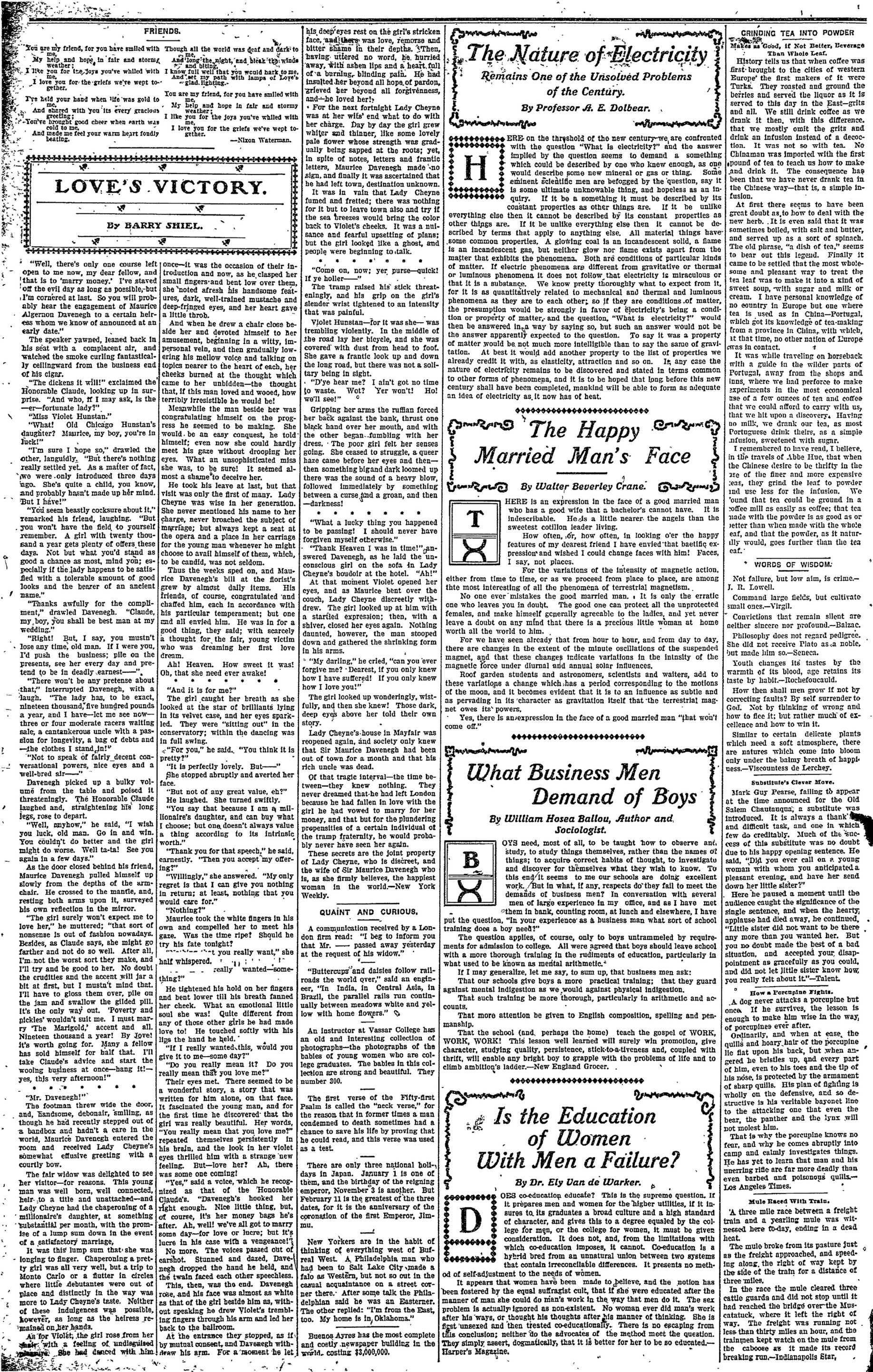
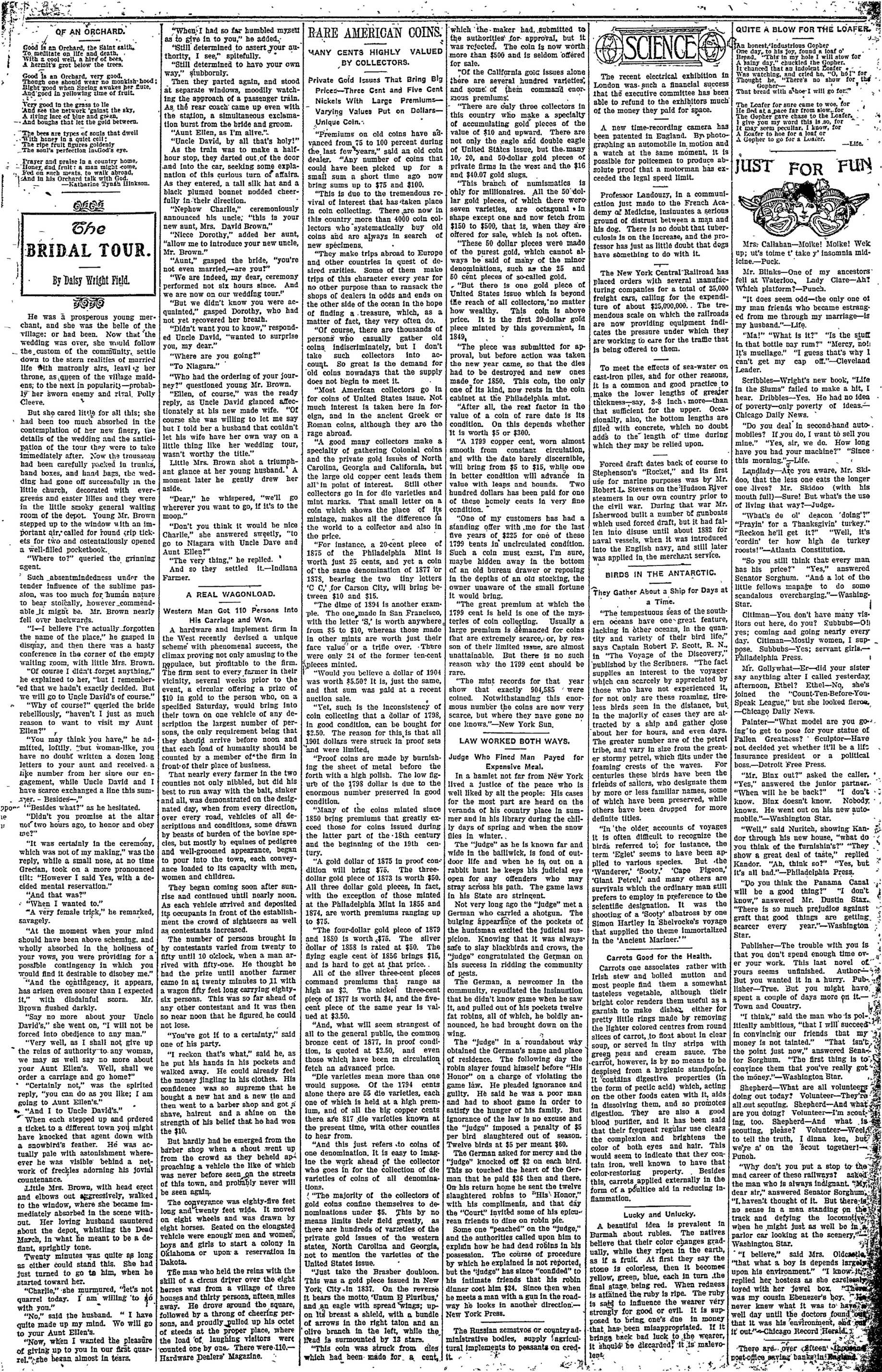
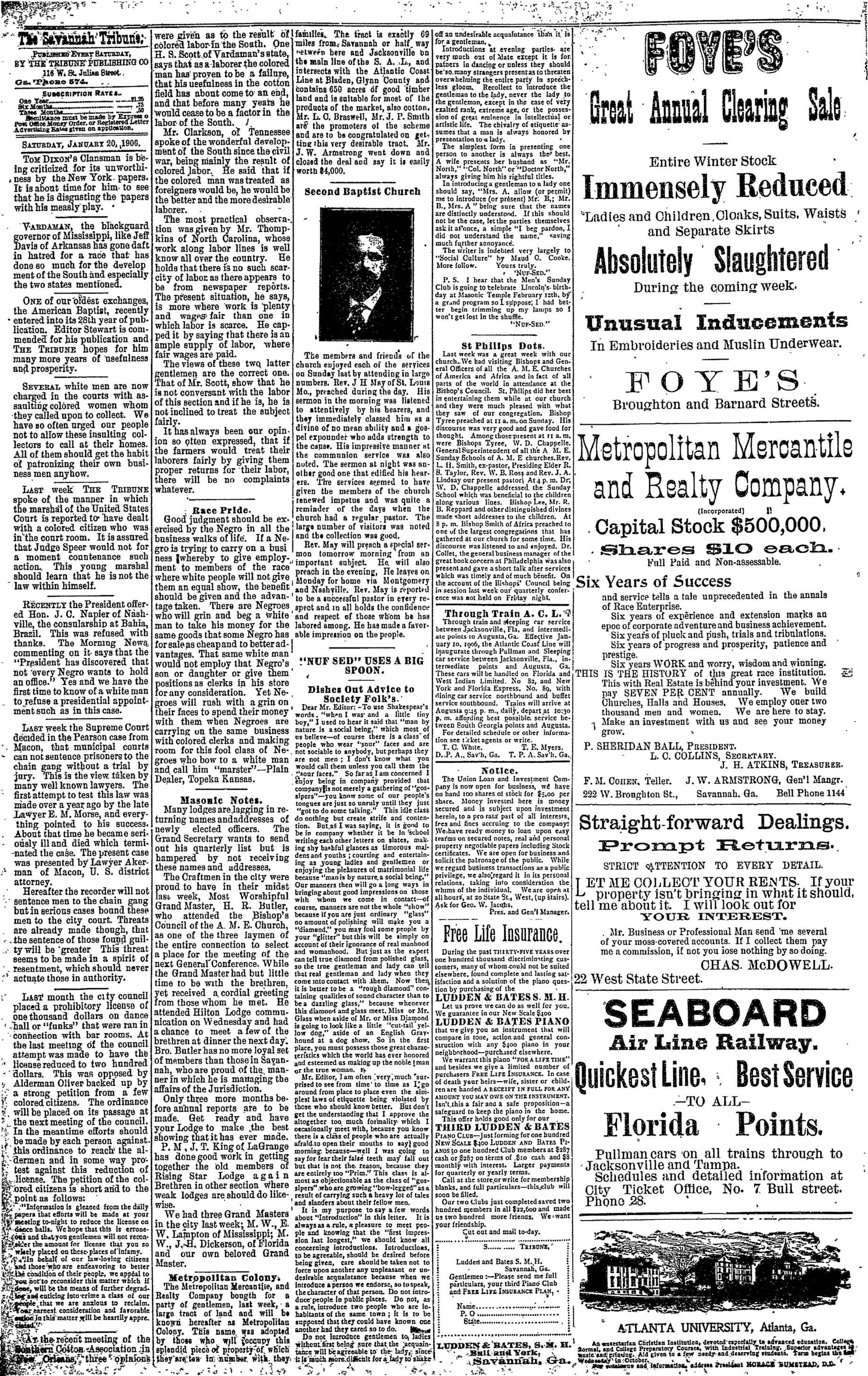
Page text (machine-generated)
VOL. XXI.
Passed in House Through Help of the Democrats.
SEVENTY-ONE VOTED NAY
Measure Went Through Substantially as It Came from the Ways and Means Committee—Majority
A Washington special says: Only through the help of democratic votes did the administration save its Philippines tariff bill from defeat in the house Tuesday.
In view of the present revolt on the part of republicans the important feature of the vote is that as many as fifty-nine republicans should have stood out against the bill to the end in the face of all the pressure that could be brought not only by the white house, but by the speaker and the house leaders.
There is every indication that the revolt against the administration double statehood bill is stronger than that against this bill, and as the democrats are practically a unit against linking Arizona and New Mexico, there is a strong probability of the insurgents being on the winning side in that fight.
The Philippines bill was passed by the house substantially as it came from the ways and means committee. The vote was 258 to 71. On the motion of Mr. Pujo of Louisiana rice was made subject to the same tariff as sugar and tobacco—25 per cent of the Dingley rates; and one or two changes were made as to language.
This result was attained after decidedly the most strenuous day of the present congress. Many amendments were launched and went to pieces in the storm of debate.
Republican opposition to the bill in the interest of American beet and cane sugar and tobacco tried out its strength early and gave up. This opposition refused to affiliate with democratic efforts. The strongest plea for "insurgent" support was made in behalf of Champ Clark's amendment reducing the differential on refined sugar, which was ruled out of order by the chair.
The minority sought to duplicate the house record made on the Cuban recolprocity act, but not a republican opponent to this measure stood with them to overrule the decision of the chair. The democratic substitute providing for free trade with the Philippines met with only the support of the minority, and went down under a vote of 231 to 106.
An effort sustained by the democrats, but opposed by all but three republicans, was infiltrated by Mr. McCall of Massachusetts to commit the United States to policy of granting independence to the Philippine Islands as soon as their inhabitants can be prepared for self-government. Mr. McCall offered an amendment to this effect, which was ruled out of order by the chair, whose decision was sustain an appeal—196 to 123.
The bill admits goods the growth of product of the Philippine islands into the United States free of duty except sugar, tobacco and rice, on which a tariff of 25 per cent of the Dingley rates is levied. It provides that after April 11, 1909, there shall be absolute free trade each way between the United States and the Philippines. It also exempts Philippine goods coming to the United States from the export trade of those islands. Merchandise from either country is subjected to the internal revenue tax of the country in which such merchandise is withdrawn from consumption.
Unexpectedly the senate at Tuesday's session found itself considering the railroad rate question, which was precipitated by Mr. Fulton taking the floor to make a brief speech in explanation of an amendment offered by him to the Dolliver bill, giving to courts of justice authority to modify orders of the Interstate commerce commission imposing an unreasonable rate. He had not proceeded far when he was switched from a general explanation of the terms of the provision to a defense of the principle which it seeks to establish, and a general discussion followed.
Oliver Town. Almost Obliterated. Convoy, Ohio; a town of 1,800 inhabitants, was almost wiped out by fierly early Tuesday. The losses will regate $75,000.
The Savannah Tribune.
Senator Brackett In New York Legis ture Tells Why "Joker" Should Resign from U. S. Senate.
The New York state senate Tuesday by a vote of 34 to 1 rejected the resolution of Senator Edward G. Brackett of Saratoga demanding the resignation of Chancey M. Depew from the United States senate. After a debate lasting more than three hours, and criticized on the one hand by Senator Brackett's unsparing denunciation of Senator Depew and the insurance companies on the other by almost equally harsh criticism of the judgment and the motives of the introducer of the resolution, the roll call showed Senator Brackett's own vote to be the only one in favor of the resolution. Every other republican senator voted against it, with the exception of Senator Armstrong, who was absent.
The fourteen democratic senators were excused from voting on the resolution, though the motion to excuse them was opposed by Senator Brackett, who expressed his desire to "put every senator on record on this moral issue." Senator Grady, the democratic leader, said the democrats regarded the Depew issue as purely a republican affair; they felt like the man, who looking on while his wife fought with a bear, cried: "Go it, old woman; go it, bear." The more severe the consequences to both the "old woman" and the "bear" in this instance, the better the minority would like it.
Explains Objects of Moroccan Meeting In Welcoming Speech.
The Moroccan conference was opened at Algectras, Spain, by the duke of Almodovar, the Spanish foreign minister, who delivered the speech of welcome. Herr Von Radowitz, chief of the German mission, proposed the duke of Almodovar as president of the conference and the other countries represented, including the United States, seconded the proposal, with the result that the duke was unanimously elected president. During the course of his address, the duke of Almodavar said:
"The powers have clearly shown their desire that order, peace and prosperity shall reign through Morocco. The sultan, as well as the foreign governments, desires this end, which is obtainable by introducing reforms upon the triple principle of the sovereignty of the sultan, the integrity of his territory and equal commercial treatment, namely, the open door. Mutual respect for our reprobacal interests and a sincere desire to conciliate them must be, according to my view, our rule of conduct at this conference. Our own sentiment as well as the attitude of the entire world dictates such a conciliatory solution."
MARSHALL FIELD GOES HENCE.
tim of Pneumonia.
Marshal Field, the millionaire Chicago merchant, died at the Holland house in New York Tuesday afternoon, after an eight days' illness of pneumonia. Death came peacefully while members of the family, who had been in almost constant attendance for several days, were gathered around the deathbed.
They, as well as the dying merchant himself, were prepared for the end.
Marshal Field was without question the greatest and most successful merchant of his generation, and he was one of the world's richest men, his wealth being estimated at anywhere from $100,000,000 to $200,000,000. He was a native of Conway, Mae, where he was born in 1835. His father was a farmer, and Mr. Field obtained his education in the public schools of Conway. At the age of seventeen he became a clerk in a general country store in Pittsfield, where he remained for four years. He went to Chicago in 1866, and began his career there as a clerk.
Will Be Supported by Republican Members of Committee.
A Washington special say: For the purpose of giving the house bill some prestige before the senate, Chairman Hepburn and members of the committee on interstate and foreign commerce, are endeavoring to reach an agreement for unanimous report of a rate bill. This developed at Friday's meeting of the committee at which the republican members announced their purpose of supporting the Hepburn bill with certain slight changes.
SAVANNAH. GA.. SATURDAY. JANUARY 20, 1906.
MOROCCO THE ISSUE
Representatives of Powers Begin Notable Conference.
GATHERED IN ALGECIRAS
Question to Be Settled: Is Policing of the Country of the Moors Which for Years Has Been a Menace to the Outside World.
The opening of the international conference on Moroccan reforms began at Algeciras, Spain, at 3 o'clock Tuesday afternoon.
The duke of Almovodar, the Spanish minister of foreign affairs, took the initiative soon after arriving on Monday in arranging plans for the beginning of the deliberations. All the delegates arrived during the day.
Interesting features Monday afternoon were the landing of Ambassador White, the American delegate, from the American protected cruiser Galveston, and later the arrival of Samuel Gummeres, minister to Morocco, the second American delegate from Tangier, on the French cruiser Galllee. The Galveston fired a salute of twenty-one guns as she dropped anchor off the pier. The Spanish cruisers did not respond promptly, but the land batteries roared an answering salute.
On landing Ambassador White was greeted by the governor general, and the alcalde, who escorted him to his hotel.
Mr. Gummeres was similarly saluted when he arrived on board the Galllee.
There is an undercurrent of sentiment that a supreme diplomatic struggle is eminent, with France and Germany occupying the center. The French count upon Great Britain, Spain, Italy and Russia as sure, and consider that the ties between the United States and France and Great Britain warrant them in expecting the support of the American delegates. On the other hand, the prevailing sentiment is that Germany can count on Austria, Holland and Sweden, and, perhaps, on Denmark, with Germany also expecting that the United States will support some of her contentions.
The scene before the delegates to the conference is suggestive. Plainly visible three miles away rises the gigantic rock of Gibraltar, like a lion guarding the straits, while dimly outlined to the southward are the low mountains of Africa. Algeciras lies in the center of this panorama. Thus the powers of the world are gathered at the southernmost point of Europe, and their longing looks toward-Africa give the keynote to the meeting.
Famous Litigation Over Negro May Soon Be Relegated.
The writ of error in the case of Henry Jamison vs the State has been withdrawn from the Georgia supreme court. The negro's attorney states that Jamison would pay the fine assessed against him by the recorder of Macon, a fine having been imposed as an alternative sentence, and he requested the supreme court to have the remittitur in the Pearson case forwarded to the superior court of Bibb county as soon as possible in order that the matter might be straightened out.
WOMAN AND KIDS FLEE.
Mrs. Grace Taggart Said to Be on Her Way to Europe.
The Cincinnati Times-Star publishes a story to the effect that Mrs. Grace Taggart, who was to have appeared in the Wooster court Monday, in connection with her recent divorce from Captain Taggart, is on board the steamship Cedric with her two sons en route to Europe. She is, said to have booked as Mrs. Grace Thompson.
Gaynor in Savannah Court.
Demurrers to the two indictments returned against Greene and Gaynor last November were argued on the opening of the federal court at Savannah Monday. The indictments are Nos. 476 and 477. The counts of No. 476 allege embezzlement in collusion and connection with former Captain Oberlin M. Carter and others of the sums of $354,000 and $230,740. No. 477 is the indictment charging the receiving of money the defendants knew Carter to have embezzled.
President Names Successor to Register of Treasury.
AWARDED KANSAS NEGRO
Change Will Take Place at Close of Lyons' Present Term—Other Heads Are Slated to Fall Into the Capitation Basket.
A Washington special says: President Roosevelt Saturday announced the appointment of W. T. Vernon, principal of the Quindaro Institute at Quindaro, Kans., to be register of the treasury in succession to Judson W. Lyons. Charges were preferred against Vernon, but they were not sustained by the investigation made by the direction of the president.
Lyons was at the white house during the day and learned from the president himself that there was no chance of his reappointment to the office he holds. The fact that Lyons is republican national committeeman from Georgia did not save him. Vernon of Kansas had the indorsement of Booker T. Washington. This turn down of Lyons, coming coincident with the announcement that Rucker, colored collector at Atlanta, is to lose out, and that Deveaux at Savannah is to meet the same fate, means that no negroes are to hold important offices in the southern states, where it is possible to find a reason for putting white men in their places.
This is from now on to be. President Roosevelt's policy. Probably Crum, at Charleston, will be the only one left by the time the president goes out of office, and his lease on life comes through his having been the president's own appointee.
By applying a two-term yard stick to all colored office holders throughout the south, the administration expects to rid itself of all those who were put into high office by President McKinley through the influence of Senator Hanna. In addition to Lyons, Rucker and Deveaux, those to go at the end of their present terms are: Robert Smalls, collector of the port at Beaufort, S. C.; Joseph W. Lee, collector of internal revenue for Florida; J. E. Bush, receiver of public moneys at Little Rock; Walter Cohen, receiver of public moneys at New Orleans, and James Lewis, surveyor general for Louisiana, under the department of the interior.
All were active lieutenants of Mr. Hanna in his campaign, which resulted in the nomination of Mr. McKinley in 1896. In that ante-convention contest Mr. Hanna gave his promise to care for these men, and his strong hold upon the southern colored contingent was due to his sincerity in keeping his promises.
The influences which have brought about this new policy on the part of President Roosevelt are two: first, the better understanding of the south and its people, which President Roosevelt acquired during his recent trips through that section; second, the active opposition of Booker T. Washington to the appointment of southern negroes to office.
Washington advised President McKinley against such appointments in 1897, but his advice had no weight against the influence of Senator Hanna. He is, however, much closer to President Roosevelt than he ever was to his predecessor in office. In his educational work Washington does not have the sympathy of the political contingent of his own race, north or south. These do not take kindly to his doctrine that the colored man should give himself over to material pursuits, eschewing politics.
In his educational work Washington does not have the sympathy of the political contingent of his own race, north or south. These do not take kindly to his doctrine that the colored man should give himself over to material pursuits, echewing politics. There is a strong anti-Washington element among the colored men of the country, and among these aligned with that element is Lyons. Apparently for the sole purpose of striking at these McKinley-Hanna colored officeholders it was announced some time ago that unless excellent reasons could be shown no federal officeholder would be given a third term.
This rule has not been applied to any of the white stockholders, but it is to be rigidly enforced against those with dark skins.
EVERY PLEA OVERRULED.
Messra. Greene and Gaynor Lose in the First Round Before Judge Speer—Court Talks Plainly.
In the United States court at Savannah Friday morning Judge Emory Speer rendered a decision overruling every plea that the crime of conspiracy with which Greene and Gaynor are charged was not extraditable.
The decision was a sweeping one in favor of the government. It means that the defendants must go to trial on the two old indictments in which there are fourteen counts regardless of whether they are tried upon the indictments recently found or not.
The opinion of the court was, in part, as follows:
"The plea alleges that the court is without jurisdiction for the reasons thoreau stated. They are that the defendants were lately under the sovereignty of Great Britain; that under the treaty and under extradition treaties between this government and Great Britain the defendants were indicted to be tried on the charges; first, for participation in fraud by agent and trustee; second, participation in embezzlement; and, third, receiving money and property, knowing the name to be fraudulently obtained."
"For many years the United States has been trying to bring to the bar of public justice the men whom successive grand juries have indicted for alleged violation of its laws and illegal misappropriation of enormous sums appropriated by the liberality of congress for the benefit of this city, of the Georgia sea coast, and the mighty values involved in the transportation by water of the interstate and foreign commerce of our country. On the other hand the rights of an individual are not less sacred, not less to be carefully conserved by the courts than the rights of the public in so far as they may be properly involved. The court has, therefore, listened attentively and carefully considered the exhaustive arguments of counsel.
"Why is the court asked at one stroke to hew down the arm of justice as it would hold the scales in equal poise between the government and the accused?
"It is said that to uphold this indictment would be a reflection upon the national honor, but in view of this action of all the courts of Great Britain and the ample sufficiency of these indictments, it will appear, I think, to annul them would seem a reflection upon the national intelligence.
"The whole contention of the accused may be summarized in a single sentence. The indictment charges conspiracy and the prisoners were returned to the bar of this court for something else. It is further charged that the prisoners are put on trial for crime sother than those for which the extradition was granted.
"The ruling of this court in 115 fed. rep., 344, on the demurrer to a similar indictment has been cited as authority to support the plea of the defendants. It is urged that the court reiterated the, word conspiracy as a designation for the offense, but the fact should not be disregarded that along with this. expression was the fullest and most circumstantial detail of the facts, which were set out in the indictments, which were adopted by all the British and Canadian courts, which passed on the question, which brought the above extradition, which gave the information to the prisoners of the character of the charge against them and which must be proven substantially before the government can expect a verdict of conviction. It was described not merely as a conspiracy, but as a joint and successful endeavor to defraud the United States by participation in the crime of its trusted agent and officer."
Report of Indian Revolt Denied
Senor Obalda, minister from Panama, in Washington, has received the following cablegram from his government: "Deny uprising of San Blas Indians." Personal differences between chiefs caused circulation of the report."
CASSIE WORKS BUTTONHOLES.
Finds It Vastly Different from Game of Working. Banks.
A Columbus, Ohio, dispatch says: Mrs. Cassie Chadwick, who has been too weak to work for the past few days, and who has been confined in the hospital at the female department of the penitentiary, began her duties with the other women convicts Tuesday. She was set to work making buttonholes in shirts, and will continue at this work until she becomes well enough to run a sewing machine.
FOR FIFTEEN GENTS
Farmers are Urged to Hold Cotton by Convention.
BANKERSPLEDGE SUPPORT
As Means of Reduction Diversification of Greps Is Urged—Sensational
By a unanimous vote the Southern Cotton Association in session at New Orleans adopted the report of its committee on holding, recommending that the balance of the crop of 1955-6 be held for fifteen cents a pound. A joint committee of bankers and farmers from each state and territory is to carry the plan, into effect. Co-operation with the growers of sea island cotton is provided for, long staple cotton to be held at 24 cents.
That the sum of work of the Southern Cotton Association was to be a declaration for fifteen cents cotton with reduction in the form of diversification was practically settled at the Friday afternoon session of the convention when Chairman Dancy of the committee on holding, in advance of the presentation of its report, announced that the committee had unanimously decided favorably on that proposition. The announcement provoked the convention to a whirlwind of cheering.
The premature announcement of the conclusions of the committee was forced by advices from New York to the effect that newspaper dispatches and Wall street reports printed and circulated there indicated a lack of harmony among the elements making up the convention and dissensions over the 15 cents proposition.
R. Dancy, chairman of the holding committee, then said that in view of the reports which had been circulated in the east of dissension in the convention, he desired to announce in advance of its report that the committee was unanimous in its decision to ask the convention to stand by the proposition that the southern farmers will hold their cotton for 15 cents.
Chairman Walker of Sparta, Ga., who presided over the meeting of the bankers, then announced that the bankers had enthusiastically adopted the following resolutions:
"The southern bankers in convention congratulate the Southern Cotton Association on the success which it has already attained in its efforts to maintain a fair and equitable price for the south's staple crop, and recognizing that the interests of the farmers, bankers and business men of the south are inseparable; therefore, be it
"Resolved, first, That we, representatives of southern banks, hereby renew our pledge of moral and financial support to the Southern Cotton Association, in their efforts to carry out this purpose; and second, we urge the importance of a better and more complete system of warehousing and caring for cotton."
Chairman J. H. White presented the report of the committee on foreign trade relations. It indorsed that made by the standing committee. The latter signed by ex-Senator McLaurm, as chairman, said the committee met President Roosevelt and cabinet officers in Washington after the last convention, and explained to him the desire for a commission to enlarge the cotton trade in foreign countries.
By Invitation Secretary Blackwell of the National Ginners' Association made an address to the convention. "There are not 300,000 bales of cotton yet to gin in the entire south," he said, "More than 50 per cent of the gins everywhere are closed. Many of the others have only five to seven bales to gin. Dry goods have been constantly advancing in price during the year past, and we have only to stand together to get the reasonable price the association has asked for cotton."
"DAMN THE LAW," SAID MAYOR.
This Remark is Attributed to the Chief Executive of Kansas City.
"Damn the law, God could not enforce the prohibition law in Kansas and Jesus Christ would not."
Rev. John C. Lynn, a Presbyterian preacher and president of the Clive League, testifying at Kansas City, Kan., Friday, in the case brought by the state to oust Mayor W. W. Rose from office because of his alleged failure to enforce the laws, testified that the above words were spoken by Mayor Rose on May 6, 1908.
LOVE'S VICTORY.
By BARRY SHIEL.
"Well, there's only one course left open to me now, my dear fellow, and that is to 'marry money.' I've staved off the evil day as long as possible, but I'm cornered at last. So you will probably hear the engagement of Maurice Algernon Davenegh to a certain heiress whom we know of announced at an early date."
The speaker yawned, leaned back in his seat with a complacent air, and watched the smoke curling fantastically ceilingward from the business end of his cigar.
"The dickens it will!" exclaimed the Honorable Claude, looking up in surprise. "And who, if I may ask, is the —er—fortunate lady?" "Miss Violet Hunstan."
Once—it was the occasion of their introduction and now, as he clasped her small fingers and bent low over them, she noted afresh his handsome features, dark, well-trained mustache and deep-fringed eyes, and her heart gave a little throb.
And when he drew a chair close beside her and devoted himself to her amusement, beginning in a witty, impersonal vein, and then gradually lowering his mellow voice and talking on topics nearer to the heart of each, her cheeks burned at the thought which came to her unbidden—the thought that, if this man loved and wooed, how terribly irresistible he would be!
Meanwhile the man beside her was congratulating himself on the prox-
"What! Old Chicago Hunstan's daughter? Maurice, my boy, you're in Juck!"
"I'm sure I hope so," drawled the other, languidly. "But there's nothing really settled yet. As a matter of fact, two were only introduced three days ago. She's quite a child, you know, and probably hasn't made up her mind. But I have!"
"You seem beastly cocksure about it," remarked his friend, laughing. "But you won't have the field to yourself remember. A girl with twenty thousand a year gets plenty of offers, these days. Not but what you'd stand as good a chance as most, mind you; especially if the lady happens to be satisfied with a tolerable amount of good looks and the bearer of an ancient name."
"Thanks awfully for the compliment," drawled Davenegh. "Claude, my, boy, you shall be best man at my wedding."
"Right! But, I say, you mustn't lose any time, old man. If I were you, I'd push the business; pile on the presents, see her every day and pretend to be in deadly earnest—".
"There won't be any pretense about that," interrupted Davenegh, with a laugh. "The lady has, to be exact, nineteen thousand, five hundred pounds a year, and I have—let me see now—three or four moderate racers waiting sale, a cantankerous uncle with a passion for longevity, a bag of debts and—the clothes I stand in!"
"Not to speak of fairly decent conversational powers, nice eyes and a well-bred air—"
Davengeh picked up a bulky volume from the table and poised it threateningly. The Honorable Claude laughed and, straightening his long legs, rose to depart.
"Well, anyhow," he said, "I wish you luck, old man. Go in and win. You couldn't do better and the girl might do worse. Well ta-ta! See you again in a few days."
As the door closed behind his friend, Maurice Davengeh pulled himself up slowly from the depths of the armchair. He crossed to the mantle, and, resting both arms upon it, surveyed his own reflection in the mirror.
"The girl surely won't expect me to love her," he muttered; "that sort of nonsense is out of fashion nowadays. Besides, as Claude says, she might go farther and not do so well. After all, I'm not the worst sort they make, and I'll try and be good to her. No doubt the crudities and the accent will jar a bit at first, but I mustn't mind that. I'll have to gloss them over, pile on the jam and swallow the gilded pill. It's the only way out. 'Poverty and pickles' wouldn't suit me. I must marry 'The Marigold,' accent and all. Nineteen thousand a year! By Love! it's worth going for. Many a fellow has sold himself for half that. I'll take Claude's advice and start the wooling business at once—hang it!—yes, this's very afternoon!"
The footman threw wide the door, and, Handsome, debonair, smiling, as though he had recently stepped out of a bandbox and hadn't a care in the world, Maurice Davenegh entered the room and received Lady Cheyne's somewhat effusive greeting with a courtly bow.
The fair widow was delighted to see her visitor—for reasons. This young man was well born, well connected, heir—to a title and unattached—and Lady Cheyne had the chaperoning of a millionaire's daughter, at something substantial per month, with the promise of a lump sum down in the event of a satisfactory marriage.
It was this lump sum that she was longing to finger. Chaperoning a pretty girl was all very well, but a trip to Monte Carlo or a flutter in circles where little debutantes were out of place and distinctly in the way was more to Lady Cheyne's taste. Neither of these indulgences was possible, however, as long as the heiress remained on her hands.
As for Viollet, the girl rose from her skin with a feeling of undisguised pleasure. She had danced with him
once—it was the occasion of their introduction and now, as he, clasped her small fingers and bent low over them, she noted afresh his handsome features, dark, well-trained mustache and deep-fringed eyes, and her heart gave a little throb.
And when he drew a chair close beside her and devoted himself to her amusement, beginning in a witty, impersonal vein, and then gradually lowering his mellow voice and talking on topics nearer to the heart of each, her cheeks burned at the thought which came to her unbidden—the thought that, if this man loved and wooed, how terribly irresistible he would be!
Meanwhile the man beside her was congratulating himself on the progress he seemed to be making. She would be an easy conquest, he told himself; even now she could hardly meet his gaze without drooping her eyes. What an unsophisticated miss she was, to be sure! It seemed almost a shame to deceive her.
He took his leave at last, but that visit was only the first of many. Lady Cheyne was wise in her generation. She never mentioned his name to her charge, never broached the subject of marriage; but always kept a seat at the opera and a place in her carriage for the young man whenever he might choose to avail himself of them, which, to be candid, was not seldom.
Thus the weeks sped on, and Maurice Davenegh's bill at the florist's grew by almost daily items. His friends, of course, congratulated and chaffed him, each in accordance with his particular temperament; but one and all envied him. He was in for a good thing, they said; with scarcely a thought for the fair, young victim who was dreaming her first love dream.
Ah! Heaven. How sweet it was! Oh, that she need ever awake!
* "And it is for me?"*
The girl caught her breath as she looked at the star of brilliants lying in its velvet case, and her eyes sparkled. They were "sitting out" in the conservatory; within the dancing was in full swing.
"For you," he said. "You think it is pretty?" "It is perfectly lovely. But—"
She stopped abruptly and averted her face.
"But not of any great value, eh?" He laughed. She turned swiftly.
"You say that because I am a millionaire's daughter, and can buy what I choose; but one doesn't always value a thing according to its intrinsic worth."
"Thank you for that speech," he said, earnestly. "Then you accept my offering?"
"Willingly," she answered. "My only regret is that I can give you nothing in return; at least, nothing that you would care for."
"Nothing?"
Maurice took the white fingers in his own and compelled her to meet his gaze. Was the time ripe? Should he try his fate tonight?
"but you really want," she half whispered. "I really wanted—something?"
He tightened his hold on her fingers and bent lower till his breath fanned her cheek. What an emotional little soul she was! Quite different from any of those other girls he had made love to! He touched softly with his lips the hand he held.
"If I really wanted this, would you give it to me—some day?"
"Do you really mean it? Do you really mean that you love me?"
Their eyes met. There seemed to be a wonderful story, a story that was written for him alone, on that face. It fascinated the young man, and for the first time he discovered that the girl was really beautiful. Her words, "You really mean that you love me!" repeated themselves persistently in his brain, and the look in her violet eyes thrilled him with a strange new feeling. But—love her? Ah, there was some one coming!
"Yes," said a voice, which he recognized as that of the Honorable Claude's. "Davenegh's hooked her right enough. Nice little thing, but, of course, it's her money bags he's after. Ah, well! we've all got to marry some day—for love or lucre; but it's lucre in his case with a vengeance!"
No more. The voices passed out of carshot. Stunned and dazed, Daveneghe dropped the hand he held, and the twain faced each other speechless. This, then, was the end. Daveneghe rose, and his face was almost as white as that of the girl beside him as, without speaking he drew Violet's trembling fingers through his arm and led her back to the ballroom.
At the entrance they stopped, as if by mutual consent, and Daveneghe withdrew his arm. For a moment he let
his deep eyes rest on the girl's stricken face, and there was love, remorse and bitter shame in their depths. Then, having uttered no word, he hurried away, with ashen lips and a heart full of a burning, blinding pain. He had insulted her beyond all hope of pardon, grieved her beyond all forgiveness, and—he loved her!.
* For the next fortnight Lady Cheyne was at her wits end what to do with her charge. Day by day the girl grew whiter and thinner, like some lovely pale flower whose strength was gradually being sapped at the roots; yet, in spite of notes, letters and frantic letters, Maurice Davenegh made no sign, and finally it was ascertained that he had left town, destination unknown.
It was in vain that Lady Cheyne fumed and fretted; there was nothing for it but to leave town also and try if the sea breezes would bring the color back to Violet's cheeks. It was a nulsance and fearful upsetting of plans; but the girl looked like a ghost, and people were beginning to talk.
* "Come on, now; yer purse—quick! If ye holler—"
The tramp raised his stick threateningly, and his grip on the girl's slender wrist tightened to an intensity that was painful.
Violet Hunstan—for it was she—was trembling violently. In the middle of the road lay her bicycle, and she was covered with dust from head to foot. She gave a frantic look up and down the long road, but there was not a solitary being in sight.
"Dye hear me? I ain't got no time
to waste. Wot? Yer won't! Ho!
we'll see!" Gripping her arms the ruffian forced
her back against the bank, thrust one
black hand over her mouth, and with
the other begin--fumbling with her
dress. The poor girl felt her senses
going. She ceased to struggle, a queer
haze came before her eyes and then
then something bigand dark loomed up
there was the sound of a heavy blow,
followed immediately by something
between a curse and a groan, and then
—darkness!
* * * * * * * * *
"What a lucky thing you happened
to be passing! I should never have
forgiven myself otherwise."
"Thank Heaven I was in time!" answered Davenegh, as he laid the unconscious girl on the sofa in Lady Cheyne's boudolr at the hotel. "Ah!"
At that moment Violet opened her eyes, and as Maurice bent over the couch, Lady Cheyne discreetly withdrew. The girl looked up at him with a starfied expression; then, with a shiver, closed her eyes again. Nothing daunted, however, the man stooped down and gathered the shrinking form in his arms.
"My darling," he cried, "can you ever forgive me?' Dearest, if you only knew how I have suffered! If you only knew how I love you!"
The girl looked up wonderingly, wistfully, and then she knew! Those dark, deep eyes above her told their own story.
Lady Cheyne's-house in Mayfair was reopened again, and society only knew that Sir Maurice Davenegh had been out of town for a month and that his rich uncle was dead.
Of that tragic interval—the time between—they knew nothing. They never dreamed that he had left London because he had fallen in love with the girl he had vowed to marry for her money, and that but for the plundering propensities of a certain individual of the tramp fraternity, he would probably never have seen her again.
These secrets are the joint property of Lady Cheyne, who is discreet, and the wife of Sir Maurice Davenegh who is, as she firmly believes, the happiest woman in the world.—New York Weekly.
QUAINT AND CURIOUS.
A communication received by a London firm read: "I beg to inform you that Mr. — passed away yesterday at the request of his widow."
"Buttercups and daisies follow railroads the world over," said an engineer, "In India, in Central Asia, in Brazil, the parallel rails run continually between meadows white and yellow with home flowers."
An instructor at Vassar College has an old and interesting collection of photographs—the photographs of the babies of young women who are college graduates. The babies in this collection are strong and beautiful. They number 300.
The first verse of the Fifty-first Psalm is called the "neck verse," for the reason that in former times a man condemned to death sometimes had a chance to save his life by proving that he could read, and this verse was used as a test.
There are only three national holidays in Japan. January 1 is one of them, and the birthday of the reigning emperor, November 3 is another. But February 11 is the greatest of the three dates, for it is the anniversary of the coronation of the first Emperor, Jimmu.
New Yorkers are in the habit of thinking of everything west of Buffalore West. A Philadelphia man who had been to Salt Lake City made a falo as Western, but not so out in the casual acquaintance on a street corner there. After some talk the Philadelphiaian said he was an Easterner. The other replied: "I'm from the East, too. My home is in Oklahoma."
Buenos Ayres has the most complete and costly newspaper building in the world, costing $3,000,000.
The Nature of Electricity
Remains One of the Unsolved Problems of the Century.
By Professor A. E. Dolbear.
everything else then it cannot be described by its constant properties as other things are. If it be unlike everything else then it cannot be described by terms that apply to anything else. All material things have some common properties. A glowing coal is an incandescent solid, a flame is an incandescent gas, but neither glow nor flame exists apart from the matter that exhibits the phenomena. Both are conditions of particular kinds of matter. If electric phenomena are different from gravitative or thermal or luminous phenomena it does not follow that electricity is miraculous or that it is a substance. We know pretty thoroughly what to expect from it, for it is as quantitatively related to mechanical and thermal and luminous phenomena as they are to each other, so if they are conditions of matter, the presumption would be strongly in favor of electricity's being a condition or property of matter, and the question, "What is electricity?" would then be answered in a way by saying so, but such an answer would not be the answer apparently expected to the question. To say it was a property of matter would be not much more intelligible than to say the same of gravitation. At best it would add another property to the list of properties we already credit it with, as elasticity, attraction and so on. If, any case the nature of electricity remains to be discovered and stated in terms common to other forms of phenomena, and it is to be hoped that long before this new century shall have been completed, mankind will be able to form as adequate an idea of electricity as it now has of heat.
The Happy Married Man's Face By Walter Beverley Crane.
For the variations of the intensity of magnetic action, either from time to time, or as we proceed from place to place, are among the most interesting of all the phenomena of terrestrial magnetism.
No one ever mistakes the good married man. It is only the erratic one who leaves you in doubt. The good one can protect all the unprotected females, and make himself generally agreeable to the ladies, and yet never leave a doubt on any mind that there is a precious little woman at home worth all the world to him.
For we have seen already that from hour to hour, and from day to day, there are changes in the extent of the minute oscillations of the suspended magnet, and that these changes indicate variations in the intensity of the magnetic force under diurnal and annual solar influences.
Roof garden students and astronomers, scientists and waiters, add to these variations a change which has a period corresponding to the motions of the moon, and it becomes evident that it is to an influence as subtle and as pervading in its character as gravitation itself that the terrestrial magnet owes its powers.
Yes, there is an expression in the face of a good married man "that won't come off."
What Business Men Demand of Boys
put the question, "In your experience as a business man what sort of school training does a boy need?"
The question applies, of course, only to boys untrammeled by requirements for admission to college. All were agreed that boys should leave school with a more thorough training in the rudiments of education, particularly in what used to be known as mental arithmetic.
If I may generalize, let me say, to sum up, that business men ask:
That our schools give boys a more practical training; that they guard against mental indigestion as we would against physical indigestion.
That such training be more thorough, particularly in arithmetic and accounts.
That more attention be given to English composition, spelling and penmanship.
That the school (and, perhaps the home) teach the gospel of WORK, WORK, WORK! This lesson well learned will surely win promotion, give character, studying quality, persistence, stick-to-a-tiveness and, coupled with thrift, will enable any bright boy to grapple with the problems of life and to climb ambition's ladder—New England Grocer.
Is the Education of Women With Men a Failure? By Dr. Ely Van de Warker.
It appears that women have been made to believe, and the notion has been fostered by the equal suffragist cult, that if she were educated after the manner of man she could do man's work in the way that men do it. The sex problem is actually ignored as non-existent. No woman ever did man's work after his ways, or thought his thoughts after his manner of thinking. She is first unsexed and then treated co-educationally. There is no escaping from this conclusion; neither do the advocates of the method meet the question. They simply assert, dogmatically, that it is better for her to be so educated.—Harper's Magazine.
H
everything else other things are scribed by term; some common p. is an incandescent matter that exhibits of matter. If e. or luminous phe. that it is a subsurface for it is as qua phenomena as the presumption or property then be answered the answer appa. of matter would di. tation. At best already credit it nature of electricity to other forms of century shall have an idea of electricity.
T
either from times the most interest
No one ever one who leaves y females, and may leave a doubt on worth all the worl
For we have there are change magnet, and that magnetic force u
Roof garden these variations of the moon, and as pervading in net owes its pow
Yes, there is come off."
B
put the question,
training does a b
The question
ments for admission
with a more thou
what used to be b
If I may gene
That our sch
against mental in
That such tra
counts.
That more at
manship.
That the sch
WORK, WORK!
character, studyin
thrift, will enable
climb ambition's b
D
god of self-adjustment.
It appears that
been fostered by the
manner of man she
problem is actually
after his ways, or
agist unsexed and
this conclusion; n
They simply nassert
Harper's Magazine
ERE on the threshold of the new century-we are confronted with the question "What is electricity?" and the answer implied by the question seems to demand a something which could be described by one who knew enough, as one would describe some new mineral or gas or thing. Some eminent scientific men are begged by the question, say it is some ultimate unknowable thing, and hopeless as an inquiry. If it be a something it must be described by its constant properties as other things are. If it be unlike
HERE is an expression in the face of a good married man who has a good wife that a bachelor's cannot have. It is indescribable. He is a little nearer the angels than the sweetest cotillion leader living. How often, or, how often, in looking o'er the happy features of my dearest friend I have envied that baetific expression and wished I could change faces with him! Faces, I say, not places.
```markdown
```
OYS need, most of all, to be taught how to observe and study, to study things themselves, rather than the names of things; to acquire correct habits of thought, to investigate and discover for themselves what they wish to know. To this end it seems to me our schools are doing excellent work. But in what, if any, respects do they fail to meet the demands of business men? In conversation with several men of large experience in my office, and as I have met them in bank counting room at lunch and elsewhere, I have
OES co-education educate? This is the supreme question. If it prepares men and women for the higher utilities, if it insures to its graduates a broad culture and a high standard of character, and gives this to a degree equaled by the college for men, or the college for women, it must be given consideration. It does not, and, from the limitations with which co-education imposes, it cannot. Co-education is a hybrid bred from an unnatural union between two systems that contain irreconcilable differences. It presents no meth-
GRINDING TEA INTO POWDER
Makes as Good, If Not Better, Beverage
Than Whole Leaf.
History tells us that when coffee was first brought to the cities of western Europe the first makers of it were Turks. They roasted and ground the berries and served the liquor as it is served to this day in the East-grits and all. We still drink coffee as we drank it then, with this difference, that we mostly omit the grits and drink an infusion instead of a decoction. It was not so with tea. No Chinaman was imported with the first pound of tea to teach us how to make and drink it. The consequence has been that we have never drank tea in the Chinese way—that is, a simple infusion.
At first there seems to have been great doubt as to how to deal with the new herb. It is even said that it was sometimes boiled, with salt and butter, and served up as a sort of spinach. The old phrase, "a dish of tea," seems to bear out this legend. Finally it came to be settled that the most wholesome and pleasant way to treat the tea leaf was to make it into a kind of sweet soup, with sugar and milk or cream. I have personal knowledge of no country in Europe but one where tea is used as in China—Portugal, which got its knowledge of tea-making from a province in China, with which, it that time, no other nation of Europe was in contact.
It was while traveling on horseback with a guide in the wilder parts of Portugal, away from the shops and inns, where we had perforce to make experiments in the most economical use of a few ounces of tea and coffee that we could afford to carry with us, that we hit upon a discovery. Having no milk, we drank our tea, as most Portuguese drink theirs, as a simple infusion, sweetened with sugar.
I remembered to have read, I believe, in the travels of Abbe Hue, that when the Chinese desire to be thrifty in the age of the finer and more expensive teas, they grind the leaf to powder and use less for the infusion. We 'ound that tea could be ground in a coffee mill as easily as coffee; that tea made with the powder is as good as or better than when made with the whole eaf, and that the powder, as it naturally would, goes further than the tea eaf.
* WORDS OF WISDOM:
Not failure, but low aim, is crime.—J. R. Lowell.
Command large fields, but cultivate small ones.—Virgil.
Convictions that remain silent are neither sincere nor profound.—Balzac.
Philosophy does not regard pedigree. She did not receive Plato as a noble, but made him so.—Seneca.
Youth changes its tastes by the warmth of its blood, age retains its taste by habit.—Rochefoucauld.
How then shall men grow if not by correcting faults? By self surrender to God. Not by thinking of wrong and how to flee it; but rather much of excellence and how to win it.
Similar to certain delicate plants which need a soft atmosphere, there are natures which come into bloom only under the balmy breath of happiness. -Viscountess de Lerchey.
Substitute's Clever Move.
Mark Guy Pearse, failing to appear at the time announced for the Old Salem Chautauqua, a substitute was introduced. It is always a thank's and difficult task, and one in which few do creditably. Much of the success of this substitute was no doubt due to his happy opening sentence. He said, "Did you ever call on a young woman with whom you anticipated a pleasant evening, and have her send down her little sister?"
Here he paused a moment until the audience caught the significance of the single sentence, and when the hearty, applause had died away, he continued, "Little sister did not want to be there any more than you wanted her. But you no doubt made the best of a bad situation, and accepted your disappointment as gracefully as you could, and did not let little sister know how you really felt about it."-Talent.
How a Forensic Fights.
A dog never attacks a porcupine but once. If he survives, the lesson is enough to make him wise in the way, of porcupines ever after. Ordinarily, and when at ease, the quilts and hoary hair of the porcupine lie flat upon his back, but when angered he bristles up, and every part of him, even to his toes and the tip of his nose, is protected by the armament of sharp quills. His plan of fighting is wholly on the defensive, and so destructive is his veritable bayonet line to the attacking one that even the bear, the panther and the lynx will not molest him.
That is why the porcupine knows no fear, and why he comes abruptly into camp and calmly investigates things. He has yet to learn that man and his unerring rife are far more deadly than even barbed and poisonous quills.—Los Angeles Times.
Mule Raced With Train.
A three mile race between a freight train and a yearling mule was witnessed here to-day, ending in a dead heat. The mule broke from its pasture just as the freight approached, and speeding along, the right of way kept by the side of the train for a distance of three miles. In the race the mule cleared three cattle guards and did not stop until it had reached the bridge over the Muscatuck, where it left the right of way. The freight was running not less than thirty miles an hour, and the trainmen kept watch on the mule from the caboose as it made its record breaking run.-Indianapolis Star.
Good is an Orchard, the Saint salth,
To meditate on life and death,
With a cool well, a hird of bees,
A hermit's grot below the trees.
Good is an Orchard, very good,
Though one should wear no baskish hood,
Blight of spring makes her fute,
And good in yellowing time of fruit.
Very good in the grass to lie
And see the network against the sky,
A living lace of blue and green,
And boughs that let the gold between.
The bees are types of souls that dwell
With honey in a quiet cell;
The ripe fruit figures goldenly
The soul's perfection in God's eye.
Prayer and praise in a country home,
Honey, and fruit: a man might come,
Fed on such meats, to walk abroad,
And in his Orchard talk with God.
—Katharine Tynah Hinkson.
The BRIDAL TOUR.
By Daisy Wright Field.
7070
He was a prosperous young merchant, and she was the belle of the village: or had been. Now that the wedding was over, she would follow the custom of the community, settle down to the stern realities of married life with matronly alrs, leaving her throne, as queen of the village maidens; to the next in popularity—probably her sworn enemy and ritual. Polly Cleeve.
But she cared little for all this; she had been too much absorbed in the contemplation of her new finery, the details of the wedding and the anticipation of the tour they were to take immediately after. Now the trousseau had been carefully packed in trunks, band boxes, and hand bags, the wedding had gone off successfully in the little church, decorated with evergreens and easter lilies and they were in the little smoky general waiting room of the depot. Young Mr. Brown stepped up to the window with an important air; called for round trip tickets for two and ostentatiously opened a well-filled pocketbook.
"Where to?" queried the grinning agent.
Such absentmindedness under the tender influence of the sublime passion, was too much for human nature to bear stoicically, however commandable it might be. Mr. Brown nearly fell over backwards.
"I-I believe I've actually forgotten the name of the place," he gasped in display, and then there was a hasty conference in the corner of the empty waiting room, with little Mrs. Brown.
"Of course I didn't forget anything," he explained to her, "but I remembered that we hadn't exactly decided. But we will go to Uncle David's of course."
"Why of course?" queried the bride rebelliously, "haven't I just as much reason to want to visit my Aunt Ellen?"
"You may think you have," he admitted, loftily. "but woman-like, you have no doubt written a dozen long letters to your aunt and received a like number from her since our engagement, while Uncle David and I have scarce exchanged a line this summer. - Besides—"
"Besides what?" as he hesitated.
"Didn't you promise at the altar not two hours ago, to honor and obey me?"
"It was certainly in the ceremony, which was not of my making," was the reply, while a small nose, at no time Grectan, took on a more pronounced tilt: "However I said Yes, with a decided mental reservation."
"And that was?"
"When I wanted to."
"A very female trick," he remarked, savagely.
"At the moment when your mind should have been above scheming, and wholly absorbed in the holiness of your vows, you were providing for a possible contingency in which you would find it desirable to disobey me." "And the contingency, it appears, has arisen even sooner than I expected it," with disdainful scorn. Mr. Brown flushed darkly.
"Say no more about your Uncle David's," she went on, "I will not be forced into obedience to any man."
"Very well, as I shall not give up the reins of authority to any woman, we may as well say no more about your Aunt Ellen's. Well, shall we order a carriage and go home?
"Certainly not," was the spirited reply, "you can do as you like; I am going to Aunt Ellen's."
"And I to Uncle David's."
When each stepped up and ordered a ticket to a different town you might have knocked that agent down with a snowbird's feather. He was actually pale with astonishment wherever he was visible behind a network of freckles adorning his jovial countenance.
Little Mrs. Brown, with head erect and elbows out aggressively, walked to the window, where she became immediately absorbed in the scene without. Her loving husband sauntered about the depot, whistling the Dead March, in what he meant to be a defiant, sprightly tone.
Twenty minutes was quite as long as either could stand this. She had just turned to go to him, when he started toward her.
"Charlie," she murmured, "let's not quarrel today. I am willing to go with you."
"No," said the husband. "I have quite made up my mind. We will go to your Aunt Ellen's.
"Now, when I wanted the pleasure of giving up to you in our first quarrel," she began almost in tears.
"When I had so far humbled myself as to give in to you," he added.
"Still determined to assert your authority, I see," spitefully.
"Still determined to have your own way," stubbornly.
Then they parted again, and stood at separate windows, moodily watching the approach of a passenger train. As the rear coach came up even with the station, a simultaneous exclamation burst from the bride and groom.
"Aunt Ellen, as I'm alive."
"Uncle David, by all that's holy!"
As the train was to make a half-hour stop, they darted out of the door and into the car, seeking some explanation of this curious turn of affairs. As they entered, a tall silk hat and a black plumed bonnet nodded cheerfully in their direction.
"Nephew Charlie," ceremoniously announced his uncle; "this is your new aunt Mrs. David Brown."
"Nice Dorothy," added her aunt, "allow me to introduce your new uncle, Mr. Brown."
"Aunt," gasped the bride, "you're not even married—are you?"
"We are indeed, my dear, ceremony performed not six hours since. And we are now on our wedding tour."
"But we didn't know you were acquainted," gasped Dorothy, who had not yet recovered her breath.
"Didn't want you to know," responded Uncle David, "wanted to surprise you, my dear."
"Where are you going?"
"To Niagara."
"Who had the ordering of your journey?" questioned young Mr. Brown.
"Ellen, of course," was the ready reply, as Uncle David glanced affectionately at his new made wife. "Of course she was willing to let me say but I told her a husband that couldn't let his wife have her own way on a little thing like her wedding tour, wasn't worthy the title."
Little Mrs. Brown shot a triumphant glance at her young husband. 'A moment later he gently drew her aside.
"Dear," he whispered, "we'll go wherever you want to go, if it's to the moon."
"Don't you think it would be nice Charlie," she answered sweetly, "to go to Niagara with Uncle Dave and Aunt Ellen?"
"The very thing," he replied. 'And so they settled it—Indiana Farmer.
A REAL WAGONLOAD.
Western Man Got 110 Persons Into His Carriage and Won. A hardware and implement firm in the West recently devised a unique scheme with phenomenal success, the climax proving not only amusing to the populace, but profitable to the firm. The firm sent to every farmer in their vicinity, several weeks prior to the event, a circular offering a prize of $10 in gold to the person who, on a specified Saturday, would bring into their town on one vehicle of any description the largest number of persons, the only requirement being that they should arrive before noon and that each load of humanity should be counted by a member of the firm in front of their place of business.
That nearly every farmer in the two counties not only nibbled, but did his best to run away with the balt, sinker and all, was demonstrated on the designated day, when from every direction, over every road, vehicles of all descriptions and conditions, some drawn by beasts of burden of the bovine species, but mostly by equines of pedigree and well-groomed appearance, began to pour into the town, each conveyance loaded to its capacity with men, women and children.
They began coming soon after sunrise and continued until nearly noon. As each vehicle arrived and deposited its occupants in front of the establishment the crowd of sightseers as well as contestants increased.
The number of persons brought in by contestants varied from twenty to fifty until 10 oclock, when a man arrived with fifty-one. He thought he had the prize until another farmer came in at twenty minutes to 11 with a wagon fifty feet long carrying eighty-six persons. This was so far ahead of any other contestant and it was then so near noon that he figured, he could not lose.
"You've got it to a certainty," said one of his party.
"I reckon that's what," said he, as he put his hands in his pockets and walked away. He could already feel the money jingling in his clothes. His confidence was so supreme that he bought a new hat and a new tie and then went to a barber shop and got a shave, haircut and a shine on the strength of his belief that he had won the $10.
But hardly had he emerged from the barber shop when a shout went up from the crowd as they beheld aproaching a vehicle the like of which was never before seen on the streets of this town, and probably never will be seen again.
The conveyance was eighty-five feet long and twenty feet wide. It moved on eight wheels and was drawn by eight horses. Seated on the elongated vehicle were enough men and women, boys and girls to start a colony in Oklahoma or upon a reservation in Dakota.
The man who held the reins with the skill of a circus driver over the eight horses was from a village of three houses and thirty persons, fifteen miles away. He drove around the square, followed by a throng of cheering persons, and proudly pulled up his octet of steeds at the proper place, where the load of, laughing visitors were counted one by one. There were 110.—Hardware Dealers' Magazine.
MANY CENTS HIGHLY VALUED BY COLLECTORS.
Private Gold Issues That Bring Big Prices—Three Cent and Five Cent Nickels With Large Premiums—Varying Values Put on Dollars—Unique Coin.
"Premiums on old coins have advanced from 75 to 100 percent during the last few years," said an old coin dealer. "Any number of coins that could have been picked up for a small sum a short time ago now bring sums up to $75 and $100.
"This is due to the tremendous revival of interest that has taken place in coin collecting. There are now in this country more than 4000 coin collectors who systematically buy old coins and are always in search of new specimens.
"They make trips abroad to Europe and other countries in quest of desired rarities. Some of them make trips of this character every year for no other purpose than to ransack the shops of dealers in odds and ends on the other side of the ocean in the hope of finding a treasure, which, as a matter of fact, they very often do.
"Of course, there are thousands of persons who casually gather old coins indiscriminately, but I don't take such collectors into account. So great is the demand for old coins nowadays that the supply does not begin to meet it.
"Most American collectors go in for coins of United States issue. Not much interest is taken here in foreign, and in the ancient Greek or Roman coins, although they are the rage abroad.
"A good many collectors make a specialty of gathering Colonial coins and the private gold issues of North Carolina, Georgia and California, but the large old copper cent leads them all in point of interest. Still other collectors go in for die varieties and mint marks. That small letter on a coin which shows the place of its mintage, makes all the difference in the world to a collector and also in the price.
"For instance, a 20-cent piece of 1875 of the Philadelphia Mint is worth just 25 cents, and yet a coin of the same denomination of 1877 or 1875, bearing the two tiny letters 'C C', for Carson City, will bring between $10 and $15."
"The dime of 1894 is another example. The one made in San Francisco, with the letter 'S,' is worth anywhere from $5 to $10, whereas those made in other mints are worth just their face value' or a trifle over. There were only 24 of the former ten-cent pieces minted.
"Would you believe a dollar of 1904 was worth $5.50? It is, just the same, and that sum was paid at a recent auction sale.
"Yet, such is the inconsistency of coin collecting that a dollar of 1798, in good condition, can be bought for $2.50. The reason for this is that all 1901 dollars were struck in proof sets and were limited.
"Proof coins are made by burnishing the sheet of metal before the forth with a high polish. The low figure of the 1798 dollar is due to the enormous number preserved in good condition.
"Many of the coins minted since 1850 bring premiums that greatly exceed those for coins issued during the latter part of the 18th century and the beginning of the 19th century.
"A gold dollar of 1875 in proof condition will bring $75. The three-dollar gold piece of 1873 is worth $50. All three dollar gold pieces, in fact, with the exception of those minted at the Philadelphia Mint in 1855 and 1874, are worth premiums ranging up to $75.
"The four-dollar gold piece of 1879 and 1880 is worth $75. The silver dollar of 1858 is rated at $50. The flying eagle cent of 1856 brings $15, and is hard to get at that price. All of the silver three-cent pieces command premiums that range as high as $3. The nickel three-cent piece of 1877 is worth $4, and the five-cent piece of the same year is valued at $3.50. "And, what will seem strangest of all to the general public, the common bronze cent of 1877, in proof condition, is quoted at $2.50, and even those which have been in circulation fetch an advanced price.
"Die varieties mean more than one would suppose. Of the 1794 cents alone there are 55 die varieties, each one of which is held at a high premium, and of all the big copper cents there are 817 die varieties known at the present time, with other counties to hear from.
"And this just refers to coins of one denomination. It is easy to imagine the work ahead of the collector who goes in for the collection of die varieties of coins of all denominations.
! "The majority of the collectors of gold coins confine themselves to denominations under $5. This by no means limits their field greatly, as there are hundreds of varieties of the private gold issues of the western states, North Carolina and Georgia, not to mention the varieties of the United States issue.
"Just take the Brasher doubloon. This was a gold piece issued in New York City in 1837. On the reverse it bears the motto, 'Unum E Pluribus,' and an eagle with spread wings; upon its breast a shield, with a bundle of arrows in the right talon and an olive branch in the left, while the Iad is surmounted by 13 stars.
"This coin was struck from dies which had been made for a cent,
which the maker had, submitted to the authorities for approval, but it was rejected. The coin is now worth more than $500 and is seldom offered for sale.
"Of the California gold issues alone there are several hundred varieties, and some of them command enormous premiums."
"There are only three collectors in this country who make a specialty of accumulating gold pieces of the value of $10 and upward. There are not only the eagle and double eagle of United States issue, but the many 10, 20, and 50-dollar gold pieces of private firms in the west and the $16 and $0.07 gold slugs.
"This branch of numismatics is only for millionaires. All the 50 dollar gold pieces, of which there were seven varieties, are octagonal in shape except one and now fetch from $150 to $500, that is, when they are offered for sale, which is not often.
"These 50 dollar pieces were made of the purest gold, which cannot always be said of many of the minor denominations, such as the 25 and 50 cent pieces of so-called gold.
"But there is one gold piece of United States issue which is beyond the reach of all collectors, no matter how wealthy. This coin is above price. It is the first 20-dollar gold piece minted by this government, in 1849.
"The piece was submitted for approval, but before action was taken the new year came, so that the dies had to be destroyed and new ones made for 1850. This coin, the only one of its kind, now rests in the coin cabinet at the Philadelphia mint.
"After all, the real factor in the value of a coin of rare date is its condition. On this depends whether it is worth $5 or $300.
"A 1799 copper cent, worn almost smooth from constant circulation, and with the date barely discernible, will bring from $5 to $15, while one in better condition will advance in value with leaps and bounds. Two hundred dollars has been paid for one of these homely cents in very fine condition."
"One of my customers has had a standing offer with me for the last five years of $225 for one of these 1799 tents in uncirculated condition. Such a coin must exist, I'm sure, maybe hidden away in the bottom of an old bureau drawer or reposing in the depths of an old stocking, the owner unaware of the small fortune it would bring.
"The great premium at which the 1799 cent is held is one of the mysteries of coin collecting. Usually a large premium is demanded for coins that are extremely scarce, or, by reason of their limited issue, are almost unattainable. But there is no such reason why the 1799 cent should be rare.
"The mint records for that year show that exactly 904,585 were coloned. Notwithstanding this enormous number the coins are now very scarce, but where they have gone no one knows."—New York Sun.
LAW WORKED BOTH WAYS.
Judge Who Fined Man Payed for
Expensive Meal.
In a hamlet not far from New York lived a justice of the peace who is well liked by all the people: His cases for the most part are heard on the veranda of his country place in summer and in his library during the chilly days of spring and when the snow flies in winter.
The "judge" as he is known far and wide in the balliwick, is fond of outdoor life and when he is out on a rabbit hunt he keeps his judicial eye open for any offenders who may stray across his path. The game laws in his State are stringent.
Not very long ago the "judge" met a German who carried a shotgun. The bulging appearance of the pockets of the huntsman excited the judicial suspicion. Knowing that it was always safe to slay blackbirds and crows, the "judge" congratulated the German on his success in ridding the community of pests. The German, a newcomer in the community, repudiated the insinuation that he didn't know game when he saw it, and pulled out of his pockets twelve fat robins, all of which, he boldly announced, he had brought down on the wing.
The "judge" in a roundabout way obtained the German's name and place of residence. The following day the robin slayer found himself before "His Honor" on a charge of violating the game law. He pleaded ignorance and guilty. He said he was a poor man and had to shoot game in order to satisfy the hunger of his family. But ignorance of the law is no excuse and the "judge" imposed a penalty of $5 per bird slaughtered out of season. Twelve birds at $5 per meant $60. The German asked for mercy and the "judge" knocked off $2 on each bird. This so touched the heart of the German that he paid $36 then and there. On his return home he sent the twelve slaughtered robins to "His Honor," with his compliments, and that day the "Court" invited some of his epicurean friends to dine on robin pie.
Some one "peached" on the "judge," and the authorities called upon him to explain how he had dead robins in his possession. The course of procedure by which he explained is not reported, but the "judge" has since "confided" to his intimate friends that his robin dinner cost him $24. Since then when he meets a man with a gun in the roadway he looks in another direction—New York Press.
The Russian zemstvos or country administrative bodies, supply agricultural implements to peasants on credit.
The recent electrical exhibition in London was such a financial success that the executive committee has been able to refund to the exhibitors much of the money they paid for space.
A new time-recording camera has been patented in England. By photographing an automobile in motion and a watch at the same moment, it is possible for policemen to produce absolute proof that a motorman has exceeded the legal speed limit.
Professor Landouzy, in a communication just made to the French Academy of Medicine, insinuates a serious ground of distrust between a man and his dog. There is no doubt that tuberculosis is on the increase, and the professor has just as little doubt that dogs have something to do with it.
The New York Central Railroad has placed orders with several manufacturing companies for a total of 25,000 freight cars, calling for the expenditure of about $25,000,000. The tremendous scale on which the railroads are now providing equipment indicates the pressure under which they are working to care for the traffic that is being offered to them.
To meet the effects of sea-water on cast-iron piles, and for other reasons, it is a common and good practice to make the lower lengths of greater thickness—say, 3-8 inch, more—than that sufficient for the upper. Occasionally, also, the bottom lengths are filled with concrete, which no doubt adds to the length of time during which they may be relied upon.
Forced draft dates back of course to Stephenson's "Rocket," and its first use for marine purposes was by Mr. Robert L. Stevens on the Hudson River steamers in our own country prior to the civil war. During that war Mr. Isherwood built a number of gunboats which used forced draft, but it had fallen into disuse until about 1882 for naval vessels, when it was introduced into the English navy, and still later was applied in the merchant service.
BIRDS IN THE ANTARCTIC.
They Gather About a Ship for Days at a Time.
"The tempestuous seas of the southern oceans have one great feature, lacking in other oceans, in the quantity and variety of their bird life," says Captain Robert F. Scott, R. N., in "The Voyage of the Discovery," published by the Scribners. "The fact supplies an interest to the voyager which can scarcely by appreciated by those who have not experienced it, for not only are these roaming, tireless birds seen in the distance, but in the majority of cases they are attracted by a ship and gather close about her for hours, and even days. The greater number are of the petrel tribe, and vary in size from the greater stormy petrel, which fills under the foaming crests of the waves. For centuries these birds have been the friends of sailors, who designate them by more or less familiar names, some of which have been preserved, while others have been dropped for more definite titles.
"In the older accounts of voyages it is often difficult to recognize the birds referred to; for instance, the term 'Eglet' seems to have been applied to various species. But the 'Wanderer,' 'Sooty,' 'Cape Pigeon,' 'Glant Petrel,' and many others are survivals which the ordinary man still prefers to employ in preference to the scientific designation. It was the shooting of a 'Sooty' albatross by one Simon Hartley in Shelvocke's voyage that supplied the theme immortallized in the 'Ancient Mariner.'"
Carrots Good for the Health.
Carrots Good for the Treatment
Carrots one associates rather with Irish stew and boiled mutton and most people find them a somewhat tasteless vegetable, although their bright color renders them useful as a garnish to make dishes, either for pretty little rings made by removing the lighter colored centres from round slices of carrot, to float about in clear soup, or served in tiny strips with green peas and cream sauce. The carrot, however, is by no means to be despised from a hygienic standpoint. It contains digestive properties (in the form of pectic acid) which, acting on the other foods eaten with it, alms in dissolving them, and so promotes digestion. They are also a good blood purifier, and it has been said that their frequent regular use clears the complexion and brightens the color of both eyes and hair. This would seem to indicate that they contain iron, well known to have that color-restoring property. Besides this, carrots applied externally in the form of a poultice aid in reducing inflammation.
Lucky and Unlucky.
A beautiful idea is prevalent in Burmah about rubles. The natives believe that their color changes gradually, while they ripen in the earth, as if a fruit. At first they say the stone is colorless, then it becomes yellow, green, blue, each in turn the final stage, being red. When redness is attained the ruby is ripe. The ruby is said to influence the wearer very strongly for good or evil. It is supposed to bring one's due in money that has been misappropriated. If it brings back bad luck to the wearer, it should be discarded; it is malevolent.
An honest, 'industrious Gopher
one day, to his joy, found a loaf o'
Bread. "This in my hole I will stow for
a rainy day," chuckled the Gopher.
It chanced that an indolent Loafer
was watching, and cried he, "O, hot!" for
Thought he, "There's no snow for the
loafer."
That bread with a hoe I will go for:
The Loafer for sure came to woe, for
he died at a pace far from slow, for
the Gopher gave chase to the Loafer.
I give you my word this is so, for
It may seem peculiar, I know, for
A Loafer to hoe for a loaf or
A Gopher to go for a Loafer.
JUST FOR FUN
Mrs. Callahan—Molke! Molke! Wek up; ut's tome t' take y' insomnia medicine.—Puck.
Mr. Blinks—One of my ancestors fell at Waterloo, Lady Clare—Ah? Which platform?—Punch.
"It does seem odd—the only one of my man friends who became estranged from me through my marriage—is my husband."—Life.
"Mai! "What is it?" "Is the stuff in that bottle day rum?" "Mercy, no! It's mucilage." "I guess that's why I can't get my cap off."—Cleveland Leader.
Scribbles—Wright's new book, "Life in the Slums" failed to make a hit, I hear. Dribbles—Yes. He had no idea of poverty—only poverty of ideas.—Chicago Daily News.
"Do you deal in second-hand automobiles? If you do, I want to sell you mine." "Yes, sir, we do. How long have you had your machine?" "Since this morning."—Life.
Landlady—Are you aware, Mr. Skiddo, that the less one eats the longer one lives? Mr. Skiddo (with his mouth full)—Sure! But what's the use of living that way?—Judge.
"What's de ol' deacon 'doing'?"
"Prayin' for a Thanksgivin' turkey."
"Reckon he'll get it?" "Well, it's 'cordin' ter how high de turkey roosts!"—Atlanta Constitution.
"So you still think that every man has his price?" "Yes," answered Senator Sorghum. "A lot of the little fellows manage to do some scandalous overcharging."—Washing-Star.
Citiman—You don't have many visitors out here, do you? Subbuses—O! yes; coming and going nearly every day. Citiman—Mostly women, I suppose. Subbubs—Yes; servant girls.—Philadelphia Press.
Mr. Gollywhat—Er—did your sister say anything after I called yesterday, afternoon, Ethel? Ethel—No, she's joined the "Count-Ten-Before-You-Speak League," but she looked fierce. —Chicago Dally News.
Painter—"What model are you going to get to pose for your statue of Fallen Greatness? Sculptor—Have not decided yet whether it'll be a life insurance president or a political boss.—Detroit Free Press.
"Mr. Binx out?" asked the caller. "Yes," answered the junior partner. "When will he be back?" "I don't know. Binx doesn't know. Nobody knows. He went out on his new automobile."—Washington Star.
"Well," said Nuritch, showing Kandor through his new house, "what do you think of the furnishin's?" "They show a great deal of taste," replied Kandor. "Ah, think so?" "Yes, but it's all bad."—Philadelphia Press.
"Do you think the Panama Canal will be a good thing?" "I don't know," answered Mr. Dustin Stax. "There is so much prejudice against graft that good things are getting scarcer every year."—Washington Star.
Publisher—The trouble with you is that you don't spend enough time over your work. This last novel of yours seems unfinished. Author—But you wanted it in a hurry. Publisher—True. But you might have spent a couple of days more on it. Town and Country.
"I think," said the man who is politically ambitious, "that I will succeed in convincing our friends that my money is not tainted." "That isn't the point just now," answered Senator Sorghum. "The first thing is to convince them that you've really got the money."—Washington Star.
Shepherd—What are all volunteers doing out today? Volunteer—They're all out scouting. Shepherd—and what are you doing? Volunteer—I'm scouting, too. Shepherd—and what is scouting, please? Volunteer—Weel, to tell the truth, I dlnna ken, but we're a' on the 'scout together!—Punoh.
"Why don't you put a stop to the mad career of these railways? asked the man who is always indignant. "My dear sir," answered Senator Sorghum. "I haven't thought of it. But there is no sense in a man standing on the track and defying the locomotive when he might just as well be in a parlor car looking at the scenery." Washington Star.
"I believe," said Mrs. Oldcastle. "that what a boy is depends largely upon his environment." "I know it, replied her hostess as she carelessly toyed with her jewel box. There was my cousin Ebenezer's boy. I never knew what it was to have a well day until the doctors found out that it was his environment, and out if out."—Chicago Record Herald.
There are over fifteen thousand post-office payin' banks in England.
PUBLISHED EVERY SATURDAY,
BY THE TRIBUNE PUBLISHING CO
116 W. St. Julian Street.
Gr. Fargo 574.
SUBSCRIPTION RATES.
One Year.....$125
Six Months.....$70
Three Months.....$50
Sensitance must be made by Express or Post Money Order, or Registered Letter Advertising Rates given on application.
SATURDAY, JANUARY 20, 1906.
Tom Dixon's Clansman is being criticized for its unworthiness by the New York papers.
It is about time for him to see that he is disgusting the papers with his measly play.
VARDAMAN, the blackguard governor of Mississippi, like Jeff Davis of Arkansas has gone daft in hatred for a race that has done so much for the development of the South and especially the two states mentioned.
ONE of our oldest exchanges, the American Baptist, recently entered into its 28th year of publication. Editor Stewart is commended for his publication and THE TRIBUNE hopes for him many more years of usefulness and prosperity.
SEVERAL white men are now charged in the courts with assaulting colored women whom they called upon to collect. We have so often urged our people not to allow these insulting collectors to call at their homes. All of them should get the habit of patronizing their own business men anyhow.
LAST week THE TRIBUNE spoke of the manner in which the marshal of the United States Court is reported to have dealt with a colored citizen who was in the court room. It is assured that Judge Speer would not for a moment countenance such action. This young marshal should learn that he is not the law within himself.
RECENTLY the President offered Hon. J. C. Napier of Nashville, the consularship at Bahia, Brazil. This was refused with thanks. The Morning News commenting on it says that the "President has discovered that not every Negro wants to hold an office." Yes and we have the first time to know of a white man to refuse a presidential appointment such as in this case.
LAST week the Supreme Court decided in the Pearson case from Macon, that municipal courts can not sentence prisoners to the chain gang without a trial by jury. This is the view taken by many well known lawyers. The first attempt to test this law was made over a year ago by the late Lawyer E. M. Morse, and everything pointed to his success. About that time he became seriously ill and died which terminated the case. The present case was presented by Lawyer Akerman of Macon, U. S. district attorney.
Hereafter the recorder will not sentence men to the chain gang but in serious cases bound these men to the city court. Threats are already made though, that the sentence of those found guilty will be greater. This threat seems to be made in a spirit of resentment, which should never actuate those in authority.
LAST month the city council placed a prohibitory license of one thousand dollars on dance hall or "funks" that were ran in connection with bar rooms. At the last meeting of the council attempt was made to have the license reduced to two hundred dollars. This was opposed by Alderman Oliver backed up by a strong petition from a few colored citizens. The ordinance will be placed on its passage at the next meeting of the council. In the meantime efforts should be made by each person against this ordinance to reach the aldermen and in some way protest against this reduction of license. The petition of the colored citizens is short and to the point as follows:
Information is cleansed from the daily papers that efforts will be made at your meeting to-night to reduce the license on dance halls. We hope that this is erroneous and that you gentlemen will not reconsider the amount for license that you so wisely placed on these places of infamy. In behalf of our law-loving citizens and those who are endeavoring to better the condition of their people, we appeal to you not to reconsider this matter which if done, will be the means of further degrading and enticing into-erime a class of our people that we are anxious to reclaim. Your earnest consideration and favorable opinion in this matter will be heartily appreciated.
At the recent meeting of the Southern Cotton Association in New Orleans, three opinions
were given as to the result of colored labor in the South. One H. S. Scott of Vardaman's state, says that as a laborer the colored man has proven to be a failure, that his usefulness in the cotton field has about come to an end, and that before many years he would cease to be a factor in the labor of the South. / Mr. Clarkson, of Tennessee spoke of the wonderful development of the South since the civil war, being mainly the result of colored labor. He said that if the colored man was treated as foreigners would be, he would be the better and the more desirable laborer.
The most practical observation was given by Mr. Thompkins of North Carolina, whose work along labor lines is well know all over the country. He holds that there is no such scarcity of labor as there appears to be from newspaper reports. The present situation, he says, is more where work is plenty and wages fair than one in which labor is scarce. He capped it by saying that there is an ample supply of labor, where fair wages are paid.
The views of these two latter gentlemen are the correct one. That of Mr. Scott, show that he is not conversant with the labor of this section and if he is, he is not inclined to treat the subject fairly.
It has always been our opinion so often expressed, that if the farmers would treat their laborers fairly by giving them proper returns for their labor, there will be no complaints whatever.
Race Pride.
Good judgment should be exercised by the Negro in all the business walks of life. If a Negro is trying to carry on a business whereby to give employment to members of the race where white people will not give them an equal show, the benefit should be given and the advantage taken. There are Negroes who will grin and beg a white man to take his money for the same goods that some Negro has for sale as cheap and to better advantages. That same white man would not employ that Negro's son or daughter or give them positions as clerks in his store for any consideration. Yet Negroes will rush with a grin on their faces to spend their money with them when Negroes are carrying on the same business with colored clerks and making room for this fool class of Negroes who bow to a white man and call him "marster"—Plain Dealer, Topeka Kansas.
Masonic Notes.
Many lodges are lagging in returning names andaddresses of newly elected officers. The Grand Secretary wants to send out his quarterly list but is hampered by not receiving these names and addresses.
The Craftmen in the city were proud to have in their midst last week, Most Worshipful Grand Master, H. R. Butler, who attended the Bishop's Council of the A. M. E. Church, as one of the three laymen of the entire connection to select a place for the meeting of the next General Conference. While the Grand Master had but little time to be with the brethren, yet received a cordial greeting from those whom he met. He attended Hilton Lodge communication on Wednesday and had a chance to meet a few of the brethren at dinner the next day. Bro. Butler has no more loyal set of members than those in Savannah, who are proud of the manner in which he is managing the affairs of the Jurisdiction.
Only three more months before annual reports are to be made. Get ready and have your Lodge to make the best showing that it has ever made. P. M., J. T. King of LaGrange has done good work in getting together the old members of Rising Star Lodge again Brethren in other section where weak lodges are should do likewise. We had three Grand Masters in the city last week; M. W., E. W. Lampton of Mississippi; M. W., J. H. Dickerson, of Florida and our own beloved Grand Master.
Metropolitan Colony. The Metropolitan Mercantile, and Realty Company bough for a party of gentlemen, last week, a large tract of land and will be known hereafter as Metropolitan Colony. This name was adopted by those who will occupy this splendid piece of property of which they are ten in number with they
families. The tract is exactly 69 miles from Savannah or half way between here and Jacksonville on the main line of the S. A. L., and intersects with the Atlantic Coast Line at Bladen, Glynn County and contains 650 acres of good timber land and is suitable for most of the products of the market, also cotton. Mr. L. C. Braswell, Mr. J. P. Smith are the promoters of the schema and are to be congratulated on getting this very desirable tract. Mr. J. W. Armstrong went down and closed the deal and say it is easily worth $4,000.
1
The members and friends of the church enjoyed each of the services on Sunday last by attending in large numbers. Rev. J H May of St. Louis Mo., preached during the day. His sermon in the morning was listened to attentively by his hearers, and they immediately classed him as a divine of no mean ability and a gospel expounder who adds strength to the cause. His impressive manner at the communion service was also noted. The sermon at night was another good one that edified his hearers. The services seemed to have given the members of the church renewed impetus and was quite a reminder of the days when the church had a regular pastor. The large number of visitors was noted and the collection was good.
Rev. May will preach a special sermon tomorrow morning from an important subject. He will also preach in the evening. He leaves on Monday for home via Montgomery and Nashville. Rev. May is reported to be a successful pastor in every respect and in all holds the confidence and respect of those whom he has labored among. He has made a favorable impression on the people.
"NUF SED" USES A BIG SPOON.
Dishes Out Advice to Society Folk's
Dear Mr. Editor: To use Shakespeare's words, "when I was and a little tiny boy," I used to hear it said that "man by nature is a social being," which most of us believe—of course there is a class of people who wear "sour" faces and are not sociable to anybody, but perhaps they are not men; I don't know what you would call them unless you call them the "sour faces." So far as I am concerned I enjoy being in company provided that company is not merely a gathering of "gossipers"—you know some of our people's tongues are just so unruly until they just "got to do some talking." This idle class do nothing but create strife and contention. But as I was saying, it is good to be in company whether it be in school writing each other letters on slates, making shy bashful glances as fairorous maldens and youths; courting and entertaining as young ladies and gentlemen or enjoying the pleasures of matrimonial life because "manis by nature, a social being." Our manners then will go a long ways in bringing good impressions on those with whom we come in contact—of course, manners are not the whole "show" because if you are just ordinary "glass" no amount of polishing will make you a "diamond," you may fool some people by your "glitter" but this will be simply on account of their ignorance of real manhood and womanhood. But just as the expert can tell true diamond from polished glass, so the true gentleman and lady can tell that real gentleman and lady when they come into contact with them. Now then it is better to be a "rough diamond" containing qualities of sound character than to be a dazzling glass," because whenever this diamond and glass meet. Miss or Mr. Glass when aside of Mr. or Miss Diamond is going to look like a little "cut-tail yellow dog," aside of an English Grayhound at a dog show. So in the first place, you must possess those great characteristics which the world has ever honored and esteemed as making up the noble gman or the true woman.
Mr. Editor, I am often very, much surprised to see from time to time as I go around from place to place even the simplest laws of etiquette being violated by those who should know better. But don't get the understanding that I approve the altogether too much formality which I occasionally meet with, because you know there is a class of people who are actually afraid to open their mouths to say good morning, because—well I was going to say for fear their false teeth may fall out but that is not the reason, because they are entirely too "Prim." This class is almost as objectionable as the class of "gossipers" who are growing "how-legged" as a result of carrying such a heavy lot of tales and slanders about their fellow men.
It is my purpose to say a few words about "Introduction" in this letter. It is always as a rule, a pleasure to meet people and knowing that the "first impression last longest," we should know all concerning introductions. Introductions, to be agreeable, should be desired before being given, care should be taken not to force upon another any unpleasant or undesirable acquaintance because when we introduce a person we endorse, so to speak, the character of that person. Do not introduce people in public places. Do not, as a rule, introduce two people who are inhabitants of the same town; it is to be supposed that they could have known one another had they cared so to do. Do not introduce gentlemen to ladies without first being sure that the acquaintance will be agreeable to the lady, since it is much more difficult for a lady to snake
off an undesirable acquaintance than it is for a gentleman.
Introductions at evening parties are very much out of state except it is for painters in dancing or unless they should be so many strangers present as to threaten overwhelming the entire party in speechless gloom. Recollect to introduce the gentleman to the lady, never the lady to the gentleman, except in the case of very exalted rank, extreme age, or the possession of great eminence in intellectual or artistic life. The chivalry of etiquette assumes that a man is always honored by presentation to a lady.
The simplest form in presenting one person to another is always the best. A wife presents her husband as "Mr. North," "Col. North" or "Doctor North," always giving him his rightful titles. In introducing a gentleman to a lady one should say, "Mrs. A. allow (or permit) me to introduce (or present) Mr. B.; Mr. B., Mrs. A." being sure that the names are distinctly understood. If this should not be the case, let the parties themselves ask it afonce, a simple "I beg pardon, I did not understand the name," saving much further annoyance.
The writer is indebted very largely to "Social Culture" by Maud O. Cooke. More follow. Yours truly.
P. S. I hear that the Men's Sunday Club is going to celebrate Lincoln's birthday at Masonic Temple February 12th, by a grand program so I suppose; I had better begin trimming up my lamps so I won't get lost in the shuffle.
St Phillips Dots.
Last week was a great week with our church. We had visiting Bishops and General Officers of all the A. M. E. Churches of America and Africa and in fact of all parts of the world in attendance at the Bishop's Council. St. Phillips did her best in entertaining them while at our church and they were much pleased with what they saw of our congregation. Bishop Tyree preached at 11 a.m. on Sunday. His discourse was very good and gave food for thought. Among those present at 11 a.m., were Bishops Tyree, W. D. Chappelle, General Superintendent of all the A. M. E. Sunday Schools of A. M. E. churches, Rev. L. H. Smith, ex-pastor, Presiding Elder R. S. Taylor, Rev. W. B. Ross and Rev. J. A. Lindsay our present pastor) At 4 p.m. Dr. W. D. Chappelle addressed the Sunday School which was beneficial to the children along various lines. Bishop Lee, Mr. R. B. Reppard and other distinguished divines made short addresses to the children. At 8 p.m. Bishop Smith of Africa preached to one of the largest congregations that has gathered at our church for some time. His discourse was listened to and enjoyed. Dr. Collet, the general business manager of the great book concern at Philadelphia was also present and gave a short talk after services which was timely and of much benefit. On the account of the Bishops' Council being in session last week our quarterly conference was not held on Friday night.
Through Train A. C. L.
Through train and sleeping car service between Jacksonville, Fla, and intermediate points to Augusta, Ga. Effective January 10, 1906, the Atlantic Coast Line will inquagrate through Pullman and Sleeping car service between Jacksonville, Fla., intermediate points and Augusta, Ga. These cars will be handled on Florida and West Indian Limited. No 82, and New York and Florida Express. No 89, with dining car service northbound and buffet service southbound. Trains will arrive at Augusta 9:45 p. m., daily, depart at 10:30 p. m. affording best possible service between South Georgia points and Augusta. For detailed schedule or other information see ticket agents or write.
T. C. White. T. E. Myers.
D. P. A., Sav'h, Ga. T. P. A. Sav'h, Ga.
Notice.
The Union Loan and Investment Company is now open for business, we have on hand 100 shares of stock for $5.00 per share. Money invested here is money secured and is subject upon investment herein, to a pro rata part of all interests, fees and fines accruing to the company. We have ready money to loan upon easy tears on secured notes, real and personal property negotiable papers including Stock certificates. We are open for business and solicit the patronage of the public. While we regard business transactions as a public privilege, we also, regard it in its personal relations, taking into consideration the whims of the individual. We are open at all hours, at 20 state St., West, (up stairs). Ask for Geo. W. Jacobs.
Free Life Insurance
During the past THIRTY-FIVE YEARS over one hundred thousand discriminating customers, many of whom could not be suited elsewhere, found complete and lasting satisfaction and a solution of the piano question by purchasing of the LUDDEN & RATES M H
LUDDEN & BATES S. M. H.
Let us prove we can do as well for you.
We guarantee in our New Scale $400
LUDDEN & BATES PIANO
that we give you an instrument that will
compare in tone, action and general
construction with any $400 piano in your
neighborhood—purchased elsewhere.
We warrant this piano "FOR A LIFE TIME"
and besides we give a limited number of
purchasers FREE LIFE INSURANCE. In case
of death your heirs—wife, sister or children
are handed a RECEIPT in FULL FOR ANY
AMOUNT YOU MAY OWE ON THE INSTRUMENT.
Isn't this a fair and a safe proposition—a
safeguard to keep the piano in the home.
The safeguard helps only for you.
This offer holds good only for our THIRD LUDDEN & BATES PIANO CLUB—Just forming for one hundred NEW SCALE $100 LUDDEN and BATES PIANOS to one hundred Club members at $287 cash or $287 on terms of $10 cash and $8 monthly with interest. Larger payments for quarterly or yearly terms. Call at the store or write for membership blanks, and full particulars—this.club will soon be filled. Our two Clubs just completed saved two hundred members in all $22,600 and made us two hundred more friends. We want your friendship.
Name.....P. O.....State.....
LUDDEN & BATES, S. M. H.
Bull, and York,
Savannah, Ga.
FOYE'S
Great Annual C
Entire Winter
Immensely
Ladies and Children, Clos
and Separate
Absolutely Sl
During the com
Unusual Ind
In Embroideries and M
FOY
Broughton and Bar
Metropolitan
and Realty
(Incorporat
Capital Stock
Shares $1
Full Paid and Non
Annual Clearing
Entire Winter Stock
Hensely Red
and Children, Cloaks, Suits
and Separate Skirts
Absolutely Slaught
during the coming week
Sual Inducen
Proideries and Muslin Uni
TOYE'S
Brighton and Barnard St
Mopolitan Merch
Realty Comp
(Incorporated)
Total Stock $500,00
hares $10 ea.
Full Paid and Non-assessable.
Ladies and Children, Cloaks, Suits, Waists and Separate Skirts Absolutely Slaughtered During the coming week.
Unusual Inducements
In Embroideries and Muslin Underwear.
FOYE'S
Broughton and Barnard Streets.
Shares $10 each. Full Paid and Non-assessable.
Six Years of Success
and service tells a tale unprecedented of Race Enterprise.
Six years of experience and epoc of corporate adventure and Six years of pluck and push, Six years of progress and prestige.
Six years WORK and worry. THIS IS THE HISTORY of this year. This with Real Estate is behind pay SEVEN PER CENT and Churches, Halls and Houses, thousand men and women.
Make an investment with us grow.
P. SHERIDAN BALL, PRESIDENT
L. C. COLLINS, S. J.
F. M. COHEN, Teller. J. W. ARM.
222 W. Broughton St., Savannah
Straight-forward Prompt R
STRICT ATTENTION TO LET ME COLLECT YOUR property isn't bringing tell me about it. I will love YOUR INTENT.
Mr. Business or Professional of your moss-covered accounts. me a commission, if not you lose CHAS
face tells a tale unprecedented in the enterprise.
Hours of experience and extension to corporate adventure and business achilles of pluck and push, trials and tribulations of progress and prosperity, patrons WORK and worry, wisdom and history of this great race in Real Estate is behind your investment. VEN PER CENT annually. W. Halls and Houses. We employ men and women. We are here for investment with us and see you.
N BALL, PRESIDENT.
L. C. COLLINS, SECRETARY.
J. H. ATKINS,
Teller. J. W. ARMSTRONG, C.
Hton St., Savannah, Ga. Bee
Right-forward Dead
ompt Return
ATTENTION TO EVERY LOCAL COLLECT YOUR RENT. It isn't bringing in what but it. I will look out for YOUR INTEREST.
business or Professional Man send me cross-covered accounts. If I collect the mission, if not you lose nothing by CHAS. McDO
and service tells a tale unprecedented in the annals of Race Enterprise. Six years of expérience and extension marks an epoc of corporate adventure and business achievement. Six years of pluck and push, trials and tribulations. Six years of progress and prosperity, patience and prestige.
Six years WORK and worry, wisdom and winning. THIS IS THE HISTORY of this great race institution. This with Real Estate is behind your investment. We pay SEVEN PER CENT annually. We build Churches, Halls and Houses. We employ one two thousand men and women. We are here to stay. Make an investment with us and see your money grow.
F. M. COHEN, Teller. J. W. ARMSTRONG, Gen'l Mangr. 222 W. Broughton St., Savannah, Ga. Bell Phone 1144
Straight-forward Dealings. Prompt Returns.
STRICT ATTENTION TO EVERY DETAIL.
LET ME COLLECT YOUR RENTS. If your property isn't bringing in what it should, tell me about it. I will look out for YOUR INTEREST.
Mr. Business or Professional Man send 'me several of your moss-covered accounts. If I collect them pay me a commission, if not you lose nothing by so doing.
CHAS. McDOWELL.
22 West State Street.
SEABO
Air Line R
Quickest Line.
-TO AL
Florida
EABOAF
or Line Railwa
st Line. Best
—TO ALL—
Florida. Poir
SEABOARD Air Line Railway. Quickest Line. Best Service TO ALL Florida Points.
Pullman cars on all trains through to Jacksonville and Tampa. Schedules and detailed information at City Ticket Office, No. 7 Bull street. Phone 28.
THE VILLAGE
An intercasterian Christian Institution, devoted especially to advanced education. College Normal, and College Preparatory Courses, with Industrial Training. Superior advantages in music and priving. Aid given to a few needy and deserving students. Term begins the first Wednesday in October.
For outlines and information, address President HORACE BUMSTEAD, D.D.
The Savannah Tribune
SATURDAY, JANUARY 20, 1906.
The Berean Sunday School Union meets at College Park Church Wednesday night next.
Mr. Geo. W Johnson, of Savannah Ga., has returned to that city after spending the holidays with relatives and friends in the "Queen City."
-Gazette, Charlotte, N. C.
Miss Rita Hyms, of Hartford, Conn., will be the guest of Miss Ida Sharpe during the last week in January. Miss Sharpe will send out cards next week for a carnation sil ver tea, which will be given Mouday evening January 29th, in honor of her guest.
Mr and Mrs. P. B. Biggins entertained on Friday night with cards in honor of her brother Mr. John Lockhart recently from Boston, Mass. Those who attended were the Misses Ida Mayrant, Hattie O. Ancrum, Geraldine Parkhurst, Rebecca Graham Amanda A. Ward, Mr. and Mrs. H. O Ward, Messrs. Solomon Larshay, C. W. Stewart, John Lockhart and W. Johnson.
The citizens of Burroughs, Ga. were loyal to the day and had a great Emancipation celebration on the first instant. Mr. G. G. McTier was orator of the occasion and he gave the people excellent facts to think about along race lines. He was applauded throughout his address.
Rev John W. Maxwell, of the Georgia Conference, who was transferred to the West Florida Conference and stationed at Marianna, Fla., has been recalled to, the Georgia Conference by his grace, Rt. Rev. H. M. Turner, bishop, and stationed at Clyo, Ga. The ministers of the Georgia Conference and his friends welcome his return.
The Rev. Richard Bright cordially invites the general public and strangers who are visiting the city to the services of St. Stephen's Episcopal Church at the corner Habersham and Harris Sts. All the seats are free, come and sit where you please, Hearty congregational singing. The gospel of Jesus Christ preached. Hours of service; Sundays 11 a.m. and 8 p.m. Wednesdays 8 p.m.
Mrs. Geo. F. Thomas of Hawkinsville spent awhile in the city, the guest of Mr. and Mrs. E. W. Sherman on East Waldburg street. Mr. and Mrs. Sherman know how to make it pleasant for their friends and this was done especially for Mrs Thomas.
Little Ruth Smith, granddaughter of Mrs. J. B Smith of Bolton street, east, died suddenly on Monday of last week. She was eleven years old and seemed to have had a premonition of her death. She was buried on Wednesday. Her parents have the sympathy of friends.
Services all day Sunday at Beth Iehem Baptist Church, Rev. L. L. Blair, D. D., pastor. Prayer meeting at 5:30 a.m. Special sermon to the children of Chatham Orphan Home at 11 o'clock, Sunday School at 2. Communion at 3, preaching at 7:30 p. m.
Rev. J. S. Flipper, president of Morris Brown College, was among the visitors last week. The doctor is a leading light in his church and stand an excellent chance of being elevated to the bishopric at the coming general conference. He is placing Morris Brown among the foremost colleges of the country.
An oyster roast was given on Wednesday by Mrs. Sarah Lee at the home of Mr. and Mrs. Benj. Wright at Isle of Hope in honor of her friends who were present as follows: Mr. and Mrs. Moses McIntosh and Mr. and Mrs. Thos Edwards, Mr. and Mrs. Benj. Wright, Mr. and, Mrs Edward Hargrave, Mrs. Mary Beanford, Mrs. Bessie Shaw, Boga Dorsey, Miss Corrine Golden, Miss Helen Jenkins, Mr. A. Colcock, Mr. D. Middleton, and others.
Grand Chancellor, C. D. Cresswill, of Macon, is in the city, stopping with Mrs. R. L Barnes, on East Broad street. Mr. Cresswill, has been in poor health recently and is here to recuperate. His many friends here are doing everything possible to add to his comfort. On Thursday that gallant knight Sir. C. G. Jordan took him out riding to the College and elsewhere, which seemed to have done him much good. We are all anxious for his complete recovery.
Grand Celebration.
The celebration of the 118th anniversary of the F. B. B, Church Rev. G. W. Griffin, D. D., pastor, during the week is the grandeest in, the history of the church. The attendance at the church was large and the collection greater-than ever before. This shows that the members are interested in their church and loyal to their pastor. The-celebration will conclude next week. The public is invited.
Selfish Ambition.
"The Tragedy of a Selfish Ambition," is the subject of the discourse at St. Stephen's Church Sunday night. These pre-lenten sermons are proving very popular and have struck a responsive cord, in that the attendance has been greatly enhanced. The above subject should be full of good tidings and instruction whether themed from the past or tuned on the present, especially in this season of the year. Come out and hear the sermon.
[Picture of a woman with a hat and a necklace.]
On Monday afternoon at 3 o'clock Mr. Sydney J. Wright breathed his last, after serious illness of but a short time. He has been in bad health for quite awhile but by a great amount of will power he managed to hold his own, and when death came, none of his friends expected it.
To have known Mr. Wright was to like him. He was of an excellent disposition and friendly in all of his bearing. No one can be found to say aught against him. He has been for nearly ten years collector for Julius Kaufman and his estate, and many are the poor colored families that he has prevented from being turned out of doors. These people and his host of freinds have only words of commendation for him, mourn' his death and condole with his bereaved family.
Mr Wright was one of the staunch friends of THE TRIBUNE, the management of which will never forget his many favors. He was a member of the Brotherhood Union, Sons of Eastville, Union Brotherhood, Imperial Aid and Social Club, Ladies Union and Western Aid. He was faithful member in each of these institutions, and his popularity was attested by the large turn out at his funeral. He was also a member for the last seven years of Mt. Tabor Baptist church. Rev. N. H. Whitmire, pastor, from where he was buried on Wednesday afternoon. The service was indeed a sad one, and many were the tear stained eyes before it terminated. The remains were followed to its last resting place by a host of friends.
One of the last and most commendable work of the deceased was the effort to encourage a large turn out of the various institutions on Emancipation Day. It was mainly through his efforts and his associates that this was done.
Mr. Wright leaves a loving wife, a daughter, three brothers Messrs Albert W., E. L. and John H. Wright; two aunts, and other relatives and a host of friends to mourn his death.
THE TRIBUNE extends sympathy to the family.
Ophan Home.
The Chatham Orphan Home through its president, Rev. G. W. Griffin, D. D., is about to purchase a commodious two story dwelling on the Thunderbolt road, east of Waters Avenue, for the use of the home. It is an excellent and healthy location for the little ones. Rev. Griffin and his assistants are working hard for the success of this work. On Sunday last the orphans visited the Union Baptist Church, Rev. H. L. Haywood, pastor. A good collection was raised for them. To morrow a visit will be made to Bethlehem Baptist Church, Rev. L. L. Blair, pastor, at which time a collection will be raised. The citizens should become interesting in this work and help it along. One penny a week from each citizen would make this institution one of the grandest of its kind in the country. Efforts are being made by certain parties to collect money for this institution. The public should pay no attention to any one except those having authority from Rev Griffin and endorsement from Rev. J. D. Jordan, of the First Baptist Church, white.
Do It Now.
In making your engagements for the next thirty days be sure to consider yourself engaged for the night of February 12th; because the Sunday Club proposes to give the people of Savannah, a literary treat on February 12th, when the club will celebrate the birthday of Abraham Lincoln. At the same time suitable exercises will be held commemorative to Frederick Douglass. The best talent along musical and literary lines will be secured. Watch the columns of THE TRIBUNE for further notices concerning this great treat. Remember to hold yourself in readiness for this occasion, Monday night February 12th, at the Masonic Temple.
The Sunday Club has been fortunate for the last two. Sundays in having two very good talks made to the people. The first was by Mr. E. J. Robinson on "Opportunities" the second by Mr. R. W. Godden, ma
"A trip through the solar system." The first talk was full of good practical common sense calling on us to seize and grasp the opportunities while they are present and within hand-reach. Attention was called to the yast and varied golden op portunities, which had slipped by us in the past, and we were urged to live in the present, make the most of opportunities as they come to us. The talk throughout was received very attentively by a large audience. The speaker was roundly applauded for his excellent attempt and advice.
Prof. Gadsden's talk on "Astronomy" was interesting throughout. He appealed to us to study that which had always attracted the ancient people and which ever overawe men of the Creator's might and power—the skies. His talk was interesting not only to those who were so fortunate as to have studied astronomy, but he treated the subject in such a way that people who never studied astronomy could really appreciate and enjoy the talk.
One of the pleasures, for last Sunday was the extemporaneous talk by Rev. Giles, of New York. For the time he spoke, he held the audience spell-bound, so gifted as a speaker is he.
Don't fail to be present to-morrow because there is to be a general discussion concerning "Business." Some very interesting questions are going to be discussed.
AMUSEMENT COLUMN.
Coming Events in The Social World.
The Independent smart set will give a grand ball at Margaret street hall Monday night January 29th. Tickets 15 and 25c.
A grand Masquerade Ball will be given at Chatham Hall, Montgomery street, by the Golden Harvest Union Association, Tuesday night Jan. 23rd Tickets 15c and 25c.
A Valentine Masquerade Entertainment will be given by White Rose Court No. 72, I. O. O. C., at Masonic Temple Wednesday night, Feb. 14th. Tickets 25 cents.
A grand entertainment will be given at Masonic Temple by the Uniform Rank of Forest City Lodge No 140 K. of P. Monday night January 29th. Tickets 15 cents. There will be a grand pig race race given by the Tybren Helping Hand Society at Masonic Temple Monday night January 22d. Tickets 15 cents.
The K. of P.'s will give a swell dance at Harris street hall, Monday night January 29th. Tickets 20 and 35 cents.
The Y. L. and G. S. C. will give a grand dance at Margaret street hall, on Monday night February 5th. Tickets 15 and 25 cts. The Southern Progressive Club will give a grand ball at Margaret street, Monday night January 29th. Tickets 15 and 25 cts.
The New-York Tribune Almanac.
Of course, it is possible to worry through life without keeping a Tribune Almanac at your elbow, but is it worth while—does it pay? For 25 cents a year this publication supplies you with a really marvelous amount of information, and the man who has it is an authority in his neighborhood. He doesn't have to be "guessing" or "supposing" about election pluralities, the names of Cabinet Ministers, Senators, Congressmen, Governor or Judges. He doesn't have to depend upon his memory when anything comes up about the big events of the preceding year or in relation to our army or navy or sporting records, or in facts, almost anything else of record worth knowing. If you have never examined the Tribune Almanac, just invest a quarter for one, and see how well pleased you'll be. The 1906 one will be on sale. January 1, and may be bad at your newsdealer, through your local paper or direct from The Tribune Office, New-York.
SUITS to order including Ladies Skirts and Jackets. Send for samples. All Work Guaranteed.
Fashionable Tailor and Cutter Cleaning, Repairing, Pressing and Dyeing. 9 Farm Street, North.
In Choosing
a Bank in which to deposit savings, SAFETY ought to be the first consideration—and last. A high rate of interest is of no consequence whatever if the pripcipal is endangered. Safety may be judged by the management of the bank.
is a safe banking institution. It does not engage in any other business and its management has always been along lines of strict conservatism and reasonable progressiveness. It was founded in 1900 and has enjoyed steady continuous growth ever since.
5 Per Cent compounded interest is paid on savings because we can pay it with safety.
THE WAGE EARNERS LOAN
B. H. Levy, Bro. & co.
EXTRA SPECIALS
Men's Single and Double-breasted Fancy Mixed Suits.
B.H. LEVY, BRO. & CO. 5 Broughton Street, West.
Dr. J. W. Jamerson, DENTIST.
Gol to him and have your work done Crowns, gold and, white, looking like the natural teeth Filling gold, silver and cement. Plates, full or partial, Bridge neatly done. Extracting done with ease. All work done neatly in a neat first class place. Provided with all modern appliances. 623 WEST BROAD STREET, Bet. Huntingdon and Hall.
Metropolitan Mutual
In addition to our sick and death benefit policies we are offering the public industrial insurance in straight life policies ranging from $100.00 to $500.00. Premiums within the reach of all. A fair value for your money in a reputable company is what all of us are looking for. This is what we are giving. See any of our agents or call at the company's office for rates and particulars. Energetic men and women can make anywhere from $5.00 to 25.00 a week working for this company.
Office 222 W. Broughton St. Savannah, Ga.
J W. ARMSTRONG, Vice-President.
We Lead, Others Follow, Toe New Pressing Club
AND TAILORING.
Pants $3.50, Suits $15 00 made of LATEST FASHIONS.
Ladies' Suits and Skirts Cleaned and Pressed, We make Jean Pants for $2.50.
T. W. WILLIAMS, Manager.
252 Barnard Street.
Masonic Green Grocery
Under Masonic Temple 519 West Gwinnett Street.
GEOCERIES of all kinds,
FRESH MEATS, ETO.
Orders delivered in any part of
the city.
N. W. ROBINSON, Mgr.
L. S. REED, Pres. JULIAN SMITH, V. Pres. & Treas.
ALBERTHA MORDECAI, Fin. Sec'y. HATTIE E. CAMPBELL, Cor Sec'y.
Union Benefit Assocation.
We are pleased to state to the public that THE UNUION BENEFIT ASSOCIATION, having complied with all the laws of the insurance Laws of this State, will protect you in case of sickness, accident or death. It is giving profitable employment to more young men and whomen than any other Negro concern in the city. Room for more good agents. For further information apply at 20 STATE STREET West
GEO. W. JACOBS Gen'l Mangr.
WHEN
YOUR CLOCK STOPS
Striking and your Watch
goes on strike, consult
W. H. BROWN,
Watchmaker and Jeweler
605 West Broad, Cor. Charles St.
DR. L. S. PARKS
ENTIST
240 Barnard St., Savannah, S.
Does all kind of high grade dental w
of the best quality and workmanship. C
crowns and bridge work. White Porcel
Pivot, and Gold Crowns mounted on
natural roots. Gold Fillings, Cement
ings, and Silver or Amalgam Fillings.
Addison & Scott,
HAT CLEANING AND BLOCKING.
Dyeing, Cleaning and Pressing,
and Tailoring.
Cheapest and Best work in city.
109 Jefferson Street,
Corner Broughton St.
HOW TO KEEP WELL
Eat the best meats. You can find this by visiting the OLD RELIABLE Stall No. 31; City Market Beef, Veal and Mutton, And all kinds of game in season. Goods delivered promptly. F. F. JONES & SON. Both 'Phone 689.
Dr. E. D. Bulkley,
All Branches Of Dentistry.
211 East Broad Street,
Cor. Oglethorpe Lane.
BELL PARK 1194
Grossepont, Co.
DR. L. S. PARKS,
240 Barnard St., Savannah, Ga
Does all kind of high grade dental work
of the best quality and workmanship. Gold
crowns and bridge work. White Porcelain
Pivot, and Gold Crowns mounted on the
natural roots. Gold Fillings, Cement Filt-
lings, and Silver or Amalgam Fillings, from
nine to a full set of tech $7.00 and $3.00.
Broken Places mended and teeth added to
old ones for a small cost. BellPhone 1244
All Gold Crowns Guaranteed
23% K Gold
W. H. LLOYD.
Dealer in
GROCERIES, WOOD AND
COAL,
621 Oglethorpe Avenue, east,
Ga. 518—PHONES—Bell 506.
W.H. FOSTER & Co
UNDERTAKERS AND'EMBALMERS.
First Class Service.
EXPERIENCED EMBALMERS.
522 West Broad St.
THE SELECT
Pressing Club
and Tailoring Co.
CLEANING
Monthly Pressing $1 per Month. Ladies Work a Specialty. WARD & TURNER Props. 914 West.Broad Street
THE BEST
Antiseptic Remedy
For Family and Farm
SLOAN'S
LINIMENT
KILLS PAIN.
Dr. EARL S. SLOAN,
615 Albany Street, Boston, Mass.
Dropsy
CURED Gives Quick Relief.
Removes all swelling in 8 to 50 days; effects a permanent cure in 30 to 60 days. Trial treatment given free. Nothing can be fairer.
Write Dr. H. H. Green's Sons.
Specialists. Sox B Atlanta, Ga.
That Delightful Aid to Health Paxtine Toilet Antiseptic
ANTI-GRIPINE
IS GUARANTEED TO CURE
GRIP, BAD COLD, HEADACHE AND NEURALGIA.
I won't sell Anti-Gripple to a dealer who won't Guarantee It. Call for your MONEY BACK IF IT DOESN'T CURE.
W. Diemer, M.D., Manufacturer, Springfield, Ma
Avery & Company
SUCCESSORS TO
AVERY & McMILLAN,
51-53 South Forsyth St., Atlanta, Ga.
—ALL KINDS OF—
MACHINERY
Whitens the teeth—purifies mouth and breath—cures nasal catarrh, sore throat, sore eyes, and by direct application cures all inflamed, ulcerated and catarral conditions caused by feminine ills.
Paxine possesses extraordinary cleansing, healing and germicidal qualities unlike anything else. At all druggists, 50 cents
TO CURE THE GRIP
IN ONE DAY
ANTI-GRIPINE
THIS NO EQUAL FOR THE MORE
Rellable Frick Engines. Bollers, all 81zes. Wheat Separators.
Rellable Frick Engines. Bollers, all
Sizes. Wheat Separators.
BEST IMPROVED SAW MILL ON EARTH.
Large Engines and Bollers supplied
promptly. Shingle Mills, Corn Mills,
Circular Saws, Saw Teeth, Patent Dogs,
Steam Governors. Full line Engines &
Mill Supplies. Send for free Catalogue.
Fertilizers
Virginia-Carolina
Chemical
CO
COTTON!
It is a well known fact that cotton, or any other crop, produced with Virginia-Carolina Fertilizers will bring the highest possible price on the market. Make healthy, strong, well-developed, early cotton, with full grown bolls on the fruit limbs at the base as well as all the way up to the vory top as well as the yield of the cotton plants, by liberally using Virginia-Carolina Fertilizers. They contain all the materials necessary to supply to your land the elements which have been taken from it by the seed of your wheat a year. These fertilizers will greatly increase your yields per acre. Accept no substitutes from your dealer.
Virginia-Carolina Chemical Co.
Richmond, Va.
Norfolk, Va.
Durham, N.C.
Charleston, R. G.
Baltimore, Md.
Atlanta, Ga.
Savannah, Ga.
Montgomery, Ala.
Memphis, Tennessee.
Shreveport, La.
(A13-06)
Yours for Health
Lydia & Prathom
Lydia E. Pinkham's
Vegetable Compound is a positive cure for all those painful ailments of women. It will entirely cure the worst forms of Female Complaints. Inflammation and Ulceration, Falling and Displacements and consequent Spinal Weakness, and is peculiarly adapted to the Change of Life. It will surely cure.
Rackacha.
It has cured more cases of Female Weakness than any other remedy the world has ever known. It is almost infallible in such cases. It dissolves and expels Tumors in an early stage of development. That
Bearing-down Feeling.
causing pain, weight and headache, is instantly relieved and permanently cured by its use. Under all circumstances it acts in harmony with the female system. It corrects
Irregularity.
Suppressed or Painful Periods, Weakness of the Stomach, Indigestion, Blosting; Nervous Prostration, Headache, General Debility. Also
Dizziness. Faintness.
Extreme Lassitude. "don't-care" and "want-to-be-alone" feeling, excitability, irritability, nervousness, sleeplessness, fatulency, melancholy or the "blues", and backache. These are sure indications of Female Weakness, some derangement of the organs. For
Kidney Complaints
and Backache of either sex the Vegetable Compound is unqualled.
You can write Mrs. Pinkham about yourself in strictest confidence.
LYDIA P. PINKHAM MED. CO., Lynn, Mass.
Washington is to have a woman's hotel—with an electric hair curler, of course, in every room.
FITS permanently cured. No fits or nervousness after first day's use of Dr. Kline's Great Nerve Restores; $2rial both oil and treatisfree Dr. K.H. Kling, Ltd., 121 Arch St., Philia, Pa.
The world's production of coal in ISS0 was 370,000,000 tons.
A Guaranteed Cure For Piles, Itching, Blind, Bleeding, Protruding Piles, Druggists are authorized to refund money if Pazo Ointment fails to cure in 6 to 14 days, 50c.
The telephone system of the Illinois Central Railroad is to be extended.
Jam sure Piso's Cure for Consumption saved my life three years ago. Mrs. Thomas Rosentz, Maple St., Norwich, N.Y., Feb. 17, 1900.
The German city of Pforzheim has a population of 65,000.
To Cure a Cold in One Day
Take Laxative Bromo Quinine Tablets,
Druggists refund money if it falls to cure. E.
W. Grose's signature on each box. 25c.
Glasgow, Scotland, spends on drink $16,
000,000 a year.
AN EVERY-DAY STRUGGLE:
Too Many Women Carry the Heavy Load of. Kidney Stickness.
Mrs. E. W. Wright, of 172 Main Street, Haverhill, Mass., says: "In 1860 I was suffering so with sharp pains in the small of the back and had such frequent dizzy spells I could scarcely get about the house. The urinary passages were also quite irregular, Monthly periods
I was suckerling so with sharp pains in the small of the back and had such frequent dizzy spells I could scarcely get about the house. The urinary passages were also quite irregular. Monthly periods were so distressing I dreaded their approach. This was my condition for four years. Doan's Kidney Pills helped me right away when I began with them, and three boxes cured me permanently.'
Sold by all dealers. 50 cents a box. Foster-Milburn Co., Buffalo, N. Y.
Berlin, Germany, has a population of 2,033,900 souls.
BACK OF THE ATKINS SAW
Two centuries of patient and
conscientious effort to produce the
best Saws in the world.
Ten generations of blood and brains.
The largest plant in the world exclusively
devoted to saw-making, employing many
hundreds of high-class, high-priced craftsmen
and equips with highly special machinery.
A worldwide business aggregating many
millions of dollars every year.
A reputation built up through two centuries
of steady growth, valued more highly than
any other asset of this great institution.
The guaranty of this Company, which is
restored the all types, and sizes of saw, but only one grade, the best.
Atkins Saws, Corn Knives, Perfection Floor Scrapers, etc., are sold by all good hardware dealers. Catalogs on request.
E. C. ATHINS & CO., Inc.
Largest Saw Manufacturer in the World.
Factory and Executive Office, Indusiana, Indiana.
BIOLOGY (Osprey), Sectio, Sectio Proctect.
Municipal Attorney and Securty (Canada).
Accept no Sublimation - based on the Advised Brand.
SOLD BY GOOD DEALERS EVERYWEEK.
FOR THE HOUSEWIFE
Nut Puffs.
Delicious nut puffs for afternoon tea are made with a cupful and a half of flour, a cupful of milk, a salispoonful of salt, two teaspoonfuls of sugar, three eggs and a quarter of a cupful of ground nuts. Beat the mixture for fifteen minutes and bake, in gem pans that have been previously heated in a hot oven.
Almond and Date Cakes.
For almond and date gems, stir the well beaten yolks of two eggs into a pint of sweet milk and add a teaspoonful of salt and three cupfuls of flour, sifted with a teaspoonful of baking powder. Then add a cupful of dates and almonds in equal proportions, chopped very fine. Fold in the stiffly beaten whites of the eggs and bake in buttered gem tins.
Apple Gems.
To make apple- gems, have ready four large sour apples peeled and minced. With them, mix a quarter of a cupful of molasses, an egg beaten.well, half a teaspoonful of soda dissolved in a little hot water and a cupful and a half each of fine cornmeal and flour slifted with a teaspoonful of baking powder. Stir in enough sweet milk to make a thin batter and bake in buttered gem tins.
Bread Griddle Cakes.
For bread griddle cakes, which are an excellent expedient for using up stale bread, soak a pint of crumbs in milk to cover them until they are soft. Then add a cupful of flour sifted with a heaping teaspoonful of baking powder, a well beaten egg, a level salt-spoonful of salt and milk to make a thin batter. If sour milk is used use half a teaspoonful of soda in place of the baking powder, dissolving it in a little warm water.
Apple Johnny Gake.
Apple Johnny cake is famous among New Englanders. It is a delicious breakfast or luncheon bread. Mix two cupfuls of cornmeal, a saltspoonful of salt, a teaspoonful of cream of tartar, a scant half-cupful of sugar, half a teaspoonful of soda dissolved in a little water and milk to make a thin batter. Stir in three sour apples that have been peeled and cut into thin slices. Bake in a shallow tin in a moderate oven for 25 minutes.
Useful Hints.
A small square of asbestos kept on the ironing board will save the ironing sheet.
Vegetables with the exception of potatoes and onions, should be purchased each day.
A broad-bladed spatula is the handiest of kitchen tools for lifting croquettes for an egg mixture.
Few people care to bother making pickles, as there are so many kinds to be bought very cheaply.
Always use a wooden spoon, and the best vinegar you can buy, boiling this in an enamelled spucepan.
An old rule for plain apple griddle cakes is half a pint of chopped apples into a quart of ordinary griddle cake butter.
It is a well-known fact that all vegetables which grow beneath the ground should be put on to boil in cold water, those which grow above into boiling water. This will ensure a successful result.
If a croquette mixture stick to the palms while it is being shaped, dip your hands in cold water and begin again. Never fry croquettes in a draft; they will crack.
A cleaning fluid may be made of fice bents' worth of saltpeter, ammonia and shaving soap dissolved in one quart of rain water. It is good for a thousand things. It takes the grease out of carpets beautifully.
Cold vegetables should never be thrown away. Cauliflower, beans, peas, whole potatoes, etc., make delicious salads with the addition of oil and vinegar dressing, and a little chopped parsley.
Remove the outside leaves from a nice red cabbage, cut into four parts, taking off the stalks, and cut it into very thin slices.
A Natural Remedy.
That the remedy is sometimes worse than the disease is again shown by an incident chronicled in the New York Times. A prominent politician has a wife who is a model of domestic carefulness. She has a talent for making bread, and takes great pride in having her loaves turn out well.
One evening she had set the batch of dough to rise in the kitchen and was reading in the parlor, when her 6-year-old boy came running to her, crying, "Mamma, mamma, there's a mouse jumped into your bread-pan!" The good woman sprang from her seat.
"Did you take him out?" she asked frantically.
"No'm, but I done just as good. I threw the cat in, and she's digging after him to beat the band!"
In 1994, the total consumption of coffee by the American people amounted to $30,739,000 pounds.
THE OLD PROVERB AGAIN.
Mrs. Downhill—Aren't you ashamed of yourself? Out till midnight, and I sitting here darning your stockings for you!
Mr. Downhill—Well, my dear, you know "it is never too late to mend."
Football as played has been condemned. The only question now seems to be whether, upon promise of amendment, it can be reprieved.
Graft In Little Things.
Graft is not to be measured by size alone. The little grafter is just as bad in his way as the big grafter who accumulates his thousands and hundreds of thousands in a manner that will not bear scrutiny. If graft is to be abolished the work of abolition must permeate all branches of society, for graft is worse than the dandelion or burcock, or cockleburr root. An eastern physician writes that he has been offered a commission by the proprietor of a "health resort" on every patron sent. That is graft.
A New York physician was offered a commission of 10 per cent. on all business sent to a crematory firm. At first thought this might seem like a legitimate offer, but when one considers the status of the family physician it takes on the carmarks of a very contemptible bit of graft. Travelling men know full well that a small "present" will often influence a department buyer to favor a certain line of goods, but it is gratifying to know that the traveling salesmen are beginning to fight that sort of thing. But the buyer who engages in it is guilty of a very contemptible graft.
In our eagerness to abolish graft in high places we should not overlook the "little grafting" that abounds on every side. Every species of graft must be put under the ban if the national character is to be cleansed and given a chance to improve.—The Commoner.
How's This?
We offer One Hundred Dollars Reward for any case of Catarrh that cannot be cured by Hall's Catarrh Cure.
R. J. Cheney & Co., Toledo, O.
We, the undersigned, have known K. J. Cheney for the last 15 years, and believe blim perfectly honorable in all business transactions and financially able to carry out any obligations made by their firm.
Wren & Tullah, Wholesale Druggists, To
WEST & TRUX, Wholesale Druggists, Toledo, O.
1600, O.
WALDING, KINYAN & MARVIN, Wholesale
O.
Druggists, Tokyo.
Hall's Catarin bread taken internally, acting as the blood and mucous surfaces of the system. Testimonials sont free.
Price, 75c. per bottle. Sold by all Druggists.
Take Hall's Family Pills for constipation.
Tea at a cent a pound is used by the poorer classes in Japan.
The Cynic's Dictionary.
Altruism—Mowing your neighbor's lawn.
Reform—A brief vacation for practical politicians.
The Simple Life—A strenuous effort to live unnaturally.
Candor—What a woman thinks about another woman's gown.
Tact—What she says about it.
Civil Service—Something you tip a walter for and don't get.
Luck—An explanation of the other fellow's success.
Life Insurance—Providing for the widows and orphans—of the directors.
The Water Wagon—A vehicle from which a man occasionally dismounts to boast of the fine ride he's having.
Saturday Evening Post.
Sort of Funny.
Willie was spending his first day at school. The class were told to write from 1 to 100. Willie, who did not understand sat staring in wonder at the busy children. "Don't you know how?" asked the teacher. "No ma'am," replied Willie. "Bring up your slate," commanded the teacher. Willie brought it up. "There," she said, "Till give you a few at a time. Copy those." Willie went back to his seat and worked diligently. Presently he tiptoed up with his slate. "What do you want?" asked the teacher. "Why I've finished drawing those bugs you told me to copy," he replied, handing up a very elementary attempt at writing from 1 to 10.
UNSCONCIOUS POISONING,
How It Often Happens From Coffee
"I had no idea," writes a Duluth man, "that it was the coffee I had been drinking all my life that was responsible for the headaches which were growing upon me, for the dyspepsia that no medicines would relieve, and for the acute nervousness which unfitted me not only for work but also for the most ordinary soch! functions.
"But at last the truth dawned upon me, I forthwith bade the harmful beverage a prompt farewell, ordered in some Postum and began to use it. The good effects of the new food drink were apparent within a very few days. My headaches grew less frequent, and decreased in violence, my stomach grew strong and able to digest my food without distress of any kind, my nervousness has gone and I am able to enjoy life with my neighbors and sleep soundly o'nights. My physical strength and nerve power have increased so much that I can do double the work I used to do, and I feel no undue fatigue afterwards.
"This improvement set in just as soon as the old coffee poison had so worked out of my system as to allow the food elements in the Postum to get a hold to build me up again. I cheerfully testify that it was Postum and Postum alone that did all this, for when I began to drink it I "threw physic, to the dogs." Name given by Postum Co., Battle Creek, Mich. There's a reason. Read the famous little book, "The Road to Wellville," in pksa.
ORCHARD and GARDEN
To Cure Halter Pulling.
Buckle or tie a long halter strap around the horse's foreleg just above the knee, pass the strap through one ring of the bridle and tie the other end to hitching post. After a time they may with safety be hitched in the ordinary way.
Weak Bone.
One of the common troubles in hog raising in the corn belt is that of breaking down. Weak legs are due to improper feeding. The pigs will do pretty well while with the sow provided they do not get too much corn, and they will develop very well on good pasture, but when confined to a corn diet they can't develop good, strong bone. Milk and grass contain bone making material, but corn does not. Bone meal, soft coal, wood ashes alfalfa hay or grasses, and such feeds as contain plenty of bone building elements, will balance the corn diet. Go easy on corn except when putting on the finishing touches of market hogs. Just because it is an easy feed to throw out does not make it a proper feed.
Turn your hogs and pligs out on a good pasture and keep them on grass till fall. Don't feed swill. They will spend too much time squealing at the gate. Give them good water.
Those hogs will look large boned and gaunt all summer. You may be ashamed to show them to anybody, but stick to grass and water. In the fall, when corn is fit, feed it; or, better still, start them on old corn gradually and then watch these slab sided porkers fill in the chinks. And they will do it so rapidly and so cheaply you will be surprised. There's no sense in feeding corn all summer—if you have pasture.
For Barb Wire Cuts.
When a horse has been injured on wire the first thing to do is to stop the flow of blood; this may as a rule be done by bandaging it up tight. It may also frequently be best to apply powdered alum or common saleratus, both of which will generally be found effective. In a few hours considerable swelling will set in; this should be reduced either by applying cold water frequently or, what is really better, apply pure kerosene oil not only to the wound but also to the swollen parts. No bandage should be kept on where kerosene is used as it will then cause the hair to fall off temporarily and as soon as it is safe to do so, the sore should be carefully washed with soft water and castle soap. This ought to be repeated daily until the sore heals. One of the best healing medicines for horseflesh that I have ever used can be put up at any drug store, as follows: One-half pint of alcohol; one-half pint spirits of turpentine; one ounce of pure glycerine; mix all together in a large bottle and shake well before using. Apply only with a feather at morning and night. The sore should never be bandaged. By dally washing it will in this way heal up very rapidly. I can personally testify to the effectiveness of this simple remedy as we have made use of it in numerous cases with the best results where every other remedy we tried failed to heal up the sore on the horse.—Jewis Olsen in the Epitomist.
Eat and a Persistent Milker.
W. K. S., North Bennington, Vt.: I am sixty years old and have dealt in horses all the days of my life. I want you to tell me just how to feed and take care of a three and a half year old cow; I know little about cows, and I raised this one for the fun of seeing it grow up. The sire is a Durham, the mother a Devon. She is a good sized red cow, always fat. She came in last year on September 10, and had no trouble; she gave lots of milk. I tried to dry her off six weeks ago, as she is coming fresh soon, but I could not entirely. She commenced making bag about September 16. Now she has got quite a bag full. She has got a poor pasture. She has had all summer two quarts of bran, wheat and corn twice a day until September 1. Then I stopped. Now I give her a pumpkin at night and one quart of coarse bran, a plint of ground oats and a gill of oilmeal very wet in the morning. I thought this would keep her bowels in better shape. She is fat. The front quarters of her bag are full; the hind ones not so full. I am keeping her in the barn nights. If you will let me know what to do when she comes in and after I will be very much obliged.
I have carefully looked over your letter and manner of feeding and care of this cow and I have no better advice to give you than to keep on as you are doing. This cow for her breeding is a remarkable milk producing cow. If you have any trouble with her it will be, I think, with her going back in milk flow after' she calves.
As she has been milking up so near to calving I would not advise you now to try to dry her up, but continue to milk her right along. After the calf is born, slowly increase her feed, but let it, be largely wheat middlings and wheat bran, with some oats added. Corn in a cow with an inherent tendency to lay on flesh is not called for. Should she go beyond a certain limit in laying on flesh her milk flow will
diminish rapidly and she will simply become a beef cow, or a cow that either will not come in heat, or if she does will not get in calf. As you are milking her right along you have little to fear from milk fever (partuile apoplexy).—C. D. Smead, V. S., replying to above letter in Tribune Farmer.
Care of Stock.
According to the winter care given them will the pigs, colts and calves be worth the raising or not. According to the care received will they be worth much or little in the spring. How often we see runty, stunted calves and colts starving out the first and best years of their lives in a barnlot or barren pasture! Some are sure to die before spring and those that live through the winter will not be worth half what they should have been; and no amount of care and feed can ever make up to them for these first starved years. If your colts and calves are round and plump in the fall it will cost you far less to winter them through and they will be one-fourth larger and much more valuable in the spring than if you let them begin the winter thin in flesh and with coats that stand the wrong way. If the colt, calf, pig or lamb is worth raising at all, it is worth raising well. Some people have the mistaken notion that even if farm animals are stunted the first year or two, they will likely "come out and make a fair sized animal in time." Young stock should be thrifty; they should be kept growing. Care should be taken that their growth is never checked at any time. To do this they should have plenty of feed, of the proper kind and of the right amount. Give them sufficient for their needs but not enough to be felt over and wasted, and see that each animal gets the feed intended for it. They should be fed and yarded by themselves where you can give them a little extra care and supervision. Clean up the lots and put things in order. It is not too late to attend to these things, go out now and see what needs doing most. See about shelter, bedding, mangers, racks and feed boxes. Don't forget the wind breaks. Few farms have a wind break of any sort and poor neglected stock stands shivering in the wind on almost every farm; not only cold, but hungry as well.—Epitomist.
Crop Rotation.
The State Experiment Station, located at the University of Illinois, is conducting a series of investigations in regard to the comparative value of different crop rotations. Three different systems are being investigated. First, the continuous cropping with corn; second, a two-year rotation with corn and oats; and, third, a three-year rotation with corn, oats and clover. The results of the experiments show that the largest crop of corn can be raised in the three-year rotation, and that when limestone and steamed bonemeal are applied, the yield is greatly increased.
Where these systems have been followed for a number of years the latest yields obtained, (1904) were 40 bushels per acre with the continuous corn system; 49 bushels of corn after oats in the two-year rotation, and 75 bushels or corn after clover in the three-year rotation.
On other fields, on the same kind of soil, where these three systems have been followed for twenty-eight years, the largest corn yields were 22 bushels per acre where corn has been grown continuously, 36 bushels of corn after oats in the two-year rotation; and 59-bushels of corn after clover in the three-year rotation.
The yields of the fields thus cropped for twenty-eight years have fallen below the yields of the fields cropped for only ten years, as follows: Eighteen bushels decrease (40 to 25) where corn is grown continuously; 13 bushels decrease (49 to 36) where corn follows oats in the two-year rotation; and 16 bushels (75 to 50) where corn follows clover in the three year rotation.
Where ground limestone and steamed bonemeal are being applied in the three year rotation, the yield for 1904 being 96 bushels of corn per acre.
To see one field of corn which yield only 22 bushels and another which yields 96, growing side by side, on the same kind of soil, and from the same kind of seed, and both receiving the same kind of cultivation is an obje lesson not soon to be forgotten.
Its Season Never Ends.
"The hardest thing to get in a country hotel," said the traveling ban, "is decent fruit. Meat and vegetables are generally pretty good, but at the best hotels in the small towns it is practically impossible to get good melons, peaches or grapes.
"The other morning I was in the leading hotel of a flourishing up-state town. The breakfast bill of fare read as usual, 'fruit in season.' The season of canteloupes and other good things was at its height, but what do you suppose they had? Prunes! Oh, the perennial prune—always in season, and the crop is never a failure."
—New York Press.
Sixty percent of the matches made in Japan are sold in China.
THE PULPIT.
A BRILLIANT SUNDAY SERMON BY
THE) REV, LUTHER R, DYOTT.
‘ee (.. Sure Foundations,
Brfaklyn, N. ¥.—The Rey. Luther
R. Yyctt, pastor of the United, Congre
gatphal Church, preached *Sunday
| \mofning on “The Indestrpctible Foun-
| \azfions.” He took his texts from
Ppilms xL:3: “It the foundations be
} laftroyed, what can the righteous do?"
| Epbrews xi:l (revised version): “Faith
jy-the assurance of things hoped for,
le proving of things not seen;” If,
Imothy 4:11 (revised version): “I
know whom I have belleved, and am
Persuaded that He is able to guard that
awhich I have committed unto Him
against that day.” Mir. Dyott sald: ,
| We seek the solid and safe in tlie
ahings of the unseen world. This is
of supreme impottance. Other things
in this connection are relatively im-
portant. They are to be thought of,
jand appreciated, and even sought,
ffouna and kept. We must bive them.
Room for the active lfe of a growing
wbellef is indiepensable. A place for the
‘sweet and sustaining comforts of the
Harger hope of huthanity is desirable.
“Phe garniture of refined and immortal
Yove is exer to be rezarded as more
jthan a mere luxury of the Inner life,
‘Other work is iinportant; but only so to
‘a comparative degree.
Tedious and temporary {s the task
of the theologian, Unsatistactorz is
the task of the creed-maker. Small is
the task where “‘YJarring sectaries”
‘Hearn their selfish interest to discers,
‘and, not unfrequentls, to becoine irre:
Aigious in the name of religion. Spas-
~modie the task, aud thankless the ef-
‘fort of the iconoclast. Fererlsh and
fitful, though somewhat seusational
and imperious, is the task of the sci-
entist. But all who are concerned
about building character upon Inde-
structible foundations and are actively
engaged in this work, are realizing that
svhich is-of supreme importance, as day
by day, hour by hour, moment by mo-
‘ment, rises that “house not made with
hands.” Here we must toll with’clear
Waderstanding, magnificent courage
and untiring patience. Here we must
de serious and certain.
It fs a fine intimation and a Lopetut
Indication that, in some respects, at.
Jeast, we are equal to the demands,
iWe do desire foundations which can-
not be destroyed. Here we are serious
enough when we are serious at all,
We do not wish to be deceived with
reference to these things. We dellb-
fetately prefer not to have our fountafns
of life poisoned. We object to the
‘destruction of the foundations of be-
Mlef. Error, falsehood, decelt are bad
enouzh answhere, but they do the most
‘arm if admitted into the affairs of re-
digion, He who poisons my body may
‘only affect the place where my real
Aife sojourns for a little while, but he
awho poisons iy mind and my soul sloes
me untold harm for eternity. He and 1
may never be able to malse satisfactory
repairs of some kinds of destructive
avork. Most of us think so. We do
desire the solid aud safe thinzs of the
Immutable veritles of truth which will
stand the tests. “If the foundations
be destroyed what can the righteous!
02” °
+ The strongest emphasis of our times,
porecially in matters of religion, is be-
ding placed upon the demand for the
real. Notwithstanding the prevalent
superficiality of our age,. the quick
sales of birth-rights for pottage, the
heated passion for pleasure, the gaudy
show of those who “glory in appeer-
ance and not in heart; notwithstand-
ing the fact that ‘we are living in
“grievous times” when so many are
“lovers of self, lovers of money, boast-
fal, haughty, railers, disobedient to
parents, unthankfui, unholy, without:
natural’ affections, implacable, slaider-
ers, without self-control, fierce, no lov-
‘ers of good, traitors, headstrong, puffed
mp, lovers of pleasure rather than lov-
ers of God, holding a forin of godliness
‘but denying the power thereof,” not-
qvithstanding the fact that in the very |
‘church, itself, there are certain oscilla
tory movements caldulated to perturb
the life of some believers; notwith-
standing all, these things, and many
more, still.the underlying current is to-
yrard the fuller and freer life. and the
‘immediate and increasing demand in
the religions life is of the “assurance,
of things hoped for, the proving of
things not seen,” and for that certitude
of knowledge which enables the indi-
yidnal bellever to stand upon some in-]
destructible foundation and say, “I
know whom I have belleved, aud am
persuaded that He is able to guard
that which I have committed unto Him
agalost that day.”
Good fs deeper than evil even in per-
sons who do not profess to be good. |.
The oscillations of belief may be per-
mitted of God Biss and end in}:
doing much good for the commdn faith |.
of Christendom. The unsettled condi- |:
tion of certain moods of faith may only |’
reveal at Jast that there are some
things whjch éan not be shaken and]:
must remain. God may be permitting}
the shaking up in order that we may |
have the removing of thote things that}
are shaken, as of things that are made, |
that’ those things which can not be}:
shaken may remain, Ours has been]!
called an “age of-doubt,” but the evi-|
dence and proof of the claim are not]:
altozether satisfactory. Professor}:
SE es gre ee ee eee ee
the shaking up in order that we may
thavye the removing of those things that
‘are shaken, as of things that are made,
that’ those’ things which can not be
‘shaken may remain. Ours has been
‘ealled an “age of-doubt,” but the evi.
dence and proof of the claim are not
altogether satisfactory. Professor
James says: “Our religious life lies
more, and our practical life Jess, than
itused to on the perllous edge.” But
does not, the professor attempt to draw
a distinction where no: distinction be-
longs?
Is not our religious life, in fact ard
in fine; a practical life? Are not the
‘most practical deeds in tl world born
of religion? Good ilfe, good thoughts,
good words, good deeds belong to re-
Higion whether they be done in this or
that church, or bear no ecclesiastical
stamp atall, Reality is at a premium
4n the religion of to-day. Let us be-
Ueve that the demand for the real,
the desire to investigate, the new state-
ments of old truths, the rewriting of
‘gomp theology, the revising of pee
mel, the call for a new adjustment
of things, do not invariably imply the
“exiftence of doubt and tho destruction
‘ot/the: foundations of belief. If, in-
g this be doubt, then it Is not the
d of doubt that we need to year, Iz
ese. things destroy our foundations,
‘will prove ‘iothing more than that
e were on temporary aud desiructible
foundations, when we should/bave had
Something better.
"" King calls our attention to the fact
ee Re a eS ae en ee ee eee
ogy, £0, in the same sense, the accept-
ance of certain great convictions of out
day calls for a rewriting of theology—
a new theology.” Call it a new theol-
ogy if you will, but do not let prejudice
blind You to trath, no matter from
whieh direction truth may come. A
thing fs true not because its statement
fs old, nor yet because that statement
is new, but because it conforms to the
great fact, or facts, for which that
truth stands. The great fact, or facts,
back of ‘the truth and its statements,
do not change. Theological statements
and systems may charge. Some per-
tons may become avgry, others fright-
ened. and still others ‘foolishly and
Hippantly declare that they have no
theology; but, in the meantime, theol-
ogy remains the greatest science in
the universe, even the sclence of' God
and divine things, based upon a reve-
lation made of God, through Jesus
Christ; and that selencg, itself as suck,
dogs not change.
God's foundations are frm amid all
the mutations which mark thé blatory
of the human race; amid all the storms
and shocks; amid all the disintegrating
agencies; amid the rise and fall of
empires; amid ue birth, the growth,
maturity, the old age and death of
nations; amid things present and
things.to come, life and death, in spite
of everything that may oppose, or 2s-
| sall, belief, character, hope, love, in-
corruptible life all may have perfectly
indestructible foundations. What are
some of these foundations? Religious
experience; that {s an experience of
God in the soul of man fs an inde-
structible foundation, Such exper-
Jence is knowledge derived from fact
“and abiding in spiritual consciousness,
“God is a spirit.” Man Is a’ spirit.
‘There is possible contact and commun-
jon here. There is the possibility of
the best knowledge In the world right
‘here. Fact, evidence, proofs, knowl-
‘edge, they ‘ae all here. Knowledge
has found.the’proof; proof implies the
existence of ihe evidence, evidence
implies the existence and reality of
the fact, white the primary. datum
abides in experience. |
When a man has a religious experi-
ence then he has an indestructible
foundation. He cannot then be morally.
ignorant. He knows something, That
which a man sees may decelve him, |
‘That whick he bears may not always
be so, but that which he knows, he
knows, and no may can take ft from
him. He is upon a foundation which
cannot be destroyed. Then faith finds
her best function in establishing the
fact, in dealing in the great uuseen
realities which are always more than
the seen, in giving the “assurance of
things hoped for, in proving things not
seen.” A man cannot subject such an
esperience to the test of the natural
senses, It is too large for such a test
as that, but he knows he is right, and
he knows he is upon an indestructible
foundation. It is not only our knowl-
edge of God, There is another inde-
structible foundation in His knowledge
of us, It is written: “Howbeit the
firm foundation of God standeth, hav-
ing this seal, the Lord knoweth them
that are His.” He cannot mistake. We
conld not decelve Him, even though we
might deceive others, or be decelved by!
what we might suppose to be experi-
ence, even religious experience, even
though we might deceive ourselves.’
God knows. Of this we are certain.
He knows us perfectly. If we are His,
He knows ft. If we are not His, by
the regeneration of the Holy Spirit, we
may become His, He will know. He’
will cause us to know it. “The secret,
of the Lord ts-with them that fear
Him.” He desires it to be there.
Every mian bas just as much right to
know that he {s alive spiritually as be,
does that he fs allve physically, This
knowledge is brought to us in the wit
ness of God's spirit. Thus it is tbat.
we go deeper than religious experience’
and find another foundation in that
firm foundation of God—His knowledge
of us. Jesus Christ is another founda-!
tion. He is our chief cornerstone. The,
ideals He holds, His simplicity, His:
grandeur, His humanity, His Deity,
His faith, His love, His life—all com-
bine to make Him the perfectly {ncom-
parable one among all religious teach-
ers; and while in a certain profound
sense Christ and Christianity are one
and inseparable, there is still another
sense-in which Christ, as our founda-
tlon, is more than Christianity, even as
the sun ig more than the multitudinous
rays which fall upon our Ittle portion
of the earth; Christ is more‘than Chris-
Hanity, as the thinker is more than his |.
thought, as life is more than that
which embodies life. We build, a3
Christians, not upon this or that creed
ibout Christ, but upon Christ Himself,
He is our indestructible’ foundation.
Our fatth rests at last, not in a creed,
though we should all have a creed,
.od not in a book, though we can never
lo without the Bible, but in a person,
ind that person, Christ, places our
ives upon God.
Let us resolre to go deeper, deeper.
if We-are at all unsettled in’ matters
if religion, we should not despair. We
an find the solid and the safe. Let
1s build there. Let us build according
‘o the plans of the Supreme Architect
ae penne Se Ce eee car etecee
‘The Talent That Multiplics.
God blesses you that you may be a
blessing to others. Then He blesses
you also a second time in being a
blessing to others. It is the talent
that is used that multiplies,
Receiving, unless one gives in turn,
makes one full and proud and selfish,
Give out the best of your life in the
Master’s nawe for the good of others,
Lend a hand to every one who needs.
Be ready to serve at any cost those
who require your service. Seek to be
a blessing to every one who comes for
bnt a woment under your influence.
This is to be angel-like. It is to be
Gol-like, It is to be Christ-like, We
are in this world to be usefal, God
wants to pass His gifts and blessings
through us to others. When we fail
ag His messengers, we fall of our mig
siom—Scottish Reformer. _ << -
STOPS SEICHING;:
Use Freese Sree
by Absorption.
A ewcet breath is-priceless.
> Suite AntiBeteh Waters will cnre bed
breath aod bad taste instantly. Belching
and bad taste indicate offensive breath,
which is due te stomach trouble.
Mall's Anti-Belch Wafers purify the
stomach end ston belching, by absorbing
a fase that svice from vodigeated ford.
aad br sunplyiog the digestive organs Wi
natural solvents for food.
‘They relieve nea or car sickness and
naween of anv kind, i
_, Thee -qitickly gure headache, correct the
iN effect" ofvexcensivereating or drinking.
Sher will destroy x tobacco, whisky or
onton breath instantly, ‘i
Ther ston fermentation in the stomach,
aeate indigestion.-crnmps, colic, gas 10 the
stomach and intestines, distended _ab-
domen, heacthurn, bad complexion, dizzy
spells or any other affiction arising frora
2 diseased stomach. :
We know Mnll’s Anti:Betch Wafers sill
dn this, and we wantyott to know it. This
offer may not appear again. °
sl
: 1
| GOOD FOR 2%. 43!
1 GOOD FOR 2%. 43!
} Send this coupon with your ene!
Jand address end your dmtazist's name |
Jana 10c. in atanips or silver, and el
Sal supply you'a ramale free if you
have never. used Mall's Anti-Belch
Wafers, ood will niso send “ott a cer-
tifirate ‘good for 25e. teward the pur-
chace of more Belch Wafers. You will
find tem invaluable far atoraach trou-
birt eucee by absorption. Address
INMuui's Gaare Torte Co., 328 34
Ave, Rock Ieland, fi, |
Glee Full Address and Write Plainty. |
i te
Ail druggists, Se, per box, or by mail
upon recein* cf price. Stamps accepted,
Why fs It thet @ wise suggestion
from a foolish man uever gets, the
attention given to a foolish proposl-
thon by 2 wiee man?
Cures Cancer, Blood Polson and Scrofuls.
Ir you havo, blood olson. producing
eruptions, plmples, ulcers, swollen glands,
bumps and risings, burning, itching skin,
eopper-colored spots or rash on the skin,
mucous patches In mouth or throat, fall-
jng bair, bone patos. old rheamatlsm oF
foul catarrh, take Botanic Blood Balm @.
B.B.) It kills the poison tp the blood;
s00n all sres, eraptions heal, bard emell
ings subside, aches and pains stop and a
erfect eno fs made of the worst cases of
Blood Poison.
For cancers, tumors, swellings, eating
sores, ugly ulcers, persistent pimples of alt
kinds, take B. B. B. It destroys the can-
cer poison in the blood. heals cancer of ail
Kinds, cures the worst Bumors or sup-
purating swellings. Thousands cured by
g B. B. after all else fails. B. BB.
composed of puro botanicangredieats. Im-
proves the digestion, makes the blood pure
end rich, stops the awful itching and all
sharp, shooting pains. ‘Thoroughiy tested
for thirty years. Druggists, $1 per bottle,
with complete directions for home cura.
Sample free and prepaid by writing Blood
Balm Co., Atlanta, Ga. Deseribe trouble
and free medical adyice also sent in sealed
lotter,
‘The Japanese lamp chimney fac.
tery in Swatow $3 dolug a good busl-
Bess.
” Rebbed In Churoh.
Just think what an-outrage it is to be
robbed of all the benefits of the services
by continuous coughing tbroughoat the
congregation, when AntrUripine te guarans
teed to cure. Sold everywhere. ct.
HW, Diemer, 41 D, manufacturer,
Springfield, Mo.
Chinese students in Japan now number
more than 3000.
Itch cured in 20 minutes by Woolford’s
Sanitary Lotion; never falls, Sold by
Drogeiits, | Moll orders, promptly Aled
by Dr. Detchos, Crawfordsville, 12d. #1.
Secretary Taft bas traveled 100,000 miles
since May 24, 1004.
UNABLE TO WALK,
“Sersble Sorapn Ankle Caused Awfal Suf-
fering—Could Not #leep—Cured
by Cutleara in Six Weeks.
“TI had a terrible sore on my ankle, and
had not walked avy for elrvea months. 1
tried nearly everything ritho:. any bene-
fit and hac a doctor, but ne didn’t seem
to do aay cood. He said 1 would have
to have my stimk : ken off, and thet 1
would never alk cgain. I suffered aw-
"ful, and at night I could not sleep at all,
I thought theze was no rest for me, tut
48 soon us I bozrn to ue Caticura Scap
and Oiatmeat it commesiced healing nice-
ly. If sad the arkle with warm water
and Cutiea.a Soap, .d hen epplied Cuti-
cura U-ntment to the affected part, and
laid a cloth over the sore to hold’it in
“place. A'ter two weers I could walk
around in my room real good, and in-aix
weeks’ ume my ankle w-s en-rel- cured,
and — was walling around out of doors,
Mrs. Mary Dickersoz, Lou’sa U. H!, Va,
April 2, 1905,”
(here is a boom in mushrooms this
year in-England, .
Tarlor's Cherokee Remedy of Sweet Gam
and Mullen is Nature's great remedy—Cures
Coughs, Colds, Croup and Consumption,
and all throat and lung troubles. At drug:
alts, 250,, 50c, and $1.00 per botile.
Chasis 69 Ataata: j
“When I tell my, friends that 1
Alaska during the months of June,
July and August, we have almost con-
tinual sunlight, and that it never gets
dark in the summer months, they In-
variably ask when we sleep,” said‘a
merchant from Council! Alaska, re-
cently, %
“Well, we sleep whenever we have
the opportunity. Very few of us*have
@ regular time of going to bed and
arising except the miners, who work
in shifts and have to be more method-
feal. :
“In the winter there 13 practically
nothing doing, and the few people who
stay there can sleep all they desire.
“But when spring opens up, bus!-
ness flourishes. Everyone has to
work all he pessibly can, because the
summer is very short, and a great
deal has to be accomplished to make
up for the stagnation during the win-
ter months.
We have wonderful summers at
Council, ‘as it never gets very warm
or cold. Several times though, I have
seen the thermometer regigter 90° de-
grees. Tho verdure and the brush
grow with a rapidity that fs astonish.
ing In the warm months, Plants grow
so-raplidly.that we can rafsevberries
and the hardier vegetables bofore the
frost sets in.”"—Portland Oregonian. ~
Sarre ear 4 zo
eee Good Luck
. a : :
| 3008 ron vatunate anncces: set vere my b= " - -
ee ll Bs
hee ee Premiums -
‘Thistethe “car” e ‘eS
. saree F for You . ,
of genuine Good Luck oh - 2
: Baking Powder. Each y :
2 re 4
i topes, F Good Luck Baking Powder is such a great i :
‘ “ favorite with good cooks that we are shipping (i
it to grocers in car load lots. This means a big E
7 saving to us. Now, to show our appreciation and JB y
still further increase the sales, we are dividing this car #f
7 Map load saving with you in the form of desirable premiums, ji
@ j all absolutely free if you use .
Baking Powder @&
i These articten are carefullyselected,andyousremureto SEES eer ay
; B Sedeqmcthlor to please you, lla ilusteated inthe fUIT) ———F T ad
Gi Book, found insideeach can. It also tells you how Reet ee erste,
‘muany coupons It wil take to get the presslam you choose, ODOC
eclapeciccagaeeaceecnereal *
z Good Luck Baking Powder is the best obtainable at i = Re
any price, because strictly pure and always rellable. ‘ It +
Tuelow price, ocents fora pousd cas, tsrmade pos. AN 0. ik ol
sible by the enormous sales, and the premlunis are i a Na
me offered merely at aa Inducerent to new purchasers, [| Hare ge a
MEER, the cost of same belng covered by lower cost of sbip- | wy Qh ca
\\ ment In car lots, 2 he Vy \ et
BMR sce occ hat Good Leck poses os Keane, tb 1 soe \ Ht
Soe 5 THE SOUTHERN MFG. CO., at Ga
eee: Richmond, Va. bs nee
ea oo eee a ill r hy ne
ees meee gr || Of O iti
; 4 a ee a bun wife
5 * = aon oe mittCHMOND; Lis
ae - Rt
5 P Rinaomaaey
-OST EYESIGHT
Through Coffee Drinking.
Among trees the elm reaches an
age of 385 yedrs; the Ivy, 450; the
chestnut, 600; the cedar, 800; the oak,
1,500 and the yew. 2.800.
9,
cMozley’s
Lemon Elixir.
Is a cure cure for all
; Liver TRouBLES
and a preventive of
TYPHOID P
and other fevers.
: Grandparent
Good for 4 Parent
Baby
Ask Your Neighbor
50c. and $1.00 per bottle
at Drug Stores.
Spot's Long Jaunt.
' It took Spot, a West Side bulldog
Just six days to.come on foot from
Holland, Mich., to Chicago, 164 miles
Spot arrived in Chicago lest night
footsore and thin, but pleased. He
walked in at the residence of ‘his mas
ter, A. F, Rehberg, Forty-elghth ave
nue and Indiana street, still able tc
wag his tail and put bis muddy feet
all over the astonished mempers o!
the household. -
‘Mr. Rehberg went to Holland twc
weeks ago for duck shooting. He took
the dog along; but when he returned
he left Spot beHind. Country life did
not sult Spot. Jt made him ead. Ono
night, while tied to a tree; he slipped
his collar and disappeared.
Spot kept no record of his trip, and
therefore Mr. Rehberg can only sur-
mise. The conclusion {s that he walk-
ed all the way from Holland. To do
this he must have made nearly thirty
miles a day, Furthermore, he had no
road map.
Perhaps the most delighted mem-
ber of the Rehberg family is Hazel,
the S-yearold daughter. Since yes-
terday she has given Spot two pounds
of candy.—Chicago Post.
| The Japanese government has de-
elded to issue a new foreign Joan of
$260,000,000 at 4 per cent. War #
what Gen. Sherman mald it was, for
those who have to pay the cost.
ek
Througt
Some people question the statements
that coffee hurts the delfeate nerves of
the body, Personal experlence with
thousands prove the general statement
true, and physicians have records of
great numbers of cases that add to ths
testimony,
The following Ss from the Rockford,
IIL, Register-Gazette:
Dr, William Langhorst, of Aurora,
has been treating one of the queerest
cases of lost eyesight ever In history.
The patient is O..A. Leach, of Beach
County, and inthe last four months he
has doctored with all of the speciatista
about the country, and has at Inst re-
turned home with the fact impressed,
on bis mind that bis case isiacurabla:
‘A portion of the optic ner¥e bas been
ruined, refdering bis sight so ltmited
that he is unable to see anything’ be-
fore him, but he can see platnly ‘any:
thing at the slde of him, There baye
x secure the biggest crops of corn,
BB) fertilizers must -be used liberally,
Apply at least 500 pounds to the acre—with
3% per cent. nitrogen, 8 per cent. available
phosphoric acid, and 9 percent. PorasH.
Porasx is a most important factor in corn
culture. . Our practical books for farmers are
yours for the asking—no cost or obligation
of any sort, and a vast fund of invaluable
information in them.
New York-63 Nassau Streets Attaates Oe S2H So, Broad Street,
‘The Bells of England. | Sunlight Kills Blond Races.
The metal tongue of the big bell
rings out many changes to our mod.
ern ears. It speaks of disaster and
death, of rejoicing and devotion. In
England {t often tells of old times
and quaint customs. Mr. Ditchfleld,
in 2 book on Old England, gives some
of the traditions handed down through
the “tintinnabulation of the bells.”
In some parts of the country the
bell which tolls the old year out ts
called the “Old Lad’s Passingbell.”
Jn western England the bells peal
merrily on “Oak Apple Day,” to cele:
brate the escape of King Charles at
Boscobel. Another bell, rung at the
beginning of Lent, is known as “Pan-
cake Bell,” because, in old time
phrase, it “summons people away from
their pancakes to confession and fast-
ing.”
A lively peal of bells fs often rung
at the end of the Sunday morning ser-
vice, and is called “Pudding Bell.”
Perhaps is purpos /s to announce tc
the stay at homes that service is over
and that the pudding ‘may come out
of the oven.
Every night at five minutes past
nine “Great Tom,” the great bell of
Christ Church College at Oxford,
booms out {ts ponderous note one hun,
dred and one times. This particular
number was chdsen in accordance
with the number of students at the
fonndation of the collerce.
been but few cases of its kind be-
fore, and they have been caused by
whisky or tobacco, Leach bas never
used elther, but has been a great cot-
fee drinker, and the specialists bave
decided that the case has been caused
by this, Leach stated himself that for
several years he-had drauk three cups
of coffee for breakfast, two at noon
and-one at night. According to the
records of the specialists of this coun-
try this is the first case ever caused
by the use of coffee, s
‘The nerve is ruined beyond afd and
his case $8 incurable. The fact‘ that
makes the case a queer one is that the
sight forward bas been lost and the
side sight bas been retained. Accord-
Ing to the doctor’s statement the young
man will have to give up coffée or the
rest of his‘ aight will follow and ‘the
entire, nerve be ruined.—Régteter Ga-
getta,- * a
Sunlight Kills Blond Races.
The book we spoke of some time
ago on “The Effects of Tropical Light
on, White Men,” by Dr. C. E. Woodraft
of the U. S. Army, has attracted unl-
versal attention. Dr. Woodruff takes
the position that the action of the
right lght even of a temperate conn
try soch as’ our own Is bound to be
harmful to the blon3 races and that
in the Iong run these blond racas will
hy driven-out of-existence by ths darks
erskinned races on this sccount,
“Light affects the nervéus system,
producing nervous instability and tr
ritablllty,” he says. This is now =
well known fact, and It Is accepted
that the purpose of the pigment in the
skin of the natural Inhabitants of
sunny countries is to act as 3 screen
to heep the actinic rays of Ught es-
pecially from penetrating the body and
irritating the nerves. ~
It took the climate of Greece only
7 centuries to destroy the blond popu-
lation, according to Dr. Wobddruff, It
{a a fact that all the surviving peo-
ples round the Mediterranesn are
dark-skinned, in spite of large Influxes
of people from moro northern ‘ati
tudes, with thelr.fatr’ complexions,
In the great striggle for existence;’Dr.
Woodruff Intimates, the races in this
country which have come from the
cool and abady climates of northern
Europe are destined to burn out and
degentrate while the etter protected
dark-skinned inbabifants will thrive.
POSTUM.
GEORGIA BRIEFS
Death Claims Major Whitner.
Major John C. Whitner died, at his home in Atlanta Sunday after an illness extending over several months. He had suffered several strokes of paralysis. He was one of the best known insurance men in the south, having been engaged in that business in Atlanta, since the latter sixties. Recently he retired from active service.
---
This Railroad to Be Extended.
The granting to the Albany and Northern railway and the Georgia Northern railway of franchise rights on North street in Albany means the improvement of the terminal facilities of the former, and the extension of the line of the latter southwestward through Dougherty, Baker, Miller and perhaps other counties in the course of the next few months.
焦焦焦
Green Threatens Fellow Jurymen.
George Green, who was indicted by the Floyd county grand jury for perjury in the first Sanford trial, surrendered to the sheriff and was allowed to go free under a $200 bond. Green says that he will make it warm for some other members of the jury on which he served, and especially designates one whom he says he will have the grand jury indict for "crap shooting." Several other indictments are looked for in this same connection.
.
State University Trustees Meet. The board of trustees of the University of Georgia met in Atlanta the past week at the capitol. It was decided to continue the summer school at the university and to let Dean David C. Barrow of the university faculty, continue at the head of the university until a successor to Chancellor Hill is named. This election, it was decided, will take place immediately after memorial exercises for Chancellor Hill are held some time in April, the exact date to be decided by the committee in charge of them.
A Daserved Pardon.
Dr. Louis P. Hanvey, the former Atlanta druggist, who has been serving a life sentence in the penitentiary since 1895 for the murder of his wife, and who was recommended by the prison commission for a full pardon, has been granted a pardon by Governor Terrell.
The order pardoning Hanvey was at once sent to the convict camp at Lake Park, Lowndes county. Hanvey shot his wife while she was in the act of leading their youngest daughter丛ray.
* * *
Liquor Carrying Case Decided. The state supreme court decided in the case of the Southern Express company against a prominent wholesale liquor firm of Atlanta, holding that the latter may compel the express company to carry liquor into Lawrenceville, Ga., despite the town's ordinance prohibiting it, and imposing a license of $1,000 on such carrier. The decision holds, in effect, that a common carrier must carry all goods it has been accustomed to carry, and that the town of Lawrenceville had no authority, under its charter, to pass an ordinance imposing a special license for the carrying of liquor.
---
State Wins In Tax Cases.
State Wins in Tax Cases
The suit of the Central of Georgia Railroad company and of the Georgia Hillroad company, against Comptroller General William A. Wright, to enjoin him from the collection of taxes alleged to have been due the state from these railroads on ownership or stock in the Western of Alabama railroad, has been decided in favor of the state by the supreme court of Georgia. The state asked, in the case against the Georgia railroad, that it be compelled to pay back taxes from the year in 1883, but the decision bars the collection of taxes prior to 1895 by the statute of limitation—seven years—the suit having been commenced in 1902. The road, therefore, will be compelled to pay about $70,000 on its million and a half of stock. The Central of Georgia road will pay these back taxes for 1900, the only year involved.
```markdown
```
Strohbar Makes ($5,000 Bond.
James N. Strohbar, who was brought to Atlanta a few days ago, from Montreal, Canada, and lodged in the Tower, is at liberty again. He has been released on a $5,000 bond. Strohbar arrived in Atlanta in the custody of Detective Lockhart of the Atlanta police force, who went to Canada to get him. Solicitor Hill informed him that his bond had been fixed at $5,000, and that, in default of such a bond, he must go to jail. Strohbar could not then make the bond, so he wept to the Tower for the night. Later he succeeded in making the bond and was released.
The Georgia supreme court has rendered a decision which in effect deprives that no city has the right to allow pawnbrokers to charge more
than 8 per cent a year, which is the law of Georgia. The decision holds that any ordinance providing for a higher rate is invalid. The case in point was that of B. P. Lockwood against E. Muhliger, a Savannah pawnbroker. Lockwood brought trover proceedings to recover articles he had pawned, with Muhliger. He claimed that the interest charges amounted to more than the original loans, and that the interest was 10 per cent a month or loans smaller than $25, and 7 per cent on loans above this figure. The supreme court holds that, although certain parts of the code allow munfcpalties to the right to define by ordinance the powers and privileges of pawnbrokers, they do not confer the power to charge usury.
Lockwood, having paid interest at the rate of 10 per cent a month until he had paid 8 per cent per annum, was authorized to demand his goods. On the main question of whether a city ordinance has the right to make legal what the law forbids in plain terms, the supreme court holds that no city has this right. This decision does not refer mainly to Savannah, but to "a municipality," so if general in its terms.
---
Colonel Estill's Announcement.
Colonel J. H. Estill of Chatham, editor of the Savannah Morning News, has made definite announcement of his intention to enter the race for governor.
Those who have so far submitted their candidacy to the public are the following, given in the order of their announcement; Hon. Clark Howell of Fulton; Hon. Hoke Smith of Fulton, Judge R. B. Russell of Jackson, Hon. James M. Smith of Oglethorpe and Colonel J. H. Estill of Chatham.
Colonel Estill's announcement, which is short and direct, and addressed to "The Democratic Voters of Georgia," follows:
"In response to requests from many parts of the state, but more especially from the people of lower Georgia, and my own desire and ambition to fill the highest office in your gift, I hereby announce that I am a candidate for the democratic nomination for governor.
"Between this time and the primary election I shall endeavor to meet the people of the several counties and discuss with them such questions as shall be uppermost in the public mind. My platform, other than the constitution and laws of Georgia, is the impartial enforcement of the laws, and the treatment of all people and every interest with justice and fairness.
"Asking your support, I am your fellow citizen. J. H. ESTILL."
HAD A ROMANTIC PAST.
Atlanta's "Old Match Woman," Miss Rowena Peyton succumbed to an attack of pneumonia Tuesday. The death of Miss Peyton removes a quaint and original figure from the city's streets. Every one in Atlanta knew her by sight at least, and her cry, "Matches, petcills, soap," was familiar to every ear in the business district.
Her life was a tragedy, commonplace in its incidents, but intensely tragic, nevertheless. She was born in South Carolina at Boiling Springs where the old family mansion stands today, weatherbeaten and stained by time, but still majestic. In her girlhood, her father, who was a brilliant lawyer, moved to Florida, and there the brightest years of her life were spent in a beautiful home at the edge of Marianna.
When the civil war, like a somber cloud, passed over the south, the family returned to South Carolina, and, when the war ended, the six sisters found themselves poor and fatherless. Practically the entire fortune of their parents had been in slaves and confederate money, and thus was swept away. For several years after that Miss Rowena traveled extensively, and about thirty years ago located in Atlanta.
"RED SUNDAY" PORTENTOUS.
Russeliana Look Forward to January 21 and 22 With Anxiety.
January 22 is the anniversary of "Red Sunday" in St. Petersburg, but preparations have been made to celebrate it this year on January 21 and 22. Intense interest is felt in the manner in which the people will commemorate the day, for it will show to what extent the Russian government has succeeded in restoring quiet. The workmen's council has called a general pacific strike for January 22, and there will be parades and meetings hold in memory of the day.
VENEZUELAN CASE SERIOUS.
Crisis Soon to Come, Says Official of French-Foreign Office.
The Venezuelan question, although overshadowed by the Moroccan conference, is occupying the serious attention of the foreign office in Paris, but the strictest discretion is observed in this direction.
A high diplomat, however, declared that it might be considered certain the moment was rapidly approaching when a grisle would boor in Venezuela.
Colored Business and Professional Men SAVANNAH, GA.
They Respectfully Ask the Patronage of Their Friends and the Public in General.
Dealera In Groceries.
Dealera In Groceries and Green Grocer.
Masonic Green Grocery Co., N. W. Robertson and Dr. M. D. Bulkey, Proprietors
Gwinnett Rt. West.
Mrs. M. Hall, Boarding and Lodging House, corner Tattnall and Taylor Sts.
Mrs. P. Madison, Restaurant and Contestionaries, corner Bull and Best Sts.
Samuel Myers, Proprietor Union Restaurant (meals at all hours), 34 Farm St.
R. L. Dryton, Proprietor Palace Restaurant (meals at all hours), 14 North
Barber Establishments
Les, Tonsorial Barber Shop, 441 West Broad, n
brant, Tonsorial Barber Shop, 112 Whitaker E
St., Shaving and Hair Cutting Salon, 808 St. Jul
(Better Known as Doc, the Barber), Shaving at
Park St. Lana, East.
Proprietor Forest City Shaving Partors, 808
Forty Lane.
First-class Barber and Shaving Parlor, 448
n., First-class Shaving Parlor, 878 Bryan St., Y.
First-class Shaving and Hair Cutting Parlor,
854.
First class Shaving and Hair Cutting Parlor,
Richard Barnes, Tonsorial Barber Shop, 441 West Broad, near Gaston St.
William H. Grant, Tonsorial Barber Shop, 1218 Whitaker St.
Robert H. Hart, Shaving and Hair Cutting Saloon, 806 St. Julian St., Near Market Square.
Jas. Kennedy (Better Known as Doc, the Barber), Shaving and Hair Cutting Saloon, 119 York St. Lana, East.
Walter Wilard, Proprietor Forest City Shaving Partors, 808 Drayton St., East, corner Liberty Lane.
A. D. Thurman, First-class Barber and Shaving Partors, 448 West Broad St.
H. J. Freeman, First-class Shaving Partor, 572 Bryan St., Wear.
A. D. Rivers, First-class Shaving and Hair Cutting Partor, Gwinnett St. and Watara Road.
Wm. H. Blake, First class Shaving and Hair Cutting Partor, Burroughs St., near Waldburg St.
Boot and Shoemaking Establishments.
First-class Shoe Maker and Repairer (shop),
Shoe Repairing and Leather Dealer (shop),
Shoe Maker and General Repairing (shop), 206 Pa-
shoe Maker, Shoes Bought, Sold and Exchange
in, Shoes Repaired, Bought, sold and Exchange
in, Shoe Maker and General Repairer (shop), Illin-
son, Boot and Shoe Maker, First-class Work Gun,
West.
General Repairing (shop), 248 Price St.
Listering, Cabinet-Making, Carpentering, Glas-
Upholsterer, Carpenter, Glazier and General J
ed, Upholster and First-class Repairing; Resid-
Upholsterer and General Repairer, Gordon Lan
Jas H. Taylor, First-class Shoe Maker and Repairer (shop), 440 Drayton St.
S. A. Ballinger, Shoe Repairing and Leather Dealer (shop), 638 Jackson St.
H. Mogley, Shoe Maker and General Repairing (shop), 206 Park Ave. East.
Paul Noble, Shoe Maker, Shoes Bought, Sold and Exchanged (shop), 634 Jefferson St.
W. M. Newton, Shoes Repaired, Bought, sold and Exchanged (shop), 538 West Broad St.
Alex Hannar, Shoe Maker and General Repairer (shop), 114 West Broad St.
W. L. Anderson, Boot and Shoe Maker, First-class Work Guaranteed (shop), 57 Jones St. West
Edward Spring, Upholsterer and Repairer of Furniture, etc., 24 Hull St., West, oor nor Whitlea St.
R. B. Brooks, Cabinet Maker and Antique bought and sold, 110 Gordon St., West, Carpenters, Builders and Contractors
Scott Bros. Deskers in Men's and Women's Furnishings, Shoes, Dry Goods and
Notions, 483 West Broad St.
Bank, Loan and Investment Companies
The Wage Earners' Loan and Investment Co. pays 1 per cent on Deposit; stock
$12.00 per share, 12 per cent Dividends; L. M. Williams, President; W. S.
Scott, Secretary and Treasurer, 48 West Broad St.
The Wage Farmers Loan and Invest-
ment $12.60 per share, 12 per cent Divider
Scott, Secretary and Treasurer, 483
The Afro-American Union Savings Lo-
The Metropolitan Mercantile and Real
the Metropolitan Mutual Benefit A-
223 West Broughton St.
The Guaranty Aid and Ballet Society,
and Death Benefit; 495 West Broad
Union Benefit Association, 20 Stgate St.
Union Savings and Loan Co., 20 State
Newspapers
The Savannah Tribune, Sol. C. Johnson
Julian St.
Hersh Loan and Investment Co. pays 5 per cent
case, 12 per cent Dividends; L. M. Williams,
Stary and Treasurer, 463 West Broad St.
Union Union Savings Loan and Trust Co., 32 W.
Wan Mercantile and Realty Co.; the Metropolitan
Mutual Benefit Association, J. W. Arm
oughton St.
Ald and Relief Society; Insure with Us, We per
Benefit; 468 West Broad St.
Association, 20 State St., West.
and Loan Co., 20 State St., West.
Newspapers and Printers.
Tribune, Sol C. Johnson, Editor and Manage
The Afro-American Union Savings Loan and Trust Co. 84 Whitman St.
The Metropolitan Mercantile and Realty Co; the Metropolitan Savings Bank;
the Metropolitan Mutual Benefit Association, J. W. Armstrong, Manager,
222 West Broughton St.
The Savannah Tribune, Sol. C. Johnson. Editor and Manager, .118 West St.
Julian St.
Undertakere and Embalmer.
Estate-W. H. Royal, Undertaker; C. H. Royall, Mgr., 813 Ogilthorpe Ave., West
Bell Phone 881.
L. E. King, Phinus, (vocal guaranteed), 24 Human
José L. King, Phinus, prompt service and perfect satisfaction
guaranteed, Jefferson St. Rhoné.
J. W. Searles, Electrical Contractor; Manager the Georgia Electric Supply and Wiring Co. Will wire houses for electric lights, electric fans, electric balls; will also clean and repair electric fans at reachable prices. 110 Barnasd St. Bell Phone 857. John Woodward, Blacksmith and Wheelwright, 60 Jones St. West. Notary Publics, Real Estate Dealers, Music Teachers, Etn. H. H. Macbeth, Lawyer, 20 State St. West.
Dr. Linton S. Parks, Office, 240 Barnard St.; Residence, 523 Duffy St., East.
Dr. Edward W. Bulkley, Office, 211 East Broad St.; Residence, 533 Anderson St.
East.
Dr. J. W. Jamerson, Office, 633 West Broad St.
Physicians.
Dr. E. M. Pinckney, Office and Residence, 544 Hall St. East.
Dr. C. B. Tyson, Office and Residence, 564 Gwinnett St., East.
Philip E. Love, Office 244 Jefferson St.; Residence, 511 Huntingdon St., West.
Dr. J. H. Bugg, Office, 211 East Broad St.
Hair Dresser, Jeweler and Repairer of Watches, Etc.
Toby Lloyd, Dealer in Poultry and Game, Stall No. 1 City Market.
G. L. Bowen, Dealer in Poultry and Game of all kinds, Stall A, City Market.
S. Chappman, Dealer in Poultry and Game, Stall F, City Market.
S. Scott, Dealer in Poultry and Game in season, Stall B, City Market.
Richard Mayer, Dealer in Poultry, Stall —, City Market.
Lewis A. Thomas, Dealer in Meats of all kinds and Game, in Sensor, Stall 35,
City Market.
L. Datts Co., Dealers in Poultry, Game, Eggs and Country Produce, Stall No. 1
City Market.
Alonzo J. Ranster, Harress-Maker and General Repairer, 211 Congress St, Wm. M. Durden, First-class Plasterer, 703 Waldburg St, East.
ATLANTIC COAST LINE RAILROAD CO.
82
NORTH AND SOUTH 39 35
1059 5406 Lv. Savannah. Ar 250a 905a 645p
1145p 1105a Ar. Charleston. Lv. 1201p 7003 305p
1145p 140p Ar. Wilmington. Lv. 330p 600a
1145p 745p Ar. Biomond. Lv. 905a 725p
1145p 1140p Ar. Washington. Lv. 480a 845p
1145p 143a Ar. Baltimore. Lv. 287a 212p
1122a 423s Ar. Philadelphia. Lv. 1208a 115ca
1122a 715a Ar. New York. Lv. 925p 925a
87 21 35 39 SOUTH 40 68 32
645p 245p 915a 315a Lv. Savannah. Ar 115a 950a 1255p 955p
1000p 600p 1230p 605a Ar. Woycross. Lv. 1015p 620a 900a 630p
1050a 450p 1020a Ar. Thomasville. Lv. 310a 615a 235p
215a 540p 1150a Ar. Albany Lv. 215a 500a 200p
200a 540p 1185a Ar. Belnbridge Lv. 140a 500a 125p
805a 940p 145p 615p Ar. Montgomery Lv. 745p 650a 650a
1115p 850p 1105a Ar. Jacksonville Lv. 805p 850a 830p
235p 650p 155p Ar. Salofa. Lv. 450p 535a 200p
3406 756p 808p Ar. Orlando Lv. 1942p 1252a 1202p
610a 940p 530p 530p Ar. Lakeland Lv. 1020a 1020p
755a 1100p 655p Ar. Tampa. Lv. 900a 840p 840p
805a 1190p 705p Ar. Tampa Bay Hotel Lv. 944a 820p 820p
835a 1130p 725p Ar. Fort Tampa. Lv. 822p 800a 800a
1120a 925p 925a Ar. St. Petersburg. Lv. 520a 520a 405p
1340p 1055p 1055p Ar. Punta Gora. Lv. 643a 643p 645p
NORTH WEST AN. D. SOUTH WEST.
*57 Via Jesup *58
*57 *57 Via Mont
6 45p Lv..Savannah. Ar 9 45a ... 5 15a 6 45p Lv..Savannah. Ar
8 80p Ar..Jesup. Lv 2 15a ... 6 15p 8 05a M'igoo (L. &
7 06n " Mooca. " 2 16d ... 6 15p 8 05a M'igoo (L. &
8 85a " Atlanta. " 11 69p ... 6 17a 7 15p " Nashu
8 83a " Chinatoga. " 6 20p ... 6 20p 7 20a " Louis
8 15p " Louisville. " 7 42n ... 12 01n 7 20a " Cinch
6 45p Chinatani. " 8 20n ... 13 59 7 20a " St. L.
7 32a " St. Louis. " 10 04p ... 7 32a " St. L.
7 10a " Chicago. " 9 00p ... 7 32a " St. L.
8 10a Lv..Atlanta. Ar 10 15p ... 7 32a " St. L.
8 25p Ar..Memphis. Lv 8 15a ... 4 10p 9 15a " Chicu
9 40a Kahas City. " 8 60p ... 2 55a 4 12p Ar..Mob
*Daily. §Daily except Sunday. †Sun-
day only. Trains into and out of Charleston are oper-
ated by Eastern time.
Connection made at 8. mall steamships of Ocidental Steamship
Tuesday and Thursday.
Aa Jesup *58
Savannah. Ar 9 43a ... ... 8 15a 6 45p Lv. Savannah
Jesup. Lv 2 15a ... ... ... ... Ar.
Macon. " 2 15d ... ... 8 15p 8 05a " M'gom
Atlanta. " 11 50p ... ... 8 17a 7 15p (L. &
atnocoa " 6 29p ... ... 8 20p 2 20a " Louisv
ville. " 7 42p ... ... 12 01n 7 20a " Cincla
nattnati. " 8 20a ... ... 1 83p 7 20a " St. Lo
Louis. " 10 04p ... ... 7 20a " St. Lo
Chicago. " 9 09p ... ... 7 20a (M. &
Atlanta. " 10 15p ... ... 7 26a " St. Lo
Amphis. Lv 8 16a ... ... 4 10p 9 15a " Chica
Kansas City. " 8 60p ... ... 2 55a 4 12p Ar.
New Orl
*51 Via Jesup *58 Via Montgomery *57 Via Montgomery *58 *22
6 45p Lv.Savannah.Ar 9 43a ... ... 8 15a 6 45p Lv.Savannah.Ar 9 45a 9 35p
8 39p Ar.Jesup.Lv 2 15a ... ... 8 15p Lv.Ar...Lv 7 09a "Macaon." 2 15d ... 8 15p "Migomery." 7 85a "Atlanta." 11 69p "Migomery." (L. & N.)
8 25a "Chat.nooga." 6 89p ... 8 17a 7 15p "Nashville." 8 90a
8 15p "Louisville." 7 42a ... 8 20p "Louisville." 2 40a
8 45p "Chattnati." 8 20a ... 12 01n 7 20a "Cincinnati." 11 00p
7 32a "St. Louis." 10 04p ... 1 35p 7 20a "St. Louis." 8 45p
7 10a "Chicago." 9 69p "(M. & O.)"
6 10a Lv.Atlanta.Ar 10 15p ... 7 56a "St. Louis." 8 91p
6 10a Ar.Memphis.Lv 8 16a ... 4 10p 9 15a "Chicago." 7 00p
9 40a "Kansas City." 8 69p ... 2 55a 4 12p Ar.Mobile.Lv 1 17p 12 30a
7 15a "New Orleans." 9 25a 8 15p
Nos. 32 and 38, the Florida and West Indian Limited, finest all the year round between Southern and Eastern cities, solid vestibulated train, drawing room, sleeping cars, dining car and Pullman high class coaches. Schedule and service unqualified. Dining cars on trains 35 and 32, between Jacksonville and New York.
No. 32, leaving Savannah 35.5 a.m., connects at Jacksonville with Pullman Buffet Cars for Tampa and 34.5 p.m., connects at Jacksonville, with Pullman Buffet Sleeping Cars for Tampa.
Job Printing
IS NEXT TO
THE BEST
We have been very Fortunate
the best and most expert
and are now able to execute
in all the leading Styles.
The class of work turn
edged to be the FIL
LOWEST of any print
A TRIAL ORDER WILL CONVISE YOU
Printing
IS NEXT TO NEWSPAPER ADV
THE BEST ADVERTISEMENT IN
been very Fortunate in securing the se
t and most experienced printers IN
now able to execute Job Printing of ev
le leading Styles.
Mass of work turned out by us i
to be the FINEST and the B
TEST of any printers anywhere,
WILL CONVENCE YOU. LET IT COME.
Job Printing
We have been very Fortunate in securing the services of one of the best and most experienced printers IN THE STATE, and are now able to execute Job Printing of every description in all the leading Styles.
The class of work turned out by us is acknowledged to be the FINEST and the PRICES the LOWEST of any printers anywhere,
A TRIAL ORDER WILL CONVACE YOU. LET IT COME. HATISFACTION QUARANTER. POOR WORK IS UNKNOWN TO ER. DETAIL QUALITY PAPER.
nt Co. pays 5 per cent on Deposits; stocks; L. E. Williams, President; W. S. West Broad St.
n and Trust Co. Ms Whitaker St.
y Co; the Metropolitan Savings Bank; association, J. W. Armstrong, Manager.
Insure with Us, We pay the largest Stok St.
West.
t. West.
and Printere.
Editor and Manager, U.S. West St.
*57* *57* Vla Montgomery. *53* *22*
8 15a 643p Lv.Savannah.Ar 945a 935p
..... Lv
$25p 805a M'gomery.745p 303
(L. & N.)
8 17a 715p "Nashville." 830a
8 20p 20a "Louisville." 240a
1201n 720a "Cincinnati." 1100p
125p 720a "St. Louis." 845p (M. & O.)
..... St. Louis
831p 766a "St. Louis" 831p
410p 916a "Chicago" 700p
255a 412p Ar. Mobile. Lv 117p 1280a
715a 815p "New Orleans" 925a 815p
Connections made at Port Tampa with U. S. moll steamships of the Peninsular and Ocidental Stearship sailing Sundays, Tuesdays and Thursdays at 11:40 p. m.
Tickets offices, Desoto Hotel, Phone 783 Union Station, Bell phone 235, Georgia 911, H. M. BLEBSON, Traffic Manager, Wilmington, N. O.
W. J. CRAIG, General Passenger Agent, Wilmington, N. O.
T. O. WHITE, Division Passenger Agent, Savannah, Ga.
THOS. E. MYERS, Traveling Passenger Agent, Savannah, Ga.
I. C. SAPP, City Ticket Agent, Desoto Hotel, Savannah, Ga.
B. O. BLATNEE, Depot Ticket Agent Union Station, Savannah, Ga.
NG
TO NEWSPAPER ADVERTISING,
ADVERTISEMENT IN THE WORLD.
ta in securing the services of one of
serviced printers IN THE STATE,
Job Printing of every description
ed out by us is asknowl-
NEST and the PRICES the
ers anywhere,
U., LET IT COME.
=
i.
a:
ep
(Bee