Savannah Tribune
Saturday, January 27, 1906
Savannah, Georgia
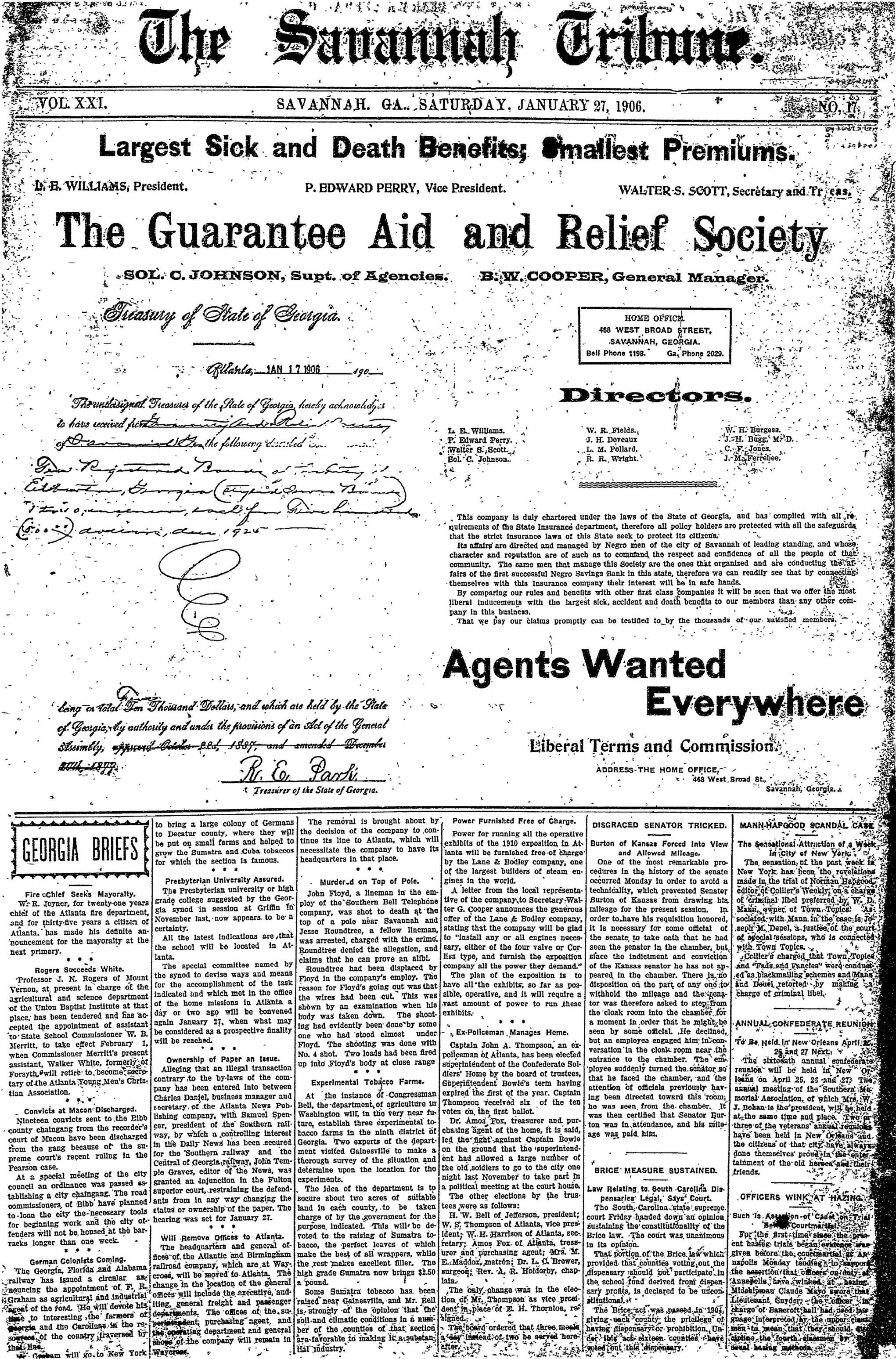
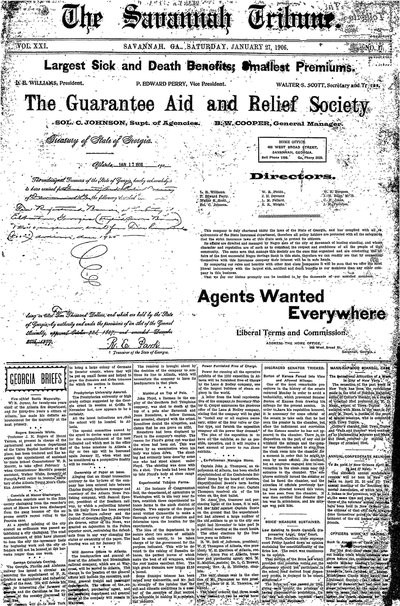
Page text (machine-generated)
SOL. C. JOHNSON, Supt. of Agencies.
being in total Ten Thousand Dollars, and which are held by the State of Georgia, by authority and under the provisions of an Act of the General Assembly, passed October 22d, 1887, and amended December 20th, 1887:
R. E. Parsi
W. R. Joyner, for twenty-one years chief of the Atlanta fire department, and for thirty-five years a citizen of Atlanta, has made his definite announcement for the mayoralty at the next primary.
* * *
Rogera Succeeds White.
Professor J. N. Rogers of Mount Vernon, at present in charge of the agricultural and science department of the Union Baptist Institute at that place, has been tendered and has accepted the appointment of assistant to State School Commissioner W. B. Merritt, to take effect February I, when Commissioner Merritt's present assistant, Walker White, formerly of Forsyth, will retire to become secretary of the Atlanta Young Men's Christian Association.
Convicts at Macon Discharged.
Nineteen convicts sent to the Bibb county chalangang from the recorder's court of Macon have been discharged from the gang because of the supreme court's recent ruling in the Pearson case.
At a special meeting of the city council an ordinance was passed establishing a city chaingang. The road commissioners, of Bibb have planned to loan the city the necessary tools for beginning work and the city offenders will not be housed at the barracks longer than one week.
German Colonists Coming-
German Colonists Coming. The Georgia, Florida and Alabama railway has issued a circular an nouncing the appointment of F. R. Graham as agricultural and industrial agent of the road. He will devote his time to interesting the farmers of Georgia and the Carolinas in the resources of the country traversed by that line.
Treasurer of the State of Georgia.
to bring a large colony of Germans to Decatur county, where they will be put on small farms and helped to grow the Sumatra and Cuba tobaccos for which the section is famous.
Presbyterian University Assured.
Presbyterian University Assured.
The Presbyterian university or high grade college suggested by the Georgia synod in session at Griffin in November last, now appears to be a certainty.
All the latest indications are, that the school will be located in Atlanta.
The special committee named by the synod to devise ways and means for the accomplishment of the task indicated and which met in the office of the home missions in Atlanta a day or two ago will be convened again January 27, when what may be considered as a prospective finality will be reached.
Ownership of Paper an issue. Alleging that an illegal transaction contrary to the by-laws of the company has been entered into between Charles Daniel, business manager and secretary of the Atlanta News Publishing company, with Samuel Spencer, president of the Southern railway, by which a controlling interest in the Daily News has been secured for the Southern railway and the Central of Georgia, railway, John Temple Graves, editor of the News, was granted an injunction in the Fulton superior court, restraining the defendants from in any way changing the status or ownership of the paper. The hearing was set for January 27.
Will Remove Offices to Atlanta. The headquarters and general offices of the Atlantic and Birmingham railroad company, which are at Waycross, will be moved to Atlanta. The change in the location of the general offices will include the executive, auditing, general freight and passenger departments. The offices of the superintendent, purchasing agent, and the operating department and general stores of the company will remain in Waycross.
```markdown
```
P. EDWARD PERRY, Vice President.
The removal is brought about by the decision of the company to continue its line to Atlanta, which will necessitate the company to have its headquarters in that place.
John Floyd, a lineman in the employ of the Southern Bell Telephone company, was shot to death at the top of a pole near Savannah and Jesse Roundtree, a fellow lineman, was arrested, charged with the crime. Roundtree denied the allegation, and claims that he can prove an alibi. Roundtree had been displaced by Floyd in the company's employ. The reason for Floyd's going out was that the wires had been cut. This was shown by an examination when his body was taken down. The shooting had evidently been done by some one who had stood almost under Floyd. The shooting was done with No. 4 shot. Two loads had been fired up into Floyd's body at close range
Experimental Tobacco Farms.
At the instance of Congressman Bell, the department, of agriculture in Washington will, in the very near future, establish three experimental tobacco farms in the ninth district of Georgia. Two experts of the department visited Gainesville to make a thorough survey of the situation and determine upon the location for the experiments.
The idea of the department is to secure about two acres of suitable land in each county, to be taken charge of by the government for the purpose indicated. This will be devoted to the raising of Sumatra tobacco, the perfect leaves of which make the best of all wrappers, while the rest makes excellent filler. The high grade Sumatra now brings $2.50 a pound. Some Sumatra tobacco has been raised near Galnesville, and Mr. Bell is, strongly of the opinion that the soil and climatic conditions in a number of the counties of that section are favorable to making it a substantial industry.
* * *
This company is duly chartered under the laws of the State of Georgia, and has complied with all requirements of the State Insurance department, therefore all policy holders are protected with all the safeguards that the strict insurance laws of this State seek to protect its citizens.
Its affairs are directed and managed by Negro men of the city of Savannah of leading standing, and whose character and reputation are of such as to command the respect and confidence of all the people of that community. The same men that manage this Society are the ones that organized and are conducting the affairs of the first successful Negro Savings Bank in this state, therefore we can readily see that by connecting themselves with this Insurance company their interest will be in safe hands.
By comparing our rules and benefits with other first class companies it will be seen that we offer the most liberal inducements with the largest sick, accident and death benefits to our members than any other company in this business.
That we pay our claims promptly can be testified to by the thousands of our satisfied members.
Power Furnished Free of Charge.
Power for running all the operative exhibits of the 1910 exposition in Atlanta will be furnished free of charge by the Lane & Bodley company, one of the largest builders of steam engines in the world.
A letter from the local representative of the company to Secretary Walter G. Cooper announces the generous offer of the Lane & Bodley company, stating that the company will be glad to "install any or all engines necessary, either of the four valve or Corliss type, and furnish the exposition company all the power they demand."
The plan of the exposition is to have all the exhibits, so far as possible, operative, and it will require a vast amount of power to run these exhibits.
Ex-Pollceman Manages Heme.
Captain John A. Thompson, an expoliceman of Atlanta, has been elected superintendent of the Confederate Soldiers' Home by the board of trustees, Superintendent Bowle's term having expired the first of the year. Captain Thompson received six of the ten votes on the first ballot. Dr. Amos Fox, treasurer and purchasing agent of the home, it is said, led the fight against Captain Bowle on the ground that the superintendent had allowed a large number of the old soldiers to go to the city one night last November to take part in a political meeting at the court house. The other elections by the trustees were as follows:
H. W. Bell of Jefferson, president; W. S. Thompson of Atlanta, vice president; W. H. Harrison of Atlanta, secretary; Amos Fox of Atlanta, treasurer and purchasing agent; Mrs. M. E. Maddox, matron; Dr. L. C. Brewer, surgeon; Rev. A. R. Holderby, chaplain.
The only change was in the election of Mr. Thompson as vice president in place of E. H. Thornton, resigned.
DISGRACED SENATOR TRICKED.
Burton of Kansas Forced Into View and Allowed Milage
One of the most remarkable procedures in the history of the senate occurred Monday in order to avoid a technicality, which prevented Senator Burton of Kansas from drawing his mileage for the present session. In order to have his requisition honored, it is necessary for some official of the senate to take oath that he had seen the senator in the chamber, but since the indictment and conviction of the Kansas senator he has not appeared in the chamber. There is no disposition on the part of any one to withhold the mileage and the senator was therefore asked to step from the cloak room into the chamber for a moment in order that he might be seen by some official. He declined, but an employee engaged him in conversation in the cloak room near the entrance to the chamber. The employee suddenly turned the senator so that he faced the chamber, and the attention of officials previously having been directed toward this room; he was seen from the chamber. It was then certified that Senator Burton was in attendance, and his mileage was paid him.
BRICE MEASURE SUSTAINED.
Law Relating to. South Carolina Dispensaries' Legal. Says' Court.
pensaries Legal, Says Court.
The South Carolina state supreme court Friday handed down an opinion sustaining the constitutionality of the Brice law. The court was unanimous in its opinion.
That portion of the Brice law which provided that counties voting, out the dispensary should not participate. In the school fund derived from dispensary profits, is declared to be unconstitutional.
The Brice act was passed in 1903, giving each county the privilege of having dispensary or prohibition. Under this act sixteen counties have voted out this dispensary.
MANN-HAPGOOD SCANDAL CASE
The sensation of the past week in New York has been the revelations made in the trial of Norman Hapgood editor of Collier's Weekly, on a charge of criminal libel preferred by W. D. Mann, owner of Town Topics. Associated with Mann in the case is Joseph M. Dapel, a Justice of the court of special sessions, who is connected with Town Topics. Collier's charged that Town Topics and "Fads and Pancles" were conducted as blackmailing schemes and Mann and Deuel retorted by making a charge of criminal libel.
ANNUAL CONFEDERATE REUNION
To Be, Held In New Orleans April 26 and 27 Next.
The sixteenth annual confederate reunion will be held in New Orleans on April 25, 26 and 27. The annual meeting of the Southern Memorial Association, of which Mrs. W. J. Bohan is the president, will be held at the same time and place. Two prizes of the veterans' annual reunions have been held in New Orleans and the citizens of that city have always done themselves proud in the entertainment of the old heroes and their friends.
For the first time since the present hasing trials began evidence was given before the courtmartial at Annapolis Monday tending to support the assertion that officers on duty at Annapolis have winked at hasing. Midshipman Claude Mayo swore that Lieutenant Guyder, the officer in charge of Bancroft hall had used language interpreted by the upper classmen to mean that they should stop skipping the fourth classmen by the usual hasing methods.
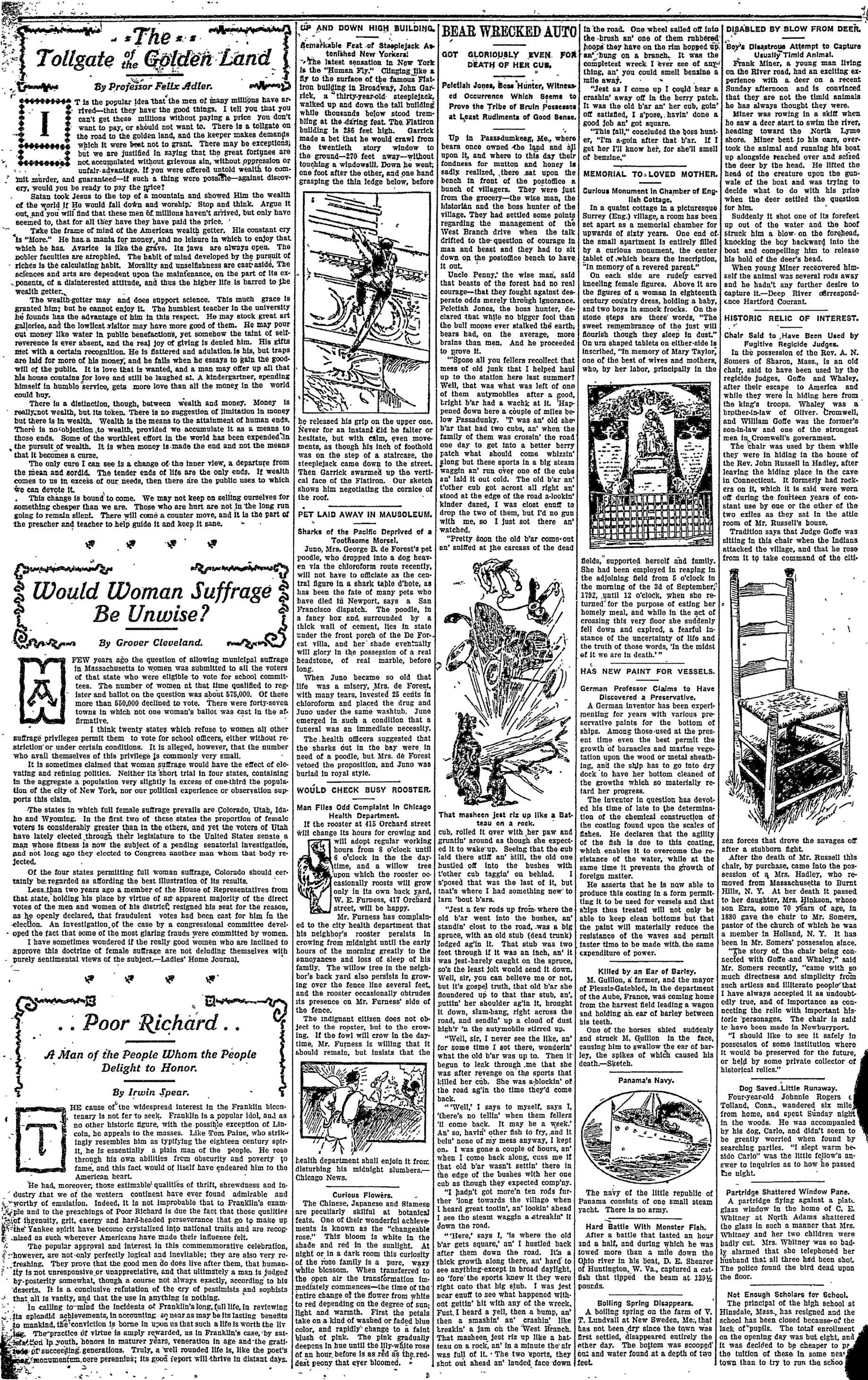
The Tollgate of the Golden Land
By Professor Felix Adler.
It is the popular idea that the men of many millions have arrived—that they have the good things. I tell you that you can't get these millions without paying a price you don't want to pay, or should not want to. There is a tollgate on the road to the golden land, and the keeper makes demands which it were best not to grant. There may be exceptions; but we are justified in saying that the great fortunes are not accumulated without grievous sin, without oppression or unfair-advantage. If you were offered untold wealth to commit murder, and guaranteed—if such a thing were possible—against discov-
mit murder, and guaranteed—if such a thing were possible—against discovery, would you be ready to pay the price?
Satan took Jesus to the top of a mountain and showed Him the wealth of the world if He would fall down and worship. Stop and think. Argue it out, and you will find that these men of millions haven't arrived, but only have seemed to, that for all they have they have paid the price.
Take the frame of mind of the American wealth getter. His constant cry is "More." He has a mania for money, and no leisure in which to enjoy that which he has. Avarice is like the grave. Its jaws are always open. The nobler faculties are atrophied. The habit of mind developed by the pursuit of riches is the calculating habit. Morality and unselfishness are cast aside. The sciences and arts are dependent upon the maintenance, on the part of its exponents, of a disinterested attitude, and thus the higher life is barred to the wealth getter.
The wealth-getter may and does support science. This much grace is granted him; but he cannot enjoy it. The humblest teacher in the university he founds has the advantage of him in this respect. He may stock great art galleries, and the lowliest visitor may have more good of them. He may pour out money like water in public benefactions, yet somehow the taint of self-reverence is ever absent, and the real joy of giving is denied him. His gifts met with a certain recognition. He is flattered and adulation is his, but traps are laid for more of his money, and he falls when he essays to gain the good-will of the public. It is love that is wanted, and a man may offer up all that his house contains for love and still be laughed at. A kindergartner, spending himself in humble service, gets more love than all the money in the world could buy.
There is a distinction, though, between wealth and money. Money is really, not wealth, but its token. There is no suggestion of limitation in money but there is in wealth. Wealth is the means to the attainment of human ends. There is no objection to wealth, provided we accumulate it as a means to those ends. Some of the worthiest effort in the world has been expended in the pursuit of wealth. It is when money is made the end and not the means that it becomes a curse.
The only cure I can see is a change of the inner view, a departure from the mean and sordid. The tender ends of life are the only ends. If wealth comes to us in excess of our needs, then there are the public uses to which we can devote it.
This change is bound to come. We may not keep on selling ourselves for something cheaper than we are. Those who are hurt are not in the long run going to remain silent. There will come a counter move, and it is the part of the preacher and teacher to help guide it and keep it sane.
Would Woman Suffrage Be Unwise?
By Grover Cleveland.
FEW years ago the question of allowing municipal suffrage in Massachusetts to women was submitted to all the voters of that state who were eligible to vote for school committees. The number of women at that time qualified to register and ballot on the question was about 575,000. Of these more than 550,000 declined to vote. There were forty-seven towns in which not one woman's ballot was cast in the affirmative.
FEW years ago the question of allowing municipal suffrage in Massachusetts to women was submitted to all the voters of that state who were eligible to vote for school committees. The number of women at that time qualified to register and ballot on the question was about 575,000. Of these more than 550,000 declined to vote. There were forty-seven towns in which not one woman's ballot was cast in the affirmative.
I think twenty states which refuse to women all other suffrage privileges permit them to vote for school officers, either without restriction or under certain conditions. It is alleged, however, that the number who avail themselves of this privilege is commonly very small.
It is sometimes claimed that woman suffrage would have the effect of elevating and refining politics. Neither its short trial in four states, containing in the aggregate a population very slightly in excess of one-third the population of the city of New York, nor our political experience or observation supports this claim.
The states in which full female suffrage prevails are Colorado, Utah, Idaho and Wyoming. In the first two of these states the proportion of female voters is considerably greater than in the others, and yet the voters of Utah have lately elected through their legislature to the United States senate a man whose fitness is now the subject of a pending senatorial investigation, and not long ago they elected to Congress another man whom that body rejected.
Of the four states permitting full woman suffrage, Colorado should certainly be regarded as affording the best illustration of its results.
Less than two years ago a member of the House of Representatives from that state, holding his place by virtue of an apparent majority of the direct votes of the men and women of his district, resigned his seat for the reason, as he openly declared, that fraudulent votes had been cast for him in the election. An investigation of the case by a congressional committee developed the fact that some of the most glaring frauds were committed by women.
I have sometimes wondered if the really good women who are inclined to approve this doctrine of female suffrage are not deluding themselves with purely sentimental views of the subject.—Ladies' Home Journal.
.. Poor Richard...
A Man of the People Whom the People
Delight to Honor.
By Irwin Spear.
HE cause of the widespread interest in the Franklin bicentenary is not far to seek. Franklin is a popular idol, and as no other historic figure, with the possible exception of Lincoln, he appeals to the masses. Like Tom Paine, who strikingly resembles him as typifying the eighteen century spirit, he is essentially a plain man of the people. He rose through his own abilities from obscurity and poverty to fame, and this fact would of itself have endeared him to the American heart.
HE cause of the widespread interest in the Franklin bicentenary is not far to seek. Franklin is a popular idol, and as no other historic figure, with the possible exception of Lincoln, he appeals to the masses. Like Tom Paine, who strikingly resembles him as typifying the eighteenth century spirit, he is essentially a plain man of the people. He rose through his own abilities from obscurity and poverty to fame, and this fact would of itself have endeared him to the American heart.
He had, moreover, those estimable qualities of thrift, shrewdness and industry that we of the western continent have ever found admirable and worthy of emulation. Indeed, it is not improbable that to Franklin's example and to the preachings of Poor Richard is due the fact that those qualities of ingenuity, grit, energy and hard-headed perseverance that go to make up the Yankee spirit have become crystallized into national traits and are recognized as such wherever Americans have made their influence felt.
The popular approval and interest in this commemorative celebration, however, are not only perfectly logical and inevitable; they are also very refreshing. They prove that the good men do does live after them, that humanity is not unresponsive or unappreciative, and that ultimately a man is judged by posterity somewhat, though a course not always exactly, according to his deserts. It is a conclusive refutation of the cry of pessimists and sophists that all is vanity, and that the use in anything is nothing.
In calling to mind the incidents of Franklin's long, full life, in reviewing its splendid achievements, in accounting so near as may be its lasting benefits to mankind, the conviction is borne in upon us that such a life is worth the living. The practice of virtue is amply rewarded, as in Franklin's case, by satisfaction in youth, honors in maturer years, veneration in age and the gratitude of succeeding generations. Truly, a well rounded life is, like the poet's long monumentum oore perennis; its good report will thrive in distant days.
UP AND DOWN HIGH BUILDING
Remarkable Feat of Steeplejack As
Applied New Yorkers!
The latest sensation in New York is the "Human Fly." Clinging like a fly to the surface of the famous Flatiron building in Broadway, John Garrick, a thirty-year-old steeplejack, walked up and down the tall building while thousands below stood trembling at the daring feat. The Flatiron building is 286 feet high. Garrick made a bet that he would crawl from the twentieth story window to the ground—270 feet away—without touching a windowsill. Down he went, one foot after the other, and one hand grasping the thin edge below, before
6
he released his grip on the upper one. Never for an instant did he falter or hesitate, but with calm, even movements, as though his inch of foothold was on the step of a staircase, the steeplejack came down to the street. Then Garrick swarmed up the vertical face of the Flatiron. Our sketch shows him negotiating the cornice of the roof.
PET LAID AWAY IN MAUSOLEUM.
Sharks of the Pacific Deprived of a Toothsome Morsel.
Juno, Mrs. George B. de Forest's pet poodle, who dropped into a dog heaven via the chloroform route recently, will not have to officlate as the central figure in a shark table d'hote, as has been the fate of many pets who have died in Newport, says a San Francisco dispatch. The poodle, in a fancy box and surrounded by a thick wall of cement, lies in state under the front porch of the De Forest villa, and her shade eventually will glory in the possession of a real headstone, of real marble, before long.
When Juno became so old that life was a misery, Mrs. de Forest, with many tears, invested 25 cents in chloroform and placed the drug and Juno under the same washtub. Juno emerged in such a condition that a funeral was an immediate necessity. The health officers suggested that the sharks out in the bay were in need of a poodle, but Mrs. de Forest vetoed the proposition, and Juno was buried in royal style.
WOULD CHECK BUSY ROOSTER.
Man Files Odd Complaint in Chicago Health Department.
If the rooster at 415 Orchard street will change its hours for crowing and
will adopt regular working hours from 8 o'clock until 6 o'clock in the darttime, and a willow tree upon which the rooster occasionally roosts will grow only in its own back yard, W. E. Furness, 417 Orchard street, will be happy.
will adopt regular working hours from 8 o'clock until 6 o'clock in the the day-time, and a willow tree upon which the rooster occasionally roosts will grow only in its own back yard, W. E. Furness, 417 Orchard street, will be happy. Mr. Furness has complained to the city health department that his neighbor's rooster persists in crowing from midnight until the early hours of the morning greatly to the annoyance and loss of sleep of his family. The willow tree in the neighbor's back yard also persists in growing over the fence line several feet, and the rooster occasionally obtrudes its presence on Mr. Furness' side of the fence.
The indignant citizen does not object to the rooster, but to the crowing. If the fowl will crow in the daytime, Mr. Furness is willing that it should remain, but insists that the health department shall enjoin it from disturbing his midnight slumbers.—Chicago News.
Curious Flowers.
The Chinese, Japanese and Siamese are peculiarly skilful at botanical feats. One of their wonderful achievements is known as the "changeable rose." This bloom is white in the shade and red in the sunlight. At night or in a dark room this curiosity of the rose family is a pure, waxy white blossom. When transferred to the open air the transformation immediately commences—the time of the entire change of the flower from white to red depending on the degree of sunlight and warmth. First the petals take on a kind of washed or faded blue color, and rapidly change to a faint blush of pink. The pink gradually deepens in hue until the lily-white rose of an hour before is as red as the red-dest peony that ever bloomed.
BEAR WRECKED AUTO
Peletlah Jones, Boss Hunter, Witnessed Occurrence Which Seems to Prove the Tribe of Bruin Possesses at Least Rudiments of Good Sense.
Up in Passsdumkeag, Me., where bears once owned the land and all upon it, and where to this day their fondness for mutton and honey is sadly realized, there sat upon the bench in front of the postoffice a bunch of villagers. They were just from the grocery—the wise man, the historian and the boss hunter of the village. They had settled some points regarding the management of the West Branch drive when the talk drifted to the question of courage in man and beast and they had to sit down on the postoffice bench to have it out.
Uncle Penny, the wise man, said that beasts of the forest had no real courage—that they fought against desperate odds merely through ignorance. Peletiah Jones, the boss hunter, declared that while no bigger fool than the bull moose ever stalked the earth; bears had, on the average, more brains than men. And he proceeded to prove it.
"Spose all you fellers recollect that mess of old junk that I helped haul up to the station here last summer? Well, that was what was left of one of them autymobiles after a good, bright b'ar had a wachk at it. Happened down here a couple of miles below Passadunky. "T was an' old she'bar that had two cubs, an' when the family of them was crossin' the road one day to get into a better berry patch what should come whizzin' along but these sports in a big steam waggin an' run over one of the cubs an' laid it out cold. The old b'ar an' t'other cub got acrost all right an' stood at the edge of the road a-lookin' kinder dazed, I was clost enuff to drop the two of them, but I'd no gun with me, so I just sot there an' watched.
"Pretty soon the old b'ar come-out an' sniffed at the carcass of the dead
BULLY
That masheen jest riz up like a Batteau on a rock.
cub, rolled it over with her paw and gruntin' around as though she expected it to wake up. Seeing that the cub laid there stiff an' still, the old one bustled off into the bushes with t'other cub taggin' on behind. I s'posed that was the last of it, but that's where I had something new to larn 'bout b'ars.
"Jest a few rods up from where the old b'ar went into the bushes, an' standin' clost to the road, was a big spruce, with an old stub (dead trunk) lodged ag'in it. That stub was two feet through if it was an inch, an' it was jest-barely caught on the spruce, so's the least folt would send it down. Well, sir, you can believe me or not, but it's gospel truth, that old b'ar she floundered up to that that sturb, an', puttin' her shoulder ag'in it, brought it down, slam-bang, right across the road, and sendin' up a cloud of dust high'r 'n the autymobile stirred up.
"Well, sir, I never see the like, an' for some time I got there, wonderl' what the old b'ar up to. Then it begun to leak through me that she was after revenge on the sports that killed her cub. She was a-blockin' of the road ag'in the time they'd come back.
"Well,' I says to myself, says I, 'there's no tellin' when them fellers 'll come back. It may be a week.' An' so, havli' other fish to fry, and it bein' none of my mess anyway, I kept on. I was gone a couple of hours, an' when I come back along, cuss me if that old b'ar wasn't settin' there in the edge of the bushes with her one cub as though they expected comp'ny.
"I hadn't got more'n ten rods further 'long towards the village when I heard great tootin', an' lookin' ahead I see the steam waggin a streakin' it down the road.
"Here,' says I, 'is where the old b'ar gets square', an' I hustled back after them down the road. It's a thick growth along there, an' hard to see anything-except in broad daylight, so 'fore the sports knew it they were right onto that big stub. I was jest near eneur to see what happened without getin' hit with any of the wreck. Fust. I heard a yell, then a bump, an' then a smashin' an' crashin' like breakin' a jam on the West Branch. That masheen jest riz up like a batteau on a rock, an' in a minute the air was full of it. The two sports, they shot out ahead an' landed face down
In the road. One wheel sailed off into the brush an' one of them rubbered hoops they have on the rim hopped up an' hung on a branch. It was the completest wreck I ever see of anything, an' you could smell benzine a mile away.
"Jest as I come up I could hear a crashin' away off in the berry patch. It was the old b'ar an' her cub, goln off satisfied, i spose, havin' done a good job an' got square.
"This fall," concluded the boss hunter, "I'm a-goin after that b'ar. If I get her I'll know her, for she'll smell of benzine."
MEMORIAL TO.LOVED MOTHER.
Curious Monument In Chamber of Eng-
lish Cottage.
In a quaint cottage in a picturesque Surrey (Eng.) village, a room has been set apart as a memorial chamber for upwards of sixty years. One end of the small apartment is entirely filled by a curious monument, the center tablet of,which bears the inscription, "In memory of a revered parent." On each side are rudely carved knelling female figures. Above it are the figures of a woman in eighteenth century country dress, holding a baby, and two boys in smock frocks. On the stone steps are these words, "The sweet remembrance of the just will flourish though they sleep in dust." On urn shaped tablets on either side is inscribed, "In memory of Mary Taylor, one of the best of wives and mothers, who, by her labor, principally in the
THE STATUE OF MARY OF GREAT BURG
fields, supported herself and family. She had been employed in reaping in the adjoining field from 5 o'clock in the morning of the 3d of September; 1792, until 12 o'clock, when she returned' for the purpose of eating her homely meal, and while in the act of crossing this very floor she suddenly fell down and expired, a fearful instance of the uncertainty of life and the truth of those words, 'In the midst of it we are in death.'"
HAS NEW PAINT FOR VESSELS.
German Professor Claims to Have Discovered a Preservative
A German inventor has been experimenting for years with various preservative paints for the bottom of ships. Among those used at the present time even the best permit the growth of barnacles and marine vegetation upon the wood or metal sheathing, and the ship has to go into dry dock to have her bottom cleaned of the growths which so materially retard her progress.
The inventor in question has devoted his time of late to the determination of the chemical construction of the coating found upon the scales of fishes. He declares that the agility of the fish is due to this coating, which enables it to overcome the resistance of the water, while at the same time it prevents the growth of foreign matter.
He asserts that he is now able to produce this coating in a form permitting it to be used for vessels and that ships thus treated will not only be able to keep clean bottoms but that the paint will materially reduce the resistance of the waves and permit faster time to be made with the same expenditure of power.
Killed by an Ear of Barley.
M. Guillon, a farmer, and the mayor of Plessis-Gatebled, in the department of the Aube, France, was coming home from the harvest field leading a wagon and holding an ear of barley between his teeth. One of the horses shiled suddenly and struck M. Guillon in the face, causing him to swallow the ear of barley, the spikes of which caused his death—Sketch.
Panama's Navy.
The navy of the little republic of Panama consists of one small steam yacht. There is no army.
Hard Battle With Monster Flush.
After a battle that lasted an hour and a half, and during which he was towed more than a mile down the Ohio river in his boat, D. E. Shearer of Huntington, W. Va., captured a catfish that tipped the beam at 139½ pounds.
Bolling Spring Disappears:
A boiling spring on the farm of V. T. Lundvall at New Sweden, Me., that has not been dry since the town was first settled, disappeared entirely the other day. The bottom was scooped out and water found at a depth of two feet.
DISABLED BY BLOW FROM DEER.
Boy's Disastrous Attempt to Captura Usually Timid Animal.
Frank Miner, a young man living on the River road, had an exciting experience with a deer on a recent Sunday afternoon and is convinced that they are not the timid animals he has always thought they were.
Miner was rowing in a skiff when he saw a deer start to swim the river, heading toward the North Lyme shore. Miner bent to his oars, overtook the animal and running his boat up alongside reached over and seized the deer by the head. He lifted the head of the creature upon the gunwale of the boat and was trying to decide what to do with his prize when the deer settled the question for him.
Suddenly it shot one of its forefeet up out of the water and the hoof struck him a blow on the forehead, knocking the boy backward into the boat and compelling him to release his hold of the deer's head. When young Miner recovered himself the animal was several rods away and he hadn't any further desire to capture it.—Deep River correspondence Hartford Courant.
HISTORIC RELIC OF INTEREST.
Chair Sald to, Have Been Used by Fultive Reacute Judges.
In the possession of the Rev. A. N. Somers of Sharon, Mass., is an old chair, said to have been used by the regicide judges, Goffe and Whaley, after their escape to America and while they were in hiding here from the king's troops. Whaley was a brother-in-law of Oliver. Cromwell, and William Goffe was the former's son-in-law and one of the strongest men in Cromwell's government. The chair was used by them while they were in hiding in the house of the Rev. John Russell in Hadley, after leaving the hiding place in the cave in Connecticut. It formerly had rockers on it, which it is said were worn off during the fourteen years of constant use by one or the other of the two exiles as they sat in the attic room of Mr. Russell's house.
Tradition says that Judge Goffe was sitting in this chair when the Indians attacked the village, and that he rose from it to take command of the clit-
C. C. C.
zen forces that drove the savages off after a stubborn fight.
After the death of Mr. Russell this chair, by purchase, came into the possession of a Mrs. Hadley, who removed from Massachusetts to Burnt Hills, N. Y. At her death it passed to her daughter, Mrs. Hinkson, whose son Ezra, some 70 years of age, in 1880 gave the chair to Mr. Somers, pastor of the church of which he was a member in Holland, N. Y. It has been in Mr. Somers' possession since.
"The story of the chair being connected with Goffe and Whaley," said Mr. Somers recently, "came with so much directness and simplicity from such artless and illiterate people that I have always accepted it as undoubtedly true, and of importance as connecting the relic with important historic personages. The chair is said to have been made in Newburyport.
"I should like to see it safely in possession of some institution where it would be preserved for the future, or held by some private collector of historical relics."
Dog Saved.Little Runaway.
Four-year-old Johnnie Rogers of Tolland, Conn., wandered six miles from home, and spent Sunday night in the woods. He was accompanied by his dog, Carlo, and didn't seem to be greatly worried when found by searching parties. "I slept warm beside Carlo" was the little fellow's answer to inquiries as to how he passed the night.
Partridge Shattered Window Pane.
A partridge flying against a plate glass window in the home of C. E. Whitney at North Adams shattered the glass in such a manner that Mrs. Whitney and her two children were badly cut. Mrs. Whitney was so badly alarmed that she telephoned her husband that all three had been shot. The police found the bird dead upon the floor.
Not Enough Scholars for School.
The principal of the high school at Hinsdale, Mass., has resigned and the school has been closed because of the lack of pupils. The total enrollment on the opening day was but eight, and it was decided to be cheaper to pay the tuition of these in some nearby town than to try to run the school
NOCTURNE,
st
" Up to her chamber window
. , A elight wire treills ae
And up:this Komeo's ladder
Clambers a bold white rose,
T lounge tn the Iex'shadows
I sce the lady jean,”
Unelasping ker siixen girdle,
‘The curtain folds between.
“WAS IT. |
» HER.
MOTHER?
Col. Trévethick heard them both,
and they smote him'with a new senso
“of loss and pain. He had scarcely
“thought of his little girl since his wife
-died, fise hours’ kefore—died at the
very instant when she was kissing him
Bocd-by, taking with her into the far
heavens the warm breath of his hu-
man love. He had loved her as, per-
haps, men seldom Jove, from the first
hour of their first meeting.
“There is Maud Harrison,” some one
had said, and fie"had turned to look,
and met tho Inabcent gaze of two
frank, gentle, very beautiful brown
eyes. “Brightest eyes that ever have
shone,” he said to himself. Their
owner had other charms besides—a fair
and lovely face, round which golden
hair made’a soft, bright halo; a lithe,
girlish figure; a manner of unaffect-
ed cordiallty blent with a certain maid-
enly reserve, and which seemed to kim
perfection.» He loved her then and’
there. His wooing was short, and his
wedding hasty, but he had never re-
pented his ‘haste; never known an
unhappy hour from the moment he
brought his wife home, nine years ago,
till these last few days, in which his
Jove and care could not prevent ber
from going away from him, to another
home where he could not follow her—
the home where she had gone row, far
beyond his search.”
She was a good little creature, znd
she did not rebel even at the summons
to go out of her earthly Eden in search
of the paradise of God. She longed in-
deed to live, for she loved her own,
and she cculd have resigned herself to
die more villingly but for her hus-|
band's passion of woe. That very aay
she had said to him, as ke knelt beside
her = ~
“Do not grieve so, darling. Iam not
going £0 far but that I shall come hack
to you every day. Something tells me
that I shall be always near you and
Maudie. You cannot call, or she cry.
out that I shall hear you, I krow
that when she needs, or most wants
me, I shall be close beside you.”
And, with that very last kiss, when
her breath was failing, she bad whis-
pered:
“I shalt not go sosfar as you-think.”
_Novw, when he heard the low cail of
bis little Maudie, and her smothered
sobbing, he remembered the words of
his dead darling. Did che, indeed, heer
Maudie ery, and was it possibly troun-
ling her? He got up and went into thé
iittle rcom where Maudie had slept |
alone ever since her sixth birthday, a
couple. of months ago. He bent over
her low bed, and asked tenderly:
“What is it, darling?" =
A Ilttle, nightgowned figure,lifted it-
self up-and two little arms clung round
his neck. .
“Bessie put me to bed wiihout tak-
ing me to mamms. Mamma did not
kiss me good-night, and J want she
should? ob, I want she should. Bessie
wouldn't carry me to see her; and I
want you to, Bessie sald mamma nev-
er would kiss me again; but that isn't
true, is it? You know I’ve heard
mamma say Bessie wasn't always
‘soonsible.”” 7
Col. Trevethick considered for a mo-
mert what he skould say to his chill
—how he could make her uaderstand
the cyeat, sad, awful, yet triumphant
mystery which had come to pass that
day under their reef—tke great loss,
ind yet the greatshope that hallowed
I. -
_ She was such a baby it seemed hard
to choose his words. Must he tell ber
phat her mamma would never Kiss ker
aezin? But how qid he know that?
When the dear Lord promised “all
things” to those who loved Him, did it
pot include the joining of broken
threads, the up-springiig of deed
popes, the finding one's own again,
somewhere? He thought it must, for
what a word without meaning heaven
vould. be to him if his own Maud
were not there! He temporized a lit-
12. =
“She canot kiss you now, my darl- |
ing, but you shall Kiss her.”
‘So he lifted the little white figure in |
nis arms, holding it close, as one who |.
aust be father and mother both, row, |.
nd cartied his little one across the |.
1all to the room where her dead moth- |
r lay, Ob, so fast asleepssnow, with |
| look like a smile frozen upon her |’
air, sweet face, He held Maudie down |
yy, the pillow, on-which her motier's |
ead rested, but that did not satisfy |,
er. :
put me on the bed, please, papa. J
et on the bed every night and kiss]
er, since slie's been dll.” ;
ee neere eee re ae,
> ro
‘She smltrs on her white-rome lover
_ Sho reaches. out her band
And helps him at the window—
oo 'T'ses fe where I stand? 7
o her scarlet Tip abe holds him, ~
my bss Kisses Be many a imo
Ah. me! It was be that won ber
Tecause ke dared to climb! ~—
\ Thomas Basléy Aldrich.
By
Loutse Chandler Moulton.
SUN
“call dead. I do not understand {t-
;Ro one understands it; but it comes
|oze day, to everykody, and it is God's
(will, Your mamma cannot speak tc
‘us any more, and soon she will Lé
| gone out of our sight; but she tru
believed that shé would always be abl:
to see your face and hear your yolce
as when sie was here.”
“She is here. Won't she be here al-
ways?” the little girl asked, growing
cold With the shadow of an awful fear.
“No, dear, she will not be here long.
Ina few days this dear, white tace will
be put away, underneath the grass and
the flowers; but the real mamma, who
loves little Maudie, will not be buried,
She will be somewhere, I truly believe,
where she can see and hear her littl:
girl.” .
For a moment the child slid again
from big arms, and nestled close
agalost the cold breast, Itissed the un-
moving lips. Then.she sald:
“Good-by, this mamma, who can't
see; and good-night, other mamma,
that hears Maudie,"
— Col. Trevethick marveled, Had he,
Indeed, succeeded in making this lit-
tle creature understand; or had some
one he could not see spoken to her
words of sweet mother wisdom?
He carried her then, and laid her in
her Jittle bed, and went back to bis
‘own loneliness; but half an hour af-
terward he heard the small voice cali-
ig, “Papa, papa,” and again he went
to her, and the little arms came up
around his neck, and held him fast.
“Can't I go, too, papa? It you ask
God, won't He let me? Because I did
so love my mamma.” :
‘That aftersooa Col. Trevethick had
felt as if he had nothing at all left m
this world; but now he realized how
much emptier still his home might be
if he lost out of it this child who was
so like ber mother.
“Mamma would not want you to
come,” he sald, passionately. “She has-
all heaven, and I onlyyyou—only you,
little Maudie, in ll the warld. Mamma
wants you to stay with me.”
After that she was quiet; and when
he looked in at ker an hour later, she
was sound asleep with one little hand
like crushed white rose under the red
rose of her flushed: cheels,
She never asked for her mother ater
that night; but her father wes sure
she never forgot her. She was the
strangest, gravest little creature. She
never made any noise, even at her
play; and she never did‘any of the
things for which her mother had Geen
accustomed to reprove her. The
trouble was that she was too perfect—
(here was something unnatural about
it Which frightened Col. Trevethick.
He would have keen glad if she had
been naughty sometimes like other
children. He longed to have her tease.
him—to see In her some spirit of
azughtiness or contradiction; but he
sayy none. She’ grew tall quite. fast,
ut she was very thin—a little, white
wraith of a creature, who looked as
if she had been made out of snow, and
might melt away as soon.
It was a good thing for Col. Treve-
hick, né doubt, that he had her to at-
end, and to be anxlos about, It
kept him from surrendering himseit
0 his own grief.
Nearly two years went on, and all the
ime, the little girl became more and
more frail; until, at last, when she
rad just passed her eighth birthday,
she was taken very ill, Her illness
eemed a sort of low, nervous fever,
nd she grew “dally more feeble. A
kilful nurse camel to share with, Bes-
fe the task of attending her, and her
ather was seldom far away. Half the
lay he would be sitting in her room,
ind half a dozen times in the night he
rould steal im to watch her breathing.
Ore afternoon, as he sat by her bed,
he Icoked up at him with a sad, tender
00k, ye old for her years—but then
II her words and ways were too cld
or her years. ‘
“Papa,” she sald, “I would’get well
{I could, to please you, I should get
yell, I know, if 1 had mamma to nurse
xe. Don't you know how she used,
f my head ached, to put her hand on
t and make the pain stop?”
A sudden mist of tears came between
is eyes and the Nttle face looking
Wat him. She had not spoken before
ff her mother fdr so many months,
nd yet how well she remembered. In-
tantly his wife's words, that last day,
ame beck to his memory. She had
aid: “I know that when Maudie needs
ne most, or you most want me, I shall
e there beside you.”
(eer erer i eee etn Raa aa en aa eet cea Seana
this red ray that touched his face the
frst hint of the rising. sun? He
spring up‘quickly. The whole night
had indeed passed, and he had not Seer
Maudie, Ho hurried into a dressing
gown and went to her room. He ex-
Fected to find the nurse there, but,
instead, Bessie sat beside the tabic
just where he had left her the night
before, but sound asleep. Evidently
she must have been asleep for hours,
and hati not called the nurse, who had
in her turn—they were all tired
enough, Heaven knows, But, mean
time, of Matdfe? What harm had come
to her, alone, unattended?
He drew aside the curtains of her
little bed and looked in, Surely this
was not tke Maud he had left the night
before, so pale and wern upon her pil-
lows: A face looked up at him bright
as the new day. A soft, healthy color
was in the cheeks, and the Nps were
red‘as the heart of some warin, crim-
son rose.
“I knew I should be weil If she tend-
ed me,” a voice cried, gayer and ‘glad
der than he had heard from her lips:in
two years,
‘What did tie chia mean? Had sho
gone mad? He controlled himself and
asked: z
“Who tended you, my child? I found
Bessie sound asleep.”
“Yes, mamma made her sleep, and
you, and nursé, She sent all of you
the dreams you like best; and all night
lang she sat here beside my bed, with
her hand on my head just as She used
to put it long ago. She was all tn
white, and her soft, golden hair fet!
about her shoulders, and her eyes were
very, very bright, and her lips when
she kilssed me,'seemed somehow to melt
savway.” ,
~ "So you, too, dreamed about mam-
ma, darling?” , 2
“No, indeed, papa, I did not dream,
Mamma sat there’ all night long, with
her hand upon’my head. Sometimes I
slept, but more often I woke up to look
at her; and all the time she sat theze,
and did pot tire, untll the first sun-.
snine came In at the windows; , aad
then she kissed me and went away. I
did not see her go. Perhaps I shut
my eyesa moment. Then I lvoked and
she was gone, and then I heard you
coming in, She sald she was with nie
every day, but she couldn’t have come
to me fixe this if I hadi't needed her
so very, very much. And she wanted
6 make me well, because you woufd
grieve for me if I went to her; and I
was to be very good, and-tend you, aud
make you comfortabie; and I must
Taugh, and make you laugh, for laugh-
ter was good, and the reason I got ill |
was because I had been scrry so long,
and had not laughed at all, And I was
not to be sorry after her any more,
because she was very happy, and noth-
ing grieved her except when she saw
you and me mourning for her, and not
knowing ‘that she was waiting close
beside us.” i
“Was it her mother?—can it be it
was the child’s mother?” the father
cried, uttering his thought aloxd, un-
consciously.
“Of course ft was mamma; and she
has made me well. See if Dr. Halo
dees not tell you I am well.”
, Two hours afterward Dr. Hale came.
He stood for a few moments beside the
the little bed. He looked in the
child's gldd eyes; he counted the
throbs of her pulse, he made her put
out her healthy little tongue, Then he
turned to her father.
“Trevethick,” he sald, “can you
swear that this is the same little girl
I left here last night? If the days of
miracles were not gone, I should say
that one had been wrought here. I left,
[ thought, a very sick Uttle person,
about whom I was anxfous enough, cer-
tainly, to make this my first call this
morning, and I find my small patlent
so well that Ishall only keep her in
bed a day or two longer, for form's |
sake.”
“Perhaps It 1s 3 miracle,” Cols Tre-
vethlek sald, smiling. But he did not
explain. There are some experiences
00 marvelous for belief, and too sacred
for doubt cr question, and that was
one of them.
Two days afterward little Mandie
went ddwn to tea. She wore a fresh
shite gown, with lovely blue ribbons,
nd also looked as much like a little
angel in festal attire as a human child
an be expected to lock. But she did
not take her usual seat. She sat down,
nstead, behind the teapot, where Bes-
fe usualy stood to pour out the tea.
“Hadn't Bessie better do that?" papa
.sked, as he saw the little hand close
A King’s Punctuality.
All ae agree in the abstract that
“punctuality is the soul of business,”
but few act up to the maxim with the
strictness of the King of the Bel-
gians. Wherever or however he may
travel, whether the visit be of busi-
ness, pleasure, or ceremony, he is
punctual, not only to the hour, but ta
the minute—it might almost be. said
to the second. And yet his majesty
is never seen to consult a watch. But
his familiars know that his habit of
passing his ‘hand along his flowing
beard #8 only a device for glancing at
a smail watch which he wears fasten-
ed to his wrist—London Globe.
‘The Hindoo priests in India have re
markable memories.
Pyeresting
A 0
ee D 2 7
Poona)
" With the wearing cf wiater wolght
vconts over white silk and lngerle
blouses comes the necestity for some
sort of slip that will protect this
blouse. | 3 =
For very cold mortals there's ,the
eleverest sort of a knitted blouse cov-
er, made in some way thaf rids It of
any, festering down the front; leaves
it instead, to cross so that there's a
double thickness across the chest, and
‘lets the two-ends button on each
shoulder. Being Knitted with firm,
even stitches, it béars repeated wash-
ings—a very necessary requisite.
Another sort Is of silk—a heavy
quelity of china silk fs thg/best for the
purpose—and is made exeetly Ike a
shirt watst, only loser and with bjseer
collar,and cufs.. Narrow ribbons rua
through collar, cuffs and belt, and’'tle,
pulling tho collar well up until ft
covers the collar of the bloyse and the
eufis well below the blouse cuffs,
Tt looks like a elmple lltle shirt
wafst when it {s on, and slips off when
you get to your journey’s end, leaving
you as fresh and dainty 2s when you
started—which is its object, and it
washes even better than the knittd
cover,
Parislan Millinery. .
As wes expected flowers grow in
favor as the scason advances, A pic:
ture hat covered with moleskin-gray
velvet, with drapery of satin around
the crown drawn through a dull sil-
ver buckle, is trimmed with yellow
velvet chrysanthemums and a gray
feather sweeping ‘back over the turn-
up of the brim. 4
Tricorner hats and toques must still
be numbered as fashionable shapes.
One of the former, which I particu-
Jarly fancled, wes covered with pastel
blue watered silk and lined with black
velvet folded over the edge so as to
ferm an inch wider bortler to the
blue, Folds of soft taffeta ribbon to
match the moire encircle the low
dome crown and are fastened on the
side by_a rosette, Tie hat rests on x
bandeatf to correspond. In the indent
of the brim on the right side are
fastened twa black ostrich tips.,
In toques the. three-cornered effects
are less acceninated. I was shown
one for evening wear mate of a new
material—fine gray netting threaded
with silver spangies. Tals {s “trim-
med with two wings covered with
spangles arrangedl like: fishes’ scales.
Another is composed of folds of gray-
green velvet alternating with bands
ot chenille braid of. the 2sme, color.—
The Millinery Trade Review.
Decorated Window.
A wipdow garden of climbing vines
ts a very pretty effect for a living
room window, The box is made the
length of a window sill, elght inches
wide and seven inches deep, Inside
measurement. It is to be lined with
zine and provided with two or three
outlets to drain the surplus moisture.
‘The box gan be palpated any cesired
color or covered with byrlap in some
desirable shade. The nail heads all
around the edges are only imitation
| and are of lead beaten out at the edges
to give the effect of hand wrought
nails. There cre two ideas for climb-
ing vines. Onc is to attach Ilnen
twine from the edge of the box to the
edge of a ledge or shelf four inches
wide placed ovér the top of the window
casing;and supported with brackets at
the ends. Another cifect, where the
lower box is not desired, is to arrange
square boRes at both cads of the win-
dows, making them fast and support-
Ing them with brackéts. Strings are
jmade fest.from the front of the box
‘to the edge of the shelf, and light vines
can be arranged partly to screen the
‘upper part of the Window.
‘The little boxes should be lined with
zinc, perferably independent linings
that can be lifted out if necessary. A’
drain fube should be soldered to the
bottom and passed through a hole in
the wooden box. It fs not a good plan
to put earth in a wooden box for in-
door purposes, for'it swells and decays
the wood and it 1s not healthy. Al-
ways use a lining or individual pots
in the Lox. .
“\Secret of Happiness When Married
There is no doubt that there is far
too great a tendency on the part of
women to let marriage be the end, in-
stead of only the beginning, of a new
chapter in the book of personal ex-
perlence. A man of 45 or 40 fs a very
Gifferent being froin the same man at
95. He has a much wider .outlook
‘upon life, different ideas, thoughts
and ambitiods. An ordinary women
has quite as much intellectual ability,
power of observation and deduction
from the facts of life (especially with
a Busband’s more logical judgment to
aid in forming her own) end a far
greater amount of insight and Intul-
tive perception, and there 1s abso-
lutely no reascn why she should not
grow and expand mentally as well a3
physically in the same interval of time
as much as the man, or almost as
much: yefnothing surprises one more
than the number of middle-aged mat-
rons who, mentally, ceased growing
when they’ entered upon married life.
Taoy hove acquired a certain amount
of I:nowledge and housewifery skill,
founded on experience and practice,
which they did not rosses when they
married, but practically their minds,
inteHects,/interests and ideas aro no
more mature, no decper np wider than
were those of the girl of 20 or there-
about who blithely embarked upon
a Mfelong comradeship with the man
she loved. I3 it any wonder "that In
the course of years, with the differ
ence between them ever widening and
widening, they should drift apart?
There is one universal truth which
‘women are far too apt to forget or
ignore, (at any rate, when young—
afterwards, when they lave realized
the truth of this, it is nine cases out
of ten too late to be of any use’, but
which is the keynote*of happiness in.
married Hfe, It,is that comradeship
that Is the only foundation for a hap-
py marriage, and how can two people
remain corarades the mind of one’ of
whom remains statfonary while that
of the other evolves and develops
through «years of Ife experience.
thought and contact with “her
minds?—New Haven Register.
Women as Workers.
“The study of women In industry 1s
a study of disabilities,” sald John
Martin before the women’s conference
of the Society for Ethical Culture.
“They ned more than men the strength
that comes from combination, nad yet
they are unfitted by the heritage of
agés of isolation for unjted effort.”
“Sian has been for centuries the
fighting animal,” proceeded Mfr. Mar-
tin, “Women are less apt at warfare
and self-assertion. They are placed at
a disadvantage by physical disabilitfes,
and they are fatally handicapped by
the fact that so many of their num-
ber do not work for a full living, or ex-
pect to work only temporarily.
“If men need the combination and
Jegislation, sti!l more do-women. It
men require outside help and sym-
pathy, still more do women. If men
have found by centuries of ‘experience
That alone they are helpless, still more
helpless is the woman who is forced
to bargain individually with an em-
ployer.
~ "Some of you women of leisure may
Wonder why these women are willing
to submit to these conditions rather
than come intp your ‘lovely’ homes,
where they would have good wages
and every comfort, but even if the
conditions in your komes were as
idyllic as they are sonretimes repre-
sented, the working woman has a
right to choose for herself, and if she
chooses the factory it is our duty to
see that its conditions are made as
tolerable as possible for her, The
country hes an interest in her well-
belng, because it Is the well-being of
the next generation. It ts far more {m-
portant to the country that its work-
Ing women should not be ground down
like beasts of burden than that their
employerf should be allowed to roll up
enormous profits. We should lift them
up, and not conseft to the stultifica-
tion of their intelligence and character
by their belng treated like stocks and
stones~ordered to™ accept whatever
conditions their employers choose tc
make, or get out into the street and’
starve.” ® .
Mr. Martin spoke only of ‘women
in the lower grades of industry, but
the others, he said, were not free
from disabilities, even Hetty Green
being excluded from-the “trade unfon
of high finance, the New York Stock
Exchange.”
Mr. Martin was followed by Miss
Gertrude Barnum, who told something
about the strike of the Troy sterchers,
which, after seven months has not yet
been settled.—New York Tribune.
Fashion Notes,
Light material, voile, cashmere, hen-
rietta, eollenne, and similar fabrics
are used.
One sees a great’ many white ano
biscuit colored coats for evening and
carriage wear. = * . :
‘The princess skirt is another device
for outlining the figure without inter-
Tuption of a waist line,
‘ A new green called Empire, a shade
between leaf and emerald, appears in
several new carriage coats. «
‘The ‘corselet skirt with bretelles or
shoulder straps and no jeeket at all
fs being worn a great deal for at-home
gowns, - ~
A charming Directotre-Empite coat
in deep claret red had g, fitted walst
ending uader the arms in a stitched
telt, which dipped in the front.
‘This {s a great year for the separate
coat. The Empire style hes the lead,
and it should be polnted out that
many coats called -Directoire are
really Empire models,
A charming Emplre coat of light
brown cloth had the waist outlined
with a,band of the cloth tucked in
very fine tucks pressed fiat and Inset
in the cloth of the cot. 7
oe a * fen ar
THE FIRESIDE’ rternanty
Ah me, how frequently I pant ee
To be a stately elephant!” 2 AN
With skin 80 ‘thick and strength so greas’
die scorns the puny tricks of Tate. Yt
‘The while bls shoulders weil may beat ee
A really nntold wale of care. * tw ty]
Ab were The, I wifarer 7
FT'd bd? a wodel honsoholder f % ;
‘TIS possible, T grant you that, ya
Herts not sulted to a fat: - an
Yet you'll admit at once that he
Is balided for economy.” ose
Tle_zeed not stoop to pick things up p+ +
He wants ao valet, cook. or mald;) | -
Hs Faad is oon and ore and cup, *.
And een 4 straw fur lemozade, *s
And when the Icebox heard has shrank
‘To puas'eice in fourth oor feats,»
‘le takes a shower dath frovahts traak” i
_ And sits a-fzaciag with bis ears,
‘Or wien ihe days are wintry ebit., *
And wladews must the acex luce, *
He Itayes bs nose azross the sil, ~
‘Wille folss Lelow prepare their feed.
‘
Show me the ran ‘rho would not raat i
‘To be ¢ gentle eleptont! seg
—Durgess Johnson, In Marpes's Mayarins =f
FUNNY SIDE OF LIFE}
==
Dr. Probe—it misht be wise for you
to call in a specialist. Witherly—Then,
for your sake, doctor, you'd Letter send
dn your bill first.—Life. %
“Promige me, Jack, you will not-go
to the dogs just because I have re-
fused you.” “Gh, pshaw, of course
not.” “You mean thing!”—Life.
Commuter—How long will It take the
village hose company to get here? Na-
tlve—Wa-al, they usually gits around
a feetle arter the insurance adjuster
does.—Puck. +
“You won't be able to enjoy the
seme luxuries after you're married.”
“Why rot? I’m able to aford them.”
“Oh yes. I just said you wouldn't be
able to enjoy them."—Judge.
Bacoa—Wkat do you think of the
Insurance investigation so far? Tg-
bert—Why, I think it has proved that
Al Adams was not the real policy
king, after all!—Yonkers Statesmaa,
Hamfatt—Did you have a good part
in “Blot on the 'Scutcheon?” Junius—
Yes, indeed, I played the title role.
Hamfatt=The ——? Junius—¥es,. I
was the blot—Cleveland Pidin Dealer,
Little Sister—Ob, mamma, Georgle
has just upset the tea-table an’ brok-
en my dolly an’ all your-nice dishes,
Little Brother (badly — frightened)—
Yes, mamma, an’ let’s be sorry, but
‘don’t let's be mad!"—Harpers Bazar.
His, Contribution—Why don't you
contribate something to the cause of
reform? “Well” answered Senetor
Corghum, “it has been said that I have
already done as much as most men to
make reform ‘necessary.”—Washington
Star, . .
“What will you say when your gon-
stituents ask you for an explanation?”
“I don't know,” answered Senator.
Sorghum. “There's no use of worrying,
about what 1 am going to cay. They
won't bellevo it anyhow:”—Washing-
ton Star. : =
Naggus—Borus, that last story of:
yours struck me as being more realls~
tic and trug ‘to life than any you havo"
written for a long time. Berus (highly
flattered)—Really? Naggus—Yes; it
was so Infernally commonplace —Chic- ,
ago Tribune. z
“Yes,” said the veteran of '61,. “Col.
Blank was the coolest man in battle
I ever saw, but one day he lost his’
head,” “How was that?” queried the
man who was posing as the audience.
“A cannon ball struck-him in * the
neck,” explained the yeteran—Chicazo™
Daily News. -
‘what's the botanical name of that
pretty vine of yours, Billy?” “I don't
know the ’tanical fame, miss; I edlls”
it the Bouncer vine.” “What a queer
name. Why do you call it so?” “Be-’
cause, you see, Miss, {t's allus a-throw-
in’ out a lot o” suckers."—Baltimora
American.
“Now, Willie,” said the boy’s moth--
er, “before you go to sleep you njust
try and recall any little sin you com~ .
mitted during the day and bé truly.
sorry for It.” “Yes, ma'am,” replied «
Willie, “I guess 1 was guilty of usury ?
for one thing.” “Usury?” “Yes'm; I °
found anickel and used it."—Philadet-,
phia Press. a
“ wish,” said Titewodd to the law~ -
yer Who was drawing up his will, “to -
Jeave $25,000"to each of my employes .
who bas completed twefity years in
my service.” “But that fs too gencr-
ays!” stammeréd the astonished law- -
yer.. “Not at all. I'm golng to fire all \
he old ones tomorrow, and I can’t live»:
wenty years longer. It'll be a good #
\d.”"—Cleveland Leader. 7
| It Was Lord Roberts. :
| Lord Roberts, while on a motgr car
‘ride this week, called at the Spa hotel,
‘St. Neots, Huntingdonshire,’ for tea,
and noticing a newspaper supplerient..
portrait hanging up, asked, “Who ‘fs’
‘that old chap hanging up there?” ~
__ The. landlady replied, “Dear td,
Bobs.” Asked why she hawt it hanging-
there, she said because she reverenéed
him for what, he hed dona forthe:
country, though she had never sect
him, «ih
As .he was leaving, Lord Roberts
sald, “Don't ever say again you havo:
never seen Lord Roberts,” and, tells}
ing her. who he was, promised to.send.;
her his portralt—London Daily Nexis.
ee oH
‘Tho elty of London, tha mils
¥quare municipality in which the bulk;
of London's financial and Twister
business {s done, Is likely soon tp ‘sighs
nress al! sinds of street trading’. ase
“ . « 2f'S
SUBSCRIPTION RATZA.
One Year. $1.26
Six Months. $1.50
Ten Months. $50
Assistance must be made by Express or
Post Office Money Order. or Registered Letter.
Advertising Rates given on application.
A CRUSADE should be made against the policy shops and dives of the city.
It has been well said that the meaner some colored men are treated, the more willing he is to lick the hand that smites.
Justice in the courts for a colored man! Bahl Some of the Judges may be just, but deliver us from the prejudice of some of the jurors and the narrowness of some of the lawyers in their appeal to race prejudice in presenting a case.
THE hundreds of colored men who spend thousands of dollars each week around the bar rooms in a useless way, should be reached. If these men could be constrained to save just one third of the money they spend for drink, how much better-off they and their family would be.
A NUMBER of policy writers are connected with a certain organization. Notice was given these writers that they must either quit the writing business or the institution. Not much heed is paid to the warning. The deputy should see that the law is enforced. Men in honorable institutions should not assist in polluting our people Let the deputy act.
The following dispatch comes from Frankfort, Ky.:
"As a result of the production here last night of "The. Clausman" Representative Klair, Democrat, today introduced in the general assembly a bill prohibiting the production of "any play that is based upon antagonism alleged formerly to exist between master and slave or that excites race prejudice."
The above is very significant and needs no comment, coming as it does from such a state as Kentucky.
JUDGE Norwood was very severe in his charge in the case of Days in the City Court on Wednesday. His lecture to the colored attendants was scathing. While he told them of their position in the community, he should have at the same time admonished the white men to be more law-abiding in their acts toward colored citizens. If this was done so much misunderstanding between the races would be averted.
It as a common practice among certain lawyers in pleading before a jury, especially in a case where the two races are concerned, to appeal to the race feeling and the prejudice of the jury against the colored man. Lawyers of ability and standing refrain from this kind of pleading and brings out only the merit in their cases. When any lawyer goes out of his way to appeal to race feelings it is then time for the judge to call him down.
THE TRIBUNE appreciates the manner in which a number of its loyal subscribers are calling or sending to the office and paying their subscription. We have a class, of subscribers, who never waits for us to send a collector, but as soon as their time is up come forward with the cash. This is the class that makes it possible for the race to succeed. If there were more of them, a great deal better would things be.
JUDGE EMORY SPEER of the U. S. Court for the southern district of Georgia has accomplished a great reform for right and justice in breaking up the practice of municipal or recorder's courts in this state of sending prisoners charged with merely violation of city ordinances to the infamous chain gang. The reform decision was declared by the Supreme Court of Georgia and was inspired by the famous Jamison case of Macon, in which the prisoner was given a chain gang sentence for disorderly conduct by the recorder of that city. The prisoner was brought before Judge Speer on a writ of habeas corpus who declared that the conviction and sentence by a recorder's court to infamous punishment was without due process of law and in violation of the thirteenth and fourteenth amendments of the constitution of the
United States, and Jamison was released, and the case appealed, but the Supreme Court of the United States failed to pass on the merits of the case but the Supreme Court of Georgia has practically upheld Judge Speer in breaking up the abominable practice of sending unfortunate prisoners to the chain gang who may have violated some city rules or regulation.
The decision is of very great importance, to the colored people of Georgia, they compose about ninety per cent of those arrested for alleged municipal offences, of whom are never able to pay the fines assessed against them and inevitably suffered on the infamous chain gang.
THE associated press reported the revolt of some of the students of Talladega College. The cause of it is placed to the hiring of a southern white man as superintendent of the farm. At this distance we are unable to get at the true facts in the case, but put no credence in the report as published. There is no doubt more behind the affair than has been given out. It is believed that the students are too sensible to revolt simply because the superintendent of the farm is a southern man; especially if he is capable and courteous. For them to do this would be a reflection upon a large number of white friends in this section who are as loyal to us as those found in any other section. Talladega being a college for colored students, the management should be sufficiently foresighted to have employed a capable colored superintendent, all things being equal. Before the revolting students or faculty are condemned it would be far better to find out the facts.
Since writing the above it has been found out that the white superintendent and one of the students had an altercation, and on account of the action of the superintendent a request was made for his removal which was refused, the result being the withdrawal of the students. The cause of this withdrawal is not because the superintendent is a southern white man but because of his insulting manner and action toward the students who should not under any circumstances submit unless the superintendent makes amend or is removed.
ON the first page of THE TRIBUNE is published a large advertisement of the Guaranty Aid & Relief Society, with a facsimile of the receipt of the State Treasurer for the deposit of five thousand dollars which alone proclaims the stability of the company. The Guaranty is strictly a local institution with homecapital and conducted by home talent. It is the first colored company in the city to be incorporated by the courts and the first one here that received a state charter. Its officers and directors are among the leading citizens who stand for something and who have the confidence and respect of their fellow citizens. THE TRIBUNE commends this company fully if for no other reason than that it is strictly along race lines and of it the colored printers have no cause to complain.
Washington's Denial.
Booker T. Washington, yesterday, when shown the statement published recently to the effect that he had advised the President to remove all colored office-holders in the South from office, said: "I have given no such advice; the statement is false." New York World.
Masónic Notes.
Has your Lodge made its returns of officers? If not see that it is done without delay. The newly elected officers are about settled in their new positions, now the Grand Officers expect good work and excellent reports from them. Increase your membership and your finance but in it all stick to principle. We all rejoice at the amount of harmony existing in the Jurisdiction. This shows true Masonic teachings. Only square work is allowed in the Lodges. Those in office must learn the work.
Read Masonic literature and improve yourself in Masonry. Keep strictly before you the requirements of your obligation.
Be charitable in all things and above all dwell together in unity.
Bro. F. D. James, that loyal Mason from Mystic Tie Lodge, was in to see us this week. Bro. James loves the order and work hard for it. He was accomps
nied by a Fellow Craft, D. D. Cole. Come again. Bros. S. B. Brown and S. B. Benton of Mulligan, S. C., were in to see us on Wednesday. We always welcome the brethren from our sister jurisdiction. Bro. S. S. Mincey and Bro. E. B. Cooper were in to see us this week. These brethren are prominent leaders in their localities, and are factors for much good. Lodges must not fail to keep up with the assessments for the home and make prompt returns to the treasurer.
The ladies of the O. E. S., are continuing to take great interest in the Rite.
WHAT NUF-SED HEARD.
Dear Mr. Editor; Having heard that the subject before the Men's Sunday Club for last Sunday would be a general discussion on "Business"; and being very much interested as to how Negroes are getting along in business, I decided to go up to hear some of the discussions. No I eased myself up in a cosy corner where I could easily train my search-lights on nearly 300 people present.
Well sir the discussion was started at a lively gait until it seemed to center about this point, viz: Should we buy an article from a colored merchant who charges a cent or two more for it than does the white merchant? Now sir, there was no end to the number who wanted to get a whack at this question. But just as a peacock struts around as monarch of all he surveys so did Mr. Hot Air come forth with a voluminous voice which like a gush of wind could be heard almost unto the four quarters of the world. How earnestly did he tell the people that they should patronize the colored merchant every time even if in some cases he does charge a few more cents. This is the only right thing to be done if you would help to build up Negro enterprises to the position where they can successfully compete with other races along all lines of commerce and industry.
Well sir, I'll tell you Mr. Hot Air was the "hero" - of the hour and was roundly applauded, such a good hit did he make upon the 300 people present. I took his view of the matter and also joined in "Clapping-em-up-a-few" for old Hot Air. But imagine my surprise when I took up an advertisement this week booming a business in which Mr. Hot Air figures very prominently, to find that Mr. Hot Air who told the people to patronize their own merchants at almost any cost, this "tooting" Mr. Hot Air who was so roundly applauded by 300 people last Sunday because he said that as a people we must learn to patronize our own merchants; this "big gas tank" who could easily put the gas company out of business, if he should compete with them in furnishing gas; this fellow who has to wear heavy shoes to keep him in touch with mother Earth for fear that he may go up like a balloon so well-filled with gas is his head; this fellow who has "inconsistency" backed up in close quarters begging a drink of water; this great Mr. Hot Air when he wanted his printing done where did he go? Now now, I know all of those 300 people who heard him make his oration last Sunday will immediately exclaim "Why, he went to a colored printing firm! surely we could not believe that he did otherwise than this in view of all the reasons which he gave us as to why we should patronize our own merchants." But, you are sadly mistaken people, if you think so, Mr. Hot Air didn't give the colored printers "a smell" in either printing or even bidding on the printing.
But don't be surprised this fellow has enough brass in his cheeks to make "a long tonn brass monkey" for every strand of hair in his head.
A New Name.
ple wherever he goes. For the phenominal success of this church much credit is due, to him and his faithful officers and members.
Special Services
Special service will be held at
Absbury M. E. Church to-morrow at
11 a.m. preaching by Presiding
Elder, J. W Fisher. At 5 p.m., by
Dr. C. C. Jacobs, field agent of the
the Sunday School Union of the
M. E. Churrah. The Sunday School
will also be addressed by Dr.
Jacobs at 3:30 p. m. Friends are
invited.
Statesboro Items.
Rev. W. Hodges filled his appointment at Bethel last Sunday and had a large congregation. Elder J. B. Mosely of Barton Ga. was there and preached a very interesting sermon. Mr. Henry Grover is on the sick list and has been for about two or three weeks. Hope he will soon recover. Mr. and Mrs. Hodges were visitors to Mr. and Mrs. Wayne Moore of Grimshaw on last Saturday night and Sunday They attended preaching at Bethel Church. After services they took dinner with Mr. and Mrs. Stephen Hendly and enjoyed themselves very much. Messrs S. J. Hodges and Willie Hendley were the guests of Misses Lela a Bessie Love on last Saturday night and on Sunday they attended Bethel. A good many young folks were out. Miss Florence H. Banks of Savannah is teaching the New Hope Baptist School at Register and is getting along very well. Mr. H. T, Powell and his bride has returned to Albany where he will devote his time to teaching. Friends wish them a happy new life. Rev. Stripping filled his appointment at Brannens Chapel M. E. Church and had a very good crowd and preached a very goog sermon. The people of the First Baptist Church of Statesboro have sold the church to the white folks and are expecting to erect a larger one soon. Orner the little four months old son of Mr. and Mrs. M. Hodges is growing and is as fat as a pig.
Mr. Stephen McCay and Miss Charity Lee were united in holy matrimony on last Sunday at the residence of the bride's mother, Mrs Charlotte Lee. Their many friends wish them a happy new lifes and New Year. Mr. Randolph Hanshaw of Stilson was the guest of Miss Viola Lanier on last Saturday night and had a very enjoyable time. Rev. John Martin filled his appointment at the Outland Grove Baptist Church and had a very good crowd. Mr. Tom Ramsey had a stroke of paralysis and died almost suddenly. His many friends extend sympathy to his family. Remember the quarterly conference to be held at Brans Chapel M. E. Church on the first Sunday in February. A good many farmers around this section has begun their crops for this year.
Through Train A. C. L.
Through Train A. C. B.
Through train and sleeping car service between Jacksonville, Fla, and intermediate points to Augusta, Ga. Effective January 10, 1906, the Atlantic Coast Line will inaugurate through Fullman and Sleeping car service between Jacksonville, Fla., intermediate points and Augusta, Ga. These cars will be handled on Florida and West Indian Limited. No. 82, and New York and Florida Express. No. 89, with dining car service northbound and buffet service southbound. Trains will arrive at Augusta 9:45 p. m. daily, depart at 10:30 p. m. affording best possible service between South Georgia points and Augusta. For detailed schedule or other information see ticket agents or write
T. C. White, T. E. Myers,
D. P. A., Sav'h, G. T. P. A. Sav'h, G.
Notice.
The Union Loan and Investment Company is now open for business, we have on hand 100 shares of stock for $5.00 per share. Money invested here is money secured and is subject upon investment herein, to a pro rata part of all interests, fees and fines accruing to the company. We have ready money to loan upon easy tears on secured notes, real and personal property negotiable papers including Stock certificates. We are open for business and solicit the patronage of the public. While we regard business transactions as a public privilege, we also regard it in its personal relations, taking into consideration the whims of the individual. We are open at all hours, at 20 state St., West, (up stairs). Ask for Geo. W. Jacobs.
Pres. and Gen'l Manager
Free Life Insurance
During the past THIRTY-FIVE YEARS over one hundred thousand discriminating customers, many of whom could not be spited elsewhere, found complete and lasting satisfaction and a solution of the piano-question by purchasing of the LUDDEN & BATES S. M. H.
Let us prove we can do as well for you. We guarantee in our New Scale $400
LUDDEN & BATES PIANO that we give you an instrument that will compare in tone, action and general construction with any $400 piano in your neighborhood—purchased elsewhere.
We warrant this piano "FOR A LIFE TIME" and besides we give a limited number of purchasers FREE LIFE INSURANCE. In case of death your heirs—wife, sister or children are handed a RECEIPT IN FULL FOR ANY AMOUNT YOU MAY OWE ON THE INSTRUMENT.
Isn't this a fair and a safe proposition—a safeguard to keep the piano in the home.
This offer holds good only for our
This other hands good only for our
THIRD LUDDEN & BATES
PIANO CLUB—just forming for one hundred
NEW SCALE $400 LUDDEN AND BATES PIANOS to one hundred Club members at $257
cash or $287 on terms of $10 cash and $8
monthly with interest. Larger payments
for quarterly or yearly terms.
Call at the store or write for membership blanks, and full particulars—this club will soon be filled.
Our two Clubs just completed saved two hundred members in all $22,600 and made us two hundred more friends. We want your friendship.
Ludden and Bates S. M. H.
Savannah, Ga.
Gentlemen:—Please send me full
particulars, your third Piano Club
and FREE LIFE INSURANCE PLAN.
Name.....
P. O.....
State.....
LUDDEN & BATES, S. M. H.
Bull and York,
Savannah, Ga.
FOYE'S Great Annual Clearing
Annual Clearing Entire Winter Stock
Immensely
Ladies and Children Clos
and Separate
Absolutely Sl
During the com
Unusual Ind
In Embroideries and M
FOY
Broughton and Bar
Metropolitan
and Realty
(Incorporate
Capital Stock S
Shares $10
Full Paid and Non-
d Children Cloaks, Suits
and Separate Skirts
Absolutely Slaught
during the coming week
Equal Inducer
oideries and Muslin Un
TOYE'S
Brighton and Barnard St
Capital Merch
Realty Comp
(Incorporated)
Real Stock $500,0
ares $10 ea
Full Paid and Non-assessable.
Ladies and Children Cloaks, Suits, Waists and Separate Skirts Absolutely Slaughtered During the coming week.
Unusual Inducements In Embroideries and Muslin Underwear. FOYE'S Broughton and Barnard Streets.
Metropolitan Mercantile and Realty Company.
Shares $10 each. Full Paid and Non-assessable.
Six Years of Success
and service tells a tale unprecedented of Race Enterprise.
Six years of experience and the epoc of corporate adventure and life
Six years of pluck and push, true
Six years of progress and prospestige.
Six years WORK and worry,
THIS IS THE HISTORY of this grief.
This with Real Estate is behind you pay SEVEN PER CENT annuity.
Churches, Halls and Houses.
thousand men and women.
Make an investment with us and grow.
he tells a tale unprecedented in the enterprise. Years of experience and extension corporate adventure and business achieves of pluck and push, trials and tribulations of progress and prosperity, patents WORK and worry, wisdom and HISTORY of this great race in Real Estate is behind your investment PER CENT annually. We Halls and Houses. We employ men and women. We are here investment with us and see you
and service tells a tale unprecedented in the annals of Race Enterprise.
Six years of experience and extension marks an epoc of corporate adventure and business achievement. Six years of pluck and push, trials and tribulations. Six years of progress and prosperity, patience and prestige. Six years WORK and worry, wisdom and winning. THIS IS THE HISTORY of this great race institution. This with Real Estate is behind your investment. We pay SEVEN PER CENT annually. We build Churches, Halls and Houses. We employ our two thousand men and women. We are here to stay. Make an investment with us and see your money grow. P. SHERIDAN BALL, PRESIDENT.
L. C. COLLINS, SEC
J. H.
F. M. COHEN, Teller. J. W. ARMS
222 W. Broughton St., Savannah.
Straight-forward
Prompt R
STRICT ATTENTION TO ME
LET ME COLLECT YOUR
property isn't bringing
tell me about it. I will look
YOUR INTER
Mr. Business or Professional M
of your moss-covered accounts. I
me a commission, if not you lose
CHAS
L. C. COLLINS, SECRETARY.
J. H. ATKINS,
Teller. J. W. ARMSTRONG, C.
tion St., Savannah, Ga. Bel
nt-forward Dea
ompt Return
ATTENTION TO EVERY D
COLLECT YOUR RENT
it isn't bringing in what
at it. I will look out for
YOUR INTEREST.
ness or Professional Man send ma-
ss-covered accounts. If I collect t
ission, if not you lose nothing by
CHAS. McDOW
F. M. COHEN, Teller. J. W. ARMSTRONG, Gen'l Mangr. 222 W. Broughton St., Savannah, Ga. Bell Phone 1144
Straight-forward Dealings. Prompt Returns.
STRICT ATTENTION TO EVERY DETAIL.
LET ME COLLECT YOUR RENTS. If your property isn't bringing in what it should, tell me about it. I will look out for YOUR INTEREST.
Mr. Business or Professional Man send me several of your moss-covered accounts. If I collect them pay me a commission, if not you lose nothing by so doing.
CHAS. McDOWELL.
22 West State Street.
SEABO Air Line Ra Quickest Line. -TO ALL Florida
CABOAR
Line Railwa
t Line, Best S
—TO ALL—
SEABOARD Air Line Railway. Quickest Line. Best Service TO ALL Florida Points.
Pullman cars on all trains through to Jacksonville and Tampa. Schedules and detailed information at City Ticket Office, No. 7 Bull street. Phone 28.
A
An untestament Christian Institution, devoted especially to advanced education. College Normal, and College Preparatory Courses, with Industrial Training. Superior advantages in writing given to a few needy and deserving students. Term begins the first Wednesday in October. See catalogue and information address President HORACE BUMSTEAD, D.D. ("
Mrs. M. Hall has removed her boarding house to 568 Margaret St. The Second Baptist Church will have a special meeting to-morrow afternoon-for the purpose of calling a pastor.
Mrs. M. M. Roberts has returned from New York and is stopping with Mrs. M. F. Walker at 507 Montgomery St.
Mrs. R. Johnson and children sailed on Friday of last week for New York, after spending three months in Savannah with her mother.
The many friends or Mrs Sara Addison will regret to know that she has been quite sick for the past two weeks. We hope to see her out again soon.
Mrs. A. L. Mongiu was called to Brunswick on Wednesday to the bedside of her neice, Mrs. Sallie Hackett who is seriously sick. Mrs. Hackett is well known in this city having lived here several years.
The Afro-American Building, Loan and Trust Company at 216 Whitaker street will open its savings department on Feb 20. The officers of the company are sanguine of success and feel elated on account of the patronage already received.
WANTED: Men in each state to travel, post signs, advertise and leave sample of our goods. Salary $75.00 per month. $3.00 per day for expenses. KUHLMAN Co., Dept S., ATLAS BLOCK, CHICAGO
Mrs Sarah Nelson who has been in New York for the past seven years was called home on account of the illness of her daughter, Mrs Robert Lewis. As Mrs. Lewis is somewhat convalescent Mrs. Nelson will return shortly
Mrs. Lula Wilson Walker, who was called to the city on account of the death of her brother-in-law, Mr. A. L. Williams returned to her home Providence, R. I., on Wednesday last via., Philadelphia and New York.
On tomorrow, Sunday afternoon, the Christian Workers of the Georgia Infirmary will meet at 4 o'clock. This institution has done much good for the infirmary. The president, Miss Maria L. Jackson, and Secretary, Mr. G. W. Green, are anxious to have a good attendance at the meeting to morrow.
Miss lda E. Inman, the only daughter of Mr. and Mrs. N. D. Inman, died on Tuesday of last week and was buried on Wednesday afternoon from Mt Zion Baptist Church, Her death was sudden and a shock to all who knew her. The bereaved family has the sympathy of a host of friends. The Evangelical Ministers Union will hold its annual election on next Tuesday and the question now is, who will be elected president. There are some able divines from whom to make a choice, and THE TRIBUNE hopes that whoever may be selected will do as well as the officers heretofore.
The Executive Board of the Grand Household of Ruth of Georgia, meet today. Mrs. Anna Jarrett, of Washington, the grand treasurer and Mrs. L. P. Fortune, of Rome, grand recorder, will be present. Mrs. R. L. Barnes who is Grand M. N. G. will preside at the meeting.
On the evening of the 12th inst., a brilliant and enjoyable reception was tender Rev. Chappelle, secretary of the A. M. E. S. Union, Nashville, Tenn., and Rev. C. C. Cargile, Presiding Elder of the Forsyth district. The reception was given at the home of Mr. and Mrs. A. W. White, east Anderson street. The decorations of the parlor and table were exquisitely arranged by Mr. Frank Coleman and consisted of ivy, carnations, maiden hair ferns. This with the exchanging of experiences and the musical selections added just enough gayety to the occasion to make it a memorable one. The guests were Dr. W. D. Chappelle, Nashville, Tenn.; Dr. G. C. Cargile, Atlanta, Ga.; Dr. and Mrs. J. A. Lindsay, Mesdames E. L. Martin, L. Buncumbe, H. G. Nixon, O. L. White, and Misses Jessig L. Baldwin, Rosina West. The hosts were Messrs. A. W. White, John H. Baldwin, H. G. Nixon, E. L. Martin, A. G. Holbrook, S. J. Howard, B. S. Reed and F. Coleman.
In a Social Way.
Mr. and Mrs. O. C. Moody entertained last Wednesday evening at their home 34th and East Broad streets. The parlors were beautifully decorated and all present enjoyed themselves. The host and hostess know how to entertain their friends. They were assisted by Messrs. C. M. Brinson, Stephen Jenkins, Richard M. Johnson, and Miss Daisy McAlpin. The evening was pleasantly spent in playing games and listening to the sweet strains of music. At 11:30 the guests were escorted to the dining room where a sumptious repast was served. Among those present were Mrs. Estella S. Jones and Miss Matilda Cummings of Augusta, Misses Sarah Bowman, Marla Coleman, Madaline Williams, Ada Reed, Daisy McAlpin, Messrs. Geo. Muse, E. Gibbs, S. Harris, Jesse Brinson, Richard M. Johnson, Stephen Jenkins, David A. Brinson, David Green, N. Norman Mesdames, B. H. Hill, W. D. Carter, W. T. Smith, Messrs. and Mesdames. Jos. R. Brown, Thos. N. Rivers, Chester Welch, H. D. Whitehead, Chas. M. Brinson.
The Two Coming Events. Jan. 30 and Feb. 12.
Within the next two weeks two entertainmen ts which all Savannah people are awaiting will take place and it is safe to predict great success for both these events. The first will be the lecture by Rev. Jno. D. Jordan at Beach Institute on Jan. 30th. This lecture is given under the auspices of the Sunday Club. You should not miss this address which is bound to be very interesting. Any one who has heard Dr. Jordan can testify to his ability as a speaker and it is safe to say he will more than master the occasion at the Beach on January 30th. 8:30 p. m.
Following this treat will come the great literary exercises in which the "top-notchers" of Savannah will appear along musical and literary lines. These exercises are to be held at Masonic Temple on the night of February 12th., under the auspices of the Sunday Club in commemoration to Abraham Lincoln and Frederick Douglass. These exercises are gotten up on a large scale, and it is safe to say that the people are going to attend in very large numbers. If you want to enjoy an evening's treat don't fail to be in your seat at 8:15 p. m. Feb. 12th at Masonic Temple.
Last Sunday the subject before the Club was "Business;" there was a general discussion on this subject which is one that appeals to the present-day Negro with much force. There was no lack of speakers on this occasion for it seems as if nearly everyone was ready to enter the discussion. The discussion was carried on very orderly and many points were brought out which mean much to our people. Don't forget to come out to-morrow, the Ladies are going to conduct the exercises.
Revival Services.
Beginning with to morrow and continuing until Feb. 9, revival services will be held at the First Congregational church, Rev. W. L. Cash pastor. The services will be conduct, ed by Rev. James Wharton of Barrows, England.
Rev. Wharton is well-known by many here. He has conducted similar services here which resulted in many converts. Rev. Wharton has devoted himself to evangelical work, and his efforts are being crowned with success wherever he goes. He is not a sensational speaker but appeals to reason in a convincing way. We welcome Rev. Wharton to the city and hope that his services will be equally as successful as the last ones held here.
The services will be held each night beginning at 8 o'clock; they will be short and interesting. The public is invited to attend. There will be hearty congregational singing.
St. Stephen's Church.
The "Tragedy of a Selfish Ambition" proved as was anticipated to be very instructive and elevating. The story of Absalom is interesting reading, but when told in a masterful way becomes edifying. Absolom was a great man and had all the qualities attending his day, he was even handsome, but he lost a crown, because he had no patience Rey. Richard Bright will preach from the subject "The Conversion of St. Paul" Sunday night and promise a rare treat for those who attend. Services commence promptly at 8 o'clock.
Third Anniversary.
Third Anniversary.
The Married Women's Charitable and Pleasure Club celebrated its third anniversary at Duffy street hall, Friday of last week. The hall was beautifully decorated with buntings and evergreens. There was a beautiful arraigned parlor for those who delight in the different games, while others enjoyed themselves in dancing. Program for the evening: Mrs. S. Crawford, secretary gave, a, very good report of the standing of the Club for the past year showing the progress they made. This shows that Mrs. Crawford is the right person in the right place. After the report, a song was rendered by Miss A. Stewart and Miss Anna Williams, then an essay by Mrs. Mattle Thomas. The feature of the evening was a song by Mrs. Fannie Green, entitled "Want some one to love me when I am old," after which came the installation of the following officers for the ensuing year, by Dr. J. H.Bugg, and Dr. L. H.King.
Mrs. B. M. Denslow, president; Mrs. C. Maxwell, vice president; Mrs. S. Crawford, secretary; Mrs. S. Kirkland, Treasurer; Mrs. Buncombe, chairman of finance; Mrs. N. D. Inman, chairman investigating committee; Mrs. Battise, clerk of order; Mrs. Mason, chaplain. After the installation a few remarks were made by Rev G. F. Noley, Doctors Bugg, E. D. Bukley and P. E. Love, encouraging the ladies in the great work, which they had undertaken. The grand march was had and very soon all were in line and repaired to the banquet room, where there was a table spread for about one hundred and fifty, containing everything imaginable to satisfy the inner man. The following were the guests with many others, too numerous to mention: Capt. and Mrs. W. D. Armstrong, Rev. and Mrs. Nolley, Dr. and Mrs. Bulkley, Messrs. and Mesdames. R. A. Haper, R. B. Royal, W. F. Ward, Mesdames. Hefron, R. W. Coles, Fannie Green, Mary B. Green. J. B. Jackson, J. Stewart, John Scriven. M. M. Moore, M. Campbell, A. Williams, M. A. Cole, A. Williams, Barnard, Fatcher, M. B. Green, C. Singleton and R. Williams. Doctors J. H. Bugg, J. H. King and P. E. Love. Misses Frances Tropey, M. Stewart, A. M. Williams, A. Ward, J. Baldwin, A. Smith, R. Collins M. Lyons, G. Wire, J. Riehards, D. Hyler, E. Hugh, S. Williams, M. Williams N. Boles, S. Nixon, S. Alston, S. Brown, Messrs. B. L. Williams; C. Brown, F. Coleman, M. J. Voss, C. Nixon, R. Mason, A. W. White, A. E. Williams, Stephen
H. H. Wright, J. Stevens, Geo. Rahn.
I. Fenley, O. Allen, P. Battise, Maxwell
and S. S. Kelson, Mr. and Mrs. S. A.
King:
The New-York Tribune Weekly Review.
The Tribune Weekly Review is a hand-
some sixteen page weekly issued by The
New-York Tribune Association. It cost
five cents a copy, but may be had for a
whole year for $1. There is no other such
publication sold anywhere for the money.
It gives the essence of the week's news,
with clean cut, sane and intelligent comment,
and it keeps you up to date on every
thing worth knowing in politics (domestic
and foreign) and in literature, art and music.
For free sample copy send a postal card to
The Tribune, New-York. Combination offer;
Haper's Bazar with The Tribune
weekly Review, one year $1.50. The Metropolitan Magazine, with The Tribune Weekly
Review, one year, $1.50. All three for
$2.20.
AMUSEMENT COLUMN.
Coming Events in The Social World.
Five rights of pleasure will be given at Masonic Temple by the Ways and Means Committee of Masonic Building Committee commencing Monday night February 5th. Tickets 10 and 30c.
The Young Adelphia A. and Social Club will give a grand Select dance at Masonic Temple, Monday night, February 12th. Tickets 35 and 50 cents.
Twentieth Century Wonder Moving Pictures will be exhibited at St. Phillips Monumental A. M. E. Church by James H. Wilson on Thursday night February 1st. Tickets 10 cents.
A grand Calico Hop will be given by International Teamsters Union 194 at Our Hall, Monday night January 29th. Tickets 15 cents.
The Independent smart set will give a grand ball at Margaret street hall Monday night January 29th. Tickets 15 and 15c.
A Valentine-Masquerade Entertainment will be given by White Rose Court No. 72, I. O. O. C., at Masonic Temple Wednesday night, Feb. 14th. Tickets 25 cents.
A grand entertainment will be given at Masonic Temple by the Uniform Rank of Forest City Lodge No 140 K. of P. Monday night January 20th. Tickets 15 cents.
The Y. L. and G. S. C. will give a grand dance at Margaret street hall, on Monday night February 5th. Tickets 15 and 25 cts. The Southern Progressive Club will give a grand ball at Margaret street, Monday night January 29th. Tickets 15 and 25 cts. Light Inheritance Lodge No. 133 I. O. G. S. and S of D, will give an entertainment at Harris Street Hall, Monday night Feb. 5. Tickets 25 and 40 cents. A Mid.Winter Ball will be given at Harris Street hall by the Imperial Aid and Social club Tuesday night Feb. 6th, Tickets 25 and 40 cents.
Scientific Embalmer.
A. B. CUMMINGS, Hygenic and Scientific Embalmer, Registered State of Ga. No. 110. Arterial and Cavity Embalming. Clark and Barnes needle process. Remains prepared for shipment to any part of the world. Now with the Estate of J. H. Johnson, 331 Jefferson street, Bell Phone 676.
SUITS to order including Ladies Skirts and Jackets. Send for samples. All Work Guaranteed.
Edward G. Bryant,
Fashionable Tailor and Cutter
Cleaning, Repairing, Pressing and Dyeing
9 Farm Street, North.
Boarding and Lodging
Good Meals Served by
Mrs. M. Hall,
566 Margaret Street.
EVERYTHING FIRST CLASS
The patronage of my old friends and the public is solicited
5%
In Choosing
a Bank in which to deposit savings, SAFETY ought to be the first consideration—and last. A high rate of interest is of no consequence whatever if the principal is endangered. Safety may be judged by the management of the bank.
is a safe banking institution. It does not engage in any other business and its management has always been along lines of strict conservatism and reasonable progressiveness. It was founded in 1900 and has enjoyed steady continuous growth ever since.
compounded interest is paid on savings because we can pay it with safety. THE WAGE EARNERS LOAN & INVESMENT Co., "The Pioneer Negro Saving Bank in Georgia." 468 West Broad Street Bell Phone 1198 Ga. Phone 2029
EXTRA SPECIALS
Men's Single and Double-breasted Fancy Mixed Suits.
Dr. J. W. Jamerson, DENTIST.
Go to him and have your work done Crowns, gold and white, looking like the natural teeth Filling gold, silver and cement. Plates, full or partial, Bridge neatly done. Extracting done with ease. All work done neatly in a neat first class place. Provided with all modern appliances. 623 WEST BROAD STREET, Bet. Huntingdon and Hall.
Metropolitan Mutual
Benefit Association.
In addition to our sick and death benefit policies we are offering the public industrial insurance in straight life policies ranging from $100.00 to $500.00. Premiums within the reach of all. A fair value for your money in a reputable company is what all of us are looking for. This is what we are giving. See any of our agents or call at the company's office for rates and particulars. Energetic men and women can make anywhere from $5.00 to 25.00 a week working for this company.
Office 222 W. Broughton St. Savannah, Ga.
We Lead, Others Follow
The New Pressing Club
Pants $3.50. Suits $15 00 made of LATEST FASHIONS. Ladies' Suits and Skirts Cleaned and Pressed. We make Jean Pants for $2.50. T. W. WILLIAMS, Manager. 242 Barnard Street.
Masonic Green Grocery
Under Masonic Temple 519 West Gwinnett Street.
GROCERIES of all kinds;
FRESH MEATS, ETC.
Orders delivered in any part of the city.
N. W. ROBINSON, Mgr.
Bell Phone 2837.
L. S. REED, Pres. JULIAN SMITH, V. Pres. & Treas.
ALBERTHA MORDECAI, Fin. Sec'y. HATTIE E. CAMPBELL, Cor Sec'y.
Union Benefit Assocation.
We are pleased to state to the public that THE UNUION BENEFIT ASSOCIATION, having complied with all the laws of the insurance Laws of this State, will protect you in case of sickness, accident or death. It is giving profitable employment to more young men and whomen than any other Negro concern in the city. Room for more good agents. For further information apply at 20 STATE STREET, West. GEO. W. JACOBS Gen'l Mangr.
WHEN
YOUR CLOCK STOPS
Striking and your Watch
goes on strike, consult
W. H. BROWN.
Watchmaker and Jeweler
605 West Broad, Cor. Charles St.
Addison & Scott,
HAT CLEANING AND BLOCKING. Dyeing, Cleaning and Pressing, and Tailoring. Cheapest and Best work in city. 108 Jefferson Street, Corner Broughton St
HOW TO KEEP WELL
Eat the best meats. You can find this by visiting the OLD RELIABLE Stall No. 31; City Marker Beef, Veal and Mutton, And all kinds of game in season. Goods delivered promptly. F. F. JONES & SON. Both 'Phone 689.
Dr. E. D. Bulkley,
DENTIST All Branches . . . Of Dentistry
DR. L. S. PARKS,
240 Barnard St., Savannah, Ga.
Does all kind of high grade dental work
of the best quality and workmanship. Gold
crowns and bridge work. White Porcelain
Pivot, and Gold Crowns mounted on the
natural roots, Gold Fillings, Cement Fillings,
and Silver or Amalgam Fillings, from nine
to a full set of teeth $7.00 and $3.00.
Broken Places mended and teeth added to
old ones for a small cost. BellPhone 1244
All Gold Crowns Guaranteed
23% K Gold
W. H. LLOYD.
Dealer in GROCERIES, WOOD AND COAL,
621 Oglethorpe Avenue, east,
Ga. 518—PHONES—Bell 506.
W. H. FOSTER & Co.
UNDERTAKERS AND EMBALMERS.
First Class Service.
EXPERIENCED EMBALMERS.
522 West Broad St.
THE SELECT Pressing Club and Tailoring Co. CLEANING PRESSING AND REPAIRING NEATLY DONE. Monthly Pressing per Month. Ladies Work a Specialty. WARD & TURNER Props. 914 West Broad Street.
S.N.
PIKE'S
Magnolia
WHISKEY
Cincinnati
OHIO
Admiral Hichborn
Praises Pe-ru-na
REAL-ADMIRAL HICHBORN.
Admiral's Words Carry Weight.
Rear-Admiral Hichborn is one of the best known officers of our navy. His statements concerning Perung will have much weight as they go out, in the world. What he says is echoed by many other officers of high standing.
What the Admiral Says.
Philip Hichborn, Rear-Admiral of the U. S. Navy, Washington, D. C., writes:
"After the use of Perma for a short period, I can now cheerfully recommend your valuable remedy to any and all of your guests with tongue toto."-Philip Hickborn.
ANTI-GRIPINE
IS GUARANTEED TO CURE
GRIP, BAD GOLD, HEADACHE AND NEURALGIA.
I won't call Anti-Gripine to a dealer who won't Guarantee It.
Call for your MONEY BACK IF IT DOESN'T CURE.
F. W. Diemer, M.D., Manufacturer, Springfield, Ma
What the Admiral Sava.
PRICE, 25 Cts
TO CURE THE GRIP
IN ONE DAY
ANTI-GRIPINE
THIS NO EQUAL FOR HEALTH
The King of Uganda, in British East Africa, rejoices or grieves in the somewhat pickish and chow-chowy name of Daudl Chun. This august sovereign—may his tribe increase—is now "going on" eight. To bask a colored scorpion-bearer, he has a highly colored court. He sits on a throne of scarlet, and probably the court carpenters have made it a world too long for his chubby little legs. Under the British protectorate folks have to be economical in Uganda, and a king must grow up to his throne, and can't have a custom-made one every time he has growing pains. We can remember when a king of Uganda was every inch a king no matter how few his inches. So sacred, so supra-purple was he, that the remains of his food had to be buried lest its sacredness strike dead some unhappy subject. The British have changed all that. Daudl—we
wish we had a photograph of him—Daudi sits on his scarlet throne, a leopard skin under his bare feet, a toy gun in his little hands. Probably not a bit more absurd and many times more "sympathetic" in the eyes of the Heavenly Powers than many a wide-ruling czar or kaiser that has been, is, or shall be.—Everybody's Magazine.
ALL SICK WOMEN SHOULD READ MRS. FOX'S LETTER
In All Parts of the United States Lydia E. Pinkham's Vegetable Compound Has Effected Similar Cures.
Many wonderful cures of female lilies are continually coming to light which have been brought about by Lydia E. Pinkham's Vegetable Compound, and
Mrs. Fannie D. Fox.
through the advice of Mrs. Plnkham, of Lynn, Mass., which is given to sick women absolutely free of charge.
The present Mrs. Pinkham has for twenty-five years made a study of the ills of her sex; she has consulted with and advised thousands of suffering women, who to-day owe not only their health but even life to her helpful advice.
Mrs. Fannie D. Fox, of 7 Chestnut Street, Bradford, Pa., writes:
Dear Mrs. Pinkham
"I suffered for a long time with female trouble, and finally was told by my physician that I had a tumor. I did not want to submit to an operation, so wrote you for advice. I received your letter and did as I was instructed, and I completely cured. My doctor says the tumor has disappeared, and I am once more a well woman. I believe Lydia E. Pinkham's Vegetable Compound is the best medicine in the world."
The testimonials which we are constantly publishing from grateful women establish beyond a doubt the power of Lyda E. Pinkham's Vegetable Compound to conquer female diseases.
Women suffering from any form of female weakness are invited to promptly communicate with Mrs. Pinkham, at Lynn, Mass. She asks nothing in return for her advice. It is absolutely free, and to thousands of women has proved to be more precious than gold.
An Ever-Present Foe.
The soldier and the sailor are especially subject to catarrh. In the barracks and on the field Peruna is found equally efficacious to overcome this physical enemy from developing into catarrh. Even after a cold has settled in some organ of the body Peruna can be relied upon as an efficacious remedy to promptly overcome it. Peruna will relieve catarrh, whether acute or chronic, by stages of the disease will be more effective than when the disease has become established.
Nailons, like individuals, are powerful in the degree that they command the sympathies of their neighbors.
FOUR YEARS OF AGONY.
Whole Foot Nothing But Froud Flesh—Had to Use Crutches — "Cuticura Remedies Fest on Earth."
"In the year 1895 the side of my right foot was cut off from the little toe down to the heel, and the physician who had charge of me was trying to sew up the side of my foot, but with no success. At last my whole foot and way up above my calf was nothing but proud flesh. I suffered untold agonies for four years, and tried different physicians and all kinds of ointments. I could walk only with crushes. In two weeks afterwards I saw a change in my limb. Then I began using Cuticura Soin and Ointment often during the day, and kept it up for seven months, when my limb was healed up just the same as if I never had trouble. It is eight months now since I stopped using Cuticura Remedies, the best on God's earth. I am working at the present day, after five years of suffering. The cost of Cuticura Ointment and Soap was only $6, but the doctor's bills were more like $000. John M. Lloyd, 718 S. Arch Ave., Alliance, Ohio, June 27, 1905."
The only Englishman who ever became Pope was Adrian IV.
$100 Howard, $100.
The readers of this paper will be pleased to learn that there is at least one dreaded disease that science has been able to cure in all mankind. Cataract Cure is the only positive cure now known to the medical fraternity. Cataract being a constitutional disease, requires a constitutional treatment. Hall's Cataract Cure is taken internally, acting directly upon the blood and mucous surfaces of the system, thereby destroying the patient's vision. The patient strength by building up the constitution and assisting nature in doing its work. The proprietors have so much faith in its curative powers that they offer One Hundred Dollars for any case that it fails to cure. Send for list of testimonials. Address Dr. Druggists, 756, Toledo, O. Sold by Druggists. 756.
Take Hall's Family Pills for constipation.
The German city of Plorzheim has a population of 63,000.
Itoch cursus in marmorum woolfors's Sanitary Lotion; never fails. Sold by Druggists. Mail orders promptly filled by D. Detchon, Crawfordville, Ind. 61.
The new Italian postage stamps will not bear the monarch's head.
Taylor's Cherokee Remedy of Sweet Gum and Mullen is Nature's greatest preemption—Cures coughs, Colds, Group and Consumption, and all throat and lung troubles. At druggists, 20c, 60c, and $1.60 per bottle.
The telephone system of the Illinois Central Railroad is to be extended.
DON'T MISS THIS.
A Cure For Stomach Trouble...A New Method, by Absorption—No Drugs.
Do You Belch?
It means a disused Stomach. Are you afflicted with Short Breath, Gas, Sour Eructations, Heart Pains, Indigestion, Dyspnea, Burning Pains, Eight in the Stomach, Stomach Stomach, Disabled and Dizziness, Colic?
Bad Breath or Any Other Stomach Tortura?
Let us send you a box of Mull's Anti-
Belch Wafers free to convince you that it
Nothing else like it known. It's sure and very pleasant. Cures by absorption. Harmless. No drugs. Stomach Trouble can't be cured otherwise—so says Medical Science. Drugs won't do—they eat up the stomach. You know it's the know Mull's Anti-BellWaferc cure and we want you to know it, hence this offer. This offer may not appear again.
Send this coupon with your name and address and your druggist's name and 10c. in stamps or silver, and we will supply you a sample free if you have never used Mull's Anti-Bitch Wafers, and will also send you a certificate good for 25c. toward the purchase of more, Belch Wafers. You will find them invaluable for stomach trouble; cures by absorption. Address MULL'S GRAFTTONO CO., 328 3d Ave., Rock Island, IL. Give Full Address and Write Plainty.
All druggists, 50c. per box, or by mail upon receipt of price. Stamps accepted.
The use of steam turbines has been common for some time in stationary plants and in small vessels. Instead of the piston-and-valve arrangement which is the foundation principle of the old-style steam engines the turbine takes the steam directly from the boiler into a cylinder filled with flanged wings, and the expansive force of the steam acts against these flanges on much the same principle as a turbine water wheel. There is no alternating or reciprocal motion, but a constant revolution at even pressure which can be transmitted directly to the revolving screw.
The turbine principle saves fuel, but its greater advantages are in its simplicity of operation, the reduction of the machine parts required, the direct transmission of power and the freedom from vibration.
The transmission of power from fuel to effective energy is still in its infancy. No commercial device has yet succeeded in utilizing even half the theoretic power of coal.
TURNING THE LAUGH ON HAROLD.
"No, Harold," said the fair, proud girl, "I can never be yours!
"Never?" he cried in anguished tones.
"Oh, very well," he sneered. "There are others."
"Yes, Harold. I know there are," she said, "and I accepted one of them this afternoon."—Minneapolis Journal.
FITs permanently doodled. No fits or nervousness after first day's use of Dr. Kline's Great Nerve Restorer, $219 bottle and treataisefree Dr.R.H.KLINE, Ltd., 931 Arch St., Phila, Pa.
The world's production of coal in 1850 was 371,000,000 tons.
To Cure a Cold in One Day
Take Lakeland Dromo Quinine Tablets.
Drugstore money fills falls to cure. E. W.Grove's signature on cash box. 25c.
The first man to stereotype a newspaper was Charles Crasek.
Robbed in Church.
Just think what an outrage it is to be robbed of all the benefits of the services by continuous coughing throughout the congregation, when Ant-Gripine is guaranteed to cure. Sold everywhere, 25 cts. F. W. Diemer, M. D., manufacturer, Springfield, Mo.
Bachelors have a difficult time in Korea; they may not vote.
A Guaranteed Cure For Pillen,
Itching, Blind, Bleeding, Protruding Pills,
Druggists are authorized to refund money if Poznaitime fails to cure in 60 to 140 days. 50c.
There are no newhoys in Spain. Women sell newspapers on the street.
Pliso's Cure for Consumption is an infallible medicine for coughs and colds.—N. W. SAMUEL, Oceandrove, N. J., Feb. 17, 1903.
The history of coal is comparatively modern.
Persla's Türquolses.
The famous turquols mines of Nishapur in Persia, are farmed by the Muminav-u-Tujjar of Meshed, in partnership with the Reel-Tujjar, for an annual payment of 5,000 pounds, or nearly double the sum paid twelve years ago. He in his turn sublets all but a few wells. The mining is utterly primitive and unscientific, and owing to that and to the fact that every Persian desires to possess a turquolse, good stones are dearer at a London jeweler's but inferior qualities and matrix rule lower.
There is a considerable export of large, light stones of a milky hue or containing white veins to India. These sell at most for 6 shillings per stone, and are, generally speaking, very much cheaper, being in some cases valued as low as Id. Stones known in England as matrix, which are termed arabi at Meshed, are exported in considerable quantities to that country.
The export of precious stones, as given in the statistics, is evidently much smaller than the output, and probably there is a good deal of amugrging. In spite of this the registered exports amount to over 9,396 pounds, which sum may, perhaps, be quadrupled to arrive approximately at the total output of the mines.
THE LITTLE WIDOW
A Mighty good Sort of a Neighbor to Have
"A little widow, a neighbor of mine, persumed me to try Grape-Nuts when my stomach was so weak that it would not retain food of any other kind," writes a grateful woman, from San Bernardino Co., Cal.
"I had been ill and confined to my bed with fever and nervous prostration for three long months after the birth of my second boy. We were in despair until the little widow's advice brought relief.
"liked Grape-Nuts food from the beginning, and in an incredibly short time it gave me such strength that I was able to leave my bed and enjoy my three good meals a day. In two months my weight increased from ninety-five to 113 pounds, my nerves had steadied down and I felt reqdy for anything. My neighbors were amazed to see me gain so rapidly and still more so when they heard that Grape-Nuts alone had brought the change.
"My four-year-old boy had eczema, very bad, instep spring and lost his appetite entirely, which made him cross and peevish. I put him on a diet of Grape-Nuts, which he relished at once. He improved from the beginning, the eczema disappeared and now he is fat and rosy, with a delightfully soft, clear skin. The Grape-Nuts diet did it. I will willingly answer all inquiries." Name given by Postum Co., Battle Creek, Mich.
There's a reason. Read · the little
book, "The Road to Wellyle." in pgs.
CHORUS MAIDENS REVOLT AT LONG SKIRT IDEA.
Representatives of the Profession Indignant Over Proposition That Love-liness on the Stage Shall Be Hidden from Admiring Gaze of the Front Rows.
What's to become of the beauteous chorus maidens?
No wonder the girls are indignant. "Just when Anthony` Comstock is taking a few days' rest, Mario Cahill has to get busy and out-Comstock Comstock in doing the 'I am for purity' business. This is what all the composition along the Great White Way is about and there isn't a corypee who
Ballet
isn't just as mad as she can be. Marle Cahill and her husband, Daniel V. Arthur, have decreed that henceforth tights, short skirts and low necked gowns are to be tabooed.
"And to think all of the trouble was stirred up by one of us." That is the most unkind cut of all."
"Huh, I'd like to know what would become of the first two rows in the orchestra," said Daisy Deane, of the De Wolf Hopper company. "Why, there wouldn't be a thing doing. I wonder what Marle Cahill thinks we're on the stage for, anyway. She can swathe her chorus in long skirts and choker collars, but I'll bet the box office will call a halt on that kind of reform all right, all right."
Judging from which conservative remarks the chorus lady who represents her class doesn't care, for the anti-exposure dress reform system.
"What's the use of a chorus girl having a shape," angrily demanded a lady with a beautiful gold pompadour, who was making for West Forty-second street, "if you have to hide it? There wouldn't be any cast left for us show girls' if any old figure could get in and cover up her scragginess by wearing these new purity gowns. I've traveled on my shape so far and I'll not stand for any of this business."
A careful census of the chorus girl district has brought forth the following interesting statistics on the subject:
Miss Flossie Montgomery—Me in high neck and long skirts. Say, what do you take me for? I ain't joinin' no old lady's home Sunday afternoon promenade club.
Miss Trixie St. Clair—What! Give up tights and short skirts! Why, what's the chorus coming to? I'm disgusted.
Miss Vivian Vance—Say, why don't they provide the chorus with mackintoshes and galoshes? Then nobody would be shocked. Maybe they might provide the merry, merry villagers with nice Mother Hubbards. What? "I suppose they'll try to make us wear bloomers and sweaters with our dancing skirts," suggested an indignant dancer. "The stage ain't what it used to be. Everything's going to the dogs. Here, when a woman's got a shape she can't show it. What's wrong with the tights and short skirts I'd like to know unless you're scraggy?" Out of the fifty merry-merry who volunteered opinions on the subject only one was for long skirts. "She's knock kneed, no wonder," commented a plump sister.—New York World.
First Hansom.
It was used in London in 1834.
The following letter was sent by Mr. George Howlett of Beacons' Bottom, Stokenchurch, to a local contentor: "I beg to say that William Stevens of Town End, Radnage, measured me for a suit of clothes, which was made by his son Vernon, then a lad. I have worn the same on Sundays and at other times for forty-seven years, and they are good now, and not a stitch has given away."—London Dall Mall.
Preserves His Sweet Corn.
A Bath, Me, man, who is a great lover of sweet corn, has adopted a unique method of prolonging the season. Just before the frost came he pulled up the stalks in his corn patch and placed them in a pile on the ground. The stalks were then protected from the frost by coverings. The latter kept the corn from withering and the ground alds in the work.
The Odd Window Display of a Poultry Supply Dealer.
In the window of a downtown dealer in poultry supplies may be seen a young tiger stripped cat living in peace and harmony with a lively brood of fuzzy little yellow chickens.
The cat curls itself up and dozes comfortably here, quite undisturbed by the chickens and never offering to molest them, while the little chicks, quite fearless, walk over the cat's body and stand up on top of it and peck at it for grains of food that may have been thrown upon its coat by the quick moving feet of other chicks scratching for food in another quarter.
The display space in the window is divided in the middle by a length of wire netting running back from the grass. On one side are the cat and the little chicks, while the other side of the wire netting is a lot of larger, half grown chickens. When the cat, in its compartment, walks along by that dividing wire fence in the window the half grown chickens on the other side run along; they are afraid of the cat, but the little chicks in the same compartment with it have no fear of it whatever.—New York Sun.
CAT DISTURBED THE ORGANIST.
Imprisoned Animal the Source of Discordant Sounds.
A Dorsetshire organist was discoursing a lovely voluntary the other day on the king of instruments in a Wesleyan chapel, when discordant sounds struck upon his attuned ears which set his teeth on edge and made his hair stand on end like quills upon the frightful porcupine. What were they? Whence did they come? Had the instrument gone stark mad—or had he? With great caution and all the courage he could muster, he left the keyboard, and stealthily crept ground like a man in search of a burglar, determined to face the music or peril. Soon the mystery was solved, for on opening a portion of the instrument out jumped a big and envious cat, which sprang over the pews and beat a hasty and undignified retreat through a window. Then the official
```markdown
```
and authorized organist resumed and finished his overture.—Liverpool (Eng.) Mercury.
Another Centenarian.
In Furstenhut, German Boehner, lives Joseph Eder, who has just reached her 118th birthday. She has the distinction of being the oldest person in Europe to-day.
She has all her faculties and can read without glasses. To support herself she acts as nurse in a well-to-do family in her vicinity. She walks several miles a day, and has the appearance of a woman sixty years older rather than one of the enormous age of one hundred and eighteen years.
Mrs. Eder has always been poor and has had to work ever since she was a little girl. She has never been known to wear shoes, and even now she goes barefoot summer and winter. Sickness has never troubled her, and she has never had to call on a doctor.
The little village of Furstenenhut is very proud of the old lady, and many tourists go out of their way to pay a visit to this famous resident of German Bohemia.
Violinist Charms a Skunk
A Southwest Harbor man was playing the violin in the twilight recently when a sleek little skunk came dancing upon the veranda and up to the door near which the musician was seated.
Here the skunk apparently danced a jig to the tune of the music, and when the music ceased and the player reached for his gun, Mr. Skunk made his bow and a hasty exit—Kennebec Journal.
Lost Valuable Companion.
Henry·Whiteman of Reynolds Bridge, Conn., has lost a valuable dog. The animal, which was a big Newfoundland, used to accompany Mr. Whiteman to his labors as night watchman. Like his master, the dog always carried his lunch in his own individual pall. He never failed in eight years to bring the pall home in the morning.
Wasps In Possession of Hall.
Wasps have taken possession of the Odd Fellows' hall at Central Village, Conn. Thousands of the insects are clustered on the ceiling, and meetings in the hall are off for the present.
Remember that emptiness is of
zacredness.
The happy life is simply the
that has cultivated the habit of
ing for happiness in all things.
There is as yet no culture, no method
of progress known to man, that is so
rich and complete as that which is
ministered by a truly great friendship—
Phillips Brooks!
Following a leader as we could never
follow a maxim, we do and conquer a
thousand things we should otherwise
never attempt. What we receive from
him is moral impulse, not a letter, but
a spirit—Joseph Wood.
The world delights in sunny people.
The old are hungering for love more
than for bread. The air of joy is very
cheap; and, if you can help the poor
on with a garment of praise, it will
be better for them than blankets—
Henry Drummond.
The highest of characters is his who is as ready to pardon the moral errors of mankind as if he were every day guilty of the same himself, and at the same time as cautious of committing a fault as if he never forgave one. Pliny the Younger.
NEW YORK LEADS IN CHARITY.
Supports More Benevolent Institutions Than Any Other State.
The Bureau of the Census has just published a special report on the benevolent institutions of the United States. The report shows that between 1890 and 1903 no fewer than 2,004 new charitable institutions were established. Altogether, there are 4,207 institutions classified as orphanages, hospitals, permanent homes, temporary homes, and homes and schools for the deaf and blind. More than one-third of the number are hospitals and about one-fourth orphanages and homes for children.
The report shows that the number of inmates in benevolent institutions on Dec. 31, 1901, was 284,362, and the number admitted during that year was 2,040,372. Out of each 160,000 inhabitants, 347 were being cared for by benevolent institutions, and 2,509 had been admitted to such institutions during the year. More men and boys were admitted to institutions than women and girls, but it is believed that this may be accounted for by the numerous homes for war veterans.
More than $28,000,000 a year is spent in the support of hospitals, and the cost of maintaining orphan asylums was figured at $10,000,000 a year. Of the total number of institutions, 2,350 are managed by private corporations, 1,363 are supported by religious societies and churches, and 455 are maintained by the Federal, State, or City Governments.
New York ranks first as supporting the greatest number of benevolent institutions, 657. Then comes Pennsylvania, with 490, and Massachusetts is third, with 205. Ohio follows with 257 and then Illinois with 257. Delaware is the only State that does not support a public institution of any character excepting the almshouses and insane asylums. The number of cases treated at the dispensaries in New York City alone averaged 10,848.5 per 100,000 inhabitants, which was about ten times the number treated per 100,000 inhabitants in the remaining portion of the United States—New York Times.
Room for Reform.
Japan's strong desire to stand in the front rank of the nations has been gratified in the military sense. She has beaten a powerful European nation, and her prowess and her genius are acknowledged the world over. She now has before her a task that will take both prowess and genius to accomplish.
That task is to redeem the commercial reputation of her traders. All authorities agree that their ethics are pretty bad. That wise and excellent merchant, public man and observant traveler, Joseph Walton, M. P., says of this in his book on the East;
"Japanese traders are not specially distinguished for honesty, particularly in their business relations with foreigners. We have in this a most striking proof that the character of people is largely formed by the nature of their surroundings. For hundreds of years the trading class in Japan has occupied a very low place in the social scale. In the last 20 years, since the feudal system has been abolished, the position of trading has greatly changed, and now some of those who were nobles are engaged in trade; and I am told there is reason to hope that shortly business affairs in Japan will be conducted on more honest lines."
Since the Japanese can organize almost everything, we hope they will organize this reform, and bring their country up to the front rank in this respect, too.
It was a great deal to abolish caste, They accomplished that. The desplised Eta is now equal before the law with the Samurai. Can Japan make the merchant equal to the Samurai in his sense of truth and honor? The sentiment of "Bushido," or herole chivalry, has been passed down from Samurai to Eta in this war against Russia. Now let the Japanese give us Bushido in trade, and their country will, indeed, be entitled to the entire respect of the world—Ney York Evening Mall.
A landmark of Paris, dating from the city's most ancient days, is to disappear. This is the Street du Petit Pont, which commemorates the struggles of the city against the Norsemen.
The largest raindrops, the bucket-fuls that we tell about, are about one fifth of an inch in diameter.
Brooklyn, N. Y.-At St. Mark's P. R. Church, the Rev. Dr. Spencer Sumnerfield, Roche, the rector, preached Sunday on "Lessons From Ellijah's Life." The text was from I. King, xix:8 "And he came thither, unto a cave." Dr. Roche said:
The lessons present quite fully the life of that grand old prophet Ellijah the Tishbite. From a sublime scene in his life I shall attempt to draw such lessons as may fit the hour. Let us select the moment when his soul yearned to be on Horeh, the mount of God. Give your thoughts to this statement, "And he came thither, unto a cave."
I shall speak of the coming and of the cavern; of the grief the journey brought to view, and the glory the cavern revealed. Throughout we must remember that we study a typical case of Almighty God's dealing with His discouraged servants. What the Lord said and did to Ellijah, He would have us believe He says and does to ourselves.
From one of the most striking situations in history we are to see Elijah hurried in an instant. The occasion of his fall was one of the slightest of incidents, as when an avalanche which carries down the side of a mountain is started by the waves of the air airened by a tourist's halloo. Abah talked with his wife. We have seen greatness of character in reticence, as when to the numerous interrogatories of Pillate the Son of Man "answered him never a word." So meanness, cowardice are seen often in that easy flow of words which lets out everything. A wife may tell her husband what he has no business to know; a man may make himself contemptible blabbing everything to his wife. "Ahab told Jezebel all that Elijah had done and withal how he had slain the prophets with the sword." I do not understand he spoke in srath or male; quite the contrary; he knew he had a tigress to deal with, and used all the tact his lean wit could summon. He was afraid to tell her that he himself had abandoned the sinking cause of the Baalites. He divided his matters, putting the small things first; last of all her beloved ministers of falsehood and fraud were slain. The tigress rolled her angry eyes and showed her cruel teeth. She sent this message to Elijah: "The gods do so to me and more also if I make not thy life as the life of one of them by to-morrow about this time." Jegebel's blood was up. "He arose and went for his life." The man who had confronted the king and his armed retailers fled terrified from a woman.
There is a lesson here for all. Life's victories only lift us to new battlefields. One of Elijah's mistakes was his supposition that all would go well if one event resulted favorably. He succeeded by his wild-st dreams only to find his real troubles yet to begin.
So we regard the office to which we hope to be elected, the partnership we are anxious to form, the fifty or hundred thousand we are striving for. When the great achievement is won we are simply like the army landed on a hostile shore under the guns of the fleet. Shut up for weeks in narrow quarters, tossed by the sea, fed on ship's fare, the men long for the land with its fruit and forage. The joy of the landing is quickly exchanged for the sense of insecurity and the fear of sudden attack.
A day or so after Carmel, Elijah was at Beersheba. Even there he was full of alarm. He fled into deeper solitude. The farther he fled the lower sank his spirits. See his awful consternation in his inconsistency with regard to life. He had run away to save it. Under the junpler tree he begged it might be taken. So low is Elijah fallen? Now for the second stage of the journey. The prophet is broke, down. He thinks the end has come. See how God cheered His disconsolate servant. First He took care of Elijah's body. The prophet was fatigued, famished, spent. Natural law carrying out divine purpose caused the pining and sighing to bring slumber.
- The discouraged Christian can often do worse than lie down and take a nap. When the world is too much for us, when the strain and worry seem as if they would never cease, when the disappointment is bitter, when the letter comes destroying our hopes, when bereavement leaves the heart desolate, heaven guides the afflicted soul to calm and quiet, and the peace of submission, "So He giveth His beloved sleep."
Next God fed Elijah. "An angel touched him and said: 'Arise and eat.' And behold there was at his head a cake baken on the coals and a cruse of water." Our depression has at times an intensely physical basis. Our Lord fed the multitude before He instructed them. A full stomach is not always the sigh of a pure heart, but who doubts that if we could give one good meal to the wretched creatures infesting the streets of cities we might begin in some of them the salvation from sin.
Elijah slept and ate, and slept and ate again. The repose was natural, the repast supernatural, but the lessons are universally applicable. Calmed and strengthened, his holy spirit reasserted itself. He would see Horeb the Mount of God.
"And he came thither, unto a cave." Notice the parallel with Moses. These two who were united in a post-mortem communion on the Mount of Transfiguration, were in life granted the most inspiring visions of Jehovah in perhaps the same identical spot. How often in the Old Testament and in the New, as well as in the later history of Redemption, we are reminded that God grants additional favors and mercles in the place where prayer is wont to be made. Places in the lapse of time acquire redoubled sanctity. This church was rebuilt over the spot where God had for many years listened to His people's prayers and praises. We see it again this morning after an interval of several months, changed, but the same; not yet in the final form of beauty which we shall see in a few weeks and which will justify unusual services and unusual gladness, but already brighter and fairer than we have ever seen it before.
We love to apply the term old to our churches, and the world has no more
inspiring localities than those areas in some of the great cities of Europe where churches have stood since the days of Charlemagne, of Constantine, and possibly in some cases from the age of St. John. Where God had revealed Himself hundreds of years before to Moses He now shows His glory, to Elijah. "What doth thou here, Elijah?" The answer illustrates mistaken, thoughtless seal. The Tishlhunte is severe on Israel and caret-i for his own life, and betrays a wrong spirit. Very good people, even in their religious opinions, their most plausions, err greatly. They show overwhelming conceit, or unworthy estimates of others, or the most wrongheaded choice of means, or the selfish regard for their own comfort, and even life. Among the mistakes of good men think of the miserable narrowness of those who talk against missions to the heathen and refuse to contribute; or the coldness of those who discourage under the term "slumming" efforts by Christian people to fight the devil in his own strengthholds of the brothel and the rummery. Elijah, though a good man, made some mistakes. So far has he turned aside that we are tempted to think his estimate is just that he can henceforth be of no service to his Lord. But we shall see that heaven can make abundant use of even cross-grained energy, so only it have a good heart. See His method with this devout, heroic, but misguided saint.
God showed Elijah the impotence of the Carnal. There is no reproach. "Go forth and stand on the mount before the Lord." There came sweeping down the granite crags of Sinai a rust and then a blast and then a hurricane that uprooted the ancient trees, and rolled the loose fragments of rock against one another till they flew in pieces like millstones subjected to too swift revolution. The appalled saint knelt breathless, and as the tornado spent his force he lifted his eyes for a nearer view of God. "But the Lord was not in that wind." The earth rumbled, the crags were split, the mount itself rocked, the ground opened great fixtures, the day of the dissolution of nature itself appeared to have come. He looked again. "But the Lord was not in the earthquake." The lightning darted out of the clouds, flash following flash in the terrible splendor of Oriental tempests till the atmosphere seemed charged with continuous flame, and Mount Sinai and the cave and the firmament itself seemed ablaze. Again he strained his vision to discern in the blinding glare One yet more glorious. "But the Lord was not in the fire."
As has been finely said Eljahj had conceived God simply as power. His own achievements had been wrought by power. He is now made to recognize the futility of mere force. This is a needful discovery for us. Especially for the world's great ones. The man who in finance or industry has won the greatest success is speedily convinced of the impotency of that which men ordinarily consider victory. Whatever teaches us this is good. Failure, disappointment, sickness, each is a blessing in disguise if it lifts us out of ourselves and makes us feel that with all the world can give there is something else needed.
He showed Ellijah the infinitude, the inexhaustible power and goodness and glory of the divine. The cyclone was stilled, the earthquake spent, the lightnings burned out and yet God came not. "Then on perturbed and tormented nature a silence rested as when the lashed galley slave is permitted to rest, as when the Atlantic roaring for days falls into a calm." The cave, in its deepest grotto, was penetrated with the spirit of stillness. No breath stirred. The seer felt an awe, not less, but greater than before, when there came a voice, mysterious, thrilling his heart and asking the old question. The old answer was given, we must believe, with a new meaning, for the great lesson of time and eternity had been taught.
In the cave of Horeb the fundamental truth of the Christian religion is revealed, a truth every mission, however humble; every church, however adorned; every cathedral, however magnificent, must illustrate. Not the earthquake, cyclone, hurly-burly, but the still small voice. Here is the secret of God. Not the startling, but the pleading; not the violent, but the tender; not force, but pity; not Sinatic fury, but gospel grace; "not by might nor, by power, by My spirit, saith the Lord." God is love. Not an unseen God, but a saving Christ. "He came to Horeb a voice, he left it an infiltrated man," says Laurice.
But from the living of the Christian turn to his dying. The close of every good life has dignity like unto "charites of fire and horses of fire." But the likeness runs on immeasurably-beyond death. St. James tells that Elijah was a man of like passions with us. Then our infirmities, thank God, allow us a life that does not end with earth. The thought of All Salmts is of the steadily accumulating honors and joys of redeemed souls. We see Elijah go. But it is not the last of him. Malachi said he would back on earth. Centuries later the world asked John the Baptist if he were Elijah. Some believed Jesus must be. Ct the day of Transfiguration, Elijah for a moment was with us, at*once on earth and in glory.
We can trust those dear departed ones, whose memorials cluster around us, with the Lord God of Lilah.
Spiritual Exercise.
The best forms of physical exercise bring delight and satisfaction to the body. Muscles, nerves and tissues are called to new health and enjoyment. The best forms of mental exercise secure rich returns to the thinker whose mental faculties are stimulated and quickened to larger powers of attainment and enjoyment by each heart, healthful and honest exercise. So the true worshiper, as he closes his faculties to the outer world and draws near to God, spiritually, finds a joy, a peace, a satisfaction, full of exhilaration and approaching ecstasy, as he realizes God's presence, and becomes filled with the fulness of God.-Herald and Presbter.
What Life Is.
Life is what we are alive to. It is not length but breadth. To be alive only to appetite, pleasure, pride, money making; and not to goodness and kindness, purity and love, history, poetry, music, flowers, stars, God and eternal hopes, is to be all but dead—Scottish Reformer.
They Are All Deaf, Says a German Professor, and Gives His Reasons. Readers of Brehm's "Tierjeban" (Animal Life) will recall a statement to the effect that the carp inhabiting a pond in a certain Continental town are accustomed to come up to the landing steps at the sound of a bell to be fed. And from this and other circumstances it has been commonly held, at least up to the middle of the last century, that fishes possess the sense of hearing.
In the year of 1851 were discovered, however, the so-called organs of Corti in the internal ear of mammals, which there is good reason to believe alone receive and transmit to the brain the vibrations giving rise to the sense of hearing. Now, these organs of Corti, together with the bony "labyrinth" of the internal ear in which they are contained, are absent in fishes among the whole group of vertebrates, and it accordingly seems highly probable that these creatures lack the power of hearing, more especially since there seems reason to believe that the aforesaid organs of Corti are absent in such few members of the other classes of vertebrates as are daf. If this be so, it follows, of course, that the so-called otoliths (the familiar solid white bones in the head of a cod, for instance) in the ears of fishes have nothing to do with sound of hearing.
The whole question has recently been discussed in an exceedingly interesting manner by Prof. O. Korner, director of the ear hospital at Rostock. The learned professor says that nature is never wasteful, and since fishes possess keen power of sight, smell and touch (in the so-called lateral line of the side of the body), it is improbable that they are also provided with the sense of hearing. He incidentally cites as a proof of this the presence of numbers of sharks at the battle of Aboukir Bay and other naval battles, pointing out that if these fishes had heard the roar of the cannon they would scarcely have swum about in their usual unconcerned manner, intent only on business.
Another argument urged is that sense of hearing would be useless to fishes, since the enemies by which they are attacked rush silently upon them in the waters or sweop down upon them from above. The vibrations caused by the breaking of the waves on the beach are probably communicated by the lateral line system, so that fishes are warned in this manner of the proximity of land. Brehm's anecdote of the carp coming to be fed does not by any means imply that these fishes hear the sound of the bell; and it is much more likely they feel the vibrations communicated to the water by the fact of the person coming to the landing steps.
Moreover, according to the German professor, it appears as the result of direct experiment that while fish are able to take cognizance of numerous rapid vibrations in water, such as those communicated by an electric bell, they take no notice whatever of loud single explosions under water, such as those made by dynamite. This strongly points to the conclusion that they receive impressions of the former type of vibration by means of their sense of touch or feeling, but that they have no perception of either kind of vibration by means of hearing. —London Field.
The Habit of Carriage.
"The habits of a man grow upon him to such an extent that he cannot get away from them. I can tell a pick-pocket as far as I can see him. I can distinguish an ex-convict, a soldier or a railroad man. It's easy."
Detective Bob Bowling, of the Kansas City, Kan., police department, who has been making a good record as an officer, was talking to a reporter the other night.
"A pick-pocket cannot keep his hands in his pockets. He is continually feeling around. His eyes wander about and he is 'sizing up' his surroundings all the time. It gets to be second nature with him and he can't get away from it.
"It's the same way with an ex-convict or a soldier. They can't get away from their habits of carriage. They may walk like other people for a while and pass in civilian dress for ordinary citizens. But the moment their minds become occupied with something else they fall into their old ways. The soldier puts his shoulders back and draws his stomach in. The convict falls unconsciously into the 'lock step' of the penitentiary.
"Take a policeman used to wearing a uniform and walking a beat and let him walk out in plain clothes. He can soon be spotted by the close observer.
"The walk of the railroad men gives them away. A brakeman who walks long lines of cars gets used to swinging from side to side. He walks down the street in the same way. A switchman has a habit of drawing his shoulders upward and pulling his hat down over his eyes. This comes from jumping on cars and stays with him in spite of himself. Men in other lines of work have special characteristics which give them away."-Kansas City Star.
An Indian Territory Mathematician.
At Sunday school last Sunday in one of the local churches the teacher of the primary class asked a little nine-year-old boy: "If you would break one of the Ten Commandments, what would be the result?" The little boy began figuring on his fingers and then said: "There. would be nine left." - Sapulpa Light.
HIGH CLASS DRUGGISTS AND - OTHERS.
The better class of druggists, everywhere, are men of scientific attainments and high integrity, who devote their lives to the welfare of their fellow men in supplying the best of remedies and purest medicinal agents of known value, in accordance with physicians' prescriptions and scientific formula. Druggists of the better class manufacture many excellent remedies, but always under original or official names and they never sell false brands, or imitation medicines. They are the men to deal with when in need of anything in their line, which usually includes all standard remedies and corresponding adjuncts of a first-class pharmacy and the finest and best of toilet articles and preparations and many useful accessories and remedial appliances. The earning of a fair living, with the satisfaction which arises from a knowledge of the benefits conferred upon their patrons and assistance to the medical profession, is usually their greatest reward for long years of study and many hours of daily toil. They all know that Syrup of Figs is an excellent laxative remedy and that it gives universal satisfaction, and therefore they are selling many millions of bottles annually to the well informed purchasers of the choiceest remedies, and they always take pleasure in handling out the genuine article bearing the full name of the Company—California Fig Syrup Do—printed on the front of every package. They know that in cases of colds and headaches attended by biliouness and constipation and of weakness or torpidity of the liver and bowels, arising from irregular habits, indigestion, or over-eating, that there is no other remedy so pleasant, prompt and beneficial in its effects as Syrup of Figs, and they are glad to sell it because it gives universal satisfaction.
Owing to the excellence of Syrup of Figs, the universal satisfaction which it gives and the immense demand for it, imitations have been made, tried and condemned, but there are individual druggists to be found, here and there, who do not maintain the dignity and principles of the profession and whose greed gets the better of their judgment, and who do not hesitate to recommend and try to sell the imitations in order to make a larger profit. Such preparations sometimes have the name—"Syrup of Figs"—or "Fig Syrup" and of some piratical concern, or fictitious fig syrup company, printed on the package, but they never have the full name of the Company—California Fig Syrup Co.—printed on the front of the package. The imitations should be rejected because they are injurious to the system. In order to sell the imitations they find it necessary to resort to misrepresentation or deception, and whenever a dealer passes off on a customer a preparation under the name of "Syrup of Figs" or "Fig Syrup," which does not bear the full name of the California Fig Syrup Co. printed on the front of the package, he is attempting to deceive and mislead the patron who has been so fortunate as to enter his establishment, whether it be large or small, for if the dealer resorts to misrepresentation and deception in one case he will do with other medicinal agents, and in the filling of physicians' prescriptions, and should be avoided by every one who values health and happiness. Knowing that the great majority of druggists are reliable, we supply the immense demand for our excellent remedy entirely through the druggists, of whom it may be purchased everywhere, in original packages only, at the regular price of fifty cents per bottle, but as exceptions exist it is necessary to inform the public of the facts, in order that all may decline or return any imitation which may be sold to them. If it does not bear the full name of the Company—California Fig Syrup Co.—printed on the front of every package, do not hesitate to return the article and to demand the return of your money, and in future go to one of the better class of druggists who will sell you what you wish and the best of everything in his line at reasonable prices.
MALSBY & Co.
41 South Forsyth St., Atlanta, Ga.
Portable and Stationary
Engines, Boilers,
Saw Mills
AND ALL KINDS OF MACHINERY
Complete line Carried in stock for
IMMEDIATE DELIVERY.
Best Machinery, lowest Prices and Best Terms
Write us for catalogue, prices,
etc., before buying.
Wanted.
GM Scaled or unavailable stocks and bonds,
demanders of estate bought. All unissued or un-
limited accounts were purchased for old se-
cretion. Valuable book on old records
sanctioned to holder of any artifact stock not ma-
nualized. Wide range of room 455, Pro-
duce Exchange, New York.
RISO'S CURE FOR
SHOE WORLD ALL LIFE FAIR.
Best Shoes, Wear Good Use
in time. Sold by drogues.
CONSUMPTION
(A14'06)
Increase Your
Yorks Per
Acre
One Of The Results
of liberally using our fertilizers, is to pay off a mortgage on the old farm. Read the fol-
lowing from Meersa. Wherry
& Son, owners of the Magnolia
plant, have been using our
strawberries, on which your
fertilizers were used. Eight
years ago, bought the place
at $40 per acre. It was then
considered to have been worn
out twenty years before, but
by liberally using
Virginia-Carolina Fertilizers
under peas and velvet beans,
we can now grow almost any-
thing, and have been offered
$200 per acre for the place. We
experimented with a great
many brands of fertilizers,
but find the highest per-cent
cheaper. Now don't you think
Virginia-Carolina fertilizers
would enable you to pay out
mortgage if you had one?
Well, don't use any other.
Virginia-Carolina Chemical Co.
Bichmond, Va.
Nortfolk,
Durham, N.C.
Charleston, S.C.
Baltimore, Md.
Atlanta, Ga.
Savannah, Ga.
Montgomery, Ala.
Memphis, Tenn.
Shreveport, Ia.
SLOAN'S LINIMENT
For Your Family and Your Horse
The Best Antiseptic Known.
TRY IT FOR
Rheumatism, Strains,
Sprains, Swellings
and Enlargements.
Price, 25c., 50c. and $1.00.
Dr. EARL S. SLOAN,
615 Albany St., Boston, Mass.
FOR MEN
RIGEUR
$3.50
A Man Who Invests
In this SHOE Gets Most for His Money.
Only the Dealer Who Wants to Make
a Big Profit, Will Say He Can't Supply
You. It is One of the Loaders of the
"ALWAYS JUST CORRECT"
Clover Brand Shoes
Werthheimer-Swarts Shoe Co.
LARGEST FINE SHOE EXCLUSIVISTS
ST. LOUIS, U. S. A.
Mail carriers in English cities get
about $400 a year.
Cures Blood, Skin Troubles, Cancer, Blood
Nebrosis. Greatest Blood Fruits. Few
Portland, B.C. blood is inoculated, the diseased, hot or cold of humour, have blood polson, cancer, caruncle, eating sores, serofle, eczema, itching, rikings and lumps, scabby, plimply skin, bone pain, catarrh, rheumatism, or any blood or skin disease, take Botanic Blood Balm (B. B. B.) according to directions. Soon as the sores heal, the skin is plump, if bloody, pure and rich, leaving the skin free from every eruption, and giving the rich glow of perfect health to the skin. At the same time, B. B. B. improves the digestion, cures dyspepsia, strengthens weak kidneys. Just the medicine for old people, as gives relief to the skin, is prepared per large bottle, with directions for home cure. Sample free and prepaid by writing Blood Balm Co., Atlanta, Ga. Describe trouble and special medical advice also sent in sealed letter. B. B. B. is especially advised for chrono, deep-seated cases of intolerable skin disease, and cures after all else fails.
There is a boom in mushrooms this year in England.
Emaculated by Diabetes; Tortured With Gravel and Kidney Fains.
Henry Soule, cobbler, of Hammondport, N. Y., says: "Since Doan's kidney Pills cured me eighty years ago, I've reached 70 and hope to live many years longer. But twenty years ago I had kidney trouble so bad I could not work. Backache was persistent and it was agony to lift anything. Gravel, whirling headaches, dizziness and terrible urinary disorders 'ran me down from 168
kunney trouble so bad I could not work. Backache was persistent and it was agony to lift anything. Gravel, whirling headaches, dissiness and terrible urinary disorders 'ran me down from 169 to 100 pounds. Doctors told me I had diabetes and could not live. I was wretched and hopeless when I began using Donan's Kidney Pills, but they cured me eight years ago, and I've been well ever since."
Sold by all dealers. 50 cents a box. Foster-Milburn Co., Buffalo, N. Y.
A True Story.
I want to tell you of something I saw take place on a crowded Boston street the other day. A dirty-faced, ragged little lad was poking about in the ash barrels for spoils. He had a tiny dog with him, quite as unkempt and uncared for as himself, but around that dog's neck was tied a bow of faded ribbon, and his incessant gambols and pranks found favor in the sight of his beggar-boy master. It was plain to see that the boy loved the dog, and between the two there was the complete understanding of mutual affection. Suddenly, while the dog was bounding and barking in the exuberance of canine joy and his master's eyes were sparkling with relish of this one thing in life that was his very own, there came a rapidly driven team down the crowded street. A moment later I saw a ragged boy, with set face and anguished eye, gather in his arms a malmed and dying dog and gently walk away. What had happened? Only a worthless street cur trampled to death, only a miserable little rappeticker robbed of the sole bit of joy and comfort his life ever knew, the one friend that loved him, that was all. But there was a look in the boy's face that will keep my heart aching for many a day to come, and the fluttering bit of fancy ribbon about the dead dog's fierck brought a mist to my eyes that hid the splendor of the bright spring morning: Our Fourthoted Friends.
Eighteen Negroes Lose Life in Panic in Church.
CRY OF "FIRE" THE CAUSE
Congregation Rushed Pell Mell Over Each Other in Frantic Efforts to Escape and Victims Were Trampled to Death.
A wild panic following a loud shriek of "Fire!" brought death to eighteen colored people, and serious injuries to a half hundred of others Sunday night in St. Paul's Baptist church, Philadelphia.
The terrible rush to gain the street was of brief duration, and that more were not killed in the stampede was probably due to the fact that the church was not crowded.
The smell of smoke added to the panic, and, despite the heroic work of the pastor of the church, who tried in vain to allay the fears of the frightened worshipers, the terror-striken people made a desperate rush to leave the church, only to be choked up on the narrow stairway. Those in the rear leaped over the prostrate forms of those who fell, and when the rush was over, eleighteen lay dead on the first floor and stairs of the building. Death in nearly every case was due to suffocation or trampling. A defective flue set fire to the chimney, causing smoke to issue through the crevices in the floor near the pulpit.
The disaster occurred while a collection was being taken up. The pastor had just concluded his sermon, the seemingly ominous text of which was "Why Sit We Here Until We Die." Following the collection there was to have been a baptism of a man and wife. Some of the colored people, owing to the lateness of the evening, had left the church, and others were about to go.
As the pastor was arranging the pulpit preparatory to beginning the baptismal service, a woman in one of the front rows of the left side of the pulpit gave a loud shriek of "Fire!" Instantly all those about her were on their feet, looking for the blaze.
Thero were no flames in sight, but those near the pulpit smelled smoke and started down the aisle toward the pulpit. Then followed, half a dozen cries of "Fire!" and the whole congregation became panic-stricken.
The pastor in a loud voice, which only added to the confusion, called to the terror-stricken people to be seated. No one listened, and, despite his frantic appeal, a rush started that meant death to many that were in the church.
When the rush started those in the rear of the church did not fully realize and were slow to move. The frantic shrieks of the women and children became louder and more general and many were knocked down in the two aisles of the church.
Then came the terrible rush down the stairways. For some unknown reason, everybody tried to get down the left side of the building, comparatively few attempting to leave by the right stairway. One eye-witness says that perhaps a dozen persons got safely down the stairs when several people tripped and fell and caused the narrow way to become jammed. Several men on the first floor attempted to hold the people back, but were knocked down, and then the human stream came tumbling down. The weaker ones fell only to be trampled upon and crushed by those coming from behind.
The terrible shrieks sent up by the prostrate persons added to the confusion, and by this time even the cooler ones in the rear of the fighting mass of men, women and children became terror-striken. Dazed men, in fear that the building was falling, leaped over the heads of women and children and fought only for their own safety.
CHINAMEN AT CAPITAL.
Imperial Commission Arrives in Washington for Ten Days' Stay.
The imperial Chinese commission, sent to this country by the emperor of China to study American social, political and industrial conditions, arrived in Washington Tuesday on a special train from Chicago.
They were met by Mr. Denby, chief clerk of the state department, who will look after the commissioners during ten days of their sojourn in the capital. Mr. Denby was chosen on account of his knowledge of the Chinese language and customs.
SEVEN MEN BLOWN TO BITS.
Boiler Explodes at a Sawmill in Wisconsin.
A dispatch from Chippewa Falls, Wis., says: An explosion of a boiler in a sawmill four and a half miles from Holcomb, Monday afternoon, resulted in the killing of seven men and injury to three others, some of whom may die. The mill was badly involved.
Beef Packers Assert That Roosevelt Assured Them Immunity and Present a Letter as Proof.
A Chicago special says: President Roosevelt has been the central figure around which revolves the entire case involving the pleas of the indicted packers for immunity, from further prosecution by the government on charges of being parties to a conspiracy to combine in restraint of trade and commerce.
Attorney William J. Hynes, for the defendants, in his opening statement, Monday, before the jury hearing the immunity pleas, read an excerpt from a letter written by President Roosevelt to Attorney General Moody in the Atchison, Topeka and Santa Fe rebate case, which was a part of the communications between the two men called for by congress some time ago. This letter is taken by the packers as an admission by the president that the department of commerce and labor and the department of justice worked together to indict the packers, supporting the contention of the packers upon which they rely for immunity.
The defendant packers endeavor to inject the letter into the case as evidence, just as if the president were here and testified concerning it. The letter was written by the president June 12, 1905, at the time the federal grand jury was sitting in Chicago on the beef inquiry. That part of the letter read by Attorney Hynes, and which will be introduced by defendants, if possible, as evidence from President Roosevelt, follows:
"With my approval the department of justice, with the assistance of the department of commerce and labor, has for some months been endeavoring to find out whether or not they can obtain legal evidence of such wilful and deliberate violations of the injunction by any individual. If the grand jury now sitting in Chicago finds an indictment against any individual connected with the packing corporations it will be because in their judgment such legal evidences of the violations of the injunction has been laid before them."
The letter is purported to be signed by President Roosevelt, and is taken by the defendants as proof of their contentions.
"That letter is a public document, and we will introduce it as evidence in this case," said Attorney John S. Miller, one of the packer's attorneys. "If the government contests it, we can only call for an original copy."
The reading of the excerpt from the letter came as a climax to the opening statements of the defendants late in the day.
MARINES GO TO BOTTOM.
Brazilian Warship Sunk by Magazine Explosion and 196 of Her Crew
The cruiser Barroso arrived in port at Rio Janelro, Brazil, Monday, from Port Jacerepgua, with those injured by the explosion on the Acquidaban. The Acquidaban blew up at 10:45 Sunday night. Nearly all the officers were killed or injured. The dead number 198, and the injured 26. The explosion occurred in the powder magazine, and the vessel sank in three minutes.
The following members of the commission, which left the arsenal on board the Acquidaban, accompanying the minister of marine, were drowned: Rear Admiral Rodrigo Jose Darocha, Rear Admiral Francisco Calhols Da Graca, Rear Admiral Joao Candido Brazil, Captain Alves De Larrigo, Two commanders, two German photographers and one newspaper reporter also were drowned. The Acquidaban was of 4,950 tons displacement and 6,200 horse power. She was built in England in 1835 at a cost of $1,725,000. The armament consisted of four 9.4-inch guns, four 5.5-inch guns and a number of smaller guns. She had five torpedo tubes. Her crew numbered 350 officers and men.
CLOSE SHAVE FOR MELDRIM.
Greene and Gaynor's Attorney Narrowly Escaped Being Fined.
Colonel P. W. Meldrim, leading counsel for Greene and Gaynor, narrowly missed, in the federal court, at Savannah, Monday, sharing the experience of his associate, A. A. Lawrence, who last week was fined $100 for contempt of court.
Judge Emory Speer construed certain remarks of the attorney as out of order and in contempt of court, but accepted an explanation and passed the matter, thus closing an intensely dramatic scene.
MEXICO IS HOLDING HER OWN.
All Sources of Mexican Revenue Show Most Effective
most flattering increase.
Customs revenues in Mexico for November were $3,883,648. The five months of the present fiscal year show an increase in customs collections of some $2,000,000. All sources of government revenue are in a healthy condition, reflecting the great prosperity of the country.
They Respectfully Ask the Patronage of Their Friends and the Puhilo in General.
Dealers In Groceries and Green Grocer.
Masonic Green Grocery Co., N. W. Roberson and Dr. E. D. Bulkey, Proprietors
Gwinnett St. West.
A. Darby, Dealer in Groceries and Confectioneries, 601 Russell St.
J. F. Houston, Dealer in Groceries and Confectioneries, 730 Gwinnett St., East
A. Clopton, Dealer in Groceries and Confectioneries, Bolton St., East and Walters
Road.
Thomas T. Freeman, Dealer in Groceries and Confectioneries, 460 Montgomery
St., Corner Gaston St.
Henry Oliver, Dealer in Fruits of all Kinds; Headquarters care of A. Putzel,
J. B. Grant, Dealer in Groceries and Confectioneries, 415 East Broad St. corner Jones St. Lane.
L. H. Holmes, Dealer in Confectioneries, Poultry, Wood and Coal, 522 Price St.
Eldidah Cooper, Dealer in Groceries, Wood! also Repairing of Shoes, 220 Randolph
Bt., corner Jackson St.
Moses Peterson, Dealer in Confectioneries; also Wood and Coal 633 President-St.
East.
and Cohen Sts.
W. H. Burgess, Dealer in Confectioneries; also Wood and Coal, 501 Jefferson St.
John Elzy, Restaurant and Confectioneries; also dealer in Wood and Coal, 533 President St. West.
W. L. Williams, First-class Restaurant and Confectioneries, 821 West Broad St.
Mrs. L. Emery, Restaurant (Meals Carefully served), 25 West Boundary St.
R. H. Hooks, First-class Restaurant (Best Attention Given), 464 West Broad Street.
Jasper Turner, Proprietor, The Lone Star Restaurant, 109 Montgomery St.
Mrs. Louvina Pearson, First-class Restaurant, 643 Broughton St., West.
Coleman & Herb, First-class Restaurant and Dealer in Oysters, 409 Drayton St.
Miss Mary Smith, Boarding and Lodging (Best Attention Given), 517 Harris St., West.
John H. Harris, First-class Restaurant; also Boarding and Lodging, corner East Broad and Charlton Sts.
F. F. Quinney, Restaurant and Lodging. 246 East Broad St., near Liberty St. Fargo, ND. (212) 655-2222, fqinney@fargo.com, transfer Business. (212) 655-2222, brady@fargo.com
Barber Establishments.
A., Tonsorial Barber Shop, 451 West Broad,
Brant, Tonsorial Barber Shop, 1513 Whitaker
Shaving and Hair Cutting Saloon, 308 St. J.
(Better Known as Doc, the Barber), Shaving
Rk St. Lane, East.
Proprietor Forest City Shaving Parlors, 308
City Lane.
1. First-class Barber and Shaving Parlors, 4
2. First-class Shaving Parlor, 573 Bryan St.
3. First-class Shaving and Hair Cutting Parl
4. First class Shaving and Hair Cutting Parl
Wim. H. Blake, First class Shaving and Hair Cutting Parler, Burroughs St., near Waldburg St.
Boot and Shoemaking Establishments.
First-class Shoe Maker and Repairer (shop),
Shoe Repairing and Leather Dealer (shop),
Maker and General Reparing (shop), 202
Shoe Maket, Shoes Bought, Sold and Exchan-
Shoes Repaired, Bought, sold and Exchan-
Shoe Maker and General Repairer (shop),
Boot and Shoe Maker, First-class Work Great.
General Repairing (shop), 342 Price St.
Storing, Cabinet-Making, Carpentering, G
Upholsterer, Carpenter, Glazier and General
Jas. H. Taylor, First-class Shoe Maker and Repairer (shop), 440 Drayton St.
S. A. Bellinger, Shoe Repairing and Leather Dealer (shop), 622 Jefferson St.
H. Mobley, Shoe Maker and General Repairing (shop), 206 Park Ave., East.
Paul Noble, Shoe Maker, Shoes Bought, Sold and Exchanged (shop), 414 Jefferson St.
W. M. Newton, Shoes Repaired, Bought, sold and Exchanged (shop), 623 West Broad St.
S. H. Naylor, Upholsterer, Carpenter, Glazier and General Jobber, 411 Drayton Street.
Howard M. Reed, Upholster and First-Class Repairing: Residence, 510 East Henry street.
Oscar Elmore, Upholsterer and General Repairer, Gordon Lane, east of Drayton street.
Edward Spring, Upholsterer and Repairer of Furniture, etc., 21 Hull St., West, corner Whiteka St.
R. B. Brooks, Cabinet Maker and Antique bought and sold, 110 Gordon St., West, Carpenter, Hullders and Contractors.
A. K. Welch & Turner, Pressing Club, 505 Gwinnett St., West.
P. B. Rax, The Hatter and Clothes Cleaner, 804 Berrington St., Bell phone 200.
L. C. Cooley, Cleaning and Drying of Clothes, 119 Jefferson St.
The H. O. Ward Pressing Club, Cleaning, Pressing and Repairing neatly done;
monthly pressing $1.00 per month, 914 West Broad St.
T. Willama, Tailoring and Repairing neatly done, 213 Barnard St.
Robert B. Fields, Tailoring and General Repairing, 70 Gwinnett St., East.
Edward R. Williams, Tailoring, Cleaning, Pressing, Drying and Repairing, also
agency for Spenosar Tracey Tailoring Co., N. Y., 415 East Broad St., corner
Jones Lane.
Drug Store.
The West 5846 Pharmacy, Dealers in Drugs, Cigars and Sundries, 804 West Broad
Dr. Middleton J. Graham, Denier in Drugs, Cigars and Sundries, 200 Ball St. Dry Goods. Scott Bros., Dealers in Men's and Women's Furnishings, Shoes; Dry Goods and Notices, 43 West Broad St.
Banks, Loans and Investment Companies.
The Wage Earners Loan and Investment Co. pays 5 per cent on Deposits; stock $12.00 per share, 12 per cent Dividends; I. B. Williams, President; W. R. Scott, Secretary and Treasurer, 463 West Broad St.
The Warg Earnest Loan and Investment Co., 112.60 per share, 12 per cent Dividends; L. Scott, Secretary and Treasurer, 463 West B. The Afro-American Union Savings Loan and T. The Metropolitan Mercantile and Realty Co., the Metropolitan Mutual Benefit Association, 223 West Broughton St.
The Guaranty Aid and Relief Society; Insurance and Death Benefit; 463 West Broad St. Union Benefit Association, 20 State St., West. Union Savings and Loan Co., 20 State St., West. Newspapers and Print.
The Savannah Tribune, Sol. C. Johnson, Editor, Julian St.
Undertakers and Employees
Estate-W. H. Royal, Undertaker; C. H. Royall, Bell 'Phone' 887.
Estate-J. H. Johnson; Wm. R. Fields, Mgr., 31 Albert Jackson, Undertaker, 535 Liberty St., Ga.
Plumbing, Electrician and B. E. B. Knight, Plumber, (Work Guaranteed), 202 Jos. L. Jackson, First class plumber; prompt as guaranteed, Jefferson St., Phone —
J. W. Searles, Electrical Contractor; Manager Wiring Co. Will wire houses for electric ill will also clean and repair electric fans at red Bell Phone 887.
John Woodward, Blacksmith and Wheelwright, Notary Publices, Real Estate Dealer.
H. H. Macbeth, Lawyer, 20 State St., West.
L. S. Reed, Broker, Real Estate Dealer and No. H. T. Holloway, Dealer in Real Estate, (Sunny) Fred M. Cohen, Notary Public, Chatham County, West.
S. S. McFall, Notary Public, Chatham County, Jos. C. Hamilton, Notary Public, Chatham County Sol C. Johnson, Notary Public, Chatham County West.
C. A. R. McDowell, Music Instructor, 213 Park.
Dentists.
Dr. Linton S. Parks, Office, 243 Barnard St.; Dr. Edward W. Bulkley, Office, 211 East Broad East.
Priory Loan and Investment Co. pays 5 per cent on Deposit; stockhair, 12 per cent Dollars; L. E. Williams, President; W. B. Tetary and Treasurer, 463 West Broad St.
American Union Savings Loan and Trust Co., 268 Whitaker St.
American Mercantile and Realty Co; the Metropolitan Savings Bank, Politan Mutual Benefit Association, J. W. Armstrong, Manager, Broughton St.
Ald. and Relief Society; Insure with Us, We pay the largest Bick Benten; 463 West Broad St.
Association, 20 State St., West.
and Loan Co., 20 State St., West.
Newspapers and Printers.
Tribune, Sol. C. Johnson, Editor and Manager, 118 West St.
Undertakers and Embalmer.
Royal, Undertaker; C. H. Royall, Mgr., 219 Oglethorpe Ave., West 887.
Johnson; Wm. R. Fields, Mgr., 225 Jefferson St., Bell Phone. 678.
Undertaker, 635 Liberty St., Ga. Phone 2168.
Plumbing, Electrician and Black Smiths.
Plumber, (Work Guaranteed), 924 Paulson St.
First class plumber; prompt service and perfect satisfaction.
Jefferson St. Phone —
Electrical Contractor; Manager the Georgia Electric Supply and Will wire houses for electric lights, electric fans, electric bell and repair electric fans at reasonable prices. 210 Barnard St. 887.
Blacksmith and Wheelwright, 406 Jones St., West.
Bary Publics, Real Estate Dealer, Music Teachers, Eto.
h. Lawyer, 20 State St., West.
oker, Real Estate Dealer and Notary Public, 20 State St., West.
Dealer in Real Estate, (Gunny Sida).
Notary Public, Chatham County, 628 Mercer St., or 222 Broughton St.
Notary Public, Chatham County, Reynolds and Anderson Sts.
Notary Public, Chatham County, 620 Walker St.
Notary Public, Chatham County, Tribune Office, St. Julian St.
Bwell, Music Instructor, 213 Park Ave., East.
Dentists.
Parks, Office, 243 Barnard St.; Residence, 212 Duffy St., East.
Bulkley, Office, 211 East Broad St.; Residence, 518 Anderson St.
The Afro-American Union Savings Loan and Trust Co. 25 Whitaker St.
The Metropolitan Mercantile and Realty Co; the Metropolitan Savings Bank
the Metropolitan Mutual Benefit Association, J. W. Armstrong, Manager,
22 West Broughton St.
The Guaranty Aid and Relief Society: Inure with Us. We pay the largest Stick and Death Benefit: 46 West Broad St.
The Savannah Tribune, Sol. C. Johnson, Editor and Manager, 118 West St. Jullan St.
Undertakers and Embalmers.
Estate-W. H. Royal, Undertaker; C. H. Royall, Mgr., 319 Oglethorpe Ave., West Bell 'Phone 887.
L. B. Knight, Plumber, (Work Guarantee), 924 Pleasur BL
Jos. L. Jackson, first class plumber; prompt service and perfect satisfaction
Sarah S. Jackson, First Class Plumber
J. W. Searles, Electrical Contractor; Manager the Georgia-Electric Supply and
Wiring Co. Will wire houses for electric lights, electric fans, electric belts;
will also clean and repair electric fans at reasonable prices. 210 Barnard BL.
Bell Phone 887.
Fred M. Cohen, Notary Public, Chatham County, 22 Mercet St., or 22 Broughton St., West.
C. A. R. McDowell, Music Instructor, 218 Park Ave., East.
Dentists.
Dr. Linton S. Parks, Office, 218 Barnard St.; Residence, 212 Duffy St., East.
Dr. Edward W. Bulkley, Office, 211 East Broad St.; Residence, 218 Anderson St.
East.
Dr. J. W. Jamerson, Office, 213 West Broad St.
Dr. E. M. Pinckney, Office and Residence, 544 Hall St. East.
Mrs. A. E. Sidney, Hair Dresser and Dressmaker, 45 Lincoln St, near Broughton St.
L. Datts Co., Dealers in Poultry, Game, Eggs and Country Produce, Stall No. 1
City Market.
Skating Rinks.
Burton & Seabrooks, Skating Rink, 64 Grimnert St. East.
Dunham's Transfer Co., W. J. Dunham, Proprietor, 439 East Broad St.
Harness Makers and Plasterers.
ATLANTIC COAST LINE RAILROAD CO.
Treins Operated by 90th Meridian Time—One Hour Slower Than City Time.
READ DOWN.
Effective May 15, 1905
READ UP.
*32* 40*46 NORTH AND SOUTH 39 35 45
105p 1353 540a Lv..Savannah.Ar 252a 905a 645p
510p 555a 1105a Ar..Charleston.Lv 1201p 700a 305p
1145p 140p Ar..Wilmington.Lv 890p 600a 600a
497a 745p Ar..Rushmond.Lv 905a 725p
754a 1140p Ar..Washington.Lv 420a 345p
903a 143a 287a 212p
1122a 425a Ar.Philadelphia.Lv 1209a 1152a
153p 715a Ar.New York..Lv 925p 925a
*37* 21 35 39 SOUTH. 40 68 32
645p 245p 915a 315a Lv..Savannah.Ar 115a 950a 1255p 935p
815p 630a 630a Ar..Branswick.Lv 1015p 620a 960a 410p
600p 120p 655a Ar..Weyorose.Lv 1015p 620a 960a 410p
100p 420p 1020a Ar..Thomasville.Lv 1015p 810a 615a 283p
215a 420p 1160a Ar..Albany.Lv 1015p 215a 500a 200p
200a 540p 1195a 650p Ar..Betnbridge.Lv 1015p 745p 500a 200p
800a 615p 640a Ar..Montgomery.Lv 1015p 745p 500a 650a 200p
840p 145p 640a 640a Ar..Jacksonville.Lv 805p 860a 830p
115p 850p 1105a 650a Ar..Palaita.Lv 430p 580a 535a 830p
230p 680p 155p 808p Ar..Sanford.Lv 200p 205a 205a 830p
340a 735p 808p Ar..Orlando.Lv 1242p 1562a 1020a 1020a 830p
610a 940p 630p 650p Ar..Lakeland.Lv 1025a 1020a 1020a 840p
755a 1100p 705p 725p Ar..Tampa Day Hotel.Lv 844a 820p 800a 830p
803a 1110p 725p 935p 915p 915p 915p 915p 915p 915p 915p 915p 915p 915p 915p 915p 915p 915p 915p 915p 915p 915p 915p
NORTH WEST AND SOUTH WEST.
*57 Lv. Jesup.
6 45p Lv. Sawannah. Ar
8 80p Ar. Jesup. Lv
7 05a "Moon..." 8 85a "Atlanta..." 8 85a "Chat'noga"
8 15p "Louisville." 8 45p "Clineinnat." 8 73a "St. Louis." 8 71a "Chicago."
6 10a Lv. Atlanta. Ar
8 25p Ar. Memphis. Lv
9 40a "Kansas City."
*58 945a 215a 218a 11 50p 6 30p 7 40a 8 20a 10 04p 9 09p 10 18p 8 18a 6 80p
*57 *57 Vla Mon.
3 15a 6 45p Lv. Sawannah. Ar
6 15p 8 05a "M'tge" (L. A)
3 17a 7 15p "Nash"
3 20p 2 20a "Louis"
12 01n 7 20a "Cline"
1 55p 7 20a "St. L"
(M. L)
7 36a "St. L"
9 15a "Chi"
4 12p Ar. Mol
7 15a 8 15p "New C"
a Jesup *58
yannah... Ar 9 45a ...
Jesup... Lv 2 15a ...
Jascon... " 2 18a ...
Jascon... " 11 50p ...
atnooga 6 30p ...
louisville 7 40a ...
clinchani 8 20a ...
Louis... " 10 04p ...
Chicago 9 00p ...
Ar 10 15p ...
amphils. Lv 8 15a ...
cas City. " 6 80p ...
*87 *57 Via Montgomery.
8 15a 6 45p Lv. Savannah... Ar Ar ... Lv
6 15p 8 05a " Mtgomery. " (L. & N.)
3 17a 7 15p " Nashville. "
3 20p 2 20a " Louisville. "
12 01n 7 20a " Clinchani. "
1 55p 7 20a " St. Louis. " (M. & O.)
7 56a " St. Louis. "
9 15a " Chicago. "
4 16p 4 12p Ar. Mobile. Lv
2 55a 8 16p " New Orleans"
*88 *58 *22
9 45a 9 55p ...
8 745p 8 30a ...
Connections made at Port Tampa with U. S. mail steamships of the Peninsular and Occidental Steamship sailing Sundays, Tuesdays and Thursdays at 11:40 p. m.
Trains into and out of Charleston are operated by Eastern time.
Nos. 32 and 33, the Florida and West Indian Limited, finest the year round between Southern and Eastern cities, solid vestibulated train, drawing room, sleeping cars, dining car and Pullman high class ocaches. Schedule and service unaqualified. Dining cars on trains 35 and 32, between Jacksonville and New York.
Tikets offices, DeSoto Hotel, Phone 735
Union Station, Bell phone 235, Georgia 911,
H. M. EMERSON, Traffic Manager, Wimmington, N. C.
W.J. CRAIG, General Passenger Agent, Wilmington, N.C.
No. 39, leaving Sagannah 3:15 a. m., connects at Jacksonville with Pullman Buffet Cars for Tampa and St Petersburg.
No. 21, leaving Sagannah 2:45 p. m., connects at Jacksonville, with Pullman Buffet Sleeping Cars for Tampa.
THOS.
Agent, St
L. O. S.
Hotel, St
R. C. B.
Union St
Job Printing
Printing
Job Printing
IS NEXT TO NEWSPAPER ADVERTISING, THE BEST ADVERTISEMENT IN THE WORLD.
IS NEXT TO NEWSPAPER ADVERTISING, THE BEST ADVERTISEMENT IN THE WORLD.
We have been very Fortunate in securing the best and most experienced print and are now able to execute Job Print in all the leading Styles.
The class of work turned out edged to be the FINEST LOWEST of any printers and A TRIAL ORDER WILL CONVINCE YOU. LET SATISFACTION GUARANTEE. POOR WORK. BEST QUALITY PAPER.
been very Fortunate in securing the services of one of and most experienced printers IN THE STATE, now able to execute Job Printing of every description leading Styles.
less of work turned out by us is acknowl- to be the FINEST and the PRICES the ST of any printers anywhere.
WILL CONVINCE YOU. LET IT COME.
GUARANTEED. POOR WORK IS UNKNOWN TO US.
PAPER.
We have been very Fortunate in securing the services of one of the best and most experienced printers IN THE STATE, and are now able to execute Job Printing of every description in all the leading Styles.
The class of work turned out by us is acknowledged to be the FINEST and the PRICES the LOWEST of any printers anywhere.
A TRIAL ORDER WILL CONVINCE YOU. LET IT COME. SATISFACTION GUARANTEE. POOR WORK IS UNKNOWN TO US. BEST QUALITY PAPER.
ee
GE ain
‘Agents War
<5
at a
ia