Savannah Tribune
Saturday, February 3, 1906
Savannah, Georgia
Page text (machine-generated)
Beginning of Extended Discussion in House.
DEBATE TO BE UNLIMITED
Messrs. Townsend, Adamson and Richardson Start the Ball to Rolling Everybody In Good
According to special order, the house Tuesday took up the Hepburn railroad bill.
In making a request that speeches be confined to the subject matter of the bill, Mr. Hepburn stated that requests for time on the bill have been so numerous that it seemed proper to confine debate to the bill. Mr. Williams, minority leader, objected to this restriction, whereupon a discussion followed as to whether this request could be enforced by a vote. Mr. Williams remarked:
"We are a body now that can't do anything but talk, and if this precedent is made we will even have that privilege cut off."
"Not wishing to abridge any of the gentleman's prerogatives I will not press the matter," responded Mr. Hepburn, good naturedly. He observed further that while no time had been set to close debate, it had been his idea that a vote might be taken on the bill one week hence. In taking up the bill in committee of the whole, Mr. Vreeland of New York was selected to preside over the debate. Opening what promises to be a week's discussion on the railroad rate bill, Mr. Townsend of Michigan addressed the house for more than an hour, touching on and elucidating practically every phase of the rate-making problem, and describing in detail the terms of the Hepburn bill.
Regarding the question as one of the most important ever before congress, Mr. Townsend advocated the bill as the consequent remedy for the evils which exist and predicted that notwithstanding the protests of the roads; greater prosperity would come to them under its provisions than otherwise.
Judge Adamson of Georgia and Mr. Richardson of Tennessee also spoke on the measure. While Mr. Townsend made the opening speech, the two southerners attracted most attention, and the deep interest felt in the issues they discussed was manifested by the many interruptions from other members and the running discussion that ensued.
Judge Adamson reviewed utterances of the democratic platforms and showed that democratic newspapers and democratic leaders have for years been demanding this method of securing the correction of the evil of interstate rates. He gave to President Roeveelt the 'ablest, most honest and fearless republican president we have ever had,' the credit for repudiating the republican platform which was "stand pat" on railroad rates, and coming to the position of the democratic party. If no democrat was to occupy the presidential chair, it is fortunate, he said, that there should be a republican brave enough to join with the democrats in advocating this reform.
PRESIDENT PARDON8 WOMAN.
Former Postmistress at Maysville, Ga.
Released from Jail.
Mrs. Dora Harmon, formerly Miss
Dora Campbell, postmistress at Maysville, Banks county, Ga., who was convicted of embezzlement and sent up for six months, has been pardoned by President Roosevelt.
After her indictment Miss Campbell married a young man in Atlanta by the name of Harlan, and while serving her sentence in the Gainesville jail, it was found that she was in a delicate condition.
CASE DECIDED AGAINST ROADS.
Once More State of Georgia Wins in Contention Over Back Taxes.
In the Fulton superior court at Atlanta, Judge John T. Pendleton decided the railroad tax case in favor of the state of Georgia. Under the decision the Central of Georgia railroad is held liable for taxes on the shares of stock which it holds in the Western Railway of Alabama. The amount of taxes involved aggregates about one hundred and twenty-five thousand dollars. The railroad will now appeal to the higher court.
SAVANNAH. GA. SATURDAY. FEBRUARY 3, 1906.
"THE SUN OF HIS LIFE."
Nick Longworth Makes Public Declaration of Love for Miss Roose
All Washington is smiling sympathetically at the manner in which "Nick" Longworth displayed his love for Miss Alice Roosevelt when they were in Philadelphia a night or so ago. Before 300 guests at the Quaker dinner, Mr. Longworth called Miss Roosevelt the sun of his life, and, smiling upon her as she watched him from an adjoining room, said that from where he stood he could see the sun in whose reflected radiance he had a momentary prominence.
"As his excellency, the ambassador from Brazil, said," began the future son-in-law of the president, "I am a lucky man and I know it."
A general laugh and applause greeted this remark, and Miss Roosevelt blushed.
"And, in fact, I realize," continued the congressman, "that this kind applause with which you have greeted me is not because I deserve it, but because I stand here shining in reflected glory. I might not like it so much if the rays came from the Japanese lanterns or the electric lights which I see here, but, when the rays come from the sun, then I am indeed glad."
Another burst of applause and another blush from Miss Roosevelt. It isn't often that a girl has the opportunity of hearing her fliance talk such glowing love language in public.
"And though late," went on Mr. Longworth, "I think I see the sun shining beyond the palm trees in the other room" Wild applause and many blushes.
General Grosvenor, who attended a dinner party given Tuesday in honor of Miss Roosevelt, commented openly on their mutual exhibitions of affection and gave many interesting details of their courtship during the Taft party's tour in the Orient.
"Alice and Nick," he said, "are two splendid examples of all that is best in young American manhood and womanhood today, and I think~Nick is doing exactly.right in making no secret of the fact that he is deeply in love with the charming girl who will soon be his wife."
The old general takes a fatherly interest in "Alice and Nick." He always calls them that. He was a member of the Taft party during the trip to Japan, Korea and the Philippines, during which Mr. Longworth wooed and won Miss Roosevelt. "Alice and Nick have been greatly puzzled at the great interest aroused in the announcement of their engagement," continued the general. "They had no idea it was going to be such a public affair, but, finding that the people of the country are inclined to make a public affair out of it, both have wisely accepted the situation.
"Mr. Longworth's frank statement in a crowded banquet hall, which would have been most unusual in ordinary circumstances, was to my mind just the right thing. He resolved to leave no vestige of doubt in any mind that to him Alice is all in all."
WON'T STAND FOR CUT.
Both Roosevelt and Cannon Against Reducing South's Representation. A Washington dispatch says: Both President Roosevelt and Speaker Cannon have set the seal of their disapproval in plain terms upon the proposition of Congressman Kelfer and Congressman Crumpacker to cut down representation of southern states in congress for disfranchising negroes. Congressman Kelfer called at the white house Monday to talk with the president on the subject, and it is said he received an arctic chill.
Both Congressman Kelfer and Congressman Crumpacker have been told by Speaker Cannon that he was in favor of a pure ballot and would never allow any bill to come up in the house of representatives which seeks to punish states for providing for a purer ballot.
MORGAN AND PETTUS
Announce Candidacy for Another Term in United States Senate.
R. E. Niel, editor of The Solms, Ala., Journal, received a letter from United States Senator E. W. Pettus, authorizing the announcement that he is a candidate for re-election.
Senator Pettus' term expires March 2, 1909, but the next legislature will name his successor, as the legislature meets but once in four years.
Letters were received from both Senators Morgan and Pettus, announcing that they will be candidates for the United States senate to succeed themselves.
LIBELCHARGEFALLS
Jury Quickly Knocks Out Town Topics Writer.
SALACIOUS TRIAL ENDED
Editor of Collier's Weekly Proves in Court That Town Topics People Have Been Engaged in Black malling Schemes.
The jury in the criminal branch of the supreme court at New York Friday reported that Norman Hapgood, editor of Collier's Weekly, was not guilty of criminal libel. The case had been on trial several weeks.
The verdict was rendered ten minutes after the case had been given to the jury. The charge against Mr. Hapgood was brought at the instigation of Justice Joseph M. Deuel, of the court of special sessions, and was based upon an editorial in which the editor criticised Justice Deuel for his connection with Town Topics. Colonel Mann, editor of Town Topics, who was present when the verdict was announced said that he had nothing to say regarding the verdict, but that he had brought a civil suit against the Collers:
As Mr. Hapgood left the room, District. Attorney Jerome, who conducted the case against him, slapped him on the shoulder, saying: "My dear old man, I'm very much pleased that it turned out as it did." They left the court room together. In his address to the jury, Mr. Jerome said he was prosecuting one of his best friends for a crime which in his private judgment he thought the defendant ought to have committed. Then, referring to Town Topics, he said:
"Mr. Shepard has told you that Colonel Mann has stated that it was the natural evolution of personal journalism. If this is true it ought to be applicable to more than one daily paper in New York, whose trend is that way. There is scarcely a morning paper that does not print vile scandals and obscene matter.
"Does it serve any useful purpose? Is it other than filth? It is put there for no other purpose than that of paying dividends to the stockholders. The average newspaper is run from the counting room standpoint. Many of the advertisements are but a corruption fund to induce quiet about this, that or the other. I am not here to justify Town Topics.
"Justification of the editorial denouncing Justice Deuel." Mr. Jerome said, "means that Deuel was part owner of the paper, censor and, revisor of proofs, and that the paper which he edited in part, extorts money and prints scandals."
Mr. Jerome said Judge Deuel violated the statute in carrying on business, but that he was not a black-mailer, and did not know about Colonel Mann's borrowings. Mr. Jerome ridiculed the idea that men like Thos. F. Ryan and J. P. Morgan could be blackmailed.
"The law, not to restrict the liberty of the press, has provided that if the published article be true and published with justifiable ends, it is a defense. On the ground of excuse the prosecution concedes that this publication was honestly made in a belief that it was true. If you find that the article was true you have got to acquit."
AUTOIST SMASHES RECORDS.
Mile Covered by Merriott in Twenty- Eight and Two-Fifth Seconds. All world records for the kilometer and for the mile were broken in the automobile tournament at Ormond- Daytona Beach, Fla., Friday. The new figure places the mile for cars of all power at 28 1-5 second, and for the kilometer at 18 2-5 seconds. Both new records were made by Fred Merriott, driving the cligar-shaped steamer.
To Be Held in Atlanta February 22.
Will Be Third Meeting.
The third annual "blue and gray"
reunion is to be held in Atlanta, Ga.,
on February 28. The first reunion
was held in St. Louis in 1904.
The object of the association is to
promote good fellowship between the
veterans of the two great armies
which faced each other in the sixties.
Local veterans are very much interested
in the coming reunion, and they
will all be present when the meeting
is called to orders.
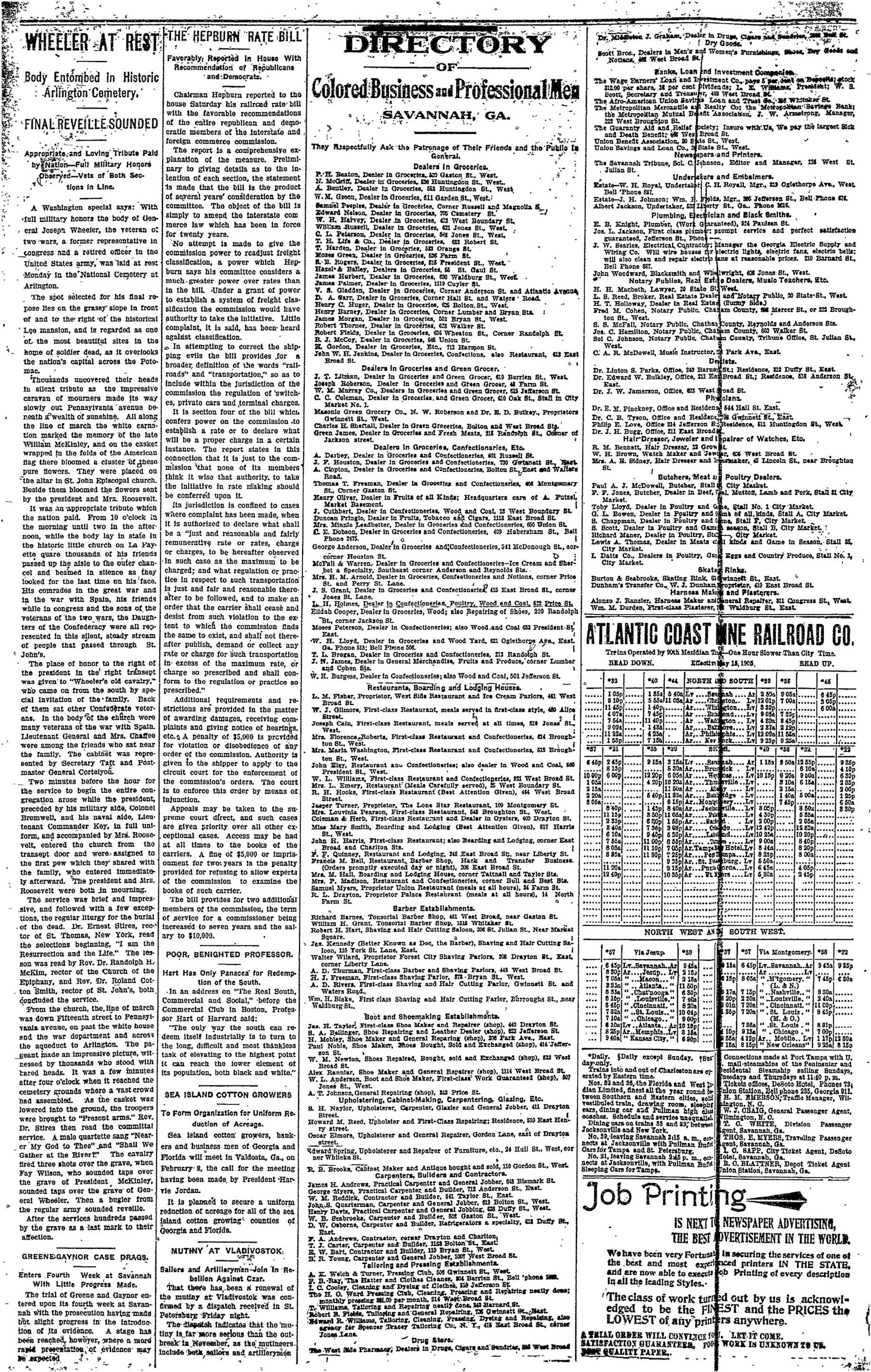
WHEELER FUNERAL
In New York Marked by Most Impressive Services.
AN IMPOSING PAGEANT
Great Throngs Lined Streets Through Which Procession Passed-Ridertless Horse Led Behind the
An imposing military pageant passing across Brooklyn bridge, brief services at St. Thomas Episcopal church on Fifth avenue and an escort across the North river ferry to Jersey City, where the body was placed on a train to be taker to Washington for interment in the national cemetery at Arlington, marked the funeral in New York city Sunday of Brigadier General Joseph Wheeler, cavalry leader of the confederacy and later one of the most prominent figures among the generals of the Spanish-American war.
The body of the dead soldier was wrapped in the flags under which he had served with almost equal vigor and distinction—the stars and bars of the confederate states and the stars and stripes. Veterans of the southern and northern armies mingled together in paying tribute to General Wheeler, with the younger veterans of the Cuban and Philippines campaigns: of 1898 and 1899. The route of the funeral cortega was lined with great crowds, most of whom stood with bared heads as the funeral passed.
The funeral took place from the home of General Wheeler's sister, Mrs. Sterling Smith, in Brooklyn, where General Wheeler died. The body was borne from the house by eighty non-commissioned officers of infantry and placed upon a flag-draped artillery caisson. The seventy-first, commanded by Colonel W. G. Bales, served under General Wheeler in Cuba, and on this occasion was given the post of honor. Infantry from Governor's Island, headquarters of the department of the east, United States Army, also joined the procession. A riderless horse, with boots reversed in the stirrups and a cavalry sword dangling from the saddle, was led just behind the caisson.
The church edifice was thronged. Seats had been reserved for members of the Southern Society, the Confederate Veterans' Association, the Society of the War of 1812 and several other friends of the family.
Reservations also had been made for the honorary palibearers, the staff of Frederick D. Grant, United States Army, and the officers of the escort. The altar of the church was almost hidden beneath the floral offering, among them a great wreath sent by President Roosevelt.
The brief services were conducted by the Rev. Ernest Stires, rector of the church, who was formerly rector of the Church of the Good Shepherd in Augusta, Ga., which is situated near the birthplace of General Wheeler, assisted by Rev. Morgan Dix, rector of Trinity church. Dr. Stires, in beginning his sermon, said:
"This is one of the great occasions of our lives. For we are met to honor the memory of a rare man. I do not speak to you of him principally as a citizen, statesman, or soldier, for the mere record of his deeds is far more eloquent than any praise of ours could be. It is of the man I think at this hour. Was he entitled to be, called great? It is not difficult for you to decide. He was distinguished by courage without rashness, by wisdom without pride, by gentleness without weakness, by patience without heedlessness and by justice with which always leaned toward mercy.
The body arrived in Washington at 10:55 Sunday night, and was at once taken to St. John church. A detachment of Spanish war veterans formed an escort from the station and constituted a guard of honor at the casket.
FOUR MANGLED IN WRECK.
Passenger and Freight Crash Together on Seaboard Air Line.
Northbound passenger train No. 68 and a southbound extra freight on the Seaboard Air Line collided head on 15 miles north of Columbia, S. C. Tuesday morning, and as a result of four men are dead and three are injured. The dead are:
Engineer A. A. Smeck and Fireman
Will White, colored, of the freight
train; Postal Clerk H. A. Pattille,
Ortice, Fla., and M. C. Watkins of
Putnam Hall, Fla.
Engage in Lively Joint Debate Over Question of Disfranchising Negroes in the State of Georgia.
With sleet and snow falling thick and fast, an audience of 500 people gathered in the auditorium at Barnesville, Ga., Friday night to hear the joint discussion of the disfranchisement question between Congressman T. W. Hardwick of the tenth congressional district, and Sam W. Small of Georgia. The debate was opened by Mr. Hardwick, who is for disfranchisement.
There are suffrage restrictions in many states, he said, but as to negro suffrage, the question is whether it is right or wrong, or, if wrong, let's get the remedy for it. Negro suffrage, he declared, originated in the hellish brain of Thad Stevens.
Mr. Hardwick read at some length from Savoyard against negro suffrage and the political equality of the races. He quoted Abraham Lincoln, to the effect that he had never been in favor of bringing about the social or political equality of the races. If to leave the negroes with the ballot boxes don't leave him with political equality, where does it leave him? he asked.
The trend of sentiment at the north is now turning against this political équality, he said. Mr. Hardwick consumed some time in reading quotations and supreme court decisions in order to lay the foundation for his argument. The inferiority and criminal characteristics of the negro race were dwelt upon at some length by Mr. Hardwick.
What do we propose to do about this thing in Georgia? Virginia, North Carolina, South Carolina, Alabama, Mississippi and Louisiana have acted and pointed out the way. Georgia remains the only state with any considerable number of negroes which has not taken steps to protect her white men and women from this inferior criminal race."
Mr. Hardwick then read his disfranchisement hill, which was defeated in two legislatures.
"I am not ashamed of it," he said.
"I am ready to die for it tonight."
Following are some of the shots fired, against disfranchisement by Mr. Small:
Giving the negro the ballot was the most monumental crime against the nation, but before we can wipe it out two-thirds of the states must be brought to give their assent. Is it wise to invite upon ourselves trouble that Stephens, Toombs and Jenkins and Wofford refused to invite? Toombs and Stephens and others got together and put in the constitution the cumulative tax-paying provision. Crumpacker had told him the author of that provision was the wisest statesman of the age, for it was supreme court proof, and congress could not change it.
Enforce an educational test and you will disfranchise more white men and enfranchise three times as many negroes as are going to the polls today. Mr. Small declared Mr. Hardwick and his associates were trying to substitute the educational test for the tax-paying test all the time, and only changed about three weeks ago when they found it would not do. The grandfather clause has never been carried to the supreme court of the United States. Every lawyer whose opinion is worth anything will tell you, when it is carried up there, it will be declared invalid.
Comptroller General Wright had said it would take over $3,000,000 to pay the back taxes of the negroes and get them where they could vote. Who is going to pay the back taxes of the negroes and get them where they can vote? Who is going to pay any such price as that?
Whenever you find any durn fools who have got three or four million dollars to throw away, then the negro vote will become a peril and not till then. He declared the only object of this distranchisement movement was to make an opportunity for men who had been tried in the balance and found wanting to get back into power.
Must Answer in Court Proceeding
Brought by Alabama Woman.
Brought by John W. Sarto. Under his lay name of Joseph Sarto, Pope Plus X is mentioned as one of the several defendants in a suit brought in New York City to test the validity of the bequests made under the will of Mrs. Mary E. Phelan, who died in 1855. Mrs. Phelan was the widow of Edward Phelan, a merchant of Mobile, Ala. The pope is residuary legatee to a large estate, which is said by a relative of the Phelan family, to be worth some hundreds of thousands of dollars.
Christian IX Passes Away Suddenly in Copenhagen.
Was Monarch-Greatly Beloved by His Subjects and Related by Blood:to
Christian the Ninth, the aged king of Denmark, who occupied the throne sixty-three years, dean of the crowned heads of Europe, father of King George of Greece, Queen Alexandra of Great Britain and Ireland and of the Dowager Empress Maria Fedoria of Russia, grandfather of King Haakon the Seventh of Norway, and related by blood or by marriage to most of the European rulers, died with startling suddenness at Amalienberg palace in Copenhagen, Monday. Prince Frederick, his eldest son, who will be known as Frederick the Eighth, will be proclaimed king.
The official bulletin was issued Monday evening:
"His majesty died at 3:30 o'clock this afternoon. After his majesty had brought this morning's audience to a conclusion, he appeared to be quite well and proceeded to luncheon as usual. Toward the end of the meal he gave evidence of indisposition, and was compelled to retire to bed at 2:30 p.m. His majesty passed away peacefully, the symptoms indicating heart failure."
This bulletin tells concisely the story of the death scene, which found every one, even those who realized the increasing feebleness of the king, unprepared for the sudden shock.
The death of King Christian has plunged half the courts of Europe into the deepest mourning, and brought a sense of personal loss, as well as of sincere grief, to everyone throughout the kingdom of Denmark, reaching even to the humblest cottage, evidences of which are shown everywhere. It has cast a pall over the palaces of the monarchs of Great Britain, Russia, Norway and Greece.
When the flag flying over the palace was placed at half mast and the news spread from mouth to mouth, it was not believed by the great crowds which gradually assembled in the squar in front of the Amallenberg palace, but when uncertainty gave place to certainty, those in the assemblage shed tears and dispersed in respectful silence.
King Christinn, who was nearing 30 years of age, appeared to be in his usual health Monday morning. After taking breakfast he held a public audience, which it has been his custom to do every Monday morning. The reception was largely attended, and his majesty conversed freely and affably with a number of officials and other persons. When the function was over the king, though appearing to be slightly fatigued, attended lunchean with the members of his family, among whom were the Dowager Empress of Russia and his brother, General Prince Hans. During the meals his majesty complained of indisposition and was assisted to his bed room by the dowager empress and Prince Hans.
Just as the king breathed his last Crown Prince Frederick entered the room and the other members of the royal family arrived shortly afterwards.
Mandate Issued by United States Supreme Court.
The supreme court of the United States Monday issued a stay of the mandate in the case of James B. Howard, under sentence in Kentucky to life imprisonment on the charge of complicity in the murder of Governor Goebel in Frankfort in 1900. An opinion was delivered by the court on January 2, which was adverse to Howard.
Imperial Commission Arrives in Washington for Ten Days' Stay. The imperial Chinese commission, sent to this country by the emperor of China to study American social, political and industrial conditions, arrived in Washington Tuesday on a special train from Chicago. They were met by Mr. Denby, chief clerk of the state department, who will look after the commissioners during ten days of their sojourn in the capital. Mr. Denby was chosen on account of his knowledge of the Chinese language and customs.
The Guaranty Aid and Relief Society
SOL. C. JOHNSON, Supt. of Agencies. B. W. COOPER, General Manager.
long in total Ten Thousand Dollars, and which are held by the State of Georgia, by authority and under the provisions of an Act of the General Assembly, approved October 22d, 1887, and amended December 20th, 1877.
GEORGIA BRIEFS
Sea Island Growers to Meet.
President Harvie Jordan has issued a call for a convention of the Sea Island Cotton Association to be held at Valdosta on February 8.
The sea island cotton planters of Florida and south Georgia were organized last November, and since that time the work has been enthusiastically pushed.
Some of the important subjects to be discussed at the coming conventions are as to the devising of a better system of holding cotton, plans for the producers and manufacturers of long staple cotton to get closer together, and the imperative needs of immediate organization.
***
Ballroad Commission Enlisted.
Judge W. T. Newman of the United States district court at Atlanta signed an order which in effect temporarily enjoins the railroad commission of Georgia from enforcing the provisions of circular 309, relating to freight rates on stoves, stove plates, stove pipe, furniture and hollowware.
The order is the result of a bill of complaint filed by the Atlantic Coast Line, the Southern and the Central of Georgia railways. The bill is directed against the railroad commissioners for the state of Georgia, and the defendants are ordered by the court to show cause in the United States court in Atlanta at 10 a.m. February 12, why a permanent injunction should not be granted.
```markdown
```
Who Shall Occupy Home?
Lizzie Rutherford Chapter Daughters of the Confederacy of Columbus is making a vigorous protest against the Winnie Davis memorial dormitory at the State Normal School at Athens being occupied by any one except daughters or descendants of confederate veterans.
The question of who shall designate the girls who will occupy the dormitory, the Daughters of the Confederacy or the authorities of the normal school, is quite a live issue just now. Lizzie Rutherford chapter holds pronounced views on the subject, and has just mailed a circular letter to the other chapters of the Georgia division of the Daughters of the Confederacy.
Rawlings Preferred Convict Camp. Leonard, one of the famous trio of Rawlings brothers. Lowndes county's star prisoners, has been returned to Waldonta jail from the penitentiary
Treasurer of the State of Georgia.
camp at Babcock, Ga., where he has been confined for several weeks.
Young Rawlings' return to jail was ordered by Judge Mitchell a few days ago, on a motion by John R. Cooper, his counsel, and he will be kept in Valdqsta until the cases against the Rawlingses, now in the supreme court of the United States, are passed on by that tribunal. Leonard did not want to return to jail, and objected strenuously to being removed from the penitentiary camp. He says he had rather spend ten days in the convict camp than to stay one day in jail.
* Q *
Will Try Tax Cases Again.
The famous Georgia railroad and Central of Georgia tax cases recently decided by the supreme court in favor of the state's contention that the Western of Alabama stock in the hands of these Georgia corporations are taxable in this state, will be tried before Judge Pendleton, in Fulton superior court, in Atlanta. This statement will seem rather unusual in view of the fact that it was generally believed the litigation had been concluded so far as the state courts are concerned.
But the decision of the supreme court, though it settled all the law involved, was not, in fact, a final decree. It was what is called in legal parlance an interlocutory decree involving the question as to whether or not an injunction should be granted preventing the state from collecting the taxes claimed.
The railroads propose to take an appeal from the decision of the supreme court of Georgia to the supreme court of the United States, and the latter tribunal cannot entertain an appeal except from a final decree.
```markdown
```
Way Open for Damage Sults.
Judge Emory Speer of the United States court states that the city council of Macon should inquire if they have not violated another tradition of the constitution in the resentencing of a number of prisoners who were on county chaiangang, and, according to Judge Speer, entitled to a discharge from custody. Judge Speer said it would have been much the wiser and more humano thing for the city to have released the offenders, thus avoiding damage suits that may be instituted.
---
Nunnally Is In the Race.
Dr. G. A. Nunnally of Newnan confirms the previous accounts concerning his candidacy for governor, and states positively that he is in the field. He expresses his willingness to discuss any issues in the platform outlined by himself and those who have urged his candidacy, although he
states that he hardly deems it necessary, as he says: "There are advocates of these principles all over the state."
"When asked if the old standing candidates had not about got all the votes committed to their candidacy, he said:
"No, not by a million. A few have them from personal consideration, and to pay some old political debt to secure a pull after the election have intimated that possibly they might prefer the candidate to whom they were talking to somebody else who was worse or had less to offer, but no man is bound by any such pledges. A promise to do wrong has no obligation in morals."
Dago Labor Proves Unreliable.
The employment of imported Italian labor by the Virginia-Carolina Chemical company in Savannah has taken on a new turn. The laborers brought in some time ago by the employing company seem mutually willing to be rid of each other. Few of the original number remain in the employ of the company. Some of them have left the city, while others are peddling on the streets. The company, however, has not given up its idea of making use of this sort of labor, and it has dispatched John Trapania, the son of the Italian consul, to New York, for the purpose of securing laborers there end sending them to Savannah. Carroll D. Wright, United States commissioner of labor, has taken this phase of the matter up and is conducting an investigation to determine whether this should be allowed.
```markdown
```
Buncoed Through Old Land Grant. A man who gave his name as J. T. Peavy, and said he was from Nebraska, called at the office of Secretary of State Philip Cook a few days ago to investigate a title which he said he had bought to 219,000 acres of land in Washington county, Georgia. The title on the face of it appeared to be a good one. The only trouble was that the first link in the chain was a bad one. It was a bogus Georgia land grant, one of the many which have been trafficked in at various points in the country, and out of which the purchasers have secured only a little sorrowful experience.
The land grant possessed by Mr. Peavy was alleged to have been made to Enoch Nilson. The grant purported to have been recorded in Book 4E, page 514, in Secretary Cook's office. A reference to the book and page in question showed that it contained a grant of 55 acres in Wilkes county to Isaac Hodge.
Mr. Peavy, when asked what he
This company is duly chartered under the laws of the State of Georgia, and has complied with all requirements of the State Insurance department, therefore all policy holders are protected with all the safeguards that the strict insurance laws of this State seek to protect its citizens.
Its affairs are directed and managed by Negro men of the city of Savannah of leading standing, and whose character and reputation are of such as to command the respect and confidence of all the people of that community. The same men that manage this Society are the ones that organized and are conducting the affairs of the first successful Negro Savings Bank in this state, therefore we can readily see that, by connecting themselves with this Insurance company their interest will be in safe hands.
By comparing our rules and benefits with other first class companies it will be seen that we offer the most liberal inducements with the largest sick, accident and death benefits to our members than any other company in this business.
That we pay our claims promptly can be testified to by the thousands of our satisfied members.
Liberal Terms and Commission.
L. E. Williams.
P. Edward Perry.
Walter S. Scott.
Sol. C. Johnson.
This company is duly chartered and requirements of the State Insurance law that the strict insurance laws of its affairs are directed and manage character and reputation are of such community. The same men that run fairs of the first successful Negro themselves with this Insurance company by comparing our rules and benefiting liberal inducements with the larger pany in this business.
That we pay our claims promptly.
Agents
Libera
paid for this bogus land title, declined to say, remarking that he had got into it too heavily to let it out.
THOUGHT WAGNER WAS FUNNY
Peculiar Compliment Pald Composer by Unmusical Enolishman.
A story which Alfred Reisenauer, the pianist, tells of Richard Wagner relates to a London dinner at which the great composer, was requested to be especially amiable to Lord Pitkin, a most unmusical man but high in social councils. In due season the two were presented.
"Where is your entertainment to be? asked his lordship after the introduction, when Wagner's forthcoming concert was mentioned.
"At St. James' hall," replied the composer. "I trust your lordship will be able to come."
"I may, I may," replied the great personage.
The concert took place as scheduled and a week or more later a patron of Wagner gave a soiree in honor of the composer. Lord Pitkin was prominent among the guests and he selzed the first opportunity to walk over to Wagner and congratulate him.
"I was at your entertainment," said the polite nobleman, "and I don't know when I've enjoyed anything more. I laughed till I cried. You are very funny, Herr Wagner."
The company stopped talking and an amazed look spread over Wagner's face.
"But you know," continued the affable lord, "it was almost half an hour before I recognized you with your black face and crinkly hair."
When Lord Pitkin stopped laughing he saw that he was alone in his merriment.
"Why—what—I hope I haven't—it was St. James' hall, wasn't it—I—er—"
Some one then explained that St. James' hall consisted of an upper and a lower auditorium and that his lordship evidently had wandered into the one where the Burgess & Moore minstrels were giving a jubilee entertainment.
"Wagner's expression," says Reisenauer in concluding the anecdote, "was a study, but Lord Pitkin's—well, his was an entire course of instruction."
FRENCHMAN CROWNED SPEED KING.
Autoist Demogecte Melataised Swift Pace of
123 Miles on Hour-
Victor Demogect of France was crowned Speed King of the World on Monday afternoon on the Daytona, Ela., sands after driving his gasoline car two miles in the marvelous time of 58 4-5 seconds. Demogect maintained a speed of 123 miles an hour to make this record. The two mile-a-minute race closed the automobile tournament for this season.
HOME OFFICE
468 WEST BROAD STREET,
SAVANNAH, GEORGIA.
Bell Phone 1198. Ga. Phono 2029.
Directors
W. R. Fields. 1
J. H. Deveaux. 3
L. M. Pollard. 0
R. R. Wright. 3
under the laws of the State of Georgia department, therefore all policy holders are in this State seek to protect its citizens. Aged by Negro men of the city of Savannah, such as to command the respect and command this Society are the ones that organize Savings Bank in this state, therefore we company their interest will be in safe habits with other first class companies it the greatest sick, accident and death benefits to our lotly can be testified to by the thousands.
Wanted
Real Terms and Comm
ADDRESS THE HOME OFFICE,
468 West
HOW CLIMATE AFFECTS
HOW CLIMATE AFFECTS BLONDES
Did the ancient highly civilized nations of the past die out because they were blonde and therefore unfitted for the regions in which they flourished? Dr. Charles E. Woodruff, a surgeon in the United States army, who has written a book on the subject, believes that this was the case. He maintains that too much light is injurious to white races through its actinic or chemical effects, from which the dark skin pigments of swarthy races protect them. Thus he explains why, by survival of the fittest, dark races are found in tropical lands, why Europeans have always failed to colonize the tropics and why blondes disappear when they migrate southward. Says a reviewer in the Edinburgh Medical Journal: "The blonde and intelligent rulers of regions suited better for more swarthy inhabitants have regularly in the course of ages died out, while their subjects, thoroughly acclimatized to their domicile, remain. Egypt has been the theater of immigration of intellectual races over and over again; in each case these disappeared and civilization decayed, though the native fellah survived and survives. 'Theo will,' the author predicts, 'never be another dark age, for the present Aryan conquerors rule it from London and are not colonizers.' While the blonde type of mankind requires for its evolution a cold, dark, northern country, the brunette
---
SOURCE OF VOLCANIC ACTIVITY
In a recently published volume on volcanoes Prof. C. Doelter undertakes to tell why volcanoes have eruptions. Melted rock such as is flung from Vesuvius requires a temperature of 1,600 degrees Fahrenheit, so that it becomes liquid only far down in the earth, perhaps 60 or 100 miles. Below the outer crust of cooled and solidified rocks there must be a larger zone of rock which still remains solid, because its temperature is less than that of the melting point corresponding to the pressure under which it rests, and below that again there must be rock or magma in a state of fusion; it is to this magma that Pref. Doelter looks for the primary source of all volcanic activity. At the same time the depth at which this primary reservoir of magma lies and the pressure under which it is confined are so great that a direct eruption from it is inconceivable, but when, by movements in the overlying crust or otherwise, a channel is opened the magma may rise to a depth where it is surrounded by rock at a lower temperature than the melting point. In these circumstances solidification begins.
From all volcanoes large quantities of steam, of carbonic acid and other gases are evolved, and the course of
of various degrees of intensity up to absolute blackness is alone adapted for lasting existence in most regions of the world."
There is too much sunshine in the United States and none of the races that have come to this country until recently is adapted to the climate, Dr. Woodruff thinks, except the Jews. All the rest are degenerating from excessive light. The lower Mediterranean races, however, are now flocking over, and if the blonde types die out as they did in Greece and Italy during the decadence of these two countries, United States history may repeat theirs, though Dr. Woodruff believes that the northern types may survive in sufficient numbers to prevent the destruction of the republic provided it takes warning and limits the franchise to the races represented by these types.
About seven centuries were required, according to Dr. Woodruff, for the climate of Greece to destroy its blondes. In 500 B. C., the period of its greatest literary glory, the decadence of the Greeks was already evident and shows itself to-day in their literature and art. Dr. Woodruff points out how ancient Greek statues exhibit many of the stigmata of degeneracy; even a famous head of Juno has arrested development of the jaw and is "the head of a dying race." Chicago News.
every lava stream is marked by clouds of steam evolved from the cooling lava. At one time—and the idea is still common—this steam was supposed to have been derived from sea water which had obtained access to the molten lava while still underground, but this explanation is now generally rejected, being impossible in some cases and inadequate in all, and the greater part of the steam and other emanations from a volcano are now regarded as directly derived from an original store in the interior of the earth. However this may be, it is certain that the magma from which volcanic lava is derived is not merely in a state of igneous fusion, but is combined with water and gases, which are given off as it solidifies, and by their escape frequently form miniature volcanoes, on the surface of lava streams.
If the solidification takes place underground, the steam and gases are expelled, and, if there is no free escape, pressure may increase till it becomes great enough to overcome the resistance of the overlying rock and so lead to an eruption and the formation of a volcano, whose character will depend on the nature of the reservoir from which the eruption took place.
FROGS OF COMMERCE
RAISING THEM FOR MARKET A PROFITABLE PURSUIT.
When From Two and a Half to Three Years Old They Are At Their Best As a Delicacy—One Species Useful As a Weather Prophet.
People who have made the study of animals, especially water animals, a life work, know that the frog possesses almost as many peculiar characteristics as a human being.
The bull frog, the eatable species, comes from the lakes and low lands of Pennsylvania, Maryland, Louisiana
A Real Old "Bull," and along the marshes of the Great Lakes. It is said that there is more trouble and less money about a frog farm than there is about any other business.
The better class of frog farmer has from two to six ponds where he breeds and raises his frogs. In this way he can keep the frogs of different ages in different ponds.
Frog eggs are about the size of pin heads, and are lal in a slimy, felly-like substance that partially protects them. From 400 to 800 eggs are the spawn of a single female. The eggs hatch the tadpole or polywog. This in turn becomes a baby frog. Between the time of change from tadpole to frog about a year elapses, and it takes the frog about two and a half or three years to grow large enough for market. They are better around the age of five years than at any other time; after that they become tough. It is a very hard matter to separate
at taking it different ages for they of the whole. In the bottom of their York was selected will not hatch, so no debate. faced there, and they Opening what any wall that can be week's door. After he is big enough to market the frog is caught with a bull's eye lantern. This is flashed in his eyes at night, blinding him long enough to be captured. In the daytime the animal is shy and will not allow a person to approach, but when he is once scared from a place it is safe to say he will return there as soon as the person has gone. When caught and worried or teased he will cry almost like a baby.
In a hard season when small fish and insects are scarce, the frog eats his own families, it being a case of the biggest frog getting the most to eat. It is no uncommon thing to catch a bullfrog that has another in its stomach half its own size that it has devoured in a hungry moment. They can stay under water from
Tree Frogs.
twenty to thirty minutes, when they come to the surface for air. Their worst enemy is the large fish. In ponds where fish are also raised the fish live entirely on the frogs.
Another peculiarity of the frog is that it will seldom touch a dead carcass. The beetle or other insects must move before the frog will touch it.
There is one species of the eatable frog that is known as the spring-frog. It grows in the springs on farms and ranches and is considered to be more palatable than the bull frog, but is smaller. Farmers who have these frogs in their springs refuse to allow them to be killed, claiming that they purify the water. This makes them harder to get and they are more expensive than the other variety.
The tree, or marsh frog, it noted as being one of the best frog prophets that lives. He always cries before a rain. He is about three inches in length, but is not fit for food. Some are sold as weather prophets, but the demand does not pay one to raise them.
The land frog, or toad, is a well-known species and is good for nothing that is known of. It served its purpose when it inspired Mark Twain to write "The Jumping Frog." There are many superstititions about it, though. One is that if you step on one you are sure to stump your toe later. Another is that if one is touched with the hand a wart will grow where the human and frog skin come in contact. They build what is known as the "devil's umbrella." It looks like a mushroom, but is poisonous. In certain sections of the country it has been known to rain frogs.
The last of the common species is the horned frog. It lives in the Southwest on the dry, arid regions of Arizona, Utah and New Mexico, and lives on desert mice and insects. They have never been known to drink water and, like the toad, is good for nothing.
MOUSE "TOTES" ITS OWN FOOD.
Creature of the Desert Has Pocket
For This Purpose.
The pocket mouse, one of the common rodents of the desert, has a genuine fur-lined "pocket" on the outside of its cheek. When it is hungry it takes, food from this pocket with its paw, just as a man would pull a ham sandwich from his pocket. One of these mice has been kept for three years with no other food than the mixed bird seed of commerce. During this period it had not a taste of either water or green food. Other experimenters, have found, in fact, that these mice in captivity refuse such treats, not seeming to know that water is good to drink. The bird seed put before this mouse contained not more than 10 per cent, of moisture, which is less than is necessary for digestion. Stuff so dry as this cannot even be swallowed until it is molested by saliva. Yet this remarkable mouse gave nothing but his time to the interests of science. He suffered nothing in health or spirits during his captivity.
ROOSTERWOULDN'TSTAYDEAD.
Like the Celebrated Cat the Gamecock
"Came Back."
At the time that Sylvanus Cobb, Jr. was writing "The Gunmaker of Moscow" for the New York Ledger, his twin brothers Cyrus and Darius, paid him a visit in Norway, Me. One day the brothers were in Sylvanus' study, when they heard him call for them to come down into the garden.
"Boys," said the author, "there's a shot for you!" He pointed to a Spanish gamecock ten rods away, at the foot of the garden.
"Ive told Dr. D. about a hundred times to keep that rooster out of my
A boy is running away from a storm. He is holding a ball in his hand. The storm is blowing through the trees.
garden, and now—there he is. Get your rocks, boys, and let fly!" Cyrus who was known in the army as the rifle stone thrower, threw his piece of granite like a bullet. It struck the gamecock square in the head. Down he fell, and down leaped the trio, bent on finishing the business. They hammered the rooster's head into the earth with the edge of a thick board, to make his death double sure. Then the author threw him over the fence into the doctor's garden, saying: "I'm no niggard; the doctor can have him for his dinner."
The twins again ensconced themselves in their brother's study. A half-hour had elapsed, when Sylvanan' voice was heard under the window: "Boys," he called, in tone of awe. They looked out of the window.
"See there!" he explained, pointing down the garden.
There was the veritable gamecock strutting-about as lively as ever.
"Automobile Rates at Tennah."
"Tonopah is the place where money circulates," remarked R. E. Mulcahay, stock broker. "I was over there the other day with several friends, and at 4 o'clock in the afternoon we engaged an automobile to take us to Bullfrog. We could have taken a train as far as Goldfield the next morning, but we didn't want to wait. It is a twelve hour trip by automobile from Tonopah to Bullfrog, and we decided we would be able to stand the strain. So we summoned the automobile. "What's the tariff?" I asked the
"What's the tariff? I asked the chauffeur as we were about to start.
"Three hundred dollars,' he said.
"Ha, ha! Pretty good joke,' I said.
Now, seriously, what the charge?
"Three hundred dollars,' he repeated.
"And I'll be baked, for a lobster if that wasn't the charge. It was the regular tariff, and he wouldn't come down a nickel. And as we had to be in Bullfrog the next morning we paid the $200."—San Francisco Chronicle.
Same Hat.
Awfully simple. Simply awful.
If you believe that the same hat suits every woman, look at these sketches.
Have a Surplus of Venison.
There are so many deer around Phillips, Me, dead and alive, that several families have been trying very hard to find out what to do with their venison. One lady has been trying to turn a whole deer into mincemeat. When last heard from she had a wash-tub full of material for mince pies, and having decided that she wants to eat an apple pie or two next year, she has given up in despair and decided to corn down the rest.
Drummer's Conscience Had Had No Need to Work.
"I know that a conscience doesn't belong with my line of business," said the dry goods drummer, "but I was born with one and can't get rid of it." "For instance?" was asked.
"Well, for instance, I was making a flying trip through Illinois ten years ago, and in a certain town I asked a man to change a ten-dollar bill for me. He compiled, and I stood there and saw him count me out $11 and was mean enough not to say anything. However, when I got away my
"He Ordered Water." conscience began to uphraid me. I meant to make things right the first time I went back, but it so happened that I did not strike the town again until last week. All this time a still, small voice was accusing me."
"But you made it right last week?"
"I found the man and stated the circumstance and said that I desired to make restitution, but he laughed and replied:
"Yes, I remember, my dear man; but I folded two of the one-dollar bills over so that you counted them twice. I really gave you only $9. My conscience has also accused me, and—let's go out and have a drink."
"And was that all?"
"All that except when we got to a saloon he ordered water."
CAME BACK TO SETTLE DOWN.
Young Wild Gander Returned Home With Mate and Family.
The writer was informed by Capt. Handen B. Nicholas, that his father, the late Robert G. Nicholas, of Buckingham county, Va., once caught a young wild gander, which he tamed and for a long time it remained quietly and contentedly in the yard with the other tame geese. However, it disappeared in the spring after it was a year old.
The following fall Mr. Nicholas heard in the air far above him what seemed to him a familiar honk. Taking out of his pocket a large bandana handkerchief, with which he was accustomed to call together the geese by waving it when he fed them, he held it up in the air and waved it, and to his surprise the gander came to the ground with some young geese and a mate he had taken in the Artic regions. They never left their home again, but remained all their lives perfectly tame and contented.
This is not fiction but an established fact, and will be corroborated by Capt Nicholas if any one wishes to verify it—Forest and Stream.
Baby In Basket.
In the mountains of northern India
babes are carried in baskets hung on
straps which pass over the mother's
head.
Velled and Silent Auctions in India.
Velled and Silent Auctions in India. In the course of an interesting paper on shellac, communicated to the English Pharmaceutical society, Sir George Watt, C. I. E., described the quaint practice adopted at the auctions in India. The buyers and sellers join hands and sit facing each other, a cloth being thrown over the hands. The buyer presses certain fingers of the seller's hand, thus making an offer. This is usually rejected by a motion of the head, and further finger pressing ensues. Finally the bargain is struck without a word having been uttered. The advantage claimed for this system is that the buyer may proceed from one seller to another and make his purchases without his price being known to other dealers.
May Be Indian's Petrified Foot.
A stone resembling a moccasin with a foot in it, with the toe marks showing, was recently dug up at the farm of Fred D. Clark, in Milford, Conn. Some believe that the stone is the netrified foot of an Indian.
County Judge Alexander of Littleton, Col., unable to decide the disputed parentage of baby Ruth Sherlock, ended the case by taking the child into his own home.
IF NOT .GHOSTS, THE .WHAT?
Resident of English Manor House
Would Like to Know.
At Knarceborough, England, on the banks of the Nid, there is a charming old dwellings, known to tourists as the Old Manor House. Since the present occupier has restored the building there have been disconcerting phenomena in the night hours. During the alterations the skeleton of a woman was found buried at the foot of the staircase. The occupier disclaims belief in ghosts, but says there is something that cannot be explained away. Formerly he and his wife occupied the blue bedroom, in which stands an old oak bedstead on which Oliver Cromwell once rested his limbs. During the night sounds of footsteps are heard on the landing, and Mr. Howes says it is impossible to keep the door of this room closed. "We have locked it and put a chair against it," he says, "and in the morning we have found it open. Since we have moved out of this room the footsteps have still been heard, and on one occasion they were accompanied by a loud bang against the door of our present room." Mr. Howes, after an experience of fifteen years of the house, is still at a loss to account for the sounds. "We used to say it was Oliver's ghost," he remarks, "but now we say it is the woman whose skull we keep on the staircase."
Mrs. Blank of Gloucester was reduced by the scarcity of good help to accept a Finn girl just arrived and understanding very little English. Coming to the house while the mistress was engaged with visitors, she was directed to proceed to the second floor above and enter the first small room, when she could at once retire as the hour was late. When the family was about retiring the mistress found her new servant fast asleep in the bathtub, with her
A woman is looking at a baby in a crib.
bundle of clothes for a pillow. She had reached, as she supposed, her room, and a snug-bed, with only the bed clothes lacking.—Boston Herald.
Aged Model an Agile Thief.
Though born in March, 1804, an artist's model, who goes by the name of Gluseppe in the Latin quarter, is still hale and hearty:
When not sitting for a picturequeen mendicant, he is as quick and clever at larceny as any much younger man. He has just been discovered while secreting a silk petticoat from a counter under his gaberdine. The alarm being given, he ran like a rabbit with a nimbleness astonishing in a centenarian. Caught notwithstanding, he expressed pride in his green old age.
While he was being taken to the police station parcels constantly dropped from his person. These were the proceeds of the active old man's morning expedition to two or three stores.—Paris correspondence, London Telegraph.
\ Made a Clock From Slafe.
A slate quarryman living at Delta, Pa., Humphrey O. Pritchard, has made a clock out of slate. The varieties he used include peach bottom blue slate and the red, green and purple slate of Vermont.
About 164 separate pieces of this material were used in the construction and are held together by twenty-three dozen small metal screws. Many of the slate sheets are as thin as paper, and scores were broken before the timepiece was finished after eight months' work.
The clock is four feet high, two feet wide and one foot deep. It has a cathedral gong and is lighted by nine incandescent bulbs.—Jeweler's Circular Weekly.
Teacloth Autographs.
Henriet Vanmere M²,
A G. The Thacker,
A Clarering A. The Hunter,
Linus Lass.
Jud White,
Peggy Dry All.
Hedward Campbell,
Tom White.
A new department has been made to the collection of autographs, which opens out an interesting field for ladies who desire a novelty. In afternoon teacoulds. We reproduce part of a unique cloth, which is almost covered with autographs of music-hall artists, living and dead. The signatures were originally made in pencil, and have been marked over in silken thread. There are some hundreds of signatures in all, and the cloth is finished with a handsome border of laces. -Liverpool (Eng.) Mercury.
EACH U$ES TWO ALARM CLOCKS
'How Street-Car Men' Make Sure of
Getting to Work in Morning.
T COSTS the street-
car man from two
to five days' pay
when his alarm
clock falls to get
him up in time to
take his run in the
morning. The cars
to whether the regu-
lar crew is present
or oversleeping. This
has led to a double
precaution by the
men who weld the
metal levers on the
COSTS the sweet car man from two to five days' pay when his alarm clock falls to get him up in time to take his run in the morning. The cars to whether the regular crew is present or oversleeping. This has led to a double precaution by the men who wield the metal levers on the front of cable and trolley cars and those who ring up the nickels. The double-alarm clock system is now in vogue with most of the men. One timepiece is set to go off a few minutes later than the first.
"I missed one in fifteen years," said a burly gripman, "and that was when my kid had been playing with the clock and the hands stuck. I started using two of the sleep chasers after that."—Chicago News.
TO HAPPY HUNTING GROUNDS.
Indians Plan to Help Dead Man In Hide Journey.
Many strange Indian tribes live around Hudson Bay. The Creek and Nascopple Indians are among these tribes who have a peculiar custom in regard to their dead. As soon as one of their number is dead, the surviving relatives place the dead one in a box which they beg from the Hudson Bay company. In this box are placed, with a loaded gun, a powder horn, a tobacco pouch, a flint stone for striking fire, the snowshoes for travel and an ax. This box is then carried to the top of the nearest hill and set there with stones upon the top of it. For ten days it is left undisturbed, and then the relatives remove the gun and other valuables, believing that by that time the dead one has reached the happy hunting grounds and has no further use for them.
Invention of Denver Woman Will Net Her Much Money.
The inventive genius of a Denver woman promises to revolutionize the process of stocking darning.
Mrs. Agnes G. Maynard is responsible for the invention. The inspiration for the invention which those who know say will net Mrs. Maynard almost $1,000,000, came to her one day while she was working at her sewing machine.
"Suddenly," said Mrs. Maynard, "I began to wonder if the same scheme could not be applied to stocking darning. I had always darned table cloths and haplinks by stretching them across the hoops, and then, with finest cotton thread, had worked the machine back and forth until the hole was entirely closed."
The stocking darner is a small band of steel about three-fourths of an inch thick, and in circumference is about six and a half inches. One edge has tiny prongs which hold the material
MRS. ACKESJ
MAYNARD
MACHINE
THAT
DARNS
STOCKING
In place like the second hoop in the embroidery set, and on the other edge are bars scarcely thicker than an ordinary pln, which project and hold down the part of the stocking which is not being mended. The darner can be used on any sewing machine made.
Turtle on One Farm 109 Years.
A land turtle with an authenticated history of over a century lives on the Old Wiest farm, in Oley township, several miles from Bovertown.
Daniel Wiest, a grandson of the first man by that name to settle in Oley, when 18 years old, found the turtle in 1795 and cut the date and his initials in its shell. After his death in the fall of the year, the inscription "1796-D. W." was renewed from time to time by his brother John. He died in 1838 and the renewal of the inscription was then continued by his son, Daniel Wiest.
His death occurred ten years ago, and regularly every summer since then the old turtle has been seen on the Wiest farm, generally in the meadow—Philadelphia Record.
Transferred Court to Hotel.
After giving the janitor of the building a good "dressing down" the other day for his economy of coal, Judge Jelly of the, Hingham (Mass.) court, fearful of 'penumonia, adjourned his session to a nearby hotel.
NAVIGATING THE AIR
SCHEME BY NO MEANS IMPRACTICAL, SAYS WRITER.
That It Is Possible To Lift and Proper Enormous Weights Has Been Demonstrated—Outline of One Machine Under Construction.
Is aerial navigation practical? And when is it coming? These questions have occupied the minds and been the aim of many distinguished men. The greatest drawback to experimenting in this line is the expense connected therewith; otherwise I believe the question would have been practically solved long before now, says a writer in the Chicago Chronicle. Wealthy men as a rule take very little interest in real progress unless profit is connected therewith and in sight.
Experiments have been carried on for several years in the neighborhood of Washington, and judging from what I have seen, what has been established, I do not hesitate to state that is is possible to lift and propel enormous weight through the air by proper appliances, and I take pleasure in submitting an outline of an apparatus sought by mankind for centuries, which, from an engineering standpoint, seems to fulfill the conditions for navigating the air independent of wind and weather.
The present apparatus contains one engine of almost common type of three horse power and weighing fifty
Fig.1 one pounds. The weight of the car, including propeller, etc., is fifty pounds, making a total weight of 101 pounds, the total lifting power being 108. This leaves seven pounds for oil, which is sufficient to lift the machine and hold the same in the air about two hours.
This is certainly gratifying, although the apparatus has no practical value, except from a scientific standpoint and from an engineering point to be built further upon. And it can not be seen why the true or practical aerial locomotive can not be constructed on this line. In the new plan two engines will be employed each to have at least fifty horse*power, and they can be constructed weighing about five pounds per horse power, making a total of 500 pounds. The weight of car, etc., will be about the same. This would be a total of 1,000 pounds; one man, 150 pounds; oil for five hours' spin, 500 pounds; total weight, 1,650 pounds. The lifting power per engine being 1,800 pounds, this leaves sufficient margin, for safety, the power of one engine giving the desired direction and speed.
In ascending or descending the machine will appear as shown in Figure 1, the weighted lever arm being in a position which keeps the propelling wheel in a line with center of gravity of the apparatus. Figure 2 shows the machine as it appears when making a horizontal flight; it will advance in the direction toward which the propelling shafts may be inclined from the vertical:
The whole apparatus will be constructed of highest grade steel. This first will cost approximately $10,000, so it will be seen it will be a costly machine in the first place and costly to operate, as the fuel cost is about 100 pounds of oil per hour. The propelling shafts are given an axial inclination with reference to the center of gravity of the car of the locomotive in order to prevent counter rotation of the car around the propelling shafts. The two propelling wheels rotate in opposite directions. Rareaction or negative pressure is produced above the said propelling wheels. The resulting difference between the pressure upon the lower and upper sides of the propeller wheels will give the lifting power. The rotation of the propelled wheels in opposite directions exerts a great steadying effect upon the locomotive by virtue of the "gyratory action."
From the facts established thero
Fig.2
seems to be no reason why the true aerial ship war should not make its appearance in the near future. From approximate but careful calculations such an aerial ironclad would cost less than one-fourth as much as the smallest torpedo-boat, therefore 100 such aerial locomotives could be built for the price of one battle-ship, with a carrying capacity of from 20,000 to 30,000 pounds of high explosives and fuel for several hundred miles' journey and 100 of them could destroy the combined fleets of all nations.
The Savannah Tribune
PUBLISHED EVERY SATURDAY,
BY THE TRIBUNE PUBLISHING CO.
116 W. St. Julian Street.
Gas. Phone 574.
SUBSCRIPTION RATES.
One Year.....51.95
Six Months.....75
Three Months.....85
Remittance must be made by Expense on
Post Office Money Order, or Registered Letter
A overriding Rates given on application.
OPPOSITION to the city and county administration is growing. The result of the coming fight will be eagerly awaited.
The young men of the Sunday Club are to be commended for the good that they are accomplish ing. Let them continue in their good works.
The subject "registration" at the Men's Sunday Club will be discussed tomorrow. It is hoped that there will be an outpouring of the young men, especially those who should be on the list.
THE thanks of the colored citizens go out to Rev. Jordan of the First Baptist church for his active efforts against the reopening of the dance halls. He and all white friends have a tender spot in our hearts.
ONE of the problems that be set us in this community is the rude manner in which the young boys act in public places and at entertainments. It shows a dire lack of home training. If these young hoodlums continue as they are now acting, many of them will awake in stripes.
The unbecoming conduct of children in the several schools is being generally reported more so than ever before, and it is a matter of much concern. There is a remedy for this and it ought to be vigorously applied. The remedy that would be more effective would be a hearty cooperation of parents and teachers.
THE report circulated in the New York. Herald that Dr. Booker T. Washington had advised the President to remove all colored office holders in the South has been branded as a tissue of falsehood by high authority. Dr Washington in a recent interview with the New York Herald says emphatically "I have given no such advice, the statement is false."
Accept no jim crow accommodation, especially when you are not compelled to. It makes us sick to see a certain class of our young women and men too, who ought to know better, climbing the narrow flights to the jim crow gallery of the theatre, and to see our men spending their money in jim crow bar rooms and in drug stores where our people is not served at the soda water counter. Be a man or a woman and keep away from such places.
THERE are three things that are needed to be accomplished in this city for the good of our people, and these things can be accomplished through the persistent efforts of those citizens who have the interest of the race at heart. We want the infamous policy shops put out of business; we want the loan offices that are robbing a class of our people out of their very existence by charging exorbitant interest, to be legislated against, and not the least, we want a school building, a modern one that will accommodate a part of the nearly five thousand colored boys and girls who are not in the public schools. We can get the school, we can have the loan offices legislated against and we can wipe out the policy shops by a united effort of our forces. These things THE TRIBUNE constantly agitates, but in its accomplishment, the people must take hold. Who will lead?
Masonic Notes.
The Grand Secretary has sent out his quarterly list to the Lodges. In cases where Lodges failed to report new names of officers the circulars are sent to the old officers. Lodges failing to receive same will understand that no election returns have been received and the same should be immediately forwarded. Loyalty and a desire to fully perform a duty will cause any order to prosper. Let this be the desire and action of each officer of subordinate Lodges in the jurisdiction.
ceived an appreciative communication from Ill., J. H. Smith $ 3 3 ^ {\circ} $ M. S. P., Graud Commander of the United Supreme Council $ 3 3 ^ {\circ} $ A. S. Rite of Freemasonry in regard to the action taken by this Jurisdiction in favor of the bodies represented by him. Ill., J. H. Walker, $ 3 3 ^ {\circ} $ of Macon, is deputy for this Orient and is anxious to plant consisteries in localities where same can be well supported.
Brother Chas. Johnston, the efficient secretary of Madison Sun Lodge has reported the excellent time had at the installation of the officers of his Lodge, Brother Johnston takes pride in the doings of the craft. The members of Eden Lodge at Marietta are loath to give up Rev. and Bro. J. A Lindsay, but as sorry as they are, the brethren in Savannah are equally if not gladder to have him in their midst. Rev. Lindsay will receive the hearty support of the brethren in this city.
Brother Chas. Lindsay of Steam Mill, reported the killing of Lee Austin by Randolph Watson, while at church, on Jan. 2nd.
St. Mattews Lodge has Bro. W. D. Savage in harness again as W. M. The brethren wanted our good friend and Brother, Geo. F. Thomas, but he would not accept. We do not blame the brethren to insist on having Bro. Thomas as he is surely a loyal Mison and excellent citizen. We are glad to note that he is the worthy secretary.
"FUNKS" KNOCKED OUT.
Efforts of Citizens Prevalleth Much.
Last summer, Judge Cann of the Superior Court in his presentment to the grand jury gave timely admonition in a respectable and conservative vein to the colored citizens as to their duty to each other especially in uplifting the weaker ones of the race. In reply to the honorable Judge THE TRIBUNE in behalf of the citizens thanked him for his timely admonition and asked his co-operation and that of other officials in the breaking up of the degrading things upheld by the law, viz. The degrading "tunks, the robbing policy shops and the money sucking loan offices. Immediately after this the grand jury made several successful raids on policy shops. At that time nothing could be done to close the "funks," on account of the tax already paid for the year, but later on the license was made prohibitive. To reduce this license, the proprietors of these "funks" hired a lawyer to induce the city council to do so. This was attempted at the meeting of the council two weeks ago and would have been effected, but for the request made by THE TRIBUNE man, Capt. F. F. Jones, Messrs. L. E. Williams, J. F. Jones, E. B. Roberts. R. T. Spencer, A. G. McDowell and E. W. Houstoun. Council postponed action to the meeting held on Wednesday night last. In the meantime Rev. J. D. Jordan of the First Baptist Church took up the fight and did much to create public sentiment against it. This was supplemented by petitions from the Men's Sunday Club, the Evangelical Ministers Union, and Allen's Endeavor League. Notices were then sent out to a number of citizens to be present at the meeting of the council Wednesday night. During the afternoon THE TRIBUNE was notified that it was decided that the obnoxious ordinance would be withdrawn, but at any rate a large number of citizens among whom were Revs. J. A. Lindsay, E. Lowery, L. W. McMillan, J. A. Brockett, Jas. Jackson, H. L. Haywood; Profs. J. H. C. Butler, Jno. McIntosh; Messrs. P. A. Denegall, Geo. S. Williams, W. R. Fields, R. Barnes, Wm. Wright, R. B. Brooks; Dr. J. H. Bugg; THE TRIBUNE man and others were present. A number did not come on account of being told of the decision to withdraw the ordinance.
The colored citizens are, glad of the termination of this affair and THE TRIBUNE is proud of the interest manifested by many of the leading ones, which show how much can be accomplished by an effort that is united for good. There is more work for our citizens to undertal e for the good of the people and they should do so with a will.
"Nuf-Scd" on "Little Breeches."
Dear Mr. Edifort, As we journey through life, let us smile by the way. Now, what do you think of this? You know our people as a whole are way behind in matters pertaining to the law; and it certainly would be worth the time of any individual or body of men to disseminate among the masses of people, such elementary knowledge of the law as will help them to become better citizens. I am one of those who believe that our lawyers are the best fitted for this task by this reason of their being specially prepared for this kind of work. When I say the elementary or rudimentary knowledge of the law, I do not mean that the attempt should be made to make us all lawyers, but I do mean that our people should know about such matters as arrests, contracts, etc. I feel that there are many of our people who suffer not because they are bad, but because they are at a disadvantage by being ignorant of the law. It is our plain duty to help our fellow-men in this matter and as I view it, it is pre-eminently the duty of our lawyers to take advance ground along this line. Now some such views as these which I set forth were presented to one of our lawyers, suggesting and inviting him to take this matter under consideration and on some Sunday afternoon address the Sunday Club along this line. Now, what do you suppose I was told as to the answer this lawyer made? This little 2x4, ham-fat, lawyer exclaimed "I wants pay for my talk." Now what d'year think of that? The idea of this Liliputian, Little Breeches, Corporal of "De Hot Air Brigade," talking about "gimme pay for my talk!"
I have heard school teachers deliver some very able talks before the club; I have heard medical doctors address the Club; I have heard ministers of the gospel hold the audience spell bound so brilliant and well said, were their remarks. I have heard men speak at the Sunday Club with whom "Little Breeches" could not be compared in intellectual accomplishment than one of the little four legged animals (noted for their long ears, their stubbornness, and their braying) could be compared to Socrates or Aristotle. Mr. Editor, if you call this a spirit to uplift the race; if this is to be the example for us to look for from our representatives in legal profession, then "I take to the woods."
Mr. Editor, whenever "Little Breeches" is going to do any talking, you may put your foot down on it, that on that day I am going home, call my dog, Napoleon Bonapart, and together we will read over Lock's "Conduct of the Understanding;" and should we have time, we may read over Plato's "Phaedo," in which as you know Socrates sets forth his views on the "Immortality of the soul." You know Socrates had a peculiar idea about this. He believed that, when a person died, the soul did; not die, but passed into some animal it would enter some other person or animal, and so but the soul itself never dies. Thus, if Socrates were living, he upon observing the actions of "Little Breeches" would say: "Thou art descended from Balaam's little creature."
They do tell me that the Sunday Club exercises to be held on Feb. 12th, Beach Institute is going to bring the whole town out. I guess I'd better trim my lamps.
College Dots.
So many things have transpired since the last dots that it is difficult to determine where to begin. The death of Chancellor Hill, the memorial exercises for him conducted in the college chapel, the return of the teachers from vacation, the visit of Bishops Gaines, Coppin and Lee, the sermon by Bishop Coppin, the address by Bishop Lee, the visit by Dr. Butterick, Secretary of the Southern Education Board and last but not least the defeat of the South Carolina A and M College foot-ball by our team. Score 10 to 5. The Farmers' Conference convenes Feb. 21, 22 and 23. The prospects for a large attendance and profitable sessions never was so bright.
A new cottage is soon to be erected on the college meadows. For Proctor Roston and his family. Mrs Himes is recovering from her attack of rheumatism, the collegians are glad to note. The collegians express their sincere sympathy to Mr. and Mrs. Golden in their bereavement for the demise of their sister. Prof. — is not married. Here is an opportunity for somebody. President Wright's lecture last night on his travel in Europe was interesting and instructive. He carried the audience through London, Paris, Rome, Naples, Florence and Switzerland, calling attention to the things and places of interest.
The prospects for the Farmers' Conference Feb. 21st-23rd, are quite encouraging. All the truck farmers, dairymen and poultry-raisers, are specially invited to come on Friday Feb. 23rd.
Rev. Cash of the First Congregational Church of Savannah, preached to the Collegians January 21st and 28th, subject for the 21st, "Opportunity," for the 28th, "The Value of the human soul." Both sermons were instructive and practical.
Statesboro Dots.
Rev. and Mrs. W. Hodges attended church at Banks Oreek on last Sunday. Elder Munlin preached a very interesting sermon.
Rev. J. W. Hall, of Portal filled his appointment at Bethel A. M. E. Church, preached a very good sermon.
Rev. L. C. Lawton of Sylvania, filled his appointment at St. Mary's Baptist Church near Billich and had a very good crowd.
Mr. R. T. Hodges made a flying trip to Tatnall County near McLeod the guest of Miss Rachel Durden and reported a very lovely time.
Mr. Henry Groover who has been on the sick list, is a little better.
Miss Lyna Lee is on the sick list, but is now improving.
Mrs. Calle Groover and children who have been in Tattnall near Bellville, visiting her father, Elder D. Cook, has made her return home.
Miss Florence H. Banks, who is conducting the New Hope Baptist School is getting on well and has a good school, and is well liked by her students and patrons.
They are erecting a very fine church in West Statesboro, which will be known as the First Baptist Church, and will be finished in a few days. Mrs. Anna Johnson is on the sick list and has been for some time.
Quarterly Conference will be held at Brannen's Chapel A. M. E. Church. Everybody are cordially invited.
Rare Treat.
The lecture at Beach Institute by Rev. Jno. D. Jordan who spoke on the "Model Woman" was quite a success. The singing on this occasion was very good also. The largest crowd which has ever attended the lectures was out last Tuesday night. As predicted by many, this lecture was a treat.
The next public entertainment and the one which is being more widely talked about is the grand literary treat which will be held at Beach Institute, Feb. 12th, celebrating the birthday of Abraham Lincoln and at the same time exerose commemorating the life of Frederick Douglass. The program as arranged includes such speakers as Prof. L. B. Thompson, L. M. Jackson E. W. Sherman and others. Singers such as Mrs. E. J. Robinson, Misses Nettie A. Houston, and Georgia Hurd; Dr. Williams, Mr. Thompson, Mr. J. W Moore and others. Musicians as Miss Mamie V. Edwards, Mrs. Otilide B. Lewis Prof. Chas. McDowell and others. Be sure to read next Saturday's TRIBUNE. See the program. Remember to come early because the exercise will start promptly at 8:30 p. m. Feb. 12th at Beach Institute.
The Ladies had a fine meeting last Sunday and have agreed to use the last Sunday in each month as "Ladies Day." A very large number were present. It will soon be necessary to have more seets. The public seems to be so will pleased with the exercises.
The public will greet as good news the fact that April 23rd is our Anniversary Day, at which time we expect to move into our quarters. To help in this undertaking it was deeded to get up a subscription list, and in five minutes time over $31 were raised. Watch this list grow. Keep up with the TRIBUNE to see it grow. This is a worthy undertaking by the club and it is bound to meet with encouragement on all hands. We welcome all subscriptions. Read more about this in next Saturday's TRIBUNE.
To morrow, we are going to have a very, very important matter brought before the club viz: Registration and what it means for the Negro. The main speaker on this occasion will by Mr. R. N. Rutledge. It is a safe prediction that a large crowd will be out and a good lively meeting had.
Scientific Embalmer.
A. B. CUMMINGS, Hygeneic and Scientific Embalmer, Registered State of Ga. No 110. Arterial and Cavity Embalming. Clark and Barnes needle process. Remains prepared for shipment to any part of the world.. Now with the Estate of J. H. Johnson, 331 Jefferson street, Bell Phone 6:6.
Free Life Insurance
During the past THIRTY-FIVE YEARS over one hundred thousand discriminating customers, many of whom could not be suited elsewhere, found complete and lasting satisfaction and a solution of the piano question by purchasing of the
LUDDEN & BATES S. M. H.
Let us prove we can do as well for you.
We guarantee in our New Scale $400
LUDDEN & BATES PIANO
that we give you an instrument that will
compare in tone, action and general
construction with any $400 piano in your
neighborhood—purchased elsewhere.
We warrant this piano "FOR A LIFE TIME"
and besides we give a limited number of
purchasers FREE LIFE INSURANCE. In case
of death your heirs—wife, sister or childen
are handed a RECEIPT IN FULL FOR ANY
AMOUNT YOU MAY OWN ON THE INSTRUMENT.
Isn't this a fair, and a safe proposition—a
safeguard to keep the piano in the home.
This offer holds good only for our
THIRD LUDDEN & BATES
PIANO CLUB—Just forming for one hundred
NEW SCALE $400 LUDDEN AND BATES PIANOS to one hundred Club members at $287
cash or $287 on terms of $10 cash and $8 monthly with interest. Larger payments
for quarterly or yearly terms.
Call at the store or write for membership blanks, and full particulars—this club will soon be filled.
Our two Clubs just completed saved two hundred members in all $22,600 and made us two hundred more friends. We want your friendship.
Ludden and Bates S. M. H.
Savannah, Ga.
Gentlemen: —Please.send me full
particulars, your third Piano Club
and FREE LIFE INSURANCE PLAM.
Entire Winter Stock
Immensely
Ladies and Children Cloak
and Separate S
Absolutely Slack
During the coming
Unusual Indu
In Embroideries and Mus
FOY
Broughton and Barn
Metropolitan M
and Realty C
(Incorporated)
Capital Stock $10
Shares $10
Full Paid and Non-as
densely Ree
All Children Cloaks, Su
and Separate Skirts
utely Slaugh
uring the coming we
ual Inducer
Bidderies and Muslin U
OYE'S
Brighton and Barnard S
Politan Mer
Realty Com
(Incorporated)
Real Stock $500
Ltres $10 ea
Full Paid and Non-assessable.
Ladies and Children Cloaks, Suits, Waists and Separate Skirts Absolutely Slaughtered During the coming week.
Unusual Inducements In Embroideries and Muslin Underwear. FOYE'S Broughton and Barnard Streets.
Metropolitan Mercantile and Realty Company.
Shares $10 each. Full Paid and Non-assessable.
Six Years of Success
and service tells a tale unprecedented of Race Enterprise.
Six years of experience and exp of corporate adventure and bu
Six years of pluck and push, tria
Six years of progress and prosper
prestige.
Six years WORK and worry, w
THIS IS THE HISTORY of this great
This with Real Estate is behind you
pay SEVEN PER CENT annual
Churches, Halls and Houses.- W
thousand men and women. W
Make an investment with us and
grow.
tells a tale unprecedented in the enterprise. Is of experience and extension. Oversee adventure and business acad of pluck and push, trials and tru of progress and prosperity, pa WORK and worry, wisdom and HISTORY of this great race in Real Estate is behind your invest IN PER CENT annually. Halls and Houses.- We employ men and women. We are he investment with us and see you
and service tells a tale unprecedented in the annals of Race Enterprise.
Six years of experience and extension marks an epoc of corporate adventure and business achievement. Six years of pluck and push, trials and tribulations. Six years of progress and prosperity, patience and prestige. Six years WORK and worry, wisdom and winning. THIS IS THE HISTORY of this great race institution. This with Real Estate is behind your investment. We pay SEVEN PER CENT annually. We build Churches, Halls and Houses.- We employ over two thousand men and women. We are here to stay. Make an investment with us and see your money grow. P. SHERIDAN BALL, PRESIDENT.
L. C. COLLINS, Secr
J. H.
F. M. COHEN, Teller. J. W. ARMS
222 W. Broughton St., Savannah, C
Straight-forward
Prompt Re
STRICT ATTENTION TO E
LET ME COLLECT YOUR
property isn't bringing
tell me about it. I will look
YOUR INTER
Mr. Business or Professional Ma
of your moss-covered accounts. If
me a commission, if not you lose n
CHAS.
L. C. COLLINS, SECRETARY.
J. H. ATKIN
Celler. J. W. ARMSTRONG,
Kon St., Savannah, Ga.
OUT-forward De-
empt Return
ATTENTION TO EVERY
COLLECT YOUR RENT
it isn't bringing in wha-
t it. I will look out for
YOUR INTERESTS.
Business or Professional Man send
us-covered accounts. If I collect
session, if not you lose nothing b
F. M. COHEN, Teller. J. W. ARMSTRONG, Gen'l Mangr. 222 W. Broughton St., Savannah, Ga. Bell Phone 1144
STRICT ATTENTION TO EVERY DETAIL. LET ME COLLECT YOUR RENTS. If your property isn't bringing in what it should, tell me about it. I will look out for YOUR INTEREST. Mr. Business or Professional Man send me several of your moss-covered accounts. If I collect, them pay me a commission, if not you lose nothing by so doing. CHAS. McDOWELL.
22 West State Street.
SEABO
Air Line Ra
Quickest Line, B
—TO ALL—
LABOAR
Line Railw
t Line, Best
—TO ALL—
SEABOARD
Air Line Railway.
Quickest Line, Best Service
—TO ALL—
Florida Points.
Pullman cars on all trains through to Jacksonville and Tampa. Schedules and detailed information at City Ticket Office, No. 7 Bull street. Phone 28.
An unaccentarian Christian Institution, devoted especially to advanced education. College Normal, and College Preparatory Courses, with Industrial Training. Superior advantage is given to a new needy and deserving students. Form begins on Wednesday in October. For information and information, address President MORASE BUMSTAD, B.S.
Mrs. L. A. Woodard made a flying trip to Rieboro to attend the marriage of her sister, Miss R. L. Quarterman to Prof. P. H. Hurst of Jesup, Ga., on last Sunday evening. Rev. C. C. Claiborne of The bes performed the ceremony. The affair was quite a unique one.
As stated in THE TRIBUNE some time ago the Chatham Orphan Home was about to purchase a house and lot on Thunderbolt road. This has been done and the first payment made on Saturday last. The public will know by this time that the promoters mean business and hope to accomplish much.
Mr. B. W. Cooper of Dawson arrived in the city on Wednesday night. He is state manager of the Guaranty Aid and Relief Society. Mr. Cooper will push things for the Guaranty.
The George Gibbons club of the F. A. B. church will give an ice cream festival and concert by Middleton's band at Masonic Temple, Tuesday night Feb 13th. Admission 15 cents.
Dr. C. C. Jacobs of the Sunday School Union of the M. E. church, spoke at Asbury church to an appreciative audience last Sunday. In company with Dr. Bulkley he gave us a call on Monday.
Mr. Editor, please allow me space to say that on Sunday last at Bethlehem Baptist Sunday School, after the teachers had taken charge of their classes one of our dear little teachers, Miss Eliza Smith read an able paper. All enjoyed it very much indeed. Duett by Misses Ethel Haywood and Lucy Williams. All who heard them gave them the praise. All are invited to come out. Seats free.
Miss Hattie Belle Duncan left on Wednesday last on the City. of Columbus for New York.
Mrs. F. C. Slow of New York, formerly Miss Frankie Allen of this city arrived in the city on Thursday and will spend a while with her mother on 415 West Wayne St.
The revival meetings at the First Congregational church are attracting much interest. It will be continued next week. Services each night and everybody is invited.
The Imperial Aid and Social club will give an entertainment at Harris street hall on Tuesday night next. The club will endeavor to make it the best of the season.
Rer. "Nolley at St. Paul C. M. E. will preach to morrow from the subject, "Savannah and her Gods." The public invited.
Mr. Samuel Pinckney, of Wilmington, N. C., spent several days in the city last week visiting his wife Mrs. Florence Pinckney. While, here he was handsomely entertained by Mrs. E. H. Johnson on West Bolton street. Mr. Pinckney holds a responsible position with the Standard Oil Company. His friends r gretted his short stay.
WANTED: Men in each state to travel, post signs, advertise and leave sample of our goods. Salary $75.00 per month. $3.00 per day for expenses. KUHLMANCo., Dept S., ATLAS BLOCK, CHICAGO.
The Teachers Union meeting of the Eerean Sunday School Convention which was held at the College Park Sunday School on. Wednesday night of last week was a pleasant one, going through the lesson which was ably taught by Supt. Miller of College Park Sunday School. After the meeting adjourned the teachers enjoyed a fine oyster roast tendered them by the College Park Sabbath School and friends. Nine schools were represented. The Union will meet at the Central Baptist Church, Thunderbolt.
On Wednesday night of last week an oyster roast was given at the home of Mr. Willis Durden at Sand Fly-Station, in honor of a number of friends. A pleasant time was had by everybody. Those present were Mr. and Mrs. J. A. Williams, Mrs. Lula Danford, Mrs. R. C. Robetson, Miss Mamie Lee King, of Macon, Messrs. Mack Cummings, W. H. Stewart, R. A. Benson, Robert Barnes, and Thomas Anderson.
The Rev. Richard Bright cordially invites the general public and strangers who are visiting the city to the services of St. Stephen's Episcopal Church at the corner Habersham and Harris Sts. All the seats are free, come and sit where you please, Hearty congregational singing. The gospel of Jesus Christ preached. Hours of service; Sundays 11 a.m. and 8 p.m. Wednesdays 8 p.m.
H. H. of Ruth Endowment.
The executive board Grand House Hold of Ruth met here last Saturday and ratified the endowment system for this state. This system was approved by the B. M. C.
After April each member in good standing will be entitled to $100.00 at death. The board consists of Mrs. R L. Barnes, G. M. N. G.; Mrs. L. P. Fortune, Rome, Ga. Grand Recorder and Mrs Jarett of Washington, Ga., Grand Treasurer. These ladies gave us a pleasant call on Monday.
Ministers Meeting.
The Evangelical Ministers Union at the meeting last Tuesday held its annual election with the following result: Rev. E. Lowery, president; Rev. L. W. McMillan, Secretary; Rev. W. L. Cash, Treasurer. The new members added were, Rev. J. A. Lindsay, D. D., Rev. J. A. Brockett, D. D., Rev. W. L. Cash, B. D., Rev. F. A. White of Clyo, and Rev. P. G. Hunter. The Union proposes to widen its scope of influence and consider every point of interest as regards to humanity, and especially the black man. After much discussion a committee was appointed and the Union adjourned to meet at 10 o'clock a. m. Wednesday. We bespeak much good accomplished by this body.
Called a Faster.
Sunday afternoon last was set apart as the time for the calling of a pastor by the Second Baptist church. Much interest centered in the call not only by the members of the church, but by the citizens.
1
The members of the church turned out in large numbers and the entire proceedings of the meeting were harmonious and had effect for good. Three names were submitted for the pastorate: Rev. J. H. May, of St. Louis, Mo., Rev. J. J. Durham of South Carolina, Rev. D. W. Cannon of Darien. The former was easily the choice of the members. The votes for the other two candidates were less than a dozen. The vote was afterwards made unanimous.
Rev. May spent several days in the city and preached two Sundays at the church last month. He immediately impressed the members. He is a graduate of Fisk University and studied theology at Roger Williams. He is only 34 years of age and holds an excellent record since his entrance in the ministry. Rev. May is now the pastor of Corinthian Baptist Church of St. Louis, Mo., and president of the Ministers Alliance of that place. The church and the alliance have given him excellent recommendation from which this church has made no mistake in the call.
This church contains a membership of some of our best citizens and in their recent troubles they had the sympathy of the various denominations and other citizens who now express the hope for extreme harmony and prosperity in every way. It is understood that Rev. May will accept the call and take immediate charge.
Interesting and Helpful. The revival meetings now being conducted at the First Congregational Church by Rev. James Wharton, an English evangelist, have been unusually helpful and powerful. A genuine revival is on in the church. Including Wednesday night, there has already been fifty conversions. The meeting contains nothing of the sensational nature, but are full of the spirit. Many christians who have been in the good way for years express them selves, as feeling new all over. Rev. Wharton's sermons are "so simple that a child could understand them; so forcible that the hardest quail; so reasonable that any honest doubter must be convinced."
The attendance has been growing every night. There will be special services on Sunday, with song service in the evening. Rev. Wharton will preach at 11 a.m., and 8 p. m. Subject of morning service, "Four different ways, in which we may know that we are Christians." This is said to be one of his greatest sermons. Evening subject "The glorious gospel." The meetings will continue every night next week, closing on next Friday night. The services begin at 8 o'clock. The public is cordially invited to come and hear Rev. Wharton, and take a part in the meetings.
One of the most enjoyable social events took place at the residence of Mrs. Mamie Green, 627 Mercer Street in honor of her birthday. The dining room was decorated with pink, white, and blue, and beautiful flowers on the table to correspond. Games were played and dancing followed. Mies Johnson rendered a few of her selections which made the evening a very enjoyable one.
Among those present were Meadames Inez Foster, Frances Smith, Ella Harris, Lena Smith, Mamie Sampson, Willie Lee, Mattie Mitchel, Stella Carter, Emma Freeman, Mamie Green, Misses Lizzie Lepart, Bertha Mordecai, Matilda Brown, Mary Fabers, Georgia Johnson Messrs F. Broughton, W Foster, C Brown, W. Cooper, J. Ubanks, B. Lewis, Geo. Muse, F. Carter, E. Mitchel, and Mr. Bird.
Notice.
The Union Loan and Investment Company is now open for business, we have on hand 100 shares of stock for $5,000 per share. Money invested here is money secured, and is subject upon investment herein, to a pro rata part of all interests, fees and fines accruing to the company. We have ready money to loan upon easy tears on secured notes, real and personal property negotiable papers including Stock certificates. We are open for business and solicit the patronage of the public. While we regard business transactions as a public privilege, we also regard it in its personal relations, taking into consideration the whims of the individual. We are open at all hours, at 20 State St., West, (up stairs). Ask for Geo. W. Jacobs.
Prep. and Gen't Manager
AMUSEMENT COLUMN.
Coming Events in The Social World.
Savannah Sprouting Fountain No. 2070.
U. O. T. R. will give their first Social
entertainment at Our Hall, Monday Night,
February 26th Tickets 15 cents.
The American Woodman.Camp No. 451
Savannah, Ga. will give their first
entertainment at Harris street Hall, Wednesday
night February 14th. Tickets 35 and 50c.
You are welcome as the flowers in May,
at the grand ball given by the Twenty Stars
A. and S. Club at Margaret street hall on
Monday night February 12th. Admission.
a 25c.
Prof. L. L. Blair, A. M., will exhibit his animated living pictures at the New Zion Baptist Church at Mill Haven on Wednesday night Feb. 7th. Tickets 10 cents.
Weldon Lodge No. 26, I. B. P. O. of Elks of the World will give a grand Ball at Masonic Temple, Thursday night, February 22d. Tickets 50 cents.
A Union Rose Bud entertainment will be given at Our Hall Monday, Feb. 12th for the benefit of the Rose Bud of the U. O. T. R. Tickets 15 and 5 cents.
Five rights of pleasure will be given at Masonic Temple by the Ways and Means Committee of Masonic Building Committee commencing Monday night February 5th. Tickets 10 and 30c.
The Young Adelphia A. and Social Club will give a grand Select dance at Masonic Temple, Monday night, February 12th. Tickets 35 and 50 cents.
Twentieth Century Wonder [Moving Pictures will be exhibited at St. Phillips Monumental A. M. E. Church by James H. Wilson on Thursday night February 1st. Tickets 10 cents.
A Valentine Masquerade Entertainment will be given by White Rose Court No. 72, I. O. O. C., at Masonic Temple Wednesday night, Feb. 14th. Tickets 25 cents.
The Y. L. and G. S. C. will give a grand dance at Margaret street hall, on Monday night February 5th. Tickets 15 and 25 cts.
A Mid.Winter Ball will be given at Harris Street hall by the Imperial Aid and Social club Tuesday night Feb* 6th, Tickets 25 and 40 cents.
Prof. James H. Wilson, is here after a tour through the north eastern states, with the latest moving pictures of the day and will exhibit at the following churches: St. James A. M. M. Chuach Monday night, Feb. 5th; Union Baptist Church, Tuesday night Feb. 6th; St. Paul C. M. E. Church, Wednesday night 7th; Bethlehem Baptist Church, Thursday, night Feb. 8th; Bethel A. M. E. Church, Friday night, 9th.
Through train and sleeping car service between Jacksonville, Fla, and intermediate points to Augusta, Ga. Effective January 10, 1906, the Atlantic Coast Line will inaugurate through Pullman and Sleeping car service between Jacksonville, Fla., intermediate points and Augusta, Ga. These cars will be handled on Florida and West Indian Limited, No. 82, and New York and Florida Express. No. 89, with dining car service northbound and buffet service southbound. Trains will arrive at Augusta 9:45 p. m., daily, depart at 10:30 p. m. affording best possible service between South Georgia points and Augusta. For detailed schedule or other information see ticket agents or write.
T. C. White. T. E. Myers.
D. P. A., Sav'h, Ga. T. P. A. Sav'h, Ga.
SUITS to order including Ladies Skirts and
Jackets. Send for samples.
All Work Guaranteed.
Edward G. Bryant,
Fashionable Tailor and Cutter Cleaning, Repairing, Pressing and Dyeing 9 Farm Street, North.
Boarding and Lodging
Good Meals Served by
Mrs M. Hall,
566 Margaret Street.
EVERYTHING FIRST CLASS
The patronage of my old friends and the public is solicited
5% In Choosing a Bank in which to deposit savings, SAFETY ought to be the first consideration—and last. A high rate of interest is of no consequence whatever if the pripcipal is endangered. Safety may be judged by the management of the bank.
is a safe banking institution. It does not engage in any other business and its management has always been along lines of strict conservatism and reasonable progressiveness. It was founded in 1900 and has enjoyed steady continuous growth ever since.
5 Per Cent
compounded interest is
paid on savings because
we can pay it with safety.
THE WAGE EARNERS LOAN
& INVESMENT Co.,
"The Pioneer Negro Saving
Bank in Georgia."
468 West Bread Street
Bell Phone 1198 Ga. Phone 2029
SUITS OVERCOATS TROUSERS.
Dr. J. W. Jamerson, DENTIST.
Go to him and have your work done Crown's, gold and white, looking like the natural teeth Filling gold, silver and cement. Plates, full or partial, Bridge neatly done. Extracting done with ease. All work done neatly in a neat first class place.
Provided with all modern appliances. 623 WEST BROAD STREET, Bet. Huntingdon and Hall.
Metropolitan Mutual
In addition to our sick and death benefit policies we are offering the public industrial insurance in straight life policies ranging from $100.00 to $510.00. Premiums within the reach of all. A fair value for your money in a reputable company is what all of us are looking for. This is what we are giving. See any of our agents or call at the company's office for rates and particulars. Energetic men and women can make anywhere from $5.00 to 25.00 a week working for this company.
Office 222 W. Broughton St. Savannah, Ga.
J. W. ARMSTRONG, Vice-President:
We Lead, Others Follow, The New Pressing Club
Pants $3.50, Suits $15 00 made of LATEST FASHIONS. $ Ladies' Suits and Skirts Cleaned and Pressed, We make Jean Pants for $2.50. T. W. WILLIAMS, Manager. 242 Barnard Street.
Masonic Green Grocery
Under Masonic Temple 519 West Gwinnett Street.
GROCERIES of all kinds,
FRESH MEATS, ETC.
Orders delivered in any par of the city.
N. W. ROBINSON, Mgr.
Bell-Phone 2007.
L. S. REED, Pres. JULIAN SMITH, V. Pres. & Treas. ALBERTHA MORDECAI, Fin. Sec'y. HATTIE E. CAMPBELL, Cor Sec'y.
Union Benefit Assocation.
(Incorporated—Charter Perpetual)
We are pleased to state to the public that THE UNIVERSITY ASSOCIATION, having complied with all the laws of the state, will protect you in case of sickness, accident or giving profitable employment to more young men and whomever Negro concern in the city. Room for more good agents.
For further information apply at 20 STATE STREET
GEO. W. JACOBS Gen'l I
WHEN
We are pleased to state, to the public that THE UNUION BENEFIT ASSOCIATION, having complied with all the laws of the insurance Laws of this State, will protect you in case of sickness, accident or death. It is giving profitable employment to more young men and whomen than any other Negro concern in the city. Room for more good agents. For further information apply at 20 STATE STREET, West. GEO. W. JACOBS Gen'l Mangr.
YOUR CLOCK STOPS Striking and your Watch goes on strike, consult W. H. BROWN. Watchmaker and Jeweler 605 West Broad. Cor. Charles St.
Addison & Scott,
HAT CLEANING AND BLOCKING.
Dyeing, Cleaning and Pressing,
and Tailoring.
Cheapest and Best work in city.
108 Jefferson Street,
Corner Broughton St.
HOW TO KEEP WELL
Eat the best meats. You can find this by visiting the OLD RELIABLE Stall No. 31; City Market Beef, Veal and Mutton, And all kinds of game in season. Goods delivered promptly. F. F. JONES & SON. Both 'Phone 689.
Dr. E. D. Bulkley,
DENTIST All Branches . . . Of Dentistry.
WHEN
240 Barnard St., Savannah, Ga
Does all kind of high grade dental work of the best quality and workmanship. Gold crowns and bridge work. White Porcelain Pivot, and Gold Crowns mounted on the natural roots. Gold Fillings, Cement Fillings, and Silver or Amalgam Fillings, from nine to a full set of teeth $7.00 and $3.00. Broken Places menden and teeth added to old ones for a small cost. BellPhone 1244
All Gold Crowns Guaranteed
23% K Gold
W. H. LLOYD.
W. H. FOSTER & Co.
UNDERTAKERS AND EMBALMERS.
First Class Service.
EXPERIENCED EMBALMERS.
522 West Broad St.
THE SELECT Pressing Clu and Tailoring Co. CLEANING PRESSING AND REPAIRING NEATLY DONE. Monthly Pressign per Month. Ladies Work a Specialty. WARD & TURNER Props. 914 West Broad Street.
E.A. PIKE'S
Magnolia
WHISKEY
Cincinnati
state
Tumors Conquered Without Operations
Unqualified Success of Lydia E. Pinkham's Vegetable Compound in Cases of Mrs. Fox and Miss Adams.
Fannie Fox Miss Luella Adams
[Image of a man with a serious expression, wearing a suit and tie, set against a background of a rural landscape with trees and a river.]
IN FORTY-EIGHT HOURS PE-RU-NA CURED HIM.
Cold Affected Head and Throat—Attack Was Severe.
Ch. M. W. Bowman, lt Lieut. and Adj. 4th H. M. Cav. Vola, writes from Lanham, MD, as follows:
"Though somewhat averse to patent medicines, and still more averse to becoming a professional affidavit man, it seems only a plain duty in the present instances to add my experience to the columns already written concerning the curative powers of Peruna.
"Have been particularly benefited by its use for colitis in the head and throat. I have been able to fully cure it with the most severe attacks forty-eight hours by its use according to directions. I use it as a preventive whenever threatened with an attack.
"Members of my family also use it for like aiments. We are recommending it to our friends."
Uchas. W. Bowman.
All Over.
One afternoon, during an adjournment for the holidays, a number of prominent Senators and Representatives visited Monticello, the home of Thomas Jefferson.
A venerable negro acted as guide for the party, and the distinguished callers were much interested in his quaint disquisitions upon the place and its memories. To this old fellow one of the Western Representatives chanced to address the question whether any battles had been fought in the vicinity of Monticello.
"No, sah," promptly replied the aged darker—"no, sah, not since de wah sah"—Harper's Weekly.
Smoothleigh—I agree with you entirely.
Old Hunks—Shucks! Then what's
the use of arguing—Chicago Tribune.
Tumors Conqu
With
Unqualified Success o
Vegetable Compound
and Miss Adams.
Fannie Fox
One of the greatest triumphs of Lydia E. Pinkham's Vegetable Compound is the conquering of woman's dread enemy, Tumor. So-called "wandering pains" may come from its early stages, or the presence of danger may be made manifest by excessive monthly periods accompanied by unusual pain extending from the abdomen through the groin and thighs. If you have mysterious pains, if there are indications of inflammation, ulceration or displacement, don't wait for time to confirm your fears and go through the horrors of a hospital operation; secure Lydia E. Pinkham's Vegetable Compound at once and begin its work with Mrs. Pinkham of Lynn, Mass., advice. Read these strong letters from grateful women who have been cured; Dear Mrs. Pinkham.
Doris M. Pinkham; — (First Letter.)
"In the book I book, so that your medicine cuts tumors. You doctor and he tells me I have a tumor. I will be more than grateful if you can help me, as I do dread an operation—Fannie D. Fox, Bradford, Pa.
Dear Mrs. Pinkham; — (Second Letter.)
"I am the liberty to cheer you on the graduation I have had with your wonderful medicine.
"Eighteen months ago my perilids stopped. Shortly after I felt so badly I submitted to a thorough examination by a physician, and that I had a tumor, and would have to undergo surgery.
"I soon after read, care of your advertisements and decided to give Lyda E. Pinkham's Vegetable Compound a trial. After taking five bottles of the tumor it actually came. I have again been examined Lyda E. Pinkham's Vegetable Compound
Toletel's Optimism
The correspondent of the Hermer Tagebelt writes to that journal that Count Tolstoi thinks that the safety of Russia through all her commissions will ultimately be secured by the unshaken loyalty of the peasantry. The correspondent says:
"Count Tolstoi exhibits a surprising optimism with regard to the present condition of Russia. He is persuaded that the position of things has nothing dangerous in it, for he is persuaded that the workingmen of the big cities are of little account in comparison with the peasants, who form an immense majority of the Russian population.
"The peasantry are not thinking of a revolution, and the count declares that newspaper stories of revolts in the country districts are exaggerated. He says that no one but a small group of revolutionary agitators desires to overturn the order of things at present existing.
"Nevertheless, Tolstoi declines to make any predictions, and says that it is impossible to say what may happen. In any case, it will be necessary to overturn the present Government, which is founded on a policy of force, and to supplant it by another regime, based on the love of others, goodness and the maximus of Christianity.—Translation in the Literary Digest.
Gold Output of Alaska.
The gold mines on the American side of the line in the Far Northwest are this year for the first time producing much larger quantities of the precious metal than are being found in British territory. The yield for 1905 at Nome and in the surrounding district is estimated by experts at approximately $10,000,000 and the Tanana Valley has cleaned up $7,000,000. Last year the total gold production for all Alaska was $9,050,000, or nearly $1,000,000 less than this year's clean-up at Nome alone, where the principal increase took place during the last summer. It is safe to assume that the entire Alaska gold output will not be far short of $20,000,000. On the other hand the Klondike output for 1904 which was $10,290,000, will not be much exceeded by its total for 1905—Tacoma Ledger.
HEAD COVERED WITH HUMOR.
"Bothered With Itching For a Long Time — Kentucky Lady Now Completely Well-Cured by Cuticurs."
"After using Cuticura Soap, Ointment, and Pills, I am very glad to say I am entirely relieved of that itching humor of the head and scalp which I was bothered with quite a length of time. I did not use the Cuticura Remedies more than three times before I began to get better, and now I am completely well. I suffered with that humor on my head, and found no relief until I took the Cuticura Remedies. I think I used several cakes of Cuticura Soap, three boxes of Ointment, and two vials of Pills. I am doing all I can to publish the Cuticura Remedies, for they have done me good, and I know they will do others the same. Mrs. Mattie Jackson, Mortonsville, Ky., June 12, 1905."
The average number of residents to the acre in Paris is no less than 128.
mered
hout Operations
of Lydia E. Pinkham's
d in Cases of Mrs. Fox
Miss Luella Adams
by the physician and he says I have no signe of a tumor now. It has also brought my periods around once more; and I am entirely well. I shall never be without a bottle of Lydia Pinkham Vegetable Compound in the house." - Fam迪. F. Fox, Bradford, Pa.
Another Case of Tumor Cured by Lydia E. Pinkham's Vegetable Compound.
Dear Mrs. Pinkham:
"About three years ago I had intense pain in my stomach, with cramps and raging headaches. The doctor prescribed for me, but finding that I did not get any better he examined me and, to my surprise, declared I had a tumor. And that it meant my death warrant, and was very disheartened. I spent hundreds of dollars in doctors, but the tumor kept growing, the till the doctor said that nothing but an operation would save me. Fortunately I corresponded with my mant in case of the New England States, who advised me to key Lydia E. Pinkham's Vegetable Compound before subcutaneous injection, taking a regular treatment, finding to my great relief that my general health began to improve, and after three months I noticed that the tumor had reduced in size. I kept on taking the Compound, and in ten months it had entirely disappeared without an operative, and waking no medicine but Lydia E. Pinkham's Vegetable Compound to fall asleep how grateful I am for the good it has done me." - Miss Linda Adams, Colonnade Hotel, Seattle, Wash.
Such unquestionable testimony proves the value of Lydia E. Pinkham's Vegetable Compound, and should give confidence and hope to every sick woman.
Mrs. Pinkham invites all ailing women to write to Nur at Lynn, Masa., for advice.
PESTpermanently cured. No flos or nerves, after first day use of Dr. Hline's Great Nerve Restoror, Extra bottle and antisease霜 Dr. H. H. L. KLIN, Ltd., 916 Arod St, Philadelphia, Pa.
The London County Council now uses motor repair magons.
A Guaranteed Cure For Piles. Irobia, Blind, Bloodin, Protruding Piles. Drugage, Allied and authorized to refrain moneyf Pazo Oiliment fails to cure in 60 to 140 days, 50s.
The earliest known cook book was printed in Venice in 1475.
Taylor's Cherokee Remedy of Sweet Gum and Mullen is Nature's great remedy—Cures Coughs, Colds, Croup and Consumption, and all throat and lung troubles. At drugstores, 25s, 60s, and $10 per bottle.
Mere invention was regarded as vulgar in ancient times.
Piso's Cure is the best medicine we ever need for all affections of throat and lungs.—Wax, O. KENDLESS, Vanburen, Ind., Feb. 10, 1903.
There are 10,032 advocates, solicitors and procurators in Italy.
To Cure a Cold In One Day
Take Laxative, Bromp Quinine Tablets,
Druggists send money if fails to cure, E. W. Grove's signature on each box, 25c.
The Indians of Elko, Ncv, have aban-
doned dances.
It cured in 80 minutes by Woolford's
Smitary Lotion; never fails. Sold by
Druggists. Mall orders promptly by
Dr. Detchon, Crawfordville, Ind. $1.
Coke calls for 40,000,000 tons of coal
this year.
STATE OF OHIO, CITY OF TOXICO,
Lucas COUNTY.
FRANK J. CHENKY makes cath that he is
senior partner of the firm of F. J. CHENKY &
Co., doing business in the City of Toledo,
county and State of Iowa, and that
mill will pay the sum of one HUNDRED
bollars for each and every case of catarin
that cannot be cured by the use of HALL
CATABRH CURX
FRANK J. CHENKY,
Born to before me and subscribed in my presence, this 6th day of Decom- bcr, A.D. 1835. A.W.GERSON, Hall's Catarrh Cure is taken internally and acts directly on the blood and mucous surfaces of the system. Send for testimonials, free. F. J. CHENY & Co., Tolodo, O. Bold by all Druggists, 75c. Take Hall's Family Pills for constipation: The German city of Pforzheim has a population of 05,000. Cures Blood, Skin Troubles, Cancer, Blood Poleen, 'Greatest Blood Purifier Free.
If your blood is impure, thin, diseased, hot or all of humour you have blood poison, cancer, carbunmum, eating scrofa, eczema, itching, rising and lumps, scabby, plimply skin, bone pain, catarrh, rheumatism, or any blood or skin disease, take Botanic Blood Balm (B. B. B.) according to directions. Soon all sores heal, aches and pains stop, the blood is made pure and rich, leaving the skin free from every eruption, and giving the rich. glow of perfect health to the skin. At the same time, B. B. B. improves the digestion, cures the medicine for old people, as it gives them new, vigorous blood. Druggists, $1 per large bottle, with directions for home cure. Sample free and prepaid by writing Blood Balm Co., Atlanta, Ga. Describe trouble and special free medical advice also sent in sealed letter. B. B. B. is especially advised for chronic, deep-seated cases of impure blood and skin disease, and cures after all else fails.
Not walsts, with Irish crochet, combined with Valenciennes are very handsome.
*STOPS BELCHING BY ABSORPTION
- NO DRUGS - A NEW METHOD.
A Box of Wafers Free—Have You Acute
Indigestion, Stomach Trouble, Ir-
regular Heart, Dizzy Spells,
Short Breath, Gas on
the Stomach?
Bitter Taste—Bad Breath—Impaired Appetite—a feeling of fullness, weight and
stomach and heart, sometimes nausea and vomiting, also fever and
sick headache?
What causes it? Any one or all of these: Excessive eating and drinking—abuse of spirits—anxiety and depression—mental effort—mental worry and physical fatigue—mental habits—absence of teeth—housing of food. If you suffer from this slow death and miserable existence, let us send you a sample box of Mali's Anti-Bleach Wafers absolutely free. No drugs. Drugs injure the stomach. It stops bleeding and cures a diseased stomach by absorbing the foul odors from undigested food and by imparting activity to the lining of the stomach, enabling it to thoroughly mix the food with the gastric juices, which promotes digestion and cures disease. This offer may not appear again.
GOOD FOR 25c.
Send this coupon with your name and address and your druggist's name and 10c. in stamp or silver, and we will supply you a sample free if you have never used Mull's Anti-Belech Wafers, and will also send you a certificate good for 25c. toward the purchase of more Bellech Wafers. You will find them invaluable for stomach trouble; cures by absorption. Address MULL'S GRAPE TONIC Co., 323 3d Ave., Rock Island, Ill.
Give Full Address and Write Plainly.
All druggists, 50c. per box, or by mail upon receipt of price. Stamps accepted.
The market price of English lobsters fluctuates very much, according to the supply and demand.
A DESPAIRING WOMAN.
Weak, Nervous and Wretched From
Wasting Kidney Troubles.
Mrs. Henry A. Reamer, Main and
Garst St., South Bend, Ind, says:
"When I began using Doan's Dadin Pills I was so weak I could hardly drag myself across the room. I was wretched and nervous, and had backache, bearing-down pain, headache, dizziness and weak eyes. Drowsy exes."
"When I began using Doan's Kidney Pills I was so weak I could hardly drag myself across the room. I was wretched and nervous, and had backache, hearing-down pain, headache, dizziness and weak eyes. Dropy set in and bloating of the chest choked me and threatened the heart. I had little hope, but to my untold surprise Doan's Kidney Pills brought me relief and saved my life. I shall never forget it."
Sold by all dealers. 50 cents n box. Foster-Milburn Co. Buffalo, N. Y.
SWEET SCENTS A RESTORER OF TIRED NERVES.
The Odor of the Pines the Perfume That Women Rely on Most Juct Now t oDrive Away the Blues—Perfumed Sea Salt for Bath—Scented Moth Barriers.
Pine needle and sweet perfumes are used to soothe the nerves of the New York woman. It has been discovered that you need not be out of sorts unless you want to be; and in addition that you can cure your troublesome nerves with nice sweet odors instead of resorting to unpleasant drugs.
The first and most particular rule is that the sweet odors must be natural ones. There must be no made-up perfumes. The scents must be those that grow in the parks and spring up in the woods, that come to life with the budding of the flowers and die down when the flowers fade.
Those who are trying the perfume cure are giving their attention just now to pine scents mostly. If you want to get the genuine pine odor, take a pine pillow, no matter how old and lay it near the fire.
In a little while it will begin to warm up and to give out sweet scents. You will be treated to the original odor of the pine.
There is a very nervous and very sensitive woman in New York who treats herself every day to the pine needle cure. When she was away last summer she gathered material for many pillows of pine needles.
When she is tired she takes a pillow and warms it and presently it begins to give out a sweet smell of pines. Then she puts the pillow behind her head and in a little while she feels refreshed.
On days when she is very tired indeed and needs a quick freshing she takes a dozen pillows and heats them very quickly. With these she furnishes her couch. She heaps it high with pillows and then she lies down and breathes the sweet scent. In 15 minutes she feels all right again.
There is an extra nervous woman in town who has a comfortable stuffed with pine needles. She gathered the needles this fall, and then she put them in the comfortable and quilted it just as though she were quilting feathers.
Pretty soon she had a thick, sweet, beautifulud covering. It was heavy, but so delicious that she did not mind the weight.
Some nights when she is very weary she sleeps with this heavy pine comfortable over her. Again she heats it and puts it underneath her. It is refreshing, no matter how she uses it.
If you like sweet scents and want to try the perfume cure you can get them by utilizing odds and ends about the house. You will be surprised to find how many you can turn into perfume.
Take apple peelings and dry them and some day when the house seems muggy take a handful and throw them on the stove. Take off the peelings before they begin to burn, but leave them on just long enough to get the delicious fumes they will give out, the fumes that are so delightful when they come out of the oven as baked apples are cooking.
Some women keep a chafing dish always handy for the making of sweet scents. Into the chafing dish they can put a little cologne, which when heated will send its fragrance through the room, or they can add a plough of cinnamon or half a drop of oil of cloves, or even a tiny bit of apple peeling. It takes very little to make a pleasant smell in the room.
The influence of odors upon the spirits can hardly be overestimated. If you will go in a pine forest you are greeted with a smell which is invigorating, in its curious buoyancy. If you go into a clover field you get an odor which is just as pleasant but altogether different, and this odor can be brought into the house in winter by taking clover heads, drying them and stuffing pillows with them. On some muggy, gloomy day the pillow can be warmed up and you have a perfume which is delightful. If you want something particularly pleasant take some sea salt and put it in a wide mouthed bottle and pour in a few drops of violet perfume. Close the bottle tight, let it stand a while, then open, and you get the curious smell of salt sea, with a slight tinge of violet, which is always found in salt air.
If you want to take a bath in something that is very sweet smelling perpare some sea salt after this fashion: Buy the salt at the drug store; take a big handful of it, lay it in a bottle and some violet perfume. Let it stand three days and it is ready for the bath.
Another plan is to add to the sea salt a grain of musk, a little essence of violet and finally about a teaspoonful of alcohol. Set the bottle away for three days, turning it twice a day.
When you are ready to take your bath, throw a handful of the sea salt into the water. It will perfume the water without making it too salty.
Take a jug of salt, and into a gallon jug pour half an ounce of rose geranium oil and a cup of alcohol. Turn your jug upside down. Let it stand a day or so, and so on until you have worked with it three weeks. The result will be a very nice jug of sweet smells.
There come squares of a preparation of ammonia which can be made into very nice bath vinegar. Take a dozen or more of these solid pieces
and add just enough violet perfume to cover them.
*Then add spirits of cologne until you have a plint bottle nicely filled. This makes a delicious bath vinegar, which can be used every day for two weeks, for it takes very little to perfume the water.
If you like your hands to smell sweet, and to some people there is something positively interlacing about a pair of sweet hands, you can make a hand wash by taking a quart of spirits of cologne, put it in a half gallon jug, add an ounce of oil of rose geranium and two grains of musk.
Let it stand a week; then fill up with spirits of cologne. At the end of another week you will have as fine a gallon of perfume as you will want.
When you are ready to wash your hands, with this sweet mixture take a bowl of warm water and add to it a pinch of powdered borax. Into this put half a wine glass of perfume. Use no soap, but keep this water for rinsing. It will impart a lasting fragrance which will remain upon your hands from morning until night. Have you ever tried putting up your winter furs in perfumery?
Make some sachets and scatter them through the storage chest, thus using sachet powders instead of camphor. You will find that the moths stay away just as well and the furs come out in the fall smelling sweet. And the same thing with clothes—those which you are putting away until spring. Many of them are of cashmere and light wool and you don't want the moths to get into them. Put them away between layers of sachets and you will find that you will have never a moth. There is a story told of a woman who spent the summer upon the Jersey coast where *mosquitos* are thick. Not wanting to be eaten alive she sprinkled her bedroom with sachet powder until the whole room was filled with the perfume. All night long she slent in peace.
Animals do not as a rule like strong odors, and disease germs are particularly averse to them. A strong odor of rose will drive away many of the contagious diseases, so some scientists affirm, and you can actually keep yourself well by having nice smells around you.
Attar of rose is very effective, but unfortunately it is expensive. Oil of rose geranium is, very effective, and there are other extracts which can be bought and used to good advantage.
In old fashioned German households the custom prevails of buying a certain amount of good perfume every year. This perfume is bought not to be bottled and preserved, but to be used, and when it disappears more is purchased.
The fad for a distinctive odor is dying away, and women are inclined to scent themselves like an English garden. An English garden is one in which all the common flowers grow, and when you take a sniff of it you do not know whether you are smelling violets or mignonette, geraniums or roses, delicate pansies or strong hellotrope. Thus it is fashionable to mingle your perfumes.
The pine tree scent is the odor of the moment, and wise women are making little bags of pine and heaping them up so that they and their apartments may smell like a pine tree.—New York Sun.
An Artist at Work
A man with shrewd gray eyes walked along the busy down-town street, carefully observing everything. Suddenly he paused, then rushed toward a rain-pipe attached to a building and rammed his cane into it. The familiar squealing of a rat pierced the air.
All daughters of Eve within hearing lifted their skirts and fled the place. Men and boys began to crowd round. People came from across the streets. Carts and cabs halted.
"Say, mister, that stick ain't long enough!" shouted a newsboy.
"Somebody go and get a terrior," suggested another.
Evidently the owner of the shrewd gray eyes did not desire advice, but intended to deal with that rat according to his own fancy. He paid not the slightest attention to the remarks, but continued rigorously to ply his cane.
"Let him come out and'then set the dogs on!"
"Put your hand in and grab him by the tail!"
"Say, why don't you use the big end of that cane?"
"Blow smoke up the pipe!"
At last the star performer glanced over his shoulder—the crowd was packed and jammed behind him, and two polliemen on the outskirts were struggling to make an opening—the "psychological moment" was come.
"Here you are, gentlemen!" he cried. "The cleverest invention yet made—Wilkinson's Weird and Wonderful Patent Whistle. Imitates anything from a rat to a rhinooceros! Embrace your opportunity, entertain your friends, make the children happy.
Only a few left, and those going like wild-fire, at ten cents apiece!" Youth's Companion.
Easy Titles.
Military titles are handled in a reckless way in Indian territory. Any man with a stiff backbone and a bold, bad look can scarcely escape being designated as "Colonel," and a man with an unusually pugnacious air is addressed as "General." An agent of the union agency at Muskogee is certain to come into the title of colonel within a few weeks after assigning office. It is difficult to distinguish the sheep from the goats in a military way in this country.—K=nss City Journal.
HELPFUL HINTS
FOR THE
HOME
The Cheap Rug.
A cheap rug, says the House Beautiful, shrieks out its pitiful price to the passing critic most unmistakably. Better bare floors, or one good rug representing self-denial and economy, than a floor lavishly covered with base imitations.
. Cleaning the Bedroom.
For the weekly cleaning out of a bedroom one should collect all the required articles to woi... such as the long carpet whisk, the dustpan and brush, the dust sheets and the mattress brush. This . . .owed by the brushing of the mattress and the dusting of the bedstead.
Useful to Know.
Candles should be stored for six or eight weeks before being used; they will then burn more brightly and more slowly than when lighted at once.
A half lemon rubbed on the hands will, remove all stains.
Dried orange peel allowed to burn in a room will leave a pleasant, fresh odor.
Mudstains on black cloth will disappear when rubbed with a rew potato.
Candle Grease Accidents.
Candle grease is a peculiar thing, it has an individuality all its own. When a candle is being carried about in the dark it has a quiet little way of teasing one. Hot drops trickle down on one's fingers unexpectedly and there is a great to-do. But almost before the exclamation is out the wax has congealed to white, most innocent-looking drops clinging to the fingers that don't hurt at all.
But sometimes the hot drops find their way to the garment and congeal most comfortably in the meshes of some woolen weave, or a cotton or silk fabric. Then there is much distress. There is an instant remedy for this. Bathe the spot with alcohol, rubbing the goods upon itself gently, then rinsing, with more alcohol. It may be remembered that wax dissolves quickly in alcohol.—Indiana rolls News.
Business Housekeeping.
Many women have real business sagacity and ability, and some of them are realizing that the financial administration of a household affords scope for their special gifts and that wise spending $L$ as large a factor in prosperity as effective earning. When women are trained to a knowledge of values and business principles and then have the responsibility for household finances placed upon them, the not only come face to face problems of great importance and interest, but often solve them with entirely satisfactory results. The number is increasing of those households where the wives and mothers have definite pecuniary responsibilities and do not have to resort to subterfuge or dishonest practices to secure the money necessary to meet legitimate personal household and family expenses. Marlon Talbot in the World Today.
Recipes.
Granberry Sauce—Wash four cupfuls of cranberries and put in a saucepan with four cupfuls of granulated sugar and one cup of cold water; cover and allow them to boil for 15 minutes; then remove from the fire, skim, and pour into the dish in which they are to be served.
Rice Pudding—Wash in several waters one cupful of rice and mix with four cupfuls of sweet milk, one-half teaspoonful of salt, one-half of a cup of sugar and the grated rind of a lemon. Stir in two eggs not previously beaten, turn into the pudding dish and bake for three hours.
Fried Chicken—Cut two chickens and season with salt and cayenne, then roll in flour and fry in hot lard. Remove from the lard, drain and pour over them a sauce made by boiling together one cupful of cream, one-half cupful of butter, two tablespoonfuls of butter. Garnish-win parsley and sprinkle finely minced parsley over the top.
Potatoes a la Fromage—Cut some boiled potatoes into slices and prepare a sauce of one cupful of milk thickened with one tablespoonful of flour and with two tablespoonfuls of butter added, and mix with one cupful of grated cheese, a little cayenne, two teaspoonfuls of mustard. Line a dish with croutons, arrange around them close row of the potato slices, a cover with the sauce; repeat in all nate layers, covering the whole w sauce; sprinkle lightly with gra cheese and very brown croutons, a bake in the over for about 20 min
Chilly, But Not Dangerous.
"Is there much danger from bergs, pa?".
"I think it is overestimated, my I know men who married Boston gi years ago and are alive and well day."
IN ELCQUENT SUNDAY SERMON BY
DR. OTHO F. BARTHOLOW.
---
Brooklyn, N. X.-Dr. Otho F. Bartholow, pastor of the James M. E. Church, preached Sunday on "The Limitations of Life." The text was chosen from Colosians tivls: "Remember my bonds." Dr. Bartholow sold:
It is hard to conceive how the glowing and comprehensively statements of the first three chapters of Paul's Epistle to the Corinthians could be reinforced. Each sentence is so full of divine truth, it fairly oversows with its Christiay abundance. Yet with the words of our text Paul id most positively and beautifully reinforce every other sentence of this intensely spiritual epistle. He did it in that charmingly inferential way that added the warmth of the heart to the purely logical statements of the mind. In writing to the Colossians of Christ's divinity and of the complete and joyous loyalty every soul should render to Him, Paul in the few words of our text delicately refers to the example found in his own experience. "Remember my bonds." This was an infusion of experience to all the preceding precepts that developed an incalculable force in that unlimited element of sympathy which were at once operative.
Paul had no intention of glorifying himself or his sufferings, neither did he sentimentally long for human comfort. This very brief allusion to himself in our text was but to strengthen and confirm that feeling which would exalt and glorify Christ Jesus the Lord. What Christian in Colosse could have read or heard Paul's letter and not have felt when he came to the words, "Remember my bonds," this man writes out of life's experience and of what he knows—not like so many of the religionists and philosophers of that time out of his imaginations and dreams.
Yet another inference is contained in out text. It is that which emphasizes the fact of life's limitation. In writing his advices and directions to the Colossians Paul did the very best his position would allow him to do. He wished and prayed to do more. That more was to be with them in person, to give them all that he felt was in personal short for Christ and His kingdom. Over. against this wish, this desire, this prayer, was his physical imprisonment—a limitation. Paul was chained. The things he would do he could not do.
The fact of life's limitation, its recognition and resolution are suggestively presented in these words of the heart. The fact of limitation is apparent everywhere, in everything and everyperson. Go to the uttermost boundaries of space—to the sum and stars, limitations are there, their boundaries are fixed that they cannot pass. Gravitation, chemical affinity and other agents of law bind them with invisible chains to their limits. As with these mighty spheres, so with the tiniest atom; the plane of activity and expression is fixed. The reign of law marks insuperable barriers.
In persons as well as in things the fact of limitation is strikingly manifest. The body in which we live is clearly confined in bonds. Each body has an amount of nervous and muscular energy which limits all that may be received or given. The bonds of place and heredity bind each man to a very narrow zone of physical and mental activity. That a man is what he eats and where he lives is a certain degree manifestly true.
The spiritual in man is limited in all its expression and life by the presence of the carnal. Paul's pathetic cry: "O, wretched man that I am; who shall deliver me from the body of this death?" is applicable to all the children of Adam's race. These distinctions are the marks of a general limitation, the bonds that all men in their investigations and experience must remember because they are of themselves. Within the general limitations there are special and personal limitations. Mental endowments, disposition, health and grace are largely determinative in establishing the individual bonds that cannot be passed.
The nervous prostrations, the brain fag, the strokes of apoplexy, the creeping lassitudes that seize so many of our bright and energetic people are in a great majority of instances but evidences of failure to know or remember the physical and mental limitations to which life is conditioned.
Failure to record and recognize personal limitations and to be directed by them causes not only lapse and disaster in our service to Christ, but oftimes the essential breaking of the moral law. Our fathers were accustomed to keep the commandments, to worship God and reverence His day by preparing hours in advance for that most solemn and imperative duty. Saturday preparation of body and spirit was, in the thought of our Puritan ancestors, essential to the real keeping of those commandments that enforce our duty to God. They had a fine recognition of the limitations inherent in the body. Their preparation for the Lord's day was a "remembrance of bonds." It is only the fashion in these progressive days to ridicule the religious practices of these fathers of our country. With all of which ridicule we have no sympathy, continuing to believe that our grip on God, for loyalty to Christ and His law they continue to be the most inspiring and helpful examples. They certainly shed a helpful light concerning the meeting of limitations in the keeping of those commandments that refer to God and His day.
They made religion a life and found delight in it, largely because they remembered their limitations. They refused to rob God by allowing the world and its activities to so rush in upon them during six days that there was nothing for the Sabbath but physical weariness and dullness. In yet another relation it is imperative that we remember our own and others' limitations. In relation to others we should be quick to ask: Are we understood and do we understand?
Believing fully that every man is more than anything he does or says, we are led to believe that all avenues of expression and reception are a
degree limited and incomplete—"are in honds." Every man has in him a best and a worst, neither of which fairly represents him. Many, however, are to them final from their experience of one or the other phase of life.
When I read Cardinal Newman's "Lead, Kindly Light," I think of a highly intellectual, devout and charitable character. On the other hand, when I read his bigoted and narrow estimate of arbus, especially his statement that a publisher of heresy (meaning, of course, anything contrary to his religious denomination), should be treated as if he were embodied evil." I think naturally of a narrow, unsympathetic and bigoted man. It is very evident that any fair estimate of the cardinal as a character cannot be obtained from either or both of these writings. He had his limitations. They must be remembered. Not until they are estimated can there be a substantial understanding of the person back of the utterances.
But are we understood? We, too, commonly assume the; we are. Thinking we fully understand what we say and mean, we naturally infer that others do. But do they? "Oh, the trouble, the heartaches, the disasters and the deaths to happiness and peace that have come to this old world simply because people have not understood one another," exclaims the writer of an hundred years ago. Human nature has naturally changed since that day. An appeal to experience must coincide even the most superficial observer that this is deeply true, even in the everyday experience of life. Acknowledging the fact of limitation and realizing its force in life, we find the one sure approach to its resolution is the Christ of Paul.
Our Saviour entered our limitations. He cook upon Himself the form of a servant; He became obedient to death, even the death of the cross; He empties Himself; He was in all points tended as are we. He remembered our bonds. - Limitation itself brought troubles to His feet. Christ made it master to His eternal glory by living: (l) The simple life—a life of forebight and order. In Him there was no trespassing of body upon mind, or mind upon spirit. Each was kept to its sphere. There was in His soul no conflict in the duties owed God, man and self.
The temptation in the wilderness is a perfect presentation of His clear and simple recognition of these duties that leaves no confusion in the mind of the disciples. In Christ was no waste, no confusion whatever. He had for each and every thing the full measure of its chin. In His speech He gave line upon line, precept upon precept. He did nothing in secret. (2) The charitable life. Christ ever made allowance in all human equations for the elements of ignorance, inheritance and condition. He remembered the bonds of men, their limitations. Thus we saw Him dealing with the individual as the wise and lowing parent does with the child, as the teacher with the pal. He built on that best possible interpretation of each man's nature, which required ever and always a complete knowledge of limitations.
He healed some in public because their bonds would stand it; others He windrew to the quiet place alone. He recognized conditions best for the individual. When two of His favored disciples desired to burn those men whom they judged heretics; when Peter followed afar off and at last altogether denied Him, with what divine consideration He remembered their limitations and forgave them! With Christ there was neither Greek nor Jesus, circumcision or uncircumcision. Hebarian, Scythian, bond nor free, because His charity understood and eliminated all differences that such distinctions impLIED.
The triumphant life. Christ saw the crown above the cross, life beyond death, and lived in them. Hope, with all its expectancies, was His. He saw the morning when it was midnight. He knew the Father knew. The triumphant life of Christ was lived for us, and so became vicarious. We could not live it ourselves, because of an unnatural bondage—the awful bondage of him. Christ, however, lives it for us, and shares it with us, making it possible for us to have His simple, loving and triumphant life. "I live, not I but Christ liveth in me."
Go, what comfort there is to the poor, wounded heart that is struggling to do its best against sin and trial in the narrow straits of life to say and realize, "He remembers my bonds." He took them upon Himself. Simple faith in this truth brings relief and ultimate triumph. This gracious truth suggests another limitation that we speak of with profoundest reverence, the limitation of God Himself in the matter of besowing pardon, peace and love upon the heart of man. God has, according to the revelation He has given us, "limits that He cannot pass in the salvation of man. The salvation in Christ marks the boundaries of God's ability to save the human soul.
God cannot force the soul's will to accept of His Son for salvation. He presents Him with all love and power; for He will have all man to be saved, and to unto the knowledge of the truth. Beyond this He cannot go. God is bound by His gift of free will. Christ the God cried: "I would but ye would not." May God help all of us to recognise and act upon the limitations to which God has committed us.
Strength For To-Day.
God promises strength to enable us to do our present duty. If we believe that and act accordingly, we shall never, never fail. "As thy days, so shall thy strength be." That is the promise—a promise that never fails. Yesterday has gone, not to return. Tomorrow has not come to us, and it may never come. To-day is our day, and it is the only portion of time that is. Men who regret that they did not do their work of yesterday, lose their present time because they are not giving their whole strength to it. Men who fear that they will not be able to do toorrow's work are losing to-day, and are not getting ready for toorrow. God does not promise strength for yesterday which is gone, nor for toorrow which may never come, but for to-day, which is here. Let us therefore, trust, and use, while we have it, and'ds promised strength for to-day. "Sufficient unto the day is the evil (and the good) thereof,"—Sunday School Times.
The infidel howls at the Bible infra-
but he alms at its morals.
Is the Best Remedy on Earth. Kills a Spavin Curb or Splint. Very Penetrating. Kills Pain. DR. EARL S. SLOAN; 815 ALBANY STREET, BOSTON, MASS.
The biggest cannon ball ever made weighed 2600 pounds.
(At5'06)
CABBAGE PLANTS, CELERY
most reliable seedmen. Were the same plants en-
dosed and properly potted. Celery ready for box-
Caboago ready now. Reduced express rates promi-
nent than merchandise rates. Price: small box $1.20
E. Meggetta, S. C. Special garden fertilizer. $1.80
U.S. Agricultural Foundation and has small
kinds of vegetables, especially Cabbages. The resu-
tat at any time. Yours respectfully.
Increase Your
Yields Per
Acre
One Of The Results
will find in MOZLEY'S LEMON ELIXIR, the ideal laxative, a pleasant and thoroughly reliable remedy, without the least danger or possible harm to them in any condition peculiar to themselves.
Pleasant in taste, mild in action and thorough in results.
Tested for 35 years.
50c. and $1.00 per bottle at all Drug Stores.
MOZLEY'S LEMON ELIXIR.
"One Dose Convincens."
10
Good Teeth @ Good Temper
Are characteristic of the Atkins Saws always.
That is because they are made of the best steel in the world—Silver Steel—by men that know how.
Atkins Saws, Corn Kalvae, Perfection Floor Scraper, etc., are sold by all good hardware dealers. Catalogue on request.
E. C. E. C. O. CO. Inc.
Largest Saw Manufacturers in the World
Factory and Executive Offices, Indianapolis
BRANCHES—New York, Chicago, Minneapolis
Portland (Oregon), Bettle, San Francisco
Memphis, Atlanta and Toronto (Canada)
Accept no substitute—insist on the Atkins Brand
SOLD BY GOOD DEALERS EVERYWHERE
Richmond, Va.
Norfolk, Va.
Durham, N.C.
Charleston, G. O.
Baltimore, Md.
Atlanta, Ga.
Favannah, Ga.
Mortgery, Ala.
Murphia, Tenn.
Shreveport, La.
PUTNAM
Color more goods lighter and faster color than a can dye any garment without ripping apart. Write
Swift &
Year 1005 Sales.
Swift & Company
The total distributive sales for 1906 exceeded
This total is realized from the sale of fresh meats (beef, mutton and pork), provisions, produce (poultry, butter and eggs), soaps, glues, oils, bones, fertilizers, feathers, casings, hides, wools, pelts and other by-products derived from cattle, sheep, hogs and poultry.
The industry is operated on a margin of less than 2 cents to each dollar of sales. Swift & Co. do not sell at retail. Their entire output is sold at wholesale to many thousands of dealers in various parts of the world. There are hundreds of local slaughterers throughout the United States, who buy their live stock in competition with the packer doing an interstate and international business. Likewise the packer must sell in competition with the local slaughterers. There are no secret processes in the industry, no complicated and expensive factories, and as live stock can be purchased in almost every hamlet and city, and the preparation of meats is simple in the extreme, local slaughtering will long remain a factor in the production of fresh meats and provisions.
The large packing houses will, however, always have these advantages: Locations at the chief live stock centers, with the opportunity to buy the best live stock; manufacturing in large quantities, at the minimum of expense; utilization of all waste material; refrigeration; mechanical appliances; highly efficient business management. These advantages are reflected in the quality of the packer's output, a quality that has reached its highest development in the products bearing the name and brand of "Swift."
The principal live stock centers are Chicago, Kansas City, Omaha, St.
WOMEN
8200.000.000.
Margin of Profit
Economic Advantages.
Purchasing Live Stock.
most reliable readmen. Wense the same plants on our thousand more true farm. Plants carefully counted and properly packed. Celery ready last of Don. Lessace, Ulen and Eet plants, same time or earlier. Caboaz ready now. Reduced express rates promised, which, when e200ive, will give us 60 per cent. fees than merchandise ratio. Prices: small lots $1.00 per thousand, laore lotas $1.00 to $1.25 per thousand. F.O.R. Megetta, R.C. "Special garden fertilizer" $4.00 per aack of 200 pounds. r. O. S. Megetta, R.C. The United States Agricultural Department has established an Experimental Station on our farm, to test all kinds of vegetables, especially Cabbages. The results of these experiments we will be pleased to give you at any time. Yours respectfully.
PUTNAM, FADELESS DYES
Color more goods brighter and faster colors than any other dye. One loo package colors all fibers. They dye in cold water better than any other dye. You can dye any garment without ripping apart. Write for free booklet—How to Dye, Dileach and Mix Colors. MONROE DEEH CO., Unionville, HIascurs.
of liberally using our fertilizers, is to pay off a mortgage on the old farm. Read the following from Measur. Wharry & Son, owners of the Magnolia Fruit Farm, Durant, Mist: Our strawberries, on which your fertilizers were used. Eight years ago we bought this place at $30 per acre. It was then considered to have been worn out twenty years before, but by liberally using Virginia-Carolina Fertilizers under peas and velvet beans, we now grow beans anything, and have been offered $50 per acre for the place. We experimented with a great many brands of fertilizers, but find the highest per-cent value on them on Virginia-Carolina. We would enable you to pay off a mortgage if you had one? Well, don't use any other. Virginia-Carolina Chemical Co.
Louls, St. Joseph, St. Paul and Fort Worth. The same methods of purchasing cattle, sheep and hogs prevail at all cities. At Chicago, which is the largest market, there are about two hundred and fifty buyers, representing packers, local slaughterers in various cities, and exporters. Of this number, less than a score are employed by Swift & Company.
The farmer ships his live stock to Chicago, consigns them to a commission firm at the Union Stock Yards, who sees that they are unloaded and put in pens. Then the buyers inspect them, make their offers to the commission dealer, who accepts or rejects as his judgment dictates. All buying must be finished at 3 o'clock each day, and the buyer must pay spot cash. If the commission man has no satisfactory offers, he can hold his stock over to the next day. He gets his commission from the farmer; and naturally strives to get the highest possible price for his client.
Wholesale Distributing Houses.
A wholesale distributing house is a giant refrigerator, but instead of shelves there are trolley rails, from which are suspended hooks to hang the carcasses. Some of the houses cost as much as a hundred thousand dollars to build and equip. As a rule they are of pressed brick, the insides being lined—floor, walls and ceiling—with highly polished hardwood. The floors are covered daily with fresh sawdust and all are kept spotlessly clean. There are over three hundred of these wholesale houses in various cities of the United States, and the public is always welcome to visit them.
Packing Plants.
All the Swift & Company plants are located at the great live stock markets, in the heart of the great agricultural sections, where can be purchased the finest grades of cattle, sheep and hogs. We have seven packing plants, employing at each from two to eight thousand persons. The following gives the locations and sizes of the different plants:
IS GUARANTEED TO CURE
GRIP, BAD BOLD, NEADABONE AND NEURALGIA.
I won't ask AAR-Grippie to a dealer who won't Guarantee it. Call for your MOREY BACK IF IT DOESN'T CURE.
F. W. Dicmer, M.D., Manufacturer, Springfield, Me.
can not be produced without a liberal amount of PotASH in the fertilizer-not less than ten per cent. It must be in the form of Sulphate of PotASH of highest quality.
"Plant Food" and "Truck Farming" are two practical books which tell of the successful growing of potatoes and the other garden truck—sent free to those who write us for them. Address. GERMAN KALI WORKS. New York 03 Nassau Street. Aliexue, fl. 721K. Broad Street.
Of ^O'Kirschner the British channel fleet has been practicing night firing.
Robbed in Chaurols.
Just think what an outrage it is to be robbed of all the benefits of the services by continuous coughing throughout the congregation, when Anti-Gripine is guaranteed to cure. Sold everywhere. 25 ct. F. W. Diemer, M. D., manufacturer, Springfield, Mo.
Last year about 2000 persons were arrested for being in London.
CURED DROPSY GIVES QUICK RELief.
Removes all swelling in 8 to 20 days after permanent cure in 60 to 60 days. Trialtreatment given free. Nothing can be fairer. Write Dr. H. H. Green's Soap, Speciallets, Box Allaints, Ga.
FSC'S CURE FOR DROPSY WHERE ALL ELSE FAILS.
East Cough Street, Times Good. Use in time. Sold by druggists.
CONSUMPTION
BIRY PLANTS, and all kinds of garden plants.
Can now furnish all kinds of farm plants. Plants carefully composted, which, when effective, will give us 50 per cent. feed on thousand, larvae not a.10 to $1.25 per thousand. F.O. on thousand, larvae not a.10 to $1.25 per thousand. An experimental station on our farms, to seat all of these experiments we will be pleased to give you
BUTCH COMPANY, MEGGETTE, S. G.
for 800 worth of leading 100 novelties in Cordoba
sast-Garden Seeds. It's worth of Universal Prec
BOLGIANO'S SERD STORE, BALYMORE
PRICE, 25 Cts
TO CURE THE GRIP
IN ONE DAY
ANTI-GRIPINE
AN
IS
GRIP, BAR
I won't call A
Call for you
F. W. Dice
GOOD, big can not be out a liberal am in the fertilizer ten per cent. I form of Sulphat highest quality.
"Plant Food" and "Truck books which tell of the success other garden truck—sent free
Address, GERMA New York—93 Nassau Street.
FADELE
any other dye. One loo package colors all fibers. They for free booklet—How to Dye, Bleach and Mix Colors.
Packing Plants.
Buildings, Acres. Mloor Space, Acres. Land, Acres.
Chicago ..... 44½ 87¼ 47
Kansas City..... 7¾ 80 19½
Omaha ..... 6 26 23*
St. Louis..... 7¾ 19¾ 81¼
St. Joseph..... 6½ 25¼ 10¼
St. Paul..... 5 12 16
Fort Worth..... 3 15 22
Employes.
The total number of persons employed in all the Swift packing plants and branch houses aggregate over 26,000 persons. Conditions for employees in the various manufacturing and operating departments is continually improving with the construction of new buildings and the installation of new and up-to-date equipment.
Sanitation and Hygiene.
The housowife makes no greater effort to keep her kitchen clean than we do to keep in sanitary and hygienic condition our attaftolrs. They are thoroughly scrubbed at the close of each day's operations, and automatic appliances are used wherever possible in order to eliminate the personal handling of meats. Bigld rules governing these points are strictly enforced; laxity means dismissal.
Visitors Always Welcome.
No other industry in the world gives such a cordial welcome to visitors as Swift & Co. We keep open house the year around, and maintain a corps of specially trained guides, with special elevators and restrooms. In one year we have entertained over a quarter of a million of men and women; in one day-Grand Army Day, 1901—we entertained 23,000. Among our visitors have been ambassadors from foreign governments, princes, noblemen and distinguished citizens from all lands and eminent folks from every state in the Union. We wish to familiarize the public with our methods, and the best way to do that is to let the public see for itself. We have no secret processes or methods in any department.
```markdown
```
BEST IMPROVED SAW MILL ON EARTH. Large Engines and Bollers supplied promptly. Shingle Mills, Corn Mills, Circular Saws,Baw Teeth,Patent Dogs, Steam Governors. Full Line Engines & Mill Supplies. Send for free Catalogue.
ANTI-GRIPINE
GUARANTEED TO CURE
BOLD, HEADBONE AND MEURALGIA.
Anti-Gripine to a dealer who won't Guaranteed Kt.
MONEY BACK IF IT DOESN'T CURE.
Merer, M.D., Manufacturer, Springfield, Ma.
"mealy" potatoes
are produced with-
count of Potash
—not less than
it must be in the
case of Potash of
Farming" are two practical
ful growing of potatoes and the
to those who write us for them.
N KALI WORKS,
Atlanta, Ga.—774 Co. Broad street
SS DYES
dry in cold water better than any other dye. You
MONROE DRUG CO., Unionville, Missouri
are more widely and favorably known than any other brand. Their popularity is due to the uniform quality and flavor of the meat, and to their fine appearance when received from the dealer. Each piece is branded on the rind, "Swift's Premium U. S. Inspected," and wrapped in cheesecloth and white parchment paper. Look for the brand, "Swift's Premium," when buying hams and bacon.
Swift's Silver Leaf Lard
Is a strictly pure lard, kettle rendered, and put up in 3, 5, and 10-pound sealed palis. It is America's Standard Lard, and enjoys a high reputation and an enormous sale.
Swift's Soups.
An interesting feature of a trip through the Chicago plant is a visit to the soap factory, one of the largest and most complete in this country. There we manufacture numerous toilet and laundry soaps, and washing powders.
Among which are:
Wool Soap, widely and favorably known; for toilet and bath, and washing fine fabrics.
Crown Princess Toilet Soap, highly perfumed.
Swift's Pride Soap, for laundry and household use.
Swift's Pride Washing Powder, unsurpassed for all cleaning purposes.
Swift's Premium Ham
Swift's Premium Bacon
Swift's Premium Sliced Bacon
Swift's Premium Lard
Swift's Winchester Ham
Swift's Winchester Bacon
Brookfield Farm Sausage
Swift's Silver Leaf Lard
Jewel Lard Compound
Swift's Cotosuet
Swift's Jersey Butterline
Swift's Beef Extract
Swift's Beef Fluid
Swift's Premium Milk-Fed Chickens
Swift's Soaps.
Wool Soap
Scented Toilet Soaps
Swift's Pride Soap
Swift's Pride Washing Powder.
Body Entombed In Historic Arlington Cemetery.
FINAL REVEILLE SOUNDED
Appropriate and Loving Tribute Paid by Nation-Full Military Honors Observed-Vets of Both Sections in Line.
A Washington special says: With full military honors the body of General Joseph Wheeler, the veteran of two wars, a former representative in congress and a retired officer in the United States army, was laid at rest Monday in the National Cemetery at Arlington.
Lee mansion, and is regarded as one of the most beautiful sites in the home of soldier dead, as it overlooks the nation's capital across the Potomac. Thousands uncovered their heads in silent tribute as the impressive caravan of mourners made its way slowly out Pennsylvania avenue beneath a wealth of sunshine. All along the line of march the white carnation marked the memory of the late William McKinley, and on the casket wrapped in the folds of the American flag there bloomed a cluster of these pure flowers. They were placed on the altar in St. John Episcopal church. Beside them bloomed the flowers sent by the president and Mrs. Roosevelt.
It was an appropriate tribute which the nation paid. From 10 o'clock in the morning until two in the afternoon, while the body lay in state in the historic little church on La Fayette quare thousands of his friends passed up the aisle to the outer chancel and beamed in silence as they looked for the last time on his face. His comrades in the great war and in the war with Spain, his friends while in congress and the sons of the veterans of the two wars, the Daughters of the Confederacy were all represented in this silent, steady stream of people that passed through St. John's.
The place of honor to the right of the president in the right transept was given to "Wheeler's old cavalry," who came on from the south by special invitation of the family. Back of them sat other Confederate veterans. In the body of the church were many veterans of the war with Spain. Lieutenant General and Mrs. Chaffee were among the friends who sat near the family. The cabinet was represented by Secretary Taft and Postmaster General Cortelyou.
Two minutes before the hour for the service to begin the entire congregation arose while the president, preceded by his military alde, Colonel Bromwell, and his naval alde, Lieutenant Commander Key, in full uniform, and accompanied by Mrs. Roosevelt, entered the church from the transept door and were assigned to the first pew which they shared with the family, who entered immediately afterward. The president and Mrs. Roosevelt were both in mourning.
The service was brief and impressive, and followed with a few exceptions, the regular liturgy for the burial of the dead. Dr. Ernest Stires, rector of St. Thomas, New York, read the selections beginning, "I am the Resurrection and the Life." The lesson was read by Rev. Dr. Randolph H. McKim, rector of the Church of the Epiphany, and Rev. Dr. Roland Cotton Smith, rector of St. John's, both concluded the service.
From the church, the line of march was down Fifteenth street to Pennsylvania avenue, on past the white house and the war department and across the aqueduct to Arlington. The pageant made an impressive picture, witnessed by thousands who stood with bared heads. It was a few minutes after four o'clock when it reached the cemetery grounds where a vast crowd had assembled. As the casket was lowered into the ground, the troopers were brought to "Present arms." Rev. Dr. Stires then read the committal service. A male quartette sang "Near-
er My God to Thee" and "Shall We Gather at the River?" The cavalry fired three shots over the grave, when Fay Wilson, who sounded taps over the grave of President, McKinley, sounded taps over the grave of General Wheeler. Then a bugler from the regular army sounded reveille. After the services hundreds passed by the grave as a last mark to their affection.
GREENE-GAYNOR CASE DRAGS.
Enters Fourth Week at Savannah With Little Progress Made.
The trial of Greene and Gaynor entered upon its fourth week at Savannah with the prosecution having made but slight progress in the introduction of its evidence. A stage has been reached, however, where a more rapid presentation of evidence may be expected
Favorably Reported in House With Recommendation of Republicans and Democrats.
Chairman Hepburn reported to the house Saturday his railroad rate bill with the favorable recommendations of the entire republican and democratic members of the Interstate and foreign commerce commission.
The report is a comprehensive explanation of the measure. Preliminary to giving details as to the intention of each section, the statement is made that the bill is the product of several years' consideration by the committee. The object of the bill is simply to amend the interstate commerce law which has been in force for twenty years.
No attempt is made to give the commission power to readjust freight classification, a power which Hepburn says his committee considers a much greater power over rates than in the bill. Under a grant of power to establish a system of freight classification the commission would have authority to take the initiative. Little complaint, it is said, has been heard against classification.
In attempting to correct the shipping evils the bill provides for a broader definition of the words "railroads" and "transportation," so as to include within the jurisdiction of the commission the regulation of switches, private cars and terminal charges.
It is section four of the bill which confers power on the commission to establish a rate or to declare what will be a proper charge in a certain instance. The report states in this connection that it is just to the commission that none of its members think it wise that authority, to take the initiative in rate making should be conferred upon it.
Its jurisdiction is confined to cases where complaint has been made, when it is authorized to declare what shall be a "just and reasonable and fairly remunerative rate or rates, charge or charges, to be hereafter observed in such case as the maximum to be charged; and what regulation or practice in respect to such transportation is just and fair and reasonable thereafter to be followed, and to make an order that the carrier shall cease and desist from such violation to the extent to which the commission finds the same to exist, and shall not thereafter publish, demand or collect any rate or charge for such transportation in excess of the maximum rate, or charge so prescribed and shall conform to the regulation or practice so prescribed."
Additional requirements and restrictions are provided in the matter of awarding damages, receiving complaints and giving notice of hearings, etc. A penalty of $5,000 is provided for violation or disobedience of any order of the commission. Authority is given to the shipper to apply to the circuit court for the enforcement of the commission's orders. The court is to enforce this order by means of injunction.
Appeals may be taken to the supreme court direct, and such cases are given priority over all other exceptional cases. Access may be had at all times to the books of the carriers. A fine of $5,000 or imprisonment for two years is the penalty provided for refusing to allow experts of the commission to examine the books of such carrier.
The bill provides for two additional members of the commission, the term of service for a commissioner being increased to seven years and the salary to $10,000.
POOR, BENIGHTED PROFESSOR.
Hart Has Only Panacea for Redemption of the South.
In an address on "The Real South, Commercial and Social," before the Commercial Club in Boston, Professor Hart of Harvard said:
"The only way the south can redeem itself industrially is to turn to the long, difficult and most thankless task of elevating to the highest point it can reach the lower element of its population, both black and white."
SEA ISLAND COTTON GROWERS
To Form Organization for Uniform Reduction of Acreage.
Sea island cotton growers, bankers and business men of Georgia and Florida will meet in Valdosta, Ga., on February 8, the call for the meeting having been made by President Harvie Jordan.
It is planned to secure a uniform reduction of acreage for all of the sea island cotton growing counties of Georgia and Florida.
Sailors and Artillerymen-Join In Rebellion Against Czar.
That there has been a renewal of the mutiny at Vladivostok was confirmed by a dispatch received in St. Petersburg Friday night.
The dispatch indicates that the mutiny is far more serious than the outbreak in November, as the mutineers include both sailors and artillerymen
They Respectfully Ask the Patronage of Their Friends and the Public in General.
Dealers In Groceries and Green Grocer.
Dealer in Groceries and Green Grocer, 6th ed., 1900, 1901, 1902, 1903, 1904, 1905, 1906, 1907, 1908, 1909, 1910, 1911, 1912, 1913, 1914, 1915, 1916, 1917, 1918, 1919, 1920, 1921, 1922, 1923, 1924, 1925, 1926, 1927, 1928, 1929, 1930, 1931, 1932, 1933, 1934, 1935, 1936, 1937, 1938, 1939, 1940, 1941, 1942, 1943, 1944, 1945, 1946, 1947, 1948, 1949, 1950, 1951, 1952, 1953, 1954, 1955, 1956, 1957, 1958, 1959, 1960, 1961, 1962, 1963, 1964, 1965, 1966, 1967, 1968, 1969, 1970, 1971, 1972, 1973, 1974, 1975, 1976, 1977, 1978, 1979, 1980, 1981, 1982, 1983, 1984, 1985, 1986, 1987, 1988, 1989, 1990, 1991, 1992, 1993, 1994, 1995, 1996, 1997, 1998, 1999, 2000, 2001, 2002, 2003, 2004, 2005, 2006, 2007, 2008, 2009, 2010, 2011, 2012, 2013, 2014, 2015, 2016, 2017, 2018, 2019, 2020, 2021, 2022, 2023, 2024, 2025, 2026, 2027, 2028, 2029, 2030, 2031, 2032, 2033, 2034, 2035, 2036, 2037, 2038, 2039, 2040, 2041, 2042, 2043, 2044, 2045, 2046, 2047, 2048, 2049, 2050, 2051, 2052, 2053, 2054, 2055, 2056, 2057, 2058, 2059, 2060, 2061, 2062, 2063, 2064, 2065, 2066, 2067,
L. H. Holmes, Dealer in Confectioneries, Poultry, Wood and Coal, 522 Price St.
Eldidah Cooper, Dealer in Groceries, Wood; also Repairing of Shoes, 220 Randolph
St. corner Jackson St.
Barber Establishment.
s, Tonsioral Barber Shop, 451 West Broad
Brent, Tonsioral Barber Shop, 1518 Whitaker
St, Shaving and Hair Cutting Saloon, 306 St. J.
(Better Known as Doc, the Barber), Shaving
Rk St. Lane, East.
Proprietor Forest City Shaving Parlors, 306
City Lane.
1. First-class Barber and Shaving Parlors,
2. First-class Shaving Parlor, 578·Bryan St.
3. First-class Shaving and Hair Cutting Parl
d.
First class Shaving and Hair Cutting Parl
Wm. H. Blake. First class Shaving and Hair Cutting Parlor, Burroughs St., near
Waldburg St.
Boot and Shoemaking Establishments.
First-class Shoe Maker and Repairer (shop)
Shoe Repairing and Leather Dealer (shop)
Shoe Maker and General Repairing (shop).
Shoe Maker, Shoes Bought, Sold and Exchance
Shoes Repaired, Bought, sold and Exchance
Shoe Maker and General Repairer (shop).
Boot and Shoe Maker, First-class Work Test
General Repairing (shop).
33 Price St. Storing, Cabinot-Making, Carpenter, G Upholsterer, Carpenter, Glazier and General
Jas H. Taylor, First-class Shoe Maker and Repairer (shop), 449 Drayton St.
S. A. Ballinger, Shoe Repairing and Leather Dealer (shop), 622 Jefferson St.
H. Mobley, Shoe Maker and General Repairing (shop), 206 Park Ave., East
Paul Noble, Shoe Maker, Shoes Bought, Sold and Exchanged (shop), 614 Jefferson St.
W. M. Newton, Shoes Repaired, Bought, sold and Exchanged (shop), 522 West Broad St.
Alex Rannall, Shoe Maker and General Repairer (shop), 1114 West Bread St.
W. L. Anderson, Boot and Shoe Maker, First-class Work Guaranteed (shop), 607 Jones St. West
R. B. Brooks, Cabinet Maker and Antique bought and sold, 110 Gordon St., West, Carpenters, Builders and Contractors.
Dr. Middleton J. Graham, Dealer in Drugs, Cigars and Sundries, 200 Bowl St. Dry Goods.
Scott Broz, Dealers in Men's and Women's Furnishings, Shoes, Dry Goods and Notiens, 401 West Broad St.
Banks, Loan and Investment Companies.
The Wage Earners' Loan and Investment Co. pays 5 per cent on Deposits; stock 12.00 per share, 18 per cent Dividends; L. E. Williams, President; W. S. Scott, Secretary and Treasurer, 403 West Broad St.
The Aero American Union Savings, Loan and Trust Co. 96 Whitaker St.
ATLANTIC COAST NNE RAILROAD CO.
BEAD DOWN. Effective May 18, 1905. BEAD UP.
*32 | *40 | *44 | NORTH AND SOUTH | *29 | *35 | | *45 | |
1 05p | 1 35a | 5 40a | Lv ... Samah ... Ar | 2 50a | 9 05a | ... 6 45p | |
5 10p | 5 55a | 11 05a | Ar ... Chastleton ... Lv | 12 01p | 7 00a | ... 3 05p | |
11 45p | 1 40p | Ar ... Wingston ... Lv | 3 30p | ... 6 00a | ... | |
4 07a | 7 45p | Ar ... Bingham ... Lv | 9 05a | 7 25p | ... | |
7 54a | 11 40p | Ar ... Washington ... Lv | 8 45p | ... | | |
9 09a | 1 48a | Ar ... Baltimore ... Lv | 2 87a | 2 12p | ... | |
11 92a | 4 25a | Ar ... Philadelphia ... Lv | 12 09a | 11 55a | ... | |
1 58p | 7 15a | Ar ... New York ... Lv | 9 25p | 9 25a | ... | |
*87 | *35 | *39 | SOUTH | *40 | *58 | *32 | *22 |
6 45p | 9 15a | 3 15a | Lv ... Samah ... Ar | 1 15a | 9 60a | 12 55p | ... 9 55p |
8 15p | 8 30a | Ar ... Brunswick ... Lv | ... | ... 6 10a | ... | 4 10p |
10 00p | 12 20p | 6 05a | Ar ... Wingston ... Lv | 10 15p | 6 20a | 9 00a | ... 6 30p |
1 05a | 4 20p | 10 20a | Ar ... Thamesville ... Lv | ... | 8 10a | 6 15a | ... 2 35p |
2 15a | 11 50a | Ar ... Macy ... Lv | ... | ... 2 15a | ... | ... 2 00p |
2 20a | 5 40p | 11 85a | Ar ... Bingham ... Lv | ... | 1 40a | 5 00a | ... 1 25p |
3 05a | 6 15p | Ar ... Montgomery ... Lv | ... | ... 7 45p | ... | ... 6 50a |
8 40p | 14 50 | 8 40a | Ar ... Jacksonville ... Lv | 8 05p | ... 8 50a | ... 8 30p |
11 15p | 8 50p | 11 25a | Ar ... Prima ... Lv | 4 50p | ... 5 55a | ... |
2 35p | 6 80p | 1 55p | Ar ... Bingham ... Lv | 2 00p | ... 2 05a | ... |
3 40p | 7 36p | 3 68p | Ar ... Chastleton ... Lv | 12 42p | ... 12 62a | ... |
6 10a | 9 40p | 5 30p | Ar ... Lakesland ... Lv | 10 35a | ... 10 20p | ... |
7 55a | 11 00p | 6 55p | Ar ... Tampa ... Lv | 9 00a | ... 8 40p | ... |
8 05a | 11 10p | 7 05p | Ar ... Tampa Hotel ... Lv | 8 44a | ... 8 20p | ... |
8 85a | 11 30p | 7 25p | Ar ... Pet Tampa ... Lv | 8 25p | ... 8 00a | ... |
| 9 35p | Ar ... St. Petersburg ... Lv | 5 50a | ... | ... | ... |
| 9 15p | Ar ... Puth Gorda ... Lv | 6 45a | ... | ... 4 05p | ... |
| 10 35p | Ar ... Pt Yorks ... Lv | 5 30a | ... | ... 2 45p | ... |
| ... | ... | ... | ... | ... | ... | ... |
NORTH WEST AND SOUTH WEST.
*57 Via Jesup *58 Via Mon
6 45p Lv. Sayannah. Ar 9 45a ... 6 15a Lv. Sava Ar.
8 30p Ar... Jesup... Lv 2 15p ... 6 15p Lv. Sava Ar.
7 06a "Macon..." 2 15a ... 6 15p 8 65a "Mtge" 8 33a "Atlanta..." 11 50p ... (L. D)
8 33a "Chatnooga" 6 20p ... 6 17a 7 15p "Nash"
8 15p "Louisville" 7 40a ... 8 20p 2 20a "Louis"
8 45p "Clineinnatt" 8 20a ... 8 01n 2 20a "Clinein"
8 32a "St. Louis" 10 04p ... 8 35p 7 20a "St. L"
8 32a "Chicago" 9 60p ... (M. J)
8 10a Lv. Atlanta. Ar 10 15p ... 7 36a "St. L"
8 25p Ar... Memphis. Lv 3 15a ... 10 19p 9 15a "Chi"
8 40a "Kansas City." 6 80p ... 8 55a 8 12p Ar... Mot
... 8 15a New C
*Daily.§ Daily except Sunday. †Sunday only.
Trains into and out of Charleston are operated by Eastern time.
Connections made a mail-steamship or occidental Steamship
*57
Vla Jesup.
*53
*57
Vla Montgomery.
*58
*22
645p Lv. Savannah. Ar 945
850p Ar. Jesup. Lv. 216
708s "Clansco. Lv. 215
835s "Atlanta." 1150p Lv. S. Lv. N.
835s "Chattooga" 1150p Lv. Nashville.
615p "Louisville." 740p Lv. 201
645p "Clinennatt." 620p Lv. 201
732s "St. Louis." 1004p Lv. St. Louis.
710s "Chicago." 900p Lv. St. Louis.
810s Lv. Atlanta. Ar 1015p Lv. Chicago.
825p Ar. Memphis. Lv. 810p Lv. New Orleans.
940s "Kansas City." 680p Lv. New Orleans.
Nos. 32 and 38, the Florida and West Indian Limited, finest all the year round between Southern and Eastern cities, solid vestibulated train, drawing room, sleeping cars, dining car and Pullman high class coaches. Schedule and service unequaled. Dining cars on trains 35 and 32, between Jacksonville and New York. No. 29, leaving Savannah 3115 a.m., connects at Jacksonville with Pullman Buffet Cars for Tampa and St. Petersburg.
No. 21, leaving Savannah 2426 p. m., connects at Jacksonville, with Pullman Buff Sleeping Cars for Tampa.
We have been very Fortunate in securing the services of one of the best and most experienced printers IN THE STATE, and are now able to execute job Printing of every description in all the leading Styles.
The class of work turned out by us is acknowledged to be the FINEST and the PRICES the LOWEST of any printers anywhere.
A TRIAL ORDER WILL CONVINCE YOU. LET IT COME.
SATISFACTION GUARANTEE. FOOD WORK IN UNKNOWN TO US.
*87 *57 Via Montgomery. *58 *22
15a 6 45p Lv. Savannah. Ar Ar ..... Lv
15p 8 05a "Mtgomery." "Mtgomery." (M. & N.)
17a 7 15p "Nashville." "Nashville." (M. & N.)
20p 7 25p "Louisville." "Louisville." (M. & N.)
01n 7 20a "Cinchattain." "Cinchattain." (M. & O.)
35p 7 20a "St. Louis." "St. Louis." (M. & O.)
... 7 38a "St. Louis." "St. Louis." (M. & O.)
10p 9 12p "Chicago." "Chicago." (M. & O.)
55a 14p "Ar. Mobile." Lv 11p 1280a
715a 8 15p "New Orleans" 9 25a 8 15p
Connections made at Port Tampa with U. mall-streamships of the Peninsula and Decennial Steamship sailing Sundays, tuesdays and Thursdays at 11:40 p.m. Tickets offices, DeSoto Hotel, Phone 791 Union Station, Bell phone 235, Georgia 911 H. M. EMERSON; Traffio Manager, Wilmington, N. O. W. J. CBAIG, General Passenger Agent, Wilmington, N. O. R. O. WHITE, Division Passenger agent, Savannah, Ga. THOS. E. MYERS, Traveling Passenger agent, Savannah, Ga. I. C. SAPP, City Ticket Agent, DeSoto Hotel, Savannah, Ga. R. B. CLATTNER, Depot Ticket Agent Union Station, Savannah, Ga.