Savannah Tribune
Saturday, February 17, 1906
Savannah, Georgia
Page text (machine-generated)
CORNERING COTTON
New York Syndicate Will Buy Half Million Bales.
TO PAY THIRTEEN CENTS
Spot Holders Have the Option of Releasing at That Figure or Awaiting Advance to 15 Cents—The Plan so Outlined
By the announcement that the Southern Cotton Association has completed arrangements with an eastern syndicate to turn over to the latter before July 1 of this year half a million bales of cotton from southern planters at a minimum price of 13 cents, one of the most magnificent steps in the history of the association, was made public.
The step, if successfully carried out, and elaborated in the future, will practically complete the scheme of the Southern Cotton Association, that of restraining the supply of staple and so controlling its appearance on the market that the planters will be enabled to secure a good profit bearing price for their product.
E. R. Thomas of New York, well known as a banker and financier, is at the head of the syndicate to take the 500,000 bales this spring. This agreement further carries provision for the syndicate's taking all cotton ready for market in August and September of this year at the market price then obtaining, to be not less than the minimum fixed by the Southern Cotton Association. The agreement is not to affect those who are holding their staple for 15 cents. It is stated by President Jordan that the New York bankers are fully prepared to finance southern bankers in assisting the holders for higher prices. Following is the official statement prepared and submitted Monday by President Harvie Jordan:
"I have secured an agreement with a syndicate of eastern capitalists, headed by Mr. E. R. Thomas, the well known banker and financier of New York, to take 500,000 hales of middling cotton from southern planters at a minimum price of 13 cents per pound, deliverable at interior points or the ports by or before July 1, 1906, the deal to be closed so soon as options on the syndicate's requirements have been secured. The agreement further provides for the taking of all cotton ready for market next August and September from the crop of 1906, at the then market prices, to be not less than the minimum price fixed by the Southern Cotton Associa-
tion. This agreement is not intended to affect holders who are demanding a maximum of 15 cents at the present time. New Pork bankers are also prepared to fully finance all southern bankers in assisting holders of cotton for higher prices. Option contracts will be at once forwarded, upon application, to all cotton growers whose addresses are not already in my possession."
"I agree to sell to the order of Harvie Jordan of the Southern Cotton Association for the E. R. Thomas Syndicate of New York City, ____ bales middling cotton at 25 cents per pound at interior points, and further agree to ship same on demand on or before July 1, 1906. The title to and possession of said cotton to remain with owner until purchase money is paid.
Following is the form of contract agreed upon by Thomas, his associates and President Jordan:
"I also agree to sell to said syndicate all cotton made by me during the months of August and September at the then market price, to be not less than the minimum price to be fixed for the new crop by the Southern Cotton Association.
"The essence of this contract is the securing from the planters of the south not less than 200,000 bales of cotton of the present crop at the above mentioned price.
"Name......
"P. O. Address
"I also retain —— bales of cotton, which I will pledge to hold for a maximum price of 15 cents.
"Name....."
"Acceptance of this proposition will be mailed you, immediately upon the completion of the syndicate requirement of 500,000 of spot cotton."
Alice is Twenty.Two Years Old. President and Mrs. Roosevelt entertained a large party of friends at the white house Monday night to celebrate Miss Alice Roosevelt's twenty-second birthday.
VOL. XXI.
The
A "MUTUAL" ARREST.
Captor and Prylsoner Handcuffed Together Attract Attention on the Streets of St. Louis.
Two men, shackled to each other, one being further secured by handcuffs, walked through the streets of St. Louis, Mo., Monday, followed by curious crowds. They were sightseeing and their route included the four courts and many saloons. One was E. W. Martin, aged 50, a farmer of Spring Place, Ga., and the other, William H. Barnes, aged 31, of Pleasant Hill, Ill.
Barnes was the prisoner. By mutual consent, and without warrant of law, the strange pair entered the four courts. The other man, excited and nervous, asked to see the chief of police. To an officer he said: "This man is my prisoner. He stole my horse and buggy and I'm taking my back to Georgia and I want you to hold him until 3 o'clock, when my train goes out. I haven't got a warrant for him, and he hasn't been indicted, but here are the papers." He showed a document signed by himself and by Barnes, according to the terms of which Barnes agreed to accompany Martin from Pleasant Hill, Ill, to Spring Place, Ga., without requisition.
"Now he's balking and he says Missouri is such a good place that he wants to stay here, and so I guess I'll have to have him locked up," said Martin.
His request was refused, because there was no warrant authorizing the St. Louis police to hold the prisoner. After being requested to leave the chief's office Martin said to a reporter:
"This young fellow was working in a Spring Place sawmill last September and boarded at my house. He was known there as Larry Crockett. He complained that the work was too hard, and I hired him to sell poultry food for me. He left my house with my horse and buggy and forty packages of the food September 26 and never returned."
Wife Beaters in District of Columbia Will Not Be Disturbed.
A Washington special says: The house, Monday, had sport with the full establishing a whipping post for wifebeaters in the District of Columbia, and then laid it on the table, effectively disposing of it, by a vote or 153 to 60. The most impassioned speech for the measure was delivered by Mr. Hepburn of Iowa, who depicted the brutality of the man who would beat his wife, and declared that to be whipped was hardly adequate punishment. Mr. Adams opened the discussion with a serious speech in favor of the bill. All the opposing speeches partook of levity, and 'Mr. Adams received more than one fling because he is a bachelor.
Mr. Sims of Tennessee, opposing the measure, predicted that it would get one vote only in the house. The president, he said, had advocated increased punishment for wife-beaters a year ago, "but he is a year older now, and his last message said nothing about it." He made the further point that the report of the local chief of police indicated that "common law wives and other females" received most of the beatings. "Some one has suggested we amend the bill to apply on wife chasers," he declared further, "I don't know who that would hit." (Laughter.)
For five minutes Mr. Stanley of Kentucky made fun of the bill and incidentally took Mr. Adams to task for never marrying. It was, he said, a "brutal measure of brutalizing a brute."
Mr. Gaines of Tennessee asked what the gentleman would do if he were to witness a husband beating his wife. "It would depend," replied Mr. Stanley, "on the husband and on the wife. If she was redheaded even my southern chivalry would not tempt me to interfere." (Laughter.)
Arkansas Senator Declares He Will Abide Action of Caucus. All doubt of the attitude of Senator Clarke, of Arkansas, towards the Dominican treaty has been removed by the direct expression of the senator himself that he will abide by the action of the democratic caucus and vote with his colleagues against the treaty. Intimations that he would follow the lead of Senator Patterson and holt, having been published in the papers of his state, Senator Clarke has over his own signature made his position clear.
SAVANNAH. GA.. SATURDAY. FEBRUARY 17. 1906.
A SONG OF DOLLARS
Irritates Ears of Representative Gaines, of Tennessee.
HITS AT EXPENDITURES
A Washington dispatch says: The fortifications appropriation bill held the attention of the house Thursday and was the text for considerable heated argument, first over the lax methods of expenditure of public moneys and second over the location of the proposed $15,000,000 naval station for the Philippines.
Mr. Gillespie of Texas made an unsuccessful attempt to get into the record a statement of grievances of the coal operators and shippers of Pennsylvania and the democratic leader, Mr. Williams, inaugurated a filibuster over the question of adjournment as a retaliation.
Mr. Smith of Iowa in charge of the fortifications bill advanced the idea of vitalizing ten of the committees of the house charged with supervision of expenditures in the various government departments. He advocated an amendment to the rules, which will compel reports from these committees annually, these reports to be the result of investigation regarding government expenditures. He urged this as a preventative of "bureaucracy" towards which he saw a present tendency. Mr. Smith said the sum spent for fortifications since 1898 was $119,000,000. The plan of the Taft board contemplates spending $108,000,000 more. A skeleton artillery organization to man these fortifications would cost $10,000,000 annually.
Mr. Jones of Virginia and others opposed the expenditure of $15,000,000 for the station at Subig Bay. Mr. Jones spoke of the coal problem in the Philippines in case of war.
He referred to a pending bill appropriating $50,000 to buy 300 acres of coal lands on the island of Batan, and said it was a good business and stratgetic proposition. The government owned the remainder of the island, which is all coal land. The land to be acquired was adjacent to a solldid deep water harbor.
"Dollars, dollars, dollars," ejaculated Mr. Galnes of Tennessee. "I have been here all day, and have heard nothing but dollars and expenditures. We are spending millions to make a great fort out of the Philippines when only last week the secretary of the treasury stopped forty elevators in the custom houses of this, country because we did not appropriate enough money to run them. Why do you do it? You are spending the people's tax money in the Philippines and making government officers climb up stairs."
"In order that the elevator man in the Nashville public building and my Tennessee friend may feel relieved," explained Mr. Grosvenor of Ohio, "I want to have a statement read showing the treasury deficit nearly wiped out." A newspaper clipping giving the condition of the treasury was read. The house then adjourned until Wednesday.
Resigns from Post on Atlanta News and Litigation is Ended.
The dramatic tender of Hon. John Temple Graves' resignation of the editorship of the Atlanta News, brought the litigation over that paper to a sudden and, to the spectators, startling and unexpected termination in the Fulton superior court at Atlanta Tuesday morning.
The resignation was accepted and Colonel Graves is no longer connected with The News, save as a stockholder. In consequence of this action on his part the various contending parties consented to the dissolution of all outstanding injunctions.
BEEKING SOUTHERN HOMES.
Prospective Settlers from North Visiting Georgia and Florida. More than a hundred homesekers arrived in Atlanta a few days ago over the Southern railway from Chattanooga. These homesekers were for the most part farmers from Ohio, Indiana and Illinois and the northwest. The entire party continued on to points in Florida and South Georgia. For this purpose the homesekers were taken to Savannah and Jacksonville, from which places the party will break up for the purpose of visiting many sections of the wire grass and the fruit country.
QUERIES WORRY BILL.
Plain Citizen Robinson of the Itahmu
of Panama Comes Back at War
Secretary Taft.
"Are you a Caesarian atavism or reincarnation of some turbaned, robed, sworded despot of the Orient?"
This question has been put to Secretary of War Taft by no less a person than Mr. Tracy Robinson, former resident of New York, who, for forty-five years has been a resident of the isthmus of Panama. Mr. Robinson has a grievance and Secretary Taft is it. He does not at all like the references to himself in the secretary's very pointed comment upon the so-called expose of Panama conditions written by Poultney Bigelow.
Mr. Robinson confesses that he did give Mr. Bigelow much of the material for that article to which Secretary Taft took such strong exponent.
"Mr. Bigelow can take care of himself. He can doubtless apply a ready antidote for the venom from your capacious distillery," he writes. "I am obscure, more easily crushed by your great weight." He resents the suggestion of having "an animus against the government," because he failed to get a good job under the canal commission.
Mr. Robinson calls him "brave Poultney Bigelow," and says he told the truth about the swamp conditions at Colon. "You," he says to Secretary Taft, "are posing as a great man which you are not." And thereupon he puts to the secretary these questions: "Are you above and beyond the law of libel? Do you hold the fair fame of men in your keeping? Have you expropriated 'for canal use the vast outlying jungle of lies?'" Secretary Taft wears a worried look. He is wondering whether it can be true that he is a Caesarian atavism. He is wondering, also, what a Caesarian atavism is!
There is some mystery about this letter. It has been sent to the press as coming from Mr. Edmund Clarence Stedman, the author, to whom Mr. Bigelow in his testimony referred as a close friend of Mr. Robinson, but Mr. Stedman has repudiated any connection with it.
YOU MUST CLAIM KIN.
Or Be Deprived of Invitation to Wedding of Resident Daughter
ding of President's Daughter.
President Roosevelt authrized the following statement, which was given out at the white house Friday:
"The president and Mrs. Roosevelt ask the kind consideration of many friends who would under ordinary circumstances receive invitations to Miss Roosevelt's wedding. The capacity of the white house required that under existing circumstances invitations be limited to the closest kinsfolk, the personal friends of Miss Roosevelt and Mr. Longworth and certain classes of officials in Washington. No friends of the president or Mrs. Roosevelt are being asked unless they also come within one of those classes; and even with these limitations the number of guests threatens to overtax the capacity of the white house."
DEAD BODY IDENTIFIED.
Remains Found in Virginia Woods
Were Those of Missing Cashier.
The badly decomposed body of a man with a bullet hole through his head, which was found in a thicket on the outskirts of Roanoke, Va., is that of Sturley C. Armstrong, cashier of the Washington National Bank, who mysteriously disappeared from Pittsburg on January 2. The identification was made possible when the number 243241, attached to a bunch of keys, which were found on the body, was identified as the number of the accident insurance policy carried by the missing cashier.
Mr. Armstrong was well known in banking circles. His accounts were found to be entirely correct. He leaves a wife and four children.
Mall Carrier Arrested for Robbery. The chief inspector's office in Chattanooga has been notified of the arrest of Rural Route Carrier James P. Warren. The charge is robbing the mall.
Official Report of Accident on Southern at Greensboro.
The official report of the accident on the Southern railway at Greensboro, N. C., Saturday morning, received at the offices of the company in Washington, states that four employees were killed, as follows:
Owen Norvell, engineer train No. 34; Yard Engineer Sellers, Yard Conductor Newman, Fireman Johnson.
Fireman Sparger of train 34 and William Bailey, an outsider, who was on the switch engine, were badly injured.
PUT THE FLAG AWAY
DISLIKE STARS AND BARS
Southerners Consider Arbitrary Action Taken By Department of Potomac as Absolutely Unworthy of
A Washington special says Resolutions protesting against the display of the confederate flag on public occasions were adopted at the annual encampment of the department of the Potomac, grand army of the republic, Saturday night.
The resolutions, which were unanimously adopted, read:
"Whereas, it is creditably reported that the flag of the late so-called Confederate States of America is being displayed in public places and on public occasions; and,
"Whereas, to all defenders of the stars and stripes and all who were loyal to the union, that was, is and ever will be, the insignia of an attempt by force of arms to divide our country and destroy our government; and,
"Whereas, if in this reunited land there is room for but one flag, and that one the star-spangled banner; therefore, be it
"Resolved, by the department of the Potomac, grand army of the republic, That we view with regret and sorrow the public display of an emblem which tends to keep alive the bitterness and animosity engendered by the war, which it should be the aim of every good citizen to allay.
"Resolved, That such a course serves to instill in the minds of the coming generations aversion, if not hostility, to our national emblem, and is not in accordance with the oft-repeated profession made by the southern people of their love for the national emblem."
"Resolved, That in the interest of the peace and good will to all, which we earnestly desire to promote, we earnestly request all ex-confederate soldiers, once our gallant foes, but now our fellow citizens, and sharers with us in the pride of American valor and heroism, and all the noblespirated people of the beautiful southland, to abstain from all public display of that emblem, which tends only to keep alive feelings which ought to be burred."
The publication of these resolutions Sunday morning attracted some attention among southerners in Washington, but the general feeling among confederates is that they are not worthy giving serious consideration. Southerners feel that the action of this grand army of the republic post serves to show how little the real feelings of southerners are appreciated at the north.
CANE GROWERS NAME OFFICERS.
President Purse of Savannah Again Heads Organization.
The convention of the Interstate Cane Growers' Association, which was held in Mobile, Ala., elected the following officers.
D. G. Purse of Savannah, Ga., was unanimously re-elected president, and the other officers chosen are as follows:
First vice president, R. E. Rose,
Tallahassee, Fla.; treasurer, J. A. Holloman, Tallahassee, Fla.; secretary, T. O. Hoffman, Mobile, Ala.; assistant secretary, John W. Jackson, Palmetto, Fla.; assistant secretary, H. B. Ellis, Scranton, Miss.
Vice Presidents by states were also elected.
Fire early Monday completely destroyed the car barns and power house of the Canton-Akron Traction company at Canal Dover, Ohio. Loss $100,000. with $60,000 insurance.
Conflagration in Portland, Oregon, Deals Death and Destruction.
At least four persons lost their lives in a fire that swept a busy commercial district in Portland, Ore., on Monday. Eleven person were seriously injured. The fire started in the Mount Hood saloon, and consumed that place and the lodging house above, in which a majority of those killed and injured were sleeping. Twenty-two horses, property of the East Side Transfer company, were destroyed.
"I am in a position to assert the final solution of the Moroccan dispute will emanate from America. Ambassador White is only awaiting the right moment to submit a proposal, which, it is believed, will prove acceptable to both France and Germany. I have Mr. White's authority to state that a successful issue is confidently expected."
A cable dispatch from Berlin, Germany, says: Some exchanges of suggestions between this and other governments regarding the Algeciras negotiations are proceeding, although there is really no expectation of an agreement.
Both France and Germany have taken up seemingly unchangeable positions; France for a general mandate in Moroccan affairs, and Germany for a combined administration by all the interested powers. The view of the German foreign office is that, if France intended to insist on a paramount position in Morocco, why did she take part in the conference? If Germany should now agree to give over Morocco to France, the efforts of years will be fruitless and a long period of unrest in European affairs, it is believed would begin, the issue of which no one ventures to predict.
It is likened in official quarters, however, to the period from 1866 to 1870 when the economic life of the principal continent countries were disturbed constantly by fears and rumors of war. The dissolution of the Algicras conference, while not in itself the cause of war talks, will certainly be succeeded by a revival of mutual distrust between France and Germany. Suspicion was aroused here by the news from Lalla Marina province of Oran, Algeria, that the Moorish pretender, Bu Hamara, is assembling the independent tribes for a foray against towns near the Algerian frontier.
As the pretender is considered to be fully controlled by the French, his activity at this moment is disquieting as indicating that France has resumed her forward policy in Morocco.
In court at Washington Tuesday, George W. Beavers, the former chief of the salaries and allowance division of the postoffice department, pleaded guilty to an indictment charging him with conspiracy to defraud the government in connection with the sale of time recording clocks to the postoffice department.
He was immediately sentenced to two years in the penitentiary at Moundsville, W. Va., where Augustur W. Machen, and Dr. Lorenz and the two Groff brothers already are confined, the former for four years and the remainder for two years each.
The indictment to which Beavers pleaded guilty was the one charging conspiracy with former State Separate George E. Green of Binghamton, Y. The six remaining indictments for four alleging conspiracy with bribery, will be dropped. Beavers sentence was pronounced, Beavers was asked if he had anything to say which he replied:
"Nothing whatever."
To an Associated Press reporter who visited Beavers, he made the following statement:
"What I did today was done out prejudice to any of the co-defendants. I did this solely as regard to self, and not with any desire tofluence any other case."
A new gavel was dedicated memory of Lincoln by Speak non in the house Monday, a birthday of the noted preside remembered in the prayer of thlain.
Along New Branch Line
Official announcement is made by the Louisville and Nashville that twenty stations will be established on the Knoxville-Cartersville line, south of Etowah, where the old Atlantic Knoxville and Nashville lines diverge to Blue Ridge and Marietta, and the new line goes direct to Cartersville. Five stations will be in Tennessee, and fifteen in Georgia. Station houses will be erected at the majority of the points, but some will be only two stations.
Largest Sick and Death Benefits; Smallest Premiums.
SOL. C. JOHNSON, Supt. of Agencies. B. W. COOPER, General Manager.
L. E. WILLIAMS, President.
The undersigned to have received full
of Dairy
Dear Regina,
Ellen, I am
14th, 10, in
(50.10.)
long in total Form
of Georgia, by au-
ssembly, appric
20th, 1899.
GEORGIA BRIEFS
Treasury of State of Georgia.
The undersigned. Treasures of the State of Georgia, hereby acknowledges
to have received from the Secretary of State of Georgia the following described:
Dear Regent and Trustee of the State of Georgia,
Ellenton, Georgia (Supreme Court of Georgia)
17010, insurance, pack of five hundred dollars
June 1920
long in total Ten Thousand Dollars, and which are held by the State of Georgia , by authority and under the provisions of an Act of the General Assembly , approved October 22d, 1887 , and amended December 20th, 1897.
Four Georgians Confirmed.
The senate in executive session has confirmed the following nominations of Georgia postmasters: W. Akerman, Cartersville; J. S. Garrett, Columbus; H. D. Bush, Covington; J. E. Poche, Washington.
Boiler Explosion Kills Two Men.
John Hatchet's saw mill, located on Rich Hill, Crawford county, blew up a few days ago, killing John Hatchet and Sim Wilder. Hatchet lived about one hour and Wilder four hours. Oscar Becham, a mill hand, was blown into a ditch and covered with lumber, which protected him.
Mr. Hatchet leaves a wife and four small children. Mr. Wilder leaves a wife and three small children.
Hit Market at Wrong Time
Columbus speculators have been hit heavy by the recent slumps in cotton. It is reported that $100,000 is not an extravagant estimate of the recent losses of "traders" in Columbus and vicinity who went into the market at the wrong time. A good many of those who lost out were farmers. It is said that more farmers in the section have been speculating in cotton futures this season than ever before.
Roster Committee Report
A full report of the preparation of the rolls of the confederate soldiers who enlisted from Georgia during the war between the states has been submitted by former Governor Allen D. Candler, superintendent of the Georgia soldier roster commission. The report, which is a comprehensive one, gives in detail the result of the labors of the commission, as well as outlining the future work
Owing to the refusal of the secretary of war to give the commission the rolls of the confederate troops, the commission is handicapped to a considerable extent. A bill is to be introduced in congress by Georgia representatives asking permission to secure copies of the rolls in the war department.
McGregor Sues Banker Witham.
Hon. E. C. McGregor of Warrenton is plaintiff in a sensational suit filed at Atlanta a few days ago against W. S. Witham, the banker, and J. F. Allen, president of the bank of Warrenton.
Major McGregor alleges that the two defendants entered into a contract through the operation of which
* * *
---
the Guaran
SOL. C. JOHNSON
Treasury of State of Georgia
Bilanta, JAN
and. Treasures of the State of Georgia
the following descr.
Stanford Browne and
Georgia Company
were, pack for
war, due 1926.
in Thousand Dollars, and which
authority and under the provisions of
revised October 22d, 1867, and
R. E.
the sum of $11,400 of the Warrenton bank's capital stock was diverted to the pockets of Mr. Witham, leaving nothing to the bank but notes of Mr. Allen.
Schools in Spendid Condition. The annual reports recelved from county schools in Georgia by State School Commissioner Merritt show a decided improvement in the institutions. The attendance is steadily increasing and many additional handsome school buildings have been erected. The library plan of Commissioner Merritt for the providing of schools with books is meeting with great cooperation. Reading circles have been established in the homes of parents and the commissioner has recommended a list of books which will be studied at home as well as in the schools.
Pension Money Being Disbursed.
The work of paying out the state pension fund has progressed more rapidly this year, perhaps, than ever before. Pension Commissioner J. W. Lindsey began paying out pensions on January 17, and within three weeks 101 out of 145 counties have been paid a total of more than $265,000. This leaves about $275,000 to be paid to the remaining forty-four counties, and this work will be completed by February 21, according to the schedule mapped out by the pension commissioner at the beginning of the year.
The total pension fund for 1906 was $900,000, which is $25,000 more than has ever been appropriated before. Still with this increase in the appropriation, there will be a deficit.
Boys Failed to Make Bond.
Boys Failed to Make Bond. After a commitment trial before Justice Barrett at Zebulon, Jesse and Alebert Russell, the young men arrested on the charge of burning Smith Brothers' barn at Concord last December, were placed under bonds of $1,000 each to appear before superior court next April, and failing to make the bond they were remanded to fall.
According to the statement of one of the witnesses, J. M. Pogue, Jesse Russell made a full confession of the crime to him a few days ago. According to the witness the two boys went to Concord together; the younger boy waited in the field while Jesse went and fired the barn after which he rejoined his brother and both stood and watched the flames. They could plainly hear the animals in their frantic efforts to escape. As soon as the alarm was spread and people began to gather they left for their home at Lifsey Springs. He stated that they went to the place once before in November to do the same job, but were deterred on account of a smallpox
Treasurer of the State of Georgia.
* * *
P. EDWARD PERRY, Vice President.
patient, who had a light in the house near the barn.
Book Agents Exploiting a Fake.
The attention of State School Commissioner W. B. Merritt has been called to the fact that a number of men are going about over the state selling certain alleged reference books to the school teachers in various communities on the ground that these books have received the indorsement of the state school commissioner.
Commissioner Merritt says that this is a fraud throughout. He has given his indorsement of no such work, and states that he knows nothing of it except what he has heard through correspondence with those whom the agents have sought to impose upon or whom they have already swindled.
In one county, it is stated, warrants have been sworn out for the agents of this reference work, and the victims propose to make it hot for the men if they are caught. It is charged that the work is a reprint from some old plates which are practically worthless. The charges against the agents are cheating and swindling.
* * *
White Laborers Come South.
The fact that hundreds of white laborers, many of them Europeans, are rapidly coming into the southern portion of Georgia, as well as going into the upper counties of Florida, is not generally known. It is a fact, however, that lumber and turpentine operators, brick and other manufacturers, and even planters, are rapidly taking steps to rid themselves of the unsatisfactory negro labor with which they have been contending.
Recently there passed through Albany two coaches filled with white laborers, most of whom were Europeans, bound from St. Louis to Apalachicola, Fla. They are under contract to work in one of the big lumber mills at that place. A local railroad man is authority for the statement that within the last week more than 200 white laborers have passed through Albany bound for points along the line of the Central road southwest of there—in Georgia, Alabama and Florida.
A number of concerns employing large numbers of laborers are investigating the question of white labor, being in correspondence with agents in the east looking to the perfecting of arrangements for displacing the no gro labor-at present employed.
* * *
Double Tragedy at a Party.
At the home of Jesse Hearn, one mile north of Rochelle, at twelve o'clock last Friday night, Joe Watts shot and instantly killed D. S. McDul
HOME OFFICE.
468 WEST BROAD STREET,
SAVANNAH, GEORGIA.
Bell Phone 1198. Ga. Phone 2029.
Directors.
L. E. Williams.
P. Edward Perry.
Walter S. Scott.
Sol. C. Johnson.
W. R. Fields.
J. H. Deveaux
L. M. Pollard.
R. R. Wright.
W. H. Burgess.
J. H. Bugg, M. D.
C. F. Jones.
J. M. Ferrebee.
This company is duly chartered under the laws of the State of Georgia, and has complied with all requirements of the State Insurance department, therefore all policy holders are protected with all the safeguards that the strict insurance laws of this State seek to protect its citizens.
Its affairs are directed and managed by Negro men of the city of Savannah of leading standing, and whose character and reputation are of such as to command the respect and confidence of all the people of that community. The same men that manage this Society are the ones that organized and are conducting the affairs of the first successful Negro Savings Bank in this state, therefore we can readily see that by connecting themselves with this Insurance company their interest will be in safe hands.
By comparing our rules and benefits with other first class companies it will be seen that we offer the most liberal inducements with the largest sick, accident and death benefits to our members than any other company in this business.
That we pay our claims promptly can be testified to by the thousands of our satisfied members.
Agents Wanted Everywhere
Liberal Terms and Commission.
fie, Jr., and Orrin B. McDuffle, aged 19 and 16.
They were at the gate, leaving for home from a party. A few words passed between Watts and the elder McDuffle, when Watts shot both through the heart, killing them instnatly. Watts fled and is now being pursued by the sheriff with bloodhounds. The McDuffles are prominently connected. Great excitement and indignation prevails.
Relatives and friends of the young men have already offered a reward of $150.
Before the killing Watts remarked that he was going to make a fire around a stump in the yard and Peter McDuffie told him not to do it. From that a row started, when, it is said, Watts shot the elder McDuffie first, then his brother Tom, remarking to a younger McDuffie boy. "Well, Ill clean out the whole d—McDuffie family;" but the latter dodged and escaped. Watts then ran. He was tracked to his home, but was lost sight of when leaving home.
The two McDuffies that were killed were brothers of Ashley McDuffie, who shot and killed Officer Blue at Pine view some time ago, and who is now serving a 10-year sentence for same. Watts' freinds claims that he shot in self-defense.
People of Sweden Demonstrate Love for Their Dead Ruler. A Copenhagen dispatch says: The coffin containing the body of King Christian was removed at 6 o'clock Tuesday morning from the palace to the Christianborg church, where it will lie in state until the interment.
The crown prince and other members of the royal family, court officials, army and navy officers followed the hearse on foot through the crowd-lined streets. After a brief service at the church the royal party returned to the palace, leaving the body in charge of a guard of army and navy officers who will remain day and night stationed at the head and foot of the casket. The public will be admitted to the church at stated hours daily.
Hours before the church was opened the vicinity was densely thronged with those desirous of paying their last respects to the body of the old monarch. The line from the church door was fully a mile long and constantly lengthening when the doors were opened to the public and thousands passed the bier during the subsequent two hours. The German minister during the morning placed two enormous floral tributes from Emperor William at the foot of the catafalque.
WALTER S. SCOTT, Secretary and Tr cas.
```markdown
```
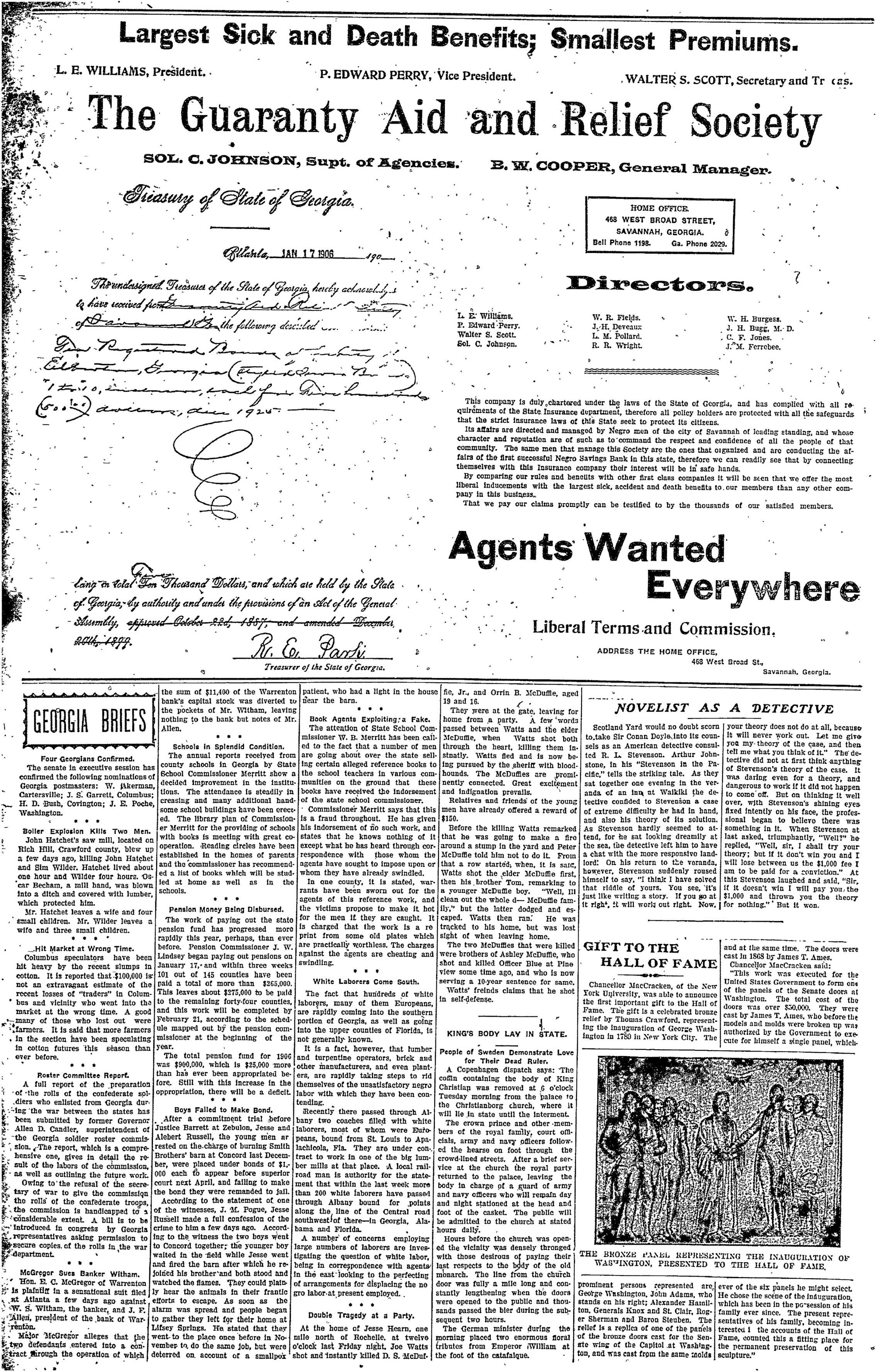
THE BRONZE PANEL REPRESENTING THE INAUGURATION OF WASHINGTON, PRESENTED TO THE HALL OF FAME
Scotland Yard would no doubt scorn to, take Sir Conan Doyle, into its counsels as an American detective consulted R. L. Stevenson. Arthur Johnstone, in his "Stevenson in the Pacific," tells the striking tale. As they sat together one evening in the veranda of an inn at Walkliki the detective confided to Stevenson a case of extreme difficulty he had in hand, and also his theory of its solution. As Stevenson hardly seemed to attend, for he sat looking dreamily at the sea, the detective left him to have a chat with the more responsive landlord: On his return to the veranda, however, Stevenson suddenly roused himself to say, "I think I have solved that riddle of yours. You see, it's just like writing a story. If you go at it right*, it will work out right. Now.
GIFT TO THE HALL OF FAME
Chancellor MacCracken, of the New York University, was able to announce the first important gift to the Hall of Fame. The gift is a celebrated bronze relief by Thomas Crawford, representing the inauguration of George Washington in 1780 in New York City. The
THE BRONZE PANEL REPRESENT
WASHINGTON, PRESENTED T
prominent persons represented are George Washington, John Adams, who stands on his right; Alexander Hamilton, Generals Knox and St. Clair, Roger Sherman and Baron Steuben. The relief is a replica of one of the panels of the bronze doors cast for the Senate wing of the Capitol at Washington, and was cast from the same molds
Savannah, Georgia. S A DETECTIVE
your theory does not do at all, because it will never work out. Let me give you my theory of the case, and then tell me what you think of it." The detective did not at first think anything of Stevenson's theory of the case. It was daring even for a theory, and dangerous to work if it did not happen to come off. But on thinking it well over, with Stevenson's shining eyes fixed intently on his face, the professional began to believe there was something in it. When Stevenson at last asked, triumphantly, "Well?" he replied, "Well, sir, I shall try your theory; but if it don't win you and I will lose between us the $1,000 fee I am to be paid for a conviction." At this Stevenson laughed and said, "Sir, if it doesn't win I will pay you the $1,000 and thrown you the theory for nothing." But it won.
and at the same time. The doors were cast in 1868 by James T. Ames. Chancellor MacCracken said: "This work was executed for the United States Government to form one of the panels of the Senate doors at Washington. The total cost of tho doors was over $50,000. They were cast by James T. Ames, who before the models and molds were broken up was authorized by the Government to execute for himself a single panel, which
INTING THE INAUGURATION OF
TO THE HALL OF FAME.
ever of the six panels he might select. He chose the scene of the inauguration, which has been in the possession of his family ever since. The present representatives of his family, becoming interested in the accounts of the Hall of Fame, counted this a fitting place for the permanent preservation of this sculpture."
Tr 4 OA Ry
HIGH LIFE SCANDAL
“TOWN OF BINGVILLE STIRRED TO
' ITS DEPTHS.
, ~ ©
<Deacon Butterworth\Felt to Be the
Victim of Unfortunate Circum-
stances, but His Wife Has-by no
_ Means Been Convinced.
' mhere was a terrible scandal hap-
pened in Bingville last Saturday night,
“the news of which flew all over town
like wildfire and since then our resl-
dents ain't got nothing done but talk
about it with bated ‘breath. School
was closed for a day on acct, of it and
‘so was the P,Q, Work Is at a stand-
‘still and the terrible recital of what
‘append ss on everybody's lips.
‘On Wednesday morning of last week
gee.
1A! ~ <
* Sent the Deacon Sprawling.
Lem Brown left Bingvillg for the Co.
iseat, where he was drawed up to serve
‘on a jury. Lem understood that he
lwould ‘sit all through serving so as he
could come back home Friday night
and he told his wife so. Before he
left Bingville Lem made arrangements
with Deacon Butterworth to feed his
cow sud plgs while he was absent,
and look after things around the
house generally, Lem has always
been a great friend of the Deacon's,
being as they both belong to the Bing-
ville church and eet side by sfde in
the amen corner every Sunday.
‘Well, the Deacon looked after things
at Lem’s place in good-shape so far as
we can*learn. Between chores the
Deacon would go intp Lem’s house
and take off his mitts to. warm his
hands. at the kitchen sfove, while
_ Mary Brown, that's Lem’s Wife, would
give him a doughnut, mebby, or “a
tookle, if she happened to be making
«my. The weather was so cold that
he Deacon spent considerable-of his
ime in the kitchen talking to Mary,
jut nobody ever thought anything of
t, being as Mary is a terrible hand-
-ome-and agreeable woman, Her name
yefore she was married was Mary
Simpkins and she lived out the Pike
‘our miles west of Bingville, daughter
of old Sam Simpkins, who fs dead and
zone, lo, these many years. When
Mary was a girl of 18 it was sald that
shere wasn't a prettier girl_in this
county than just her. She was the
belle of Bingville. And since we come
to think of it, this ain’t been such a
long time-ago and so far as we are
able ‘to see, Mary ain't changed much
since. Personally, we think she is
now better Iool:ing than ever. And so
nobody blamed Deacon Butterworth
for spending probably a leetlo mite
more time in the kitchen than was
necessary, although he is a married
man bisself. 2
Well, Frisay night come end went
ind poor Lem Brown didn’t coma, back
from the Co. seat, and there wis no
vord from him. When Lem didn’t
arn up Friday evening, when he said
> would, Mary begin to get awful
stless and oneasy and when the Dea-
m_come around to do the feeding
e next morning she invited him into
house and told him her worst
irs. She sald something told her,
hough she couldn’t say just what,
apa awful had hapnened to
. The Deacon he told hier She
istn’t give way like teat because it
s his opinion that Lem had been
ecessarlly detained and that he
in good health and spirits and
1d turn up sooner or later and ex-
all. *
_, took the Deacon a good while to
dain this. He eat nine doughnuts
alle he was dolng it. When Deacon
Jutterworth come back again in the
avening he walked into the kitchen to
see if Lem had come back and he was
errible surprised to see Mary stand-
ag by the window weeping. The
2acon asked her what she was a-cry-
g for and she sad for poor Lem, who
ad deserted her |Ike as not. As soon
, 3 Mary sald this the Deacon's sut=
tise was took place by pity, He
WK ie is 4 ie
Sy Be HU
Lald Out the Deacon. ~
hated, like thunderashion to stand
piere like a gawk while she was sob-
ing her eyes out, and her so pretty,
with her eyelashes all wet with tears
and her rosebud mouth drooped down
£4. The Deacon couldn't say nothing for
x minute. Wat can 2 man say any-
row in a case like that? He,can't say
“othing.
Then the Deacon couldn't stand it
‘longer so he walked acrost to
‘'y and put bis arms around her
pressed her to bis buzzumm and
Jaid her head on his breast and he
vothed back her hair and kissed
on the ear. Just as he waz doing
{Lem opened the door and walked
~ £ was a terrible surprise both for
- fy and the Deacon. Let wanted to
aw of the Deacon what the durna-
don ho was doing with his wite in
‘his arms, The Deacon tried to ex
‘plain, but Lem ho flung open the
itehen door and got the Deacon start
‘ed out and then he give him 2 kick
‘that sent the Deacon sprawling into
& snow drift. Lem then follered him
out lato the yard and wheri the Dea.
cop got up Lem kicked him down
again, Every tlme the Deacon would
get up Lem would kick him down.
At last the Deacon got tired of this
and so he didn’t get up—he just layed
there and so Lem he walked back into
the house and demanded a Explanation
ot his-wife. She throwed her arms
around his necks nd told Lem that
she didn’t love nobody but him and
that when the Deacon put his arms
around her she didn’t think no more
about it than she would if her own
father had of done it and so.Lem he
forgive her, but he didn't forgive the
Deacon,
It appears that the jury which Lem
was serving on wag dismissed Satur-
day afternoon until’ Monday and Lem
thought he would spend Sunday at
home so he walked all the way from
the county seat and got there just in
time to see his wife in the Deacon's
arms,
After Lem went into the house the
Deacon limped home. His wife asked
him what alled him and the Deacon
told her that he guessed his rheumatlz
was coming’ back on him again. As
soon a8 Mrs, Butterworth found out
the true state of affairs, however,
which she did withfn an hour, because
kind “neighbors and friends went
straight and told her, the way she
then layed out the Deacon was some-
thing awful. She scored him till a fly
wouldn't ght on him. She also called
Mary Brown a bussy and a min and
as a result the two women are not
now on speaking terms, .
It will take this awful scandal a
long time to blow over and we are
sorry it happened. Q
Subseribe for the Bugle. Full at-
tention given to scandals in its col-
umns.—Bingville Bugle Items in Bos-
ton Post.
LOVE TOKENS CARVED IN woop
For Presentation by Young Men of
Wales to Their Sweethearts.
In museums and collections of relics
appertaining to domesfic life In Wales
spoons occupy a conspicuous place.
These spoons, all of wood, are carved
fn quaint fashion, some very elabor-
ately, others more simply, and the
earliest were evidently love tokens
carved by young-men in their leisure
moments and presented to thelr sweet.
hearts. > In ancleat times in England
spoons of pewter were utilized as
QF A
BSLAPA A
a pORGH
Lisea [9
EBD. wo GE
(5) eee © oS 7
prokicerh 00
() Gerth | Vo
Bod, Hol a
| pS
WY BOSZ98 \tS9 nl
Hi QS 4
IT bs eH IP 2
HRA BE
fy Grose (| D
a be
Cas & i g )
BS ff ay
Hoon Ky oF
Bar L YA
Bier a), Y KR
HR ty i
RR Gaxaeen Y Yi
Rest fofe 1) ZANa y
paws forsGullsatlay We AY
Ray ay 4
Sy Pack Ney hl 6G)
BS hole 9714) 3
2} ROUIAR elated
i e}90) SES en ot
H Wed Ha
M IAG ie @
coe #2 Bai
A p f goa
rm 4 iz
Fd , oc
J xf 1 7
ie ig
symbols of betrothal and the term
“spooning” 1s thought to have originat-
ed as the result of elther the Welsh
or English custom. Welsh love spoons
are generally decorated with entwined
hearts or symbols of a similar kind,
others have handles in the form of
chains, loose rings and balls and aro
tut from a single block of wood.
‘The art of spoon carving has ‘alfnost
become extinct, although a curious
specimen’ was acquired less than 2
dozen years ago by a museum in
Wales and represented the work of an
old quarryman living in the north of
Wales. The “love” spoons have gen-
erally double shafts or double shafts
and bowls with a common handle, n-
dicating the unfon of heart and soul.
Spoons at one time were regarded.as
an important item In a domestic ont-
fit, and to the fact that Wales was a
poor country is probably due to the
prevalence of the wooden spoan, The
flat upper portion of the handle af-
forded the best scope for artistic orna-
mentation, and it was made use of to
the fullest extent by the spoon cary-
ers. In the,accompanying illustration
nro seen love spoons and the ordinary
carved variety ‘of Welsh origin.
Hoodoo Schooner Caused Storm.
A Portland, Me., paper gives the fol-
Jowing reason for a recent storm;
The hoodoo schooner Donna T. Briggs
arrived in port Saturday morning, and
everyone along the ‘water front Is pre-
dicting storm in consequence. Ac
cording to sailors, it is a sure sign
that when the Briggs fs in port it fs
going to storm.
QUESTIONS HARD’ TO ANSWER
Too Much Interested,
A number of years.ago (I won't say
how many, in deference to the ladles
concerned) my father was practicing
/medicine in New Bedford, and, vish-
ing to amuse my sister and her Uttle
friend at the same time, Ne invited
them to drive with him while he made
acall a little way out of town.
On the road they passed a ceme-
tery, and, thinking it would interest
the children, he drove in. Gomg
slowly along, he suddenly stopped and
read the name on. a gravestone, and
‘told them that the patient buried there
used to be a patient of his. A little
farther he found the name of another
former patient. The third time te
stopped was rather too much for even
the children, and one of them, after
looking all over the graveyard, turned
“to him and said: “Are these all your
patients?”
The next thing that attracted thelr
Interest was the figure of a carved
band with the index finger pointing
upward. They asked what tliat meant,
and my father explained to them that
the friends of the person buried there
wanted to show which way the depart-
ed one’had gone; hence the finger
polating upward.
In the next Jot there was no hand,
so thé question was raised as to which
direction the person buried there bad
gone. At this point my father sudden-
Sea om |
\ Rk 4 as ital
BSN ee a
ert fjevt REI
are
. aes iw
f ' se
wy A
y . : - s
( 2 ‘
ly thought it best to hurry along and
attend to the qt that was- still
alive.—Boston Herald,
Exhumed for an Earrinc.
A remarkable development has tak-
en place in' the case of the prisoners
O'Riordan and O'Driscoll, who are in
custody in Tralee on the charge of wil:
fully murdering Mrs. O'Riordan, a
schoolmistress, wife of the first and
sister of the second prisoner, The
body of Mrs. O'Riordan, which has
been a considerable time in the grave,
has been exhumed to decide a curious
point that has arisen. An earring
was found on the prisoner O'Driscoll,
and O'Riordan claimed it as his prop-
erty. The doctor who made the post:
mortem examination of the murdered
woman could not say for certain
whether there were two earrings’ or
only one on the body. To settle the
point the body was exhaumed, ‘and on
examination it was found that one eat
ring was inissitig.—Irish Independent.
Dall of 1240_
A Portland (Me.) man, Daniel G.
Loveltt,. has a curlosity in the shape
of a doll which was brought from Eng:
Jand sixty-five years ago. This doll,
which is about a foot in length, has
the same dress that It wore when
brought here, and those who are ac
,quainted with the fashions of 1840
have an {dea of its appearance, The
doll’s hair is genuine, and !s arranged
as was customary in the days when It
crossed the sea,
Mr. Loveitt, among other memen-
toes of bygone days, has some of those
old rewards of merit which good boys
and girls received from théir teachers.
These little slips would not now be
constdered valuable by children, but
by the boys and girls of 1840 and a
little later they were considered
“something great.”
First Sewing Machine.
|
3 fo %
1s).
age SSO)
ee
b ee
La ,
2
er
"te <
| ear
7 er 5 .
Sees
ore
acne *
‘The sewing machine was invented
In 1130 by Thomas Saint It was of
the chain stitch type, working with
the single thread, and was specially
designed for sewing leather,
Sinan? Sinene in Rineeed Citeaned:
| “Willis L. Fish of Bethel, Vt, took
ont a large swarm of bees from an un-
used chimney in his house. The
chimney had not had a fire in dt for
eleven years, and last summer Mr,
Fish discovered that the bees were
making a home in it About five
peunds of honey was found.
KNIFE THRUST SETTLED BEAR.
Alaskan Native Killed: Monster ty
SInafe Combat. *
Saye wees §€=6°
“Bear hunting 2s pursued by the
Alaska native ts en interesting gxmef”
remarked J. P. Gardiner, 2 Name
miner.
“L witnessed a bear hunt on Kadlec
fslamd a few months ago, A blg-brown:
bear; one ‘of the sfecies familiarly
known on Kadlac island and the ather
Aleatian [slamis, was pestering tho
settlement, ami a native who. hom &
wide reputation for prowess amon lt
people decided to go after tie chimal.
‘Before starting ox the expedition, im
ever, he went to bis mother emt ai-
tained ‘ker permizsion. His mother
was the oldest woman cf the tribe,.cnd
without her consent he wonitn’t have
stirred an inch. She gave her com
sent, so the native hunter, comet only
with a imnffe, started out, ‘Three: mare
of us ,with rifles, eeompanied him.
We agreed among us to ellow ths n=
tive to have the first chance at the
dear amd to shdtt only if he failed. to
ddl the benst.
We came upon the bear fn a,ravine.
‘The hative crouched on the ground az
the bear came up. We became quita
cacited. It was to be a hand-tohand
battle, and we feared the native would
get the worst of ff As the bear sp
proached the native it neared an its
hind Jegs. We hed our guns ready
dor instant action. But the suns were
not needed. Quick as a flash the na-
tive sprang up and had his knife
plunged into the antmal’s heart amt
wes away several steps before the
bear knew what bad happened. It was
a death blow, and we packed the pelt
back to Karluk in triumph.
Baboon’s Adventure.
Escaping from her cage in Rasher
ville gardens, a larga African baboon
has had a thoroughly merry adver
ture, relates the London Chronicta.
For a time she walked about fn umiis-
puted possesston of the adjoining: vil-
lage, as the inhabitants gaye her &
wide berth, her character being some~
what doubtful. The txhoon, whose
name {s Nan, eventually strolled futo
the Elephant’s"Head hotel, and -the
alarmed customers fled fn panics. The
landlord states that, befng in a fix be-
bind the counter, he threw all the foad
and dainties he could Isy his hamis
upon at the baboon. After the fesst
she sprang upon the counter ond
seized a pewter pot. Fearing mischief,
he left her to her own devices. Sev-
eral perscns who peeped through the
windows testify that Nan drew beer
for herself as“deftly fs a potman.
Eventually a daughter of a Rosher
ville resident captured the baboon and
led her back to the gardens. .
Oldest Balloon in Existence.
FE AES MR, = RNS.
i oeecehe Mts 32 4.8)
ot ea eet MM SS
eee See
By ere AR oe BAT 3, € oS
eee a st
bs arse 2 ot
gore. Wee
SSeS eee re
a Sea ip, RES
Pee a ame Oo
Pecan ih. Page
SPENT Pane ctu)
Cas 2 ae ER SOS
Sane Ras
Ce PSone
et Hyend i ie
tie : wert
ea Me Saree e yee
ioe a Rap RRC a
eR
__ ‘This air balloon, now In the Arsenal
‘museum, Vienna, was captured by the
Austrians at Wurzburg in 1796. ‘It ts
one of the six made“by the French
Aeronaut Sotlety during,*the years
17949 for use during the war, and 1s
the only one of them now in existence.
Eccentric Provision of a Will.
‘Mr. Thomas Hayes of Leopardstown
Park, Stillorgan, Dublin, by his will
left his estate, valued at £52,875 73. 1d.,
In trust for such persons as his daugh-
ter, Gertrude Frances Talbot Power,
wife of Mr, James Talbot Power, shall
appoint. ‘i
In default of such appointment he
directed that “£199 19s. should be paid
to his daughter on the first day after
his death (should she so long survive
‘him), £199 19s. on the second day
after his death “(should she so long
survive him),” and this phrase 1s re-
peated throughout the -will for each
day until the 250th day after his
death.—London Dally Mail.
Gasoline Dries a Race Track.
At a recent French motorcycle race
meeting rain began to fall; and the
racing was abandoned. The clouds
eventully rolled away, but the track
was too wet for high speeds.
Some one had a bright idea, which
was carried into effect. By spreading
a thin film of gasoline over the cement
and flaring it off the track was made
quite safe—The Motor Cycle.
Institution of Marriage.
The historical facts concerning max
riage as an institution are probably
only vaguely known. The institution,
as we know it to-day, is less than 500
years old. Histories of the marriage
ceremony show that it was not sok
emnized in church ag a religious rite
until the time of Popé'Inriocent I, A.
D, 1198, and was not considered & sao
rament until 1442. *
¢ y
|HOME OF SIAM'S ROYAL FAMILY
~
‘City In Which N& Mah but the King
May Enter,
Perhaps the‘ queerest city in the
rorld Is that of Nang Harm, the home
ot the royal family of Slam. This
‘city's pecullarity lies in the fact that
it ls composed of women and children
alone. It 1s in the center of Bangkok,
has high walls around it, and in its
popalation of 9,000 there fs not a sin-
gle man, though the king occasionally
pays a visit, The name Nang Harm
means “velld women.” There are
shops, markets, temples, theaters,
streets and avenues, parks, lakes,
trees, and flower gardens; a hall of
justice, judges, execfitioner, police,
generals, “and soldiers; all the posi-
tlons, official and otherwise, being
filled by women, The dnly man‘in all
Siam who-can enter this city is the
King, It 1s the home of his family
and of the family of the king before
him, The ruler of Slam may have as
many wives as he pleases. Each wife
has her own children and slaves—
therefore a small city 1s needed to pro-
vide accommodation for them all.
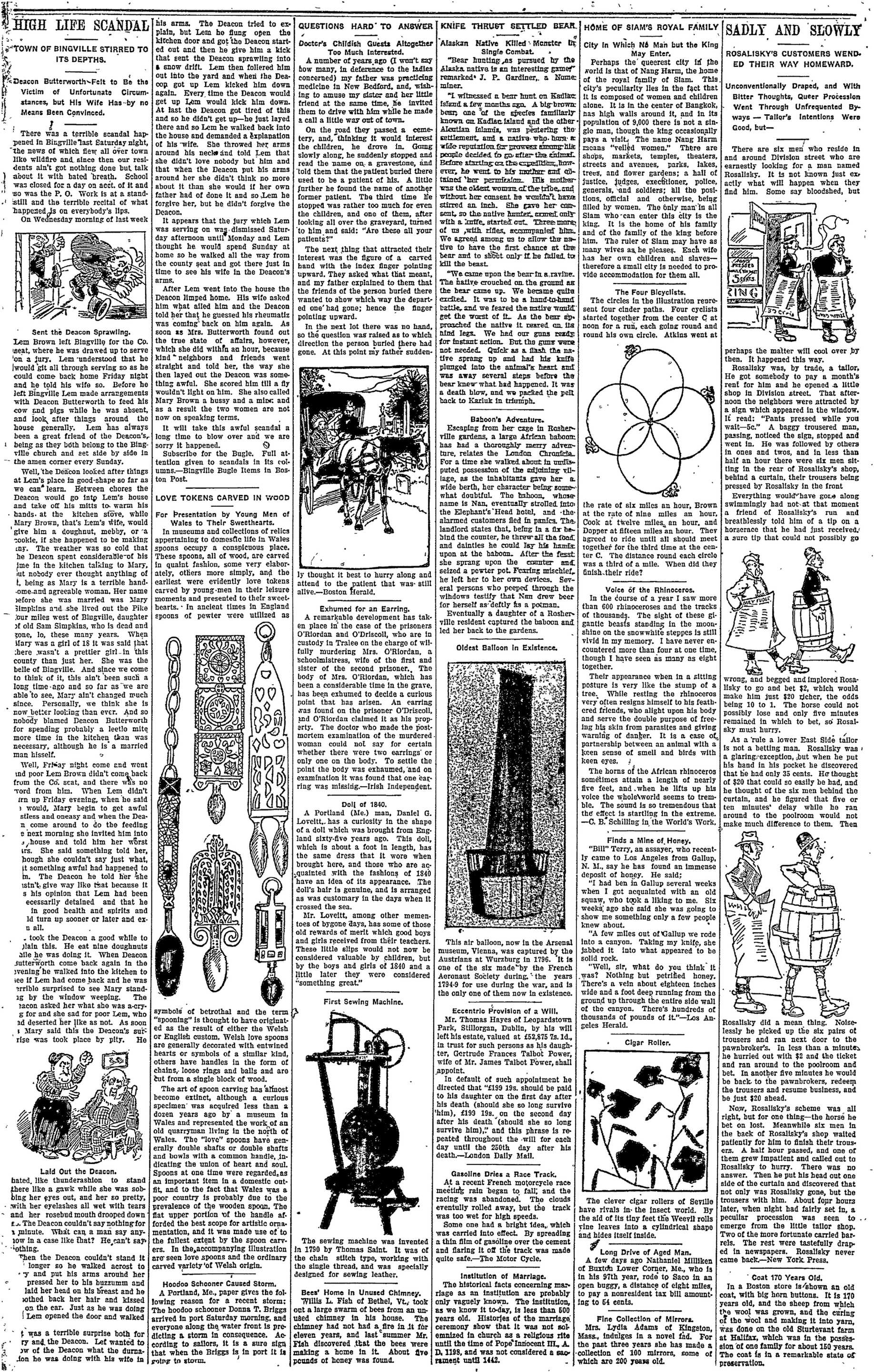
‘The Four Blevellsts.
The circles in the Mustration reore
sent four cinder paths. Four cyclists
started together from the center € at
noon for a rut, each going round and
round his own circle, Atkins went at
2
ee
cs
S
%
9) +
Cs
the rate of six miles an hour, Brown
at the rate of nine miles an hour,
Cook at twelve miles, an hour, and
Dopper at fifteen miles an hour. They
agreed to ride until all should meet
togethe# for the third time at the cen:
ter C. The distance round each circlo
was a third of a mile. When did they
finish.their ride?
Voice 6f the Rhinoceros,
In the dourse of a year I saw more
than 600 rhinoceroses and the tracks
of tessa ‘The sight of these gi.
gantic beasts standing in the moon:
shine on the snowwiite steppes Is still
vivid in my memory. I have never en
countered more than four at one time,
though I have seen as many as eight
together.
Their appearance when in a sitting
posture is very like the stump of a
tree, While resting the rhinoceros
very often resigns himself to his feath:
cred friends, who alight upon his body
and serve the double purpose of free-
ing hig skin from parasites and giving
warniig of danger. It is a case of
partnership between an animal with a
keen sense of smell and birds with
Keen eyes, 3.
‘The horns of the African rhinoceros
sometimes attain a length of nearly
five feet, and.when he lifts up his
voice the whole\world seems to trem-
ble, The sound is so tremendous that
the effect is startling in the extreme.
—C. By Schilling in the World's Work,
Finds a Mine of Honey,
“BUr" Terry, an assayer, who recent
Iy came to Los Angeles from Gallup,
N. M., say he has found an immenst
deposit of honey. He sald:
“I had ben in Gallup several week:
when I got acquainted with an old
squay, who tgok a liking to me. Sis
weeks; ago she said she was golng tc
show me something only a few people
knew about. 7
“A few miles out of Gallup we rode
Into a canyon. Taking my knife, she
Jebbed it into what appeared to be
solid rock. .
“Well, sir, what do you think it
was? Nothing but petrilied honey.
‘There's a vein about eighteen inches
wide and a foot deep running from the
ground up through the entire side wall
ot the canyon, There's hundreds of
thousands of pounds of it.”—Los An-
geles Herald.
+ Clgar Roller.
amb
ss re
f ea
na
>
+ ¥ as
‘The clever clgar rollers of Seville
have rivals in: the Insect world. By
the ald of its tiny feet tHe Weevil rolls
sine leaves into a cylindrical shape
and hides itself inside,
# vom Drive of Aged Man.
A fow daya ago Nathantel Milliken
of Buxton Lower Corner, Me, who is
in his 97th year, rodé to Saco in an
open buggy, a distance of eight miles,
to pay a nonresident tax bill amount.
ing to 64 eents.
Fine Collection of Mirrora.
Mrs. Lydia Adams of Kingston,
Mass., indulges In a novel fad. For
‘the past three years she has made a
‘collection cf 100 mirrors, some of
whieh are 200 yeasa old.
ca CUSTOMERS WEND-
| ED THEIR WAY HOMEWARD,
Unconventionally Draped, and With
Bitter Thoughts, Queer Procession
- Went Through Unfrequented By
ways — Tallor’s Intentions Were
Good, but— . ‘
There are six men who reslde in
and around Division street who are
earnestly looking for a man named
Rosalisky. It ts not Known just exr
actly what will happen when they
find him. Some say bloodshed, but
: By — G
We iach V2
Wied £3
Za Sg) "iF
ee
Sy | es
eA E=\h
“Aprageet T eea
em > oO
perhaps the matter will cool over bY
then, It happened this way.
Rosalisky was, by trade, a tailor,
He got somebody to pay a month’s
rent for him and he opened .a little
shop in Division street, That after-
noon the neighbors were attracted by
a sign which appeared in the window.
It read: “Pants pressed while you
wait—5e.” A baggy trousered man,
passing, noticed the sign, stopped and
went In, He was followed by others
in ones and twos, and In less than
half an hour there were six men sit-
ting in the rear of Rosalisky’s shop,
behind a curtain, their trousers being
pressed by Rosalisky in the front
Everything would’have gore along
swimmingly had not-at that moment
a friend of Rosalisky’s run and
breathlessly told him of a tip on a
horserace that he had just received,
a suro tip that could not possibly go
s
Sats
—_—-
Poss, im ee
a LO
7233\ |
S52 ry
= \ Jy.
LY FRR,
= Se _ Say}
A AS en
Ee 4S
wrong, and begged and implored Rosa-
Usky to go and bet $2, which would
make him just §20 deher, the odds
belng 10 to 1, The horse could not
possibly lose and only five minutes
remained in which to bet, so Rosal-
sky must hurry. ,
As a tule a lower East Side tailor
Is not a betting man. Rosalisky was
a glaringrexception, but when he put
his hand in his pocket he discovered
that He had only 35 cents. He thought
of §20 that could so easily be had, and
he thought of the six men behind the
curtain, and he figured that five or
ten minutes’ delay while ho ran
around to the poolroom would not
make much difference to them. Then
: . B:
RP <P ,
©) e 4
Sy w=
Ait, FSR
Ve as
2 el
= At i
EAs GS Ess
Rosalisky did a mean thing. Noise-
lessly he picked up the six pairs of
trousers and ran next door to the
pawnbroker’s. In less than a minutes
he hurried out with $2 and the ticket
and ran around to the poolroom and
bet. In another five minutes he would
be back to the pawnbrokers, redeem
the trousers and resume business, and
be just $20 ahead.
Now, Rosalisky’s scheme was all
right, but for one thing—the horsé he
bet on lost. Meanwhile six men in
the back of Rosalisky’s shop waited
patiently for him to finish their trous-
ers. A half hour passed, and one of
them grew impatient and called out to
Rosalisky to hurry. There was no
answer. Then he put his head out one
side of the curtain and discovered that
not only was Rosalisky gone, but the
trousers with him. About fopr hours
later, when night had fairly set in, a
Pecullar procession was seen to
emerge from the Httle taflor shop.
Two of the more fortunate carried bar-
rels, The rest were tastefully drap-
ed in newspapers. Rosallsky never
came back—New York Press,
* Goat 170 Years Old.
| In a Boston store is“shown an old
coat, with big horn buttons. It is 170
years old, and the sheep from which
the wool was grown, and the curing
of tho woot and making it into yarn,
Was done on the old Sturtevant farm
at Halifax, which was in the posses-
sion of one family for about 150 years.
‘The coat fs in a remarkable state of
preservation, .
It has been truly said by one of the speakers of the mass meeting during the week that the new city hall was christened in blood and bathed in tears The tragedy of last week did it.
DURING the week a white man was accused of harboring a young white girl. The girl was found in his bed room. The white fellow was arrested. The next morning he was fined $25 in police court. Suppose he was of a darker hue.
The attention of the superintendent is called to the condition surrounding the Maple street school. The sidewalk on the north side of the building is not paved and whenever it rains the entrance is flooded. Through this water and at times mud, the teachers and children have to wade, matters not how cold it may be; the result of which can be readily imagined. The sidewalk should be raised and paved. If the board is not able to do the paving, the city would have sufficient dirt dumped to keep the water from settling before the main entrance at least.
At the two past meetings of the city council a delegation of colored men, unknown to us, appeared, asking for aid toward the establishing of a library for the colored people. A library is one of the institutions needed badly by our people, and it should be aided in an unstinting manner by the city. Now, it is understood that the Men's Sunday Club, an organization doing much for the people, will soon secure quarters and the library feature will be the main thing. It would be well for those colormen who are thus interested to unite forces with the young men and have a library that will be a credit to the whole people and by which a greater demand could be made upon council to contribute.
The need of a well organized political club among our people is apparent. Not a club with mushroom ideas or growth, but a permanent one. There are interests of our people that must be looked after and which could be done by such an institution. For instance, our men are to be educated in the regular paying of poll tax. It is now a hard matter to cause the older men to do so by paying a large amount of back tax, but such an institution can adopt methods whereby the young men, hundreds of whom become of age each year, can be reached and encouraged to become tax payers, thereby increasing our numbers to such an extent that in the coming years a demand for better treatment, etc., would be respected.
Masonic Notes.
Eureka Lodge No. 1. is preparing to celebrate its 40th anniversary next month. It is expected to be a grand affair. The entire state is proud of the mother Lodge. Letters received from several of the brethren are of a cheering nature about the condition of their several Lodges. Let all reports be better this year than ever before. Be charitable to each other and be mindful of the widows and orphans. The Eastern Star is still booming. The ladies spend hundreds of dollars each year for endowment.
No Race Inferiority.
No Race inferiority.
But in the arts, in literature, what can he do there? There have been white men in the South who have not scrupled to affirm that the Negro was only an animal, soulless and incapable of real progress. Perhaps they regard industrial achievement as mere "training of animals." Perhaps they look "upon his religious enthusiasm as excess of animal emotion. Perhaps they would bring the same accusation against the Negro music, the only really American music we have produced. But they can hardly pretend that Brutes could bring forth such work in literary lines as the Negro is showing himself capable of. We refer to the writing of Prof. Ducols and Paul Laurence Dunbar, Mr. Ducols' latest book of poems illustrated by Negro artists, is a gem which the writer has not seen surpassed by the work of any white poets this year.
It is about time for us to wake up to the fact that is the field of literature, even in other fields, the Negro is working side by side with his white brother. There are talking about the inferior race
any more than there is in-fa talking about the 'inferiority' of women. Differences is not inferiority. And even the difference has been greatly exaggerated. By the sign of the book the Negro is showing a mental capacity which places him on a level-Chicago, Advance White.
"NUF-SED'S" TIMELY TOPICS.
Lincoln-Douglass Exercises.
Dear Mr. Editor: Well sir, the great Lincoln-Douglass exercises have come and gone and I tell you they were just fine. Everything went off so nicely—the speaking, the singing and the decorum of the audience were all that could be desired. I had my lamps well trimmed, in order to see and hear all that went on. I was simply carried away with the very excellent program which was presented.
As I looked upon the platform, I saw seated there, men of culture and refinement; and women of grace and dignity. Let me tell you some of those who participated and you will understand just why the audience appreciated these exercises so immensely: There was Prof. Chas. McDowell,a graduate of Fisk University of both the collegiate and musical departments. Any person needs but to hear Prof. McDowell once to see that he is a master at the piano. There were two of the leading doctors on the platform viz: S. Palmer Lloyd, the vice-president of the Men's Sunday Club, a graduate of Atlanta University and University of Pennsylvania; J. Walter Williams who is chairman of the music committee, and a wide awake doctor in every sense of the word. He is a member and large stockholder of the West Side Drug Store. Dr. Williams led the audience in singing "America." Prayer was offered by Rev. Geo. E. Nolley, a minister of the highest integrity and one of the highest in interest in the Sunday Club. Rev Nolley is pastor of St. Paul's C. M. E. Church. The master of ceremonies was Mr E. W. Houstoun, better known to the public at large as "Mannie." Mr. Houstoun had his training at the G. S. I. C. and Atlanta University and is literary "reporter" for the Sunday Club. Miss Mamie V. Edwards who captured the audience with an instrumental (piano) solo is a very pleasant and graceful young lady. Miss Edwards is one of our school teachers and received her training at the G. S. I. C. Mr.J.S. L. K. Grant who declared Lincoln's famous "Gettysburg Speech," is a student at the G. S. I. C. We predict a bright future for this young man. Mr. H. O. Ward played a violin solo which was tremendously appreciated by the audience. Mr Ward is one of our young business men. One of the treats of the occasion, was the "Original" poem on Frederick Douglass by Mr. E. W. Sherman. Mr. Sherman has already made a name with the reading public and this late addition on "Douglass" will be greeted by the large number of readers who follow Mr. Sherman weekly. Mr I. M Jackson, a graduate of the College, a successful school teacher and mail clerk, delivered in his own clear way an oration on "Abraham Lincoln." I tell you what Mr. Jackson told a few things about "Old Abe the grand old man."
The duett by Mrs. E. J. Robinson and Miss Nettie Houston completely captivated the audience. The sweet soprano voice of Miss Houston blended most harmoniously with the pure alto voice of Mrs. E. J. Robinson. It is only a pity that these two singers appear only before Savannah audiences, because they would certainly be greeted by all lovers of music. They were accompanied by Mrs C. B. Lewis who is one of those players, possessing such a fine touch, that we say she has a touch all her own. Mrs. Lewis is just "a born pianist." Prof. L. B. Thompson appeared with clearness, force, and eloquence in his oration no Frederick Douglass. Prof. Thompson certainly laid before the audience the characteristics of this great man and his long and eventful life in such a way that the audience will always remember.
The last number on the program was a solo by Mr. L. D. Thompson, an old Savannah boy who has been away up North for the last eight years. Mr. Thompson is a very pleasing singer possessing a voice of great range, clearness and volume. Mr. Thompson is always welcomed by all Savannah audiences. The ushers were Messrs. H. A. Clark, H. J. Gordon and Marion Johnson.
Another feature of the exercises was the refreshments prepared by the ladies. These ladies have shown their willingness to work time and time again. Among some of the ladies whom I saw were, Mesdames Hutchinson Owens, Gordon, Robinson, Talbert others.
Help us to Help Others.
Mr. Editor: Please allow me space in your most worthy paper as it has been quite awhile since I have asked to be heard from since the thing I would like to speak about is of a vital importance. Help us to help others. Having read a statement in an issue of the "Press" of the 18th, inst., saying that "May not bar all Negroes." "Only, undesirable class may be kept out of the Telfair." I like that statement because it touches along the line of what I have long wanted to hear because in every race their is an undesirable class that you would not like to be thrown into association, and I am proud of the statement for that because we have a class in our race that we would not associate with, but it has been said that all Negroes are alike, but the statement is not true and all the people on earth do not believe it because in that statement in the "Press" disputes it by saying "May not bar all Negroes." "Only undesirable class may be kept out of Telfair," showing that there are some respectable Negroes
It also farther states that "Some measures will be taken to exclude the undesirable class of Negroes," and it goes still farther to name the class of undesirable ones. So you see that The Press' believes there are more than one class of Negroes, it goes a step farther to say that they would "arrange to allow Negroes of respectability to have access to the library." Does not that show you that "The Press" believes that there are more than one class of Negroes? And all Negroes are not alike. The thing I would like to see is this same application be made along all lines where the races are thrown together because there is a class in our own race that the respectable ones do not want to associate with. I am not saying because I want social equality but in defense of those of our race who respect themselves, because we have just as respectable men and women in our race as any other race and we would not like to be measured with that undesirable class. When I say help us to help others, I mean simply this, just what "The Press," said about allowing
the respectable Negroes to be. admitted to the "Telfair" and keep out that undesirable class; if that would be in all things where the races are thrown together allow that respectable class to be admitted and keep out that undesirable class, it would soon result into a large, per cent of that undesirable class to grow better in plain words, "Put the Negro down agd he will walk." If the Negroes themselves would make a distinction among themselves, they would find things better in their own race and if the whites would show that they respected a class of Negroes above another it would help to draw that undesirable class a degree higher, then we want you to measure us according to the way we deport ourselves and stop saying that all Negroes are alike, because I know it is not so. Now you have started the ball to rolling in the right direction, and let me say that the respectable Negroes begin to draw a strong line of distinction in your own race and until we do so we will be like a big drove of black birds all alike. I don't blame the white people for some things they do to us because we make ourselves objectionable. Some of us go so untidy until it make us look like a fellow that have just come out of a mudhole and yet we want to sit among respectable people. Let us have more pride and decency about ourselves
College Dots.
The Y. M. C. A. social last Tuesday night was a swell affair. The Association seems to be taking on new life.
President Wright spoke to the citizens of Sylvania last Saturday. Of course he had a large audience composed of both races to hear his eloquent address.
Don't forget the Farmer's Conference, Feb. 21. 22 and 23. Here are a few of the speakers: Dr. Fair, Dr. Brockett, Dr. Lindsay, Supt. Ashmore Dr. Brunner, Mr. L. E Williams, president Wage Earners L. and I. Co., and Mr. J. W. Armstrong manager Metropolitan Mercantile Realty Co.
The anniversary of the birth of Dr. J. C. Price was observed last Friday night with vice president Suggs who was a pupil of and subsequently a teacher under Dr. Price, as the orator of the day. No comment on the oration as Prof. Suggs is so well known to the readers of THE TRIBUNE Prof. Work lectures March 16th. Grand concert. March 21st. Remember the Farmer's Conference.
Card Party.
At the residence of Mrs. Julia Brown, 515 Anderson street, a pretty card party was given in honour of Mrs Frances Allen Slowe, of this city but now of New York Mrs. Slow was attired in a gown of white lace with a beautiful bouquet of carnations and brilliant diamonds Mrs Anna Scott wore a gown of white voile with a beautiful sunburst diamond broach and bouquet of carnations. Mrs Belle Johnson wore a gown of white embroidery prettily made up. Miss Emily Nelson wore a gown of white silk. Mrs. Anna Jackson wore a gown of black silk. Miss Estella Robb was dressed in white organdy and Mrs Julia Brown, the hostess was attired in white laugner gown trimmed with voile face. They all made a very pretty appearance. The gentlemen were Messrs. Joseph Geary, James F Holmes, Alfred Holbrook, Paul E Perry, James Ferry, J Andrews, Jas Davis, Frank Coleman and J Rogues Rannier. The house was artistically decorated with over greens, small American flags and Japanese lanterns. There were two prizes awarded to the best players, Mrs Slowe winning the first and Mrs Scott the second. Valentine score cards were used. The prizes were a beautiful rose jar and a very pretty Japanese teapot. Afterwards a delicious menu was served to the guests.
Ministers' Meeting.
Ministers' Meeting.
The Evangelical Ministers Union at its session last Tuesday put in some good work, Rev. E. Lowery presided. Rev. F. A. White conducted the opening service. Revs. G. E. Nolley, R. V. Branch, W. L. Cash, P. J. Hunter, and James Jackson were absent on account of business interest, though there was no lack of interest in the meeting. Mr. Yancy of College, Ga., was present and represented the Farmers' Conference that is to be held there next week. Dr. J. A. Lindsay made a telling speech on behalf of the Union and promise to give an unstinted support, in attendance and otherwise. A very important paper was read and a strong speech followed by Mr. W. D. Armstrong and the Rev. Mr. L. W. McMillan responded to the extent that the members present left, having a desire to carry out the main gist of the speeches. Sermonio reports were made by Rev. L. W. McMillan and Rev. S. J. Jenkins. The criticisms were made both timely and helpful, especially that which was made by Dr. Lindsay. At the next meeting Rev. W H White is to read a paper, subject, "If Christ's death was the fulfillment of the prophecy, how is man responsible?" The minister who fails to participate in such meetings will fail to do the service God intends
Galines' Chapel
In addition to the bg rally that is to be on the Second Sunday prox. Tuesday night the banner class was organized and will be distinguished hereafter by a banner attached to the seat whatever-leader having the largest number in attendance, or
the most money raised. This is a good way to see who is the most active leader and the member who love the church, will sure to appreciate an active man. No. 5, Bro. Toney Porter, leader was the banner class financially and No. 2, Bro. O.S. Perry, numerically, and No. 1, Bro. A.B. Scurdy, participated.
For a New Picnic. Ground.
A number of gentlemen are interesting themselves in the organization of a club for the purpose of opening a resort for picnics, etc., where our people can have recreation. A list containing a number of well known gentlemen have been circulated and those interested are asked to attend a meeting at the hall of Middleton's band; Reynolds near Jackson street on Wednesday night next at 8:30 o'clock. Mr. Samuel Miller is temporary chairman of the movement and asks the gentlemen to meet promptly.
Wanted
Soda Fountain and Counters. Call at THE TRIBUNE Office.
For Rent.
418 Henry East with large yard. CHAS.
McDowell 22 West State street. 2-17-21
Notice.
The Union Loan and Investment Company is now open for business, we have on hand 100 shares of stock for $5.00 per share. Money invested here is money secured and is subject upon investment herein, to a pro rata part of all interests, fees and fines accruing to the company. We have ready money to loan upon easy earns on secured notes, real and personal property negotiable papers including Stock certificates. We are open for business and solicit the patronage of the public. While we regard business transactions as a public privilege, we also regard it in its personal relations, taking into consideration the whims of the individual. We are open at all hours, at 20 state St., West, (up stairs). Ask for Geo. W. Jacobs,
Through Train A. C. L.
Through train and sleeping car service between Jacksonville, Fla, and intermediate points to Augusta, Ga. Effective January 10, 1906, the Atlantic Coast Line will inaugurate through Pullman and Sleeping car service between Jacksonville, Fla, intermediate points and Augusta, Ga. These cars will be handled on Florida and West Indian Limited, No. 82, and New York and Florida Express, No. 89, with dining car service northbound and buffet service southbound. Trains will arrive at Augusta 9:45 p. m.; daily, depart at 10:30 p. m. affording best possible service between South Georgia points and Augusta. For detailed schedule or other information see ticket office or mail.
T. C. White
T. E. Myers
D. P. A., Sav, Hg, T. P. A., Sav, Hg,
Those Who Want Good Quality.
Our 44 RYE WHISKEY is a wonder.
Only £2.75 per gallon.
Send us a Trial Order. Price List of all kinds of Liquor on demand.
S. Raskin & Son,
West Broad and Henry Sts,
SAVANNAH, GA.
Smart Set Tailoring Co.
MERCHANT TAILORS.
330 West Liberty Street.
We wish to announce to the public that we have just received a large stock of SPRING and SUMMER GOODS and are now in position to offer you TAILORING that is thoroughly High Class in every particular.
If you place your order with us, you are certain of quality, value and a perfect fit at POPULAR PRICES.
Free Life Insurance
* During the past THIRTY-FIVE YEARS over one hundred thousand discriminating customers, many of whom could not be suited elsewhere, found complete and lasting satisfaction and a solution of the piano question by purchasing of the LUDDEN & RATES.
LUDDEN & BATES. M. H.
Let us prove we can do as well for you.
We guarantee in our New Scale $300
LUDDEN & BATES PIANO
that we give you an instrument that will
compare in tone, action and general
construction with any $400 piano in your
neighborhood—purchased elsewhere.
We warrant this piano "FOR A LIFE TIME"
and besides we give a limited number of
purchasers FREE LIFE INSURANCE. In case
of death your heirs—wife, sister or child-
rent are handed a RECEIPT IN FULL FOR ANY
AMOUNT YOU MAY OWE ON THE INSTRUMENT.
Isn't this a fair and a safe proposition—a
safeguard to keep the piano in the home.
This offer holds good only for our
THIRD LUDDEN & BATES
PIANO CLUB—Just forming for one hundred
NEW SCALE $400 LUDDEN AND BATES PIANOS to one hundred Club members at $287
cash or $287 on terms of $10 cash and $8 monthly with interest. Larger payments
for quarterly or yearly terms.
Call at the store or write for membership blanks, and full particulars—this club will soon be filled.
Our two Clubs just completed saved two hundred members in all $22,600 and made us two hundred more friends. We want your friendship.
Ladies and Children Cloaks, Suits, Waists and Separate Skirts Absolutely Slaughtered During the coming week.
Unusual Inducements In Embroideries and Muslin Underwear.
Metropolitan Mercantile and Realty Company.
Shares $10 each. Full Paid and Non-assessable.
Six Years of Success
and service tells a tale unprecedented of Race Enterprise.
Six years of experience and experience of corporate adventure and experience of pluck and push, experience of progress and prestige.
Six years WORK and worry, THIS IS THE HISTORY of this great This with Real Estate is behind pay. SEVEN PER CENT and Churches, Halls and Houses, thousand men and women. Make an investment with us and grow.
P. SHERIDAN BALL, PRESIDENT
L. C. COLLINS, SHI
J. T.
F. M. COHEN, Teller. J. W. ARM.
222 W. Broughton St., Savannah
Straight-forward Prompt R
STRICT ATTENTION TO LET ME COLLECT YOUR property isn't bringing tell me about it. I will look YOUR INTENT
Mr. Business or Professional of your moss-covered accounts. me a commission, if not you lose CHAS
and service tells a tale unprecedented in the annals of Race Enterprise.
Six years of experience and extension marks an epoc of corporate adventure and business achievement.
Six years of pluck and push, trials and tribulations.
Six years of progress and prosperity, patience and prestige.
Six years WORK and worry, wisdom and winning.
THIS IS THE HISTORY of this great race institution.
This with Real Estate is behind your investment. We pay. SEVEN PER CENT annually. We build Churches, Halls and Houses. We employ our two thousand men and women. We are here to stay. Make an investment with us and see your money grow.
P. SHERIDAN BALL, PRESIDENT.
L. C. COLLINS, SECRETARY.
J. H. ATKINS: TREASURER.
F. M. Cohen, Teller. J. W. ARMSTRONG, Gen'l Mangr. 222 W. Broughton St., Savannah, Ga. Bell Phone 1144
Straight-forward Dealings.
STRICT ATTENTION TO EVERY DETAIL. LET ME COLLECT YOUR RENTS. If your property isn't bringing in what it should, tell me about it. I will look out for YOUR INTEREST. Mr. Business or Professional Man send me several of your moss-covered accounts. If I collect them pay me a commission, if not you lose nothing by so doing. CHAS. McDOWELL
22 West State Street.
CAPITAL,
SHARES,
L. S. REED, - - - President and Manager,
D. C. SUGGS, - - - Vice-President,
J. T. BURTON, - - - Secretary,
F. M. BELL, - - - Treasurer,
H. A. MACBETH, - - - Attorney,
Seaboard Air Line Ry. Quickest Line. Best Service
Pullman cars on all trains through to Jacksonville and Tampa. Schedules and detailed information at City Ticket Office, No. 7 Bul street. Phone 28.
SATURDAY, FEBRUARY 17 1906.
Savannah Pearls Fountain, U. O. T. R. is preparing for a unique entertainment at Our hall, on Monday night March 5th. It's going to be interesting.
Weldon Lodge of Elks, will give a swell entertainment on Thursday night next at Masonic Temple THE TRIBUNE job department has printed some "swell" folders for the Lodge.
On Tuesday night last, at the residence of her mother, Mrs. Annie B. Soloman, Capitolla, Ga., Miss Lula McCarr and Mr. Benjamin Best were happily wedded. Mr. and Mrs. Best left on Wednesday for Bradford, Fla., their future home.
The Janitors Association is preparing for a successful entertainment at Masonic Temple on Friday night Feb. 23rd. Five girls from each of the public school will be selected for the guessing contest.
A young folks minstrel will be given at Masonic Temple on Wednesday night under auspices of Mme. Florida Desverney. That is a sufficient guarantee for its excellency. It is for the benefit of Charity Hospital and demands the support of the public.
The Rev. Richard Bright cordially invites the general public and strangers who are visiting the city to the services of St. Stephen's Episcopal Church at the corner Habersham and Harris Sts. All the seats are free, come and sit where you please. Hearty congregational singing. The gospel of Jesus Christ preached. Hours of service; Sundays 11 a.m. and 8 p.m. Wednesdays 8 p.m.
The First A B church choir, West Broad and Bolton Sts., was royally entertained with a supper last night by Miss Jennie Williams at 914 Burroughs St.
Mrs M E Williams of Charleston, S C, spent a pleasant week in the city at Mrs Rena Barnard's, 528 Ni collstreet. She will return on Monday.
Rev. R. V. Branch of St Pal ps o umental Church will preaon at the Seco : Baptist Church Sunday morning. R v Branch a soun stirring preacher and will un doubted v inters tall of his hearers.
In another column will be found the ad of the Smart Set Tailoring Co., 330 W Liderty street Mr. C. W. Scott, the well known tailor is connected with the firm and will be please to serve his friends.
Kev R W Walker of Keysville Ga, and Mrs Mamie Jones of Jacksonville, Fla., formerly Miss Mamie Walker of this city, were called to the bedside of their sick brother Mr Lindsay Walker who lay seriously ill at the home of Mrs L H Griffin, 632 Walker St.
On Wednesday evening I last Miss Catherine J Steelle and Mr Jame H Blou t were marries at the bri e's residence by R v James M Simms. The bride was handsomey attired and carried a pearl fan. Many usual and handsome presents were received from friends in this and other cities. The couple is very comfortably situated on Ea t Duffy Street.
To prove his great interest in behalf of the Chatham Orphanage, Rev. G. W. Griffin, D. D., and Mrs Griffin have consented to take personal charge of the work. They moved to the home during the week. A number of persons have made pledges for the support of the home, and Rev. Griffin is desirous of having same paid in time to meet payment on the property now being purchased. This payment is due on the first of-March. The citizens should take an interest in this institution and assist in reclaiming the large number of helpless young ones now roaming the streets.
Dr. Craft, Moving Pictures, for dates apply 407 Montgomery street. 2t.
Removed.
Miss Rowena Houston, has moved from 518 East Henry Street to 303 E Waldburg Street. Bell Phone 875
Spiritual Ruins.
"Spiritual Ruins" will be the subject of the sermon at St Stephens Sunday night. This no doubt will be kept up to the high standard of the former subjects of the series and merits the commendations accorded these historic efforts. Good singing and cordial welcome awaits all.
Rev. May Will Come:
St Louis, Mo. Feb. 2, 1906.
Editor SAVANNAH TRIBUNE—
Having just been called to the 2nd Baptist church of your city, I offered my resignation to the historic Corinthian Baptist church here last night, which was voted down and a move put on foot to raise my salary to hold me here, but because the "spirit leads I am coming to Savvannah Ere long I'll be in the pastorate there. Mrs. Mayme Q. May, my wife is under the treatment of the physician at present Any who disire to write me can address me 1016 Poepping Street, St Louis, Mo. Yours Fraternally.
Scientific Embalmer.
A. B. CUMMINGS, Hygienic and Scientific Embalmer, Registered State of Ga. No. 110. Arterial and Cavity Embalming. Clark and Barnes needle process. Remains prepared for shipment to any part of the world.
Now with the Estate of J. H. Johnson 331 Jéfferson street, Bell Phone 876.
The Lincoln-Douglass exercises were held at Beach Institute last Monday night. A good crowd, a good program, and a good enterta nment were in store.
Last Sunday Mr. E.W. Sherman read a well written paper on "Environment." Mr. Sherman's paper was received very favorably by the large crowd which greeted him. During the general discussion Mr. G. S. Williams asked Mr. Sherman to make clear a few statements which he made during the course of his talk. This talk would have been very interesting had it lasted longer, but it ended with a clear understanding
Next Tuesday night at the Beach Institute, the Forest City Glee Club will render a grand musicale. The Forest City Glee Club under Mr. E. J. Robinson is prepared to give the public a real good treat. It is safe to say that on this night the Beach will be taxed to its limit.
Preparations are being made for entertaining Dr. W. E. B. DuBois of Athens University when he comes next month. - Keep posted by reading THE TRIBUNE. All Savannah is going to do honor to this distinguished citizen.
The Men's Sunday Club. will move into quarters at its anniversary on April 23rd. Subseribe to the list now! This is a cause which all good citizens are going to support. Plaus will be considered to-morrow to branching out, in other words conducting the club on even broader lines than those on which it is being run at present. We are growing. Be sure to come out to-morrow at 4:30 p. m.
Sixth Anniversary.
Sixth Anniversary.
The Frances E. W. Harper, Literary and Social Circle celebrated its sixth anniversary at the home of Mr. J. Walter William, Friday evening February 2nd.
The already beautiful home of the hostess was made more so by the bevy of beautifully dressed ladies and gallant gentlemen.
With games and music the evening past most pleasantly. A short program was then rendered by the members of the circle, and is as follows:
Music - - - America
Remarks - by Pres., Miss C. E Lewis
Vocal Duett - Misses Hurd and Shivery
Paper - Mrs.J. H. Patterson
Vocal Solo - Miss M. E. Madison
Recitation - Mrs. E. D. Bulkley
News from the editor.
Mrs. M. M Mitchell.
Each number of the program received hearty applause. Last, but we dare say as much enjoyed as that preceeded, was the repast, served in courses by a professional caterer.
Souvenirs of the occasion were given, and each guest left wishing that the anniversaries could come more often than they do.
Those present were Mr. and Mrs. R A. Harper, Mr. and Mrs. George Johnson, Dr. and Mrs. E. D. Bukley, Dr. and Mrs. J. Walter Williams; Mrs. J. W. Carr, Mrs Williams, Mrs. Florida DesVerney, Mrs. J H Patterson, Mrs L. S. Parks, Mrs L M. Hutchinson, Mrs. N. M. Mitchell; Misses Madeline Shivery, Florence A. Fields, Lula Smith, M. E. Madison, O. E. Lewis, G. A. Hurd; Marie Spencer; Messrs. Gibbes Carter, Ed. Petty, George Brown; Profs. E J. Robinson, R. W. Gadsden
c
Officers Installed.
The following officers of the Adelphia club were installed at their regular meeting on Wednesday night last by Mr. Thos. M. Halley.
President, J. C. Williams;
Vice President, Geo F. Tyson;
Financial Secty, A. P. Williams;
Treasurer, M. B. Branham,
Advocate, W. L. Erwin, Jr.
The following are the appointments:
J. H. Davis, Recording Secretary;
Finance Committee, W. L. Erwin,
Jr., Geo. F. Tyson, C. D. Brown.
Health Committee, W. K. Callen,
L. A. Mack, A. Fleming, R. W.
Cole, H. Gordon.
Examining Committee, Thos. M. Holly, E. S. Gardner, Z. E. Clarke. Stock Sect, R. W. Rogers. Sergant at Arms, A W. E. Miller. Chaplain, R. W. Cole. Building Committee, Geo. F. Tyson; M. B. Branham, W. L. Erwin, Jr. C. T. Johnson, J. L. Larke, Wm. Mitchell, H. W. Mann, J. H. Stephens, J. H. Wright, Geo. Anderson, A. P. Williams, C. H. Denalor.
Congregational Services.
The First Congregational Church Rev. W. L. Cash, pastor. Sunday services: Preaching by the pastor at 11 a. m., and 8 p. m. Sunday School, 10 a. m. Mr. M. W. Bryan, Superintendent, subject, "A day of miracles in Capernaum," Mark 1:21-33. Y. P. S. C. E., at 7 p. m., Mr. E. W. Houstoun, president, subject, "Christ's life work, and what we may learn about our own work." Mrs. S. A. Brown will lead. Monthly meeting of the Woman's Missionary Society, Monday afternoon at 4-30. Miss A. B. Miller, president. Mid week prayer meeting, Wednesday evening at 8 o'clock.
You are cordially invited to attend any or all these services. The revival at the church closed on Friday night of last week. The attendance: the last night was very
large and the interest was great. The expressions of the converts were uplifting. The revival has resulted in much good to the church and community. During the meetings there were about two hundred converts at the church and other places where meetings were held. This was done without the least excitement but a complete surrender for God. Rev. Mr. Whart n has the prayers not only of the members of the church, but Christians of the other denominations, and hope for another harvest at his meetings in Charleston, S. C.
FOR SALE—Five Shares Metropolitan Mercantile & Realty Co., par value $50.00 will sell for $40.00. Apply to W. H. Burgess, Jefferson and Gaston streets.
AMUSEMENT COLUMN.
Coming Events in The Social World.
*Savannah Sprouting Fountain No. 2070, U O. T. R. will give their first Social entertainment at Our Hall, Monday Night, February 20th Tickets 15 cents*
A grand Ten Nights Fair will be given at Duffy street Hall by Mt. Sier Lodge No. 2414 G. U. O. of O. F. from Monday night Feb. 12th to 23rd. Tickets 10c.
The Twilight Reapers is preparing to celebrate their 10th anniversary at Masonic Temple March 20th.
A grand Japanese entertainment will be given at Masonic Temple by Crystal Court No. 210 I. O. O. C. Tuesday night Feb. 27th. Tickets 25c.
The Little Folks Minstrel Co., under management of Mme F. L. DesVerney will present an enjoyable program at Masonic Temple, Wednesday night Feb. 21st for the benefit of Charity Hospital. Tickets 15 and 25 cents.
A joint installation will be given by the 2nd Ga. Battalion Uniform Rank K. of P. at Harris street hall Monday evening Feb. 19th. Tickets 25 cents.
The Janitors Association promises an evening treat at their Annual Social at Masonic Temple Friday evening Feb. 23d Tickets 15 and 25 cents.
Weldon Lodge No. 26, I. B. P. O. of Elks of the World will give a grand Ball at Masonic Temple, Thursday night, February 22d. Tickets 50 cents.
The Young Ladies' Independent Circle will give their tenth annual dance at Masonic Temple Tuesday night Feb 20th Tickets 55 and 50 cents.
An entertainment will be given at the residence of Mr. Julia Ward 503 34th St., west, for the benefit of First A. B. Church by the Silver Medal Club, Monday night March 5th Tickets 70 cents.
A candy party will be given at Masonic Temple by the Charity Circle for the benefit of Charity Hospital Thursday afternoon Feb. 22d Tickets 5 cents.
A five nights fete will be given under auspices of the Y. L. and G. S. C. at Margaret street hall, commencing Monday night March 12th. Tickets 10c.
The Southern Progressive club will give a grand ball at Harris street hall, Monday night Feb 19th. Tickets 15 and 25 cents.
A Dime Party will be given by Mr. E. Johnson at Margaret street hall, Monday night Feb. 10th
The 59th annual Ball of the I O. G. B. and D. S. will be given under the auspices of Jericho Lodge 40, Isaiah Lodge 41, and Ruth Lodge 42 at Harris street hall, Monday night March 12th. Tickets-15 and 25c.
The Goldeu Rule A. and S. club will give a grand entertainment at Our hall, Thursday night Feb 22d. Tickets 15c.
SUITS 10 order including Ladies Skirts and Jackets. Send for samples.
All Work Guaranteed.
Edward G. Bryant,
Fashionable Tailor and Cutter Cleaning, Repairing, Pressing and Dyeing. 9 Farm Street, North.
Boarding and Lodging
Good Meals Served by
Mrs M. Hall,
566 Margaret Street.
EVERYTHING FIRST CLASS
The patronage of my old friends and the public is solicited
5%
In Choosing
a Bank in which to deposit savings, SAFETY ought to be the first consideration—and last. A high rate of interest is of no consequence whatever if the principal is endangered. Safety may be judged by the management of the bank.
is a safe banking institution. It does not engage in any other business and its management has always been along lines of strict conservatism and reasonable progressive ness. It was founded in 1900 and has enjoyed steady continuous growth ever since.
compounded interest is paid on savings because we can pay it with safety. THE WAGE EARNERS LOAN & INVESMENT Co., "The Pioneer Negro Saving Bank in Georgia." 468 West Broad Street Bell Phone:1198 Ga. Phone:2029
B. H. Levy, Bro. & co.
GREAT CLEARANCE SALE
Men's and Youths WINTER CLOTHING NOW ON. Final Reductions Throughout Our Entire Remainig Stock of
Call and Inspect!
```markdown
```
Go to him and have your work done Crowns, gold and white, looking like the natural teeth Filling gold, silver and cement. Plates, full or partial, Bridge neatly done. Extracting done with ease. All work done neatly in a neat first class place. Provided with all modern appliances. 623 WEST BROAD STREET, Bet. Huntingdon and Hall.
Metropolitan Mutual
Benefit Association.
In addition to our sick and death benefit policies we are offering the public industrial insurance in straight life policies ranging from $100.00 to $500.00. Premiums within the reach of all. A fair value for your money in a reputable company is what all of us are looking for. This is what we are giving. See any of our agents or call at the company's office for rates and particulars. Energetic men and women can make anywhere from $5.00 to 25.00 a week working for this company.
Office 222 W. Broughton St. Savannah, Ga. J. W. ARMSTRONG Vice-President:
We Lead, Others Follow, The New Pressing Club
Pants $3.50, Suits $15.00 made of LATEST FASHIONS. Ladies' Suits and Skirts Cleaned and Pressed. We make Jean Pants for $2.50. T. W. WILLIAMS, Manager. 242 Barnard Street.
Masonic.Green Grocery
COMPANY,
Under Masonic Temple 519 West
Gwinnnett Street.
GROCERIES of all kinds,
FRESH MEATS, ETC.
Orders delivered in any ta
the city.
N. W. ROBINSON, Mgr.
Bell Phone 2837.
L. S.REED, Pres. JULIAN SMITH, V. Pres. & Treas.
ALBERTHA MORDECAI, Fin. Sec'y. HATTIE E. CAMPBELL, Cor Sec'y.
Union Benefit Assocation.
We are, pleased to state, to the public, that THE UNUION BENEFIT ASSOCIATION, having complied with all the laws of the insurance Laws of this State, will protect you in case of sickness, accident or death. It is giving profitable employment to more young men and whomen than any other Negro concern in the city. Room for more good agents. For further information apply at 20 STATE STREET, West. GEO. W. JACOBS Gen'l Mangr.
WHEN
YOUR CLOCK STOPS
Striking and your Watch
goes ou strike, consult
W. H. BROWN,
Watchmaker and Jeweler
605 West Broad, Cor. Charles St.
Addison & Scott,
HAT CLEANING AND BLOCKING.
Dyeing, Cleaning and Pressing,
and Tailoring.
Cheapest and Best work in city.
108 Jefferson Street,
Corner Broughton St.
HOW TO KEEP WELL
Eat the best meats. You can find this by visiting the OLD RELIABLE Stall No. 31; City Market Beef, Veal and Mutton, And all kinds of game in season. Goods delivered promptly. F. F. JONES & SON. Both 'Phone 689.
Dr. E. D. Bulkley,
All Branches . . .
Of Dentistry.
211 East Broad Street,
(Cor. Oglethorpe Lane.)
BELL PHONE 1124:
240 Barnard St., Savannah, Ga
Does all kind of high grade dental work of the best quality and workmanship. Gold crowns and bridge work. White Porcelain Pivot, and Gold Crowns mounted on the natural roots. Gold Fillings, Cement Fillings, and Silver, or Amalgam Fillings, from nine to a full set of tech $7.00 and $3.00. Broken Places mended and teeth added to old ones for a small cost. BellPhone 1244
All Gold Crowns Guaranteed
23% K Gold
W. H. LLOYD.
W. H. FOSTER & Co.
UNDERTAKERS
AND EMBALMERS.
First Class Service.
EXPERIENCED EMBALMERS.
522 West Broad St.
THE SELECT Pressing Club and Tailoring Co. CLEANING PRESSING AND REPAIRING NEATLY DONE. Monthly Pressigng per Month. Ladies Work a Specialty. WARD & TURNER Props. 914 West Broad Street.
S.M.
PIKE'S
Magnolia
WHISKEY
Cincinnati
exe
DON'T be persecuted
buy something
else in place of Old Kellabie
PIKE'S MAGNOLIA.
If your dealer does not
write it, write us and we will
form you how to get it. Ack-
nobled to be the Best.
W. W. JOHNSON & Co.
Chucktown, O.
Businesses to S. E. PKE.
@45 BIRDING.
A TRAINED NURSE
After Years of Experience, Advises Women in Regard to Their Health.
Mrs
Martha
Pohlman
pains down through my limbs so I could hardly walk. It was as had a case of female trouble as I have ever known. Lydia E. Pinkham's Vegetable Compound, however, erred me within four months. Since that time I have had occasion to recommend it to all women, and I find that all forms of female difficulties, and I find that while it is considered unprofessional to recommend a patent medicine, I can honestly recommend Lydia E. Pinkham's Vegetable Compound, for I have found that it cures female illness, where all other medicine fails. It is a grand medicine for sick women."
Money cannot buy such testimony as this—merit alone can produce such results, and the ablest specialists now agree that Lydia E. Pinkham's Vegetable Compound is the most universally successful remedy for all female diseases known to medicine.
When women are troubled with irregular, suppressed or painful periods, weakness, displacement or ulceration of the female organs, that bearing-down feeling, inflammation, backache, bloating (or flatulence), general debility, indigestion, and nervous prostration, or are beset with such symptoms as dizziness, faintness, lassitude, excita-
Lydia E. Pinkham's Vegetable Comp
FOR EMERGENCY
And for the Stoo
NOTHING
ERGENCIES AT HOME
the Stock on the Farm
WITHING EQUALS
SLOAN'S
LINIMENT
The Great Antiseptic
Price, 25c., 50c. and $1.00.
Dr. EARL S. SLOAN,
615 Albany St., Boston, Mass.
AGE Plants! CELERY Plants!
of garden plants. Can now furnish all kinds of cabbage
in the open air and will stand great cold. Grown from
reliable sedums. Available for direct farm. Plants carefully counted and properly pack-
ed. Last of Dec. Lettuce, onion and Beet plants same
as above. A dozen grow on ground, with wide-effective
per event rates than mercancies rates. Price on lot
sold, large tot $100 to $150 per thousand. F. O. B. Berg-
man, White Solan Cucumber. Seed Special per pound.
S. C. The United States Agricultural Department
and an Experimental Station on our farm to test the
results of these experiments. We will be pleased to
fully.-N. H. BLITCH COMPANY, MEGGETTS, S. C.
Lydla E. Pinkham's Vegetable Compound Succeeds Where Others Fall.
FOR EMERGENCIES AT HOME
And for the Stock on the Farm
NOTHING EQUALS
SLOAN'S
LINIMENT
The Great Antiseptic
Price, 25c., 50c. and $1.00.
Dr. EARL S, SLOAN,
615 Albany St., Boston, Mass.
CABBAGE Plants! CELERY Plants!
and all kinds of garden plants, Can't now furnish all kinds of cabbage plants, grown in the open air and will stand great cold. Urown from seed-croft the most reliable seedsmen. We use the same plants on our thousand acqretrckfarm. Plants carefully counted and properly packed. Celery ready Just of Don. Lettuce, Union and Beet plants, same time or earlier. Edoted express rates promised, which, whetffective, will give us 60 per cent. tea, than mercancies rates. Prices Small lots $1.30 per thousand, large lot $1.00 to $1.25 per thousand, Y. O. B. Mergetta, S. C. Arlington White Spine Cucumber Seed 60cups per pound, R. O. B., Mergetta, S. C. The United States Agricultural Department has established an Experimental Station on our farm to test all kinds of cabbages. The results of these experiments we will be planed to
of vegetables, especially cabbage. The results of it
give you at any time. Yours respectively. - R. H. H.
PRICE, 25 Cts
TO CURE THE GRIP
IN ONE DAY
ANTI-GRIPINE
WAS NO EQUAL FOR HOME USE
ANT
IS
GRIP, BAD
I won't call An
I call for your
F. W. Diem
IS GUARANTEED TO CURE
GRIP, BAD COLD, HEADACHIE AND NEURALGIA.
I won't sell Anti-Gripine to a dealer who won't Guarantee It.
Call for your MONEY BACK IF IT DOESN'T CURE.
F. W. Diemer, M.D., Manufacturer, Springfield, Ma.
Avery & Company
SUCCESSORS TO
AVERY & McMILLAN,
51-53 South Forsyth St., Atlanta, Ga.
-ALL KINDS OF-
MACHINERY
Increase Your Yields Per Acre
The BEST of everything
Fertilizers
Virginia-Carolina
Chemical Co.
and the greatest quantities of every growing thing can readily be produced with the liberal use of Virginia-Carolina Portifilizers, together with careful cultivation. The materials of which they are made, cause them to enrich the land, and the plants to come up rapidly and more profile. Use Virginia-Carolina Portifilizers on your fruits and fruit-trees of all kinds, corn, wheat and all trucks. For, at harvest time, you will have the largest time to do this, because your yield you can now," crops you over raised in all your farm life. Don't buy the interior substitute that any facility may be made you to put on your land.
VIRGINIA-CAROLINA CHEMICAL CO.,
Nashville, Va. Knoll, Va. Burton, K. E.
Dearborn, R. J. Baltimore, E. Alphia,
Maryland, K. C. Manhasset, I.
Mrs. Marthin Pohman of 55 Chester Avenue, Newark, N. J., who is a graduate, Nurse from the Blockley Training School, at Philadelphia, and for six years Chief Clinic Nurse at the Philadelphia Hospital, writes the letter printed below. She has the advantage of personal experience, besides her professional education, and what she has to say may be absolutely relied upon.
Many other women are afflicted as she was. They can regain health in the same way. It is prudent to heed such advice from such a source.
Mrs. Pohlman writes:
MRS. CONNISH WREXES
are truly a woman of experience
after a long period of experience
with Lydia E. Pinkham's
Vegetable Compound, that it
is the safest and best medicine
for any suffering woman to
use.
"I immediately after my
mothers I found that my
wealth began to fail me. I
become weak and pale, with
every beating-down palms,
fearful belching and frequent
dizziness. The doctors
prescribed for me, yet I did
not improve. I would bloat
after eating, and frequent
dizziness."
```markdown
```
bility, irritability, nervousness, sleepiness, melancholy, "all-gone" and "want-to-be-left-alone" feelings, blues and hopelessness, they should remember there is one tried and true remedy. Dyla E. Pinkham's Vegetable Compound at once removes such troubles. No other female medicines in the world has received such widespread and unqualified endorsement. The needless suffering of women from diseases peculiar to their sex is terrible to see. The money which they pay to doctors who do not help them is an enormous waste. The pain is cured and the money is saved by Dyla E. Pinkham's Vegetable Compound.
It is well for women who are ill to write Mrs. Pinkham, at Lynda, Mass. The present Mrs. Pinkham is the daughter-in-law of Lydia E. Pinkham, her assistant for many years before her decease, and for twenty-five years since her advice has been freely given to sick women. In her great experience, which covers many years, she has probably had to deal with dozens of cases just like yours. Her advice is strictly confidential.
```markdown
```
R
BEST IMPROVED SAW MILL ON EARTH.
Large Engines and Boilers supplied promptly. Shingle Mills, Corn Mills, Circular Saws, Saw Teeth, Patent Dogs, Steam Governora, Full line Engines & Mill Supplies. Send for free Catalogue.
For $50 worth of feeding 1800 nocturnes to Chateau Charles Good, all monthly Premium Coupons free with every order.
DOGLANG'S SEED BONE, BALTIMORE
POPULAR SCIENCE
Professor Molssan declared at the Paris Academy of Science that he had succeeded in boiling copper at a temperature of 2100 degrees by means of a powerful electric current.
Ordinary medicine droppers are pronounced dangerous by a German physician, who finds that the same liquid may yield three times as large a drop from one dropper as from another.
Dr. E. A. Mears, an authority on ornithology, recently discovered several new species on the summit of Apo, a volcanic mountain of the Island of Mindanao, in the Philippine group.
"Zunpupe," a fibre used by Mexican Indians for ropes, is claimed by experts to be better than hemp or any other known textile. The material is abundant, a large supply being produced by plantations. In the Province of Tuxpan.
In the heating system of the Egifing Sanatorium, in Upper Bavaria, steam is sent through pipes more than a mile and a half to the coils heating water boilers that supply heat to thirty pavilions and six administrative buildings. Steam entering the conduits at 159 degrees C. was found to have a temperature of 152 degrees on reaching the coils.
A curious blackening of the faces and hands of certain persons being treated by electricity has been noticed. Investigations showed that this took place only when the patient's chair was electrically positive and the crown of the head negative, and when oil heaters were being used to warm the room. The blackening proved to be due to invisible carbon particles thrown off by the burning oil and drawn to the positive pole.
A mighty engine storing up the moisture of the continent upon its summits is the report upon the Andes of C. R. Enock, a British engineer. He has inspected the chain in Peru, and finds that along its whole top, just below the ice cap, is a series of lofty lakes that feed innumerable streams. An example of these streams is the River Rimac, which, though not more than eighty miles long, descends 17,000 feet from its source in the ice. A small portion of its energy generates electric power for the railway between Lima and Callao.
Children in the Home.
The children of the family—one is apt to look on them as burdens, bothers and expenses. When the baby comes, be it ever so welcome, the mother has more work to do. As it grows into childhood and on to maturity it is more and more care, worry and expense. And so the little children, those innocent trespassers, are borne with as patiently as possible until they grow to a successful manhood or womanhood. Few stop to think deeply about this, or it would be plainly seen how erroneous the impression. The children of the family; instead of being burdens, are burden bearers; small saviors who are daily means of grace, and who lead the world worn parents once more into the paths of innocence and peace.
A baby's tiny hand clasped around his mother's finger has stilled heart throbs of sorrow and bitter trouble; a baby's arms around his father's neck have brought to the man's weary brain a renewal of that love which is all that makes life livable.—Philadelphia Telegraph.
Elopers.
The custom of telling little boys and girls that they are sweethearts, etc., had a curious effect on one younster in the West End the other evening. He is eight years old and has a mind of his own. He became displeased at the conduct of his father and suddenly left the house. Some hours later the telephone bell rang in the home of the youngster's parents and this conversation ensued:
"Hello! This is Dr. Blank. Your son Harry is here with Miss' Gertrude — and wants to get married. Your consent is needed. Will you give it?"
"Just hold the couple there and I'll be down."
A few minutes later the father was at the minister's house, and, sure enough, there was, Harry and his seven-year-old sweetheart. Asked by his parent why he wanted to get married, he said: "You don't treat me right at home, and we thought we would make a home for ourselves." The very young couple were, bribed to postpone the wedding for a few years. The bribe used was a box of candy.—Albany Journal.
Means Larger Doctors' Bills.
Legislation is threatened in many States for the suppression of the so-called "patent" medicines. The success of such legislation, would mean the abolition of the home medicine chest and would force persons, no matter how remote their homes from the home of a physician, or how needless the additional expense might be, to call in a physician for every minor ailment.
The legislation as proposed would mean greatly increased doctors' bills and what is worse frequent long delays awaiting the arrival of a physician to prescribe the equivalent of some of the family remedies that could as well have been prescribed at home, and which would have accomplished the same result as the doctor's remedy, and at much smaller cost.
EX-MAYOR CRUMBO
RECOMMENDS PE-RU-NA.
```markdown
```
"My endorsement of Pe-ru-na is Based On Its Merits."
—Ed. Grumbo.
D. CRUMBO, ex-Mayor of New Albany, Ind., writes from St. E. Oak street:
"My endorsement of Peruna is based on its merits.
"If a man is sick he looks anxiously for something which will cure him, and Peruna will do the work.
"I know that it will cure catarrh of the head or stomach, indigestion, headache and any weary or sick feeling.
"It is bound to help anyone, if used according to directions.
"I also know dozens of men who speak in the highest terms of Peruna and have yet to hear of any one being disappointed in it."
Mr. Crumbo, in a later letter, dated Aug. 25, 1904, says: "My health is good, at present, but if should have to take any more medicine I will fall back on Peruna." There are 10,300 advocates, solicitors and procurators in Italy.
How's This?
We offer One Hundred Dollars Reward for any case of Catarrh that cannot be cured by Iall's Catarrh Cure. **Warmer & Co., Tolodo, O.** We, the undersigned, have known F. J, Cheney for the last 15 years, and believe him perfectly honorable in all business transactions and financially able to carry out any business. We are Warehouses Drugs Sales. To Warehouses Warehouses.
WEST & TUX, Wholesale Druggists, Toledo, O.
WALDINO, KENSA & MARTIN, Wholesale
Vehicle Sales
Hall's Catarrh Curek is taken internally, acting directly upon the blood and mucous surfaces of the system. Testimonials are sent to Hall's Family Pills for constipation. Take Hall's Family Pills for constipation.
Growth of the City School.
The school city has been organized in thirty-three of the Philadelphia schools, and in a number of schools in New York, Syracuse, and other cities. Besides this, Mr. Gill, at the invitation of Gen. Wood, spent two years in Cuba, as an appointee of the United States Government, organizing this system in the public schools to the boundless delight of the children and the hearty appreciation of the authorities. The government has also stated so Mr. Gill its desire that he should do similar work in the Philippines.—From an "Open Letter" by Frank Parsons in the Century.
Bram Stoker, who for many years was connected with the management of the late Sir Henry Irving, tells of an amusing incident which occurred during the player's tour of the Middle West. It appears that Irving, in order to break a "long jump" from Chicago to another city, was desirous of securing for one night the theatre of a town in Indiana. Accordingly, Stoker wired the individual who was both proprietor and manager of the playhouse in question, requesting that Sir Henry be given a night's engagement. In a short waille Mr. Stoker received the following: "Does Irving parade?" When shown this, the distinguished Briton was much amused. He directed Stoker to reply that, "Irving was a tragician, not a minstrel." The further reply came, "Don't want Irving unless he parades."
A BOY'S BREAKFAST
There's a boy up in Hoosick Falls, N. X., who is growing into sturdy manhood on Grape-Nuts breakfasts. It might have been different with him, as his mother explains: "My eleven-year-old boy is large, well developed and active, and has been made so by his fondness for Grape-Nuts food. At five years he was a very nervous child and was subject to frequent attacks of indigestion, which used to rob him of his strength and very troublesome to deal with. He never seemed to care for anything for his breakfast until I tried Grape-Nuts, and I have never had to change from that. He makes his entire breakfast of Grape-Nuts food. It is always relished by him and he says that it satisfies him better than the ordinary kind of a meal.
"Better than all he is no longer troubled with indigestion or nervousness, and has got to be a splendidly developed fellow since he bugan to use Grape-Nuts food." Name given by Postum Co., Battle Creek; Mich. There's a reason. Read the little book, "The Road to Wellville," in pkgs.
MODERN GAVE DWELLERS IN ASIA MINOR CITY
Natives of Cappadocia Are Still, to
All Intents and Purposes.
Troglodytes.
WONDERFUL CONE DWELLINGS
There Are at Least 60,000,
Traveler, and Some Have
Nine Stories.
an instructive article for the illustrated London News on the cave dwellers of Cappadocia. From an American standpoint the article is interesting because of the fact that there is an organization in this country known as the Colorado Cliff Dwellings Association, whose object is to protect and preserve the historical cliff dwellings in Colorado.
It is in Cappadocia, Asia Minor, Mr. Sterrett says, that the real twentieth century Troglecydes (cave dwellers) are to be found. The whole cave dwelling region of Cappadocia, he says, is of volcanic formation, composed of a deep layer of pumice stone, tufa or peperine, overlaid in some places by rugged lava fields. The pumice or tufa is of incredible thickness, but the overlaid layer of lava is comparatively thin, and so soft that it can be dug away with the thumb nail.
The caves are formed in cones, extending in height from fifty to 300 feet. The tallest cones usually stand in the centre of an eroded valley. Mr. Sterrett says. Many of them are in process of disintegration, and in some the exterior walls, have been worn away to such an extent that the inner chambers are visible from the outside. Such exposed chambers, if they lie fairly toward the sun, are used for drying grapes and other fruits.
Mr. Sterrett says there are easily 50,000 of these cone caves in Cappadocia. The caves were bored out with comparatively little trouble. One chamber, twenty-five feet long, thirteen feet broad and ten feet high, was excavated by a single workman in the short space of thirty days.
The cave dwellers of Capadocola have gone to some pains, Mr. Sterrett says, to ornament and give an architectural and decorative effect to the caves which they make their abode. Especially have they given free play to their architectural imagination in the laying out of their churches, chapels and temples. Some elaborate effects have been produced.
Mr. Sterrett gives an entertaining description of the manner in which the abodes of the cave dwellers of Cappadocia have been laid out. On entering the doorway of any of these cone dwellings, he says, the visitor finds himself within a spacious chamber, about the walls of which shelves and niches for the storage of small household effects have been cut into the stone. The stairways leading to the upper stories are like wells or rounded chimneys and the ascent from the lower to the upper stories is made by means of ladder holes cut into the rock. The doors between the stories are usually thick enough to sustain any weight that might be put upon them, but occasionally the excavators miscalculated the thickness of a stone floor, with the result that they had to cut out one ofty chamber where they had intended to make two.
As many as nine stories are to be found in a single cone, Mr. Sterrett says, but the usual number is two, three or four stories. The number of stories can always be indicated by the windows. The cave dwellers utilize their windows as dove cotes for pigeons, hosts of which flock to the places provided for them. The natives eat the eggs and flesh of the birds. Mr. Sterrett contributes this comment on the habits of life of these modern cave dwellers: "The natives of this region are still, to all intents and purposes, Troglodytes, but if we leave out of consideration the fact that their dwellings are at least partially under ground, they differ in habits and customs in no whit from the ordinary Turkish villas with ordinary humdum surroundings." Mr. Sterrett close this description.
Mr. Stcrrett gives this description of some of the modern cave dwellings:
"Sometimes the front of the house is built of blocks of pumice stone, while all the rest of the abode is subterranean, the cone of cliff being used as an annex, but in most cases a modern dwelling is excavated, not in a cone, but in the face of the bluff, and thus becomes a cliff dwelling, properly so called. This is true of the business street of the town of Urgub, where the front or facade opening on the street is the only room in the dwelling into which the light comes. The other rooms are in midnight darkness all the year round. The owner of such an abode can extend his dwelling, indefinitely into the bowels of the earth, and no one need know aught of his enlarged residence, a feature which is not without its advantages in a land where the wise man conceals the fact that he is wealthy. The interior chambers are used chiefly for granaries and storage. Even their chaff, which is made to take the place of our hay, is safely stowed away in these dry and dark chambers. In passing along the main street of Urgub the superficial observer will not detect the slightest indication that he is in the presence of Troglodyte dwellings, though he may quickly convince himself that such is the fact. The upland or plateau level of this region abounds in hummocks.
hills and lofty pinnacles and they are all used in the background against which modern dwellings are built. It may even happen, as in the case of the palace or castle of Udj, that the house of the owner of a vineyard is actually beneath the vineyard itself."
The soil of the Troglodyte region is fertile and produces in abundance vegetables and fruit. Apricots of superb quality are grown there. Mr. Sterrett says it has been asserted by one of the old travelers that the Troglodyte region is the original home of the apricot, "Garden and desert," says Mr. Sterrett, "are often close neighbors, for the reason that the garden flourishes wherever the stone has rotted sufficiently, whereas the adjacent, but naked and unrotted stone is the most barren of deserts."
Many of the cones inhabited by the Trogiodytes, Mr. Sterrett says, are mere shells honeycombed with chambers. There is one ancient castle that is filled from the base to the plumacle with chambers. Mr. Sterrett contributes an interesting word or two about the places of worship of the modern cave dwellers of Cappadocha. In the chapels, he says, are still many paintings of Greek saints named in the inscriptions. In the floors of some of the chapels graves are cut and in some of them human skeletons still may be seen. In fact, graves have been found frequently in the dwellings, and there are evidences that the cave dwellers lived in the same rooms with their pigeons and their dead.
The date *r* of the origin of the cave dwellings of Cappadocia is in doubt. They are ancient enough for Cicero to have made mention of them, and it has been ass-rted that the cone arches of Cappadocia were inhabited as early as 1000 B. C.-Brooklyn Eagle.
Highest Railroad Bridge
A notable engineering work is now being executed in France, and involves the construction of a vaduct crossing the Shoule Valley near Vauriat. This structure, known as the Fades Viaduct, when completed will be the highest railway bridge in the world, the level of the rails being 344 feet 7 inches above the bed of the stream. There are two granite masonry tower piers that are founded on solid rock and rise to a height of 303 feet. These piers, standing alone, have the appearance of large chimneys, but, says Harper's Weekly, their function is to support the three steel spans which have the unusual lengths of 472 feet 5 inches for the centre span and 378 feet for each of the flanking spans. The latter connect with masonry approach spans formed by circular arches. This bridge differs from other structures in the use of masonry instead of steel for the centre towers, and the use of lattice girder deck spans instead of the arch construction of either masonry or steel, a favorite method of crossing such a valley.
Ought to Have Known the Rules.
Marshall P. Wilder says that the small son of a friend in Brooklyn came home one day with a badly disfigured face. The "old man" took him aside for the usual heart-to-heart talk.
"What have you been up to now?" asked he.
"Fightin'," answered the lad sullenly.
"And after all I've said to you about fighting."
"He smashed me on the cheek."
"How often have I told you that the Good Book bids us turn the other cheek?"
"I did, dad—honest; but he smashed me on the nose. I call that a foul; so pitched in and licked the stuff'in of him. Dad, he's been to Sunday-school just as much as I have, and he ought to have known the rules!"—Philadelphia Record.
In the grammar department of one of our public schools the teacher, after talking with her class on the subject of mythology, read to them as follows: "Vulcan, smith, architect and charlot builder for the gods of Mt. Olympus, built their houses, constructed their furniture"; etc. The following day the subject of the preceding day was given as a language lesson, and, as no mention was made of Vulcan, the teacher asked the class who built the houses for the gods of Mt. Olympus. For a while the children seemed to be lost in deep thought, when suddenly a gleam of intelligence illuminated the face of one little girl, and she replied: "I can't think of his first name, but his name is Smith."—M magazine of Fun.
Is a Tooth Property?
It is well known that a corpse is not property, but what about an extracted tooth? So far as we know the point has not arisen in the courts of this country. At Gera, in G'many, however, it has just been decided that the tooth still belongs to the man after it has left his jaw. The dentist contended that a tooth evicted from occupancy with the full consent of its landlord became ownerless and derelict, and as the particular tooth in question was curiously shaped he proposed to keep it. But the patient also wished to have it. And the patient won.-Pall Mall Gazette.
The Unkindest Cat.
Brooklyn has had a good many hard things said about it in the past, but the saddest blow of all fell last week, when a young man who lives in that borough invited a girl to go to dinner with him in Manhattan. After they had settled on the other details of the time and place of dining she asked him where they should meet.
"At the American end of the bridge," he replied—New York Press.
In England, where fads and fashions change slowly and the roads are good, bicycle manufacturers are still doing a good business.
« TRE PULPIT.
% SCHOLARLY SUNDAY SERMON BY
_ TRE REV. A. H.C. MORSE
Subject: Evangeltzation.
PASIOE, IRE RET. 22. He G SSCree,
pregshed a foreign mission sermon, the
subject being “Evangelization.” ‘The
-fext' was from Joshua xili:l: “There
remaineth yet very much land to be
Poseessed.” “Mr, Morse sald:
There is an anclent Israel, and there
_is.a modern Israel. The task before
‘the former was the establishment of
the Kingdom of God in the land of
Promise. And the task before the lat.
ter is the establishment of the kingdom
of God in all the world. ‘The work be-
fore these ancient peonle was prepara.
tory and temporal, The work before
the church is final. What remains be-
Yont the work appointed to us is yet
idden behind the hills of eternity.
‘The supreme thing, then, Is the evan-
relization of the world. And I make
no apolozy this morning when I call
Four attention to this stupendous sub
Ject. It will do us good to lift our eres
from our own immediate fleld. and loot
at the world which fg the field of God:
and to leave our own little beaten
track, and to swinz out into the circle
where sweep His mighty’plans, Cen-
turies have elapsed since our work was
announced, and herenlean tasks have
been performed. Mountsing of preju-
dice have been leveled: rivers of blood
have been forded; fires of persecution
have been endured, and whole king-
doms have heen taken. “But there re.
maineth yet inuch land to Le pos-
sessed.” I want to speak to you then
up “The Authority for Foreign Mis-
sions, and Thelr Aims and Insplra-
ton”
In a single word, the authority for
Christian missions must be found, not
in the truths we hold, but in the Per-
son whom We love. This may be seen
In the very etymology of the word, for
authority is something added—added
to the abstract truth or duty. There
is no anthority apart from a person.
‘When an attorney 1s asked his author-
Ity, be cites the decisions of a judge;
and when a scholar is asked bis au-
‘thority, he does not exploit his opin-
fons, but he names hts author. ‘The
‘same principle holds in religion. And
the ultimate authority must be a per-
son, and that person must be the high-
est. and moreorer he must be known.
It is easy to see. therefore, that_au-
thority is ruled fsom the so-called re-
ligion of pantheism. for it posits no
Rersonal being. It rules authority also
from rationalism, for reason, {atitble
ahd dependent, cannot'be the bizhest.
And it takes authority from agnosti-
cism, for that- declares that God cannot
be known. But I sball not pursue this
subject into the mazes of philosophy.
r simply Jay this down as an opening
thonght that the authority for Chris~
tian missions {s found in Christ be-
canse He Is a person, and because He
is the hizhest person, and because He
can be known. It is in view of-this
that He can say, “AN authority is
given unto Me in heaven and on earth,
Go ye, therefore, and teach all na-
Hons,” . |
Authority belongs to Christ because
He is the eternal word, and {s alo the
only God with whom we bare to do, I
know there are secondary sources of
authority to which we must give ohe-
dlance, such as to parents and teachers
and to the laws of the State. But back
of all these and over them alt is the
personal Christ, and He alone has a
right to tell me what are truth and
duty. And authority belongs to Him
becanse He has undertaken to dispel
the darkness of the world by 2 special
revelation of the lore of God. He has
joined Hithself to humanity to save it.
And it is this revelation of God that
1s added to all the truth we hold that
f mstitutes the authority for misstons.
Gssions are the propaganda of Jesus,
ind His method of reconclling'an apos-
«ate humanity. And even if He had
not uttered His great commission, still
world-wide missions would have their
claims, for they are but the answer
to the call from the ends-of the earth;
for hnraanity sundered from God feels
its destitution and misery. The Whole
world groans in its hunger. You can
bear it in the pldintive song of the bird,
and the sighing of every breeze. And
after all a world-wide mission is only
an answer to 2 world-wide need.
‘The authority for missions is “God
manifest in the flesh.” But what!
flesh? The flesh of the Anglo-Saxon.
We are a wonderful people. Let us
freely admit that we are the most
virile race upon the earth; that our in-
stitutions are the best; that we possess
the bulk of the world’s culture and re-
finement; that we are the subjects of
the best government; and are the most
ingenious and inventive and wealthy.
But how came we to have this premler
position? We are only the great-grand-
ebildren of heathen and barbarous
fathers. We owe our superiority to
the remaining heathen nations to the
fact that the Gospel was first preached
to us. Wonderful we are. But we
are not the sum total of the race of
men. “Who do men say that I the
Son of Man am?" The son of what
man? Of Abraham? Of the Angio-
Saxon? Of the man of India? Or of
Africa? Or the man of the islands of.
the sea? ‘Tle manhood ‘of humanity
was in the flesh of Jesus, and I fall
hank mnan the Snmantie af Cherie? ae
these new Ilves would demand new
social combinations, They knew that
no human tyranny ‘could exist where
Jesus Christ was King.
‘We must not confuse the immediate
alm with the secondary aim, nor with
the ultimate result of missions. There
Is no work in all the world so powerful
to accomplish secondary results as the
work of-foreign missions, -Qf course,
the habits are changed andijthe civic
life reorganized.. But that $e" not tite
immediate alm. The immediate alm
is not social nor civilizing, but relig-
fous. And I had rather, as 3r. Speer
says, “Plant one ‘seed of the life of
Christ under the crust of heathen life
than cover that fivhole ernst over with
the veneer of our social habits, or the
vesture of Western civilization." We
are trustees, but not primarily of better
social customs, but of a life which will
shane its own civilization.
‘The alm of missions {s .evangeliza-
tion, and that fs, the publishing in.atl
the world of God’s glad tidings. The
aim fs to make Christ known in all the
world. I state it thus, for though It
does not shift our responsibility, it
does lighten our burden. It does not
Temove the obligation to hasten with
the proclamation of Christ, but it does
relleve us of the impossible burden of
converting the world, We cannot con
‘vert a single soul: how shall we con-
‘vert the world? But we can present
‘the Gospel in such a way to every
son] fn all the world that the responsi-
bility for what is done with it shalt
rest no longer upon the church nor
upon any person in the church, but
upon the man himself. We can so pre-
rent the message of evangelization
that we can filng the responsibility for
the world’s conversion back upon God
Himself, for He alone can renew a
bnman heart.
I do not preach upon missions be-
cause I want to challenge your sympa-
thies for the philanthropic results
which they achieve. My object is
larger than that. I want your aid in
making Jesus known. I know these
other things will follow. I believe that
God is King, and that the hand that
shaped the world at first is in all the
forces that to-day are shaping life. He
holds the reins of politics and com-
merce and clvilizition. It was John
Newton who sald, he read the New
Testament to see how God Idved the
world, but he read the newspapers to
see how He governed it. And I am
convinced that all our everyday affairs
do run into the great goals of God.
And these things, our governments and
enstoms and inventions, are but as the
chat before the wind as compared
with the supreme purpose that God.
who fs King, shall reign as King, and
rule as Lord of Lords.
We are getting to understand the
problem, and these Inst years are wit-
nessing wonderful movements. The
annual accessions to the churches in
the foreign fields far outnumber those
of the churches at home. And in many
instances their offerings to this creat
work go far before our own. More
work 4s being assigned to the native
churches, and greater responsibilities
laid on them., Modern missions are
young, but we can almost see the day
when mission boards will not need to
send ;to foreign fields great sums of
moner, nor large numbers of preachers,
For the native churches are prolific in
preachers of their own who can find
the hearts of their people much better
than we can. And Already the day
if comé when our largest attention is
given to the teaching and education of
the preachers, and to the general 2d-
ministration of the work. That is the
meaning of this call for endowment for
the great Christian colleges and sem-
inaties which are crowing up in those
far off lands.
Paul said he was a “prisoner of
Jesus Christ." That is the essence of
the missionary life. The Lord’s pris-
oner—not the prisoner of Rome, though
be lay in a Roman prison, and was
scourged of Caesar, He said he was
an “ambassador in bonds.” He didn’t
look ike that. His old rusty chain
rattled on his wrists, and clanked in
his empty cell. But he sald I am con-
ducting an embassy in chains. Oh,
what limitations the missionaries hare
endured! Sickness and suffering and
Infirmity and separation from wife and
children. And what are they doing?
Conducting an embassy for heaven in
chains and in a limitation which God
permits. ‘They do not coniplain, they
feel thelr freedom, and are thé hap-
plest men in all the earth. I have seen
them, battered and worn, return to the
churches at home.* But I never ap-
plaud them as some do when they
speak at national meetings. We who
remain at home are not worthy to un-
joose the latchets of their shoes,
The story of modern missions reads
ike a romance, Qne bundred years
go it was a forlorn cause. Then the
joors of the nations were locked, and
he church itself was either unmiission-
ry or anti-missfonary. Now the sky
s ablaze with Nght and there is no
self-respecting church in all the land
hat will tolerate a man in its pulpit
who does not publish foreign missions.
and alt over the world are to be seen
Christian Experience,
Henry Ward Beecher once sald:
“Shallow waters are easily muddied.
After a night of storm the waters of
the bay, along the beach, are foul and
black with the mire and dirt. But look
beyond, out into the deep water, how
blue and clear it fs! ‘The white caps
on the surface show the violence of
the wind, but the water is too deep
for the storms that sweep its surface
to stir up the earth at the bottom. So
is Christian experience. A shallow ex;
perience is ensily disturbed; the merest
trifles becloud and darken the soul
whose piety: is superficial; while the
most furious storm of life ‘falls to
dgrken or disturb the soul which bas
attsined a deep experience of the
things of God.’ .
aTopermeseacly cured, No ne eT
nesaatter frst day's uss of Dr. Ellne's Groat
Nerve Restorer, ¢2trial bottle andtreatisatres
‘Ds. U.Burme, Ltd., $81 Arch 8t.,Phils., Pa,
| J, Miller is the oldest clerk ia service
of the National Gorerament,
A Guaranteed Cure For Piles,
Heblag, Bilnd, Bleeding, Protradtag Pits,
‘Drugeitearedathortcedto refuhd mouey!®
: PazoOlntment fallstocurein 6tol¢days.0c.
Congressman Tongrorth’s greats
falbor*wat a native of Newarks Be de
ae
ro Ggypn Cordin One Day,
Take Laxative” Eronio Quisiny Tablets.
Drogaistsretaad woney iit fails tocure. B.
W.Grove’ssigaature oa ech box. 28,
‘The late Charles T. Yerkes was a gold
miner ia hie youth.
Itch edred ta 90 minutes by Woolford’s
Sanitary Lotion; never falls, Bold by
Drugsiat,, Mall orders, promptly illod
‘Uy Br, Detchon, Crawfordsville, Ind. €2.
Hogland’s, first spinniog wheel to be
worked by electricity bes been started at
Lendlebury.
BABY COVERED WITH SORES,
Jess Hands Were Tied="Would Have
Dred Bet For Cuttears.”
“My little son, when about a year and
& half old, began to have sores come out
‘on his face, I Lad-a physician treat him,
But the sores grew worse. ‘Then they be-
gan to come on his arms, then on other
parts gf bis bedy, and ‘then one came, on
bis cheot} wonse than thecothers. Then 1
called another physician.” Still he grew
worse. At the-end of about » year and a
“half of suffering he grew so bad I bed to
tie his hands in cloths at night to keep
him from scratching the sores and tearing
fhe Heh. He got to be a mere akeleton,
\d_was hardly able to walk, My aunt
advised me to try Cuticura Soap and Oint-
ment. I eent to the drug store and got a
cake cf the Soap aid n box of the Oint-
ment, and at the end.of about two months
the sores werd all well. He has-never bed
any sores of any kind since. He is now
strong and healthy, and I can sincerely
say that obly for your most wonderful
remedies’ my precious child would ‘have
died from those terrible sores. Mrs. Eg~
bert Sheldon, R. F. D. Ne. 1, Woodville,
Conn., April £2, 1905.”
Hundreds of millions of dollars are sonu-
ally spent in advertising.
‘Taylor's Cherokes Remedy of
and Mullen ts Nature's greay remedy Cates
sai stints tad anne ien
jung troubles, :
Fite, 2he bos mee gaa tronbles, At drag:
Twenty of London’s most expert
sairdressers have decided the fashion
for 1906,
DEATH SEEMEO NEAR.
iow = Chicago Woman Found Selp
‘When Hope Was Fast Fading Away.
Mrs. E. 'T. Gould, S14 W. Lake St,
Chicago, It, says: “Doan's Kidney
Pills are all that sayed me from death
by Bright's Dis-
SED, case, that I know.
a had eye trouble,
AS, 3 backache, catches
AEH when Ising abed
BA PA or when bending
LGA os FE ower, was tan
ERA oui aud often
NRG RRS dizzy and hadsick
ne ie lheadaehes, and
«BBS bearing down
' ig Gg Palm. ‘The kla-
ta nev secretions
i= game eect
SED, case, that I know.
3 yy, Thad eye trouble,
3 2G backache, catches
REASH when Ising abed
Fy APA Ye & when beniing
QZ, SZ over, was han-
BERNA suid aud often
BN RY ERS dizzy and badsick
Rey beadaehes, and
. Whitt 3 | bearing down
‘ Hl hil 9 Palos. The kia-
. ney secretions
frere {oo copious and frequent, and
very bad in appearance. It was in 1903
that Doan’s Kidney Pills helped me so
quickly and cured ime of these troubles
and I've been well ever since.”
Sold by all dealers. 50 cents a bor,
Foster-Milburn Co., Buffalo, N, Y.
Double tracking the Siberian rail-
‘way will certainly not take place for a
year or two.
,
| Mozley’s
Lemon Elixir.
THE BEST
FAMILY MEDICINE §
Fot Constipation, Ditlousness, In-
digestion, Sour Stomach, Colic,
Dissiness, Headache and anything
caused by a disordered Liver.
ean
“That Drowsy Feeling”
| by putting your digestive organs
to work, increasing your appetite,
and, in fact, makes you feel Jike a
“NEW MAX” A
| One Dose Concinces, a
(jp Cut Your Work
¢ B Ne inTwo
SOAS Attn Saws cat
\ BQAe —_ netonly wood ron
IOP and other materials
aN better than any
p other, but they cut
af work.
That is because they
are. made of the best steel
in the world by men that
know how.
Akan Sura,cora Kalen Pretlon Fleet
sclipens eee it by a good harden
clin! Cuoptc on geet
E.C. ATHINS @:CO. Inc.
Lagat Sew Masaticerela BeWorld
Factory and Executive Offices, Indianapolis.
Brancres ew. Yorks Cblergor Mflaaeapelle
Mea ptis achat tne Terbate(Caanca)”
F Accept subititate—foslstonthe Atkles Brand
SOLD BY GOOD DEALERS —
aie Ti: CURED
E Bives
w Pe Quick
e vi Rellef.
\ Bie tera trataet ce
A Fag ih reeset
ER QORMEE Write Or. HH Green's Zone,
“Sa Saecleticta Ror om Atlante. |
Grit fhe Toignu fellows
mgr SE
i AS. in 2
yrs Ader.
aa SS Gaon RY
ST em ee me
SS EIEN
The Amateur Gunner.
Flis brand new gua wes “hammerless)?
His powder, too, was what
Ts_known as “amdkelegs,” and we guess
‘That he had “hitless” shot,
—Philadelphis Press,
Antieipgtion. .
“It is a nice day, Gome and take me
out intyour auto, Wednesday.” “But
suppose it’s not & nice day?” “Come
the day hefore.”*—Cleveland Leader.
Consotton. a
Maid—“Please, mum, the baby has
gone and turned the jug of ream all
over me best dress.” Mistress—‘Never
mind, Bridget; we can use the con-
densed milk."—Judge.
Mental Kension.
“Mrs, Upstart 1s insufferably snob-
bish, and she used to be so nice.”
“Well, you see, she Jumped from pov-
erty té Tiches and {t sprained her
mind."—Detrolt Free Press.
‘iivae' Wien th eh 4. mek.
Magistrate—“Prisoner, have you any
visible means of support?”
Prisoner—"“Yia, cor, yer honor. (Td
his wife) Stand up, Bridget, and let
the glntleman see you."—The Tattler,
@rren't Women Queer? |
“What's Grace screaming about?”
“George saw her in her bathing sult,”
“That's nothing.”
“Oh, it wasn't on the beach, you see.
He met her coming down the hotel
hall” -~
o —
; Too lu.
“We have no such statesmanship as
flourished in olden times" “No,” an-
swered Senator Sorghum; “we bave
something to do now besides writing
pieces for sordid publishers to put inte’
fifth readers."—Washington Star.
HisLittle Efort, (
“There's one thing,” said Fieddy, as
the train containing his best gitl
moved off, “that a women can throw
straight, baw Jove!” :
“What's that?" asked Cholly.
“It's a kiss, deah boy. Haw! Haw!"
Chicago Tribune. e
is ‘The Atnateur Chauffeur,
Sh
‘ - ae
ght MLE ee
mare” ES Ae
ta) HEE aE Os eRe
Rice rs a al
df \| ees Vai
SR ek SOR
if wl RP eos CU
ih eee We Niet
Ly eens.
| See 7 (Nar
2 seal, | Ina
— AY [OE
Nee
EE wi Sieg,
, She (petulantls)—“What made you s0
late?"
He @laintively}—“I came up here in
my motor car and passed here three
‘times before I could manage to stop."—
All? Sloper. “y: 7
Short steitt,
“I'm done with the East,” safd Skin-
ner. “I'm going out to the wild and
woolly West. That's the only place for
a hustler lke me.”
“Yes,” remarked Cutting, “that's the
place where a man like you gets what
he deserres.”—Philadelphia Press,
Called His Batt,
“D’'ve got a good substitute for giving
up my seat in a car,” safd Jones, “In-
stead of that, I’m gong to ask the lady
to sit on my lap.”
“Don't!” erled Brown: “I tried that
once, and she took me up!”"—Detrolt
Free Press. ‘
‘The Latest Scheme. a:
Magazine Publisher—“Yes; our new
department has about doubled our vir
culation.” » :
} Casual:Visitor—""What department Is
that?”
Magazine Publisher—“Our chaperon
department for Joung ladies on yaca+
tion.”
Mer Pardonable Resentment,
“Let me see,” sald the minister, who
was filling out the marringe certificate
and had forgotten the date, “this is
the seventh, Is it not?”
“No, sit,” snapped the bride, with
some show of indignation; “this is only
my third, if any one should asi you,’"—
Chieago News, -
wkittaban:
“Senator, do you think the raflroads
get too much for carrying thé mails?”
“Too much! Aren't they getting the
same they were before -they stopped
our passes? Of course, they're getting
too much!” ‘
Burning with indignation, be sat
down to draft a slashing bill,—Phila-
delphia Ledger. :
Not to We Disturbed,
“Sody crackers? Yes'm,” sald the
country storekeeper. “I got ‘em, T'll~
er—Send ‘em up to you!” 7
“Well,” replied Mrs. Medders, “I did
‘low to take ‘em with me.”
; “Xes'm, but, ye see, Bill Bruser he’s
‘a-dozin’ on top o' the bar''jest now an’
‘he ain’t in the best o’ humor to-day.”—
Philadelphia Press. =
‘Tardy Justice, -
Tourist—“What’s that crowd down
at the court house?" Native—“Oh!
they’re tryin’ the case o’ Sam Jobn-
son, sub.” Tourlst—“Sam Johnson3
‘Why, he wasthe man who was lynched
‘yesterday, wasn't he?” Native—“Yaas,
suh, but to-day some o° the boys got
to feelin’ cur’ous to know whethab he
was innocent of guilty, eub,"—Phila-
éelphis Press
Palow PEAS draw nitrogen from the
IC} air in large amounts; if sufficient
Poras and phosphoric acid are supplied
to the plant. :
The multitude of purposes served by the
remarkable cow pea, are told’in the 6 5~page
illustrated book, «The Cow Pea,” which also
tells of the splendid results obtained from
fertilizing cow peas with Porasu:. The book
is tree to farmers for the asking. .
Co Adtrets, GERMAN KALI WORKS,
31 Boxes of Gold
$00 Boxes of Greenbacks
ue ‘For the most “words made 5
. up. from. these letters ;
Y - 1- O.- Grape-Nuts
331 people: will-cacn'thess pices. ~
Sclence and Superstition.
There ts agome woman in Wasi:
ngton who fa graduate of a semin-
ary that makes a feature of Its course
la domestic hygiene.
One day a friend was walking with
this young,w0man, and thelr conver:
sation turned f the discussion of
some rather abstruse questions which
the graduate intended to preseat fa a
paper before 8 woman's club at the
capital. The graduate was holding
forth in approved seminary style on
various scholarly themes, when site
suddenly stopped and picked up a pin
on the sidewaik. .
“I am surprised,” smilingly observ-
ed her compaafon, glancing at the
rusty pin as the graduate stuck {t un
der the lapel of her coat. .
“It Is a ttle superstition I have
never been able to conquer,” safd tho
graduate, “but,” she hastened to ex
plain, “I shall sterilize this as soon
as I get home.”—Harper's Weekly,
DIPLOMATIC.
“John Henry, as you go to the
fice, step around and ask my dress
make? when she can come.”
“You mean that young woman with
cheeks like peeches, teeth of pearl, a
halo of golden hair and a laugh that
makes you think of angels? Sure
Til step around and I'l wait there
for her.”
“Never mind! I'll be going out,
and cam attend to. the dressmaker
myself. And it won't be that one,
elther!”
The last remark was inaudible, but
anyway John Fynry was"cbuckling so
hard be would not have heard it—
Philadelphia Ledger,
Around the fireside or about the well
lighted family reading table during the
winter evenings the children anc
grown-ups can play with thelr wits an¢
see how many words can be made.
20 people making the greatest num
ber of words will each.receive a little
box containing. a $10.00 gold plece.
10 people will each win one bor con
taining 2 $5.00 geld ptece.
300 people will each win a box con
taining $1.00 in paper money and one
person Who makes the highest number
of words over all contestants will re
-celve a box containing $100.00 in gold.
-' It 4s really a most fascinating bit of
fun to take up the ist evening after
evening and see how many words can
be added,
A few rules are necessary for abso-
lute.fair play.
Any word authorized by Webster's
dictionary will be counted, but-no name
of person. Both the singular and
plural can Be used, as for instance
“grape” and “grapes.”
The letters in ,“Y-1-O-Grape-Nuts”
may be repeated {n the same word.
Geographical names authorized by
Webster will be counted.
Arrange the words in alphabeticat
classes, all those begining with A to-
togethér and-those beginning with E to
come under B,etc.
When you sre writing down the
words leave some spaces in the A, .E,
and.other columns to fill tn later as new
words come to you, for they will epring
into. mind every ‘evening.
It fs almost ‘certain that some con-
testants will'tle ‘with others. In such
cases a prize {identical in value and
character with that offered in’ that
class shall be awafded to each, Each
one Will be requested to send with the
Ust of words a plainly written letter
Geseribing the advantages of Grape
Nuts, but the-contestant js not required
to purchase a pkg. These letters are
not’ to contain poetry, or fancy flour-
ishes, but simple, truthful statements
of fact. For illustration: A person
may have experienced some inciplent
or chronic ails traceable to unwise se-
lection of food that faited"to give the
body and brain the energy, health and
power desired. Seeking better condi-
tlons a chenge In food 1s made and
Grape-Nats and cream used in place of
the former diet. Suppose one quits the|
meat, fried potatoes, starchy, sticky’
messes of half-cooked oats or wheat
and cuts ont the coffee. Try, say, for
breakfast a bit of fruit, a’ dish of
Grape-Nuts and cream, two soft-bolled
eggs, a slice of hard-toast and a cup of
Postum Food Cotes. Some amateur
says; “A man wdnld faint away on.
thst.” but my dear friend we will put
Women ag Cane Carriers.
Although a great deal hes been
written about women carrying walk-
ing sticks, the fad ‘nas never reached
such proportions In this cduntry as
to make it familiar. That 1s ‘piy no
doubt 8 woman on Fifth avenue, the
other day, drew so much attention to
herself by “really catrymg @ cane a3
if she were quite used to It
Her costume in {tself would have
made her a conspicuous figure, for it
was a scheme of gray. She wore 8
walking sult of black and of gray
woolen cloth, gray spats covered her
black boots, gray gloves were on her
‘ands and her pretty face was crown+
ed with a Mttle gray and black toque.
In one of her hends she carried a cane
of a light gray wood that had a
smart band of silver around it just
telow the mannish crook.—New York
Moved.
| A Southern politician recently told
of an incident In connection with a
slight earthquake that visited one of
the Gulf States not so many years
ago. The shaking of the earth was
distinctly felt all over the State, but
especially in the State capital. The
Legislature was in session at the time,
and nearly every member thereof ran
out of the State House when that
structure began to evince a disposi-
tion to turn itself over. Of course
‘there was an end to legislative pro-
ceedings for that day, When the body
hed reconvened it was found that
some member of a grimly humorous
turn had made an entry on the journal
of the Legislature in these words:
“On motion of the House, the Legis-
lature adjourned.”—Harper’s Weekly.
dollars to your pennies that the noon
hour will find 2 man on our breakfast
buskier and with a stronger heart-beat
and clearer jwork}ng brain than he ever
had on the old diet.
Suppose, if you have never really
made a move for absolutely clean
health that pushes you along each day
with a spring in your step and a re
serve vigor {n muscle and brain that
makes the doing of piss a pleasure,
you join the army of “plain oid‘common
sense” and start in now. ‘Then after
you have been 2 or 3 weeks on the
Grape-Nuts training you write a state-
ment of how you used to be and bow
You are now. The simple facts will in-
terpst- others and surprise yourself.
| We never publish names'éxcept‘on per-
mission, but we often tell the facts in
the newspapers and when requested
sive the Dames by’private letter.
There is plenty of time to get per-
sonal experlence with Grape-Nuts and
write a sensible, truthful letter, to be
sent in the list of words, as the contest
does not close until April 30th, 1906,
So start in as soon as you Ike to build-
ing words, and start in using Grape-
Nuts. Cut this statement out and
keep the letters Y¥-I-O-Grape-Nuts be:
fore you and when ‘you write your let
ter you will have some reason to writo
on the subject “Why I Owe Grape-
Nats.”
Remember 331 persons will win
prizes, which will be awarded in an
exact and just manner as soon as the
st can be counted after April 30th,
1906. Every contestant will be sent
a printed list of names and addresses;
of winners on- application in order to:
have proof that the’ prizes are sent a3
agreed. The company-is well known
all over the world.for absolute fidelity
to its agreements:and-every single one
of the 331 winners may depend on re-
celving the prize won.
Many persons might feel it useless to
contest, but when one remembers the:
great number of prizes —(331)—the
curiosity of seeing how many words
can really be made up evening after:
evening and the good, natural tun and
education in the competition, it seems,’
worth the trial; there fs no gost, noth-
ing to lose and a fine opportunity to
win one of the many boxes of gold or®
greenbacks,
We make the prediction that somo
who win a prize of gold or greenbacks,
will also win back health ard strength,
worth more té\them than a wagon full
of money prizes.
There are no preliminaries, cut out
this statement and go at {t, and cend.
in the list and letter before April 30th,
1906, to Postum Cereal Co., Ltd., Battle,
Creek, Mich. and let your ncomo and’
address’ be plainly-writien,
T'ALES OF
ADVENTURE
in the winter of 1864 Lee's army was in camp along the Rapidan River. The Union forces under Meade occupied the country across the rlyer. General Merritt was then a cavalry commander, and the cavalry were always busy making reconnaissances, although the severity of the weather had suspended other operations. General Merritt tells this story:
One morning in February my division of cavalry started with instructions to discover the extent of the enemy's force on the Rapidan without bringing on a general engagement. In due time we found ourselves face to face with the enemy, and the river between. A lively skirmish with small arms began, but the result was insignificant. The enemy declined to show force beyond what was necessary to engage our skirmish line. The breastworks were long and formidable, but whether they were occupied by few or many soldiers our most ingenious plans failed to discover.
It was finally decided that the only way to make the enemy show his force was to try to cross the ford in our front. If this succeeded, the enemy was to be driven out of his works, if possible; if not, he would drive us back across the ford, probably with severe loss to our troops. Reluctantly, under these conditions, the division was organized for the work.
Leading the advance guard, which consisted of a squadron of cavalry, was Captain Ash. His instructions contemplated that only his advance guard should cross. It was hoped that this maneuver would draw the enemy from behind his breastworks and cause him to display his force. Ash advanced with his squadron amid the stillness of death. The skirmish firing was hushed, and the silence which prevailed showed that the enemy was intent on keeping us in ignorance of their numbers and determined to make us pay heavily for information.
The anxiety was intense. We knew that when the enemy opened fire at short range our loss would be great, and that the advance guard must be the first and greatest sufferers. Ash, with his small command, moved on. The works in front, gloomy, silent, denuded, seemed deserted. The men started to cross the ford, and Ash pushed on ahead. He gained a point of vantage where, because of a turn in the river, he could see the interior of the breastworks.
Just then the Confederates opened fire with a withering volley. Suddenly Ash commanded his squadron to retreat, while he, bending forward on his horse's neck, rode at a rapid gallop along the river bank parallel to the breastworks, followed, as he came opposite each new part of the works, by volley after volley.
There seemed no hope for him, and we waited in intense anxiety. On he kept, in spite of the storm of lead. Then, as he reached a point where his view of the Confederate lines was still more extended, he raised his hat and waved it over his head. It was a signal of triumph.
To our amazement, the Confederates moved by admiration, ceased dring. Instead, they mounted on the breastworks as thick as they could stand, and throwing their hats into the air, cheered him again and again.
Ash reined up his horse, and turning toward the Confederates, raised his hat in a graceful salute. Then he rode leisurely into our own lines, amid the cheers of both sides. He had accomplished the work without the loss of a man, and had for himself seen, and displayed to every one else, a full force of Infantry occupying the Confederate works.
Captain Ash said afterward that he had not thought of the scheme of drawing out the enemy's force until he had reached the brink of the river and saw the great number who occupied the works. To go on meant certain death to many of his command; to retreat in the direct line of fire was equally disastrous; and the inspiration to do what he did suddenly seized him.
I need not say that as we cheered the bold rider our hearts went out to the generous foe who appreciated and chivalrously acknowledged a gallant act.
---
OUTWITTING THE PRUSSIANS.
The little village of Josnes is situated on the route covered by the Prussians in the Franco-Prussian War of 1871.
The peasants of the neighborhood never weary of relating their experiences with the soldiers from over the border.
The Prussian soldiers had a little way of carrying off with them any good horses they came across. Monsieur Lemaire owned the finest horse in the village, and was determined not to give the animal up if he could help it. A company of soldiers passed through the town, picking up several horses as they went, much to the chagrin of their owners. After the raid was over the neighbors were surprised to learn that Monsieur Lemaire's horse had not been among those seized. The quick-witted Frenchman had fed a piece of twine about the horse's blind leg, almost stopping the flow of blood. The leg swelled, and the animal became so lame that the officers who saw him in the pasture did not even
make an attempt to take him. After the passing of the soldiery, the string was removed and the member carefully bandaged. In a week the horse was as well as ever. At various times the peasants were compelled to quarter the soldiers. Not only were they forced to supply food and lodging, but anything of value in the house was pretty likely to be setized by the unwelcome visitors. The pride of one little home was a clock that had been owned by the family for nearly a century. When it was learned that the soldiers were coming, at the suggestion of the mater familias the clock was taken to pieces and the parts hidden in different places about the house.
The soldiers arrived. After they had been there a couple of days the peasant returned from his work at night to find the clock standing on the shelf, ticking away as usual. One of the Prussians, being of a mechanical turn, had discovered the ruse. He had accordingly hunted up all the pieces of the clock and put them together. The soldiers were ordered elsewhere a day or two later, but the clock was left behind. All through that section of the country, known as the "granary of France", there are windmills. Unlike the mills of Holland, or the very modern windmills of our own farms, which turn as the wind shifts, the huge fans of the French mills are turned about by a hand-lever.
During the war these mills did good service in indicating to the French officers the whereabouts of the Prussian army. The fans of the mills were arranged so that they faced the spot where the forces of the enemy were the thickest, the mills thus serving as signals that could be seen a long distance away. The Prussians never learned the trick, which was employed all through the war.
SAVED BY A WHISTLE.
The pure white color of the mountain sheep of Alaska makes him very conspicuous except when he is lying on a snow patch, and in the clear air of the Alaskan mountains one can see sheep for a long distance. Colonel Cane, in "Summer and Fall in Western Alaska," tells of following a band of these mountain sheep over a desolate stretch of country, only to lose a shot at them through the approach of another enemy.
We had just arrived at the canon and were still out of sight, when we saw the five big fellows leisurely crossing by a narrow sheep trail some distance below us. They did not go far, but lay down on the opposite slope on a spot from whichever we were full in sight, but where they could be easily got at once we could get into the ravine among the broken ground.
To do this, however, required very careful crawling in full view, over absolutely broken ground, consisting of a steep slope of shale; and the only way to reach a practicable path into the canon was by descending until we were in full view of all the rest of the sheep, which were lying about in groups on a flat plateau.
We had very nearly got to a position of safety, and were lying perfectly motionless, looking at the sheep below us through the glass, and also watching the anties of several large gray marmots which were feeding about among them, when a catastrophe occurred.
The marmots all of a sudden began, each and all, to whistle for all they were worth, and to bolt frantically for their holes.
In a second every sheep was on its legs, and our five patriarchs, after standing a moment in indecision, bolted as hard as they could go, and in less time than it takes to write it not a sheep was in sight.
I felt quite certain that we were not the cause of this stampede; indeed, the sheep seemed quite unsuspicious until disturbed by the marmots, and I could not make it out at all until I chanced to look upward, when I saw two fine golden eagles sailing overhead, evidently beating for game. This must have frightened the marmots, and perhaps the ewes also had fears for the safety of their lambs.
A MOTHER'S TERRIBLE PLIGHT.
A polignant story of a mother's terrible experience was told at an inquest held at Hilgay, a village near Downham Market, Norfolk. A boy of two, named Arthur Leonard Knighthall, was found by his mother to have fallen into a ditch. She jumped to his rescue and lifted the little lad out of the water, but became herself so firmly embedded in the mud, which was up to her knees, that she was unable to climb out of the ditch. All her struggles to move proved useless, and her screams for help were not heard. While thus a prisoner her boy died in her arms, and she cried over his body for an hour and a half before her husband and a fellow-workman, returning home, rescued her, exhausted by her burden and almost falting with grief. The jury at the inquest complimented the mother, and expressed sympathy with the parents. London Mall.
A PHILIPPINE HEROINE.
Not many years ago the Philippines produced a lady fighter of rare courage in Josephine Bracken, whose lover, Jose Rizal, had been brutally shot by the Spaniards on the very eve of his marriage to her. From the moment that Jose fell riddled by the bullets of a picket of the Tenth Spanish Infantry Regiment his dancee dedicated her life to revenge. She joined the insurgents and fought for many months in the thickest of every battle, with a recklessness which amazed all who saw her. She bore a charmed life, and after escaping death a hundred times she undertook a journey to Japan, and later to America, to procure arms. She is living to-day at Hong-Kong quite ready, no doubt, to shoulder a rife again again) the murderers of her lover.
Colored Business and Professional Men SAVANNAH, GA.
They Respectfully Ask the Patronage of Their Friends and the Public Is General.
Dealera In Grocerlea
Dealers In Groceries and Green Grocer.
Masonio Green Grocery Co., N. W. Roberson and Dr. E. D. Bulkey, Proprietors
Gwinnett St., West.
A. Darby, Dealer in Groceries and Confectioneries, 601 Russell St.
A. F. Houston, Dealer in Groceries and Confectioneries, 730 Gwinnett St. East
J. Clopton, Dealer in Groceries and Confectioneries, Bolton St. East and Walters
Road.
Thomas T. Freeman, Dealer in Groceries and Confectioneries, 465 Montgomery
St. Corner Gaston St.
George Anderson, Dealer in Groceries and Confectioneries, 541 McDonough St., cor
L. H. Holmes, Dealer in Confectioneries, Poultry, Wood and Coal, 522 Price St.
Eldidah Cooper, Dealer in Groceries, Wood; also Repairing of Shoes, 2:0 Randolph
corner, Jacksons St.
T. L. Brogan, Dealer in Groceries and Confectioneries, 213 Handolph St.
J. N. James, Dealer in General Merchandise, Fruits and Produce, corner Lumber and Cohen Sts.
John Elzy, Restaurant and Confectioneries; also dealer in Wood and Coal, 633 President St, West.
W. L. Williarz, First-class Restaurant and Confectioner, 521 West Broad St.
Mrs. L. Emery, Restaurant (Meals Carefully served), 525 West Boundary St.
R. H. Hooks, First-class Restaurant (Best Attention Given), 444 West Broad
Street.
John H. Harris, First-class Restaurant; also Boarding and Lodging, corner East Broad and Charlton St.
F. F. Quinney, Restaurant and Lodging. 346 East Broad St. near Liberty St.
Francis M. Bell, Restaurant, Barber Shop, Hack and Transfer. Business.
OTHER PROPRIETOR SIXTEEN
Mrs. Browning, Restaurant and Lodging House, corner Tettnall and Taylor Sts.
Mrs. P. Madison, Restaurant and Confectionaries, corner Bull and Best Sts.
Samuel Myers, Proprietor Union Restaurant (meals at all hours), 14 Farm St.
R. L. Drayton, Proprietor Palace Restaurant (meals at all hours), 14 North
Barber Establishments.
Ass, Tonsorial Barber Shop, 461 West Broad
rant, Tonsorial Barber Shop, 1512 Whitaker
St. Shaving and Hair Cutting Saloon, 306 St. J.
(Better Known as Doc, the Barber), Shaving
Rock St. Lane, East.
Proprietor Forest City Shaving Parlors, S
erty Lane.
n, First-class Barber and Shaving Parlors, 7
n, First-class Shaving Parlor, .578 Bryan St.
First-class Shaving and Hair Cutting Parl
od.
First class Shaving and Hair Cutting Parl
Richard Barnes, Tonsorial Barber Shop, 461 West Broad, near Gaston St.
William H. Grant, Tonsorial Barber Shop, 1518 Whitaker St.
Robert H. Hart, Shaving and Hair Cutting Saloon, 306 St. Julian St., Near Market Square.
Jaz. Kennedy (Better Known as Doc, the Barber), Shaving and Hair Cutting Saloon, 110 York St. Lane, East.
Walter Wilard, Proprietor Forest City Shaving Parlors, 308 Drayton St., East, corner Liberty Lane.
A. D. Thurman, First-class Barber and Shaving Parlors, 445 West Broad St.
H. J. Freeman, First-class Shaving Parlor, 578 Bryan St., West.
A. D. Rivers, First-class Shaving and Hair Cutting Parlor, Gwinnett St. and Waters Road.
Wim. H. Blake, First class Shaving and Hair Cutting Parler, Burroughs St., near Waldgurst St.
Boot and Shoemaking Establishments.
First-class Shoe Maker and Repairer (shop),
Shoe Repairing and Leather Dealer (shop)
Shoe Maker and General Repairing (shop), 208
Shoe Maker, Shoes Bought, Sold and Exch
A, Shoes Repaired, Bought, sold and Exch
Shoe Maker and General Repairer (shop),
Boot and Shoe Maker, First-class Work G
West.
General Repairing (shop), $43 Price St.
istering, Cabinet-Making, Carpentering, G
Upholsterer, Carpenter, Glazier and General
ed, Upholster and First-Class Repairing; Re
Upholsterer and General Repairer, Gordon L
Jaz H. Taylor, First-class Shoe Maker and Repairer (shop), 440 Drayton St. S. A. Bellinger, Shoe Repairing and Leather Dealer (shop), 265 Jefferson St. H. Mobley, Shoe Maker and General Reparing (shop), 206 Park Ave., East. Paul Noble, Shoe Maker, Shoes Bought, Sold and Exchanged (shop), 614 Jefferson St. W. A. Newton, Shoes Repaired, Bought, sold and Exchanged (shop), 622 West Broad St.
Alex Rannlar, Shoe Maker and General Repairer (shop), 1114 West Broad St.
W. L. Anderson, Boot and Shoe Maker, First-class Work Guaranteed (shop), 607
Jones St. West
Edward Spring, Upholsterer and Repairer of Furniture, etc., 24 Hull St., West, con-
ner Whieka St.
R. B. Brooks, Cabinet Maker and Antique bought and sold, 110 Gordon St., West,
Carpenters, Builders and Contractors.
James H. Andrews, Practical Carpenter and General Jobber, 648 Bismark St.
George Myers, Practical Carpenter and Builder, 712 Anderson St., East.
W. M. Redrick, Contractor and Builder, 541 Taylor St., East.
John S. Quarterman, Carpenter and General Jobber, 619 Bolton St., West.
Henry Davis, Practical Carpenter and General Jobbing, 623 Duffy St., West.
W. B. Seabrooks, Carpenter and Builder, 603 Gaston St., West.
D. W. Osborne, Carpenter and Builder, Refrigerators a specialty, 613 Duffy St.,
East.
The West side Pharmacist, Dealers in Drugs, Cigars and Sundries, Ltd West Broad
Dr. Middleton J. Graham, Dealer in Drugs, Cigars and Sundries, 420 Bull St.
Dry Goods.
Scott Bros., Dealers in Men's and Women's Furnishings, Shoes, Dry Goods and
Notions, 462 West Broad St.
Banks, Loan, and Investment Companies.
The Wage Earners' Loan and Investment Co. pays 5 per cent on Deposits; stock
$1.00 per share, 12 per cent Dividends; L. H. Williams, President; W. B.
Scott, Secretary and Treasurer, 483 West Broad St.
The Afro-American Union Savings Loan and Trust Co., 615 Whitaker St.
The Metropolitan Mercantile and Realty Co; the Metropolitan Savings Bank;
the Metropolitan Mutual Benefit Association, J. W. Armstrong, Manager,
222 West Broughton St.
The Savannah Tribune, Sol. C. Johnson, Editor and Manager, 115 West St.
Julian St.
Undertakers and Embalmers
Estate—W. H. Royal, Undertaker; C. H. Royall, Mgr., 819 Oglethorpe Ave., West Bell Phone 857.
Estate—J. H. Johnson; Wm. R. Fields, Mgr., 825 Jefferson St., Bell Phone 876.
Albert Jackson, Undertaker, 835 Liberty St., Ga. Phone 2816.
Plumbing, Electrician and Black Smiths.
E. B. Knight, Plumber, (Work Guaranteed), 924 Paulsen St.
Jos. L. Jackson, First class plumber; prompt service and perfect satisfaction guaranteed, Jefferson St., Phone —.
J. W. Searles, Electrical Contractor; Manager the Georgia Electric Supply and Wiring Co. Will wire houses for electric lights, electric fans, electric bells will also clean and repair electric fans at reasonable prices. 210 Barnard St., Bell Phone 857.
John Woodward, Blacksmith and Wheelwright, 438 Jones St., West.
Notary Publics, Real Estate Dealers, Music Teachers, Etc.
H. H. Masceth, Lawyer, 20 State St., West.
L. S. Reed, Broker, Real Estate Dealer and Notary Public, 20 State St., West.
H. T. Holloway, Dealer in Real Estate (Sunny Side).
Fred M. Cohen, Notary Public, Chatham County, 823 Mercer St., or 222 Broughton St., West.
S. S. McFall, Notary Public, Chatham County, Reynolds and Anderson St.
Jos. C. Hamilton, Notary Public, Chatham County, 600 Walker St.
Sol C. Johnson, Notary Public, Chatham County, Tribune Office, St. Julian St., West.
C. A. R. McDowell, Music Instructor, 213 Park Ave., East.
Dentists.
Dr. Linton S. Parks, Office, 240 Barnard St; Residence, 212 Duffy St., East.
Dr. Edward W. Bulkley, Office, 211 East Broad St; Residence, 613 Anderson St., East.
Estate—W. H. Royal, Undertaker; C. H. Royall, Mgr., 819 Ogisthorpe Ave., West,
Bell 'Phone 87.
Jos. L. Jackson. First class plumber; prompt service and perfect satisfaction
guaranteed. Jefferson Bt., Phone —
J. W. Sezler, Electrical Contractor; Manager the Georgia Electric Supply and Wiring Co. Will wire houses for electric lights, electric fans, electric belts will also clean and repair electric fans at reasonable prices. 210 Barnard St., Bell Phone 857.
S. S. McFall, Notary Public, Chatham County, Reynolds and Anderson Sta.
Jos. C. Hamilton, Notary Public, Chatham County, 660 Walker St.
Sol C. Johnson, Notary Public, Chatham County, Tribune Office, St. Julian St.
West.
Dr. Linton S. Parks, Office, 260 Barnard St; Residence, 512 Duffy St, East
Dr. Edward W. Bulkley, Office, 211 East Broad St; Residence, 513 Anderson St
East
Dr. J. W. Jamerson, Office, 623 West Broad St.
Physicians.
Dr. E. M. Pinckney, Office and Residence, 544 Hall St. East.
Dr. C. B. Tyson, Office and Residence, 758 Gwinnett St. East.
Philip E. Love, Office 514 Jefferson St.; Residence, 511 Huntingdon St., West.
Dr. J. H. Bugg, Office, 211 East Broad St.
Hair Dresser, Jeweler and Repairer of Watches, Etc.
R. M. Bennett, Hair Dresser, 22 Grove St.
W. H. Brown, Watch Maker and Jeweller, 605 West Broad St.
Mrs. A. E. Sidney, Hair Dresser and Dressmaker, 45 Lincoln St., near Broughton
St.
Dr. E. M. Pinckney, Office and Residence, 544 Hall St. East.
Dr. C. B. Tyson, Office and Residence, 758 Gwinnett St. East.
Philip E. Love, Office 314 Jefferson St.; Residence, 511 Huntingdon St., West.
Dr. J. H. Bugg, Office, 211 East Broad St.
Butchers, Meat and Poultry Dealers.
1. Datts Co., Dealers in Poultry, Game, Eggs and Country Produce, Stall No. 1, City Market.
Alonzo J. Ransler, Harness Maker and General Repairer, 21 Congress St. West. Wm. M. Durden, First-class Plasterer, 73 Waldburg St. East.
ATLANTIC COAST LINE RAILROAD CO.
Treins Operated by 90th Meridian Time—One Hour Slower Than City Time.
READ DOWN. Effective 15, 1985. READ UP.
NORTH WEST AND SOUTH WEST.
*57 Vla Jesup. *58
*37 *57 Via Montgomery. *58 *22
6 45p Lv..Savannah..Ar 9 45a ... 3 15a 6 45p Lv..Savannah..Ar 9 45a 9 35s
8 30p Ar... Jesup..Lv 2 15i ... Ar ... Lv 7 05a "...Macon..." 2 15i ... 6 15p 8 05a "M'tgomery."
8 35a "...Atlanta..." 11 50p "M'tgomery."
8 35a "Chat'nnooga" 6 30p "Louisville."
8 15p "Louisville" 7 40a "Louisville."
6 45p "Cincinnati" 8 20a "Cincinnati."
7 32a "St. Louis..." 10 04p "St. Louis."
7 32a "Chicago." 9 09p "(M. & O.)"
6 10a "L Atlanta." 10 15p "St. Louis."
6 25p Ar..Memphis..Lv 8 15a "Chicago."
9 40a "Kansas City." 6 30p "Ar..Mobile..Lv 1 19p 12 50s
7 15a 8 15p "New Orleans" 9 25a 8 15s
*57 Via Jesup. *58 *59 Via Montgomery. *60 *61 Via Montgomery. *62
6 45p Lv.Savannah.Ar 9 45a ... 3 15a 6 45p Lv.Savannah.Ar 9 45a 9 35p
8 30p Ar. Jesuf. Lv 2 15a ... ... ... Lv 7 05a "Macon." 2 15a ... ... Lv 3 83a "Atlanta." 11 50p ... "M'tigomery." 7 45p 6 83a
8 35a "Chat'nooga." 6 30p ... "M'tigomery." 8 30a ... ... ... 8 30a
8 15p "Louisville." 7 40a ... "Louisville." 8 40a ... ... ... 8 40a
6 45p "Cincinnati." 8 20a ... "Cincinnati." 11 09p 7 32a "St. Louis." 10 04p ... "St. Louis." 8 45p 7 10a "Chicago." 9 00p ... "Mr. & O."
6 10a Lv.Attanta.Ar 10 15p ... "St. Louis." 8 31p ... ... ... 6 10a Lv.Attanta.Ar 10 15p ... "St. Louis." 8 31p ... ... ... 6 25p Ar. Memphis. Lv 8 15a ... "Chicago." 7 00p ... ... ... 6 25p Ar. Memphis. Lv 8 15a ... "Chicago." 7 00p ... ... ... 9 40a "Kansas City." 6 30p ... "Ar. Mobile." Lv 17p ... ... ... 12 30a 9 15a "New Orleans." 7 15a ... 9 25a
Connections made at Port Tampa with U. S. mall steamships of the Peninsular and Ocidental Steamship sailing Sundays, Tuesdays and Thursdays at 11:40 p.m. Tickets offices, DeSoto Hotel, Phone 785 Union Station, Bell phone 235, Georgia 911 H. M. EMERSON, Traffo Manager, Wilmington, N. C. W. J. GBAIG, General Passenger Agent, Wilmington, N. C. T. C. WHITE, Division Passenger Agent, Savannah, Ga. THOS. E. MYEBS, Travelling Passenger Agent, Savannah, Ga. L. C. SAPP, City Ticket Agent, DeSoto Hotel, Savannah, Ga. B. C. BLATTNER, Depot Ticket Agent Union Station, Savannah, Ga.
Trains into and out of Charleston are operated by Eastern time.
cited by Eastern York.
Nos. 32 and 38, the Florida and West Indian Limited, finestest the year round between Southern and Eastern cities, solid vestibulated train, drawing, room sleeping cars, dining car and Pullman high class coaches. Schedule and service may be arranged.
Dining cars on trains 35 and 32, between Jacksonville and New York.
No. 39, leaving Savannah 8:15 a.m., connects at Jacksonville with Pullman Buffet Cars for Tampa and St. Petersburg.
No. 21, leaving Savannah 2:45 p.m., connects at Jacksonville, with Pullman Buffet Sleeping Cars for Tampa.
Tickets offices, DeSoto Hotel, Phones 75 Union Station, Bell phone 235, Georgia 911, H. M. EMHESON, Traffel Manager, Wilmington, N.C. GBAG, General Passenger Agent, Wilmington, N.O.
T. C. WHITE, Division Passenger Agent, Savannah, Ga.
THOS. E. MYERS, Traveling Passenger Agent, Savannah, Ga.
I. C. SAPP, City Ticket Agent, DeSoto Hotel, Savannah, Ga.
R. C. BLATTNER, Depot Ticket Agent Union Station, Savannah, Ga.
Job Printing
IS NEXT TO NEWSPAPER ADVERTISING THE BEST ADVERTISEMENT IN THE WORLD.
We have been very Fortunate in securing the services of one of the best and most experienced printers IN THE STATE, and are now able to execute Job Printing of every description in all the leading Styles.
The class of work turned out by us is acknowledged to be the FINEST and the PRICES the LOWEST of any printers anywhere.
A TRIAL ORDER WILL CONFLICE YOU. LET IT COME. SATISFACTION QUARANTED. FOOR WORK IS UNKNOWN TO US. BEST QUALITY PAPER.
We have been very Fortunate in securing the services of one of the best and most experienced printers IN THE STATE, and are now able to execute Job Printing of every description in all the leading Styles.
The class of work turned out by us is acknowledged to be the FINEST and the PRICES the LOWEST of any printers anywhere.
A TRIAL ORDER WILL CONTINUE YOU. LET IT COME.
SATISFACTION GUARANTEED. FOOD WORK IS UNKNOWN TO US.
BEST QUALITY PAPER.
sas
a