Savannah Tribune
Saturday, June 2, 1906
Savannah, Georgia
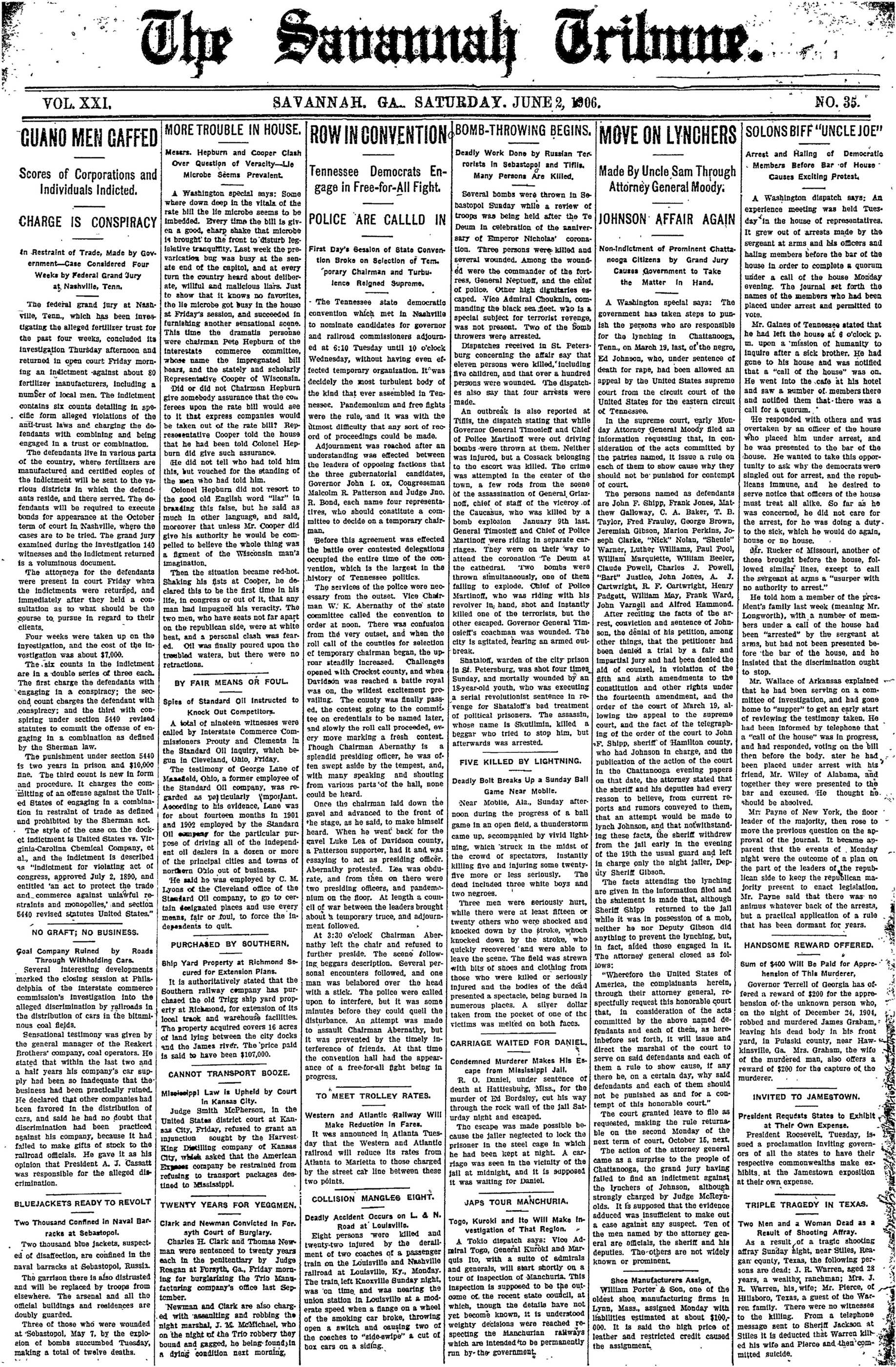
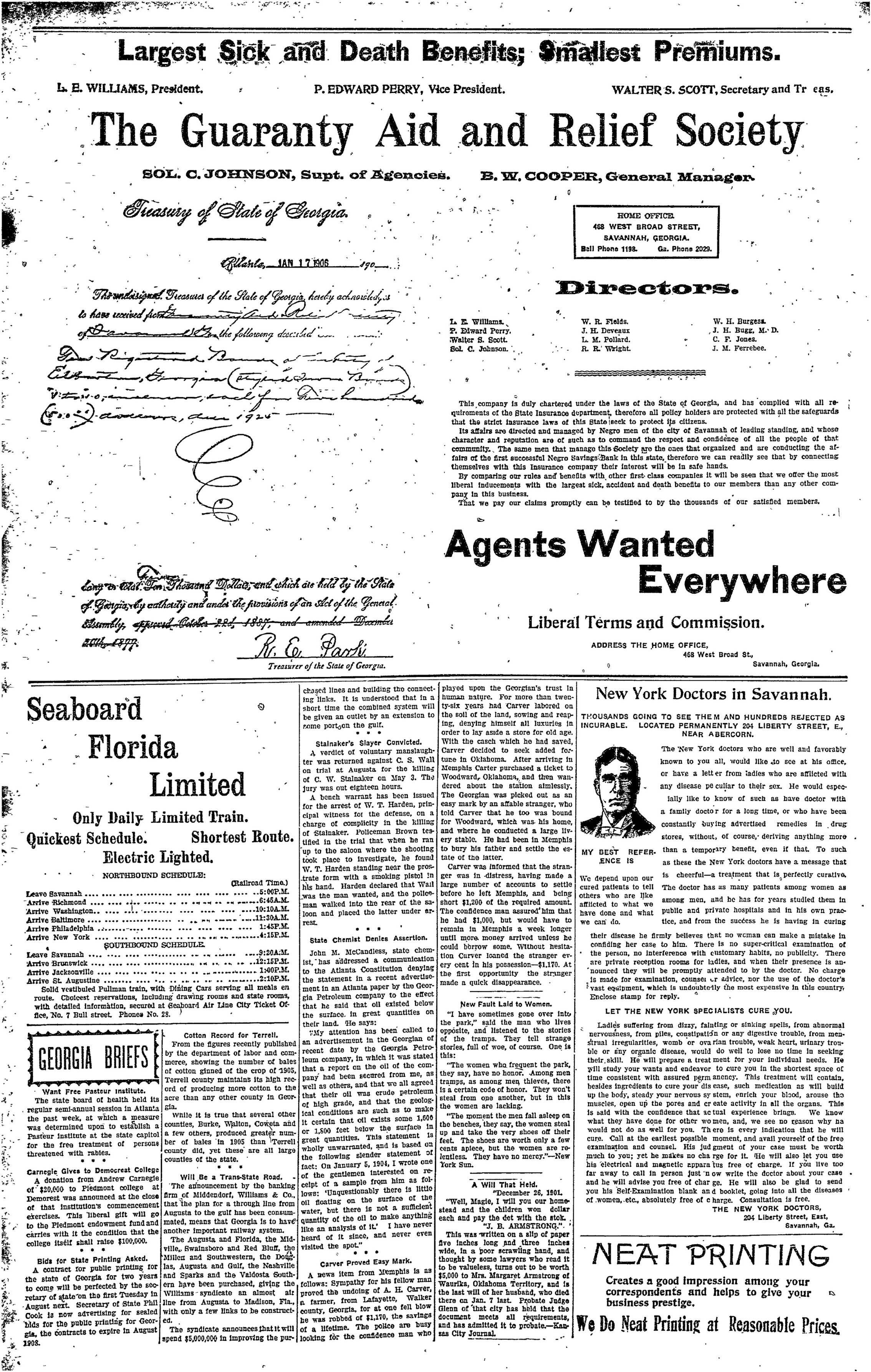
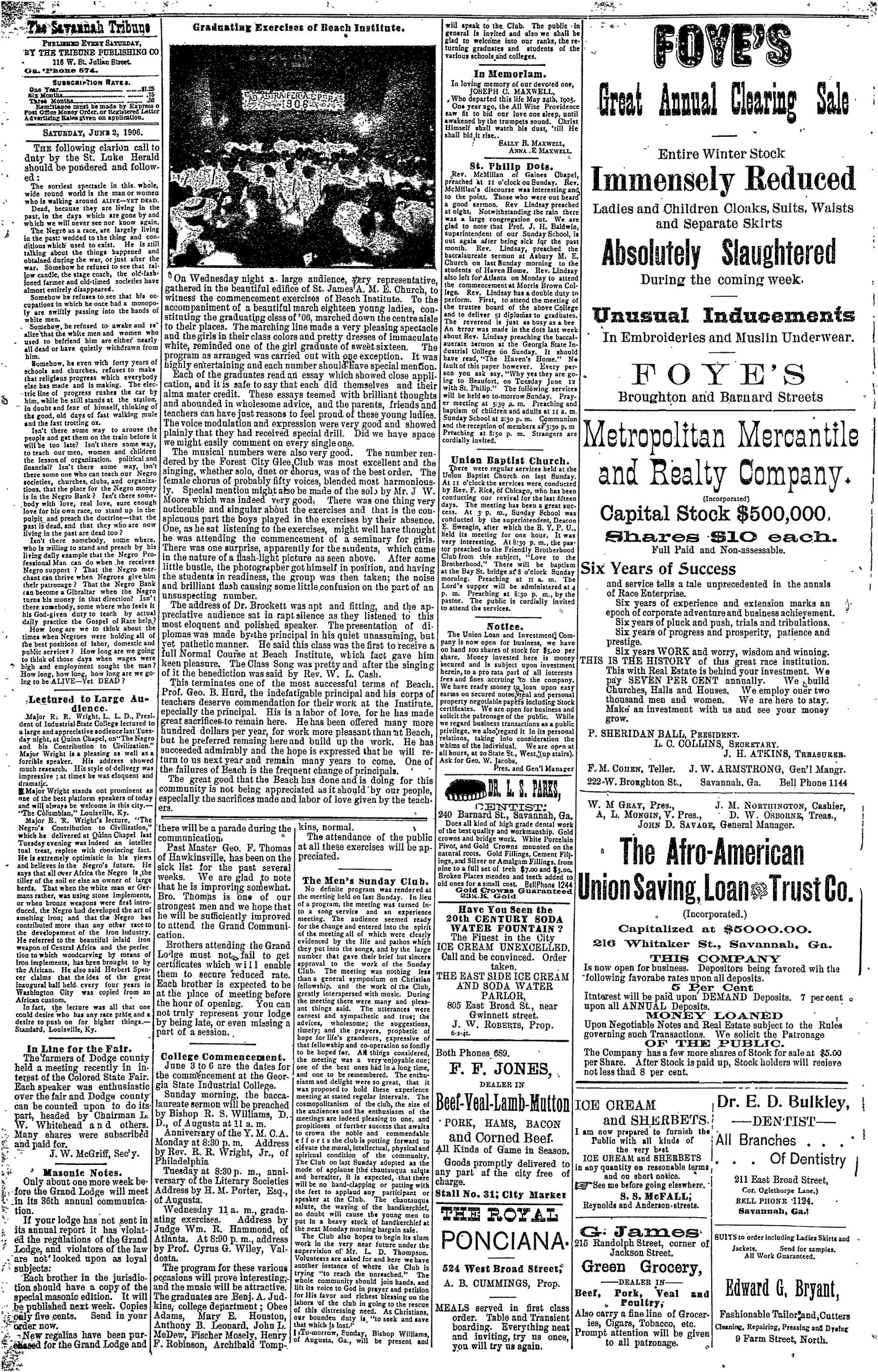
Page text (machine-generated)
The Savannah Tribune.
VOL. XXI.
GUANO MEN GAFFED
Scores of Corporations and Individuals Indicted.
In Restraint of Trade, Made by Government—Case Considered Four Weeks by Federal Grand Jury at Nashville, Tenn.
The federal grand jury at Nashville, Tenn., which has been investigating the alleged fertilizer trust for the past four weeks, concluded its investigation Thursday afternoon and returned in open court Friday morning an indictment against about 80 fertilizer manufacturers, including a number of local men. The indictment contains six counts detailing in specific form alleged violations of the anti-trust laws and charging the defendants with combining and being engaged in a trust or combination.
The defendants live in various parts of the country, where fertilizers are manufactured and certified copies of the indictment will be sent to the various districts in which the defendants reside, and there served. The defendants will be required to execute bonds for appearance at the October term of court in Nashville, where the cases are to be tried. The grand jury examined during the investigation 140 witnesses and the indictment returned is a voluminous document.
The attorneys for the defendants were present in court Friday when the indictments were returned, and immediately after they held a consultation as to what should be the course to pursue in regard to their clients.
Four weeks were taken up on the investigation, and the cost of the investigation was about $7,000.
The six counts in the indictment are in a double series of three each. The first charge the defendants with engaging in a conspiracy; the second count charges the defendant with conspiracy; and the third with spiring under section 5440 revised statutes to commit the offense of engaging in a combination as defined by the Sherman law.
The punishment under section 5440 is two years in prison and $10,000 fine. The third count is new in form and procedure. It charges the committing of an offense against the United States of engaging in a combination in restraint of trade as defined and prohibited by the Sherman act.
The style of the case on the docket indictment is United States vs. Virginia-Carolina Chemical Company, et al., and the indictment is described as "indictment for violating act of congress, approved July 2, 1890, and entitled 'an act to protect the trade and commerce against unlawful restraints and monopolies,' and section 5440 revised statutes United States."
NO GRAFT: NO BUSINESS.
Goal Company Ruined by Roads Through Wiltholding Care.
Several interesting developments marked the closing session at Philadelphia of the interstate commerce commission's investigation into the alleged discrimination by railroads in the distribution of cars in the bituminous coal fields.
Sensational testimony was given by the general manager of the Reakent Brothers' company, coal operators. He stated that within the last two and a half years his company's car supply had been so inadequate that the business had been practically ruined. He declared that other companies had been favored in the distribution of cars, and said he had no doubt that discrimination had been practiced against his company, because it had failed to make gifts of stock to the railroad officials. He gave it as his opinion that President A. J. Cassatt was responsible for the alleged discrimination.
BLUEJACKETS READY TO REVOLT
Two Thousand Confined in Naval Barracks at Sebastopol.
Two thousand blue jackets, suspected of disaffection, are confined in the naval barracks at Sebastopol, Russia. The garrison there is also distrusted and will be replaced by troops from elsewhere. The arsenal and all the official buildings and residences are doubly guarded. Three of those who were wounded at Sebastopol, May 7, by the explosion of bombs succumbed Tuesday, making a total of twelve deaths.
SAVANNAH. GA. SATURDAY. JUNE 2, 1906.
MORE TROUBLE IN HOUSE.
Mesers. Hepburn and Cooper Clash Over Question of Veracity-Lie Microbe Seems Prevalent.
A Washington special says: Some where down deep in the vitals of the rate bill the lie microbe seems to be imbedded. Every time the bill is given a good, sharp shake that microbe is brought to the front to disturb legislative tranquility. Last week the prevarication bug was busy at the senate end of the capitol, and at every turn the country heard about deliberate, willful and malicious liars. Just to show that it knows no favorites, the lie microbe got busy in the house at Friday's session, and succeeded in furnishing another sensational scene. This time the dramatis personae were chairman Pete Hephurn of the interestate commerce committee, whose name the impregnated bill bears, and the stately and scholarly Representative Cooper of Wisconsin.
Did or did not Chairman Hepburn give somebody assurance that the conferees upon the rate bill would see to it that express companies would be taken out of the rate bill? Representative Cooper told the house that he had been told Colonel Hepburn did give such assurance. He did not tell who had told him this, but vouched for the standing of the men who had told him. Colonel Hepburn did not resort to the good old English word "illar" in branding this false, but he said as much in other language, and sald, moreover that unless Mr. Cooper did give his authority he would be compelled to believe the whole thing was a figment of the Wisconsin man's imagination.
Then the situation became red-hot. Shaking his fists at Cooper, he declared this to be the first time in his life, in congress or out of it, that any man had impugned his veracity. The two men, who have seats not far apart on the republican side, were at white heat, and a personal clash was feared. Oil was finally poured upon the troubled waters, but there were no retractions.
BY FAIR MEANS OR FOUL.
Sples of Standard Oil Instructed to Knock Out Competitors.
A total of nineteen witnesses were called by Interstate Commerce Commissioners Prouty and Clements in the Standard Oil inquiry, which begun in Cleveland, Ohio, Friday. The testimony of George Lane of Massefield, Ohio, a former employee of the Standard Oil company, was regarded as particularly important. According to his evidence, Lane was for about fourteen months in 1901 and 1902 employed by the Standard Oil company for the particular purpose of driving all of the independent oil dealers in a dozen or more of the principal cities and towns of northern Ohio out of business.
He said he was employed by C. M. Lyons of the Cleveland office of the Standard Oil company, to go to certain designated places and use every means, fair or foul, to force the independents to quit.
PURCHASED BY SOUTHERN.
Bhp Yard Property at Richmond Secured for Extension Plans.
It is authoritatively stated that the Southern railway company has purchased the old Trigg ship yard property at Richmond, for extension of its local track and warehouse facilities. The property acquired covers 16 acres of land lying between the city docks and the James river. The price paid is said to have been $107,000.
CANNOT TRANSPORT BOOZE.
Mississippi Law is Upheld by Court in Kansas City.
Judge Smith McPherson, in the United States district court at Kansas City, Friday, refused to grant an injunction sought by the Harvest King Distilling company of Kansas City, which asked that the American Express company be restrained from refusing to transport packages destined to Mississippi.
TWENTY YEARS FOR YEGGMEN.
Clark and Newman Convicted in Forsyth Court of Burglary.
Charles H. Clark and Thomas Newman were sentenced to twenty years each in the penitentiary by Judge Reagan at Forsyth, Ga., Friday morning for burglarizing the Trio Manufacturing company's office last September.
Newman and Clark are also charged with assaulting and robbing the night marshal, J. M. McMichael, who on the night of the Trio robbery they bound and gagged, he being found; in a dying condition next morning.
ROW IN CONVENTION
Tennessee Democrats Engage in Free-for-All Fight.
POLICE ARE CALLLD IN
First Day's Session of State Convention Broke on Selection of Temporary Chairman and Turbu-
- The Tennessee state democratic convention which met in Nashville to nominate candidates for governor and railroad commissioners adjourned at 6:10 Tuesday until 10 o'clock Wednesday, without having even effected temporary organization. It was decidedly the most turbulent body of the kind that ever assembled in Tennessee. Pandemonium and free fights were the rule, and it was with the utmost difficulty that any sort of record of proceedings could be made.
Adjournment was reached after an understanding was effected between the leaders of opposing factions that the three gubernatorial candidates, Governor John I. ox, Congressman Malcolm R. Patterson and Judge Jno. R. Bond, each name four representatives, who should constitute a committee to decide on a temporary chairman.
Before this agreement was effected the battle over contested delegations occupied the entire time of the convention, which is the largest in the history of Tennessee politics.
The services of the police were necessary from the outset. Vice Chairman W. K. Abernathy of the state committee called the convention to order at noon. There was confusion from the very outset, and when the roll call of the counties for selection of temporary chairman began, the uproar steadily increased. Challenges opened with Crocket county, and when Davidson was reached a battle royal was on, the wildest excitement prevailing. The county was finally passed, the contest going to the committee on credentials to be named later, and slowly the roll call proceeded, every move marking a fresh contest. Though Chairman Abernathy is a splendid presiding officer, he was often swept aside by the tempest, and, with many speaking and shouting from various parts of the hall, none could be heard.
Once the chairman laid down the gavel and advanced to the front of the stage, as he said, to make himself heard. When he went back for the gavel Luke Lea of Davidson county, a Patterson supporter, had it and was essaying to act as presiding officer. Abernathy protested. Lea was obdurate, and from then on there were two presiding officers, and pandemium on the floor. At length a council of war between the leaders brought about a temporary truce, and adjournment followed.
At 3:30 o'clock Chairman Abernathy left the chair and refused to further preside. The scene following beggars description. Several personal encounters followed, and one man was belabored over the head with a stick. The police were called upon to interfere, but it was some minutes before they could quell the disturbance. An attempt was made to assault Chairman Abernathy, but it was prevented by the timely interference of friends. At that time the convention hall had the appearance of a free-for-all fight being in progress.
TO MEET TROLLEY RATES.
Western and Atlantic Railway Will Make Reduction In Fares.
It was announced in Atlanta Tuesday that the Western and Atlantic railroad will reduce its rates from Atlanta to Marietta to those charged by the street car line between these two points.
COLLISION MANGLES EIGHT.
Deadly Accident Occurs on L. & N. Road at Louisville.
Eight persons were killed and twenty-two injured by the derailment of two coaches of a passenger train on the Louisville and Nashville railroad at Louisville, Ky., Monday. The train left Knoxville Sunday night, was on time and was nearing the union station in Louisville at a moderate speed when a flange on a wheel of the smoking car broke, throwing open a switch and causing two of the coaches to "side-swipe" a cut of box cars on a sliding.
BOMB-THROWING BEGINS.
Deadly Work Done by Russian Terrorists in Sebastopol and Tiflis. Many Persons Are Killed.
Several bombs were thrown in Sebastopol Sunday while a review of troops was being held after the Te Deum in celebration of the anniversary of Emperor Nicholas' coronation. Three persons were killed and several wounded. Among the wounded were the commander of the fortress, General Neptueff, and the chief of police. Other high dignitaries escaped. Vice Admiral Choukmin, commanding the black sea fleet, who is a special subject for terrorist revenge, was not present. Two of the bomb throwers were arrested.
Dispatches received in St. Petersburg concerning the affair say that eleven persons were killed,including five children, and that over a hundred persons were wounded. The dispatches also say that four arrests were made.
An outbreak is also reported at Tiflis, the dispatch stating that while Governor General Timosieff and Chief of Police Martinoff were out driving bombs were thrown at them. Neither was injured, but a Cossack belonging to the escort was killed. The crime was attempted in the center of the town, a few rods from the scene of the assassination of General Griaznoff, chief of staff of the viceroy of the Caucasus, who was killed by a bomb explosion January 9th last. General Timosieff and Chief of Police Martinoff were riding in separate carriages. They were on their way to attend the coronation Te Deum at the cathedral. Two bombs were thrown simultaneously, one of them falling to explode. Chief of Police Martinoff, who was riding with his revolver in hand, shot and instantly killed one of the terrorists, but the other escaped. Governor General Timosieff's coachman was wounded. The city is agitated, fearing an armed outbreak.
Shataloff, warden of the city prison in St. Petersburg, was shot four times Sunday, and mortally wounded by an 18-year-old youth, who was executing a serial revolutionist sentence in revenge for Shataloff's bad treatment of political prisoners. The assassin, whose name is Skutlmin, killed a beggar who tried to stop him, but afterwards was arrested.
FIVE KILLED BY LIGHTNING.
Deadly Bolt Breaks Up a Sunday Ball Game Near Mobile.
Near Mobile, Ala., Sunday afternoon during the progress of a ball game in an open field, a thunderstorm came up, accompanied by vivid lightning, which struck in the midst of the crowd of spectators, instantly killing five and injuring some twenty-five more or less seriously. The dead included three white boys and two negroes.
Three men were seriously hurt, while there were at least fifteen or twenty others who were shocked and knocked down by the stroke, who knocked down by the stroke, who quickly recovered and were able to leave the scene. The field was strewn with bits of shoes and clothing from those who were killed or seriously injured and the bodies of the dead presented a spectacle, being burned in numerous places. A silvery dollar taken from the pocket of one of the victims was melted on both faces.
Condemned Murderer Makes His Escape from Mislasialis Jail.
R. O. Daniel, under sentence of death at Hattiesburg, Miss., for the murder of Ed Bordsley, cut his way through the rock wall of the fall Saturday night and escaped. The escape was made possible because the jailer neglected to lock the prisoner in the steel cage in which he had been kept at night. A carriage was seen in the vicinity of the fall at midnight, and it is supposed it was waiting for Daniel.
JAPS TOUR MANCHURIA.
Togo, Kuroki and Ito Will Make Investigation of That Region. A Tokio dispatch says: Vice Admiral Togo, General Kuroki and Marquis Ito, with a suite of admirals and generals, will start shortly on a tour of inspection of Manchuria. This inspection is supposed to be the outcome of the recent state council, at which, though the details have not yet become known, it is understood weighty decisions were reached respecting the Manchurian railways which are intended to be permanently run by-the government.
MOVE ON LYNCHERS
Made By Uncle Sam Through Attorney General Moody.
JOHNSON AFFAIR AGAIN
Non-Indictment of Prominent Chattanooga Citizens by Grand Jury Cause Government to Take
A Washington special says: The government has taken steps to punish the persons who are responsible for the lynching in Chattanooga, Tenn., on March 19, last, of the negro, Ed Johnson, who, under sentence of death for rape, had been allowed an appeal by the United States supreme court from the circuit court of the United States for the eastern circuit of Tennessee. In the supreme court, early Monday Attorney General Moody filed an information requesting that, in consideration of the acts committed by the patries named, it issue a rule on each of them to show cause why they should not be punished for contempt of court.
The persons named as defendants are John F. Shipp, Frank Jones, Matthew Galloway, C. A. Baker, T. B. Taylor, Fred Frauley, George Brown, Jeremiah Gibson, Marion Perkins, Joseph Clarke, "Nick" Nolan, "Shenle" Warner, Luther Williams, Paul Pool, William Marquiette, William Beeler, Claude Powell, Charles J. Powell, "Bart" Justice, John Jones, A. J. Cartwright, R. F. Cartwright, Henry Padgett, William May, Frank Ward, John Varnell and Alfred Hammond.
After reciting the facts of the arrest, conviction and sentence of Johnson, the denial of his petition, among other things, that the petitioner had been denied a trial by a fair and impartial jury and had been denied the aid of counsel, in violation of the fifth and sixth amendments to the constitution and other rights under the fourteenth amendment, and the order of the court of March 19, allowing the appeal to the supreme court, and the fact of the telegraphing of the order of the court to John F. Shipp, sheriff of Hamilton county, who had Johnson in charge, and the publication of the action of the court in the Chattanooga evening papers on that date, the attorney stated that the sheriff and his deputies had every reason to believe, from current reports and rumors conveyed to them, that an attempt would be made to lynch Johnson, and that notwithstanding these facts, the sheriff withdrew from the jail early in the evening of the 19th the usual guard and left in charge only the night jailer, Deputy Sheriff Gibson.
The facts attending the lynching are given in the information filed and the statement is made that, although Sheriff Shipp returned to the jail while it was in possession of a mob, neither he nor Deputy Gibson did anything to prevent the lynching, but, in fact, aided those engaged in it. The attorney general closed as follows:
"Wherefore the United States of America, the complainants herein, through their attorney general, respectfully request this honorable court that, in consideration of the acts committed by the above named defendants and each of them, as hereinbefore set forth, it will issue and direct the marshal of the court to serve on said defendants and each of them a rule to show cause, if any there be, on a certain day, why said defendants and each of them should not be punished as and for a contempt of this honorable court." The court granted leave to file as requested, making the rule returnable on the second Monday of the next term of court, October 15, next.
The action of the attorney general came as a surprise to the people of Chattanooga, the grand jury having failed to find an indictment against the lynchers of Johnson, although strongly charged by Judge McReynolds. It is supposed that the evidence adduced was insufficient to make out a case against any suspect. Ten of the men named by the attorney general are officials, the sheriff and his deputies. The others are not widely known or prominent.
Shoe Manufacturers Assign.
William Porter & Son, one of the oldest shoe manufacturing firms in Lynn, Mass., assigned Monday with liabilities estimated at about $100,000. It is said the high price of leather and restricted credit caused the assignment.
SOLONS BIFF "UNCLE JOE"
Arrest and Hailing of Democratic Members Before Bar of House Causes Exciting Protest.
A Washington dispatch says: An experience meeting was held Tuesday in the house of representatives. It grew out of arrests made by the sergeant at arms and his officers and halting members before the bar of the house in order to complete a quorum under a call of the house Monday evening. The journal set forth the names of the members who had been placed under arrest and permitted to vote.
Mr. Galnes of Tennessee stated that he had left the house at 6 o'clock p.m. upon a mission of humanity to inquire after a sick brother. He had gone to his house and was notified that a "call of the house" was on. He went into the cafe at his hotel and saw a number of members there and notified them that there was a call for a quorum.
He responded with others and was overtaken by an officer of the house who placed him under arrest, and he was presented to the bar of the house. He wanted to take this opportunity to ask why the democrats were singled out for arrest, and the republicans immune, and he desired to serve notice that officers of the house must treat all alike. So far as he was concerned, he did not care for the arrest, for he was doing a duty to the slick, which he would do again, house or no house.
Mr. Rucker of Missouri, another of those brought before the house, followed similar lines, except to call the sergeant at arms a "usurper with no authority to arrest."
He told hom a member of the president's family last week (meaning Mr. Longworth), with a number of members under a call of the house had been "arrested" by the sergeant at arms, but had not been presented before the bar of the house, and he insisted that the discrimination ought to stop.
Mr. Wallace of Arkansas explained that he had been serving on a committee of investigation, and had gone home to "supper" to get an early start of reviewing the testimony taken. He had been informed by telephone that a "call of the house" was in progress, and had responded, voting on the bill then before the body. ater he had been placed under arrest with his friend, Mr. Wiley of Alabama, and together they were presented to the bar and excused. He thought he should be absolved.
Mr. Payne of New York, the floor leader of the majority, then rose to move the previous question on the approval of the journal. It became apparent that the events of Monday night were the outcome of a plan on the part of the leaders of the republican side to keep the republican majority present to enact legislation. Mr. Payne said that there was no animus whatever back of the arrests, but a practical application of a rule that has been dormant for years.
HANDSOME REWARD OFFERED.
Sum of $400 Will Be Paid for Apprehension of This Murderer,
Governor Terrell of Georgia has offered a reward of $200 for the apprehension of the unknown person who,
on the night of December 24, 1904,
robbed and murdered James Graham,
leaving his dead body in his front yard, in Pulaski county, near Hawkinsville, Ga. Mrs. Graham, the wife of the murdered man, also offers a reward of $200 for the capture of the murderer.
INVITED TO JAMESTOWN.
President Requests States to Exhibit at Their Own Expense.
President Roosevelt, Tuesday, issued a proclamation inviting governors of all the states to have their respective commonwealths make exhibits, at the Jamestown exposition at their own expense.
TRIPLE TRAGEDY IN TEXAS.
Two Men and a Woman Dead as a Result of Shooting Affray.
As a result of a tragic shooting affray Sunday night, near Stiles, Reagan county, Texas, the following persons are dead: J. R. Warren, aged 28 years, a wealthy ranchman; Mrs. J. R. Warren, his wife; Mr. Pierce, of Hillsboro, Texas, a guest of the Warren family. There were no witnesses to the killing. From a telephone message sent to Sheriff Jackson at Stiles it is deducted that Warren killed his wife and Pierce and then committed suicide.
Largest Sick and Death Benefits; Smallest Premiums.
The Guaranty Aid and Relief Society
Treasury of State of Georgia.
The undersigned, Treasurer of the State of Georgia, hereby acknowledges
to have received from the Secretary of State the following described:
Dear Reginald, Honorable Attorney of Elliston, Georgia (Supreme Court of Georgia)
V. 10, 1926, deceased, due 1926
long to Old Ten Thousand Dollars , and which are held by the State of Georgia , by authority and under the provisions of an Act of the General Assembly , approved October 22d, 1887 , and amended December 20th, 1877 .
R. E. Parsi
Only Daily Limited Train. Quickest Schedule. Shortest Route. Electric Lighted.
Leave Savannah ..... 5:00P.M.
Arrive Richmond ..... 6:45A.M.
Arrive Washington ..... 10:10A.M.
Arrive Baltimore ..... 11:30A.M.
Arrive Philadelphia ..... 1:45P.M.
Arrive New York ..... 4:15P.M.
SOUTHBOUND SCHEDULE
Leave Savannah ..... 9:20A.M.
Arrive Brunswick ..... 12:15P.M.
Arrive Jacksonville ..... 1:00P.M.
Arrive St. Augustine ..... 2:10P.M.
Solid vestibulated Pullman train, with Dining Cars serving all meals en route. Choicest reservations, including drawing rooms and state rooms, with detailed information, secured at Seaboard Air Line City Ticket Office. No. 7 Bull street. Phones No. 28.
GEORGIA BRIEFS
Want Free Pasteur Institute.
The state board of health held its regular semi-annual session in Atlanta the past week, at which a measure was determined upon to establish a Pasteur institute at the state capitol for the free treatment of persons threatened with rabies.
Carnegie Gives to Democreat College A donation from Andrew Carnegie of $20,000 to Piedmont college at Demorest was announced at the close of that institution's commencement exercises. This liberal gift will go to the Piedmont endowment fund and carries with it the condition that the college itself shall raise $100,000.
Rids for State Printing Asked.
Bids for State Printing Asked. A contract for public printing for the state of Georgia for two years to come will be perfected by the secretary of state on the first Tuesday in August next. Secretary of State Phil Cook is now advertising for sealed bids for the public printing for Georgia, the contracts to expire in August 1908.
SOL. C. JOHNSON, Supt. of Agencies.
Treasurer of the State of Georgia.
From the figures recently published by the department of labor and commerce, showing the number of bales of cotton ginned of the crop of 1905, Terrell county maintains its high record of producing more cotton to the acre than any other county in Georgia.
While it is true that several other counties, Burke, Walton, Coweta and a few others, produced greater number of bales in 1905 than Terrell county did, yet these are all large counties of the state.
Will Be a Trans-State Road. The announcement by the banking firm of Middendorf, Williams & Co., that the plan for a through line from Augusta to the gulf has been consummated, means that Georgia is to have another important railway system. The Augusta and Florida, the Midville, Swainsboro and Red Bluff, the Millen and Southwestern, the Douglas, Augusta and Gulf, the Nashville and Sparks and the Valdosta Southern have been purchased, giving the Williams syndicate an almost air line from Augusta to Madison, Fla., with only a few links to be constructed.
The syndicate announces that it will spend $5,000,000 in improving the pur-
P. EDWARD PERRY, Vice President.
chased lines and building the connecting links. It is understood that in a short time the combined system will be given an outlet by an extension to come port on the gulf.
Stalnaker's Slayer Convicted.
A verdict of voluntary manslaughter was returned against C. S. Wall on trial at Augusta for the killing of C. W. Stalnaker on May 3. The fury was out eighteen hours.
A bench warrant has been issued for the arrest of W. T. Harden, principal witness for the defense, on a charge of complicity in the killing of Stainaker. Policeman Brown testified in the trial that when he ran up to the saloon where the shooting took place to investigate, he found W. T. Harden standing near the prostrate form with a smoking pistol in his hand. Harden declared that Wail was the man wanted, and the policeman walked into the rear of the saloon and placed the latter under ar-
State Chemist Denies Assertion.
John M. McCandless, state chemist, has addressed a communication to the Atlanta Constitution denying the statement in a recent advertisement in an Atlanta paper by the Georgia Petroleum company to the effect that he said that oil existed below the surface. In great quantities on their land. He says:
"My attention has been called to an advertisement in the Georgian of recent date by the Georgia Petroleum company, in which it was stated that a report on the oil of the company had been secured from me, as well as others, and that we all agreed that their oil was crude petroleum of high grade, and that the geological conditions are such as to make it certain that oil exists some 1,600 or 1,800 feet below the surface in great quantities. This statement is wholly unwarranted, and is based on the following slender statement of fact: On January 5, 1904, I wrote one of the gentlemen interested on receipt of a sample from him as follows: 'Unquestionably there is little oil floating on the surface of the water, but there is not a sufficient quantity of the oil to make anything like an analysis of it.' I have never heard of it since, and never even visited the spot."
Carver Proved Easy Mark.
A news item from Memphis is as follows: Sympathy for his fellow man proved the undoing of A. H. Carver, a farmer, from Lafayette, Walker county, Georgia, for at one fell blow he was robbed of $1,170, the savings of a lifetime. The police are busy looking for the confidence man who
B. W. COOPER, General Manager
This company is duly chartered under the laws of the State of Georgia, and has complied with all requirements of the State Insurance department, therefore all policy holders are protected with all the safeguards that the strict insurance laws of this State seek to protect its citizens.
Its affairs are directed and managed by Negro men of the city of Savannah of leading standing, and whose character and reputation are of such as to command the respect and confidence of all the people of that community. The same men that manage this Society are the ones that organized and are conducting the affairs of the first successful Negro Savings Bank in this state, therefore we can readily see that by connecting themselves with this Insurance company their interest will be in safe hands.
By comparing our rules and benefits with other first-class companies it will be seen that we offer the most liberal inducements with the largest sick, accident and death benefits to our members than any other company in this business.
That we pay our claims promptly can be testified to by the thousands of our satisfied members.
Agents Wanted Everywhere
Liberal Terms and Commission.
played upon the Georgian's trust in human nature. For more than twenty-six years had Carver labored on the soil of the land, sowing and reaping, denying himself all luxuries in order to lay aside a store for old age. With the casch which he had saved, Carver decided to seek added fortune in Oklahoma. After arriving in Memphis Carter purchased a ticket to Woodward, Oklahoma, and then wandered about the station almlessly. The Georgian was picked out as an easy mark by an affable stranger, who told Carver that he too was bound for Woodward, which was his home, and where he conducted a large livery stable. He had been in Memphis to bury his father and settle the estate of the latter.
Carver was informed that the stranger was in distress, having made a large number of accounts to settle before he left Memphis, and being short $1,200 of the required amount. The confidence man assured him that he had $1,000, but would have to remain in Memphis a week longer until more money arrived unless he could borrow some. Without hesitation Carver loaned the stranger every cent in his possession—$1,170. At the first opportunity the stranger made a quick disappearance.
New Fault Laid to Women.
"I have sometimes gone over into the park," said the man who lives opposite, and listened to the stories of the tramps. They tell strange stories, full of woe, of course. One is this:
"The women who frequent the park, they say, have no honor. Among men tramps, as among men thieves, there is a certain code of honor. They won't steal from one another, but in this the women are lacking.
"The moment the men fall asleep on the benches, they say, the women steal up and take the very shoes off their feet. The shoes are worth only a few cents apiece, but the women are relentless. They have no mercy."—New York Sun.
A Will That Held.
"December 26, 1901.
"Well, Magie, I will you our homestead and the children won dollar each and pay the det with the stok.
"J. B. ARMSTRONG."
This was written on a slip of paper five inches long and three inches wide, in a poor scrawling hand, and thought by some lawyers who read it to be valueless, turns out to be worth $5,000 to Mrs. Margaret Armstrong of Waurika, Oklahoma Territory, and is the last will of her husband, who died there on Jan. 7 last. Probate Judge Glenn of that city has held that the document meets all requirements, and has admitted it to probate.—Kansas City Journal.
WALTER S. SCOTT, Secretary and Tr eas.
New York Doctors in Savannah.
THOUSANDS GOING TO SEE THE M AND HUNDREDS REJECTED AS INCURABLE. LOCATED PERMANENTLY 204 LIBERTY STREET, E., NEAR ABERCORN.
The New York doctors who are well and favorably known to you all, would like to see at his office, or have a letter from ladies who are afflicted with any disease peculiar to their sex. He would especially like to know of such as have doctor with a family doctor for a long time, or who have been constantly buying advertised remedies in drug stores, without, of course, deriving anything more than a temporary benefit, even if that. To such as these the New York doctors have a message that is cheerful—a treatment that is perfectly curative. The doctor has as many patients among women as among men, and he has for years studled them in public and private hospitals and in his own practice, and from the success he is having in curing
their disease he firmly believes that no woman can make a mistake in confiding her case to him. There is no super-critical examination of the person, no interference with customary habits, no publicity. There are private reception rooms for ladies, and when their presence is announced they will be promptly attended to by the doctor. No charge is made for examination, counsel or advice, nor the use of the doctor's vast equipment, which is undoubtedly the most expensive in this country, Enclose stamp for reply.
LET THE NEW YORK SPECIALISTS CURE YOU.
Ladies suffering from dizzy, fainting or sinking spells, from abnormal nervousness, from piles, constipation or any digestive trouble, from menstrual irregularities, womb or ovarian trouble, weak heart, urinary trouble or any organic disease, would do well to lose no time in seeking their skill. He will prepare a treatment for your individual needs. He will study your wants and endeavor to cure you in the shortest space of time consistent with assured permanency. This treatment will contain, besides ingredients to cure your disease, such medication as will build up the body, steady your nervous system, enrich your blood, arouse the muscles, open up the pores and create activity in all the organs. This is said with the confidence that actual experience brings. We know what they have done for other women, and, we see no reason why ha would not do as well for you. There is every indication that he will cure. Call at the earliest possible moment, and avail yourself of the free examination and counsel. His judgment of your case must be worth much to you; yet he makes no charge for it. He will also let you use his electrical and magnetic apparatus free of charge. If you live too far away to call in person just now write the doctor about your case and he will advise you free of charge. He will also be glad to send you his Self-Examination blank and booklet, going into all the diseases of women, etc., absolutely free of charge. Consultation is free.
NEAT PRINTING
Creates a good impression among your correspondents and helps to give your business prestige. We Do Neat Printing at Reasonable Prices
HOME OFFICE
468 WEST BROAD STREET,
SAVANNAH, GEORGIA.
Ball Phone 1198. Ga. Phone 2029.
Directors
W. R. Fields.
J. H. Deveaux
L. M. Pollard.
R. R. Wright.
under the laws of the State of Georgia
department, therefore all policy holders
in this State seek to protect its citizens.
led by Negro men of the city of Savannah
such as to command the respect and con-
ganage this Society are the ones that org-
nize Savings Bank in this state, therefore we
company their interest will be in safe ha-
its with other first class companies it
rest sick, accident and death benefits to
they can be testified to by the thousand
Wanted
Every
Terms and Comm
ADDRESS THE HOME OFFICE,
468 West
New York Doctor
THOUSANDS GOING TO SEE THE
INCURABLE. LOCATED PERMANENTLY
NEAR A
MY BEST REFERENCE IS
We depend upon our cured patients to tell others who are like afflicted to what we have done and what we can do.
their disease he firmly believes tha confiding her case to him. There the person, no interference with o are private reception rooms for l announced they will be promptly at is made for examination, counsel o vast equipment, which is undoubter Enclose stamp for reply.
LET THE NEW YORK SPECI
Ladles suffering from dizzy, fain
THE NEW YORK DOCTORS,
204 Liberty Street, East,
Savannah, Ga.
UNSELFISHNESS,
‘Tierommonly escorted,
We're all a'selfish ran, _
That every blewed fellow
Tonks out for number one.
Lead males, jnst look around soa -
“Lo sce ‘tia not the cases,
‘The world fe overflowing :
With charity and price.
‘One’ chan hae information
‘What fiztre stocks will bez
‘Tie dora not mean té use it, .
‘So selis the tip to me.
A tachelor lias knowtedse
Of how to win a maids :
The does not-mean to use it,
So fells me for my aid.”
We atl sucreed by taking
Advice on what to do!
{Viion't intend to. try ity
So tell thia plan to you).
| ~Melandburgh Wilsou, in The Sua,
whet tif FT tt TF
Fisao a"
A Tangled Family,
| a ee | tit
AXNO3%, ME remarriage of Mrs.
4 } Vanstone, after a long
| @ wldowhood, was the popu-
¥ p lar gossip of the season,
age. Imagined their prospects blighted.
“Ob, George, what sball T do?” sald
Mrs. Beverley—whieh was the lady's
Rew uxme—ready to ury. 9
“Don't, mind ‘em, wy éear!’ said
her husband, with a- great; rolling
laugh, -“They're only children; they'll
‘Stow_wiser as they grow older.” '
But the squite's determined good
humor -azgravated his stepehildren
more thau any amount of positive op
Position would have done, and they
“made xo effort to conceal thelr feel-
dings,
~“I never, never can call that mau
father!” said Millie,
“My dear, he docsn't want you to,”
‘sald Mrs. Beverley,
_ ‘I can't endure the sight of himr”
Pouted Millle. “And Charley says ex-
actly the same thing.”
“Charley is a disobedient, ungrate-
‘ fal son!” sobbed Mrs. Beverleyg
But here Mr. Beverley himself came
to, the rescue,
““Young people,” sald he, “I: don't
object to your making yourselves as
miserable a3 you like, but you mustn't
torment your mother. I'll have none
of this,” _s
Millle lost no time in carrying this
revolutionary speech straight to her
brother.
“Very well,” sald Charley, coolly;
“we'll accept the challenge.”
‘T'll not submit to his tyranny,” sald
Millie. “I’ye got a plan.”
“So have 1,” sald Charley, “lots of
‘em; only they don't seem to work
when I try to put them into practice.”
“L've been writing to Louise Vane,”
eald Millie,
“It seems to me ag if I had heard the
tame before, now that you mention it,”
sald Charley, rumpling up his brown,
curly hair.. “But why should you
write to her?—and what has she to do
grith our affairs?”
“She sympathies so thoroughly with
me,” sald Millie. “She considers see-
ond marriages as sinful as i-do, And
she las asked me to come to her and
stay as long as I please. There is a
nice hotel in the rillage, Charley; and
‘her father is very hospitable. And
there is a fine supply of trout and de-
Nightful shooting, Loulse writes, and
plenty of agreeable society.”
“Not a bad idea,” sald Cliarley, re-
flectively.
o 8 8 8 te ew
“Ob, George, what shall we do?
cried Mrs. Beverley, turning pale when
she comprebended that her children
“awere gone,
“Give ‘em thelr heads,” said her hus
band, composedly drinking his coffea.
“Never drive young colts with too
tight a reln, They'll be glad to come
dack in six weeks or less.”
“Dut it's such a fuss about nothing.”
said Mrs. Boverley, half laughing, half
ersing.
“That's the beauty of it,” sald ber
husband. “That's precisely what they
enjoy!” and the Jolly fellow shook
arith laughter. yo.
Louise Vanz received her former
schoolmate ith effusion. |
Her father, a stately, middle-aged
gentleman, spoke a few kindly words
of welcome. a
“Oh, dear! -eald Mlllie, when she
was alone with her friend, “I do hope
We shall not disturb Mr. Vane.”
“Nothing disturbs papa,” sald Loutse,
“He will never think of noticlug such
chicks as we are. Every old maid and
widow in the village bas tried to marry
‘him erer since poor mamma died.”*
“How dare they?” eald indignant
Mille. “L think the Legisiature oust
to pass a law against second marriages.
They are wicked, sinful; an outrage on
elvilization!”
“Of course they are,” sald Loutse,
“But don’t worry, darling, Remember
that you are with me now.”
And the two callow young doves
fluttered Into each other’s arms, with
renewed vows of eternal friendship.
‘Three months of happiness at Vane
Todce followed. Millie and Loulse
read their favorite authors together,
and worked hideous screeas and im-
Possible portieres in crewels,
And all this time neither she nor
Charley wrote 4 Ine to Mrs. Beverley.
“I am afrald they have discarded
me.” said the poor Indy. “I fear that
they never mean to forgive me,” she
added, with a deep sigh.
“My dear, don't be a goose!” sald
her busband. “You; don't regret our
martiage do yon?"
_“Nerer,” said Mra Reyerley, with a
“Neither do I!" sald Mn Beverley,
langhing,
But oné day Mr. Vane called tils
daughter lato his study, with a serious
face, and yrhen she came out she was
drowned'in tears, and Ded stralghtway
to the haven of her dearest friend's
room, *
“Darling!” cried Millle, “that ts the
watter? Tell me, I beseech you.”
“The worst that could possibly hap-
pent” erled Loutse tragically. “Papa
Is xolng to marry again.”
Millle crimsoned to the rery roots of
her hatr, 2
“He told me so himself,” said Loulse.
“E never stopped to ask him who it
was that was to desecrate our happy,
happy tome, 1 just-elasyed my bands
and eried, ‘Papa! and ran away, sob-
Ding as if my heartAvould breal, Oh,
and J had so hoped that, when I was
married, we could stay on here just the
fame: but with a stepmother, of
course, nothing will ever.be the samef?
“You married, Louise!” erled Millie.
“Didn't be tell you? But it only
happened this morning. Charley has
asked me to be his.wife.”
“Tat,” faltered Millle, “if your step
mother loved you very, much In-
deo¢—" s
“Piddlésticks!" sald Loutse; “as if 2
stepmother could love one! Ob, I bate
Iter already! And you. too. my poor
wounded Enzelie, will be driven from
your refuge, If 1 could only offer you
a home—"
“It’s so good of you, darling!” whis-
pered Millie. “But I dou't really think
that it will be slecessary, because, be-
cause—" .
“You're not engaged to be married,
too?” almost shrieked Loutse, struck
with a certnin conscfousness in her
friend's face
“Yes, I am,” said Millie, hanging
down her head.
“And to whom, you precious Ittle
conspirator?”
“To-to your father!’ sald Millie,
“on, don't blame me, Lonise; indeed, 1
couldn't help it!"—Clare Jayues,in the
400.
PETS OF BRITISH SOLDIERS,
One Reziment Mad Ema and Kangaroo
Another a Snake,
No less than thirty régiments In the
British army have pet animals at-
tached.
The dogs of the “Fighting Fifth”
and “Jack,” the retriever, of the
‘Twelfth Lancers, march with thelr
companies when’ on active service,
and have taken part in more than one
battle. ‘The drum horse of the Seventh
Hussars—presented by the late Queen
Victoria—marches proudly at the head
of the men, with white tall and mane
flowing.
“Billy,” the goat of the Welsh Fusi-
Tiers, 1s better known, and is a very
showy soldier indeed, as he struts
along in all the glory of scarlet coat,
with white facings, and the badge and
crest of the regiment on his forehead.
The Queen's Own Hussars kas also
2 goat. .
A deer {s the pet of the Seaforth
Highlanders. “Antony,” a lttle don-
key, attached ‘himself to the Twenty-
sixth Battery while in India, and be-
came an established* favorite, march-
Ing, eating and drinking with the men.
A pet bear was the mascot of the
Gloucester regiment, but becoming 111
tempered had to be shot.
‘The Lancers of New South Wales
have din emu find a kangaroo. “Peter,”
the goose, became the pet of the Grena-
dlers while in Canada. The Jame bird
Imped up to a sentry one night and
held tp a hurt foot for his Inspection.
He attended to the wound, and the
bird thereafter refused to leave the
camp, 80 the soldiers adopted it.
‘When the Devonshire regiment was
in India, a snake was for many months
adopted as a pet, and, though poison-
ous, it never attempted to hurt any
member of the company. When the
men returned to England this uncanny
pet was left bebind—From Reynali’s
Newspaper.
The Panes YWahit.
“Very old persons," sald an obserret,
“nearly always, on unfolding thelr
newspapers, turn to the columns of
‘Deaths’ ‘This 1s because, in the first
Place, they are more likely to find news
of thelr friends there than in the ¢ol-
umn of ‘Marriages, or any other part
of the paper, and because, in the sec-
ond place, they are interested in death
—they have ft much in their minds.
“Young girls turn first to the society
news and weddings and after that to
the fashlous. Young men of the
health, open-alr sort turn first to the
sporting news, while boys universally
turn to this page first. ‘The actor, of
course, reads the dramatle columns,
and the writer the book reviews, but
neither of these depattments, I fancy,
does any part of the disinterested pub-
He consult first of all,
“The elderly gentleman of a pompous
appearance reads the editorials first,
while bis corpulent, cheerful wife reads
the recipes on the ‘household’ page.
Some clergymen read the wills of the
dead to see what charities have been
remembered with bequests. There are
many people who read the crimes, the
scandals and the shocking accidents
first. Poets, as a rule, will not read
the newspapers at all.”—Philadelphis
Mecord.
‘The World Set Right.
Oné of the most troublesome things
about women—man.
‘A budding genlus often has a seedy
Took. a
The way to be a hero to your valet
Is to be your own valet.
If ice goes awgy up this summer, as
threatened, the most sober of us may
be ruined by hard drink.—Boston Tran-
seript. 4
| The City Council of Buenos Asres
has adopted a regulation banishing
itinerant musiclans from the streets of
the place. -
A gE EE DEG ann GN A
| RL SSE Sees)
i DC ot! ATTN
& roa A
Knowledre is ower. sheep and hog pastures that can |
Knowledge is power in agriculture { grown. One of our correspondents, Mf
as well as In-other professions. The] L. C. Reynolds, says of rape:
more a farmer knows about the facts} Rape has won for Itself great pop
of agriculture, and the more he prac-| larity as a food for sheep in rece1
tices what he knows, the more success-| years. It Is grown to-day more or le
ful he becomes, The wide awake| upon every farm where sheep or hos
farmer Ig observant, and profits by bis|are ralsed. I have grown rape f
fallures as well as bis successes. sheep pasture for more than twelt
ee years, and the more I grow of it tk
Results of Feeding. more thoroughly I am convinced it |
In the selection of cattle foods the | one of the best sheep feeds the farm
farmer should keep In view the results| can grow. While it does not come 0
to,be expected. Some foods are more] 4s carly as rye in the spring, its hard
valuable, pound fox pound, than others, | nature makes it one of the best of fo
because they di -r in the rejative pro-| age crops. When sown under favor:
portion of dry substance and its com-| ble conditions {t will supply a larg
Position, ‘The digestive capacity of | amount of palatable pasture at si
each animal should be known to the| Weeks of growth, and the fact that |
farmer, and he should endeavor to] can be sown at any season of the yea
supply ‘its wants. makes It bue of the best general forag
crops for the farmer. No sheep owne
bein eb OF can afford not to grow rape. Itcan b
‘The farmer who raises a few pigs for
‘Ais pork barrel may count the cost and
affirm that pigs do not pay, but where
a few pigs are ralsed they will con-
sume a large amount of material that
Would be of no value except for their
use, When the pork barrel is full the
farmer is at least fortified for the
winter with meat and jn many cases
where no pigs are Kept there {s a waste
of material that could be“utillzed with
‘the ald of at least one or tio young
and thrifty pigs.
‘To Keep Meat in Summer.c
Aly way of keeping pork through the
summer season, says Louls Campbell,
of Pennsville, Oblo: I smoke it well as
early in spring as I can and usually
market all side meat as early as possi-
ble. After I have it nicely smoked L
take it from the smoke housevand hang
it on stout nalls around the sides of a
garner in my wheat granary. I just
hang it up without auythiag over it,
being careful to let one piece bang 80
as not to touch another. I keep the
granary dark so as to keep out all
files. I have tried this plan for sey-
eral years and have never yet bad
any trouble from files or other causes,
Siocs du Oxebardas
As scavengers, or for consuming
tefuse that cannot be marketed, hogs
pe almost indispensable in an orchard.
he fattening of hogs on apples may
be considered a sucgessful method, it
being certain that this fruit possesses
a value for that purpose that has been
overlooked, and the destruction of in-
sects by hogs in consuming the fatlen
apples bas given a new value to
orchards and will probably check
their destruction, which in somo sec-
tions of the country has already pro-
gressed to a considerable extent. The
animal should be allowed in the
orchard from the time the frult be-
gins to fall until it fs time to gather
apples for the winter, and they will,
4n most cases, be found in good condl-
tion fot hardening with grain and
slaughtering, and the meat will be
tender and of an excellent flavor.
‘When it is necessary to put them into
the pen, boiled apples mixed with a
small quantity of corn, oats, peas or
buckwheat meal will make them fat
in a short time and aii the farmer's
pork barrel with sound, sweet pork of
the first quality,
‘The Hen and Mer Erood,
‘When it comes to surety, safety and
comfort for both the hen and her
Keeper, the pen system of managing
the hen and her brood is the best and
-in the long ron it is much the cheapest.
_, We have written on this subject be
fore, but it Is so timely now and it 1s
such a good thing—such a great hel
to the management of the hen mothers
and thelr little ones during the grow-
ing season, that we are writing on it
‘once more.
‘The chief {dea 1s individuality and
comparative isolation of each hen and
her chickens and in this alone much
4s attained, for the more we divide
the growing stock the more of it we
‘will raise.
In carrying out this plan, observes
W. B. Geer, a good, stout, weather and
yarmint proof coop is the first essen-
tlal, for the chickens must have pro-
tection at night. The noxt necessity fs
a pen made of slats or wire netting,
this to enclose the coop, say a space
about ten by twelve feet all around
it, and the fencing should be six feet
high and then the filght feathers of one
‘wing of the hen should be cut so that
she can not tly out, should she be of a
fighty turn. A gate at the front Js,
of course, necessary,
Within a small yurd of this kind one
hen and her brood should be placed.
but the fencing should not be so close
that the Ittle ebicks cannot pass in
“and out, for it {s not intended to con-
fine them, but thelr mother. This
makes a security reserve for them—a
place of refuge for them from any
danger, and yet they may enjoy free
range at the same time, It also makes
it possible to feed each hen and her
brood separately, which fs a most de-
sirable condition, as it prevents mob-
Ding up and overcrowding.
Another thought—when the showers
come up, and Wwe ate busy, we need
not chase all over the place, dropping
everything else, to get the hens and
thelr chickens in out of the wet, for the
hen is stationed where there is refuge
all the thme, and the chickens can
quickty scoot in through the cracks to
her.
In fact, this system minimizes work,
worry and the percentaze of loss, and
It really makes the raising of chickens
with hené a pléasure, as well as profit-
able,
Bape For Sheep,
It has been well attested that rape
makes the quickest and dne of the best’
‘sheep and hog pastures that can be
grown. One of our correspondents, Ar,
L. C, Reynolds, says of rape:
Rape has won for itself great popu-
larity as a food for sheep in recent
years. It is grown to-day more or less
upon every farm where sheep or hogs
are ralsed. I have grown rape for
sheep pasture for more than twelve
years, and the more I grow of it the
more thoroughly I am convinced it is
one of the best sheep feeds the farmer
can grow, While it does not come on
as carly as rye in the spring, its hardy
nature makes it one of the best of for-
age crops. When sown under favora-
ble conditions it will supply 2 large
amount of palatable pasture at six
Weeks of growth, and the fact that it
can be sown at any season of the year
makes It bne of the best general forage
crops for the farmer. No sheep owner
can afford not to grow rape. It can be
sown during’ every growlug season of
the year and produce excellent pasture.
I prefer to sow rape in drills instead
of broadcast, as many do. A better
stand of plants can be secured by this
method, and the stock does not tramp
the forage down nearly so much, I
sow my rape with a land or grain
drill in rows twenty Inches apart. Sow
about four pounds of seed per acre,
Care should be exercised not to sow thr
seed top decp.—Indiana Farmer.
Fertitity and Prait Growln-.
| At a meeting of horticulturists Pro-
fessor John Cralz, of Coruell Untyer-
‘sity, sald: 2
| “Every modern system of cultivating
fruits recognizes as 2 first principle
the right of the frult tree to be con-
sidered a specific and sufficient crop
under the soll, or at least to be regard-
ed as a crop quite as exhausting in
character as any grown by the farmer.
Unless the frult grower realizes and
puts into practice the, essential part of
this prinelple he will fail as a cultlva-
tor of frults. Experiments {norchard-
ing conducted some years“ago at the
Cornell Experiment Station proved con-
clusively that it cost the soll more to
producé twenty average crops of ap-
ples than twenty average crops of
wheat, In other words, more fertility
was extracted from the land in grow-
ing am acre of bearing apples for twefi-
ty years than in growing twenty con-
secutive crops of wheat. As a rule,
the farmer recognizes the food needs
of the wheat plant, but too often does
he look upon the apple or fruit tree as
a mere tenant of the soll, and ong
which {s not to be regarded as a spe-
cific crop, Having recognized the prin-
ciples, the particular method of orch-
arding much be worked out by the frult
grower himself, This method will de
pend upon soil conditions and climate.
Nevertheless, it {s safe to say that fn
elght cases out of ten that method
Which employs clean tillage for at least
part of the season will be most suc-
cessful. It 4s also safe to siy that
all secondary crops in orchards are inv
jurious.”
Farm ond Garden Notes.
Much labor and expense may be
saved by planning ahead.
Only a few varieties should be plants
ed in the commercial orchard.
Exer¢lse has a decided value in low:
ering the cost of egg production.
The more litter in the manure, the
slower the process of decomposition.
Celeriae 1s a plant simi‘ar to celery,
but more easily grown and mote easily
cooked,
Too large quantitics of fertilizers
applied at one time will kill tender
plants. -
But few plants will thrive in a wet
sofl. A good drat {s sometimes hetter
than manure.
There are few times of the year
when a good pair of pruning shears
can not be used to good advantage.
Don't forget the stock water in the
pasture, Stock must not be without
good water, not for a day nor half a
day. .
When a better price for better fruit
1s obtained, the difference in price nays
for handling. It pays to grow the best,
for that reason,
Im nearly all cases animals in low
flesh are more lable to disease than
when in fine bodily condition, and it
costs more to keep them.
Thinning fruit is proving, such an
advantage to the quality thet the plan
1s gaping ground everywhere. Better
prices for better frult is the result,
Some fires have occurred from care-
lessnes3 in handling incubators ard
brooders. Possibly we might encase
the incubator, if in cellar, in Nght
framework covered with asbestos
Paper, ‘The latter is cheap and a sure
Protection from overheating.
Barring all the differences that may
be in individual birds. and strains, it
maY be said that Wyandottes are now
considered to be among the very best
of all-purpose fowls, They are hardy,
active, good layers, sood mothers and
of good size and good table quality.
The world would do a bad job of
getting along without the grower of
live stock, and that same world ought
to be willing to remunerate him for his
labor and risks, Indeed, no’ class of
people is rnder any obligation to feed
and clothe another class without pay
for it.
‘That bone has great value as a ratior®
for poultry, both for egg production
and for growth in chicks, {s not 4 mat-
ter of dispute, The fact is generally
recognized that in no other way can
eggs be produced more réadlly, or
growth made in young stock more
quickly than by the Mberal use of
cut bone In the ration, z
HE WAS NOT A PATRIOT.
Ontil He Cancht Stcht of the Flag, and He
‘Was Hypnotized.
a
“{ am not a patriot,” sald the
gtouch: “that Is not the. ‘my-country-
right-or-wrong’ kind, ‘That sort of pa-
trlotism 1s only"an enlarged egotism—It
is founded on the mere accident of
birth. The owner of it/loves his coun-
try, and believes in it solely because he
‘was born in it. He thinks it mist be @
great country to have produced him.
Now, J get at my patriotism—if you
can call It that—the other way round.
1 love and honor my country for the
{deals and {dens it represents, and after
haviug compared it with other coun-
trles and found it better. If comparl-
son had demonstrated that the cause
of Lumanity was better served by some
other country, I would rank that first
in my esteem. I was born human’ by
the latv: of heaven—boundarles estab-
lished by mau governed my American
nativity.
“But, as I said, I love this land for
what it is doing for humanity. I be-
Heve fn it, and would fight to extend its
boundaries over the whole earth, so
Jong as its lofty ideals are maintained.
My country is an idea—the American
fdea—and knows no boundaries nor
Tules. It Isu't a government; it fs a
people, a people striving toward a sub-
Mmeend. The government may be
yested for a time fn {ie hands of un-
worthy men; on oligarchy of special in-
terests that seek to explolt the nation
may use it for seltis: ends. The ordl-
nary ‘my-country-right-or-wrong’ kind
of patriot is as wax in the bands of
such schemers, He thinks that the gov-
ernment is the country. Thank heay-
ens! there are enough reasoning pa-
triots to offset the machinations of the
schemers and gullibility of that kind
of patriot—or there have been, hereto-
fore, and the American {dea marches
grandly on. *
“Sometimes St bas to do bloody deeds
to win its way. It bas to kill a few
hundred Moros in order to benefit mill+
Jons, Some chicken-bearted persons
calh this cruel. They would not call it
eruel if the few hundred Moros were
suffered to check the onsweep of the
great ideal and savagery were per-
mitted to work its evil will because we
refrained from interference. They
would call It ‘Providence.’ Those peo-
ple-always blame God for their sins of
omission. They ate not patriots of
any kind, being false even to humanity.
“as for me, I discriminate; I—" and
just then we came {n sight of “Old
Glory” floating from the flagpole of the
high school. ‘The grouch doffed his hat
and a wrapt and reverent expression
came over his rugged features. “God
bless the flag!" he said devoutly. “I
reckon I'd follow it wherever it led.
It kinder hypnotizes you.”—St. Loule
Globe-Democrat.
WORDS OF WISOOM.
Tet past errors serve as warning
guldes to future excellence,
When duty colucides with Interest,
honesty in office is made easy.
‘The battle is never to the strong
where brains are given half a show.
In the Inst analysis, most human
lore is mataly simile and metaplior.
Most of us want to cast our bread
‘upon the waters with a string tied to it
Not all is harmony that sweetly
chimes, nor yet all poetry that aptly
rhymes.
“Strait Is the gate and narrow {s the
way,” to those who would the moral
Jaw obey.
‘When we speed to the devil's house,
woman takes the lead by a thousand
steps—Goethe.
Riches may “shrivel the soul,” but
poverty fs equally hard on the suppers.
—Chieago Tribune,
When joyous, a woman's license {s
not to be endured; when in terror, she
is a plague.—Aeschyjus. "~*
Modesty in woman is a virtue most
deserving, since we do all we can to
cure ker of it—Lingree.
An ptimist is a man who always
hopes for the best, and when he gets {t
hopes for something better,
‘There are a great many times in our
lives when our “strength is to sit still.”
Motion is good in its-time, but so is
meditation, so 1s quiet study, so is pa~
tlent waiting on God. If a bucket Is to
be filled from a spout of water, the best
place for that bucket is to keep it un-
der the stream until it fs full. We
soon run empty of grace, and need re-
pleuishing, need to be “filled unto all
the fullness of God."—Theodore Cuy-
ler. a
All Recognized Her.
‘The four old ¢aptains or Salt Matsh,
after carefully study:ng the attrac
tions offered by the mind zecder who
was to hold forth in the town hall,
decided to attend the entertainment.
“We can go right f-om the post of:
fice whea mall's in,” xefd Captain
Gregg, most adverturous of the four,
“and there Coesn't segm f be any need
to consult our women folks, so far as
I know. Most Ikely we shcn't stay
more'n a Yew minu.ee.”
They were all agreed aa to the ad-
viability of this plan, and the next
evening saw them seated in the last
row, with Interest written ou thefr
faces.
After a few preliminary exhibitions
which caused the scattered audience
to gasp and wriggle, the mind-reader
said In a solemn tone:
“There {s one person in this audi-
ence who has been thinking ever since
he came In here of a person who {5
perhaps the strongest influence in bis
Isfe—a small, determined looking wom-
an, with eyes that snap and—"
At tue polnt the four old captains
rose asdf moved by a single spring and
filed from the hall. When they reached
the safety of the steps, Captain Gregs
turned tovthe others and spoke in a
hoarse whisper: -
“Which one of us do you suppose le
meant?”—Youth’s Companion.
Hie Little Diag,
She was such a pretty girl ‘
‘That T wondered why the churl
‘Didn't pay
‘More attention to the maid—,
‘There he sat and nothing said
While the crowded Pulltaan aped
On its way.
I pronounced him king of cht=ups
‘To sit silent in the dumps ;
With a queen,
Dainty, winsome, natty, neat,
Dancing-eyed, attractive, sweet,
‘There eatde ‘iim on the seat
All serene.
But when they aroce ta go
Then'T understood. you know,
In a trice
Wh he had been such a bore.
For I saw upon the floor
‘What I hadn't seen before—
Grdins of rice".
—Louisville*Courier-Journal.
Zi fi afl ge
Ze IRIPPLESIS
Seed |orMIRTAY ES
el
Can a man always be spruce without
looking more-or less wooden ?—Puck,
Many a man who knows bis place
has bis eye on a better one.—Chicazs
Daily News.
Of the five senses, common-sense nnd
a sense of humor are the rarest.—Sat-
urday Evening Post. :
Some people lose sight of the fact
that of two erils it isn’t always nec-
“essary to choose elther.
Love is responsible for two-thirds of
the happiness in the world—also for
nine-tenths of the misers.—Chicago
Dally News.
“What makes you think Bilkins is in
love?” “Iwas In the room nest to him
and his glrl, and overheard one of
thelr silences."—Life.
The doctors gave him up, out he
Retaltated then;
Te gave the doctors up, you see,
And now he's well again.
—Philadelphia Ledger.
A country gentleman is an ordinary
farmer who has, however, a sntiiclent
income to send bis son to a large unl-
versity.—Cornell Widow.
Caller—“Poetry is a gift” Editor—
“Not here. You'll have to pay adver-
tising rates to get this stuf in.”—
Chicago Dally News.
“I believe Jimpson would share his
last dollar with a friend.” “Yes, but
afd you ever catch bim when he haé
one?"—Milwaukee Sentinel.
“Charley looked very sick when he
returned from the races,” sald young
‘Mrs, Torkins. “What was the trou-
ble?” “He sald his system was out of
order.”"—Washington Star,
“By the way, Jack, what is impres-
stonism?” -“It is the art of picturing
yomething which no one has ever seep
in such a way that they wouldn't recog-
nize ft if they did see It’—Brooklyn
Life.
‘Mrs, Cummins—“So you love your
grandmamma, do you, Gracie? “And
why do you love her?” Gracie—"Be-
cause she used to punish marnma
when mamma was a little girl. I hope
she used to spank mamma.as hard as
mamma spanks me.”—Boston Tray
script.
“I'm free to say a friend in need,”
Quoth ‘Mr. Horace Hodge,
“Is just, the sort of friend indeed
‘That I desire to dodge.”
- Philadelphia Bulletin.
Mr, Gardner—"Well, dear, how are
the tomatoes you planted?" Bfrs.
Gardner—"Oh, Joh! I'm afraid we'll
have to buy what we need this year.’
Mr. Gardner—“Why, how's that,
Mary?" Mrs. Garduer—I recollected.
today that when I dia the planting I
forgot to open the cans!"—Puck.
“It's no use," said the Czar, defected-
ly: “What's the matter now?" asked
his chief adviser. “Providence s help-
Ing the Japanese. Didn't you see the
story of an earthquake having thrown,
up another Island for the Japs right
in the middle of thelr archipelago?’
Baltimore American,
She (six weeks after elopement)—"I
received a Ictter from papa to-day.”
We—"Well” She—“He writes that he
had just finished making his will”
He—"Did he remember us?” Sbe—
“Yes, indeed. He’ bas left all his
money to an asylum for hopelesy
idiots.”—Chicago Dally News.
Story of a Sevres Vase,
‘A wealthy manufacturer in the po
teries ts at present the subject of a
good joke. While on a continental tour
he purchased a Sevres vase for some
hundreds of ‘pounds and brought it
home mést carefully,
‘Thinking that the fo-ewan of his
works might gather a hint from the
desizo, he called that gentleman in
and showed bim his zreasure. “How,
do you like \t?” he asked,
“The ‘oreman took the vase io his
hand, turned it over ard returned tt
with the brief reply: “I don’t think
that I can learn much from it.”
“Why not?’ asked the manufacturer.
“I don't like telllng you, sir.”
“Come—out with it”
“Well, I designed that vase myself.
It is a forelgn imitation of our own
work and is rorth £5 at the cutside.”"=
Live~pool Post.
Sent Seven-Ton Pump to Fatent Ofice
Sometimes the rigors of Patent Of-
fice procedure are not without thelr
humorous side, A New York attorney
filed an application for improvements
in a centrifugal pump.
‘The Patent Office declared the in-
vention inoperative and demanded a
working model. ‘The Patent Office was
requested to send an examiner to Tren-
ton to inspect the machine In actual
operation. This the Patent Office re-
fused to do.
, The attorney, therefore, polltely sent
a-seven-ton pump to the Patent Office
sent it, moreover, from Tronton te
satisfy a sceptical examiner. Twenty-.
one men were required to get it into
the examiner's office.—Stlentific Aimore
tean.
PUBLISHED EVERY SATURDAY,
BY THE TRIBUNE PUBLISHING CO
116 W. St. Julian Street.
Ga.'Phone 574.
SATURDAY, JUNE 2, 1906.
The following clarion call to duty by the St. Luke Herald should be pondered and follow-
Dead, because they are living in the past, in the days which are gone by and which we will never see nor know again.
The Negro as a race, are largely living in the past: wedded to the thing and conditions which used to exist. He is still talking about the things happened and obtained duling the war, or just after the war. Somehow he refuses to see that tallow candle, the stage coach, the old-fashioned farmer and old-timed societies have almost entirely disappeared. Somehow he refuses to see that his occupations in which he once had a monopoly are swiftly passing into the hands of white men. Somehow, he refused to awake and realize that the white men and women who used to befriend him are either nearly all dead or have quietly withdrawn from him.
Somehow, he even with forty years of schools and churches, refuses to make that religious progress which everybody else has made and is making. The electric line of progress rushes the car by him, while he still stands at the station, in doubt and fear of himself, thinking of the good, old days of fast walking mule and the fast trotting ox.
Isn't there some way to arouse the people and get them on the train before it will be too late? Isn't there some way, to teach our men, women and children the lesson of organization, political and financial? Isn't there some way, isn't there some one who can teach our Negro societies, churches, clubs, and organizations, that the place for the Negro money is in the Negro Bank? Isn't there somebody with love, real love, sure enough love for his own race, to stand up in the pulpit and preach the doctrine—that the past is dead, and that they who are now living in the past are dead too?
Isn't there somebody, some where, who is willing to stand and preach by his living daily example that the Negro Professional Man can do when he receives Negro support? That the Negro merchant can thrive when Negroes give him their patronage? That the Negro Bank can become a Gibraltar when the Negro turns his money in that direction? Isn't there somebody, some where who feels it his God-given duty to teach by actual daily practice the Gospel of Race help? How long are we to think about the times when Negroes were holding all of the best positions of labor, domestic and public services? How long are we going to think of those days when wages were high and employment sought the man? How long, how long, how long are we going to be ALIVE—Yet DEAD?
Lectured to Large Audience.
Major R. R. Wright, L. L. D., President of Industrial State College lectured to a large and appreciative audience last Tuesday night, at Quinn Chapel, on "The Negro and his Contribution to Civilization." Major Wright is a pleasing as well as a forcible speaker. His address showed much research. His style of delivery was impressive at times he was eloquent and dramatic. Major Wright stands out prominent as one of the best platform speakers of today and will always be welcome in this city.—"The Columbian," Louisville, Ky.
Major R. R. Wright's lecture, "The Negro's Contribution to Civilization," which he delivered at Quinn Chapel last Tuesday evening was indeed an intellectual treat, replete with convincing fact. He is extremely optimistic in his views and believes in the Negro's future. He says that all over Africa the Negro is the tiller of the soil or else an owner of large herds. That when the white man or Germans rather, was using stone implements, or when bronze weapons were first introduced, the Negro had developed the art of smelting iron; and that the Negro has contributed more than any other race to the development of the iron industry. He referred to the beautiful inlaid iron weapon of Central Africa and the perfection to which woodcarving by means of iron implements, has been brought to by the African. He also said Herbert Spencer claims that the idea of the great inaugural ball held, every four years in Washington City was copied from an African custom.
In fact, the lecture was all that one could desire who has any race pride and a desire to push on for higher things.Standard, Louisville, Ky.
In Line for the Fair.
The farmers of Dodge county held a meeting recently in interest of the Colored State Fair. Each speaker was enthusiastic over the fair and Dodge county can be counted upon to do its part, headed by Chairman L. W. Whitehead and others. Many shares were subscribed and paid for.
J. W. McGriff, Sec'y.
Masonic Notes.
Only about one more week before the Grand Lodge will meet in its 36th annual communication.
If your lodge has not sent in its annual report it has violated the regulations of the Grand Lodge, and violators of the law are not looked upon as loyal subjects:
Each brother in the jurisdiction should have a copy of the special masonic edition. It will be published next week. Copies only five cents. Send in your order now.
New regalias have been purchased for the Grand Lodge and
FAD ZSTRA PERA OPERA
1906
On Wednesday night a. large audience, very representative, gathered in the beautiful edifice of St. James A. M. E. Church, to witness the commencement exercises of Beach Institute. To the accompaniment of a beautiful march eighteen young ladies, constituting the graduating clsss of 16, marched down the centre aisle to their places. The marching line made a very pleasing spectacle and the girls in their class colors and pretty dresses of immaculate white, reminded one of the girl graduate of sweet sixteen. The program as arranged was carried out with one exception. It was highly entertaining and each number should have special mention. Each of the graduates read an essay which showed close application, and it is safe to say that each did themselves and their alma mater credit. These essays teemed with brilliant thoughts and abounded in wholesome advice, and the parents, friends and teachers can have just reasons to feel proud of these young ladies. The voice modulation and expression were very good and showed plainly that they had received special drill. Did we have space we might easily comment on every single one.
The musical numbers were also very good. The number rendered by the Forest City Glee Club was most excellent and the singing, whether solo, duet or chorus, was of the best order. The female chorus of probably fifty voices, blended most harmoniously. Special mention might also be made of the solo by Mr. J W. Moore which was indeed very good. There was one thing very noticeable and singular about the exercises and that is the conspicuous part the boys played in the exercises by their absence. One, as he sat listening to the exercises, might well have thought he was attending the commencement of a seminary for girls. There was one surprise, apparently for the students, which came in the nature of a flash-light picture as seen above. After some little bustle, the photographer got himself in position, and having the students in readiness, the group was then taken; the noise and brilliant flash causing some little confusion on the part of an unsuspecting number.
The address of Dr. Brockett was apt and fitting, and the appreciative audience sat in rapt silence as they listened to this most eloquent and polished speaker. The presentation of diplomas was made by the principal in his quiet unassuming, but yet pathetic manner. He said this class was the first to receive a full Normal Course at Beach Institute, which fact gave him keen pleasure. The Class Song was pretty and after the singing of it the benediction was said by Rev. W. L. Cash.
This terminates one of the most successful terms of Beach. Prof. Geo. B. Hurd, the indefatigable principal and his corps of teachers deserve commendation for their work at the Institute, especially the principal. His is a labor of love, for he has made great sacrifices to remain here. He has been offered many more hundred dollars per year, for work more pleasant than at Beach, but he preferred remaining here and build up the work. He has succeeded admirably and the hope is expressed that he will return to us next year and remain many years to come. One of the failures of Beach is the frequent change of principals.
The great good that the Beach has done and is doing for this community is not being appreciated as it should by our people, especially the sacrifices made and labor of love given by the teachers.
there will be a parade during the communication.
Past Master Geo. F. Thomas of Hawkinsville, has been on the sick list for the past several weeks. We are glad to note that he is improving somewhat. Bro. Thomas is one of our strongest men and we hope that he will be sufficiently improved to attend the Grand Communication.
kins, normal.
The attendance of the public at all these exercises will be appreciated.
The Men's Sunday Club.
No definite program was rendered at the meeting held on last Sunday. In lieu of a program, the meeting was turned into a song service and an experience meeting. The audience seemed ready for the change and entered into the spirit of the meeting all of which were clearly
Brothers attending the Grand Lodge must not fail to get certificates which will enable them to secure reduced rate. Each brother is expected to be at the place of meeting before the hour of opening. You can not truly represent your lodge by being late, or even missing a part of a session.
College Commencement.
June 3 to 6 are the dates for the commencement at the Georgia State Industrial College.
Sunday morning, the baccalaureate sermon will be preached by Bishop R. S. Williams, D. D., of Augusta at 11 a.m.
Anniversary of the Y. M. C.A. Monday at 8:30 p.m. Address by Rev. R. R. Wright, Jr., of Philadelphia
Tuesday at 8:30 p. m., anniversary of the Literary Societies Address by H. M. Porter, Esq., of Augusta.
Wednesday 11 a. m., graduating exercises. Address by Judge Wm. R. Hammond, of Atlanta. At 8:90 p. m., address by Prof. Cyrus G. Wiley, Valdosta.
The program for these various occasions will prove interesting; and the music will be attractive. The graduates are Benj. A. Judkins, college department; Obee Adams, Mary E. Houston, Anthony B. Leonard, John L. McDew, Fischer Mosely, Henry F. Robinson, Archibald Temp-
kins, normal. The attendance of the public at all these exercises will be appreciated.
The Men's Sunday Club. No definite program was rendered at the meeting held on last Sunday. In lieu of a program, the meeting was turned in to a song service and an experience meeting. The audience seemed ready for the change and entered into the spirit of the meeting all of which were clearly evidenced by the life and pathos which they put into the songs, and by the large number that gave their brief but sincere approval to the work of the Sunday Club. The meeting was nothing less than a general symposium on Christian fellowship, and the work of the Club, greatly interspersed with music. During the meeting there were many and pleasant things said. The utterances were earnest and sympathetic and true; the advices, wholesome; the suggestions, timely; and the prayers, prophetic of hope for life's grandeurs, expressive of that fellowship and co-operation so fondly to be hoped for. All things considered, the meeting was a very enjoyable one; one of the best ones had in a long time, and one to be remembered. The enthusiasm and delight were so great, that it was proposed to hold these experience meeting at stated regular intervals. The cosmopolitanism of the club, the size of the audiences and the enthusiasm of the meetings are indeed pleasing to one, and propitiores of further success that awaits to crown the noble and commendable efforts the club is putting forward to elevate the moral, intellectual, physical and spiritual condition of the community. The Club on last Sunday adopted as the mode of applause [the chautaqua salute and hereafter, it is expected, that there will be no hand-clapping or patting with the feet to applaud any participant or speaker at the Club. The chautaqua salute, the waying of the handkerchief, no doubt will cause the young men to put in a heavy stock of handkerchief at the next Monday morning bargain sale.
The Club also hopes to begin its slum work in the very near future under the supervision of Mr. L. D. Thompson. Volunteers are asked for and here we have another instance of where the Club is trying "to reach the unreached." The whole community should join hands, and lift its voice to God in prayer and petition for His favor and richest blessing on the labors of the club in going to the rescue of this distressing need. As Christians, our bounden duty is "to seek and save that which is lost." [To-morrow, Sunday, Bishop Williams,
| To-morrow, Sunday, Bishop Williams, of Augusta, Ga., will be present and
will speak to the Club. The public in general is invited and also we shall be glad to welcome into our ranks, the returning graduates and students of the various schools and colleges.
In Memoriam.
In loving memory of our devoted one,
JOSEPH C. MAXWELL,
Who departed this life May 24th, 1905.
One year ago, the All Wise Providence
saw fit to bid our love one sleep, until
awakened by the trumpets sound. Christ
Himself shall watch his dust, 'till He
shall bid it rise.
SALLY B. MAXWELL,
ANNA. E MAXWELL.
St. Philip Dots.
Rev. McMillan of Gaines Chapel, preached at 11 o'clock on Sunday. Rev. McMillan's discourse was interesting and to the point. Those who were out heard a good sermon. Rev Lindsay preached at night. Notwithstanding the rain there was a large congregation out. We are glad to note that Prof. J. H. Baldwin, superintendent of our Sunday School, is out agala after being sick for the past month. Rev. Lindsay, preached the baccalaureate sermon at Asbury M. E. Church on last Sunday morning to the students of Haven Home. Rev. Lindsay also left for Atlanta on Monday to attend the commencement at Morris Brown College. Rev. Lindsay has a double duty to perform. First, to attend the meeting of the trustee board of the above College and to deliver 51 diplomas to graduates. The reverend is just as busy as a bee. An error was made in the dots last week about Rev. Lindsay preaching the baccalaureate sermon at the Georgia State Industrial College on Sunday. It should have read, "The Haven's Home." No fault of this paper however. Every person you ask say, "Why why they are going to Beaufort, on Tuesday June 12 with St. Philip." The following services will be held en to-morrow Sunday. Prayer meeting at 5:39 a.m. Preaching and baptism of children and adults at 11 a.m. Sunday School at 2:30 p.m. Communion and the reception of members at 3:30 p.m. Preaching at 8:50 p.m. Strangers are cordially invited.
Union Baptist Church.
Union Baptist Church. There were regular services held at the Union Baptist Church on last Sunday. At 11 o'clock the services were conducted by Rev. F. Riech, of Chicago, who has been conducting our revival for the last fifteen days. The meeting has been a great success. At 3 p. m., Sunday School was conducted by the superintendent, Deacon E. Sweagin, after which the B. Y. P. U., held its meeting for one hour. It was very interesting. At 8:30 p. m., the pastor preached to the Friendly Brotherhood Club from this subject, "Love to the Brotherhood." There will be baptism at the Bay St. bridge at 8 o'clock Sunday morning. Preaching at 11 a. m. The Lord's supper will be administered at 4 p. m. Preaching at 8:30 p. m., by the pastor. The public is cordially invited to attend the services.
Notice.
The Union Loan and Investment Company is now open for business, we have on hand 100 shares of stock for $5.00 per share. Money invested here is money secured and is subject upon investment herein, to a pro rata part of all interests fees and fines accruing to the company. We have ready money to loan upon easy earns on secured notes real and personal property negotiable papers including Stock certificates. We are open for business and solicit the patronage of the public. While we regard business transactions as a public privilege, we also regard it in its personal relations, taking into consideration the whims of the individual. We are open at all hours, at 20 state St., West, (up stairs). Ask for Geo. W. Jacobs.
Pres. and Gen'l Manager
DR. L. S. PARKS,
240 Barnard St., Savannah, Ga.
Does all kind of high grade dental work of the best quality and workmanship. Gold crowns and bridge work. White Porcelain Pivot, and Gold Crowns mounted on the natural roots. Gold Fillings, Cement Fillings, and Silver or Amalgam Fillings, from nine to a full set of tech $7.00 and $3.00. Broken Places mended and teeth added to old ones for a small cost. BellPhone 1244
Gold Crowns Guaranteed
23K
Have You Seen the 20th CENTURY SODA WATER FOUNTAIN? The Finest in the City ICE CREAM UNEXCELLED Call and be convinced. Order taken. THE EAST SIDE ICE CREAM AND SODA WATER PARLOR, 805 East Broad St., near Gwinnett street. J. W. ROBERTS, Prop. 6-2-4t.
Both Phones 689.
Beef-Veal-Lamb-Mutton
and Corned Beef. All Kinds of Game in Season.
Goods promptly delivered to any part af the city free of charge. Stall No. 31; City Marker THE ROYAL
524 West Broad Street
A. B. CUMMINGS, Prop.
MEALS served in first class order. Table and Transient boarding. Everything neat and inviting, try us once, you will try us again.
FOYE'S Great Annual Clearing
Annual Clearing
Great Annual Clearing Sale
Entire Winter Stock
Immensely
Ladies and Children Clos
and Separate
Absolutely Sl
During the com
Unusual Ind
In Embroideries and M
FOY
Broughton and Bar
Metropolitan
and Realty
(Incorporat
Capital Stock
Shares $1
Full Paid and Non
Six Years of Success
and service tells a tale unprece
of Race Enterprise.
Six years of experience and
epoch of corporate adventure and
Six years of pluck and push, t
Six years of progress and pro
prestige.
Six years WORK and worry,
THIS IS THE HISTORY of this g
This with Real Estate is behind
pay SEVEN PER CENT ann
Churches, Halls and Houses.
thousand men and women.
Make an investment with us a
grow.
densely Red
and Children Cloaks, Suits
and Separate Skirts
Absolutely Slaught
during the coming week
A dual Inducer
proideries and Muslin U
TOYE'S
Brighton and Barnard St
Mopolitan Merci
Realty Comp
(Incorporated)
Real Stock $500,0
hares $10 each
Full Paid and Non-assessable.
of Success
tells a tale unprecedented in the
enterprise.
of experience and extension m
corporate adventure and business acce
of pluck and push, trials and trib
s of progress and prosperity, pati
s WORK and worry, wisdom and
HISTORY of this great race insi
Real Estate is behind your investm
EN PER CENT annually. W
Halls and Houses. We employ
men and women. We are here
investment with us and see you
Ladies and Children Cloaks, Suits, Waists and Separate Skirts Absolutely Slaughtered During the coming week.
Unusual Inducements In Embroideries and Muslin Underwear.
Broughton and Barnard Streets
Metropolitan Mercantile and Realty Company.
Capital Stock $500,000. Shares $10 each. Full Paid and Non-assessable.
and service tells a tale unprecedented in the annals of Race Enterprise.
Six years of experience and extension marks an epoch of corporate adventure and business achievement. Six years of pluck and push, trials and tribulations. Six years of progress and prosperity, patience and prestige. Six years WORK and worry, wisdom and winning. THIS IS THE HISTORY of this great race institution. This with Real Estate is behind your investment. We pay SEVEN PER CENT annually. We build Churches, Halls and Houses. We employ over two thousand men and women. We are here to stay. Make an investment with us and see your money grow. P. SHERIDAN BALL, PRESIDENT.
L. C. COLLINS, SE.
J. H.
F. M. COHEN, Teller. J. W. ARM.
222-W. Broughton St.. Savannah.
W. M GRAY, Pres., J. M.
A, L. MONGIN, V. Pres., D.
JOHN D. SAVAGE, Gene.
The Afro-Am
Union Saving, Loa
(Incorporated)
Capitalized at $50
216 Whitaker St., St.
THIS COMES
Is now open for business. Depositors
following favorabe rates upon all deps
5 Per Cent
Itinterest will be paid upon DEMAND
upon all ANNUAL Deposits.
MONEY LOAD
Upon Negotiable Notes and Real Estate
governing such Transactions. We se
OF THE PUR
The Company has a few more shares
per Share. After Stock is paid up, S
not less than 8 per cent.
L. C. COLLINS, SECRETARY.
J. H. ATKINS,
Weller. J. W. ARMSTRONG, C.
Boston St., Savannah, Ga. Bel-
Pres., J. M. NORTHINGT
N, V. Pres., D. W. OSBORN
D. SAVAGE, General Manager
(Incorporated.)
Satized at $5000.00
Stataker St., Savannah
THIS COMPANY
business. Depositors being favo-
rate rates upon all deposits.
5 Per Cent
paid upon DEMAND Deposits.
AL Deposits.
MONEY LOANED
the Notes and Real Estate subject to
Transactions. We solicit the Pa-
OF THE PUBLIC.
has a few more shares of Stock for s-
per Stock is paid up, Stock holders
per cent.
F. M. COHEN, Teller. J. W. ARMSTRONG, Gen'l Mangr.
222-W. Broughton St., Savannah, Ga. Bell Phone 1144
W. M GRAY, Pres., J. M. NORTHINGTON, Cashier,
A. L. MONGIN, V. Pres., D. W. OSBORNE, Treas.,
JOHN D. SAVAGE, General Mauger.
The Afro-American Union Saving, Loan Trust Co.
Capitalized at $5000.00.
216 Whitaker St., Savannah, Ga.
THIS COMPANY
Is now open for business. Depositors being favored wih the following favorable rates upon all deposits.
5 Per Cent
Itntarest will be paid upon DEMAND Deposits. 7 per cent upon all ANNUAL Deposits.
MONEY LOANED
Upon Negotiable Notes and Real Estate subject to the Rules governing such Transactions. We solicit the Patronage
OF THE PUBLIC.
The Company has a few more shares of Stock for sale at $5.00 per Share. After Stock is paid up, Stock holders will recieve not less than 8 per cent.
and SHERBETS.
I am now prepared to furnish the
Public with all kinds of
the very best
ICE CREAM and SHERBETS
in any quantity on reasonable terms
and on short notice.
See me before going elsewhere.
S. S. McFALL;
Reynolds and Anderson streets.
G. James
215 Randolph Street, corner of
Jackson Street.
Green Grocery,
DEALER IN Beef, Pork, Veal and Foultry, Also carry a fine line of Groceries, Cigars, Tobacco, etc. Prompt attention will be given to all patzonage.
ICE CREAM
Clearing Sale
Rally Reduced
in Cloaks, Suits, Waists
orate Skirts
Slaughtered
coming week.
Inducements
and Muslin Underwear.
YE'S
Barnard Streets
On Mercantile
Company.
(corporated)
Stock $500,000.
$10 each.
Non-assessable.
Business
imprecedented in the annals
time and extension marks an
feature and business achievement.
bush, trials and tribulations.
and prosperity, patience and
worry, wisdom and winning.
this great race institution.
behind your investment. We
annually. We build
uses. We employ over two
en. We are here to stay.
with us and see your money
PRESIDENT.
S. SECRETARY.
J. H. ATKINS, TRBASUREB.
ARMSTRONG, Gen'l Mangr.
Vannah, Ga. Bell Phone 1144
J. M. NORTHINGTON, Cashier,
D. W. OSBORNE, Treas.,
General Mauger.
American
Loan Trust Co.
(orated.)
$5000.00.
Savannah, Ga.
COMPANY
positors being favored with the
all deposits.
Cent
MAND Deposits. 7 per cent.
LOANED
Real Estate subject to the Rules
We solicit the Patronage
PUBLIC.
Shares of Stock for sale at $5.00
up, Stock holders will receive
Dr. E. D. Bulkley,
DENTIST
All Branches . . .
Of Dentistry
211 East Broad Street,
Cor. Oglethorpe Lane.)
BELL PHONE 1124.
Savannah, Ga.
SUITS to order including Ladies Skirts and Jackets. Send for samples. All Work Guaranteed.
Edward G. Bryant,
Fashionable Tailor and Cutters Cleaning, Repairing, Pressing and Dyeing 9 Farm Street, North.
The Savannah Tribune
SATURDAY, JUNE 2, 1906.
Miss I. S. Coston has returned home after a successful school term.
Miss Laura G. Blair who was teaching at Bainbridge, has returned to the city.
Miss Rosebud E. Fairchild, a charming young lady, is in the city the guest of Miss L. G. Blair.
Miss Elizabeth Treyeye of Fernandina, Fla., is in the city the guest of Mr. and Mrs. Toby Lloyd.
Mr. W. Bryan is all smiles this week over the safe arrival of a twelve pound daughter. The mother and baby are doing well.
Miss Janie Gerzikoski and Miss E. Louise Williams left on Monday evening May 28th, for Chicago where they will spend the summer.
Mr John S. Hamilton left for New York on Monday last for the summer. He will visit Newark, N. J. and other places before returning.
Mr. Frank Allen left on Monday last for New York on a flying trip of ten days. He will visit his relatives and many friends before returning.
Drop in at the office of Atlanta Mutual Association and inquire into their Insurance rate. 307 Whitaker street near (Liberty street.)
Mrs. S. B. Saunders of No. 174 East Boundary Street has been on the sick list for the past two weeks and is still sick at this writing. Her many friends will be glad to hear of her recovery.
Dr. S. Palmer Lloyd returned home last night from Atlanta where he attended the commencement exercises and delivered an address at the Negro Conference of Atlanta University.
Mr. H. E. Perry, Life Insurance. Room 423 Empire Building, Atlanta, Ga. 8-7 06.
Miss Mamie Holmes returned the city last week after spending three weeks in Brunswick. While there she was given a pleasant time by her numerous friends. Miss Holmes will leave shortly for New York to spend the summer. - Let us rejoice with Mr. and Mrs. W. C. Ford of this city on the success of their other son,Dr. R. J. Ford who graduated from the medical department of Howard University, Washington, D. C., on May 31st,
Editor E. W. Houstoun of The Pythian Advocate left for Atlanta this week on a business trip. While in Atlanta, he will witness the commencement exercises at Atlanta University. He is one of the loyal sons of A. U.
WANTED—Active and energetic agents, (male and female,) to canvas for the Atlanta Mutual Insurance Association. Office 307 Whitaker street (near Liberty street.)
On Sunday last Beth Eden Baptist Church held a special meeting and called to the pastorate of that church, the Rev. Mr. Cannon of Darien, Ga. Rev. Cannon is said to be an experienced young man. The friends of Beth Eden are glad to hear of the call, and hope for the church a bright future.
Miss Laura McDowell returned this week from Fisk University. She has completed work necessary to raduate with her class the middle of June and after a short stay here will leave for New York, to be bridesmaid at the marriage of her cousin, Miss Elizabeth Bishop, on the 19th, at St. Phillips Church of that city. WANTEp: Smart, energetic girl or young woman to sell attractive booklet. Liberal commission. Address StriotlyBusiness,Tribune office
Mr. W. L. D. Pounds, second Vice President of the Atlanta Mutual Insurance Association and one of the best insurance men in the state, is in the city in the interest of this company. With Mr. Pounds as aupt, of the agents and Prof. Howell, manager, Savannah District may rest assured that the Atlanta Mutual will hold its own among the leading companies in the city.
Have your husband taken out a policy with the Atlanta Mutual Insurance Association? Office 307 Whitaker St., (near Liberty street.)
Firsr Bryan Baptist Church, West Broad Street, celebrated its 31st, anniversary on Sunday last. Notwithstanding the inclement weather the attendance was fair throughout the day and the collections footed a neat sum The music at the several services was a noticeable feature. Especially fine was that rendered at the morning service by the choir of Mt Tabor Baptist Church.
The surprise which Miss Irene Butler gave on Friday evening of last week was largely attended and very much enjoyed. Those who attended were Mr. and Mrs. Charles Nagle, Mr. and Mrs. John Allen, Mr and Mrs. Charles Marshall, Mr. and Mrs. L. Small, Miss Stella Ferguson, Miss Gertude Hughes, Miss Bessie Bremman, Miss Jennie Jackson, Miss Irene Butler, Mr. Chester Simpson, Mr. Murry MeNeil, Mr. Johnnie Green, Mr. James Bailey, Mr. George Ferguson, Mr. Wright. The surprise was at Styles Park, Mr. and Mrs Hirdee were greatly surprised indeed, while the evening was pleasantly spent.
Second Baptist Church. Sunday was a happy day at the old Second Baptist Church Dr. J. H. May was formally installed by the Baptist Union The sermon by Rev. Hayward was grand. The congregation was large, collection 873.47. Dr. May preached the annual thanksgiving to the Daughters of Zion Sunday night. Dr. Love and Dr. Este attended Church here Sunday. One member joined several others made application. The baptismal ceremonies at 11 o'clock were impressive. Pastor and wife spent Friday at Oattle Park. The concert was a success this week. Pastor's subject to morrow morning "Reasoning Together." Rev. Dr. Rice of Chicago, Illinois, will preach at 8:30, don't fall to hear him. Every member of the church is requested to be present at the roll call the third Sunday in June at 4:30 p. m at which time the roll will be revised. Attend church here next Sunday and hear the newly installed pastor launch into his future work. All invited.
7
John H. May, D. D. L. L. D. who was properly installed into the pastorate of the old historic Second Baptist Church, last Sunday under the directions of the City Baptist Union. Dr. May was educated at Nashville, Tenn. He finished his theological course at Roger William University at the head of a class of thirty two.
He has been actively engaged in the ministry fourteen years wherein he has served prominent churches in Tennessee, Kentucky and Missouri as pastor, two alliances as president and secretary, two Association, as Moderator, three terms as President of Pleasant Hill Seminory, Providence, Ky. Vice President National Baptist Convention of America. He has been five times honored with degree from leading Colleges, three of these he declined to accept and ask that they be conferred upon others whom he felt to be more worthy than himself
Dr. May is a young man thirty-four years old who has arisen through many hardships, but has maintained one unswerving position for God and right. He often expresses himself as being a Baptist preacher, but not a denominational fighter. Hear him next Sunday morning.
Women's Meeting.
The women meeting in the interest of the State Fair on June, 4 at 4 p.m., at St. Philip A. M. E. Church on West Broad and Charles streets, is going to be very interesting. At this time a Woman's Auxiliary to the State Fair will be organized. Mrs. J. A. Lindsay, Mrs. J. A. Brockett, Mrs. W. H. Harper; President R. R. Wright and others will speak. All women interested in the Fair movement and the women's department are invited to be present.
Chatham Orphan Home. Many of our citizen are not aware of the good work that this institution is doing to help the number of unfortunate orphans in its care. The home is on the Thunderbolt road east of Waters Avenue. It should be visited by the citizens so that they may see the good that is being done. Rev. G. W. Griffin, D. D., has the work at heart, but is handcapped by not having assistance. A meeting of the directors will be held at THE TRIBUNE office next Tuesday evening at 6:30 o'clock, at which time each director is urged to be present and assist in planning for the success of the home.
It has been noted that unauthorized persons have been going around soliciting in the name of the home and not reporting. The citizens must beware of these frauds Donations of any kind can be sent to Rev Griffin.
Baptist Ministers' Union
The Baptist Ministers Union met on the above date, Rev. W. M. Gray presiding. The devotional exercise was conducted by Rev. Jas M. Sims. Sermonic reports as follows: Rev. W. M. Barron, subject, "Righteous retribution." Rev. J. S. Irby, subject "Seven plagues. Rev. I. J. Yancy, subject, "Ancient poetical description of the church of Christ." Rev. J. H. Ashby, subject, "The hope of Eternal Glory." Rev. Cato Priester, subject, "Destruction." Rev. P. M. Hunter, subject, "Working for Christ." Rev. F. Rice, subject, "The vine of the World." Rev. N. H. Withmire, subject, "Christ care for the church." Rev. J. H. May, D. D., subject, "Obedience." Rev. H. L. Haywood, subject "Love to the brotherhood."
Bethlehem Bap. Church
The Bethelhem Baptist Church held its usual services on last Sunday morning. Service was conducted by the pastor, subject, "Feeding the five thousand." Sunday School was conducted by Deacon F. H. Williams. At 8 p.
m., the pastor selected for his subject,
"Looking to Jesus," from which he delivered a powerful discourse. All day rally $91.45. Don't forget grand excursion to Beaufort June 18th. There will be four Deacons to be ordained on Sunday. All are respectfully invited.
St. John's Day Celebration
St. John's Day Celebration will be held at the Masonic Temple 515 Gwinnett street west, Sunday June 24, and the following brethren will deliver addresses: Rev. S. T. Redd, a sermon on masonry; Rev. J. A. Lindsay, address on masonry; Rev. Alexander Harris, Rev. J. M. Simms, Rev. H. L. Heywood, Rev. J. H. Stephens will be among the speakers. The public is cordially invited to attend.
E. B. ROBERT, Sr., Chairman.
W. M. JCHOSIM Secretary.
AMUSEMENT COLUMN.
Coming Events in The Social World.
The Devine Brothers. A. and S. C Branch will give their first annual ball at Margaret street hall, Monday night, June 18th. Tickets 15 and 25 cents.
The Ocean Progressive A. and S. C., will give their second anniversary at Masonic Temple, Monday night, June 18. Tickets 35 and 50 cents.
The 15th annual outing of Olympia Lodge No. 10, K. of P, will be given at Lincoln Park on Monday night, June 18, when they expect to have a grand time. Come everybody for an enjoyable affair is assured. Tickets 15 cents.
Savannah Lodge No.2892 G. U. O of O. F; will give their first outing of the season at Lincoln Park, Monday June 4th, Tickets 15 cents.
The O. E. Club will give their annual Picnic at Lincoln Park, Monday June 11th. Tickets 15 cents.
The first annual picnic of the Royal Company No. 11, U. R. K. of P., will take place at Lincoln Park Tuesday, June 12th. Tickets 15 cents.
The annual outing of St. Augustine's Sunday and Parochal School will be give at Borroughs, Ga., Monday June 11th. Tickets 25 and 35 cents.
A grand annual picnic will be given at Lincoln Park by the Broad's Aid and Social Club on Thursday, June 7th. Ticket 15 cents.
"You are as welcome as the flowers in May," to attend the first outing of Savannah Light Lodge No. 188, U. R. K. of P., at Lincoln Park, Tuesday June 5th. Tickets 15 cents.
"Mother Goose" operetta by 40 children will be given at Masonic Temple Friday night June 8th. Benefit St. Paul C. M. E. Church. Tickets 10 and 15 cents.
F. A. B. Church, Franklin Square, will run an excursion to Bluffton, S.C. Monday June 17th. Tickets 50 and 35 cent.
There will be grand picnic given by the Ivory Leaf Social Club, Thursday, June 21st, at Lincoln Park. Tickets 15 cents.
The annual Picnic of the Sunday School of the First Congregational Church, will take place at Cattle Park Monday June 4. Cars leave Gwinnett and Habersham Sis, at 9 a.m. Tickets 20 cents
I the Shade of the Golden Leaf Tree
Will-be one of the season's greatest pleasures and we will be delighted to have your presence
Admission 15 cents.
GOLDEN LEAF CLUB.
Congregational Services
First Congregational Church, Rev.
W. L. Cash, pastor. Sunday services:
Preaching 11 a.m. and 8:30 p.m;
YPS of C E 7:30 p.m; Prayer
Meeting Wednesday 8:30 p.m. You are cordially invited to all services.
Scientific Embalmer.
A. B. CUMMINGS, Hygienic and Selenitic Embalmer, Registered State of Ga. No.101 Arterial and Cavity Embalming. Clark, and Barnes needle process. Remains prepared for shipment to any part of the world.. Now with the Estate of J. H. Johnson, No 133 Jefferson street, Bell Phone 676.
Our Growth.
Combined Assests
Commenced business
Oct. 5th 1900 - $ 102.00
October 5th 1901 - - 1,144.00
October 5th 1902 - - 2,462.03
October 5th 1903 - - 11,637.37
October 5th 1904 - - 14,587.63
October 5th 1905 - - 20,897.28
April 5th 1906 - - 26,413.64
We solicit your patronage. Shares $12.00 each, payable $1.00 down and .50c per share monthly. IN OUR SAVINGS DEPARTMENT we allow interest at the rate of 5% compounded quarterly. Money withdrawable on demand.
THE WAGE EARKERS LOAN
"The Pioner Negro Saving Bank in Georgia."
468 West Broad Street
Bell Phone 1198 Ga. Phone 2029
WANTED: by a Chicago wholesale and small order house, assistant manager (man or woman) for this county and joining territory. Salary $20 and expense paid. Work pleasant; position permanent. No investment or experience required. Spare time valuable. Writes at once for full particulars and enclose self-addressed envelope.
8UPT., Liz Lake St., Chicago, Ill.
FOR MEN'S SUITS
We have selected from our stock about 150 suits, the coats of which run a little shorter than the extreme length now in vogue. The regular prices of these suits ranged from $15 to $22.50. They are of fine fabrics, the trousers cut full, coat well made, with sharp retaining fronts, and a big bargain for a : : : : : :
TEN-DOLLAR BILL
For the man who is not particular about a long coat. CALL TODAY, as sizes will soon become exhausted.
B. H. LEVY, BRO. & CO. 5 Broughton Street, West.
YOU and your friends are cordially invited to inspect the new and original series of post cards now on the market, devoted to and illustrating the progress of the Negro Race. Authorized pictures of such leaders as Douglass, DuBois, Washington and Dunbar; realistic views of the foremost educational institutions, and gratifying glimpses into the business life of the Race are shown, being reproduced in the latest photographic style. Prices 2½-5-10 cts. A fine assortment mailed to any address for 50 cents. Agents wanted everywhere. Address
THE WESTMORELAND CO., 23 Harwich St., Boston, Mass.
Dr. J. W. Jamerson,
Go to him and have yourwork done Crowns, gold and white, looking like the natural teeth. Filling gold, silver and cement. Plates, full or partial, Bridge neatly done. Extracting done with ease. All work done neatly in a neat first class place. Provided with all modern appliances. 623 WEST BROAD STREET, Bet. Huntingdon and Hall.
Metropolitan Mutual
In addition to our sick and death benefit policies we are offering the public industrial insurance in straight life policies ranging from $100.00 to $510.00. Premiums within the reach of all. A fair value for your money in a reputable company is what all of us are looking for. This is what we are giving. See any of our agents or call at the company's office for rates and particulars. Energetic men and women can make anywhere from $5.00 to 25.00 a week working for this company.
Office 222 W. Broughton St.,
Savannah, Ga.
J. W. ARMSTRONG, Vice-President.
Good Quality.
Our 44 RYE WHISKEY is a wonder:
Only $2.75 per gallon.
Send us a Trial Order. Price List of all
kinds of Liquor on demand.
S. Raskin & Son,
West Brond and Henry Sts.,
SAVANNAH, GA.
Worth $15 to $22.50
are selected from our stock, the coats of which are less than the extreme length. The regular prices of from $15 to $22.50. Articles, the trousers cut to size, with sharp retainers bargain for a : :
N-DOLLAR
man who is not particular ALL TODAY, as sizes will
LEVY, BROOKDoughton Street,
from our stock about 10
as of which run a little
extreme length now
our prices of these suit
$22.50. They are
rouserers cut full, co
arp retaining front
or a : : : : :
SOLAR BILL
not particular about a long
as sizes will soon becom
, BRO. & CO.
Street, West.
JULIAN SMITH, Pres. Union Benefi
The Benefit Assoc
Union Benefit Association.
(Incorporated—Charter Perpetual)
The leading insurance company in the young men and women than any other one. The UNION BENEFIT ASSOCIATION is the first home insurance company of its Founded, built, owned and controlled. Every policy is backed up by a dept. When you take out a policy with the you have made a safe investment. She is striving now to place her policy.
Shrewd and energetic.
Call and see us at 20 STATE ST.
GEO. W. JACOBS,
You Will Trust
Whose neighbors speak well of himesty—whose business associates responds testify to his fair dealings—and of him that a SQUARE DEAL is easier. Nothing to do but collect your rent.
CHAS. Mc
22 West St.
Insurance company in the south. Giving empire women than any other company of like benefit, the BENEFIT ASSOCIATION is the peoples for insurance company of its kind in this city. Built, owned and controlled entirely by Negro men, is backed up by a deposit of $5,000 with the take out a policy with the UNION BENEFIT A safe investment.
Now to place her policies in every State in the and energetic agents are wanted.
Us at 20 STATE STREET, W. Belco. W. JACOBS, General Manager.
Will Trust The
speak well of him—whose friends your business associates respect and honor him—his fair dealings—and whose ability and brave DEAL is essential to permanent suit but collect your rents and look after you.
AS. McDOWE
32 West State Street.
SUITS TO ORIG
Good Material—Perfect
SCOTT BRIDGE
462 West Broad St.
ats, Caps, Collars and Shirts
Women and Children He
Apron Ginghams and
A new line of CORSETS—Best for
The leading insurance company in the gouth. Giving employment to m young men and women than any other company of like benefit.
The UNION BENEFIT ASSOCIATION is the peoples favorite, since it is the first home insurance company of its kind in this city.
Founded, built, owned and controlled entirely by Negro men of the city.
Every policy is backed up by a deposit of $5,000 with the State Treasury.
When you take out a policy with the UNION BENEFIT ASSOCIATION you have made a safe investment.
She is striving now to place her policies in every State in the union.
Shrewd and energetic agents are wanted.
Call and see us at 20 STATE STREET, W. Bell Phone 2322
GEO. W. JACOBS, General Manager.
You Will Trust The Man
Whose neighbors speak well of him—whose friends vouch for his honesty—whose business associates respect and honor him—whose customers testify to his fair dealings—and whose ability and brains have shown him that a SQUARE DEAL is essential to permanent success. Nothing to do but collect your rents and look after your property.
CHAS. McDOWELL,
22 West State Street.
Hats, Caps, Collars and Shirts. Men's Women and Chidren Hosiery. Apron Ginghams and Notions A new line of CORSETS—Best for the Price:
Announcement.
our friends are cordially invited to inspect the post cards now on the market, devoted to a regro Race. Authorized pictures of such leagton and Dunbar; realistic views of the for gratifying glimpses into the business life introduced in the latest photographic style. In ment mailed to any address for 50 cents' address
THE WESTMORELAND CO.
23 Harwich St., Boston, Mass.
invited to inspect the new and original market, devoted to and illustrating the old pictures of such leaders as Douglass, realistic views of the foremost educational auto the business life of the Race are photographic style. Prices 2½-5-10 cts. address for 50 cents. Agents wanted
RELAND CO.,
Boston, Mass.
```markdown
```
A
NON-EXPLOSIVE OIL CAN.
*Autozorbists and insurance men will be interested in the non-explosive oil can shown in the accompanying illustration. The feature of this can which renders it non-explosive is a perforated zine tube, placed in the filling hole. Inside this tube is a smaller tube, of the same material, and treated in the same manner. Wire gauze son-
A water jug
arates the two tubes. The tube is screwed down at the top. Between the cap, which secures the tube to the tank, is a gravity or safety valve. It is this little valve which does a great deal of the work in rendering the can non-explosive.
In the ordinary can when the pressure of the gas is so great that something must give way, there is an explosion. With the tube inserted in the can, the power of the gas is overcome. As soon as the gas begins to rise, overcoming the pressure on the outside of the can, the safety valve rises, permitting the gas to pour out. There is ignition, but no explosion. The tube, with its perforations, of course, concentrates the flame, preventing contact of the flame with the oil in the can—Philadelphia Record.
Two Views of San Francisco
HOUSE SUNK WHEN GROUND
HOUSE SUNK WHEN GROUND OPENED IN EARTHQUAKE.
BUINS OF FIRST BAPTIST CHURCH.
Get the Song Habit.
Encouragement is offered by a high medical authority in a recent work to those people who have singing souls but "no voice," and who therefore hesitate to sing lest they disturb the tuneliquanimity of their friends. This scientific man says by all means sing, when you want to particularly, and acquire the habit of singing some every day, whether or not you are musically inclined. The reason for this recommendation is that singing develops and holds pervious the various passages and chambers of the respiratory tract from brow to diaphragm, and trains and practices in deep, full breathing. Entirely apart, therefore, from all idea of making vocalists, singing should be taught and practiced in the family circle by all, be the voices good, bad or indifferent—Boston Globe.
IN THE PUBLIC EYE.
6
KING AND QUEEN. OR WXY.
FACISCO EARTHQUAKE Ruins.
OPENED IN EARTHQUAKE.
Cortlandt Parker's Advice to the New Jersey Bar.
Under the reading "Some Wholesome Advice to Lawyers," the Scientific American notes that N. Jersey's lawyers recently paid a deserved tribute to their most distinguished associate, the one who has been longest in practice in the State and who, throughout its boundaries, is recognized as the dean of the profession—Cortlandt Parker, of Newark.
In the course of his address Mrs. Parker delivered a few words of advice to his young friends. He said: "Stick to the profession—seek to elevate it. Do not seek by it to make money. Doing that makes it a trade—not a profession. Be fair in charges. Help the poor, with advice and with professional aid. It is occurs to you, as I should, to lock out for old age, believing that Webster was right when he said that the fate of a lawyer was to work hard, live well and die poor, use economy, and as you acquire something to lay up, buy in some growling town or city a building, a business one, if you can, even if it involves a mortgage for part; rent will keep down interest and pay taxes and the pro-erty one day will enrich you. You will have hard work, to get well off by simply saving, and the community will expect you to live comfortably. Do not speculate. Be known in Christian work, and in charity, public and private, according to your means. Study law and history in all spare time, and manifest it by your action in the courts. Do not be a politician. But always vote, and do the duty of a citizen. Be member of a party, but independent—a slave to no one. Deserve honors and office. If they come, as if you deserve them they should, do honor to them. If they do not, never mind. There is one who seeth not as man seeth, whose 'well done, good and faithful' is worth all the dignities of all the world."
Hung on to the Flow.
An old English gentleman, a school teacher, who some years ago resided in one of the small towns of Ohio, was an agreeable teller of stories, but deemed it beyond his reputation as a raconteur to tell one that did not surpass any that had preceded it.
A farmer having come to the village remarked in the presence of his friends that he had been plowing all the week with four horses, breaking up new ground, and dwelt upon it as being a very big thing.
"Ipshaw!" said the old Englishman, "that's nothing. I have seen in England fifty yoke of oxen hitched to one plow."
The remark seemed to occasion general surprise.
"And," continued he, "the funnelest part of the whole thing was that while the plow was on the top of another hill the leading pole of oxen was on top of another hill, and the forty-nine between the plow and the leaders were suspended between the two hills. And there was another matter connected with it rather strange. In the course of the, day the plowman", becoming rather careless about driving his team, ran into and split a big oak stump. The plow passed safely through the split, but before the plowman got entirely through it closed and caught him by the coattail."
"Did it, tear his coat?" asked a person of inquiring turn.
"Not a bit of it," replied our veracious narrator; "the lung to the plow handles and pulled out the stump."—Buffalo Times.
London Bird's Friend.
An interesting spectacle for city dwellers to whom common country scenes are rarettes, may be observed in St. James' Park.
Walking from the Horse Guards Parade to the Duke of York's column, one may see on the lower branch of the second tree on the right-hand side of the roadway a wood pigeon's nest in course of construction. These birds belong to the class of wood pigeons which are now becoming as much acclimatized in the metropolis as the numerous so-called "tame pigeons."
A correspondent, eighty-four years old, to whom London parks have been places of interest and observation for over seventy years, writes concerning the St. James' Park nest:
"My attention was first drawn to this nest building by seeing a wood pigeon walking about beneath the trees looking, as I thought, for food, but in reality searching for suitable small sticks. When it had found one it flew up into a tree adjoining that in which the nest was. I pretended to walk on as if I had not seen it, and the bird flew into the next tree, where it soon deposited the twig in its correct position.
"As there seemed a scarcity of twigs, I set about collecting some and strewed them about under the tree so that the bird might gather them more readily."
—London Dall Mall.
The Commercial Time-Saver.
These are strenuous days in the business world. The greater the degree of national prosperity the more are buyers and sellers cramped for time. Whatever saves their time enables them to save its equivalent—money. Publicity is the great mercantile timesaver. It spreads out the tradesman's wares so that the customer can see them all at a glance; it tells him exactly where to find the precise article that he wants; it spares him the labor and inconvenience of rummaging. This means a great deal to a hurried buyer. By as much as it reduces the time the customer must spend in selection it minimizes the time the merchant devotes to making a sale. Advertising owes its power to the fact that it showers its benefits with an even hand upon those who pay for it and those who read it—Philadelphia Record.
WOMANS REALM
Crochet buttons are very smart.
Buttons are covered with silk or silver.
Bone buttons, if carefully chosen,
are very smart.
Profession of Society.
Society, after all, is the most arduous profession a woman can adopt, laments the Ladies' field, since it absorbs the greater part of her nights as well as her entire days, and allows of no repose save that periodically snatched in a "rest curz."
Italian Women Pack Heavy Loads.
Italian Women Rock heavy Loads. In Italy the people take it for granted that women should carry heavy loads. Horses and wagons are scarce, and it is common for women to carry heavy loads of wood from the dock to the market place. Often they are so heavy the women look as if they would stagger underneath. They carry this wood all day for less than fifty cents, though the lumber is disposed of in the market at a good price.
Embroidered Albums
The postcard album has reached the fancy work stage, and that means it is very popular indeed. Square albums, with plain stiff board covers, are bought, to be recovered with silk or linen and needlework. Some of the handsomest are of silk, with the words "Postcard Album" embroidered in solid work, and a Moral design~for-menets are naturally the most appropriate—is done in "ribbon embroidery.
Brains on Tap For Beauty.
If you live in Boston and "have the price," advice as to just what to buy when you go shopping may be yours. A young woman in that town, says the New York Press, who recently was thrown on her own resources, decided that her unfailing eye for color harmonies and taste in dress was a marketable commodity, and opened an office, where for a small sum she tells women what they ought to wear. Should her enterprise prove a success, doubtless many women in the same circumstances will take the shoppers in.
Empire Coats.
Three-quarter length cloaks in the Empire shape are seen among the wraps as much as they were in the winter fashions. A model with straight front, double-breasted, with yoke beginning at the side and continuing across the back, the lower part of the coat being cut slightly flared below, is to be in favor. Other models, declares Harper's Bazar, have this same front panel and yoke, with the lower part of the coat pleated. Short, square box coats, coming only to the hips, are made of covert cloth and also of cloth to match the skirt of the gown. There are very smart little covert cloth coats of the usual single-breasted variety, with long seam from the shoulder to the hem, as well as those with many gores and strapped seams.
Sewing Tables Become the Vogue.
Sewing tables are quite aad among many belles, and the girl who has not a mahogany receptacle for clothes in need of repairs is no longer up to date. The favorite style is of dark brown mahogany, with glass or brass knobs, as one pleases, and with strips of brass along the edges. It must have a deep basket-like appenage lined with silk which harmonizes with the shade of one's room. These pretty trifles cost anything one may wish to pay, but the least expensive cost about $25. There are sewing tables in cherry, but antique mahogany is the thling. Many tables have wonderful accessories in the shape of gold-handled scissors and gold thimbles. One girl is the fortunate possessor of a half dozen gold cases for spools of cotton—New York Press.
Indian Girl's Dancing Robe.
An Indian girl, daughter of Howling Crane, once the head of the Cheyenne Indians, recently sold her "party gown" to a syndicate of territorial curio gathers for $1000. The garb was old and worn, mothaten and ragged, yet the price was cheerfully paid—incidentally, the purchase was a good investment. The dress was decorated with 728 elk teeth, all very valuable for lodge jewelry, and the transfer from the original purchaser to an Eastern jewelry manufacturer was made in advance of the securing of the teeth at a price that was almost double the amount the girl, Nannie Howling Crane, received, says the St. Louis Globe-Democrat.
As years go by the number of elk teeth is becoming smaller, while the number of lodge menwanting teeth is growing larger, and the result is that the laws of supply and demand boost the price. Almost any genuine elk tooth will sell for $2, while the choice The top price is usually paid for a tooth that is turning green with age. An elk of the male sex produces only two good teeth, and the robe, therefore, represented 364 elk.
Miss Howling Crane is a rich girl, and could afford all sorts of fine gowns, but she rather liked the one she sold; still, adverse circumstances had stricken her father, and rather than dispose of his ponie, to meet obligations and to feed himself and family, he carried his daughter's "party gown". or, more properly expressing it, her varieties sell for as high as $50 each. dancing robe, to the curio collectors and sold it.
When Old Crow, chief of the Cheyennes, heard of the sale he was broken hearted, and immediately set out to get it back, but he was too late—the robe had been forwarded to the East by express.
The Cheyennes are land rich, yet often suffer from extreme hunger. When that way the, will sell their all, regardless of the value. When they get in this shape the curio hunter invades their homes, and the thick of silver oftimes robs them of articles they would rather give their lives than barter away.
Modern Hair Dressing.
The very newest way of arranging the hair is to weave it prettily, draw it up on top of the head, with side locks, out soft and fuzzy, but not over the eyes at all, the entire arrangement being topped off with a crownlike braid. Simplicity is the present rule in hair dressing. The big, horrible pompadour is left to chorus girls, and its place is not off the stage. There was never anything more truly hideous than the pompadour rattled up by an amateur hair dresser. The straight lines brought out every defect of the complexion, says the Philadelphia Press.
Just how you should dress your hair is a question that you must settle for yourself. Your neighbor may look very pretty with her hair done a certain way but the style may not be acceptable for you. Experiment until you find the secret. If you can afford it go to a hair dresser and let her give you ideas. The expense of such an experiment is trifling and it may set you on the right track.
The clever woman who discovers a becoming way of doing her hair saloon changes her style, but cottonts to it as long as she can.
The girl with a high forehead must bring her hair down a little. The girl with fine temples and a lovely forehead should arrange her hair so that these beauties are displayed.
Beautifying is but bringing out the good points and glossing over the poor ones.
An invisible net will keep all the fying shreds of furious decorations with the rest of the hair. By brushing them the way they should go they will soon take the hint.
Back combs have been the salvation of the woman who always tagged around with a fringe of hair hanging down the back of her neck.
If modern beautifying has done no more than teach women to pin up those shaggy ends it has certainly been worth while.
Hard Working Americans.
The moment a singer, virtuoso or conductor returns to Europe from a first visit to America it is the custom nowadays to interview them as to their impressions of their tour, observes the Boston Transcript. Miss Marie Hall, the violinist, gave hers with the nervous eagerness that is in all that she does, and she heaped fiery coals on our Bostonian heads by paying us compliments in return for our indifference to her. "I was sometimes in doubt whether there were any Americans except in Boston and thereabout. In New York, for instance, I fancy nobody is quite a real American yet. If I asked anybody I met, 'Are you an American?' the answer was always, 'Well, yes, but not exactly, quite, altogether American all the same'--and the explanation was that he or she, or the father or mother, was both in Germany, or Ireland, or somewhere, not in America. All the American men are in such a hurry to become Americans that they make themselves perfect slaves, they work so hard. Nowhere have I seen men have so universal a passion for making money, and so universal a content in seeing their wives spend it. I am sure it is true that America is run by its women, at any rate, if the men do run it, they do so only for the women's sake. The men go about shabbily dressed and work from early morning till late at night, even though they are millionaires. To live in America you must either be an American, or be buoyed up with a sustaining, glorious hope of becoming one. No one, otherwise, could live there for long without being cut off in his bloom by premature old age. I calculated one night that I should run through my span and pass out a centenarian in about two years."
New Colorings.
The art of dyeing is rapidly being acquired in America. Anything more charming than the colors of the season's silks can hardly be imagined, and the American products are not behind the imported. The rajahs and burlingham come in fifty or more shades, and the colors are finely graded, that any complexion may be suited. Purples range from deep dahlia tones to amethyst, violet and mauve. The delicate tone called orchid is especially lovely. In reds the variety is much greater. From darkest claret, through crimson, cherry, raspberry, which the importers call "framboise" and strawberry, which is also supposed to sound better in French, "fraise," coral, salmon and several shades of pink. One can have a dozen blues, of which Alice, blue delft, "campanule," or harbelle, and a pastel shades are fashionable. There are several good browns, two or three grays, of which London smokies, the latest, and three or four very good greens, including myrtle and two "resedas," which, of course, is migrate in English—New York Post
Are Mark Twain, Edison and Burbank
Havin' It?
Who among us has the most fun nowadays? One can only guess, but guessing on such a question is some fun in itself. We guess Unee Mark Twain has a fair amount of daily sport. He is a very kind man and finds many opportunities nowadays to do public services of a benevolent sort to great advantage. The papers, as we write, say he is going to preside at a meeting for the benefit of the blind. He does such things often, and makes very good speeches on such occasions and on all occasions when he speaks at all. To exercise the gift of discourse to calification is a high pleasure. Mark does it vocally and by word of pen. His command of good and also of bad language is fluent, comprehensive and exact. He practices an art o. which he is master, and he indulges the impulses of a benevolent spirit. Of course he has a good time.
Unce Andrew Carnegie has a good time too. That is notorious. He has money to spend and spends it. His mind is very active, his health is good. His interest in life and everything that bears on it is lively and acute, and he takes a hand in every game that interests him. According to the books and to the general rule of human experience, he ought to be quite gloomy because he is so rich. But he isn't gloomy at all. He has a hap top time. And if course President Roosevelt has a lot of fun. Action and reaction is the rule of physics, but it is not the rule of him. He has the exhilaration of percussive action without any considerable reactions that any one ever heart of.
Thomas Edison must have fun too. The processes of inventive thought must be exceedingly interesting, especially when they can out as well as Mr. Edison's processes do. He has the pleasures of the imagination ruled to the joys that come from searching after truth and getting clams on it. He makes money too, but that to him is an incident and a troublesome but necessary digression from the pursuit of happiness.
Luther Burbank, the plant wizard, must have a vast deal of fun of a sort not unlike Edison's. Burbank began work in a plow factory and kept his wonderful mind on the improvement of machinery just long enough to make some money with which to undertake the remodeling of the vegetable world. Then he invented a new potato and made a little more money and moved to California, where he opened a plant factory. Any one who does not know of the marvels he has done should read up about him. There is joy, of course, in creation, else things wouldn't have been created. Burbank must have tasted that joy in abundant measure. He has never made much money for himself, because his mind has never dwelt much on that quest, but he is one of the fortunate men of his generation, a marvous creature who has followed his bent and really benefited menkind. We guess it is one of the conditions of having any notable amount of fun that there should be resulting benefit to mankind—Harper's Weekly.
Reporters Secret by Temptations.
A newspaper reporter is exposed to more temptations than most men. His work impinges on the fortune and fame of many who think the short way to success is brilhery. Many newspaper proprietors and editors get much better service from their reporters than they deserve. A reporter frequently turns in a story of great general interest. When he reads it next day and finds that the names of some of the principal actors in the story have been eliminated, because they were large advertisers in the paper, or because they were of the same political faith as the proprietor, or because they enjoyed social relations with the editor, that reporter is scarcely to be blamed if he declines to consider his newspaper as a great moral force and decides in his own mind that it is run for graft and its employees are therefore entitled to graft a little on their own account.
If it were possible to do so, some city editors would make all of their reporters dishonest. A custom prevails in many newspaper offices of allotting a certain sum of money to each department. In their eager desire to show themselves as alert as their neighbors and bring all the news to the paper, city editors frequently exceed their limit of expense, and some of them have been known, in order to save themselves from trouble with the business manager, to cut down the space bills and other compensations of the reporters. Under such circumstances it is scarcely to use expected that the reporters of that newspaper will remain with it if they are honest, or fall to graft on their own account if they are naturally dishonest.—T. T. Williams, in the Cosmopolitan.
Wouldn't See Him Starve
An Ohio man tells of the sad case of a young fellow, the son of a wealthy Toledo manufacturer, who, against his father's wishes, insisted upon going to Chicago to make his way, whereas the parent desired that his son train himself in the Toledo business house. At first the lad did very well in the larger city, but it was not long before he was making urgent appeals to his father for financial assistance. To these the old gentleman, who had himself been trained in a hard school, turned a deaf ear. Finally, the desperate boy wired his father in these words: "You won't see me starve, will you?" The old man's reply came in the form of the following telegram: "No, not at this distance." The the boy decided to return to Toledo and go to work for the old man—Harper's Weekly.
What Coal Tar's Magic Has Done.
FIFTY YEARS AGO IT WAS A WASTE BY-PRODUCT.
Chemists Will Celebrate the Perkin Discovery, Which Did Much to Put the Profession in the Front Rank of Utilitarian Occupations.
B Y producing delicate tints from the ugly black tar, a hitherto waste by-product of coal gas.
William Henry Perkin, F. R. S., LL. D., Ph. D., D. Se., V. P. C. S., is still alive, although this string of abbre
William Henry, Perkin, an English chemist, rendered a public service unappreciated at the time. His discovery turned the manufacturing industry of the world into new channels and chemistry leaped to the front rank of the professions. That is why the chemists of England, Germany and the United States are now planning a fitting memorial to celebrate the fiftieth memorial of this remarkable discovery.
Perkin is not to be memorialized alone for his 'color discovery. The knowledge of his use of coal tar opened the way for other chemists to bring their learning to bear, and in rapid succession the world was given artificial perfumes, flavors, carbolic acid, medicines and compounds employed in developing photographic plates. Chemists are now so well acquainted with the properties of coal tar that they can almost make a color to order. In perfumes their best known product is tonone, which is the basis of imitation violet; in medicinal products acetanilid, sulphonal, phenacetine, analgene and antipyrine; and the oil of bitter almonds and saccharine are perhaps the best known of the artificial flavors.
Before Perkin created his sensation, chemists from the beginning of the nineteenth century, and even before, had been working for these results. Synthetic or constructive chemistry was their subject, and the years they put in on tedious research made them a secluded, reserved class of men, who to-day would be known as "grinds." Their labors brought them little returns, financially. The gay outside world regarded them as hermits, looked pertombingly on, and wondered, maybe, at the sacrifice.
But all this weary toll was not a waste of time. Years later, profiting by the studies of the pioneers, a man appeared who hit upon a solution of the problem. Artificial color was the result. The article he made had been known to exist in indigo, and its constituents were known, but no one before had ever put them together in a laboratory. The beauty and the cheapness of the color Perkin made excited great admiration, especially among those engaged in supplying the market with fabrics, and development was rapid.
Other products followed in quick succession, and the manufacturing world received an impetus such as it had never known. Results of the chemist's research work still continue, and each year sees brilliant discoveries added to the records of science. There is no reason now why any organic body should not be synthetically made if chemists can find what its composition and structure are. The only reason they cannot make an egg is that they do not know how to build the fabric. They have each composite part, but they cannot put them together, and, as one chelist remarked to the writer, "Building the structure doesn't properly belong to chemistry, anyway."
Synthetic quinine is the aim of the large body of chemists engaged in research work just at present. Others are working to produce sugar, and the men who find these formulae will make their fortunes. A way to produce synthetic quinine has been found, but it is yet too expensive for commercial purposes. Chemists have just begun to be appreciated in this country. Forty-five years ago, when the sugar Industry was begun here in the United States, Professor Chandler, of Columbia University, then a boy still at his studies, was given a job by a friend in the storehouse over in Brooklyn. The position was more to help the boy through his scientific course than anything else.
"But what shall I do?" asked the student.
"Do?" his benefactor replied. "Oh. do anything, but keep out of the way and don't ask questions!"
He who was some day to add his contributions to science took the patronizing friend at his word and did what he wanted to do without going to a superior every day for permission. The experiments and formulae learned in class room and laboratory were put into practical use and soon "the boy out in the back room" began sending in recommendations to headquarters as to savings here, expenditures there, a mass of economic detail that surprised the older heads.
That was years ago. To-day each sugar plant in the country has a laboratory and hundreds of chemists are employed. They are being taken into factories generally and put at research work and analysis. In competition the house that can produce the cheapest and the best is the successful one and here economy counts—therefore the research chemist.
In Germany, where the profession is farthest advanced, manufacturing establishments usually have a group of chemists. Maybe they will work for years without accomplishing any results, still their pay continues. Then, some day, the long-sought process or solution is obtained, and thousands of dollars saved. That is one reason why the Germans and the English excel us in chemical industry. They recognize the chemist's worth, and have forged ahead through his ingenuity.
William Henry Perkin, F. R. S., LL. D., Ph. D., D. Sc., V. P. C. S., is still alive, although this string of abbreviations after his name might lead some to think differently. He is working patiently in his laboratory in research study and experiments with just as much zeal as before the day when he made his "strike" in coal tar. Dr. Perkin was born in London on March 12, 1838, and studied chemistry under Dr. A. W. Hofmann at the Royal College of Chemistry, where he was afterwards assisting in his research laboratory. It was here Dr. Perkin made his coal tar sensation by the discovery of the mauve dye in 1830. He was then only eighteen years of age. Subsequently he became interested in the manufacture of coal tar-colors, and continued in this work until 1874. Since then Dr. Perkin's time has been occupied in research work and writing. His publications are numerous, and include a circle range of subjects.
Although an Englishman discovered the value of coal tar and English manufacturers were the first to put the country's large deposits of the raw material to practical use, Germany has succeeded in taking the industry away from the Britons, and is now importing the raw material to keep her factories supplied and running. Germany has taken the lead, because the Government has done everything possible to encourage the profession as well as the industry, and her chemists are masters who lead the world.
America produces immense quantities of coal tar. It is formed from the old-fashioned process of making coal gas, and although this system is now out of date, it is still used to make the coal tar now instead of the gas. As story is told and vouched for by an eminent authority that illustrates how highly this by-product is valued. It seems that not many years ago on the banks of the Schuylkill River, Philadelphia, was a gas works. That was in the days prior to Perkin's discovery. The gas men had no use for the coal tar, and its rapid accumulation soon became a nuisance and a burden to them.
The city would not permit the company to run the tar into the river, so the gas men put down a drain, which ostensibly was to empty into a big underground reservoir, but which really discharged into the river beneath the surface of the water. Coal tar is too thick a substance to mix with water. It congeals just like molasses candy, when in making it you drop it into a glass to see if it has boiled to the proper consistency. That is just what the coal tar discharged from this Philadelphia gas works did. When it flowed from the pipes of the gas works into the river it sank into a pocket in the river bottom, and formed a hard, solid deposit, gradually accumulating in size as the years rolled on. Then the new process of making gas came into vogue, and the old works on the Schuylkill were abandoned.
Several years after the value of the despised coal tar became known, a sharp-witted chemist, in nosing around the old gas works on the Schuylkill, discovered the drain pipe, and following it up found that the output of coal tar for years had been emptied into the river. It did not take long to engage a diver and set him to work, with the result that the rich deposit was located, finally brought to the surface and utilized to a considerable profit. The chemical industry is on the gain here in America, and is coming up with rapid bounds. One thing that has acted to keep it down is the present tax on alcohol, which it is expected, will be removed by this session of Congress. Alcohol is a great solvent, and in the different processes of manufacture and research work is used in great quantities. Not in the United States, however. Here at $2.50 a gallon it is prohibitive.
Alcohol can be made for fifteen cents a proof gallon, yet the tax on it here is $1.10 for every proof gallon made. It seems strange, but it is nevertheless true. In England and in Europe there is not this handicap, and with such a difference in the price existing in favor of the foreigners, one advantage they hold in research work is plain to be seen. Sentiment and a popular agitation on intemperance has helped greatly in influencing the Government to maintain its tax on alcohol. The United States has been against any policy which should encourage the production of alcohol as a beverage, and the enforcement of the law has cost the Government a lot of money. The moonshiners in the mountains and the illicit distillers in the crowded cities have been the transgressors.
Chemists acknowledge the danger of taking down all bars and permitting the wholesale manufacture of all kinds of alcohol. They have, however, at last made it plain to Congress that the sort of alcohol they wish to use in their profession is as different from run alcohol as whisky is from water. The New York section of the Society of Chemical Industry, which has done so much to advance all branches of the profession in America, is the group of men who are now working to raise a Perkin memorial in the form of a scholarship to encourage chemical research—H. J. C., in New York Post. Indiana paid $72,178,276 in wages in factories in 1905.
You Look Prematurely Old
Because of those ugly, grizzly, grey hairs. Use "LA CREOLE" HAIR RESTORER. Price, $1.00, retail.
HABITS OF THE HOUSE FLY.
Harold Somers, M. A., Tells Whence He Comes, Whither He Goes.
The common house fly (Musca Domestica) is a creature of such secretive habits, that although from the very earliest times he has been with us, and the most ancient writers have mentioned and described him, still very little was known of his origin and history.
It remained for the eminent Boston biologist, Dr. A. S. Packard, in 1873, to make known his origin, habits and transformations from the egg through the larva state with its two changes to the pupa state, then to the perfect fly.
Near the first of August the female lays about 120 eggs of a dull gray color, selecting fresh horse manure in which to deposit her eggs, and so secretes them that they are rarely seen; it takes only twenty-four hours for them to hatch into the first form of lervs, a white worm one-quarter of an inch in length and one-tenth in diameter. They feed on the decaying matter of their environment, and two changes or casting of skins occur before they turn into the pupa state; this change comes very suddenly. The entire period from the egg to the pupa state is from three to four days. If moist food is wanting when in this condition they will eat each other and thus decrease their number. Heat and humidity greatly assist their development, as upon careful computation each pound of manure around stables and outhouses develops under favorable conditions over one thousand dies. It is no wonder that where these conditions exist, we have such a veritable harvest of the fly pest.
In the pupa state when the fly is about to emerge, the end of the pupa case splits off, making a hole through which the fly pushes a portion of its head; but here it seems to encounter a difficulty; the pupa case is too stiff and hard to pass through, but nature comes to its assistance, and a sort of bladder like substance forms behind the head, which swells out apparently filled with air; it acts as a means of pushing away the pupa case and releases the fly. When the fly first emerges it runs around with its wings soft, small and baggy; it is pale and the colors are not set; its head rapidly expands and the bladder formation passes away—within a few hours the wings grow and harden. It is now a perfect fly.
The whole time from the depositing of the egg to the perfect fly is not over ten days in duration. Many persons who observe small files in midsummer suppose they are the young, but such is not the case, they are files that are imperfectly nourished in the larvae and pupae states, and do not attain full size, in fact, they are the dwarfs of their race. The male fly differs from the female in the front of the head between the eyes, being at least one third narrower, though in size the female is rather smaller. In the pupa state they are often fed upon by the larvae of some of the beetles, notably that of the carpet beetle, whose pups, the dreaded buffalo "moth," will attack the young fly in the pupa case and eating it possess the case for itself.
Adult files, like most other creatures, have parasites of minute size that prey upon them; these can often be seen as presenting small red specks over the body of the fly.
Another enemy in the form of a fungus often attacks the fly in the early autumn. This makes its appearance as a white swelling and the white spores of the disease can be seen penetrating the body of the fly, which it finally distends and ruptures.
The fly bibernates in winter, but with his usual secretive habit, it is very difficult to find him in his winter quarters. With the first chill of autumn the files feeling the cold, seek temporary warmth in houses, and clustering together form bunches in the corners of walls and other places. They are then sluggish and not so active as in the warm weather. However, they do not make a permanent stay indoors, but on the first mild, sunny day, seek the windows to get out and find their permanent winter hiding place; many prefer to make their homes in the roots of grass on lawns where they hide themselves so effectually that the ice and snow of winter does not destroy them in their bibernating state. If in the first warm days of spring when the snow is gone and the grass on the lawns becomes dry and warm, long before the yellow dandelion shows its head, a close observer may see numbers of files crawling up on the grass to get the welcome sunshine, their wings standing out stiff and tusselless; but they-soon acquire the power of flight in the warm rays of the sun. A great many days, however, elapse before they appear in the homes of men, where they are such unwelcome visitors.
In recent years, the medical profession have demonstrated that while the fly itself does not propagate disease, it is one of the most industrious carriers of disease germs which by contact address to his feet, hairy legs and body, distributing them to innocent victims. If every house-keeper could know all these interesting facts which have never before been brought to their attention, they would realize the importance of securing the very best fly exterminator.
In the sixty-three penitentiaries of Italy there are 9,942 convicts who are kept busy at various industries.
(A122-05)
STOPT ST. FINK' Dance.Nerrous Dieses permanently oud by Dr. Klino's Great Nerve Restorar. $2 trial bottle and treatise free. Dr. H. K. Klinx, Ld., $31 Arch St., Phila. Pa.
The best memory is the kind that remember what to forget.
Mrs. Winslow's Soothing Syrup for Children teething, soothes the gums, induces inflammation, allays pain, cure winds, reduces a bottle if we were all as free with assistance as advice, the world would be different.
STOPS BELCHING BY ABSORPTION = NO DRUGS = A NEW METHOD.
A Box of Wafers Free=Have You Acute Indigestion, Stomach Trouble, Irregular Heart, Dirty Spells, Short Breath, Gas on the Stomach?
Bitter Taste=Bad Breath=Impaired Appetite=A feeling of fullness, weight and pain over the stomach and heart, sometimes vomiting, also fever and sick headache.
What causes it? Any one or all of these: Excessive eating and drinking - abuse of spirits - anxiety and depression - mental efforts - mental energy and physical fatigue - insufficient diet - decreased habit of teeth - bolting of food. If you suffer from this slow death and miserable existence, let us send you a sample box of Mull's Anti-Bleach Wafers absolutely free. No drugs. Drugs injure the stomach. It stops belching and cures a diseased stomach by absorbing the foul odors from undigested food and by imparting activity to the lining of the stomach, enabling it to absorb the stomach, the gastric juice, which promotes digestion and the disease. This offer may not appear again.
Send this coupon with your name and address and your drugstress's name and 10c. in stamps or silver, and we will supply you a sample free if you have never used Mull's Anti-Belech Wafers, and will not send you a very tific gift for 25 toward the gift chase of more Bech Wafers. You will find them invaluable for stomach trouble; cures by absorption. Address MULL'S GRAPE TOKIO Co. $28 3d Ave., Rock Island, Ill.
Give Full Address and Write Plainly.
All drugstists, 50c. per box, or by mail upon receipt of price. Stamps accepted.
An American drumstist has made a play out of "The Newcomes."
BABY'S AWFUL HUMOR.
This Skin Formed Over Body and Under
It Was Watery Blood—Cured In One
Week by Cuticura Remedies.
"When my little girl baby was one
week old she and a skin disease." A thin
skin former over her body and under it
was watery blood, and whee. she was
washed it would burst and break. She was
in that condition for weeks, and I tried
everything I could think of, but nothing
did her any good. When she was three
months old I took her to San Antonio to
see a doctor, but the doctor we wanted
to see is not home, so my sister gave
me a sake of Cuticura beep and half a
box of Cuticura Unintent, and told me
to use them, which I did in time. I used
them three times, and the humor began to
fade, and in one week the as sound and
well, and it has never returned since.
I think every mother should keep the
Cuticura Remedies in the house. Mrs. H.
Aaron, Benton, Texas, July 3, 1935."
Egzotism is merely the happy faculty
of pleasing ourselves.
L. & M.! L. & M.! L. & M.! Buy L. & M. Paint and get a full gallon. Weara 10 to 15 years, because L. & M. Zinc harden L. & M. White Lead and maker L. & M. Paint wear like iron. 4 gallons of L. & M. mixed with 3 gallons oil will paint a moderate sized house. C.S. Andrews, Ex-Mayer, Danbury, Conn., writes: "Painted my house 19 years ago with L. & M. Looks well to-day."
PAINT YOUR HOUSE
15 per cent, commission allowed to any resident where we have no agent, on sale of L. & M. to property-owners, at our retail price.
Apply to LONGMAN & MARTINEZ,
Paint Makers, New York.
French farmers are glad to get $1.93
for 100 liters (about twenty-six gallons)
of common red wine.
$100 Reward, $100.
The readers of this paper will be pleased to learn that there is at least one dreaded disease that science has been able to cure in all its stages, and that is Catarrh. Hall's Catarrh Cure is the only positive cure now known to the medical fraternity. Catarrh being a condition that requires special treatment. Hall's Catarrh Cure is taken internally, acting directly upon the blood and mucous surfaces of the sys. sm, thereby destroying the foundation of the disease, and giving the patient strength by building up the constitution and assisting nature in doing its work. The prophetors have so much faith in its curative powers that they offer One Hundred thousand dollars to cure. Send for list of testimonials. Address F. J. Guzman & Co., Toledo, O. Sold by Drugstigs, 75. Take Hall's Family Pills for constipation
Cane With a History.
The workmen now engaged in tearing away the old Baptist church building found a walking cane secreted in one of the pews, which shows considerable service, but is in a fine state of preservation.
The stick is beautifully carved, having leaves, trees, birds, fish and various quadrupeds, carved thereon, and a Masonic emblem near the head. It also contains the following inscription:
"Thomas Jefferson of Va., born Apr. 13, 1743; was President U. S. A. 1801 to 1809; wrote Declaration of Independence; founder University Va.
"Jefferson's dying words: I resign my spirit to God, my daughter to my country."
"Died July 4, 1826. This cane was cut near Jefferson's tomb—Hartsville County Messenger."
Teaching Children During Hot Weather Should take Dr. Biggers Huckleberry Cordial. It cures all Biomach and Bowl Disease, Diarrhoea, etc. At Drugtat 250 and 800 manga exports 4,000,000 palm leaf in New York annually.
A WOMAN'S ORDEAL
DREADS DOCTOR'S QUESTIONS
Thousands Write to Mrs. Pinkham, Lynn,
Meese, and Receive Valuable Advice
Absolutely Confidential and Free
There can be no more terrible ordeal
to a delicate, sensitive, refined woman
than to be obliged to answer certain
questions in regard to her private ill,
even when those questions are asked
by her family physician, and many
Mr T. C. Willadsen
continue to suffer rather than submit to examinations which so many physicians propose in order to intelligently treat the disease; and this is the reason why so many physicians fail to cure female disease.
This is also the reason why thousands upon thousands of women are corresponding with Mrs Pinkham, daughter-in-law of Lydia E. Pinkham, at Lynn, Mass. To her they can confide every detail of their illness, and from her great knowledge, obtained from years of experience in treating female illis, Mrs. Pinkham can advise sick women more wisely than the local physician. Read how Mrs. Pinkham helped Mrs. C. Willadsen of Manning, Ia. She wrote: Dear Mrs. Pinkham: that you have saved my life, and I cannot express my gratitude in words. Before I wrote to you telling you how I felt, I had doctored for over two years steadily, and spent lots of money in medicines besides, but it all failed to do my good. I had female trouble and would daily have felt sick, and my monthly periods were very irregular and finally ceased. I wrote to you for your advice and received a letter full of instructions just what to do, and also commenced to take Lydia E. Pinkham's Vegetable Compound. Had it not been restored to perfect health. Had it not been you, I would have been in my wray to-day.
Mountains of proof establish the fact that no medicine in the world equals Lydia E. Pinkham's Vegetable Compound for restoring women's health.
Positions
GUARANTEED BY A
BANK DEPOSIT
$5,000
R.R.Fare Paid. Notes taken
500 FREE COURSES
Board at Celt. Write Quick
DEORSIA-ALABAMA BUSINESS COLLEGE, Macon, Ga.
If afflicted with broken eyes, use Thompson's Eye Water
HICKS'
CAPUDINE
IMMEDIATELY CURES
HEADACHES
Breaks up COLDS
IN 6 TO 12 HOURS!
Total Rates No. 43 Driggers
The thumb print method of personal identification has again triumphed. It is an ancient and primitive device, but it seems to hold its own in empathy with all the elaborate rules and labors of the Bertillon system. Of course, says the New York Tribune, a criminal could conceal his identity by chopping off his thumb, but most men would hesitate long before resorting to so serious a mutilation. Besides, the absence of that tell-tale member would itself be a suspicious circumstance.
Itch cured in 30 minutes by Woolford's Sanitary Lotion; never fails. Sold by Druggets. Mail orders promptly filled by Dr. E. Detchon, Crawfordsville, Ind. $1.
The best way to be happy is to pretend that you are.
A Hindu proverb says: "Bad sons are born, a bad mother never." We have progressed beyond the stage of belief or feeling represented in that saying. We now believe, declares the New York Times, or affect to believe, that no bad sons are "born"—that there are not even any bad little children, but that all badness is developed in the adolescent period by the suggestion and example of the social environment
IN CONSTANT AGONY.
A West Virginia's Awful Distress Through Kidney Troubles.
W. L. Jackson, merchant, of Parkersburg, W. Va., says: "Driving about in bad weather brought kidney troubles on me, and I suffered twenty years with sharp, cramping pains in the back and urinary disorders. I often had to get a dozen times at night to urinate. Retention set in, and I was obliged to use the catheter.
bad weather brought kidney troubles on me, and I suffered twenty years with sharp, cramping pains in the back and urinary disorders. I often had to get up a dozen times at night to urinate. Retention set in, and I was obliged to use the catheter. I took to my bed, and the doctors failing to help, began using Doan's Kidney Pills. The urine soon came freely again, and the pain gradually disappeared. I have been cured eight years, and though over 70, am as active as a boy." Sold by all dealers. 50 cents a box. Foster-Milburn Co., Buffalo, N. Y.
Chicago can assure San Francisco, says the Washington Star, that a city's greatest prosperity often comes after a devastating fire.
11
Only $14.00
For this Oak Maniel, French Plate Mirror,
Tile Hearth and Facing, 20-inch Grate; no
Summer Front. Send Zc. for catalogue show-
ing 100 designs from $10 to $100.
J. E. Hunnicutt & Co.,
ATLANTA, GA.
MALSBY & CO.
41 South Forsyth St., Atlanta, Ga.
Best Machinery, Lowest Prices and Best Terms
Write us for catalogue, prices,
etc., before buying.
$3.50 & $3.00 SHOES FOR
W. L. Douglas $4.00 Clit Edge Line
cannot be equalled at any price.
W. L. DOUGLAS
SHOES
ALL PRICES
BEST
IN THE
WORLD
W. L. DOUGLAS GREATEST SHOELEY
SOLE AGENTS FOR
W. L. DOUGLAS SHOES
ESTABLISHED
JULY 6, 1878.
CAPITAL $250,000
W. L. DOUGLAS MAKES & GELLS MORE
MEN'S $3.50 SHOES THAN ANY OTHER
MANUFACTURER IN THE WORLD.
REMARKED to anyone who ca
If I could take you into my three large factories at Brockton, Mass., and show you the infinite care with which every pair of shoes is made, you would be amazed at how much cost more to make, why they hold their shape, fit better, wear longer, and are of greater intrinsic value than any other $3.80 shoe.
Man, $2.00, $2.00, Boy's School &
Dress Shoes, $2.50, $2, $1.75, $1.50
CAUTION: Injust upon having W.L.Dong-
las Shoes. No no substitute. None genuine
without his name and you shall stand on bottom.
Fast Color Eyellets used; they will not wear bracey.
Write for Illustrated Catalog.
W. L. DOUGLAS, Brockton, Mass.
YOU CANNOT
CURE
all inflamed, ulcerated and catarral con-
ditions of the mucous membrane such as
nasal catarrot, uterine catarrot caused
by female catarrh, sore throat, sore
mouth or inflamed eyes by simply
dosing the stomach.
But you surely can cure these stubborn affections by local treatment with
Paxtine Toilet Antiseptic which destroys the disease germs, checks discharges, stops pain, and heals the inflammation and soreness.
Paxtine represents the most successful local treatment for feminine lilies ever produced. Thousands of women testify to this fact. 50 cents at druggists.
Send for Free Trial Box
THE R. PAXTON CO., Boston, Mass.
MAKE EVERY DAY COUNT-
no matter how
bad the weather
You cannot
afford to be
without a
TOWER'S
WATERPROOF
OILED SUIT
OR SLICKER
When you buy
look for the
SIGN OF THE FISH
TOWER
FRESHNESS
R J TOWER CO. BOSTON U.S.A.
TOWER CANADA CO. U.S. TOWNTO CAN
CITY
NEW YORK TO HAVE HIGHEST OFFICE STRUCTURE.
It Will Be Thirty Stories High and Will Cost $3,250,000—To Be Located on Lower Broadway at Cortlandt Street.
Giant among those buildings of the world, the City Investing Building company will tower above the great structures of lower Broadway, New York city. This latest product of the architect and builder's art is to be 30 stories high in its central part and 25 stories throughout the remainder.
It will cover a ground area of 27,000 square feet at Broadway and Cort-
THE NEW YORK MUSEUM
TOWERING, UNTO HEAVEN.
landt street, surrounding the old Bendict building. The western part will cover the site of the Coal and Iron Exchange, at Cortlandt and Church streets, with a frontage in Cortlandt street of 209 feet and of 103 feet in Church street. The Broadway entrance will be in Nos. 165 and 167, and a main corridor 38 feet wide will run through to Church street, a distance of 315 feet.
The cost of this pile will be more than $3,250,000. In line with the policy of Robert E. Dowling, president of the City Investing company, to give to tenants quick and abundant transportation facilities, the building will have 21 elevators.
It is probable that the building will have an entrance to the McAdoo tunnel, which will come up to Church street, under Cortlandt street, and will turn north under the south side of that thoroughfare. This has not yet been decided upon.
In style of architecture the building will be what is technically known as free Italian. The adoption of this type of architecture has given the architect, Francis H. Kimball, an opportunity to produce a structure whose massive appearance will be imposing.
THE MAJESTY OF THE LAW
Not Essential to the Drawing of an Understandable Will.
Every man who has ever tried to guess one of those conundrums known as insurance policies, or who has ever attempted to translate into intelligent English any legal document, with all its whereas and its herobys and its aforesaid, will appreciate the sentiments of Deacon Elphonzo Youngs, of Washington, who, when making his will, harkened to the lawyer's opening paragraph, and then exclaimed: "Rats! all there is about this is that at my death I want by ever-faithful and devoted wife, Amella, to have and control everything I possess."
If that will would not hold in law, says the Four-Track News—there being no possible room for doubt as to the intent thereof—the fault is with the law, not the will.
FOR WOMEN WHO SMOKE
FOR WOMEN WHO SMOKE.
A smoking car for women is the latest innovation on English railroads, and has aroused a storm of criticism all over the world. The accompanying illustration shows the magnificence with which the apartment is fitted up. The car is of the modern Pullman type, and is being liberally patronized.
Charlie—There was a splendid trick
Sone last evening. I saw a man actu-
ally turn a handkerchief into an
egg.
Billy—That's nothing: I saw a man
only about a week ago turn a cow into
field—Tit-Bits.
Turned Down
"Has disappointment come to you?"
"No! I went-looking for it. I went
sweet, and proposed to Miss Scadde last
night—Houston Post."
A little lacquered, wooden box, now in the possession of the Lynn Historical society, and labeled simply "Old Jury Box," could, had it a tongue, tell a long and most interesting story of the growth of the town and city of Lynn during the past 200 years.
The box itself is like most other boxes made in the early part of the eighteenth century, dovetail at the corners and glued together. It is not a large box, yet the names of many of Lynn's best citizens have been drawn from it for service on a jury sitting in judgment on their fellowmen.
On the bottom of the box are the figures "1732," and it is thought that this is the date the box was made. By whom it was constructed nobody seems to know, and nothing can be found in the old town records regarding its use. However, it is known that it was used nearly 200 years, and that it is probably the oldest box in Lynn to-day.
From the time it was constructed until 1993 it was in constant use. But as the years rolled by and the town grew into a city, and a small city into one of great proportions, the box proved too small to hold the names of the jurors.
In 1903 City Clerk Joseph W. Attwill ordered a new jury box to be made. This is of oak and much larger than the old box. Soon after the completion of the new box the old box was presented to the Lynn Historical society, and at present rests in a large wall cabinet.
The box has a ball of hand-wrought iron and an old-fashioned lock and hinges of the same material. A little slot in the top admits of dropping the names into the box. The inside is left in the natural wood, but the outside is lacquered, and is about the color of old mahogany.
ODD TIMBER RAFTS:
The Lumber Industry of America as Seen by an English Paper.
America is so rich in timber—she possesses 300 species of trees of which the smallest grows as high as 30 feet—and has such magnificent rivers that the timber trade is carried out
TIMBER RAFT AFLOAT.
on a scale which we in our little country can scarcely imagine, says the London Sphere. Many of these rafts float of their own accord, while others are hauled by curious vessels known as "alligators." They are specially used on the Canadian lakes and rivers and have been described as a cross between a boat and a grasshopper, for they can navigate a dry and dusty road or make their way through a swamp or over a windfall. The Lumber Jack is said to be losing some of his old picturesqueness, but he retains enough individuality to mark him off from other classes of workers. He is simple and natural, generous and fearless, manly and independent. The picture shown in this column illustrate the method of lumbering in western Washington. When the logs are cut they are either skidded down to the rivers or are floated thither and bound together with enormous chains. In many cases they are built into a sort of floating cage which is released from beneath them when the pile is completed. It is no uncommon sight to see a raft containing log worth $1,000,000.
A Feculiar Trick That You Will No Be Able to Explain Sat- ifactorily.
Stand with your back to the right, holding the sheet containing this circle by the bottom right-hand corner. Stare at the diagram, at the same
time giving the sheet a continuous revolving movement in either direction. After a few turns a silver coin, sometimes the size of a quarter, sometimes of a half dollar, will be seen in the diagram.
Mr.Stoplate - The last time I called on you.
Miss Teresaep-Oh, was it really? Cleveland-Lander
A DEFI FROM GZAR
ALL DEMANDS REFUSED
Answer to Reply of Douma to Throne Speech Wildena Breach and Means Civil War, or Backdown by the Government.
A St. Petersburg special says: Before a house more crowded than on the opening day, with every member in his seat and the press and public galleries crowded to suffocation, Premier Goremykin Saturday afternoon read to the lower house of parliament the expected declaration of the government's policy, pronouncing the imperial negative on the most cherished hopes and plans of the people's representatives. The scene before the opening was one of great but suppressed excitement. All present were aware that the response would utterly fail to meet the wishes of the lower house.
Gauntlet Thrown Down.
At the end of a memorable seven-hour session the lower house of parliament Saturday evening indignantly rejected the government's policy as presented by Premier Goremykin and with only seven dissenting voices voted a lack of confidence in the ministry, practically throwing down the gauntlet to the bureaucracy with a demand for the retirement of the present cabinet and its suppression by a ministry approved by the majority in the house.
The spirit of absolute revolution is in the air and a conflict between the crown and nation now appears to be inevitable. While the house avoided the appearance of delivering an ultimatum, the government seems to have no alternative except surrender or war. The gloomiest forebodings are everywhere expressed, and the general impression is that the country is on the verge of a gigantic struggle which may be delayed but not averted. Dispatches received from the interior indicate that the struggle possibly may be inaugurated at once with a general strike, when the people learn that all amnesty has been refused them.
While the premier's statement promised co-operation with the lower house "in so far as the latter does not transgress the limits of the fundamental laws," it recognized the agrarian question as paramount, proposing to remedy the deficiency in land through the operation of an agrarian bank and migration of Siberia. It proposed the introduction of universal and compulsory education, the reform of the administration and the realization of the four liberties.
Premier Goremykin's statement, however, returned a non-possumus on the burning question raised by the house in its reply to the speech from the throne. It declared that the government's flat and exceptional laws cannot be withdrawn until murder and terrorism cease. The expropriation of appanages of the crown and church and private lands was declared to be inadmissible. The right of investigation of administrative acts, the statement declared, belonged to the crown, the house having only the power of interpellation. Amnesty, Premier Goremykin said, was solely the prerogative of the emperor.
Such briefly was the government's reply to the address of the house, and the premier's words seemed to arouse all the latent resentment in the hearts of the members of the house. The constitutional democratic leaders, for the first time, gave free range to their passions and with flaming words orator after orator declared the government's program inadmissible and said that the ministry must give way to a cabinet, in which the people had confidence. M. Roditcheff announced that the government's reply had dashed to the ground all his hope of working in harmony with the administration. M. Kovalesky enacted the role of Mirabeau, practically paraphrasing the Frenchman's words: "We are here by the will of the people and nothing but bayonets can disperse us," while half a dozen peasant members hurled defiance at the ministry.
Even Count Hayden, the leader of the right, deserted the government's side, saying that inasmuch as the government had refused to redeem its promise to repeal the exceptional law his vote also was for censura. With breathless anxiety, society awaits the government's response to the bold action of the lower house.
ROBBERS LOOT POSTOFFICE
The postoffice safe was blown open by bandits at Helena, Ga., Friday night and about. $200 in cash, together with five registered packages, and many valuable papers and documents. Nitroglycerine was used and the door of the safe was blown about ten feet.
Urges United States to Intervene, and
Insure Honest and Fair Election,
Which Is Soon to Occur.
The municipal council of Panama
in extraordinary session, held May 24,
unanimously adopted the following
declaration:
"Considering (1) that the government
of the United States, interpreting
article seven of the canal treaty
and article 136 of the constitution of
the republic of Panama, has determined
to intervene in this country
to maintain therelie peace and constitutional order.
"2. That such resolution confers on the government of the United States the faculty of intervening in the internal relations existing between the established government and the people which founded it.
"3. That the right of suffrage is the fundamental basis of the republic and the only constitutional means of proving the succession of public power.
"4. That for the legitimate succession of this national power it is absolutely necessary that popular elections be verified, to their legality, purity and honesty, in order that no citizen may be deprived of the right of franchise, and that citizenship be not conferred upon those not possessing that right.
"5. That the next election, the country's first, for representatives of the people, ought to be realized with the greatest order, and at the same time with the greatest purity and honesty, in order that it may serve as an example and give stability and respectability to its institutions.
"6. That acts of violence and fraud already executed by agents of the government in imprisoning members of the electoral corporations and innocent citizens, increasing the number of police, sending out detachments armed with rifles to intimidate citizens, destroying voters' lists in districts in which the opposition possess a majority, and falsifying others, evidently demonstrates that the next election will be conducted in the most daringly literal manner.
"Resolved, That we solicit the intervention and authority of the United States in the popular elections of June 24 and July 1, in order that they may be realized without favor to any and without prejudice to any legitimate interest, allowing each citizen a free and spontaneous vote.
"The municipal council of Panama, which is the same corporation that assumed on November 5, 1903, the responsibility for the government for separation from Columbia, for the betterment of our native land and for establishing a just government, respectable and obedient to the laws, consider it their duty to express hereby the hope cherished that that the illustrious government of the United States, penetrated by the historic responsibility, voluntarily accepted before the world, will favorably receive their petition, which tends to strengthen the ties of sympathy and gratitude between the Panama people and the United States.
"We send a copy of this resolution to his excellency,Theodore Roosevelt, president of the United States, and to the honorable secretaries of state and war, and publish it as a fly sheet.
"Dated at Panama, May 24.
"C. AROSEMENA, President."
Why Parson Broughton's Female Private Secretary Wanted to Die. While in a state of alleged mental aberration, Miss Rosa Holmes, the young private secretary to Rev. Len Broughton, Monday morning, attempted suicide by plunging into Lake Abana, at Grant park, Atlanta. The screams of a number of women visitors brought the park attaches to the lake and their prompt work saved the young woman's life. Miss Holmes has been in the employ of Rev. Broughton for some time. She is twenty years old. To those who talked with her after her rescue the young woman declared that she was too wicked to live.
FAST MAILS FOR SOUTH.
Provision is Retained by Senate' In Postoffice Bill. The southern fast mail provision has been adopted by the senate in the postoffice appropriation bill, thus insuring the appropriation for another year. The controversy over the wording of the proviso relative to approval by the postmaster general resulted in the adoption of language practically the same as that of the house proviso, so there is no obstacle in the way of the appropriation which means so much to the business interests of the south.
REVOLUTION SHORT LIVED.
President of Guatemala, Says He Has Crushed Uprising.
The following dispatch was received in Panama Tuesday:
"Guatemala, May 9—9:10 a.m. Revolution started, but already crushed.
ESTRADA CABRERA."
Senor Cabrera is the president of Guatemala.
ATLANTIC COAST LINE RAILROAD CO.
NORTH WEST AND SOUTH WEST.
*657 Via Jesup. *658
6 45p Lv..Savannah..Ar 9 45a
8 30p Ar...Jesup...Ly 7 45a
9 00a Macon. " 12 15a
6 20a " Atlanta. " 11 50p
9 42a " Ghana nooga. " 8 50p
7 15p " Louvain. " 8 50a
7 40p " Olneinnat. " 8 90a
10 09a " St. Louis. " 6 12p
7 10a " Chicago. " 8 30p
7 00a Lv..Atlanta..Ar 10 09p
8 50p Ar..Memphis..Lv 8 15a
9 40a " Kanss City. " 6 30p
*57 | Via Jesup. | *58 | *89 | *57 | Via Montgomery. | *58 | *29
6 45p | Lv. Savannah. Ar | 945a | ... | 315a | 6 45p | Lv. Savannah. Ar | 949a | 935p
8 39p | Ar. Jesup. Lv | 745a | ... | ... | ... | Ar. Jesup. Lv | ... | ...
9 00a | "Macon." | 215a | ... | 615p | 805a | "Mitgomery." | 745p | 650a
5 20a | "Atlanta." | 1150a | ... | 315a | 725p | (L. A. N.) | ... | ...
4 45a | "Chattanooga." | 630p | ... | 820p | 210a | "Louisville." | 845a | ...
7 15p | "Louisville." | 850a | ... | 1201n | 720a | "Olinnati." | 245a | ...
7 40p | "Olinnati." | 830a | ... | 163p | 740a | "St. Louis." | 1100p | ...
10 00a | "St. Louis." | 612p | ... | ... | ... | "Chicago." | 845p | ...
7 10a | "Chicago." | 830p | ... | ... | ... | "Chicago." | 640p | ...
7 00a | Lv. Atlanta. Ar | 1008p | ... | 459s | 412p | Ar. Mobile. Lv | 128p | 124M
8 05p | Ar. Memphis. Lv | 815a | ... | 255a | 819s | "New Orleans." | 926a | 815p
9 40a | "Kansas City." | 630p | ... | 718s | ... | (M. & O.) | ... |
Trains into and out of Charleston are operated by Eastern time.
Nos. 82 and 83, the Florida and West Indian Limited, finest all the year round between Southern and Eastern city, solid vestibulated train, drawing room, sleeping cars, dining car and Pullman high class coaches. Schedule and service unequaled. No. 89, leaving Savannah 8:15 a.m., connects at Jacksonville with Pullman Buffet Cars for Tampa and 56 Petersburg.
No. 31, leaving Savannah 2:45 p. m., connects at Jacksonville, with Pullman Buffet Sleeping Cars for Tampa St. Petersburg, Ft. Meyers and intermediate points.
WHEN YOUR CLOCK STOPS
Striking and your Watch goes on Strike, consult
W. H. BROWN,
Watchmaker and Jeweler,
605 West Broad, Corner Charles St
THOSE WHO WANT.
CAPTAIN AND MATRON FIRED.
Outcome of Sensational Row In Atlanta Police Department.
After an executive session of almost four hours, the Atlanta board of police commissioners, Monday night, ordered the dismissal from the force of both Captain Z. B. Moon and Police Matron Mary Bohnefeld.
Captain Moon was found not guilty of all the charges and specifications made against him with the exception of the last. It was moved that "Captain Z. B. Moon be found guilty of conduct unbecoming an officer and member of the force in causing the publication in the-Atlanta Constitution of April 26, 1906, the article complained of in the pending charges against him." This motion was unanimously adopted and Captain Moon was ordered dismissed from the force.
Mrs. Bohnefeld was found not guilty of all the charges and specifications filed against her with the exception of a portion of specification number 8. She was found guilty of using improper language on several occasion and a motion was made dismissing her from the force, which was unanimously adopted. The decision of the commissioners concluded one of the longest and most tedious trials in the history of the Atlanta police force. The first charge was made by Mrs. Bohnefeld, alleging that Capta. Moon had been too familiar with certain women in her department. She specified certain alleged acts of misconduct.
Captain Moon replied to Mrs. Bohnefeld's charges with counter charges in which he alleged a number of things too salacious to print. Among other things, he charged the matron with arranging for certain of her wards to go to improper places, and with using, language of a most improper character. The matron was exonerated of all the allegations which were made against her with the exception of the charge that she had used improper language on certain occasions.
ROAD WINS A TEST CASE.
Supreme Court Decides Against the North Carolina R. R. Commission. The supreme court of the United States Monday decided the case of the North Carolla railroad commission against the Southern Railway company in favor of the railroad company. The case involved the right of a state to compel a railroad company to place its cars on tracks designated by the state authorities for the benefit of individual shippers.
*89 *57 Vln Montgomery.
3 15s 6 45p Lv., Savannah., Ar
... Ar. ... Lv
6 15p 8 05a "Mtgomery. " (L. & N.)
3 15a 7 25p "Nashville. " (L. & N.)
8 20p 2 10a "Louisville. " (L. & N.)
12 01n 7 20a "Ginocinnatl. " (L. & N.)
1 53p 7 40a "Louis. " (L. & N.)
1 53p 7 40a "Chicago. " (L. & N.)
4 59p 4 12p Ar., Mobile. Lv
2 55a 8 15p "New Orleans " (M. & O.)
7 18a 8 28a "St. Louis. " (L. & N.)
*58 9 49a 9 35p
8 08a 7 45p 7 45p
8 45a 2 45a 11 09p 8 45p 8 45p
6 40p 1 28p 1 28p 12 48p
9 25a 8 15p
7 58p
Connections made at Port Tampa with U. S. mall steamships of the Peninsular and Occidental Steamship sailing Sundays, Tuesdays and Thursdays at 11:40 p. m.
Tickets offices, DeSoto Hotel, Phones 73;
Union Station, Bell phone 235, Georgia 911;
W. J. CRAIG, Passenger Traffic Manager,
Wilmington, N. C.
T. C. WHITE, Division Passenger
Agent, Savannah, Ga.
THOS. E. MYERS, Travelling Passenger
Agent, Savannah, Ga.
I. C. SAPP, City Ticket Agent, DeSoto
Hotel, Savannah, Ga.
B. C. BLATTNER, Depot Ticket Agent,
Union Station Savannah, Ga.
We Lead, Others Follow.
The New Pressing Club
AND TAILORING.
Pants $3.50. Suits $15.00 made of LATEST FASHIONS.
Ladies' Suits and Skirts Cleaned and Pressed. We make Jean Pants for $2.50.
T. W. WILLIAMS, Manager.
242 Barnard Street.
Masonic Green Grocery COMPANY,
Under Masonic Temple, 519 West Gwinnett Street.
GROCERIES OF ALL KINDS.
FRESH MEATS, ETC.
Orders delivered in any part of the City.
P. L. BOWEN, Manager.
Bell Phone, 2337.
Shoes & Harness
Made or Repaired.
Satisfaction Guaranteed for Each Job
for Cash.
CLOTHES
Cleaned and Pressed on Same Orders
We will send for and deliver
all work. Just leave orders at
616 EAST BROAD ST.,
F. J. JAMES, Prop.
Pressing Club & Tailoring Co
OLEANING
PRESSING AND REPAIRING
NEATLY DONE.
Monthly Pressing per Month.
Ladies' Work a Speciality.
WARD & TURNER, Proprietors.
914 West Broad St.
W. H. LLOYD,
—Dealer In—
GROCERIES, WOOD AND COAL,
621 Oglethorpe Avenue, East.
Ga. 518—PRONES—Bell 506.
ADDISON & SCOTT.
HAT CLEANING
AND BLOOKING.
Dyeing, Cleaning and Pressing,
and Tailoring.
Cheapest and Best Work in City.
108 Jefferson St. Cor. Brewington St.
|
me
|