Savannah Tribune
Saturday, June 30, 1906
Savannah, Georgia
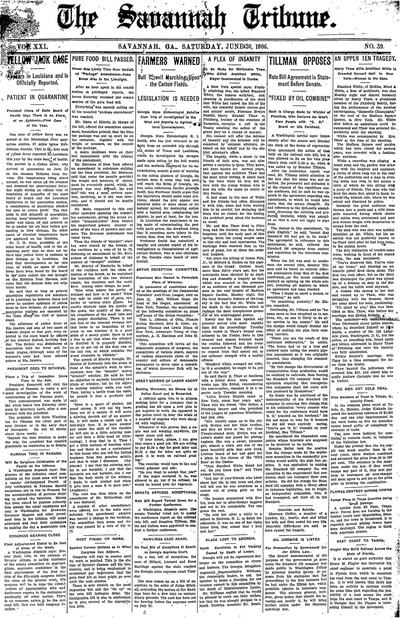
Page text (machine-generated)
PATIENT IN QUARANTINE
President Irions of State Board of Health Says There is no Fears of an Epidemic—First Case
One case of yellow fever was reported at the Mississippi river quarantine station, 97 miles below New Orleans, Sunday. This is the first case of yellow fever reported in Louisiana this year by the state board of health. The patient is a Cuban sailor, who arrived at quarantine on June 18 on the steamer Holstein from Hawaii. His temperature being above normal, he was taken off the steamer and detained for observations: Saturday night during an official visit of inspection of members of the state board of health and the Louisiana legislature to the quarantine station, a consultation of physicians decided the case as yellow fever. The Holstein is still detained at quarantine, having been disinfected after the sailor was taken off and ordered to lie at anchor for six days before proceeding to New Orleans. No other cases of elevated temperature have yet appeared on the Holstein.
Dr. C. H. Iricn, president of the state board of health, said to the inspecting party that he does not believe that yellow fever is endemic at New Orleans or in Louisiana. He held that developments so far this year, in which no cases of yellow fever have been found by the board in the state except the one brought on the Holstein from Havana, indicates that the disease does not originate locally.
He said that so long as present quarantine regulations are maintained in Louisiana he believes there will never be another epidemic of yellow fever in New Orleans. At present five quarantine stations are operated by the state along the Gulf of Mexico coast.
The existence of yellow fever at Rio Janeiro and also of two cases of bubonic plague at that port, were reported to the state board by officers of the steamer Sallust, arriving Sunday. The Sallust was disinfected at quarantine both for fever and bubonic plague, although none of the steamer's crew had been allowed ashore at Rio Janeiro.
PRESIDENT GOES TO ISTHMUS.
Plans a Trip of Inspection Some Time in the Fall.
President Roosevelt will visit the Isthmus of Panama to make a personal investigation of the work of construction of the Panama canal.
This announcement was made at the white house late Saturday afternoon by Secretary Loch, after a conference with the president.
The president will leave Washington for Panama the latter part of next October or in the early days of November. He will be absent about three weeks.
Beyond the bare decision to make the trip, the president has reached practically no conclusion as to details.
HURRAH TIME. IN PANAMA
Will Be Gorgeous Celebration of the Fourth on the 1sthmus. A Washington dispatch says: Employees of the 1sthmian canal commission on the canal zone will have a regular old-fashioned Fourth of July celebration in Panama. Special excursions are to run to Panama for the accommodation of persons desiring to attend the exercises. Money has been raised by popular subscription among the canal employees and sent to Washington for fireworks. Governor Magoon and other prominent men in the 1sthmus will make addresses and lend their assistance in making the day a memorable one.
CONGRESS NEARING CLOSE.
Final Adjournment Stated to Be Had at Close of the Week.
A Washington dispatch says: Senator Hale, who, in the absence of Senator Allison, is acting chairman of the senate committee on appropriations, expresses confidence in the final adjournment of the first session of the fifty-ninth congress before the close of the present week. His program will be to urge the consiliration of appropriation bills and conference reports to the exclusion of practically all other matter. There is no measure, unless it be the railroad bill, that can hold congress together.
The Savannah Tribune.
SAVANNAH, GA. SATURDAY, JUNE 30, 1906.
PURE FOOD BILL PASSED.
House Has Lively Time Over So-Called "Package" Amendment—Fake Booze Also in the Limelight.
After an hour spent in the consideration of privileged reports, the house Saturday resumed the consideration of the pure food bill.
Everything was smooth sailing until the so-called "package amendment" was reached.
Mr. Mann of Illinois, in charge of the bill, offered the committee amendment, heretofore printed, that the time the package was put up must be on the container, together with the weight or measure, on the outside of the package.
A dozen members were on their feet immediately after the reading of the amendment.
Mr. Sherman of New York offered an amendment in substance striking out the time provision. Mr. Sherman said that under the penalty provided the weight and measure, if stated, must be correctly stated, which, he argued, was very difficult. He said that this was a most serious question, involving, as it did, vast interests, and it should not be hastily considered.
Mr. Mann responded to this and other speeches opposing the committee amendment, giving the house another "demonstration" from behind his improvised grocery counter of some of the ways of packers and canners. The Sherman amendment was voted down.
Then the friends of "straight" whiskey were routed by the friends of the rectifiers by a vote of 34 to 76, defeating an amendment by Mr. Richardson of Alabama in behalf of the makers of "straight" whiskey.
Mr. Sherley of Kentucky in behalf of the rectifiers held the close attention of the house, as he explained the contention of the two whiskey camps, the distillers and the rectifiers. Among other things, he said:
"Now what makes the purity of whiskey and how is it made? Whiskey may be made out of corn, rye, barles or various other grains. Its quality depends upon the quality of the grain, the quality of the yeast, the cleanliness of the mash tubs and the proper distillation. There is not one line of the internal revenue law that looks to an inspection of the grain to see whether it is a pure grain or a musty grain; there is not a line to say that when the whiskey is distilled it is properly distilled, so as to get rid of the first run or the last run, or which contains the worst elements in whiskey."
The speech of Sherley brought Mr. Stanley of Kentucky into the arena in front of the speaker's wesk to demonstrate how the "blender" makes "blended" whiskey. He said he had no objection to anybody blending two kinds of whiskey, but he did object to making whiskey while you wait. Then, taking a bottle from the table, he poured it into a graduate and said:
"Here is a quart of alcohol, 100 proof strong. It will eat the intestines out of a coyote. It will make a howling dervish out of an anchorite. It will make a rabbit spit in a bull-dog's face. It is pure alcohol and under the skill of the rectifier he will put in a little coloring matter and then a little bead oil (illustrating). I drop that in it. Then I get a little essence of bourbon whiskey and there is not a connoisseur in this house who can tell the hellish business from the genuine articles, and that is what I denounce. (Applause.) I say that the coloring matter is not harmful; I say that the caramels are not harmful, but I say that the body stock of the whiskey I made is rank alcohol and when it gets into a man it is pure hell." (Applause.)
The vote was then taken on the amendment of Mr. Richardson, and it was defeated. A number of other amendments were offered, but in the main were defeated. The amendment adopted was merely a change in the verbiage. The committee then arose and the bill was passed by a vote of 242 to 17.
MUST FINISH UP WORK.
Speaker Cannon Dictates as to When Congress Can Adjourn.
Congress will stay in session until its work is finished. This is the dictum of Speaker Cannon and his lieutenants, and is being emphasized to counteract any impression that the pure food bill at least might go over until the next session.
There is also trouble on the meat inspection bill and the "tie up" on the rate bill indicates delay. The immigration bill is also in conference, as is also several of the appropriation bills.
FARMERS WARNED
Georgia State Entomologist Returns from Trip of Investigation to the West and Reports to Agricultural Commissioner.
Georgia State Entomologist R. L. Smith, who has just returned to Atlanta from an extended trip through the states of Texas and Louisiana, where he investigated the ravages made upon cotton by the boll weevil and the methods employed for its extermination, sounds a note of warning to the cotton planters of Georgia. So certain does it seem that this pest will reach the fields of Georgia, unless some unforeseen barrier presenta itself, that Professor Smith urges that the legislature should make some provision, should the pest appear one hundred miles or more ahead of its natural spread, for destroying cotton over a limited area, reimbursing the planter, in part at least, for the loss.
In Louisiana the experiment is being made of exterminating the pest with paris green, the drawback being that it occasions more injury to the cotton than does the boll weevil. Professor Smith has submitted a lengthy and concise report of his investigations to Commissioner of Agriculture Hudson, who is also chairman of the Georgia state board of entomology.
BRYAN RECEPTION COMMITTEE.
Prominent Men Named to Formulate Plans of Welcome.
In pursuance of resolutions adopted at the meetings of the Commercial Travelers' Anti-Trust League, held on June 11, 1906, William Hoge, the head of the league, announced at New York, Tuesday, the appointment of the following committee on plans and scope of the Bryan-reception: Tom L. Johnson of Ohio, Francis Burton Harrison, Bird S. Coler, Augustus Thomas and Lewis Nixon of New York, Alexander Troup of Connecticut, A. E. Eastman and John H. O'Brien.
This committee will invite all the democratic members of congress, the committees of various states, mayors of various democratic cities of the country and editors of democratic newspapers to serve upon a committee, of which Governor Eolk will be chairman.
GREAT SCHEME OF LABOR AGENT
Seeking Workmen, He Shows Up at Police Court and is Rewarded.
A railroad agent who is in Atlanta seeking labor for a company that is grading has hit upon a new plan to get negroes to work. He appeared in the police court to hear the trials of a number of negroes who were charged with vagrancy.
Whenever it was proven that a negro was not working anywhere, the agent arose and said:
"If your honor, please, I can give that negro a good job. We are willing to pay $1.50 a day for good labor and $1.25 a day for labor not quite so good. It is work on railroad grading."
The recorder would turn to the convicted prisoner and ask:
"Do you want to accept that job?"
If the negro accepted it, he was allowed to go, but if he refused, he would be bound over for vagrancy.
SENATE REFUSES ACCEPTANCE.
Rate Bill Report Turned Down for a Further Conference.
A Washington dispatch says: The senate Tuesday voted not to accept the conference report on the railroad rate bill, and Senators Tillman, Ellins and Cullom were appointed to conduct a further conference.
RAWLINGS CASE AGAIN.
On Fast Bill of Exceptions It Reaches Georgia Supreme Court. On a fast bill of exceptions, the case of Millard, Leonard and Jesse Rawlings against the state reached the Georgia state supreme court Tuesday. The case comes up on a bill of exceptions to the order of Judge Mitchell, overruling the motion of the Rawlings boys for a new trial on extraordinary grounds. The case has been set for hearing before the supreme court on July 16.
A PLEA OF INSANITY
To Be Made for Millionaire Thaw
Who Killed Architect White
Slayer Incarcerated in Tombs.
A New York special says: Frank-
ly admitting that the killed Stauford
White, the famous architect, and
pleading in justification of the deed
that White had ruined the life of his
wife, the beautiful former chorus girl
and artists' model, Florence Evelyn
Nesbitt, Harry Kendall Thaw
or Pittsburg, brother of the countess of
Yarmouth, occupies a cell in the
Tombs awaiting the action of the
grand jury on a charge of murder.
His counsel will offer the defense of insanity and the prisoner will be examined by 'eminent alienists, retained on his behalf and by the district attorney's office.
The tragedy, while a shock to the friends of both men, was not altogether a surprise to them. They knew, and have known for several years, that against the architect Thaw had the most bitter feeling. It dated back to the time when he first fell in love with the young woman who is now his wife. He made no secret of this feeling.
It had come to the ears of White and his friends had often discussed it with him, some had even warned him to be careful, but declaring that there was no reason for the feeling the architect went about his business as usual. Mr. and Mrs. Thaw lived in Pittsburg and the incident was fast being forgotten until the early part of this spring, when the young couple came to this city and took apartments. The warnings were renewed then on the part of some, but at these the architect laughed.
Not since the killing of James Fisk, Jr., by Edward S. Stokes on the staircase of the Grand Central hotel, more than thirty years ago, has the metropolls been shocked by so startling and dramatic a tragedy as that which was enacted in the presence of an audience of one thousand persons in the roof theater of Madison Square Garden, Monday night. Not the least dramatic feature of the tragedy is the fact that Mr. White met his death in the structure which is perhaps the most conspicuous memorial of his architectural genius.
Rarely has the case against any prisoner moved with more rapidity than did the proceedings Tuesday which ended in Thaw's formal commitment to the Tombs. Save in this unusual and almost frenzied haste the routine followed and the treatment accorded to Thaw differend in no respect from that meted out to any-prisoner charged with a capital offense.
"Stanford White wronged my wife; he is a scoundrel; he ought to be put out of the way."
So said Harry K. Thaw at luncheon with a friend down town several weeks ago. His friend, remembering the conversation, repeated it to a reporter early Tuesday morning.
"Little Evelyn Nesbitt came to New York, about four years ago," Thaw told his friend. "Her father, a Pittsburg lawyer and vice president of the League of American Wheelmen, had just dled.
"Mrs. Nesbitt came on to the city with Evelyn and her little brother, and they all lived at No. 247 West Twenty-second street. Evelyn was an artist's model and posed for photographers. She was a sweet, innocent girl, almost a child, and one of the most beautiful girls that ever lived. Lederer heard of her and gave her a place in the chorus of the 'Wild Rose' at the Casino.
"Then Stanford White found her out. Do you know him?" and Thaw looked furious.
"Ask any of your friends who know about fast life in this town and they will tell you he was notorious as a seeker out of young girls on the stage.
"He became acquainted with Evelyn, took her to after-theater suppers and out in his automobile. You can guess the rest.
"He sent her after a while to a school in Madison, N. J., to finish her education. It was on one of her visits home from that school that I first met her."
PLACE LOST TO GEORGIA.
North Carolinian to FIII Vacancy Caused by Death of Lester.
Georgia will not be represented any longer on the committee on rivers and harbors. The Georgia delegation requested Representative Williams, the democratic leader, to ask the speaker to name a Georgian for the vacancy caused in this committee by the death of Representative Lester. Mr. Williams replied that he would be pleased to carry out their wishes, but that he was already pledged to a North Carolina member; Mr. Small.
TILLMAN OPPOSES
Rate Bill Agreement in Statement Before Senate.
"FIXED BY OIL COMBINE"
Such Is Charge Made by Wileder of Pitchfork, Who Declares He Won't Face People with "S. O." Brand on His Forehead.
A Washington special says: Immediately after the senate met Monday the clerk of the house of representatives announced the action of that body on the railroad rate bill, but it was allowed to lie on the vice president's desk until 2:30 p. m., when it was called up by Senator Tillman.
After the conference report was read, Mr. Tillman called attention to the fact that his name was not attached. He presented and defended it at the request of the republican senate conferences, but he said he was opposed to the agreement regarding one amendment, to which he would later move that the senate disagree. He had reference to the McLaurin amendment divorcing the carrying and producing business, which was amended so that it does not apply to pipe lines.
The change in this amendment, "in plain English," he said, "meant that Standard Oil had got in its work." The agreement in reference to this amendment, he said, relieved the Standard Oil company from control and regulation by the interstate commission.
When the bill was sent to conference the second time, Senator Tillman said he found an entirely different atmosphere from that of the first conference, as the house committee insisted on opening up the whole subject, including all matters on which an agreement had been reached.
"Then I began to smell a mouse, or something," he said.
"Or something, probably," Mr. Elkins remarked.
Continuing, Mr. Tillman said he "became more or less skeptical as to motives, etc., as one is likely to do after service in the senate." He said the change would simply destroy the effect of making the pipe lines common carriers.
"There you see the result of this additional deliberation," he added.
"The house had us up a tree and insisted upon taking the senate pipeline amendment as it was originally inserted, thus changing the commodity amendment.
"By this change the divorcement of transportation from production would be confined to railroads, thus leaving the Standard Oil company from the operation requiring that transportation companies shall not carry articles produced by themselves."
So firmly was he convinced of the instrumentality of the Standard Oil company in securing this change, that in his estimation "every senator who voted for the conference would have 'S. O.' branded on his forehead." He did not mean to vote for it because he did not want anybody saying, "You've got 'S. O.' branded on your forehead, Ben Tillman." He considered the independent companies whose interests are supposed to be involved to be myths.
Senator Bailey took the position that the change made by the conference committee in the commodity provision would nullify the pipe line position. It was equivalent to making the Standard Oil company the one exception to the requirement that producers shall not transport their own articles. He did not charge the Standard Oil company with a direct effort to influence legislation, but to frighten independent companies, who, it had transpired, sell their oil to the Standard.
Uxorcide and Suicide.
Sherman Collier, a member of a London, Ky., family, shot and killed his wife and then ended his own life. Domestic differences are said to have caused the tragedy.
OIL COMBINE IS LISTED
For Prosecution by Government Under Elkins Law. The formal announcement of the purpose of the government to prosecute the Standard Oil company was made public in Washington Friday by Attorney General Moody. It appears from his statement that the proceedings in the first instance will be had under the Elkins law, which prohibits rebates in interstate commerce. The attorney general, however, gives notice that should the investigation justify it, he will bring further action under the Sherman anti-trust law.
NO.39.
AN UPPER TEN TRAGEDY.
Harry Thaw Kills Architect White in Crowded Concert Hall in New York—Woman in the Case.
Stanford White, of McKim, Mead & White, a firm of architects, was show Monday night and almost instantly killed by Harry Thaw, a prominent member of the Pittsburg family, during the performance of the musical extravaganza, "Mamselle Champagne," on the roof of the Madison Square Garden, in New York. Mr. White died before an ambulance could be summoned and Thaw was arrested immediately after the shooting.
White was accompanied by Mrs. Thaw at the time of the shooting. The Madison Square roof garden which has been closed for several years, was crowded with a fashionable audience. While a comedian was singing a comic song and the garden was echoing with the laughter and applause, a series of shots rang out in the rear of the auditorium and a man in evening dress was seen to fall across a table at which he was sitting with a party of friends. The man who had fired the shots fled, pistol in hand, towards the nearest exit, where he was seized and disarmed by police.
Instantly the great audience was thrown into a panic and a wild stampede occurred during which chairs and tables were overturned and men and women fought with desperation to escape from the roof. The man who was shot was quickly identified as Mr. White, but his assailant was not positively known to be Thaw until after he had been taken to the station house. The first intimation of trouble came when, walking in front of his seated victim, the man exclaimed: "You've deserved this. You've ruined my home," and drawing an automatic pistol fired three shots. The first two took effect, but as the thirld was discharged the pistol was struck up by a fireman on duty in the theater, and the bullet went skyward.
"I'll stand by you." She was identified as Mrs. Thaw, who before her marriage was Evelyn Nesbitt.
The assailant was taken to the West Thirteenth street police station, where he described himself as John Smith, a student of No. 180 Lafayette place, Washington, D. C., but the police, on searching him, found cards and letters addressed to Harry Thaw of Pittsburg, and later his identity was fully established.
Evelyn Nesbitt's marriage with Thaw for a time estranged the latter from his family.
Thaw handed the policeman who arrested him $10, and asked him to notify Andrew Carnegie that he was in trouble.
ICE MEN GET COLD DEAL.
Five Members of Trust in Toledo, O., Heavily Fined.
In the common pleas court at Toledo, O., Monday, Judge Kinkade imposed the maximum sentence of $5,000 fine and one year imprisonment in the work house on five ice manufacturers found guilty of conspiracy in restraint of trade.
The men were indicted for combining to restrain trade, in violation of the Valentine law.
Under the pretext that the ice supply was much smaller than in recent years, these dealers combined and advanced the price from 50 to 100 per cent. The sentence is the maximum under the law. If they would escape any part of it, they mut pay back to customers all over-charges and must agree to sell ice at the price prior to forming the combination.
FLAMES DESTROY MINING TOWNS
Forest Fires in Texas Counties Doing Great Damage.
A special from El Paso, Texas,
says: Forest fires are burning in the lumber tracts near Magadalena, Senora,
and the town is threatened. It is reported several mining towns have been destroyed. The region is thick with American miners.
EAST COAST TO TAMRA.
Flagler May Build Railway Across the State of Florida. It is stated on good authority that Henry M. Flagler has instructed his chief engineer to ascertain a point in Florida from which to construct his road from the east coast to Tampa. It is well known that there has been an activity in railroad circles for some time past regarding the possibility of a road across the state from the east coast to Tampa, and it is thought that Mr. Flagler is interesting himself in the movement.
The Guaranty Aid and Relief Society
SOL. C. JOHNSON, Supt. of Agencies. B. W. COOPER, General Manager.
Treasury of State of Georgia.
Atlanta, JAN 17 1908 190
The unassigned Treasures of the State of Georgia, hereby acknowlledges
to have received from the Secretary
of Dawson, the following described:
Davis Regiment, Division of Infantry, 1st
Eastern Division, Georgia (Stafford Division)
7th Infantry, Georgia (Stafford Division)
(Continued, June 1920)
Long in total Ten Thousand Dollars, and which are held by the State of Georgia, by authority and under the provisions of an Act of the General Assembly, approved October 22d, 1887, and amended December 20th, 1897.
R. E. Parsi
In the presence of many Columbus citizens and quite a party of distinguished visitors, the corner-stone of the secondary industrial school, the $50,000 nucleus of Columbus $200,000 technological plant, was laid with impressive ceremonies.
Railroad is Extended:
The F. R. & G. railroad, which has been operating between Ashburn and Sylvester since March 1, has extended its road to Bridgeboro, a point on the Albany Northern 14 miles southwest of Sylvester. The passenger and freight traffic has increased to such an extent that it became necessary to put on a regular freight train. The road is doing a good business and is pushing its line on to the gulf as rapidly as possible.
```markdown
```
Apprentice Slays Foreman.
J. M. Stewart, section foreman of the Seaboard, at Bladen, Ga., was shot and instantly killed by Oscar Knight, his apprentice, Saturday night. Knight shot him twice in the back, and when he fell fired seven shots into his body. The body was found in front of Stewart's home Sunday morning. Jealousy of his wife and Stewart is the cause given by Knight, who was committed to Brunswick jail charged with murder by the coroner's jury.
Tech Grads in Demand.
During the course of twelve hours following the Tech graduating exercises in Atlanta, President Matheson of that institution recelled three letters from manufacturing concerns wishing to place some of the '06 class at munificent salaries.
The reputation of the Georgia Tech has spread over the entire country, and none of its graduates experience trouble in securing lucrative positions upon graduation.
Court Cuts Out Oral Argument. After having disposed of 666 cases of the 1,146 cases on the docket since the October term, 1905, leaving 480 cases undisposed of, and being now engaged in reviewing judgments of 145 superior courts and 57/city courts, which number will be increased by the addition of fast bills of exceptions in criminal and civil cases, the state supreme court has been compelled to order that oral argument in remaining cases be dispensed with when practicable. The court has issued an order to that effect.
Treasurer of the State of Georgia.
Home.
Tom Wat-
early date,
probably in
sta.
what Mr.
is under-
ly, that he
will the me-
azine to a
his home
case.
Augusta
the pub-
are now
will be sub
Luck.
the post-
Seaboard
Florida
Only Daily I
Quickest Schedule.
Electric
Wants to Get Nearer Home. There is probability that Tom Watson's Magazine will, at an early date, be published in the south, probably in Georgia, possibly in Augusta. It is not known definitely what Mr. Watson's plans are, but it is understood, on excellent authority, that he is desirous of transferring all the mechanical work of his magazine to a place that will be nearer his home interests than is now the case.
year ex-
Postmas-
boost in
for the
making a
means that
banks with
the salary
just one
Suis.
ainst. the
the Cen-
lt of the
a picnic
Springs.
Leave Savannah ...
Arrive Richmond ...
Arrive Washington... ...
Arrive Baltimore ...
Arrive Philadelphia ...
Arrive New York ...
SOUTHBOUND
Leave Savannah ...
Arrive Brunswick ...
Arrive Jacksonville ...
Arrive St. Augustine ...
Solid vestibule Pullman train, wi-
route. Cholestest reservations, inclu-
with detailed information, secured
fice, No. 7 Bull street. Phones No.
Printers in Atlanta and Augusta have received notices from the publishers of the magazine and are now preparing estimates that will be submitted.
***
Atlanta Postmaster in Luck.
Owing to the fact that the postoffice receipts of the Atlanta postoffice for the past salary year exceeded the sum of $600,000, Postmaster Blodgett has received a boost in pay of $1,000 a year.
This increase in salary for the head of the department, making a total of $6,000 a year, means that the Atlanta postoffice now ranks with the best-in the country, the salary being exceeded by that of just one office—New York,
Avalanche of Wreck Suis.
A total of wreck suits against the Atlanta and West Point and the Central of Georgia, as a result of the recent wreck in Atlanta to a picnic train returning from Pearl Springs, were filed a few days ago amounting to $165,000. This amount is larger, probably, than any other one day's total against the two roads for the recent wreck.
The total amount that the two roads combined will have to pay, if they pay all that has been asked of them up to date, on the recent Pearl Springs wreck, will be $711,000.
Farmers to Gather on Fourth. The farmers' institute for the 12th senatorial district—Quitman, Stewart and Webster counties—will be held at Lumpkin on July 3 and 4, Hon Harvie Jordan in charge. A number of prominent speakers and experts will be present.
On July 4, the Stewart county branch of the Southern Cotton Growers' Association and the Clement A. Evans camp of Confederate Veterans, will unite in a suitable celebration. There will be an extensive basket dinner on this day, with appropriate speeches, a brass band and other features that will add interest to the day.
---
Look to Farm for Best Men.
Interest in the agricultural education and the development of the State College of Agriculture and the Mechanic Arts to the highest standard of efficiency has marked the meeting
P. EDWARD PERRY, Vice President.
NORTHBOUND SCHEDULE:
(Railroad Time.)
Leave Savannah ... 5:00P.M.
Arrive Richmond ... 6:45A.M.
Arrive Washington ... 10:10A.M.
Arrive Baltimore ... 11:30A.M.
Arrive Philadelphia ... 1:45P.M.
Arrive New York ... 4:15P.M.
SOUTHBOUND SCHEDULE
Leave Savannah ... 9:20A.M.
Arrive Brunswick ... 12:15P.M.
Arrive Jacksonville ... 1:00P.M.
Arrive St. Augustine ... 2:10P.M.
Solid vestibuled Pullman train, with Dining Cars serving all meals en route. Choicest reservations, including drawing rooms and state rooms, with detailed information, secured at Seaboard Air Line City Ticket Office, No. 7 Bull street. Phones No. 28.
of alumni, and friends of the University of Georgia at this year's commencement.
George Foster Peabody, that true friend of the agricultural interests of the state, in an address made to the alumni, stated that from the farm the state must in the future get its strongest and best men and women, and that every movement for the development of agricultural education in this state means better citizens and more prosperity in the future.
Backing up his words by his interest and money, he has given to the university an additional 350 acres of land, in order that the university may have the very best campus in the south, it now comprising 900 acres.
Hayoc Wrought by Hall.
The hail storm a few days ago in Clarke and Oconee counties was heavier than was at first reported. In Oconee county the hail fell to the depth of 14 inches on a level, and even the pine needles on the trees were stripped and piled on the ground several inches deep. In the upper edge of Clarke county the loss was heavy. In Clarke the storm was about a mile wide and seven miles long. In Oconee it was two miles wide and ten miles long. The corn and cotton crops in the path of the storm were totally destroyed.
HOME OFFICE.
WEST BROAD STREET,
SAVANNAH, GEORGIA.
Phone 1198. Ga. Phone 2029.
Directors.
L. E. Williams.
P. Edward Perry.
Walter S. Scott.
Sol. C. Johnson.
W. R. Fields.
J. H. Deveaux
L. M. Pollard.
R. R. Wright.
W. H. Burgess.
J. H. Bugg, M. D.
C. F. Jones.
J. M. Ferrebee.
This company is duly chartered under the laws of the State of Georgia, and has complied with all requirements of the State Insurance department, therefore all policy holders are protected with all the safeguards that the strict insurance laws of this State seek to protect its citizens.
Its affairs are directed and managed by Negro men of the city of Savannah of leading standing, and whose character and reputation are of such as to command the respect and confidence of all the people of that community. The same men that manage this Society are the ones that organized and are conducting the affairs of the first successful Negro Savings Bank in this state, therefore we can readily see that by connecting themselves with this Insurance company their interest will be in safe hands.
By comparing our rules and benefits with other first class companies it will be seen that we offer the most liberal inducements with the largest sick, accident and death benefits to our members than any other company in this business.
That we pay our claims promptly can be testified to by the thousands of our satisfied members.
Agents Wanted Everywhere
(Railroad Time.)
...5:00P.M.
...6:45A.M.
...10:10A.M.
...11:30A.M.
...1:45P.M.
...4:15P.M.
SCHEDULE.
...9:20A.M.
...12:15P.M.
...1:00P.M.
...2:10P.M.
With Dining Cars serving all meals en-
during drawing rooms and state rooms,
at Seaboard Air Line City Ticket Of-
28.
Monticello and vicinity was also visited by a hail storm, doing considerable damage. Fences were blown down and on several plantations crops and fruit were entirely destroyed.
Lawlessness Alarms Citizens.
Mayor J. L. Allen and other prominent citizens of Chipley appeared before Judge William A. Little, in Columbus, a few days ago, and urged him to grant a petition signed by thirty or forty citizens of Chipley and Hamilton, asking that a special term of Harris superior court be called for the purpose of trying the persons arrested in connection with the recent double tragedy at Chipley, and also for the purpose of suppressing the lawlessness in the community.
The petitioners say that people are carrying arms openly, and that the feeling of apprehension is demoralizing and is injuring the town's business. The petitioners at first applied to Governor Terrell for relief, and he suggested that they cotter with Judge Little in reference to a special term of court. Judge Little reserved his decision.
Just for a change, suggests the Tampa (Fla.) Globe, why not call 'em muck-rake sociables instead of pink teas?
Liberal Terms and Commission.
WALTER S. SCOTT, Secretary and Tr. cas.
New York Doctors in Savannah.
THOUSANDS GOING TO SEE THE M AND HUNDREDS REJECTED AS INCURABLE. LOCATED PERMANENTLY 204 LIBERTY STREET, E., NEAR ABERCORN.
their disease he firmly believes that no wcman can make a mistake, in confiding her case to him. There is no super-critical examination of the person, no interference with customary habits, no publicity. There are private reception rooms for ladies, and when their presence is announced they will be promptly attended to by the doctor. No charge is made for examination, counsel or advice, nor the use of the doctor's vast equipment, which is undoubtedly the most expensive in this country. Enclose stamp for reply.
LET THE NEW YORK SPECIALISTS CURE YOU.
Ladies suffering from dizzy, fainting or sinking spells, from abnormal nervousness, from piles, constipation or any digestive trouble, from menstrual irregularities, womb or ovarian trouble, weak heart, urinary trouble or any organic disease, would do well to lose no time in seeking their skill. He will prepare a treatment for your individual needs. He will study your wants and endeavor to cure you in the shortest space of time consistent with assured permanency. This treatment will contain, besides ingredients to cure your disease, such medication as will build up the body, steady your nervous system, enrich your blood, arouse the muscles, open up the pores and create activity in all the organs. This is said with the confidence that actual experience brings. We know what they have done for other women, and, we see no reason why he would not do as well for you. There is every indication that he will cure. Call at the earliest possible moment, and avail yourself of the free examination and counsel. His judgment of your case must be worth much to you; yet he makes no charge for it. He will also let you use his electrical and magnetic apparatus free of charge. If you live too far away to call in person just now write the doctor about your case and he will advise you free of charge. He will also be glad to send you his Self-Examination blank and booklet, going into all the diseases of women, etc., absolutely free of charge. Consultation is free.
NEAT PRINTING
Creates a good impression among your correspondents and helps to give your business prestige. We Do Neat Printing at Reasonable Prices.
MY BEST REFERENCE IS
We depend upon our cured patients to tell others who are like afflicted to what we have done and what we can do.
The New York doctors who are well and favorably known to you all, would like to see at his office, or have a letter from ladies who are afflicted with any disease peculiar to their sex. He would especially like to know of such as have doctor with a family doctor for a long time, or who have been constantly buying advertised remedies in drug stores, without, of course, deriving anything more than a temporary benefit, even if that. To such as these the New York doctors have a message that is cheerful—a treatment that is perfectly curative. The doctor has as many patients among women as among men, and he has for years studled them in public and private hospitals and in his own practice, and from the success he is having in curing
THE NEW YORK DOCTORS,
204 Liberty Street, East,
Savannah, Ga.
‘Topregts and its of Mle,
5 the
iighway aud hoasetop ace rifd
AVith the terbulent fly.
‘Men! in the rush and the atic
, © And the roar of the street.
Men! in the factory’s whire
Sa eet
fen! ’mic for i
ae Baia ia 2
ent on the girders tha
Beit teach Ie oo eeproand tke
i e
“Like a snake to its dem
Barrows the glowering train
“With itz burthen of Men.
Ment Men! “Ment
Pita, glorious
aquering, despera
Soequing, igen J
Guiterman, in the New York Times.
THE SHADOW
OF DEATH.
thin ateb eee ee ee
lay the clty of Naples, a taway crescent
bathed fa sunshine; viagyards and
gardens stretched away from tho foot
of the mountain, dotted with villas
and little hamlets; and to the west Iag
the wonderful Mediterranean, a perfec!
turquoise in color, with sbadings of
deeper blue where the breeze touched
the shimmering surface. In the dis
tance slept the fair island of Capri.
Bat the boys were more Interested
fn thelr immediate surroundings than
in the dreamy Italian landécape far
below and beyond them,
Just in front of them yawned the
awful crater, Sts sides streaked with
sulphur and dimmed by ascending
curls of steam. ‘The crust of slag and
ash on which they stood was warm
‘to their feet, and here and there were
‘crevices coated with bright yellow sul-
phur and giving forth hot fumes of
| nauseating ras.
“Whew! exclatmed Harry, with a
disgusted face. “f can’t stand this
Jong! Let's—"
He was interrupted by a hollow roar
from the volcante depths, like the dis-
charge of a ship's broadside. A shower
of red hot stones flew upward, to fall
back again into the erater, while a
cloud of black smoke drifted away
against the blue sky. Tho boys had
started back, and were a good deal
shaken. :
“Let's hurry round the thing, and
then go down,” sald Dick. “I never
thought of its belng so awful, did
you?"
They cautiously circled the great plt,
carefully avolding the steaming cracks
io thelr path, and .then paused for a
last look.
“Wouldn't it be horrible to tumble
int” shuddered Dick, as they crept a
little nearer the edge and peered down
into the black, steamlag depths. ,
“They say an Engl'shman ‘went
down a few years ago,” sald Bob.
“He got too near and—Dick! Dick!
Come back!” hé screamed, springing
backward, with Harry beside him.
Dick was a Iittle {a advance of the
others. As Crothers spoke, a crack
appeared in the slag, and a moment
later, just as Dick started to his feet,
a section of the edge crumbled down:
ward, catrylug the boy with it. His
two companions gazed at each other
with blanched faces. It was too arfol
to be believed, A moment ago there
were three of them, talking mgily
enough; now—now the:e were buf two!
“What—what shall yo do?” gasped
the trembling Harry. “0 Bob, e's
gone, he’s gone!”
At that instant a faint rolce was
heard, as if from somewhere far away.
“Harry! Harry! Bob!* ‘
‘The two boys dropped flat on the,
earth and wriggled to the edge of the
crater. ‘There, some twenty fect be-
low them, they saw thelr comrade, He
had fallen on hls back, and glided
helplessly downward with the mase
of loose ash until bis feet touched a
layer of the underlying kardened lava,
on the very brink of the sheer preclpice
which formed the real crater.
Digging bis heels in, he had suc-
ceeded In arresting his progress, and
lay there with upturned face, knees
slightly bent—be dared not straighten
out his lege—and outstretched hands
latching the slag on each side. The
joose ash almost covered his halr, nis
bands and’bis feet.
“Hold on tight, Dick!” screamed
Harry, hatdly knowing what tie sald,
“We'll get you out. Hold on for your
iter”
Dick heard the volce of his friend
salling to him, although he could see
nothing but the opposite wall of the
rater, the ascending steam, and @
piece of blue sky above. He closed
nis eyes a8 he bung there within ix
inches of a horrible death, and nerved
pimself to walt. After a pause the
rolce came again:
“Bob has gone for help. I must keep
yack from the-edge, for fear it will
rumble again, Hold on with all your
might, old fellow. It will only be a
‘ew minutes!”
The air was filled wlth sickening
fumes of sulphur, and the hot sun
eat down pitllessiy on Dick's white,
ipturned face. To keep his senses, he
ried to imagine himself on the green
anks of a certaln troutbrook in
faine; then he repeated, without mov-
og his lips, the multiplication table;
fter that the twenty-third Psalm,
rich he had learned as a child,
Iust ag he reached “the valley of the
badow of death” he heard an in-
reased rumbling in the volcano, far
elow him. A new terror beset hin.
the erater was about to belch forth 2
olley of stones again. Would the
oneussion shake him from his post-|
MEN
Factory whistles blow Dawn _
;,From reverberant throats.
‘Hollow and mournfally drawn
Are the enswering notes
Chorased from harbor and shore
‘Through the fog wreatos, and then
Gityward ceasleiy pour
Toundations of Men,
Bast from the Jerseys and West
‘From the seaginded plains,
Bonth-from the hills is the quest
Of the sinuous trains;
‘Thronged is each waverspanning arc,
And again and again i
Shuttle the ferry eraft, dark
‘With their burthens of Men,
Be » Absa fen! a
leavy-browed, eagereyed,,
‘Tremulous, resolute
_ i sete
eUCOSeSoSEosoonesosSeooesoSSooNONTeSS
DON'T see why we need guides.” J
the blue Italian sks, ‘Churston, with
two other young Americans of about
his own age, was “doing” southern
Italy, walking whenever it was pos
sible, and employing guldes only when
it was absolutely necessary to do so.
The three pedestrians were now seated
on the veranda of the Quisisana, at
Casteliammare, having just finished
breakfast. .
“The path 1s plain enough on the
map,” continued Harry, “and I, for one,
don’t care to hare a ‘Pietro’ or ‘Jaco-
po! tagging after me all the-way up.”
“It looks like the beginning of a clear
day,” said Bob .Crothers, refectively.
“I don't really see how we could lose
our way.”
“Come on!” urged Dick White. Tt
aras Dick who usually got the party in-
‘to scrapes, and Crothers- who extricat-
ed it. Harry, in elther case, simply
helped form a majority.
‘Two hours Jater the trio started gat
from “La Maison Blanche,” a small
inn at the foot of the mountain, and
attacked the foothills of Vesuvius it-
self. The sun was shining: brightly,
the air was clear and sweet, but the
@istrict across which the path lay
iwras so drearily desolate that by de-
grees the gay talk and laughter of the
boys languished.
‘They had climbed the fount Wash-
Sngton bridle-path the year before, but
how different were their surroundings
now! In place of balsam firs, dancing
brooks, mossy slopes bright with crim-
son berries cad starry flowers, they
looked out over an unbroken stretch
vf volcanic rock, dead lava and black
dust.
“It's Ike a nightmare!” exclaimed
Harry, breaking a long silence, during
awbich they had been plodding onward
and upward. “I'd give something for
‘a drink of New Hampshire spring wa-
ter!” “ |
“L suppose,” observed Bob, “the
moon looks something like this when
you get there. Just a burged-out,
cooled-off,-dricd-up roteano.”
“Well” sald Dick, “let's get on.
There's a sqrt of restaurant up there,
at the end of this path, where we can
rest before taking Jn the final cone and
the crater.”
It was a long, hard, hot pull for
them, experlenced walkers though
they were, and they were glad enough
for the brief halt for refreshments at.
the foot of the funicular rallway—the
very one which inspired the popular
Neapolitan song, “Funteull, funiculs.”
And now arose a discussion as to the
method of completing the ascent. Dick
was for continulng on foot, following
the trscks of the regular porters up
through the knee-deep ashy dust which
covers the steep sides of the cone.
Crothers, however, advocated taking
the car.
“It's of no use to Hire ourselves all
out,” he sald, “wading through that
stuff up a slope like the roof of a house,
It’s all right coming down, but if you
fellows ever tried to climb a hill with
two feet of snow on ft, you kiow how
it feels. And {t's hot, too.”
Harry elded with Bob, and the three
were soon, ceated comfortably in the
little car, gilding upwerd along the
rails of the funicular.
‘Near the upper terminus of the rall-
way there was a cablo, where a oum-
ber of zuldes were walling to conduct!
tourists to the edge of the crater.
They pounced,upon the boys eagerly.
“No, no!” aald Harry in English, atak-
ing of ne of bis tormentors “No
guide for us!~wWe go alone—see?”
One y-ord alone was intelligible to
the Itallan, the last, which he under-
stood as “st” (yes), and atfaire grew
still more complicated. At last Bob,
who knew a little Ital:an, salc firmly:
“andate pel fattl vostri” (Go about
your ‘Yusiness); 2dding, “Faremo &
modo nostro” “(We shall do as we
please), and pushing throygh the
screaming clrele, he led the way up
the path. >
‘The zuldes sullenly fel! back and
gare up *he contest, muttering ex-
pletives in the Neapolitan patols,
which fortunately the Americans could
pot understand.
Bob Crothers told me long atter-
wards that he had not taken a dozen
steps when he felt a sudden misgiv-
ng, and halted ‘rresolutely. After all,
would it not be better to take an ex?
perfenced .gulde? If he bad only
abeyed his premonition of danger! but
Dick bounded up alread, shouting,
‘Come on, fellows! We've got clear of
them at last; and we're golng to have
the time of our Jives!”*
So the Jads kept on, up the steep
ascent, until they stood on tha small,
rregular plateau forming the summit
of Vesurivs, S
BY WILLIS
BOYD ALLEN.
rte mb inere Cpe p ta Ree hole ee
was indeed in the “shadow of death?"
The stones rattled sharply sgainst the
Tocks round bim, and fragments of slag
alld past, disappearing in the abyss
SUIl the projection against which bis
|heels rested did not give way. Halt:
suffocated with nauseous gases, hi
Imbs cramped and aching, he grimly
held. on.
Meanwhile Bpb Crothers tore dows
the path to the hut, where he found the
guides haif asleep.
‘When the white-faced Iad came rush
tok among them, they Hstened at firs
dulkity enodgh; but a8 soon as they
‘understood the real nature of the catas
trophe they sprang to thelr feet, and
snatching a coll of rope from & hook,
hurrled up the cone, headed by Bob,
“Dick, my dear old fellow!" It was
Bob's voice, and it camo just in time
to rouse the boy from the stupor to
which he’ was fast succumbing.
“Yea!” replied Dick, feebly.
“We're going to throw you # rope
with a runeing noose at the end.
‘When I give the word, you stick your
arm through the noose, quick, and grab
the rope with both hands”
“[-I don't know whether I can hold
on!” trembled Dick.
“Yes, sou can!” replied Bob, fiercely.
“You're got to! Here comes the rope!"
‘Two sturdy guides had stretched
themselves fiat on the ground at the
edge of the crater; hait a dozen of
thelr comrades platted themselves
firmly, with the rope twisted round
thetr bodies, a few feet farther back,
Dick felt the loose particles of ask
sliding past his face as the rope slid
down slowly toward bim. The dust
got Into bis eses, but he could not rub
them. At last the noose glided over
his head and rested on bis chest. At
the same moment he heard the pre-
monitors rumbie of the voleano fore-
telling another discharge. :
“Now!” screamed Bob.
Dick drew a long breath and caught
the rope, thrusting an arm through the
noose. ‘The quick movement: and in-
voluntary bracing of his feet dislodged
the slight projection which had arrest-
ed his fall, and he began to slide down-
ward.
It was a moment of terrible sus-
pense. Would the rope hold? Dick
could not help himself a partlcle, if
indeed he was still conscious. But his
grip was firm, and the noose, which
had slipped up to his armpit, clutched
him Ughtly.
Slowly the silent form was drawn up
the slope, farther and farther, until
his rescuers, cautiously reaching over
the edge, caught his wrists, aud drew
the half-dead Jad to safety.
It was a triumphal procession that
wound down the path to the but, carry-
Ing Dick, who feebly protested that he
could walk, bat was not allowed to set
foot on the ground. ‘The boys were
pretty sllent, but the guldes chatted
volubly, laughed, shouted and threw
up thelr hats, now and then turning
to shake thelr fists at the volcano, All
iit-feeling was forgotten.
“What did you think of, ol fellow,
as you were Iying there waiting Yor
us?” asked Harry that evening, when
the thaee were once more on the moon-
Ilt piazza of the CasteHlammare Hotel.
He threw bis arm over the other's
shoulder as he spoke, It was good 10
fecl that bls friend was allye and
well.
“Think? sala Dick, slowly. “I don't
know, I've forgotten. About mother,
1 guess, and—well,” he shuddered a
little, “that place, you know, about the
‘shadow of death.’ I tell you, fellows,
I’ve been In it!”—Youth's Companion.
Saperstitions in Maryland.
Planting by the moon and the signs
of the zodiac, avolding Friday and the
thirteenth day of the month, breaking
up a drought by. killlog a snake and
hanging it over # fence, taking care not
to present a friend with anything
sharp—how old are these beliefs, and
where first did they arise? The orlgin
of some tg not clear; the number thir-
teen fs a reminder of the Last Supper,
and s0 also {3 the spilling of salt fate-
ful, because {t was Judas who spilled
‘the salt, according to tradition, at that
‘holy meal. Most of the signs and
‘omens, however, seem to have no basis
of tradition for thelr origin, or, it they
ever bad ans, it has been Jost. The
subject has been humorously and curl-
ously entered into by “A Country Doc-
tor’ in “Popular Superstitions in Mary-
land,” in which many of these bellefs
are mentioned which seem to belong
excluslvely to this State. The coloted
folk are among bellevers th good and
bed signs, and the doctor mentions a
number of curlous omens. ‘These su-
perstitions, he explains, are almost in-
nate with Us; they are among our ear-
Hest and most ineffaceable impres-
slons, and, practical and philosophic as
we may become, they cling, from habit
and childhood’s influence, almost to the,
last.—BaltImore News.
‘nic was aekae | (
Yn a communication to the Academy
of Sclence the celebrated naturalist
M. Bonnier, makes come interesting
observations on the habits of bees. In
the afternoon when theyvare collecting
water from the leaves of aquatic
plants, be says, they will not torch
honey offered to them on these leaves,
or on floats of varios colors, But if
honey is offered to them in the morn-
ing in a similar way, it 13 carried off.
He explains this as atlsing from the
strictness with which they obey orders.
If they are sent out for water they will
not stay to gather hones.
‘An Ancient Thimble, -
Among the treasures of the Haps-
burgs in the.Hofburg at Vienna is a
clumsy thimble, engraved “A. V. W.
i684.” It is sald to be the parent thim-
ble of the world, and it was fashioned
of a silver coln by some ingentous
Dutchman, who picsented it to his
lady lore.
‘To call a man a “Dreyfus” in France
renders the user of the term Ilable to
a fine of 500 francs ($100) for bel
UFE AND DEATH IN CHICACO,
,_, lent Forms of the Other, —
‘Ong of the pleasing features of Chi-
¢ago as a place of residence is that
one stands a better chance of coming
to a vjolent end there than anywhere
else in the world. 2
Dr. Thomas Grant Allen has been
keeping tab for the last ten years and
row presents the following facts about
Chieago. It bas:
One violent death for every 950 lve
ing.
One violent death in every thirteen
deaths from all causes.
One hundred and five violent deaths
for every 100,000 of the population,
Six vloleut deaths every day. >
Forty violent deaths every week.
Four Iroquols Theatredisasters every
‘year.
Fifty miles of funerals every year.
Toss to the community, 2000 lives at
$1000, $2,000,000.
Loss to families, 2000 funerals at
$100, $200,000.
‘Loss to insurance societtes, 2000 at
‘$1000, $2,000,000.
In Chicago. suicides come first, tail-
‘ways second, falls third and murders
fourth, In other cltles rallway acel-
dents are first, suicldes secoud and’
murders niath.
OF all the forms‘of violence sulcide
contributes the greatest number to the
death roll in Chicago. Previous {o
1804 railway accidents caused more
deaths than sulcldes. Throughout the
country this still holds.
In Chicago duriug the tast ten years
there have been 4000 suicides and 2600
Ktlled by railroads. In 1896 the sul-
eldes passed the 100 2 year mark and
In 1893, only seven years later, bad
Inerensed to more than three times
that number. Since 1896 they, have
averaged more than one a day.
‘As to murders, the éity's bad repu-
tation in this respect Is fully sustained
by the facts. In 1902 Buffalo and
Glevelaid, citles one-fifth the size of
Chicago, bad two and eight murders
respectivcls. Baltlmore and Boston,
cities one-third the size of Chicazo,
had ten and twelve, respectively. Phil-
adelphia had thirteen; New York, sev-
enty-two; Chleago, 104.
‘The table of murders shows that
since 1900 they have averaged more
than 100 a year, and last year they
were double those of 1901. ‘The nurf-
ber of murders, therefore, bas doubled
in four years and now averages one
every second day.
Contrast this state of affairs with
that which obtatns’in other countries.
In 1903 there were twenty-four mmm
ders in London, fifteen in Paris, while
In Chleago there were 147—that fs, nlne
times as many as in Paris and six
times as many as In London, although
Loniton fs three and one-half times as
large.
‘The London rate in Chicago would
have given Chicago seven murders,
while the Chicago rate in London
would have given London 500 instead
of twenty-four. Further, and this In
connection with the few legal execu
tions mentioned, perhaps, explains a
great déal of the murder In Chicago,
in London every ‘one of the twenty-
four murderers was apprehended ex-
cept four, who committed suleide. OF
the twenty remaining nine were sen-
tencett to be hanged.
To Cuteago in nineteen of the soar.
ders no arrests were made, aift in
Gfty-three others no convictions were
secured, and only one convicted was
hanged. That is, more than half the
murderers escaped entirely, and of
those convicted only one pald the ex-
treme penalty—New York Sun’ |
BMost-Spoken Languages.
‘The most-spoken language Is’ Chl
nese, but as therd are so many dla-
lects in the language, and as these
differ so greatly in the confines of 3fon.
golla and Tibet from those ground
Pekin, it is scarcely correct to say that
the 382,000,000 Celastlals all speats one
language. Putting, therefore, Chinese
aside, the most-spoken languages in the
world are as follows, In millions:
English, 120; German, seventy; Rus-
sian, sixty-elght; Spanlsh, forty-four;
Portuguese, thirty-two. If we were to
measure these in ratlo on a tivo-foot
rule we should get the following re-
sults. Portuguese, four inches; Span-
Ish, flve and one-balt inches; Russian,
elght and onehalf inches; German,
elght and three-quarters inches; Eng-
Usb, one foot and three inches—Chl-
cago Journal.
on ea Se
A journal published in the Northwest
contains a lawyer's advertisement, fill
ing a space of about five Inches by
eight, advertising consultation on all
Points, specifying laws of busband ang
trie tad various other subjects, wife
most of the space is filled by a cut
showing a flerce battle between a man
and a woman, each flercely pulllog the
other’s hair. Under {t in Jarge type tt
says: “Had this couple read the above
ad. in te classified columns of the —
they could have settled their trouble
more satisfactoriiy.”—Case and Com
ment.
‘Stagoating Paris.
The recent census in Paris has
brought to light a curious ‘contrast in
results. Between 1896 and 1901 the
Population about doubled Itself, It
then stood at 2,660,000. ‘Then, for some
reason or other stagnation seems to
have set in. Bf, Bertillon, who bas bad
charge of the work so far as the capltal
4s concerned, does not explain the
fact, but, after a rough first glance
over the returns, he vouches for the
fact. ‘The increase during the last five
years amounts to no more than 60,000.
‘The population of the city 1s now about
2 790.000.
Dr, Harward Turner, Clifton, Bris-
tol, England, made a will containing
the strange direction that no person
benefiting under it should attend his
foneral, “under pain of forfelture of
his interest.”
cae
POTATO STARCH.
Wey Have discarded the old stye Ot
welghing the potatoes, but get at the
amount brought fa In a much more
rapid mauner by measurement.
From the potato “house the tubers
ae pnt Ia n Lopper In which they pas:
down to the large foom below, which
4s the vat room containing in this fac-
fory three Sarge vats, each capable of
holding several hogsheads. When the
potatoes arrive in this room they fand
in a long trougli called the masher.
Now the process begins in earnest with
the thorough cleaning of the potatoes,
for the more complete the washing the
better the starch. Plenty of good water
isa prime requisite In a starch factory.
Connected with the washer are several
pipes which let in the water: ‘The po-
tatoes are pushed along the trough and
enter a barrel, where they are more
thoroughly shaken up and washed, the
barrel rerolving.
Emerging from the barrel masher the
Potatoes continue thelr journey along
the masher trough, being pushed for-
ward by a system of revolving wooden
‘paddles which are set on iron shafts.
A little elevator now takes the tubere
and carries them from the washer up
four or five fect, dumplag them on top
of a large revoiving fron grater set in a
wooden drum. This grater has a briste
Jy top similar tp the housewife’s nut-
meg grater. Up to thie time the pota-
toes have retained their own form and
have been subjected merely to a clean-
sing process, but after coming into con-
tact It Is reduced to a miass of grated
pulp.
‘The mass Isonow dropped on to 2
sleve which works backward and for-
ward by machinery. ‘The sieve Is of
wire woven as firmly as possibfe and
it Is here that the starch is taken out
from the remainder of the pulp, which
will not pass through. Water is con-
stantly ruoning on to the sieve and as-
aists In the work of weeding out the
starch, which fs very fine and will pass
almost anywhere that water will.
As it passes through the sleve the
starch bears a very strong likeness to
milk. It now passes on to a bed and‘is
conducted through a series of troughs
into one of the large vats, the retuse
which was left behind at the gate be-
ing dumped In the stream which fows
beneath the factory. The starchy
water can be turned into any of the
‘three large vats at the will of the oper-
ators, *henk, to a complete system of
gates Jn the trough,
In the vats the washing process 1s
contioued, the mass being vigorously
stirred, by stirrers, which are long
wooden planks atteched to the end of
fron shafts. Nor is the cscansing com
‘plete even yet, the starch being allowed
to settte to the bottom, which it will
readily do cwlog to its welght; the
water Js pumped ont, fresh water let
in and the process repeated. ‘Then the
whole 1s pumped Into a vat known as
the settling yat, in the room above,
ayhere it remains for some time.
‘The mass soon resolves Itself into
three strata, a thidk white froth at the
top, then several fect of water and
lastly at the bottom the desired starch,
although as yet in a very moist state.
Thete is generally from a foot to fitteen
inches of starch in the bottom of the
yat, cnd this is arrived at ty pumping
out the water above. In order to pre-
vent waste the water pumped out is
conducted to another srall vat, where
the settling process is repeated. The
starch is now shorelled by the work-
men from the vat into Wheelbarrows
and conveyed to the drying house. This
isa urge rodm kept by neans of steam
radiators at a great heat.
‘There is somewhat over a mile of
steam pipes in use here, and the result
isa stiding heat that would soon over-
come any one not used to it. When the
writer stepped into the room the tem-
perature was at 157 degrees, and al-
though the employes can stay In it for
fifteen or twenty minutes without any
apparent inconventence, it 1s difficult
to understand how they can do 50.
- The drying room fs called the kiln,
and upon atrival there the starch {3
placed upon a large rack at the top of
the room, ‘There are several layers of
the starch, whlch have slits in them,
and as the drylng process proceeds the”
starch 1s gradually dropped, down the
scale, the heat belng decreased at each
move; it finally reaches a bed under-
neath racks and fs then, when adjudged
thoroughly dried, raked off and sent to
the storehouse. ‘The drying is a very
particular plece of business, for not
over sixteen per cent, of molsture is al-
lowable, and might mean a cut down
in price from the manufacturers. ‘The
starch dried at this factory. does not
contain more than from six to elght per
rent. .
If Ue Had $10,000,000.
Rogers once walked {nto the hut of
Ned Haskins, who lived the life of a
seml-hermit in a but elght feet square,
close to Fort Phoenix ia Fairhaven,
Mass. where Mr. Rogers’ summer
house stands now. *
“Ned, what would you do if you had
$10,000,000?" asked Rogers:
“By Jiogs,” said tho nermit, after
fong cogitat‘on, “I'd have this but
built two feét larger.”—From RH.
Murray's “Henry H. Rogers,” in Hu-
an Life, .
| ‘AMONG THE MASONS.
Notes and Happenings In the Ancient
and Honorable Order.
St. John’s Day was generally ob
served by the lodges all over the
state, in a befitting mannérand ihus
Ne should ‘be, for St. John was one of
the greatest patrons of Blasonry,
In the celebration of St. John's Day
tho ladles of the O. E. S. have taken
a very active part and assisted in
causing the occasion to be interesting.
The grand chapter 0. ES will
convene in Atlanta in August. it is
expected to be a grand session In-
deed,
Dorie Lodge No. 36 Egypt, and 3fc-
Kinley Lodge at Guyton, united in a
grand celebration of St. John’s py
at the former place, Past Grand
ter James M.-Simms was invited to
make he principal address, which was
done Yo the edification of all his hear.
ers, Brother Simms gave the brezhren
solld Masonic doctrine.
Easter Light Lodge at Blooning-
dale had 2 glorious time on Sun
day, A number of the members trom
the Jodge at Clyo were present and
united in the celebration, The ser-
mon was preached from St, John 1:14
—and scripture read by Past Mas
ter S. B. Wells. The celebration ten-
ded to encourage the brethren to a
great exteat and also proved inter
esting to the profanes,
Mt Olive Lodge No. 228 at Mount
Pleasant, Ua, had a pleasant ucca-
sion on Sunday last in celebration of
the daj. The lodge met at the lodge
room and in a body marched to Mt
Zion M. P. Church, where the ex-
ereises were held. The sermon was
Dreached by Rev. and Past Master
James P. Tisdal. The Sermon was
an able one. In it Brother Tisdat
gave an excellent talk, admonishing
his hearers to aspire to a higher con.
ception of things, and as Masons to
do the things that will only reflect
in a creditable manner on the craw
Brother ‘fisaal is a conscieatiqus
Christian gentleman and has Mason-
‘Ty deeply at heart and for that rea-
‘son he Jeft no stone unturned to im-
press his hearers in the importance
of the occasion. Mt. ‘Olive Is one of
the progressive young lodges.
‘The celebration of the day was ob-
served fn an elaborate manner by the
six lodges in Savannah, Early in the
afternoon the lodges met in the spa-
cious lodge room and in a body they
fnarehed to the auditorium an the seo-
ond floor, where there were gathered a
Targe concourse of persons with the
ladies of the two chapters of O. E.
S. in’a section together. Past Mas- ,
ter E, B. Roberts acted as master
of geremonies and did so in a becom-
ing manner,
‘The O. E. §. choir furnished the
music, and each number was excel-
lently rendered. Introductory remarks
were made by Worshipful Master Ste-
phens of Hiram lodge. The scripture
was read by Rey. Brother J. A. Lind-
say, Who also gave an excellent ad-
dress, which was heartily recelvel by
the brethren, The' main address was
delivered by Rev, Brother S, T. ftedd,
His address abounded with much his-
torie facts, which proved St. John
to be the true patron saint of Mason-
ty that he fs. His points on true
greatness and moral worth were very
helpful. The paper read by Mrs. L,
A. Alexander of Mt. Morlah Chapter
O. E. S. was a fitting climax to the <
whole affair. In a clear and well inod-
ulated voice she read her paper, which
captivated all of her hearers. She
truly represented the ladies of the
O. E. S., and the brethren feel proud
of her and those she represents.
The members of the O. E. S. choir,
who rendered such sweet anthems,
came in for a large share of the com-
mendations of the brethren,
‘The closing prayer was made by
Brother Hill, after which tho brethren
returned upstairs and the lodge was
closed. ‘Tae next day the celebration
terminated by a successful and en-
joyable plenic, Chairman Roberts and
his committee reflected credit v.
themselves and the craft for the suc-
cess of the celebration.
‘A fraternal organization shoull be
a society founded on brotherly love.
The very atmosphere should breathe
out charity to all associated therein,
Not only charity in‘a material way,
but charity of speech fs as diving a,
thing as charity of action.
To judge no one harshly, to be -
a a
The Savannah Tribune
~ Posiuee Eveay Sarcspay,
BY THE TRIBUNE PUBLISHING CO
116 W, Bt, Julian Btreet.
Gs,’Phene 574.
4 Sussenirsion Rates.
OD LRT eensnremnertenne eres DS
BAS MOD AS ttre snemn 0D
‘Thred Monta panesreectosmee 50
por Gate GLY Graee or nepitared etic
Advertising Rates given on application,
SS Ee
Sarunpay, Junz 30, 1906.
——
Bsrrek police protection
should be accorded our people,
There are constant complaints
along this line. It behooves
every one having trouble with
the police to report same. Do
not remain quiet.
For a number of years’ the
colored lodges of K. of P. have
been organized in this state and
gutting along Progressively. Its
prosperity has attracted the
attention of those of the oppo-
site race who have taken steps
to prevent the use of the word
“Pythias” in any way connect-
ed with “Knights.” On ac-
count of the petition for incor
poration of the Grand Lodge, an
injanction was taken and will be
heard in Atlanta next Monday.
‘ Tae Woman’s Advocate is the
name of a recent candidate for
journalistic favor. It is a
monthly pablished, in Atlanta
and edited by Mrs. S. S. Butler.
It is s publiehed in the interest of
the Federation of Colored Wo
men’s Clubs. Its mission is a
Jaudabléone and should be sup-
ported by every woman in the
state. What we need is for our
women to be thoroughly organ-
ized for self-betterment. Then
race improvement will be as-
sured,
Falr Notes
. The mass ee in the in-
terest of the State Fair set for
Friday evening July 6th is post-
poned to Monday evening Jul:
Oth, at St. Philips A. LE
church, West Broad and Charles
streets. The Baptist State Con-
yention at Darien gave the State
Fair its unanimous endorse-
ment and yoted that the mem.
bers of the convention should
do allin their power to make
the Fair a success. A success-
fol Fair meeting was held Mon-
day evening in Atlanta. A
large number of shares were
subscribed.
PUBLIC SCHOOLS CLOSE
Appropriate Exercises
Warked the Last Dar.
Au Of the city public scoot
closed yesterday ‘until the firs
Monday in October. The ¢los
ing‘day was marked with pro
motions, graduation and othe
interesting exercises.
Following are the graduate:
of various schools :
WEST BROAD STREET SCHOOL
Jobn Calhoun, Benj, Daniels, Josepk
Daniels, Frank Foster, Valdore Giles
Albert Grant, Samuel Heyward, Jame:
Maynor Joseph Singleton Louis Toomer,
Frances Brown, Atberta Burke, Rosalie
Cole, Naomi DeRoach, Adel! Gant, Seliks
Glover, Lillian Gray, Carlotta ‘Green
Frances Jones, Vivian Lawson, Maric
McNichols, Ruth McNichols, Martha
Phoenix, Annie Scott, Annie Smith,
Pearlena Smith.
EABT RROAD STREET SCHOOL.
Florence Adams, John Chaney, Jen:
nie Deleware, Thomas Deleware, Carrie
Elliott, Susie Gaitwood, Catherine
Greene, Gertrude Hanshiw, Mae Har.
rig, Lillian Heffron, Jennie Hill, Royal
Hil, Alms Holloway, Anna Jackson,
Loréne Jefferson, Frederica Johnson,
Florida Johnson, Eleanor Jones, George
King, May Lamar, Ophelia Lee, Matti
Maxwell, Mary Lizzle Méyrant, Flor-
ance Moore, Olive Pickens, Wilhemina
‘aylor.
* MAPLE STREET SCHOOL,
Benjamin Anderson, William Alston,
Jr,, James Edward Collier, Thomas Jos-
sph Carter, David Singleton Castello,
iza Jane Chisholm, Hattie Virginia
Frazier, Arthur Fleming, Lilla Ophelia
Foller, Rosa Alva Holmes, Lula Lavinia
Jones, Sadie Estelle Lightburn, John
Mediox, Rosa Ann Lela Maddox, John
Mcintosh, Jr,, Nathamel Millen, Taylor
Mitchell," Lavinia Elizabeth “Morell,
George W. L Nolley, Jr., Henry Herbert
Polite, Mary E Powell, Estella Rabb,
Ethel Reid, Vallie E, Rowe, James Fran-
‘cis.Shedrick, James W. H. Simms, Rob-
erta Flora Sitdimons, Elizabeth Virginia
Bingleton, John Henry Swinton, Lula
Viola Taylor, Perditha Elizabeth Ury,
Harrison Earnest Wilson, Mabe! Cole-
man.
I. 0, G. S, & D. of 8.
The State Grand Lodge No 17, I.
0. of G.S. and D. of 8. of Georgia,
held its 2ist ennual session in the
elty of Angusta, convening at 10
o’closk on the moraing of June
12th, R. W., J. R Lott, of Atlanta,
Grand Ohief, presiding. There
were nearly three hundred delegates
pet representing the yarious
dges throughout the State, the
delegates from{ Savannah _ alone
mumbcring thirty-two. .
While there was a grett—amount
ef work done, the vations committees
and officers in their reports showed
great incresse in sfinanoss Samari-
tan energy, andthe ueudl scramble
“For offite,-the seeaion was harmoni-
ous at ali times.
The main interest in the session
after tha other rountine ‘had been
completed, was ‘the election of of:
ficera, The contest principally cen.
tering upon the office of Grané
Chief, Savannah seemed to have
gene up with the best claim for reo.
ognition in this particular, resulted
| as followa: ©
R.W.G.C,, L, W. Beasley, Savannah
R.W.G. P. D.C. L. Holman, Augusta
Dept. G. C., J. B. Phillips, Brunswick:
Dept. G. P, D., S. Scott, Washington; G
V.C., A. Wiggins, Augusta; G, D. of F.,
C, “Jackson, Savacnah; G. Sect. W. H
Whitaker, Atlanta; G. D. of RD, Whita
ker, Atlanta; G.T,, 5. W. Luckie, Atlan-
tay G.D. of T., J. A, Kellog, Brunswick
G. P., J.8. Galaes, Washingtun; G. D, of
L., Mattie Corbett, Atlanta; G. Cond., P
J Hubert, Savannah; G, I. S., R. W Bow.
dry, Augusta; G. O, S.,S,L. Header,
West Point; @.D, of P,, C. Bleach, Dari
en; G, Orator, 8. L. Harber, Washington
'G. D. Asso., Ps Wilson, Brunswick; State
‘Deputy, D,O, Wilson, Savannah; S. D.
Asso., L. Murphy; P.G.C., J. Re Lott
Atlanta; P PD, S E Felder, Brunswick:
Executive Board—E Swearngin, Sav.
M J Wingfeid, Washington; RW Bur
roughs, Brunswick; Jt W Jackson, Lz
Pitas,
Wont, Capen es
: eo eens
‘5 tee fees
SCG tae am Sal
Sa ae E
Grand Chiet, L. W, BEASLEY.
We publish aboye the cut of the
new Grand Ohief who is well known
through out the State as an able
defender, a wise counsellor and an
old worker for the canse of Samari-
tanism and the Samaritany of Ba van
nabfesh jaatly proud ofhis elevation.
The Grand Chief has announced
the following appointments :
D D and Associates—W-E Philips,
L Callsrs ; B V-Snead, R_H_ Wifliams ;
J Gmbe, R Thompson ; HR West, 5 EF
malt; WP Brown, Ella Sprove ;W A
Holland, Rhoda Jackson ; PT. Gullott;
E E Cooper ; A Black: Rev W_C Johnson.
Committee’ on Laws~jno F Andrews,
EE Cooper, E O Wilson, G W Towns,
W P Brown, B C Dorsey, A Johnson, 5 0
Bacon, P 5 Gullott, SL Harper, 8 P Har
per, J Boyd,S L Attles.
Missionaries—S Parks,A C Fulton, B
Williams, R Thompsom, H Lynn, H
Ryans, E Blocker, M J Mills, C Hum
phries, Willie Brown, josephine Hearns,
Grand Chief's Stafi—W } Gilmore, Wm
Mitchell, RH Wiliams, AD Williams A
Johnson, Sallie Johnson.
G C's Secretary—D Denny.
The Men’s Sunday Club.
Oa sunday belore last the auditoriam 0
‘Masonic Temple was crowded with friend
and members of the Sunday Club, wh
ame to listen to the address of Rey. Di
¢ rockett.
‘The méeting was indeed interestin,
from start to finish. Dr. S. P. Lloyd
Baye a very interesting account of hi
visit to the Atlanta Conference held a
Atlanta University during the commence
ment week. Among the many thing
which he spoke of, he said all were es
pecially interested in the address of Prof
jooz of Columbia University, who saic
that there were ro fundamental racial dif
ferences, Dr. Lloyd said further thati
was also very questionable whether o
not the mortality rates ainong the Negroe:
from twberculosis or ,consumption wa:
greater than that among the white; anc
that it behooves every intelligent Negrc
to assist the phys'cians by collecting wha
‘ever data is obtainable in order to combat
these statements and charges if they are
untrue.
Dr Brockett was then introduced to
the audience, and after some preliminary
or prefacing remarks In which he stated
very’ candidly that he had not daly re
ceived an invitation to address the Club
and that therefore he had not come with
a prepared address, he launched out
deeply into the subjects of “Anthropology
and.archaeology” by disagreeing with the
statement of Prof, Béoz, mentioned above.
Dr Brockett, said he wasa firm believer
in racial differeaces, and upon no other
theory could he believe inythe justness
of God ia fashioning one race black,another
white that upon no other ground could
he account for or justify the existence
of the: different rdces of mankind. He
spoke at length of the Egyptian history,
and said that their ancient ruins and
works of art, by their durability and mag
nitudinous propositions command the
admiration of all the civilized world and
go to prove the superior skill, knowledge
and power of the Egyptians. He sald
that none of the archaelogical expeditions
have been able to show that these works,
wrought during Nigritic times, were
done by the hands of white artisans from
which he concludes that they were done
by hands of those of darker hue—perhaps
Negroes’ hands
He denied the tendency of the Negro
to ‘accept unguestioningly the history
which the white man writes. He daplores
the fact that the Negro is some what of
nonentity aad passive recipient in the race
of nations, He said that he only hope
that the ~young Negro would strike out
and construct 2 history on his own paral
lel t6 that of the white man, and upon
which the Négro may proudly stands He
only hoped that the Negro race could
produce geniuses that would far excell
the achleyements of those of the white
race.
However, the doctor’s address was on
the most optimistic order and as_he, him
self says tather speculative. The reve
rend is bouyant with hope and says he
believes that it is preordained that the
Negro shall become the foremost of all
races of mankind, Perhaps though, it is
only necessary to say, that it is indeed
pleasant to meditate upon these things,
and even pleasanter tobe hopeful. But
Lope must be svell founded, It is better
tollveig the present; and to alm tobe
stealistlc Father than idealistic.
On last Sunday the meeting was held at
Asbury’Church owlog to the Masonic ex-
‘ercises at the Temple, It was Ladies’ day
and the tisual good program was rendered.
Mr EW Houstoun will speak on to
morrow, his subject being “The Gfowth
and Development of the English Lan.
guage.” As MrHoustoua has made a
special study of English we may all rest
assured that his address will be profitable,
fnstractive and'lnteresting,
First A. B, Church will go to St
Catherine Island with an excursion on
July rsth. ‘Two boats have been secured,
In order to take all that want to go.
| Charity Hespital.
|» sme cOmmencenicnt exercises Gl tie
Charity Hospital and Nurse Trainiog
School, took place at the St James Church
‘Wednesday night of last week and was
fairly attended. ‘The address was deliver
ed by’ Rev. J A Brockett. Miss Mattie
‘M Whitfield, received a diploma of gradu
ation. The following donations have been
received by the trustees: June 1906,
Chas Winkston 75¢;'July, Chas Winkston
yse: August Mr Chas McDowell from con
cert, $5.05; August Chas Winston 75¢; Sept
Chas Winkston, 75¢; Oct Chas Winkston
75: Nov Chas Winkston 75¢; Nov 8t Philip
Church, Thanksgiving $2; Dec Chas Wink
ston 75¢; Dee 23 Beach Institute teachers
a Chas Winkston_ 75¢;
February Chas Winkston se; March
Chas Winkston 75 March 7, Mme Des-
Verney and L F *M, §21 10; April Chas
Winkston 75¢; May Chas winkton 75
and St Stephen's Patish,€6. :
Go to the boit at 12 o'clock on Sunday
night, the 15th, of July to be in time.
The excursion ‘will leave at 1:30 o'clock,
to catch the high tide and arrive at Bt.
Catherine at 7:30 2, m., on the 15,
Day and Night School.
poreglnie Tsoregcilies «| dpicpapitn Dr! staked gare Criapent
ject and requested by quite a number 0
our friends to open a school for the hene-
fit of those who wish to advance them:
selves, we have decided to accede to their
wishes seeing that there are no private
schools by which some of our unfortunate
but yet aspiring young men and womer
might advance themselves, and knowing
the alarming need for such school, We
propose, to turn our ears tothe cries o
the mati in Macedonia and to open
school on July 3, of this year—the school
being a Day and Night school.
We will prepare applicants [for civi
service and college entradce examinations;
will give-special training in the dead lau.
guages and in German, and also in the
higher branches ; and we will help any
and all scholars ‘who are hoping to hel
themselves and who desire to make uj
back, work we cater toand solicit the
patronage af young men and women and
of those in more advanced years, bu
can accommodate a reasonable or limitec
number of primary and grammar grade
scholars. Married Jadies may be taugh
by special appointment,
If educated help is what you need come
to us for we are prepared to help you.
If you can not come in person to see us,
thea mail us a card with your address tc
West Broad and Huntingdon streets, in
the care Dr. Geo. Shivery dental par.
lors.
Rate and appointments may be had on
application. ’
E, A. Overstreet, 8. A, Grant,
E. W. Houstoun.
Spend nf day on St. Catherine’s Island
with us oA July isth, We have never
beén able to carry all that wanted to go.
Fist A. B, Church excursion and barbe-
cue to St, Catherine Island July 16.
Sparks From St. James.
Bliss M, P, Smith, preceptress of the
model house of Atlanta University wa
the honored guest of Dr. and Mrs. J. A
Brockett while en route to her home,
The commencement exercises of the
Nurse Training School of the Charity
Hospital which were recently held at St
James were highly interesting, The An:
nual address by Dr. Brockett was admir.
able as also was-the address by Dr Lloyd.
The annaal report read by Dz. Brleter
evidenced the excellent management of the
institution and should enlist the hearty
support of all good citizens.
The work of remodeling the parsonage
of St. James is being pushed rapidly by
the pastor. The improyements on the
Parsonage alone will aggregate a thousand
dollars, and is being paid for as the wor
isdone. ,
In these days Dr. Brockett, solicited
enough money to pay for 10,000 bricks.
This is a record of which both, church
and pastor are reasonable proud,
For money raited and work actually
done Dr. Brockett easily leads the pastors
of the clty of his connection.
His Missionary collection of $108,00 on
Easter Sunday is the largest amount eyer
raised by any A. M.E. Church in the
city of Savanah for the cause of Mission.
Mrs. Dr, J. A. Brockett the president of
the Women's department of the Savannah
District forthe Colored State Fair is la-
boring with inuch energy to bring success
to this phase of Women’s work,
Rev. W. J. James, of Lumber City, is
the guest of Dr, J, A. Brockett,
St. Philip Dots.
Rev. J, A, Lindsay, D, D., our pastor,
is growing very popular with all people.
This is shown by the very large attendance
at all services on Bunday and during the
meek, The monthly love feast was held
on Friday night. ‘The third quarterly
conference of West Savannah Districl
will be held on Friday night July 6. St.
Philip Sanday School will give an excur-
sion to Daufuskie on July 4th,
The following services will be held or
to-morrow Sunday: Prayer meeting! at
sige am. Preaching and baptism at r
a.m, Sunday School at 3 p. m, Com-
munion at 4 p. m.* Preaching at 80 p.m.
Strangers are cordially invited.
On to-morrow at the 1 o'clock services
all of ourold acd infrmed members whc
desire to hear preaching will be brought
to the church in hacks free of charge.
‘Rev. Lindsay certainly deserves much
credit for inaugurating such a plan and
will be much appreciated by our members.
So, Many Have Sald So.
So many have said so, that the only Uf
to date Ice Cream Parlor with a seating ca
pacity for one hundred is in the large store
of the MASONIC TEMPLE.
First class service, The best Ice Cream
Soda water and Sheberts, favored with ex-
tracts. We use the natural froit. Our
syrups are the{afinest, furnished by the
American SodazFountain Supply Co. o
Boston, Mass." Give us some of your
trade and keep 8 good place open for oitt
people. Orderscaretully attended to,
t H, GREEN, Proprietor.
§17Gwionett Street, Savannah, Ga
Annual. Outing
The First Congregational Church,
s OF —ARouND THE Harsor,—
{TUESDAY AFTERNOON, JULY 17TH, 1906.
Steamer Clifton leaves foot of Whitaker street at 2 o'clock.
FARE “207- &Oc. and 2&c.
For a pleasant sail and an enjoyable time, go and take
your friends. Music and Refreshments.
Scientific Embalmer.
A. B, CUMMINGS, Hygenic and &clen-
tific Embalmer, Registered State of.Ga, No.
No Arterial and Cavity Embalmicg. Clark,
and Barnes needle process. Refnains prepa
ed for shipment to any Ps of the world,.
Now with the Estate of J. H. Johasun, ;No
133 Jefferson street, Bell Phone 676,
An Able Manager. |
_ Mr. W. R. Fields who has managed the
Undertaking business of Mr. J. H. John-
son so successfully fo the last two years
has resigned his position as Manager to
take place July tst., aad will have full
charge of the Undertaking business of Mr.
E. Seabrooks 530 West Broad St. as
general manager. We wish for him a
success in his new business, He is
known for his politeness and courteous
manner to those with whom he has deal-
‘ing. oayIm
— POVES
‘Orval’ Annual Gearing Sal
| Entire Winter —
Immensely Reduced
Ladies and Chidren Cloaks, Suits, Waists
and Separate Skirts
Absolutely Staughtered
During the coming week
Unusual Inducements
In Embroideries bane TE Underwear.
FOYE’S *
Broughton and Barnard Streets
For Rent--House.
A new two story house on Moore avenue
three doors below Chatham Orphan Home.
Apply 320 Jones street, east,
For Rent;
Neatly furnished ROOMS for gentlemen.
Mrs. Saran. WasHINGTON,
320 East Jones street.
; Notice.
‘The Union Logn and Investment} Com-
‘pany is now oper for business, wef have
oa hand 100 shares of stock for $5,00 per
share, Money invested here is money
secured and is subject upon investment
herein, to.a pro rata part of all interests
feps and fines accruing to the company.
We have ready money to loan upon easy
earms on secured notes, real and personal
property negotiable pagers including Stock
certificates. We are open for business and
solicit the patronage of the public. While
we regard business transactions as a public
privilege, me alsojcegard it in its persongl
relations, taking’ into consideration the
whims of the individual, Weare open at
allhours, at 20 State St., West,,(up stairs),
Ask for Geo, W, Jacobs,
res, and Gen'l Manager
———_
REDOCED RATES A. C. L.
40 Washington, D. U,, and return, on
June 2gth, July 2nd, 3rd, The Atlantic
Coast Line will sell round trip tickets tc
Washington, D. C., and return (all rail)
at rate of one fare plus 25 cents. Tickets
limited to return July ath, Extension o}
limit of tickets can be obtained by deposit
of ticket with special agent at Washingtoo,
and payment of so cents, until August 11,
1906, For further information call on
Agents of Atlantic Coast Line.
Fouth of July Excursion {rates via At-
lantic Coast Line, Tickets will be sold
from all points on Atlantic Coast Line
Tuly 2, 3 and 4, with limit July 8th, t906,
at rate one and one-third first class fares
(minimun rate so cents} for the round
trip. See your ticket Agent, er write,
T. C. White, T. PB. A, and Thos. E.
BMrerk. T: PA. Savannsh. Ge,
+ . %
Metropolitan Mercantil
and Realty Company.
. . (Incorporated)
° i
- Capital Stock $500,000,
| Shares S1O each.
Full Paid and Non-assessable. “*
Six Years of Success an
and service tells a tale unprecedented in the annals
of Race Enterprise.
Six years of experience and extension marks an
epoch of corporate adventure and business achievement.
Six years of pluck and push, trials and tribulations.
Six years of progress and prosperity, patience and
prestige. .
Six ers WORK and worry, wisdom and winning.
THIS IS THE HISTORY of this great race institution.
This with Real Estate is behind your investment. We
pay SEVEN PER CENT anprally. We build
Churches, Halls and Houses, We employ ouer two
thousand men and women. We are here to stay.
Make an investment with us and see your money
grow.
P. SHERIDAN BALL, PrestpEent.
L. C. COLLINS, Sxcretary.
vi J. H. ATKINS, Treasurer.
FM. Coney, Teller. J. W. ARMSTRONG, Gen’l Mangr.
222 W. Broughton St. Savannah.Ga. —_ Bell Phone 1144
PROCLAMATION
Office of Grand Worthy Counsellor o|
the Grand Court I, 0. 0 C., N. A., S. A.
E, A, A, and A., Jurisdiction of Georgia
Savannah, Ga., June 11, 1906,
To the Grand Court officers, Deputy
Grand Worthy Counsellors, Past Worthy
Counsellors and Representatives,
Greeting:
1st, According to the requirements of
Article and Section 2, of the Grand Court
constitution of I ©. 0. 0,, that the Gran¢
Courts shall meet at the same time and
place as the annual session of the Grand
Lodge K. of P.,
Therefore be it known by the power
ofthe above mentioned article and the
authority in me vested as Grand Worthy
Counsellor, I., RL, Barnes, do heerby
gall the Grand Court of Georgia to assem-
ble in its thirteenth anaual session in the
clty of Macon, State of Georgia on the
second Wednesday in July (11) ia Court
Cast'e Hall at 4, p. m.
and. All Endowment and per capita
tax must be in thig office by the fitst of
July otherwise the Court is fined $250,
ard. No representative will be allowed
a Voice until.all indebtedness is paid.
4th. Past’ Worthy Counsellor and rep-
resentatives that are to take the degree of
the Grand Court must pay 50 cents.
sth. All representatives aad members of
the Grand Court must wear the Grand
Badge, those haven't them can get them
at the Session for so cents.
6th, All officers and representatives
will receive board and lodging [ree of cost
that have sent in their names, to W. G.
Hill, 521 Cotton Avenue Macon, Ga. =
7th, The following are the ,credential
committee: Mrs. M. S., Grant, Mrs. S.
Bryant, Mrs Willie Hill’ Mrs. U. E. Col-
lins and Mrs, Fletcher. Turn your creden-
tials to them on Tuesday and Wednesday
before the meeting.
@th, A reduce fare; 1 Fare plus 25 cts.
has been secured. Procure from ticket
agent 3 certificate indicating that full fare
has been paid for going passage. Ifa
through ticket cannot be procured at the
Starting point, purchase to the most con-
venient point at which such ticket can be
obtained, then repurchase through to
place of meeting.
MRS. R. L. BARNES,G. W. C,
MRS. M.S. GRANT, G. R. of D.
* W. M Gray, Pres., J. M. Norrarneton, Cashier, ,
a, L. Monarn, Y. Pres., D. W_ Oszorne, Treas.,
Joun D, Savace, General Mauager.
The Afro-American
6 Airo-American
' s
Trust 6
Union Saving, Loans: Trust Go.
we (Incorporated.)
Capitalized at S$5000.00.
216 Whitaker St., Savannah, Ga.
THIS COMPANY
Is now open for business. Depositors being favored with]the
following favorabe rates upon all deposits. | .
& Per Cent . .
‘Itnterest will be paid upon DEMAND Deposits. 7 percent
upon all ANNUAL Deposit.
MONEY LOANED
Upon Negotiable Notes and Real Estate eublert to the Rules
governing such Transactions. We solicit the Patronage
OF THE PUBLIC.
The Company hasa few more shares of Stock for sale at $5.00
perShare. After Stock is paid up, Stock holders will recieve
not less thad 8 per cent. :
GIL |. 5. HRS,
OBNTIST: il
240 Barnard St., Savannah, Ga,
Does all kind of high grade dental work
of the best quality and workmanship. Gold
crowns and bridge work. White Porcelain
Pivot, and Gold Crowns mounted on the
natural roots, Gold Fillings, Cement Fily-
ings, and Silver or Amalgam Fillings, from
nine to a full set of tee $7.00 and $3.00.
Broken Places mendea and teeth added to
old ones for asmall cost. BellPhone, 1244
Gold Crowns Guaranteed
23% K Gold
WANTED: by a Chicago wholesale and
mall order house, assistant. manager (man oF
oman} for this cdunty and ajotning erritory.
Balary $20 and expenses pald weekly; ex-
pense money advanced." Work pleasant;
Position spermanent, No; {investment of
Gzperienco required: Spare time valoable.
Write at once for fall particulars and enclose
self-addressed envelope.
See oP ake Bt, Chicago, Ill,
. E. SEABROOK, —
& eo
Funeral Director
General undertaking and embalming.
Everything first class. Rates
reasonable.
2 W. R. FIELDS, General Manager.
A.B. CUMMINGS, Embalmer. :
N. E. corner West Broad and Hunt-
ingdon streets, Savannah, Ga.
G: Tames
216 Handolpn Sires, corner of
Jackson Street.
Green Grocery,
——DEALER IN—— ,
Beef, Pork; Veal and
. Poultry;
Also carry a fine line of Grocer-
jes, Cigars, Tobacco, etc,
Prompt attention will be given
to all patronage.
The Savannah Tribune
SarurpDay, Jon‘ i30, 1906. .
"was a welcomed visitor to the cit;
on Monday. &
“Two bosts will go to St. Catherine o1
+ 12th now is your chante to go, we wil
have high tide going and coming.
Miss Laura Taylor is now resid
ing at 601 Bolton Street West
where she will be glad to grest he:
friends. .
Mr. J. M. Boss of Herndon, wai
in the city on ‘Thursday and gay.
us a pleasant call.
Mr. Stephen Jenkins was on th
sickslist a few days this week, but ik
improving. 5 ¢
_. Mr, H.E Perry, Life Insurance.
Room 423 Empire Building, Atian-
ta, Ga. 8-7.06..
LOST Saturday evening june 23, '06, in
Kirby’s Ten Ceat Store, a bunting case
gold watch, initial engraved on outside, L.
M, Pope, Macon, Ga., liberal reward i
said watch is returned to C, w, Alexan-
der, a2 Congress street, West:
Mr. C. G, Reed, of Beaufort, S. C., is
in the city fora few days, as the guest
of his son, Mr. A. Sidney Reed, and his
young friend Mr. W. Theo. Mortls,
priaters at Tux Trisuxe, The old maa
has been @ printer in Beaufort for many
years and can rattle the stick a Ittle.
He is now residing at No. 205 E. Bound-
ary Street.
Wantep—Active and energetic
_ogenta, (male and female,) to can-
‘vas for the Atlanta Mutual Insur-
ance Association. Office 307 Whita-
ker atreet (near Liberty street.)
Miss Henrietta O, Aiken and
Mr, Henry B. Bell were married
in New York on June7. Both
are of this city.
Take the cool morning beeze toSt. Cath-
erine, Go to the boat early, we leave at
1:30 a, m,
— Miss M. A. Cole made a flying
trip to Sparta last week where she
organized a flourishing Court of
Calanthe on Friday night. She had
‘a pleasant trip and the candidates
are all pleased with the work.
* Have your husband taken outa
policy with the Atlanta Mutual te,
surance Association? Office 307
Whitaker St., (near Liberty ane
Mrs. C. M. Brinson has been on
the sick het for the past several
weeks but we are glad tu state she
is now improving.
1 If your are not well try the salts to St.
Catherine, We leave early in the morn-
ing and will return at 9:30 p. m,
Mr. J. S. Blocker, the leading
tonsorial artist of Beaufort passed
through the city recently from Jack-
sonville, Mr Blocker has a pum-
ber of friends in the city. He.was
accompanied by Mr. L. R Izzard.
These gentlemen gave us a pleasact
call. .
The popular Capt. J, R. Nowell
<f Columbia accompanied by pretty
little Susie Nowell, spent two days
in the city this weck, the guests of
Mr. and Mra. J. C. Williams. Capt.
Nowell hava score of friends who
are always glad to dofthe: honors to
him.
% 1200 tickets are on sale for St. Cath-
erine Island on the,16th. Remember we
leave at 1:30. Go {soon+to get on the
boat.
The Chatham Orphan Home and farm are
both progressing nicely under the man-
agement of Rev, Griffin, D, D. The Or-
phan Home and farm do not seem to pre-
yent Rey, Griffin from his pastorial duty.
His church services were interesting all
day Sunday. The pastor preached an
ablej sermon on the Subject, ** Salvation
throngh Jesus Christ” from Isaiah 5:30)"
He handied this subject in his usual]
masterful manner. ; It is alway a treat, to|
have the privilege .of listening to this
able Wivine as he unfold the scripture. |
The excursion of the season will go to
St. Catherine Island oa the 15 of July j
On Thursday evening after the return
of Miss ‘May D. Houstoun from. Atlanta} |
University, a delighttul~host of friends
completely surprised her at her home on}*
East Waldburg street. The evening was||
most fittingly spent with parlor games},
music, after which refreshments: zwere |,
served, The guests were Misses May|,
Houstoun, Leonie Ashton, M Dowse An-|,
nie and Theodosia Styles, Adra and Ellen|
Spenecr, Hattie Jones, Clinton Dingle, Del |
ly Price, Florence Callen, Ruby McFall, |
May. Stuart, Clifford Allen, Amanda] |
Ward, Emmie Moore Oraline Barrison,
Anoa May Williams, Estelle Stoddard also}
MeSsrs, Andrew Cochran, Mattie Jones, ||
FD Tucker, Andrew Robinson, Whittier |
Wright? Jno McDew, Fred Johnson, |]
Claude White Marion Johnson. 1D Jj,
Scott, Abe Hurd. 1
Fare to St, Catherine 50 tor = part of}
two nights and one day's enjoyment. You} _
Locals.
«Prof..N. W. Curtright of Greens
boro was'a recent visitor'to the city
,; The professor has a flourishing
{school and ia easily making an‘ im
press as an educator of great ability
| Mr. Robbie Scott arriyed in th
city Jast-week, after an» absence 0
several years attending Fisk Univer.
tatty. Heis with the firm of Scott
(Bros, dry goode and notion dealers
‘462 West Broad Street.
A meeting of the Grand Reprs.
genatiyes Past Obancellors ahd ‘the
prospective Past Chancellors will be
held at Masonic Temple, Sunday
afternoen 4 o'clock, to “consider
matters of importance to the
Knights of Savannah.
Editor James G. Carter of the
Hereld. Brunswick, spent a day in
the city Jast week. Kditor Oarter is
easily one of the foremost young
men in the atate and is acting well
hia part for race uplift.
Mrs, Mamie Larke, accompanied
by her sister, Miss Effie Glover, left
on the Steamer Kansas City for
New York to spend the snmmer
with their sister, Mrs Florence Wil-
son.
Drop in at the office of Atlanta
Mutilal Association and inguire as
to theit Insurance rate 307 White.
ker street near (Liberty atreet.)
Mrs. D. W. Carter after spending
several weeks in Angusta with her
siater, returned home on Tueadas,
and was gladly gree'ed by her
friends,
Mrs. W. K. Callen, has been very
ill for the past three weeke, but ig
somewhat improved at this writing
Mrs. Nanote M. Reynolds after
having seryed faithfally for seven-
teen years as organist of St. Steph-
ens Episcopal Church, tendered her
resignation last week.
| Mrs. Geo. O. Price left on Sun-
day last for Aiken, S, C. to epend
the summer with her brother, Mr.
Cyrus Campfield,
Mr. J. I. Thornton, one of the
most populsr young men of Bain-
bridge was in the city this week in
attendance at th: Blair-Thomas
wedding. Mr. Thornton is a mem-
ber of all of the leading secret socie-
ties in the state and is liked by
everybody, We were glad to greet
him in our sanctum. He was ac-
companied by Mr, W. C. Thomas,
of Bainbridge.
On Sunday evening last Ruth
Lodge No, 42, Independent Order
Good Samaritans and Daughters of
Samaria attended the F. A. B.
Church, Franklin square, in a body
to be prayed for. Rev. J. W. Carr,
D. D., selected his text Luke 10th.
chapter 93rd, verse, and took for his
subject. “The Samaritan Christian”
The sermon was much appreciated
and appropriate in every sense for
the occasion. Quite a neat sum
was contributed to ahe pastor,
church, and sexton which was re-
ceived witn much thanks, ,
‘The people at St, Catherine are looking
or us, and preparing for us on the 16.
Mr. Nathan O. Marshall, son of
Mr. and Mrs, L. 0, Marshall, 1014]:
Birronghes Street, arrived in the],
sity last week and will epend the
ummer here. Br, Marshall is a re- |;
ent graduate of Fiek University. ||
Mr. S81. Perrin of Columbia, 8. O,, |:
pent last Sunday in the city and
ras favorably impressed with what
vesaw. Mr. Perrin is one of the
eading contractors, designers and |‘
;ouge builders in Columbia and en- | ‘
oys the fullest confidence of the|
itizens. He was accompanied by
iz econ Arthur. }
Death’s Reaping.
eS Saereee eee, See eee
_. After 8 comparatively short illness
Mrs. Ellen F. Andrews, wife of Mr.
Jno F, Andrews of Toe TRIBUNE
died on Sunday afternoon. Her
death was without a struggle, appar-
ently painless, she really slept away.
The funeral services occurred on
Tuesday morning from her late resi-
dence west Thirty-second street and
was larg ly attended. Rev. S. T.
Redd couducted the ceremony. It
was indeed a pathetic one, every
peraon present was deeply affected.
Mrs Audrews wasa lady of excel-
lent digposition and had a knack
of making and retaining friends. She
has left husband, three children,
‘two sisters, a brother, other relatives
and many friends. The bererved
family has the sympathy of all
friends. -
MRS. RACHEL WILLIAMS,
At the ripe age of four ecores and
five, Mrs, Rachel Williams died at
8:30 o’olock on Monday night Isat.
The funeral took place from ths
residence of her son, Mr. G. W.
Williams and was attended by a
farge number of friends, The ser-
vice was conducted by Rev. J. W.
Carr, DD, She was an old member
of the F. A.B. Qhurch. fre, Wil-
liams leaves agon, Mr G W Williams,
a daughter, Mrs. Victoria Wilson and.
a number of grand children avd
other relatives. Friends of the fam-
ily extend their sympathy.
Stop, read, and think, note the leaving
time for St. Catherine 1:30 a. m.,* but the
boat will be ready at 12_ o'clock on the
night of rsth, of July.
| Home Wedding
At the home of Mrs. Emma. Veiche.
904 Burroughs street, Miss Rosa C,
Stevens was united in the hoty bonds of
matrimony to Mr. John Quincy Hodges
of Summertown, Ga. by Rev. J. A.
Lindsay, on June 14th; Thethouse was
crowded with friends of the contracting
parties, There were many valuable
presents given along with the wishes
and Soperalabitions of friends, Mr.
Hodges left with his bride accompanied
By his father, Mr. A. W. Hodges, and
Iso Sister, Josiebelle Hodges, The
shortness of time in which the party
had to catch the Central train for Sum-
mertown, catised quife a rush imniedi-
ately after the ceremony. Those ac-
companying the bride and groom were
Mrs, Veiche, mother of the bride; Mr.
and Miss Hodges, Mr, and Mrs, J. E.
Johnson, Messrs. C _M Brinson, Jesse
Brinson and. D. A. Brinson, who are re-
lated to the groom; Mr. and Mrs. Davis
and others. Mr. Hodges is a contract.
ing carpenter and the brideis a school
teacher of abilityand tact.
Le |
Unien Baptist Chureh. |
The services of Union Baptist Church
were held Sunday as“usual. 1 a m the
funeral services of Bro. Timothy Way-
man were conducted by the pastor. Bro
Wayman was loyal to his church and held
in high esteem by all who knew him. He
was a member of Olympia Lodge K of P
and Myrtle Lodge Odd fellows. The
church was filled, standing room could
hardly bs obtained.[ JHe leaves a wife and
two daughters to mourn the death, Sun
day School at 3 p m, sonnet, by the
Superintendent, Deacon EW Gweangin.
At 8 p m, preaching by Rev R Kemp
of Charleston, S C, On Monday night
the B Y P_U, held their services as
usual. The interest is growing stronger
each week, ‘Come and study God's word}
After the devotional exercises the literary
program was rendered, and it was much
enjoyed. On next Sunday morning july
1st, baptism at Bay street bridge at
7:30.0’clock. The Lord’s supper will be
administered at 4 o'clock. All welcome.
Atsl am, the services wil! be conduct
ed by the pastor, subject: "Testimony to
Christ.” At 8:30 pm. the pastor will
discuss the subject, “Lhe tree of truth,
bears the Fruit of Freedom” Remem-
ber we will. go to Beaufort,,§ C, on|
the 9th, of july. We anticipate having
nice time and invite all to go with us:
Refreshments will be on board, served in
any style. Fare for the round trip sox
AMUSEMENT COLUMN.
Coming Events in The So-
cial World.
The Sunday schools of the Mt. Olive
Baptist Assoclation will giye s grand aut:
ing at Scott’s Pavilion Friday July 6th.
Admission to and § cents.
Agrand ball will be given by the
Fishermen Club at Margaret Sreett Hall
on Wednesday night July 4th. Tickets
15 and 25¢.
Remember that the Old Rbliable Mu
tual Club will run thier regular 4th, of
July trip to St. Helena Island, leaving
Tuesday ight the grd-at rro'clock.
Steamer Clayton is chartered and another.
boat also in reserve if needed. There will
be plenty of funfor everybody. Fare 50.
| Picnic of Bt. Benedict Church at Dau-
fuskie Monday July 2nd. Steamer will
leave Whitaker dock to o’clock A. M.
Tickets 50 and 25 cts
Joshua Co. No. 2 K, of P,_will, give
a Drill and Outing at Lincoln Park Tues-
day July grd. Tickets 15 cents.
There will be a grand afternoon Outing
at Lincoln Park by the U. 8, Grant Ladies |
Branch Association Tnursday July sth.
Tickets 15 cents.
Attend the Barbecue and Old Folks
Concert at New Zion Baptist Church,
Mill Haven, on July 4th, Tickets to con:
cert 10c,
The eleventh aunuat picnic of the Grand
United Benevolent Society will be given
at Lincotn Park Monday, July 2nd, Tick-
ets 15 cents.
A grand Union Meeting will be held
at Abercorn Sunday July 1st. The B. M,
A. and S.C. LL. A, will run Steamer
Clayton. Fare 50 and 25 cents.
There will be a grand afternoog Picnic
nt Lincoln Park-by the U. S. Grant
Ladies Branch Association, Thursday July
sth. Tickets 1s cents.
Snecial Notice.
ihe Excelsiors are polede for a day
of real pleasure at Daufuskie, Wednes:
day July 4th, 1906. You are requested
to spend the day with us. The Adel-
phia Club of Savannah and their friends,
and the Eureka A, and A. Club and
their friends will accompany us. There
will be professional games of ball played
and other attractions, The committee
promises that same Pleasant time for
which they are noted to all who may
go. Fare for round trip is 60c. One of
Savannah’s leading orchestras will go
with us and a choice line ,of refresh.
ments ‘will be on board. Steamer Clif-
ton will leave wharf foot of Whitvker
street at 9 a. m. and 2:30 p. m, sharp.
Come early and*advoid the rush. The
Eureka B. B, Team: Coleman, c.;
sumphris, Bi Maxwell, 1st b.; Brad-
ley, 2nd b.; Lloyd, 3rd b.; Sumpter, r. f.;
‘Schriner, |. f.; Paige, c.f; Burroughs, s,
8; Brown, sub. The Adelphia B. B,
Team: Davis, c,; Tyson, p.; McNichols,
Ist b.; Williams, 2nd b.; Erwin, 3rd b.;
Wright, r. f.; Brown, #l. f£; Lark, c.f,
Mann, s. s.; Branham, sub. Don’t for-
get the day and date, Wednesday July
4th.
Yours for pleasure,
_ The E, A. and S.C,
Stephen Jenkins, Pres.; John H. Davis,
Chair.; Chas, M. Brinson, Sec’y.; Rich-
ard M. Johnson, Gen. Mgr.
Metropolitan Mutual
Benefit Association,
In addition to our sick and
death benefit policies we are
offering the public industrial
insurance in straight life poli.
ciesranging from $100.00 to
$500.00. Premiums within the
reach of all. A fair value for
your money ina reputable com
pany is what all of us are look
ingfor. This is what we are giv-
ing. See any of our agents or
llatthe company’s office for
rates and particulars.
Boargetis men and women
can make anywhere from $6,00
to 25.00.2 week working for this
compsty.
Office 222 W. Broughton St.,
Sevannaly Ge.
VW. W: ARMSTRONG,
used Vice-President:
HE see
en oe ay
B. H. LEVY, BRO.& C0.,
~~” $10.00 NET
FOR MEN'S SUITS
: : Worth $15 to $22.50
We have selected from our stock about 150
2 suits, the coats of which run a little
_ shorter than the extreme length now in
‘vogue, The regular prices of these suits
- ranged from $15 to $22.50. They are of
fine fabrics, the trousers cut full, coat
well made, with sharp retaining fronts,
anda big bargainfora : : : : :
| ('FTEN-DOLLAR BILL
For the man who is not particular about a long
coat. CALL TODAY, as sizes wi soon become |
exhausted .
B.H. LEVY,BRO. & CO.
5 Broughton Street, West.
i a a ~~
Dr. E. D. Bulkley,
* —DENTIST—
All Branches .. .
.'. « Of Dentistry
211 East Broad Street,
Cor, Oglethorpe Lane.)
BELL PHONE 1124,
Savannah, Ga.
Our Growth.
Combined Assests
Commenced business .
Oct. Sth 1900 - - $ 102.00
October 5th 1901 -- 1,144.00
October 5th 1902 - - 2,462.03
October 5th 1903 - - 11,637.37
October 5th 1904 -- 14,687.63
October 5th 1905 - - 20,897.28
April 6th 1906 - - - 26,413.64
We solicit your patron.
Shares $12.00 each, payable
$1.00 down and .60c pershare
monthly,
IN OUR SAVINGS DEPART-
MENT we allow interest at
the rate of 6% compounded
quarterly. Money withdraw-
able on-demand.
THE WAGE KARNERS LOAN |
AND INYESTHENT COMPANY —
“The Pioneer Negro Saving
Bank in Georgia.”
468 West Broad Street
Bell Phone 1198 Ga- Phone 2029
Dr. J. W. Jamerson,
DENTIST.
Gol tof bim; and have yourwork done
Crowns, gold and white, looking like the
natural teeth, Filling gold, silver and ce-
ment, Plates, full or partial, Bridge neatly
done, Extracting done withease. All work
done neatly in a neat first class place.
Provided with ll modern appliances,
623 WEST BROAD STREET,
Bet. Huntingdon and Hall.
SUITSto order iacluding Ladies Skirts and
Sackets. Send for samples,
All Work Guaranteed, |
Rdward G, Bryant,
°
Fashionable Tailor and Cutters
Cleaning, Repairing, Pressing and Dyeog
9 Farm Street, North. |
| JULIAN SMITH, Pres, ” GEO. W. JACOBS, Gen’l Mgr.
a Re |
:
Union Benefit Assocation.
ye (Incorporated—Charter Perpetual) :
The leading insurance company in the gouth. Giving employment to man ,
© young men and women than any other company offlike benefit, i
The UNION BENEFIT ASSOCIATION is the peoples favorite, since it
is the first home insurance company of its kind in this city,
~ "Founded, built, owned and controlled entirely by Negro men of the citys
Every policy is backed up by a deposit of $5,000 with the Btate Beeasary § ~
When you take out apolicy with the UNION BENEFITJASSOCIAT ION *
you have made a safe investment,
She is striving now to place her policies in every State in the unionl
_ Shrewd and energeticagents are wanted. &
Call and see us at 20STATE STREET, W. Bell Phone 2392
GEO. W. JACOBS, General Manager.
You Will Trust The Man
‘Whose neighbors speak we ot hin—whore friseds rowek ty Bie
@hy—whoes business associa Tope and house oe ome
@s testify to his falr declinge—and whose edility and brats have
him that 2 BQUARH DAL fe eaxentlal to permanent smecsen,
Nothing to do but collect yoar rexts end lock alter yow pengesty
CHAS. McDOWELA, -
a2 West State Street, :
ee
© SUITS TO ORDER:
; 7 . 5
SiN . Good Material—Perfect Fit
I} i a —o— s
ey: ae \ -
ay SCOTT BROS |
i my 4
| ’ 462 West Broad Street,
Qos
W\@ Hats, Caps, Collars and Shirts Men’s
ee Women and Uhildren Hostery
; ron Ginghams an
A .pr line of CORSETS—Best for WOLLONS
Both Phones 689,
BF, JONES,
DEALER IN
Beef-Yeal-Lamb-Hutton
PORK, HAMS, BACON
and Corned Beef.
All Kinds of Game in Season.
Goods promptly delivered to
any part af the city free of
charge.
Stall Ne. 31; CityjMarker,
Have You Seea the
20th CENTURY SODA ;
WATER FOUNTAIN 2 ©
The Finest in the City +
ICE CREAM UNEXCELLED
Call and be convinced. Order
taken.
THE EAST SIDE ICE CREAM
AND 80DA WATER
. PARLOR é
805 East Broad st, near
Gwinnett street. -- -*
J. W. Ronxnrs, Prop. :- 4
Sat.
WOMANS REALM
Beauty Doctors Cure-All.
Olive oil, is the beauty doctor's cure-all for poor complexions. He advises its use in every possible food, plenty of green salads reckling with it and then doses of it by the tablespoonful.
brush well resoaped several times in the hot water. Next I draw another basin of water, not quite so hot, and use a Turkish face cloth, or bath glove and wash my face free from ever trace of soap. After this comes th
Teach Children to Think.
"Do not try to force your children's beliefs. Teach them to think for themselves, and when they come to you, with their theories, agree with the good that is in them. If there is anything that to you seems wrong, explain it away if you can reasonably, if not, let it alone. "Children can no more think exactly as their parents do and still preserve their individuality, than they can resemble them physically in every detail, and forcing is as impossible in one case as in the other."—B. Mc J. Bell, *The Housekeeper*.
Revival of Block Work.
Old-fashioned block work has been revived for some of the prettiest of the little aprons so many women don at the slightest excuse.
Perhaps the apron is made without a ruffle, blocks of a uniform size put on in a simple pattern and stitched neatly. Or the saucy little ruffle which makes so attractive a thing of an apron may be made quite elaborate with blocks; or even the apron proper trimmed with blocks, the ruffle left plain, but made very full.
Whichever way it is made, an apron of that sort is as quiet as a bunch of old-fashioned roses, and as dainty.
Millinery in the Schools.
The Chicago Board of Education has decided to establish a course of millinery in the free evening schools. The course in hatmaking for the benefit of working girls who receive starvation wages will be put to use with the opening of the evening schools at the beginning of the fall term.
Every working girl who spends her evenings in the public schoolroom is to be taught how to design, make and trim her own hats. Board officials believe that in this way the working girls who receive $5 and $6 a week will be able not only to gratify their artistic tastes, but also to save the money which they now pay to milliners. The course in millinery will be made a part of the domestic science work, and will be open to all girls enrolled in the public evening high schools.
Where Women Lead.
In proportion to total weight of body, woman has a heavier brain than man, and would, it is contended, if cultivated to the same extent as man's, produce far better results than his. It has been repeatedly demonstrated that woman's memory is much more retentive than man's, and the world's memory record was recently won by a woman, who remembered the sequence of 133,000 words. Girls are everywhere recognized to be more apt pupils in music, quicker to adapt themselves to new conditions, and better able to face trials of all kinds unfinchingly. Women more easily defect various shades of color than men and they are a trifle better at judging weights and measurements. They also live longer than men, which shows that they are better able to take care of themselves.
Dressmakers Should Bisc
Deploring the fact that dressmakers have no social position, Mme. B. F. Howard told the members of the Chicago Dressmakers' Club at a meeting that the way to attain the desired end is to study music, art, literature and the drama.
Having gained knowledge along these lines, Mme. Howard said, any dressmaker would find that the door of "social equality" is open, and that she could make a better gown after having had a conversation with her "client" on the subject of "problem plays," Grelg and the books of Bernard Shaw.
The speaker declared that it is the dressmakers' own fault if they are classed with their customers' cooks. She said a dressmaker is an artist in every sense of the word, and is entitled to the same social distinction accorded to the members of any other profession of like importance to society.
How to Wash the Face.
"Eureka!" said the girl with the tailow complexion, bursting into her friend's studio. "After devouring beauty talks for years, I have at last found out how to wash my face." "Disgorge that fact at once," laughingly demanded her companion. "I and hundreds of other women with muddy skins just like mine have been waiting long and breathlessly for this precious knowledge. But, joking aside, I've noticed lately that your skin is fresher and brighter."
"Well," continued the first girl, "the other day I quizzed my masseuse, and the dear thing, who hasn't a bit of meanness in her make-up, told me all she knew about the skin. Face washing, she said, is quite a performance. First, I pin my hair back from my brow and up from my neck. Then I fill a generous sized basin with hot, not tepid, water, and with some vegetable oil soap and a camel's hair brush I go to work. I dip the brush in the hot water and rub it on the soap, which is not a hard cake, but a jelly in a porcelain jar, and then I actually scrub the skin. I begin gently, using a short rotary movement, and coordinate about one minute and a half. In this time I have covered my entire face, throat and neck, having dipped the
brush well rescaped several times in the hot water. Next I draw another basin of water, not quite so hot, and use a Turkish face cloth, or bath glove, and wash my face free from every trace of soap. After this comes the refreshing part of the washing. I deluge and neck in cold water—ice water is none too cold. Hot water and soap free the skin from grease and impurities, and the cold water acts as an astringent, hardening the tissues and closing the pores."—New York Tribune.
Why Marriage is Unfashionable.
Harper's Bazar contains a notable article by Charlotte Perkins Stetson Gilman on "The Passing of Matrimony." Mrs. Gilman believes that the present prevalence of bachelor mails and the painful frequency of divorce are both due to the same cause: that the character of our women is changing faster than the character of matrimony.
"The women of our time," she says, "are rapidly developing those human powers and faculties, interests and aspirations so long forbidden them. They need for their soul's health full exercise of these powers. Meanwhile, matrimony, as existent, continues to require of the woman not only the love of the wife, the function of the mother, but the trade of domestic service. The modern woman, educated, intelligent, perhaps already experienced in business, resents this demand, and refuses it. Or, being married, and perhaps unconscious of what really alls her, she frets about her work, or in her delinency, and imagines that her unhappiness is due to her husband. Having been taught so long that 'love is enough,' and finding themselves still unstatisfied, they clamor for more love or different love, and frequently jump out of the frying-pan into the fire in search of it. Whereas all the time it was not love at all which they needed—they had enough for all practical purposes; what they lacked was life—human life. A human creature must do human work; and all women are no more to be contented as house-servants and housekeepers than all men would be. We need rearrangement, not in the vital principle of monogamy, which is good, but in the mechanics of the business; in the trades of domestic industry."
Kashlons For Bridésmalde
Bildesmaids' gowns for the June weddings are almost without exception on the picturesque order, and this season the bildesmaids have a wonderful opportunity to be becoming gowned, as the picturesque models have much that is 'attractive about them. The taffeta skirts and picture hats worn with gowns of lace, volle or net are not a new fashion by any means, but then the number of different coats to choose from is unusual; the Directore coat, the Louis XIV, and the Louis XVI, are, as always, in demand, but there are also this year the fascinating bolero and sleeveless cape coats of plain or flowered taffeta worn with skirts to match, or, as has been said, with the net or lace skirts. Both the princess and the Empire styles are also in fashion, and the latter seems to be steadily gaining in favor.—Harper's Bazar.
FASHIONS
OF
THE DAY
If the girdle is right the gown is
pretty sure to be.
It will be all right to touch your
black gown with bright-colored collar
and cuffs.
Long kid gloves with lace inserts are
nice, if you care to pay $15 a pair for
your hand coverings.
The newest thing in leather purses
is shaped like a fan and worn on a
long chain around the neck.
Melted colors is the most descriptive term to apply to the new plains, in which several soft shades run together imperceptibly.
More curious than pretty are some of the new shirt waist sets, wherein each button represents a black cat's head with green eyes.
Flat bands are going to be used a lot on skirts, and one of the newest notions is a band of taffeta with a border of little silk balls sewed flat to each edge.
Cross stitch embroidery on linen canvas is effective for a summer pillow cover, and because it launders well can be used freely on plaza or in hammock without fear of injury.
Coral jewelry is much to the fore. The dark silk shirt waist suit is enlivened by belt buckles and studs of coral, and often the hatpin tops are of coral and a necklace of the same red hue.
Rows of pleated ribbon are much in vogue as a hat trimming, and when combined with plumes and chiffon, the effect is not harsh or stiff as might perhaps be the result if the ribbon were used alone.
Three wide tucks across the front and around the full sleeve puffs provide the only adornment for a dainty radium waist opening at the back. The front funness is gathered at the shoulders, and the sleeves may be made short or with cuffs reaching to the elbow.
THE AUTO SEE-SAW.
And Feats of Greater Skill in Motor Compititions.
For all who love to see feats of skill and nerve—and who does not*motor-car sports, which are so popular on the Continent, and which promise soon to take rank among the favorite sporting fixtures in Great Britain, offer exceptional opportunities of pleasure.
A very difficult feat, which none but the most expert drivers may hope to accomplish, is that of balancing a car on a platform arranged to swing like a see-saw on a pivot at its centre. The car is driven at a fast speed up the side of the platform which slopes to the ground, and the object of the driver is to bring it to a full stop at the point which the car is exactly balanced on the now horizontal platform. An inch beyond this point and the balance is destroyed; the platform tilt in the opposite direction, and the car, impelled by gravity, slides down it. One need not be a motorist to see how wonderful must be the judgment and control to stop a car, travelling at, perhaps, a dozen miles an hour, on the exact centre of this delicately-balanced platform.
Another competition which requires almost equal skill, and which causes endless amusement to the onlookers, is the following: "A couple of parallel planks are placed across a stream, and over these narrow planks the competitors essay to drive their cars. As each plank is only just wide enough to take the wheels, it is easy to see that, unless a driver has his car absolutely straight and strikes the exact centre of each track, he must inevitably come to grief; and in many cases this is his fate, much to his discomfiture and to the enjoyment of the spectators.
In another competition wooden posts are placed in a straight line in the middle of the track, at intervals equal to the length of the average motor cor, and the competitor's task is to steer a zigzag course between these obstacles without touching or upsetting any of them. In order to accomplish this difficult feat he must continually turn his car within its own length, and at the same time be careful to clear each post in turn with his hind wheels.
A more difficult test even than this is the following. At intervals along each side of the track dummy figures are placed, facing each other and at such a distance apart as to allow barely an inch for the car, if accurately steered, to pass. To steer between these parallel rows of dummies, traveling forward, without upsetting any of them, would be a severe test for motorists; but in the competition the driver must proceed backward, thus adding enormously to the difficulty of the feat. It is, perhaps, needless to say that the dummies as a rule have a bad time of it, and that the course is often strewn with fallen bodies.
In India some wonderful exhibitions of dexterity are witnessed, in which a driver, while travelling at twenty or thirty miles an hour, will pick up tepgs at the point of his spear or, with slashes of his sword, will cut off Turks' heads. Equally surprising is a feat which is very popular on the Continent, in which the motorist, while travelling at a high rate of speed, hurls a dart into the bulls' eye of a target placed by the side of the track.
Among other popular features of these novel sports is climbing and descending steep flights of stairs, a feat requiring considerable nerve and great command of the machine. It may be remembered that some time ago M. Duray, the famous French record breaker, drove his twenty-five horse power Gobron-Brillie car up the steps leading from 'the pole ground at the Crystal Palace, and descended again without mishap.-Tit-Bits.
As to lienarrhage.
"Do widows or widowers most remarry?" said the reporter.
"Widows. Widows decidedly," the minister answered.
"And how do you account for than fact?"
"I_ account for it on monetary rather than on sentimental grounds. Widows remarry offender than_widowers because they need help more than widowers. They are alone; they may have a child or two; and all the money they can call their own is a life-insurance policy for twelve or fifteen hundred dollars.
"So they remarry. They remarry speedily. With much wisdom acquired from their first marital experience, they have no difficulty in persuading some prosperous and steady young man to set them afloat upon a second matrimonial voyage.
"Widowers are most apt to remain single if they have children. Eight out of ten of the widowers whom I remarry are childless men."—Philadelphia Bulletin.
Worda Seldom Used.
A philologist was talking about words. "There are over 225,000 words in the English language," he said, "but we only use a few thousand of them. The extra ones are no use to us. Any man could sit down with a dictionary and write in good English a story that no one in the world would understand. Here, for instance; can you make head or tail of this?" And the philologist patterned off glibly: "I will againbuy the atabal. You are asweeyed. Yet this is no bluset's bobance nor am I a cadden, either. Though the atabal is dern, still will I againbuy it." Then he translated:
"I will recover the drum. You are amazed? Yet this is no young girl's boasting nor am I a fool, either. Though the drum is hidden, still will I recover it."-Louisville Courler-Journal.
Alfred Lee, author of the old, and well known song, "Champagne Charley," has just died in London.
KIND HEARTS UBIQUITOUS
THE GENEROUS AND GOOD AT SAN FRANCISCO.
Anecdotes in Abundance Showing the Spirit of Sharing One's Goods With One's Neighbor--Human Motives Sound at the Core--The Parrot Who Started the Song "A Hot Time" and Chirked Up a Multitude--The Philosophical Satisfaction That a New Start For an Even Bigger Thing is to Be Enjoyed
S
SAN FRANOISCO, Cal.-Never again while I live, though it be a million years, shall I doubt the rightness and goodness of human motives and impulses. Not the show motives, mind; not the gild and filigree of uneventful days made up of vacant hours when men and women, out of sheer weariness, trick themselves with the artifice of social facepaint and enamel and pomade, trying to make themselves believe that of such is the kingdom of life. Not these, but the profounder impulses, those the race had at the beginning, the ones with real blood and fibre and bone in them, which now and thee, make the whole wide world thrill with a common understanding and sympathy.
People are kind: that's a clutch.
Here's this San Francisco case to prove it all over again from the beginning.
It has been worth a year of ordinary life to be upon the ground
these last two weeks and witness this outpouring o' the world's unstinted generosity, to meet this great need.
Oh, these Californiaans! What do you think they are saying now o' San Francisco?
"Well, it came high." they say, with a wide, jaunty grin, "but we pulled off the biggest show the world ever saw, now didn't we?"
They are taking to themselves all the credit for that awful happening; they are actually glorifying in its stupendousness as a spectacle. Chicago and Boston and Baltimore and Galveston, as disaster-breeders, must now drop back into the second class; Herculaneum and Pompell have been beaten to a standstill; Nineveh and Babylon aren't in it for a minute. Here and there, within the last week, tucked away in obscure corners of the newspapers, you may have read scraps of quotation from the quintet, old-fashioned utterances of a few thin-blooded folk who have been trying to make out that the wreck and ruin came as a special visitation, brought down by the city's wickedness. San Francisco refuse to think that way. The experience has left them "strapped"—sufferers from just about the most acute attack of "broke" that ever I have looked upon—a perfect epidemic of pennilessness. Yet they are referring to the incidents of these days as a blessing!
"We are glad it happened!" they say. I have heard this again and again; not from the habitually destitute, but from men whose money loss in the fire was vast. This is the sum of their argument: "When San Francisco was started, nobody dreamed it would ever be a great city. We didn't build for that, at first. We have made a lot of mistakes. Fately we have been wondering how the dickens we were going to get those mistakes corrected. Our streets were too narrow, and they weren't laid out right for convenience or business. There were too many ugly spots; architecture wasn't right; the doubtful part of the population was congested too near the very heart of the city. We had been dubbing along for years with public services that were away shy of our needs. Besides, social life was little on the bum; the rich' were too rich and the poor were too poor. Anybody could see that we needed a shaking up. And now we've had it—heaven be praised! We can start it all over again and do it right this time. It's a pretty fair start, too—we're off in a bunch; now watch us go!"
Of course we shall have to grant that the San Francisco disaster was the biggest thing that ever happened. There are the figures to prove it. And it seems as though we must grant the honesty of the people when they say they are rejoicing in their new opportunities. The test of a man's convictions lies in the manner of his actions; and these San Franciscans are making protestations and actions match one another. They are going to make another city; it is already begun; and it will be a wonder.
Say for the mood of the people, this disaster would have been the greatest catastrophe in history, so far as catastrophe may be expressed in dollars and cents. Within two weeks' time the people of the nation have raised a relief fund of twenty millions of dollars—a performance also unique. Grant all that. But that is not the heart and soul of the matter, as I have watched it express itself here. The vital part of it lies in the relations of man to man, here on the ground. Society has been startled into letting fall its mask of manners, product of a half century of differentiation. For the time being, during these two weeks, there have been no rich and no poor; the whole artificial scheme has been resolved back to its elements. If a real Socialist knows real Socialism when he sees it, this situation would make him delightful with joy. There has been no fakery about it, either; it has been the real thing. It is too good to last, of course, but while it last it is heart-softening, soul-satisfying. Let me give you some true stories. samples out of the crop of thousands that might be harvested.
A parrot started it. The old San Francisco was a city of parrot cages; a census enumeration would have shown their presence in every fourth house; they are a feature of all the
refuge camps; next to saving their children, the households seemed to consider these fowl their chiefest responsibility.
This particular bird was among the elect. On that dreadful Thursday night, when all San Francisco was feeling before a overflowing hell of fire, he swung upon his perch in a cage set atop a wheelbarrow load of junk, trumpeted by an anxious refugee. All around was fearful anxiety, despair and hysteria. But the parrot kept the nonchalance of his kind—the large, free-and-easy, devil-may-care manner which gets into the bearing of every living creature hereabout. Presently he let slip from the cells of memory a phrase taught him in lighter times. "A hot time!" he screamed.
Somebody laughed; then some other body looked it up, setting the words to their jocund melody; and then from the common throat and the common soul it swelled and swelled till it rose as a splendid chorus a full mile across, an anthem of absolute undismay. Most likely the people felt better after that. This I saw with my own spectacles: Out on California street, in the heart of what used to be the abiding place of aristocracy, a spick-and-span old gentleman stood daintily in the midst of one of the worst of the refuse piles, poking with his silver-headed cane amongst the ashes.
"This used to be my home," he explained to the crowd of lookers-on. "I had quite a bit of money in a cabinet beside the fireplace in my rooms. I thought I might find a little scrap of coin—a dollar or two, or a half-dollar; even a quarter would look mighty good to me just now. But I don't seem to see it."
There was a grimy, ten-year-old boy amongst the spectators. From his jacket pocket he tipped up a tin toy bank, and the bank gave out a cheerful jingle as he shook it over the flagstone pavement. When he had done shaking he held ten pennies and a nickel in his speckled fist.
"Here," he said, "you can have this. I don't want it."
The old gentleman held out his gloved hand and accepted the coins with a manner of grave decorum.
"Thank you," he said. "That will help a lot. Now if you will kindly give me your address—"
"Aw!" the youngster retorted. "I ain't got no address. I got jarred loose from it last Wednesday. It's all right; I'll meet up with you some time when I'm broke myself."
This, too, I saw: In one of the bystreets well out toward Golden Gate Park a slender, delicately nurtured woman sat upon the curbstone in tears, in her lap a babe of a few months. The babe, too, was crying; the cry of sharp hunger, half pain and half anger--you're heard it. Enter a motherly, middle-aged Irishwoman, wide of beam, wholesome of countenance, and with a robust youngling borne astride her ample hip. These have been no days for the ceremony of contrasted conditions in life, and the big woman paused beside the other.
"What's the matter wild ye?" she asked.
"This dreadful excitement has been too much for me, the little woman told her, "and I can't feed my baby."
At a time, ten days ago, when the question of supplying the needs of the little children was at its gravest point, a lucky father was hurrying through one of the crowded camps to his own family tent, carrying in his hand a bottle of one of the prepared milk foods. Another father esploded and hailed him.
"I'll give you a dollar for that," he called.
But the first shook his head, and offered to pass on.
"Wait a minute!" the bidder urged. "I'll give you five. Well, then, I'll give you ten. Look here, man; I've hunted everywhere for some of that stuff. I've got a baby here that needs it bad."
The answer was prompt. "I'll give you half of it, but you couldn't buy it all for a million."
Nobody seemed to want it all. I am waiting for my first sight of a disgruntled man, woman or child. For all that anyone is permitted to see in outward(signs the social order has simply been shaken down, reshuted back into its elements. As it was in the beginning, so it is now, ready for a fresh start, and apparently hilariously happy in facing again a wide field full of big, untamed, unbridled opportunities. The other day I happened upon one of the victims of the fire sitting near the site of his old home, his hat pulled over his eyes, loafing and looking down over the miles of ghastly ruin, where in spots the fires still smouldered. The horror was then hardly more than a week old; yet presently this man fetched a deep yawn, stretching his arms abroad.
"Gee whiz!" he complained. "I wish something would happen. *This is getting tedious.*
Do you get the point? In the transition days everyone was in that state of mind. And now things are going to happen.
INSURES AGAINST HAILSTORMS
How the Kansas Wheat Grower Protects Himself From Loss.
"Hallstorms have destroyed more wheat in Kansas in the last ten years than all the grasshoppers and chinch bugs since the state was organized," said a farmer from southern Kansas whose crop was destroyed by a recent storm in that section.
"Last year one hallstorm in the northern part of Sumner county and the southern part of Sedgwick swept an area thirty miles long by two miles wide. About 38,900 acres, most of it in growing wheat that promised to yield twenty-five bushels to the acre, were destroyed. A half million dollars worth of wheat was ruined in that one storm."
The hallstorm was never feared by the Kansas farmer until wheat became a staple crop. Corn will recover from a hallstorm and make an average crop, but a light fall of ice at a certain time will ruin a crop of wheat. May and June are the months of hallstorms in Kansas.
In France and Spain, where the hallstorms destroy the grape crop, large cannon have been placed on the hills above the vineyards. At the approach of a hallstorm explosives are shot into the cloud, and it's a belief among farmers—laughed at by scientific men—that the storm is sometimes dissipated. The Kansas farmer doesn't bombard the clouds. He has found that it pays better to insure his crops.
Hall insurance companies have been organized. The farmer insures his wheat crop against hall just as the man in the city insures his house against fire. He places whatever value on his crop he can afford to pay the premium on. Some farmers occasionally insure so heavily that they would not object to a hallstorm to save the expense of harvesting the crop.
The first hall insurance companies were mutual companies, organized among the farmers of a county or a district. It was soon found that those companies were not safe, because a hallstorm usually cleared a whole district. Then each farmer was compelled to bear his own loss, for the mutual company could not pay. Eastern capitalists have formed a number of hall insurance companies in the last five years.
Farmers have a belief that hall will follow the same path for three consecutive years. So if a hallstorm destroys a crop they insure heavily for the next two years—Kansas City
House In a Maple Tree.
A singular maple tree on the left bank of the Oder, in Germany, is at least a century old, and has been twisted and cut into a kind of circular house of two stories. A firm, leafy floor has been formed by causing the brunches to become gradually woven together. Above this is a smaller second floor, similarly formed, and the ends of the branches have been woven into solid, walls, in which eight windows on each story have been cut.
---
The horse refuses to go, and his value has advanced. On January 1, 1907, there were 14,864,000 horses in this country. On the first day of 1906 there were 18,718,000. In nine years there has been an increase of 30 per cent. The gain in the number of mules has been great, but not so large. In 1897 there were 2,215,000. This year, notwithstanding the heavy purchases made by the British government during the Boer war, there are 3,400,000.
The Earl Of Wemyss, who is eighty-eight years old, solemnly informed the House of Lords that Great Britain had no army and only sixty up-to-date cannon. On the same day, laughingly adds Town Topics, the official news of the surrender of Turkey was announced, and seriously impaired the effect of the eloquent speech of the noble lord, who was requested to take a seat on bench No. 23.
THE DOCTOR'S WIFE Agrees With Him About Food.
A trained nurse says: "In the practice of my profession I have found so many points in favor of Grape-Nuts food that I unhesitatingly recommend it to all my patients.
"It is delicate and pleasing to the palate (an essential in food for the sick) and can be adapted to all ages, being softened with milk or cream for bables or the aged when deficiency of teeth renders mastication impossible. For fever patients or those on liquid diet I find Grape-Nuts and albumen water very nourishing and refreshing. This recipe is my own idea and is made as follows: Soak a teaspoonful of Grape-Nuts in a glass of water for an hour, strain and serve with the beaten white of an egg and a spoonful of fruit juice or flavoring. This affords a great deal of nourishment that even the weakest stomach can assimilate without any distress.
"My husband is a physician and he uses Grape-Nuts himself and orders it many times for his patients.
"Personally I regard a dish of Grape-Nuts with fresh or stewed fruit as the ideal breakfast"for anyone—well or sick." Name given by Postum Co., Battle Creek, Mich.
In any case of stomach trouble, nervous prostration or brain fag, a 10 days' trial of Grape-Nuts will work wonders toward nourishing and rebuilding, and in this way ending the trouble. "There's a reason," and trial proves.
Look in pkgs. for the famous little book. "The Road to Wellyville."
The Farm
Other Experiences.
An excellent thing for a farmer to do is to profit by the lessons unintentionally taught by others. The mistakes and failures of your neighbors should always be observed and should be of the utmost value to you.
from the desirable species for plant in Nebraska and Dakota, and part in Iowa, Kansas, Illinois, India Ohio and Pennsylvania. In Pennsylvania and West Virginia it is tacked by the leaf miner to such extent as to render planting ill-
- Salt For Poultry.
Salt is as essential for poultry as for humans or animals, but it is not wise to feed it by itself. The better way is to use it to season the food whenever that can be done. The warm mash in the winter, wh-ther fed morning or night, gives one an opportunity to supply several condiments which could not be so readily given to the fowl in any other way - Indianapolis News.
The Butter Fat We Lose.
It has been estimated that the losses of butter fat—that are practically unavoidable—by the different methods of skimming the milk of twenty cows during the course of a year amount to $120 by the shallow pan system of setting. $60 by the deep setting system and $15 when the cream is separated by means of a centrifugal separator. These figures are based on a price of twenty cents a pound for butter. New York Witness.
Frohen Up the Buildings.
It is very important that farmers should keep their buildings well painted. There are several reasons for this, and probably the most important one is that paint enables a building to withstand the ravages of the -weather much better. Then, again, take two farms exactly alike in every way, except the paint on the buildings, and when it comes to a sale the farm with buildings not protected with paint will generally sell at from ten to fifteen per cent. less than the other.
Have the Team Matched.
A short time ago the writer spent a little time in watching a farmer who was doing some grading. First he plowed up the soil and then distributed it around as he saw fit by means of a scoop. His team was composed of two horses, one much larger than the other, and it was surprising what a lot of trouble and trying of the man's patience this team caused. In an hour's work he must have spent at least fifteen or twenty minutes in fixing the whiffletrees and taking the lines off the top of the hames and other such things. And both the horses were entitled to an unlimited amount of sympathy. Each time the scoop was pushed down in order to be filled and the strain on the traces would come, just so sure would you see the large horse dart ahead and the small one be pulled back, which always resulted in a full stop and a newtug at the traces in order to start the scoop again. How those horses ever managed to keep from having sore shoulders was a mystery, and so for the man keeping his temper—well, the horses, if it were possible to, could speak from experience.—New York Witness.
A Large Poultry-House.
As a rule, a poultry-house intended to hold fifty or more birds is quite an expensive proposition, for usually it is designed with all manner of fixings which are costly without being particularly useful. The large poultry-house is not generally desirable, and while it costs more to build two smaller ones, it will pay in the long run by reason of a lower mortality among the fowls.
S
1
2
W
N
the ease by which they may be cleaned and the added comfort in the manner of temperature. In response to a request for a house of considerable size the following plan is suggested: Let its dimensions be 10x20 feet, with six and eight-feet posts, front and back, respectively. Cover the roof and sides with tarred paper or shingle the roof if preferred. Have four windows on the south side, one east and one west window. Divide this in two parts with wire netting fastened to boards, which come up eighteen inches from the floor. Arrange a double row of nests six feet from one end of the house and place drop boards on them, so that the eggs may be gathered from the alleyway, which is the six-foot space between the side wall and the nest boxes. At one end of the alleyway place a door so that the eggs may be gathered without entering the house where the fowls are congregated. On top of the nest boxes, or rather above them, the roosts are arranged with a wide board under them to catch the droppings. — Indianapolis News.
Fencing With Locust Trees.
Within the range of its occurrence the black locust makes our best post timber, for it is very durable, easy to grow, a rapid grower and is ornamental. For these reasons it is being planted on the farms for a future supply of posts, for ornament and for shade; being the only tree that fills the bill so well. Unfortunately, it is so susceptible to the attacks of the locust borer that the Forest Service has wholly excluded it
from the desirable species for planting in Nebraska and Dakota, and partially in Iowa, Kansas, Illinois, Indiana, Ohio and Pennsylvania. In Pennsylvania and West Virginia it is attacked by the leaf miner to such an extent as to render planting ill-advised. For posts they are grown along the avenues and highways, where they answer the triple purpose of post-growing, shade and ornament; also in the pasturés, where it thrives while interfering but little with grass production. Then, too, there are many unillable spots, that are now producing nothing of value, that could make good returns if planted in black locust sprouts and made to grow the post timber for the farm or to sell to the neighbors.
For the avenue or highway they should be be set about ten feet apart, and should be as even in size as possible to make a pretty row. One strong point the locust has over other deciduous trees is that its foliage makes but little litter on the lawn or avenue. Then, too, they are ornamental, especially so when in bloom. In the pastures they afford sufficient shade for the stock, and being of much more value than most of the trees used for this purpose they should replace them—Farming.
A Practical Ice-House
The summer time is the season to prepare for next season's ice crop. The plan here suggested for a small but compile icehouse will be found not only useful but decidedly a reliable guide to builders. The manner of con-
1.
2.
3.
4.
struction is as follows: Figure 4 in the illustration shows that part of the wall extending two feet under the ground and is composed of loose stones rammed into a trench. The top of the wall, figure 3, is built one foot high with stone and cement in the usual way. Stones are filled in to the depth of a foot to form the floor of the house, figure 2, and above these is a twelve-inch layer of sawdust trumped down to give a level surface. Figure 5 shows the drain pipe. The smaller diagram shows how the lumber is put together. The boards of common lumber both inside and outside are indicated by A, while X shows the air chamber between. P indicates a layer of paper, and lastly, on the outside, the clapboards are shown at G. The illustration is plain, and will serve as a guide for building in any dimensions desired. On the farm where poultry, milk and fruit are raised an icehouse is a necessity, and if one is near a body of water that freezes, the ice obtained is worth all it costs to haul it and to build a house for it.—Indianapolis News.
The Horse's Foot
If the horse cannot readily use his foot in a natural way, it is a great hurt to his value. The Horseshoers' Journal says that a large per cent. of all the horses are continually more or less lame. Of this number it is estimated eighty per cent. are lame in the foot. Even if only half this estimate was correct, what a deplorable state of affairs, that could easily be prevented if only common sense was used. Largely, this is the result of habit, because the writer has seen instances where men who have been taught to know something of the physiology of the foot, and the mischief of mutilation from the force of habit, still go on with the old practices of paring, etc.
How many horses retrain the shape of the foot in colthood? Very few and for a very short time; not losing this shape solely on account of . shoe, but because the shoe is an improper one, usually, in fact, nearly always, too heavy, the use of the frog entirely destroyed; this consequently wrestling, the sole pared and drying up in consequence; the wall losing its strength to carry the weight through excessive rasping of the whole fabric; of the horn becoming a dry, brittle atrophied mass, instead of being supple, firm at the heels, with perfect bars and an elastic frog, giving a springy motion to the leg in the riding horse of so much value.
These evils could always be remedied if we could only get all farriers sufficiently intelligent and humane to leave off the old practice and come into line to carry out improved and natural methods, to use their knowledge to convince the often, "too often," ignorant horseman that "there is more in the horse's hoof than is dreamed of in his philosophy." We trust that, when the higher certificate comes about, it will be the means of progress being made at a rapid rate in farriery, even as it has been in surgery.
Senator Piles, of Washington, never appears in the Senate without a white waltcoat, and is known as the "white-vested Senator."
You Look Prematurely Old
Because of those ugly, grizzly, gray hairs. Use "LA CREOLE" HAIR RESTORER. Price, $1.00, retail.
Persons will never know what
delicious breakfast food is until
they have eaten
DR PRICE'S WHEAT-FLAKE CELERY FOOD
the ideal food for all classes, the result of years of investigation.
Birds Cross no Deep Seas.
Frank Chapman, of the New York Museum of Natural History, has been writing about the birds of England, which he finds more numerous but of fewer species than those in this country. Curiously enough, only one of hundreds of varieties is common to both countries.
A writer in the London Outlook points out that no birds cross deep, even if narrow, seas. The narrow Madagascar Birds are impassible to birds, though the North Seas are a highway for them. Godwits pass from the Nile to the shores of Norfolk, though neighboring islands in an archipelago may show no common shock.
All birds, with the possible exception of the sparrow, are stirred to movement by different causes; wind, weather, food, the bullying of parent and other birds. Birds of prey drive off their young. Martins love familiar eaves; successive ravens have built on the same lodge for a century.
The longer passages are only made ever shallow seas that once were land, and when once a journey is made the memory is strong enough to urge a repetition. The change of home then becomes not a fashion but an inherited habit.
Disappearing Forests.
The National Hardwood Lumber Association at its recent meeting in Memphis adopted a report that presented the dire possibilities of the destruction of the forests in the short period of thirty-five years. It was estimated that there now stood in the United States in the neighborhood of 1,475,000,000 feet of lumber, but that 45,000,000,000 feet of lumber was being cut every year. The report recommended the immediate prohibition of log exports and exemption from taxes of tree plantations. Attention was called to the desirability of State legal enactments along the last line, and some constitutional provision by the general Government of like effect. Mention was made of the custom prevailing in France of requiring a tree to be planted for every tree cut down. —From Daily Consular and Trade Reports.
He Knew the Game.
A Kenwood man consented the other day to go to the millinery department for the purpose of helping his wife decide on a hat. After much trying on the indy decided on two hats from which to make her selection. One of them was $24, the other $16.
"Now, I want you to tell me honestly, George," she said, "which of these two you would advise me to get."
Then she put one on after the other and permitted him to view her from in front, each side and from behind.
"Well, I'll tell you," he said, at last, "the one you had on first looks to me as if it might be more stylish and all that, but the second one makes you look much younger than you do in the other.
He had wasted an hour, but he eared $—Chicago Record-Herall.
A German Medical Idea.
Physicians in Germany propose to divide the day and night between them. They object to being subject to the call of their patients at any hour of the twenty-four. The patient is not to be left in the lurch, however. His opportunity to spend his money on medical attendance is not to be curtailed. The German doctor proposes, as a matter of simple justice to themselves, a day of twelve hours. This means night and day shift, and as doctors need rest the same as other human beings, and can do their best work only when they have it, the change proposed seems to be as clearly in the lay interest as in that of the profession—Kansas City Journal.
'Says Samuel Merwin in "Success Magazine:" The President's "muck-rake" speech, in spite of its frank and outspoken plea for honest, merciless exposure of rascals high and rascals low, was at once seized on by the rascals and their newspapers as gleefully as if it were a defense of second-story work and porch climbing. Already the rebaters and bribers and adulterers and respectable grafters are beginning to walk abroad with the old smile, and to say, "After all, this is a pretty good country and a pretty good world."
Wooden Flower of Guatemala.
One of the most remarkable botanical curiosities in the world is the wooden flower which is found in the crater of the Volcan del Fuego, or fire volcano, of Guatemala. It resembles a half-blown rose, with four distinct petals, curving gracefully from the point of junction with the stem.
The Guatemalan Indians regard the plant with superstitious reverence, and believe that it is indestructible.
They have a tradition that when one side of the Volcan del Aqua, or water volcano, burst out in 1841 and let loose a raging flood of angry waters, a shrub of this plant was the only thing that escaped destruction. The Indians believe that the flower can cause or prevent an eruption of the volcano.
Strangest Street in the World.
The city of Canton possesses the strangest street in the world. It is roofted in with glazed paper fastened on bamboo, and contains more signboards to the square foot than any street in any other country. It contains no other shops but those of apothecarles and dentists. Appropriately enough, it is called Physic street.
She Wanted to Be Sure
"John," asked his wife as he was beginning to dream that he had-pat ented something and made a million, "did you look the front door?"
"Yes."
"The pantry window's open!"
"No taint. I shut it."
"Hurry down, and turn off the gas stove. I'm almost sure Hulda forgot and left it burning when she went to bed."
"No, it's all right, I looked."
"You didn't fasten the side screen door. Go and hook it or it'll flap all night and keep us awake."
"'S all right. I hooked it."
"John Pritchard, get up quick. Don't you know that I shouldn't be able to go to sleep tonight unless you go and look around to see whether you haven't forgotten something! My goodness, it's a wonder you haven't driven me into nervous prostration long before this."—Chicago Record-Herald
Pennsylvania Railroad disclosures are making President Cassatt believe that everybody but father worked the coal mines, observes the Baltimore Sun
FITS, St. Vitus' Dance; Nervous Diseases permanently cured by Dr. Kline's Great Nerve Restorer. $2 trial bottle and treatise free. Dr. H. R. KLINE, Ld., 931 Arch St., Phila. Pa.
Duse has no birthplace. She was born on a swiftly moving train.
Mrs. Winston's Soothing Syrup for Children
teething, soften thegums, reduces inflammation,
allays pain, cures and colic, 23c a bottle
Bank of England notes cost a half-penny
apiece to produce.
"American criticism of poetry," says the London Academy, "is a plant that has not yet fully blossomed; there will be more of it in the course of another hundred years or so."
Cetarrh Cannot Be Cured
With LOCAL APPLICATIONS, as they cannot reach the seat of the disease. Oatrarch is a blood orconstitutional disease, and in order to cure it you must take internal remedies. Hall's Catararch Cure is taken internally, and acts directly on the blood and mucoussurfaces Hall's Catararch Cure is not a quack medicine. It was proscribed by one of the best physicians in this country for years, and is a regular prescription. It is covered with the best tonics known, combined with the best blood puffers, acting directly on the mucoussurfaces. The perfect combination of the two ingredients is what"produces such wonderful results in curing catararch. Send testformulations, free. F. J. CHEWY & Co., Props., Toledo, O. Sold by druggists, price, 75c. Inke Hall's Family Pills for constipation
Prof. W. H. Schofield is preparing two more volumes of "Literary History of England," to complete the series which Stopford Brooke, Professor Safnetsbury and Mr. Goose have already contributed.
TORTURED WITH ECZEMA.
Tremendous Itching Over Whole Body
—Scratched Until Bled—Wonderful Curse by Cutleura.
"Last year I suffered with a tremendous itching on my back, which grew worse and worsen it spread over the whole body, and only my face and hands were free. For four months or so I suffered torments, and I had to scratch, scratch, scratch until I bled. At night when I went to bed things got worse, and I had at times to get up and scratch my body all over until I was as sore as could be, and until I suffered exercising pain. They told me that I was suffering from eczema. Then I made up my mind that I would use the Cuticle Remedies. I used them according to instructions, and very soon indeed I was greatly relieved. I continued until well, and now I am ready to recommend the Cuticle Remedies to any one. Mrs. Mary Metzger, Sweetwater, Okla., June 28, 1905."
An ounce of contentment is' more beneficial to a woman's complexion than a pound of cosmetics.
Itch cured in 30 minutes by Woolford's Sanitary Lotion; never fails. Cold by Drugsists. Mail orders promptly filled by Dr. E. Detenon, Crawfordsville, Ind. $1.
Mark Twain collects obituary poetry. He has 5000 specimens.
A Physician at Home
Is Dr. Bigger Huckleberry Cordial. It always cures Stomach and Bowel Troubles, Children Teething, etc. At Druggists 250 and 500 per bottle.
You may feed a man brain food but you cannot supply the brains.
The "telephone voice" must now be added to the long list of penalties paid by the community for the luxuries of civilisation.
There is some excuse for the shrill parrot-like tones of the young woman at the exchange, who pipes "Have you finished?" just when a business man is beginning to make himself interesting to a good client, for she is surely tried.
There is none, however, for the man or woman who shrinks into the receiver and makes himself or herself perfectly unintelligible to the listener, says the Philadelphia Press.
A business man who may be considered an expert on the subject, seeing that he transacts most of his business through the telephone, says that there was no necessity whatever for putting one's mouth near the receiver nor for shouting.
"In order to be heard distinctly one should speak in a very low voice. The words should, of course, be distinctly enunciated and the lips used as if one were addressing a dear persons," he said. "The combined receiver and transmitter now in general use should be held at such an angle that the mouthpiece is below the chin. The message should be spoken above and several inches from the mouthpiece and not into it.
"In public telephone boxes, where the old-fashioned mouthpiece is used, it is not only unnecessary but dangerous to put the mouth close to the transmitter, which is, as a rule, laden with germs."
The "Wrong Box."
A portentous discovery has been made in a building used by the British Women's Temperate Association. To everybody's horror, a chocolate box was found which smelt of whiskey. We were not present—which we deeply regret, as it would have provided a new and thrilling sensation—but we gather that the blame was thrown upon the maker, the purchaser remaining exempt. Ladies cannot, as we agreed here and should be agreed everywhere, always ask what chocolate contains. It is the hounden duty of a confectioner, whenever he sells to a lady who looks as though she might belong to the British Women's Temperance Association, to point out gently but firmly, that the chocolate she proposes to buy is not free from alcohol. Freely and fully we absolve the owner of the box in question, but would point out that her fellow members appear to have ignored a rather obvious duty in the circumstances. They should have banded together, with a flag if possible, and paid a visit of denunciation and protest to the wicked confectioner and the still more wicked manufacturer.—St James' Gazette.
Cut Out the Ice Water.
One way by which people may wisely cut a small slice from their overplump ice bills is to quit drinking ice water.
It's as unscientific to cool off the human machinery by flooding one's internals with ice water as it would be to cool off a hot stove by dashing cold water on it. Water fresh from the faucet is a good deal better for a person than water from the ice pitcher. The ice-water habit has done the American people a lot of harm. The slavery of some folks to ice water would be amusing if it wasn't amazing! The consumption of ice water is extravagant, excessive, injurious.-Hartford Times.
Gold Ore Ballast.
The Eastern Railway of Mexico will be ballasted with gold ore between Texico and Rio Puerto, a distance of 270 miles. This ballast rock is obtained from the gravel bed adjacent to the new line of the road.
Repeated assays have shown that the ballast runs upward of $2 in gold to the ton. About 4500 tons of rock are used to the mile, making the value of the gold $9,000 to each mile of road, or $2,430,000 for the 270 miles. The gold values in the rock are not sufficient to make it a mining proposition, but passengers will ride over the most valuable piece of ballasting in the world.—Mexico correspondence San Francisco Chronicle.
The Salvation Army workers in India are using regularly, as their rule and book of devotion, the manual of the third order of St. Francis, "and it is openly said in the army out there that some day they may all join Rome in a body."
HICKS' CAPUDINE
IMMEDIATELY CURES
HEADACHES
Breaks up COLDS
IN 6 TO 12 HOURS
Total Bone Vol. As Drought
ATLANTA
Commercial College
2612 WHITENALL ST ATLANTA, GA.
The best in the city. The famous Byrne Simplified Shorthand and Practical Bookkeeping in half the time and at half the cost of other systems in system schools. Good positions secured or money refunded. Clip this ad, mail to us, receive large catalogue free.
If amilited. Weak eyes. Use Thompson's Eye Water
(At25-06)
STORAGE GYRATION
MARY OBRIEN
Miss Mary M. O'Brien, 306 Myrtle Ave., Brooklyn, N. Y., writes:
"Peruna oured me in five weeks of calarren of the stomach, after suffering for four years and doctoring without effect. In common with other grateful ones who, have been benefited by your discovery, I say, All hatt to Peruna."
Mr. H. J. Henneman, Oakland, Neh., writes:
"I waited before writing to you about my sickness, catarrh of the stomach, which I had over a year ago.
There were people who told me it would not stay cured, but I am sure that I am fored, for I do not feel any more ill effects, have a good appetite and am getting fat.
So I am, and will say to all, I am cured for good.
"I thank you for your kindness.
"Peruna will be our house medicine hereafter."
Catarr of the stomach is also known in common parlance as dyspepsia, gastritis and indigestion. No medicine will prevent benefit except it removes the catarrh.
A Great Tonic
Mr. Austin M. Small, Astoria, Ore., writes: "During the hot weather of the past summer I lost my appetite. I tried Peruna, and found it pleasant to take, a splendid appetizer and a great tonic."
Libby's
Boneless Chicken
Food Products
are economical as well as good. You don't pay for bone or grade when you buy them.
Nothing goes into a Libby can but clean, lean, well-cooked meat that is ready to eat.
Libby's Products are time and trouble and money-saving—and appetite stimulator.
Libby's Boneless Chicken with Mayonnaise Drinking makes a quick salad, yet as delicious a one as you ever eat. It is all chicken, and all good chickens—mostly white meat.
Try it when you are burden or hungry.
Booklet face, "How to Make Good Things to Eat." Write
Libby, McNeill & Libby, Chicago
MALSBY & CO.
41 South Forsyth St., Atlanta, Ga.
Portable and Stationary
Engines, Boilers,
Saw Mills
AND ALL KINDS OF MACHINERY
Complete line Carried in stock for
IMMEDIATE DELIVERY.
Best Machinery, Lowest Prices and Best Terms
Write us for catalogue, prices,
etc., before buying.
all inflamed, ulcerated and catarrhal conditions of the mucous membrane such as nasal catarrh, uterine catarrh caused by female lills, sore throat, sore mouth or inflamed eyes by simply dosing the stomach. But you surely can cure these stubborn
But you surely can cure these stubborn affections by local treatment with Paxtine Toilet Antiseptic which destroys the disease germs, checks discharges, stops pain, and heals the inflammation and soreness. Paxtine represents the most successful local treatment for feminine ills ever produced. Thousands of women testify to this fact. 50 cents at druggists. Send for Free Trial Box THE R. PAXYTON CO., Boston, Mass. WINTER Wheat, 60 Bushels per acre.
Sentence Imposed on Seven Defendants in Kansas City. TWO SLATED FOR PRISON
Swift, Cudahy, Armour and Morris
Are Each Assessed $15,000,
While Burlington Road Must
Also Pay $15,000
In the United States district court
at Kansas City Friday, Judge Smith
McPherson of Red Oak, Iowa, passed
sentence on the seven defendants re-
cently convicted in this court of making concessions and accepting and conspiring to accept rebates on shipments. Judgments in the nature of fines were assessed as follows:
Swift & Co., $15,000.
Cudahy Packing Company, $15,000.
The Armour Packing Company,
$15,000.
Nelson Morris & Co., $15,000.
Chicago, Burlington and Quincy
Fallway, $15,000.
George L. Thomas of New York
was fined $6,000 and sentenced to four
months in the penitentiary.
L. B. Taggart of New York was
fined $4,000 and sentenced to three
months in the penitentiary.
The fine of $15,000 assessed
against the Burlington covered all
four counts, the aggregate amount of
the fines in the seven cases totaling
$85,000.
Appeals were filed in each case and a stay of execution was granted until June 29, until they could be perfected. The bonds in the case of Thomas and Taggart were fixed at $6,000 each. These two men appeared in court personally, and, upon being sentenced, promptly furnished the required bond. The bonds in the case of the packing companies and the Burlington were fixed at $15,000 each.
The sentence was passed in the various cases, after which motions for new trials were made by John C. Cowan of Omaha and Frank Hagerman of Kansas City, for the packers, and by Judge O. M. Spencer of St. Joseph upon behalf of the Burlington railroad and Thomas and Taggart. All these motions were overruled.
The indictments on which the various defendants were tried were returned in Kansas City by the grand jury on December 13, 1905.
George L. Thomas of New York city, a freight broker, and his chief clerk, L. B. Taggart, whose case was the first to be tried, were convicted of securing rebates from railways on shipments from St. Louis to Kansas City dry goods firms.
In this trial several merchants testified to having received various sums of money from mysterious sources. Several thousand dollars were thus received, and several witnesses admitted the likelihood of its having come from Thomas. The penalty provided is a fine of not less than $1,000 and not more than $10,000, or imprisonment for not more than two years, or both.
GEORGIA FEDERATION OF LABOR
Elects New Officers and Passes Some Important Resolutions.
The Georgia State Federation of Labor, in session at Augusta, passed resolutions Friday demanding that the union label be exacted on all baseball tickets and declared unfair to organized labor the American Bell Telephone company. D. P. O'Connell was elected president and Savannah was chosen as the next place of meeting. Among the other officers are J. R. Bridwell, Atlanta, second vice president, and W. C. Puckett, Atlanta, secretary and treasurer. The resolution to make William R. Hearst a life member of the organization was voted down. The body passed the anti-Estil resolution, the beer bottle labels resolution and the resolution in favor of the child labor bill.
PACKING CONCERN SHUTS DOWN
One of Cudahy's Biggest Plants Quits Business Indefinitely.
The Louisville Packing company, said to be the largest plant owned by the Cudahy Packing company of Chicago, was closed for an Indefinite period Saturday. The plant was established in 1892, employed about 350 men, and had an annual output of 10,000 sheep, 20,000 cattle, and 300,000 hogs.
The reasons given for closing down were "newspaper mud-slinging and adverse legislation."
BENATE DEPLORES BUTCHERIES
Sends Resolution of Sympathy to the
Parsecuted Jews in Russia.
Persecuted Jews in Russia. The senate Friday adopted the following joint resolution: "That the people of the United States are horrified by the reports of the massacre of Hebrews in-Russia on account of their race and religion and that those bereaved thereby have the hearty sympathy of the people of this country."
Notorious Richard Ivens Hanged in Chicago for Flendish Murder of
Richard O. Ivens was hanged in Chicago Friday for the murder of Mrs. Bessie Hollister.
The condemned man until he stood under the drop faced death in the same stolid manner in which he has conducted himself since his arrest. When he stepped on the scaffold, however, much of his courage failed him. Just before the cap was drawn over his face he attempted to utter a prayer, but although his lips moved convulsively, his voice could not respond and he was not able to utter a sound.
It was evident that he was on the verge of a complete collapse and the aberter hastened the last details as much as possible in order to avoid such a contingency. Just prior to the execution the aged father of Ivens called at the jail and asked to see his son for the last time. His request was refused by the guard, and the father made quite a scene as he tearfully begged to see the young man once more. It was necessary to lead him from the building. An aged woman who made her appearance at about the same time insisted that the condemned man was about to hang unjustly, as her own son had confessed to her that he and not Ivens was the actual criminal. She was detained pending an inquiry into her sanity.
The murder occurred on the evening of January 12. Mrs. Bessie Hollister was the wife of Frank C. Hollister, head of the large printing establishment of Hollister Brothers. She was prominent in church and social circles. She left her home the morning of January 12 with the intention of carrying some flowers to the funeral of a friend. She purchased the flowers and performed some errands near her home, but did not appear at the funeral nor was she again seen alive by anyone.
On the morning of January 13, Richard Irvens, who lived in the vicinity of the woman's home, told his father that the body of a woman was lying on a pile of refuse in the rear of their barn. The clothing of the victim was torn and disarranged and she had evidently made a desperate fight before being overcome. Around her neck was twisted a slender copper wire and marks of pressure were visible on other parts of the throat. She had evidently been strangled to death after being maltreated in the most vicious manner.
The conduct of Ivens aroused the suspicion of the police and he was arrested. Three hours after he confessed the crime. This confession he later repeated at the inquest. He went into the shocking details in a cold-blooded fashion that aroused intense popular indignation. At the trial Ivens denied his guilt and said he had been forced to confess by the police. His defense was an alibit and the claim that he had made the confession under hypnotic suggestion. Application to the supreme court
WILL RESIDE IN BIRMINGHAM.
Bishop Morrison to Remove from His Present Home in New Orleans. Bishop H. C. Morrison of the Methodist Episcopal church, south, now resident at New Orleans, informs the Associated Press that he expects to move to Birmingham, Ala., within the next ten days. He will make Birmingham his future home.
BECKHAM ENTERS RACE.
Kentucky Governor Wants to Wear Senatorial Toga.
Governor Beckham of Kentucky, Friday made formal announcement of his candidacy in the primary to hold over the state on the date of the regular election in November next for the democratic nomination to succeed James B. McCreary in the senate of the United States.
Senator McCreary has already entered upon a campaign for re-election.
WIFE MURDERER COONFESSES.
Infatuated With Another Woman, Brash Made Way With Spouse.
Charged with the murder of his wife and having made a complete confession of his crime to the police, William Brash of Rochester, N. Y., was arrested in Cleveland, Ohio, Friday.
With Brash was arrested Mrs. Mary Gilmore, with whom he is alleged to have eloped.
The body of Brash's wife was found in the canal a Rochester several days ago, and suspicion was at once turned to her husband, who had disappeared.
ALABAMA BOY WINS PRIZE.
Nathaniel Stern Carries Off Double Honors at Yale.
At the Yale commencement exercises Monday the winners of the honors were announced as follows:
Betts prize, N. P. Stern, Anniston, Ala.; honors, C. M. Laude, Matts Walton, Lexington, Ky., and Norman Well, Baltimore, Md.
First year honor, Nathaniel P. Stern of Anniston, Ala.
```markdown
```
RICKLIE HOUSE, EXTINCT FORM OF UNDERGROUND DWELLING.
KWAKIUTLS OF NORTH AMERICA
The Smithsonlan has done much to preserve for the science of the future a great deal that relates to the appearance, language, habits and customs, and mythology of the North American aborigines, but there are private persons who are helping most efficaciously in this useful work. Among them there is scarcely one who deserves more consideration for what he has accomplished and is in process of effecting than Morris K. Jesup.
The tribes on the northwest coast studied by Boas and Hunt are apt to be thickset, broad-faced people, rather long-bodied, and sometimes bearded. They are divided up into (1) Tlingits of Southern Alaska, (2) Haidas of Queen Charlotte Islands, (3) Tslmshian of the Nass and Skoena Rivers, (4) Wakashan of Vancouver's Island and the mainland near by, and (5) Salishan of Southern Vancouver's Island and the coast down to Washington and eastward into Idaho and Montana. The Kwattiits fall under group 4, or Wakashan, and belong chiefly between Rivers Inlet and Cape Mudge, B. C.
KWAKIUTL WOMAN AND MAN.
The Kwakhills are a tribe of light-colored Indians whose faces and expression readily recall those of the lower class Japanese and Koreans across the Pacific. They differ from other coast Indians by having very high-bridged, often hooked, noses, and very long faces. The shape of their heads is artificial. Like our own Flatheads and some tribes in Mexico and South America, they deform the head in infancy, so that the upper forhead, which we consider a sign of intellect, is depressed perhaps in order to obtain an approach to the skull of a beast or bird.
The heads of a man and woman of this tribe exhibit the results of early training of the bones of the head. Whether it occasions pain to the child or not, there is a general agreement that it has no effect upon the intelligence of the people to whom it is applied. They are much more intelligent than the passing traveler would imagine. The investigator who comes among them with some knowledge of their beliefs and rites obtains their confidence and finds them, if not remarkable specimens of intelligence, still by no means lacking in wits. In his publications for the Smithsonian and the Museum of Natural History Dr. Boas opens up a very extraordin-
```markdown
```
KWAKIUTL WOMAN.
(Full-face.)
ary glimpse into their manners and customs. Among these are the pot-latch feasts given by chiefs to uphold their authority, in which they distribute largess in a very mediaeval fashion, consisting of blankets and big copper tokens which have a fictitious but relatively enormous value, the object of the largess being to prove by their princely generosity that they are both richer and more lavish than some rival chief.
Another and often very disgusting ceremony is the initiation of a new
member into a cannibal society. The novice returns emaculated and in a stats of frantic ecstasy from the woods, bringing pieces of old corpses, skulls, or bones, which he chews in order to strike awe into the hearts of the spectators. He enters the lodge by the hole in the top or some other unexpected way, after the whistles of his fellow-cannibals and his own shrill cries have been heard without for some time, and he indulges in the pleasant pastime of biting people. Such practices readily recall the loathsome messes which have always formed part of the witch and wizard outfit in Europe down to the present century, like the objects that go to make the hell-broth of the witches in "Macbeth." The purpose seems to be the same, namely, to frighten the unsophisticated by showing a daring in the handling of disgusting objects which proves the superiority of the professional and the power of his or her guardian spirits to protect the shaman or medleine man from what would be injurious to the ordinary person.
In former times the Indians of the Northwest coast lived in underground houses called klickulle houses, which emerged only like a mound from the surface of the ground, following a fashion that existed in Great Britain and Ireland down to the tenth century, and is known to have obtained in Northern Europe and Siberia. Such dwellings are described by Herodotus and were found in the early part of the present century within what is now Russian territory. The illustration shows one of these old klickulles near Spence's Bridge, British Columbia. The bough, bark and turf covering of the roof has fallen away in places, showing the rafters with cross pieces tied to them. Another picture shows one of the main posts of a house belonging to Bella Coola Indians at Bella Bella, B. C., with demon or toot masks carved on it, and one end of a native boat. Sometimes all the posts within a house are decorated in this substantial fashion. It can hardly be
TOTEM
Main Post of House Belonging to Bella
Coola Indians at Bella Bella, B'.
C., With Demon or Totem
Masks Carved on It.
Main Post of House Belonging to Bella Coola Indians at Bella Bella, B. C., With Demon or Totem Masks Carved on It.
maintained that tribes which are so clever at boatbuilding, mask carving, and the production of totem poles are devoid of brains. They have four or five different kinds of boats for different purposes, and their houses are quite as elaborate as those of the oldest inhabitants of Japan, the so-called "nairy" Alnos of the north.
Fort Saratova.
With the history of old Saratoga, the names of Schuyler and Livingston are closely associated. Fort Saratoga was built in 1600 by Major Peter Philip Schuyler, and around it grew up a small settlement which suffered many vicissitudes during the troublous times of the next hundred years. Lying on the thoroughfare from Canada to New York, this northern valley of the Hudson was always in dispute in the French and Indian War, and in the Revolution until the great battle of Saratoga—the first victory over which the American flag waved, and one of the fifteen decisive battles of the world. The actual battle ground is several miles away from the settlement, and is marked to-day by many stones recording the brave deeds of our American soldiers. The house still stands in which Arnold was confined as prisoner, and from he escaped in time to help turn the tide of battle toward victory.—Four-Track News.
A Good Ad.
On the window of a London dentist's appears the announcement, "Teeth extracted with great palms." He offers a novelty. Most dentists' advertisements are less truthful—New York Tribune.
ATLANTIC COAST LINE RAILROAD CO.
*20 *82 *22 *80 *044 NORTH AND SOUTH *89 *38 *119 *45 *121
7 00a 1 05p 7 15p 1 85a 5 40a Lv ... Savannah ... Ar
12 80p 5 15p 13 65a 5 55a 11 05a Ar ... Charleston ... Lv
11 45p 11 40p 1 40p Ar ... Wilmington ... Lv
8 10a 8 60a 11 60p Ar ... Rushmon ... Lv
19 80a 19 80a 143a Ar ... Washington ... Lv
12 87p 12 87p 4 25a Ar ... Baltimore ... Lv
3 00p 3 00p 7 23a Ar ... Philadelphia ... Lv
Ar ... Philadelphia ... Lv
Ar ... New York ... Lv
*57 *21 *85 *89 SOUTH. *80 *58 *91 *22
6 45p 2 45p 9 40a 3 15a Lv ... Savannah ... Ar
7 50p 7 50p 6 05a 3 15a Ar ... Brunswick ... Lv
10 00p 6 00p 12 45p 6 05a Ar ... Waycross ... Lv
1 05a 10 30p 4 45p 10 02p Ar ... Thomasville ... Lv
10 30p 11 45a Ar ... Albany ... Lv
2 20a 8 05a 6 05p Ar ... Bainbridge ... Lv
8 40p 8 40p 2 10p Ar ... Montgomery ... Lv
10 45p 4 15p 11 05a Ar ... Jacksonville ... Lv
1 55p 1 55p 6 35p 1 55p Ar ... Palatka ... Lv
3 02a 7 40p 3 09p Ar ... Sanford ... Lv
5 25a 9 40p 3 09p Ar ... Orlando ... Lv
7 00a 11 00p 6 55p Ar ... Lakeland ... Lv
7 35a 7 25p Ar ... Tampa ... Lv
7 40a 9 35p Ar ... Port Tampa ... Lv
11 20a 9 15p Ar ... Punta Gorda ... Lv
12 40p 10 35p Ar ... Ft. Myers ... Lv
8 55a
5 35a
2 20a
1 02a
10 20a
8 35p
7 55p
5 45p
4 05p
2 45p
NORTH WEST AND SOUTH WEST.
*57 Vla Jesup. *58
6 45p Lv..Savannah..Ar 9 45a ...
8 90p Ar..Jesup..Lv 7 45a ...
3 00a "..Macon..." 2 15a ...
5 20a "..Atlanta..." 11 50p ...
9 45a "..Chat.nooga" 6 80p ...
7 15p "..Loustille." 8 60a ...
7 40p "..Clincinnati." 8 80a ...
10 00a "..St. Louis." 6 12p ...
7 10a "..Chicago." 8 80p ...
7 03a Lv..Atlanta..Ar 10 08p ...
6 03p Ar..Memphis..Lv 8 15a ...
9 40a "Kansas City." 6 30p ...
*Daily.
*57 Vita Jesup. *58 Via Montgomery. *57 Via Montgomery. *58 *22
6 45p Lv.Savannah.Ar 945a ... 3 15a 6 45p Lv.Savannah.Ar 940a 9 85p
8 90p Ar.Jesup. Lv 7 45a ... ... ... ... Lv
3 00a "Macon..." 2 15a ... 6 15p 8 05a "M'tgomery." 7 45p 8 50a
5 20a "Atlanta." 11 50p (L. & N.)
4 94a "Chatnooga" 6 80p ... 3 15a 7 25p "Nashville." 8 45a
7 15p "Louisville." 8 50a ... 8 29p 7 10a "Louisville." 2 454
7 40p "Cincinnati." 8 30a ... 12 01n 7 20a "Cincinnati." 11 09p
10 00a "St. Louis." 6 12p ... 1 53p 7 40a "St. Louis." 8 45p
7 10a "Chicago." 8 80p ... ... "Chicago." 6 40p
7 03e Lv.Atlanta.Ar 10 08p ... 4 50p 4 12p "Ar. Mobile." Lv 1 28p 12 49p
5 05p Ar.Memphis. Lv 8 15a ... 2 55a 8 15p "New Orleans." 9 25a 8 15p
9 40a "Kansas City." 6 30p ... 7 15a ... (M. & O.)
... 8 28a "St. Louis." 7 58p ...
Trains into and out of Charleston are operated by Eastern time.
Nos. 82 and 83, the Florida and West Indian Limited, finest all the year round between Southern and Eastern cities, solid vestibuloid train, drawing room, sleeping cars, dining car and Pullman high class coaches. Schedule and service unqualified.
No. 57, leaving Savannah 2:45 p. m., caries Pulman Buffet Sleeping Cars to Montgomery.
No. 21, leaving Savannah 2:45 p. m., connects at Jacksonville, with Pullman Buffet Sleeping Cars for Tampa St. Petersburg, Ft. Meyers and intermediate points.
WHEN
YOUR CLOCK STOPS
Striking and your Watch goes on Strike, consult
W. H. BROWN,
Watchmaker and Jeweler,
605 West Broad, Corner Charles St THOSE WHO WANT.
Masonic Books & Regalias.
. FINANCIAL CARDS and BLANKS of every description.
Publishers' and Manufacturers' Pricos
Liberal Discounts Will Be Arranged.
SOL. C. JOHNSON.
Because He Was Not Allowed to Sit
at Table with Whole Jumps
in court at Savannah, Qc., Friday, E. D. Desverney, a negro juror in the case of W. L. Bunting, who was suing the Savannah Electric company in the superior court for $30,000 for personal injuries, raised the color question. He got little satisfaction out of his effort, however, and found that the court would not force eleven white jurors to sit at the table with him.
When the dinner hour arrived the jurors retired to their room. The eleven white jurors sat at one table. At another table the bailiff told Desverney to sit. Desverney sulked and wouldn't eat. The court was informed that one of the jurors wouldn't proceed with the consideration of the case. Judge Cann thereupon called the jury in an engaged in a colloquy with Desverney, bringing out that the negro thought that he had been insulted in not being permitted to sit at table with the other jurors. Judge Cann listened to Desverney and thus ruled that he should continue with consideration of the case.
LOT OF MONEY WANTED.
Cost Government $100,000 to Bring Greene and Gaynor to Trial.
Greene and Gaynor to trial.
It cost the government $100,000 to extradite Greene and Gaynor and bring them to trial.
This statement is contained in a letter written by Attorney General Moody to Chairman Tawney, explaining a request for a deficiency appropriation. Of this sum, he says, $22,500 is to be paid to foreign counsel in the case.
"Their services," he said, "began several years ago, and were completed during the current fiscal year by the return of Greene and Gaynor to Savannah for trial."
ODaily except Sunday.
WHEN
LODGE SEALS.
Savannah, Ga.
*89 *57 Via Montgomery.
8 15a 6 45p Lv.Savannah..Ar
Ar .. Lv
6 15p 8 05a "M'tgomery. " (L. & N.)
3 15a 7 25p "Nashville. " 8 45a
8 29p 2 10a "Louisville. " 2 45a
12 01n 7 20a "Cincinnati. " 11 09p
1 53p 7 04a "St. Louis. " 8 45p
... 7 04a "Chicago. " 8 40p
4 50p 4 12p Ar..Mobile..Lv 1 28p 12 49a
2 55a 8 15p "New Orleans " (M. & O.)
7 15a ... 8 28a "St. Louis. " 7 58p
Connections made at Port Tampa with D. S. mail steamships of the Peninsular and Occidental Steamship sailing Sundays, Tuesdays and Thursdays at 11:40 p.m.
Tickets offices, DeSoto Hotel, Phones 78,
Union Station, Bell phone 235, Georgia 911.
W. J. CRAIG, Passenger Traffic Manager,
Wilmington, N. C.
T. C. WHITE, Division Passenger
Agent, Savannah, Ga.
THOS. E. MYERS, Traveling Passenger
Agent, Savannah, Ga.
I. C. SAPP, City Ticket Agent, DeSoto
Hotel, Savannah, Ga.
R. C. BLATTNER, Depot Ticket Agent.
Union StationSavannah, Ga.
We Lead, Others Follow.
The New Pressing Club
AND TAILORING.
Pants $3.50. Suits $15.00 made
of LATEST FASHIONS.
Ladies' Suits and Skirts Cleaned and
Pressed. We make Jean
Pants for $2.50.
T. W. WILLIAMS, Manager.
242 Barnard Street.
Masonic Green Grocery
COMPANY.
Under Masonic Temple, 519 West
Gwlnett Street.
GROCERIES OF ALL KINDS.
FRESH MEATS, ETC.
Orders delivered in any part of the
City.
P. L. BOWEN, Manager.
Bell Phone, 2837.
Shoes & Harness
Made or Repaired.
Satisfaction Guaranteed for Each Job
for Cash.
CLOTHES
Cleaned and Pressed on Same Orders
We will send for and deliver
all work. Just leave orders at
616 EAST BROAD ST.
F. J. JAMES, Prop.
THE SELECT
Pressing Club & Tailoring Co
CLEANING
PRESSING AND REPAIRING
NEATLY DONE.
Monthly Pressing per Month.
Ladies' Work a Specialty.
WARD & TURNER, Proprietora
914 West Broad St.
—Dealer In—
GROCERIES, WOOD AND COAL,
621 Oglethorpe Avenue, East.
Ga. 518——PHONES——Bell 506.
ADDISON & SCOTT.
HAT CLEANING
AND BLOCKING.
Dyeing, Cleaning and Pressing,
and Tailoring.
Cheapest and Best Work in City.
READ UP.
oc