Savannah Tribune
Saturday, July 21, 1906
Savannah, Georgia
Page text (machine-generated)
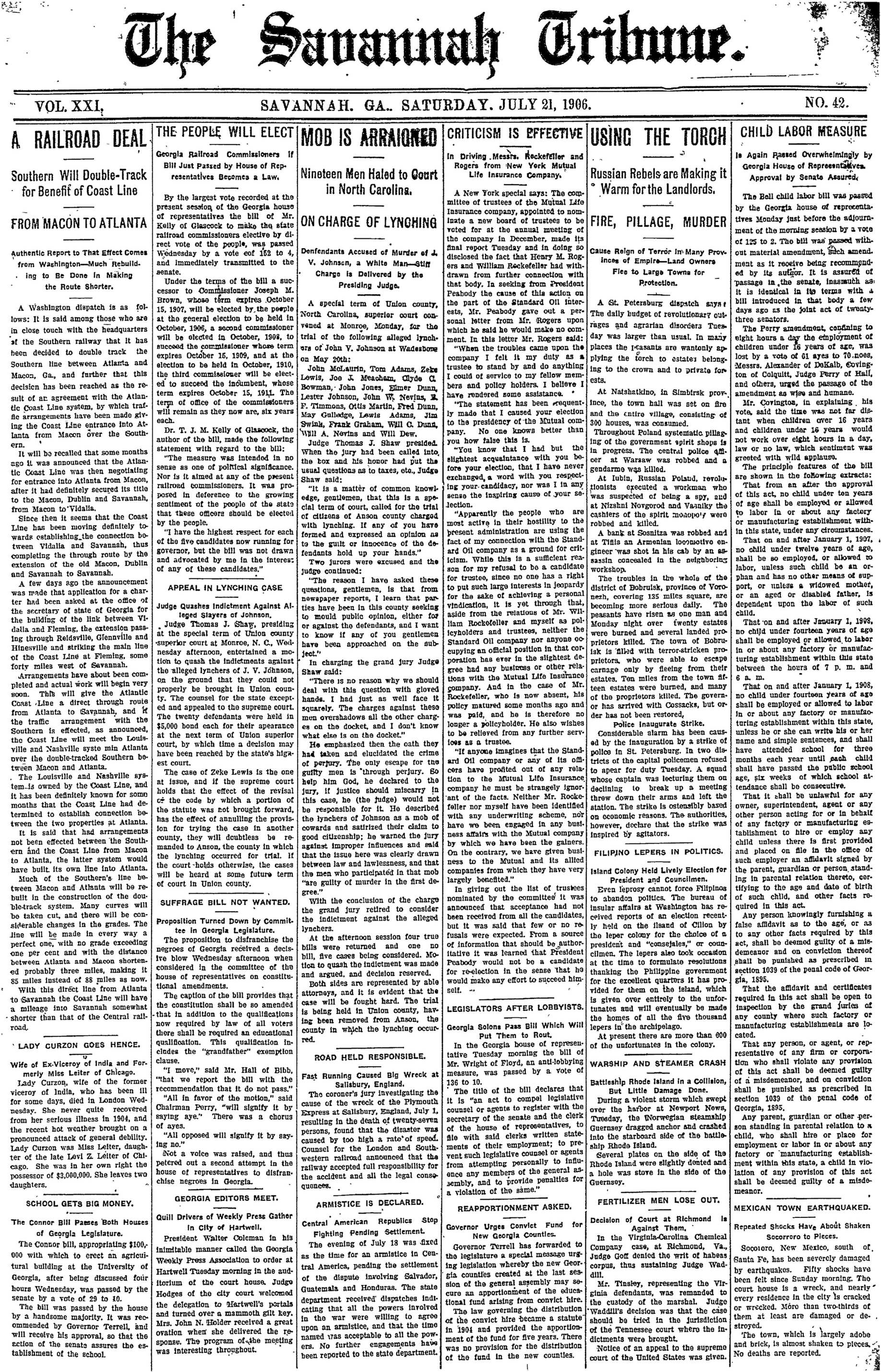
The Savannah Tribune.
A RAILROAD DEAL
Southern Will Double-Track for Benefit of Coast Line
FROM MACON TO ATLANTA
Authentic Report to That Effect Comes from Washington—Much Rebuild-
A Washington dispatch is as follows: It is said among those who are in close touch with the headquarters of the Southern railway that it has been decided to double track the Southern line between Atlanta and Macon, Ga., and further that this decision has been reached as the result of an agreement with the Atlantic Coast Line system, by which traffic arrangements have been made giving the Coast Line entrance into Atlanta from Macon over the Southern.
It will be recalled that some months ago it was announced that the Atlantic Coast Line was then negotiating for entrance into Atlanta from Macon, after it had definitely secured its title to the Macon, Dublin and Savannah, from Macon to Vidalia.
Since then it seems that the Coast Line has been moving definitely towards establishing the connection between Vidalia and Savannah, thus completing the through route by the extension of the old Macon, Dublin and Savannah to Savannah.
A few days ago the announcement was made that application for a charter had been asked at the office of the secretary of state of Georgia for the building of the link between Vidalia and Fleming, the extension passing through Reldaville, Glennville and Hinesville and striking the main line of the Coast Line at Fleming, some forty miles west of Savannah.
Arrangements have about been completed and actual work will begin very soon. This will give the Atlantic Coast Line a direct through route from Atlanta to Savannah, and if the traffic arrangement with the Southern is effected, as announced, the Coast Line will meet the Louisville and Nashville syste min Atlanta over the double-tracked Southern between Macon and Atlanta. The Louisville and Nashville system is owned by the Coast Line, and it has been definitely known for some months that the Coast Line had determined to establish connection between the two properties at Atlanta.
It is said that had arrangements not been effected between the Southern and the Coast Line from Macon to Atlanta, the latter system would have built its own line into Atlanta. Much of the Southern's line between Macon and Atlanta will be rebuilt in the construction of the double-track system. Many curves will be taken cut, and there will be considerable changes in the grades. The line will be made in every way a perfect one, with no grade exceeding one per cent and with the distance between Atlanta and Macon shortened probably three miles, making it 85 miles instead of 88 miles as now.
With this direct line from Atlanta to Savannah the Coast Line will have a mileage into Savannah somewhat shorter than that of the Central railroad.
Wife of Ex.Viceroy of India and For-
merly Miss Leiter of Chicago.
merly Miss Leiter of Chicago
Lady Curzon, wife of the former viceroy of India, who has been ill for some days, died in London Wednesday. She never quite recovered from her serious illness in 1904, and the recent hot weather brought on a pronounced attack of general debility.
Lady Curzon was Miss Leiter, daughter of the late Levi Z. Leiter of Chicago. She was in her own right the possessor of $3,000,000. She leaves two daughters.
The Connor Bill Passes Both Houses of Georgia Legislature.
The Connor bill, appropriating $100,000 with which to erect an agricultural building at the University of Georgia, after being discussed four hours Wednesday, was passed by the senate by a vote of 29 to 10. The bill was passed by the house by a handsome majority. It was recommended by Governor Terrell, and will receive his approval, so that the action of the senate assures the establishment of the school.
SAVANNAH. GA.. SATURDAY. JULY 21, 1906.
THE PEOPLE WILL ELECT
Georgia Railroad Commissioners If Bill Just Passed by House of Representatives Becomes a Law.
By the largest vote recorded at the present session of the Georgia house of representatives the bill of Mr. Kelly of Glascock to make the state railroad commissioners elective by direct vote of the people, was passed Wednesday by a vote of 152 to 4, and immediately transmitted to the senate.
Under the terms of the bill a successor to Commissioner Joseph M. Brown, whose term expires October 15, 1907, will be elected by the people at the general election to be held in October, 1906, a second commissioner will be elected in October, 1908, to succeed the commissioner whose term expires October 15, 1909, and at the election to be held in October, 1910, the third commissioner will be elected to succeed the incumbent, whose term expires October 15, 1911. The term of office of the commissioners will remain as they now are, six years each.
Dr. T. J. M. Kelly of Glassock, the author of the bill, made the following statement with regard to the bill:
"The measure was intended in no sense as one of political significance. Nor is it aimed at any of the present railroad commissioners. It was proposed in deference to the growing sentiment of the people of the state that these officers should be elected by the people. "I have the highest respect for each of the five candidates now running for governor, but the bill was not drawn and advocated by me in the interest of any of these candidates."
APPEAL IN LYNCHING CASE
Judge Quashes Indictment Against Al-
leged Stayers of Johnson
Judge Thomas J. Shaw, presiding at the special term of Union county superior court at Monroe, N. C., Wednesday afternoon, entertained a motion to quash the indictments against the alleged lynchers of J. V. Johnson, on the ground that they could not properly be brought in Union county. The counsel for the state excepted and appealed to the supreme court. The twenty defendants were held in $5,000 bond each for their appearance at the next term of Union superior court, by which time a decision may have been reached by the state's highest court.
The case of Zeke Lewis is the one at issue, and if the supreme court holds that the effect of the revisal of the code by which a portion of the statute was not brought forward, has the effect of annulling the provision for trying the case in another county, they will doubtless be remanded to Anson, the county in which the lynching occurred for trial. If the court-holds otherwise, the cases will be heard at some future term of court in Union county.
Proposition Turned Down by Committee in Georgia Legislature.
The proposition to disfranchise the negroes of Georgia received a decisive blow Wednesday afternoon when considered in the committee of the house of representatives on constitutional amendments.
The caption of the bill provides that the constitution shall be so amended that in addition to the qualifications now required by law of all voters there shall be required an educational qualification. This qualification includes the "grandfather" exemption clause.
"I move," said Mr. Hall of Bibb, "that we report the bill with the recommendation that it do not pass."
"All in favor of the motion," said Chairman Perry, "will signify it by saying aye." There was a chorus of ayes.
"All opposed will signify it by saying no."
Not a voice was raised, and thus petered out a second attempt in the house of representatives to disfranchise negroes in Georgia.
GEORGIA EDITORS MEET.
Quill Drivers of Weekly Press Gather in City of Hartwell. President Walter Coleman in his inimitable manner called the Georgia Weekly Press Association to order at Hartwell Tuesday morning in the auditorium of the court house. Judgo Hodges of the city court welcomed the delegation to Hartwell's portals and turned over a mammoth gilt key. Mrs. John N. Holder received a great ovation when she delivered the response. The program of the meeting was interesting throughout.
MOB IS ARRAIONED
Nineteen Men Haled to Court in North Carolina.
ON CHARGE OF LYNCHING
Denfendants Accused of Murder of J. V. Johnson, a White Man—Stiff Charge is Delivered by the Presiding Judge.
A special term of Union county, North Carolina, superior court convened at Monroe, Monday, for the trial of the following alleged lynchers of John V. Johnson at Wadesboro on May 20th:
John McLaurin, Tom Adams, Zeke Lewis, Joe J. Meacham, Clyde C. Bowman, John Jones, Elmer Dunn, Lester Johnson, John W. Nevins, R. F. Timmons, Otis Martin, Fred Dunn, May Gulledge, Lewis Adams, Jim Swink, Frank Graham, Will C. Dunn, Will A. Nevins and Will Dew.
Judge Thomas J. Shaw prealed. When the jury had been called into the box and his honor had put the usual questions as to taxes, etc., Judge Shaw said:
"It is a matter of common knowledge, gentlemen, that this is a special term of court, called for the trial of citizens of Anson county charged with lynching. If any of you have formed and expressed an opinion as to the guilt or innocence of the defendants hold up your hands."
Two jurors were excused and the judge continued:
"The reason I have asked these questions, gentlemen, is that from newspaper reports, I learn that parties have been in this county seeking to mould public opinion, either for or against the defendants, and I want to know if any of you gentlemen have been approached on the subject."
In charging the grand jury Judge Shaw said:
"There is no reason why we should deal with this question with gloved hands. I had just as well face it squarely. The charges against these men overshadows all the other charges on the docket, and I don't know what else is on the docket."
He emphasized then the oath they had taken and elucidated the crime of perjury. The only escape for the guilty men is through perjury. So help him God, he declared to the jury, if justice should miscarry in this case, he (the judge) would not be responsible for it. He described the lynchers of Johnson as a mob of cowards and satirized their claim to good citizenship; he warned the jury against improper influences and said that the issue here was clearly drawn between law and lawlessness, and that the men who participated in that mob "are guilty of murder in the first degree."
With the conclusion of the charge the grand jury retired to consider the indictment against the alleged lynchers. At the afternoon session four true bills were returned and one no bill, five cases being considered. Motion to quash the indictment was made and argued, and decision reserved. Both sides are represented by able attorneys, and it is evident that the case will be fought hard. The trial is being held in Union county, having been removed from Anson, the county in which the lynching occurred.
ROAD HELD RESPONSIBLE.
Fast Running Caused Big Wreck at Salisbury, England. The coroner's jury investigating the cause of the wreck of the Plymouth Express at Salisbury, England, July 1, resulting in the death of twenty-seven persons, found that the disaster was caused by too high a rate of speed. Counsel for the London and Southwestern railroad announced that the railway accepted full responsibility for the accident and all the legal consequences.
ARMISTICE IS DECLARED.
Central American Republics Stop Fighting Pending Settlement. The evening of July 18 was fixed as the time for an armistice in Central America, pending the settlement of the dispute involving Salvador, Guatemala and Honduras. The state department received dispatches indicating that all the powers involved in the war were willing to agree upon an armistice, and that the time named was acceptable to all the powers. No further engagements have been reported to the state department.
CRITICISM IS EFFECTIVE
In Driving, Messrs. Rockefeller and Rogers from New York Mutual Life Insurance Company.
A New York special says: The committee of trustees of the Mutual Life Insurance company, appointed to nominate a new board of trustees to be voted for at the annual meeting of the company in December, made its final report Tuesday and in doing so disclosed the fact that Henry M. Rogers and William Rockefeller had withdrawn from further connection with that body. In seeking from President Peabody the cause of this action on the part of the Standard Oil interests, Mr. Peabody gave out a personal letter from Mr. Rogers upon which he said he would make no comment. In this letter Mr. Rogers said:
"When the troubles came upon the company I felt it my duty as a trustee to stand by and do anything I could of service to my fellow members and policy holders. I believe I have rendered some assistance."
"The statement has been frequently made that I caused your election to the presidency of the Mutual company. No one knows better than you how false this is.
"You know that I had but the slightest acquaintance with you before your election, that I have never exchanged, a word with you respecting your candidacy, nor was I in any sense the inspiring cause of your selection.
"Apparently the people who are most active in their hostility to the present administration are using the fact of my connection with the Standard Oil company as a ground for criticism. While this is a sufficient reason for my refusal to be a candidate for trustee, since no one has a right to put such large interests in jeopardy for the sake of achieving a personal vindication, it is yet through that, aside from the relations of Mr. William Rockefeller and myself as policyholders and trustees, neither the Standard Oil company nor anyone occupying an official position in that corporation has ever in the slightest degree had any business or other relations with the Mutual Life Insurance company. And in the case of Mr. Rockefeller, who is now absent, his policy matured some months ago and was paid, and he is therefore no longer a policyholder. He also wishes to be relieved from any further services as a trustee.
"If anyone imagines that the Standard Oil company or any of its officers have profited out of any relation to the Mutual Life Insurance company he must be strangely ignorant of the facts. Neither Mr. Rockefeller nor myself have been identified with any underwriting scheme, nor have we been engaged in any business affairs with the Mutual company by which we have been the gainers. On the contrary, we have given business to the Mutual and its allied companies from which they have very largely benefited."
In giving out the list of trustees nominated by the committee it was announced that acceptance had not been received from all the candidates, but it was said that few or no refusals were expected. From a source of information that should be authoritative it was learned that President Peabody would not be a candidate for re-election in the sense that he would make any effort to succeed himself.
LEGISLATORS AFTER LOBBYISTS.
Georgia Solona Pass Bill Which Will Put Them to Rout.
In the Georgia house of representative Tuesday morning the bill of Mr. Wright of Floyd, an anti-lobbying measure, was passed by a vote of 136 to 10.
The title of the bill declares that it is "an act to compel legislative counsel or agents to register with the secretary of the senate and the clerk of the house of representatives, to file with said clerks written statements of their employment; to prevent such legislative counsel or agents from attempting personally to influence any members of the general assembly, and to provide penalties for a violation of the same."
REAPPORTIONMENT ASKED.
Governor Urges Convict Fund for New Georgia Counties.
Governor Terrell has forwarded to the legislature a special message urging legislation whereby the new Georgia counties created at the last session of the general assembly may secure an apportionment of the educational fund arising from convict hire.
The law governing the distribution of the convict hire became a statute in 1904 and provided the apportionment of the fund for five years. There was no provision for the distribution of the fund in the new counties.
USING THE TORCH
FIRE, PILLAGE, MURDER
Cause Reign of Terror In Many Provinces of Empire—Land Owners Flee to Large Towns for Protection.
A St. Petersburg dispatch says
The daily budget of revolutionary outrages and agrarian disorders Tuesday was larger than usual. In many places the peasants are wantonly applying the torch to estates belonging to the crown and to private forests.
At Natshatkino, in Simbirsk province, the town hall was set on fire and the entire village, consisting of 300 houses, was consumed.
Throughout Poland systematic pillaging of the government spirit shops is in progress. The central police officer at Warsaw was robbed and a gendarme was killed.
At Iubin, Russian Polsud, revolutionists executed a workman who was suspected of being a spy, and at Nizshni Novgorod and Vaaniky the cashiers of the spirit monopoly were robbed and killed.
A bank at Sosnitza was robbed and at Titils an Armenian locomotive engineer was shot in his cab by an assassin concealed in the neighboring workshop.
The troubles in the whole of the district of Bobruisk, province of Voronezh, covering 135 miles square, are becoming more serious daily. The peasants have risen as one man and Monday night over twenty estates were burned and several landed proprietors killed. The town of Bobruisk is filled with terror-stricken proprietors, who were able to escape carnage only by fleeing from their estates. Ten miles from the town fifteen estates were burned, and many of the proprietors killed. The governor has arrived with Cossacks, but order has not been restored.
Police Inaugurate Strike.
Considerable alarm has been caused by the inauguration by a strike of police in St. Petersburg. In two districts of the capital policemen refused to appear for duty Tuesday. A squad whose captain was lecturing them on declining to break up a meeting threw down their arms and left the station. The strike is ostensibly based on economic reasons. The authorities, however, declare that the strike was inspired by agitators.
FILIPINO LEPERS IN POLITICS.
Island Colony Held Lively Election for President and Councilmen.
Even leprosy cannot force Filipinos to abandon politics. The bureau of insular affairs at Washington has received reports of an election recently held on the island of Cilion by the leper colony for the choice of a president and "consejales," or councilmen. The lepers also took occasion at the time to formulate resolutions thanking the Philippine government for the excellent quarters it has provided for them on the island, which is given over entirely to the unfortunates and will eventually be made the homes of all the five thousand lepers in the archipelago.
At present there are more than 600 of the unfortunates in the colony.
WARSHIP AND STEAMER CRASH
Battleship Rhode Island in a Collision, But Little Damage Done. During a violent storm which swept over the harbor at Newport News, Tuesday, the Norwegian steamship Guernsey dragged anchor and crashed into the starboard side of the battleship Rhode Island. Several plates on the side of the Rhode Island were slightly dented and a hole was stove in the side of the Guernsey.
Decision of Court at Richmond Is Against Them.
In the Virginia-Carolina Chemical Company case, at Richmond, Va., Judge Goff denied the writ of habeas corpus, thus sustaining Judge Waddill.
Mr. Tinsley, representing the Virginia defendants, was remanded to the custody of the marshal. Judge Waddill's decision was that the case should be tried in the jurisdiction of the Tennessee court where the indictments were brought.
Notice of an appeal to the supreme court of the United States was given.
```markdown
```
CHILD LABOR MEASURE
Is Again Passed Overwhelmingly by Georgia House of Representatives. Approval by Senate Assured.
The Bell child labor bill was passed by the Georgia house of representatives Monday just before the adjournment of the morning session by a vote of 125 to 2. The bill was passed without material amendment, such amendment as it receive being recommended by its author. It is assured of passage in the senate, inasmuch as it is identical in its terms with a bill introduced in that body a few days ago as the joint act of twenty-three senators.
The Perry amendment, condining to eight hours a day the employment of children under 16 years of age, was lost by a vote of 61 ayes to 70 noes, Messrs. Alexander of DaKalb, Covington of Colquitt, Judge Perry of Hall, and others, urged the passage of the amendment an wise and humane.
Mr. Covington, in explaining his vote, said the time was not far distant when children over 16 years and children under 16 years would not work over eight hours in a day, law or no law, which sentiment was greeted with wild applause.
The principle features of the bill are shown in the following extracts:
are shown in the following extracts:
That from an after the approval of this act, no child under ten years of age shall be employed or allowed to labor in or about any factory or manufacturing establishment within this state, under any circumstances.
That on and after January 1, 1997, no child under twelve years of age, shall be so employed, or allowed to labor, unless such child be an orphan and has no other means of support, or unless a widowed mother, or an aged or disabled father, is dependent upon the labor of such child.
That on and after January 1, 1908, no child under fourteen years of age shall be employed or allowed to labor in or about any factory or manufacturing establishment within this state between the hours of 7 p. m. and 6 a. m.
That on and after January 1, 1908, no child under fourteen years of age shall be employed or allowed to labor in or about any factory or manufacturing establishment within this state, unless he or she can write his or her name and simple sentences, and shall have attended school for three months each year until each child shall have passed the public school age, six weeks of which school attendance shall be consecutive.
That it shall be unlawful for any owner, superintendent, agent or any other person acting for or in behalf of any factory or manufacturing establishment to hire or employ any child unless there is first provided and placed on file in the office of such employer an affidavit signed by the parent, guardian or person standing in parental relation thereto, certifying to the age and date of birth of such child, and other facts required in this act.
Any person knowingly furnishing a false affidavit as to the age, or as to any other facts required by this act, shall be deemed guilty of a misdemeanor and on conviction thereof shall be punished as prescribed in section 1039 of the penal code of Georgia, 1895.
That the affidavit and certificates required in this act shall be open to inspection by the grand jurors of any county where such factory or manufacturing establishments are located.
That any person, or agent, or representative of any firm or corporation who shall violate any provision of this act shall be deemed guilty of a misdemeanor, and on conviction shall be punished as prescribed in section 1039 of the penal code of Georgia, 1895.
Any parent, guardian or other person standing in parental relation to a child, who shall hire or place for employment or labor in or about any factory or manufacturing establishment within this state, a child in violation of any provision of this act shall be deemed guilty of a misdemeanor.
MEXICAN TOWN EARTHQUAKED.
Repeated Shocks Have About Shaken Scorpore to Pieces.
Socotoro, New Mexico, south of Santa Fe, has been severely damaged by earthquakes. Fifty shocks have been felt since Sunday morning. The court house is a wreck, and nearly every residence in the city is cracked or wrecked. More than two-thirds of them at least are damaged or destroyed. The town, which is largely adobe and brick, is almost shaken to pieces. No deaths are reported.
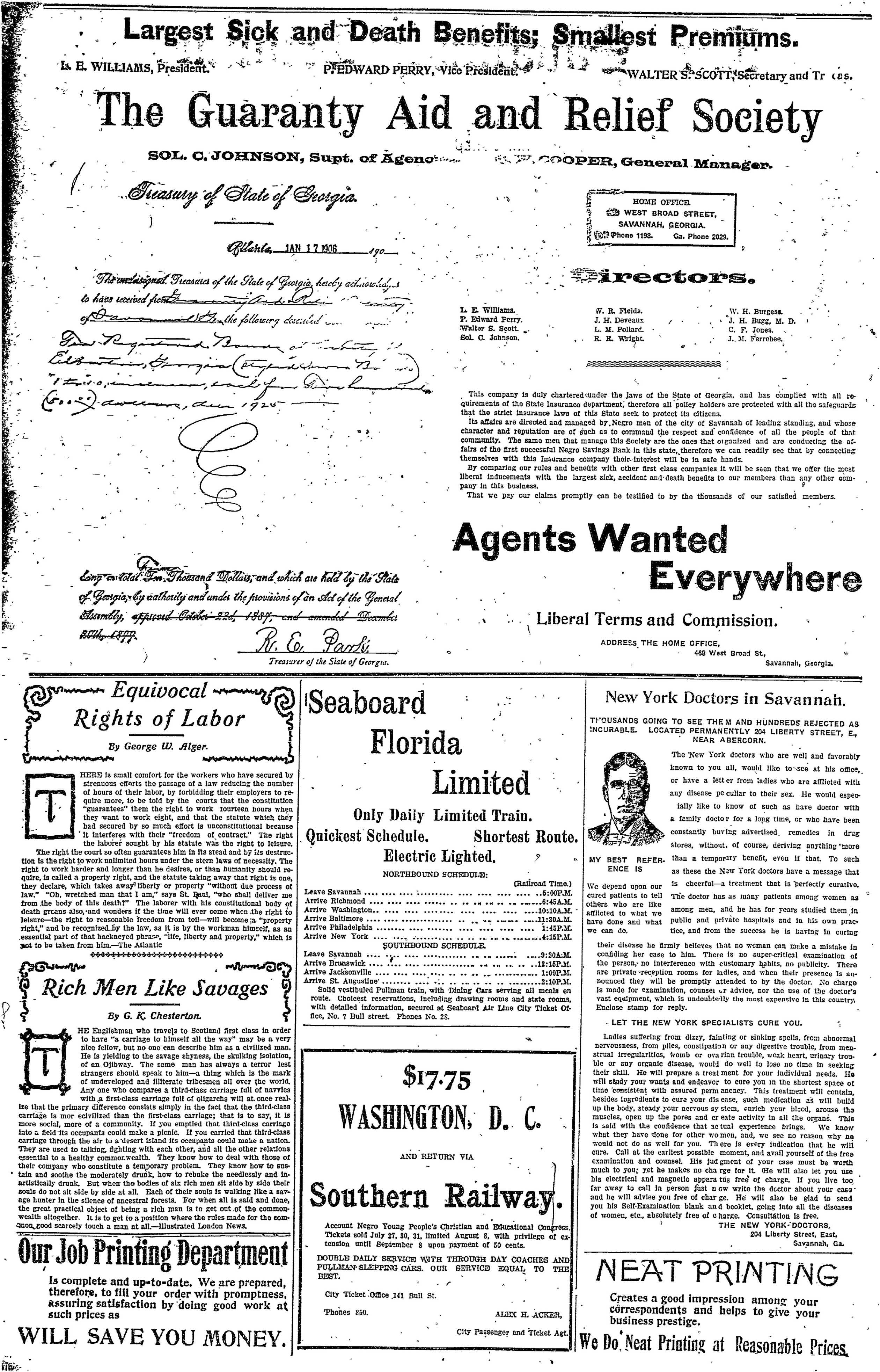
SOL. C. JOHNSON, Supt. of Ageno
Treasury of State of Georgia.
Bilanta. JAN 17 1906 190
HOME OFFICE
WEST BROAD STREET,
SAVANNAH, GEORGIA.
Phone 1198. Ga. Phone 2029.
directors.
L. E. Williams.
P. Edward Perry.
Walter S. Scott.
Sol. C. Johnson.
W. R. Fields.
J. H. Deveaux
L. M. Pollard.
R. R. Wright.
W. H. Burgess.
J. H. Bugg, M. D.
C. F. Jones.
J. M. Ferrebee.
Treasury of State of Georgia.
The uninsigned. Treasures of the State of Georgia, hereby acknowledged to have received from the said Court of Davenport the following described
This company is duly chartered requirements of the State Insurance that the strict insurance laws of its affairs are directed and man character and reputation are of the community. The same men that fairs of the first successful Negro themselves with this Insurance By comparing our rules and best liberal inducements with the law pany in this business. That we pay our claims promptly.
This company is duly chartered under the laws of the State of Georgia, and has complied with all requirements of the State Insurance department, therefore all policy holders are protected with all the safeguards that the strict insurance laws of this State seek to protect its citizens.
Its affairs are directed and managed by Negro men of the city of Savannah of leading standing, and whose character and reputation are of such as to command the respect and confidence of all the people of that community. The same men that manage this Society are the ones that organized and are conducting the affairs of the first successful Negro Savings Bank in this state, therefore we can readily see that by connecting themselves with this Insurance company their-interest will be in safe hands.
By comparing our rules and benefits with other first class companies it will be seen that we offer the most liberal inducements with the largest sick, accident and death benefits to our members than any other company in this business.
That we pay our claims promptly can be testified to by the thousands of our satisfied members.
long as total Ten Thousand Dollars, and which are held by the State of Georgia, by authority and under the provisions of an Act of the General Assembly, approved October 22d, 1887, and amended December 20th, 1897.
R. E. Parsi
Treasurer of the State of Georgia.
Seaboard Florida Limited
Only Daily Limited Train. Quickest Schedule. Shortest Route. Electric Lighted.
( Railroad Time. )
Leave Savannah ... 5:00P.M.
Arrive Richmond ... 6:45A.M.
Arrive Washington ... 10:10A.M.
Arrive Baltimore ... 11:30A.M.
Arrive Philadelphia ... 1:45P.M.
Arrive New York ... 4:15P.M.
SOUTHBOUND SCHEDULE.
Leave Savannah ... 9:20A.M.
Arrive Brunswick ... 12:15P.M.
Arrive Jacksonville ... 1:00P.M.
Arrive St. Augustine ... 2:10P.M.
Solid vestibuled Pullman train, with Dining Cars serving all meals en route. Cholest reservations, including drawing rooms and state rooms, with detailed information, secured at Seaboard Air Line City Ticket Office, No. 7 Bull street. Phones No. 28.
$17.75
WASHINGTON, D. C.
AND RETURN VIA
Southern Railway.
Account Negro Young People's Christian and Educational Congress.
Tickets sold July 27, 30, 31, limited August 8, with privilege of extension until September 8 upon payment of 50 cents.
DOUBLE DAILY SERVICE WITH THROUGH DAY COACHES AND PULLMAN·SLEPPING CARS. OUR SERVICE EQUAL TO THE BEST.
City Ticket Office 141 Bull St.
Phones 850.
ALEX H. ACKER,
City Passenger and Ticket Agt.
Equivocal Rights of Labor By George W. Alger.
HERE is small comfort for the workers who have secured by strenuous efforts the passage of a law reducing the number of hours of their labor, by forbidding their employers to require more, to be told by the courts that the constitution "guarantees" them the right to work fourteen hours when they want to work eight, and that the statute which they had secured by so much effort is unconstitutional because it interferes with their "freedom of contract." The right the laborer sought by his statute was the right to leisure.
T
The right the court so often guarantees him in its stead and by its destruction is the right to work unlimited hours under the stern laws of necessity. The right to work harder and longer than he desires, or than humanity should require, is called a property right, and the statute taking away that right is one, they declare, which takes away liberty or property "without due process of law." "Oh, wretched man that I am," says St. Paul, "who shall deliver me from the body of this death?" The laborer with his constitutional body of death greans also, and wonders if the time will ever come when the right to leisure—the right to reasonable freedom from toll—will become a "property right," and be recognized by the law, as it is by the workman himself, as an essential part of that hackneyed phrase, "life, liberty and property," which is not to be taken from him—The Atlantic
HE Englishman who travels to Scotland first class in order to have "a carriage to himself all the way" may be a very nice fellow, but no one can describe him as a civilized man. He is yielding to the savage shyness, the skulking isolation, of an Ojibway. The same man has always a terror lest strangers should speak to him—a thing which is the mark of undeveloped and illiterate tribesmen all over the world. Any one who compares a third-class carriage full of navvles with a first-class carriage full of oligarchs will at once real-
T
ize that the primary difference consists simply in the fact that the third-class carriage is mor ecivilized than the first-class carriage; that is to say, it is more social, more of a community. If you emptied that third-class carriage into a field its occupants could make a picnic. If you carried that third-class carriage through the air to a desert island its occupants could make a nation. They are used to talking, fighting with each other, and all the other relations essential to a healthy commonwealth. They know how to deal with those of their company who constitute a temporary problem. They know how to sustain and soothe the moderately drunk, how to rebuke the needlessly and inartistically drunk. But when the bodies of six rich men sit side by side their souls do not sit side by side at all. Each of their souls is walking like a savage hunter in the silence of ancestral forests. For when all is said and done, the great practical object of being a rich man is to get out of the commonwealth altogether. It is to get to a position where the rules made for the common good scarcely touch a man at all.—Illustrated London News.
Our Job Printing Department
Is complete and up-to-date. We are prepared therefore, to fill your order with promptness, assuring satisfaction by doing good work at such prices as WILL SAVE YOU MONEY.
Liberal Terms and Commission.
New York Doctors in Savannah.
THOUSANDS GOING TO SEE THEM AND HUNDREDS REJECTED AS INCURABLE. LOCATED PERMANENTLY 204 LIBERTY STREET, E., NEAR ABERCORN.
The New York doctors who are well and favorably known to you all, would like to see at his office, or have a letter from ladies who are afflicted with any disease peculiar to their sex. He would especially like to know of such as have doctor with a family doctor for a long time, or who have been constantly buying advertised remedies in drug stores, without, of course, deriving anything more
The New York doctors who are well and favorably known to you all, would like to see at his office, or have a letter from ladies who are afflicted with any disease peculiar to their sex. He would especially like to know of such as have doctor with a family doctor for a long time, or who have been constantly buying advertised remedies in drug stores, without, of course, deriving anything more than a temporary benefit, even if that. To such as these the New York doctors have a message that is cheerful—a treatment that is perfectly curative. The doctor has as many patients among women as among men, and he has for years studied them in public and private hospitals and in his own practice, and from the success he is having in curing
MY BEST REFERENCE IS
We depend upon our cured patients to tell others who are like afflicted to what we have done and what we can do. is cheerful—a treatment that is perfectly curative. The doctor has as many patients among women as among men, and he has for years studied them in public and private hospitals and in his own practice, and from the success he is having in curing their disease he firmly believes that no woman can make a mistake in confiding her case to him. There is no super-critical examination of the person, no interference with customary habits, no publicity. There are private reception rooms for ladies, and when their presence is announced they will be promptly attended to by the doctor. No charge is made for examination, counsel or advice, nor the use of the doctor's vast equipment, which is undoubtedly the most expensive in this country. Enclose stamp for reply.
LET THE NEW YORK SPECIALISTS CURE YOU.
Ladies suffering from dizzy, fainting or sinking spells, from abnormal nervousness, from piles, constipation or any digestive trouble, from menstrual irregularities, womb or ovarian trouble, weak heart, urinary trouble or any organic disease, would do well to lose no time in seeking their skill. He will prepare a treatment for your individual needs. He will study your wants and endeavor to cure you in the shortest space of time consistent with assured permanency. This treatment will contain, besides ingredients to cure your disease, such medication as will build up the body, steady your nervous system, enrich your blood, arouse the muscles, open up the pores and create activity in all the organs. This is said with the confidence that actual experience brings. We know what they have done for other women, and, we see no reason why he would not do as well for you. There is every indication that he will cure. Call at the earliest possible moment, and avail yourself of the free examination and counsel. His judgment of your case must be worth much to you; yet he makes no charge for it. He will also let you use his electrical and magnetic apparatus free of charge. If you live too far away to call in person just now write the doctor about your case and he will advise you free of charge. He will also be glad to send you his Self-Examination blank and booklet, going into all the diseases of women, etc., absolutely free of charge. Consultation is free.
THE NEW YORK-DOCTORS,
204 Liberty Street, East,
Savannah, Ga.
NEAT PRINTING
Creates a good impression among your correspondents and helps to give your business prestige. We Do Neat Printing at Reasonable Prices
BECAUSE OF ONE.
Because of one dear infant head
With golden hair,
To me all little heads
A halo wear;
And for one saintly face. I knew
All-babes are fair.
Because of two wide earnest eyes
Of heavenly blue,
Which look with yearning gaze
My sad soul through,
All eyes now fill mine own with tears,
Whate'er their hue.
Because of little death-marked lins
Which once did call
My name in plaintive tones,
No voices fall
Upon my ears in vain appeal
From children small.
Two little hands held in my own
Long, long ago,
Now cause me as I wander through
This world of woe
To clasp each baby hand stretched out
In fear of foe.
The lowest cannot plead in vain,
I loved him so.
-Woman's Life.
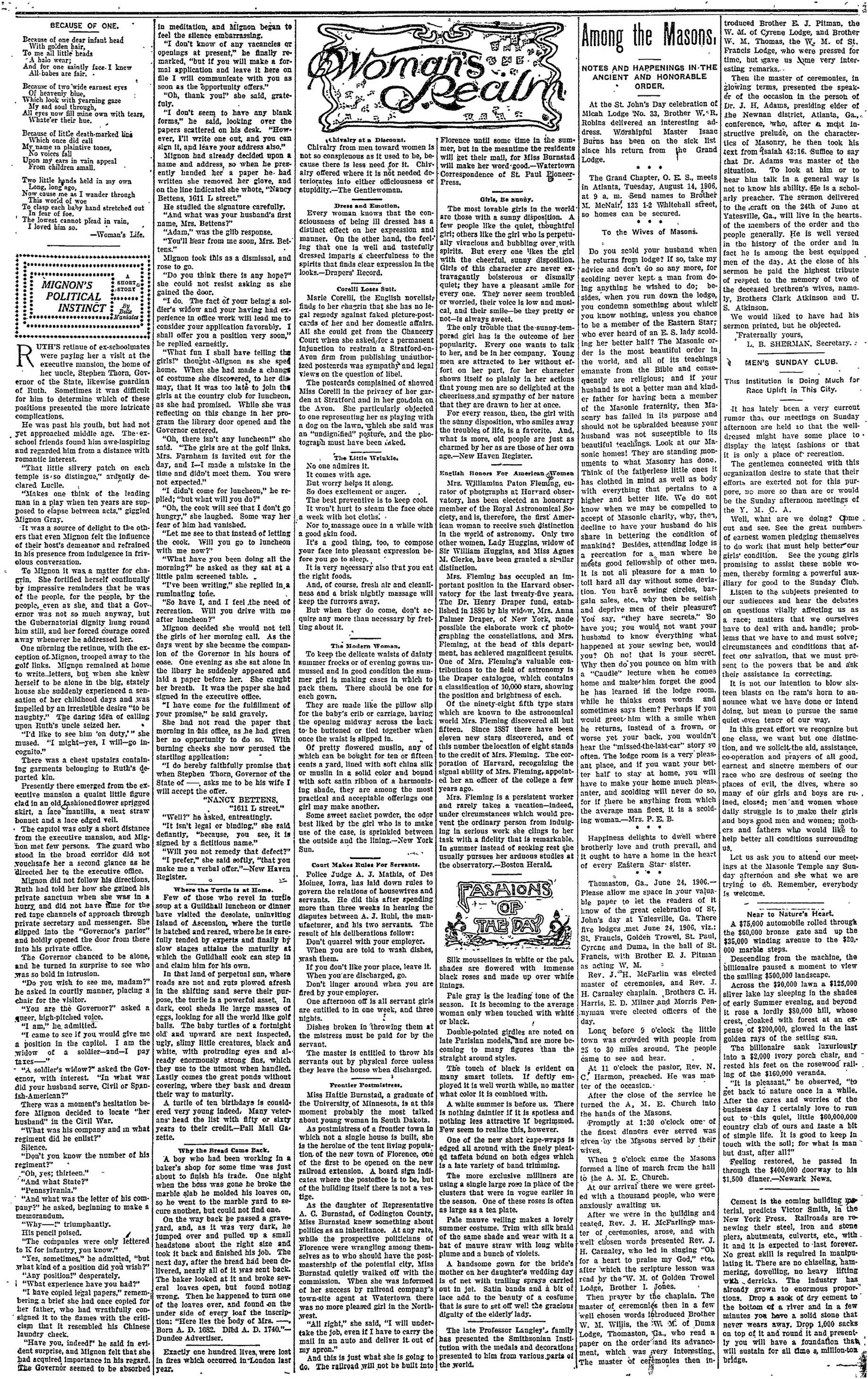
MIGNON'S POLITICAL INSTINCT
A SHORT STORY
By Delta Magnates
RUTH'S retinue of ex-schoolmates were paying her a visit at the executive mansion, the home of her uncle, Stephen Thorn, Governor of the State, likewise guardian of Ruth. Sometimes it was difficult for him to determine which of these positions presented the more intricate complications.
He was past his youth, but had not yet approached middle age. The exschool friends found him awe-inspiring and regarded him from a distance with romantic interest.
"That little silvery patch on each temple is so distingue," ardently declared Lucille.
"Makes one think of the leading man in a play when ten years are supposed to elapse between acts," giggled Mignon Gray.
It was a source of delight to the others that even Mignon felt the influence of their host's demeanor and refrained in his presence from indulgence in frivolous conversation.
To Mignon it was a matter for chagrin. She fortified herself continually by impressive reminders that he was of the people, for the people, by the people, even as she, and that a Governor was not so much anyway, but the Gubernatorial dignity hung round him still, and her forced courage oozed away whenever he addressed her.
One morning the retinue, with the exception of Mignon, trooped away to the golf links. Mignon remained at home to write letters, but when she knew herself to be alone in the big, stately house she suddenly experienced a sensation of her childhood days and was impelled by an irresistible desire "to be naughty." The daring idea of calling upon Ruth's uncle selzed her.
"I'd like to see him 'on duty,'" she mused. "I might—yes, I will—go in cognito."
There was a chest upstairs containing garments belonging to Ruth's departed kin. Presently there emerged from the executive mansion a quaint little figure clad in an old fashioned flower sprigged skirt, a face mantilla, a neat straw bonnet and a lace edged veil. The capitol was only a short distance from the executive mansion, and Mignon met few persons. The guard who stood in the broad corridor did not vouchsafe her a second glance as he directed her to the executive office.
Mignon did not follow his directions, Ruth had told her how she gained his private sanctum when she was in a hurry, and did not have time for the red tape channels of approach through private secretary and messenger. She slipped into the "Governor's parlor" and boldly opened the door from there into his private office.
The Governor chanced to be alone, and he turned in surprise to see who was so bold in intrusion.
"Do you wish to see me, madam?" he asked in courtly manner, placing a chair for the visitor.
"You are the Governor?" asked a queer, high-pitched voice.
"I am," he admitted.
"I came to see if you would give me a position in the capitol. I am the widow of a soldier—and I pay taxes—"
"A soldier's widow?" asked the Governor, with interest. "In what war did your husband serve, Civil or Spanish-American?"
There was a moment's hesitation before Mignon decided to locate "her husband" in the Civil War.
"What was his company and in what regiment did he enlist?"
Silence.
"Don't you know the number of his regiment?"
"Oh, yes; thirteen."
"And what State?"
"Pennsylvania."
"And what was the letter of his company?" he asked, beginning to make a memorandum.
"Why——!" triumphantly.
His pencil poised.
This pen point posed.
"The companies were only lettered to K for infantry, you know."
"Yes, sometimes," he admitted, "but what kind of a position did you wish?" "Any position?" desperately. "What experience have you had?" "I have copied legal papers," remembering a brief she had once copied for her father, who had wrathfully consigned it to the flames with the criticism that it resembled his Chinese laundry check. "Have you, indeed!" he said in evident surprise, and Mignon felt that she had acquired importance in his regard. The Governor seemed to be absorbed
in meditation, and Mignon began to feel the silence embarrassing.
"I don't know of any vacancies or openings at present," he finally remarked, "but if you will make a formal application and leave it here on file I will communicate with you as soon as the opportunity offers."
"Oh, thank you!" she said, gratefully.
"I don't seem to have any blank forms," he said, looking over the papers scattered on his desk. "However, I'll write one out, and you can sign it, and leave your address also."
Mignon had already decided upon a name and address, so when he presently handed her a paper he had written she removed her glove, and on the line indicated she whote, "Nancy Bettens, 1611 L street."
He studied the signature carefully.
"And what was your husband's first
name, Mrs. Bettens?"
"Adam," was the gib response.
"You'll hear the gate opener."
Mignon took this as a dismissal, and rose to go.
"Do you think there is any hope?" she could not resist asking as she gained the door.
"I do. The fact of your being a soldier's widow and your having had experience in office work will lead me to consider your application favorably. I shall offer you a position very soon," he replied earnestly.
"What fun I shall have telling the girls!" thought Mignon as she sped home. When she had made a change of costume she discovered, to her dismay, that it was too late to join the girls at the country club for luncheon, as she had promised. While she was reflecting on this change in her program the library door opened and the Governor entered.
"Oh, there isn't any luncheon!" she said. "The girls are at the golf links. Mrs. Farnham is invited out for the day, and I—I made a mistake in the time and didn't meet them. You were not expected."
"I didn't come for luncheon," he replied; "but what will you do?"
"Oh, the cook will see that I don't go hungry," she laughed. Some way her fear of him had vanished.
"Let me see to that instead of letting the cook. Will you go to luncheon with me now?" "What have you been doing all the morning?" he asked as they sat at a little palm screened table. "I've been writing," she replied in a ruminating tone. "So have I, and I feel the need of recreation. Will you drive with me after luncheon?" Mignon decided she would not tell the girls of her morning call. As the days went by she became the companion of the Governor in his hours of ease. One evening as she sat alone in the library he suddenly appeared and laid a paper before her. She caught her breath. It was the paper she had signed in the executive office. "I have come for the fulfillment of your promise," he said gravely.
She had not read the paper that morning in his office, as he had given her no opportunity to do so. With burning cheeks she now perused the startling application:
"I do hereby faithfully promise that when Stephen Thorn, Governor of the State of —, asks me to be his wife I will accept the offer.
"Well?" he asked, entreatingly.
"It isn't legal or binding," she said
defiantly, "because, you see, it is
signed by a felicitous name."
"Will you not remedy that defect?"
"I prefer," she said softly, "that you
make me a verbal offer."—New Haven
Register.
Where the Turtle is at Home
Few of those who revel in turtle soup at a Guildhall luncheon or dinner have visited the desolate, unhvailing Island of Ascension, where the turtle is hatched and reared, where he is carefully tended by experts and finally by slow stages attains the maturity at which the Guildhall cook can step in and claim him for his own.
In that land of perpetual sun, where roads are not and ruts plowed afresh in the shifting sand serve their purpose, the turtle is a powerful asset. In dark, cool sheds lie large masses of eggs, looking for all the world like golf balls. The baby turtles of a fortnight old and upward are next inspected, ugly, slimy little creatures, black and white, with protruding eyes and already enormously strong fins, which they use to the utmost when handled. Lastly comes the great ponds without covering, where they bask and dream their way to maturity. A turtle of ten birthdays is considered very young indeed. Many veterans head the list with fifty or sixty years to their credit—Pall Mall Gazette.
Why the Bread Came Back.
A boy who had been working in a baker's shop for some time was just about to finish his trade. One night when the boss was gone he broke the marble slab he molded his leaves on, so he went to the marble yard to secure another, but could not find one.
On the way back he passed a graveyard, and, as it was very dark, he jumped over and pulled up a small headstone about the right size and took it back and finished his job. The next day, after the bread had been delivered, nearly all of it was sent back. The baker looked at it and broke several loaves open, but found noting wrong. Then he happened to turn one of the loaves over, and found on the under side of every loaf the inscription: "Here lies the body of Mrs. Born A. D. 1682. Died A. D. 1740." Dundee Advertiser.
Exactly one hundred lives, were lost in fires which occurred in London last year.
Woman's Realm
Chivalry at a Discount.
Chivalry from men toward women is not so conspicuous as it used to be, because there is less need for it. Chivalry offered where it is not needed deteriorates into either officiousness or stupidity.—The Gentlewoman.
Florence until some time in the summer, but in the meantime the resident will get their mall, for Miss Burnst will make her word good.—Watertow Correspondence of St. Paul Pioneer Press.
Dress and Emotion.
Every woman knows that the consciousness of being ill dressed has a distinct effect on her expression and manner. On the other hand, the feeling that one is well and tastefully dressed imparts a cheerfulness to the spirits that finds clear expression in the looks.—Drapers' Record.
Coroll Loses Suit.
Marie Corelli, the English novelist, finds to her chagrin that she has no legal remedy against faked picture-postcards of her and her domestic affairs. All she could get from the Chancery Court when she asked, for a permanent injunction to restrain a Stratford-on-Avon firm from publishing unauthorized postcards was sympathy and legal views on the question of libel.
The postcards complained of showed Miss Corelli in the privacy of her garden at Stratford and in her gondola on the Avon. She particularly objected to one representing her as playing with a dog on the lawn, which she said was an "undignified" posture, and the photograph must have been asked.
The Little Wrinkle
It comes with age.
But worry helps it along.
So does excitement or anger.
The best preventive is to keep cool.
It won't hurt to steam the face once a week with hot cloths.
Nor to massage once in a while with a good skin food.
It's a good thing, too, to compose your face into pleasant expression before you go to sleep.
It is very necessary also that you eat the right foods.
And, of course, fresh air and cleanliness and a brisk nightly massage will keep the furrows away.
But when they do come, don't acquire any more than necessary by fretting about it.
The Modern Woman
To keep the delicate waists of dalnty summer frocks or of evening gowns unmusSED and in good condition the summer girl is making cases in which to pack them. There should be one for each gown.
They are made like the pillow slip for the baby's crib or carriage, having the opening midway across the back to be buttoned or tied together when once the waist is slipped in.
Of pretty flowered muslin, any of which can be bought for ten or fifteen cents a yard, lined with soft china silk or muslin in a solid color and bound with soft satin ribbon of a harmonizing shade, they are among the most practical and acceptable offerings one girl may make another.
Some sweet sachet powder, the odor best liked by the girl who is to make use of the case, is sprinkled between the outside and the lining.-New York Sun.
Court Makes Rules For Servants.
Police Judge A. J. Mathis, of Des Moines, Iowa, has laid down rules to govern the relations of housewives and servants. He did this after spending more than three weeks in hearing the disputes between A. J. Ruhl, the manufacturer, and his two servants. The result of his deliberations follow: Don't guard with your employer.
When you are told to wash dishes, wash them.
If you don't like your place, leave it.
When you are discharged, go.
Don't linger around when you are
fired by your employer.
One afternoon off is all servant girls
are entitled to in one week, and three
nights.
Dishes broken in throwing them at
the mistress must be paid for by the
servant.
The master is entitled to throw his
servants out by physical force unless
they leave the house when discharged.
Frontier Postmilatress.
Miss Haffie Burnstad, a graduate of the University, of Minnesota, is at this moment probably the most talked about young woman in South Dakota. As postmilstress of a frontier town in which not a single house is built, she is the heroine of the tent living population of the new town of Florence, one of the first to be opened on the new railroad extension. A board sign indicates where the postoffice is to be, but of the building itself there is not a vestige.
As the daughter of Representative A. C. Burnstad, of Codington County, Miss Burnstad knew something about politics as an inheritance. At any rate, while the prospective politicians of Florence were wrangling among themselves as to who should have the postmastership of the potential city, Miss Burnstad quietly walked off with the commission. When she was informed of her success by railroad company's town-site agent at Watertown there was no more pleased girl in the Northwest.
"All right," she said, "I will undertake the job, even if I have to carry the mail in an auto and deliver it out of my apron."
And this is just what she is going to do. The railroad will not be built into
Florence until some time in the summer, but in the meantime the residents will get their mall, for Miss Burnstad will make her word good-Watertown Correspondence of St. Paul Pioneer- Press.
Girls. Be sunny.
The most lovable girls in the world are those with a sunny disposition. A few people like the quiet, thoughtful girl; others like the girl who is perpetually vivacious and bubbling over, with spirits. But every one likes the girl with the cheerful, sunny disposition. Girls of this character are never extravagantly bolsterous or dismally quiet; they have a pleasant smile for every one. They never seem troubled or worried, their voice is low and musical, and their smile—be they pretty or not—is always sweet.
The only trouble that the sunny-tempered girl has is the outcome of her popularity. Every one wants to talk to her, and be in her company. Young men are attracted to her without effort on her part, for her character shows itself so plainly in her actions that young men are so delighted at the cheerfulness and sympathy of her nature that they are drawn to her at once. For every reason, then, the girl with the sunny disposition, who smiles away the troubles of life, is a favorite. And, what is more, old people are just as charmed by her as are those of her age.—New Haven Register.
English Honors For American Women
Mrs. Wijliamina Paton Fleming, curator of photographs at Harvard observatory, has been elected an honorary member of the Royal Astronomical Society, and is, therefore, the first American woman to receive such distinction in the world of astronomy. Only two other women, Lady Huggins, widow of Sir William Huggins, and Miss Agnes M. Clerke, have been granted a similar distinction.
Mrs. Fleming has occupied an important position in the Harvard observatory for the last twenty-five years. The Dr. Henry Draper fund, established in 1886 by his widow, Mrs. Anna Palmer Draper, of New York, made possible the elaborate work of photographing the constellations, and Mrs. Fleming, at the head of this department, has achieved magnificent results. One of Mrs. Fleming's valuable contributions to the field of astronomy is the Draper catalogue, which contains a classification of 10,000 stars, showing the position and brightness of each.
Of the ninety-eight fifth type stars which are known to the astronomical world Mrs. Fleming discovered all but fifteen. Since 1887 there have been eleven new stars discovered, and of this number the location of eight stands to the credit of Mrs. Fleming. The corporation of Harvard, recognizing the signal ability of Mrs. Fleming, appointed her an officer of the college a few years ago. Mrs. Fleming is a persistent worker and rarely takes a vacation—indeed, under circumstances which would prevent the ordinary person from indulging in serious work she clings to her task with a fidelity that is remarkable. In summer instead of seeking rest she usually pursues her arduous studies at the observatory—Boston Herald.
FASHIONS OF THE DAY
Silk moussellines in white or the pale shades are flowered with immense black roses and made up over white linings.
Pale gray is the leading tone of the season. It is becoming to the average woman only when touched with white or black.
Double-pointed girdles are noted on late Parisian models, and are more becoming to many figures than the straight around styles.
The touch of black is evident on many smart toillets. If deftly employed it is well worth while, no matter what color it is combined with.
A white summer is before us. There is nothing daintier if it is spotless and nothing less attractive if begrimmed. Few seem to realize this, however.
One of the new short cape-wraps is edged all around with the finely pleated taffeta bound on both edges which is a late variety of band trimming.
The more exclusive milliners are using a single large rose in place of the clusters that were in vogue earlier in the season. One of these roses is often as large as a ten plate.
Pale mauve veiling makes a lovely summer costume. Trim with silk braid of the same shade and wear with it a hat of mauve straw with long white plume and a bunch of violets.
A handsome gown for the bride's mother on her daughter's wedding day is of net with trailing sprays carried out in jet. Satin bands and a bit of lace add to the beauty of a cosfume that is sure to set off well the gracious dignity of the elderly lady.
The late Professor Langley', family has presented the Smithsonian Institution with the medals and decorations presented to him from various parts of the world.
Among the Masons.
NOTES AND HAPPENINGS IN THE ANCIENT AND HONORABLE ORDER.
At the St. John's Day celebration of Micah Lodge No. 33, Brother W.<R. Robins delivered an interesting address. Worshipful Master Isaac Burns has been on the sick list since his return from the Grand Lodge.
* * *
The Grand Chapter, O. E. S., meets in Atlanta, Tuesday, August 14, 1906, at 9 a. m. Send names to Brother M. McNair, 133 1-2 Whitehall street, so homes can be secured.
To the Wives of Masons.
Do you scold your husband when he returns from lodge? If so, take my advice and don't do so any more, for scolding never kept a man from doing anything he wished to do; besides, when you run down the lodge, you condemn something about which you know nothing, unless you chance to be a member of the Eastern Star; who ever heard of an E. S. lady scolding her better half? The Masonic order is the most beautiful order in the world, and all of its teachings emanate from the Bible and consequently are religious; and if your husband is not a better man and kinder father for having been a member of the Masonic fraternity, then Masonry has failed in its purpose and should not be upbraided because your husband was not susceptible to its beautiful teachings. Look at our Masonic homes! They are standing monuments to what Masonry has done. Think of the fatherless little ones it has clothed in mind as well as body with everything that pertains to a higher and better life. We do not know when we may be compelled to accept of Masonic charity, why, then, decline to have your husband do his share in bettering the condition of mankind? Besides, attending lodge is a recreation for a man where he meets good fellowship of other men. It is not all pleasure for a man to toll hard all day without some deviation. You have sewing circles, bargain sales, etc., why then be selfish and deprive men of their pleasure? You say, "they have secrets." So have you; you would not want your husband to know everything what happened at your sewing bee, would you? Oh no! that is your secret. Why then do you pounce on him with a "Caudle" lecture when he comes home and make him forget the good he has learned in the lodge room, while he thinks cross words and sometimes says them? Perhaps if you would greet him with a smile when he returns, instead of a frown, or worse yet your back, you wouldn't hear the "missed-the-last-car" story so often. The lodge room is a very pleasant place, and if you want your better half to stay at home, you will have to make your home much pleasanter, and scolding will never do so, for if there be anything from which the average man flees, it is a scolding woman.—Mrs. P. E. B.
* * *
Happiness delights to dwell where brotherly love and truth prevail, and it ought to have a home in the heart of every Eastern Star sister.
Thomaston, Ga., June 24, 1906. Please allow me space in your valuable paper to let the readers of it know of the great celebration of St. John's day at Yalesville, Ga. There five lodges met June 24, 1906, viz: St. Francis, Golden Trowel, St. Paul, Cyrnec and Duma, in the hall of St. Francis, with Brother E. J. Pitman as acting W. M.
Rev. J. H. McFarlin was elected master of ceremonies, and Rev. J. H. Carnaley chaplain. Brothers C. H. Harris, E. D. Milner and Morris Pennyman were elected officers of the day.
Long before 9 o'clock the little town was crowded with people from 25 to 30 miles around. The people came to see and hear.
At 11 o'clock the pastor, Rev. N. C. Harmon, preached. He was master of the occasion.
After the close of the service he turned the A, M. E. Church into the hands of the Masons.
Promptly at 1:30 o'clock one of the finest dinners ever served was given by the Masons served by their wives.
When 2 o'clock came the Masons formed a line of march from the hall to the A. M. E. Church.
At our arrival there we were greeted with a thousand people, who were anxiously awaiting us.
After we were in the building and seated, Rev. J. H. McFarling master of ceremonies, arose, and with well chosen words presented Rev. J. H. Carnaley, who led in singing "Oh for a heart to praise my God," etc, after which the scripture lesson was read by the W. M. of Golden Trowel Lodge, Brother I. Jones.
Then prayer by the chaplain. The master of ceremonies then in a few well chosen words introduced Brother W. M. Willis, the W. M. of Duma Lodge, Thomaston, Ga., who read a paper on the order and its advancement, which was very interesting. The master of ceremonies then in-
troduced Brother E. J. Pittman, the W. M. of Cyrene Lodge, and Brother W. M. Thomas, the W. M. of St. Francis Lodge, who were pressed for time, but gave us some very interesting remarks.
Then the master of ceremonies, in glowing terms, presented the speaker of the occasion in the person of Dr. J. H. Adams, presiding elder of the Newnan district, Atlanta, Ga., conference, who, after a most instructive prelude, on the characteristics of Masonry, he then took his text from Isaiah 43:16. Suffice to say that Dr. Adams was master of the situation. To look at him or to hear him talk in a general way is not to know his ability. He is a scholarly preacher. The sermon delivered to the craft on the 24th of June at Yatesville, Ga., will live in the hearts of the members of the order and the people generally. He is well versed in the history of the order and in fact he is among the best equipped men of the day. At the close of his sermon he paid the highest tribute of respect to the memory of two of the deceased brethren's wives, namely, Brothers Clark Atkinson and U. S. Atkinson.
We would liked to have had his sermon printed, but he objected. Fraternally yours,
L. B. SHERMAN, Secretary.
MEN'S SUNDAY CLUB.
This Institution is Doing Much for Race Uplift in This City.
It has lately been a very current rumor that our meetings on Sunday afternoon are held so that the well-dressed might have some place to display the latest fashions or that it is only a place of recreation.
The gentlemen connected with this organization desire to state that their efforts are exerted not for this purpose, no more so than are or would be the Sunday afternoon meetings of the Y. M. C. A.
Well, what are we doing? Come cut and see. See the great number of earnest women pledging themselves to do work that must help better our girls' condition. See the young girls promising to assist these noble women, thereby forming a powerful auxiliary for good to the Sunday Club. Listen to the subjects presented to our audiences and hear the debates on questions vitally affecting us as a race; matters that we ourselves have to deal with and. handle; problems that we have to and must solve; circumstances and conditions that affect our salvation, that we must present to the powers that be and ask their assistance in correcting.
It is not our intention to blow sixteen blasts on the ram's horn to announce what we have done or intend doing, but mean to pursue the same quiet seven tencr of our way.
In this great effort we recognize but one class, we want but one distinction, and we solicit the aid, assistance, co-operation and prayers of all good, earnest and sincere members of our race who are desirous of seeing the places of evil, the dives, where so many of our girls and boys are ruined, closed; men and women whose dally struggle is to make their girls and boys good men and women; mothers and fathers who would like to help better all conditions surrounding us.
Let us ask you to attend our meetings at the Masonic Temple any Sunday afternoon and see what we are trying to db. Remember, everybody is welcome.
Near to Nature's Heart.
A $75,000 automobile rolled through the $60,000 bronze gate and up the $35,000 winding avenue to the $20,000 marble steps.
Descending from the machine, the billionaire paused a moment to view the smiling $500,000 landscape.
Across the $20,000 lawn a $125,000 silver lake lay sleeping in the shades of early Summer evening, and beyond it rose a lordly $50,000 hill, whose crest, cloaked with forest at an expense of $200,000, glowed in the last golden rays of the setting sun.
The billionaire sank luxuriously into a $2,000 ivory porch chair, and rested his feet on the rosewood railing of the $160,000 veranda.
"It is pleasant," he observed, "to get back to nature once in a while. After the cares and worries of the business day I certainly love to run out to this quiet, little $60,000,000 country club of ours and taste a bit of simple life. It is good to keep in touch with the soil; for what is man but dust, after all?"
Feeling restored, he passed in through the $400,000 doorway to his $1,500 dinner—Newark News.
Cement is the coming building material, predicts Victor Smith, in the New York Press. Railroads are renewing their steel, iron and stone piers, abutments, culverts, etc., with it and it is expected to last forever. No great skill is required in manipulating it. There are no chiseling, hammering, dowelling, no heavy lifting with derricks. The industry has already grown to enormous proportions. Drop a sack of dry cement to the bottom of a river and in a few minutes you have a solid stone that never wears away. Drop 1,000 sacks on top of it and round it and presently you will have a foundation that will sustain for all time a million-ton bridge.
The Savannah Tribune
PUBLISHED EVERY SATURDAY,
BY THE TRIBUNE PUBLISHING CO
116 W. St. Julian Street.
Ga. 'Phone 67d.
SUBSCRIPTION RATES.
One Year. $1.25
Three Months. $7.50
Three Months. $5.00
Remittance must be made by Express
Post Office Money Order, or Registered Letter
Advertising Rates given on application.
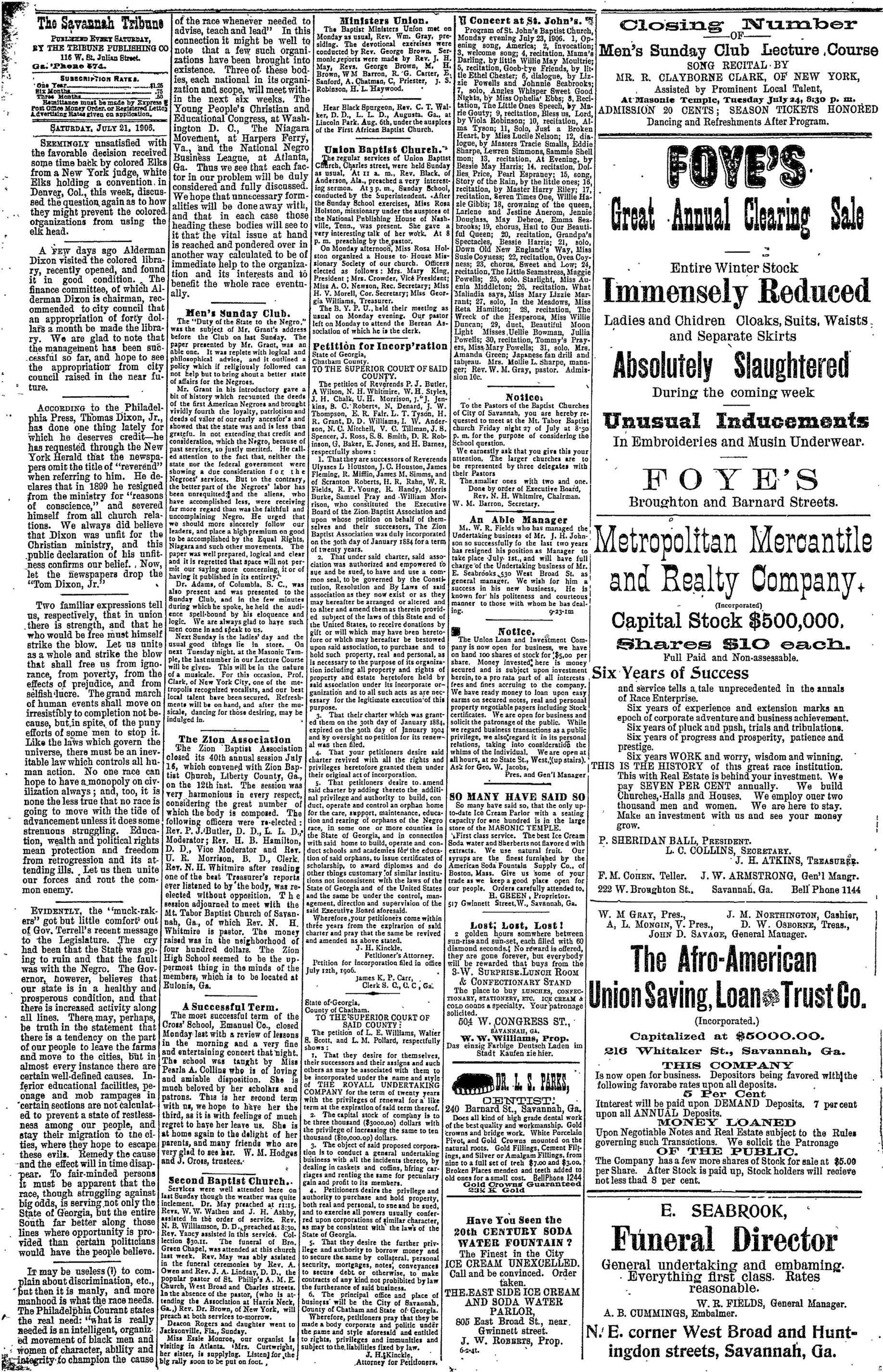
SEEMINGLY unsatisfied with the favorable decision received some time back by colored Elks from a New York judge, white Elks holding a convention in Denver, Col., this week, discussed the question again as to how they might prevent the colored organizations from using the elk head.
A few days ago Alderman Dixon visited the colored library, recently opened, and found it in good condition. The finance committee, of which Alderman Dixon is chairman, recommended to city council that an appropriation of forty dollars a month be made the library. We are glad to note that the management has been successful so far, and hope to see the appropriation from city council raised in the near future.
ACCORDING to the Philadelphia Press, Thomas Dixon, Jr., has done one thing lately for which he deserves credit—he has requested through the New York Herald that the newspapers omit the title of "reverend" when referring to him. He declares that in 1899 he resigned from the ministry for "reasons of conscience," and severed himself from all church relations. We always did believe that Dixon was unfit for the Christian ministry, and this public declaration of his unfitness confirms our belief. Now, let the newspapers drop the "Tom Dixon, Jr."
Two familiar expressions tell us, respectively, that in union there is strength, and that he who would be free must himself strike the blow. Let us units as a whole and strike the blow that shall free us from ignorance, from poverty, from the effects of prejudice, and from selfish lucre. The grand march of human events shall move on irresistibly to completion not because, but, in spite, of the puny efforts of some men to stop it. Like the laws which govern the universe, there must be an inevitable law which controls all human action. No one race can hope to have a monopoly on civilization always; and, too, it is none the less true that no race is going to move with the tide of advancement unless it does some strenuous struggling. Education, wealth and political rights mean protection and freedom from retrogression and its attending ills. Let us then unite our forces and rout the common enemy.
EVIDENTLY, the "muck-rakers" got but little comfort out of Gov. Terrell's recent message to the Legislature. The cry had been that the State was going to ruin and that the fault was with the Negro. The Governor, however, believes that our state is in a healthy and prosperous condition, and that there is increased activity along all lines. There may, perhaps, be truth in the statement that there is a tendency on the part of our people to leave the farms and move to the cities, but in almost every instance there are certain well-defined causes. Inferior educational facilities, peonage and mob rampages in certain sections are not calculated to prevent a state of restlessness among our people, and stay their migration to the cities, where they hope to escape these evils. Remedy the cause and the effect will in time disappear. To fair-minded persons it must be apparent that the race, though struggling against big odds, is serving not only the State of Georgia, but the entire South far better along those lines where opportunity is provided than certain politicians would have the people believe.
It may be useless (?) to complain about discrimination, etc., but then it is manly, and more manhood is what the race needs. The Philadelphia Courant states the real need: "what is really needed is an intelligent, organized movement of black men and women of character, ability and integrity to champion the cause
of the race whenever needed to advise, teach and lead" In this connection it might be well to note that a few such organizations have been brought into existence. Three of these bodies, each national in its organization and scope, will meet within the next six weeks. The Young People's Christian and Educational Congress, at Washington D. C., The Niagara Movement, at Harpers Ferry, Va., and the National Negro Business League, at Atlanta, Ga. Thus we see that each factor in our problem will be duly considered and fully discussed. We hope that unnecessary formalities will be done away with, and that in each case those heading these bodies will see to it that the vital issue at hand is reached and pondered over in another way calculated to be of immediate help to the organization and its interests and to benefit the whole race eventually.
Men's Sunday Club.
The "Duty of the State to the Negro," was the subject of Mr. Grant's address before the Club on last Sunday. The paper presented by Mr. Grant, was an able one. It was replete with logical and philosophical advice, and it outlined a policy which if religiously followed can not help but to bring about a better state of affairs for the Negroes.
Mr. Grant in his introductory gave a bit of history which recounted the deeds of the first American Negroes and brought vividly fourth the loyalty, patrolism and deeds of valor of our early ancestor's and showed that the state was and is less than grateful. In not extending that credit and consideration, which the Negro, because of past services, so justly merited. He called attention to the fact that, neither the state nor the federal government were showing a due consideration for the Negroes' services. But to the contrary, the better part of the Negroes' labor has been unrequited; and the alliens, who have accomplished less, were receiving far more regard than was the faithful and uncomplaining Negro. He urged that we should more sincerely follow our leaders, and place a high premium on good to be accomplished by the Equal Rights, Niagara and such other movements. The paper was well prepared, logical and clear and it is regretted that space will not permit our saying more concerning it or of having it published in its entirety.
Dr. Adams, of Columbia, S. C., was also present and was presented to the Sunday Club, and in the few minutes during which he spoke, he held the audience spell-bound by his eloquence and logic. We are always glad to have such men come in and speak to us. Next Sunday is the ladies' day and the usual good things lie in store. On next Tuesday night, at the Masonic Temple, the last number in our Lecture Course will be given. This will be in the nature of a musical. For this occasion, Prof. Clark, of New York City, one of the metropolis recognized vocalists, and our best local talent have been secured. Refreshments will be on hand, and after the musical, dancing for those desiring, may be indulged in.
The Zion Association
The Zion Association
The Zion Baptist Association closed its 40th annual session July 16, which convened with Zion Baptist Church, Liberty County, Ga., on the 12th inst. The session was very harmonious in every respect, considering the great number of which the body is composed. The following officers were re-elected: Rev. P. J. Butler, D. D., L. L. D. Moderator; Rev. H. B. Hamilton, D. D., Vice Moderator and Rev. U. R. Morrison, B. D., Clerk. Rev. N. H. Whitmire after reading one of the best Treasurer's reports ever listened to by the body, was re-elected without opposition. The session adjourned to meet with the Mt. Tabor Baptist Church of Sayanah, Ga., of which Rev. N. H. Whitmire is pastor. The money raised was in the neighborhood of four hundred dollars. The Zion High School seemed to be the uppermost thing in the minds of the members, which is to be located at Eulonia, Ga.
A Successful Term.
The most successful term of the Cross' School, Emanuel Co., closed Monday last with a review of lessons in the morning and a very fine and entertaining concert that night. The school was taught by Miss Pearla A. Collins who is of loving and amiable disposition. She is much beloved by her scholars and patrons. This is her second term with us, we hope to have her the third, as it is with feelings of much regret to have her leave us. She is at home again to the delight of her parents, and many friends who are very glad to see her. W. M. Hodges and J. Cross, trustees.
Second Baptist Church
Second Baptist Church.
Services were well attended here on last Sunday though the weather was quite inclement. Dr. May preached at 11:15. Revs. W. W. Watheen and J. H. Ashby, assisted in the order of service. Rev. N. B. Williamson, D. D., preached at 8:30. Rev. Yaney assisted in this service. Collection $30.11. The funeral of Bro. Green Chapel, was attended at this church last week. Rev. May was ably assisted in the funeral ceremonies by Rev. A. Owen and Rev. J. A. Lindsay, D. D., the popular pastor of St. Philip's A. M. E. Church, West Broad and Charles streets. In the absence of the pastor, (who is attending the Association at Harris Neck, Ga.) Rev. Dr. Brown, of New York, will preach at both services to-morrow.
Deacon Rogers and daughter went to Jacksonville, Fl., Sunday. Miss Essie Monroe, our organist is visiting in Atlanta. Mrs. Curtwright, her sister, is supplying. Listen! for the big rally soon to be put on foot.
The Baptist Ministers Union met on Monday as usual, Rev. Wm. Gray, presiding. The devotional exeetises were conducted by Rev. George Brown. Sermonic reports were made by Rev. J. H. May, Revs. George Brown. M. H. Brown, WM Barron, R. G. Carter, E. Sanford, A. Chatman, C. Priester, J. S. Robinson, H. L. Haywood.
Hear Black Spurgeon, Rev. C. T. Walker, D. D., L. L. D., Augusta, Ga., at Lincoln Park. Aug. 6th, under the auspices of the First African Baptist Church.
Union Baptist Church. $^{7}$ The regular services of Union Baptist Church, Charles street, were held Sunday as usual. At 11 a. m., Rev. Black, of Anderson, Ala., preached a very interesting sermon. At 3 p. m., Sunday School, conducted by the Superintendent. After the Sunday School exercises, Miss Rosa Holston, missionary under the auspices of the National Publishing House of Nashville, Tenn., was present. She gave a very interesting talk of her work. At 8 p. m., preaching by the pastor.
On Monday afternoon, Miss Rosa Holston organized a House to House Missionary Society of our church. Officers elected as follows: Mrs. Mary King, President; Mrs. Crowder, Vice President; Miss A. O. Newson, Rec. Secretary; Miss H. V. Morell, Cor. Secretary; Miss Georgia Williams, Treasurer.
The B. Y. P. U., held their meeting as usual on Monday evening. Our pastor left on Monday to attend the Berean Association of which he is the clerk.
Petition for Incorporation State of Georgia,
TO THE SUPERIOR COURT OF SAID COUNTY.
The petition of Revrends P. J. Butler, A Wilson, N. H. Whitmire, W. H. Styles, J. H. Chalk, U. H. Morrison, J. $^4$ J. Jenkins, B. C. Roberts, N. Denard, J. W. Thompson, E. R. Falr. L. T. Tyson, H. R. Grant, D. D. Williams, I. W. Anderson, N. C. Mitchell, V. C. Tillman, J. B. Spencer, J. Ross, S. S. Smith, D. R. Robinson, G. Baker, E. Jones, and H. Barnes, respectively shows:
1. That they are successors of Reverends Ulysses L. Houston, J. C. Houston, James Fleming, R. Mifflin, James M. Simins, and of Scranton Roberts, H. R. Rahn, W. R. Fields, R. P. Young, R. Handy, Morris Burke, Samuel Pray and William Morrison, who constituted the Executive Board of the Zion. Baptist Association and upon whose petition on behalf of themselves and their successors, the Zion Baptist Association was duly incorporated on the 30th day of January 1884 for a term of twenty years.
2. That under said charter, said association was authorized and empowered to sue and be sued, to have and use a common seal, to be governed by the Constitution, Resolution and By Laws of said association as they now exist or as they may hereafter be arranged or altered and to alter and amend them as therein provided subject of the laws of this State and of the United States, to receive donations by gift or will which may have been heretofore or which may hereafter be bestowed upon said association, to purchase and to hold such property, real and personal, as is necessary to the purpose of its organization including all property and rights of property and estate heretofore held by said association under its incorporate organization and to all such acts as are necessary for the legitimate execution of this purpose.
3. That their charter which was granted them on the 30th day of January 1884, expired on the 30th day of January 1904 and by oversight no petition for its renewal was then filed.
4. That your petitioners desire said charter revived with all the rights and privileges heretofore granted them under their original act of incorporation.
5. That petitioners desire to amend said charter by adding thereto the additional privilege and authority to build, conduct, operate and control an orphan home for the care, support, maintenance, education and rearing of orphans of the Negro race, in some one or more counties in the State of Georgia, and in connection with said home to build, operate and conduct schools and academies for the education of said orphans, to issue certificates of scholarship, to award diplomas and do other things customary of similar institutions not inconsistent with the laws of the State of Georgia and of the United States and the same be under the control, management, direction and supervision of the said Executive Board ofaresaid. Wherefore, your petitioners come within three years from the expiration of said charter and pray that the same be revived and amended as above stated.
J. H. Kinckle,
Petition for incorporation filed in office July 12th, 1906.
State of Georgia,
County of Chatham.
TO THE SUPERIOR COURT OF
SAID COUNTY:
The petition of L. E. Williams, Walter
B. Scott, and L. M. Pollard, respectfully
shows:
1. That they desire for themselves,
their successors and their assigns and such
others as may be associated with them to
be incorporated under the name and style
of THE ROYALL UNDERTAKING
COMPANY for the term of twenty years
with the privileges of renewal for a like
term at the expiration of said term thereof.
2. The capital stock of company is to
be three thousand ($300,00) dollars with
the privilege of increasing the same to ten
thousand ($10,000.00) dollars.
3. The object of said proposed corporation is to conduct a general undertaking
business with all the incidents thereto, by dealing in caskets and coffins, hiring carriages and renting the same for pecuniary gain and profit to its members.
4. Petitioners desire the privilege and authority to purchase and hold property, both real and personal, to snee and be sued, and to exercise all powers usually conferred upon corporations of similar character, as may be consistent with the laws of the State of Georgia.
5. That they desire the further privilege and authority to borrow money and to secure the same by collateral, personal security, mortgages, notes, conveyances to secure debt or otherwise, to make contracts of any kind not prohibited by law the furtherance of said business.
6. The principal office and place of business will be the City of Savannah, County of Chatham and State of Georgia. Wherefore, petitioners pray that they be made a body corporate and politic under the name and style aforesaid and entitled to rights, privileges and immunities and subject to the liabilities fixed by law.
J. H.Kinckle,
Attorney for Petitioners.
H Concert at St. John's. Program of St. John's Baptist Church, Monday evening July 23, 1906. 1, Opening song, America; 2, invocation; 3, welcome song; 4, recitation, Mama's Darling, by little Willie May Moultrie; 5, recitation, Goob-ty Friends, by little Ethel Chester; 6, dialogue, by Lizzie Powells and Johnnie Seabrooks; 7, solo, Angles Whisper Good Nights, by Miss Ophalia' Ebb; 8, Recitation, The Little Ones Speech, by Marie Gouty; 9, recitation, Bless us, Lord, by Viola Robinson; 10, recitation, Alma Tyson; 11, Solo, Just a Broken Heart, by Miss Lucile Nelson; 12, dialogue, by Masters Tracie Smalls, Edie Sharpe, Lewren Simmons, Sammie Shell mon; 13, recitation, At Evening, by Bessie May Harris; 14, recitation, Dollies Price, Pearl Erasenry; 15, song, Story of the Rain, by the little ones; 16, recitation, Master Harry Riley; 17, recitation, Seven Times One, Willie Haze Gibbs; 18, crowning of the queen, Larlene and Jeline Namerom, Jennie Douglass, May Debroe, Emma Seabulless; 19, chorus, Hail to Our Beautiful Queen; 20, recitation, Grandpa's Spectacles, Bessie Harris; 21, solo, Down Old New England's Way, Miss Susie Coyness; 22, recitation, Ove Coyness; 23, chorus, Sweet and Low; 24, recitation, The Little Seamstress, Maggie Powells; 25, solo, Starlight, Miss Auenia Middleton; 26, recitation, What Malindia says, Miss Mary Lizzie Marrant; 27, solo, In the Meadows, Miss Reta Hamilton; 28, recitation, The Wreck of the Hesperous, Miss Willie Duncan; 29, duet, Beautiful Moon Light, Misses Uellie Bowman, Julia Powells; 30, recitation, Tommy's Prayers, Miss Mary Powells; 31, solo, Mrs. Amanda Green; Japanese fan drill and teabau. Mrs. Mollie L. Sharpe, manager, Rev. W. M. Gray, pastor, Admission 10c.
Notice:
To the Pastors of the Baptist Churches of City of Savannah, you are hereby requested to meet at the Mt. Tabor Baptist church Friday night 27 of July at 8:30 p.m. for the purpose of considering the School question.
We earnestly ask that you give this your attention. The larger churches are to be represented by three delegates with their Pastors
The smaller ones with two and one.
Done by order of Executive Board,
Rev. N. H. Whitmire, Chairman.
W. M. Barron, Secretary.
An Able Manager
An Able Manager
M. W. R. Fields who has managed the Undertaking business of Mr. J. H. Johnson so successfully for the last two years has resigned his position as Manager to take place July 1st, and will have full charge of the Undertaking business of Mr. E. Seabrooks, 530 West Broad St. as general manager. We wish for him a success in his new business. He is known for his politeness and courteous manner to those with whom he has dealing.
9-23-1m
Notice.
The Union Loan and Investment Company is now open for business, we have on hand 100 shares of stock for $5,00 per share. Money invested here is money secured and is subject upon investment herein, to a pro rata part of all interests fees and fines accruing to the company. We have ready money to loan upon easy earms on secured notes, real and personal property negotiable papers including Stock certificates. We are open for business and solicit the patronage of the public. While we regard business transactions as a public privilege, we also regard it in its personal relations, taking into consideration the whims of the individual. We are open at all hours, at 20 State St., West, (up stairs). Ask for Geo. W. Jacobs, Pres. and Gen'l Manager
SO MANY HAVE SAID SO
So many have said so, that the only up-to-date Ice Cream Parlor with a seating capacity for one hundred is in the large store of the MASONIC TEMPLE.
First class service. The best Ice Cream Soda water and Sherberts not flavor d with extracts. We use natural fruit. Our syrups are the finest furnished by the American Soda Fountain Supply Co., of Boston, Mass. Give us some of your trade as we keep a good place open for our people. Orders carefully attended to, H. GREEN, Proprietor.
517 Gwinnett Street, W., Savannah, Ga.
Lost; Lost, Lost!
2 golden hours somewhere between
sun-rise and sun-set, each filled with 60
diamond seconds. No reward is offered,
they are gone forever, but everybody
will be rewarded that buys from the
3-W. SURPRISE.LUNCH ROOM
& CONFECTIONARY STAND
The place to buy LUNCHES, CONFECTIONARY, STATIONERY, ETC. ICE CREAM & cold goods a specialty. Your patronage solicited.
W. W. Williams, Prop.
Das einzig Farbige Deutsch Laden im
Stadt Kaufen zie hier.
DR. L. S. PARKS,
240 Barnard St., Savannah, Ga.
Does all kind of high grade dental work of the best quality and workmanship. Gold crowns and bridge work. White Porcelain Pivot, and Gold Crowns mounted on the natural roots. Gold Fillings, Cement Fillings, and Silver or Amalgam Fillings, from nine to a full set of teeh $7.00 and $9.00. Broken Places menden and teeth added to old ones for a small cost. BellPhone 1244 Gold Crowng Guaranteed
Gold Crowns Guaranteed
23% K Gold
Have You Seen the
20th CENTURY SODA
WATER FOUNTAIN?
The Finest in the City
ICE CREAM UNEXCELLED.
Call and be convinced. Order
taken.
THE.EAST SIDE ICE CREAM
AND SODA WATER
PARLOR,
805 East Broad St., near
Gwinnett street.
J. W. ROBBETS, Prop.
6-2-4t.
Men's Sunday Club Lecture Course
SONG RECITAL BY
MR. R. CLAYBORNE CLARK, OF NEW YORK,
Assisted by Prominent Local Talent,
At Masonie Temple, Tuesday July 24, 8:30 p. m.
ADMISSION 20 CENTS; SEASON TICKETS HONORED
Dancing and Refreshments After Program.
Ladies and Chidren Cloaks, Suits, Waists and Separate Skirts
Unusual Inducements In Embroideries and Musin Underwear.
FOYE'S Broughton and Barnard Streets.
Metropolitan Mercantile and Realty Company. (Incorporated) Capital Stock $500,000.
Shares $10 each. Full Paid and Non-assessable.
and service tells a tale unprecedented in the annals of Race Enterprise.
Six years of experience and extension marks an epoch of corporate adventure and business achievement.
Six years of pluck and push, trials and tribulations.
Six years of progress and prosperity, patience and prestige.
Six years WORK and worry, wisdom and winning.
THIS IS THE HISTORY of this great race institution. This with Real Estate is behind your investment. We pay SEVEN PER CENT annually. We build Churches, Halls and Houses. We employ over two thousand men and women. We are here to stay. Make an investment with us and see your money grow.
P. SHERIDAN BALL, PRESIDENT.
F. M. COHEN, Teller. J. W. ARMSTRONG, Gen'l Mangr.
222 W. Broughton St., Savannah, Ga. Bell Phone 1144
W. M GRAY, Pres., J. M. NORTHINGTON, Cashier,
A, L. MONGIN, V. Pres., D. W. OSBORNE, Treas.
JOHN D. SAVAGE, General Manager.
The Afro-American Union Saving,Loan Trust Co.
Capitalized at $5000.00.
216 Whitaker St., Savannah, Ga.
THIS COMPANY
Is now open for business. Depositors being favored with the following favorable rates upon all deposits.
5 Per Cent
It interest will be paid upon DEMAND Deposits. 7 per cent upon all ANNUAL Deposits.
MONEY LOANED
Upon Negotiable Notes and Real Estate subject to the Rules governing such Transactions. We solicit the Patronage
OF THE PUBLIC.
The Company has a few more shares of Stock for sale at $5.00 per Share. After Stock is paid up, Stock holders will recieve not less than 8 per cent.
General undertaking and embaming. Everything first class. Rates reasonable.
N. E. corner West Broad and Huntingdon streets, Savannah, Ga.
SATURDAY, JULY 21, 1906.
We are glad to note that Mr. Aaron J. Williams, who has been sick for quite a while is out again.
Miss Ruth M. Greene left on Sunday for Macon where she will spend two or three weeks.
Mess. Clinton Ward and Henry O Huges left on Monday evening for Atlantic City, N. J., for a pleasant visit of fifteen days.
Rev. Wm. Gray, D. D., pastor of St. John Baptist Church, presides at Dr. Walker's Lecture at Lincoln Park Aug 6th.
Miss Geraldine Hubbard left on Sunday night last for Sylvania and various points.
Have your gums treeatd by Dr. Shivery.
Mrs. Lena S. Robinson of St. Mary's Ga., is the guest of Rev. and Mrs. N.H. Whitmire 408 31st, street East.
Mr. and Mrs. James E. Haywood, and Mr. and Mrs. W. D. Bland with little W. D., Jr., made a flying trip of a few days to Augusta
Mr. H. E Perry, Life Insurance. Room 423 Empire Building, Atlanta. Ga. 8-7-06.
Mr. William Julian and Miss Hattie Steele of Beanfort S. C. were united in holy matrimony Tuesday evening of last week at the parsonage of Rev. G. W. Griffin, D. D.
Two programs will be rendered at Lincoln Park Aug. 6th, one at 4 p. m., and at 8:30 p. m. Watch for the bills.
Mrs. D. M. Waring and her little niece, Ruby May left on Thursday last to spend the summer at Blakely Ga., with her sister, Mrs. R. F. Perry.
Miss Minnie Evans has left on the steamer Kansas City for New York where she will join her aunt.
Mrs. Amelia Johnston formerly Miss Amelia Moore, will leave for New York, her future home on Monday, to join her husband Mr. Edward Johnston.
Miss Leola Jordan left for Augusta on Sunday last and will be the guest of Misses Belle Edmonia Jackson of that city.
2,500 tickets are being sold for the Forest Concert at Lincoln Park, Aug. 6th. Admission adult 15 cents. Children 10 cents.
The home of Mr. and Mrs. O E Dobson was made happy on Tuesday by the arrival of a bouncing baby girl.
There will be communion at the F B B Church tomorrow. Dr. Griffin expects to see all of his members and many visitors.
Miss Effie Glover of Savannah, Ga., was the guest of honor of Mr. and Mrs. Jackson of New York at a private picnic at Asbury Park, N. J., July 4.—New York Age.
Mrs. C. L. Stewart and little niece Cathrine Alice of this city, left on Saturday on steamer Merrimac, for Trenton, N. J., Philadelphia and Boston, Mass., to visit friends and relatives for the summer. We wish for her a pleasant vacation.
Have your teeth cleaned by Dr. Shlvery.
Mies Malvenia Lullian Griffin, the charming and amiable daughter of Mr. and Mrs. J L Griffin of Augusta, is visiting in the city the guest of Mr and Mrs M M Gaillard, who are very dear friends of her parents. The largest crowd that has ever attended Lincoln Park will be there on the 6th. of Aug. Mrs. J. S. Williams, and her sister, Miss Lula Smith, formerly of Savannah, but now of New York, arrived in the city on Tuesday, being called home on account of the illness of their father, Mr. Scott, Smith, 634 West Bryan Street.
Have your husband take out a policy with the Atlanta Mutual Insurance Association. Office 307 Whitaker St., (near Liberty street.) Mr. John Dent, of Rosemont, Ga, spent a while in the city. In company with his daughters, gave us a call on Wednesday. Mrs. T. M. G. Wells and children will leave on Sunday for Rosemont, Ga., to spend several weeks with her relatives. Her friends wish her a pleasant trip.
Mr. Wm. H. Davis, died in New York on June 22. He was buried at his old home, Ralsigh, N. O. He departed this life after a short illness, leaving a devoted wife, seven children, two aunts and a host of friends.
Prof. S. A. Grant, A. B., left the city on Wednesday for Philadelphia and the East where he will remain for a few weeks in the interest of the work at Fort Valley.
Have your children's teeth examined by Dr. Shivery.
Mr. E. J. Robinson left last week for Chicago to take up the study of medicine. He is one of the most efficient teachers in the public school system of the city. The best wishes of a large circle of friends go with him for abundant success in his work.
Misses Ethel Reynolds, Alice and Pearl Calloway of Cuthbert, were pleasant visitors of Misses Wilhelmenia and Florence Fields during the past week. The Misses Calloway left for home on Monday night; Miss Reynolds is still in the city.
Miss Ella Saunders of Charleston
S. C. spent several weeks very
pleasantly in the city the guest of
Mrs. Florence Pinckney. She returned
home last Sunday. Mrs.
Pinckney always make it pleasant
her guests.
You can get first class barbecue at
Lincoln Park Aug. 6th.
Mr. Scott Smith died at his late residence 634 Bryan street, west, Wednesday night at 8 o'clock. Mr. Smith leaves a wife, six children and a host of friends. He was an honest and upright gentleman and well liked. His funeral will take place from the F.A. B. Church, Sunday at 12 o'clock The family has the sympathy of friends. In order that the whole city may hear Black Spurgeon, we have arranged for him to Lecture in Lincoln Park, this is your chance.
Mrs. N. Roberts accompanied by Master Alphonso little Miss Erma B. Roberts and her sister Miss Claudia C. Robinson left on Sunday night last via S. A. L. for Columbia, S. C. to visit their cousin, Mr. and Mrs. Robert L. Robinson, after which they will spend two weeks in Asheville, N. C. Their many friends wish them a pleasant stay.
Take out a policy with Atlanta Mutual Insurance Association, 307 Whitaker Street, near Liberty, Savannah, Ga., who insure it, guarantee it, and protect it by their 5000.00 deposit with the State Treasurer. (Ask the Insurance Commissioner.) Alonzo Herndqh, President. E. W. Howell, Asst. Gen'l M'g'r.
The contest between the Colleges on Monday night at Mt. Tabor Baptist Church of which Rev. N. H. Whitmire is pastor, was a hugh affair. Miss Lavina Morrell, represented Cornell and a member of the above named church. The Cornell quartet took the first prize, both in singing and raising the largest amount of money. The prizes were a china bowl and a silk parasol. Mrs. Essie Spencer representing Yale, came second in quar teting singing and money raising. Prizes first a beautiful china pitcher and a lounge pillow. Mrs. Spencer is a member of St. James Tabernacle.
Have your teeth extracted without pain by Dr. Shivery.
Mr. Green Chapel died at his his late residence 528 Taylor street east, on Wednesday morning of last week after a few months illness. The funeral service took place from the Second Baptist Church and by Rev. May. He was a loving and dutiful husband and left a wife, niece and a host of friends to mourn his death. He was an Odd Fellow and his lodge paid the last tribute of respect to him.
One of the happy events in Macon last week was the nupitals of Mrs. Mamie L. Smith of that city and Mr. H B Wright of this city. The wedding took place at the residence of the bride and the ceremony was conducted by Rev. H D Canday in the presence of a few friends. It was indeed a unique and pleasant affair. The bride is one of Macon's most estimable ladies, popular with all of her friends. The groom is one of Sayannah's popular young men who has knack of making and retaining his friends. He holds a very responsible position in one of the largest and oldest shoe stores in the city. The bride will arrive in the city in a few days and the happy couple will be at home to their many friends.
Whether on land or sea, North, East, South or West, you need a sick, accident and death policy with the Atlanta Mutual Insurance Association. Wise people accept advice. Are you not one? Alonzo Herndon, President. E. W. Howell, Asat. Gen'l M'g'r.
The excursion of St. James was the hap piest event of the summer.
The church class meeting was held on the main deck of the boat on the return trip.
The great throng sang as the Steamer glided up the to the dock, "We are going home" and the captain joining In the chorus Dr. Brockett is happy and smiling at the net results.
Mr. and Mrs. Pierce of St. James mourn the loss of their infant daughter Angela, The sympathy of their many friends is extended to the bereaved parents.
Birth-day Party.
Little Miss Jannette Branham entertained her playmates on Tuesday afternoon last from four to six o'clock in honor, of her seventh birthday. The parlor was prettily decorated with red gloxiniar and white altheas flowers and beautiful candles, all lighted, throwing their brilliancy on the faces of some of our most beautiful children. Miss Jannette in a cordial manner met each of her guests at the door and received their best wishes and extended to them a hearty welcome to come in and take a part in a play called "Choose the one you love best." After they had amused themselves playing in various ways they were invited to a daintily spread table, decorated with humpty dumpty dolls and laden with good things. It goes without saying that the children were delighted, eating ice cream, cake, candy, and drinking lemonade. The young lady was the recipient of a great many pretty and useful presents. Among them was one from Miss Eleanor Pollard and a letter expressing regret at not being able to attend on account of a previous engagement. She also received presents from Misses Marion Eloise Floyd of Brunswick and Miss Lillian May Reynolds of Yonkers, N. Y. Each child received a beautiful souvenir. Those present were Masters Tracy Parks, Milton Reed, John Jones, Henry Black, Jesse Wright, Herbert Dowse, Franklin Jones, Lawrence Perry, Misses Amanda Beed, Inez Dews, Frances
Habersham, Sarah Baker, Louise Des Verney, Aneta Keys, Edna Taylor, Eleanor Pollard, Otis Williams, Anna Jones, Kathrine Reed, Edwenia Perry.
AMUSEMENT COLUMN.
Coming Events in The Social World.
Rev. H. L. Haywood, B. D. pastor of the Union Baptist Church will be the Master of Ceremonies at Black Spurgeon's Lecture Aug 6th.
The Desoto Hotel Bellmen will give a Grand Outing at Lincoln Park Friday July 27th. Tickets 15 cents.
A grand entertainment will be given by Phoenix Aid and Social Club at Margaret Street Hall Monday night July 23rd. Tickets 15 and 25 cents.
An excursion will be run to Harris Neck to meet the Berean Baptist Association, by the Zlon White Bluff Baptist Church, leaving Saturday night July 21, 9 o'clock. Fare $1.00.
2,500 People will hear Black Spurgeon, Aug. 6th.
A mid Summer Lawn Fete will be given by the Junior Auxiliary, at the reading rooms of the M.S. C., Wednesday evening August 1st. Tickets 10 and 5 cents.
The Ladies and Gentlemen Solree Club will give a grand excursion to Daufuske, Monday Augutt 6. Tickets 50 and 35 cents.
The good citizens of the city will hear Rev. Dr. Walker, at Lincoln Park. A grand picnic will be given at Lincoln Park by the E. A. and A. Club, Tuesday, July 21st. Tickets 15 cents.
The Leading Star of Betblehem will give a Picnic at Lincoln Park Tuesday, July 31. Tickets 15 cents. A grand social entertainment will be given by Savannah Sprouting Fountain No. 2070, U. O. T. R., Monday July 30, at Our hall, East Broad and Anderson sts. Tickets 15 cents. A great political subject viz. "The Negroes political attitude," will be discussed in Lincoln Park at 4 p. m., Aug. 6. A grand picnic will be given at Lincoln Park, by Advance Lodge No. 166 K. of P. on Monday July 23rd. Tickets 15 cents. Pilgrim Baptist Church will give a grand excursion to Beaufort, Monday July 30. Tickets 50 and 25 cents. Rev. R. V. Branch, D. D., pastor St. Phillips Monumental A. M. E Chuch will introduce Black Spurgeon on Aug. 6.
An entertainment will be given by Deborah Lodge No. 1, G. U. o. of S. and D. of S., of Ezekiel, at Freeman hall, Monday night, July 23. 15 cents. A grand excursion to McIntosh will be given by the Y. G. E. and Imperial A. and S. Clubs, on Monday July 23. Tickets 50 cents. The Elks at Daufuski on Monday July 24th. Weldon Lodge No 26, I. B. P. O. of Elks of the World will give an excursion to Daufuski. Ticket 50 and 25 cents.
The Independent Smart Set A. and S. Club will give their second summer dance at Margaret St. Hall, Monday July 30th. Tickets 15 and 25c.
A grand midsummer outing will be given at Lincoln Park by Myrtle Lodge No 1063 G. U. O. of O. F. Thursday August 2nd Tickets 15c.
The annual picnic of St. Phillip's A. M. E. Sunday School will be given to Daufuskie on Tuesday July 24th, Tickets 25 and 50 cents.
A grand picnic will be given at Lincoln Park by the Union S C Ladies Branch Mon day July 30. Tickets 15 cents.
A Social Trip will be given to Abercon Sunday July 29 by the B S D and S C M A A. Tickets to and B 25 cents.
The Y, M. B. A. will give an entertainment at Masonic Temple, Monday night July 23, Tickets 15 and 25 cents. A grand excursion will be given to Potters Grove by the Clifton Baptist Church Monday July 23rd, Tickets 40 and 25 cents. A grand concert will be given at St. John Church, Monday evening July 23rd. Tickets to cents.
Eastern Star A. and S. Club will give a grand Ball at our Hall Monday night August 6th. Tickets 15 and 25 cents.
Notice
There will be a grand mid-summer
Outing given at Lincoln Park, Thursday
August 2, 1906, by MYRILE LODGE,
No. 1663 G. U. O. of O. F. There will be
plenty of refreshments and music
for the occasion. The committee will
spare no pains in making it pleasant
for all who attend. Come one, come all.
Admission 15 cents.
O. W. Alexander, Chairman.
W W Williams, Secretary. 7-74t
Special Notice.
The undersigned, having purchased the undertaking and embalming business belonging to the Estate of W. H. Royall, earnestly solicit the patronage of their friends and the public generally. The business will be conducted on the same high plane that has made it the foremost undertaking business of this city, and we respectively request-former patrons for a continuance of their business.
The active management will be in the hands of Mr. Chas. H. Royall, and Mr. W. S. Roundfield, and we assure the public prompt and courteous attention.
The business will be continued at the old stand, No. 319 Ogilethorpe Avenue, West. Bell phone 887, residence phone 641.
ROYALL UNDERTAKING CO.
Lucius E. Williams,
Walter S. Scott,
Proprietors.
Metropolitan Mutual Benefit Association.
In addition to our sick and death benefit policies we are offering the public industrial insurance in straight life policies ranging from $100.00 to $500.00. Premiums within the reach of all. A fair value for your money in a reputable company is what all of us are looking for. This is what we are giving. See any of our agents or call at the company's office for rates and particulars. Energetic men and women can make anywhere from $5.00 to 25.00 a week working for this company.
Office 222 W. Broughton St. Savannah, Ga.
J.W.ARMSTRONG, Vice-President:
FOR MEN'S SUITS
We have selected from our stock about 150 suits, the coats of which run a little shorter than the extreme length now in vogue. The regular prices of these suits ranged from $15 to $22.50. They are of fine fabrics, the trousers cut full, coat well made, with sharp retaining fronts, and a big bargain for a : : : : : :
TEN-DOLLAR BILL
For the man who is not particular about a-long coat. CALL TODAY, as sizes will soon become exhausted
Dr. E. D. Bulkley,
DENTIST
All Branches . . .
Of Dentistry
211 East Broad Street,
Cor. Oglethorpe Lane.)
BELL PHONE 1124.
Savannah, Ga.
WATCH
Our Growth.
Commenced business
Oct. 5th 1900 - - $ 102.00
October 5th 1901 - - 1,144.00
October 5th 1902 - - 2,462.03
October 5th 1903 - - 11,637.37
October 5th 1904 - - 14,587.63
October 5th 1905 - - 20,897.28
April 5th 1906 - - - 26,413.64
We solicit your patronage.
Shares $12.00 'each, payable
$1.00 down and .50c per share
monthly.
IN OUR SAVINGS DEPARTMENT we allow interest at the rate of 5% compounded quarterly. Money withdrawable on demand.
THE WAGE EARNERS LOAN AND INVESTMENT COMPANY
"The Pioneer Negro Saving Bank in Georgia."
468 West Broad Street
Bell Phone 1198 Ga. Phone 2029
G. James
215 Randolph Street, corner of Jackson Street.
Green Grocery,
Beef; Pork; Veal and Poultry;
ies, Cigars, Tobacco, etc.
Prompt attention will be given
to all patronage.
SUITS to order including Ladies Skirts and
Jackets. Send for samples.
All Work Guaranteed.
Edward G. Bryant,
Fashionable Tailor and Cutters Cleaning, Repairing, Pressing and Dyeing 9 Farm Street, North.
$10.00 NET
MEN'S SU
MEN'S SUITS Worth $15 to $22.50
selected from our stock
s, the coats of which run
than the extreme length.
The regular prices of the
from $15 to $22.50. The
s, the trousers cut for
e, with sharp retaining
bargain for a : : : :
N-DOLLAR B
man who is not particular ab-
L TODAY, as sizes will so
LEVY, BRO. &
Doughton Street, W
from our stock about 150
s of which run a little
extreme length now in
car prices of these suits
$22.50. They are o
rousers cut full, coa
harp retaining fronts
or a : : : : :
SULAR BILL
not particular about a-long
as sizes will soon becom
, BRO. & CO.
Street, West.
JULIAN SMITH, Pres. Union Benefit
The n Benefit Assoc
Union Benefit Assocation.
(Incorporated—Charter Perpetual)
The leading insurance company in the south. Giving emp young men and women than any other company of like benefit.
The UNION BENEFIT ASSOCIATION is the peoples it is the first home insurance company of its kind in this city.
Founded, built, owned and controlled entirely by Negro men. Every policy is backed up by a deposit of $5,000 with the When you take out a policy with the UNION BENEFIT you have made a safe investment.
She is striving now to place her policies in every State in the Shrewd and energetic agents are wanted.
Call and see us at 20 STATE STREET, W. Bend.
GEO. W. JACOBS, General Manager.
big insurance company in the south. Giving empl
and women than any other company of like benefit.
UNION BENEFIT ASSOCIATION is the peoples fa
some insurance company of its kind in this city.
built, owned and controlled entirely by Negro m
policy is backed up by a deposit of $5,000 with the
un take out a policy with the UNION BENEFIT A
e a safe investment.
giving now to place her policies in every State in the
and energeticagents are wanted
we us at 20 STATE STREET, W. Bel
GEO. W. JACOBS, General Manager.
The leading insurance company in the south. Giving employment to man young men and women than any other company of like benefit.
The UNION BENEFIT ASSOCIATION is the peoples favorite, since it is the first home insurance company of its kind in this city.
Founded, built, owned and controlled entirely by Negro men of the city.
Every policy is backed up by a deposit of $5,000 with the State Treasury.
When you take out a policy with the UNION BENEFIT ASSOCIATION you have made a safe investment.
Johnson's
Undertaking Esse
Funeral Directors are
All orders promptly attend
First class Embalming, and all work
Our stock of COFFINS, CASKE
is the largest in the city.
We also have a first class LIVER
nish the best Carriages, Hearses and
We also have in our employ Mr.
like to see his faiends at any time.
Mrs. J. H
taking Establish
eral Directors and Embal
orders promptly attended, day or night
Embalming, and all work of that kind
of COFFINS, CASKETS and BURNS
in the city.
Have a first class LIVERY STABLE w
t Carriages, Hearses and Funeral Car
have in our employ Mr. H. S. Dunbar
his faiends at any time.
Mrs. J. H. JOHNSON,
Funeral Directors and Embalmers. All orders promptly attended, day or night. First close Embalming, and all work of that kind guaranteed. Our stock of COFFINS, CASKETS and BURIAL ROBES is the largest in the city. We also have a first class LIVERY STABLE where we furnish the best Carriages, Hearses and Funeral Cars.
We also have in our employ Mr. H. S. Dunbar, who would like to see his faiends at any time.
Mrs. J. H. JOHNSON, Manager.
Bell Phone 676. 325-333 Jefferson St.
You Will Trust The Man
Those neighbors speak well of him—whose friends vouch for his honesty—whose business associates respect and honor him—whose capacity to hardy to his fair dealings—and whose ability and brains have shown him that a SQUARE DEAL is essential to permanent success.
Nothing to do but collect your rent and look after your property.
CHAS. McDOWELL,
Will Trust The
pors speak well of him—whose friends vow
business associates respect and honor him—
his fair deeds—and whose ability and brave
QUARE DEAL is essential to permanent su
de but collect your rent and look after ye
AS. McDOWE
You Will Trust The Man
Those neighbors speak well of him—whose friends vouch for his kindness—whose business associates respect and honor him—whose courtesy gets tacitly to his fair dealings—and whose ability and brains have shown him that a SQUARE DEAL is essential to permanent success. Nothing to do but collect your ransacks and look after your success.
22 West State Street.
WANTED: by a Chicago wholesale and mail order house, assistant manager (man or woman) for this county and ajoinning territory. Salary $20 and expenses paid weekly; expense money advanced. Work pleasant; position permanent. No investment or experience required. Spare time valuable. Write at once for full particulars and enclose self-addressed envelopes.
Both Phones 689.
F. F. JO
DEALER
Dr. J. W. Jamerson.
Go to him, and have your work done Crowns, gold and white, looking like the natural teeth. Filling gold, silver and cement. Plates, full or partial, Bridge neatly done. Extracting done with ease. All work done neatly in a neat first class place. Provided with all modern appliances. 623 WEST BROAD STREET, Bet. Huntingdon and Hall.
GEO. W. JACOBS, Gen'l Mgr. The it Assocation.
in the south. Giving employment to man or company of like benefit. IATION is the peoples favorite, since it of its kind in this city. rolled entirely by Negro men of the city. deposit of $5,000 with the State Treasury. the UNION BENEFIT ASSOCIAT ION policies in every State in the union agents are wanted. STREET, W. Bell Phone 2322 General Manager.
Establishment,
Cars and Embalmers.
attended, day or night.
All work of that kind guaranteed.
BASKETS and BURIAL ROBES
EVERY STABLE where we fur-
ries and Funeral Cars.
Mr. H. S. Dunbar, who would
time.
J. H. JOHNSON, Manager.
325-333 Jefferson St.
ust The Man
him—whose friends vouch for his love
pect and honor him—whose custo-
dies ability and brains have shown
mental to permanent success.
ment and look after your property.
C DOWELL,
Both Phones 689. F. F. JONES, DEALER IN
Beef-Veal-Lamb-Mutton
PORK, HAMS, BACON and Corned Beef. All Kinds of Game in Season. Goods promptly delivered to any part af the city free of charge. Stall No. 31; City Markes
FOR THE FARMER AND STOCKMAN Attractive Farms. or less potatoes, and we are satis
If farms are not too large there will be fewer neglected fields, bad fences and weeds and the land will be better plowed and harrowed and cleaned in after culture, timely harvested and well secured, the profits being large proportionally. It is only where farming is conducted on a moderate scale, generally, that universal neatness, taste and finish throw around the whole scene a sort of rural enchantment which attracts and impresses every beholder and such condition is most easily accounted for, as the whole is under the farmer's eye, within his means and managed chiefly, if not exclusively, with his own hands.—The Epitomist.
Fradicating Horseradish.
Will some of the readers of the Tribune Farmer inform me how to get rid of horseradish?—L. R., Middleburg, Vt.
Answer—There is no special method of getting rid of horseradish which is distinguished from other methods of eradicating perennial weeds. It is a very troublesome weed when it becomes established in the field, and one can kill it out only by persistent cultivation. No plant can grow which is not allowed to make green leaves, and if cultivation is frequent enough to prevent the growth of the tops, the roots are bound to die. Put your field in a hoed crop and keep it cultivated throughout the season, and the horseradish will have to go.—John Craig, Cornell University.
A Dry Floor.
There was considerable written, a few years ago about cement and gravel floors for poultry houses and raking off the litter to the same every morning. Of late years there has been more in the poultry papers about board and plank floors. Eight years ago we built a poultry house sixty by thirteen feet of lumber, putting on a shingle roof, partitioning into five apartments, with a board floor and boarding up four feet between apartments, and then screen wire to within a foot of the roof, leaving three feet for a hall through the building, with screen doors from this hall into each spring door, the doors shutting themselves as you leave the pens. The fowls are fed and watered from the hall, pens contain dust boxes, chaff and straw, perches are movable, and platform for droppings.
Culture of Sweet Potatoes.
Contrary to what the uninitiated may suppose, the sweet potato is by no means difficult to grow. Given a sandy loam—one not too rich, or, at least, on which too much fresh manure has been applied, this tending to induce a heavy growth of vine at the expense of the tubers—it can be easily raised and made to yield a large crop. The first requisite is to plow the land well, turning a very thick furrow, and then with a two-horse plow throw it up in long, large ridges. After that it should be pulverized and finished thoroughly, followed by marking it out in rows about three and one-half feet apart. In these the plants, already started in a hotbed, should be set about eighteen inches apart. Good, stocky plants are safest to bank on, and that they should have a fair chance there should be no guesswork about seeing to it that the soil comes in close contact with their roots. They should be placed at a reasonable depth and if the soil is dry, the roots dipped in rich mud and stirred about so as to get as much of the mud as possible to adhere to them, the soil then being pressed around them when then are set out. Watering also is sometimes advisable, especially in late setting. After that it is only necessary to cultivate sufficiently to keep the weeds down and the ground mellow. That no weeds at all may thrive close to the plants, the earth there should be hoed occasionally and the vines then lifted up that they may not take root. Big Stem, Jersey and Cedarville are some of the varieties of sweet potatoes that have been found satisfactory—Fred O. Sibley.
Potatoes as Horse Feed.
If you are raising potatoes and have more culls and small ones than you can find use for, the following from the Tribute Farmer may give you a valuable hint:
I noticed an inquiry in your valuable paper of June 1, relative to feeding potatoes to horses. Our experience may be of interest to the brother wanting information. Some few years ago one of our neighbors harvested a large crop of potatoes, and from some cause there was quite a percentage of small, unmerchantable ones, and corn and oats were high that season. Our friend had numbering to do that winter, kept four horses and fed them raw potatoes twice each day. He was careful to wash the potatoes well, as the grit would make the teeth and mouth of the horses sore. These teams did a good winter's-work, were in excellent order in the spring, their hair sleek and the animals very healthy. We keep eight heavy horses on our farms, and each year feed them more
or less potatoes, and we are satisfied they are a pretty good food for them to work on. After they become accustomed to them they will eat a peck night and morning raw, and by feeding oats or corn at noon they do well, keep healthy and are usually in good spirits for business. We have sown some seventy acres to grain, and are finishing planting about eighty acres of potatoes this spring. Our horses have done this work fed on potatoes night and morning, as above stated, usually raw or uncooked. Our experience satisfies us it is better to cook the potatoes, and we are planning to do this in the future. By so doing, with the addition of a few shoots, we expect to have a fair feed for horses.
"Practice Rotation of Crops."
That a proper rotation of crops is essential to success in farming is evidenced everywhere, for there is no land that is proof against depletion. Some soils hold out longer than others, but the ultimate end is failure if we persist in continual cropping with one crop. We rotate, primarily, to prevent this depletion of soil fertility and if legumes figure largely in the rotation, considerable nitrogen, the principal and costliest plant food, is added. Then we rotate to secure a better distribution of labor and stockmen rotate to secure a variety of feeds with the least damage to the soil. Another advantage of rotation is the getting rid of insect and weed pests. Potatoes have several insect pests that are peculiar to potatoes, and if we change them to a new location, we are apt to get rid of them, or most of them on that crop and by including other crops in the rotation on the infested ground we can get rid of them there.
Different crops feed differently, and by rotating them any one particular plant food is not exhausted, as may be the case in single crop farming. Some crops require more nitrogen than others, some more potash and some more phosphates. I have heard the expression "That land will not grow tobacco, because it has been in it so much." Yes, but I proved when I rented it that it would produce a good crop of corn and other things in the way of feeds, so I proceeded to rotate and feed stock.
It is probably in the tobacco districts that the worst effect of lack of rotation and diversified farming is found. Tobacco is very hard on land, and it needs a rest more than any other crop. It requires a very strong soil, and the tendency is to crop a field that is found to produce a fine crop of tobacco too much. We find many instances where such land has been in tobacco until it is worn out, at least as far as that crop is concerned, and greatly depleted in the elements of fertility for other crops.—E. W. Jones, of Kentucky.
Farm and Garden Notes.
A sheep, like clover, enriches the ground that grows it.
Do not feed the sheep too much corn, especially the breeding ewes.
Dry soil is one of the first requisites for successful sheep farming.
One of the very best feeds for ewes with lambs is oats and wheat bran mixed.
Keep the floor of the sheep quarters dry, and to this end use plenty of bedding.
Sow parsnips and satisfy now for next winter's use. They require the entire season to develop.
When bringing oleanders out of the cellar, cut them back a little before they start into growth.
Growing chickens should be fed three times a day, just what they will eat up clean, no more.
The object of caponizing is to improve the quality and increase the quantity of the flesh of fowls.
Continue to plant all the hardy vegetables. May is the month in which to sow the tender sorts.
Plant some flowers in the vegetable garden. It is as important to please the eye as the stomach.
Tobacco stems covered with straw are an excellent preventive of Insect breeding when the hens are sitting.
The grass upon the lawn has made a sufficient growth to be cut. Mow across one week and lengthwise the next.
It is the nice appearance of goods that sells them. Nice, large, fat, plump fowls always bring the best prices.
Throwing food on the ground is wasteful. A clean board is much better. Feed no more than is readily eaten up clean.
In arranging the poultry house, so far as can be done, it is always best to have the doors and windows facing the south.
Short-legged fowls fatten quickly; long-legged ones are hard to fatten. Those first hatched fatten quickest ir. a brood.
The most important thing connected with the work of the sheep breeders in the selection of rams from which to breed. Never under any consideration breed from a scrub, a grade or an inferior ram, for in doing this you do your flock and yourself an irreparable injury.
LABOR LEADER IN BRITISH CABINET.
IT
HON. JOH N BURNS.
Novelties in Inventions are always interesting, but of the many devices patented very few contain as unique an idea as the one shown here, a New York man being responsible for the scheme. Its purpose will be at once apparent and its usefulness and practicability unquestioned. The idea is shown here in connection with a pitcher which has a compartment distinct from that for holding the fluid contents. The purpose of this compartment is to hold ice out of contact with the ordinary contents. The liquid in
```markdown
```
Ice Cannot Dilute Contents.
the pitcher is shown by the shaded portion of the illustration, the pocket in which the ice is placed being slightly below the lower end of the handle. This pocket projects forward and downward and is otherwise so positioned that when the pitcher is tilted in the usual manner for the purpose of pouring out the contents the ice, together with any water, is careened forward and thus prevented from leaving the pocket. Any water from the melted ice in this way cannot dilute the contents, and the liquid maintains its proper degree of strength.
A New Zealand inventor thinks so highly of a combined file and bindered States. The novelty of the device that he has had it patented in the United States. The novelty of the device is in the fact that a batch of papers or letters can be threaded with a view to binding them. This is accomplished when they are removed from the file, it being only necessary to tie the string after the papers are removed. Spikes
A woman sewing a piece of fabric on a machine.
having sharpened ends are fastened upon a frame, the upper ends of the spikes co-operating with the fasteners, which are nominally held in place by the springs. Through the top of each spike is an eye, through which is threaded a piece of cord or twine. When sufficient papers have accumulated they are passed over the end of the spike, which naturally draws the cord with them. The cord is then cut into sections, and the corresponding ends tied. This would make an effective binder, saving much time and labor.
NOVEL PITCHER.
NEWSPAPER BINDER.
Binds the Papers.
Certain eggs are polsonous, and among them are too kinds which are commonly eaten by human beings, namely, the hen's egg and the duck's egg.
Recent investigations made by a French chemist have demonstrated the fact that the yolk of many eggs contain poison enough to kill small creatures if administered in the form of injections under the skin. The ordinary hen's egg of the breakfast table is capable of causing this result. The duck's egg is still more polsonous, while the turtle's egg takes first place. Even the 'white of the turtle's egg is polsonous.
Be it noted that the toxic action occurs only when the egg is used for what medical men call subcutaneous injections; there is no need to be alarmed concerning the eating of these natural products, says Home Notes. The process of digestion nullifies any noxious effects which these useful dietary accessories may have when taken into the system in any other way.
FOLDING IRON BED.
The popularity and usefulness of folding beds have long been established. Until recently this novelty was applied to wooden beds only, but the universal demand for iron and brass beds has led a Detroit inventor to devise the folding iron bed shown here. The head and foot posts are connected together by side rails in the usual way, but otherwise the construction is entirely different. The head and foot of the bed are made by lazy tongs, which move toward and away from each other in folding and unfolding the bed. A swinging support for the mattress
```markdown
```
and spring is employed. The construction of this support is unique, the parts being plotted in such a manner that they readily close up, occupying but little space when in that position. Attachments are provided for locking and unlocking the bed when it is in either position.
Only Survivor of Custer Massacre
Only Survivor of Custer Massacre.
The Custer battlefield is close to the Crow Agency. In a desire to know all that I could, at close range, of the tragedy of the Little Big Horn, I spent many days in going over the battlefield foot by foot, from where the troops left the Rosebud to the ridge where the men had made their last stubborn fight. White marble slabs mark the spots where they fell. In most cases the slabs are in twos, side by side. Strange how it is when it comes to the final end, we reach out for human companionship. There they made their last earthly stand, bunkle by bunkle.
Among the dozens of Indians I questioned of the fight was Curly, who is so often called the sole survivor of the Custer fight. He has been so bullied, badgered, questioned, cross-questioned, leading-questioned, and called, by mouth and in type, a coward and a liar by an endless horde of the curious and knowledge seeking, that I doubt to-day, if his Life depended upon it, he could tell whether he was ever at or near the Custer fight—From "The Tribes of the Northwest Plains," by E. S. Curtis, in Serlner's.
Poisonous Eggs.
Quickly Folded Up.
Danger of Relying on Secrecy to Protect a Process
Some years ago the Goldschmidt Company, of Eisen, Germany, perfected a process of detinning tin scrap, but instead of patenting the process they depended on secrecy to make it profitable. The usual result of such practice followed. Two of the employees knowing the secret, proved unfaithful and sold their knowledge to a concern which commenced the work in Holland and from there it was brought to America. The American concern in turn was served in the manner. The result was that undesirable competition was established by two plants, one at Paulsboro, N. J., and the other at Jollet, Ill. The company first on the ground in this country commenced suit again the competition, seeking to join them from using the knowledge obtained through the defection of one of their employees. The case was thrown out of court, as the court would not stain its hands with such disreputable proceedings, none of the parties having good standing. The operation of a plant on the principle of secrecy puts a premium on dishonesty. The patent laws of most countries offer adequate protection for most inventions and discoveries; if that protection is not sought, but rather that of secrecy, the possibility of recovery of damages in case the secret is stolen by competitors is very slight indeed.—Machinery.
NATURAL BRIDGES.
Two Theories in Regard to Their Formation.
It is commonly believed, says the Geographical Record, that natural bridges, of which the Natural Bridge of Virginia is the best known American example, are due to the falling in of cavern roofs, leaving only a part to span the stream which the destruction of the cavern has brought to the surface.
By a study of the North Adams Natural Bridge, Professor Cleland has been led to the conclusion that in this case at least the origin is quite different. In this case the bridge seems to be due to the solution of the limestone along a joint plane near the former course of Hudson Brook. At first only, a small amount of water soaked along the joint plane but after awhile, it made a channel large enough to divert the entire brook under the surface, giving rise to the bridge.
Walcott had previously offered a similar theory for the Natural Bridge of Virginia, and Cieland concludes that while the falling in of cavern roofs may occasionally give rise to natural bridges the most common cause for such bridges in marble, limestone, sandstone and lava is that outlined above.
Dry Farming and Irrigation.
There is nothing infernal to irrigation in the dry-farming movement. Each has a wide field before it. In many regions it is probable that a combination of irrigation and dry-farming methods will be found desirable. By an economical use of the water stored in reservoirs, in accordance with dry-farming principles, and by conserving the rains and snows that fall in the soil as taught by the advocates of dry-farming, and drawing upon the irrigation ditches only to supply the deficiency, it is possible that irrigation reservoirs may be able to supply double or treble the acreage they can serve by the present wasteful methods, and that great stretches of territory in which the rainfall is too small to allow the successful application of dry-farming methods alone may be covered with waving grain fields—From John J. Cowan's "Dry-Farming—the Hope of the West" in The Century.
OUTDOOR LIFE
Will Not Offset the Ill Effects of Coffee When One Cannot Digest It.
A farmer says:
"It was not from liquor or tobacco that for ten years or more I suffered from dyspepsia and stomach trouble; they were caused by the use of coffee until I got so bad I had to give up coffee entirely and almost give up eating. There were times when I could eat only bolted milk and bread and when I went to the field to work I had to take some bread and butter along to give me strength.
"I doctored with doctors and took almost everything I could get for my stomach in the way of medicine, but if I got any better it only lasted a little while until I was almost a walking skeleton.
"One day I read an ad. for Postum and told my wife I would try it, and as to the following facts I will make amdavit before any judge:
"I quit coffee entirely and used Postum in its place. I have regained my health entirely and can eat anything that is cooked to eat. I have increased in weight until now I weigh more than I ever did; I have not taken any medicine for my stomach since I began using Postum. Why, I believe Postum will almost digest an iron wedge.
"My family would stick to coffee at first, but they saw the effects it had on me and when they were feeling bad they began to use Postum, one at a time, until now we all use Postum." Name give by Postum Co., Battle Creek, Mich.
Ten days' trial of Postum in place of coffee proves the truth, and easy and pleasant way. "There's a reason."
Look in pkgs. for a copy of the famous little book, "The Road to Wellville."
GOOD ROADS
Asphalt For Country Highways.
EPORTS from various county engineers regarding the cost of maintenance of improved high-
ways have drawn considerable attention to that highly important phase of the road question and are bringing to the front many hitherto unconsidered or not carefully considered features. According to these reports, New York's $30,000,000, if used directly for building roads according to present methods, will involve an enormous annual expense for repairs, and not only road builders but the people who pay the bills are beginning to ask if, after all, the macadam system is the best, when first cost, expense of annual maintenance and durability are considered.
Simple arithmetic shows that a substitute for macadam which might cost more in the first instance and show a great saving in cost of maintenance would in a period of ten years prove a profitable investment. County Engineer McClintock, of Monroe, is authority for the statement that the estimated cost of a mile for the maintenance of New York State roads for the current year is $310, and that the 83.77 miles of macadm road in his county have cost $713,160.90, or $8114 a mile. In 1905 they cost $175 a mile for repairs, and an inspection last April showed that $60,000 would be needed to put them in first class condition, or nearly $700 a mile.
New York has followed the lead of Massachusetts, Connecticut and New Jersey in the matter of road building, and it might be wisdom to follow the last named State in its experiments with asphalt as a cheap and lasting surface for country highways. Of course, it would be necessary to give the subject careful study in order to avoid the errors which have made many of our city streets anything but a joy to ride upon, but the fact that a high grade natural asphalt, which does not contain the soluble salts so detrimental to the waterproof qualities essential to a good pavement, can be mixed with trap rock particles of the size now used in ordinary macadam and laid at a rate sufficiently low to warrant consideration is regarded by many as calling for an open minded discussion of its possibilities.
Professor A. W. Dow, Government inspector of asphalts and cements at Washington, is quoted as saying that no pavement laid in the District of Columbia with natural asphalt has ever rotted. John G. Trautwine, formerly engineer of the Philadelphia Water Department, says that the same material used eight years ago for reservoir lining has shown no signs of deterioration, and in Rochester it has cost less than two cents a square yard to maintain an asphalt pavement for seventeen years after the expiration of the guarantee term.
As water is the chief enemy of the country roads and the cry of the road builders is "drainage, drainage, and then more drainage," to insure keeping them in good condition, it would seem that even if the first cost is the same the lessened expense of maintenance might be a sufficient reason for considering the claims of some other material than the present costly and shortlived macadam for building the State's highways.—New York Tribune.
Proposed Fine Driveway.
The movement looking to the construction of a through turnpike from Augusta, Ga., to Savannah, is meeting the same enthusiastic reception in Augusta that it received at the other end of the line. Dr. W. C. Lyle, President of the Augusta Automobile Club, says the local organization is and has been for some time past heartily in favor of the construction of such a thoroughfare, and at present stands ready to aid the project in every possible way. Dr. Lyle states that the movement, as he understands it, will provide that the roadway building and repalring in each respective county along the line is to be done by the people of that county. He states that the roads in Richmond County are now in such a state that little or no change will have to be made; that they are "all to the good" just as they stand.
Dr. Lyle expresses the hope that members of the Savannah club will decide shortly to make an inspection tour straight through to Augusta, and he extends to them on behalf of the Augusta Automobile Club the promise of a right royal welcome and the best of entertainment.
Fruit and Nuts From Spain.
The principal articles imported from Spain are fruits and nuts, sulphur ore, cork, wine and vegetables. Fruits and nuts are by far the largest item in the imports from Spain, amounting in 1905 to considerably more than $3,000,000 out of a total importation of $8,500,000 from that country. Of this total of over $3,000,000 worth of fruits and nuts, almonds amounted to $835,254, preserved and prepared fruits $664,490, ralsins $196,100, while olives and grapes form the bulk of the remainder, which amounts to about $1,500,000 in value. Spain supplies a large proportion of the more than $100,000 worth of olives imported into the United States annually, while the value of grapes imported from that country is also considerable.—Pacific Fruit World.
A new prize of $10,000 is offered in France for the invention of a dis-isible balloon.
Henry George's Theories in Successful Operation by 400 Persons.
Alabama Settlement Where No One Is Taxed and Municipal Profits All Go For the Common Good of Every Resident.
THE world's first and only single tax settlement, in Alabama, after eleven years' existence, has
a population of 400, and has demonstrated to its own satisfaction that the theories of Henry George will work, writes the Fairhope (Ala.) correspondent of the Philadelphia Record. The first settlers, although they numbered but fifteen, represented several States and nationalities. They started by naming their town "Fairhope," and by choosing for their motto: "We will make good theories work." In eleven years the community has acquired 1600 acres of land and has options upon a much larger area. It has a public school system, a library, a church and all the usual business houses that go to make up the average American town except a saloon. During the past fifteen months village improvements costing $40,000 have been made. Plying between Fairhope and Mobile is a steamer which carries two carloads of freight and 115 passengers. This vessel, too, is owned by the colony.
State and county taxes are naturally imposed, but are paid as a whole by the colony and not by the individuals. By purchasing and plotting the land as a colony, this community has accumulated the profits usually realized by a promoter or land speculator. The land was originally purchased at from $1.25 to $6 an acre, and with the establishment of shipping interests, business places, educational facilities and public utilities it has increased in value with the usual rapidity attendant upon such development to the enriching of the many rather than the few.
The citizen pays no purchase price for his land. His contract takes the form of a ninety-nine year lease, which can be renewed at the end of that period. The title of the land is vested in the Fairhope Association as trustee for those who reside thereon. Membership in this society costs $100, payable, if desired, at the rate of $5 a month, and all such sums are continually applied to the original purchase of additional land. Having no purchase price to pay for his land, the lessee expends his capital in improvements upon the land—the establishing of industries, homes or places of business.
During a recent year the receipts of the association from land rentals reached $1500, and from the wharf about $1200 more. These are the two sources of revenue of Fairhope as a colony. The total taxes to be paid to the county and State were about $700. Only $125 is paid out in salaries annually, there being but two salaried officers, a secretary and a treasurer. The pay of all other officers or employees isn't so much per hour for the actual time spent. Not a dollar is invested in interest or in dividends on stock at any time. Therefore, the greater part of the receipts are devoted to public improvements, and in keeping up the schools. All of the improvements are carried on under the direction of trustees whom the citizens themselves select.
The Faithope colony stands for numerous reforms. Chief among them are the initiative and referendum and municipal ownership. Inasmuch as women are allowed equal rights with men to vote in all municipal affairs, the colony may also be said to stand for woman's suffrage.
The elections are by secret ballot under the Australian plan, and, on petition of ten per cent, of the colonists, any measure which has either been acted upon or proposed must be submitted to the vote of the entire membership. The granting of franchises for public utilities to either coroporations or individuals is forbidden, as is also the issuing of bonds and the paying of interest. Fairhope is proud of the fact that she has no especial use for the rich, that she has no speculators within her borders, and that she grants absolutely no special privileges.
The Fairhope colony should not be mistaken for a community of Socialists or a Godless band, as is sometimes the case with the followers of radical reforms. Many of them are regular attendants at church and the annual anniversary celebrations are opened with prayer. A prominent Single Tax paper styles these colonists the Pilgrim Fathers of the Twentieth Century, and one of the leading newspapers of Mobile says Fairhope is one of the strongest arguments offered in support of the practicability of the Single Tax theory. It has been said of the people who made Fairhope that they were all poor men, and that they are still poor, but, as a community, have more wealth than any town twice, the size, and which has been in existence three times as long. The fact is also pointed out that neighboring settlements have not grown near as rapidly as Fairhope
One of the problems of Fairhope has been the attitude that she should maintain toward her neighbors who remain outside the colony, but who would like to share in its benefits. The association grants to both residents and non-residents the use of its library, and the colony steamer has benefited all the surrounding territory. However, the colonists do not feel that they can extend the use of their schools, telephone systems, baths and other public enterprises to those who do not reside
on the colony lands for the reason that all these land benefits are reflected accurately in the land values which are returned to the association to be used again for mutual benefit. In extending these privileges to their neighbors the equivalent would not be returned, and the spirit of getting something for nothing, against which the colonists have long stood, would be fostered.
With the building of bridges-across the picturesque gulites and the establishment of parks, the spirit of clivic pride has kept apace. Flower gardening has been adopted, and to this both the climate and the natural foliage has lent inspiration. Climbing vines are to be found on every hand. Dogwood blossoms are abundant. There is an endless variety of trees from the branches of which comes the voice of the mocking bird. Wild turkeys and the foxes are to be seen along the shores. Oysters are plentiful in Mobile Bay.
At Fairhope Irish potatoes are planted in January, and are ready for shipment in April, and a fall crop is often planted in August. One tomato vine in the garden of a colonist covered 180 square feet of surface, and supplied an entire family throughout a season. Pomegranates, Japanese persimmons and figs grow by the side of peaches, pears and grapes. The scene is one of great luxuriance.
CROWS AND SHOTGUNS.
Missouri Farmers Go Prepared For Feathered Vandals.
St. Louis County pioneers used to carry their muskets or rifles to the fields when they went out to plant or till the soil. Farmers in the county still carry guns for protection, not from the Indians or wild beasts, but from the crows.
Otto Kempe, whose farm adjoins the famous Grant farm, is one of the "embattled farmers" of St. Louis County. He finished his second planting of a twenty-nere cornfield yesterday with a gun strapped to his back and breathing defiance to the feathered vandals.
Kempe neglected to take his gun along on the occasion of the first planting. The crows watched his movements with interest. No sooner had the farmer withdrawn than an attack was concentrated on the corn which Kempe had planted so hopefully. The farmer was amazed to discover that the crows had torn up his cornfield and carried off the seed. Kempe became desperate, and yesterday made up his mind to plant his corn again. He brushed up his shotgun, oiled the trigger and loaded it brimful with anti-crow pills. The crows have learned by experience what this means. Not one showed up during the ceremonies.—St. Louis Globe-Democrat.
A Valuable Infirmity.
The art of making the best of everything is, in every day life, considered a cheerful and desirable accomplishment. In trade, however, such optimism is not regarded with favor, especially by the victim of a bargain. A good illustration of ingenuity in an attempt to turn to good account a veritable drawback is given in Captain Barnaby's "On Horseback Through Asia Minor." The author, preparatory to his expedition, was buying horses of a Turk.
"Get on that little bay and try him," he said to his servant. As the man went on a trot, the captain heard a noise which quickly convinced him there was something the matter with the horse's wind.
"That animal's a roarer," he said. "Effendi," returned the Turkish dealer, "it is true he makes a noise, but he is stout and strong. He will make a capital pack horse." As the horse was sound in every other particular, and as a roarer will serve for slow marching, Captain Barnaby decided to buy him; but he told the owner that the fact of the creature's broken wind deteriorated from its value, and he must take something from the price.
"Deteriorate from the value!" exclaimed the Turk, glaring ferociously. "On the other hand, effendl, it is an advantage. He does make a little noise, but that is nothing. Quite the contrary. When he goes out he never runs over blind, beggars. He gives warning of his approach, and they get out of his way."
Evils of College Training.
We pass to what Mr. Roosevelt terms the "normal function" of Harvard College, namely, the function of turning out each year many hundreds of trained men who shall possess the trained intelligence, and especially the character, that will enable them to hold high the renown of an ancient seat of learning by doing useful service for the Nation. For the right discharge of that function, what kind of spirit, what sort of habits, what principles, what alms, should be inculcated? Mr. Roosevelt is quite right in saying that it is possible to harm young men as well as help them by sending them to college. If in the case of any individual it is patent that his university training has produced a taste for refined idleness, a disinclination to sustained effort, a barren intellectual arrogance, or a sense of supercilious aloofness from the multitude of strenuous men who do the world's work, then, obviously, his college experience has injured that particular person. Of such injury we have seen examples. What we want to know is how a university can minimize the chances of such injury, and what more it could do, or ought to do, than it does now, to fit a youth to play a worthy part in life. — Harper's Weekly.
At the age og 112 years, Mrs. Ellen MacIverney has died near Tulla, County Clare.
Plantation Chill Cure is Guaranteed
To Cure, or Money Refunded by Your Merchant. So, Why Not Try IT? Price, 50c, Retail.
DR PRICE'S
WHEAT FLAKE CELERY
FOOD
if eaten daily, there will be a daily action of the bowels—waste removed—nutriment retained. It is made from the whole wheat berry.
10 cents a package
For sale by all Grocers
60 Bushels Winter Wheat Per Acre
That's the yield of Salice's Red Cross Hybrid Winter Wheat. Send 20 in stalks for free sample of same, as above. Wheat, Grasses, Dulbe Tree, etc. for fall planting
SALIZE EED CO., Box A.C. LA Grosse, Wils.
Pure Water a Tonlc.
One-half of the world feminine drinks too little water. They do not know what a real, good, healthy thirst is, and should cultivate one by using plenty of salt both in their food and its natural state. It will take the place of a tonic. If the woman who has flabby flesh and a hollow chest will form the habit of eating plenty of salt meats and fish, thereby creating a thirst for water, she will take on good, healthy flesh, and round-out her figure in an astonishing short time.
UTTERLY WORN OUT.
Vitality Sapped by Years of Suffering With Kidney Trouble.
Capt. J. W. Hogun, former postmaster of Indianola, now living at Austin, Texas, writes: "I was afflicted for years with pains across the loins and in the hips and shoulders. I had headache also and neuralgia. My right eye, from pain, was
Austin, Texas, writes: "I was afflicted for years with pains across the loins and in the hips and shoulders. I had headache also and neuralgia. My right eye, from pain, was of little use to me for years. The constant flow of urine kept my system depleted, causing nervous chills and night sweats. After trying seven different climates and using all kinds of medicine I had the good fortune to hear of Doan's Kidney Pills. This remedy has curred me. I am as well to-day as I was twenty years ago, and my eyesight is perfect."
Sold by all dealers. 50 cents a box. Foster-Milburn Co., Buffalo, N.Y.
Reason In Animals
An "Intelligent animals' competition" has been held in Paris by a society whose members believe that dumb animals have reasoning faculties. They believe that animals, while acting mechanically in some cases and instinctively in others, are also capable of forming associations of ideas, which one philosophical school holds to be the foundation of reason.
In the late contest trained "learned" animals, were not rewarded. The judges consider that trick-performing creatures, taught by laborious and often cruel methods, do not thus show real intelligence. Dozens of dogs which went through rifle drill, cats which jumped through hoops, and fowls which danced the polka, were sent up to the show, but, much to the surprise of their owners, took no prizes. The silver gilt first medal went to a Japanese dog, which gave a different bark and made a different gesture to express various wants; for instance, putting its paw to its jaw with a peculiar yaping when it was hungry. It thus showed undoubted capacity for forming associations of ideas. The silver second medal was bestowed jointly on a dog, a cat, and a hen, which played absolutely like children with their mistress. She had a game of football with them in the presence of the judges, and the animals enjoyed it thoroughly, whereas the idea of play and make believe is often supposed to be peculiarly human.—Boston Budget.
Without Counting.
Archbishop Temple was noted for mathematical ability. A peculiarity of his power, not in computation or analysis, but in the ability to see a definite number of objects without actually counting them, in the ordinary sense, is mentioned in Mr. Sandford's memoirs of the archbishop.
Everybody sees three objects, not as one, and one, and one, but as three; most people can see four; some see five. Many of those who think they simply see six would discover, if they observed the process carefully, that they really make a quick count. But Doctor Temple certainly saw higher numbers. I tested him quite suddenly more than once. "How many sheep in that field?"
Instantly came the answer, "Nine." Once he saw thirteen. I think these were birds flying in a group. It was the same process with him to see nine or ten volumes in a book-shelf as it was with me to see even five. Given time, without counting, he saw larger numbers.
Experimenting With-Mine Dust.
"In connection with the report of mine-dust experiments in a West Virginia mine, it is learned," says the Coal Trade Journal, "that further work upon this line will be done, using a cannon to obtain a simulation of a blow-out shot. It has been fully demonstrated that the fine coal dust in soft bituminous coal fields will become inflamed and explode under certain conditions, but so far there is no record of an occurrence of this kind in any of the splint coal mines and since it is the practice at some of the splint mines to leave these coal cuttings inside of the mines, the above experiment was made with the view of ascertaining whether the dust from the cuttings from the splint coal could be made to explode by a blowout shot. A question has arisen in the minds of the State mine inspection department as to the advisability of requiring the removal from the splint mines of the machine cuttings. At present there seems to be no market for cuttings from some of the splint mines and it would be a dead expense to the operators to remove these cuttings. Further experiments will be made to satisfy the State mine inspection department to determine if these machine cuttings are a source of danger, and if it is found that they are dangerous an effort will be made to compel the removal of such cuttings from all splint mines."
The Altches Again.
"Once in Banbury," says a writer in the Baltimore Sun, "I dined with an English farmer. We had ham for dinner—a most delicious ham, baked. The farmer's son soon finished his portion and passed his plate again.
"More 'am, father,' he said.
"The farmer frowned. 'Don't say 'am, son; say 'am.'
"I did say 'am,' the, lad protested, in an injured tone.
"You said 'am!' cried the father, fiercely. "Am's what it should be. 'Am, not 'am.'
"In the midst of the controversy the farmer's wife turned to me with a little deprecatory smile.
"They both think they're saying 'am!' she said."
STRATEGY.
"Young man," said the stern matron in the hallway, "I don't think I would care for you to call on my daughter again."
"Why not?" asked the young man, turning pale.
"Well, to begin with, you are too disrespectful. I heard you say that I used powder."
"Yes, baking powder, and you are the best cook in the neighborhood."
And after that mamma always met him at the door when he called and gave him a flower.—Detroit Tribune.
FITS, St. Vitus' Dance: Nervous Diseases permanently cured by Dr. Kline's Great Nervo Restorer. $2 trial bottle and treatise free. Dr. H.R. Kline, Ld., $31 Arch St., Phila, Pa.
Of all cities Rome has most frequently been in the hands of enemies.
Mrs. Winslow's Soothing Syrup for Children
teething, softens the gums, reduces inflammation,
allays pain, cures wind colds, soa bottle
The Mayor of Chicago receives a salary
of $10,000.
A man is never quite so much of a man as when he is explaining to
some woman that she is nothing but a woman.
BOY'S TERRIBLE ECZEMA.
Mouth and Eyes Covered With Crusts—
Hands Pinched Down—Miraculous Cure by Cuticura.
"When my little boy was six months old he had eczema. The sores extended so quickly over the whole body that we at once called in the doctor. We then went to another doctor, but he could not help him, and in our despair we went to a third one. Matters became so bad that he had regular holes in his cheeks, large enough to put a finger into. The food had to be given with a spoon, for his mouth was covered with crusts as thick as a finger, and whenever he opened the mouth they began to bleed and suppurate, as did also his eyes. Hands, arms, chest and back, in short, the whole body, was covered over and over. We had no rest by day or night. Whenever he was laid in his bed we had to pin his hands down, otherwise he would scratch his face, and make an open sore. I think his face must have itched most fearfully.
"We finally thought nothing could help, and I had made up my mind to send my wife with her child to Europe, hoping that the sea air might cure him, otherwise he was to be put under good medical care there. But, Lord be blessed, matters came differently, and we soon saw a miracle. A friend of ours spoke about Cuticura. We made a trial with Cuticura Soap, Ointment and Resolvent, and within ten days or two weeks we noticed a deemed improvement. Just as quickly as the sickness had appeared it also began to disappear, and within ten weeks the child was absolutely well, and his skin was smooth and white as never before. P. Hoehrh, President of the L. L. Hoehrh Company, Manufacturers of the Nilk Ribbene, 4 to 20 Rink Alley, South Richmond, Pa. June 5, 1905."
Cured at Once.
So says all who take Dr. Biggers Huckle-
berry Cordial for Dysentery, Diarrhoea and
Children Teething. At Druggist250 and 500.
Because a woman is nervous is no
sign that she is nervy.
Wintersmith's CAILL TONIC
Has been a standard household remedy for over 40 years.
Pleasant to take; leaves no bad effects like quinine; harmless
for children. Guaroonle by all druggists. Put up in 500
& $1 bottles. Sent express paid on receipt of price, if not on
sale at the home drug store. Address
NORTHWARD DETECT & ESCORT
What is a Backache?
IT IS NATURE'S WARNING TO WOMEN
Diseases of Woman's Organism Cured and Consequent Pain Stopped by Lydia E. Plakham's Vegetable Compound.
"It seems as though my back would break." Women utter these words over and over again, but continue to drag along and suffer with aches in the small of the back, pain low down in the side, "bearing-down" palms, nervousness and no ambition for any task.
Miss Maude Morris
They do not realize that the back is the mainspring of woman's organism, and quickly indicates by aching a diseased condition of the female organs or kidneys, and that the aches and pains will continue, until the cause is removed.
Lydia E. Pinkham's Vegetable Compound has been for many years the one and only effective remedy in such cases. It speedily cures female and kidney disorders and restores the female organs to a healthy condition.
"I have suffered with female troubles for over two years, suffering intense pain each month, my back ached until it seemed as though it would break, and I felt so weak all over that I did not find strength to attend to my work but had to stay in bed a large part of the first two or three days every month. I would have sleepless nights, bad dreams and severe headaches. All this undermined my health.
"We consulted an old family physician, who advised that I try Lydia E. Pinkham's Vegetable Compound. I began taking it regularly and soon found that I could sleep and eat better than I had done for months. Within two months I became regular and I no longer suffer from backache or pain."—Miss Maude Morris, Sec. Ladies' Aid and Mission Society, 68 E. Hunter St., Atlanta, Ga.
At one time Belgium was the veritable apple kingdom, but the fecundity of the Belgian apple tree has departed, and the quality of the fruit makes it fit only for stewing.
WOMEN
will find in MOZLEY'S LEMON ELIXIR, the ideal laxative, a pleasant and thoroughly reliable remedy, without the least danger or possible harm to them in any condition peculiar to themselves.
Pleasant in taste, mild in action and thorough in results, Tested for 35 years.
50c. and $1.00 per bottle at all Drug Stores.
MOZLEY'S LEMON ELIXIR
"One Dose Convinces."
TULANE UNIVERSITY OF LOUISIANA
His advantages for practical instruction, both in ample laboratories and abundant hospital materials are unequipped. Free access is given to the great Charity Hospital with 900 beds and 30,000 patients annually. Special instruction is given daily at the bedside of the sick. The next session begins October 18, 1984. For catalogue and information, address
PROF. S. E. CHALLIE, M. D. Dean
P. O. Drawer, 261, NEW ORLEANS, LA.
Winter
CHILLS
A BOTTLE
WILL BREAK
WATERMINT
CHILLS
YOUR
CHILLS
CURE
AND AL
Has been a stand
Pleasant to take; lea
for children. Guerr
and $1 bottles. Sent
sale at the
ARTHUR PETER &
Dropsy
CURED
Gloves
Quick
Relief.
Removes all swelling in 8 to 20 days; effects a permanent cure in 60 to 60 days. Trial treatment given free. Nothing can be fairer Dr. H. R. Green's Sonz. Soealists. Box A. Atlanta. 621-748-2222.
The best in the city The famous Byrne Simplified Shorthand and Practical Bookkeeping the time and at half the cost of other systems in City. Good positions recured or money refunded. This ad, mail to us, receive large catalogue free.
CAPUDINE CURES It acts immediately—you feel its effects in 10 minutes. You don't INDIGESTION and have to ACIDITY seek to know its good. It cures removing the cause. 10 conts.
Better one honest man's love than a whole page and your picture in the Sunday paper.
ure is Gua nt. So, Why Not Try IT? Price, 50c, R
AFTER ITS FIRST BATH WITH CUTKURA SOAP "10 lbs."
Physicians, Pharmacists, and Nurses endorse Cuticura Soap because of its delicate, medicinal, emollient, sanative, and antiseptic properties derived from Cuticura, the great Skin Cure, united with the purest of cleansing ingredients and most refreshing of flower odors. For preserving, purifying, and beautifying the skin, as well as for all the purposes of the toilet and bath, Cuticura Soap isprlceless. Absolutely pure and may be used from the hour of birth. Sold throughout the world. Cuticura Soap, 500mg, moist. Soap, 100mg, moist. Soap, 100mg, per wail of 60, may be had of all dressings. Cuticura Soap, 500mg, moist. Soap, 100mg, moist. All about the Skin, Soap, and
SUCCESSORS TO
AVERY & McMILLAN,
51-53 South Forsyth St., Atlanta, Ga.
—ALL KINDS OF—
MACHINERY.
BEST IMPROVED SAW MILL ON EARTH.
Large Engines and Bollers supplied promptly. Shingle Mills, Corn Mills, Circular Saws,Saw Teeth,Patent Dogs, Steam Governors, Full line Engines & Mill Supplies, Send for free Catalogue.
ersmith's
ALL TONIC
CURES CHILLS
ALL MALARIAL FEVERS.
Standard household remedy for over 40 years.
leaves no bad effects like quinine; harmless
guaranteed by all druggists. Put up in 500
cent express paid on receipt of price, if not on
at the home drug store. Address
P & CO., General Agent. Loulaville, Ky.
YOU CANNOT
CURE
all inflamed, ulcerated and catarrhal conditions of the mucous membrane such as nasal catarrh, uterine catarrh caused by feminine lilies, sore throat, sore mouth or inflamed eyes by simply dosing the stomach.
But you surely can cure these stubborn affections by local treatment with
which destroys the disease germs, checks discharges, stops pain, and heals the inflammation and soreness. Paxitine represents the most successful local treatment for feminine illies ever produced. Thousands of women testify to this fact. 50 cents at druggists.
Send for Free Trial Box
THE R. PAXTON CO., Boston, Mass.
WANTED - Indian blood tribes (2) of men armed with any tribe, (2) of men nearest kin of such tribes, or (3) the nearest kin of such tribes, or (3) the deceased. NATHAN BIGEORD, Washington, D.C.
aranteed
Georgia Cullings
Curtalled Items of Interest Gathered at Random.
Bids Invited For Sitea
Advertisements have been authorized at the office of the supervising architect of the treasury department at Washington for bids for sites for new public buildings at Albany, Americus and Dalton, to be opened July 21, and at Griffin, Marietta and Waycross, to be opened July 22.
Farmer Shoots Young Boy.
Near Augusta Walter McDonald, a 14-year-old son of a farmer, was blinded by shot at the hands of Joseph M. Sharpton, a grown man, who claims the boy was stealing water melons from his patch. The boy's face was literally riddled and he will probably never see again. Feeling against Sharp is intense.
---
Reward Offered For Murderers
A large reward is offered for the arrest and conviction of the person or persons, who assassinated Lintern Williams, of Madison County, in February. The governor has offered $200 for the first person convicted and $190 for each one thereafter. The relatives of the young man have offered $250. Williams was only 21 years of age.
More Atlanta Postal Clerks. First Assistant Postmaster General Hitchoock has announced that ten additional postal clerks, at $600 annually, had been authorized for Atlanta. The postoffice department has not made all the additional authorizations possible under the postal bill, and if requirements demand more clerks may be authorized later, provided the postmaster can convince the department they are indispensable.
* * *
Carrollton Votes Bonds
At an election held in Carrollton to determine whether or not bonds would be issued by the city for public improvement, bonds carried by 229 to 68. The amount of bonds voted was $40,000. This money will be used for the purpose of constructing sewers, building a $15,000 city hall, and paving the streets. The opposition to the bond issue will contest the matter in the proceedings to validate the bonds.
Macon Preparing for Convention
Officials of the Macon chamber of commerce have begun active arrangement for housing the big crowds at the coming state Democratic convention. Within three weeks every available place will be secured, and preparations will be made for an unusually large attendance. Citizens believe Macon will be amply able to take care of the delegates, and this belief is being backed up by actual hard work.
```markdown
```
Plowed Up His Cotton.
George W. Johnson, who lives two miles south of Dublin, astonished his neighbors a few days ago by putting his hands to work plowing up his cotton, which was in a very unpromising condition. He says that he found it would be a waste of time and money to attempt to make anything from his cotton crop. He decided that he could make more money by plowing up his cotton and planting peas where cotton was growing, and he promptly acted on his impression.
By a vote of 111 to 3 the bill of Mr. Wright, of Richmond, to amend section 623 of the state code with regard to vote buying and selling and illegal voting, was passed in the house. The bill makes it a misdemeanor for any person to contribute money for the purpose of buying votes either in a primary or regular election, and by the terms of the bill those who either spend money, or receive it for such purpose are made competent and compellable to testify in court concerning any prosecution brought for violations of the act, except that the evidence of such persons may not be used against them except in cases of prosecution for perjury.
---
Charter of Road Amended.
By an amendment filed with the secretary of state, the charter of the Georgia, Florida and Alabama Railway Company provides for the building of a branch from the main line at Cuthbert in Randolph County through Randolph and Stewart and Quitman Counties near Omaha in Stewart County on the Chattahoochee river.
An additional amendment provides for a branch line from Colquitt through Miller, Early or Clay Counties to the Chattahoochee river through Henry or Barber County, Ala., to Eufaula, or through Miller, Early, Clay and Quitman.
Seaboard Returns Not Satisfactory.
Returns of the Seaboard Air Line have been turned down by Comptroller Wright. General-Wright thinks that the road is safety in its return on account of the valuation of its trackage between Atlanta and Cedartown. This is returned at $5,129 per mile, and the comptroller thinks it should be at not less than $12,000.
The total returns of the Seaboard Air Line are $9,499,293. Its franchise is the same as last year, save an increase of $42,823, presumably the valuation placed on 14.73 additional miles of aidtracking. Its franchise this year is returned at $1,500,000.
Livingston Re-nominated.
Livingston reentered.
An unqualified endorsement of his services during eight terms as the representative of the fifth district of Georgia in the lower house of the national congress and a unanimous nomination for a ninth term was what the Hon. Leonidas F. Livingston drew from the district convention, which met in Atlanta the past week, with a full attendance. Though there was no thought of a contest, every county was represented. About forty delegates were present and business was dispatched in short order; the work of the convention being completed in less than an hour.
Coast Line to Build Link
One of the most important railway movements in Georgia in recent years is indicated an application for the charter of the Atlantic and Western Railroad Company, which has just been held with Secretary of State Philip Cook.
The Atlantic and Western, upon which it is said work is to be begun at once, will be the connecting link between the Atlantic Coast Line and its newly acquired property, the Macon, Dublin and Savannah.
Through the construction of this line the Coast Line will secure a new through line between Savannah and Macon, which will be, it is stated, some 30 or 40 miles shorter than the present route by the Central of Georgia.
FEUDISTS COME CLEAR.
Judge Hargile and Sheriff Callahan Acquitted by Kentucky Jury of Marcoum Murder.
The jury in the Hargis-Callahan trial at Beattyville, Kentucky, returned a verdict of not guilty Tuesday after being out twenty-two minutes. The case was one of the most desperately fought battles in a Kentucky court for years. The men were charged with the murder of J. B. Marcoum.
The verdict of not guilty in the Marcum trial is the culmination of a long and bitter fight in the courts in an attempt to convict James Hargis and El Callahan as chief conspirators in one of the darkest crimes in Kentucky's history. James B. Marcum was a mountain republican lawyer of excellent standing. He was engaged three years ago as an attorney in the contest against Hargis and Callahan, respectively democratic county judge and sheriff-elect, to oust them from their offices on an allegation of corrupt election. Much bitterness was aroused and frequent open ruptures occurred. On May, 1906, Marcum was shot to death from behind in the Jackson court house. Curtis Jett and Tom White were convicted and given life terms for the murder. It was charged that they were the tools of Callahan, Hargis and others. Jett, after his conviction, confessed that he shot Marcum and that his act was inspired by Callahan and Hargis. On the witness stand, however, he repudiated the confession, and said that he alone was responsible. The acquittal followed largely on this repudiation.
A jury of Clark county citizens returned a verdict for $5,000 damages a year ago against Hargis on the allegation that he had caused Marcum to be killed. The suit was filed by Mrs. Marcum. Jett and White are yet to be tried for killing James Cockrill under similar circumstances.
APPRENTICES TOO LIMITED.
College President Says Labor Unions Injure Boys of United States. The American boy's right to be taught a trade in school, instead of under the restrictions of a labor union, the members of which are jealous of his advancement, was asserted by President S. L. Luther, of Trinity College, Harvard, in the convention of the American Institute of Instruction, President Luther said in part:
"Today there are few apprentices and such as may still be found are learning very little. The labor unions restrict the number of apprentices to limits grotesquely below obvious needs. The boys suffer from the jealousy, ill-will and incompetence of those who are supposed to teach them and from the greed of employers, who try to get a man's work out of them for a boy's wages."
"WATER WAGON" MOTORMEN.
Only Ones Chosen for This Municipal Owned Street Railway
In choosing motormen for what is said to be the first municipally owned street railway in the United States, the street railway of Monroe, La., Siforay A. A. Forsythe said that the first test for fitness for this position will be total abstinence.
"I am not a prohibitionist," said the mayor, "but it is absolutely essential that men occupying these responsible positions shall be sober, sane and strictly reliable, and only those who are on the 'water wagon' and keep on it will be employed."
FOR
THE
FAIR
Excitement In Topeka.
There is great excitement over the report that a bride who will come to Topeka soon has a maid, says the Topeka State Journal. This will raise the limit and establish a new record in Topeka. Occasionally a Topeka woman steals the housemaid or nurse, exchanges, their caps and aprons for the lady's maid kind and takes her out of town with her in order to make a noise like an aristocrat, but it is believed the new bride will be the only woman in Topeka who has a really and truly lady's maid all her own who never helps out in the kitchen, nursery or laundry.
Gloves.
Cleverly contrasted gloves are seen.
Gauntlets appear in fetching novel-
ties.
Showly-adorned gloves will not
"take" here.*
Yellow chamols gloves are exceed-
ingly smart.
Elbow lengths in colored silk gloves
are sold out.
The elbow length craze was not
expected to rage as severely.—Philladelph-
ha Record.
Blames Wives for Divorce.
Neither careless husbands nor pretty typewritists, but pastors and wives are responsible for most modern divorces, according to Mrs. Maria C. Weed, who spoke before the W. C. T. U.
"The utter selfishness of wives drive many husbands; from their homes," said Mrs. Weed, "When a minister," she continued, "accepts a fee in which he feels certain that honor has been bartered for a title, is it not the acme of inconsistency for him to persist that the blunder which he helped to consummate shall be a life sentence?"—New York Globe.
Weaving Silk Rags.
Tiny looms for the weaving of silk rags into strips which are afterwards joined to make rugs or couch covers, or even portieres, are among the interesting inventions brought about by the interest women are taking in all forms of handicraft.
On the loom can be woven strips of about nine inches wide, the warp threads stretched as firmly as in the big, full-edged affairs used for the heavier sort of work. "Hit-or-miss" pattern are popular in silk work as they are in the old-fashioned rag carpets, used now only for kitchen or nursery, but often strips composed of two colors are made, with one used for bordering the ends.
Cow Swallowed a Snake
Mrs. Carrie. Hagen, a widow of La Crosse, Wls., was until recently the proud owner of a beautiful cow, the sale of whose milk contributed largely to the woman's support. Five or six weeks ago the animal became ill, and Mrs. Hagen was forced to cease selling milk. Veterinary aid was summoned. The case was puzzling in the extreme. Then Mrs. Hagen decided that it was best to have the suffering bovine killed. In order to satisfy her curiosity as to what allied the animal she had it cut, open. In the cow's stomach was a large reptile. It looked like a water snake. In its lower jaw it had four small teeth. It is thought that the cow, while pastured near some creek or stream, had swallowed a young snake, which had grown and flourished ever since in the poor animal's stomach. Mrs. Hagen says the snake was an inch and a half thick and fifteen feet long. The assertion is borne out by neighbors—Millwaukee Wisconsin.
Have Beautiful Hands.
Soft, white hands, with well-shaped rosy nails, are an attraction not to be lightly considered.
The hands should be manicured at least once a week, and the time spent on the task will be found well worth the while. Always dry the hands carefully, and keep the flesh about the base of the nails free, so that the half-moons will show. If the hands are very thin, fatten it by means of massage with a good skin food. A good preparation for tender hands, which is both softening and whitening in effect, is made of powdered marshmallow root two ounces, carbonate of soda two ounces, with twelve ounces of barley stirred into it. While doing rough housework always wear gloves. It may seem a bother, but it repays the trouble. At night rub the hands with good cold cream, and slip on old loose gloves. These are little duties that take but a few minutes to do, yet if persisted in regularly and systematically will result in softness and whiteness of the hands.
How to Lift the Baby.
While the manner of lifting a young child is seemingly of minor importance, at the same time it is of enough concern to recivey consideration. The bones of an infant are soft, not easily broken but very easily bent and shaped if pressure is constantly exerted on or near the same locality. Pressure should never be exerted on the chest
of a young infant; the ribs are very small and frail, and finger pressure such as would have to be exerted by placing the hands around the body and lifting the baby is not to be desired; sometimes a marked depression is likely to occur from this sort of handling, thus hampering the free action of the lungs and interfering with the breathing; cases of chronic coughs have been known to result from such deposition. Handle the young infant without pressure if possible; this may be accomplished by placing the hand under the back; letting the head rest on wrist or arm. Or extend two or three fingers upward for this purpose, and with the other hand lift the child by the clothes at the feet—Marlanna Wheeler is Harper's Bazar.
Fashion Notea
The woman who wears the gloves with the small pocket for change stitched to the palm is sure never to lay down her pocketbook.
Line your Irish lace coat with mousseelline; the beauty of the lace will be very much enhanced.
Shoes of patent leather with white kid tops and black buttons are preferred by some to the all-white shoes to wear with light, thin gowns; it would be hard to say which is the better style for both are very modish.
Three box plaits front and back provide ample fullnees for the small girl's low-necked, no-sleeved dress which is worn over a gulpem. The plaits are fastened to a two-and-one-half inch circular band which takes the place of a voke.
Automobiles and automobile apparel now occupy the attention of a host of men and women—especially the apparel. Every woman seems to be trying to find a coat and a hat that will be practical and becoming too, and she is succeeding beautifully. There never were so many automobile hats shown and worn as this season.
The accordion-plated sheer blouses which accompany some of the new princess skirts are very dainty accessories to this favorite skirt. The yoke is of fine embroidery and cloth bands like the skirt follow it and the bottom of the short sleeves to give the effect of an entire costume.
Wide tucks and flat ribbon bands seem to be the favored skirt trimmings for graduation and other sheer gowns while folds of the same are much used on wool materials.
Make one of your negligees with the short sleeves slashed clear to the shoulder and lace together the spreading edges with velvet ribbon.
Women's Ignorance of Business.
Thousands of girls are sent out into the world with what is called finished educations, who can not give a proper receipt for money, to say nothing of drawing a promissory note, a draft or a bill, or understanding the significance and importance of business contracts. Such a woman, says O. S. Marden in Success Magazine, presented a check for payment to the paying teller of her bank. He passed it back to her with the request that she be kind enough to indorse it. The lady wrote on the back of the check." I have done business with this bank for many years, and I believe it to be all right. Mrs. James B. Brown."
Another society woman in New York City presented a check for payment at the bank, and the teller told her that it was not signed. "Oh, do they have to be signed?" she responded. "What an awful lot of red tape there is about the banking business."
I know of a lady whose husband made a deposit for her in a bank and gave her a check book so that she could pay her bills without annoying him. One day she received a notice from the bank that her account was overdrawn. She went to the bank and told the teller that there must be a mistake about it, because she still had a lot of checks left in her book. She knew so little about business that she thought that she could keep drawing any amount until the checks were all gone.
This sounds ridiculous and almost incredible, yet the very girl who laughs at it may make even more absurd blunders. Many an accomplished woman, when given a pen, and asked to sign an important document drawn up by an attorney or a long-headed business man, will sign it without reading it or even asking to be informed of its contents, only to learn afterwards by disastrous results that she has signed away her property and turned herself out of home. Only a short time ago I read of a lady who had won a suit involving about $20,000. New evidence, however, was brought forward, which caused the court immediately to reverse its decision. It was proved that the lady had sworn falsely. She was perfectly innocent of any such intention, but she had sworn that she had never signed her name to a certain document. The document was produced, and, to her utter astonishment, she saw her signature affixed to it. She acknowledged at once that the signature was hers, although she had just sworn that she had never signed the paper in question. It appeared that, during her husband's lifetime, whenever papers were to be signed, he told her where to write her name, and she did as she was told, without having the slightest idea of the contents of the papers.
ATLANTIC COAST LINE RAILROAD CO.
NORTH WEST AND SOUTH WEST.
*57 Via Jeep.
6 45p Lv. Savannah. Ar
8 30p Ar. Joup.. Lv
3 00a " Macon. "
5 20a " Atlanta. "
9 44a " Chat nooga
7 15p " Louisville. "
7 40p " Cincinnati. "
10 00a " St. Louis. "
7 10a " Chicago. "
7 00a Lv. Atlanta. Ar
8 05p Ar. Memphis. Lv
9 40a Kansas City. "
*Daily.
Isunday only.
ODaily except Sunday.
Trains into and out of Charleston are operated by Eastern time.
Nos. 82 and 85, the Florida and West Indian Limited, finest all the year round between Southern and Eastern cities, solid vestibuted train, drawing room, sleeping cars, dining car and Pullman high class coaches. Schedule and service unequalled.
No. 57, leaving Savannah 6:45 p. m., carries Pullman Buffet Sleeping Carsto Montgomery.
*57* Via Jesup. *58* *89* *87* Via Montgomery. *58* *22
645p Lv. Savannah, Ar 945s 3156 645p Lv. Savannah, Ar 940s 533p
830p Ar... Jesup. Lv 745i 615p 805a Ar... "Mittgomery." 745p 650a
520a "Macon." 1150p (L & N.)
944s "Chatnoga." 830p 315a 725p "Nashville." 845s
715p "Louisville." 820p 210a "Louisville." 345s
740p "Clintonati." 830a 120in 730a "Clintonati." 1100p
1000s "St. Louis." 612p 153p 740a "St. Louis." 840p
710a "Chicago." 830p 450p 412p Ar. Mobiles. Lv 120s 1340s
805p Ar. Memphis. Lv 815a 255a 815p "New Orleans" 925s 815p
940s "Kansas City," 630p 715a (M. & O.)
828a "St. Louis." 753p
No. 31, leaving Savannah 245 p. m., connects at Jacksville, with Pullman Buffet Sleeping Bag 507 Tampa St. Patersonburg, Ft. Meyers and intermediate volata.
YOUR CLOCK STOPS
Striking and your Watch
goes on Strike, consult
W. H. BROWN,
Watchmaker and Jeweler,
805 West Broad, Corner Charles St
THOSE WHO WANT.
Masonic Books &
Regalias.
LODGE SEALS,
FINANCIAL CARDS and
BLANKS of every description.
Publishers' and Manufacturers' Prices
Liberal Discounts Will Be Arranged.
SOL: C. JOHNSON,
THREE AMERICANS ARE JAILED.
Reported High Handed Antion of Cf
Reported High-Handed Action of Cf. officials on the Isle of Pines;
A special from Havana, Cuba, says: American residents of the Isle of Pines are excited over the imprisonment in the common jail at Neuva Gerona of Miss Millie Brown, 19 years old; L. C. Giltner, postmaster of the town, and William Augustine, all Americans. The three, for their own instruction and amusement, had constructed a toy telegraph line, 1,900 feet long, strung from Giltner's store to the residence of the other two. They were arrested without warning, charged with the violation of an old military order prohibiting other than government telegraph lines, tried by a newly appointed judge and sentenced jointly to pay a $500 fine or to a joint term of imprisonment of 100 days.
All refused to submit to the payment of the fine, and were taken to jail to serve thirty-three days each. The jail has no accommodation for female prisoners. The Cuban government has no report of the incident, which is reported by Americans who have arrived in Havana from the Isle of Pines.
WILLIAMS IS SKEPTICAL.
Minority Democratic Leader Believes
Respect Will Run Again.
Before sailing from New York for London, where he goes as a delegate to the interparliamentary congress, John Sharp Williams, minority leader of the house, gave it as his opinion that Roosevelt would consent to run again.
"I think," said Mr. Williams, "that the president is planning it so he will be forced to make the race. The president's policy reminds me of the old lady of Saragossa, who hung about asking when the gentlemen were going to begin the kissing, as she wanted to be there."
LODGE SEALS,
Savannah, Ga.
*89 *67 Via Montgomary. *68 *22
8 15a 6 45p Lv. Savaanah. Ar 9 40a 5 33a
6 15p 8 05a Ar Lv 7 45p 6 60a
8 15a 7 25p "M'tgomery." (L. & N.)
8 20p 2 10a "Nashville." 8 45a ...
12 01n 7 20a "Louisville." 8 465 ...
1 53p 7 20a "Clinchnatti." 11 09p ...
1 53p 7 20a "St. Louis." 8 45p ...
1 53p 7 20a "Chicago." 8 45p ...
4 50p 4 12p "Mobile. Lv" 1 285 ...
2 55a 8 15p "New Orleans." 9 26a 8 15p
7 15a ... 8 28a "St. Louis." 7 58p
Connections made at Port Tumma with U. S. mall steamships of the Peninsular and Occidental Steamship sailing Sundays Tuesdays and Thursdays at 11:49 p.m.
Tickets offices, DeSoto Hotel, Phones 75 Union Station, Bell phone 235, Georgia 911, W. J. CLAIG, Passenger Traffic Manager, Wilmington, N. C.
T. C. WHITE, Division Passenger Agent, Savannah, Ga.
THOS. E. MYERS, Traveling Passenger Agent, Savannah, Ga.
I. C. SAPP, City Ticket Agent, DeSoto Hotel, Savannah, Ga.
R. G. BLATTNER, Depot Ticket Agent, Union Station Savannah, Ga.
We Lead, Others Follow.
The New Pressing Club
AND TAILORING.
Pants $3.50. Suits $15.00 made
of LATEST FASHIONS.
Ladies' Suits and Skirts Cleaned and
Pressed. We make Jean
Pants for $2.50.
T. W. WILLIAMS, Manager.
242 Barnard Street.
Masonic Green Grocery
COMPANY.
Under Masonic Temple, 519 West Gwinnett Street.
GROCERIES OF ALL KINDS.
FRESH MEATS, ETC.
Orders delivered in any part of the City.
P. L. BOWEN, Manager.
Bell Phone, 2837.
Shoes & Harness
Made or Repaired.
Satisfaction Guaranteed for Each Job
for Cash.
CLOTHES
Cleaned and Pressed on Same Orders
We will send for and deliver
all work. Just leave orders at
616 EAST BROAD ST.,
F. J. JAMES, Prop.
THE SELECT
Pressing Club & Tailoring Co
CLEANING
PRESSING AND REPAIRING
NEATLY DONE.
Monthly Pressing per Month.
Ladies' Work a Specialty.
WARD & TURNER, Proprietors
914 West Broad St.
W. H. LLOYD,
—Dealer In—
GROCERIES, WOOD AND COAL,
621 Oglethorpe Avenue, East.
Ga. 518——PHONES——Bell 596.
ADDISON & SCOTT.
HAT CLEANING
AND BLOCKING.
Dyeing, Cleaning and Pressing,
and Tailoring.
Cheapest and Best Work in City.
108 Jefferson St. Cor. Broughton St.
2
5S
—