Savannah Tribune
Saturday, August 18, 1906
Savannah, Georgia
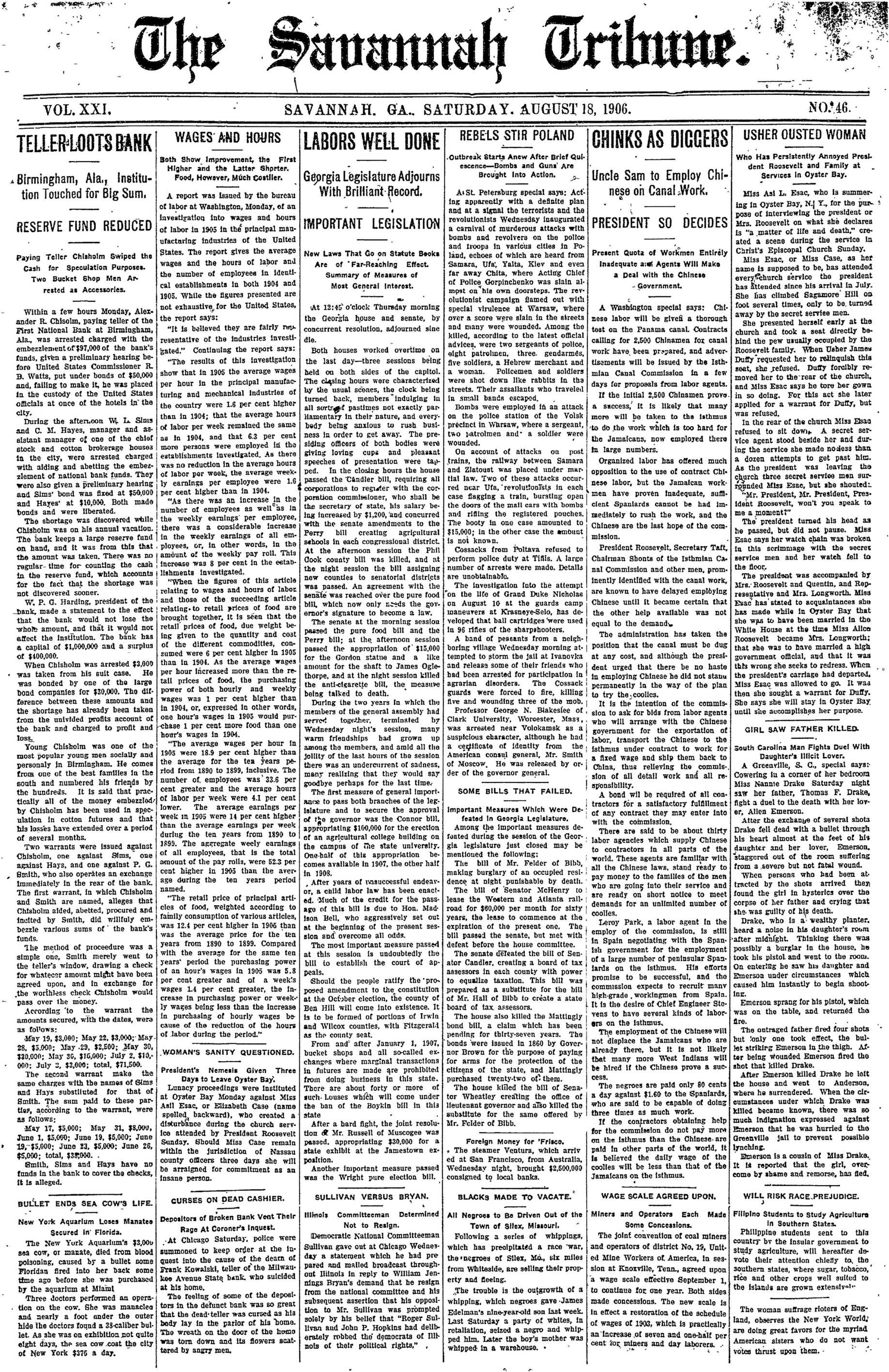

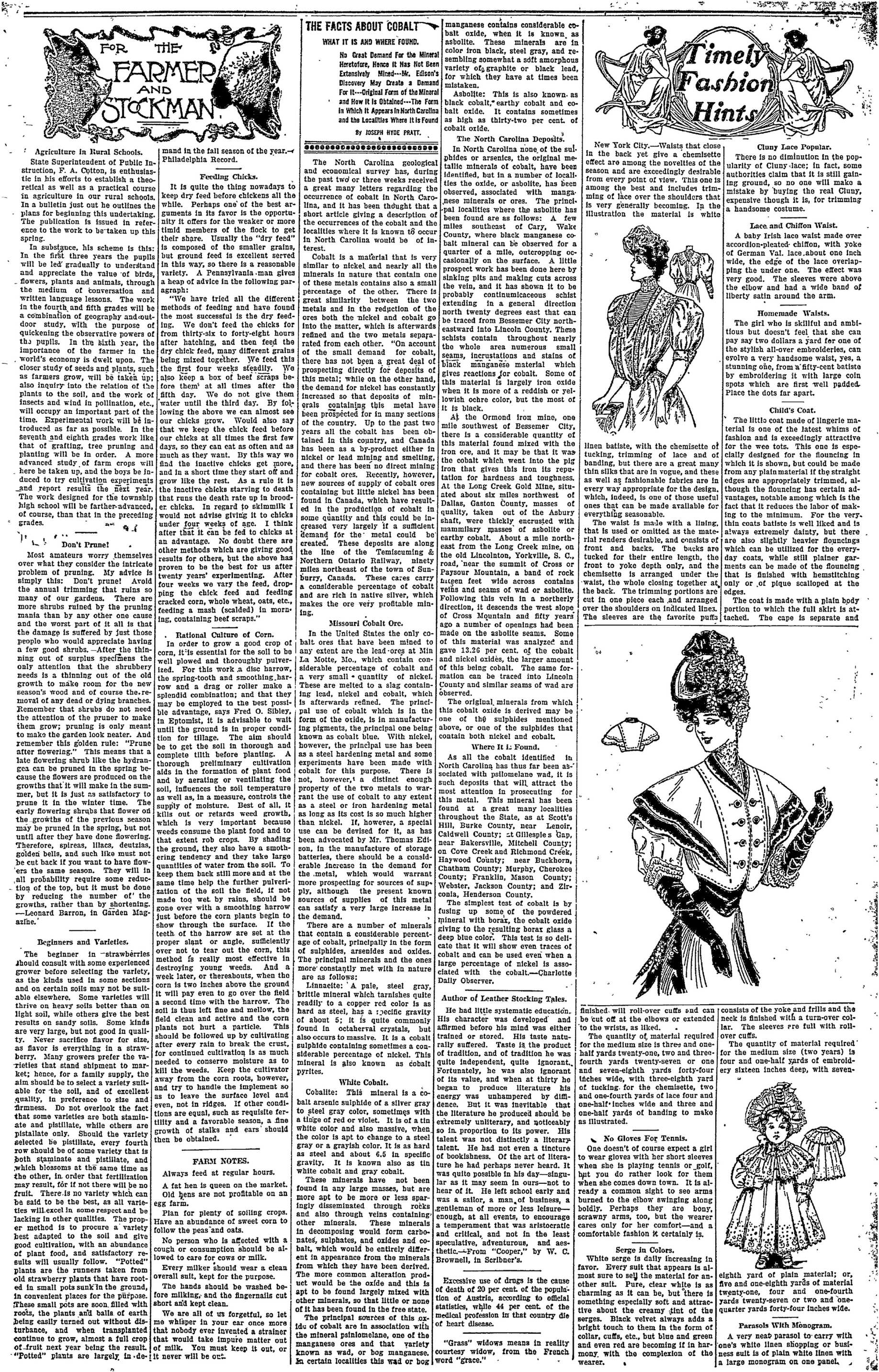
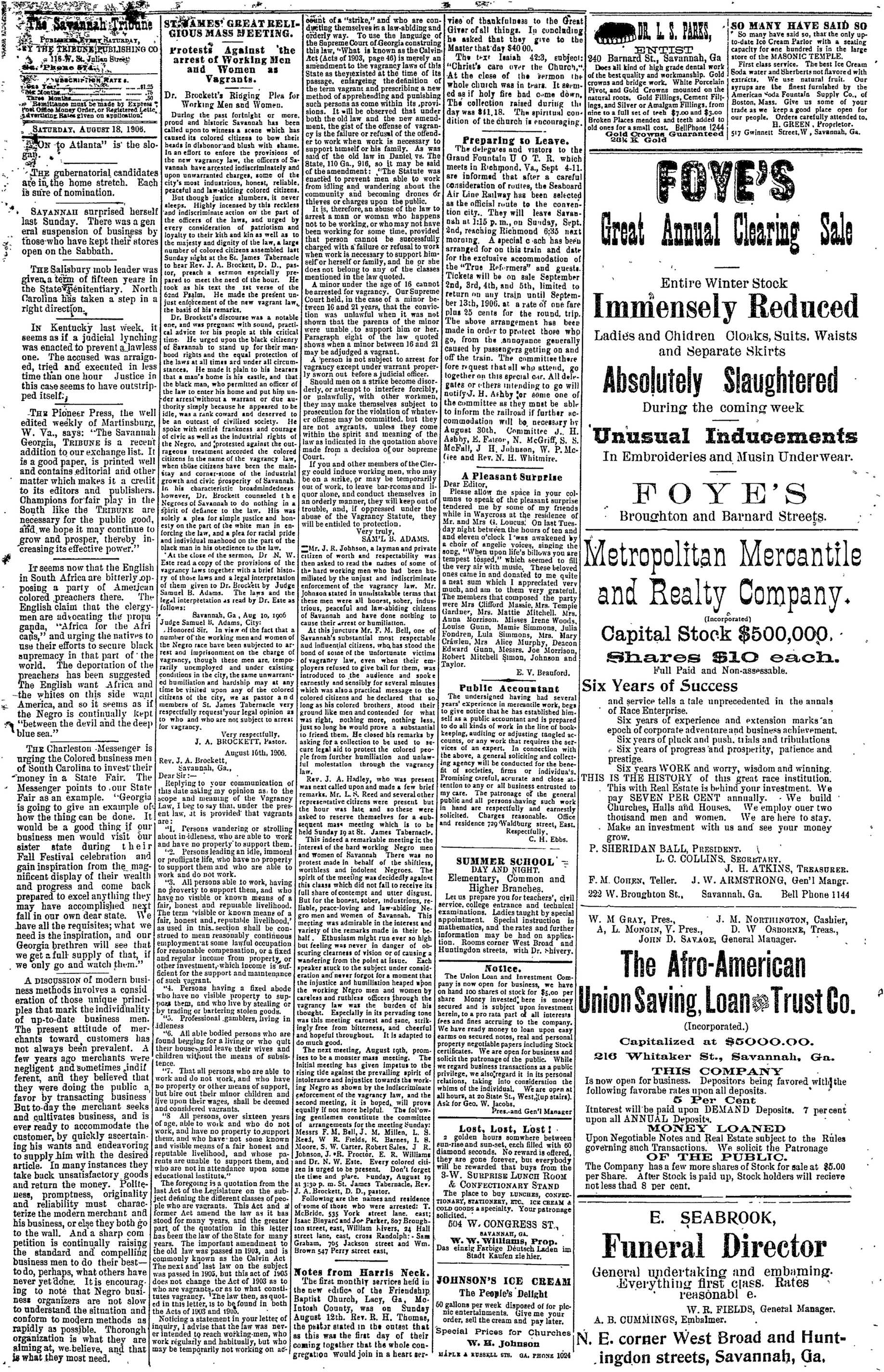
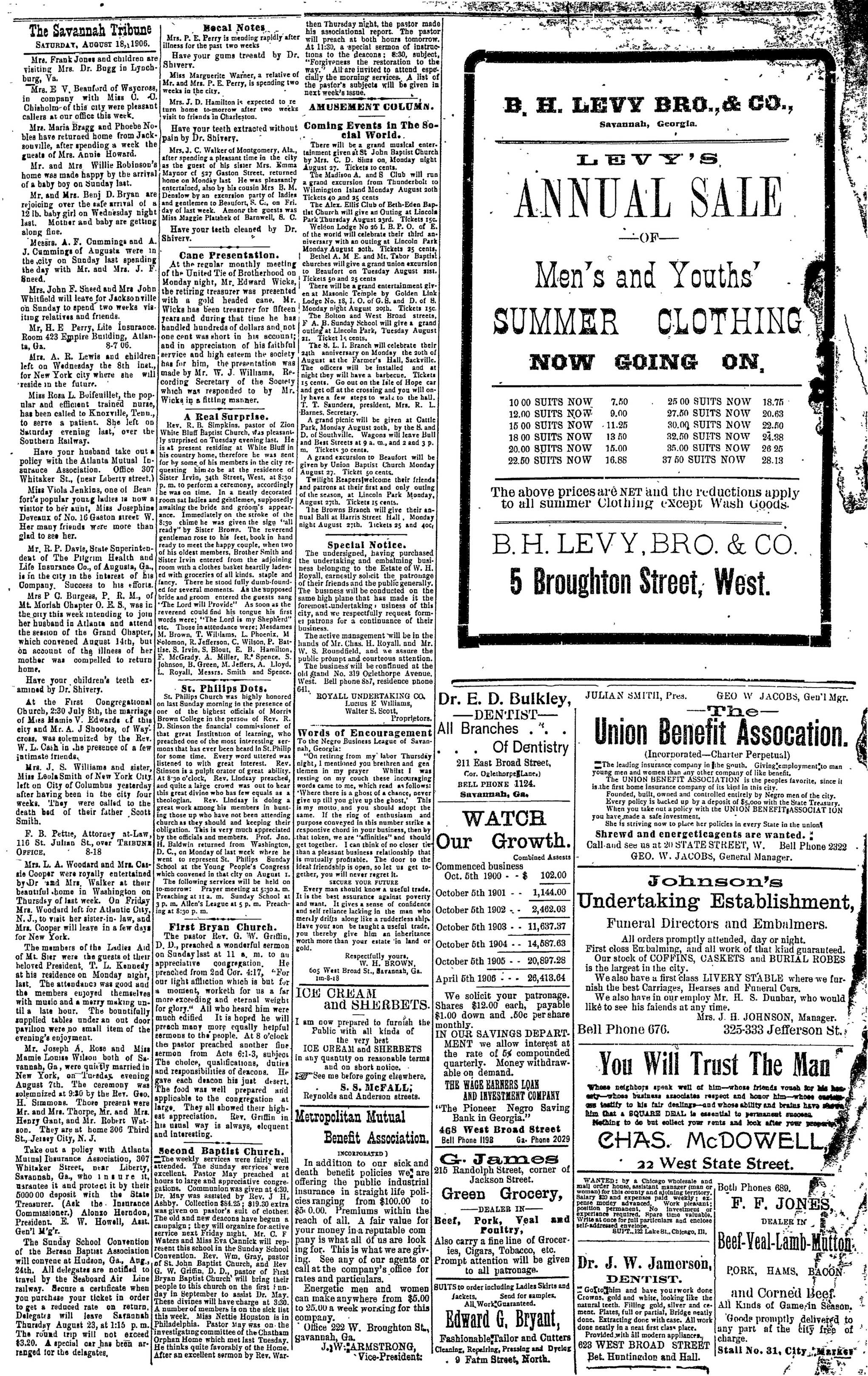
Page text (machine-generated)
VOL. XXI.
TELLER LOOTSBANK
Birmingham, Ala., Institution Touched for Big Sum.
RESERVE FUND REDUCED
Paying Teller Chisholm Swiped the Cash for Speculation Purposes. Two Bucket Shop Men Arrested as Accessories.
Within a few hours Monday, Alexander R. Chisholm, paying teller of the First National Bank at Birmingham, Ala., was arrested charged with the embezzlement of $7,000 of the bank's funds, given a preliminary hearing before United States Commissioner R. B. Watts, put under bonds of $50,000 and, failing to make it, he was placed in the custody of the United States officials at once of the hotels in the city.
During the afternoon W. L. Sims and C. M. Hayes, manager and assistant manager of one of the chief stock and cotton brokerage houses in the city, were arrested charged with alding and abetting the embezzlement of national bank funds. They were also given a preliminary hearing and Sims' bond was fixed at $50,000 and Hayes' at $10,000. Both made bonds and were liberated.
The shortage was discovered while Chisholm was on his annual vacation. The bank keeps a large reserve fund on hand, and it was from this that the amount was taken. There was no regular-time for counting the cash in the reserve fund, which accounts for the fact that the shortage was not discovered sooner.
W. P. G. Harding, president of the bank, made a statement to the effect that the bank would not lose the whole amount, and that it would not affect the institution. The bank has a capital of $1,000,000 and a surplus of $400,000.
When Chlsholm was arrested $3,000 was taken from his suit case. He was bonded by one of the large bond companies for $30,000. The difference between these amounts and the shortage has already been taken from the undivided profits account of the bank and charged to profit and loss.
Young Chisholm was one of the most popular young men socially and personally in Birmingham. He comes from one of the best families in the south and numbered his friends by the hundreds. It is said that practically all of the money embezzled by Chisholm has been used in speculation in cotton futures and that his losses have extended over a period of several months.
Two warrants were issued against Chisholm, one against Sims, one against Hays, and one against P. G. Smith, who also operates an exchange immediately in the rear of the bank. The first warrant, in which Chisholm and Smith are named, alleges that Chisholm alded, abetted, procured and incited by Smith, did willfully embezzle various sums of the bank's funds.
The method of procedure was a simple one, Smith merely went to the teller's window, drawing a check for whatever amount might have been agreed upon, and in exchange for the worthless check Chisholm would pass over the money.
According to the warrant the amounts secured, with the dates, were as follows:
May 19, $3,000; May 22, $3,000; May
28, $5,000; May 29, $2,500; May 30,
$20,000; May 36, $16,000; July 2, $10,
000; July 3, $2,000; total, $71,500.
The second warrant make the
same charges with the names of Sims
and Hays substituted for that of
Smith. The sum paid to these parties,
according to the warrant, were
as follows;
May 17, $5,000; May 31, $8,000,
June 1, $5,000; June 19, $5,000; June
19, $5,000; June 23, $5,000; June 26,
$5,000; total, $38,000.
Smith, Sims and Hays have no
funds in the bank to cover the checks,
it is alleged.
BULLET ENDS SEA COW'S LIFE.
New York Aquarium Loses Manates Secured in Florida.
The New York Aquarium's $3,000 sea cow, or manatee, died from blood poisoning, caused by a bullet some Floridan fired into her back some time ago before she was purchased by the aquarium at Miami.
Three doctors performed an operation on the cow. She was manacled and nearly a foot under the outer hide the doctors found a 33-caliber bullet. As she was on exhibition not quite eight days, the sea cow cost the city of New York $375 a day.
The Savannah Tribune.
WAGES AND HOURS
Both Show Improvement, the First Higher and the Latter Shprter. Food, However, Much Costiller.
A report was issued by the bureau of labor at Washington, Monday, of an investigation into wages and hours of labor in 1905 in the principal manufacturing industries of the United States. The report gives the average wages and the hours of labor and the number of employees in identical establishments in both 1904 and 1905. While the figures presented are not exhaustive for the United States, the report says:
"It is believed they are fairly representative of the industries investigated." Continuing the report says: "The results of this investigation show that in 1905 the average wages per hour in the principal manufacturing and mechanical industries of the country were 1.6 per cent higher than in 1904; that the average hours of labor per week remained the same as in 1904, and that 6.3 per cent more persons were employed in the establishments investigated. As there was no reduction in the average hours of labor per week, the average weekly earnings per employee were 1.6 per cent higher than in 1904.
"As there was an increase in the number of employees as well as in the weekly earnings' per employee, there was a considerable increase in the weekly earnings of all employees, or, in other words, in the amount of the weekly pay roll. This increase was 8 per cent in the establishments investigated.
"When the figures of this article relating to wages and hours of labor and those of the succeeding article relating to retail prices of food are brought together, it is seen that the retail prices of food, due weight being given to the quantity and cost of the different commodities, consumed were 6 per cent higher in 1905 than in 1904. As the average wages per hour increased more than the retail prices of food, the purchasing power of both hourly and weekly wages was 1 per cent higher than in 1904, or, expressed in other words, one hour's wages in 1905 would purchase 1 per cent more food than one hour's wages in 1904.
"The average wages per hour in 1905 were 18.9 per cent higher than the average for the ten years period from 1890 to 1899, inclusive. The number of employees was 33.6 per cent greater and the average hours of labor per week were 4.1 per cent lower. The average earnings per week in 1905 were 14 per cent higher than the average earnings per week during the ten years from 1890 to 1899. The aggregate weely earnings of all employees, that is the total amount of the pay rolls, were 52.3 per cent higher in 1905 than the average during the ten years period named.
"The retail price of principal articles of food, weighted according to family consumption of various articles, was 12.4 per cent higher in 1905 than was the average price for the ten years from 1890 to 1899. Compared with the average for the same ten years' period the purchasing power of an hour's wages in 1905 was 5.8 per cent greater and of a week's wages 1.4 per cent greater, the increase in purchasing power or weekly wages being less than the increase in purchasing of hourly wages because of the reduction of the hours of labor during the period."
WOMAN'S SANITY QUESTIONED.
President's Nemesis Given Three Days to Leave Oyster Bay
Lunacy proceedings were instituted at Oyster Bay Monday against Miss Asil Esac, or Elizabeth Case (name spelled, backward), who created a disturbance during the church service attended by President Roosevelt Sunday. Should Miss Case remain within the jurisdiction of Nassau county officers three days she will be arraigned for commitment as an insane person.
CURSES ON DEAD CASHIER.
Depositors of Broken Bank Vent Their Rage At Coroner's Inquest.
At Chicago Saturday, police were summoned to keep order at the inquest into the cause of the death of Frank Kowalski, teller of the Milwaukee Avenue State bank, who sulcided at his home.
The feeling of some of the depositors in the defunct bank was so great that the dead-teller was cursed as his body lay in the parlor of his home. The wreath on the door of the home was torn down and its flowers scattered by angry men.
SAVANNAH. GA.. SATURDAY. AUGUST 18, 1906.
LABORS WELL DONE
Georgia Legislature Adjourns With Brilliant Record.
IMPORTANT LEGISLATION
New Laws That Go on Statute Books Are of Far-Reaching Effect. Summary of Measures of Most General Interest.
At 12:45 o'clock Thursday morning the Georgia house and senate, by concurrent resolution, adjourned sine die.
Both houses worked overtime on the last day—three sessions being held on both sides of the capitol. The closing hours were characterized by the usual scenes, the clock being turned back, members indulging in all sorts of pastimes not exactly parliamentary in their nature, and everybody being anxious to rush business in order to get away. The presiding officers of both bodies were giving loving cups and pleasant speeches of presentation were tapped. In the closing hours the house passed the Candler bill, requiring all corporations to register with the corporation commissioner, who shall be the secretary of state, his salary being increased by $1,200, and concurred with the senate amendments to the Perry bill creating agrigultural schools in each congressional district. At the afternoon session the Phil Cook county bill was killed, and at the night session the bill assigning new counties to senatorial districts was passed. An agreement with the senate was reached over the pure food bill, which now only needs the governor's signature to become a law.
the senate at the morning session passed the pure food bill and the Perry bill; at the afternoon session passed the appropriation of $15,000 for the Gordon statue and a like amount for the shaft to James Oglethorpe, and at the night session killed the anti-cigarette bill, the measure being talked to death.
During the two years in which the members of the general assembly had served together, terminated by Wednesday night's session, many warm friendships had grown up among the members, and amid all the jollity of the last hours of the session there was an undercurrent of sadness, many realizing that they would say goodbye perhaps for the last time.
The first measure of general importance to pass both branches of the legislature and to secure the approval of the governor was the Connor bill, appropriating $100,000 for the erection of an agricultural college building on the campus of the state university. One-half of this appropriation becomes available in 1907, the other half in 1908. After years of unsuccessful endeavor, a child labor law has been enacted. Much of the credit for the passage of this bill is due to Hon. Madison Bell, who aggressively set out at the beginning of the present session and overcome all odds. The most important measure passed at this session is undoubtedly the bill to establish the court of appeals.
Should the people ratify the proposed amendment to the constitution at the October election, the county of Ben Hill will come into existence. It is to be formed of portions of Irwin and Wilcox counties, with Fitzgerald as the county seat. From and after January 1, 1907, bucket shops and all so-called exchanges where marginal transactions in futures are made are prohibited from doing business in this state. There are about forty or more of such Louses which will come under the ban of the Boykin bill in this state. After a hard fight, the joint resolution Mr. Russell of Muscogee was passed, appropriating $30,000 for a state exhibit at the Jamestown exposition.
Another important measure passed was the Wright pure election bill.
SULLIVAN VERSUS BRYAN.
Illinois Committeeman Determined Not to Resign.
Democratic National Committeeman Sullivan gave out at Chicago Wednesday a statement which he had prepared and mailed broadcast throughout Illinois in reply to William Jennings Bryan's demand that he resign from the national committee and his subsequent assertion that his opposition to Mr. Sullivan was prompted solely by his belief that "Roger Sullivan and John P. Hopkins had deliberately robbed the democrats of Illinois of their political rights."
REBELS STIR POLAND
Outbreak Starts Anew After Brief Quiescence—Bombs and Guna' Are Brought Into Action.
A1 St. Petersburg special says: Acting apparently with a definite plan and at a signal the terrorists and the revolutionists Wednesday inaugurated a carnival of murderous attacks with bombs and revolvers on the police and troops in various cities in Poland, echoes of which are heard from Samara, Ufa, Yalta, Kiev and even far away Chita, where Acting Chief of Police Gorpinchenko was slain almost on his own doorsteps. The revolutionist campaign flamed out with special virulence at Warsaw, where over a score were slain in the streets and many were wounded. Among the killed, according to the latest official advises, were two sergeants of police, eight patrolmen, three. gendarmes, five soldiers, a Hebrew merchant and a woman. Policemen and soldiers were shot down like rabbits in the streets. Their assailants who traveled in small bands escaped.
Bombs were employed in an attack on the police station of the Volsk precinct in Warsaw, where a sergeant, two patrolmen and a soldier were wounded.
On account of attacks on post trains, the railway between Samara and Zlatoust was placed under martial law. Two of these attacks occurred near Ufa, revolutionists in each case flagging a train, bursting open the doors of the mall cars with bombs and rifling the registered pouches. The booty in one case amounted to $15,000; in the other case the amount is not known.
Cossacks from Poltava refused to perform police duty at Tiflis. A large number of arrests were made. Detalls are unobtainable.
The investigation into the attempt on the life of Grand Duke Nicholas on August 10 at the guards camp maneuvers at Krasnaye-Selo, has developed that ball cartridges were used in 96 rifles of the sharpshooters. A band of peasants from a neighboring village Wednesday morning attempted to storm the jail at Ivanovka and release some of their friends who had been arrested for participation in agrarian disorders. The Cossack guards were forced to fire, killing five and wounding three of the mob.
Professor George N. Blakeslee of Clark University, Woroester, Mass, was arrested near Volokamsk as a suspicious character, although he had a certificate of identity from the American consul general, Mr. Smith of Moscow. He was released by order of the governor general.
SOME BILLS THAT FAILED.
Important Measures Which Were Defeated in Georgia Legislature. Among the important measures defeated during the session of the Georgia legislature just closed may be mentioned the following: The bill of Mr. Felder of Bibb, making burglary of an occupied residence at night punishable by death. The bill of Senator McHenry to lease the Western and Atlanta railroad for $60,000 per month for sixty years, the lease to commence at the expiration of the present one. The bill passed the senate, but met with defeat before the house committee.
The senate defeated the bill of Senator Candler, creating a board of tax assessors in each county with power to equalize taxation. This bill was prepared as a substitute for the bill of Mr. Hall of Bibb to create a state board of tax assessors.
The house also killed the Mattingly bond bill, a claim which has been pending for thirty-seven years. The bonds were issued in 1860 by Governor Brown for the purpose of paying for arms for the protection of the citizens of the state, and Mattingly purchased twenty-two of them.
The house killed the bill of Senator Wheatley creating the office of lieutenant governor and also killed the substitute for the same offered by Mr. Felder of Bibb.
Foreign Money for Prisco.
The steamer Ventura, which arrived at San Francisco, from Australia,
Wednesday night, brought $2,500,000 consigned to local banks.
All Negroes to Be Driven Out of the Town of Silex. Missouri.
Following a series of whippings, which has precipitated a race war, the negroes of Silex, Mo., six miles from Whiteside, are selling their property and fleeing.
The trouble is the outgrowth of a whipping, which negroes gave James Edelman's nine-year-old son last week. Last Saturday a party of whites, in retaliation, seized a negro and whipped him. Later the boy's mother was whipped in a warehouse.
CHINKS AS DIGGERS
Uncle Sam to Employ Chinese on Canal Work.
PRESIDENT SO DECIDES
Present Quota of Workmen Entirely Inadequate and Agents Will Make a Deal with the Chinese
A Washington special says: Chinese labor will be given a thorough test on the Panama canal. Contracts calling for 2,500 Chinamen for canal work have been prepared, and advertisements will be issued by the Isthmian Canal Commission in a few days for proposals from labor agents. If the initial 2,500 Chinamen prove a success, it is likely that many more will be taken to the isthmus to do the work which is too hard for the Jamalcans, now employed there in large numbers.
Organized labor has offered much opposition to the use of contract Chinese labor, but the Jamaican workmen have proven inadequate, sufficient Spaniards cannot be had immediately to rush the work, and the Chinese are the last hope of the commission.
President Roosevelt, Secretary Taft, Chairman Shonts of the Isthmian Canal Commission and other men, prominently identified with the canal work, are known to have delayed employing Chinese until it became certain that the other help available was not equal to the demand.
The administration has taken the position that the canal must be dug at any cost, and although the president urged that there be no haste in employing Chinese he did not stand permanently in the way of the plan to try the coolies.
It is the intention of the commission to ask for bids from labor agents who will arrange with the Chinese government for the exportation of labor, transport the Chinese to the isthmus under contract to work for a fixed wage and ship them back to China, thus relieving the commission of all detail work and all responsibility.
A bond will be required of all contractors for a satisfactory fulfillment of any contract they may enter into with the commission. There are said to be about thirty labor agencies which supply Chinese to contractors in all parts of the world. These agents are familiar with all the Chinese laws, stand ready to pay money to the families of the men who are going into their service and are ready on short notice to meet demands for an unlimited number of coolies.
Leroy Park, a labor agent in the employ of the commission, is still in Spain negotiating with the Spanish government for the employment of a large number of peninsular Spaniards on the isthmus. His efforts promise to be successful, and the commission expects to recruit many high-grade, workingmen from Spain. It is the desire of Chief Engineer Stovens to have several kinds of laborers on the isthmus.
The employment of the Chinese will not displace the Jamalcans who are already there, but it is not likely that many more West Indians will be hired if the Chinese prove a success.
The negroes are paid only 80 cents a day against $1.60 to the Spanishs, who are said to be capable of doing three times as much work.
If the contractors obtaining help for the commission do not pay more on the lsthmus than the Chinese, are paid in other parts of the world, it is believed the daily wage of the coolies will be less than that of the Jamaicanes on the lsthmus.
WAGE SCALE AGREED UPON.
Miners and Operators Each Made Some Concessions. The joint convention of coal miners and operators of district No.19, United Mine Workers of America, in session at Knoxville, Tenn., agreed upon a wage scale effective September 1, to continue for one year. Both sides made concessions. The new scale is in effect a restoration of the schedule of wages of 1903, which is practically an increase of seven and one-half per cent for miners and day laborers.
---
USHER OUSTED WOMAN
Who Has Persistently Annoyed President Roosevelt and Family at Services in Oyster Bay.
Miss Asl L. Esac, who is summering in Oyster Bay, N. J. Y., for the purpose of interviewing the president or Mrs. Roosevelt on what she declares is "a matter of life and death," created a scene during the service in Christ's Episcopal Church Sunday.
Miss Esac, or Miss Case, as her name is supposed to be, has attended every Church service the president has attended since his arrival in July. She has climbed Sagamore Hill on foot several times, only to be turned away by the secret service men.
She presented herself early at the church and took a seat directly behind the pew usually occupied by the Roosevelt family. When Usher James Duffy requested her to relinquish this seat, she refused. Duffy forcibly removed her to the rear of the church, and Miss Esac says he tore her gown in so doing. For this act she later applied for a warrant for Duffy, but was refused.
In the rear of the church Miss Esac refused to sit down. A secret service agent stood beside her and during the service she made no less than a dozen attempts to get past him. As the president was leaving the church three secret service men surrounded Miss Esac, but she shouted: "Mr. President, Mr. President, President Roosevelt, won't you speak to me a moment?" The president turned his head as he passed, but did not pause. Miss Esac says her watch chain was broken in this scrimmage with the secret service men and her watch fell to the floor.
The president was accompanied by Mrs. Roosevelt and Quentin, and Representative and Mrs. Longworth. Miss Esac has stated to acquaintances she has made while in Oyster Bay that she was to have been married in the White House at the time Miss Alice Roosevelt became Mrs. Longworth; that she was to have married a high government official, and that it was this wrong she seeks to redress. When the president's carriage had departed, Miss Esac was allowed to go. It was then she sought a warrant for Duffy. She says she will stay in Oyster Bay, until she accomplishes her purpose.
GIRL SAW FATHER KILLED.
South Carolina Man Fights Duel With Daughter's Illicit Lover.
A Greenville, S. C., special says: Cowering in a corner of her bedroom Miss Nannie Drake Saturday night saw her father, Thomas F. Drake, fight a duel to the death with her lover, Allen Emerson.
Atter the exchange of several shots Drake fell dead with a bullet through his heart almost at the feet of his daughter and her lover, Emerson, staggred out of the room suffering from a severe but not fatal wound.
When persons who had been attracted by the shots arrived they found the girl in hysterics over the corpse of her father and crying that she was guilty of his death.
Drake, who is a wealthy planter, heard a noise in his daughter's room after midnight. Thinking there was possibly a burglar in the house, he took his pistol and went to the room. On entering he saw his daughter and Emerson under circumstances which caused him instantly to begin shooting. Emerson sprang for his pistol, which was on the table, and returned the fire. The outraged father fired four shots but only one took effect, the bullet striking Emerson in the thigh. After being wounded Emerson fired the shot that killed Drake.
After Emerson killed Drake he left the house and went to Anderson, where he surrendered. When the circumstances under which Drake was killed became known, there was so much indignation expressed against Emerson that he was hurried to the Greenville jail to prevent possible lynching. Emerson is a cousin of Miss Drake. It is reported that the girl, overcome by shame and remorse, has fled.
WILL RISK RACE.PREJUDICE.
Filipino Students to Study Agriculture in Southern States.
Philippine students sent to this country by the insular government to study agriculture, will hereafter devote their attention chiefly to the southern states, where sugar, tobacco, rice and other crops well suited to the islands are grown extensively.
The woman suffrage rioters of England, observes the New York World; are doing great favors for the myriad American sisters who do not want votes thrust upon them.
FOR THE FARMER AND STOCKMAN
State Superintendent of Public Instruction, F. A. Cotton, is enthusiastic in his efforts to establish a theoretical as well as a practical course in agriculture in our rural schools. In a bulletin just out he outlines the plans for beginning this undertaking. The publication is issued in reference to the work to be taken up this spring.
In substance, his scheme is this: In the first three years the pupils will be led gradually to understand and appreciate the value of birds, flowers, plants and animals, through the medium of conversation and written language lessons. The work in the fourth and fifth grades will be a combination of geography and outdoor study, with the purpose of quickening the observative powers of the pupils. In the sixth year, the importance of the farmer in the world's economy is dwelt upon. The closer study of seeds and plants, such as farmers grow, will be taken up; also inquiry into the relation of the plants to the soil, and the work of insects and wind in pollination, etc., will occupy an important part of the time. Experimental work will be introduced as far as possible. In the seventh and eighth grades work like that of grafting, tree pruning and planting will be in order. A more advanced study of farm crops will here be taken up, and the boys be induced to try cultivation experiments and report results the next year. The work designed for the township high school will be farther advanced, of course, than that in the preceding grades.
Don't Prune!
Most amateurs worry themselves over what they consider the intricate problem of pruning. My advice is simply this: Don't prune! Avoid the annual trimming that ruins so many of our gardens. There are more shrubs ruined by the pruning mania than by any other one cause and the worst part of it all is that the damage is suffered by just those people who would appreciate having a few good shrubs. After the thinning out of surplus specimens the only attention that the shrubbery needs is a thinning out of the old growth to make room for the new season's wood and of course the removal of any dead or dying branches. Remember that shrubs do not need the attention of the pruner to make them grow; pruning is only meant to make the garden look neater. And remember this golden rule: "Prune after flowering." This means that a late flowering shrub like the hydrangea can be pruned in the spring because the flowers are produced on the growths that it will make in the summer, but it is just as satisfactory to prune it in the winter time. The early flowering shrubs that flower on the growths of the previous season may be pruned in the spring, but not until after they have done flowering. Therefore, spirea, lilacs, deutzias, golden bells, and such like must not be cut back if you want to have flowers the same season. They will in all probability require some reduction of the top, but it must be done by reducing the number of the growths, rather than by shortening. —Leonard Barron, in Garden Magazine.
Beginners and Varletles.
The beginner in strawberries should consult with some experienced grower before selecting the variety, as the kinds used in some sections and on certain soils may not be suitable elsewhere. Some varieties thrive on heavy soils better than on light soil, while others give the best results on sandy soils. Some kinds are very large, but not good in quality. Never sacrifice flavor for size, as flavor is everything in a strawberry. Many growers prefer the varieties that stand shipment to market; hence, for a family supply, the aim should be to select a variety suitable for the soil, and of excellent quality, in preference to size and firmness. Do not overlook the fact that some varieties are both staminate and pistillate, while others are pistallate only. Should the variety selected be pistillate, every fourth row should be of some variety that is both staminate and pistillate, and which blossoms at the same time as the other, in order that fertilization may result, for if not there will be no fruit. There is no variety which can be said to be the best, as all varieties will excel in some respect and be lacking in other qualities. The proper method is to procure a variety best adapted to the soil and give good cultivation, with an abundance of plant food, and satisfactory results will usually follow. "Potted" plants are the runners taken from old strawberry plants that have rooted in small pots sunk in the ground, in convenient places for the purpose. These small pots are soon filled with roots, the plants and balls of earth being easily turned out without disturbance, and when transplanted continue to grow, almost a full crop of fruit next year being the result. "Potted" plants are largely in de-
mand in the fall season of the year. Philadelphia Record.
Feeding Chicks.
It is quite the thing nowadays to keep dry feed before chickens all the while. Perhaps one of the best arguments in its favor is the opportunity it offers for the weaker or more timid members of the flock to get their share. Usually the "dry feed" is composed of the smaller grains, but ground feed is excellent served in this way, so there is a reasonable variety. A Pennsylvania man gives a heap of advice in the following paragraph:
"We have tried all the different methods of feeding and have found the most successful is the dry feeding. We don't feed the chicks for from thirty-six to forty-eight hours after hatching, and then feed the dry chick feed, many different grains being mixed together. We feed this the first four weeks steadily. We also keep a box of beef scraps before them' at all times after the fifth day. We do not give them water until the third day. By following the above we can almost see our chicks grow. Would also say that we keep the chick feed before our chicks at all times the first few days, so they can eat as often and as much as they want. By this way we find the inactive chicks get more, and in a short time they start off and grow like the rest. As a rule it is the inactive chicks starving to death that runs the death rate up in brooder chicks. In regard to skimmilk we would not advise giving it to chicks under four weeks of age. I think after that it can be fed to chicks at an advantage. No doubt there are other methods which are giving good results for others, but the above has proven to be the best for us after twenty years' experimenting. After four weeks we vary the feed, dropping the chick feed and feeding cracked corn, whole wheat, oats, etc., feeding a mash (scalded) in morning, containing beef scraps."
. Rational Culture of Corn.
In order to grow a good crop of corn, it is essential for the soil to be well plowed and thoroughly pulverized. For this work a disc harrow, the spring-tooth and smoothing harrow and a drag or roller make a splendid combination; and that they may be employed to the best possible advantage, says Fred O. Sibley, in Eptomlist, it is advisable to wait until the ground is in proper condition for tillage. The aim should be to get the soil in thorough and complete tilth before planting. A thorough preliminary cultivation alds in the formation of plant food and by aerating or ventilating the soil, influences the soil temperature as well as, in a measure, controls the supply of moisture. Best of all, it kills out or retards weed growth, which is very important because weeds consume the plant food and to that extent rob crops. By shading the ground, they also have a smothering tendency and they take large quantities of water from the soil. To keep them back still more and at the same time help the further pulverization of the soil the field, if not made too wet by rains, should be gone over with a smoothing harrow just before the corn plants begin to show through the surface. If the teeth of the harrow are set at the proper slant or angle, sufficiently over not to tear out the corn, this method is really most effective in destroying young weeds. And a week later, or thereabouts, when the corn is two inches above the ground it will pay even to go over the field a second time with the harrow. The soil is thus left fine and mellow, the field clean and active and the corn plants not hurt a particle. This should be followed up by cultivating after every rain to break the crust, for continued cultivation is as much needed to conserve moisture as to kill the weeds. Keep the cultivator away from the corn roots, however, and try to handle the implement so as to leave the surface level and even, not in ridges. If other conditions are equal, such as requisite fertility and a favorable season, a fine growth of stalks and ears should then be obtained.
FARM NOTES.
Always feed at regular hours.
A fat hen is queen on the market.
Old hens are not profitable on an egg farm.
Plan for plenty of soiling crops.
Have an abundance of sweet corn to follow the peas and oats.
No person who is affected with a cough or consumption should be allowed to care for cows or milk.
Every milker should wear a clean overall suit, kept for the purpose.
The hands should be washed before milking, and the fingernails cut short and kept clean.
We are all of us forgetful, so let me whisper in your ear once more that nobody ever invented a strainer that would take impure matter out of milk. You must keep it out, or it never will be out.
THE FACTS ABOUT COBALT
WHAT IT IS AND WHERE FOUND.
No Great Demand For the Mineral Heretofore, Hence It Has Not Been Extensively Mined---Mr. Edison's Discovery May Create a Demand For It---Original Form of the Mineral and How It Is Obtained---The Form In Which It Appears In North Carolina and the Localities Where It Is Found
By JOSEPH HYDE PRATT.
---
The North Carolina geological and economical survey has, during the past two or three weeks received a great many letters regarding the occurrence of cobalt in North Carolina, and it has been thought that a short article giving a description of the occurrences of the cobalt and the localities where it is known to occur in North Carolina would be of interest.
Cobalt is a material that is very similar to nickel and nearly all the minerals in nature that contain one of these metals contains also a small percentage of the other. There is great similarity between the two metals and in the reduction of the ores both the nickel and cobalt go into the matter, which is afterwards refined and the two metals separated from each other. "On account of the small demand for cobalt, there has not been a great deal of prospecting directly for deposits of this metal; while on the other hand, the demand for nickel has constantly increased so that deposits of minerals containing this metal have been prospected for in many sections of the country. Up to the past two years all the cobalt has been obtained in this country, and Canada has been as a by-product either in nickel or lead mining and smelting, and there has been no direct mining for cobalt ores. Recently, however, new sources of supply of cobalt ores containing but little nickel has been found in Canada, which have resulted in the production of cobalt in some quantity and this could be increased very largely if a sufficient demand for the metal could be created. These deposits are along the line of the Temiscunning & Northern Ontario Railway, ninety miles northeast of the town of Sunburry, Canada. These cares carry a considerable percentage of cobalt and are rich in native silver, which makes the ore very profitable mining.
Missouri Cobalt Orc.
In the United States the only coaltal ores that have been mined to any extent are the lead-ores at Min La Motte, Mo., which contain considerable percentage of cobalt and a very small quantity of nickel. These are melted to a slag containing lead, nickel and cobalt, which is afterwards refined. The principal use of cobalt which is in the form of the oxide, is in manufacturing pigments, the principal one being known as cobalt blue. With nickel, however, the principal use has been as a steel hardening metal and some experiments have been made with cobalt for this purpose. There is not, however, a distinct enough property of the two metals to warrant the use of cobalt to any extent as a steel or iron hardening metal as long as its cost is so much higher than nickel. If, however, a special use can be devised for it, as has been advocated by Mr. Thomas Edison, in the manufacture of storage batteries, there should be a considerable increase in the demand for the metal, which would warrant more prospecting for sources of supply, although the present known sources of supplies of this metal can satisfy a very large increase in the demand.
There are a number of minerals that contain a considerable percentage of cobalt, principally in the form of sulphides, arsenides and oxides. The principal minerals and the ones more constantly met with in nature are as follows:
Linnaeite: A pale, steel gray, brittle mineral which tarnishes quite readily to a copper red color is as hard as steel, has a specific gravity of about 5; it is quite commonly found in octaherval crystals, but also occurs to massive. It is a cobalt sulphide containing sometimes a considerable percentage of nickel. This mineral is also known as cobalt pyrites.
White Cobalt.
Cobalite: This mineral is a cobalt arsenic sulphide of a silver gray to steel gray color, sometimes with a tinge of red or violet. It is of a tin white color and also massive, when the color is apt to change to a steel gray or a grayish color. It is as hard as steel and about 6.5 in specific gravity. It is known also as tin white cobalt and gray cobalt.
These minerals have not been found in any large masses, but are more apt to be more or less sparingly disseminated through rocks and also through veins containing other minerals. These minerals in decomposing would form carbonates, sulphates, and oxides and cobalt, which would be entirely different in appearance from the minerals from which they have been derived. The more common alteration product would be the oxide and this is apt to be found largely mixed with other minerals, so that little or none of it has been found in the free state. The principal sources of this oxide of cobalt are in association with the mineral psalmolane, one of the manganese ores and that variety known as wad, or bog manganese. In certain localities this wad or bog
manganese contains considerable cobalt oxide, when it is known as asbolite. These minerals are in color iron black, steel gray, and resembling somewhat a soft amorphous variety of graphite or black lead, for which they have at times been mistaken. Asbolite: This is also known as black cobalt, earthy cobalt and cobalt oxide. It contains sometimes as high as thirty-two per cent. of cobalt oxide.
The North Carolina Deposits.
In North Carolina none of the sulphides or arsenics, the original metallic minerals of cobalt, have been identified, but in a number of localities the oxide, or asbolite, has been observed, associated with manganese minerals or ores. The principal localities where the asbolite has been found are as follows: A few miles southeast of Cary, Wake County, where black manganese cobalt mineral can be observed for a quarter of a mile, outcropping occasionally on the surface. A little prospect work has been done here by sinking pits and making cuts across the vein, and it has shown it to be probably continuumicaceous schist extending in a general direction north twenty degrees east that can be traced from Bessemer City northeastward into Lincoln County. These schists contain throughout nearly the whole area numerous small seams, incrustations and stains of black manganese material which gives reactions for cobalt. Some of this material is largely iron oxide when it is more of a reddish or yellowish ochre color, but the most of it is black.
At the Ormond iron mine, one mile southwest of Bessemer City, there is a considerable quantity of this material found mixed with the iron ore, and it may be that it was the cobalt which went into the pig iron that gives this iron its reputation for hardness and toughness. At the Long Creek Gold Mine, situated about six miles northwest of Dallas, Gaston County, masses of quality, taken out of the Asbury shaft, were thickly encrusted with mammillary masses of asbolite or earthy cobalt. About a mile northeast from the Long Creek mine, on the old Lincolnton, Yorkville, S. C., road, near the summit of Cross or Paysour Mountain, a band of rock hugeen feet wide across contains veins and seams of wad or asbolite. Following this vein in a northerly direction, it descends the west slope of Cross Mountain and fifty years ago a number of openings had been made on the asbolite seams. Some of this material was analyzed and gave 13.26 per cent. of the cobalt and nickel oxides, the larger amount of this being cobalt. The same formation can be traced into Lincoln County and similar seams of wad are observed.
The original minerals from which this cobalt oxide is derived may be one of the th$_{\theta}$ sulphides mentioned above, or one of the sulphides that contain both nickel and cobalt.
Where It L: Found.
As all the cobalt identified in North Carolina has thus far been associated with psilomelane wad, it is such deposits that will attract the most attention in prosecuting for this metal. This mineral has been found at a great many localities throughout the State, as at Scott's Hill, Burke County, near Lenoir, Caldwell County; at Gillespie Gap, near Bakersville, Mitchell County; on Cove Creek and Richmond Creek, Haywood County; near Buckhorn, Chatham County; Murphy, Cherokee County; Franklin, Mason County; Webster, Jackson County; and Zirconia, Henderson County.
The simplest test of cobalt is by fusing up some of the powdered mineral with borax, the cobalt oxide giving to the resulting borax glass a deep blue color. This test is so delicate that it will show even traces of cobalt and can be used even when a large percentage of nickel is associated with the cobalt.—Charlotte Daily Observer.
Author of Leather Stocking Tales.
He had little systematic education. His character was developed and affirmed before his mind was either trained or stored. His taste naturally suffered. Taste is the product of tradition, and of tradition he was quite independent, quite ignorant. Fortunately, he was also ignorant of its value, and when at thirty he began to produce literature his energy was unhampered by diffidence. But it was inevitable that the literature he produced should be extremely unliterary, and noticeably so in proportion to its power. His talent was not distinctly a literary talent. He had not even a tincture of bookishness. Of the art of literature he had perhaps never heard. It was quite possible in his day—singular as it may seem in ours—not to hear of it. He left school early and was a sailor, a man of business, a gentleman of more or less leisure—enough, at all events, to encourage a temperament that was aristocratic and critical, and not in the least speculative, adventurous, and aesthetic. From "Cooper," by W. C. Brownell, in Scribner's.
Excessive use of drugs is the cause of death of 20 per cent. of the population of Austria, according to official statistics, while 44 per cent. of the medical profession in that country die of heart disease.
"Grass" widows means in reality courtesy widow, from the French word "grace."
Timely Fashion Hints
04
New York City.—Walsts that close in the back yet give a chemisette effect are among the novelties of the season and are exceedingly desirable from every point of view. This one is among the best and includes trimming of lace over the shoulders that is very generally becoming. In the illustration the material is white
12
linen batiste, with the chemisette of tucking, trimming of lace and of banding, but there are a great many thin silks that are in vogue, and these as well as fashionable fabrics are in every way appropriate for the design, which, indeed, is one of those useful ones that can be made available for everything seasonable.
The waist is made with a lining, that is used or omitted as the material renders desirable, and consists of front and backs. The backs are tucked for their entire length, the front to yoke depth only, and the chemisette is arranged under the waist, the whole closing together at the back. The trimming portions are cut in one piece each and arranged over the shoulders on indicated lines. The sleeves are the favorite puffa
10
finished, will roll-over cuffs and can be cut off at the elbows or extended to the wrists, as liked.
The quantity of material required for the medium size is three and one-half yards twenty-one, two and three-fourth yards twenty-seven or one and seven-eighth yards forty-four inches wide, with three-eighth yard of tucking. for the chemisette, two and one-fourth yards of lace four and one-half* inches wide and three and one-half yards of banding to make as illustrated.
No Gloves For Tennis.
One doesn't of course expect a girl to wear gloves with her short sleeves when she is playing tennis or golf, but you do rather look for them when she comes down town. It is already a common sight to see arms burned to the elbow swinging along boldly. Perhaps they are bony, scrawny arms, too, but the wearer cares only for her comfort—and a comfortable fashion it certainly is.
Serge in Colors.
White serge is daily increasing in favor. Every suit that appears is almost sure to sell the material for another suit. Pure, clear white is as charming as it can be, but there is something especially soft and attractive about the creamy hint of the serges. Black velvet always adds a bright touch to them in the form of collar, cuffs, etc., but blue and green and even red are becoming if in harmony, with the complexion of the wearer.
Cluny Lace Popular.
There is no diminution in the popularity of Cluny lace; in fact, some authorities claim that it is still gaining ground, so no one will make a mistake by buying the real Cluny, expensive though it is, for trimming a handsome costume.
Lace and Chiffon Waist.
A baby Irish lace waist made over accordion-pleated chiffon, with yoke of German Val. lace. about one inch wide, the edge of the lace overlapping the under one. The effect was very good. The sleeves were above the elbow and had a wide band of liberty satin around the arm.
Homemade Walsts.
The girl who is skillful and ambitious but doesn't feel that she can pay say two dollars a yard for one of the stylish all-over embroideries, can evolve a very handsome waist, yes, a stunning one, from a fifty-cent batiste by embroidering it with large coin spots which are first well padded. Place the dots far apart.
Child's Coat.
The little coat made of lingerie material is one of the latest whims of fashion and is exceedingly attractive for the wee tots. This one is especially designed for the flouncing in which it is shown, but could be made from any plain material if the straight edges are appropriately trimmed, although the flouncing has certain advantages, notable among which is the fact that it reduces the labor of making to the minimum. For the very thin coats batiste is well liked and is always extremely dainty, but there are also slightly heavier flouncings which can be utilized for the everyday coats, while still plainer garments can be made of the flouncing that is finished with hemstitching only or of plaque scalloped at the edges.
The coat is made with a plain body portion to which the full skirt is attached. The cape is separate and
100
consists of the yoke and frills and the neck is finished with a turn-over collar. The sleeves are full with rollover cuffs. The quantity of material required for the medium size (two years) is four and one-half yards of embroidery sixteen inches deep, with seven-
```markdown
```
eighth yard of plain material; or, five and one-eighth yards of material twenty-one, four and one-fourth yards twenty-seven or two and one-quarter yards forty-four inches wide.
Parasols With Monogram.
A very neat parasol to carry with one's white linen shopping or business suit is of plain white linen with a large monogram on one panel.
THE Savannah Tribune
PUBLISHED EVERY NATURDAY,
BY THE TRIBUNE PUBLISHING CO.
116 W. St. Julian Street
Se. Phone 574
THE gubernatorial candidates are in the home stretch. Each is sure of nomination.
SAYANNAH surprised herself last Sunday. There was a general suspension of business by those who have kept their stores open on the Sabbath.
THE Salisbury mob leader was given a term of fifteen years in the State penitentiary. North Carolina has taken a step in a right direction.
In Kentucky last week, it seems as if a judicial lynching was enacted to prevent a lawless one. The accused was arraigned, tried and executed in less time than one hour. Justice in this case seems to have outstripped itself.
The Pioneer Press, the well edited weekly of Martinsburg, W. Va., says: "The Savannah Georgia, TRIBUNE is a recent addition to our exchange list. It is a good paper, is printed well and contains editorial and other matter which makes it a credit to its editors and publishers. Champions for fair play in the South like the TRIBUNE are necessary for the public good, and we hope it may continue to grow and prosper, thereby increasing its effective power."
It seems now that the English in South Africa are bitterly opposing a party of American colored preachers there. The English claim that the clergymen are advocating the propaganda, "Africa for the Africans," and urging the natives to use their efforts to secure black supremacy in that part of the world. The deportation of the preachers has been suggested. The English want Africa and the whites on this side want America, and so it seems as if the Negro is continually kept "between the devil and the deep blue sea."
The Charleston Messenger is urging the Colored business men of South Carolina to invest their money in a State Fair. The Messenger points to our State Fair as an example. "Georgia is going to give an example of how the thing can be done. It would be a good thing if our business men would visit our sister state during their Fall Festival celebration and gain inspiration from the magnificent display of their wealth and progress and come back prepared to excel anything they may have accomplished next fall in our own dear state. We have all the requisites; what we need is the inspiration, and our Georgia brethren will see that we get a full supply of that, if we only go and watch them."
A DISCUSSION of modern business methods involves a consideration of those unique principles that mark the individuality of up-to-date business men. The present attitude of merchants toward customers has not always been prevalent. A few years ago merchants were negligent and sometimes indifferent, and they believed that they were doing the public a favor by transacting business. But to-day the merchant seeks and cultivates business, and is ever ready to accommodate the customer, by quickly ascertaining his wants and endeavoring to supply him with the desired article. In many instances they take back unsatisfactory goods and return the money. Politeness, promptness, originality and reliability must characterize the modern merchant and his business, or else they both go to the wall. And a sharp competition is continually raising the standard and compelling business men to do their best—to do, perhaps, what others have never yet done. It is encouraging to note that Negro business organizers are not slow to understand the situation and conform to modern methods as rapidly as possible. Thorough organization is what they are aiming at, we believe, and that is what they most need.
Dr. Brockett's Ringing Plea for Working Men and Women.
During the past fortnight or more, proud and historic Savannah has been called upon to witness a scene which has caused its colored citizens to bow their heads in dishonor and blush with shame. In an effort to enforce the provisions of the new vagrancy law, the officers of Savannah have arrested indiscriminately and upon unwarranted charges, some of the city's most industrious, honest, reliable, peaceful and law-abiding colored citizens.
But though justice slumbers, it never sleeps. Highly incensed by this reckless and indiscriminate action on the part of the officers of the laws, and urged by every consideration of patriotism and loyalty to their kith and kin as well as to the majesty and dignity of the law, a large number of colored citizens assembled last Sunday night at the St. James Tabernacle to hear Rev. J. A. Brockett, D. D., pastor, preach a sermon especially prepared to meet the need of the hour. He took as his text the 1st verse of the 62nd Psalm. He made the present unjust enforcement of the new vagrant law, the basis of his remarks.
Dr. Brockett's discourse was a notable one, and was pregnant with sound, practical advice for his people at this critical time. He urged upon the black citizenry of Savannah to stand up for their manhood rights and the equal protection of the laws at all times and under all circumstances. He made it plain to his hearers that a man's home is his estate, and that the black man, who permitted an officer of the law to enter his home and put him under arrest without a warrant or due authority simply because he appeared to be idle, was a rank coward and deserved to be an outcast of civilized society. He spoke with entire frankness and courage of civic as well as the industrial rights of the Negro, and protested against the outrageous treatment accorded the colored citizens in the name of the vagrancy law, when those citizens have been the mainstay and corner-stone of the industrial growth and civic prosperity of Savannah. In his characteristic broad-mindedness however, Dr. Brockett counselled the Negroes of Savannah to do nothing in a spirit of defiance to the law. His was solely a plea for simple justice and honesty on the part of the white man in enforcing the law, and a plea for racial pride and individual manhood on the part of the black man in his obedience to the law.
"At the close of the sermon, Dr. N. W. Este read a copy of the provisions of the vagrancy laws together with a brief history of those laws and a legal interpretation of them given to Dr. Brockett by Judge Samuel B. Adams. The laws and the legal interpretation as read by Dr. Este as follows:
Bavannah, Ga, Aug 10, 1906
Judge Samuel B. Adams, City:
Honored Sir. In view of the fact that a number of the working men and women of the Negro race have been subjected to arrest and imprisonment on the charge of vagrancy, though these men are, temporarily unemployed and under existing conditions in the city, the same unwarranted humiliation and hardship may at any time be visited upon any of the colored citizens of the city, we as pastor and members of St. James Tabernacle very respectfully request your legal opinion as to who and who are not subject to arrest for vagrancy.
Rev. J. A. Brockett,
Savannah, Ga.,
Dear Sir:—
Replying to your communication of
this date asking my opinion as, to the
scope and meaning of the Vagrancy
Law, I beg to say that, under the
present law, it is provided that vagrants
are:
"1. Persons wandering or strolling
about in idleness, who are able to work
and have no property to support them.
"2. Persons leading an idle, immoral
or proligate life, who have no property
to support them and who are able to
work and do not work.
"3. All persons able to work, having no proverb to support them, and who have no visible or known means of a fair, honest and reputable livelihood. The term 'visible or known means of a fair, honest and reputable livelihood,' as used in this section shall be construed to mean reasonably continuous employment at some lawful occupation for reasonable compensation, or a fixed and regular income from property or other investment, which income is sufficient for the support and maintenance of such vagrant.
"4. Persons having a fixed abode who have no visible property to support them, and who live by stealing or by trading or bartering stolen goods.
"5. Professional gamblers, living in idleness.
"6. All able bodied persons who are found begging for a living or who quit their house, and leave their wives and children without the means of subsistence.
"7. That all persons who are able to work and do not work, and who have no property or other means of support, but hire out their minor children and live upon their wages, shall be deemed and considered vagrants.
"8 All persons, over sixteen years of age, able to work and who do not work, and have no property to support them, and who have not some known and visible means of a fair honest and reputable livelihood, and whose parents are unable to support them, and who are not in attendance upon some educational institute."
The foregoing is a quotation from the last Act of the Legislature on the subject defining the different classes of people who are vagrants. This Act and a former Act amend the law as it has stood for many years, and the greater part of the quotation in this letter has been the law of the State for many years. The important amendment to the old law was passed in 1903, and is commonly known as the Calvin Act. The next and last law on the subject was passed in 1905, but this act of 1905 does not change the Act of 1903 as to who are vagrants, or as to what constitutes vagrancy. The law then, as quoted in this letter, is to be found in both the Acts of 1903 and 1905. Noticing a statement in your letter of inquiry, I advise that the law was never intended to reach working-men, who work regularly and habitually, but who may be temporarily not working on ac-
count of a "strike," and who are conducting themselves in a law-abiding and orderly way. To use the language of the Supreme Court of Georgia construing this law, "What is known as the Calvin Act (Acts of 1903, page 46) is merely an amendment to the vagrancy laws of this State as they existed at the time of its passage, enlarging the definition of the term vagrant and prescribing a new method of apprehending and punishing such persons as come within its provisions. It will be observed that under both the old law and the new amendment, the gist of the offense of vagrancy is the failure or refusal of the offender to work when work is necessary to support himself or his family. As was said of the old law in Daniel vs. The State, 110 Ga., 916, so it may be said of the amendment: "The Statute was enacted to prevent men able to work from idling and wandering about the community and becoming drones or thieves or charges upon the public.
It is, therefore, an abuse of the law to arrest a man or woman who happens not to be working, or who may not have been working for some time, provided that person cannot be successfully charged with a failure or refusal to work when work is necessary to support himself or herself or family, and he or she does not belong to any of the classes mentioned in the law quoted.
A minor under the age of 16 cannot be arrested for vagrancy. Our Supreme Court held, in the case of a minor between 16 and 21 years, that the conviction was unlawful when it was not shown that the parents of the minor were unable, to support him or her, Paragraph eight of the law quoted shows when a minor between 16 and 21 may be adjudged a vagrant. A person is not subject to arrest for vagrancy except under warrant properly sworn out before a judicial officer. Should men on a strike become disorderly, or attempt to interfere forcibly, or unlawfully, with other workmen, they may make themselves subject to prosecution for the violation of whatever offense may be committed, but they are not agrigants, unless they come within the spirit and meaning of the law as indicated in the quotation above made from a decision of our Supreme Court.
If you and other members of the Clergy could induce working men, who may be on a strike, or may be temporarily out of work, to leave bar-rooms and liquor alone, and conduct themselves in an orderly manner, they will keep out of trouble, and, if oppressed under the abuse of the Vagrancy Statute, they will be entiled to protection.
SAN'L B. ADAMS.
Mr. J. R. Johnson, a layman and private citizen of worth and respectability was then asked to read the names of some of the hard working men who had been humiliated by the unjust and indiscriminate enforcement of the vagrancy law. Mr. Johnson stated in unmistakable terms that these men were all honest, sober, industrious, peaceful and law-abiding citizens of Savannah and have done nothing to cause their arrest or humiliation.
At this juncture Mr. F. M. Bell, one of Savannah's substantial most respectable and influential citizens, who has stood the bond of some of the fortunate victims of vagrancy law, even when their employers refused to give bail for them, was introduced to the audience and spoke earnestly and sensibly for several minutes which was also a practical message to the colored citizens and he declared that so long as his colored brothers, stood their ground like men and contended for what was right, nothing more, nothing less, just so long he would prove a substantial to friend them. He closed his remarks by asking for a collection to be used to secure legal aid to protect the colored people from further humiliation and unlawful molestation through the vagrancy law.
Rev. J. A. Hadley, who was present was next called upon and made a brief remarks. Mr. L. S. Reed and several other representative citizens were present but the hour was late and so these were asked to reserve themselves for a subsequent mass meeting which is to be held Sunday to at St. James Tabernacle.
This indeed a remarkable meeting in the interest of the hard working Negro men and women of Savannah There was no protest made in behalf of the shiftless, worthless and indolent Negroes. The spirit of the meeting was decidedly against this class which did not fall to receive its full share of contempt and utter disgust. But for the honest, sober, industrious, reliable, peace-loving and law-abiding Negro men and women of Savannah. This meeting was admirable in the interest and variety of the remarks made in their behalf. Ethusiism might run ever so high but feeling was never in danger of obscuring clearness of vision or of causing a wandering from the point at issue. Each speaker stuck to the subject under consideration and never forgot for a moment that the injustice and humiliation heaped upon the working Negro men and women by careless and ruthless officers through the vagrancy law was the burden of his thought. Especially in its pervading tone was this meeting earnest and sane, strikingly free from bitterness, and cheerful and hopeful throughout. It is adapted to do much good.
The next meeting, August 10th, promises to be a monster mass meeting. The initial meeting has given impetus to the rising tide against the prevailing spirit of intolerance and injustice towards the working Negro as shown by the Indiscriminate enforcement of the vagrancy law, and the second meeting, it is hoped, will prove equally if not more helpful. The following gentlemen constitute the committee of arrangements for the meeting Sunday: Messrs F. M. Bell, J. M. Millen, L. S. Read, W. R. Fields, B. Barnes, I. S. Moore, S. W. Carter, Robert Sales, J. R. Johnson, J. *R*. Proctor, E. R. Williams and Dr. N. W. Este. Every colored citizen is urged to be present. Don't forget the time and place. Sunday, August 10 at 3:10 p. m. St. James Tabernacle, Rev. J. A. Brockett, D. D., pastor.
Following are the names and residence of some of those who were arrested: T. McBride, 535 York street lane, east; Isaac Binyard and Joe Parker, 807 Broughton street, east, William hivers, 24 Hall street lane, east, cross Randolph: - Sam Graham, 705 Jackson street and Wm. Brown 547 Perry street east,
Notes from Harris Neck.
vice of thankfulness to the Great Giver of all things. In concluding he asked that they give to the Master that day $4000.
The text Isaiah 42:3, subject: "Christ's care over the Church." At the close of the sermon the whole church was in tears. It seemed as if holy fire had come down. The collection raised during the day was $41.18. The spiritual condition of the church is encouraging.
Preparing to Leave.
The delegates and visitors to the Grand Fountain U O T. R. which meets in Richmond, Va., Sept 4-11 are informed that after a careful consideration of routes, the Seaboard Air Line Railway has been selected as the official route to the convention city. They will leave Savannah at 1:15 p.m., on Sunday, Sept. 2nd, reaching Richmond 6:35 next morning. A special cach has been arranged for on this train and date for the exclusive accommodation of the "True Reformers" and guests. Tickets will be on sale September 2nd, 3rd, 4th, and 5th, limited to return on any train until September 13th, 1906. at a rate of one fare 25 cents for the round trip. The above arrangement has been made in order to protect those who go, from the annoyance generally caused by passengers getting on and off the train. The committee there fore request that all who attend, go together on this special car. All delegates or others intending to go will notify J. H. Ashby or some one of the committee as they must be able to inform the railroad if further accommodation will be necessary by August 30th. Committee J. H. Ashby, E. Faisor, N. McGriff, S. S. McFall, J. H. Johnson, W. P. McGee and Rev. N. H. Whitmore.
A Pleasant Surprise
Dear Editor.
Please allow me space in your columns to speak of the pleasant surprise tendered me by some of my friends while in Waycross at the residence of Mr. and Mrs. G. Loucus'. On last Tuesday night between the hours of ten and and eleven o'clock I was awakened by a choir of angelic voices, singing the song, "When upon life's billows you are tempest tossed," which seemed to fill the very air with music. These beloved ones came in and donated to me quite a neat sum which I appreciated very much, and am to them very gratetul. The members that composed the party were Mrs Clifford Massie, Mrs. Tempie Gardner, Mrs. Mattie Mitchell, Mrs. Anna Morrison. Misses Irene Woods, Louise Gunn, Mamie Simmons, Julia Fondren, Lula Simmons, Mrs. Mary Crawlen, Mrs Alice Murphy, Deacon Edward Gunn, Messrs. Joe Morrison, Robert Mitchell Simon, Johnson and Taylor.
Public Accountant
Public Accountant
The undersigned having had several years' experience in mercantile work, begs to give notice that he has established himself as a public accountant and is prepared to do all kinds of work in the line of bookkeeping, auditing or adjusting tangled accounts, or any work that requires the services of an expert. In connection with the above, a general soliciting and collecting agency will be conducted for the benefit of societies, firms or individua's. Promising careful, accurate and close attention to any or all business entrusted to my care. The patronage of the general public and all persons having such work in hand are respectfully and earnestly solicited. Charges reasonable. Office and residence 729 Waldburg street, East. Respectfully. C. H. Ebbs.
SUMMER SCHOOL DAY AND NIGHT. Elementary, Common and Higher Branches.
Let us prepare you for teachers', civil service, college entrance and technical examinations. Ladies taught by special appointment. Special instruction in mathematics, and the rates and further information may be had on application. Rooms corner West Broad and Huntingdon streets, with Dr. Shivery.
Notice.
The Union Loan and Investment Company is now open for business, we have on hand 100 shares of stock for $5,00 per share Money invested here is money secured and is subject upon investment herein, to a pro rata part of all interests fees and fines accruing to the company. We have ready money to loan upon easy earns on secured notes, real and personal property negotiable papers including Stock certificates. We are open for business and solicit the patronage of the public. While we regard business transactions as a public privilege, we also regard it in its personal relations, taking into consideration the whims of the individual. We are open at all hours, at 20 state St., West, (up stairs). Ask for Geo. W. Jacobs. Pres. and Gail' Meroos
Lost, Lost, Lost!
Lost, Lost, Lost!
2 golden hours somewhere between sun-rise and sun-set, each filled with 60 diamond seconds. No reward is offered, they are gone forever, but everybody will be rewarded that buys from the 3-W. SURPRISE LUNCH ROOM & CONFECTIONARY STAND
The place to buy LUNCHES, CONFECTIONARY, STATIONERY, ETC. ICE CREAM & COLD GOODS a speciality. Your patronage solicited.
504 W. CONGRESS ST.
SAVANNAH, GA.
W. W. Williams, Prop.
Das einzig Farbige Deutsch Laden im Stadt Kaufen zie hier.
JOHNSON'S ICE CREAM The People's Delight
50 gallons per week disposed of for picnic entertainments. Give me your order, sell the cream and pay later. Special
DR. L. S. PARKS,
SO MANY HAVE SAID SO
* So many have said so, that the only up-
to-date Ice Cream Parlor with a seating
capacity for one hundred is in the large
store of the MASONIC TEMPLE.
240 Barnard St., Savannah, Ga.
Does all kind of high grade dental work of the best quality and workmanship. Gold crowns and bridge work. White Porcelain Pivot, and Gold Crowns mounted on the natural roots, Gold Fillings, Cement Fillings, and Silver or Amalgam Fillings, from nine to a full set of teeth $7.00 and $3.00 Broken Places mended and teeth added to old ones for a small cost. BellPhone 1244 Gold Crowng Guaranteed
FOYE
Great Annual Clear
Entire Winter Sale
Immensely R
Ladies and Children Cloak
and Separate Skirts
Absolutely Slau
During the coming
Unusual Industry
In Embroideries and Musical
FOYE
Broughton and Barnard
Metropolitan M
and Realty Co
(Incorporated)
Capital Stock $500
Shares $100
Full Paid and Non-assessed
Six Years of Success
and service tells a tale unprecedented
of Race Enterprise.
Six years of experience and extra
epoch of corporate adventure and busi-
siness.
Six years of pluck and push, trials.
Six years of progress and prosperity
prestige.
Six years WORK and worry, wisely
THIS IS THE HISTORY of this great
This with Real Estate is behind your
pay SEVEN PER CENT annually.
Churches, Halls and Houses. We
thousand men and women. We
Make an investment with us and s
grow.
OYE
Annual Cl
etire Winter
nusely H
children Cloa
Separate S
ely Slal
ing the comi
I Indu
ories and M
OYE
n and Barr
ritan N
nalty C
(Incorporated)
Stock $10
es $10
Paid and Non-as
Success
a tale unprecede
e.
experience and e
adventure and b
ck and push, tri
gress and prosper
RK and worry, w
RY of this great
state is behind yo
R CENT annual
and Houses. W
and women. W
ent with us and
Ladies and Chidren Cloaks, Suits, Waists and Separate Skirts
Unusual Inducements
In Embroideries and Musin Underwear.
FOYE'S
Broughton and Barnard Streets.
Metropolitan Mercantile and Realty Company.
Shares $10 each. Full Paid and Non-assessable.
and service tells a tale unprecedented in the annals of Race Enterprise.
Six years of experience and extension marks an epoch of corporate adventure and business achievement.
Six years of pluck and push, trials and tribulations
Six years of progress and prosperity, patience and prestige.
Six years WORK and worry, wisdom and winning.
THIS IS THE HISTORY of this great race institution. This with Real Estate is behind your investment. We pay SEVEN PER CENT annually. We build Churches, Halls and Houses. We employ over two thousand men and women. We are here to stay. Make an investment with us and see your money grow.
P. SHERIDAN BALL, PRESIDENT.
L. C. COLLINS, SECRET
J. H. AT
F. M. COHEN, Teller.
J. W. ARMSTR
222 W. Broughton St., Savannah, Ga.
W. M GRAY, Pres., J. M. NOV
A, L. MONGIN, V. Pres., D. W
JOHN D. SAVAGE, General M
The Afro-Amer
Union Saving, Loan
COLLINS, SEOR
J. H.
J. W. ARMS
Savannah, C
J. M. N
Pres., D. V
SAVAGE, Genera
Fro-Ame
ing, Loan
J. H. ATKINS, TREASURER.
F. M. COHEN, Teller. J. W. ARMSTRONG, Gen'l Mangr.
222 W. Broughton St., Savannah, Ga. Bell Phone 1144
W. M GRAY, Pres., J. M. NORTHINGTON, Cashier,
A, L. MONGIN, V. Pres., D. W OSBORNE, Treas.
JOHN D. SAVAGE, General Manager.
The Afro-American Union Saving, Loan Trust Co.
(Incorporated.)
Capitalized at $500
216 Whitaker St., Sava
THIS COMPANY
Is now open for business. Depositors be
following favorable rates upon all deposits
5 Per Cent
It interest will be paid upon DEMAND D
upon all ANNUAL Deposits.
MONEY LOAN
Upon Negotiable Notes and Real Estate so
governing such Transactions. We solicit
OF THE PUBI
The Company has a few more shares of St
per Share. After Stock is paid up, Stock
deated at $50
Per St., San
MIS COMP.
Press. Depositors
sues upon all depo-
sits. Per Cent.
upon DEMAND
deposits.
HEY LOA-
and Real Estate
actions. We soli-
THE PUB
now more shares of
stock is paid up, Sto
Is now open for business. Depositors being favored with the following favorabe rates upon all deposits. 5 Per Cent Itnterest will be paid upon DEMAND Deposits. 7 per cent upon all ANNUAL Deposits.
The Company has a few more shares of Stock for sale at $5.00 per Share. After Stock is paid up, Stock holders will recieve not less than 8 per cent.
E. SEABROOK, Funeral Director
General undertaking and embaming. Everything first class. Rates reasonabl e.
First class service. The best Ice Cream Soda water and Sherberts not flavored with extracts. We use natural fruit. Our syrups are the finest furnished by the American soda Fountain Supply Co., of Boston, Mass. Give us some of your trade as we keep a good place open for our people. Orders carefully attended to. H. GREEN, Proprietor. 517 Gwinnett Street, W. Savannah, Ga.
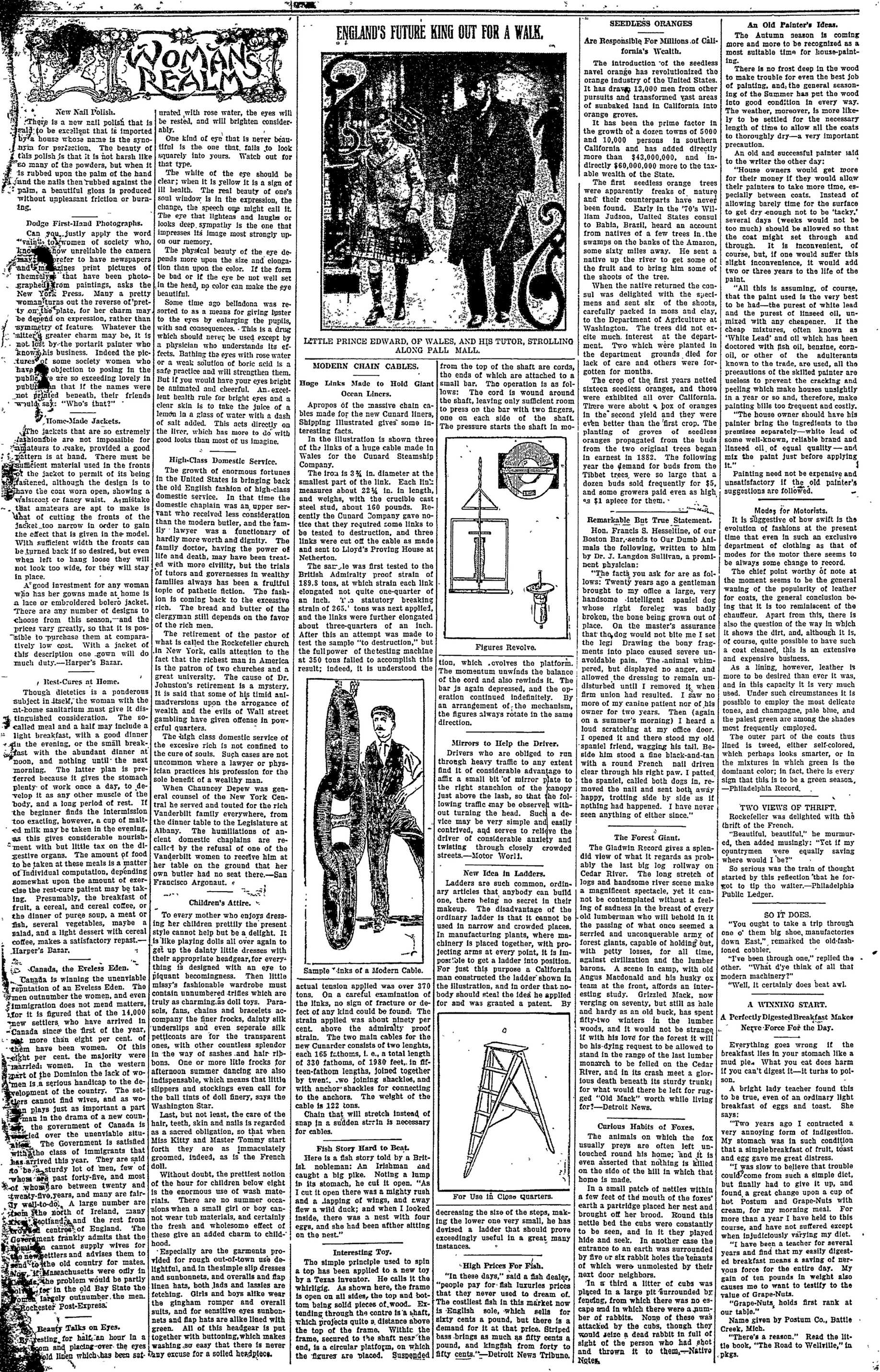
WOMANS REALM
There is a new nail polish that is said to be excellent that is imported by a house whose name is the synonym for perfection. The beauty of this polish is that it is not harsh like so many of the powders, but when it is rubbed upon the palm of the hand and the nails then rubbed against the palm, a beautiful gloss is produced without unpleasant friction or burning.
Dodge First-Hand Photographs.
Can you, justly apply the word "vainish" to women of society who, know, show unreliable the camera may prefer to have newspapers and magazines print pictures of themselves that have been photographed from paintings, asks the New York Press. Many a pretty woman turns out the reverse of pretty on the plate, for her charm may be depend on expression, rather than symmetry of feature. Whatever the alter's greater charm may be, it is not lost by the portarit painter who knows his business. Indeed the pictures of some society women who have no objection to posing in the public are so exceeding lovely in publication that if the names were not printed beneath, their friends would say: "Who's that?"
Home-Made Jackets.
The jackets that are so extremely fashionable are not impossible for amateurs to make, provided a good pattern is at hand. There must be sufficient material used in the fronts of the jacket to permit of its being fastened, although the design is to have the coat worn open, showing a waistcoat or fancy waist. A mistake that amateurs are apt to make is that of cutting the fronts of the jacket too narrow in order to gain the effect that is given in the model. With sufficient width the fronts can be turned back if so desired, but even when left to hang loose they will not look too wide, for they will stay in place.
A good investment for any woman who has her gowns made at home is a lace or embroidered bolero jacket. There are any number of designs to choose from this season—and the prices vary greatly, so that it is possible to purchase them at comparatively low cost. With a jacket of this description one gown will do much duty—Harper's Bazar.
Best-Cures at Home.
Though dietetics is a ponderous subject in itself, the woman with the at-home sanitarium must give it distinguished consideration. The so-called meal and a half may include a light breakfast, with a good dinner in the evening, or the small breakfast with the abundant dinner at noon, and nothing until the next morning. The latter plan is preferred because it gives the stomach plenty of work once a day, to develop it as any other muscle of the body, and a long period of rest. If the beginner finds the intermission too exacting, however, a cup of malt-
as this gives considerable nourishment with but little tax on the digestive organs. The amount of food to be taken at these meals is a matter of Individual computation, depending somewhat upon the amount of exercise the rest-cure patient may be taking. Presumably, the breakfast of fruit, a cereal, and cereal coffee, or the dinner of purée soup, a meat or fish, several vegetables, maybe a salad, and a light dessert with cereal coffee, makes a satisfactory repast.—Harper's Bazar.
Canada, the Eveless Eden.
Canada is winning the unenviable reputation of an Eveless Eden. The men outnumber the women, and even immigration does not mend matters, for it is figured that of the 14,000 new settlers who have arrived in Canada since the first of the year, not more than eight per cent. of them have been women. Of this eight per cent, the majority were married: women. In the western part of the Dominion the lack of women is a serious handicap to the development of the country. The settlers cannot find wives, and as women plays just as important a part woman in the drama of a new country, the government of Canada is involved over the unenviable situation. The Government is satisfied with the class of immigrants that has arrived this year. They are said to be a sturdy lot of men, few of whom are past forty-five, and most of whom are between twenty and
twenty-five years, and many are fairly well-to-do. A large number are from the north of Ireland, many from Scotland, and the rest from two hundred centres of England. The Government frankly admits that the Dominion cannot supply wives for the new settlers and advises them to send to the old country for mates. Now, if Massachusetts were only in Ireland, the problem would be partly solved, for in the old Bay State the women largely outnumber the men. Rochester Post-Express.
Beauty Talks on Eyes.
resting for half, an hour in a room and placing-over the eyes
old linen which has been sat
urated with rose water, the eyes will be rested, and will brighten considerably.
One kind of eye that is never beautiful is the one that fails to look squarely into yours. Watch out for that type.
The white of the eye should be clear; when it is yellow it is a sign of ill health. The real beauty of one's soul window is in the expression, the change, the speech one might call it. The eye that lightens and laughs or looks deep, sympathy is the one that impresses its image most strongly upon our memory.
The physical beauty of the eye depends more upon the size and elongation than upon the color. If the form be bad or if the eye be not well set in the head, no color can make the eye beautiful.
Some time ago belladona was resorted to as a means for giving luster to the eyes by enlarging the pupils, with sad consequences. This is a drug which should never be used except by a physician who understands its effects. Bathing the eyes with rose water or a weak solution of boric acid is a safe practice and will strengthen them. But if you would have your eyes bright be animated and cheerful. An excellent health rule for bright eyes and a clear skin is to take the juice of a lemon in a glass of water with a dash of salt added. This acts directly on the liver, which has more to do with good looks than most of us imagine.
High-Class Domestic Service
The growth of enormous fortunes in the United States is bringing back the old English fashion of high-class domestic service. In that time the domestic chaplain was an upper servant who received less consideration than the modern butler, and the family lawyer was a functionary of hardly more worth and dignity. The family doctor, having the power of life and death, may have been treated with more civility, but the trials of tutors and governesses in wealthy families always has been a fruitful topic of pathetic fiction. The fashion is coming back to the excessive rich. The bread and butter of the clergyman still depends on the favor of the rich men.
The retirement of the pastor of what is called the Rockefeller church in New York, calls attention to the fact that the richest man in America is the patron of two churches and a great university. The cause of Dr. Johnston's retirement is a mystery. It is said that some of his timid anlmdversions upon the arrogance of wealth and the evils of Wall street gambling have given offense in powerful quarters. The ulgh class domestic service of the excessive rich is not confined to the cure of souls. Such cases are not uncommon where a lawyer or physician practices his profession for the sole benefit of a wealthy man.
When Chaucey Depew was general counsel of the New York Central he served and touted for the rich Vanderbilt family everywhere, from the dinner table to the Legislature at Albany. The humiliations of ancient domestic chaplainls are recalled by the refusal of one of the Vanderbilt women to receive him at her table on the ground that her own butler had no seat there.—San Francisco Argonaut.
Children's Attire.
To every mother who enjoys dressing her children prettily the present style cannot help but be a delight. It is like playing dolls all over again to get up the dalnty little dresses with their appropriate headgear, for everything is designed with an eye to piquant becomingness. Then little missy's fashionable wardrobe must contain unnumbered trifles which are truly as charming as doll toys. Parasols, fans, chains and bracelets accompany the finer frocks, dalnty silk underslips and even seperate silk petticcans are for the transparent ones, with other countless splendor in the way of sashes and hair ribbons. One or more little frocks for afternoon summer dancing are also indispensable, which means that little slippers and stockings even call for the ball tints of doll finery, says the Washington Star.
Last, but not least, the care of the hair, teeth, skin and nails is regarded as a sacred obligation, so that when Miss Kitty and Master Tommy start forth they are as immaculately groomed, indeed, as is the French doll.
Without doubt, the prettiest notion of the hour for children below eight is the enormous use of wash materials. There are no summer occasions when a small girl or boy cannot wear tub materials, and certainly the fresh and wholesome effect of these give an added charm to childhood.
Especially are the garments provided for rough out-of-town use delightful, and in the simple slip dresses and sunbonnets, and overalls and flap linen hats, both lads and lassies are fetching. Girls and boys allike wear the gingham romper and overall suits, and for sensitive eyes sunbonnets and flap hats are allike lined with green. All of this headgear is put together with buttoning, which makes washing so easy that there is never any excuse for a soiled headpiece.
2
LITTLE PRINCE EDWARD, OF WALES, AND HIS TUTOR, STROLLING ALONG PALL MALL.
MODERN CHAIN CABLES.
Huge Links Made to Hold Giant Ocean Liners. Apropos of the massive chain cables made for the new Cunard liners, Shipping Illustrated gives some interesting facts. In the illustration is shown three of the links of a huge cable made in Wales for the Cunard Steamship Company. The iron is $3 \frac{1}{2}$ in. diameter at the smallest part of the link. Each link measures about $22 \frac{1}{2}$ in. in length, and weighs, with the crucible cast steel stud, about 160 pounds. Recently the Cunard Company gave notice that they required some links to be tested to destruction, and three links were cut off the cable as made and sent to Lloyd's Proving House at Netherton.
The sample was first tested to the British Admiralty proof strain of 189.8 tons, at which strain each link elongated not quite one-quarter of an inch. T. o statutory breaking strain of 265.' tons was next applied, and the links were further elongated about three-quarters of an inch. After this an attempt was made to test the sample "to destruction," but the full power of the testing machine at 350 tons failed to accomplish this result: indeed, it is understood the
J.
Sample links of a Modern Cable.
actual tension applied was over 370 tons. On a careful examination of the links, no sign of fracture or defect of any kind could be found. The strain applied was about ninety per cent. above the admiralty proof strain. The two main cables for the new Cunarder consists of two lengths, each 165 fathoms, i.e., a total length of 330 fathoms, of 1980 feet, in fifteen-fathom lengths, joined together by twent'. two joining shackles, and with anchor shackles for connecting to the anchors. The weight of the cable is 122 tons.
Chain that will stretch instead of snap in a sudden strain is necessary for cables.
Fish Story Hard to Beat.
Here is a fish story told by a British nobleman: An Irishman and caught a big pike. Noting a lump in its stomach, he cut it open. "As I cut it open there was a mighty rush and a lapping of wings, and eway flew a wild duck; and when I looked inside, there was a nest with four eggs, and she had been afther sitting on the nest."
Interesting Toy.
The simple principle used to spin a top has been applied to a new toy by a Texas inventor. He calls it the whirligig. As shown here, the frame is open on all sides, the top and bottom being solid pieces of wood. Extending through the centre is a shaft, which projects quite a distance above the top of the frame. Within the frame, secured to the shaft near the end, is a circular platform, on which the figures are placed. Suspended
from the top of the shaft are cords, the ends of which are attached to a small bar. The operation is as follows: The cord is wound around the shaft, leaving only sufficient room to press on the bar with two fingers, one on each side of the shaft. The pressure starts the shaft in mo-
100
Figures Revolve.
tion, which evolves the platform.
The momentum unwinds the balance of the cord and also rowls it. The bar is again depressed, and the operation continued indefinitely. By an arrangement of the mechanism, the figures always rotate in the same direction.
Mirrors to Help the Driver.
Drivers who are obliged to run through heavy traffic to any extent find it of considerable advantage to affix a small bit of mirror plate to the right stanchion of the canopy just above the lash, so that the following traffic may be observed without turning the head. Such a device may be very simple and easily contrived, and serves to relieve the driver of considerable anxiety and twisting through closely crowded streets.—Motor World.
New Idea in Ladders.
Ladders are such common, ordinary articles that anybody can build one, there being no secret in their makeup. The disadvantage of the ordinary ladder is that it cannot be used in narrow and crowded places. In manufacturing plants, where machinery is placed together, with projecting arms at every point, it is impossible to get a ladder into position. For just this purpose a California man constructed the ladder shown in the illustration, and in order that nobody should steal the idea he applied for and was granted a patent. By
For Use in Close Quarters.
decreasing the size of the stops, making the lower one very small, he has devised a ladder that should prove exceedingly useful in a great many instances.
High Prices For Fish.
"In these days," said a fish dealer, "people pay for fish luxuries prices that they never used to dream of. The costliest fish in this market now is English sole, which sells for sixty cents a pound, but there is a demand for it at that price. Striped bass brings as much as fifty cents a pound, and kingfish from forty to fifty cents."—Detroit News Tribune.
Are Responsible For Millions of California's Wealth.
The introduction of the seedless navel orange has revolutionized the orange industry of the United States. It has drawn 13,000 men from other pursuits and transformed vast areas of sunbaked land in California into orange groves. It has been the prime factor in the growth of a dozen towns of 5000 and 10,000 persons in southern California and has added directly more than $43,000,000, and indirectly $60,000,000 more to the taxable wealth of the State.
The first seedless orange trees were apparently freaks of nature and their counterparts have never been found. Early in the '70's William Judson, United States consul to Bahla, Brazil, heard an account from natives of a few trees in the swamps on the banks of the Amazon, some sixty miles away. He sent a native up the river to get some of the fruit and to bring him some of the shoots of the tree.
When the native returned the consul was delighted with the specimens and sent six of the shoots, carefully packed in moss and clay, to the Department of Agriculture at Washington. The trees did not excite much interest at the department. Two which were planted in the department grounds died for lack of care and others were forgotten for months.
The crop of the first years netted sixteen seedless oranges, and those were exhibited all over California. There were about a box of oranges in the second yield and they were even better than the first crop. The planting of groves of seedless oranges propagated from the buds from the two original trees began in earnest in 1882. The following year the demand for buds from the Tibbet trees, were so large that a dozen buds sold frequently for $5, and some growers paid even as high as $1 aplece for them.
Remarkable But True Statement.
Hon. Francis S. Hesseltine, of our Boston Bar, sends to Our Dumb Animals the following, written to him by Dr. J. Langdon Sullivan, a prominent physclan:
"The facts you ask for are as follows: Twenty years ago a gentleman brought to my office a large, very handsome intelligent spaniel dog whose right foreleg was badly broken, the bone being grown out of place. On the master's assurance that the dog would not bite me I set the legi Drawing the bony fragments into place caused severe unavoidable pain. The animal whimpered, but displayed no anger, and allowed the dressing to remain undisturbed until I removed it when firm union had resulted. I saw no more of my canine patient nor of his owner for two years. Then (again on a summer's morning) I heard a loud scratching at my office door. I opened it and there stood my old spaniel friend, wagging his tail. Beside him stood a fine black-and-tan with a round French nail driven clear through his right paw. I patted the spaniel, called both dogs in, removed the nail and sent both away happy, trotting side by side as if nothing had happened. I have never seen anything of either since."
The Forest Giant.
The Gladwin Record gives a splendid view of what it regards as probably the last big log rollway on Cedar River. The long stretch of logs and handsome river scene make a magnificent spectacle, yet it cannot be contemplated without a feeling of sadness in the breast of every old lumberman who will behold in it the passing of what once seemed a serried and unconquerable army, of forest giants, capable of holding out, with petty losses, for all time, against civilization and the lumber barons. A scene in camp, with old Angus Macdonald and his husky ox team at the front, affords an interesting study. Grisselz Mack, now verging on seventy, but still as hale and hardy as an old buck, has spent fifty-two winters in the lumber woods, and it would not be strange if with his love for the forest it will be his dying request to be allowed to stand in the range of the last lumber monarch to be felled on the Cedar River, and in its crash meet a glorious death beneath its sturdy trunk; for what would there be left for rugged "Old Mack" worth while living for?—Detroit News.
Curlous Habits of Foxes
The animals on which the fox usually preys are often left untouched round his home; and it is even asserted that nothing is killed on the side of the hill in which that home is made.
In a small patch of nettles within a few feet of the mouth of the foxes' earth a partridge placed her nest and brought off her brood. Round this nettle bed the cubs were constantly to be seen, and in it they played hide and seek. In another case the entrance to an earth was surrounded by five or six rabbit holes the tenants of which were unmolested by their next door neighbors.
In a third a litter of cubs was placed in a large pit surrounded by fencing, from which there was no escape and in which there were a number of rabbits. None of these was attacked by the cubs, though they would seize a dead rabbit in full of sight of the person who had shot and thrown it to them.—Native Notes.
An Old Painter's Ideas.
The Autumn season is coming more and more to be recognized as a most suitable time for house-painting.
There is no frost deep in the wood to make trouble for even the best job of painting, and, the general seasoning of the Summer has put the wood into good condition in every way. The weather, moreover, is more likely to be settled for the necessary length of time to allow all the coats to thoroughly dry—a very important precaution.
An old and successful painter said to the writer the other day:
"House owners would get more for their money if they would allow their painters to take more time, especially between coats. Instead of allowing barely time for the surface to get dry-enough not to be 'tacky', several days (weeks would not be too much) should be allowed so that the coat might set through and through. It is inconvenient, of course, but, if one would suffer this slight inconvenience, it would add two or three years to the life of the paint.
"All this is assuming, of course, that the paint used is the very best to be had—the purest of white lead and the purest of linseed oil, unmixed with any cheapener. If the cheap mixtures, often known as 'White Lead' and oil which has been doctored with fish oil, benzine, corn oil, or other of the adulterants known to the trade, are used, all the precautions of the skilled painter are useless to prevent the cracking and peeling which make houses unsightly in a year or so and, therefore, make painting bills too frequent and costly.
"The house owner should have his painter bring the ingredients to the premises separately—white lead of some well-known, reliable brand and linseed oil of equal quality—and mix the paint just before applying it."
Painting need not be expensive and unsatisfactory if the old painter's suggestions are followed.
Modas for Motorists.
It is suggestive of how swift is the evolution of fashions at the present time that even in such an exclusive department of clothing as that of modes for the motor there seems to be always some change to record. The chief point worthy of note at the moment seems to be the general waning of the popularity of leather for coats, the general conclusion being that it is too reminiscent of the chauffeur. Apart from this, there is also the question of the way in which it shows the dirt, and, although it is, of course, quite possible to have such a coat cleaned, this is an extensive and expensive business.
As a lining, however, leather is more to be desired than ever it was, and in this capacity it is very much used. Under such circumstances it is possible to employ the most delicate tones, and champagne, pale blue, and the paleest green are among the shades most frequently employed. The outer part of the coats thus lined is tweed, either self-colored, which perhaps looks smarter, or in the mixtures in which green is the dominant color; in fact, there is every sign that this is to be a green season, Blittdale Record.
TWO VIEWS OF THRIFT
Rockefeller was delighted with the thrift of the French.
"Beautiful, beautiful," he murmured, then added musingly: "Yet if my countrymen were equally saving where would I be?"
So serious was the train of thought started by this reflection that he forgot to tip the waiter.—Philadelphia Public Ledger.
SO IT DOES.
"You ought to take a trip through one o' them big shoe, manufactories down East," remarked the old-fashioned cobbler.
"I've been through one," replied the other. "What dye think of all that modern machinery?"
"Well, it certainly does beat awl."
A WTNNING START
A Perfectly Digested Breakfast Makes
Nerve Force For the Day.
Everything goes wrong if the breakfast lies in your stomach like a mud pie. What you eat does harm if you can't digest it—it turns to poison.
A bright lady teacher found this to be true, even of an ordinary light breakfast of eggs and toast. She says:
"Two years ago I contracted a very annoying form of indigestion. My stomach was in such condition that a simple breakfast of fruit, toast and egg gave me great distress.
"I was slow to believe that trouble could come from such a simple diet, but finally had to give it up, and found a great change upon a cup of hot Postum and Grape-Nuts with cream, for my morning meal. For more than a year I have held to this course, and have not suffered except when injudiciously varying my diet.
"I have been a teacher for several years and find that my easily digested breakfast means a saving of nervous force for the entire day. My gain of ten pounds in weight also causes me to want to testify to the value of Grape-Nuts.
"Grape-Nuts holds first rank at our table."
Name given by Postum Co., Battle Creek, Mich.
"There's a reason." Read the little book, "The Road to Wellville," in pkgs.
‘THE PULPIT. -
“AN ELOQUENT SUNDAY SERMON BY
REV. f. W, HENDERSON,
+” Subject: The Christ Life.
eee SSE, SRS WUSISE Asie, LC
Rey. I. W. Henderson, pastor, took
as his text Philippians {:21: “For me
to live is Christ.” He safd in the
course of his sermon:
It is my desire to convey to your
minds and to press lastingly upon
your hearts some homely, yet help-
ful, truths relative ¢o the Christ life.
Persuaded of the similarity of your
cares, trials, difficulties, problems, to
my own, and recognizing the com-
mon needs of all men, I would talk
to you about this text.»
Horace, the old Roman poet, sings
the praises ‘of him to whom it is
sweet and honorable to die for his
country. I bring to you from the
Book of Books no note of death, but
a psalm of life. “For me to live is
Christ,” and to pass beyond the veil
4s but to enter into life more abund-
ant.” Thus says Paul. For bim and
tor us there fs no death. To live the
Christ life here is to dwell within the
slory of His presence there, “For
me to live is Christ"—a plan of self-
dedication to His service here, a2
earnest- of our entrance into joy
eternal there. “For apart from Me
ye can do nothing,” saith the Lord.
St. Paul, the most strenuous of
Christians, epitomizes the Christian
life in these words to the church at
Philipp!. His utterance states the
sum and substances of the complete
spiritual life. Our aim and our
pleasure it should be, as it is our
duty, as men and women who love
our Lord, to so live, that men, Jook-
ing upon us, may view in us the
risen Christ.
‘The text presents to our minds a
fourfold thought. Broadly speaking
we may say that men have four rela-
Lions in this life—to God, to society,
to the home and to themselves. To
set forth the same thought different-
ly: Men have spiritual, civil, domes-
tic and personal duties. Relation
might be multipliéd upon relation;
duty upon duty could be indefnitely-
remarked. But that would be to
suggest subdivisions rather than fun-
damentals. Indeed, I am cognizant
that the moral duty to the home ray
easily be included under the bead of
social relations, But for the pur-
pose of the moment we will resolve
the ethics of the Christ life into the
aforementioned divisions.
The first, the greatest, the noblest
imperative in the life of the maa who
desires to conform to the pattern of
the true Christ life, who wiskes to
make the words of Paul his motto
for right living, is to love and to
serve and obey our Heavenly Father.
I_may say that the whole duty of
man is bound ip in this declaration.
For, Christianly speaking, taere is
no department of life into“which the
service of our God does not enter.
Loyalty to God- is the basis of all,
purest ‘living and. highest thinking.
To be true to the FatheF is to be
loyal to society and strong: for self.
‘We may not be true to God and un-
true to the social, civil and domestic
conditions with which the mere fact
of life confronts us.
“The earth is the Lord's and the
fulness thereof,” sings the psalmist.
To be a traitor to the world is to be
raven toward the Maker. We may
not praise God with our lips and dis-
obey Him in our every act. Our
words, honeyed though they be, will |
count naught for us unto righteous-
ness, The test of fealty is in action.
We must measure true to the ideals
that we preach. Prayer and praise
are worthy, but they are not service.
Prayer pleases God and it strength-
ens us. Praise, no doubt, makes joy
among the angels who surround the
throne. But it is the service which
does things; the-prayer whlch re-
solves itself into action; the praise
that is founded upon the knowledge
of a task, through His grace, well
done, hich makes most for pleasure
and for joy in the heart of our King.
The Christ was true to God and to
man and to self, The happiness of
His Father's universe was His hope
and-care. To His home, tc His
neighbors, to His country, to all
‘trusts, the Saviour was faithful. He
had an eye singly toward holy and
hallowing service. Preaching a gos-
pel of lite, He lived a life of Jove.
And so, to be like Christ we -1ust
live like Christ. His hopes must bé
our hopes; His -pleasures must_be
our pleasures. The motive in His
life must be the force which, in our
lives, will make for goodness and
godliness. And godliness {s but
goodness raised to infinity.
As the Christ was, so must the
Christian be, truly spiritual. His
guide and his guard must be the
Comforter who cometh from above.
Divinity, deep down in his heart, will
be the power and the mainspring in
his life. * *
Christianity fs pure polities, clean
business methods, sturdy honesty
and noble purpose, all rolled into
one. A clear conscience means a
brave ballot; and, conversely, a dirty
ballot means a smeared soul Up-
right business methods earn their
own reward; perhaps not in unde-
his life. = *
Christianity is pure polities, clean
business methods, sturdy honesty
and noble purpose, all rolled into
one. A clear conscience means a
brave ballot; and, conversely, a dirty
ballot means a smeared soul Up-
right business methods earn their
own reward; perhaps not in unde-
served dividends and wrongly divid-
ed or diverted profits, but in happi-
Hess of heart. Honesty is but a step
t8ward holiness. Nobility and sin-
cerity are mighty forces. And these
facts the civic and the business
worlds are recognizing more and
‘more: Dishonesty is a bad aesets
and the Christian man, who stands
four square to the world upon the
rock Christ Jesus, is to have the call.
‘Time-serving politicians may scoff;
those who define character in the
terms of preferred stock, and who
prefer gold to goodness, may con-
tinue to misjudge what is highest in
life; sin may seem still to have the
stranglehold upon the world; Chris-
tlans may stumble, yea fall, upon the
King’s highway, be derelict tp duty
and to faith, may imitate poor, fore-
warned Peter and deny fhe Christ,
but tie eterna! principles of individ-
ual and of social righteousness are
beand to win. Ss
But while many of us are, through
the grace of God, enabled to approxi-
mate righteousness in our wider so-
ee Seren. we ae en Bre ene
| The gross sins of the helieving
Christian are, largely, not those of
immense or awful delinquency, Most
of us managed to keep out of prison.
Few of us have to stand for ‘rial
upon charges of overt crime. Most
of us, by the mercy of God, ere guilt-
Jess of the sins which shock the
senses. The defiling sins of the
Christian in his home life are what
we are likely to term the weaknesses
of life, For you and for me, petty
faults ere oftentimes the greatest
sins. With us the proneness to say
the unkind word; think the unwor-
thy thought; to do the hard act or
to speak the stern sentinient; to give
the rein’ to anger or to Tet passion
rule; these are the most detrimental
and defiling sins. Many a mother
who would give up life {itself for the
child -7ho nestled at her breast;
many a father who rot only would,
but does, work long and weary h-urs
for the loved ones of his home and
hearth; many such a man and many
such a ‘woman finds the love of those
most dear to them !s lost and lost to
them perhaps forever, because of un-
Christian uncharltableness in the
home.
._ “For me to live fs Christ,” you say.
‘But do you live the life? Are you
thoughtiess of the rights of others?
Are you self-centred rather than
world loving? Are you heedless of
‘the needs of men? These are minor
things in life; these are the trifles.
But to the soul that {s growing up
toward God, apd out toward men,
and that is spreading roots through
the eternities, they spell either fall-
ure or success. As has been said,
“success 1s made up of trifles .and
success is no trifie.”
~ Selfishness, hastiness, inconsider-
ateness, all these are the sins which
weight the soul. For those of us
who have laid our hearts at the feet
of Christ, they are the sins which
keep us from attainment unto spirit-
ual perfection and the strength of
the Saviour. They are the cancers
which gnaw ct the vitals of the man
spiritual, and which consume the
very life's blood. Leaving behind
these lesser sins we may grow into
the stature of the Son of God. Put-
ting meanness and pettiness behind
us we may become like Him who was
in all things pure. But only as we
exclude the smallnesses of life from
our natures do we grow.
~ But we must always remember
that we have a duty to self as well
as to society and to the Saviour.
Here, again, duty to God presup-
poses and implies -a right relation
with self. We cannot be true to God
and untrue to self. Right relations
with God preclude an evil inner life.
“To thine own self be true,” the poet
sings, ‘and it must follow, as the
night the day, thou canst not then
be false to any man.” He might
have said, with equal surety, that,
loyalty to God precludes disloyalty
to man and to self. ‘Trueness to self
implies Christianly speaking, that
the man is in harmony with man-
kind and with God.
Trueness to the highest and ho-
lest motives and {deals that are
within us brings greatest happiness
and peace, Right thoughts produce
and conserve a right life. High
thinking is a tonic. Low thinking
breeds disease. Cleanness of heart
means clearness of head. To grovel
spiritually is to declare one’s self to
bea sloven mentally. We must keep
ourselves purified of unwholesome-
ness if we would attain the heights
where holy men dwell.
Education is not salvation. Knowl-
edge is power and should induce pu-
rity. But the pure in heart—mind
you, not the strong in mental force
—the pure in heart alone see God.
The vile of soul are always in the
depths of hell, and all the wisdom of
all the-ages could not pull them out.
A clean heart fits a man for life's
labors. We cannot submit ourselves
to the rule of our evil passions ff we
would escape ruin. “Our bodies are
good servants, but poor masters,” is
an apt and a wise saying. The Christ
was a power, hecause He had a
healthy mind and a pure heart, To
Him evil was hateful. For Him love
was the law and the lght of the
world. For God {s love.
Jo be pure, to be géntle, to be no~
ble, to think kindly and to act wor-
thily, to be right toward man and in
the sight of God,.to be growing con-
stantly into God-likeness, that 1s to
be truly Christlike. And to those of
us alone who are trying, as Chan-
ning has said, “to Jet the spiritual,
unbidden and unconscious grow up
through the common,” who are liv-
ing nearest to the source of all love
and of all life, is {t given to say, with
Re ee eee See ae, aKRneeD: MRaMmen we
“I have noticed that when the
green leaves have appeared, and
have lifted themselves a little above
the soil, it often happens that a bit
of soil adheres to them and seem to
weight them. But, as the plants go
on growifg, they cast off these
specks of earth and push on vallant-
ly. Some of my seed must have been
dead, for though they had abundant
time for sprouting, they did not all
appear; they lay there inertly amid
the earth.
“Which things have been a kind
of a parable to me. Though the liv-
ing seeds in their growing have car-
ried on their leaves some of the soil
as they grow they are flinging it
off, while the dead seeds are help-
less under the earth, A Christicn
may be carrying some mean.and un-
seemly earthliness. But if he be
really athrill with the new life and
growing, he will be quite sure to
slough it off in time, Let me, be
patient with him and give him a
chance. God does. The hopeful fact
is that he {s alive and growing.
Dead seeds are powerless. So are
dead souls."—Dr. Wayland Hoyt,
The Footstool and the Watchtower.
How many answers have been
missed simply because we did- not
follow our petition with a heaven-
ward eye and with the calm wait-
ings of expectant faith! Remember,
when you pray, go at once from the
footstool to the tower.—J. Vaughan.
A Bewildered Taxpayer.
, An old negro, who has accumulated
enough property to buy a small honié,
entered the office of the list-takers to
return his possessions for taxation, as
all good citizens do. , Z
“With what cognomen did your pa-
ternal ancestor burden you?” asked
List-taker Charlie Ritch, in a noncha-
Jant manner, se -
“Huh?” asked the taxpayer, and
“What's your name?” was asked.
“What's your longevity?” was the
next question asked, and “Huh?” was
again the responge. The old darky
was doubtful whether or not he was
possessed of any longevity.
“Where do you hesitate, and what
earthly possessions have you accumu-
lated during your sofourn.on this ter-
restrial globe?” inquired the list-tak-
er, but he again had to explain to
the bewildered negro, who then nery-
ously mace his mark and hastily made
«his departure,—Charlotte .Observer,
FITS,8t. Vitus Dance:Nervous Diseases per-
manently cured by Dr. Kline's Great Nerve
Restorer. $2 trial bottle and treatise free.
Dr. H. R. Kline, L4.,931 ArchSt., Phila, Pa
Felllag in love doesn’t make a man
foolish unless he has other weak
points.
‘Mrs. Winslow's Soothing Syrapfor Children
teething,softens thegums reducesinflamms-
tion, allays pain, cures wind colic, 26ca bottle
Fear of being reformed keeps many
a man in the bachelor class.
H, H, Grers’s Soxs,of Atlanta, (ia.are
the oniy suecessfal Dropsy Specialist
world, ‘See their liberal oir cheats
ment in another column, of this paper.
But the man who lives upright Is
apt to die in a horizontal position.
“Por information concerning Government
Distribution of Free Seeds write to,
Wrzax Worrr Suir, Wasuisaros, D.C.”
‘Those who are fond of harmony
have no use for chin music.
DOCTOR CURED OF ECZEMA.
Maryland Whysleian Cares Whmself—Ds,
‘laher Saya: “Cutieara Remedies
Wonauas Svan sean
“My face was afilicted with eczema jo
the year 1897. 4 used the Cuticura Reme
dies and was entitely cured. 1am a prac
ticiog physician, and very often prescribe
Cuticura Resolvent and Cutieura Soep in
cases cf eczema, and they have cured
where other formulas bave failed. 1 am
not in the habit of endorsing patent medi
cines, but when 1 find remedies possessing
true merit, such as the Cuticurs Remedies
do, 1 am’ broad-minded enough to pro
cléim their virtues to the world. 1 have
been practicing medicine for sixteen years,
and must say I find your Remedies A No
1, You ar at liberty to publish this let.
ter. G. BL Fisher, M. D,, Big Pool, Md,
May 24, 1905.”
Bargains, bargains, everywhere!
SVhen you haven't got a cent.
@ MOZLEY’s |
LEHON ELIXIR.
‘Is not a new and untried remedy, /
‘More than fot a. Century: attests f
Tee ae |
giving properties, and serves to
show that it has po equal esa cure P
for Constipation, Biliousness, Indi-
gestion, Sick-Headache, and all
other ills arising from a
TORPID LIVER..
Being strictly a vegatable com-
pound’ it has no harsuful or even
A good, because eer ora. is made
fo perform its part perfectly.
BOO. ARUSLOGA BOTTLE, ALLCBCG STORES.
“One Dose Convinces.”
Why doesn’t the stage use its own
wings in an atempt to elevate itself?
HERITAGE OF CIVIL WAR.
Thousands of Soldiers Contracted
Chronic Kidney Trouble,
The experience of Capt.John L. Ely,
of Co, E, 17th Ohto, nowllving at 500
East Second street, Newton, Kansas,
will Interest the thou
‘gp 8200s of veterans, who
PWM came back trom the
age Civil War suffering tor-
Pee gy ure with kidney com-
AGP vlaint, Capt. Elysays:
a ‘I contracted kidney
Sa troubleduring the Civil
‘ War, and the occasional
a GAME stacks finally dovel-
ee
‘eg r 8200s of veterans, who
Pr camo back from the
yay Civil War suffering tor-
et: baree with Sldner cons
ASB plaint. Capt. Elysays:
VSS “1 contracted kidney
a troubleduring the Civil
oe ‘War, and the occasional
4 attacks finally devel-
fee oped into a chronic
case. At one time I had to use a
eruteh and cane to get about. My
back was lame and weak, and be-
sides the aching, there was a die-
tressing retention of the kidney se-
cretion. I was in a bad way when
I began using Doan's Kidney Pills in
1901, but the remedy cured me, and
T have been well ever since.”*
Sold by all dealers, 50 ceditsabor.
Foster-Milburn Co,, Buffalo, N. Y.
STOPPED HIM.
“Do you think your father would
ike me as a son-tnlaw?”
“Yes; I belleve he would.”
“Oh, joy! I—”
“Papa and I never agree about any-
thing, you know.”—Cleyeland Leader.
Foot TONIC
Botte ¥
‘With BREax'
CURES CHILLS
q AND ALL MALARIAL FEVERS.
Has been a standard houschold remecy for over 4o years.
Pleasant totake; leaves no bad effects like quinine; harmless
i for children, Guarantood by ail druggists. Put up in 80c
x and §1 bottles. Seat express paid oa receipt of price, If not om
» YOUR saleat the home drag store. Address
cts Z RQTHUR PETER & CO., General Agents. Loalsvilte, Ky.
NE sePwel | Smokeless Powder Shells §
aa “LEADER” and “REPEATER™
ReSeeeerasy § The “superiority of Winchester
eae 2/1 § Smokeless Powder Shells is
Sige ae isputed.* Among intelligent
cy sem 8 undispute: iz g
= pars e@ % shooters they stand first in pop-
ey 24 § ularity, records and shooting
Eine qualities. Always use them
Bc ees 2 ~ -
pe eae ag 8 For Field or Trab Sbooting.
eer Se ee oe ee
: “rp. ? i
: IF YOU DON’T GET WELL, I WILL GIVE YOU
”
| BACK YOUR MONEY”. os
THIS IS WHAT YOUR DRUGGIST TELLS YOU WHEN HE SELLS YOU
9
8 s
, HE DOES THIS BECAUSE HE KNOWS
IT IS MADE IN TWO FORMS—REGULAR AND TASTELESS
(Sweet, children like it). Ask for either one. They are both guaranteed tg cure Chills and Fevers, Sold by all
druggists. It is the Chill Tonic that contains no poison. . :
Read the following analysis made by the state chemist, who analyzed three bottles of Oxidine sent to him by the
Secretary of the State Pharmaceutical Association (The Texas Retail Druggists Association): _
Houston Laboratories Houston Laboratories
Chemical and Biological Chemical and Biological
Assiyals and Valsation of Cotton Sood ant Bice Products a Specialty. _Analyafe and Valuation of Cotton feed and Rice Products a fpecalty,
Faster Sole, Ola, Ores, Eeey Cazealig Beamecg und Reported ‘raters, Sos, Oli, Ores, Eten Carsfely R¥umlaed ana Reported
‘Upon. Reports Made on Economic Geology. 7 + ‘Upon. Reports Made on Economie Geology.
P. S. TILSON, Director, Analytical and Consulting Chemist P{S. TILSON, Director, Analytical and Consulting Chemist
‘nL MAIN STEEE? 1 2608 MADE STREEE
Seger Tesae Jane et Nv CERTIFICATE OF ANALYSIS
Me Tale, Foran? Tet Bole Phernaceuiteak dstocistion on three Bettes of Oxidine Submited by R. H. Walker, of Gonzales,
als Bias, Bessel 2 bee to Band ‘you certificate cf analysis of the ‘Texas, Secretary of the State Pharmaceutical
PRUs otatyretiiclaad nad eatin minnie, Asselin
ave kept zou walting fore tiie whe bat Tapprociare he retponstoity Hloverow, TexAs, Foxe #7100,
‘whleu sou bare men At to place Upon met for tose Feasoa 1 Save takes 1 tet fate Orisoe to contain aboltal ng fulton er Iafrions
By lite toh certain ad tear about tay fvai Groqsor chemicaloand nota trace of Arsenle. Coleine, Motytiae,Beeoe
Toon scrvezouin tielature leas edvimeie. Thanking you,Lbez __‘Seusycniney ty infact aaytufog Ut would produc « Vari eect
toremaine oars very Cay econ cose, tha Bese eatiod Oe caeane
TILSOx, | 4 : 7
OXIDINE, THE CHILL CURE THAT CURES CHILLS
| AWoman, ds 2, rulo, hes-mere pe-
‘Heneo’ with: her,’ children :than with’
cher husbahd,
ee
Constipation deranges more
lives with nervousness than any
other abnormal cohdition..
5 e,
D? PRICES
“oR.
WHEAT FLAKE CELERY
is made from the whole grain of
the wheat, celery infused, mak-
ing it nature’s evacuant. 2
“10 cents a package.
For saie by all Grocers
Only the man who fs blindly in love
falls to,sqe through @ coat of com
plexion paint.
‘TELEGRIPHY, SHORTHAXD AND BOOKKEEPING
a eee eae
eed es oacaalg the Rnelas Reloerah
It is rather surprising, observes the
Washington Post that none of the
correspondence schools have under-
taken to teach canaldigging by mail.
CURES a cents
Se
INDIGESTION and ="
‘ACIDITY messtreneent. dos
removing thacauss. 19 cents,
ASHINGTON Yeas
Tt oot
rier tiers a
Bit rae
COLLEGE, , , geysresse
CHARTERED 1795 Bnegesece
tg, SUARTERED 1795 Sra ee
Sibocerhiatiee amioacaaeye fe
Sea rge alermorea sere ot
A DEFINITION.
“Jinks is a true optimist. Ask him
how things are golng and he'll always
say he can’t complain. §
“His mere }imitations do not make
him and optimist. The true optimist
@ man who can complain but won’t.”
Avery & Company
BUCCESSORS TO
AVERY & McMILLAN,
31-58 South Forsyth St, Atlanta, Ga.
2 ALL KINDS JERY
Ried naman .
a aca rs
a es a
ja ;
\ ee pelt
Le ee
ee ee
Rellable Frick Engines, Bollers, ai)
sizes. Wheat Separators.
BEST IMPROVED SAW MILL ON EARTH.
Large Enylnes and Bollers supplied
promptly. Shingle Mills, Corn Mills,
Circular Saws,Saw Teeth,Patent Dogs,
Steam Governors, Full jine Engines &
Mill Supplles. Send for‘free Catalogue.
U.S. *:
Frees Lands
Tittus 25 Seerees, ge easton
aa karte aate aiaetn
Sa ecnea de ies ne
Hocus alata Seyi
isa Benge Gehe see kat
Gene See ee erie
Eieeiee ae corte 0 only ported Strate And
2
Southwest and in
California
am CURED
y Giver
ia Quick
ti Rellef.
4 Renieves al evelling fa Btoz9
eceg oh evel tee?
& G tr Go days, Trialtreatment
gr. Pm Sivcnitee Nehingcanbetalrer
En poy ‘Write Dr, H.H. Green's Sons,
RASS ispeclalists, Box & Allante, Gr
When the pure fcod law gets ita
work in it won't seem Ike the same
old free lunch,
FAVORITE
A ae
Me 109 ee
2 ne
For Bab Hs
okin & Scalp
Because of its Daate
Medicinal, Emollicgé}
Sanative, and Antis@ac
Properties combined wifk
the purest of Cleansing,
Ingredients and most re
freshing of Flower Odo:
Cpuithdoal
end frit bosnow elegeis Ve. tom Taba
ipeeeain Sou Ne popes Lada wd God,
Seherten Recast on cba
ding sins eainge aes te Potoma:
Fre att SRITPTIDEAL, Pride Rida Ver
‘WANTED -Siefacreene
pu eae
dsceanod: NATHAN BICKFORD, Waahingtone D- Ge
{At3306)
| You Cannor
all infamed, ulcerated and catatrhal con~
ditions of the mucous membrane such as.
nasalcatarrh,uterinecatarrh caused
by feminine ills, sore throat, sore
mouth or Inflamed eyes by simply
dosing the stomach.
But you surely ‘can cure these stubborn
affections by local treatment with
Paxtine Toilet Antiseptic
which destroys the disease germs,checks”
discharges, stops pain, and heals the
inflammation and soreness,
Paxtine represents the most successful
local treatment for femlaine ills ever
produced, Thousands of women testify
fo this fact. so cents at druggists.
Send for Free Trial Box =
THE RK. PAXTON CO., Boston, Mage,
60 Bushels Winter Wheat, Per,Acre.
Wheat tout sia ean or oer dae a
Pio caeloguaot water tbewte toy arly Cover
ERoby saute ner ey ont cara
A RSM PERE
fe 7k oy a nL
ue Chintes'ees al Work,
LABOR! LEADER WRATHY
23
. Taft Must’Approv ne
Sore ana "Pies ay ie
7 © Sharks Who Would Prey
Ff, Upon Celestiats,
DR re ee eet: Mecicamrce err ee aye
* American Federation of Labor, has is.
sued a statement regarding the ac
Mon of the isthmian canal commission
deciding to work-Chinese laborers on
the canal, The statement {s+as fol:
lows:
“It seems thst those In chargo of
the Panag canal cpnstruction hava
regard‘! ther 14w nor principles.
FirstySe@MMBpost extraordinary man-
nergied our law Is annulled*in
~thefaree blic Work ever under-
thee Se governrient, under the
t conditions there are dif-
{oroaQSWW@H in the United States, It
aaah to the verlest tyro ‘that
“38a urs’ work {s regaried as
ong tho comparatively tomper-
“aae'ypne of the United “States, cer
5, waa eu, eleven and even more
SnOuwR! bor a day in the pestl-
eit @@Piesmatic atmosphere of
the;MEBAMMMeone are not only im-
“ipedpa buMPMtrageous and brutal.
ft ; isting law excludes Chinese
x . coolles from the United
“Btatea'¥F ably of its possessions. Tho
Paiisamé canal zone is an American
possgetipn, and it is as much a viola-
ition ‘fhe law to bring Chinese coo-
fee-,wlere as It 1s in other portions.
‘of; country.
$gme tme ego, in an interview 1
: with Chairman Ghonts, I pro-
agalost the employment of Chi-
nes€ coolies in the Panama canal con-
struction. He emphatically stated that
it sas not the intention then to em-
ploy Chinese coolles, and they would
not be employed under his ‘adminis-
tration.” :
A Washington special says: Care
will be taken by the United States
Zovernment to pryvent contractors
from doing injustice to the Chinese
laborers employed for work on tho
Panama canal. The specifications ad-
vertising for proposals to supply 2,500
Chinese to the canal commission,
will stipulate that the secretary of
‘war shall have the privilege of pass-
‘tng on contracts which labor agents
make with the Chinese who are to
‘be sént to the isthmus,
This provision will make it possible
xfor Secretary Taft to prevent discrim-
ination against the coolles by the, un-
ipulous contractors, Under this
#rrangeraent the {sited States will
‘Know exactly what the Chinese are
s by the labor agents and the
feso government will be able to
safford its subjects protection on the
asthmus berause of the ease with
cwhich this government will be able
to regulate the relations between the
Chines laborers and the contractors,
Many contractors are seeking to
supply the first 2,500 Chinese for the
canal work, Until! the specifications
for the contracts aro published, coa-
tractors wil not be able to give any
‘idea as to the wage they must have
for Chinese laborers on the canal
zone. Some labor agonts belleve that
with the many restrictions the canal
fsommission purposes placing upon
sortractors It will not be possible to
‘supply the Chinamen at less than
$12 day. Other agents are of the
wpinion that the coolles can be sup-
piled for 50 or 60 cents a day, with
a falr margin of profit to the con-
tractors,
tnJamaica, West Indians are em
pleyed under long tlme contracts at
Srices ranging from 25 cents a day
and rations, which cost only a few
eents. to 50 conts a day.
‘Restrictions and safeguards thrown
about these Jaborers, however, are
yery slight, as compered with the ro-
@irictioas the United States will place
meen the Chinese to be employed for
seme) work.
4 MORE AMBRICANS KILLED, |
Pulajanes Engage Uncle Sam's Sol-
{- diers Ip Hand to Hand-Fight.
"A Manila special says: First Liew
tenant John F, James and two pri.
“vates of the elghth Infantry with
Contract Surgedn Calvin Snyder and
Internal Revenue Collector Williams,
of Ilinots, wére killed Friday after
gooa in“a band to hand fight. with
‘4 foree of Pulajanes at Jullta, Island
fot Leyte. The. detachment, which con-
Beistea of ten med, ‘Was,greatly out-
‘numbered, but mage?a¥gatant Aght.
ei .
THREE ‘COMPANIES ‘INDICTED.
Standard’ and Vacuum, Ol! and Penn.
; Sylvania Road Must Answer.
nike grand jury of New
“York” MWemestown, Friday, returned
‘niiebneats against the Standard Oll
‘company ot New York, the Pennsys
‘verild Raliroad company.and the Vac:
uum Oil company of Rochester for
violations of the ‘interstate ‘commerce
Sih
ee 8 ab te2 TP at 2 etal
A CAMPAIGN EMBROGLO;
PB RES eet eS
Ue te Passau by Candktsiter at’Siren-
SSeous PettfoatsCampaign Meeting
Stn South Carolina,
A Columbia, S.C, dispatch says;
For some time it nds been rumored
that there would be trouble at New
Perry, the home of H. H, Evans, ex
chalrman of the dispensary directors
when the state campaign meeting was
held there, Although a serious clash
“was narrowly: averted, there Tues
day, the trouble came from an entire
ly unexpected source. It was started,
so it is alleged, by J, W, Rags:
dale, candidate. for attorney general,
guestioning one of J, Frazer Lyon's
statements. Lyon, who is also a can-
didate for attorney general, was the
leading spirit in the recent dispensary
investigation, thereby incurring, it is
asserted, the enmity of some of the
dlspensaries, Lyon and Ragsdale wer
in the act of coming to blows when,
it 1s alleged, Evans atarted into the
breach, but was held back by others.
Evans used strong language while ge3-
ticulating toward Lyon,
To one of Lyon's statements, Rag3-
dale arose and shouted that it was
“absolutely untrue.”
Lyon went on with his speech, white
Ragsdale remained standing behind
him, There were hurrahs for Rigo
dale, Lyon went on to say that no
Uving wan could point to‘a line of lav
suggesting that members of the com-
mittee make an indictment, Looking
at Ragsdalo he sald: “He knows.it,”
Ragsdale shouted, “Knows what?"
and advanced, Lyon meeting him.
Lyon shook his finger and startet
to mske some reply. The two mea
were almost touching each other, ant
it semed as if.in one second more
they wduld close in. Ragsdale stood
lithe, and as If posed to spring upou
Lyon, who stood in deflance. Here a
half dozen rnen passed between them,
while scores surged around them and
a huudred or two pressed against the
stand, tonspicuour among whom were
Colonel L. Blesse, éandidate for gov-
ernor; Mayor Brown and Sheriff But-
ford. in this confusion Mr. Evans start.
ed toward the stand. He got under the
railing and, it js alleged, was about
to mount the stand. Before Mr. Ev-
aus could reach the stand, however, a
number of people surronnded bim ant |
selzed bim; He was led away. Lyon
and Ragsdale were also got apart,
and what threatened to be serious
ianbe: We averted,
FOR HISSING U. 8. FLAG,
Englishman Pays Fine of $25 In New
Jersey Police Court.
James Piere, an Englishman, was
fined $25 in police court at Bayone,
N. J, ‘Tuesday, for hissing the Amer-
fcan flag during the performance at
a theater.
The judge who Imposed the fine
was 2 member of the audience,
Plere's action in hissing the stars
and stripes as they were waved py
& performer at the conclusion of a
song almost caused a riot in the aud-
fence.
FARMER AND WIFE ATTACKED.
Bold Deed of Unknown Midnight Ma-
rauder In Fforida.
An unknown man entered the homa
of Henry Davis, a prosperous farmer
near Baldwin, Fla., at 2 o'clock Mom
day morning, struck him in the head
with an ax as he was asleep beside his
wife, (hen made a desperate attempt
to eriminally assault Mrs. Davis, who
fought with the strength of a gfant-
ess, screaming lustily meanwhile for
help. Finally other members of the
family wera aroused and the man
escaped through a window,
WAS MYTHICAL CAMP STORY.
More Georgia Troops Deny Loaded
Cartridaes Were Elred.
Members of the Georgia state troops
returning from the camp at Chicka-
mauga are indignant at the reports
circulated to the effect that the Geor-
gla boys used cartridges in the sham
battle recently fought at the camp.
They say that Chattanooga papers
printed a story founded solely on’ a
mythical camp rumor which had ut
terly no foundation.
TEXANS IN STATE CONVENTION.
Democrats Assemble in Dallas to
Name a Governor.
With seven hundred delegates, tho
number being limited by law, and
more than four thousand spectators,
the democratic state committ anu
the democratic state convention of
Texas opened at Dailas Tuesday.
In the recent primary T. M. Camp-
bell recelyed 32 per cent of the votes
cast’ for ‘governor; M. M. Brooks, 24
per cent: O, B. Colquitt, 23 per cent,
aud C. K, Bell, 22 per cent, The
popular plurality did not determine
the result, however, and the conven
tion fs to settle the matter.”
LONGSWORTHS HAVE RETURNED.
Land at New York and Proceed at
Once to Oyster Bay.
‘Mr, and Bra, ‘Nicholas Longworth
arrived at New York Saturday from
Europé on the steamer Gt, Paul, They
were met at the quarantine ‘station by
the naval yacht Sylph, and proceeces
at once to Oyeter Bay'to yislt Presi,
dant Roosevelt,
WEGROES USE GUNS
Colored Troebs In Texas Raid
Town of Brownsville,
BULLETS FLEW THICKLY
Saloon Man Killed and a Policeman
Badly Wounded— Were Refused
Privilege of Drinking at White
Bars and Went on Warpath,
| Because they had been refused priv.
Mege of drinking at bars with white
customers, and several of them had
becn arrested for unseemly behavior
on the streets, twenty negroes, mem
‘bers of a company-of the twenty-fifth
fofantry, at midnight Monday went v2
& rampage, stealing away from the
Post, and entering Brownsville, Pexas,
firing several yolleys down Mala
atwet. As a result Prank Natus, a
Dartender, is‘ dead, a bullet from a
KragJorgonsen rifle having plerced
his heart, and Policeman Joseph De-
minge Is wounded, hia arm and haul
shattered by a bullet and his horse
shot from under litm.,
‘Twenty-three of the bullets fired eu-
tered the .bome of Louls R. Cowan,
many went through the residence vf
F, E, Start and several bricks wore
shot from the walls of the Miller ho-
tel near a window where guests were
sleeping. Atter their depredations the
negroes returned to thelr garrison,
The battalion at -Fort Brown is
composed of companies B. ¢ and D,
twenty-first infantry.
Representations have been made to
the governor and a request made that
the negroes be 1emoved immediately
to avold further trouble,
Governor Lanbam stated Tuesday
evening that he would-not send state
troops to Brownsville, Fils latest in-
formation was that the negro federal
troops who-were guilty of the out-
rage at Brownsville are known to the
federal commander and will be ar-
rested and properly dealt with. ;
NEGRO SLASHED GIRL’s THROAT,
Diabolical Attempt at Assault Pluck.
lly Frustrated,
One of the most diabolical attempts
at criminal assault possible was made
Tuesday upon the pereon of Miss
Jennto Brooks, the 20-year-old daush-
ter ot J. P. Brooks, a prospérous
merchant and farmer near Green-
wood, 8. C., by a negro named Bob
Davis.
Brooks had absented himself tempo-
rarily, leaving the young lady in
¢ of the store. The negro, after
1S some purchases, grabbed up
t knife and sald: “You are what
it” .
YP rring an fron bar, the young lady
an attempt to defend herself,
reupon the negro slashed her
a@pss the throat, making a gash four
inghes long and almost severed two
ofiher flogers. A posse of 1,000 men
was soon in pursult of the negro. Da-
vis! brother was lynched twelve years
ago for assaulting a white woman.
About an hour after he cut Miss
Brooks’ throat, the sam¢ negro as-
saulted a colored woman.
SOLVENCY IS UNAFFECTED.
Birmingham Bank Not Hurt by the
Chisholm Embezzlement,
A Washington dispatch says; The
acting comptroller of the currency on
‘Tuesday received a telegram from the
bank examiner at Birmingham, Ala-
bama, stating that the defatcation In
the First National Bahk of that place
will not exceed $100,000 and that the
solvency of the bank fs not affected
by the léss, :
New Dally for Washington,
Announcement {s made by Scott G.
Bone, foimerly managing editor ot
the Washington Post, that a new mor-
ning newspaper, to be known as the
Washington Herald, will be published
at the natlonal capital beginning about
October 1. Mr, Bone will be at the
head of the enterprise.
Se
“ASK ME_NO QUESTIONS.”
Man Returne Home After Thirty-Qne
Years With Bulging Purse,
After an unexplained absence of 31
years, Professor Charles H. Frye, for-
mer superintendent of the Chicago
Normal school, has returned home,
‘One of bis fitst acts upon arrival at
his home was to hand a Toll of crisp
one hundred dolas, bills, totallog $5,-
000, over to his wifé, with the remark,
“Ask me no questions." -
NOT IN PERFECTED SHAPE,
Anti-Lobbying Bill Turned Down by
Georgia Senate Committes,
Asserting that the bill as It came
from the house was incomplete and
could not be enforced as a statute
uuless properly amended, the antl-
lobbying measure before the Georgia
legislature was unfavorably reported
on by the senate committee on gea-
eral judiciary, While thé sentiment
‘of the committee Is sald to be for
such bill, ‘the measure which was
sent up from the House was" not in
a perfected shape. .
LYNCHER GOES TO PEN.
Leader of Salisbury Mob Ia oe
Convicted and Given a Sentence
“ of Fifteen Years.
_ George Hall, a cotton mill opera
fre, was convicted Friday of con:
spiracy in connection with the lynch-
ing of the three negroes kt Salls-
burg, N. C, and given a term of
fifteen years In the state peniten-
thy. - *
“The hearing of the case began when
court opened at 10:30 o'clock Friday
morning. At 6:15 p. m., after hearing
several witnesses establishing Hall's
participation in the lynching, the
case was given to the jury, After
being out twenty minutes, a verdict
of guilty was agreed upon, and the
maximum “penalty for the offence
charged. was Imposed by Judge B. F.
Long. Court adjourned for the day:
at 7:10 p.m,
| ‘This-1s"said to de the first convic-
tion of the Kind ever secured in the
state of North Carolina, although »
number of efforts have been made
to bring members of mobs to justics.
‘The state sprung a surprise In the
trial when the offense against the
prisoner was changed from murder
to conspiracy. s
When the court was called to order,
Vion, T. J. Kluttz announced thay
his client would contend that the
court was unlawful. Tt was argued
that the governor could not sign a,
commlsston for such a court untess
he was in the state, and It was clam
ed that he was at AtlantlegCity, N.
J. Mir. Klnttz asked that a Subpoena
be {ssued for Governor Glenn, and
have him brought to court to testify.
This was done and the chief exec-
utlve 6f the state was sworn sad
questioned about his whereabouts on
the 17th of July, the day that the
call for the court was made, He sald
that he was in Atlantic City, N. J., and
in order to do what he could to pre-
vent a lynching, he wired his private
secretary to Issue the commission and
sign his name to {t, This he consider-
ed the proper thing to do.
The objection of tho defendant was
overruled and the trial proceeded.
A ROPE FOR FOLK.
‘Threats Made In Connection With the
Trial of Alleged Lynchers.
A alspatch from Springfield, Mfo.,
Says: After hearing from a city of:
ficer of the threats agalnst members
of the grand jury which indicted Hill
Gooch and Doss Galbraith, charged
with lynching three negroes on April
44, Assistant Attorney General Ken-
nish left Friday for Jefferson City
to confer with Governor Folk on the
situation. The threat, as told to Mr.
Kennish follows: ”
“If one of those men who are on
trial for ‘negro killing’ is convicted,
there will be a rope hung to tha
light tower In the square for every
one of the members of the grand jury
that Indicted them, and there'll be
another one for Goverfor Folk.”
———__.
REAL BULLETS WERE USED.
Sham Battle at Encampment Abrupt.
ly Broken Up.
Real bullets were used at the encamp-
ment at Chickamauga Friday by the
First Georgia regiment in its “vat-
tle” with the seventeenth infantry reg-
ulars,
Colonel’ Gordon’s regiment was tha
main body of the “Blue” army, The
seventeenth regulars formed the mafn
body of the “Brown” army. The two
forces met, when cotitesting in the
cruclal point of the day's program, A
hot fuStlade ensued. During the heat
of the fight, bullets began to sing
above the heads and in the ranks
ot the regulars. A rush was mado
by the latter for cover. They sprang
behind trees, they lat flat upon the
ground, they did everything but turn
thelr backs and run, One private,
whose name {s unknown to the au-
thorities, was wounded,
Two companies of Colonel Gordon's
regiment were onlered off the fiold
and the maneuvers abruptly ended.
Mystery seems to surround the sit-
uation. An {nvestigation may place
the responsibility.
CAN SUBMIT AMENDMENTS
At. ‘November Election in Georgia,
“Says Attorney General Hart.
Attorney General Hart of Georgla
has delivered an opinfon which has
important bearing upon several leg-
islative matters.
The attorney general holds that
amendments to the state constitution
can be voted upom at the congres-
sional election in’November, that be-
‘ing a “general, election” within the
‘meaning of the constitution of Geor-
gia, ‘
CASHIER COMMITS SUICIDE, —
Couldn't Stand Criticism of Friends
and Neighbors. -
Frank Kowalskt, for five years pay-
tag teller of the wrecked Milwaukee
Avenue State bank, at Chicago, “and
for some time assistant recelving tell-
er, ahot and killed himself. Critlelsm
by delghbors and life-long frieads who,
accused ‘him, of’a share in’ the-down-
tall of the bank is belleved to hate
‘driven Kowalski to the deed.
as A
‘Treins Operated by Sth Meridian Time—One Hour Slower Than City Tina =|
SOREDULE EFFECTIVE MAY 27, 1906.
READ DOWN. READ UP.
ee
10 E a +39 [ou [Nonra anv sours | *so | +38 | 19 | eas |
7 0a} 1 5p] T3p] 1 5a| 0 Onli ....Bavannah .... Ar] 2 da) 9 Salta 46a] 0 3pfit f8p]
1280p) ried 3 B3ai11 O6a[Ar ¢.. (Charleston... Ly/12 0p! 7 20a] 8 00a) 3 05p) 7 40p)
snseeg] HE ASpLcee-c] 1409)-..0..[AF.0-. Wilmington...Ly] $4561: 2.04 son $008)...
SITY S10 TL 8 00g] ToT Jar So Btohmong..: Ly} 9 058) "7 d5p}-.c.cleseneeleceseet
SS} 8 Soad TTL fa Sop] 222" ar “2. Washington -. To] 4 30a] 345 p)-0.00.[ociedeeeeee
senene[20 BOa} 2 1 48a-00) “Jar 2. Baltimore... Lr} 2 Sia} 9 12p]-.....Jeceede[eeeeee
INN pagan soe 4250. Jar. Philadelphia... Lv[t2 190111 680].0200-)-0.0.[-sec00t
teccal 9800p) o0221 7 230).2...JAr.. New York,...Lvl $9p] 9 26a... .Tc desege
67.) *2 “85 | *89 ‘souTH. Te a “23
| atte J-se-e.) 9402] S15alLy ....Sevannah.... Ar] 115s] 9 40«/12 S$0]....-.) 9852
sceooe] THOR cosefeeveoe] 8 20a(Ar..--Branswick . Ly} 8 30p|......| 6 1¢al......| 410
i0'bGp} 6 009]......]i2 459} 6 05a]ar’.-.. Waycross... Lvj10 3p] 6 18a] 9 5Qa]......| 6 80p
1058]....0efcscose] 4 4Sp}10 205)Ar..-.Thomasvilis -.Lv] 9 35p] $ 10a} 6 18a}. -.--f--0ce
HO Spf cgccJeeeee [12 45a[Ar ..2. Albany .... Lv}....se] .220-| 5 A5ptevee-o| 20D
2-20 -nenfecseoe|o GSp)ti 33a] Ar..--Tainbridge” . Ly|.-...'| fda] 5 00a)...4-.) 1p
B 054-0. LoL] ono] 6 2p] ar.-ifontgomery....L| Poo. | 245ploceseefeccene]
sevses] 8409). 21.2] FIop] 8 a0alAr.. Jacksonville... Ly] 8 0sp]..... | 8 S5a]...0-.] 899
SIND no asp fl TIT a rgp)td aga ars 2. Palatks...0 Ly] 4 50p)0002 | 8 88a
TINY S5pfI001 6-ssp) 1 65p)Ar.. -. Sanford 2 "Ley 2 00p].0. 1] 2 20a}...
TIN g oaaflSIi22] 7409] Stapar, Omen... Enlai SILT] a aan ceo
TIED asa] (00201] 9 aap! 5 gopfars 21 Lakeland ?2.2/7}10 250) 01020]10 soph s 20220002
SID] a 00a] “2 cla1 oop! 6 sspfar.:-, Tampa... Lv} 900q).0200.) ssgppicc cy
SULT] gal T20Sclat soph 7 asplar-. Port Tampa...Ly] 8.20a) 0007.) 7 Sspfec ccd cco
NNN| ta0a)cccc[ ca] 9 Soplar. Bt. Potersbarg. Lv] 5609] 0002.] Sashes cc.) oc.
seveee|LT 508] seovee]s voee| 9 15pjAr...Punta Gorda...Lv) 8 05a)......] 4 05p|...---]..— ++
SSID Aoph CYL Tuo SSplae 5. FE Myers ....Lv} 7008) -..--] 248p).....-]-s0eee
rasssfoseaail cena cL Eevonsscisssanseascoescel| feces == eceselocsnee”
NORTH ,WHST AND SOUTH WEST.
a nen
. [ost VieJcsup | #58 | a2 | os [vis atontgomery.| es | #22
woes [ B45p|LvSavannah. Ar] 9458] ..., || 8 35a] 6 43p|iey..Savannah..Ar| 940s] 9 alg
Th [ genplan. cop. 45a} 2222 | ecnace faveeslAE gearensesescM] gece | sven
TD) sogal" ictitacon 724°} a asal “221 | | Sigp "Sosa + Wtgomery. «| Tap! a'6o
avee [ 5208}. Atlanta. “f 11 0p aeee fs Gas)
si5: | Asal “Gaaemoogs | 6 op! <0. |) 3 sa] 7 asp) taanetlo. | Ba.
Tl | T15p) " Louteriile,t*| 8 503] 222. || 8 2p} 2 10a] ** Loutsyille. 3 a eeeee
IIL [2 400f ** Ginotanati." | 8.908] 220! | 12 01n} 7200 + *Cinoinnadl, 111 OB).
SIN |10 008) # “St, Louis..¢| 6125] 522. |] 1 53p] 7A0at St, Louts. «1 8 459)...
INE Praoal « “ehtcago.. «| 8 sop) 222: sevece] t's Gateago ."* | 6409) 0.2
II | 1ooa}ty ‘atlanta,’ ar|to08py 27 4 200] Visglaz.. Mobile.. Lr] 198p/i do,
eat fetal Ae ems Baa | 2 253a1 8 18p| * New Orleans" | 9 Sal 8 169
wos | Saba Ssnsas tty] éspp) 2° |] Tas |, GOD fo |
neue | 8 28a)“ St, Louis.“ } 15801..2.25
Dally. Connections made at Port Tomps with Y
1gunday only. . mall stoamenips of the Peninsular add
Dally exoept Sunday. Occidental Steamship sailing Sundays,
sats | se and oud of Charleston are op- | Tuesdays and Thursdays at 1140 p.m
<< eh Sine Tlokets offices, DeSoto Hotel, Phones 78)
Nos, $2 and 85, the Florida and West In- 3 7
aan tnd BS, the Tloride and West Za~ | ualon Station, Hell phone 285, Georgie SLU
$weon Southern and Eastern cities, solid |W. J. ORAIG, Passenger Traffic Manager).
Yestbaled traln, drtwing room, sleeping | Wilmington, N, ©.
cars, dining oar snd Pullman high class} 1, 0, WHITE. Diviston Passenger
oases, Schodble and service unequalled. | agent, Savannah, Gx.
ro, 67, leaving Sargans BP. ™., Qar~ ,
step Pullman Batet Sleeping Oarsto. font Fhe 8 TENS, ereline, Passonger
omery. . +
So. Ni, \éavitig Savannah 2:45 p. m.,con-|_T. 0. SAPP, Chiy Ticket Agent, DeSoto
ancts at Jaoksodyilie, with Pullmen Samet Hotel, Savannah, Ga,
ping Oirs fod Tenipa Bt Potessbarg, ¥t.| | R.0. BLATINER, Depot Tioket Agen
Moyers and:iatermedlate pothts. Union diatlonBerannat’ Gx. 7
WHEN
YOUR CLOCK STOPS
Striking and your Watch
goes on Strike, consult
W. H. BROWN,
Watchmaker and Jeweler,
605 West Broad, Corner Charles 8t
THOSE WHO WANT.
SS
Masonic Books &
Regalias. -
LODGE SEALS, .
FINANCIAL CARDS and
BLANKS of every description.
Publishers’ and Manufacturers’ Prices
Liberai Discounts Will Be Arranged.
SOL. C. JOHNSON, .
Savannah, Ga.
TEXANS ENDORSE BRYAN,
State Convention Also Gives Vote of
Confidence In U: S. Senators.
In the Texas democratic convention
at Dallas Wednesday resolutions ex-
pressing the unbountled confidence-ct
the convention in William J, Bryan
and favoring his nomination as the
presidential candidate of the demo-
cratic party at the next national con-
vention, and the endorsement of Sen-
ators Bailey and Culberson, were
adopted.
‘The convention adopted a platform
affirming the principles of the party,
Indorsing the administration of Gov-
eror Langham, demanding the next
legislature to enact a law prohibiting
lobbying ‘and favoring a law against
railroad passes.
_ A night sessston of the convention
was begun and ther nominating
apeeches for the four candidates for
governor made. The vote was begun,
but was not completed, it being a
very dificalt task, owing to the necas-
sity for prorating the vote, and in
the midst of the proceedings some
thing went wrong with the lights and
the convention adjourned in darkness
to 9:30 o'clock Thursday morning.
COMMITTEE TO INVESTIGATE
: a @
Gharge of, Mismanagement of Georgia
Soldiers’ Home.
At an early date the manner in
which the Georgla Confederate Sol-
@ers' Home, at Atlanta, has been con-
ducted since August 1, last, will be
fhe subject of a thorough Investla.
tion at the’ hands of a special legista-
tive committee consisting of three
members of the senate and seven of
the house,
Philadelphia's child stealer was
caught by the newspapers. Criminals
of a’lifgher plane are spotted with con-
Ae aN .
siderable regularity by the samo
egenta” * -
We Lead, Qthers Follow.
The New Pressing Club
, ‘AND TAILORING.
Pants $3.50, Suits $15.00 made
otf LATEST ’ FASHIONS.
Ladies’ Suits and Skirts Cleaned and
"pressed, We make Jean
Pants for $2.50.
T. W. WILLIAMS, Manager,
242 Barnard Street.
Masonic treen Grocery.
COMPANY,
Under Masonic Temple, 519 West
- Gwinnett Street.
GROCERIES OF ALL KINDS -
FRESH MEATS, BIC.
Orders delivered in any part of th
City. .
’ P. L, BOWEN, Manager:
Bell Phono, 2837.
es or
‘Shoes & Harness
Made or Repaired. .
Satisfaction Guaranteed for Each Jo?
. for Cash.
‘ CLOTHES
Cleaned and Pressed on Same Order
} We will send for and deliver
ll work. Just leave orders at
616 EAST BROAD ST.,
F. J. JAMES, Prop,
2 Set
| THE SELECT
|
Pressing Club & Tailoring Co
CLEANING
PRESSING AND REPAIRING
NEATLY DONE.
Qfonthly Pres3ing pér Month,
Ladles’ Work 2 Gpeclalty.
WARD @& TURNER, Proprietors
914 West Broad St.
. W. H. LLOYD,
—Dealer In—
GROCERIES, WOOD AND COAL, -
621 Oglethorpe Avenue, East
Ga. 518 ———PHONES———Bell 506.
ADDISON & SCOTT,
~* HAT CLEANING
AND BLOCKING. *
“Dyeing, Cleaning and Pressing,
and Talloring, .
Cheapest and Best Work in City.
108 Jefferson St, Cor, Broughton St,
ae Spates Sees
a
S2! Srna eee See
eS Stee fs eveeeies oe
aaa
ze
=