Savannah Tribune
Saturday, September 22, 1906
Savannah, Georgia
Page text (machine-generated)
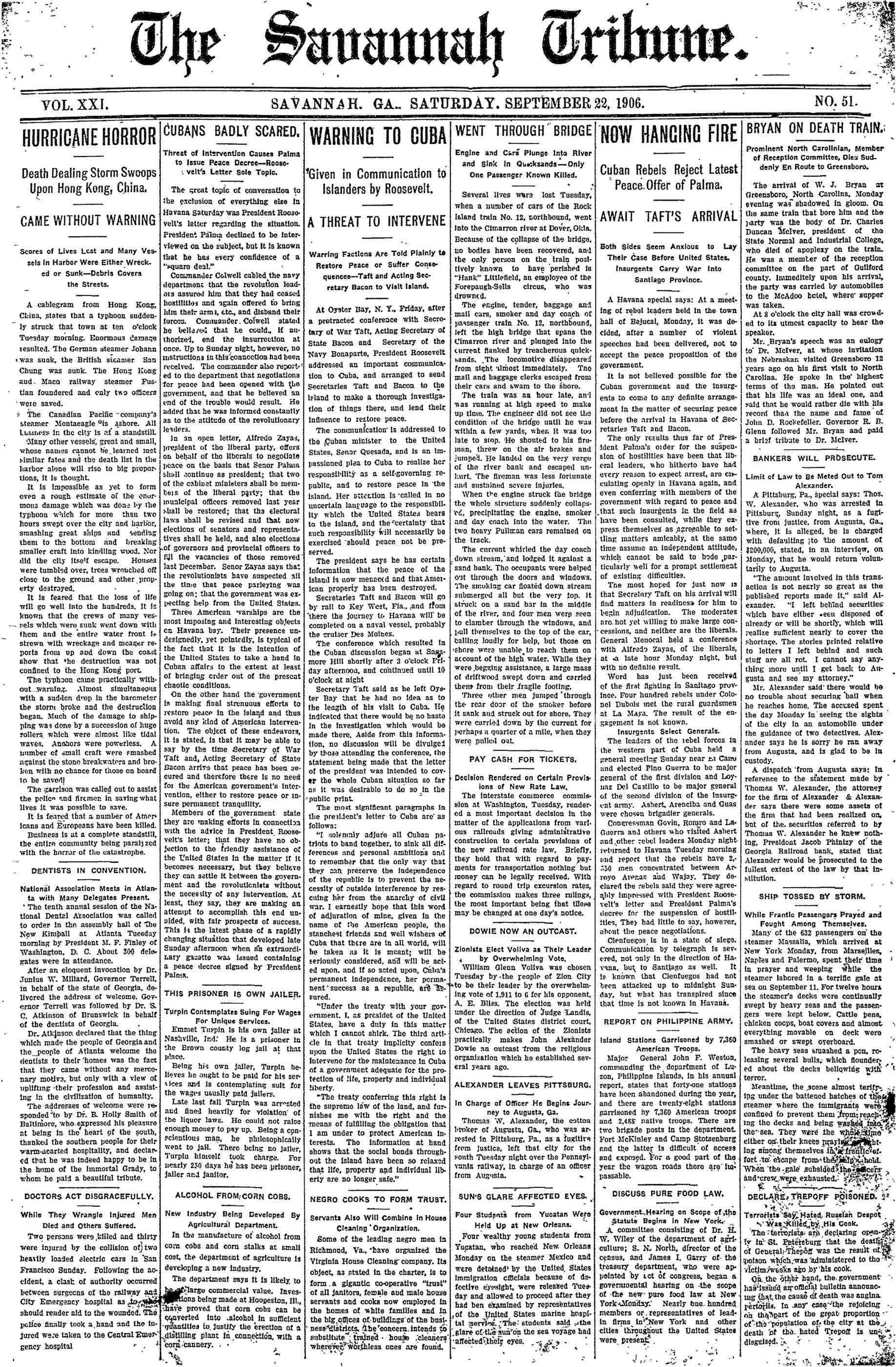
The Savannah Tribune.
VOL. XXI.
HURRICANE HORROR
Death Dealing Storm Swoops Upon Hong Kong, China.
CAME WITHOUT WARNING
Scores of Lives Lost and Many Vessels in Harbor Were Either Wrecked or Sunk—Debris Covers
A cablegram from Hong Kong, China, states that a typhoon suddenly struck that town at ten o'clock Tuesday morning. Enormous damage resulted. The German steamer Johann was sunk, the British sicamer San Chung was sunk. The Hong Kong and Maco railway steamer Fustian foundered and only two officers were saved.
The Canadian Pacific company's steamer Montaeagle 'is ashore. All business in the city is at a standstill. Many other vessels, great and small, whose names cannot be learned met similar fates and the death list in the harbor alone will rise to big proportions, it is thought.
It is impossible as yet to form even a rough estimate of the enormous damage which was done by the typhoon which for more than two hours swept over the city and harbor, smashing great ships and sending them to the bottom and breaking smaller craft into kindling wood. Nor did the city itself escape. Houses were tumbled over, trees wrenched off close to the ground and other property destroyed.
It is feared that the loss of life will go well into the hundreds. It is known that the crews of many vessels which were sunk went down with them and the entire water front is strewn with wreckage and meager reports from up and down the coast show that the destruction was not confined to the Hong Kong port.
The typhoon came practically without warning. Almost simultaneous with a sudden drop in the barometer the storm broke and the destruction began. Much of the damage to shipping was done by a succession of huge rollers which were almost like tidal waves. Anchors were powerless. A number of small craft were smashed against the stone breakwaters and broken with no chance for those on board to be saved!
The garrison was called out to assist the police and firemen in saving what lives it was possible to save.
It is feared that a number of Americans and Europeans have been killed.
Business is at a complete standstill, the entire community being paralyzed with the horror of the catastrophe.
DENTISTS IN CONVENTION.
National Association Meets in Atlanta with Many Delegates Present. The tenth annual session of the National Dental Association was called to order in the assembly hall of the New Kimball at Atlanta Tuesday morning by President M. F. Finley of Washington, D. C. About 300 delegates were in attendance. After an eloquent invocation by Dr. Junius W. Millard, Governor Terrell, in behalf of the state of Georgia, delivered the address of welcome. Governor Terrell was followed by Dr. S. C. Atkinson of Brunswick in behalf of the dentists of Georgia.
Dr. Atkinson declared that the thing which made the people of Georgia and the people of Atlanta welcome the dentists to their homes was the fact that they came without any mercenary motive, but only with a view of uplifting their profession and assisting in the civilization of humanity. The addresses of welcome were responded to by Dr. B. Holly Smith of Baltimore, who expressed his pleasure at being in the heart of the south, thanked the southern people for their warm-hearted hospitality, and declared that he was indeed happy to be in the home of the immortal Grady, to whom he paid a beautiful tribute.
DOCTORS ACT DISGRACEFULLY.
While They Wrangle Injured Men Died and Others Suffered. Two persons were killed and thirty were injured by the collision of two heavily loaded electric cars in San Francisco Sunday. Following the accident, a clash of authority occurred between surgeons of the railway and City Emergency hospital as officers should render aid to the wounded. The police finally took a hand and the injured were taken to the Central Emergency hospital
SAVANNAH. GA.. SATURDAY. SEPTEMBER 22, 1906.
CUBANS BADLY SCARED.
Threat of Intervention Causes Palma to Issue Peace Decree—Rossovelt's Letter Sole Topic.
The great topic of conversation to the exclusion of everything else in Havana Saturday was President Rossovelt's letter regarding the situation. President Palma declined to be interviewed on the subject, but it is known that he has every confidence of a "square deal."
Commander Colwell cabled the navy department; that the revolution leaders assured him that they had ceased hostilities and again offered to bring him their arms, etc., and disband their forces. Commander Colwell stated he believed that he could., if authorized, and the insurrection at once. Up to Sunday night, however, no instructions in this connection had been received. The commander also reported to the department that negotiations for peace had been opened with the government, and that he believed an end of the trouble would result. He added that he was informed constantly as to the attitude of the revolutionary leaders.
In an open letter, Alfredo Zayas, president of the liberal party, offers on behalf of the liberals to negotiate peace on the basis that Senor Palam shall continue as president; that two of the cabinet ministers shall be members of the liberal party; that the municipal officers removed last year shall be restored; that the electoral laws shall be revised and that now elections of senators and representatives shall be held, and also elections of governors and provincial officers to fill the vacancies of those removed last December. Senor Zayas says that the revolutionists have suspected all the time that peace parleying was going on; that the government was expecting help from the United States.
Three American warships are the most imposing and interesting objects on Havana bay. Their presence undesignedly, yet pointedly, is typical of the fact that it is the intention of the United States to take a hand in Cuban affairs to the extent at least of bringing order out of the present chaotic conditions.
On the other hand the government is making final strenuous efforts to restore peace in the island and thus avoid any kind of American intervention. The object of these endeavors, it is stated, is that it may be able to say by the time Secretary of War Taft and, Acting Secretary of State Bacon arrive that peace has been secured and therefore there is no need for the American government's intervention, either to restore peace or insure permanent tranquility.
Members of the government state they are making efforts in connection with the advice in President Roosevelt's letter; that they have no objection to the friendly assistance of the United States in the matter if it becomes necessary, but they believe they can settle it between the government and the revolutionists without the necessity of any intervention. At least, they say, they are making an attempt to accomplish this end unfulDED, with fair prospects of success. This is the latest phase of a rapidly changing situation that developed late Sunday afternoon when an extraordinary gazette was issued containing a peace decree signed by President Palma.
THIS PRISONER IS OWN JAILER.
Turpin Contemplates Suing For Wages
For Unique Services.
Emmet Turpin is his own jaller at
Nashville, Ind. He is a prisoner in
the Brown county log jail at that
place.
Being his own jaller, Turpin
believes he ought to be paid for his
services and is contemplating suit
for the wages usually paid jailers.
Late last fall Turpin was arrested
and fined heavily for violation
of the liquor laws. He could not raise
enough money to pay up. Being a con-
scientious man, he philosophically
went to jail. There being no jaller,
Turpin himself took charge. For
nearly 250 days he has been prisoner,
jaller and janitor.
ALCOHOL FROM;CORN COBS.
New Industry Being Developed By Agricultural Department.
In the manufacture of alcohol from corn cobs and corn stalks at small cost, the department of agriculture is developing a new industry.
The department says it is likely, to be of large commercial value. Investments being made at Hoopeston, Ill., have proved that corn cobs can be converted into alcohol in sufficient quantities to justify the erection of a distilling plant in connection with a corn cannery.
WARNING TO CUBA
Given in Communication to Islanders by Roosevelt.
A THREAT TO INTERVENE
Warring Factions Are Told Plainly to Restore Peace or Suffer Consequences—Taft and Acting Secretary Bacon to Visit Island.
At Oyster Bay, N. Y., Friday, after a protracted conference with Secretary of War Taft, Acting Secretary of State Bacon and Secretary of the Navy Bonaparte, President Roosevelt addressed an important communication to Cuba, and arranged to send Secretaries Taft and Bacon to the island to make a thorough investigation of things there, and lend their influence to restore peace.
The communication is addressed to the Cuban minister to the United States, Senor Quesada, and is an impassioned plea to Cuba to realize her responsibility as a self-governing republic, and to restore peace in the island. Her attention is called in no uncertain language to the responsibility which the United States bears to the island, and the certainty that such responsibility will necessarily be exercised should peace not be preserved. The president says he has certain information that the peace of the island is now menaced and that American property has been destroyed.
Secretaries Taft and Bacon will go by rail to Key West, Fla., and from there the journey to Havana will be completed on a naval vessel, probably the cruiser Des Moines.
The conference which resulted in the Cuban discussion began at Sargamore Hill shortly after 3 o'clock Friday afternoon, and continued until 10 o'clock at night
Secretary Taft said as he left Oyster Bay that he had no idea as to the length of his visit to Cuba. He indicated that there would be no hasto in the investigation which would be made there. Aside from this information, no discussion will be divulged by those attending the conference, the statement being made that the letter of the president was intended to cover the whole Cuban situation so far as it was desirable to do so in the public print.
The most significant paragraphs in the president's letter to Cuba are as follows:
"I solemnly adduce all Cuban patriots to band together, to sink all differences and personal ambitions and to remember that the only way that they can preserve the independence of the republic is to prevent the necessity of outside interference by rescuing her from the anarchy of civil war. I earnestly hope that this word of adjuration of mine, given in the name of the American people, the stanchest friends and well wishers of Cuba that there are in all world, will be taken as it is meant; will be seriously considered, and will be acted upon, and if so acted upon, Cuba's permanent Independence, her permanent success as a republic, are assured.
"Under the treaty with your government, I, as president of the United States, have a duty in this matter which I cannot shirk. The third article in that treaty implicitly confers upon the United States the right to intervene for the maintenance in Cuba of a government adequate for the protection of life, property and individual liberty.
"The treaty conferring this right is the supreme law of the land, and furnishes me with the right and the means of fulfilling the obligation that I am under to protect American interests. The information at hand shows that the social bonds throughout the island have been so relaxed that life, property and individual liberty are no longer safe."
NEGRO COOKS TO FORM TRUST.
Servants Also Will Combine In House Cleaning Organization.
Some of the leading negro men in Richmond, Va., have organized the Virginia House Cleaning company. Its object, as stated in the charter, is to form a gigantic co-operative "trust" of all janitors, female and male house servants and cooks now employed in the homes of white families and in the big offices of buildings of the business districts. The concern intends to substitute trained house cleaners wherever worthless ones are found.
WENT THROUGH BRIDGE
Engine and Cars Plunge Into River and Sink in Quicksands—Only One Passenger Known Killed.
Several lives were lost Tuesday, when a number of cars of the Rock Island train No. 12, northbound, went into the Cimarron river at Dover, Olda. Because of the collapse of the bridge, no bodies have been recovered, and the only person on the train positively known to have perished is "Hank" Littlefield, an employee of the Forepaugh-Sells circus, who was drowned.
The engine, tender, baggage and mail cars, smoker and day coach of passenger train No. 12, northbound, left the high bridge that spans the Climarron river and plunged into the current flanked by treacherous quicksands. The locomotive disappeared from sight almost immediately. The mall and baggage clerks escaped from their cars and swam to the shore.
The train was an hour late, and was running at high speed to make up time. The engineer did not see the condition of the bridge until he was within a few yards, when it was too late to stop. He shouted to his fireman, threw on the air brakes and jumped. He landed on the very verge of the river bank and escaped injury. The fireman was less fortunate and sustained severe injuries.
When the engine struck the bridge the whole structure suddenly collapsed, precipitating the engine, smoker and day coach into the water. The two heavy Pullman cars remained on the track.
The current whirled the day coach down stream, and lodged it against a sand bank. The occupants were helped out through the doors and windows. The smoking car floated down stream submerged all but the very top. It struck on a sand bar in the middle of the river, and four men were seen to clamber through the windows, and pull themselves to the top of the car, calling loudly for help, but those on shore were unable to reach them on account of the high water. While they were begging assistance, a large mass of driftwood swept down and carried them from their fragile footing.
Three other men jumped through the rear door of the smoker before it sank and struck out for shore. They were carried down by the current for perhaps a quarter of a mile, when they were pulled out.
PAY CASH FOR TICKETS.
Decision Rendered on Certain Provisions of New Rate Law.
The interstate commerce commission at Washington, Tuesday, rendered a most important decision in the matter of the applications from various railroads giving administrative construction to certain provisions of the new railroad rate law. Briefly, they hold that with regard to payments for transportation nothing but money can be legally received. With regard to round trip excursion rates, the commission makes three milings, the most important being that illeae may be changed at one day's notice.
DOWIE NOW AN OUTCAST.
Zionists Elect Voliva as Their Leader
by Overwhelming Vote.
William Glenn Vollva was chosen Tuesday by the people of Zion City to be their leader by the overwhelming vote of 1,911 to 6 for his opponent, A. E. Bliss. The election was held under the direction of Judge Landis, of the United States district court, Chicago. The action of the Zionists practically makes John Alexander Dowle an outcast from the religious organization which he established several years ago.
In Charge of Officer He Begins Journey to Augusta, Ga.
Thomas W. Alexander, the cotton broker of Augusta, Ga., who was arrested in Pittsburg, Pa., as a fugitive from justice, left that city for the south Tuesday night over the Pennsylvania railway, in charge of an officer from Augusta.
SUN'S GLARE AFFECTED EYES.
Four Students from Yucatan Were Held Up at New Orleans.
Four wealthy young students from Yucatan, who reached New Orleans Monday on the steamer Mexico and were detained by the United States immigration officials because of defective eyesight, were released Tuesday and allowed to proceed after they had been examined by representatives of the United States marine hospital service. The students said the glare of the sun on the sea voyage had affected their eyes.
NOW HANGING FIRE
Cuban Rebels Reject Latest Peace.Offer of Palma.
Both Sides Seem Anxious to Lay Their Case Before United States. Insurgents Carry War Into Santiago Province.
A Havana special says: At a meeting of rebel leaders held in the town hall of Bejucal, Monday, it was decided, after a number of violent speeches had been delivered, not to accept the peace proposition of the government.
It is not believed possible for the Cuban government and the insurgents to come to any definite arrangement in the matter of securing peace before the arrival in Havana of Secretaries Taft and Bacon.
The only results thus far of President Palma's order for the suspension of hostilities have been that liberal leaders, who hitherto have had every reason to expect arrest, are circulating openly in Havana again, and even conferring with members of the government with regard to peace and that such insurgents in the field as have been consulted, while they express themselves as agreeable to settling matters amicably, at the same time assume an independent attitude, which cannot be said to bode particularly well for a prompt settlement of existing difficulties.
The most hoped for just now is that Secretary Taft on his arrival will find matters in readiness for him to begin adjudication. The moderates are not yet willing to make large concessions, and neither are the liberals. General Menocal held a conference with Alfredo Zayas, of the liberals, at a late hour Monday night, but with no definite result. Word has just been received of the first fighting in Sanitago province. Four hundred rebels under Colonel Dubois met the rural guardsmen at La Maya. The result of the engagement is not known.
Insurgents Select Generals. The leaders of the rebel forces in the western part of Cuba held a general meeting Sunday near La Caro and elected Pino Guerra to be major general of the first division and Loyaz Del Castillo to be major general of the second division of the Insurgent army. Asbert, Arendela and Guas were chosen brigadier generals.
Congressman Govin, Ronuro and La Guerra and others who visited Ashert and other rebel leaders Monday night returned to Havana Tuesday morning and report that the rebels have 2,550 men concentrated between Arroyo Arenas and Wajay. They declared the rebels said they were agreeably impressed with President Roosevelt's letter and President Palma's decree for the suspension of hostilities. They had little to say, however, about the peace negotiations.
Clenfuegos, is in a state of sloge. Communication by telegraph is severed, not only in the direction of Havana, but to Santiago as well. It is known that Clenfuegos had not been attacked up to midnight Sunday, but what has transpired since that time is not known in Havana.
REPORT ON PHILIPPINE ARMY.
Island Stations Garrisoned by 7,360 American Troops.
Major General John F. Weston, commanding the department of Luzon, Philippine Islands, in his annual report, states that forty-one stations have been abandoned during the year, and there are twenty-eight stations garrisoned by 7,360 American troops and 2,485 native troops. There are two brigade posts in the department. Fort McKinley and Camp Stotsenburg and the latter is difficult of access and exposed. For a good part of the year the wagon roads there are impassable.
DISCUSS PURE FOOD LAW.
Government.Hearing on Scope of the
Statute. Beijing, in New York.
A committee consisting of Dr. H. W. Wiley of the department of agriculture; S. N. North, director of the census, and James I. Garry of the treasury department, who were appointed by act of congress, began a governmental hearing on the scope of the new pure food law at New York Monday. Nearly one hundred members or representatives of lead in firms in New York and other cities throughout the United States were present.
BRYAN ON DEATH TRAIN:
Prominent North Carolinian, Member of Reception Committee, Dies Suddenly En Route to Greensboro.
The arrival of W. J. Bryan at Greensboro, North Carolina, Monday evening was shadowed in gloom. On the same train that bore him and the party was the body of Dr. Charles Duncan McIver, president of the State Normal and Industrial College, who died of apoplexy on the train. He was a member of the reception committee on the part of Guilford county. Immediately upon his arrival, the party was carried by automobiles to the McAdoo hotel, where supper was taken.
At 8 o'clock the city hall was crowded to its utmost capacity to hear the speaker.
Mr. Bryan's speech was an eulogy to Dr. McIver, at whose invitation the Nebraskan visited Greensboro 12 years ago on his first visit to North Carolina. He spoke in the highest terms of the man. He pointed out that his life was an ideal one, and said that he would rather die with his record than the name and fame of John D. Rockefeller, Governor R. B. Glenn followed Mr. Bryan and paid a brief tribute to Dr. McIver.
BANKERS WILL PROSECUTE.
Limit of Law to Be Meted Out to Tom Alexander.
A Pittsburg, Pa., special says: Thos. W. Alexander, who was arrested in Pittsburg, Sunday night, as a fugitive from justice, from Augusta, Ga., where, it is alleged, he is charged with defaulting to the amount of $200,000, stated, in an interview, on Monday, that he would return voluntarily to Augusta.
"The amount involved in this transaction is not nearly so great as the published reports made it," said Alexander. "I left behind securities which have either been disposed of already or will be shortly, which will realize sufficient nearly to cover the shortage. The stories printed relative to letters I left behind and such stuff are all rot. I cannot say anything more until I get back to Augusta and see my attorney."
Mr. Alexander said there would be no trouble about securing ball when he reaches home. The accused spent the day Monday in seeing the sights of the city in an automobile under the guidance of two detectives. Alexander says he is sorry he ran away from Augusta, and is glad to be in custody.
A dispatch from Augusta says: In reference to the statement made by Thomas W. Alexander, the attorney for the firm of Alexander & Alexander says there were some assets of the firm that had been realized on, but of the securities referred to by Thomas W. Alexander he knew nothing, Presidont Jacob Phinlzy of the Georgia Railroad bank, stated that Alexander would be prosecuted to the fullest extent of the law by that institution.
SHIP TOSSED BY STORM.
While Frantic Passengers Prayed and
Eought. Among. Themselves.
Many of the 632 passengers on the steamer Massalia, which arrived at New York Monday, from Marseille, Naples and Palermo, spent their time in prayer and weeping while the steamer labored in a terrific gale at sea on September 11. For twelve hours the steamer's decks were continually swept by heavy seas and the passengers were kept below. Cattle pens, chicken coops, boat covers and almost everything movable on deck were smashed or swept overboard. The heavy seas smashed a pen, releasing several bulls, which floundered about the decks bellowing with terror.
Meantime, the scene almost terrifying under the battened hatches of the steamer where the immigrants were confined to prevent them from reaching the decks and being washed into the sea. They were the whole time either on their knees praying orighting among themselves in a frankfort. to escape from the ship's hold. When the gale subsided the officers and crew were exhausted.
DECLARE, TREPOFF POISONED.
Terrorists Say Hated, Russian Despot Was Killed by His Cook.
The terrorists are declaring openly in St. Peterburg that the death of General Thepof was the result of poison which was administered to the victim/weeks ago by his cook.
On the other hand, the government has issued an official bulletin announcing that the cause of death was angina periorbis. In any case the rejoicing on the part of the great proportion of the population of the city at the death of the hated Trepof is undisguised.
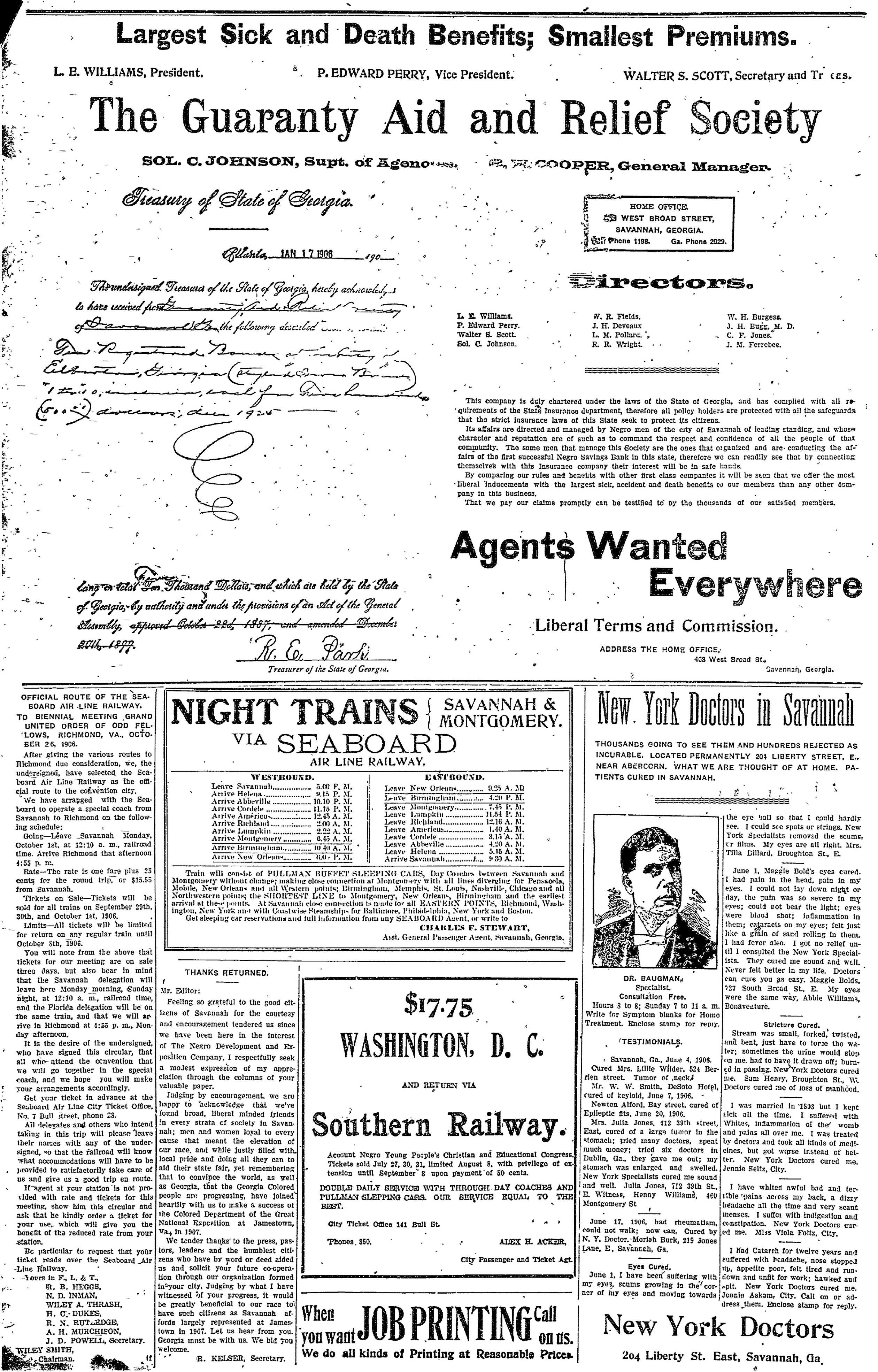
Largest Sick and Death Benefits; Smallest Premiums.
The Guaranty Aid and Relief Society
Treasury of State of Georgia.
long on total Ten Thousand Dollars, and which are held by the State of Georgia, by authority and under the provisions of an Act of the General Assembly, approved October 22d, 1887, and amended December 20th, 1897.
OFFICIAL ROUTE OF THE SEA BOARD AIR LINE BAILWAY.
BOARD AIR LINE RAILWAY.
TO BIENNIAL MEETING GRAND
UNITED ORDER OF ODD FELLOWS, RICHMOND, VA., OCTOBER 26, 1906.
After giving the various routes to Richmond due consideration, we, the undersigned, have selected the Seaboard Air Line Railway as the official route to the convention city.
We have arranged with the Seaboard to operate a special coach from Savannah to Richmond on the following schedule:
Going—Leave Savannah Monday, October 1st, at 12:10 a.m., railroad time. Arrive Richmond that afternoon 4:55 p. m.
Rate—The rate is one fare plus 25 cents for the round trip, or $15.55 from Savannah.
Tickets on Sale—Tickets will be sold for all trains on September 29th, 30th, and October 1st, 1906.
Limits—All tickets will be limited for return on any regular train until October 8th, 1906.
You will note from the above that tickets for our meeting are on sale three days, but also bear in mind that the Savannah delegation will leave here Monday morning, Sunday night, at 12:10 a.m., railroad time, and the Florida delegation will be on the same train, and that we will arrive in Richmond at 4:55 p.m., Monday afternoon.
It is the desire of the undersigned, who have signed this circular, that all who attend the convention that we will go together in the special coach, and we hope you will make your arrangements accordingly. Get your ticket in advance at the Seaboard Air Line City Ticket Office, No. 7 Bull street, phone 28.
All delegates and others who intend taking in this trip will please leave their names with any of the undersigned, so that the railroad will know what accommodations will have to be provided to satisfactorily take care of us and give us a good trip en route. If agent at your station is not provided with rate and tickets for this meeting, show him this circular and ask that he kindly order a ticket for your use, which will give you the benefit of the reduced rate from your station.
Be particular to request that your ticket reads over the Seaboard Air Line Hallway.
-Yours in F., L. & T.,
R. B. HEGGS,
N. D. INMAN,
WILEY A. THRASH,
H. C. DUKES,
R. N. RUTLEDGE,
A. H. MURCHISON,
J. D. POWELL, Secretary.
SOL. C. JOHNSON, Supt. of Ageno
NIGHT TRAINS SAVANNAH & MONTGOMERY. VIA SEABOARD AIR LINE RAILWAY.
Train will consist of PULLMAN BUFFET SLEEPING CARS, Day Couches between Savannah and Montgomery without change; making close connection at Montgomery with all lines diverging for Pensacola, Mobile, New Orleans and all Western points; Birmingham, Memphis, St. Louis, Nashville, Chicago and all Northwestern points; the SHORTEST LINE to Montgomery, New Orleans, Birmingham and the earliest arrival at these points. At Savannah close connection is made for all EASTERN POINTS, Richmond, Washington, New York and with Coastwise Steamships for Baltimore, Philadelphia, New York and Boston. Get sleeping car reservations and full information from any SEABOARD Agent, or write to
THANKS RETURNED.
Feeling so grateful to the good citizens of Savannah for the courtesy and encouragement tendered us since we have been here in the interest of The Negro Development and Exposition Company, I respectfully seek a modest expression of my appreciation through the columns of your valuable paper.
Judging by encouragement, we are happy to acknowledge that we've found broad, liberal minded friends in every strata of society in Savannah; men and women loyal to every cause that meant the elevation of our race, and while justly filled with local pride and doing all they can to aid their state fair, yet remembering that to convince the world, as well as Georgia, that the Georgia Colored people are progressing, have joined heartily with us to make a success of the Colored Department of the Great National Exposition at Jamestown, Va.; in 1907.
We tender thanks to the press, pastors, leaders and the humblest citizens who have by word or deed aided us and solicit your future co-operation through our organization formed in your city. Judging by what I have witnessed of your progress, it would be greatly beneficial to our race to have such citizens as Savannah affords largely represented at Jamestown in 1907. Let us hear from you. Georgia must be with us. We bid you welcome.
R. KELSER, Secretary.
P. EDWARD PERRY, Vice President.
This company is duly chartered, requirements of the State Insurance that the strict insurance laws of its affairs are directed and maintained character and reputation are of the community. The same men that fairs of the first successful Negro themselves with this Insurance by comparing our rules and be liberal inducements with the law company in this business.
That we pay our claims promptly.
SAVANNAH & MONTGOMERY.
RD.
Y.
EASTBOUND.
New Orleans..... 9.25 A. M.
Birmingham..... 4.20 P. M.
Montgomery..... 7.45 P. M.
Campkin..... 11.54 P. M.
Richland..... 12.16 A. M.
Americus..... 1.40 A. M.
Ordele..... 3.15 A. M.
Obbeville..... 4.20 A. M.
Selena..... 5.15 A. M.
Savannah..... 9.30 A. M.
US, Day Coaches between Savannah and Day with all lines diverging for Pensacola, this, St. Louis, Nashville, Chicago and all Orleans, Birmingham and the earliest Eastern Points, Richmond, Washington, New York and Boston.
BOARD Agent, or write to
CHARLES F. STEWART,
17.75
BINGTON, D. C.
O RETURN VIA
On Railway.
People's Christian and Educational Congress.
31, limited August 8, with privilege of ex-
8 upon payment of 50 cents.
WITH THROUGH DAY COACHES AND
RS. OUR SERVICE EQUAL TO THE
full St.
ALEX H. ACKER,
Assi. General Passenger Agent. Savannah, Georgia.
Account Negro Young People's Christian and Educational Congress. Tickets sold July 27, 30, 31, limited August 8, with privilege of extension until September 8 upon payment of 50 cents. DOUBLE DAILY SERVICE WITH THROUGH. DAY COACHES AND PULLMAN SLEPPING CARS. OUR SERVICE EQUAL TO THE BEST.
PRINTING Call on us. Printing at Reasonable Price
City Ticket Office 141 Bull St.
2. W. COOPER, General Manager.
This company is duly chartered under the laws of the State of Georgia, and has complied with all requirements of the State Insurance department, therefore all policy holders are protected with all the safeguards that the strict insurance laws of this State seek to protect its citizens.
Its affairs are directed and managed by Negro men of the city of Savannah of leading standing, and whose character and reputation are of such as to command the respect and confidence of all the people of that community. The same men that manage this Society are the ones that organized and are conducting the affairs of the first successful Negro Savings Bank in this state, therefore we can readily see that by connecting themselves with this Insurance company their interest will be in safe hands.
By comparing our rules and benefits with other first class companies it will be seen that we offer the most liberal inducements with the largest sick, accident and death benefits to our members than any other company in this business.
That we pay our claims promptly can be testified to by the thousands of our satisfied members.
Liberal Terms and Commission.
L. E. Williams.
P. Edward Perry.
Walter S. Scott.
Sol. C. Johnson.
City Passenger and Ticket Agt.
WALTER S. SCOTT, Secretary and Tr ces.
New York Doctors in Savannah
THOUSANDS GOING TO SEE THEM AND HUNDREDS REJECTED AS INCURABLE. LOCATED PERMANENTLY 204 LIBERTY STREET, E., NEAR ABERCORN. WHAT WE ARE THOUGHT OF AT HOME. PATIENTS CURED IN SAVANNAH.
New York Doctors
204 Liberty St. East, Savannah, Ga.
HOME OFFICE
WEST BROAD STREET,
SAVANNAH, GEORGIA.
Phone 1198. Ga. Phone 2029.
W. R. Fields. W. R. Fields.
J. H. Deveaux J. H. Deveaux
L. M. Pollarc. C. M. Pollarc.
R. R. Wright. J. R. Wright.
And under the laws of the State of Georgia, in the department, therefore all policy holders are required this State seek to protect its citizens. Managed by Negro men of the city of Savannah, such as to command the respect and confidence, manage this Society are the ones that organize the Savings Bank in this state, therefore we can company their interest will be in safe hands, benefits with other first class companies it will largest sick, accident and death benefits to our aptly can be testified to by the thousands.
Wanted Ever
Real Terms and Commissions
ADDRESS THE HOME OFFICE,
463 West E.
New York Doctor
THOUSANDS GOING TO SEE THEM INCURABLE. LOCATED PERMANENT NEAR ABERCORN. WHAT WE ARE TIENTS CURED IN SAVANNAH.
J.
DR. BAUGMAN,
Specialist.
Consultation Free.
Hours 8 to 8; Sunday 7 to 11 a.m.
Write for Symptom blanks for Home
Treatment. Enclose stamp for reply.
TESTIMONIALS.
Savannah, Ga., June 4, 1906. Cured Mrs. Lillie Wilder, 524 Berrien street. Tumor of neck Mr. W. W. Smith, DeSoto Hotel, cured of keyloid, June 7, 1906. Newton Alford, Bay street, cured of Epileptic fits, June 20, 1906.
Mrs. Julia Jones, 712 39th street, East, cured of a large tumor in the stomach; tried many doctors, spent much money; tried six doctors in Dublin, Ga., they gave me out; my stomach was enlarged and swelled. New York Specialists cured me sound and well. Julia Jones, 712 39th St. E. Witness, Henny Williams, 460 Montgomery St
June 17, 1906, had rheumatism, could not walk; now can. Cured by N. Y. Doctor. Morlah Burk, 219 Jones Lane, E, Savannah, Ga.
Eyes Cured.
June 1, I have been suffering with my eyes, scums growing in the corner of my eyes and moving towards New York 204 Liberty St. East
Savannah, Georgia.
tors in Savannah
HEM AND HUNDREDS REJECTED AS
NENTLY 204 LIBERTY STREET, E.,
ARE THOUGHT OF AT HOME. PA-
the eye ball so that I could hardly see. I could see spots or strings. New York Specialists removed the scums or films. My eyes are all right. Mrs. Tilla Dillard, Broughton St., E.
June 1, Maggie Bold's eyes cured. I had pain in the head, pain in my eyes. I could not lay down night or day, the pain was so severe in my eyes; could not bear the light; eyes were blood shot; inflammation in them; cataracts on my eyes; felt just like a ginlin of sand rolling in them. I had fever also. I got no relief until I consulted the New York Specialists. They cured me sound and well. Never felt better in my life. Doctors can cure you as easy. Maggie Bolds, 727 South Broad St, E. My eyes were the same way, Abbie Williams, Bonaventure.
Stricture Cured.
Stream was small, forked, twisted, and bent, just have to force the water; sometimes the urine would stop on me, had to have it drawn off; burned in passing. New York Doctors cured me. Sam Henry, Broughton St., W. Doctors cured me of loss of manhood.
I was married in 1503 but I kept sick all the time. I suffered with Whites, inflammation of the' womb and pains all over me. I was treated by doctors and took all kinds of medicines, but got worse instead of better. New York Doctors cured me. Jennie Seitz, City.
I have whites awful bad and terrible pains across my back, a dizzy headache all the time and very scant menses. I suffer with indigestion and constipation. New York Doctors cured me. Miss Viola Foltz, City.
I Had Catarrh for twelve years and suffered with headache, nose stopped up, appetite poor, felt tired and run down and unfit for work; hawked and split. New York Doctors cured me. Jennie Askam, City. Call on or address them. Enclose stamp for reply. Doctors East, Savannah, Ga.
BEYOND.
Beyond the prison cell
Release!
Beyond the stormy passage
Peace!
Beyond the starless night
The great sun's rising—
Beyond these wilds a home
Of death's devising.
After tumultuous years
To creep
Within a lonely room
And sleep!
After the exigence
Of human hunger,
Bread, and lodging, and wine
To need no longer!
How I have longed for this!—
And yet
How can I go content—
Forget
All that was dear in life
Entwined about you?
How can I pass beyond
In peace without you?
—Allan Munier, in the Atlantic,
Don Rafael Alsina lives in fine style in an ancient palace in the popular Triangle quarter in Seville. With the old palace he inherited a large fortune. This he has more than doubled by a devotion to business which is exceedingly rare in Spain, where the general rule of life is, "Never do to-day what you can put off doing until to-morrow." His pet hobby, aside from making money, has been giving it away. He is honored far and wide in Seville for his charity.
One morning early in May last, two pretty girls, Paquita Vasquez and Rosina Ortiz, called upon him. "We are laundry girls," said Paquita, "and knowing you to be rich and charitable, we have come to ask you to do something for one of our fellow workers—a poor widow with six children, who lives in a wretched garret."
"I shall send her 200 pesetas ($40) to-day," said Don Alsina, "but why did not the poor widow come herself to get help from me? It is well known that I am always accessible to any deserving poor person who is in need of assistance."
"Our poor friend," answered Paquita, "is old and—and she has lost all her good looks, senor."
"But I never withhold my alms from people because the infinities of age have robbed them of their good looks," said Don Alsina. "There must be some other reason why she did not call herself."
The girls giggled and exchanged glances. "The truth is," said Rosita, "our poor friend thought she would get more from you if we told you her story, because we, so our friends say, are—are rather pretty, senor."
Don Alsina laughed and the girls blushed. "The widow shows," he said, "that if age has deprived her of beauty, it has increased her wisdom. I shall send her 300 pesetas. Now what can I do for her charming representatives in whose selection she has shown such excellent judgment?"
"We leave that to your own generosity, senor," said Paquita; "we laundress girls are all very poor and we work very hard."
"And are there among these laundresses who work so hard for such small pay more girls who are as pretty as you two are?"
"Yes, senor," answered Rosita; "there are some who are much prettier—at least, so their sweethearts think."
"I fear I should hardly agree with their sweethearts," said Don Alsina, gallantly, "but I will tell you what I will do. Yesterday I bought a ticket in the national lottery, the drawing for which takes place next week. The number of my ticket is 1807. I am reputed to be a very lucky man. Send me the names of the five prettiest laundresses in our quarter, and if my ticket wins the grand prize, 125,000 pesetas ($5000), I promile to divide it among them. Whatever prize I win—if I win any—the money shall be given to them."
The are girls elected were Manuela Pinedo, Rosita Ortiz, Paquita Vazquez, incarnacain Garcia and Lola kernandez, and every night until the drawing took place these five girls prayed evoutly that the ticket bearing the number 1807 might win the grand prize.
Ticket No. 1807 won the grand prize, and Don Alsina at once sent for the happy laudresses and received the in his finest apartments, where he made a pretty speech, declaring that no event in his life had ever afforded him so much pleasure and that he was fully prepared to abide by his promise and divide the 250,000 pesetas among the five pretty girls.
"Oh, you angel!" exclamel the buxom Lola, and, greatly daring, threw her arms around him and kissed him. Don Alsina said something that is the Spanish equivalent of "next," and each of the other four pretty girls in turn followed suit.
"Such a delightful experience makes me wonder how it has happened, that I have so long remained a bachelor," said Don Alsina when the last of them had finished. But, alas! as I am not a Mohammedan, and furthermore as the laws of Spain forbid polygamy, I cannot marry all five of you. I can only marry one of you. To make choice of, that one myself is a task far beyond me. With your consent I propose to have recourse to a lottery again to settle the matter. Does each one of you agree that she will accept me as a husband for better or worse. If she draws me?"
"Yes, senor," answered the five girls in chorus.
Don Alsina inscribed his name on a slip of paper and folded it up. He took four similar slips that were blank and folded them up. Then he deposited all five papers in a hat.
"Now," he said, "the one of the five best and most beautiful girls in Seville who draws from this hat the slip of paper on which my name is written wins me for a husband."
Encarnacian stepped forward first, thrust her hand into the hat held by Don Alsina, drew forth a slip of paper and unrolled it. It was blank. She did her best to look as if she did not care much, but it was a poor make-believe.
"L' comes next," said Don Alsina, unmoved. "It's your turn, Lola."
Lola drew another blank and could hardly repress her tears.
"M' follows 'L'," said Don Alsina, "Now, Manuela, try your luck."
Luck declared for Manuela. She drew the slip of paper on which Don Alsina had written his name. All present congratulated Manuela and felicitated the bridegroom-elect, who had so expeditiously and adroitly solved such an embarrassing matrimonial problem. But, somehow, Manuela did not seem so ecstatically happy at the prospect of abandoning the life of a laundry girl for the luxury of a palace warranted. Don Alsina did not appear to notice it, however.
"I ask you all to be my guests at lunch," he said, "and while that is being prepared, I will snow you over my house."
While they were passing through Don Alsina's stables, in which there were three carriages and two automobiles, Manuela drew him aside.
"I have a confession to make, senor," she said. "I like you very much, but as your wife I fear I should never make you as happy as you deserve. Notwithstanding all that my parents told you, I assure you my disposition is not suite; to the domestic life. I like too much to be on the go. Will you not give me one of your automobiles instead of marrying me? Rosita will make you a far better wife than I should, and I am sure she will gladly marry you."
The accommodating Don Alsina readily agreed. It was a matter of indifference to him which of the five girls he married. He had treated matrimony as a lottery and was willing to take his chances. Rosita gladly consented to take Manuela's place as his affanced bride. Two weeks later they were married, and after a honeymoon trip through Italy they returned to Don Alsina's palace, where, according to their friends, they were perfectly happy.—Detroit News-Tribune
Another Cheap Liver Heard From—
He Made 52 Centuries Last Year.
I was much interested in the account of two young men whose weekly expenditure for food was $1.27; but I have beaten that, whites a correspondent of Health Culture. My food costs me about ten or twelve cents a day, or seventy cents a week. I buy cereals by the case, dates by the seventy pound box. I keep a cow, and raise oranges and some other fruit. If I had to buy the milk and fruit it might sum up to fifteen cents a day.
Cereals four cents; milk, five cents; dates three cents—twelve cents a day. This is about the average, so at most my food costs me about a -lar a week; but as a rule it does not average that.
Am fifty years old; have eaten no meat for twenty years; for two and one-half years have followed nobreakfast plan, and wouldn't go back to three meals a day.
Last year, as a member of the Century Road Club of America, I wheeled 11,761 miles and made fifty-two centuries (100 miles within fourteen consecutive ours), winning gold medals for highest honors in both events, and was never so uniformly, vigorously well in my life. You know that represents lifting many more foot pounds that the work of the average muscle worker. I weighed 144 pounds on January 1, 1904, and 150 pounds on December 31, 1904.
Little Prince Olaf's Land.
The story of the Sunbeam Island, which an English lady, Miss Ada Musgrove, has presented to the little Crown Prince Olaf of Norway, is one of curious interest.
Sunbeam Island, or Fortin Bras, as it is now going to be called, is about 20,000 square yards in size, and is situated in the lovely Godo Sound, a famous summer resort three hours' sail from Bergen. About fifteen years ago Mr. John Musgrove, an Englishman, spent the summer at Godo Sound and bought the island, which was then a complete wilderness. He imported new turf mould and worked hard until the island had a wood of about 12,000' trees. He also built a comfortable roomy house and a small water works. The garden of the house is beautifully arranged with small ponds and greens.
Mr. Musgrove lived with a relative on this fairy island, the views from which are so impressive and romantic, until a few years ago, when he presented the property to Miss Ada Musgrove. Miss Musgrove wrote to Queen, Maud and asked her permission to give the island to her son, and on their Majesties' visit to Bergen the necessary documents, as well as a series of pictures of the island photographed by Miss Musgrove herself, were delivered to the Queen. Manchester Daily Mall.
ONE OF THE MOST AMAZING ROMANCES OF TREASURE-SEEKING IN HISTORY
Where Nature Defies Engineers----An Immense Fortune Just Out of Reach.
In a small city office situated in Londonwall news is anxiously awaited from a man who is sitting on the edge of a mountain lake in Columbia, Central America, waiting for rain.
Heavy rain may mean for him and for those in the city office in Londonwall the recovery of treasure worth, so experts say, at least £100,000,000.
The hero of the vglgl is Mr. H. Knowles, managing director in Bogota of Contractors, Limited. The story of the company is one of the most amazing romances of treasure-seeking in history.
The Lake of Guatavita, in Colombia, lies in the basin formed by the cone of an extinct volcano. It stands nine to ten thousand feet above the sea level, and is but a few miles from the thriving little coal city of Bogota. Many centuries ago it was the Sacred Lake of the Chibchas, a race which at the time of the Spanish conquest numbered over 1,000,000 individuals.
The Chibchas worshiped the "Gilded Man," and devoutly believed that their deity made his home at the bottom of the Lake of Guatavita. Periodically they are declared to have made pilgrimages to the lake, when they cast every imaginable kind of treasure, gold, silver and jewels into the waters with the object of propitiating the "Gilded Man," who, through his army of priests, threatened all kinds of pains and penalties unless the treasure were offered in sufficient quantities.
The story of the Chibchas has many times been investigated by travelers, and all agree in believing that the lake contains untold treasure. Humboldt, the famous traveler and historian, was one of those who estimated its value at £100,000,000.
Quesada, the Spanish conqueror of the Chilbchas, was told the story of the treasure, and succeeded in reducing the water of the lake, then 214 feet deep, to fifteen feet. Then the sides fell in, and all his labor was wasted. Further attempts were abandoned, and the lake regained to a very large extent its former depth. Where the great Spanish administrator fell, however, Contractors, Limited, a prosaic British syndicate, formed just over six years ago, has determined to succeed.
The syndicate was formed for the purpose of exploiting a concession obtained from the Colombian Government to drain the lake and recover for their own uses the treasure believed to be hidden by its waters. Among its directors are Mr. K. J. Price, M. P. for the eastern division of Norfolk, chairman, and Mr. C. J. de Murletta. Its capital was originally £30,000, and was increased to £35,000 in 1903.
After six years of hard work, however, some of those connected with the company are beginning to believe that the "Gilded Man" is still at the bottom of the lake guarding his treasure. Encouraging finds of isolated gold and silver: gods and jeweled goddesses have from time to time supported the tradition of the treasure, but so far the dreams of untold wealth have not materialized. First the lake was drained. It was not an easy task, for it is some nine miles in length, and unforeseen difficulties were continually confronting the workers. The most harassing of these was the constant rain, which, winter and summer, hardly ever ceased. At last, however, toward the end of 1903, the welcome news reached
Northern Bread Line.
Nobody yet knows just how far north wheat can be successfully raised in Canada. In small patches it has been raised as far north as Fort Simpson on the Mackenzie River, in latitude sixty degrees and forty minutes. Wheat weighing sixty-two and a half pounds to the bushel has been grown at this place. At Fort Chipewyan, which is at the mouth of the Athabaska River, on Lake Athabaska, in fifty-eight degrees and forty-two minutes north, wheat is grown regularly, and a sample took the gold medal at the Centennial exhibition at Philadelphia in 1876.
At Fort Vermillion, in latitude fifty-eight degrees and twenty-four minutes north, or about 650 miles north of the United States boundary line, there are three small flour mills, which draw their entire wheat supply from the surrounding country. One of these mills is owned by the Hudson Bay Company, and it has a capacity of thirty-five barrels a day. Its flour product is chiefly used for the supply of the company's trading posts in the far north. This mill has been running regularly ever since 1902. At Peace River Landing, which is a little farther south than Fort Vermillion, there are two small flour mills—Minneapolis Tribuna.
Conquering the Colorado.
The first of the great American rivers to be completely held in bondage by a dam will be the Colorado. The Laguna dam, twelve miles above Yuma, Ariz., will be completed by the Government in two years. It will be 4800 feet long, and _will be secured at the ends in the mountains which compress the Colorado at that
Ill. J. H. Walker, 33d, is arranging to give the delegates to the supreme council which meets in Macon next month, a royal southern reception. In this he will be ably assisted by the brethren in Macon.
Bro. J. W. Woolbright of Alapaha is well known to the brethren of the state. He is a constant visitor at the grand lodge and he endeavors to be a good Mason. He has had a great deal of trouble recently on account of the tragedy in which his son was connected with. Fortunately the deed was committed in self-defense, and he was acquitted. Brother Woolbright was compelled to secure a lawyer that cost him $250.
Eureka Lodge, under Worshipful Master George L. Binyard, laid a corner stone to the Baptist Church, south of the city, on Sunday afternoon. Brother Binyard was assisted by several brehren and the service was impressive.
It is the proud boast of the Briton that the outposts of his military service stretch entirely around the world, and that the roll of the drum is constantly scunding revellie or taps somewhere in His Majesty's possessions. Applying this continuity of thought to Masonry: somewhere and in some clime and some longitude, some worshipful master is ever opening his lodge with salutations of praise or closing with the benediction of peace and brotherly love. Ours is the metropolitan order of the world, which neither storm, pestilence nor famine, neither wars nor rumors of wars, disturb. The cycle of time neither points its beginning nor indicates its ending. Immutable as the days, as lasting as the everlasting hills, its goodness is as the dew of Hermon, its purposes as broad as the canopy of heaven, and its blessing a continual and perpetual benefit to mankind—The Trestle Boar.
The quarterly conference held at Pembroke September 28, 1906, was a grand success, and the people at large seem to love the presiding elder, Mr. Taylor, who preached a noble sermon on "Work Without Falth." There was a marriage which took place at the beautiful Zion Baptist Church on its regular preaching day. The bride was Miss Lizzie Belle Shettman, who is the daughter of Mr. and Mrs. A. C. Shellman. She was married to Mr. George W. Jones at Quincy, Fla., Rev. Y. L Lyde officiating, after which Rev. James Williams of Goldsboro preached a noble sermon on "Salvation." Miss Virginia Box of Savannah is spending a week of vacation with Miss Frances and Carry Davis.
Miss Frances Taylor opened school at Pembroke on Monday last, filling out the term of Professor J. A. Lockett.
At Mt. Morjah Baptist church an ice cream festival supper was given, which was a grand success. It was managed by Mrs. Mary Paul, Mr. J. D. McMore and others.
The two places of this place, will soon be completed. The Methodist and Baptist both are progressing nicely.
Mr. J. D. McMore is doing some earnest work for this paper and we hope he will be successful. We want to send in fifteen new subscribers next week.
Mr. W. T. Wilson of Blackboro, Ga. visited our town Sunday and left for home Monday. He is an agent for The Globe Association and is a turpentine man at Blackboro, Ga.
Mr. F. J. Jones was in town Monday on blissness
We learn that Mr. R. L. McKellar and a young lady of Bryan county are to be married soon. We will tell who they are when we write next time.
PEMBROKE CORRESPONDENT.
September 3, 1906.
Mr. Editor:
Allow me space in your valuable paper to call the attention of our people to this thought, as a hint to the wise is sufficient. When we come to analyze the character of those with whom we are surrounded, we are forced to the conclusion that for the most part men are neither mentally nor morally what they ought to be. When we contrast the real condition of men, content with a dwarfed intellectual and spiritual growth, with the glorious
London that Mr. Knowles and his staff of engineers and workmen had succeeded in cutting through the basin of the lake, and the water had been drained off successfully. Here was great jubilation, and preparations were made for the large consignments of gold, silver and jewels which might be expected to arrive by the next boat.
Unfortunately, however, the water is not the only barrier on which the "Gilded Man" has to rely for the safe-keeping of his treasure. The jubilation in Londonwall was summarily ended by a cablegram stating that twenty-five feet of solid mud, or some 30,000,000 cubic feet in all still lay between the treasure-seckers and their quest.
But what is 30,000,000 cubic feet of mud when £100,000,000 is at stake? A new engineering feat was decided on—the construction of a great dam across the hole made in the side of the basin, terminating in a shaft through which the mud should be washed and carefully precipitated, so as to secure the gold and silver treasure as they were distrbed from their hiding place of centuries. The dam was constructed, and with it the cleansing shaft, but while the work was in progress a strange thing had happened. The "Glided Man" was evidently at work again.
For over three years the engineers had worked in the rain, in such a downpour, indeed, as was unprecedented in Central America. As the water ran from the lake, however, the rain had stopped, and a drought equally without a parallel in the history of the country set in. For more than two and a half years not a drop of rain has fallen at the scene of the operations, and when the engineers had completed the construction of the dam it was only to find that the sun had baked the 30,000,000 cubic feet of mud into the consistency of hard rock.
Then, metaphorically speaking, the engineers sat down and wept. The rock-like substance still lies as an impenetrable bomb-proof lid over the golden gods and the silver dishes and ornaments, to say nothing of the jeweled goddesses and their glittering hand-maidens.
The few natives in the region, remnants of the great race of Chibchas, occasionally visit the scene and smile cheerfully at the downcast Englishmen. "It is all the work of the 'Gilded Man,' who is watching over his treasure mountain," they say, and they plainly hint that when the rain comes—if ever it does come—to soften the mud, some other obstacle will defeat the desire of the treasure-seekers.
Letter after letter from Mr. Knowlès to the little office in the city dejectedly refers to the determined opposition nature has placed in his way.
"I regret to say rain absolutely refuses to fall here," he wrote in one of his letters. "This is all the more heartrending as it falls around. I have been here hoping against hope, hearing the thunder and seeing the storm pass us by, which is an awful trial, as you can imagine."
"We really ought to get all the water we want in May," he wrote again, "but nobody can guarantee this."
So far his pessimism has been justified. The "Gilded Man" is taking care of his own—London Express.
point into this narrow width. The dam will consist of three massive concrete parallel walls, the spaces filled with stones and the whole width of the dam on top 244 feet. This great barrier will weigh 600,000 tons, and although it will not rest upon rock, its weight will be such that not even the Colorado will be able to dislodge it. In lo; water the dam will back the river up and afford irrigation for 100,000 acres of rich bottom land, and in flood time the Colorado will thunder over the top.—St. Louis Post-Dispatch.
The Rabbit in Politics.
If there is any rabbit blood in a man's system, politics will cause it to circulate. I know I would be just as big a rabbit as any one else if I were a candidate. The man who is a raging lion in the business world, who is not even afraid of his wife, becomes as meek and timid as a cottontail when he is a candidate for office. There is something in the political germ that lets all the iron out of a man's blood. That is one of the reasons I do not like politics.
Being a rabbit myself in all things. I can't help admiring the lion. You read about lions in books, out in everyday life they are all-fired scarce. Here is a funny thing about the rabbit. He thinks he is doing things up about right and that people are not onto him. Every rabbit has a mark on him that can be seen two miles. The fellows listen to his story and then laugh behind his back about his "being scared." But somehow or other, about as many rabbits land as lions. Now a lot of rabbits are going to read this and say, "That's right." The rabbit is also blind.—Osborne (Kan.) Farmer.
Among the Masons.
Past Master R. D. Parker of Vidalla is the first worshipful master to report the forwarding of the assessment for the W. and O. Home. Brother Parker is a loyal Mason and his example should be emulated by others.
The first payment on the home is due this month. Forward same to Brother Spencer at once.
Past Master S. M. Walker of Ludowick was in the city on Tuesday. Brother Walker is a good Mason who has been laboring a long time. He recently organized a lodge at Glenville, and is now at work on a chapter of the O. E. S. at the same place.
Universality of Masonry.
PEMBROKE POINTERS.
HIGHER ASPIRATION.
/
possibilities of a noble and earnest manhood which might be his, how vast the difference. If we question the experience of those about us, shall we not be convinced that men are prone to sink to what is below rather than rise to what is above them? The process of levelling down to our surroundings is so much easier than levelling up to our possibilities. Is it not well, then, for, the young man at the very outset of his career to set before him the example of men who have attained eminence among their fellows, and discover if possible the method by which they succeeded? Is it surely the part of wisdom to look upon those who, have done the best, and resolve to imitate their example instead of glazing in discouragement upon the thousand who have utterly failed or who are now pursuing the course which leads to certain failure. Because, however humble our station in life, we are under the weightiest moral obligation to do the best possible and therewith be content. If our life work be worth any effort it demands the noblest and best, and the man who for the sake of personal ease or comfort would economize his effort is both a bungler and a trifler. How many are satisfied to saunter along upon the dead level of mediocrity, with the plodding multitude, and how few with a noble purpose, born of a strong confidence and indomitable will, rush far in advance of their fellow till from their loftier eminence they can point to grander triumphs beyond. But the silent influence of the example of these few may be traced in the lives of other men and in the destinies of nations.
Respectfully yours, etc.
J. K. WILLIS.
LIFE OF FRUIT TREES PRO-
LONGED.
American consuls to Germany, in recent reports, advise this Government of some very important discoveries relating to horticulture. Thus far, results have demonstrated their value. They refer to experiments tested for the purpose of prolonging the life of fruit trees. A solution of the sulphate of iron is used, and this was at first injected under the bark of the tree so as to cause it to go into the sap flow or circulation. Subsequently it was found best to inject the fluid through an opening of the bark at the neck of the roots. Analysis of the tree sap has shown that the iron fluid penetrates deep in the ground, flowing through the roots and the new branches or new wood to the very top of the tree, though, singular enough, examination shows that the fluid does not enter the old wood of the tree. The whole process is for the purpose of relavigorating and thus prolonging the life and increasing fruitage of the trees, and is much the same as that of anemia of the granevine for the same object.
These scientists are now conducting further experiments looking toward the use of a fluid to be injected into fruit trees for the purpose of destroying the bacteria which causes pear blight and fungus diseases which kill trees, thus with some fluid to circulate in the sap flow to at least neutralize the effect of the bacteria to which these diseases are traced. These tests proceed on the basis of knowledge of both the causes of decay and death, much as medical science proceed in the matter of human disease, viz: first finding the cause of decay.
In the instances relating to fruit trees, as in human alliment, a certain species of bacteria has been found to be the cause, and to reach it they are injecting into the circulation the kind of fluid that will arrest the ravages of these bacteria—Indianapolis News.
A CLIMBING PLANT. FOR THE FARM.
The amelplosis vettchil, or Japan ivy, known in this country as the Boston ivy, is one of the best climbing or creeping vines we have for the farm. It belongs to the same family as the Virginia creeper or American ivy, but is not so gross growing in habit or form. The foliage is not unlike that of the American ivy, but in smaller form and is much lighter in color, even when mature. It grows rapidly, throwing out, at frequent intervals, small feet or tendrils having a sticky substance attached by which it fastens itself to any rough object—wood, stone or brick—and clings tenaciously. It is a beautiful vine to set at the foot of a dead tree from which the branches have been removed, and is equally beautiful grown over the sides of a brick or stone building or a stone wall. It is practically hardy but not evergreen. In the fall the foliage takes on all the varied autumn hues of the maple leaf. The plants are moderate in price, grow rapidly, and in a few years, add much beauty to the farm grounds.—Indianapolis News.
According to the Buffalo Courler, hardware manufacturers recently traced forty freight shipments from Richmond to various points in the Southern States. The average number of miles traveled per day by these shipments was 61.61, and the average mileage per hour was 2.57. The quickest time was made by a shipment from Richmond to Olmstead, Ky., a distance of 797 miles in six days. The slowest time was from Richmond to Easton, Md., 170 miles in seven days. Manufacturers are gathering evidence with the view of bringing the subject to the attention of Congress.
PUBLISHER EVERY SATURDAY,
BY THE TRIBUNE PUBLISHING CO
116 W. St. Julian Street.
Bell Phone 2171.
ALL of our societies and lodges should patronize the colored savings institutions.
COLORED men can not afford to allow themselves to become so insane for the moment and become lynchers.
"LILY WHITE" street cars are among the popular sights these days, caused by the proud colored citizens who are determined not to be "Jim Crowed."
In this instance the prejudice against our people has caused them to come together. Continue the unity. It means much strength.
WE are fearful of the foes within the ranks. We have no time for contention. The contentious man, who is always so in season and out of season is one of the worst enemies of the race.
WALKING has proven beneficial to the physical and financial condition of our people. Their spontaneous action is to be commended. Let them keep it up.
If any 'buzzard' cares to ride let them do so. Those of us with the least spark of race pride, will continue to glory in our walk.
SINCE SEPT. 13, our people have saved hundreds of dollars by not patronizing the street cars. Would it not be an excellent idea for those who have been constant riders to donate the amount: they would otherwise spend toward the purchase of a suitable site for a school building in the southern part of the city?
At the recent annual conference of the A. M. E. Church in Ohio, resolutions were adopted commending the editor of the Southern Christian Recorder for his broad course in conducting the Recorder. This is a just compliment to Editor Allen whom we deem one of the grandest men of the state.
THERE remains only a few days more than a month before the first Colored State Fair in Georgia will be opened. This fair will reflect the progressiveness of the colored people of this State and it behooves each one of us to bend our energies toward making it a complete success. Every farmer, mechanic, artisans, etc., should commence preparing exhibits and prove to the country that we stand for something indeed.
THERE are three colleges in this state of excellent standing that have colored educators as president. The Georgia State Industrial College, with Maj. R. R. Wright, as its president; Clark University with Prof. W. H. Crogman as its president and the Atlanta Baptist College with Prof. John Hope as its president. The capability of the colored man as an educator has been demonstrated in his favor and these instances give further proof.
This is the tenth day since the Savannah Electric Company has had enforced the "Jim Crow,"law on its cars. This act is resented in a vehement manner by our people, who have shown much pride by not riding. Their determination not to ride has been met by an indirect intimidation to make them ride on the part of the city officials. Immediatety after the enforcement of the law special orders were given the police in the matter, announcing that trouble, was eminent, but not realized. More trouble () was expected on Saturday and the night force, was doubled. Our people as usual were orderly and law-abiding even though some of them were unjustly goaded. Police protection was denied our people, and in many cases it has been reported that policemen were the aggressors. In it all our people are to be commended for their fortitude and great respect for law order.
This week in Memphis, Tenn. meeting is being held of Con-
gregational workers. In speaking of the work of this church, Rev. Porter says:
"Little is known of the real work which is being done by the colored Congregationalists, yet the work is having its effect in raising the mental, moral, physical, financial and spiritual standing of the Negro in all parts of the country. It is often said that the Congregational church is not known among the Negroes. Such a statement is only made by those who are not acquainted with the work being done by the Negro Congregationalists "Again the Congregational church has given to the field some of the most prominent men among the Negroes, as well as women who are the leading factors in the uplift of the Negro race.
"Our institution have been broad in their work, the Baptists. Methodists and all denominations have been and are being educated not as denominational men and women but as intelligent christians,
In the south the Negroes have six chartered institutions, 64 common and graded schools, 476 instructors and 15,000 pupils, 250 churches, 15 ministers and missionaries, 12,549 church members and 18,959 pupils in Sunday Schools. This is the work of the Congregational church among the Negroes of the south, a church that stands for an intelligent ministry and mode of worship and a church that recognizes Jesus Christ as its head."
The members of the committee appointed by the mass-meeting of colored citizens to arrange protest and present the same to city council, and communicate to the manager of the street car company feel proud of their work and the opportunity to represent the people and in this pardonable pride they are upheld by 99 per cent of the churches regardless of denomination and a large per cent of the citizens at large. Following are the protest to council and letter to the street railway manager:
"It has come to us, through the public press and otherwise that there is an effort on foot to change the rule now in operation on the street cars of our city relative to the passage of white and colored patrons.
"Whereas we believe that the change as proposed would engender strife, confusion and bad feelings between the white and colored people in our city at this time; subject many innocent, hardworking, well-disposed colored passengers to hurt, harm, danger and uncalled for brutality terrify and paralyze the good, harmony and peace now existing between the white and colored people of our city thus thereby, defeating and destroying the best interest of the good people in our city. And further still: Whereas in the interest of the good, peace and harmony existing now between the races in this city and also in the interest of the onward progress of the city, morally, financially and otherwise coupled with an interest in the more than thirty thousand Negroes who are loyal supporters of the laws, we the undersigned representatives of the colored people, selected by them in mass meeting assembled for this purpose, do here and now in the interest of peace, harmony and the onward progress of your great city, with the great interest which hangs upon the more than thirty thousand colored people of the city, respectfully petition your honorable body to use your good offices to the end that no change in the rule of operation on the street cars be made, but that the same rule which has been and is now productive of great peace and harmony between the white and colored passengers throughout our city, and also productive of great profit to all concerned as the records will show be continued among us, thus urging your favorable action in this petition."
TO STREET BAILWAY MANAGER.
"We, the undersigned representatives of the colored people of this city, selected by them in mass meeting assembled for the purpose of considering the proposed change of rule now in operation on your street cars relative to the passage of white and colored patrons, respectfully submit to you the following facts which confront us:
"1. The record of the past will show to the most critical, that the rule now in operation on your cars has been and is now attended with peace harmony and good will between the white and colored passengers, and also of great profit to you and all concerned.
"2. It is evident that at least half of the finances which have gone into your great business from operating the cars throughout our city has come from the hands of more than thirty thousand Negroes who live here."
"3. The proposed change of rule will engender strife and confusion between the races; work hurt, harm, danger and uncalled for brutality on the part of some of the street car employees to many innocent, hard-working well-disposed colored passengers and thus thereby, cripple and menace not only your street car business, but the best interest of our great city.
4. Since there is a well organized and determined effort an foot among the colored people to stay off the cars if the change is made thereby depriving themselves of a public utility in order to escape the harsh treatment, brutality anger and strife which will follow in the wake of the proposed change; and since we always stood and do here and now stand for peace and harmony and the best interest of all the white and colored, in our great city, therefore we as representatives of the colored people, wishing no demoralization to your business, and working in the interest of peace and harmony between the races in our fair city, do by this document call upon you and urge you to lend us your great influence to the end that no change be made, but that the same rule which has been productive of great profit to you and all concerned, be continued among us."
This is an age of epigrams, but none is more fitting for the present condition of affairs in this city, than the one so unconscientiously uttered by one of our most estimable ladies who in her pride for the loyal action of our people, said that many of them should learn to "boycott their tongue."
Demagogues And Hypo-
erlites.
There will be a rousing mass-meeting of citizens at St. Philip Monumental A. M. E. Church, New street, Monday night, September 24th, at 8:30. At this meeting the eyes of the people will be opened and the demagogues and hypocrites will be laid bare. Attend yourself and bring your friends.
WHILE our people are being worked up, no undue advantage should be tal'en of them. Deliberate and practical plans must be worked out for their benefit.
A LARGE mass meeting was held this week to consider a transportation line. At this meeting many indiscreet things were said to intensify our people, and urge them to pay out their money. Many of them blindly went forward and did so before finding out who were the officers of the organization. This they did very foolishly. Our people in their impulsiveness should stop and consider to whom they are trusting their money. There will be a reaction; it is bound to come, and in time we want to warn them. Be careful as to whom you pay your money and in fact always look up the record of the promoters of any scheme that is bidding for your money.
DURING the past week the Colored people of this city have made a display of race pride that has removed all doubts that have existed on this point. It is clear that the race does not lack this inherent quality.
The colored citizens here could not approve of the separation law and they stopped patronizing the street cars. Though there has been unanimity on their part, in the main their action has been spontaneous. Even inclement weather has no effect on the general situation, so sirong has been the determination to walk. There has been practically little or no disorder among the people, and they are to be commended for the good judgment they have exercised along this line.
As soon as the separation law became effective, the colored hackmen came to the assistance of our people and carried them about the city for a fare smaller than the usual sum. They rendered excellent service and received a very large patronage. Buckboards and street wagons have also been pressed into service by their owners.
There is much speculation current as to how long the colored people will walk. At present there is no reason to think that they will act otherwise. It is not a mere matter of equal accommodation (and it might be said at this point that the flagrant violation of the separation law by the railroad destroyed the faith of the Negro in its equitable operation), but a principle is involved. The colored citizens protest against any attempt to make, them above all people, objects of scorn and ridicule in a public utility.
Race Pride Bampant.
On Monday noon a meeting was held at the F. A. B. church to confer about transportation for our people. A committee was appointed to arrange plans for the same. The committee has the matter under advisement They met again yesterday. A rousing mass meeting was held on Thursday night at Masonic Temple on Thursday night. At this meeting shares were sold for the transportation company but our people should be careful of what they are doing.
Wedding Bells.
On Wednesday evening September, 5th, 1906, at the St. Andrew A. M. E. Church, of Darien, Ga., Rev. Neptune H. McTier of Baxley, Ga., and Miss Carrie B. Rogers of Darien were united in Holy wedlock by Rev. Cyrus H. Clairborne of Thabes, Ga., assisted by Rev. Hobbs, the pastor of St. Andrew. The Church was beautifully decorated by that experienced decorator, Mr. Graham of Darien, assisted by friends. The wedding march was performed by Mrs. L. A. Handy of Darien.
. The bride is one of Darien's most accomplished young ladies, having received her literary education at Dorchester Academy, Thebes, Ga., and is an experienced teacher, well equipped in music and dress-making. She will be a valuable helper to her husband in the ministry. Rev. McTier is a graduate of Dorchester Academy and Howard Divinity school, Washington, D.C., and is now a pastor of the Congregational Church at Coe and Riggton, Ga. Many valuable presents were given the bride and her many friends did their full duty to make the whole affair a notable one. Mrs. DuCross of Alabama, Miss Brawley of Fernandina, Fla., Miss Laura Byrd of Limerick, Ga., and Miss Blanche E. Clark of Wilmington, N. C., were honored guests at the wedding.
Attention Ladies.
Are you interested in the uplifting of the race? Are you interested in the progress of the Colored women
especially ? If so, you are most cordially invited and earnestly requested to prepare something for the Woman's department of the coming State Fair which will be held in Macon Ga., Nov. 12-19. Do not let this opportunity pass to do something for yourself and the race loving women are urged to be present at the Masonic Temple Monday 24, at 4 o'clock, to make arrangements for a grand exhibit that will do credy it to the colored women of Savannah. Liberal premiums are offered for all women's work. Mrs. J. A. Broskett, President; Mrs. R. R. Wright, Member of Executive Board; Miss C. Emma Lewis, corresponding Secretary; Mrs. J. A. Lindsay, Recording Secretary.
True Reformers Meeting-
We promised to send a letter about the convention of the Grand Fountain of True Reformers which convened in Richmond, Va., on the 4th inst., but our time was so much taken up attending sessions, etc., that we scarcely had time to write to our friends at home. Truly the half has never been told of that great order. We arrived in Richmond 6:30 a. m. Monday Bept, 3d, and were driven to our boarding place, a beautiful home amongst most hospitable people. We had the best of everything.
There were nine of us, two gentlemen from Columbus, one being the principal of one of the grammar schools and the other prominent young business man, the others, leaving out the four of us from Sayannah, were from different parts of Pennsylvania. We certainly were a congenial party, each doing all in his power to make it pleasant for the others.
Shortly after breakfast we visited the Reformers hotel a very commodious building with all modern conveniences, one of which any Negro may well feel proud.
Next we visited True Reformers Hall. Truly it is a monument, not only to True Reformers, but to the whole Negro race. All of the offices, including the bank and the different departments, regalia, real estate, supply, printing, etc., are in the building, four stories, and occupying a space equaling one of our short blocks, such as Macon, Harris, Bull and Whitaker streets block. On the fourth floor is the auditorium. It resembles an opera house, high ceiling, stage with scenery and curtains, two rays of electric lights over the stage, spacious galleries, elevated floors and fine stationary chairs all numbered. We also visited the grocery store. We have no larger nor finer in the city, white not excepted. They have five delivery wagons.
On the morning of the 4th the Grand Fountain convened. There were between five and six hundred delegates besides visitors, all True Reformers from all parts of the country, and crowds of resident members of the order, the finest gathering of Negroes it has been our pleasure to be amongst the number. It made us think of the halls of Congress, both houses of which we have had the privilege to visit during session. It almost made us think that we were at one of their sessions. We were known as Mr. so and so and Mrs. so and so of Chicago, St Louis, Philadelphia, etc. We heard speeches made by some of the brainiest men of our race. There were some of all professions, and if we never had been proud of being Reformers before, we felt proud then. There is nothing to be ashamed of in True Reformerism. We only wish that the people of our city who are so apt to think that the organization is of little consequence and so inferior to other organizations, could have taken a five minutes peep into that hall during one of its sessions, we would no longer have to ask and persuade any one to join. They would feel fortunate to be able to become members. We have made our letter too long and still we have just begun to tell of the convention. Besides there is so much more to tell. If you wish our letter can be continued.
We are yours truly,
Mrs. L. A. Harvey.
Mrs. F. H. Starr.
Mrs. Agnes Watts.
Mrs. J. H. Patterson.
St. Philip Dots
Endowment Day was ushered in on Sunday in all of the African Methodist Episcopal Churches throughout the United States and where ever there is an A. M. E. Church. All money collected oh that day go to the support of all of the schools and colleges control by the A. M. E. Church. At St. Philip the exercises were quite elaborate. At eleven o'clock a. m., Rev. Lindsay delivered quite an interesting discourse touching on that vital importance of supporting these schools and colleges. At 4 p.m., the Sunday School had endowment day exercises. Prof. J. H. Baldwin the Superintendent had an excellent program. The features of the exercises were slong by the school, duets and solos by several scholars. Too much credit cannot be given Mrs. A. B. G. Carr, and Mr. Davis Moses for the interest they had taken in training their classes for the part they had in the exercises. The gold badge contest was spirited and close. The questions propounded by Prof. Baldwin were very rigid. The four scholars who contested for the badge were Jas, Baldwin, Louise Baldwin, Arnett Lindsay and Hallie Lindsay. The Judges' after comparing the answers awarded the first prize to Master Arnett Lindsay, little Miss Hallie Lindsay was second and Master James Baldwin third and little Miss Louise Baldwin fourth. In the class room collection Rev. Lindsay's class led and Mr. Divid, Moses class was second. At 8 p.m., the conclusion exercises were carried out and standing room was not to be had. Prof Baldwin made the opening address which was timely pointed The duet by Misses Spaulding and Dozier was very good. Mr. J. W. Moore and Prof. B. S. Read came in for their share of applause for the solos each one of them rendered. The papers read by Mrs. M. E. Harper and Mr. W. O. Castleberry deserve much credit in the way they were composed and read, Mr. David Moses also read a paper on education and various other things pertaining to the schools and colleges of the A. M. E. Church was very good. Rev. Lindsay appealed to the congregation for their support toward education which was responded to by the liberal collection which was the largest in the history of all past endowment day. The exercises of the day concluded by burning a copy of the last canceled mortgage on Morris Brown College by a girl and boy representing the female and male departments of the school.
Have your children's teeth examined by Dr Shivery.
Owned and managed by Colored Men They Should Have Your Patronage
Metropolitan and Realty (Incorporated Capital Stock Shares $10 Full Paid and Non-
Metropolitan Mercantile and Realty Company.
Six Years of Success and service tells a tale unprecedented of Race Enterprise. Six years of experience and epoch of corporate adventure and Six years of pluck and push, tr Six years of progress and prestige. Six years WORK and worry, THIS IS THE HISTORY of this gr This with Real Estate is behind you pay SEVEN PER CENT ann Churches, Halls and Houses, thousand men and women. Make an investment with us a grow.
tale unprecedent
experience and ex
adventure and b
ack and push, tria
gress and prospe
K and worry, wi
y of this great
state is behind you
R CENT annual
and Houses. W
ed women. W
ent with us and
and service tells a tale unprecedented in the annals of Race Enterprise.
Six years of experience and extension marks an epoch of corporate adventure and business achievement. Six years of pluck and push, trials and tribulations. Six years of progress and prosperity, patience and prestige.
Six years WORK and worry, wisdom and winning. THIS IS THE HISTORY of this great race institution. This with Real Estate is behind your investment. We pay SEVEN PER CENT annually. We build Churches, Halls and Houses. We employ our two thousand men and women. We are here to stay. Make an investment with us and see your money grow. P. SHERIDAN BALL, PRESIDENT.
L. C. COLLINS, SE
J. H.
F. M. COHEN, Teller. J. W. ARM
222 W. Broughton St., Savannah
W. M GRAY, Pres., J. M.
A, L. MONGIN, V. Pres., D.
JOHN D. SAVAGE, Gene
The Afro-Am
Union Saving, Loa
DOLLINS, SECRET
J. H.
J. W. ARMST
Savannah, C
J. M. N.
fres., D. V.
SAVAGE, Genera
Afro-Ame
ing, Loan
J. H. ATKINS, TREASURER.
F. M. COHEN, Teller. J. W. ARMSTRONG, Gen'l Mangr.
222 W. Broughton St., Savannah, Ga. Bell Phone 1144
W. M GRAY, Pres., J. M. NORTHINGTON, Cashier,
A, L. MONGIN, V. Pres., D. W. OSBORNE, Treas.,
JOHN D. SAVAGE, General Mauager.
The Afro-American Union Saving, Loan and Trust Co.
(Incorporated.)
Capitalized at $50
216 Whitaker St., San
THIS COMP.
Is now open for business. Depositors
following favorable rates upon all depo
5 Per Cent
ed at $50
er St., Sa
S COMP.
Depositors
Capitalized at $5000.00.
THIS COMPANY Is now open for business. Depositors being favored with the following favorabe rates upon all deposits. 5 Per Cent Itnterest will be paid upon DEMAND Deposits. 7 per cent upon all ANNUAL Deposits.
The Company has a few more shares of Stock for sale at $5.00 per Share. After Stock is paid up, Stock holders will recieve not less than 8 per cent.
E. SEABROOK, Funeral Director
General undertaking and embalming Everything first class. Rates reasonable.
N. E. corner West Broad and Huntingdon streets, Savannah, Ga.
Knowles Building. Bort' Hall. Stroes Hall. Girth' Hall. Model Home.
ATLANTA UNIVERSITY
Christian and unsectarian. For the education of young men and women in the higher studies.
Collegiate, Normal and High School Counsel. New Practice Training. New Practice School
Training. Home life and training. Graduates secure most important positions as
teachers and leaders. Home life and training. Athletics. Superior advantages in Music and
Printing. Aid given to needy and deserving students. Term begins the first Wednesday in
October. For catalogs, address:
462 W. Broad,
Near Gaston
SATURDAY, SEPTEMBER 32, 1906.
Dr. Stevens of Darien spent Thursday in the city.
We are glad to note that little Anna Frances, daughter of Mr. James F. Butler is at this writing much better.
One of our hunters, Mr. R. McNichols was struck by a poisonous snake this week, but he was well protected by his boots and was saved.
The concert by the Pythian band at Masonic temple on Wednesday night was a success. A large crowd was present and enjoyed the program.
The Atlanta University Quartette assisted by local talent was booked last night for a high class musicale at the Masonic Temple. The University is a favorite in Savannah.
Mr. L. E. Williams, made a flying business trip to Atlanta last week.
Mrs. Mary A. Johnson of Augusta is in the city spending awhile with her sister, Mrs. B. L. Lloyd.
Have your gums treated by Dr. Shiverv.
Mrs. F. M. Cohen, with little Master Meritt visited her sister in Atlanta last week.
Miss Nancy E. Barnard returned from Grahamville, S. O. on Tuesday after a very pleasant stay.
Prof. Gao. B. Hurd, principal of Beach Institute will arrive in the city next Monday.
Mrs. Samuel J. Wayring of Sayannah is in town, the guest of Mr. and Mrs. C. H. Singleton.—Beaufort County News.
Have your husband take out a policy with the Atlanta Mutual Insurance Association. Office 307 Whitaker St., (near Liberty street.)
Mr. R. Kelser, general secretary of the Negro Development Co., U.S. A., after a stay of two weeks in the city left for Atlanta on Wednesday.
Miss Fannie Deveaux, of Savannah, the daughter of the Collector of Port, at that place, is the guest of the Misses Walton, 1827 Fitzwater Street.—Philadelphia Tribune.
Miss Elizabeth H. Roberson after spending the summer in Mt. Clair, N. J., will return on next Tuesday. Her many friends will be glad to welcome her home again.
Dr. E. D. Bulkley wishes to say that any one wanting dental work done by him can have his buggy call for them by ringing Bell phone 1124 and be taken to and from his office free of charge.
Mrs. S. B. Saunders and Mrs. Lottie Chapel have returned home after spending an enjoyable time in Jacksonville, as the guest of Mrs. Clara Haywood.
Mr. H. A. Houston. one of the popi niar and efficient clerks of the post-office left on Monday last for New York to spend a much needed vacation. He will be gone about two weeks.
Mrs. J. H. Patterson's Morning and Evening School will begin its fifth term, Monday Oct. 1, at 912 Atlantic Avenue.
St. Stephen's Kindergarten and primary school re-opens Monday October 1st. - Apply at once to Rev. R. Rright, 313 Harris street, east.
Rev. W. L. Cash left on Wednesday for Memphis, Tenn., where he is attending a session of the Congregational Workers. He will return next week.
Mr, H. E Perry, Life Insurance, Room 423 Empire Building, Atlanta, Ga. 8-7-06.
The Ladies Auxiliary of St. Augustine Chapel will give an entertainment at the rectory for the benefit of the church. Friends of the parish are invited to attend.
Misses Mattie and Mary Greene of Savannah, have been quite sick at their home 242 South Quince street, Philadelphia. We are glad to note that they are rapidly improving.
Miss Lucinda R. Greene has returned to her home 242 South Quince street, after spending a pleasant two weeks vacation with her aunt Mrs. P. Smith, of Washington D.C.
Capt. J. R. Nowell, arrived in the city last Sunday morning, to accompany his daughter, Miss Priscilla Pearl Nowell home. She has been the guest of Mrs. M. B. Marshall. The friends of Miss Nowell regretted that she had to leave so early.
F. B. Pettie, Attorney at-Law, 116 St. Julian St., over TRIBUNE OFFICE. 8-18
Mrs. J. S. Williams who left here on Aug. 17th, for New York city, where she resides, has been very ill for the past three weeks but is now on the mend. Mr. and Mrs Williams are delighted to have THE TRIBUNE to read every Monday morning and it affords them a great deal of pleasure to hear from their old home and they feel now as if they could not do with out THE TRIBUNE. Scott Bros. are putting in this week, stock of shoes, dry goods and notions, men's and women's furnishings. See this stock before purchasing.
A grand Festival will be given by "Catholic Mutual Aid Society" at Harris St. Haul, Tuesday evening October 2nd. Admission 25 cents. Dont miss the fun. There will be a dime festival at the residence of Mrs. F. H. Starr 523 Gaston, St., East, on Monday night.
Local Notes
Mr. and Mrs. Edward Nelson of Darien spent several days in the city this week with friends, and returned on Friday night. Mr. Nelson is now in business in Jacksonville. Mr. and Mrs. Nelson are former residents of Savannah.
Miss Georgia Hankins, after a stay of several weeks in the city left on Sunday last for Brunswick. She was accompanied by Miss Marie Hall, who will return on the 30th. Miss Hall's friends wish her a pleasant stay.
A meeting of the Emancipation Association will be held at St. Phillips A. M. E. Church, West Broad and Charles, Sts., Rev. Lindsay pastor. On Wednesday September 26th, instant at 12 o'clock noon. Everybody invited. Arrangements as usual will be made for celebrating the Emancipation Proclamation on New Year Day. All persons admitted to membership upon the payment of twenty five cents. By order of Rev. Alexander Harris President.
Mr. J. E. Weston is having erected a commodious two story house on East Waldburg street. When completed this house will be one of the best in that locality containing all modern improvements and being well built. It is an ideal locality. Friend Weston is to be commended for his progressiveness Have your teeth cleaned by Dr. Shivery.
Mr. Edward C. Williams left on Thursday morning for Jackson, Tenn., where he goes as an Instructor of Greek and Latin in Lane University of that place. Mr Williams is a graduate of Atlanta University and was an instructor at Haines Institute during its last term. His many friends wish for him a successful year's work
Mr. Thos. T. Freeman, one of our oldest and most prosperous grocers, returned on Tuesday of last week after a forty days trip West and Northwest. He visited Los Angeles, San Francisco, Kansas City, Chicago Seattle and numerous other places. He spent seven days in the famous Yellow Stone Park and speaks in the highest terms of this place and, the other places he visited. Mr Freeman brought back with him an excellent picture of the geysers grand canyons and falls of Yellow Stone Park and a map with locations, etc. These views he will have on exhibit at the West Side pharmacy Sept. 24-27, at Scott Bros., Sept. 28 to Oct 2, at THE TRIBUNE office Oct. 37; West Broad Street School Oct 8 to 11; East Broad Street School Oct 12 to 17 and at Freeman's Hall, 526 Huntingdon St, where they remain. Mr. Freeman looks much improved from his trip.
Take out a policy with Atlanta Mutual Insurance Association, 307 Whitaker Street, near Liberty, Savannah, Ga., who insure it, guarantee it and protect it by their 5000.00 deposit with the State Treasurer. (Ask the Insurance Commissioner.) Alonzo Herndon, President. E. W. Howell, Asst. Gen'l M'g'r.
.
Second Baptist Church. Considering the fact that Pastor May was out of the city last Sunday, the services were well attended at both hours. Rev. J. W. Hill preached two very interesting sermons. The choir as usual rendered some of its choice selections. The officials of the Church were pleased with the liberality of those who contributed Pastor May will preach at both hours tomorrow (Sunday) It is hoped that a large crowd will be out to hear him.
Much interest is being shown in the big rally that is set for the fourth Sunday in November. The members and officers of the church are thinking of conferring with pastor May on his return from the National Convention to have him modify his plan for the big rally. It has been suggested to have the church divided into three divisions to be known as divisions Nos. 1, 2 and 3 with 5 deacons to a division. It is thought that the above plan will be better than 15 clubs which is the present plan. The matter will be determined on when pastor May returns.
City School Teachers.
The public schools, city and county will re-open on Monday Oct. 1. Following are the teachers of the city schools according to grades, and correct transfer :
EAST BROAD
Prof R. W. Gadeden, 7th, grade, Miss R. G. Houston. 6th, grade, Mr. S. J. Reid, 5th, grade, Miss L. L. Carey, 4th, A., Miss Anna Soott, 4th, B., Miss Mattie Reynolds, 3rd, A., Mrs. Lizzie Jackson, 3rd B., Miss M. E. Burns, 3rd, C., Mrs. S. C. Brown, 2nd, A., Miss R. A. G. Stiles. 2nd, B., Miss C. Hendrickson, 2nd, C., Miss Marie Spencer, 1st, A., Mr. S. S. Kelson, 1st, B., Miss Etta MoIntosh 1st, C., Miss Georgia Seabrooks, asst.
WEST BROAD
Prof. J, H. C. Butler, 7. Mrs. S. J. Butler, 6th, Miss A. B. Miller, 5th, A., Miss E. L. Jackson, 5th, B, Miss A. M. Ellis, 4th, A., Miss L. G. Milledge, 4th, B.. Mrs. A. O. Middleton, 4th, C., Miss C. E. Lewis, 3rd, A., Mias Anna Williams, 3rd B', Miss E. A. Quinney, 3rd, C., Miss H. O. Houstoun, 2nd A., Miss N. A. Houston, 2nd B, Miss M. M. Daniels, 1st, A., Miss D. Blyler, 1st B, Miss Julia Wright, Assistant.
MAPL.
Prof. John McIntosh, 7th, Mrs. M. E. Tolbert, 6th, Miss S. C. Houstown, 5th, Mrs. L. A. Woodard, 4th, Miss Rosalie Brown, 3rd, A. Mrs. F H. Robinson, 3rd B. Mrs C Nelson, 2nd, A, Miss L Hendrickson, 2nd B Miss Helen Ellis, 1st A, Miss V Box 1st B, Mr William Kennedy Asst. DUFFY. Mrs. Greene, 2nd Mrs M M Mills, 1st.
Deposit your Money with The Wage Earners. The Wage Earners Loan and Investment Company, 468 West Broad Street, has the pioneer Savings Bank in the State among our people. It is sound and safe and managed by colored men of ability and standing. The deposits of Lodges, Societies and Institutions are solicited. Liberal interest given and the same is compounded quarterly.
F. B. B. Church.
Rev. G. W. Griffin will preach a special sermon at the First Bryan Baptist church to-morrow night. He will preach from Genesis 18th chapter 25th, verse: text "Shall not the Judge of all the earth do right." There will be a grand Union meeting at the church on the fifth Sunday, commencing at 3 o'clock. Preaching by some of our distinguished divines as follows: Rev. W. M. Gray, Rev. J. H. May and Rev. H. L. Haywood. Everybody is invited to hear these eminent divines.
AMUSEMENT COLUMN.
Coming Events in The Social World
Eastern Star Lodge No. 138 I. O. of G. S. and D. of S. will give a grand fall entertainment at Harris Hall, St., Monday night Oct. 1st. Tickets 15 and 25 cents.
The Young Reapers Juvenile No. 14, I. O. A. K. will give their second annual entertainment at Masonic Temple Friday night Sept. 28th. Tickets 15 cents.
The Wheat Hill Lodge No. 6720. G. U. O. of O. F. will give a grand public installation at five mile bend on the Augusta Road. Wednesday October 3rd. Tickets 15 and 25 cents.
A grand musical concert will be given by the Female Brass Band at Masonic Temple, Monday night, October 15th, Tickets 25 cents.
A grand excursion will be run from Sayannah to Charleston by water stopping at all way landings, leaving Sunday night Sept. 30th, at 12 o'clock. Fare Round Trip $5.50.
A grand entertainment will be given by Magnolia A and S Club, at Margaret St hall, Monday night September 24th. Tickets 15 and 25 cents. Excelsior Club No. 5, K. of H. will give their first annual entertainment at Our Hall Monday night Sept. 24th. Tickets 15c. The Unjon Sons and Daugeters of Elijah will give their seventh annual hop at Masonic Temple Tuesday night Sept. 25th. Tickets 35 and 50. A grand barbecue and old folks concert will be given at Harris Street Hall by the Sheridan Club of F. A. B. Church Wednesday evening, Sept. 26th. Tickets 15c.
Outing Called Off
We especially desire to thank the citizens of Savannah who have from time to time gathered with us at our various entertainments. A very high standard is what we strive at all times to establish and maintain on such occasions. When we are unable to offer number one accommodations in every particular, even public conveyances, the management must of necessity "call it off." At our advertised outing that was dated for September 13, 1906, at Lincoln Park, our usual high standard could not be maintained hence the outing was off, and the committee will gladly return funds to any who purchased tickets.
The Adelphia Club.
M. B. Branham, Geo. Anderson, W. L.
Erwin, Jr., Chas. Denslow, Chas. Johnson,
Wm. Mitchell, J. H. Wright, J. L.
Lark, H. J. W. Mann, Chairman. G. F.
Tyson, Ex-officio.
Notice
This is to inform the public generally, and put all on notice that George W. Jacobs and Daniel Simmons have this day purchased the mattress making business of Joseph Mullino, and have this day taken possession. And the business is no longer liable for any debts. September 13th, 1906.
GEORGE W. JACOBS DANIEL SIMMONS.
Fancy Work.
The only complete book on fancy work ever published. All branches of fancy work arranged in departments and described in detail in a clean concise manner, making it so simple that a child can follow it. Price $1.75. Liberal commission to agents. Agents complete outfit 25 cents. Address
Hopkin's Book Concern,
706 Main street,
Jacksonville, Fla.
9:15:3m
ON WEST BROAD STREET
Will open (D. V.) Monday October 1st,
and with greater facilities for better work.
The tuition will be the same as heretofore.
Special courses for those wishing to enter
college and for those preparing to become
teachers.
The Rev. M. M. Weston, Ph.B.
PRINCIPAL.
Metropolitan Mutual Benefit Association.
INCORPORATED
In addition to our sick and death benefit policies we are offering the public industrial insurance in straight life policies ranging from $100.00 to $500.00. Premiums within the reach of all. A fair value for your money in a reputable company is what all of us are looking for. This is what we are giving. See any of our agents or call at the company's office for rates and particulars.
Energetic men and, women can make anywhere from $5.00 to 25.00 a week working for this company. Office 222 W., Broughton St., Savannah, Ga.
10.00 SUITS NOW
12.00 SUITS NOW
15.00 SUITS NOW
18.00 SUITS NOW
20.00 SUITS NOW
22.50 SUITS NOW
The above pro
to all supm
B. H. L
5 Brou
Dr. E. D. Bulkley,
DENTIST
All. Branches . . .
the above prices
to all summer
B. H. LE
5 Brough
Bulkley,
TIST—
es . . .
The above prices are NET and the reductions apply to all summer Clothing except Wash Goods.
B.H. LEVY, BRO. & CO. 5 Broughton Street, West.
Of Dentistry
211 East Broad Street,
Cor. Oglethorpe Lane.)
BELL PHONE 1124.
Savannah, Ga.
WATCH
Our Growth.
Combined Assests
Commenced business
Oct. 5th 1900 - - $ 102.00
October 5th 1901 - - 1,144.00
October 5th 1902 - - 2,462.03
October 5th 1903 - - 11,637.37
October 5th 1904 - - 14,587.63
October 5th 1905 - - 20,897.28
April 5th 1906 - - 26,413.64
Combined Assests
ness
- - $ 102.00
- - 1,144.00
- - 2,462.03
- - 11,637.37
- - 14,587.63
- - 20,897.28
- - 26,413.64
We solicit your patronage. Shares $12.00 each, payable $1.00 down. and .50c per share monthly. IN OUR SAVINGS DEPART-
IN OUR SAVINGS DEPARTMENT we allow interest at the rate of 5% compounded quarterly. Money withdrawable on demand.*
THE WAGE EARNERS LQAN AND INVESTMENT COMPANY.
"The Pioneer Negro Saving Bank in Georgia."
THE WAGE EARNERS LQAN
AND INVESTMENT COMPANY
"The Pioneer Negro Saving
Bank in Georgia."
468 West Broad Street
Bell Phone 1198 Ga. Phone 2029
G. James
217 Randolph Street, corner of
Jackson Street.
Green Grocery,
DEALER IN
Beef, Pork, Veal and Poultry;
Also carry a fine line of Groceries, Cigars, Tobacco, etc.
Prompt attention will be given to all patronage.
SUITS to order including Ladies Skirts and Jackets. Send for samples. All Work'Guaranteed.
Fashionable Tailor and Cutters Cleaning Repairing Pressing and Dyeing 9. Farm Street North.
SPECIALS ARE NET and the rec
her Clothing except W
EVY, BRO
ghton Street,
Union Benefit
The leading insurance company in young men and women than any other. The UNION BENEFIT ASSOCIATE is the first home insurance company of Founded, built, owned and controlled. Every policy is backed up by a d. When you take out a policy with you have made a safe investment, She is striving now to place her p.
Shrewd and energetic Call and see us at 20 STATE S GEO. W. JACOBS
John Undertaking
Funeral Director
All orders promptly and First class Embalming, and all Our stock of COFFINS, CA is the largest in the city. We also have a first class LII nish the best Carriages, Hears We also have in our employ like to see his faiends at any time. Mrs.
240 Barnard St., Savannah, Ga
Does all kind of high grade dental work of the best quality and workmanship. Gold crowns and bridge work. White Porcelain Pivot, and Gold Crowns mounted on the natural roots. Gold Fillings, Cement Fillings, and Silver or Amalgam Fillings, from nine to a full set of teeth $7.00 and $3.00. Broken Places mended and teeth added to old ones for a small cost. BellPhone 1244
Gold Crowns Guaranteed
WANTED: by a Chicago wholesale and
mall order house, assistant manager (man or
woman) for this county and alojining territory.
Salary $20 and expenses paid weekly; expense
money advanced. Work pleasant;
position permanent. No. Investments or
expenses. Spare time valuable. Write at once for full particulars and enclose
self-addressed envelopes.
Go to him and have yourwork done Crowns, gold and white, looking like the natural teeth Filling gold, silver and cement. Plates, full or partial, Bridge neatly done. Extracting done with ease. All work neatly in a neat first class place.
25.00 SUITS NOW
27.50 SUITS NOW
30.00 SUITS NOW
32.50 SUITS NOW
35.00 SUITS NOW
37.50 SUITS NOW
and the reductions apply
ing except Wash Goods.
Y, BRO. & CO.
Street, West.
SMITH, Pres. GEO. W. JACOBS, Gen'l Mgr.
The
on Benefit Assocation.
JULIAN SMITH, Pres.
(Incorporated—Charter Perpetual)
ing insurance company in the South. Giving employment to man and women than any other company of like benefit. UNION BENEFIT ASSOCIATION is the peoples favorite, since it some insurance company of its kind in this city. built, owned and controlled entirely by Negro men of the city. policy is backed up by a deposit of $5,000 with the State Treasury. you take out a policy with the UNION BENEFIT ASSOCIATION to make a safe investment. driving now to place her policies in every State in the union and energetic agents are wanted. See us at 20 STATE STREET, W. Bell Phone 2322 GEO. W. JACOBS, General Manager.
Johnson's Art taking Establishment, General Directors and Embalmers.
All orders promptly attended, day or night. Embalming, and all work of that kind guaranteed. Work of COFFINS, CASKETS and BURIAL ROBES is in the city. Have a first class LIVERY STABLE where we furst Carriages, Hearses and Funeral Cars. Have in our employ Mr. H. S. Dunbar, who would this faiends at any time.
Founded, built, owned and controlled entirely by Negro men of the city. Every policy is backed up by a deposit of $5,000 with the State Treasury. When you take out a policy with the UNION BENEFIT ASSOCIATION you have made a safe investment.
Johnson's Undertaking Establishment,
Funeral Directors and Embalmers. All orders promptly attended, day or night. First closs Embalming, and all work of that kind guaranteed. Our stock of COFFINS, CASKETS and BURIAL ROBES is the largest in the city. We also have a first class LIVERY STABLE where we furnish the best Carriages, Hearses and Funeral Cars. We also have in our employ Mr. H. S. Dunbar, who would like to see his faiends at any time.
DR. L. S. PARKS,
SUPT..132 Lake St.,Chicago, Ill
DENTIST.
Provided, with all modern appliances. 623 WEST BROAD S'REET, Bet. Huntingdon and Hall.
Bell Phone 676.
18.75
20.63
22.50
24.38
26.25
28.13
Mrs. J. H. JOHNSON, Manager. 325-333 Jefferson St.
NotIce.
The Union Loan and Investment, Company is now open for business, we have on hand 100 shares of stock for $5,00 per share. Money invested here is money secured and is subject upon investment herein, to a pro rata part of all interests fees and fines accruing to the company. We have ready money to loan upon easy earns on secured notes, real and personal property negotiable papers including Stock certificates. We are open for business and solicit the patronage of the public. While we regard business transactions as a public privilege, we also regard it in its personal relations, taking into consideration the whims of the individual. We are open at all hours, at 20 State St., West, (up stairs). Ask for Geo. W. Jacobs, Pres., and Gen'l Manager
Both Phones 089.
Beef-Veal-Lamb-Mutton
PORK, HAMS, BACON and Corned Beef. All Kinds of Game in Season
All Kinds of Game in Season.
Goods promptly delivered to any part af the city-free of charge.
StallNo.[31];City]Market
te, PAR ae
> Ris we
Build a Silo.
With the general use of the silo
the productiveness of our farms would
be so increased, both in quantity and
qvallty of our grain crops, in the cash
income, in the quality of stock kept,
and in almost every other way that
the problem of keeping our boys on
the-farm would be solved. Convince
‘them that they con make more money
on the farm than in the city and you
can't get them away, Build a silo.
> Spray For Berries.
1. In fall or winter remove all
canes infested with cane borers,
orange rust and crown gall and burn.
2. In spring, before the buds swell,
cut off and burn all canes badfy spot-
ted with disease and spray the rest
with Bordeaux mixture, repeating the
‘spraying wher the young shoots are
about six inches high, and again in
ten to fourteen days. Aim to cover
the young shcots with spray. This
treatment is for anthracnose, cane
blight and leaf spot diseases.
‘< Atohales,
Ttichokes are regarded as a fine
hedith preserving and appetizing ‘food
for\hass. They dre comparatively
Uttle trouble to raise and“are quite
productive Every hog feeder should
hhave an articloke pateb, if not more
than half an acre. Piant just as you
‘Would Pajatoes. end as soon as the
ground 1¥ warm. In tHe late sum-
‘mer and fall you will find you have
made a good investment. They serve
as a kind of tonic for the hogs, keep-
ing them healthy and sharpening
their_appetite for corn.
Cubic,
Hardly any pest tries the paticnce
of the gardener more than cut worms.
They were Celia Thazter’s bete noir;
they drove her from the bed at mid-
night and in the small hours of the
morning to see if her sweet peas Were
still safe. One effective remedy Is
handpicking, with the afd of lantern
by night or digging them out from
‘around the roots Of infested plants by
day. But this treatment requires
considerable zeal and devotion. The
best method for dealing with cut-
wornls is to prepare poison bait for
them. Bunches of clover or pigweed,
pepper grass and mullein, even when
aboroughly poisoned, are attractive
‘to cut worms. Such: batt should be
applied two or three days before any
plants have come up or before the
Barden is set outr At this time, if
the ground has been well prepared,
.the worms will have been hungry for
several days and will seize the first
morsel without examination. ‘This Is
their undoing.
The Gape Worm.
The dreafed- gape worm has been
‘conspicuous' by its absence this sea-
son, to judge by the letters received.
‘The absence’ of damp and rainy
‘weather has had much to do with this
‘unwelcome parasite in chicken cul-
ture. The festive gape worm reyels
la a foul, damp atmosphere, and is
seldom in evidence where dry sani-
tary conditions prevail. It is true
‘we hear of chicken raisers who speak
‘of “gaps” whenever a chicken opens
{ts. jaws and breathes a trifle suspi-
lously, but on close examination no
trace of the gape-worm is found.
‘Where doubt exists, hold the chick-
en's throat exposed ,to tho sunlight
and open the mouth and look down
‘hs windpipe. If a small, thin red-
sdish looking string of about an inch
Sn length is attached to the mem-
‘brane, “his gapeship” is busy and
amust"be removed. A twisted horse-
chair or silver wire will extract the
‘appendage. A small primary feather
stripped, to the quill, except a small
end of dbout 2 quarter of an inch
wide and half an Inch long dipyed in
coal oll will dnswer .the same. pur-
pose, Some use turpentine, but it
weeds very careful handling when ap-
plied internally. A local application
-of turpentine to the outside of the
throat is often effective in destroying
“the gape-worm in the early stages.
Placing’ the afflicted- chickens in a
‘barrel or box and dusting with alr-
‘slaked lime fs another remedy that
41s fairly successful. Plowing the
foul ground in the fall and dressing
with fresh lime is the best preventa-
tive of gapes—American Faneler.
. High Grade Fertilizers.~
The annual report of the Connecti-
cut Esperiment station at New Hav-
en gives some interesting facts
about fertilizers sold in that stajs,
‘There are at pregent legally sold
more than 207 brands of fertilizars,
costing from $25 to $43 per ton, for
which farmers pay annually not tar
fiom a. million-dollars. The question
of their value is therefore @ live une.
sThg report gives one or more anal-
yses of every brand in market, with
some discussion of the relative value
‘of these brands. Most of them agree
well in composition with the manu
facturers’ guarantees. Occasfonally,
howerer, an article is condemned as
very inferior, if not fraudulent, by its
chemical analysis or the resulfs of
wicroscopic examination. Tho prices
charged for low-grade brands of goods
gre shown to be out of all proportion
fo the actual quantities of plant-food
in thom, and as {3 usually the case,
the high-priced goods are more econ:
comical to buy than tho low-priced
“cheap” goods. *For instance, on the
average, there can be bought for a
given amount of money nearly twice
as much actual plant food in fertiliz:
ers costing $7 per ton less. “It is
amazing that any one oan find any-
body to buy fertilizers having for
composition such as 13 guaranteed for
some of those who analyses are here
given,” says the report. “There is
no*fraud in the matter, The compo-
sition of the low-grade fertilizers cor-
responds. fairly well with the guaran-
tees, and If purchasers can be found
who will pay for a ton of plant food
as much as would suffice to purchase
three or four tons, the seller {s not
breaking the law in taking advantage
of their obtuseness."—Albany Cou
try Gentleman,
(ro Break and Train a Colt.
The breaking and traluing of a eqlt
should begin at an early age. Three
things are to be accomplished: Figft,
we desire to teach the colt-to submit
to man’s control, and in doing this we
niust first overcome its fear. This
can most easily be accomplished when
our pupil {s quite young, not over one
or two months old (the younger the
better), by handling and petting it
when in the stable with its dam. At
this time a strong man can catch and
hold it securely until it sives in and
ceases to show fear. At this age also
it should be broke to the halter and
taught to stand tied and iso to be
led. Colts should always be.left in the
stable when the mother is taken out
to work, then when weaning time
comes you will have but little trouble
to manage them. During the summer
season I prefer to have it run with
its dam In a good pasture during the
night, as this will develop its, muscle
as well ds a good frame and constitu:
tion to fit ft for future usefulness.
‘The second year of the colts life 13
usually spent in the pasture, and the
training is usually neglected, but “it
would be etter if they were occasion-
ally led to the stable to keep them
under control. During the third year
we should try and accomplish our sec
ond, object in its training, that of
teaching it to perform the various
Kinds of labor, which we expect to fit
it for, whether for draft or lighter
employment. If we have properly
handled our pupil during Its first two
years there will be no breaking to do
now, simply training. For its first
lesson I prefer to hitch it with a good,
trusty horse to a stout wagon, and if
time fs not too precious I would drive
it each day, for two or three days,
without a load, and then if ft has
learned to walk up straight you can
begin to load, lightly at first, and
gradually increase. Do not be in a
hurry at this stage of the game, as
haste may spoil the job. After a few
days’ trainlig I hitch to a plow, har-
row, corn plow, or whatever work is
on hand at the time, and give my
pupil a lesson in the different kinds of
work that it will be expected to per-
form in the future, always being care-
ful not to overdo or discourage it, but
aiming to give continuous training
from day to day, There {s so much
required of a good farm horse nowa-
days, that ft will take some time to
teach it all about the running of the,
various farm machines, and great
care is necessary until it becomes ac-
customed to this kidd of work. But
a wolltrained horse is a valuable
thing Gi the farm, and will well re~
pay us for the time spent and the pa-
tience and care exercised in bringing
his coltship to this desired attain-
ment. Our third object is to avoid
the acquiring of any bad habits by”
our pupil during this time of training.
We should be sure to linve good, sub-
stantial harness and other accoutre-
ments, when working with colts, so
that we may not be placed at a dis-
advantage by the breaking of the
same at some critical period, ‘The
great object is\to teach the colt that
man is its master, and to prevent It
from acguiring that nervous habit of
becoming frightened at, every strange
noise or object that it encounters.
Never ‘whip a colt when it is. fright-
ened, but keep cool, and ‘it will soon
learn to overcome this spirlt of fear.
A great help in teaching a colt this
desirable trait of fearlessness is a
quiet, fearless mate to work it with
Suring this training period. This fs,
especially desirable in this age of the
world, When We are likely to meet
trolley cars, automobiles and other
frightful things at any time.
There is such a difference in the
disposition of colts that the stage of
its training at which I would teach it
to work single would vary with dif:
ferent subjects. Some are much eas- !
ler taught than others. We will, by
the time our pupll has become used
to team work, have learned its dis-
position go that we will know how to
manage this part of its -training—In-
diana Farmer.
by its | The city council of Buenos Ayres
ts of | has adopted a regulation banishing
prices | itinerant musicians from the streote
goods | of the city.
‘The Age of Machinery,
ee Dae ee ee ee eee ee
he thinking, directing mind be-
comes dally of more account, while
mere brawn falls correspondingly in
‘yalue from day to day, That eccen-
‘trie philosopher, Elbert Hubbard,
‘says in one of his escays, “Where a
‘machine will do better work than the
human hand, we prefer to let the ma-
chine do the work.”
It has been but a few years since
the cotton gin, the “spinning jenny”
and the power loom displaced the
hand picker, the spinning wheel and
the hand loom; since the reaper and
binder, the rake and tedder, the
mowing machine took the place of
the old cradle, scythe, pitchfork and
hand rake; since the friction match
‘superseded the filnt and tinder; since
the modern paint factory: replaced
the slab and muller, the paint pot
and paddle. .
In every case where machinery has
been introduced to replace hand la-
Dor, the laborers have resisted the
change; and as the weavers, the
sempstresses, and the farm laborers
protested against new-fangted looms,
sewing machines and agricultural
implements, so in more recent times
compositors have protested against
typesetting machines, glass blowers
against bottle-blowing machines, and
painters against ready mixed paints.
And as in the case of these short-
sighted classes of an earlier day, so
with thelr {mitators of to-day, the
protest will be in vafh, It 1s a pro-
test against civilization, against the
common weal, against their own wel-
fare, .
‘The history of all mechanical im-
provements shows that workmen are
the first to be benefited by them.
‘The invention of the sewing machine,
instead of throwing thousands of
women out of employment, increased
the demand to such an extent that
thdusands of women have been em-
ployed, at better wages, for shorter
hours and easier work where hun-
dreds before worked !n laborious
misery to eke out a pitiable exist-
ence, It was sv with spinning and
weaving machinery, with agricultural
Implements—in fact, it fs so with
every notable improvement. The
multiplication ‘of books in the last
decade is a dirett result of the in-
vention of Inotype machinery and
fast presses.
‘The mized paint industry, In which
carefully designed paints for house
painting are preyared on a large
scale by special machinery, is an-
other improvement of the same type.
‘The cheapness and general excellence
of these products has so stimulated
the consumption of paint that the de-
mand for the services of painters
has correspondingly multiplied, Be-
fore the advent of these goods a
well-painted house was noticeable
from Its rarity, whereas to-day an Ill-
painted house is conspicuous.
Nevertheless the painters, 2s a
tule, following the example set by
the weavers, the sempstresses and
the farm laborers of old, almost to a
man, oppose the improvement. It
is a real improvement, however, and
simply because of that fact the’ sale
of such products "has increased until
during the present year it will fall
not far short of 90,000,000 or 100,-
000,000 gallons,
Hindsight is always better than
foresight, ahd most of us who de-
plore the short-sishtedness of our an-
cestors would do well to see that we
do not in turn furnish “terrible ex-
amples” to our posterity.
THE HORSE OF YORE.’
Was Thirty Feet In Helght and Was
Hard to Mount,
Ont In Wyoming a lot of stientife
stubbers have unearthed the fossil re-
mains of a horse thirty feet Jong and
more than thirty feet high. The grub-
bers seem to have pleced the horse to-
gether without hy comment, and
they don't offer a word of information
concerning ether his genealogy or his
track record.
A horse thirty feot iong would ap-
Pear to oe a lot of horse. if he be
longed to the cave man the latter
certalnly had his handg full, A horse
so tall that a thirty foot ladder be-
came necessary when his bridle was
to be put on, might well be called
the pride of the stable—although no
ordinary stable would begin to accom-
modate him. If the cave man hadn't
any ladder, and couldn't borrow one,
the next best thing was to climb a
tree, Then try to imagine him shin-
ning up a tall palm with the heavy
bridle on his back, only to find when
ho attained the right altitude that the
horse had moved beyond reach and
was peacefully browsing on the tall
grass of the jungle!
Of course a thirty-foot horse could
be expected to cover much more
ground than the ovdinary animal of
the same brood—even at’a walk, And
It he took it Into his head to work
his way acrogs lots there would ap-
pear to be nothing to impede chim.
Fences would go down before him like
stubble, and a merely playful cavort
‘would carry him over raging torrents,
‘When a thirty-foot horse shied at a
Dit of white paper in the roadway the
chanees ate that he jumped clear
over into the next county.
‘As a war horse the thirty-footer
must have been a startle. When he
Jet out a neigh the enemy fied in
blind and unreasoning terror. When
the champed bis bit ant pawed the
ground, the very hill shuttered. When
ho switched his tall the hireling foe
fell about him like ripened grain.
(And then think of the nightmare
tHiat could be expected to follow the
first sight of this prodigious equine!
Ho certainly was a wonder. It Is a
great pity we know so little about him,
—Cleveland Plain Dealer,
- WHY? .
* Mamma—Remember that every
cloud has & silver ning,
Little Bess—Then why don’t God
turn ‘em inside out?—Chleago News
WORST FORM OF ECZEMA
Black Splotches All Over Face—Affected
Parts Now Clear as Ever=Cured by
the Cuticura Remedios,
-the Cuticura Temedios,
“About four years ago I was afflicted
with black splotches all over my face and
8 few covering my body, which produced
& severe itching, irritation, and which
caused me a great deal of annoyance and
suffering, to such an extent thet 1 was
forced to call in two of the leading phy-
sicisns of my town, After :, thorough ex-
amination of the dreaded complaint they
annoniced it to be skin eczema in its
worst form. ‘Chey treated me for ths
same for tha length of one year, but the
treatment did me no good. Finally my
husbana purchased a set of the Cuticura
Remedies, and after using the contents of
the first bottle of Cuticura Resolvent in
connection with tke Cuticura Soap and
Ointment, the breaking out entirely
stopped. 1 continued the use of -he Cuti-
cura Remedies for six moxths, and after
that every spictch + as entirely gone and
the affected parts were leit as clear as
ever. The Cuncura Remedies not only
cured me of that dreadful dise-se, eczema,
but other compicate4 troubles os” well.
Lizzie E. Sledge, 5$0 Jones Ave., Selma,
Ala. Oct. 28, 1905.”
William Dean Howells can tell by your
accent what city you came from,
FADED TO A SHADOW.
Worn Down by Five Years of Suffers
ing From Kidney Complaint.
Mrs. Remethe Myers, of 180 South
Tenth St., Irontot O., says: “I have
worked hard in my time and have
been exposed again
PER and again to changes
Y 2B of weather. It 1s no
e eS wonder my kidneys
PAILS «gave out and I went
yA Ty ts all to pleces at last.
“SoA UY WRC For five years I was
SAR Mer” fading. away and
%. finally so weak that
been exposed again
geE and again to changes
r 3 of weather. It 1s no
(OBS7 wonder my kidneys
PARSLD o. save out and I went
pig tyc% al to pieces at last.
SERRE WRC For five years I was
SAR Mer” fading. away and
“i finally so weak that
for six months I could not get out of
the ‘house. I 7zas nervous, restless
and sleepless at night, and lame and
sore in the morning. Sometimes ev-
erything would whir} and blur before
me. I bloated so badly I could not
wear tight clothing, and had to put
on shoes two sizes larger than usual,
The urine was disordered and pas-
sages were dreadfully frequent. I
got help from the first box of Doan's
Kidney Pills, however, and by the
time I had taken four boxes the pain
and bloating were gone. I have been
in good health ever since.”
Sold by all dealers, 50 cents a
box, Foster-Milburn Co., Buffalo,
NY
Al That Was Coming,
Theresa was a mule of unusually
malish: disposition. She belonged to
Jean Turcotte, a Frenchman posses
sed of trully remarkable fund of pa-
tlence; but he needed It all, for Ther.
esa was not only a beast of burden,
‘but a burdensome beast.
If Tureotte wished to go uphill,
Theresa Invariably felt impelled to
go down. If Turcotte yearned to ride
in the shade, nothing but sunshine
would do for Theresa, If thie French-
man expressed a wish to go forward,
the mulo was immediately selzed with
a desire to “crawfish” in the opposite
direction, Yet Turcotte bore with
her for six long years.
Finally, however, Theresa, balking
at a time when she was weighed down
with two bags of Ime, backed off
the dock into deep water, and forever
vanished from sight.
“Theresa Turcotte,” breathed the
Frenchman, fervently, as he leaned
over the edge of the wart to shake
his fist at the rising bubbles, “ hope
for once that you got your mos’ com
plete satlsty.””
NOTHING LEFT.
Jobn D, Rockefeller stood on top of
a hil and looked around him.
He was taking in his surroundings.
“Come to think about it,” ho mar
mured to himself, “these surroundings
are about all there {s left to take in.”
‘Whereupon he made a meniorandum
bout boosting oll another cent.—St
Loujs Post-Dispatch. ‘
WELL PEOPLE TOO
Wise Doctor Gives Postum to Con+
valescents,
A wise doctor tries to give nature
fts best chance by saving the little
strength of the already exhausted
patieat,.and building up wasted en-
ergy with simple but powerful nour-
ishment. e
“Five years ago,” writes a doctor,
“1 commenced to use Postum {n my
own family instead of coffee. I was
so well pleased with the results that
Thad one grocers place it in stock,
guaranteeing its sale.
“Tt then commenced to recommend
it to my patients in place of coffee,
as a nutritious beverage. The con-
sequence is, every store in town g
now selling it, as it has become’
household necessity in many homes.
“T'm sure I preserve Postum as
often as any o#é remedy in the Ma-
teria Medica—in almost every case
of {indigestion and nervousness I
treat, and with the best results,
“When I once {ntroduce it Into a
family, it {s quite sure to remain. :
shall continue to use it and prescribe
{t in familfes where I practice.
“Tn convalescence from paedmonta
typhold fever and other cases, I give
it as a liquid, easily absorbed diet.
You may use my letter as a refer-
‘ence any way you see fit.” Name
given by Postum Co., Battle Creek,
Mich. Read “The Road to Wellville”
‘tn pres. “There's a reason.”
fhe New Christian Science “Mother Church,” Boston,
EES ie ONE) 2 Sue EEA
Cee ea
Geek aN” eee
ea NN «RGR
Pe Eee esene les gyri * 2 eee
Bye Abie ay Ue Ge ee Roe
(BREEN So
Soar Cala geo
poe EE
PS ip MRS EUDICT St
ARCTIC MOTOR CYCLE SLED, } Germany's Colonizing Business
George W. Wells, an automobile
expert and a man of much originality
ct thought, has built the machine
which Walter Wellman, the Arctic
explorer, will use av a motor bicycle
sled.
The métor and tri-car frame used
were secured froma motor bicycle
maker, but everything else was con-
structed by hand under Mr. Wells.
The motor is 4% borse-power. it
fs intended for towing solely and
not for sped and therefore is geared
low. The machine can travel from
two to thirty miles an hour over
smooth fee.
‘The runners used are of two palrs
of Norwegian “ski,” both having
geen actual service {n the north .on
Wellman's two former trips and
having been worn by Wellman him-
self, The wood {s therefore sea-
soned and can be relied upon, They
are reinforced, however, with sheet-
fron, underneath which ‘are steel
fe '_£ _ werd ys :
ae ba sts -
ee MN et
PE os, BN Seng ES ar aa
Bike Boe 3 : aes athe SE
perro east EC rs - oe eo cee
a yy nc nee
so MM MO RRL
ae wee oe
xo 7B Ree ee
er Sr whl be ee
pte aml gceenisleeserne a) % a
ae ee a is
aeuy a) ;
ee A A eheasebcachec Na Sortsgico”” *
Re) ea ee i
. WELLMAN S MOTOR BICYCLE SLED. 5
runners or skates. The front “ski” earth now cling about the rf
‘are the guides; the rear ones are| lone, and that they should do
used to. take some of the weight this is something of a disgi
from the tractive or driving wheel; Many explorers would have rea
when soft snow is encountered. the poles long ago had it not beer
— want of money. Most of the leac
Quick Way to Add Figures. if they had had more powerful si
An invention of recent date is an
adding device, which was designed to
assist a person In adding one or more
columns of figures. It consists of a
Wsk, which registers the tens in the
columns, the latter belng quickly
and accurately added, without un-
necessarily burdening or taxing the
memory with a multiplicity of figures.
Printed on the face of the disk is a
series of numerals representing tens
tn consecutive order from one to
twenty-six, the disk belng held in
the hand and rotated. In use the
disk {s held in the left hand, with
tie forefinger resting In the notch
or depression represented by the
higher numeral “twenty-six” in the
present instance. In adding 2 col-
umn of figures tho tens are regis-
fy BV
“h ©
_ For Adding Columns of Mgures,
tered on the disk by moving the fin-
ger from one notch to the aext as
they appear in the process of adding,
the units only being carried from one
figure or group of figures to the next.
For instance, if it Is desired to add
“elghty-nine,” “ninety-seven,” “slx-
ty-elght” and “forty-six” one would
proceed as follows for the first col-
umn: Six and eight are fourteen;
the ten is registered on the disk by
moving the finger in the first notch
and the four units carried, Four and
seven are eleven; move the fiager to
the reccad notch and carry one. One
and nine are ten; move the finger to
the third notch and put down “cf-
pher.” Now, by looking at the reg-
istered three tens, so we have three
to carry’to the nex‘ column, and 60
on, Any number of columns of any
length may be added in Uke manner,
not more than elghteen units being
carried in the minds at one time.
Germany's Colonizing Business
In the last two years Germany’s
Southwest Africa has cost the Ger-
man Government $150,000,000 and
some thousands of lives lost by mas-
sacres and in course'of operations to
subdue the'natives. It seems a good
deal to pay for Imperfect pacification
of a territory which contains no more
‘than 5000 European residents and of
which the combined exports amount
to no more than $2,500,000a year.
If the nations of the world ever be-
come sane enough to consider modern
‘colonization as a business proposition
there will k2 an international auctlon
at which there will be bargains for
buyers,—Harper's Weekly.
Terra Incognita.
To begin with, sald Professor H.
R. Mill, In his St. Louis address on
the “Problems of Geosraphy,” the
ground should de cleared Ly wiping
off the globe the’ words terra incog-
nita. Such unknown parts @f the
earth now cling about the poles
alone, and that they should do even
this ts something of a disgrace.
Many explorers would have reached
the poles long ago had it not been for
want of money. Most of the leaders,
if they had had more powerful ships,
more coal, more stores, more dogs—
and sometimes if they had had fewer
men—couid have solved the polar
problems. A million dollars judi-
ciously syent would open the way to
the North Pole; 2 few millions would
reach the South Pole. The map of
the world ought to be completed.
Unsurveyed and unmapped territory
is a danger as well as a disgrace to
the’ country noszessing it. When a
map of the whole surface of the earth
on the scale of one one-millionth is
completed we may consider the re-
sidual problems as solved. — New
York Globe.
IN PURSUIT OF PULAJANES.
Pe te ege a
TEP aaa nae ee ae
meee ee ee see
Bee aaa eee
ee S ays Se
eer TR
Se scat
Ns pied wt ff ais
eet de, “PES 2 AE
pa eS [Se
ee.
eee cy ee, fp
Palen 2 ae
£3. eee se
Ate eg Net
Ku ge a Pe
E ea Le
a RG is Sg Cr ad
Bian betas eg ee
eS ‘oi bea
Bet eee ees * ue .
pee iee eas
ee BASE go
Eee eM
Coc eee
eee
Pees (se seed
Fillpino Constabulary Type.
Timely Fashion Hints
1
New York City.—Young girls are always ready to seize upon any satisfactory novelty in dress, and the Peter Pan shirt waists have met with hearty approval. This one has the two tucks in each front that provide becoming fulness, and can be made
1
either from thin lawns, batistes and the like or from the slightly heavier Madras, linen and French pique. In this instance white mercerized batiste is worn with a pretty blue tie and belt, but in addition to the plain materials there are many dotted ones that are much liked. Pin dotted lawn with collar and cuffs of plain color, matching the dots is a favorite and the coin dotted wash silks are exceedingly smart. The waist is made with the fronts
A
and the back. The back is plain but the fronts are tucked at the shoulders and are finished with hems at their edges. The patch pocket is arranged over the left one and the collar is attached to the neck. The sleeves are comfortably full and can be made either with or without openings. In either case they are gathered into bands to which the cuffs are attached. The quantity of material required or the sixteen year size is three and a half yards twenty-one, three and one-eighth yards twenty-seven or one and seven-eighth yards forty-four inches wide.
Crisp Tulle Bow.
Nothing could be more charming than the revival of the crisp little how of white cambric or tulle under the chin. This is a fresh, dalty mode of neck dressing, and looks particularly well with the spring tailored suit. The ties, when of cambric or lawn, are long enough to go twice around the neck and tie. They must, of course, be immaculately crisp and fresh, or their charm is lost. The dalty, ethereal whisp of tulle, such as girls wore a year or more ago, has again been adopted by those who find it becoming.
Embroidering White Belts.
The work of embroidering white belt and collar to match to wear with shirt waist suits is employing the spare moments of many young ladies who are energetic in spite of the extreme heat.
Quill For Lingerie Hat.
The quill has found its way to the lingerie hat, and its pert style is much more appropriate among the bows than are more pretentious forms of decoration.
Vesuvius, the New Color.
A London authority states that a deep yellow, with a shot of flame red in its lights and shades, is the latest fashionable color. It is known as "Vesuvius."
Jaunty Bathing Kerchief. There's a way of tying the kerchief worn over the hair while bathing so that it gives a very jaunty rather than grotesque appearance which is so general when one is really ready for the water. The back of the hair is covered, but the pompadour is left out and the silk kerchief is tied just back of it in a sort of ascot knot, the short ends falling to the sides.
Simple But Beautiful Sunshades. Most of the parasols carried in Newport have been simple in style. Few have had frills or ruffles. But the sunshades are of beautiful tints that match the costumes or contrast with them. The handles make up for the simplicity of the tops, and some are elaborate and costly. Several seen recently had handles of birdseye maple, with cut glass ends of various shapes, some of which resemble decanter stoppers. The head of a frog and that of a peacock were reproduced on two handles seen recently. Jewels formed the eyes. Only elderly women carry the small carriage parasols, for though they are convenient, they are not at all pretty.—New York Press.
Breakfast. Klmono.
The simple breakfast jacket possesses a great many advantages and this one can be utilized both for mornings at home and for negligee wear. In the illustration it is made of a pretty dotted challie with bandings of plain washable silk and in addition to being extremely dainty is eminently practical, inasmuch as the materials can all be washed read-
j
ily and with success. It would, however, be equally attractive in cashmere, in French fiannel and all simple materials and also in the cotton ones that now are being shown and in which so many garments of the sort are, sure to be needed. The kimono is made with the fronts and the back and is finished with the big and becoming collar over the shoulders while the sleeves are made in one piece each and cut on pointed outline. The quantity of material required for the medium size is four and one-quarter yards twenty-seven, three
1
and three-quarters yards thirty-six or three yards forty-four inches wide with four yards of banding.
Plaid Wash Tie.
The fancy for bright plaid wash tie and belt has not yet been very widely adopted here, though it is a pretty idea for younger women especially, the best effect being obtained when the tie is worn over a white stock and the edges of both tie and belt bound with white.
You Look Prematurely Old
WOMEN'S NEGLECT
SUFFERING THE SUREPENALTY
Health Thus Lost Is Restored, by Lydia
E. Pinkham's Vegetable Compound.
How many women do you know who
are perfectly well and strong? We
hear every day the same story over and
over again. "I do not feel well; I am
so tired all the time!"
Miss Kate McDonald
More than likely you speak the same words yourself, and no doubt you feel far from well. The cause may be easily traced to some derangement of the female organs which manifests itself in depression of spirits, reluctance to go anywhere or do anything, backache, bearing-down pains, flatulency, nervousness, sleeplessness, or other female weakness.
These symptoms are but warnings that there is danger ahead, and unless heeded a life of suffering or a serious operation is the inevitable result.
The never-failing remedy for all these symptoms is Lydia E. Pinkham's Vegetable Compound.
Miss Kate McDonald of Woodbridge, N. J., writes:
Dear Mrs. Pinkham:
"Restored health has meant so much to me that I cannot help from telling about it for the sake of other suffering women.
"For a long time I suffered untold agony with a female trouble and irregularities, which made me a physical wreck, and no one thought I would recover, but Lydia E. Pinkham's Vegetable Compound has entirely cured me, and made me well and strong; and I feel my duty to tell other suffering women what a splendid medicine it is."
For twenty-five years Mrs. Pinkham, daughter-in-law of Lydia E. Pinkham, has under her direction, and since her decease, been advising sick women free of charge. Her advice is free and always helpful. Address, Lynn, Mass.
HOLD UP!
and consider
THE POMMEL
BRAND SLICKER
LIKE ALL
TOWERS
WATERPROOF
CLOTHING.
Is made of the best
materials, in black or yellow
fully guaranteed and sold by
retail deckers everywhere
417 STICK TO THE
SIGN OF THE FISH
TOWER'S
FISH BELD
TOWER CANADIAN GAMELT. AFTOWER CO.
TORONTO, CAN.
ESTD HALLSLEA
It afflicted
with weak
eyes, use
Thompson's Eye Water
Suffer in Silence
A LOCAL MANAGER WANTED. An Independent Income Assured.
We are going to place at once a local manager in every town or county in the United States. We want men and women of character, tact and perseverance to represent us. The reward is complete independence and a remuneration most generous. Our proposition is without exception the most liberal and best paying one ever offered capable, ambitious men or women. You can secure at once a steady and assured income. Previous experience is not necessary. All you need is confidence in your ability. We have a straight, clean-cut money-maker. It is the kind of a money-maker that you have been looking for. There is no limit to the income that you can make. We want to hear from every man or woman who desires to secure a regular income and are willing to make money. We have just what you want and can start you at once. Write us to-day before others secure your district. Address CIRCULATION, No. 182 Main street, Buffalo, N. Y.
SEEMS STRANGE
Bacon—They say there are more men killed in time of peace than in war.
Egbert—That seems odd. You'd think there was a good deal more canned stuff consumed in times of war; now, wouldn't you?—Yonkers Statesman.
As a rule it is a safe practice not to put into the stomach anything that is not nourishing and easy of digestion. DR PRICE'S WHEAT FLAKE CELERY FOOD
is easily converted by the digestive organs and supplies the nutritive wants of all parts of the body.
The smallest apartment houses are those occupied by bees. In a cubic foot of honeycomb there are about 9,000 cells.
CAPUDINE
CURES It acts immediately—you feel its effects in 10 minutes. You don't INDICESTION and have a ACIDITY WEEK to know its good. It cures HEADACHES ALSO by removing the cause. 10 cents.
Positions
GUARANTEED BY A
BANK DEPOSIT
R.R.Fare Paid, Notes Taken
500 FREE COURSES
Board at Cost, Write Quick
GEORGIA-ALABAMA BUSINESS COLLEGE, Mason, Ga.
NEVER TAKE H
And remember you have no right
When you ask for medicine be sure that you take it pure
your home we do so because we know it will CURE
because there never has been, there is not now, and there
you that this statement is untrue, point your finger to OUR
TO THE
OUR GUARANTEE We will
any ARS
Not only do we give the above guarantee as to its
OXI
WILL CURE YOU
CHILLS, FEVERS, MALARIA,
And if it fails to cure you your druggists give you back you
and there is a GUARANTEE
MAKE POISON WE have no right to give it to your WIFE AFTER you take it pure and free from DANGER. Now it will CURE CHILLS and FEVERS. I do not now, and there never will be the slightest your finger to OUR GUARANTEE. We make
NEVER TAKE POISON YOURSELF
And remember you have no right to give it to your WIFE AND LITTLE ONES When you ask for medicine be sure that you take it pure and free from DANGER. In asking you to use OXIDINE in your home we do so because we know it will CURE CHILLS and FEVERS, BAD COLDS and LA GRIPPE, and because there never has been, there is not now, and there never will be the slightest particle of poison in it. If anyone tells you that this statement is untrue, point your finger to OUR GUARANTEE. We make this guarantee unconditional and open
TO THE WORLD
FREE We will give $1,000.00 IN GOLD or any ARSENIC, MORPHINE, STRYCHNINING guarantee as to its being free from Poison, but will cure you or your family or your alaria, bad colds or give you back your money; in other words, OGUARANTEE TO CURE that goes with every manufactured PATTON-WORSHA DALLAS, TEXAS, AND MEMBERSHIP CURE THAT thousands of Wives, silence, tortures that would drive peculiar to women are not only a treatment before they grow worse feelings, headache, side ache, hous-
OUR GUARANTEE We will give $1,000.00 IN GOLD to any chemist in the world who finds any ARSENIC, MORPHINE, STRYCHNINE or other poisonous drugs in OXIDINE Not only do we give the above guarantee as to its being free from Poison, but we go further and guarantee that
And if it fails to cure you your druggists give you back your money; in other words, OXIDINE is pure, contains no poison, and there is a GUARANTEE TO CURE that goes with every bottle.
Thousand suffer every month in silence, tort pair. The ailments peculiar to w should receive prompt treatment b irregular functions, falling feelings, h follow the example of thous-
Thousands of Women
suffer every month in silence, tortures that would drive a man to the edge of despair. The ailments peculiar to women are not only painful but dangerous and should receive prompt treatment before they grow worse. If you suffer from pain, irregular functions, falling feelings, headache, side ache, dizziness, tired feeling, etc., follow the example of those.
---
WINCHESTER
REPEATING SHOTGUNS are strong shooters, strongly made and so inexpensive that you won't be afraid to use one in any kind of weather They are made 10, 12 and 16 gauges A FAVORITE OF AMERICAN SPORTSMEN
REPEATING SHOTGUNS
are strong shooters, strongly made and so inexpensive that you won't be afraid to use one in any kind of weather. They are made 10, 12 and 16 gauge.
Winter
CAILLS
: CUR
AND ALL
Has been a standard
Pleasant to take; leave
for children. Guarantee
and $1 bottles. Sent ex-
sale at the
ARTHUR PETER & C
Wintersmith's
CHILL TONIC
: CURES CHILLS
AND ALL MALARIAL PEVERS.
Has been a standard household remedy for over 40 years.
Pleasant to take; leaves no bad effects like quinine; harmless
for children. Guaranteed by all druggrists. Put up in 50c
and $1 bottles. Sent express paid on receipt of price, if not on
sale at the home drug store. Address
ARTHUR PETER & CO., General Agents. Louisville, Ky.
ook Prema see ugly, grizzly, gray heirs. Use "LA CREOLE" HA
JURY WAS EXPERIENCED.
"Flatman, I hear you were arrested the other day for insulting and brow-beating a janitor. How did you come out?"
"I was tried, for it and acquitted."
"On the ground that it was justifiable?"
"No; the jury couldn't be made to believe such a thing was possible."—Chicago Tribune.
A TERROR
Fond Mother—I wonder sometimes what Bertrand's occupation in life will be when he grows up.
Impartial Visitor—Well, I don't know, of course, but from what I have observed of him since I have been here, if he gets his deserts he will lead the line in the lock-step parade twice a day to and from the shops.—Somerville Journal.
FITS, St. Vitus' Dance; Nervous Diseases permanently cured by Dr. Kline's Great Nerve Restorer. $3 trial bottle and treatise free. Dr. H. R. Klina, Ld. 831 Arch St., Phila., Pa.
THE MIGHT OF PIE.
"I heard of a fellow the other day who fell from an open window where he was sitting eating pie, and was instantly killed."
"I don't doubt it. I've often been knocked out by pie myself."—Baltimore American.
It is unwise to use tea-leaves for laying the dust when sweeping a light-colored carpet, unless they have been previously rinsed in water; otherwise the carpet may be badly stained.
MADE IN REGULAR AND TASTELESS FORM
50c Per Bottle to All
FOR SALE BY ALL DRUGGIETS
AND EVERY BOTTLE GUARANTEED
OXIDINE, THE
ands of women who have been relieved or cured, and take Wine of Cardui. Sold by all Druggists
Sold Everywhere.
Plerce—Do you see that man over there. He is one of the richest men in Chicago.
Pearce—Get out! You can't fool me. He isn't eating with his knife.—Somerville Journal.
Mrs. Winslow's Soothing Syrup for Children teething, soften the gums, reduces inflammation, allays pain, cures wind colic, 25ca bottle
LEISURE.
"Hello, Pat, what are you doing?"
"Shure, an' I splend all my idle tome sawn' wood."—Life.
SON YOURSELF
your WIFE AND LITTLE ONES
from DANGER. In asking you to use OXIDINE in
FEVERS, BAD COLDS and LA GRIPPE, and
the slightest particle of poison in it. If anyone tells
TEE. We make this guarantee unconditional and open
WORLD
100 IN GOLD to any chemist in the world who finds
NINE, STRYCHNINE or other poisonous drugs in OXIDINE
in Poison, but we go further and guarantee that
INE
FAMILY OF
COLDS AND LA GRIPPE
other words, OXIDINE is pure, contains no poison,
that goes with every bottle.
Manufactured by
BORSHAM DRUG CO.
, AND MEMPHIS, TENNESSEE
THAT CURES CHILLS
of Women
would drive a man to the edge of des-
e not only painful but dangerous and
y grow worse. If you suffer from pain,
side ache, dizziness, tired feeling, etc.,
CARDUI
tersmith's
HILL TONIC
CURES CHILLS
AND ALL MALARIAL FEVERS.
been a standard household remedy for over 40 years.
not to take; leaves no bad effects like quinine; harmless
children. Guaranteed by all drugists. Put up in 500
bottles. Sent express paid on receipt of price, if not on
sale at the home drug store. Address
UR PETER & CO., General Agent. Louisville, Ky.
10 cents a package. For sale by all Grocers
WINE OF
```markdown
```
W. L. DOUGLAS
$3.50 & $3.00 Shoes
DEBT IN THE WORLD
W.L.Douglas $4 Gift Edge line
cannot be equalled at any prices
To Shoe Dealers:
W. L. Douglas Job-
bing Hondo is the most
complete in this country
Send for Catalog
SHOES
ESTABLISHED
1870
CAPITAL
$2,000,000
to $1.25. Women's shoes, $4.00 to $1.50.
Misses' Children's shoes, $1.00 to $1.50.
Try to wear Misses' Women's, Misses and
Children's shoes; for style, fit and wear.
They excel other makes.
If I could take you into my larger factories at Brockton, Mass., and show you how carefully W.L. Douglas shoes are made, you would then understand why they hold their shape, fit better, wear longer, and are of greater value than any other make.
Wherever you live, you can obtain W. L. Douglas shoes. His name and price is stamped on the bottom, which protects you against high prices and interlocks. Take no subtitle tute. Ask your dealer for W.L. Douglas shoes and insist on having them.
Fast Color Eclipses used; they will not wear Brass
Write for Illustrated Catalog of Fall Styles.
W. L. DOUGLAS, Dept. 15, Brockton, Mass.
MONARCH STUMP
PULLER WILL Fall
Stump 7
Feet in Diameter.
Guaranteed for 11mm. Catalog
& Disc., adra. Monarch brumber Co. Long Trail.
MALSBY & CO.
41 South Forsyth St., Atlanta, Ga.
Engines, Boilers,
Saw Mills
AND ALL KINDS OF MACHINERY
Complete line Carried in stock for
IMMEDIATE DELIVERY.
Best Machinery, Lowest Prices and Best Terms
Write us for catalogue, prices,
etc., before buying.
Seattle Hard and Past.
The congressional convention of the First Georgia district convened again the past week In Statesboro after an adjournment, at the conclusion of 461 ballots without a choice. Col. Leo Moore sprung quite a sensation by reading two affidavits that Mr. Sheppard on the day following the primary, thinking he had the popular majority in the district, was heard several-times to remark that for that reason he should be nominated. Now that it appears that Mr. Brannen received a popular majority of over 1,300 votes Mr. Sheppard refuses to yield.
Aid For Agricultural College Governor Terrell did some important work for the new district agricultural colleges to be established. In Georgia on the occasion of his recent trip to New York, from which he has just returned. While in New York Governor Terrell was in conference with several of the members of the southern education board, and as a result of these conferences the board agreed to take up the Technological school, the new district agricultural colleges and other Georgia educational institutions at its next meeting, and see to what extent it could lend them its assistance in the work they are doing.
* * *
Not Yet. But Soon.
The battleship Georgia, which is soon to be commissioned, cannot get any nearer Georgia waters than three or four miles off Tybee, and it will be the middle of December next before who can be seat that close. This information was brought back from Washington by Governor Terrell, who has just returned from a trip East. The Georgia draws 25 feet 8 inches, but it is not considered safe for her to go into water less than 28 to 30 feet deep. Secretary Bonaparte stated it would be the middle of December before the battleship could be sent to Georgia.
Negroes Brycott Street Cars. The Savannah Electric company is now facting a boycott from the negroes on account of the putting into effect of the law providing for the separation of the whites and blacks on the street cars. The action on the part of the company was not voluntary. The city council passed a city ordinance forcing the company to separate the races on the cars. The negroes immediately began to walk and leave the cars alone. In this they are being encouraged by the negro preachers and others.
State Will Appeal
The state will file with the state supreme court an appeal from the decision of Judge Pendleton, of the Fulton superior court, declaring unconstitutional the section of the general tax act that places a two and one-half per cent gross tax receipt upon all express, telegraph and telephone companies. The case was brought into Judge Pendleton's court by the Southern Bell Telephone and Telegraph company, which declined to pay an assessment of $20,000 made by the state. Controller General Wright issued an execution of the full amount, and the corporation decided to make a test case and won out. The amount claimed by the state covers a period of four years.
A. Delayed Platform Plank.
A delayed plank in the platform of the democratic party, as adopted by the recent state convention held in Macon, and aimed at the jug trade in dry counties has just come to light. This plank, which is announced as part of the platform, and will so stand is as follows:
"We recommend the passage of such laws by the legislature as will effectually protect the prohibition counties of Georgia from the importation of intoxicating liquors within their borders."
Secretary Cabaniss explains that the reason this plank was left out of the platform, as published, is that it was written on a separate piece of paper, detached from the typewritten copy and got lost in the shuffle.
District Agricultural High Schools.
District Agricultural High Schools. The law establishing an Agricultural High School in each Congressional district is a distinct advance. In the best features of the experiment Agricultural education. It incorporates being made by Miss Berry, near Rome, thus enabling us to establish such a school in each of the eleven Districts. The law requires that these schools shall be under the general direction of the Board of Trustees of the University of Georgia to secure unity of plan and efficiency.
All fees arising from sale of fertilizers, lots, etc., are appropriated for the establishing and maintaining of these schools. Each school will have next year about $6,000. One Trustee is appointed from each county. This will give us 146 men directly interested in Agricultural Education and associated with the Agricultural College. Each school is to be given 200 acres of land, and buildings, etc.; by the county securing it.
One half of the proceeds from the sale of the products of the shop and farm, above what is consumed in the school is be set aside to pay students for work, thereby defraying his expenses.
The courses of study embraces the branches of an English education, practical treatises or lectures on Agriculture in all its branches, and the mechanic arts and such other studies as will enable students completing the course to enter the Freshman ture. The Faculty shall co-operate in conducting the farmer's institutes and farm and stock demonstrations in the several counties of the district under the direction of the State college
The above are the main features of the law. Through these schools and our new Agricultural College and Station we hope to develop a splendid system of agricultural education extending from the common schools to the University and in reach of every child and every farm.
The Court of Appeals.
Justice—without sale, denial or delay, is the proud boast of our Anglo-Saxon civilization. The incorruptibility of our courts is something that the American citizen is glad to believe in. But just now in Georgia we are confronted with a situation which insures the delay of justice and sometimes effects its denial. it has become a physical impossibility for the supreme court to decide all the cases submitted to it. The constitution of the stata provides that all cases not disposed of by the end of the second term of the court, each year, shall be affirmed. That amounts to the denial of justice by preventing the exercise of the right of appeal to the highest court. And the delay of justice is equally apparent.
The cases returned to the supreme court for the October term of 1905 and the March term of 1906 were 1,156 in all. The courts disposed of 861 of these cases. Without a shadow of criticism of the court it may be said that not all of these cases could receive careful consideration, and many could not have been considered at all except for an order passed during the year, requiring a number of these cases to be submitted upon briefs, without oral argument. This in itself was a hardship, necessarily imposed to avoid a greater wrong, for the constitution contemplates that every litigant shall have the right of being heard by council.
But the court had to carry over 295 cases to the October term. It is estimated that these cases with the bills of exceptions in civil and criminal cases which the law directs shall be speedily disposed of, will occupy the supreme court through January, 1907, leaving the consideration of the regular docket for the October term to remaining month of the term, February. Evidently the remedy for this condition is needed and needed at once. Else a large number of cases must be affirmed by operation of law without being neared.
The legislature has submitted to the people for ratification at the fall elections a constitutional amendment providing for the establishment of a court of appeals. The new court may not furnish all the relief needed and the measure proposed may not be satisfactory in every part to every mind. But the amendment has been carefully drawn and the legislature can perfect it as the need arises.
It is not a court for the relief of the supreme court, though it is a bad plan to work our justices to death. It is for the relief of the people, for the furtherance of the ends of justice. The main question is the erecting of a new appellate court, to the end that the cases that are appealed from the lower courts may have careful consideration and prompt settlement, and that justice may be secured, without delay or denial.
Entitled to Only $4 a Day.
After living in Atlanta for a week, and "spending money like kings," as one member of the committee pat it on the idea that the state was footing the bills, it naturally jars a man somewhat to find out that he is entitled to collect only $4 a day. That is the experience with which the members of the legislative committee, appointed to investigate the affairs and management of the Confederate Soldiers' Home, met when they went to collect what they thought the state owed them. Governor Terrell immediately dug up the resolution under which the committee was serving.
"Let me see about this," he said, and when he had got through with the resolution, he found that it authorized the payment of only $4 a day, with no expenses of any kind. The governor thereupon drew a warrant for each member of the committee.
TEXAS MOB IN ACTION.
Negro Swung Up For-Using Knife on Whits Man in a Fight.
At Rosebud, Texas, Saturday night, a crowd of one hundred farmers hanged Mitchell Frazier, a negro. Frazier pushed Fronk Hess, a white farmer, from a walk. Hess struck the negro, and the latter used a knife freely on Hess. The mob stormed the town prison, where the negro was confined and took him to a nearby scaffolding supporting an overhead tank and hanged him. Members of the mob were not armed nor masked.
Was Bemoaning Cry of Alexander, Exile Embezzler.
Fled From Augusta, Ga., Last July After "Hitting" Banks for Near ly $200,000—Broken in Health and Spirits.
Broken in health and spirits by the terrible experiences of the past three months, Thomas W. Alexander, formerly a wealthy broker and prominent society leader of Augusta, Ga., was arrested in a hotel at Pittsburg, Pa., Sunday night charged with the forgery of documents on which he is said to have realized $200,000 before his sudden departure from Augusta two months ago. Aléxander and his brother were partners in a brokerage business, and his downfall is attributed to speculation in cotton.
The prisoner was permitted to remain temporarily in his room at the hotel under guard of two detectives. He signified his willingness to return to Augusta without requisition papers.
"I would face my accusers a thousand times rather than live the past two months over again," sobbed the prisoner, as he sat in his room.
Since his hurried departure from Augusta, after his financial crash, Alexander has been a fugitive. Traveling almost constantly, he has been in hourly dread of arrest. He managed to elude the officers in New York, Philadelphia, St. Louis, Chicago and other cities, until, with his nerves almost completely wrecked, he finally arrived in Pittsburg Friday.
Going to a hotel he registered as Thomas W. Burton. He had not been in the city more than a few hours until the Augusta officials who had been tracing him knew of his whereabouts. When the detectives walked up to Alexander in the lobby of the hotel, he was nervously pacing back and forth, his chin sunk upon his breast. "You are under arrest, Mr. Alexander," said one of the officers. "My God! caught at last! Hurry, take me out of this crowd," was the reply.
The detectives escorted him to his room. There he broke down completely. At first he was not willing to return to Augusta without a legal fight. He seemed to dread his return in disgrace to the city where only two months ago he was one of the leading business and club men. Finally he consented to go without a requisition.
Alexander at the time of his disappearance, was a man of remarkably striking appearance, tall and well-built, with a clear eye, and nerves of steel. The man who will go back to answer to the many criminal charges is stoop-shouldered, nervous, and but a shadow of his former self.
He told the officers that after making his escape he traveled constantly.
BRYAN AGAINST INTERVENTION.
Says United States Has No Business Interferring in Cuban Affairs.
William Jennings Bryan Sunday night gave the first expression he has made on the present Cuban situation. When seen in his car just before he left Roanoke, Va., for Lynchburg, and asked if he would say anything about the situation in Cuba, Mr. Bryan dictated the following statement:
"I am very glad the administration recalled the troops landed at Havana. While we should do all in our power to bring about peace by offering the good offices of our country we have no business interfering with their local affairs. They must settle the disputes among themselves, but I would be glad if both parties would be willing to accept mediation with the idea of being about an agreement through the good offices of our government."
NATURAL DEATH FOR TREPOFF.
Russian Tyrant Passes Away Through Attack of Angina Pectoris.
A St. Petersburg dispatch says:
General limitri Frodovich Trepoff,
commandant of the imperial palace,
died Saturday evening in his villa at
Peterhoff, of angina pectoris..
General Trepoff, whose name was
linked with reaction and oppression in
Russia, was in many respects a
remarkable man. He was a natural despot,
a tyrant by inclination, education
and conviction.
BACON OPPOSED TO PLAN.
Georgia Senator Does Not Agree With
Bryan Ownership Propaganda.
Senator A. D. Bacon of Georgia, one of the recognized democratic leaders of the senate, does not agree with Mr. Bryan's propaganda for the government ownership of railroads. Passing through Washington Monday en route to Atlantic City, where he will take a rest, Senator Bacon spoke emphatically in opposition to the ownership plan advocated by Mr. Bryan.
FIVE THOUSAND KILLED
In Devastating Typhoon Which Swooped Down Upon Hong Kong, China, Is Latest Advices.
Later advices from Hong Kong, Chinm, say that it is now estimated that 5,000 Chinese lost their lives in the typhoon, and that reports are daily increasing the mortality.
Twelve ships were sunk, twenty-four stranded, seven were damaged and one-half of the native craft in port were sunk.
The shipping trade has been paralyzed through the lack of lighters.
The steamers Mont Eagle, Fatahan, Keung Shan, Wang Chan, Hermanla, Castellano, Takling, Emma Luyken, Rosario, St. Alva, Pinkhong, Petrarch, Chum Lee, Sexta, Sunon, Chang Sha, Signal and Chinkai Maru are ashore. The harbor is strown with wreckage thrown on the shore. Hundreds of Chinese beatmen and their families were saved by the bravery of the police and civillans, but several Chinese water dwellers must have' perished, many within short distances of the shore. The losses in lives and property among the Chinese are appalling. The police stations in Hong Kong are surrounded by Chinese identifying their dead. The families of the Hong Kong boatmen live night and day on the sampans, and thousands of these people are homeless.
Chinese take the diaster calmly, and show no manifestation of grief. Public opinion is incensed at the observatory for not reporting the approach of the typhoon. An inquiry has been demanded. For years past the observatory has been subjected to adverse comment, but on this occasion it is not believed to be blameable.
NOTED SWINDLER NO MORE.
Death Claims Amos Owens of Cherry Tree Company Fame.
News reached Charlotte Wednesday of the death at his far away home in the western North Carolina mountains of the famous Amos Owens of the Amos Owens Cherry Tree company fame. This notorious case was tried in 1902. It was figured out that in the endless chain system of selling cherry trees the company assumed obligations at the rate of $20,000 in two weeks. It was fraudulent use of the mail that brought the death blow. Owens, who lived on Cherry mountain, was used as a witness only. He was an old-time blockader and served some years at Albany. It is said that just before he was released he wrote his wife to have plenty of corn mashed ready for resuming business upon his return. Owens was about seventy years old.
ARMY FRAUDS UNEARTHED
Both Officers and Civilians in Manila Are Implicated.
Captain Ira L. Fredendall of the quartermaster's department, was charged in court of first instance in Manila Wednesday afternoon of misappropriating public funds. The filing of these charges is the culmination of extensive investigations by the insular authorities into an alleged series of frauds perpetrated by members of the quartermaster's department in the Philippines. The inquiry resulted in the discovery of padded payrolls in the quartermaster's shops and grafting in the lease of lighters. Both officers and civilians are implicated and courtmartials will follow the court proceedings.
MANY WERE IN SMOKER
Search for Bodies in Oklahoma Train Wreck Under Way.
A dispatch from Kingfisher, Okla., says: The Cimarton river has fallen eight feet from the stage at which it weakened the Rock Island bridge, when part of train No. 12 went into the river, but the smoking car is still six or seven feet under the surface, and an attempt to explore it will not be made until later. It is not known positively how many persons were in the smoker when it fell. Conductor Thomas believes that only three escaped. $ ^{2} $
BRYAN IN SOUTH CAROLINA.
Addresses Crowd of Three Thousand People in Columbia.
William Jennings Bryan spoke on Wednesday to 3,000 people on the campus of the South Carolina university at Columbia. The audience was made up of representative men from every county in the state, composing a committee of four hundred. He stood under the portraits of Calhoun and Hampton, to whom he made eloquent reference in his opening remarks. He was presented by Governor D. S. Heyward.
EIGHT-HOUR LAW EXTENDED.
President Orders That Statute Apply to Entire Service. A special from Oyster Bay says: President Roosevelt Wednesday extended the eight-hour day to apply to all public work under the supervision of any department of the government. This order affects more particularly work on river and harbor improvements.
ATLANTIC COAST LINE RAILROAD CO.
*20 *83 *22 *80 O44 NORTH AND SOUTH *89 *85 *119 *45 I21
7 00a 1 05p 7 13p 1 85a 5 40a Lv ... Savannah ... Ar
12 80p 5 15p 13 55a 5 55a 11 05a Ar ... Charleston ... Ar
11 45p 11 45a 140p 8 00a Ar ... Wilmington ... Lv
5 10a 8 50a 11 50p 143a Ar ... Washington ... Lv
10 30a 12 27p 142a Ar ... Baltimore ... Lv
3 00p 3 00a 12 27p 142a Ar ... Philadelphia ... Lv
3 00p 3 00a 12 27p 142a Ar ... New York ... Lv
*57 *21 ... *85 *89 SOUTH. *80 *58 *84 ... *22
6 45p 2 45p ... 9 40a 8 15a Lv ... Savannah ... Ar
7 50p ... 8 20a 8 20a Ar ... Brunswick ... Lv
10 80p 6 00p ... 12 45p 6 05a Ar ... Waycross ... Lv
10 05p ... 10 02a 10 02a Ar ... Thomasville ... Lv
10 30p ... 11 45a 11 45a Ar ... Albany ... Lv
2 20a 6 05p ... 11 35a Ar ... Bafabridge ... Lv
8 05a ... 6 05p Ar ... Montgomery ... Lv
8 40p ... 2 10p 8 40a Ar ... Jacksonville ... Lv
10 40p ... 4 10p 8 15a Ar ... Palaka ... Lv
1 55p ... 6 85p 15p Ar ... Sanford ... Lv
3 02a ... 7 40p 3 08a Ar ... Orlando ... Lv
5 25a ... 9 40p 8 30p Ar ... Lakeland ... Lv
7 00a ... 11 00p 6 55p Ar ... Tampa ... Lv
7 35a ... 11 30p 7 25p Ar ... Port Tampa ... Lv
7 40a ... 9 35p Ar ... St. Petersburg ... Lv
11 20a ... 9 15p Ar ... Punta Gorda ... Lv
12 40p ... 10 35p Ar ... Ft. Myers ... Lv
9 35p ... 9 40a 8 15a Ar ... Brunswick ... Lv
6 80p ... 6 15a 8 10a Ar ... Thomasville ... Lv
6 15a ... 6 10a Ar ... Albany ... Lv
5 45p ... 5 40a Ar ... Bafabridge ... Lv
5 00a ... 5 45a Ar ... Montgomery ... Lv
8 55a ... 8 53a Ar ... Jacksonville ... Lv
2 20a ... 2 00p Ar ... Sanford ... Lv
1 02a ... 1 02a Ar ... Orlando ... Lv
10 20p ... 10 25a Ar ... Lakeland ... Lv
8 35p ... 8 35p Ar ... Tampa ... Lv
7 55p ... 7 55p Ar ... St. Petersburg ... Lv
5 45p ... 5 45p Ar ... Punta Gorda ... Lv
4 05p ... 4 05p Ar ... Ft. Myers ... Lv
2 45p ... 2 45p Ar ... Ft. Myers ... Lv
NORTH WEST AND SOUTH WEST.
*57 Via Jesup *58
6 45p Lv.Savannah.Ar 945a
8 30p Ar..Jesup..Lv 745i
8 00a Macon 215a
5 02a "Atlanta.." 11 60p
9 45a "Chatbooga" 6 80p
7 15p "Judah.." 8 50p
7 40p "Chindmail" 8 30a
10 00a "St. Louis." 6 12p
7 10a "Chicago." 8 30p
7 00a Lv.Atlanta.Ar 10 08p
8 00p Ar..Memphis.Lv 8 15a
9 40a "Kansas City." 6 30p
*Dally
1 Sunday only.
ODaily except Sunday.
Trains into and out of Charleston are operated by Eastern fboe.
Nos. 52 and 95, the Florida and N.Cwest Indian Limited, finest all the year round between Southern and Eastern cities, gold vestibulated train, drawing room, sleeping cars, dining car and Pullman high class coaches. Schedule and carriage unqualified.
No. 57, leaving Savannah 6:45 p. m., carries Pullman Buffet Sleeping Gars to Montgomery
No. 21, leaving Savarmah 2:45 p. m., connects at Jacksonville, with Pullman Buffet Sleeping Gars for Tampa St. Petersburg, Ft. Meyers and intermediate points.
SOL. C. JOHNSON Notary Public.
Deeds, Contracts, Wills and Other Legal Forms Prepared and Attested.
116 West St. Julian Street.
SHOT WOMAN AND SUICIDED.
Macon Grocer Enacts Sensational Role on a Visit to Atlanta.
Failing in his attempt to murder Mrs. Eugene B. Ivey of 591 Edgewood avenue, Atlanta, whom he shot in the thumb, and her cook, and the latter's child, Charles Gelsmar, a retail grocer of Macon, shot himself through the head, dying instantly. The tragedy occurred early Friday morning in the kitchen of the Ivey home
There is much of mystery about the killing, the real facts being known only to the coroner and the members of the coroner's jury, by whom a verdict of suicide was written after the testimony had been heard.
RESCUED BY CLYDE LINER.
Storm-Toused Steamer Stops to Rescue Four Wreck Victims.
The Clyde steamship New York, from New York, arrived at Charleston Tuesday afternoon, 24 hours overdue, having encountered a hurricane off Fryan Pan shoals, and later having stopped to rescue four mariners who were clinging to wreckage in that vicinity. The shipwrecked men were sailors of the schooner R. D. Bibber. The men were clinging to pieces of wreckage and nearly exhausted.
Conductor Met Them at Car Door and Scared Them Off. Four masked men attempted to hold up a northbound passenger train on the Rock Island railroad, two miles north of Peoria, Ill., Friday night. Conductor Murray-met them at the car door. One of the bandits pointed a revolver at the conductor's face. Murray struck the weapon, knocking it from the man's hand. The robbers became alarmed at his unexpected resistance and fled.
GEORGIA MAN ELECTED.
And Atlanta Chosen as Next Meeting Place by Boller Makers...
The sixth annual convention of the American Boiler Manufacturers' Associations, in session at Pittsburg, Pa., elected the following officers:
President—M. F. Cole, Newnan, Ga.
Secretary—J. D. Faresy, Cleveland,
Treasurer—Joseph Wangler, St. Louis.
About three hundred delegates were in attendance. Atlanta, Ga., was chosen for the next convention.
The meat trust is finding out that real chickens come home to roost. Atlanta Journal.
*89 5*87 Vla. Montgomary. *58 5*82
3 15a 6 43p Lv. Savannah. Ar Ar Lv 9 40a 9 60a
6 15p 8 05a "M'tgomery." (L. & N.)
3 15a 7 25p "Nashville." 8 45a
8 20p 7 21p "Louisville." 2 454
10 01n 7 20a "Cincinnati." 11 00p
1 53p 7 40a "St. Louis." 8 45p
4 50p 4 12p "Chicago." 6 45p
4 50p 4 12p Ar. Mobile. Lv 1 28p 12 60a
2 55a 8 15p "New Orleans." 9 25a 8 15p
7 15a 8 28a (M. & O.) 7 53p
Connections made at Port Tampa with U. S. mail steamships of the Panamaian and Occidental Steamship sailing Sundays, Tuesdays and Thursdays at 11:40 p. m.
Tickets offices, DeSoto Hotel, Phones 73, Union Station, Bell phone 225, Georgia 911h
W. J. CRAIG, Passenger Traffic Manager, Wilmington, N. C.
T. C. WHITE, Division Passenger Agent, Savannah, Ga.
TJOS, E. MYERS, Traveling Passenger Agent, Savannah, Ga.
I. C. SAPP, City Ticket Agent, DeSoto Hotel, Savannah, Ga.
B. C. BLATTNER, Depot Ticket Agent, Union Station Savannah, Ga.
YOUR CLOCK STOPS
Striking and your Watch
goes on Strike, consult
W. H. BROWN,
Watchmaker and Jeweler,
693 West Broad, Corner Charles St
THOSE WHO WANT.
Masonic Books &
Regalias.
LODGE SEALS,
FINANCIAL CARDS and
BLANKS of every description.
Publishers' and Manufacturers' Prices
Liberal Discounts Will Be Arranged,
SOL. C. JOHNSON,
Savannah, Ga.
Shoes & Harness
Made or Repaired.
Satisfaction Guaranteed for Each Job
for Cash.
CLOTHES
Cleaned and Pressed on Same Orders
We will send for and deliver
all work. Just leave orders at
616 EAST BROAD ST.,
F. J. JAMES, Prop.
THE SELECT
Pressing Club & Tailoring Co
CLEANING
PRESSING AND REPAIRING
NEATLY DONE.
Monthly Pressing per Month.
Ladies' Work a Specialty.
WARD & TURNER, Proprietors
914 West Broad St.
W. H. LLOYD;
—Dealer In—
GROCERIES, WOOD AND COAL,
621 Oglethorpe Avenue, East.
Ga. 518——PHONES——Bell 506.
Masonic Green Grocery COMPANY.
Under Masonic Temple, 519 West Gwinnett Street.
GROCERIES OF ALL KINDS.
FRESH MEATS, ETC.
Orders delivered in any part of the City.
P. L. BOWEN, Manager.
Bell Phone, 2837.
vei Seeoctt Sees se See
2
Se
se
ES
Lee
=
SS:
[ES
aS
ee