Savannah Tribune
Saturday, November 3, 1906
Savannah, Georgia
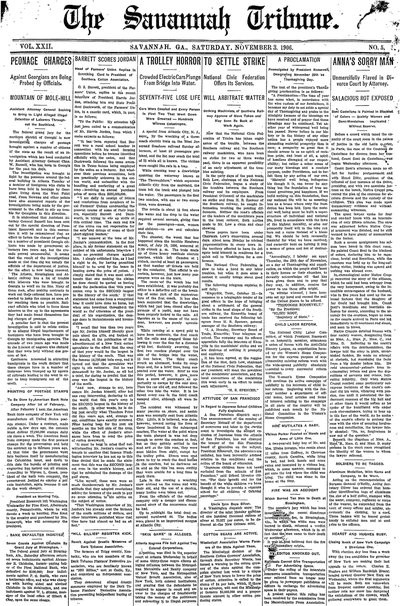
Page text (machine-generated)
The Savannah Tribune.
VOL. XXII.
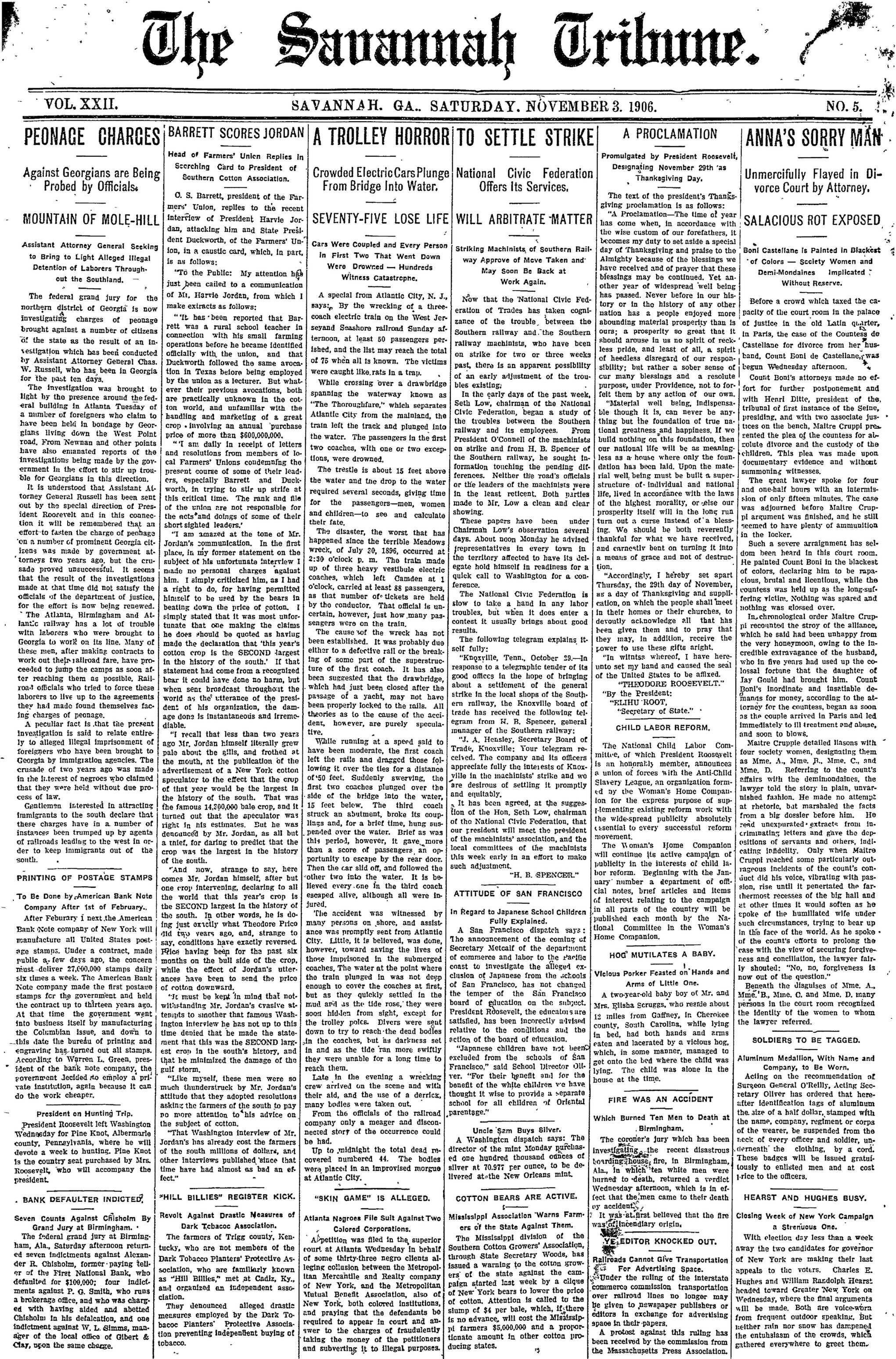
PEONAGE CHARGES
Against Georgians are Being Probed by Officials.
MOUNTAIN OF MOLE-HILL
Assistant Attorney General Seeking to Bring to Light Alleged Illegal Detention of Laborers Through-
The federal grand jury for the northern district of Georgia is now investigating charges of peonage brought against a number of citizens of the state as the result of an investigation which has been conducted by Assistant Attorney General Chas. W. Russell, who has been in Georgia for the past ten days.
The investigation was brought to light by the presence around the federal building in Atlanta Tuesday of a number of foreigners who claim to have been held in bondage by Georgians living down the West Point road. From Newnan and other points have also emanated reports of the investigations being made by the government in the effort to stir up trouble for Georgians in this direction.
It is understood that Assistant Attorney General Russell has been sent out by the special direction of President Roosevelt and in this connection it will be remembered that an effort to fasten the charge of peonage on a number of prominent Georgia citizens was made by government attorneys two years ago, but the crusade proved unsuccessful. It seems that the result of the investigations made at that time did not satisfy the officials of the department of justice, for the effort is now being renewed. The Atlanta, Birmingham and Atlantic railway has a lot of trouble with laborers who were brought to Georgia to work on its line. Many of these men, after making contracts to work out their railroad fare, have proceeded to jump the camps as soon after reaching them as possible. Railroad officials who tried to force these laborers to live up to the agreements they had made found themselves facing charges of peonage.
A peculiar fact is that the present investigation is said to relate entirely to alleged illegal imprisonment of foreigners who have been brought to Georgia by immigration agencies. The crusade of two years ago was made in the interest of negroes who claimed that they were held without due process of law.
Gentlemen interested in attracting immigrants to the south declare that these charges have in a number of instances been trumped up by agents of railroads leading to the west in order to keep immigrants out of the south.
PRINTING OF POSTAGE STAMPS
To Be Done by American Bank Note Company After 1st of February.
Company After 1st of February. After Feburary I next the American Bank Note company of New York will manufacture all United States postage stamps. Under a contract, made public a few days ago, the concern must deliver 27,000,000 stamps daily six times a week. The American Bank Note company made the first postage stamps for the government and held the contract up to thirteen years ago. At that time the government went into business itself by manufacturing the Columbian issue, and down to this date the bureau of printing and engraving has turned out all stamps. According to Warren L. Green, president of the bank note company, the government decided to employ a private institution, again because it can do the work cheaper.
President on Hunting Trip.
President Roosevelt left Washington Wednesday for Pine Knot, Albermarle county, Pennsylvania, where he will devote a week to hunting. Pine Knot is the country seat purchased by Mrs. Roosevelt, who will accompany the president.
Seven Counts Against Cfisholm By
Grand Jury at Birmingham.
Grand Jury at Birmingham.
The federal grand jury at Birmingham, Ala., Saturday afternoon returned seven indictments against Alexander R. Chisholm, former paying teller of the First National Bank, who defaulted for $100,000; four indictments against P. G. Smith, who runs a brokerage office, and who was charged with having aided and abetted Chisholm in his defalcation, and one indictment against W. L. Simms, manager of the local office of Gibert & Clay, upon the same charge.
BARRETT SCORES JORDAN
Head of Farmers' Union Replies In Searching Card to President of Southern Cotton Association.
O. S. Barrett, president of the Farmers' Union, replies to the recent Interview of President Harvie Jordan, attacking him and State President Duckworth, of the Farmers' Union, in a caustic card, which, in part, is as follows:
'To the Public: My attention has just been cailed to a communication of Mt. Harvie Jordan, from which I make extracts as follows:
"It has been reported that Barrett was a rural school teacher in connection with his small farming operations before he became identified officially with the union, and that Duckworth followed the same avocation in Texas before being employed by the union as a lecturer. But whatever their previous avocations, both are practically unknown in the cotton world, and unfamiliar with the handling and marketing of a great crop involving an annual purchase price of more than $600,000,000.
"I am daily in receipt of letters and resolutions from members of local Farmers' Unions condemning the present course of some of their leaders, especially Barrett and Duckworth, in trying to stir up strife at this critical time. The rank and file of the union are not responsible for the acts and doings of some of their short sighted leaders."
"I am amazed at the tone of Mr. Jordan's communication. In the first place, in my former statement on the subject of his unfortunate interview I made no personal charges against him. I simply criticized him, as I had a right to do, for having permitted himself to be used by the bears in beating down the price of cotton. I simply stated that it was most unfortunate that one making the claims he does should be quoted as having made the declaration that 'this year's cotton crop is the SECOND largest in the history of the south.' If that statement had come from a recognized bear it could have done no harm, but when sent broadcast throughout the world as the utterance of the president of his organization, the damage done is instantaneous and irremediable.
"I recall that less than two years ago Mr. Jordan himself literally grew pale about the gills, and frotted at the mouth, at the publication of the advertisement of a New York cotton speculator to the effect that the crop of that year would be the largest in the history of the south. That was the famous 14,500,000 bale crop, and it turned out that the speculator was right in his estimates. But he was descenced by Mr. Jordan, as all but a trief, for daring to predict that the crop was the largest in the history of the south.
"And now, strange to say, here comes Mr. Jordan himself, after but one crop intervening, declaring to all the world that this year's crop is the SECOND largest in the history of the south. In other words, he is doing just exactly what Theodore Price did two years ago, and, strange to say, conditions have exactly reversed. Price having been for the past six months on the bull side of the crop, while the effect of Jordan's utterances have been to send the prico of cotton downward.
"It must be kept in mind that notwithstanding Mr. Jordan's evasive attempts to sinother that famous Washington interview he has not up to this time denied that he made the statement that this was the SECOND largest crop in the south's history, and that he minimized the damage of the gulf storm.
"Like myself, these men were so much thunderstruck by Mr. Jordan's attitude that they adopted resolutions asking the farmers of the south to pay no more attention to his advice on the subject of cotton.
"That Washington Interview of Mr. Jordan's has already cost the farmers of the south millions of dollars, and other interviews published since that time have had almost as bad an effect."
"HILL BILLIES" REGISTER KICK.
Revolt Against Drastic Measures of Dark Tobacco Association.
The farmers of Trigg county, Kentucky, who are not members of the Dark Tobacco Planters' Protective Association, who are familiarly known as "Hill Billies," met at Cadiz, Ky., and organized an independent association.
They denounced alleged drastic measures employed by the Dark Tobacoc Planters' Protective Association preventing independent buying of tobacco.
SAVANNAH. GA.. SATURDAY. NOVEMBER 3. 1906.
A TROLLEY HORROR
Crowded ElectricCars Plunge From Bridge Into Water.
SEVENTY-FIVE LOSE LIFE
Cars Were Coupled and Every Person In First Two That Went Down Were Drowned Hundreds Witness Catastrophe.
A special from Atlantic City, N. J., says: By the wrecking of a three-coach electric train on the West Jersey and Seashore railroad Sunday afternoon, at least 50 passengers perished, and the list may reach the total of 75 when all is known. The victims were caught like rats in a trap.
While crossing over a drawbridge spanning the waterway known as "The Thoroughfare," which separates Atlantic City from the mainland, the train left the track and plunged into the water. The passengers in the first two coaches, with one or two exceptions, were drowned.
The trestle is about 15 feet above the water and the drop to the water required several seconds, giving time for the passengers—men, women and children—to see and calculate their fate.
The disaster, the worst that has happened since the terrible Meadows wreck, of July 30, 1896, occurred at 2:30 o'clock p. m. The train made up of three heavy vestibule electric coaches, which left Camden at 1 o'clock, carried at least 88 passengers, as that number of tickets are held by the conductor. That official is uncertain, however, just how many passengers were on the train.
The cause of the wreck has not been established. It was probably due either to a defective rail or the breaking of some part of the superstructure of the first coach. It has also been suggested that the drawbridge, which had just been closed after the passage of a yacht, may not have been properly locked to the rails. All theories as to the cause of the accident, however, are purely speculative.
While running at a speed said to have been moderate, the first coach left the rails and dragged those following it over the ties for a distance of 50 feet. Suddenly swerving, the first two coaches plunged over the side of the bridge into the water, 15 feet below. The third coach struck an abutment, broke its couplings and, for a brief time, hung suspended over the water. Brief as was this period, however, it gave more than a score of passengers an opportunity to escape by the rear door. Then the car slid off, and followed the other two into the water. It is believed every one in the third coach escaped alive, although all were injured.
The accident was witnessed by many persons on shore, and assistance was promptly sent from Atlantic City. Little, it is believed, was done, however, toward saving the lives of those imprisoned in the submerged coaches. The water at the point where the train plunged in was not deep enough to cover the coaches at first, but as they quickly settled in the mud and as the tide rose, they were soon hidden from sight, except for the trolley poles. Divers were sent down to try to reach the dead bodies in the coaches, but as darkness set in and as the tide ran more swiftly they were unable for a long time to reach them.
Late in the evening a wrecking crew arrived on the scene and with their aid, and the use of a derrick, many bodies were taken out. From the officials of the railroad company only a meager and disconnected story of the occurrence could be had. Up to midnight the total dead recovered numbered 44. The bodies were placed in an improvised morgue at Atlantic City.
Atlanta Negroes File Suit Against Two Colored Corporations. Appetition was filed in the superior court at Atlanta Wednesday in behalf of some thirty-three negro clients alleging collusion between the Metropolitan Mercantile and Realty company of New York, and the Metropolitan Mutual Benefit Association, also of New York, both colored institutions, and praying that the defendants be required to appear in court and answer to the charges of fraudulently taking the money of the petitioners and subverting it to illegal purposes.
TO SETTLE STRIKE
National Civic Federation Offers Its Services.
WILL ARBITRATE MATTER
Striking Machinists of Southern Railway Approve of Meve Taken and May Soon Be Back at Work Again.
Now that the National Civic Federation of Trades has taken cognizance of the trouble between the Southern railway and the Southern railway machinists, who have been on strike for two or three weeks past, there is an apparent possibility of an early adjustment of the troubles existing;
In the early days of the past week, Seth Low, chairman of the National Civic Federation, began a study of the troubles between the Southern railway and its employees. From President O'Connell of the machinists on strike and from H. B. Spencer of the Southern railway, he sought information touching the pending differences. Neither the road's officials or the leaders of the machinists were in the least reticent. Both parties made to Mr. Low a clean and clear showing.
These papers have been under Chairman Low's observation several days. About noon Monday he advised representatives in every town in the territory affected to have its delegate hold himself in readiness for a quick call to Washington for a conference.
The National Civic Federation is slow to take a hand in any labor troubles, but when it does enter a contest it usually brings about good results.
The following telegram explains itself fully:
"Knoxville, Tenn., October 29.—In response to a telegraphic tender of its good offices in the hope of bringing about a settlement of the general strike in the local shops of the Southern railway, the Knoxville board of trade has received the following telegram from H. B. Spencer, general manager of the Southern railway:
"J. A. Hensley, Secretary Board of Trade, Knoxville: Your telegram received. The company and its officers appreciate fully the interests of Knoxville in the machinists' strike and we are desirous of settling it promptly and equitably.
It has been agreed, at the suggestion of the Hon, Seth Low, chairman of the National Civic Federation, that our president will meet the president of the machlnists' association, and the local committees of the machlnists this week early in an effort to make such adjustment.
ATTITUDE OF SAN FRANCISCO
In Regard to Japanese School Children Fully Explained.
A San Francisco dispatch says:
The announcement of the coming of Secretary Metcalf of the department of commerce and labor to the Pacific coast to investigate the alleged exclusion of Japanese from the schools of San Francisco, has not changed the temper of the San Francisco board of education on the subject. President Roosevelt, the educators are satisfied, has been incorrectly advised relative to the conditions and the action of the board of education.
"Japanese children have not been excluded from the schools of San Francisco," said School Director Oliver. "For their benefit and for the benefit of the white children we have thought it wise to provide a separate school for all children of Oriental parentage."
Uncle Sam Buys Silver.
A Washington dispatch says: The director of the mint Monday purchased one hundred thousand ounces of silver at 70.977 per ounce, to be delivered at the New Orleans mint.
Mississippi Association 'Warns Farmers of the State Against Them.
The Mississippi division of the Southern Cotton Growers' Association, through State Secretary Woods, has issued a warning to the cotton growers of the state against the campaign started last week by a cilque of New York bears to lower the price of cotton. Attention is called to the slump of $4 per bale, which, if there is no advance, will cost the Mississippi farmers $5,000,000 and a proportionate amount in other cotton producing states.
A PROCLAMATION
Promulgated by President Roosevelt, Designating November 29th 'as Thanksgiving Day.
The text of the president's Thanksgiving proclamation is as follows:
"A Proclamation—The time of year has come when, in accordance with the wise custom of our forefathers, it becomes my duty to set aside a special day of Thanksgiving and praise to the Almighty because of the blessings we have received and of prayer that these blessings may be continued. Yet another year of widespread well being has passed. Never before in our history or in the history of any other nation has a people enjoyed more abounding material prosperity than is ours; a prosperity so great that it should arouse in us no spirit of reckless pride, and least of all, a spirit of heedless disregard of our responsibility; but rather a sober sense of our many blessings and a resolute purpose, under Providence, not to forfeit them by any action of our own.
"Material well being, indispensable though it is, can never be anything but the foundation of true national greatness and happiness. If we build nothing on this foundation, then our national life will be as meaningless as a house where only the foundation has been laid. Upon the material well, being must be built a superstructure of individual and national life, lived in accordance with the laws of the highest morality, or else our prosperity itself will in the long run turn out a curse instead of a blessing. We should be both reverently thankful for what we have received, and earnestly bent on turning it into a means of grace and not of destruction.
"Accordingly, I hereby set apart Thursday, the 29th day of November, as a day of Thanksgiving and supplication, on which the people shall meet in their homes or their churches, to devoutly acknowledge all that hhs been given them and to pray that they may, in addition, receive the power to use these gifts aright.
"In witntss whereof, I have hereunto set my hand and caused the seal of the United States to be affixed.
"THEODORE ROOSEVELT."
"By the President:
CHILD LABOR REFORM.
The National Child Labor Committee, of which President Roosevelt is an honorably member, announces a union of forces with the Anti-Child Slavery League, an organization formed by the Woman's Home Companion for the express purpose of supplementing existing reform work with the wide-spread publicity absolutely essential to every successful reform movement.
The Woman's Home Companion will continue its active campaign of publicity in the interests of child labor reform. Beginning with the January number a department of official notes, brief articles and items of interest relating to the campaign in all parts of the country will be published each month by the National Committee in the Woman's Home Companion.
HOG MUTILATES A BABY.
Vicious Porker Feasted on Hands and Arms of Little One.
A two-year-old baby boy of Mr. and Mrs. Elisha Scruggs, who reside about 12 miles from Gaffney, In Cherokee county, South Carolina, while lying in bed, had both hands and arms eaten and lacerated by a vicious hog, which, in some manner, managed to get onto the bed where the child was lying. The child was alone in the house at the time.
FIRE WAS AN ACCIDENT
Which Burned Ten Men to Death at Birmingham.
The coroner's jury which has been investigating the recent disastrous boarding house, fire, in Birmingham, Ala., in which ten white men were burned to death, returned a verdict Wednesday afternoon, which is in effect that the men came to their death by accident.
It was at first believed that the fire was of incendiary origin.
YE. EDITOR KNOCKED OUT.
Railroads Cannot Give Transportation For Advertising Space. Under the ruling of the interstate commerce commission transportation over railroad lines no longer may be given to newspaper publishers or editors in exchange for advertising space in their papers. A protest against this ruling has been received by the commission from the Massachusetts Press Association.
Unmercifully Flayed in Divorce Court by Attorney.
SALACIOUS ROT EXPOSED
Boni Castellane is Painted in Blackest of Colors — Society Women and Demi-Mondaines Implicated Without Reserve.
Before a crowd which taxed the capacity of the court room in the palace of justice in the old Latin quarter, in Paris, the case of the Countess de Castellane for divorce from her husband, Count Boni de Castellane, was begun Wednesday afternoon.
Count Boni's attorneys made no effort for further postponement and with Henri Ditte, president of the tribunal of first instance of the Seine, presiding, and with two associate justices on the bench, Maltre Cruppl presented the plea of the countess for absolute divorce and the custody of the children. This plea was made upon documentary evidence and without summoning witnesses.
The great lawyer spoke for four and one-half hours with an intermission of only fifteen minutes. The case was adjourned before Maltre Cruppl argument was finished, and he still seemed to have plenty of ammunition in the locker.
Such a severe arraignment has seldom been heard in this court room. He painted Count Boni in the blackest of colors, declaring him to be rapacious, brutal and licentious, while the countess was held up as the long-suffering victim. Nothing was spared and nothing was glossed over.
In chronological order Maitre Cruppi recounted the stroy of the alliance, which he said had been unhappy from the very honeymoon, owing to the incredible extravagance of the husband, who in five years had used up the colossal fortune that the daughter of Jay Gould had brought him. Count Bonl's inordinate and insatiable demands for money, according to the attorney for the countess, began as soon as the couple arrived in Paris and led immediately to ill treatment and abuse, and soon to blows.
Maitre Crupple detailed liasons with four society women, designating them as Mme. A., Mme. R., Mme. C., and Mme. D. Referring to the count's affairs with the demimondaines, the lawyer told the story in plain, unvarnished fashion. He made no attempt at rhetoric, but marshaled the facts from a big dossier before him. He read unexpurated extracts from incriminating letters and gave the depositions of servants and others, indicating infidelity. Only when Maitre Cruppl reached some particularly outrageous incidents of the count's conduct did his voice, vibrating with passion, rise until it penetrated the farthermost recesses of the big hall and at other times it would soften as he spoke of the humiliated wife under such circumstances, trying to bear up in the face of the world. As he spoke of the count's efforts to prolong the case with the view of securing forgiveness and conciliation, the lawyer fairly shouted: "No, no, forgiveness is now out of the question."
Beneath the disguises of Mme. A., Mme.'B., Mme. C. and Mme. D. many persons in the court room recognized the identity of the women to whom the lawyer referred.
SOLDIERS TO BE TAGGED.
Aluminum Medallion, With Name and Company, to Be Worn.
Acting on the recommendation of Surgeon General O'Reilly, Acting Secretary Oliver has ordered that hereafter identification tags of aluminum the size of a half dollar, stamped with the name, company, regiment or corps of the wearer, be suspended from the neck of every officer and soldier, underneath the clothing, by a cord. These badges will be issued gratuitously to enlisted men and at cost price to the officers.
HEARST AND HUGHES BUSY.
Closing Week of New York Campaign a Strenuous One. With election day less than a week away the two candidates for governor of New York are making their last appeals to the voters. Charles E. Hughes and William Randolph Hearst headed toward Greater New York on Wednesday, where the final arguments will be made. Both are voice-worn from frequent outdoor speaking. But neither rain nor snow has dampened the entuhsiasm of the crowds, which gathered everywhere to greet them.
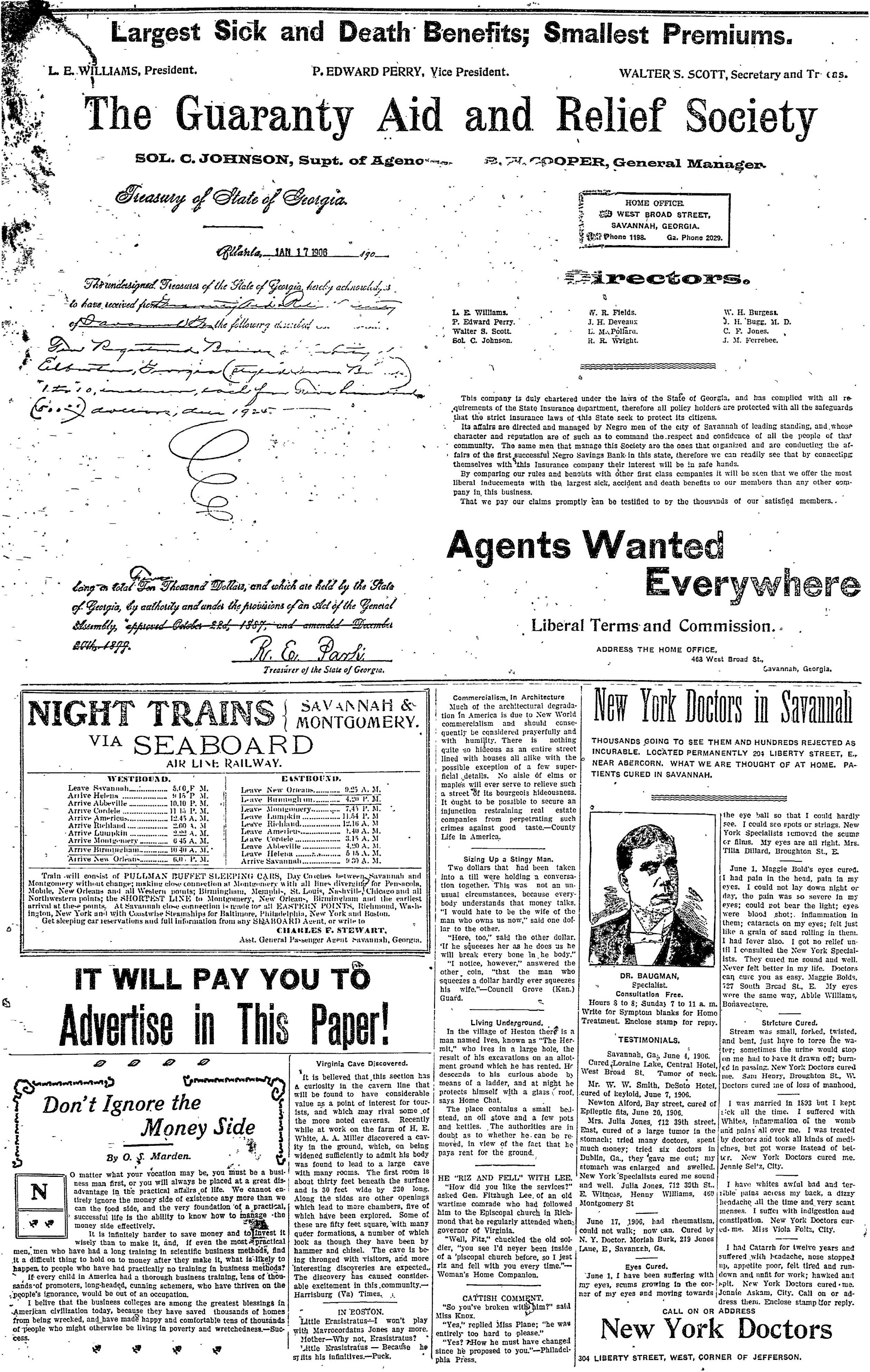
The Guaranty Aid and Relief Society
B. W. COOPER, General Manager.
HOME OFFICE
WEST BROAD STREET,
SAVANNAH, GEORGIA.
Phone 1198. Ga. Phone 2029.
Directors.
L. E. Williams.
P. Edward Perry.
Walter S. Scott.
Sol. C. Johnson.
W. R. Fields.
J. H. Deveaux
L. M. Pollara.
R. R. Wright.
W. H. Burgess.
J. H. Bugg, M. D.
C. F. Jones.
J. M. Ferrebee.
This company is duly chartered under the laws of the State of Georgia, and has complied with all requirements of the State Insurance department, therefore all policy holders are protected with all the safeguards that the strict insurance laws of this State seek to protect its citizens.
Its affairs are directed and managed by Negro men of the city of Savannah of leading standing, and whose character and reputation are of such as to command the respect and confidence of all the people of that community. The same men that manage this Society are the ones that organized and are conducting the affairs of the first successful Negro Savings Bank in this state, therefore we can readily see that by connecting themselves with this Insurance company their interest will be in safe hands.
By comparing our rules and benefits with other first class companies it will be seen that we offer the most liberal inducements with the largest sick, accident and death benefits to our members than any other company in this business.
That we pay our claims promptly can be testified to by the thousands of our satisfied members.
Liberal Terms and Commission.
P. EDWARD PERRY, Vice President.
SOL. C. JOHNSON, Supt. of Ageno
Treasury of State of Georgia
The undersigned, Treasurer of the State of Georgia, hereby acknowledges
to have received from the Secretary of State the following described:
Dear Regimented Brigade, a military unit,
Elberton, Georgia (zip code 30201),
17th 10, in connection with the Dive Corps,
(5000) avenger, due 1926.
long in total Ten Thousand Dollars, and which are held by the State of Georgia, by authority and under the provisions of an Act of the General Assembly, approved October 22d, 1887, and amended December 20th, 1897.
R. E. Parsi
Treasurer of the State of Georgia.
SAVANNAH & MONTGOMERY.
RD
WAY.
EASTBOUND.
New Orleans..... 9.25 A. M.
Burningham..... 4.20 P. M.
Montgomery..... 7.45 P. M.
Lumpkin..... 11.54 P. M
Richland..... 12.16 A. M
Americans..... 1.40 A. M.
Cortele..... 3.15 A. M.
Abbeville..... 4.20 A. M.
Helena..... 5.15 A. M.
Savannah..... 9.30 A. M.
RARS, Day Coaches between Savannah and
Cory with all lines diverging for Pensacola,
Munphis, St. Louis, Nashville, Chicago and all
New Orleans, Birmingham and the earliest
all EASTERN POINTS, Richmond, Wash-
Philadelphia, New York and Boston.
ABOARD Agent, or write to
NIGHT TRAINS SAVANNAH & MONTGOMERY. VIA SEABOARD AIR LINE RAILWAY.
Train will consist of PULLMAN BUFFET SLEEPING CARS, Day Coaches between Savannah and Montgomery without change; making close connection at Montgomery with all lines diverging for Pensacola, Mobile, New Orleans and all Western points; Birmingham, Memphis, St. Louis, Nashville, Chicago and all Northwestern points; the SHORTEST LINE to Montgomery, New Orleans, Birmingham and the earliest arrival at these points. At Savannah close connection is made for all EASTERN POINTS, Richmond, Washington, New York and with Coastwise Steamships for Baltimore, Philadelphia, New York and Boston.
Get sleeping car reservations and full information from any SRABOARD Agent, or write to
CHARLES F. STEWART.
YOU TO
this Paper!
Asst. General Passenger Agent Savannah, Georgia.
IT WILL PAY YOU TO Advertise in This Paper!
Virginia Cave Discovered.
Don't Ignore the Money Side
By O. S. Marden.
It is believed that this section has a curiosity in the cavern line that will be found to have considerable value as a point of interest for tourists, and which may rival some of the more noted caverns. Recently while at work on the farm of H. E. White, A. A. Miller discovered a cavity in the ground, which, on being widened sufficiently to admit his body was found to lead to a large cave with many rooms. The first room is about thirty feet beneath the surface and is 30 feet wide by 230 long. Along the sides are other openings which lead to more chambers, five of which have been explored. Some of these are fifty feet square, with many queer formations, a number of which look as though they have been by hammer and chisel. The cave is being thronged with visitors, and more interesting discoveries are expected. The discovery has caused considerable excitement in this community.—Harrisburg (Va) Times.
O matter what your vocation may be, you must be a business man first, or you will always be placed at a great disadvantage in the practical affairs of life. We cannot entirely ignore the money side of existence any more than we can the food side, and the very foundation of a practical successful life is the ability to know how to manage the money side effectively.
N
```markdown
```
It is infinitely harder to save money and to invest it wisely than to make it, and, if even the most practical
men, men who have had a long training in scientific business methods, find it a difficult thing to hold on to money after they make it, what is likely to happen to people who have had practically no training in business methods?
If every child in America had a thorough business training, tens of thousands of promoters, long-headed, cunning schemers, who have thriven on the people's ignorance, would be out of an occupation.
I belive that the business colleges are among the greatest blessings in American civilization today, because they have saved thousands of homes from being wrecked, and have made happy and comfortable tens of thousands of people who might otherwise be living in poverty and wretchedness.—Success.
IN BOSTON.
Little Erasistratus—I won't play with Mavrocordatus Jones any more.
Mother—Why not, Erasistratus?
Little Erasistratus — Because he stills his infinitives.—Puck.
Much of the architectural degradation in America is due to New World commercialism and should consequently be considered prayerfully and with humility. There is nothing quite so hideous as an entire street lined with houses all alike with the possible exception of a few superficial details. No aisle of elms or maples will ever serve to relieve such a street of its bourgeois hideousness. It ought to be possible to secure an injunction restraining real estate companies from perpetrating such crimes against good taste.—County Life in America.
Sizing Up a Stingy Man.
Two dollars that had been taken into a till were holding a conversation together. This was not an unusual circumstances, because everybody understands that money talks. "I would hate to be the wife of the man who owns us now," said one dollar to the other. "Here, too," said the other dollar. 'If he squeezes her as he does us he will break every bone in he body.'
"I notice, however," answered the other coin, "that the man who squeezes a dollar hardly ever squeezes his wife."—Council Grove (Kan.) Guard.
Living Underground.
In the village of Heston there is a man named Ives, known as "The Hermit," who lives in a large hole, the result of his excavations on an allotment ground which he has rented. He descends to his curious abode by means of a ladder, and at night he protects himself with a glass roof, says Home Chat. The place contains a small bedstead, an oil stove and a few pots and kettles. The authorities are in doubt as to whether he can be removed, in view of the fact that he pays rent for the ground.
HE "RIZ AND FELL" WITH LEE.
HE "RIZ AND FELL" WITH LEE.
"How did you like the services?" asked Gen. Fitzhugh Lee, of an old wartime comrade who had followed him to the Episcopal church in Richmond that he regularly attended when governor of Virginia.
"Well, Fitz," chuckled the old soldier, "you see I'd neyer been inside of a 'piscopal church before, so I jest riz and fell with you every time."—Woman's Home Companion.
CATTISH COMMENT.
"So you've broken with him?" said Miss Knox.
"Yes," replied Miss Plane; "he was entirely too hard to please."
"Yes? How he must have changed since he proposed to you."—Philadelphia Press.
WALTER S. SCOTT, Secretary and Tr as.
New York Doctors in Savannah
THOUSANDS GOING TO SEE THEM AND HUNDREDS REJECTED AS INCURABLE. LOCATED PERMANENTLY 204 LIBERTY STREET, E., NEAR ABERCORN. WHAT WE ARE THOUGHT OF AT HOME. PATIENTS CURED IN SAVANNAH.
---
W.
DR. BAUGMAN,
Specialist.
Consultation Free.
Hours 3 to 8; Sunday 7 to 11 a.m.
Write for Symptom blanks for Homo
Treatment. Enclose stamp for reply.
TESTIMONIALS.
Savannah, Ga. June 4, 1906. Cured Loraine Lake, Central Hotel West Broad St. Tumor of neck Mr. W. W. Smith, DeSoto Hotel, cured of keyloid, June 7, 1906. Newton Alford, Bay street, cured of Enilentic 6its, June 20, 1906
Mrs. Julia Jones, 712 39th street, East, cured of a large tumor in the stomach; tried many doctors, spent much money; tried six doctors in Dublin, Ga., they gave me out; my stomach was enlarged and swelled. New York Specialists cured me sound and well. Julia Jones, 712 39th St.. E. Witness, Henny Williams, 460 Montgomery St
June 17, 1906, had rheumatism, could not walk; now can. Cured by N. Y. Doctor, Morlah Burk, 219 Jones Lane, E, Savannah, Ga.
June 1, I have been suffering with my eyes, scums growing in the corner of my eyes and moving towards
New York Doctors
New York Doctors
304 LIBERTY STREET, WEST, CORNER OF JEFFERSON.
the eye ball so that I could hardly see. I could see spots or strings. New York Specialists removed the scums or filns. My eyes are all right. Mrs. Tilla Dillard, Broughton St., E.
June 1. Maggie Bold's eyes cured. I had pain in the head, pain in my eyes. I could not lay down night or day, the pain was so severe in my eyes; could not bear the light; eyes were blood shot; inflammation in them; cataracts on my eyes; felt just like a grain of sand rolling in them. I had fever also. I got no relief until I consulted the New York Specialists. They cured me sound and well. Never felt better in my life. Doctors can cure you as easy. Maggie Bolds, 727 South Bread St., E. My eyes were the same way, Abbie Williams, Boniaventure.
Stricture Cured.
Stream was small, forked, twisted, and bent, just have to torse the water; sometimes the urine would stop on me had to have it drawn off; burned in passing. New York Doctors cured me. Sam Henry, Broughton St., W. Doctors cured me of loss of manhood.
I was married in 1893 but I kept sick all the time. I suffered with Whites, inflammation of the womb and pain all over me. I was treated by doctors and took all kinds of medicines, but got worse instead of better. New York Doctors cured me. Jennie Selz, City.
I have whites awful bad and terrible pain across my back, a dizzy headache all the time and very scant menses. I suffer with indigestion and constipation. New York Doctors cured me. Miss Viola Foltz, City.
I had Catarrh for twelve years and suffered with headache, nose stopped up, appetite poor, felt tired and run-down and unfit for work; hawked and spit. New York Doctors cured me. Jennie Askam, City. Call on or address them. Enclose stamp for reply. ADDRESS
Oh, to come home once more, when the dusk is falling.
To see the nursery lighted and the children's table spread;
"Mother, mother, mother!" the eager voices calling.
"The baby was so sleepy that he had to go to bed!"
Oh, to come home once more and see the smiling faces,
Dark head, bright head, clustered at the pane;
Much the years have taken, when the heart its path retraces.
But until time is not for me that image will remain.
But oh, to see once more, when the early dusk is falling.
The nursery windows glowing and the children's table spread;
"Mother, mother, mother!" the high child voices calling.
"He couldn't stay awake for you; he had to go to bed!"
My confession must begin when I was four years old and recovering from swollen glands. As I grew well, my twin brother, Gregorel, who was some minutes younger, was put to bed with the same complaint.
"What a misfortune," exclaimed our mother, "that Silvestre is no sooner convalescent than Gregorel throws ill."
The doctor answered: "It astonishes me that you were not prepared to it, Madame Lapalme—since the children are twins, the thing was to be torse-seen; when the elder throws the malady off, the younger naturally contracts it. Among twins it is nearly always so."
nothing. And then—well, I owned to Berthe that I loved her! I owned that I loved her—and when I left for Paris we were secretly engaged.
Mon Dieu! Now I worked indeed! To win this girl for my own, to show myself worthy of her innocent faith, supplied me with the most powerful incentive in life. In the Quarter they regarded me first with ridicule, then with wonder, and, finally, with respect. For my own enthusiasm did not fade "He has turned over a new leaf," they said, "he means to be famous!" It was understood. No more excursions for Silvestre, no more junketings and recklessness! I was another man—
And it always proved to be so with Gregoire and me. No sooner did I throw off whooping cough than Gregoire began to whoop, though I was at home in Vernon and he was staying with our grandmother in Tours. If I had to be taken to a dentist, Gregoire would soon afterward be howling with toothache; as often as I indulged in the pleasures of the table, Gregoire had a bilious attack. The influence I exercised upon him was so remarkable, that once when my bicycle ran away with me and broke my arms, our mother consulted three medical men as to whether Gregoire's bicycle was bound to run away with him, too. Indeed, my brother was distinctly apprehensive of it himself.
Again at college. I shall not pretend that I was a bookworm, or that I shared Gregoire's ambitions; on the contrary, the world beyond the walls looked such a jolly place to me that the mere sight of a classroom would sometimes fill me with abhorrence. But, mon Dieu! if other fellows were wild occasionally, they accepted the penalties, and the affair was finished; on me rested a responsibility—my wildness was communicated to Gregoire. Scarcely had I resigned myself to dull routine again than Gregoire, the industrious, would find himself unable to study a page, and would commit freaks for which he rebuked me most sternly.
So far as I had any serious aspirations at all, I aspired to be a painter, and, after combating my family's objections, I entered an art school in Paris. Gregoure, on the other hand, inclined strongly to law. During the next few years we met infrequently, but that my brother continued to be affected by any unusual conditions of my body and mind I knew by his letters, which seldom failed to contain expostulations and -entreaties. Can you blame me if I had no love for this correspondent?
The Circumstances of Our Birth. Your attention is directed to my preceding communications on this subject. I desire to protest against the revelry from which you recovered either on the 15th or 16th inst. On the afternoon of the later date, while engaged in a conference of the first magnitude, I was seized with an overwhelming desire to dance a quadrille at a public ball. I found it impossible to concentrate my attention on the case concerning which I was consulted; I could no longer express myself with lucidity.
Outwardly sedate, reliable, I sat at my desk dizzied by such visions as pursued St. Anthony to his cell. No sooner was I free than I fled from Vernon, dined in Paris, bought a false beard, and plunged wildly into the vortex of a dancing hall. Scoundrel! This is past pardon! My sensibilities revoit, and my prudence shudders. Who shall say but that one night may be recognized? Who can foretell to what blackmail you may expose me? I, Maitre Lapalme, forbid your profligiacities, which devolve upon me, I forbid—etc.
Our mother still lived in Vernon, where she contemplated her favorite son's success with the profoundest pride. Occasionally I spent a few days with her, sometimes more.
One summer when I visited her I met Mademoiselle Leulillet. I know very well that no description of a girl ever painted her to anybody yet. Suffice it that she was beautiful as an angel, that her voice was like the music of the Spheres—more than all, that one felt all the time. "How good she is, how good, how good!"
Never since I was a boy had I stayed in Vernon for so long as now, never had I repented so bitterly as now the error of my ways. I loved, and it seemed to me that my attachments was reciprocated, yet my position forbade me to go to Monsieur Leulillet and ask boldly for his daughter's hand. While I had remained obscure, artists whose talent was no more remarkable than my own, had raised themselves from Bohemia into prosperity. I was an idler, a good-for-
Still each answers to my call; no good has been denied me.
My burdens have been fitted to the little strength that's mine.
Beauty, pride and peace have walked by day beside me.
The evening closes gently in, and how can I repline?
nothing. And then—well, I owned to Berthe that I loved her! I owned that I loved her—and when I left for Paris we were secretly engaged.
Mon Dieu! Now I worked indeed! To win this girl for my own, to show myself worthy of her innocent faith, supplied me with the most powerful incentive in life. In the Quarter they regarded me first with ridicule, then with wonder, and, finally, with respect. For my own enthusiasm did not fade.
"He has turned over a new leaf," they said, "he means to be famous!" It was understood. No more excursions for Silvestre, no more junketings and recklessness! I was another man—my ideal of happiness was now a wife and home.
For a year I lived this new life. I progressed. Men—whose approval was a cachet—began to speak of me as one with a future. In the Salon a picture of mine made something of a stir. How I rejoiced, how grateful and sanguine I was!
I said that it was not too soon for me to speak now; I had proved my mettle, and, though I foresaw that her father would ask more before he gave his consent. I was, at least, justified in avowing myself. I telegraphed to my mother to expect me.
On the way to the station I noticed the window of a florist; I ran in to bear off some lilies for Berthe. The shop was so full of wonderful flowers that, once among them, I sound some difficulty in making my choice. Hence, I missed the train; and, rather than walk about until the next, returned to my studio incensed by the delay.
A letter for me had been just delivered. It told me that on the previous morning Berthe had married my brother.
I could have welcomed a pistol shot —my world rocked. Berthe lost, false. Gregoire's wifel. I reiterated it, I said it over and over, I was stricken by it—and yet, I could not realize that actually it had happened.
Oh, I made certain of it later, believe me—I was no hero of a reuilleton, to accept such intelligence without proof! I assured myself of her perfyid, and burnt her love letters one by one; toore her photographs into shreds—strove also to tear her image from my heart.
A year before I should have rushed to the cafes for forgetfulness, but now, as the shock subsided, I turned feverishly to work. For months I persisted, denying myself the smallest respite, clinging eo a resolution which proved vainer daily. Were art to be mastered by dogged endeavor. I should have conquered; but alas! though I could compel myself to paint, I could not compel myself to paint well. I had fought temptation for half a year, worked with my teeth clenched, worked against nature, worked while my pulses beat and clamored for the draughts of dissipation, which promised a speedier release. I recognized that my work had been wasted, that the struggle had been useless—I broke down.
I need say little of the months that followed—it would be a record of degradations and remorse; alternately, I fell, and was ashamed. I shuddered at the horrors I had committed.
One afternoon when I returned to my rooms, from which I had been absent since the previous day, I heard from the concierge that a visitor awaited me. I climbed the stairs without anticipation. My thoughts were sluggish, my limbs leaden, my eyes heavy and bloodshot. My visitor was Berthe.
I think nearly a minute must have passed while we looked speechlessly in each other's face—her's convulsed by entreaty, mine dark with hate.
"Forgive me," she gasped, "I have come to beseech your forgiveness! Can you not forget the wrong I did you?"
"Do I look as if I had forgotten?"
"I was inconstant, cruel, I cannot excuse myself. But, Oh, Silvestre, in the name of the love you once bore me, have pity on us! Reform, abjure your evil courses! Do not, I implore you, condemn my husband to this abyss of deprivacy; do not wreck my married life!"
Now I understood what had procured me the honor of a visit from this woman, and I triumphed devilishly that I was the elder twin.
"Madame," I answered, "I think that I owe you no explanations, but I shall say this: the evil courses that you deplore were adopted, not vindictively, but in the effort to numb the agony that you had made me suffer. You but reap as you have sown."
"Reform!" she sobbed. She sank on her knees before me. "Silvestre, in mercy to us, reform!" "I shall never reform," I said inflexibly. "I will grow more abandoned day by day—my past faults shall
shine as merits compared with the atrocities that are to come. False girl, monster of selfishness, you are dragging me to the gutter, and your only grief is that he must share my shame! You have made me bad, and you must bear the consequences—you cannot now make me good to save your husband!"
* Humbled and despairing, she left me. At this stage I began deliberately to contemplate revenge. But not the one that I had threatened. Oh, no! I bethought myself of a vengeance more complete than that! She should be tortured with the torture that she had dealt to me—I would make him adore another woman with all his heart and brain!
It was difficult, for first I must adore and tire, of another woman myself—as the passion in me faded, his would be born. I swore, however, that I would compass it. For some weeks now I worked again, to provide myself with money. I bought new clothes and made myself presentable. When my appearance accorded better with my plan, I paraded Paris, seeking the woman to adore.
You may think Paris is full of adorable women? Well, so contrary is human nature, that never had I felt such indifference toward the sex as during that tedious quest; never had a pair of brilliant eyes or a well turned neck, appealed to me so little.
How true it is that only the unforeseen comes to pass! There was a model, one Therese, whose fortune was her back, and who had long bored me by an evident tenderness. One day this Therese, usually so constrained in my presence, appeared in high spirits and mentioned that she was going to be married.
The change in her demeanor interested me A little piqued I invited her to dine with me, but she refused. Before I parted from her I made an appointment for her to sit to me the next morning.
"So you are going to be married, Therese?" I sald, as I prepared the palette.
"In truth," she answered, gaily.
"No regrets?" I asked.
"What regrets could I have?" she returned. "He is a very pretty boy, and well-to-do, believe me!"
"And I am not a pretty boy, nor well-to-do, hein?"
"Oh," she laughed, "you do not care for me!"
"Is it so?" I said. "What would you say if I told you that I did care?"
"I should say that you tell me too late, monsieur," she replied, with a shrug. "Are you ready for me to pose?" And this changed woman turned her peerless back on me without a scruple.
A little mortified, I attended strictly to business for the rest of the morning. But I found myself on the following day waiting for her with impatience.
I remarked that Therese's hands were very well shaped, and indeed happiness had brought a certain charm to her face.
"Do you know, Therese, that I am sorry that you are going to marry?" I exclaimed.
"Oh, get out!" she laughed, pushing me away. "It is no good your talking nonsense to me now, don't flatter yourself!"
Resbaud, the sculptor, happened to come in at the moment. "Ooh," he shouted, "what changes are to be seen! The nose of our brave Sylvestre is out of joint now we are afflianced, hein?"
"She joined in the laughter against me, and I picked up my brush again in a vile humor.
Well, as I have said, she was not the kind of woman I had contemplated, but these things arrange themselves—I became seriously enamored of her. And, recognizing that Fate worked with her own instruments, I did not struggle. For months I was at Therese's heels; I was the sport of her whims, and her slights, sometimes even of her insults.
I actually made her an offer of marriage, at which she snapped her white fingers, with a grimace—and the more she flouted me, the more fascinated I grew. In that rapturous hour when her insolent eyes softened to sentiment, when her mocking mouth melted to a kiss, I was in paradise. My estasy was so supreme that I forgot to triumph at my approaching vengeance.
So I married Therese; and yesterday was the twentelfth anniversary of our wedding. Berthe? To speak the truth, my plot against her was frustrated by an accident. You see, before I could communicate my passion to Gregoire I had to recover-from it, and—this insolent Therese—I have not recovered from it yet.
There are days when she turns her remarkable back on me now—generally when I am idle—but, mon Dieu! the moment's when she turns her lips are worth working for. Therefore, Derthe has been all the time quite happy with the good Gregoire—and since I possess. Therese upon my word of honor I do not mind!—The Bystander.
Two Missouri Towns
When the presidential struggle between Clay and Jackson was at its height it is related that a band of emigrants from Kentucky and the then other western states commenced to settle on the north side of the Missouri river and called their county Clay and the county seat Liberty. At the same time another lot of emigrants from Virginia and other southern states pitched their tents on the south side of the Big Muddy and called their county Jackson and the capital Independence. And so it remains to this day, Clay stood for liberty and Jackson for independence. Oak Grove (Mo.) Banner
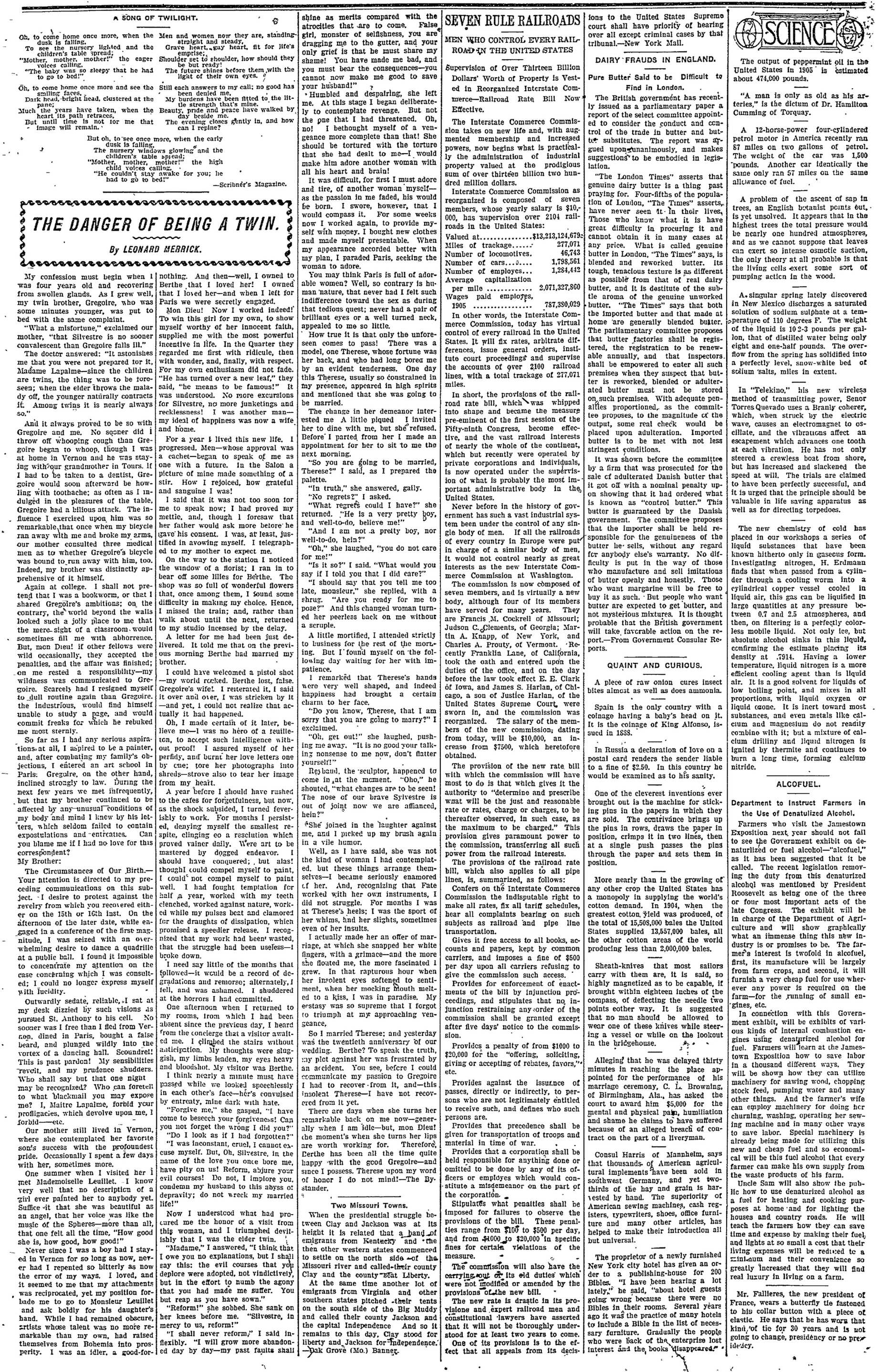
SEVEN RULE RAILROADS
MEN WHO CONTROL EVERY RAIL ROAD IN THE UNITED STATES
Supervision of Over Thirteen Billion Dollars' Worth of Property is Vested in Reorganized Interstate Commerce—Railroad Rate Bill Now Effective.
The Interstate Commerce Commission takes on new life and, with augmented membership and increased powers, now begins what is practically the administration of industrial property valued at the prodigious sum of over thirteen billion two hundred million dollars.
Interstate Commerce Commission as reorganized is composed of seven members, whose yearly salary is $10,000, has supervision over 2104 railroads in the United States:
per mile ..... 2,071,327,860
Wages paid employees,
1905 ..... 787,380,029
In other words, the Interstate Commerce Commission, today has virtual control of every railroad in the United States. It will fix rates, arbitrate differences, issue general orders, institute court proceedings and supervise the accounts of over 2100 railroad lines, with a total trackage of 277,071 miles.
In short, the provisions of the railroad rate bill, which was whipped into shape and became the measure pre-eminent of the first session of the Fifty-ninth Congress, become effective, and the vast railroad interests of nearly the whole of the continent, which but recently were operated by private corporations and individuals, is now operated under the supervision of what is probably the most important administrative body in the United States. Never before in the history of government has such a vast industrial system been under the control of any single body of men. If all the railroads of every country in Europe were put in charge of a similar body of men, it would not control nearly as great interests as the new Interstate Commerce Commission at Washington.
The commission is now composed of seven members, and is virtually a new body, although four of its members have served for many years. They are Francis M. Cockrell of Missouri; Judson C. Clements, of Georgia; Martin A. Knapp, of New York, and Charles A. Prouty, of Vermont. Recently Franklin Lane, of California, took the oath and entered upon the duties of the office, and on the day before the law took effect E. E. Clark of Iowa, and James S. Harlan, of Chicago, a son of Justice Harlan, of the United States Supreme Court, were sworn in, and the commission was reorganized. The salary of the members of the new commission; dating from today, will be $10,000, an increase from $7500, which heretofore obtained.
The provision of the new rate bill with which the commission will have most to do is that which gives it the authority to "determine and prescribe what will be the just and reasonable rate or rates, charge or charges, to be thereafter observed, in such case, as the maximum to be charged." This provision gives paramount power to the commission, transferring all such power from the railroad interests.
The provisions of the railroad rate bill, which also applies to all pipe lines, is, summarized, as follows:
Confers on the Interstate Commerce Commission the indisputable right to make all rates, fix all tariff schedules, hear all complaints bearing on such subjects as railroad and pipe line transportation.
Gives it free access to all books, accounts and papers, kept by common carriers, and imposes a fine of $500 per day upon all carriers refusing to give the commission such access.
Provides for enforcement of enactments of the bill by injunction proceedings, and stipulates that no injunction restraining any order of the commission shall be granted except after five days' notice to the commission.
Provides a penalty of from $1000 to $20,000 for the "offering, soliciting, giving or accepting of rebates, favors," etc.
Provides against the issuance of passes, directly or indirectly, to persons who are not legitimately entitled to receive such, and defines who such persons are.
Provides that precedence shall be given for transportation of troops and material in time of war.
Provides that a corporation shall be held responsible for anything done or omitted to be done by any of its officers or employees which would constitute a misdemeanor on the part of the corporation.
Stipulates what penalties shall be imposed for failures to observe the provisions of the bill. These penalties range from $100 to $500 per day, and from $1000 to $20,000 in specific fines for certain violations of the measure.
The commission will also have the carrying out of its old duties which were not modified or amended by the provisions of the new bill.
The new rate is drastic in its provisions and expert railroad men and constitutional lawyers have asserted that it will not be thoroughly understood for at least two years to come. One of its provisions is to the effect that all appeals from its decis-
lions to the United States Supreme court shall have priority of hearing over all except criminal cases by that tribunal—New York Mall.
DAIRY FRAUDS IN ENGLAND.
Pure Butter Said to be Difficult to Find in London. The British government has recently issued as a parliamentary paper a report of the select committee appointed to consider the conduct and control of the trade in butter and butter substitutes. The report was urged upon unanimously, and makes suggestions to be embodied in legislation.
"The London Times" asserts that genuine dairy butter is a thing past praying for. Four-fifths of the population of London, "The Times" asserts, have never seen it in their lives. Those who know what it is have great difficulty in procuring it and cannot obtain it in many cases at any price. What is called genuine butter in London, "The Times" says, is blended and reworked butter. Its tough, tenacious texture is as different as possible from that of real dairy butter, and it is destitute of the subtle aroma of the genuine unworked butter. "The Times" says that both the imported butter and that made at home are generally blended butter. The parliamentary committee proposes that butter factories shall be registered, the registration to be renewable annually, and that inspectors shall be empowered to enter all such premises when they suspect that butter is reworked, blended or adulterated butter must not be stored on such premises. With adequate penalties proportioned, as the committee proposes, to the magnitude of the output, some real check would be placed upon adulteration. Imported butter is to be met with not less stringent conditions.
It was shown before the committee by a firm that was prosecuted for the sale of adulterated Danish butter that it got off with a nominal penalty upon showing that it had ordered what is known as "control butter." This butter is guaranteed by the Danish government. The committee proposes that the importer shall be held responsible for the genuineness of the butter he sells, without any regard for anybody else's warranty. No difficulty is put in the way of those who manufacture and sell imitations of butter openly and honestly. Those who want margarine will be free to buy it as such. But people who want butter are expected to get butter, and not mysterious mixtures. It is thought probable that the British government will take favrable action on the report.—From Government Consular Reports.
QUAINT AND CURIOUS.
A piece of raw onion cures insect blites almost as well as does ammonia.
Spain is the only country with a coinage having a baby's head on it. It is the coinage of King Alfonso, issued in 1838.
In Russia a declaration of love on a postal card renders the sender liable to a fine of $2.50. In this country he would be examined as to his sanity.
One of the cleverest inventions ever brought out is the machine for sticking pins in the papers in which they are sold. The contrivance brings up the pins in rows, draws the paper in position, crimps it in two lines, then at a single push passes the pins through the paper and sets them in position.
More nearly than in the growing of any other crop the United States has a monopoly in supplying the world's cotton demand. In 1904, when the greatest cotton yield was produced, of the total of 15,508,000 bales the United States supplied 13,557,000 bales, all the other cotton areas of the world producing less than 2,000,000 bales.
Sheath-knives that most sailors carry with them are, it is said, so highly magnetized as to be capable, if brought within eightteen inches of the compass, of defecting the needle two points either way. It is suggested that no man should be allowed to wear one of these knives while steering a vessel or while on the lookout in the bridgehouse.
Alleging that he was delayed thirty minutes in reaching the place appointed for the performance of his marriage ceremony, C. L. Browning, of Birmingham, Ala., has asked the court to award him $5,000 for the mental and physical pain, humiliation and shame he claims to have suffered because of an alleged breach of contract on the part of a liveryman.
Consul Harris of Mannheim, says that thousands of American agricultural implements have been sold in southwest Germany, and yet two-thirds of the hay and grain is harvested by hand. The superiority of American sewing machines, cash registers, typewriters, shoes, office furniture and many other articles, has helped to make their introduction all but universal.
The proprietor of a newly furnished New York city hotel has given an order to a publishing-house for 200 Bibles. "I have been hearing a lot lately," he said, "about hotel guests going wrong because there were no Bibles in their rooms. Several years ago it was the practice of many hotels to include a Bible in the list of necessary furniture. Gradually the people who were back of the enterprise lost interest and the books disappeared."
SCIENCE
The output of peppermint oil in the United States in 1905 is estimated about 474,000 pounds.
"A man is only as old as his arteries," is the dictum of Dr. Hamilton Cumming of Torquay.
A 12-horse-power four-cylindered petrol motor in America recently ran 87 miles on two gallons of petrol. The weight of the car was 1,500 pounds. Another car identically the same only ran 57 miles on the same allowance of fuel.
A problem of the ascent of sap in trees, an English botanist points out, is yet unsolved. It appears that in the highest trees the total pressure would be nearly one hundred atmospheres, and as we cannot suppose that leaves can exert so intense osmotic suction, the only theory at all probable is that the living cells exert some sort of pumping action in the wood.
A singular spring lately discovered in New Mexico discharges a saturated solution of sodium sulphate at a temperature of 110 degrees F. The weight of the liquid is 102-3 pounds per gallon, that of distilled water being only eight and one-half pounds. The overflow from the spring has solidified into a perfectly level, snow-white bed of sodium 'salts, miles in extent.
In "Telekino," his new wireless method of transmitting power, Senor Torres Quevado uses a Branly coherer, which, when struck by the electric wave, causes an electromagnet to oscillate, and the vibrations affect an escapement which advances one tooth at each vibration. He has not only steered a crewless boat from shore, but has increased and slackened the speed at will. The trials are claimed to have been perfectly successful, and it is urged that the principle should be valuable in life saving apparatus as well as for directing torpedoes.
The new chemistry of cold has placed in our workshops a series of liquid substances that have been known hitherto only in gaseous form. Investigating nitrogen, H. Erdmann finds that when passed from a cylinder through a cooling worm into a cylindrical copper vessel cooled in liquid air, this gas can be liquified in large quantities at any pressure between 0.7 and 2.5 atmospheres, and then, on filtering is a perfectly colorless mobile liquid. Not only ice, but absolute alcohol sinks in this liquid, confirming the estimate placing its density at .7914. Having a lower temperature, liquid nitrogen is a more efficient cooling agent than is liquid air. It is a good solvent for liquids of low boiling point, and mixes in all proportions, with liquid oxygen or liquid ozone. It is inert toward most substances, and even metals like calcium and magnesium do not readily combine with it; but a mixture of calcium drilling and liquid nitrogen is ignited by thermite and continues to burn a long time, forming calcium nitride.
ALCOFUEL.
Department to Instruct Farmers in the Use of Denaturalized Alcohol.
Farmers who visit the Jamestown Exposition next year should not fail to see the Government exhibit on denaturlized or fuel alcohol—"alcofuel," as it has been suggested that it be called. The recent legislation removing the duty from this denaturized alcohol was mentioned by President Roosevelt as being one of the three or four most important acts of the late Congress. The exhibit will be in charge of the Department of Agriculture and will show graphically what an immense thing this new industry is or promises to be. The farmer's interest is twofold in alcofuel, first, its manufacture will be largely from farm crops, and second, it will furnish a very cheap fuel for use wherever any power is required on the farm—for the running of small engines, etc.
In connection with this Government exhibit, will be exhibits of various kinds of internal combustion engines using denaturized alcohol for fuel. Farmers will learn at the Jamestown Exposition how to save labor in a thousand different ways. They will be shown how they can utilize machinery for sawing wood, chopping stock feed, pumping water and many other things. And the farmer's wife can employ machinery for doing her churning, washing, operating her sewing machine and in many other ways to save labor. Special machinery is already being made for utilizing this new and cheap fuel and so economical will be this fuel alcohol that every farmer can make his own supply from the waste products of his farm.
Uncle Sam will also show the public how to use denaturized alcohol as a fuel for heating and cooking purposes at home and for lighting the houses and country roads. He will teach the farmers how they can save time and expense by making their fuel, and lights at so small a cost that their living expenses will be reduced to a minimum and their convenience so greatly increased that they will find real luxury in living on a farm.
Mr. Fallieres, the new president of France, wears a butterfly tie fastened to his collar button with a piece of elastic. He says that he has worn that kind of tie for 30 years and is not going to change, presidency or no presidency.
SUBSCRIPTION RATES.
One Year.....$1.25
Six Months.....75
Three Months.....50
All payments must be made by Express
est. Office Money Order, or Registered Letter
& Exercising Rates given on application.
SATURDAY, NOVEMBER 3, 1906.
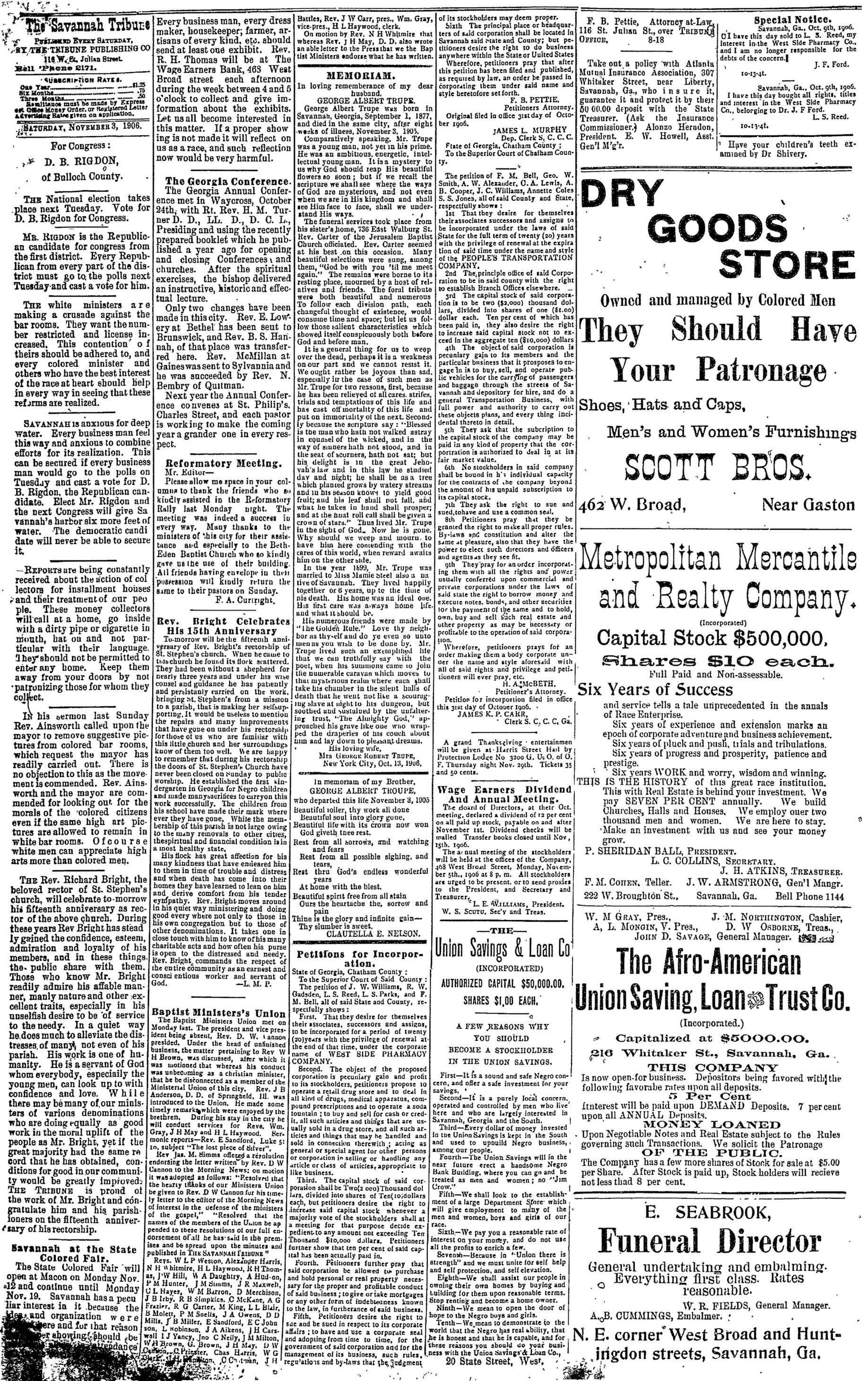
THE National election takes place next Tuesday. Vote for D. B. Rigdon for Congress.
MR. RIGDON is the Republican candidate for congress from the first district. Every Republican from every part of the district must go to the polls next Tuesday and cast a vote for him.
The white ministers are making a crusade against the bar rooms. They want the number restricted and license increased. This contention of theirs should be adhered to, and every colored minister and others who have the best interest of the race at heart should help in every way in seeing that these reforms are realized.
SAVANNAH is anxious for deep water. Every business man feel this way and anxious to combine efforts for its realization. This can be secured if every business man would go to the polls on Tuesday and cast a vote for D. B. Rigdon, the Republican candidate. Elect Mr. Rigdon and the next Congress will give Savannah's harbor six more feet of water. The democratic candidate will never be able to secure it.
REPORTS are being constantly received about the action of collectors for installment houses and their treatment of our people. These money collectors will call at a home, go inside with a dirty pipe or cigarette in mouth, hat on and not particular with their language. They should not be permitted to enter any home. Keep them away from your doors by not patronizing those for whom they collect.
IN his sermon last Sunday Rev. Ainsworth called upon the mayor to remove suggestive pictures from colored bar rooms, which request the mayor has readily carried out. There is no objection to this as the movement is commended. Rev. Ainsworth and the mayor are commended for looking out for the morals of the colored citizens even if the same high art pictures are allowed to remain in white bar rooms. Of course white men can appreciate high arts more than colored men.
THE Rev. Richard Bright, the beloved rector of St. Stephen's church, will celebrate to-morrow his fifteenth anniversary as rector of the above church. During these years Rev Bright has steadily gained the confidence, esteem, admiration and loyalty of his members, and in these things the public share with them. Those who know Mr. Bright readily admire his affable manner, manly nature and other excellent traits, especially in his unselfish desire to be of service to the needy. In a quiet way he does much to alleviate the distresses, of many, not even of his parish. His work is one of humanity. He is a servant of God whom everybody, especially the young men, can look up to with confidence and love. While there may be many of our ministers of various denominations who are doing equally as good work in the moral uplift of the people as Mr. Bright, yet if the great majority had the same record that he has obtained, conditions for good in our community would be greatly improved: THE TRIBUNE is proud of the work of Mr. Bright and congratulate him and his parishioners on the fifteenth anniversary of his rectorship.
Savannah at the State Colored Fair.
The State Colored Fair will open at Macon on Monday Nov. 12 and continue until Monday Nov. 19. Savannah has a peculiar interest in it because the idea and organization were there and for that reason the latter showing should be attended to.
Every business man, every dress maker, housekeeper, farmer, artisans of every kind, etc. should send at least one exhibit. Rev. R. H. Thomas will be at The Wage Earners Bank, 463 West Broad street each afternoon during the week between 4 and 5 o'clock to collect and give information about the exhibits. Let us all become interested in this matter. If a proper showing is not made it will reflect on us as a race, and such reflection now would be very harmful.
The Georgia Conference. The Georgia Annual Conference met in Waycross, October 24th, with Rt. Rev. H. M. Turner D. D., LL. D., D. C. L., Presiding and using the recently prepared booklet which he published a year ago for opening and closing Conferences and churches. After the spiritual exercises, the bishop delivered an instructive, historic and effectual lecture.
Only two changes have been made in this city. Rev. E. Lowery at Bethel has been sent to Brunswick, and Rev. B. S. Hannah, of that place was transferred here. Rev. McMillan at Gaines was sent to Sylvannia and he was succeeded by Rev. N. Bembry of Quitman.
Next year the Annual Conference convenes at St. Philip's, Charles Street, and each pastor is working to make the coming year a grander one in every respect.
Reformatory Meeting.
Mc. Editor—
Please allow me space in your columns to thank the friends who so kindly assisted in the Reformatory Rally last Monday night. The meeting was indeed a success in every way. Many thanks to the ministers of this city for their assistance and especially to the Beth-Eden Bantist Church who so kindly gave us the use of their building. All friends having envelope in their possession will kindly return the same to their pastors on Sunday.
Rev. Bright Celebrates His 15th Anniversary
His 10th Anniversary
To morrow will be the fifteenth anniversary of Rev. Bright's rectorship of St. Stephen's church. When he came to this church he found its flock scattered. They had been without a shepherd for nearly three years and under his wise counsel and guidance he has patiently and persistently carried on the work, bringing St. Stephen's from a mission to a parish, that is making her self-supporting. It would be useless to mention the repairs and many improvements that have gone on under his rectorship for those of us who are familiar with this little church and her surroundings know of them too well. We are happy to remember that during his rectorship the doors of St. Stephen's Church have never been closed on Sunday to public worship. He established the first kindergarten in Georgia for Negro children and made many sacrifices to carryon this work successfully. The children from his school have made their mark where ever they have gone. While the membership of this parish is not large owing to the many removals to other cities, the spiritual and financial condition is in a most healthy state.
His flock has great affection for his many kindness that have endeared him to them in time of trouble and distress and when death has come into their homes they have learned to lean on him and derive comfort from his tender empathy. Rev. Bright moves around in his quiet way ministering and doing good every where not only to those in his own congregation but to those of other denominations. It takes one in close touch with him to know of his many charitable acts and how often his purse is open to the distressed and needy. Rev. Bright commands the respect of the entire community as an earnest and consolent worker and servant of God. —L. M. P.
Baptist Ministers's Union
The Baptist Ministers Union met on Monday last. The president and vice president being absent, Rev. D. W.annon presided. Under the head of unfinished business, the matter pertaining to Rev W H Brown, was discussed, after which it was motioned that whereas his conduct was unbecoming as a Christian minister, that he be disconnected as a member of the Ministerial Union of this city. Rev. J B Anderson, D. D. of Springfield, Ill. was introduced to the Union. He made some timely remarks which were enjoyed by the brethren. During his stay in the city he will conduct services for Revs. Wm. Gray, J H May and H L Haywood. Sermonic reports—"The lost piece of Silver"
Rev Jas. M. Simms offered a resolution endorsing the letter written by Rev. D W Cannon to the Morning News; on motion it was adopted as follows: "Resolved that the hearty tanks of our Ministers Union be given to Rev. D W Cannon for his timely letter to the editor of the Morning News of interest in the defense of the ministers of the gospel," "Resolved that the names of the members of the Union be appended to these resolutions of our full endorsement of all he has said in the premises and be spread upon the minutes and published in THE SAVANNAH TRIBUNE"
Reys, W L P Weston, Alexander Harris,
N H Whitmire, H L Haywood, R H Thomas,
J W Hill, W A Daughtry, A Hud-on,
P M Hunter, J M Simms, J R Maxwell,
L U Hayes, W M Barron, D Merchison,
J B Irby, R B Simpkins, C McKane, A G Frazier, R G Carter, M King, L L Blair,
B Molett, P M Snells, J A Owens, D D Mills, J B Miller, E Sandford, E C Johnson, L Robinson, J A Aikens, J H Carswell I J Yancy, Jno C Neily, J Milton,
W H Brown, G Brown, J H May, D W Carbon, C Priester, Chas Harris, W G Clark, W H Hamilton, C Chutman, J H
Battles, Rev, H J Carr, pres, Wm. Gray, vice-pres. H L Hawwood, clerk.
MEMORIAM.
GEORGE ALBERT TRUPE.
George Albert Trupe was born in Savannah, Georgia, September 1, 1877, and died in the same city, after eight weeks of illness, November 3, 1905.
Comparatively speaking, Mr. Trupe was a young man, not yet in his prime. He was an ambitious, energetic, intellectual young man. It is a mystery to us why God should reap His beautiful flowers so soon; but if we recall the scripture we shall see where the ways of God are mysterious, and not even when we are in His kingdom and shall see Him face to face, shall we understand His ways.
The funeral services took place from his sister's home, 736 East Walburg St. Rev. Carter of the Jerusalem Baptist Church officiated. Rev. Carter seemed at his best on this occasion. Many beautiful selections were sung, among them, "God be with you 'til me meet again." The remains were borne to its resting place, mourned by a host of relatives and friends. The foral tribute were both beautiful and numerous To follow each division path, each changeful thought of existence, would consume time and space; but let us follow those salient characteristics which showed itself conspicuously both before God and before man.
It is a general thing for us to weep over the dead, perhaps it is a weakness on our part and we cannot resist it. We ought rather be joyous than sad, especially in the case of such men as Mr. Trupe for two reasons, first, because he has been relieved of all cares, stifles, trials and temptations of this life and has cast off mortality of this life and put on immortality of the next. Secondly because the scripture say: "Blessed is the man who hath not walked astray in counsel of the wicked, and in the way of sunners hath not stood, and in the seat of scorners, hath not sat; but his delight is in the great Jehovah's law and in this law he studied day and night; he shall be as a tree which planted grows by watery streams and in his season knows to yield good fruit; and his leaf shall not fall, and what he takes in hand shall prosper; and at the nautil call call shall be given a crown of stars." Thus lived Mr. Trupe in the sight of God. Now he is gone. Why should we weep and mourn, to have him here contending with the cares of this world, when reward awaits him on the other side.
In the year 1899, Mr. Trupe was married to Miss Mamie Steel also a native of Savannah. They lived happily together or 6 years, up to the time of his death. His home was an ideal one. His first care was always home life and what it should be.
His numerous friends were made by "The Golden Rule." Love thy neighbor as thyelf and do ye even so unto men as you wish to be done by. Mr. Trupe lived such an exemplified life that we can truthfully say with the poet, when his summons came to join the numerable caravan which moves to that mysterious realm where each shall take his chamber in the silent halls of death that he went not like a scourging slave at night to his dungeon, but soothed and sustained by the unfaltering trust, "The Almighty God," approached his grave like one who wrapped the draperies of his couch about him and lay down to pleasant dreams.
His loving wife,
Mrs GEORGE ROBERT TRUPE,
New York City, Oct. 13, 1906.
IN memoriam of my Brother,
GEORGE ALBERT TROUPE,
who departed this life November 8, 1905
Beautiful toiler, thy work all done
Beautiful soul into glory gone,
Beautiful life with its crown now won
God giveth tree rest.
Rest thru God's endless wonderful years
At home with the blest.
Beautiful spirit free from all stain
Ours the heartache the, sorrow and pain
This the clear and infinite coin
Petitions for Incorporation.
State of Georgia, Chatham County:
To the Superior Court of Said County : The petition of J. W. Williams, R. W. Gadsden, L. S. Reed, L. S. Parks, and P. M. Bell, all of said State and County, respectfully shows : First. That they desire for themselves their associates, successors and assigns, to be incorporated for a period of twenty (20) years with the privilege of renewal at the end of that time, under the corporate name of WEST SIDE PHARMACY COMPANY.
Second. The object of the proposed corporation is pecuniary gain and profit to its stockholders, petitioners propose to operate a retail drug store and to deal in all kind of drugs, medical apparatus, compound prescriptions and to operate a soda tainton; to buy and sell for cash or credit, all such articles and things that are usually sold in a drug store, and all such articles and things that may be handled and sold in connection therewith; acting as general or special agent for other persons or corporation in selling or handling any article or class of articles, appropriate to like business.
Third. The capital stock of said corporation shall be Two(2,000)Thousand dollars, divided into shares of Ten(10,dollars each, but petitioners desire the right to increase said capital stock whenever a majority vote of the stockholders shall at a meeting for that purpose decide expedient to any amount not exceeding Ten Thousand $10,000 dollars. Petitioners further show that ten per cent of said capital has been actually paid in.
Fourth. Petitioners further pray that said corporation be allowed to purchase and hold personal or real property necessary for the proper and profitable conduct of said business; to give or take mortgages or any other form of indebtedness known to the law in furtherance of said business.
Fifth. Petitioners desire the right to sue and be sued in respect to its corporate affairs; to have and use a corporate seal and adopting from time to time, for the government of said corporation and for the management of its business, such rules, regulations and by-laws that the judgment
of its stockholders may deem proper. Sixth The principal place or headquarters of said corporation shall be located in Savannah said State and County; but petitioners desire the right to do business anywhere within the State or Uited States
Wherefore, petitioners pray that after this petition has been filed and published, as required by law, an order be passed in corporating them under said name and style heretofore set forth.
F. B. PETTIE.
Petitioners Attorney.
Original filed in office 31st day of October 1906.
JAMES L. MURPHY
Dep. Clerk S. C. C. C.
State of Georgia, Chatham County;
To the Superior Court of Chatham County.
The petition of F. M. Bell, Geo. W. Smith, A. W. Alexander, C. A. Lewis, A. B. Cooper, J. C. Williams, Annette Coles S. S. Jones, all of said County and State, respectfully shows:
1st That they desire for themselves their associates successors and assigns to be incorporated under the laws of said State for the full term of twenty (20) years with the privilege of renewal at the expiration of said time under the name and style of the PEOPLE'S TRANSPORTATION COMPANY.
2nd The principle office of said Corporation to be in said county with the right to establish Branch Offices elsewhere.
3rd The capital stock of said corporation is to be two ($3,000) thousand dollars, divided into shares of one ($1,000) dollar each. Ten per cent of which has been paid in, they also desire the right to increase said capital stock not to exceed in the aggregate ten ($10,000) dollars
4th The object of said corporation is pecuniary gain to its members and the particular business that it prosposes to engage In it to buy, sell, and operate public vehicles for the carrying of passengers and baggage through the streets of Savannah and depository for hire, and do a general Transportation Business, with full power and authority to carry out these objects plans, and every thing incidental thereto in detail.
5th They ask that the subscription to the capital stock of the company may be paid in any kind of property that the corporation is authorized to deal in at its fair market value.
6th No stockholders in said company shall be bound in his individual capacity for the contracts of the company beyond the amount of his unpaid subscription to its capital stock.
7th They ask the right to sue and sued tohave and use a common seal.
8th Petitioners pray that they be granted the right to make all proper rules. By-laws and constitution and alter the same at pleasure, also that they have the power to elect such directors and officers and agents as they see fit.
9th They pray for an order incorporating them with all the rights and power usually conferred upon commercial and private corporations under the Laws of said state the right to borrow money and execute notes, bonds, and other securities for the payment of the same and to hold, own, buy and sell Such real estate and other property as may be necessary or profitable to the operation of said corporation.
Wherefore, petitioners prays for an order making them a body corporate under the name and style aforesaid with all of said rights and privilege and petitioners will ever pray, etc.
Petitioner's Attorney.
Petition for incorporation filed in office
this 31st day of October 1906.
A grand Thanksgiving entertainment will be given at Harris Street Hail by Protection Lodge No 3200 G. U₂ O. of O. F. Thursday night Nov. 29th. Tickets 35 and 50 cents.
Wage Earners Dividend And Annual Meeting
And Annual Meeting.
The board of Directors, at their Oct.
meeting, declared a dividend of 12 per cent
on all paid up stock, payable on and after
November 1st. Dividend checks will be
malled Transfer books closed until Nov.
15th. 1906.
The annual meeting of the stockholders
will be held at the offices of the Company,
408 West Broad Street, Monday, November
5th, 1906 at 8 p. m. All stockholders
are urged to be present, or to send proxies
to the President, and Secretary and
Treasurers.
L. E. WILLIAMS, President,
W. S. SCUTT, See'y and Treas.
THE
Union Savings & Loan Co
(INCORPORATED)
AUTHORIZED CAPITAL $50,000.00.
SHARES $1.00 EACH.
A FEW REASONS WHY
YOU SHOULD
BECOME A STOCKHOLDER
IN THE UNION SAVINGS.
First-It is a sound and safe Negro con-
cern, and offer a safe investment for your
savings.
Second—It is a purely local concern, operated and controlled by men who live here and who are largely interested in Savannah, Georgia and the South.
Third—Every dollar of money invested in the Union Savings is kept in the South and used to upbuild Negro business, among our people.
Fourth—The Union Savings will in the near future erect a handsome Negro Bank Building, where you can go and be treated as men and women; no "Jim Crow."
Fifth—We shall look to the establishment of a large Department Store which will give employment to many of the men and women, boys and girls of our race.
Sixth—We pay you a reasonable rate of interest on your money, and do not use all the profits to enrich a few.
Seventh—Because in "Union there is strength" and we must unite for self help and self protection, and self elevation.
Eighth—We shall assist our people in owning their own homes by buying and building for them upon reasonable terms. Stop renting and become a home owner. Ninth We must to open the door of
Ninth-We mean to open the door of hope to the Negro boys and girls.
Tenth-We mean to demonstrate to the world that the Negro has real ability, that he is honest and that he is capable, and for these reasons you should do your business with the Union Savings & Loan Co.
F. B. Pettie, Attorney at Law
116 St. Julian St., over TRIBUNE
OFFICE, 8-18
Take out a policy with Atlanta
Mutual Insurance Association, 307
Whitaker Street, near Liberty,
Savannah, Ga., who insure it,
guarantee it and protect it by their
50 00.00 deposit with the State
Treasurer. (Ask the Insurance
Commissioner.) Alonzo Herndon,
President. E. W. Howell, Asst.
Gen'l M'g'r.
DRY GOO S
Owned and managed
They Should Your Pat
Shoes, Hats and Caps
Men's and Wome
SCOTT
BOOKING
managed by
Should
Path
and Caps,
and Women
TT E
1,
Titan M
realty
(Incorporated)
Stock $10
less $10
paid and Non-ass-
uccess
a tale unpreceded
experience and e
adventure and b
back and push, tri-
gress and prosper
BK and worry, w
RY of this great
state is behind you
GENT annual
and Houses, W
and women. W
ent with us and
Owned and managed by Colored Men They Should Have Your Patronage
Shoes, Hats and Caps. Men's and Women's Furnishings SCOTT BROS.
Metropolitan H and Realty
(Incorporate
Capital Stock S
Shares $1
Full Paid and Non-
Six Years of Success
and service tells a tale unprecedented of Race Enterprise.
Six years of experience and epoch of corporate adventure and
Six years of pluck and push, the
Six years of progress and pro prestige.
Six years WORK and worry, THIS IS THE HISTORY of this g
This with Real Estate is behind pay SEVEN PER CENT ann
Churches, Halls and Houses, thousand men and women.
Make an investment with us and grow.
Metropolitan Mercantile and Realty Company.
Capital Stock $500,000. Shares $10 each. Full Paid and Non-assessable.
and service tells a tale unprecedented in the annals of Race Enterprise.
Six years of pluck and push, trials and tribulations. Six years of progress and prosperity, patience and prestige. Six years WORK and worry, wisdom and winning. THIS IS THE HISTORY of this great race institution. This with Real Estate is behind your investment. We pay SEVEN PER CENT annually. We build Churches, Halls and Houses. We employ our two thousand men and women. We are here to stay. Make an investment with us and see your money grow. P. SHERIDAN BALL, PRESIDENT.
L. C. COLLINS, SE
J. H.
F. M. COHEN, Teller. J. W. ARM
222 W. Broughton St., Savannah
W. M GRAY, Pres., J. M.
A, L. MONGIN, V. Pres., D.
JOHN D. SAVAGE, Gene
The Afro-Am
Union Saving, Loa
COLLINS, SECUR
J. H.
J. W. ARMST
Savannah, C
J. M. N.
Pres., D. W.
SAVAGE, Genera
Afro-Ame
ing, Loa
J. H. ATKINS, TREASURER.
F. M. COHEN, Teller. J. W. ARMSTRONG, Gen'l Mangr.
222 W. Broughton St., Savannah, Ga. Bell Phone 1144
W. M GRAY, Pres., J. M. NORTHINGTON, Cashier,
A, L. MONGIN, V. Pres., D. W OSBORNE, Treas.,
JOHN D. SAVAGE, General Manager.
The Afro-American Union Saving, Loan and Trust Co.
(Incorporated.)
Capitalized at $500
216 Whitaker St., San
THIS COMPANY
Is now open-for business. Depositors
following favorable rates upon all deposi
5 Per Cent
Interest will be paid upon DEMAND
upon all ANNUAL Deposits.
MONEY LOA
Upon Negotiable Notes and Real Estate
governing such Transactions. We sell
OF THE PUB
The Company has a few more shares of
per Share. After Stock is paid up, Sto
at $500
Per St., San
SUS COMP
ess. Depositors
es upon all depo
Per Cent
upon DEMAND
Deposits.
KEY LOA
and Real Estate
ations. We sol
THE PUB
v more shares of
k is paid up, Sto
Is now open-for business. Depositors being favored with the following favorable rates upon all deposits.
5 Per Cent
Interest will be paid upon DEMAND Deposits. 7 per cent upon all ANNUAL Deposits.
The Company has a few more shares of Stock for sale at $5.00 per Share. After Stock is paid up, Stock holders will recieve not less than 8 per cent.
E. SEABROOK, Funeral Director
General undertaking and embalming. Everything first class. Rates reasonable.
N. E. corner West Broad and Huntingdon streets, Savannah, Ga.
462 W. Broad,
Spectra
Savannah, Ga., Oct. 9th, 1906.
I have this day sold to L. S. Reed, my
interest in the West Side Pharmacy Co.,
and I am no longer responsible for the
debs of the concern.
Savannah, Ga., Oct. 9th, 2006.
I have this day bought all rights, titles and interest in the West Side Pharmacy Co., belonging to Dr. J. F Ford.
Have your children's teeth examined by Dr Shivery.
ODS
STORE
ed by Colored Men
uld Have
atronage
aps,
men's Furnishings
BROS.
Mercantile
Near Gaston
Miss Bessie Singleton left on Sunday to teach at Midville, Ga...
Mrs. Fannie Starr has been on the sick list for the past two weeks, but is somewhat improving!
Go to the polls early Tuesday morning a d cast a vote for D. B. Rigdon, for Congress.
Miss Mamie Holmes is at home again after a pleasant summer spent in New York and other points
Prof. L. B. Thompson left on Tuesday for Columbus, Americus, Cordale and other points in interest of the State Fair.
We had a pleasant call last Friday from Mrs. L. D Davis, Mrs. A. L. Coleman of New York and Mrs. M. J. Mc Kinney.
Mr. A. M. Stelle, of the R. M. S who was seriously injured in a wreck a few weeks ago on the S. A. L. has entered suit for $20,000 damages.
Mrs. M. J. McKinney spent the summer very pleasantly in Washington, Philadelphia, Atalantic City and other places. She returned home on Friday morning of last week.
Mrs. A. L. Coleman of New York is spending awhile in the city. This is her first visit South and she is favorably impressed. She came on the sad mission of burying her husband who died in New York, September, 27.
Haye your teeth extracted without pain by Dr. Shivery.
Editor B. J. Davis, of the Atlanta Independent, who was recently elected Grand Treasurer of the B M. C., will arrive in the city to-morrow, and will spend a few days with his friends who have arranged to make his stay a pleasant one.
The Emancipation Association will meet next Wednesday at 12 o'clock at St Philips Church Charles St. Each member is requested to be present. By order of Rev. H. L. Haywood, president, C. H. Ebbs secretary.
Mr. B. J. Mitchell and Miss Sarah Sc even of Grahamville S. O. were married on Tuesday last. Mrs. Annie Washington and Mrs Martha King the bride's two sistars attended the wedding. Mr. and Mrs. Mitchell will live in this city. We wish them a happy home.
Rev J. B. Anderson D. D., of Springfield, Ill., is in the city and will conduct special meetings at St John, Union and Second Baptist Churches. The Reverend is reported to be an able revivalist and undoubtedly his labors here will be fruitful.
Mr. W. C. Cody, an old Savan nahian, but who is residing in Atlanta made a flying trip to the city and spent last Saturday and Sunday with friends Mr. Cody is assistant manager of the Garanty Relief Society at Atlanta and is a hustling insurance worker. His many friends here were glad to shake hands with him.
Mr. Harry E. Battese died at his home, White Bluff on Tuesday last, after a lingering illness of several weeks. He was born at St. Catherine Island, 62 years ago. He is survived by a wife, sister, three sons, five daughters and a host of friends. He was a deacon of Mt. Hermon Baptist Church.
The Congregational Church, Rev. W. L. Cash, pastor, Services: Preaching at 11 a. m., and 8 p. m., Sunday School, 9:45 a. m., Mr. M. W. Bryan Superintendent. Junior Endeavor meeting 4 p. m., Y. P. S. C. E., at 7 p. m. Prayer meeting, Wednesday evening at 7 p. m. The celebration of the Lord's Supper will occur Sunday, at the evening worship. All are codially invited to attend these services.
Have your teeth cleaned by Dr. Snivery.
Major W. B. Brown one of the oldest colored business men in the city has sold out his business and left on Thursday for Los Angeles, California accompanied by his son, Mrs Brown and her two daughters are already at Los Angeles. Their many friends wish for them a happy home and prosperous life.
Mr. C. A Turner, the popular head of the bellmen of the DeSoto Hotel, returned to the city on Monday, morning after spending a delightful summer in New York city On Wednesday night before leaving New York, he entertained a party of friends at the Hippodrome the most gigantic, play house in the world, followed by a dinner in honor of a friend. Mr. Turner's numerous friends are glad to welcome him back to the city.
We regret to note the death of Mrs. Amy Charlton, who died at her residence 33rd and Burroughs Street and was buried from F. A. B. Church of which she have been a life long member Mrs. Charlton was one of the old citizens and for many years kept a restaurant in the basement of the city market. She leaves a son, daughters and other relatives and many friends to mourn her death.
Have your gums treated by Dr. Shivery.
An enjoyable social entertainment was given at the home of Mrs. Rosa Maxwell, 514 Gwinnett St., west; Tuesday evening of last week by the Ladies Independent Pleasure Club. The color scheme was red and white. Tall yases of white chrysanthemums graceful palms with roses and potted plants completed the decorations. Music was rendered by Mrs. M. Sampson and Mr. Price. A solo was sung "Just across the bridge of gold" by Mrs. Rosa Maxwell; after which refreshments were served. Those present were Mrs. Rosa Maxwell, Mrs. M. Bynard, Mrs. M. Jones Mrs. L. Phoenix, Mrs. F. M. Moore, Mrs. M. Smith, Mrs. L. Hayes, Mrs. Mack, Mrs. O. Wallace, Mrs. L. Moore, Mrs. L. Taylor Mrs. F. Proctor, Mrs. L. Gryar, Mrs. H. Childs, Mrs W. M. Mitchell, Mrs. M. Wright, Mrs. H. Hunter, Mr. Wm. Hunter, Mr. F. Smalls, Mr. L. Sails, Mr. P. Dozier, Mr. H. Harris, and Mr. J. M. Maxwell.
Persons desiring to become a member of the Female Brass Band can do so by sending in their application with a letter of recommendation not later than Nov. 10th, 1906. Miss L. A. Campbell, 222 W. Broughton St.
Mt. Tabor Bapt. Church.
Rev. N. H. Whitmire has returned to the city after spending two weeks at his churches, Carnaghan and St. Marys. He reports abundant success at his work in that section. He will end the rally at Mt. Tabor of this city on Sunday November 11th. On the rally day last month $176.18 was raised and every effort is being put forth to raise the required amount needed to meet some pressing obligations.
Rev. D. W. Cannon, D. D., will preach at 3:30, assisted by Rev. J. A Brockett. Several other ministers have been invited to attend. Communion at the usual hour.
Union Baptist Dots:
Union Baptist Dots:
The services of the Union Baptist Church, Charles street, were held Sunday as usual. Services at 11 a.m. and 8 p.m. were conducted by the pastor, Rev H L Haywood. The services at 11 a.m. were well attended and much earnestness of those that were present was shown. Sunday school at 3 p.m. conducted by Supt Dea, E. A. Sweangin. At 8 p.m. we had a stirring sermon, the theme; "The five fold Shepherd." The pastor spared no pains in trying to impress upon sinners the necessity and great importance of coming into the fold of Christ and being a sheep In His pasture. At 4 p.m., Monday afternoon the Women Mission met in regular meeting. We enjoyed our meeting At 8:30 p.m. we did not have the B. Y. P. U. meeting but we left the doors open for the Tom Thumb wedding. The recitations, orations, choruses and solos were rendered with much credit and ability. At 10 o'clock the Tom Thumb wedding took place. The couple was married with dignity and honor. We thank the friends kindly for their patronage and good order. On Monday afternoon our pastor received the sad intelligence of the death of his only sister, uncle and aunt, which occurred last week in Raleigh, N. C. We regret the sad news and bereavement. It is his loss and heaven's gain. Weep not for them for you shall see them again. Look to Him who is able and, will do all things right. Services will be conducted on Sunday by the pastor. Sunday morning subject "Encouragement amid Trials." Communion services at 4 o'clock. At 8 p.m. subject "The Saints Biography" On Monday evening at 8 p.m. the B. Y. P. U. will meet in their regular meeting as usual.
Bethlehem Bapt. Church.
Services were well attended all day last
Sunday. Preaching at 11 a. m., by Rev.
H. Maxwell. Text "The fruit of the
spirit is joy." We had three visiting
brothers and two sisters and they all
went away well benefited. Sunday School
was well attended at 3 o'clock. Dea. F.
H. Williams in charge. Rev. Maxwell
was with us again and also took charge
of class number one. At 8o'clock preach
ing again, Rev Bro Maxwell broke to us
the bread of life, text "Veryly, very
ly I say unto you, except a man be born
again he cannot see the kingdom." We
also had a good many visiting friends.
Everything went well during our pastor's
absent.
St. John Baptist Church.
A great revival is in progress at this church Rev. Gray, the pastor is being ably assisted by Rev. J. B. Anderson, D. D., of Springfield, Ill. Dr. Anderson is said to be without an equal as a revivalist; over ten thousand people have been happily converted under his power full Holy Ghost sermons. He will preach each night next week at 8:15. The church is being crowded each night. Souls are being converted and the church member ship is rapidly increasing. The meeting is in full bloom. Everybody is invited to attend. You will be greatly benefitted. Services each afternoon at 3:45. The Union meeting will be here tomorrow a 3:45. Union Baptist Church. Fisrt Bryan Baptist Church, Bethlehem Baptist Church and Second Baptist Church will be represented and assist in the meeting. All other churches are cordially invited.
St. Philip Church.
In the absence of Rev. Lindsay who was in attendance at the Georgia Conference at Waycross on last Sunday, the Rev. Curtwright preached at 11 a.m. His course was food for the thought and every person who heard it was very much im pressed. The year just closed was the best in the history of St. Philip Church since the congregation have been on West Broad and Charles Sts. St. Philips just led every church in the State notwithstanding the size of the congregation. That speaks well for the present admin istation. After such glowing report the conference unanimously voted that the next annual conference will be held at St. Philip on West Broad and Charles Sts., Oct. 1907. Rev. Lindsay has been returned to St. Philip for another year and it is safe to say that this will be a great year for St. Philip along all lines. Quite a surprise was given Rev. nd Mrs. Lindsay on Tuesday night just after meet tag by some prominent members. Refresh
ments were served and every one enjoyed themselves. Our monthly love feast was held on Friday night. The following services will be he held on Sunday: Prayer meeting at 5:30 a. m., preaching at 11 a. m., by Presiding Elder, T. N. M. Smith of the Hawkinsville District and ex pastor of St. Philip, Bapti-m of children and adults at that hour. Sunday School at 2:30 p. m. Communlion 4 p. m. At 8 p. m. Rev. J. A. Lindsay, D. D., will preach his introductory sermon every body is invited. Come early and get a seat.
Second Baptist Church.
The usual weekly services were well attended. The clubs are pushing things to the front. Rev. J. B. Anderson of Illinois will open the revival the second Sunday in this month. The funeral of Miss Alberta Maxwell was attended at the church on Sunday at 3:15 by pastor May assisted by Rev W. W. Warthen. The procession was one of the largest ever witnessed from the church. The funeral of Mr. Samuel Brown was attended from the residence on Randolph street Monday at 3:30 by Dr. May and assistant Warthen. The sick roll is much smaller, but a few are yet dangerously ill. Pas tor May preached Sunday at 11 o'clock. Rev. S. T. Redd, A. M., of the Presbyterian Church preached Sunday night, the sermon was an excellent. one indeed and highly appreciated Collection $27.85, extra collection for Rev. Redd $2.15, extra collection for printing bills $2.01. The pastor and wite spent Friday and Saturday with Mr. and Mrs. Figgers at Tybee, Atlantic Club House. The pastor, wife and Rev. Anderson spent Tuesday at Cattle Park with Bro. and Sis. McHardy. While at Tybee the pastor approved himself quite a marksman, killing rabbits, birds etc. He made 23 shots and missed twice in 25 shots made. Rev. Dr. Johnson of Macon stopped with Dr. and Mrs. May on Monday night. Rev. Anderson is stopping at the home of the pastor. Miss Alma Davis daughter of Deacon R. M. Davis left for Atlanta this morning where she will attend the Atanta University. Dea. Davis now has four children in college He and children has our sympathy. The pastor will preach at both hours on Sunday. Morning subject "Deception and hypocrisy." Evening subject, "Works of the enemy." Baptism the second Sunday after the morning services. Communion at 3:30 and opening of the revival meeting at night. Pastors and churches of all denominations are invited to come and assist in the meeting. The public is invited.
AMUSEMENT COLUMN.
Coming Events in The Social World.
A five night's Fete will be given at Harris Street Hall by Savannah Lodge No. 2592 G. U. O. of O. F. Commencing Monday night Nov. 12th. Ticket tocts.
A grand five nights Fete will be given at Harris street hall by the Imperial Social Ladies Branch commencing Monday night, Nov. 5th. Tickets 10 cents.
A grand dance will be given at Margaret street hall by the Twenty stars on Monday night Nov. 5th. Tickets 15 and 25 cents.
Your attention is called to the grand ten nights Palmetto Bazaar given at Duffy Street Hall, by Jericho Lodge No. 40, I. O of G. S. and D. of S. commencing Monday night Nov. 5, Tickets 10 cents.
A grand two nights entertainment will be given at Our Hall, for the benefit of Mt. Tabor Baptist Church on Monday night November 5th, and Monday night Nov. 12 Tickets 15 and 25 cents.
Attend the Smart Set's Cotillion at Margaret Street Hall Monday night Nov. 12th
Ticket 15 and 25 cents.
The Morning Glory A. and S. Club will make their first appearance at Margaret Street Hall Monday night November 19th.
Tickets 15 and 25 cents.
A grand opening of the season will be given at Harris Street Hall by Weldon Lodge No. 26, I. B. P. O. of Elks of the World Wednesday night Nov. 28th.
Tickets 50 and 75 cents.
The Twilight Reapers will give a grand fete and Thanksgiving Cotillion at Massonic Temple commencing November 19th, to 30th. Tickets 10 and 25 cents.
A grand Five nights Bazar will be given at Our Hall, by the Labors Bluff and Reviewing Club No 1, commencing Monday night November 12th. Tickets 25 and 50 cents.
The Alex. Ellis Club of Beth Eden Church will give an entertainment at the residence of Mrs. F. A. Langley, 517 Taylor St. east, on Monday night Nov. 12th. Tickets to cents.
DR. L. S. PARES,
240 Barnard St., Savannah, Ga.
Does all kind of high grade dental work of the best quality and workmanship. Gold crowns and bridge work. White Porcelain Pivot, and Gold Crowns mounted on the natural roots. Gold Fillings, Cement Fillings, and Silver or Amalgam Fillings, from nine to a full set of tech $7.00 and $3.00 Broken Places menden and teeth added to old ones for a small cost. BellPhone 1244
Gold Crowns Guaranteed
Reduced Rates for the Colored Fair
Col. J. H. Deveaux who is at the head of the transportation department of the Colored State Fair, has received a letter from the Southeastern Passenger Association, notifying him of the reduced rate granted for the fair to be held in Macon Nov. 12-19, 1906. The rate will be first-class fare plus 25 cents, plus 50 cents for admission for adults and 25 cents admission for children. This holds good on all roads, except the A. B. and A. A., and W. P., A. C. L., G. F. and A. and L. and N. These roads will not include the amount for admission, but will allow one fare plus 25 cents.
For military companies and brass bands in uniform twenty or more, on one ticket one cent per mile in each direction, plus arbitraries per capita. Further information will be gladly given by addressing Col. J. H. Deveaux, Savannah, Ga.
Fancy Work.
The only complete book on fancy work ever published. All branches of fancy work arranged in departments and described in detail in a clean concise manner, making it so simple that a child can follow it. Price $1.75. Liberal commission to agents. Agents complete outfit 25 cents. Address
Hopkin's Book Concern,
706 Main street,
Jacksonville, Fla.
Which places certain kinds of clothes apart from and above the ordinary kind is evident in the garments which bear
They hang different, they fit different, they look different, they're made different—and that accounts for the satisfaction which they always give the wearer.
211 East Broad Street,
Cor. Oglethorpe Lane.)
BELL PHONE 1124.
Savannah, Ga.
Metropolitan Mutual
Benefit Association.
INCORPORATED.)
In addition to our sick and death benefit policies we are offering the public industrial insurance in straight life policies ranging from $100.00 to $50.00. Premiums within the reach of all. A fair value for your money in a reputable company is what all of us are looking for. This is what we are giving. See any of our agents or call at the company's office for rates and particulars. Energetic men and women can make anywhere from $5.00 to 25.00 a week working for this company.
Office 222 W. Broughton St. Savannah, Ga.
J. W. ARMSTRONG,
Vice-President
G. James
217 Randolph Street, corn
Jackson Street.
(Incorporated—Charter Perpetual)
The lead insurance company in the south. Giving employment to many young men at women than any other company of like benefit.
The UNION BENEFIT ASSOCIATION is the peoples favorite, since it is the first insurance company of its kind in this city.
Found, built, owned and controlled entirely by Negro men of the city.
Every policy is backed up by a deposit of $5,000 with the State Treasury.
When you take out a policy with the UNION BENEFIT ASSOCIATION you have a safe investment.
She striving now to place her policies in every State in the union
Shred and energetic agents are wanted.
Call us at 20 STATE STREET, W. Bell Phone 2322
GEO. W. JACOBS, General Manager.
Johnson's
Undertaking
Funeral Director
All orders promptly
first class Embalming, and a
Our stock of COFFINS, O
the largest in the city.
We also have a first class I
nish the best Carriages, Hear
We also have in our employ
like to see his faiends at any
Mr.
Bell Phone 676.
TO BUILD THAT HOUSE
AND SAVE MONEY,
SEE
E. W. BURT,
Carpenter & Builder,
MAKING ESTABLISHED
Social Directors and Embass
aders promptly attended, day or no
balming, and all work of that kind
COFFINS, CASKETS and BUR
in the city.
We a first class LIVERY STABLE
carriages, Hearses and Funeral C
e in our employ Mr. H. S. Dunb
faiends at any time.
All orders promptly attended, day or night. 2 first class Embalming, and all work of that kind guaranteed. Our stock of COFFINS, CASKETS and BURIAL ROBES the largest in the city.
We also have a first class LIVERY STABLE where we furnish the best Carriages, Hearses and Funeral Cars. We also have in our employ Mr. H. S. Dunbar, who would like to see his faiends at any time.
110 BRYAN STREET, W. Bell Phone 1131.
WANTED: by a Chicago wholesale and
mall order house, assistant manager (man or
woman) for this county and adjoint territory.
balance $20 and expense paid weekly; expense
money advanced. Work pleasant; position
permanent. No investment or
experience required. Spare time valuable.
Write at once for full particulars and enclose
self-addressed envelope.
Dr. J. W. Jamerson, DENTIST.
Go to him and have yourwork done Crowns, gold and white, looking like the natural teeth Filling gold, silver and cement. Plates, full or partial, Bridge neatly done. Extracting done with ease, All work done neatly in a neat first class place. Provided with all modern appliances. 623 WEST BROAD STREET, Bet. Huntingdon and Hall.
Establishment,
Factors and Embalmers.
ently attended, day or night.
and all work of that kind guaranteed.
CASKETS and BURIAL ROBES
is LIVERY STABLE where we fur-
earses and Funeral Cars.
Deploy Mr. H. S. Dunbar, who would
any time.
Mrs. J. H. JOHNSON, Manager.
325-333 Jefferson St.
The Union Loan and Investment Company is now open for business, we have on haud 100 shares of stock for $5,000 per share. Money invested, here is money secured and is subject upon investment herein, to a pro rata part of all interests, fees and fines accruing to the company. We have ready money to loan upon duty carms on secured notes, real and personal property negotiable papers including Stock certificates. We are open for business and solicit the patronage of the public. While we regard business transactions as a public privilege, we also regard it in its personal relations, taking into consideration the whims of the individual. We are open at all hours, at 20 State St., West, (up staffs). Ack for Geo. W. Jacobs.
Pres. and Gen'l Manager
Both Phones 689.
F E JONES
Notice.
FARM
AND
STOCK
-YARD
Give work horses a pail of water in the middle of the morning and the afternoon. They will be better for it. Help them along and you will have better satisfaction. Flies and hot weather make them cranky and poor. Give them a few carrots and a little grass now and then.
The Truck Garden Insect.
Insects infesting truck gardens very often affect-field crops as well, but it should be borne in mind that pest exterminating methods that are of no use in large areas are often the best in a small patch where there is more intensive cultivation, and where the price the output brings will warrant more outlay.
The Middle Kernels Are Best Seed. Experiments made at the Minnesota Experiment Station to determine the relative germinating power and vitality of the end and middle kernels, show that out of 100 from each end and the middle, 88 of the butt, 59 of the middle and 68 of the tip kernels grew. The combined growth of all the butt kernels during 20 days of growth was 177 inches. The middle kernels made a growth of 196.6 inches and the end kernels grew 151 inches.
Alfalfa in the East.
A' report, from the Vermont agricultural experiment stations shows that of a series of attempts to raise this important crop in that State, 36 percent were successful and that 68 percent of these were in the Champlain valley. The conclusion reached, is that there is reason for the hope that alfalfa may become acclimatized to the Eastern States and raised successfully there, provided proper conditions as to soil and cultivation are supplied.
Moles.
The tunneling habit of the mole are often very annoying and damaging, so that one is compelled to apply a check to mole activity. Don't imagine, however, that you can do it by a quick and decisive battle. The only device that promises relief, is persistent and skilful trapping. This may take years of continuous efforts, and will finally lead to comparative freedom from the mole pest, unless the neighbors continue to furnisli a steady fresh supply of the burrowing little animals.
Care of Chickens.
Have you provided sufficient dry earth for winter use? Now is the time to buy spring pullets for winter laying.
Feed more corn to the fowls than you did during the summer.
As the supply of insects decreases make up the deficiency with meat scraps or meat meal.
The fowls might be excluded from some of the runs and these spaded and sown to rape and grass. In late fall and winter the chickens can get fresh green stuff.
Marketing Farm Produce.
A small farmer who has made a success of marketing his produce gives sound and ingenuous advice in a recent magazine. His preliminary work suggests Hannah Glasse's famous preface to her instructions for cooking fare: "First find a lady customer," is his advice. To her sell nothing but the cholest of fruit and produce. It will not be long before she will acquaint her friends and they in turn will pass along the word to others. It may to sell nothing but the best; the inferior produce can be fed to stock, and in a short time the farmer will find that he has a good market and a good price, with no leakage of profit to the middleman.
In the Orchard.
The pea is unsurpassed as a renovater of apple, pear and peach orchards. With trees planted in any ground suitable for an orchard, no fertilizer will ever be needed other than cowpeas. Sow broadcast every year, gathering the peas and letting the whole vine die on the ground. These tires cover the ground during winter, prevent washing of the soil, and by doing are converted by the rain and grow into perfect food for the tree and crop of fruit. The cowpea can be harvest from May to July, is a valuable food for man or beast and the land on which it is grown and no matter in what way it may be used it will return with profit every cent invested in its cultivation.—Indianapolis News.
Concerning Horsse.
Rye may be fed advantageously to horses, two quarts of oats with one of rye are about equivalent to four quarts of oats.
This better to have the rye cracked not ground.
bunch of smartweed rubbed on the
wire will keep the files away.
ouse will keep the files away.
Take care of the colc Start early
fed new oats! He should be well
combed and constantly handled. Ac-
cuse the hirt early to harness.
corner. Throw lose end of rope over beam overhead and let another man hold it taut or lose as required Stand on a box and lift horse's head up. Take In slack of the rope and hold head in position. The mouth of a long necked bottle, containing the drench, should be loosely placed in the horse's nostril, and contents allowed to run out. Not a drop will be spilled, if properly managed, as the animal is obliged to swallow at once.—Indianapolis News.
Method of Training Climbing Plants.
Around the average suburban home there is little land left for garden crops after the lawn and ornamental gardens have been planned. It is desirable, therefore, to use this little to the fullest extent. The hop growers of California have recently devised a training method applicable to other crops which require some support. This consists in stretching wires at right angles over the hills of the crop and at a suitable distance above the ground. Four cords are then fastened to a short stake in each hill and brought up gradually, diverging, so as to be fastened some distance apart on the wires above. This furnishes a good support for at least four stems in each hill. Moreover the stems are close together at the ground and not in the way of cultivation, while above the stems are separated, allowing the sun to strike all parts equally. This is an important matter in the ripening of tomatoes, and with peas and beans it fall-tates picking and helps to prevent the spread of mildew and other fungous diseases.
Success and Study.
The successful farmer today is the man who is the most Indetatigable student of scientific farming. He is the reader and the experimenter. Coming to him regularly are the bulletins issued by the Department of Agriculture and by his State experiment station, and, on his book shelves are volumes written by experts, full of valuable and practice information that will prove of material assistance and benefit to him.
Only ten years ago, 90 percent of the farmers of the country laughed at the Department of Agriculture. In their estimation it did no practical value. It was merely distributing agent to send out seeds. Today 90 percent of the farmers pay every heed to what the department has to say. They journey far to help experts hold forth from "corn trains and to hear lecturers on fruit and its cultivation. Their sons attend agricultural colleges and, in not a few instances, have returned to their own homes to enter into a profitable partnership with their fathers. Their knowledge as more than doubled the farm's probleness.
The Caterpi $ _{r} $
Westward the gypsy rh takes its way. It has caused millions of dollars' worth of damage in Massachusetts, has escaped to Newampshire and Connecticut, and now the invasion is turning toward New York state.
This interesting information conveyed in a letter of warning is issued by E. P. Felt, New York state entomologist, who also asks habitants of the Empire State to teach for the brown-tall moth in addit to the gypsy, and report their appearance anywhere in the state at once.
According to Mr. Felt the gypsys like to ride by automobile. this connection he says:
"Experience has shown that automobiles are very active agents in transporting this insect, and, with their increased use in recent years, no one can foresee where the pest may appear next."
The brown tall moth is a more recent introduction, and, unlike the gypsy moth, flies readily. It is not only a very destructive leaf feeder, but the barbed hairs of the caterpillars cause a very severe irritation upon the unprotected skin.
Two rows of warts down the back of the gypsy moth caterpillar make it easily distinguishable. It is about two inches long and the ten anterior warts are blue, the twelve posterior red. The gypsy moth will eat anything in the tree or shrub line, and on the slightest disturbance leap on passersby and cling to clothing.
Brown tail moths have white spots on each side and a single pair of red spots near the tail. They prefer wild cherry, pear, apple, maple, elm and white oak leaves, and have barbed horns, which, breaking off or blowing from the cocoon, produce an intolerable irritation, the "brown tail itch." Capterpillars of both species, says Mr. Felt, may be destroyed by spraying with an arsenical poisoning, preparably five pounds of arsenate of lead to fifty gallons of water, though the gypsy moth caterpillars, especially when nearly full grown, are quite resistant to poison. Eggs of the gypsy moth may be destroyed by treating the egg masses with a preparation composed of 50 percent creosote oil, 20 percent carbolic acid, 20 percent spirits of turpentine and 10 percent of coal tar.
No one is defeated until he gives up. Hard times has a good many relatives. It is the twin brother of the blues. That man has failed who has not been able to keep a good opinion of himself. Self-control will succeed with one talent where self-indulgence will fall with ten. What the superior man seeks is in himself; what the small man seeks is in others. The most dangerous force in this country is the fortune with no character behind it. There is no disgrace in unpreventable poverty. The disgrace is in not doing our level best to better our condition.
Poverty itself is not so bad as the poverty thought. It is the conviction that we are poor and must remain so that is fatal.
Confidence is the Napoleon in the mental army. It doubles and trebles the power of all the other faculties. The whole mental army waits until confidence leads the way.
Man was intended to harmonize with the best thing in him, not with the worst—with the divine and not with the brute. Every man is a possible king, and the coming man will be one.
Optimism is a success builder; pessimism an achievement killer. No matter if you have lost your property, your health, your reputation even, there is always hope for the man who keeps a firm faith in himself.
The Creator has bidden every man to look up, not down, has made him to climb, not to grovel. There is no providence which keeps a man in poverty, or in painful or distressing circumstances—Success Magazine.
FORESTRY CO-OPERATION.
Experimental Plantations Gathering Information for Public Benefit.
Seven different states now have 8 forest experiment stations, established during the last year, for co-operation between the Forest Service and state forest commissions and agricultural colleges. These stations are designed to meet the growing demand for detailed information on the propagation of forest trees in various regions.
As a result of regional studies and special investigations, the Forest Service is already in possession of very complete data on tree growing for protection and timber supply, and this information is gladly supplied upon request. There are many questions, however, regarding new species, nursery methods, mixtures, spacing and cultivation which cannot be satisfactorily settled by studies of existing plantations. These matters will be investigated by a long series of systematic experiments, now under way at the new stations.
Arrangements have been made for experimental forest planting in cooperation with the New York State Forest, Fish and Game Commission, at Saranac Inn, in the Adrondacks; with the Michigan Forestry Commission, at Rosmommmon; with the University of Michigan, at Ann Harbor; with Berea College, Kentucky; with the state agricultural colleges at Ames, Iowa and Fargo, N. D., and Agricultural College, Mississippi, and with the sub station of the University of Nebraska, at North Platte. The work contemplated needs constant expert supervision, and great care has been exercised to limit the stations to regions where additional data on forest planting are needed. Most of the stations are institutions where regular courses in forestry are given, and the work is directed by the forester in charge.
The co-operating institutions in most cases contribute the necessary land, and share all expenses for material and labor equally with the Forest Service. The service passes upon all plans and directs the general operations. The results are the joint property of the co-operating parties.
The outcome will be to determine the regional adaptability of new species and the influence of soil and location on the selection of species, and to secure silvicultural data on methods of planting and cultivation. At Berea, I., particular attention will be given the propagation of hickory, a wood which no satisfactory substitute is him and for which the demand is died soon to outstrip the supply. One plains and prairies the trees will tried which promise to be the most useful to the farmer under local conditions. Experimental blocks will be fed annually, but many years will beoubtedly be required before compulsely satisfactory final results will be attained.
Sports, in France are becoming furious in France are becoming raphy. It bears, says a French pather, that a carefully watching for telegraph kilometer's length of populated birds, an interested observer has heard that one and a pheasants, quo such as partridges, paled yearly and so on, is imlength in Frank every wire of this tal all over the which means a tonnally. Many of try of 40,000 amly of the migratory, especially lives through nocturn, lose their less these can be flights; so unday, wireless teled to travel by only French game it seems the supporting. It would future worth find out if in Engl interesting to intelligence is still of the so bird imperiod.—New York Ge telegraphic
FOR
THE
FAIR
Signs and Omens.
If you see a girl stop short, run her hand along her belt, look on the ground all around her, and finally lose the sudden worried expression by a search through her handbag, you can be sure, says Albert Reid, that she had a letter from "him" that day.
Women as Travelers
As a matter of genuine fact women, in nine cases out of ten, are better travellers than men are. To begin with, if not so stodgily accurate, although that by no manner of means follows, they are more fluent in modern languages. They chatter in them, say the male things. Ergo, they are the more colloquial—the reader to circumvent the wiles and extortions of Kellner or of garcon—From the Gentlewoman.
The Right Kind of a Girl
Let a girl be ever so graceful in the dance, let her be ever so elegant of walk across a drawing room, ever so bright in conversation, she must possess some other qualities to convince the great average run of young men that she can be a manager of his home. Frugality, woman instincts of love for home, an eye to the best interests of her husband and the careful training of her children—these are the traits which make the good wife of to-day, and which young men look for in the girls they meet, says Woman's Life. Meit may sometimes give the impression that they do not care for common sense in their sweethearts but there is nothing they so unfallingly demand of their wives.
Charities.
That woman who dubbed concealing stands and curtains "charities" gave them a wonderfully apt name, for they do certainly "cover a multitude of sins"—usually in the form of dresses.
Crettonnes and the rest of the pretty inexpensive upholstery stuffs made most of the curtains, usually finished with a casing to run over a small brass rod.
The stands are often built to hide from view radiators during the months when artificial heat is anything but desirable. Sometimes they take the form of shallow tables; as often they are surmounted by a shelf or two, where your favorite books and work-basket may be conveniently kept.
To Restore Nerve
A certain doctor in Paris, much sought after by fashionable ladies whose nerves are overwrought by pleasure, adopts some curious remedies with which to cure his fair patients.
To one fine dame he said, "You are on the verge of nervous collapse. Now, what you have to do is this. Every afternoon walk to such and such a hospital. When you get there ask for Nurse X. She will take you to the second floor, into a room entirely furnished in white. She will sit down in this room; you take a seat opposite to her, and remain for a full hour, without saying a single word. Then go back home, by such a road, such a boulevard, such a square, and such a crossing," says Woman's Life.
In three months' time the lady was once again calm, strong, energetic and in excellent health.
When You Sit for a Photograph.
According to a prominent photographer it is a curious fact that the two sides of a human face are seldom if ever the same, a physiognomy even fairly well mated when viewed from opposite sides of the room being sufficiently rare to excite interest.
"People are quick to recognize that a photograph taken from one side is more attractive than the opposite pose," he explained.
"They usually attribute the difference to some atmospheric influence or sometimes to a defeat in the camera.
"But, as every photographer knows the real inequality lies in the faces themselves, the right side often differing radically from the left and vice versa. I have sometimes heard it claimed that the left side is always the more attractive of the two, but my own experience has not confirmed this theory.—New York Press.
Tennis Skirt Four Inches from Floor.
The tennis skirt is still made decidedly shorter than any other separate skirt, and even if there are no plaits or tucks to be opened out at the knees, there must be considerable flare. Three inches anyway from the ground, and four if preferred, is the accepted length for a tennis skirt. A wide hem is allowed in case the material should shrink. This coarse crash or lining does not soil as readily as the finer qualities and has the great advantage that while made up without starch it does not become mussed and creased.
The pockets, which are new on the outside of the skirt and not hidden by the flap, as formerly, may be made so as to button over so that the handkerchief or change pocketbook cannot possibly slip out. With this skirt is worn a stitched belt of the material. This belt may be anywhere from one to three inches in width. The wider belts are attractive fastened, with large gilt or white metal buckles.
Many of the belts instead of being double and stitched are hand embroidered.—New York Telegram.
Dainty Oversleaves.
Cuffs to slip on over the sleeves when sketching, writing, or when performing small house duties need not be unightly articles of an uncramental variety. Dainty half-sleeves of lawn are as easy to wash and do up as coarse linen and brown holland, and do not, moreover, give more trouble at the outset, while a couple of small pocket handkerchiefs constitute all that is required as a basis.
Two opposite corners of the handkerchief should be cut off a few inches from the points, and the raw edges on either side pinned together and united with a French seam. When worn, one of the remaining points protects the blouse or dress sleeve as far as the elbow, and the other is folded back and tacked down to form a turnover cuff. The sleeve is made sufficiently tight to fit the arm without requiring an elastic band, the seam running down the inner side of the arm. A little gathered Valenciennes lace round the top and at the wrist makes an effective finish, while in the case of handkerchiefs with drawn thread borders a narrow ribbon may he run through the openwork and tied in small bows or rosettes.—New York Mall.
A Women's Suffrage Bird
A Pioneer Mother
In a cemetery near a little town in Central Kansas there was laid away the other day the mortal part of a pioneer Kansas mother. Forty years ago, with her husband and ten children, she had come to that community, and there she lived during nearly all of those forty years. There she reared a family, of ten children to lives of useful citizenship, and Jn that same cemetery she had laid the body of her husband more than 20 years ago.
It was such women as this pioneer mother who have had much to do in conquering this Western wilderness and in making Kansas a great State. In the days when life in Central Kansas meant suffering and privation and want she went about doing good. Only a year or two after she and her husband left Iowa and came out to the Kansas prairies to help subdue them the Asiatic cholera broke out among the settlers.
This pioneer woman left her own brood of 10 children and went into the dugouts and the pioneer huts where the scourge had come, nursing the sick, soothing the dying, comforting the bereaved and alleviating the suffering wherever she found it. At length she herself fell a victim to the plague, but her good sense, her strong will and her vigorous constitution enabled her to withstand it.
For nearly forty years she went about doing good in that community. She helped to organize a Presbyterian church there on the plains, and she brought up her six sons and four daughters to believe in its precepts and to love and honor their Maker.
When she died nearly eighty living descendants revered her memory and "rose up and called her blessed." And when they laid her mortal remains away in that prairie cemetery last week they had left to them the memory and inspiration of one who had lived her long life well—a life of usefulness and service to those around her. It is such women who are largely responsible for a nation's good citizenship, and therefore its greatness. They are the nation's real heroines.—Topeka State Journal.
DR. PRICE'S
WHEAT FLAKE CELERY
FOOD
is prepared under the personal supervision of Dr. V. C. Price, whose name as a manufacturer of pure food products is national. No breakfast food can compare with it, as it contains all the elements found in the body.
A correspondent of the London Spectator declares that with his usual insight, John Stuart Mill said that "England will only be safe if governed by a great middle party," and what was then a counsel of perfection has now become a mandate of necessity.
STEAM ENGINE
Best Machinery, Lowest Prices and Best Terms Write us for catalogue, prices, etc., before buying.
Standard Quality
Snowdrift
HOGLESS
LARD
THE PRIDE OF THE SOUTH
Made Under U.S.
Government Inspection
The Southern Cotton Oil Company
W. L. DOUGLAS
$3.50 & $3.00 Shoes
BEST IN THE WORLD
W.L.Douglas $4 Gift Edge line
cannot be equalled at any price
To Ship Dailers:
W. L. Douglas Job-
bing lodge in the most
complete mail counter
Send for Catalog
SHOES
CHARLISSEM
1970
CAPITAL
12,800 000
SHOES FOR EVERYBODY AT ALL PRICES
Mom's Shoes, $8 to $15.00. Boy's Shoes, $8
to $15.00. Girl's Shoes, $8 to $15.00.
Misses' & Children's Shoes, $2.05 to $1.00.
Try W. L. Douglas Women's, Misses and
Children's shoes; for style, fit and wear
they excel other makes.
If I could take you into my large factors at Brockton, Mass., and show you how carefully W.L. Douglas shoes are made, you would then understand why they hold their shape, fit better, wear longer, and are of greater value than any other make.
Wherever you live, you can obtain W. L. Douglas shoes. If he lifts and price is stamped on bottom, which protects you against high prices and inferior shoes. Take no substitute. Ask your dealer for W.L. Douglas shoes and insist upon having them.
Fast Color Enamel uses; they will not wear brassy.
Write for Illustrated Catalog of Fall Styles.
W. L. DOUGLAS, Dept. 15, Brockton, Mass.
LAME
or Sore Muscles due to Colds,
Strains or Rheumatism
will have the inflammation that causes the
lameness quickly removed by first bathing
with hot water, then rubbing on briskly
Johnson's
Apodyne Liniment
Its wonderful power to destroy pain has
made it famous since 1818.
800, three times as much 500. All dealers.
L. S. JOHNSON & CO., Boston, Mass.
A SCHOLARLY SUNDAY SERMON BY
REV. I. W. HENDERSON.
Brooklyn, N. X.—Preaching at the Irving Square Presbyterian Church on the theme, "The Eighth Commandment," the Rev. L. W. Henderson, pastor, took as his text Ex. 20: 15: "Thou shalt not steal." He said in the course of his sermon: This is a call for simple honesty, and the need for clear and fearless thought and utterance is both imperative and apparent as we apply this eighth commandment to the social life and communal conditions of to-day.
The common interpretation of what it means to steal is quite elementary. In the public estimation, stealing, very largely, is a form of open and specific disobedience to law which will likely land the evil doer in behind the bars. It is not my purpose to say or to imply that the average individual conscience does not recognize the obligations and the validity of that moral law which overlaps our penal code. But to a large extent the robber, in the public mind, is the man who forces locks; who spends his evenings at his neighbor's safes with dynamite and Jimmy; who misapplies to his own uses our silver, our clothes, or our money. Ask a man, Who is a thief? and the likelihood is that often, though not always, he will run the list of who bear the insignia and the dishonor of that self-seeking fraternity whose members live by their wits. But are the men and women who declare open war upon society and who adhere to the principle that the world owes them a living the only ones who steal? Is it the man who picks your pocket or the man who steals your savings, by heedless mismanagement of that fortune you gave into his trust, who robs you of most? Who is the most dangerous criminal, the second story burglar or the man who, under the guise of a conservative financier, wrecks your home and takes your all? Who best merits prison clothes, the man who steals to save his family from starvation's grimest death, or the millionaire of Wall street who inflates values that he knows can never last? Who most deserves the scorn of honest men, the man who cracks a safe or the philanthropic plutorcat who made his wealth at the price of human blood?
The consensus among those whom the lesson hardest hits is that robbery is all right so long as you steal enough. Only the small burglar is to wear stripes. The sin of stealing is in being caught, and its worst disgrace is not to be deft enough to bag everything in sight.
Stealing is wrong and it should be punished no matter by whom or how it may be committed. The Member of Congress who violates the law and robs his country for his private gain deserves the limit of the penalty. The moneyed man who wrecks a corporation to satisfy personal spite or secret grudge, should wear the irons together with that other of his company who represents as a real investment proposition a property that is chiefly air, paper and watery. The business man who underpays his labor and hugs the lion's share of the profits to himself, with no concern or care for the toilers who made possible his materlal success, is a thief. The rich man who raises prices and lowers wages, without right or need, to such an extent that poor men have no decent chance to live, steals more than money.
"Thou shalt not steal," says the commandment, and to my mind's eye there comes the vision of that cotton mill in the sunny southland. I hear the whirr of wheels, the rattle of the loom, the roar of leather belts, the shouting of the mill boss: and there, in among that bustle and clatter and ceaseless racket, I see mere children watching wheels, instead of birds; tending cotton when they should be at their books; growing old and blunted in body, mind and spirit, when they should be learning lessons in God's wonderful out-of-doors. More children driven into slavery by the laziness of lying parents or the greed of northern capital. And what you may see in the cotton mills of Dixie, you may see in the glass works of New Jersey, the mines of Pennsylvania, or in the sweat shops of New York. Is such stealing wise?
The amount of wholesale and un-strained robbery that takes place in our public life is enormous. It would seem that the sense of honesty is on the decline did we not know better. The caliber of the consciences of a host of men who administer the affairs of the plain people is not very large. Dishonesty is, strangely, even yet, with many leaders in our political life, a synonym for assured success. "Thou shalt not steal" is left out of their moral code. To be honest, to be square, is, with them, to be marked for defeat. When we read in our daily papers of the shameless frauds perpetrated upon the Government, by corpora-
upon the Government tions, by and with the consent of those who make and those who administer our laws; when we learn from time to time that hosts of men and women are rulled by get-rich-quick syndicates; when we find daily instances of wholesale defalcations by men of trust and repute and former seeming probity; when we see the expressed will of the sovereign citizenship of self-governing communities made the football of political brigands, and whole States beneath the power of political buccaneers; is it any wonder that we feel at times that the sense of the unrighteousness of stealing has been abandoned by many in control of affairs in public life?
We need an enlightened public conscience. Men must be made to feel and to know that corporate and public thievery, as private, are contrary to the law of God. Statesmen who wink at and foster robbery of the treasuries ought to be returned to private life, if nothing more. Politicians who are out for graft must be relegated to the rear. Clean men must cut the way to the regeneration of our social life. The crowd of unwholesome and immoral civic parasites who despoil and besmirch com-
rural life should be removed from power. and influence.
"Thou shalt not steal" said Moses. So says Christ to us. All that Moses asked of Israel, Christ' demands of America. No man can steal and be plumb to the law of love. With the entrance of Jesus the heart will seek to give rather than to get; and with the soul that walks with Moses' God, the right will ever reign supreme.
But despite all the unwholesomeness around us, the signs of the times presage a glorious transformation that is near at hand. Whatever may have been the evil sowing of yesterday, and whatever may be the alarming harvest of to-day, we need not fear for the harvest of tomorrow. The Lord is coming into His own. Society is coming to its senses and better men are moving to the front. The dormant will of a mighty people is awakening and woe betide the wicked charlatan who fails to see the writing on the wall, or seeing, falls to heed it. And the awakening will come most largely, as in the nature of the case it ought, among the common people of the land; those at whom the unphilosophical slander is so often hurled that they are not worthy to be trusted because they are so fickle, so foolish and so weak.
That a social regeneration and moral revival is taking place in society no man may, with reason, doubt. It is in the air. Men are applying moral standards that for years we have never, or seldom, heard employed in the judging of individual and public actions. The newspaper to-day blazes the trail ahead of the pulpit, and many an editorial handles the ethical edugal more forcefully and effectively than many a sermon. Men, within and without the church, are asking for more decisive, concrete, fearless ethical preaching from the pulpits of our land. Ecclesiastical authorities are hesitant about receiving the money of our tainted millionaires, not because they are convinced that money itself can partake of the moral qualities of the individual who possesses it, no matter how had a man he may be or however flagitiously his money may have been acquired; but because they do not want to become suspected of being receivers of stolen goods or lay themselves open to the charge, just or unjust, of compounding wickedness. Reform movements are rife, and the bottom plank of the reformation platform is, almost without exception, in substance, the Eighth Word of the Mosaic law.
Now and again we hear it said that those who promise us reform will, in their turn, when they shall have entered into power, exploit the people for their own advantage, as has been done of yore. I do not believe that this is so, as I read and interpret to-day's events; but of this I am sure, that they betray the confidence of the people under the promise of a clean reform, will go down, at a later day, to a political disaster beside which the downfall of an Arnold will be counted tame.
Hand in hand with the moral reformation, a religious revival which shall purify men's souls will sweep the land. Spiritual blessedness and "joy and peace in a holy spirit" will become the chief desire of men's hearts. Having tried the comfort that the world gives and found it faulty, men will seek the peace of God which passeth all human comprehension, which the world cannot give and which the world cannot take away. Let us place our trust in the God of Israel and of America. Let us face the future with a cheer.
Plowing Around a Rock.
"I had plowed around a rock in one of my fields for about five years," said a farmer, "and I had broken a mowing-machine knife against it, besides losing the use of the ground in which it lay, because I supposed that it was such a large rock that it would take too much time and labor to remove it. But, to-day, when I began to plow for corn, I thought that by and by I might break my cultivator against that rock; so I took a crow-bar, intending to poke around it, and find out the size once for all. And it was one of the surprises of my life to find that it was little more than two feet long. It was standing on its edge, and was so light that I could lift it into the wagon without help."
"The first time you really faced your trouble you conquered it," I replied aloud, but continued to enlarge upon the subject all to myself, for I do believe that before we pray, or better, while we pray, we should look our troubles squarely in the face. We shiver and shake and shrink, and sometimes we do not dare to pray about a trouble because it makes it seem so real, not even knowing what we wish the Lord to do about it, when if we would face the trouble and call it by its name one-half of its terror would be gone. The trouble that lies down with us at night, and confronts us on first waking in the morning, is not the trouble that we have faced, but the trouble whose proportions we do not know.
Let us not allow our unmapped trouble to make barren the years of our lives, but face it, and with God's help work out our salvation through it!—Advocate.
The Great Weaver.
Life is a great shuttle. But the pattern grows, the web is wrought. It takes both dark threads and golden to work out God's design. You cannot judge the purpose of the Weaver by the thrust of the shuttle or the weave of one thread; whether it is dark or bright. "All things work together for good to them that love God." We are yet on the loom. The shuttles are not yet empty. Give God time to put this and that, dark threads and bright, together, and complete the purpose of His Providence.
The Law of Growth.
There comes a time when the chestnut burr opens up intuitively and the nut rolls out—there is a time when an apple gets so luscious and ripe it can hang no longer on the tree and falls—there comes a time when the chicken gets too big for its shell and picks its way out and manifests its larger form of life. There comes a time when every justified soul that keeps in harmony with God will walk into the experience of holiness.—T. H. Nelson.
You Look Prenaturely Old
The greatest length of time which any bottle has been known to remain afloat is twenty-one years. A bottle containing a message, which was thrown overboard by an American sea captain off Newfoundland in 1878, was picked up off the west coast of Ireland early in 1899.
Deafness Cannot Be Cured
local applications as they cannot reach the diseased portion of the ear. There is only one way to cure deafness, and that is by constitutional remedies. Deafness is caused by an inflamed condition of the mucous lining of the Eustachian Tube. When this tube is inflicted you have a rumbling sound or insecure hearing, and when it is "nitrify close" Deafness is the result, and unless the inflammation can be taken out and this tube restored to its normal condition, hearing will be destroyed forever. Nine cases out of ten are caused by catarrh, which nothing but an inflamed condition of the mucous surfaces. We will give One Hundred Dollars for any case of Deafness (caused by catarrh) that cannot be cured by Hall's Catarrh Cure. Send for circular free. F. J. Grawxv & Co., Toledo, O. Sold by Dr. Duncatx, Inc. Take Hall's Family Pills for constipation.
Postal facilities in China are reported to be, improving through the service on fast trains between Pekin and Hankow. These are expected to make the run in thirty-six hours.
A Good Record.
Out of all the external remedies on the market we doubt if there is one that has the record of that world-renowned pornus plaster-Allocke's. It has now been in use for sixty years, and still continues to be as popular as ever in doing its great work of relieving our pains and aches. It is the remedy we all need when suffering from any form-of ache or pain resulting from taking cold or over-strain. Allocke's Plasters are sold by druggists in every part of the civilized world.
ANXIOUS FATHER
"How is your boy getting along at the military academy?"
"He's working too hard, I guess. The commandant writes me that he soldiers all the time."—Chicago Tribune.
HAD TO USE A CANE.
Weakened Kidneys Made an Elwood, Ind., Man's Back Give Out. R. A. Pugh, transfer business, 2020 North B Street, Elwood, Ind., says: "Kidney trouble laid me up for a long time, and when I was able to be up I had to use a cane. I had terrible backaches and pain in the shoulders. The kidney secretions were dark colored. After doctoring in vain I began using Doan's Kidney Pills. Three
time, and when I was able to be up I had to use a cane. I had terrible backaches and pain in the shoulders. The kidney secretions were dark colored. After doctoring in vain I began using Doan's Kidney Pills. Three boxes cured me entirely, and I am glad to recommend them."
Sold by all dealers. 50 cents a box. Foster-Milburn Co., Buffalo, N. Y. A married woman's ideal man is one who thinks he has an ideal wife.
BUILT UP HER HEALTH
SPEEDY CURE OF MISS GOODE
She Is Made Well by Lydia E. Pinkham's Vegetable Compound, and Writes Gratefully to Mrs. Pinkham.
For the wonderful help that she has found Miss Cora Goode, 255 E. Chicago Avenue, Chicago, Ill., believes it her duty to write the following letter for publication, in order that other women afflicted in the same way may be
Miss Cora Goode benefited as she was. Miss Goode is president of the Bryn Mawr Lawn Tennis Club of Chicago. She writes;
"I tried many different remedies to build up my system, which had become run down from loss of proper rest and unreasonable hours, but nothing seemed to help me. Mother is a great advocate of Lydia E. Pinkham's Vegetable Compound for female troubles, having used it herself some years ago with great success. So I began to take it, and in less than a month I was able to be out of bed and out of doors, and in three months I was entirely well. Really I have never felt so strong and well as I haveinced."
No other medicine has such a record of cures of female troubles as has Lydia E. Pinkham's Vegetable Compound.
Women who are troubled with painful or irregular periods, backache, bloating (or flatulence), displacement of organs, inflammation or ulceration, can be restored to perfect health and strength by taking Lydia E. Pinkham's Vegetable Compound.
Mrs. Pinkham invites all sick women to write her for advice. She has guided thousands to health. Her experience is very great, and she gives the benefit of it to all who stand in need of wise counsel. She is the daughter-in-law of Lydia E. Pinkham and for twenty-five years has been advising sick women free of charge. Address, Lynn, Mass.
READY TO BE OSLERIZED.
"What is meant by a 'green old age,' pa?"
"It means, my son, that you are ripe for your chloroform."—New York Press.
The Farmer's Wife
Is very careful about her churn. She scalds it thoroughly after using, and gives it a sun bath to sweeten it. She knows that if her churn is sour it will taint the butter that is made in it. The stomach is a churn. In the stomach and digestive and nutritive tracts are performed processes which are almost exactly like the churning 'of butter. Is it not apparent then that if this stomach-churn is foul it makes foul all which is put into it? The evil of a foul stomach is not alone the bad taste in the mouth and the foul breath caused by it, but the corruption of the pure current of blood and the dissemination of disease throughout the body, Dr. Pierce's Golden Medical Discovery makes the sour and foul stomach sweet. It does for the stomach what the washing and sun bath do for the churn—absolutely removes every tainting or corrupting element. In this way it cures blotches, plumps, eruptions, scroffulous swellings, sores, or open eating ulcers and all humors or diseases arising from bad blood.
If you have bitter, nasty, foul taste in your mouth, coated tongue, foul breath, are weak and easily tired, feel depressed and despondent, have frequent headaches, dizzy attacks, gnawing or distress in stomach, constipated or irregular bowels, sour or bitter risings after eating and poor appetite, these symptoms, or any considerable number of them, indicate that you are suffering from biliousness, torpid or lazy liver with the usual accompanying indigestion, or dyspepsia and their attendant derangements.
The best agents known to medical science for the duty to the above symptoms and conditions, as assisted by the writings of leading teachers and practitioners of all the several schools of medical practice, have been skillfully and harmoniously combined in Dr. Pierre's Golden Medical Discovery. That this is absolutely true will be readily proven to your satisfaction if you will but mall a postal card request to Dr. R. V. Pierce, Buffalo, N. Y., for a free copy of his booklet of extracts from the standard medical authorities, giving the names of all the ingredients entering into his world-famed medicines and showing what the most eminent medical men of the age say of them.
In a conflict between two women each struggles for the last word.
SKIN ERUPTIONS 35 YEARS.
Suffered Severely With Eczema All Over Body-Atthousand Thanks to Cuticura Remedies.
"For over thirty-five years I was a severe sufferer from eczema. The eruption was not confined to any one place. It was all over my body, limbs, and even on my head. I am sixty years old and an old soldier, and have been examined by the Government Board over fifteen times, and they said there was no cure for me. I have taken all kinds of medicine and have spent large sums of money for doctors, without avail. A short time ago I decided to try the Cuticura Remedies, and after using two cakes of Cuticura Soap, two boxes of 'utigira Ointment, and two bottles of Cuticura Resolvent, two treatments in all, I am now well and completely cured. A thousand thanks to Cuticura. I cannot speak too highly of the Cuticura Remedies. John T. Reach, Richmondale, Ross Co. Ohio, July 17, 1905."
ON THE TRAIL OF TURTLES.
A Milwaukee Chef Will Go to Sea in a Turtle Cannery.
Three Milwaukee men have conceived the brilliant idea of bringing into close proximity, through the agency of a floating cannery, the green turtle of Central America and the soup lovers of the United States. The floating cannery will sail to Costa Rica under its own canvas, can a cargo of turtle soup and bring it back to the States.
The promoters of the company are Joseph Oberhofer, a chef, whose duty is to prepare the soups for a big hotel; John B. Restle and William Sleermier.
Mr. Oberhofer said: "We have incorporated for $35,000. I have done this before. In 1895 I went with a schooner from New York to Central America. The trip cost $18,000 and we realized $40,000.
"We hired natives to turn the turtles over on the beach and get them to the ship. Fifty cents was paid for turning and fifty for landing them. Each weighs two or three hundred pounds. The turtles go up on the low islands at night to lay their eggs. They are turned, and in the tied six or eight of them are tied together and got into the water. They make their own way to the ship, for they naturally try to get into deep water. Their location is kept by a little flag tied to them.
"We are going to New York to get our vessel. It will not cost more than $6,000. Then we will have to have a cooking outfit, captain and a mate, three sailors and a tinner to solder the cans. Mr. Seigmeier and I will go, and Mr. Restle will stay here to look after this end of the business. Mr. Siegmeier will attend to the boiler and steamer for the canning and I will make the soup. We will can thirty to forty head a day or 10,000 cans a day. We will can 200,000 cans altogether—From What to Eat.
"You wish to apologize to him for your conduct?"
"No; I merely wish to size him up in order to estimate what kind of a time I had last night."—Housto; Post.
The average man no sooner gets out of trouble than he plunges into it again.
(At.44'06)
Woman's Health
depends so much upon her functions, that the least upset of them affects her whole system. It is the little things that count, in woman's life and health. The little pains, and other symptoms of womanly disorder, soon lead up to big things,—serious pains, serious diseases. It is for just these ordinary, common, womanly troubles, that the use of a gentle, strengthening, female tonic, like
has been found so successful, in thousands of cases, in relieving and curing. "I had been troubled with female complaints for 12 months," writes Mrs. Bettie Arp, of Ballplay, Tenn., "and although I was under doctors' care for four months, they did but little good. I took one bottle of Wine of Cardui and one dollar's worth of Thedford's Black-Draught, and now I am better. I believe Cardui saved my life. We are poor people, but I shall always keep it in the house." It relieves woman's worst pains and regulates fitful functions. Try it.
At All Druggists in $1.00 Bottles
WRITE US FREELY
and frankly, in strictest confidence age. We will send you FREEL velope, and a valuable 64-paMENT FOR WOMEN." Ad Chattanooga Medicine Co., Cha
In strictest confidence, telling all your troubles, and stating will send you FREE ADVICE, in plain sealed enla valuable 64-page Book on "HOME TREAT- R WOMEN." Address: Ladies' Advisory Dept., The Medicine Co., Chatanocga, Tenn. GHSS
and frankly, In strictest confidence, telling all your troubles, and stating age. We will send you FREE ADVICE, in plain sealed envelope, and a valuable 64-page Bock on "HOME TREATMENT FOR WOMEN." Address: Ladies' Advisory Dept., The Chattanooga Medicine Co., Charatocga, Tenn.
STILL IN THE GAME.
He—They say a girl who has been riding in autos three years gets hard lips and isn't fit to kiss.
She—We haven't had our mahine but nine months.—Denver Post.
Mrs. Winslow's Soothing Syrup for Children teething, softens the gums, reduces pma- tion, allays pain, cures wind colic, 24 bottle.
NO CONTORTIONIST
She was supple and tall,
But, alas and alack,
She never could button
Her waist up the back.
There is no satisfaction longer than being do-
Some people go to church for the purpose of obtaining a fresh supply of gossip.
HICKS'
CAPUDINE
CURES
ALL ACHES
And Nervousness
Trial bottle 18c Al drug stores.
YOU CANNOT
CURE
NO CONSTORTIONIST
She was supple and tall,
But, alas and alack,
She never could button
Her waist up the back,
There is no satisfaction
keener than being dry
and comfortable
when out in the
hardest storm;
YOU ARE SURE
OF THIS IF YOU
WEAR
TOWER'S
FISH BRAND
WATERPROOF
OILED
CLOTHING
BLACK OR YELLOW
On sale everywhere!
A TOWER COL. BOSTON
TOWER CANADA ALL CO TOWNS
But you surely can cure these stubborn affections by local treatment with Paxtine Toilet Antiseptic which destroys the disease germs, checks discharges, stops pain, and heals the inflammation and soreness. Paxtine represents the most successful local treatment for feminine illies ever produced. Thousands of women testify to this fact. 50 cents at druggists.
D
THE NEW YORK TIMES
Some people go to church for the purpose of obtaining a fresh supply of gossip.
HICKS'
CAPUDINE
CURES
ALL ACHES
And Nervousness
Trial bells 16 Aid drug stores
all inflamed, ulcerated and catarrhal conditions of the mucous membrane such as nasal catarrh, uterine catarrh caused by feminine illis, sore throat, sore mouth or inflamed eyes by simply dosing the stomach.
Send for Free Trial Box
THE R. PAXTON CO., Boston, MA
Among the Masons'
The Masonic year will soon terminate. So, officers and members, have you done your full duty?
Have you paid your assessments to the W. and O. Home? If not, do so at once.
Delinquent lodges must settle up at once.
Laggards are not tolerated in a Masonic lodge.
Masonry makes you no promise of an earthly reward for life long services. Her obligations are self-imposed from which you can only be relieved by death. All the rewards it offers is an approving conscience and the smiles of God. Pleasant indeed must be the association of those whose hearts are knit together by such an holy influence, Brother, make the application—Shibboleth.
In spite of fashion, prejudice, position, interest, persecution, scorn, contempt, or even martyrdom, a Mason is expected to be faithful to his vows, just to himself and true to his God. He must never falter or make any compromise with the enemy, but must maintain his position and uphold his standard even at the hazard of his life. Brother, never be ashamed of your Masonry. Greater men than you have stood by it until death. — Herald.
How is it possible for one who has been an active worker in a Chapter to lose interest until their presence at the meetings are like angel's visits—"few and far between." One is led to wonder what motive prompted them to join the Order and continue steadfast for a period of time, perhaps until they have been honored by their associates with various offices—even that of presiding officer, and then grow weary in well-doing. The lessons have not lost their beauty nor is one released from the obligation. It is a landable ambition to desire to serve one's Chapter in any capacity, but it is unworthy of one who has assumed the obligation in our Order, to accept preferment at the hands of our associates and when the term of service is ended, having satisfied one's ambition, to seek new fields of conquest. Those who have served should be in attendance, ready and willing to "lend a hand" when their service is needed, remembering that but for this faithfulness in others their term of office could not have been successful. Their unlistment should be for life, for there is never a time when one's aid is not needed in the services of humanity, and if we would aid, comfort and protect each other on our journey through life's labyrinth we must place ourselves in a position to do so, by putting ourselves in closer touch with each other. Lost interest on an investment of principal in this line is past collecting and only by collecting as you go will one receive full value.—Eastern Star.
33D DEGREE MASONS HOLD SESSION.
A delegation of officers of the United Supreme Council, Sovereign Grand Inspectors General, Thirty-Third Degree of the Ancient and Accepted Scottish Rite of Free Masonry for the Southern Jurisdiction of the United States boarded the special Pullman car, Roanoke, at the Pennsylvania station, Saturday, October 13th, for the Nineteenth Annual Session of the Supreme Council at Macon, Ga., Monday, October 15th, at noon. We were met at the depot by ILL. J. H. Walker, thirty-third degree, deputy for the Valley of Georgia, with his efficient committee and, we were all assigned to comfortable places among the hospitable people of Macon.
According to the well established custom the annual session of the Council was preceded by devotional exercises and a sermon by the Ill. Grand Prior. Promptly at 8 o'clock p. m., Sunday, October 16th, the Supreme Council assembled in the basement of Stewart A. M. E. Chapel, Rev. H. D. Kennedy, pastor, and escorted by the Temple, N. O. M. Shrine and DeMolay Consistory, Sublime Princess of the Royal Secrets, all in full regalias, proceeded to the main auditorium of the
Church, where divine service was conducted by Ill. Bro. O. J. W. Scott, thirty-third degree, Grand Prior, assisted by Ill. Bro. E. W. Lampton, thirty-third degree, Acting Grand Almoner, and Ill. Bro. H. D. Kennedy, thirty-third degree, pastor of the church, Central City Chapter, O. E. S. Hon, Lady L. H. Burdell, Royal Matron, attended in a body. Ill. O. J. W. Scott preached a brilliant sermon. Ill. E. W. Lampton, addressed the Brotherhood present briefly. His remarks were timely, well chosen and delivered in the usual, eloquent and impassionate manner, characteristic of him. Ill. J. L. H. Smith, Most Puissant Sovereign Grand Commander, addressed the brethren and sisters, thanking them for the liberal attendance. Too much praise cannot be given the organist and choir of the church for the delightful music, both vocal and instrumental. Promptly at 12 o'clock the Most Puissant Sovereign Grand Commander, opened the United Supreme Council, thirty-third degree A. A. Scottish Rite of Freemasonry for
the Southern jurisdiction of the United States in the Consistorial Chamber of DeMolay Consistorial Sub Princes of the Royal Secrets at Macon, Ga., with the following Sovereign Grand Inspectors General and officers present:
Illustrious Brethren of the 33d degree J. L. H. Smith, M. P. Sovereign Grand Commander; A. J.W. Tancil, P. Lleut. Grand Commander; O. J. W. Scott, Grand Prfor; J. H. Dickerson, Grand Chancellor; J. H. Walker, Grand Minister of State; J. P. Green, Grand Treasurer General H. E.; James O. Bampfeld, Grand Auditor General H. E; B. W. Lampton, Grand Almoner; J. H. Murphy, Master of Ceremonies; A. L. Bunting, Captain of the Guards; W. M. Lee, Grand Chamberlain; M. D. Meekings, Grand Standard Bearer; J. H. Johnson, Grand Sword Bearer; Rev. P. W. Williams, Grand Herald Bearer; Nelson Walker, Grand Seneschal
The Supreme Council transacted routine business. Reports being read deputies of the following valleys, D. C.; Md.; Va.; Qa.; S. C.; Miss.; Fla.; La.; Mo.; Oakland and Indian Territory, Colorado, Cal.; and Texas and following special Deputy, Key West and Tampa City, Fla.
The S. C. conferred the honorary 33d degree upon 15 Sublime Princes halling from the following valleys: Maryland, Key West, Mississippi and Georgia.
The 19th annual session of the United Supreme Council was one of the most memorable sessions in its history. While we dispatched considerable business in the interest of the A. A. S. Rite of Freemasonry.
The fact that the Council holding its 19th annual session in the heart of the South and at a time when there seems to be so much unrest upon the part of the citizens of Macon, and at the roll call of officers, at the opening of the Council every elected officer but one was present, is far-reaching and will redown to the good of legitimate A. A. S. Rite Masonry in the future. It was the first time in the Supreme Council that we could charter a Pullman car to convey the officers to the city of meeting. We cannot close this account of our trip to "Dixie," without thanking our Illustrious Peer and Bro. E. W. Lampton, 33d degree, Deputy for the Valley of Mississippi, for his zeal in securing for us a Pullman car that the officers may travel as gentlemen. Among the Illustrious and brethren of the 33d degree attending the 19th annual session were: Joseph L. H. Smith, Baltimore, Md.; A. W. Tancill, M. D., Washington, D. C.; E. W. Lampon, D. D.; O. J. W. Scott, D. D.; James O. Bampfield and S. Roger Watts, M. D., Washington, D. C.; I.H. Dickerson, Florida, and Jno. D. Walker, Georgia.
COMMENT ON RACE RIOT.
Scotch Newspaper Grows Severe in Referring to Disorder at Georgia's Capital.
Glasow, Oct. 20.—Special Cablegram of the Bee.—The Glasgow Herald, pertains the most influential paper in Scotland, says of the recent race plot in te southern part of the United States
The news from Georgia reads like a story. Russian barbarities. If we substitute Atlanta for Odessa and murdered egreses for tortured Jews we can draw distinction between the tales of cruelty and horror except that the shack attaching to the misdeeds of an morant populace and the inflamed oldiery deepens into infamy when two actors in such outbursts of saviury are men usually described as intelligent, educated and normally human. One can forgive a Russian bureaucracy recalling the indignation that swee over the United States when the agedy of Kishlneff was related, looked on this picture and on this and claiming, "Physician, heal thyself!" Or a Cuban jealous of recent ever Inviting President Roosevelt to this own house in order before vering to dictate to an alien menage. Unless we are to suppose that the client fued between North and Sou'regarding the Negro is accountable gross exaggeration, it is difficult conceive of anything more rebukefe of American pride in America's civilation and enlightenment than the lies told of the outrages inflicted on people whose chief vice appears be that they have black skins prognathous jaws.
The above article was it us by H. K. Hillon of Omaha, N. It is a good article and shows Amia what other nations think about.
A DAY WITH ELM GROVE PTIST CHURCH, HUDSON, M'INSH COUNTY, GEORGIA!
Having received an invitation from Elm Grove's pastor and our end, Rev. R. H. Thomas, we four ourselves, Saturday morning, Over 27th, speeding away, via S. H. going south, to Darien Junction, from thence, via D. & W., to Hul
We reached our destination all and then went to the very comfortable and harpy home of Brother Sister John Hutcherson, where spent one of the most pleasant stories of our lives. That dear family is their pastor and his guest what the Bethany family was to our Savior. The Sabbath morning found us fresh and vigorous to begin upon the very busy day. At eleven o'clock we were at the
meeting house, with a full choir and a representative congregation ready to enter into the services of the Master. It was the 18th anniversary of the church. A brother was to be ordained to the deaconry of the church. The Lord's Supper was to be celebrated.
Escorted by the pastor, who always believes in starting on time, we assemended the rpstrum. After the preliminary, we attempted, in the name of our Master, to preach from Acts, 6:55, using as a subject, "An Ideal Deacon." A very unique and spirited minded representative was there from the following churches; Friendship Baptist Church, from Harrison Neck, 20 miles away; St. Luke Baptist Church, from Saplo Island; Carnegie Emanuel Baptist Church, four miles away; First A. B. Church, Darlen; First A. B. Church, Meridian, together with the earnest Christian people of Elm Grove. There were enough solemn amens, nods of the heads and joyful tears to make one feel that preaching the gospel of Christ is not the most unappreciated task in the world.
The ordaining of the deacon and celebration of the Lord's Supper seemed to have given the Christians a peculiar pleasure, after which an intermission was given, and the good women of Hudson made an outlay that satisfied the inner physical man. At four o'clock the bell tapped for Sunday School. Old men, old women, young men, young women, boys and girls were soon occupying their places, not as spectators, but as participants, and for one hour every mind seemed to have been absorbed in "Jesus Anointed in Bethany"
Eight o'clock we were again in our places to listen to a very entertaining and instructive program under the auspices of the Sunday School, assisted by the representatives of the visiting schools.
The spiritual interest was at such a flood that one would think, perhaps, that there was no financial side, but not so, at the close of the meeting it was announced that the handsome sum of $15 had been given to the Lord.
To our very pleasant surprise, after the church, through her officers, had made us feel that they believed in the doctrine, a, workman is worthy of his here, the Sunday School impressed us along the same line, more forcibly than many churches of a like membership.
May the Lord bless the good people of Elm Grove and their energetic Christian pastor.
Yours for Christ,
I. J. YANCY.
TEACHERS AND STUDENTS AT THE STATE FAIR.
Hundreds will attend on Education Day, Friday, November 16th. Holidays granted in some cities. Athletic events between colleges. Football between the big colleges. The superintendents of the principal cities of the state, including Atlanta, Macon, Augusta and Columbus, have granted holidays or leaves of absence (on salary) to all teachers and students who wish to attend the Negro State Fair. Teachers and students from all over the state will be present and participate in the exercises of that day. On that day the various premiums for the best school exhibits and prizes won by students in individual contests and displays will be announced and awarded.
It is expected that this will be a record breaking day in the history of the fair and will be a remarkable evidence of the 46 years' progress of Negroes along educational lines. There will be a great meeting of the most prominent educators and teachers in the state and south during the morning.
Prominent among the features of that day will be the athletic contests between some of the schools of the state. On Thursday and Saturday, football games between Atlanta Baptis College, Greensboro A. & M. College, Haines Institute, Tuskegee, Talladega and Georgia State Colleges. "Rooters" and bands of loyal lusty supporters from all the colleges will be on hand to cheer their colors to victory.
Dear Friend: At the Colored State Fair, to be held in Macon, Ga., on November 12-19, 1906, a booth is to be devoted to literature composed by Georgia Negroes. I am in charge of said booth and earnestly request that you contribute a copy of each of your productions. The literary achievements of the colored race ought to make a very creditable showing at the fair. Send all communications or literature to the following address: MRS. S. S. BUTLER, 269 Auburn Ave., Atlanta, Ga.
STATESBORO DOTS.
The Mt. Pleasant Primitive Baptist Association that was held in Tattnal, near Collins, at Zion Hill Church, was largely attended. Rev. N. Hedges of Bullock and Rev. A. Munnerlyn attended.
Rev. J. S. Stripling's Quarterly Meeting was held at Brooklet and was largely attended. Elder Jas. Jackson, Savannah preached a noble sermon. A large crowd from Statesboro extended and enjoyed themselves very well.
Rev. L. C. Lawton of Sylvania filled
YOUR CLOCK STOPS
Striking and your Watch
goes on Strike, consult
W. H. BROWN,
Watchmaker and Jeweler,
605 West Broad, Corner Charles St
THOSE WHO WANT.
SOL. C. JOHNSON Notary Public.
Deeds, Contracts, Wills and Other.
Legal Forms Prepared and
Attested.
116 West St. Julian Street
Shoes & Harness
Made or Repaired.
Satisfaction Guaranteed for Each Job
for Cash.
CLOTHES
Cleaned and Pressed on Same Order
We will send for and deliver
all work. Just leave orders at
616 EAST BROAD ST..
F<sub>2</sub> J. JAMES, Prop.
Masonic Green Grocery COMPANY.
Under Masonic Temple, 519 West
Gwinnett Street.
GROCERIES OF ALL KINDS.
FRESH MEATS, ETC.
Orders delivered in any part of th
City.
P. L. BOWEN, Manager.
Bell Phone, 2837.
Masonic Books &
Regalias.
LODGE SEALS,
FINANCIAL CARDS and
BLANKS of every description.
Publishers' and Manufacturers' Prices
Liberal Discounts Will Be Arranged.
SOL. C. JOHNSON,
Savannah, Ga.
THE SELECT
Pressing Club & Tailoring Co
CLEANING
PRESSING AND REPAIRING NEATLY DONE.
Monthly Pressing per Month.
Ladies' Work a Specialty.
WARD & TURNER, Proprietora
914 West Broad St.
W. H. LLOYD,
GROCERIES, WOOD AND COAL,
621 Oglethorpe Avenue, East.
Ga. 518. PHONES Bell 606
NELSON'S
HAIR
DRESSING
A delightfully perfumed Hair Pomade prepared especially for Colored People. Nelson's Hair Dressing makes Harsh, Stubborn, Kinky, Curly Hair Scalp, Pillar and Glossy. By supplying the needed oil directly on the roots of the hair it turns up the scalp, the hair from falling off the scalp, the scalp, prevents its split, and breaks off, removes Dandruff, and cures itching, insulting Scalp Diseases. Large boxes at Dung Stores 25C, or seat by mail for 30c (stamps or silver). Good Agents Wanted (male or female). Write for terms.
his appointment at St. Mary's Baptist Church, near Blitch, and had a large crowd and preached a noble sermon.
Dr. J. W. Carr of Savannah filled his appointment at Tabernacle Baptist Church and preached a noble sermon.
Miss Coreine C. Butts is spending a few days with her sister, Mrs. Ella Lee, near Blitch. She will soon visit Mr. and Mrs. Wayne Moore at Grimshaw.
Mr. and Mrs. M. Hody paid Mr. and Mrs. E. B. Lee a visit on last Sunday and had a grand time.
Mr. J. B. Hall is fixing to "put up" his turpentine still and everybody wishes him much success in his undertaking.
Well, only a few days before the fair. So let all of us try and carry up the very best exhibit we can obtain.
MESHACK HODGES,
Reporter.
No man is greater than his smallest act.
ATLANTIC COAST LINE RAILROAD CO.
"NOTICE—These arrivals and departures are given as information, as well as connections with other companies, but arrivals and connections are not guaranteed."
NORTH WEST AND SOUTH WEST.
*57 Via Jesup *58
6 45p Lv..Savannah..Ar
8 30p Ar...Jesup..Lv
3 00a "...Macon..." 2 15a
5 20a "...Atlanta..." 11 50p
9 45a "Chatnooga" 6 30p
7 15p "Louisville." 8 50a
7 40p "Cincinnati." 8 30a
10 00a "St. Louis." 6 12p
7 10a "Chicago." 8 80f
7 03a Lv..Atlanta..Ar 10 08p
8 03p Ar..Memphis..Lv 8 15a
9 40a "Kansas City." 6 30p
*Daily.
!Sunday only.
ODaily except Sunday.
Via Jesup *58
...Savannah..Ar 945a ...
...Jesup..Lv 745a ...
...Macon.." 215a ...
...Atlanta..1150p ...
...Chatnooga..630p ...
...Louisville..850a ...
...Cincinnati..830a ...
...St. Louis..612p ...
...Chicago..820p ...
...Atlanta..Ar 1008p ...
...Memphis..Lv 815a ...
Kansas City..630p ...
*89 *57 Via Montgomery. *58 *22
315a 645p Lv.Savannah..Ar 940a 935p
... 805a Ar.."N'gomery." 745p 650a
615p 805a "N'gomery." (L. & N.)
315a 725p "Nashville." 845a
820p 210a "Louisville." 245a
1201n 720a "Cincinnati." 1100p
153p 740a "St. Louis." 845p
... "Chicago." 649p
450p 412p Ar..Mobile..Lv 128p 1249p
255a 815p "New Orleans" 925a 815a
715a (M. & O.)
... 828a "St. Louis." 753p
*57 Via Jesup *58 *89 Via Montgomery. *58 *22
6 45p Lv..Savannah..Ar 9 45a ... 3 15s Lv..Savannah..Ar 9 40a 9 35p
8 30p Ar... Jesup..Lv 7 45a ... Ar... Lv 7 45p 6 50a
3 00a " ...Macon..." 2 15a ... 6 15p 8 05a "M'tgomery." (L. & N.)
5 20a " ...Atlanta..." 11 50p ... "M'tgomery." (L. & N.)
9 45a "Chat'noga" 6 80p ... "Nashville." 8 45a ...
7 15p "Louisville." 8 50a ... "Louisville." 2 45a ...
7 40p "Cincinnati." 8 30a ... "Cincinnati." 11 00p ...
10 00a "St. Louis." 6 12p ... "St. Louis." 8 45p ...
7 10a "Chicago." 8 80p ... "Chicago." 6 49p ...
7 03a Lv..Atlanta..Ar 10 08p ... Ar..Mobile..Lv 12 89 12 49a
8 05p Ar..Memphis..Lv 8 15a ... 8 15a 9 25a 8 15p
9 40a "Kansas City." 6 80p "New Orleans" (M. & O.) 7 53p
Trains into and out of Charleston are operated by Eastern time.
Nos. 82 and 85, the Florida and West Indian Limited, finest all the year round between Southern and Eastern cities, solid vestibulated train, drawing room, sleeping cars, dining car and Pullman high class coaches. Schedule and service unequalled. No. 57, leaving Savannah 6:45 p. m., carries Pullman Buffet Sleeping Cars to Montgomery. No. 21, leaving Savannah 2:45 p. m., connects at Jacksonville, with Pullman Buffet Sleeping Cars for Tampa St. Petersburg, Ft. Meyers and intermediate points.
Cheap Rates ing V ATLANTIC
p Rates to the Follow- ing Points VIA ANTIC COAST LINE
Cheap Rates to the Follow ing Points VIA ATLANTIC COAST LINE
BIRMINGHAM, ALA., $12.65.—Tickets sold October 14 and 15, limited returning October 21, with privilege of extension until November 21, upon payment of fee of 50 cents.
NEW ORLEANS, $20.05.—Tickets sold October 12, 13, 14 and 15, limited returning October 30; privilege of extension until November 30 upon payment of fee of 50 cents.
MEMPHIS, TENN., $17.45.—Tickets on sale October 15, 16, 17 and 18, limited returning October 31; privilege of extension until November 30 upon payment of fee of 50 cents.
Full Information cheerfully given Hotel. Both
tion cheerfully given. City Ticket Office, De Soto Hotel. Both Phones 73.
Full Information cheerfully given. City Ticket Office, De Soto Hotel. Both Phones 73.
E. M. NORTH,
Div. Pass. Agent.
"EVERY MAN HIS
ERY MAN HIS OWN DOCTOR." By J. HAMILTON AYERS, M. D.
A 400-page Illustrated uable information pertai human system, showing with the simplest of medtains analysis of courtshing and management of able prescriptions, reciomplement of facts in everyone should know.
100-page Illustrated Book, containing valu-
information pertaining to diseases of the
in system, showing how to treat and cure
the simplest of medicines. The book con-
sens analysis of courtship and marriage; rear-
ed management of children, besides valu-
rescriptions, recipes, etc., with a full
element of facts in materia medica that evi-
should know.
is most indispensable adjunct to every
regulated household will be mailed, post-
to any address on receipt of price, SIXTY
U.S. Address
ATLAHTA PUBLISHING HOUSE,
A 400-page Illustrated Book, containing valuable information pertaining to diseases of the human system, showing how to treat and cure with the simplest of medicines. The book contains analysis of courtship and marriage; rearing and management of children, besides valuable prescriptions, recipes, etc., with a full complement of facts in materia medica that everyone should know. This most indispensable adjunct to every well-regulated household will be mailed, postpaid, to any address on receipt of price, SIXTY CENTS. Address
116 Central Ave., ATLANTA, GA.
Connections made at Port Tampa with U. S. mall steamships of the Peninsular and Occidental Steamship sailing Sundays, Tuesdays and Thursdays at 11.40 p. m.
Tickets offices, DeSoto Hotel, Phone 739 Union Station, Bell phone 235, Georgia 911, W. J. CRAIG, Passenger Traffic Manager, Wilmington, N. C.
T. C. WHITE. General Passenger Agent, Wilmington, N. C
E. M. NORTH. Division Passenger Agent, Savannah, Ga.
B. T. MORGAN. Traveling Passenger Agent, Savannah, Ga.
I. C. SAPP, City Ticket Agent, DeSoto Hotel, Savannah, Ga.
R. C. BLATTNER, Depot Ticket Agent Union Station Savannah, Ga.
BUFFALO, N. Y., $23.70.—Tickets on sale October 10, 11 and, 12, limited returning October 19.
ST. LOUIS, MO., $24.05.—Tickets sold October 14 and 15, limited returning October 20; privilege of extension until October 30 upon payment of fee of 50 cents.
TAMPA, FLA., $11.95.—Tickets sold November 13, 15, 20 and 22, limited returning fifteen days from date of sale.
B. T. MORGAN, Trav. Pass. Agent.
=
ins