Savannah Tribune
Saturday, December 29, 1906
Savannah, Georgia
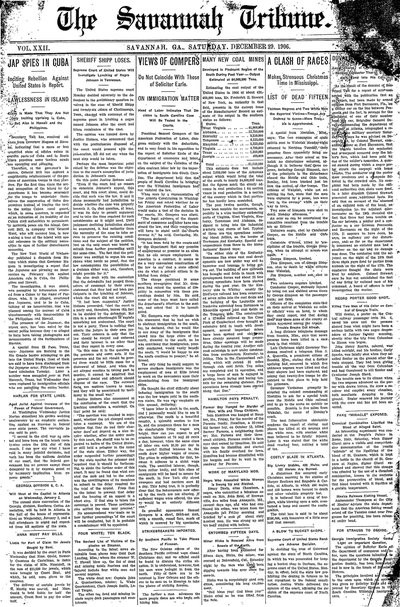
Page text (machine-generated)
The Savannah Tribune.
VOL. XXII.
JAP SPIES IN CUBA
Inciting Rebellion Against United States is Report.
LAWLESSNESS IN ISLAND
Claim is Made That They Are Not Only Inciting Uprising in Cuba, But Also in Hawaii and the Philippines.
Secretary Taft has received advises from Governor Magoon at Havana, indicating that a more or less unsettled state of affairs exists in certain parts of Cuba and in Santa Glara province some lawless bands are operating and pillaging.
Therefore, at the governor's instance, General Bell has ordered a considerable reinforcement of the garrison of American troops in that province. For the first time since the second occupation of the island by the Americans it has become necessary for the troops to undertake themselves the suppression of these desperades instead of leaving the task to the native Cuban rural guard, which, in some quarters, is regarded as an indication of the inability of the Cuban civil authorities to permanently maintain peace on the island. General Bell, in company with General Went, who will succeed him, is now making a tour of the island with special reference to the military necessities in case of further disturbances occurring.
The New York World of Wednesday published a dispatch from Havana which states that Governor Magoon is investigating a report that the Japanese are planning an insurrection on February 15th against American rule in Cuba, the Philippines and Hawaii.
The investigation. It was stated, was prompted by information received from a Cuban by the name of Pardinas, who, it is alleged, overheard five Japanese, said to be in Cuba, talking of an insurrection, that was planned among the negroes of Cuba simultaneously with insurrections in the Philippines and Hawaii.
The presence of the Japanese, the report says, has been noted by the secret police because they are alleged to have been taking photographs and measurements of the fortifications of Havana.
A special from El Paso, Texas, says Japanese are flocking to the Rio Grande border attempting to get into the United States. Most of them are said to have been discharged from the Japanese army. Fifty-four were refused admission Tuesday. Later a number were smuggled over at Fort Hancock, Texas, but Wednesday they were captured by immigration officials who are patrolling the entire border.
HARLAN FOR STATE LINES.
Aged Jurist Against Increase of the Power. of Federal Government.
At Washington Wednesday Justice Harlan signalized his golden wedding anniversary by an emphatic declaration against an increase in federal over state power. The venerable jurist said in part:
"I served in the civil war as colonel and have been on the bench twenty-nine years the 10th day of this month. I can now say what I have said in many judicial decisions, and such has been the uniform doctrine of our court, that the federal government has no powers except those delegated to it by express grant or by necessary implication from express grants."
Will Meet at the Capitol in Atlanta on Wednesday, January 2.
The annual state convention of the Georgia division, Southern Cotton Association, will be held in Atlanta in the hall of the house of representatives on Wednesday, January 2, and a full attendance is urged and expected from all sections of the state.
ANNA MUST PAY BILLS.
Liable for Part of Claim for Jewels Bought by Boni.
It was decided by the court in Paris Wednesday that Mme. Gould, formerly Countess de Castellane, is liable for the claim of Mlle. Nanidoff, in the sum of $24,000 for jewels, which were brought by Count Boni, and which, he said, were given to the countess.
The delivery of certain jewels by M. Hartig was proved, and Mme. Gould is held liable for half the amount, Count Boni to pay the other half.
SHERIFF SHIPP LOSES.
Supreme Court of United States Will Investigate Lynching of Negro Johnson in Tennessee.
The United States supreme court Monday decided adversely to the defendant in the preliminary question involved in the case of Sheriff Shipp and twenty-six others of Chattanooga, Tenn., charged with contempt of the supreme court in lynching a negro named Johnson after the court had taken compliance of the case.
The opinion was handed down by Justice Holmes, who announced that with the prellminaries disposed of, the court would proceed with the prosecution. He did not say when the next step would be taken.
Perhaps the most important point raised by the defense was the objection to the court's assumption of jurisdiction in Johnson's case.
On this point Justice Holmes said: "Even if the court had no reason to entertain Johnson's appeal, this court, and this court alone, could decide that such was the law. It and it alone necessarily had jurisdiction to decide whether the case was properly beneath it. On that question, at least, it was its duty to permit argument and to take the time required for such consideration as it might need. Until judgment declining jurisdiction should be announced, it had authority from the necessity of the case to take orders to preserve the existing conditions and the subject of the petition, just as the said court was bound to refrain from further proceeding until the same-time. The fact that the petitioner was entitled to argue, his case shows what needs no proof, that the law contemplates the possibilities of a decision either way, and, therefore, might provide for it."
He also dealt with the contention that the defendants had purged themselves of contempt by their sworn statement that they had not been participants in the lynching of Johnson, which the court did not accept. "It had been suggested," Justice Holmes proceeded, "that the court is a party and, therefore, leaves the fact to be decided by the defendant. But this is a mere afterthought to explain something not understood. The court is not a party. There is nothing that affects the judges in their own person. Their concern is only that the law should be obeyed and enforced and their interest is no other than that they report in every case.
"In this case it is the question of the presence and overt acts. If the presence and the act should be proved there would be little room for a disavowal of Intent. And when the act alleged consists in taking part in murder, it cannot be admitted that a general denial and affidavit should dispose of the case. The outward facts are matters known to many, and they will be ascertained by testimony in the usual way." Justice Holmes also announced at the conclusion of the court that the lynching constitutes a contempt. On that point he said:
"The question was touched in argument, whether the act charged constitutes a contempt. We are of the opinion that they do and their character does not depend on a nice inquiry whether, after the order made by this court, the sheriff was to be regarded as ballee of the United States, or still held a prisoner in the name of the state alone. Either way, the order suspended further proceedings by the state against the prisoner and required that it should be forthcoming, to abide the further order of this court. It may be found that what created the mob and led to the crime was the unwillingness of its members to submit to the delay required for the trial of the appeal. From that to the intent to prevent that delay and the hearing of an appeal is a short step. If that step is taken the contempt is proved. These preliminaries settled the case may proceed."
No announcement was made as to how further proceedings of the court will be conducted, but it is probable a commissioner will be appointed.
FOUR WHITE; TEN BLACK.
The Revised List of Victims of Explosion on Steamer.
According to the latest news obtainable from places near Gold Dust Landing, Miss., where the steamer W. T. Stovall blew up, the list of dead and missing totals fourteen and the injured include four white men and several negroes.
The white dead are: Captain John A. Quackenboss, master; L. Wade Quackenboss, Clerk Joseph Smith, Leval Yerger.
The other ten dead and missing include negro deck passengers and roustabouts.
SAVANNAH. GA.. SATURDAY. DECEMBER 29. 1906.
VIEWS OF COMPERS
Do Not Coincide With Those of Solicitor Earle.
ON IMMIGRATION 'MATTER
Head of Labor Intimates That Decision In South Carolina Case Will Be Tested In the
President Samuel Gompers of the American Federation of Labor, disagrees entirely with the deductions, and is very frank in his opposition to the report of Sollicitor Erle of the department of commerce and labor, on the subject of the violation of the alien contract labor law by the importation of immigrants into South Carolina. The department held that the people of South Carolina in bringing over the Wittkelind immigrants had not violated the law. When seen by a representative of The Atlanta Constitution in Washington Friday and asked whether he or the American Federation of Labor would make a test of the decision in the courts, Mr. Gompers was silent.
"The legal advisers, of the department of commerce and labor have construed the law, and their construction will have to stand until the courts reverse it," he said. Continuing, Mr. Gompers declared:
"It has been held by the courts and by the department that any promise of employment or promise to an alien that he can secure employment in America is a contract. It seems to me a very convenient construction of the law to say that a state official can do what a private citizen is inhibited from doing."
The charge contained in some southern newspapers that Mr. Gompers had raised the question of illegality in connection with these proceedings denied by him. He said some of the boys must have called the department's attention to the matter, and asked that it be investigated.
Mr. Gompers was very emphatic in his statement that he had no wish to obstruct immigration to the south, for, he declared, that he would like to see many of the immigrants that crowd into the large cities of the north, diverted to the south, as he was convinced that immigration, properly conducted, would vastly benefit the south. "I would be happy to see the south continue to prosper," he affirmed.
The only thing he could suggest to secure southern immigrants was the employment of men at Ellis Island to work on the newcomers upon their disembarking from the immigrant ships. He thought the chief difficulty about inducing immigration to the south was the low wages paid in the southern states. He was very emphatic on this ground, declaring:
"I know labor is short in the south, and I personally would like to see it otherwise. The south is a beautiful country, a splendid section to live in, and the prospects there for a man on comfortable living wages are bright. How can you expect to get common laborers at 70 and 80 cents a day, however, when the same class of labor can earn $1.50 per day in the north? Skilled laborers in the south draw higher wages of course. The union is responsible, for that, because it adores to a strict wage scale. The unskilled laborer, though, fares rather badly, and this class of immigrants will be hard to secure for the south. In New York city street sweepers and hod carriers earn $2 a day. This being true, it is perfectly clear that the inducements now offered by the south are not alluring. If sufficient wages were offered, the story would be an entirely different one."
In personal appearance Samuel Gempers is a short, thick-set man, with a smooth, round face, much of which is covered by big spectacles.
STRIKEBREAKERS IMPORTED.
By Southern Pacific to Take Places of Firemen.
The New Orleans offices of the Southern Pacific railroad were closed Christmas day; and no official could be found to discuss the strike situation. It is understood, however, that 100 men were brought in from the north. Fifty of them are to be retained in New Orleans and the others to be sent on to Houston to take the places of striking firemen.
The farther a man advances the more people there are who begin criticising him.
MANY NEW COAL MINES
Developed In Piedmont Region of the South During Past Year — Output Estimated at 84,000,000 Tons.
Estimating the coal output of the United States in 1906 at about 430,000,000 tons, Mr. Frederick E. Saward of New York, an authority in that field, presents in the current issue of the Manufacturers' Record an estimate of the output in the southern states as follows:
States. Tons.
West Virginia . . . 41,000,000
Alabama . . . 12,750,000
Kentucky . . . 9,250,000
Tennessee . . . 6,250,000
Maryland . . . 5,350,000
Virginia . . . 4,700,000
Texas . . . 1,350,000
Georgia . . . 400,000
Total . . . 81,050,000
This estimate does not include about 2,000,000 tons of the Arkansas output which would bring the total of the south to nearly 84,000,000 tons. But the figures mark the steady advance in coal production in a section variance in coal production in a section of the country which in that particular has hardly been scratched.
The past twelve months, though, have been notable for movements, especially in a wide territory embracing parts of Virginia, West Virginia, Kentucky, Tennessee and Alabama, designed to bring into the industrial markets vast stores of fuel. Typical of these are the operations centering about Jellico, on the border of Tennessee and Kentucky. Special correspondence from there in the Manufacturers' Record says:
"On either side of the Kentucky-Tennessee line some vast coal developments are now under way and an immense coal tonnage is being gotten out. The building of new railroads has brought coal fields in touch with development forces and about 25 new mining operations have been started during the past year. On the Kentucky side in Whitley county the Dird's eye railroad has been constructed seven miles into the coal fields and the building of the Louisville and Nashville extension from Baltimore to Knoxville opened vast coal fields on the Tennessee side. The construction of a 12-miles railroad up the Clear Fork of Cumberland river brought an extensive field in touch with development, several important mines have been opened and shipments have already assumed large proportions. Other openings will be made during the coming year. Another railroad extension is now under construction from southeastern Kentucky to Jellico. This is the Cumberland railroad, which will extend 36 miles through rich coal fields. Ten miles are completed and in operation, and a large force of men is engaged in grading, track laying and boring tunnels for the remaining distance. Five operations have already been started along that line."
HAMILTON PAYS PENALTY.
Farmer Boy Hanged for Murder of Man, Wife and Three Children. Joda Hamilton was hanged at Houston, Mo., Friday, for the murder of the Parsons family. Hamilton, a 20-year-old farmer boy, on October 12, killed Barney Parsons, a neighboring farmer; Mrs. Parsons and their three small children. Parsons rented a farm near that owned by Hamilton. He sold his crops to Hamilton and started with his family overland for Iowa. Hamilton had become dissatisfied with his bargain and lay in wait in the roadway for Parsons.
WORK OF MARYLAND MOB.
Negro Who Assaulted White Woman is Swung Up and Riddled.
Henry Davis, alias Chambers, a negro, who committed a felonious assault on Mrs. John Reid, of Brownsville, five miles from Annapolis, Md., several days ago, and who had confessed his crime, was taken from the Annapolis jail Friday morning and lynched by a mob of about sixty masked men. He was strung up and his body riddled with bullets.
ENTOMBED FIFTEEN DAYS.
Miner Hicks is Rescued Alive from Bowels of the Earth.
After having been entimbed for fifteen days, Hicks, the miner, was rescued at Bakersfield, Cal., Saturday night by the men who have been digging towards him ever since the cave-in.
Hicks was in surprisingly good condition, considering his long conilinement.
"God bless you! God bless you!" Hicks cried as he was lifted from the hole.
A CLASH OF RAGES
Makes Strenuous Christmas Time in Mississippi.
Thirteen Negroes and Two White Men the Reported Victims—Troops, Are Ordered to Scan—More Trains
A special from Meridian, Miss, says: The two companies of state militia sent to Wabalak Monday night returned to Meridian Tuesday, their presence there apparently being unnecessary. After their arrival at Wabalak no disturbance occurred, although it is believed that three negroes, including George Simpson, one of the principals in the disturbance aboard the Mobile and Ohio train, Sunday, had been lynched just before the arrival of the troops. The citizens of Wabalak, while not admitting the fact, state that the men were captured by a posse, but were "lost in the swamp" while on their way to town.
Two sons of Simpson were shot to death Monday afternoon. As near as can be ascertained the casualties resultant from the trouble are as follows:
Unknown negro, shot by Conductor Cooper, on the Mobile and Ohio train.
Constable O'Brien, killed by precipitator of the trouble, George Simpson, when an attempt at arrest was made.
George Simpson, lynched.
Tom Simpson, son of George Simpson, shot to death by white citizens near Wahalak.
Jim Simpson, another son, shot to death.
Two unknown negroes lynched.
Conductor Cooper, seriously injured by being cut and stabbed seven times by George Simpson on the passenger train; not fatal.
Officers of the companies state that on their arrival at Wahalak no county officials were on hand, to whom they could report, and that during their stay there none of the county officials appeared among the troops.
Trouble Breaks Out Afresh.
A long distance telephone message from Scoobia, Miss., says that seven persons have been killed in a race clash in that vicinity.
Late Christmas night Governor Vardaman received a telegram from J. A. Quarrells, a prominent citizen of Scoobla. Miss., stating that a further uprising had, occurred in which five unknown negroes were killed and that their slayers had been captured, and asking that twenty-five troops be dispatched to that place to help hold the prisoners.
Governor Vardaman promptly instructed the colonel commanding at Meridian to ask for a special train over the Mobile and Ohio railroad and to go to the scene as quickly as possible. Scoobla is five miles from Wahalak, the scene of Monday's crash.
The best information obtainable confirms the report of rioting and places the killed at six negroes and one white man, with another white man believed to be fatally injured. Later it was stated that the white dead reached four, making a total of ten.
COSTLY BLAZE IN ATLANTA.
Big Livery Stables, 400 Mules and 100 Horses Are Burned.
A disastrous fire occurred early Christmas morning In the stables of Harper Brothers and Ragsdale & Carlisle, at Atlanta, in which 400 mules and 100 horses were burned to death and other valuable property lost.
It is believed that a gang of burglars, while blowing open a safe, overturned a lamp and caused the conflagration.
The total loss is said to be about $100,000, with insurance of a little over half that amount.
A BLOW TO BUCKET SHOPS.
Supreme Court of United States Renders Adverse Decision.
In deciding the case of Gatewood against the state of North Carolina, in which he was prosecuted for keeping a bucket shop in Durham, the supreme court of the United States, Monday, in effect, held the state law prohibiting the dealing in futures to be not repugnant to the federal constitution. Justice White delivered the opinion of the court, affirming the decision of the supreme court of North Carolina.
As the result of the demand of Secretary Tatt for a report of acts connected with the publication that an attack had been made by armed soldiers from Fort Barrancas, Fla., on a trolley car on the line between Pensacola and the fort, in revenge for the enactment of one of their number from the car, Brigadier General Duval commanding the department of the guild at Atlanta, telegraphed a report to the military secretary Saturday. He says he was advised on December 19, by Colonel Stewart, commanding officer at Fort Barrancas, that the trouble between the conductor and corporeal occurred over the latter's fare, which had been paid by one of the soldier's comrades. A quarrel ensued during which a negro porter struck the corporal with brass knuckles. The conductor and the porter drew revolvers and a spimpede followed in the crowded cars. No complaint had been made by the railroad authorities that shots were fired. In a later dispatch Colonel Stewart presented some additional facts. He said that on account of the absence of an enlisted man of the band, an investigation by the adjutant quartermaster on the 19th revealed the fact that there had been trouble on the car between a soldier and a conductor on a car between Pensacola and Barrancas on the night of the 17th. It appears to have been, he says, an ordinary pay day disturbance, and so far as the department is concerned no enlisted man had a revolver on the car and no damage was done. The conductor told the adjutant on the night of the 19th that three shots were fired by parties from ambush on the night of the 17th. The conductor thought the shots were fired by soldiers. Colonel Stewart says he has not established the fact of any firing by enlisted man of his command. A board of officers is now investigating the matter.
NEGRO PORTER GOOD SHOT.
Killed Two Men of His Color on Central of Georgia Train.
Will Senior, a porter on the Central railway passenger train No. 4, saved his crew and the persons aboard from what might have been a serious battle with two negro desperadoes at Juniper Sunday morning, shortly after the trip from Columbus to Macon was begun.
John Henry Sparks, colored, was killed outright, and his brother, Curly Sparks, was fatally shot when they assaulted Senior on the ground after the train stopped. They had been giving trouble all the way from Columbus and had threatened to kill Senior and Conductor Joseph Steed.
The trouble cam to its climax when the two negroes advanced on the porter with drawn knives. He drew a revolver and emptied every chamber, both assailants dropping to the ground. Senior renewed his journey with the crew and has not been arrested.
FAKE "MIRACLE" EXPOSED.
Chemical Combination Liquified the Blood of Allied Salent.
An interesting experiment was conducted at the People's Palace in Rome, Italy, Saturday, when Signor Glacci gave a visible and comprehensive demonstration of the yearly "miracle" of the liquifying of the blood of St. Gennaro, which is kept in a bottle in the church of St. Gennaro at Naples. Signor Glacci explained and showed that this change was effected by the use of a chemical combination, known to the ancients for the preservation of blood, and that blood treated with it liquifies at a certain temperature.
Ambassador Thompson at the City, of Mexico' advises the state department that the American fishing vessel seized off the Yucatan coast near Progresso for poaching, has been released under bond.
Georgia Immigration Society Seeks Light on Important Question. The opinion of Sollicitor Earle of the department of commerce and labor, upon the questions submitted to the department by the Georgia immigration Society, has been completed and is now in the hands of Secretary Strauss. The principles involved are similar to the ones upon which an opinion was given by Sollicitor Earle and are proved by Secretary Strauss in the South Carolina Wittetkin Immigran
SOL. C. JOHNSON, Supt. of Ageno
Treasury of State of Georgia.
Bilabla, 1AN-17 1906 190
The undersigned, Treasurer of the State of Georgia, hereby acknowledges to have received from the Secretary of State of Georgia the following disclosures:
Dear Regent and Deputy at theinity of
Elberton, Georgia (Episcopal Diocese of
Elberton)
14:10, in connection with the disclosures
(5000) averments, due 1920
long on total Ten Thousand Dollars, and which are held by the State of Georgia, by authority and under the provisions of an Act of the General Assembly, approved October 28d, 1887, and amended December 20th, 1897.
R. E. Parsi
Treasurer of the State of Georgia.
NIGHT TRAINS SAVANNAH & MONTGOMERY. VIA SEABOARD AIR LINE RAILWAY.
Train will consist of PULLMAX BUFFET SLEEPING CARS, Day Coaches between Savannah and Montgomery without change; making close connection at Montgomery with all lines diverging for Pensacola, Mobile, New Orleans and all Western points; Birmingham, Memphis, St. Louis, Nashville, Chicago and all Northwestern points; the SHORTEST LINE to Montgomery, New Orleans, Birmingham and the earliest arrival at these points. At Savannah close connection is made for all EASTERN POINTS, Richmond, Washington, New York and with Coastwise Steamships for Baltimore, Philadelphia, New York and Boston.
EVERY FARMER IN THE COUNTRY SHOULD HAVE-ONE
New-York Tribune Farmer WEEKLY, 20 pages, 12½ by 18 inches. The most thoroughly practical, helpful, up-to-date illustrated National weekly for every member of the farmer's family. Regular price, per year, $1.00. A copy of ROPP'S NEW COMMERCIAL CALCULATOR will be sent postage prepaid WITH THE N. Y. TRIBUNE FARMER ONE YEAR, FOR $1.00
ROPP'S NEW Commercial Calculator and Short-Cut Arithmetic
Containing a New, Complete and Comprehensive System of Useful, Convenient and Labor-Saving Tables Also The Essence of Arithmetic and Mensuration Condensed and Simplified for Practical Use Handy Review and Ready Reference Designed for the Use of Farmers, Mechanics, Business and Professional Men, Bankers and Dealers in Grain, Stock, Cotton, Coal, Lumber, Produce, Feed, Etc.
One Hundred and Sixty Pages.
P. EDWARD PERRY, Vice President.
CHARLES F. STEWART,
Asst. General Passenger Agent, Savannah, Georgia.
ENTRY SHOULD HAVE-ONE.
Every farmer wants to know to a cent the value of what he buys and sells, and should not leave this to be figured by the party with whom he is dealing.
As labor saving machinery has been invented to save time and physical strength, so there are devices to enable the mind to reach quickly and accurately results usually arrived at with much thought and tedious calculation. Time is worth much, but accuracy is still more important.
Many books have been prepared to make the task of calculating easy, its results sure, but never one fitted to all men, in all kinds of business, at all times, so completely as "ROPP'S NEW COMMERCIAL CALCULATOR." This reliable assistant to the farmer and others has been in the market for many years, and nearly a million and a half copies have been sold. The last edition (160 pages) is from beginning to end filled with tables, short cuts, and up-to-date methods of calculating, making it the most complete, useful and comprehensive work of the kind ever published. It will make every one independent, sure and self-reliant in all practical calculations connected with farming and other lines of business. It will prevent mistakes, relieve the mind, save time, labor and loss. It is a pocket edition with pocket for papers and a loose silicate slate from which lead pencil marks are easily erased, and is an invaluable assistant for every farmer or business man.
ages, 12% by 18 inches. The most thoroughly up-to-date illustrated National weekly for every
HOME OFFICE
WEST BROAD STREET,
SAVANNAH, GEORGIA.
Phone 1198. Ga. Phone 2029.
Directors.
L. E. Williams.
P. Edward Perry.
Walter S. Scott.
Sol. C. Johnson.
W. R. Fields.
J. H. Deveaux
L. M. Pollard.
R. R. Wright
W. H. Burgess.
J. H. Bugg, M. D.
J. M. Ferrebee.
This company is duly chartered under the laws of the State of Georgia, and has complied with all requirements of the State Insurance department, therefore all policy holders are protected with all the safeguards that the strict insurance laws of this State seek to protect its citizens.
Its affairs are directed and managed by Negro men of the city of Savannah of leading standing, and whose character and reputation are of such as to command the respect and confidence of all the people of that community. The same men that manage this Society are the ones that organized and are conducting the affairs of the first successful Negro Savings Bank in this state, therefore we can readily see that by connecting themselves with this Insurance company their interest will be in safe hands.
By comparing our rules and benefits with other first class companies it will be seen that we offer the most liberal inducements with the largest sick, accident and death benefits to our members than any other company in this business.
That we pay our claims promptly can be testified to by the thousands of our satisfied members.
Liberal Terms and Commission.
MAFIA AGAIN ACTIVE.
Six Italians Found Mysteriously Murdered in New Orleans—Crime Laid to Secret Society.
Six Italians were found murdered in a tenement house in Dumaine street in New Orleans early Wednesday morning. Some of them had been burned to death, and there is no doubt that the men were victims of the Mafia, which has been working secretly in New Orleans for many years, and has broken out at intervals, when revolting crimes have been committed.
Not since the lynching of Itallans by the wholesale, several years ago, has the New Orleans foreign populace been in such a high state of excitement. Following the discovery of the murders, the excitement grew to such bounds that the entire police department was hurried to the tenement house. The police could not cope with the situation and a call was sent for every able-bodied fugian in the department to hurry to the scene.
The murders are believed to have been committed during the early part of Tuesday night and had undoubtedly been planned ahead. That no screamis were heard from the murdered men leads to the theory that many men were engaged in the slaughter and that the victims were set upon at a given signal and struck down before any of them could make an outcry. The bodies of the dead men were literally hacked to pieces and those that were burned had evidently been set on fire after being put to death.
The murderers are said not to have left a clew to their identity. If they are known the Italians are the only ones who can enlighten the police, and up to this time they have refused to talk. The police are of the opinion that the murders were committed by one of the many secret societies and that the six men who were slain were marked for death by their own countrymen.
NELSON'S HAIR DRESSING
A delightfully perfumed Hair Pomade prepared especially for Colored People. Nelson's Hair Dressing makes Harah, Stubborn, Kinky, Gurly Hair Soft, Pliant and Glossy. By supplying the needed oil directly to the roots of the hair it tops up the scalp, stops the hair from falling out, increases its growth, prevents its splitting and breaking off, removes Dandruff, and cures itching, irritating Scalp Diseases. Large boxes at Drug Stores 25C, present by mail for 30c (stamp or silver). Good Agents Wanted (male or female). Write for terms.
Address NELSON MANUFACTURING CO.,
Richmond, Virginia.
WALTER S. SCOTT, Secretary and Tr eas.
ADDRESS THE HOME OFFICE,
468 West Broad St.,
Gavannah, Georgia.
New York Doctors in Savannah
THOUSANDS GOING TO SEE THEM AND HUNDREDS REJECTED AS INCURABLE. LOCATED PERMANENTLY, 304 LIBERTY STREET, WEST, CORNER JEFFERSON. WHAT WE ARE THOUGHT OF AT HOME. PATIENTS CURED IN SAVANNAH.
W.
DR. BAUGMAN,
Specialist.
Consultation Free.
Hours 3 to 8; Sunday 7 to 11 a.m.
Write for Symptom blanks for Home
Treatment. Enclose stamp for reply.
TESTIMONIALS.
Savannah, Ga., June 4, 1906. Cured Loraine Lake, Central Hotel, West Broad St. Tumor of necis Mr. W. W. Smith, DeSoto Hotel, cured of keyloid, June 7, 1906. Newton Alford, Bay street, cured of Epileptic fits, June 20, 1906.
Mrs. Julia Jones, 712 39th street, East, cured of a large tumor in the stomach; tried many doctors, spent much money; tried six doctors in Dublin, Ga., they gave me out; my stomach was enlarged and swelled. New York Specialists cured me sound and well. Julia Jones, 712 39th St.. E. Witness, Henny Williams, 460 Montgomery St
June 17, 1906, had rheumatism, could not walk; now can. Cured by N. Y. Doctor. Moriah Burk, 219 Jones Lane, E, Savannah, Ga.
June 1, I have been suffering with my eyes, scums growing in the corner of my eyes and moving towards
CALL ON OR
New York
304 LIBERTY STREET, WEST, COR
CALL ON OR ADDRESS New York Doctors
304 LIBERTY STREET, WEST, CORNER OF JEFFERSON.
Eyes Cured.
the eye ball so that I could hardly see. I could see spots or strings. New York Specialists removed the scums or films. My eyes are all right Mrs. Tilla Dillard, Broughton St. E.
June 1, Maggie Bold's eyes cured. I had pain in the head, pain in my eyes. I could not lay down night or day, the pain was so severe in my eyes; could not bear the light; eyes were blood shot; inflammation in them; cataracts on my eyes; felt just like a grain of sand rolling in them. I had fever also. I got no relief until I consulted the New York Specialists. They cured me sound and well. Never felt better in my life. Doctors can cure you as easy. Maggie Bolds, 727 South Broad St, E. My eyes were the same way, Abbie Williams, Bonaventure.
Stream was small, forked, twisted, and bent; just have to torse the water; sometimes the urine would stop on me, had to have it drawn off; burned in passing. New York Doctors cured me. Sam Henry, Broughton St., W. Doctors cured me of loss of manhood.
I was married in 1893 but I kept sick all the time. I suffered with Whites, inflammation of the womb and pains all over me. I was treated by doctors and took all kinds of medicines, but got worse instead of better. New York Doctors cured me. Jennie Seltz, City.
I have whites awful bad and terrible pains across my back, a dizzy headache all the time and very scant menses. I suffer with indigestion and constipation. New York Doctors cured me. Miss Viola Foltz, City.
I had Catarrh for twelve years and suffered with headache, nose stopped up, appetite poor, felt tired and rundown and unfit for work; hawked and spit. New York Doctors cured me. Jennie Askam, City. Call on or address them. Enclose stamp for reply.
Stricture Cured.
Wrinkled, ascetic and grim,
With little of faith or whim,
And little of sunny and human mold
Where the seeds of liking might find a
hold—
Such was Father, Boniface.
The abbot of rich old Allonby Chase,
And nigh fourscore years old.
From a life spent in the thick
Of feud with the heretic,
Or in ruling with strong hand small and
great
Inside or in sight of the abbey gate,
He came at last to die.
And, meek enough now, in chapel must lie
In pomp he used to hate.
In heaven they gave him a guide,
Who, shining there at his side,
Said, "Now to the great ones first shall we
seek.
And strange, unchurchly clique."
The peace on the abbot's face
At this was lessened a space,
But he said no word, and the angel's tall
Led on till they came to a garden wall—
The towers of the place were seven,
And it lay on the sunset side of heaven
Where twilight glories fall.
Twas a fair place and a wide,
And garnished on every side
With riot of bloom, and the birds and the bees
Kept tune to the ripple of streams at ease,
And many a gurgling shout
From the dimpled crew on the grass rang
High on the listening breeze.
And hard by the open gate
The abbot cried aloud, "Wait,
I pray thee, O angel, and quickly tell
What bright ones are these?" And he
said,
"Here dwell
The souls of the children small
Who died in the wreck of their fathers'
fall,
Too young to know they fell.
"You lad at play by the brook
Was Korah's son; when they took
White, Ashkelon's towers, and the people
slew.
Like doves, all the little souls this way
flow;
The child on the Canaanite
Has a welcome here in the high God's
sight
As warm as has the Jew."
"Sayest thou? They are orphans,
then,"
Said Boniface; and again,
"May an old man enter, and childless,
too?"
And then at the answer eagerly drew
Anigh an Amalekite maid
Of three, who alone by a rose-tree played.
She let the leaves slip through
Her fingers, watching his face,
Then laughing, with baby grace
She held out her arms. And the guide
went on
To the great, if great ones he sought,
alone;
But Boniface in the thick
Of the heathen seed and the heretic
Found heaven and heart's ease won.
—William Harrey/Woods.
The Twins.
If the twins had been within sound of the telephone bell probably they would have guessed the truth. The telephone was a new and unalloyed wonder, and the twins signified their appreciation of it by responding to its every summons and following minutely the audible half of its mystic conversation.
However, at the crucial moment Jack was engaged at a distance in impersonating an automobile at full speed, and Phyllis, whose imagination in these co-operative diversions were never required to take such stately flights, had accepted the role of banana vendor, shortly to be bumped, bowled over and completely extinguished by this counterfelt tension of the thoroughfares. A real banana vendor had met with a catastrophe of this sort in their sight the day before. Two moments after the conversation by telephone, which they did not hear, had ceased, they were summoned to the house. "Why must we dress up?" demanded Jack, when he began to realize what was to happen. He felt keenly the encroachment upon the informality of his Saturday afternoon attire.
"Mother doesn't like to have her babies look so ragged," replied the parent, strategically.
"Why don't you want us to be ragged?" insisted Jack. "You didn't care last Saturday. Father said he never saw my face so dirty," he continued, piling up evidence.
"But it really isn't nice to look like frights. After this you will be dressed every Saturday afternoon, just as you are on school days and Sundays."
Phyllis had been wrestling with conclusions. "Is some one coming?" she asked. "May I stay to dinner?"
"No, darling." And no court of veracity could have decided which question it was the mother answered.
Phyllis, however, watched the appearance of her second best dress and experience was more convincing than parental negatives. "I think some one is coming, Jack," she said, calmly. "I think that's why we are dressing up."
"Is it Ucle Harry?" inquired Jack, eagerly. "He promised to bring me some marbles."
The strategic parent retreated behind the usual defenses. She assumed her prerogative of authority, unquestionable source of decisions and commands.
"Mother said," she repeated firmly, "that she does not like to see you looking so ragged. That is the only reason you are dressing up." It sounded masterful. It was really a humiliating capitulation.
"Will you hate to see us look this way next Saturday, too?" asked Jack. "Every Saturday," repeated the parent firmly.
Jack wore the expression of a philosopher who resigns himself to the inervitable. Phyllis, however, had no regrets. She possessed the feminine adaptability to fuss and feathers.
"There," sighed the strategie parent, as the twins creaked out of sight around the bend in the tront stairway.
"Now they won't tell Harriet Van Allen the minute she arrives that I was expecting her, and they won't carefully explain that that is the reason they have on their white frocks and best shoes. I am glad they weren't near the 'phone when she called me up."
Mrs. Van Allen was one of those disturbing visitors who never found virtue in uncouth and uncombed juvenility. The small Van Allens were always spick and span and less vigorous mothers than thelrs succeeded in emulating this condition, so far as their offspring were concerned only when it was known beforehand that Mrs. Van Allen was coming. Mrs. Van Allen arrived. The twins were introduced. Conversation followed. Unluckily, at that moment the strategic parent was called to the telephone. Unluckily, also, the twins found that instrument less attractive than the visitor.
"That is a very handsome gown you have on," began Mrs. Van Allen, by way of making herself agreeable.
Phyllis demonstrated the golden quality of silence.
"It is her best one," explained Jack. "These are my best shoes, too."
"Indeed!" said Mrs. Van Allen. "It must be lovely to have on one's best shoes."
"Only," qualified Jack, "a boy likes bare feet better."
"We're never going to have bare feet any more," remarked Phyllis at this juncture, steadfastly addressing her brother in spite of the fact that he was already possessed of the information. "We're always going to be dressed up Saturday afternoons."
"It's becausemother doesn't like to see us so ragged," explained Jack, politely. "She didn't mind until today, but after this she's going to."
"We thought," said Phyllis, in a sudden burst of confidence that included the whole world, "we thought at first it was because some one was coming." Then she was immediately covered with confusion when she noted that the visitor was listening to her attentively.
It was at this point that the strategic parent hurried back into the room.
"Well, babies," said she, with the benign smile of ignorance, "how are you entertaining Mrs. Van Allen?" "Because," finished Jack, sticking to the former subject of conversation with painful tenacity, "mother used to dress us up on Saturday only when somebody was coming."
Having thus creditably acquitted himself of all conversational responsibility he beamed cheerfully upon his mother.—Chicago News.
Overcoat of Navy Blankets.
Lieut. W. R. Henderson, who arrived last evening from the Orient on the tr: sport Thomas, brought an overcoat made out of two British navy blankets. Henderson is "more than common tall," and would be noticeable without the cream colored sack that he is taking to his home in the East to keep him warm when skating time comes. The coat is quite a startling affair, much affected by British navy officers, but seldom seen in this part of the world. If you see a tall, handsome young fellow, wearing a loose fitting garment that suggests memories of the exodus from the Occidental Hotel on the morning of April 18, know by this that he is not a belated refugee, but a gallant navy officer.—San Francisco Call.
A Slight Hitch.
Stranger—"Sir, do you remember giving a poor, friendless tramp fifty cents one cold night last winter?" Jones—"I do!" "Sir, I am that tramp; that fifty cents was the turning point in my career; with it I got a shave, a shine, a meal, and a job. I saved my money, went to Alaska, made a million dollars, and last week I came back to New York to share my millions with you. But, unfortunately, I struck Wall Street before I struck you—and have you another fifty cents that you could conveniently spare, sir?"—Life.
A Sectarian Contributor.
An absent-minded woman walked into the church, took a front seat and joined in the service vigorously. Then the collection basket was passed to her, and, putting a coin into it, she looked about. She cast glances in every direction, her mind cleared, and an expression of amazement overspread her face. She got up. She hurried down the aisle. She overtook the man with the collection basket. "I'm in the wrong church," she whispered, and, taking out the coin she had put in, she hurried forth.—Chicago Inter-Ocean.
The Reason For It.
"Here's a story," said Mrs. Nagget, looking up from her paper, "of a man who begged the judge to send him to jail in place of his wife——"
"Ha!" exclaimed Mr. Nagget, "and yet you say we men never sacrifice ourselves for——"
"Walt a minute. This woman stole some clothes she was given to wash. You see, she couldn't take in washing while she was in jail, and so he would have had to work."—Philadelphia Press.
Australia exports 24,000,000 rabbit skins a year. To kill this great number costs about $225,000.
FOR THE FARMER AND STOCKMAN
To Get Rid of Stumps.
A method of getting rid of stumps which has been highly recommended and which, to be effective, should be done as follows:
this State. Barley, which is raised in abundance here, will be the chil-ration tried in the preliminary ex-periments; and we will endeavor to ascertain the best supplementa-
Bore a hole one or two inches in diameter and about eighteen inches deep into the centre of the stump. Then put into this hole one or two ounces of saltpeter. Fill the hole with water and plug it up. In the spring take out the plug, pour in about one-half gallon of kerosene oil and light it. The stump will smolder away to the very extremities of the roots, leaving nothing but the ashes.
Fighting Weeds
A writer in the Agricultural Epitomist suggests the following on fighting weeds:
1. Practice rotation. Certain weeds follow certain crops; when the weeds get too strong change crops.
2. Change the method of cultivating. Plow deeper or shallower, or use a different harrow or cultivator.
3. Cultivate frequently with light surface tools.
4. Sow clean seed.
5. Don't let weeds run to seed on the manure pile or anywhere else on the farm.
6. Hogs' and sheep will clean up the weeds on foul fallow land. It is said that a weed will not germinate after a sheep has cropped it.
Cattle and Pigs.
Give the stables a good coat of whitewash. Put a cupful of strong coffee in the calf's skim milk; it will cure scours.
Always put a teaspoonful of bicarbonate of soda in the milk for the calf or pigs. It is good for them, even though the milk be fresh from the separator.
Watch the fences between the pasture and the orchard. The perfume of early apples is very tempting to the cattle.
Sow rye for fall and winter pasture. Sow early so as to get as large a growth as possible before winter. In the spring you will have pasture a-month before grass is ready. Four bushels to the acre, drilled in, is about right.
Flics are bad on milch cows. They will help reduce the flow of milk. Feed lefavier, or give fresh cornstalks at night.
Keep the pig pen clean. Give the pigs pusley weed, as they are very fond of it, and it will do them good. Also sweet apples, but not sour ones. You will find plenty to keep the pigs without any feed.
Above all, keep the outbuildings nice and clean, with plenty of air, and you will not be troubled with all kinds of diseases. — Indianapolis News.
Try This Next Season.
A New London County writer in the Cultivator has a word to say about fertilizing potatoes that may well be preserved for next spring's use. He writes: "The finest looking piece of potatoes I have seen this summer was treated as follows: A piece of sward ground was selected of a fair quality of loam, but from which the grass had completely run out, so that it did not cut a quarter of a ton of hay per acre. It was plewed deep and thoroughly pulverized, and the potatoes planted about six inches deep. No barnyard manure was used, only artificial fertilizer at the rate of about 1500 pounds per acre, half of it applied when the piece was planted, and the remainder at the first hoeing. The piece was comparatively free from weeds, the absence of barnyard manure contributing to that result. The vines were very strong and vigorous, of a dark green but did not cover the ground. The yield was good, though not exceptionally so; about 200 bushels per acre. But they were a fine lot, perfectly smooth and handsome, of good size, and almost no small potatoes.
"Another piece, separated from the first by a few rods, and of precisely the same kind of soil, was treated like it in all respects, except that barnyard manure was used instead of artificial fertilizer. The vines were a light green, of rank growth, completely covering the ground more than two feet deep. The yield was not much more than half as great, the potatoes were not so large and smooth, and there were many more small ones."
Making Hog Crop Without Corn.
Prof. Cottrell, of the Colorado Agricultural College, has begun a series of hog feeding experiments to demonstrate that a country not growing corn can grow and finish hogs profitably. Results will be noted with much interest. Prof. Cottrell says: "I believe there is a great future for the hog feeding industry in this State and I hope to be able through experiments which we will conduct at the college to show the Colorado stock men that hogs can be raised and fattened very successfully on Colorado grown feeds. In the test, which we are about to begin we shall use nothing but feeds produced in
this State. Barley, which is raised in abundance here, will be the chief ration tried in the preliminary experiments; and we will endeavor to ascertain the best supplementary feeds to go with it. The Danish bacon hog, which is considered the best in the world, is fed largely on barley, as the producers in that country have found after years of experimenting and considerable outlay of money in testing the different feeds that it is the best for finishing this type of hog. Conditions in Colorado, are ideal for producing the bacon hog and our energies will be devoted very largely along this line. In my experiments at the Kansas experiment station, where I was located for a number of years before coming to Colorado, we were very successful in producing the bacon hog from feeds grown in the dry farming sections and special attention will be given in our work here to feeding with the products of the non-irrigated lands."
Thinning an Orchard.
A Maine man wrote the Rural New Yorker for advice as to caring for an orchard whose trees had originally been planted too near each other and that had come to "lock horns" or branches, preventing the sun front-finding its way among them. It is interesting to note the various suggestions advanced by the Rural's correspondents who undertook to help the man out. One suggested cutting out every other tree; another every other row each way; still another suggests selecting the rows to be removed and cutting back the overreaching branches, so the trees are bearing fair crops, continuing the work gradually for several years, when the trees may be entirely removed. Edwin Hoyt's plan appeals to the writer as both convenient and full of good sense. His advice to the querist instead of removing the trees-to top them off the last of March. Cut every limb off and thin out many others. Let one or two sprouts grow on each limb cut off. In three years a new young top will be formed, and be in bearing condition, with a lower smaller top to be more easily sprayed and otherwise handled. Fruit will be finer and more easily gathered. After these trees get into good bearing, say four or five years, cut the remainder of these trees left in the same way. In this way renew the tops and keep them down where more easily sprayed and fruit gathered. This plan will be more like topping the trees for grafting, which, as experience has shown, will bring a new top on a regratted tree in four years into full bearing. Try it on one or two trees if you doubt the expediency of this plan."
Management of the Dairy Herd.
In the first place too much emphasis cannot be laid on the practice of a dairy farmer always, as far as possible, breeding and rearing his own helpers, paying the greatest attention to selecting the calves from the best butter-producing cows. The productiveness of a herd can be greatly improved in a few years by this practice, and there is less risk of introducing disease.
To fill up the places of old cows, and those which prove unlucky or unprofitable, young heifers to the number of one-third or one-fourth of the total herd should be available each year. The time at which heifers should bear their first calf depends a good deal upon how they have to be reared, which, needless to say, should be as well done as possible. Everything possible should be done to develop the frame, as it has been proved that the largest animals in any particular breed are the most economical producers of butter. Then, provided heifers have been well reared, they can be put to the bull at a year and nine months. Some breeders like them to come in at a year and nine months, or two years, and then milk them on as long as they will, and let them have a season's spell. Anyway, the aim should be to develop the frame, to give large digestive capacity.
Heifers, after their first calf, should always be milked for as long a period as possible, say ten months, even if only stripping, and never allowed to go dry about six months after calving, as they often will if precautions are not taken. This encourages a most valuable habit, that of persistent milking.
A cow should never be dry more than six or eight weeks out of the year, but she requires this time to regain strength for the following season. A good cow will often milk up to the time of calving, but if allowed to do so will not produce as good results next year. She must be dried off systematically; first, by milking only once a day, and then once in two days, then say twice a week till perfectly dry. Great care must be taken not to finally turn her out until the udder is perfectly clear, or the loss of a quarter may result.—W. R. Gilbert, in Massachusetts Ploughman.
```markdown
```
THE HAND SEWERS WHO EXECUTE THE MORE DIFFICULT DE SIGNS.
MAKING THE FLAGS OF WARSHIPS.
BY WALTER L. BRABLEY
Through the courtesy of the Commandant of the Brooklyn navy yard and Commander A. Ward, chief equipment officer, the writer was given special opportunities for obtaining pictures showing an interesting and comparatively little-known department in which the flags of our warships are made. The flag room is under the supervision of Mr. Thomas Malloy, officially rated, as master flagmaker, and Miss M. A. Woods, quarter-woman flagmaker. Mr. Malloy favored the writer with all the main details of the flag department, which are outlined in the present narrative.
To furnish the many hundreds of naval vessels in commission, ranging from the large flagship and battle-ships and the numerous smaller class, with their regular quota of flags, the government is required to maintain an extensive plant. Few, however, realize the number of flags carried by a warship, nor the cost of all the gay bunting which flutters from mast to mast at holiday time. In addition to fleet communication, necessary during all forms of maneuvers in home waters, the ship must be equipped with an extensive array of flags stored on board for various forms of ceremonial and official occasions. This "dress suit" outfit of bunting, therefore, consists of 250 different flags, the material and making of which costs Uncle Sam just $2500. Each ship is entitled to a THE FLAG OUTFIT FOR THE U
THE HAND SEWERS WHO EXECUTE
new flag equipment every three years, though a flagship will often require a new set of signals, owing to their constant use and handling, in about a year.
A striking idea of the number of flags carried by a single ship may be gleaned from one of the accompanying illustrations, showing a pile fifteen feet long and nearly waist high just finished for the new battleship Connecticut. About one-half of the lot is composed of foreign flags, incased in thick paper bags, with the name of the country stenciled on the bottom. The remainder, including those for ordinary use, signal sets, and the international code, etc., are not wrapped, but merely tied in round bundles. To cut out the varied patterns and complete all these miscellaneous flags, some thirty-flye skilled machine sewers and needle-women and three men are employed.
With the bright-colored, fantastic flags of all nations dangling from their machines, the long row of flag makers present a picturesque scene. The long spacious room is literally a blaze of color. Owing to long service, the labor has become highly specialized, and the women are kept at work on the particular flags which they can make the best. Some excel in sewing in the stars, others in finishing certain parts of the flag. Nearly all have been in the establishment for years. Their pay averages from $1.20 to $2 per day.
A great deal more time and labor is required to finish certain, of these flags than is generally supposed. For instance, the President's flag requires the longest time of any to make, as it takes one woman a whole month to complete it. The flag consists of a blue ground with the coat of arms of the United States in the centre. The life-sized eagle, with long outstretched wings and other emblems, are all hand-sewed and involve the most patient work. The flag is made in two sizes, ten feet by fourteen feet and three feet by five feet. The silk used on this and other design costs $9 aound. The largest flag made is the United States ensign No. 1, thirty-six feet long by nineteen feet wide, which costs $40.
The most difficult, expensive, and likewise consuming the longest time to make, are the foreign flags. This is especially true of the South American and certain others. These, in most cases, average five feet in diam-
Pressing the foot on a pedal operates the machine. In all, eight different sizes of stars are used, each having a special idle.—Scientific American.
Queer New York Appetites.
"There are some queer tastes seen in restaurants. You know the prediction of schoolgirls for cake and pickles? Well, I have seen that beaten often," said the proprietor of a large Broadway cafe. "I've got a customer who puts sugar on white potatoes. Sugar on tomatoes and cantaloupe is pretty bad, but sugar on potatoes—ugh! A lady customer, a corset maker, melts a lump of butter in her cup of tea. Could you do that? A pugillet puts vinegar on
S. S. CONNECTICUT, 250 FLAGS
$2500.
UTE THE MORE DIFFICULT DE-
VENS.
all his meats and vegetables—vinegar on everything except his dessert. This is not because he wants to reduce his weight; it is because he likes the taste. Of course, I have lots of customers who drink sour milk and eat high game and cheese—customers for whom we ripen milk and cheese and birds till the ripenage of our cellar would cause a turkey buzzard to quail. I have never seen any one put sugar on oysters, but I have seen several persons sugar their fish."—New York Correspondence Pittsburg Dispatch.
Sprays Automatically.
Sprays Automatically
When sweeping the floor the housewife is just as careful to dampen the carpet in some way to prevent the dust from flying about on the street cleaner is to sprinkle the street before sweeping it. The old fashioned method consisted in seafaring old tea leaves over the carpet to gather up the dust. Modern methods demand a simpler method, some using
similar to the apparatus shown here the invention of an Iowa man. It is called a business attachment for brooms. It consists of a water reservoir, which is attached to the handle of the broom above the bristles. Embedded among the fibres of the broom is a sprayer, connected to the reservoirs by a feed pipe, the flow of liquid being regulated by a stop-cock—Philadelphia Record.
We extend to all of our readers a happy and prosperous new year.
Next Tuesday, will be "Happy New Year," with all of its bright hopes.
WHENEVER you knock a man of a cause without reason, just then and there you give a boost that acts like a boomerang in their favor.
The local jim crow law is unnecessary. While it is being enforced the street car company is losing money; the colored people are saving their nickles and at the same time maintaining their pride.
By recent decision the lynchers of Johnson at Chattanooga, including the sheriff, are held in contempt of the United States Supreme Court and will be tried for said offense. Lovers of law and order applaud this decision.
IN the last census of the United States, Georgia shows up well, in fact in wealth she surpassed all of the other States so far as the colored people are concerned. While in homes owned she is behind some of the States, but in wealth she surpasses her nearest competitor, Virginia, by $29,089,600. In wealth the colored people of Georgia has $80,501,600, while those of Virginia has $51,412,000.
IN Atlanta, recently two white men have been convicted for assaulting white women. In each case the jury recommended mercy for the guilty brutes. In several of the cases against colored accused the evidence were more flimsy than in the cases of the white men yet no mercy was asked for them. 'Tis true that the goring an of ox will determine as to the result therefrom.
FROM several of the readers of THE TRIBUNE were received substantial tokens of the Christmas holidays in a way of renewals to their subscription. The sentiments contained in some of the missives were touching and tended to encourage us to greater service. We will have no objection receiving such tokens for the new year. We extend our sincere thanks for the thoughtfulness of these kind subscribers.
THE day before Christmas the white Mystic Shriners had distributed about three hundred baskets among the poor of the city. This is practical charity. We have hundreds of secret orders clubs, societies, etc. that are doing charitable work among its members but at Christmas time at least these institutions should form a joint committee and donate a certain amount to prepare baskets for the unfortunate ones among us. This would indeed cheer the hearts of the poor and give untold satisfaction to the honors.
It is said that Christmas eve and Christmas day were the best observed in years. Possibly the people are realizing that the occasion should be observed less boisterously and with more religious real. And yet the observance of the day by a large per cent is not what it should be. Because it is Christmas, weak minded persons take it as a license to act unbecomingly reflecting not alone upon themselves but those whom they represent there is no reason for men to imitate real who would not do so other days, and it is with patience that we speak of the young married women who were unable to contain that caused them to hang their heads in despair. Let there be a reformative thing thus the
Commercial Progress
The United States are noted for
the great commercial enter-
prise. The commercial spirit
that is among white men has
brought this country in high
estimation of foreign countries.
Men like Jesse Vanderbilts,
Goulda, Freemyers, Carnegie,
Rockefeller S. Pierpont Morgan
and companies like Telegraph, Telephone, Steamship Navigation, Railroads and numerous other companies have brought success to America. This is why the Anglo Saxon is such a power because he dates back in family history, in progress and retains his place. He controls the interests of the worlds. The Negro will never become a factor unless he does more sacrificing to get into these places of commercial interests which brings power beyond that of other things. We are weak because our greatest men are beggars and not controllers. We have failed to organize in a way to employ numerous employees in factories and other commercial enterprises on a large scale. The Jew in America who is not near so large in population has out stripped the Negro in commercial enterprises.—Ex.
EMANCIPATION DAY
Full Arrangements Have Been Made for Its Observance. Next Tuesday will be Emancipation Day, a day dear to the hearts of millions of our people in this country. It will be properly observed in this city.
At 9:30 o'clock the celebration will commence by the formation of the parade on Gwinnett and West Broad streets in front of the Masonic Temple. The line will be composed of a number of social clubs, lodges and societies. The parade will be headed by Chief Marshal, Mr. J. H. Law, with Messrs, R. Pierce, R. N. Rutledge and R. Barnes as assistants. Each institution will have its marshal.
The line of march will be along some of the principal streets and to St. Philips Monumental Church where the exercises will take place. The Emancipation address will be delivered by Rev. D. W. Cannon of Beth-Eden Baptist Church and the proclamation be read by Prof. L. B. Thompson. The programme will consist of other interesting numbers Rev H. L. Haywood will be the master of ceremonies
This celebration is expected to be a large representative one. The gentlemen who compose the Chatham County Emancipation Association have worked hard and practically for its success and they have added a feature to it that lends to its observance. The members of the Emancipation Association have done their part in making the arrangement perfected. Now it remains with the citizens in turning out and lend that interest and zeal to the celebration that will make it one of the best ever held.
The Most Hated Man in America.
A representative of the th Woman's Home Companion, who spent the greater part of ten days with John D. Rockfeller at his Cleveland home, says of Mr. Rockfeller. "It is no exaggeration to say he (Rockfeller) is the most hated, least understood, and most interesting man in America." In estimating the multi-millionare's wealth the article which is graphically illustrated with photographs loaned by Mr. Rockfeller, contains this interesting statement:
When millionaire Marcus Daly died, he was generally said to be worth $50,000,000. When his will was probated, it showed about $13,000,000. Senator Hearst was popularly reported to be worth, when he died from forty to eighty millions. The facts shwed about seventeen million and so on. Mr. Rockfeller's wealth would be more correctly represented by about one quarter of the billion which he has so often been charged with possessing, and more than half of this has come of the advance in many judicious investments long years ago.
Executive Board of D. H. H. of Ruth*No. 8 in Session.
December 14th, District Grand H. H. of Ruth, 8, G. U. O. of O. F. met at the office of D. G. L. No. 18, G. U. O. of O. F. 26 1-2 B. Pryor Street, Atlanta Ga. Mesdames B. L. Barnes, F. Whitfield, L. P. Fortune, Annie Jarrett, and B. J. Davls. Madam Barnes presided. Much important business was transacted. Mrs. Barnes is a woman of unusual business ability and makes an ideal presiding officer.
It is a pity some of our men cannot see her in the chair and take lessons.
The books of the officers were reviewed and found to be correct. The total amount of money collected since endowment, $7, 703.64, 29 deaths claims had been paid and current expenses met. A cash balance was found on hand to $64,358.48. Mesdames Fortune and] Jarrett accounted for every sent entrusted to their care; with the precision of trained book-keepers.
efficiency of their servants. Madam Barnes the leader of the female Odd Fellows in the state, has been serving the Ruthites all these years for $1.00 per month. Just think of a treasury of $7,000 paying its most helpful servant $12.00 a year! The medical department was created with Dr. R. C. Williams, of Anguista, at its head. Dr. Williams is one of the most eminent Negro physicians in the state, and his election means that the medical department of the Grand Household of Ruth will at once take high ground along with medical departments of the Odd-Fellows and K. of Ps.
Hereafter the subordinate households will report to Mrs. R. L. Barnes as well as the Recorder.
Household of Ruth 191 was instructed to Initiate Grand Master Wilson within 30 days under penalty of suspension. 1005 was instructed to pay Bister Wkifield $25 expenses to Richmond within 30 days under penalty of suspension. The Ruth at Milledgeville was, instructed to pay 191 $20 burial expenses within 30 days under penalty of suspension. The state Ruth is in a prosperous condition, and the women are to be congratulated for wisdom and economy exercised in the management of the lodge-Atlanta Independent.
To the Colored Voters of Savannah.
A mass meeting at which the policy of the People's Democratic League will be set forth and the League's attitude towards the colored citizens will be frankly stated, will be held at the Masonic Temple on Gwinnett near West Broad street, on Friday evening at 8 o'clock, January 4, 1907. It is urged by the undersigned that you be present so as to become familiar with the issues of the campaign as they apply particularly to the colored citizens.
Very respectfully,
John C Simmons,
W D Armstrong,
J D Savage,
W K Callen,
R H. Bourke,
Dr. P E Love,
Dr. C B Tyson,
J A Nelson,
R N Rutledge,
Thos Walker,
J D Powell,
E W Sherman,
E A Overstreet
Gns Coleman,
F M Bell,
F M Cohen,
F J Hilton,
R Barnes,
Bishop G W Macklemore
Rev. T N M Smith,
D W Osborne,
John F Jones,
J A Brockett,
F J Styles,
John Starr,
Thos A Milledge,
Thos. Green,
Moses Bryan,
Crawford Jones,
A H Gaston,
G W Williams,
E A Fields,
D W Johnson,
H A Hughes,
Jacob Wright,
Joseph Mitchell,
W. R. Fields,
H. F. Chaney,
Prince Cohen,
Gabe Washington,
L. N. West,
Albert Scott,
Raymond Noble,
Oliver Foster,
John A, Simmons,
A. W. Alexander,
Wesley Millen,
Henry Burroughs,
S. A. Wilson,
Samuel Roundfield,
W. H. Morrell,
Willie Wardlaw
R. L. Jones,
Wash Mitchell,
A. T Johnson,
R. D. Williams.
F. A. B. Church.
The services were well attended last Sunday notwithstanding the cold weather. The pastor preached a most instructive sermon at 11 a.m. which was well receiven. The attendance of the Sunday school was good. At 8 p.m. Dr. Carr delivered a powerful sermon which was food for thought and profound consideration. Tomorrow at 11 a.m. the pastor will preach a special sermon to the poor saints, subject, "The Poor the Equal to the Rich," after which a special donation will be made for the poor of the church, money, groceries, etc. At 8 p.m. subject, "The ending of the Year and Its results." Watch meeting Monday night. Prayer meeting from 8 p.m. to 10 p.m. sermon from 10 p.m. to 10:35 and from 10:35 to 11:15 p.m. prayer meeting; 11:15 to 11:30 collection; 11:30 to 12 singing and watching. All are welcome to our church.
St. Phillip's Dots.
Our congregation have the holiday appearance, for this reason our attendance was quite small on Sunday. Rev John A Capps, our local deacon preached on Sunday at 11 a.m. m. At 8:30 p.m. m. Rev Lindsay delivered a special sermon to the Ladies Union, the Branch from the Brotherhood Union. After hearing a splendid discourse from Rev. Lindsay, the society presented him and the church with a neat sum of money. Our Sunday school had the Christmas tree festival on Thursday night and many a little one was made to feel glad as well as some of the larger ones. The pastor and members extended to our friends a merry Christmas and wish for them a happy and prosperous year and to THE SAVANNAH TRIBUNE for many favors. Watch meeting will be held on Monday night. The usual services will be held on to-morrow.
Have your teeth extracted without pain by Dr. Shivery.
Bethlehem Bapt. Church.
Services were well attended all day last Sunday at Bethlehem Baptist Church. Preaching at 11 a.m. by the pastor. It was enjoyed by all the hearers. Sunday school at 3 o'clock conducted by the pastor. At 8 o'clock. preaching of a soul stirring sermon by pastor. We had many visiting friends out with us. Our Christmas exercise was delightful and well attended.
Men's Sunday Club.
Men's Sunday Club. In spite of the severe cold weather on last Sunday a large crowd greeted Rev. H. L. Haywood who addressed the meeting on the "Religious Statistics of the Negro." Rev. Haywood's paper was well written and was full of interesting facts. Those who heard him were well pleased. To-morrow will be a big day at the club. On Wednesday night next the Sunday Club and the Ladies Auxiliary will give an entertainment at Masonic Temple. The usual best of order will be waiting for all who attend.
Special Notice.
The undersigned, having purchased the undertaking and embalming business belonging to the Estate of W. H. Royall, earnestly solicit the patronage of their friends and the public generally. The business will be conducted on the same high plane that has made it the foremost undertaking: usiness of this city, and we respectfully request former patrons for a continuance of their business.
The active management will be in the hands of Mr. Chas. H. Royall, and Mr. W. S. Roundfield, and we assure the public prompt and courteous attention. The business will be continued at the old stand. No. 319 Oglethorpe Avenue, West. Bell phone 887, residence phone 641.
ROYALL UNDERTAKING CO
Lucius E. Williams,
Walter S. Scott,
Proprietors.
The Wage Earners Saving Bank purchased Block of Lots.
The Wage Earners Loan and Investment Company has just purchased a block of lots in the south-eastern section of the city and will place them on the market in a few days. These lots are located between Waters Road and Dillon Streets and are just south of the land known as Granger tract that is expected to prove the best residential section of the city. A plot of the lots can be seen at the company's offices 468 West Broad Street.
Special Notice to Ladies
When your Sewing Machines get out of ordar—skip stiches—breaks thread or runs heavy.' Call a the
New Home Office
Corner Barnard and York Street And ask for ELIJAH J QUARTERMAN, Expert Adjuster.
Noble's
SHOE EXCHANGE
First-class Work
Guaranteed.
Best material used.
Prices Reasonable.
SECOND-HAND SHOES
SOLD, BOUGHT OR EXCHANGED.
Work called for and delivered.
17 Jefferson St. Bell phone 3470.
THE
Union Savings & Loan Co.
(INCORPORATED)
AUTHORIZED CAPITAL $50,000.00.
SHARES $1.00 EACH.
A FEW REASONS WHY
YOU SHOULD
BECOME A STOCKHOLDER
IN THE UNION SAVINGS.
First-It is a sound and safe Negro concern, and offer a safe investment for your savings.
Second—It is a purely local concern, operated and controlled by men who live here and who are largely interested in Savannah, Georgia and the South.
Third—Every dollar of money invested in the Union Savings is kept in the South and used to upbuild Negro business, among our people.
Fourth—The Union Savings will in the near future erect a handsome Negro Bank Building, where you can go and be treated as men and women; no "Jim Crow."
Fifth—We shall look to the establishment of a large Department Store which will give employment to many of the men and women, boys and girls of our race.
Sixth—We pay you a reasonable rate of interest on your money, and do not use all the profits to enrich a few.
Seventh—Because in "Union there is strength" and we must unite for self help and self protection, and self elevation.
Eighth—We shall assist our people in owning their own homes by buying and building for them upon reasonable terms.
Stop renting and become a home owner
Ninth-We mean to open the door of hope to the Negro boys and girls.
Tenth-We mean to demonstrate to the world that the Negro has real ability, that he is honest and that he is capable, and for these reasons you should do your business with the Union Savings & Loan Co.,
Do you get THE TRIBUNE? If not, why not? Subscribe Now.
SAVANNAH PHARMACY WEST BROAD AND GWINNETT LANE. SAVANNAH, GEORGIA.
Owned and managed by Colored Men
You can Save from
×25 cents to $1.00
Every Pair of Shoes
Purchased at
SCOTT BROS.
Metropolitan Mercantile and Realty Company.
HAS ON THE MARKET A BLOCK OF $100,000 worth of Stock at $15.00 PER SHARE.
There was sold in the City of New York a few days ago, $25,000 worth of Stock in one day. It is the best investment offered the public and will not be on the market long. Pays 7 per cent.
We are building those "Queen Annie" Cottages every day. Our terms are the easiest and best for the poor man and the safest for the investor. Call or write and let us talk business with you. Our proposition is worth investigation and investment.
Branohes Everywhere Reference Everybody.
P. SHERIDAN BALL, PRESIDENT.
F. M. COHEN, Teller. J. W. ARMSTRONG, Gen'l Mangr.
222 W. Broughton St., Savannah, Ga. Bell Phone 1144
W. M GRAY, Pres., J. M. NORTHINGTON, Cashier,
A, L. MONGIN, V. Pres., D. W. OSBORNE, Treas.,
JOHN D. SAVAGE, General Manager.
The Afro-American Union Saving, Loan Trust Co.
Capitalized at $5000.00.
216 Whitaker St., Savannah, Ga.]
THIS COMPANY
Is now open for business. Depositors being favored with the following favorabe rates upon all deposits.
5 Per Cent
Itnterest will be paid upon DEMAND Deposits. 7 per cent upon all ANNUAL Deposits.
MONEY LOANED
Upon Negotiable Notes and Real Estate subject to the Rules governing such Transactions. We solicit the Patronage
OF THE PUBLIC.
The Company has a few more shares of Stock for sale at $5.00 per Share. After Stock is paid up, Stock holders will recieve not less thad 8 per cent.
Funeral Director
General undertaking and embalming Everything first class. Rates reasonable.
462 W. Broad,
(Incorporated.)
Near Gaston
Mr. D. M. Smith, who is temporarily residing in Atlanta, arrived in the city last week to spend the holidays with friends, who were glad to greet him.
Mrs. James F. Harris, who arrived in the city last week from Biltmore N. C., to spend the holidays, was disappointed in receiving a hurried call to return before she intended. Her friends regretted her short stay, but are pleased to see that she looked well. She returned Tuesday night
Mr. J. H. Anderson of Brooklet, Ga. came in to see us last week. We were glad to shake hands with him and appreciate his kind remembrance. Mr. Anderson is a stagnant friend of THE TRIBUNE and one of Bulloch's prominent citizens.
Mrs. Geo. W. Rahn and baby Rahn of Boston, Mass., are in the city spending a while. the guests of Mr. and Mrs. S. A. King.
Miss Lula Smith left Sunday morning last for Apalachicola, Fla. where she is spending her vacation with her grand father.
Have your teeth cleaned by Dr. Shivery.
Wednesday night Jan. 2nd, Men's Sunday Club and Ladies Auxiliary at Masonic Temple. Tickets single 15 double 25c.
On last Wednesday, the home of Mr and Mrs. Thos. Bemby, Hawkinsville, Ga, was made happy by the arrival of a fine boy Mother and son are doing well.
Mr. John H. Deveaux, Jr, who holds the responsible position of assistant cashier of Hampton Institute, arrived in the city last Monday to spend the holidays with parents, Col. and Mrs. J.H. Deveaux. "Johnnie," as everyone familiarly call him, has bloomed into handsome manhood, and all of his friends were glad to see him.
On Tuesday morning has death claimed Mr. Clarence M. Roberts. He has been in ill health for some time Only a few weeks ago he was preceded in death by his mother. His funeral took place last Thursday afternoon from the F. A. B. Church, Franklin Square, of which he was a member a number of years The services w-re conducted by Rev. J. W. Carr, D. D. The societies that he was a member of and a number of friends were present to pay the last tribute of respect. His friends extend to his relatives sympathy.
We would be pleased to place in every-home, one of our little Savings Banks, through our Solicitor Mr. A. L. Maycock, who will call and deliver same and gladly write you a good insurance policy with the Guaranty Aid and Relief Society. We solicit your patronage. Wage Earners- Loan and Investment Company.
Rev Wm. Barron, pastor of Friendship Baptist Church, was made to feel happy last Saturday by being surprised by a number of his members. Those in the party were Rey. B. J. Hawkins, Deason T. Thompson, Messrs. T. Knight, Samuel Lemon, Oane, Jack Frink, G. B Carr, B. Jones, Madames Frink, M. Simmons Florence Knight, Lottie Jones, Josephine Bird, Knight, Hawkins, Addie Evans, Money and others. The reverend would not object to another surprise.
Let the boy have one of those beautiful pocket nickle banks. They are free at the Union Savings and Loan Co. 20 State, Street West.
The sermon of Rev. W. L. Cash at the First Congregational Church on Sunday morning containd sentiments of the Christmas time and enjoyed by his hearers. This church will observe watch night services beginning at 10 o'clock. The cantata by the the Sunday School was very interesting. The Christmas tree contained presents for each member of the school and several of the members and friends of the church.
For thirty years Mr. Philip L Smith has been the faithful janitor of the Savannah Cotton Exchange. This is a long time for a man to remain in one position considering the changes and conditions surrounding the present times, but it is pleasing to note this fact because it shows that through efficiency and faithfulness our men can attain any standard. Mr. Smith is well liked by those around whom he works and retains their fullest confidence. His faithfulness to duty is commended to our young men who should give up more of the "good times" and stick to their duty. THE TRIBUNN commends friend Smith in his long years of good service.
Have your gums treated by Dr. Shivery.
Wednesday night Jan. 2nd, Men's Sunday Club and Ladies Auxiliary at Masonic Temple. Tickets single 15 double 25c.
Take out a policy with Atlanta Mutual Insurance Association, 307 Whitaker Street, near Liberty, Savannah, Ga., who insure itr guarantee it and protect it by there 600,000 deposit with the State Treasurer. (Ask the Insurance Commissioner.) Alonzo Herndon; President. E. W. Howell, Asso Gen'l M'g'r.
Have your children's teeth examined by Dr Shivery.
TOO SHORT FOR HEADS.
Local Happenings Told in a Terse Manner.
Christmas day was clear and crisp. Gen't Meldrim will not allow the use of his name as a candidate of the People's League for mayor. It has been determined to place Col. Garrard in opposition to Mr. Tiedeman. Twenty old bombs that have been in the armory of the Chatham Artillery for forty years, were ordered removed last week.
Lawrence Gordon and his wife were docketed for assaulting and striking a white woman at the Salvation Army headquarters on Tuesday. If the accused were colored, they would have been given aride. Mr. William Garrett, who was asleep in a two story house on Christmas awoke to find the house on fire. He made a fire escape of an oak tree. The fire occurred on East Boundary street.
The navigating officer of the battleship "Georgia" was in the city this week to ascertain the advisability of having her brought to the city for presentation of the testimonial of the people of the State.
While Mr. Thos. Brown and wife were having a "friendly scuffle" at their home at Pooler, the latter was shot in the abdomen and died shortly afterward. All the witnesses claim that it was accidental.
The burst hydrants made the plumbers smile this week.
Mrs. Rosa Young who was overcome by charcoal fumes and was taken to Charity hospital, is much improved. Plans are-being arranged for the construction of a bridge over north channel to connect South Carolina with Hutchinson Island and to conduct a ferry from the city to the island. This improvement means much for Bavannah. Thursday was St. John's Day and it was well observed by the Masons of the city Mr. Peter Wilson of Poplar street, had his trunk broken open and $100 taken therefrom on Christmas day.
The police court was crowded on Wednes day morning with Christmas day offenders. Some of the small girls who were or feigned being intoxicated on Christmas should be given a good spanking and allowed to subsist on bread and water for a month. Monday was the coldest day in the year. John Lance a white man was seriously stabbed by several others on Monday afternoon on West Broad and Park avenue Mr. Charlie Coleman in an altercation with his wife on Monday night broke a lamp thereby setting fire to her. The flames were extinguished The woman was badly burnt.
Local Dots.
Mrs. Gertie Myers Thorpe of New York is in the city spending the holidays with relatives.
Mrs. O. S. Screven of Grahamville S. O., is in the city spending the holidays with relatives.
Miss Gertie Lee, who is now residing in New York, is in the city spending the holidays with relatives and friends. She is a graduate of Lincoln Hospital as a trained nurse.
Learn the boy and girl how to save. Get a Union Savings pocket bank. They are free at 20 State Street West.
The popular Dr. C. S. Swan, of Columbus, Ga., was in the city a few days this week, the guest of Mr. and Mrs. Geo. S. Williams. Dr. Swan is a leading physician of Columbus and ranks among the best in the State.
Mr. Edward Wallace, one of Beaufort's fore-most citizens and leading Grand Army officer, spent Wednesday and Thursday in the city visiting friends. He gave us a pleasant call on Wednesday.
Mr. H. E. Perry, the hustling insurance solicitor was in the city last week. His address is still 420 Empire Building, Atlanta, Ga.
Mr. H. E Perry, Life Insurance, Room 420 Empire Building, Atlanta Ga. June 29, 07.
Mr. W. A. Sellers of Ellabell, with his son and other friends called to see us last week. We were glad to shake hands with them.
Postmaster Jones of Port Royal spent a few days in the city with friends and came in to shake hands with us. He is an affable gentleman and makes friends with everybody. We were glad to see him.
Attorney F. B. Pettie is now located at No. 20 W. State St. where he will be glad to see his clients and friends.
The People's Transportation Company has on the streets a large carry-all for the accommodation of our people.
The Christmas Festival of St. Steph en's Sunday School last night was very intercating and well attended. The singing and recitations were good and the little ones entered with much zest in the exercises.
Call at the Union Saying Bank and get one of their beautiful pocket banks. They are free to depositors.
Mr. Edward C. Williams, instructor in Greek at Lane University, Jackson, Tenn., arrived in the city last Saturday to spend the holidays with his parents and friends, who were glad to see him. He speaks glowingly of the University.
On next Monday night all of the churches will have watch night services. This is generally very interesting and the attendance will be large at each church.
Wanted
A reliable colored man to attend to cows and raise garden truck. Address to Kenner and Britton, 118 Broughton, west.
The Wage Earners Loan and Investment Company has purchased a block of 30 lots located on Waters Road and 50th street, in the corporate limits. Theselots are in easy reach of car lines and will prove excellent home sites. $150 to $250 each. Cash or installments. Size 30 x 126. Free taxes until paid. THE WAGE EARNERS LOAN & INVESTMENT COMPANY. 468 West Broad Street*
Deposit your Money with The Ware Fargo
The Wage Earners Loan and Investment Company, 468 West Broad Street, has the pioneer Savings Bank in the State among our people. It is sound safe and managed by cloored menof ability and standing. The deposits of Lodges, Societies and Institutions are solicited. Liberal interest given and the same is compounded quarterly.
AMUSEMENT COLUMN.
Coming Events in The Social World.
A grand New Year's Dance will be given at Magaret Street Hall by the Evening Star Loving Association, Monday night Jan. 7th. Tickets 15 and 25 cents. Attend the Fox Dance at Harris Street Hall, Wednesday night Jan. 9th. Tickets 25 cents. The S. and D. of Rising Star Society will give a grand entertainment at Our Hall Monday night Jan. 14th. Tickets 15 and give a grand entertainment at Our Hall, Monday night Jan. 7th. Tickets 15c. The Twilight Reapers Aid and Social Club will give a grand New Year Ball at Masonic Temple on Tuesday night Jan. 1st. Admission single 35 cents double 50 cents. The Benevolent Daughters of Africa will give a grand five nights fete at Masonic Temple, beginning Monday night Jan. 7th. Tickets 10 cents.
Remember that the Primrose Aid and Social Club will give a grand PrIZE Waltz and Contest at Masonic Temple, Monday night January 28th. Tickets 15 and 25 cents.
The Y. G E. A. and S. Club will give their ninth annual dance at Harris Street Hall, Monday n'ight January 21st. Tickets 35 and 50 cents.
A grand mid winter Ball will be given at Maso fc Temple by the Y A. A. and S. Club Monday night January 21st. Tickets 35 and 50 cents.
The Ladies Auxiliary of Local Union No. 194, will give a New Year Dance and Installation at Our Hall Tuesday night Jan. 1st. Tickets25 cents.
DR. L. S. PARKS
240 Barnard St., Savannah, Ga
Does all kind of high grade dental work
of the best quality and workmauship. Gold
crowns and bridge work. White Porcelain
Pivot, and Gold Crowns mounted on the
natural roots. Gold Fillings, Cement Fillings,
and Silver or Amalgam Fillings, from
nine to a full set of teeth $7.00 and $3.00
Broken Places mended and teeth zided to
old ones for a small cost. BellPhone 1244
Gold Crowns Guaranteed
Eyes Examined Free. We will examine your eyes and correctly fit you glasses free. By having taken special training under one of the best eye specialists in this country we are fully prepared to give you first class service.
Be convinced by calling on us. SAVANNAH PHARMACY, West Broad and Gwinnett Lane, Phone— Savannah, Ga.
TRY THE
South Side Shoe Shop
Be assured that we are Workers.
Shoes Made, Repaired, Sold,
Bought and Exchanged.
19 Anderson Street, west.
Work called for and delivered.
SWEEDENBURG & WILLIAMS,
Proprietors.
Dr.G.W.SMITH, Physician and Surgeon
HOURS
8 to 9 a. m. 1 to 2 p. m.
6 to 9 p. m.
TELEPHONE
Office up-stairs over
SAVANNAH PHARMACY,
West Broad Street and Gwin-
nett Lane,
SAVANNAH, GA.
G. James 217 Randolph Street, corner of Jackson Street.
Green Grocery,
Beef, Pork, Veal and Poultry,
Also carry a fine line of Groceries, Cigars, Tobacco, etc.
Prompt attention will be given to all patronage.
A. M. Monroe. F. A. Curtright.
A. M. Monroe & Co.
FUNERAL DIRECTORS AND EMBALMERS.
Dealers in all grades of Coffins, Caskets and Robes.
All calls promptly attended.
Railroad orders a specialty. Dr
Kind and courteous treatment
to all will be a feature of the
business.
Office 605 West Broad St.
Bell Phone 1211.
R. W. SPAULDING, Manager.
That will bring happiness to the Recipient and will reflect credit upon the Giver.
B. H. LEVY, BRO. & CO. 5 Broughton Street, West.
211 East Broad Street,
Cor. Oglethorpe Lane.)
BELL PHONE 1124.
'Savannah, Ga.
Metropolitan Mutual
In addition to our sick and death' benefit policies we are offering the public industrial insurance in straight life policies ranging from $100.00 to $500.00. Premiums within the reach of all. A fair value for your money in a-reputable company is what all of us are looking for. This is what we are giving. See any of our agents or call at the company's office for rates and particulars. Energetic men and women can make anywhere from $5.00 to 25.00 a week working for this company.
Office 222 W. Broughton St. Savannah, Ga
J. W: ARMSTRONG, Vice-President:
THE EXCELSIOR
First class work guaranteed.
PRESSING LADIES CLOTHES
A SPECIALTY.
BELL PHONE 3470.
409 JEFFERSON STREET.
P. E. NOBLE, PROPRIETOR.
SUITS to order including Ladies Skirts and
Jackets. Send for samples.
All Work Guaranteed.
Edward G. Bryant,
Fashionable Tailor and, Cutters
(Cleaning, Repairing, Pressing and Dyeing
9 Farm Street, North.
Dr. J. C. HUNTER
Physician and Surgeon,3
OFFICE HOURS :
9 a. m. to 12 m.
3 p. m. to 5 p. m.
7 to 9 p. m.
223 Alice, cor Jefferson Street.
Union Benefit Assocation.
(Incorporated—Charter,Perpetual)
The leading insurance company in the south. Giving employment to man young men and women than any other company of like benefit.
The UNION BENEFIT ASSOCIATION is the peoples favorite, since it is the first home insurance company of its kind in this city.
Founded, built, owned and controlled entirely by Negro men of the city.
Every policy is backed up by a deposit of $5,000 with the State Treasury.
When you take out a policy with the UNION BENEFIT ASSOCIATION you have made a safe investment.
She is striving now to place her policies in every State in the union.
Shrewd and energetic agents are wanted.
Call and see us at 20 STATE STREET, W. Bell Phone 2829
GEO. W. JACOBS, General Manager.
Johnson's
Undertaking
Funeral Director
All orders promptly a
First class Embalming, and a
Our stock of COFFINS, CA
is the largest in the city.
We also have a first class L
nish the best Carriages, Hears
We also have in our employ
like to see his faiends at any
Making Establishment,
Real Directors and Embalmers.
Laders promptly attended, day or night.
Embalming, and all work of that kind guaranteed.
COFFINS, CASKETS and BURIAL ROBES
in the city.
We a first class LIVERY STABLE where we fur-
riages, Hearses and Funeral Cars.
We in our employ Mr. H. S. Dunbar, who would
faiends at any time.
Mrs. J. H. JOHNSON, Manager.
676. 325-333 Jefferson St.
Undertaking Establishment,
Funeral Directors and Embalmers. All orders promptly attended, day or night. First class Embalming, and all work of that kind guaranteed. Our stock of COFFINS, CASKETS and BURIAL ROBES is the largest in the city.
We also have a first class LIVERY STABLE where we furnish the best Carriages, Hearses and Funeral Cars. We also have in our employ Mr. H. S. Dunbar, who would like to see his faiends at any time.
TO BUILD THAT HOUSE AND SAVE MONEY,
SEE
E. W. BURT.
F. F. JONES,
DEALEB IN
Beef-Veal-Lamb-Mutton
PORK, HAMS, BACON
Car enter& Builder,
110 BRYAN STREET, W Bell Phone 1131.
q-15 6m Goods promptly delivered to any part of the city free of charge.
q-15 6m
—IF YOU ARE IN NEED—
OF—
GROCERIES, NATIVE OR
WESTERN MEATS;
CIGARS, TOBACCO, FRUITS,
ETC—
CALL AT—
625 BOLTON St., W.
Where a fresh supply is kept. Orders promptly filled and delivered to any part of the city.
H. C. HugerProp.
Bell Phone 676.
West Side Green
Both Phones 689.
and Corned Beef. All Kinds of Game in Season.
Stall No. 31, City Market
Dr. J. W. Jamerson, DENTIST.
Go to him and have yourwork done Crowns, gold and white, looking like the natural teeth Filling gold, silver and cement. Plates, full or partial, Bridge neatly done. Extracting done with ease. All work done neatly in a neat first class place. Recorded with Allwork.com.
Provided with all modern appliances. 623 WEST BROAD STREET Bet. Huntingdon and Hall Our latest styles in ball and entertainment cards creates the smil
Peculiar Burial Customs.
EACH RACE HAS ITS OWN RITES AND CEREMONIES
There Are 4G3 Methods of Interment—People That Rejoice When the End Comes—Shohees Buffers Even in Death—King's Body in Silver Canoe.
There are 4G3 different ways in which the people of the world bury their dead. Scarcely any two tribes of people in all the world dispose of those who pass away in the same manner. A man can take his choice of the great number of ceremonies. S. Lewis Tillotson, a Baltimore undertaker, has made a study of the burial customs of the world with a view of improving, if possible, the means of disposing of bodies used in most civilized countries and to discover behind the ceremonials and the rites of burial and the methods of disposing of the bodies the odd beliefs of the people.
two rows, with their knees together. The night before the funeral the king's own regiment scours the country and brings in captives. These are the graves, and their arms and legs are broken with clubs. Then the king's body is placed upon the knees of the wives, the crippled captives are thrown into the plt, the earth heaved in on the wives, king and captives, and the crowd, singing and dancing, tramples the mound flat.
"The Somali bury their dead sitting under stone cairns, the Esquimaux place their deceased in rocky crevasses on hilltops and cover them
His discoveries and investigations have shown many strange things, but as yet he has made no recommendations looking toward improvement of present systems.
One thing he has found, says the Chicago Tribune, is that every tribe of people in the world except two—the Veddas of India and the Bantus of Africa—shows some mark of reverence to the dead—even those who eat them—and that every one except those same two shows from its treatment of the dead some belief in a future existence.
About three-fourths of the people of the world are sorry, or pretend they are sorry, when a death happens among their friends or relatives, and the other four are glad. About four-fifths object to death and the other fifth welcome it.
"Among the Karens of Burma there is a close relation between the burial and the wedding ceremonies, and a death is made the occasion of a wholesale courting," said Mr. Tillotson. "The body is placed on a bamboo platform outside the hut and all the young men and girls gather there, singing and laughing. The men seat themselves on one side of the body and the girls on the other and there, as if made happy by the presence of death, they carry on their courtships—and the men select their wives. The Kirghiz-Kazaks are strong in their remembrance of the dead—and here may be food for religious thought for Bible students in their customs. After death the body is hastily buried, arrayed in white clothes, and every day for forty days after the death the mourners visit the tomb. The forty days period apparently is counted for no special reason as yet discovered.
"The Shans give the dead a good sendoff, putting money into the mouth to pay passage to the other world. The souls are supposed to go into butterflies that flit away and the body must wait and pay its fare. The coffins are of highly colored tinsel and paper under a gaudy canopy. The wives parade with the body and the eldest son walks ahead with a sword, clearing the evil spirits from the way. The bodies of priests and chiefs are burned."
"The Bantu and the Veddas, alone of all tribes, have no ceremonies and appear to care nothing whatever about death. In both tribes the bodies are thrown into the bushes, covered with leaves and brush, and left.
"One of the prettiest ceremonies is that of, the Tongans, who mourn for twenty days. The body is washed, oiled and arayed in its best, then laid in a canoe, or cest, together with the favorite implements or ornaments. The relatives live for twenty days. In little huts near the house of moruning—and each day they go singing in a procession to the seashore to get white sand to fill the grave. On the twentieth day they have the final parade, gathering black and white pebbles to strew over the top of the grave in the floor of the hut.
"The Turks, too, show a great care and reverence for the bodies of the dead. The body is laid upon the 'couch of comfort' and carried into the courtyard, where the washing and anointing are carried on as a religious ceremony. The body is handled with extreme care; for they believe that roughness will bring a curse.
"Perhaps the most elaborate ceremony of all the world is that of the Slamese. The coffin is a gorgeous affair of gilded paper, tinsel, or sometimes of gold and jewels. For three days the body lies in state and then is taken from the house through a special hole cut in the wall. Then the bearers carry the body three times around the house at a rapid rate—so as to puzzle the ghost and make it impossible for him to find the house again. After the ghost is all mixed up as to where it formerly dived the body is carried in state to a barge and rowed slowly to the temple. There the priests wash the face in cocoanut milk and the body is burned. This is the signal for the beginning of festivities, and a regular fair is opened in the temple yards with gambling, dancing, drinking and fireworks. If the relatives are too poor to pay for the whole entertainment the body is cut up and thrown to the birds—and the feast held, just the same.
"The funeral of a Wanyoro king is the most fearful orgy in the world. The body is mummified by being roasted over a slow fire. Then, wrapped in cloth, it is carried to a cool pit...in which sit the wives in
two rows, with their knees together. The night before the funeral the king's own regiment scours the country and brings in captives. These are brought to the grave, and their arms and legs are broken with clubs. Then the king's body is placed upon the knees of the wives, the crippled captives are thrown into the plt, the earth heaved in on the wives, king and captives, and the crowd, singing and dancing, tramples the mound flat.
"The Somali bury their dead sitting under stone cairns, the Esquimaux place their deceased in rocky crevasses on hilltops and cover them with stone, the Tanaala wrap the bodies in matting and throw them into a pit, and the Tibetans expose the bodies to the birds, then collect and save the bones. Yet they all show reverence for the dead. Among the Congo tribes cannibalism is indulged in, but it is a religious feast. The chiefs are buried with all their weapons, currency and utensils, which are dangled or 'killed' so they may go with them. In some of the tribes the slaves are killed and buried with the king, to take care of him. Others roast bodies over slow fires, mummifying them. The Wadaos do no believe in letting a prominent citizen go unattended, so a man slave and a woman are buried with him alive. The woman holds the head and the man goes along to chop wood. The neighbors, the Wanyamwezi, believe that burial pollutes the earth so they establish cemeteries wherein the bodies are thrown. They have fought wars with the Arabs, who wanted to bury the dead in the ground.
"The desire of every civilized person—to be burled 'at home'—is shown by the Mumias, who are Nilotic negroes. They first bury the body in the floor of the hut with the head above ground and watch it for months. Then they disinter the bones, wash and polish them, and carry them scores of miles to the old home of the tribe, where they are buried in the sacred ground. This same 'homing' desire is shown by the Sakalava of Madagascar. There the bodies are buried in canoe shaped coffins—possibly so they can cross some Madagascar Styx, and the funerals are accompanied by human sacrifices. A small portion of the body is cut off, placed in the hollow tooth of a crocodile, and the tooth is deposited in the sacred house at Motanga.
"The Lulaka bury their dead in the yards of houses with singing and dancing, and months afterdig up the bones, wash them and bury them in the sacred ground. Indians of North America place their dead on platforms above the earth, often killing a favorite horse to carry the dead to the happy hunting grounds. Beads, pipes, food and water are supplied. Some tribes place the skulls in circles on the prairies. Dead Obongos are placed in hollow trees, the hollows being sealed up with mud. Others are buried in the beds of streams, which are turned from their courses until the funeralis over. The Filipinos bury the dead ostentatiously with music and singing and bury the favorite possessions with the body.
"Whether for sanitary reasons or not, the Sakai Malays have a habit of burning down the houses in which death occurs. Articles used in life are buried with the body.
"A Nlam-Nlam corpse is handsomer than a live Nlam-Nlam. The body is dyed a bright red and decorated with feathers. The men are buried facing the east and the women thrown on the bodies.
"Liu-Kiu mourners are extremely faithful. Each family owns a beautiful and imposing white tomb, which is often pawned but always redeemed. The body is placed in this tomb. Two years later there is another funeral, for the family reassembles, washes the bones, places them in a jar and enshrines them with the ancestors. The Nasal never speak ill—or well—of the dead, who are buried in seated position, with the knees under the chin and with a calabash of milk near by. The name of the dead never is uttered again, for it will bring a curse.
"The New Guinea natives also are considerate of the dead. After the body is buried, instead of erecting a tomb the wood carver makes the image of a man, which is placed in the yard, so that the spirit may have a place to reside in until his body is ready for it again. If the image is not put up the spirit has to wander.
"The Abyssinians make a feast of a funeral, and gifts of food are showered upon the relatives. The Ackawols of Guiana are buried standing, and the American post hole digger is eased the work of the grave diggers. Fijian wives walk cheerfully and happily to the graves of their lords, where they are killed and buried with them."
"The ruling passion strong in death is exemplified by the Shoho—a tribe of inveterate beggars—for the dead are buried with their left hands extending above earth, still asking alms. Every good Arab is buried with his face toward Mecca, his sword and girdle and turban beside him. The
women only mourn 'and hired females howl for days." The Irish and Ashirl are not related, but both hold wakes. The Ashirl, however bury the dead in sitting position—and keep up the wake for weeks, furnishing food and fire for the corpse. The Balwa have no ceremony whatever and erect no monuments. The Bongo sew the dead in sacks and bury them seated, the women facing south and the men north, and a drinking vessel is placed on the cairn of stone above them. Their neighbors, the Dyur, bury the dead in mounds.
The native of Nyasaland is the most comfortable corpse of all. He is buried in a hammock, swung between poles in the grave. A thatch is placed over the body and earth filled in. The Greeks make a festival of a burial, the body being arrayed in costly clothes and propped up in an open coffin with a pillow of earth as it rides in state to the grave. In Cyprus the pillow is filled with lemon leaves.
The Arawaks of Guiana wrap the body in a hammock and bury it seated in a palm leaf lined grave, while the mourners scream and cut off their hair. The Land Dyas of Borneo cremate their dead, while the Sca Dyas bury theirs in fine rament. Female mourners do all the mourning and line the graves with rare rugs. The burial places are avoided at all times.
Probably the most economical funeral of all is among the Fans, who have no cemeteries. They eat their dead. Out of respect they do not eat their own relatives, but trade them off to some other bereaved family. The question of weight is not considered.
The Chins erect headboards on which are carved the most elaborate epitaphs in the world—the entire history of the dead, whose belongings are buried with them. The Hova is given a house over his grave, which is of four square blocks of stone, forming a cellar for the house, and in the house food and furniture and money are kept for his use. The kings are buried in silver candes, and in all cases the horns of cattle are placed on poles over the hut. The Hottentots sprinkle blood over the body, seit it into mats and bury it seated in a hole, facing east. No earth is thrown over the body.
The Dutch customs are as odd as any. "Aansprecken," garbed. In black, march through the neighborhood to spread the news. On the doorstep of the house of mourning is placed a pile of straw, and the size of the straw pile indicates the relative importance of the dead.
Discretion in the Englue Room.
The eminent shipbuilder was explaining the plans and specifications for the new vessel
"In addition to being the largest and most formidable 'battleship afloat,' he said, "and the superior of all others, both from an offensive and defensive point of view, having the most powerful armament and being practically invulnerable, it will be the fastest, beyond all comparison. It will be able to steam twenty-eight miles an hour"
"But if it is to be so much better than any other," asked one of the members of the committee, "what is the use of devoting so much attention to mere speed?"
"Why—cr—it might be necessary some day. You can't tell when one of the other great Powers may build a bigger and heavier battleship."—Chicago Tribune.
Fur Wearers Had to Pay.
The customs officers were much astonished yesterday at the number of women arriving on the American Liner Merlon, from Liverpool, who were bedecked in costly furs purchased abroad. For these they claimed free entry on the ground that they were wearing apparel. Notwithstanding that it was rather a warm day on the pier, the women stood the discomfort without a murmur. Some were Russian sable boles, others molesklin suits, and still others mink fur hats. The owners could not see that they were liable to duty, though $100 is the limit to which such purchases are exempt.—Philadelphia Record.
Widow's Faithful Sons.
A rare example of filial faithfulness came to light at yesterday's meeting of the Dunmow Board of Guardians. A widow, aged ninety-two, named Maria Unwin, of Thaxted, was reported to have been maintained voluntarily by her three sons, all of them septuagenarians, one of whom, a working cooper, of Romford, wrote to say that he and his brother were still at work, and intended to contribute toward their mother's maintenance. The board commended the aged sons for the conduct and granted the old dame two shillings and a loaf per week.—London Telegraph.
Actor Swallows Diamond Pin.
Walter Smith, an actor at the Lyceum Theareaf, while washing his hands to-night put his diamond scarf-pin in his mouth. He sneezed and the pin went down his throat. Smith started to-night for a Philadelphia hospital to have the X-ray locate the pin.—Wilmington (Del.) Dispatch to Philadelphia Record.
The Original "Village Blacksmith."
The Original, near Rugby, claims that its smithy is the original forge which inspired the famous verses on "The Village Blacksmith." It is a picturesque old place, and the "spreading chestnut tree" still flourishes in front of it
SUCCESS NOT ALWAYS
THE RESULT OF VIRTUE
By WILBUR L. BONNEY.
From a perusal and comparison of many current writings on the subject of success, it appears that no definite meaning is conveyed by the term "success." In one article a man who after fifteen years of struggle has established himself in the grocery business is given as an example of success; in another paper a man who has worked up from a messenger boy at $3 per week to foreman at $25 per week is set forth as an example of what may be achieved; in still others it is implied, if not actually expressed, that nothing short of a bank president, railroad official or millionaire can be really considered successful. This is confusing to the young man who wishes to know what the world expects of him, and to what he must aspire in order to hope to enter the golden circle of the "successful."
In the advice and interviews kindly lavished by the men who have been successful, with a capital S, it appears that they always claim, explicitly or by implication, that the success is due to their virtues. Now, it is morally certain that many of them owe their success to their immoral qualities, to the fact that they have overcached, browbeaten or ruined competitors, neighbors and even friends.
They set themselves upon a pedestal, however, and invite the public to believe that it is their virtues that have been rewarded by an appreciative fate with the crown of wealth or position. These things confuse the uninitiated and discourage those who know that they themselves deserve some measure of success if virtue is to be the criterion.
The fact is, the successful, in the ordinary acceptance of the term, usually conceal the essential point in relating their experience. Some fortunate accident, some happy connection, or, perhaps, some act of indirection or unconsidered speculation, was the key, and that point they do not reveal; they would rather have it believed that they did it all by deliberate purpose, and by the exercise of respectable, virtue and superior shrewdness. If you will dig into the biography of almost all wealthy men you will find some such crisis at which they passed from the ranks of wage earners to the class of those to whom success opens wide its portals. In other words, there was some definite transaction which lifted them out of the ranks and made them eligible to higher honors.
One instance of this kind happened in this way: A poor and idle, but fairly intelligent, young man was making a precarious living on the outskirts of the real estate business in Minneapolis. His virtues were not conspicuous, and if success were casting about for some one upon whom to work her magic spell she would probably have had to seek this young man at the races or the ball game. He learned through his real estate connection that a large semi-public corporation desired to purchase a forty-acre tract near the city and was about to open negotiations with the owner.
The young man went to the records, found "that the owner of the land was a widow living in a small Iowa town, who had not seen her land for over fifteen years. He boarded the train, went to the widow, informed her that he wished to enlarge his farm and would consider taking her forty-acre tract if she would sell cheap. She finally signed a contract agreeing to deed the land to him for $3000. The semi-public corporation two months afterward paid him $40,000 for the tract, and the man is now pointed out as one who has earned-success as the result of certain virtues which he indeed never possessed. This land transaction he always omits when he furnishes interviewers with a short sketch of his path to success.
The matter of chance is also neglected in the average talk upon this subject. In the game of life, where there are so many players, it must happen by the law of chance that a few are favored out of all proportion to the rest. The law of chance must favor some without regard to personality. *If a piece of land passes through the hands of twenty owners, some one of them will own it when a city is located there; the other nineteen will be considered lacking in foresight, while to the lucky owner will be ascribed all the virtues which cluster about the wealthy, whereas he may have taken the land on a bad debt, or in a horse trade, without foresight and without deliberation.
If by success one means a competence secured at the age of sixty, it is no doubt within the reach of all healthy, intelligent young men, and the old-fashioned virtues of frugality, honesty, patience and calculating judgment are the only sure means of reaching it.
Even in this modest aspiration the man with all these virtues in his favor may fail by one false step, but his experience in the school of self-control will do much to prevent such a step, and after many days of such strenuous and unromantic plodding, life will not open to him and show him that virtue is not in vain, that the wise and conservative precepts of the ages are true, indeed, to him who masters himself and alms at only what is possible by honest means and patient, contented study of the laws by which permanent results are gained.
Brilliant exceptions do not form a basis for reasoning. It is not safe to draw conclusions from exceptional cases. A few examples of quick and phenomenal success do not form any
basis for reasoning about the chances of the average man. It is poor logic to argue from exceptions instead of from the rule, and it is not the rule for two-path boys to become presidents. Such examples as Mr. Schwab and Mr. Gates are very exceptional cases. It is far safer and saner to determine what is the usual result of a lifetime's energy and intelligence, and to lay plans accordingly, than to be led in optimistic conclusions by arguing from striking exceptions and disregarding the dull and inexorable rule.-Retail Clerks' International Advocate.
HOW TO EXTRACT HONEY.
Method of Removing the, Filled Combs and Returning Them.
The invention of the movable frame hive and the honey extractor has afforded beekeepers the means of taking out of the hives the combs loaded with honey and returning them again to the bees when empty, without damaging them in the least, and without injuring or killing a single bee. Extracted honey comes nearer being a staple article than does comb honey. I believe if we beekeepers would exert ourselves more in the introduction of extracted honey the future would see the greater portion of our honey sold in the liquid form. It costs so much less to produce it and to prepare it for the market; besides, we can produce so much more a colony that we can afford to sell it for about one-half of what we get for comb honey, and yet realize the same profit. My honey is all left in the hives until the latter part of September. By this time the bees have thoroughly ripened it, and it becomes so rich and thick that it takes a strong arm to twist it out of the combs. When the combs are taken from the bees they are immediately carried to the honey house, and left there until evening. After the bees have stopped flying for the day we drive to the yard and haul home our honey. I always prefer to do the extracting at home, where we can arrange things to our convenience.
Before beginning to extract I usually take the uncapping knife and hone it on an oil stone until the edges are keen. This prevents tearing the combs to a great extent, when shaving off the cappings. During the process of uncapping the knife is occasionally dipped into a pail of hot water, which greatly facilitates the work of uncapping. Two frames of nearly equal weight are selected each time so as to balance nicely in the extractor. When ready to extract the crank is turned rapidly for a few minutes and the honey is whipped out of the combs. It is then drawn off at the honey gate into an agate vessel, which has a sieve over it to catch the bits of cappings which frequently drop into the extractor. The honey is then poured into five gallon cans for the wholesale trade, and some in Mason jars and bottles for the retail trade. Before the extracting is begun the combs of honey are held up to the light and graded. The white honey is selected and extracted first, and is kept separately; next the amber, and last of all the dark honey. The uncapping can is arranged in two parts, the top section telescoping into the bottom section. The top section also has a sieve at its bottom which catches the cappings as they fall into the can. The honey then drains from it into the lower section and nothing is lost or wasted. The cappings, after draining for a few days, are rendered into the most beautiful light yellow wax. The empty combs are set out into the home aptery and cleaned up by the bees and stored away until the next spring, when they are again hauled to the outwards and used there.
Good extracted honey, if brought to a temperature of not over 160 degrees Fahrenheit, then bottled and sealed white hot, will usually, if kept in a uniformly warm temperature, keep liquid for six months or more. But there is a great difference in honey. Some will candy much quicker than others. The ripen and thicker the honey the longer it will keep liquid. Cold atmosphere is quite favorable to the granulating of both comb and extracted honey. Celiars and cold rooms, especially when subject to freezing, are poor places to store honey. In re-liquifying candied extracted honey the temperature should not go above 160 degrees, otherwise the fine flavor will in a large measure be destroyed. The proper way to liquify honey is to place the vessel, containing the honey into another larger receptacle containing hot water. In putting extracted honey upon the retail market a glass package is preferable to all others, with a colored "label neatly printed with the owner's name." E. G. Herman, Leonia, N. J.
[Until some effective means have been devised to prevent the adulteration of extracted honey by dealers, comb honey will be preferred by that increasingly large class of fussy customers who insist on receiving what they order and pay for, and refuse to be satisfied by the assurance that the goods delivered "contain nothing injurious to health."—Editor New York Tribune Farmer.
The Vow of Poverty.
In the Middle Ages the bishop was venerated and less respect was paid to the monk. To-day the mind of the faithful has become more noble, and the luxury which surrounded princes of the church in the past, and which was then necessary to their prestige, has become a source of discredit. In order that the church may regain its moral power the row of poverty must no longer remain a vain formula—Le Gaulois.
Rough and muddy roads cost the average farmer more than his taxes. If each farmer will, at the proper times, do a little dragging on the road in front of his land, the State's bad roads will largely be made good roads.
Try it for a year; get your neighbors to do the same; see how inexpensive and simple it all is, and if it isn't one of the wisest investments you ever made.
This tells you how: The drag may be made of a log, say eight feet long and twelve inches through, split in the middle, or of two pieces of any substantial wood, two by eight inches, and the lighter the better. After the log is split, giving two flat-faced slabs, as shown in the drawing, connect the slabs, facing the same direction, with three stakes or rounded three by three long enough to leave three feet of space between the slabs after the connecting pieces have been driven into the holes. Two or three boards nailed together can be laid on these pieces, affording a loose platform for the driver to stand on. Use a chain or strong rope for attachment to the doubletree. Supposing the drag to face west, and assuming that a chain is used, fasten one end of the chain to or around the left-hand outside connecting brace, letting the chain pass over the top of the front slab. If attached to the face of the slab near the left-hand end, the chain would interfere with the movement of the dirt toward the end of the drag. The other end of the chain can be inserted and fastened in a hole in the face of the front slab near the right-hand connecting piece comes through, as shown in the illustration. Shoe about four feet of the bottom edge (right-hand side) of the front slab with a piece of iron or steel, about three inches wide and a half-inch thick, with one edge sharp or beveled. Bolt it on securely, letting the sharp edge project about half an inch below the edge of the slab. This shoe will enable the drag better to shave the surface and cut
down the hard ridges which are usually met with on roads that have not been kept smooth. A good drag will cost from almost nothing to $2.50, depending on the material and construction, and last five or ten years. There is no patent on it and anybody can make one.
Roads should be dragged ten or twelve times a year. The time is after each soaking rain, so that the drag will form a smooth surface. The dragging should be done when the soil is moist, but not sticky. When the frost is leaving the ground is an excellent time to begin; the drag should be in use from then until winter. The work does not interfere with ordinary farming operations, as when it is the right time to drag the soil is too wet or the conditions unsulted for most kinds of field work. It is difficult to invent a good excuse for not dragging. Used at the right time and with proper frequency, on practically all types of corn belt soils and those of the clayey or rolling sections, the drag will make roads smooth, hard and convex—the three fundamental characteristics of an ideal dirt road. The process will form a sort of shell or casing over the surface which will shed water like a roof, and by distributing travel over the entire area, instead of confining it to the centre, the shell will constantly increase in solidity. At the outset dragging cannot be done so rapidly as when the road has been shaped up by several sweeps of the drag; after this preliminary, work the job can be done in half the time originally required. Drive slowly. Any boy and farm team can operate the drag and will learn at every dragging, for years, how to get better results from it.
If you don't want to attend to dragging your own part of the road, chip in a trifle with others and hire some neighbor who will do the work regularly at the proper time. Don't be disturbed if your road doesn't reach perfection in the first year. Keep everlastingly at it, and later on you will be glad.—F. C. Doburn, Secretary Kansas Board of Agriculture.
The Retort Direct;
The driver of the $6000 car picked his course slowly along the rough highway.
"And the sad-eyed agriculturist sat on the fence and watched his progress.
"You let your roads get into an atrocious condition," growled the man.
"It's the only way we can protect ourselves from these pesky automobilists," retorted the agriculturist.
Cleveland Plain-Dealer.
There are now upward of 400' bunches of grapes on the famous vine at Hampton Court Palace, England, which is 138 years old.
THE PULPIT
A BY THE REV. SUNDAY IRA W. HENDERSON, SERMON, THE FAMOUS DIVINE.
Subject: Visjön.
Brooklyn, N. Y.—Speaking at the Irving Square Presbyterian Church on the theme, "Vision," the Rev. I. W. Henderson, pastor, took as his text, Ps. 119:18: "Open Thou mine eyes." He said:
given their best years and their ripest wisdom to the task of the investigation, delineation, revelation of the phenomena of which humanity is conscious. They have placed the world in debt. And if we in the coming generations are to continue the meritorious service that the philoso-
Of all the physical gifts which we have received at the hand and by the grace of a loving Father, the natural eyesight is the best. What a blessed bestowal it is. I fancy that most of us, had we to give up any of the senses would relinquish the sense of sight last. Most of us, I believe, would lose all our other faculties before this one. The eyes reveal to us the animate world. They are the windows cut of which we look upon the universe of God. With them we study the handwork of Jehovah in nature and in human kind. Through them we search the wonders of the Heavens and view the brilliant beauties of the paintings of God in sky and cloud, in hill and vale, in woodland, stream, in lake and sea.
The eyes are for use. They grow strong and acute and increase in power of discernment by exercise alone. Visual facility is the result of visual activity. The man who does not, or cannot, use his eyes, sooner or later loses the faculty of vision. The poor prisoner in the donjon keep, with only darkness for companionship and with no consolation, save the slow approaching hand of death, after years of dark confinement and of torture hideous and maddening, loses the power to see. Seeing is not looking. Many people look who never see. They look upon things, but they rarely see into things. Their eyes catch visions, but they rarely pierce beneath the surface. Many people look at things, they cast their eyes upon things, but they do not see.
Seeing is a discipline. Looking is a habit of the lax. To see we must cultivate the power of perception. We must school ourselves to lock beyond the superficial to the eternal underlying realities. And because they lack perception, because their eyes have not been opened, because they do not possess, through exercise, the ability to differentiate, to discern, to perceive clearly, many people really do not see. It was not until the clear vision of a Ruskin showed to me the purple haze at sunset that I learned to know and love the darkening beauty of the hills.
Those who have used their eyes are at our wisest teachers has said, the greatest thing a human soul ever does in this world, is to see something, and to tell what it saw in a plain way. Hundreds of people can talk, for one who can think. But thousands can think for one who can see; to see clearly is poetry, prophecy and religion, all in one Therefore, finding the world of literature more or less divided into thinkers and seers, I believe we shall find also, that the seers are wholly the greater race of the two. For, as Dr. Hillich has said, "greatness is vision." I fancy that many a man had bathed in a tub before Archimedes, at his bath, discovered the eternal fact of the displacement of bodies and formulated the truth of displacement into law. Multitudes of men unquestionably gazed upward into the heavenly firmament and studied the movement of the heavenly spheres before Copernicus; but it remained for him, with the seeing eye, to reveal to humanity the underlying principles of the celestial galaxies. Newton was not the first man who had watched an apple fall from a leaf bough; but he was the first one who really saw the apple fall. Other men had seen it and had not been by it impressed. Newton used Lis eyes and to us was given the law of gravitation. Columbus was not the first man who stood upon the shores of Portugal and watched the ships sail hull first over the horizon's edge, into the unknown bosom of the sea; but in the disappearing vessel Columbus saw the prophecy of the rotundity of the earth. Multitudes of kettles of diverse form had steamed on many a hearth before the days of Watts; but only Watts saw the locomotive in the wasted, superheated vapor. With a kite and a string many a boy and many a man had wiled away the pleasant hours; but it was not until Franklin, with a prevision born of application, sent his frall sky-craft up into the cloud that the wonder of electricity became realized to men. Darwin, Wallace and Agassi, delving into the mysteries as well as the superficialties of natural life, were not the first to gaze upon the animal life that is teering round about us; but they were the first to understand, with insight and clear vision, the handiwork of God therelin. It is said that Henry Yard Beecher could see and reveal more beauty in the top of a head of eciery than the average man is able to discern in the full-bloom beauty of the rose. Yes. "Stressless is vision."
The world needs discernment. That is to, say it needs seeing eyes. It needs to cultivate the habit and the faculty of perception. This is true in the intellectual, in the civic and the spiritual world, not to mention others.
We need vision in the intellectual life. Too great insistence cannot be laid upon the need for clear-cut, definite, inclusive thinking. We cannot afford as men or as a society to do less than cultivate our powers of intellectual discernment to the full. If we are to have a theory of knowledge which shall be valid; if we are to have a wise statement of the underlying principles of life, we must have men who, with keen intelligence and with prevision extraordinary, shall be able to analyze their experiences and ours, and give to humanity a philosophy which shall explain, as well as be founded upon, the facts of our human existences. All honors to the men in every school, in every land and in every age, who have
given their best years and their rip est wisdom to the task of the investigation, delineation, revelation of the phenomena of which humanity is conscious. They have placed the world in debt. And if we in the coming generations are to continue the meritorious service that the philosophers of the past have achieved for us, it is absolutely requisite that we shall have an intellectual fidelity and power of pre-vision which shall be commensurate with the need, the opportunity and our time.
Not otherwise is it in the civic life. Here, if anywhere, we must have vision. The memories of Washington and Jefferson, of Webster, of Gladstone, of Lincoln, project before our minds the crying necessity for a civic vision. As we stand at the parting of the ways, when to go forward is to accept new opportunities and to be invested with larger responsibilities and obligations unto service, it is imperative that we shall see clearly and far-reachingly into the future of our civic life. Blind men cannot lead us. Only a leadership that sees is fit for the front in the march of progress.
But great as is the call for an exercise of insight and for men of vision in the intellectual and civic affairs of men, still greater is the demand for profound vision in the spiritual life. As Moses and Isahaw saw the truth of God unto spiritual satisfaction, for the men and women of the Israelitish race; as Paul and Luther and Wesley and John Knox and John Calvin and Channing and a myriad of other saints of God laid bare the truth of God to the gaze of the Gentile world; as the Lord Jesus Christ with divine insight revealed the eternal truth of the Father for the benefit of sinning souls; so must we, to-day, as we desire to be leaders in our time, have the vision of the prophets and of a son of God, unto the portrayal of the truth of God to the race. No man is fit to be a leader for the souls of men until first he has had a vision of the Lord. None of us is canable of lifting men to the level of the life of Jesus Christ until he has had himself a clear discernment and preception of the truth of God. The blind cannot lead the blind. The blind do not desire to be led by the blind. The blind should not have the temerity to attempt to lead the blind. Only a man whose spiritual vision is unclouded should have either the courage or the audacity to try to show the beauties of the God-blessed life to other men. That man, alone, is competent to be a guide through the wilderness of life, and to lead men along the road of righteousness to the goal of spiritual victory, who has seen already for himself the truth of which he is the revelation.
The spiritual vision is the best vision. We may not, as did Moses, walk with God. We may not sense His presence with the faculties of the natural man. But we may, in the fineness of our spiritual perception, be and become as intimate with God in a spiritual manner as Moses or Abraham or Enoch or Isaiah ever were. Spiritual vision is the best vision. As the Psalmist pleaded, so should we cry out to God in earnest supplication, "open Thou mine eyes." Not only that we may learn wondrous things out of His law, though we may do that; but that we may also receive such a vision of the heavenly realities; of the eternal valleys; of Him who dwelt in the secret chambers of the Most High; as shall sustain, uplift and inspire our Immortal souls.
Oh, that we might have our eyes opened wide by God unto the discernment of the truth of His Kingdom and of the life in dwelt by Him. Would that Christ might be allowed to lay His hand upon the eyes of those who are spiritually sightless. What joy would be theirs. What contentment would be their portion. What peace would pervade their souls. What a vision of God's infinite and eternal glory would be opened to their gaze.
Yea, Lord, open Thou the eyes of Thy church. Open Thou the eyes of Thine erring children. Grant us a vision of Thy truth. And may we with open eyes, beholding the glory of the Lord, live as in His presence until there shall come into our vision the reality of the commonwealth of God, the City of God, the habitation of the saints, the land not made with hands, eternal in the heavens.
Are You Working For Temperance?
The great question, after all, in temperance is not whether all people are working in the same way, but whether they are working in some way for this urgent cause. People will never wholly agree upon temperance any more than they will in church policy. It is useless to try to round up all temperance sympathizers in the fold of one society or under the leadership of one reform or one newspaper. This is not to say that all methods are equally good, for some are better than others and some may do well for one set of circumstances, but not for others. The best methods must be sought, with charity for those who differ from us. And yet, the great, insistent moral question is not "Are you working in any way for temperance?" but "Are you consciently and prayerfully and definitely working in some way to reform the drunkard, to abolish the saloon, to educate the children, to oppose the exportation of American rum to American colonies—in a word, to make the world a cleaner, quieter, happier place to live in?—Caleb Jones, M. D., in the Cornerstone.
Priests. Other Sonls.
Every humble soul that sees the Father, and lives in that sweet vision, becomes a priest to other souls. A sacramental power goes from the voice, the touch, the look, of every one who is himself loving God.
You Look Prematurely Old
STUDIED DANCES OF INDIANS.
M. Gabrielle Spent Yeargin Effort to Trace Origin of Gyrations.
M. Gabrielle spent nearly two years among the Indians of America studying their dances to see if he could discover from their gyrations a clew to their origin.
He found among the Pueblos forms which convince him that their religious dances were of Chinese, or at least of Oriental origin, while he firmly was convinced that the Apaches derived their war dances, their sun dances and other ceremonial dances from Aslatic forms.
Among the northern Indians he declares he found semblance to Icelandic—and therefore Norge dances—and traces of old Jewish ceremonial dances, especially in their council lodge dances.
The ancient dance of the Eskimos was a chief feature of their festivals. The natives formed in a group, in the center of which stood the chief performer.
He sang a weird song, beating time on a drum, gesticulating and dancing like a madman.
Sometimes the song was meant merely for the entertainment of the company, who held hands and circled around him like children do when they play "Frog in the Meadow."
But generally the song and dance had a ceremonial, if not religious, significance. The man in the center chanted a satirical "nith song" against another Eskimo, who made significant responses.
Perhaps the strangest of dances is that of the wild Halry Ainu, the mountain savages of Japan. In one of their few public semi-religious festivals the girls put on long yellow gowns painted with rude, splotches of white and red, and with a mottled blue cloth slung over their backs. The significance of this peculiar garment has not been revealed to travelers who have seen their dances.
Two little children are placed in the center of a cleared circle, and the oddly dressed Ainu girls go around and around, calling out certain words repeatedly and hopping always on one foot.
The dance in a slight way is said to resemble the "Sir Roger de Coverley," and, though it is uncouth and barbarous to a degree, it is not without a certain wild beauty—Chicago Tribune.
NATURAL INFERENCE.
"What reason have you for thinking there's something wrong with Addemby's accounts?"
"None, except that he's kicking like a steer against having his books examined."—Chicago Tribune.
Whom, the gods would destroy they sometimes, in periods of unexamined prosperity, find it more convenient to make rich, observes Life.
Ith cured in 30 minutes by Woolford's Sanitary Lotion; never fails. Sold by Druggists. Mail orders promptly filled by Dr. Detencn, Crawfordsville, Ind. $1.
About 1,500,000 acres grow the world's tobacco.
TORTURED WITH ECZEMA.
Tremendous Itching Over Whole Body
-Scratched Until Bled-Wonderful Cure by Cuticura.
"Last year I suffered with a tremendous itching on my back, which grew worse and worse until I spread over the whole body, and only my face and hands were free. For four months or so I suffered torments, and I had to scratch, scratch, scratch until I bled. At night when I went to bed things got worse, and I had at times to get up and scratch my body all over until I was as sore as could be, and until I suffered excruciating pain. They told me that I was suffering from eczema. Then I made, up my mind that I would use the Cuticura Remedies. I used them according to instructions, and very soon indeed I was greatly relieved. I continued until well, and now I am ready to recommend the Cuticura Remedies to any one. Mrs. Mary Metzger, Sweetwater, Okla., June 28, 1905."
Retrospection is only anticipation that has started looking backward.
Pilcs Cured in G to 14 Days.
Courses in 6 to 14 Days.
Pazo Ocuntment is guaranteed to cure any case of Pazo Ocuntment or Protruding Piles in 6 to 14 days or money refunded. 500.
German, which is spoken by upward of 75,000,000 people, ranks third in number among the four leading languages of Europe, the first being English, the second Russian and the fourth French.
$100 Reward, $100.
The reader of this paper will be pleased to learn that there is at least one dreaded disease that science has been able to cure in all its stages, and that it is Catarrh. Hall's Catarrh Cure is the only positive cure now known to the medical fraternity. Catarrh being a constitutional disease, requires a constitutional internment, acting directly upon the blood surfaces of the system, thereby destroying the foundation of the disease, and giving the patient strength by building up the constitution and assisting nature in doing its work. The prophets have so much ruthless powers that they offer One Hundred Dollar bills to cure. Send for lot of testimunals. Address F. J. CURNEY & Co., Toledo, O. Sold by Druggists, 75c. Take Hall's Pills for constipation.
J. M. Boutwell, at present assistant geologist, will take charge of the collection of statistics on lead, zinc and quicksilver for the United States Geological Survey.
Harry O'Briant's eagle is dead. Six fancy, highbred, game chickens have also gone over the dead line. The chickens went first and the eagle followed suit. The eagle killed the chickens and O'Briant killed the eagle. The big bird had been in captivity about a week and had his eyes on the chickens all the time. He was allowed certain liberty with one foot tied to a rope. Until his untimely death the eagle had been cock of the walk in the neighborhood of Crowell street, in South Atchison. He even had the dogs bluffed. The other day, when no one was looking, he got into the chicken coop. Well, there was something doing on the jump. Right and left the eagle started to snatch the game fowls bald-headed. And he did—six of them. They were game chickens in name only when it came to fighting an eagle. The bird from the mountains will be stuffed—Atchison Globe.
Bismark's Lucky Number.
Bismark. Lucky Number.
Bismark, writes a correspondent, in reference to our paragraph on superstition, held, with Pythagoras, that not thirteen but three was the great and perfect number. Bismark's associations with three were remarkable.
He served three masters. He had three names, Bismark, Schoenhausen and Lauenburg. The arms of his family are a clover leaf and three oak leaves. He was concerned in three wars, and signed three treaties of peace. In the Franco-Prussian war he had three horses killed under him. He brought about the meeting of three emperors, and was responsible for the triple alliance. He had three children; his family motto was in Trinitate Robur (Strength in Trinity); and contemporary caricature pictured him with three halrs on his head. Three was the beginning, the middle and the end of Bismark.-London Chronicle.
MADE HIM NERVOUS
Ferdy—Why did you stop calling on the Mainchance girl?
Algy—Why, the whole family seemed too glad to see me!—Life.
FITS, St. Virus Dance, Nervous Diseases permanently cured by Dr. Kline's Great Nerve Restorer. $3 trial bottle and treatise free
Dr. H. R. Kline, Ld, 931 ArchSt, Phila, Pa.
Happiness increases the more it is shared.
Mrs. Winslow's Soothing Syrup for Children toothing, softens the gummas, reduces inflammation, allays pain, curbs wind colic, 25c a bottle
No man ever helped the world until he had really learned to love it.
A Great Outside Remedy.
Most pain are-of local origin - o "criel" in the back, a twinge of rheumatism, a soreness; all over arising from a cold—are all cured by outside applications. The quickest, safest and most certain method is Allock's Plaster, known the world over as a universal remedy for pain. They never fail, they act promptly, they are clean and cheap. You can go right ahead with your work while the healing process goes on. Sixty years' use has given them a great reputation.
Advertising Expert—I've written the praises of all these lots but one. I'm afraid you can't sell that one. Real Estate Agent—What's the matter with it?
Expert—Why, it's on an almost perpendicular hillside.
Agent—Call attention to its wonderful drainage facilities.—Cleveland Leader.
HICKS'
CAPU DINE
CURES
ALL AOHES
Aid Nervousness
Trial battle! No! Ad drug stores
LATH AND SHINGLE MACHINES
SAWS AND SUPPLIES, STEAM AND
GASOLINE ENGINES.
Try LOMBARD, AUGUSTA,
GA.
The rep of Quality
Snowdrift
MOGLESSL
Made under U.S. Government Inspection
The Southern Cotton Oil Company
To overcome the well-grounded and reasonable objections of the more intolerant to the use of secret, medicinal compounds, Dr. R. W. Pierce, of Buffalo, N. Y., some time ago, decided to make a bold departure from the usual corpus pursued by the makers of put-up medicines for domestic use, and so has published broadcast and openly to the whole world, a full and complete list of all the ingredients entering into the composition of his widely celebrated medicines. Thus he has taken his numerous patrons and patients into his full confidence. Thus too he has removed his medicines from among secret nostrums of doubtful merits, and made them Medicines of Known Composition.
By this hold step Dr. Pierce has shown that his formulas are of such excellence that he is not afraid to subject them to the fullest scrutiny.
Not only does the wrapper of every bottle of Dr. Pierce's Golden Medical Discovery, the same name, and the name of the paper, be in the form of a line of bloods, or for weak stomach, or lipid liver or billions of cells, and are not dissimilar, however located, have printed upon it, in part English, a full and complete list of all books, including a copy of the book, or a small book, but as applied from a number of standard medical works, of all the different schools of practice, containing very numerous and rich information, and the most well-known practice of medicine, endorsing in the strongest possible terms, each and every ingredient which contains the same information. One of the first books in the U.S. medicine, Or so one and the other, is the book of Dr. Pierce. But also, in part, by letter, to Dr. V. Pierce, Buffalo, N. Y. and the other books in the U.S., the book of Dr. Pierce, as well as the books in the U.S. medicine contain no alcohol, narcotics, mineral agents or other poisonous or injurious agents, and the other materials from the other natural roots of great value, also that some of the most valuable ingredients contained in the Pierce's Favorite Prescription for weak, nervous and other diseases, and the other materials from the other, and be built by the Indians for similar ailments, as well as the square of the face, one of the most valuable materials in the composition of Dr. Pierce's Favorite Prescription was known to the Indians as "the knowledge of the uses of most of our most knowledge of the uses of the most of our most health." The original plans were gained from the Indians.
As made up by improved and exact "protéductive" favorite Prescription "is a most efficient, more effective and more effective" and is a most efficient, more effective and more functions, correcting displacements, as, and amassments, antervorement and retorversion. The impartial, useful periods, toning up the nerves and bringing the knowledge of health into the life of health. Sold by all dealers in medicine.
Peace Congresses will sit more or less vainly as long as it is genuine fun for boys to kill a toad, remarks Puck.
To Cure a Cold in One Day
To Cure a In One Day
Take Laxative Bromo Quinine Tablets.
Druggists rpfind money if it fails to cure.
E. W.Grove's signature is on each box. 25c.
It may be important to theologians, but Jonah probably didn't care just what kind of a fish it was that swallowed him.
CABBAGE PLAN
CABBAGE PLANTS FOR SALE!
I am now prepared to fill orders for my Celebrated
EARLY JENNY WAXLEY-Driller=Easiest and best
sure header, small type.
JENNY WAXLEY=About the new layer
that early Jenny's shoe is a sure header of Nine size.
Prices f. o. b. here, packed in light boxes:
500 for $1.00, 1,000 to $5,000 at $1.59 per M. 5,000 to 10,000 at $1.25 per M.
Special prices on layer quantities. All orders shipped O. G. D. when not accompanied by remittance.
CHAS. M. GIBSON.
Don't S
all night long fr
neuralgia or m
Sloa
Linim
kills the pain -
nerves and in
At all dealers. Pri
Dr Earl S. Sloan, Bo
HERE'S AN EXAMPLE of what plant foods can do for farmers. The picture on the right shows plant development and potato yield (55.8 lbs.) of a small patch, treated with
On the left, a patch of same size (yield 21 lbs.) planted at same time, in same soil, but untreated. These pictures are taken from an experiment station bulletin, compiled in Our Free Book, "Profitata which gives authentic and authoritative actual results of practical and scientific far the farmer who is anxious to improve his ing for a wider margin of profits. Send for GERMAN KALI WO New York, 93 Nassau St., or Atlanta
which gives authentic and authoritative accounts of experiments and actual results of practical and scientific farming. It is invaluable to the farmer who is anxious to improve his products and who is working for a wider margin of profits. Send for it to-day.
CABBAGE Plants! CELERY Plants!
and all kinds of garden plants. Can now furnish all kinds of cabbage plants, grown in the open air and will stand great cold. Grown from seeds of the most reliable seedamen. We use the same plants on our thousand acre truck farm. Plants carefully counted and properly packed. Celery ready last of Dec. Lettuce, Onion and Beet plants, are time or earlier. Reduced express rates promise, which, when effect will give us to percent, less than merchandise rates. Prices: bms $1.50 per thousand, large lot $1.00 to $1.25 per thousand, F. O. S.
gents, S. C. Arlington White Bpine Cucumber Seed $0.00c per po
P. O. B. Mergetis, S. C. The United States Agricultural Department has established an Experimental Station on our farm to test all kinds of Cabbages. The results of these experiments we will be pi-ased to fours respectively. N. M. BLITCH COMPANY. MEOGETT.
of vegetables, especially cabbage. By the牢帖 of the give you at any time. Yours respectfully. N. M. BLIE maturel CREOLE" HAIR RESTORER. Price,
A Bold Step.
```markdown
```
MALSBY & CO.
41 South Forsyth St., Atlanta, Ga.
Portable and Stationary
Engines, Boilers,
Saw Mills
AND ALL KINDS OF MACHINERY
Complete line Carried in stock for
IMMEDIATE DELIVERY.
Best Machinery, Lowest Prices and Best Terms
Write us for catalogue, prices,
etc., before buying.
YOU CANNOT
CURE
all inflamed, ulcerated and catarral conditions of the mucous membrane such as nasal catarrh, uterine catarrh caused by feminine lills, sore throat, sore mouth or inflamed eyes by simply dosing the stomach.
But you surely can cure these stubborn
But you surely can cure these stubborn affections by local treatment with
Paxtine Toilet Antiseptic
which destroys the disease germs, cures discharges, stops pain, and heals the inflammation and soreness.
Paxtine represents the most successful local treatment for feminine ills ever produced. Thousands of women testify to this fact. 50 cents at druggists.
Send for Free Trial Box
THE R. PAXTON CO., Boston, Mass.
BEST VARIETIES
LONEST PRICES.
BEAR'S
PECAN
NURSERIES
JA BEAR PROF.
LATHA PA
SEND FOR FREE PRICE
If afflicted
wreck
Yrs, use
Thompson's Eye Water
(At52'06)
NTS FOR SALE!
SUCCESSION—Best known sure hoeding variety
of large fat cabbage, later than Charleston Warefield.
grown in the open air and till stand severe cold without
injury. All orders are filled from the same beds
and are shipped by extensive cabbage farm. Satisfaction guaranteed.
Young's Island, S. C.
Suffer
from toothache
or rheumatism
Man's
ment
- quiets the
induces sleep
price 25c 50c & $1.00
Boston, Mass.U.S.A.
POTATOES
Profitable Farming"
Give accounts of experiments and
sific farming. It is invaluable to
ease his products and who is work-
Send for it to-day.
LI WORKS
Instanta, Ga., 1224 Candler Bldg.
Plants! CELERY Plants!
Can now furnish all kinds of cabbage
and other crops and grow them.
We use the same plants on our
site accurately counted and properly peeled.
Pounds and Pet plants, and
rates promised, which when affected
by rain, will be reduced to 10 to 12.5 per thousand, F. O. B.
June Cucumber Seed 30 cents per pound.
We have a station on our farm to test all kinds
of experiments we will be pleased to
Swift Passenger Train Plunges Into Switch Engine, Dealing Death and Destruction — Besides the Dead 36 Are Hurt.
Loaded to its full capacity with people going to their homes, in the east to spend the Christmas holidays, the southbound train on the Minncapolis, St. Paul and Saint Sie, Marle, crashed into switch engine in the west end of the railroad yards at Enderlin, N. D. at 2:10 o'clock Monday morning.
Eight men were killed outright, and one has died of his injuries. Thirty-seven were seriously injured, and it is likely that the death list will be added to. All of the fatalities occurred in the smoking car, which was completely telescoped by the haggage car.
Here also were most of those who were injured, only two of the occupants of this car escaping injury. The car was crowded, and as the whistle had just sounded to Emberlil, almost every one was knocked down. When the crash came, and the head and wounded were piled into almost inextricable masses.
A point is a divisional head-quarter of the road, a rescue party soon was forced and assisted by citizens, the work being out the dead and injured were seen at once, and continued throughout the night. The little hospital was soon crowded to its full capacity with those hurt, and the hotels were converted into emergency hospitals, where the other injured were cared for. The wreckage took fire from the overfired stoves used in heating the cars, and there was a race between the rescuers and the flames. By almost superhuman efforts the rescue party managed to fight off the flames until all the dead and injured had been removed from the wrecked cars, which were then allowed to burn to get them out of the way.
Only a few passengers in the day conches were injured, and, in the sleepers, none of which left the track, there were no casualties.
The train wrecked was the accommodation which runs from Moosejaw, Sask., to St. Paul. It is due at Endelin at 11:45 p. m., but Sunday night was about two hours late. The engineer was running at high speed in an endeavor to make up lost time.
:WOULD BREAK GEORGIA LAW
If Pope Pius Should So Order, Says Rev. Mr. Kelley.
Catholic Bishop B. J. Kelley of the diocese of Savannah, which includes the entire state of Georgia, speaking at the cathedral in that city, said no true Roman Catholic could question the action of the pope in advising his people to disobey the French separation law, and that it was the duty of every member of the church before those of the state.
"If the state of Georgia should pass a law interfering with the church duties of a Catholic," said he, "I would be the first to announce that I expected the people in my diocese to break that law."
"The pope is supreme, and has authority from God, and no true believer would hesitate whether to obey the law of God or man. It would not be necessary for me to make any announcement, however, for if the United States should attempt anything like France is doing the Catholics would rise of their own accord and remove the bigots from power. The Catholic church needs no secular arm to protect it."
The state department will hold an examination in Washington on January 10 to select student interpreters for service in China and Japan. It present there are three vacancies.
Congressman Galnes Introduces Bill for That Purpose.
Congressman John Wesley Galnes of Tennessee has introduced a bill in the house intended to call a halt on the growing evil of absenteeism in the house. He proposes a measure, which it enacted into law, will place a fee of $150 upon every member of congress, for each day he is abstorn from his seat during the congressional session, for any reason except essential ones of sickness and the relatives.
The four thousand printers who are still on strike in the United States for an eight hour working day, received a Christmas present from the International Typographical Union of ten thousand dollars. The money was divided equally among the strikers, each receiving $10 in addition to their regular pay.
Output of Iron, Coal, Etc., for Year
Amounts to Enpirious Sum.
The total value of the mineral production in the United States in 1905
amounted to $1,623,877.127, being an
increase over 1904 and over, $260,000,
000, according to a statement Issued
at Washington Monday, by the geological survey.
The value of iron in 1905 was $382,
450,000. During the same period there
was a total production of over 300,
000,000 short tons of coal with a value
of $476,755,903. Of this amount there
was produced 27,659,850 tons of anthracite, coal, valued at $141,879,000;
or platinous coal, 615,269,491 tons,
valued at $334,877,953. The value of
fuels amounted to $602,477,217.
The coke production amounted to
32,231,129 short tons, valued at $72,
476,196.
There was produced 40,454,215,132
cubic feet of gas, 5,751,378 short tons
of coke, 80,022,043 gallons of tar, 46,
968,268 gallons of ammonia liquor,
and 38,663,682 pounds of ammonia sulphate, the total value of all these products being $56,654,972.
The total production of iron ore in 1905 amounted to 42,526,133 long tons, valued at $75,165,604; pig-iron 22,992,380 long tons, valued at $382,450,000; manganese, 4,118 long tons, valued at $56,214; gold, 4,265 ounces, valued at $88,180,711; silver 56,101,594 ounces, valued at $31,221,972; copper 90,907,543 pounds, valued at $139,795,716; lead 302,000 short tons, valued at $28,690,000; zinc, 203,849 short tons, valued at $24,504,132, and platinum, 318 ounces, valued at $5,320.
BIRMINGHAM'S GORY CHRISTMAS
Seven Murders, Two Suicides and One Fatal Assault.
The forty-eight hours preceding Christmas were unusually fruitful of tragedies in Birmingham, Ala., and vicinity. The list included seven murders, two suicides, one assault, which may result fatal; one death by train and one accidental shooting which will be fatal. The list is as follows: Mrs. S. C. Butts, killed at work when in her store by unknown persons; S. E. Hyantsucker, of Medora, Ill., killed by unknown persons on Avenue B; Jeptha Wilson, found dead under mysterious circumstances at Coalburg; Mariiah and Nannle H. Hawkins, fatally stabbed on Avenue B and Twenty-second street by an unknown assassin.
Lee Cunningham and Arthur Tranham, negroes, killed each other at Longview.
Dorothy Strong, dead from pistol wound on Avenue E, under mysterious circumstances, thought to be suicide; Maggie Farris, dead by poison at Bessemer.
Newton Smith, killed by engine on the Louisville and Nashville south of Birmingham; Oliver Rainey, probably fatally injured by accidental discharge of a shotgun a Littleton.
Unknown negro, fractured skull, at St. Vincent hospital, will die.
THREW DERAILING SWITCH.
Tower Man Wrecks Southern Passen
enger Train, News, Jacksonville
senger Train Near Jacksonville. Southern railway passenger train No. 33, from Washington, was wrecked at Moncrief, Fla., five miles from Jacksonville, at 5 o'clock Christmas morning. John Holmes, colored fireman, was killed. Engineer Urquhart of Savannah was seriously scalded by escaping steam. None of the passengers were injured. Through some unexplained error, the switchman in the tower turned on the derailing switch in front of the fast moving train, which caused the engine to turn turtle, and threw the express car from the track.
THREE TRAINMEN MEET DEATH.
Passenger Collides With Freight on
Rio Grande Road.
Rio Grande passenger train No. 3,
westbound, collided with a freight engine standing on a sliding near
Mounds, seventeen miles west of
Price, Utah, Christmas morning.
Three trainmen were killed.
FARMERS HELD FOR PEONAGE.
Three Mississippi Bound Over at
Jackson.
Before United States Commissioner Moseley at Jackson, Miss., L. D. Carter, Tom Williams and Frank King were given a preliminary hearing on the charge of holding a negro named Dan January in peonage. Commissioner Moseley fixed the bond of Williams and King at $5,000 and that of Carter at $2,000. The men are prominent farmers of Rankin county.
TWO LIFE TERMS FOR JETT.
Slayer of Marcum Confessed That He Also Killed Cockrell.
At Cynthiana, Ky. Friday, Curtis Jett was found guilty of the assassination of James Cockrell at Jackson four years ago and sentenced to life imprisonment.
Jett confessed Thursday during the progress of his trial that he alone had killed Mr. Cockrell.
Jett is now serving a life sentence for complicity in the murder of attorney Marcum several years ago.
Grand Jury Probes Accident.
The grand jury of the superior court has been called to investigate the explosion in the fireworks factory a few days ago. In Savannah, when three men were killed. The city has also made an investigation and can find no authority for the operation of such a factory in the city limits.
What the Ocean Steamship company and its attorneys thought was a clear case, fel flat in the superior court, when verdicts were returned at Savannah Thursday night, acquilting Clerk A. B. Larouche, Jr., and Policeman Belaard McCabe of the charge of robbery of the steamship company. There was but one charge against Larouche, but McCabe is to be tried upon others.
* * *
Strawberries In December
A. B. Cole of Waycross has been very successful in his experiments in growing strawberries during December, and during this week he has shown many specimens of ripe strawberries on the streets of Waycross. Mr. Cole has several thousand plants, which are now full with fruit and he has contracted with a hotel in Savannah to take his entire crop during the next two or three weeks at $1 per quart. He is now picking about six quarts per day.
People of Carroll Elated.
The people of Carroll county are so much pleased over having secured the agricultural and mechanical school for the fourth district that they are already clamoring for a bond issue to raise thirty-five thousand dollars to supplement the fund already subscribed, so as to have the biggest school in the state. A mass meeting of the citizens will be held to determine the course to pursue. The subscription list that raised the thirty thousand dollars for securing the school is possibly the most representative list made in any county in the state for these schools, as it includes more than a thousand names of farmers who were subscribing for the school.
***
Three Cities After Subtreasury.
A committee composed of members of the Clearing House Association and the chamber of commerce of Atlanta met to formulate definite plans for securing the proposed new subtreasury for Atlanta. Heretofore the movement has been general, and the particular claims of Atlanta have not been stressed or brought prominently to the front, the committee from the Georgia Bankers' Association concentrating their efforts toward securing the subtreasury for the state of Georgia, and not specifying any particular city. However, Savannah and Macon are actively pulling for the subtreasury, and Atlanta decided to put forward every effort on her own behalf.
$10,000 Annually for Each School.
A Washington dispatch says: Colonel Livingston has introduced a bill providing that the government should contribute to the support of Georgia's district agricultural schools. The bill carries appropriation of $1,000 annually for each school for this purpose.
The bill providing for the maintenance of agricultural schools is made general in its application, and as technically worded provides "that there is hereby appropriated annually out of any money in the treasury, not otherwise appropriated, to be paid to each state and territory for each college that is or may hereafter be established in congressional districts, the sum of $10,000 annually. Such sum shall be applied to the maintenance of such agricultural schools, as directed by the state, under the authority of law as prescribed by the states."
Colonel Livingston's bill proposes to further the work had in view by Governor Terrell on his visit, to the secretary of agriculture a few days ago. It is planned that only one school in each congressional district should be the beneficiary of such appropriation.
---
Farmers' Union Halles.
National President C. S. Barrett of the Farmers' Educational and Co-operative Union, has issued a call for rallies of union members all over the south, to be held in January.
There are now practically 1,000,000 members of the Farmers' Union in the south and west, and the organization is rapidly growing and extending its sphere of influence.
Local unions in all the states will hold their meetings on Tuesday, January 8.
Following the locals, the county and parish unions will meet on Tuesday, January 16.
All of these meetings are to be held preparatory to a grand rally of the parish union to be held in Atlanta on Tuesday January 22, on the occasion of the meeting, sales of the national board of directors, and the
state presidents of the union.
This meeting will be held at the state capitol and all interested in the work of organization are invited to attend.
The purposes of these meetings are explained in a call just issued by National President C. S. Barrett.
L liable Only in One County.
A brewing company that pays its special tax in the county where its principal office is located is not liable for an additional tax in another county, because it stored beer there and filled orders through its agent.
Such, in effect, is the decision of the Georgia supreme court in the case of Whittlesey vs. the acme Brewing company of Macon, from Muscogee county superior court. The brewery of the company is located in Macon. A branch is maintained in Columbus, where beer is stored and dispensed by an agent on orders.
An effort was made to collect the special tax of $300 from the brewing company in Muscogee county, and if fass. were issued. The brewery people sought to restrain the sheriff from collecting the amount through injunction. The judge sustained the injunction, and no wite supreme court affirms the decision.
* * *
Suggestion Anent Georgia Day.
"Make June 4, the day following the great reunion of the Confederate veterans in Richmond, Georgia Day, at the Jamestown exposition," is the interesting suggestion of General Andrew J. West, commander of the Georgia division, United Confederate Veterans.
The annual reunion of Confederate veterans will be held in Richmond, Va., on May 31, June 1, 2 and 3, the last day witnessing the unveiling of the monument of President Jefferson Davis.
From Richmond, hundreds of veterans, many of them from Georgia, will visit the Jamestown exposition, as practically all tickets will read to return from Richmond that way.
It had been suggested that Georgia Day should be June 13, though no definite action has yet been taken. General West has seen President W. N. Mitchell of the Jamestown commission and presented the plan to him. President Mitchell agreed that the idea was a splendid one and stated that he would take the matter up with the board of directors of the exposition on the occasion of his next visit there, which will be within the next few days.
President Roosevelt has practically stated that he will so arrange his plans as to make his second visit to the exposition on Georgia Day and that he will deliver an address on that occasion at the Georgia building, which will be a reproduction of Bulwich will be a reproduction of Bulloch Hall, at Roswell, the girlhood home of his mother. It will be a splendid opportunity and unquestionably many more Georgians from among the Confederate veterans at least, would be present on that occasion if the date is fixed on June 4.
NEGRO TROOPERS ARRESTED
For "Shooting Up" a Street Car in Leavenworth, Kansas,
Fourteen soldiers, the majority of whom are troopers of the ninth cavalry (negro) have been arrested at Leavenworth, Kansas, in connection with the riot on a street car Christmas night when a number of shots were fired into a loaded car and several passengers slightly injured by broken glass.
Captain Walsh of the ninth cavalry is making an investigation into the causes of the trouble, which is believed to be similar to that which resulted in the discharge of three companies of the twenty-fifth infantry at Fort Reno recently.
There is apprehension among the colored troops at the fort over the matter, lest it assume some of the importance of the Brownsville, Texas, affair. The affair has been reported to Washington.
GOVERNOR RESPITES NEGRO.
Convicted Assailant of White Woman May Prove Alibi.
Will Johnson, the negro recently convicted in the Atlanta superior court of a criminal assault upon Mrs. Richard Hembree, and sentenced by Judge Roan to be hanged on Friday, January 4, will not go to the gallows on that day. Upon the application of Johnson's attorneys, Judge Roan has granted a supersedeas which acts as a stay of execution until the further order of the court.
The application was made on the ground of newly discovered evidence, whereby, it is alleged, an alibi can be proven.
CUBAN NEGROES ON WARPATH.
Soldiers Are Sent to Baita Clara
Province to Quell Trouble.
In consequence of complaints of many depredations by insurgent negroes in the province of Santa Clara, Cuba, which the rural guards have not been able to run down, four troops of the eleventh cavalry and two companies of the twenty-seventh infantry, Jeff, Camp Columbia, Wednesday for Santa Clara to reinforce,二十四th
NORTH WEST AND SOUTH WEST
*67* Vla Jesup. *53
Vla Montgomery.
645p Lv. Savannah. Ar. 943a 315c 645p Lv. Savannah. Ar. 9403 925p
830p Ar. Jesup. Lv. 743a 615p 605a "Mingery" Lv. 745p 850a
300a "Macon." 2150p (L. & N.)
620a "Atlanta." 1250p "Nashville." 845a
745a "Chattoog" 620p "Louisville." 243a
750p "Louisville" 850a 200p "Clincenath." 1100p "St. Louis." 845p "Chicago" 640p
700a "Chicago" 620p "Chicago" 640p
700a Lv. Atlanta. Ar. 1050p 450p 412p Ar. Mobile. Lv. 1230 1240a
800p Ar. Memphis. Lv. 815a 253a 815p New Orleans 925a 815p
940a "Kansas City," 630p 715a (XL & O.) St. Louis 753p
*57 Vln Jesup.
6 45p Lv. Savannah..Ar
8 30p Ar...Jesup...Jv
o. 3 60a "...Macon..." 2 15a
6 00a "...Atlanta..." 1 50p
9 45a "...Chatnooga" 6 30p
7 15p "...Louisville" 8 50a
7 40p "...Cincinnati" 8 20a
10 00a "...St. Louis." 6 12p
7 10a "...Chicago." 8 20p
7 00a Lv. Atlanta. Ar
8 05p Ar. Memphis. Lv
9 40a "Kansas City." 8 50p
*Daily.
! Sunday only.
O Daily except Sunday:
Trains into and out of Charleston are operated by Eastern time.
Nos. 82 and 85, the Florida and West Indian Limited, finest all the year round between Southern and Eastern cities, solid vestibulated train, drawing room, sleeping cars, dining car and Pullman high class coaches. Schedule and service unequalled.
No. 57, leaving Savannah 6:45 p.m., carries Pullman Buffet Sleeping Cars to Montgomery.
No. 21, leaving Savannah 2:45 p. m., connects at Jacksonville, with Pullman Buffet Sleeping Cars for Tampa St. Petersburg, Ft. Meyers and intermediate points.
Christmas H
===V
Atlantic C
===A
VERY LO
TICKETS ON SALE: DECEMBER
ALSO JANUARY 1ST, 1907. LIMIT
W. J. CRAIG,
Passenger Traffic Manager.
WILMING
E. M. NORTH, Div
SAVAN
==V I A==
Atlantic Coast Line
==A T==
VERY LOW RATES
TICKETS ON SALE: DECEMBER 20TH TO 25TH-30TH AND,31ST; ALSO JANUARY 1ST,1907. LIMIT: JANUARY 7TH,1907.
SOL. C. JOHNSON Notary Public.
Deeds, Contracts, Wills and Other Legal Forms Prepared and Attested.
THE SELECT
Pressing Club & Tailoring Co
CLEANING
for the Pressing AND Repairing
NEATLY DONE.
Monthly Pressing per Month.
Ladies' Work, a Specialty.
WARD & TURNER, Proprietors
914 West Broad. St.
Dealer In
GROCERIES, WOOD AND, COAL
621, Oglethorpe, Avenue, East
Ga. 518——PHONES——Bell 606.
'Eighteen Hurt in Wreck.
Eastbound Big Four passenger train due in Springfield, OH. Tuesday morning cran train in the rear of freight train in the west. Depart of city. The officer injured includes eighteen passengers, none seriously. The crew of the passenger train jumped.
*89 *57 Vla Montgomery. *58 *22
3 15t 6 45p Lv. Savannah. Ar Ar. Lv 9 40t 9 25p
6 15p 8 05a "Hilgomery. " (L. & N.) 7 45p 8 50a
3 15a 7 25p "Nashville. " 8 45a .....
8 20p 2 10a "Louisville." 2 45a .....
12 01n 7 20a "Cincinnati." 11 60p .....
1 33p 7 40a "St. Louis." 8 45p .....
4 50p 4 12p Ar. Mobile. Lv 6 40p 12 43a
2 55a 8 15p "New Orleans" 9 25a 8.15p
7 15a 8 23a "St. Louis." 7 53p ....
Connections made at Port Tamworth with U. S. mall steamships of the Peninsular and Occidental Steamship sailing Sundays, Tuesdays and Thursdays at 11:10 p. m.
Tickets offices, DeSoto Hotel, Phone 73; Union Station, Bell phone 235, Georgia 911, W. J. CRAIG, Passenger Traffic Manager, Wilmington, N. C.
T. C. WHITE. General Passenger Agent, Wilmington, N. C
E. M. NORTH, Division Passenger Agent, Savannah, Ga.
R. T. MORGAN, Trayling Passenger Agent, Savannah, Ga.
I. C. SAPP, City Ticket Agent, DeSoto Hotel, Savannah, Ga.
R. C. BLATTNER, Depot Ticket Agent, Union Station Savannah, Ga.
Holiday Rates
I A===
Coast Line
T==
NEW RATES.
R 20TH TO 25TH—30TH AND 31ST;
T: JANUARY 7TH, 1907.
T. C. WHITE,
General Passenger Agent.
TON, N. C.
Assistant Passenger Agent,
NAH, GA.
Masonic Books
Masonic Books &
Regalias.
LODGE SEALS,
FINANCIAL CARDS and
BLANKS of every description.
Publishers' and Manufacturers' Prices'
Liberal Discounts Will Be Arranged.
SOL. C. JOHNSON.
Shoes & Harness
Made or Repaired.
Satisfaction Guaranteed for Each Job
for Cash.
CLOTHES
Cleaned and Pressed on Same Ordes
We will send for and deliver
all work. Just leave orders at
616 EAST BROAD ST.
F. J. JAMES, Prop.
Masonic Green Grocery
COMPANY.
Under Masonic Temple, 519 West Gwinnett Street.
GBOGERIES OF ALL KINDS.
FRESH MEATS, LTC.
Orders delivered in any part of the City.
BELL BOWEN, Manager.
Bell Phone, 2837.
es
ES
D,31ST;
ITE,
Agent.
rocery