Savannah Tribune
Saturday, January 19, 1907
Savannah, Georgia
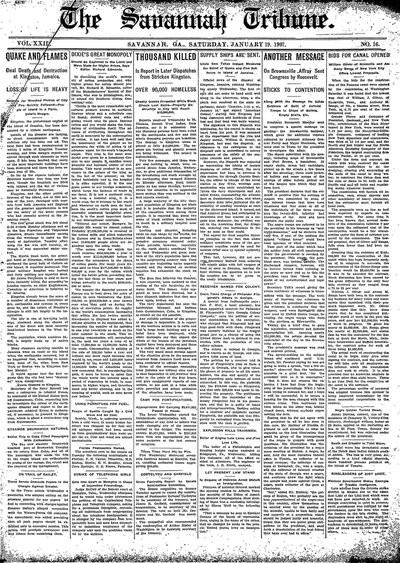
Page text (machine-generated)
VOL. XXII.
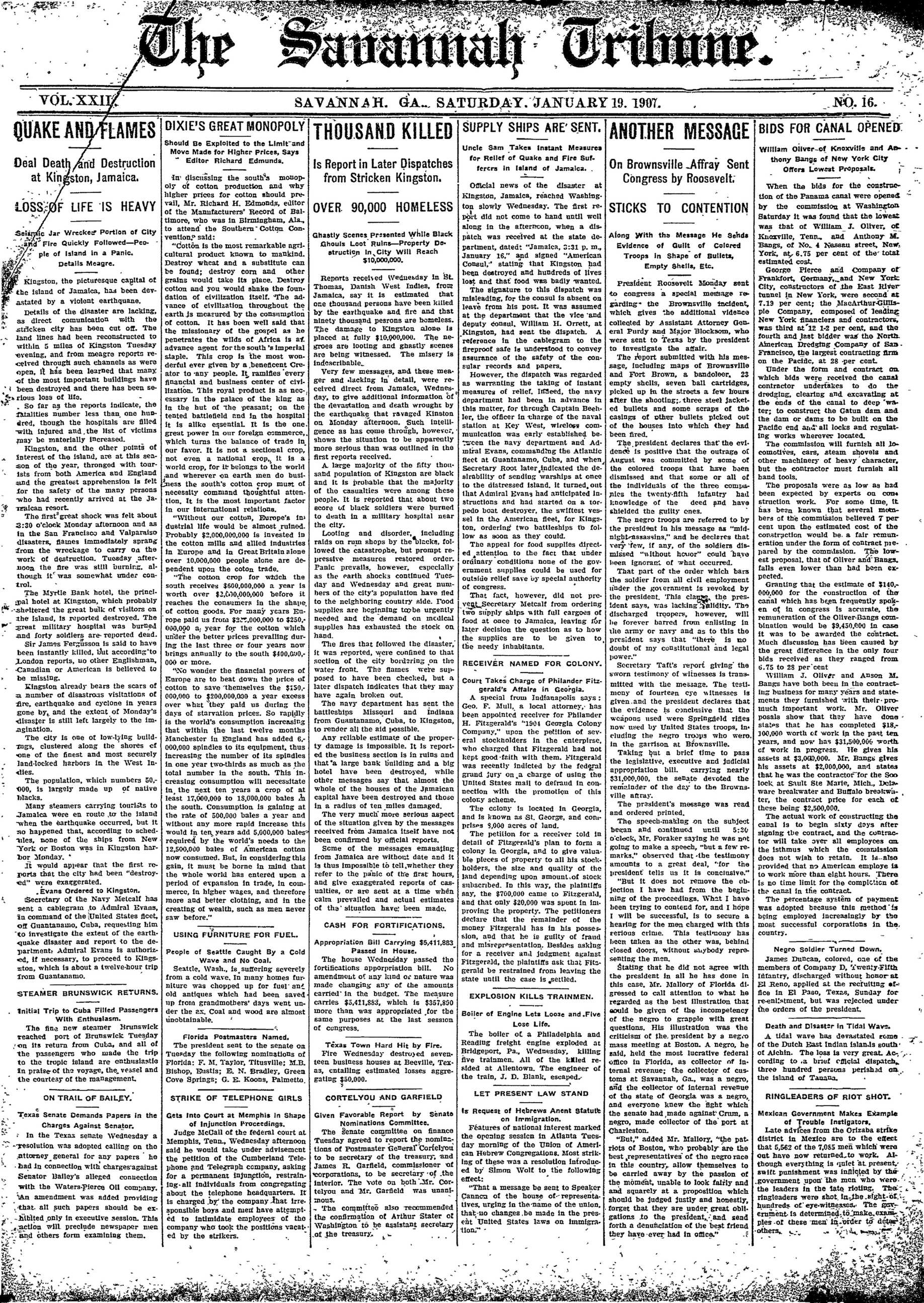
Seismic Jar Wrecker Portion of City and Fire Quickly Followed—People of Island in a Panic. Details Meagre.
Kingston, the picturesque capital of the island of Jamaica, has been devastated by a violent earthquake. Details of the disaster are lacking, as direct communication with the stricken city has been cut off. The land lines had been reconstructed to within 5 miles of Kingston Tuesday evening, and from meagre reports received through such channels as were open, it has been learned that many of the most important buildings have been destroyed and there has been serious loss of life.
So far as the reports indicate, the fatalities number less than one hundred, though the hospitals are filled with injured and the list of victims may be materially increased.
Kingston, and the other points of interest of the island, are at this season of the year, thronged with tourists from both America and England and the greatest apprehension is felt for the safety of the many persons who had recently arrived at the Jamaican resort.
The first great shock was felt about 3:30 o'clock Monday afternoon and as in the San Francisco and Valparaiso disasters, flames immediately sprang from the wreckage to carry on the work of destruction. Tuesday afternoon the fire was still burning, although it was somewhat under control.
The Myrtle Bank hotel, the principal hotel at Kingston, which probably sheltered the great bulk of visitors on the island, is reported destroyed. The great military hospital was burned and forty soldiers are reported dead. Sir James Fergusson is said to have been instantly killed, but according to London reports, no other Englishman, Canadian or American is believed to be missing. Kingston already bears the scars of a number of disastrous visitations of fire, earthquake and cyclone in years gone by, and the extent of Monday's disaster is still left largely to the imagination. The city is one of low-lying buildings, clustered along the shores of one of the finest and most securely land-locked harbors in the West Indies.
The population, which numbers 50,000, is largely made up of native blacks.
Many steamers carrying tourists to Jamaica were en route to the island when the earthquake occurred, but it so happened that, according to schedules, none of the ships from New York or Boston was in Kingston harbor Monday.
It would appear that the first reports that the city had been "destroyed" were exaggerated.
Secretary of the Navy Metcalf has sent a cablegram to Admiral Evans, in command of the United States fleet, off Guantanamo, Cuba, requesting him to investigate the extent of the earthquake disaster and report to the department. Admiral Evans is authorized, if necessary, to proceed to Kingston, which is about a twelve-hour trip from Guantanamo.
STEAMER BRUNSWICK RETURNS.
Initial Trip to Cuba Filled Passengers With Enthusiasm. The fine new steamer Brunswick reached port of Brunswick Tuesday on its return from Cuba, and all of the passengers who made the trip to the tropic island are enthusiastic in praise of the voyage, the vessel and the courtey of the management.
ON TRAIL OF BAILEY.
Texas Senate Demands Papers in the Charges Against Senator. In the Texas senate Wednesday a resolution was adopted calling on the attorney general for any papers he had in connection with charges against Senator Bailey's alleged connection with the Waters-Pierce Oil company. An amendment was added providing that all such papers should be exhibited only in executive session. This action will preclude newspaper men and others form examining them.
Should Be Exploited to the Limit' and Move Made for Higher Prices, Says Editor Richard Edmunds.
In discussing the south's monopoly of cotton production and why higher prices for cotton should prevail, Mr. Richard H. Edmonds, editor of the Manufacturers' Record of Baltimore, who was in Birmingham, Ala., to attend the Southern Cotton Convention said:
"Cotton is the most remarkable agricultural product known to mankind. Destroy wheat and a substitute can be found; destroy corn and other grains would take its place. Destroy cotton and you would shake the foundation of civilization itself. The advance of civilization throughout the earth is measured by the consumption of cotton. It has been well said that the missionary of the gospel as he penetrates the wilds of Africa is an advance agent for the south's imperial staple. This crop is the most wonderful ever given by a beneficent Creator to any people. It ramifies every financial and business center of civilization. This royal product is as necessary in the palace of the king as in the hut of the peasant; on the tented battlefield and in the hospital it is alike essential. It is the one great power in our foreign commerce, which turns the balance of trade in our favor. It is not a sectional crop, not even a national crop, it is a world crop, for it belongs to the world and wherever on earth men do business the south's cotton crop must of necessity command thoughtful attention. It is the most important factor in our international relations.
"Without our cotton, Europe's in dustrial life would be almost ruined. Probably $2,000,000,000 is invested in the cotton mills and allied industries in Europe and in Great Britain alone over 10,000,000 people alone are dependent upon the cotton trade.
"The cotton crop for which the south receives $600,000,000 a year is worth over $2,600,000,000 before it reaches the consumers in the shape, of cotton goods. For many years Europe paid us from $2,200,000,000 to $250,000,000 a; year for the cotton which under the better prices prevailing during the last three or four years now brings annually to the south $400,000,000 or more.
"No wonder the financial powers of Europe are to beat down the price of cotton to save themselves the $150,000,000 to $200,000,000 a year excess over what they paid us during the days of starvation prices. So rapidly is the world's consumption increasing that within the last twelve months Manchester in England has added 6,000,000 spindles to its equipment, thus increasing the number of its spindles in one year two-thirds as much as the total number in the south. This increasing consumption will necessitate in the next ten years a crop of at least 17,000,000 to 18,000,000 bales in the south. Consumption is gaining at the rate of 500,000 bales a year and without any more rapid increase this would in ten years add 5,000,000 bales required by the world's needs to the 12,500,000 bales of American cotton now consumed. But, in considering this gain, it must be borne in mind that the whole world has entered upon a period of expansion in trade, in commerce, in higher wages, and therefore more and better clothing, and in the creating of wealth, such as men never saw before."
USING FURNITURE FOR FUEL.
People of Seattle Caught By a Cold Wave and No Coal. Seattle, Wash., is suffering severely from a cold wave. In many homes furniture was chopped up for fuel and old antiques which had been saved up from grandmothers' days went under the ax. Coal and wood are almost unobtainable.
Florida Postmasters Named
The president sent to the senate on Tuesday the following nominations of Florida: F. M. Taylor, Titsville; M.B. Bishop, Eustis; E. N. Bradley, Green Cove Springs; G. E. Koons, Palmetto
STRIKE OF TELEPHONE GIRLS
Gets Into Court at Memphis in Shape of Injunction Proceedings.
Judge McGall of the federal court at Memphis, Tenn., Wednesday afternoon said he would take under advisement the petition of the Cumberland Telephone and Telegraph company, asking for a permanent injunction, restraining all individuals from congregating about the telephone headquarters. It is charged by the company that irresponsible boys and men have attempted to intimidate employees of the company who took the positions vacated by the strikers.
SAVANNAH. GA... SATURDAY. JANUARY 19. 1907.
Is Report in Later Dispatches from Stricken Kingston.
OVER 90,000 HOMELESS
Ghastly Scenes Presented While Black Ghouls Loot Rulns—Property Destruction in City Will Reach $10,000,000.
Reports received Wednesday In St. Thomas, Danish West Indies, from Jamaica, say it is estimated that one thousand persons have been killed by the earthquake and fire and that ninety thousand persons are homeless. The damage to Kingston alone is placed at fully $10,000,000. The negroes are looting and ghastly scenes are being witnessed. The misery is indescribable.
Very few messages, and these meager and slacking in detail, were received direct from Jamalca, Wednesday, to give additional information of the devastation and death wrought by the earthquake that ravaged Kinston on Monday afternoon. Such intelligence as has come through, however, shows the situation to be apparently more serious than was outlined in the first reports received.
A large majority of the fifty thousand population of Kingston are black and it is probable that the majority of the casualties were among these people. It is reported that about two score of black soldiers were burned to death in a military hospital near the city.
Looting and disorder, including raids on rum shops by the blacks, followed the catastrophe, but prompt repressive measures restored order. Panic prevails, however, especially as the earth shocks continued Tuesday and Wednesday and great numbers of the city's population have fled to the neighboring country side. Food supplies are beginning to be urgently needed and the demand on medical supplies has exhausted the stock on hand.
The fires that followed the disaster, it was reported, were confined to that section of the city bordering on the water front. The flames were supposed to have been checked, but a later dispatch indicates that they may have again broken out.
The navy department has sent the battleships Missouri and Indiana from Guantanamo, Cuba, to Kingston, to render all the aid possible.
Any reliable estimate of the property damage is impossible. It is reported the business section is in ruins and that a large bank building and a big hotel have been destroyed, while other messages say that almost the whole of the houses of the Jamaican capital have been destroyed and those in a radius of ten miles damaged.
The very much more serious aspect of the situation given by the messages received from Jamaica itself have not been confirmed by official reports.
Some of the messages emanating from Jamaica are without date and it is thus impossible to tell,whether they refer to the panic of the first hours, and give exaggerated reports of casualties, or are sent at a time when calm prevailed and actual estimates of the situation have been made.
CASH FOR FORTIFICATIONS.
Appropriation Bill Carrying $5,411,883
Passed in House.
The house Wednesday passed the fortifications appropriation bill. No amendment of any kind or nature was made changing any of the amounts carried in the budget. The measure carries $5,411,883, which is $357,800 more than was appropriated for the same purposes at the last session of congress.
Texas Town Hard Hit by Fire.
Fire Wednesday destroyed seventeen business houses at Beeville, Texas, entailing estimated losses aggregating $50,000.
CORTELYOU AND GARFIELD
Given Favorable Report by Senate Nominations Committee.
The Senate committee on finance Tuesday agreed to report the nominations of Postmaster General Corteyloy to be secretary of the treasury, and James R. Garfield, commissioner of corporations, to be secretary of the interior. The vote on both Mr. Corteyloy and Mr. Garfield was unanimous.
The committee also recommended the confirmation of Arthur Stater of Washington to be assistant secretary of the treasury.
Uncle Sam Takes Instant Measures for Relief of Quake and Fire Suf-
Official news of the disaster at Kingston, Jamalca, reached Washington slowly Wednesday. The first report did not come to hand until well along in the afternoon, when a dispatch was received at the state department, dated: "Jamalca, 3:31 p. m., January 16," and signed "American Consul," stating that Kingston had been destroyed and hundreds of lives lost and that food was badly wanted. The signature to this dispatch was misleading, for the consul is absent on leave from his post. It was assumed at the department that the vice and deputy consul, William H. Orrett, at Kingston, had sent the dispatch. A reference in the cablegram to the fireproof safe is understood to convey assurance of the safety of the consular records and papers.
However, the dispatch was regarded as warranting the taking of instant measures of relief. Infused, the navy department had been in advance in this matter, for through Captain Beehler, the officer in charge of the naval station at Key West, wireless communication was early established between the navy department and Admiral Evans, commanding the Atlantic fleet at Guantanamo, Cuba, and when Secretary Root later indicated the desirability of sending warships at once to the distressed island. It turned, out that Admiral Evans had anticipated instructions and had started on a torpedo boat destroyer, the swiftest vessel in the American fleet, for Kingston, ordering two battleships to follow as soon as they could.
The appeal for food supplies directed attention to the fact that under ordinary conditions none of the government supplies could be used for outside relief save by special authority of congress.
That fact, however, did not prevent Secretary Metcalf from ordering two supply ships with full cargoes of food at once to Jamaica, leaving for later decision the question as to how the supplies are to be given to the needy inhabitants.
RECEIVER NAMED FOR COLONY.
Court Takes Charge of Philander Fitzgerald's Affaire in Georgia.
A special from Indianapolis says: Geo. F. Mull, a local attorney, has been appointed receiver for Philander H. Fitzgerald's "1904 Georgia Colony Company," upon the petition of several stockholders in the enterprise, who charged that Fitzgerald had not kept good faith with them. Fitzgerald was recently indicted by the federal grand jury on a charge of using the United States mail to defraud in connection with the promotion of this colony scheme.
The colony is located in Georgia, and is known as St. George, and comprises 3,000 acres of land.
The petition for a receiver told in detail of Fitzgerald's plan to form a colony in Georgia, and to give valuable pieces of property to all his stockholders, the size and quality of the land depending upon amount of stock subscribed. In this way, the plaintiffs say, the $700,000 came to Fitzgerald, and that only $20,000 was spent in improving the property. The petitioners declare that the remainder of the money Fitzgerald has in his possession, and that he is guilty of fraud and misrepresentation. Besides asking for a receiver and judgment against Fitzgerald, the plaintiffs ask that Fitzgerald be restrained from leaving the state until the case is settled.
Boiler of Engine Lets Loose and Five Lose Life.
The boiler of a Philadelphia and Reading freight engine exploded at Bridgeport, Pa., Wednesday, killing five traintmen. All of the killed resided at Allentown. The engineer of the train, J. D. Blank, escaped.
LET PRESENT LAW STAND
Is Request of Hebrews Anent Statute on Immigration.
Features of national interest marked the opening session in Atlanta Tuesday morning of the Union of American Hebrew Congregations. Most striking of these was a resolution introduced by Simon Wolf to the following effect:
"That a message be sent to Speaker Cannca of the house of representatives, urging in the name of the union, that no changes be made in the present United States laws on immigration."
On Brownsville Affray Sent Congress by Roosevelt:
STICKS TO CONTENTION
Along With the Message He Sehds Evidence of Gulit of Colored Troops in Shape of Bullets, Empty Shells, Etc.
President Roosevelt Monday sent to congress a special message regarding the Brownsville incident, which gives the additional vidence collected by Assistant Attorney General Purdy and Major Blocksom, who were sent to Texas by the president to investigate the affair.
The report submitted with his message, including maps of Brownsville and Fort Brown, a bandoleer. 23 empty shells, seven ball cartridges, picked up in the streets a few hours after the shooting; three steel jacketed bullets and some scraps of the casings of other bullets picked out of the houses into which they had been fired.
The president declares that the evidence is positive that the outrage of August was committed by some of the colored troops that have been dismissed and that some or all of the individuals of the three companies the twenty-fifth infantry had knowledge of the deed and have shielded the guilty ones.
The negro troops are referred to by the president in his message as "midnight-assassins," and he declares that very few, if any, of the soldiers dismissed "without honor" could have been ignorant of what occurred. That part of the order which bars the soldier from all civil employment under the government is revoked by the president. This clause, the president says, was lacking validity. The discharged troopers, however, will be forever barred from enlisting in the army or navy and as to this the president says that "there is no doubt of my constitutional and legal power."
Secretary Taft's report giving the sworn testimony of witnesses is transmitted with the message. The testimony of fourteen eye witnesses is given and the president declares that the evidence is conclusive that the weapons used were Springfield rifles now used by United States troops, including the negro troops who were in the garrison at Brownsville.
Taking but a brief time to pass the legislative, executive and judicial appropriation bill, carrying nearly $31,000,000, the senate devoted the remainder of the day to the Brownsville atray.
The president's message was read and ordered printed.
The speech-making on the subject began and continued until 5:30 o'clock, Mr. Foraker saying he was not going to make a speech, "but a few remarks," observed that the testimony amounts to a great deal, "for the president tells us it is concursive."
"But it does not remove the objection I have had from the beginning of the proceedings. What I have been trying to contend for, and I hope I will be successful, is to secure a hearing for the men charged with this serious crime. This testimony has been taken as the other was, behind closed doors, without anybody representing the men.
Stating that he did not agree with the president in all he has done in this case, Mr. Mallory of Florida digressed to call attention to what he regarded as the best illustration that could be given of the incompetency of the negro to grapple with great questions. His illustration was the criticism of the president by a negro mass meeting at Boston. A negro, he said, held the most lucrative federal office in Florida, as collector of internal revenue; the collector of customs at Savannah, Ga., was a negro, and the collector of internal revenue of the state of Georgia was a negro, and everyone knew the fight which the senate had made against Crum, a negro, made collector of the port at Charleston.
"But," added Mr. Mallory, "the patriots of Boston, who probably are the best representatives of the negro race in this country, allow themselves to be carried away by the passion of the moment, unable to look fairly and squarely at a proposition which should be judged justly and honestly, forget that they are under great obligations to the president, and send forth a denunciation of the best friend they have ever had in office."
William Oliver-of Knoxville and Anthony Bangs of New York City Offers Lowest Proposals.
When the bids for the construction of the Panama canal were opened by the commission at Washington Saturday it was found that the lowest was that of William J. Oliver, of Knoxville, Tenn., and Anthony M. Bangs, of No. 4 Nassau street, New York, at. 6.75 per cent of the total estimated cost.
George Pierce and Company of Frankfort, Germany, and New York City, constructors of the East River tunnel in New York, were second at 7.19 per cent; the MacArthur-Gillisple Company, composed of leading New York financiers and contractors, was third at 12.12 per cent, and the fourth and last bidder was the North American Dredging Company of San Francisco, the largest contracting firm on the Pacific, at 28 per cent. Under the form and contract on which bids were received the canal contractor undertakes to do the dredging, clearing and excavating at the ends of the canal to deep water; to construct the Gatan dam and the dam or dams to be built on the Pacific end and all locks and regulating works wherever located.
The commission will furnish all locomotives, cars, steam shovels and other machinery of heavy character, but the contractor must furnish all hand tools. The proposals were as low as had been expected by experts on construction work. For some time, it has been known that several members of the commission believed 7 per cent upon the estimated cost of the construction would be a fair remuneration under the form of contract prepared by the commission. The lowest proposal, that of Oliver and Bangs, falls even lower than had been expected.
Granting that the estimate of $140,000,000 for the construction of the canal which has been frequently spoken of in congress is accurate, the remuneration of the Oliver-Bangs combination would be $9,450,000 in case it was to be awarded the contract. Much discussion has been caused by the great difference in the only four bids received as they ranged from 6.75 to 28 per cent
William J. Oliver and Aunon M. Bangs have both been in the contracting business for many years and statements they furnished with their pro-unch important work. Mr. Oliver posals show that they have done states that he has completed $18,100,000 worth of work in the past ten years, and now has $31,500,000 worth of work in progress. He gives his assets at $3,040,000. Mr. Bangs gives his assets at $2,000,000, and states that he was the contractor for the Soo lock at Sault Ste Marie, Mich., Delaware breakwater and Buffalo breakwater, the contract price for each of these being $2,500,000.
The actual work of constructing the canal is to begin sixty days after signing the contract, and the contractor will take over all employees on the isthmus which the commission does not wish to retain. It is also provided that no American employee is to work more than eight hours. There is no time limit for the completion of the canal in the contract.
The percentage system of payment was adopted because this method is being employed increasingly by the most successful corporations in the country.
James Duncan, colored, one of the members of Company D, Twenty-Fifth Infantry, discharged without honor at El Reno, applied at the recruiting office in El Paso, Texas, Sunday for enlistment, but was rejected under the orders of the president.
A tidal wave has devastated Rome of the Dutch East Indian islands south of Alchin. The loss is very great. According to a brief official dispatch three hundred persons perished on the island of Taman.
RINGLEADERS OF RIOT SHOT.
Mexican Government Makes Example of Trouble Instigators.
Late advices from the Orizaba strike district in Mexico are to the effect that 5,562 of the 7,085 men which were out have now returned to work. Although everything is quiet at present, swift punishment was inflicted by the government upon the men who were the leaders in the late rioting. The ringleaders were shot in the sight of hundreds of eye-witnesses. The government is determined to make examples of these men in order to deter others.
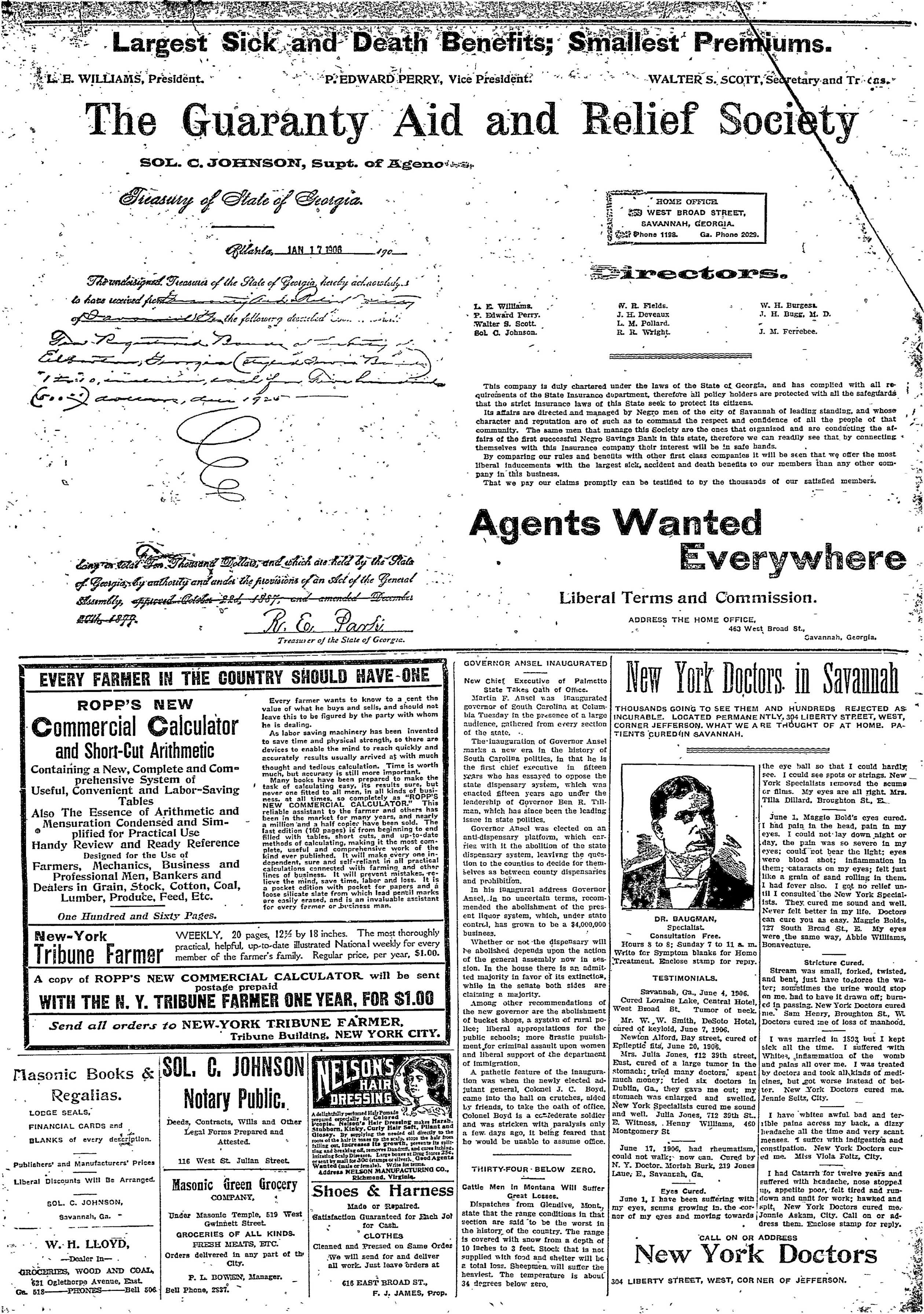
The Guaranty Aid and Relief Society
Treasury of State of Georgia.
Atlanta, JAN 17 1908 190
The undesigned Treasurer of the State of Georgia, hereby acknowledges
to have received from the Secretary of Dawson the following description:
Dear Regent and Deputy of the State of Georgia, Government Company, Dawson
17:10, in connection with the General Assembly, approved October 22d, 1887, and amended December
20th, 1877.
R. E. Parsi
Treasurer of the State of Georgia.
EVERY FARMER IN THE COUNTRY SHOULD HAVE-ONE
ROPP'S NEW Commercial Calculator and Short-Cut Arithmetic
Containing a New, Complete and Comprehensive System of Useful, Convenient and Labor-Saving Tables Also The Essence of Arithmetic and Mensuration Condensed and Simplified for Practical Use Handy Review and Ready Reference Designed for the Use of Farmers, Mechanics, Business and Professional Men, Bankers and Dealers in Grain, Stock, Cotton, Coal, Lumber, Produce, Feed, Etc.
One Hundred and Sixty Pages.
New-York
Tribune Farm
A copy of ROPP'S NE
WITH THE N. Y.
Send all orders
New-York Tribune Farmer WEEKLY practical, b member of copy of ROPP'S NEW COMM posts WITH THE N. Y. TRIBUNE Send all orders to NEWS.
A copy of ROPP'S NEW COMMERCIAL CALCULATOR will be sent postage prepaid WITH THE N. Y. TRIBUNE FARMER ONE YEAR, FOR $1.00 Send all orders to NEW-YORK TRIBUNE FARMER. Tribune Building, NEW YORK CITY.
Masonic Books &
LODGE SEALS,
FINANCIAL CARDS and
BLANKS of every description.
Publishers' and Manufacturers' Prices
Liberal Discounts Will Be Arranged.
SOL. C. JOHNSON,
Savannah, Ga.
W. H. LLOYD,
—Dealer In—
GROCERIES, WOOD AND COAL,
621 Oglethorpe Avenue, East.
Ga. 518----PHONES----Bell 506
SOL. C. JOHNSON, Supt. of Ageno
WEEKLY, 20 pages, 12½ by practical, helpful, up-to-date illus. member of the farmer's family.
NEW COMMERCIAL CALCUL
postage prepaid
TRIBUNE FARMER ONE
to NEW-YORK TRIBU
Tribune Build
WEEKLY, 20 pages, 12 $ by 18 inches. The most thoroughly practical, helpful, up-to-date illustrated National weekly for every member of the farmer's family. Regular price, per year, $1.00.
SOL. C. JOHNSON Notary Public.
Deeds, Contracts, Wills and Other Legal Forms Prepared and Attested.
Masonic Green Grocery COMPANY.
Under Masonic Temple, 519 West Gwinnett Street.
Orders delivered in any part of the City.
P. L. BOWEN, Manager.
Bell Phone, 2837.
Every farmer wants to know to a cent the value of what he buys and sells, and should not leave this to be figured by the party with whom he is dealing. As labor saving machinery has been invented to save time and physical strength, so there are devices to enable the mind to reach quickly and accurately results usually arrived at with much thought and tedious calculation. Time is worth much, but accuracy is still more important.
Many books have been prepared to make the task of calculating easy, its results sure, but never one fitted to all men, in all kinds of business, at all times, so completely as "ROPP'S NEW COMMERCIAL CALCULATOR." This reliable assistant to the farmer and others has been in the market for many years, and nearly a million and a half copies have been sold. The last edition (160 pages) is from beginning to end filled with tables, short cuts, and up-to-date methods of calculating, making it the most complete, useful and comprehensive work of the kind ever published. It will make every one independent, sure and self-reliant in all practical calculations connected with farming and other lines of business. It will prevent mistakes, relieve the mind, save time, labor and loss. It is a pocket edition with pocket for papers and a loose silicate slate from which lead pencil marks are easily erased, and is an invaluable assistant for every farmer or business man.
ages, 12½ by 18 inches. The most thoroughly prep-to-date illustrated National weekly for every farmer's family. Regular price, per year, $1.00.
CAL CALCULATOR will be sent repaid
MER ONE YEAR, FOR $1.00
BK TRIBUNE FARMER,
une Building, NEW YORK CITY.
Grocery
le, 519 West
reet.
LL KINDS.
Address NELSON MANUFACTURING CO.
Richmond, Virginia.
Shoes & Harness
Made or Repaired.
Satisfaction Guaranteed for Each Jol
for Cash.
CLOTHES
NELSON'S HAIR DRESSING
A delightfully perfumed Hair Pomade prepared especially for Colored People. Nelson's Hair Dressing makes Harah, Stubborn, Kinky, Curly Hair Soft, Pilant and Glossy. By supplying the needed oil directly to the roots of the hair it tames up the scalp, stops the hair from falling out, increases its growth, prevents its splitting and breaking off, removes Dandruff, and cures itching, limiting Scalp Diseases. Large boxes at Drug Stores 25c, or sent by mail for 30c (stamps or silver). Good Agents Wanted (male or female). Write for terms.
HOME OFFICE
WEST BROAD STREET,
SAVANNAH, GEORGIA.
Phone 1198. Ga. Phone 2029.
Directors.
L. E. Williams.
P. Edward Perry.
Walter S. Scott.
Sol. C. Johnson.
W. R. Fields.
J. H. Deveaux
L. M. Pollard
R. R. Wright
W. H. Burgess.
J. H. Bugg, M. D.
J. M. Ferrebee.
This company is duly chartered under the laws of the State of Georgia, and has complied with all requirements of the State Insurance department, therefore all policy holders are protected with all the safeguards that the strict insurance laws of this State seek to protect its citizens.
Its affairs are directed and managed by Negro men of the city of Savannah of leading standing, and whose character and reputation are of such as to command the respect and confidence of all the people of that community. The same men that manage this Society are the ones that organized and are conducting the affairs of the first successful Negro Savings Bank in this state, therefore we can readily see that by connecting themselves with this Insurance company their interest will be in safe hands.
By comparing our rules and benefits with other first class companies it will be seen that we offer the most liberal inducements with the largest sick, accident and death benefits to our members than any other company in this business.
That we pay our claims promptly can be testified to by the thousands of our satisfied members.
Liberal Terms and Commission.
GOVERNOR ANSEL INAUGURATED New Chief Executive of Palmetto State Takes Oath of Office.
Martin F. Ansel was inaugurated governor of South Carolina at Columbia Tuesday in the presence of a large audience, gathered from every section of the state..
The inauguration of Governor Ansel marks a new era in the history of South Carolina politics, in that he is the first chief executive in fifteen years who has essayed to oppose the state dispensary system, which was enacted fifteen years ago under the leadership of Governor Ben R. Tillman, which has since been the leading issue in state politics.
Governor Ansel was elected on an anti-dispensary platform, which carries with it the abolition of the state dispensary system, leaving the question to the counties to decide for themselves as between county dispensaries and prohibition.
In his inaugural address Governor Ansel, in no uncertain terms, recommended the abolishment of the present liquor system, which, under state control, has grown to be a $4,000,000 business.
Whether or not the dispensary will be abolished depends upon the action of the general assembly now in session. In the house there is an admitted majority in favor of its extinction, while in the senate both sides are claiming a majority. Among other recommendations of the new governor are the abolishment of bucket shops, a system of rural police; liberal appropriations for the public schools; more drastic punishment for criminal assault upon women and liberal support of the department of immigration.
A pathetic feature of the inauguration was when the newly elected adjutant general, Colonel J. C. Boyd, came into the hall on crutches, aided by friends, to take the oath of office. Colonel Boyd is a co-federate soldier and was stricken with paralysis only a few days ago, it being feared that he would be unable to assume office.
THIRTY-FOUR·BELOW ZERO.
Cattle Men in Montana Will Suffer Great Losses. Dispatches from Glendive, Mont. state that the range conditions in that section are said to be the worst in the history of the country. The range is covered with snow from a depth of 10 inches to 3 feet. Stock that is not supplied with food and shelter will be a total loss. Sheepmen will suffer the heaviest. The temperature is about 34 degrees below zero.
New York Doctors in Savannah
THOUSANDS GOING TO SEE THEM AND HUNDREDS REJECTED AS INCURABLE. LOCATED PERMANENTLY, 304 LIBERTY STREET, WEST, CORNER JEFFERSON. WHAT WE ARE THOUGHT OF AT HOME. PATIENTS CURED IN SAVANNAH.
M.
Hours 8 to 8; Sunday 7 to 11 a.m. Write for Symptom blanks for Homo Treatment. Enclose stamp for reply.
TESTIMONIALS.
Savannah, Ga., June 4, 1906. Cured Loraine Lake, Central Hotel, West Broad St. Tumor of neck. Mr. W. W. Smith, DeSoto Hotel, cured of keyloid, June 7, 1906.
Newton Alford, Bay street, cured of Epileptic fits, June 20, 1906.
Mrs. Julia Jones, 712 39th street, East, cured of a large tumor in the stomach; tried many doctors; spent much money; tried six doctors in Dublin, Ga., they gave me out; my stomach was enlarged and swelled. New York Specialists cured me sound and well. Julia Jones, 712 39th St. E. Witness, Henny Williams, 460 Montgomery St
June 17, 1906, had rheumatism, could not walk; now can. Cured by N. Y. Doctor, Morlah Burk, 219 Jones Laue; E., Savanrah, Ga.
June 1, I have been suffering with my eyes, scums growing in. the corner of my eyes and moving towards
CALL ON OR New York
304 LIBERTY STREET, WEST, COR
304 LIBERTY STREET, WEST, CORNER OF JEFFERSON.
the eye ball so that I could hardly see. I could see spots or strings. New York Specialists removed the scums or films. My eyes are all right. Mrs. Tilla Dillard. Broughton St. E.
June 1, Maggie Bold's eyes cured. I had pain in the head, pain in my eyes. I could not lay down night or day, the pain was so severe in my eyes; could not bear the light; eyes were blood shot; inflammation in them; cataracts on my eyes; felt just like a grain of sand rolling in them. I had fever also. I got no relief until I consulted the New York Specialists. They cured me sound and well. Never felt better in my life. Doctors can cure you as easy. Maggie Bolds, 727 South Broad St., E. My eyes were the same way, Abbie Williams, Bonaventure.
Stream was small, forked, twisted, and bent, just have to force the water; sometimes the urine would stop on me, had to have it drawn off; burned in passing. New York Doctors cured me. Sam Henry, Broughton St., WL Doctors cured me of loss of manhood.
I was married in 1893 but I kept sick all the time. I suffered with Whites, inflammation of the womb and palms all over me. I was treated by doctors and took all kinds of medicines, but got worse instead of better. New York Doctors cured me. Jennie Seitz, City.
I have whites awful bad and terrible pains across my back, a dizzy headache all the time and very scant menses. I suffer with indigestion and constipation. New York Doctors cured me. Miss Viola Foltz, City.
I had Catarrh for twelve years and suffered with headache, nose stopped up, appetite poor, felt tired and run-down and unfit for work; hawked and spit. New York Doctors cured me. Jonnie Askam, City. Call on or address them. Enclose stamp for reply.
Stricture Cured.
The storm and night is on the waste,
Wild through the wind the herdsman calls.
'As fast on willing nag I haste,
Home to my own four walls.
Black, tossing clouds, with scarce a glimmer,
Envelop earth like sevenfold palls;
But wifekin watches, coffee-pot doth simmer,
Home in my own four walls.
'A home and wife I too have got,
A hearth to blaze whatever befalls;
Whist needs a man that I have not
Within my own four walls?
Not all his men may sever this;
I yields to friends, not monarch's calls;
My whinstone house my castle is,
I have my own four walls.
When fools or knaves do make a rout
With gimmen, dinners, balls, cabals,
I turn my back and shut-them out—
These are my own four walls.
The moorland house, though rude it be,
May stand the brunt when prouder falls;
Twill screen my wife, my hooks and me,
All in my own four walls.
—Thomas Carlyle.
THE ARREST
OF MUGGSY
So it happened that Muggsy, and Mary Ann, the waitress, became engaged. Muggsy was to borrow some money from a friend, and get a job, and be married.
Now, it is hard for a burglarious loafer to get a job. It is harder still for him to borrow money. But after five days of tramping the streets and visiting mills and factories and striking old friends intermittently for pecuniary aid, he obtained the promise of work in a foundry, to begin the following Monday, and a former "pal" lent him $10 to begin housekeeping with. So he was to be married on Sunday.
It was Saturday night, and Mary Ann's flance was strolling through the streets, restless and happy. Tomorrow he would be married. It seemed impossible, and yet there could be no doubt of it.
Muggsy found himself staring vacantly into a shop window. The shop was closed, for it was late, and lights in the window were dim. There were three gilded balls over the door.
Then Muggsy's gaze fell upon a tray of rings in the window, and he started. The awful truth flashed upon him. When people get married they use weddings rings! And he had forgotten the ring.
He took only one ring; once he would have taken the whole tray. He was triumphant, but he was in danger. He ran quickly down the street to a passageway he knew of leading to an alley and thence to another street, where he would be safe.
But suddenly a blue uniform loomed up, and an excited voice ordered the fugitive to stop. A pistol shot added force to the command. Muggsy was frightened. He darted into the passageway, the patrolman after him in full chase. A fence had been built there since last he came that way, and he was cornered. Muggsy was a man of peace. The game was up, and he surrendered. When the turnkey searched him at the police station he still had the ring. It went into an envelope marked "Exhibit A." There was a big docket in police court on Monday morning. An endless line of "drunks" shuffled out of the reeking "bull pen" and stood, nervously expectant, before the bench, where the magnaimal Judge O'Rourke dispensed fines and imprisonment for the protection of society.
"Well, well!" ejaculated His Honor, with a broad grin. "Not very cheerful this morning, Muggsy. What is it now, Mooney?" "Burglary and larceny, Your Honor—at 'is old tricks—smashed a jewelry window an' coped a ring—a weddin' ring, too." The court officer smiled indulgently, and the prosecuting attorney inspected the ring, while the clerk read the affidavit and the spectators craned forward with interest—for the prisoner had many acquaintances present. The proof was too easy. The prosecutor yawned, and held up the ring for the inspection of the court. "Why didn't you take the rest?" he asked. "This ain't worth much, and there was a whole trayful." "I didn't need any more," muttered Muggsy.
"Didn't need any more?" repeated the prosecutor, while the court attaches and police reporters showed signs of interest. "Then you confess to the theft?" he shrewdly added.
"Naw, I don't confess not in." "Needed a wedding ring, did you, Muggsy?" queried His Honor, with a smile that lit up the courtroom.
"Me? Naw."
"That reminds me," remarked Lleutenant O'Hara. "We found a marriage license in his clothes—Exhibit B over there. It's got his name on, too, only he says it's for a cousin as has the same name as he has, an' was to be married yesterday. I wonder—" and while he was wondering, a light suffused his massive face. "No such weddin' in the sassiest collyms," volunteered Mooney. "Why, what you blushin' about, Muggsy?" "You go to the devil', growled Muggsy, who, now the centre of all eyes, was really blushing for probably the first time in his life. Meanwhile a reporter was inspecting the marriage license. He was a
ball," lean scribe, with a lazy, faraway look, and wore an eternal stogle in his mouth. He leaned over to the judge.
The judge handed the license to the court officer.
"Is Mary Ann Evans here present?" roared Mooney.
Muggsy jerked himself erect, his square jaw set, his eyes flashing and his fists clenched.
"Stop that, Mr. Officer!" he cried.
"I don't want that there name mentioned in this — p'lice court!" the prisoner gasped.
The judge's bland smile had congealed. The reporter criticised his stogle and emitted a low, thoughtful whistle.
Then the spell was broken by a commotion beyond the railing among the spectators, and a little figure with carroty hair and freckled face almost hidden beneath a faded shawl darted past the officer at the gate and stepped to the judge's bench. A young lad about to follow her was denied admittance. Muggsy was abashed. His figure slumped back to its normal posture, and again he gazed at the floor. "P-please, sir, I'm here," fattered the figure under the shawl, while a pair of greenish-yellow eyes roved back and forth between judge and prisoner. "Are you Mary Ann Evans?" asked His Honor.
"Y-yes, sir. And I came here this mornin' because Jimmy—that's my brother — seen 'in the paper that Muggsy was arrested, an' he said they'd try him this mornin'. An' I thought mebbe I could—do sumplin'—fer 'im." Further elucidation was interrupted by the necessity for stopping a flow of tears with one corner of her shawl.
"Is it this man, or his cousin, that you were going to marry?" asked the judge.
Mary Ann checked an impulse to answer, and looked to the prisoner for guidance. Muggsy's eyes slowly rose from the floor, met hars, and read their honest appeal. That look shamed the duplicity out of him. He stepped nearer the judge, while the little group narrowed around the affaned pair, and he addressed the judge in a voice firm, but low, so that the curiosity-mongers beyond the railing could not hear:
"I'll tell ye the truth, yer Honor," he said, "an' it'll be the first time I ever told it to ye. I lled w'en I said the license was for me cousin, an' I lled about breakin' the windy by accident. This little girl had promised to marry me, yer Honor, an' the weddin' was to 'a' been yesterday. An' w'en I happened to think how I didn't have no ring, an' how I needed one, and didn't have no money to buy one, nor not'in, w'y I don't know how it was, yer Honor, but I just couldn't help forgittin' I'd reformed, an' gittin' a ring the best way I could. An' now I s'pose I got to go to the works again, an' I don't care much, for I don't spouse Mary Ann'll have anything to do with me now—for she's a decent, respectable girl, yer Honor, an' not like me. Only I don't know what she'll do, on account of bein' out of a job, an' nobody to take care of her. But it's all up now, an' you might as well give me the sentence right away, yer Honor, for there can't be no weddin', an' my job's lost, an' it's no use, I guess, try'in to be decent."
"Well, in view of the circumstances, I won't make it so long as I otherwise would," began the judge, as he resumed his judicial air. "It will be——"
But the reportorial face had suddenly approached His Honor's ear, and there was a quiet little conference, in which the prosecutor presently joined.
"It will be—ahem!"—resumed His Honor, when the heads separated—"three months and costs." He paused, impressively. "And, in view of certain extenuating circumstances—the workhouse sentence is suspended during good behavior, and the fine to be paid at the convenience of the prisoner."
Muggsy stared stupidly.
"Go on!" said Mooney, nudging him good naturedly. "No, not that way," as the prisoner started back toward the "bull pen." "Out here, with your girl. You're free, as long as you behave yourself. See?"—New Orleans Plicayune.
Unique Town.
A Philadelphia business man, during the fine weather a few weeks ago, decided to make a horseback tour of Maryland. After being out for a few days he was struck with the number of towns in that State which had claim to historic interest. The principal brag of the various villages through which he passed was that Washington at one time or another had been a guest of the leading citizen, or that the first President had spent the night at the local tavern: The claims of the Marylanders became so monotonous to the Philadelphia that when one evening, after a long day's ride, he was about to dismount from his weary horse, he noticed opposite the hotel that he had picked out an ornate bronze tablet with the name "President Washington," in big, raised letters on it, he was moved to ridicule. Turning to the proprietor, who was starring near the curbstone, he said: "You Maryland people make me tired with your everlasting claim to have been visited by Washington. Why, every town I have been in lately was once his home." With a quiet smile, the hotel man told his prospective patron to read the inscription on the tablet, which, much to the visitor's astonishment, was: "This is the only town in Maryland that President' Washington never visited."—Philadelphia Record.
PRESIDENT JORDAN, OF STANFORD UNIVERSITY,
GIVES THE CLEAREST VIEW.
Strained Sections of the Earth Instantly Became Misfits, Some Portions Sinking and Others Rising as They Were Disturbed.
```markdown
```
Dr. David Starr Jordan, president of Leland Stanford, Jr., University, lectured at Swarthmore College on the subject "The Earthquake Rift of California." Dr. Jordan enumerated the causes of the great earthquake and described his own experiences during the shock. The lecture was illustrated, showing, among other things, views of the destruction of buildings at Stanford. The speaker said, in part:
It is a wise provision of nature, so Goethe tells us, that trees shall not grow up into the sky. The wisdom of this arrangement is obvious, and it is clear that its spirit applies to many other things than trees. It is also obvious that, in order to point the moral property, there should be some part of the earth in which the limit is off. To that end California was created. In California the trees do actually grow up into the sky. It was in California that the Sierra Avalanche, according to Bret Harte (referring to the March floods on the Sacramento) observed, with pensive local pride, "An area as large as the State of Massachusetts, under water." So it is proper that in California the most vigorous earthquake of its class should be recorded, that the most destructive conflagration in history should take place; that the greatest wreck of human effort should occur—and all that in a region in which, more than in any other, human effort is a joy in itself.
It is also characteristic of California that the people should not look on the disaster of the fire, nor on the sickening loss of half a century of struggle and upbuilding. They note rather that no great wooden city before ever went for half a century without a conflagration. In the vision of every Californian San Francisco is not the old city, sitting desolate on its bones, but rather the new city of steel and concrete, which shall defy shock and fire alike.
A Crack Four Miles Deep.
As for the earthquake of April 18, the first question is, naturally: What was it? It was a crack in the earth's crust about 200 miles long and four or five miles deep, or as deep as the crust is stiff and brittle. More exactly, it was the sudden opening and closing of an old crack, or, in geological language, a fault.
Secondarily, the cause was a certain strain on the mountain chain on one side of the fault.
This strain was doubtless slowly cumulative. It was resisted for years, until finally, for some cause or for no cause, the rocks gave way. The old scar was reopened for an instant, the strain was repressed and the two sides of the fault came together with grinding strain, which reduced the rocks on either side of it to dust and fragments for perhaps a hundred feet. In this case the two sides no longer fitted perfectly. The west side of the fault-was left some three.feet lower in the Santa Cruz region, and as much higher in Marin County.
All this was the earthquake proper, and it was practically instantaneous. But the giant, having stretched himself in his sleep, the creaking of his bones went forth to the rest of the world. In this case the disturbance went out as short, swift and violent waves in the rocks, and in the soil and houses which were over them. First to any given point went the straight waves from the nearest part of the fault. Such waves are interesting and mostly harmless, however severe, and of such waves alone most California earthquakes are formed. Later, but on the instant, came waves from points farther and farther away. These came at an angle with the first waves, and at a broader angle with each other. Some of them would partly neutralize others; some would reinforce others and at a different angle.
Everything Was Wavy.
The result when the waves from below and the waves from various distances were received was a series of twisting motions of great violence and of every conceivable kind.
They were of such intense swiftness that the ground made a daze before the eyes. They were of such extraordinary variety that all things which an earthquake could throw were tossed in every direction.
Jars standing side by side would be thrown in opposite directions, or not thrown at all. Trees' would bend to the ground as under a high gale, but no two in the same direction at once.
The top of a spire of chimney would be thrown in one direction, the middle in another. In one case, a house undulated so swiftly that the bricks of a falling chimney struck against the clapboards of its side as they fell.
The waves were the earthquake in the minds of those who felt them. They are so in common language, and as such, gradually fading away, they were felt in the seismographs all over the world. Some who saw the fault marveled that the violence of the earthquake could crack a pasture field for a mile. But this crack was the real earthquake, and the waves were merely the jar carried from it
by waves of rock and earth. Little waves they were, very little, hardly billowing above the surface, and not disturbing the face of nature at all, but viciously destructive to some of the little works of man.
This earthquake had no relation with volcanoes, no connection with Mount Vesuvius. It has nothing in common with the explosions of steam which mark eruptive earthquakes. Like ninety-five per cent, of all recorded earthquakes, it is tectonic—that is, an adjustment of the earth's crust.
My experiences in the earthquake were tame, but they were my own. I was awakened at 5.13 on the bright, sunny morning of April 18. I knew and enjoyed the wheezy undulations of the house, which mark the usual harmless California earthquake.
The wave which woke me was gentle enough, but the next one, like the bump of an express train, seemed a little severe. But it was a straight wave, and harmed nothing.
When the Real Thing Came.
Then the temblor began to take hold. The bedroom on the second floor swayed like a ship in a hurricane. A lantern standing in the hall leaped in through the open door. Pictures swayed, earthenware leaped, about. Some mighty force seemed to hold the house and to be trying to whip the ground with it.
I realized that this was the real thing; and it seemed to be overdone.
A California earthquake was due to last for a few seconds only, but this did not know when to stop. Now the power was trying to twist the house about its chimneys, taking each of the three in turn.
I rushed along the reeling gangway of the house, seized the baby and got out on the veranda, where bricks could not fall.
The older boy, who was sleeping on the roof, clung on as to a runaway horse. As things became a little calmer he shouted down:
"The church is falling! The gymnasium is caving in! Everything has gone bum!" I saw the dust of mortarrising, and the students crowding in the roads, and then I knew that we had had an epoch-making earthquake. Will there be any more earthquakes in California? Certainly there will. The earthquake of 1868, the most severe then known in this region, had perhaps half the violence of the present one. It is probable that the more violent the shock the longer the immunity afterward. There may never be another of this sort, for the whole strain of the mountain seems to be relieved for 250 miles. Little shocks occur every day. These are but details of adjustment, the polishing off of projecting corners.
Not Another in a Lifetime.
The next great shock may be in some other fault, in some other part of the country. It may appear in the Carisa Plain, in San Luis Obispo County, a barren sink in which this rift seems to terminate. Prophecy is cheap and worth only what it costs. It is enough to say that a second great shock, is not likely to be felt here in a lifetime.
Furthermore, no Californian loves California the less for its great earthquakes. They come only once or twice in a century. Little earthquakes are no more to be feared than gusts of wind. The loss of life, even in the greatest shock, is less in proportion than the harvest of pneumonia from a single Eastern blizzard.
The loss of property comés because we forget. We are safe in low frame house, or we can hold high houses together with hooks of steel. It is as easy to build houses earthquake-proof as rain-proof. The brick chimney' has no place in California. It was imported from the East with the tenderfoot and the tourist.
Indeed, outside of the fall of brick walls, spires, cornices and chimneys, which we must-renounce, our earthquakes need do very little mischief.
It was fire, not earthquake, which destroyed our joyous San Francisco. Mindful of the lesson, a joyous people will build the city again. And for every man who leaves California in fear there will return ten men, who will love the land where nature is so gracious, man so free limbed, and where the very stones are alive with the force of creation.
Peaceful Jurtmans.
One of the characteristics of Eastern peoples which makes life among them hard for Western conquerors is their readiness to transform themselves from fighting men into apparently meek and humble non-combatants when an overwhelming force of soldiers comes along. In Burma this made much trouble for an English column, whose experiences are told by the author of "A People at School." We were in a very hostile country. That was easy to see. When we went out of town we were fired upon. We thought reprisal necessary, and tried it—but to retaliate you must have some one to retaliate on. We saw no one.
Day after day we marched over barren hills and through strangling villages and looked for foes. We found only villagers. They tilled their fields and looked upon us curiously. When we asked where the enemy was they shook their heads and said they knew of none.
"Where are the dacolts?" we asked.
"What are dacolts?" they answered.
"Evil men with guns," we said.
They shook their heads. They were all peaceful cultivators, and knew nothing of such things. Then we went on, and each peaceful cultivator unearthed his gun and followed us; to get a pot-shot at us.
What has become of the thousands upon thousands of dollars.' in gold eagles and double eagles, sent from St. Louis seventy-five and 100 years ago to pay the Sac and Fox Indians for the lands which they had ceded to the United States, millions upon millions of acres, and to pay the United States troops under command of Col Zachary Taylor, subsequently President of the United States, at Fort McKay during the famous Black Hawk War?
The belief that this golden treasure lies buried in various parts of the State of Iowa has led hundreds of persons to dig industriously for more than half a century. The discovery within the last fortnight of $45,000 in gold in one part of the State and a map giving the whereabouts of $9000 of Black Hawk's fortune in another, says the St. Louis Globe Democrat, has set hundreds all over the State to searching the records and digging the ground. After a lapse of a century the fortune, for the first time, now seems about to be discovered. That gold by the thousands of dollars, aggregating far more than $100,000, was sent from St. Louis to the Northern Indians, both before and after the Black Hawk War in 1832, is undeniable.
In 1804, as a result of the treaty negotiated in St. Louis by William Henry Harrison with five Sac and Fox chefs, an annuity of $1000 was granted to the tribe, and was paid for more than a quarter of a century. In 1830 no less than $80,000 was sent from St. Louis to Col. Zachary Taylor at Fort McKay, Iowa, to pay the regular soldiers whose presence was necessary in the Territory of Iowa because of Black Hawk and his anticipated outbreak. That fortune in gold was buried by Zachary Taylor's command, and the men who knew of its whereabouts were killed by the Indians.
In 1832, following the Black Hawk War, a treaty was made with Keokuk and other Sac and Fox chiefs by Winfield Scott and Gov. Reynolds of Illinois, by which the Indians were given a lump sum of $50,000 and an annuity of $20,000 for thirty years. Aside from buying whisky and rifles, the Indians had no way to spend the money.
A dozen other instances might be cited of money sent into Iowa Territory to pay red men and white that has mysteriously disappeared. Just within the last few days have the first traces been found of it. Iowa has gold mines which the plow of the farmer may turn up any day, bringing fortune to the lucky man.
Frank Blint owns a farm in the heart of what half a century or more ago was the famous half-breed tract. Deciding to deepen a clistern which had been on the premises for many years he went industriously to work with pick and shovel. Hardly had he turned up a dozen shoyelfuls of the long undisturbed earth when his shovel rang on metal. A few minutes work disclosed an old iron pot. Digging it loose and bringing it to the light, Blint was dazzled by the golden stream which poured forth. Exactly $45,000 in gold eagles and double eagles was the fortune he had unearthed. It could have come from no other source than some family of wealthy half-breeds, unable to spend their generous patrimony.
The same week in which this portion of the vast treasure was discovered clues were found to another portion undoubtedly buried not fifty miles away near where Black Hawk and his companions spent their last days after the disastrous close of the rebellion and their journey down the Mississippi to Jefferson barracks and then, in charge of Jefferson Davis, across to Washington and New York.
Tearing down the old Bonnfield log cabin, near Fairfield, one of the oldest buildings in the oldest part of the State, the workers found an inkhorn and quill case, resembling much in appearance a razor case, and a musty old pocketbook which contained a newspaper clipping bearing the date June 25, 1828, and a letter. The last two were so faded that a magnifying glass was necessary to read them, and even then parts of the letter were beyond deciphering.
The paper is yellow and torn where it had been folded and the ink with which the letter was written is badly faded. As neatly as it can be made out the letter runs in this manner:
- "Frisco, June 21.—My Dear William: * * * wagon, had lots of time to think * * * money which is buried near the old Bonnell house. You know what I am, found out from Black Hawk * * * over from Illinois. I looked * * but never thought until I nearly got out here. About that there map, it weren't where the lines cross, but in the middle. Now, don't you tell any one, but try this here plan. (Map follows.)
"You see we allus made the mistake of digging at crossing marked A. That other Indian that Jim knew kniowed more than he let on. There must be near, $9000 and mebbe more, according to what 'Black Hawk fetched that time. Don't you let none of those Burlington fellows see this map. Well, Bill, I wish I was there, for probably there is, more cash there than we think. We will
dig here for a big spell. I want to write a lot, but the stage leaves in a minute and I got to quit. Yours.
"J. W.
"PS.—Mebbe it ain't that house, but what other big house could he have meant?"
The purport of the letter is plain. The money referred to is undoubtedly part of that paid *to* Black Hawk's tribe by the United States in return for the lands sold by them, either by the treaty of 1804, or of 1822 or some intermediate date. There is an old story in the neighborhood where the letter was found of how three Indian braves were appointed to bury this gold, the number being chosen so that if one was killed there would yet be some one left to find the location. As the irony of fate would have it, however, a tribal war followed, and every one of the three in the secret was killed, so that none of the tribe could locate the missing treasure.
The map which was found with the old letter gives fairly legible directions for the search, and already dozens are at work digging in the various parts of the neighborhood in search of the money. Of all the landmarks mentioned on the map, however, but one tree remains, though pioneers familiar with the neighborhood say they well remember when all of those shown were standing. The map shows a line running diagonally, 400 feet southeast of the cabin. This line is crossed by one running due east. A line running north and south crosses these two, and the letter says to dig at the centre of the triangle instead of the crossing of the east-west and north-south lines, where all previous digging has been done.
An even greater amount of gold treasure lies, burried 150 miles north of where Mr. Blint found his $45,000 and where the Fairfield residents are digging for the $9000 spoken of in the Bonnfield letter. There is $80,000 sent from St. Louis in 1830 to Fort McKay to the soldiers under Col. Zachary Taylor, which was buried until the Indian trouble should blow over, and which has never been discovered. Men and even women have dug for this money for many years, but the success of the searchers in the southern part of the State has inspired those in the northern, and the search is being taken up again as never before.
The story of the Taylor fortune is interesting in the extreme.
One day in 1830 four bags of gold were received at Fort McKay, near where the little town of North McGregor, Iowa, now stands. It was the largest shipment ever sent out from St. Louis to any of the frontier posts and was to be used to pay off the white soldiers who were vallantly preserving order by holding the rebellious Indians in leash. Col. Taylor, when apprized of the safe arrival of the money, took every precaution to safeguard it until the Indians had been driven away or pacified, when the men could be paid and allowed to return to the white settlement to spend their hard-earned money.
Calling together the command, Col. Taylor chose four of the bravest and most trustworthy men and, after informing them of the importance of the mission upon which he was about to send them, he gave to each a bag of gold with instructions to carry the bags to some safe place, which they should jointly select, and there hide the treasure from the Indians. An attack being feared at any moment, the four men started at once. They never returned.
Hardly had the four men left the stockade when a well-planned attack was made by the Indians. The fighting was fast and furious and extended over several days. When at last the Indians had been repulsed Col. Taylor lost no time in selecting a party and sending it out to rescue the gold hunters. The party searched for many hours before they came across the four men lying dead and entirely naked, the Indians having murdered, scaled and stripped them. Not the smallest suggestion of the whereabouts of the gold could be found about the place where the men had lost their lives in defense of their trust, but after a thorough search one of the members of the party was rewarded by finding a scrap of paper near the body of one of the men, known as Mercierre. It is that scrap of paper which has inspired three-quarters of a century of digging. On it was scrawled:
:ON HIGHEST BLUFF ACROSS :
This scrap of paper is still in existence to-day and is positively the only clue to the buried $80,000 of United States money which should have gone to the troops whom Col. Taylor took up the Mississippi from St. Louis a year or two before. The supposition all along has been that one of the gold hiders, finding that his last moment was near, hastily scrawled the best directions he could, in the haste and danger upon the paper and threw it from him in the hope some of his fellows would find it. Col. Taylor had parties digging for the money for many days, but never a trace was found.
SUBSCRIPTION RATES.
One Year. $8.25
Six Months. $7.5
Three Months. $5.0
Remittance must be made by Excuse
at Office Money Order, or by Letter
after writing Notes given on application.
SATURDAY, JANUARY 19, 1907.
EVERY successful achievement
of any member of the race
should spur us on to greater en
deavor.
THE Brownsville matter is still
holding the attention of the Senate.
It will not down, and probably
curtail other legislation of
the present Congress.
THERE is no reason why the business enterprises among us cannot increase many per cent during the year. If the spirit of the race loyalty would pervade our people to a greater extent, this will be easily realized.
ONE of the first acts of the Alabama legislature was the presenting of a resolution authorizing the governor to examine the books used at Tuskegee Institute. This resolution may be more far reaching than it appears in any event much may yet heard from it. This state gives but a meagre sum to support of this great institution.
City council very justly refused to grant a license for a bar room opposite the Episcopal erphan home on Jefferson street. This action is applauded by all good citizens. This brings to mind that some time ago vigorous protest was made against the granting of the petition for a bar room on West Broad and Walburg streets, which bar room nearly adjoins the F. B. B. Church of which Rev. Alex. Harris is pastor. No attention was paid to the protest and the bar room is still in full blast. When it comes to race affairs the eyes of justice seem blind.
A few weeks ago a colored porter on an A. C. L. train found a bag containing thousands of dollars worth of jewels. With consciousness characteristic of the race the valuables were reported to the proper authorities and restored to the rightful owner. A few days ago in Brunswick, an expressman lost a valuable jewel belonging to the wife of Congressman Brantley. This was found by a small colored boy who gave it to his mother and who in turn reported the same. It was restored to the company and the little boy rewarded. Many instances of this kind can be cited to disprove the charge of race dishonesty.
THE Metropolitan Insurance Company has thousands of colored policy holders, in fa t the business of the company was built up considerably in this section by the patronage of the colored people. This company has recently, it is alleged, issued an order to refuse their application in the future. There is but one other company that does the same thing, the Prudential. It has also been published ed that Collier's had refused to sell to our people. This can be better understood by the article in the last issue of Collier's on "The Negro's Handicap" as follows:
"Discriminating against the Negro seems to be a game at which others besides Tillman, Vardaman, and the 'jim crow' railroads can play. The Metropolitan Life Insurance Company, a worthy rival to Senator Dryden's philanthrophic organization in Newark for providing a poor widow with the means of bury her husband, issued an order to its agents to accept no Negro risks after the first of the year. Too many die to make the business profitable. At the same time, Mr. Jim Jeffries, champion announces that he will never meet Mr. Jack Johnson a husky colored gentleman who years to wear the title, in the prize ring. Mr. Jeffries says tersely that he will defend his honors against any white man for a purse of $50,000. He does not fear Mr. Johnson—not at all—only 'no gentleman would fight a nigger.' Students of history, however, are recalling that only eight years ago, a year before he became champion by beating Mr. Bob Fitzsimmons, the Odysseus of the squared circle. Mr. Jeffries fought Mr. Bob Armstrong, a colored pugilist. The champion is finicky.
Our sympathy goes out to Mr. Jack Johnson. If we recall correctly the testimony brought out when President, Hegeman's company was under the Insurance Committee's probe, the prospective colored policy-holder in the Metroplitan lost less by his exclusion than Mr. Johnson is deprived of. Even Collier's has been accused of hypocritical discrimination, by no less an authority than the newspaper which is known to fame as the inciter of the Atlanta riots. The 'News' in this instance has the excuse that one of our branch managers issued instructions to his agents in language which was capable of misinterpretation. Our salesmen are told to treat Negroes as they treat every kind of being—on business principles solely. Anybody can get the inestimable benefit of reading this paper by paying cash. Credit is a question solely of experience and of fact—whether the subscribers are likely to deserve credit. This overexpressive agent of ours has been told that credit is to be given to colored ministers, teachers, professional men, and others whom experience shows to be safe risks, so to speak. For the less responsible there is always the resource of cash, and the race in its struggles (pace the Atlanta 'News') is not to be deprived of the vast help of reading this illuminating sheet."
To Our Patrons.
10 Our Patrons.
In sending articles to THE TRIBUNE our patrons are requested to write only on one side of the paper. Several articles have been received with matter on both sides of a sheet in that event printers pay no attention to the reverse side, hence articles are many times cut short, especially where names are concerned. Use only one side of a sheet.
Statesboro Dots.
REV. Washington Hodges filled his appointment at Bethel on last Sunday and preached a noble sermon. Rev. J. S. Stripling filled his appointment at Braun Chapel and had a good congregation. Rev. Mri and Mrs. Stephen Hendley were the guests of Mr. and Mrs. Alfred Love last Saturday night and on Sunday attended preaching at Bethel. Messrs. Z. T. Hodges and Joe Lee accompanied Misses Viola Lamar and Mary A. Hodges, to Bethel on last Sunday. The many friends of Mr. Lester Johnson of Tattnal and Miss Leller Love of Bulloch wish them a happy new life. They were married by Rev. J. J. Powell of Statesboro. The bride is a charming young lady of Bulloch and all who know her admire her. The groom is a young farmer of Tattnal where he and his lady will reside. The many friends of Mr. and Mrs Wayne Moore rejoice with them very much at the new arrival of a find girl baby which was born on the 5th lost.
There are a good many farmers around who have lost nearly all of their meat for this year on account of the warm weather.
Well the new year is here and everybody is busy preparing for a new crop year.
Second Baptist Church.
Services were fairly well attended during the week and well attended Sunday, Co munion at 31.45. Seven members were fellowshipd. Rev. Owens assisted the pastor in the communion service he also preached Sunday night. Pastor May preached the funeral of David Wilson at Sandfly Station Tuesday morning. Deacon A. McHardy and wife, Mary Bryan and si Brown are numbered among the very sick members. This has been a busy week among the deacons preparing their clubs for the rally the fourth Sunday in this month. Services, as usual. Pastor's morning; "The Life of a True Soldiers," Sunday school at 3:30. Every one requested to bring their children at the moring hour. The public invited to worship with us.
St. Philip's Dots.
Presidig Elder R. M. B. Taylor prescheduled at 11 a.m. and 8 p.m. There was a large congregation and each discourse was good. Rev. Taylor is noted for preaching good sermons, therefore no one was disappointed. Several persons connected themselves with the church. Every member of our church is making a determined effort to do his or her part in raising money to begin our new brick church. Every male member is expected to pay $0.00; and every female member is expected to pay $5.00, on the fourth Sunday in February. Our friends and the public are earnestly asked to assist us in our effort to build an adille that will be a credit to our congregation and city. Bro. J. B. Monroe's Club is giving a ten nights entertainment in the Ladies' Exchange beginning Jan. 14. Everybody is invited to attend these entertainments as it is for raising means to start our new church. The following trustees were elected on Tuesday night to serve for the next year: A. W. White, W. J. Williams, Dr. J. H. King, W. R. Cole, W. R. Rogers, H. G. Nixton, J. M. Northington, J. B. Monroe, S. H. Johnson. Rev. Lindsay is proving himself to be equal to every emergency along spiritual and financial lines in our church. Whatever Rev. Lindsay says there is to be done it will be done. Look out for the new church. The following services will be held on Sunday: Prayer meeting at 5:30. Preaching at 11 a.m. Sunday School at 3 p.m. Allen League at 4:30 p.m. Preaching at 8 p.m. Strangers are cordially invited.
Ministers Union.
The Evangelical Ministers Union met in its regular session at St. Philip A. M. of Chu Chu Wan, which used the meeting with Rav Keshet and Linda Resleding. The derogational services were conducted by Rav
Jenksia. The opposing team was brief and appropriate. The Union was largely attended and many valuable lessons were suggested and learned. The musical outlines of Kevs. B. S. Hannah, N. Bemby, and G. W. Robinson were specimens of Bible study and thought. The helpful suggestions and criticisms offered by Revs J. A. Brockett, E. V. Branch, E. Lowy, S. D. Johnson, J. C. McGallough and W. O. P. Sherman were received by the brethren in good spirit with which they were given. Rev. W. L. Cash the retiring treasurer and newly elected vice president rendered his report and left the "cash" to that other disciples. Rev. R. M. S. Taylor was present and showed his interest in the Union. The Union is made up of some strong Bible students and now and then some mighty question is brought to the surface. The motto of the brethren is ministerial love, harmony and "Be on time."
Sketch of the Life of Mr. S. L. K. Grant.
Sigmon Liadsay, Kelse Grant was born on the Arlington place, seven miles south of Louisville in Jefferson County, Ga., Sept. 13th, 1879.
In boyhood, he was always truthful, straight forward and of long patience: I thought his patience was cultivated by having an ex for his pet, which he rode, drove and fed.
At about 8 years old he entered the public school at Union Bethel. By his ability he soon won his way as one of the leaders of his classes. In 1899 he professed religion and joined the Union Bethel Baptist Church, at that time his father and mother had moved from the community of his boyhood. They then lived near Wadley, Ga. He had six brothers and three sisters. He was the youngest of the boys, with only one sister younger than himself, with the other sister, Grant (Jane V. Grant) in August 1898. His old brother (Jane V. Grant) died Feb. 1895. All ten children were the same mother and father. His father lived to be 62 years old. His mother (Melinda Grant) still lives she is about 65 years old now.
In 1858 the family had gone through a great financial strain and had sent some of the children to College at a great sacrifice, and was then under indigent circumstance, but he still held to the idea "I am going to educate myself" which he said all through boyhood. At Wadley he attended a school taught by one of his brothers one or two terms. He took examination in Gibson, Glasscock County, to teach in public schools. He taught there two or three years; then went to Tattnall County. Just before going to Tattnall, he saved enough money to pay his way to Savannah to the G. S. I. College. By going on an excursion, he thought he would have money enough to pay for books and one month's board; but by going on a crowded coach some one stole his pocket book out of pocket containing $4.50, but he kept on to school and in some way made his way through. In 1905 he graduated. His oldest brother(H. D. Grant) living, in response to his invitation to be there was present to witness the completion of his course.
Next to his brother, he numbered Mr. J. E. Miller a class-mate and dearest friend of his. He often spoke of him as an old friend, and said that he could never tell Mr. Miller how much he loved him. He was a good Christian during sickness. He spoke most of the beautifulness of the bible. He called them "Planks of Salvation." Whenever he repeated or would have his brother to read the ayr, Psalms, he would shout "bless the Lord." He said to his brother again and again that he was not afraid to die; but most he desired to live for, was to do his race some good. And what he disliked most about being sick, was that some boy or girl who goes to school would point to him.
His old mother nursed him with the help of his brother (Sip) to the hour of his death. He was 27 years 3 months 13 days old at the time of his death. A few hours before his death he said he had a sweet home of rest. He sat up that night till h o'clock Rev. H L. Taylor a warm riff of the brothers and himself; performed the ceremony. He was buried ten miles N. E. f Wadley, about two miles south of Union Bethel Church of which he was a member. Everywhere he taught school he was loved and idolized. The following programme of memorial exercises held Sunday Jan. 13th. 1907 at Central Baptist Church, Thunderbolt, Ga. in his honor:
1. Song—Wonderful love.
2. Invocation by Rev. Wesley, East Savannah, Ga.
3. Song—Who at my door.
4. "Mr Grant's connection with the Y.
M. C. A."
Mr. J. W. Blackwell, Edgefield, S. C.
5. "Mr. Grant's career in his community
Mr. I. J. Yancy, Stellaville, Ga.
6. Song—Rocks of ages.
7. "Mr. Grant as an orator."
Mr. J. Wilson, Baconten, Ga.
8. History of Mr. Grant's life.
Mr. H. L. White of Blackshear, Ga.
9. Song—Blessed Quietness.
10. Sermon—Rey, I. J. Yancy, Stellaville, Ga.
11. Song, Bringing in the sheaves.
12. General remarks.
13. Dismission.
Simeon Wyatt. master of ceremonies.
F. A. B. Chureh.
The revival at this Church continues with great results. 54 precious souls have been happily converted. Dr. C. H. Clarke of Nashville, Tenn., is preaching with great power. His sermons are logical and profoundly delivered. He is one of the greatest orators that has ever visited this city. If you fall to hear him you will miss one of the grandest treats of your life. Large crowds rush to hear him each night with logical reasoning power; convincing thought, extensive scriptura knowledge, and beautiful flow of language he easily shows men the place of Salvation. We are observing the 19th anniversary of our church. The Anniversary Sermon will be preached Clark Sunday at 7:30 p.m. An excellent sermon to-morrow at 11 a.m. and p.m. The Sunday School is steadily increasing. Every Sunday a host of young people attend our Sunday school. You are cordially invited to attend these set-
A worthy, member of Mt. Tabor Baptist Church, a noble man in the Brotherhood Union and Imperial Aid and also an esteemed chaplain of the Ladies Union was M. J. WRIGHT, who departed from this life Jan. 15, 1906. His death has been greatly deplored by both society and friends. He leaves to mourn his lost a devoted wife and daughter.
"One missing from the household
One missing from society.
But one whose presence eternally shall be in the great Boyond."
(Mrs. J. MARIE WRIGHT,
In loving memory of our dear loving daughter.
This our sweetest thoughts of heaven no palm shall enter there
Sleep on dear sweet Ida sleep on sleep on
in a christian grave until you are
Awakened by Him who rule the whole
heaven and earth.
119th Anniversary.
The celebration of the xth anniversary of the First Bryan Baptist Church begin on Monday night. The introductory sermon was preached by Rev B H.J. Carswell who used as a text 107 Ps. "They wondered in the Wilderness in a solitary way they found no city to dwell in Hungry and thirsty their soul fainted in them." He mastered his sermon and did his hearers much good: His choir under management of Mr W Howard rehdered excellent music; Rev H L Haywood preached on Tuesday night from Lake 23 "Father for give them for they know not what." He held his audience spell-bound and they were richly fed His choir rendered excellent music for the occasion. On Wednesday night Rev Wm Gray preached and interesting sermon which was good and timely every body enjoyed it very much! His text "The burning bush" subject the triumph. His choir rendered music for the occasion. Services during the week were good. Special program for Sunday. The celebration terminates on Tuesday night. The public is invited to attend.
Rev. G. W. Griffin, D. D., of the First Bryan Baptist Church, Savannah, pastor of South Valley Baptist Church, Pooiler, Ga, and chairman of the Executive Board of the Berean Association, President of the Chatham Orphanage of Savannah, President of the Baptist Union Meeting of the churches' of Savannah. While our pastor doesn't say much we can show that he is at work all the same. The churches have granted him a month's vacation which he will spend a part in Alken, S. O., with his daughter and other relatives and his old friend Rev J Durham, then to Edgfield, S.C and will wiped up in Augusta with Dr G H Dwelle and other ministers. As the president of Chatham Orphan Rev Griffin wishes to thank all of the friends who have assisted the home and especially Mrs Laura Jones, who we regard as being our best friend in the work. We wish to say to the public, since Mrs Jones, has taken hold of the work she has turned over to the president one hundred dollars which the president has tried to make proper use: Any one who desire to know of it can come and investigate our books. We thank the monthly subscribers of Mrs Jones' such as Mr Williams and others. May God bless you all.
UU Yours Rey G W Griffin,
An Experienced Midwife
Sarahne Ga. Dec. 1, 1969
Savannah, Ga., Dec. 31, 2006
"This time another year I may be gone
in some lonesome graveyard oh Lord
how long" I being one of the oldest mid-
wives in Savannah and have since the war
was 345 cases fished state in my
fishery will and colored, that since Jan.
13th, 2006 I have 31 more added to my list
three white and twenty-sight colored.
Thanking you kindly for your patronage.
I am still your friend.
Jane Ann Hines.
9 L. Street, Sunnyside.
"A Big Piece for 10 Cents"
"A BIG Piece for 10 Cents"
This is the catch line that made a certain well-known brand of "plug" tobacco famous, "A Big Piece for Five Cents" may well be sold of the New York Sunday World Magazine. Next Sunday's World will contain a wonderful color picture of New York's tall buildings of the future; the story of plants that grow from artificial seed; the remarkable story of a man who was convicted of a crime by his finger prints &c., &c., The Magazine and funny sections of the great Sunday World consist of sixteen large pages.
A FEW REASONS WHY YOU SHOULD BECOME A STOCKHOLDER IN THE UNION SAVINGS.
First—It is a sound and safe Negro concern, and offer a safe investment for your savings.
Second—It is a purely local concern, operated and controlled by men who live here and who are largely interested in Savannah, Georgia and the South.
Third—Every dollar of money invested in the Union Savings is kept in the South and used to upbuild Negro business, among our people.
Fourth—The Union Savings will in the near future erect a handsome Negro Bank Building, where you can go and be treated as men and women; no "Jim Crow."
Fifth—We shall look to the establishment of a large Department Store which will give employment to many of the men and women, boys and girls of our race.
Sixth—We pay you a reasonable rate of interest on your money, and do not use all the profits to enrich a few.
Seventh—Because in "Union there is strength" and we must unite for self help and self protection, and self elevation.
Eighth—We shall assist our people in owning their own homes by buying and building for them upon reasonable terms. Stop renting and become a home owner.
Ninth—We mean to open the door of hope to the Negro boys and girls.
Tenth—We mean to demonstrate to the world that the Negro has real ability, that he is honest and that he is capable, and for these reasons you should do your busi-
ness with the Union Savings & Loan Co.
20 State Street. West.
Owned and managed by Colored Men You can Save from <25 Cents to $1.00> On every Pair of Shoes Purchased at SCOTT BROS.,
462 West Broad,
W. M. GRAY, Pres., D. W. Osborne, Treas
The Afro Union Saving, Inc. (Incorporated)
CAPITALIZED
216 Whitaker St.
THIS OCTOBER
Is now open for business. De-
following favorable rates upon
5 Percent
Interest will be paid upon I-
upon all ANNUAL Deposits.
MONEY
Upon Negotiable Notes and I-
governing such Transactions.
OF THIS
The Company has a few more
per Share. After Stock is pa-
not less than 8 per cent.
A. L. MONGE
BORNE, Treas
JOHN D. SAVAGE
The Afro-American
Saving, Loan Tr
(Incorporated)
CAPITALIZED AT $5,000.0
Whitaker St., Savannah
THIS COMPANY
for business. Deposits being fave
vorable rates upon all deposits.
5 Per Cent.
be paid upon DEMAND Deposit
NUAL Deposits.
MONEY LOANED
Table Notes and Real Estate subject
to Transactions. We solicit the Pa
OF THE PUBLIC
y has a few more shares of Stock for
After Stock is paid up, Stock holder
8 per cent.
W. M. GRAY, Pres., A. L. MONGIN, Vice-Pres.
D. W. OSBORNE, Treas. JOHN D. SAVAGE, Gen'l-Mgr.
The Afro-American Union Saving, Loan Trust Co.
CAPITALIZED AT $5,000.00
216 Whitaker St., Savannah, Ga.
THIS COMPANY
Is now open for business. Depositors being favored with the following favorable rates upon all deposits.
5 Per Cent.
Interest will be paid upon DEMAND Deposits. 7 per cent upon all ANNUAL Deposits.
MONEY LOANED
Upon Negotiable Notes and Real Estate subject to the Rules governing such Transactions. We solicit the Patronage.
OF THE PUBLIC
The Company has a few more shares of Stock for sale at $5.00 per Share. After Stock is paid up, Stock holders will receive not less than 8 per cent.
Johnson's
Undertaking
Funeral Director
All orders promptly a
First class Embalming, and a
Our stock of COFFINS, CA
is the largest in the city.
We also have a first class L
lush the best Carriages, Hears
We also have in our employ
like to see his faiends at any
Mr.
taking Established
General Directors and Embal-
orders promptly attended, day or not,
embalming, and all work of that kind
of COFFINS, CASKETS and BUR-
nies in the city.
have a first class LIVERY STABLE
in Carriages, Hearses and Funeral Ca-
ve in our employ Mr. H. S. Dunba-
s is faiends at any time.
Undertaking Establishment,
All orders promptly attended, day or night. First class Embalming, and all work of that kind guaranteed. Our stock of COFFINS, CASKETS and BURIAL ROBES is the largest in the city.
We also have a first class LIVERY STABLE where we furnish the best Carriages, Hearses and Funeral Cars. We also have in our employ Mr. H. S. Dunbar, who would like to see his faiends at any time.
Bell Phone 676.
JULIAN SMITH, Pres. Union Benef
ITH, Pres. GEO. W. JACOB The Benefit Assoc (Incorporated—Charter, Perpetual)
The leading insurance company in young men and women than any other. The UNION BENEFIT ASSOCI is the first home insurance company on Founded, built, owned and control Every policy is backed up by a do When you take out a policy with you have made a safe investment. She is striving now to place her p Shrewd and energetic Call and see us at 20 STATE S GEO. W. JACOBS E. SEA Funeral General undertaking Everything reasona W. R A. B. CUMMINGS, Embalm N. E. corner West ingdon streets. Sa
insurance company in the South. Giving empl
women than any other company of like benefit.
BENEFIT ASSOCIATION is the peoples of
insurance company of its kind in this city.
ult, owned and controlled entirely by Negro man
y is backed up by a deposit of $5,000 with the
take out a policy with the UNION BENEFIT
a safe investment.
now to place her policies in every State in a
and energetic agents are wanted
at 20 STATE STREET, W. Bel
EO. W. JACOBS, General Manager.
E. SEABROOK,
General Direct
I undertaking and embe
Everything first class. R
reasonable.
W. R. FIELDS, General
MINGS, Embalmer.
ner West Broad and
streets. Savannah, Ga
The leading insurance company in the south. Giving employment to man young men and women than any other company of like benefit.
The UNION BENEFIT ASSOCIATION is the peoples favorite, since it is the first home insurance company of its kind in this city.
Founded, built, owned and controlled entirely by Negro men of the city.
Every policy is backed up by a deposit of $5,000 with the State Treasury.
When you take out a policy with the UNION BENEFIT ASSOCIATION you have made a safe investment.
Call and see us at 20 STATE STREET, W. Bell Phone 2828 GEO. W. JACOBS, General Manager.
Funeral Director
General undertaking and embalming Everything first class. Rates reasonable. W. R. FIELDS, General Manager, A. B. CUMMINGS, Embalmer. N. E. corner West Broad and Huntingdon streets. Savannah, Ga.
Special Notice to Ladies
When your Sewing Machines get out of order—skip stitches—breaks thread or runs heavy, Call at New Home Office Corner Barnard and York Street And ask for ELIJAH J QUARTERMAN, Expert Adjuster.
Dr. J. W. Jamerson, DENTIST.
Go to him and have your work done
Crowna, gold and white, looking like the
natural teeth. Filling gold, silver and
concrete. Plates, full or partial, Bridge neatly
extracting done with ease. All work
done neatly in a first class place.
Provided with all modern appliances.
623 WEST BROAD STREET,
Bat Huntingdon and Hall.
A. L. MONGIN, Vice-Pres.
JOHN D. SAVAGE, Gen'l-Mgr.
Euro-American
, Loan Trust Co.
(corporated)
ZED AT $5,000.00
St., Savannah, Ga.
COMPANY
Depositors being favored with the
upon all deposits.
Per Cent.
On DEMAND Deposits. 7 per cent
its.
BY LOANED
And Real Estate subject to the Rules
ons. We solicit the Patronage.
THE PUBLIC
More shares of Stock for sale at $5.00
paid up, Stock holders will receive
ing Establishment,
Vectors and Embalmers.
Mostly attended, day or night.
And all work of that kind guaranteed.
CASKETS and BURIAL ROBES
is LIVERY STABLE where we fur-
clearses and Funeral Cars.
Deploy Mr. H. S. Dunbar, who would
any time.
Mrs. J. H. JOHNSON, Manager.
325-833 Jefferson St.
GEO. W. JACOBS, Gen'l Mgr. The efit Assocation.
y in the south. Giving employment to man
other company of like benefit.!
SOCIATION is the peoples favorite, since it
any of its kind in this city.
Controlled entirely by Negro men of the city.
A deposit of $5,000 with the State Treasury,
with the UNION BENEFIT ASSOCIATION
other policies in every State in the union.
Alleghenies are wanted.
BEE STREET, W. Bell Phone 2828
DBS, General Manager.
EABROOK,
Bell Director
making and embalming
ing first class. Rates
reasonable.
V. R. FIELDS, General Manager,
balmer.
St Broad and Hunt-
Savannah, Ga.
Noble's
SHOE EXCHANGE
First-class Work
Guaranteed:
Best material used.
Prices Reasonable.
SECOND-HAND SHOES
SOLD, BOUGHT OR EXCHANGED.
Work called for and delivered.
17 Jefferson St. Bellphone 8470.
O our latest styles in ball and entertainment cards creates the smile
Near Gaston
---
The Savannah Tribune
SATURDAY, JANUARY 19, 1907.
Mrs. James F. Harris returned to
the city last week.
Mr. L. L. James returned to the
city on Wednesday from Columbus,
Ga., where he spent several weeks
doing insurance work for the Atlanta
Mutual.
Have your gums treated by Dr.
Shivery.
The Elks will attend the entertainment of the Earnest Workers in a body on Monday night at Our Hall.
Mr. Julian Smith is all smiles over the arrival of a pretty girl at his home last Saturday to keep company with his young son. The madam and daughter are doing well.
Call at the Union Saving Bank and get one of their beautiful pocket banks. They are free to depositors.
On Tuesday night Jan. 15, Mr. David Bass and Miss Jennie Decatur were united in holy wedlock by Rev J. A. Lindsay. Both parties are well connected here and started off in life under favorable circumstances.
Attorney F. B. Pettie is now located at No. 20 W. State St. where he will be glad to see his clients and friends.
Mrs. C. W. Wolfolk of New York, arrived in the city on Monday being called to the bedside of her mother, Mrs. Carrie W. Carr, who is very ill at her residences, West Harris street. The recently elected Mayor and aldermen will be sworn in by Judge Cann on Monday next. The same night the new council will meet and elect all city officers. For each positions there are several candidates. With our voters much interest is centered on who will be successful applicants as city Physicians, Keeper of Laurel Grove Cemetery and other minor jobs.
Mr. Frank A. Andrews is seriously ill at his home on the Ogeechee road. His improvement is only slight.
Have your teeth extracted without pain by Dr. Shivery.
Mrs. Dr. J. F. Ford and her little daughter Ethel May are getting along nicely. Little Ethel May is about two weeks old. Since the event the doctor has been noting more pleasing than ever.
The marriage of Miss Josephine Campbell to Mr. Joseph Wiggins was solemnized on Wednesday evening at 8:30 o'clock by Rev. James M. Simms at the bride's residence 1611 Burroughs St.
Have your teeth cleaned by Dr. Shivery.
Mr. John D. Savage has been confined to bed for the last two weeks His many friends are anxious about his condition and there are constant inquiries about him. All of them express the hope that he will soon recover his usual health. Mr. Thomas Blount formerly of Savannah but now of Memphis'Tenn. after spendingten days very pleasantly with his friends and relatives on Oak street returned to Memphis last Thursday to the regret of his many friends.
The Fox dance on Wednesday evening of last week was one of the events of the season. The hall was crowded with a large number of selects and in fact it was the most enjoyable affair of recent times. The members of the club can felloitate themselves over the success of the entertainment.
Let the boy have one of those beautiful pocket nickle banks. They are free at the Union Savings and Loan Co. 20 State, Street West.
The following names of little guests were omitted from the last published last week of those attending the birthday party of Little Miss Anita Lloyd White: T. J. Hopkin, Jr., Milton Greene, Thes. Greene, Jr Oliyer DuBignon, Lewis DuBignon, James Taylor, Rufus Johnson, Robert Stoney, James Parkhurst, Clarence Boifenillet, Frank Stoney.
On Monday night Jan. 7, at the residence of Miss Annie E. Willis, 751 Anderson street, E., the Forsyth Pleasure Club was organized. The club is composed of a number of young ladies. The officers of the club installed by Messrs. J. B. Willis and Baymond A Hill. The following are the officers: Misses Adele Butler, President; Rena Singleton, Vice-President; Anna E. Willis, Financial Secretary; Lizzie Singleton R. Secretary; Willie Bowman Treasurer; Susie Conyers, C. of Order.
Misses Ida and Sarah Lee entertained last Friday evening in honor of Miss Gertrude A. Lee who returned to New York the following Monday. Quite an enjoyable evening was spent. Those present were Mr. and Mrs. J. C. Greene, Dr. and Mrs. N. W. Este, Misses Maud Spencer Anna Rannair, Essie Anderson, Nettie Honston, Gertrude A. Lee, Bertha Lee, Sarah O. Lee, Ida M. Lee, Rachel Rogers, Messrs. Jimmie Holmes, F. Allen, Joe Green, Dr. Smith, Frank Coleman and S. Rannair.
St. Stephen's Episcopal Church,
Habersham between Harris and
Mason streets. Services: Sunday
School 10 a.m. church services at 11
a.m. and 8 p.m., Wednesdays at 8 p.
m. Hymns that everybody can sing
Short sermons, all pews free, everybody
welcome.
Rev. R. Bright, Rector
IN A TERSE MANNER.
City Council has fixed the Mayor's salary to $3,000.
Joseph King, a white man was arrested by the federal authorities for opening another's mail.
To-day is Lee's birthday and will be celebrated by a military parade. All of the banks will close.
J P Holmes, a white piano dealer of the city was arrested in New York for an alleged false business transaction.
The Jews are going to erect a new synagogue on Mongomery and State Sts.
A slight fire occurred next to Wage Earners Bank last Sunday. The damage was very slight.
During last year the police made 7,447 arrests. Of this number 1,395 were white. Firemen Ed Edwards and Brakeman Dave Jackson were killed in a collision on the A C L near Sereven on Monday night. Their bodies were brought to the city.
Bull Street from Park Ave., to Estill Ave., will be paved with asphalt blocks. Order for same has been given.
Charley Williams has been turned over to the Superior Court for burglarizing the house of Mr. Robert McNichols, on East Bolton street.
The railroad mileage books will be good hereafter on all southern roads.
Local Notes.
Mr. H. E. Perry, Life Insurance, Room 420 Empire Building, Atlanta Ga. June 29, 07.
It was Wednesday night Jan. 2nd when surrounded by a host of friends and well wishers Mr. Murry Reynolds and Miss Rebecca. Cotton were joined in holy wedlock, Rev. J. A. Lindsay officiating. The happy couple was handsomely and becomingly attired and received many valuable presents and congratulations.
Take out a policy with Atlanta Mutual Insurance Association, 307 Whitaker Street, near Liberty, Savannah, Ga., who insure itr guarantee it and protect it by these 500,000 deposit with the State Treasure. (Ask the Insurance Commissioner.) Alonso Herndon President. E. W. Howell, Asso Gen'l M'g'r.
The annual meeting of the First Congregational Church was held on last Wednesday night when officers were elected. The various reports were favorable and show that the church is progressing. The seven cents supper at the Harris Street hall on Feb. 7th, at seven o'clock will be a unique affair. The admission is 7 cents.
We would be pleased to place every home, one of our little Savinig Banks through our Solicitor Mr. A. L. Maycook, who will call and deliver same and gladly write you a good insurance policy with the Guaranty Aid and Relief Society. We solicit your patronage. Wage Earners Loan and Investment Company. Have your children's teeth examined by Dr Shivery.
Mr. and Mrs. John S. Starr entertained at their residence, 523 Gaston Street, East, on Thursday evening last in honor of Mrs. Stella Olements Houston of New York. The evening was pleasantly spent in dancing and games. Those present were Mr. and Mrs. John Starr, Mr. and Mrs. Thomas Green, Mr. and Mrs. T. J Carter, Mr. and Mrs. J. Burton, Mrs. Singleton, Mrs. Hargrave, Mr. and Mrs. O'Connor, Mrs. Garyin, Misses Marie Taylor, Wilhelmina Fields, Lila Roberts, Florida Tate, Nancy E. Barnard, Florida Johnson, Molsie Adams, Anna Burton, Mamie Milledge, Georgia Johnson, Mrs. Sarah B. Bivers, Mrs. Sarah Bacon, Mrs. Jennie Denegall, Mrs. Josephine Hall of New York; Messra. Joseph Greone, Isaac Daniels, Harry Daniels, Medicus, Simmons and W. Y. Clements.
Learn the boy and girl how to save. Get a Union Savings pocket bank. They are free at 20 State Street West
Death of Mr Nelson.
Mr. James A. Nelson died on Wednesday morning last. He has been in ill health for quite awhile but a few weeks prior to his death he was seemingly much improved. The funeral took place yesterday afternoon from St Stephen's church, the services being conducted by Rev R. Bright. A large number of persons attended. Mr. Nelson was a member of Grescent Lodge, No. 2, K. of P., the members of which attended the funeral in a body and performed the last s rites over his remains. He was well-known in the city. Prior to his death he was employed at the County Court house.
Several years ago he married Miss Clautelle Lewis, who survives him. The bereaved widow has the sympathy of her friends.
Thirty-one Years Old.
On Monday night last at the residence of Mr. T. A. Milledge, the Mutual Benefacient Society elected the following officers L. G. Middleton, president; J. H. Bugg; M. D., vice president; "M. B. Branham, treasurer; M. T. Jones, secretary. The officers were immediately installed, after which the members repaired to Morse's hall with their friends where the committee had prepared for a banquet that was greatly enjoyed.
The table was arranged in the form of a "T," and extended to the entire length of the hall. It was arranged by the hands of adepts, and the edibles were prepared by one of the best cooks in the city. Everything was served abundantly and each guest and member "had thelrs" After enjoying the delicacies, "President
Middleton rapped for order and then was begun the literary part of the occasion. "The Mutual Benefolent Society" was responded to by Mr. M. T. Jones; "Charity" by Col. J. H. Deveaux; "The President of the United States" Mr. A. L. Tucker; "The Press," by the editor of THE TRIBUNE; "Women," Dr. J. H. Bugg. Excellent music was interspersed by a quartette composed of Messrs Chas. Slegling, N. A. Cuyler, Philip Quinney, "Al Greer. Mr. Chas. McDowell was the accompanist. After the regular toasts, interesting talks were made by Prof J. H. C Butler, Messrs P Y Giles A. R. Cooper, W. R. Fields, W. B. Scott. The occasion was enlivened by Mr Giles' parody on George Washington and his hatchet, his solo, also the solos of Messrs. Slegling and Cuyler, not forgetting lively and patriotic alas of Mr. Greer. Before dispersing Mr. Curley led in his usual terminating hymn which was heartily join ed in by all present.
The occasion was one of the grandest in the history of the Mutual and each guest and member went away feeling elated.
The members of the committee who so excellently planned for the banquet were commended for the excellency of the same.
Bethlehem Baptist Church
During our pastor's absence from the city the Rev. J. Saton took charge of the services; they were well attended and was enjoyed by all the hearers. We welcome him back to our pulpit. Sunday School was well attended and conducted by the superintendent. Preaching at 8 p. m. by Rev. Saton. Our weekly prayer meetings are on Tuesday and Thursday nights. To-morrow (Sunday) will be communion. Visitors are always welcome.
St. Philip's Monumental.
The pastor preached two able sermons 11:30 a. m. and 8 p. m. and at 4 p. m. the Allen Endeavor Society elected the following officers for 1909: Miss Julia Garrison, President; Mr. A. Brady, Vice-President; Mr. A. C. Harrel, Treasurer; Miss Rebecca Harris, Secretary Mr. A. L. Branch, Asst Secretary; Miss Virginia Sherman, Organist; Miss M. Jones Asst. Organist; Mr. M. B. Daniel, Librarian; Mr. W. O. P. Berman, Jr., Reporter; Kev R. V. Branch, Pastor. On Sunday next at 4 p. m. an artistic musical program will be rendered. The public is cordially invited.
AMUSEMENT COLUMN.
Coming Events in The Social World.
Protection Lodge No. 3200 G. U. O. of O. F. will celebrate its 17th anniversary by an entertainment at Harris Street Hall Wednesday night January 23. Tickets 25 and 50 cents.
The 20 Stars Ald and Sociol Club will give a grand New Year Hop at Margaret Street Hall Monday night January 21. Tickets 15 and 25 cents.
The Y. G. E. A. and S. Club will give their ninth annual dance at Harris Street Hall, Monday night January 21st. Tickets 35 and 50 cents.
A grand mid winter Ball will be given at Masonic Temple by the Y. A. A. and S. Club Monday night January 21st. Tickets 35 and 50 cents.
A ten nights fair will be given by the Earnest Workers Club of the Second Baptist Church at Our Hall, commencing Monday night January 21. Amusements each night. Tickets 10 cents.
The Gentlemen Social Club of Savannah will give a swell dance at 581 Bay street west, Tuesday night January 22nd. Tickets 10 cents.
"Skidoo-23" to the Margaret St. Hall, with the Wide Awake Social Club in their first dance of the season Thursday night January 24th Tickets 15 cans. The first annual dance of the Y, M, E. E. Club will be given at Moreshe Hall Monday night January 28th. Tickets 15 and 25c.
Handsome cards have been issued for the annual dance of Twilight Reapers A. and S. Club Branch at Masonic Temple, Tuesday night Feb. 26th. Tickets 50 and 75 cents.
* A grand Dance and Pulling Contest will be given at Our Hall by the Beaver Club Monday night Feb. 11th. Tickets 15c-
DR. L. S. PARKS,
240 Barnard St., Savannah, Ga.
Does all kind of high grade dental work of the best quality and workmanship. Gold crowns and bridge work. White Porcelain Pivot, and Gold Crowns mounted on the natural roots. Gold Fillings, Cement Fillings, and Silver or Amalgam Fillings, from nine to a full set of teeth $7.00 and $3.00. Broken Places mended and teeth added to old ones for a small cost. BellPhone 1244 Gold Crowns Guaranteed
Eyes Examined Free. We will examine your eyes and correctly fit you glasses free.
By having taken special training under one of the best eye specialists in this country we are fully prepared to give you first class service.
Be convinced by calling on us. SAVANNAH PHARMACY, West Broad and Gwinnett Lane Phone— Savannah, Ga.
A. M. Monroe. F. A. Curtright.
A. M. Monroe&Co. FUNERAL DIRECTORS AND EMBALMERS.
Dealers in all grades of Coffins, Caskets and Robes. All calls promptly attended. Railroad orders a specialty. Kind and courteous treatment to all will be a feature of the business.
Office 605 West Broad St.
Bell Phone 1211.
R. W. SPAULDING, Manager.
THE EXCELSIOR
First-class work Guaranteed. PRESSING LADIES' CLOTHES A SPECIALTY. BELL PHONE 3470. 409 JEFFERSON STREET. P. E. NOBLE, PROPRIETOR.
Special for A Few Days
—IN OUR—
Ready-Made Department
150 Tailor-Made Suits, regular prices ranging from $20.00 to $27.50 will be offered at
$14.98 NET
And a Women's Coats
at prices that will prove especially attractive to the Most Economical Buyers.
Regular $7.00 Silk Underskirt in all leading shades net $4.98
B. H. LEVY, BRO. & CO.
5 Broughton Street, West.
F. F. JONES,
DEALER IN Beef-Veal-Lamb-Mutton PORK, HAMS, BACON and Corned Beef. All Kinds of Game in Season. Goods promptly delivered to any part at the city free of charge. Stall No. 31, City Market
Metropolitan Mutual
Benefit Association.
In addition to our sick'and death' benefit policies we are offering the public industrial insurance in straight life policies ranging from $100.00 to $510.00. Premiums within the reach of all. A fair value for your money in a reputable company is what all of us are looking for. This is what we are giving. See any of our agents or call at the company's office for rates and particulars.
Energetic men and women can make anywhere from $5.00 to 25.00 a week working for this company.
Office 222 W. Broughton St. Savannah, Ga
J. W. ARMSTRONG,
Vice-President:
—IF YOU ARE IN NEED—
OF
GROCERIES, NATIVE OR
WESTERN MEATS,
West Side Green Grocery,
Where a fresh supply is kept Orders promptly filled and de. livered to any part of the city. H.C. HugerPro
SU1TS to order including Ladies bklrts and
jackets. Send for samples.
All Work Guaranteed.
Edward G. Bryant,
Fashionable Tailor and Cutters Cleaning, Repairing, Pressing and Dysing 9 Farm Street, North.
Metropolitan Mercantile and Realty Company.
Capital Stock $1 000,000.
There was sold in the City of New York a few days ago, $25,000 worth of Stock in one day. It is the best investment offered the public and will not be on the market long. Pays 7 per cent. We are building those "Queen Annie" Cottages every day. Our terms are the easiest and best for the poor man and the safest for the investor. Call or write and let us talk business with you. Our proposition is worth investigation and investment. Branches Everywhere Reference Everybody. P. SHERIDAN BALL, PRESIDENT.
F. M. COHEN, Teller. J. W. ARMSTRONG, Gen'l Mangr. 222 W. Broughton St., Savannah, Ga. Bell Phone 1 THE OLDEST OF THEM ALL.
The Royall Undertaking Co., INCORPORATED. Funeral Directors and Embalmers.
Only First Class Service Rendered With
—Respectful Attention.—
OUR STOCK OF CASKETS,
COFFINS, ROBES, Etc, is Complete
Bell Phone 887 319 Oglethorpe Ave., West
MANAGERS
W S ROUNDFIELD,
Residence 523 Anderson St., E.
Bell Phone 3572
O H ROYLL,
Residence 712 Gwinnett, W.
Bell Phone 641.
Dr.G.W.SMITH. Physician and Surgeon
HOURS
8 to 9 a. m. 1 to 2 p. m.
6 to 9 p. m.
TELEPHONE
Office up-stairs over
SAVANNAH PHARMACY,
West Broad Street and Gwin-
nett Lane,
SAVANNAH, GA.
C H ROYLL,
Residence 712 Gwinnett, W.
Bell Phone 641.
G: James
217 Randolph Street, corner of
Jackson Street.
THE DISCOVERER
Of Lydia E. Pinkham's Vegetable Compound, the Great Woman's Remedy for Woman's Ills.
```markdown
```
MEDICINE for Woman's ills in the world has received such wide-filmed endorsement.
Medicine has such a record of cures of female illnesses or such friends as has Lydia E. Pinkham's Vegetable Compound. In 30 years it has been curing all forms of Female Complaints, Ulceration, and consequent Spinal Weakness. More cases of Backache and Local Weaknesses than any other dissolves and expels tumors in an early stage of development. And periodical pains, Wearness of the Stomach, Indigestion, Prostruction, Headache, General Debility quickly yield to it; organs, causing pain, dragging sensations and backache. Distances it acts in harmony with the female system.
That wearing feeling, extreme lassitude, "don't care" and alone" feeling, excitability, irritability, nervousness, dizzieplessness, flatulency, melancholy or the "blues". These Female Weakness, or some derangement of the organs, cine cures as well as Chronic Kidney Complaints and her sex.
Who refuse to accept anything else are rewarded a hundred for they get what they want—a cure. Sold by Druggists use all substitutes.
No other medicine for Woman's ills in the world has received such widespread and unqualified endorsement.
No other medicine has such a record of cures of female illnesses or such hosts of grateful friends as has Lydia E. Pinkham's Vegetable Compound.
For more than 30 years it has been curing all forms of Female Complaints, Inflammation and Ulceration, and consequent Spinal Weakness.
It has cured more cases of Backache and Local Weaknesses than any other one remedy. It dissolves and expels tumors in an early stage of development.
Irregularities and periodical pains, Weakness of the Stomach, Indigestion, Bloating, Nervous Prostration, Headache, General Debility quickly yield to it; also deranged organs, causing pain, dragging sensations and backache. Under all circumstances it acts in harmony with the female system.
It removes that wearing feeling, extreme lassitude, "don't care" and "want-to-be-leal-alone" feeling, excitability, irritability, nervousness, dizziness, faintness, sleeplessness, flatulency, melancholy or the "blues". These are indications of Female Weakness, or some derangement of the organs, which this medicine cures as well as Chronic Kidney Complaints and Backache, of either sex.
Those women who refuse to accept anything else are rewarded a hundred thousand times, for they get what they want—a cure. Sold by Druggists everywhere. Refuse all substitutes.
IN LOW ESTEEM.
"Lend me a hundred, old man."
"Can't do it."
"I'll pay you 6 per cent, interest."
"Say, if I thought you'd pay 6 per cent, of the principal, I'd let you have the money."—Courler-Journal.
FITS, St. Vitus' Dance; Nervous Diseases permanently cured by Dr. Kline's Great Nerve Restorer. $2 trial bottle and treatise free. Dr. H. K. Eline, Ld., 931 ArchSt., Phin., Pa.
It is easy to convince a man that he is better than his neighbor.
To Cure a Cold in One Day
Take Laxative Bromo Quinine Tablets.
Drugists refund money if it fails to cure. E. W. Grove's signature is on each box. $2.
Pleasure itself is not so expensive as the cost of getting over it.
Mrs. Winslow's Soothing Syrup for Children teething, softens the gums, reduces inflammation, allays pain, cures wind colic, 25ca bottle Flattery is only a criticism in language that hides its bitterness.
SCALY ERUPTION ON BODY.
Doctors and Remedies Fruitless—Suffered 10 Years—Completely Cured by Three Boxes of Cufteura.
"When I was about nine years old small sores appeared on each of my lower limbs. I scratched them with a brass pin, and shortly afterwards both of those limbs became so sore that I could scarcely walk. When I had been suffering for about a month the sores began to heal, but small, scaly eruptions appeared where the sores had been. From that time onward I was troubled by such severe itching that, until I became accustomed to it, I would scratch the sores until the blood began to flow. This would stop the itching for a few days, but scaly places would appear again and the itching would accompany them. After I suffered about ten years I made a renewed effort to effect a cure. The eruptions by this time had appeared on every part of my body except my face and hands. The best doctor in my native county advised me to use arsenic in small wounds and a salve. I then used to bath the sores in a mixture which gave almost intolerable pain. In addition I used other remedies, such as iodine, sulphur, zinc salve, —'s Salve, —'s Ointment, and in fact I was continually giving some remedy a fair trial, never using less than one or two boxes or bottles. All this was fruitless. Finally my hair began to fall out and I was rapidly becoming bald. I used —'s —, but it did no good. A few months after, having used almost everything else, I thought I would try Cuticura Ointment, having previously used Cuticura Soap and being pleased with it. After using three boxes I was completely cured, and my hair was restored, after fourteen years of suffering and an expenditure of at least $50 to $80 in wining eneavoring to find a cure. I shall be glad to write to any one who may be interested in my cure. B. Hiram Mattingly, Vermillion, S. Dale, Aug. 18, 1906."
The little man's short-cut to immortality is through attacking great men,
S, LAMENESS, CRAMP,
ES, ALL DECAMP WHEN
APPLY
T.
OBS
IL
PRICE
25 AND 50 CENTS
STIFFNESS, STITCHES, LAMENESS, CRAMP,
TWISTS AND TWITCHES, ALL DECAMP WHEN
YOU APPLY
ST.
JACOBS
OIL
THE
OLD-MONK-CURB
PRICE
25 AND 50 CENTS
To learn the ideals of a past generation study cemetery epitaphs.
UTTERLY WORN OUT.
Vitality Sapped by Years of Suffering With Kidney Trouble.
Capt. J. W. Hogun, former postmaster of Indianola, now living at Austin, Texas, writes: "I was afflicted, for years with pains across the loins and in the hips and shoulders. I had headache also and neura.gia. My right eye, from pain, was of little use to
Austin, Texas, writes: "I was afflicted, for years with pains across the loins and in the hips and shoulders. I had headache also and neura.gia. My right eye, from pain, was of little use to me for years. The constant flow of urine kept my system depleted, causing nervous chills and night sweats. After trying seven different climates and using all kinds of medicine I had the good fortune to hear of Doan's Kidney Pills. This remedy has cured me. I am as well to-day as I was twenty years ago, and my eyesight is perfect."
Sold by all dealers. 50 cents a box. Foster-Milburn Co., Buffalo, N. Y. The number of foreigners in China is estimated at 46,000.
THE NAVY'S COSTLY BUNTING.
Each Ship Carries 250 Flags—The Total Expense is $60,000 a Year.
Stowed away on every ship of the United States Navy, from tugboat to 16,000 ton battleship, is a bundle of flags, shoulder high and about fifteen feet long. About half the lot is composed of foreign flags, which are encased in thick paper bags, with the name of the country stencilled on the end of the bag. The remainder, including those for ordinary use, are not wrapped, but tied in round bundles and lettered. The pile contains 250 flags, the regulation number each ship must carry.
The making of this number of flags costs the United States $60,000 a year, of which $43,000 is paid for material alone. Each ship has forty-three foreign flags on board constantly. These flagshare twenty-five feet long and thirteen feet wide. With these on board the ship is prepared to meet and show the proper courtesies which naval etiquette demands to all nations whose high officials should come aboard or whose waters the vessel should enter while on a cruise.
As a ship's quota of flags is renewed every three years, it is no small job to keep enough flags on hand, and to this end Uncle Sam keeps a large flag making establishment running at full blast the year round, at the Brooklyn navy yard. Here there are nearly one hundred skilled needle-women working every day of the year, except Sundays and holidays, cutting the vari-colored bunting into strips and sewing and stitching them together in their proper place.
The most difficult part of the work is the making of the foreign flags, for some of them, be it known, are fearfully and wonderfully made. Take, for example, the flag of San Salvador. In the back is a belching volcano, pouring forth its lava and white smoke. On the sides of the mountain is the green foliage and shrubbery. Directly in front is a tranquil sea of sapphire blue. Above the volcano is a rising sun set in a design of overflowing cornucopias, and a diamond, from which the rays are scintillating in every direction. To the right and left of the volcano are draped, in varied design, banners which laboriously try to pattern the Stars and Stripes, and yet not show the plagiarism. Around the whole concatenation is a wreath of cactus lovingly embracing the volcano, while at the top the date of the country's independence is inscribed.
To make a flag of San Salvador cost the Government just $52.50, and when one of these flags is placed on each battleship every three years it can be readily seen that the insignificant little republic to the south of us is really costing the taxpayers of the country more than they would care to admit. Then there is the flag of China, with its long, crawling, mythical blood red dragon. To make that flag costs the Government something like $40. The flag of Costa Rica, with its scenic beauty of mountain and sea, costs $50, nearly as much as the costliest of them all, that of San Salvador.
The largest flag made by Uncle Sam's - flag makers is the United States ensign No. 1, which is thirty-six feet long and nineteen feet wide. It costs $40 to turn out a flag of this style.
The President's flag, while not the largest, requires the longest time of any to make, as it takes one woman a whole month to finish it.—Washington Post.
THE POPULAR IMPRESSION.
"Minnie," said the young man, whose heart was thumping violently, "do you know that everybody—er—says—says—that we—we are engaged?
"I suppose, Harold," she answered, "everybody thinks that—that we ought to be by this time."
After that it wasn't long until everybody knew it.—Chicago Tribune.
WILLIAM'S CHANCE.
"Two thousand women are employed in the household of the German emperor."
"Why in the world doesn't he confer a boon upon humanity by explaining how he has solved the servant problem?"—Chicago Record-Herald.
Happiness generally comes to the man who never neglects other things to go hunting for it.
COSTLY PRESSURE:
A resident of a great Western State puts the case regarding stimulants with a comprehensive brevity that is admirable. He says:
"I am 56 years old and have had considerable experience with stimulants. They are all alike—a mortgage on reserved energy at ruinous interest. As the whip stimulates but does not strengthen the horse, so do stimulants act upon the human system. Feeling this wav, I gave up coffee and all other stimulants and began the use of Postum Food coffee some months ago. The beneficial results have been apparent from the first. The rheumatism that I used to suffer from has left me, I sleep sounder, my nerves are steadier and my brain clearer. And I bear testimony, also to the food value of Postum—something that is lacking in coffee." Name given by Postum Co., Battle Creek, Mich. There's a reason. Read "The Road to Wellville," the quiet little book in pkgs.
IN THE PUBLIC EYE.
(2)
[Image of a man in a military uniform, wearing a cap and a badge. The background is a plain white surface with a faint grid pattern. The man's face is partially obscured by a shadow. The image is monochromatic, with varying shades of gray. There are no visible texts or distinguishing features.
CAPTAIN A. R. COUDEN,
Of the United States Battleship Louisiana.
Barrel Carrier.
One of the most cumbersome articles to carry any great distance is an empty barrel. It is not because it is heavy. In fact the average man could carry a half-dozen empty bar-
```markdown
```
Barrel Held on Arm.
rels if they were broken apart and the pieces tied in one bundle. Rolling a barrel is about the easiest known method of getting an empty barrel from one place to another. Undoubtedly the barrel carrier shown in the illustration is better still. Its best recommendation is that anyone having use for one could readily make it, although an Ohio man has secured a patent on the idea. Little explanation is required to understand its construction. Hooks are placed at each end of the barrel on the rim. These hooks are formed at the end of rods, which are connected by a stout cord, the latter also forming the loop which encircles the arm. With the use of two of these carriers, one on each arm, a barrel may be carried for quite a distance without straining the arms. — Philadelphia Record.
Wild Ducks Stocked Fish Pond
Many people, not without education and a general knowledge of natural history, are mystified by the presence of fish in enclosed waters. For many years there was openmouthed wonder over the perch, bream and crayfish found in the newly cut dams near the Marguarle River in New South Wales. In some cases the water had scarcely settled after the rain had filled the dam when the fish were observed, and the Australian farmers started a theory of spontaneous production. This obtained and gained wide credence until a Sydney professor chanced to pick up a wild duck and found its breast feathers well dotted with fertile and almost hatched fish ova, on which the "spontaneous production" theory was promptly withdrawn.—London Globe.
MOST FAMOUS HARNE
MOST FAMOUS HARNESS HORSE IN AMERICA.
A horse and carriage
The celebrated Hackney high stepper Forest King, owned and driven by W. H. Moore. Winner of the Waldorf-Astoria and Hotel Martinique Cups and other prizes.
```markdown
```
A new hotel is being built in New Orleans, and it is going to have a cellar. That ought to be worthy of note," said Martin Behrman, Mayor of New Orleans.
"During the last few years,' continued Mr. Behrman, "the sewerage system of New Orleans has been revolutionized. The waste water and refuse matter are no longer washed away in surface sewers, or gulleys. Now, well regulated sewers, planted under the ground, have taken the place of the old style sewers which made our city notorious. By our new drainage system it is possible now to build cellars under houses. A few years ago a native of New Orleans did not know what a cellar was."—Washington Post.
Water Vividly Described
Schoolmaster (at end of object lesson)—"Now, can any of you tell me what is water?"
Small and Grubby Urchin—"Please, teacher, water's what turns black when you puts your 'ands in it!"—Punch.
The March of Peace.
Only a few days ago England was proud of possessing the most powerful warship on the seas, and now almost every naval power on earth has one or two ships, that can thrash the Dreadnought—that is, it has plans for them.—Philadelphia Press.
Fighting Chieftain of the Cubans.
GEN. FAUSTINO PINO GUERRA.
Pauperism continues to decline in England. At the end of July, 1906, the figures were twenty-one and six-tenths to every 1000 of the population, as against twenty-two at the end of July in the previous year.
SS HORSE IN AMERICA.
Do You Think
For Yourself ?
Or, do you open your mouth like a young bird and gulp down whatever food or medicine may be offered you?
The human intelligent thinking woman, in need of relief from weakness, nervousness, pain and snakeking, then it means much to you that there one tried and true honest medicine or known composition, sold by druggists for the cure of woman'sills.
The makers of Dr. Pierce's Favorite Proscription, for the care of weak, nervous, run-down, over-worked, debilitated, pain-racked women, knowing this medicine to be made up of ingredients, every one of which has the strongest possible endorsement of the leading and standard authorities of the several schools of practice, are perfectly willing, and in fact, are only too glad to print, as they do, the formula, or list of ingredients, of which it is composed, in plain English, on every bottle-wrapper.
The formula of Dr. Pierce's Favorite Prescription will bear the most critical examination of medical experts, for it contains no alcohol, narcotics, harmful, or habit-forming drugs, and no agent enters into it that is not highly recommended by the most advanced and leading medical teachers and authorities of their several schools of practice. These authorities recommend the ingredients of Dr. Pierce's Favorite Prescription for the cure of exactly the same ailments for which this world-famed medicine is advised.
No other medicine for woman's ills has any such professional endorsement as Dr. Pierce's Favorite Prescription has received, in the unqualified recommendation of each of its several ingredients by scores of leading medical men of all the schools of practice. Is such an endorsement not worthy of your consideration?
A booklet of ingredients, with numerous authorative professional endorsements by the leading medical authorities of this country, will be mailed free to any one sending name and address with request for same. Address Dr. R. V. Pierce, Buffalo, N., Y.
RATHER
"All the critics are loud in their praise of Dr. Muck, the leader of the Boston Symphony Orchestra." "With that name, he's in luck." "Why?" "To escape a raking."—Louisville Courier-Journal.
How's This?
We offer One Hundred Dollars Reward for any case of Catarr that cannot be cured by Hall's Catarr Cure.
F. J. CUNEY & Co., Toledo, O.
We, the undersigned, have known F. J. Cheney for the last 15 years, and believe him perfectly honorable in all business transactions and financially able to carry out any obligations made by their firm.
WEST & TRUAX, Wholesale Druggists, Toledo, O.
WALDING, KINNAN & MARVIN, Wholesale Druggists, Toledo, O.
Hall's Catarrm Cureis taken internally, as directly upon the blood and mucous surfaces of the system. Testimonials sont free.
Price, 75c per bottle. Sold by all Druggists.
Take Hall's Family Pills for constipation. The coal companies of India have advanced prices nearly 10 per cent within twelve months.
When a person gets up in the morning with a dull headache and a tired, stretchy, feeling, it is an almost certain indication that the liver, or bowels, or both, are decidedly out of order. At such times Nature, the wisest and best of all doctors, takes this means to give warning that she needs the help and gentle assistance which can beat be obtained from that old family remedy, Brandreth's Pills, which has been in use for over a century. They are the same fine laxative tonic pill your grandparents used, when doctors were few and far between and when people had to have a remedy that could absolutely be depended upon. Brandreth's Pills can be depended upon and are sold in every drug and medicine store, either plain or sugar-coated.
Railroad cars for the transportation of live fish in tanks, which are just being put into service on the German lines, have been in use in this country for years.
Cured in 6 to 14 Days.
Pazo Ointment is guaranteed to cure any case of Itching, Blind, Bleeding or Protruding Piles in 6 to 14 days or money refunded. 50c.
If a man was not so prone to err there would be no credit in his being good.
Itch cured in 30 minutes by Woolford's Sanitary Lotion; never fails. Sold by Drugsists. Mail order promptly filled by Dr. E. Dotchen Med. Co., Crawfordsville, Ind. $1.
Of all man sailors suffer most from rheumatism.
WORLD'S WONDER COTTON
A new species; first sold last spring; was planted by 100 different farmers; has produced from 2 to 5 bales per acre; highly prolifer; big boll, small seed, good staple; E. Humphreys, Godwin & Co., Memphis, Tenn.
Sold, not Soled.
Some new testimony as to the efficiency of Chinese body servants is furnished by a Philadelphia, who returned from the Philippines, and who brought a Chinaman who had served him faithfully there as a valet. It took John but a short time to learn the new ways of his master in this city, the new lingo and some other new things, and all went well until it came to a question of cleaning out a shoe trunk. The master, in looking over the stock, picked up a pair of low shoes that had seen better days. "These you may throw away," he said to John, "and these (picking up another pair) I want soled. Next day John came to his master with 35 cents. "Shoes I sold not much good," he said. "Only catch 35 cents."—Philadelphia Record
RESTRAINT.
"Marvelous man, the President! Exhibits some new side every day."
"That's what. In the New York campaign everybody is calling everybody else a liar, and yet he keeps out of it."—Courler-Journal.
Success is often prized more because it brings the praise of the world than because of any intrinsic merit of its own.
BRILLIANT SUNDAY SERMON BY
THE REV. RAIMUNDO DE OVIES.
Birmingham, Ala.—The following impressive discourse entitled "The True Religion" was preached in St. Andrew's Sunday morning by the Rev. Ralmundo de Ovies. His text was: St. Luke xxl., 3: "Of a truth I say unto you that this poor widow hath cast in more than they all."
Mr. de Ovies said: Because religion is a feeling, an intuition, an emotion, many well meaning people mistake other emotions and feelings for this one "divine stirring of the heart."
There are some minds that can never be led to believe that religion must become an ordinary, commonplace and everyday matter with the true Christian. They look for some remarkable display of feeling, something beyond and above the dally and hourly emotions of life, in order that they may feel certain of "having religion." In other words, they look for romance, not commonplace.
"What!" we can hear them cry, "do you mean to say that when some powerful and eloquent preacher has stirred our hearts and made us realize the depth of degradation in which we have been living, until we turn with disgust from our past life, make unnumbered good resolutions and feel good all over, that we have not got religion? What more would you command?
There is only one thing which we could ask, and yet what a difficult test, "keep the feeling alive."
No man is a Christian who must be converted and baptized once a year. Religion is for a lifetime, not a day, or a week, or even a month or two. There is nothing more deceptive than the enthusiasm resulting from magnetic, eloquent preaching. The politician, the lawyer, even the infidel, all exercise this compelling power over an audience, and in no case does it give religion. Religion comes into the heart from no man, it comes from God Himself. It is true, indeed, that God uses human means, but when a soul is truly converted religious enthusiasm wells from the heart in a deep, quiet stream, not in the bubbling, effervescent spring of some momentary exaltation.
Such periods of excitement do seem to lift us outside the ordinary routine of life, and they have in them a touch of the romantic. But what really is romance, after all? It is merely the commonplace viewed from a distance. If any incident which excites our fancy and appears to be romantic were taken from the pages of one of our thrilling novels and introduced into our own lives we should look upon it as trouble, and what a deal of grumbling there would be. Don't you see that this is true, and is not a romantic novel, simply the story of difficulties and trials overcome? There is this difference between a book and life: in a book petty details are left out and the exciting events crowded together, one upon another. In life the petty details are all retained, and (in many cases) the thrilling messages omitted.
When some of us sigh in our youth for stirring scenes and a part to play on life's stage, which shall be full of thrilling adventures, such as we have read about in our favorite books, do we ever think about disaster to ourselves, and does the story not end happily? Yes, we all desire romance, but no trouble or hardship ever enters into the bargain. They are inseparable in the real business of life. So we see that Christianity is romantic only in the true sense. It means trials and obstacles to be overcome.
The very first requirement of romance is courage, and here romance and Christianity agree. No covard was ever a Christian. There is no greater mistake in the world than to suppose that a Christian must be a milksoap, a poor, meek, wishy-washy creature, without stamina and without manhood. Among the heroes of history none were greater, none more glorious and godlike than the Christian martyrts. They were not supported by ambition, by the praise of men, nor the fear of ridicule, but calmly and with eyes that saw, without finching, their doom, died for a feeling, that mysterious thing, faith.
Pause a little, you who look with contempt upon the Christian life, and think which is the braver course, to float easily with the stream, to give unbridled way to base passions and weaknesses in our human hearts, to avoid the finger of scorn by joining the swelling ranks of the scoffers and the degraded, or that other path, to take the side of the minority, to battle against sin, to acknowledge the standard of honor and freedom of conscience? Whoever conquers his besetting sin is man indeed.
True religion, then, is brave as well as steadfast, but above all it is steadfast, it does not demand great sermons, it finds "sermons in stones." It does not ask for great deeds to do, it is contented with its opportunities. Who shall say what things are small? Newton saw gravitation in the falling of an apple, and Galileo, watching the lamp of a great cathedral vibrating from the movements of passing vehicles, gave to the world the division of dime by means of the pendulum. Greatness lay in the minds of those two men who could grasp opportunity.
So it is not the outward circumstance but the heart which makes things great or small. There are abundant opportunities for our beginning heroic Christians. Oh, if we would only grasp them. We miss so much in this life, romance and beauty, and all because we lack courage to do our duty.
Duty is an ugly word at first, yet within it lie all the best things of life. It is under the spell of that wicked fairy, the world, but it becomes beautiful if we embrace it. Recall that story of your childhood, "Beauty and the Beast." You remember how ugly the beast appeared to poor beauty. Still, for the sake of her father's life she embraced it, when, lo, a miracle, before her stands a handsome prince. So it is with
Life, duty, the daily task, the commonplace routine, when undefataken in the spirit of Christian faith takes, the form of that dear dream that lies in the heart of us all.
Who would imagine anything heroic in the act of that poor widow when she cast into an almshox her two mites of copper? It took the gracious mind of Christ Jesus to point out to the world the beauty of that insignificant deed. Yes, and as long as the world shall last and while the gospel is preached to erring mankind, the greatness of a poor woman's heart, shall point out to the world a lesson of beauty, and herolsm that shall never die.
Why He Cobbled Shoes
A characteristic story is told about Dr. Carey, the pioneer missionary in India, who, before he left this country, was a sheoaker, or rather, as he himself put it, a cobbler.
He used to go about from village to village preaching, for his soul was filled with the love of God. One day a friend came to him and sald, "Mr. Carey, I want to speak to you very seriously." "Well," said Mr. Carey, "what is it?" The friend replied, "By your going about preaching as you do you are neglecting your business. If you only attended to your business more you would be all right, and would soon get on and prosper, but as it is you are simply neglecting your business." "Neglecting my business?" said Carey, looking at him steadily. "My business is to extend the Kingdom of God. I only cobble shoes to pay expenses."
"The Iron in God's Sand is Gold."
The Iron in God's Sand is God.
If one should give me a dish of sand, and tell me there were particles of iron in it, I might look for them with my eyes and search for them with my clumsy fingers, and be unable to detect them, but let me take a magnet and sweep through it, and how it would draw to itself the most invisible particles by the mere power of attraction! The unthankful heart, like my finger in the sand, discovers no morcies, but let-the thankful heart sweep through the day, as the magnet finds the iron. it will find in every hour some heavenly blessings; only the iron in God's sand is gold.-Holmes.
Winnowed Wheat.
To enjoy prayer we must be, used to it.
It is the mission of Christianity to enlighten. What we make our trust in, God often makes our shame.
God's house is a necessity, not to Him, but to His people.
Prayer should be pillared on promises and pinnacled with praises.
Religion presents few difficulties to the humble, many to the proud and insuperable ones to the vain.
Good prayers never come weeping home. We may be sure we will receive either what we ask or what we should ask.
'Why Not Now?'
Now is the favorable time. For a duty no better time shall come. Delay may deprive us of power. "Induige in procrastination, and in time you will come to this—hat, because a thing ought to be done, therefore you cannot do it." Or, if we loss not power, the action loses worth. A child of fifteen was postproncing acceptance of Christ; she brought some flowers for one who would have been gladdened by them, but was told, to wait about giving them a few days until they had begun to wither.—Pacific Baptist.
The True Education.
A true education—what is it? It is awakening a love for truth; giving a just sense of duty; opening the eyes of the soul to the great purpose and end of life. It is not teaching to be honest because "honesty is the best policy," but because it is right. It is teaching the individual to love the good for the sake of the good; to be virtuous, in action, because so in heart; to love and serve God supremely, not from fear, but from delight in His perfect character.—Wayland.
That Which Endures.
A gigantic tree, shorn of its branches — tall, straight, majestic — but torn and shattered at the top as by a mighty lightning bolt. In the distance it seemed like the ruins of an old, gray tower, and suggested some strong and kingly character whose life, stripped and blasted by some cruel blow, still stands in majestic loneliness, a witness to the glory of what has been and to the strength of patient endurance. Ram's Horn.
The Joy of Age.
If the joy of youth has more foam and sparkle, the joy of age has greater depth and substance. One is like the reflection of sunlight on the lumps of ore, where there is much dross mixed with the metal, the other like the glance of tempered steel which has been through the furnace and between the anvil and the hammer, and has come forth wholly fitted for the Master's use.—I. O. R.
Use is the Test.
It is not having that makes men great. A man may have the largest abundance of God's gifts—of money, of mental acquisitions, of power, of heart possessions and qualities; yet if he only holds and hoards what he has for himself he is not great. Men are great only in the measure in which they use what they have to bless others.—Rev. Dr. Miller.
The Key to the Soul.
A clean heart makes a pure face, clear, calm eye, a strong hand, a restful soul and a cheerful spirit. The inside of a man will manifest itself on the outside. The inside contents of the soul will leak out through the face, eyes, tongue and hands. In the long run we will find out what is really within a man.—Ram's Horn.
No Look Ahead.
To most men experience is like the stern light of a ship, which illumina only the track it has passed. — Collaridge.
USE TAYLOR'S Cherokee·Remedy of Sweet Gum and Mullein nature's Great Bemedy for Coughs, Colds, LaGripe all Throat and Lung Troubles. Thoroughly;tested for 80 years. All Druggists. 25c, 500 and $1.00.
You Look Prematurely Old
Gouldn't Decipher Writings:
"What awful writing the editor of that church magazine turns out every month," said the chief composer of one of the weekly newspapers of Germantown yesterday. "I declare I can't make head or tail of this sheet of copy." The other compositors all looked at the manuscript and gave it up. Just at that moment the author of the writing appeared himself in the office with a sheet of paper in his hand. "I am sorry, sir," said the first compositor, "that none of us can decipher the writing on this sheet of paper. If I may venture to say so, it is slightly more illegible than your copy usually is." "I don't wonder at that," replied the cause of all the trouble. "The fact is, I sent you that sheet by mistake. My favorite cat was sitting on my desk, and accident she slipped her tall in the ink and waved it over a sheet of paper, and—well, that is the sheet of paper you hold in your hand."—Philadelphia Record.
A Vegetable Lizard.
An attache of the Smithsonian Institution tells of a curious inhabitant of the tropical forests called the lizard tree, but which, as he remarks, might well be termed the centipede plant.
This singular growth consists of a stem jointed like a bamboo, with green leaves growing directly from the bark, and slender white roots springing from the joints, with which it maintains its hold upon the bark of the tree whereon it grows. When it has attained a length of three or four feet the lower sections of the libbard plant drop off, and, fastening upon any convenient object, begin their independent growth.
When thus growing upon the ground, if the plant encounters a tree it immediately begins to ascend the trunk.
SELF ESTEEM.
During a display of winter hats a certain milliner placed in her window the following placard:
"If you wish a hat becoming to you, you must be coming to me."—Harner's Weekly.
as w
of a
else
arti
and
its b
T
that
integr
imit
THE LAXATIVE OF KNOWN QUALITY
There are two classes of remedies; those of known quality and which are permanently beneficial in effect, acting gently, in harmony with nature, when nature needs assistance; and another class, composed of preparations of unknown, uncertain and inferior character, acting temporarily, but injuriously, as a result of forcing the natural functions unnecessarily. One of the most exceptional of the remedies of known quality and excellence is the ever pleasant Syrup of Figs, manufactured by the California Fig Syrup Co. which represents the active principles of
plants, known to act most beneficially, in a pleasant syrup, in which the wholesome Californian blue figs are used to contribute their rich, yet delicate, fruity flavor. It is the remedy of all remedies to sweeten and refresh and cleanse the system gently and naturally, and to assist one in overcoming constipation and the many ills resulting therefrom. Its active principles and quality are known to physicians generally, and the remedy has therefore met with their approval, as well as with the favor of many millions of well informed persons who know of their own personal knowledge and from actual experience that it is a most excellent laxative remedy. We do not claim that it will cure all manner of ills, but recommend it for what it really represents, a laxative remedy of known quality and excellence, containing nothing of an objectionable or injurious character.
There are two classes of purchasers; those who are informed as to the quality of what they buy and the reasons for the excellence of articles of exceptional merit, and who do not lack courage to go elsewhere when a dealer offers an imitation of any well known article; but, unfortunately, there are some people who do not know, and who allow themselves to be imposed upon. They cannot expect its beneficial effects if they do not get the genuine remedy.
To the credit of the druggists of the United States he it said that nearly all of them value their reputation for professional integrity and the good will of their customers too highly to offer imitations of the
Genuine-Syrup of Figs
manufactured by the California Fig Syrup Co., and in order to buy the genuine article and to get, its beneficial effects, one has only to note, when purchasing, the full name of the Company—California Fig Syrup Co., plainly printed on the front of every package. Price, 50c. per bottle. One size only.
Pains at the waist, back, front, or side, are nearly sure proof of female trouble. Some other signs are headache, pressing down pains, irregular functions, restlessness, cold limbs, nervousness, etc. These pains may be allayed, the system braced and the womanly functions regulated by the use of
Mrs. Annie Hamilton, of Stetsonville, Wis., writes: "Cardui saved me from the grave after three (3) doctors had failed to help me. It is a good medicine and I recommend it to all suffering women." For sale at all druggists, in $1 bottles.
WRITE US A LETTER
Write today for a free copy of valuable 64-page illustrated Book for Women. If you need Medical Advice, describe your symptoms, stating age, and reply will be sent in plain sealed envelope. Address: Ladies Advisory Dept., The Chattanooga Medicine Co., Chattanooga, Tenn.
IN FORTY-EIGHT HOURS
PE-RU-NA CURED HIM.
Chas. W. Bowman, 1st Lieut. and Adjit. 4th M. S. M. Cav. Vols., writes from Lanham, Md., as follows: "Though somewhat averse to patent medicines, and still more averse to becoming a professional activist, it might be useful duty in the present instance to add my experience to the columns already written concerning the curative powers of Peruna. "I have been particularly benefited by its use for colds in the head and throat. I have been able to fully cure myself of a most severe attack, and have been corresponding to directions. I use it as a preventive whenever threatened with an attack. "Members of my family also use it for like ailments. We are recommending it to our friends."
—Chas. W. Bowman.
Ask Your Druggist for Free Peruna
Almanac for 1007.
Cabbage Plants!
I am very pleased to fill orders for any celebrated CABRAGE PLANTS in any quantity desired.
EARLY JERSEY WAKEFIELD—Earliest and best header, small type.
CHARLESTON WAKEFIELD—About ten days later than Early Jersey's, also a header of fine size.
Prices f. o. b. hare, packed in light brown:
500 for $1.00. 1,000 for $5.00 at $1.33 per M. 5,003 to 10,003 at $1.25 per M.
Special prices on larger quantities. Or for bespoke. O. C. O. d. when not accompanied by remittance.
CHAS. M. CIBSON. Young's Island, S. C.
SAM JONES' LIFE AND SAYINGS
AGENTS WANTED Agents are coiling money. Bendoc for Car
Big Book, 7x10, Price $2.50 J, B, NICHOLS & CO., AT Circulars Free.
CABBAGE Plants! CELER
and all kinds of garden plants! Can now furnish all plants, grown in the open air and will stand great��-wide of the musts available saodamze. We use those thousand more truck farm. Plants carefully counted and are more than 100.000. Littons of red. Celery ready last of Dec. Lotruoe, Union and the great blue. Rooftop express raised provided, we will give us 40 per cent. less than merenndus fates. $1.50 per thousand, large lot $1.00 to $1.23 per thousand. $0.000. A. R. A. Arlington White Spine Cucumber Seeds
of verotables, especially Cablages. The results of these experiments are give you at any time—Yours respectfully,—N. H. BLITCH COMP.N.
CONSTIPATION Avery
AGENTS WANTED Agents are coining money. Send 60c for Canvassing
Quitfee and Contract for territory.
Big Book, 7x10, Price $2.50
J. B. NICHOLS & CO. ATLANTA
Circulara Free.
GA.
Plants! CELERY Plants!
McCann now furnish all kinds of cabbage
and will stand great cold. Grown from
damen. We use the same plants on our
warefully grown and properly made
Lotus, Union and Beet plants, same
rates promoted, which effective
has been promised to all 142 per thousand. I. F. O. B. Meg-
Spine Cucumber Seed Seeds per pound,
Lime Seed Seeds per pound,
Central Station on our farm to test all kinds
these experiments we will be pleased to
LITCH COMPANY, MEGGETTS, B. G.
Avery & Company
SUCCESSORS TO
AVERY & McMILLAN,
51-53 South Forsyth St., Atlanta, Ga.
—ALL KINDS OF—
MACHINERY
CABBAGE Plants! CELERY Plants!
and all kinds of garden plants! Can now furnish all kinds of cabbage
and grow them in the open air and will stand great cold. Grown from
seeds of the most reliable seedemen. We use the some plants on our
thousand more trunk farms. Plants carefully counted and properly grown
time or earlier. Reduced express rates promised, which when effective,
will give us so per cent. less than merchant rates. Price: small lots
getts, S. C. Arlington White Spinach Cumber Seed Squares per pound,
G. B. Meggeta, S. C. The United Agricultural Department,
has established an Experimental Station on our farm to study
milk production.
T
Dropsy CURED GIVEN QUICK Relief.
Reliable Frick Engines. Bollere, all
Sizes. Wheat Separators.
Reillable Frick Engines. Boilers, all Sizes. Wheat Separators.
ATIVE OF
BEST IMPROVED SAW MILL ON EARTH.
Large Engines and Bollers supplied promptly. Shingle Mills, Corn Mills, Circular Saws, Saw Teeth, Patent Dogs, Steam Governors. Full Line Engines & Mill Supplies. Send for free Catalogue.
Increase Your Yield
Per Acre"
You Can See The Growth
For farmers
Virginia Carolina
Chemical
Co.
If you want to see dollars grow, feed your fields with Virginia-Carolina Fertilizer. They will "increase your yields per acre." And thus bring down the cost of production, even if you use fewer teams and less labor.
We have thousands of strong testimonial from farmers who have tried other makes of fertilizers and assert that
Virginia-Carolina Fertilizers are by far the best. They will give you crops that will make more money for you. Fuel no other, even if some dealer endoculters to get you to buy, some "cheap" brand just because he was a marketable move on that Of course, that would be to his interest—not yours.
VIRGINIA-CAROLINA CHEMICAL CO.
Bldg.wood, Va.
Norfolk, Va.
Durham, K.G.
Charleston, B.C.
Baltimore, Md.
Atlanta, Ga.
Savannah, Ga.
McLennan, Ala.
Memphis, Tenn.
Evergreen, La.
Snowdrift
Hogless Lard
None anywhere near so good, so pure, so economical, so satisfactory. U.S. Government Inspected.
the proof of female trouble. regular functions, restless- layed, the system braced
rdui
s: "Cardui saved me. It is a good medicine all druggists, in $1 bottles.
Cabb
I am now prepared to all orders for my Celebrated CABBAGE PLANTS in any quantity desired.
EARLY JERSEY WAKEFIELD—Earliest and best source, and type.
CHAMBERSON WAKEFIELD—About ten days later than Early Jersey, also a sure header of fine size.
```markdown
```
Is so distressing, yet so Easily Cured If you use regularly
Mild but sure in effect.
Put up in glass vals.
25 cents. Sold by PU dealers.
I. S. JOHNSON & CO., Boston, Mass.
Dropsy
Removes all swelling in days; effect a permanent in place 60 days. Petroleum given free. Nothing can be Write Dr. H. H. Green's Specialists. Box A11a
Removes all swelling in 8 to 20 days; effects a permanent cure in 30 to 60 days. Trial treatment treats wounds. Write Dr. H. H. Green's Sons, Specialists. Box R Allaints. G
ants!
Babbage
Babbage
on our
ply-pack
same active.
Mollies
B. Mage
pound,
mollies
all kinds
Tillman Lambasts Roosevelt Anent Brownsville Affair.
WIELDS HIS PITCHFORK
Carolina Senator, in Sensational Harangue, Holds President Responsible for Outrage Which He Later Punished.
"The president's action in dismissing these men was nothing more nor less than lynching."
This was only one of many bitter exclamations made by Senator Tillman in a speech on the floor of the senate Saturday afternoon on the Brownsville affair. It was regarded as the most violent address ever delivered by the South Carolinian before that body.
In a voice heavy with emotion, he charged President Roosevelt with having revived the race issue and with bringing about conditions more threatening than those of 1861.
"The president is primarily more responsible than any other man for the position, the negroes, in the South and out of it, have taken on the question of negro rights," he declared. "He gave recognition to Booker T. Washington in a social way. He did it knowingly, flying in the face of the feelings of caste among 17,000,000 white people in the South, and against the same feeling of two-thirds of the people of the North.
"He does not understand the negro or the deep and vital character of the issues involved. He made a mess of it in the first instance in the Booker: Washington case, and has made a worse mess of it in the Brownsville case."
Senator Tillman spoke with unusual emphasis and reminded his hearers of the old days when he received his title of "pitchfork."
After quoting 'the president's Brownville message, in which the president declared that each man should be dealt with on his merits as a man and not have his conduct judged because of his color, Mr. Tillman shouted:
"Is President Roosevelt ready to act upon this theory and have his children marry' men and women of the other races?
"Would he accept as a daughter-in-law a Chinese, a Malay, an Indian or a negro in accord with the doctrine laid 'down in his message?
"We all know he would not, and while 'fine words butter no parsulips,' words like his are a source of incalculable evil, coming from that high source."
Discussing the Brownville case, he said:
"There is no doubt of the guilt of some of the soldiers as being responsible for the outrage at Brownsville, but it is contrary to the fundamental principles of liberty and of English and American law that the innocent should suffer because of the sins of the guilty. In this case 167 men have been punished while not more than twenty have ever been charged with participation in the crime.
"The troops never should have been sent to Brownsville. It was done against the protests of one senator and members of congress from that district and done in the face of the record of the Twenty-Fifth Infantry."
In his conclusion, speaking of the anmalagation of the races, the senator said:
"In Cuba the color line has been obliterated and miscegenation is in full blast. At the North, the same conditions exist and a large number of mulattoes and quadroops with white blood in their veins, who have migrated there, are the leaders in the doctrine of absolute social equality, encouraged as they have been and are now being by the president of the United States.
"The Southern white men and women who have for forty years resisted in every possible way the doctrine of the equality of the races are just as resolved now as they have always been not to submit to it, or its results.
"The conditions are growing worse and more aggravated every day. Race antagonism increases in intensity. Are things to drift until dire tragedies multiply on every hand and blood shall flow like water? Is the statesmanship of our time inadequate to cope with this question just as the statesmanship of 1860 failed to prevent the diro catastrophe of civil war.
"That war was fought to settle the race question, but forty years after its termination, we find conditions more threatening in some of their respects than they were in 1861."
. GIGANTIC LAND LITIGATION.
Some 350,000 Acres Involved in Dispute in Kentucky.
The biggest coal land litigation that the south has ever known is now on in four eastern Kentucky counties.
Some 350,000 acres, valued at $100,000,000, are involved, being claimed by an eastern syndicate under the old Virginia land grants, made over a centufy ago, before Kentucky became a state.
SHAW HAS SIDESTEPPED.
Recommends a Subtreasury for the South, But Falls to Suggest Where It Shall Be Located.
A Washington dispatch says: Secretary Shaw, has forwarded to the ways and means committee his, recommendation relative to the establishment of a sub-treasury in the southeast, Chairman Payne says the matter will be considered at a called meeting, and in the meantime refuses to talk of the contents of Mr. Shaw's communication.
It is known, however, that the secretary has failed to express a preference as to the location of the institution. Indeed, he makes no reference to the alleged caucus of the southern states from which Georgia bolted. He says in substance that if another subtreasury is to be established, it should by all means be located in the southeast. He even avoids naming a state. Chairman Payne had intended calling the matter to the attention of his committee Monday morning, with a view to disposing of the question, but the secretary's communication was forgotten for the time being.
The report of Secretary Shaw is disappointing to many southern congressmen, but is especially gratifying to the Georgians, who are anxious to have the matter settled on its merits by the ways and means committee. It had been known, however, that the secretary would urge the establishment of a sub-treasury, instead of leaving it for the committee to decide whether one is really needed.
Congressman Livingston announces, in connection with the report, that if a sub-treasury is established it is bound to be located at Atlanta.
A CENTURY BEHIND TIME.
Pope's Orders Are Considered by
Many as Ridiculously Antiquated.
Rev. C. K. Nelson, Episcopal bishop of Georgia, does not agree with the Rev. Robert Codman, Episcopal bishop of Maine, in believing that the troubles between the government and the Roman Catholic church in France warrant official action on the part of the Episcopal church in America.
Bishop Codman, a few days ago, authorized the churches in his diocese to offer a special prayer in behalf of the Roman Catholic church in France. Bishop Nelson was shown the prayer and asked if he intended to authorize the Episcopal church of Georgia to take similar action or whether he agreed with the policy, and said:
"No. I do not intend to take any such action, for I do not think the conditions warrant it.
"Some are inclined to lay the trouble to the fact that the orders, of the pope are always a hundred years behind the times. Things that he could order and consistently contend for one hundred years ago are about out of date now, and cannot be upheld. Many have held this view."
FIVE BILLIONS ARE NEEDED
By Railroads of Country in Order to Keep Up With Growing Business. Governor John A. Johnson of Minnesota has received a letter from James J. Hill, president of the Great Northern Railway company, declaring that it would require a permanent investment of $1,100,000 a year for five years to provide the railroads of the country with the means to handle properly the business already in sight, and not allowing for future growth.
WHEELER TO ASSIST OBEAR.
Son of Noted Sire to Aid in Inspection of Georgia Troops.
Captain Jos. A. Wheeler, Jr., U. S. A., a son of the late General Joseph Wheeler, has been detailed to assist in the Inspection of the troops of the national guard of Georgia.
Captain Wheeler has been ordered to report for duty February 1, when the inspections will be begun under the direction of Colonel Obear.
WORK HOURS NOT RESTRICTED.
Commerce Commission Brings Out the Facts as to Railway Wreck. Investigation by the interstate commerce commission Monday at Washington into the block signal system in use on the Baltimore and Ohio railroad showed that men engaged in the operation of trains work an excessive number of hours without a sufficient period of rest intervening it. It was developed that no restrictions are placed upon the hours trailmen shall work, and that they take advantage offered to labor for many hours in order to increase their compensation.
TO TEDDY AND TO EDDIE
Mission Boards Appeal Asking Their
Aid Agent Affairs in Songo.
At a meeting of the conference of foreign missions boards of the United States and Canada, held in Philadelphia Saturday, it was unanimously agreed to forward to President Roosevelt, the United States senate and King Edward, an appeal on behalf of the stricken people of the Congo State.
Georgia Cullings
Dean of Agricultural School.
Dr. Andrew M Soule, of Blacksburg,
Va., has been elected to the position
of dean of the agricultural school at
Athens. The salary paid to the head
of the college is $5,000 per annum,
which is $1,000 more per year than
Dr. Soule is now receiving.
Albany's Latest Census.
The new census of the city of Albany shows a population of 10,136. The last federal census only gave Albany a population of 4,606, and the increase is, therefore, little short of remarkable. The census shows that there are 3,363 whites and 6,773 colored.
* * *
Postmaster Gets Light Sentence. J. F. Wilson, postmaster of Poulan, and one of the most prominent men of that place, was fined $225 and sentenced to serve one year and one day in the Atlanta penitentiary by Judge Emory Speer. Mr. Wilson was indicted for making improper use of the postal funds. He pleaded guilty to the technical charge, but urged that he did no intentional wrong. In imposing sentence, Judge Speer said that it was the shortest penitentiary sentence he had ever imposed.
Postoffice Sites Inspected
Major Brackett, who has been in Georgia inspecting postoffice sites, has returned to Washington, and will submit his report to the treasury department in a day or two. They will be referred to the secretary, and notice will be issued that for thirty days suggestions and recommendations will be received from the citizens of the localities affected. At the end of that time the lots will be purchased for the erection of public buildings.
. . . .
Prohibition Election for Terrell.
The requisite of names having been signed to a petition asking the ordinary to order an election in Terrell county on the question of abolishing the dispensaries. This petition was recently filed with that official and Ordinary Cheatham has designated Thursday, February 7, as the day on which an election will be held at the various precincts in the county to determine the question as to whether or not the dispensary system which has been in operation since 1893 will be discontinued.
```markdown
```
Silver Service for the Georgia.
The battleship Georgia will not be sent to Savannah for the presentation of the silver service. Both Captain Davenport and the navy department are unwilling to take the risk of an entrance to the channel, and a presentation out at sea would be awkward and unsatisfactory. The plan has, therefore, been abandoned.
The mayor of Savannah has been advised from Washington that the presentation of a silver service to the battleship Georgia from the people of this state would take place at Hampton Roads, near the Jamestown exposition, on June 10.
---
A Trans-State Railroad.
Secretary of State Phil Cook has granted a charter to the Savannah, Augusta and Northern Railway Company. The charter extends for the period of 101 years, and the principal office is in Statesboro. The capital stock of the new road is placed at $8,000,000, divided into $5,000,000 preferred and $3,000,000 common. If the road is completed it will be 402 miles in length, the longest direct line in the state. It will extend from Savannah to the state line, terminating at Rosaville, Chattanooga being its objective point.
Soldier Boys Going to Exposition.
Soldier Boys Going to Exposition.
The officers and men of the Fifth regiment infantry, Georgia State Troops, will attend Georgia day at the Jamestown exposition June 6, next, and the day to be made memorable by the visit of President Roosevelt to the exposition and to Bullock Hall.
An 'officers' meeting has decided that the regiment will go as a body, and several important committees were appointed to make arrangements to that end. It is understood that $5,000 will be needed to pay the expenses. A military fair and ball will be given and the Atlanta city council may make an appropriation.
```markdown
```
Money Given Cotton Association.
John D. Walker of Sparks, treasurer of the Georgia division of the Southern Cotton Association, has just issued his report showing the contributions to the association of the various counties in the state as well as those of individuals. Bartow county heads the list with $168.83, while Laureens county comes second with $166.75. The total from counties amounts to $2,206.58.
The individual contributors to the association from January 1, 1906, to January 1, 1907, amounted to $1,947.45. The grand total contributions to the association are $4,251.03.
Baldwin County Goes Dry.
One of the most remarkable probi-
tion elections ever held in this state occurred in Baldwin county the past week with the prohibitionists leading by 5 to 1. The county has 700 negroes who could vote, and yet not over ten voted at the Milledgeville precinct, and some of those "against the sale." Three hundred of these negroes had registered for the election, but an appeal was made by some of the leading negroes of the community to their race not to be made "catspaws" of and be drawn into the election, when the primary cut them out of all others. The result was that not alty negroes voted in the county. The anis had a petition of 400 names calling the election, but they did not get over one hundred and fifty votes in the county. Thus Baldwin goes dry for four more years and to stay.
* * *
Commission's Rates Sustained
Commission Rates Suspended.
The demurrier filed in the United States court by the Georgia railroad commission to the bill submitted to that court by the Southern Railroad Company, in which the railroad company sought to prevent the state railroad commission from putting in force circular 318, has been sustained by Judge Newman in the federal court at Atlanta.
That the state railroad commission acted within its powers in changing the classification of the Southern Railway Company so as to reduce its local freight charges approximately 10 per cent, is the effect of this decision.
♠ ♠ ♠
Rules for Agricultural Schools.
At the meeting of the board of trustees of the University of Georgia, held the past week at Athens, Governor Terrell offered a resolution prescribing the general plan under which the agricultural schools of each congressional district shall be conducted, the act creating these schools providing that the general board of trustees of the university shall exercise such supervision of such schools as in their judgment may be necessary to secure unity of plan and efficiency. This resolution was unautonously adopted by the general board of trustees, and approved by the board of trustees of the agricultural college, the members of which were present at the meeting.
---
Governor Offera Rewards.
Governor Terrell has offered a reward of $200 for the apprehension of an unknown negro, who, on January G. shot and killed Town Marshal C. C. Carter of Richland, Mr. Carter thought the negro was an escaped convict and was attempting to arrest him when the negro shot him through the eye, killing him instantly. The murderer escaped and has not been heard of since.
A reward of $100 was also offered for the arrest of John Gober, who killed Cleveland Gaulus; 'Christmas Eve, near Nicholson, Jackson county, while the two were engaged in a drunken Christmas frolie. Gober immediately left the county and has not been heard from.
。
GOVERNOR COMER INAUGURATED
Immense Throng Witnesses Induction
of Alabama Chief, Executive
With an escort of two thousand soldiers and in the presence of ten thousand people, B. B. Comer was inaugurated governor of Alabama on Monday at Montgomery. The occasion was marked by great ceremony. The most impressive thing in the inaugural address of Governor Comer was his recommendation for the greatest liberality for education. He is not enthusiastic about immigration and cautioned against cheap foreigners and calling attention to the troubles we have now with 40 per cent cheap negro labor. He urges the appropriation of $200,000 a year more for confederate soldiers and better care of them.
He urges bills to bring about rate reduction, abolition of free passa save to employees, laws making the waterways available to the people and emancipation from "the railroad bondage and boycott." He thinks that all fares on main lines should be two and a half cents a mile and on branch lines not over four.
COFFEE MUST STAY IN PEN.
Department of Justice Refuses Pardon to Convict Counterfeiter,
After an exhaustive examination, the department of justice at Washington has declined to recommend a pardon for Coffee, who was convicted of complicity in connection with the big counterfeiting scheme that was unearthed in Atlanta some time ago. As the result of the department's report Coffee will serve out his sentence at Atlanta federal prison.
FAMILY EXTERMINATED BY GAS.
Father, Mother. Ss and Daughter Asphyxiated in Brooklyn.
At Brooklyn, N. Y., Sunday night, illuminating gas; which escaped during the night from a small stove used for heating, caused the death of Meyer Rubin, aged 50 years; his wife, Rosa, 58; their son, Philip L, and their 45-year-old daughter, Rosa.
---
. Masonry in Haiti.
By Hon. Wm. F. Powell.
(The Philadelphia Tribune.)
Masonry is universal, it is said to exist in all parts of the habitable globe; this statement, we believe, has never been disputed by those who have ever been opponents to this organization. It has also been granted that of all secret organizations it is the oldest, but while conceded to be universal, in very many countries the working of the rite varles.
This is largely the case in the republic of Haiti, which dates its introduction from the Grand Orient of France a few years after it had established its independence under Dessilines and his co-laborers. That our readers may secure a fair idea of its existence, it is well to bring to his attention the surroundings, or more properly speaking, the buildings and grounds. All Masonic Temples in Haiti are of one form, of one story and are centrally located, that is, they are placed in the center of the lot, generally a quarter of an acre in extent, these lots or ground are surrounded by a high brick or stone wall from 15 to 20 feet high and about two or three feet thick. This is a large gate of entrance and above it is a flag staff, upon which when the lodge is in session floats a flag bearing upon it certain emblems denoting the degree in which work is to be performed.
On gaining entrance to this enclosure you are conducted around the same, the building or temple, as has been stated, occupies the center, to the right is a small building, also of one room, to which reference will be made later, within many of these enclosure one will find a profusion of fragrant flowers of the tropics as well as an abundance of tropical fruits, as the zuangar, banana and custard apple. After inspecting the grounds one reaches the door of the lodge, where on entering he is surprised to find a large hall about 20 feet wide, surrounding an inner room, oblong in shape, with a profusion of windows, with neither sash or curtains; on entering the inner room, Masonically, if the lodge is in session, if not simply as a matter of inspection—one must bear this in mind, none are admitted who are not Masons—will find it rather dark and gloomy, as all light and ventilation come only from the outer hall, and to secure sufficient light to transact business either wax candles or oil lamps and in many cases both are used.
The walls are decorated with handsome oil portraits of the early masters painted in France and with the banner of the lodge. None of the usual forms are observed in entrance as used in this country, so much is this the case that one wonders it he is in a Masonic lodge, and it is only the emblems that surround him on all sides that remind one of the fact that he is in a Masonic lodge; certain fixtures and certain locations that one looks for are found to be absent, which is according to the French rite. After the usual greetings one's attention is called to the lack of interest and the apparent disregard to the work in hand, to the disorder and the lack of secrecy in regard to the work, the windows not being closed or curtained, in fact, there is no means to do either, this being so, the current business or work is as well known to those in the hall that surround the inner chambers as those within the room, one of a lower degree can obtain a knowledge of the work of an upper degree by looking through the uncurtained window or to stand quietly and listen by these windows. One also notices that after the first entrance no permission is required to leave or enter, one can go in and out as often as he desires. The Masonic work closely follows that of French Masonry. Reference was made to asmall house in a section of the rooms, here is served to members of the lodge and to visitors liquid refreshments during the time the lodge is, in session. No money is paid for the same and the members can enjoy themselves in this direction as often as he pleases. These liquid refreshments consist of champagne, wines, the native liquors and beer. The lodge pays for the same and has them constantly on tap. Members' dues are paid but once a year, some years ago the entrance fee was very high, but has been considerably reduced within the past few years. This building as our readers may well know is liberally patronized during the session of the lodge, and more are to be found near it than in the lodge room.
No meetings of the lodge are allowed to be held after dark except on festal occasions, when the session commences early in the day and lasts not later than 9 a.m. On these Masonic holidays, especially the feasts of the two St. Johns (Grand Lodge), the streets leading to the lodge are draped with flags of all nations, archies are erected inside the gates, festooned with beautiful flowers, cannons booming during the close of the festival every half hour, and if the festival extends until after dark the occasion is further enlivened by fireworks, and the music from some of the military bands, while in the enclosure may be found the members at work
around the festal board. It may be started here, notwithstanding this free use of liquor, it is seldom that one sees any one under the influence of liquor.
The A. and A. S. rite is the principal branch of the order here, there are a few lodges of the York rite. No chapters of the latter order, nor is the order, of Templar Masonry permitted. All Masonic bodies of both rites are under the authority of the Grand Orient (Grand Lodge). Another surprising feature that one alone will meet in Halti, and which you will find nowhere else, that nearly every man in the middle walks of life, as well as in the upper or official circles, is a Mason. Another which is worth mentioning and which places this country in strong contrast with all other countries without exception, in the Republic of Halti, the Romanish Church is the predominate evangelical church, while all denominations are allowed and receive aid from the national treasury of the country. No man can be a president of the country unless he is a member of this church or friendly to it, nor can he be president unless he is a Mason, two facts that are diametrically opposite to each other, and which will not be found in another country in Christendom. The president of Halti is termed the grand protector of the order and is above the grand master, and is represented by one of his alde-decamps at each session of the Grand Orient.
AMONG THE MASONS.
A number of the lodges have failed to forward election returns.. Do so at once.
Lodges behind with dues for the orphans' home should forward same without delay.
Increased reports in membership and finance are expected of each lodge at the coming grand lodge communication.
PIERCE UNDER GRAFT CHARGE.
United States Minister to Norway Accused of Crooked Dealing.
Herbert H. D. Pierce, new United States minister to Norway, and formerly assistant secretary of state, is again in the public eye because of charges made against him.
He was accused Monday by Professor H. W. Elliott of Clyveland, Ohio, before the house committee on ways and means of having been guilty of misconduct while representing the United States government at The Hague in the settlement of claims resulting from the seizure of a sealing vessel by the Russian government.
The charge is that Mr. Pierce not only represented this government, but did business on his own hook and represented the owners of the vessel.
WQMAN UNDER HEAVY BOND.
Mrs. Guinn Held for Grand Jury in Sum of $15,000.
Charged with having hired an assassin to put her husband to death, Mrs. Abbie Guinn appeared in a justice court at McCays, Tenn., Monday.
An immense crowd, including friends of the accused woman and people with idle curiosity, flocked to the court room.
When the case was called, her attorney promptly waived preliminary hearing. Bond of $15,000 was thereupon fixed for her appearance before the grand jury at the regular term of the circuit court, which meets at Benton, Tenn., the third Monday in May.
MRS. SAGE'S PERSONAL TAXES.
New York Assessors Will Call Upon Her for $810,000.
The New York tax list, just made public, has several interesting features. Chief of these is the fact that the assessors have written down the personal fortune left by Russell Sage at $50,000,000. This is easily the biggest individual personal tax ever recorded in the city's boks. Sage, in his life time, was assessed at $2,000,000. Mrs. Sage, to whom was left practically all of the Sage fortune, is assessed on $5,000,000 in her own name. If the two statements stand, Mrs. Sage will have to pay something like $810,000.
NEW JOB FOR DENHAM.
Well Known Railroad Man to Be Manager of Tampa Northern.
A special from Tallhassee, Fla. says; W. B. Denham has tendered his resignation as manager of the Georgia, Florida and Alabama railway, to take effect February 1, and will assume entire management of the Tampa Northern railway, being constructed from Tampa to Atlanta.
New Spanish Minister Slated.
New Spanish Minister Slated.
It is expected that King Alfonso will at once sign the nomination of Ramon Fina as Spanish minister to the United States. Senator Cologan, who was appointed minister some time ago, but has never presented his credentials, is to be transferred to Mexico.
=)