Savannah Tribune
Saturday, June 15, 1907
Savannah, Georgia

Page text (machine-generated)
VOL. XXII.
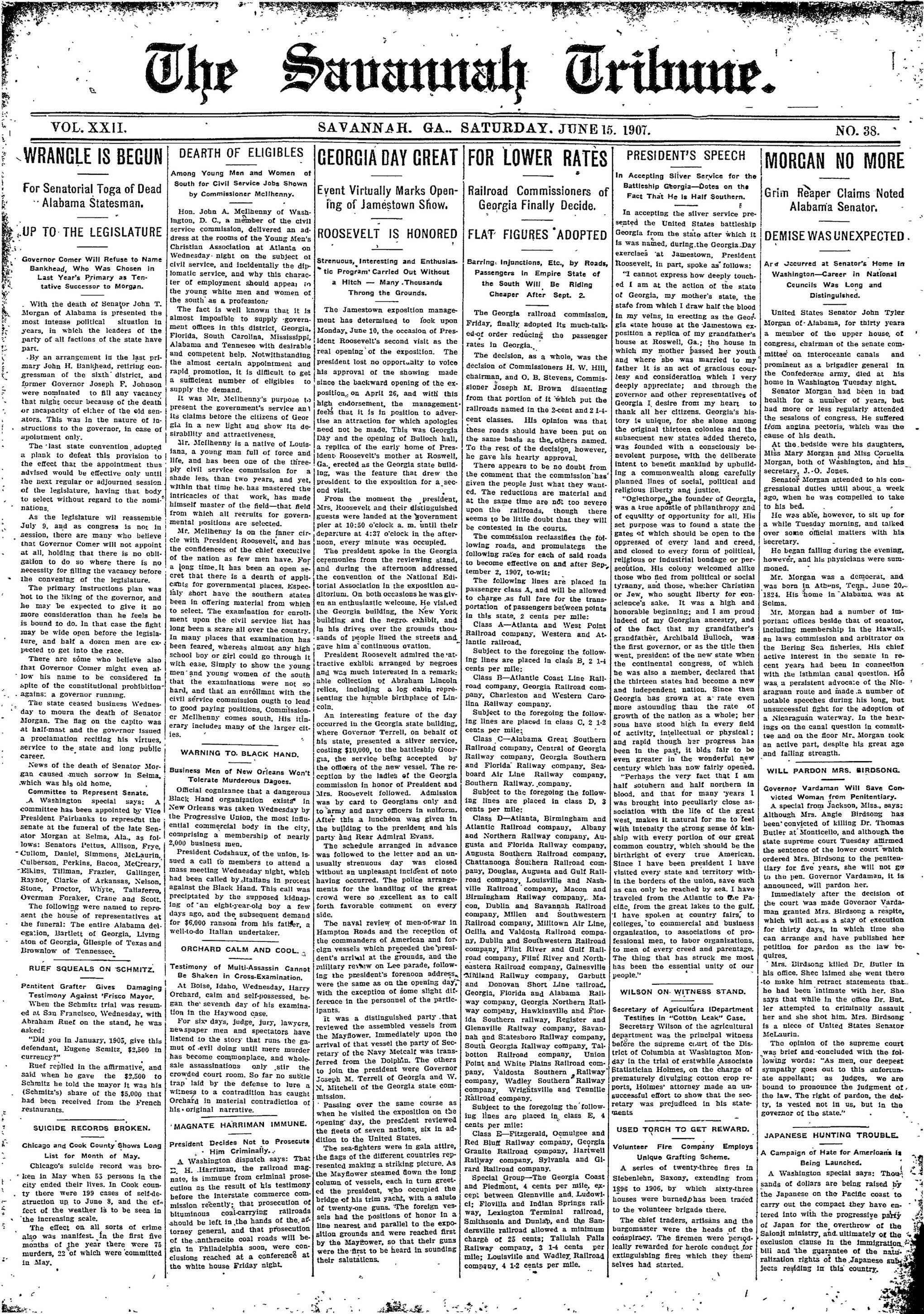
WRANGLE IS BEGUN
For Senatorial Toga of Dead Alabama Statesman.
.UP TO·THE LEGISLATURE
Governor Comer Will Refuse to Name Bankhead, Who Was Chosen in Last Year's Primary as Tentative Successor to Morgan.
With the death of Senator John T. Morgan of Alabama is presented the most intense political situation in years, in which the leaders of the party of all factions of the state have part.
By an arrangement in the last primary John H. Bankhead, retiring congressman of the sixth district, and former Governor Joseph F. Johnson were nominated to fill any vacancy that might occur because of the death or incapacity of either of the old senators. This was in the nature of instructions to the governor, in case of apoulment only.
The last state convention adopted a plank to defeat this provision to the effect that the appointment thus advised would be effective only until the next regular or adjourned session of the legislature, having that body to select without regard to the nominations.
As the legislature wil reassemble July 9, and as congress is not in session, there are many who believe that Governor Comer will not appoint at all, holding that there is no obligation to do so where there is no necessity for filling the vacancy before the convening of the legislature. The primary instructions plan was not to the liking of the governor, and he may be expected to give it no more consideration than he feels he is bound to do. In that case the fight may be wide open before the legislature, and half a dozen men are expected to get into the race.
There are some who believe also that Governor Comer might even allow his name to be considered in spite of the constitutional prohibition against: a governor running.
The state ceased business Wednesday to mourn the death of Senator Morgan. The flag on the capito was at half-mast and the governor issued a proclamation reciting his virtues, service to the state and long public career.
News of the death of Senator Morgan caused much sorrow in Selma, which was his old home.
Committee to Represent Senate.
A Washington special says: A committee has been appointed by Vice President Fairbanks to represent the senate at the funeral of the late Senator Morgan at Selma, Ala., as follows: Senators Pettus, Allison, Frye, Culom, Daniel, Simmons, McLaurin, Culberson, Perkins, Bacon, McCreary, Elkins, Tillman, Frazier, Gallinger, Raynor, Clarke of Arkansas, Nelson, Stone, Proctor, Whyte, Tallferro, Overman Foraker, Crane and Scott.
The following were named to represent the house of representatives at the funeral: The entire Alabama delegation, Bartlett of Georgia, Livingston of Georgia, Gillesple of Texas and Brownlow of Tennessee.
Pentitent Grafter Gives Damaging
Testimony Against 'Frisco Mayor'
Testimony Against Prisco Mayor.
When the Schmitz trial was resumed at San Francisco, Wednesday, with Abraham Ruef on the stand, he was asked:
"Did you in January, 1905, give this defendant, Eugene Schmitz, $2,500 in currency?"
Ruef replied in the affirmative, and said when he gave the $2,500 to Schmitz he told the mayor it was his (Schmitz's) share of the $5,000 that had been received from the French restaurants.
Chicago and Cook County Shows Long List for Month of May.
Chicago's suicide record was broken in May when 55 persons in the city ended their lives. In Cook county there were 199 cases of self-destruction up to June 8, and the effect of the weather is to be seen in the increasing scale.
The effect on all sorts of crime also was manifest. In the first five months of the year there were 75 murders, 22 of which were committed in May.
The Savannah Tribune.
DEARTH OF ELIGIBLES
Among Young Men and Women of South for Civil Service Jobs Shown by Commissioner McIlhenny.
Hon. John A. McIlhenny of Washington, D. C., a member of the civil service commission, delivered an address at the rooms of the Young Men's Christian Association at Atlanta on Wednesday night on the subject of civil service, and incidentally the diplomatic service, and why this character of employment should appear to the young white men and women of the south as a profession.
The fact is well known that it is almost impossible to supply government offices in this district, Georgia, Florida, South Carolina, Mississippi, Alabama and Tennessee with desirable and competent help. Notwithstanding the almost certain appointment and rapid promotion, it is difficult to get a sufficient number of eligibles to supply the demand. It was Mr. Mellhenny's purpose to present the government's service and its claims before the citizens of Georgia in a new light and show its desirability and attractiveness.
Mr. McIlhenny is a native of Louisiana, a young man full of force and life, and has been one of the threeply civil service commission for a shade less, than two years, and yet, within that time he, has mastered the intricacies of that work, has made himself master of the field—that field from which all recruits for governmental positions are selected.
Mr. McIlhenny is on the inner circle with President Roosevelt, and has the confidence of the chief executive of the nation as few men have. For a long time, it has been an open secret that there is a dearth of applicants for governmental places. Especially short have the southern states been in offering material from which to select. The examination for enrollment upon the civil service list has long been a scare all over the country. In many places that examination has been feared, whereas almost any high school boy or girl could go through it with ease. Simply to show the young men and young women of the south that the examinations were not so hard, and that an enrollmnt with the civil service commission ough to lead to good paying positions, Commissioner McIlhenny comes south. His itinerary includes many of the larger cities.
WARNING TO. BLACK HAND.
Business Men of New Orleans Won't Tolerate Murderous Daques.
Official cognizance that a dangerous Black Hand organization exists in New Orleans was taken Wednesday by the Progressive Union, the most influential commercial body in the city, comprising a membership of nearly 2,000 business men.
President Codshaux, of the union, issued a call to members to attend a mass meeting Wednesday night, which had been called by Italians in protest against the Black Hand. This call was precipitated by the supposed kidnapping of an eight-year-old boy a few days ago, and the subsequent demand for $6,000 ransom from his father, a well-to-do Italian undertaker.
ORCHARD CALM AND COOL.
Testimony of Multi-Assassin Cannot Be Shaken in Cross-Examination.
At Boise, Idaho, Wednesday, Harry Orchard, calm and self-possessed, began the seventh day of his examination in the Haywood case.
For six days, judge, jury, lawyers, newspaper men and spectators have listened to the story that runs the gamut of evil doing until mere murder has become commonplace, and wholesale assassinations only stir the crowded court room. So far no subtle trap laid by the defense to lure a witness to a contradiction has caught Orchard in material contradiction of his original narrative.
'MAGNATE HARRIMAN IMMUNE.
President Decides Not to Prosecute Him Criminally.
A Washington dispatch says: That Σ. H. Harriman, the railroad magnate, is immune from criminal prosecution as the result of his testimony before the Interstate commerce commission recently; that prosecution of bituminous coal-carrying railroads should be left in the hands of the attorney general, and that prosecution of the anthracite coal roads will begin in Philadelphia soon, were conclusions reached at a conference at the white house Friday night.
SAVANNAH. GA.. SATURDAY. JUNE 15. 1907.
GEORGIA DAY GREAT
Event Virtually Marks Opening of Jamestown Show.
Strenuous, Interesting and Enthusiastic Program' Carried Out Without a Hitch Many. Thousands
The Jamestown exposition management has determined to look upon Monday, June 10, the occasion of President Roosevelt's second visit as the real opening of the exposition. The president lost no opportunity to voice his approval of the showing made since the backward opening of the exposition, on April 26, and with this high endorsement, the management feels that it is in position to advertise an attraction for which apologies need not be made. This was Georgia Day and the opening of Bulloch hall, a replica of the early home of President Roosevelt's mother at Roswell, Ga., erected as the Georgia state building, was the feature that drew the president to the exposition for a second visit.
From the moment the president, Mrs. Roosevelt and their distinguished guests were landed at the government pler at 10:50 o'clock a. m. until their departure at 4:37 o'clock in the afternoon, every minute was occupied.
The president spoke in the Georgia ceremonies from the reviewing stand, and during the afternoon addressed the convention of the National Editorial Association in the exposition auditorium. On both occasions he was given an enthusiastic welcome. He visited the Georgia building, the New York building and the negro. exhibit, and in his drives over the grounds thousands of people lined the streets and gave him a continuous ovation.
President Roosevelt admired the attractive exhibit arranged by negroes and was much interested in a remarkable collection of Abraham Lincoln relics, including a log cabin representing the humble birthplace of Lincoln.
An interesting feature of the day occurred in the Georgia state building, where Governor Terrell, on behalf of his state, presented a silver service, costing $10,000, to the battleship Georgia, the service being accepted by the officers of the new vessel. The reception by the ladies of the Georgia commission in honor of President and Mrs. Roosevelt followed. Admission was by card to Georgians only and to army and navy officers in uniform. After this a lunchon was given in the building to the president and his party and Rear Admiral Evans.
The schedule arranged in advance was followed to the letter and an unusually strenuous day was closed without an unpleasant incident of note having occurred. The police arrangements for the handling of the great crowd were so excellent as to call forth favorable comment on every side. The naval review of men-of-war in Hampton Roads and the reception of the commanders of American and foreign vessels which preceded the president's arrival at the grounds, and the military review on Lee parade, following the president's forenoon address, were the same as on the opening day, with the exception of some slight difference in the personnel of the participants.
It was a distinguished party that reviewed the assembled vessels from the Mayflower. Immediately upon the arrival of that vessel the party of Secretary of the Navy Metcalf was transferred from the Dolphin. The others to join the president were Governor Joseph M. Terrell of Georgia and W. N. Mitchell of the Georgia state commission.
Passing over the same course as when he visited the exposition on the opening day, the president reviewed the fleets of seven nations, six in addition to the United States.
The sea-fighters were in gala attire, the flags of the different countries represented making a striking picture. As the Mayflower steamed flown the long column of vessels, each in turn greeted the president, who occupied the bridge of his trim yacht, with a salute of twenty-one guns. The foreign vessels had the positions of honor in a line nearest and parallel to the exposition grounds and were reached first by the Mayflower, so that their guns were the first to be heard in sounding their salutations.
FOR LOWER RATES
Railroad Commissioners of Georgia Finally Decide.
Barring. Injunctions, Etc., by Roads, Passengers in Empire State of the South Will Be Riding Cheaper After Sept. 2.
The Georgia railroad commission, Friday, finally adopted its much-talked-of order reducing the passenger rates in Georgia.
The decision, as a whole, was the decision of Commissioners H. W. Hill, chairman, and O. B. Stevens, Commissioner Joseph M. Brown dissenting from that portion of it which put the railroads named in the 2-cent and 21-4-cent classes. His opinion was that these roads should have been put on the same basis as the others named. To the rest of the decision, however, he gave his hearty approval. There appears to be no doubt from the comment that the commission has given the people just what they wanted. The reductions are material and at the same time are not too severe upon the railroads, though there seems to be little doubt that they will be contested in the courts.
The commission reclassifies the following roads, and promulategs the following rates for each of said roads to become effective on and after September 2, 1907, to-wit:
The following lines are placed in passenger class A, and will be allowed to charge as full fare for the transportation of passengers between points in this state, 2 cents per mile:
Class A—Atlanta and West Point Railroad company, Western and Atlantic railroad.
Subject to the foregoing the following lines are placed in class B, 2 1-4 cents per mile:
Class B—Atlantic Coast Line Railroad company, Georgia Railroad company, Charleston and Western Carolina Railway company.
Subject to the foregoing the following lines are placed in class C, 2 1-2 cents per mile;
Class C—Alabama Great Southern Railroad company, Central of Georgia Railway company, Georgia Southern and Florida Railway company, Seaboard Air Line Railway company, Southern Railway, company.
Subject to the foregoing the following lines are placed in class D, 3 cents per mile;
Class D—Atlanta, Birmingham and Atlantic Railroad company, Albany and Northern Railway company, Augusta and Florida Railway company, Angusta Southern Railroad company, Chattanooga Southern Railroad company, Douglas, Augusta and Gulf Railroad company, Louisville and Nashville Railroad company, Macon and Birmingham Railway company, Macon, Dublin and Savannah Railroad company, Millen and Southwestern Railroad company, Milltown Air Line, Ocilla and Valdosta Railroad company, Dublin and Southwestern Railroad company, Flint River and Gulf Railroad company, Flint River and Northeastern Railroad company, Gainesville Midland Railway company, Garbutt and Donovan Short Line railroad, Georgia, Florida and Alabama Railway company, Georgia Northern Railway company, Hawkinsville and Florida Southern railway, Register and Glennville Railway company, Savannah and Statesboro Railway company, South Georgia Railway company, Talbotton Railroad company, Union Point and White Plains Railroad company, Valdosta Southern Railway company, Wadley Southern Railway company, Wrightsville and Tennille Railroad company.
Subject to the foregoing the following lines are placed in class E, 4 cents per mile:
Class E—Fitzgerald, Oculugee and Red Bluff Railway company, Georgia Granite Railroad company, Hartwell Railway company, Sylvania and Glirard Railroad company.
Special Group—The Georgia Coast and Piedmont, 4 cents per mile, except between Glennville and Ludowicl; Flovilla and Indian Springs railway, Lexington Terminal railroad, Smithsonia and Dunlap, and the Sandersville railroad allowed a minimum charge of 25 cents; Tallulah Falls Railway company, 3 1-4 cents per mile; Louisville and Wadley, Railroad company, 4 1-2 cents per mile.
PRESIDENT'S SPEECH
In Accepting Silver Service for the Battleship Georgia—Dotes on the Fact That He Is Half Southern.
In accepting the silver service presented the United States battleship Georgia from the state after which it is was named, during the Georgia Day exercises 'at Jamestown, President Roosevelt, in part, spoke as follows: "I cannot express how deeply touched I am at the action of the state of Georgia, my mother's state, the state from which I draw half the blood in my veins, in erecting as the Georgia state house at the Jamestown exposition a replica of my grandfather's house at Roswell, Ga.; the house in which my mother passed her youth and where she was married to my father It is an act of gracious courtesy and consideration which I very deeply appreciate; and through the governor and other representatives of Georgia I desire from my heart to thank all her citizens. Georgia's history is unique, for she alone among the original thirteen colonies and the subsequent new states added thereto, was founded with a consciously benevolent purpose, with the delibereate intent to benefit mankind by upbuilding a commonwealth along carefully planned lines of social, political and religious liberty and justice.
"Oglethorpe, the founder of Georgia, was a true apostle of philanthropy and of equality of opportunity for all. His set purpose was to found a state the gates of which should be open to the oppressed of every land and creed, and closed to every form of political, religious or industrial bondage or persecution. His colony welcomed alike those who fled from political or social tyranny, and those, whether Christian or Jew, who sought liberty for conscience's sake. It was a high and honorable beginning; and I am proud indeed of my Georgian ancestry, and of the fact that my grandfather's grandfather, Archibald Bulloch, was the first governor, or as the title then went, president of the new state when the continental congress, of which he was also a member, declared that the thirteen states had become a new and independent nation. Since then Georgia has grown at a rate even more astounding than the rate of growth of the nation as a whole; her sons have stood high in every field of activity, intellectual or physical; and rapid though her progress has been in the past, it bids fair to be even greater in the wonderful new century which has now fairly opened.
"Perhaps the very fact that I am half soluhern and half northern in blood, and that for many years I was brought into peculiarly close association with the life of the great west, makes it natural for me to feel with intensity the strong sense of kinship with every portion of our great common country, which should be the birthright of every true American. Since I have been president I have visited every state and territory within the borders of the union, save such as can only be reached by sea. I have traveled from the Atlantic to the Pacific, from the great lakes to the gulf. I have spoken at country fairs, to colleges, to commercial and business organization, to associations of professional men, to labor organizations, to men of creed and parentage. The thing that has struck me most has been the essential unity of our people."
WILSON ON-WITNESS STAND.
Secretary of Agricultura I Department
Treatise in #Cotton Leaf Case
Testifies in "Cotton Leak" Case.
Secretary Wilson of the agricultural department was the principal witness before the supreme court of the District of Columbia at Washington Monday in the trial of erstwhile Associate Statistician Holmes, on the charge of prematurely divulging cotton crop reports, Holmes' attorney made an unsuccessful effort to show that the secretary was prejudiced in his statements
USED TORCH TO GET REWARD.
Volunteer Fire Company Employs Unique Grafting Scheme.
A series of twenty-three fires in Siebenlehn, Saxony, extending from 1896 to 1906, by which sixty-three houses were burned has been traced to the volunteer brigade there. The chief traders, artisans and the burgomaster were the heads of the conspiracy. The firemen were periodically rewarded for heroic conduct for extinguishing fires which they themselves had started.
NO.38.
MORGAN NO MORE
Grim Reaper Claims Noted Alabama Senator.
DEMISE WAS UNEXPECTED .
Ard Occurred at Senator's Home in Washington—Career in National Councils Was Long and Distinguished.
United States Senator John Tyler Morgan of Alabama, for thirty years a member of the upper house, of congress, chairman of the senate committee' on interoceanic canals and prominent as a brigadier general in the Confederate army, died at his home in Washington Tuesday night.
Senator Morgan had been in bad health for a number of years, but had more or less regularly attended the sessions of congress. He suffered from angina pectoris, which was the cause of his death.
At the bedside were his daughters, Miss Mary Morgan and Miss Cornella Morgan, both of Washington, and his secretary, J.-O. Jones.
Senator Morgan attended to his congressional duties until about a week ago, when he was compelled to take to his bed.
He was able, however, to sit up for a while Tuesday morning, and talked over some official matters with his secretary.
He began falling during the evening, however, and his physicians were summoned.
Mr. Morgan was a democrat, and was born in Athens, Tenn. June 20, 1824. His home in Alabama was at Selma.
Mr. Morgan had a number of important offices beside that of senator, including membership in the Hawaiian laws commission and arbitrator on the Bering Sea fisheries. His chief active interest in the senate in recent years had been in connection with the isthmian canal question. He was a persistent advocate of the Nicaraguan route and made a number of notable speeches during his long, but unsuccessful fight for the adoption of a Nicaraguan waterway. In the hearings on the canal question in committee and on the floor Mr. Morgan took an active part, despite his great age and falling strength.
WILL PARDON MRS. BIRDSONG.
Governor Vardaman Will Save Convicted Woman from Penitentiary.
A special from Jackson, Miss., says: Although Mrs. Angie Birdsong has been convicted of killing Dr. Thomas Butler at Monticello, and although the state supreme court Tuesday affirmed the sentence of the lower court which ordered Mrs. Birdsong to the penitentiary for five years, she will not go to the pen. Governor Vardaman, it is announced, will pardon her.
Immediately after the decision of the court was made Governor Vardaman granted Mrs. Birdsong a respite, which will act as a stay of execution for thirty days, in which time she can arrange and have published her petition for pardon as the law requires.
Mrs. Birdsong killed Dr. Butler in his office. Shec laimed she went there to make him retract statements that he had been intimate with her. She says that while in the office Dr. Butler attempted to criminally assault her and she shot him. Mrs. Birdsong is a niece of United States Senator McLaurin.
The opinion of the supreme court was brief and concluded with the following words: "As men, our deepest sympathy goes out to this unfortunate appellant; as judges, we are bound to pronounce the judgment of the law. The right of pardon, the delty, is vested not in us, but in the governor of the state."
A Campaign of Hate for Amerloans is Being Launched.
A Washington special says: Thousands of dollars are being raised by the Japanese on the Pacific coast to carry out the compact they have entered into with the progressive party of Japan for the overthrow of the Salonji ministry, and ultimately of the exclusion clause in the immigration bill and the guarantee of the naturalization rights of the Japanese subjects residing in this country.
7 : / Largest Sick and Death Benefits; Smallest Premiums. —
7 LE, WILLIAMS, President. P, EDWARD PERRY, Vice President. WALTER 5S. SCOTT, Secretary and Tr ces
f- . The Guaranty Aid and Relief Society -
‘ . ‘
. geo -
: § \ HOME OFFICE. |
% {4 WEST BROAD STREET, ©
74 SAVANNAH, GEORGIA. a sa
. Y suse Phone 1198. Ga. Phone 2029.
a
- - .
ar Ss3 ee .
2S reectOrs., -
: W.R Fleas.” . _ WW. H. Burgesn
J.cH. Deveaux . J. A. Bugg, M
. L. M. Pollara.
RR. Wright . J’ M. Ferrebee.
op) eiebeaelbes semen copcaascac se tet cess ue glee :
“this compuny 1s duly chartered under the laws of the State of Georgia, and “has cumpittd with ail re,
quirements of the State Insurance department, therefore all policy holders are protected wit all the safeguards
that the strict Insurance Mws of this Stato seek to protect its citizens. . . é .
Its affaira are directed and managed by Negro men of the city of Savannah of leading standing, and whese
character and reputation are of such as to command the respect and confidence of all the people of .thdt
community. The same men that manage this Society are the ones that oiganized and are corducting the ai-
fairs of the first successful Negro Savings Park In this state, therefore;wé can readily see that by counectiag
themselves with this Insurance compary thelr interest will be in safe hands. 7
By comparing our rules and bénetits with other_first class cympantes tf will bo scen that, we offer the most_
liberal inducements with the largest sick, accident and doath benefits to our members than any other com-
pany in this business. . - *
, That we pay our claims promptly can ba testifed to py the thousinds of our satisfied: me-xcbers. .
Soe 3? Agents Wantec =|. -
7 Cnyren et Sen Giitwnd Weltazand which ave hid Gy the Kite a = VGrFY W hers
S Geeipiartly anthguly andande the fiovisiona ofen Mel of the General ° o / - @
. Merle, offered Colles BBA AREF end —arverdad— Becomes Liberal Terms and Commission. - .
Treasurer of the State of Georgr. i, 7 , Savannah, Georgia... ~
'oEVERY FARMER IN THE Cdl
ROPP’S NEW
is
Commercial Calculator
| and Short-Cut Arithmetic
Containing a New, Complete and Come
prehensive System of
Useful, Convenient and Labor-Saving
Tables.
Also The Essence of Arithmetic and
Mensuration Condensed and Sim-
= plified for Practical Use
Handy Review and Ready Reference
Designed for the Use of
Farmers, Mechanics, Business and
Professional Men, Bankers and
Dealers in Grain, Stock, Cotton, Coal,
Lumber, Predtice, Feed, Etc.
One Hundred and Sixty Pages.
New-York WEEKLY, 20 pages, 1213 by 18 inches. The most thoroughly
7 @tical, helpful, up-to-date ille d National weekly f
Tri bune Farmer member of the farmer ‘Ss family. Regular price per year, $1.00. }
A copy of ROPP’S NEW COMMERCIAL CALCULATOR will be sent
postage prepaid
WITH THE N. Y. TRIBUNE FARMER ONE YEAR, FOR $1.00
Send ail orders to NEW-YORK TRIBUNE FARMER,
Tribune Building. NEW YORK CITY.
= Im 5 of.
NIGHT TRAINS | sontcomeny.
JIT WAY S
] MONTGOMERY.
: . AIR LINE RAILWAY. i
WESTROUAD. I : Lan S2vouNnD,
Leave SINR IIR mm anenases sue 5.00 Pe af i Leave New Orleans... 9.23 A.M. . :
Arrive Helena ee HS POM. 1 Donte itununeinn eee ae
cat Arrive Abbevide 2 10.10 P.M i Leave Burning 40 vo
Arrive Cordele wo Ss PL ME i Leave Montzomeryec we Ta PM
- Atrive Americu-....... Wd A. M. Leave Limipkit oe ened LAL PLM
| . Arrive Ruchland II 20g al at Leave Richland... IG ALM 2
| Arrive Lumpkin... cce 222 AL ML Leave Amenict~ ices see Latha. Mos
| Artive Mootwouery G43 AL Me pee Cartel nsesetcnsemanen ais A. é ra |
I RAT Co niin a q eave pbeville ecco EEO ALD
, Alfive Buran tam... 14U AL Me Leave Helena wen. GIA ALM. f
| Aiive New Orewa ete POM] Arrive Savaunut. wan ALM :
—<- pee Z es
Train will consist of PULLMAN BUPFET SLEBPING CARS, Day Couches hetween savannah and
Montgomery without change: making close connection at Montecmery With all dines divergune for Pensucola, |
Mobile, New Odeuns ant all Weer ponte: Buminglanm, Merpiis, st. Louis, Nashville, Chicse amt all |
Northwestern: points; the SHORTEST LINE te Montyomery, New Orleans, giiratinegham and the eertiost {
arrival at these pumts, At mavannal close convection i made foe all EAsSTens VOINTS, Richmond, Wash-
ington, New York nb with Costu lse Steamehips for Baltimore, Phitudelphiia, New York and Bocten. ~
Get sleeping car resei vations aud full information from suy SEABOARD Avent, or write to .
. CHARLES FE. STEWART. ,
| ‘ Asst. General Passenger Agent, savannah, Georgi,
LE Willams.
P. Edward Perry.
Walter 3. Scott.
Bel. C. Johascn.
Masonic Books &
3 ee
Regatias.
» LODGE SEALS,
. FINANCIAL CARDS and
BLANKS cf every description.
Publishers’ and Manufzcturers', Prices
Llberal Discounts Will.B2 Arranged
SOL. C. JOHNSON,
Savannah, Ga.
ee
)
SOL. 6. JOHNSON
.
Notary Public,
| Deeds, Contracts, Wills and Other
» Legal Forms Prepared and
Attested.
116 West St. Julian Street.
AI
“VS 1S ALE IT WILE GOST YOU
\ aE to write for our big FREE BICYCLE catalorue
y oy ND ghomung the most complete tine of ingh-erade
AS BICYCLES, TIRES and SUNDRIES at PRICES
SA Fae BLOW any other marufecturer or dealer in the world.
& ESN
Ai, (MAS pe NOT BUY A BICYCLE 2:32
Bf a\) BMY or on any Lind of terms, until you have reccived cur complete Free Cata>
s/\ i BM logues illu traumg and descnbing every kind of ingh-grade end lew-erace
Gi k ff bigs cles, ol patterns and Latest models, and learn of our remarkable LOW
= JV PIICLS and wonderful new offers riade possible by sciling from factory .
BN FAT CIM Brady aurect.to mder with ro middiemen's profits. :
i aete Str WE SHIP GH APPROVAL ceithout a cert ecfosit, Pay the Vreleht an»
Ey antes at A allow 10 Days Lree ‘Tricland make other hberal terms which 1 9 oth
‘4 NEVEPRRIGH house in tig world witldo. You will leara everything aad get much yaw
RAM aif RRL cols infc ration by simply wnting usa postal.
Raf iy} i, Wenced a Ritcr Azenz in every town and can offer ca opportunity
Ra | RM to make money to sustable young meu who apply at ence.
KL $8.56 PUNCTURE-PROGE TIRES O,N L ¢
Ya’ a! ack a r > RO
Besiler Price § ape Uhr BO
$8.55 per pair. “Al Sar PER PAIS
To trtrocduce resem ES ee PI PEE
Wa Wl? Sot7 § [i WANS. TACKS Cee ene OT 3 Se $e LS
Yer a Sampio 5 woe eS Bea Po RE
e WONT LET & hep ot (ANE
Pais for Osttly OUT THE AIR Ure Sera bemimernne ath aN}. af
(CASH WITH ORDER $4.55) “at P xe eR ACTF
NO MORE TROUBLE FROM PUNCTURES. Qaida prot pee ZONES aS
Re ult of 15 years expericace in tire % c HAS aoe 3) ey
making. Ne danger from THORNS, CAC- fay
TUS. PINS, NAILS, TAGHS or GLASS. 4 Rotsee the talekmabter teat
Serious puncturcs, like intentional Enife cuts, can “HA cpa “p," also rim strip “a1
be veleanized like any other tire. 42 to prevent rim cutting. This
Tico Hundred Theusand pairs now in actual use, Over TH? Pes Jee AS and
Seveniy-fise Thousand pairs sald last ycar. EASY REDING.
BESORIPTIONs Made inal sizes, It is lively and easy ridin, very durable and lined inside
wwii a speciel quality of rubocr, which never becoraes porous and whiva‘eivses up ginal punclares
wathout allowing the ar toesespe. We have hundreds of Ictters from satisfied cubfomers stating
that their tres haveonly been pymped up ence or twice ina wholesca:ou. They weizh no more than
an o.dinary lire, the puncture fusisting qualities beine given by several layers of thx, specially
prepared fabric on the tread, That “Holding Pack” senzahon commonly felt when ridi g on asphalt
Gr soft raacs 13 overcome by tht patent “Basket Weave" tread which prevents all ar from being
squeezed out between the t.fe and the read thus overcomicg all suction. ‘The regular price of these
tes is $3 59 per pair, but for advesti. ng purposes we are making aspccial factory price to the nde
Gf only fi 80 per pait, All orders shipped sane day letter ss received, We ship C.O.D. on approval
You do hot pay aceat unt!l you have cxamined aud found them strictly agzepresentcd. ,
We will allow2 cash dis-ount of 5 per cent (thereby making the price $4.55 per pair) if yousend
PUnt CASH WITIT ORDER aed Caclose ths advertisement. We will also send cule mickel
plated brass hand pyuap and two Sarzpson metal puncture closess on full paid orders (these inctal
Spuucture closers to be used in case ef :ntentioual hm‘e cuts or heavy cashes), Tires to be returned
Et OUR expense if for any reason they are not satisfactory on“examination.
‘We are perfectly rehable and morey sert to us is as safe as in a Laut. Asi: your Postmaster,
narker, Express or Freight Arent or tne I:d:tor of this paper about us. If you order a pair of
these hres, you will find that they wall ride easier, tun faster, wear better, lest longer and Took
Ger than any lire you have ever used or seen at any price. We now that you will be so well pleased
that when you want a bieyele voa will give us your order. We want you to send us a small trial
order at once, hence this remarkable tire offer. | i St z
ullt-up-wheets, saddles, Ss. and repairs, an
GOASTERs BRAKES, creryining in the bicycle ineare eSid by as at hale the usual
prices charged by declers ard repair men. Wnie for our big SUNDItY catalogue.
BO MOT WAIT BES 85,3, Pesial today, "DO NOT THINK OF, BUYING a
bicycle or a pair of tires from anyone until you know the new and
wonderful ofers we are making. It only costs a postal to learn everything. Wnite it NOWs
as 35 L
BERD SYGLE GOMPANY, Depi. “GL GHICGAGO, ILE.
.
W. H. LLOYD,
—Dealer -In—
GROCERIBS, WOOD AND COAL,
621 Oglethorpe Avenue, East.
4. 618—_—PHONES———Rell 506
—_—————
7 oo
Masonic dreen Grocery
COMPANY,
Under Masonic Temple, 519 West
Gwinnett Street.
GROCERIES OF ALL KINDS.
*% FRESH MEATS, ETC.
: :
‘Orders delivered in any part of th
City.
P. L. BOWEN, ‘Manager.
Bell Phone, 2827.:
: QUGE CHORCEOS CHOHOHORS :
€ 6 cating &
: We Do Job Printing 2
¢3 OFAN Kinds. = & :
= We Can Please You.
@ueneCEenOzeE anes QRoRe.
PREACHERS ROUGHLY HANDLED.
Acted as Temperance Crusaders and
Were Beaten by Saloon Adherents.
Rey, J, M. Primrage and‘Rev. A. F.
Berkstresser, temperance crusaders,
who were reletsed from jail at Fronte-
nac, Kans., after they had been arrest-
edion a charge of selling liquor, were
attacked by twenty saloon sympathiz-
ers as they were boarding an electric
ear Friday night to leave town and
severely beaten. . f
The minisfers had been buying l-
quor in Frontenac saloons for the pur-
pose of acting against the keepers and
were arrested on charges brought by
the saloon keepers for revenge. :
Every farmer wants to know to a cent the
value of what he buys and sells, and should not
leave this to be figured by the party with whom
he is dealing.
As fabor saving machinery has been invented
to save time and physical strength, so there are
devices to enable the mind to reach quickly and
eccurately results usually arrived at with much
thought and tedious calculation, Time is worth
much, but accuracy is still’ more important.
Many books have been prepared to make the
task of calculating easy, its results sure, but
never one fitted to all men, in all kinds of busi-
ness. at all times, so completely as “ROPP'S
NEW COMMERCIAL CALCULATOR.” This
reliable assistant to the farmer and others has
been in the market for many years, and nearly
a million and a half copies have been sold. The
fast edition (160 pages) is from beginning to end
filled with tables, short cuts, and up-to-date
methods pf calculating, making it the most com-
plete. useful and comprehensive work of the
kind ever published. It will make every one in-
dependent, sure and self-reliant in all practical
calculations connected with farming and other
lines of business. It will prevent mistakes, re-
lieve the mind. save time. labor and foss. lt is
a pocket cdition with pocket for papers and a
foose silicate slate from which lead pencil marks
Bre easily erased, and is an invaluable assistant
for every farmer or brciness man.
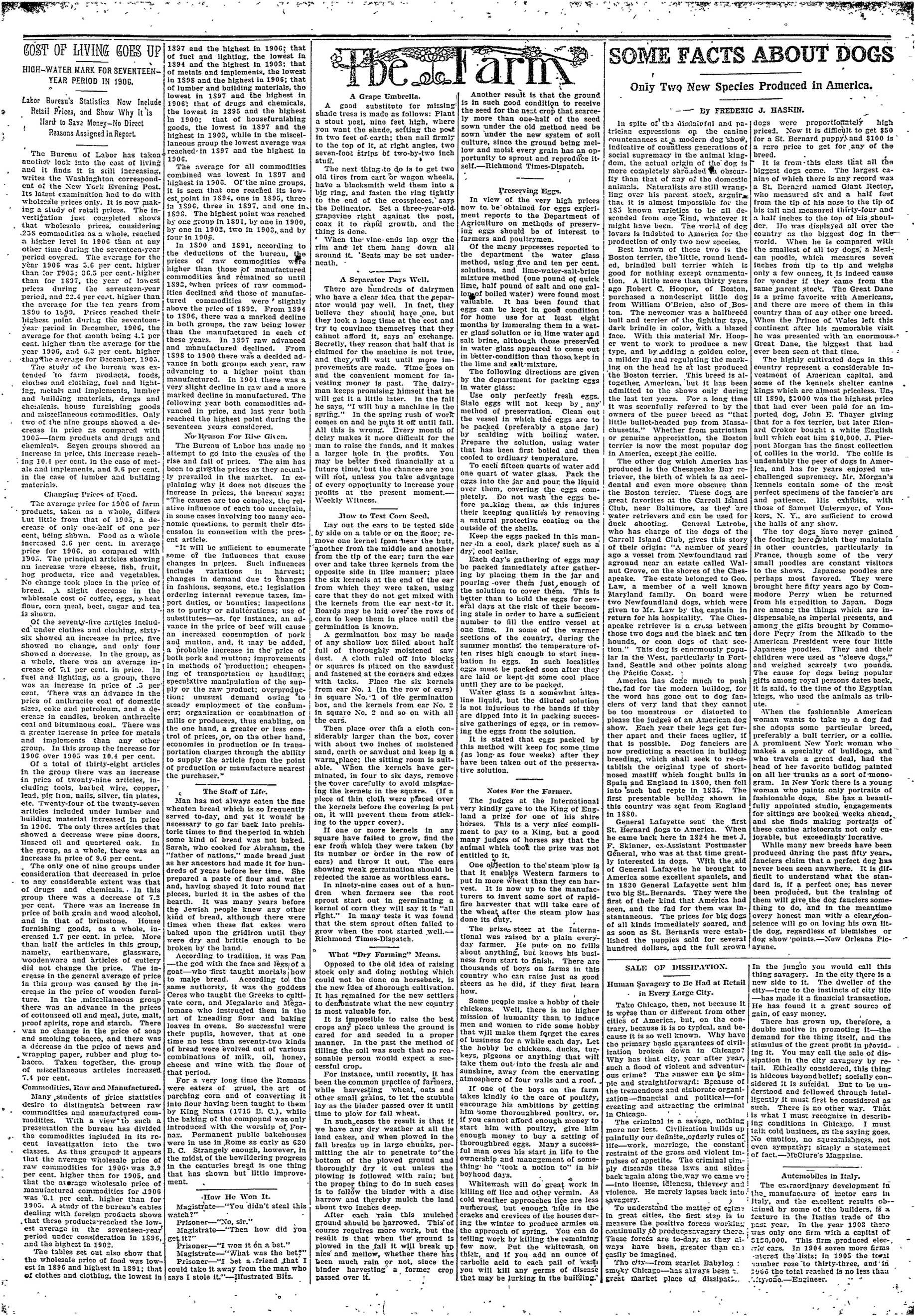
HIGH-WATER MARK FOR SEVENTEEN-YEAR PERIOD IN 1906.
Labor Bureau's Statistics Now Include Retail Prices, and Show Why It is Hard to Save Money-No Direct Reasons Assigned in Report.
---
The study of the bureau was extended to farm products, foods, clothes and clothing, fuel and lighting, metals and implements, lumber and building materials, drugs and chemicals, house furnishing goods and miscellaneous commodities. Only two of the nine groups showed a decrease in price as compared with 1903—farm products and drugs and chemicals. Seyen groups showed an increase in price, this increase reaching 10.4 per cent. in the case of metals and implements, and 9.6 per cent. in the case of lumber and building materials.
Changing Prices of Food.
The average price for 1906 of farm products, taken as a whole, differs but little from that of 1905, a decrease of only one-half of one per cent, being shown. Food as a whole increased 2.6 per cent. in average price for 1906, as compared with 1905. The principal articles showing an increase were cheese, fish, fruit, hog products, rice and vegetables. No change took place in the price of bread. A slight decrease in the wholesale cost of coffee, eggs, wheat flour, corn meal, beef, sugar and tea is shown.
Of the seventy-five articles included under clothes and clothing, sixty-six showed an increase in price, five showed no change, and only four showed a decrease. In the group, as a whole, there was an average increase of 7.1 per cent. in price. In fuel and lighting, as a group, there was an increase in price of .5 per cent. There was an advance in the price of anthracite coal of domestic sizes, coke and petroleum, and a decrease in candles, broken anthracite coal and bituminous coal. There was a greater increase in price for metals and implements than any other group. In this group the increase for 1906 over 1905 was 10.4 per cent.
Of a total of thirty-eight articles in the group there was an increase in price of twenty-nine articles, including tools, barbed wire, copper, lead, pig iron, nails, silver, tin plates, etc. Twenty-four of the twenty-seven articles included under lumber and building material increased in price in 1206. The only three articles that showed a decrease were pine doors, linedseed oil and quartered oak. In the group, as a whole, there was an increase in price of 9.6 per cent.
The only one of nine groups under consideration that decreased in price to any considerable extent was that of drugs and chemicals. In this group there was a decrease of 7.2 per cent. There was an increase in price of both grain and wood alcohol, and in that of brimstone. House furnishing goods, as a whole, increased 1.7 per cent. in price. More than half the articles in this group, namely, earthenware, glassware, woodenware and articles of cutlery did not change the price. The increase in the general average of price in this group was caused by the increase in the price of wooden furniture. In the miscellaneous group there was an advance in the prices of cottonseed oil and meal, jute, malt, proof spirits, rope and starch. There was no change in the price of soap and smoking tobacco, and there was a decrease in the price of news and wrapping paper, rubber and plug tobacco. Taken together, the group of miscellaneous articles increased 7.4 per cent.
Commodities, Raw and Manufactured.
Many students of price statistics desire to distinguish between raw commodities and manufactured commodities. With a view to such a presentation the bureau has divided the commodities included in its recent investigation into the two classes. As thus grouped it appears that the average wholesale price of raw commodities for 1906 was 3.9 per cent. higher than for 1905, and that the average wholesale price of manufactured commodities for 1906 was 6.1 per cent. higher than for 1905. A study of the bureau's cables dealing with foreign products shows that these products reached the lowest average in the seventeen-year period under consideration in 1896, and the highest in 1902.
The tables set out also show that the wholesale price of food was lowest in 1896 and highest in 1891; that of clothes and clothing, the lowest in
In 1800 and 1891, according to the deductions of the bureau, the prices of raw commodities were higher than those of manufactured commodities and remained so until 1892, when prices of raw commodities declined and those of manufactured commodities were slightly above the price of 1892. From 1894 to 1896, there was a marked decline in both groups, the raw being lower than the manufactured in each of these years. In 1897 raw advanced and manufactured declined. From 1898 to 1900 there was a decided advance in both groups each year, raw advancing to a higher point than manufactured. In 1901 there was a very slight decline in raw and a more marked decline in manufactured. The following year both commodities advanced in price, and last year both reached the highest point during the seventeen years considered.
No Reason For Rise Given.
The Bureau of Labor has made no attempt to go into the causes of the rise and fall of prices. The aim has been to giv@the prices as they actually prevailed in the market. In explaining why it does not discuss the increase in prices, the bureau says: "The causes are too complex, the relative influence of each too uncertain, in some cases involving too many economic questions, to permit their discussion in connection with the present article.
"It will be sufficient to enumerate some of the influences that cause changes in prices. Such influences include variations in harvest; changes in demand due to changes in fashions, seasons, etc.; legislation ordering internal revenue taxes, import duties, or bounties; inspections as to purity or adulterations; use of substitutes—as, for instance, an advance in the price of beef will cause an increased consumption of pork and mutton, and it may be added, a probable increase in the price of both pork and mutton; improvements in methods of production; cheapening of transportation or handling; speculative manipulation of the supply or the raw product; overproduction; unusual demand owing to steady employment of the consumers; organization or combination of mills or producers, thus enabling, on the one hand, a greater or less control of prices, or, on the other hand, economies in production or in transportation charges through the ability to supply the article from the point of production or manufacture nearest the purchaser."
The Staff of Life.
Man has not always eaten the fine wheaten bread which is so frequently served to-day, and yet it would be necessary to go far back into prehistoric times to find the period in which some kind of bread was not baked. Sarah, who cooked for Abraham, the "father of nations," made bread just as her ancestors had made it for hundreds of years before her time. She prepared a paste of flour and water and, having shaped it into round flat pieces, burried it in the ashes of the hearth. It was many years before the Jewish people knew any other kind of bread, although there were times when these flat cakes were baked upon the gridiron until they were dry and brittle enough to be broken by the hand.
According to tradition, it was Pan—the god with the face and legs of a goat—who first taught mortals how to make bread. According to the same authority, it was the goddess Ceres who taught the Greeks to cultivate corn, and Megalarto and Megalomaze who instructed them in the art of kneading flour and baking loaves in ovens. So successful were their pupils, however, that at one time no less than seventy-two kinds of bread were evolved out of various combinations of milk, oil, honey, cheese and wine with the flour of that period.
For a very long time the Romans were eaters of gruel, the art of parching corn and of converting it into flour having been taught to them by King Numa (1715 B. C.), while the baking of the compound was only introduced with the worship of Fornax. Permanent public bakehouses were in use in Rome as early as 630 B. C. Strangely enough, however, in the midst of the bewildering progress in the centuries bread is one thing that has shown but little improvement.
How He Won It.
Magistrate—"You didn't steal this watch?"
Prisoner—"No, sir."
Magistrate—"Then how did you get it?"
Prisoner—"I von it on a bet."
Magistrate—"What was the bet?"
Prisoner—"I get a friend, that I could take it away from the man who says I stole it."—Illustrated Bits.
The Farm
A Grape Umbrella.
A good substitute for missing shade trees is made as follows: Plant a stout post, nine feet high, where you want the shade, setting the post in two feet of earth; then nail firmly to the top of it, at right angles, two seven-foot strips of two-by-two inch stuff.
The next thing to do is to get two old tires from cart or wagon wheels, have a blacksmith weld them into a big ring, and fasten the ring tightly to the end of the crosspieces, says the Delincator. Set a three-year-old grapevine right against the post, coax it to rapid growth, and the thing is done.
When the vine-ends lap over the rim and let them hang down all around it. 'Seats may be set underneath.
---
A Separator Pays Well.
There are hundreds of dairymen who have a clear idea that the separator would pay well. In fact, they believe they should have one, but they look a long time at the cost and try to convince themselves that they cannot afford it, says an exchange. Secretly, they reason that half that is claimed for the machine is not true, and they will wait until more improvements are made. Time goes on and the convenient moment for investing money is past. The dairyman keeps promising himself that he will get it a little later. In the fall he says, "I will buy a machine in the spring." In the spring rush of work comes on and he puts it off until fall. All this is wrong. Every month of delay makes it more difficult for the man to raise the funds, and it makes a larger hole in the profits. You may be better fixed financially at a future time, but the chances are you will not, unless you take advantage of every opportunity to increase your profits at the present moment.—Weekly Witness.
How to Test Corn Seed.
Lay out the ears to be tested side by side on a table or on the floor; remove one kernel from hear the butt, another from the middle and another from the tip of the ear; turn the ear over and take three kernels from the opposite side in like manner; place the six kernels at the end of the ear from which they were taken, using care that they do not get mixed with the kernels from the ear next to it. Boards may be laid over the rows of corn to keep them in place until the getination is known.
A germination box may be made of any shallow box filled about half full of thoroughly moistened sawdust. A cloth ruled off into blocks or squares is placed on the sawdust and fastened at the corners and edges with tacks. Place the six kernels from ear No. 1 (in the row of cars) in square No. 1 of the germination box, and the kernels from ear No. 2 in square No. 2 and so on with all the cars.
Then place over this a cloth considerably larger than the box, cover with about two inches of moistened sand, earth or sawdust and keep in a warm place; the sitting room is suitable. When the kernels have germinated, in four to six days, remove the cover carefully to avoid misplacing the kernels in the square. (If a piece of thin cloth were placed over the kernels before the covering is put on, it will prevent them from sticking to the upper cover).
If one or more kernels in any square have failed to grow, find the ear from which they were taken (by its number or order in the row of ears) and throw it out. The ears showing weak germination should be rejected the same as worthless ears. In ninety-nine cases out of a hundred when farmers see the root sprout start out in germinating a kernel of corn they will say it is "all right." In many tests it was found that the stem sprout often failed to grow when the root started well.—Richmond Times-Dispatch.
What "Dry Farming" Means.
Opposed to the old idea of raising stock only and doing nothing which could not be done on horseback, is the new idea of thorough cultivation. It has remained for the new settlers to demonstrate what the new country is most valuable for.
It is impossible to raise the best crops any place unless the ground is cared for and seeded in a proper manner. In the past the method of tilling the soil was such that no reasonable person would expect a successful crop.
For instance, until recently, it has been the common practice of farmers, while harvesting wheat, oats and other small grains, to let the stubble lay as the binder passed over it until time to plow for fall wheat.
In such cases the result is that if we have any dry weather at all the land cakes, and when plowed in the fall breaks up in large chunks, permitting the air to penetrate to the bottom of the plowed ground and thoroughly dry it out unless the plowing is followed with rain; but the proper thing to do in such cases is to follow the binder with a disc harrow and thereby mulch the land about two inches deep.
After each rain this mulched ground should be harrowed. This of course requires more work, but the result is that when the ground is plowed in the fall it will break up nice and mellow, whether there has been much rain or not, since the binder harvesting a former crop passed over it.
Another result is that the ground is in such good condition to receive the seed for the next crop that scarcely more than one-half of the seed sown under the old method need be sown under the new system of soil culture, since the ground being mellow and moist every grain has an opportunity to sprout and reproduce itself.—Richmond Times-Dispatch
Preserving Eggs.
In view of the very high prices now to be obtained for eggs experiment reports to the Department of Agriculture on methods of preserving eggs should be of interest to farmers and poultrymen.
Of the many processes reported to the department the water glass method, using five and ten per cent, solutions, and lime-water-salt-brine mixture method (one pound of quick lime, half pound of salt and one gallon of boiled water) were found most valuable. It has been found that eggs can be kept in good condition for home use for at least eight months by immersing them in a water glass solution or in lime water and salt brine, although those preserved in water glass appeared to come out in better-condition than those kept in the lime and salt mixture.
The following directions are given by the department for packing eggs in water glass:
Use only perfectly fresh eggs. Stale eggs will not keep by any method of preservation. Clean out the vessel in which the eggs are to be packed (preferably a stone jar) by scalding with boiling water. Prepare the solution, using water that has been first boiled and then cooled to ordinary temperature.
To each fifteen quarts of water add one quart of water glass. Pack the eggs into the jar and pour the liquid over them, covering the eggs completely. Do not wash the eggs before packing them, as this injures their keeping qualities by removing a natural protective coating on the outside of the shells.
Keep the eggs packed in this manner in a cool, dark place; such as a dry, cool cellar.
Each day's gathering of eggs may be packed immediately after gathering by placing them in the jar and pouring-over them just, enough of the solution to cover them. This is better than to hold the eggs for several days at the risk of their becoming stale in order to have a sufficient number to fill the entire vessel at one time. In some of the warmer sections of the country, during the summer months, the temperature often rises high enough to start incubation in eggs. In such localities eggs must be packed soon after they are laid or kept in some cool place until they are to be packed.
Water glass is a somewhat alkaline liquid, but the diluted solution is not injurious to the hands if they are dipped into it in packing successive gatherings of eggs, or in removing the eggs from the solution.
It is stated that eggs packed by this method will keep for some time (as long as four weeks) after they have been taken out of the preservative solution.
Notes For the Farmer.
The judges at the International very kindly gave to the King of England a prize for one of his shire horses. This is a very nice compliment to pay to a King, but a good many judges of horses say that the animal which took the prize was not entitled to it.
One objection to the steam plow is that it enables Western farmers to put in more wheat than they can harvest. It is now up to the manufacturers to invent some sort of rapid fire harvester that will take care of the wheat after the steam plow has done its duty.
The prize steer at the International was raised by a plain everyday farmer. He puts on no frills about anything, but knows his business from start to finish. There are thousands of boys on farms in this country who can raise just as good steers as he did, if they first learn how.
Some people make a hobby of their chickens. Well, there is no higher mission of humanity than to induce men and women to ride some hobby that will make them forget the cares of business for a while each day. Let the hobby be chickens, ducks, turkeys, pigeons or anything that will take them out into the fresh air and sunshine, away from the enervating atmosphere of four walls and a roof. If one of the boys on the farm takes kindly to the care of poultry, encourage his ambitions by getting him some thoroughbred poultry, or, if you cannot afford enough money to start him with poultry, give him enough money to buy a setting of thoroughbred eggs. Many a successful man owes his start in life to the ownership and management of something he "took a notion to" in his boyhood days.
Whitewash will do great work in killing off lice and other vermin. As cold weather approaches lice are less numerous, but enough hide in the cracks and crevices of the houses during the winter to produce armies on the approach of spring. You can do telling work by killing the remaining few now. Put the whitewash on thick, and if you add an ounce of carolic acid to each pail of wad, you will kill any germs of disease that may be lurking in the building.
SOME FACTS ABOUT DOGS
BY FREDERIC J. HASKIN.
In spite of the disdainful and patrician expressions on the canine countenances at a modern dog show, indicative of countless generations of social supremacy in the animal kingdom, the actual origin of the dog is more completely sarcodied in obscurity than that of any of the domestic animals. Naturalists are still wrangling over his parent stock, arguing that it is almost impossible for the 185 known varieties to be all descended from one kind, whatever it might have been. The world of dog lovers is indebted to America for the production of only two new species.
Best known of these two is the Boston terrier, the little, round headed, brindled bull terrier which is good for nothing except ornamentation. A little more than thirty years ago Robert C. Hooper, of Boston, purchased a nondescript little dog from William O'Brien, also of Boston. The newcomer was a halfbred bull and terrier of the fighting type, dark brindle in color, with a blazed face. With this material Mr. Hooper went to work to produce a new type, and by adding a golden color, a milder lip and regulating the marking on the head he at last produced the Boston terrier. This breed is altogether American, but it has been admitted to the shows only during the last ten years. For a long time it was scornfully referred to by the owners of the purer breed as "that little bullet-headed pup from Massachusetts." Whether from patriotism or genuine appreciation, the Boston terrier is now the most popular dog in America, except the collie.
The other dog which America has produced is the Chesapeake Bay retriever, the birth of which is as accidental and even more obscure than the Boston terrier. These dogs are great favorites at the Carroll Island Club, near Baltimore, as they are water retrievers and can be used for duck shooting. General Latrobe, who has charge of the dogs of the Carroll Island Club, gives this story of their origin: "A number of years ago a vessel from Newfoundland ran aground near an estate called Walnut Grove, on the shores of the Chesapeake. The estate belonged to Geo. Law, a member of a well known Maryland family. On board were two Newfoundland dogs, which were given to Mr. Law by the captain in return for his hospitality. The Chesapeake retriever is a cross between those two dogs and the black and tan hounds, or coon dogs of that section." This dog is enormously popular in the West, particularly in Portland, Seattle and other points along the Pacific Coast.
America has done much to push the, fad for the modern buildup, for the word has gone out to dog fanciers of very land that they cannot be too monstrous or distorted to please the judges of an American dog show. Each year their legs get further apart and their faces uglier, if that is possible. Dog fanciers are now predicting a reaction in bulldog breeding, which shall seek to re-establish the original type of short-nosed mastiff which fought bulls in Spain and England in 1800, then fell into such bad reptile in 1835. The first presentable bulldog shown in this country was sent from England in 1880.
General Lafayette sent the first St. Bernard dogs to America. When he came back here in 1S24 he met J. F. Skinner, ex-Assistant Postmaster General, who was at that time greatly interested in dogs. With the aid of General Lafayette he brought to America some excellent spaniels, and in 1830 General Lafayette sent him two big St. Bernards. They were the first of their kind that America had seen, and the fad for them was instantaneous. The prices for big dogs of all kinds immediately soared, and as soon as St. Bernards were established the puppies sold for several hundred dollars, and the full grown
SALE OF DISSIPATION.
Human Savagery to Be Had at Retail in Every Large City.
Take Chicago, then, not because it is worse than or different from other cities of America, but, on the contrary, because it is so typical, and because it is so well known. Why have the primary basic guarantees of civilization broken down in Chicago? Why has that city, year after year, such a flood of violent and adventurous crime? The answer can be simple and straightforward: Because of the tremendous and elaborate organization—financial and political—for creating and attracting the criminal in Chicago.
The criminal is a savage, nothing more nor less. Civilization builds up painfully our definite, orderly rules of life—work, marriage, the constant restraint of the gross and violent impulses of appetite. The criminal simply discards these laws and sludes back again along the way we came into license, illness, thievery and violence. He merely lapses back into savagery.
To understand the matter of crime in great cities, the first step is to measure the positive forces working continually to produce savagery there. These forces are to-day, as they always have been, greater than can easily be imagined.
The city—from scarlet Babylon: smoky Chicago—has always been a great market place of dissinat-
dogs were proportionately high priced. Now it is difficult to get $50 for a St. Bernard puppy and $100 is a rare price to get for any of the breed.
It is from this class that all the biggest dogs come. The largest canine of which there is any record was a St. Bernard named Giant Reefer, who measured six and a half feet from the tip of his nose to the tip of his tall and measured thirty-four and a half inches to the top of his shoulder. He was displayed all over the country as the biggest dog in the world. When he is compared with the smallest of all toy dogs, a Mexican poodle, which measures seven lutes from tip to tip and weighs only a few ounces, it is indeed cause for wonder if they came from the same parent stock. The Great Dane is a prime favorite with Americans, and there are more of them in this country than of any other one breed. When the Prince of Wales left this continent after his memorable visit he was presented with an enormous Great Dane, the biggest that had ever been seen at that time.
The highly cultivated dogs in this country represent a considerable investment of American capital, and some of the kennels shelter canine kings which are almost priceless. Until 1890, $1000 was the highest price that had ever been paid for an imported dog, John E. Thayer giving that for a fox terrier, but later Richard Croker bought a white English bull which cost him $10,000. J. Pierpont Morgan has the finest collection of collies in the world. The collie is undoubtedly the peer of dogs in America, and has for years enjoyed unchallenged supremacy. Mr. Morgan's kennels contain some of the most perfect specimens of the fancier's art and patience. His exhibits, with those of Samuel Untermyer, of Yonkers, N. Y., are sufficient to crowd the halls of any show.
The toy dogs have never gained the footing here, which they maintain in other countries, particularly in France, though some of the very small poodles are constant visitors to the shows. Japanese poodles are perhaps most favored. They were brought here fifty years ago by Commodore Perry when he returned from his expedition to Japan. Dogs are among the things which are indispensable as imperial presents, and among the gifts brought by Commodore Perry from the Mikado to the American President were four little Japanese poodles. They and their children were used as "sleeve dogs," and weighed scarcely two pounds. The cause for dogs being popular gifts among royal persons dates back, it is said, to the time of the Egyptian kings, who used the animals as tribute.
When the fashionable American woman wants to take up a dog fad she adopts some particular breed, preferably a bull terrier, or a collie. A prominent New York woman who makes a specialty of bulldogs, and who travels a great deal, had the head of her favorite bulldog painted on all her trunks as a sort of monogram. In New York there is a young woman who paints only portraits of fashionable dogs. She has a beautifully appointed studio, engagements for sittings are booked weeks ahead, and she finds making portraits of these canine aristocrats not only enjoyable, but exceedingly lucrative.
While many new breeds have been produced during the past fifty years, fanclers claim that a perfect dog has never been seen anywhere. It is difficult to understand what the standard is, if a perfect one; has never been produced, but the training of them will give the dog fanclers something to do, and in the meantime every honest man with a clear conscience will go on loving his own little dog, regardless of blemlshes or dog show points.—New Orleans Picayune.
In the jungle you would call this thing savagery. In the city there is a new side to it. The dweller of the city—true to the instincts of city life—has made it a financial transaction. He has found it a great source of gain, of easy money.
There has grown up, therefore, a double motive in promoting it—the demand for the thing itself, and the stimulus of the great profit in providing it. You may call the sale of dissipation in the city savagery by retail. Ethically considered, this thing is hideous beyond belief; socially considered it is suicidal. But to be understood and followed through intelligently it must first be considered as such. There is no other way. That is what I must recognize in describing conditions in Chicago. I must talk cold business, as the saying goes. No emotion, no squeamishness, not even sympathy; simply a statement of fact.—McClure's Magazine.
The extraordinary development in the manufacture of motor cars in Italy, and the excellent results obtained by some of the builders, is a feature in the Italian trade of the past year. In the year 1903 there was only one firm with a capital of $120,000. This firm produced electric cars. In 1904 seven more firms entered the lists; in 1905 the total number rose to thirty-three, and in 1906 the total reached is no less than fifty-one—Engineer.
Automobiles in Italy.
Pt!
.The Savannah Tribune
Poataguxp Evmar Sarcepax,
8Y THE TRIBUNE PUBLISHING.CO
116 W. St, Jolian Btreet.
Bell Phone 2171.
Supsenir.ion Rares.
CBD YOKE ccsseeerreenmeirererssnerene ee LS
Sew
Perna ait mad oy Brpcie
on, Oe ones Uiter. or Rerimored Letter
Advertising Rates given on appiteation.
SATURDAY, JUNE 15, 1907.
Txe:Pardon Board having re-
fused to commute the sentence
of Willie Rogers the condemned
white man now awaiting his
fate in the jail, and the same
havng been approved by the
Governor, it seems that in this
case that Justice will be meted
ont. .
Tux Most Worshipful Union
Grand Lodge of Georgia, A. F.
and A. M., met in its thirty-
seventh session at Americus,
atQ9a,m.on Tuesday last. The
session was well attended and
the brethren from every part of
the state was present reporting
improvement, progress and pros
perity with the craft. The usual
harmony prevailed during the
deliberations. Grand Master
Butler’s address was but anoth-
er contribution to his many
master-pieces of good advice
and counsel] that has prospered
the Craft durirg his administra-
tions. He reported cousiderable
growth both in the number of
lodges and proficient interpreta-
tion of the principles for which
the grand old Order stand
Grand Secretary Johnson
reported having collected more
money at this session than at
any other, especially generous
were the brethren throughout
the State, in their contributions
and donations to the support of
the Widows and OrphansHome.
All otherfofiicers’ reports showed
abont the same improvement in
ttheir various departments.
All of the officers were re-elected
in approval of their faithful ser-
vices, Many incidents of which
time will not permit, will be
mentioned in our next issue.
ALL of’ no people are bad and
allof no people good. The
dash of goodness thatis sprin-
kled over depraved humanity is
the work of a hand that is
higher and more mighty than
that of man. The advantages of
Christain enlightenments stand
for much, and accompaniment
arenot wanting No man or
set of men are serving their day
and generation to much purpose
who make it a life work to point
“defects and from the summit of
their findings utter torrents of
evil prohpesies. The most that
is accomplished is a destruction
of righteons efforts in the pre-
sent, and the bequeath ment of
knotty qaestions for the future
Thereare many things in life
which are dignified by the title
of problems that are nothing
more nor less than the results
of shirking the common duty
of man to man.—Editor Lewis in
Metropolis. . 7
Fool-Killer Wanted In-
mediately.
Savannah, Ga.—vburies G, Hd.
Wards, who hag been chosen to fil
eut the unexpired Oougressional
term of Gol. Rufas Lester, deceased
and who will be the “kid” of the
next House, announced that he
proposes to begin a fight to-put all
Negroes out of Federal offices.
‘Lo that end he has written to
President Roosevelt, requesting the
removal of J. H. Deveaux, Negro
collectorof customs here. “‘There
might be some excuse for this,”
writes Mr Edwards, ‘if there were
not good white Republicans in
Sayannah,”
To furtheremphasize his dislike
of the Negro Federal office holder,
Edwards has sddressed a letter to
committee of the ‘Letter Carriers’
Association here, which sought an
audience of him. He told them that
he would not gives an audience to
Negroes and wound up his letter
with the phrase: “This ia s white
msn’s country,”
Without adonbt. Georgia is the
state in which a fool-killer neyer
has a chance to take vacation!
Georgia has more politioal freaks,
with the-Negro as their only aaset,
then anyother Southern state, Geor-
gia bas more Negro wealth, more
Negro schools and colleges than any
other Southern state; hence this
must be the causa of the Negropho
bia with which so many Georgia
statesmen(?) are possessed,
We suppose Mr. “Kid” Oongress-
man Will put Mr. Deveaux, the Ne-
gro letter carriera and all the other
Negro office holdera of the country
out of business, and all of the Ne-
gro soldiera ont of the army. Gon-
gress meuts again in December and
we supposs by Christmas all the
Negroes will be,ont, and this wj}l be
#& white man‘s countrys on the
Edwards plan.—Eichmond Herald.
- A Land-mark Gone.
After au illness of about three
weeks Mr. Oaeser Brinson died at
hia residence Duffy atreet, west, on
Monday,of paralysis. Mr Brinson
wasan old and well thought of citi-
zen, a life long and cortsistent chris-
tian and one of the first colored
masons; whose zeal for’ the order
was maintained to within an hoor
ofthe time’ he receive the stroke
that ended in hia death. He was
buried from St. Stephen’s church on
Wednesday afternoon, Rev. R.
Bright, officiating and was buried
with the honoi of Mt Moriah Lodge
No. 15 A. F.and A.M and Electa
Ohaprer No. 1 0. B.S. of which he
was a member. He leaves three
daughters, other relatives and a host
of triends to mourn his death. «
Makine 2 Mark. .
Prof, Ed. D Hamilton of Biddle
Univernty, Charlotte, N. O.. 18 in
the city ona visit to his parents
Mr, and Mrs, J. H. Hamilton of 530
East Tylor street and sister Mrs
M.E Law. Prof.- Hamilton ja +
young man of excellent characte:
and ofa rare abili y, aud through
hard work and perservernnoe, bas
reached a mark and life where he is
honored by all, who know bi.
Beginning his school lite in the
public schoo! of Beaufort, S. C.,
after six years he then entered
Harbison Institute aod after four
yeare work he was graduated in the
class of 98 He graduated at Bid
Gle University, Charlotte,N,O. He
then entered Harvard College, Oam-
bridge, Maas, in the fall of 1902
and completed A. B., work in three
years but did not receivethe degree
until June 1906. Spent senior year
in the Lawrence Soientific school
Harvard Untyeraity, specializing in
chemistry. He spent lest school
year teaching at Biddle Unrversity.
Prof Hamilton will leave on Monday
by ateamer for the north to be pre-
gent at commencement at Harvard
His many friends extend to him
their best wishes for continued auc-
ceas and trust that his next atay tp
the city will be longer.
Notice. ®
Having scanned an interest in
the Johnson Underteking Establieh-
ment I wish to anuounce to my
friends and the public that { will
thank them for all future patronage
esin the past. All work will receive
prompt attention Bell Phone 76
| W B. BRONW.
325 Jefferson Street.
——aa:
Job Printing.
The Job printing department of
‘Luk Trisune has turned out many
pretty invitations for the various
clubs for Easter and other enter-
tainments, and from its Amuse-
ment column can be seen the re-
aults of many other kinds of jobs
that have been recently turned out
Our printing pleases and our-Amuse-
ment column is popular.
Rooms! Booms for Socie-
ties.
Persoas desiring rooms for monthly
meeting of clubs or societies ean be ac-
commodated by applying atonce to Mr.
C. A. R.McDoweli or to myself ix per-
son, Persons wishing other hall dates
can be accommodated in like manner.
8.B. Morse, 7
516 Gwinnett St., east, Savannab, Ga.
Musie! Music!
As your parents sent you, you can send
your children to me, or send for me and I
will call at your homes and give those de-
siring, music lessons. Tuition per moath
$2 and $3. Vocal and choir training a
specialty.
8. B, Morse,
Morse’s Hall, Herndon streer or sto
Gwinnett strect, cast. :
Edw. T. F. Smalls,
NOTARY PUBLIC,
Bonds, Deeds, Wills, Transfering o
Stock, and all work that is allowed by
law to the office of a Notary Public. +
Bell Phone 2600 ‘
209 Henry St., W., Savannah, Ga.
Away on the Ocean Blue
Is the coming event of ©
theseason. Every effort*
is being made to make
this outing one among ©
the most enjoyable out-
ings of the season, and
we will be only pleased
to have your presence
and the pipesuse will be
yours. ‘Thursday after-
noon June 27th: Tick-
ets 50 cents.
The Golden Leaf Club
Styles’ Park Open
FREE FREE FREE
Lo Societies, Lodges
- and Clubs for
PICNICS anp OUTINGS.
For general information, ap-
ply to . 7
H. W. MANN, Agent,
551 Liberty Street. east.
The People’s Transportation
Wagonettes leave Henry and
East Broad every Sunday at 4
o'clock p, m., until further
notice.
Proclamation.
Offiee of the Grand Worthy Counsellor
of the Grand Court, I 0.0.0. N. A,,
S. AE, A, A. and A., Jurisdiction of
‘Georgia. te
Tothe Grand Court Officers, Deputy
Grand Worthy Counsellor, Past’ Worthy
Counsellors and Representatives,
Greeting:
lat. According tothe requirements of
Article and Section 2, of the’Grand Court
constitution of I. O, O C.; that the Grand
Courts shall meet at.the same time and
place a the anual session of the Grand
Lodge K. of P., ‘
‘Therefore be it known by the powero
the above mentioned article and the auf
thority in me vested as Grand Worthy
Gounsellor, do hereby eall the Grand
Court of Georgia to assemble in its four-
teenth annual session in the city of Au-
gusta, State of Georgia, on the second
Wednesday in July (10) if Court Castle
Hall at 10 a. m.
and. Allendowment must be in this
‘office by the first of July otherwise the
‘Court is fined $2.50, All per capita tax
must bein the Grand Register of Deeds
office, Mrs:"M.S. Grant, Darien, Ga,. by
the first day of July otherwise the Coust
will be fined $2.50.
3rd. No representative will be allowed
a voice until all indebtedness is paid.
ath. Fast Worthy Counsellors and re-
presentatives that are to,take, the degree
of the Grand Court must pay ge cents.
th, All representatives and- members
of the Grand Court must wear the Grand
Bagge, those haven't them can get them
atthe session for 5o cents,
oth All officers and represeatatives
will receive board and lodging free of cost
that have sent in their names to H. B.
Sweet, 1405 Hunter street, Augusta, Ga.
qth. The following are the credential
committee: Mrs. ALS. Grant, Mrs. E.
G. Harris, Mrs. Louisa Garguer, Mrs.
Cathrine Davis, Miss Rosa L. Betts and
Mrs. U.E, Collins, Turn your creden-
tials to them on Tuesday before the meet-
ing. Part of the second “day's session
will be devoted to the Juvenile Courts.
Sth. A reduce fare; 1 fare plus 2sc has
beed secured. Procure from'ticket agent
a certificate indicating that full fare has
been paid for going passage. If a through
ticket cannot be procured at the starting
point purchase to the most convenient
point at which such ticket can be obtained
then purchate through to place of mect-
ing.
Mra R.L. Barnes, G. W, C.
Mrs. M.S. Grant, G. R. of D-
Private School.
Miss Ophelia V, Ebbs, a recent gradu-
ates of the Haven Industrial Kchool, has
opened a private school at East Broad and
gist street, The patronage of ber friends
and others who have children and who
are desirous to have them tske lessons at
private school is earnestly solicited.
Painstaking and careful attention will be
given to cach scholar, Rates reasonable.
6-7-1.
Just Opened, in Full
¢ Blast.
Southside Restaurant, 817 West Broad
and Bolton streets, Savannah, Ga. Your
Patronage is earnestly. solicited. Instead
Lot going to Lincoln Park for recrestion
and social communication where you are
often misrepresented. Just reverse your
lever and with lightning speed down the
south end of the thorough fare of the city
viz: West Broad street and whirl in at
$17,and do justice to the dainties that
awaits you there.
| Mrs. E. R, REID, Proprietor.
| oer CRED
TO REPUBLICANS:
We are anxious to have every
Republican in close touch, and work-
ing in harmony with thé Republican
National Congressional Committee in
fayor of the election of a Republican
Congress. *
‘The Congressional campaign must
be based on the administrative and
legislative record of the party, and,
that being so, Theodore Roosevelt's
personality must be a central figure
and his achievements a central
thought in the campaign,
We desire to maintain the work of
this campaign with popflar subscrip-
tions of One Dollar each from Repub-
licans. To each subscriber we will
send the Rfpublican National Cam-
paign Text Book and all documents
issued by the Committee.
Help us achieve a great victory.
James S. Suersan, Chairman.
P O. Box 2063, New York.
ae 50 YEARS’ ;
EXPERIENCE
i i. Trae MARKS —
a DESIGNS:
= Coprrichts &c.
qatp era ‘our opinion freee becuse eS
Une steieely condaondal: WANOBOOK oa Patents
"'Picents taxon. througtr Muna & Cor rocatve
meaieacanitcet i
Scientific Americar,
Abandsomely Mlostrated weekly, Lanrost oir.
iin fone
361Broadway,
IUNN & Go, Serves New York
KILL we COUCH
ano CURE THe LUNGS
ew,
TH
~~ Dr. King’s |
| New Discovery
FYONSUMPTION Pri
FOR (ates UEe 00 8'$1.00 f
OLDS Free Trial,
| THROAT and LUNG THOUS.
J IE8,orMONEY BACK. |_|
Job Printin
The Day and Date June 25.
It you want to spend a pleas-
ant days’ outing wait for 318
Local Union Carpenters and
Joiners of America who are
going to
BEAUFORT S. C.
TUESDAY JUNE 25th, 1907.
.Steamer Olifton leayes foot of Whi-
taker atreet at 8:30 a. m.
Fare, round trip 50c.
——
The People’s
Transportation Co.,
Is in position to handled from
» 100 to 1000 People for
PICNICS, :
BALLS, *
FUNERALS, i
PRIVATE PARTIES
In and ont of.city, at reasonable
rates.
Office: 810 West Broad St.. -
> J. Clayton WiLLiams, Mgr.
Bell Phone.
SEE How we GROW
Commenced Business . Combined Assets
October 5, 1900 = - 36 102 00 s
October 5, 1901 = - - 1,144 00
October 5,1902 -- - = 2,462 03
October 5, 1903 : 2 : 11,637 37 .
October 5, 1904 : 3 3 14,587 63;
October 5, 1905 : A : 20,897 28
October 5,1906 : *: 3 35,749 51 :
Apr&5,.1907 - - - $49,662.24
This steady growth shows that this gompany has, the
- confidence of the public; BUT V HY?
BECAUSE we show visible evidence of the good wado for our people
with the fands Intrusted with us for investment in more tha roo homes we
haye built or bought for them.
BECAUSE the people have full confidence in the twelve good, men that -
composes our Board of Directors
BECAUSE our company is a strictly HOME institution, anc all of its funds
- being used exclusively for the betterment of Savannah people, *
Berna Us Your Deposits. We pay 5 percent interest
compounded quarterly. Take some stock with us. We
have paid 12 per cent dividends for the past four years.
The Wage Earners Loan & Investment Co.,
Tho Ploneer Negro Savings Bank {of Georgia.
1g7-Bell Phone 1198. 468 ‘West Broad St., ~
. Fonnson’s
Undertaking Establishment,
Funeral Directors and Embalmers.
All orders promptly attended, day or night. -
First closs eben, and all work of that kiad guaranteed,
Our stock of COFFINS, CASKETS and BURIAL ROBES ~
1 the largest in the city. Sy
‘Wealso have x first class LIVERY STABLE where we fur-
- wish the best Carriages, Hearses and Funeral Cars. =
We also have in ouremploy Mr. H. S. Dunbar, who would
like to see his friends at any time.
H.S. DUNBAR, Manager.
Bell Phone 676. 325-333 Jefferson St.
NWoble’s
SHOE EXCHANGE
First-class Work |
Guaranteed.
Best material used.
Prices Reagonable
SECOND-HAND SHOES
SoLp, Bouant or ExolaNGeEp.
Work called for and delivered.
409 Jefferson St. Bell phone 3470
Willie ‘H. Johnson,
The Leading Grocer
Fine Stock of Groceries
and Confectioneries,
Also MANUFACTURER of
Candiesand Ice Cream. Goad
Profit is made on Johnson’s
Ice Cream.
Special Prices on large orders,
Bell Phone 3728.
- Cor. Cuyler and Duffy Sts.
JULIAN SMITH, Pres. GEO. W. JACOBS, Gen’! Mgr.
8 &
-—-The—
. U B fi A ion.
hion peneit Assocation.
: (ncorporated—Charter!Perpetual)
$02 The leading insurance company in! the gouth. Giving employment to man
young men and women than any other company of like benefit.
The UNION BENEFIT ASSOCIATION isthe peoples favorite, since it
Is the first home insurance company of its kind infthis,city.
Founded, built, owned and controlled entirely by Negrotmen of the city.
: Every policy is backed up by a deposit of $5,000 with the State Treasury.
; When you take out apolicy with the UNION BENEFIT ASSOCIATION
you have made a safe investment.
Bhe is striving now to place her policies in every State in the union
Shrewd and energeticagents are wanted.
Call aud sev is at 20 STATE STREET, W. Bell Phone 232
GEO. W JACOBS, General Manager. €
THE EXCELSIOR
Dress Making Department
First-class work Guaranteed.
Pressine Lapres CLoTuxs
, _: A Spxotarry.
BELL Prone 3470.
409 JEFFERSON STREET.
$ ‘
EXCURSIONS
——T0 THE—— .
: of the Old Town of .
SPRIN CGE'IET.D
The Brinson Railway is now running Trains
between SAVANNAH and SPINGFIELD and
invites your patronage. Our Trains-aré
the finest coming into Savannah,
Train leaves Central Depot every morning at 8:30. Polite and
courteous employees, Low Rates made for
Sunday Schools and Picnics. >
“For further information apply to _ *
CHAS. NEVILLE, Vice President & 'Trf, Mer.
Spingfield, Ga.
G& James
17 Randolph Street, corner of
Jackson Street.
Green Grocery, .
——DEALER IN——
Beef; Pork, Veal and
Poultry, s
Also carry a fine line of Grocar-
ies, Cigars, Tobacco, etc.
Prompt attention will be given
toall patronage.
-.2 3
he 28.
poe: 2 G<
ae <2 8 ao
Mf O22 3 By
O 0a" # Sz
O-4¥os 29%
a mAoas ° Se
4 Q 235 8 30
O2A
ues ae
GQ LW SESE A. .
FA dug 2 a
$b ‘ °
heen e B'
q@ OFS 68.
.A-e sé
Rl peg 8
Re &
8 B
D , &
DRY -
GOODS |
= STORE
Owned and managed by Colored Men
You can Save from
%25 Cents to $1.00
On every Pair of Shoes
Purchased at
- SCOTT BROS, -
West Broad, Near Gaston
} -
- Reversable
—FOR—
Lodges, Socie-
ties and Clubs,
In any Color and with any Em-
blem, Embossed and Fringed.
Cheaper than Elsewhere
Call and inspéct our Sampleés.
Only Firstelass Material
SOL. C. JOHNSON,
| Tribune Office.
Union Savings & ‘Loan Co.,
AUTHORISED CAPITAL $50,000.00.
Stock, $1.25 per share. . . Unparalleled Success.
A cléan record, splendid showing, managed by a board of
directors of able business men ; looks after the interest of the
people ; conducts thriving SAVINGS BANK; pays 7 per
cent on deposits. .
The UNION SAVINGS solicits your account upon its re--
cord. We desire the accounts of Firms, Lodges, Societies and
Social Clubs, Getin line with the thinking men and women of.
the race and stand by Negro Concerns.
- UNION SAVINGS & LOAN COMPANY, -
* 20 State Street, W. ~
The Savannah Trilunn?
Sarurpay, Junz 15. 1997,
nicely located and well ventilated
Apply Tarsonx Ovricz. 7
Miss Lillian Aiken arrived from
New York Sanday June the 9th, tc
spend the Summer with her parent:
Miss Janie Lawrence of 51§ Hal
street, left on Wednesday for New
York to be gone for the summer.
Misses Alice Perry and Maggie
Biohardgon left on Wednesday after-
neon on Steamer City of Atlanta for
New York, where’ they will spend
the summer yigiting friends,
Mr, P.O. Williams, died at his
residence Charles street, after a short
illness. He was a member of the
Tuxedo Aid and Social Club.
Rev, and Mrs. J. H. Hate of Au-
gusta are in the city spending a few
weeks with their son and daughter
Dr. and Mrs. N. W. Este 546 Nicoll
. Btreet, ‘ E
Miss Evie L. Walton arrived in
the city Saturduy evening. She’ left
on Tuesday for her home in Augus-
ta. Misa Walton reports to have hud
&® pleasant stay, and hope to return
later.
Mra. 8. 2. Mackey and threo
ohildren of Dittermeraville left on
Monday eyening for Philadelphia, to
spend a while with her sister Mra.
©. Clark at 1425 Ohadwick, street,
Mr, Jacob Baty and daughter
Mias Evie Lucy Walton of Augusta,
spent three daya very pledantly in
the city the guest of Mra. 0. 8.
Durham.
The rector and congregation of|
St. Stephen’s Church wish to extend
their sincere thanks to their friends
and the public at large for contribu;
ting so largely to the successof their
recent excursion.
All stock holdera of the People’s
Transportation Co., will call at 315
West Gaston street’ between the
hours of 4and 6p. m., and receive
their stock, certificate, by order of
the board of directors.
. J. Pleasant, Secretary.
The Tuxedo Aid and Social Olub
held their meeting at the residence
of Mr. John Sheppard, Waldberg;
St. After meetiog refreshments were
served and a pleasant evening was
spent, An address was made by Mr.
Howard.
St. Stephen’s Episcopal Church
Habersham between Harria and}.
Macon streets, Services: Sunday
Schoo] 10 a. m. church services‘at
Ila. m. and 8 p. ms Wedneadays at
S p.m. Hymns that everybody can
sing. Short sermons, all pews free,
everybody welcome.
_ Following 18 the program at the}:
Men’s ‘Sunday Club to-morrow; |’
Duet by Miss A. Walliama and B.1;
Lee; Address by H. A. Macbeth,
“The difficulty of obtaining
justice.” Solo by Miss Houaton;
Solo by Miss B, McIntosh. t
Following 18 the program ot Song]!
Servioes at First Bryan Baptist Sun- | ‘
day School at 3:30 o’olock to-mor-|;
row: Song by school; Recitation by|;
Beatrice Foster; Solo by Delia Hem-|¢
by; Scripture reading Ex. 14-13-1651
Recitation by Irene Redfield, Recita-|!
tion by Luoretia Smith; Bolo by |;
Lucretia Robinson, Recitation by|t
Susie Woodruff; Solo by Miss Ada|1
Scott; Recitation by Julia Lowe; :
Solo by Miss Annie Mae McCall, A.|,
M. E. Church, Fort Gaines Ga,, Rec-| p
tation by Madeline Jones, Solo -by| v
Annie Mee Jones, Song by School.|§
Mrz. E. R. Dennis, Orgavist; Mre.|*
J. 0, Woodruff, Choriater Mr. P.
Small, Supt. 1
Miss Ceola M. Jordan entertained | 4
a few friends on Monday evening in|
honor of Evie L. Walton of Hainea|t
Institute and Mr. Steward Dunbar}!
graduate of Paine College Augusta, | 4
Ga. The evening wae plesantly,1i
spent in various games, Dainty re- |
freshments wers seryed. The guest 0
were favored by an instrumental] ’)
solo by Miss Eyie L. Walton, and a} 1,
rocal solo by Mr. Steward Dunbar. | =
Those present were Misses Hvie L.|¢
Walton, Olifford M. Allen, Edith
Weston, Louise Ransier, Ethel M.
Ford, Nensetta Lowe, Romenia
Gilliard, Ollia May Muaytower,}A
Josephine Drayton, Beatrice Hansier, |*
Messrs. Steward Dunbar, Matthew |,
Jones, Samus! Spencer, William]
Bagnell, Alexander Shrina, William | “
Riley, Whittier Wright, Edward|>
“Literary Exercises.
The graduates, undergaduates
friends and patrons of the E. B. St.
School are invited to attend an en-
tertainment given by the teachers
and graduating olass of the school
for the benefit of.piano fund, Friday
Evening June 21, 1901, at the
Masonic Temple, A short literary
program will be rendered ag follows:
Chorus by School
Humorous Miss Henrietta Houstoun
Bolo ‘Miss Adra Spencer
Reading Dunbar Prof. Chas. McDowell
Duet Misses Parkhurst
Solo Miss Agnes Proctor
Instrumental Bolo Mrs. C. B. Lewis
Bolo Miss Rosa Jones
Short Address Dr. 8 P, Lloyd
Quartet Messrs. M. Bryan, Chas. Me-
<xte Dowell, Marion Jobason‘and
Nelson Cuyter.
Qrehestra music and’ choice re-
freshments. Admission 25-conts,
Mortgace Burning.
_ Alarge and appreciative audience
wae present on last Friday evening
at the First Congregational Chureh
to attend the praise and mortgage
burning services. After the praise
services which consisted in brief.ad-
dreatce interepersed with excellent
music, the rally was brought to a
temporary close. «The collections
reported to date footed up the grand
total of $1,301.54, The mortgages
were 'thon formally presented to the
church by the ‘pastor and trustees,
after which the pastor waa unani-
mously chosen to ignite the papers,
Tne officers of the church were ar-
anged in a semiciroular form
around the table in tront of the
pulpit. Upon this altar was burned
mortgages amounting to $2,000.
When the papers were, consumed,
and before the ashes ware cold, a free-
willoffering was taken thus burning
ap “credit and starting a “oash"
fand. At thecloze of thia service, the
ladies of the ohurch served light
refreshments which were enjoyed by
ll, Thus closed one of the most
nnique, significant and interesting
ceasions ever witnessed in the
nistory of the church.
I. a ee ee ee ee
The Invincible Concert Troupe
will give a grand musical aud comic
concert under the auspices of Will
ing Workers club of Beth-Eden Bsp-
tist- Church at Masonic Temple
Wednesday night July 3rd. This
entertainment will consist of musio
and high class vaudeville, some of the
best local talent participating. After
the performanes music by Appolo
Orchestra. Admission 25 cents.
Y. M.C. A.
Subject for June 16, “The way of
the transgressor is hard,“ Dr, Pinck-
ney gave a very: helpful talk on
“Unity among Negroes.© He said
in part,“That it was ‘not because the
Negro did not haye enough religion
or either the right kind that keep
him from becoming united“ Sub-
ject for June 23, “Whatia love,
Patience aod Trath ?¢ Remember
the ladies are kindly asked to ba
present that they may form a Y.
W. G. A. Good meetings assured.
Sunday 5 p. m. at Harris Street
Hall.
St. James A, M. E. Church;
‘Abe third quarterly conterence was
held at St. James A. M. E Church, be-
ginning June 7th ending June th, Elder
‘Thomas, presiding, The mectiug was
largely attended and néedless to say it
was very ingeresting. The regular rou-
tine of business was taken up and com-
pleted then the memorial of the following
was held. Sister Alice Lockhart, Bro.
Joseph,Scurdy and Bro, Beajamiz Squire.
After paying tribute to each of them as
is the custom, appropriate hymna were
sung. The presiding elder mace a few
rémarks which were timely and encour
aging the church to continue in the good
work, .
Second Baptist Church 2
The services were good here dung
the week. Pastor May preached at both
hours Sunday. The church sent three
delegates to the State Coovention at
Athens; Rey. May, W. S Raundfeld and
Mra, Fanoy Starr. All persons having
rally cards yet unreturned are requested
to turn them in tomorrow and the fourth
Sunday. The sick list is exceedingly
large with one death, Miss Madeline Wil-
liams, who was an unbaptized member of
the church. Deacon Wm Houston is
feeble. Mrs, Luella Greea of Nashville,
Tena., is visiting her brother, Rev. May
The church is glad to welcome again
Misses Alma Davis and Jeannie B. Baorer
who have returned dfrom college. The
public is cordially Invited to attend ser-
vices here tomorrow. Collection = last
Suagay $79.01. The pastor will preach
special sermons at beth hours tomorrow.
Bethlehem Baptist Church
Services were well attended all day Sun-
day at Bethlehem Baptist Church “at rr
a. m., preaching by the pastor a very in-
teresting sermon. Téxt, “The Passover”
It was enjoyed by all the hearers. At
g o'clock Surday School took place con.
ducted by the Superintendent F.H. Wil
liams. At 3:30 the memorial services
took place. We hada large crowd sto
witness the fact of unvailing the organ|
that has been vailed.for 30 days, At 8
o'clock preaching again by the pastor.
It was enjoyed byall the hearers. Prayer
meeting Tuesday nights, preaching Thurs-
day nights, Strangers always welcome,
St. Phillips Dots.
Sunday was children day with all of the
A. M. E. Churches. Rev. Linday preached
a special sermaon in keeping with the day
atira.m. Hymn No. 210 “God is the
refuge of His Saints,” was sung. Rev.
Lindsay's text was proverb 92-6, subject,
“Train up achild in the way it’ showid
be.” Rev. Lindsay dwelt along the lines
of training children in the present age
and the past age showing how careless
parents are of the present time and how
unconcerned they are about the training of
children and what great men and wonlen
the world had when children were trained
properly. It was just a sermon the par-
ents of the coming generation should
have listen too. At3p. m., the Sunday
School had their children day exerclacs
which was very good. At%S p, m., the
Savannah Benevoleat Beclety worshiped
with the congregation. We are glad to
note that some of St Philips members who
have moved to' other cities made a call
Jast week in the persons of Mr. J. M.
Davia of New York City and Mr. Cyrus
Wyly of Valdosta, Ga. Mr, Wyly is
principal of the Valdosta public school
and also president of a baaking institution
Both of these persons were reared up in
St Philip’s Sunday School. As usual Mrs.
[Lindsay classledin the childrea day ex-
excises that speaks well for that class.
Ss Philips Sunday School plenic at /Dau-
fuskle on last Monday was quite a success.
The following services will be held ‘on
tomurrow Sunday. Prayer meeting at
5:30 p. m.; preaching at 1a, m.; Sunday
Behool at 3 p. m.; preaching at 8:30 p. m.
‘Strangers are cordially invited,
Aare 100 B UTecaniers @
There is only one place for a dreamer
For a fellow who's dreaming of love,
And the place is a slow going steamer
With ihe moon brightly shining abeve.
With a dear little girlie besides you,
With a geod band that know how to
play,
With a nice cosy comer to hide you,
‘And how quickly the time flies “away.
‘Armenia, Lodge excursion to Beaufort,
Monday,July 8, will be an ideal place for
dreamers. i
AMUSEMENT COLUMN.
Ceming Events in The Se-
eial Yrorid. a
| The Evening Call A. and S, Clup will
‘give their first picnic of the season to
‘Daufuski Monday June 2yth. The boat
will make two trips, Tickets so cents:
Remembr the annual excursion to
Daufuskie by St Benedicts Church Tues-
day July 2d. Tickets so and’as cents,
50 and 35 cems, .
A grand excursion will be given to
Beaufort, #. C.. by Savannah, Lodge No.
2892, G. U. O. of O. Fy Monday June
t7th’ Tickets so and 35cents.~
The Ocean Progress Aid and Social
Cinb‘will give their third annual eater-
tainment at Masonic Temple, Monday
June r7th. Tickets 5o and 36 cents.
‘A tip top dance will be given on Mon-
day night June 17th by the B. and D. of
S.5 at Harris Street hall, Tickets 15 and
25 conts.
‘A grand festival will be given for the
the benefit of Charity Hospital at Masonic
Temple, by the Ladies of the Seven Volun-
teers, On Wednesday night June 19th.
Tickets 15 cents, . ang
A Joint Picnic will be given at White
Bluff by the Crescent Aid and Social Club
and Branch, Monday June 24th. Tickets
only 35 cents. .
A grand 2 boats excursion will be given
to Beaufort by Mt. Seir Lodge No 2441,
G. U.O. of O. F., Tuesday July 23rd.
Tickets so and 25 cents.
‘The annual outing of the First Congre-
gational Church, around the harbor, twill
take piace Tuesday afternoon June 18th,
Steamer Clifton leayes promptly at 3
o'clock. Tickets 5 cts. _ Children 2scts.
The Primrose Aid and Sociat Club will
give,a grand excursion te Daufuskie,
Tuesday June 25. Tickets 50 cents.
A Swell dance will be given at Masonic
Temple by Morning Star Lodge No. at,
I. 0. of A. K., Monday night July rat.
Tickets 15 cents. i ‘
‘The Golden Leaf Club will give a grand
afternuon excursion arouad the § harbor
Thursday afternoon June 27 Tickets so
cents.
The Mutual Club will give a grand ex-
-ursionto St. Helena. The Steamer will
eave foot of Whitaker street Wednesday
night July 3rd at 10 o'clock. Fare 50
cents.
‘Whe Eastern Star Aid and Social Club
will give their second annual dance at the
Harris street hall, Tuesday night, June
8. ‘Tickets 15 and 25 cents.
A grand entertainment will be given at
Duffy street ball, Household of Ruth No.
381, Monday might June 23 Tickets 15
ad 25 cents.
A June Festival will be given at &t.
kugustine’s hall, Monday night, June 24.
Hiekets 10 cents. :
‘The Masons of the city will give an
xcursion to Beaufort, Monday June 24.
‘ickets s0 cents. C
The Second Mt. Zion Bapti-t Sunday
choo! will give a grand Picnic at Styles’
"ark Monday June 17. Tickets 35 cents.
A CinderillaParty will be given for the
eneft of the F. B. B. Sunday School
rom 2 to 6, Monday afternoon June 17.
‘ickets 5 cents. ;
Would you leave your happy home for |
e. Just for a day, if so I would be
elighted to take you to Beaufort on the
rmenia Lodge excursion, Monday July 8.
Remember the Y. G. E Athletic Ciub’e
rand outing at Styles’ Park, Monday
une 18th., Tickets 30 cents, i
It is with pleasure that the YG E. A.
ad §, C. Branch invites you and your
ost of friends to their mid-summer dance}
: Harris Street Hall, Tueaday evasing
une 2th, Tickets 1s and 25 cents. ‘
You are cordially invited to spend the}-
uth of July at Daufuskie with the West]|¢
ide Pleasure Glub, Tickets 50 cents.
Attend the Grst annual dance of the|!
/L, and G.I. A. and 8. Club at Masonic
emple Monday night June 24th. Tickets
jand 40 cents, « &
‘A grand entertainment will be given|t
Duily street hall, by the Ivory Leaf
jeasure Club Monday night July sth.
jekets 15 and 25 cents, _
Agrand Military Picnic will be _given| (
; first Battalion U. R. K. of P. at Style's
ark Monday June 2yth. Tickets joc.
GM LS. PARKS,
DEWTIST:
240 Barnard St., Savannah, Ga,
Does all kind of high grade dental work
of the best quality and workmanship, Gold
crowns and bridge work. White Porcelain
Pivot, and:Gold_ Crowns} mounted,on the
natural roots. Gold Fillings, Cement Filt-
ings, and Sliver or Amalgam Fillings, from
nine to a full set of tech $7.00 aad $3.00,
Broken Places mendea and teeth added 10
eld ones for asmall cost. BelfPhone 1244
Gold Crowns Guaruntecd
+ 33k KGola
Badges and Regalias.
Should your lodge, society or club
need Badges or Regalias, call or write
Mrs. Rachel Keene, 10} Henry street
lane, west, Savannah, Ga. Badges of
any style made in a fire: clase manner
at reasonable rates. Prices reasonable.
TO BUILD THAT HOUSE
AND SAVE MONEY,
SEE
E. W. BURT,
se
Carpenter&,Builder,
“110 BRYAN STREET,“W.
Bell Phone 1131. .
w o15 6m
Dr. C. McKANE,
29 FarMzStReer.
Practice largely confined to thelofice, 2
makes ® specialty ot
Diseases of Women,
‘The Private Diseases of Men.
Attention given to loss] manhood, and
sterility im women,
Office bours g 2. m. toftifa. m. 3 pm
and p. m.§ :
Brit Promzzaigt.
B. H. LEVY BRO, & CO,
STYLE AND FIT
. Get THEM Right
and then You'll be Right
. The. Right is Here with
Sete! Us'in Our oo
Correctly Made Ready-:
-for-Service Goods.
The Proof Waits You--< .
Try on and be Convinced
B.H. LEV Ya. & CO.
5 Broughton Street, West.
ccseesiniiieieisraemmenieieteaiimeeimeniiemaaieee
TEE vall Ui OF THEM ALIu ~~
‘ nOyau vndertaKing "s
Funeral Directors and Embalmers.
Only First Class Service Rendered With
"—Respectful Attention.— -
OUR STOCK OF CASKETS, ——
3 COFFINS, ROBES, Etc, is Complete
Bhoness7 319 Oglethorpe Ave., West
—MANAGEHRS—
W S ROUNDFIELD, C H ROYLL,
Residence 523 Anderso» St., E. Residence 712 Gwinnett, W.
Bell Phone 3572 Bell Phone 641. -
[Cee
F. F, Jones,
. —DEALER IN—
Beef - Veal - Mutton
Lamb-Pork-Hams
Bacon and _
CORNED BEEF
All Kinds of @AME in Season.
Goods promptly delivered to
any partof the city free of
cltarge.
STALL 31, CITY MARKET.
When your Sewing Machines
get out of order—skip stiches—
breaks thread or runs heavy, Uall at
New Home Office
Qorner Barnard and York Street,
‘And ask for
‘ELLA J. QUARTERMAN, —
Expert Adjuster.
DOMLAN MEICANINE & heally
Company,
&(iNcoRPORATED.) .
‘ Capital Stock $1,600,000.
HAS ON THE MARKET A BLOCK OF $100,000 WORTH OF
STOCK AT $20.00 PER SHARE.
There was sold in the city of New York a few days ago,
$25,000 worth of Stock inonw day. It is the best investment
offered the public and will not be on the market long. Pays 7
percent. ,
Weare building those “Queen A‘nnie’” Cottages every day.
Our terms are the easiest and best for the poor man and the
safest forthe investor, Call or write and let us talk business
with you. Our proposition is worth investigation and invest
ment. .
Bhanches everywhere. Reference everybody:
_P. Sheridan Ball, President: 4. G. Collins, Secretary.
J.'H. Atkins, Treas. W: D. Armstrong, Gen’! Rep.
J. J. Bolen, Fiscal Agent. F. M. Cohen, Generdl Manager.
526 West Broad Street, Savannah; Ga. Bell ’Phone 1144
ae Mutual .
enefit Association
aves sane
rwcomrorsTED}) =
In addition tof dur sicktand
death benefit policies we are
offering the public industrial
insurance in straight life poli-
ciesranging from $100.00 to
€5(0.00. Premiums within the
reach of all. A fair value for
your money ina reputable com
pany is what all of us are look-
ingfor. This is what we are giv
ing. See any of our agents or
callatthe company’s office for
rates and particulars.
Bnergene men and women
can eanywhere from $5.00
to 25.00 a week worsing for, this
“Ooo 2
Office 626 West Broad Street,
Savannah, Ga.
F. M. COHEN,
. Manager.
Do you like Good Clothes *
‘We combine the three essentials in garment making in our
Clothes namely, Quality, Style and Fit.
Not every man knows bow to make fine clothes;
But the men who knows, and knows hé knows, is the right man—follow him.
WE DO LADIES‘ TAILORING TOO,
Call or drop ne
TTL Ss rae, , a card, we du
,
aT ny re) 9 Farm Street,
oe VF ane
CORRELT OUTFITTERS. Savannah,'Ga-
Dr. J. W. Jamerson,
= DENTIST.
Goito him aad have yourwork done
Crowas. gold and white, looking like the
patural teeth. Filling gold, silver aod ce-
maeat, Plates, full or partial, Bridge neatly
done. Extracting done with ease. All work
done neatly in a neat first clase place.
Previded with all modera appliances.
623 WEST BROAD STREET.
Bet. Huntingdon and Hall.
—
_ Anhouncement
W.-H, Brown, Jeweler 807 West
Broad St., will disenss a subject of vital
importance at the Masonic Temple (Gwin-
ett St.,) in the mear future. “Subject
“Opportunities Neglected.” Watch for
the date. He will cersialy appear
“IN THE PUBLIC EYE.
ASE eae Sear
eee a Se oo =
5 COUR 21, sy pee ees Satie
an *: GRRE BS oe
ee SS Soule, SADE Fees
Eager vo B er & Rea
Boro" Ee coe
hs oa gt Bi ee a
Stes of SR Sy? Soe
a aot oe
elie Gas CO ea a
Saad Bs gaeal ae
oe Ae
es oe Se
Breese: See ene sa oy
ae Seen Se Pare Oe =
San Sees Peres! SEE ees Sees
[Bicop nee Seas 3
ee es ieee Se eee
eee oo
eR oe Gees
ae Heeeai & ey see oe
iS oe Faerie, eee ee
ee sae ie
(eee Bo et ae:
DAVID JOSIAH BREWER,
Assocfate Justice of the Supreme Court of the United States.
BET eee eee oe Be
BO a 9 NIRS ete Shen ecw
eo eS ee es oe
6 | RE ee, ES eS ea
eas ES Gs Se RY
UF Die cE AE NE EN DMB RANG: +. «BTN ey
ea Salers pees
Po Aa NS Sa Payee, ee
ei ee Bok kes REYES 3 SHE IEE way x te, ey
geome UN ceo PRR Haken. Sa es Rd
SN 8 Sees cle aE ARE OS piaee pee
aS eS ee sane ea Oa cara) Slaw
Pee eee REN Ss, cee Sita
= eee nee BPA SOG Rees et cinintcceerepe Name
ees sone eee aie
ca ee ae
STEAM SHOVCL AT WORK tn tas obisro CUT,*PANAMA CANAL
WITQZ ZLANGING.
eS
Home of One of the Victims May
Ghanse Cancers.
There is not in all New England
a house having sadder associations
than those that cluster around the
old Rebecca Nourse house, in Dan-
vers, Mass., twenty miles from Bos-
ton. One cannot read any extended
account of the terrible witchcraft
days in Massachusetts without find-
ing some account of Rebecca Nourse,
who was taken from this house to die
because she was supposed to be a
witch, .
The Nourse house is one of the old-
-est houses in New England. The
exact date of its erection {s not
known, but it is Velieved that it was
built as early as the year 1635. The
builder was a man named Bishop,
and he so}d it to Francis Nourse. Re-
becca Nourse was the wife of Francis
‘Nourse. She was arrested In this
‘ oaceas SE = .
+. Peace
| - ERIS,
2° (ots SEN: Perron
Vas Sos,
ae seek tae.
Be ACS ST ORES
eae es
eee
ah weuginesay|
Bt al Pere manent s |
e Seco ie
ape ee
J psbe Rebecca Nourse House.
9 (Ainemento of the famous witch
hanging days in New England. It
may‘soon be purchased by aa histor-
ical society.)
house on the charge of being a witch,
on March 23, 1692. Of course, the
poor woman protested her innocence,
but this did not keep the justice be-
fore whom she was tried In the near-
by town of Salem from committing
her to the Salem jail. This jail is
still standing, and is now a part of
the ‘residence of Abner Goodell, of
Salem,
Poor Rebecca Nourse remained a
prisoner in the Salem jail, with oth-
ers accused of witeheraft, until April
1i, when she and her unfortunate
companions were taken to Boston for
trlal. The Jury brought in a verdict
of not guilty, but the witchcraft de-
Jusion was at fever heat at that time,
and a violent protest was made
against the verdict of the jury. The
mob in und out of the courtroom be-
came so violent and made such
threats that the jury withdrew and
soon returned with a verdict of
guilty. ‘
Rekecca Nourse was then taken
back to jail, aiXl on July 3 following
she was led in chains down the {sie
of the First Church of Salem, and
was solemnly excommunicated from
the Church of which she had been 3
faithful member. On July 19 she
was Jed out tp Gallows HIN, In Sa
lem, aad hanged as a witch, ami¢
the hootings and execrations of the
‘crowd that had assembled to wit
ness the aged and infirm ‘voman die
for crimes it was impossible that she
or any one elso could have commit-
ted.
_ Mundreds and thousands ofestran-
gers have visited the old Nourse
house, but it was not until the year
18$5 that,anythirig was done to place
a permanent mark on the spot, Then
the Nourse Monument Association
erected a monument to the memory
of Rebecca Nourse on the old home-
stead, and now the Danvers Histor-
cal Society purposes to buy the old
honge to use it as a home for the
society.
The house stands a short distance
from Sgtem’s famous Witch Hill. It
is on this hill that elght supposed
witches were executed at one time,
and the Rev. Nicholas Noyes said, as
the poor eSsatures hung In the alr:
“eWhat a sad thing tt 1s to see eight
firebrands of hell hanging there!”
The Rey. Nicholas seems to have
enjoyed the spectacle, and, when he
twitted one of the women with being
a witch she turned on him and said,
with pardonable fury:
“You are a liar! Iam no more a
witch than you are a'wizard; and if
you take AWay my Ilfe God will give
jou blood to drink!”
FERRE isin ay
Shy sais ee
PRS siete ect euea)
roses pees
Baap a Seay ese i
Ra Se EN CA Sen seta
Pe aces
BS rs OSE
BOI A au Se eared
Seas ea a eee
SC coh ten
eee aes 2 See
PaeS Giese) OD tea
DiMBeea s. ian boom
ep R cn ten. tate
BRbieet ise g Moré “earthy
lee ined
a ie se
Bi - ai aa
= CZAR OF RUSSIA AND HEIR
Caviare Grows Dearer.
Frequenters of the principal Lon-
don restaurants are not a little fret-
ful at the sudden'rise in the price of
caviare. It has jumped so suddenly
that the worst is feared.
Is the supply,coming to an end?
they ask. The delicacy {s now serv-
ing In London at twenty-two shillings
a pound, whereas at the beginning
of the war between Russia and Japan
it was only ten shillizgs.
‘The reason put forward fs that as
a result of the great war the sturgeon
fishery fell into a state of compara-
tive disuetude. There ts apparently
no lack of sturgeon, but the fishery
has not been worked lately, so Lon-
don is crying out at the increase in
price of more than’ 100 per cent.
- "he Social Worker.
Sy EDWARD WILLISTON FRENTZ.
sourz women of! to-day—and the
yoarg men, too—that o many of
chem, when they come to the question
of an occupation, approach it from
ho Foiet 6f view not merely of in-
rome aud 9 means of livelihood, but
3f ugefsindss and service to their fel-
ows. |
Tals fine spirit is now turning
many young Women into the ficld of
s:c'al wort, acfigld which is never
fall, nad which, it is now perceived,
| requires arbetter equipment than the
xind heast and willingness to work
thet were once considered all-suffi-
cient.
‘he oppoztunities of the “social
worker” are numerous and diverse.
Yacre are positions, subordinate and
eieriecl. or superior and executive, in
the public charitable institutions of
jelly and Slate; sceretazyshins of ehfl-
| axen’s ald cocicties, the management
. of departments in soclal settlements
jand institutional churches, district
Inaveing, and, indesd, almost as many
‘other avenues of service as modern
{vhiiantaropy has ngpped out in the
‘beert of man.
i .Uniil lately the girl who wished to
“gake up sic} work was obliged tq be-
{gin without training or experience.
She simply began where she could
| ind an opening, and learned as rapid-
yy “as she could. It was seen, how-
jover, that this method gave one work-
| e> but litle opportunity to benefit by
‘the expericnce of those who had sone
beiore her, and so was wasteful,
‘To meet this objection a number of
schools for scefal workers have been
jestdbiished, where one can fit one-
;seli thoroughly for this work; and
there are also summer schools at
some ef the universities where a be-
ginning May be made. The foremost
‘ot these special schools are that
|wentch Columbia University maintatas
jin New York City, that which Chicaso
| Uaiversity. has established in the
jes. metropolis, and that which
Simmons College and Harvard Uni-
versity support conjointly in Boston.
‘The course is virtually the same in
al.
| Aamissica is open to candidates
who satisfy the directors, by their
proficicney in college courses which
prepare for the work, by their experi-
ence in sgme form of soclal work, or
| by other indication of fitness, that
they are‘Iikely to pront-by the oppor-
tunities offered. The fee varies as
does the tuition fee in other depart-
ments of university work, but $100
aay be set down as a fair estimate.
The course usuaily covers one year.
Since the purpose of- it is the ‘study
lof charity, correction, neighboriood
work and kindred forms of social ser-
vice, both under public and under
private management, the charitable
and correctional institutions of the
city, the hospitals, public librarics
and police stations and courts are
used as primary sources of informa-
| ton, although there is also instruc-
tion through text-books and lectures.
Visits are made to local institutions,
gnd throughout the year each stu-
dent, in addition to her general worl:,
makes a personal study of some par-
tikular field, in order to train her
powers of observation and deduction.
So short an article as this has not
space even to name the great diver-
sity of subjects considered; but mere-
ly, by way of illustration, one may
mention the social aspects of democ
racy, knowledge of standards of liv-
ing, the family and dies of kinship,
individual treatment ‘of individuals,
sanitary measureg and housing legis-
lation, recreation, hygiene of occupa-
tion, labor organizations, social work
of the church, country outings, trav-
elers’ ald, boarding houses, drunken-
ness, cooking, the use of public: ll-
braries.
The graduate of one of these
schools finds her work but ‘a contin-
uation and extension of some one of
her studies. So rapidly has come
the recognition of the value of clas-
sified knowledge and experience in
this great field of effort that the
schools for social ‘service now act
somewhat as clearing houses for va-
cant positions and applicants who
wish to fill them.
| Bie demand. for trained and com-
petent workers in the various public
2nd private charities is constant, and
is increasing rather than decreasing.
Payment, of course, depends both
upon the nature of tho work and the
character of tie position. In the
lower places, where the duties are
'| largely clerical, ge wages compare
|| favorably with those paid to tyne-
|| writers and stenographers. In post:
,| tions where more initiative and ex-
_| ecutive ability are demanded the sal-
arics are about the same as those paid
| to public school teachers in the gram.
mer grades of the large cities. Heads
An Even Affair. |
A Missouri lawyer tells of an as-
sault and battery case that’ was re-
contiy tried in a Kansas City court,
‘To the first witness called.the pre-
siding magistrate put this question:
“Why did you not go to the ald of
the defendant when the fight oc-
curred?”
“Beeause,” answered the witncss
with a smile, “I didi’t know which
‘one of them was going to be the de-
fendant."—Detroit Free Piess,
SSD, WS eee
S ef eboe
fA) y f= DS os Ee
(0 yA 4 BD GL pf
atZ 1 >
yy ee A f
Sy Lage z Le oJ U7:
. stead ge > ie
. fo ce oe eo @ Se Sr )
ty 3 i
, VA > = ‘
Dress Millennium. ty of things to scowl about.
Whoa the dress millennium arrives] The baby in the cradle wrinkle
end every woman finds herself aj UD Its little nose when somethin:
thing of joy to look at, able to walk fails to suit. The lttle toddler wh
with comfort and a pocket for her | likes sugar on his bread tells his trou
purse, it will be the result of an ele-| bles in the same way.
mentary training in dignity, comeli- “Cross” we say about the childrer
ness ahdgcommon sense.—Reader. |and “worried to death” about th
——a grown people, and as for ourselves
A Theoretical Answer. we simply can’t help it.
The local Woman's ,Club had
offered a prize for the best essay by
any member on “Hpw to Make, a
‘Husband Happy.” It was a cash
‘prize, and summer expensés were in
the near distance, and the competi-
f tion was large and warm. $
» The winning papec was just three
words iong, and, stranger even that
that, it was submitted by a spinster
of fifty-scven. Her dictum was‘mere-
‘ly this: “ :
| “Feed the brute! “—Piiladelphis
Ledger. a :
. tase
Where Economy Comes. ~”
‘Mrs, Mepburn has found a way out
pt the predicament by furnishing a
studio and cultivating those artis-
‘tically inclined, who, it may be told,
Include few of the millionaire set.
Mrs. Hepburn’s studio teas are as
economical as they are popular, and
‘there are many women now tounting
‘their pennies who envy this matron
her skIN as an artistic patron. The
‘situation. has worked out to a point
|where no more than ten Senatorial
families are counted among the so-
clally supreme, with just five faml-
‘Mes representing the lower house.
‘Money is the emblem of rank in
, Washington at present, and this de-
plorable fact has not been made a
tittle less manifest by the efforts of
|Mr. and Mrs. Roosevelt toward the
simple Ife and their unfailing recos-
nition of good taste and good breed-
‘ing, frrespective of the money-bag
factor.—New York Post. :
| ‘The Short Woman, ©
She never ean look tall.
The most she can hope for ts to
look a little taller,
But Lincoln said anybody was tall
enough whose fest reached the
stound. *
And Orlando thought Rosamond
ideal because she was “just as high
as my heart.” .
+ ‘There are ways, too, whereby she
can seem to add a couple of inches
to her height. 7
She must dress her hair high and
add to the effect by wearing a high-
topped comb. 2
‘The longer her skifts and the
higher her heels, of course, the taller
she will look.
"Princess frocks make her look tall,
and so do stripes’ running up and
down.
| Frills and huge éleeves that in-
cfease her breadth tske away from
her height:
| She should therefore avoid 2 too
broad shouldered or overtrimmed.ap-
pearance.
Much will be gained if she holds
her head-high and carries herself
well.
It she doesn’t it's easy for her to
enter the nimble kitten class, which
may be “cute,” but not a bit Impres-
sive.—Pittsburg ‘Press.
Women's Dresses 4000 Years Ago.
For women archacology assumes a
deeply Interesting phase in the ques-
tion which has been raised by Signor
Mosso as to styles in dress as they
existed 4000 years ago. Signor Mosso,
the eminent aathority on ancient
Etrurla, the Roman Forum and early
Crete, has concentrated his great ex-
perience and knowledge’ on elucidat-
ing this bypath of science from his
Cretan studies.
‘The general result has been to con-
firm the old dictum that there Is
nothing new under the sun. Signor
Mosso finds that 4000 years ago the
| ladies of primeval Mycenae wore hats
pretty mugh %s they are seen in the
showrooms of Paris to-day—even to
the roses and ribbons and tho turned
up brim. ‘They knew what crape
trimming was, had tartans before the
Scotch, understood the mysteries in
corsets lacing in front, short, wide
sleeves, metal belts, and a style of
dress which an imitative nineteenth
century, that considered itself orig-
Inal, dubbed “Empire.”
‘Thetr principal colors In robes were
orange, yellow, blue and purple, which
rather upsets the claim of the Phoe-
nicians to have “discovered” purple.
—London Globe.
Evils of Scowling. =~
Don't scowl.
Scowling spoils even the prettiest
‘af faces. Before you know it, your
forehead will resemble a small rail-
road map. There will be a grand
trunk line from your scolding locks
to the bridge of your nose, intersected
by parallel lines running east and
west, with curves arching your eye
brows. :
‘And then thiak how much older
you will look. Scowling fs a habit
that steals upon one almost una.
wares.
We frown when the light Is toc
strong, and when it Is too weak. We
tle our brows inté a knot when wc
are thinking and we knit them ever
more tightly when we are not think
ing. 7
oe there is no denying there are plen
ty of things to scowl about.
The baby in the cradle wrinkles
up Its little nose when something
fails to suit. The Iittle toddler who
likes sugar on his bread tells his trou-
bles in the same way.
“Cross” we say about the children,
and “worried to death” about tio
grown people, and as for ourselves,
we simply can’t kelp it.
But one mast.
Its reflex influences mzke others
unhappy. If cheapeas our religion.
Scowllng silent scolding. It shows
‘that the soul needs swestening,
For humanity's sake straighter out
these creases before they p&come
deeply engraved on the counténance,
a York Press. ‘tie
o,-4
Simple Tike Made Simple.“
| Speaking before’ the League for
Political Education, Miss Adele M.
Field .extd that there was no better
place in which to live the simple life
than New York, Elimination, she
said, was the way to it-
“What is the simple life?” queried
Miss Field in opening. “Can it be
lived in New Youk, and is it worth
living anywhere? Simple life is the
‘undistracted following of one main
purpose, and it is not necessarily in-
expensive. A yocation is necessary,
though’ {t need not be followed for
any great remuneration. When we
cease to work, life becomes expen-
Sive, because We must™be amused.
The mind requires its pabulum as
well as the stomach. Work simplifies
lite, especially when done from
choice. Women suffer most in that
way because their lives are so petty,
while men have the great things of
the world to do.
“To begin on the simple life, I
should suggest in the first place ellm-
ination. Go over your dwellings and
remove everything that is not going
to be used the coming year. I could
mention hundreds of houses in this
city crowded from garret to cellar
with things that only collect dust.
that will not be used for fourteen
years; that are rot beautiful, and
only add to the tabor in keeping
things as they should be in the home
—spotlessly clean.
“It wonld be more simple if we
should stop giving presents at stated
intervals. We wish to make present:
to our friends, but when it is neces:
sary to do so at a certain time, wher
we may be busy or ill, it becomes «
burden. Let us abandon the prac
tice. It would be better for the gives
and better for the receiver. I woul
do the same with wedding presents
In olden times when’a young coupl
were married, they needed man)
things for the household, which thei
friends gave them, but that ‘time i:
passed now."—New York Evenin;
Post.
ea
Rees NEWEST
ANS) FASHIONS
bk i KEK
Bands of printed musiin ornament
a frock of plain white muslin.
The prevalence with the kimona
sleeves growa with the season.
What a senstbip fad itfs, this of
wearing walking skirts ankle length!
Box pleats arranged below the
squafe yoke give generous fulness to
the fronts of a thin negligee.
‘The suit with cutaway coat when
made of the large shepherd's plaids
‘which are in vogue is strictly stun-
ning.
| ‘The waists with bretetle effect and
very wide galloon/accompanied by a
draped skirt will do much for the too
‘slender figure.
Neat looking black hose with the
‘turead dropped line showing dots in
Ines of different toncs in one color
were extremely practical.
‘The short collaricss ctitaway coat
showing a Soft biouse, is a very natty
balance to the tall’ woman, while
broad Jace jabots do much to conceal
flat chests. + ?
The daintlest butterflies of lace,
combined with open-work embrold-
ery, decorate some of the newest
stockings of silk in white and the
more delicate colors.
Some of the fine lace blouses have
swinging squares or oblongs across
the front or back of heavier laces and
vice verea, but much skill and taste
must be used in thelr application at
the proper point and in the proper
way or the results are anything but
pleasing. r
‘The empire gown, with all its
varlations, appears to have prevailed
with the designers as the model de-
sign for house, afternoon and evening
wear; and the woman inclining to-
ward heaviness can greatly modify
her width of waist and hip line in
| one of these empire effects.
Hare Jumps Into an Automobile.
uring a coursing match at Bish-
ops Stortford a hare ran to the high
road and jumped into a passing auto-
mobile. It was glosely followed by
‘two greyhounds, and there was a
‘scrimmage in the car until the hare
slipped out and fell a prey to one of
‘the hennis. __ .
> . * -
SULPHUR BRINGS HEALTH.
Purlfics the Blood and Ciears Up the
Complexion.
Everybody necds to take Sulphur’ at
this geason. Nothing lke it to purify the
blood, clear up the complexion and remove
“that ‘tired feeling.” But the only way to”
take it is in liquid form. Hancock's Liquid
Sulphur taken internally is the best Spring
tonic, Applied externally Hancock's Liquid
Sulphur quickly cures Fezema, ‘Vetter, and
all Skin Diseases. Hancock's, the only
Liquid Sulphur Ointment, removes Pim
ples, Blackheads and Scres, and gives a
benutiful soft, velvety skin, Your druggist
sells it, It cured Edward D. Herring, of
Frederick, Mu., of a bad case of Eczema,
and he writes: “My face is as smooth as
an infant's.” - os
Allabout-Selphur Booklet freé, if you
write Hancock Liquid Sulphur Co., Balt.
more. .
Most men think heaven {s a place
where their neighbors are not going.
eS ee
What Do They Cure?
‘The above question Is often asked cor
cerning Dr. Pierce's two Heading medi-
cines, “Golden Medical Discovery” and
Favorite Prescription.”
The aaswer is that "Golden Medlcal
Discovery "1s a most poteut alterative or
Dlood-purifier, and tonic or Invigorator
and acts especially favorably in a cura-
tive way upon all tho mucons Hning sur-
faces, a3 of the nusal possages, throat,
bronchial tubes, stomach, ‘bowels and
Diaidey caring a large per cent. of eatar-
ral cates whether she disease affects tho
nesal pascages, the Unegat, larynx, bron
chia, stomaciNas catg 1 Sosperes
bowels (as mukoysydtawiiva). bladder,
uterus or other pelvic organs Hxen id
ections tt iz often successful in atiect-
ne ures i ;
pasar AWorlte PreserIntionn Is sdvicag
for the cum ofone Tiss of discases—Loe
ot eal eal face, weakrageek CPA gard
Veeeuieriier tictiens sew atten oT cc Coe
iSEpowerfal set gently deting invigorate
ing tonic and nervine. Tor weak worn-
out, over-worked wonien—no matter what,
fas caso? tho break-down, “Exvorite
Prescription ” will bo found moct effective
in butldinz up the Strength, regulating
the womanly functions, subduing paln
and bringing about a healthy, vigorous
condition of the whole system.
‘A book of particulars wraps each bottlo
giviag the formule of both medicines and
qooting what scores of eminent ,med-,
feal authors, whose works are consulted.
by physicians of ail the schools of practice
as guides in, prescribing, Fay, of-each in-
gredient entering into these medicines.
‘The words of firaiso bestowed on tho
several Jugredients entering into Doctor
Pierce's medicines by such Writers should!
have more weight than any amount of,
non- professianal testimonials, . because
such men are writing for tho guidance of
their medical brethren and now whereof
they speak. =
Both medicines are non-alecholle, pony
secret, sud contain no harmful habit-
forming drugs, heing composed of glycericl
extracts of the roots of native, American
medicinal forest plants ‘They are both!
sold by dealers in medicine. You can’t
| afford to accept as a snb-tittite for one off
| these medicines of known composition,
"any secret hostrum,
| Dr. Pierce's Pellets, small. sugar-coated,
easy to tako as candy, regulate and in-
‘Vigorate storazch. hver and bowels.
7 gaggnesey Oe
‘Try one can cf Argo I:cd Salmon,
and you will use-no other,
Hat*That Made Butler Gaed Locking.
Did you ever know thet Gen. Bea-
Jamin F, Butler considere1 himself
a handsome man?* Well, ‘he did, say
the Boston Herald, azd there Is a
letter in bis/own handwriting pasted
on a Washington street s:nze window
to prove ft. Bea wrote it in July,
1879, and thanked a firm of hatters
for the gift of a “skypiece” in these
words: a
“{ take pleasure in acknowledging
the receipt of ycur hat, with thsaks
for your Kindness “fhe p-vot of tha
pudding fs in ewting tie bag,’ said
the proverb, anl I have worn your
hat both ashore and aioat and do
say it 1s one of the esc if not the
best hat I ever wore. Tesities, I havo
deen complimented fer mv zood looks
with it on. With thanks for your
kindiess, 1 am gery truly yours,
+ “BENJAMIN F. BUTLER.”
Butte Now Beautiful.
“The city of Buuec js no Jonser
plague’ as it was some scars ago by
the fumes of sulphur that wrose “from
the copper plants, destructive alike
to all forms of vegetation aad obnoz-
Tous to the olfactories of the peoyiie.”
said Dr.John M. Scanland of that
town to the Washington Herald. “All
the sinellers, save one owned by Sen-
ator Clark, are now at Anaconda, and
the local plant, has a smokestack of
such tremendcus heizst that the fa-
furioys vapors are carried of. Now
we ate beginning to have green lawng
and leaves on cur trees at last.”
AN OLD EDITOR*
Found $2000 Worth of Food.
‘The editor of a paper out in Okia.
eald: “Yes, It fs true when I got
hold of Grape-Nuts food ft was worth
more than a $2009 doctor bill to me,
for it made me a well man. I have
gained £5 pounds in weight, my
strensti has returned tenfold, my
brain power has-been given back to
me, and that $s an absolute essential,
for 1 am an editor and have been for
25 years.
“My pen shall always be ready to
speak a good word for this powerful
nutritive food. I had of coarse often
read the advertisements regarding
Grape-Nuts, but never thought to ap-
ply the food to my awn use, whtil, in
my crtremity and sickness the
thought came to me that it might fit
my case. ‘The statements in regard
to the food are absolutely correct,as
I haye proven in my own case. One
very fortunate thing about the food
Ss that while, it {s the most sclentific-
ally made and highly nourishing, con-
centrated food I have ever known, it
has so delicious a taste that it wins
and holds friends." ‘There's a Rez-
son.” Read"The Road to Wellville,”
ia pkgs. 5
The Pulpit
A SERMON
BY THE REV-
JRAW HENDERSON
Subject: Lying.
Brooklyn, N. Y.—Preaching at the Irving Square Presbyterian Church, Hamburg avenue and Wetfield street, on the theme "Lying." The Rev. Dr. I. W. Henderson, pastor, took as his text Ex. 20:16, "Thou shalt not bear false witness against thy neighbor.
To cut the text down to four words and to make it come straight to the point and our own day, we will rewrite it: "Thou shalt not lie." In our time—whether because of the prevalence of the evil or not, I shall not attempt to say—the word lie seems to cause a shudder to run over the average human frame and to merit reprimand from many. Plain words, we are told, are too harsh, and besides, you know they aren't good form. The thief, he be weak enough to give us strength of courage so to do, we will generally name without the slightest hesitation, but we are slow to give any man the lie. This desire to be proper and polite is all very well in its place. Harsh words are not necessary over points upon which we may honestly and reasonably disagree. Either or both of the parties to a matching of ideas may be at fault. All men are fallible and prone to error and mistakes. None of us is infallible and most of us now and then remember things that are not so, and make statements that the facts will prove untrue. The sharp answer is here very manifestly out of place. But the common liar who wilfully, deliberately, maliciously spreads untruth should be branded as a liar—and that in hot haste.
The varieties of falsehood are like the shades of black—endless. But perhaps in no other place than our courts of law is the lie found more frequently or in a more vicious and abandoned form. The unbridled perjury which takes place in our courts is really past belief. One would think that men would hesitate to swear in falsehoods under cover of God's name, but any judge will tell you that hundreds do.
The infamous attacks upon men in our public life, the lies gigantic of our political campaigns, started with malign intent to destroy trust in a candidate who is beyond reproach, are unworthy of a self-respecting people and should be abandoned. The unfounded attacks upon the characters of good men, by editors who should be above such things, are not fair either to the attacked or to the intelligence of the writers. The stories that are spread through financial centres in order to weaken public confidence in standard securities or to destroy public faith in the standing and solvency of individuals, firms, or corporations, are pieces from the same cloth. They are clearly within the meaning of the text. No desiro to give vent to spite, no satisfaction of a grudge, is sufficient excuse for any man to endanger the happiness of other men or the health of his own soul. The juggery of figures to prove balances, trade or profits that never did or will exist, is wrong; and the men who do it know it to be unmixed evil.
The number of palpable falsehoods that are told in the business world is beyond compute. The desire to excel leads many a man to become exceedingly careless in his choice of words. The very advertisements of our day are self-confessed falsehoods. No one believes them half the time, for experience has proven the need to take them with a grain of salt. Palming off something "just as good" which really isn't; selling adulterated food supplies under the guise of pure supplies; unloading on the public vencers of all sorts as solid material throughout; the publishing of symptoms that may exist at intervals in the physical condition of any man, as the certain and unmistakable signs of the speedy destruction of our bodies by incurable disease; these and a hundred more untruths may be charged against the untrath. The great American sin of falsification by exaggeration and overstatement is too rife, in our land. It bodes no good for respect for truth and it can and does harm.
In our social, or should I say society, life we find the seeds of falsehood also. The desire to seem to be more than we are makes many of us resort to means that are, at bottom, false. Simulation of position, wealth, character or wisdom that is not ours, is precarious business. Sooner ovalater the lie will down us and the truth will find us out. Before we expect we may be caught. Who of us does not pretend to friendships which never did or will exist? Those little social catch words that slip so gibbly from our tongues but that have no heart behind them, had just as well be left out of our vocabularies. The desire to say something that we do not feel, in order not to hurt, nakes many of us liars. It is not necessary to perjure oneself to escape embarrassing predicaments. The sure way is to be silent. If you can't speak the truth say nothing—or better turn the point of conversation. Don't be affected, for affectation is a sham, and anyway the cultivation of self is best.
Of all the mean and despicable things in this world the lie that is born of malignant motives is the worst. The lie, like the opportunity that is passed, never can be called back. Spawn of an evil mind, it goes on a way of sin. Before its scorching breath good reputations die, and in its wake sorrow, trouble and distrust are sure to lurk. Of all the mean things in this world the lie is the most contemptible.
Here as in other cases the popular mind is slow to perceive the truth behind sentiments. Hon are not close to carry principles to conformions nearly half so extensive as logic will demand. The point-blank falsehood with intent to ruin reputation or to bulster up another lie is usually what we think of first. Most of us are fairly quick to see and to go thus far. But is the lie from the
tongue the only lie that does harm.
Is the story of malignant falsehood which never stops the only sort of untruth that we should avoid and disdain? I think not. That knowing look, or that evasive answer, or that suspicion of a smile; which we all can use and have seen, all three are parties to too frequent lies that we dare not utter. The knowing look has struck fear to many a trusting heart. The evasive answer has caught away the faith of not a few believing souls. That silent, quiet smile has shattered confidence in many a character ere this. "They say" and "some one told me so" are the unholy parents of a godless host of lies. Here is a mother who has asked for good news of her boy, only to receive that mean and false evasive answer that leaves so much unsaid and so much to be implied. The implication kills her trust.
Here is the man who paints to you the virtue of a friend. You give to him that knowing look, as if to say, "and you, too, trust him, poor fool;" and confidence is gone. The dainty maiden with her heart so full of love recounts to the nobleness of the man she loves, and you give to her a smirk. Of course you've said nothing, perhaps you know nothing to contradict her view, but you smile and the light of her life is dimmed. Lies by consent, perhaps, falsehoods by implication no doubt they are; but before the judgment bar of God they shall be termed "unclean."
But thus far our talk has been largely negative. Let us approach our topic for moment from the positive point. The command not to speak evil of our neighbor when revised in the light of the life of Christ becomes a positive demand for strict adherence to the truth. The sense of the obligation to be true and to live true is at the base of all individual and social life and advancement. No man can lie to himself and be a party to his own upliftment. To move ahead and into unison with God we must be true to our personalities. The desire to obey the pure dictates of a good conscience is the beginning of individual advance. We cannot be untrue to self and true to men and to God. The agreement of each man by and with himself, to be consistent with the demands of his highest inner light is the basis of social credit. The power of credit, that is to say, credibility or trustworthiness, cannot be too much remarked. Credit or the assurance we have of the honesty and reliability of individuals or companies of men, whether firms or institutions, the foundation upon which political systems could not do business nor conduct a government for a day were it not for this great and fundamental principle of human life: that credit—that is to say, honor and truth—must be maintained. For how long think you would the fabric of our state remain intact were mutual faith destroyed and credit given up? The elaborate business system to which we point with pride, will be a wretched thing of the past so soon as personal, and social honesty is removed. Immanuel Kant regarded falsehood as "the forfeiture of human personal worth, a destruction of personal integrity," and another forceful thinker has declared that "credit rests on the general social virtue of truthfulness."
Truthfulness is necessary to the maintenance of personal integrity. Integrity is unity with our best ideals. To say it short—personal integrity is the individual recognition of the necessity for personal unity—unity in personality if you will. The man of integrity is the man whose mind and heart and actions are at one. His conscience is the arbiter of his deeds. Disintegration comes with the denial of the rights of conscience—that is to say, of the voice of reasonable truth. The disintegrated man is a man without integrity, whose life is a jumble at the best or whose conscience and deeds when at their worst are disreputable and a discredit to self and society. Be true to self! Be yourself! Maintain your personal integrity. Be a unified soul growing in the nature of the Spirit into the stature of Christ.
Thus only can personal truthfulness be maintained and social credit be assured support. The best individual is the one whose integrity is unquestioned. The only sound government that is rested upon that social credit which has its roots in personal unity with the truth of God.
Moral Inability.
What is the meaning of "dead in trespasses and sins?" We must take great care in our use of the illustration of death in connection with sins! Physical death, of course, includes absolute insensibility, or else there would be nothing to which the evangelist could appeal and no consciousness of responsibility. What it does mean is moral inability. Man is so far gone from original righteousness that he is absolutely unable by his own unaided effort, without divine grace, to come back to God. Thus the sinner, so far as ability is concerned, needs, not merely an awakening from slumber, but the bestowal of new life.
Keep in view this distinction between moral insensibility and moral inability, and apply the term "dead in trespasses and sins" to the latter.
—Rev. W. H. G. Thomas, in London Christian.
Wondrous Lore.
A repulsive-looking old woman who, after a life of unbelief, had been converted, became the subject of persecution at the hands of her godless neighbors. In every way they sought to anger or otherwise disturb the spirit of patience and loving-kindness that now possessed her. Finally an old persecutor, having exhausted all her resources in the attempt, venomously exclaimed, "I think you're the ugliest old woman that I ever saw." To which the old woman, her face beaming with a light that made her beautiful, replied in tears, "Wasn't it wonderful that He could have loved an ugly old woman like me?"
Where the Soul Refreshes Itself.
There is a power in the peace God giveth of which the men who are rushing along the broad and dusty highway can form no conception. The meadows on which the soul refreshes itself are ever green.—Thelwall.
You Look Prematurely Old
ROOMING A RIVAL
"Your old professional rival is gaining a great deal of prestige."
"Yes," answered the doctor, "but I'll fix all that. I am making arrangements to have him called as an expert wifness."—Washington Star.
FTTS, St. Vitre' Dance/Nervous Diseases per manently cured by Dr. Kluse's Great Nerv Restoror. $3 trial bottle and treatant free Dr. H. K. Hline, Ld. 63 Arch St., Phila. Pa.
LOTS LEFT OVER.
Servant Mad—I left my last place because I couldn't get enough to eat. Master—You won't find that the case here. My wife does the cooking, and there is always a lot left after every meal—Meggendorfer Blatter.
There is no article of food more nutritious or healthful than Argo Red Salmon. As a brain and muscle builder, it is far ahead of beef or other meals.
UNAPPRESCATIVE
"Your husband says that when he is angry, he always counts ten before he speaks," said one woman.
"Yes," answered the other. "I wish he'd stop it. Since he got dyspepsia home seems nothing but a class in arithmetic."—Washington Star.
The cow's udder is kept in a clean, healthy and smooth condition by washing it with borax and water, a tablespoonful of borax to two quarts of water. This prevents roughness and soreness or cracked tents which make milking time a dread to the cow and a worry to the milker.
GETS THEM, ALL RIGHT.
"Mabel accepts more rings from men than any girl I know."
"I don't understand."
"She's a telephone operator."—Milwaukee Sentinel.
BABY ITCHED TERRIBLY.
Face and Neck Covered With Inflamed Skin—Doctors No Avail—Cured by Cutteura Remedies.
By Cuticula Remedies.
"My baby's face and neck were covered with iching skin similar to eczema, and she suffered terribly for over a year. I took her to a number of doctors, and also to different hospitals, to no avail. Then Cuticula Remedies were recommended to me by Miss G—I did not use it at first, as I had tried so many remedies without any favorable results. At first I tried Cuticula Soap, Cuticula Ointment, and Cuticula Revolvent Pills, and to my surprise noticed an improvement. After using three boxes of the Cuticula Ointment, together with the Soap and Pills, I am pleased to say she is altogether a different child and the picture of health. Mrs. A. C. Brestlin, 171 N. Lincoln St., Chicago, Ill. Oct. 20 and 30, 1998."
A SURPRISE, INDEED
Mrs. Knicker: "Have you planned any surprises for your husband's birth day?"
Mrs. Bocker: "Yes, cigars; he won't expect any after the fuss he made last year"—Harper's Bazar.
Strong Eyes
Made from weak and inflamed ones by Leonard's Golden Eye Lotion; cures sore eyes without pain in one day. Absolutely harmless, gentle, and soothing. It makes strong eyes, guaranteed or money refounded. Drugists fit it at 25 cts, or forwarded prepaid on receipt of price by S. B. Leonardi & Co., Tamja, Fla.
Jennie: "That story they're telling about Kitty isn't worth repeating."
The Alaska Packers Association give the heartiest support to the Pure Food Laws, and guarantee their products to meet all the requirements.
NOT A WORDY ROLE.
"I see that a Harvard professor is it work on a play called 'When Words Fall.'"
"I'll bet the star part isn't played by a woman."—Cleveland Plain Dealer.
WHAT IS THE ANSWER?
Conductor—"Madam, why didn't you wait until the car stopped before getting off?"
Passenger—"Sir, why didn't you stop the car before I got off?"—Cleveland Leader.
68, BUT PERFECTLY WELL.
The Happy Experience of a New Castle, Pa., Woman.
Mrs. John Mansell, 614 So. Jefferson St., New Castle, Pa., says: "For
years I was running down with kidney trouble without knowing what it was, and finally so bad I was given up. The urinary passages were painful, some-
years I was running down with kidney trouble without knowing what it was, and finally got so bad I was given up. The urinary passages were painful, sometimes scanty and again very profuse. My limbs, feet and ankles bloated dreadfully, and sometimes my whole body. My heart palpitated and I had smothering spells. A week's treatment with Doan's Kidney Pills helped me and a few boxes cured me. At 68 I am strong and well."
Sold by all dealers. 50 cents a box. Foster-Milburn Co. Buffalo, N. Y.
It is a mighty poor brand of happiness if a man cannot take esome of it home with him.
Lydia E. Pinkham's Vegetable Compound dissolve- and expels Tumors at an early stage of development. Dragging Sensations causing pain, weight, and headache are relieved and permanently cured by its use. It corrects Irregularities or Painful Functions, Weakness of the Stomach, Indigestion, Bloating, Nervous Prostration, Headache, General Debility; also, Dizziness, Faintness Extreme Lassitude. "Don't care and want to be left alone" feeling, Irritability, Nervousness, Sleeplessness, Flatulency, Melanolonia or the "Blues." These are sure indications of female weakness or some organic derangement. For Kidney Complaints of either sex, Lydia E. Pinkham's Vegetable Compound is a most excellent remedy.
Mrs. Pinkham's Standing Invitation to Women
Women suffering from any form of female weakness are invited to write Mrs Pinkham, Lynn, Mass. for advice. She is the Mrs, Pinkham who has been advising sick women free of charge for more than twenty years, and before that she assisted her mother-f-law Lydia P. Pinkham in advising. Thus she is well qualified to guide sick women back to health. Her advice is free and always helpful.
Keep Cool;
Save Money
For cool cooking, less work and least fuel-expense use a NEW PERFECTION Wick Blue Flame Oil Cook-Stove
—the ideal stove for summer. Does everything that any other kind of stove will do. Any degree of heat instantly. Made in three sizes and fully warranted. At your dealer's, or write our nearest agency for descriptive circular.
throughout and beautifully nicked. Perfectly constructed; absolutely safe; unexcelled in light-giving power; an ornament to anyroom. Every lamp warranted. If not at your dealer's, write to our nearest agency. STANDARD OH COMPANY
LYDIA E.PINKHAM'S VEGETABLE COMPOUND
Is acknowledged to be the most successful remedy in the country for those painful ailments peculiar to women.
For more than 30 years it has been curing Female Complaints, such as Indamination, and Ulceration, Falling and Displacements, Coronary and Muscular Weakness, Backache, and is peculiarly adapted to the Change of Life.
Records show that it has cured more cases of Female Ills than any
Lydia E. Pinkham's Vegetable Tumors at an early stage of development, pain, weight, and headache are relieved.
It corrects Irregularities or Pain Stomach. Indigestion. Bloating. Neural Debility; also, Dizziness, Faintness and want to be left alone" feeling. Irritation. Flatulency, Melancholia or the "Blue female weakness or some organic deformity. For Kidney Complaints of either Compound is a most excellent remedy.
Mrs. Pinkham's Standing
Women suffering from any form of write Mrs Pinkham, Lynn, Mass. fea who has been advising sick women for years, and before that she assisted him in advising. Thus she is well qualified health. Her advice is free and ally.
Keep Cool;
Save Money
For cool cooking, less work.
NEW PERFECT Wick Blue Flame
—the ideal stove for summer. kind of stove will do. Any degree three sizes and fully warranted.
```markdown
```
WINCHESTER
CARTRIDGES For Rifles and Pistols
Winchester make of cartridges in all calibers from .22 to .50 are accurate, sure fire and reliable. In forty years of gun making we have learned many things about ammunition that no one could learn in any other way. When you buy Winchester make of cartridges you get the benefit of this experience WINGHESTER REPEATING ARMS CO. NEW HAVEN, CONN.
"What would you like for supper, Miss Backay?" "Really, I hardly know." "Can't you think of something?" "Oh, anything nitrogenous will do." —Washington Herald.
PROBABLY SO
Wigg—"Hardup is trying to win Miss Gotrox for all he is worth." Wagg—"I guess you mean for all she's worth."—Philadelphia Record.
GREATEST HEALER KNOWN TO SCIENCE.
Non Poisonous, Non Irritating. Allays Inflammation and stops pain from any cause. As strong as carbolic acid and as harmful as acetic acid, carbolic acid sores; cures sores and inflammation from any cause on man or beast. For fowls—cures cholera, sore head and roup. Satisfaction positively guaranteed.
Wintersmith's CHILL TONIC
LYDIA E. PINKHAM
very other one remedy known.
Use Compound dissolves- and expels
equipment. Dragging Sensations causing
loved and permanently cured by its use.
Painful Functions, Weakness of the
Nervous Prostration, Heudache, Genen-
ness, Extreme Lassitude. "Don't care
writability, Nervousness, Sleeplessness,
values." These are sure indications of
dera-ment.
Her son, Lydia E. Pinkham's Vegetable
body.
Invitation to Women
of female weakness are invited to
for advice. She is the Mrs. Pinkham
free of charge for more than twenty
other mother-in-law Lydia E. Pinkham
qualified to guide sick women back to
ways helpful.
Work and least fuel-expense use a
PERFECTION
Oil Cook-Stove
Does everything that any other
degree of heat instantly. Made in
At your dealer's, or write our
descriptive circular.
Lamp is the best lamp for
all-round household
use. Made of brass
beautifully nickeled. Perfectly con-
sure; unexcelled in light-giving
to any room. Every lamp warranted,
is, write to our nearest agency.
ARD OIL COMPANY
(Incorporated)
For Sale by all First-Class
A BOTTLE
WILL BREAK
YOUR
CHILLS
Boon for Housewives.
If the Builders' Exhibition at Olympia had possessed no other point of special appeal to the housewife, the exhibits of window frames and sashes would alone have sufficed to make it worth her while to go there and study them. There were several types of revolving sash window frames easily manipulated, enabling the pane to be swung inward or outward for cleaning purposes, but it was the folding casement which appealed to the common sense of every one as being the ideal thing in window fittings.—London Tribune.
NO FREE WILL ABOUT IT.
Hicks: "I thought you said he was a free-will Baptist?"
Wicks: "Lord, no! He's married."
—Somerville Journal.
Watch for the transparencies of Argo Red Salmon in your grocer's window.
Ambition is the tack on the chair that keeps mortals from sitting down to rest too often.
HICKS'
HICKS'
CAPUDINE
IMMEDIATELY CURS
HEADACHES
Breaks up COLDS
IN 8 TO 12 HOURS
Trial Beds No. All Directions
maturel
CREOLE HAIR RESTORER Price
MALSBY COMPANY,
418 S. FODSYTH ST., ATLANTA, GA.
AND SUPPLIES.
Portable, Stationary and Traction Engineers, Bolsters, Saw Mills and Grust Mills, Wood-working and Shingle Mill Machinery, Complete lined carp in stock. All necessary prices. Add all connections to Atlantic Ga. We have no connections in Ja-knoville Ga.
STANDARD OF THE SOUTH
SNOWDRIFT
HOGLESS
LARD
U.S. GOVERNMENT-INSPECTION
THE SOUTHERN-COTTON-OIL-CO.
NEW YORK-SAVANNAH-ATLANTA-NEW ORLEANS
To convince any woman that Antiseptic will improve her health and do all we claim to send her absolutely free a large trial box of Paxtino with book of instructions and genuine testimonials. Send your name and address on a postcard.
PAXTINE
m o u s o u s e f e c t i o n s, such as nasal catarrh, pelvic catarrh and inflammation caused by feminine lilies; sore eyes, sore throat and mouth, by infection or power over these troubles is extraordinary and gives immediate relief. Thousands of women are using and recommending it by mail. Remember, however, IT COSTS YOU NOTHING TO TRY IT. THE E. PAXTON CO., Boston, Mass.
THE DAISY FLY KILLER destroys all the dirt and moisture content of every house, sleeping-rooms, and all places and places of trouble become a mess. It will not soil or injure anything. If you are not sure of what to do, and you will never want them, if not kept out of sight, it will cost you 20c. HAROLD SOMEK, 120 D-Rail Ave., Brooklyn, N. T.
20 Mule Team
BORAX
when used with hot water will sterilize all articles of clothing, act as an antiseptic and prevent contact. All Dealers, 2-10-12c. packages. Booklet Free. JACQUIL COAST BORAX Co., New York.
Telegraphy
Shorthand
Bookkeeping
MAIN LINE WIRES RUN
THROUGH BUILDING
From school to position.
Write for summerrates.
The Southern Business College
And School of
Telegraphy,
NEWARK, GAY
ANTISEPTIC
DEALER KNOWN TO SCIENCE.
Irritating. Allays inflammation and stops
as soon as carbolic acid and as harmless as
instantly; cures old and chronic sores;
nation from any cause on man or beast. For
re head and roup. Satisfaction positively.
SCENT CHEMICAL CO., Ft. Worth, Texas
ersmith's
ALL TONIC
Standard for 45 years; leaves no bad effects like quinine; pleasant to take; children like it, for treating ammonia. Guaranteed under Food and Drugs Act of June 30, 1906. At your dugstree; or sent prepaid on receipt of price. ARTHUR PETER & CO., Gen'l Apts. Louisville, KY.
Atlas
Engines
Side and Centre
Crank
LARGEST STOCK
AT
Foundry, Machine and Boiler Works and Supply Storz,
AUGUST, GA.
LATH AND SHINGLE MACHINES,
SAWS AND SUPPLIES, STEAM AND
GASOLINE ENGINES.
Try LOMBARD, AUGUSTA,
GA.
WHITE
STAR
BUGGY
The "Dandy" Dory with "A-Grade"
wheels. The horse vehicle made entirely
in the interest of the buyer.
The "White Star" challenges comparison and
its guarantees are as sound as a U.S. bond.
Write today for Catalog and particulars.
ATLASTA JUGGY CO.
Atkinson, Ga.
If afflicted with weak
eyes, use
Thompson's Eye Water
y Old
$1.00, retail.
OPTIMISTIC SECRETARY OF AGRICULTURE WILSON
SEEH CHEER UP
GOODS ARE
COMING
YOUR WAY
GRAPE REPORT
FROM THE
TYPES OF
AGRICULTURE
Panic in Tents When Enraged Animal Charged on Crowd and Attacked Ponies.
Twin Falls, Idaho.—Four-year-old Ruth Rozell, who was attacked by a Royal Bengal tiger which escaped from its cage at the performance of the Sells-Floto circus here, has died from her injuries. Mrs. Rozell, the mother of the child, who was knocked down and badly shaken by the tiger, is overcome with grief and the shock of her experience. Thus far no criminal action has been brought against the circus management, and, while the panic following the breaking of the animal from its cage and the ensuing tragedy are the sole topic of conversation, there has been no demonstration made against the circus by citizens because of the unfortunate occurrence.
The tiger charged into the crowd, killing the little girl and a Shetland pony, and mauled several other spectators and ponies before it was shot and killed by a man in the audience. For a few moments there was a panic in the menagerie and women screamed and fainted. The elephants tugged at their chains and trumpeted wildly, and there was great commotion until the tiger rolled over dead in front of the main entrance. Hundreds were in the menagerie tent at the afternoon performance when the time came for feeding the tiger and the tiger sprang from his mate. Agnes and been nestled for some time. At the sight of the meat Markel heat furiously with his paws on the door of the cage. The door gave way, and the tiger sprang from his cage to the neck of a Shetland pony fifteen feet away.
The tiger's keeper seized a bar and struck the animal between the eyes. Markel released his grip on the pony's neck and leaped upon the back of another pony. Again the keeper felled him with the iron, and he relinquished his hold of the second pony only to seize a third. Another stiff blow from the iron drove the tiger from his prey and he leaped into the crowd. The tent was well filled, and the people fled in every direction, most of them crowding out under the canvas. One woman scrambled to the top of an animal cage and refused to come down until long after the tiger was killed. Shrill cries from the frightened elephants aroused the keepers to further activity. The guns kept by the keepers for emergencies were seventy-five feet away, and had they been
GIRL ALONE ALL
Daughter of Mr. and Mrs. C. J. Bell
Loses Way in Indian Wilderness.
Washington, D. C. — Miss Helen
Bell, daughter of Mr. and Mrs. Chas.
J. Bell, has just returned from an
eventful winter in India, the most
thrilling episode of which was a night
alone in the jungle.
Miss Bell left here early in the
winter to spend several months in India
with English friends, Mrs.
Mrs. Arthur F. Hopkins. Part of the
time Mr. and Mrs. Hopkins and their
party, including Miss Bell, were cam-
ing near Hyderabad and hunting big
game.
The men of the party started out
on a hunt, one morning, and toward
night Miss Bell rode out from camp
to meet them. She missed the trail
after a few miles and soon found her-
self getting further into the heart of
the jungle and unable to get her bear-
ings. Darkness came on, and with it a
heavy rain.
Alone with only her horse and a few dogs, Miss Bell-faced a night in that lonely wilderness known for its venomous snakes. The night wore on and no help came, and, unable to
TERRIFIC WESTERN SNOWSTORM
Six Inches of Snow at Many Places in Michigan.
Detroit, Mich.—Michigan felt the grasp of the worst last storm ever known in the State. At violent rain and light storms, the weather turned cold and in many parts of the State heavy snow fell. At Sault Ste. Marie there is six inches of snow. At Mackinaw the snow was driven by a forty mile gale. Reports from the fruit belt are very discourag-
available they could not have been used on account of the danger to spectators.
Women selzed their children and dragged them from the path of the maddened tiger, and hundreds of little children clung to the skirts of their terrified mothers and scrambled to get away.
Markel headed for the main entrance, forty feet away. In his rush he struck several people with his shoulders, knocking them down.
Mrs. S. E. Rozell, of Twin Falls, and her little daughter Ruth could not escape the tiger's rush, and were borne to the ground. The tiger held Mrs. Rozell with his paws while his fangs sank into the neck of the child. J. W. Bell, a Twin Falls blacksmith, was standing beside Mrs. Rozell when she was attacked. His wife and children, too, were with him and at the mercy of the beast.
Thrusting his family aside Bell drew a revolver and opened fire on the tiger at a distance of three feet. When the first bullet struck Markel behind the shoulders he winced and opened his jaws, growling viciously and lashing his tail against the wall of spectators. The second bullet caused him to release Mrs. Rozell and her daughter from the grasp of his paws, and the third to put him on the run.
Bell followed, firing three more bullets into the fleeing tiger, as it ran outside the tent. Markel was sorely hit, but he managed to crawl distance before he collapsed. Recovering his stight foot, he stant the tiger turned and started back toward the stampeding spectators. Bell was waiting for the attack with his revolver reloaded, but the big beast had enough, rolledover, snarling and biting at his wounds, and expired in a few moments.
Meanwhile the news that the tiger had escaped had spread, and spectators continued to flee from the tents. Many of them fell or were knocked down in the confusion, but none sustained serious injuries. Mrs. Rozell and her daughter were taken to the office of a physician, where everything possible was done for the child. It was found that the teeth of the tiger had frightfully lacerated the neck and breast of the little one, and much blood was lost before the wounds could be closed. The little girl died, and Mrs. Rozell was removed to her home.
Markel was reputed to be one of the largest and best proportioned tigers on exhibition, and was the pride of the manager. He had shown no previous signs of ill temper, and the management of the circus was astonished at his behavior. Many persons thought that the door of the tiger's cage might have been more secure. The keepers were helpless on account of the confusion, and had it not been for Bell's presence of mind and prompt action in risking an encounter with the angry tiger more lives might have been sacrificed.
find her way in daylight, she was still more helpless in the thick darkness. In the distance she heard the roaring of panthers and other wild animals. Her horse and dogs heard the sounds and became almost unmanageable in their fright.
The rain, which poured down steadily, was a blessing in disguise, though she knew it not at the time.
Her friends told her later it was undoubtedly the rain that prevented her being surrounded by reptiles. It kept them under cover and she was unmolested. Miss Bell's friends sent out several hundred coolies to beat the brush. They failed to find her, but at daybreak she found her way to a clearing, and meeting a native who could speak some English was directed to the camp. Miss Bell returned to the United States by way of Japan. The vessel on which she took passage had just left Yokohama when it ran aground on a reef. It was safely floated, and started on its voyage, but a few days later smallbox appeared on board, and for fourteen days the passengers were quarantined on the Pacific coast. Miss Bell finally reached her home safely, with a stock of exciting stories for her relatives and friends. She is now with her parents at their country place, Twin Oaks.
WIFE AND SON SLAY OPPRESSION!
So It Is Charged When They Surrender to Authorities.
Parkersburg, W. Va.—Asleep in bed, Harvey, Yoho, a prosperous farmer, near McFarlan, Ritchie County, was shot and killed, it is alleged, by his wife, and son. The murder took place after a bitter quarrel, in which Yoho unmercifully beat his wife and their boy, about seventeen Mrs. Yoho and the boy, John, surrendered themselves to the police
TWENTY-NINE DEAD
Left in Wake of Frightful Cloudburst and Tornado.
Twenty-One Corpses in One Little Kentucky Town, Which Was Engulfed by Cloudburst While Victims Slept.
Twenty-nine known dead and forty persons injured constitute the list of casualties resulting from storms of tornado severity which swept over southern Illinois and Indiana and central Kentucky Friday night and Saturday. These fatal visitations came in the shape of cloudbursts, high winds and electrical disturbances. The property damage will reach many thousands of dollars. Houses were swept away, bridges demolished and thousands of acres of growing crops destroyed.
Gradyville, Ky., was the worst sufferer. A cloudburst deluged that village of 150 persons shortly after midnight Friday night. At New Minden, Ill., a tornado Saturday morning killed five people and injured a half dozen others. At York, Ill., on the Wabash river, three persons were killed and thirty injured. At Duquern, Ill., many houses wereb lown downon on the outskirts of the town and four persons were injured.
Twenty-one persons dead, the village, devastated and several thousand acres of growing crops ruined, is the sum total of the havoc wrought by the cloudbursts that descended on Grady-ville, and vicinity Friday night. All the dead are residents of Grady-ville, and although reports are meager, owing to the remoteness of the place and the prostration of telephone and telegraph wires, it is, believed that no further fatalities will be reported from the surrounding country.
The disaster was due to the erratic behavior of Big Creek, ordinarily a small stream, but which was already swollen by recent rains. When the cloudburst, precipitated three inches of rain in an hour on Gradyville and vicinity, the creek leaped from its bed and took a new course with the impetuosity of a tidal wave. The inhabitants of Gradyville had no warning and nearly all were abed when the foaming waters struck the place, carrying away six-larger residences, a mill and a number of smaller houses. Nearly all the victims were drowned, but four were crushed by the collapse of their dwellings when the torrent struck them.
As soon as the news of the disaster reached Columbia, Ky., the nearest town of any size, several hundred citizens departed at once for the scene with wrecking appliances, food and clothing, all the physicians available accompanying them. They found the residents of the devastated village dazed and helpless, but by nightfall all the relief possible had been afforded. Several persons had been injured, but it is stated that none of these will die.
JIM CROW QUESTION·UP.
Case of Negro Woman Heard by Interstate Commission. Whether railroads have the right, under the law, to provide separate cars for white and colored passengers in interstate traffic practically is the question which was argued Saturday before the interstate commerce commission.
The case was that of Georgia Edwards, a negro woman, against the Nashville, Chattanooga and St. Louis Railway company, operating the Western and Atlantic railroad. The complainant alleged that on August 31, 1906, she purchased a first class passenger ticket from Chattanooga, Tenn., to Dalton, Ga., and was compelled by the defendant company to ride in an inferior coach; popularly known as a jim crow car, although on the same train white passengers were permitted to ride in a first class coach. She maintained that she was discriminated against. She seeks reparatory damages and a construction of the law.
STREET CAR TURNS TURTLE.
Two Passengers Killed Outright and Fifteen Others Badly Hurt.
Two passengers, a man and a woman, were almost instantly killed and fifteen others were more or less seriously injured Snunday when a city bound car on the Los Angeles railway jumped the track while, rounding a sharp curve at Colorado and Center streets and turned over.
FORTY YEARS A KING.
Ruler of Hungary Celebrates by Decreeing Far-Reaching Amnesty. Emperor Francis Joseph, in celebration of the fortieth anniversary of his coronation as king of Hungary, June 8, 1867, decreed far-reaching amnesty, especially for pergons situp, up for lese majeste. Budapest was gaily decorated and the day was observed as a general holiday.
OLIVER SIGNS CONTRACT
For Building New Railroad from Savannah to Chattanooga at Cost Approximating $12,000,000.
The William J. Oliver company of Knoxville, Tenn., the largest railroad contracting firm in the south, Friday, signed the contract to build and construct a railroad from Savannah, Ga., to Chattanooga, Tenn., with a cut-off to Augusta, Ga.
The total distance of the road will be 420 miles, and it will be known as the Savannah, Augusta and Northern railway, running from Savannah to Chattanooga. Work will begin at once on the construction of the new line.
William J. Oliver, when asked about the matter, stated to the representative of the press that he had signed the contract. The cost of construction is estimated at more than $12,000,000, which includes the building of all the bridges and small depots on the line. The new road will follow the Savannah river and its tributaries on the south side to the Blue Ridge mountains, and then into Chattanooga.
Mr. Oliver is the best known railroad contractor in the south, and has for some time been doing all the work on the Southern railway. His headquarters and large manufacturing plant is located in Knoxville, and within a short time he will organize his force and begin work on this new line that will open up an undeveloped section from a railroad standpoint and give Chattanooga a direct line to the sea.
When asked when he would begin work, Mr. Oliver said: "I have just signed a contract for the construction of the road. Witness the next few days I will place a large force on the line and begin work."
STRIKERS GIVE UP FIGHT.
Concede That Railway Company Has Best of the Argument. The Birmingham Union of the Amalgamated Association of Street and Electric Railway Employees of America, practically gave up the fight on Thursday afternoon against the Birmingham Railway, Light and Power company. A statement was issued calling upon union men to refrain no longer from riding the street cars and using gas and electricity and thanking them for the support given during the strike. The statement recites that it is regarded as useless to continue the boycott and the members of the committee ask financial assistance from brother unions until they can succeed in getting work elsewhere.
Ben Commons, the man who organized the local union and who has been leading the fight, rode to the baseball park Thursday afternoon on an electric car.
MURDER CHARGED TO DOCTOR.
Polsoning Alleged in Order to Make Way for Wedding Victim's Wife.
At Henderson, N. C., Friday, Dr. D. S. Rowland was formally charged with the murder by poison of Charles R. Strange of the Seaboard Air Line, and a warrant issues against him.
Rowland is alleged to have poisoned Strange about two months ago, when he was called to attend him. Within six weeks Rowland and Mrs. Strange went to Norfolk, where they were married.
Pennsylvania Senator Willing to Be Candidate for Presidency. United States Senator Knox of Pennsylvania has announced his willingness to become a candidate for the presidency in 1908, should the republican party see fit to nominate him, Senator Knox's position was made known in expressing his appreciation of the action of the Pennsylvania republican state convention, which endorsed him as a candidate for that office.
EDITOR'S WIFE WINS PRIZE.
Mrs. Charles Barker of Atlanta Captured Constitution's $1,500 in Cash.
After a strenuous battle of ballots, conducted, for the past three months, the Atlanta Constitution's $15,000 contest, which included a capital prize of $1,500, ten free European tours and one hundred Jamestown trips, came to a 'close the past week.
The capital prize of $1,100 was won by Mrs. Charles D. Barker, wife of Eldor Barker of the Atlanta Southern Star, Mrs. Barker polled the enormous number of 1,021,588 votes.
FIRST OF GEORGIA PEACHES.
Car of Luscious Fruit is Shipped from Fort Valley to Quaker City.
The first car of the season of Georgia peaches was shipped from Fort Valley Friday, and was consigned to William Weinert & Co., Philadelphia.
The peaches were of the Greensboro variety, and showed to be fine stock. Heavy shipments will begin to move in about ten days.
Georgia Cullings
Georgia Cullings
Curtailed Items of Interest Gathered at Random.
Governor Terrrell Honored.
Three hundred representative Georgians gathered about the banquet board in the Piedmont hotel in Atlanta to pay a wonderful tribute to Governor Joseph M. Terrell. This farewell-dinner is the spontaneous expression of loyal friends from Tybee to the Tennessee line. It is a remarkable fact that out of something over three hundred invitations sent out, not more than a dozen or so were declined, and these with words of regret and praise for the movement.
A., B. & A. Increases Stock.
The Atlanta, Birmingham and Atlantic Railroad company has secured from Secretary of State Philip Cook an amendment to its charter under which it is permitted to increase its capital stew from $24,351,400 to $35,000,000, of which $10,000,000 will be preferred stock and $25,000,000 common stock.
Of the new stock it is understood $2,000,000 will be issued at once and will be negotiated along with $8,000,000 of bonds for the purpose of completing the road.
---
Only a Salaried Employee.
Only a Salaried Employee. Thomas F. Stocks, Atlanta water commissioner, who is charged with receiving commissions from the Ragland Coal company of Ragland, Ala., was exonerated in the report submitted to the council by the special committee. The committee finds that Thomas F. Stocks is only an employee of the Stocks Coal company, which is not a corporation, but exclusively owned by Frank M. Stocks, the father of Water Commissioner Stocks, and that he is paid a stated monthly salary.
Scaled from $70,000 to $6,000.
By cutting out duplicate orders eliminating those which would not stand the test, the railroad commission, a few days ago, slashed the Pennington & Evans Lumber company's demurrage claim of $70,000 to $6,170.
Several weeks ago the Barfield, Ga., lumber dealers presented a claim for something over $70,000 against the Augusta, Douglas and Gulf railroad.
After eliminating duplicates and going over the claim carefully, the commission has recommended the payment of $6,170 to Pennington & Evans. The claim was based on failure to deliver cars promptly.
Cotton One-Third Off.
The present condition of the cotton crop in Georgia, as compared with the outlook at this time last year, promises an output of at least a third less than was, made last year. In many of the counties the reduction will be 50 per cent and in a few cases even more than that, while the average decrease will, as stated, amount to about 33 1-3 per cent. Over a hundred counties in Georgia are big producers of cotton and it would seem that of these only six have anything like an average crop. In practically every county it has been plant the third time, which means that Georgia's crop will be fully three weeks behind this year.
Must Have $100,000 Capital.
Attorney General John C. Hart has rendered an opinion to Secretary of State Cook, which is vital to the interests of the organizers of life insurance companies operating upon a limited capital.
Attorney General Hart holds that no insurance company may, under the provisions of the act of the Georgia legislature, approved August 22, 1905, be incorporated as a stock company in this state with less than $100,000 capital stock paid in.
The question was raised by Secretary of State Cook, upon the application of the Home Industrial Life insurance company of Rome, which made application for a charter, the capital stock of the company being only $25,000. Secretary Cook referred the question to Attorney General Hart, who rendered the above stated opinion.
Road Can Issue Stock.
An order modifying the restraining order recently granted by Judge Pendleton upon petition of Louis P. Paire against the Atlanta, Birmingham and Atlantic Railway company and the A., B. & A. Construction company, preventing a meeting of the stockholders for the purpose of reissuing stock, was granted by Judge Pendleton a few days upon application of the defendants.
According to the terms of the order the two companies ar allowed to issue stock if they desire, but are required to give bonds, insuring the plaintiff. Paire, against damages in lieu of the restraining order preventing the meeting of the stockholders of the companies.
. . .
No Negro Elks Allowed.
The Macon Lodge of Elks have won in their fight against the negro organization. who which planned a little over a year ago. The state supreme court has upheld the courts of Macon in
their action, forbidding the formation of a colored Elks' lodge. The case went before Judge Felton in the superior-court. He was disqualified and allowed Judge A. L. Miller to preside. The fight was won on an injunction which was first signed by Judge Feagan at McDonough, and then decided in Macon by Judge Miller. The final results have been obtained as far as the state are concerned. Negroes in Macon had planned a local lodge of Elks and the membership was practically secured, but members of Macon white Elks took action in time to secure an injunction, which has been sustained.
Rate Practically Two Cents.
While the passenger rate was reduced to 2 cents per mile on only two lines, the Atlanta and West Point and the Western and Atlantic, the practical effect by reason of competition of paralleling lines will be to make that rate effective on many other roads.
Take, for instance, the Western and Atlantic, with its 2-cent rate. The Southern has a rate of 2 1-2 cents. It is natural to presume that from Atlanta to Chattanooga, with certain intermediary points, the Southern must cut its Rate to 2 cents per mile to compete with the W. & A.
Other instances of these competitive lines with differing rates exist, and of course the cheaper rate is bound to prevail on both roads. The Georgia and the Atlanta and West Point are rather happily situated in this respect, as competitive lines do not apply with such force to them. It may be seen, however, that the ultimate effect will be to make practically a rate all over the state of near 2 cents. General satisfaction with the rate promulgated is heard.
M'CANDLLESS RESIGNS.
Georgia State Chemist Prepares to
With the announcement of the resignation of Dr. J. M. McCandless, state chemist of Georgia so many years, the state loses the services of the man who more than any other deserves the credit for the enactment of the Georgia pure food law, which was framed by him, and which was urged in his annual reports so consistently for the past five years prior to its passage. It will go into effect just one month after he relinquishes that important office through which its details will be executed.
On August first the law becomes effective and in preparation for its enforcement, Dr. McCandless has been busily engaged for the past few months in perfecting his laboratory for the analyses which are to be made under this law.
In speaking of his resignation Captain R. F. Wright, assistant commissioner of agriculture, who has been his intimate associate for years, said: "In losing Dr. McCandless, who goes to establish a private laboratory, the state loses one of its most efficient servant. He has done much. If not more, to build up the department of agriculture through its analyses of fertilizers, than any other member of this department. It was mainly through him that the pure food law of this state was enacted. When it goes into effect the 'farmer will receive another great boost' from the state.
"Cotton seed oil, which makes the cotton seed more valuable to him, will be placed on its own merit and no longer will the state permit cotton seed oil to be branded as 'olive oil' and sold for the foreign product when it should pass under its own name.
"This is bound to create a healthy demand for this great southern oil, with the consequence that it will rise in price and the farmer will receive the benefit of the increased price paid for his cotton seed. Dr. McCandless was all along a strong adjocate of this oil which he claimed as a condiment superior to the olive oil, and which records show to be more digestible than olive oil.
"In accepting the resignation of Dr. McCandless, the department loses an efficient, head and a pure food law its staunchest champion."
SHORT RESPITE FOR BUNDRICK.
Condemned Murderer is Given Additional Ten Days of Life.
George W. Bundrick, the Crisp county, Georgia, murderer who was under sentence to be hanged at Cordele June 11, was granted a ten-day respite by Governor Terrell, although the prison commission declined to recommend executive clemency or interference. Bundrick escaped some time ago immediately after the governor had granted him a respite, and recently gave himself up in California.
CARPENTERS READY TO STRIKE
Planing Mills of Memphis Will Operate Open Shops.
Two thousand union carpenters in Memphis threaten to strike with 160 of their fellow-workers, who walked out at noon Tuesday, following notices from fifteen planning mills of Memphis that they will operate open shops. The trouble was precipitated when employers began purchasing lumber from open-shop mills.