Savannah Tribune
Saturday, July 13, 1907
Savannah, Georgia

Page text (machine-generated)
The Savannah Tribune.
---
VOL. XXII.
JOHN D. IN COURT
Rockefeller Appears as Witness Before Judge Landis.
WAS EQUAL TO A CIRCUS
Morbidly Curious Crowd Packed the Court Room to Suffocation—Court Learned But Little from Oil Magnate.
John D. Rockefeller, president of the Standard Oil company of New Jersey, occupied the witness stand in the United States district court at Chicago, Saturday, while Judge Landis plied him with questions regarding the financial strength and the business methods of the corporation of which he is the head.
Mr. Rockefeller was a very willing and an equally unsatisfactory witness. He was ready to tell all that he knew, but he said he knew practically nothing. The net result of his examination was that he believed that during the years 1903, 1904 and 1905, the period covered by the indictments on which the Standard Oil company of Indiana was recently convicted, the net profits of the Standard Oil company of New Jersey were approximately forty per cent of an outstanding capitalization of $100,000,000.
The Investigation by Judge Landis was instituted by him for the expressed purpose of determining whether or not the Standard Oil company of Indiana, which was convicted of violation of the law, was really owned by the Standard Oil company of New Jersey, whether the Union Tank Line, whose cars were used for the shipments made in violation of law, was similarly owned, and also to obtain an idea of the financial resources of the convicted corporation in order to inflict a fine proportioned to the offense and the assets of the convicted company.
It was stated by officers of the Standard Oil company of New Jersey that it owned the greater part of the stock of both the Union Tank Line and the Standard Oil company of Indiana. Specific figures as to the earnings of the parent corporation were given by Chas. M. Pratt, its secretary, and they were close to the estimate given by Mr. Rockefeller. The prospective appearance in court of the man reputed to be the richest in the world brought about a spectacle the like of which has never been witnessed in the vicinity of a Chicago court room.
The hour set for the appearance of Mr. Rockefeller was 10 o'clock and an hour before that time the low-ceiled hallway outside the court room door was densely packed by a crowd, all of whom were anxious to obtain seats and hear the testimony. A large squad of United States deputy marshals, under the direction of United States Marshal Hoy, and a numerous detail of police were on hand; but even they were unable at times to control the crowd. The people pushed and shoved, and at times by sheer weight actually bore the police and deputies down the hall. The crowd was so dense that frequent cries for assistance were heard, and people who were jammed against the wall frantically begged for relief from pressure to which they were subjected.
Admission to the court room was by card only, but many people succeeded in evading the guards, and when the judge took his seat upon the bench, the court room was packed to the last inch.
No formal announcement was made that the inquiry was ended, but Judge Landis said immediately after the adjournment that the investigation was concluded as far as he personally was concerned, and that the witnesses were discharged.
SHORTAGE WAS OVER $90,000.
Ex-Cashier of Crippled Macon Bank
Swiped Large Sum.
The details of Monday's incidents connected with the Exchange bank at Macon, Ga., now in a receiver's hands, confirm the statement relative to the accounts of former Cashier Clifford M. Orr. The directors have admitted that his shortage was more than $90,000. The accused man is beyond reach of the bank officials, having skipped out. His family, consisting of wife and daughter, he took with him, July 3.
VETS DE FEND WOMAN.
Statements Made at Reunions Attacking Loyalty of Mrs. Latham and Husband to South Are Baseless.
A sensation, which has been brewing for months in Confederate and social circles in Memphis, as well as in other portions of Tennessee and Kentucky, reached a climax Tuesday when the Sarah Law chapter United Daughters of the Confederacy adopted drastic resolutions denouncing as false charges made against Mrs. T. J. Latham of Memphis and demanding the name of the person or persons responsible for the reports upon which a letter written by General H. A. Tyler, of Hickman, Ky., was based.
The circular, of which thousands of copies, carefully guarded from the press were circulated at the United Daughters of the Confederacy and other Confederate gatherings, was in the form of a letter from General Tyler to Mrs. W. A. Collier of Memphis. In it were detailed charges against the loyalty of Mrs. Latham and her husband to the Confederate cause during the late war, and declaring that, under the circumstances her prominent position in Confederate gatherings was in bad taste.
Investigation of the charges are being made by a committee of seven Confederate veterans, of which Dabney M. Scales is chairman. The meeting of the Sarah Law chapter of Memphis was a part of the investigation. A general meeting of the Mary Latham chapter United Daughters of the Confederacy, has been called, at which, it is understood, the matter will be discussed and probably acted upon.
At the reunion of the Forrest Cavalry Veterans in Memphis last year, General H. A. Tyler, according to common report, is said to have publicly protested about the prominence of Mrs. Latham in Confederate work, declaring that she had not favored the Confederate cause during the war between the states and that she had not been escorted to the Canada boundary line by northern soldiers, as she is supposed to have claimed.
This incident was hushed up at the time, and it is declared that resolutions exonerating her of the charge were passed by the Sarah Law and Mary Latham chapters United Daughters of the Confederacy.
These, too, were carefully kept from the general public. The next step in the controversy was the distribution of the dodgers at the state meeting of the United Confederate Veterans at Columbia, Tenn. Efforts at the time, it is declared, were made by friends of Mrs. Latham to secure and destroy all the circulars, but they failed.
Southern Preparing to Improve Its Line Between Columbus and Atlanta. It is reported that the Southern railway is to practically rebuild its line between Columbus, Ga., and Atlanta, putting down new crossties and laying heavier rails. The new line of the Central of Georgia, railway between Columbus and Atlanta is now in operation, and it has been supposed all along that the completion of this line would result in a radical improvement of the Southern line between these two cities.
COMPETITION TOO FIERCE.
Western Union and Postal Not in the D, "Harmony" Business. Clarence Mackay, president of the Postal Telegraph-Cable company, declared in New York, Tuesday, that "all this talk about the Western Union Telegraph company and the Postal Telegraph Cable company working in harmony is nonsense." If two companies ever competed in the United States, he said, these two companies are competing and the competition is fierce and bitter.
NEGRO WRECKS S. A. L. TRAIN.
Colored Brakeman Deliberately Threw a Switch Open.
Seaboard Air Line passenger train No. 38, from Atlanta to Portsmouth, was wrecked at Littleton, N. C., Saturday afternoon by the delibereate act of a negro brakeman employed on a freight train, who leaped to the ground while the passenger train was leaving the station and threw a switch open. The negro boarded a passenger train, but was arrested at Weldon. No one was hurt in the wreck.
SAVANNAH. GA.. SATURDAY. JULY 13. 1907.
ALABAMA SOLONS
Reopen Adjourned Session of State Legislature.
COMER SENDS MESSAGE
Resolution Introduced Providing for a Bronze Statue of Senator Morgan in the National Hall of Fame at Washington.
The adjourned or July session of the Alabama legislature reopened Tuesday at Montgomery, the reading of the message of the governor taking up most of the time.
In his message Governor Comer complains about the hold-up of the state railroad laws by injunction in the federal court, pointing out that very much the same idea has been worked out in other states, especially Iowa. He says:
"Discrimination has been proven and it is a great hardship for Alabama to be forced to go through court processes on a case already-pioneered and worked out and demonstrated."
He approves the law equalizing taxes, expecting it to make the large land and property holder pay his share of the taxes, and asserts that watered stock of railroads is being used to justify the earning of the greater dividends, these latter on "dead" stuff which is made to "fructify" out of nothing.
The governor stands for biennial sessions of the legislature and for compulsory education, and urges the strengthening of the child labor law, with which, being a big cotton mill owner, he is quite familiar. He also urges the passage of an anti-lobby bill, of which he says:
"You will, have no bill on the calendar more protective of the interests of the people than this."
He endorses the observance of the Sabbath in the following:
"If we could but rest the machinery of our state for one day in the week, the rest given to the great army of railroad employees would, I have no doubt, prevent many a destructive collision and loss of life. You need not put this in operation at once, but put it in process of accomplishment."
The fact that the governor has withdrawn his opposition to repeal of the tax on foreign money loans and there is no fight on the part of the administration to the election of John H. Bankhead to succeed Senator Morgan, deceasedfi has eliminated the prospects of a contest and there are many who believe that the session will be wound up in the thirteen days left. A bill to repeal the tax on foreign money loans was introduced in the senate.
In the senate Mr. Recse of Dallas presented a resolution providing that the state place a bronze statue of the late John T. Morgan, United States senator, in statuary hall, Washington. Senator John H. Bankhead, who succeeded Senator Morgan, was cheered when he was presented to the senate.
BACON UNANIMOUSLY ELECTED.
Georgia Senior Senator Given Third Term by State Legislature.
Term by State Legislature.
United States Senator A. O. Bacon of Georgia was unanimously elected to the upper branch of the national congress for the third term of six years from March 4, 1907, Wednesday, by the general assembly of Georgia.
Twelve years ago, on the fourth of March, he was elected to this office, the entire democratic membership of the general assembly carrying out the provisions of the democratic caucus and voting for him while the populist members of the house voted for Hon. Thomas E. Watson and the three republican members casting their votes for A. E. Buck, former minister to Japan from the United States.
At that time the general assembly met in the fall and his election took place then to take effect in March. He was re-elected the same way in the second event, but since that time the date of the legislature to meet has been changed until June following the beginning of the new term in March. To breach over the interim Senator Bacon, who had been nominated in the recent democratic primary, without opposition, Governor Terrell issued to him an intervening commission from March fourth until his election Wednesday. The action of the general assembly confirms that commission and extends it to the remainder of the term up until March 3, 1913.
JIM CROW CARS UPHELD
In Decision by Interstate Commerce Commission—Right to Separate the Races Sanctioned.
A Washington special says: The interstate commerce commission, in a decision Monday, in the case of Georgia Edwards; a negro woman, against the Nashville, Chattanooga and St. Louis railroad, held that where a railroad provided certain accommodations for a first class passenger of the white race, it is commanded by the law that like accommodations shall be provided for negroes who have purchased first class tickets. It holds that in this case it is manifest the railroad "has unduly and unjustly discriminated in some particulars against colored passengers" and orders that where the railroad provides a wash bowl and towels in the coaches of the white passengers and a separate smoking compartment, similar accommodations shall be provided for negro passengers paying similar fare.
The complainant who had purchased a first class ticket from Chattanooga, Tenn., to Dalton, Ga., was removed from a car for white persons to one for negroes and complained that she was discriminated against because of her color and not afforded equal facilities, Commissioner Lane, who rendered the decision of the commission, held:
"The expenses of the small smoking compartment in the latter (the car for whites) accounts for nearly all the difference in cost between the two cars."
He holds that the broad question of the right under the thirteenth and fourteenth amendments to the constitution to segregate white and colored passengers has been held by the supreme court of the United States. The opinion continues:
"Accepting these decisions as conclusive upon the constitutionality of such laws, we turn to the consideration of the reasonableness of such a rule when imposed by the carrier; and this we find to have been passed upon by this commission within a few months of its organization in the case of Council vs. Western and Atlantic railroad company, which was-decided December 3, 1887, and which held this separation may be carried out on railroad trains without disadvantage to either race and with increased comfort to both.
"Again, in Heard vs. Georgia railroad company, decided February 15, 1888, the commission held that separation of white and colored passengers paying the same fare is not unlawful, if cars and accommodations equal in all respects are furnished to both and the same cars and protection of passengers is observed.
"While, therefore, the reasonableness of such regulation as to interstate passenger traffic is established, it by no means follows that carriers may discriminate between white and colored passengers in the accommodations which they furnish to each. The principle that must govern is that the carriers must serve equally well as passengers, whether white or colored, paying the same fare. Failure to do this is discrimination and subjects the passenger to 'undue and unreasonable prejudice on disadvantage.'"
SAME OLD TRAGEDY ENACTED.
Irate Husband Perforates His Wife's Illicit Lover.
News from Knoxville, Tenn., states that E. Macklin, aged 25, was shot and almost instantly killed by Edward McNew, while the former was in company of the latter's wife. The tragedy occurred on what is known as Luttrell's bluff, south of the Tennessee river. McNew had for some time suspected that his wife was on too intimate terms with Macklin.
Macklin and McNew saw each other about the same time and each pulled his pistol at about the same instant. McNew fired first, however.
STORY DENIED BY DOLLIVER.
Iowa Senator Says That He Had No Trouble with Tillman.
In regard to special reports from Jackson, Mich., regarding an alleged altercation between Senators Dolliver and Tillman at Jackson, Senator Dolliver says:
"There is not a shred of truth in the story, Senator Tillman spoke at Jackson on July 3 and left on the same day for Louisville. I made a speech there the next day and left for Chicago early on July 5. I have not seen Senator_Tillman since March 4."
SCHMITZ DERIDED
Grafting' Frisco Mayor Sentenced to Five Years.
JUDGE DUNNE IS LAUDED
Cheers of Big Crowd Broke Forth Unchecked in Courtroom-When Sentence Was Pronounced—Scene Most Remarkable.
At San Francisco Monday Eugene E. Schmitz, convicted of extortion, was sentenced to five years in the penitentiary. When the sentence was pronounced there was a remarkable outburst of applause from the hundreds of persons who crowded Judge Dunne's courtroom.
Judge Dunne sentenced Schmitz to imprisonment in San Quentin penitentiary. Sentence followed the recent conviction of Schmitz for extorting $1.175 from French restaurant keepers of San Francisco.
As the last words of the sentence fell from the judge's lips the great crowd that had stood throughout the dramatic scene sent up a thunderous cheer. "Good for you?" shouted a man in the back of the room. His ejaculation was echoed and re-echoed by one after another of the spectators. Several threw their hats into the air, others scrambled on chairs to look over the shoulders of the crowd. The greatest confusion prevailed.
Attorney Frairall of the defense raising his voice above the din, called out to Judge Dunne: "Your honor, this cheering is a very unseemly occurrence."
"Well," retorted Judge Dunne, with spirit, "if we had a sheriff worthy of the name, it would have been stopped instantly." .
Sheriff Thomas Odell was standing inside the trial rail and he turned to the court and protested: "Nobody could have stopped that, your honor." Special Agent Burns of the prosecution led a number of bailiffs and said: "Clear the courtroom! Clear the courtroom!"
But only a few of the hundred and odd apparently delighted men obeyed the sharp order. Some of them hustled unceremoniously out into the hallways. About one hundred others kept their vantage places around the counsel table, where Schmilz sat dictating a statement to the newspaper men. The dramatic atmosphere was heightened by a staff of newspaper photographers who exploded flashlight after flashlight until the courtroom was so filled with smoke that it became stifling.
The sentence of the convicted mayor was in one respect without a parallel in the criminal annals of San Francisco. Half a dozen times Judge Dunne was interrupted by Schmitz, who protested in strong words against the "delivery of a lecture" instead of the pronouncement of judgment. He accused the court of unnecessarily humiliating him and giving opportunity for further humiliation by the reporting of his remarks in the press. Once, replying to the prisoner, Judge Dunne said:
"Such brazen effrontery was probably no more than should be expected and it was the duty of the court to hear it in patience."
At another time Attorney Metson of the defense interposed a vigorous objection in support of his client "to the court's lecture."
Judge Dunne's reply was that Mr. Metson, instead of interrupting the proceedings, ought to be given a day in court to answer to the charge that he had attempted to tamper with the jury which convicted Schmitz.
Metson, restraining himself calmly, answered in the same spirit, saying that he was ready to answer any charge that was made against him.
Judge Dunne warned Metson that another interruption would provoke a jail sentence for contempt.
CLOSES FLOATING POOL ROOM.
Government Ousts a Gambling Syndicate at Chicago.
By the revocation of the passenger certificate of the steamboat City of Traverse, the government Monday dealt a heavy blow to the alleged gambling syndicate of the city of Chicago. The City of Traverse leaves Chicago each day and anchors in Lake Michigan, near the lines of intersection of the states of Illinois, Indiana and Michigan, and, it is alleged, is operated as a floating pool room. The action taken revokes the vessel's license.
NO. 42.
CHINA TO VENT WRATH
On Uncle Sam.Because of Alleged Ill Treatment of Yellow Men in the United States.
The most aggressive letter that has come from the pen of a Chinese anent the United States exclusion act is a document written by Kong Yue Wei. leader of the Chinese reform movement, who recently left Mexico City for New York.
The document was written in the form of a letter to President Roosevelt, seeking to enlist the president's aid in a revision of the present laws. Just before leaving Mexico City, Kon Yu Wel gave to The Daily Record, an afternoon paper published here, ord, a local afternoon paper, a copy of this letter and authorized its publication.
After reciting what the Chinese have done for the development of the west, Mr. Kong details the treatment the Chinese people have received at the hands of the people of the United States and says:
"Two decades of rigid enforcement of the exclusion laws have brought about the ill will of four hundred million people.
A united Chinese nation will seek to assert its rights and avenge its wrongs. Its anger will be vented in ways that I dread to think of.
"The time will come when a small spark may start an uncontrollable conflagration and the friendly ties between our people be severed beyond remedy.
"Americans have been wont to condemn Russian cruelty toward the Jews. How much more humane has been America's treatment of the Chinese?
"Can civilized America reconcile such treatment of their fellow creatures with divine law? Courtesy and kindness should be reciprocated without a difference between the treatment Americans received in China and that accorded to Chinese in America." Among the modifications he suggests in the existing law is the abolishment of the objectionable features of identification, such as photograph and the body marks; that no restriction as to ports of entry be made; that certificates issued to Chinamen by Chinese chambers of commerce endorsed by American consuls should entitle Chinese to free entry. He asks that this be applied in the Philippine and Hawaiian islands.
JAIL A FEW TRUST MAGNATES
Is Advice of Bryan at Banquet Given In His Honor.
"Send John D. Rockefeller and a dozen other trust magnates to prison for a long term of years and one of the most vital questions before the people of this country will have been solved," declared William J. Bryan, at a banquet given in his honor by Dr. Sol C. Dickey, president of the Winona Lake assembly at Warsaw, Indiana.
"President Roosevelt and others are now bringing to a successful issue the principles and ideas I advocated seventeen years ago," Mr. Bryan continued.
"This is particularly true as regards the tariff. The president is compiling my future speeches for me."
Mr. Bryan took a filing at the president's cabinet, saying that there was not a man in it who agreed with Mr. Rosevelt. Referring to the controversy between the United States and Japan, Mr. Bryan, who, during his trip around the world, visited the eastern empire, said a little more backbone at Washington would settle the differences for all time to come without a conflict between the two nations.
"Japan will follow in the path of Spain and other nations once powerful, unless there is a religious awakening in that country," he said. "There is one thing, that can save Japan and that is the spread of Christianity."
WIII Address Sultan of Morocco Anent
Capture of General Maclean.
It is understood that the British minister to Morocco, G. A. Lowther, is preparing to send a strongly worded note to the sultan on the subject of the capture of Cald General Maclean, commander of the sultan's body guard, who recently was made a prisoner by the bandit Ralsull.
A secret enemy is one who is unable to keep a secret.
Largest Sick and Death Benefits; Smallest Premiums.
The Guaranty Aid and Relief Society
This company is duly chartered under the laws of the State of Georgia, and has complied with all requirements of the State Insurance department, therefore all policy holders are protected with all the safeguards that the strict insurance laws of this State seek to protect its citizens.
Its affairs are directed and managed by Negro men of the city of Savannah of leading standing, and whose character and reputation are of such as to command the respect and confidence of all the people of that community. The same men that manage this Society are the ones that organized and are conducting the affairs of the first successful Negro Savings Bank in this state, therefore we can readily see that by connecting themselves with this Insurance company their interest will be in safe hands.
By comparing our rules and benefits with other first class-companies it will be seen that we offer the most liberal inducements with the largest sick, accident and death benefits to our members than any other company in this business.
That we pay our claims promptly can be testified to by the thousands of our satisfied members.
Liberal Terms and Commission.
ADDRESS THE HOME OFFICE,
463 West Broad St.,
Cav
EVERY FARMER IN THE COUNTRY SHOULD H
ADDRESS THE HOME OFFICE,
463 West Broad St.
Gavannah, Georgia.
EVERY FARMER IN THE COUNTRY SHOULD HAVE-ONE
ROPP'S NEW Commercial Calculator and Short-Cut Arithmetic
Containing a New, Complete and Comprehensive System of Useful, Convenient and Labor-Saving Tables Also The Essence of Arithmetic and Mensuration Condensed and Simplified for Practical Use Handy Review and Ready Reference Designed for the Use of Farmers, Mechanics, Business and Professional Men, Bankers and Dealers in Grain, Stock, Cotton, Coal, Lumber, Produce, Feed, Etc. One Hundred and Sixty Pages.
WEEKLY, 20 pages, 121/2 by 18 inches. The most thoroughly practical, helpful, up-to-date illustrated National weekly for every member of the farmer's family. Regular price, per year, $1.00.
A copy of ROPP'S NEW COMMERCE postage p WITH THE N. Y. TRIBUNE'FAR
COMMERCIAL CALCULATOR will be sent postage prepaid BIBUNE FARMER ONE YEAR, FOR $1.00
A copy of ROPP'S NEW COMMERCIAL CALCULATOR will be sent postage prepaid WITH THE N. Y. TRIBUNE'FARMER ONE YEAR, FOR $1.00
Masonic Green Grocery COMPANY.
Send all orders to NEW-YORK TRIBUNE FARMER. Tribune Building, NEW YORK CITY.
Train will consist of PULLMAN BUFFET SLEEPING CARS, Day Cotches between Savannah and Montgomery without change; making close connection at Montgomery with all lines diverging for Pensacola, Mobile, New Orleans and all Western points; Birmingham, Memphis, St. Louis, Nashville, Chicago and all Northwestern points; the SHORTEST LINE to Montgomery, New Orleans, Birmingham and the earliest arrival at these points. At Savannah close connection is made for all EASTERN POINTS, Richmond, Washington, New York and with Coastwise Steamships for Baltimore, Philadelphia, New York and Boston. Get sleeping car reservations and full information from any SEABOARD Agent, or write to
---
The undersigned, Treasurer of the State of Georgia, hereby acknowledges to have received from the following described Town , in-wait:
long in total Ten Thousand Dollars, and which are held by the State of Georgia, by authority and under the provisions of an Act of the General Assembly, approved October 28d, 1887, and amended December 20th, 1877.
R. E. Parsi
Treasurer of the State of Georgia.
Masonic Books &
Regalias.
LODGE SEALS,
FINANCIAL CARDS and
BLANKS of every description.
Publishers' and Manufacturers' Prices
Liberal Discounts Will Be Arranged.
SOL. C. JOHNSON,
Savannah, Ga.
DO NOT BUY A BICYCLE from anyone, or on any kind of form until you have received our complete Tree Catagories illustrating and describing every kind of bicycle, old patterns and latest models, and learn of our remarkable LOW PRICES and wonderful new offers made possible by selling from factory direct to rider with no middlemen's profits.
WE SKIP ON APPROVAL without a cent deposit. Pay the Freight an allow 10 Days Free Trial and make other liberal terms which no other house in the world will do. You will learn everything and get much valuable information by simply writing us a postal. We need a Rider Agent in every town and can offer an opportunity to make money to suitable young men who apply at once.
$8.50 PUNCTURE-PROOF TIRES ONLY
$4.80 PER PAIR
Regular Price
$8.50 per pair.
To introduce
We Will Sell
You a Sample
Pair for Only
(CASH WITH ORDER $4.55)
NO MORE TROUBLE FROM PUNCTURES.
Result of 15 years experience in tire making. No danger from THOURS CAG-
SOL. C. JOHNSON Notary Public.
Notice the thick rubber treat,
"A" and puncture strips "B"
and "D." also rim strip "H"
prevent the rubber from outlasting
any other make-SOFT. ELASTIC
and EASY RIDING.
Deeds, Contracts, Wills and Other Legal Forms Prepared and Attested.
DESCRIPTION: Made in all sizes. It is lively and easy riding, very durable and lined inside with a special quality of rubber, which never becomes porous and which closes up small punctures with out allowing the air to escape. We have hundreds of letters from satisfied customers stating that their tires have only been pumped up once or twice in a whole season. They weigh no more than an ordinary tire, the puncture seal, quinney being given by several layers of thin, specially designed rubber. The "Hong Kong tire" is a high-quality soft road or soft roads is overcome by the patent "basket Weave" tread which prevents all air from being squeezed out between the tire and the road thus overcoming all suction. The regular price of these tires is $ 50 per pair, but for advertising purposes we are making a special factory price to the rider of only $; so per pair. All orders shipped same day letter is received. We ship C.O.D. on approval. You do not may a cent until you have examined and found them strictly as represented.
116 West St. Jullan Street.
W. H. LLOYD,
—Dealer In—
GROCERIES, WOOD AND COAL,
621 Oglethorpe Avenue, East.
518——PHONES——Bell 506
We will allow a cash discount of 5 per cent (thereby making the price $4.55 per pair) if you send FULL CASH WITH ORDER and enclose this advertisement. We will also send one nickel coin and a $0.25 cash order (these metal puncture closers to be used in case of intentional knife cuts or heavy gashes). Tres to be returned at our expense if for any reason they are not satisfactory on examination.
COASTER-BRAKES, built-up-wheels, raddles, pedals, parts and repairs, and prices charged by dealers and repair men. Write for our big SUNDAY catalogue. DO NOT WAIT bicycle or a pair of tires from anyone until you know the new and wonderful offers we are making. It only costs a postal to learn everything. Write it NOW. MEAD CYCLE COMPANY, Dept. "JL" CHICAGO, ILL.
Under Masonic Temple, 519 West Gwinnett Street.
GROCERIES OF ALL KINDS.
FRESH MEATS, ETC.
Orders delivered in any part of the City.
P. L. BOWEN, Manager.
Bell, Phone, 2837.
---
THE EXPLANATION.
"My friend Greathead has actually invented a flying machine, you know."
"Indeed? Has he given it a practical test yet?"
"No, no; he's still alive."—Philadelphia Press.
TOO LATE.
Politician: "Before you send in your report of this interview I want to see it."
Reporter: "Impossible! I sent it in half an hour before I interviewed you!"—Life.
L. E. Williams.
P. Edward Perry.
Walter S. Scott.
Sol C. Johnson.
Every farmer wants to know to a cent the value of what he buys and sells, and should not leave this to be figured by the party with whom he is dealing. As labor saving machinery has been invented to save time and physical strength, so there are devices to enable the mind to reach quickly and accurately results usually arrived at with much thought and tedious calculation. Time is worth much, but accuracy is still more important.
Many books have been prepared to make the task of calculating easy, its results sure, but never one fitted to all men, in all kinds of business, at all times, so completely as "ROPP'S NEW COMMERCIAL CALCULATOR." This reliable assistant to the farmer and others has been in the market for many years, and nearly a million and a half copies have been sold. The last edition (160 pages) is from beginning to end filled with tables, short cuts, and up-to-date methods of calculating, making it the most complete, useful and comprehensive work of the kind ever published. It will make every one independent, sure and self-reliant in all practical calculations connected with farming and other lines of business. It will prevent mistakes, relieve the mind, save time, labor and loss. It is a pocket edition with pocket for papers and a loose silicate slate from which lead pencil, marks are easily erased, and is an invaluable assistant for every farmer or business man.
---
Fate, from the very outset of his brief college career, seamed disposed not to favor Neilson. He registered for serious work in the department of civil engineering; but shortly after the fall semester had opened, he yielded to the demands of his college mates and appeared on the football field to try for the eleven.
He came from Madera, a small town in the sunny San Joaquin Valley, where he had been flume-climber for his father's lumber company. But to the enthusiasts of the university world he was transformed from the commonplace Clay Neilson, flume-climber, to the great and more significant "Bull" Neilson, "varsity" half-back.
His name became associated with the veteran squad, and his line-bucking made the coaches secretly jubilant, until there came a day, shortly before the big California game, when his ankle snapped in the last practice, and his meteoric career was over.
He took his disappointment with a stolcisism for which no one could account. In the hospital after the game he spent his days absorbing principles of hydrostatics and studying critically designs of arch ribs, while his ankle slowly knitted.
One day his nurse handed him a letter from his father, asking him to come home. The flume "boss" of the Madera company had deserted, and Neilson alone could fill his place, for the timber harvest was at its full.
So when his ankle was strong enough again he returned to the mountains, and the mountains welcomed him. The hills and valleys were freshing into green once more under the soft pelting of the first rains. The snows upon the mountains were resolving themselves into myriads of tiny streams that rippled over stones and gravel, wandering through hedges of 'witch-hazel' and manzanita until they joined one another at the openings of the gullies and raced down through the valleys and the canons.
Among these valleys and mountains the Madera lumber flume, which is the longest in the world, threads its way. Far up among the redwood forests it begins, and winds down among dense groves of spruce and yellow pine, crossing chasms and cataracts on tressles of steel, and resuming again the wooden skids when it crosses through the canons and shallow ravines, skirting sheer cliffs and horing through the tunnels of the hills, till it falls at last into the San Joaquin River.
As clumber, Neilson kept the flume in repair. Often he had to climb among the maze of beams and girders, high in mid-air, calking leaks in the great V-shaped, wooden chute, down which redwood logs and railway ties were shot from the mountains to the river.
Along the flume were two tunnels, one, the long tunnel, just beyond the Brinkhead, a towering bluff skirted by the flume. In this tunnel a leak sprung one day, until the loss of water interfered with the traffic. The tender at Geyser Peak, close to the river end, first noticed the falling off of the current.
"The flow is dropping!" he called through the telephone to the head of the flume.
The head logger called to Nellson. At once the climber ordered the drive stopped, and seizing his kit, he lifted the narrow flume boat into the chute and drifted down toward the tunnel, four miles away.
"We'll cut off the feeders for an hour, so watch your time!" the head logger called after him. "Another thousand feet must go down before 6."
It was then 3 o'clock. The short boat carried Nellison rapidly along the great lumber-flume, now close along the ground, now bridging canons and basins of granite, past the Brinkhead, until at last the blackness of the long tunnel enveloped him. The grade lessens here to an angle of fifteen degrees.
Nellison hooked the boat to the side, and climbed over the edge to the flume-step. Here the great V is built up from three feet to seven from its centre, that the logs may not leap out in their mad race through the funnel.
Lighting the candle in his miner's pick, he began crawling along the edge of the flume. Darkness closed in tight about him, close and appalling. He crept on deeper and deeper, listening for dripping water above the lick, lick, of the current in the flume. The candle threw a wavering circle of light about him. Far behind him he could see the entrance of the tunnel.
After searching a long time he found the leak. The licking of the water in the immense groove was lost in the drone of the tiny cataracts leaping forth between the sprung planks. Neilson stuck his candle pick into the wooden chute, and began hammering with his calking iron, forcing the oakum threads into the seams, and tightening the bolts. He hurried, for he knew the drift would soon be resumed above.
Still the water escaped. He threw off most of his clothes and dropped over the edge into the running water
of the flume, to work the better from within.
The candle sputtered overhead, flickering fantastically, and the water, dark green in its steady flow, each moment running swifter, tora about his legs. Swift and certain were his strokes, and soon the leaks were closed.
Then, as he stood silent, shivering violently, listening for trickling sounds, a faraway rumble came to his ears. It began hollow and low and ghostly, and increased to the thunder of rapid firing. Instantly Nelson knew what it was. The hour has passed, and the logs were rushing down upon him!
Like a flash he dropped the calling-iron and sprang for the top of the gigantic V. His one thought was to leap over the side. But although he had done it hundreds of times, he bungled that once—the once that involved his safety, perhaps his life. He exultedly threw one leg toward the ridge—and struck the candle! Instantly he was in total darkness, his grip torn loose.
The approaching roar increased to the crash of thunder as the great redwood trunks swept down toward him. Again and again he struggled for the top, and each time he fell back in the face of the renewed force of the stream. His brain became dizzy, his agonized voice returned to mock him.
Then he thought of the flume-boat, fastened to the flume not far from him. He struggled ahead and reached for it blindly. His hands closed upon the hook that held it. While his brain echoed to the roar of the logs, he crawled upon it, released the fastenings and shot down the flume.
The drive came on, scraping and rending and crashing. He lay flat, doubled up, gasping and wheezing. He was conscious only of a dynamic rush and throb in his head. Half-dazed his senses returned just as the drive struck the flume-boat. Nellson was shot along the tunnel with terrific speed. The air swished past him and the water cut into his face, blinding and stinging him like drippings of molten lead.
Still clinging to the boat, he was hurled out of the tunnel into the brilliant sunlight. Ahead he saw, as through a veil, a white, frothing sea, dashing always into his eyes. Then, as in a dream, he realized that death awaited him at the jump-off, when he should be hurled out among the logs into the river! There was but one chance. If the tender at Geyser Peak should see him he could stop the flow. But would there be time enough to allow the water to cease and the logs to settle in the chute?
Meanwhile, with a swiftness he had never before thought possible, the lumber forced the boat down the flume. $ ^{c} $ Behind him the logs boomed and thundered in headlong, inexorable pursuit.
He was carried through the gloom of the short tunnel and over the high steel trestles as one dropped from a precipice. The flume sides became lower and lower. The speed decreased in the lower canon, and as Nellson looked ahead, the converging blurs took shape in faraway mountains, snow-capped in the pale radiance of the early twilight, and in thick forests of redwood and yellow pines, shaggy and gaunt upon the mountain slopes.
Over the spans that bridged the boiling streams sped the drift, on and on and on, hurting and tumbling and booming, winding now through the lower canon toward the river. The jump-off was only four miles away. Gould he throw himself over the edge before he reached it? He tried to lift his legs, but he was too weak. Nellson prayed that the tender at Geyser Peak would be at his post. It was his one chance of life.
The timber rushed on, more swiftly now, close upon Geyser Peak. Neilson was alert again. 'As he was hurled past, he cried out in a voice tense with agony, the love of life strong upon him. Had the tender seen him? Had he heard? The climber's face was stung with the rush of water, and his eyes were blinded.
The drift reached the last grade. The hills and cliffs gave way once more to confused blurs, the swish of air flung back his hair from his face. Mountain and hill and bluff whirled, past him, unseen and uncared for. Neilson still clung to the boat, huddled up, helpless with terror. Miles behind in the mountains lay the long tunnel; three miles ahead was the jump-off!
Then suddenly, as Nelson gripped the flume-hoat and prayed desperately for life, he felt the rush of the craft slacken, and the terrific force behind him lost its vitality. New life sprang into his veins; he thrilled with the sense of his hopes come true. Gradually the drift slackened, the water ceased in its flow. Still the impetus of the logs hurled the boat on, now scraping against the wooden sides of the flume, until at last the friction brought it to a standstill. As Nelson lay upon the boat, weak and exhausted, the river-drivers came running up the trail from the river, and found him. And listening, Nelson heard how the tender *a* Geyser Peak had seen him whirling by, and had signaled to the head of the flume for the flow to be shut off.
To-day a new climber swings among the girders and beams, and Neilson, who assists at the head of the flume, is always careful when the drifts are resumed after a delay and the climber is at work. The caution has become part of the man.—Youth's Companion.
With the Financiers.
Sometimes we send a thief to catch a thief that robbed a thief.—Life.
$ \textcircled{2} $
New-York City.—The over blouse, is unquestionably a firmly established favorite. It is to be met in every material, from costly silk to simple muslins, and seems to be equally attractive in all. Here is one of quite novel
1
sort that is cut out to form a succession of the V-shaped openings that are singularly becoming to most women, and that includes straight mandarin sleeves of narrow width.
33
In the illustration it is made of crepe de chine with trimming of lace banding dyed to matching color, and is worn over a guipme of white lace, but there are innumerable materials that are appropriate and also innumerable trimnings, while the guipme beneath, being entirely separate, can be of lace or lingerie material, chiffon or anything suitable and becoming. Silk and ponges are always charming so made, and the light weight wools, such as volle and marquisette, are having great vogue and are most attractive, while linen and cotton materials make charming waists of the simpler sort. In fact, this model is one that can be made suited to morning or to afternoon wear as one material or another is chosen.
The over blouse is made with front and backs and is closed invisibly at the back. The straight sleeves are separate, and are joined to the big armholes, the seams being concealed by the trimming. The quantity of material required for the medium size is two yards twenty-one, one and three-eighth yards thirty-two or one and an eighth yards forty-four inches wide with six and a quarter yards of banding.
Nun's Tucks.
Nun's tucks are used again to give a simple finish to the skirt.
Fashion's Straws.
In regard to straws, leghorn, not only in its natural color but dyed in such shades as sage green, old rose, blue and apricot, will be much used. A mossy straw known as cavelirl will be made up in many toques, mushrooms and turbans. Smooth, fine chip hats will be fashionable, and also those of Milan straw. Neapolitan will be used all through the season, cleverly combined with a firm straw.
O
Over Blouse or Jumper.
The over blouse with the klimono sleeves is an unquestioned favorite, as is everything bearing the Japanese stamp. This one is distinctly novel, at the same time that it is eminently simple and can be trimmed in almost limitless ways. In the illustration it is made of champagne colored marquisette and is trimmed with velvet ribbon, but in place of the lattice work of the velvet any banding or applique can be employed so that there is limitless opportunity for the exercise of individual taste. The waist is one of those very generally useful ones that is adapted allike to silk, wool and cotton and which can be made suited to afternoon or morning wear, as it is finished in one way or another and worn over one gulpe or another. Made from some pretty batiste or similar material with bands of embroidery, it would be an exceedingly simple garment, suited to morning wear, while as illustrated it is really quite elaborate in effect.
The waist is made with fronts and backs that are stucked at the shoulders and gathered at the waist line. The sleeves consist of straight bands of the trimming that are joined to the arms-eyes. There can be a casing applied over the waist line and tapes inserted to regulate the size or the waist can be arranged over a belt and closed invisibly at the back. The quantity of material required for the medium size is two and three-
THE LADY OF THE WEST
eighth yards twenty-one, two yards twenty-seven or one and a quartar yards forty-four inches wide with thirteen yards of velvet ribbon to trim as illustrated or four yards of banding if such is used.
1.
Crettonne ribbons-with the usual huge pink and blue flowers and buff ground blend well with the fashionable ecu straws.
The Popular Colors.
Green is being cautiously restored to favor, but it will be at first what the merchants will describe as bronze green, a color that may only be donned with discrimination by the average woman, even when carefully designed for her. These still difficult colors will retain the guimpe or yoke waist in popularity, since something is necessary to keep them from a too direct contact with the face.
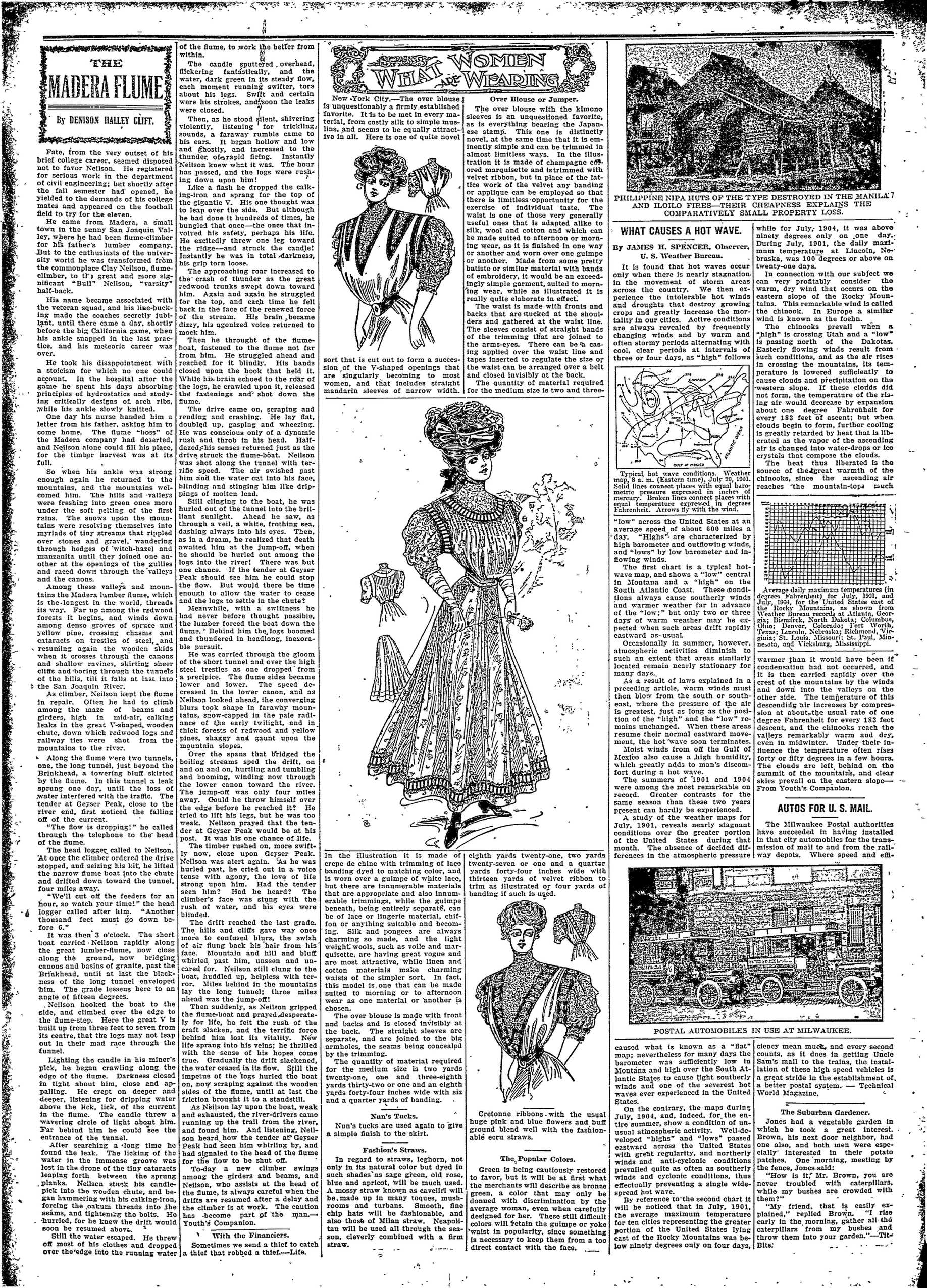
PHILIPPINE NIPA HUTS OF THE TYPE DESTROYED IN THE MANILA AND ILOILO FIRES—THEIR CHEAPNESS EXPLAINS THE COMPARATIVELY SMALL PROPERTY LOSS.
PHILIPPINE NIPA HUTS OF THE TYPE DESTROYED IN THE MANILA AND ILOILO FIRES—THEIR CHEAPNESS EXPLAINS THE COMPARATIVELY SMALL PROPERTY LOSS.
POSTAL AUTOMOBILES IN USE AT MILWAUKEE.
WHAT CAUSES A HOT WAVE.
By JAMES H. SPENCER, Observer,
U. S. Weather Burcau.
It is found that hot waves occur only when there is nearly stagnation in the movement of storm areas across the country. We then experience the intolerable hot winds and droughts that destroy growing crops and greatly increase the mortality in our cities. Active conditions are always revealed by frequently changing winds and by warm and often stormy periods alternating with cool, clear periods at intervals of three or four days, as "high" follows
Typical hot wave conditions. Weather map, 8 a.m. (Eastern time), July 20, 1901. Solid lines connect places with equal barometric pressure expressed in units of mercury. Boston lines connect places with equal temperature expressed in degrees Fahrenheit. Arrows fly with the wind.
"low" across the United States at an average speed of about 600 miles a day. "Highs" are characterized by high barometer and outflowing winds, and "lows" by low barometer and inflowing winds.
The first chart is a typical hotwave map, and shows a "low" central in Montana and a "high" on the South Atlantic Coast. These conditions always cause southerly winds and warmer weather far in advance of the "low"; but only two or three days of warm weather may be expected when such areas drift rapidly eastward as usual.
Occasionally in summer, however, atmospheric activities diminish to such an extent that areas similarly located remain nearly stationary for many days.
As a result of laws explained in a preceding article, warm winds must then blow from the south or southeast, where the pressure of the air is greatest, just as long as the position of the "high" and the "low" remains unchanged. When these areas resume their normal castward movement, the hot wave soon terminates.
Moist winds from off the Gulf of Mexico also cause a high humidity, which greatly adds to man's discomfort during a hot wave. The summers of 1901 and 1904 were among the most remarkable on record. Greater contrasts for the same season than these two years present can hardly be experienced. A study of the weather maps for July, 1901, reveals nearly stagnant conditions over the greater portion of the United States during that month. The absence of decided differences in the atmospheric pressure
POSTAL AUTOMOBILES
caused what is known as a "flat" map; nevertheless for many days the barometer was sufficiently low in Montana and high over the South Atlantic States to cause light southerly winds and one of the severest hot waves ever experienced in the United States. On the contrary, the maps during July, 1904, and indeed, for the entire summer, show a condition of unusual atmospheric activity. Well-developed "highs" and "lows" passed eastward across the United States with great regularity, and northerly winds and anti-cyclonic conditions prevailed quite as often as southerly winds and cyclonic conditions, thus effectually preventing a single widespread hot wave.
By reference to the second chart it will be noticed that in July, 1901, the average maximum temperature for ten cities representing the greater portion of the United States lying east of the Rocky Mountains was below ninety degrees only on four days,
while for July, 1904, it was above ninety degrees only on one day. During July, 1901, the daily maximum temperature at Lincoln, Nebraska, was 100 degrees or above on twenty-one days. In connection with our subject we can very profitably consider the warm, dry wind that occurs on the eastern slope of the Rocky Mountains. This remarkable wind is called the chinook. In Europe a similar wind is known as the foehn.
The chinooks prevail when a "high" is crossing Utah and a "low" is passing north of the Dakotas. Easterly flowing winds result from such conditions, and as the air rises in crossing the mountains, its temperature is lowered sufficiently to cause clouds and precipitation on the western slope. If these clouds did not form, the temperature of the rising air would decrease by expansion about one degree Fahrenheit for every 183 feet of ascent; but when clouds begin to form, further cooling is greatly retarded by heat that is liberated as the vapor of the ascending air is changed into water-drops or ice crystals that compose the clouds. The heat thus liberated is the source of the great warmth of the chinooks, since the ascending air reaches the mountain-top much
Average daily maximum temperatures (in degrees Fahrenheit) for July, 1901, July, 1904, for the United States east of the Rocky Mountains, as shown from Weather Bureau records at Atlanta, Georgia; Bismarck, North Dakota; Columbus, Baxter, Colorado; Fort Worth, Texas; Luncoln, Nebraska; Richmond, Virginia; St. Louis, Missouri; St. Paul, Minnesota, and Vicksburg, Mississippi.
warmer than it would have been if condensation had not occurred, and it is then carried rapidly over the crest of the mountains by the winds and down into the valleys on the other side. The temperature of this descending air increases by compression at about the usual rate of one degree Fahrenheit for every 182 feet descent, and the chinookes reach the valleys remarkably warm and dry, even in midwinter. Under their influence the temperature often rises forty or fifty degrees in a few hours. The clouds are left, behind on the summit of the mountains, and clear skies prevail on the eastern slope—From Youth's Companion.
AUTOS FOR U. S. MAIL
The Milwaukee Postal authorities have succeeded in having installed in that city automobiles for the transmission of mail to and from the railway depots. Where speed and eff-
IN USE AT MILWAUKEE.
clencency mean much, and every second counts, as it does in getting Uncle Sam's mail to the trains, the installation of these high speed vehicles is a great stride in the establishment of a better postal system. — Technical World Magazine.
The Suburban Gardener.
Jones had a vegetable garden in which he took a great interest. Brown, his next door neighbor, had one also, and both men were especially interested in their potato patches. One morning, meeting by the fence, Jones said: "How is it, Mr. Brown, you are never troubled with caterpillars, while my bushes are crowded with them?" "My friend, that is easily explained," replied Brown. "I rise early in the morning, gather all the caterpillars from my bushes and throw them into your garden."—Tit-Bits;
PUBLISHED EVERY SATURDAY.
BY THE TRIBUNE PUBLISHING CO.
116 W. St. Julian Street.
Bell 'Phone 8171.
SUBSCRIPTION RATES.
One Year.....$1.25
Hix Months.....75
Twelve Months.....50
Remittance must be made by Express
est Office Money Order. or Registered Letter
advertising Rates given on application.
SATURDAY, JULY 13, 1907.
The Georgia legislature showed good sense in refusing to unseat Hon. W. H. Rogers, the only colored member of that body.
EQUAL accommodation on the rail roads, is what the inter state commerce commission says that must be accorded passengers. Who will see that it is enforced?
The prohibition fight was hotly waged during the week. Unless sentiment greatly changes, Georgia will surly become a dry state, in name it not indeed.
The daily papers have but very little to say about the trouble brewed, by the South Carolina and Kentucky troops at the Jamestown Exposition. But if they were colored soldiers
THERE are several roads in the State, notably the Central, that fail to give equal accommodation to colored patrons. On many of their cars there is no smoking apartments or other accommodations as accorded the other race.
WE have been advocating the establishment of a shoe store; we now have three. Let there be no more at present, but let us all join in patronizing them and cause them to grow: Now we want a clothing and gent's furnishing store.
But a few of our voters have registered. This is a matter that should not be delayed The colored men of Chatham County must not be behind those of other counties in be coming qualified. If they come up lacking it will not be because THE TRIBUNE has failed to call attention continuously to the necessity of registration. Do not delay; register to day.
This time a member of the legal ture wants no white person to instruct colored children, or vice versa. This will entail no handship whatever on us. There is nothing but pure "cusdness" in this bill. It is aimed solely at the higher institutions of learning in the State where white instructors are employed.
Gallant Knights and Fair Calantheans Bombard Augusta.
Several thousand gallant knights and fair Calantheans with hundreds of other visitors captured Augusta during the week, the occasion being the annual meeting of the Knights of Pythias Grand Lodge, the Grand Court of Calanthe and en campment of the uniform rank
The exercises begun on Tuesday day morning by the welcome exercises at Haines institute. Over a thousand persons were present and called to order by Grand Chancellor C D Cres will. who called upon Hon H. M. Porter to introduce Mayoi Dunbar of Augusta who gave a ringing address of welcome This was responded to by Capt C S. Williams of Waynesboro The welcome on behalf of the local knights was delivered by Rev C H. Tobias and responded to by Rev. M. B. Alston of Newnan. The uniformed men's welcome was given by Capt. T J. Walker, responded to by Col. H G Nixon of Savannah. The Calantheans were made welcome by Sir Julian Sweet, and accepted by Miss A P. Mason of Vidalia. In behalf of the citizens, Rev. C T. Walker made an address which was responded to by Rev W. H Holloway of Thomasville. The annual address was a gem, delivered by Rev. W. D. Johnson, D. D., of Bainbridge The entire program was of high order and enjoyed by all present.
In the afternoon a large parade of the uniform ranks headed by Drs. G. N. Stoney and H. R Butler, was made. It was the largest parade since the great military carnival held there over fifteen years ago when the First Battalion of Savannah with six companies, the Second Battalion of Atlanta with four
companies, the Third Battalion of Augusta with five companies, and several other independent companies paraded under command of Gen'l Isaiah Blocker. The parade was indeed a creditable one and was followed by the officers and many ladies in carriages. At night the past chancellor's degree was conferred on many. Memorial services were held at Tabernacle church and several social functions were had in honor of the visitors. Wednesday morning th e Grand Lodge went into executive session. The reports of the officers rendered and referred.
In the afternoon. the prize drill took place at the Georgia-Carolina Fair grounds. It was witnessed by about three thousand persons. Savannah was there in all of its glory and Joshua company carried off the first prize. Wednesday night an all night session of the Grand Lodge was had listening to the several reports and attempts to "pull off" the election, though this was not had until Thursday after which the session closed after miscellaneous business was finished. Grand Chancellor Creswill and all of the officers were re elected unanimously.
The Grand Court was largely attended and conferred the past degree on a larger class than ever before. This branch under the wise direction of Grand Worthy Counsellor, Mrs R. L. Barnes, has prospered wonderfully.
One of the features of the gathering was the encampment of the uniformed ranks. Tents were prepared for them and they were pitched in the grounds of Haines Institute Through the courtesy of Miss Laney principal of the institute, the doors of all the buildings were thrown open to the Knights.
Everybody join in remarking that this was the best session ever held by the order despite the fact that plenty of "hot air" was gotten off.
St. Helena Island.
St. Helena is one of the most progressive of the sea islands of South Carolina. This was perceived by a visit made there last week by Messrs. L E. Williams, P. E. Perry, Dr. J. H Bugg, and a TRIBUNE representative. Several miles of the island were traversed and along which were well cultivated on both sides, sea island-cotton and coin predominated. Nearly every foot of ground along the roads was under cultivation and in excel lent condition. The crops showed up well, and compared more favorably than those seen elsewhere. The majority of the houses of our people ate well kept, buildings large, neatly painted or white washeu, which shows intelligent progressiveness. Nearly this entire island is owned by our people; only a few white families reside thereon. Of all the farms seen, the great exception was one owned by a white man which was not under cultivation
The occasion of the visit to the island was the annual fourth of July excursion given by the Mutual Club under the management of Capt. J. S. Starr of this city and Capt. A. Brown of St. Helena. Capt Brown is one of the most prominent citizens of the island. He has a palatial home and is highly respected by his fellow citizens. The excursion was a great success. Over six hundred persons went. Despite the mixed crowd the order was good. The entire affair was well managed by Capts. Stair and Brown who know well how to handle such a crowd. D spite the rain, everybody had a good time.
Bethlehem Baptist Church
Services were well attended all day nunday last at Bethlehem Baptist Church.
Preaching at 11 a.m and 8:30 p.m. by the pastor.
At 3:30 Sunday School well attended. At 4:30 the Y M. C. A. met and carried out a wonderful program.
On July 16, 1907 there will be a grand excursion for the benefit of Bethlehem Baptist Church; is going to the beautiful little town of Beaufort, S. C. T. You will witness the scene of your forefathers graves, who are sleeping under the shady groves. The swift steamer Pilot Boy has been chartered for the trip and will leave foot of Whitaker St at 8:30 o'clock. Fare round trip 50 cents, children under twelve 35 cents. Come all and go with us and enjoy yourselves.
Second Baptist Church.
Second Baptist Church. Good congregations have been attending the services this week. Pastor May preached at both hours Sunday. The sick list is not as large as usual, with two deaths recorded, Zack Cade and old Sis eg Habersham. The pastor attended both funerals. He was assisted in the Cade funeral by Rev. Priester of Mill Haven, Ga. The Sunday School Convention has appointed chorist-chaer Fas. Warers as its delegate to the State Sunday School Convention at Rome Ga. The church has made out a fine list of delegates to the Berean Association. Several more of our members are preparing to leave shortly for New York and Boston. Pastor May will preach at both hours Sunday. Morning subject, "Being your real self." Night subject, "Satan's
Plan," Commission at 4 o'clock sharp.
All members who yet hold rally cards are urgently requested to turn them in to morrow without fall. Everybody invited to attend to morrow services here
Birthday Celebration Program
Program of the fifty-seventh anniversary of the birth-day of Rev. E K. Love,
D. D., F. A. B. Church, Monday July 29,
1907.
THE CHRISTIAN CHURCH OF THE UNION OF CHRISTIAN CHURCHES IN THE STATE OF NEW YORK
Commencing at 3 p.m.—Devotional services led by Rev D. W. Cannon, pastor of Beth-Eden Baptist Church. Prayer by Rev. P. M Hunter. Music by the choir. Address by Prof. L. B. Thompson of College Ga. , subject, "Love, a friend to his race." Music by the choir. Address by Rev. J. H. May, pastor of the second Baptist Church, subject, "Love, denominational leader."
Duet by Miss Janie Johnson and Mrs.
C. F. Gilmore
At 8:30p. m.—Devotional services led by
Rev. N. H. Whitmore, pastor of
Tabor Baptist Church,
Prayer by Rev. M. Battle,
Address by Prof. J. M. Nabrit of Macon,
Ga., subject "Love as a leader."
Nolo and chorus by Miss J. Johnson and others.
Bass Solo Mr. F Johnson.
Addres-s by Professor W. L Hughes, of Dublin, Ga., subject "Love as an Educator."
Duet by Miss Janie Johnson and Mrs.
C E. Gilmore.
Music by the choir.
Collection.
Adjournment.
Rev. J. W. CARR, D. D., M. of O.
E. K. L. B. A.
LEE GILMORE, President.
C. H. PETTERSON, Secretary.
The Board of Committee, Rev. J.
Harris, Chairman.
For Sale.
$65 Bond, good on purchase of piano from Ludden and Bates Southern Music House for sale for $25. Apply to H. Tibbitt Office.
Legal Notice.
Georgia,
Chatham County.
NOTICE IS HEREBY GIVEN to all persons having demands upon the estate of J. P. Sherman late of said county, deceased, to present them to me properly made out, within the time prescribed by law so as to show their character and amount; and all persons indebted to said deceased are required to make immediate payment to me.
A. L. TUCKER, Administrator Savannah, Ga., June 18, 1907.
A New Sunbonnet Series.
Beginning July 28, The Sunday World will start a new series of the famous Sunbonnet Pictures. The new series presents the Sunbonnet Babies, Fishing, Ironing Scrubbling. Then there will be the Sunbonnets in a new gulse. The first picture will be "The Proposal," the n-xt "The Honeymoon." These will be followed by other art supplements, both unique and beautiful.
Savannah, Ga. June 15th, 1907
Notice is hereby given the public that on account of Reserve and accumulated profits of this company amounting to more than 50 percent of the paid in capital, the Board of Directors has ordered that from and after July 15th, next, stock in this company will be sold at the rate of Fifteen (.5) Dollars per share.
THE WAGE EARNERS
LOAN AND INVESTMENT Co.,
L. E. Williams, President.
Notice.
Having acquired an interest in the Johnson Undertaking Establishment I wish to announce to my friends and the public that I will thank them for all future patronage as in the past. All work will receive prompt attention. Bell Phone 76. W. B. BROWN, 325 Jefferson Street.
Willie H. Johnson,
The Leading Grocer
Fine Stock of Groceries
and Confectioneries,
Also MANUFACTURER of
Caudies and Ice Cream. Good
Profit is made on Johnson's
Ice Cream.
Special Prices on large orders.
Hell Phone 3728
Cor. Cuyler and Duffy Sts.
Special Notice to Ladies
When your Sewing Machines
get out of order—skip stitches—
breaks thread or runs heavy. Call at
New Home Office
Corner Barnard and York Street. And ask for ELIJAH J. QUARTERMAN, Expert Adjuster.
In memory of our mother
KATE WILLIAMS,
Who died July 11, 1906.
Dearest mother, thou hast left us;
And thy loss we deeply feel
But 'tis God that hast bereft us;
He can all our sorrows heal.
Triumphant in the closing eyes
The hope of glory shone;
Joy breathed in thy expliring sigh,
To think the race was run.
Far from this world of toil and strife,
You're present with the Lord;
The labors of thy mortal life
End in a large reward.
Your pain's o'er
Labor and sorrow cease,
And life's long warfare closed at last
Thy soul is found in peace.
Farewell dear mother, thou art gone to the
grave!
And we shall not deplore the,
Slace God was thy ransom, thy guardian
and guide.
He gave thee, He took thee and He
will restore thee; and death has no sting
for the Saviour hath died.
Her Children,
JULIA C. WOODRUFF.
THOMAS L. WILLIAMS
Petition for Incorporation.
State of Georgia.
County of Chatham.
To the Superior Court of said County:
The petition of George W. Smith, James T. Smith, J. H. King and E. E Green, all of said County and State, respectfully shows:
1. That petitions and such other persons that may hereafter become associated with them and their successors desire to be incorporated under the name of the SAVANNAH PHARMACY COMPANY for a term of twenty (20) years with the privilege of renewal at the expiration of that time.
2. That the object of their association is individual and pecuniary gain and the particular business they propose to carry on is the buying and selling of wholesale and retail drugs, proprietary remedies, patent medicines, perfumes, soaps, novelties, druggists sundries, seeds and other merchandise and personal property of all kinds.
3. That they ask the corporate right and authority to acquire, own, and use receipts and formulae for the manufacture of medicinal preparations and proprietary medicines.
4. That they further ask the corporate right and authority to purchase, hold and convey any real and personal property that may be convenient or necessary for the accomplishment of the object and purposes aforesaid, to execute notes, bonds and other evidences of indebtedness and to secure the same by deed, mortgage or other lien, to sue and be sued, to make rules and by laws not inconsistent with the laws of this State, or of the United States and generally to have and exercise all the privileges incident to private corporations-created under the laws of the State of Georgia.
5. That the amount of capital to be employed by them is five thousand ($500,000) dollars divided into shares of one hundred ($100,000) dollars of which ten (10) per cent is actually paid in, but petitioners desire the right however, to increase its capital stock to fifty thousand ($50,000.00) dollars.
6. That the principal place of business of said corporation shall be in the city of Savannah, County of Chatham and State of Georgia, but petitioners desire the right and authority to establish branch houses or agencies in other cities or towns in the State of Georgia or in other States of the United States as the same may be deemed advisable.
Wherefore, petitioners pray that they be incorporated and made a body corporate under the name and style aforesaid with all the rights, privileges and immunities and subject to the liabilities fixed by law, and to have all the usual and incidental powers given to corporations under the laws of the State of Georgia.
Petitioners Attorney.
Original filed in office June 14, 1907.
James L. Murphy, Dep. Clerk, B. C. C.
C. Georgia.
A New Pharmacy The People's Pharmacy
A New Pharmacy The People's Pharmacy
809 West Broad St.
Prescriptions carefully compounded
Drugs Toilet Articles and Sundries.
Candles, Soda Water and Ice Cream.
J. F. Ford, Prop.
Styles' Park Open
FREE FREE FREE
To Societies, Lodges
and Clubs for
PICNICS AND OUTINGS
For general information, apply to
H. W. MANN, Agent,
551 Liberty Street. east.
The People's Transportation
Wagonettes leave Henry and
East Broad every Sunday at 4
o'clock p. m., until further
notice
G. James
17 Randolph Street, corner of
Jackson Street.
Beef, Pork, Veal and Foultry;
Also carry a fine line of Grooer ies, Cigars, Tobacco, etc. Prompt attention will be given to all patronage.
Edw. T. F. Smalls
NOTARY PUBLIC.
Bonds, Deeds, Wills, Transfering o
Stock, and all work that is allowed by
law to the office of a Notary Public.
Bell Phone 2600
309 Henry St. W.
Savannah, Ga.
SEE HOW WE GROW
Commenced Business
October 5, 1900
October 5, 1901
October 5, 1902
October 5, 1903
October 5, 1904
October 5, 1905
October 5, 1906
This steady growth shows confidence of the p
BECAUSE we show visible evi with the funds intrusted with us for it have built or bought for them.
BECAUSE the people have full composes our Board of Directors
BECAUSE our company is a stric being used exclusively for the better.
BRING Us YOUR DEPOSIT compounded quarterly. The have paid 12 per cent divi
The Wage Earners H
The Pioneer Negro
Bell 'Phone 1198.
W. M. GBAY, 1 res..
D. W: OSBORNE, Treas.,
The Afro Union Saving, I
(Income)
CAPITALIZE
216 Whitaker St
THIS C
Is now open for business. D following favorable rates upon 5 Per
Interest will be paid upon DE upon all ANNUAL Deposits.
MONEY
Upon Negotiable Notes and R governing such Transactions!
OF THE H
The Company has a few more per Share. After Stock is paid not less than 8 per cent.
JULIAN SMITH, Pres.
Union Benef
y growth shows that this company confidence of the public; BUT WHAT we show visible evidence of the good we are intrusted with us for investment in more than sought for them. E the people have full confidence in the twelve Board of Directors our company is a strictly HOME institution, ususively for the betterment of Savannah people. Us YOUR DEPOSITS. We pay 5 per cent and quarterly. Take some stock w 12 per cent dividends for the past
The Earners Loan & Investors Pioneer Negro Savings Bank of C Phone 1198. 468 West
The Afro-America Saving, Loan & Tr (Incorporated) CAPITALIZED AT $5,000.00 Whitaker St., Savannah THIS COMPANY for business. Depositors being fairer rates upon all deposits. 5 Per Cent. be paid upon DEMAND Deposits. NUAL Deposits.
MONEY LOANED onuable Notes and Real Estate subject to such Transactions! We solicit the Pa OF THE PUBLIC y has a few more shares of Stock for After Stock is paid up, Stock holder 8 per cent.
This steady growth shows that this company has the confidence of the public; BUT WHY?
BECAUSE we show visible evidence of the good we do for our people with the funds intrusted with us for investment in more than 100 homes we have built or bought for them.
BECAUSE the people have full confidence in the twelve good men that composes our Board of Directors.
BECAUSE our company is a strictly HOME insitution, and all of its funds being used exclusively for the betterment of Savannah people.
BRING Us YOUR DEPOSITS. We pay 5 per cent interest compounded quarterly. Take some stock with us. We have paid 12 per cent dividends for the past four years.
The Wage Earners Loan & Investment Co.
The Pioneer Negro Savings Bank of Georgia.
Bell 'Phone 1198. 468 West Broad St.,
W. M. GBAY, Ires. A. L. MONGIN, Vice-Pres.
D. W. OSBORNE, Treas., JOHN D. SAVAGE, Geh'l-Mgr.
The Afro-American Union Saving, Loan & Trust Co.
Is now open for business. Depositors being favored with the following favorable rates upon all deposits.
5 Per Cent.
Interest will be paid upon DEMAND Deposits: 7 per cent upon all ANNUAL Deposits.
MONEY LOANED
Upon Negotiable Notes and Real Estate subject to the Rules governing such Transactions! We solicit the Patronage
OF THE PUBLIC
The Company has a few more shares of Stock for sale at $5.00 per Share. After Stock is paid up, Stock holders will receive not less than 8 per cent.
The Benefit Assoc
Union Benefit Assocation.
(Incorporated—Charter Perpetual)
The leading insurance company in young men and women than any other. The UNION BENEFIT ASSOCIATE is the first home insurance company on Founded, built, owned and controlled. Every policy is backed up by a deal. When you take out a policy with you have made a safe investment. She is striving now to place her p
Shrewd and energetic.
Call and see us at 20 STATE S
GEO. W JACOBS
Union Saving
AUTHORISED O
Stock $1 25 per share.
A clean record, splendid directors of able business men; conducts a thriving cent on deposits.
The UNION SAVINGS s
cord. We desire the accounts.
Social Clubs. Get in line with the race and stand by Negro
UNION SAVINGS &
20 State
THE OLDEST
The Royall Un
INCORP
Funeral Directors
Only First Class Se
—Respectful
OUR STOCK OF CASES
COFFINS, R
Bell
Phone 887 319 Ogle
MANA
Insurance company in the gouth. Giving empire women than any other company of like benefit, BENEFIT ASSOCIATION is the peoples of insurance company of its kind in this city. owned, owned and controlled entirely by Negro many is backed up by a deposit of $5,000 with the take out a policy with the UNION BENEFIT A safe investment. Now to place her policies in every State in and energetleagents are wanted us at 20 STATE STREET, W. Belie SEO. W JACOBS, General Manager.
TON Savings & Loan AUUTHORISED CAPITAL $50,000. per share. Unparal record, splendid showing, managed stable business men; looks after the products a thriving SAVINGS BANK units.
TON SAVINGS solicits your account desire the accounts of Firms, Lodges, Get in line with the thinking men and stand by Negro Concerns.
TON SAVINGS & LOAN COMPANY 20 State Street, W.
THE OLDEST OF THEM Aroyall Undertaking INCORPORATED. Directors and Emb
First Class Service Render-Respectful Attention.
CK OF CASKETS, OFFINS, ROBES, Etc, is 319 Oglethorpe Ave MANAGERS
Founded, built, owned and controlled entirely by Negro_men of the city. Every policy is backed up by a deposit of $5,000 with the State Treasury. When you take out a policy with the UNION BENEFIT ASSOCIATION you have made a safe investment.
She is striving now to place her policies in every State in the union! Shrewd and energetic agents are wanted.
Union Savings & Loan Co.,
Stock $125 per share. Unparalleled Success. A clean record, splendid showing, managed by a board of directors of able business men; looks after the interest of the people; conducts a thriving SAVINGS BANK; pays 7 per cent on deposits. The UNION SAVINGS solicits your account upon its record. We desire the accounts of Firms, Lodges, Societies and Social Clubs. Get in line with the thinking men and women of the race and stand by Negro Concerns. UNION SAVINGS & LOAN COMPANY, 20 State Street, W. THE OLDEST OF THEM ALL
The Royall Undertaking Co.
Only First Class Service Rendered With
—Respectful Attention.—
OUR STOCK OF CASKETS,
COFFINS, ROBES, Etc., is Complete
Bell Phone 887 319 Oglethorpe Ave., West
MANAGERS
W S ROUNDFIELD,
Residence 523 Anderson St., E.
Bell Phone 3572
C H ROYLL,
Residence 712 Gwinnett, W.
Bell Phone 641.
TO BUILD THAT HOUSE
AND SAVE MONEY,
SEE
E. W. BURT.
Reversable
BADGES
Caryenter&Builder, 110 BRYAN STREET,W Bell Phone 1131.
Noble's SHOE EXCHANGE First-class Work
SECOND-HAND SHOES
SOLD, BOUGHT OR EXCHANGED.
Work called for and delivered:
409 Jefferson St. Bell phone 8470
---
GEO. W. JACOBS, Gen'l Mgr. The it Assocation.
the south. Giving employment to man
company of like benefit.
ATION is the peoples favorite, since it
its kind in this city.
Lled entirely by Negro men of the city.
Deposit of $5,000 with the State Treasury.
THE UNION BENEFIT ASSOCIATION
policies in every State in the union;
agents are wanted.
STREET, W. Bell Phone 232
, General Manager.
Bags & Loan Co.,
CAPITAL $50,000.00.
Unparalleled Success.
showing, managed by a board of
; looks after the interest of the
SAVINGS BANK; pays 7 per
publicicits your account upon its re-
of Firms, Lodges, Societies and
the thinking men and women of
Concerns.
LOAN COMPANY,
Street, W.
OF THEM ALL
Undertaking Co.,
ORATED.
S and Embalmers.
Service Rendered With
Attention.—
TICKETS,
OBEES, Etc, is Complete
Wethorpe Ave., West
AGERS—
C H ROYLL,
Residence 712 Gwinnett, W.
Bell Phone 641.
Reversable
BADGES
---
The Savannah Trilinn
SATURDAY, JULY 5, 1907.
Mr. Murray Monroe left on Wednesday for New York, via Atlantic Coast Line, on a vacation of 15 days.
Miss Lizzie Johnson of Daytona, Fla., is spending a few weeks with her parents, Mr. and Mrs. Payne of Dittmersville.
Mrs. O. Guerard left Friday on the Kansas City for New York, where she will spend the summer with relatives and friends.
Mrs. J. T. Harris and Mrs. Lucinda Simmons returned from Columbus on Thursday after spending a very pleasant week.
Room to rent, furnished or unfurnished, in a nice family, G15 E. Henry street, Mrs. A. E B-now.
Mr. R. F. Crittendon an old Savannah boy who is now residing at Live Oak, Fla., was in the city last Saturday and gave us a call.
Mrs. John M. Brown of 632 Mercer street left on Wednesday for Brooklyn, New York, to spend the summer with her mother-in-law Mrs. O. Williams.
Miss Carrie J. Willis spent a delightful day down on Staten Island taking in many of the South Beach amusements. She was accompanied by Mr. James O. Trotman.
Mr. and Mrs. E. N. Sullivan who are now residing at Atlantic City, N. J., along with their relatives and friends in the city are rejoicing. over the advent of a fine daughter.
Prof. Edward G. Williams of Lane College, Jackson, Tenn., arrived in the city on Tuesday to spend his vacation with his parents and friends. He is looking well and reports a successful College term. Mrs. M. A. Gipson, formerly of this city but now residing at Jacksonville, Fla., is spending a few weeks in the city the guest of Mrs. F. M. Green. The ladies gave us a pleasant call on last week.
The members and many friends of Rev. G. W. Griffin, D. D., pastor First B. B. Church were glad to see him out on last Sunday night. He is rapidly recovering after an illness of about two months.
Mrs. Rachel May and Mrs. Luella Green, mother and si ter of Dr. May pastor of Second Baptist Church, left the city Wednesday night for their home Nashville, Tenn. They both spent last Sunday in Jacksonville, Fla., in company with Mrs. Nancy Warthen. Mr. D. S. Larsheay and Miss Ida L. Mayrant announces their marriage which took place March 25th, 1907. They are now happily domiciled at 527 Ea-t Gwinnett street. Their friends wish them a happy and prosperous life.
Mr. W. H. Welburn, died on Friday evening of last week at the residence of his sister Mrs. J. F. Hatch er 419 34th, street, west after an illness of several weeks and was buried from there on Sunday afternoon at 4:30 o'clock. Rev. Wm. Gray, officiating.
St. Stephen's Episcopal Church Habersham between Harris and Macon streets. Services: Sunday School 10 a.m. church services at 11 a.m. and 8 p.m., Wednesday at 8 p.m. Hymns that everybody can sing Short sermons, all pews free, everybody welcome.
Mrs. J. H. Law accompanied by little John H., Jr., will have to morrow morning for Macon, where she will go to join her mother, Mrs J. H. Hami tou who is spending a while in that city. From Macon, they will go to Atlanta to visit relatives and friends.
Rev. R. H. Thomas left on Wednesday for New York and Massachusetts and will be away several weeks. He will take a short course in Sunday School and ministerial work at the Northfield Conferences and Summer School of East Northfield, Mass, to better fit him in his duties along those lines in which he now labors.
Don't fail to attend the Young Men Christian and Literary meeting at 4 o'clock Sunday July 21st Subj-ct "Christian Strength". Quartett by Mrs. Witfield, Mrs. Emma Dennis and Messrs. John Whitfield and Geo. W. Heyward from F. B. B. Church choir. Installation of officers will take place at 5 o'clock Mrs. F. A. Mercherson and Mrs. R. E. Wright will install the officers of the Y. M. and L. C. C.
The private school of Mrs. Emma R. Dennis and Mrs. Julia C. Woodruff closed on the 26th of June at the hall corner of York and Lumber streets with very appropriates exercises. The children acted well their parts both in singing and to the enjoyment of the many parents and friends present. The exercises closed with dancing and refreshments. These two schools are doing much good in this section of the city and the parents who for the lack of accommodations in the public schools were fortunate in getting their children in these private schools are loud in their praise to these ladies for the care and patience exercised with their children in their studies.
Mr. W. R. Fields is now back with the Johnson Undertaking Establishment 332 Jefferson St., as one of the managers. 6-6-4t
A New Business Ventures.
The dispatches during the week announced that the Secretary of State had issued a Charter to D. O. Sugge, L. S. Reed, F. M. Bell and others to conduct a fire insurance business. The Company will conduct business at its office at 20 State street West and will co-operate throughout the state and south. This is a new field of business venture for the Negro and its projectors deserves credit for the foreseen and enterprise thus manifested. They will begin business at once, and will thus afford opportunity for giving protection to many of our homes, household fixtures, lodge rooms and churches that have formerly been deprived of such insurance. They will also give employment to a great many worthy boys and girls of our race and thus aid them to make an honorable living. We believe these advantages will be appreciated by our race, and the company will be the means of great benefit to our people.
First Bryan Baptist S. S.
The First Bryan Baptist Sunday School will convene at 4 o'clock.
On account of the warm weather the lessons will be taught by the superintendent until 4:30 when song service will commence including the reading of papers and the promotion of scholars. Misses Arebella Thomas, Georgia Beliar, Etta, Williams, Neuzatta Lowe and Denie Philips will be promoted to the senior class a D Miss Carrie Belle Colea to the advanced class. All those promoted will receive certificates from the Supt. The school wishes to note that under the assistant Supt., it made wonderful progress. He has his whole heart and mind in the work and is always doing something for the up building of the school. They further more wish to state since the school has been in his charge it has increased to twice its number, numbering 400 scholars. The public is invited. Your attention is called to August 6th, they are going to Daufuskie and ask friends and sister schools to go with them. Reserve the above date so that you wont forget, Steamer Clifton leaye at 9 o'clock sharp. G. W. Heyward, Chairman; P. I. Small, Asst. Supt., Rey. G. W. Griffin, D. D., pastor.
The Chatham Orphan Home.
We are glad to announce to the public that the home is getting along nicely. We are under many obligations to the many friends for the liberal support, and more so to the different churches of the city and the pastors especially the First B. B. Church of our city. She makes it her duty to give us a donation every month. We have had some good solicitors especially Mrs. Laura Jones and appreciate all they have done. Would like to have it understood that the Board of Trustees command the movement of the home and not mothers. We have no mother for the Chatham Orphan Home. Our President Rev. G. W. Griffin has been sick for four months and could not give the home the proper attention. We are thankful that the Lord has brought us safe thus far. We hope to give a full detail of our work in the next issue of this paper.
Yours
Rev, G. W. Griffin, Pres.
H. B. Wright, Sec.
Y. M. C. A.
Subject to-morrow "But let us who are of the day be sober, putting on the breast plate of faith and love and for a helmet, the hope of Salvation." Address by Mr. W. O. P. Sherman, Jr., Subject "Be, Do, Have." Music, Quartett, Paper by Mr. J. Gathers, Music Instrumental subject July 21, "Pray without ousing" "Quench not the spirit" The meeting last Sunday will be long remembered. The young men handled the prohibition question without gloves. They took a firm stand against intoxicating beverages. Bring your bibles. All are cordially invited to be present Sunday at Harris street hall, 5 p. m
Minister's Union.
Although the weather was unusually warm; the Evangelical Ministers Union assembled in regular session at St. Philip A. M. E. Church with Rev. J. A. Lindsay presiding. Rev. E. Lowery led the devotional services and Rev. Jankins acted as secretary as the secretary was absent. Strong sermonic discourses were delivered by Revs. Jackson and E. Lowery. The remarks of Revs. B. S. Hannah, L. W. McMillan, W. L. Cask, P. J. Jaskins, G. H. Lenon and that other disciple were quite helpful. The union passed strong resolutions in favor of prohibition and sent a copy of the same to the general assembly by Rev. Dr. Ainworth. It placed itself on record against whiskey and barrooms and urged the passage of the bill pending before the legislature. It also passed resolutions urging and pledging influence among our people to register and pay taxes. The Union was lively and pointed on these great questions.
Special Notice
To owners of lots in Laurel Grove Ge-
meterary colored: I hereby notify said owners
that lots owned by them in the old' por-
tion, that has no identification must be
cared for atonce or they shall be used as
strangers ground.
H. WILLIS. Keeper
BELL PHONE 8470.
409 JEFFERSON STREET;
Early Closing on Saturdays!
Our patrons are asked to bring in their work a little earlier in the week during the hot summer months in order that we may be en able to give our printers a part of each Saturday for recreation. This will be done commencing with to day. A compliance with this request will be greatly appreciated.
AMUSEMENT COLUMN.
Coming Events in The Social World.
A grand 2 boats excursion will be given to Beaufort by Mt. Sneir Lock No 2441, G. U. O. of O. F., Tuesday July 23rd. Tickets 50 and 25 cents.
A grand entertainment will be given at Duffy street hall, by the Ivory Leaf Pleasure Club Monday night July 15th. Tickets 15 and 25 cents.
Mt. Bethel Baptist Church and the Star of Bethel will give a grand excursion to Beaufort, S. C., Monday July 29th. Tickets 50 and 35 cents.
Golden Star Lodge No. 129 I. O. G. B. and D. of S. U. S. A., will give a grand excursion to Beaufort Monday night July 15th. Tickets 50 and 35 cents.
The Fairmont Aid and Social Club will give a grand excursion to Bluffton S. C., Sunday July 21st. Tickets 50 cents.
Attend the Auction sale of Savannah Pearls Fountain at the residence of Mrs. Mary J. Wright, 912, Atlantic Avenue Monday July 15th. Tickets 10 cents.
The third annual dance of the H. P. A. and S. Club at Harris street hall, Monday night July 15th. Tickets 25 and 40 cents.
The Colonial Pleasure Club will give a swell dance at Masonic Temple Monday night July 22nd. Tickets 25 and 40 cents. A grand combination excursion will be given for the benefit of Bethlehem Baptist Church to Beaufort Tuesday July 16th. Tickets 50 and 35.
The annual outing of St Augustine's Sunday and Parochial School will take place at Styles' Park Tuesday July 16th. Tickets 50 cents.
A grand excursion will be given to Blufton by the Pilgrim Travelers of S. C. Monday July 29th. Tickets 50 cents.
A grand Picnic will be given by the Christian Pilgrim Society to Daufuske Monday July 15th. Tickets 50 cent.
The Grand Court of Hermon will give their first entertainment at Harris Street Hall Tuesday night July 16th, Tickets 25 cents
The Hackmen Social Club will give a grand excursion to Daufuske on Steamer Louise leaving Barnard street wharf 9:30 and 2:30, Monday July 15th. Tickets 50 cents.
A grand excursion to Daufuske will be given by the Young Gentlemen Independent Club, Monday August 5th. Tickets 50 cents.
A grand picnic will be given to Styles Park Monday July 15th. Tickets 30 cts, Savannah Sprouting Fountain No. 2070 U. O. T. R., will give a grand entertainment and old folks concert at Duffy street ball, Wednesday night July 31st. Tickets 15 cents.
First Tabernacle Baptist Church will give a grand excursion to Beaufort Tuesday August 6th. Tickets 50 and 35 cents.
The First African Baptist Church will give a grand excursion to St Catherine Island, Monday July 2nd. The steamers Pilot Boy and Clayton will leave at 3 o'clock a.m. Tickets 50 cents.
A grand sea breeze outing to Daufuskle by the Y. L. and G. S. C., Monday August 19th. Tickets 50 and 35 cents.
Agrand excursion will be given to Beaufort Monday August 12th by the Y. G. E. A. and S. C. Tickets 50 and 35 cents.
The E A. and S.C., are preparing to entertain their friends with a private picnic at Daufunkie Tuesday July 16, a day of real pleasure is promised their guest Those favored with invitations should not fail to secure their tickets at Savannah and West Side Pharmacies or Scott Bros. The Evening Call Athletic Club will give their second outing of the season to Bluffton August 4th. Don't fail to attend. Tickets 50 cents. Remember the grand excursion to Beaufort under the auspices of Zion Baptist Association on Monday July 22. Tickets 50 cents. Don't fall to attend the grand dance given by the Silver Eagles Aid and Social Club at Duffy Street Hall Monday July 22. Admission 15 cents, double 25 cents. The Independent A. and S. Society will give a grand dance at the Margaret Street hall Monday night July 22d. Tickets 15 and 25 cents. Don't fall to attend the Elks' grand excursion to Beaufort Tuesday July 16th. Tickets 50 and 25 cents.
A grand entertainment will be given at Margaret Street hall by Branch No. I. Woman's Auxiliary to the I. L. M. and T. A. Local No. 403 Tickets 15 and 25.
The Devine Bros. A. and B. Club No. 224 will give a grand excursion to Bluffton, Sunday August 11th. Tickets 50 cents.
Attend the grand concert given for the bainef of Mt. Zion Baptist Church at Masonic Temple, Monday night July 29. Tickets 15 cents.
Friends desiring to attend the Jackolantaer Lawn Fete, wagons will leave Taylor and Price St, commencing at 9 p. m. to Liberty to West Broad out to the Ogeechee Road to 306th St. Will return over the same route after the entertainment.
The Union Club Cedar Grove will give a grand excursion and barbecue at Abercorn Monday July 29th. Tickets 50 cents.
Attend the grand excursion to Beaufort by the K. of P. and Calanthes, Monday August 5th. Tickets 50 cents.
DR. L. S. PARKS.
DENTIST
240 Barnard St. Savannah, Ga.
Does all kind of high grade dental work of the best quality and workmanship. Gold crowns and bridge work. White Porcelain Pivot, and Gold Crowns] mounted on the natural roots. Gold Fillings, Cement Fillings, and Silver or Amalgam Fillings, from nine to a full set of tec $7.00 and $9.00 Broken Places mended and teeth added to old ones for a small cost. BellPhone 1244
Gold Crowns Guaranteed
28K K Gold
Practice largely confined to the office, makes a specialty of Disease of Women.
B. H. LEVY BRO., & CO.,
Savannah, Georgia.
STYLE AND FIT
Get THEM Right
and then You'll be Right
The Right is Here with
Us in Our
Correctly Made Ready-
for-Service Goods.
The Proof Waits You---
Try on and be Convinced
B. H. LEVY, BRO. & CO.
5 Broughton Street, West.
The Faithful Workers invite their many friends to a Jack-o'-Lantern Lawn Fete to be held at the residence of Mrs. Henrietta Richardson 2118 Harden street, Brownsville, Monday night July 16th, 1907 at 8:30. No palms or expense will be spared to make this a most enjoyable evening. The Apollo Orchestra has kindly consented to appear. This is a most inviting occasion for the fair set to display their latest styles and mush-room bats. Singing, etc., will be participated in until the wee saa' hours of the lone morning. Come with your glad rags on and leaving sorrow and care behind. An afternoon for children 4 to 8 p. m. Admission to cents, children 5 cents.
F. F. Jones,
DEALER IN
Beef - Veal - Mutton
Lamb-Pork-Hams
Bacon and
CORNED BEEF
All Kinds of GAME in Season.
All Kinds of GAME in Season. Goods promptly delivered to any part of the city free of charge.
STALL 31. CITY MARKET.
Metropolitan Mutual
In addition to our sick and death benefit policies we are offering the public industrial insurance in straight life policies ranging from $100.00 to $500.00. Premiums within the reach of all. A fair value for your money in a reputable company is what all of us are looking for. This is what we are giving. See any of our agents or call at the company's office for rates and particulars.
Energetic men and, women can make anywhere from $5.00 to 25.00 a week working for this company.
Office 526 West Broad Street, Savannah, Ga.
F. M. COHEN,
Manager.
Dr. J. W. Jamerson, DENTIST
Got to him and have your work done
Crowns, gold and white, looking like the
natural teeth. Filling gold, silver and cement. Plates, full or partial, Bridge neatly done. Extracting done with ease. All work done neatly in a neat first class place.
Provided with all modern appliances.
623 WEST BROAD STREET.
Bett Huntingdon and Hall.
Metropolitan Mercantile & Realty Company.
HAS ON THE MARKET A BLOCK OF $100,000 WORTH OF STOCK AT $20.00 PER SHARE.
There was sold in the city of New York a few days ago, $25,000 worth of Stock in one day. It is the best investment offered the public and will not be on the market long. Pays 7 per cent.
We are building those "Queen Annie" Cottages every day. Our terms are the easiest and best for the poor man and the safest for the investor. Call or write and let us talk business with you. Our proposition is worth investigation and invest ment.
Branches everywhere. Reference everybody:
P. Sheridan Ball, President. L. C. Collins, Secretary.
J. H. Atkins, Treas. W: D. Armstrong, Gen'l Rep.
J. J. Bolen, Fiscal Agent. F. M. Cohen, General Manager.
526 West Broad Street. Savannah, Ga. Bell'Phone 1144
Do you like Good Clothes?
We combine the three essentials in garment making in Clothes uamely, Quality, Style and Fjt.
Not every man knows now to make fine clothes;
I am a man who knows and images his clothes in the right man—follow him.
Funeral Director
General Undertaking and Embalming
Everything Firstclass. Rates
Reasonable.
R. BARNES, Manager, W. H. BURGESS, Asst Mgr.
NORTH EAST CORNER WEST BROAD & HUNTINGTON
STREETS, SAVANNAH, GA.
TAILORS Correct Outfitters.
E. A. SEABE
Funeral Dear
General Undertaking and
Everything Firstclass
Reasonable
EARNES, Manager, W. H.
TH EAST CORNER WEST BRO
STREETS, - - SA
---
Call or drop us a card, we do the rest
EESTI Ee AES ee Ee ee 7 we * 48a es Od Sevicn? eg
ees eter Aa saare eM SER Tee UES Reais 2 gS RI A ee AGRO aS a CO OER Te Te ee ey ee ct ee ee
~ = = ” 2 cps . ‘i ES calle Oa Fee REL ial ee eee ee Me a ue
a gee wee . Be one : : ’ : " d
"amigas, pee eee neem rr
. ; z = z = g ———— ad
ETE, - e — : —— =
¢ aE SOE oe) Halcyon Days in the Sign Shop. SW GET YOUR: EYE’ -
aS RL 7 y\ 2 sya Ge thera ‘
£ DC oel Ai » Se agin, 7 OY, oes on the 162 ago catalog
: oe oN Fh ayy RA COOOD ves now delng mafled. out free
Ensllage. chiefly on good, nourishing, soft food, ve = SINESS yc teQes BT. Nt to all Interested in elther
good oe arene’ [RSS y ee
Is it proper to feed ensilage to} but little grain, and pleaty of green ae . LAsrectacry \N & . 7 © VAN DS a a course of Bookkeeping,
poultry in winter?—S. W. D., Palla: Stat Ate te ine Aelabiag yelae \ : RN NS 7 e): yAYy aT: Business Training, -Short
delphia. Azswer: Chickens wit | 2° - Exel = >! t WX mo . he 3 ' : te athe
«eee idee to a aertan eatent dur-| bird should be handled daily and the > SSBB SS ~ bn PSs : Re RE es aay Se ee oO ee
gat ensilage to a certain extent 24° | nostriis washed out with some anti- oF — fl Beko eB | FING 2 | Business College, Athens, Ga,
scratch amorg it, and esta little, but | °Ptic—phenyle and water—always BS FS SS eeaee’s seeds catalog is beautifully illustrated and
waste more than they eat. Corn en-| t#King care to thoroughly dry off all Be SN... CR et ‘ew Grange Good Ronds Bill. —_| contains'the most convincing argument
Silage is not considered a valuable} Moisture. Under this treatment birds ZANOA fame cence 11 C typed oes PT | GB ‘The State Grange Legislative Com-|in behalf of the Famous Byrne Sim- -
food for poultry, When ersilage is} mprove rapidiy, but with some it is iB Sy face tapes acre 0 ) fi, s\ |. | mittee are using their best endeavor | piifed Shorthand and Practical Book-
_ recommended for fowls, the writers | {mPossiDle fo get rid of the aitection | 30 fo ONY els LIA A AX} | to geta Good Roads law enacted that | yeeping that has ever been im print.
usually refer to that made from . » Watery fluid con- OS CRY, Jot 7 SIN 2K, Mh GAAS fi @ in accord wi e views ex-| every statement in this catalog is *”
«ERAS ccos rye of other like gréen |tinues to exude from ‘the nostrils, PENN Z BEESON PNG AEA AEE RR pressed by the Good Roads Commit- ay 4
tum, Pormerly they used to store | Tbe birds that get worse and develop | YJ Se ee) CEOS) Bay Aes tie thes tee of the last State Grange. There-| Packed by a guarantea suficlently
see qnilane of this Kind to feed |fOUP Bilght as well be killed off at EWS See AGP OBA AN \ fore, a bill has been prepared, and, at | #t7O2S to convince the most skeptical.
to poultry act other stock, Very | °2¢e-—Journal of Agriculture. S we aes ¥ Eo LEX Rey Sey se react ot = committee, intro- | Don't attend, another school just be- ~3,
short-cut clover or alfalfa hay fs . a A OBS Lee ey IME AIS, + luced by Assemblyman Hamm and | cause a relative or friend has until -{
much better than ensilage of any = Ws qa Shas ORES Na EEA! + | Senator cobb, proposing to amend | you have read thls catalos. a:
kind. Cut this in half-irch lengths A Fountain For Chicks. LBA HO pe geo cea sees Q F NSp | the Fuller: Plank tow sothat highway | Fil in and mall today. ee
and ihrow it im the houses, and ther | The accompansing imtuitration| “ZZA\ ES Tee Y,.. | fovue srl be in harmony with tho [NAME s-secssccese seeeeessnsesssecs a
Road fier, Mangel-wurzel, the large | "2085 the kind 1 use, and which an- “Ht. as SERN EP ° KE | acstro ot tho Grange. | Address ...s-sescseeseeseeeeee sete
wood fiber. Mangel-wurzel, the lark | swers the purpose aduirably. Take! aCe REE ERS) "This bill seeks to overcome objec- | Posltioas secured as soon as course .
fed to poultry in winter.—Conatey |*, {12 Ca any size required, punch 2 OT DD GAY Gea) ay v tlonable features of the present law j 18 completed, °
= Gentleman. " large sized nail-hole near the top and i LA Vig a by an adjustment of State ala accord- re
PORN YS te eget Brose monty mast LAN Sos ERR oe) : ‘ing to the assessed valuation per | ATTRACTED BY OUR PROSPERITY:
fo Obtaina Dairy Herd. *
Professor Erf, of Kansas Station,
tells how to obtain a profitable dairy
herd, as follows: By keeping a year-
ly record, weighing the milk and
making a fat test every seventh week,
it will not be long before sou have
an idea which cow you should sell.
Reduce the herd down to those that
pay, Improve’ the conditions that
surround the cows; make their milk-
making condition comfortable; venti-
late and lighten the stable. Study
the pringiples of scientific feeding;
don’t be seared at the idea of doing a
Uttlé hard reading and study. Learn
the principles of right feeding for
milk. Get a bull of somt decided
dairy breed; buy a good one; com-
mence to ratse well-bred dairy heifers
and develop them into godd_ profit-
making cows. Half of the cows were
not born to produce milk profitably.
‘They are the product of the uncow-
like Ideas of the men who produced
them. There was no thought or brain
work put into their breeding. How
can they do any better? Any man
who will travel the road we have in-
dicated will fn a short time sce a
wondérful difference in the profit of
Lis dairy labor and then‘ he will see
that it is mighty important to know
his cows and what their butter costs,
|? Device For Binding Fodder. ¢
‘A. H. Denison, Kansas, writes in
+ one of our exchanges and suggests a
plan for binding fodder. He uses a
lever between two small uprights, A
and B, as shown fn illustration. ‘The
loose fodder is pressed into the open-
ing between A and B and by down-
ward movement of lever is pressed
-T a
? ee,
Ian. ce
an Ry
eel ic ~ i ei ‘
ofp art deren
ERS Ba HRT T Efe
At =
CN _ j
: ‘The Fodder Binder. =
into a small compass. The band is
then readily adjusted. The whole de-
vice fs supported by the square plece,
C, so that it may be moved from place
to place. We do not know to what
extent this will prove entirely practi-
cal, but it is possible that it will sug-
gest a useful idea to some of our
readers, |
— asp
. Z Feeding Grain in Sheaf.
There “is quite a saving of labor
when the hens can be made to do a
Portion of the work for themselves.
‘A poultryman who has excellent suc-
cess finds it more profitable to feed
sheaf oats and sheaf wheat than to
thrash the grain for the hens. He
states that when he throws one or
two sheafs on the floor the hens are
compelled to work to get the grain.
They do not cease their operations
when they have secured all of the
grain, but continue to get more if
they can, and work the straw over
and over, He alvays cuts the bands
and mixes the sheefs. Now; that Is
an idea that {s not new fo some and
St is not known to all. It saows how
easily one may provide work for the
hens and also sive labor to a certain
extent. The fowls are always willing
to work for the food received if not
‘givea to them in a manner which
requires no effort on their part. It is
Rot inferred that such a mode of
feeding is the best, as the hens should
have something more than grain.
Where one must purchase grain, let
At be thrown in cut straw, so that
each hen can work and get her share,
Ynstead of one domisieering hen se-
turing, the larger portion.—Weekly,
Witness. .
The = *
: Cold or Catach:
* This complaint is one of the com-
monest and is very frequent among
young stock. Although not serious,
itetaken early, it 1s a great nuisance
and retards growth. Late hatched
chickens are more subject to it than
early and more hardy stock. it
generally goes through the majority
of the young birds, and is very catch-
ing, but if the first bird dected can
to killed at once the complaint is
nipped in the bud. The symptoms
are a slight watery discharge from
the nostrils, which, if neglected, Le-
comes thicker, and in course of time
develops Into roup. The eyes are
often inclined to be watery and putty.
All affected: birds should be removed
to the “hospital pen,” ana there ted
chiefly on good, nourishing, soft food,
ut Uttle grain, and pleaty of green
stuff. Add to the drinking water
azonite or sulphate of iron. Each
bird should ba handled daily and the
nostriis washed out with some anti-
soptic—phenyle and water—always
teking care to thorougily dry off all
moisture. Under this treatment birds
improve rapidly, but with some it is
Impossible to get rid ot the affection
quickly. A thin, watery fuld con-
tinues to exude from ‘the nostrils.
The birds that get worse and develop
roup nilght as well be Killed off at
once.—Journal of Agriculture. i
A Fountain For Chicks.
The accompanying illustratton
shows the kind I use, and which an-
swers the purpose admirably. Take
a tin can any size required, punch a
large sized nail-hdle near the top and
invert into some shallow vessel that
will serve as a saucer. I use earthen
flower pot saucers. Fill can with
water, place saucer on tcp, bottom
side up, then invert. Care should
be taken to have hold in can a little
lower than edge of saucer, and the
water will rise in saucer only to level
of hole, if can is alrtight above water.
— Sas" ah *
| Aal ,
°
1
FJ ‘
rode ]
Another important and desirable fea-
ture is to have a platform on which
to place the fountain, elevated four or
five inches above floor, and to which
the chicks ascend by means of foot-
boards, as-shown in cut. They read-
ily learn to go up for their water, and
seem to enjoy it. Some advantages
of such an arrangement are clearly
foreseen. The chicks are not in dan-
ser of drowning, cannot get into the
water so easily ‘or otherwise foul it,
and so are supplied with pure, clean
water with less labor than {s ordinar-
iy required.—J. Cotterman, in Tao
Epitomist. =
Poultry as a Business. *
Very few keep poultry as a busi-
ness. And of those who hare large
flocks, not many go at ft in a busi-
ness-like manner. Writing on this
subject to the Poultry Standard, Mr,
James Shackleton says:
Heretofore, poultry have not gen-
erally been kept in a business-like
way, except in a sense so by fanciers
and breeders of standard Birds for
sale. Generally the rest of poultry
keepers do not in any sens keep
fowls in a business way. It is up to
everybody to do this, and it means
the stoppage of all leajases, ‘taking
advantage of every possible improve-
ment, working in all ways for the
most there is in fowls. Tkat cannot
be done by considering any hen as
good as any other hen, nor by hap-
hazard matings, nor by hatching
every egg because it {s an egg, nor by
rearing chicks so half of them die
and the rest are not more than half
the ultimate worth they might be.
But all over the United States men aro
taking up poyltry, at least as a side
Iine, men who have learned that to’
succeed well In any business needs
strenuously open minds, active minds
and absolute attention to details.
They know well enough that go-as-
you-please poultry keeping must be
about as silly as go-as-you-please in
any ‘business. To my mind these
men, or some of them, are, likely to
supply striking object lessons that
others cannot well ignore. But these
men are not the kind that will take
any trouble at all to tell others how
they succeed when they succeed;
their point to view is that the other
fellow must strugsle up as they have
done. That is the modern way of
finding the men that can and will do
things, and no better way is possible,
for that they’ look on such work as
writings like this as a ridiculous
waste of time, for they say the aver=
age person is asleep or half asleep
and remains so. Do you want to be
of the class of whom this may prop-
erly be sald? Do you want to keep
Kens so they cannot lay more than
halt of whatgthey should? Do you
want to keep hens that cannot be
made to lay as much as others? Do
you want to hatch eggs that, even if
fertile, connot produce thrifty chicks?
It you'wish to get started on tho
road to business poultry keeping, you
have to consider the hen as a valua-
ble bird: potentially capable of mak-
ing more money for you from thé
same investment than any other le-
gitimate investment; there is more
than is possible from any investment
in dairy, cows, however well the cows
be kept, however good as milkers the
cows may be, Better than sheep or
hogs, or any,crop.. This does not
mean that the’hen. is to displace,tny-
thing, but just that she‘shall be con-
sidered and treated as a valuable as-
set that it is beneath nobody's dignity
to handle well. You wilt have to get
trap-nests, and use them. You will
have to act intelligently in ail that
trap-nests will show to you. You
will have*to learn what constitutes a
good bird, mle or female, and breed |
only from such. There {s no other
way than this, there cannot be any
other way.
‘Then yoit have to revise all your
{deas about housing fowls. They need
fresh alr, all there is,.and not to be
shut up in tight Houses, winter or
summer ede
Halcyon Days in the Sign Shop.
: ses mre aden! :
te Zn ha iy Sigs
FFE Vis ae Ho
ce ‘ LAapreciacry (NX XS 1 be
ai? 1 MS: -.
- SRS ey Be yo
ge MNES Qa
RQdOrn & ae Es Le A
pr fed) [253 ay
EWS oP ee i
et \Weties ea Brey Ne '
a0 UR ee ey
Ws gases FS © DENS
NS Se ner | i
UPC Vil SA
AVE SIC
; Ae oop s
ao. 6 ot NP Kgtetee — Larner
2a EEF
—Cartoon by Berryman in the Washineton Star.
GOOD FELLOWS ALL, AND EQUALS, AT ONE COLLEGE
COLLEGE SWEETHEARTS TELL WHY THEY LOVE
COLLEGE GIRLS AGREE NOT TO WED POOR MEN
indiana Maidens Organize to Insist on Husbands Having at Least $4000
brian a9
Princeton, N. J.—President Wood-
row Wilson has just instituted a most
rad{eal and complete reorganization
of social life at Princeton University
—one that marks a departure from
the other big universities and which
‘ill be studied with deep interest as
to its working out.
In brief, it alms to absorb the
various college clubs ‘into what are
termed “Residential Quads,” where
thero shall be good fellowship and
closer intimacy between faculty, up-
per class men and “freshies.”
‘The system will establish a real
democracy, with each “Quad” occupy-
ing dormitories, dining rooms and
rooms for soclai enjoyment in com-
mon, Instead of the rivalry and bit-
ter feeling engendered by club elec-
tions and rejections, there will be
wnlty and a desfre for the common
Bood—true loyalty to the university.
President Wilson in, one phrase
summarizes the plan: “To associate
the four classes In a generally or-
ganic manner and make of the uni-
Versity a real social body, to the ex-
clusion of cliques and separate class
social organizations to give to the
university the kind of common con-
sclousness which apparently comes
from the closer sort of social con-
tact, to be had galy outside the class-
room, and most’eastly t8 be got about
‘ common table. and in the contacts
of a common life.”
‘The Board of Trustees of the uni-
versity have adopted the raain parts
embodied in the plan and it will
probably be put into effect shortly.
|, Club life, as it exists to-day at the
university, is demoralizing, says Pres-
ident Wilson, “not because there Is
in the cfubs any cynical indifference
to study, but because the social acttv-
itles into which their members are
naturally and tnevitably drawn are
very many and very delightful and
very engrossing, and study has to
take its chance in competition with
them.
“These influences,” he continued,
“are splitting classes into ftacttons
and endangering that class spirit
upon which we depend for our self-
government and for the trarismission
of most of the loyal impulses of the
university, Tho ‘politics’ of candi-
dacy for membership in the upper
class club not only produce a constant
and very demoralizing distraction
from university duties In freshman
and sophomore sears, and Inforce all
sorts of questionable customs, but
they cut deeper even than that.
“Group rivatries break the solla-
arity of tho classes. The younger
classes are at no point made con-
sclous of the interests of the unlver-
sity: thelr whole thought is concen-
trated upon individual ambitions,
upon means of preference, upon com-
binations to obtafn selfish individual
ends. They. strive agdinst this when
they become juniors and sentors, but
they do not strive against it success-
fully, and when they are freshmen
and sophomores they do not strive
against it at all.
“The present system of our life ts
artificial! and unwhclesome.**
It is said that ninety per cent. of
men who get a living out of Wall
Street are much poorer to-day than
they were six months ago.
Revolationists Rob Bank,
Russian revolutontsts got $80,000
from two branches of the Russo-Chi-
nese Bank on forged checks,
ee.
Salvation in the South.
Tho ‘Salvation, Army ‘Citadel: the
first in the South, was dedicated at
Columbia, S.C." =
SP ee
| Tidal Wave of Immigration Landing
Many Farm Hands Here,
| On Thursday moro than twenty
thousand immrigrants arrived ingNew
York City. That is a greater number
of ullens than ever came to America
before in a day. +One ehip’ alono
bronght 2,734.
‘Those thousands of foreigners over+
taxed the capacity of Ellis Island,
which can handle fire thousand imml-
grants in a day,
What fs significant Jn this tidal
wave of immigration ts that it is
landing on American shores many
farm hands from Europe. They are
described a9 sturdy and eager for
work. Fow are being turned back
by the officals, 7
Europe has heard the roar of Amer
ean industry, and foreigners throush-
out this country sharing In the gen-
eral prosperity are tolling the good
news by letter to thelr friends and
relatives in the Old World. The un-
usual yolume of immigration is the
result,
So long as the character of the new
errivals gives promise that they will
become desirable citizens the extra-
ordinary influx need excite no alarm.
That the majority of the Italians, for
example, pelong to a géod class Is
disclosed in a cablegram from Rome
this week giring the provisions of a
‘Dill which the Government has sub-
mitted to the Italian Parliament de-
signed to check emigration from that
country. Native; may emigrate only
‘on ships authorized by the Govern
ment, and the authorities there may
stop the departuro of any emigrants
whose going misht be damaging to
{ndpstrial Italy. -
‘Tho fact is that lator js in demand
in many parts of the world at present.
Brazil and other South American re-
publics are offering land and agri
cultural implements to {mmigrants.
Our Gult States are alert for alien
labor. *
In the West prosperous farmers last
Fear toured the plains in automobiles}
looking for farm hands, In Germany’
soldiers on furlowzh were pressed In-
to farm work wken they visited thelr
homes.
The storles of the prosperity of this
continent which are attracting Eu-
ropeans by the thousands dally and
causing an aggregate arrival of more
than ,a million a year are not exagy
gerated. The grain receipts at fif-
teen Interlor cities during March
amounted to over 72,000,000 bushels,
compared with 54,000,000 bushels in
March of 1906. The building opera-
tions in fiftyfive leading cities in
‘March represented a value of over
$54,000,000. Thirty-two car service
associations in March handled nearly
3,000,000 freight cars.
On every hand there ts prosperity
In every form. New arrivals in th's
country, provided they can stand the
official test at Etlis Island, will coa-
tribute to the advancement of our {n-
dustrial welfare—New York Ameri-
an ‘
‘THE ABSENT-MINDED PROFDSSOR
‘Hostess: “10, professor, haven
you brought your wife?”
‘Professor: “There! I know I'd for
gotten comething!"—Puck.
"We cannot keep Grape-Nuts food
In’the house. It goes so fast I havo
to hide it, because the children love
it so. It Is Just the food I have been
looking for ever so long; something
that I do not havo to.stop to prepare
and still ts nourishing.”
Grape-Nuts 1s the most sclentitice
ally made food on the market. It {s
perfectly and completely cooked at
the factory and can‘be served at an
instant’s notice, elther with rich cold!
cream, or with hot milk if a hot dish!
1s desired. When milk or water is
used, a Uttle sugar should be added,:
but When cold cream {fs used alone
the natural grape-sugar, which cant
be seon glistening on the granules,
1s sufficiently sweet to satisty the pal-,
ate. This grape-sugar fs not pouredi
over the granfles, as some people’
think, but exudes from the granules
in the process of manufacture, when|
the starch of the grains ts changed!
from starch to grape-sugar by the
Process of manufacture. This, in ef
fect, {8 the first act of digestion;}
‘therefore, Grape-Nuta food Is pre-
digested and 1s most perfectly as-
simllated by the very weakest stom~
ach. “There's a Reason:””
‘Made at, the pure food factories of
the Postum Co., Battle Creek, 3fich.
Read: the ittle health classic, “The
Road to Wellville,” in pkgs, ____y
$s MSO a.
(coup = =
BROWS 8
RETO Py
‘The State Grange Legislative Com-
mittee are using their best endeavor
to get a Good Roads law enacted that
shall be in accord with the views ex-
pressed by the Good Roads Commit-
tee of the last State Grange. There-
fore, a bill has been prepared, and, at
the request of the committee, intro-
duced by Assemblyman Hamm and
Senator Cobb, proposing to amend
the Fuller-Plank law so that highway
administration in the money systexi
towns -will be in harmony with the
desire of the Grange. .
This bill seeks to overcome objec-
tionable features of the present law
by an adjustment of State afd accord-
‘ing to the assessed valuation per
mile gf road, instead of the valuation
per town. With the classification xs
worked out at the instance of the
committee poor towns will receive a
larger proportion of State aid and
towns of Itke circumstances and con-
ditions be placed upon an equal foot-
ing. Under the present law there is
manifest discrimination, because-the
dividing Iine being at the million of
valuation towns with more than a
million assessment cannot receive
more than one-tenth of one per cent.
of their valuation, while towns below
a million can draw to the extent of
one-half the amount that they them-
selves ralse, without reference to
other conditions. Many towns rated
as above a milllonare relatively poor-
er than many towns below ‘a million,
and therefore quite as much in need
of assistance.
The Grange bill proposes to give
towns with a valtation of less than
$5000 per mile a 100 per cent. addl-
tion to that which they raise them-
selves; $5000 to $7000, 90 per cent.;
$7000 to $9000, $0 per cent.; $9000
to $11,000, 70 per cent.; $11,000 to
913,000, 60 per cent. To guard
against ‘unreasonable demands upon
the State a limitation {s fixed for,
towns of less than $25,000 per mile
valuation at not to exceed $25 per
mile annually, and towns with a mile-
age valuation in excess of $25,000
Shall not be permitted to draw more
than one-tenth of one per cent. of
their total valuation.
This bill was prepared by Patrons
who are thoroughly posted in road
matters, and it has been received
with marked favor in Albany. Indi-
vidual members of the order, and
granges that can actsoon, should urge
their representatives in the Legislat-
ure to support its passage. In this
no Patron sponta allow himself to be
influenced by ,unyerified reports re-
specting the progress of road legisla-
tion, for the committee is allve tothe
real situation and has offéred a meag-
ure that deserves support.—J. W.
Darrow. -
Florida Will Have Toads.
W. J. Morgan, the well known pro-
moter of beach race meets and moun-
tain climbs, and lately prominent in
good roads agitatjon, has just re-
turned to New York City from a sea-
son's absence in the South. Among
other things he-bas the following to
say:
“Five years ago, when I went to
Florida first to look into the beach
proposition for racing, Jacksonville
had about one dozen’ automobiles,
and about one-half of them in run-
ning order. A recent canvass showed
nearly 400 automobiles in Jackson-
ville. Considerig that there have
been few roads that the Florida driv-
er could use in the past, the present
number of cars only goes to show
what may be expected for automobil-
ing in Florida when the present good
roads crusade bears anything Ike a
good crop. It 1s safe to say that
there are 1000 automobiles in the
State, but of courst that number is
vastly Increased in winter.” +
+ Mr. Morgan says that the manner
of conducting future meets on the
Ormond-Dastona beach is somewhat
undecided at thepresent time. When
the St. John’s Canal 1s cut through
Detween St. Augustine and the St.
John’s River, at Jacksonville, a con-
tinuous water triprcan then be had
from the north to the most soutlierly
point of the United States, Key West.
‘The residents at the latter place want
a motor boat meet next winter.—The
Automobile. =
< Tho Slow But Sure Gait. ~
There have been numerous disap-
potntments in the outcome of, some
of the boys, We remember one boy.
in particular who was the butt of all
ridicule from the boys of his age, and
he took it good-naturedly. Ho
Seemed to have no particular friends
and herded by himself. His clothes
always looked funny and he had that
awkward swagger over which the rest
of us had mucha sport. No one eycr
‘thought that that plug would ever
get anywhero or have anything. But
to-day that plug fs drawing a better
salary than any two, of the old gang.
He has more money, more influence
and more friends than any of the
rest of us. The plug had a gait that
was slow, but it was sure. He didn't
appear to be a bit bright then, but be
had a surface that took on a polish.
—Westphalla (Mo.) Times.
A camel can readily carry as much
as two oxen. With a load of 400
poundg he can travel twelve or rour-
teen days without’ water, and make
forty milesa day. ___ pa
GET YOUR: EYE’
on the 163 page catalog
now being mailed. out free
to all interested In olther
a course of Bookkeeping,
Business Training, -Short
2 EEE TAT
‘hand, and Typewriting by the Athens
Business College, Athens, Ga, “This
catalog is beautifully illustrated and
contains'the most convincing argument
in behalf of the Famous Byrne Sim-
plifed Shorthand and Practical Book-
keeping that has ever been in print.
Every statement in this catalog is
backed by a guarantea suficlently
strong to convince the most skeptical.
Don't attend, another school just be-
cause a relative or friend has until
you have read this catalog. ae
Fill in and mail today. "2%
Namo veseseseesee cereesecvsesceoea
AGGTESS ..eceseseceeeeneseeeen covet
Positions secured as soon as course
1s completed.
ATTRACTED BY OUR PROSPERITY
COULDN'T KEEP IT
Kept it Hid From the Children.
The Pulpit
A SERMON
BY THE REV
JRA V. HENDERSON
Brooklyn, N. Y.—Preaching at the Irving Square Presbyterian Church, Hamburg avenue and Wierfeld street, on the theme "Jesus the Teacher," the Rev. Ira Wemmell Henderson, pastor, took a his text Matt. 5:2, "And He opened His mouth and taught them." He said: From the days of His youth when He put the wise men of the temple to shame to those last hours among His disciples Jesus was a teacher. The teacher is the one who shows us how to do things, how to achieve, how to attain. Merge theorists may tell us what we ought to do and be; convincing talkers may tell us what the end of true effort is; strong preachers may tell us we should be thus and so; but to the teacher alone is given the task and the power to show to us how we may become what theorists, talkers and preachers declare we ought to be.
Fundamentally no teacher is of good report save his teaching comes from experience. The man who is to teach us how to do and become must, first of all, have attained. We cannot impart to others what we do not know ourselves. Ignorance cannot enlighten. Jesus and this rich personal experience in spiritual things, and in the teaching of eternal principles of the spiritual life He is unsurpassed. This we will take for granted in our estimate of Jesus as a teacher. We can consider some of the minor qualities which inhered to the preaching of the Christ. Our Lord taught simply, searchingly, realistically, purposefully, authoritatively.
The teaching of Christ was simple. He did not try to mix matters or the mind of men with complex statements. Deeper than the sea, boundless in their extent and scope, the truths which Jesus taught were yet simply told, were couched in the language of childhood, and understandable to all. The simplicity of the teaching of Jesus is charming. The message of Christ does not become silly merely because it is simple. It is not a message for the weak-minded. Raher is it a stay for those of the finest and the broadest intellect. Strong and sensible in its simplicity the gospel of Christ reaches the hearts of all men.
The teaching of Christ was searching. How He burned through sham and cant and hypocrisy, and hit at the very vitals of sin. How often He whipped the gates off at the whited pulchres, and revealed the hidden iniquity within. No wolf under sheepskin was safe near Jesus. Jesus didn't take superficial glances; He probed deep and to the bottom to reveal the covered truth or error as the case might be. With the water from the well Christ leads us to discern the everlasting springs of eternal life. The good Samaritan is the example of mercy. The Pharisees and the scribes show us the folly of serving the letter of the law for its own good. The boy who gave boozekek, and back into his father's arms, is of the use all. What could search out truth more finally than that story of a missent life? "Lord, lord," we hear men cry, and we know that the Christ life is not an affair of declaration so much as of the doing.
Jesus taught realistically. He did not go into metaphysics to explain His points, but out into the world. He didn't pay much attention to philosophic language. He had little time for the impractical. But how realistic He made the truth. Sin is exemplified in the erring son. Selfishness is shown in the elder brother. The blowing wind is the illustration of the Spirit. The vine reveals the essential union of Christians with Christ. The two praying in the temple mark the difference of self-satisfaction and religious self-sufficiency, and the soul humble in its sense of guilt. That fellow who heaped money in his coffers and grain in his barz has a lesson for every one. What difference does it make to you who and how many are the sinners forgiven, when once you grasp the import of the parable of the paying off of the men who labored in the vineyard? These are enough to show us how realistic was the teaching of Christ. He forced His points home in the language of the fields, the temple, the streets, the firesides. His illustrations dealt not with impossible situations but with daily occurrences which might cause it to paralleled in existence to the experience of the workers. They knew how self-righteous the leaders of the people were. They had more than once seen a woman sweep her house in search of a coin. It was no new thing to learn that a shepherd would go out into the mountains leaving the flock behind to lend succor to some lost and lonely lamb. There were tares enough and sufficient mixed ground in Judea to enable the farming element to see the point of the parables of the tares and the sower. They knew as well as we know the pervading principle of yeast. These and a multitude of other realistic illustrations in teaching Jesus gave change to His words and filled His messages with power. And the preaching of men will lose all its freshness and efficiency just so soon as the element of the realistic which holds personal interest is left out.
Then, too, Jesus taught with purpose, with an end in view. He didn't talk just to hear Himself talk. He did not engage in vocal gymnastics after the manner of so many speakers of this day and generation. He did not talk because there was "easy money" to be made that way, or in order that He might see notoriously. On one hand, Jesus used powerfully. It meant danger for Jesus to take the stand He did. He ran many and great risks in the speaking of the truth. But the Master had a purpose. He wanted men to see what sin is; how defiling it is; how disintegrating rud disgusting its ef-
fects are. He wished humanity to see and to know that sin is disobedience to God; that it stains and soils the souls of men; that it wrecks and destroys all that is best in man; how useless it is.
On the other hand, He wanted men to know what is the nature of God and His character; what is the Kingdom of Heaven, its entrance—conditions and the joys to be attained therein; what is the glory of a godly life. Christ wanted to assure men that God is love; He wished them to know that the Kingdom of Heaven is present, as well as future, a kingdom of the Spirit and over-ruling all material life. Jesus had a purpose. Therefore He pictured the new birth to men as the entrance requirement for the Heavenly Kingdom and the joys of eternal life with God. Jesus had a purpose to show men God, sin, redemption, the kingdom. Having a deep and fixed purpose, He taught convincingly from a convicted life.
In the last place, Jesus taught as one having authority. Mark tells us that at the synagogue at Capernaum the Jews were astonished at the teaching of Jesus—that is to say, they were almost struck dumb. Contrary to the scribes, Jesus talked with authority. Speaking from his own intimate, personal knowledge of the truth and power of His message Jesus asked the aid and witness of no man to prove his points. The scribes precedent a justified their legalism. Jesus spoke truth under the influence of the Spirit of God. The scribes rested their case on external authorities; Jesus had the witness of the Spirit of His own life. The Pharisees made tradition the test; Christ made the Spirit. It is so wonder that they were astonished. The gulf is wide between the sanctions of tradition and the sanction of the Spirit. Traditions choke the truth; the Spirit giveth life. The hope and strength of worn-out theories is tradition and it is the chief enemy of the Spirit. No man of sense of course, break with the past memory through perverseness. On the other hand, no one should allow the fallacies of the past to deaden a higher life now. To the past all honor; for the present the things of to-day, the hopes and visions of tomorrow.
The application is easy. Our promlugation of the truth should be simple. The teachings of Jesus should be applied searchingly to all life in this day. Our method of presentation should be realistic, not absturse, that men may feel and grasp and hold the truth. There ought to be no lack of purpose in our teaching of the way unto eternal life. We tell men, or we should, the Gospel story not to amuse them, but to save their immortal souls. And lastly, and most important of all, we must teach with authority—not dogmatically or narrowly—but with the sureness that comes from spiritual experience.
Calm the Imagination.
You will tell me that calmness of the imagination does not depend on ourselves. Pardon me, it depends very much on ourselves. When we cut off all the uneasy thoughts in which the will has a share, we greatly diminish those who are insecure of it, and each other's imagination if you do not keep up the disturbance by your scrupulous reflections.
Abide in peace. Do not listen to your imagination, which is too lively and too full of fancies. This excessive activity consumes your body, and dries up your inward life. You are preying upon yourself uselessly. It is merely your restlessness which hinders peace and interior grace. How can you expect God to speak in that gentle and inward voice which melts the soul, when you are making so much voice with your rapid reflections. Be silent, and God will speak again.—Fenelon.
The Living Hope.
"The risen Christ is the hope or the believer—Christ, not in the heavens, but in the heart. And this hope we have as an anchor of the soul, both sure and steadfast, and which entereth into that within the veil. There is saving-power in this hope, for it is not a theory or dogma or experience, but a Divine Personality, even Jesus, the Fore-runner, who has for us entered the upper sanctuary, and there ever with the utmost patience or and hath begotten us unto a living hope by His resurrection from the dead."—Pittsburg Christian Advocate.
The Spiritual Magnet.
That great magnet, with its metal frame and its coil of wire, and that strange magnetic power, reaches out and takes hold of those little pieces of metal, between which and itself there is an affinity, and it gives them some of its power through the contact. Christ is the Great Spiritual Life Magnet, "And I, if I be lifted up from the earth, will draw all men unto Me," and faith in Him puts us in spiritual affinity with Himself, and allows him to hold on to Him and gives us power of His power, and purity of His purity, and character of His character, and life of His life.
Fulfilling the Plan.
The engineer of the Brooklyn bridge was confined to his bed when it was in process of construction. Day after day, looking from his window, he saw its pliers rise and the spider's web of cables cunningly formed. It had all been planned and held in his mind's eye; and when it looked, being asked how it looked, he said, "It is precise what I expected it to be." Oh, what would that Christ might be able to say the same of us; that our life and character are according to His plans and purposes!
We Belong to God.
We may throw ourselves away, but God will not throw us away. We belong to Him still, and He "gathereth up the fragments which remain, that nothing he lost." In order to become pure, we may need sharp suffering, and then God will not hesitate to inflict it. It is thus that God's love for the soul and its worth appear eminently, in that He will not let us destroy ourselves. James Freeman Clarke.
You Look Prematurely Old
SULPHUR BATHS AT HOME
They Heal the Skin and Take Away Its Impurities.
Sulphur baths heal Skin Diseases, and give the body a wholesome glow. Now you don't have to go off to a high-priced resort to get them. Put a few spoonfuls of Hancock's Liquid Sulphur in the hot water, and you get a perfect Sulphur bath right in your own home.
Apply Hancock's Liquid Sulphur to the affected parts, and Eccema and other stubborn skin troubles are quickly cured. Dr. R. H. Thomas, of Valdoats, Ga., was cured of a painful skin trouble, and he praises it in the highest terms. Your druggist sells it.
Hancock's Liquid Sulphur Ointment is the best cure for Sores, Pimples, Black-heads and all inflammation. Gives a soft, velvety skin.
A company of settlers, in naming their new town called It Dictionary, because as they said, "that's the only place where peace, prosperity and happiness are always found."
Argo Red Salmon being firm in texture, and deep red in color, makes the most delicious salad. Several salad recipes are given in the Argo Cook Book.
GENERATIONS OF ELBOWS.
Stella: "Don't they put on style?"
Bella: "Yes; it is only a generation from the elbow grease to elbow sleeves."—New York Sun.
WHERE DOCTORS FAILED.
An Interesting Case From Salem, the Capital of Oregon.
F. A. Sutton, R. F. D. No. 4, Salem, Oregon, says: "Acute attacks of kidney disease and rheumatism laid me up off and on for ten years. Awful pains started from the kidneys and coursed down through my limbs. I sought the best medical treatment, but in vain, and when I began using Doan's Kidney
ney disease and rheumatism laid me up off and on for ten years. Awful pains started from the kidneys and coursed down through my limbs. I sought the best medical treatment, but in vain, and when I began using Doan's Kidney Pills I was walking with two canes and suffering continual pains, headaches and sleepless nights. I improved quickly and after taking three boxes felt better than I had for 15 years. The effects have been lasting."
Sold by all dealers. 50 cents a box.
Foster-Milburn Co., Buffalo, N. Y.
BEAT TO IT.
Merchant: "Yes, we are in need of a janitor. Where were you employed last?"
Applicant: "In a bank, sir."
Merchant: "Did you clean it out?"
Applicant: "No, sir. The cashier did that."—Chicago Daily News.
Argo Argo Argo Argo Argo Argo Argo Argo Argo Argo
Had Two Wives and Two Hearts.
A remarkable court decision in a bigamy, case has been handed down at Perugla, Italy, where Charles Balliori, a tallor, was acquitted of a charge of having two wives on the ground that he has two hearts. Four physicians testified that Balliori had two hearts, and the court at once decided that this was ample reason for him to marry two women.—New York World.
A:MOST A SOLID SORE
Skin Disease From Birth—Fortune Spent on Her Without Benefit—Doctor Cured Her With Cuticura.
"I have a cousin in Rockingham Co. who once had a skin disease from her birth until she was six years of age. Her father had spent a fortune on her to get her cured and none of the treatments did her any good. Old Dr. G—suggested that he try the Cuticura—Nemedies, which he did. When he commenced to use it the child was almost in a solid scab. He had used it about two months and the child was well and I could hardly believe she was the same child. Her skin was as soft as a baby's without a scar on it. I have not seen lier in seventeen years, but I have heard from her and the last time I heard from her she was well. Mrs. W. P. Ingle, Burlington, N. C., June 16, 1905."
THE PARTY LINE
Hubby: "Why didn't you come to the door and let me in?"
Wife: "I couldn't, George. Our neighbor was talking to somebody and I was at the 'phone.'—Cleveland Plain Dealer.
The Alaska Packer' Association have taken the highest awards at every World's Fair where their goods were shown. At St. Louis World's Fair the Red Salmon took the grand prize. The only grand prize ever given to Salmon at any World's Fair. The Argo Red Salmon is the best that is packed.
NOT ROMANTIC.
"And you refused Dr. Slasher? Such a future."
"I know it, but always thinking of nothing but business. Why, while he was holding my hand, after he had proposed, he drew out his watch and began to count my pulse."—Chicago Journal.
Washington College Girls Indignant. When Bishop Scawling of the diocese of Oregon, in the Episcopal Church, said that western girls are cheaper to entertain than the eastern variety, he was unaware that he touched a tender spot in the makeup of the girls at the University of Washington. The 'varsity young women say the Bishop does not know whereof he speaks, or he would not make such assertions. The girls say that n gaze at Mount Rainier is not n substitute for ice cream and that they demand other articles of diet besides sea food. They also intimate that the Bishop has not been in the habit of entertaining the sweet girl graduates of the land or he would not say they are cheap to feed.
The girls do not want the impression to get out, however, that they are expensive luxuries and that they "bleed" the youthful swains of the west. A happy medium is the keynote of their sentiments.—The Seattle Times.
Ascum: "Did Shea actually ask old Roxley for his daughter's hand?"
Wise: "Yes, and he claims he compelled the old man to toe the mark."
Ascum: "You don't say?"
Wise: "Yes, but he was the mark."
—The Catholic Standard and Times.
FTTS, St. Vitus' Dance: Nervous Diseases permanently cured by Dr. Kline's Great Nerse Restorer. $3 trial bottle and treatise free. Dr. H. R. Kline, Ld., 901 Arch St., Phila., Pa.
Mexicans as Railroad Laborers.
"Mexicans are used to a large extent on railroad construction in the Southwest," said R. E. Marshall of Los Angeles, Cal. "They are the most satisfactory labor the railroad men down there have found. The Mexican is inclined to drink and fight a little, but he is no worse in this respect than the average laborer of the railroad construction class. He will do more work and he is inclined to stick to his job pretty well.
"The ordinary Mexican will stay at it about six months if he can hold his job that long. Then he wants to take a trip back home. He will give his foreman notice, perhaps a month beforehand, that he wants to leave for a month with the folks. He receives a pass and away he goes. As soon as he is broke he sends out word that he wants to go to work again, and if there is anything for him to do the railroad will haul him back."—Duluth Herald.
Strained Eyes
Quickly recover their strength if treated with Leonardi's Golden Eye Lotion. Bloodshot, inflammation and soreness are relieved without pain in one day. Cools, heals and strengthens. Insist on having "Leonardi's" strengthful eyes. Guaranteed or money refunded for strong eyes. Forwarded prepand on receipt of price by s. l. Leonardi & Co. Corp., Fla.
CRUELTY TO FIDO
Mrs. Writup: "Why did you discharge that nurse girl?"
Mrs. De Swell: "She kicked poor little Fido just for biting the baby."
—Utica Observer.
Argo Red Salmon is cleaned and packed entirely by machine, and not touched by hand.
A River Wedding
A very pretty river wedding took place at Bray, near Maldenhead. The wedding party proceeded to and from Bray Church by electric and steam launches gully decked in green and white. The bride's launch—an electric boat—was lavishly decorated with cherry blossom, illies and aprea, and when occupied by the bride, wearing a lace dress of monton applique trimmed with silver embroidery, and the bridesmads, in pale mauve collenne, and bouquets of pink roses, presented a very picturesque sight. Five other launches followed. The wedding party started by water from West Court, in Bray Beach, and disembarked and reembarked at the vicarage lawn. The contracting parties were Miss Mary Goeset Mayall and Lionel Forbes Bridges. The church was crowded and hundreds of people watched the bridal procession pass up and down the river—London Dally Graphic.
The milk pans are quickly cleaned and rid of all greasy "feel" when washed in borax and water in the following proportions—one tablespoonful of borax to a quart of water.
THE RUSE
"How was it Dr. Knowit got such a big fee from Talkative?"
"Because when he was called to attend to Mrs. Talkative for a slight nervous trouble he told her she had an acute inflammatory verbosity."
"Well?"
"And recommended absolute quiet as the only means of averting paroxysms of cacaoothes loquendi. She's scared dumb."—Baltimore American.
HICKS' CAPUDINE
IMMEDIATELY CURES
HEADACHES
Breaks up COLDS
IN 6 TO 12 HOURS
Trial Books No. All Directions
CAPUDINE
IMMEDIATELY CURS
HEADACHES
Breaks up COLDS
IN 6 TO 12 HOURS
Total Bills No. 143 Drivings
aches, there are dragging-down pains, nervousness, sleeplessness, and reluctance to go anywhere, these are only symptoms which unless heeded, are soon followed by the worst forms of Female Complaints.
Lydia E. Pinkham's Vegetable Compound keeps the feminine organism in strong and healthy condition. It cures Infamination, Ulceration, displacements, and organic troubles. In preparing for child-birth and to carry women safely through the Change of Life it is most efficient.
Mrs. Augustus Lyon, of East Earl, Pa., writes:—Dear Mrs. Pinkham, For a long time I suffered from female troubles and had all kinds of aches and pains. I was always tired of sleep and had no appetite. Since taking Lydia E. Pinkham's Vegetable Compound and following the advice which you gave me I feel like a new woman and I cannot praise your medicine too highly."
Mrs. Pinkham's Invitation to Women
Women suffering from any form of female weakness are invited to write Mrs Pinkham, at Lynn, Mass. Out of her vast volume of experience she probably has the very knowledge that will help your case. Her advice is free and always helpful.
Wintersmith's CHILL TONIC
The Second Oldest College for Women in America.
Fine new buildings, elegant home, fine climate summer and winter. Stand at the head of Southern Colleges in health and sanitation. Fifteen schools: 1000.00 Flanagan tree to music musician. Faculty of special arts. Home of the College of Music. Leland (Leisalic). Director. Beven conservatory teachers. All rooms taken last year.
335 M. W. HATTON, Pres., LaGrange, Georgia.
GREATEST HEALER KNOWN TO SCIENCE.
Non Poisonous, Non Irritating. Allays Inflammation and stops pain from any cause. As strong as carbolic acid and as harmless as milk gel. Cures burns instantly; as harmless as chromic sorbs; causes cuts and bruises; as harmless cause on man's beaten fowls—cures cholera, sore head and roup. Satisfaction positively guaranteed.
TIRED AND SICK YET MUST WORK
"Man may work from sun to sun but woman's work is never done."
In order to keep the home neat and pretty, the children well dressed and tidy, women overdo and often suffer in silence, drifting along from bad to worse, knowing well that they ought to have help to overcome the challenges which daily made life a burden.
It is to these women that Lyda E. Pinkham's Vegetable Compound, made from native roots and herbs, comes as a blessing. When the spirits are depressed, the head and back
aches, there are dragging-down pain
reluctance to go anywhere, these
heeded, are soon followed by: e wor
Lydia E. Pinkham's W
keeps the feminine organism in aa tro
Inflammation, Ulceration, displacement
preparing for child-birth and to carry
of Life it is most efficient.
Mrs. Augustus Lyon, of East Ea-
ham: "For a long time I suffered frenz
of aches and pains in the lower part
sleep and had no appetite. Since tat
Compound and following the advice
new woman and I cannot praise you
Mrs. Pinkham's Inv
Women suffering from any form of
write Mrs Pinkham, at Lynn, Massa
perfence she probably has the very
case. Her advice is free and always
A BOTTLE WILL BREAM
YOUR CHILLS
Winter
CHILLS
Cures Chills
AND
Malarial Fevers
50c and $1
Southern Female O
The Second O
Fine new buildings at
the American Co-
pany American Co-
pany Director.
For beautiful catalogue address M. W. HAT
Telegraphy
Shorthand
Bookkeeping
MAIN LINE WIRES RUN
THROUGH BUILDING
From school
to postal
Write 10
for summer rates
The Southern
Business College
And School of
Telegraphy,
NEWMAN, GA
Medical Department
TULANE UNIVERSITY OF LOUISIANA
for special instruction, both in
ample laboratory and in the
isale, are unqueued. Free access is given to the
patients annually. Special instruction is given daily
patients annually. Special instruction is given daily
October 21. 1907. For catalogue and information,
O. D. Drawer 201. NEW ORLANDO.
FACTS IN REFERENCE TO JOHN K. DICKEY'S
Old Reliable EYE WATER
In course of years and expanded life.
It feels good—children don't dread it. The genuine always enclosed in a red folding box. Avoid imitations or something recommended just as good. For chronic sore eye lids, sties and diseased condition of roots of eye lashes, use Dickey's Old Reliable Eye salve. At all stores or by mail 2 sets.
VANDERBILT TRAINING SCHOOL
J.T. ERWIN, A.B., A.M., Prin., ELKTON, KY.
PREPARES ROYS FOR BEST COLLEGES and UNIVERSITIES. Location of best in the South. Strong Family, good town, no saloons in County. Athletics encourges best in the South. Strong Family, detail what THIS EXCELENT SCHOOL OFFERS YOUR BOY. Open Sept. 3, '07
THE WHITE STAR BUGGY
Reflects all the good points in vehicle building, sturdy and sound. Sturdy and sturdy. Incompatible in graceful elegance of design, by themselves for durability. "A-Grade" when an exclusive feature.
ATLANTA BUGGY COMPANY,
Atlanta, Ga.
Hold tailson your chairs perfectly secure; you can design them several pretty ways. We send full instructions with all our discounted prices for $25; 12 for $1.00.
SPECIAL Seven days Advertising Offer.
Mention this paper and send us an order for 3 or more Tdy Holders and we will make you a discounted price and will deliver. Order today and avoid the rush. Address: TRIO NOVELTY CO. ATLANTA, GA.
Side and Centre Crank Engines
LARGE STOCK AT LOMBARD
Foundry, Machine and Boiler Works and Supply Store,
AUGUSTA, GA.
If affected with weak areas, use Thompson's Eye Water
(At23-'07)
CRESCEN
GREATEST HEALTH
Non Poisonous, Non Irritant
pain from any cause. As stu-
sweet milk. Cures burns and
cures sores and inflammation.
fowls-cures cholera, sore b
guaranteed.
For Sale by all First-Class Dealers. Mfd. by CRESCEN
maturel
A CREOLE" HAIR RESTORER, Price.
MRS. AUG. LYON.
ains, nervousness, sleeplessness, and we are only symptoms which unless our forms of Female Complaints.
Vegetable Compound strong and healthy condition. It cures dementia, and organic troubles. Inerry women safely through the Change Earl, Pa., writes:—Dear Mrs. Pink-from female troubles and had all kinds art of back and sides, I could not making Lydia E. Pinkham's Vegetable be which you gave me I feel like aour medicine too highly."
Invitation to Women of female weakness are invited to ess. Out of her vast volume of ex-ery knowledge that will help your helpful.
ersmith's ALL TONIC
Standard for 45 years: leaves no bad effects like quinoine, pleasant to take; children like M. seldom fails to make permanent cure.
Guaranteed under Food and Drugs Act of June 20, 1908. At your druggists; or sent prepaid on receipt of price.
ARTHUR PETER & CO., Gen'l Agle, Louisville, Ky.
College, LaGrange, GA
Oldest College for Women in America,
elegant home, fine climate summer and winter. Stanzberg,
the best music graduate. Faculty of specialists, Euro-
university of New York, U.S. and Seven conservatory teachers. All rooms taken last year.
TION, Pres., LaGrange, Georgia.
MALSBY COMPANY,
41 S. FORSYTH ST., ATLANTA, GA.
```markdown
```
AND SUPPLIES.
Portable, Stationary and Traction Engines. Boller,
Bowen and Grain Mill Woodworking in
Gle Mill Machinery. Complete line carried in stock.
Write for catalogue prices. Address all communications
to Atlanta, Ga. We have no connections in
Jacksonville, Fl.
STANDARD OF THE SOUTH
SNOWDRIFT
HOGLESS
LARD
U.S. GOVERNMENT-INSPECTION
THE SOUTHERN-COTTON-OIL-CO.
NEW YORK-SAN ANAH-ATLANTA NEW ORLEANS
will produce whiter, cleaner clothes from your
laundry than any other preparation and with less
bake. All Deliver. 5-10/15c. packages. Booklets
Free. Sample. 5c.
PACIFIC COAST BORAX CO, New York.
THE DAISY FLY KILLER destroys all the
fires and affords comfort to every house-in dining room,
sleeping room
and where fires are
seen. neat, odor
clean, neat, odor
will not soil or
damage furniture.
Try them once
and you will
be with it, even
if it not keeps
prepared for 500.
FREE
To convince any
Antiseptic will
improve her health
and improve
for it. We will
send her absolutely free a large trial
instructions and genuine testimonials. Send
your name and address on a postal card.
PAXTINE
cleanses
and heals
fractures and
mortal wounds.
brane af-
fections, such as nasal cataract
catargh and inflammation caused by
mellon lise; sore eyes, sore throat and
difficulties in directing air to a
positive power over these troubles is
extraordinary and gives immediate relief.
commending it every day, 20 cents at
druggists or by mail. Remember, however,
IT COSTS YOU NOWING TO KRYT
THE IA PAXTON CO, Boston, Mass.
ITANTISEPTIC
KILLER KNOWN TO SCIENCE.
irritating. Allays Inflammation and stops
strong as carbolic acid and as harmless as
instantly; cures old and chronic sores
from any cause on man or beast. For
head and roup. Satisfaction positively.
CENT CHEMICAL CO., Et. Worth, Texas
y Old
$1.00, retail.
Cuba's Custom-Fettered Women and Their Homes.
By Mrs. C. R. MILLER.
To the independent American woman the life of her Cuban sister is simply incomprehensible. It is dull, uninteresting—in fact, in many instances aggravating. From childhood to old age she rarely does as she likes, but is a slave to antiquated customs. As a child, a servant accompanies her to school and calls for her in the evening, and her playmates are few. When the marriageage age is reached, her courting is done in the presence of others, for the young man who calls on the Cuban senorita really visits the entire family, as at least one of them always remains in the room, which is brilliantly lighted, and its occupants are in full view of anybody passing along the street. Even if the girl talks with her lover through the grilled window some member of the family is always near by. If he takes her to a place of amusement she is always properly chaperoned. After they are engaged the vigilance of the parents is increased, and the young couple are never for a moment left to themselves. A young man may be fond of a girl, yet in no position to marry, but after he has spoken to her father, which he must do early in the courtship, he is expected to visit her home every night and enjoy her society along with the rest of the family. If they should go to a dance, with the family, of course, the girl dances every set with her escort.
To the American woman this style of courtship seems particularly exasperating, for nowhere are there more romantic spots than around Havana. In fact, everything throughout the island suggests the romance of lovers wandering about free to enjoy each other's company, unconscious of the existence of the rest of the world. Yet there such pleasure is denied them. The Cuban girl of the better class is usually pretty. The beauty of her clear, olive skin is heightened by sparkling black eyes and very white teeth, while her head is crowned by a wawch of coal black hair. Her whole make-up suggests happiness, but from an American point of view she never really attains it. I am told that occasionally one is brave enough to break down customs.
Finally this courted in the presence of the family girl marries, and unless the young husband is wealthy, even the joy of a wedding trip is denied her. She at once settles down to a life of inactivity, and, as the result, grows fat, and inside of five years has lost every vestige of her girlhood beauty. She is usually the mother of a large family, and be it said to her credit she makes a devoted mother. She is the picture of domesticity and rarely leaves her home. Domesticity does not always bring happiness, and unhappy marriages are not uncommon. Divorces are unknown, and when separations occur the unfortunate couple simply live apart and neither can-remarry. This seems to be the swinging back of the pendulum to the other extreme, as compared with the loose divorce laws of some of the States, both systems resulting in immorality. One has but to visit the big orphan asylum in Havana to learn something of Cuba's moral deprivacy. At the entrance there is a large turn-table, on which a child may be placed and "turned" into the institution. The good sister receives it and no questions are asked.
The Cuban matron has little to say in the management of her own household, as the family literally board with their cook, who has sole control of the cuisine. When a cook is engaged she is paid so much per month—ten, fifteen or twenty dollars, as the case may be—for her work. She at once inquires how much is allowed for the marketing, which she is to do each morning. On being told, she figures out how much she can save from the amount, and if the graft amounts to say fifteen or twenty per day, she is likely to accept the position. She rarely sleeps at the house, and usually has a family of her own who are fed from the larder of her employer. Early breakfast is light—fruits, rolls and coffee—and at noon there is a meal known as late breakfast, which resembles the American luncheon. When this is finished the cook spends a few hours at her home and returns at five o'clock in time to prepare dinner. A half-grown girl is employed to wait on the table, answer the doorbell, etc. In some families male cooks are employed. If the meals do not suit the master of the house he adds more money to the marketing allowance.
Meanwhile, the wife enjoys life in a rocking chair, reads a little, and does needlework occasionally. She powders her face with a coarse powder until she becomes positively ghastly. Even the children are sent out with a coating of this ugly stuff to mar their otherwise pretty faces.
Many of the boys are sent to the United States to be educated, and only the other day the president of the Lehigh University told me that he welcomed both the Cuban and the Porto Rican, as they made excellent students. The girls, however, rarely have the same advantages, and are sent to Spain, where they are educated in convents and retain their old Spanish customs. If by chance one marries an American of the right sort these ideas of seclusion vanish and the real woman comes to the surface. I saw an evidence of this in the interior of the island where I met a charming Cuban girl, the bride of a few months. Her husband was the typical American business man—deleted to her and his business. She
---
was rapidly learning English and becoming Americanized. One day she came to my room, her arms full of bundles, her eyes dancing with delight, and her pretty face wreathed with smiles. I soon understood that she wanted me to examine her purchases, and so in true American style we discussed her bargains.
Before the Spanish-American war the women of the higher and middle classes were never employed outside their own homes, but since that time a few, forced to it by poverty, have broken the customs and accepted positions. Many, however, even though they may be pitifully poor, refuse, and marry in poverty and rear a family under the same conditions. The native woman makes a splendid dressmaker and does some wonderful work in copying from fashion books without the aid of patterns. If by chance you, should give her an old dress-to copy, be sure it is not darned or patched, for if such be the case your new gown will be sent patched or darned in the same identical spot, even though new goods must be cut away. She is a born imitator and copies to the letter.
The cigarette factories employ a large number of women, and a visit there will destroy the romantic idea of Carmen. These, girls are for the most part slovenly, rouged beyond all reason, and many of them smoke as they work. None of them presents the trig appearance of the American working girl. It must be taken into consideration that their hours are longer and pay less. In the busy season, I am told, they sleep sometimes on chairs at the factory in order to be at work early. There is no child-labor law in Cuba, and many little girls who should be at school are employed in these factories pasting stamps, packing cigarettes, etc. The foreman explained that the children worked from necessity, as they were orphans, their fathers having been killed in the late war.
Havana is a theatre-going town, and here one finds the Spanish and Cuban actress. She differs little, as a rule, from the American player and loves publicity. At the Abisbu Theatre one evening I saw two little oneact Spanish plays. They were somewhat like the delightful comedies which made Rosina Vokes famous. Three of these are given each evening at this theatre by a stock company, who have been playing there each night for three consecutive years. Tickets are sold by the act rather than for the entire evening, and one may come to any or all the plays. An orchestra chair may be obtained for the sum of fifty cents for each play. Standing on the lower floor is sold for thirty cents per act. For the first play our tickets were blue, and for the second, when we sat on the opposite side of the theatre, they were pink. These slips were taken up at the close instead of the beginning of the performance. The crowd usually comes in for the second play, which begins about 9 o'clock, and in which Senorita Esperanra Pastor, the star, usually appears. This lady is vivacious and graceful. She dresses a part well and is a comedian of ability.
The Cuban home is built for coolness, and the patio, which is filled with beautiful plants and often adorned with a fountain, is the central feature, and all the rooms open on it. If the house is two stories (the majority are one) the living-room is on the lower floor while the sleeping rooms are above. If the family should own an automobile or carriage, it is kept in the front hall. The horse is often stabled in the rear and adjoining the kitchen. There are no chimneys on dwellings in Cuba, and no provision is made for heating the houses. Hot water is a luxury, as the only fire is in the small charcoal stoves on which the cooking is done. All garbage is removed at night, and one is spared the nauseating garbage cart so common in our cities. Few private houses have bath rooms. A house on the Prada will bring from $100 to $200 per month, while a most ordinary dwelling in a good neighborhood will rent for $50. The ceilings are very high—at least fifteen feet. Carpets are not used, as the floors are of fancy tiling, which is kept scrupulously clean by mopping each day. The furniture is made of mahogany, with cane seats, or is of the wicker variety and rocking chairs predominate. Upholstered furniture is never used. The windows have grilled iron bars, many of which are fashioned in fancy designs. Glass panes are rarely found, but inside shutters are used to shut out the sunlight during the day.
The typical bed in Cuba is of iron, and decorated at the head and foot with medallions, of painted scenery inlaid with mother-of-pearl. A mattress is not often used, and sleeping on woven wire springs with only a thin quilt between the sleeper and the springs is not the most pleasant sensation. However, after a few nights one realizes the comfort of cool beds in the tropics. At Santiago they never use feathers in pillows, but fill them with a species of grass which bears a small seed. The mice are fond of these, and one night I was awakened by something moving under my head. I soon discovered that it was a mousejoying the seed. As the majority of rooms in Cuban hotels have two beds, I simply transferred my quarters to the other side of the room and did not disturb the little animal at his midnight lunch. Leslie's Weekly.
With Our Lawmakers
The senate was put in shape for active business Monday when the committees of that body were named by President Akin. The temperance committee, which is likely to be heard from to a considerable extent, is headed by Senator J. P. Knight of the sixth district. Senator J. A. J. Henderson of the fifteenth district heads the committee on agriculture. Senator L. G. Hardman of the thirty-third district, the author of the prohibition bill now before the senate, is chairman of the appropriations committee. The finance committee has for its chairman Senator Tom S. Felder or the twenty-second district. Senator E. K. Overtreet of the seventeenth district, formerly representative from Screven county, is chairman of the general judiciary committee. The special judiciary committee is to be presided over by Senator Ira E. Farner of the twenty-ninth. The committee on railroads, which is sure to be of great importance this session, has for its chairman W. C. Marlon of the forty-third. Senator Marlon L. Felts of the nineteenth is chairman of the committee on constitutional amendments. This committee will be particularly important this year, as it must consider the disfranchisement measure which, it is believed is to be enacted in accordance with the pledge of the Macon convention. Senator J. J. Flynt of the twentieth six district, as chairman of the committee on the Western and Atlantic railroad, will have in his hands the matter of the extension of the state road from Atlanta to the sea. A bill to this effect has been introduced in the house by Representative Hooper Alexander of DeKalb.
Speaker Slaton Monday morning announced the house committees for the session of 1907-1908. It was noticeable the great strength shown in each committee which carried with them the largest number of members ever noted in similar bodies. This will insure a large attendance upon each meeting which is to be fraught with more than general interest this session by reason of the great mass of reform and general measures already introduced in the house. Seaborn Wright of Floyd, heads the temperance committee. He is a strong prohibition advocate and is strong in his belief that this measure will sweep the general assembly at this session. He was asked when he would call his committee to meet. He replied: "There is no use of us meeting until after the senate prohibition bill passes that body and comes over to us. Then we are going to report it favorably in the committee room; pass it. In the house, sing the Doxology and adjourn. It will probably be the latter part of the week before this happens." The general judiciary committee is headed by Boykin Wright of Augusta, while the special judiciary committee is again headed by R. B. Blackburn of Fulton. This latter committee is to pass upon a third of the bills already introduced in the house. With the appointment of the various committees, which was a source of universal congratulation in the house to Speaker Slaton, that body is now ready for work.
After an adjournment of four days the house met again Monday with each member seemingly surcharged with bills to be introduced. Notwithstanding the fact that over 200 bills have already been introduced in the house and read for the first time, and not one-tenth will ever be placed on passage, over thirty bills were read for the first time Monday. Another prohibition bill was introduced during the session providing for the punishment of those parties who order intoxicants shipped into dry counties in the name of a third party, Mr. Sheffield of Decatur county, who led the fight on the floor of the house against the seating of the negro member, W. H. Rogers, of McIntosh, following his recently contested seat, introduced a bill which provides a constitutional amendment against any person having one-eighth or more negro blood in their veins from holding any state office now in existence or which may hereafter be created. He asks that this amendment be submitted to a vote of the people at the next general election. Those who heard the bill read the first time declare that it is in violation of the fourteenth and fifteenth amendments to the United States constitution which Mr. Sheffield declares is not so. Mr. Orr of Coweta and Mr. Holder of Jackson each introduced bills relating to the convict question. The former wishes to raise the limit on those felony convicts which can be worked on the roads or leased out from five to eight years, while Mr. Holder wishes to make the limit ten years and fix the minimum rental at 1450 per annum.
The senate was called to order by President Akin Monday morning at 10 o'clock. After prayer by the chaplain
the roll was called and the journal read and approved. President Akin, just before the various committees were read, stated that the task of appointing the committees had been a difficult one and that he had performed his duty to the best of his ability. Senator Dean introduced a bill to regulate the sale, ownership and possession of firearms, plotts, repeating guns or rifles, requiring that a man before he would be eligible to own or carry a firearm must be of good moral character, 21 years of age, and give a bond of $100 and secure a permit from the ordinary, who must keep a list of all licenses granted. Senator Felder of the twenty-second district introduced a resolution to the effect that the general assembly determine what disposition shall be made of the felony convicts after the 31st day of March, 1909. Several other bills of minor importance were introduced, after which the senate adjourned for the day.
The session of the house Tuesday was very brief, but during that time opportunity was had for the introduction of a number of new bills, which were read for the first time and referred to the committees. The formality of electing United States Senator Bacon.took place when the house cast a vote of 167 in his favor, the entire number of votes cast. The senate voted separately on this question, he receiving the entire vote in that branch, too. The most important bills introduced were two by Mr. Wise of Fayette to increase the salaries of supreme court and appellate court judges to $5,000 each instead of $4,000, their present stipend.
The senate was called to order on Tuesday morning by President Akin at 10 o'clock. After the roll call and reading of the journal, a resolution was introduced that the United States senator be elected, the full vote of the body being cast for Senator A. O. Bacon. A message from Governor Smith was read, asking the senate to approve the following appointments; Hon. E. W. Jordan as judge of the city court of Sandersville, to fill out the unexpired term, and for the full term; Hon. J. E. Hyman as solicitor of the city court of Sandersville, for the unexpired term and full term; Hon. Howell Cobb as judge of the city court of Athens, from October, 1907, for the full term; Hon. James Davidson, solicitor of the city court of Greensboro, for the full term. Senator Boyd introduced a resolutin in reference to the state vs. the copper mines of Ducktown. The resolution was referred to the judiciary committee. The resolution of Mr. Felder in reference to the convict question was then taken up for consideration. Mr. Felder contends that the convicts of the state should not be leased out to work, but should be placed upon the public roads. Four senators and five representatives will compose a committee for the consideration of the resolution.
COMMITTEE OF SEED CRUSHERS
Announced by President Harper of the Georgia Association.
Through Hon. Fielding Wallace of Augusta, Ga., secretary of the Cotton. Seed Grushers' Association of Georgia, President M. S. Harper of Atlanta, Ga., has announced the committees which will be in charge of this organization for the ensuing year. Mr. Harper, it is recalled, was unanimously elected as the head of this association, which is composed of 145 cotton oil mills in the state of Georgia, at the recent annual convention held at Atlantic Beach, Fla.
Mr. Harper has delegated to the chairman of each committee the power to convene them when the occasion arises. These committeemen are selected from among the most enthusiastic and important cotton oil mill men of the state and are as follows:
Legislative Committee—J. D. Price, chairman, Farmington, Ga.; J. L. Hand, Pelham, Ga.; W. J. Wrens, Wrens Ga.; W. E. McCaw, Macon, Ga.; W. H. Schroder, Atlanta, Ga.; L. G. Neal, Atlanta, Ga.; L. C. Mandeville, Carrollton, Ga.
Rules Committee—George F. Tennille, chairman, Savannah, Ga.; A. A. Corker, Atlanta, Ga.; R. L. eWalker, Cuthbert, Ga.; C. Douthit, Augusta, Ga.; C. M. Todd, Lawrenceville, Ga.
Membership Committee—L. C. L. Thomas, chairman, Madison, Ga.; P. D. McCarley, Atlanta, Ga.; G. W. Riley, Americus, Ga.; J. H. Muills, Jr., Cochran, Ga.; E. F. McRae, McRae, Ga.
Arbitration Committee—E. P. McBurney, chairman, Atlanta, Ga.; W. H. Schroder, Atlanta, Ga.; Julian Field, P. P. McCarley, Atlanta, Ga.; E. R. Ravenel, Atlanta, Ga.
Publicity Committee—Fielding Wallace, Augusta, Ga; chairman, W. M. Hutchinson, Atlanta, Ga.; W. H. Schroder, Atlanta, Ga.; J. H. Fulford, Dawson, Ga.; J. A. Aycock, Carrollton, Ga; P. A. Bowden, Thomson, Ga.; W. H. McKenzie, Montezuma, Ga.
It is unlucky to meet thirteen of your creditors on Friday.
Georgia Cullings
Georgia Cullings
Curtailed Items of Interest Gathered at Random.
Sheriff W. A. Crow of Hall county has gone to Custer, South Dakota, for Chub Wall, notorious as a north Georgia desperado, who was arrested by the sheriff of the county there. Wall last August escaped from the Hall county jail, where he was being held on a charge of murder.
```markdown
```
Reward Proclamations Annulled.
Heward Proclamations Annulled.
Governor Smith has signed an order revoking and annulling all executive proclamations, offering rewards for the arrest of fugitives, that were issued prior to January 1, 1907, except in the case of gin house burners, land title forgers and counterfeiters of the great seal of the state.
Regulsion Is Honored.
The first requisition honored by Governor Smith came a few days ago from Governor Ansel of South Carolina. It called for the delivery of Ed Brooks, wanted in Abbeville county for a felony. Brooks was in jail at Galinesville, and the governor gave instructions that he be turned over to a South Carolina sheriff.
Grading Work Under Wax
The construction camps of the William J. Oliver company of Knoxville, Tenn., located just out of Statesboro, has the appearance of a military encampment. Already the company has 137 men at work on the Savannah, Augusta and Northern railroad, which is projected from Savannah to Chattanoga, Tenn., commencing at Statesboro.
* * *
Georgia Postmasters to Meet.
Georgia Postmasters to Meet.
For a two days' session one of the largest conventions ever held in Atlanta will take place on August 17, when fully 1,600 postmasters will meet. These postmasters are known as fourth class postmasters, and in Georgia there are just 1,640. They received their appointment from the postmaster general and not the president. Postmaster Blodgett of Atlanta will probably head the entertainment committee.
Scott is Adjutant General.
Governor Hoke Smith has commissioned Colonel Andrew J. Scott of Albany as adjutant general of the national guard of Georgia, with the rank of brigadier. He also signed an order placing Judge Sampson W. Harris on the retired list, with the rank of brigadier general. Judge Harris tendered to the governor his resignation as adjutant general. He returns to Carrollton and there will resume the practice of law. Adjutant General Scott took active charge of his office immediately after his commission was issued.
---
Serious Increase of Crime.
A large increase in homicides in Georgia and a gain of 5.10 per cent in the convicts of the state is shown by the tenth annual report of the state prison commission. The report cites that the increase in the convicts demands the serious consideration of all good citizens, indicating a condition at once dangerous to the citizen and seriously menacing the peace and tranquility of the government.
It is shown that there are at present in the penitentiary 630 convicts for the crime of murder and 305 for manslaughter, a total of 722, an increase in twelve months of 213 for homicides.
The report shows 267 for assault to murder and 33 for unlawful shooting, making a total for homicides and attempts to take human life of 1,240, or more than 50 per cent of all the convicts in the penitentiary.
---
State Treasury Almost Empty
Funds in the state treasury are getting at a low ebb. There is only $35,000 now left in the general fund in the treasury since the state treasurer paid out about $160,000 in semi-annual interest on state bonds due July 1.
Notwithstanding this, the legislative expenses, amounting to $70,000, will have to be paid, besides the salaries of statehouse officers and the monthly amounts due to the state house officers. Then, too, the teachers of the state are anxious to get more of their money as soon as possible.
It may be found necessary for the state to make a temporary loan, as is authorized under the constitution, to the extent of $200,000 to supply casual deficiencies, until the taxes begin to come in later in the fall.
The state's present source of income is rather limited, amounting to $25,000 a month as rental for the Western and Atlantic railroad, small amounts in specific taxes and the like. A similar condition occurred two years ago, when Governor Terrell found it necessary to borrow part of the amount permitted under the constitution, to meet the emergency.
Franchise is Non-Taxable.
A perpetual injunction restraining the state of Georgia from collecting
taxes on the franchise of the Georgia Railroad and Banking company has been signed by Judge William T. Newman of the United States circuit court at Atlanta. The effect of the order is to exempt from the taxing power of the state over four million dollars, which, it is admitted, exceeds the nominal value of the capital stock of the road. The court's decision is based on the original charter granted the road by the legislature under an act of December 21, 1833, and still binding in the nature of a contract between the state and the road. It is the fifteenth section of this charter that gives the Georgia fallroad of today exemption on millions of dollars of its property.
Protests Against State Prohibition.
The Atlanta Constitution has joined with the Atlanta Journal in a protest against proposed state prohibition and in favor of local option, saying, in part:
"The state is confronted with the possibility of the enactment of a drastic prohibition measure by the general assembly now in session. For a year or more we have heard much about the state "going to hell in a sling"—legislatively, morally and otherwise—notwithstanding the fact that for the past five years every branch of business and industry has enjoyed the most prosperous ern on record. But the torch was applied to the broomsedge, and now some of those who were most active at the business are engaged in the commendable effort of throwing wet blankets on the holocaust of inflamed public sentiment, which, whipped to a fury, is not measuring the speed nor the route by which it is to justify its eager willingness to do something—anything that the conservative "old gang" of the past quarter of a century did not do. Fortunately, Governor Smith was wise enough to call a halt in his inauguration message by declaring, in effect, that the legislature had best go slow on the proposition to substitute enforced state prohibition for local option. It is to be hoped that the caution will be heeded. Statutory law cannot enforce a policy which is opposed to the majority sentiment of a community. In Georgia we have a law framed in response to the prohibition sentiment of the state, that wisely left the settlement of this question to the counties themselves. Under it nearly all Georgia has gone for prohibition. It is now proposed to force upon the few city counties left the legislation that these counties have not enacted for themselves through the medium of the local option law. It is a dangerous, business, and it is to be hoped that the general assembly will pause for reflection before it commits the state to the drastic measure contemplated. Local option is based on the soundest of all principles, that of local self-government, to which there is an axiomatic corollary that no law can be enforced against the weight of public opinion.
WILL DO THINGS TO THOMAS.
Father of Girl Mangled in Auto Accident Makes Dire Threats.
"You all know what happened to Stanford White, Well, you-wait until this man, Thomas, who takes innocent girls out automobiling at 1 o'clock in the morning and nearly kills them, gets out of the hospital. You'll see what will happen to him."
Standing in the reception room of Fordham hospital, Frank Haas, the father of Miss Florence Haas, who was badly injured when the automobile of Dr. Julian Thomas, the aeronaut, struck a trolley pole at Jerome avenue, New York, early Monday morning, thus, deliberately threatened the life of a man lying up stairs already near to death.
"You say this Dr. Thomas may get well?" went on Haas "He may get, well from the accident, but wait until I have seen him. How about my girl, with her leg taken off, in the hospital, and her hame ruined? "She leaves my house an innocent, respectable girl and then I hear of her nearly killed at 1 o'clock in the morning out with a married man. He will have to explain a lot of things to me."
FAIRBANKS NOW A HERO.
Vice President Jumps Into Lake and
Saves Drowning Woman.
Saves Drowning Woman
Vice President Fairbanks Tuesday risked his life to save Miss Lena Waters, a waitress at the Park hotel in Yellowstone Park. White-sitting on the hotel veranda talking to the proprietor of the hotel, the vice president heard screams from the lake. Seeing a young woman struggling in the water, Vice President Fairbanks ran toward the shore, throwing off his coat as he sped on the way. He rushed past two men who stood on a pier with mouths gaped in alarm. The vice president leaped into the water and made for the girl; one of the men followed. The unconscious girl was dragged to the shore after hard work. Mr. Fairbanks at once began to resuscitate her. After some effort she was revived.
a