Savannah Tribune
Saturday, July 27, 1907
Savannah, Georgia

Page text (machine-generated)
The Savannah Tribune.
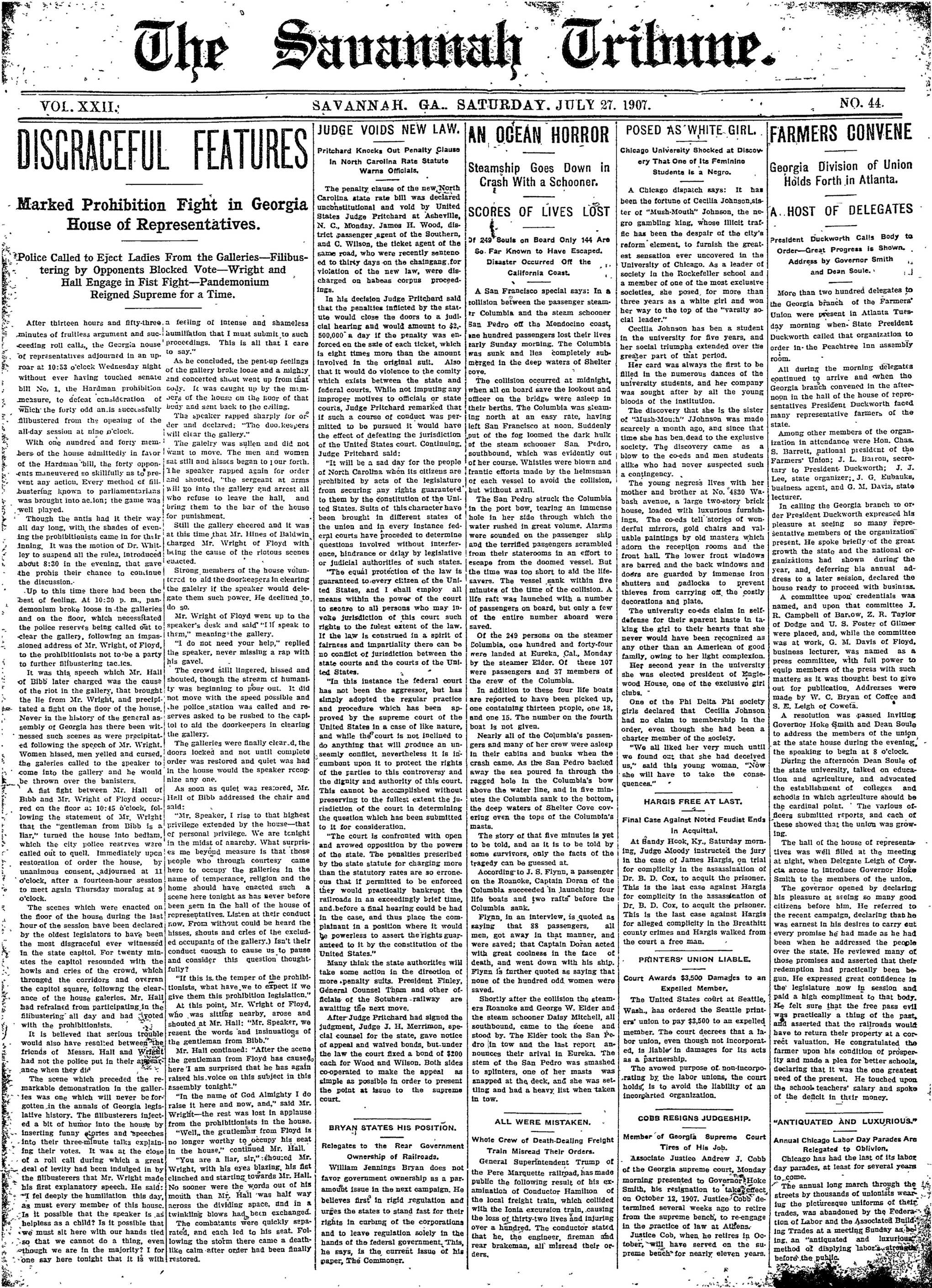
DISGRACEFUL FEATURES
Marked Prohibition Fight in Georgia House of Representatives.
Police Called to Eject Ladies From the Galleries-Filibustering by Opponents Blocked Vote-Wright and Hall Engage in Fist Fight-Pandemonium Reigned Supreme for a Time.
VOL. XXII:
DISGRACEFUL
Marked Prohibition
House of Rep
Police Called to Eject Ladies
tering by Opponents Blo
Hall Engage in Fist L
Reigned Suprem
After thirteen hours and fifty-three minutes of fruilless argument and succeeding roll calls, the Georgia house of representatives adjourned in an uproar at 10:53 o'clock Wednesday night without ever having touched senate bill No. 1, the Hardman prohibition measure, to defeat consideration of which the forty odd an. is successfully filibustered from the opening of the all-day session at nine p'clock.
With one hundred and forty members of the house admittedly in favor of the Hardman bill, the forty opponents maneuvered so skillfully as to prevent any action. Every method of filbustering known to parliamentarians was brought into action; the game was well played.
Though the antis had it their way all day long, with the shades of evening the prohibitionists came in for their inning. It was the motion of Dr. Whitley to suspend all the rules, introduced about 8:30 in the evening, that gave the prohis their chance to continue the discussion.
Up to this time there had been the best of feeling. At 10:30 p. m., pandemonium broke loose in the galleries and on the floor, which necessitated the police reserves being called out to clear the gallery, following an impassioned address of Mr. Wright, of Floyd, to the prohibitionists not to be a party to further filibustering tacies.
It was this speech which Mr. Hall of Bibb later charged was the cause of the riot in the gallery, that brought the lie from Mr. Wright, and precipitated a fight on the floor of the house. Never in the history of the general assembly of Georgia has there been witnessed such scenes as were precipitated following the speech of Mr. Wright. Women hissed, men yelled and cursed, the galeries called to the speaker to come into the gallery and he would be thrown over the banisters.
A fist fight between Mr. Hall of Bibb and Mr. Wright of Floyd occurred on the floor at 10:45 o'clock, following the statement of Mr. Wright that the "gentleman from Bibb is a liar," turned the house into bedlam, which the city police reserves were called out to quell. Immediately upon restoration of order the house, by unanimous consent, adjourned at 11 o'clock, after a fourteen-hour session to meet again Thursday morning at 9 o'clock.
The scenes which were enacted on the floor of the house during the last hour of the session have been declared by the oldest legislators to have been the most disgraceful ever witnessed in the state capitol. For twenty minutes the capitol resounded with the howls and cries of the crowd, which thronged the corridors and overran the capitol square, following the clearance of the house galeries. Mr. Hall had refrained from participating in the filibustering all day and had vroted with the prohibitionists.
It is believed that serious trouble would also have resulted between the friends of Messrs. Hall and Wright had not the police put in their appearance when they die
The scene which preceded the remarkable demonstration in the galleries was one which will never be forgotten in the annals of Georgia legislative history. The filibusterers injected a bit of humor into the house by inserting funny stories and speeches into their three-minute talks explaining their votes. It was at the close of a roll call during which a great deal of levity had been indulged in by the filibusterers that Mr. Wright made his first explanatory speech. He said: I felt deeply the humiliation this day, as must every member of this house. Is it possible that the speaker is as helpless as a child? Is it possible that we must sit here with our hands tied so that we cannot do a thing, even though we are in the majority? I for one say here tonight that it is with
a feeling of intense and shameless humiliation that I must submit to such proceedings. This is all that I care to say."
As he concluded, the pent-up feelings of the gallery broke loose and a mighty and concerted shout went up from that body. It was caught up by the members of the house on the floor of that body and sent back to the ceiling.
The speaker rapped sharply for order and declared: "The doo-keepers will clear the gallery."
The galery was sullen and did not want to move. The men and women sat still and kisses began to pour forth. The speaker rapped again for order and shouted, "the sergeant at arms will go into the gallery and arrest all who refuse to leave the hall, and bring them to the bar of the house for punishment.
Still the gallery cheered and it was at this time that Mr. Hines of Baldwin charged Mr. Wright of Floyd with being the cause of the riotous scenes enacted.
Strong members of the house volunteered to aid the doorkeepers in clearing the galery if the speaker would delegate them such power. He declined to do so.
Mr. Wright of Floyd went up to the speaker's desk and said "I'll speak to them," meaning the gallery.
"I do not need your help," replied the speaker, never missing a rap with his gavel.
The crowd still lingered, hissed and shouted, though the stream of humanity was beginning to pour out. It did not move with the speed possible and the police station was called and reserves asked to be rushed to the capitol to aid the doorkeepers in clearing the gallery.
The galleries were finally clear, the doors locked and not until complete order was restored and quiet was had in the house would the speaker recognize any one.
As soon as quiet was restored, Mr. Hall of Bibb addressed the chair and said:
"Mr. Speaker, I rise to that highest privilege extended by the house—that of personal privilege. We are tonight in the midst of anarchy. What surprises me beyond measure is that those people who through courtesy came here to occupy the galleries in the name of temperance, religion and the home should have enacted such a scene here tonight as has never before been seen in the hall of the house of representatives. Listen at their conduct now. From without could be heard the hisses, shouts and cries of the excluded occupants of the gallery.) Isn't their conduct enough to cause us to pause and consider this question thoughtfully?
"If this is the temper of the prohibitionists, what have we to expect if we give them this prohibition legislation." At this point, Mr. Wright of Floyd, who was sitting nearby, arose and shouted at Mr. Hall: "Mr. Speaker, we resent the words and insinuations of the gentleman from Bibb." Mr. Hall continued: "After the scene the gentleman from Floyd has caused here I am surprised that he has again raised his voice on this subject in this assembly tonight." "In the name of God Almighty I do raise it here and now, and," said Mr. Wright—the rest was lost in applause from the prohibitionists in the house. "Well," the gentleman from Floyd is no longer worthy to occupy his seat in the house," continued Mr. Hall.
"You are a llar, sin," heoured Mr. Wright, with his eyes blazing, his fast clinched and starting towards Mr. Hall. No sooner were the words out of his mouth than Mr. Hall was half way across the dividing space, and in a twinkling blows had been exchanged. The combatants were quickly separated, and each led to his seat. Following the storm there came a deathlike calm after order had been finally restored.
SAVANNAH. GA.. SATURDAY. JULY 27. 1907.
JUDGE VOIDS NEW LAW.
Pritchard Knocks Out Penalty Clauses
In North Carolina Rate Statute
Warns Officials.
The penalty, clause of the new North Carolina state rate bill was declared unconstitutional and void by United States Judge Pritchard at Asheville, N. C., Monday. James H. Wood, district passenger agent of the Southern, and C. Wilson, the ticket agent of the same road, who were recently sentenced to thirty days on the chaiang for violation of the new law, were discharged on habeas corpus proceedings.
In his decision Judge Pritchard said that the penalties inflicted by the statute would close the doors to a judicial hearing and would amount to $2,500,000 a day if the penalty was enforced on the sale of each ticket, which is eight times more than the amount involved in the original suit. Also that it would do violence to the comity which exists between the state and federal courts. While not imputing any improper motives to officials or state courts, Judge Pritchard remarked that if such a course of conduct was permitted to be pursued it would have the effect of defeating the jurisdiction of the United States court. Continuing, Judge Pritchard said:
"It will be a sad day for the people of North Carolina when its citizens are prohibited by acts of the legislature from securing any rights guaranteed to them by the constitution of the United States. Suits of this character have been brought in different states of the union and in every instance federal courts have proceeded to determine questions involved without interference, hindrance or delay by legislative or judicial authorities of such states.
"The equal protection of the law is guaranteed to every citizen of the United States, and I shall employ all means within the power of the court to seconde to all persons who may invoke jurisdiction of this court such rights to the fairest extent of the law. If the law is construed in a spirit of fairness and impartiality there can be no conflict of jurisdiction between the state courts and the courts of the United States.
"In this instance the federal court has not been the aggressor, but has simply adopted the regular practice and procedure which has been approved by the supreme court of the United States in a case of like nature, and while the court is not inclined to do anything that will produce an unseamly conflict, nevertheless it is incumbent upon it to protect the rights of the parties to this controversy and the dignity and authority of this court. This cannot be accomplished without preserving to the fullest extent the jurisdiction of the court in determining the question which has been submitted to it for consideration.
"The court is confronted with open and arowed opposition by the powers of the state. The penalties prescribed by the state statute for charging more than the statutory rates are so erroneous that if permitted to be enforced they would practically bankrupt the railroads in an exceedingly brief time, and before a final hearing could be had in the case, and thus place the complainant in a position where it would be powerless to assert the rights guaranteed to it by the constitution of the United States."
Many think the state authorities will take some action in the direction of more penalty suits. President Finley, General Counsel Tham and other officials of the Sotuhern-railway are awaiting the next move.
After Judge Pritchard had signed the judgment, Judge J. H. Merrimon, special counsel for the state, gave notice of appeal and waived bonds, but under the law the court fixed a bond of $200 each for Wood and Wilson. Both sides co-operated to make the appeal as simple as possible in order to present the point at issue to the supreme court.
William Jennings Bryan does not favor government ownership as a paramount issue in the next campaign. He believes first in rigid regulation and urges the states to stand fast for their rights in curbing of the corporations and to leave regulation solely in the hands of the federal government. This, he says, is the current issue of his paper, The Commoner.
AN OCEAN HORROR
Steamship Goes Down in Crash With a Schooner.
Of 249 Souls on Board Only 144 Are So. Far Known to Have Escaped.
A San Francisco special says: In a collision between the passenger steamtr Columbia and the steam schooner San Pedro off the Mendocino coast, one hundred passengers lost their lives early Sunday morning. The Columbia was sunk and lies completely submerged in the deep waters of Shelter cove.
The collision occurred at midnight, when all on board save the lookout and officer on the bridge were asleep in their berths. The Columbia was steaming north at an easy rate, having left San Francisco at noon. Suddenly out of the fog loomed the dark hulk of the steam schooner San Pedro, southbound, which was evidently out of her course. Whistles were blown and frantic efforts made by the helmsman of each vessel to avoid the collision, but without avail.
The San Pedro struck the Columbia in the port bow, tearing an immense hole in her side through which the water rushed in great volume. Alarms were sounded on the passenger ship and the terrified passengers scrambled from their staterooms in an effort to escape from the doomed vessel. But the time was too short to aid the lifesavers. The vessel sank within five minutes of the time of the collision. A life raft was launched with a number of passengers on board, but only a few of the entire number aboard were saved.
Of the 249 persons on the steamer Columbia, one hundred and forty-four were landed at Eureka, Cal., Monday by the steamer Elder. Of these 107 were passengers and 37 members of the crew of the Columbia.
In addition to these four life boats are reported to have been picked up, one containing thirteen people, one 18, and one 15. The number on the fourth boat is not given.
Nearly all of the Columbia's passengers and many of her crew were asleep in their cabins and bunks when the crash came. As the San Pedro backed away the sea poured in through the ragged hole in the Columbia's bow above the water line, and in five minutes the Columbia sank to the bottom, the deep waters of Shelter Cove covering even the tops of the Columbia's masts.
The story of that five minutes is yet to be told, and as it is to be told by some survivors, only the facts of the tragedy can be guessed at.
According to J. S. Flynn, a passenger on the Roanoke, Captain Doran of the Columbia succeeded in launching four life boats and two rafts before the Columbia sank.
Flynn, in an interview, is quoted as saying that 88 passengers, all men, got away in that manner, and were saved; that Captain Doran acted with great coolness in the face of death, and went down with his ship. Flynn is further quoted as saying that none of the hundred odd women were saved.
Shortly after the collision the steamers Roanoke and George W. Elder and the steam schooner Daisy Mitchell, all southbound, came to the scene and stood by. The Elder took the San Pedro in tow and the last report announces their arrival in Eureka. The stem of the San Pedro was smashed to splinters, one of her masts was snapped at the deck, and she was settling and had a heavy list when taken in tow.
ALL WERE MISTAKEN.
Whole Crew of Death-Dealing Freight Train Misread Their Orders.
General Superintendent Trump of the Pere Marquette railroad, has made public the following result of his examination of Conductor Hamilton of the local freight train, which collided with the Ionia excursion train, causing the loss of thirty-two lives and injuring over a hundred. The conductor stated that he, the engineer, fireman and rear brakeman, all misread their orders.
POSED AS WHITE GIRL.
A Chicago dispatch says: It has been the fortune of Cecilia Johnson,sister of "Mush-Mouth" Johnson, the negro gambling king, whose illicit traffic has been the despair of the city's reform element, to furnish the greatest sensation ever uncovered in the University of Chicago. As a leader of society in the Rockefeller school and a member of one of the most exclusive societies, she posed, for more than three years as a white girl and won her way to the top of the "varsity social leader." Cecilia Johnson has ben a student in the university for five years, and her social triumphs extended over the greater part of that period.
Her card was always the first to be filled in the numerous dances of the university students, and her company was sought after by all the young bloods of the institution.
The discovery that she is the sister of "Mush-Mou:h" JJohnson was made scarcely a month ago, and since that time she has ben dead to the exclusive society. The discovery came as a blow to the co-eds and men students allike who had never suspected such a contingency.
The young negress lives with her mother and brother at No. 4830 Wabash avenue, a large two-story brick house, loaded with luxurious furnishings. The co-eds tell stories of wonderful mirrors, gold chairs and valuable paintings by old masters which adorn the reception rooms and the front hall. The lower front windows are barred and the back windows and doors are guarded by immense iron shutters and padlocks to prevent thieves from carrying off the costly decorations and plate.
The university co-eds claim in self-defense for their aparent haste in taking the girl to their hearts that she never would have been recognized as any other than an American of good family, owing to her light complexion.
Her second year in the university she was elected president of Englewood House, one of the exclusive girl clubs. One of the Phi Delta Phi society girls declared that Cecilia Johnson had no claim to membership in the order, even though she had been a charter member of the society. "We all liked her very much until we found out that she had deceived us," said this young woman. "Now she will have to take the consequence."
HARGIS FREE AT LAST.
Final Case Against Noted Feudist Ends
In Acquittal.
At Sandy Hook, Ky., Saturday morning, Judge Moody instructed the jury in the case of James Hargis, on trial for complicity in the assassination of Dr. B. D. Cox, to acquit the prisoner. This is the last case against Hargis for complicity in the assassination of Dr. B. D. Cox, to acquit the prisoner. This is the last case against Hargis for alleged complicity in the Breathitt county crimes and Hargis walked from the court a free man.
PRINTERS' UNION LIABLE.
Court Awards $3,500 Damages to an Expelled Member.
The United States court at Seattle, Wash., has ordered the Seattle printers' union to pay $3,500 to an expelled member. The court decrees that a labor union, even though not incorporated, is liable in damages for its acts as a partnership. The avowed purpose of non-incorporating by the labor unions, the court holds, is to avoid the liability of an incomparted organization.
COBB RESIGNS JUDGESHIP.
Member of Georgia Supreme Court Tires of His Job. Associate Justice Andrew J. Cobb of the Georgia supreme court, Monday morning presented to Governor Hoke Smith, his resignation to take effect on October 12, 1907. Justice Cobb determined several weeks ago to retire from the supreme bench, to re-engage in the practice of law at Attens. Justice Cob, when he retires in October, will have served on the supreme bench for nearly eleven years.
FARMERS CONVENE
Georgia Division of Union Holds Forth in Atlanta.
President Duckworth Calls Body to Order—Great Progress is Shown. Address by Governor Smith and Dean Soule.
More than two hundred delegates to the Georgia branch of the Farmers' Union were present in Atlanta Tuesday morning when State President Duckworth called that organization to order in the Peachtree Inn assembly room.
All during the morning delegates continued to arrive and when the Georgia branch convened in the afternoon in the hall of the house of representatives President Duckworth faced many representative farmers of the state.
Among other members of the organization in attendance were Hon. Chas. S. Barrett, national president of the Farmers' Union; J. L. Bairon, secretary to President Duckworth; J. J. Lee, state organizer; J. G. Eubanks, business agent, and G. M. Davis, state lecturer.
In calling the Georgia branch to order President Duckworth expressed his pleasure at seeing so many representative members of the organization present. He spoke briefly of the great growth the state and the national organizations had shown during the year, and, deferring his annual address to a later session, declared the house ready to proceed with business.
A committee upon credentials was named, and upon that committee J. R. Campbell of Barow, Z. R. Taylor of Dodge and U. S. Foster of Glimer were placed, and, while the committee was at work, G. M. Davis of Floyd, business lecturer, was named as a press committee, with full power to equip members of the press with such matters as it was thought best to give out for publication. Addresses were made by W. C. Bryan of Coffee and S. E. Leigh of Coweta.
A resolution was passed inviting Governor Hoke Smith and Dean Soule to address the members of the union at the state house during the evening, the speaking to begin at 8 o'clock.
During the afternoon Dean Soule of the state university, talked on education and agriculture, and advocated the establishment of colleges and schools in which agriculture should be the cardinal point. The various officers submitted reports, and cach of these showed that the union was growing.
The hall of the house of representatives was well filled at the meeting at night, when Delegate Leigh of Cowcta arose to introduce Governor Hoke Smith to the members of the union.
The governor opened by declaring his pleasure at seeing so many good citizens before him. He referred to the recent campaign, declaring that he was earnest in his desires to carry out every promise he had made as he had been when he addressed the people over the state. He reviewed many of those promises and asserted that their redemption had practically been begun. He expressed great confidence in the legislature now in session and paid a high compliment to that body. He felt sure that the free pass evil was practically a thing of the past, and asserted that the railroads would have to return their property at a correct valuation. He congratulated the farmer upon his condition of prosperity and made a plea for better schools, declaring that it was the one greatest need of the present. He touched upon the school teachers' salary and spoke of the deficit in their money.
"ANTIQUATED AND LUXURIOUS."
Annual Chicago Labor Day Parades Are Relegated to Oblivion.
Chicago has had the last of its labor day parades, at least for several years to come.
The annual long march through the streets by thousands of unionists wearing the picturesque uniforms of their trades, was abandoned by the Federation of Labor and the Associated Building Trades at a meeting Sunday as being an "antiquated and luxurious method of displaying labor's strength before the public.
ranty Aid and ON, Supt. of Ageno
The Guaranty Aid and Relief Society
of Georgia hereby acknowledges
that the strict in its affairs are of character and real community. The fairs of the first themselves with
By comparing liberal inducement pany in this business
That we pay
and which are held by the State
versions of an Act of the General
and amended December
L. E. Williams.
P. Edward Perry.
Walter S. Scott.
Bol. C. Johnson.
This company requires of the that the strict in its affairs are of character and real community. The fairs of the first themselves with
By comparing liberal inducement pany in this business
That we pay
Age
This company is duly chartered under the laws of the State of Georgia, and has complied with all requirements of the State Insurance department, therefore all policy holders are protected with all the safeguards that the strict insurance laws of this State seek to protect its citizens.
Its affairs are directed and managed by Negro men of the city of Savannah of leading standing, and whose character and reputation are of such as to command the respect and confidence of all the people of that community. The same men that manage this Society are the ones that organized and are conducting the affairs of the first successful Negro Savings Bank in this state, therefore we can readily see that by connecting themselves with this Insurance company their interest will be in safe hands.
By comparing our rules and benefits with other first class companies it will be seen that we offer the most liberal inducements with the largest sick, accident and death benefits to our members than any other company in this business.
That we pay our claims promptly can be testified to by the thousands of our satisfied members.
EVERY FARMER IN THE COU
EVERY FARMER IN THE COUNTRY SHOULD HAVE-ONE
ROPP'S NEW Commercial Calculator and Short-Cut Arithmetic
Containing a New, Complete and Comprehensive System of Useful, Convenient and Labor-Saving Tables Also The Essence of Arithmetic and Mensuration Condensed and Simplified for Practical Use Handy Review and Ready Reference Designed for the Use of Farmers, Mechanics, Business and Professional Men, Bankers and Dealers in Grain, Stock, Cotton, Coal, Lumber, Produce, Feed, Etc.
A copy of ROPP'S NEW COMMERCE postage p WITH THE N. Y. TRIBUNE FAR
A copy of ROPP'S NEW COMMERCIAL CALCULATOR will be sent postage prepaid WITH THE N. Y. TRIBUNE FARMER ONE YEAR, FOR $1.00
NIGHT TRAINS SAVANNAH & MONTGOMERY. VIA SEABOARD AIR LINE RAILWAY.
Train will consist of PULLMAN BUFFET SLEEPING CARS, Day-Coaches between Savannah and Montgomery without change; making close connection at Montgomery with all lines diverging for Pensacola, Mobile, New Orleans and all Western points; Birmingham, Memphis, St. Louis, Nashville, Chicago and all Northwestern points; the SHORTEST LINE to Montgomery, New Orleans, Birmingham and the earliest arrival at these points. At Savannah close connection is made for all EASTERN POINTS, Richmond, Washington, New York and with Coastwise Steamships for Baltimore, Philadelphia, New York and Boston. Get sleeping car reservations and full information from any SEABOARD Agent, or write to
---
SOL. C. JOHNSON, Supt. of Ageno
Treasury of State of Georgia.
The undesigned Treasure of the State of Georgia, hereby accords
have received from the Governor of Georgia, the following described:
R. E. Parnell
on total Ten Thousand Dollars, and which are held by the
Georgia, by authority and under the provisions of an Act of the
Assembly, approved October 22d, 1887, and amended
with the Act of 1897.
The undesigned Treasures of the State of Georgia, hereby acknowledges to have received from the Secretary of Dawson the following described Sumo :
using an total Ten Thousand Dollars, and which are held by the State of Georgia, by authority and under the provisions of an Act of the General Assembly, approved October 22d, 1887, and amended December 20th, 1887.
R. E. Paoli
Treasurer of the State of Georgia.
1 CENT IS ALL IT WILL COST YOU
to write for our big FREE BICYCLE catalogue
showing the most complete line of high-grade
BICYCLES, TIRES and SUNDRIES at PRICES
BELOW any other manufacturer or dealer in the world.
Masonic Boo
Regalia
LODGE SEALS,
Made in all sizes. It is lively and easy riding, very durable and lined inside of rubber, which never becomes porous and which closes up small punctures air to escape. We have hundreds of letters from satisfied customers stating airly been pumped upon or twice in a whole season. They weigh no more than puncture resisting qualities being given by several layers of thin, specially tread. That "Holding Back" sensation commonly felt when riding on asphalt one by the patent "Basket Weave" tread which prevents all air from being lifted and the life of the overweave all suction. The regular price of these for advertising purposes is a special factory price to the rider. All orders shipped same day letter is received. We ship on approval until you have examined and found them strictly as represented. discount of 5 per cent (thereby making the price $4.55 per pair) if you send ORDER and enclose this advertisement. We will also send one nickel amp and two Sampson metal puncture closers on full paid orders (these metal used in case of intentional knife cuts or heavy gashes). Tires to be returned or any reason they are not satisfactory on examination.
Ask your Postmaster, right Agent or the Editor of this paper about use. If asked a pair of and that they will ride easier, run faster, wear better, last longer have ever seen or seen at any price. We know that you will be so well pleased
The undesigned Treasurer to have received from the Secretary of State
Dear Regina,
Elizabeth, Grace
14th of June, 1890,
using an total Ten Thousand of Georgia, by authority and assembly, approved Colonel Bollard 1890.
1 CENT IS ALLOWED to write for showing the BICYCLES BELOW any other manufacture.
DO NOT BUY A BIGYCLE from anyone, at any price, or on any kind of terms, until you have received our complete logos illustrating and describing every kind of high-grade and low-grade bicycles, old patterns and latest models, and learn of our remarkable LOW cost bicycles made possible by selling from factory direct to rider with no middlemen's profit. WE SHIP ON APPROVAL without a cent deposit. Pay the Freightman.
WE SHIP ON APPROVAL without a cent deposit. Pay the Freight an allow 10 Days Free Trial and make other liberal terms which no other house in the world will do. You will learn everything and get much valuable information by simply writing us a postal.
We need a Rider Agent in every town and can offer an opportunity to make money to suitable young men who apply at once.
$8.50 PUNCTURE-PROOF TIRES ONLY
Regular Price $8.50 per pair.
To Introduce We Will Sell You a Sample Pair for Only
(CASH WITH ORDER $4.55)
NO MORE TROUBLE FROM PUNCTURES.
1200 FT THERM ALFORD
1200 FT THERM ALFORD
1200 FT THERM ALFORD
Result of 15 years experience in tire making. No danger from THORNS, CACTUS, PINS, NAILS, TACKS or GLASS. Serious punctures, like intentional knife cuts, can be vulcanized like any other tire.
Notice the thick rubber tread "A" and puncture strips "I" and "D," also rim strip "IH" to prevent rim cutting. This makes any other make- SOFT, ELASTIC and EASY RIDING.
DESCRIPTION: Made in all sizes. It is lively and easy riding, very durable and lined inside with a special quality of rubber, which never becomes potous and which closes up small punctures without allowing the air to escape. We have hundreds of letters from satisfied customers stating that their tires have only been pumped up once or twice in a whole season. They weigh no more than prepared fabric on the tread. That "Hold Basket Quality" being given by several layers of thin, specially prepared fabric on the tread, when riding on asphalt or soft roads is overcome by the patent "Basket Weave" tread which prevents squeezed out between the tire and the road thus overcoming all suction. The regular price of these tires is $5 so per pair, but for advertising purposes we are making a special factory price to the rider of only $1 so per pair. All orders shipped same day letter is received. We ship C.O.D. on approval. You do not pay a cent until you have examined and found them strictly as represented.
We will hold $£4.00 discount of 5 percent (thereby making the price $£4.55 per pair) if you send KWIK platinum hand pump and two Sampson metal puncture closers on full price (these metal puncture closers to be used in case of intentional knife cuts or heavy gashes). Tires to be returned at OUR expense if for any reason they are not satisfactory on examination.
We are perfectly reliable and money sent to us is as safe as in a bank. Ask your Postmaster, Banker, Express or Freight Agent or the Editor of this paper about us. If you order a pair of these tires, you will find that they will ride easier, run faster, wear better, last longer and look finer than any tire you have ever used or seen at any price. We know that you will be so well pleased that when you want a bicycle you will give us your order. We want you to send us a small trial order at once, hence this remarkable tire offer.
COASTER-BRAKES built-up-wheels, saddles, pedals, parts and repairs, and everything in the bicycle line are sold by us at half the usual prices charged by dealers and repair men. Write for our big SUNDRY catalogue. DO NOT THINK OF BUYING a
DO NOT WAIT but write us a postal today. DO NOT THINK OF BUYING a bicycle or a pair of tires from anyone until you know the new and wonderful offers we are making. It only costs a postal to learn everything. Write it NOW.
We Do Job Printing
Of All Kinds.
We Can Please You.
P. EDWARD PERRY, Vice President.
L. E. Williams.
P. Edward Perry.
Walter S. Scott.
Sol. C. Johnson.
Masonic Books &
Regalias.
LODGE SEALS,
FINANCIAL CARDS and
BLANKS of every description.
Publishers' and Manufacturers' Prices
Liberal Discounts Will Be Arranged.
GOL. C. JOHNSON,
Savannah, Ga.
SOL. C. JOHNSON Notary Public.
Deeds, Contracts, Wills and Other
Legal Forms Prepared and
Attested.
116 West St. Julian Street.
Dealer In
GROCERIES, WOOD AND COAL
621 Oglothorpe Avenue, East.
518 PHONES Bell 506
COLORED KNIGHTS OF PYTHIAS.
Denied Charter in State by Georgia Supreme Court.
The Georgia state supreme court,
in a decision handed down Friday, held
that the negro Knights of Pythias
should not be allowed to secure a
charter from the state.
The Georgia Knights of Pythias, although they have no charter from the state, allege that the efforts of the negroes to secure a charter was an infringement upon their name.
HANGING NOT A DETERRENT.
So Quoths Missouri Pardon Clerk in Communication to Governor.
communication to Governor.
Pardon Clerk Speed Mosby of Missouri, in recommending to Governor Folk that clemency be shown to several murderers under death sentence stated that statistics shows hanging does not act as a deterrent to capital crimes, and asserted a close study of the stutes would reveal that the state itself is guilty of murder when it moves premeditatedly and deliberately against a man's life.
WALTER S. SCOTT, Secretary and Tr cas,
Relief Society
HOME OFFICE
WEST BROAD STREET,
SAVANNAH, GEORGIA.
Phone 1198. Ga. Phone 2029.
Directors.
W. R. Fields.
J. H. Deveaux
L. M. Pollard.
R. R. Wright.
W. H. Burges.
J. H. Bugg, M. D.
J. M. Ferrebee.
duly chartered under the laws of the State of Georgia, and has complied with all restate Insurance department, therefore all policy holders are protected with all the safeguardance laws of this State seek to protect its citizens.
Detected and managed by Negro men of the city of Savannah of leading standing, and whose nation are of such as to command the respect and confidence of all the people of that time men that manage this Society are the ones that organized and are conducting the successful Negro Savings Bank in this state, therefore we can readily see that by connecting its Insurance company their interest will be in safe hands.
Rules and benefits with other first class companies it will be seen that we offer the most with the largest sick, accident and death benefits, to our members than any other company.
Claims promptly can be testified to by the thousands of our satisfied members.
HOME OFFICE
WEST BROAD STREET,
SAVANNAH, GEORGIA.
Phone 1198. Ga. Phone 2029.
Directors.
W. R. Fields. W. H. Burgeau.
J. H. Deveaux J. H. Bugg, M. D.
L. M. Pollard.
R. R. Wright. J. M. Ferrebee.
Liberal Terms and Commission.
ADDRESS THE HOME OFFICE,
468 West Broad St.,
Cavannah, Georgia.
ARMER IN THE COUNTRY SHOULD HAVE-ONE
One Hundred and Sixty Pages.
WEEKLY, 20 pages, 12 1/2 by 18 inches. The most thoroughly practical, helpful, up-to-date illustrated National weekly for every member of the farmer's family. Regular price, per year, $1.00.
OPP'S NEW COMMERCIAL CALCULATOR will be sent postage prepaid
E N. Y. TRIBUNE FARMER ONE YEAR, FOR $1.00
orders to NEW-YORK TRIBUNE FARMER,
Tribune Building, NEW YORK CITY.
HT TRAINS { SAVANNAH & MONTGOMERY.
IA SEABOARD
AIR LINE RAILWAY.
WESTBOUND. EASTBOUND.
Send all orders to NEW-YORK TRIBUNE FARMER. Tribune Building, NEW YORK CITY.
List of PULLMAN BUFFET SLEEPING CARS, Day Cosches between Savannah and it change; making close connection at Montgomery with all lines diverging for Pensacola, and all Western points; Birmingham, Memphis, St. Louis, Nashville, Chicago and all; the SHORTEST LINE to Montgomery, New Orleans, Birmingham and the earliest ones. At Savannah close connection is made for all EASTERN POINTS, Richmond, Wash.-oul with Coastwise Steamships for Baltimore, Philadelphia, New York and Boston. Preservations and full information from any SEABOARD Agent, or write to
CHARLES F. STEWART,
Asst. General Passenger Agent, Savannah, Georgia.
Every farmer wants to know to a cent the value of what he buys and sells, and should not leave this to be figured by the party with whom he is dealing. As labor saving machinery has been invented to save time and physical strength, so there are devices to enable the mind to reach quickly and accurately results usually arrived at with much thought and tedious calculation. Time is worth much, but accuracy is still more important.
Many books have been prepared to make the task of calculating easy, its results sure, but never one fitted to all men, in all kinds of business, at all times, so completely as "ROPP'S NEW COMMERCIAL CALCULATOR." This reliable assistant to the farmer and others has been in the market for many years, and nearly a million and a half copies have been sold. The last edition (160 pages) is from beginning to end filled with tables, short cuts, and up-to-date methods of calculating, making it the most complete, useful and comprehensive work of the kind ever published. It will make every one independent, sure and self-reliant in all practical calculations connected with farming and other lines of business. It will prevent mistakes, relieve the mind, save time, labor and loss. It is a pocket edition with pocket for papers_and a loose silicate slate from which lead pencil marks are easily erased, and is an invaluable assistant for every farmer or business man.
9.25 A. M.
4.20 P. M.
7.45 P. M.
11.54 P. M.
12.16 A. M.
1.40 A. M.
3.15 A. M.
4.20 A. M.
5.15 A. M.
9.30 A. M.
Leave New Orleans......
Leave. Birmingham......
Leave Montgomery......
Leave Lumpkin......
Leave Richland......
Leave Americus......
Leave Cordele......
Leave Abbeville......
Leave Helena......
Arrive Savannah.....
"Nor do men light a candle and put it under a bushel"—Matt. 5:15.
Your candle is so small, so small,
It makes scarce any light;
The feeble word you may let fall,
Has neither strength nor might?
And there be many great ones
Who outshine you by far,
As do the sky-illumining suns
Outgrow the farthest star?
He who holds up his little flame
Knows not what straining eyes
May find it guiding them from shame
into a paradise:
'All may not climb the lofty steep,
All may not lead the throng,
But each may shelter and may keep
aglow some word or song.
We know not how our candle gleams,
It may be scioned in gold,
Or it may send its cheering gleams
From some cup worn and old.
'Ah that which fate has held apart
From always and grand,
May glow through light which finds a heart
Attuned to understand.
The little word, the little smile,
The little song you know—
These make the candle all the while
That we must keep aglow.
'Ah that which trembling light
Unnoticed by all eyes,
But there is greater dark of night
When that lone candle dies.
—W. D. Nesbit, in St. Louis Republic.
LANOOK AND THE BEAR
By HERBERT COOLIDGE.
To the east of Mount Shasta lies the country that was once Lanook's. There in the days of his youth he chased deer and antelope and led his people against the marauding Moods. The valleys are all fenced and farmed now, and Lanook in many respects is "all same white man."
But he loves the old wild Indian days, loves to roam again in the land of youth and strength and achievement. The old man was a daily visitor when I lived in the country that once was his, and time and time again he would bare his forearm and knee, show me the deep, livid scars of a grizzly's teeth, and tell me the following story.
Long before the whites came he and Nishka, now many years dead, were returning from Pitt River with a big catch of salmon strung on a pole carried on their shoulders. Nishka walked ahead. Before them ran Lanook's little dog, clearing the path of chipmunks and squirrels.
As they descended a slope which overlooks Fall Valley, they heard the little dog yelp as if in great fear, and saw him burst from a manzanita thicket. He was pursued by a giant grizzly bear.
Nishka fled. Lanook scrambled up the nearest tree, a scrubby juniper. The bear followed the dog straight for the master's perch, until, catching sight of Nishka's buckskin garments fitting through the brush, he turned and gave him chase.
Lanook, with breath held and eyes bulging, watched his friend's flight. He was racing like the wind, but it was as if a toddling baby should attempt to outrun his father. The great slouching brute gained as if the fleet Indian had been hobbled; in almost no time he was close upon him. The poor fellow, in despair, dodged, barely escaped the beast's claws, and made a dive into a laurel thicket. The bear crashed after—then all was silent.
The silence awoke Lanook. He leaped from his tree, gathered up the bow he had thrown aside before climbing, and ran to Nishka's rescue.
The bear must have heard the rush of moccasins on the trall, for as Lanook drew within close arrow-range, the grizzly emerged from the thicket and reared on his haunches, baring teeth that were dripping blood.
Lanook greeted him with two arrows, then fled for his tree. The bear, wounded and furious, chased him as he had chased his friend, with the fearful speed no man could equal. Nevertheless, the Indian reached his Juniper and ran up it like a chipmunk, this time retaining his hold on his bow.
In a pouch hung from his neck Lanook carried poison made, from black spiders, the fang-sacs of a rattlesnake and juice of wild parsnips; and while the grizzly pursued the howling cur round the tree, he tipped three arrows with this death-dealing ointment.
The juniper which Lanook hok climbed was the first tree at hard—not at all the one he would have chosen to escape a grizzly. Stout branches projected from the very ground; besides, the tree tapered abruptly, and was not very tall. Round and round it raced the dog. Finally he made a quick dash, darted into a big patch of deer brush, and there succeeded in eluding his pursuer.
Soon the grizzly came back to the tree, squatted on his haunches, and sat fiercely watching the Indian. Then, his breath recovered, he stood upright on his hind legs, and stretched a terrible, claw-horned paw upward. And how he did stretch! Lanook said it was as if the animal's limbs pulled out a hand's length at each joint. He climbed till he feared the tapering treeop would break.
The bear soon gave up the reaching idea and began to climb. In this he was as awkward as he had been agile in the chase; but with the lower branches affording support for hind and forepaws, it seemed likely that he could work his way upward.
The great weight of the brute made the little tree bend alarmingly, and when he, wrigled and hitched, both of which he did very violently, Lanook felt like an ant on a spear of grass whipped by the wind. Hope left the Indian; in its place came desperate resolution. He descended as far as he dared, fitted one of the poisoned arrow to his bow, and watted.
The bear ceased his struggles a moment, and threw back his head to look upward. Quick as the snake strikes, Lanook buried one arrow, then another, in his shaggy breast. The tree lurched so then from the bear's furious climbing that the third arrow flew wide of the mark, and splintered itself on the stony ground.
Lanook dropped his bow, gave a flying leap, and ran, still without hope, for his life.
He surprised himself with his running, and the bear surprised him with his awkwardness in getting disentangled from the tree. Lanook was a long way down the slope and buoyant with hope before the chase began. Filled with new strength, he sped onward like a bird.
The ravine he had chosen for a runway was smooth-bottomed and clear of brush; the descent was gentle---just right for a long, sweeping stride. And yet the grizzly gained, at first by leaps and bounds, as a rolling rock bears down on one embedded; then he came on with lessened speed, but still gaining. When he was close behind, Lanook's second wind came, and he began to pull away from the bear rapidly. He knew then that the poison from his arrow-tips was working in the blood of his enemy, and hope grew strong within him.
Had his runway remained clear, Lanook could have escaped easily, but fortune favored the bear. For the ravine suddenly became blocked with brush, and the Indian narrowly escaped being caught in a corner. As it was, the bear was crowding him close before he could get out of the gully. Here the brush was thinner, but he had to take a winding course to avoid bushes and thickets, while his pursuer crashed straight through or over everything. The bear was at his beels in no-time, and Lanook, to protect his head and chest from the beast's claws, threw himself on his back and kicked out with both feet.
The grizzly seemed stupid and sluggish, but nevertheless made a savage dive at the Indian, and buried his teeth in his leg just above the knee. Lanook began throwing dirt into the enemy's face, whereupon the grizzly released his leg and caught him by the forearm. Still undaunted, the Indian sent a handful of dust and fine gravel fairly into the brute's eyes.
Half-blinded, the bear backed away, pawing his eyes furiously, Lanook filled his fist with dirt, and lay motionless, waiting. But the bear never returned to him. He continued backing about and rubbing his eyes, and finally retreated into the thick brush, scratched a shallow hole there, and lay down. There he was found the next day by Lanook's tribesmen, stone-dead.
Lanook managed to drag himself back to the trail, where he was shortly discovered by another party of fishermen, and carried home. Nishka was found and cared for also. He had felged death throughout the bear's attack, and although crippled, lived to tell his children's children of Lanook, his friend and rescuer, and of his battle with the giant grizzly bear.—From Youth's Companion.
HE'S THE WHOLE CREW.
Skipper Hall the Cook and the Mate and the Bo's n Bold of the Angler.
Captain Parker J. Hall, of Nautucket, skipper of the two masted schooner Angler, is his own mate, steward and crew. His stated reasons for it are not that he is moody or fond of his own company, or that it is more economical, but simply that, because of an impediment in his speech, he feels that he can think out and execute his own orders more rapidly than any crew could understand him if he tried to talk.
Captain Hull is a native of Duxbury, Mass., but his home is his schooner, and on board her his young wife goes about her housekeeping duties just the same as she would it an ivy grown cottage.
The Angler herself is no chicken, says the Boston Herald. She was built in 1854 and her owner found her an abandoned hulk, half buried in the sand. He bought her for next to nothing, fitted her, with second hand spars and began to make a living and a name for himself in the coastwise trade.
His brother, mariners find fault with him for recklessness, on the ground that his holding irons are not big enough. Skipper Hall is forced to put up with anchors much lighter than those of the average craft of the Angler's build carries, because it would be impossible for any one man to raise the heavy kind unadled.
He recently made a record run across the Sound under full sail and came up into anchorage in fine shape, before the admiring gaze of half the town. To enter the harbor Skipper Hall had to make a run through the heavy ice between the jetties at the bar. The drift of open water was very narrow, and the revenue cutter Gresham ran down to see if she could be of any possible assistance. The crew of the Gresham are talking yet of the surprise their captain got when he saw one man bringing a two masted schooner through the narrow drift.
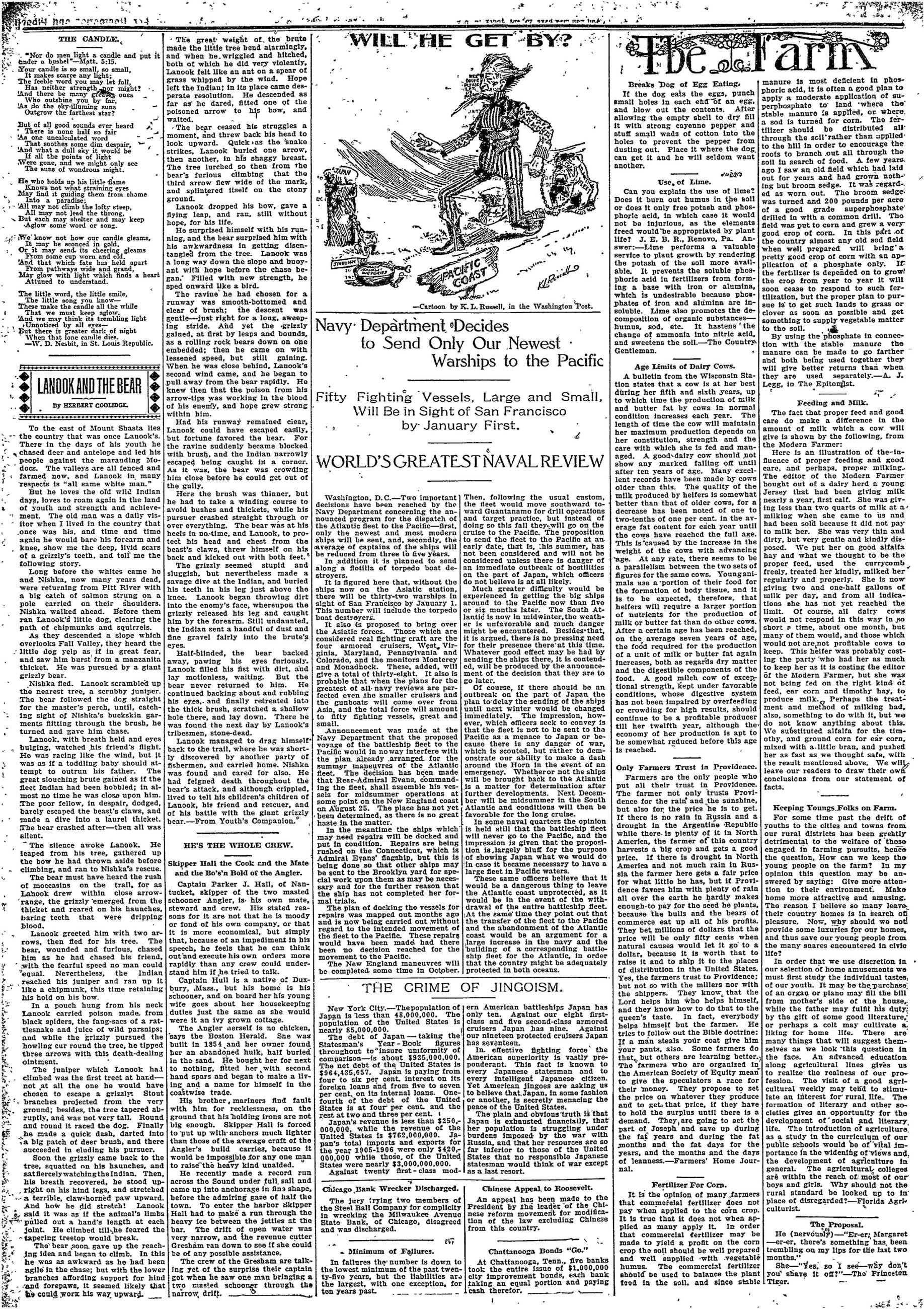
WILL HE GET BY?
JAPAN
JIMEOHN
PACIFIC COAST
K.L. Russell
—Cartoon by K.L. Russell, in the Washington Post.
Navy Department Decides to Send Only Our Newest Warships to the Pacific
Fifty Fighting Vessels, Large and Small, Will Be in Sight of San Francisco by January First.
THE CRIME OF JINGOISM.
Washington, D.C.-Two important decisions have been reached by the Navy Department concerning the announced program for the dispatch of the Atlantic fleet to the Pacific-first, only the newest and most modern ships will be sent, and, secondly, the average of captains of the ships will be reduced from three to five years. In addition it is planned to send along a flotilla of torpedo boat destroyers. It is figured here that, without the ships now on the Asiatic station, there will be thirty-two warships in sight of San Francisco by January 1. This number will include the torpedo boat destroyers.
It also is proposed to bring over the Asiatic forces. Those which are considered real fighting craft are the four armored cruisers, West, Virginia, Maryland, Pennsylvania and Colorado, and the monitors Monterey and Monadnock. These, added, will give a total of thirty-eight. It also is probable that when the plans for the greatest of all navy reviews are perfected even the smaller cruisers and the gunboats will come over from Asia, and the total force will amount to fifty fighting vessels, great and small.
Announcement was made at the Navy Department that the proposed voyage of the battleship fleet to the Pacific would in no way interfere with the plan already arranged for the summer maneuvers of the Atlantic fleet. The decision has been made that Rear-Admiral Evans, commanding the fleet, shall assemble his vessels for midsummer operations at some point on the New England coast on August 25. The place has not yet been determined, as there is no great haste in the matter.
In the meantime the ships which may need repairs will be docked and put in conditions. Repairs are being rushed to the Connecticut, which is Admiral Evans' flagship, but this is being done so that other ships may be sent to the Brooklyn yard for special work upon them as may be necessary and for the further reason that the ship has not completed her formal trials.
The plan of docking the vessels for repairs was mapped out months ago and is now being carried out without regard to the intended movement of the fleet to the Pacific. These repairs would have been made had there been no decision reached for the movement to the Pacific. The New England maneuvers will be completed some time in October.
New York City.—The population of Japan is less than 48,000,000. The population of the United States is nearly 85,000,000. The debt of Japan—taking the Statesman's Year-Book figures throughout to $^2$insure uniformity of comparison—is about $935,000,000. The net debt of the United States is $964,355,657. Japan is paying from four to six per cent. interest on its foreign loans and from five to seven per cent, on its internal loans. One-fourth of the debt of the United States is at four per cent, and the rest at two and three per cent.
Japan's revenue is less than $250-
000,000, while the revenue of the
United States is $762,000,000. Japan's
total imports and exports for
the year 1905-1906 were only $420-
000,000 while those, of the United
States were nearly $3,000,000,000.
Against twenty first-class mod-
The jury trying two members of the Steel Ball Company for complicity in wrecking the Milwaukee Avenue State Bank, of Chicago, disagreed and was discharged.
- Minimum of Failures.
In failures the number is down to the lowest minimum of the past twenty-five years, but the liabilities are the largest, with one exception, for ten years past.
```markdown
```
Then, following the usual custom, the fleet would move southward toward Guantanamo for drill operations and target practice, but instead of doing so this fall they will go on the cruise to the Pacific. The proposition to send the fleet to the Pacific at an early date, that is, this summer, has not been considered and will not be considered unless there is danger of an immediate outbreak of hostilities on the part of Japan, which officers do not believe is at all likely.
Much greater difficulty would be experienced in getting the big ships around to the Pacific now than five or six months later. The South Atlantic is now in midwinter, the weather is unfavorable and much danger might be encountered. Besides that, it is argued, there is no pressing need for their presence there at this time. Whatever good effect may be had by sending the ships there, it is contended, will be produced by the announcement of the decision that they are to go later.
Of course, if there should be an outbreak on the part of Japan the plan to delay the sending of the ships until next winter would be changed immediately. The impression, however, which officers sock to convey is that the fleet is not to be sent to the Pacific as a menace to Japan or because there is any danger of war, which is scouted, but rather to demonstrate our ability to make a dash around the Horn in the event of an emergency. Whether or not the ships will be brought back to the Atlantic is a matter for determination after further developments. Next December will be midsummer in the South Atlantic and conditions will then be favorable for the long cruise.
In some naval quarters the opinion is held still that the battleship fleet will never go to the Pacific, and the impression is given that the proposition is largely bluff for the purpose of showing Japan what we would do in case it became necessary to have a large fleet in Pacific waters.
These same officers believe that it would be a dangerous thing to leave the Atlantic coast unprotected, as it would be in the event of the withdrawal of the entire battleship fleet. At the same time they point out that the transfer of the fleet to the Pacific and the abandonment of the Atlantic coast would be an argument for a large increase in the navy and the building of a corresponding battleship fleet for the Atlantic, in order that the country might be adequately protected in both oceans.
ern American battleships Japan has only ten. Against our eight first-class and five second-class armored cruisers Japan has nine. Against our nineteen protected cruisers Japan has seventeen.
In effective fighting force the American superiority is vastly preponderant. This fact is known to every Japanese statesman and to every intelligent Japanese citizen. Yet American jingoes are asking us to believe that Japan, in some fashion or another, is secretly menacing the peace of the United States.
The plain and obvious truth is that Japan is exhausted financially, that her population is struggling under burdens imposed by the war with Russia, and that her resources are so far inferior to those of the United States that no responsible Japanese statesman would think of war except as a last resort.
Chinese Appeal to Roosevelt.
An appeal has been made to the President by the leader of the Chinese reform movement for modification of the law excluding Chinese from this country.
Chattanooga Bonds "Go."
At Chattanooga, Tenn., five banks took the entire issue of $1,000,000 city improvement bonds, each bank taking an equal portion and paying cash therefor.
The Farm
Breaks Dog of Egg Eating.
If the dog eats the eggs, punch small holes in each end of an egg, and blow out the contents. After allowing the empty shell to dry fill it with strong cayenne pepper and stuff small wads of cotton into the holes to prevent the pepper from dusting out. Place it where the dog can get it and he will seldom want another.
Use. of Lime.
Can you explain the use of lime? Does it burn out humus in the soil or does it only free potash and phosphoric acid, in which case it would not be injurious, as the elements freed would be appropriated by plant life? J. E. B. R., Renovo, Pa. Answer: —Lime performs a valuable service to plant growth by rendering the potash of the soil more available. It prevents the soluble phosphoric acid in fertilizers from forming a base with iron or alumina, which is undesirable because phosphates of iron and alumina are insoluble. Lime also promotes the decomposition of organic substances—humus, sod, etc. It hastens the change of ammonia into nitric acid, and sweetens the soil. —The Country Gentleman.
Age Limits of Dairy Cows.
A bulletin from the Wisconsin Station states that a cow is at her best during her fifth and sixth years, up to which time the production of milk and butter fat by cows in normal condition increases each year. The length of time the cow will maintain her maximum production depends on her constitution, strength and the care with which she is fed and managed. A good dairy cow should not show any marked falling off until after ten years of age. Many excellent records have been made by cows older than this. The quality of the milk produced by helpers is somewhat better than that of older cows, for a decrease has been noted of one to two-tenths of one per cent. In the average fat content for each year until the cows have reached the full age. This is caused by the increase in the weight of the cows with advancing age. At any rate, there seems to be a parallelism between the two sets of figures for the same cows. Young animals use a portion of their food for the formation of body tissue, and it is to be expected, therefore, that helpers will require a larger portion of nutrients for the production of milk or butter fat than do other cows. After a certain age has been reached, on the average seven years of age, the food required for the production of a unit of milk or butter fat again increases, both as regards dry matter and the digestible components of the food. A good milch cow of exceptional strength, kept under favorable conditions, whose digestive system has not been impaired by overfeeding or crowding for high results, should continue to be a profitable producer till her twelfth year, although the economy of her production is apt to be somewhat reduced before this age is reached.
Only Farmers Trust in Providence.
Only Farmers Trust in Providence.
Farmers are the only people who put all their trust in Providence. The farmer not only trusts Providence for the rain and the sunshine, but also for the price he is to get. If there is no rain in Russia and a drought in the Argentine Republic while there is plenty of it in North America, the farmer of this country harvests a big crop and gets a good harvest. If there is drought in North America and not much rain in Russia the farmer here gets a fair price for what little he has, but if Providence favors him with plenty of rain all over the earth he hardly makes enough-to pay for the seed he plants, because the bulls and the bears of commerce eat up all of his profits. They bet millions of dollars that the price will be only fifty cents when natural causes would let it go to a dollar, because it is worth that to raise it and to ship it to the places of distribution in the United States. Yes, the farmers trust to Providence; but not so with the millers nor with the shippers. They know, that the Lord helps him who helps himself, and they know how to do that to the queen's taste. In fact, everybody helps himself but the farmer. He tries to follow out the Bible doctrine: If a man steals your coat give him your pants, also. Some farmers do that, but others are learning better. The farmers who are organized in the American Society of Equity mean to give the speculators a race for their money. They propose to set the price on whatever they produce and to get that price, if they have to hold the surplus until there is a demand. They, are going to act the part of Joseph and save up during the fat years and during the fat months and the fat days for the years, and the months and the days of leanness.—Farmers' Home Journal.
Fertilizer For Corn.
It is the opinion of many farmers that commercial fertilizer does not pay when applied to the corn crop. It is true that it does not when applied as many apply it. In order that commercial fertilizer may be made to yield a profit on the corn crop the soil should be well prepared and well supplied with vegetable humus. The commercial fertilizer should be used to balance the plant food in the soil, and since stable
---
manure is most deficient in phosphoric acid, it is often a good plan to apply a moderate application of superphosphate to land 'where the stable manure is applied, or where a sod is turned for corn. The fertilizer should be distributed all through the soil rather than applied to the hill in order to encourage the roots to branch out all through the soil in search of food. A few years ago I saw an old field which had laid out for years and had grown nothing but broom sedge. It was regarded as worn out. The broom sedge was turned and 200 pounds per acre of a good grade superphosphate drilled in with a common drill. The field was put to corn and grew a very good crop of corn. In this part of the country almost any old sod field when well prepared will bring a pretty good crop of corn with an application of a phosphate only. If the fertilizer is depended on to grow the crop from year to year it will soon cease to respond to such fertilization, but the proper plan to pursue it is to get such lands to grass or clover as soon as possible and get something to supply vegetable matter to the soil.
By using the phosphate in connection with the stable manure the manure can be made to go farther and both being used together they will give better returns than when they are used separately.—A. J. Legg, in The Epitonist.
Feeding and Milk.
The fact that proper feed and good care do make a difference in the amount of milk which a cow will give is shown by the following, from the Modern Farmer:
Here is an illustration of the influence of proper feeding and good care, and perhaps, proper milking. The editor of the Modern Farmer bought out of a dairy herd a young Jersey that had been giving milk nearly a year, first calf. She was giving less than two quarts of milk at a milking when she came to us and had been sold because it did not pay to milk her. She was very thin and dirty, but very gentle and kindly disposed. We put her on good alfalfa hay and what we thought to be the proper feed, used the currycomb freely, treated her kindly, milked her regularly and properly. She is now giving two and one-half gallons of milk per day, and from all indications she has not yet reached the limit. Of course, all dairy cows would not respond in this way in so short a time, about one month, but many of them would, and those which would not are not profitable cows to keep. This heifer was probably costing the party who had her as much to keep her as it is costing the editor of the Modern Farmer, but she was not being fed on the right kind of feed, ear corn and timothy hay, to produce milk. Perhaps the treatment and method of milking had, also, something to do with it, but we do not know anything about this. We substituted alfalfa for the timothy, and ground corn for ear corn, mixed with a little bran, and pushed her as fast as we thought safe, with the result mentioned above. We will leave our readers to draw their own conclusions from our statement of facts.
Keeping Youngs Folks on Farm.
For some time past the drift of youths to the cities and towns from our rural districts has been greatly detrimental to the welfare of those engaged in farming pursuits, hence the question. How can we keep the young people on the farm? In my opinion this question may be answered by saying: Give more attention to their environment. Make home more attractive and amusing. The reason I believe so many leave their country homes is in search of pleasure. Now, why should we not provide some luxuries for our homes, and thus save our young people from the many snares encountered in civic life?
In order that we use discretion in our selection of home amusements we must first study the individual tastes, of our youth. It may be the purchase of an organ or plano may fill the bill from mother's side of the house, while the father may fulfil his duty; by the gift of some good literature, or perhaps a colt may cultivate a liking for home life. There are many things that will suggest themselves as we look this question in the face. An advanced education along agricultural lines gives us to realize the realness of our profession. The visit of a good agricultural weekly may tend to stimulate an interest for rural life. The formation of literary and other societies gives an opportunity for the development of social and literary life. The introduction of agriculture, as a study in the curriculum of our public schools would be of vital importance in the widening of views and, the development of agriculture in general. The agricultural colleges are within the reach of most of our boys and girls. Why should not the rural standard be looked up to in place of disregarded?—Florida Agriculturalist.
The Proposal
He (nervously)—"Er-er, Margaret—er-er, there's something been trembling on my lips for the last two months."
She—"Yes, so I see—why don't you shave it off?"—The Princeton Tiger.
THE only way to attain true success in life is to be always loyal to your friends.
TAKE with a grain of salt the advice of a man who has not made a success in life.
MACON is disgracing itself by causing women prisoners to work the streets. It is bad enough to have male convicts thus engaged. Such things have a taint of barbarism.
RECENTLY in the local post office a white clerk was caught with stolen money "on him" and this week a white postal clerk was brought here charged with the same crime. Both of them are still in jail. Each race has its criminals.
In the senate as well as in the house there are members who are unfavorable to the distranchisement bill. Several protests have been sent up against it. The colored citizens of Savannah sent up a strong one the first of the week.
The leader of the social set of the Chicago University was found to be a colored young woman. It is said that she was able, fancinating, with much womanly grace and culture. It was recently found out that she is of the colored race, for that reason in sight of her former admirers, she is now void of all her former virtues.
AGAIN the honors have been extended Mr. Deal Jackson for sending in the first bale of new cotton. It was sent in a week earlier than last year's. The achievement of Mr. Jackson should be an inspiration to our other farmers. In Georgia there are hundreds of colored men who are prosperous farmers and doing much to help the race along the line of stability.
WE, as a race, are not aware of the fact, as we go about our daily routine, that we are noticed by that class which is above us. They discover our weak points, and from these we are judged. Too much quarreling is done over petty things. It is not the point that we quarrel more than those above us, but we are too loud—everything we do is made public. The higher class keep these things to themselves. We are below them; therefore, we cannot act as they. But we ought to grasp every opportunity in imitating them in those acts which are uplifting. Let us learn the true use of money and how to carry on business. Let us learn to put ourselves on a level with our means and live for something else besides fine clothes, houses, etc. These are only temporary things. We have something far higher than this to live for. Let us live for the betterment of the race. Finery does not make the person. But a noble character and good reputation add more than these. Let us work together, helping one another, lifting humanity and furthering God's cause.—Ex.
No Rase Friction.
No Bace Friction.
Those Senators who despair of a solution of the race question ought to go to Buxton. Buxton is a coal mining camp in Iowa. Its population is about 5,000,93 per cent being black and 7 per cent white.
The Negroes, were brought in from the South originally to break a strike. They were quick to learn the value of unionism and now there is no more thoroughly organized miners' union than the Buxton camp.
In Buxton the Senators would receive their mail from a Negro postmaster, at the hotel their host would be a Negro. They would find themselves in a community where everybody works, especially father. If father develops a tendency to loaf and to graft on his family he will not remain long in Buxton. Only men who work can rent houses. The Buxton schools have grown from four teachers in a four-room building in 1904 to a
10 room building and 12 teachers to-day. Of the 600 pupils, only 60-1 in 10 are white. The superintendent is a colored man. The teachers are colored and white. Of the mixing of the races in the schools, Supt. Gilliam says: "There is absolutely n friction between the races. Of the very few cases of fights, only twice have they been colored versus white, both last year. They play together, sit together and eat together. Nothing is said about social equality. The school is a matter of business."
The 72 clerks in the company store are whites and Negroes, working together, neither insulting nor being insulted by one another, white girls waiting on black men, Negro girls waiting on white men. In the bank the Senators would find a Negro woman and a white woman, one the teller, the other the cashier.
The president of the Y. M. C. A., is a Negro miner, living in a well furnished house and giving his children a liberal education. The Y. M. C. A., secretary is the theatrical manager and amusement censor of the town. He controls the opera hall, with a free hand to turn down whatever appears morally unfit. On Saturday night, if there is no show from outside, 2000 feet of moving pictures are given for the good of all.
Buxton has its drawbacks. No mining camp is an ideal place. The coal will be exhausted sometime, then Buxton will decamp and disappear. There is lacking the motive to buy and improve property. But here is a community where as yet the race question is solved. Business is business in the store, on the street and in the mines. The white woman is safe and sacred—so is the black woman. The crowds are lively, well behaved, well dressed. In this community, overwhelmingly Negro. the races work together, go to school together, but do not intermingle racially.
Six days in the week, fifty-two weeks in the year, black men work in Buxton making good money, and making as good use of their money as white men in Buxton or elsewhere. Buxton like Tuskegee, is a bright spot—New York Independent.
A Short Story of a Long Struggle.
By T. Timlety Thimpkins.
Hark all ye people, young and old
Pay strict attention instanta,
Put on a good pair of specs
And read this great text
That has come down to us from Atlanta.
A bill by Hardman, a lawmaker pure
Is before the Georgia Legislature,
And what you read with your eyes,
Are a few words to the wise
To make a change of a half-funny nature.
We know this is just a little hard on you
The "Pros," to the "Antis," kindly said.
But we will set aside a day
And let you have something to say
Why this funeral sermon should not be
read.
Up steps a body of citizens true
From a nearby town called Mason,
Bayling you may be right
In your noble fight
But we are only trying to save our bacon.
The next to respond for the "Antis" side
Was a large crowd from the city of Savannah,
Who said that their distress
Would be ten times more than the rest.
For as to this business their town took
the banner.
The committee from Augusta then put
in its claim
Which was a tearful and solemn appeal
You must stop this and think;
For without a good drink
There can never be a real hearty meal.
One spectator said in a very sad tone
This bill for me is very unlucky.
It will break me all up
To take away the cup,
For I was born in the state of Kentucky.
Another made an honest and earnest plea
That this right to the people belong,
For the brand that is best ?
Is always good for the chest
And makes life one sweet, happy song.
From far and near, the high and the low
Came protests too numerous to mention,
As we see is face to face
This is surely a case,
Where no cure is to be had in prevention?
A quarter million dollars revenue
It is said that the state will lose
Everybody in business will fail
If you go and stop the sale
Of this old time and glorious booze.
When all this eloquence of the "Antis"
was done
The "Pros," then presented their side,
We have had quite enough
Of this vile, fishy stuff
They said with an outburst of pride.
This committee is nearly all a-thinking
one way
And while you "Antis" in nothing have
been lagging
It is certainly no joke
The bill will be signed by Hoke,
So get early seats on the water wagon.
Avote will soon be held on this popular
measure
But the result is no longer in doubt,
Its no use being "one of the boys."
They are minus their greatest of joys
And are down, taken the count, and are
For after that specified time
It must come from another clime
And you may have to get Jones to pay
the freight.
F. A. B. Chureh
The services at the F. A. B. Church were well attended on Sunday at each service. Rev. Curtis' Wilcher preached a splendid sermon at the morning and evening services. Pastor Carr is on the slick list and the Rev. Wilcher is officiating during his absence. It is sincerely hoped that the pastor will be able to resume duty in a few days. Many prayers for his speedy recovery are offered at each service of the church.
Minister's Union.
Minister's Office.
Although the sun was scattering red-hot flakes from his wheels of fire and the thermometer was standing around the number one hundred, yet there was a good attendance out at St Philips on Tuesday to take in the Evangelical Union. Rev. Jenkins led devotions, Rev. R. H. Robinson acted as secretary. The first regular business of the session was the sermonic outlines delivered by Rev. W. L. Cash, Rev. Cash and Rev. L. W. McMillan both treated the Union to some good gospel information. The remarks of Revs. B. S. Hannah, R. V. Branch, J. Jackson, R. H. Robinson and that other disciples made the union quilty lively. Rev. B. S. Hannah will treat the union at our next meeting to a discussion of the doctrine of the "intermediate state." Ral or shine, cold or hot, the old regulars will meet the union. The little "hareafters" furnished by the pastor of St Phillips to the brethren are very desirable these hot days. The union stands solid for business. The president, Rev. J. A. Lindsay, together with all the officers are wide awake.
Second Baptist Church.
Services during the week were good.
Revs. Spratling and Roberte of the Zion
Association prescheduled for us while in the
city.
Pastor May prescheduled Sunday
morning from the following text. "Remaye
not the old landmark which thy
fathers have [set]." The sermon was
enjoyed by all who heard it.
The pulpit will be filled to-morrow
by authority of the Beren Association
in session at] St. John. The slick list
is improving nicely; those real sick are
Sister Collier, West Park, Ava. Sister
Gardner, East Oglethorpe, Sister Sarah
Dixon, Georgia Infirmary, Sister Miller,
Earl Waldburg, sirceat; and Dea, Billy
Houston, East Gwinnett. Several more
of our members left for New York and
Philadelphia this week. The church is
preparing to run the grandest excalation
in its history, the 60th, of this month,
next Tuesday. All churches are cordially
invited to go with us.
Bethlehem Baptist Church
Bethlehem Baptist; Church corner of Park Avenue and Cuyler streets Rev: L. L. Blair pastor. Residence 1215 Burroughs street. Sunday services: Prayer meeting 5 a.m. Presaching 11 a.m., and 8 p.m., Sunday School at 1:30 p.m., well attended and conducted by the pastor. At 3:30 a.m. m: the communion services took place. We had the pleasure of having Rev. John Evans and Rev. J. C McCord of Augusta out with us, also Rev. Hills was present. We all ate our Lord's body and drank his split blood together in union and in love. At 8:30 Rev. I. A. Thomas, A. B. of Macon, Ga., delivered to us an excellent sermon. It was heartily enjoyed by all. Rev. Thomas in the assistant Secretary of the M. B. C. of Georgia, Instructor in Central City College, Travelling Representative of C. C. C., and the Baptist Truth. Tuesday night prayer meeting, Wednesday night teacher's meeting and choir practice, Preaching on Thursday night. All are cordially invited to these services.
Philadelphia Notes.
Miss Clara L. Smith, daughter of Mr. and Mrs. P. J. Smith, were united in married to Mr. Williams Grace, June 29, at the home of her parents, Anacostia, D. C. After the wedding they left for Philadelphia to spend a few days with her aunt. Mrs. Eliza and cousins, Misses Mattie and Lucinda Green. Miss Smith has taught for two years in the Tuskegee Normal School; She resigned her position in May. The faculty regretted to give her up. She's a bright energetic young lady and won many friends while at Tuskegee. After her visit with her relatives she left for Boston, Mass., where she will make her future home. Their many friends wish them happiness and prosperity through life.
Miss Cornelia B. Greene of this city is spending her vacation at Asbury Park, N. J. Her friends wish her a pleasant vacation.
Berean Association.
The Berean Baptist Association commenced its session at St. John Baptist Church, Rev. Wm. Gray, pastor, on Thursday morning. The session will continue until Sunday. Nearly all of the Baptist Churches in the city are members of this association and it has among its membership some of the leading Baptist divines in the State. The session will be very interesting.
Zion Association Met.
Zion Association Meet.
The session of the Zion Baptist Association at Mt. Tabot Baptist Church, Rev. N. H. Whitmire, pastor, last week, was largely attended. Sunday was the last day and proved very interesting. The number of delegates was augmented by many visitors from Darien. The following officers were elected: Rev. H. B. Hamilton, Moderator; Rev. J. W. Thompson, Vice-Moderator; Rev. A. Wilson, clerk; Rev. N. H. Whitmire, treasurer.
V. M. C. A.
Subject, July 28, "God is a refuge and strength a very present help in trouble." Music, quartet. Paper by Dr. H. C. Hunter. Meeting will be led by Paul H. Noble. Subject August 4, "Keep thy tongue from evil and thy lips from speaking
guile." The paper of Mr. Gathers was full of helpful thoughts. Come and keep cool at the Y. M. O. A. Plenty of fans and ice water. Meetings every Sunday at 5 p.m. Harris Street Hall. Dr. Lindsay will speak the third Sunday.
In Memoriam.
In loving memory of our highly esteemed slater and R. N. G., Sister Bessie M. Deszalw who departed this life May 10, 1909.
Wherear; it has pleased Almighty God to remove from our middst our faithful and loving officer, be it Resolved, That Household of Rits No. 118. G. U. O. of O. F., extend its deepest sympathy to the bereaved family of our deceased ismate. We how in humble submission to God's will. Our dear sister and ismate has left her home and our Household desolate, we cannot prevent it. Sorrow has its useful lesson where it is legitimate, and death is the gate that opens out of earth toward the house "eternal in the heavens." We have lost her, but we feel that heaven has gained her. We mourn, they rejoice. We may still love our departed inmates. They are ours as ever, and we are theirs; the tiles that usite us are not broken. They doubtless sympathize with us and could we hear her sweet voice, she would tell us dry our tears, and bind ourselves together as inmates, and perform joyfully and punctually all duties performed on earth as she did, until our time to ascend shall come
Resolved; That a copy of these resolutions, be spread upon the minutes, a copy be sent the bereaved family, a copy be sent to the Odd Fellows Journal, a copy to the SAVANNAH TRIBUNE, and the Advocate of our city.
Dearest Immate; "Death our dearest tle
has served.
In loving memory of my dear husband,
ROBERT H. LANGLEY,
who entered into the rest of paradise,
July 28, 1905.
Gene but not forgotten.
Dearest husband thou has left us
Here thy lost we deeply feel;
But 'tis God that hast bereft us,
He can all our sorrows heal.
He has finished his work and his journey
is over.
The war is accomplished, the triumph
began;
He laid his armour beside the cold river,
And brilliant with stars is the crown he
has worn.
He has finished, his work and his spirit
rejoicing
The voice of the King in his beauty has
heard.
In accents of music, well done, faithful
servant,
Now entered thou into the joy of thy
Lord.
He has finished his work; shall we mourn
our beloved one?
Or weep that his face we no longer
behold?
Oh! sweet is our hope, in this moment of
anguish,
We will meet him again in the city of
God.
WIFE and CHILD.
Birthday Celebration Program.
Program of the fifty-seventh anniversar-
y of the birth-day of Rev. B. K. Lover-
D. D., F. A. B. Church, Monday July 29,
1907.
C
Commencing at 3. p. m.—Devotional services led by Rev D. W. Cannon, pastor of Bath-Ren Baptist Church.
Prayer by Rev. P. M. Hunter.
Music by the choir.
Address by Prof. L. B. Thompson of College Ga., subject, "Love, a friend to his race."
Music by the choir.
Address by Rev. J. H. May, pastor of the second Baptist Church, subject, "Love, denominational leader."
Duet by Miss Janie Johnson and Mrs. C. E. Glimore.
Music by the choir.
Collection.
Adjournment.
At 8:30p. m.—Devotional services led by Rev. N. H. Whitmire, pastor of Mt. Tabor Baptist Church.
Prayer by Rev. M. Battle.
Address by Prof. J. M. Nabrit of Mason, Ga., subject "Love as a leader."
Solo and chorus by Miss J. Johnson and others.
Bass Solo Mr. J. Johnson.
Address by Professor W. L. Hughes, of Dublin, Ga., subject, "Love as an Educator."
Music by the Female Brass Band.
Paper by Prof. I. M. Jackson, subject "Love as a pastor."
Duet by Miss Janie Johnson and Mrs. C. E. Glimore.
Music by the choir.
Collection.
Adjournment.
Rev. J. W. CARN, D. D., M. of C.
E. K. L. B. A.
LEE GILMORE, President.
O. H. PETTERSON, Secretary.
The Board of Committee, Rev. J. Harris, Chairman.
This steady growth shows that this company has the confidence of the public; BUT WHY? BECAUSE we show visible evidence of the good we do for our people with the funds intrusted with us for investment in more than 100 homes we have built or bought for them.
BRING Us YOUR DEPOSITS. We pay 5 per cent interest compounded quarterly: Take some stock with us. We have paid 12 per cent dividends for the past four years.
The Wage Earners Loan & Investment Co.,
The Pioneer Negro Savings Bank of Georgia.
Bell 'Phone xx98. 468 West Broad St.,
W: M. GBAY, Pres.,
D. W: OSBORNE, Treas.,
A: L. MONGIN, Vice-Pres.
JOHN D. SAVAGE, Geh'l-Mgr.
The Afro-American Union Saving, Loan & TrustCo.
Is now open for business. Depositors being favored with the following favorable rates upon all deposits: 5 Per Cent. Interest will be paid upon DEMAND Deposits: 7 per cent upon all ANNUAL Deposits.
The Company has a few more shares of Stock for sale at $5:00 per Share. After Stock is paid up, Stock holders will receive not less than 8 per cent.
Union Savings & Loan Co.,
Stock $1.20 per share. Unparalleled Success.
A clean record, splendid showing, managed by a board of directors of able business men; looks after the interest of the people; conducts a thriving SAVINGS BANK; pays 7 per cent on deposits.
The UNION SAVINGS solicits your account upon its record. We desire the accounts of Firms, Lodges, Societies and Social Clubs? Get in line with the thinking men and women of the race and stand by Negro Concerns.
UNION SAVINGS & LOAN COMPANY;
20, State Street, W.
The Royall Undertaking Co.;
Only First Class Service Rendered With Respectful Attention.
W. S ROUNDFIELD,
Residence 523 Anderson St., E.
Bell Phone 3572
G. H ROYLL,
Residence 712 Gwinnett, W.
BellPhone 642.
Wedding Reception.
Wedding Reception.
On Wednesday evening of last week Mr. and Mrs. June Louis entertained at their home 508 West Broad street many of their friends and relatives at their wedding reception. The house beautifully decorated and the yard was magnificently strewed with Japanese lasters. Chairs and settees were arranged in the most comfortable manner where the refreshments were served. The bride and groom were tastily dressed and the guest likewise, which presented a picture a flower garden beneath the rays of many different lanterns lights. Their presents were many and useful in proportion. After spending a most enjoyable evening the many guests on departing showed words of congratulation in forms of toasts, receptions and speeches which made the evening of the reception as joyful and bright as the beginning. Their many friends wish them a continued bright and happy future.
Garnet Plenic.
A grand Garnet Plenic will be given for the benefit of Beth Eden Baptist Church at 2213 Harden street, on Monday August 5th, by the Alexander Ellis Club, commencing 2 o'clock p. m. Plenty of choice refreshments and novel and entertaining features will be introduced for the amusement of the guests. Admission 10 cents. Committee: Mrs. Cella Marin, Mrs. Hattle Edwards, Mrs. Cornella Williams, Mrs. Mary Mann, Mrs. Janie Glbbs Marshall, Mrs. Mary A. Smith, Mrs. Eugenia Davis, Chalislady, L. C. Marshall, ex-officio.
The Glbson Bathing Girl
Mr. W. R. Fields is now back with the
Johannson Undertaking Establishment 331
Jefferson St., as one of the managers. 6.5-4
Notice.
Having acquired an interest in the Johnson Undertaking Establishment I wish to announce to my friends and the public that I will thank them for all future patronage as in the past. All work will receive prompt attention. Bell Phone 76.
Noble's SHOE EXCHANGE
First-class Work
Guaranteed.
Best material used.
Prices Reasonable.
SECOND-HAND SHOES
SOLD, BOUGHT OR EXCHANGED.
Work called for and delivered.
409 Jefferson St. Bell phone 8470
Rev. S. E. Cruse was in the city this week.
Mr. C. David Brown made a flying trip to Jacksonville last Sunday.
Mr. B. B. Wright visited Jacksonville last Sunday.
Mr. R. A. Harper spent last Sunday in Jacksonville,
Mrs. Rena Nelson of Darien spent a few days in the city this week,
Mrs. R. L. Barnes returned Thursday night after a flying trip to Sandersville.
Mrs. C. E. Nelson left on Wednesday last for New York, and will spend the summer in Brooklyn.
Rev. G. G. McTler will preach Sunday night at Beth-Eden Baptist Church.
Miss Belle Andrews of Columbus, is in the city the guest of Mrs. S. L. Austin.
Miss Susie E. Duncan left on Saturday last for Valdosta, Ga., to visit her relatives and friends.
Mrs. Mattle J. Dobson with little Herman and Lillian spent the week very pleasantly visiting her relatives at Stilson, Ga.
Miss Mamie Meminger of Charleston is in the city the guest of her aunt and cousin, Mrs. D. and Miss Carolyn Armstrong.
Mrs. Mayme E. May and son William H. have been visiting in Darien, Ga. for two weeks, they will return Monday Aug 29th.
Miss M. Elizabeth Wigg of Beaufort S. C., is amongst our visitors. She is the guest of her cousin Miss May M. Franklin of 1002 E. Bolton street.
Miss Mollie Yarborough of Columbus spent the week in the city friends. We were glad to receive a call from her in company with Mrs. Florence Pinckney.
Miss Septima Sanders of Beaufort, S. C., is in the city spending awhile with Mrs. Mary Lou Ward of 512 1-2 Charles street.
Miss Sadie Thomas, one' of the nurses at the Georgia Infirmary, spent the week in Jacksonville visiting friends.
Prof. W. L. Hughes is booked for an address at the Man's Sunday-Olub to morrow afternoon Prof. Hughes is ex-District Grand Master of Odd Fellows and is a pleasing speaker.
Mr. Geo. H. Green of Winter Park Fla, guest of J. H. Baker spent a week in the city. Friends were glad to see him,
Miss Leola Jordan left on Sunday for Waynesboro, Ga., where she will be the guest of Mrs. James Marks before returning home. She will also spend a part of her vacation in Millen and Augusta, Ga. We wish her a pleasant stay.
Rev. A. K. Wood of Sylvester, one of the most popular young divines of the A. M. E. Church, was a pleasant caller on Tuesday. Rev. Wood resided here at one time and has a number of friends.
Miss Ardene E. Barnes one of the popular young ladies of Bassfurt, S. C., is in the city, the guest of Mrs. Julia C. Carr, of Hall Street, east. We wish her a pleasant stay.
Mrs. M. M Ponder of Uthbert, wife of Rev. J. H. Ponder, visited friends here during the week. We were glad to greet Mrs. Ponder in our sanctum.
Mr. E. B. Cooper a prosperous turpentine operator of Collins, came in to see us on Tuesday. He is one of our friends and we are always glad to see him.
Mrs. P. H. Holmes of New York city, is here visiting her relatives, Mr. and Mrs. W. H. Ward on Charles street. She will be in the city about a month, during which time everything will be done to make her stay a pleasant one.
Mr. and Mrs. O. P. Cochran of Atlanta, Ga., will be in the city Sunday and next week, the guest of Mr. Oato Young, and will be anxious to see their friends during their short stay.
Mrs. Eloise Johnson Floyd of Brunswick, and Miss Bertie Holley of Macon are guests at the cozy home of Mr. and Mrs. J. B. Dawson, East Anderson street. They are being pleasantly entertained and receiving the greetings of friends.
St. Stephen's Episcopal Church Habersham between Harris and Macon streets. Services: Sunday School 10 a. m. church services at 11 a. m. and 8 p. m., Wednesdays at 8 p. m. Hymns that everybody can sing. Short sermons, all pews free, everybody welcome.
Mrs. G. S. Williams left to-day to spend about three weeks in Emanuel County. Now George don't fret, three weeks will soon pass.
Mrs. Louisa Huger left the city on Sunday last for Brunawick where she will remain awhile visiting friends. Mrs. T. T. Harden of Jacksonville, Fla., wife of the late T. T. Harden of this city is visiting Mrs. L. H. Lawson. Misses Ida and Mamie Green of Daytona, Fla., is also visiting the sisters of Mr: T. T. Harden at 635 Walker street. They are much pleased with the city and have spent a very pleasant time. They will return to morrow.
Miss Sarah Perryman, have been spending awhile with Mrs. Nora. Boatright left for New York for the summer.
Mr. E. H. Hall one of the prosperous young men of Baxley, accompanied by Mr. H. B. Sellers, came in to see us recently. We are always glad to see our friends.
Mr. Geo. D. Bryant one of Pearson's prominent citizens passed through the city recently and gave us a pleasant call. We are always glad to shake, hands with friend Bryant.
Mr. W. R. Boswell arrived in the city last Saturday. On Wednesday evening he was happily wedded to Miss Marie Spencer by Rev. W. L. Cash of the First Congregational Church. The happy couple intended leaving the next evening for Atlanta, their future home Mr. Boswell is in the mail service at the Atlanta post office. The bride is one of our public school teachers and daughter of Mr. and Mrs. R. T. Spencer.
A pretty home wedding took place on Wednesday evening at the residence of Mr. and Mrs. J. A. Williams, West Bolton street. The contracting parties were Miss Anna S. Jenkins and Mr. J. S. Williams Rev. Wm. Gray officiated. The bride was neatly dressed and admired by all who witnessed the ceremony. Many friends were present and the affair was highly enjoyable. The presents received were many and valuable.
A reception was given at the residence of Rev. D. W. Cannon, Gaston street, east, Friday evening of last week in hones of Prof. John Hope, President of the Atlanta Baptist College. It was enjoyed by all present. The guests were as follows: Misses L. G. McIatesh, Alma Davis, Etta McIntosh, Nettie A. Houston M. G. McIntosh, G. Johnnos, Carrie M. V. Holmes, and Janiabella Boosar; Mamdames Dr. Benton, M. E. Harper, G. W. Coleman, Sadie Montague also Messrs James H. Regers, R. A. Jones, R. M. Davis, A. P. Williams, Drs. J. T. Smith, P. K. Love, J. H. Buggs, Mr. R. A. Harp er, Revs. M. C. Maxwell, W; W. Worthan, and G. G. McTier. Prof Hope left on Sunday for Darlen where he goes for a few days.
A social was given by the Y. G. P. C. on Wednesday evening at the residence of Miss Carlotta Greene in honor of the departure of one of its members, Miss Arle Mae Johnson who will leave the city on a Saturday afternoon for a long vacation. A most enjoyable time was had. Those present were Misses M. H. Williams, Ruth Robloston, Mary Lou Gay, Gusse Jackson, Pearlana and Albertina Smith, Anna Lee Gowdy, Arle Mae Johnson, Jennie Lee Hill, Carlotta Greene. Messrs. Andrew Robinson, Sam Mathis, Charles Dixon, Eugene Greene, Arnett Gaston, Roy Hill, James Bettis, Kelly Harris, Grover Thoraton, Willie Norman.
To the friends and well wishers of the Colonial Pleasure Club which was to entertain their friends and well wishers on Monday July 22 was postponed on account of the over sight of the hall agent of Masonic Temple, Mr. Duncan Priagle, Mr. I. S. Hendley, the chairman had no knowledge of it until the permit was gone for the same day. Those having bought tickets will return them and their money will be refounded.
Mr. I. S HENLEY Chairman.
Mr. E. B. Knight died on Saturday last at Jacksonville, Fla., where he went on account of ill health. He left here over a year ago for Palatak where he was engaged at his plumbing trade. From there he went to Jacksonville. His remains were buried on Sunday. Mr. Knight was well known here.
All of the graduates and under graduates of the Beach Institute are requested to attend a meeting at the Chapel of the Beach on Monday night July 29, at 8:30 o'clock. Business of great importance respecting the institute and its graduates and under graduates will be presented.
A number of our ladies and professional and business men went on a private excursion to Beaufort, yesterday. The day was pleasantly spent, and the ride delightful.
Mr. Charles H. Ebbs, Jr., has returned to Chicago, after a visit to the city to attend the funeral of his mother, Mrs. Rebecca E. Adams, who was burned June 25th.
Mr. and Mrs. J. W. Walker of Dawson, were among the visitors to the city this week, and gave us a pleasant call:
Miss Lizzle Thompson, Miss Louise Blanding of Beaufort, S. C., and Miss Ethelyn George of Charleslton, S. C., were among the visitors in our city the guests of Mr. and Mrs. G. C. Anderson, 707 W Walburg street.
At its last meeting, the officers of Eastern Star Lodge No. 138, I. O. G. and D. of S., U. S. a were installed by R. W. Grand Deputy, R. Ferguson and G. O. D., W. J. Vanhouser, officers as follows: W P C, O Bryan; P P D, Doley Fields; W O, Robert Parker; P D, Lizzie Staples; W V C, Peter Williams, D of F, Julia Haulback; F S, Wm Green; R S, Jos Clark; W T, O C Staples; D of T, Anett Cole; Chaplian, London Green; D of L, Lizzle Riley; C D, A Ferguson; D of C, D Emma Atkins; Inner Guard, Johnnie Grant; Out Guard, Peter Robinson.
Miss Catherine L. Flagg entertained a few of her friends in honor of Miss Susie Nowell of Columbia, S. C., on Friday evening after spending several weeks very pleasantly. She returned home on Monday. Those present were Misses Susie Nowell, Edith Weston, Julia Love, Leola M. Jordan, Louise Bansier, Viola C. Johnson, Willie Mae Hart, Neuzetta Love, Beatrice Ransier, Percy Mao Tweedy, Beatrice Foster, Gertrude Williams, Minnie Sapp, Mesura, Willie Bagnell, Samuel Spencer, Perry R. Wright, Edgar Blackshear, Charlie Ferrell, Willie L. Thomas, John H. Brown, Valdore F. Giles, Alexander Schriner, Renubin McAllister, Jabe L. Marshall and Joseph Marshall;
Mr. Geo. H. Green of Winter Park, Fla., spent several days in the city the guest of Mr. and Mrs. J. H. Baker. Mr. Green is an old Savannahian and his old acquaintances were glad to shake hands with
him. He was sorry that his limited time prevented the visiting of a number of friends. The big hearted and affable Rev. R. H. Singleton of Valdosta, spent several days in the city this week. He was a member of a fishing party composed of other divines. The change seems to be from chicken to fish. Mr. W. J Jones, the well known undertaker of Dawson, made a business trip to the city. His friends were glad to shake hands with him.
AMUSEMENT COLUMN.
Coming Events in The Social World.
Mt. Bethel Baptist Church and the Star of Bethel will give a grand excursion to Beaufort, S. C., Monday July 20th: Tickets 50 and 35 cents.
A grand excursion to Daufuskie will be given by the Young Gentlemen Independent Club, Menday August 5th. Tickets 50 cents. Savannah Sprouting Fountain No. 20yo U. O. T. R., will give a grand entertainment and old folks concert at Duffy street hall, Wednesday night July 31st. Tickets 15 cents.
First Tabernacle Baptist Church will give a grand excursion to Beaufort Tuesday August 6th. Tickets 50 and 35 cents. A grand sea breeze outing to Daufuskle by the Y. L. and G. B. C., Monday, August 19th. Tickets 50 and 35 cents. A grand excursion will be given to Beaufort Monday August 25th by the Y. G. E. A, and S. C. Tickets 50 and 35 cents. give their second outing of the season to Bluffton August 4th. Don't fall to attend. Tickets 50 cents. The Devine Bros. A. and S. Club No. 224 will give a grand excursion to Bluffton, Sunday August 11th. Tickets 50 cents. Attend the grand concert given for the benefit of Mt. Zion Baptist Church at Masonic Temple, Monday night July 29. Tickets 15 cents. The Union Club Cedar Grove will give a grand excursion and barbecue at Abercorn Monday July 29th. Tickets 50 cents. Attend the grand excursion to Beaufort by the K. of P. and Calanthes, Monday August 5th. Tickets 50 cents.
A grand picnic will be given by the Reapers Union Society at Styles' Park, Monday July 29th. Tickets 30 cents.
The annual picnic of Galinas Chapel A. M. B. Sunday School will be given to Springfield, Ga., via the New Brilson Ry. Monday August 12th. Train leave Central depot at 8:30 a.m. Fare round trip 65 cents, children 35 cents.
The Young ladies of Bethlehem Baptist church will give a grand concert at the church Monday night, July 29th. Tickets 10 and 5 cents.
The South Carolina Mutual Aid Association will give a grand social trip to Abercorn Sunday August 4th. Tickets 50 and 25 cents.
A grand excursion will be given by Second Baptist Church and Sunday School at Daufausk, Tuesday July 30th. Tickets 50 and 25 cents.
You should attend the family Moonlight excursion to Bell Buey and return Wednesday night July 31st. Lady and gentlemen 75 cents. Single 50 cents. The Fox will give an afternoon and Moonlight Outing to Dauskusfee Thursday August 8th., idaying 2:30 p. m. Tickets 50 and 45 cents.
The Baxon Club will give an excursion to Aberron Bannay August 11th. Tickets 50 and 25 cents.
The Young Ladies Club No 1 of Mt Zion Baptist Church will give a grand fish fry Plenic at Styles Park Monday August 5th, leaving West Broad and Minis streets 8:50 and every hour thereafter. Tickets 30 cents.
An August Hop will be given at Harris street hall by Jubilee Lodge No 82 of Car Workers Union, Monday night August 5th. Tickets 15 cents.
The Union Band, will give a grand excursion to Bluffton Snnday July 28th. Tickets 50 cents.
The K. of P. and their Courts of Calanthe will give a grand excursion to Sprlagfield, Ga. via the Brinson Ry., Monday August 6, Fare 75 cents.
A swell dance will be given at Our Hall by the Ladies and Gentlemen Independent Aid and Social Club, Monday night July 29. Tickets 15 cents.
The 25th Annual Dances of the Breeds Aid and Social Club will take place at Masonic Temple Wednesday night August 14. Tickets 25 cents.
The various lodges of the I. O. of G. S, and D. of S., U. B. A., will give a grand entertainment at Masonic Temple Wednesday night July 13. Tickets 25 cents.
The 20th annual excursion of Armour
Lodge No. 1884, G.U. O. of O. F. to
Beaufort, Tuesday August 13. Tickets 50
and 35 cents.
DR. L. S. PARKS,
DENTIST
240 Barnard St., Savannah, Ga.
Does all kind of high grade dental work
of the best quality and workmanship. Gold
crowns and bridge work. White Perchie
Pilot, and Gold Crown mounted on the
natural roots. Gold Fillings, Cement
Filings, and Silver or Amalgam Fillings, from
nine to a full set of tech $700 and $90.
Breken Places mended and teeth added to
old ones for a small cost. BellPhone 1244
[Gold Crowns] Guaranteed
Dr. C. McKANE;
29 FARM STREET.
Practice largely confined to the office,
makes a specialty of
Diseases of Women,
The Private Diseases of Men.
Attention given to loss manhood, and
sterility in women.
Office hours g. m. to H. a. m. '3p] m
and p. m.
BELL PHONE 2601.
Willie H. Johnson,
The Lending Grocer
Fine Stock of Groceries
and Confectioneries,
Also MANUFACTURER of
SPECIAL SALE MEN'S SUITS
The advance of every season finds us with many broken lots of Men's Suits in all grades and sizes, blue, black and fancy. These suits are among the best and most popular in our line.
Thats the Reason They Sold
Now in order to close out these broken lots we have taken all short lines from $13.50 to $30 and placed them on a table to themselves and offer them at the following reduced prices:
$13.50 AND $15 SUITS - FOR $10 NET.
$16.50 AND $18 SUITS - FOR $12 NET.
$20 AND $22.50 SUITS - FOR $14 NET.
$24 AND $25 SUITS - FOR $16.50 NET.
$27.50 SUITS - FOR $18 NET.
$30.00 SUITS - FOR $20 NET.
Regular Sizes, Extra Stouts and Extra Longs.
B. H. LEVY, BRO. & CO.
5 Broughton Street, West.
Metropolitan Mercantile & Realty Company.
A New Pharmacy The People's Pharmacy
809 West Broad St.
Prescriptions carefully compounded.
Drugs Tetlet Articles and Sundries.
Candies; Soda Water and Ice Cream.
J. F. Ford, Prop.
Capital Stock $1,000,000. HAS ON THE MARKET A BLOCK OF $100,000 WORTH OF STOCK AT $20.00 PER SHARE.
F. F. Jones,
There was sold in the city of New York a few days ago, $25,000 worth of Stock in one day. It is the best investment offered the public and will not be on the market long. Pays 7 per cent.
DEALER IN
Beef - Veal - Mutton
Lamb-Pork-Hams
Bacon and
CORNED BEEF
All Kinds of GAME in Season.
Goods promptly delivered to
any part of the city free of
charge.
STALL 31. CITY MARKET.
We are building those "Queen Annie" Cottages every day. Our terms are the easiest and best for the poor man and the safest for the investor. Call or write and let us talk business with you. Our proposition is worth investigation and invest ment.
Branches everywhere. Reference everybody:
P. Sheridan Ball, President. L. G. Collins, Secretary.
J. H. Atkins, Treas. W: D. Armstrong, Gen'l Rep.
J. J. Bolen, Fiscal Agent. F. M. Cohen, General Manager.
526 West Broad Street, Savannah, Ga. Bell'Phone 1144
Metropolitan Mutual Benefit Association.
Do you like Good Clothes?
In addition to our sick and death] benefit policies we are offering the public industrial insurance in straight life policies ranging from $100.00 to $500.00. Premiums within the reach of all. A fair value for your money in a reputable company is what all of us are looking for. This is what we are giving. See any of our agents or call at the company's office for rates and particulars.
Energetic men and women can make anywhere from $5.00 to 25.00 a week, working for this company.
Office 526 West Broad Street, Gavannah, Ga.
The leading insurance company in the South. Giving employment to man young men and women than any other company of like benefit.
The UNION BENEFIT ASSOCIATION, is the peoples favorite, since it is the first home insurance company of its kind in this city.
Founded, built, owned and controlled entirely by Negro men of the city.
Every policy is backed up by a deposit of $5,000 with the State Treasury.
When you take out a policy with the UNION BENEFIT ASSOCIATION you have made a safe investment.
She is striving now to place her policies in every State in the union!
Shrewd and emergent leagents are wanted.
Call and see us at 20 STATE STREET, W. Bell Phone 282
GEO. W: JACOBS, General Manager.
Dr. J.W. Jamerson,
God tell him and have your work done
Crown, gold and white, looking him the
annual tooth. Fitting gold, silver and
concent. Plates, full or partial, Bridge easily
done. Extracting done with ease. All work
done jointly in a most first class place.
Provided with all modern appliances.
628 WEST BROAD STREET.
Bet Huntingdon and Hall.
THE PULPIT.
A SCHOLARLY SUNDAY SERMON BY
THE REV. G. H. EGLESTON.
Subject: The Measure of Duty.
---
Jersey City, N. J.—Preaching at the Greenville Reformed Church, Jersey City, on the above theme, the Rev. G. H. Eggleston, pastor, took Luke 17:10: "We are unprofitable servants, we have done that which it was our duty to do," as his text. He said:
In the vocabulary of Christianity love is the supreme word. Operating in life it becomes the supreme law. It is so because it was supreme in the life of Jesus. But outside the religion of Jesus, duty is perhaps the con-
tinuous duty. Open duty the mon Christian heart, extreme emphasis. Duty, interpreted in terms of the best each age could produce, has been the ideal of life.
To-day the very atmosphere is surcharged, as by an electric current, with the importance of faithfulness to duty. That which is in the air of the age is made tangible continuously from pulpit and from press, in school and club and home. Ministers and teachers, leaders in business and in civic life, are pleading for the enlightenment of the public sentiment, finding expression in courts and investigations and laws, is being aroused in the interest of duty. Traitors to duty are being branded at their true worth.
We admire the devotion to duty in that rising nation of the East which characteristically found expression in the speech of the captain of the Japanese battleship Asama, who said to his men as they drank in turn from a cup of cold water, bidding each other a last good-bye: "In sending you on the duty of blocking the harbor entrance of Port Archa—a duty which affords you only a few hours of thousand hours alive—I feel as if I seeding my beloved sons. And if I had a hundred sons I would send them all on such a bold adventure as this; and had I only one son I should wish to do the same with him. In performing your duty, if you happen to lose your left hand, work with your right; if you lose both hands, work with both feet; if you lose both feet, work with your head, and faithfully carry out the orders of your commander. What I ask of you all is to do your duty regardless of your life. The cup of water I now offer you is not meant to give you courage. It would be shameful if our men needed courage to go to the place of death. It is only the most resolute representation of honor of the same. Submit your life to the will of Heaven, and calmly perform your duty." That is the utterance of the spirit of the age, crystallized in those nations that stand in the vanguard of progress. It is the emphasis upon duty.
Do we realize what that spirit would mean if we had it beating in the life blood of the Christian church? It would mean the purification of our ideals. It would mean the strengthening of the Church of Jesus in work and worship. It would mean the broadening of our vision so we could see the brotherhood of man. If that loyalty to the duty of patriotism which is characteristic of the best citizens could be translated into terms of the moral and religious, it would mean that the message of the Cross, love, service and sacrifice, would find expression in every life. What a result if Christians and the Christian church would do its bare duty! But is it being done? Nominally this is a Christian country. And so the deadly child labor in all its horrors has this country. It could not exist if the killed Christian church should say it shall not. Nominally a Christian country, and the sale of the stuff that kills men and women physically, mentally and morally, that destroys domestic happiness and undermines the stability of our nation, goes on. It could not be so, were it not sanctioned and protected by the sentiment and power of Christian people. But why the need of cliting illustrations of that which we all know? The conclusion is clear. There are those who, in private life, when it comes to moral issues affecting the welfare of humanity at large, are afflicted with myopia or indifference. Can it be that the cup of cold water tasted by men of a pagan religion takes a greater inspiration to the performance of duty in the face of danger, than does the sacred brotherhood of the Christian church? They touch their lips to the cold water; then face duty unfinchingly, though it is not foot, or life. So the true Christian is the time touches his lips to the wine of the Communion in pledge of his loyalty to the Master and in memory of the love of that Master. So the majority gain therein the inspiration that sets their face unfinchingly toward duty without thought of what it may cost. There are many who flinch. These break the solid phalanx of the Christian army, and so put off the day of victory over evil. Many to whom a dollar is of more worth than a moral principle. Many to whom their own personal well-being counts for more than a heedy brother or sister. Many to whom gold is of greater value than the welfare of their fellowmen.
In view of the fact that so many fall short of doing their bare duty, dare we state the ideal of the Christian religion, or will it be so lofty as to discourage us in our humble efforts? No! We will set before us the ideal which Jesus gave to life, and it will be the means of inspiring us to greater effort. Jesus ask of His followers more than mere duty, noble as that is. If there had been no Jesus, no Gospel, if Confucius and Socrates and Buddha were the greatest, then duty would have been the supreme word. But because Jesus Himself in His life took that final step beyond the point of bare duty, it has become forever obligatory upon the followers of the man of Nazareth to take that final step in service. Jesus did it. He overstepped the bounds of naked duty. He made a new standard. The story of that precious life of love and ser-
vice, the martyr's death upon the cruel, Cross, for twenty centuries has touched the hidden depths of human existence because love took a step beyond duty.
Jesus put His new standard of service in Christian life in the words of which our text is a part. Jesus causes the servants who had been faithful to every detail of their duty, to say: "We are unprofitable servants, we have done that which was our duty to do." Listen! Not profitable servants because they had done their whole duty, but unprofitable because they had done only their duty. What a transformation of values was that! No one ever heard such teaching before. The wise men of all ages and all races never said anything like that. They all taught that duty was the supreme thing. Nothing greater. A man was to be commended when he did his duty. But Jesus takes the final step into the realm beyond the point of duty, and bids us follow. We are unprofitable servants, for we have done only our duty. What does it mean? It means that a man is not a man unless he does his duty. It means that the very least a man can do and maintain his respect in the sight of God and his own conscience is to do his duty. That is, the least person can care for the teaching and life of Jesus, not the most, as the worldly pagan philosophers would have 'us believe—and some of the Christians also. For the fulfillment of the obligations of home and of life, of morality, of brotherhood, of religion and the church, no praise is deserved. These are duties. We are unprofitable servants if we have done only what we are compelled to do.
Christian duty' is not measured by demand, 'or opportunity, or even ability. This is partially realized in the world of business. The young man who does only what is absolutely required of him, is not the one who succeeds and wins the employer's commendation. He who does more than his duty is the one who forges ahead. He never gets very far or becomes of great value to life who does only what passing opportunity permits him to do. But he who hustles to find opportunities, and if they are not forthcoming smoke them is he the one who gives it to life. It is even in religious life and work. We are unprofitable servants in the sight of God, if we have done only that which it was our duty to do, and have never tasted the depths of sacrifice. Sometimes we do not realize it; nevertheless it is true that not even ability limits duty. That seems strange. Is a man ever asked to do more than apparently he is able to do? Yes. Jesus did not limit duty by a poor mortal's ability. The power of the omnipotent God was the limit, and that power is illimitable. Does it seem impossible to break" that habit, that sin, which has been undermining our spirituality and throttling our spirituality? For you are not able to do it. The obligation to do it still exists. Does it seem impossible "for the Christian church to conquer the evil in the world and" bring the message of the Master to all mankind? Often we hear Christians say, "It cannot be done." But the obligation is still there.
Christian duty is measured by human need. Wherever there is need of help; wherever there is need of reform; wherever in this harsh world there is need of sympathy and love; wherever strong hands are needed to lift sinning humanity from the depths, and brave hearts to carry the message of the Cross into darkness. There is the duty of the Christian church—at home or abroad, in public or in private life, it matters not.
Fidelity to the Master means the taking of the step one point beyond the limit of the ordinary conception of duty—even to the point of sacrifice. William Carey took that step when he homeland and faced the terrors of India into which no white man had ever penetrated with the Gospel. According to no standard of conduct the world then recognized was it his duty thus to throw his life into jeopardy. Clara Paton took it, as she stained the flowing blood upon the battle fields. John Paton took it, when he faced the cannibals of the South Sea Islands. According to what standard of conduct was it that hero's duty to remain among that beastly people after he had seen five of his fellow missionaries butchered and eaten; after he had, with his own hands, close by the corner of the house in the coral beds, dug the grave for his dear wife and little one, victims of the terrible fever, according to what standard of conduct was it his duty to stand one among those heathen peoples? Now that the world knew. Ah, but the noble man, so lately gone to his reward, was living the standard of that one who bore the world's sin and sorrow, and whose loving brother broken one gloomy night in Gethsemane—Jesus of Nazareth, who gave to life the new standard of conduct, the new conception of duty, rooted in love. Paton tells us in his wonderful auto-bibliography that it was God's strength alone made him sufficient for these things. In his own words, "But for Jesus and the fellowship He vouchsafed me there. I must have gone mad and died beside that lonely grave."
Christian duty is made potent by the will of man, and by the power of God. The human will plus the Divine power makes it possible to take that step. Not. What I can, I will; but, What I will, I can. You remember when James and John were making their requests of the Master, Jesus inquired of them they thought they could be baptized with the baptism of His life. They said, We can, Jesus said, Ye shall.
Thus it is for Christians to say, when sin threatens in the personal life, when the work of the Master for His church and for humanity, needs their help: Ye, Master, you can count on me. Ye, I can.
Face to face with the vision of the ideal, who we encounter to be and it is a noble person who says, I will. I can. To such a one we added the words of the Master, Ye shall. When we perceive what we ought to do, and make up our minds we will do it, the power for its accomplishment will come, even as it came to Israel by the Red Sea, and to the 5000 on Galilee's shore.
OF INTEREST TO WOMEN
1
New York City—The gulpe waist is unquestionably the favorite one of the season and many and charming are the variations thereof. Here is an exceedingly attractive and dainty design that as illustrated
M
is made from chiffon taffeta trimmed with narrow soutache braid and with guimpe portions of filet net, but which can be utilized for almost every fashionable and seasonable material. The waist itself is full enough to be becoming without being bulky
1
and is adapted to silk, to voile, to marquiseite and also the simple silk and cotton mixtures, that are so exceptionally beautiful this year and that make such attractive warm weather gowns, while the yoke and the gulmpe sleeves appropriately can be made from allover lace, embroidery, net or lingerie material. Indeed, embroidered muslin is especially well liked for this purpose by French designers and always gives an air of daintiness to any gown. The trimming in this instance is bands of taffeta with the Greek fret executed in soutache braid and with a finish of the braid but appliqued or embroidery can be substituted. Indeed, trimming is always a matter of individual taste and preference and can be varied again and again.
The waist is made with a fitted lining, which is faced to form the yoke, and itself consists of front and back. These last are tucked at their upper edges and are softly full below while there is a trimming band arranged over the upper edge. The gulpe sleeves are simply full, gathered into straight cuffs while the sleeves of the waist give a suggestion of the kimono style. If desired the blouse can be made entirely separate and worn over any gulpe or the lining can be used as a gulpe and the two finished separately.
The quantity of material required for the medium size is three yards twenty-one, two and a quarter yards thirty-two or one and a half yards
White Shoes.
White shoes of kid and canvas, ooze leather and linen duck are to be as much to the fore as they were last season, which is saying much, but they will more often have touches of contrasting color in heels, bows and the "collar" trimmings that are smartly worn.
Hats are getting to be less qualit and neater in appearance.
forty-four inches wide with two and one-eight yards eighteen inches wide for the glimpe portions, soutache according to design.
Pineapple Muslin For Gowns.
Pineapple muslin, many dressmakers say, will be the most fashionable fabric for light gowns. Mrs. Roosevelt has a decided liking for it and it's the material for several gowns she is having made which are masses of lace and tucks.
Eton Jacket With Mandarin Sleeves. The jacket with the Mandarin sleeves is a graceful and attractive one that just now is in the height of style, and here is an exceptionally charming development of the idea. As illustrated it is made of pongee with trimmings of banding, collar of lace and edge of velvet ribbon, but the style is appropriate allike for the suit and for the separate wrap and consequently can be used for a great many materials. For the jacket to be worn over any gown black taffeta or natural colored pongee are favorites, but light weight cloth also is used, while available suitings are almost without number. A pretty fashion is the use of dark colored banding on light for the skirt with the little wrap made of material to match the bands, but there is almost no limit to the many possible variations. The Eton is made with fronts and
```markdown
```
backs and sleeve portions. The sleeve portions are joined to the fronts and back beneath deep tucks and terminate in points at both front and back. The collar finishes the neck and the closing is made invisibly at the front. The quantity of material required for the medium size is four and a
```markdown
```
quarter yards twenty-one, two and a half yards twenty-seven or one and three-quarter yards forty-four inches wide with four yards of braid and seven-eight yard of applique.
Wide Steel Buckle.
A very wide cut steel buckle confining the many velvet ribbon loops at the back of the up-to-date hat is not considered extreme.
Hand-Painted Skirt Border.
The hand-painted skirt border is a thing of beauty.
Short Skirts Fashionable.
Very short skirts seem to be quite the fashionable cut for general wear.
GIVES A PERFECT SKIN.
Sulphur in Liquid Form Adds to the Beauty of Women.
"Beauty is only skin deep," but you cannot be beautiful if you have any Skin Disease or a bad complexion. Hancock's Liquid Sulphur quickly cures Eczema, Tetter, Sores, Eruptions, Blotches, and all Skin Diseases. Apply Hancock's Liquid Sulphur Ointment to the face just as you go to bed, and it will soon give you a smooth, velvety skin.
Taken internally, Hancock's Liquid Sulphur purifies the blood and clears up the complexion. A few spongfuls in hot water makes the finest of sulphur baths. All druggists sell it. Sulphur Booklet free, if you write Hancock Liquid Sulphur Co., Baltimore.
Dr. W. W. Leake, of Orlando, Fla., who was cured, says: "It is the most wonderful remedy for Eczema I have ever known."
Immigrant arrivals are overtaxing the capacity of Willis Island.
Argo Red Salmon is just the thing for unexpected company. There is nothing better to serve from the can. At all grocers.
China and Japan together produce
£25,000 tons of silk annually.
THE STATE NORMAL SCHOOL
THE SUMMER NOW SCHOOL
The development of this branch of the University at Athens, Ga., has been wonderful. There are now three large dormitories, three school buildings, and a new dining hall seating 400 students. There are 17 departments of instruction and 38 officers and teachers. The schools of Domesticscience and Manual Arts are handsomely housed and equipped. The Department of Music teaches music, the School Music teaching, chorus singing, the piano, and the stringed instruments. The School Orchestra numbers 18 pieces. The most wonderful thing about the school is the small expense of the school year. These charges have kept down to the low-income students, get a wholesome, practical, sensible education there, who could not afford to attend other schools. The graduates are in demand at good salaries everywhere. Two of them have just been called into the faculties of the Normal Schools of Virginia, teaching the years Georgia, Student and Regent schools, newly year. Only 400 can be accommodated. President Branson has just issued an attractive picture Catalogue of the School.
Washington's Nickname.
A paragraph has been going the rounds crediting William Makepeace Thackeray with naming Washington "The city of magnificent distances." This is incorrect. Thackeray may have used the phrase, but it originated with John A. Corwine, of Bellefontaine, Logan Count, O., who was a very famous personage in the forties and fifties. Once on a visit to the national capital he wound up a period of exhilarating experiences in the visitors' gallery of the House of Representatives, and as that august body came to order Mr. Corwine felt impelled to rise in his place and make a few remarks. He began: "I have been visiting this city of magnificent distances." There was a lot more but this sentence slived.
Stage-Coach Days.
John Randolph was once in a tavern, lying on a sofa in the parlor, waiting for the stage to come to the door. A dandified chap stepped into the room with a whip in his hand, just come from a drive, and standing before the mirror, arranged his hair and collar, quite unconscious of the presence of the gentleman on the eofa. After attitudinizing a while he turned to go out, when Mr. Randolph asked him: "Has the stage come?" "Stage, sir! stage!" said the fop; "I've nothing to do with it, sir." "Oh! I beg your pardon," said Randolph, quietly; "I thought you were the driver!"
TRUTH FOR ONCE.
"I always buy my Christmas presents early."
"Aw, come off."
"As I was about to say, early on the morning of the 24th."—Louisville Courier Journal.
MEAT OR CEREALS
Arguments on food are interesting. Many persons adopt a vegetarian diet on the ground that they do not like to feel that life has been taken to feed them, nor do they fancy the thought of eating dead meat.
On the other hand, too great consumption of partly cooked, starchy oats and wheat or white bread, pastry, etc., produces serious bowel troubles, because the bowel digestive organs, (where starch is digested), are overtaxed and the food ferments, producing gas, and microbes generate in the decayed food, frequently bringing on peritonitis and appendicitis.
Starchy food is absolutely essential to the human body. Its best form is shown in the food "Grape-Nuts," where the starch is changed into a form of sugar during the process of its manufacture. In this way, the required food is presented to the system in a pre-digested form and is immediately made into blood and tissue, without taxing the digestive organs.
A remarkable result in nourishment is obtained; the person using Grape-Nuts gains quickly in physical and mental strength. Why in mental? Because the food contains delicate particles of Phosphate of Potash obtained from the grains, and this unites with the albumen of all food and the combination is what nature uses to rebuild worn out cells in the brain. This is a scientific fact that can be easily proven by ten days' use of Grape-Nuts. "There's a Reason." Read "The Road to Wellville," in pkgs.
Quaint and Curious
A fifty-story building is going up in New York.
Trout, salmon, goldfish and pike are believed never to sleep, but only to rest periodically.
The original order for the extermination of the Macdonalds of Glencoe in February, 1692, known in history as "The Massacre of Glencoe," was sold by auction recently in London for $7000.
After more than 2000 years, Confucius has been honored by an imperial degree, which raises his spirit to the level of imperial ancestors, so that he receives first-grade honors.
Out of every hundred makers of artificial flowers in New York-City seventy-five are under fourteen years old. New York City makes four-fifths of all the artificial flowers used in the United States.
The ancient city of Lyons, the third city in France, with a population of 500,000, vies with Milan in importance in the world's silk industry. No fewer than 40,000 people, women and children, are employed in the factories.
The presence of Morton King, an actor, in the Parliament of Victoria, produced an interesting episode—a performance of "Hamlet," in which every male character was impersonated by an M. P. The production took place in the Melbourne Theatre Royal and benefited the principal hospital of the city to the extent of $5000.
Every working day of the year there is printed at Washington an average of more than $3,000,000 new paper money. Every day there is destroyed practically the same amount. The presses in the mints at Philadelphia, New Orleans and San Francisco daily stamp into form about $800,000 of shining coin. We have then a total of almost $4,000,-000 new money created every day at the money workshops of the Government.
KANSAS TURKEYS.
They Are the Best Grasshopper Gatherers Ever Invented.
Machines for gathering grasshoppers have been invented and tried, but the most successful grasshopper gatherer is the turkey. It has the advantage of being a very profitable one, too.
A ranchman in Western Kansas raised turkeys enough last year to keep eighty acres free from damage by this insect pest. Next year this ranchman intends raising turkeys extensively for this purpose, and nearly all of his neighbors are planning to do the same.
If there were 100 turkeys in each quarter section in this alfalfa belt there would not be enough grasshoppers left to damage any crops. And without considering the good that turkeys do, turkey raising is a profitable industry where insects are so plentiful. After they attain the age of three or four weeks, says Country Life in America, they can obtain their whole living in the fields and cost the farmers nothing until late fall.
Turkey raising promises to become a permanent Kansas industry. The grasshoppers, with which they have to, contend there is not a migrating one, but is native, increasing from year-to-year. The turkeys, however, range over large fields and thrive on the hoppers.—New York Sun.
The Real Question.
"How's the family?" asked the man who rode on the monthly ticket, as a friend sat down beside him in the smoker.
"Oh, so-so, so-so. I guess they'll pull through," the answer came with a sigh.
"What's the matter? Anything new?" queried the monthly ticket man.
"Yes—cook left," sighed the suburbanite.
"Cook left, eh? Why was that?" queried the other.
"She wanted more money," came the sad reply.
"Wanted more money, eh? Well, this servant-girl question is a puzzling one, an't it? I wonder if anybody will ever solve it?" ventured his friend.
"That isn't worrying me much. I've solved it," admitted the other.
"You have," cried the monthly ticket man. "Why man, I thought it was impossible."
"No, hardly that," sighed the other. "The servant-girl question, Jones, is merely, 'How much?' Chicago Record-Herald.
Hybrid Golf and Fish Story.
Some time ago a northern golfer drove a ball a fine, low, skimming shot 'across' a river. Just as the ball was nearly over a salmon leaped at the ball and caught it in its mouth. Such was the pace of the ball that it carried the salmon on to the river's bank, where it was immediately secured with the ball tightly wedged in its teeth.—Golf Illustrated.
---
POPULAR SCIENCE
Portland cement is extensively used for the preservation from rust of the steel framework of modern skyscrapers.
The mandrill baboon has the most brilliant colorings of any quadruped. It shows blue, red and purple of vivid tints.
A tin mine in the extreme north of the province of Kwangsi, China, is operated on a small scale, its product being exported through the port of Wuchow. Another tin mine is to be opened in the prefecture of Wuchow.
The Michigan State Telephone Company has installed, in the new engineering building, a Western Electric central telephone station and plant. While this gives service to the university buildings, it is intended also for use in the special courses in telephone engineering.
A permanent exhibition of safety appliances is to be opened in New York City in September by the American Institute of Social Service, which has taken up the work of agitation for the prevention of industrial accidents. The institute's exhibit of safety appliances held in the Museum of Natural History last spring was successful and well attended.
Recent study of the structure of the celebrated cedar of Lebanon is regarded as proving that it has come from the same parental stock as the pines, and that it represents the most primitive form of the Abletinae subgroup of cone-bearing trees. The great geological age of the Cedrus family has long been known, and now it has been shown that the wood of the cedar root possesses vestiges of the peripheral resin canals, which are a characteristic mark of the pines, whereas the cedars are characterized by a median canal.
MIGHTY LONDON.
&s Million Houses and Hundreds of Millions of Income.
The six and a half million people in Greater London live in 928,008 houses. The population 100 years ago was just one-fifth what it is now. Though the number of births was nearly double the number of deaths in 1904, the birth rate is steadily declining.
· The postal figures show that in 1905 there were 1028 post offices in London, and 2435 public telephones working. The total imports at London in 1904 amounted to $49,056,000, and the total exports $462,299,000.
Some idea of London's wealth is shown by the assessed income tax value in 1904 in the administrative county, houses representing $219,264,000, trades and professions $364,045,000, profits of companies and other interests $695,511,000, salaries (corporate bodies) $115,044,000, salaries (army and navy) $103,674,000.
In 1905 there were 2993 motor cars and 1852 motor cycles in London. Licenses to drive were granted to 8070 people, the fees received amounting to $36,500.—Statistical Abstract.
Looking Forward.
"Frankly, no," replied the superintendent of the street railway, who had been summoned before the board of directors to explain certain irregularities. "The service is not what it ought to be. But what am I to do? It is virtually impossible to get the public to complain when they are accommodated, and unless I find out about this by accident, I can take no steps to vindicate the rules of the company. Spotters are no great reliance. They will detect an occasional courtesy on the part of a conductor or motorman, if it is very flagrant, and that is all. If the men are not at all sly, they can, if they choose, be tolerably considerate of the comfort and convenience of patrons, with virtual impunity, and they know it only too well. I see nothing for it but to bide our time, until we shall have been able, by laborous selection, to make up a force comprising only such persons as are naturally disposed to be disagreeable. Perhaps I am too sanguine, but I believe that within twenty years, or such a matter, it would be possible to gather together as many genuine brutes and boors as would be needed to man our cars. That, it is true, is looking rather far ahead, to a time when we shall all perhaps be dead, but as the servants of a perpetual corporation, are we not bound to do that very thing?"—Puck.
Wages in France.
Mechanics of all classes in France, such as carpenters, blacksmiths, bricklayers, stonemasons, plasterers, etc., receive from $1 to $1.20 a day, and painters eighty cents to $1 a day. Common laborers receive from forty to fifty cents a day. The average price for dressmakers and milliners is forty cents a day. Servants are paid from one-third to one-fourth as much as in the United States.
Until the new ten-hour law went into effect a few months ago the laboring men of France worked twelve hours a day. They began at 6 a.m. and quit at 7 p.m., with one hour at noon. Women are not allowed to work at night, and child labor under fourteen years of age is prohibited.—From a Consular Report.
"That young lawyer friend of yours." "Well?" "Has he popped the question?" "Only hypothetically."—Louisville Courter-Journal.
FITS, St. Vitus' Dance: Nervous Diseases permanently cured by Dr. Kline's Great Norve Restorer. $2 trial bottle and treatise free. Dr. H. R. Kline, Ld, 931 Arch St., Phila, Pa.
Many a man who is fancy free does not fancy his freedom.
Hundreds of people have told the grocers that the Argo Red Salmon is the best Salmon that they have ever eaten. Ask your neighbors if they have tried it.
The reason woman is more graceful than man is because she is.
AWFUL EFFECT OF ECZEMA.
Covered With Yellow Sores—Grew Worse—Parents Discouraged—Cuticum Drove Sores Away.
"Our little girl, one year and a half old, was taken with eczema or that what the doctor said it was. We took her to three doctors, but by this time she was nothing but a yellow, greenish sore. One morning we discovered a little yellow pimple on one of her eyes. Doctor No. 3 said that we had better take her to some eye specialist, since it was an ulcer. So we went to Oswego to doctor No. 4, and he said the eyeight was gone. We were nearly discouraged, but I thought we would try the Cuticura Treatment, so I purchased a set of Cuticura Remedies, which cost me $1, and in three days our daughter, who had been sick about eight months, showed great improvement, and in one week all sores had disappeared. Of course it could not restore the eyeight, but if we had used Cuticura in time, we are confident it would have saved the eye. Mrs. Frank Abbott, R.F. D. No. 9. Fulton, Oswego Co., N.Y., August 17, 1906."
Men enjoy doing anything they don't have to do for a living.
Children's Eyes
Get water, sore and inflamed. Leonard's Golden Eye Lotion cures them without pain in one day. It strengthens weak, overworked eyes. Cooling, healing, invigorating. Inside on having "Leonard's." It makes strong eyes guaranteed or money refunded. Drugs can sell it at 20 ots, or forwarded,prepaid on receipt of price by B. B. Leonardi & Co., Tampa, Fla.
Wise men miss a lot of real pleasure because they are not foolish.
Include six cans of Argo Red Salmon in your next grocery list. It will keep for twenty years.
Men enjoy farming — if they have enough money to hire it done.
A FRANK STATEMENT.
From a Prominent Fraternal Man of Rolla, Missouri.
Justice of the Peace A. M. Light, of Rolla, Mo., Major, Uniformed
Peace A. M. Light,
Major, Uniformed
Rank, Knights of
Pythias, Third-Battalion, Second Regiment,
Missouri
Brigade, says: "I am pleased to endorse the use of Doan's Kidney Pills, a medicine of great merit. Having had personal
Rank, Knights of Pythias, Third Battalion, Second Regiment, Missouri Brigade, says: "I am pleased to endorse the use of Doan's Kidney Pills, a medicine of great merit. Having had personal experience with many kidney medicines, I am in a position to know whereof I speak and am pleased to add my endorsement and to recommend their use." Sold by all dealers. 50 cents a box Foster-Milburn Co., Buffalo, N. Y. If you want a woman to do a certain thing, get her to say she won't.
The milk pall is kept free from staleness, sliminess and stickiness if it is washed with borax and water in the following proportions—one tablespoonful to a quart of water.
A Home-Loving Bird.
Direct evidence of the return of the same individual bird of a migrating species to a particular spot season after season is not easily obtainable, but Mr. N. C. Beers believes that he has such evidence concerning a chipping sparrow at Lakewood, New Jersey. A few years ago he heard a little bird concealed in the top of a maple uttering a peculiar song which he could not recognize. The next season he heard the same peculiar song in the tree but a few yards from the original point. This time he identified the bird, which seemed to have a song of its own. The third year he did not visit Lakewood at the proper season to meet his little friend, but the fourth year he heard and saw it again near the same spot. It appeared always to make its summer home in the trees on an area not more than two acres in extent.
Mall for a Grave.
"I had a queer job yesterday," said a letter carrier, as he warmed his cold blue hands. "I delivered a wreath to a grave."
"It was a small wreath of immortelles in a pasteboard box. The address was Grave of James Love, Woodlawn Cemetery, First Lot to Right of Smith Monument."
"Thousands of times I had passed that cemetery on my rounds, but I never thought to make a delivery to one of the tombs.
"Going in, I found the Love grave easily, I brushed the snow off the mound with my bag, and taking the wreath from its box, I laid it on the bright green grass.
"I consider that the strangest experience" of my fourteen years' service."-Minneapolis Journal.
WOMEN WHO CHARM
Health Is the First Essential Toward Making a Woman Attractive.
You Look Prematurely Old Because of those ugly, grizzly, gray hairs. Use "LA GREOLE" HAIR RESTORER. Price: $1.00, retail.
MISS HULDA KUGHLER
There is a beauty and attractiveness in health which is far greater than mere regularity of feature.
A sickly, irritable, and complaining woman always carries a cloud of depression with her; she is not only unhappy herself but is a damper to all joy and happiness when with her family and friends.
It is the bright, healthy, vivacious woman who always charms and carries sunshine wherever she goes.
If a woman finds that her energies are flagging and that everything tires her; if her feminine system fails to perform its allotted duties, there is nervousness, sleeplessness, faintness, backache, headache, bearing-down pains, and irregularities, causing constant misery and melancholia, she should remember that Lydia E. Pinkham's Vegetable Compound made from native roots and herbs will dispel all these troubles. By correcting the cause of the trouble it cures where other treatment may have failed.
Miss Elizabeth Wynn, of No. 205 8th Avenue, New York City, writes:
Dear Mrs. Pinkham:—
"For months I suffered with dreadful headaches, pain in the back and severe hamorrhages. I was weak and out of sorts all the time. Lydia E. Pinkham's Vegetable Compound helped me when all else medicine had failed. It seemed to be just what I needed and quickly restored my health."
MALSBY COMPANY,
415 S. FORSYTH ST., ATLANTA, GA.
AND SUPPLIES:
Portable, Stationary and Traction Engineers, Boller, Bolller, Mill Machinery, Wood-working and Shingle Mill Machinery, Complete line carried in stock
Write for catalogue prices. Address all communications to Alizata, Ga. We have no connections in Jacksonville, Fla.
WOOD, IRON AND STEEL
SHAFTS PULLEYS HANGERS
ALL KINDS OF BELTING AND MILL SUPPLIES
Lomhard Foundry, Machine and Gather Works & Supply Store
AUGUSTA, GA.
Light SAW MILLS
LATH. AND SHINGLE MACHINES,
GAWS AND SUPPLIES, STEAM AND
GASOLINE ENGINES.
Try LOMBARD, AUGUSTA,
GA.
THE
WHITE STAR
BUGGY
Is built
for good looks
and long wear
It outlooks—outrides and outlasts
any other vehicle built.
It has a record for durability.
Write today for Catalog.
ATLANTA BUGGY CO.
ATLANTA,
GA.
HICKS' CAPUDINE IMMEDIATELY CURES HEADACHES Breaks up COLDS IN 6 TO 12 HOURS Trial Books Inc. At Drugstore
POINT OF RESEMBLANCE. Stella—Does her auto match her gown? Bella—Yes, they are neither of them paid for.—New York Sun.
Argo Red Salmon readily adapts itself to the requirements of breakfast, luncheon, dinner or supper, and gives seasonable variety to every meal.
The British Government owns 25,000 camels.
You L Because of the
MISS ELIZABETH WYNN
Mias Hulda Kughler, of No. 25,
West 15th Street, New York City,
writes:
Dear Mrs. Pinkham:—
"For months I was ill with an internal trouble. I suffered terrible agony, was nervous, irritable, and sick all the time. I took different medicines without benefit. Lydia E. Pinkham's Vegetable Compound was recommended and within six months I was completely restored to health and I must recommend it to every suffering woman."
Women who are troubled with painful or irregular functions, backache, bloating (or flatulence), displacements, inflammation, or ulceration, that bearing-down feeling, dizziness, indigestion, or nervous prostration may be restored to perfect health and strength by taking Lydia E. Pinkham's Vegetable Compound.
Mrs. Pinkham's Invitation to Women.
Women suffering from any form of female weakness are invited to promptly communicate with Mrs. Pinkham, at Lynn, Mass. From the symptoms given, the trouble may be located and the quickest and surest way of recovery advised. Out of her vast volume of experience in treating female ills Mrs. Pinkham probably has the very knowledge that will help your case. Her advice is free and always helpful.
Second Man—Beg pardon, but you have the advantage of me.
First Man—Yes, I suppose I have. We were engaged to the same girl; but you married her—Philadelphia Inquirer.
WORST MAMMALIAN PEST.
Department of Agriculture Baye It is the Rat—Methods of Destruction.
It costs American farmers probably $100,000,00 a year to feed rats. Agricultural department experts compute that the average cost of feeding a rat on grain is about fifty cents a year. If for each cow, horse, sheep and hog on the farms of the United States the farmer supports me rat on grain the cost would reach the enormous total of $100,000,00 a year. Even if half their food is waste material the tax of feeding rats is still an enormous drain.
The Agricultural Department will soon issue a comprehensive publication on "Moths of Destroying Rats." This will show that the brown rat is the worst mammalian pest in existence, and in the United States destroys more property than all other noxious animals combined.
This government publication will show that the ravages of rats are not confined to food. They enter stores and warehouses and destroy dry goods, lace curtains, carpets, woollens, silks, kid gloves and other leather goods. They gnaw through dead pipes, flooding buildings with water or filling them with gas. They injure furniture and the foundations and doors or buildings. They eat the insulation from electric wires, thus causing fires. The average fire loss in the United States due to defective insulation is placed at $15,000,000 annually, a considerable part of which is said to be caused by rats. Rats destroy eggs and young poultry, pigeons, game, birds and wild song birds. They have been known to kill young rabbit, pigs and lambs and even to attack children.
In addition to the direct damage, rats are known to be agents in carrying disease germs from house to house and from city to city. Bubonic plague is usually carried from port to port in this way.—Washington correspondence of the New York World.
Electric B. B. In Prussia.
The Prussian authorities are calculating the cost of electrifying the line of railroad between Altona and Kiel, sixty-five miles, with a view, if the plant should not seem too costly, to test electrical working for a heavy track on a first-class railroad. This line is exceptionally straight and level, and has a heavy passenger traffic, and for this reason is chosen for the experiment; but whether it is tried or not will depend on the cost of transportation and equipment—Engineer.
NIGHT TIME DAY TIME
TRIO NOVELTY CO.
Every Kernel a Good Onc
Plump, solid, clean, heavy. You can rai
kind of wheat every year if you fertilize
systematically with
Plump, solid, clean, heavy. You can raise this kind of wheat every year if you fertilize systematically with
GERMAN KALI WORKS
93 Nassau Street, New York
Monadnock Building, Chicago
Candler Building, Atlanta, Ga.
Address office nearest you.
Wintersmith's CHILL TONIC
The Second Oldest College for Women in America.
New building, elegant home, fine climate summer and winter. Stands at the head of Southern Colleges in health and sanitation. Fifteen schools.
pean-American Conservatory, J. H. NORMAN, Yas. Doc. (Urt. and Leipel), Director. Seven conservatory teachers. All rooms taken last year.
M. W. HATTON, Pres., Ln. Grange, Georgia.
STATE UNIVERSITY
AND COLLEGE OF AGRIC
Higher training in Law, Agriculture, Engineering, in Classical and Scientific studies, 46 instructors. B
Diction FREE $40,000 in recent improvements. G
Statemanabil, Education, Ministry, Industrial Arts,
TERM OPENS SEPT. 18th. Send for Bulletins.
STATE UNIVERSITY
Higher training in Law, Agriculture, Engineering, Pharmacy, Teaching, Forestry and in Classical and scientific studies, 46 instructors. Board $8.50 a month, room $2.00 a month. Mail resume to: State University, State University, Statesmanship, Education, Ministry, Industrial Arts, Finance and Journalism, FALL, TERM OPEN SENPT, 18th. Send for Bulletins. DAVID C. BARROW, Chancellor, Athens, GA.
Telegraphy
Shorthand
Bookkeeping
MAIN LINE WIRES RUN
THROUGH BUILDING
From school to position.
Write for summaries
The Southern Business College
And School of
Telegraphy,
NEWNAN, GA
PIEDMONT COLLEGE
DEMOREST, GA.
# THE MOST HEALTHY KNOWN TO SCIENCE.
Non Poisonous, Non Irritating. Allays Inflammation and stops pain from an cause. As strong as carbolic acid and as harmless as sweet milk. Instantly; cures old and chronic sores; cures sores and inflammation from any cause on man or beast. For fowls—cures cholera, sore head and roup. Satisfaction positively guaranteed.
For Sale by all First-Cause Dealers. Mfgd. by CRESCENT OLD maturely A GREOLE" HAIR RESTORER, Price, $1.00,
For Sale by all First-Class Dealers. Mfgd. by CHESCENT CHEMICAL CO., Ft. Worth, Texas
Potash
To increase the Potash one per cent. add two pounds of Muriate of Potash to each 100 pounds of fertilizer.
Our Books on Farming—Free Written by experts. Full of practical suggestions. Ought to be in every farmer's library.
A
BOTTLE
WILL BREAK
YOUR
CHILLS
For beautiful catalogue addr
Medical Department
TULANE UNIVERSITY OF LOUISIANA
In advantages for practical instruction, both in
instructional and clinical areas, are unqueased. Fee access is given to the
students in patient annuals. Special instruction is given daily
in patients annuals. Special instruction is given daily
October 21, 1967. For catalogs and information,
P.O. Drawer 261, NEW ORLEANS, LA.
J.T. ERWIN, A.B., A.M., Prin, ELKTON, KY.
PREPARES HUNDREDS FOR BEST COLLEGES AND UNIVERSITIES high and healthful. Large Campus, Equipment best in the, Strong Faculty, good town, no saloons in Connay, Athletics detail what THIS EXCELLENT SCHOOL OFFERS YOUR BOX. Opens Sept. 3, '07
Healthful mountain location. Regular Preparatory and College courses; special courses in Business, Domestic Relief and Music. Superior advantage. Reachable offices. For catalogue and further Information address.
HENRY C. NEWELL, Acting President.
Smithteals
In the oldest and first business college in Va. to own its building (first time). Also to own the Camden, Bookkeeping, Shorland, Peanamun, Typewring, Telegraphy, xrc. Three first lights by mail also.
Leading business college south of the Potomac River. Philadelphia, Strawbridge. Address: G. M. SMITH DEAL, President, Richmond Va.
FACTS IN INREFENCE TO JOHN R. DICKEY'S Old Reliable EYE WATER
It cures ores and granulated lids.
It cools and soothes a oye eye.
It refreshes and strengthens a tired eye.
It feels good—children don't dread it.
It feels bad—children don't dread it.
It avoids infiltration or something, recommended just as good. for chronic ocee lids, aites and diseased condition of roots of oye lids, so DICKEY's Old Reliable Eye Salve. At all stores or by mail sent.
DICKEY DRUG CO., Box 20, Bristol, Tenn.
If afflicted with weak eyes, nasal Thompson's Eye Water
CRESCE
GREATEST HE
Non Poisonous, Non pain from any cause. A sweet milk. Cures burns, cures and inflamm fowls—cures cholera, so guaranteed.
THE BEST PILLOW
SHAM HOLDER
Neat, convenient and just the thing every woman needs if she would have a nice looking bed. Can be used on iron or wood bedsteads. Guaranteed to last ten years. We have thousands of satisfied customers who are using them. Careful Instructions with each purchase.
Id One
can raise this
fertilize
ersmith's ALL TONIC
Standard for 45 years leaves no bad effects like it. Young pleasant to take children like it, seldom falls to make permanent cure.
Guaranteed under Food and Drugs Act of June 30, 1808. At your druggists; or sent prepaid on receipt of price & Co., Gen't Acts, Louisville, Ky.
College, LaGRANGE, GA.
Oldest College for Women in America.
Elegant home, fine climate summer and winter. Stands
outside the library. The best teacher in the best music graduate. Faculty of specialties, Euro-
restoration. J. H. NORMAN, Yas Doc. (Orr.) and
researcher in music. All personnel have last
TON, Pres., LaGrange, Georgia.
UNIVERSITY
OF AGRICULTURE
Meering, Pharmacy, Teaching, Forestry and
actors. Board $.50 a month, room $2.00.
ments. Graduates among foremost in Law,
Arts, Finance and Journalism. FALL
ins.
DANIO C. BARROW, Chancellor, Albany, GA
STANDARD OF THE SOUTH
SNOWDRIFT
HOGLESS
LARD
U.S. GOVERNMENT INSPECTION
THE SOUTHERN-COTTON-OIL CO.
NEW YORK-SAVANNAH-ATLANTA-NEW ORLEANS
20 Mule Team
BORAX
will cleanse every article in your kitchen or dining
room-make them bright-and for silver or pottery
free a polish. Tile, plaster, brick, linoleum
free. Sampler, fo.
THE DAISY FLY KILLER destroys all the flies and aphids comfort to in-dining room,
sleeping-room and where flies are at home. mime me a clean, neat and will not soil or injure me. try them once and you will navigate and take them. If not kept in the kitchen, prefers for the
FREE
vive any woman that Paxtine has
improve her health
and do all we claim
for it. We will
send her absolutely free
a box of Paxtine with book of instructions and genuine testimonials. Send your name and address on a postal card.
PAXTINE
cleanses and cleanses
momembrane affections, such as nasal cataract,
cataract and inflammation caused from
nine lills; sore eyes, sore throat and
mouth, by direct local treatment. Its curative power over local conditions is extraordinary and gives immediate
Thousands of women are using and recommending it every day. 60 cents at dispensary and however, however,
TO COSTS YOU NOTHING FOR YOUR
THE R. PAXTON CO., Boston, Mass.
ANTIANTISEPTIC
ALER KNOWN TO SCIENCE.
Hiriting. Allays Inflammation and stops
strong as carbolic acid and as harmless as
instantly; cures old and chronic sores;
tion from any cause on man or beast. For
head and roup. Satisfaction, positively.
CENT CHEMICAL CO., Ft. Worth, Texas
y Old
$1.00, retail.
With Our Lawmakers
At Saturday's session the house contented itself with the introduction of new bills, the passage of local measures and the reading of a number of bills for a second time. One of the more general measures introduced was that by Mr. Hule of Clayton, which seeks to redistrict the state, senatorially, increasing the number of senators and districts from 44, at present, to 59. Another bill of a general character is that of Mr. White of Screven, which seeks to make it a misdemeanor to give, furnish or sell to any nator in the state tobacco in any shape or form.
There was no session of the senate Saturday. On Friday the solons caught up with all their work, having cleared the calendar.
---
Soon after the senate was called to order Monday morning, Senator Felder sent to the clerk's desk, a petition from the Fulton County Medical Society relating to the prohibition bill before the house. The clerk began to read it before any one discovered just what it was. The president asked to see it, and when he informed the senate the nature of the document, Senator Knight arose quickly and objected to the reading of the petition. On a motion by Senator Felder that the communication be read the vote stood 12 to 12, when President Akin again asked to look at the document, for now he was called upon to decide the question. Senator Knight arose quickly, and, drawing from under his desk a large bundle about the size of a good size tub, said: "I have here more than 40,000 petitions signed by more than 40,000 people, asking for a straight prohibition law, which I shall insist on being read in case you permit that petition to be read." The president took a hasty glance at the large bundle on Mr. Knight's desk and smilingly said, "Because of the length of time which would be consumed in reading so large a number of petitions, I vote no." hence the motion of Senator Felder was lost, and the petition was not heard by the senate.
Solicitors General of the several superior courts of the state will receive an annual salary of $2,650, instead of fees, which run from $5,000 to $20,000, according to the wealth of the circuit, if the report of the special judiciary committee of the house made Monday afternoon is enacted into a law. This was brought about by the favorable report given the three companion bills which were introduced by Mr. McMichael of Marion, whereby this change is to be wrought.
Eighteen members of the railroad committee of the house on Monday morning filed a minority report to the report of that committee recommending that the Hal lanti-pass bill do pass, as amended. The minority report points out that the Hall measure falls to reach the evils of the free pass system, and but inadequately undertakes to deal with the prohibiting of the use of free passes by public officials. It declares that the substitute prepared by a minority of the committee and voted down in the committee rooms deals with the evils of the free pass system from a political and economical standpoint, and is in conformity with the overwhelming sentiment of the people of the state of Georgia.
On the eve of passing the Hardman-Covington-Neel state prohibition bill, the majority of the house of representatives on Tuesday afternoon consumed seven kegs of beer at the annual barbecue given by Speaker John M. Slaton at the Cold Springs 'Cue Club grounds. The majority of that body is on record for putting everything with a tinge of alcohol named among its ingredients down, and the majority lived up to the reputation. For those who did not care for beer there was served a most delightful beverage in split bottles. It resembled coca-cola, looked like ginger ale, smelt like root beer, tasted like "more" and made the partaker feel like repealing the constitution of the state of Georgia. It was said to have received the endorsement of the Women's Christian Temperance Union, but those who tried it declared that the series of letters in that sentence evidently stood for "Water Can't Touch Us."
That the house is anxious to revise and strengthen the laws of the state relative to all sorts of insurance was evidenced by the action of that body on Tuesday when the Barksdale resolution was passed by an overwhelming vote after several minutes of stormy debate. Under the terms of this measure which has met with the hearty sanction of the insurance men of the state, there is to be appointed a joint committee of two from the senate and three from the house, im-
powered to sit during the vacation between sessions, for the purpose of investigation, taking testimony and the like, looking toward making suitable recommendations for insurance laws to be enacted a. the next session of the general assembly.
Though the Felder disfranchisement bill, a companion measure to that introduced in the house by Representative Williams of Laurens, and known as the "administration bill," was the special order in the senate Tuesday, no action was taken on the subject, the senate unanimously granting the request of the author that consideration of the bill be delayed until Thursday.
ON SERIOUS CHARGE
Member of Governor Vardaman's Staff Is Arrested—Alleged Attempted As-
Considerable excitement was stirred up in Jackson, Miss., Tuesday over reports from Kosclusko, stating that Major George L. Teat of Kosclusko, a member of Governor Vardaman's staff, and one of the best known military men in the state, had been placed under arrest in his home town, on the charge of attempting to criminally assault Miss Pressley, a beautiful young lady of that place. According to reports, Major Teat has been placed under bond in the sum of $1,060 for appearance at preliminary trial. He is a member of one of the best known families in that section of the state, a lawyer by profession and has been prominent in military and political affairs for several years.
Miss Pressley is a girl of striking beauty, about twenty years of age, and a niece of one of the foremost physicians of that section. The alleged attempt took place in Major Teat's office and it is stated that the screams of the girl caused several persons in the vicinity to rush to her assistance just in time to prevent the accomplishment of the deed.
Major Teat was placed under arrest a few moments later, and turned over to the custody of Sheriff J. D. Black. Indignation was high in the community for several hours, and there was some talk of spiriting the young man out of town. The local authorities had the situation well in hand, however, and prevailed on the relatives of the young lady not to do anything rash.
Major Teatals well known in Jackson and has many friends at the capital, both in military circles and among members of the bar, who are reluctant to believe that he would attempt such an outrageous crime, and they can explain it only on the ground that he must have been under the influence of liquor.
Ousted County Clerk is Placed Under Arrest in Lousville, Ky.
William J. Semonin, retiring county clerk, was arrested in Louisville, Ky., Tuesday afternoon on a charge of embezzlement, it being stated that he is short in his accounts as clerk of Jefferson county, in a sum approximating from $45,000 to $50,000. The arrest, which was made at the instance of Mayor Bingam, caused a tremendous sensation. Mr. Semonin furnished bond in the sum of $25,000 within a short time after his arrest.
Semonin was one of the officials whose office was declared vacant by the court of appeals in deciding the election contest case. He was elected as a democrat. When his successor, Phil B. Thompson, was appointed a few days ago the accounts of the office were checked up, with the result that the head bookkeeper declared that there was a shortage of over $45,000. There had been rumors of a shortage for two years, but the books of State Auditor Hager, when examined, show Semonin's accounts with the state to be correct up until June 1, 1907. When Semonin's successor was appoluted the former had just mailed a check for $15,000 to the state auditor's office for the month of June.
Payment was refused by the bank on which it was drawn, and Mr. Semonin declared publicly that he had stopped payment when he found he was not to be retained in office, his idea being to have all accounts checked up and to settle in full with the state on his retirement:
TO PARDON MRS. BIRDSONG.
Governor Vardaman Reaches Decision After Considering Petitions.
After Considering Petitions
Governor Vardaman of Mississippi has given a hearing to the petitions for and against Mrs. Annie Birdsong, both sides being represented by atorneys. After the hearing was concluded the governor announced that he would pardon Mrs. Birdsong. She was sentenced to five years in the penitentiary for killing Dr. Butler, who attempted to assault her. The petition for her pardon was largely signed.
Georgia Cullings
Georgia Cullings
Curtailed Items of Interest Gathered at Random.
The matter is now in the hands of Sollicitor Lester of the Fayetteville city court and accusations have been sworn out by Mr. Haskell against those working the mules at Shepard's camp, the camp of Perkins & Powell against W. F. Neal, G. A. Barbee and Val Driscoll.
---
New Railroad Chartered.
The Gulf Line Railway company has been granted a charter by Secretary of State, Philip Cook. This is really a renewal and extension of the charter of the Flint River and Gulf railroad, now in operation from Hawkinsville through several of the counties named in the petition.
It is proposed to operate t he Gulf Line railway through the counties of Pulaski, Wilcox, Turner, Worth, Mitchell, Grady and Decatur to a point on the Florida line in Decatur, thence through Florida to the Gulf coast. The length of the line in Georgia will be about 130 miles, and the capital stock of the company will be $400,000.
* * *
After Railroad Contractors.
Vigorous prosecution in the courts of Fayette county against five contractors doing grading owrk on the new line of the Atlanta, Birmingham and Atlantic railroad will be the result of a trip just made to several of these construction camps by Local Agent E. V. D. Haskell of the Atlan. a Humane Society. In some of these camps, Agent Haskell found mules being worked that were better fitted, he says, to receive bullets in their brains to end their suffering.
The matter is now in the hands of Soheitor Lester of the Fayetteville city court and accusations have been sworn out by Mr. Haskell against those working the mules at Sheparu's camp, the camp of Perkins & Powell, and against W. F. Neal, G. A. Barbee and Val Discoll.
* * *
Matheson Approves Refinery.
Dr. K. G. Matheson, president of the Georgia School of Technology, has been in conference with Mr. Boyd of Spalding in regard to the latter's bill now pending before the house appropriation committee seeking to secure from the state $10,000, to be added to a similar sum to be raised through private subscription with which to instal la cotton seed oil refinery at the Tech. He has assured Mr. Boyd of his cordial support in the measure and declared that he would do all in his power to aid him in the matter.
"We have a place for the refinery at the Tech already," stated Dr. Matheson in discussing the measure. "It is the basement of our new chemical laboratory just recently erected. This place could be fitted up very, easily, and would be most accessible to our very elaborate and complete chemical laboratory.
"This is one branch of the cotton business which the Tech has not touched upon. The matter of refining cotton seed oil and for that matter extracting the oil is just in its infancy and we expect great results to follow."
---
Prisoner Took Care of Deputy.
One of Ben Hill's deputy, sheriffs went to Macon a, few days ago to bring back a negro held in the Macon jail. The prisoner reached Fitzgerald safely on the train, bringing the deputy so drunk he did not know where to get off the train.
The negro states that the Macon official turned him over to the deputy, who proceeded to take in the town, and narrowly escaped being arrested, for disorderly conduct. They succeeded in making the train for Fitzgerald, and when they reached the city the negro had the deputy, his grip, revolver, handcuffs and a quart of whiskey all in his charge. The deputy was so drunk he refused to get off the train, and had to be taken off by force by the police and was taken to jail.
No one know that the negro was a prisoner until the police were putting the deputy in jail, when he touched one of the officers on the arm and sald: "Hold on, boss, I goes in there, too," and they let him go in.
---
May Raise State Tax Rate.
The increasing expenses of the state and the small receipts with which to meet necessary expenditures are viewed with grave consideration by the committee on appropriations in the legislature.
While the appropriations for last year amounted to approximately $4,700,000, it is expected that these figures will probably reach $6,000,000 for this year—and maybe more. The state will not have any additional revenues, unless the tax rate can be raised from 4.8 mills, the present rate, to 5 mills. It is understood that this increase will be recommended by the appro-
priations committee. This rate is the maximum as prescribed by law, and on account of the growing expenditures the committee will, so it is said, base their appropriations upon this increase. It is understood that this increase was recommended last year, but former Governor Terrell did not deem it expedient to advance the rate. The appropriations for pensions this year will carry with it one of the largest increases in the apportionment list, amounting to $950,000, against $90,000 last year. There was a deficit of $43,000 last year in the appropriation. Under the statute appropriations will have to be made to cover every pension that is recognized.
Discrepancies in Valuations.
Here are two pertinent facts bearing upon Governor Hoke Smith's mes sage to the general assembly concerning the taxation of railroads:
Major A. C. Adams of the Southern swears that the tangible value of the property of his company, in Georgia, for the purpose of taxation, is $12,052,926.
Freight Traffic Manager and Vice President J. M. Culp of the Southern swears in the United States court that the tangible value of the Southern in Georgia is $48,150,000.
First Vice President A. R. Lawton of the Central swears that the tangible value of the Central's property in Georgia for the purpose of taxation is $13,522,677.
Second Vice President W. A. Winburn swore in the United States court that the tangible value of the Central's property in Georgia is $33,666,999. In the case of the Southern, there is a discrepancy of $36,057,074 between the oaths of Major Andrews and Mr. Culp.
In the case of the Central, there is a discrepancy of $20,144,322 between the oaths of First President Lawton and Second Vice President Winburn. Governor Smith has called upon the legislature to help him adjust these glaring differences.
SPENT MILLION AND A HALF.
Typographical, Union Turned Loose an Immense Sum During Past Year. The annual reports of the national officers of the International Typographical Union to the fifty-third session of the International, which will be held at Hot Springs, Ark., August 12-17, have been printed, and are being malled to the convention delegates. The report of the president, James M. Lynch, touches on the struggle for an eight-hour work day, and says the strike roll has been reduced comparatively to inconsequential proportions in all except a few cities.
Considerable space is devoted to the efforts toward sanitary conditions and the effort to stamp out tuberculosis. Various other matters of general interest to the members of the International, including the relations between the five international unions in the printing trades, the Union Printers' Home, the apprentice problem, etc., are set forth. The report of the secretary-treasurer, J. W. Bramwood, shows that there was received during the year ended May 31, 1907, $1,804,950, and that there was expended during the same period $1,642,441.
The assets of the organization as represented by the money in the various funds May 31, 1907, is given at $283,952, an increase during the year in the regular fund of $162,489. $
The report shows that the average paying membership of the last year was 42,357, a decrease of 2,623 members. It is stated, however, that "in this connection it is well to remember that for twenty months the organization has been battling for a universal eight-hour work day in all branches of the printing trade."
The report shows that there were 576 local unions May 31, 1907, a decrease of 66.
THREE FIGHTS; SIX KILLED.
Surfeit of Blood Spilling for One Day in Tennessee, County. Six men were killed in Lake county, Tennessee, Sunday, and Blue Landing, on the Mississippi river, was the storm center of the trouble. Pat Words was shot and killed at Blue Landing in a fight with Luther Rankin. Later, at the same place, two negroes, names unknown, engaged in a pistol duel, and both were killed.
At Blue Landing late in the afternoon a man named Red Dublin shot and killed a negro in a quarrel over a debt. At Ridgeley in Lake county, a man named Smith became engaged in a quarrel with a negro and knocked him down. The negro arose and knocked Smith down, when several white men came to Smith's assistance and Smith cut the negro. The negro had his wounds dressed, and left with his brother. Their dead bodies were found on the railroad track Monday morning. It is supposed they had been lynched.
And Seventy Hurt in Crash of Passenger and Freight.
Thirty people are dead and more than seventy injured, several of them seriously, as the result of a head-on collision Saturday between Salem, Mich., and Plymouth, when a Pere Marquette excursion train, bound from Iona to Detroit, crashed into a westbound freight in a cut located at a sharp curve on the Pere Marquette railroad, about a mile east of Salem.
The passenger train of eleven cars, carrying the Pere Marquette shop employees of Iona and their families to the Michigan metropolis for their annual excursion was running at high speedy, probably fifty miles an hour down a steep grade. It struck the lighter locomotive of the freight train with such terrific force as to turn the freight engine completely around.
The wrecked locomotives lay side by side, both headed eastward. Only a few of the freight cars were smashed, and it was only a few hours' work to remove all traces of them from the scene. But behind the two wrecked locomotives, six cars of the passenger train lay piled in a hopeless wreck. Four of the passenger coaches remained on the track undamaged and were used to convey the dead and injured to Iona; one coach was entirely undamaged, with only its forward trucks off the rails. These were the rear five cars. The two coaches next ahead of these were telescoped. The next car forward stood almost on its end after the wreck, its forward end resting on the roadbed and the rear end high in the air, upon the two telescoped coaches that had been following it. Two coaches were thrown crosswise of the track and lay suspended from bank to bank of the cut, five or six feet above the rails. Of the baggage car not enough remained to show where it had been tossed. Portions of baggage car and of the locomotive tenders and freight cars were piled in a tangled mass of debris.
James Boyles, a farmer, was working in the field near the scene when the two trains approached from opposite directions. The freight came slowly up the heavy grade and had just reached the curve when the passenger train appeared running at high speed. Boyles saw the passenger engineer shut off his steam and apply the brakes and saw the crews of both engines jump before the crash. He ran to the tracks, where he found the uninjured passengers from the rear coaches running forward and joined with them in pulling out the injured who could be seen on every hand.
There was a panic among the passengers for a few minutes. Then, as the uninjured people realized that they had not been hurt, they rushed from the cars to the rescue of their friends and relatives who were pinioned among the wreckage. Families were scattered. Mothers ran screaming up and down, searching for their children, while many of the young people were as frantically calling for their parents.
The dead were placed in a row alongside the track and the injured were made as comfortable as possible until the arrival of wrecking trains from Saginaw, Detroit and Grand Rapids made it possible to send them to Iona and Detroit.
Responsibility is put squarely upon the crew of the freight train by officials of the road, who arrived at the scene of the wreck soon after the accident, and who secured from the crew of the freight train the orders under which it was running, and which clearly showed the position of the passenger excursion train and that the freight train had encroached upon the other train's running time.
The freight crew explained simply that they had forgotten. The collision occurred at 9:13 o'clock, and the freight train should have reached Salem at 9:10, to be within their orders.
The crash of the colliding trains was heard for a great distance up and down the tracks
Crazed Farmer Cut Deadly Swath Before Being Killed.
Henry Scutchean, a farmer about fifty years of age, living near Nunlca, Mich, ran amuck Sunday with an ax, killing his invalid son, his wife and her father.
Scutchean was later shot by Henry McClellan, a neighbor, whom the crazed muzzlerer had also attacked.
Most Worshipful Grand-Master H. R. Butler will leave about August 1 for San Francisco on a much needed vacation. He will return in time to attend the Masonic Congress of Virginia. Each brother in the jurisdiction wishes for him a pleasant trip and a safe return. A number of the brethren have commented favorably on our efforts to induce the worshipful masters of lodges to have short meetings, especially during the warm weather. The shorter the meetings the more inclined will the brethren be to attend in larger number, and the more interested they will become in the affairs of the lodges.
Dispensations should be discountenanced. If a man does not care to pay the full price to become a Mason, it is far better for him to stay out of the order. Spasmodic lecturing of the craft is not effective. Catch phrases, etc., should not be countenanced. Certain sections of a degree should be taken up on each lecture night, and the same impressed upon the brethren. Among the Masons peace and harmony is proverbal. Thus it is in this jurisdiction. That accounts for our continuous growth.
God created us social beings to assist and encourage each other, as well as for mutual pleasure. If each one of us stood alone and apart from all others and sought only our individual happiness, how cheerless and forlorn would be our existence. Without developing and cultivating our social natures, how little can we know of the real joys of life, which we might possess by yielding to the dictates of our social instincts. We are all proud of our great achievements in the past. Let us, then, press forward along this line of our work to yet grander and more glorious victories.
Every day brings a blessing and a joy, and duty requires gratitude and thankfulness to God for it.
Not the amount, bu. the spirit of giving brings blessing. The poor widow's two mites outbalanced the rich men's castings into the treasury of the Lord. They, of their abundance contributed unto the offerings of God, but, she of her penury cast in all the living that she had. By thus doing she received the greatest divine approval and enduring fame.—Ex.
I fear that sometimes we are not careful enough as to the quality of the material we receive in some of our lodges. It is not a question of quantity, it is, with Masonry, always a question of quality. A large number of inferior brick and stone will never make a strong, beautiful or enduring structure. When exercising the ballot you do not voe for or against a candidate; you vote for the good of Masonry; this is the only test as to how you should vote. It is not a question as to whether you like a man, or dislike him in a general sense; it is a question whether, in your judgment, he will make a good stone to place into the Masonic structure. Is he fit, is he honest, sober, industrious and temperate? Will he be of benefit and strength of Masonry, and has he qualities of such a nature as to enable him to appreciate its goodness and exemplify its beauties in his daily walk? These are questions to be answered by the member in casting his ballot. Had it not been for the free use of the ballot Masonry would have never survived through the centuries. It is its very selectness and exclusiveness that causes candidates all over the world to knock at its door for admission without any special invitation to do so. Other lodges advertise and canvass for members. Masonry advertises itself, by its unostentatious charity, its good fellowship and spirit of brotherly love so plainly manifest among its votaries.—Ex.
Let each chapter cultivate harmony, even at expense of membership or pride. With harmony and love we will triumph in all things, and realize the sweet benefits that should be the teachings of the order of the Eastern Star. Should I be asked what is the greatest need in our chapters, reply would be a better appreciation and application of the principles of our order. Chapters must have a definite purpose. A careful study should be made of the ritual. A proper rendering is essential; but we must see to it that we get something more than words. There must be something more than the conferring of degrees and the inevitable banquet.
While the claims of the order of the Eastern Star to the performance of Masonic work are limited, yet we hope it has caught up some of the beautiful strains of Masonic teachings—teachings themselves flowing from the very word of God—and attuned them to the tender, the delicate and the more-exalted nature of womanhood, lending to us a fuller understanding and heightening our appreciation of Masonry and crystallizing our kindly sympathies and good will into noble effort. Selected.
=
iS