Savannah Tribune
Saturday, November 23, 1907
Savannah, Georgia
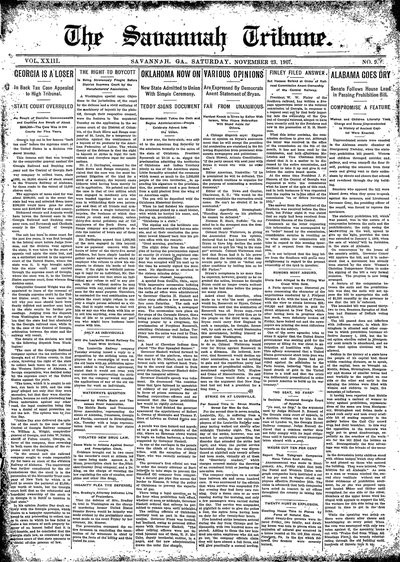
Page text (machine-generated)
VOL. XXIII.
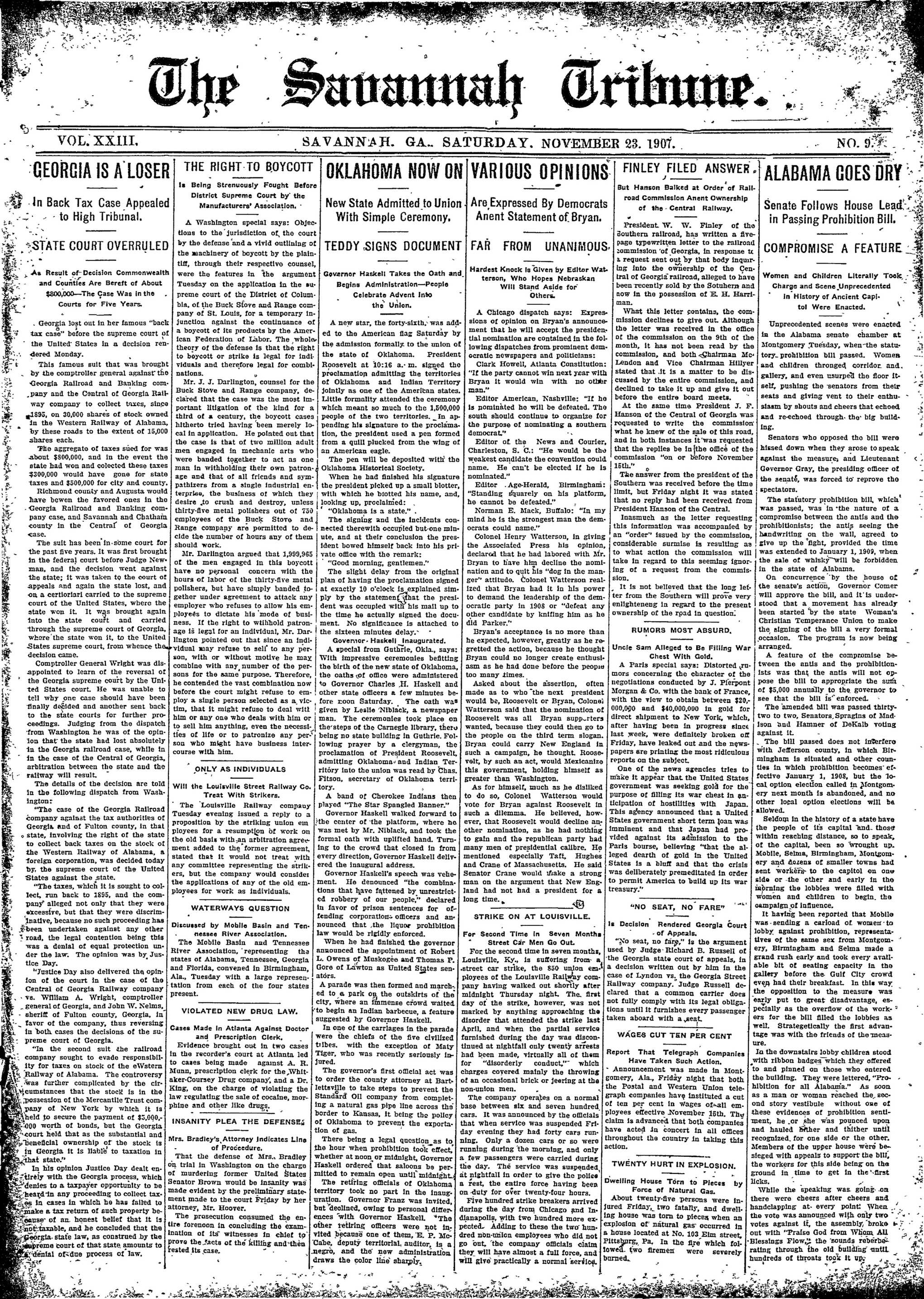
GEORGIA IS A LOSER
In Back Tax Case Appealed to High Tribunal.
STATE COURT OVERRULED
As Result of Decision Commonwealth and Counties Are Bereft of About $800,000—The Case Was in the Courts for Five Years.
Georgia lost out in her famous "back tax case" before the supreme court of the United States in a decision rendered Monday.
This famous suit that was brought by the comptroller general against the Georgia Railroad and Banking company and the Central of Georgia Railway company to collect taxes, since 1895, on 30,000 shares of stock owned in the Western Railway of Alabama, by these roads to the extent of 15,000 shares each.
The aggregate of taxes sued for was about $800,000, and in the event the state had won and colected these taxes $300,000 would have gone for state taxes and $500,000 for city and county. Richmond county and Augusta would have beween the favored ones in the Georgia Railroad and Banking company case, and Savannah and Chatham county in the Central of Georgia case.
The suit has been in some court for the past five years. It was first brought in the federal court before Judge Newman, and the decision went against the state; it was taken to the court of appeals and again the state lost, and on a certiorari carried to the supreme court of the United States, where the state won it. It was brought again into the state court and carried through the supreme court of Georgia, where the state won it, to the United States supreme court, from whence the decision came.
Comptroller General Wright was disappointed to learn of the reversal of the Georgia supreme court by the United States court. He was unable to tell why one case should have been finally decided and another sent back to the state courts for further proceedings. Judging from the dispatch from Washington he was of the opinion that the state had lost absolutely in the Georgia railroad case, while in in the case of the Central of Georgia, arbitration between the state and the railway will result.
The details of the decision are told in the following dispatch from Washington:
"The case of the Georgia Railroad company against the tax authorities of Georgia and of Fulton county, in that state, involving the right of the state to collect back taxes on the stock of the Western Railway of Alabama, a foreign corporation, was decided today by the supreme court of the United States against the state.
"The taxes, which it is sought to collect, run back to 1895, and the company alleged not only that they were excessive, but that they were discriminative, because no such proceeding has been undertaken against any other road, the legal contention being this was a denial of equal protection under the law. The opinion was by Justice Day.
"Justice Day also delivered the opinion of the court in the case of the Central of Georgia Railway company vs. William A. Wright, comptroller general of Georgia, and John W. Nelms, sheriff of Fulton county, Georgia, in favor of the company, thus reversing in both cases the decisions of the supreme court of Georgia.
"In the second suit the railroad company sought to evade responsibility for taxes on stock of the eWern Railway of Alabama. The controversy was further complicated by the circumstances that the stock is in the possession of the Mercantile Trust company of New York by which it is held to secure the payment of $3,000,000 worth of bonds, but the Georgia court held that as the substantial and beneficial ownership of the stock is in Georgia it is liable to taxation in that state."
In his opinion Justice Day dealt entirely with the Georgia process, which denies to a taxpayer opportunity to be heard in any proceeding to collect taxes in cases in which he has failed to make a tax return of such property because of an honest belief that it is not taxable, and he concluded that the Georgia state law, as construed by the supreme court of that state amounts to a denial of due process of law.
The Savannah Tribune.
THE RIGHT TO BOYCOTT
Is Being Strenuously Fought Before District Supreme Court by the Manufacturers' Association.
A Washington special says: Objections to the jurisdiction of the court by the defense and a vivid outlining of the machinery of boycott by the plaintiff, through their respective counsel, were the features in the argument Tuesday on the application in the supreme court of the District of Columbia, of the Buck Slove and Range company of St. Louis, for a temporary injunction against the continuance of a boycott of its products by the American Federation of Labor. The whole theory of the defense is that the right to boycott or strike is legal for individuals and therefore legal for combinations.
Mr. J. J. Darlington, counsel for the Buck Stove and Range company, declared that the case was the most important litigation of the kind for a third of a century, the boycott cases hitherto tried having been merely local in application. He pointed out that the case is that of two million adult men engaged in mechanic arts who were banded together to act as one man in withholding their own patronage and that of all friends and sympathizers from a single industrial enterprise, the business of which they desire to crush and destroy, unless thirty-five metal polishers out of 750 employees of the Buck Stove and Range company are permitted to decide the number of hours any of them should work.
Mr. Darlington argued that 1,999,965 of the men engaged in this boycott have no personal concern with the hours of labor of the thirty-five metal polishers, but have simply banded together under agreement to attack any employer who refuses to allow his employees to dictate his mode of business. If the right to withhold patronage is legal for an individual, Mr. Darlington pointed out that since an individual may refuse to sell to any person, with or without motive he may combine with any number of the persons for the same purpose. Therefore, he contended the vast combination now before the court might refuse to employ a single person selected as a victim, that it might refuse to deal with him or any one who deals with him or to sell him anything, even the necessities of life or to patronize any person who might have business intercourse with him.
ONLY AS INDIVIDUALS
Will the Louisville Street Railway Co.
Treat With Strikers.
The Louisville Railway company Tuesday evening issued a reply to a proposition by the striking union employees for a resumption of work on the old basis with an arbitration agreement added to the former agreement, stated that it would not treat with any committee representing the strikers, but the company would consider the applications of any of the old employees for work as individuals.
WATERWAYS QUESTION
Discussed by Mobile Basin and Tennessee River Association. The Mobile Basin and Tennessee River Association, representing the states of Alabama, Tennessee, Georgia and Florida, convened in Birmingham, Ala., Tuesday with a large representation from each of the four states present.
VIOLATED NEW DRUG LAW.
Cases Made in Atlanta Against Doctor and Prescription Clerk. Evidence brought out in two cases in the recorder's court at Atlanta led to cases being made against A. R. Munn, prescription clerk for the, Whitaker-Coursey Drug company, and a Dr. King, on the charge of violating the law regulating the sale of cocaline, morphine and other like drugs.
INSANITY PLEA THE DEFENSE
Mrs. Bradley's Attorney Indicates Line of Procedure.
That the defense of Mrs. Bradley on trial in Washington on the charge of murdering former United States Senator Brown would be insanity was made evident by the preliminary statement made to the court Friday by her attorney, Mr. Hoover. The prosecution consumed the entire forenoon in concluding the examination of its witnesses in chief to prove the facts of the killing and then rested its case.
SAVANNAH. GA.. SATURDAY. NOVEMBER 23. 1907.
OKLAHOMA NOW ON
New State Admitted to Union With Simple Ceremony.
TEDDY SIGNS DOCUMENT
Governor Haskell Takes the Oath and Begins Administration—People Celebrate Advent Into the Union.
A new star, the forty-sixth, was added to the American flag Saturday by the admission formally to the union of the state of Oklahoma. President Roosevelt at 10:16 a.m. signed the proclamation admitting the territories of Oklahoma and Indian Territory jointly as one of the American states. Little formality attended the ceremony which meant so much to the 1,500,000 people of the two territories. In appending his signature to the proclamation, the president used a pen formed from a quill plucked from the wing of an American eagle. The pen will be deposited with the Oklahoma Historical Society.
When he had finished his signature the president picked up a small blotter, with which he biotted his name, and, looking up, proclaimed:
"Oklahoma is a state." The signing and the incidents connected therewith occupied but-one minute, and at their conclusion the president bowed himself back into his private office with the remark:
"Good morning, gentlemen."
The slight delay from the original plan of having the proclamation signed at exactly 10 o'clock is explained simply by the statement that the president was occupied with his mall up to the time he actually signed the document. No significance is attached to the sixteen minutes delay.
A special from Guthrie, Okla., says: With impressive ceremonies befitting the birth of the new state of Oklahoma, the oaths of office were administered to Governor Charles H. Haskell and other state officers a few minutes before noon Saturday. The oath was given by Lesile Niblack, a newspaper man. The ceremonies took place on the steps of the Carnegie library, there being no state building in Guthrie. Following prayer by a clergyman, the proclamation of President Roosevelt, admitting Oklahoma and Indian Territory into the union was read by Chas. Fitson, secretary of Oklahoma territory.
A band of Cherokee Indians then played "The Star Spangled Banner."
Governor Haskell walked forward to the center of the platform, where he was met by Mr. Niblack, and took the formal oath with uplifted hand. Turning to the crowd that closed in from every direction, Governor Haskell delivered the inaugural address.
Governor Haskell's speech was vehement. He denounced "the combinations that have fattened by unrestricted robbery of our people," declared in favor of prison sentences for offending corporation officers and announced that the liquor prohibition law would be rigidly enforced.
When he had finished the governor announced the appointment of Robert L. Owens of Muskogee and Thomas P. Gore of Lawton as United States senators.
A parade was then formed and marched to a park on the outskirts of the city, where an immense crowd waited to begin an Indian barbecue, a feature suggested by Governor Haskell. In one of the carriages in the parade were the chiefs of the five civilized tribes, with the exception of Maty Tiger, who was recently seriously injured. The governor's first official act was to order the county attorney at Bartlettsville to take steps to prevent the Standard Oil company from completing a natural gas pipe line across the border to Kansas, it being the policy of Oklahoma to prevent the exportation of gas.
There being a legal question as to the hour when prohibition took effect, whether at noon or midnight, Governor Haskell ordered that saloons be permitted to remain open until midnight. The retiring officials of Oklahoma territory took no part in the inauguration. Governor Franz was invited, but decolled, owing to personal differences with Governor Haskell. The other retiring officers were not invited because one of them, E. P. McCabe, deputy territorial auditor, is a negro, and the new administration draws the color line sharply.
VARIOUS OPINIONS
Are Expressed By Democrats Anent Statement of Bryan.
FAŏ FROM UNANIMOUS
Hardest Knock is Given by Editor Watterson, Who Hopes Nebraskan Will Stand Aside for Others.
A Chicago dispatch says: Expressions of opinion on Bryan's announcement that he will accept the presidential nomination are contained in the following dispatches from prominent democratic newspapers and politicians:
Clark Howell, Atlanta Constitution:
"If the party cannot win next year with Bryan it would win with no other man."
Editor American, Nashville: "If he is nominated he will be defeated. The south should continue to organize for the purpose of nominating a southern democrat."
Editor of the News and Courier, Charleston, S. C.: "He would be the weakest candidate the convention could name. He can't be elected if he is nominated."
Editor. Age-Herald, Birmingham: "Standing squarely on his platform, he cannot be defeated."
Norman E. Mack, Buffalo: "In my mind he is the strongest man the democrats could name."
Colonel Henry Watterson, in giving the Associated Press his opinion, declared that he had labored with Mr. Bryan to have him decline the nomination and to quit his "dog in the manger" attitude. Colonel Watterson realized that Bryan had it in his power to demand the leadership of the democratic party in 1908 or "defeat any other candidate by knifing him as he did Parker." Bryan's acceptance is no more than he expected, however, greatly as he regretted the action, because he thought Bryan could no longer create enthusiasm as he had done before the people too many times.
Asked about the assertion, often made as to who the next president would be, Roosevelt or Bryan, Colonni Watterson said that the nomination of Roosevelt was all Bryan supporters wanted, because they could then go to the people on the third term slogan. Bryan could carry New England in such a campaign, he thought. Roosevelt, by such an act, would Mexicanize this government, holding himself as greater than Washington.
As for himself, much as he disliked to do so, Colonel Watterson would vote for Bryan against Roosevelt in such a dilemma. He believed, however, that Roosevelt would decline another nomination, as he had nothing to gain and the republican party had many men of presidential callbre. He mentioned especially Taft, Hughes and Crane of Massachusetts. He said Senator Crane would shake a strong man on the argument that New England had not had a president for a long time.
STRIKE ON AT LOUISVILLE.
For Second Time In Seven Months Street Car Men Go Out. For the second time in seven months, Louisville, Ky., is suffering from a street car strike, the 850 union employees of the Louisville Railway company having walked out shortly after midnight Thursday night. The first day of the strike, however, was not marked by anything approaching the disorder that attended the strike last April, and when the partial service furnished during the day was discontinued at nightfall only twenty arrests had been made, virtually all of them for "disorderly conduct," which charges covered mainly the throwing of an occasional brick or jeering at the non-union men.
The company operates on a normal base between six and seven hundred cars. It was announced by the officials that when service was suspended Friday evening they had forty cars running. Only a dozen cars or so were running during the morning, and only a few passengers were carried during the day. The service was suspended at nightfall in order to give the police a rest, the entire force having been on duty for over twenty-four hours. Five hundred strike breakers arrived during the day from Chicago and Indianapolis, with two hundred more expected. Adding to these the two hundred non-union employees who did not go out, the company officials claim they will have almost a full force, and will give practically a normal service.
FINLEY FILED ANSWER.
But Hanson Balked at Order of Railroad Commission Anent Ownership of the Central Railway.
President W. W. Finley of the Southern railroad, has written a five-page typewritten letter to the railroad commission of Georgia, in response to a request sent out by that body inquiring into the ownership of the Central of Georgia railroad, alleged to have been recently sold by the Sotuhern and now in the possession of E. H. Harriman.
What this letter contains, the commission declines to give out. Although the letter was received in the office of the commission on the 9th of the month, it has not been read by the commission, and both Chairman McLendon and Vice Chairman Hillyer stated that it is a matter to be discussed by the entire commission, and declined to take it up and give it out before the entire board meets.
At the same time President J. F. Hanson of the Central of Georgia was requested to write the commission what he knew of the sale of this road, and in both instances it was requested that the replies be in the office of the commission "on or before November 15th."
The answer from the president of the Southern was received before the time limit, but Friday night it was stated that no reply had been received from President Hanson of the Central. Inasmuch as the letter requesting this information was accompanied by an "order" issued by the commission, considerable surmise is resulting as to what action the commission will take in regard to this seeming ignoring of a request from the commission. It is not believed that the long letter from the Southern will prove very enlighteneng in regard to the present ownership of the road in question.
RUMORS MOST ABSURD.
Uncle Sam Alleged to Be Filling War Chest With Gold.
A Paris special says: Distorted rumors concerning the character of the negotiations conducted by J. Plerpont Morgan & Co. with the bank of France, with the view to obtain between $20,000,000 and $40,000,000 in gold for direct shipment to New York, which, after having been in progress since last week, were definitely broken off Friday, have leaked out and the newspapers are printing the most ridiculous reports on the subject.
One of the news agencies tries to make it appear that the United States government was seeking gold for the purpose of filling its war chest in anticipation of hostilities with Japan. This agency announced that a United States government short term loan was imminent and that Japan had provided against its admission to the Paris bourse, believing "that the alleged dearth of gold in the United States is a bluff and that the crisis was deliberately premeditated in order to permit America to build up its war treasury."
"NO SEAT, NO FARE"
Is Decision Rendered Georgia Court of Appeals.
"No seat, no fare," is the argument used by Judge Richard B. Russell of the Georgia state court of appeals, in a decision written out by him in the case of Lyndon vs. the Georgia Street Hallway company. Judge Russell declared that a common carrier does not fully comply with its legal obligations until it furnishes every passenger taken aboard with a seat.
WAGES CUT TEN PER CENT
Report That Telegraph Companies Have Taken Such Action
Announcement was made in Montgomery, Ala., Friday night that both the Postal and Western Union telegraph companies have instituted a cut of ten per cent in wages of all employees effective November 15th. The claim is advanced that both companies have acted in concert in all offices throughout the country in taking this action.
TWENTY HURT IN EXPLOSION.
Dwelling House Torn to Pieces by Force of Natural Gas. About twenty-five persons were injured Fridny, two fatally, and dwelling house was torn to pieces when an explosion of natural gas occurred in a house located at No. 103 Elm street, Pittsburgh, Pa. In the fire which followed, two firemen were severely burned.
ALABAMA GOES DRY
Senate Follows House Lead in Passing Prohibition Bill.
COMPROMISE A FEATURE
Women and Children Literally Took Charge and Scene Unprecedented In History of Ancient Capi-
Unprecedented scenes were enacted in the Alabama senate chamber at Montgomery Tuesday, when the statutory prohibition bill passed. Women and children thronged corridor and gallery, and even usurped the floor itself, pushing the senators from their seats and giving vent to their enthusiasm by shouts and cheers that echoed and re-echoed through the big building.
Senators who opposed the bill were hissed down when they arose to speak against the measure, and Lieutenant Governor Gray, the presiding officer of the senate, was forced to reprove the spectators.
The statutory prohibition bill, which was passed, was in the nature of a compromise between the antis and the prohibitionists; the antis seeing the handwriting on the wall, agreed to give up the fight, provided the time was extended to January 1, 1909, when the sale of whisky will be forbidden in the state of Alabama.
On concurrence by the house of the senate's action, Governor Comer will approve the bill, and it is understood that a movement has already been started by the state Woman's Christian Temperance Union to make the signing of the bill a very formal occasion. The program is now being arranged.
A feature of the compromise between the antis and the prohibitionists was that the antis will not oppose the bill to appropriate the sum of $5,000 annually to the governor to see that the bill is enforced. The amended bill was passed thirty-two to two, Senators, Spragins of Madison and Hamner of DeKalb voting against it. The bill passed does not interfere with Jefferson county, in which Birmingham is situated and other counties in which prohibition becomes effective January 1, 1908, but the local option election called in Montgomery next month is abandoned, and no other local option elections will be allowed.
Seldom in the history of a state have the people of its capital and those within reaching distance, so to speak, of the capital, been so wrought up. Mobile, Selma, Birmingham, Montgomery and dozens of smaller towns had sent workers to the capitol on one side or the other and early in the morning the lobbles were filled with women and children to begin the campaign of influence.
It having been reported that Mobile was sending a carload of women to lobby, against prohibition, representatives of the same sex from Montgomery, Birmingham and Selma made a grand rush early and took every available bit of seating capacity in the gallery before the Gulf City crowd even had their breakfast. In this way, the opposition to the measure was early put to great disadvantage, especially as the overflow of the workers for the bill filled the lobbies as well. Strategetically the first advantage was with the friends of the measure.
In the downstairs lobby children stood with ribbon badges which they offered to and planned on those who entered the building. They were lettered, "Prohibition for all Alabama." As soon as a man or woman reached the second story vestibule without one of these evidences of prohibition sentiment, he or she was pounced upon and hauled either and thither until recognized, for one side or the other. Members of the upper house were besieged with appeals to support the bill, the workers for this side being on the ground in time to get in the first licks.
While the speaking was going on there were cheers after cheers and handclapping at- every point! When the vote was announced with only two votes against it, the assembly, broke out with 'Praise God from Whom All Blessings Flow,' the sounds reberberating through the old building until hundreds of throats took it up.
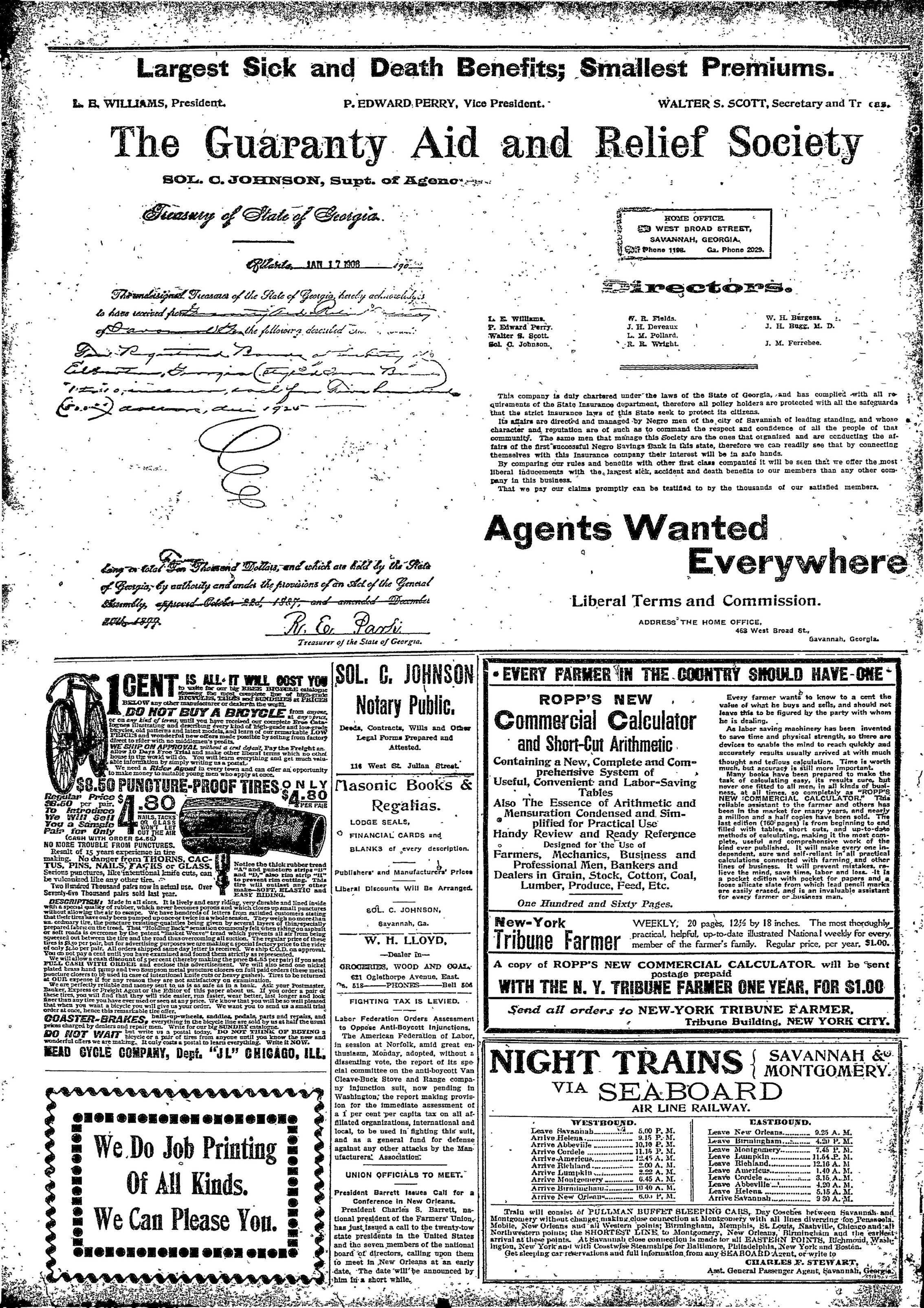
Largest Sick and Death Benefits; Smallest Premiums.
The Guaranty Aid and Relief Society
HOME OFFICE
WEST BROAD STREET,
SAVANNAH, GEORGIA.
Phone 1198. Ga. Phone 2029.
Directors.
L. E. Williams.
P. Edward Perry.
Walter S. Scott.
Sol. C. Johnson.
W. R. Fields.
J. H. Deveaux
L. M. Pollard.
R. R. Wright.
W. H. Burgess.
J. H. Bugg, M. D.
J. M. Ferrebee.
This company is duly chartered under the laws of the State of Georgia, and has complied with all requirements of the State Insurance department, therefore all policy holders are protected with all the safeguards that the strict Insurance laws of this State seek to protect its citizens.
Its affairs are directed and managed by Negro men of the city of Savannah of leading standing, and whose character and reputation are of such as to command the respect and confidence of all the people of that community. The same men that manage this Society are the ones that organized and are conducting the affairs of the first successful Negro Savings Bank in this state, therefore we can readily see that by connecting themselves with this Insurance company their interest will be in safe hands.
By comparing our rules and benefits with other first class companies it will be seen that we offer the most liberal inducements with the largest sick, accident and death benefits to our members than any other company in this business.
That we pay our claims promptly can be testified to by the thousands of our satisfied members.
- EVERY FARMER IN THE COUNTRY SHOULD HAVE-ONE
ROPP'S NEW Commercial Calculator and Short-Cut Arithmetic
Containing a New, Complete and Comprehensive System of Useful, Convenient and Labor-Saving Tables Also The Essence of Arithmetic and Mensuration Condensed and Simplified for Practical Use Handy Review and Ready Reference Designed for the Use of Farmers, Mechanics, Business and Professional Men, Bankers and Dealers in Grain, Stock, Cotton, Coal, Lumber, Produce, Feed, Etc.
A copy of ROPP'S NEW COMMERCE postage p WITH THE N. V. TRIBUNE EAR
A copy of ROPP'S NEW COMMERCIAL CALCULATOR will be sent postage prepaid WITH THE N. Y. TRIBUNE FARMER ONE YEAR, FOR $1.00
Train will consist of PULLMAN BUFFET SLEEPING CARS, Day Coaches between Savannah and Montgomery without change; making close connection at Montgomery with all lines diverging for Penssola, Mobile, New Orleans and all Western points; Birmingham, Memphis, St. Louis, Nashville, Chicago and all Northwestern points; the SHORTEST LINE to Montgomery, New Orleans, Birmingham and the earliest arrival at these points. At Savannah close connection is made for all EASTERN POINTS, Richmond, Wash- lington, New York and with Coastwise Steamships for Baltimore, Philadelphia, New York and Boston. Get sleeping car reservations and full information from any SEABOARD Agent, or write to
SOL. C. JOHNSON, Supt. of Ageno
Treasury of State of Georgia.
Rilanta. JAN 17 1908 190
The undesigned Treasurer of the State of Georgia, hereby acknowledges
to have received from the following described Inc.
Dear Regent and Trustee of the State of Georgia,
Elevation, Georgia (Cape Fear County)
17410, pursuant to the laws of the State of Georgia
(sovereign, date 1925)
long in total Ten Thousand Dollars , and which are held by the State of Georgia , by authority and under the provisions of an Act of the General Assembly , approved October 22d , 1887 , and amended December 20th , 1897 .
DO NOT BUY A BICYCLE from anyone or on any kind of term, until you have received our complete Ergo Cataloges illustrating and describing every kind of high-grade and low-grade bicycles, old patterns and latest models, and learn of our remarkable LOW BICYCLES and wonderful new offers made possible by selling from factory direct order with no middlement's profits.
WE SHIP ON APPROVAL without a cent deposit. Pay the Freight an allowance. Days Exterior and make other liberal terms which no other house in the world will do. You will learn everything and get much valuable information by simply writing us a postal.
We need a Rider Agent in every town and can offer an opportunity to make money to suitable young men who apply at once.
$8.50 PUNGTURE-PROOF TIRES ONLY
Regular Price
$8.50 per pair.
To introduce
We Will Sell
You a Sample
Pair for Only
(CASH WITH ORDER $4.55)
NAILS, TACKS
OR GLASS
WON'T LET
OUT THE AIR
NO MORE TROUBLE FROM PUNCTURES.
We need a Riser Agent in every town and can offer an opportunity to make money to suitable young men who apply at once.
$8.50 PUNGTURE-PROOF TIRES ONLY
$4.80
PER PAIR
Regular Price
$8.60 per pair.
To Introduce
We Will Sell
You a Sample
Pair for Only
(CASH WITH ORDER $4.65)
NO MORE TROUBLE FROM PUNCTURES.
Result of 15 years experience in tire making. No danger from THORNS, CACTUS, PINS, NAILS, TACKS or GLASS.
Serious punctures, like intestinal knife cuts, can be vulcanized like any other tire.
Notice the thick rubber tread
"A" and puncture strips "II"
and "D," also rim strip "H"
to prevent rim cutting. This
Notice the thick rubber stripes "A" and puncture strips "I" and "D," also rim strip "I" to prevent cutting. This makes it easy to cut any other make-SOFT, ELASTIC and EASY RIDING.
Two Hundred Thousand pairs now in actual use. Over tire will outlast any other make-SOFT, ELASTIC and EASY RIDING.
DESCRIPTION: Made in all sizes. It is lively and easy riding, very durable and lined inside with a special quality of rubber, which never becomes porous and which closes up small punctures without allowing the air to escape. We have hundreds of letters from satisfied customers stating that their tires have only been pumped upon once or twice in a whole season. They weigh no more than an ordinary tire, the puncture resisting-qualities being given by several layers of thin-specially prepared fabric on the tread. That "Holding Back" sensation commonly felt when riding on asphalt or soft roads is overcome by the patent "Basket Weave" tread which prevents all air from being squeezed out between the tire and the road thus overcoming all suction. The regular price of these tires is $50 per pair, but for advertising purposes we are making a special factory price to the rider of a full cash with ORDER and enclose this advertisement. We will allow one mickel plated brass hand pump and two Samson metal puncture closers on full paid orders (these metal puncture closers to be used in case of intentional knife cuts or heavy gashes). Tires to be returned at OUR expense if for any reason they are not satisfactory on examination.
We are perfectly reliable and money sent to us is as safe as in a bank. Ask your Postmaster, Banker, Express or Freight Agent or the Editor of this paper about us. If you order a pair of these tires, you will find that they will ride easier, run faster, wear better, last longer and look finer than any tire you have ever used or seen at any price. We know that you will be so well pleased that when you want a bicycle you will give us your order. We want you to send us a small trial order at once, hence this remarkable tire offer.
COASTER-BRAKES, built-up-wheels, saddling, pedals, parts and repairs, and
prices charged by dealers and repair men. Write for our big SUNDAY catalog.
DO NOT WAIT but write us a postal today. DO NOT THINK OF BUYING a
bicycle or a pair of tires from anyone until you know the new and
wonderful one.
We Do Job Printing
Of All Kinds.
We Can Please You.
P. EDWARD; PERRY, Vice President.
Granty Aid and
ON, Supt. of Ageno
of Georgia.
JAN 17 1906 190
Georgia, hereby acknowledges
described Inc.
L. E. Williams.
P. Edward Perry.
Walter S. Scott.
Sol. O. Johnson.
This company
quirements of the
that the strict in
Its affairs are o
character and re
community. The
fairs of the first
themselves with
By comparing o
liberal induceme
pany in this busi
That we pay o
Agel
which are held by the State
isions of an Act of the General
and amended December
P. E. Parsi
Masonic Books & Regalias.
LODGE SEALS,
FINANCIAL CARDS and
BLANKS of every description.
Publishers' and Manufacturers' Prices
Liberal Discounts Will Be Arranged.
Savannah, Ga.
W. H. LLOYD.
—Daaler In—
Treasurer of the State of Georgia.
SOL. C. JOHNSON Notary Public.
Deeds, Contracts, Wills and Other
Legal Forms Prepared and
Attested.
116 West St. Julian Street.
SOL. C. JOHNSON,
GROCERIES, WOOD AND OOAL.
621 Oglethorpe Avenue, East.
Ma. 518 - PHONES - Bell 504
Labor Federation Orders Assessment to Oppose Anti-Boycott Injunctions
The American Federation of Labor, in session at Norfolk, amid great enthusiasm, Monday, adopted, without a dissenting vote, the report of its special committee on the anti-boycott Van Cleave-Buck Stove and Range company injunction suit, now pending in Washington, the report making provision for the immediate assessment of a 1 per cent per capita tax on all affiliated organizations, international and local, to be used in fighting this suit, and as a general fund for defense against any other attacks by the Manufacturer Association.
UNION OFFICIALS TO MEET.
President Barrett Issues Call for a Conference in New Orleans. President Charles S. Barrett, national president of the Farmers' Union, has just issued a call to the twenty-tow state presidents in the United States and the seven members of the national board of directors, calling upon them to meet in New Orleans at an early date. The date will be announced by him in a short while.
WALTER S. SCOTT, Secretary and Tr cas.
Relief Society
HOME OFFICE
WEST BROAD STREET,
SAVANNAH, GEORGIA.
Phone 1198. Ga. Phone 2029.
Directors.
W. R. Fields. W. H. Burgess.
J. H. Deveaux J. H. Bugg, M. D.
L. M. Pollard.
R. R. Wright. J. M. Ferrebee.
Under the laws of the State of Georgia, and has complied with all re-
partment, therefore all policy holders are protected with all the safeguard
is State seek to protect its citizens.
By Negro men of the city of Savannah of leading standing, and whos
as to command the respect and confidence of all the people of tha-
lage this Society are the ones that organized and are conducting the a-
nings Bank in this state, therefore we can readily see that by connecting
company their interest will be in safe hands.
With other first class companies it will be seen that we offer the most
sick, accident and death benefits to our members than any other com-
pany can be testified to by the thousands of our satisfied members.
Wanted Everywhere
Terms and Commission.
ADDRESS THE HOME OFFICE,
463 West Broad St,
Gavannah, Georgia.
IN THE COUNTRY SHOULD HAVE ONE
WEEKLY, 20 pages, 12 $ by 18 inches. The most thoroughly practical, helpful, up-to-date illustrated National weekly for every member of the farmer's family. Regular price, per year, $1.00.
COMMERCIAL CALCULATOR will be sent postage prepaid
TRIBUNE FARMER ONE YEAR, FOR $1.00
NEW-YORK TRIBUNE FARMER.
Tribune Building, NEW YORK CITY.
TRAINS { SAVANNAH & MONTGOMERY.
EABOARD
AIR LINE RAILWAY.
Send all orders to NEW-YORK TRIBUNE FARMER. Tribune Building. NEW YORK CITY.
IN BUFFET SLEEPING CARS, Day Coaches between Savannah and close connection at Montgomery with all lines diverging for Pensacola, on points; Birmingham, Memphis, St. Louis, Nashville, Chicago and all LINE to Montgomery, New Orleans, Birmingham and the earliest close connection is made for all EASTERN POINTS, Richmond, Wash., Steamships for Baltimore, Philadelphia, New York and Boston. Full information from any SEABOARD Agent, or write to
CHARLES F. STEWART,
Asst. General Passenger Agent, Savannah, Georgia.
One Hundred and Sixty Pages.
Gavannah, Georgia.
Every farmer wants to know to a cent the value of what he buys and sells, and should not leave this to be figured by the party with whom he is dealing. As labor saving machinery has been invented to save time and physical strength, so there are devices to enable the mind to reach quickly and accurately results usually arrived at with much thought and tedious calculation. Time is worth much, but accuracy is still more important.
Many books have been prepared to make the task of calculating easy, its results cure, but never one fitted to all men, in all kinds of business, at all times, so completely as "ROPPIS NEW COMMERCIAL CALCULATOR." This reliable assistant to the farmer and others has been in the market for many years, and nearly a million and a half copies have been sold. The last edition (150 pages) is from beginning to end filled with tables, short cuts, and up-to-date methods of calculating, making it the most complete, useful and comprehensive work of the kind ever published. It will make every one independent, sure and self-reliant in all practical calculations connected with farming, and other lines of business. It will prevent mistakes, relieve the mind, save time, labor and loss. It is a pocket edition with pocket for papers and a loose silicate slate from which lead pencil marks are easily erased, and is an invaluable assistant for every farmer or business man.
Leave New Orleans......
Leave Birmingham......
Leave Montgomery......
Leave Lumpkin......
Leave Richland......
Leave Americus......
Leave Cordele......
Leave Abbeville.....1
Leave Helena......
Arrive Savannah.....
Georgie's Thanksgiving
Sarah De.Wolf Gamwell.
Being the True Story That Grandmother Gibbons-Told Her Grandchildren Every
Thanksgiving and Birthday.
"I was eight and your great-aunt Virginia, ten when we had the thanksgiving and birthday in one, which we never forgot. Our mother was a Southern woman. She gave to her first child the name of her beloved State. If Virginia had been a boy his name would have been George Washington. When I was born two years later to a day I was named George Washington. Your great-grandfather died three months before I was born. Our birthday came the 20th of November, so near to Thanksgiving that mother always celebrated the two days in one.
"This that I am going to tell happened long before the Civil War; for the first time in our lives the Thanksgiving Day for Massachusetts was appointed on the 20th day of November. We all went early to the meeting-house the Sunday before, for we knew we were going to hear the Thanksgiving proclamation. All the children in the meeting-house kept wide awake that morning, and Virgle and I nudged each other when the minister opened the proclamation with a rattle and spread it on the desk.
"We knew what was coming. We could repeat the conclusion word for word. 'Given at the Council chamber in Boston this day' *by* His Excellency the Governor, George N. Briggs, and by the advice and consent of the Council.' That sounded great, and when the minister repeated slowly, 'God save the Commonwealth of Massachusetts,' it was grand! I felt as if I filled the meeting-house, because if George Washington had not been the 'father of his country,' where would Massachusetts be? 'The night before the great day we were standing at the kitchen table, watching mother unjoint the boiled chickens for the chicken plie, when the candle struck 8. She lighted a tallow candle and gave it to Virgile. It was our bedtime. 'Oh,' said I, as I dumped down in the feather bed, 'not it beautiful, Virgile, to have birthdays and Thanksgiving all together? And isn't mother kind? I'm just as happy!'
"So am I, said Virgile, giving me a hug. I know something."
"What is it, Virgile? I asked in a whisper.
"Then she told me that she was going to get up before anybody else in the house and steal out softly, and go to the north pasture and get some red berries to hang over George Washington's portrait in the front room, to please mother, and because it would be appropriate to my birthday.
"Let's," said I. "It will be splendid, and then I told her, what was true, that she was always thinking of something to please somebody, and then we said our prayers and cuddled down to sleep.
"It didn't seem but a minute after that when I sat up and rubbed my eyes. Virgie was already tying her leatherharness strings. "George Washington Howe, get up this minute; it's as light as a cork," she said. "I'm not going to put up, my hair, if it will take too much time, and it will keep me warm," and she let fall a cloud of gold over her shoulders." Grandmother Gibbons' voice always trembled a little here. "You've seen the portrait of your great-aunt Virginia, children. It's true what I told you. She was the most beautiful woman I ever saw; her hair was like spun gold.
"We put our surtouts over our thick woolen dresses, tied on our warm woolen hoods and tiptoed out for fear of waking Ponto in the shed. Virgle asked me to wait on the stone step while she brought a bowl of mother's chicken broth. It was thick and nourishing. It tasted good.
"We drove the cows to the north pasture every summer morning; we knew every nook and corner of it, but we didn't know the difference between broad daylight and moonlight, and great was our surprise when we reached the pasture bars, to see the moon going down, and no sign of morning, but Virgle kept hold of my hand and said, 'Never mind, George Washington, we can find the path, and the flat rock by the black walnut tree, if the moon doesn't shine.'
"Yes, I said, 'but how can we find the berries if it's pitch dark, Virgle?'"
"Oh, she said, 'it won't be dark long; it can't, because everybody
9
knows it's time for the sun to rise when the moon goes down; and lots of times I've seen the sun and moon shining both together in the sky, haven't you, George Washington? "Yes," I said, stumbling into a thorn bush and beginning to cry, but, Virginia, this doesn't seem like the path; where's the black walnut tree, and flat rock? They ought to be here, but they, aren't here!
HIS REPENTANCE.
By Laura E. Richards
Billy went to dinner.
On Thanksgiving day
With his Uncle Jonas
Just across the way.
Sat him down at two o'clock,
Didn't rise till five,
Never stopped eating all the time,
Sure as I'm alive.
When the midnight hour struck,
Billy boy was ill,
Had to take a bitter draft
And a brownish pill.
"Mother, a mistake I made!
Sighed the little sinner.
Cause I thought that I was
Bigger than the dinner!"
"We may be a little out of the path, Georgie Washington," she said bravely, "but anyway, we are in the right pasture, and here's a rock with a back to it, so let's sit down and wait," and she put her arm in a motherly way around me, and pillowed my red hooded head upon her shoulder. 'I'm glad I didn't put up my hair.'
"So I m I, Virgile," said I, as I nestled against the soft cushion. 'Your hair is the loveliest I ever saw, Virgile, and mine is short and stiff like bristles. I hate it.'
"But you're real good, Georgie Washington, and as soon as ever we get home, I'm going to give you a real boughten doll," she.said, "to have for your very own birthday, and to keep always."
Grandmother Gibbons did not need to tell the children that she had kept the "boughten doll;" they had all seen it.
"Well, children, the next thing, it seemed the.stars all faded, and the darkness deepened around us. I don't know how long we waited, while I lay with my head pressed against your great-altar Virginia's shoulder, but I heard her calling to me," "George Washington, this will never do.
Billy went to
On Thank
With his U
Just across
Sat him down
Didn't rise
Never stopped
Sure as I'
You must not go to sleep; we must get up and walk around."
"I don't want to walk around, Virgile," I said. "I want to go home, that's what I want."
"We'll walk toward home," said Virgile, taking hold of my hand, and starting up. "We're not in the path, but we can't be far from it, and we must keep walking, for you must not go to sleep. Here's the black walnut tree."
"Virgle gave a sudden spring forward, and fell. She told your great-grandmother Howe, after it was all over, that it seemed as if she fell miles and miles. Then it came over her like a flash, we had come through the wrong bars, and were over the gorge! That dreadful gorge where we were never allowed in broad daylight! Virgle fell till she stopped on a ledge not larger than her two feet, but her hair had been caught by an out-reaching tree branch; and it held her. True to her nature, her first thought, even then, was for me.
"George Washington, are you up there?" she called. Her voice sounded through the darkness far away.
"Yes, Virgle, I am here!" I think my teeth chattered. "Where are you?
"Stand still! Don't stir a step! Don't go to sleep, we're over the gorge. I'm caught by the hair and we must watt!"
"No one will ever know, children, how long we waited. It seemed to
me as if all at once I grew to be a woman. It seemed to me as if God had, given Virgie's life into my keeping. I kept calling down to her, telling her that' it would soon' be lighter, and that I felt sure that some way, somehow, I could save her. "At last it came, children, the first streak of the morning! I stooped over, and looked down that awful abyss, but the sight only gave me courage. 'Virgie, I cried, and my teeth didn't chatter this time, for when God wants us to do anything, children no matter how difficult, He will give us the will and the strength to do it.' 'Virgie, I can see you, you are not half way down, but keep still a few minutes, and I can save you.' "How did you do it, grandma?" always asked the children.
"I didn't know how I was going to do it, at first, but I began, very slowly, to make my way, not straight, but in a zigzag fashion, slowly and carefully down to the shelf over which Virgile hung. There was a little platform of rock, on which I stopped. It was growing lighter every minute, as I reached up to the twisted tree branch. Thon God let me see how I was going to be able to save my sister. You know how I did it, children."
"You untwisted her hair," from the children in chorus.
"Yes, those beautiful, strong locks of hair, all kinked and snarled, and held as in a vise, partly with my teeth, partly with my fingers, loosened every golden thread.
"Now, I said, 'Virgile, you are free! Catch hold of this limb that I
HIS REPENTANCE.
By Laura E. Richards
to dinner,
saving day,
uncle donas
is the way.
When the midnight
Billy boy w
Had to take a
And a brow
down at two o'clock,
he till five,
eating all the time;
I'm alive.
"Mother, a mis-
Sighed the li-
Cause I thought
Bigger than l
swing down to you! Catch hold and climb!
"Oh, Georgie Washington,' she cried. 'I can't! I'm dizzy! 'I shall faint."
"I could see that her strength was failing, but I wouldn't give up that I could save her; so I put all of my self into my voice, and I may have prayed, but I didn't know it, then.
"No, you won't faint, Virgile." I called. "You won't faint; you won't fall! You can't; you've got the limb. Now here's my hand; let's climb! We can see every step now, Virgile.
"We climbed slowly, step by step, zigzigging, plicking cur way up, and gaining courage till at last we fell in each other's arms, on to the level at the top, and that is the way I met an emergency, the Thanksgiving and birthday we never forgot. And that is the way I saved your great-aunt Virgina."—From Good Housekeeping.
"Downside Up"—If the Creatures Were Masters and the Man Underling.
The TURKEY'S DREAM
BY EMMA A. LENTE
LAST NIGHT I had a fearful dream; I tremble even yet!
I saw a table long and wide, with many,
And at one end I seemed to lie, helpless, and fat, and hot,
And could not move a foot or wing to hasten from the spot!
My stomach was uncomfortable; I could not draw my breath,
Nor make a sound, howeer I tried; I really felt like death!
I couldn't seem to find my head; my heart was out of place,
And somehow I had sadly lost my dignity and grace!
Then such a racketing arose, and scurrying through the hall,
And then a lot of people came—master, and wife, and all
The children who had been so kind and given me loads to eat—
They danced around my prostrate form; my downfall was complete!
Deceitful creatures! that they are; for in my dream they did!
"Ha, ha, Old Turkey! Where's your pride now you have lost your head?"
I quivered with my burning wrongs, but no one seemed to care.
For all sat down around the board and bowed their heads in prayer.
And then my master, that good man, took up a dreaded knife,
And held it slantwise over me; I trembled for my life!
But then a great fork pierced my breast, I gave a jump and scream,
And nearly tumbled off my perch in waking from my dream!
Be Not Ungrateful.
At the bottom of prosperity there is the "bountiful harvest," of which the old Thanksgiving proclamations made such account—the tremendous cereal crops, which enable us to give bread to all the world. As for the individual, he is ungrateful indeed who does not give thanks for the privilege of living in this age of the world and in such a land as ours. The simple fact of existence is cause for thanksgiving. And he will get the true thanksgiving flavor in his celebration to-day who has done something, much or little, to make a happier holiday for his less fortunate neighbor.
Monkeys are, remarkably keen of sight, but "lend in sense of smell."
Thanksgiving Dinner
MENU
FOR A FAMILY OF SIX
Oysters (Half shell) Tomato Soup;
Oranges and Celery
Roast Turkey, Cranberry Sauce.
Mashed Potatoes. Boiled Turnips.
Creamed Onions.
Mince and Pumpkin Pie.
Apples, Nuts, Raisins, Coffee
on
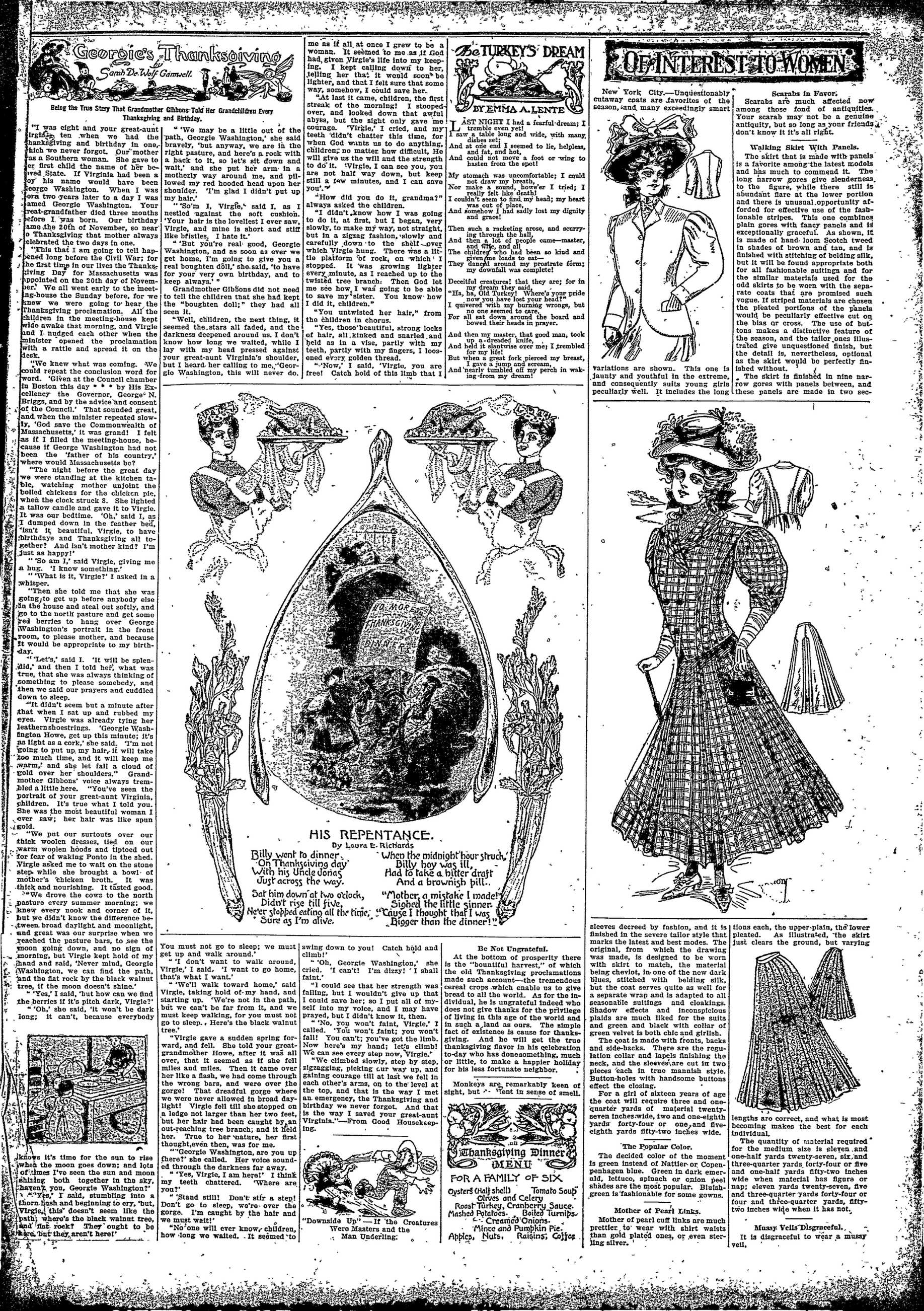
New York City.—Unquestionably cutaway coats are favorites of the season, and many exceedingly smart
11
variations are shown. This one is jaunty and youthful in the extreme, and consequently suits young girls peculiarly well. It includes the long
THE WORLD'S FASHION
sleeves decreed by fashion, and it is finished in the severe tailor style that marks the latest and best modes. The original, from which the drawing was made, is designed to be worn with skirt to match, the material being chevlot, in one of the now dark blues, stitched with belding silk, but the coat serves quite as well for a separate wrap and is adapted to all seasonable suitings and cloakings. Shadow effects and inconspicuous plaids are much liked for the suits and green and black with collar of green velvet is both chic and girlish. The coat is made with fronts, backs and side-backs. There are the regulation collar and lapels finishing the neck, and the sleeves are cut in two pieces each in true mannish style. Button-holes with handsome buttons effect the closing.
For a girl of sixteen years of age the coat will require three and one-quarter yards of material twenty-seven inches wide, two and one-eighth yards forty-four or one, and five-eighth yards fifty-two inches wide.
The Popular Color
The decided color of the moment is green instead of Nattier or Copenhagen blue. Green in dark emerald, lettuce, spinach or onion peel shades are the most popular. Bluishgreen is fashionable for some gowns.
Mother of Pearl Links.
Mother of pearl cuff links are much prettier, to wear with shirt waists than gold plated ones, or even sterling silver.
Scarabs in Favor.
Scarabs are much affected now among those fond of antiquities. Your scarab may not be a genuine antiquity, but so long as your friends don't know it it's all right.
Walking Skirt With Panels.
The skirt that is made with panels is a favorite among the latest models and has much to commend it. The long narrow gores give slenderness to the figure, while there still is abundant flare at the lower portion and there is unusual opportunity afforded for effective use of the fashionable stripes. This one combines plain gores with fancy panels and is exceptionally graceful. As shown, it is made of hand-loom Scotch tweed in shades of brown and tan, and is finished with stitching of bolding silk, but it will be found appropriate both for all fashionable suitings and for the similar materials used for the odd skirts to be worn with the separate coats that are promised such vogue. If striped materials are chosen the pleated portions of the panels would be peculiarly effective cut on the bias or cross. The use of buttons makes a distinctive feature of the season, and the tailor ones illustrated give unquestioned finish, but the detail is, nevertheless, optional as the skirt would be perfectly finished without.
The skirt is finished in nine narrow gores with panels between, and these panels are made in two sec-
S.
tions each, the upper-plain, the lower pleated. As illustrated, the skirt just clears the ground, but varying
lengths are correct, and what is most becoming makes the best for each individual.
The quantity of material required for the medium size is eleven, and one-half yards twenty-seven, six, and three-quarter yards forty-four or five and one-half yards fifty-two inches wide when material has figure or nap; eleven yards twenty-seven, five and three-quarter yards forty-four or four and three-quarter yards, fifty-two inches wide when it has not.
Mussy Vells Disgraceful.
It is disgraceful to wear a mussy vell.
1. SUBSCRIPTION RATES.
One Year. $1.25
Six Months. $7.50
Three Months. $40
Mutualance must be made by Express
ost Office Money Order, or Registered Letter
Advertising Rates given on application.
SATURDAY, NOV. 23, 1907.
WITHIN a few more weeks
Congress will be in session.
WITHIN a few weeks all clearing
house certificates may be
called in. At any rate our people
must be careful and do not
allow anyone to give them certificates
that are counterfeited.
Our young men are holding their own in all of the civil service examinations. Let them not deter by any form of discouragement, but endeavor to get on the eligible list at each examination,
THERE are hundreds of our boys and girls who are in need of positions. Let us patronize our business men so that they can increase their business, thereby hiring more help. By that means our boys and girls will find ready openings.
DURING the financial flurry the past several weeks, all of the colored financial. institutions held their own and the people feel that their savings are secure. In one of them there was a snug increase over the same period of the previous month. This speaks well for our people.
LAST week we published an article from a correspondent severely taking to task President Wright for his management of the State fair, and alluded to the State College. On the eighth page of this issue will be found a reply from President Wright, covering each statement of our correspondent. It will prove interesting reading.
LET the women of the race assist the men who are trying to get our careless men to pay their tax and register. The women should see that their husbands and brothers do so, and scorn any young man of voting age who is not qualified to cast a vote against the disfranchisement law. Let the women help.
NEXT Thursday will be Thanksgiving day, thus proclaimed by the President of the United States. On that day we are to return thanks to Him who is the donor of all good, for bounties bestowed. The day is generally given over to family reunion and sport. We cannot truly observe the day without remembering the unfortunate ones around us. Let those of us who are able to, make at least one unfortunate feel more grateful for the day.
Less than one month from date the tax collector's books will be closed. I behooves all of our voters to their tax within that time. Not only those who are already on the voting list, but those who have been delinquent. The manhood rights of the race has been struck at and will be voted upon next October. Every colored man in Georgia should be in a position to go to the polls and cast a decisive vote for his rights. Will you do so?
An object lesson is being taught the people of the North and West by foreign emigrants. For the past several weeks thousands of them have left this and other sections for their home across the waters, taking with them millions of American money. It is said that two thirds of them will not return; it is understood that the money they took will not at any event. This amount of money to be taken out of the country at this time is badly felt and those of the South who are clamoring for this class of people can easily see what they will get by bringing them here.
LAST Sunday afternoon a number of the business men and leading white citizens met at the theatre to arrange for the caring of the poor. This is a noble cause to be engaged in and the participants are to be commended. The fact of this meeting should be brought vividly before the leading ones, of our people and their too, should have an organized effort to against
the amelioration of the condition of our poor people. Those of us who are blessed with health and with regular employment should gladly contribute to a fund to aid the poor. Matters not how small our wages may be, a few cents spent in this direction will not hurt us, but tend to do untold good. Our people will not receive all the blessings that they should get until they become more charitably inclined. The leaders in churches and societies should get together and organize to help our unfortunate ones.
VISITORS to our city, especially those who call at places of business of our men and view the homes that we own, etc.. are immediately struck with the progress that we have made and the enterprise shown in our development. This development is manifested within the past few years. What we have done in those years, we can double in a like period to come. This can be especially accomplished if our men with money would invest it more in the colored enterprises, and not only do that but encourage these enterprises more by patronizing them, thus enabling the managers to increase their stock, hire more help and to educate more of our boys and girls into business ways, thereby fitting them to launch out in similar enterprises for themselves.
THE fortieth anniversary of Howard University, Washington, D. C., and inauguration of President W. R. Thirkisid took place last week. President Roosevelt was present and was introduced as "a man known the world over as favoring equal rights for all men—not alone the right to have an education of the head, the heart and the hand but an education productive of men who will do things."
The President preached a lay sermon, with optimism as his text. He held up the $350,000,000 worth of taxable property acumulated by the Negro in forty years of opportunity as an evidence of the rapid strides the race have taken toward good citizenship and emphasized the ownership of 500,000 homes as a high moral influence in the uplift of the colored people, deserving of the highest praise. "The material basis is not everythings" said the President, "but it is an indispensable prerequisite to moving upward in the life of decent citizenship; and the colored man, when he acquires property, acquires a home, has taken that indispensable first step, and a long, long step." He urged them to bear all responsibilities and burdens buoyantly and bravely. The President created no little amusement and won an enthusiastic note of approval when he strongly warned the graduates not to stay around Washington looking for some government position, nor to go to another large city, but suggested earnestly that they go out into the smaller places, where their efforts will tell for the good of the race. As the standing of the race in the eyes of the world so greatly depends upon the conduct and achievements of the leaders and teachers who go but from this institution, it was the President's sincere wish that their labors may indeed be fruitful.
College Dots.
Vice President Valentine of Benedict College, located at Columbia, S. C., visited the College this week. Students are still coming. The silver wedding of Mr. and Mrs. Roston, Thursday evening was an event in college life. The many friends who gathered at the home of bride and groom, spent a very pleasant evening. Many beautiful presents from many friends were tastily displayed.
They Appreciate The Tribune.
Hampton Institute; Hampton, Virginia.
Mr. Sol, C. Johnson. November 18, 1997
M. S. Johnson.
Editor.
One of the greatest pleasures of the boys at Hampton, is to read your always instructive and interesting paper, which is found weekly in our library. It is the most reliable medium of home news that we have and is most highly appreciated. Sometimes there are as many as nine or ten young men awaiting their turn to see the 'Trib' as we call it.
Our football team on which there is two Savannah boys has been very successful this fall, having won three out of four games played, and tied the exception. On November 1st we played "The Union University team to a standstill on their gridrel in Richmond, the score was 0-0. November and we defeated a local team by a score of 5-0. The "Thuakseege, institute another eleventh on November
18th, and we defeated them by a score of 10-0. Last came the much boasted aggregation from Shaw University, played our team in November, 16th. They brought them by a score of rosters. Our team defeated them by a score of 0. In favor of Hampton. Yours truly.
ROBT, F;GIBSON.
A Savannah Boy.
Knights of Tabor.
Bayannah, Ga., Nov. 14, 1907. A great and enthusiastic throng greeted Hon. F. D. Jackson, Rev. I. N. Ross and Mr. Adams Bradford, high officials of the K. & D. of Tabor on Thursday night of last week. The occasion was the making and installing of a lodge of forty six stalwart knights.
Rev. I. N. Ross, S. G. O., of Bethel A. M. E. Church of Atlanta Ga., spoke to a large and appreciative audience before there were picked about Mt. Tabor. Sir R. N. Willett, district deuty, presided with and with the form and eloquence, with which he is pennially endowed | introduced the distinguished speakers, touching lightly upon the origin and aim of the order. After which the form and evening greeted amid the tremor of applause spoke. His address was replete with eloquence and cold facts as fancy as the feathery clouds, fringed with the rosy light of the sinking sun. He held his audience in amazement, except when pent up approbation burst forth in vociferous applause.
He spoke of the geographical location of Mt. Tabor and of the thrilling scenes enacted thereabout, interspersing at intervals pleasant illustrations of points in proof. He spoke of the inception of the idea, leading up to the organization of the order and of the saluted Mose Dixon whose powers were to push the order to a frightful consummation. He spoke of the hilarization of the historic and the tragic scenes about the famous mount, and of mighty good that came as a result.
At the time of the inception of the idea of building around the memory of this famous Mount, a bulwark of trarelism, the bane of slavery held in its relentless grasp fear million men whose lives were drollery and misery. The love of the founder of the order for his people burned with such fervor that nothing but the relief of his people could assuage its heat. And he labored until the warmth of his efforts made maleable the great bar of racial division, and he then bent it into a circle which enclosed about forty two thousand souls. The great bar of the mighty band grew until thousands of slaves had made their way into the haven of freedom." He did not confine himself solely to discussion of Taborism however, but touched other topics which are of interest just now.
He spoke of the disunion of the Negro race, of its causes and of the hopeful outlook for future unity, basing his belief upon present indications. He congratulated the colorad citizens of Savannah upon their splendid progress, along business lines and upon their visible hospitality; but deprecated what he saw to be an inordinate inclination to trip the light from the ripe vine and piano. He scored the tendency of some "to get away from the race" and occasioned prolonged applause when he referred to the "hair straightening craze." Rev. Ross' address was a splendid effort and will be remembered pleasantly and profitably by all who heard him. He is an orator of no mean parts; his subtlety of disqusition, force of imagination, perfect energy and eloquence of expression, rank him high as a public debater and pulpil orator. Cool and graceful, he is a man of coolness once takes possession of his audience and handles them, "Yes lack Dinah kned ing dough."
We would not close this citation with out saying a word of the even temper, forbearance and profundity of Grand Mentor, N.D. Jackson. He is beyond doubt master of the works of the order over which he presides as chief and per forms the duties apparently without off fort. He is cool and calculating, pos sessing in abundance the qualities which bind men to him. There is no pump and bambast about him, but upon his face there are visible indications of depth of thought, sound judgment and fixity of purpose. In meeting him we feel that we met an honest man, Mr. Adam Bradford a high official of the order was one of the trio and made many friends as the result of his courteous and pleasant manner.
Mrs. W. D. W. Armstrong, assisted by Mrs. S. A. Chisolm; the wife of the intrepid "Billy" Armstrong is responsible for the awakening of Taborism in this city and community. She has been indebtable in her efforts to revive the order and as a result has organized and installed two Tabernacles of ladies in the last few months with a membership of upwards of one hundred and fifty. The ladies are enthusiastic and friendly. The ladies are splendid and amused on all Thursdays when Grand Menter Jackson lectured them. Mrs. Armstrong has another court now well under way and in a few days will set up her third one within the limits of the city of Savannah.
The entertainment arraigned for the occasion of the coming of Sirs Jackson, Ross and Bradford was a brilliant affair, and under the skillful management of Sir W. D. Armstrong, it was a financial success and the gentlemen in our city, Mt. Carmel Lodge Knights of Tabor was instituted and the following officers were installed: Sir F. J. Hilton, C. M., A. J. Ransier, V. M., W. K. Callen, C. S., J. B. Johnson, A. S., F. M. Cohen, C. T., W. D. Armstrong, C. O., Wm. H. Blake, C. D. M., Peter B. Parker, C. B., Wm. Goldwire, G., G. J. Kaisant, G., J. L. Mitchell, D. J. L. Mitchell, J. M. Northington, J. E, W. Sherman, J. L. A. Thomas, J. and R. A. Hooger, J.
Sir F. M. Cohen, secretary and treasurer of the Board of Endowment for K. of P. was unanimously elected treasurer of the Temple, all$^2$ of its members be lying that a dollar placed with him is a dollar kept as safe as though it was in the United States mjat. Mr. Cohen is only one among the many prominent K. of P's, who united with the K. of T. and as a consequence the order will most naturally experience a boom in Savannah. Many of Savannah's prominent ladies be long to the ladies department and are exerting every effort to build the order upon such a base as will assure its per petty. Deputy R. N. Bruleidge and J. J. Bolen also have Temples in progress. E. W. Sherman. Reporter.
Ezra Presbyterian Church
To the Friends and Members of Ezra Presbyterian Church. Please do not forget the rally which is to be on the fourth Sunday, of this month. We hope every one will do all they can, to help make the worthy, cause a success, especially those, who have cards. 11:14:07
Second Baptist Church.
The ten nights fights closed last night; each deacon did his part well. The weekly services which have been suspended because of the fair will be resumed Tuesday night. The sick list is smaller than it has been in a year; the general health is good throughout the membership. Pastor May preached at both hours Sunday. There will be a grand Thanksgiving service here Thursday at eleven o'clock. The pastor's subject Sunday at eleven o'clock. "God with men", Dr. P. J. Jackson of Kansas City, Mo. will preach at night. Everybody is invited. The Mission Circle will meet Tuesday evening at 8:00 p. m. Sunday School at 3:00 p. m.
St. Philip's Dots.
On account of the threatening and disgraceful nature of our conregation was not a large as usual. Rev John A. Cappus ordained deacon of St. Philip, preached at 11 a.m. The choir and congregation sang "How sad our state by nature is." Rev Cappus apposet was "The examination of the church." Rev Capp's discoursewas animating and strengthening, spiritually speaking. At 8 o'clock Rev. J. A. Lindsay delivered an excellent discourse and every person present it was good to be there while he tarried on the way side. Rev. Lindsay fled trip to the Southwest Georgia Conference on works of his future reported good results. Bro. Proctor, leader of Class 48, died on the 8th inst., and was buried from the 8th inst. November 10th. Bro. Proctor was a good and faithful member, his dying testimony was that he was only a wormout soldier in the christian army and was ready to be mustered out. We are glad to note improvement in our choir under the leader ship of Prof. B. S. Reed—new books, new members. The choir has improved wonderfully. We are also glad to note that our members were on them the list improving, among them is the old veterinary services will be held on tomorrow Prayer meeting at 8:30 a.m.; preaching at 11 a.m.; Sunday School at 3 p.m.; preaching at 8 p.m. You are cordially invited.
Biggest and Best.
If you are particular what you find inside of the Sunday newspaper you buy every week. It will pay to remember that the Sunday New York World is made up of 80 pages-8 big separate sections-610 columns in all. It forms a compendium of news, editors, colored pictures, stories comics, &c., unequalled by any other newspaper on the face of the earth. Order next Sunday's World from your news dealer in advance.
Special Notice:
To the officers and members of Chas.
Sumner Lodge No. 87, K. of P: You
are hereby ordered to meet at your Castle
Hall, Gwinnett street, west, Sunday night
December 1st, at 7 o'clock to attend the
Thanksgiving sermon at Beth-Eden
church. By Bath.
Robt. W. Gadsden, C, C,
Edw. T. F. Smalls, K. of R, and S;
Notice.
Diamond Court No. 257 will give an annual dance and social on Friday night December 6th, at Mosonic Temple, Gwin nett street, west. All sister courts are specially invited to attend. Admission 15 cents. Mrs J. C. Miller, exofficio. Mrs. M. Hodgerson, chairlady.
MILLER'S RESORT,
Waters Road.
When on the road, or when you wish to have a fine oyster roast or other refreshments, stop at Sam Miller's Place, Waters Road. Parties of any size served on short notices. Everything reasonable. A royal welcome to all.
THE FIRE INSURANCE COMPANY READY FOR BUSINESS.
25 Experienced Agents Wanted at Once.
The Savannah Mutual and Fire Association, of 20 state street, west, of Savannah, Ga., announces its readiness to begin business. The company will write insurance on the homes, household goods, churches, lodges, business houses and other property of our people. This will afford protection which has hitherto been denied them. Twenty-five or more agents will be put to work at once in various parts of the State, and a thorough canvass made for safe legitimate business. A few persons 25 or more who have had some experience as agents and possess, other required qualifications may secure positions with salaries of forty to fifty dollars per month, according to fitness for service. For further particulars address
D. C. Suggs, Pres. or L. S. Reed, Sect.
20 State street west. Savannah, Ga.
Colored Congressmen in
the United States.
Since the abolition of slavery in the United States in 1863, many colored men have held official position. Two were United States Senators and twenty Representatives. A fine engraving of these Congressmen has just been issued giving accurate portraits of each; also the Congress in which they served and the years of service. In the picture the two Senators, Messrs. Revels and Bruce, occupy the center of the group, surrounded by the other twenty Representatives. In the background, the Stars and Stripes in color. This beautiful engraving, with a booklet containing biographies of these eminent men, is sold for one ($1,00) dollar. This engraving is a graphic political history of the Negro in America. No home, library, office or school room will be complete without it. Send for one to day.
THE COLORED AMERICAN NOVELTY CO.
P. O. drawer 6218, Washington, D.C.
AGENDS WANTED.
N. B. We also have in stock large engravings of Frederick Douglas, Paul Dunbar, Toussaint L'Quverture, Booker T. Washington, W. T. Veronon Register of the Treasury, Phillis Wheatley and "Everything about Colored People" in books, pictures, inventions and souvenirs.
All Orders promptly attended, Day or Night. Firstclass Embalming and all.work of that kind guaranteed. Our stock of Coffin, Caskets and Robes is the largest in the city. We also have a first class Livery Stable where we furnish the best Carriages, Hearses and Funeral Cars. We also have in our employment Mr. H. S. Dunbar, who would like to see his friends at any time
MANAGERS:
H S. DUNBAR - - W. R. FIELDS;
Bell Phone 676. 335-333 JEFFERSON STREET
THIS BANK
Full information given at
20 STATE
THE OLDEST
The Royall Uni
INCORP
Funeral Directors
Only First Class Se
—Respectful
OUR STOCK OF CASE
COFFINS, R
Bell
Phone 887 31.9 Ogle
W. S. ROUND
Residence 523 Anderson St., B
ATION GIVEN at
20 STATE STREET
THE OLDEST OF THEM A
Royall Undertaking
INCORPORATED.
All Directors and Embal-
first Class Service Render-
Respectful Attention.—
LOCK OF CASKETS,
COFFINS, ROBES, Etc, is
7 319 Oglethorne Ave.
W. S. ROUNDFIELD, Manager.
523 Anderson St., E. Bell
Only First Class Service Rendered With
—Respectful Attention.—
10 11 12 13 14 15 16 17 18 19 20 21 22 23 24 25 26 27 28 29 30
11211012
1012
9187875
WATCHMAKER & JEWELER.
1807 WEST BROAD STREET.
Dr. E. D. Bulkley,
THE DENTIST.
219 East Broad St.,
Corner Hull.
THE PLACE TO GET
DENTAL WORK.
Chance to Own
The Wage Earners
vestment Company ha
number of lots in W
fronting on the Angu
These lots will be se
lars Cash and Five
month. The Compa
homes for those who w
at any time.
Special Notice
When your Sewi
get out of order—s
Noble's SHOE EXCHANGE First-class Work Guaranteed. Best material used. Prices Reasonable.
Noble's SHOE EXCHANGE
First-classt Work
Guaranteed.
Best material used.
Prices Reasonable.
SECOND-HAND SHOES
SOLD, BOUGHT OR EXCHANGED.
Work called for and delivered.
9 Jefferson St. Bell pho no 3470
Down with the money lenders and installment houses.
They are sucking the financial blood out of our people.
breaks thread ooruns
New Home
Corner Barnard and
And ask for
ELIJAH J. QUAY
Exper
LODGE
FOR HIRE C
ENTERTAINMENT
with Piano and
Hired Togee
Music furnished with
MORSE'S H
Reliability is the first requirement in a watch. It is either very good or little good—practically useless, unless it can be relied upon.
Stands for Negro Manhood Negro Homes and Negro Business.
The Hope of the Race
STE STREET, West.
OF THEM ALL
Rendertaking Co.
CORPORATED.
Uses and Embalmers
Service Rendered With
Attention.—
TREETS,
COBES, Etc., is Complete
Ethorne Ave., West
FIELD, Manager.
E. Bell Phone 3572
Chance to Own a Home
The Wage Earners Loan and Investment Company has purchased a number of lots in West Savannah fronting on the Augusta Road.
These lots will be sold Ten Dollars Cash and Five Dollars per month. The Company will build homes for those who wish to buy at any time.
Special Notice to Lads
When your Sewing Machine get out of order—skip offices—breaks thread or runs heavy. Call us
New Home Office
Corner Barnardl and York Street
And ask for
ELIJAH J. QUARTERMAN
PERUNA A TONIC OF
GREAT USEFULNESS.
HON. R. S. THARIN.
Hon. R. S. Tharin, Attorney at Law and counsel for Anti-Trust, League, writes from Pennsylvania Ave. N. W., Washington, D.C. as follows:
"Having used Peruna for catarral disorders, I am able to testify to its beneficial excellence and do not hesitate to give it to my endorsement and earnest recommendation. All persons affected by that disorder. It is also a tonto of great usefulness."
Mr. T. Barnecroft, West Aylmer, Ontario, can, writes: "Last winter I was ill and taken to Peruna having a grpte. I took Peruna for two months when I became quite well. I also induced a young lady who was all run down and confined to the house, to take Peruna, and after taking Peruna for three months, I can recommend Peruna for two months. I can are ill and require a tonic for all such."
Pe-ru-na Tablets.
Some people prefer to take tablets, rather than to take medicine in a fluid form. Such people can obtain Peruna tablets, which represent the well industrial ingredients of Peruna. Each tablet is equivalent to one average dose of Peruna.
GA.-ALA. BUSINESS COLLEGE
MACON, GA.
New Management
Most Expert Faculty
FINEST POSITIONS "AMERICA'S BEST"
WRITE FOR CATALOGUE
For the future, that Georgia horse who broke into a letter-box and ate a lot of love-letters, avers the Richmond Times-Dispatch, will doubtless think better of hay.
VETERAN OF THREE WARS.
A Pioneer of Colorado and Nebraska.
Matthias' Campbell, veteran of the Civil War and two Indian wars, and a pioneer of Colorado, now living at 218 East Nebraska street, Blair, Neb., says: "I had such pains in my back for a long time that I could not turn in bed, and at times there was an almost total stoppage of the
a pioneer of Colorado, now living at 216 East Nebraska street, Blair, Neb., says: "I had such pains in my back for a long time that I could not turn in bed, and at times there was an almost total stoppage of the urline. My wife and I have both used Doan's Kidney Pills for what doctors diagnosed as advanced kidney troubles, and both of us have been completely cured." Sold by all dealers. 50 cents a box. Foster-Milburn Co., Buffalo, N. Y.
The Chicago professor who declared that there are no humorists in this country, thereby provided an opening for one, retorts the New York Commercial.
Avery & Company
BUCCESSION TO
AVERY & McMILLAN,
E1.58 South Forsyth St., Atlanta, Ga.
-ALL KINDS OP-
MACHINERY
Reliable Frick Engines. Boller, all Sizes. Wheat Separators.
BEST IMPROVED SAW MILL ON EARTH.
Large Engines and Bollers, supplied promptly, shingle Mills, Corn Mills, Circular Saws, Saw Teeth, Patent Dogs, Steam. Governors. Full Ine Engines & Mill Supplies. Send for free Catalogue
UNFORTUNATE
is the man or woman who, loving a good dinner, must curb their appetite through fear of after consequences.
Parsons' Pills
are an aid to digestion, insure amination of food, and make hearty eating possible when out distressed or regretted. Price $30.00 bottles $21. All drugstores.
1. 2. JAMESON & C. Boston, Mass.
Charity Dogs.
Waterloo Jack, the famous black retriever at Waterloo station, which has collected $5,000 for the railway orphanages, is one of the many dogs which have done similar excellent work in the cause of charity.
For many, a year Tim, an Alredale terrell, trotted from train to train at Paddington, inviting donations for the Railway Servants' Widows and Orphans' Fund. On five occasions Queen Victoria placed a sovereign in 'Tim's box; Mr. W. W. Astor gave him a $1,000 check, and before he qualified for post mortem fame in a glass case Tim had collected over $4,000.
Leo, the "hospital dog of Cork" is credited with having raised thousands of pounds for a local women's and children's hospital; a cot in the Great Northern Hospital owes its endowment largely to the exertions of Schnapsle, a dachshund, and a Bristol shopkeeper has, or had recently, a most intelligent dog, which has collected over 2,000 coins for a children's hospital.
Nor must we overlook among canine philanthropists Bournemouth Nell, Gyp of Southampton and Kensington Duke, the last of whom not only collected but gave charity, entertainments of a clever and amusing kind.—Tit-Bits.
Why Steel?
It might be possible to build skyscrapers of stone or brick to the same height as the steel structures, but such building would be no safer. They would be vastly more expensive and would take very much longer to put up. Then again, the lower walls of a stone structure would have to be so very thick that there would be but little room left on the lower floors or space for windows. The only question which remains is how long these buildings of steel will stand. The walls do not matter, for even if they should crack or fall away, they could readily be replaced, for it is the steel frame that carries the weight of the floors and their contents. And it chances that even this question has been answered, if at frightful cost, by the skyscrapers which spruced the great fire in Baltimore and the earthquake at San Francisco.—From Frances Arnold Collins's "The Building of a 'Sky-scraper'" in St. Nicholas.
FITS, St. Vitus Dance: Nervous Diseases permanently cured by Dr. Kline's Great Nerve Restorer. $3 trial bottle and treatise free. Dr. H. R. Kline, Ld., 631 ArchSt. Phila, Pa.
There's something about the approach of a presidential campaign, notes the New Haven Register, which seems to have a miraculous effect on political dry bones.
Mrs. Winslow's Soothing Syrup for Children teething, softens the gums, reduces inflammation, allays pain, cures wind colic, 25c a bottle
EXPLAINED.
Father—Why, Tommy! what's happened to that bottle of seltzer? It's only half full.
Tommy—I met a cat, dad.—St Louis Times.
The Memphis Commercial-Appeal admits that an elastic currency that will flip a few skewels into our purse might not be objectionable.
Money doesn't make the man, urges the Chicago News, but a little thing like that doesn't worry the man who makes the money.
Taylor's Cherokee Remedy of Sweet Dairy-Merchard Market. Dairy-curses Coughs, Golds, Group and Coughs, and all throat and lung troubles. At drugists, 25c., 50c. and $1.60 per bottle.
Weeds of Great Value.
New Zealand flax is one of a number of wild weeds that yield their gatherers great wealth. This flax, the strongest known, grows wild in marshes. When it is cultivated it dwindles and its fibers become brittle and valueless. Indian hemp grows wild, and out of it hasheesh, or keet, is made, Keef looks like flakes of chopped straw. It is smoked in a pipe; it is eaten on liver; it is drunk in water. It produces an intense, a delirious happiness; and among Orientals it is almost as highly prized as beer and whisky with us.
The best nutmegs are the wild ones. They grow throughout the Malay Archipelago.
But the most valuable weed of all these wild growths is the seaweed. The nitrate beds of South America, which yield something like $65,000,000 a year, are nothing but beds of seaweed decomposed.
New York leads all other States in water power, representing, in 1905. 44f135. horse power.
How's This?
We offer One Hundred Dollars Reward for any case of Catarath that cannot be cured by F. J. Cheney, F. J. Chestert and Toledo, O.
We, the undersigned, have known F. J. Cheney for the last 15 years, and believe him perfectly, honorably, and willingly to enable a fully able to carry out any obligations by his firm, WALDING, KINNAK and MARYN. Wholes
Druggets, Take Hall's hands internally, acting directly upon the blood and mucous surfaces of the system. Testimonial to Hall's family. Druggets, Take Hall's Family Pills for constipation.
"Except on the witness stand; there it says 'I don't remember.'
The tune "Hlawatha" has been prescribed for congestion of the liver. Never mind. Pass along the congestion, pleads the New York American.
GOOD ROADS
Automobiles and Good Roads.
The automobile has solved one of the problems of good roads, but it has created others. A new difficulty has arisen which challenges the best inventive skill.
Twelve years ago, the automobile, as we know it to-day, had just made its appearance. This year there are in use in the United States nearly one hundred thousand motor vehicles of various kinds, from the monocycle, bearing one man, to the six-cylinder touring car which will carry a whole family.
The popular enthusiasm for rapid transit in the cities has thus co-operated with the need of the great agricultural population of the country in the development of public highways. Road building has received a great impetus. More and better avenues of travel are constantly being opened up and improved.
But an evil has just come to light. Automobiles driven at conservative speed benefit the roads and help to pack them down. Above a certain speed, which differs according to different styles of paving, they prove harmful and destructive. Flying wheels suck up the dust and small particles of stone from the roadway and cause it to be scattered over the fields or left on the roadway to form a coating of mud or be washed away during the next rain.
Roads paved with gravel or macadamized are suitable for vehicles having iron tires, but they will not bear the strain put upon them by the speed-mad automobilists. Asphalt or concrete on country roads will prove too expensive for general use. The remedy must be found in the use of some material which will cover the surface of the roads and prevent the paving material from being laced.
The method of relieving this condition that has been tried with success in the Metropolitan Park system of Boston and on the streets of Jackson, Tenn., is treating the roads with a preparation of coal tar. This not only lays the dust, but protects the road from being cut up by horses' hoofs and the wheels of automobiles. On the beautiful boulevards of Boston the wear and tear on the roads caused by automobiles was becoming a serious menace to the life and looks of the roads. In the fall of 1906 sections of the road, varying from a few yards to one mile in length, were given a coating of a tar preparation. At the end of the past summer the part treated presented a level, even surface, whereas the sections of the road left bare were covered with loose gravel and had been badly cut up.
According to a Government report, the streets of Jackson, Tenn., so treated, presented, after seven months' wear, a surface that was hard and smooth, resembling asphalt, except that they showed a gritty surface. Another advantage of this treatment is that it reduces the cost of repairing and sprinkling public roads. Atlanta Constitution.
Make Dustless Cars.
Automobilists—and with them we are to a certain extent in agreement—urge that the roads should be constructed to suit the modern traffic conditions, says The Engineer. But we go further, and add that if manufacturers can produce cars which raise very little dust, then every encouragement should be offered for them to do so. From information which we have, gleaned from a reliable source, we gather that the amount of dust raised was proportional to the speed up to forty miles per hour, at which the cars ran—and yet motorists urge the abolition of the speed limit! It cannot be said that the speed limit has been of any real use at all, but unless cars can be made to raise less dust—for it is obviously impracticable to reconstruct all the roads in the course of the next two or three years, even if the money were forthcoming to do it—there can be no hope of an abolition of this limit. For the good of the general public, those designs which are known to be prolific dust-raisers should not be allowed on the roads. We do not in any way wish to handicap so new. and important an industry, but it must not be forgotten that it is in the best interests of motoring itself that the dust nuisance should be abated.
Progressive.Counties.
From recent.reports it appears that in the State of Pennsylvania there are fifty-one counties which have taken advantage of the State-ald law, and in these counties there are no less than 268 miles of road being built. Tloga County leads in number of miles, with Lancaster second and Allegheny third.—Good Roads Magazine.
Practical.
A practical illustration of good road making is proposed by the West Michigan State Fair Association in the improvement of the river road leading to Comstock Park at Grand Rapids.—Good Roads Magazine.
The professor of chemistry and physys at the University of Berne is a woman only twenty years old.
The great campaign for reform in which the American people are now engaged—the greatest ever undertaken by any people—is based on the idea that there is a moral law by which men are bound, says the Indianapolis News, that conscience ought to be controlling and that men are responsible for what they do or fall to do. These truths ought to be applied to those working on the side of reform as well as to those who have, by their misdeeds, made reform necessary.
He Wasn't
The late Bishop James Newbury Fitzgerald, in an address in St. Louis, once declared that sympathy, far more than eloquence or learning, made for success in the ministry. "Too many of us, through lack of sympathy," he said, "say the worst, the most inappropriate things. Thus a young Baptist friend of mine, condoning with a housebreaker in a jail, droned: 'Ah, my friend, let us remember that we are here today and gone tomorrow.' You may be; I nint', the housebreaker answered shortly."—The Sketch.
Nathan Straus, an Eastern philanthropist, has established in New York City a series of milk booths where pure sterilized milk is sold to the poor for one cent a bottle. Absolute antiseptic cleanliness is required by him in all branches of the enterprise. In cleansing the milk bottles he uses two things—hot water and Borax. The glistening bottles testify to the effectiveness of this method.
RED HOT WORK.
Josiah Flynt Tried Coad Passing and
Wasn't So Sure-About Hades.
The chapters of Josiah Flynt's autobiography which are appearing in Success have an added interest since the death of that rather remarkable young man. In the current number he gives an account of his experiences as a coalpasser on a transatlantic steamer.
"My watches," he says, "were four hours long. They begaat at 8 o'clock in the morning and at 4 o'clock in the afternoon; the rest of the time was mine, excepting when it was my turn to carry water and help clean up the mess room.
"The first descent into the fire room of an ocean liner is unforgettable. Although hell as a domicile has long since been given up by me as a mere theological contrivance useful to keep people guessing, going down that series' of ladders into the bowels of the old Elbe the heat seemed to jump ten degrees a ladder and made me think that I might have been mistaken.
"At last the final ladder was reached and we were at the bottom—the bottom of everything, was the thought in more minds than one that afternoon. The head fireman of our watch immediately called my attention to a poker, easily an inch and a half thick and twenty to thirty feet long.
"Yours!" he screamed, "Yours!" and he threw open one of the ash doors of a furpace, pantomiming what I was to do with the poker.
"I dove for it madly, just barely raised it from the floor and got it started into the ashes—and then dropped none too neatly on top of it.
"Hurry up, you sow plig," the fireman yelled, and I struggled again with the terrible poker, finally manuring to rake out the ashes."
NATURALLY.
"Tootles is always talking about something that 'augurs ill' for some thing else."
"Yes. He's such a bore."—Chicago Record Herald.
A PIONEER EPICURE.
The Prehistoric Man—Stoneace he has some mighty queer ideas about eating.
His Neighbor—That's what. He's got some new fangled scheme for cooking meat in hot water. Doesn't want to eat it raw. Puck.
SCHOOL TEACHERS
.Also Have Things to Learn.
"For many years I have used coffee and refused to be convinced of its bad effect upon the human system," writes a veteran school teacher.
"Ten years ago I was obliged to give up my much loved work in the public schools after years of continuous 'labor.' I had developed a well defined case of chronic, coffee poisoning.
"The troubles were constipation, butterflies of the heart, a thumping in the top of my head and various parts of my body, twitching of my limbs, shaking of my head and, at times after exertion, a general 'gone' feeling with a toper's desire for very strong coffee. I was a 'nervous wreck for years.
"A short time ago friends came to visit us and they brought a package of Postum with them, and urged me to try it. I was prejudiced because some years ago I had drunk a cup of weak, tasteless stuff called Postum, which I did not like at all.
"This time, however, my friend made the Postum according to directions on the package, and it won me. Suddenly I found myself improving in a most decided fashion.
"The odor of boiling coffee no longer tempts me. I am no greatly benefited by Postum that if I continue to improve as I am now, I will begin to think I have found the Fountain of Perpetual Youth. This is no fancy letter but stubborn facts, which I am glad to make known."
"Name given by Postum Co., Battle Greek, Mich. Read the book, "The Road to Wellville," in pkgs; "There's a Reason."
More Than Two Thousand Acres Devoted to One County—Some Account of the Cultivating and Distilling.
Michigan'mint farmers are anxious as to the future of this now extensive crop of the Wolverine State. In Berrilen County alone there is now being harvested and hulled to the distillery somewhere between two thousand and twenty-five hundred acres' production of peppermint plant. The cause of the anxiety is the low price. It is now so low that some of the producers claim that no great amount of money is made in growing it. Great quantitifies of oil were held over from last year in the hope that an advance would come. One grower is said to be holding 13,000 pounds, another 2000 pounds, and others have not sold their crop of last year, still holding it for better prices.
All of this is in face of the fact that uses of mint oil are multiplying, and there is an increased demand for the uses to which it has been applied in the past. In late years there has been a falling off of the crop, due to unfavorable weather and other conditions. The surplus oil always has been exported, but exports have fallen off because of the competition of Japanese growers, who produce a much inferior article.
This country annually produces in the neighborhood of 200,000 pounds of oil. Three-fourths of this quantity is distilled in Southern Michigan, which has become the centre of supply. Wayne County, N. Y., once held this distinction, but it surrendered to Berrlen and other counties of Michigan long ago. Up to this time the best offers that have come to any of the growers this season are about $1.40 a pound. In other years the price has gone to $3 and beyond. It has been down as low as seventy-five cents.
Despite the uncertainty as to the future worth of oil, the acreage has held its own, if it has not increased. There are a good many reasons for this, the principal one being that drainage operations have reclaimed great tracts of land that are particularly well adapted to the growth of mint. The other day I passed over a farm of two thousand acres near Three Oaks, in Berrien County. Of this big tract of land four hundred acres had been planted in mint and harvesting and distilling were then in progress. Through this magnificent farm had been dug an immense drainage canal that had saved thousands of acres of the finest muck land in the State. This canal was six miles long. It was at least thirty feet across the top and from ten to fifteen feet deep. On the bank of this canal had been constructed one of the largest mint distilleries of the mint region. The water in the canal furnished all of the requirements for steam and cooling purposes, and this distillery had a capacity of from eight to thirteen forty-pound cans of oil a day.
Other reasons for increased acreage are that new and improved machinery and implements for distillation and cultivation have come into use, so that crops may be handled more easily and speedily. Then the growers have been educating themselves as to the different new uses to which mint oil is put. They are banking on the fact that the Michigan oil is the finest that can be produced, and that there must be an increased demand and that prices finally will rise.
The weather for this year's crop of mint was not good. It was too wet, and an immense amount of labor was required to keep the weeds out of the new patches. It was simply impossible to weed out the old patches, and to-day the weeds go into the vats along with the mint, except that which comes from the new patches.
Until last year mint was planted in the spring, but recently a young woman grower who had forty acres in mint adopted and is now carrying out a new plan. She plants in the fall. Her farm is well protected by Lake Michigan. She argues that it is much easier to smooth over the land in October than in March. Of course, she runs the risk of the plant being frozen, but up to this time she has profited by fall planting. It must be understood that only a little planting is done each year, for the old plants continue to produce annually, but the production of oil is less with each ensuing year, so that finally its production is too low to allow it to stand. As the old patches give out new ones are planted.
The land on which mint is grown is black. It is prepared for mint just as ground for a potato patch is prepared. A hand passes along in the furrow carrying over his shoulder a sack in which are the long stalks of mint plant. These are dropped one at a time lengthwise in the furrow, the ends overlapping, so that there is a continuous row of plants from one end of the furrow to the other. The modern way of covering is by the use of a plow, but a good many growers cover the plants with their feet, tramp them down in the soft black foam and cover them as they pass along. The shoots on the stem are about two inches from each other, and in due course of time these shoots take hold in the ground and begin to send up spears. In the fall-planted mint the plants lie dormant through the winter. In early spring the shoots begin to show, closely resembling watercress. At first it grows slow, but after the middle of June the progress is rapid. The new mint has to be
hoed and weeded in week. It blooms in August. September. The first year it is in a scythe. A man goes up one row and back on the other. the second year, the furrows be levelled down that the cuttin ordinary mowing machine is to get hold of the stems, and from on the cutting is done by the fine. After being cut it lies twenty-four hours, until the paper was wilted but not dried. A field mint closely resembles one over. A side delivery horse raised to rake the straw in smidows, and then it is bunched.
It is loaded on hay wagons and hauled to the still. It all of the Michigan growers have stills, but recently a large structure of this kind has been built to accommodate the growers, who own such a contrivance. These cost all the way from $700 too as much. The smallest is equiv with a forty-horsepower boiler torate the steam necessary for the and for pumping water for coop purposes.
Generally one end of the linge is inclosed and the other end thou- out sides, so that teams must close to a platform flush with ch are the tops of the vats. $ ^{1} $ Tits are about nine feet deep and an feet in diameter and resemble wooden vinegar vats. Some stills have four of these, but smaller ones have only two, le- next to the boiler end of the liture. Each vat has a movable form in the bottom that may be r or lowered by $ ^{2} $ means of one cha each side.
A loaded wagon is driven up all side the open side of the still, the mint is pitched on to the p form and then into the vats, two trampling it down until there is solid charge. Then a heavy top clamped on, the steam valve is open and the steam is admitted at the bottom. The oil cells of the charge are ruptured by the heat, the oil escaping upward with the current of the stream, which, thus impregnated with oil, flows through condensers which are nothing more than tin pipes. Cold water from an overhead trough flows on the pipes, and the oil-impregnated steam is converted to oil and water. It empties into a receiver about the size of an eight-gallon milk can at one end of the worm of pipes. The worm is located in the boiler end of the building and against one of the sides.
The oil rises to the top in the receiver, leaving the water in the bottom. An ingenious contrivance is made use of to skim the oil from the water. The mint in the vat is steamed for from forty to sixty minutes, after which the top is unclamped. Then, by the use of a stout crane, with which each still is equipped, the charge is drawn from the vat. The chains that extend down to the movable bottom are fastened to a steel spreader and the charge is then hoisted clear out of the vat. This in turn is loaded on a wagon and is hauled out to a meadow, where it is spread out on the ground. There it is allowed to dry just as hay is allowed to cure. Then it is raked up and hauled to the barns, where it is stacked.
Here is a very interesting feature of mint farming. Animals, horses, cows, sheep and cattle generally eat this mint straw. Up to this time it is not known exactly what value attaches to this material as food for animals, further than it is consumed ravenously. Mr. Kelloy, who has charge of the Warner farm at Three Oaks, where four hundred out of two thousand acres of reclaimed land are in mint, says that he has been accustomed to haul some of the charges just as they are drawn from the vat, and to spread the material in the barnyard. He said he did this to keep animals out of the mud, but he soon noticed that the horses and other animals left timothy to eat up the mint straw as long as they could find a spear. On this farm the charges are now being dumped in great windows alongside the drainage canal, on both sides. It is proposed to collect stock along the banks and allow them to feed there during the winter months. It is not expected that they will eat all of it, but much will be consumed.
Since mint farming has assumed such extensive proportions in Berrien County more than one kind has been grown. Some of the farmers are producing spearmint. This is largely used as a flavoring agent in cookery, having a pleasant aromatic odor. Tansy also is being grown and distilled, the oil being used as a flavoring agent.
The help question largely enters into the mint-raising industry. Forty acres of mint requires a force of from seven to fifteen men, who are paid $1.50 a day and their board. Weeding requires an immenso amount of work, and the largest force is required when the new patches demand this kind of attention. In some of the larger stills it requires a force of from five to seven men to run the still alone. The work of harvesting and distilling begins in the latter part of August and lasts until frost stops the work. — New York. Tribune Farmer.
FARM
AND
STOCK
-YARD
Growth of Farm Mall Service. Fourteen years ago the first experiment in rural free mall delivery was made, and it is only within the past ten years that any considerable sum has been appropriated by congress for this purpose. This year the service will cost the government about $37,000,000, and the force of rural mall carriers numbers about thirty thousand.—American Cultivator.
Profit In Trees.
Farmers who are planting lupust trees declare that there is no more profitable way of utilizing cheap land. They figure it this way: Two thousand and four hundred trees can be planted to an acre; in eight years these trees will be large enough to cut for fence posts and each tree will yield two posts. At retail these posts will be worth 25 cents each, or 50 cents a tree. That means at retail a crop worth $1200 per acre at the end of eight years, or an average of $150 an acre a year—Kansas City Journal.
Keep the Mower Busy.
One of our most careful grain growers keeps his mower busy during the fall in his stubble fields. The weeds are kept mowed off, until the ground is in fit condition to play, and then a good job of plowing will turn them under so far that they will not get through this fall. The thing to do in keeping down weeds is to keep them from seeding. If this is done we are sure not to scatter any fresh seed, although some of the old seed will no doubt come up next season. If for any reason plowing is to be delayed don't take any chances on the weeds going to seed. Keep the mower out until the plows are ready to start.—Indiana Farmer.
Try Crimson Clover.
Crimson clover with oats is an experiment worth trying. We have oats and crimson clover together, but have heard the plan recommended. If they succeed and the oats are cut at the proper time to make oat hay the product will be a richer hay than if it were all oats. Oats and vetch make a fine hay also; but in sowing either crimson clover or vetch the land needs to contain the necessary bacteria for these plants, or they will not succeed. It will be worth your while to try both these plants with oats. Sow one bushel oats and 8 pounds of crimson clover per acre. Sow the oats first and then the crimson clover, as the clover should not be covered deep. For vetch and oats, sow 20 pounds vetch and one bushel of oats per acre. In this instance sow the vetch first as the vetch seed will stand deeper covering than the oats.—Progressive Farmer.
The Value of Legumes.
One of the state stations, as most of them do, lays strong claim to the leguminous plants for soil fertility, as well as for immediate crops. Two of these are specially referred to in terms following:
The cow pea and soy bean belong to the legume family. These plants are able, through the medium of bacteria which are associated with their root systems, to assimilate free nitrogen from the soil air. This characteristic makes these plants a valuable asset to the farmer's list of crops.
As forage crops the cow pea and soy bean should be given a conspicuous place in the rotation. The grain and forage thus obtained furnish nitrogenous material for the ration which is used in feeding the live stock on the farm.
On upland soils both crops will respond to applications of barnyard manure, hence this by-product of the farm should receive special attention even if our lands are comparatively new. The farmer has a long list of varieties at his disposal. In making a selection productiveness is an important item.—Indiana Farmer.
Handling the Colts.
It is my Fale to begin training a colt as soon as it is able to stand up good. Let it know you are a friend, and it will soon learn this if you always deal gently with it. Pet and fondle it a great deal. If the mother is ill and objects to your being in the stable with the colt tie har-out of reach so she can do you or the colt no harm, the pet the colt. Teach it what "whoa" means by putting one arm around its neck and the other around its rump and tell it "whoon" while it struggles, as it is sure to do. It can be taught to back while still young, too. Put a halter on it and teach it to lead and stand tied; when the mother is driven on the road the colt by her side if the distance is not too great, and let it go with her, as it will learn to travel and get used to objects, etc., while small and will never know to scare at them when it is grown. If the distance is too great the colt *in* the stable till the mother returns, to eat oats, bran, skim milk, etc., and colt can stay
from the mother a day without being any-the worse for it. When the colt is old enough to work put harness on it that fits well; hitch it beside a gentle horse and teach it to work. We teach ours first in the farm wagon. When it knows how to pull and is used to the bits, put a small load of manure or something in the wagon and draw it to a near-by field, but never over-load a colt or you will make a balker out of it. Speak gently to it all the time and it will not get nervous as it would if the lash and rough words were used.
We always work our colts a little at two years, hitch them up every week or so and they will not forget what it is to pull. At three years old put more work on them, and we usually have ours broke at three years to work any place that an old horse can, and they do not scare, kick or balk.-Writer in the Indiana Farmer.
Apple Scab.
An ever present, and very generally neglected, pest of the orchard is the fungous disease, apple scab, or "black spot" as it is sometimes called. This disease has been so frequently described as to be perfectly familiar. Spraying is effective in securing a crop of fruit relatively free from this disease, even in those seasons when the scab is most prevalent.
For several years the conditions have been such that the fruit has been relatively free from scab, and as a result many growers who took up the practice of spraying some years ago, have gradually ceased to spray. It should be said, however, that this neglect is wholly comparable to the neglect which permits the lapse of a fire insurance policy. It may be unnecessary to spray-to secure a crop of fair fruit one year, or even two or three years in succession; but when the unfavorable season does come, if spraying has been neglected, there is frequently a needless loss of several hundred barrels of fruit in orchards of average size.
The fact has been clearly demonstrated that, in a bad season, there was a difference of 50 percent in the amount of perfect fruit upon sprayed and unsprayed trees, the best results being obtained from the use of bordeaux mixture. In other words, trees not sprayed gave on three successive years, 1. , 3. and 38.2 percent of the fruit free from scab, while the same years an equal number of trees sprayed with eau celeste (copper sulphate, carbonate of soda and ammonia) gave 58.8, 30.1 and 72.8 percent respectively.
The third year bordeaux mixture was used and gave still better results —79.9 percent of the fruit being free from scab.
From these and similar results obtained al over the country, it is evident that spraying has ceased to be an experiment as a means of controlling certain orchard diseases. The results above cited, have been repeatedly confirmed both at this station and elsewhere. Reference is made to the subject at this time only to emphasize the importance of using precautionary measures. Even though there be no crop of fruit, the increased vigor of the trees as a result of clean, healthy foliage, will far more than repay the cost of spraying. This spraying with bordeaux mixture should be done first before the buds 'burst, and again immediately after the blossoms fall, if but two treatments are to be given. If the season is very wet, however, at least four treatments at intervals of two or three weeks are found to be advantageous.—Prof. W. M. Munson, Experiment Station, Orono, Me.
Notes of the Farm.
Burnt or charred corn will take the place of charcoal for laying hens. Read all the agricultural matter you can get hold of. You will always profit by so doing. About the best way to feed turnips to sheep is to cut them up and mix with some dampened bran. Turn the hogs in the orchard every few days to clean up the refuse fruit. It will do them good as well as the orchard. A fowl should not be fed for at least twelve hours previous to killing, and the meat will be found to be ten percent better. Make some arrangement for warming the water for the stock in cold weather. It is not good policy to give them ice-cold water. It is impossible to stand a high-priced horse for a cheap service fee, and it is equally impossible to expect a colt from a cheap horse.
Horses with large overgrown frames have so much dead weight caused by superfluous fat that it dries out their legs to carry about their bodies.
With colts especially overfeeding quickly impales the digestive organs and in this condition the system is much more liable to disease and disorders in general.
It is said that in Algeria the horses out-number the human belings.
Lydia E. Pinkham's Vegetable Compound
isan honest, tried and true remedy of unquestionable therapeutic value.
During its record of more than thirty years, its long-list of actual cures of those serious ills peculiar to women, entitles Lydia E. Pinkham's Vegetable Compound to the respect and confidence of every fair minded person and every thinking woman.
When women are troubled with irregular or painful functions, weakness, displacements, ulceration or inflammation, backache, flatulency, general debility, indigestion or nervous prostration, they should remember there is one tried and true remedy, Lydia E. Pinkham's Vegetable Compound.
No other country has such a record of cures of female ills, and thousands of women residing in every part of the United States have willing testimony to the wonderful virtue of Lydia E. Pinkham's Vegetable compound and what it has done for them.
Mrs. Pinkham invites all sick women to write her for advice. She has guided thousands to health. For twenty-five years she has been advising sick women free of charge. She is the daughter-in-law of Lydia E. Pinkham and as her assistant for years before her decease advised under her immediate direction, Address, Lynn, Mass.
For old people who suffer from rheumatism, stiff joints, gout, lumbago, neuralgia, sciatica and paralysis
Sloan's Liniment
gives quick relief. It penetrates through the nerves and tissues, relieves the inflammation and congestion, quickens the blood and gives a pleasant tingling sensation of comfort and warmth. Needs very little rubbing.
At all dealers
PRICE 25¢ 50¢ & $1.00
Dr.Earl S.Sloan, Boston Mass.
NATURE PROVIDES FOR SICK WOMEN
NATURE PROVIDES FOR SICK WOMEN
a more, potent remedy in the roots and herbs of the field than was ever produced from drugs. In the good old-fashioned days of our grandmothers few drugs were used in medicines and Lynda E. Pinkham, of Lynn, Mass., in her study of roots and herbs and their power over disease and the power over the disease of the world a remedy for their peculiar ills more potent and efficacious than any combination of drugs.
Lydia E. Pinkham's W
is an honest, tried and true remedy.
During its record of more than t
cures of those serious ills peculiar to
Vegetable Compound to the respect
person and every thinking woman.
When women are troubled with
weakness, displacement, ulcerative
statulency, general debility, indigee
should remember there is one tried
ham's Vegetable Compound.
No other remedy in the county
female ills, and thousands of women
States bear willing testimony to the
ham's Vegetable compound and what
Mrs. Pinkham invites all sick won
guided thousands to health. For two
sick women free of charge. She is the
ham and as her assistant for years
immediate direction. Address, Lyn
CALLS HIS CURE A MIRACLE
Tortured by Terrible, Dry Eruptions
—Too Disfigured to Leave House
—Cuticura Cured Him.
"Ever since the time I grew into manhood I have been suffering from a dry eruption which at times appeared very extensively, and at other times, but to a limited degree, on my body, I consulted a number of medical men without result, and last January I was affected with a terrible eruption on my hands, scalp, and face, which was so bad that I could not even wear the shoes so I finally resorted to the Cuiticum Remedies. So far they represent an outlay of only a few dollars and I am completely restored to health, while formerly I had spent dollars upon dollars on doctors, remedies and ointments without getting cured. The Cuiticum Remedies represent a perfect miracle. Henry E. Kamping, 633 Eagle Ave., New York, N. Y., Feb. 16 and Mar. 15, 1906."
Any man would be bolling mad if his wife kept him in bolling water all the time.
Dropsy
If you have it,
or know of a
suitable
particulars
of our valuable
romedy, which
is guaranteed.
Eagle Remedy Co.,
301 KISER BLDG., ATLANTA, GA.
INSURE YOUR HEALTH
AND COMFORT
on stormy days
by wearing a
SLICKER
Clean - Light
Durable
Guaranteed
Waterproof
$322 Everywhere
ON A BET.
"What do you think?" giggled Miss Elderly, "That young Mr. Snailies kissed me in the conservatory last night, and Jack Brown saw him do it!" "And did Jack pay up?" asked Miss Young, meaningly—Cleveland Leader,
NOT BOILED.
"What, a dollar a pound for tea! exclaimed the customer. "Isn't that too steep?"
"Yes, ma'am," answered the honest groceryman, "all tea is too steep."
—Chicago News.
"LaCreole
LaCreole
A. B.
Vegetable Compound
of unquestionable therapeutic value.
thirty years. its long list of actual
women, entitles Lydia E. Pinkham's
and confidence of every fair minded
with irregular or painful functions,
dion or inflammation, backache,
question or nervous prostration, they
and true remedy, Lydia E. Pink-
try has such a record of cures of
in residing in every part of the United
wonderful virtue of Lydia E. Pink-
at it has done for them.
women to write her for advice. She has
enty-five years she has been advising
the daughter-in-law of Lydia E. Pink-
before her decease advised under her
ann. Mass.
FR
Draugho
To advance the cause of education and
my Home Study everywhere, I will go
the first five parens in each county,
Business College, who sign and return the
found below. If you fill out, sign, and retu
PINKHAM Compound
therapeutic value.
long list of actual
lydia E. Pinkham's
every fair minded
mainful functions,
ion, backache,
prostration, they
y, Lydia E. Pink-
cord of cures of
part of the United
of Lydia E. Pink-
them.
or advice. She has
has been advising
of Lydia E. Pink-
advised under her
No substitute. A
direct to factory. Sho
The Fe
Smith Premier typew
PAND is 100% EVERY C
the time. EVERY C
addresses of those Int
Address
Light SAV
LATH AND SHINE
SAWS AND SUPP
GASOLINE
Try LOMBA
(At4)
FRE
Laughon's
the cause of education and in order to introduce
study everywhere, I will give a FREE course to
persons in each county, desiring to attend a
who sign and return the Opportunity Blank
you fill out, sign, and return this blank as soon
FREE BY MAIL Draughon's HOME STUDY
TO advance the cause of education and in order to introduce my Home Study everywhere, I will give a FREE course to the first five parens in each county, desiring to attend a Business College, who sign and return the Opportunity Blank found below. If you fill out, sign, and return this blank as soon as you finish reading this, I will also send you, prepaid and FREE of charge, my new book entitled "Home Study." If you wish to improve your condition in the world, I advise you to be the first to write from your county. I now have more than 3,000 students taking lessons successfully BY MAIL. Yours truly,
JNO. F. DRAUGHON,
President of
DRAUGHON'S FRACTICAL BUSINESS COLLEGES
30 in 17 States
Atlanta, Jacksonville, Atlanta, Charlotte, Washington, St. Louis, Little Rock, and Dallas. 18 years' success. $300,000.00 capital. 4,000 students annually. Indorsed by business men.
POSITIONS SECURED.
TAKE YOUR CHOICE
A Course of BOOKKEEPING, BAN LETTER WRITING, ARITHMETIC RAPHY, or LAW, FREE BY MA the OPPORTENITY BLANK four
JNO. L. BR
TREATMENT
DRAUGHON'S PRACTICAL BUSIN
30 in 17 States
Atlanta, Jacksonville, MN,
Louis, Little Rock, and Dallas, 18 years'
capital, 8,000 students annually. Indored
POSITIONS SECURED.
DRAUGHON'S FRACTICAL BUSINESS COLLEGE
30 in 17 States
Atlanta, Jacksonville, Montgomery, Nashville, Washington, St.
Louis, Little Rock, and Dallas. 16 years' success. $300,000.00
capital. 8,000 students annually. Indorsed by business men.
POSITIONS SECURED.
JNO. F. DRAUGHON, Pro-
vice, with great esteem, gave
his accession to Home Stud.
has been doing his banking with us
for the past fifteen years. We have
found him prompt in meeting his ob-
ligations, fair in his dealings, and
courteous in his domesnaut."
TAKE
YOUR
CHOICE
A Course of BOOKKEEPING, BANKING, SHORTHAND, PENMANSHIP, BUSINESS ENGLISH,
LETTER WRITING, ARITHMETIC, MECHANICAL DRAWING, ILLUSTRATING, TELEG-
RAPHY, or LAW, FREE BY MAIL, as above explained, if you AT ONCE CLIP and send
the OPPORTUNITY BLANK found below.
BANKER SAYS
E. J. Stauffer, Mulberry Grove, Ill., writes: "I will, on the first, become cashier of the First National Bank of this place. If I HAD NOT been for Draughon's Home-StudyBook-keeping, which I AM NOW COMPLETING, I might not be able to fill this position. I left the farm two years ago, when 17 years of age."
BANKER SAYS
A. M. Pike, Asst. Cashier
Springfield (Tenn.) National Bank, writes: "A coursain Draughon's College procured for me an offer to take charge of a set of books, at a salary of $1,500.00 a year, from a firm that knew nothing that fact concerning my business qualifications."
BANKER SAYS
H. B. Herrick, Cashier
Bank of Atwater, Atwater, Ill., writes: "Within a week after completing Draughon's Home-Study Course of Bookkeeping I was offered three positions—one as cashier of a bank and two as assistant cashier and bookkeeper."
NAM FADY
better and faster colors than any other dye. One lb. pack
without ripping apart. Write for free booklet—How to
old people who
cumatism, stiff joints,
gia, sciatica and p
Sloan's Lily
gives quick relief.
through the nerves o
inflammation and o
the blood and give
sensation of
Needs
Mule Team
RAX
Booklet and Parlor Card Gam,
Bornux Co., NewYerk.
habits a man accumu-
oney he saves.
minutes by Woolford's
ever fails. At druggists.
For Sale by all First-Class
$150.00
The most comp
built in the So
PUTNAM
Color more goods brighter and faster colors than any one can dye any garment without ripping apart. Write
For old people
from rheumatism, sclerosis, neuralgia, sciatica
Sloan gives quick through the inflamma the blood sense
Ne
20 Mule Team
BORAX
All dealers. Sample, Booklet and Parlor Card Gam, 10 cents. Pacific Coast Borux Co., NewYerk.
The more bad habits a man accumulates the less money he saves.
Itch cured in 30 minutes by Woolford's Sanitary Lotion. Never fails. At druggists.
PUTNAM FADELESS DYES
Color more goods brighter and faster colors than any other dye. One i.e. package colors all fibers. They dye in cold water better than any other dye. You can dye any garment without ripping apart. Write for free booklet- How to Lye, Hiesch and Mix Colors. MONHOE DRUG CO., Quincy, Illinois.
Half a loaf is better than a dozen loaves of the kind some bakers make.
e Will Resto
Prose Handwritten in a Perfect
I Restore the
Hair is a Perfect Dress and
OUR FIELD
TAKE
YOUR
CHOICE
BANKER SAYS
A.M. Pike, Ace. Cashier
Springfield (Tenn.) National Bank, writes: "A courseus Draughon's College procured for me an instrument to take shape of a set of books, at a salary of $1,500 a year, from a firm that knew nothing but that fact concerning my business qualifications."
THE FAMILY, AT ALL PRICES.
$25,000
Reward
Theanyonewho canproveW.L.
Douglas shoes $25,000 & $50,500
thananyothermanufacturer.
THEREASONW.L.Douglas shoes arewornbymorepeople.
inallwalksofif,itisanyotheranymakeisbecauseoftheir
selectionoftheelearnersandothermaterialsforeachpart
oftheshoeandeverydetailofthemakingislookedafterby
skilledbloomakers,whoresolvethehighestwagespaidinthe
shoeindustry, andwhoseworkmanshipcannotbeexcelled.
If you know you are a woman, you are appropriate. If you know you are a boy, you are appropriate. If you know you are made, you would then understand what a girl is. You have the right to be better, rather.
I could take you into my large factories at Brookton town, and show you our careful W. L. Douglas shoes and made you would then understand why they hold their shape, fit better, wear longer and are of greater value than any other make.
MARK IS 100 per event ahead of any of the old systems, and the time. EVERY GRADUATE in a GOOD POSITION addresses of those interested in a business education and we address THE FERGUSON COLUMBUS, GA, or WAYCROSS.
Light SAW MILLS
LATH AND SHINGLE MACHINES,
SAWS AND SUPPLIES, STEAM AND
GASOLINE ENGINES.
Try LOMBARD, AUGUSTA,
GA.
(At47-07)
REE B MA
on's HOME S
My $4.000 and $5.000 GILT EDGE Shoes cannot be equaled at any price.
CAUTION! The genome have W. L. Douglas name and prices stamped on bottom. Take
No Substitute. Ask your dealer for W. L. Douglas shoes. If he cannot supply you, send
directly to Factory. Shoes everywhere by mail, Catalog free. W. L. Douglas, Breckton, Mass.
Smith Premier typewriter and fine roll-top desk for each pupil. FERGUSON SHORT-
HAND is 100 per cent ahead of any of the old systems, and it can be learned in one-half
the time. EVERY GRADUATE IN A GOOD POSITION. Send us the names and
addresses of those interested in a business education and we will send you a nice present.
Address THE FERGUSON COLLEGES,
COLUMBUS, GA, or WAXCROSS, GA.
OOKKEEPING, BANKING, SHORTHAND, PENMAN
ITING, ARITHMETIC, MECHANICAL DRAWING
AW, FRERE BY MAIL, as above explained, if you
UNITY BLANK found below.
FROM CENTRAL AMERICA
G.W. A. Bartley, Bookkeeper, Ash & Bros., Dry Goods, Port Limon, Costa Rica, CEN-TRAL AMERICA, writes: "Prof. Dr. Draughon: I knew nothing of Bookkeeping before taking your Home Study. I am also highly pleased with the progress I am making in taking your Penmanship BY MAIL." CUT HERE
AYS Cashier, Atwa-Within plating a-Study keeping I use posi-lier of a assistant keeper."
SIGN THIS OPPORTUNITY B
Prof. Jno. F. Dr. Draughon, Room No. 1, Draughon I desire to know more of your special Home paper. Also send me, your BIG BO-terested in taking a Course of.
My name is.
Post Office
SIGN THIS BOOK ON YOUR WEB SITE
Prof. Jno. F. Draughon, Room No. 1, Draughon Building, Nashville, Tenn. I desire to know more of your special Home-Study offer made in my country paper. Also send me, FREE, your BIG BOOK on Home Study. I am tau-
are the finest
equipped business colleges in
America. A
work for each pupil. FERGUSON SHORT-
SYSTEMS, and it can be learned in one-earl
POSITION. Send us the names
and cation and we will send you a nice present.
HUSSON COLLEGE,
WAYCROSS, GA.
STANDARD GOTTERS
WINTERSMITH'S
CHILL TONIC
CHILLS, FREER
BY MAIL STUDY
PENMANSHIP, BUSINESS ENGLISH,
DRAWING, ILLUSTRATING, TELEG-
ned, if you AT ONCH CLIP and send.
STENOGRAPHER SAYS
J. E. Crumpler, Stenographer for Williams
& Giles, Attorneys, Lyons, Ga., writes: "Prof.
Draughon: I lay without hesitancy that, in my opinion, there is NOTHING to equal your Home-Study Course of Shorthand. I now feel that I have a future before me. Your Home-Study Course has done the work."
(A. H. U.)
ORTUNITY BLANK TO-DAY
o. 1, Draughon Building, Nashville, Tenn.
special Home-Study offer made in my con-
your BIG BOOK on Home Study. I am in
B. R. No.
State
GREATEST HEALER KNOWN TO SCIENCE.
Non Poisonous, Non Irritating. Allays Inflammation and stops pain from any cause. As strong as carbolic acid and as harmless as acetone. Similarly; cures old and chronic sores; cures sores and inflammation from burns or burns on feet; cures cholera, sores head and rop. satisfaction positively guaranteed.
JNO. F. DRAUGHON, Prose,
That, with the help of others, over
his exposes to Home Slady.
CUT HERE
Far Cider Brewery
United Brewing
A. S. Williams, ex-Mayor of Nashville and President City Savings Bank, Nashville, writes: "We believe that Daughron's Practical Business College is doing a legitimate business, making no claims that it cannot sustain. I have examined the letter files of its Employment Department, and find that it receives almost daily written applications from reliable business men for its graduates. In our opinion it only remains for its students to do their part in order to succeed. Prof. Jno. F. Daughron, founder of Daughron's chain of Colleges, has been doing his banking with us for the past fifteen years. We have found him prompt in meeting his obligations, fair in his dealings, and courteous in his domeaneor."
STENOGRAPHER SAYS
PROSPERITY STOREHOUSE
SILK
CALICO
CAMBRIE
MIDDLE
LACES
BLAZE
FARM
PRODUC
REACTOR
Uncle Sam—"Hey! if you want to put out that fire quit blowing it"
—Timely Cartoon, from Judge.
FUTURE.WARSMAYBEFOUGHTINAIR
To Be Settled With Minimum-Loss of Life, Declares Major Squires.
New York City—Brigadier-General James Allen, head of the Signal Corps of the United States Army; Major George O. Squiers, of the Signal Corps, and Admiral C. M. Chester, of the navy, were speakers before the International Aeronautical Congress in the house of the Automobile Club of America. The value of the airship in army and navy and the types best suited for the different branches of the service were set forward by the speakers, who are working on the problem on behalf of the American Government.
General Allen said that the corps was building in Omaha a large aerodrome, 200 feet long, 100 feet wide and eighty feet high, where the 300 Signal Corps men stationed in the region will be trained. Later, he said, an aerodrome would probably be erected in the Atlantic coast and one on the Pacific coast. "We are more interested in the dirigible bulloon than in the aeroplane," he said, "and shall make our gas by the electric process."
The liquid air process has been tried, he said, but was not successful. General Allen said that he understood that Secretary Taft would ask Congress for $200,000 for the prosecution of the work. A resolution was adopted asking President Roosevelt to intercede with Congress in behalf of the new branch of military activity.
"The practical dirigible balloon is here now," Major Squilers said. "The last great war was conducted strictly in line with the textbooks, accompanied at times with unlimited slaughter. The great object of war is to bring about a decisive result with a minimum destruction of human life. If we could utilize scientific principles to bring about this result without killing any one it would be the ideal. The cavalry is designed to scout and develop information for use in the handling and operation of the army which it serves. Aerial navigation furnishes us with an additional weapon for obtaining information and for using the information thus obtained. It will enable the maneuvering of armies by strategic marches and surprises to bring about decisive results with minimum destruction of life." Admiral Chester, speaking for the naval side of the work, said that it had recently come to light that the balloons were used by the navies as well as by the Army in the Battle of Dienburg. When it is learned from actual practice to substantiate the theory that the airship is likely to become the long sought antidote against attacks from submarines," he said. "The elevation enables the observer to discover the movements of submarines under the water, and floating mines and stationary mines may be detected.
"The dirigible balloon has been adopted by armies, but it is not profitable for general use on shipboard. Naval men should give their attention to the development of the aeroplane. It is peculiarly a naval weapon because of its compactness, the fact that on shipboard it would always be near a machine shop—a necessary factor in operating so delicate a piece of machinery—its adaptability for scouting purposes and the fact that it would have the power at hand for initial movement. An inclined plane which is commonly used for acquiring movement may be readily constructed on shipboard, but when the ship's own velocity is insufficient, turning her into the wind would give her own speed combined with that of the wind." In his address as president of the Congress Willis L. Moore reviewed the history of the development of aerial navigation and concluded that it was evident that the first application of the work would be in the art of war. "Commercially very little is to be expected from either balloons or flying machines," he said. "Upon the whole, now that success has come, we see that the conquest of the air has more limited practical uses than was imagined when it was not known how the process was to be achieved, but it may develop new uses of its own and prove an important benefit to mankind."
WOMAN ACCUSES TOM LAWSON, OF BOSTON
Finds Him in Hotel and Says He Caused Her Loss of $42,000 by His Misleading Stock Tips.
Be Higher, as Greater Part of the Supply is Coming From the West.
Boston.—A story was in circulation to the affect that Thomas W. Lawson had been attacked in Young's Hotel by a woman. Mr. Lawson issued a statement in which he said: "The attack consists solely of the hysterical woman, if she was hysterical, coming to my table in Young's living room and coming to that alloy room and that I had been the cause of her losing $42,000. I had never been the woman before, but I noticed that she and two others
New York City.—There is great uncertainty about the prices consumers will have to pay for their Thanksgiving turkeys. While there is a large supply of Western birds, raisers say prices will be higher than last year. An important factor will be the weather. If the present high temperature continues for a fortnight prices will be higher than they were a year ago; but a cold snap would mean that from two to three cents a pound would be added. Turkeys are selling wholesale at the same figures as during the week preceding last Thanksgiving Day, eleighteen cents, which is the same
By a Fire in Washington
Washington, D. C. —The seed division building of the Department of Agriculture, located on C street, Southwest, was spartially destroyed by fire early in the morning a few days ago.
The origin of the fire is unknown, but it is supposed to have been spontaneous combustion. The loss on the building will be $20,000. Some valuable seeds were destroyed that it will be difficult to replace.
he is unknown,
we been spon-
The loss on
0,000. Some
proved that it
had a table next to the one I usually occupy. I don't know whether the empty high ball glasses on their table had anything to do with the attack. I don't know whether they had been laying in wait for me all day or a week of days. Wouldn't know the lady again if I saw her.
"I simply rose from the table, said to the lady, 'If you have lost as much as $42,000, you must have been gambling,' and thanking her for her attention sat down."
TY-SEVEN CENTS A POUND
Greater Part of the Supply from the West.
price they were in 1904 and two cents less than they were in 1905. In 1903 they were twenty and one-half cents, and seventeen cents in 1902.
The cheapest turkies now in the market are twelve cents wholesale, and there is little demand for them, while there is only a fair demand for the best stock, the sales made being above seventeen cents. There are few shipments coming from near home most of the supplies coming to the West. Retail shops are selling the best turkies for twenty-seven cents, but intimate that the price will be higher before many weeks roll around.
At Henderson, Ky., by a deal just completed, the Imperial Tobacco Company bought the entire 1907 tobacco crop pledged to the American Society of Equity in Henderson, Union, Webster, Hopkins and Crittenden Counties. The deal involves 16,000,000 pounds of tobacco and will bring $500,000 in English money to the farmers of that section. The price is the highest ever paid, with the exception of the war price.
Among the Masons.
Proclamation No. 1 For This Masonic Year—Ordered To Be Read at Four Regular Communications Without Fall.
To the Worshipful, Masters, Wardens and Brothers of this Most Worshipful Union Grand Jurisdiction of Free and Accepted Masons, Greeting: Peace and brotherly love be with you always, Amen, Amen, Amen. After a hard year's labor both in my practice and for the craft, I have, after traveling more than seven thousand miles in the far West, returned and take up my work where I left it off.
The West is a great country, but
I would not advise our people to migrate there in great numbers, for that will produce the same state of affairs there that we have here, namely: A congestion of colored people. There is some prejudice everywhere I went; hence there is no escape from that most cruel of all human evils. Wherever we go we will have to work. I would say to the masses of our people to let their buckets down where they are. Let them down in business, let them down in farming, let them down in the professions, and every other honest field of labor, and the time will come, and it will not be always coming, that we will be treated as men, and have the chances of other men. The must come, or there is no God, and the Bible is not true, and we all know the Bible is the word of God and that He still lives, hence it must come.
The jurisdiction is in a most excellent condition and growing at a most wonderful rate. Every Master Mason is urged to live and conduct himself as a man and a Mason. Avoid even the appearance of evil.
Treat every human being right, regardless of color. Let right and justice be your motto. For seals apply to this office.
Your attention is called to the fact that at the last session of the Grand Lodge is was almost the unanimous opinion of our delegates to that body that the Masons of Georgia establish a benefit fund of some kind. Hence at that session the Masonic Benefit Association was established. You will find the laws regulating it on page sixty-two, in the minutes.
For information relative to setting up and organizing Chapters of the order of the Eastern Star, the ladies' department of Masonry, white Royal Grand Patron, Brother Sol. C. Johnson, Savannah, or Royal Grand Matron, Sister Viola Hart, Americus, Ga.
For information relative to receiving the Scottish Rite Masonry, write Brother J. H. Falker, Junior Grand Warden.
For information relative to Royal Arch Chapters, write Brother Jesse Robinson, Macon, Ga.
For all information relative to organizing Masonic Conventions and setting up new Masonic lodges, write this oce—the Grand Master.
Each of the above are separate and distinct departments of Masonry, yet all rest upon the Blue Lodges of our Grand Lodge as a foundation, and are therefore under the watchful eye of the Grand Lodge to a great extent. Take due notice and be so governed. The Masters are hereby ordered to have said laws read to the members of the several lodges. Special attention is called to one clause in said laws, namely: That January first, every member of the jurisdiction is to pay to the Secretary-Treasurer of that department, Brother W. C. Thomas, Box 543, Atlanta, Go., one dollar membership fee. Thence afterward, twenty-five cents per month, through the treasury of his lodge. It also states that payments will begin in June, increasing $30.00 each year until $300.00 is reached.
I wish to state for the benefit of the brothers that *if the brothers will all pay in, according to the laws as laid down, we will be able in June to pay the first year's allowance to each death that may have occurred from January first up to June. Hence I urge every brother and every lodge to see to it that the law is obeyed in every particular. While we have the best thing of its kind in existence, yet there is some room for improvement, which will be looked after at our next grand session. We also have to keep in mind that Masonry, being the oldest organization in the State, has in it more old members than any other organization in the State; hence in the making of our laws, we had to keep in mind that we would have more deaths than any other organization, hence the graduation plan we have adopted. I also believe that by the time the three-year limit is reached, our money will have accumulated to the extent that we can haise the value of our certificates of membership to at least $500.00.
Again, you are hereby notified that our Orphans' Home and School at Americus, and Grand East, still needs our fostering care. It is still running and is in good condition. Professor J. C. Styles, principal, and Mrs. Styles, matron and assistant teacher. Last year we raised our own farm. We have a mule, and the children did some good work. They were taught in agriculture as well as in their books.
- The buildings need covering, painting and repairing. To do this, you will see in the minutes that it was -uan-
imously passed that each lodge in the jurisdiction give $2.00 for that work! I would suggest that this money be raised at our installation services by a general collection or by a Masonic supper given for that special cause at the time of the installation. If any lodge would rather give this, amount out of its treasury it will be all right. I would like for all lodges so donating to send the money to the Grand Secretary, telling him plainly for what it is for, and at the same time notify this office, as I wish to keep note and give the lodge, giving the largest sum for that work a present.
The assessment for that department of our work this year is only fifty cents a year for each member of every warranted lodge. This money is due and payable as follows: Twenty-five cents on or before December 27th, and twenty-five cents on or before March 30th. All warranted lodges will take due and timely notice, and so be governed.
Dear Brothers, we have everything to be thankful for. Our jurisdiction is among the best in the world. I have traveled more than seven thousand miles this summer in more than sixteen states, and wherever I went I was received and accorded as your Gran Master, and our jurisdiction praised for the great work it is doing besides practicing grips, signs and tokens.
Let every Master begin now to make his lodge the best in the jurisdiction in obeying all the rules and edicts of the Grand Lodge. Let there be no lagging behind in the tents and grumbling, but let every Master and member be up and doing eo excel every lodge in his section.
It shall be my special work to have my lodge, Crystal No 112, eo excel every lodge in my section, and I am expecting every Grand Lodge officer and every Grand Committeeman to do the same for his lodge, and every Master and member of every warranted lodge to do the same for their lodges. Let us have the lodge pride and we will not allow any other lodge to excel our lodge.
In conclusion, let me urge that every lodge, and as far as possible, every brother, take the Savannah Tribune, our official organ. Send it Masonic notes. Fill out the enclosed blanks after the installation of officers. Don't hold back these blanks under penalty of suspension.
Finally, brethren, be of good cheer, be charitable, be loving, be faithful in all your duties of Life, at home and in your lodge, and our great Architect of the Universe will guard, protect and guide you.
Peace and happiness be and abide with you all forever and ever. Amen! Amen! Amen!
PRESIDENT WRIGHT REPLIES TO
T. E. M.
Editor Tribune:
In your issue of November 16th, you published a communication with reference to the late State Fair signed "T. E. M." Who "T. E. M." is I do not know, but I have always understood that a man who attacks another anonymously is an assassin who raises his hand to strike the blow but has not the courage to perform the job.
The thing, however, that seems to trouble your correspondent most is that you are sore. He seems to think that you are "sore" because you did not handle any of the Fair's cash. Now I hope your correspondent is in error as to the cause of your soreness. You did get a chance, to handle about $2,653.12 of the Fair's cash and this was after an auditing committee consisting of Dr. H. D. Canady, Mr. C. H. Douglass and Dr. J. B. Stevens had thoroughly examined every expenditure and voucher and reported that the accounts were correct in every particular. Some time after this you handed your resignation to me and stated as the reason for your resignation that you had more than you could do. I took you at your word. You did not state to either Mr. Lucas E. Williams or Mr. W. S. Scott, the acting treasurer, that you resigned because you did not get a chance to handle the cash, though this may be true. There was turned over to you $3,658.12 and not a dollar of it was paid out while you were treasurer without your signature.
When you turned over to Mr. W. S. Scott, as acting treasurer $1,614.68, there had been paid out the difference between these sums. Now if this is correct, your correspondent, to use a common phrase, was simply talking through his hat, or in other words, he shot off his mouth without the use of his brains when he stated the cause of your resignation.
The trouble, Mr. Editor, as you must know, was not to find some one to handle the cash but to find the cash to be handled. I have now before me a bill of one of our colored newspapers for $108.00 and also your bill, which have not yet been paid. These bills will be paid, but I must say to you-it took considerable hard work to find the "cash" to pay these bills.
During the progress of the Fair, the constitution of the-Association places
the entire management of the Fair in the hands of the President and he is to so manage things so as to have some cash to turn over to the treasurer at the end of the Fair, so that debts and dividends may be paid. As to the handling of the cash at the last Fair, there were six men who handled the money at the gates, namely: J. H. Kite, of Newman, Ga.; Professor N. W. Clark, of Louisville, Ga.; J. H. Lane, of Savannah, Ga; Dr. W. O. Emory, of Macon, Ga.; Dr. J. B.-Sevens, of Darten, Ga, and Professor L. B. Thompson. These were assisted by still others. In fact, there were seventy-one men and fifteen ladies on the payroll of the Fair.
At the shows in charge of Mr. R. R. Wright, Jr., there were twenty men who were to Jook out for the money which came from this source. In fact, it was difficult to get hold of sufficient competent help in order to get the cash to handle. Now, as it was my duty, I sat up until one or two o'clock each night in order to receive the reports of these men so as to have something to put into the bank on the next day to meet the debts of the Association. Often men and women were standing there waiting for the money even before it could be counted.
The next point of grievance to your correspondent seems to be that out of eighty-seven men, I employed my son. Let me tell him why I engaged him. This is why. I was responsible for the success of the Fair. I could not succeed unless I could save the money. I needed a man in whom I had absolute confidence and whose ability I was sure of. My son had been my clerk when I was paymaster in the United States army, where I handled successfully nearly one million dollars for the United States Government. If he could help me handle Uncle Sam's cash all right, I felt that I could depend upon him to help me handle the Fair's cash. As to my son-in-law, Professor L. B. Thompson, he was elected secretary of the Association before he was my son-in-law and re-elected by you, Mr. Editor, and others. Did his becoming my son-in-law disqualify him for the position with the Association? He has for many years occupied and still occupies a responsible position in the Association. He has for less money than any one else would serve, given his days and nights to the Association.
As to my daughter. I had two ladies employed to do the work which she is now doing. To one we gave $45.00 and to the other $30.00 per month. This was more than the Association was able to pay. Neither one of the ladies were willing to stick to the work because it required them to work hard, early and late. After they resigned, in order to keep the work going I had to recall my daughter from a good-paying position to the place of stenographer and typewriter for the Association at $25.00 per month. She works from ten to fourteen hours per day. Now she desires to resign and I should like to get a stenographer to take her place. Have you one to offer?
As to the article you quote, it is admitted that the women's exhibits were "truly creditable and that the school exhibits were par excellent. As to the agricultural exhibit this article claims that in this respect the Fair does not come up to last year. Here the article is partly in error. While we did not have as many agricultural exhibits from Bibb county as we had last year, yet we had more counties represented this year in agriculture than we had last year. In fact, the entire exhibit was more varied and better than last year.
Yes, don't worry, everything is allright. A complete report of every penny will be made to the Board of Directors and the accounts will be properly audited by a committee of stockholders. Every stockholder will know just what has been done. I hope the public will understand that those who are complaining most are rarely stockholders, but in most cases are men who want to get "to handle the cash." We think when we receive the receipts from the railroads it will be seen that the Fair has been a greater financial success this year than last. It is true that the Georgia State College did not have at the Fair as large an exhibit this year as last for the simple reason that its exhibit was at Jamestown, where it has been awarded a medal for its excellency. As for the work of the school, it stands for itself. Our graduates measure up to the standard of the graduates of any other school in the state. All we ask, Mr. Editor, is honest criticism and fair play.
In conclusion, permit me to say that I cannot hope to satisfy the sore-heads; they, as your correspondent alleges, will continue to grumble and be sore because they are not permitted to "handle the cash", for which they did not labor.
The most of them own little or no stock in the Association, but are clamoring for the lion's share of the profits. Forty years and more have passed since the emancipation and yet they have organized no State Fair Association. I organized this-one and with the aid of my associates and assistants have succeeded in making it a success up to date. We have paid
all debts and a dividend on all and we hope to do so again that we provided the soreheads do not get chance to "handle the cash". It true that I have worked hard, performing the duties of every position in the Association, but I have done so in order to have the cash to pay debts and dividends.
If any of the soreheads can do as well, the door is open. The State is large. Nobody will prevent them from organizing and conducting an Association of their own, where they can handle all "the cash" they can get.
Very truly,
R. R. WRIGHT.
GEORGIA TECH SUSPENDED.
Crooked Playing Charged Against Football Team—Investigation Ordered,
Professor E. T. Holmes, acting for the Southern Intercolegiate Athletic Association, suspended the Georgia School of Technology from further football playing, as members of the association at the conclusion of a long conference with President Matheson and Hon. N. E. Harris, president of the board of trustees, Monday afternoon in Macon.
The deliberations were not too tranquil, as far as President Matheson and Professor Holmes were concerned, for the charges preferred against Tech involve the college president himself, Coach Helsman of the football squad and six players.
Immediately following the suspension of Tech Professor Holmes called for a meeting of the executive committee of the association. The members are! Dr. W. L. Dudley of Vanderbilt, Professor W. M. Riggs of Clemson and Professor Holmes of Mercer.
No dates was announced, but the meeting of the committee will be held before the Thanksgiving games are to be played, and the Georgia State University which was suspended last week, as well as Tech. will have opportunity to clear up the charges leading to suspension.
Professor Holmse will then have opportunity to lay the responsibility for whatever action is taken at the feet of the full committee, instead of his own door.
Professor Sanford of Georgia was in conference with Professor Holmes on Monday morning, and through him the complete charges against Tech were formulated.
He brought affidavits, and, what he claimed to be absolute proof, of professionalism through the retention of men who were receiving money for becoming and remaining players at Tech!
The principal charges arise out of the commission cards said to have been used for the benefit of the players.
The charges against Tech's players were made by a University of Georgia man.
MRS. BRADLEY ON STAND.
Makes Public Statement Baring Her Life to Jurors.
Mrs. Anna M. Bradley, the defendant in the trial now in progress in the criminal court in Washington, spent about four hours on the witness stand Tuesday relating the details of her acquaintanceship and intimacy with former United States Senator Brown, with whose murder she stands accused. The story dealt with the first acquaintance of Mrs. Bradley with Brown and told how that acquaintance gradually ripened into friendship and finally into love.
It was a pathetic story full of illiteracy; affection; of promises of marriage which could at first be made only on the condition of divorce on both sides, and then of disappointment and grief when both became free and could have been legally united if Brown had been willing. Mrs. Bradley gave the particulars of many pledges made to her; told how Brown had introduced her as his wife, and of how he had given his name to one of their children, and also of how he had aided her in no less than three criminal operations.
WANT8 TO BE "DRAFTED."
Bryan Reiterates That He Will Not Volunteer for Presidency.
William Jennings Bryan addressed the members of the Jackson Club at a banquet in Lafayette, Ind., Monday night. Seven hundred plates were provided. In addition probably 2,500 were present.
Mr. Bryan sald, after serving in two campaigns he did not feel like volun teering again, although he would accept the presidential nomination in 1908 if "drafted."
NELSONS
HAIR
DRESSING
Ad delightfully perfumed Hair Pomade prepared especially for Colorad People. Nelson's Hair Dressing makes Hair Glossy, shiny and colorful. Glossy. By applying the needed oil directly on the scalp of the hair it takes up the scalp, helps the hairfalling out, increases its growth, prevents the hairflag and breaking off, removes Dandruff, and curbs hairfrizz. Intimate Scales Dilater. Large boxes at Dover Store. Wanted (male or female). Write for terms. Address NELSON MANUFACTURING CO.