Savannah Tribune
Saturday, January 11, 1908
Savannah, Georgia
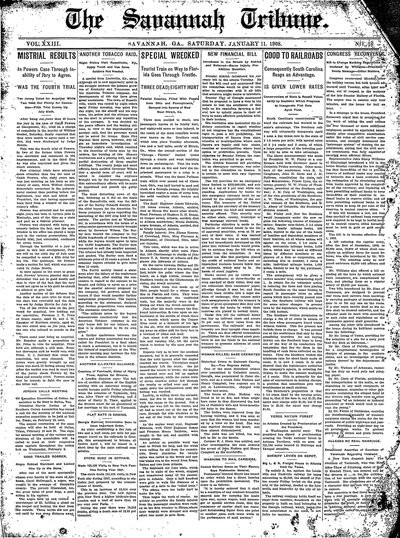
Page text (machine-generated)
VOL. XXIII.
In Powers Case Through Inability of Jury to Agree.
Ten Jurors Voted for Acquittal While Two Held Out Firmly for Conviction—Fifth Trial Comes Up July Sixth.
After being out more than 48 hours the jury in the case of Calc Powers at Georgetown, Ky., tried on a charge of complicity in the murder of William Goebel, Saturday, finally reported that they were unable to agree upon a verdict, and were discharged by Judge Morris.
This was the fourth trial of Powers. In two of the former trials Powers was convicted and sentenced to life imprisonment, and in the third trial he was also convicted and given the death sentence.
Few criminal trials have attracted more attention than has the case of Caleb Powers, who, eight years ago, was just entering on his term as secretary of state, when William Goebel, democratic contestant in the gubernatorial contest then pending before the legislature, was shot and killed at Frankfort, the shot having apparently been fired from a window of the secretary's office. Powers was arrested and for nearly eight years has been in various falls in Kentucky, part of the time as a state and part as a federal prisoner. Powers was charged with being accessory before the fact, and the open window in his office has played a large part in the various prosecutions. His fourth trial, just concluded, continued for seven weeks.
Through the inability of a jury to agree in this last arraignment, Powers will on the sixth day of July next be compelled to stand a fifth trial for his life. The attorneys for Powers made a motion for ball, which was overruled by Judge Morris. In their appeal to the court to grant ball, Powers' lawyers pleaded that the defendant was not in good health and that in view of the fact that the jury could not agree as to his guilt he should be allowed to give ball. Another motion of the defense that the date of the next trial be fixed in ten days was overruled and the date was set by Judge Morris for July 6.
Ten of the twelve men on the jury voted for acquittal, two holding, out for conviction. Foreman J. T. Price of Grant county, aged 65, and J. W. Ranaker of Harrison county, aged 62, the two eldest men on the jury, were the two who refused to accede to the ten.
There came near being an acquittal. Mr. Renaker made a proposition to Mr. Price to vote for acquittal. Price held out, although a slick man. Renaker thereupon said he would vote with Price. C. J. Marshall first voted for conviction, but soon changed. The jurors were greatly wrought up and there was much ill feeling among them. After the verdict was read in court two of the jurors shook Powers by the hand and actually cried. Powers states that he intends to fight the case to the bitter end.
JORDAN CALLS MEETING
Of Executive Committee of Cotton Association to Be Held in Dallas, Tex. President Harvie Jordan of the Southern Cotton Association has issued a call for the meeting of the national executive committee to be held at Dallas, Texas, on February 19, next. The annual convention of the association will also be held at Dallas, Texas, February 19 and 20. The regular annual meeting of the various state divisions of the association will be called to meet at their respective state capitols throughout the cotton belt on Wednesday, February 5.
DOGS TRAILED ROBBER.
Negro Robbed Merchant and Locked Him Up in the Store.
After one of the most spectacular chases ever known in the state of Alabama, Carol McDougall, a negro, was caught in the swamps of Escambia county. The pursuit illustrated, too, the great value of good dogs, a pack alding in his capture.
The negro held up and robbed a storekeeper of $2, holding a pistol on the keeper and locking the door from the outside. Those inside did not get out until he was some distance away.
ANOTHER TOBACCO RAID.
Night Riders Visit Russellville, Ky.
Apply Torch and Use Guns.
Soldiers Not Needed.
A special from Louisville, Ky., says: Although all is now apparently quiet in the struggle between the tobacco growers of Kentucky and Tennessee and the American Tobacco company, the developments of the day have given great uneasiness. The town of Russellville, which was raided by night riders early Friday morning, was quiet Friday night, but the sheriff and his deputies, the police and the citizens were on the alert to prevent any repetition of the outrages. It was decided by the peace officers and the leading citizens, in view of the improbability of another raid, that the governor would not be asked for troops. State Fire Marshal Mott Ayres, however, will begin an immediate investigation of Thursday night's raid, which resulted in the shooting of three men by the raiders, the burning of two tobacco warehouses and a planing mill, and the partial destruction of three smaller buildings. The county judge and court officials have notified Governor Wilson that a special term of court will be called to consider the evidence brought out by the investigation, and that extraordinary efforts will be made to apprehend and punish the guilty parties.
The most disturbing news of the day, following as it did on the heels of the Russellville raid, was the failure of the Burley Tobacó Society and the chief buyers for the Americán Tobacco company to agree regarding the marketing of the 1907 crop held by the society. The parties met at Winchester, in accordance with the terms of a compromise agreement recently brought about by Governor Wilson. The Burley men wanted the company to buy 60,000 hogsheads of tobacco from them, while the buyers would agree to take but 10,000 hogsheads. The Burley men consented to sell the smaller amount. The tobacco had already been inspected and graded. The Burley men fixed a minimum price of 15 cents a pound. The company buyers refused to give more than 12 cents.
The Burley society issued a statement after the failure of the conference declaring that, after making the concession in regard to the amount to be bought and falling to agree on a price for the smaller amount proposed by the company, the growers asked the buyers if they would consider further compromise propositions. The buyers, according to the statement, declared that further propositions were useless. The statement concludes:
"The attitude taken by the buyers demonstrates conclusively that the American Tobacco company is the only buyer left for our tobacco, and that it is determined to fix its own price."
A further conference between the buyers and Burley association has been called for Frankfort in a final effort to reach a settlement, but it is feared the failure of negotiations at the Winchester meeting may increase the friction in the tobacco districts.
ANOTHER ILL-FATED ALLIANCE.
Countess of Yarmouth, Sister of Harry Thaw, Applies for Divorce. A London dispatch says: The failure of another alliance of the English nobility with an American woman of wealth became public Friday, afternoon when the countess of Yarmouth, who was Alice Thaw of Pittsburg, and a sister of Harry K. Thaw, applied to the divorce court for an annulment of her marriage to the earl of Yarmouth.
FLAT RATE IS COMING.
Georgia Railroad Commission Soon to Issue Important Order. An order establishing a flat rate of two and a half cents per mile for passenger travel on the railroads in Georgia, this arrangement to become effective April 1, will be issued in a short time by the state railroad commission.
STORK BUSY IN GOTHAM.
Made 125,126 Visits to New York Families During Year 1907.
The stork made 125,126 visits in New York city during 1907, according to statistics just prepared by the commissioner of health.
This is an increase of 13,354 over the previous year. The new figures give New York a higher birthrate than London and a lead of more than 40 per cent over Paris.
During the year there were 79,205 deaths, giving a death rate of 18.48 per thousand.
SAVANNAH. GA. SATURDAY. JANUARY 11. 1908.
SPECIAL WRECKED
Tourist Train on Way to Florida Goes Through Trestle.
THREE DEAD; EIGHTY HURT
Palatial Coaches, Filled With People from Ohio and Pennsylvania, Dumped Into Swamp of Mud Near Hiram, Ga.
Three men scalded to death, two passengers known to be fatally hurt, and eighty-odd more or less injured, is the result of the most complete wreck ever known on the Southern road, which took place Tuesday afternoon, two and a half miles north of Hiram, Ga., when the second section of the "Chicago - Florida" limited broke through a trestle and went tumbling down an embankment. That the train did not catch on fire and burn the imprisoned passengers to a crisp is a miracle. What was the finest Pullman train which ever passed out of Cleveland, Ohio, was half buried in mud and slush of a Georgia swamp, the brightly burnished engine a mass of scrap iron, the solid vestibule train broken and battered.
The dead: Engineer James' Edwards,
123 Jones avenue, Atlanta, scaled,
died at Hiram few hours after wreck;
Road Foreman of Engines D. H. Snapp,
34 Cooper street, Atlanta, scaled, died
at Atlanta sanitarium; Moses Baldwin,
negro fireman, of Atlanta, scaled, died
at Grady hospital, Atlanta.
Fatally injured: Mrs. Emma Hoover,
of Cleveland, Ohio; Miss Florence A.
Studebaker, of Cleveland, Ohio, internal-
injuries.
This train, which was due to arrive
in Atlanta shortly after noon Tuesday,
left Chattanooga in charge of Conductor Y. R. Norris of Atlanta and Engineer Jim Edwards of Atlanta.
On the curve between Dallas and Hilram, a distance of about five miles, and just, below the point where the Seaboard, on a high trestle, crosses the Southern tracks on the Chattanooga division, the wreck occurred.
The entire train was made up of Ohio people bound for a winter vacation in Florida and Cuba. They were scattered throughout the vestibulated train, but the majority were in the dining car when the wreck occurred.
Just after the track crosses the Seaboard intersection it runs upon an embankment in the middle of which there is a trestle which spans the Copper Mine creek at a distance of ten feet in the air, with the embankment sloping away on either side for forty feet to a lowland of slime and mud.
Just about 2:40 o'clock this train, late and running fast, hit the curve which is broken by the span over the creek.
Reports vary as to how the accident occurred, but it is generally conceded that the rails 'spread after the engine reached the trestle. This giant mogul immediately left the track; the jar caused the trestle to break; the engine was turned over and fell up against an embankment, while the entire train of seven coaches either fell through the trestle or rolled over and over again down the embankment until the bottom was reached.
Luckily, in roiling down the embankment, the fire in the dining car, fell with the range to the ground. Not a single car was left on the tracks, and all had to crawl out of the top of the cars, through the side windows or be cut out of the train by the wrecking crew.
As the engine went over, Engineer Edwards, with Chief Engineer Snapp and Fireman Moses Baldwin, were caught in the cab and scalded with hissing steam.
As quickly as possible word was sent to Hiram for help, and the wires were calling for aid from the countryside. Every physician for twenty miles was called to the wreck and special trains run to the wreck from Rome, Dalton and two from Atlanta.
The Seaboard Air Line train, which ran by in sight of the wreck, stopped and transferred many of the passengers to Atlanta. Only a half hundred were able to walk the distance of a quarter of a mile to the "relief train." The others were too badly hurt to make the trip. Then began the work of rescue. As quickly as possible the fatally injured from the passenger coaches were rushed on the first wrecker to Hiram, where their wounds were dressed and every effort was made to save them.
NEW FINANCIAL BILL
Introduced In the Senate by Aldrich and Referred—Bacon Injects Prohibition Question.
Senator Aldrich introduced his currency bill in the senate Tuesday. He had the bill read and announced that the committee would be glad to consider in connection with it all bills that senators might desire to introduce. Senator Clay of Georgia announced that he proposed to have a vote in the senate to test the sentiment of that body on his resolution favoring a federal law to uphold states in their efforts to make effective prohibition within their borders.
His resolution also instructed the judiciary committee to report whether or not congress has the constitutional right to pass a bill prohibiting the transportation of liquors from state, counties or municipalities where such liquors are legally sold into states, counties or municipalities where local option or prohibition prevails. Upon objection by Senator Nelson the resolution was permitted to go over. The Aldrich financial bill providing for an emergency currency, was referred to the committee on finance. It is certain to meet with very vigorous opposition.
The bill provides for an emergency issue limited to $250,000,000, and subject to a tax of 6 per cent while outstanding. Applications by banks for this emergency currency must be approved by the comptroller of the currency. The treasurer of the United States and the secretary of the treasury shall approve the kind and amount of security offered. This security may be either state, county, municipal or first mortgage railroad bonds.
Particular objection is made to the inclusion of railroad bonds in the list of approved securities, even at 75 per cent of their value. It was learned later in the day that so much opposition had immediately developed on this point that railroad bonds would probably be stricken from the bill when reported from the committee. It was pointed out that this provision placed the credit of national banks and unimpeached business houses below that of railroads, which may be in the hands of stock jugglers.
Banks cannot put up cotton warehouse certificates at three-fourths or even one-half of their value; they cannot rediscount their customers' paper, gilt-edge though it may be; and thus convert bank credits into a legal medium of exchange; they cannot make such arrangements with the treasury in times of great emergency that they now make with the banks in which their reserves are placed in normal times. Under this bill the national banks can buy up railroad stock and secure 75 per cent of their value from the government. The railroads' and the treasury are thus brought close together. There are thus offered tremendous possibilities for the railroad stock gamblers to use the funds in the national treasury to promote schemes of stock manipulation.
WOMAN KILLED; BABE CREMATED
Diabolical Crime in Gwinnett County,
Ga.—Two Negroes Jailed.
One of the most diabolical crimes ever committed in Gwinnett county, Georgia, was perpetrated in Cater district, and as a result John Hudson and Henry Campbell, two negroes are in jail at Lawrenceville, charged with murder and arson.
The house of John Hudson was found to be on fire, and when neighbors came in they discovered the bodies of Hudson's wife and three-monthsold baby in the flames.
The bodies were removed from the burning building, and it was seen at once that the woman had been murdered by a blow on the head. She was also stabbed through the heart, and then almost dismembered.
The child was not killed, but was left to die in the flames.
Coroner H. J. Moon was notified, and after investigating the case ordered the arrest of John Hudson and Henry Campbell as the murderers.
WARNING TO MAIL CARRIERS.
Cannot Deliver Booze on Their Routes,
Says Postmaster General.
Postmaster General Meyer has issued
an order which has a direct bearing
upon the prohibition movement. The
order is as follows:
"It is hereby ordered that it shall
be a condition of any contract hereafter
centred into for carrying the mails
upon star, screen wagon, mail messenger
or special service route, that the
contractor or carrier shall not transport intoxicating liquor from one point
to another upon such route while in
the performance of mail service."
GOOD TO RAILROADS
Consequently South Carolina Reaps an Advantage.
IS GIVEN LOWER RATES
Conservatism of State Is Repaid Voluntarily by Southern Which Proposes to Inaugurate Flat Rate
South Carolina's conservatism toward the railroads has worked to the state's advantage. The Southern railway will voluntarily inaugurate April 1 next a flat ticket rate in the state of 2 1-2 cents per mile, with special rates of 2 1-4 cents and 2 cents, of which a large proportion of the traveling public will be able to take advantage.
The above announcement was made by President W. W. Finley at a conference held with Governor Ansel in Columbia Friday morning. Other members of the conference were B. L. Caughman, John H. Earle and J. M. Sullivan, constituting the state railroad commission; Frazer Lyon, the attorney general; W. W. Finley of Washington, president of the Southern railway; J. M. Culp of Washington, one of the vice presidents of the Southern; A. W. Thom, of Washington, the general counsel of the Southern, and B. L. Abney of Columbia, the Southern's division counsel.
Mr. Finley said that the Southern would inaugurate under the new regime the following classes of transportation: Regular rate-ticket, 2 1-2 cents a mile; family mileage books, 500 miles, limited to the use of the heads of families and dependent members of their families, all of whose names will appear on the cover, 2 1-4 cents a mile; mercantile mileage books, 2,000 miles, which may be used at different times by different members or employees of a firm or corporation, not exceeding five in number, 2 cents a mile; individual mileage books, 1,000 miles, limited to use by the purchaser, 2 cents a mile.
The arrangement will be given a twelve months' trial, commencing April 1. In return for its voluntary action in reducing the fares and thus placing South Carolina on the same footing in regard to passenger rates as other states which have recently passed rate bills, the Southern railway will hope for some minor changes in present laws by the legislature, which meets on the 14th instant.
The Southern wishes permission to charge a fee of 15 cents in excess of the fare when passengers board trains without tickets. This the present law forbids them to charge. It was pointed out at the conference that only by thus penalizing travelers for not buying tickets can the Southern hope to keep out of the way of its conductors the temptation that lies for them in the handling of cash fares collected on the trains. Then the Southern wishes the minimum rate for short hauls made 10 cents. It is now 5 cents. It is also desired that the legislature authorize the company's agents, in collecting for tickets to make the amount multiples of 5 cents. This is primarily for the sake of convenience in making change, a problem that sometimes gets very troublesome at small stations.
The Southern's proposition is that 2 1-2 cents shall be the turning point, that is, that if the fare is, say $1.32, the agent may charge only $1.30, but if the fare is $1.34 the agent may charge $1.35.
VERDE NATION FOREST
In Arizona Created by Proclamation of the President.
A Washington special says: The president has signed a proclamation creating the Verde national forest in Arizona Territory, with an area of 721,780 acres located in Maricopa and Yavapal counties.
SHERIFF LEVIES ON DEPOT.
Big L. & N. Freight House in Atlanta Held for Taxes.
To satisfy f. fas. against the Louisville and Nashville railway for taxes amounting to $6,240, the sheriff of Fulton county Friday levied on the property of the railway, deeded to the Louisville and Nashville by the city of Atlanta.
The railway company holds itself exempt from taxation, inasmuch as the property is built on land belonging to the Georgia railroad, which, being the first established in the state, is not liable for taxation.
CONGRESS RECONVENES.
Bill to Change Banking Regulations Introduced by Williams—President Sends Message—Other Matters.
Congress reconvened Monday, after the holiday recess, but both houses adjourned until Tuesday, after brief sessions, out of respect to the memory of the late Senator Mallory of Florida. The senate was in session only four minutes, and the house for half an hour.
In a message to the house, President Roosevelt urged that in preparing for the work of taking the next census the four thousand or more additional employees needed be appointed immediately after competitive examination under the rules of civil service commission, and strongly denounced the "patronage system" of making the appointments, saying that the civil service commission was fully capable of securing most efficient forces.
Representative John Sharp Williams of Mississippi introduced a bill in the house Monday repealing the law directing that three-fifths of the 15 per the reserve of national banks may consist of balances due a bank available for the redemption of its circulating notes from banks approved by the comptroller of the currency; and repealing all laws permitting national banks to keep three-fifths of their reserves in national banks in reserve cities; and all laws permitting national banks in reserve cities to keep 50 per cent of the reserves in central reserve cities.
If this bill becomes a law, not less than one-half of national bank reserves now required to be kept in lawful money in central reserve cities hereafter must be held in gold or gold certificates.
The bill is to become effective July 1, 1908.
A bill reducing the regular army, after the first of December, 1908, to 35,000 men, 10,000 of whom shall constitute an artillery force for coast defense, was also introduced by Mr. Williams. The standing army as now posed embraces 40,000 odd officers and men.
Mr. Williams also offered a bill repealing all the laws by which national bank examiners are compensated by fees, and placing them on a regular salary of $3,000 per annum.
Two bills introduced by Mr. Sims of Tennessee, are designed to prevent star route mail carriers from knowingly carrying packages of intoxicating liquor to or for any one on the route. If a star route carrier does so his action shall be deemed unlawful, and the offender shall be dealt with according to such rules and regulations as the postmaster general shall prescribe. Among the other bills introduced in the house during its half-hour session were the following: By Mr. Gregg of Texas, providing for the selection of a site for a navy yard and dry dock at Galveston.
By Mr. Clark of Florida, providing for a congressional investigation of charges of peonage in the southern states, and an investigation of prosecutions thereof by the department of justice.
By Mr. Wallace of Arkansas, repealing the duty on wood pulp and printing paper.
By Mr. Clark of Florida, prohibiting the transportation in the mails, or the depositing in any mail receptacle, of any newspaper, magazine or other publication containing the alleged facts of any divorce suit, murder case or other proceeding "of an indecent or immoral character or which would tend to corrunt the young."
By Mr. Ferris of Oklahoma, enabling the distribution annually of treasury surpluses among the states for the improvement of public highways and postroads. Providing an eight-hour day on all government works. To prevent gambling, in cotton and grain futures.
ALLEGES NO REAL MARRIAGE.
Sensational Assertion of Countess of Yarmouth Regarding Husband;
A New York dispatch says: The countess of Yarmouth, who was Miss Alice Thaw of Pittsburg, sister of Harry Kendall Thaw, has entered suit in the divorce diation for the nullification of her marriage with the earl of Yarmouth. Her allegations are of such a character that the suit will be heard in camera.
Her assertion is that there never has been a real marriage. A jury of menrons will be specially empowered to determine the truth or falsity of it. In addition, eminent gynecological experts will be called in support of the countess suit.
Immigrant Americanization
Why the Scandinavians Prefer to Speak English.
By Brander Matthews.
MONG the immigrants themselves the process of Americanization is sometimes extraordinarily swift. It did not take long for Gallatin and Agassiz and Schurz to make themselves at home here, and the less gifted and the less well educated foreigner has an ever stronger incentive to get out of his old-world shell. When the late Prof. Boyesen went to Minnesota he was surprised to find that his fellow-Scandinavians preferred to speak English even to him; and it was explained to him that the use of their native tongue would re-
A
veal their peace
tisman who had
use of English
The process,
also to our faith
nomenon in all
than this America
with no violence
of sturdy English
nomic freedom,
ing men in sea
Men of moral d
industrial and o
men established
these standards
hundred years,
transformed, an
scent, has most
endure, and asp
influences.—Fro
Com
Forme
veal their peasant origin, and thus testify to their social inferiority to a gentleman who had been graduated from the University of Upsala, whereas the use of English lifted them all to the lofty table land of American citizenship. The process of assimilation, at work now, under our own eyes, was visible also to our fathers and to our forefathers. Indeed, there is no stronger phenomenon in all the marvelous history of civilization than this very process—than this Americanization of countless aliens, generation after generation, with no violent modification of American ideals. Three centuries ago, "men of sturdy English fibre began to come in search of mental, religious and economic freedom," as an acute student of social conditions has phrased it. "Daring men in search of new experiences came as adventurers and discoverers. Men of moral daring came in search of religious and civic freedom. Men of industrial and commercial daring came in search of larger opportunity. These men established ideals and set standards and created tendencies for a nation." These standards, these ideals, these tendencies still survive after almost three hundred years, modified a little, no doubt, but developed only, not radically transformed, and never renounced. The American of today, whatever his descent, has most of the characteristics of the American of yesterday. Ideals endure, and aspirations have not blunted by time or turned aside by alien influences.—From the Center.
The Commercialization of the Law
By Judge D. P. Baldwin,
Formerly of the Indiana Circuit Federal Court.
HE law has become commercialized. It has wofully deteriorated in many respects. Commercialism has perverted many of the legal ideas and purposes of the old school. Instead of looking upon the law as a profession, incidentally furnishing a livelihood for the lawyer, our young men today are going into law because they think they can make more money there than elsewhere.
T
This is a perversion of the whole legal principle. If there is any class I detest it is the "ambulance chaser." It is the motto of every decent member of the legal profession that the client must hunt the lawyer, not the lawyer the client.
is the motto of
must hunt the tree.
But while
worse than other
literary giants?
If you can, a tr
Websters or Ch
You will find
Larger congrega
religion.
What we ne
professional an
mercialized. L
and general dev
ical prestige. I
quiring a wider
But while there has been decline in some features of the law it is no worse than other professions. What is the literature of today and who are literary giants? Where will you find a great novelist in this country? Name if you can, a truly great poet? Where are our great orators? Are there any Websters or Choates in our profession any longer?
You will find the same beneficial effects of commercialism in the church. Larger congregations and more beautiful buildings don't take the place of real religion.
What we need is an ethical revival. We need higher standards in all our professional and personal activities. The law, in particular, must be uncommercialized. Lawyers need to pay more attention to logic, oratory, culture, and general development, and less to the mere acquisition of money or political prestige. Instead of giving our time to politics we ought to give it to acquiring a wider range and more thorough knowledge and all-round ability.
The Animal Story
By Edwin L. Sabin
RITICISED though they are—these animal stories so popular of late in fiction—as being mawkish, supersentimental, unnatural, and misinforming, is it not better to invest the beast and bird creation with o'er-much humanization rather than with o'er-little?
C
Man kills so easily, even so mechanically, with never a thought for the agonies of the victims. Man is the only animal which kills, normally, just for the love of it. Other animals of prey to kill to cat or in defence. But it is man who kinned thousands of buffalo bulls, when they were valueless, simply to see them stagger and fall; who slaughtered the passenger pigeons and fed them to the hogs; who catches far more trout than he can consume, and shoots more ducks than he can give away.
knee thousands
them stagger at
the hogs; who
ducks than he
Step softly
squirrel, and he
presence, the h
creasing, when
a,murderer, fro
worse than
Therefore,
man to look wif
sins, and can it
speed it
Step softly as an average man may into a wood merry with bird and squirrel, and he surely must note the sudden voices of alarm which herald his presence, the hush which attends his passage, the outburst again, timidly increasing, when he has gone. For through the wood his reputation is that of a murderer, from whom ro living thing is sate. He is Man; a "varmint" worse than bear and wolf and tiger, snake and hawk.
Therefore, if the animal story, exaggerated as it undeniably is, can bring man to look with more, friendly and compassionate eye upon his humbler cousins, and can interest, especially, the uprising generation, it deserves a God-speed despite its faults.—From Lippincott's Magazine.
Beauty's Debt to Vaccine
By Fleet Surgeon Homo.
EAUTIFUL women a century ago evoked the wild enthusiasm of which you write because they were then so few. Small-pox had ruined all, complications, and the few women who had escaped it, who would now only be called ordinarily nice-looking, were then as rare as goddesses, and so worshipped.
Forty years ago aged relatives used to tell me stories that puzzled me of ladies in Edinburgh about 1820—of ladies so beautiful that crowds always lined their paths from their marriages to the shops. I used to regret I had missed seeing beauties so delicate, little knowing I was really, seeing them daily. The milkmaid, accidentally vaccinated in her trade, escaped small-pox, and so gained the reputation of fresh completion that some of us who are older can remember. Vaccination has enabled all women now to equal her in beauty, and her fame has gone through her looks remains as before.
To let one's fancy range;
To play the bed is so,
The window so, as it used to be
In that home of long ago;
To play the door is here;
The street is crisscross there;
And then to wait, as I used to wait,
For the step upon the stair.
To count as the footsteps pass,
Now near, now faint and far—
How personal they sound at night,
What company they are!
Some brisk and some sedate,
I wonder where they go;
And I drawen a little till suddenly
The dear, dear step I know.
The start of joy, the flush,
The tender, happy thrill,
And then, oh, God! I am homeless and old,
And his grave is on the hill!
—Gertrude Huntington McGiffert, in The
Century.
Breaking the News to Him
It was a difficult situation. To be sure, Marcella had not actually flirted with Ackley Henderson—she refused to include the verb in her well-bred vocabulary—but then—
Men are so queer—so apt to think that one means things when really one is actuated only by ordinary courtesy and the gayety of the moment and cheerfulness toward the world in general. When a man calls very regularly is that any reason why a girl should consider him in love with her? It would be abominable conceit, Marcella assured herself indignantly, as she twisted in her hair. Why, dozens of men had called on her in the last five years, and only three or four had asked her to marry them. Each of these men seemed surprised when she refused. Therefore, why should she worry for fear Ackley Henderson would take it badly and think himself ill-treated when he learned she was engaged to an Eastern man? The wedding was set for June, and Marcella felt that she must break the news. She told herself that she would do it that very evening, and was surprised to find herself turning to ice at the thought.
She stared at her own face sternly in the glass. It was not that she had a lingering fear lest she cared for Ackley—not a bit of it! The man down East had all her heart, but she did like Ackley immensely in a friendly fashion, and dreaded his displeasure. Just why should she think he cared for her? She demanded a reply as she fiercely scanned for another shell hairpin. He had never said anything; but then, words were not always necessary. Only a week ago, when she had been playing at the piano, on turning suddenly she had caught his gaze fixed on her with such open tenderness that the blood had rushed to her face. He had carried it off well by asking in the next breath some irrelevant question, but it had started her to thinking.
Really it was too bad of Ackley. He was such a reserved, odd person that one never could tell what he was going to do next. He never confided in his friends, though apparently he was free and open.
She searched her memory sharply. Had she ever given him the slightest right to fancy she was especially attracted by him? Of course, she had been interested in his yachts and his theories on the proper way how to drive a horse, and his favorite books, but that was only what ordinary politeness called for. If one did not talk to a man about the things in which he, was interested what on earth would become of conversation?
Marcella jabbed in the last pin and straightened her side combs and just then the bell rang. Heaving a long sigh, she went down to greet Ackley Henderson. He was so particularly happy and cheerful to-night that it made her task doubly hard. How should she begin? She could not plunge into the subject abruptly—she wanted to glide into it gracefully and by degrees—but somehow she could not manage the conversation. And all the while Ackley sat beaming joyously at her.
Marcella shivered. She wished she could remember a few times when she had been rude to him—the memory would brace her up—but there was nothing but unremitting and gracious kindness on her part in the hateful past. She wondered if he would tell her what he thought of her when she told him of her engagement, or whether he would take it quietly and brood over it. She didn't know which would be worse.
She chattered fluently on everything under the sun, but at last talk ran slow. Silence fell. Marcela felt it was now or neyer. She leaned forward and fingered the paper cutter lying at her hand and spoke in a low voice. She did not look at him.
"I'm going to tell you something, Ackley," she said. She could feel that he was all attention instantly.
"I—perhaps I should have told you—told people some time ago, but I—well, I didn't. —I you've met Bob Van Puyster of New York? I'm going to marry him in June." She ended with a rush.
After an instant she raised her eyes bravely to meet his stricken face. Then she stared in blank amazement, for Ackley Henderson was smiling surprisingly, delightedly:
"Why, I am greatly pleased," he cried heartily. "De Puyster is a fine chap. I'm glad to hear it. And I might as, well tell you there's a girl down in St. Louis that is going to be Mrs. Henderson next fall—and your profile and hers are identical. Every time I look at you I'm reminded of her, though, of course, you're not alike." Marcella was speechless. For one
mortal hour she had to sit, and listen to the praises of another girl sung into her astonished and reluctant ears and smile as though she liked it. Her own engagement he apparently dismissed from his mind. He was about, the farthest from an heart-broken man one would care to see. Yet when Marcela took down her hair that night she broke three of the shell pins because she was thinking so hard and indignantly. Girls, there is no doubt, are queen. —Chicago News.
Unknown New Guinea.
By CYRUS C. ADAMS.
$ ^{6} $ Dr. Rudolf Poch, of Vienna, has shown that many valuable results of exploration are acquired by the long and patient efforts of solitary travelers. For two years (1904-1906) he wandered with four or five native carriers, three-fourths of the way around New Guinea, the second largest island in the world. He was engaged in anthropological and geographical study, chiefly back of the coasts, in regions where little as yet is known of the country and its inhabitants. All his time was spent in five districts of German, British and Dutch New Guinea; and it seems surprising that only twenty to forty miles inland, especially in the German territory, he reached virgin fields that no white man had visited. In his long report, published in the Zeitschrift of the Berlin Geographical Society, he gives reasons why so much of inner New Guinea is still little known.
Dr. Poch walked only two days inland from Potsdamhafen to reach villages and mountain valleys that had never seen white men, though the Germans had lived years at this port. Many similar instances occur in New Guinea, and Dr. Poch's explanation is found in the great difficulty of travel and the unfriendness of the natives. In a short march inland from Potsdamhafen, for example, the native paths climb steep slopes, fall into deep and narrow valleys, or run along the sharp edge of ridges; and all the while the pedestrian feels swathed in straw, the grass that chokes the foot-wide path rising above his head, no movement of air among those giant growths, and above him, the blazing sun with its unmitigated outpouring of discomfort. This, he says, is the outline of many a pioneer journey in the great island as relates to physical misery; and none but a man of unusual tact and patience can fare safely among the natives.
The explorer found new illustrations of the fact that natives in one district may differ greatly in physical characteristics, in methods of house building and other rude arts and especially in speech from other tribes living only ten to fifteen miles away. He found two tribes that, while engaged in their traditional dances, sing the same songs, the text of which conveys no meaning to them. One tribe say they got these songs from the other tribe, who assert in turn that the songs were handed down by their fathers. These words of old tradition, in Dr. Poch's opinion, are words of a dead speech.—Outing.
American Pork Triumphs Abroad.
Our annual hog killing is an apotheosis, as it were, of American cookery. Already we are, having our triumphs abroad. The last two seasons have found on bills of fare in London hotels and restaurants the item of "pork sausage a la Americain." Venl, vidi, vici! We whiff, in anticipation, the odors of frying sage yet to float out of the doors of Belgravia. It is now some years since fried chicken smothered in cream gravy appeared on the Paris menu under a long Gallic name intended to conceal the surrender of the Paris chefs to our Colonial mothers who invented that most toothsome delicacy. The disguise was penetrated by Colonel Kennedy, of Springfield, Mo., on the Rue Rolliv. Even now there is appearing in parts of Germany itself a growing predilection for substituting, in the dressing of a lettuce salad, for all of the mayonnaise but the vinegar, a dressing of bacon grease spiced with herb condiments. The Kaiser was introduced to this by Prince Henry, who got acquainted with it in St. Louis at a private entertainment. The Kaiser, when the flavor touched his palate, is said to have cried out in a loud voice that it must be claimed as a German invention. Fortunately, the records are available to show that it is the invention of a serving woman near Culpeper Court House, Va., whose descendants are now among the proudest members of our Colonial and Revolutionary societies. — St. Louis Globe Democrat.
Man and His Ways.
One of the local amusements at Sydney appears to be "The Nature Man," who lives on fruit, clothes himself in a small piece of cloth and guides his way of life by the two following commandments of his own construction:
"Get away from the smoky, dusty, krouded kondishun of the city; from temashut and wearing xitment fre thyself."
"Gradually tuffen ur body and mind by wotr and sun bath, til u kan safely sleep out dorr in ordinary wethr. Liv alwys in pur, out dor air."
We can only suggest one addition, and that is "Buy a dictionary."—London Globe.
The telephone directories of the current issue in New York City would make a pile seven and a quarter miles high, if placed one on the other.
By Motor Car to the South Pole.
```markdown
```
On July 30 Leutenant Shackleton set sail for the Antarctic. It has been decided to fix the base of operations on King Edward's Land, the most easterly point reached by the expedition of 1901-04. This point is equally well placed as regards the pole, and has the advantage of being new ground. Into this area Mr. Shackleton will penetrate by three distinct sledge expeditions, in which he will be aided by the use of a motor car specially built for the task at the Arrol-Johnston works, Palsley. The car is constructed to withstand extreme cold, and will be operated by a spirit which will work satisfactorily in low temperatures; it is provided with three different sets of wheels for use on surfaces of varying softness. Great hopes are entertained of its value for traction purposes, but it is recognized that its employment is an experiment, and the chances of the expedition's success are far from being centred in any such novel means of locomotion. The use of Siberian ponies in the Antarctic is also in the nature of an experiment, but the hardiness and strength they have developed on the bitterly cold plains of Eastern Siberia, where they are accustomed to live in the open all through the winter, justify the hope that the experiment will be a success.—The Sphere.
"RIGHT IN IT!"
Mrs. Greenby—I'm glad we put on our best clothes, Josiah. I don't like to look different from the rest o' people." — From Punch.
Double Color Brush.
Artists and wielders of the bursh will instantly recognize the advantages of the double color brush shown in the illustration below, the invention of a New Jersey man.
THE HORSEHORSE
Having two brushes on the one handle to work with, more work can naturally be accomplished by the operator. In applying plain washes over a large surface the two brushes can be manipulated with as much case as one, the large volume of color carried by the brushes insuring the wash being more even in color, as the entire surface can be covered before one part dries. When the latter is the case it is almost impossible to get the color to lie evenly. Two colors can also be carried on the brushes—one on each—which would materially assist the artist where two colors are being applied at the same time.
A half-century ago William H. Parkin discovered the coloring properties of coal-tar.
Through the Telephone.
"Are you there?"
"Yes."
"Who are you, please?"
"Watt."
"What is your name, please?"
"Watt's my name."
"Yes; what is your name?"
"I say my name is Watt."
"Oh, well, I'm coming to see you."
"All right. Are you Jones?"
"No; I'm Knott."
"Who are you, then, please?"
"I'm Knott."
"Will you tell me your name, please?"
"Will Knott."
"Why won't you?"
"I say my name is William Knott."
"Oh, I beg your pardon."
"Then you will be in if I come round, Watt?"
"Certainly, Knott."
Then they were cut off by the exchange, and Knott wants to know if Watt will be in or not.—Tutler.
Egypt's Ancient Tombs Illumined by Modern Electric Light.
Mummy of Amenophis II., Former King of Thebes, Exposed to Public View. —The Sphere.
Largest Sick and Death Benefits; Smallest Premiums.
The Guaranty Aid and Relief Society
L. B. WILLIAMS, President.
The undesignated Treasures to have received from the Secretary of State,
Dear Regina,
Elizabeth, George,
17th of October,
(2000)
being on total Ten Thousand of Georgia by authority and assembly, approved October 20th, 1877.
SOL. C.JOHNSON, Supt. of Ageno
The undersigned, Treasurer of the State of Georgia, hereby acknowledges
to have received from the following described sum:
Dear Regent and Trustee of the State of Georgia, hereby acknowledge
that the following described sum has been received from the following trustee:
1720
long on that Ten Thousand Dollars and which are held by the State of Georgia by authority and under the provisions of an Act of the General Assembly, approved October 22d, 1887, and amended December 20th, 1897.
R. E. Parsi.
The crime for which Mrs. Freeney was sentenced to life imprisonment was committed at her home in Eastman, Dodge county. Harrell, the bill collector, made improper proposals to Mrs. Freeney, following which she secured a revolver and shot him to death.
A saloon man in that county, on the first of December, mortgaged his stock of liquors and bar fixtures. He did not pay off the mortgage, and there was a foreclosure.
The sheriff was instructed to sell the liquors and fixtures to satisfy the claim. The sheriff was troubled and he has written Attorney General Hart for an opinion. Judge Hart has submitted an unofficial opinion that the sheriff cannot sell the intoxicants because the new act specifically forbids an officer of the state to sell, make or give away intoxicants.
"Agricultural College on Wheels." Dr. A. M. Soule, dean of the $100,000 agricultural college at Athens, and Chancellor D. C. Barorw of the University of Georgia, have secured from the railroad commissioners of Georgia, permission for the "agricultural college on wheels" to begin its tour of the state. The exact date for its departure from Athens has not as yet been decided upon, but will probably be between the 10th and 15th of February. Dr. Soule has mapped out the itinerary and it will traverse every railroad in the state of Georgia with the exception of the Western and Atlantic, and will consume a period of thirty-five days. During this time rural towns with an aggregate population of 350,000 people will have been visited.
The special train, which is to be furnished free by the railroads, is to be composed of one baggage car for ex-
Georgia Briefs
Items of State Interest Culled From Random Sources. In general order No. 9, issued a few days ago by the state railroad commission, every corporation within the jurisdiction of the commission is required to furnish it with a list of stockholders, giving name and address of each stockholder and amount of stock held by each.
* * *
To Camp at Fort Screven.
A letter from Assistant Secretary of War Oliver at Washington, stating that he will order a portion of the national guard of Georgia into camp at Fort Screven, on Tybee Island, from May 16 to 25, has been received and turned over to Adjutant General Scott, who will notify the commands which will go into camp at the time designated.
* * *
To Open Up Tobacco Plantations. Great preparations are being made to open up tobacco plantations near Bower station, on the Georgia, Florida and Alabama railroad, 12 miles below Balmbridge. Hon. B. B. Bower, Jr., and J. D. Bower, his brother, will have ten acres of shaded tobacco each, which will yield $1,000 per acre. In addition to these there are many others cultivating the weed in that vicinity.
Bank in Abbeville Closed.
After a conference in Atlanta between State Bank Examiner Park, Attorney General Hart and Governor Smith, at which President Hal Lawson was present, the Citizens' bank of Abbeville was placed in the hands of the state bank examiner.
President Lawson made a frank statement of the bank's affairs. He said it had assets of $70,000 and liabilities of about half that amount. A large amount of outstanding paper with the farmers and merchants, upon which the bank could not realize now, forced it to close its doors. The bank has a capital stock of $35,000, and is the oldest bank in Abbeville.
Georgia State Bonds Retired.
State Treasurer R. E. Park, through the New York correspondent of the state treasury, has retired $100,000 in Georgia bonds, and paid out interest to the sum of $156,000 on the $7,131,000 of Georgia bonds now being held throughout the country. It will probably be the latter part of the month before the "clipped coupons"—which denote the payment of the in-
terest—are received. This is the annual expense of the state, and a special appropriation to cover it is made each year by the general assembly. The state is in splendid financial condition right now, and is amply able to meet this debt.
Woman Gets Stay of Sentence.
A stay of sentence has been granted by Governor Smith to Mrs. Sallie Freeney, the young woman now in the Bibb county Jail at Macon, convicted of the murder of W. P. Harrell, a bill collector, and sentenced to life imprisonment.
The stay of sentence holds until February 4th, in order that the woman's attorneys may take the case to the prison commission and the governor.
Liquor Problem for Sheriff.
A complicated legal question regarding the new prohibition law has arisen in Brooks county.
P. EDWARD PERRY, Vice President.
NIGHT TRAINS SAVANNAH & MONTGOMERY. VIA SEABOARD AIR LINE RAILWAY.
Trail will consist of PULLMAN BUFFET SLEEPING CARS, Day Coaches between Savannah and Montgomery without change; making close connection at Montgomery with all lines diversing for Pensacola, Mobile, New Orleans and all Western points; Birmingham, Memphis, St. Louis, Nashville, Chicago and all Northwestern points; the SHORTEST LINE to Montgomery, New Orleans, Birmingham and the earliest arrival at the points. At Savannah close connection is made for all EASTERN POINTS, Richmond, Washington, New York and with Coastwise Steamships for Baltimore, Philadelphia, New York and Boston.
Get sleeping car reservations and full information from any SEABOARD Agent, or write to
perimental purposes and two day coaches for lecture rooms. Five instructors will accompany the train. Dr. Soule will advocate cattle raising in Georgia: He is a strong believer in the feeding qualities of cotton seed meal and will urge its use. He will also tell of soil tests to be made by the use of this same meal as a fertilizer.
```markdown
```
School Fund Apportioned.
State School Commissioner Jere M. Pound, who assumed the duties of that important office on the first of the year, has made up the apportionment sheet for 1908, dividing the $2,000,000 appropriated for the common schools of Georgia among the 147 county school system, and the several city school systems of Georgia.
To arrive at this basis of computation it was necessary to take a school census, which shows that there are, today, 703,876 school children in Georgia, and this appropriation sets aside $2.82 per capita for each of these.
This is considerable increase over that of last year, when the per capita appropriation was only $2.58.
Of this sum, Fulton county and the city of Atlanta will receive a large proportion. There are in Fulton county, outside of Atlanta, 7,433 school children, which will give to this system an appropriation of $20,998, while Atlanta, with her 22,302 school children, will receive $64,432.60. The county of Richmond, including the schools in Augusta, will receive $50,821.75.
This company is duly chartered under the laws of the State of Georgia, and has compiled with all requirements of the State Insurance department, therefore all policy holders are protected with all the safeguards that the strict insurance laws of this State seek to protect its citizens.
Its affairs are directed and managed by Negro men of the city of Savannah of leading standing, and whose character and reputation are of such as to command the respect and confidence of all the people of that community. The same men that manage this Society are the ones that organized and are conducting the affairs of the first successful Negro Savings Bank in this state, therefore we can readily see that by connecting themselves with this Insurance company their interest will be in safe hands.
By comparing our rules and benefits with other first class companies it will be seen that we offer the most liberal inducements with the largest sick, accident and death benefits to our members than any other company in this business.
That we pay our claims promptly can be testified to by the thousands of our satisfied members.
Agents Wanted Everywhere
Liberal Terms and Commission.
L. E. Williams.
P. Edward Perry.
Walter S. Scott.
Sel. C. Johnson.
This company is duly chartered under requirements of the State Insurance department that the strict insurance laws of this. Its affairs are directed and managed character and reputation are of such community. The same men that man-fairs of the first successful Negro Saw themselves with this Insurance company. By comparing our rules and benefits liberal inducements with the largest pany in this business.
That we pay our claims promptly.
Agents
Liberal
TRAINS
SEABOARD
AIR LINE RAILWAY.
END.
5.00 P. M.
9.15 P. M.
10.10 P. M.
11.15 P. M.
12.45 A. M.
2.00 A. M.
2.22 A. M.
6.45 A. M.
10.40 A. M.
6.00 P. M.
EAST
Leave New Orle
Leave Birming
Leave Montgomery
Leave Lumpkin
Leave Richland
Leave Ametjeu
Leave Cordele
Leave Abbeville
Leave Helena
Arrive Savannah
AN BUFFET SLEEPING CARS, Daring close connection at Montgomery with certain points; Birmingham, Memphis, ST LINE to Montgomery, New Orleans, which close connection is made for all EAST Steamships for Baltimore, Philadelphia. Full information from any SEABOARD.
CHA
Asst. General Pa
NELSONS
HAIR
DRESSING
A delightfully perfumed Hair Pomade prepared especially for Colored people. Nelson's Knots, Curly Hair Soft, Pliant and Glossy. By lifting the needed oil directly to the roots of the hair it tones up the scalp, stops the hair from falling out, increases its growth, prevents its splitting and breaking off, removes Dandruff, and cures Itching. Installing Scalp Diseases. Large boxes at Drug Stores 25C, or sent by mail for 30C (stamps or silver). Good Agents Wanted (male or female). Write for terms.
Address NELSON MANUFACTURING CO. Richmond, Virginia.
Bibb county, including the Macon schools, $44,312.95.
Chatham county, including Savannah, will receive $54,790.
Muscogee county, including Columbus, will get $11,876.80.
Next year this appropriation will be increased by a quarter of a million, and the school children of Georgia will receive $2,250,000. Commissioner Pound states that he hopes to send out another payment to the teachers early in the spring.
Panama Canal Locks Will Be Built as Originally Planned. By unanimous decision the Isthmian Canal Commission will recommend to the secretary of war that the locks on the canal be constructed at their present projection width, namely, one hundred feet, holding that this will be ample for all commercial shipping for years to come.
WALTER S. SCOTT, Secretary and Tr. cas.
SOL. C. JOHNSON Notary Public.
SOL. C. JOHNSON Notary Public.
Deeds, Contracts, Wills and Other Legal Forms Prepared and Attested.
116 West St. Julian Street
Regalias.
LODGE SEALS,
FINANCIAL CARDS and
BLANKS of every description.
Publishers' and Manufacturers' Prices
Liberal Discounts Will Be Arranged.
BOL. C. JOHNSON,
Gavannah, Ga.
W. H. LLOYD,
—Dealer In—
GROCERIES, WOOD AND COAL,
621 Oglethorpe Avenue, East...
518 PHONES Bell 506
Reform, like charity, should begin
at home.
Newly Installed Atlanta Alderman Wants Park Board Investigated.
Alderman Frank A. Pittman, the new alderman from the third ward, Atlanta, states that he will introduce a resolution in council for an investigation of the work done by the park board during the year 1907.
The alderman says that he has been informed that members of the park board have used Grant Park for the furtherance of their own private interests. He claims that ex-Councilman Charles A. Chosewood carried flowers from the park to his private park, the "White City," and that one wagon load was removed after the dark.
He says that he knows personally that flowers are now being kept in the park greenhouse which belong to members of the board.
"I understand that there has been a misappropriation of labor and material from the park, Pittman says.
"Furthermore, I am told that Superintendent Gillespie has been raising chickens at Grant park for Mr. Chosewood.
"I asked a member of the park board about these matters, and was informed that Mr. Chosewood, W. C. Puckett and A. J. Ryan had been running Grant park."
BIG MASS MEETING TO BE HELD
By the Appalachian.National Forest Association in. Atlanta, January 16. On the 16th day of January the Appalachian National Forest Association will hold a mass meeting in Atlanta, Ga., to formulate an expression from the south upon this paramount issue. Measures that will place this section squarely behind the project for an Appalachian forest reservation which shall save the south, in its water powers, a sum estimated at 3 per cent on $2,500,000,000, or two and one-half times the national debt, will come, before the meeting for discussion and adoption.
GEORGIA CONVICT HIRE
State Will Get Close to $100,000 for
Quarter Ending December 31.
Nearly $100,000 will be collected by
the state of Georgia this month for
the hire of convicts leased for the
quarter ending December 31, 1907.
Captain Goodloe Yancey of the state
prison commission has completed a
statement, which he has furnished.
Compiroller General Wright for collection
The Savannah Tribure
PUBLISHED EVERY SATURDAY,
BY THE TRIBUNE PUBLISHING CO
116 W. St. Julian Street.
Bell 'Phone 2171.
SUBSCRIPTION RATES.
One Year.....$1.25
Six Months.....75
Three Months.....50
Remittance must be made by Express
ost Office Money Order, or Registered Letter
Advertising Rates given on application.
SATURDAY, JAN. 11, 1908.
HARMONY among our business men is essential to success. This is a cue for our business men in this city. They should be more cordial toward each other.
The increase of business along different lines among our people during the past year, was gratifying. It is hoped that the results will be greater at the terminating of this year.
Gov. SMITH was in the city on Wednesday. It was a cold day and he met no outburst of warm greeting. But few persons attended the public reception at the city hall.
COMPLIANT is frequently made that our people will not patronize each other. This is true when in our business we have nothing to induce their patronage, or that our business methods are such as to preclude their patronage. Have in stock what other stores have, treat the people more honestly and more courteously than other business men do and it will be found that trade will increase.
It was announced in the morning paper that an English prison evangelist was in the city and held a final service in the jail at which he preached to the white prisoners. It is known that there are more colored prisoners in the jail than whites, and we are at a loss to know how the white prisoners could be so segregated to be preached to, out of the hearing of the colored prisoners.
The moral air in the city seems more purified since the dry days begun. Our men have already saved thousands of dollars that have been spent for whiskey. A part of this money should find its way in some of our saving institutions, invested in homes and the securing of more clothing and groceries for the home. Keep the tigers from clawing, and prohibition will be an everlasting blessing.
In dealing with our people, our business men can not be too careful, and especially to take no advantage of them. It many instances our people are easily handled, and in some men they have implicit confidence, because of this, those of us, who are better informed should do nothing to violate this confidence, but in every transaction give them the benefit of the least doubt. Dealing fairly and squarely with them and in fact with all persons, will help a man especially one who is in business. Success may be slow, but with close application it will be sure and in the end success will be attained and more keenly will be the enjoyment of it. We appeal to our business and all men who are better informed, to treat our people justly in every transaction.
THE TRIBUNE feels itself the "daddy" of Negro enterprises in this city. For many years it has led in the employment of our young men and women and have been the means of supporting several families. That work is being continued and if we could get only ten per cent of our people in this county to support us, instead of having on the pay roll ten persons, we would be able to give employment to twice that number. For years we have been untiring in advocating the establishment of business along various lines in order to give our young men and women employment. Ten years ago we had comparatively no enterprise, but since then we have a number that we can point to with pride, and are giving work to our young folks, thus training them up to the idea of doing business. For each of these institutions, THE TRIBUNE appeal to our people to support unstintingly. Deposit your money in our banks, secure policies in our insurance companies, patronize our dry goods store, our shoe store, our grocery stores, our drug stores, our tailoring establishments, our repair shops of all kinds, our doctors, our dentists, our undertakers, and in fact patronize more liberally
1910
Rev. B. L. PERRY.
every one of us in business. In twenty-five per cent of the colored people in the city would patronize fully our business men as needs demand, in a year's time we would have hundreds more of our young people in more lucrative employment, and the number of enterprises wonderfully increased. Every colored man, woman and youth should resolve now and henceforth that they will consistently do more for the upbuilding of the enterprises of the race than ever before.
matter. Before his death he had every body's money labeled with the proper amount on each package, and being treasurer of several societies, he had checks on blanks signed for each, even for his own account so that no one will have any trouble in securing funds from the banks.
Truly a good man has been called hence. Besides Messrs. P. Edward and B. L. Perry, he leaves a wife and other relatives to mourn his death. The bereaved family has the sympathy of friends.
From the Daily Record
White Ridge, N.Y.
White Plains, N.Y.
Mr. Wm. G. Rogers and son left for Henderson, N.C., Dec. 23rd, and have returned and reported a delightful time during the holidays. While in Henderson they were the guests of Mr. and Mrs. Oscar Outlaw and were also entertained at the College by Prof. and Mrs. Cotton.
Mr. and Mrs. E. A. Springs, formerly of Savannah Ga., but now of New York city were the guests of Mr. and Mrs. Wm. G. Rogers of Fisher Avenue, Sunday.
Mr. and Mrs. Wm. T. Howard of 36 Brookfield street, had as their guests at dinner Sunday, Miss Louise A. Rogers, Rev. Ralph B. Page, Miss Christina Montague and Miss Emma and Rowena Kingley.
Miss Louise A. Rogers, Agent for the United Aid and Benevolent Association of America, and the United Realty Co., has accepted the Agency of the African Mining and Real Estate Co. The Annual Fair of Bethel Baptist Church given under the management of Mrs. William G. Rogers was the most successful, socially and financially ever given in the history of the church.
The DeSoto Hotel Waiters surprised their head waiter, Mr. Jas. A. Walker, on Monday night last by presenting him with a handsome gold watch. The presentation speech was made by Mr. M. Robinson, of New York. It was made in a telling manner and noted the very high esteem in which he is held by the waiters. Mr. Walker
Last Tribute Paid
Bee, Ferry.
As announced in THE Tr last week, Rev. B. L. Perry his late home, Bluffton, S. C was buried on Sunday. The al was the largest ever seen little town, the cortegue was a mile long. People from the surrounding islands and were in attendance to show last tribute of respect to whom they all loved and The funeral services ducted by Rev. I. W. Col other divines were pr each one spoke in glow about the life work and nature of the deceased.
A Token of Esteem:
was affected by the kind expression and the good feeling aituated in the gift, and responded in a way that caused the young gentlemen to feel that he was interested in their welfare, appreciated their gift and will endeavor to continue the kindly feeling that has always existed between the head waiter and those under him.
```markdown
```
thize w
Mrs. Sug.
thize w
Mrs. Sug
son on Jan. 6.
The holidays were spent quietly but pleasantly. The teachers were invited to spend New Year's-eve at the residence of Pres. Wright. The evening was spent very pleasantly. A few minutes before twelve all joined in singing Lux Benigna and while three short prayers were being offered the old year passed out and the new came in to abide for a brief measure of time. After singing "Abide With Me" and extending greeting for the New Year the guests returned to their several homes.
Miss Nettie Houston of city was the guest of Mrs. L. B. Thompson during a part of the holidays. The Collegians were delighted to see her.
Miss Eunice Warren gave one of the prettiest birthday parties seen here in some time. It was her third birthday anniversary. The guests were Missess Hattie Wright, Tommie Roston, Louise Thompson, Harriet Parkhearst; Master E. C. Wright, Meldrim and Willie Roston. From the city, Missess Gracie Cabule, Lena White, Aneta Keys, Celestine McFall and Willie Davis.
Quite a number of new students have registered for the winter term.
St. Philip's Dots.
Our services on Sunday were interesting, uplifting, inspiring and beneficial to the soul. Rev. Lindsay preached at 11 a.m. and 8 p.m. At 3:30 p.m. Rev. A. J. Jefferson one of St. Phillips sons who entered the ministry only a few years ago preached. His text and subject were in keeping with the solemn occasion of the hour. The holy communion was administered by Rev. Lindsay assisted by Rovs, Capps, Stanard and Jefferson. This being the first Sunday in the year, every member wanted to begin the new year with new zeal and those who have seen somewhat slack in their religious buties, began the year with double-resolutions to do better by attending services
and to help is carrying on the church in every respect. Prof. John H. Baldwin superintendent of our Sunday School is always on the alert, he knows just what his teachers and scholars need. On last Sunday each teacher was presented with a useful and almost quite instructive present composed of a case with a lead penell with J. H. Baldwin's name inscribed on the back and a rule about six inches long representing the Golden Rule with biblical verses thereon. Prof. Baldwin instructed every teacher to measure their lives every day with this rule and they would live better lives. Prof Baldwin says he will look for results. The first quarterly conference of St. Philip for 1907 and 1908 was held on last night. Preaching Elder R.M. S, Taylor presiding. The reports from the various departments were gratifying and show that each department is working and trying to do the Master's bidding. We are glad to note the arrival of one of our old members in the person of Mrs. Frank Graham who is on a visit to Sayannah. We are always glad to welcome our old and faithful members in our mists. Mrs. Graham is now a resident of Columbus, Ohio. Never in the history of St. Philip Church have class meetings been so largely attended as they have during the past year. It is hoped that all those who failed to attend will this year do better. The following services on tomorrow. Prayer meeting at 5:30 a.m., preaching at 12 a.m., Sunday School at 3 p.m., preaching at 8 p.m.
F. A. B. Church.
The attendance at the communion services on Sunday last at the First African Baptist Church, Franklin Square was a record breaking one. There was a manifestation of the spirit, felt throughout the week's services, and the outcome of such a glorious day was looked for. The officers and members have been giving praises to God this entire week for this omen of a bright and prosperous year. Rev. M. Battle preached at the 11 and 8 o'clock services. Rev. J. H. May, pastor Second Baptist Church assisted by the old and venerable Rev. J. M. Simms, Revs. E. C. Johnson, J. B. Miller and other ministers of the city. Many visitors were present. We hope to see a continued unity among the Baptist churches of the city; for it is certainly golden grains and which we are now harvesting while we have no pastor. All members are asked to pay their $2.00 rally money on or before the third Sunday, and to commune with Rev. May at the Second Baptist Church tomorrow. The sick list has decreased since last week and the general attendance at each service marks an increase. Prayer meeting Tuesday evenings, preaching Thursday evenings and Sundays ii a. m. Sunday School 4 p. m., sermon 8 p. m. Al are invited.
Bethlehem Baptist Church
Bethlehem Baptist Church
Rev. L. L. Blair, the pastor occupied
the pulpit last Sunday with two very
interesting and spiritual sermons. The
congregation at both services was very
large. The Sunday school was held at
the usual hour, Supt. F. H. Williams
in charge. The attendance was large. The
Y. M. C. A, held its meeting at 6 o'clock,
the president, Master Eugene Chance
in charge and an interesting program was
carried out. On Tuesday night prayer
York Tribune dex.
newspaper contain the
a. the world. But
us in them unalded is
search for a needle in
right almost as well
the chest without a
unlocks newspaper
er features or distinctive character.
a key to a great storehouse of facts.
What its cross references anything desired can be readily found. Price $1.00.
Take Notice!
Expert accountants have testified that for the year 1907 The New York World is the FIRST in circulation gains and FIRST in the number of advertisements printed. During 1907 The World sold 30,690,339 MORE copies than in 1906, and it printed a total of 1,405,032 separate advertisements—292,747 MORE than the New York Herald, the next highest newspaper.
It is worthy of notice also that The World was the only New York newspaper to show an advertising gain in 1907-all the other New York newspapers losing.
Knights Of Tabor.
Please give space in your paper to say a few words about the International Order of Twelve Knights and $^2$Daughters of Tabor:
On Monday night December 30th, D. G. M., R. N. Rutledge set, up M'Horeh Temple No. 45 with a large number being made. G. W. Alexander is the Chief Menter and James A. Monroe Chief Scribe. Those who have connected themselves have found out that the Taboris is a great society. Her doors are thrown open to the worthy and deserving ones. We invite them to come and go with us around Mt Tabor until we assemble to the summit where our King was transfigurated. Now is the time to be admitted into a band of men where peace and harmony prevail. There will be a convention started at the residence of Deputy Rutledge 547 Charles street, Sunday afternoon at 3 o'clock. Come go with us.
Young Foo's Ball Players.
The Tip Top and Bright Stars foot ball teams had an exciting game on New Year's morning. It was exciting in several instances. Representatives of each Club have given their version of the game and we published them as handed in.
The Bright Stars Foot Ball Team defeated the Tip Top on new years morning The game was interesting from start to finish. Lineup of Bright Stars as follows: Frank Dewse, center. Alfred Pinckney, left guard. Fred Taylor, right guard. Abraham Green, left tackle. Freddie Freeman, right tackle. Lee Roy Maynor, slight end. Johnie Devine, left end. Arthur Coles, quarter back. Elten Wilson, left half back. Alexander Sapp, full back.
Tassle Gilliard, right half bank
Artwell Sampson, manager.
Frank Gibbens, coach.
Houston Tolbert and Henry Lewis, sub
players
The Tip Top Athletic Association and Bright Stars played a game on Dixon Park, Henry and East Broad streets, new year day. The Bright Stars had heavier men and agreed not to put in two certain players at once. They broke their agreement in the second half when the score was 10 to 5 in favor of the Tip Tops and they refused to play. According to the Bright Stars agreement the Tip Tops had a right to refuse to play and the game ended. The referee declared the Tip Tops the winner by a score of 10 to 5. The game was very interesting as long as it continued. The line up of the Tip Tops as follows:
John Hudson, left end.
Fred Jones and Miller, left tackle.
William Rogers, left guard.
Edgar Habersham, center
William Helmes, right guard.
Fred Skipper, right tackle,
Herbert Gibbons, right end.
Armond Clark, manager, quarter back.
Albert LaFayette, captain, right half back.
John Habersham, full back.
Morse Callen, left half back.
Andrew Cochran, referee and umpire.
Clinton Jones, time keeper.
The features of the game was two long runs by Albert LaFayette and Morse Callen.
Notice to the Public:
Sarah Ch. Dee, 1903
To the Republicans of Chatham County:
I want it to be known to my friends
and the public in general that I am a
candidate for chairman of the Republican
Parly of Chatham County, and respectfullyask your support and influence at the coming election.
Respectfully,
tf F. M. BELL.
462 West Bros. SCOTT
"ON THE
HATS
Underwear
SHOES
ICE CREAM
462 West Broad Street.
DRESS HATS for direct from New Winter line of U children.
We can suit your SUESINE SILK Ginghams and OUR shoes have them a trial.
We offer the r Women's Rubber MEN CLOTH furnished in any know our Ice C
SCOTT BROS.
"ON THE SQUARE"
DRESS HATS for Men and Women, direct from New York at the lowest Winter line of UNDERWEAR for children.
We can suit you in Hosiery, Cuffs, SUESINE SILKS, all colors. Can't Ginghams and Outings.
OUR shoes have always given satis them a trial. We are looking for you. We offer the right prices. Men's Women's Rubbers 50c, Children Rub, MEN CLOTHING MADE TO OR
REAM furnished in any quantity all the WI know our Ice Cream is the best.
Broad Street. SCOTT BROS.
462 West Bros. SCOTT BROS. Near Gaston "ON THE SQUARE"
NOW IS THE TIME TO INVEST IN
REAL
Watch this space
CHAS. A. R.
Real Estate and
REAL ESTATE
with this space for my offering
MAS. A. R. McDOWEI
real Estate and Renting Agen
Watch this space for my offerings. CHA S. A. R. McDOWELL, Real Estate and Renting Agent
Bell Phone 3188
Johns
Undertaking E
FUNERAL DIRECTORS
All Orders promptly attended,
Embalming and all work of the
stock of Coffin, Caskets and
the city. We also have a
where we furnish the best
Funeral Cars. We also have
H. S. Dunbar, who would like to
MANAGE
H S. DUNBAR
Bell Phone 676. 3354
Union Savings
CAPITAL
Johnson's
Hartaking Establishment
GENERAL DIRECTORS AND EMBALMERS
are promptly attended, Day or Night.
and all work of that kind guaranteed
of Coffin, Caskets and Robes is the large
city. We also have a first class Livery Stair
we furnish the best Carriages; Hearses
Cars. We also have in our employ-
ment, who would like to see his friends at a
MANAGERS;
DUNBAR - - W. R. FIRE
phone 676. 335-333 JEFFERSON
Union Savings & Loan Co.
CAPITAL 50,000.00.
All Orders promptly attended, Day or Night. Firstclass Embalming and all work of that kind guaranteed. Our stock of Coffin, Caskets and Robes is the largest in the city. We also have a first class Livery Stable where we furnish the best Carriages; Hearses and Funeral Cars. We also have in our employment Mr. H. S. Dunbar, who would like to see his friends at any time.
MANAGERS:
H S. DUNBAR - - W. R. FIELDS,
Bell Phone 676. 335-333 JEFFERSON STREET.
Union Savings & Loan Co.
THIS BANK
Full information given at
20 STATE
SEABO
AIR·LINE
Reduced Rates
Excusion tickets will be sold
22d, 24th, 25th, 30th, and 31st
be limited for return until Janu
For further information, rate
ATION given at
20 STATE STREET,
EABOAR
AIR·LINE RAILWAY
reduced Rates Christmas
tickets will be sold December 20th, 21
th, 25th, 30th, and 31st and January 1st, a
d for return until January 6th, 1908.
rther information, rates, etc. call on or write
Full information given at 20 STATE STREET, West.
SEABOARD AIR LINE RAILWAY
Reduced Rates Christmas.
Excusion tickets will be sold December 20th, 21st, 22d 22d, 24th, 25th, 30th, and 31st and January 1st, and will be limited for return until January 6th, 1908. For further information, rates, etc. call on or write your nearest Seaboard Air Line Agent.
Mrs. M. L. WILLIAMS'
Hair Dressing Parlor
SCALP TREATMENT,
SHAMPOOING,
Electric Face, Neck and Body
Massaging.
COMPLEXION BEAUTIFIED,
MANICURING.
ll kinds of Lady's Hair Good
Switches, Puffs, Pompa-
dours, etc.
5111 West Broad Street
Bell Phone 1111.
Dr. J. W. Jamerson, Firstclass Dentist,
All Work Guaranteed.
623 WEST BROAD STREET.
Bet. Huntingdon and Hall.
Bell Phone 2098.
Dr. E. D. Bulkley. THE DENTIST.
219 East Broad St. Corner Hull. THE PLACE TO GET
Is not your subscription pass due?
If so do the right thing* by sending
the amount to the office and do not
allow our collector to dan you for it.
T BROS. Near Gaston
THE SQUARE"
ITS for Men and Women, latest styles
New York at the lowest prices.
OF UNDERWEAR for men, women
you in Hosiery, Cuffs and Collars.
ILKS, all colors. Canton Flannel,
and Outings.
have always given satisfaction, give
We are looking for your business.
e right prices. Men's Rubbers 65c,
rubbers 50c, Children Rubbers 50c.
THING MADE TO ORDER.
any quantity all the Winter. You
ice Cream is the best.
COTT BROTHERS.
ESTATE. e for my offerings. . McDOWELL, d Renting Agent 22 State Street, west
Jenson's
Establishment,
MORS AND EMBALMERS.
Wed, Day or Night. Firstclass
of that kind guaranteed. Our
MORS and Robes is the largest in
a first class Livery Stable
West Carriages; Hearses and
have in our employment Mr.
one to see his friends at any time.
MORS;
- W. R. FIELDS,
335-333 JEFFERSON STREET.
Bags & Loan Co.,
TOTAL 50,000.00.
Stands for Negro Manhood Negro Homes and Negro Business. The Hope of the Race.
TE STREET, West.
BOARD
RAILWAY
ates Christmas.
sold December 20th, 21st, 22d
31st and January 1st, and will
January 6th, 1908.
rates, etc. call on or write your
The Savannah Triline.
Another little girl is gracing the home of Mr. and Mrs. C, Ef Dobson.
Miss A. O. Newswome spent the holidays very pleasantly with her sister, Miss J. K. Rogers of Waycross.
Mr. C. A. Allen after a stay of several weeks in the city visiting his sister and friends, returned to Boston last Tuesday.
Rev. and Mrs. J. H May have an addition to the family group in the person of a little girl. Mother and baby are doing well.
Miss Anna E. Grant the popular trained course of Henry street, east, has returned to the city after spending the holidays very pleasantly with friends in Augusta
Rev. T. M. Williamson of Waycross spent Wednesday and Thursday in the city Rev. Williamso is pastor of the F. A. B. Church of Waycross and is doing good work there.
Miss Willie Lyttle of Aschville, N. C., has been spending awhile very pleasantly in the city, the guest of Mrs. Ada Welch, West Park Avenue. These ladies gave us a pleasant call on Tuesday.
Last Sunday the services at the First Congregational Church were well attended especially at the communion service in the evening. The week was observed with prayers and services held each night. Services as usual to morrow, to which the public is invited.
Dr. I. D. Williams, Physician and Surgeon, 5241 West Broad street, over Metropolitan Bank. 1-11-tf
Mrs. Mary Shrewberry of Columbia, who has been visiting her sister Mrs. M. G. Knowles, has returned home.
A chafing dish party was given by Mr. and Mrs. I. M Jackson on Tuesday night in honor of Miss Anna Hutchison, of Summerville, S. O. Quite a number were present and an enjoyable time was had.
Mr. O. N. Ward left on Monday for Jacksonville Fla., where he will engage in business. Mrs. Ward and little Thelma will follow shortly making Jacksonville their home. We wish them success.
Mr. and Mrs. J. A. Williams have returned home after a pleasant stay of some time at Tampa, Fla. Returning home they stopped at St. Augustine, where they were pleasantly entertained by friends.
Mrs. Ella Sanders of Charleston, S. C., is spending fifteen days in the city as the guest of Mrs. Florence Pinckney of 712 Duffy Street, west. She will leave for her home on Tuesday well pleased with her enjoyable stay of many pleasant recollections.
Mrs. Mary Williams, mother of Mr John L. Lark, Mrs Mamie Williams and Mr. Wesley Lark and the late Mr. Harry Lark and sister of Mr. William Stewart, died Dec. 31st. at the residence of Mr. John L Lark, East McDough street. She was 57 years of age and have husband and other children. She was born at Ninety S. S. C., where the remains were buried.
Mrs. Juno is a member of D. comber 21-41. W. was en on 23 a room h. F. A. B. Groun of what is to be a constituent in m. since June 1893. She w. born in this year, November 25, 1955 and was well known and popular among a large circle of friends. She was a member of the Lone Star Branch, Ladies' Union, E. K. Love Benvolent Association, S. and D. of Benevolent and Secretary of the W. J. Campbell Club which institutions attended her funeral. Her last words were an admonition to her relations not to worry about her. "I am alright, It will be better after awhile." She left two sisters, Mrs. M. A. Johnson, and Mrs. R. F. Smith of New York city, several other relatives and friends to mourn her death.
The Bishop will not Visit. Owing to certain changes in the Diocese of Georgia, Bishop Nelson will not visit St. Augustine's P. E. church on Sunday the 12th as scheduled in his appointments.
Ladies Whist Club.
One of the most brilliant events of the holidays was the leap year entertainment given by the Ladies Whist Club, Monday evening at the residence of Mr. and Mrs. B. J. Green, Mercer street. The house was beautiful in its artistic decorations. The parlor being in red and white, the dining room had the Christmas color of green and red with garlands coming from each corner and caught to the center by a large red bell from the center of which hung double bells of red, white and green. After enjoying themselves most delightfully with games and dancing a most delicious supper was served. Those present were Mr. and Mrs. C. H. Branham, Mr. and Mrs. Henry Small, Mr. E. W. Cummings, Mr. J. W. Green, Mr. Luther Green, Mr. Guy Smith, Mr. Joe Glover, Mr. Wm Simmons, Mrs. Geo Barnes, Mrs. M. F. Green, Mrs. H. L. Scott, Mrs. Willie Robertson, Mrs. Henry Hart, Mrs. K. Broughton. The club will be entertained on next Monday afternoon by Mrs. B. J. Green, 627 Mercer street.
Second Baptist Church.
Prayer and fast services Sunday were quite interesting here. The roll call was postponed till a later date. Pastor May communed the F. A. B. Church Sunday afternoon. The new furnace is now in and the church will be comfortable and it is hoped that all will renew their attendance. The sick list is smaller this week, the sick being brother J. S. Lloyd, boarding house bt. Julian street, he received a very painful wound, sister Mary Williams, Gordon street Lane east, sister Larsha, Gwinnett street east, Sister Leslie, 1810 East Broad! deason Billy Houston, Gwinnett street east, Sister Denegall, Sister Odlredie, 111 Perry street, east and others. One funeral, an old member, Nancy Brown 1612, Burroughs street. Pastor will preach at both hours to-morrow. Morning subject "Why the People should not have what they want." The
annually elected officers will be installed at night. A special pastor's salary day has been fixed for the fourth Sunday in every month. All members asked to pay up the fourth Sunday this month.
Social Notes.
On Friday evening of last week Miss Isabel D. Johnson entertained a few friends at her home 527 Jefferson street, with a leap year social. The novelty of the social consisting of a lady and gentleman exchanging little booklets typifying flowers of many colors and expressions of sentiment written on each; and the guessing of how many seeds in an orange ten inches in circumference, made the evening to be very pleasantly and humorously, spent. Mr. Simeon Bryant the witty toast master and bachelor of honor called on every bachelor present to give reason why he was a bachelor. So logically well did the maids hold their side up that the toast master about lost his wit on the first question asked one. After the guests were served with a very dainty repast, they exchanged expressions of incidents peculiar in leap years and made their departure for their several homes, well pleased with an evening in music, melody and mirth. Those present were Mrs. Paul Gaston, Misses Lucy Campbell, Stella Baguill, Madaline Victory, Drucilla and Belle Blyster, Bertha D. Williams, Isabel D. Johnson, Messrs W. Du Henry Browne, Jos. C. Hamilton, Simeon, Edward and Roscoe Bryant, W. G. Williams, J. H. Singleton, St. Louis Ponder, Dr. I. W. Williams and Rev M. M. Weston.
On New Year's afternoon Miss Susie Bynes entertained a few of her friends at her home in honor of Miss Elsie Williams of Hawkinsville, Ga. The afternoon was pleasantly spent Miss Bynes played several pieces on the piano. Miss May Hemmy rendered a very sweet solo "Seems to me I've always loved you," and was enjoyed by all. Mr. Hankerson played for dancing and Mr. Green assisted Amegm those present were Miss Gertie Hemby, Miss Amanda Green, Miss Ruth Brown, Miss K. Miller, Mrs. Julia Brown Miss Georgia Madison, Elsie Williams, Miss Mabel Hemby, Messrs E. Sims, B. Dooley, D. Greene, R. Carter and F. Hankerson.
Mrs. Wm. Dezón entertained last Monday evening in honor of the visiting ladies. Owing to the inclement weather some of the guests were not present. Those present enjoyed the evening playing games and dancing. Those present were Miss Willie Lyttle of Asheville, N. C.; Miss Lucile Brooks and Mrs. E. J. Bruce of Worcester, Mass.; Mrs. C. M. Gilliard, Mrs. Bam Jenkins, Miss Aurelia Allen, Mrs Chestley Welch, Messers. A. J. Cochran, J. H. Hopkins and Frank Coleman.
One of the social events of the season was a teddy bear party given by Misses Lizzie C. and Lily E. Cooper, on new year night at their residence cqt Jefferson street. Several hours were spent in games of various kinds, also singing and playing after which daisy refreshments were served. The first prize, a gentleman's necktie was won by Mr. Robertson of New York. The second prize a set of ladies' collars, was won by Mrs. Ophelia Hare. Among those present were Mrs. Lucy Spring, Miss Jennie Williams, Miss Eliza Nix, Mrs. S. B. Cooper, Mrs. Katie Perkins, Mrs. Rosa Williams, Mrs. Aurelia Mitchell, Mrs. Ophelia Hare, Miss Ethel Pain of New York, Miss Addie Spring, Miss McKenny of Macon, Mrs. Marie Aiken, Miss Florence Aiken, Miss Marie Walker, Miss Ruby Brown, Mrs Rush Alen, Miss Lizzie Cooper, Miss Maudna Smith, Miss Lily Cooper, Miss Lulla Spring, Miss Sherod Cooper, Miss Kate Henterson, Miss Annie Moore Messrs. Thomas Royal Robertson of New York, Joseph Heyward. Sam Matthews, James Sutton Jesse Admison, George Mitchell and S. B. Cooper, r
Officers Installed.
On W dreaded last the newly elected office as of the Adelph Club of Savannah were installed as follows H. B Wright, Pres; C. T. Johason, Vice Pres; A. P. Williams, Secretary; M. B. Branham, Treas; G. F. Tyson, Advocate. After the installation, refreshments were served and short talks were made of interest to the club. Each member of the club is requested to appear at the club room on Sunday night from where they will march in a body to St. Philip Monumental Church where the annual sermon will be preached by Rev. R. V. Branch. The club is one of the oldest social organizations in the city and is in a flourishing condition.
The following officers of Forest City Lodge No 144, were installed on Wednesday night last by District Deputy, P. H. Noble; J. H. Bugg, C. G; J. P. Garnett, V. G; R. B. Hadley, Prélate; Duncan J. Scott, M. of E.; J. A. Snyder, M. of F.; D. Oliver, K. of R and S.; Wm. Truel, M. at K.; B. F. Holmes, L.G.; A. B. Boylar, O G; Amos S. Lloyd, Grand Representative, E. N. P. Irwin, Alternate.
On Tuesday evening last Forest City Branch No. 578, N. A. L. C., held its annual installation of officers at the home of Mr. Samuel A. King, 614 W. Bolton St. The home was artistically arranged and the members and invited guests were well accommodated. The invited guests were THE TRIBUNE representative and Mr. Duncan J. Scott. The table around which all were seated was filled with all the delicacies that one could wish, beautiful potted plants and souvenirs of national colors. Mr. F. P. Edwards, the superb toast master, requested President M. B. Branham to speak first, which he did in a very timely and appropriate manner and received much applause from all present who wished him the success of the office. Mr. L. M. Pollard speaker of the evening addressed the members on "Success." His discourse was one of eloquence; and suggestive of every good, sound and logical way to succeed, and the members received it with many applause and a rising vote of thanks. Mr. W. G. Williams very befittingly and humorously responded with a paper called "Mimics of the office force." Mr. Duncan J. Scott spoke in glow
ing terms of the Branch and painted a beautiful picture of the relation of the Branch to the National Association of Letter Carriers.
Mr. Howard Stiles the newly elected collector for the Mutual Benefit Association connected with the N. A. L. C., placed much stress in his discourse on the benefit of M.B. A. to its members. Mr. C. C. DeVeaux, one of the most stalwart promoters of the Branch made a very spicy talk, which gave much encouragement to the members. All the members made befitting remarks after refreshments were served and a rising vote of thanks extended the committee viz., Mr. M. R. Miller, Mr. S. A. King and Mr. A. A. Lovett, who with the assistance of Mrs. M. R. Miller, Mrs. S. A. King, made it possible for them to enjoy the evening immensely.
The officers installed for the en- ueasing year were M. B. Branham, president; S. B. Cooper, vice presi- dent; W. G. Williams, financial secretary; A. A. Lovett, recording secretary; L. M. Pollard, treasurer; Howard Styles, sergeant at arms; Trustees: J. . Dowse, Geo. F Tyson, A. D. Monroe.
In Memoriam.
In Memoriam.
In loving memory of our beloved mother
MRS. HATIE NEWSOME
who departed this life December 31, 1906
We bow in humble submission to Him
who doeth all things well.
Mother thou'wast mild and lovely
Gentle as the summer breeze
Pleasant as the air of evening,
When it floats among the trees.
Peaceful be thy silent slumber
Peaceful in the grave so low,
Thou no more shall join our number
Thou no more our songs shalt know.
Yet again we hope to meet thee
When the days of life is fled.
Thou in heaven with joy to greet thee
Where no farawall tears are shed.
Her loving daughters,
Mrs. J. K. ROGER, Waycross,
Miss SUSIE M. NEWSOME,
Miss ANNIE O. NEWSOME.
AMUSEMENT COLUMN.
Coming Events in The Social World.
A grand Leap year entertainment will be given at Masonic Temple, by White Rose Court, No. 72 I. O. O. C. Monday night, January 13th. Tickets 15 cents.
The Elks will give a five nights bazar at Harris Street Hall, commencing Monday night January 13th. Tickets 10 and 15 cents.
A public installation will be given by Sayanah Division, U. O. T. R. at Harris Street Hall, Wednesday night January 20th. Tickets 15 and 25 cents.
The Porters Benevolent Association will give a grand Leap year entertainment at Masonic Temple Monday night January 20th. Tickets 15 cents.
The 18th annual entertainment of Protection Lodge No. 3200, G. U. O. of O. F. will be given at Masonic Temple Tuesday night January 28th. Tickets 25 cents
The Y. G. E. A. and S. C. will give their 10th anniversary at Harris street hall Monday night January 20th
Tickets 75c, and $1.00
A grand Mid-winter Ball will be given at Masonic Temple, by the West End Pleasure Club monday night. January 27th. Tickets 15 and 25 cents.
A grand four nights Hazar will be given at Masonic Temple by the Friendly Bros A and S Club No. 1 commencing Tuesday night January 14th. Tickets 15 and 50 cents.
A grand entertainment will be given at Masonic Temple by Savannah Light Lodge No. 188 K. of P. Wednesday night January 22nd. Tickets 25 cents.
A Fluffy Ruffle entertainment will be given at Mere's Hall by the Ladies Aid, Monday night, January 20th. Tickets 15 cents.
A grand Mid-winter Ball will be given at Masonic Temple by the Young Adelphia A. and S. Club, Monday night Feb. 3rd. Tickets 35 and 50 cents.
A grand musical will be given at the St. Augustine Hall, for the benefit of Asbury M. E. Church, Wednesday night, January 15th. Tickets 10 cents.
DR. L. S. PARKS,
240 Barnard St., Savannah, Ga.
Does all kind of highgrade dental work of the best quality and workmanship, Gold crowns and bridge work, White Porcelain Pivot, and Gold Crowns mounted on the natural roots. Gold Fillings, Cement Fillings, and Silver or Amalgam Fillings, from nine to a full set of teeth $7.00 and $3.00. Broken Places mended* and teeth added to old ones for a small cost. BellPhone 1244 Gold Crowns Guaranteed
Special Notice.
Savannah, Ga., Dec. 19th, 1907.
To the officers and members of the Mt.
Zion Methodist Episcopal Church in
America:
You are hereby notified that a
special conference is called for the good
of this connection and each and every
minister and member of this connection is
honorably requested to be present for
business of vital importance to be acted
upon. Will convene on the 23rd of
January, 1908, in this city, at 1017
Wheaton Street at 10 o'clock a.m.
By order of Rt. Rev. P. W. WILLIAMS,
ex 18.08. President of this Connection
Don't Buy a New One.
Do Your Stove give Satisfaction?
Does it bake in the bottom as on top?
Does it draw the draught up the flue so as to not to fill your eyes with smoke when cooking? If it don't, some part of it is out of order and we can remedy it if you would call to see us. We are experienced workers in the Repairing of Cook Stoves and
ackson-Sloeum Repair Shop
636 EAST BROAD STREET.
Semi-Annual Reduction Sale
Our high grade merchandise at the reducecd prices, makes this sale each season an event of great interest
A New Pharmacy The People's Pharmacy
809 West Broad St.
Prescriptions carefully compounded
Dugs Tone. Articles and Sundries.
Candies, Soda Water and
Ice Cream...
J. F. Ford, Prop.
F. F. Jones,
Beef - Veal - Mutton Lamb-Pork-Hams Bacon and CORNED BEEF All Kinds of GAME in Season. Goods promptly delivered to any part of the city free of charge.
STALL 31. CITY MARKET.
DO YOU LIKE Good Clothes?
We combine the three essentials] in [garment making in Clothes pamely,
[garment making in Clothes pamely,
[garment making in Clothes pamely,
QUALITY, STYLE and FIT.
Not every man knows how to make fine clothes; but the man who, knows, and knows he knows, is the right man—follow him.
WE DO LADIES TAILORING TOO.
Call or drop us a card, we do the rest.
Bryant Brothers
TAILORS
GOBRECT OUTNITTERS,
9 Farm Street, Savaunah, Ga.
P. B. RAY,
Tailoring,
DRY & STEAM-CLEANING
Ladies Work a Specialty
HATS CLEANED & RE-BLOCKED
Bell Phone 2050
JEFFERSON & BERRIEN STS.
SAVANNAH, GA.
New York Millinery
AUGHT BY
MISS ETHELB. PHAIN,
OF NEW YORK,
At 525 East Huntingdon St.
Old hats made new,
Also hats made to order.
Materials furnished at
Reasenable terms, Classes from 3 to
6 p. m. and 7 to 9 p. m.
Metropolitan Mercantile & Realty Commanv.
HAS ON THE MARKET A BLOCK OF $100,000 WORTH OF STOCK AT $25.00 PER SHARE. There was sold in the city of New York a few days ago, 25,000 worth of Stock in one day. It is the best investment offered the public and will not be on the market long. Pays 7 per cent. We are building those "Queen Annie" Cottages every day. Our terms are the easiest and best for the poor man and the safest for the investor. Call or write and let us talk business with you. Our proposition is worth investigation and investment.
Branches everywhere. Reference everybody. P Sheridan Ball. President. G. C. Collins.
F. Sheridan Ball, President. L. C. Collins, Secretary.
J. H. Atkins, Treas. W: D. Armstrong, Gen'l Rep.
J. J. Bolen, Fiscal Agent. F. M. Cohen, General Manager.
526 West Broad Street, Savannah, Ga. Bell'Phone 1144
(Incorporated—Charter Perpetual)
The leading insurance company in the south. Giving employment to man young men and women than any other company of like benefit.
The UNION BENEFIT ASSOCIATION is the peoples favorite, since it is the first home insurance company of its kind in this city.
Founded, built, owned and controlled entirely by Negro men of the city. Every policy is backed up by a deposit of $5,000 with the State Treasury. When you take out a policy with the UNION BENEFIT ASSOCIATION you have made a safe investment.
She is striving now to place her policies in every State in the union.
Shrewd and energetic agents are wanted.
Call and see us at 20 STATE STREET, W. Bell Phone 232
GEO. W JACOBS, General Manager.
Noble's SHOE EXCHANGE
SECOND-HAND SHOES SOLD, BOUGHT OR EXCHANGED. Work called for and delivered. 9 Jefferson St. Bell phone 3470 Down with the money lenders and installment houses. They are sucking the financial blood out of our people
MILLER'S RESORT,J Waters Road.
When on the road, or when you wish to have a fine oyster roast or other freshments, stop at Sam Miller's Place Waters Road. Parties of any size served on short notice. Everything reasonable. A royal welcome to all SAM MILLEB, Prop. 11-13-07
LODGE ROOMS
FOR HIRE CHEAP!
ENTERTAINMENT HALLS
with Piano and Orchestra
Hired Together.
Musle furnished with the Hall.
Woman's Realm
---
Precisely as in the case of an "at home" day, what is known as the "rest-day" of the week of some French women of fashion is intimated to all their friends. On that day the lady enjoys complete repose, sleeping as much as possible, and taking a diet of fruit and vegetables only. This is said to be the finest "beauty recipe" and nerve tonic that is known. —Pittsburgh Dispatch.
Mother of Mesa Verde.
Mrs. W. S. Peabody, of Colorado, is called the mother of Mesa Verde National Park, because of the interest she has taken in the preservation of the 'relics of the mysterious cliff dwellers of Colorado. For the 'same reason Professor Edgar L. Hewett, director of American Archeology of the Archeological Institute of America, has named the most recently discovered of the cliff dwellers in her honor, the Peabody House.—Pittsburgh Dispatch.
The Difference in Feet.
The French foot is narrow and long. The Spanish foot is small and elegantly curved. The Arab's foot is proverbial for its high arch. The Koran says that a stream of water can run under the true Arab's foot without touching it. The foot of the Scotch is high and thick; that of the Irish is flat and square; the English short and fleshy. When Athens was in her zenith the Grecian foot was the most perfectly formed and exactly proportioned of that of any of the human race, says Woman's Life. Swedes, Norwegians and Germans have the largest feet; Americans the smallest. Russian toes are "webbed" to the first joint. Tartarian toes are all the same length.
Always Something New.
There will always be something new to say about women as long as one is left among us.
Man would always walk straight ahead if he did not meet a woman at each step. She is a charming traveling companion, but one who does not know her way, and she prevents us from seeing ours.
To ascertain the age of a woman it is necessary to ask her and to ask her best friend. She will say thirty, the friend will say forty, and then you take the average.
Women who excite in our minds merely an exclamation of admiration are like Racine's tragedies—too perfect. One prefers those who excite interrogation points, says Life.
The heart of a woman is at once her friend and her enemy.
Some of the French ladies do not understand at all the prohibition in London on what they consider dinner dress. There is one little French actress now playing in London who, as one of her first experiences in the British capital, was taken out to supper, and to do honor to the occasion, put on her largest and most gorgeous hat. Her escort looked at it doubtfully, but hoped for the best. She was stopped at the sacred portals of a restaurant, and was asked to remove her hat. What this means to a lady only those can tell who have been to matinees and have seen the display of temper when a whole row of ladies in the stalls have been told that the people behind cannot see the stage. The little actress made a gallant attempt to be allowed to retain her headgear. She announced to the polite gentleman at the door that she was a Mohammedan, and offered to take off her shoes if only she were allowed to retain her hat. The mighty hat, however, had to be removed.—Bellman.
Getting Ready to Marry.
Somebody frankly confided to me not long ago that she has found her marriage a dreary failure, and can you imagine why?
"My husband," she said, "is honest and hard-working and never denies me anything that his means can supply, but he does not pay me compliments and bring me roses. He seems to take my love for granted and expects me to be satisfied, because he, once for all, told me that he loved me. I find life very flavorless."
My observation leads me to conclude, writes Margaret E. Sangster in the Philadelphia Press, that when a young woman gets ready to marry she should determine to avoid this particular shoal in the current.
A bright, captivating sweetheart should make a bright and fascinating wife, not jealous or exacting, but able to retain her husband's adoration. She should not too readily or too soon forego homage, or too lightly drop into a mere commonplace in a good man's common day.
Wedding Cards.
Whenever the engraved invitations hear the letters R. S. V. P. an answer must be made at once. This is sometimes done on, cards of invitation to a reception, that the host may have some idea of how many persons to provide for. Such a response should be made formally, in the third person, for instance: "Mr. and Mrs. Jones accept with pleasure Mr. and Mrs. Smith's kind invitation to the
wedding reception of their daughter on December the first."
When there is a church wedding and no reception it is expected that the bride will be called upon, when one knows where she is, unless "At Home" cards have been sent out and one has been omitted from the list. This is equivalent to declaring that the bride does not care for one's acquaintance. Becore accepting this cut, however, one cannot take too much pains to be sure that the omission was accidental and not designed, and in any case the parents should be called upon.
Cards announcing the wedding of a friend must always be acknowledged by posting visiting cards at once to those issuing the invitation, not to the bride. One calls upon the bride when she is "at home."
True courtesy and politeness do not delay in making simple and proper acknowledgments within the time specified, and failure to do so dubs one either ignorant or careless. —New York Globe.
The Rebuke Courteous.
"Some people are so sensitive! So and so is put out at me because I corrected her for a fault, and I did it in the most perfect kindness."
"In perfect kindness." Did she? Let us see. Did she first make sure of her facts, sure that she was not either mistaken or overcritical in estimating the fault-itself. Did she next make sure that every bit of selfishness of heart was absent from her own mood?
Then, as to time and place—did she choose them rightly? They are such difficult things to select, those two. There are so many wrong times, when another person is tired, unhappy, discouraged, and the rebuke becomes merely the "last straw" of all. And so to the place, surely one cannot correct another in that other person's own house. For it is hardly a courtesy toward one's hostess, or a fit return for hospitality, and there is an unwritten law that forbids the hostess from wounding the feelings of the guest who is her mercy, or under her protection. You see it is a difficult thing. Between people of the same age it is almost too difficult to be attempted, for perfect kindness would say: "Patience, and charity, and trust a little longer yet! Example is better than precept!" And praise has inspiration in it.
"I have remembered all my life," said a very gracious and graceful woman, "how my grandmother said to me once—thoughtless little harum-scarum that I was—I enjoy so much hearing you say, "Thank you," dear," for when you say it you seem such a thoughtful little girl!" That was pre-eminently the rebuke "in perfect kindness."—Forward.
NEWEST FASHIONS
Black, tan and green quills trim an old-blue felt hat of French origin. Tunic effects are as popular as the distinct and separate over-drapery.
The special feature marked in the new fabrics is the prevalence of stripes.
Hats loosely draped with chiffon or painted gauze scarfs are very prominent.
A toilet was arranged to represent autumn in shades of copper, flame and dead orange.
Importers and modises appear to be very confident that velvet is to have a great vogue.
Gowns are not made of yellow or purple, but of "bloom of apricots" or daffodil materials.
Blouses may be fashioned of bat's wing chiffon, our hats wreathed with "pain of pansies" tulle.
The buckle, facing and plumes on a large black velvet hat are a brown the exact color of khaki.
One of the latest novelties in the shoe world is a pocket in the high shoe in which to carry money.
A sunshine robe is a cloth of gold veiled in turquoise gauze, and a storm gown is in shades of gray chiffon.
It is prophesied, and with a good deal of reason, that the rough silks—Rajahs and similar weaves—will be among the best silk sellers.
Some of the prettiest of the mushroom hats—the more dressy ones, of course—have "strings" that tie beneath and at one side of the chin.
The tunic skirts are worn at all times of day, the difference in those for different occasions being in the style of the trimming and the bodice accompanying.
A Visionary.
The most visionary man in the world is the one who looks forward to the time when he will be supported by his children.—Chicago Record-Herald.
The Sultan of Turkey is the proprietor of a fine zoological garden.
THE PACIFIC LIMITED.
BATTLESHIP CROSSING
STOP!
LOOK!
LISTEN!
THE SOUTH HAS JUST FINISHED ONE OF THE GREATEST CHANNEL-MAKING UNDERTAKINGS IN HISTORY
New Jetties Ready For Big Ships----Lower Mississippi Gets One of World's Deepest Harbors.
THIS ADVANCED WESTERN SCHOOL HAS A CLASS IN WOOING
Courtship Formally Adopted as a Course in Illinois Town and Has 23
Pupils--Some of the Subjects That Will Be Taught.
New Orleans, La.—One of the greatest channel making undertakings in the history of American river improvement will be brought nearly to completion when the jetties at the mouth of the Southwest Pass of the Mississippi River are finished. These jetties, after some dredging between them is completed, will give the South one of the deepest harbors in the world by openings to the access of the largest steamships afloat the 100 and 200 foot depths of the lower Mississippi River. The harbor thus made accessible has ample water connection with at least two dredging bodies the Mississippi and its tributaries the Ohio, the Missouri, the Arkansas and the Red rivers. About $6,000,000 is being spent on this improvement by the United States Government, which has the work in charge.
The new jettles were begun four years ago. They are on a larger scale and more substantial than the famous jetties at the Mississippi's South Pass, an outlet which for more than thirty years has beet the river's commercial entrance. They are nearly parallel walls, one about three and the other about four miles long, lying more than half a mile apart and built in the shoal water at the juncture of the Pass with the Gulf of Mexico. Their purpose is to confine and thus accelerate the river's current across a mud bar about three miles broad, so as to produce a channel at least 1000 feet wide, with a minimum depth of thirty-five feet.
The swift current which they have produced, alided by dredging, even before their completion, has caused a tremendous scour and has already made fifty to eighty-five feet of water in some places, where at the beginning of the work the depth was only a little over a man's head. To make the uniform contract depth there is still in several spots about, ten feet of mud to be removed. It is expected that the high water due within a few weeks will sweep the remaining mud deposits out to sea by the beginning of next summer. Probably few walls ever have been constructed under greater difficulties than were these jetties. They are made of willow, scantling, stone and concrete. Although in some places the water is deep and although their greatest depth is barely fifteen feet, they have cost $2,700,000. Every material entering into their construction has been brought from distances of one hundred to five hundred miles.
The jetties have no foundation, but rely for stability upon their extremely broad bases, being from 100 to 150 feet wide at the bottom. In contrast to this great width of base, the concrete capping which forms
Greenville, Ill.—Professor H. G. Russell, superintendent of the High School, has introduced instruction in lovemaking into the school curriculum. Parents of some of the pupils declare they do not want their children's thoughts turned so early to love, but Professor Russell and his wife, who is his assistant, say they will see the experiment through. Russell thinks in time courtship will be taken out of the realm of empiricism and lifted into the realm of exact science as chemistry followed alchemy. Twenty-three pupils, ten of whom are girls, constitute the first class in the world to receive formal instruction in courtship. Professor Russell has given them three lectures and they have written essays. The instruction will be chiefly through study of the literature of love, includ-
British Government Orders
Hallfax, N. S.—The Canadian Government has adopted a policy of discouraging immigration to Canada during the winter season as the result of the great volume which the influx of colonists attained in October and November. The government has instructed agents to stop all efforts to induce immigration to Canada, add an extensive advertising campaign setting forth the advantages of the country has been
the top of the jetties, and which is the work receiving its finishing touches this week, is only a few feet wide. The capping is a sea wall four and one-half feet high and is the only portion of the jetties not interrupted. The wall weighs between two and three tons to each linear foot.
The submerged structure supporting this mass of concrete is made almost entirely of willow poles and brush. With the aid of frame works of scantling the willows were formed into so-called mattresses—broad, flat structures resembling bed mattresses in form—each about two feet thick, 200 feet long and varying in width from thirty-five to 150 feet. The mattresses were sunk one above the other, with the widest at the bottom and those above uniformly diminishing in width as they approached the surface. The topmost mattresses are uniformly so narrow as the floor, and on a level with the surface of the water. Heavy broken stone was spread evenly over the mattresses to sink them, so that a layer of stone rests between each of these willow structures. The greatest number of supersimposed mattresses is five.
The Mississippi has done some interesting work in addition to scouring out a channel, for it has made the mattresses practically indestructible to any normal agency of nature in this region by burying them under hundreds of tons of mud. These deposits follow closely the contour of the jetties, in conjunction with which they form new banks of the river. The only change likely to occur in the jetties is their gradual sinking, until in time the concrete capping entirely disappears. This sinking already has occurred to the jetties at South Pass.
In the course of many years a new bar may form by slit deposits in the Gulf in the new deep water beyond the mouth of the jetties, and then the remedy will be the extension of the jetties a short distance further. The rate of bar extension during nearly seventy-five years preceding the starting of the jetties was between 150 and 250 feet annually, and the deposits responsible for this advance were made when conditions, now greatly changed, favored such accretions. Part of the $6,000,000 allotted to making the channel is being spent in safeguards several miles above the jetties to prevent any increase in the flow of other large outlets from the main river to the Gulf. This is being accomplished by placing stone covered mattress sills on the river bottom across the entrances to those outlets. Several small bayous leading from Southwest Pass to the Gulf will be entirely closed up.
ing the courtship of Miles Standish,
"Romeo and Juliet," and other stand-
ard works of fiction. Pupils will be
expected to learn:
' How to take heart by storm or by
slege.
How to detect the advent of the grand passion.
How to behave if parental objection is manifested.
How to pay a compliment.
How to encourage a bashful sutor or corner an elusive girl.
How to allay unfounded jealousy.
How to propose.
How to ask papa.
The etiquette of the engagement ring.
Department during engagement.
Girls will learn how to promise to be a sister. The year's course will take the students all the way from the first sweet sting of love to the altar.
Norfolk Druggists Sell
Norfolk, Va.—According to Dr. R. L. McMurran, of Portsmouth, there is a Norfolk druggist who dispenses fifteen gallons of laudanum daily, and another druggist whose cocaine sales average $90 daily. The startling, statements were made in the course of a paper Dr. McMurran read before a recent meeting of the Medi-Cal Medi-Cal Civil Effects of the Drug Habit." A cruade will be started for the subpression of the evil.
LITTLE THINGS
North Knowing
Glass weights for scales are now in general use in Switzerland.
New York City has one public servant for each seventy inhabitants.
Belra, a little town in Africa, is built almost entirely of galvanized sheet metal.
More than 49,000,000 food animals were slaughtered in the United States during the last calendar year.
Wild animals killed 2084 persons in India last year, in addition to 23,854 who died from snake poison.
Ion (meaning violet) was one of the early Kings of Athens; hence the "City of Ion," or "City of the Violet Crowned."
Birds, when perched on trees or bushes, are natural weathercocks, as they invariably turn their heads to the wind.
One of the national sports of the mountain canton of Appenzell, in Switzerland, is the stone-throwing contest, in which rocks of great size are thrown for a prize.
J. B. Robinson, an English authority on some South African matters, says there's "something like a million millions' worth of gold" still left in the mines of the Rand.
The purest breed of Arab horses are the Kochlani, whose genealogy has been preserved for 2000 years. They are said to be derived from King Solomon's stables.
It appears that, excluding warships, there were 450 vessels, of 1,080,087 tons gross, under construction in the United Kingdom at the close of the quarter ended September 30, 1907.
M. Bovet, the director of the post-office at Lausanne, has addressed a circular to the postal employees in the town warning them that in future toothache will not be considered an excuse for absence from work. They must either get the tooth out or get out themselves.
One of the inmates of Toycester Workhouse, a woman aged eighty four years, has applied to the board of guardians for an allowance of tobacco. She said she had smoked seventy-one years and missed her pipe so much since entering the house she could not digest her food. The board decided to comply with her request.
With only a home-made telescope, J. E. Mellish, of Cottage Grove, Wis., a farmer's boy, scarcely out of his teens and having only a country school education, has discovered two comets and attracted the notice of the astronomical world. Prominent scientists have become interested in him, and opportunity has been made whereby he can pursue more effectively the study of his favorite science.
Hotel Life.
For ourselves, we can imagine no worse punishment for persons who value privacy and intimacy and homeiness, and the peculiar arrangement, or even disarrangement, of their own belongings, than to be condemned to pass the term of their natural lives in a great hotel. The marble halls, which once seemed grand, would become a nightmare of grandiosity. The loneliness of a man among the unceasing multitude of strangers would become intolerable. The graces of the cookery—as they once seemed—would become familiar tricks and a hollow imposture. Life would become a circus without tinsel, a stage without limelight, gingerbread without gilt.
We have known an old man who had lived for many years in the same hotel, and he had all the fads and crotchets and selfishness of the worst old fogy in a club. Indeed, he had many more, and worse, for a clubman is restrained by the opinion, if not by the protests, of his fellows; but an old resident in a hotel can hardly be moved, from insisting on more than his rights by the combined criticism of all the strangers whose opinion is nothing to him.—London Spectator.
A Sacred Ram's Sad Lot.
That the lot of those animals which were treated as gods in ancient Egypt was not altogether blissful was amply proved by an autopsy performed in Paris on the mummy of a sacred ram recently discovered in the Island of Elephantine.
It was found that the backbone of the poor beast was almost completely solidified. This and other indications, such as the condition of its hoofs, tends to show that the ram was deprived of all movement throughout many years.
The discovery throws instructive light on the conditions to which Egyptian platy condemned the living objects of popular veneration. The business of being a god was evidently anything but gay. Promoted to this high dignity and in consequence closely imprisoned for life in the twilight of a sanctuary, the ram probably discovered, even in those dark ages, that glory was not worth while.
—New York Times.
One hundred and fifty firemen are employed on some of the great American liners.
Habitual Constipation
May be permanently overcome by proper personal efforts with the assistance of the one truly, beneficial-laxative remedy, Syrup of ligns and Elim of Senna, which enables one to form regular habits daily so that assistance to nature may be gradually dispensed with when no longer needed as the best of remedies, when required, are to assist nature and not to supplant the natural functions, which must depend ultimately, upon proper nourishment, proper efforts and night living generally. To get its beneficial effects, always buy the genuine
FIG SYRUP CO. ONLY
SOLD BYALL READING DRUGGISTS
one are on a regular price 50¢ for Bottle
It sometimes happens that a weak
woman puts up a strong argument:
Piles Cured in 6 to 14 Days.
Pills Ointment is guaranteed to cure any
case of Itching, Blind, Bleeding or Protruding
Piles in 6 to 14 days or money refunded. 50¢.
It is said that every man has his
double — even the single man.
Itch cured in 30 minutes by Woolford's
Sanitary Lotion. Never fails. At druggists.
WHAT THEY ARE FOR.
North—Language was invented to
reuse thought, someone has said.
Slder—Yes, and health boards to
conceal epidemic diseases, when it
suits them—Pittsburgh Dispatch.
Seware of Ointments For Catarrh
That Contain Mercury
as mercury will surely destroy the sense of smell and completely derange the whole system when entering it through the mucous membrane. It is also except on prescriptions from reputable physicians, as the damage they will do is ten fold to the good you can possibly derive from them. Hall's Catarrh Cura, manufactured by Hall, is not only contains no mercury, and is taken internally directly upon the blood and mucous surfaces of the system. In buying Hall's Catarrh Cura be sure you get the genuine. It is taken internally made by Polio, Jojo, by J. Uhney and S. S. Sold by Druggists; price, 75s. per bottle. Take Hall's Family Pills for constipation.
The West's Largest Cave.
Two gold prospectors recently discovered in the Santa Susanna Mountains, about fifty miles from Los Angeles, Cal., the largest and most remarkable cave in western America. While looking for indications of gold they found an opening which they entered. The opening led to a great cavern, consisting of many passages, some of them wide, but most of them narrow and lofty. The passages lead into great halls, some of an acre in extent, studded with stalagmites as stalactites in some cases so thickly that it is difficult to get through. The walls of one of these halls are covered with rude drawings, some almost obliterated, but others, still clear. The drawings represent incidents of the chase, showing Indians on foot pursuing bear, deer and other animals. One wall painting shows the bear pursuing the hunter. The work is done with a soft, red stone much used by the Indians for that purpose. Scientific American.
REALLY NOT SURPRIISING.
"My goodness," exclaimed Mrs. Kidder. "I don't know anything more surprising than the way our gas bills run up."
"Oh! that's not so surprising," replied her husband, "when you consider how many thousand feet they have."-Philadelphia Press.
FOUND A WAY
To Be Clear of the Coffee Troubles.
"Husband and myself both had the coffee habit and finally his stomach and kidneys got in such a bad condition that he was compelled to give up a good position that he had held for years. He was too sick to work. His skin was yellow, and I hardly think there was an organ in his body that was not affected.
"I told him I felt sure his sickness was due to coffee, and after some discussion he decided to give it up.
"It was a struggle, because of the powerful habit. One day we heard about Postum and concluded to try it, and then it was easy to leave off coffee.
"His fearful headaches grew less frequent, his complexion began to clear, kidneys grew better until at last he was a new man altogether, as a result of leaving off coffee and taking up Postum. Then I began to drink it. too.
"Although I was never as bad off as my husband, I was always very nervous and never at any time very strong, only weighing 95 lbs, before I began to use Postum. Now I weigh 115 lbs, and can do as much work as any one my size, I think.
"Many do not use Postum because they have not taken the trouble to make it right. I have successfully, fooled a great many persons, who have drunk it at my table. They, would remark, 'You must buy a high grade of coffee.' One young man who clerked in a grocery store was very enthusiastic about my 'coffee.' When I told him what it was he said, 'Why, I've sold Postum for four years but I had no idea it was like this. Think I'll drink Postum hereafter.' Name given by Postum Co., Battle Greek, Mich. Read "The Road to Wellville," in pgs. "There's a Reason."
(1)
THE PULPIT.
AN ELOQUENT SUNDAY SERMON BY
BISHOP H. G. POTTER.
Brooklyn, N. Y.—The Rt. Rev. Henry C. Potter, Bishop of New York, preached in St. Ann's Church on the Heights: Sunday. His subject was "The Church and the Labor Question," and for his text he took the two passages: St. Luke 2:10 to 14 (R. V.): "And the multitude asked Him what then must we do? He answered and said unto them, 'He that hath two coats let him impart to him that hath none; and he that hath food let him do likewise.' And there came also publicans to be baptized and they said unto Him; 'Master, what must we do?' And He said unto them, 'Exact no more than that which is appointed you.' And the soldiers also asked Him, saying, 'What must we do?' and He said unto them, 'Extort from no man by violence; neither accuse any one wrongfully; and be content with yourselves.' And St. Matthew 11:2 to 7: "New when John heard in prison the works of Christ he sent to his disciples and said unto Him: Art Thou He who should come or look we for another?" And Jesus answered and said unto them, 'Go your way and tell John the things which ye see; the blind receive their sight and the lame walk; the lepers are cleansed and the deaf hear, the dead are raised up and the poor have the good tidings preached to them; and blessed is he who shall find no occasion of stumbling in Me." Bishop Potter said:
I wonder if it has ever occurred to you to ask yourselves the question, how far the absolute incidents of the gospels are a witness to their truth? There are incidents like that which must present itself to you in connection with John the Baptist, and that other which occurs at the close of St. Matthew's and St. Luke's gospels in connection with Peter which make us feel that if any one were writing a book in which he desired to present to us simply a favorable impression of this or that man there are certain things in the gospels which would have been left out. Nothing is finer, for example, in its way, than the language of John the Baptist in connection with the coming to him in the desert of the people, and of the solitary and humble man who rest. It is a singularly direct and explicit way in which he lays down to each group what should be the law of their life. And it is entirely another man, if we stop and think a moment, whom we encounter in the gospel for the third Sunday in Advent: "Art Thou He that should come? Really, I do not know whether you are or not."
That is the implication of the words, and I can imagine an unbeliever using these words as a very effective argument against the belief of John the Baptist in the divine claims of Jesus. Here is a man who has been sent as the forerunner of Jesus, who had baptized Jesus, who was profoundly persuaded of the mission and truth and divine character of Jesus, and yet there comes a moment in his life when he says: "Well, really, I am not clear about you. You claim to be the Messiah. You have appeared to this nation and to this era in the history of the world with a revelation of the Supreme Force in the world. Art Thou He who should come?" But the fine thing about these two texts is the fact that each one of them is a distinct and explicit witness to that thing of which you and I are perfectly conscious in ourselves. That is, that every man and every woman is made up of two men and two women; that there are types of character which are so contradictory and so unlike each other that abstractly we should say they are absolutely irreconcilable and yet they belong to the same person, influenced by different circumstances and challenged by different perplexities. There can be no doubt as to the impressions which had been made by the teaching and life of Jesus upon John the Baptist in the words I have read. John, in other words, grasped and selzed with singular clearness and force the fact that here in the advent of Jesus there had entered the world an absolutely new law in the conception of life and of the individual's relations to other lives about him.
Go back to the beginning of civilization and trace step by step to this hour and you will be amazed to find how largely they built on the compilations and philosophies of caste. My brother (Dr. Alsop) might make an interesting sermon upon the tragic and dramatic forces of caste in India, whose religions it would be well to remember are older than ours. In other words, the moment that barbarism begins to lift itself by organization, by the creation of the governing society, it differentiateates barbarism from civilization. It begins also to emphasize the distinction of caste. Do you know that to-day a Pariah, one of the classes in India, cannot walk on the sidewalk of the street after $3\mathrm{o}$clock in the afternoon because it is possible that this Pariah, whose touch is defilement, might brush against a Brahmin?. In other words, the Brahmin has pushed the theory of the isolation of the caste to that point where he cannot allow one not of the same caste to walk on the same side of the street with him. When I was in India I asked a Hindu on a boat on the Hoogly River to sit down and eat with me, and he turned as if I had struck him and said: "My caste forbids; I cannot eat with you because you are a Christian."
Now, Jesus came and John the Baptist sees first of all that He had struck at the foundation, at the system of the theory of caste. The theory of caste carried with it the right of certain privileged people to maintain a certain autocratic and imperious sovereignty over the lives and property of others. "No," said John, having been long enough in the presence of his Master to grasp that greatness of his power, and to say, "no, you and I, the soldier and the tax gatherer and the men who pay taxes, and, all the rest, are one family in the family, of God, and in your relations to due another you must govern yourselves by the law of equity and not by the power which comes into your hands because of any mere caste inheritance whatever
your office or place may be in caste inheritance of power over another.” The believers in the religion of Jesus Christ were slow to grasp that truth. John the Baptist himself began to doubt whether Christ had come to create a new system under which men should sustain new relations to each other. “Art Thou He who should come? If so, why don't you strike at the foundation of this concrete, ecclesiastical-political-social order of which you and I are a part?” Now, we come to the great truth which Jesus strives to get to the minds of His disciples: “Go tell John the things you have seen.” What was the definition of the Master's method? That He put into human society an absolutely new conception of the relation of man to man and left it as a seed. He did not deal with the miseries of society, as you and I are often tempted to deal with them. He did not dismiss the blind and the lame and the rest out of His sight and teaching. He dealt with them four-square, and relieved them. He translated the mind and the heart of God to the consciousness of man and he made them realize at last that His religion was in the world to be a recreative force. First of all, beginning at the individual heart and life and then bringing about the reconstruction of society because of the different way in which men regarded each other.
That brings me to the subject on which I have been specially asked to speak to-night. You and I, whether we are disposed to like the situation or not, and most of us resent it as an insufferable imprintiness, are confronted in this republic, and in this twentieth century, with incomparably the most tremendous problem, in its relation to the right construction of human society, with which the republic has yet had to deal, and that problem is the problem of the unification of the ideas and sympathies and purposes and aims of men, and you cannot go home to-night and lay your head upon your pillow without being conscious, whether you choose to acknowledge it or not, that there is in the depths of poverty and want and shame all about you a profound social discontent, and that there are earnest and able men (let us be just, although we don't love them), who are deeply persuaded that there can be no peace in human society unless that peace is wrought by the absolute convolution of principles which are precious and beautiful and dignified in human society. They say the whole social fabric must be pulled down and thrown to the ground and the man who stands in the way of that must be got out of the way. Now, the question which confronts you and me is: How are we to deal with this state of mind and what are we to do to remedy it? We know that if such a social revolution were to come to pass to-morrow it would be attended by cruel and brutal indignities and that the guardianship of the family and the safety of the State itself would be imperiled. Our social problem here in America, and especially those problems which involve our relations to the men who work with their hands, are not to be solved by revolution, but by quite another revolution. First of all we are to recognize the situation, the tremendous convolution, the transformation I may venture to call it, which has come to pass in the workingman's life by the invention of machinery, by the building up of great central forces for the employment of men under conditions which separate him absolutely from the master whom he serves. The workman is as absolutely unknown to the man or the corporation—and it is often a corporation—who employs him as if he lived in Dahomey. It is along these lines, whether you choose to recognize it or not, that danger lies; and the church's relation to that problem is one, after all, which is in the hands of every one to whom I am speaking. How much do you know of the life of the workingman? How much time have you given to understanding it or to soften it or to inspire it? It is not the giving of money, or the creation of charitable institutions that builds up the feeling of brotherhood among men. The poor man resents our condescension. He does not want that or your gold; he wants recognition of his manhood. The shop girl wants you to honor her womanhood; to respect her in the task in which she is tolling and suffering. You can do much to make that task easier and create an atmosphere in which she and you can move alike agemembers of the same divine society and fellow soldiers under the same Master.
That brings into view the relation of the church to these great social problems. You and I somehow or other must bring the man who works with his hands to recognize his place, his right, his office, his calling in the church of God. The first business of the church is to place her houses of worship at the service of the people who work with their hands and then in the life of the church to encourage that spirit which will help us to understand and to serve it. There is but one way to do it. Indeed, it is to my "ism" of the hour or theory of social reconstruction, or any new philosophy which undertakes to re-create society upon theories which are essentially barbaric in their nature, you and I must go back and look into the face of the Master and find in Him the secret of our service and our triumph.
A Prayer.
Soul of our souls, Thou to whom we turn for life and health, inspire and quicken us, and by our worship prepare us for our work. Give us a steadfast spirit, a heart enslaved by no appetite or passion, a will guided by wisdom and firm for the right. Give power to work and power to wait. mercifully look upon our infirmities and those evils, which by our frailty, our sin, or our ignorance we have invited, turn from us. Transform evil into good. Out of mortal weakness bring forth immortal strength. May the fire purify, and not consume; and, when we pass through the rivers, may they not overwhelm us. Stay with us from dawn till eventide. Should the way be rough and gloomy, may we put our hand in Thine, and, if we are led out into the dark, still let us hold fast by Thee, and cast away fear. In the crush and clang of life, may a blessed calm often visit us; telling that a Holy Ghost has entered in, and will not leave us till we bid Him go. Amen—P. E. Vizard.
Morris Sellers Largey, the young Montana millionaire who is devoting himself to the theatrical business, said at a dinner apropos of his new theatre in New York:
"I think that theatricals offer a fine field for shrewd investors. They are very steady. They are not as the slave trade was during the Civil War.
"Perhaps you have board of the slave who wanted to buy his freedom. This was before the war, and since he was a very good slave, his master would not sell him to himself at any price.
"But as the war approached its end the master not naturally changed his mind. He sent for the slave one morning, and asked him if he was still of the same mind about purchasing himself.
"The slave scratched his head, looked at the ground and faltered:
"Well, Master Henry, Ah did wanter buy, myself, but Ah been a-studyin' erbout it right smart lately, sah, an' Ah done to be' de clusion dat in dese times niggah propty am too onsartin' sah, to put any money in."—Washington Star.
"There are two traits about the American Indian that civilization and contact with his white brothers cannot overcome," said Frank L.-Campbell, who has spent several years as a school teacher among the Sioux and has learned to know them well.
"Those peculiarities are his aversion to paper money and his appetite for dog. An Indian will never take paper money if he can avoid it. He wants, in the language of the Sioux, 'muzza ska," which translated means white iron. The red man cannot bring himself to believe that a small piece of printed paper can be worth as much or more than the metal itself. Strange to say, an Indian would also rather have ten silver dollars than one ten dollar gold piece. I do not know whether it is because the ten pieces of money appear to be more or whether it is simply because he likes to jingle the coins."—Washington Post.
FITS, St, Vitus' Dance: Nervous Diseases permanently cured by Dr. Klune's Great Nerve Restorer. $3 trial bottle and treatise free. Dr. H. R. Kline, Ld., 631 Arch St., Phila, Pa.
Transgressors should be made to pay a road tax.
Taylor's Cherokee Remedy of Sweet Gum and Milten in Nature's great remedy—cures Coughs, Colds, Croup and Consumption, and all throat and lung troubles. At draughts, 25c., 60c. and $1.00 per bottle.
A confidence man has very little confidence in other men.
DOCTOR SAID "USE CUTICURA"
For Bad Case of Eczema on Child—Disease Had Reached a Fearful State—Order Resulted in Cure.
"When I was small I was troubled with eczema for about three months. It was all over my face and covered nearly all of my head. It reached such a state that it was just a large scab all over, the pain and itching were terrible. I doctored with an able physician for some time and was then advised by him to use the Cuticura Remedies, which I did and I was entirely cured. I have not been bothered with it since. I used Cuticura Soap and Cuticura Ointment, but do not know exactly how much was used to complete the cure. Miss Anabel Wilson, North Branch, Mich., Oct. 20, 07."
Some people marry for love and remain married for spite.
VIRGINIA MERCHANT RID OF A
VERY BIG GRAVEL STONE.
Another Remarkable Cure of Serious Kidney Trouble.
C. L. Wood, a prominent merchant of Fentress, Norfolk Co., Va., was suffering some months ago with frequent attacks of hard pain in the back, kidneys and bladder and the kidney secretions were irregularly scanty, or profuse. Medical treatment failed to cure
suffering some months ago with frequent attacks of hard pain in the back, kidneys and bladder and the kidney secretions were irregularly scanty, or profuse. Medical treatment failed to cure
him. "At last," says Mr. Wood, "I began using Doan's kidney Pills, and before one box was gone, I went through four days of intense pain, finally passing a stone, one-half by five-sixteeths of an inch in diameter. I haven't had a sign of kidney trouble since."
Sold by all dealers, 50 cents a box. Foster-Milburn Co., Buffalo, N. Y.
Are you good enough to criticise those who are bad?
The Peruna Lucky Day Almanac has become a fixture in over eight million houses. It can be obtained from all drugstores. Be sure to inquire early. The 1905 Almanac is already published, and the supply will soon be exhausted. Do not put it off. Speak for one to-day.
There are more leaders than there are processions to head.
Only One "Bromo Quinine"
That is Laxative Broma Quinine. Look for the signature of E. W. Grove. Used the World over to Cure a Cold in One Day. 23c.
Reform, like charity, should begin at home.
B Stats represented in school. Life scholarship. Latest system and export teachers. Tuition only! Orphan students taught by a reporter, only 180 per book available. Write to SOUTHERN BUSINESS COLLEGE AND THELEGRAPH SCHOOL, NEWNAN, GA.
MISS ANNIE CATRON.
```markdown
```
CATARRH MADE LIFE
A BURDEN TO'ME.
MISS ANNIE CATRON, 297 Main St.,
Cincinnati, Ohio, writes:
"As I have found Perma's blessing for a severe case of catarrh of the head and throat which I suffered from for a number of years, I am only too pleased to give it my personal endorsement. Catarrh, such as I suffered from, made life more difficult, my breath was offensive, stomach bad, and my head stopped up so that I was usually troubled with a headache, and although I tried many so-called remedies, nothing gave me permanent relief. I was rather discouraged with all medicines when Perma was suggested to me. However, did buy a bottle, and before it finished there was a marked change in my condition. Much encouraged I kept on until I was completely cured in, a month's time, and I find that my general health is also excellent."
People who prefer solid medicines should try Peruna tablets. Each tablet represents one average dose of Peruna.
Man-a-lin the Ideal Laxative.
Ask Your Druggist for Free Peruna Almana for 1908.
Much that passes for patience is simply seed.
Why Sloan's Liniment and Veterinary Remedies Are the Best to Use.
Let me tell you why Sloan's Liniment and Veterinary Remedies are the safest and most practical on the market today. In the first place, Dr. Earl S. Sloan is the son of a veterinary surgeon, and from his earliest infancy he was associated with horses. He bought and sold horses while yet very young. He practised as a veterinary for twenty years, and has battled successfully with every disease to which that animal is subject.
All his remedies are the result of experiments made to save life or relieve suffering while he was practising his profession.
Any reader, by writing to Dr. Earl S. Sloan, 615 Albany street, Boston, Mass., will receive "Sloan's Treatise on the Horse," free. This book tells how to treat horses, cattle, hogs and poultry.
Some women would rather go broke than not to go at all.
Mrs Winslow's Soothing Syrup for Children teaching, softens the gums, reduces inflammation, allays pain, curbs wind colic, 25ca bottle.
Among other pipe dreams are those of the church organist.
CAPUDINE
CURES It removes the cause,
soothes the nerves and
relieves the aches and
discomforts.
It bendsaches and Neuralgia also. No bad
effects, 10c, 20c and 500 bottles. (LUCID)
SIMPKINS' PROLIFIC GOTTON.
Let us book your order now for your planting
seed next year. Makes from one to three bays
per acre. Earl it and most prolofic cotton in the
Kansas City area. Testimonials furnished on application. Awarded
first premium at N. U. State Fair, 1905, 1906 and 1907
Price $15 per Basket! Use Busheler for $1.00
W. A. SIMPKINS. Grower & Introducer
TERMIS. Cash with order. Satisfaction guaranteed.
TELEGRAPHY
Do not oversuplicious, but keep your eye on the man who boasts of his honesty.
Neuralgia, and For Pain in Side and Back We Have Used Minard's Liniment
With excellent results, and I cannot say enough in favor of it. I would be pleased to distribute some samples among my friends if you wish to send them. Mrs. E. M. Sanders, 15 Erie Place, Roxbury, Mass., Aug. 5."
We propose from time to time to let others tell why Minard's Liniment is the most effective and clean-to-use external cure for all pains and aches, and to carry the case direct to you by inviting you to write for a special free bottle, to prove that it does all that is claimed for it. Send a postal to Minard's Liniment Company, South Framingham, Mass.
When it comes to lying it doesn't matter how reckless a man is.
e'Will Restore
It's How Restore is a Perfection
MALSBY COMPANY
412 S. FURSITH ST., ATLANTA, GA.
AND SUPPLIES.
Portable, Stationary and Traction Enginees, Bollerm
Saw Mills and Grist Mills, Wood-working and Shingle
Mill Machinery. Complete like carried in stock.
Writes for catalogue prices. Adds so all communi-
tions to Grist Mills, Ga. We have no compilations in
Jacksonville, Fl.
Ohl Papa don't forget to buy a bottle of CHENEY'S EXPECTORANT for your little girl. You can buy it at any Drug Store and you know it never falls to cure my Group and Cough.
STANDARD FOR 40 YEARS
WINTERSMITH'S
CHILL TONIC
WARRANT FOR CHILLS FEVER
PLANTS THAT WILL MAKE CABBAGE
Early Jersey Wakefield
Charleston Large Type Wakefield
Henderson's Succession
Early Winning State
I am located on one of the Sea Islands of South Carolina, our clinic just sufficient cold to harden and cause plants to stand severe frost setting out in the colder sections. Guarantee satisfaction or money refund. Expositions vary from $1,50 to $0,90 to $1,45; 10,000 beautiful prices on large lots. Send your orders to
B. W. TOWLES, Pioneer Plant Grove
Interpret Office, Jersey Island, L. L.
Martin's Point, S. C.
The Ferguson Colleges
Smith Premier typewriter and fine roll-top desk for each pupil. FERGUSON WAND is 100 per cent ahead of any of the old systems, and it can be leased the time. EVERY GRADUATE IN A GOOD POSITION. Send us addresses of those interested in a business education and we will send you our address THE FERGUSON COLLEGE
COLUMBUS, GA. WAYCROSS, GA.
Charleston Large Type WAKEFIELD
Second Earliest
Early Jersey WAKEFIELD
The Earliest Cabbage Grown.
CABBAGE PLANTS
I AM ON MY ANNUAL TOUR around the world with any of the best sales of Japan, New York, Cabbage Plants at the following prices: 4,000 at $1,50 per thousand; 5,000 at $1,25; 10,000 or more at Megest, B. C. All orders promptly filled and satisfaction guaranteed prices on $0,000 or 100,000. Cash agcompanying all orders or they will
Address B. L. COX/Ethel S. C.
MAKE CABBAGE
Early Winning Staldt Early Summer
of South Carolina, our climate is mild, plants to stand severe freezing after distraction or money refunded. Express rates to all 500, 5,000 to 9,000 at $1.25, 10,000 and over at $1.00.
Pioneer Plant Grower
Point, S.C.
Irg Sirtions Plays, Burt's Pint, S.C.
are the finest equipped business colleges in America.
ask for each pupil. FERGUBON SHORT; GOOD POSITION. Send us the names and location and we will send you a nice present.
FERGUSON COLLEGES,
our WAYCROSS, GA.
Early Jersey WAKEFIELD
The Earliest Cabbage Grown.
SUCCESSION
The Earliest Flat Head Variety
AGE PLANTS FOR SALE!
word with any of the best known variants at the following prices, viz: 1,000 to at $1.25, 10,000 or more at 90c. F.O. B. and satisfaction guaranteed. Ask for buying all orders or they will go C.O. D.
COX, Ethel S.C., Box 8.
AGE PLANTS
We are again ready to fill your Orders for CABBAGE and PINE PLANTS from our CROP FROM. We have all of the EARLY JERSEY WAKEFIELD, very early WAKEFIELD, about ten days later. In fast Succession, a Medium Early, and Short-Stem Price as follows: 1,000 to 5,000, $1.50; $1.25, 10,000 and upwards $1.00. These near salt water and will stand severe cold CARB-CARLTON CO., Moggett, S.C.
I am located on one of the Sea Islands of South Carolina, our climate is mild, just sufficient cold to harden and cause plants to stand severe freezing after setting out in the colder section. I guarantee satisfaction or money refunds. Express wants to see you in the $125.00, $150.00, $180.00, $210.00, $240.00, and over $410.00 special prices on large lots. Send your orders to
R. W. TOWLES, Pioneer Plant Grower
Derrick Isaac, Issa Lake, IA. Martin's Point, S.C. Julius Riese, Raphael Pid, I.C.
SMITH Premier typewriter and fine roll-top desk for each pupil. FERGUBON SHORT HAND is 100 per cent ahead of any of the old systems, and it can be learned in one half the time. EVERY GRADUATE IN A GOOD POSITION. Send us the names and addresses of those interested in a business education and we will send you a notice present. ADDRESS THE FERGUSON COLLEGES, COLUMBUS, GA. or WAYCHOSS, GA.
AM ON MY ANNUAL TOUR around the world with any of the best known varieties of Open Air Grown Cabbage Plants at the following prices, viz: 1,000 to 4,000 at $1.50 per thousand; 5,000 to 9,000 at $1.25; 10,000 or more at 50c. F. O. B. Meggott, B. C. All orders promptly filled and satisfaction guaranteed. Ask for prices on 40,000 or 100,000. Cash accompanying all orders or they will go C. O. D.
Address B. L. COX; Ethel S. C., Box 8.
CABBAGE PLANTS We are again ready to fill your Orders for CABBAGE and BEET PLANTS.
Our Plants are all Grown FROM THE SAME GRADE OF SEED WE SET OR GROW FROM. We have all of the Lead Wastes. JEAN JERSEY WAREFIELD. GRAHLESTON WAREFIELD, about ten days later. In flat varieties we have Succession, a Medium Early, and Short-Stem Late Flat Dutch. Prices as follows: 1,000 to 5,000 $1.50; 5,000 to 9,000 $1.25; 10,000 and upwards $1.00. These plants are all grown near salt water and will stand severe cold without tojury. THE CARR-CARLTON CO., Meggott, S. C.
BOOKKEEPING SHORTH
Latest system and expert teachers. Tuition only
£10.00 per month. Family board for £10.00 per month.
Month. Typewriting free. Board
NESS COLLEGE AND TELEGRAPH SCHOOL, NEWNAN, G
NO MORE MUSTARD PLASTERS TO BLE
THE SCIENTIFIC AND MODERN EXTERNAL COUNTER-IRRITA
Capsicum-Vaseline.
EXTRACT OF THE CAYENNE
PEPPER PLANT TAKEN
DIRECTLY IN VASELINE
SHORTHAND
and expert teachers. Tuition only. Graham system taught by a reporter, only $2.99 per family board for $2.00 per month. Typewriting free. Board $2.00.
AGE AND TELEGRAPH SCHOOL, NEWNAN, GA.
ORE MUSTARD PLASTERS TO BLISTER
SCIENTIFIC AND MODERN EXTERNAL COUNTER-IRRITANT.
Capsicum-Vaseline.
EXTRACT OF THE CAYENNE
PEPPER PLANT TAKEN
DIRECTLY IN VASELINE
DON'T WAIT TILL THE PAIN
COMES—KEEP A TUBE HANDY
A QUICK, SURE, SAFE AND ALWAYS READY CURE FOR PAIN—PRESENT IN COLLAPSIBLE TUBES MADE OF PURE TIN—AT ALL DRUGGES, DRAIMERS, OR MAIL ON RECEIPT OF 15c IN POSTAGE 5. A substitution for and superior to mustard or any other plaster, and blister the most delicate skin. The pain-allaying and curative quality article are wonderful. It will stop the toothache, at once, and relieche and Sociatica. We recommend it as the best and safest external irritant known, also as an external remedy for pains in the chest and all Rheumatic, Neuralgic and Gouty complaints. A trial will prove it, and it will be found to be valuable in the household children. Once used no family will be without it. Many people, the best of all your preparations." Accept no preparation of vaseline the same carries our label, as otherwise it is not genuine.
Send your address and we will mail our Vaseline Booklet de our preparations which will interest you.
17 Stale St. CHESEBROUGH MFG. CO. New
READY CURE FOR PAIN—PRICE 15c.
PURE TIN—AT ALL DRUGGISTS AND
UPT OF 15c. IN POSTAGE STAMPS.
Hard or any other plaster, and will not
al-ayling and curative qualities of the
toothache, at once, and relieve Head-
as the best and safest external counter-
body for pain in the chest and stomach
by complaints. A trial will prove what
be invaluable in the household and for
without it. Many people say "It is
nept no preparation of vaseline unless
it is not genuine.
Our Vaseline Booklet describing
which will interest you.
H MFG. CO. New York City
PURGE FOR PAIN—PRICE 15C
IN COLLAPSIBLE TUBES MADE OF PURE THYMINE FOR HIGGISTS AND
DEALERS, OR BY MAIL ON RECEIPT OF ILC IN POSTAGE STAMPS.
A substitute for and superior to mustard or any other plaster, and will not blister the most debilitate skin. The pain-allaying and curative qualities of the article are wonderful. It will stop the toothache at once, and relieve Headache and Scoliatica. We recommend it as the best and easiest external counter-irritant known, also as an external remedy for pains in the chest and stomach and all Rheumatic, Neuralgic and Gouty complaints. A trial will prove what we claim for it, and it will be found to be invaluable in the household and for children. Once used no family will be without it. Many people say "it is the best of all your preparations." Accept no preparation of vaseline unless the same carries our label, as otherwise it is not genuine.
Send your address and we will mail our Vaseline Booklet describing our preparations which will interest you.
17 Stale St. CHESEBROUGH MFG. CO. New York City
WEARERS
Eye
Why pay exorbitant prices for o r glasses, when you have an opportunity to do better? Write today for our special January offer on SPECTACLES and EYE GLASSES.
SULPHOZONE CATARR BALM,
The Grower Antipile Garnish Remedy.
A healing antiseptic for the membrane.
A reliable remedy for all complications arising.
Believe the congestion of the meal passage, and is soothing, hailing and affective in its result. S is a kind of medicine, and the price, 5 cents, if it does not satisfy. Absolutely harmless, but a germ-killing remedy for the coccus. Mailed postpaid The Hightower Drug Co., Dalton, Ga.
MOTHERS
and grandmothers all over this country may you will rarely need a doctor if you have at hand a bottle of
Johnson's Anodyne Liniment
Applied promptly it gats right down to work and cures cuts, burns, bruises, bites, sprains, and cuts. ESTABLISHED 1810.
13c. three times as much 6c. All dealers. L. S. JOHNSON & CO., Borton, Mass.
If inflicted with wenk eyes, use Thompson's Eye Water
B.L. COX & COX
ETHEL S. C. BOX
```markdown
```
Charleston
Large Type
WAKEFIELD
Second
Earlest
```markdown
```
AMONG THE MASONS.
This week much of our space is taken up with names of officers. As soon as this rush is over we propose to have a symposium of thought from the lead-sons in the country, and the point of his genius has already been felt in our affairs. We will send in our membership fee to the Relief Association in a few days. Say, Brother Johnson, send the Tribune to the undersigned, the Lodge will pay for it.
Yours fraternally,
J. T. MILLER, Sec.Treas.
ing of our fathers who now sleep in their grayeyes. I say to the children of this great Baptist family support Central City College because it is your duty to take care of your father's property.
Let us sing this sweet chorus all over Georgia:
The Central City College and land
CAUSE OF TOBACCO WAR.
Real Anlmus of Raids by "Night Riders" in Kentucky is to thwart the Tobacco Trust.
A Louisville, Ky., special says: The raid on Russellville, Ky., early Fri-
New York City.—Mandarin sleeves of the modified sortare always charmingly graceful and are to be extensively, worn, throughout the season. Illustrated is an exceptionally attract-
THE
ive blouse that shows them used to advantage and which includes many of the newest fancies of fashion. The gulme* portion is made with a voke
of lace and the over blouse provides long and becoming lines, while the sleeves are shaped to be very generally becoming and graceful. As illustrated crepe de Chine is combined with gulme portions of chiffon in matching color and heavy lace and is trimmed with velvet ribbon and heavy lace upholster. Almost every material that is adapted to indoor gowns is appropriate, however, and volle, marquisette and the many beautiful Liberty fabrics are all especially to be commended. The contrasting yoke allows of various combinations and would be handsome made of silk braided with southache if something a bit more substantial than lace is wanted.
The blouse is made with a lining and this lining is faced to form the yoke, while over it it is arranged the full portions of the guimpe. The over waist is made in two pieces, backs and fronts being, cut in one with the sleeves, and is laid in pleats over the shoulders. The full or guimpe, sleeves are joined to the lining and are finished with straight bands. There is a basque portion attached to the lower edge that serves to keep the blouse in place and which does away, with all bulk below the waist line.
All Black Hats Worn.
From the number of black hats worn, it is evident that chic all black hats will be much seen this autumn, worn with light-colored cloth or velvet gowns, and nothing is more effectively becoming to the, generosity of women.
With the Panamas.
Linen collars or stocks, pleated but not frilled lawn fronts, drilled chamois, leather or simply striped, silk waistcoats accompany panama shaped felt hats in rich shades of moss or myrtle green, navy tricornes or Type-lean shapes trimmed with galloon or a knot of soft silk:
Separate Tailored Waist.
The fashionable separate waist is to be tailored.
Blouse or Shirt Waist.
Every fresh variation of the shirt waist can be relied upon to meet with a hearty welcome. The garment is such an essential one that no woman thinks of being without a generous number and novelty in cut and style is sure to please. This one is entirely distinctive and fresh and is well adapted to waisting flannels as well as to taffeta and washable material. Also the fashionable stripes make a good effect when so made. As illustrated the material is one of the new Scotch flannels simply stitched with belding silk, but cashmere and henrietta as well as taffeta are much to be commended, while no better model could be found for the madras and linen waists, which many women wear throughout the entire year. The little revers at the front are exceedingly smart in effect, yet involve no difficulty, either in the making or the laundering, and the yoke at the back can be used or omitted as is found most becoming. The sleeves tucked to form deep cuffs are both novel and pretty, but are not obligatory, as plain ones, gathered, can be substituted.
The waist is made with the plain back and tucked fronts and the yoke and panel which are cut in one. The panel is faced and turned back to form the revers and the closing is made at the left of the front. The neck band 'finishes the neck and over it can be worn a linen collar, as illus-
J
trated, or a stock of matching material. The sleeves are in one piece each, either tucked or gathered at their lower edges, and are joined to the straight cuffs. The quantity of material required
10
for the medium size is four and one-quarter yards twenty-one, three and three-eighth yards twenty-seven or two yards forty-four inches wide.
Hat For Morning Wear.
A very pretty hat for morning wear has a flat brim of dark reddish brown taffeta; the crown is made of large choux of fringed taffeta, green and brown. The fringe forms a fantailale, which lightens up the hat.
Coat of Purple.
A stunning coat of purple cloth is completed with an enormously high collar of, gray velvet with a band of embroidered lace.
```markdown
```
AMONG THE MASONS.
This week much of our space is taken up with names of officers. As soon as this rush is over we propose to have a symposium of thought from the leading Masonic lights of the country.
The manner in which the brethren are taking hold of the relief department is inspiring. It is destined to be a great thing for the order, and of much benefit to the brethren of their beneficaries.
The first brother to whom a certificate was issued, to die, is Brother Frank Chester, of Eureka Lodge. While working in the Central railroad yard he was caught between two cars, one of them becoming derailed, and was crushed. He died soon afterwards. His remains were taken to Tehnille, Ga., and given the last sad rites of the order. Worshiful Master George L Binyard accompanied the remains to Tehnille, and is loud in his praise of the officers and members of Tehnille Lodge at that place for the manner in which they acted in arranging all details for the funeral and for turning out'm such large numbers and especially meeting the train at an unusual hour in a down pour of rain and cold. This is a true exemplification of Masonry and what the brethren-of Telybia did, should be emulated by the brethren on every occasion.
The officers of Mount Olive Chapter No. 55, O. E. S., were duly installed December 27th by J. P. Smith, Royal Patron of Seven Star Chapter: Sister S. J. Williams, R. M.; Sister Elliza, Wesley, Asso. M.; Brother Henry Newsome, R. P.; Sister Mary L. Moore, Conductress; Sister S. Baker, Asso. Conductress; Sister Lauess May, Treasurer; C. M. Mangram, Secretary. Rev. James P. Tisdal, our Prelate, spoke on what the duty of each in stalled officer is to the Grand Officers; also, P. M., L. C. Brasswell, of Seven Star Lodge, No. 122, was with us and made a very interesting speech on "Quality and Quantity," which was well received. Sister L. C. Brasswell, of Seven Star Chapter, assisted us greatly by being present. We hope they will come again.
C. M. MANGRAM, Secretary.
The brothers of Euclide LLodge No. 169 enjoyed the most lovely time in the history of our Lodge.
We have not even heard of any serious trouble in our county during the Christmas holidays.. The following officers were installed: J. H. Knight, W. M; H. Hines, S. W.; H. Gowens, J. W.; D. Moody, Treasurer; F. L. Jones, Secretary; D. Semonds Tyler. The Order of the Eastern Star installed their officers as follows: Mrs. M. Moody, R. M.; Mrs. M. Balley, A. M.; Brother J. H. Knight, R. P. After the installation refreshments were served. Everybody was made to feel glad. The widows who could not $^{b}$ be out that day were provided for. Enclice Lodge has sent in the majority of her members for policies and intends to send in the balance in a few days.
Pearson, Ga., December 28, 1907.
Sharon Lodge No. 94, A. F. and A. M., met on the 27th for the purpose of holding its election of officers as follows: A. W. Williamson, W. M.; F. K. Williams, S. W.; James Joseph, J. W.; P. M. G. D. Bryant, Secretary; James Gupton, Treasurer; George Washington, Chaplain; P. M. T. Edwards, S. D.; Mack Jenkins, S. D.; C. J. Graham, Stewart. The officers, were Installed by P. Ms. G. D. Bryant, T. Edwards and R. B. Dayls.
G. B. BRYANT.
Seven Star Lodge No. 122, of Bladen, Ga., met and installed the following officers: L. C. Brasswell, W. M.; Daniel Saumders, S. W.; A. J. Greenlee, J. W.; W. T. Wilson, Secretary; T. M. Murphy, Treasurer, J. M. Scriven, Tyler, P. M. B. J. Reed, assisted by Past Masters L. C. Brasswell, D. Saunders, J. W. Radford and P. Baker, installed the officers. Seven Star Chapter called on us just before we installed and read its annual report, which made a fine showing and was applauded by all, The R. M., Mrs. Laura Smith, lectured a little on the objects and alms of the Chapter. It was elevating and grand, just the thing for our women. May, God help Sister Smith and all who are trying to foster such a noble cause. Rev. D. Saunders gave us one of his fine and able speeches on the principles of the Chapter. It was very inspiring, after which they called off and we proceeded to install as stated above. We were lectured to by Past Master L. C. Brasswell, B. A. Reld and J. W. Radford, All were good and well received.
Fraternally,
Mt. Lebanon Lodge No. 85 Installed its officers December 27th. We had a fine time. The Masons in our vicinity are taking on new life, while there are some who wanted, to fight Endowment. But they had to submit to the majority who stood firm for its success. Mount Lebanon Lodge made no mistake when it elected Brother L. W. Rountree for its W. M. Brother Rountree is easily the greatest personality among the Ma
sons in the country, and the point of his genius has already been felt in our affairs. We will send in our membership fee to the Relief Association in a few days. Say, Brother Johnson, send the Tribune to the undersigned, the Lodge will pay for it.
Hickory Lodge No. 260 held its election and installation on December 27th. Following are the officers: B. J. Greer, W. M.; C. J. Jenkins, S. W.; W. M. Brown, J. W.; L. H Hunter, Treasurer; D. D. Daniel, Secretary. Brother Greer has proven himself to be a true Mason and is beloved by his members. He has done much for the progress of the Lodge. All of the brethren expressed themselves at the installation that they will do more for the Order this year than ever before. The brethren were especially elated over the Relief Association and pledged themselves to make their Lodge lead so far as loyalty is concerned.
East Gate Lodge No. 206 elected the following officers: Peter Coley, W. M.; Eugene Davis, S. W.; J. E. Robinson, J. W.; W. H. Murray, Secretary; Harry King, Treasurer; George Mason, S. D²; Sam Mason, J. D.; L. L. Butler, S. S.; Dennis Stafford, J. S.; E. D. Henry, Chaplain, Henry King, Tyler. Each brother at the meeting paid his dollar for the Endowment and are determined to keep it-up. Brother S. M. B. Usry, of Crawfordville, writes that "We had a grand time on the 27th. My Lodge is doing well as any of its age. We set up with ten men and have added to the number twenty-two." This speaks well for one of our baby lodges.
Charity Chapter No. 48, O. E. S., at Bagley, installed its officers on December 27th. Past Patron F. D. James did the work as follows: Mrs. L. W. Overstreet, R. M.; Rev. L. H. Lawton, R. P.; Mrs. nnie V. Brown, A. M.; Mrs. Alice James, Treasurer; Mrs. Lavinia Mobley, Secretary; Miss Betsey Boston, Conductress; Mrs. Malinda Lawton, A. C.; Mrs. C. Haywood, Warden; Mrs. Miley Brown, Sentinel. A table well laden with refreshments awaited the members' and they enjoyed the same. The Chapter is in excellent condition and has one of the best Royal Matrons in the state. Slister Overstreet is beloved by all of her members.
PEMBROKE NOTES.
Masons of Zarah Lodge held their installation at Mt. Moriah Baptist Church, also Zodiac Chapter No. 79. We had a large crowd. J. D. McMoore was master of ceremonies assisted by B. L. Sparrow.
Miss Domie Connie is in the city visiting her relative.
Rev. James Willen is spending some time at Pembroke with his son, A. N. Willen.
There was a grand hop at J. W. Gardner's Saturday night last attended by a large crowd.
There was a large dance given at Mr. Dan Joice Friday night last.
Mr. P. T. Treadway is looking gay, but can't outlook Miss Hattie Anders.
Mr. Bryant Simmons, who has been spending some time with his brother, Wright Simmons, has returned to Savannah.
Miss Eddie Williams has been on the sick list, but is better now.
Mr. R. L. McKellar is so proud of his little wife he can't stay from home.
Mrs. Carrie Broomfield made'n flying trip to Claxton Sunday to visit her friends.
Mrs. Lillie Auston is in our town visiting her mother, Mrs. Mary Jackson.
Mr. S. C. McMoore is moving to the town of Reka, Ga. He expects to make a hay crop.
PAPER READ AT MASS MEETING.
The following paper was read at the Mass Meeting held on December 31st at F. A. B. Church, East Savannah, Rev. E. C. Johnson, pastor, under the auspices of the Mt. Olive District Sunday School Convention:
Mr. President.and Members of the District Convention:
My subject is "Our Duty to Central City College and all Institutions of Our Country."
Our duty to the schools of our country is first: First, we should attend them.
Second. We should support them with our monies.
Third. We should do all that's in our power to encourage every member of our race to support these schools. Our duty to Central City College is very close and important.
ing of our fathers who now sleep in their grays. I say to the children of this great Baptist family support Central City College because it is your duty to take care of your father's property.
Let us sing this sweet chorus all over Georgia:
The Central City College and land Was planted by a noble man,
And we, his children, that's well known Will vote and carry the college on.
Come every friend to light and knowledge,
And vote for Central City College,
For on the fifth Lord's day in March,
The rally flag will be hoist.
Come boys and girls and run the race,
The prize is just before your face;
That school that leads both country
and town,
I am sure that they will wear the
crown.
From Macedonia Baptist Sunday School, Rev. M. Battle, pastor, in memory of our sleeping father who now sleeps in death, Rev. E. K. Love. D. D.
MERRY CHRISTMAS AT FOLKSTON.
The industrious people of Folkston, Ga., had a grand Christmas tree on Christmas eve night at the Mount Carmel Baptist Church. The opening address were made by Miss Ella Malone, followed by a train of speakers which were about the number of fifty or sixty. Girls and boys began to sing and speak from those days of Bethlehem where Christ was born. Miss Emma Moody, Miss Earney Burgan, Miss Elizabeth Jones, Miss Clem Moody spoke, and other papers were read by Miss Emma Moody and Miss Elizabeth Jones on intemperence and disfranchisement in 1908. Deacon J. H. Knilworth was called on to make the closing remarks, which was done in an able manner.
J. MATHIS.
REFFRESHMENT COMMITTEE.
Refreshment Committee.
Sister L. Knight, Sister M. Gulon,
Sister E. Hearpon, Sister Z. Pollock,
Sister M. Bailley, Sister Mag Bailey,
Christmas Tree Committee—Mrs. C.
Woods, Mr. C. H. Bailey, Mr. T. L.
Jones, Miss Ella Malone, Chairman.
MRS. R. MORGAN, Past R. M.
WOMEN'S HOME MISSION DISSTRICT MEETING.
Mrs. R. Morgan, one of Zion's Baptist Missionary women, had her last District meeting at the Mount Carmel Bapist Church at Folkston Sunday, December 29th. Devotional exercises were led by Brother T. L. Jones. Preaching by Rev. L. H. Harris, after which a collection was lifted for the occasion.
ROAD IN HANDS OF RECEIVERS.
Heavy Indebtedness Causes Trouble for Tallulah Falls Railway.
Upon the request of a large number of creditors of the company, Judge J. J. Klimsey, of the northeastern circuit at Cornelia, Ga., Monday morning, appointed W. S. Erwin, former general manager of the company, and L. R. Adams, present chief clerk to the superintendent, temporary receivers of the Tallulah Falls railroad, the hearing to come up January 25th.
It is stated in the bill that the road is hopeless insolvent.
The Tallulah Falls railroad extends north from Cornellia, Ga., to Orlando, N. C., a distance of about 75 miles. It passes through Habersham and Rabun counties, Georgia, and enters North Carolina through Rabun Gap. Its bonded indebtedness is between one and two millions; floating debt between forty and fifty thousand. Receivers are ordered to operate the road as usual.
Mrs. Freeney Aska Prison Commission
Of, Georgia for Clemency.
Mrs. Sallie Freeney of Dodge county, which is in the Bibb county fall, at Macon, basing her plea on the "unwritten law," has filed with the prison commission of Georgia a plea for clemency, asking that her sentence of life imprisonment be commuted. It is recalled that some time ago Mrs. Freeney shot and killed W. P. Harrell in Dodge county, who went to her house in an effort to collect a debt and made an improper proposal to her, insulted her and she killed him in defense of her honor.
Given Violator of Prohibition Law in Birmingham Police Court.
R. W. Jones, a white man, was tried and convicted in the police court of Birmingham, Ala., Monday morning on a charge of violating the city and state prohibition laws, and was fined $90 and 180 days extra on the streets.
A Louisville, Ky., special says: The raid on Russellville, Ky., early Friday morning by Night Riders, which resulted in the destruction of nearly $100,000 worth of property and the wounding of three persons; the refusal Saturday of the tobacco growers at a meeting in Winchester to accept the proposition for the purchase of tobacco and the announced intention of the growers to proceed against the American Tobacco company in the courts, following Governor Wilson's statement that the lawless element will be severely dealt with, have brought to an acute stage a condition which has existed in Kentucky and Tennessee for years. Recent conferences at Frankfort, between a representative of the American Tobacco company and the tobacco growers have resulted only in transferring the matter to the head of the company in New York for consideration.
The situation is the result of a flight of the growers of tobacco against the American Tobacco company and other purchasers, and the complications are best explained by the following recounted sequence of events in chronological order:
First: The apparent passing of the leaf tobacco market in Kentucky and Tennessee into the control of the American Tobacco company, with the subsequent elimination of nearly all the middlemen or independent tobacco buyers and rehandlers.
Second: The awakening of the farmers to the situation, and the formation by them of the American Society of Equity and the two subsidiary organizations, the Burley (light-colored leaf) Tobacco association and the Dark Tobacco association, with the purpose of pooling and holding their crops until they could obtain what they claimed would be a fair price from the American Tobacco company and affiliated concerns.
Third: The failure of the attempt by the farmers' societies to win over a sufficient majority of the growers of tobacco in their pooling plan to enable them to immediately compel the company to pay the price demanded.
Fourth: Ostracism and petty persecution directed against so-called "independents"—the farmers who were unwilling or unable to pool and hold their crops of tobacco, and who sold to the "trust."
Fifth: Whipping, of tobacco buyers and farmers who sold their crops; destruction of beds of young tobacco plants; burning of tobacco barns containing the harvested crops of independents; shooting into homes, and the wounding of innocent persons, among them being women; the warning of refractory independents to leave the country.
Sixth: The culmination of the mob spirit in bold attacks, on Princeton, Hopkinstaville and Russellville, towns of from 4,000 to 10,000 inhabitants, which raids resulted in the dynamiting and burning of tobacco warehouses controlled by the American Tobacco company; the killing of several of the raiders, the wounding of a number of citizens and the destruction of property owned by innocent neutrals because, the raiders refused to allow the fire departments to work.
As to the claim that the trust forces the grower to accept an unfair price, neither side has produced any figures as to cost of production and farm values in the tobacco districts which would bear out the statements pro or con. The "trust" has suffered the loss of a number of warehouses and their contents, the estimates on the direct gross loss running from $125,000 to $250,000. Fourteen of their warehouses have been closed. This loss, however, undoubtedly falls below the aggregate damage sustained by the men who have refused to join the farmers' associations or pool their crops. Some of them were too independent to be coerced.
GOVERNMENT LOSES BIG SUM.
Georgia Prohibition Wjll Cut Down Uncle Sam's Revenue $500,000.
The enforcement of the prohibition law in Georgia will result in a loss of revenue to the United States of more than half a million dollars a year. The internal revenue collections made in Georgia for the fiscal year ended June 30, 1907, were $632,440.08. The greater part of this was from taxes on alcoholic productions.
MISSING CTEAMER SAFE.
The Mount Royal, Long. Overdue, Moves
Slowly Into Queenstown.
Slowly into Queenstown.
The long overdue steamer Mount Royal steamed slowly into Queenstown Tuesday and the news of her safety was received with gladness in shipping circles.
She left Antwerp December 7 for St. John, N. B. She had on board 300 Hungarian emigrants and a crew of about 100 men. She encountered rough seas and her propeller was broken.
SE: