Savannah Tribune
Saturday, February 1, 1908
Savannah, Georgia
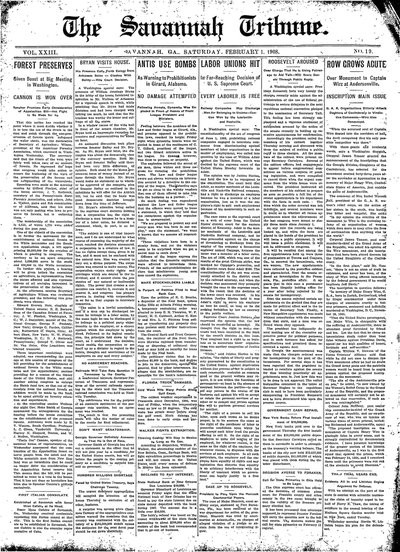
Page text (machine-generated)
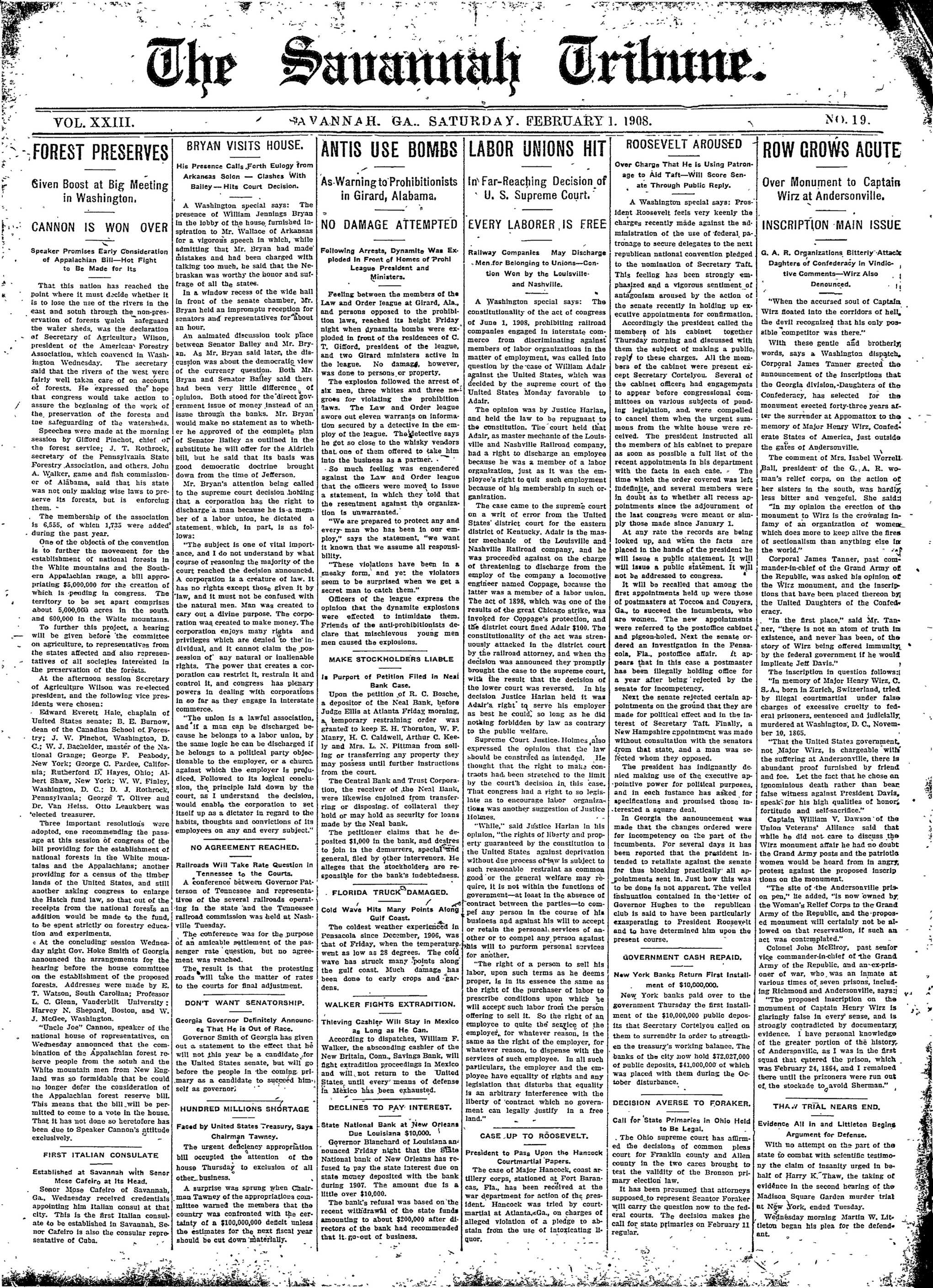
The Savannah Tribune.
VOL. XXIII.
FOREST PRESERVES
Given Boost at Big Meeting in Washington.
Speaker Promises Early Consideration of Appalachian Bill—Hot Fight to Be Made for Its
That this nation has reached the point where it must decide whether it is to lose the use of the rivers in the east and south through the non-preservation of forests which safeguard the water sheds, was the declaration of Secretary of Agriculture Wilson, president of the American Forestry Association, which convened in Washington Wednesday. The secretary said that the rivers of the west were fairly well taken care of on account of forests. He expressed the hope that congress would take action to assure the beginning of the work of the preservation of the forests and the safeguarding of the watersheds.
Speeches were made at the morning session by Gifford Pinchot, chief of the forest service; J. T. Rothrock, secretary of the Pennsylvania State Forestry Association, and others. John A. Walker, game and fish commissioner of Alabama, said that his state was not only making wise laws to preserve its forests, but is enforcing them. The membership of the association is 6,555, of which 1,735 were added during the past year.
One of the objects of the convention is to further the movement for the establishment of national forests in the White mountains and the Southern Appalachian range, a bill appropriating $5,000,000 for the creation of which is pending in congress. The territory to be set apart comprises about 5,000,060 acres in the south and 600,000 in the White mountains. To further this project, a hearing will be given before the committee on agriculture, to representatives from the states affected and also representatives of all societies interested in the preservation of the forests. At the afternoon session Secretary of Agriculture Wilson was re-elected president, and the following vice presidents were chosen:
Edward Everett Hale, chaplain of United States senate; B. E. Burnow, dean of the Canadian School of Forestry; J. W. Pinchot, Washington, D. C.; W. J. Bachelder, master of the National Grange; George F. Peabody, New York; George C. Pardee, California; Rutherford D. Hayes, Ohio; Albert Shaw, New York; W. W. Finley, Washington, D. C.; D. D. J. Rothrock, Pennsylvania; George T. Oliver and Dr. Van Heiss. Otto Leaukbert was 'selected treasurer.
Three important resolutions were adopted, one recommending the passage at this session of congress of the bill providing for the establishment of national forests in the White mountains and the Appalachians; another providing for a census of the timber lands of the United States, and still another asking congress to enlarge the Hatch fund law, so that out of the receipts from the national forests an addition would be made to the fund, to be spent strictly on forestry education and experiments.
At the concluding session Wednesday night Gov. Hoke Smith of Georgia announced the arrangements for the hearing before the house committee on the establishment of the proposed forests. Addresses were made by E. T. Watson, South Carolina; Professor L. C. Glenn, Vanderbilt University; Harvey N. Shepard, Boston, and W. J. McGee, Washington.
"Uncle Joe" Cannon, speaker of the national house of representatives, on Wednesday announced that the combination of the Appalachian forest reserve people from the sotuh and the White mountain men from New England was so formidable that he could no longer defer the consideration of the Appalachian forest reserve bill. This means that the bill will be permitted to come to a vote in the house. That it has not done so heretofore has been due to Speaker Cannon's attitude exclusively.
FIRST ITALIAN CONSULATE
Established at Savannah with Senor Mose Cafeiro $ _{0} $ at Its Head. Senor Mose Cafeiro of Savannah, Ga., Wednesday received credentials appointing him Italian consul at that city. This is the first Italian consulate to be established in Savannah. Senor Cafeiro is also the consular representative of Cuba.
BRYAN VISITS HOUSE.
His Presence Calls Forth Eulogy from Arkansas Solon - Clashes With
A Washington special says: The presence of William Jennings Bryan in the lobby of the house, furnished inspiration to Mr. Wallace of Arkansas for a vigorous speech in which, while admitting that Mr. Bryan had made mistakes and had been charged with talking too much, he said that the Nebraskan was worthy the honor and suffrage of all the states. In a window recess of the wide hall in front of the senate chamber, Mr. Bryan held an impromptu reception for senators and representatives for about an hour.
An animated discussion took place between Senator Bailey and Mr. Bryan. As Mr. Bryan said later, the discussion was about the democratic view of the currency question. Both Mr. Bryan and Senator Bailey said there had been very little difference of opinion. Both stood for the direct government issue of money instead of an issue through the banks. Mr. Bryan would make no statement as to whether he approved of the complete plan of Senator Bailey as outlined in the substitute he will offer for the Aldrich bill, but he said that its basis was good democratic doctrine brought down from the time of Jefferson.
Mr. Bryan's attention being called to the supreme court decision holding that a corporation has the right to discharge a man because he is a member of a labor union, he dictated a statement, which, in part, is as follows:
"The subject is one of vital importance, and I do not understand by what course of reasoning the majority of the court reached the decision announced. A corporation is a creature of law. It has no rights except those given it by law, and it must not be confused with the natural men. Man was created to carry out a divine purpose. The corporation was created to make money. The corporation enjoys many rights and privileges which are denied to the individual, and it cannot claim the possession of any natural or inallienable rights. The power that creates a corporation can restrict it, restrain it and control it, and congress has plenary powers in dealing with corporations in so far as they engage in interstate commerce.
"The union is a lawful association, and if a man can be discharged because he belongs to a labor union, by the same logic he can be discharged if he belongs to a political party objectionable to the employer, or a church against which the employer is prejudiced. Followed to its logical conclusion, the principle laid down by the court, as I understand the decision, would enable the corporation to set itself up as a dictator in regard to the habits, thoughts and convictions of its employees on any and every subject."
NO AGREEMENT REACHED.
Railroads Will Take Rate Question in Tennessee to the Courts. A conference between Governor Patterson of Tennessee and representatives of the several railroads operating in the state and the Tennessee railroad commission was held at Nashville Tuesday. The conference was for the purpose of an amicable settlement of the passenger rate question, but no agreement was reached. The result is that the protesting roads will take the matter of rates to the courts for final adjustment.
DON'T WANT SENATORSHIP.
Georgia Governor Definitely Announces That He is Out of Race.
Governor Smith of Georgia has given out a statement to the effect that he will not this year be a candidate for the United States senate, but will go before the people in the coming primary as a candidate to succeed himself as governor.
Faced by United States Treasury, Says Chairman Tawney.
The urgent deficiency appropriation bill occupied the attention of the house Thursday to exclusion of all other business.
A surprise was sprung when Chairman Tawney of the appropriations committee warned the members that the country was confronted with the certainty of a $100,000,000 deficit unless the estimates for the next fiscal year should be cut down materially.
SAVANNAH. GA.. SATURDAY. FEBRUARY 1. 1908.
ANTIS USE BOMBS
As-Warning to Prohibitionists in Girard, Alabama.
NO DAMAGE ATTEMPTED
Following Arrests, Dynamite Was Exploded In Front of Homes of Prohl League President and Ministers.
Feeling between the members of the Law and Order league at Girard, Ala., and persons opposed to the prohibition laws, reached its height Friday night when dynamite bombs were exploded in front of the residences of C. T. Gifford, president of the league, and two Girard ministers active in the league. No damagg, however, was done to persons or property.
The explosion followed the arrest of six men, three whites and three negroes for violating the prohibition laws. The Law and Order league swore out eleven warrants on information secured by a detective in the employ of the league. The detective says he got so close to the whisky vendors that one of them offered to take him into the business as a partner. So much feeling was engendered against the Law and Order league that the officers were moved to issue a statement, in which they told that the resentment against the organization is unwarranted. "We are prepared to protect any and every man who has been in our employ," says the statement, "we want it known that we assume all responsibility.
"These violations have been in a sneaky form, and yet the violators seem to be surprised when we get a secret man to catch them."
Officers of the league express the opinion that the dynamite explosions were effected to intimidate them.
Friends of the anti-prohibitionists declare that mischievous young men caused the explosions.
MAKE STOCKHOLDERS LIABLE
Is Purport of Petition Filed In Neal Bank Case.
Upon the petition of R. C. Bosche, a depositor of the Neal Bank, before Judge Ellis at Atlanta Fridax morning, a temporary restraining order was granted to keep E. H. Thornton, W. F. Manry, H. C. Caldwell, Arthur C. Keely and Mrs. L. N. Pittman from selling or transferring any property they may possess until further instructions from the court.
The Central Bank and Trust Corporation, the receiver of the Neal Bank, were likewise enjoined from transferring or disposing of collateral they hold or may hold as security for loans made by the Neal bank.
The petitioner claims that he deposited $1,000 in the bank, and desires to join in the demurrers, special and general, filed by other intervenors. He alleges that the stockholders are responsible for the bank's indebtedness.
FLORIDA TRUCK DAMAGED.
Cold Wave Hits Many Points Along Gulf Coast.
The coldest weather experienced in Pensacola since December, 1906, was that of Friday, when the temperature went as low as 28 degrees. The cold wave has struck many points along the gulf coast. Much damage has been done to early crops and gardens.
WALKER FIGHTS EXTRADITION.
Thieving Cashier Will Stay in Mexico as Long as He Can.
According to dispatches, William F. Walker, the absconding cashier of the New Britain, Conn., Savings Bank, will fight extradition proceedings in Mexico and will not return to the United States until every means of defense in Mexico has been exhausted.
DECLINES TO PAY INTEREST.
State National Bank at New Orleans Due Louisiana $10,000. Governor Blanchard of Louisiana announced Friday night that the State National bank of New Orleans has refused to pay the state interest due on state money deposited with the bank during 1907. The amount due is a little over $10,000. The bank's refusal was based on the recent withdrawal of the state funds amounting to about $200,000 after directors of the bank had recommended that it go-out of business.
LABOR UNIONS HIT
In Far-Reaching Decision of U. S. Supreme Court.
EVERY LABORER, IS FREE
Railway Companies May Discharge . Men.for Belonging to Unions—Conti tion Won by the Louisville- and Nashville.
A Washington special says: The constitutionality of the act of congress of June 1, 1908, prohibiting railroad companies engaged in interstate commerce from discriminating against members of labor organizations in the matter of employment, was called into question by the case of William Adalr against the United States, which was decided by the supreme court of the United States Monday favorable to Adalr.
The opinion was by Justice Harlan, and held the law to be repugnant to the constitution. The court held that Adair, as master mechanic of the Louisville and Nashville Railroad company, had a right to discharge an employee because he was a member of a labor organization, just as it was the employee's right to quit such employment because of his membership in such organization.
The case came to the supreme court on a writ of error from the United States' district court for the eastern district of Kentucky. Adair is the master mechanic of the Louisville and Nashville Railroad company, and he was proceeded against on the charge of threatening to discharge from the employ of the company a locomotive engineer named Coppage, because the latter was a member of a labor union. The act of 1898, which was one of the results of the great Chicago strike, was invoked for Coppage's protection, and the district court fined Adair $100. The constitutionality of the act was strenuously attacked in the district court by the railroad attorney, and when the decision was announced they promptly brought the case to the supreme court, with the result that the decision of the lower court was reversed. In his decision Justice Harlan held it was Adair's right to serve his employer as best he could, so long as he did nothing forbidden by law as contrary to the public welfare.
Supreme Court Justice. Holmes also expressed the opinion that the law should be construed as intended. He thought that the right to make contracts had been stretched to the limit by the court's decision in this case. That congress had a right to so legislate as to encourage labor organization was another suggestion of Justice Holmes.
"While," said Justice Harlan in his opinion, "the rights of liberty and property guaranteed by the constitution to the United States against deprivation without due process of law is subject to such reasonable restraint as common good or the general welfare may require, it is not within the functions of government—at least in the absence of contract between the parties—to compel any person in the course of his business and against his will to accept or retain the personal services of another or to compel any person against his will to perform personal services for another.
"The right of a person to sell his labor, upon such terms as he deems proper, is in its essence the same as the right of the purchaser of labor to prescribe conditions upon which he will accept such labor from the person offering to sell it. So the right of an employee to quite the service of the employer, for whatever reason, is the same as the right of the employer, for whatever reason, to dispense with the services of such employee. In all such particulars, the employer and the employee have equality of rights and any legislation that disturbs that equality is an arbitrary interference with the liberty of contract which no government can legally justify in a free land."
CASE UP TO ROOSEVELT.
President to Pass Upon the Hancock Courtmartial Papers.
The case of Major Hancock, const artillery corps, stationed at Fort Barancas, Fla., has been received at the war department for action of the president. Hancock was tried by court-martial at Atlanta, GA., on charges of alleged violation of a pledge to abstain from the use of intoxicating liquor.
ROOSEVELT AROUSED
Over Charge That He Is Using Patronage to Aid Taft—Will Score Senate Through Public Reply.
A Washington special says: President Roosevelt feels very keenly the charges recently made against the administration of the use of federal patronage to secure delegates to the next republican national convention pledged to the nomination of Secretary Taft. This feeling has been strongly emphasized and a vigorous sentiment of antagonism aroused by the action of the senate recently in holding up executive appointments for confirmation.
Accordingly the president called the members of his cabinet together Thursday morning and discussed with them the subject of making a public reply to these charges. All the members of the cabinet were present except Secretary Cortelyou. Several of the cabinet officers had engagements to appear before congressional committees on various subjects of pending legislation, and were compelled to cancel them when the urgent summons from the white house were received. The president instructed all the members of his cabinet to prepare as soon as possible a full list of the recent appointments in his department with the facts in each case. The time which the order covered was left indefinite, and several members were in doubt as to whether all recess appointments since the adjournment of the last congress were meant or simply those made since January 1.
At any rate the records are being looked up, and when the facts are placed in the hands of the president he will issue a public statement. It will will issue a public statement. It will not be addressed to congress.
It will be recalled that among the first appointments held up were those of postmasters at Toccoa and Conyers, Ga., to succeed the incumbents, who are women. The new appointments were referred to the postoffice cabinet and pigeon-holed. Next the senate ordered an investigation in the Pensacola, Fla., postoffice affair. It appears that in this case a postmaster has been illegally holding office for a year after being rejected by the senate for incompetency.
Next the senate rejected certain appointments on the ground that they are made for political effect and in the interest of Secretary Taft. Finally, a New Hampshire appointment was made without consultation with the senators from that state, and a man was selected whom they opposed.
The president has indignantly denied making use of the executive appointive power for political purposes, and in each instance has asked for specifications and promised those interested a square deal.
In Georgia the announcement was made that the changes ordered were for incompetency on the part of the incumbents. For several days it has been reported that the president intended to retaliate against the senate for thus blocking practically all appointments sent in. Just how this was to be done is not apparent. The veiled instuination contained in the letter of Governor Hughes to the republican club is said to have been particularly exasperating to President Roosevelt and to have determined him upon the present course.
GOVERNMENT CASH REPAID.
New York Banks Return First Installation of $10,000,000.
New York banks paid over to the government Thursday the first installment of the $10,000,000 public deposits that Secretary Cortelyou called on them to surrender in order to strengthen the treasury's working balance. The banks of the city now hold $72,027,000 of public deposits, $11,000,000 of which was placed with them during the October disturbance.
DECISION AVERSE TO FORAKER.
Call for State Primaries in Ohio Held to Be Legal. The Ohio supreme court has affirmed the decisions of common pleas court for Franklin county and Allen county in the two cases brought to test the validity of the Bronson primary election law. It has been presumed that attorneys supposed to represent Senator Foraker will carry the question now to the federal courts. The decision makes the call for state primaries on February 11 regular.
NO.19.
ROW GROWS ACUTE
Over Monument to Captain Wirz at Andersonville.
INSCRIPTION MAIN ISSUE
G. A. R. Organizations Bitterly Attack
Dighters of Confederacy in Vindictive Comments—Wirz Also
Denounced.
"When the accursed soul of Captain
Wirz floated into the corridors of hell,
the devil recognized that his only possible competitor was there."
With these gentle and brotherly words, says a Washington dispatch. Corporal James Tanner greeted the announcement of the inscriptions that the Georgia division, Daughters of the Confederacy, has selected for the monument erected forty-three years after the surrender at Appomattox to the memory of Major Henry Wirz, Confederate States of America, just outside the gates of Andersonville.
The comment of Mrs. Isabel Worrell Ball, president of the G. A. R. woman's relief corps, on the action of her sisters in the south, was hardly less bitter and vengeful. She said:
"In my opinion the erection of the monument to Wirz is the crowning infamy of an organization of women which does more to keep alive the fires of sectionalism than anything else in the world."
Corporal James Tanner, past commander-in-chief of the Grand Army of the Republic, was asked his opinion of the Wirz monument, and the inscriptions that have been placed thereon by the United Daughters of the Confederacy.
"In the first place," said Mr. Tanner, "there is not an atom of truth in existence, and never has been, of the story of Wirz being offered immunity by the federal government if he would implicate Jeff Davis."
The inscription in question follows: "In memory of Major Henry Wirz, C.S.A., born in Zurich, Switzerland, tried by illegal courtmartial under false charges of excessive cruelty to federal prisoners, sentenced and judicially murdered at Washington, D.C., November 10, 1865.
"That the United States government, not Major Wirz, is chargeable with the suffering at Andersonville, there is abundant proof furnished by friend and foe. Let the fact that he chose an ignominious death rather than bear false witness against President Davis, speak for his high qualities of honor, fortitude and self-sacrifice."
Captain William V. Dawson of the Union Veterans' Alliance said that while he did not care to discuss the Wirtz monument affair he had no doubt the Grand Army posts and the patriotic women would be heard from in angry, protest against the proposed inscriptions on the monument.
"The site of the Andersonville prison pen," he added, "is now owned by the Woman's Relief Corps to the Grand Army of the Republic, and the proposed monument will certainly not be allowed on that reservation, if such an act was contemplated."
Colonel John McElroy, past senior vice commander-in-chief of the Grand Army of the Republic, and an ex-prisoner of war, who was an inmate at various times of seven prisons, including Richmond and Andersonville, says:
"The proposed inscription on the monument of Captain Henry Wirz is glaringly false in every sense, and is strongly contradicted by documentary, evidence. I have personal knowledge of the greater portion of the history, of Andersonville, as I was in the first squad that entered the prison, which was February 24, 1864, and I remained there until the prisoners were run out of the stockade to avoid Sherman."
THA. TRIAL NEARS END.
Evidence All in and Littleton Begins Argument for Defense.
With no attempt on the part of the state to combat with scientific testimony the claim of insanity urged in behalf of Harry K. Thaw, the taking of evidence in the second hearing of the Madison Square Garden murder trial at New York, ended Tuesday.
Wednesday morning Martin W. Littleton began his plea for the defendant.
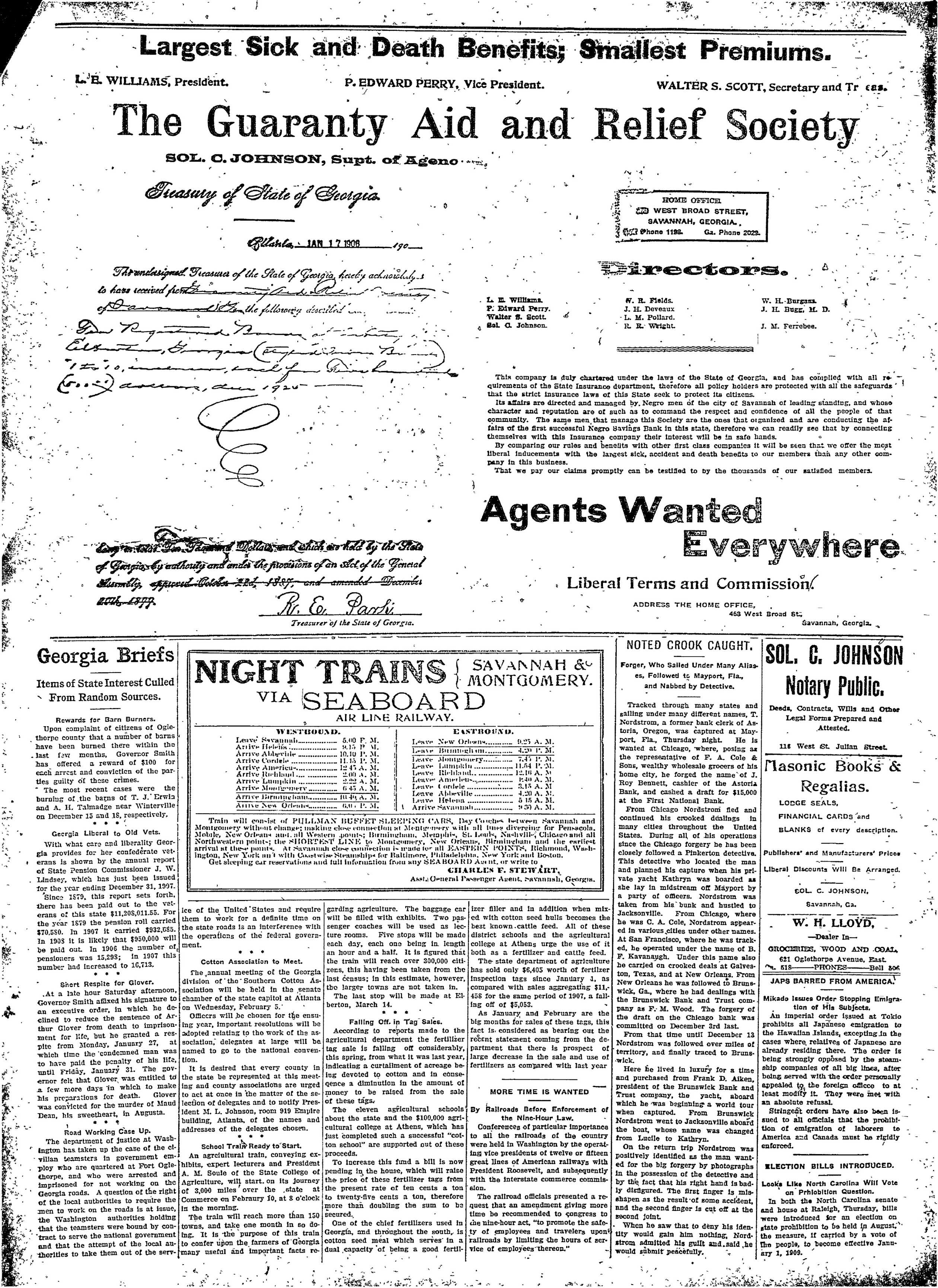
Largest Sick and Death Benefits; Smallest Premiums.
The Guaranty Aid and Relief Society
Treasury of State of Georgia.
Illinois: JAN 17 1908 190
The undesigned Treasurer of the State of Georgia hereby acknowledges
to have received from the Secretary of State of Georgia the following description:
Dear Regent and President,
Elswyn, Georgia (Republican Branch)
17510, member, peace from District
(5000) avenue, due 1920
Long and esteem Ten Thousand Dollars, and which are held by the State
of Georgia by authority and under the provisions of an Act of the General
Assembly, approved October 22d, 1887, and amended December
20th, 1897.
R. E. Pardisi.
Treasurer of the State of Georgia.
Georgia Briefs
Items of State Interest Culled From Random Sources.
Rewards for Barn Burners.
Upon complaint of citizens of Oglethorpe county that a number of barns have been burned there within the last few months, Governor Smith has offered a reward of $100 for each arrest and conviction of the parties guilty of these crimes. The most recent cases were the burning of the barns of T. J. Erwin and A. H. Talmadge near Winterville on December 15 and 18, respectively,
Georgia Liberal to Old Vets.
With what care and liberality Georgia provides for her confederate veterans is shown by the annual report of State Pension Commissioner J. W. Lindsey, which has just been issued for the year ending December 31, 1907. Since 1879, this report sets forth, there has been paid out to the veterans of this state $11,208,011.55. For the year 1879 the pension roll carried $70,580. In 1907 it carried $932,685. In 1908 it is likely that $950,000 will be paid out. In 1906 the number of pensioners was 15,298; in 1907 this number had increased to 16,713.
Short Respite for Glover.
At a late hour Saturday afternoon, Governor Smith affixed his signature to an executive order, in which he declined to reduce the sentence of Arthur Glover from death to imprisonment for life, but he granted a respite from Monday, January 27, at which time the condemned man was to have paid the penalty of his life, until Friday, January 31. The governor felt that Glover was entitled to a few more days in which to make his preparations for death. Glover was convicted for the murder of Maud Dean, his sweetheart, in Augusta.
The department of justice at Washington has taken up the case of the civilian teamsters in government employ who are quartered at Fort Oglethorpe, and who were arrested and imprisoned for not working on the Georgia roads. A question of the right of the local authorities to require the men to work on the roads is at issue, the Washington authorities holding that the teamsters were bound by contract to serve the national government and that the attempt of the local authorities to take them out of the serv-
SOL. C. JOHNSON, Supt. of Ageno
NIGHT TRAINS SAVANNAH & MONTGOMERY. VIA SEABOARD AIR LINE RAILWAY.
WESTBOUND.
Leave Savannah 5.00 P. M.
Arrive Helena 9.15 P. M.
Arrive Abbeville 10.10 P. M.
Arrive Cordele 11.15 P. M.
Arrive Americas 12.45 A. M.
Arrive Richland 2.00 A. M.
Arrive Lumpkin 2.22 A. M.
Arrive Montgomery 6.45 A. M.
Arrive Birmingham 10.40 A. M.
Arrive New Orleans 6.00 P. M.
EASTBOUND.
Leave New Orleans 9.25 A. M.
Leave Birmingham 4.20 P. M.
Leave Montgomery 7.45 P. M.
Leave Lumpkin 11.54 P. M.
Leave Richland 12.16 A. M.
Leave Americas 1.40 A. M.
Leave Cordele 3.15 A. M.
Leave Abbeville 4.20 A. M.
Leave Helena 5.15 A. M.
Arrive Savannah 9.30 A. M.
Train will consist of PULLMAN BUFFET SLEEPING CARS, Day Couches between Savannah and Montgomery without change; making close connection at Montgomery with all lines diverging for Pensacola, Mobile, New Orleans and all Western points; Birmingham, Memphis, St. Louis, Nashville, Chicago and all Northwestern points; the SHORTEST LINE to Montgomery, New Orleans, Birmingham and the earliest arrival at these points. At Savannah close connection is made for all EASTERN POINTS, Richmond, Washington, New York and Coastwise Steamships for Baltimore, Philadelphia, New York and Boston.
Get sleeping car reservations and full information from any SEABOARD Agent, or write to
ice of the United States and require them to work for a definite time on the state roads is an interference with the operations of the federal government.
* * *
Cotton Association to Meet.
The annual meeting of the Georgia division of the Southern Cotton Association will be held in the senate chamber of the state capitol at Atlanta on Wednesday, February 5. Officers will be chosen for the ensuing year, important resolutions will be adopted relating to the work of the association, delegates at large will be named to go to the national convention.
It is desired that every county in the state be represented at this meeting and county associations are urged to act at once in the matter of the selection of delegates and to notify President M. L. Johnson, room 919 Empire building, Atlanta, of the names and addresses of the delegates chosen.
School Train Ready to Start.
An agricultural train, conveying exhibits, expert lecturers and President A. M. Soule of the State College of Agriculture, will start, on its journey of 3,000 miles over the state at Commerce on February 10, at 8 o'clock in the morning. The train will reach more than 150 towns, and take one month in so doing. It is the purpose of this train to confer upon the farmers of Georgia many useful and important facts re-
P. EDWARD PERRY, Vice President.
Akst, General Passenger Agent, Savannah, Georgia.
garding agriculture. The baggage car will be filled with exhibits. Two passenger coaches will be used as lecture rooms. Five stops will be made each day, each one being in length an hour and a half. It is figured that the train will reach over 300,000 citizens, this having been taken from the last census; in this estimate, however, the larger towns are not taken in.
The last stop will be made at Elberton, March 14.
Falling Off, in Tag Sales.
According to reports made to the agricultural department the fertilizer tag sale is falling off considerably, this spring, from what it was last year, indicating a curtailment of acreage being devoted to cotton and in consequence a diminution in the amount of money to be raised from the sale of these tags.
The eleven agricultural schools about the state and the $100,000 agricultural college at Athens, which has just completed such a successful "cotton school" are supported out of these proceeds.
To increase this fund a bill is now pending in the house, which will raise the price of these fertilizer tags from the present rate of ten cents a ton to twenty-five cents a ton, therefore more than doubling the sum to be secured.
One of the chief fertilizers used in Georgia, and throughout the south, is cotton seed meal which serves in a dual capacity of being a good fertil-
HOME OFFICE
WEST BROAD STREET,
SAVANNAH, GEORGIA.
Phone 1198. Ga. Phone 2029.
Directors.
L. E. Williams.
P. Edward Perry.
Walter S. Scott.
Sol. Q. Johnson.
W. R. Fields.
J. H. Deveaux
L. M. Pollard.
R. R. Wright.
W. H. Burgess.
J. H. Bugg, M. D.
J. M. Ferrebee.
This company is duly chartered under the laws of the State of Georgia, and has complied with all requirements of the State Insurance department, therefore all policy holders are protected with all the safeguards that the strict insurance laws of this State seek to protect its citizens.
Its affairs are directed and managed by Negro men of the city of Savannah of leading standing, and whose character and reputation are of such as to command the respect and confidence of all the people of that community. The same men that manage this Society are the ones that organized and are conducting the affairs of the first successful Negro Savings Bank in this state, therefore we can readily see that by connecting themselves with this Insurance company their interest will be in safe hands.
By comparing our rules and benefits with other first class companies it will be seen that we offer the most liberal inducements with the largest sick, accident and death benefits to our members than any other company in this business.
izer filler and in addition when mixed with cotton seed hulls becomes the best known.cattle feed. All of these district schools and the agricultural college at Athens urge the use of it both as a fertilizer and cattle feed. The state department of agriculture has sold only $6,405 worth of fertilizer inspection tags since January 1, as compared with sales aggregating $11,458 for the same period of 1907, a falling off of $5.053.
As January and February are the big months for sales of these tags, this fact is considered as bearing out the recent statement coming from the department that there is prospect of large decrease in the sale and use of fertilizers as compared with last year
MORE TIME IS WANTED
By Railroads Before Enforcement of the Nine-Hour Law. Conferences of particular importance to all the railroads of the country were held in Washington by the operating vice presidents of twelve or fifteen great lines of American railways with President Roosevelt, and subsequently with the interstate commerce commission. The railroad officials presented a request that an amendment giving more time be recommended to congress to the nine-hour act, "to promote the safety of employees and travelers upon railroads by limiting the hours of service of employees thereon."
WALTER S. SCOTT, Secretary and Tr eas.
Forger, Who Sailed Under Many Aliases, Followed to Mayport, Fla., and Nabbed by Detective.
Tracked through many states and galling under many different names, T. Nordstrom, a former bank clerk of Astoria, Oregon, was captured at Mayport, Fla., Thursday night. He is wanted at Chicago, where, posing as the representative of F. A. Cole & Sons, wealthy wholesale grocers of his home city, he forged the name of J. Roy Bennett, cashier of the Astoria Bank, and cashed a draft for $15,000 at the First National Bank.
From Chicago Nordstrom fled and continued his crooked dealings in many cities throughout the United States. During all of his operations since the Chicago forgery he has been closely followed a Pinkerton detective. This detective who located the man and planned his capture when his private yacht Kathryn was boarded as she lay in midstream off Mayport by a party of officers. Nordstrom was taken from his bunk and hustled to Jacksonville. From Chicago, where he was C. A. Cole, Nordstrom appeared in various cities under other names. At San Francisco, where he was tracked, he operated under the name of B. F. Kavanaugh. Under this name also he carried on crooked deals at Galveston, Texas, and at New Orleans. From New Orleans he was followed to Brunswick, Ga., where he had dealings with the Brunswick Bank and Trust company as F. M. Wood. The forgery of the draft on the Chicago bank was committed on December 3rd last.
From that time until December 13 Nordstrom was followed over miles of territory, and finally traced to Brunswick.
Here he lived in luxury for a time and purchased from Frank D. Aiken, president of the Brunswick Bank and Trust company, the yacht, aboard which he was beginning a world tour when captured. From Brunswick Nordstrom went to Jacksonville aboard the boat, whose name was changed from Lucile to Kathryn.
On the return trip Nordstrom was positively identified as the man wanted for the big forgery by photographs in the possession of the detective and by the fact that his right hand is badly disfigured. The first finger is mishapen as the result of some accident, and the second finger is cut off at the second joint. When he saw that to deny his identity would gain him nothing, Nordstrom admitted his guilt and said he would submit peacefully.
Deeds, Contracts, Wills and Other
Legal Forms Prepared and
Attested.
116 West St. Julian Street.
Masonic Books &
Regalias.
LODGE SEALS,
FINANCIAL CARDS and
BLANKS of every description.
Pubilshers' and Manufacturers' Prices
Liberal Discounts Will Be Arranged.
COL. C. JOHNSON.
W. H. LLOYD,
—Dealer In—
GROCERIES, WOOD AND COAL,
621 Oglethorpe Avenue, East.
518 PHONES—Bell 806
JAPS BARRED FROM AMERICA.
Mikado Issues Order Stopping Emigration of HIs Subjects.
An imperial order issued at Tokio prohibits all Japanese emigration to the Hawaiian Islands, excepting in the cases where relatives of Japanese are already residing there. The order is being strongly opposed by the steamship companies of all big lines, after being served with the order personally appealed to the foreign office to at least modify it. They were met with an absolute refusal. Stringent orders have also been issued to all officials that the prohibition of emigration of laborers to America and Canada must be rigidly enforced.
ELECTION BILLS INTRODUCED.
Looks Like North Carolina Will Vote on Prhlobition Question. In both the North Carolina senate and house at Raleigh, Thursday, bills were introduced for an election on state prohibition to be held in August; the measure, if carried by a vote of the people, to become effective January 1, 1909.
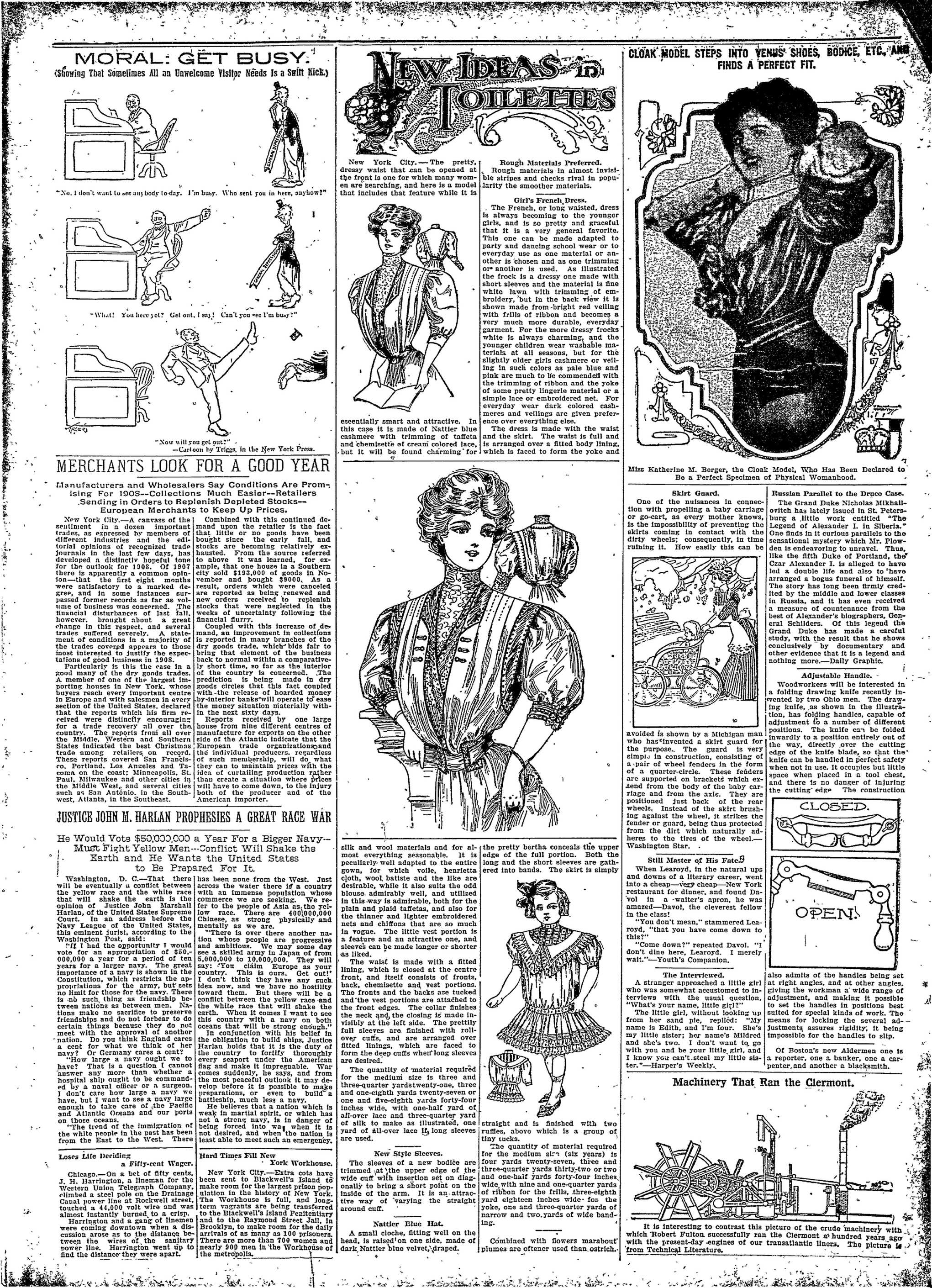
MORAL: GET BUSY.
(Showing Thal Sometimes All an Unwelcome Visitor Needs Is a Swift Kick.)
"No, I don't want to see anybody to-day. I'm busy. Who sent you in here, anyhow?"
T. RICO
MERCHANTS LOOK FOR A GOOD YEAR
Manufacturers and Wholesalers Say Conditions Are Promising For 190S--Collections Much Easier--Retailers Sending in Orders to Replenish Depleted Stocks-- European Merchants to Keep Up Prices.
JUSTICE JOHN M. HARLAN PROPHESIES A GREAT RACE WAR
He Would Vote $50,000,000 a Year For a Bigger Navy-- Must Fight Yellow Men---Conflict Will Shake the Earth and He Wants the United States to Be Prepared For It.
New York City.—A canvass of the sentiment in a dozen important trades, as expressed by members of different industries and the editorial opinions of recognized trade journals in the last few days, has developed a distinctly hopeful tone for the outlook for 1908. Of 1907 there is apparently a common opinion—that the first eight months were satisfactory to a marked degree, and in some instances surpassed former records as far as volume of business was concerned. The financial disturbances of last fall, however, brought about a great change in this respect, and several trades suffered severely. A statement of conditions in a majority of the trades covered appears to those most interested to justify the expectations of good business in 1908.
Particularly is this the case in a good many of the dry goods trades. A member of one of the largest importing houses in New York, whose buyers reach every important centre in Europe and with salesmen in every section of the United States, declared that the reports which his firm received were distinctly encouraging for a trade recovery all over the country. The reports from all over the Middle, Western and Southern States indicated the best Christmas trade among retailers on record. These reports covered San Francisco. Portland, Los Angeles and Tacoma on the coast; Minneapolis, St. Paul, Milwaukee and other cities in the Middle West, and several cities such as San António, in the Southwest, Atlanta, in the Southeast.
Washington, D. C.—That there will be eventually a conflict between the yellow race and the white race that will shake the earth is the opinion of Justice John Marshall Harlan, of the United States Supreme Court. In an address before the Navy League of the United States, this eminent jurist, according to the Washington Post, said: "If I had the opportunity I would vote for an appropriation of $50,000,000 a year for a period of ten years for a larger navy. The great importance of a navy is shown in the Constitution, which restricts the appropriations for the army, but sets no limit for those for the navy. There is no such thing as friendship between nations as between men. Nations make no sacrifice to preserve friendships and do not forbear to do certain things because they do not meet with the approval of another nation. Do you think England cares a cent for what we think of her navy? Or Germany cares a cent?
"How large a navy ought we to have? That is a question I cannot answer any more than whether a hospital ship ought to be commanded by a naval officer or a surgeon. I don't care how large a navy we have, but I want to see a navy large enough to take care of the Pacific and Atlantic Oceans and our ports on those oceans.
"The trend of the immigration of the white people in the past has been from the East to the West. There
Loses Life Deciding
Chicago.—On a bet of fifty cents, J. H. Harrington, a lineman for the Western Union Telegraph Company, climbed a steel pole on the Drainage Canal power line at Rockwell street, touched a 44,000 volt wire and was almost instantly burned to a crisp. Harrington and a gang of linemen were coming downtown when a discussion arose as to the distance between the wires of the sanitary power line. Harrington went up to find the distance they were apart.
Combined with this continued demand upon the retailer is the fact that little or no goods have been bought since the early fall, and stocks are becoming relatively exhausted. From the source referred to above it was learned, for example, that one house in a Southern city sold $133,000 of goods in November and bought $9000. As a result, orders which were canceled are reported as being renewed and new orders received to replenish stocks that were neglected in the weeks of uncertainty following the financial flurry.
Coupled with this increase of demand, an improvement in collections is reported in many branches of the dry goods trade, which bids fair to bring that element of the business back to normal within a comparatively short time, so far as the interior of the country is concerned. The prediction is being made in dry goods circles that this fact coupled with the release of hoarded money by interior banks will operate to ease the money situation materially within the next sixty days. Reports received by one large house from nine different centres of manufacture for exports on the other side of the Atlantic indicate that the European trade organizations and the individual producers, regardless of such membership, will do what they can to maintain prices with the idea of curtailing production rather than create a situation where prices will have to come down, to the injury both of the producer and of the American importer.
has been none from the West. Just across the water there is a country with an immense population whose commerce we are seeking. We refer to the people of Asia as the yellow race. There are 400,000,000 Chinese, as strong physically and mentally as we are.
"There is over there another nation whose people are progressive and ambitious. We may some day see a skilled army in Japan of from 5,000,000 to 10,000,000. They will say: 'You claim Europe as your country. This is ours. Get out!' I don't think they have any such idea now, and we have no hostility toward them. But there will be a conflict between the yellow race and the white race that will shake the earth. When it comes I want to see this country with a navy on both oceans that will be strong enough."
In conjunction with his belief in the obligation to build ships, Justice Harlan holds that it is the duty of the country to fortify thoroughly every seaport under the American flag and make it impregnable. War comes suddenly, he says, and from the most peaceful outlook it may develop before it is possible to make preparations, or even to build a battleship, much less a navy. He believes that a nation which is weak in martial spirit, or which has not a strong navy, is in danger of being forced into war when it is not desired, and when the nation is least able to meet such an emergency.
Hard Times Fill New York Workhouse.
New York City.—Extra cots have been sent to Blackwell's Island to make room for the largest prison population in the history of New York. The Workhouse is full, and long-term vagrants are being transferred to the Blackwell's Island Penitentiary and to the Raymond Street Jail, in Brooklyn, to make room for the daily arrivals of as many as 100 prisoners. There are more than 700 women and nearly 900 men in the Workhouse of the metropolis.
NEW IDEAS IN TOILETIES
1
New York City.—The pretty, dressy waist that can be opened at the front is one for which many women are searching, and here is a model that includes that feature while it is
1
essentially smart and attractive. In this case it is made of Nattier blue cashmere with trimming of taffeta and chemisette of cream colored lace, but it will be found charming for
10
silk and wool materials and for almost everything seasonable. It is peculiarly well adapted to the entire gown, for which volle, henrietta cloth, wool batiste and the like are desirable, while it also suits the odd blouse, admirably well, and utilized in this way is admirable, both for the plain and plaid taffetas, and also for the thinner and lighter embroidered nets and chiffons that are so much in vogue. The little vest portion is a feature and an attractive one, and sleeves can be made longer or shorter as liked.
The waist is made with a fitted lining, which is closed at the centre front, and itself consists of fronts, back, chemisette and vest portions. The fronts and the backs are tucked and the vest portions are attached to the front edges. The collar finishes the neck and, the closing is made invisibly at the left side. The prettily full sleeves are finished with roll-over cuffs, and are arranged over fitted linings, which are faced to form the deep cuffs when long sleeves are desired.
The quantity of material required for the medium size is three and three-quarter yardstwenty-one, three and one-eighth yards twenty-seven or one and five-eighth yards forty-four inches wide, with one-half yard of all-over lace and three-quarter yard of silk to make as illustrated, one yard of all-over lace if long sleeves are used.
New Style Slceres.
The sleeves of a new bodice are trimmed at the upper edge of the wide cuff with insertion set on diagonally to bring a short point on the inside of the arm. It is an attractive way of varying the straight around cuff.
Nattier Blue Hat.
A small cloche, fitting well on the head, is raised on one side, made of dark Nattier blue velvet,draped.
Rough Materials Preferred.
Rough materials in almost invisible stripes and checks rival in popularity the smoother materials.
Girl's French Dress.
Girls's French dress.
The French, or long waisted, dress is always becoming to the younger girls, and is so pretty and graceful that it is a very general favorite. This one can be made adapted to party and dancing school wear or to everyday use as one material or another is chosen and as one trimming or another is used. As illustrated the frock is a dressy one made with short sleeves and the material is fine white lawn with trimming of embroidery, but in the back view it is shown made from bright red veiling with frills of ribbon and becomes a very much more durable, everyday garment. For the more dressy frocks white is always charming, and the younger children wear washable materials at all seasons, but for the slightly older girls cashmere or veiling in such colors as pale blue and pink are much to be commended with the trimming of ribbon and the yoke of some pretty lingerie material or a simple lace or embroidered net. For everyday wear dark colored cashmeres and veilings are given preference over everything else.
The dress is made with the waist and the skirt. The waist is full and is arranged over a fitted body lining, which is faced to form the voke and
1
the pretty bertha conceals the upper edge of the full portion. Both the long and the short sleeves are gathered into bands. The skirt is simply
```markdown
```
straight and is finished with two ruffles, above which is a group of tiny tucks.
The quantity of material required for the medium size (six years) is four yards twenty-seven, three and three-quarter yards thirty-two or two and one-half yards forty-four inches wide with nine and one-quarter yards of ribbon for the frills, three-eighth yard eighteen inches wide for the yoke, one and three-quarter yards of narrow and two.yards of wide banding.
Combined with flowers marabout plumes are oftener used than ostrich.
J
Miss Katherine M. Berger, the Cloak Model, Who Has Been Declared to Be a Perfect Specimen of Physical Womanhood.
Machinery That Run the Clermont.
It is interesting to contrast this picture of the crude machinery with which Robert Fulton successfully ran the Clermont as hundred years ago with the present-day engines of our transatlantic liners. The picture from Technical Literature.
Skirt Guard.
One of the nuisances in connection with propelling a baby carriage or go-cart, as every mother knows, is the impossibility of preventing the skirts coming in contact with the dirty wheels; consequently, in time ruining it. How easily this can be
THE WOMAN PUSHING A BABY IN A STROLL.
avoided is shown by a Michigan man who has'invented a skirt guard for the purpose. The guard is very simple in construction, consisting of a pair of wheel fenders in the form of a quarter-circle. These fenders are supported on brackets which extend from the body of the baby carriage and from the axle. They are positioned just back of the rear wheels. Instead of the skirt brushing against the wheel, it strikes the fender or guard, being thus protected from the dirt which naturally adheres to the tires of the wheel.—Washington Star.
Still Master of His Fate
When Learoyd, in the natural ups and downs of a literary career, went into a cheap—very cheap—New York restaurant for dinner, and found Davol in a waiter's apron, he was amazed—Davol, the cleverest fellow in the class!
"You don't mean," stammered Learoyd, "that you have come down to this?"
"Come down?" repeated Davol. "I don't dine here, Learoyd. I merely wait."—Youth's Companion.
The Interviewed.
A stranger approached a little girl who was somewhat accustomed to interviews with the usual question, "What's your name, little girl?" The little girl, without looking up from her sand ple, replied: "My name is Edith, and I'm four. She's my little sister; her name's Mildred and she's two. I don't want to go with you and be your little girl, and I know you can't steal my little sister."—Harper's Weekly.
Russian Parallel to the Druno Case.
The Grand Duke Nicholas Mikhallovitch has lately issued in St. Petersburg a little work entitled "The Legend of Alexander I. in Siberia." One finds in it curious parallels to the sensational mystery which Mr. Plowden is endeavoring to unravel. Thus, like the fifth Duke of Portland, the Czar Alexander I. is alleged to have led a double life and also to have arranged a bogus funeral of himself. The story has long been firmly credited by the middle and lower classes in Russia, and it has even received a measure of countenance from the best of Alexander's biographers, General Schilders. Of this legend the Grand Duke has made a careful study, with the result that he shows conclusively by documentary and other evidence that it is a legend and nothing more.—Dally Graphic.
Adjustable Handle.
Woodworkers will be interested in a folding drawing knife recently invented by two Ohio men. The drawing knife, as shown in the illustration, has folding handles, capable of adjustment to a number of different positions. The knife can be folded inwardly to a position entirely out of the way, directly over the cutting edge of the knife blade, so that the knife can be handled in perfect safety when not in use. It occupies but little space when placed in a tool chest, and there is no danger of injuring the cutting edge. The construction
CLOSED.
OPEN.
also admits of the handles being set at right angles, and at other angles, giving the workman a wide range of adjustment, and making it possible to set the handles in positions best suited for special kinds of work. The means for locking the several adjustments assures rigidity, it being impossible for the handles to slip.
Of Boston's new Aldermen one is a reporter, one a banker, one a carpenter, and another a blacksmith.
PUBLISHED EVERY SATURDAY BY
THE TRIBUNE PUBLISHING CO.
116 St. Julian Street, west,
Bell Phone 2171
SUBSCRIPTION RAT :
One Year.....$1.25
Six Months.....75
Three Months.....50
Remittance must be made by Express
or Post Office Money Order, or Registered
Letter. Advertising rates given on
application.
SATURDAY, FEBRUARY 1, 1908
Our white citizens fail in business but they do not become discouraged, but persevere. Our people to succeed must learn the same lesson.
ON account of financial conditions now existing in the city, many of our people have taken a decided stand against enterprises among us. This is the wrong attitude to assume. They must keep in mind that all of us cannot succeed, some will fail, and because of these failures we must not become discouraged. It is always best to study surrounding conditions before investing our means, by so doing many failures will be averted.
It is reported that Judge Geo: T. Cann will resign as judge of the Superior Court of this circuit. This report is received with regret, especially by those who know the Judge best and have noted his uprightness and judicial actions. He is a high type of citizen, one who makes the community and his profession stand for everything that is good. The Judge represents that class of our white citizens whom THE TRIBUNE and all thoughtful colored men delight in honoring, because it is felt that they will not under any circumstances take advantage of us.
ONE of the great evils of present time is the indiscriminate carrying of concealed weapons. The legislature should adopt more stringent laws regulating its sale. The war-like display of them in shop windows and pawn shops should not be allowed, and the name of each purchaser with residence should be recorded and given to the county authorities for reference. This would do much in decreasing the concealed weapon habit and cutting down the number of murders, etc. It is only the lawless man, who carries a pistol concealed:
We have the opportunity of our lives to greatly benefit our selves in this community. To the contrary notwithstanding we get along more amicably here with the opposite race than those of our people in any community. While this is a fact let us take advantage of the opportunity in bettering our condition in every respect. Let us teach our children and the more thoughtless among us to obey the laws, so act as to secure and retain the friendship of their neighbors, regardless of color. educate the children, be loyal to employers, take care of the earnings, secure homes and in fact do all of those things that make a model citizen. We can do it. It can be accomplished by a little reflection and constant action.
As a race we will not amount to very much if we are allowed to go through the world without some form of trials. Trials the better prepare us for life's work. he scathing address of Judge Norwood, while we do not ap prove of it, but at the same time will cause us to think, and if we are wise, we will immediately try and strengthen the weak places. The several forms of discrimination against us should domore than anything else to bring us together and act for the good of the masses of our people. There is a lesson in each undue action against us as a race, and we should be in a position to study them and profit thereby.
IN conversation with a number of our white friends they generally contend that one of the main failures of our people is their unreliability. This charge we endeavor to refute by saying that the wages that are paid servants, etc., are so beg- garly that to some extent, only the less responsible class of our people accept such employment, the others are attracted to fields where they will be better able to support themselves and families. It is a fact that if our white employers would give
their colored employees better pay and treatment too, better services would be the result. It behooves all of our people who accept employment, matters not how menial the position may be, or how beggarly the pay, they must give conscientious service; they must be reliable, they should make themselves indispensible. In our present condition we can not afford to be looked upon as a race void of reliability. This should be seriously considered by our young men and women who are employed.
College Dots.
Rev. Branch of St. Philip's Monumental Church preached for the Collegians last Sunday from John 1:11. He said, to receive Christ is the greatest act in the life of an individual. Vastly more important than riches, position, honor and fame is the acceptance of Christ. The acceptance of Christ by the entire human family would bring to the world peace, joy and happiness. If men to-day would receive Christ into their hearts, how many of the great political and social problems would be solved. The Collegians were glad to see and hear Rev Branch. They were greatly edified by his impressive and practical sermon. Come again.
Mrs. McLester has made her appearance at her class room since her conflict with the grip. All are glad to see her out again. The Collegians sympathize greatly with Prof. and Mrs. L B. Thompson and their daughter Miss Louise, in their suffering from La Grippe and wish for them an early recovery. Prof. Thompson is sitting up and will be out in a few days. Quite a number of tourists have visited the College this week.
Mr. Frank Stone of Brunswick a former student, visited College last week. He has a large tailoring establishment at Brunswick, employs four helpers and is making quite a success.
Second Baptist Church.
Sunday was an excellent service, though the weather was very inclement Sunday night. Pastor May preaching. The Sunday School was well attended and its rapid progress seems certain. Sisters Buford, Underwood, Chisolm and Starr are making the Mission Circle interesting Tuesday nights at 7:45. Excellent Sunday School teachers' meetings are being conducted Wednesday nights by Supt. E. B. Edwards. The choir is doing excellent singing at each regular service. The sick list is unusually large; in part it is as follows: Sister Ellen Freeman, 623 Mercer street, Miss Sarah A. Maxwell, Charlton street east, Sister Mary Lookett, 522 Bolton street west, Sister Henrietta Maine, Sister Lucy Frazier, 646 Oglethorpe E., east, Sister Susie Williams, 235 Raadolph Brother Singfield, 174 Randolph street, Sister Mabel Hahn, Harris street west, Sister Caroline Houston, 170 Reynolds street, Sister Mosianna Milledge, 513 Gaston street east; Sister Mary Bryan, 164 Reynolds street, also Scott, Huntingdale street, Green Riley, Shellman, Williams; two members at Sand Fly Island and Sister Willie Figgers, Tybee island and a number of others whose names do not appear. William Henry, the little son of Dr. and Mrs. May who has been very sick is much better after moderate illness of several weeks. Sister Elvira Brown of Atlantic street one of our old members was present Sunday morning accompanied by her daughter Mary M. Wright. Mrs. Mary Williams of Gordon Lane, east one of the church's oldest members was at church Sunday morning for the first time in three years. Deacon A. McHardy over half a century a deacon with unbroken and an unariised record in this church and on this staff, is active in his church services and is continuing to give some wholesome advice each Sunday morning at the conclusion of pastor May's sermon. Dr. May holds that deacon McHardy's talks strengthens both church and pastor. The pastor, Deacons and members are going to commune with the 1st. A. B. Church tomorrow at 4 p. m. Preaching tomorrow at both hours by the pastor Morning text; "Reader into Caesar the things that are Caesar's, and unto God the things that are God's." Night subject, the subject advertised for last Sunday night. Everybody, cordially invited to come, you will be made welcome.
Quarterly Conference.
St. Philip's Monumental A. M.
E. Uhurch, New street, held its first quarterly conference for this year with Rev. J. T. Thomas, B. D. Presiding Elder of the Savannah District in the chair. After slaging one of Zlon's sweet hymns, prayer being offered to the Divine Master. He made a short but touching address, complimenting those who were present, especially the older ones. He commended the Pastor, Rev. R V Branch, D. D., for making such a grand report at the Annual Conference, for it is known that Dr. Branch never known what failure is. After taking up the discipline nary question, reports from the different branches of the church were rendered. Sister Marie Jones who departed this life last October was mentioned in taking up the disciplinary question and the chair man called on Sister E. Odom who was her leader, to speak. She made a short heartfelt speech in behalf of the deceased sister. Sunday morning at 10:45 o'clock. Drs. Thomas and Branch were at their post of duty. The choir welcomed them with an anthem that was inspiring. Hymn 129 was lined by Rev. Branch which was sung by the choir while the penny collection was lifted. Elder. Thomas introduced Dr. G. G. Swicard as the speaker of the hour. Dr. Swicard select-
ed for his text John 9:24 subject "Work." This divine proved that he is a messenger of God. He left something for the church to feast on. Dr. Branch in his scholarly way commented upon the sermon. Collection was lifted and benediction was pronounced by the Elder. Night session was well attended. Memorial Church is not behind. She is the mother church and is a light upon the bill and will rally to the front with Dr Branch at the thresh tie and success written on his forehead.
Bethlehem Bap. Church
Bethlehem Baptist Church, Rev. L. L.
Blair, pastor. God is wonderfully blessing us in away that we cannot but appreciate. All day Sunday Rev. L. L. Blair, occupied his pulpit and preached two everlasting soul stirring sermons to very large congregation. Surely did he made the heart feel the spirit and they went away rejoicing that the Lord has been with us. Sunday school at the usual hour 3 o'clock was well attended and conducted by Supt. F. H. Williams At 5 o'clock the Y. M. C. A. met. Master E. Chance president, presided. The young men are doing a great good and they are increasing at every session. The 48th anniversary of Bethlehem Baptist Church, commenced Tuesday night January 28th and ending Sunday night February 2nd 1908. All are respectfully invited to attend and take part with us. Prayer meeting each night before services. The deacons' will see that everybody he will be treated alright.
Minister's Union.
The Evangelical Ministers Union met in St Phillip A. M. E. Church, Tuesday last with Dr. J. A. Lindsay presiding, Divine services was conducted by Rev. B. S. Hannah. Rev. R. Pierce was introduced and joined the union. Rev. R. H. Robinson and Rev. W. L. Cash presented able sermons which were very helpful Friendly criticisms and commendations were offered by Revs. R. V. Branch, C. D. Johnson, J. S. Jenkins B. S. Hannah. Rev. J. S. Jenkins and Rev. B. S. Hannah get in a question of latin and theology It was finally settled by Rev. W. L. Cash and the chairman. Come out next Tuesday day as some great discussion is planned.
Annual Reception.
A New Tabernacle.
The Knights of Tabor is on the road to success and is now wending its way around Mt. Tabor and will soon reach the highest peak. All good thinking people are invited to join with them. N.D. Jackson's Tabernacle No. 50 Daughters of Tabor was set up Monday last by D.G. H. P. Mrs. F. D. Armstrong, with fifty ladies of our city, making the fourth sat up by her. Following are the officers:
Another convention is in progress. Any one wishing to become a member of the Daughters of Taber can do so by calling on Mrs. F. D Armstrong, D. G. H. P., 519 West Bolton street.
Library and Hospital Trustees:
At a meeting of city council on Wednesday night the ordinance for the appointment of trustees for the Colored Library and Charity Hospital al was adopted and Mayor Tiedeman made the following appointments of trustees: For the library, Dr. J. H. Bugg, Mr. D. J. Scott and THE
TRIDUNE Editor. The hospital, Messrs. J. D. Saysage, L. G. Middleton, and P. A. Denegall. The duties of these trustees will be defined and they will look after the city's interest
Notice.
This is to notify the public that the Metropolitan Mutual Benefit Association has discontinued its insurance business in the State of Georgia. The officers and directors hereafter will devote their time to the banking business in Savannah. The five thousand dollars on deposit will be used to further strengthen the banking business and to build homes for the people in Georgia. The directors of the Metropolitan Mercantile and Realty Company who put up the five thousand dollars for the insurance have found that they can use that money in the banking business and make more than the three and one half per cent that the bonds pay.
Metropolitan Mercantile and Realty Company. L. G. Celling Secretary.
"Would You Rather Two-step than Waltz."
You can do both if you attend the TWENTY-EIGHTH ANNIVERSARY
At their Temple, Daffy street, west,
Monday Night February 19th 1908, Musie
by Apollo Orchestra. Tickets, Single 506
Double 75c. Supper will be served cam
plimentary. P. N. G., Wm. Stevens,
chairman. P. N. F., E. A. Fields, Ex.
Notice.
The public is hereby warned not to pay to J. Sam Sharpe (or J. S. Sharpe any money on account of the Waycross News for subscription or otherwise, as none of such payments reach us. He holds a letter sig ed by us, but has abused the trust placed in him.
Respectfully,
G. H. BOWEN,
1 18 4t.
Ed Waycross News.
Sneaked out by Night,
WITH KEYS and GENT.
mrs. and Mrs. McMillen, who lived at No. 15 Moore's Ave., skipped out of the city with keys and rent, on Monday night January 20th, 12 o'clock Mr. McMillen will be remembered as a well known night hackman in the city for years. If the house had not been on good foundation. I doubt if he would not have carried it also. Mr. McMillen should study the Golden Rule, also the (8) eighth commandment. There are three (3) ways by which we come to possess things. First, by free gifts of some one else, second, by toil or third, by theft which takes from another without leave. his property and this is just what McMillen did.
Alfr Washington,
320 Jones St. E.
Mrs M. E. WILLIAMS'
Hair Dressing Parlor
SCALP TREATMENT,
SHAMPOOING,
Electric Face, Neck and Body
Massaging.
COMPLEXION BEAUTIFIED,
MANICURING.
All kinds of Lady's Hair Goods,
Switches, Puffs, Pompa
dours, etc.
511½ West Broad Street
Bell Phone 1111.
Dr. E. D. Bulkley,
THE DENTIST.
219 East Broad St.,
Corner Hull.
THE PLACE TO GET DENTAL WORK Colored Congressmen in the United States
Since the abolition of slavery in the United States in 1863, many colored men have held official position. Two were United States Senators and twenty Representatives. A fine engraving of these Congressmen has just been issued giving accurate portraits of each; also the Congress in which they served and the years of service. In the picture the two Senators, Messrs. Revels and Bruce, occupy the center of the group, surrounded by the other twenty Representatives. In the background, the Stars and Stripes in color. This beautiful engraving, with a booklet containing biographies of these eminent men, is sold for one ($1,000 dollar. This engraving is a graphic political history of the Negro in America. No home, library, office or school room will be complete without it. Send for one to day.
THE COLORED AMERICAN NOVELTY GO,
P. O. drawer 2318, Washington, D. C.
AGENTS WANTED.
N. B. We also have in stock large engravings of Frederick Douglas, Paul Dunbar, Toussaint L'Ouverture, Booker T. Washington, W. T. Vernon Regiater of the Treasury, Phillis Wheatley and "Everything about: Colored People" in books, pictures, inventions and souvenirs.
The Atlanta Mutual Insurance which took over all of the Georgia business of the Metropolitan Mutual Benefit Association has not a single outstanding obligation, pays
---
all claims.promptly and solicits your
patronage 817 West Broad St.
Savannah Ga. 1 25 4
European Sensation.
European Sensation.
"A Waltz Dream," the Viennese Operetta by Oscar Straus, is the only recognized competitor to "The Merry Widow" in all Europe. Just opened at the Broadway Theatre, New York, after a phenomenal run abroad. The New York Sunday World will print the music of this world famous Waltz from "A Waltz Dream," in the colored magazine section, Sunday. Feb. and, arranged for the plazo. Everybody will want it. Order a Sunday World from newsdealer. In advance. This is one of the prettiest waltzes of recent years and a close rival of the "Merry Widow" given by The World last Sunday.
The Rosebud Pleasure Club will give their first entertainment of the season at Masonic Temple, Monday night Feb'r 24th. Tickets 25 and 40 cents.
462 West Bros. SCOTT
"ON THE
REMOVAL
Entire Stock a
After February 1st
West Broa
Your Money in a good
REAL I
Why not put your mo
receive double profit? I am
propositions and only a little
CHAS. A. R.
Real Estate and
Bell Phone 3188
SCOTT BROAD
"ON THE SQUARE"
REMOVAL SALE
Stock at a Sacr
February 1st, Gwinn
West Broad streets
ey in a good bank is
REAL ESTATE
not put your money in REAL ESTATE
le profits? I am prepared to offer
and only a little cash will start th
S. A. R. McDOW
Estate and Renting A
3188 22 State S
REMOVAL SALE Entire Stock at a Sacrifice.
After February 1st, Gwinnett and West Broad streets.
Your Money in a good bank is secured by REAL ESTATE. Why not put your money in REAL ESTATE and receive double profit? I am prepared to offer some good propositions and only a little cash will start the ball rolling. CHAS. A. R. McDOWELL, Real Estate and Renting Agent Bell Phone 3188 22 State Street, west
Johnson's
Undertaking I
FUNERAL DIRECTOR
All Orders promptly attended,
Embalming and all work of t
stock of Coffin, Caskets a
the city. We also have
MAKING Establis HAL DIRECTORS AND EMB ormptly attended, Day or Night and all work of that kind guarra Coffin, Caskets and Robes is the We also have a first class Liver
All Orders promptly attended, Day or Night. Firstclass Embalming and all work of that kind guaranteed. Our stock of Coffin, Caskets and Robes is the largest in the city. We also have a first class Livery Stable where we furnish the best Carriages, Hearses and Funeral Cars. We also have in our employment Mr. H. S. Dunbar, who would like to see his friends at any time. MANAGERS;
H S. DUNBAR W. R. FIELDS. Bell Phone.676. 335-333 JEFFERSON STREET. MONEY DEPOSITED WITH
The WageEarners Loan and Investment Company
Is doubly secured by Thousands of Dollars invested in Sivannah Real Estate.
The Wage Earners Loan & Investment Co. The Pioneer Negro Savings Bank of Georgia. Bell Phone 1198. 468 West Broad St., Owned and Controlled by Savannah Negroes.
Metropolitan Mercantile & Realty Company,
CAPITAL STOCK $1,000,000.
HAS ONE MARKET A BLOCK OF $100,000 WORTH OF STOCK AT $25.00 PER SHARE.
There was sold in the city of New York a few days ago, $25,000 worth of Stock in one day. It is the best investment offered the public and will not be on the market long. Pays 7 per cent.
We are building those "Queen Annie" Cottages every day. Our terms are the best and easiest for the poor man and the safest for the investor. Call or write and let us talk business with you. Our proposition is worth investigation and investment. Savings Department pays 5 and 7 per cent interest.
Branches everywhere. Reference everybody.
P. Sheridan Ball, President. L. C. Collins, Secretary.
J. H. Atkins, Treasurer. W. D. Armstrong, Gen. Rep.
J. J. Bolen, Fiscal Agent, F. M. Cohen, Gen. Manager.
526 West Broad St., Savannah, Ga. BellPhone 1144.
Colored Barber Shop
515 West Broad St. We have just installed an Electric Massage Machine. Your patronage is solicited. Easy Shaving, Artistic Hair Cutting and Electric Massage. Our service is the best.
Special Notice
SPECIAL NOTICE
I desire to inform the public that I am agent for Odd Fellow's Hall Harris St. and earnestly solicit your patronage. Polite attention given to all. I can be found at Germania Bank from 7 a.m. to 10:30 a. m. and from 1 to 6:30 p. m. Mr. Maxwell our faithful Janitor, will cheerfully give you any information desired, also A. T. Johnson 348 Price St., and for further convenience of all just mail me a post card and I will call on you and make all arrangements.
Thanking you in advance,
Moses W. Bryan,
Residence 714 Palsen St.
2-1-08
MILLER'S RESORT,
Waters Road.
When on the read, or when you wish to have a fine oyster roast or other re freshments, stop at Sam Miller's Place Waters Road. Parties of any size served on short notice. Everything reasonable. A royal welcome to all. SAM MILLER, Prop. IL1107
BROS. Near Gaston
SQUARE"
ALL SALE
at a Sacrifice.
est, Gwinnett and
and streets.
and bank is secured by
ESTATE.
money in REAL ESTATE and
prepared to offer some good
cash will start the ball rolling.
McDOWELL,
Renting Agent
22 State Street, west
Establishment, S AND EMBALMERS. Day or Night. Firstclass that kind guaranteed. Our and Robes is the largest in first class Lively Stable Carriages and
UNION SAVINGS & LOAN CO.,
Every dollar of the funds of this Company is invested in Savannah and Georgia Real Estate and used to upbuild local business enterprises for our people. Stand by the concern that stands for home enterprise.
A very delightful evening was spent at the home of Mr and Mrs Wm Durden on Tuesday night, at a birth day reception of their daughter Miss Willie GV Durden. Games and music were the amusements of the evening: There were many friends present though on account of the unfavorable weather several were unable to attend.
Deputy General A. W. Holmes, of the Southern Grand Division. Grand Fountain United Order of True Reformers, accompanied by Mrs. M. E. Holmes, Rosebud Lecturer of this division, and Mrs. M: L' Howard, of Atlanta, were pleasant callers at our office on Thursday. Deputy Holmes and the ladies were present at the installation of the officers of the several fountains of the Savannah Division, and give words of cheer concerning the work. Thursday afternoon a gathering of the Rosebud Department was had and at slight a mass meeting, of the members was held, Deputy Holmes and the ladies are well pleased with the work heart, and commended Deputy J. H. Walker for his progressiveness.
Take out a policy with the Atlanta Mutual Insurance Association which has just acquired all of the Georgia business of the Metropolitan Mutual Benefit Association. A F. Herndon, Pres., K. B. Heggs' Dist. M'gr., 817 West Broad St. Sayannah, Ga. 1 25 4
Mrs. Louisa A. Alexander is very ill with the "Grip" at her home 1417 Reynolds street.
At the entertainment of the West End Pleasure Club on Monday night last, the prize of $500 in gold was won by and awarded to Mrs. Mary Bailey.
For Rent
Nicely furnished room, best locality. Mrs. Sarah Washington, 310 Jones St. East.
Dr. I. D. Williams, Physician and Surgeon, 5241 West Broad street, over Metsopolitan Bank. 111 tf
Attend the service at the First Congregational Church. The services are short, the sermons by Rev. Cash are along practical lines and well delivered.
Miss Christola King and Mr. Fantroy were married on Wednesday night last by Rev. J. A. Lindsay, at the residence of Mr. and Mrs. W. A. Thrash, East Anderson street.
Misses Adelaide and Ethol Purcell of Bruswick were in the city this week the guests of Mr. and Mrs. W. C. Ford. They left on Wednesday by steamer for Baltimore.
For Rent
Large (5 room) house. Mo Avenue, third door from Orphan Home. Apply to Alfred I. Washington, 320 Jones St. East.
On Monday night last the meeting of the Broads Aid and Social Branch was held at the home of Mrs. G. H. Drayton. The officers of the Broads Club were present. After meeting adjourned delicious refreshments were served. Among the officers of the Broads Club present were Messrs. Geo. W. Haywood, R. W. Murrey, Ben. F. Holmes, Jos. Black, John J. Bolen, E. Maxwell, S. Drayton, S. Jones. Many encouraging words were said to the branch by the gentlemen wishing them much success. Afterwards all retired home quite refreshed.
Mrs. Lizzie Hills has returned to the city after an extended trip north. She was tendered a reception in New York City on New Years Day at the residence of Mr. and Mrs. Richard Gordon, 329 West 39th street. The occasion was elaborate and the guests royally entertained. Those present were Mr. and Mrs. J. Bowens, Mr. and Mrs. Ganaway, Mrs. A. Chambers, Mrs.A. Williams, Mr. and Mrs. Buckne, Mrs. S Jackson, Mrs. O. Grillie, Messrs. O. Mitchell, Prince Bandall and Willie Frazier of New York City; Mrs. Essie Norton of Canada; Mrs. D. Sharmes of Rochelle, N. Y.; Mr. B. Evapa of Chicago; Mr. P. Brown of Pittsburg, Pa. and Mrs. E. Stevens. When it comes to the prompt payment of sick and death claims of its members, the Atlanta Mutual leads them all. Call for one of their agents. A. F. Herndon, Pres., R. B. Heggs, Assist. M'gr. 817 West Broad, Savannah Ga. 1 25 4.
Mr. J. P. Smith, of Jenks was in to see us this week. He is a prominent citizen of his County and is among those who are leading in efforts for race upliftment.
Plant a Dollar
In the UNION SAVINGS and reap a harvest that will come to those who will act. Do so to day. UNION SAVINGS AND LOAN Co. L. S. Reed, Pres.. D. C. Suggs, Vice Pres.
Early Monday night last Mrs. Savannah Zachary breathed her last at her late residence, McDonough street east.
Her home has been visited many times within a short time, taking therefrom her moth er, her boys and she was also bereaved of a sister. In all of these bereavements, Mrs. Zachary withstood them like a true christian, until finally her end came.
To have known the deceased was to admire and love her. She was friendly, amiable, with a desire ever to be of service to those around her, matters not in what station of life. Many homes she has brightened much comfort she has carried to the sick room and many hearts she has inspired. Here was an unselfish life, full of excellent deeds, and leaving behind her those whose hearts are filled with grief.
Mrs. Zachary was a member of Bath-Eden Baptist Church from which she was buried Wednesday afternoon. The services were conducted by the pastor-Rev. D. W. Cannon, and many were the tear stained cheeks in the audience. A large concourse of friends, both white and colored were present. The floral offerings were many. The deceased leaves a husband, three daughters, a son, other relatives and a host of friends to mourn her death.
Sad Ending of a Bright Young Life.
Master Joseph E. Ward departed this life Tuesday morning of last week at half past four. He was a member of the First A. B. Church and was devoted to his church and Sunday School. He joined the church when he was eight years old, lived and died a Christian. He was a favorite of the home and leaves a father, and mother, Mr. and Mrs. James A. Ward, three brothers Messrs. B. E. Young, Johnnie Williams and James W. Ward, a grandmother, Mrs Hester Andrews of Walthourville, Ga. and many friends to mourn his death. The funeral took place Thursday afternoon at 3 o'clock. Rev. Forbes of Macon, officiating.
Local Notes.
There will be communion at the Union Baptist Church on Sunday. The members and friends are invited to be out on time.
Mr. J. J. Jenkins one of the most substantial citizens of Dublin spent several days in the city on business. He is an old friend of The TRIBUNE and is among the men in the who are making history for the race along all uplifting lines.
The ladies of the First Congregational Church will give a seven cents and a cumdrum supper at Morse's hall on Friday of next week. The admission is 10 cents. It will be something unique and entertaining, especially the cumdrum part.
Verbena Court held its election on the 27th of December and on the 24th of January the following officers were installed by the Grand Deputy, Mrs. Pinckney: W. C., Mrs. R. Fields; W. Inx, Mrs. M. Pleasant; W. I., Mrs. S. Harris; W. D.; Mrs. M. Brooks; R. of D., Mrs. R. Williams; R. of Acc., Mrs. J. C. Woodruff; R. of Dept., M. Cummings; Senior Direct., Mrs. R. Mimm; Junior Direct., Mrs. B. Bryant; Conductress, Mrs. Darby; Ac.Cond., Mrs. Yates; Escort., Mrs. J. Campbell; Herald, Sir Wilson; Protector, Sir W. Williams; Trustees, Sir C. S. Andrews, Sir W. Williams, Mrs. S. Darby. After installation refreshments were served, and every one present enjoyed themselves richly. Mrs. J. C. Woodruff is the elected representative to the Grand Lodge which meets in American Ga. in July Mrs. S. Wilson, Alternate.
Scott Bros. Removed. The dry goods, notions and ice cream department of Scott Bros. have been removed to the Northwest corner of Gwinnett and West Broad streets, where a better display of goods can be made and more space for the ice cream department had. This is one of our most prosperous firms. While it has met with encouragemen to an extent from our
people, yet if more of them would give their patronage employment could be given to more of our young folks
Proof of Progress.
During the week the job printing department of THE TRIBUNE turned out several thousand circulars for The Wage Earners Loan and Investment Company. The circulars are embelished with cuts of a few of the many homes that the company has built for our people and some in which they have investments. The houses shown are all in the city and can be easily located. This proves the stability of The Wage Earners with its banking department. The public can readily see that the investments are good and that depositing with that company means saftness for the funds.
AMUSEMENT COLUMN.
Coming Events in The Social World.
The Young Adelphia A. and B. Club will give a Mid-winter Ball at Masonle Temple, Monday night, February 3rd. Tickets 35 and 50 cents.
The Desoto Bellman Club is to the "front" with their fourth annual ball, at Masonle Temple, Tuesday night, February 25th. Tickets 35 and 50 cents.
Golden Star Lodge No. 129 I.O. G. S. and D. 9f S., U. S. A. offers "a world of pleasure" at their entertainment at Harris street hall, Monday night Feby 24th. Tickets 15 and 25 cents.
A grand Musical Minstrel and Dance will be given by Savannah Musical Club and K of P. Brass Band at Masonle Temple, Wednesday night Feby. 5th. Tickets 25 cents.
The Eureka Club will give a Mid-Winter Soiree at Masonic Temple Tuesday night February 18th. Tickets 35 and 50 cents.
A five nights fete and Samaritan contest will be given at Harris street hall by the Friendly Bros. of St John and Joshua Lodges I. O G. S. and D. of S., February 3rd to 7th. Tickets 10 and 25 cents.
An apron sale and oyster supper will be given at the residence of Mrs. C. Themaz 514 Harris St. east, by the Alex Ellis Club benefit Beth-Eden Church Monday night Feby. 3rd. Tickets 10 cents.
The Evening Call A and S. Club will give their 15th annual ball at Masonic Temple, Monday night Feby. 17th. Tickets 35 and 50 cents.
A grand Blue Ribbon Entertainment will be given by B. K. Bruce Lodge No. 108 K. of P., at Masonic Temple; Tuesday night February 4th. Tickets 15 and 25 cents.
A grand Mid-winter Ball will be given by the Sidney J. Wright, Sr., Athletic and Pleasure Club at Harris street hall, Tuesday night, February 11th. Tickets 25 and 40 cents.
"Under the Laurels" a dramatic play of five acts will be given at Masonic Temple, for the benefit of Beth-Eden Church, Friday night February 14th. Tickets 25 cents.
One of the grandest balls of the season will be given by Lincoln Guards Lodge No. 206 K. of P., Masonic Temple, Tuesday night February 11th. Tickets 15 and 25 cents.
A Japanese Picnic will be given by Opal Tabernacle No. 45, Daughters of Tabor at Masonic Temple, Wednesday night February 12th. Tickets 15 cents.
A grand Ball and public installation will be given by the First Battalion U. R. K. of P. at Harris Street Hall, Monday night, February 10th. Tickets 25 cents.
A 7 cent and conundrum supper will be given at Morse's Hall by the Ladies of the First Congregational church Friday night, February 7th. Pickets 10 cents.
DR. L. S. PARKS,
240 Barnard St., Savannah, Ga.
Does all kind of high,grade dental work of the best quality and workmanship. Gold crowns and bridge work. White Porcelain Pivot, and Gold Crowns mounted on the natural roots. Gold Fillings, Cement Fillings, and Silver or Amalgam Fillings, from nine, to a full set of teeth $7.00 and $8.00. Broken Places menden and teeth added to old ones for a small cost. BellPhone 1244
Gold Crowns Guaranteed
Don't Buy a New One.
Do Your Stove give Satisfaction?
Does it bake in the bottom as on top?
Does it draw the draught up the fine so as to not to fill your eyes with smoke when cooking? If it don't, some part of it is out of order and we can remedy it if you would call to see us. We are experienced workers in the
Oil Finishing, Upholstering, Re-caning Chairs, Mattress Renovating. Packing and Shipping is our Special work. Call and see us at
Jackson-Slocum Repair Shop, 636 EAST BROAD STREET.
Semi-Annual Reduction Sale ON Men's Boys' and Children's Suits,Overcoats Raincoats and Trousers
NOW GOING ON.
Our high grade merchandise at the reducecd prices, makes this sale each season an event of great interest
A New Pharmacy The People's Pharmacy
809 West Broad St.
Prescriptions carefully compounded.
Drugs Toilet Articles and Sundries.
Candles, Soda Water and Ice Cream-j.
J. F. Ford, Prop.
F. F. Jones,
DEALER IN
Beef - Veal - Mutton
Lamb-Pork-Hams
Bacon and
CORNED BEEF
All Kinds of GAME in Season.
Goods promptly delivered to
any part of the city free of
charge.
STALL: 31. CITY MARKET.
DO YOU LIKE
QUALITY, STYLE and FIT.
Not every man knows how to make fine clothes; but the man who knows, and knows he knows, is the right man—follow him.
WE DO LADIES TAILORING TOO. Call or drop us a card, we do the rest. Bryant Brothers TAILORS CORRECT OUTMITTERS. 9 Farm Street, Savannah, Ga.
Also hats made to order. Materials furnished at Reasonable terms. Classes from 3 to 6 p. m. and 7 to 9 p. m.
THE FIRE INSURANCE COMPANY READY FOR BUSINESS.
25 Experienced Agents Wanted at Once.
The Savannah Mutual and Fire Association of 20 State street, west, of Savannah, Ga., announces its readiness to begin business. The company will write insurance on the homes, household goods, churches, lodges, business houses and other property of our people. This will afford protection which has
Twenty-five or more agents will be put to work at once in various parts of the State, and a thorough canvass made for safe legitimate business..
A few persons, 25, or more who have had some experience, as agents and possess other required qualifications may secure positions with salaries of forty to fifty dollars per month, according to fitness for service. For further particulars address
D. C. Suggs, Pres, or L. S. Reed, Sect,
20 State street west, Savannah, Ga.
Dr. J. W. Jamerson, Firstclass Dentist,
All Work Guaranteed.
623 WEST BROAD STREET.
Bet. Huntingdon and Hall.
Bell Phone 2098.
DRY & STEAM CLEANING
Ladies Work a Specialty
HATS CLEANED & RE-BLOCKED
Bell Phone 2050
JEFFERSON & BERRIEN STS.
SAVANNAH. GA.
LODGE ROOMS
FOR HIRE CHEAP!
ENTERTAINMENT HALLS
with Piano and Orchestra
Hired Together.
Music furnished with the Hall.
SpecialNotice to Ladies
When your Sewing Machines get out of order—skip stitches—breaks thread or runs heavy, Call at New Home Office Corner Barnard and York Street. And ask for ELIJAH J. QUARTERMAN, Expert Adjuster.
Our subscribers should know that as long as they allow the paper to be sent to them, even if the time they subscribed for has past, that they are responsible for the payments. This right is granted by the laws of the country, therefore those of our subscribers who want the paper discontinued had better notify us at once.
N CO.
Sites aero terre at ee ae aes Gao eee Se eS tae. BIS Re LS =
Peotea Gae CRE Ta OBES Ger ge Sh SERGE Sy REE Pe | STING Wong tr, Oe OnE RR as te
Ce eee TE a a ee OE NE Wee Pan) Sane wares Oe ROE Ee Ps ee ate nN a eT ee aE SL ae
fae os neces OE ee ag aie eg 2 e Re . * 7 ow ee
z ae a on Sea = 2 - fe =
© : . terse. =I Brodigat Son.” THE TYPEWRITER GIRE,"* = = a a
ES HOUSE Le MWith the Funny! a A Gouthern pulpit orator ons Sun-| See the busy typist sit 3 WN Tr Paper’ making tn Japan has een
e : : a af sora ning vas describing the om As she pounds the keys, Oz Cieteyatiyl | very active’ for the last. year or sol
- Fe ‘ 3 em Follotos'| | cacwor ' 1@ prodigal son. In hi» | Printing other people's thoughts = Geers.” | New companies have been formed)
ns Z , AS Fe 5" | endeavor to impress bis hearers with ‘With apparent ease, « Oe OOD Does | and old ones enlarged. Most Jap -
: ' (J ’ ae se 1a} | te shame and remorse that thia | Sometimes printing other things | % SEAS | anose mills use steam for miotive pow.
: 4 See. pee qoang saat aly and dis desire te Because of lack of care, * 6 Si¥e) | er, and nosrly all the machinery used
; a Se, Bp ai cast away Ig witked dologs he spoke | And thus producing in her boss o) @) a DS D ; | aobammerican make. . :
2 BS ay igor: ns? A strong impulse to'swear. 5 “és S Se .
. ae f Asst AN y eK oF eae man got to thinking | See her with her gufleless face, > & a. ay THe miost extvevaesnt of soonsrcha
. ee f, aU aaa is jnssnlices and his misery, Moking ber excuse: . CYS fn the matter of sea palaces ts not,
- Cae j\ a om and “he tok off his coat and frowed | “Thad Jt in my notes, you ace.” Waskington ond’ Paris: Birests.: { 22,08, musht. auppes®. the German,
eer an (4 oo RENAE 200 cee de tee ott ls vest Tho boss——"Oh, what's the uset” | Two eltics which have in the past | ome ne tows the Cearot Rnsela, who |
-Y a ee + : ays o 5% own! yi x -
NS KHON ne tad eed va; tp fan ge | OA ove In Harors Wont fasted porte «ger spun [Tn
wes w= 34 Rod oe - Utility. : , | See Selena den he come to his- | Mr. Bryan’s Dessert. Paris, ‘Branes, apd. Washington, D. °
1y ey, RN ‘There wns aman in Henderson, |S] eIphia Ledger, Upon William J, Bryan's r C.—have recently been criticised as 25
ey Px. ‘S| Who had a tall and elenderson; = eter 40 SF
a \ ‘A, buman rail, ia Bi i = Cotter Bride's home from the White | filing to maintain this reputation. VU l iS.
Eee —— oP ag NY} <p Sito used. 9 Rail + { HIS MAN'S BACK, House he found a note and a box | Representatives of 2 Paris daily, in 2 ~
A Pea GAN \ TTo fasten his suspenderson. |= ~ ACHED FOR TWO YEARS. which had been sent to him by an |°Fder to call attention to the poor )
; Aree Z LAS \ w_mcbige Hiibane,. | os py ninand'a Zaatment after att | Did Jagy whom he knew while a mem condition of the pavements, recently | cOEy Pe +
Pe ee Mose Birtr-one cn amy tnt ae |S te ote iy. poet te tens poate eee | OW Lixie of ern
BP a Cuntacrin Hy | | Professor—“But 1 told yout to to‘send a postal ‘for a : ped the box into his pocket and join- |>Y Tain in the Pavement of the Place i
ecco (nll PZB. ZW | write this song in two flats.” Free Bottle. - ea his daughter and several frlonda [G0 1 Oper th Roles elas deep ts tly yet yt
Mee DD | prestinane yea ster alas T | atinand's Lint E [gt tunéheon at the Raleigh ‘Hoter, /ez0ueh to permit the ducks to swim acts gently vel promp =
WAT Mipreshman—"Yes, sit, "1 did: 1 | afinard’s Liniment Mfg. Co, Dear Sira:— | When dessert time arrives he ond. [2 them. This place is'the centre of | ),/ onthe howels*cleanses
» Onn VERE SE tn rt th ived ord- line pleasure district of the city,| Lyon the bowels, ctean
Thousands of American women
in our homes are daily sacrificing
their lives to duty.
In order to keep the home neat
and pretty, the children ‘well dressed
and tidy, women overdo. A female
weakness or displacement is often
brought on and they suffer in silence,
arittinge along from bad to worse,
Fowing well that they ought to
have help to overcome the pains and
aches which Selmar lifoa burden.
It is to these faithful women that
LYDIA E PINKHAN’S
VEGETABLE COMPOUND
comes as a boon and a blessing,
as it did to Mrs, F. Ellsworth, of
Mayville, N. ¥., and to Mrs. W. P.
Boyd, of Beaver Falls, Pa., who say >
“Twas not able to do my own work,
owing to the female trouble from which
Isnffered. Lydia E. Pinkham’s Vege-
tableCompound helped me wonderfully,
and I am so well that I can do as big a
day's work as Lever did. I wish every
‘woman would try it.
FACTS FOR SICK WOMEN.
wor thirty years Lydia I. Pink-
ham’s Vegetable Compound, made
from roots and herbs, has been. the
standard remedy for female iis,
and has positively cured thousandso
‘women who have been troubled with
displacements, inflammation, ulcera-
tion, fibroid tumors, jrregularities,
perio Pains, backache, that bear-
g-down feeling, flatulency, indiges-
tion,dizziness,orneryousprostration.
‘Why don’t you try it?
Mrs. Pinkham invites all sick
women to write her for advice.
Bhe_ has ided thousands to
health. ‘address, Lynn, Mass.
PacoriesLeaittosrecaeae
Dayne elege ,
1 Waite af once and learn why we secure best
(A Desitions, god best salaries Sor eat grade
4 A TRADE, =~ \S
Ca
“ Sh
a ¢ Bei «©
we
F ee
ee a MAH
Be tH a2 bo
\ worlds" ap
es Beb M, TL
eS YM ledicin®
falc, eur Stsenchy ele Ht Deauoys wotus,
fer esterase Se It Aide Diges-
wet Finda ee SEs CoE
CIAO
LPG DY
fA Ty
Oh! Papa don’t forget to buy a
Settle of CHENEY’S EXPECTO-
RANT for your little girl.
You can Buy it at any Drug
Store and you know It never fails
te cure my Croup and Cough.
‘other drag babiteare. positively VE by
SALT OTS posers serlaterea Pye
Bs ‘Rampie-sent eo any drog hapirae & FEC
‘Zaail,in plain wrapper. Regular price $2.00.
Seth EntuieAL courARY
sea nana Being TE kane, ss,
te 2 gi gees
A FACE
5 full of plmpies
rata Hie for many wooe, Oot of |
gf a Sem er ating Gowticn wien
; 7
Parsons’ Pills |
‘They astish Zgostion, help the liver todo
the werk, and eure Constipation.
Pot wp tn Faas vale
ris 2 octae Fer mls by oil Caer,
1B JemNsO A CS, Beste, Bison,
eee. sap
With the Funny:
= met
2 ae “dl Fellows
a= =
if Spey) fr
eat, SHY.
be Kol:
$ apy oy:
airs
2 Utility. #5
‘There was a man in Henderson,
Who had a tall and slenderson;
A human rail,
< Who used a nail a
To fasten his suspenderson. 7°
¥ —Chicago Tribune. ,
Music Thirty-one.
Professor—"“But I told yot to
write this song in two flats.”
Freshman—“Yes, sir, ‘I did; I
wrote half of it in our flat and lait in
the Jones’."——-Harvard Lampoon.
; Precaution.
“The new housemaid has sharp
ears.”
“Then request her to wear tabs. I
don’t want our doors all scratched
-up.”"——Louisville Cocrier-Journal,
Different...
“She, says her husband Is a head
worker.”
“So he is?”
“A Mterary many? «
“No, a barber."—Hotston Post.
Mere Rumor. =~
“Do you take this woman to bo
Sour wedded wife?” asked the min-
ister. ce
_ “No, sir,” responded the absent-
minded millfonaire. “I want to state
emphatically that there fs no truth
in the rimor whatever.”—Washing-
ton Herald. q
a 22s Stragctic. -
Ec egce
| - Oh Sd
Is WA
A LLM
Hee
{ JEL Lap
he +f Gz i
1 RS
- ERESZ
nts
Sy eo
“] ; Beye
AEE
“I wouldn’t come in if I were you,
ma. I'm just trying to catch two or
three mice which got out of the trap,
and, gee, but they're lively!"—New
York Telegram,
A Break.
“What a queer remark that man
made about the bride,” said the first
wedding guest. .
“What was It?” asked the other.
“Ho said: ‘How natural she looks;
don’t you think so?"” >
“Force of habit. He's an under-
taker.” — Catholic Standard and
Times.
A Good Witness.
“Now be careful, Mr. Gibbins! You
were, I believe, an old friend of the
prisoner. Did you ever notice that
he behaved strangely when he was
alone?"
“Well, sir, yer see, I wern't never
wiv ‘lm when he was alone, dir."—
London Tatler. :
He Saw. .
“The waves ran mountains high,”
wrote the beginner.
“That expression Is old,” objécted
the experienced writer. “It was all
right twenty years ago, but it won't
do to-day.”
“I see. Everything is higher now.”
—Washington Herald.
A Break.
“What a queer remark that man
made about the bride,” said the first
wedding guest. s
“What was it?” asked the other.
“He sald: ‘How natural she looks;
don’t you think so?" :
“Force of habft. He's an under-
taker."—Catholfe Standard and
Times. :
Senn cate Chassitel.
‘The balloon: trailed low over the
farm. Its dragging anchor lifted a
panel of fence, the roof of a corn-
crib and nearly achieved the capture
of a cow.
“Must be one of them grab-bags,”
remarked the farmer, shaking a
horny fist at.the skies—Philadelphia
Ledger. :
In Yellow Journalism,
“Man to see you.” ,
“What does he want?” |
“Wants you to take back“ some-
thing which was printed in yester-
day's paper.”
“Tell him it @ill not be necessary
for him to come in; we've alFeady
taken back everything wo printed
yesterday.”"—Smart Set.
No Embracing Possibie.
Maud—"Here’s a Western couple
that eloped on a handcar."? a
Mayme—"How funny! But elop-
ing on a handcar can’t he such awful
fan.” “
‘Maud—"Why?”
“Because the man who makes it ga
has to use both hands, doesn’t het’
‘—Cleyeland Plain Dealer. . .
Brodigat Son.”
A Southern pulpit orator one Sun-
aay morning was’ describing the em
perionce of the prodigal son. In his
endeavor to impress his hearers with
the shame and remorse that this
‘young maa felt and ais desire ‘te
cast away hig witked doings he spoke
thus:
“Dis young man got to thinking
about his meantess and his misery,
and ‘he tuk off his coat and frowed
it away; and den he tuk off his vest
and frowed dat away; and den ‘he
tuk off his shirt and frowed dat
away, too; and den he come to his-
self."—Philadelphia Ledger,
i t
{ THIS MAN'S RACK,
ACHED FOR TWO YEARS,
| Cared by Minard's Liniment after all
else had failed—we want you
| to‘send a postal ‘for a
Free Bottle. - .
Minard’s Liniment Mfg. Co., Dear Sirs:—
I write you these few lines to let you know
that I thank you for your saimple of Mine
ard’s Liniment sent me about a week and a
half ago. I want to tell you that I have
had the back ache nearly two years, and
could not get anytbing to cure it until I
Jooked in the paper and found your adver
tisement. I had spent a ‘good deal of
money and did not get any satisfaction
‘out of it. Now I will tell my friends and
neighbors about your great remedy for all
aches and pains, for 1 am feeling O. K.
now. You can publish my name anywhere
you like and I will recommend Minard’a
Liniment. Yours verytruly, Joseph Perry,
33 Ingraham St., E. Providence, R. 1,
Jan, 7, 1908. -
‘The above letter is one of many telling of
wonderful cures by Minard’s Liniment, and
we again offer to send a special bottle Frea
to all who send a postal to Minard’s Lint
ment Mig. Co., So. Framingham, Mass.
Doctors are in business for health of
others, but not for their own.
‘THE COOK'S CONSIDERATION.
Mrs, Wiggs: “Cook has broken
only one dish today, dear.”
Mr. Wiggs: “That's better. How
did it happen?” .
Mrs. Wiggs: “It was the last one.”
—Tudge.
When troubles start they come like
a string of beads
YW. H. Gnzzn’s Soxs, of Atlants, Ga, are
"the only successful Dropsy Specialists im the
world, Hoo their liberal offer in advertise-
ment in another oolumn of this paper.
Heads of sensible women aro never
thatched with dyes tresses.
Taylor's Cherokee Remedy of Sweet
Gum and Mallen {s Nature's great reme-
dy--oures Coughs, Colds, Croup and Con-
surption, and all throat and lung troubles,
At druggists, 250., 500. and $1.00 per bottla
———
Styles sometimes make a handsome
woman look otherwise,
‘Mrs, Winslow's Soothing Syrup for Children
teething,softens thegums,reducesinflamma-
tion, allays pain, cures wind colic, 25ca bottle
Man grumbles most where he is
treated best—at home,
Only One “Bromo Quinine~
‘That is Laxative Bromo Quinine. Look
‘the signature of E. W.Grove. Used the
Sard over to Gare a Cola in Ono Day. Sse
“A pencil is often hard pushed to tel)
the truth = *
Moravian Warley and Speltz,
two pat cereals, makes ‘ing and fat-
tening hogs and” cattle posible’ in Dak
Mont.. Ida., olo., yes, everywhere, and
add to above Salzer’s Billion Dollar Grass,
the 12 ton Hay wonder ‘Teusinte, which
roduces 80 tons of green fodder per acre,
Emperor William Ont prodigy, ete., and
other rare farm seeds that they offer.
JUST.CUT THIS OUT AND RETURN 17
with 10c in stamps to the John A. Salzer
Seed Co., La Crosse, Wis,, and get ther
big catalog and lots of farm sced eam-
ples. AC. L,
A woman would rather break a §5
bill than a 10-cent dish. :
£Itch cured in 30’minutes by Woolford’s
SoS atten, “Naver falls. At denggiater
Genuino happiness is able to stand
@ lot of hard knoeks.
SUCCESSORS TO
AVERY & McMILLAN,
51.5 850uth Forsyth St, Atlanta, Ga
—ALL Kinps oF—
°
ae See ee
p MSS es i a
Kiger
¢ a ‘a wis ZA
Se oh
Rellatile Frick “Engines, Bollers, alt
Sizes, Wheat Separators, |
¢ ag
Vese-ig fb ale
ie ese ae
4 >
ae ~
BEST IMPROVED SAW MILL ON EARTH.
Large Engines and Bollers supplied ,
-promptly, Shingle Mille, Corn Mills,
Circular Sawa,Saw Teeth,Patent Dogs,
Steam:Governors, Full. tine Engines &
“Mill Supplies, Send for free Catalogue,
THE) TYPEWRITER GIRL,”
Gee the busy typist girl ' z
As she pounds the keys,
Printing other people's thoughts
‘With apparent ease. .
Sometimes printing other thingy
Because of lack of care,
And thus producing in her boss
A strong impulse to'swear.
See her with her guileless face,
Making her excuse; .
“I bad It in my notes, you see,”
The boss—"Oh, what's the use?
—G, A. Boyd, in Harper's Weekly.
Mr. Bryan's Dessert.
Upon William J. Bryan's return to
Cotter Bride's home from the White
House he found a note and a bor
which had been sent to him by an
| old lady whom he knew while a mem-
ber of congress years ago, Ho allp-
Ded the box into his pocket and jain-
ed his daughter and several friends
‘} at lunéheon at the Raleigh Hotel.
When dessert ttme arrived he ord-
ered the walter to search his pocket
and bring forth the package.
“These,” he said, “ate doughnuts
cent to mo by an old friend, and we
fare to eat every one of them.”
All gladly consented, and the Peer-
legs One consumed five, while the
‘waiters looked on in horror.—Wash-
fogton Special to New York World.
UNCLE SAM'S WAY.
Englishman (on Atlantic liner):
“Well, old chap, we'll soon be en-
gaged with those blarsted Yankee
custom inspectors.”
‘American: “You bet! And re
member, old man, that the United
States expects every man to pay his
duty!"—Puck.
FITSSt. Vitus'Danco:Nervoas Diseas:
foes aa cee eae
m, a
Dee S Riker ettle and treatise free
- ACCOUNTING FOR IT.
“I understand that old Titewad
gave you a cigar yesterday?”
"Yes."
“I wonder how he came to do that?”
“I guess he must have known what
kind of elgar it was.”"—Houston Post.
‘There is more Catarrh in this section of
the country than all other diseases put to-
gether, and until the last few years was up-
posed to be incurable. For a great many
years doctors pronounced it a local dizense
ery ‘Breacgioed local Pomatisn; end by con
stantly failing to cure with Jocal treatment,
Pronotinced if incurable. Science hes provert
QGStarrh to be'a.constitutional disease, and
therefore requires constitutional treatment.
Halts Catarrh Care, mapstactured by ¥-J-
Cheney & Co., Toledo, Obio, is the only con-
stitutiorial cureon the market... It is takenin-
fepoaliy in doves from 10 drop toateuspoon.
ful, It acte directly on the blood and mucous
surfaces of the system. ‘They offer one hun:
dred dollars for any caneitfeile to care. Send
for circulareand testimonials. Addresa ¥..
Gnaser Co., Toledo, Obio.
Si Dru; sia, 75c.
‘ake Hall's Family Pills for constipation.
THE DEAD AWAKENED.
And the Colored Portera Vanished
Immediately.
Something happened at the Baltt-
more & Ohio depot a few nfghts ago
which caused a number of the col-
ored employees to wish they had been
elsewhere. : , 7
“Anyhow,” remarked one of them
afterward, “I'm glad it ‘didn’t happen
at the new station, because then I
would be uneasy the balance of my
Mfe. IN only have a few days more
here, and if I think ghosts are after
me I can get out of the way.”
A box intended for shipment to a
place in Montgomery county was re-
celved at the station. It was the
kind of a box that is used by under-
takers as the outer casing for cas-
kets, but it happened to be empty
when {t was received.
“Let's have some fun with the col-
ored porters,” suggested one of the
railroad employees, calling another
employee and having him stretch him-
self upon the bottom of the bor.
‘The Id was placed upon the bor
and the colored men were called upon
to remove it to a train that was in
waiting. The colared men were pro-
ceeding slowly along the platforni
with the box when the occupant of it
slowly raised the ld. It took: the
colored porters constderably less than
one second to drop the box and seek
quarters inside the butlding.—Wash
\ngton Star.
_ _ CUBS’ FOOD
"They Thrive On Grape-Nats.
Healthy babies don't cry, and the
well-nourished baby that is fed on
Grape-Nuts {s never a crying baby.
Many babies who cannot take any
other food relish the perfect’ food,
Grape-Nuts, and get well.
“My Uttle baby was given up by
three doctors, who sald that the con-
densed milk on which I had fed her
‘had ruined the child's stomach. One
of the doctors told me that the only
thing fo do would be to try Grapes
Nuts, Go I got some and prepared it
as follows: I soaked 1% tablespoon-
fuls in one pint of cold water for halt
an hour, then I strained off the quid
and mized 12 teaspoonfuls of this
strained Grape-Nuts julco with six
teaspoonfuls of rich milk, put in a
pinch of sak and a Uttle sugar,
warmed it and gave it to baby every
two hours. .
“In this slinple, easy way I saved
baby’s Ilfe and haye built her up toa
strong, healthy child, rosy and laugh-
ing. The food must certainly be per-
fect to have such a wonderful effect
as this. I can truthfully say I think
it iz the best food in the world to
ratge delicate babtes on, and fs also a
delicious, healthful food for grown-
ups, as we have d{gcovered in our
family.” 7
Grape-Nats ‘ts equally valuable ta
the strong, healthy man or woman.
It stands for tho true theory. of
‘health. ‘There's o Reaton.” Read
“The Road to \Wellville;’ in pkes.
FSQGOSy
oe x es
Wasbincton and Paris Streets.
‘Two cities which have in the past
acquired perhaps a higher reputation
for street paving than any others—
Paris, Franee, and Washington, D.
C.—have recently been eriticised as
falling to maintain this reputation.
Representatives of 2 Paris daily, in
order to call attention to the poor
condition of the pavements, recently
placed three ducks in puddles formed
by rain in the pavement of the Place
de l'Opera, the holes being deep
jenough to permit the ducks to swim
in them. This place is‘the centre of
the pleasure district of the city,
where one would tmagine especial at-
tention would be paid to the appear-
ance of the streets.
Washingtoh,, D. C., was for years
referred to as having a greater
length of first-class asphalt pave-
ments than any other city, In
length she was somé years ago sur-
passed, and Mr. MacVicar, secretary
of the League of American Munici-
palities, last month quite severely
criticised the character of her pave-
ments. The explanation by the
‘Washington Engineering Department
was that Congress had withheld in-
creased appropriations for repairs un-
til recently, and that they had not
since then had time to catch up with
their repair work. There is pozsibly
2 significance in the word “in
creased,” which apparently indicates
that asphalt pavements cost more to
maintain than they did some years
ago. .
The experience’ of these two cities
may serve to console certain others
which are having trouble keeping
their pavements in repair. As a mat-
ter of fact, this same trouble {s being
experienced {n a very large number
of cities in this country. Some of
itis undoubtedly due to the fact that
a considerable number of the older
pavements have about reached the
Umit of thefr tiseful Iife; but we fear
that much {s to be attributed to de-
fective construction and materials in
new pavements and to lax mainten-
ance.—Municipal Journal.
Gravel and Macadam.
Tn response to an inquiry as to the
actual cost of Indiana good roads
and their quality, Municipal Engi-
neering gives some statistics show-
ing that gravel roads in Indiana cost
from $1000 to $2900 a mile, and
average $1995 in twenty-one coun-
tles and that macadam roads cost
$1500 to $4000, and average $2402
g,mile. In 1904 Indiana spent $2,
509,587 for bullding 1025 miles of
new roads, or $2448 a mile. Stato
Geologist Blatchley has collected and
published statistics showing 68,285
miles of roads in the State, of which
23,937 miles, or thirty-five per-cent.,
have been improved, 20,582 with
gravel and ‘1355 with stone. He
gives the average cost of all the
gravel roads in the Staté as $1403,
and of the stone roads $2221 a mits,
the average of all being $1507.
Municipal Engineering commends
the Indiana system, which produces
reasonable good roads in ?2rge quan-
titles at low unit ccs. Indiana
spends as much money oa its new
roads as any State in the Union,
with, perhaps, tro or three excep-
tions, but it has many times as much
good road to show for it as other
States, few even approaching this
State in mileage or percentage of im-
proved roads. While road materials
are comparatively cheap in many
parts of the State, much of the excel-
lent result is attoibuted by Municipal
Engineering {vo the system under
which the rods are constructed.—
Washington Star. 7
wy
Roads of Burnt Clay> °
In many localities the absence of
gravel or eren stone for crushing
makes the good road problem a diffi-
cult one to solve, Many plans for
making road have been tried in the
absenco of these articles, but usu-
ally the road turns out to be a mud
road after all. Down in Missouri ex-
[periments are being made with burnt
clay roads, and according to reports
fair. roads can be made of this ma-
‘terial, The first test of clay roads
was: made at St. Loufs during the
exposition. The clay was burned and
hauled on the road ané while a good
road was produced it was too expen-
sive to be practical. In Mississippi
they are burning the clay right on the
road and obviating the hauling. The
road is graded, plowed very deeply
and furrowed crosswise. Cordwood
is piled lengthwiso to form flues. Two
or three layers of smaller wood aro
piled above with layers of clay be-
tween the pieces of wood, and tho
chunks of clay diminishing fn size
toward.the top and being placed just
close endugh to allow air currents
through the whole pile. Six inches
of burnt clay was made in this man-
ner after leveling and rolling. This
road {s said to bo free from dust and
not to hold water.—Agricultural Stu-
dent. « ?
Helps Automobile Trade.
The Brazilian automobile trade
continues to expand as more good
roads are built, but American motor
manufacturers continue to neglect
this market. The tariff rates are very
reasonable compared, to the dutles
charged on other products.—Ameri-
can Inventor.
fhe gold mines of ‘Western Austra-
itd have paid dividends amounting to
over $70,000,000. F
Paper’ making in Japan has deen,
very active’ for the lest. year or so!
New compantes have been formed}
and old ones enlarged. Most Jap
anese milis use steam for motive pows
er, and nearly all the machinery used
in of American make. =
‘The most extravagant of monarcha
fn the matter of sea palaces 1s not,
fas one might suppose, the German’
Emperor, but the Czar of Russia, who’
owns no fewer than. five steam yachts.
Syrup ffiss
ME}: .
&Blixic f Senna
acts gently yet prompt-.
fyorthebeclad leuntes
the system effectually,
assists one in overcoming
habitual constipation,
ponent ‘To sctits
eneficial effects buy
the genuine.
CATIFUE bythe
ALIFGRNIA,
Fic Syrup Co.
SOLD BY LEADING DRUGGISTS- 60 pe BOTTLE
LICE IN POULTRY.
© Fovls. ~
“20 Mule Team” Borax was a good
thing to rid poultry of Ice. I had
used so much inflammable Lice killers
that my Poultry Houses were regular
fire traps. I gave my S. C. W. Leg-
horn house a good spraylag just two
months ago. Stnce { havo caught
several hens and I found no lice. I
am rid of lice and shall continue to
use “20 Mule Team™ Bevex as a
spray, also as a wash. +
(Stgned) MRS. B. R. BUFFHAM,
Roswell, New, Mexico.
A prophet “is not without honor in
his own community as long as he pays
his bills. =
Stop That Cough 7
before ft becomes chronic. Get .
Brown's’ Bronchial Troches, the best
preparation known for coughs.
‘There is Ittle fun in doing the
things we are-compelled to do, -
WORN OUT WOMEN ~*~
Will Find’ Encouragement in Mrs,
Merritt's Advice, i
Mrs, W. L. Merritt, 207 S. First
Ave., Anoka, Minn,, says: “Last win-
amp ter I began to suffer
pete a with my kidneys. I
pera had pains in my back
Geeta 2nd hips and felt all
. <eme worn out. Dizzy,
C8 es spells ‘bothered me
q Ny and the kidney se-
as cretions were frregu-
eS lar. The first box of
poste iy Doan’s Kidney Pills
fostt geesy ity brought decided re
akg ie = fea asein Whoa
ee ee ee
mere gs with my kidneys, I
eer -waeee had pains in my back
Wied 200 hips and felt all
fe ees «worn out Dizzy,
ral spells ‘bothered me
q Ny and the kidney se-
te cretions were frregu-
+ Sepee lar. The first box of
Perey Doan’s Kidney Pills
eRe) brought decided ro~
Mef. I am sure they|
would do the same for any other:
woman suffering as I did.” . oF
Sold by all dealers, 50 cents a box.
Foster-Milburn Co., Buffalo, N. ¥.__{
It is easy for a man to have the
courage of his convictions if his bani
balance is large enough, 2
>-—__—————_ :
CUTICURA CURED FOUR. , -
southern Woman Solered Wil stcne
ing, Burning Rash—Three Little
Babies Had Skin Troubles—Calls
Caticura Her Old Stand-by.
“My baby had a running sore on hie
neck and nothing that I did for it took!
eect until I used Cuticura, My face
early full of tetter or some similar a
dixease, Jt would itch and burn so that
could iafaly stand it. Two cakes of Cutid
cura Soap and a box of Guticura Ointment’
cured me. Two years after it broke out onf
my hands and wrist, Sometimes I would
go nearly crazy for it itched eo badly,
went back to my old stand-by, that _hsi
never failed me—one set of Cuticura Rem!
edies did the work. One set also cureé
my uncle’s baby, whose head was a cake of
sores, and another baby who was in tho!
same fix, Mrs, Lillie Wilcher, 7:0: Elev
enth St., Chattanooge,{Tenn., Feb. 16, ’07.%
CONFIRMING THE DISAPPEAR;
City Editor—In this story’ you say;
the automobile ‘disappeared’ in a
cloud of dust”—and St bas been raln-
ing fo rtwo dayal *
Cub Reporter—One on me, old
man. How’ll “an eruption of mud™
do—Puck. -
— Piles Cured if 6 to14 Dayz. ~
Peso Ointment is guarantecd-to cure
Stsooflising Blt Bleshngor Protading
Palos in © to 1d daysormoney refunded, 50cy
HEART INTEREST.
“That play,” remarked the critical
person, “lacks heart interest,”
“jt does, ch” answered: the starz
“you just ought to ses the way tha
manager is taking the box offics Te
celpta te eart”—Washington sStae,
A SCHOLARLY SUNDAY SERMON BY DR. N. MGEE WATERS.
Brooklyn, N. Y.—In his series of germons on "The Choice of a Profession," the Rev. Dr. N. McGee Waters, pastor of the Tompkins Avenue Congregational Church, Sunday preached on "How a Young Man May Find Joy in His Work." He said in the course of his sermon:
The story of labor is a checkered one. It is only in our highest civilization that work is coming to its own. In his savage state man is the lazy animal. Indeed, it is not natural for any animal to work, save as it is driven to it by the whip of necessity. This is the view of work we find embodied in the old Genesis story, where labor is set down as a punishment for Adam's sin, where he sold, as he is driven from the Garden, he shall eat thy bread by the sweat of thy brow." This is not only a very impaired part of the Bible; but this sentimental certifies that it is a very old part.
How labor was desplied received its most signal illustration from the life of Christ. You remember how over the multitudes who heard Him, He cast a spell. All the people said that no man spake as He spake. The loftest spirits pressed about Him and asked Him if He were the Messiah. Yet they scarcely could believe for joy. And what was the basis of their doubt? Their skepticism was all in that question of theirs, "Is not this the carpenter's son?" How could be be the real Saviour? They marveled in his wisdom. They confessed that He spoke with authority. They followed Him as sheep follow a shepherd. But He was carpenter, and so the high and mighty set Him down for a fraud. It was because their eyes were holden that they mistook the dignity of toll for a disgrace.
In some parts of the world that is still true. But increasingly the world is coming to honor the toller, whether he works in a profession or a trade, and is correspondingly coming to despise the idler, whether he be rich or poor. How much the United States has done with its democracy to bring this about, and with its great men, almost all of them coming from the cabin and the plow, we may never know. Certain it is that New England was the first country since the land of the ancient Jews in which it was counted respectable to earn one's living.
Little do we think, or have taken time to find out, how much our work contributes to our happiness.
Work is a great character builder. Time most of us work in order to eat, suppose if we were generally asked, to say that the first requirement, we must of our labor was that it should cloth us, and feed us, and house us. That is the first requirement and the lowest.
The second and greatest requirement a man makes of his work, whether he knows it or not, is that it shall make a man of him. Your work must bring you bread, but no less it must bring you culture. Somehow or other we are always plying the boy who is born poor, or the young man who falls at college. It is a hardship and sometimes a pity. There is one man, however, more unfortunate than that young man, and that is the young fellow who is born in a silken nest and goes through college in an automobile. There is nothing wrong about a silken nest, there is nothing bad about an automobile, its tail. But you cannot raise an eagle or ider down, and it requires far more of it to amount to anything in college who goes through it in an automobile instead of walking. We are so made that we must have struggle. The reason why rich men's sons rarely amount to anything, is because they never develop their muscles. There is no teacher like work. It must bring him bread, but no less it must bring him culture. "The Man With the Hoe"—he needs not so much pity. Moses was a herdsman; David was a shepherd; Jesus was a carpenter;
Behjamin Franklin knew no college - he was a printer's devil; Robert Brown was a plowman; Abraham Lincoln was a soft raiment; but these are our stars of the big magnitude. Even colleges can give culture only through work, and there are some things colleges cannot teach. Literature and history and the liberal arts are at last the ornaments of life; even reading and writing and the rule of three are all named the "conveniences of life."
But those are fundamentals—Industry, thrift, courage, honesty, truth, faith, hope, love. These are the threads which, woven together, make the eternal life of man. If you have forgotten these, "though you have gained the whole world, you have lost your own soul," and these may be had for the receiving in every work and calling open to men. When you stand before a task, look for a reason to believe in wisdom, despise its wage. If thy yield thee not culture for mind and heart, it is but a coffin for thy better nature. Demand of your life work that it shall make a man out of you.
Work is a great influence giver. And here we come upon another blunder. It is not the kind of work you do that gives you influence so much. That is what the world thinks. It is the way you do it. Quality counts for more than kind. It is true, of course, that there are some vocations that in themselves damn the labor a labor makes merchandise out of. Men's vices is of that sort. It is true also that certain kinds of work give more consideration than others. The minister, because he is a minister, occupies a larger place in the community than the day laborer. That is, he does if he ministers. His great calling will not serve in itself. Many a laborer in many a village has been more the voice of God to that for, after all, the parson has been. In influence is not money possessions. It is a quality, a thing atmosphere. It is personality. So the fineness of a man's work, or the coarseness of it, is the thing by
which he is at last judged in the community.
There is a little town out in Minnesota called Rochester. A few years ago when I was there it only had a few hundred people in it. It was a nice little, commonplace, prairie town. It is not the capital of the State; it is not the seat of the university; the penitentiary is not even there; nor have they a church with relic working miracles. It is not the home of a United States Senator, nor any politician. And yet it is the Mecca of a pilgrim host. From every State in the Union, from across the sea, from every capital and country of civilization men are journeying to Rochester, Minnesota.
And those who are goofing are the scholars, the authorities, the masters in surgery.
What takes them there? Simply this: An old doctor by the name of Mayo has been practising in that little town for a generation. His two sons, now in early maturity, practise with their father. The fact is that they have been doing such marvelous things with the knife, and such fine work as surgeons, that the great massages, Berkley and Vienna, as well as thither, have sheared their praise, and go out to that little town to sit at the feet of these men, and pay homage to the superiority of their work.
It is always so. If you are remembered at all it is by the things you have done well—whatever you have raised a field of corn, sewed a patch on an old garment, made a pumpkin pie, or written a poem. Work is the great happiness bringer. You all know what a game of nine pins is. You set up so many pins, and you roll two balls, and you make a "strike" or a "spare," or else you don't. The game is to knock over as many pins as possible. Men become very skillful in it and gain in great real or pleasure by doing it. It is the ability of play. It is the erection of artificial difficulties or burriers and learning to overcome them with ease and skill. That makes the exhilaration of tennis, and baseball, and bowling and golf.
I am told, and I do not know anything about it myself, that therein lies the mania for making money. That is a great game. Now, in reality, work is just exactly the same thing. The difficulties to be overcome are are and are to be overcome very real. But they are there and work is the game of bridging them over with skill and ease and joy.
In its final analysis, for a healthy man there is no game in the world so exciting and so exhilarating as his work. I suppose you long-suffering folk who sit in the pews and are more or less at times tempted to somnolence, have never realized that there was anything exciting about the preaching business. And yet I want to say to you that I know of no keener joy than when well and ready I take a theme and look it through and analyze it, and illustrate it, and mark out the theme, and then illumination, and then sit down to write a sermon. Your fingers will not fly fast enough. If it turns out well there is a great exhilaration and state of happiness and joy. Making a sermon is a great game.
Now the reason' that there' is much happiness in work is because of this fact. All true work is a man expressing himself. We have generally thought that work is drudgery. We want to think about work as expressing a man's message. Stephenson's engine is Stephenson's thought dressed up in steel; Tennyson's poem is Tennyson's thought set down in letters; Watts" "Hope" is Watt's heart hunger put on canvas; St. Paul's is Sir Christopher Wren's praise to God put into stone. Why; then, shall not the house builder make his house declare his thoughts? Why shall not the blacksmith make his hammer and anvil express his hope? Why shall not the farmer publish his secret? Almost any man can learn the past past any work from carpentry to poetry—but no man h mastered a trade till it becomes a language through which he can express himself to all men. O, the drudgery of life lies in the fact that we bend above our work like dumb driven cattle with never a secret of our heart told in our work. And this shall be the joy of our life, that we make our vocation proclaim to all the world the truth that God hath put into our hearts!
The Narrow Way. Matt. 7:13:14.
Narrowness is Christ's idea of the way of life, a strained way, the way of truth. For a moment pause and ask: Could it be otherwise? It is 11 o'clock, the orthodox regulator at the watchmaker's points with exactness to that hour. "Very narrow," exclaim is this cheap timepiece of the neighborhood, and they persistently point to all hours from 9.30 to midday, but their boasted liberality is only inexactness, which is another word for untruth.
So orthodoxy in the harbor channel marks with exactness each rock of sunken hulk, and puts its danger signals out. A liberal pilot might be careless of these risks, but would refrain that the pilot should be overcautious rather than too liberal.—H. E. Partridge, Pomona, Tenn.
A Prayer.
Grant, we beseech Thee, O Lord, the Giver and Guide of all reason, that we may always be mindful of the nature, of the dignity, and of the privileges Thou hast honored us with. Grant us Thy favorable assistance in the forming and directing our judgment, and enlighten us with Thy truth, that we may discern those things which are really good, and, having discovered them, may love and cleave steadfastly to the same. And, finally, disperse, we pray Thee, those mists which darken the eyes of our mind, so that we may have a perfect understanding, and know both God and man, and what to each is due. — Simplicius (translated by George Stanhope, Dean of Canterbury, 1704).
Commit Yourself to God.
Grief for things past that cannot be remedied and care for things to come that cannot be prevented may easily hurt, but can never benefit me. I will, therefore, commit myself to God in both and enjoy the present—Joseph Hall.
Commissioner Smith vs. The Standard Oil Co.
From the Railway World, January 9, 1908.
into Chicago. They terminate at Dolton, tory
wise from which point entrance is made over the that
kind Belt Line. Whiting, where the oil freight elev
originates, is not on the lines of the Chicago gran
and Eastern Illinois, which receives its Whit-
ing freight from the Belt Line at Dolton. be f
deeds," The former practice, now discontinued, in
toiling tariffs was to make them read from a book
point on the the line of the filling road, and it
was also general to state on the same sheet, trial
that that the tariff would apply to other points, kept
the e.g., Whiting. The Chicago and Eastern not,
Illinois followed this practice in filing its rate
from Dolton, and making a note on the sheet
that is applied to Whiting. This was in 1895
when this method of filing tariffs was in mer-
common use.
Now let us see in what way the intending ship of oil-could be misled and deceived by the fact that the Chicago and Eastern Illinois had not filed a rate reading from Whiting. Commissioner Smith contends that "concealment is the only motive for such a circuitous arrangement," i. e., that this method of filing the rate was intended to mislead intending competitors of the Standard Oil Company. Suppose such a prospective oil refiner had applied to the Interstate Commerce Commission for the rate from Chicago to East St. Louis and Eastern Illinois, he would have been informed that the only rate filed with the commission by this company was 6¢ cents from Dolton, and he would have been further informed. If indeed he did not know this already, that this rate applied throughout Chicago territory. So that whether he wished to locate his plant at Whiting, or anywhere else about Chicago, under an arrangement of long standing, and which applies to all the industrial towns in the neighborhood of Chicago, he could have his freight delivered over the Belt Line to the Chicago and Eastern Illinois at Dolton and transported to East St. Louis and Chicago, and which applies to the concealment which the Commissioner of Corporations makes so much of? Any rate—from Dolton on the Eastern Illinois or Chapell on the Alton, or Harvey on the Illinois Central, or Blue Island on the Rock Island, applies throughout-Chicago territory to shipments from Whiting, as to shipments from any other point in the district. So far from the Eastern-Illinois filing its rate from Dolton in order to deceive the shipper, it is the Commissioner of Corporations who either betrays his gross ignorance of transportation quotions in Chicago territory or relies on the chance ofance of these customs to deceive the public to believe every statement made by a Government official as necessarily true, although, as in the present instance, a careful examination shows these statements to be false.
The final point made by President Moffett that other commodities of a character similar to oil were carried at much lower rates than .18 cents, the Commissioner of Corporations discusses only with the remark that "the 'reasonableness' of this rate is not in question. The question is whether this rate corresponds to the actual rate of shippers of oil," and he also makes much the failure of President Moffett to produce before the grand jury evidence of the alleged illegal acts of which the Standard Oil official said that other large shippers in the terri-
Plain Talks on Fertilizers
How to Get the Greatest Possible Yield per Acre
It is a well-known scientific fact that in order to produce the very greatest possible yield from any soil it must contain an actual excess over and above all demands that can possibly be made on it by the plants.
Many farmers will feed their stock as much nourishing food as they can possibly assimilate, yet will starve their crops on the mistaken notion that they are "economizing" on fertilizer. The experiences of sold to Southern farmers last year; and every year the demand becomes greater.
The best results in producing corn, the good old stand-by crop of the South, follow the application of 200 to 300 pounds of the right fertilizer. Virginia-Carolina Fertilizers will greatly "increase your yields per acre" of corn or any other crop, even on poor land—and the most wonderful results are produced through its use on good land.
CAPUDINE
CURES It removes the cause,
soothes the nerves and
relieves the aches and
GOLDS AND GRIPPE It
headaches and Neuralgia also. No bad
affects. 100, 200 and 500 bottles. (Liquor.)
Probably nothing makes a girl so
angry as the failure of some other
girl to notice the new engagement ring.
Mr Herbert Knox Smith, whose zeal in the cause of economic reform has been in no wise abated by the panic which he and his kind did so much to bring on, is out with an answer to President Moffett, of the Standard Oil Company of Indiana. The publication of this answer, it is officially given out, was delayed several weeks, "for business reasons," because it was not deemed advisable to have the company indicted, which profoundly disturbed by the crisis. Now that the storm clouds have rolled by, however, the Commissioner rushed again into the fray.
Our readers remember that the chief points in the defence of the Standard Oil Company, as presented by President Moffett, were, (1) that the rate of six cents on oil from Whiting to East St. Louis has been issued to the Standard Oil Company as the lawful rate by employees of the Alton, (2) that the 18-cent rate on file with the Interstate Commerce Commission was a class and not a commodity rate, never being intended to apply to oil, (3) that oil was shipped in large quantities between Whiting and East St. Louis over the Chicago and Eastern Illinois at six and one-fourth cents per hundred pounds, which has been filed with the Interstate Commerce Commission as the lawful rate, and (4) that the 18-cent rate on oil was entirely out-of-proportion to lawful rates on other commodities between these points in the Standard Oil Company, such, for example, as lined oil, the lawful rate on which was eight cents. President Moffett also stated that thousands of tons of freight had been sent by other shippers between these points under substantially the same conditions as governed the shipments of the Standard Oil Company.
This defence of the Standard Oil Company was widely quoted and has undoubtedly exerted a powerful influence upon the public mind. Naturally the Administration, which has staked the success of its campaign against the "trusts" upon the result of its attack upon this company, endeavors to offset this influence, and hence the new deliverance of Commissioner Smith.
We need hardly to point out that his rebuttal argument is extremely weak, although an assault would warrant. He answers the points made by President Moffett substantially as follows: (1) The Standard Oil Company had a traffic department, and should have known that the six-cent rate had not been billed, (2) no answer, (3) the Chicago and Eastern Illinois rate was a secret rate because it read, not from Whiting, but from Dolton, which is described as "a village of about 1,500 population just outside of Chicago. Its only claim to note is that it has been for many years not paid for the secret rates." The Commissioner admits in describing this rate that there was a noe attached stating that the rate could also be used from Whiting.
The press has quite, generally hailed this statement of the Commissioner of Corporations as a conclusive refutation of what is evidently recognized as the strongest rebuttal argument advanced by the Standard. In fact, it is as weak and inconclusive as the remainder of his argument. The lines of the Chicago and Eastern Illinois do not run
It is a well-known scientific fact that in order to produce the very greatest possible yield from any soil it must contain an actual excess over and above all demands that can possibly be made on it by the plants.
1
Many farmers will feed their stock as much nourishing food as they can possibly assimilate, yet will starve their crops on the mistaken notion that they are "economizing" on fertilizer. The experiences of farmers, government experts,
Write today
office of the Virginia-Carolina
Chemical Company for a copy
of their latest
Year Books or
Almanac,alarge
180-page book
of the most valuable
and unprejudiced information
for planters
and agriculturalists everywhere confirm the fact that plants, like animals, need the fullest possible amount of nourishment that they can obtain if they are to be
and agriculturalists everywhere confirm the fact that plants, like animals, need the fullest possible amount of nourishment that they can obtain if they are to be developed to the utmost. The economy in fertilizers is not in the amount used but in the ratio of quality to cost. Virginia-Carolina Fertilizers are the best in the world for the least money. More than one million tons were
Atlanta, G2.
Columbus, G2.
Savannah, G2.
Montgomery, Ala.
Mentha, Teen.
Swarove, Laport, J
Dentistry
Virginia Caviar
AM ON MY ANNUAL TQUR around the world with any of the best-known varieties of
Open-Air Grown Cabbage Plants at the following prices, vr. 1,100 to 4,000, at $11.50 per
bunch, DM. Magellan S.C. All orders
promptly filled and satisfaction guaranteed. Aak for prices on 50,000 or 100,000. Cash
accounting all orders or they will go C.O.D.
The most complete Saw Mill built in the Southern States.
Gainesville Iron Works,
Gainesville, Ga.
CURED Glory Gulke Relief.
Removes all swelling. In $50 days affects a permanent cure in 30 to 60 days. Trial treatment provides no benefit.
Write Dr. H. H. Green's Song Specialists, Box 61 Atlanta, G-
```markdown
```
tory had been guilty. Considering the fact that these shipmen included the packern and elevator men of Chicago the action of the grand jury in calling upon President Moffett to furnish evidence of their wrong-doing may be interpreted as a demand for an elaboration of the obvious; but the fact that a ratebook containing these freight rates for other shippers was offered in evidence during the trial and ruled out by Judge Landis, was kept out of sight. President Moffett would not, of course, accept the invitation of the government to be boarded if he had referred them to various official investigations by the Interstate Commerce Commission and other departments of the Government.
We come back, therefore, to the conclusion of the whole matter, which is that the Standard Oil Company of Indiana was funded an amount equal to seven or eight times the value of its entire property, because its traffic department did not verify the statement of the Alton rate clerk, that the six-cent commodity rate on oil had been properly filed with the Interstate Commerce Commission. The value of the oil was produced at the trial, that any shipment of oil from Chicago territory had been interfaced with by the eighteen-cent rate nor that the failure of the Alton to file its six-cent rate had resulted in any discrimination against any independent shipper.—we must take this on the word of the Commissioner of Corporations and of Judge Landis. Neither is it denied even by Mr. Smith that the "independent" shipper of oil, whom he pictures as being driven out of business by this discrimination of the Alton, could have shipped all that he desired, ship from Whitingville to Indianapolis, the lines to Chicago and Eastern Illinois to East St. Louis. In short, President Moffett's defence is still good, and we predict will be declared so by the higher court.
The Standard Oil Company has been charged with all manner of crimes and misdemeanors. Beginning with the famous Rice of Marletta, passing down to that apostle of popular liberties, Henry Demarest Lloyd, with his Wealth Against the Commonwealth, descending by easy stages to Miss Tarbell's offensive personalities, we finally reach the nether depths of unfair and baseless misrepresentation in the report of the Commissioner of Corporations. The Standard has largely argued that the co-ordinator piracy and with most of the crimes on the corporation calendar. After long years of strenuous attack, under the leadership of the President of the United States, the corporation is at last dragged to the bar of justice to answer for its misdougs. The whole strength of the Government is directed against it, and at last, we are told, the Standard Oil Company is to pay the penalty of its crimes, and it is finally convicted of having failed to verify the statement; of a rate clerk and is forthwith fined a prodigious sum, measured by the car. Under the old criminal law, the bus company is under the charge that was punishable by death. Under the burth pretation of the Interstate Commerce law by Theodore Roosevelt and Judge Kenesaw Landis, a technical error of a traffic official is made the excuse for the confiscation of a vast amount of property.
THAT WILL MAKE CABBAGE
Boston Large
Wake-Sold
Henderson's
Succession
Early
Winning Statdt
Early
Summer
in the Sea Islands of South Carolina, our climate is
harden and cause plants to stand severe freezing-
conditions. guarantee satisfaction or money refunded. Express resus-
tat at 1,000 to 5,000 at $1.50; 5,000 to 9,000 at $1.25; 10,000 and over at
send your orders to
TOWLES, Pioneer Plant Grower
Martin's Point, S.C.
BOURNS name and price is stamped on bottom. Take No subs
borders here. Shoes made from fashions only. Brooklyn, M.
Earlston
BAGE TYPE
WAKEFIELD
And Earlest
EarlyJersey
WAKEFIELD
The Earlest
Cabbage Grown
SUCCESS
ABBAGE PLANTS For S
OUR around the world with any of the best-known variet
Plants at the following prices, vt: 1,000 to 4,000, at $1.5
$1.25 to 10,000 or more. at 90c, P.O. B. Meggett, S.C. All
are guaranteed. Ask for supplies on 50,000 or 100,000. Cash
at C.O. C.
CARBAGE
Early
Ling Stditt
Early
Summer
rolling, our climate is mild,
and severe freezing after
ey refunded. Express prices to
at $1.25; $10.00 and over at $1.00.
For Plant Grower
Long Stditt Mall, Katrina Park, B. L.
Any Price
Fine
Coffee
Bread
Milk
Honey
Wine
Bread
Milk
Honey
Wine
bottion. Take To Substitute
to any other. Wanted for
WILLA BROOKES MUSE.
Mersey
FIELD
Virgil Grown
SUCCESSION
The Earliest
Fiat Head
Variety
ANTS For Sale
of the best-known variety of
variety: 1,000 to 4,000, as $1.50 per
B. Meggert, S. C. All orders
50,000 or 100,000. Cash accrues.
恋
I met a gentleman who seemed
as nice as he could be;
While I could do him any good
He was a friend to me.
But when I wouldn't boost his game
I wouldn't boob his hat
And made him feel like scarce-
We've all had friends-like that.
He stuck to me like liquid glue
Laughed at the ancient jobe I told
And boomed me to the sky.
When my resources vanished and
he money ceased to talk.
He found him as an alibi
And straightway took a walk.
TOUGH ON O'BRIEN.
By A. QUITTER.
A braver young man than William McCornathy there is scarcity to be passed on the road betwixt Castledare and Port Stewart in the county of Derry. He is very bold indeed, as are they both of them, those McConathys, their mother being a widow woman and their father dead. You've heard tell of the time Cormac put the robbers to flight on Dreen bridge af-Jniny Finerty's wedding.
waves reflected up against the stone arch! Sure, it was the little king out of the books, big as life, which was not big a bit, for he was of the Good People!
Willie looked at him. "The top o' the day, your majesty," says he. "King Oberon, I believe."
Now the king had robes all over him, and the sweetest of a golden crown sideways on his head. He had
He was coming home along from Port Stewart, a fairly sober, when, behold, just a stretch from his own cabin on the Castedare end of the bridge, stood two evil looking fellows with clubs to them. And Cormac McGonathy, wanting yet some 50 years of the graveyard age in his bones, instead of going and crossing the river and being slung into it, all for the shilling-sixpence down, in his brecches, he just craftily drops aside into the shadows and begins to bray like a donkey. Then he talks to the donkey in a persuasive, soothing tone, advising him to go back home to Port Stewart. The donkey brays back in a confidential pitch of voice. Cormac blarneys him a bit more, till the blackguards on the bridge take alarm at the supernatural proceeding, and Cormac masses over alone unmolested.
Well now. That same, Cormac McConathy is brother to Willie, who had the bad luck to offend the fairy. The day Willie was 17 he went out with the Kernahan boys of Portrush, on a freighter, 'twist Liverpool and Moville. It was short trips and good pay, or at least, better pay than nothing at all, which is what he was getting and plenty of it before that day. The Widow McConathy's darling he was, being her very youngest, and Cormac the only other son to he back. So it was the brave heart in her that spoke up and said:
"Good bye to ye, Willie asthore," says she. "I'll be lookin' for ye the Wednesday," she says. "An' remember yer mother's stockin', an' the honest days it'll take ye to fill it with silver shillin's!" Which was a very thrifty sentiment, coming from Bridget McConathy, the generous woman she is. Still, three years might have sufficed to part fill the stocking had not Willie found a few other places to fill with the shillings, what with Liverpool two days the week, and a day now and again in old Derry, to say nothing of Portrush, and Moville and Castledare itself, where there is just as fine poheen.
William McConathy came along to be 20 in no time at all; and one day when he was unlading turfs on the George Dock at Liverpool, his held fell crosswise of his right leg and snapped it like a jug handle. They set it after a fashion, and the next Wednesday found Willie laid up snug and tight in his mother's own cabin forby the Castedare end of Dreen bridge.
It was a piece of luck for Willie McConathy that he had learned to read a blit, for there was an old book in the cabin, a delightful thing to be looking into the weeks the leg of him was knitting a stitch at a time. That book was the one Father Muldoon gave to old Cormac (the dead one), who, to tell the truth of it, had been to school once at Colerane and learned a great deal more than he ever could remember at all. Anyhow, they never made a priest of him.
Well, now, that sort was in the book as made it highly entertaining; it being all written by William Shakespeare, "A Midsummer Night's Dream" was the name of one piece in it; and it was in there whole lines together that Willie got to read without skipping more than a good many of the words.
It's a nice, cool place they have under Dreen bridge for hot summer days like those when Willie was waiting for his bones to mend. A man can sit there on a rock and just forget everything but the coolness and whatever is on his mind. If you have the little cruiselknen near by handy, so much the better for you. When the water had run under the bridge six weeks since he had his hurt, Willie began to hop out on a crutch. He used to take the book and go and sit on the rock by the water. He took the other along, too; and between the witcheries of them both he had the following adventures, which I have all from Willie's voice in my ear.
"Dillv a wurrud out of 'im, and me standin' here the past hour with it all!" "Twas a tiny voice, says Willie, and he looked about him to see who was speaking.
There was the book on the rock where he had laid it when he took his bit of a doze the afternoon; there was the fine little, bottle, such a comfort; and there was the crutch. Ah! There on the strand straight before him in a light made by the dancing
That is the way too oft, alas!
With some fair weather, a cloak.
With them we have a cloak.
When we can serve their ends,
But when no longer we produce
waves reflected up against the stone arch! Sure, it was the little king out of the books, big as life, which was not big a bit, for he. was of the Good People!
Willie looked at him. "The top o' the day, your majesty," says he. "King Oberon, I believe."
Now the king had robes all over him, and the sweetest of a golden crown sideways on his head. He had red whiskers, and puffed away on a dudeen, so Willie tells me. Two elegant little falries he had holding up the robes out of the mud, as he stood there by the river under the old bridge. He puffed a-minute on his pipe.
"King O'Brien," he corrected in a thread-like voice, frowning severely. Willie looked into the book a second.
"Oberón," he repeated.
"I tell ye o'Brien!" he shrieked,
"William Shakespeare was no Irishman. Puck's name is PoSha, and mine is o'Brien. We have been sufferin' the injustice and oppression of the Englishman these 250 years!"
Wille is brave, and what's more he loved to gab.
"Tell me," he says. "Mebbe Titania's name; then, was Bridget?"
O'Brien began to pace up and down in a rage.
"Niver ye moind' her name, omadhaun! Don't I know me own name, and me king of all the Ulster sidhee this last thousand years?"
"There's no doubting ye're an Irishman, me fine little man," says Willie, not to be daunted. "But ye're small credit to the race! Ye'd better look in the book and see how to spell your own name. If that's o'Brien, then my name is Halloran!"
And he held up the book towards the edge of the water, where the furious O'Brien was hopping up and down, splashing the river fearfully. "May ye niver know yourself again for three days of itb" screamed the king, shaking his fist.
Willie reached for him. The next thing he knew the poor boy was up to his neck in the water trying to swim with only a leg and a half, and grabbing at willow branches that kept snapping off with the pull of him. He would have been drowned entirely if he hadn't found a little old punt stranded under the trees. Just as he climbed in, it moved with him into the swift current. Not an oar to it could he find. It was late afternoon. The tide was running out, and it took poor Willie down to the sea in no time. It was a miracle of wonders how ever the saints got him out of it. As it was, they saw fit to sweep him to the skieries, miles off the coast, where he stuck on a rock like a rat on a skewer, his boat, all smashed to smithereens, and him with as much breath in him as the belows Mike Donovan sat on. His head was hard hit into the bargain.
Next morning a fishing boat picked him off the rock, and set him down safe in Portrush. But Willie was half crazed, and as I'm telling the truth, from that hour for three days he couldn't remember his own name! The Kernahan's at Portrush, they knew Willie well enough. They, good hearts, gave him shelter, and early Sunday morning got him a crutch to walk home with, and set him on the Castle-dare road sound in body, but dazed as an owl at noonday.
Now Cormac McConathy and old Bridget began to smell queerness when Willie stayed away from supper. Never a broken leg or two had kept the boy away from that! So scarcely the pork had been smoking 10 minutes on the table when Bridget sends Cormac down to look under the bridge whither Willie had crept away with his book and his bottle the day. You may rely on it, Biddy McConathy was a distracted woman when Cormac returned with the book, the bottle and the crutch, but never a bit of Willie himself. Well, they searched three days, and at the end of that, Father Muldoon just said sure William McConathy, rest his soul, was a dead one, drowned in the tidewater and swept out to sea, most like, in the rush of the ebb.
So the fourth day, in the morning, which was a Sunday, Father Muldoon made ready to say a mass for the soul of Willie, and to preach a sermon upon the follies of, going too near the water with a bottle of potecen.
It was a fine clear morning over sea and land. Willie hopped along on his crutch the five miles from Portrush to Castlarede, happy as a lark; without the last notion who in the world he was. He didn't even care. Re remembered only Mary Kernahan saying, "Mind you, keep the road, Willie, till you cross the Dreen, and there at the
other shore of it is Bridget McConathy's cabin."
Willie had said, "Thank ye kindly," and kept in mind the woman's name who lived in the cabin, because it sounded familiar somehow. But that was all he knew.
By and by, Willie comes to the bridge and the cabin, and nobody in the cabin. So he walks on to the church where people were going in. Now three days of beard on him, and Pat Kernachan's sea packet, and the crutch which people were-not used to with him, all these made it possible, what I'm telling you. Besides, they were going to a mass for his soul, and weren't expecting to see himself there anyhow.
Willis went on into the church. He sat near the door and listened with reverence to the mass. When it came to the sermon, Father Muldoon referred touchingly to the loss of William McConathy from drowning in the Dreen, and embellished his highly moral remarks with observations on the industry, filial respect, religious devotion, and marked literary accomplishments of the deceased. But, alas, he must hold up as a lesson to all young men of the parish the sad ending of one possessing these virtues. The potheen had been his ruin. A half empty cruiskeen had been found beside the book. Thus virtue and vice share in all our characters, and woe to us when vice gets an upperhold!
Willie listened, much edified. When it was over, Bridget McConathy and Lizzie Burns wailed aloud up near the altar, and presently the whole congregation was in tears. Willie felt-very soft-hearted indeed over it all. He touched him to see the old woman weeping; and he was in that condition when he shed a tear just out of sympathy, as they say. Then people got up to go home.
Biddy McConathy turned towards the door, and there in a minute she saw Willie wiping the tear in his eye.
"Willie asthore!" she screamed. "Is it yourself or a ghost of ye?"
Now when Willie heard his name called out by his very own mother, and looked in the face of her, he remembered all at once who he was, and he called out in the church:
"Savin' yer rivereance, Father Muldoon, glaze make this all over to some dead one as needs it afore it gets cold," says he. "For I'm not a bit drowned in water, not I, yer rivereance! It was all that pesky little king of a fairy man, the divil O'Brien was his name at all. But bless the salants in heaven, here am I home again after all these mortal days!" he says. In all the village, not till that day, in the churchyard was there such weeping and rejoicing and talking whatever!
Well, now, in a week or more Willie was sound again, mind and limb, and went back on the freighter to work. And himself told me all about the fairy king with his own mouth when I saw him the other week or two. He sure looks fine these days, and he mentioned that the stocking of Bridget McConathy his slowly filling on with his own silver shillings. Which both herself and Lizzie Burns have reason to feel glad of. For Willie has never touched a drop of potheen from that day to now.-New York News.
QUAINT AND CURIOUS.
The emperor of Japan has no fewer than thirty residences, each a model of comfort.
It costs over $1000 to fire a single shot from one of the largest guns used in the French army.
Few New Yorkers are aware of the fact that the East river was known as the Salt river 200 years ago.
In 1848, and again in 1903, people walked across Niagara river dryshod. The strange phenomenon was caused by the banking up of the ice on the ledges near the head of Goat island.
Old Fogy means an old military pensioner. The term comes from the old pensioners of Edinburgh Castle, whose chief business was to fire the guns or assist in quelling street riots.
The "pons asinorum" refers to Euclid's fifth proposition—that of the isosceles triangle—the first difficult theorem, which dunces rarely get over for the first time without stumbling.
It costs nearly as much to pay the salaries of the municipal servants of New York city as it does to support the entire army of the United States. The salaries amount close to $70,000,000 annually.
The present aeronautical activity recalls the kite craze of 55 years ago when kite carriages were being extensively built and experimented with. With the aid of two large kites a carriage was pulled 25 miles an hour.
North and east bound commuters from New York city are well satisfied at having the Grand Central station in Forty-second street, but there is considerable complaint that they have to walk to Forty-sixth and Forty-eighth streets to board the trains.
In the Cottonian library in England is an old manuscript copy of a part of the Bible in Latin. This was used at the coronations' of English sovereigns 300 years before the "stone of desilyn" was brought from Scoone to Westminster by Edward I. In other words, the use of this Bible for the purpose in question dated back to the year 1000.
IDLEARMYCLUBBED
MARCHERS WERE ROUTED
Would-Be Paraders for a Time Defied Authorities, But Gave Way When Their Leader Was Knocked Down and Arrested.
An attempt of the socialists to bring about a "march of the unemployed" through the down-town streets of Chicago Thursday, resulted in two sharp fights with the police, in which the would-be marchers were routed after a number of men had been clubbed. Dr. Benjamin L. Reltman, the originator of the plan to march through the streets, and two of his followers were arrested.
For several days Reltman, who is a socialist, had been making announcements of his intention to hold a parade of "hoboes" and "unemployed," despite the warning given him by Chief of Police Shipp that no march through the streets would be permitted. Reltman, however, continued to defy the authorities and Wednesday night thousands of circulars were distributed through the downtown saloons and lodging house district calling on all the men out of work to assemble at 2 o'clock Thursday afternoon on the lake front. The chief of police early in the day reiterated his statement that the march would not be permitted and directed that all the police force be held in reserve at the various stations. $ ^{o} $
At a few minutes before 2 o'clock a crowd commenced to gather on Michigan avenue in front of the Art Institute and in a few minutes a column which was really a series of bunches of four and five, and, headed by Reitman, they started west on Adams street. The marchers proper did not number more than 200 at any time, but many hundreds of people followed them along the, sidewalks and added to the confusion.
After marching a-block west on Adams street, Reitman countermarched to Michigan avenue, passed north to Madison street, and then marched west two squares on Madison street. Here he encounters a strong squad of police, who, after a command to disband had been disregarded, ordered his men to charge the marchers. The police came on a run and the column was instantly broken up. Several men were knocked down and the police, not attempting to make arrests, used their clubs freely in quickening the footsteps of the fleeing "unemployed."
Followed closely by the officers, the marchers darted into the crowd of shoppers along State street and several women were pushed to the sidewalk during the confusion. No arrests were made and nobody was seriously injured, although the police dealt vigorous thumps with their clubs on the backs of the marchers.
A number of the marchers, after getting away from the police, went south on State street, alighting to form another column as they went. At State street and Jackson, boulevard they had formed thesemblance of another parade and, taking the middle of the street, they marched along, six abreast. Just before reaching Clark street they were met by another detachment of police. Another order to disperse met with no response, the marchers attempting to shoulder their way along. The police instantly charged, swinging their clubs right and left. The marchers fled wildly, some running in the doorway of the Union League Club, while others sought safety in the postoffice building. Others turned south into Clark street, but were, quickly captured and placed under arrest.
TO REIMBURSE CONFEDERATES.
Congressman Howard's Bill in House Appropriates $50,000.
Representative Howard Wednesday introduced a bill in the house providing for an appropriation of $50,000 to reimburse the confederate soldiers who were paroled in 1865 and under the terms of their parole were permitted to keep their horses, saddles and side arms, but had those accoutrements taken from them before they reached home.
CANNON PREMIER AUTOCRAT.
So Declared Missouri Representative in Discussion of Bill.
An attack of the power of the speaker was made in the house of representative Friday by, Mr. Shackelford of Missturl during the consideration of the urgency deficiency appropriation bill. He said Speaker Cannon was the ablest, boldest champion of autocracy this age has produced, and declared that the speaker exercised "a greated despotism than exists in any monarchy in Europe."
SLAVERY STILL EXISTS.
Criticism Almed at Taft During Discu-
tion Won by Louisville.
In the Senate.
Greatly to the surprise of everyone, the subject of slavery was introduced in the senate Monday during consideration of the penal code bill. Secretary Taft was directly charged with having a knowledge of slavery in the Philippines. The debate was pertinent to the sections of the bill revising the criminal code of the United States, which provides penalties for dealing in slaves. The old laws against the slave trade have been retained in the code by the committee, reporting it with a change, by which the word "persons" is substituted for the words "negroes mulattoes and colored persons." Mr. Hale declared that slavery being a thing of the past all reference to it should be taken out of the code.
Mr. Heyburn, in charge of the bill, contended for the retention of the provision saying that there are forms of slavery other than those that were abolished by the civil war. He cited coolie slavery, and slavery for immoral purposes, which he said exists in this country, and said the prohibition would apply to such practices. He said that he had heard it charged that slavery of the old-fashioned kind still exists in one of the islands of the Philippine group.
Mr. Hale said he was glad the senator from Idaho had in his researches found so good a reason for continuing this prohibition against slavery.
He declared, however, that he had never supposed slavery existed in the island after American occupation.
"I am surprised," asserted Mr. Tillman, "to hear any senator on the republican side disclaim knowledge of what has been notorious since we took possession of the Philippine Islands and known to exist there."
Mr. Tillman said he was still more surprised that "the party which had gathered so much glory from the destruction of slavery in this country," and which has absolute control of our foreign affairs, had done nothing to put an end to slave trade in the Philippines "Why don't the men," he said, "who are responsible for the Philippine government enforce the law?"
Senator Stone called attention to an agreement made by General John C. Bates with the sultan of Sulu for continuing slavery and polygamy.
"We have even gone further," Mr. Tillman said, "and have given salaries to the sultan and his dattos."
Mr. Hale here again said that if these monstrous conditions exist in the Philippines and receive the sanction of this government or of the senate the fact had certainly not been appreciated by him.
Mr. Hale then asked that the paragraphs relating to slavery be passed over in order that full information might be received and Senator Heyburn agreed.
ROCKEFELLER FIRES ITALIANS.
To aid the large number of unemployed of Tarrytown, N. Y., who have appealed to him for help, John D. Rockefeller sent word from Augusta, Ga., to the superintendent of his estate at Pbanticico Hills to lay off all of the foreigners, and give employment to needy residents. In addition, Mr. Rockefeller has given permission to those in want to go to his woods and cut wood to warm their homes.
PASSED BOGUS CERTIFICATES.
Counterfeit Clearing House Money Gets Negroes Into Trouble.
Charley Walker, colored, was bound over to the superior court at Rome, Ga. Monday morning on bond of $2,000 for passing counterfeit clearing house certificates. Will Collier, colored, will be tried for the same offense. He is held under $1,000 bond.
ANDREWS APPOINTED RECEIVER
Of Tallulah Falls Railway by Federal Judge Newman.
The Tallulah Falls railway extending through Habersham and Rabun counties, Georgia, into North Carolina, Franklin, N. C., being the present terminus, was Monday placed in the hands of a receiver by Judge William T. Newman of the United States district court at Atlanta, on petition of the Southern railway, A. B. Andrews being named as the court's official.
WILL OPEN NEW ROAD.
Tourist Trains Soon to Be Run Between Miami and Knight's Key. The Florida, East Coast railway will, on January 16th, open the new road from Miami to Knight's Key, the last arch having been completed a few days ago. Already steamers are plying between Knight's Key and Key West and Havana, making the trip in six hours, and on and after January 16, tourist trains will run through to Knight's Key.
Made by Silly American Girls Denounced in Congress.
SOILED NOBILITY RAPPED
A Washington special says: International marriages of American heiresses to titled foreigners were denounced on the floor of the house of representatives Tuesday by Mr. McGavin of Illinois, who spoke on the bill of his colleague, Mr. Sabath, to tax all dowries and titled, husbands.
"Mr. McGavin's remarks were made under the license of general debate. At times they provoked laughter and applause on both sides of the chamber.
The house, he said, was in committee of the whole on the state of the union, but he wanted to know what the state of the union was, and what it was coming to "in view of these international unions between American heliresses and alleged nobles from abroad." He wondered what the early ploneers would think and say if from their graves they could look back and see so many of the women of this country "sacrificing their souls and honor upon the altar of 'snobbery and vice.'"
He expressly stated that he had no reference to any particular American girl, nor has he prejudice against all titled men, but he referred "only to those who have a monocle on their eyes and an idiotic look upon their faces—those who have not the disposition to do good, nor the ability to do harm."
Mr. McGavin said his curiosity had been aroused to know the right committee to which the bill should have gone, but he had found that it properly had gone to the committee on ways and means, because it sought to levy a tax. And then, he said, he was curious to know whether the present tariff schedule included dukes, earls, lords and counts.
"Finding that these things were nowhere mentioned, I thought it might be proper for the customs officials to classify them, like 'frogs' legs, as poultry, for it is general opinion among Americans that they are a species of geese."
Mr. McGavin said the United States triumphantly had referred to the fact that as between it and other nations the balance of trade was in its favor, "but," he said, "nowhere in the summary can be found a reference to such trade as that in which solled and frayed nobility is exchanged for a few million American dollars, wrung from the lambs of Wall street, with a woman thrown in to boot." "Every day," he declared, "seemed to be a bargain day in New York city, whether it be for a yard of ribbon-or-a pound of flesh; whether it be upon the retail counter of Broadway or the auction block of Fifth avenue.
In these days, he said, "wealthy American girls traveling abroad, when they see some remnant of royalty, enthusiastically exclaim: 'Oh, mamma, buy me that!' An interpreter is then secured, a bargain is made, the money is produced and the girl is gone to soon return a sadder but a wiser one." In conclusion Mr. McGavin said: "While I have engaged in some criticism of those particular ones who have made a mockery of the most sacred relations of life—of those not satisfied with any other name but 'Countess Spaghetti' or 'Countess Macaroni', I want to say one word in tribute to those true American women who have spurned the wiles of ears, lords and counts for the love of his majesty—an American citizen."
WITHDRAWALS BREAK BANK.
National North America in the Hands of Bank Examiner.
Comptroller of the Currency William B. Ridgely: Sunday. ordered the National Bank of North America at New York closed for liquidation, and appointed Charles Hanna, national bank examiner, as receiver. The failure and persistent withdrawals, the result, according to President Havemeyer, of insistent rumors set afloat respeating the bank's condition.
ALLEN GAINS FOUR VOTES.
Islature Remains Unbroken.
John R. Allen of Lexington, Ky.
gained four more votes, in the joint session
of the Kentucky legislature at
Frankfort for United States senator
Wednesday. The ballot resulted: Book-
lain 57, Brdldle 57, Allen 7, J. J. C.
Mayor 1. Thus the deadlock remains
unbroken.