Savannah Tribune
Saturday, February 29, 1908
Savannah, Georgia
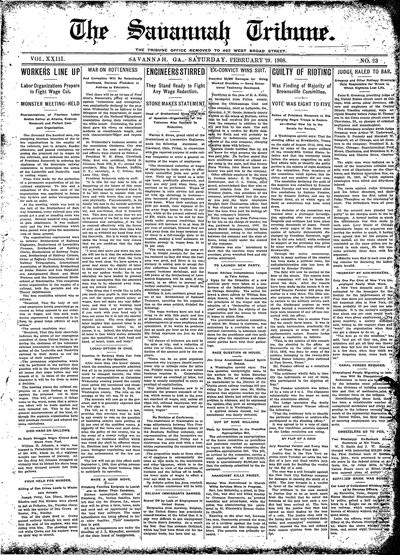
Page text (machine-generated)
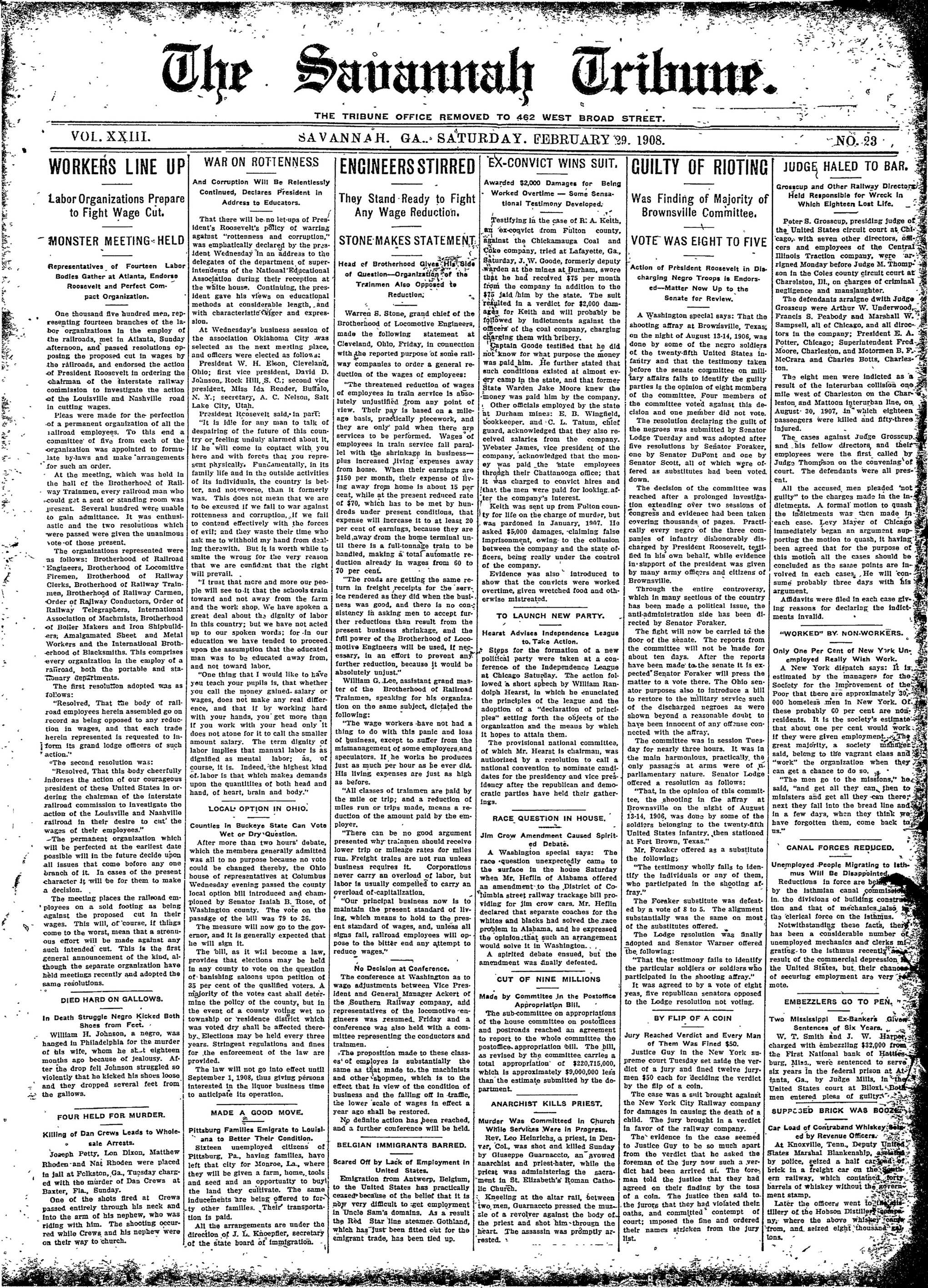
WORKERS LINE UP
Labor Organizations Prepare to Fight Wage Cut.
Representatives of Fourteen Labor Bodies Gather at Atlanta, Endorse Roosevelt and Perfect Compact Organization.
One thousand five hundred men, representing fourteen branches of the labor organizations in the employ of the railroads, met in Atlanta, Sunday afternoon, and passed resolutions opposing the proposed cut in wages by the railroads, and endorsed the action of President Roosevelt in ordering the chairman of the interstate railway commission to investigate the action of the Louisville and Nashville road in cutting wages.
Pleas were made for the perfection of a permanent organization of all the railroad employees. To this end a committee of five from each of the organization was appointed to formulate by laws and make arrangements for such an order. At the meeting, which was held in the hall of the Brotherhood of Railway Trainmen, every railroad man who could get a seat or standing room was present. Several hundred were unable to gain admittance. It was enthusiastic and the two resolutions which were passed were given the unanimous vote of those present.
The organizations represented were as follows: Brotherhood of Railroad Engineers, Brotherhood of Locomotive Firemen, Brotherhood of Railway Clerks, Brotherhood of Railway Trainmen, Brotherhood of Railway Carmen, Order of Railway Conductors, Order of Railway Telegraphers, International Association of Machmists, Brotherhood of Bolier Makers and Iron Shipbuilders; Amalgamated Sheet and Metal Workers and the International Brotherhood of Blacksmiths. This comprises every organization in the employ of a railroad, both the portable and stationary departments. The first resolution adopted was as follows:
"Resolved, That the body of railroad employees herein assembled go on record as being opposed to any reduction in wages, and that each trade herein represented is requested to inform its grand lodge officers of such action."
"The second resolution was:
"Resolved, That this body cheerfully indorses the action of our courageous president of these United States in ordering the chairman of the interstate railroad commission to investigate the action of the Louisville and Nashville railroad in their desire to cut' the wages of their employees."
The permanent organization which will be perfected at the earliest date possible will in the future decide upon all issues that come before any one branch of it. In cases of the present character it will be for them to make a decision. The meeting places the railroad employees on a sold footing as being against the proposed cut in their wages. This will, of course, if things come to the worst, mean that a strenuous effort will be made against any such intended cut. This is the first general announcement of the kind, although the separate organization have held meetings recently and adopted the same resolutions.
DIED HARD ON GALLOWS.
In Death Struggle Negro Kicked Both Shoes from Feet.
William H. Johnson, a negro, was hanged in Philadelphia for the murder of his wife, whom he sket eighteen months ago because of jealousy. After the drop fell Johnson struggled so violently that he kicked his shoes loose and they dropped several feet from the gallows.
FOUR HELD FOR MURDER.
Killing of Dan Crews Leads to Wholesale Arrests.
Joseph Petty, Lon Dixon, Matthew Rhoden and Nat Rhoden were placed in jail at Folkston, Ga., Tuesday charged with the murder of Dan Crews at Baxter, Fla., Sunday.
One of the shots fired at Crews passed entirely through his neck and into the arm of his nephew, who was riding with him. The shooting occurred while Crews and his nephew were on their way to church.
The Savannah Tribune.
WAR ON ROTTENNESS
And Corruption Will Be Relentlessly Continued, Declares President in Address to Educators.
That there will be no let-ups of President's Roosevelt's policy of warring against "rottenness and corruption," was emphatically declared by the president Wednesday In an address to the delegates of the department of superintendents of the National Educational Association during their reception at the white house. Continuing, the president gave his views on educational methods at considerable length, and with characteristic vigor and expression.
At Wednesday's business session of the association Oklahoma City was selected as the next meeting place, and officers were elected as follows:
President W. H. Elson, Cleveland, Ohio; first vice president, David D. Johnson, Rock Hill, S. C.; second vice president, Miss Ida Render, Buffalo, N. X.; secretary, A. C. Nelson, Salt Lake City, Utah.
President Rosevelt said, in part: "It is idle for any man to talk of despairing of the future of this country or feeling unduly alarmed about it, if he will come in contact with you here and with forces that you represent physically. Fundamentally, in its family life and in the outside activities of its individuals, the country is better, and not worse, than it formerly was. This does not mean that we are to be excused if we fall to war against rottenness and corruption, if we fail to contend effectively with the forces of evil; and they waste their time who ask me to withhold my hand from dealing therowwith. But it is worth while to smile the wrong for the very reason that we are confident that the right will prevail.
"I trust that more and more our people will see to it that the schools train toward and not away from the farm and the work shop. We have spoken a great deal about the dignity of labor in this country; but we have not acted up to our spoken words; for -in our education we have tended to proceed upon the assumption that the educated man was to be educated away from, and not toward labor.
"One thing that I would like to have you teach your pupils is, that whether you call the money gained-salary or wages, does not make any real difference, and that if by working hard with your hands, you get more than if you work with your head only it does not atone for it to call the smaller amount salary. The term dignity of labor implies that manual labor is as dignified as mental labor; as, of course, it is. Indeed, the highest kind of labor is that which makes demands upon the quantitites of both head and hand, of heart, brain and body."
LOCAL OPTION IN OHIO.
Counties in Buckeye State Can Vote Wet or Dry Question.
After more than two hours' debate, which the members generally admitted was all to no purpose because no vote could be changed thereby, the Ohio house of representatives at Columbus Wednesday evening passed the county local option bill introduced and championed by Senator Isalah B. Rose, of Washington county. The vote on the passage of the bill was 79 to 36.
The measure will now go to the governor, and it is generally expected that he will sign it.
The bill, as it will become a law, provides that elections may be held in any county to vote on the question of banishing saloons upon petition of 35 per cent of the qualified voters. A majority of the votes cast shall determine the policy of the county, but in the event of a county voting wet no township or residence district which was voted dry shall be affected thereby. Elections may be held every three years. Stringent regulations and fines for the enforcement of the law are provided. The law will not go into effect until September 1, 1908, thus giving persons interested in the liquor business time to anticipate its operation.
MADE A GOOD MOVE.
Pittsburg Families Emigrate to Louisiana to Better Their Condition. Sixteen unemployed citizens of Pittsburg, Pa., having families, have left that city for Monroe, La., where they will be given a farm, home, tools and seed and an opportunity to buy the land they cultivate. The same inducements are being offered to forty other families. Their transportation is paid. All the arrangements are under the direction of J. L. Knoepfier, secretary of the state board of immigration.
THE TRIBUNE OFFICE REMOVED TO 462 WEST BROAD STREET.
ENGINEERS STIRRED
They Stand-Ready to Fight Any Wage Reduction.
STONE MAKES STATEMENT
Head of Brotherhood Gives His Side of Question—Organization of the Trainmen Also Opposed to
Warren S. Stone, grand chief of the Brotherhood of Locomotive Engineers, made the following statement at Cleveland, Ohio, Friday, in connection with the reported purpose of some railway companies to order a general reduction of the wages of employees:
"The threatened reduction of wages of employees in train service is absolutely unjustified from any point of view. Their pay is based on a mileage basis, practically piecework, and they are only paid when there are services to be performed. Wages of employees in train service fall parallel with the shrinkage in business—plus increased living expenses away from home. When their earnings are $150 per month, their expense of living away from home is about 15 per cent, while at the present reduced rate of $70, which has to be met by hundreds under present conditions, that expense will increase it to at least 20 per cent of earnings, because they are held away from the home terminal until there is a full-tonnage train to be handled, making a total automatic reduction already in wages from 60 to 70 per cent.
"The roads are getting the same return in freight receipts for the service rendered as they did when the business was good, and there is no consistency in asking men to accept further reductions than result from the present business shrinkage, and the full power of the Brotherhood of Locomotive Engineers will be used, if necessary, in an effort to prevent any further reduction, because it would be absolutely unjust."
William G. Lee, assistant grand master of the Brotherhood of Railroad Trainmen, speaking for his organization on the same subject, dictated the following:
"The wage workers have not had a thing to do with this panic and loss of business, except to suffer from the mismanagement of some employers and speculators. If he works he produces just as much per hour as he ever did. His living expenses are just as high as before.
"All classes of trainmen are paid by the mile or trip; and a reduction of miles run or trips made, means a reduction of the amount paid by the employer.
"There can be no good argument presented why trainmen should receive lower trip or mileage rates for miles run. Freight trains are not run unless business requires it. Corporations never carry an overload of labor, but labor is usually compelled to carry an overload of capitalization.
"Our principal business now is to maintain the present standard of living, which means to hold to the present standard of wages, and, unless all signs fall, railroad employees will oppose to the bittter end any attempt to reduce wages."
No Decision at Conference.
The conference at Washington as to wage adjustments between Vice President and General Manager Ackert of the Southern Railway company, and representatives of the locomotive engineers was resumed. Friday and a conference was also held with a committee representing the conductors and trainmen.
The proposition made to these classes of employees is substantially the same as that made to the machinists and other shopmen, which is to the effect that in view of the condition of business and the falling off in traffic, the lower scale of wages in effect a year ago shall be restored.
No definite action has been reached, and a further conference will be held.
BELGIAN IMMIGRANTS BARRED.
Scared Off by Lack of Employment in United States.
Emigration from Antwerp, Belgium, to the United States has practically ceased because of the belief that it is now very difficult to get employment in Uncle Sam's domains. As a result the Red Star line steamer, Gothland, which has just been fitted out for the emigrant trade, has been tied up.
EX-CONVICT WINS SUIT.
Awarded $2,000 Damages for Being Worked Overtime — Some Sensational Testimony Developed.
Testifying in the case of R: A. Keith, an ex-convict from Fulton county, against the Chickamauga Coal and Coke company, tried at Lafayette, Ga., Saturday, J. W. Goode, formerly deputy warden at the mines at Durham, swore that he had received $75 per month from the company in addition to the $75 laid him by the state. The suit resulted in a verdict for $2,000 damages for Keith and will probably be followed by indictments against the officers of the coal company, charging charging them with bribery.
Captain Goode testified that he did not know for what purpose the money was paid him. He further stated that such conditions existed at almost every camp in the state, and that former State Warden Jake Moore knew the money was paid him by the company. Other officials employed by the state at Durham mines: E. B. Wingfield, bookkeeper, and C. L. Tatum, chief guard, acknowledged that they also received salaries from the company. Webster James, vice president of the company, acknowledged that the money was paid the state employees through their Chattanooga office; that it was charged to convict hires and that the men were paid for looking after the company's interest.
Keith was sent up from Fulton county for life on the charge of murder, but was pardoned in January, 1907. He asked $5,000 damages, claiming false imprisonment, owing to the collusion between the company and the state officers, being really under the control of the company. Evidence was also introduced to show that the convicts were worked overtime, given wretched food and otherwise mistreated.
TO LAUNCH NEW PARTY.
Hearst Advises Independence League to, Take Action.
Steps for the formation of a new political party were taken at a conference of the Independence League at Chicago Saturday. The action followed a short speech by William Randolph Hearst, in which he enunciated the principles of the league and the adoption of a "declaration of principles" setting forth the objects of the organization and the means by which it hopes to attain them.
The provisional national committee, of which Mr. Hearst is chairman, was authorized by a resolution to call a national convention to nominate candidates for the presidency and vice presidency after the republican and democratic parties have held their gatherings.
RACE QUESTION IN HOUSE.
Jim Crow Amendment Caused Spirited Debate.
A Washington special says: The race question unexpectedly came to the surface in the house Saturday when Mr. Heflin of Alabama offered an amendment to the District of Columbia street railway trackage bill providing for jim crow cars. Mr. Heflin declared that separate coaches for the whites and blacks had solved the race problem in Alabama, and he expressed the opinion that such an arrangement would solve it in Washington.
A spirited debate ensued, but the amendment was finally defeated.
CUT OF NINE MILLIONS
Made by Committee In the Postoffice
Appropriation Bill.
The sub-committee on appropriations of the house committee on postoffices and postroads reached an agreement to report to the whole committee the postoffice.appropriation bill. The bill, as revised by the committee, carries a total appropriation of $220,715,000, which is approximately $9,000,000 less than the estimate submitted by the department.
ANARCHIST KILLS PRIEST.
Murder Was Committee in Church While Services Were in Progress.
Rev. Leo Heinrichs, a priest, in Denver, Col., was shot and killed Sunday by Gluseppe Guarnacto, an avowed anarchist and priest-hater, while the priest was administering the sacrament in St. Elizabeth's Roman Catholic Church.
Kneeling at the altar rail, between two men, Guarnacto pressed the muzzle of a revolver against the body of the priest and shot him through the heart. The assassin was promptly arrested.
GUILTY OF RIOTING
Was Finding of Majority of Brownsville Committee.
Action of President Roosevelt in Discharging Negro Troops is Endorsed—Matter Now Up to the Senate for Review.
A Washington special says: That the shooting affray at Brownsville, Texas, on the night of August 13-14, 1906, was done by some of the negro soldiers of the twenty-fifth United States infantry and that the testimony taken before the senate committee on military affairs fails to identify the guilty parties is the opinion of eight members of the committee. Four members of the committee voted against this decision and one member did not vote
The resolution declaring the guilt of the negroes was submitted by Senator Lodge Tuesday and was adopted after five resolutions by Senator Foraker, one by Senator DuPont and one by Senator Scott, all of which wore offered as substitutes had been voted down.
The decision of the committee was reached after a prolonged investigation extending over two sessions of congress and evidenc had been taken covering thousands of pages. Practically every negro of the three companies of infantry dishourably discharged by President Roosevelt, testified in his own behalf, while evidence in support of the president was given by many army officers and citizens of Brownsville.
Through the entire controversy, which in many sections of the country has been made a political issue, the anti-administration side has been directed by Senator Foraker. The fight will now be carried to the floor of the senate. The reports from the committee will not be made for about ten days. After the reports have been made to the senate it is expected Senator Foraker will press the matter to a vote there. The Ohio senator purposes also to introduce a bill to restore to the military service such of the discharged negroes as were shown beyond a reasonable doubt to have been innocent of any offense connected with the affray.
The committee was in session Tuesday for nearly three hours. It was in the main harmonious, practically, the only passagis at arms were of parliamentary nature. Senator Lodge offered a resolution as follows:
"That, in the opinion of this committee, the shooting in the affray at Brownsville on the night of August 13-14, 1906, was done by some of the soldiers belonging to the twenty-fifth United States infantry, then stationed at Fort Brown, Texas."
Mr. Foraker offered as a substitute the following:
"The testimony wholly falls to identify the individuals or any of them, who participated in the shooting affray."
The Foraker substitute was defeated by a vote of 8 to 5. The alignment substantially was the same on most of the substitutes offered. The Lodge resolution was finally adopted and Senator Warner offered the following: "That the testimony fails to identify the particular soldiers or soldiers who participated in the shooting affray." It was agreed to by a vote of eight yeas, five republican senators opposed to the Lodge resolution not voting.
BY FLIP OF A COIN
Jury Reached Verdict and Every Man of Them Was Fined $50.
Justice Guy in the New York supreme court Tuesday set aside the verdict of a jury and fined twelve jurymen $50 each for deciding the verdict by the flip of a coin. The case was a suit brought against the New York City Railway company for damages in causing the death of a child. The jury brought in a verdict in favor of the railway company.
The evidence in the case seemed to Justice Guy to be so much apart from the verdict that he asked the foreman of the jury now such a verdict had been arrived at. The foreman told the justice that they had agreed on their finding by the toss of a coin. The justice then said to the jurors that they had violated their oaths, and committed contempt of court; imposed the fine and ordered their names stricken from the jury list.
JUDGE HALED TO BAR.
Grosscup and Other Railway Directors Held Responsible for Wreck in Which Eighteen Lost Life.
Peter S. Grosscup, presiding judge of the United States circuit court at Chicago, with seven other directors, officers and employees of the Central Illinois Traction company, were arranged Monday before Judge M. Thompson in the Coles county circuit court at Charelston, Ill., on charges of criminal negligence and manslaughter.
The defendants arraigne dwith Judge Grosscup were Arthur W. Underwood, Francis S. Peabody and Marshall W. Sampsell, all of Chicago, and all directors in the company; President E. A. Potter, Chicago; Superintendent Fred Moore, Charleston, and Motormen B. F. McCrara and Charles Botts, Charleston.
The eight men were indicted as a result of the interurban collision one mile west of Charleston on the Charleston and Mattoon interurban line, on August 30, 1907, in which eighteen passengers were killed and fifty-three injured.
The cases against Judge Grosscup and his fellow directors and their employees were the first called by Judge Thompson on the convening of court. The defendants were all present. All the accused men pleaded "not guilty" to the charges made in the indictments. A formal motion to quash the indictments was then made in each case. Levy Mayer of Chicago immediately began an argument supporting the motion to quash, it having been agreed that for the purpose of this motion all the cases should be concluded as the same points are involved in each cases. He will consume probably three days with his argument.
Affidavits were filed in each case giving reasons for declaring the indictments invalid.
"WORKED" BY. NON-WORKERS.
Only One Per Cent of New York Unemployed Really Wish Work. A New York dispatch says: It is estimated by the managers for the Society for the improvement of the Poor that there are approximately 30,000 homeless men in New York. Of these probably 60 per cent are nonresidents. It is the society's estimate that about one per cent would work if they were given employment. The great majority, a society manager said, belong to the vagrant class and "work" the organization when they can get a chance to do so.
"The men go to the missions," he said, "and get all they can, then to ministers and get all they can there; next they fall into the bread line and, in a few days, when they think we have forgotten them, come back to us."
Unemployed People Migrating to Isthmus Will Be Disappointed. Reductions in force are believed by the Isthmian canal commission in the divisions of building construction and that of mechanics also in the clerical force on the Isthmus. Notwithstanding these facts, there has been a considerable number of unemployed mechanics and clerks migrating to the Isthmus recently as a result of the commercial depression in the United States, but their chances of securing employment are very remote.
W. T. Smith and J. W. Harper charged with embezzling $32,000 from the First National bank of Hattiesburg, Miss., were sentenced to serve six years in the federal prison at Atlanta, Ga., by Judge Mills, in the United States court at Bloxol. Both men entered pleas of guilty
ed by Revenue Officers.
At Knoxville, Tenn., Deputy United States Marshal Blankenship, assisted by police, seized a half carload of brick in a freight car on the Southern railway, which contained forty barrels of whiskey without the government stamp.
Later the officers went to the militry of the Hobson Distillery company, where the above whiskey came from, and seized eight thousand gallons.
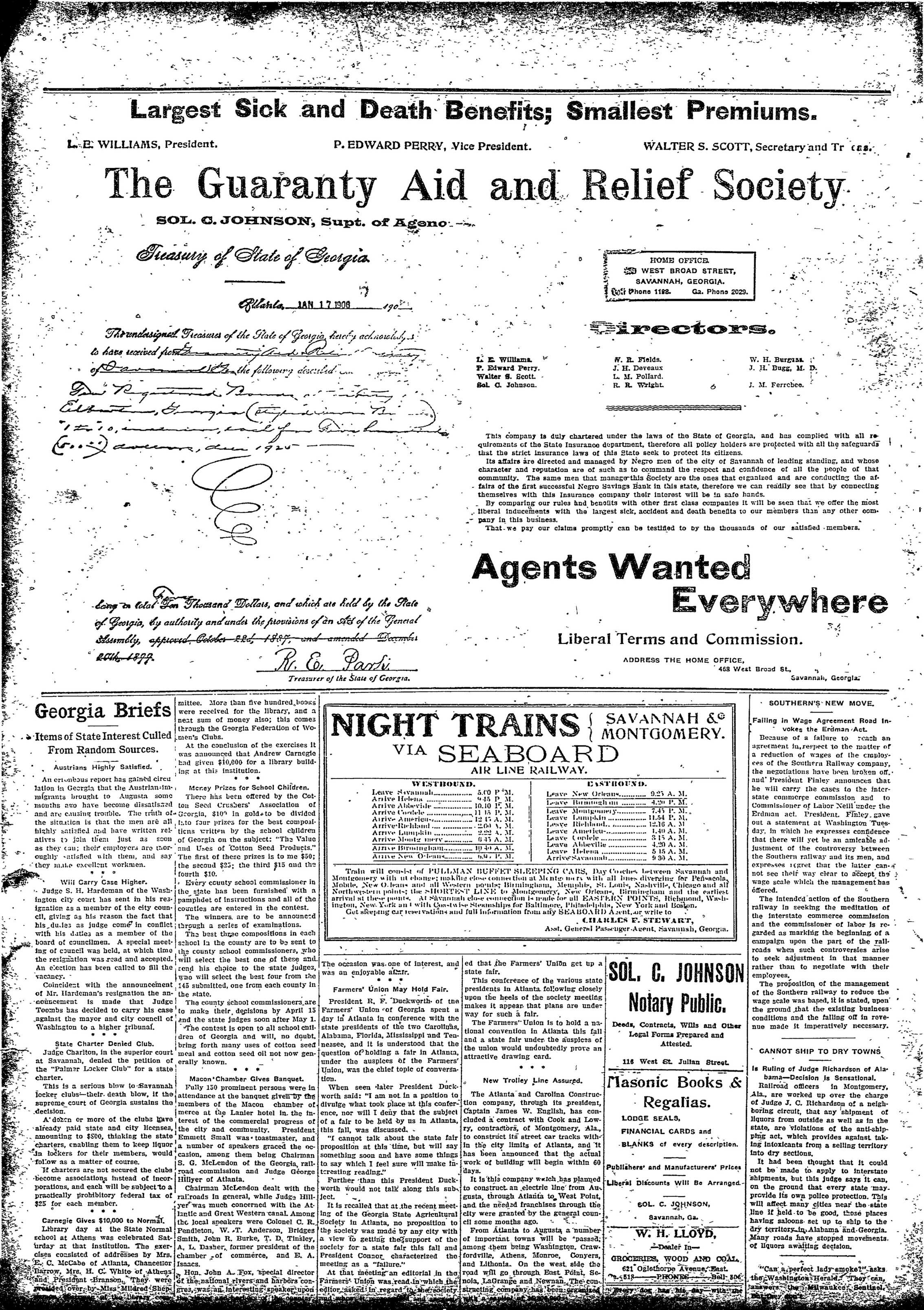
Largest Sick and Death Benefits; Smallest Premiums.
The Guaranty Aid and Relief Society
L. E. WILLIAMS, President.
The G.
SOL. C.
Treasury of
The undersigned. Treasures
to have received from
David Ragitton,
Elberton, Georgia,
17th 10,
(Goose)
long in total Ten Thousand
of Georgia, by authority and
Assembly, approved October
20th 1879.
Guara
DOL. C. JOHNSON,
Treasury of State of
Alabama, JAN.
A. Treasures of the State of Georgia
the following descr:
In Thousand Dollars, and which
authority and under the provisions of
vided, October 28d, 1887, and
R. E.
Treasury
SOL. C. JOHNSON, Supt. of Ageno
long on total Ten Thousand Dollars, and which are held by the State of Georgia, by authority and under the provisions of an Act of the General Assembly, approved October 22d, 1887, and amended December 20th, 1897.
mittee. More than five hundred books were received for the library, and a neat sum of money also; this comes through the Georgia Federation of Women's Clubs. At the conclusion of the exercises it was announced that Andrew Carnegie had given $10,000 for a library building at this institution.
There has been offered by the Cotton Seed Crushers' Association of Georgia, $100 in gold to be divided into four prizes for the best compositions written by the school children of Georgia on the subject: "The Value and Uses of Cotton Seed Products." The first of these prizes is to me $50; the second $25; the third $15 and the fourth $10. Every county school commissioner in the state has been furnished with a pamphlet of instructions and all of the counties are entered in the contest. The winners, are to be announced through a series of examinations.
The best three compositions in each school in the county are to be sent to the county school commissioners, who will select the best one of these and send his choice to the state judges, who will select the best four from the 145 submitted, one from each county in the state.
The county school commissioners are to make their decisions by April 15 and the state judges soon after May 1. The contest is open to all school children of Georgia and will, no doubt, bring forth many uses of cotton seed meal and cotton seed oil not now generally known.
Macon Chamber Gives Banquet. Fully 150 prominent persons were in attendance at the banquet given by the members of the Macon chamber of mercy at the Lanler hotel in the interest of the commercial progress of the city and community. President Emmett Small was toastmaster, and a number of speakers graced the occasion, among them being Chairman S. G. McLendon of the Georgia, railroad commission and Judge George Hillier of Atlanta.
Chairman McLendon dealt with the railroads in general, while Judge Hillier was much concerned with the Atlantic and Great Western canal. Among the local speakers were Colonel C. R. Pendleton, W. T. Anderson, Bridges Smith, John R. Burke, T. D. Tinsley, A. L. Dasher, former president of the chamber of commerce, and E. A. Isaacs.
Hon. John A. Fox, special director of the national rivers and harbors congress, was an interesting speaker upon
Georgia Briefs
Items of State Interest Culled From Random Sources.
Austrians Highly Satisfied.
An erroneous report has gained circulation in Georgia that the Austrian immigrants brought to Augusta some months ago have become dissatisfied and are causing trouble. The truth of the situation is that the men are all highly satisfied and have written relatives to join them just as soon as they can; their employers are thoroughly satisfied with them, and say they make excellent workmen.
Will Carry Case Higher.
Judge S. H. Hardeman of the Washington city court has sent in his resignation as a member of the city council, giving as his reason the fact that his duties as judge come in conflict with his duties as a member of the board of councilmen. A special meeting of council was held, at which time the resignation was read and accepted. An election has been called to fill the vacancy. Coincident with the announcement of Mr. Hardeman's resignation the announcement is made that Judge Toombs has decided to carry his case against the mayor and city council of Washington to a higher tribunal.
State Charter Denied Club.
Judge Charlton, in the superior court at Savannah, denied the petition of the "Palmer Locker Club" for a state charter.
This is a serious blow to Savannah locker clubs—their death blow, if the supreme court of Georgia sustains the decision.
A dozen or more of the clubs have already paid state and city licenses, amounting to $500, thinking the state charters, enabling them to keep liquor in lockers for their members, would follow as a matter of course.
If charters are not secured the clubs become associations instead of incorporations, and each will be subject to a practically prohibitory federal tax of $25 for each member.
Carnegie Gives $10,000 to Normal. Library day at the State Normal school at Athens was celebrated Saturday at that institution. The exercises consisted of addresses by Mrs. E. C. McCabe of Atlanta, Chancetor Barrow, Mrs. H. C. White of Athens and President Branson. They were provided over by Miss Mildred Shep
* * *
***
Macon'Chamber Gives Banquet.
P. EDWARD PERRY, Vice President.
NIGHT TRAINS SAVANNAH & MONTGOMERY. VIA SEABOARD AIR LINE RAILWAY.
WESTBOUND.
Leave Savannah 5.00 P.M.
Arrive Helena 9.45 P.M.
Arrive Abbeville 10.10 P.M.
Arrive Cordele 11.15 P.M.
Arrive Americus 12.45 A.M.
Arrive Richland 2.00 A.M.
Arrive Lumpkin 2.22 A.M.
Arrive Montgomery 6.45 A.M.
Arrive Birmingham 10.40 A.M.
Arrive New Orleans 6.90 P.M.
EASTBOUND.
Leave New Orleans 9.25 A.M.
Leave Birmingham 4.20 P.M.
Leave Montgomery 7.45 P.M.
Leave Lumpkin 11.54 P.M.
Leave Richland 12.16 A.M.
Leave Americus 1.40 A.M.
Leave Cordele 3.15 A.M.
Leave Abbeville 4.20 A.M.
Leave Helena 5.15 A.M.
Arrive Savannah 9.30 A.M.
Train will consist of PULLMAN BUFFET SLEEPING CARS, Day Coaches between Savannah and Montgomery with an change; making close connection at Montgomery with all lines diverging for Pen-sacola, Mobile, New Orleans and all Western points; Birmingham, Memphis, St. Louis, Nashville, Chicago and all Northwestern points; the SHORTEST LINE to Montgomery, New Orleans, Birmingham and the earliest arrival at these points. At Savannah close connection is made for all EASTERN POINTS, Richmond, Washington, New York and with Coastwise Steamships for Baltimore, Philadelphia, New York and Boston.
The occasion was one of interest, and was an enjoyable affair.
Farmers' Union May Hold Fair.
President R. F. Duckworth of the Farmers' Union of Georgia spent a day in Atlanta in conference with the state presidents of the two Carolinas, Alabama, Florida, Mississippi and Tennessee, and it is understood that the question of holding a fair in Atlanta, under the auspices of the Farmers' Union, was the chief tople of conversation.
When seen later President Duckworth said: "I am not in a position to divulge what took place at this conference, nor will I deny that the subject of a fair to be held by us in Atlanta, this fall, was discussed.
"I cannot talk about the state fair proposition at this time, but will say something soon and have some things to say which I feel sure will make interesting reading."
Further than this President Duckworth would not talk along this subject.
It is recalled that at the recent meeting of the Georgia State Agricultural Society in Atlanta, no proposition to the society was made by any city with a view to getting the support of the society for a state fair this fall and President Connor characterized the meeting as a "failure."
At that meeting an editorial in the Farmers' Union was read in which the editor asked in regard to the society and whom it recommended and served.
This company is duly chartered under the laws of the State of Georgia, and has complied with all requirements of the State Insurance department, therefore all policy holders are protected with all the safeguards that the strict insurance laws of this State seek to protect its citizens.
Its affairs are directed and managed by Negro men of the city of Savannah of leading standing, and whose character and reputation are of such as to command the respect and confidence of all the people of that community. The same men that manage this Society are the ones that organized and are conducting the affairs of the first successful Negro Savings Bank in this state, therefore we can readily see that by connecting themselves with this Insurance company their interest will be in safe hands.
By comparing our rules and benefits with other first class companies it will be seen that we offer the most liberal inducements with the largest sick, accident and death benefits to our members than any other company in this business.
That we pay our claims promptly can be testified to by the thousands of our satisfied members.
Liberal Terms and Commission.
L. E. Williams.
F. Edward Perry.
Walter S. Scott.
Sol. C. Johnson.
This company is duly chartered, quirments of the State Insurance company that the strict insurance laws of the affairs are directed and manage character and reputation are of such community. The same men that are fairs of the first successful Negro themselves with this Insurance company By comparing our rules and benefited liberal inducements with the large pany in this business. That we pay our claims promptly.
Agents
Libera
TRAINS {A SEABOARD AIR LINE RAILWAY.
END.
5.00 P.M.
9.45 P.M.
10.10 P.M.
11.15 P.M.
12.45 A.M.
2.00 A.M.
2.22 A.M.
6.45 A.M.
10.40 A.M.
6.90 P.M.
EASY
Leave New Orle
Leave Birming
Leave Montgomery
Leave Lampkin
Leave Richmond
Leave Americau
Leave Cordele
Leave Abbeyville
Leave Helena
Arrive Savannah
AN BUFFET SLEEPING CARS, Daring close connection at Montgomery with certain points; Birmingham, Memphis, ST LINE to Montgomery, New Orleans, high close connection is made for all EASY Steamships for Baltimore, Philadelphia and full information from afy SEABOARD.
CHA
Asst. General Pa
ed that the Farmers' Union get up a state fair.
This conference of the various state presidents in Atlanta following closely upon the heels of the society meeting makes it appear that plans are underway for such a fair.
The Farmers' Union is to hold a national convention in Atlanta this fall and a state fair under the auspices of the union would undoubtedly prove an attractive drawing card.
* * *
New Trolley Line Assured.
The Atlanta and Carolina Construction company, through its president, Captain James W. English, has concluded a contract with Cook and Lowry, contractors, of Montgomery, Ala., to construct its street car tracks within the city limits of Atlanta, and it has been announced that the actual work of building will begin within 60 days. It is this company watch has planned to construct an electric line from Augusta, through Atlanta to West Point, and the needed franchises through the city were granted by the general council some months ago.
From Atlanta to Augusta a number of important towns will be passed; among them being Washington, Crawfordville, Athens, Monroe, Conyers, and Lithonia. On the west side the road will go through East Point, Senoia, LaGrange and Newnan. The constructing company has been organised
WALTER S. SCOTT, Secretary and Tr csa.
HOME OFFICE
WEST BROAD STREET,
SAVANNAH, GEORGIA.
Cell Phone 1198. Ga. Phone 2029.
Directors
W. R. Fields.
J. H. Deveaux
L. M. Pollard.
R. R. Wright.
All under the laws of the State of Georgia, and department, therefore all policy holders are in this State seek to protect its citizens. Aged by Negro men of the city of Savannah, such as to command the respect and confidence this Society are the ones that organize Savings Bank in this state, therefore we can company their interest will be in safe hands with other first class companies it will greatest sick, accident and death benefits to our aptly can be testified to by the thousands.
Wanted
Ever
Real Terms and Comm
ADDRESS THE HOME OFFICE,
468 West
STROUND.
Fleams..... 9.25 A. M.
Chim..... 4.20 P. M.
Cemetery..... 7.45 P. M.
An..... 11.54 P. M.
Ll..... 12.16 A. M.
R..... 1.40 A. M.
M..... 3.15 A. M.
Lee..... 4.20 A. M.
Wh..... 5.15 A. M.
9.30 A. M.
Coaches between Savannah and all lines diverging for Pen-sacola, St. Louis, Nashville, Chicago and all lines, Birmingham and the earliest FERN POINTS, Richmond, Wash-ish, New York and Boston.
Agent, or write to
CHARLES F. STEWART,
Passenger Agent, Savannah, Georgia.
SOL. C. JOHNSON Notary Public.
SOL. C. JOHNSON Notary Public.
Deeds, Contracts, Wills and Other Legal Forms Prepared and Attested.
118 West St. Julian Street
Masonic Books & Regalias.
LODGE SEALS,
FINANCIAL CARDS and
BLANKS of every description.
Publishers' and Manufacturers' Prices
Liberal Discounts Will Be Arranged.
SOL. C. JOHNSON,
Savannah, Ga.
W. H. LLOYD,
Dealer In
GROCERIES, WOOD AND COAL
621 Oglethorpe Avenue, East
518 PHONES Bell 506
Failing in Wage Agreement Road In-
vokes the Erdman Act.
Because of a failure to reach an agreement in, respect to the matter of a reduction of wages of the employees of the Southern Railway company, the negotiations have been broken off, and President Finley announces that he will carry the cases to the interstate commerce commission and to Commissioner of Labor Neill under the Erdman act. President Finley gave out a statement at Washington Tuesday, in which he expresses confidence that there will yet be an amicable adjustment of the controversy between the Southern railway and its men, and expresses regret that the latter cannot see their way clear to accept the wage scale which the management has offered.
The intended action of the Southern railway in seeking the meditation of the interstate commerce commission and the commissioner of labor is regarded as marking the beginning of a campaign upon the part of the railroads when such controversies arise to seek adjustment in that manner rather than to negotiate with their employees.
The proposition of the management of the Southern railway to reduce the wage scale was based, it is stated, upon the ground that the existing business conditions and the falling off in revenue made it imperatively necessary.
Is Ruling of Judge Richardson of Alabama—Decision Is Sensational.
Railroad officers in Montgomery, Ala., are worked up over the charge of Judge J. C. Richardson of a neighboring circuit, that any shipment of liquors from outside as well as in the state, are violations of the anti-shipping act, which provides against taking intoxicants from a selling territory into dry sections.
It had been thought that it could not be made to apply to interstate shipments, but this judge says it can, on the ground that every state may provide its own police protection. This will affect many cities near the state line if held to be good, those places having saloons set up to ship to the dry territory in Alabama and Georgia. Many roads have stopped movements of liquors awaiting decision.
"Can a perfect lady smoke?" asks the Washington Herald. "They can, answers the Milwaukee Sentinel.
PRETTY THINGS TO WEAR
10
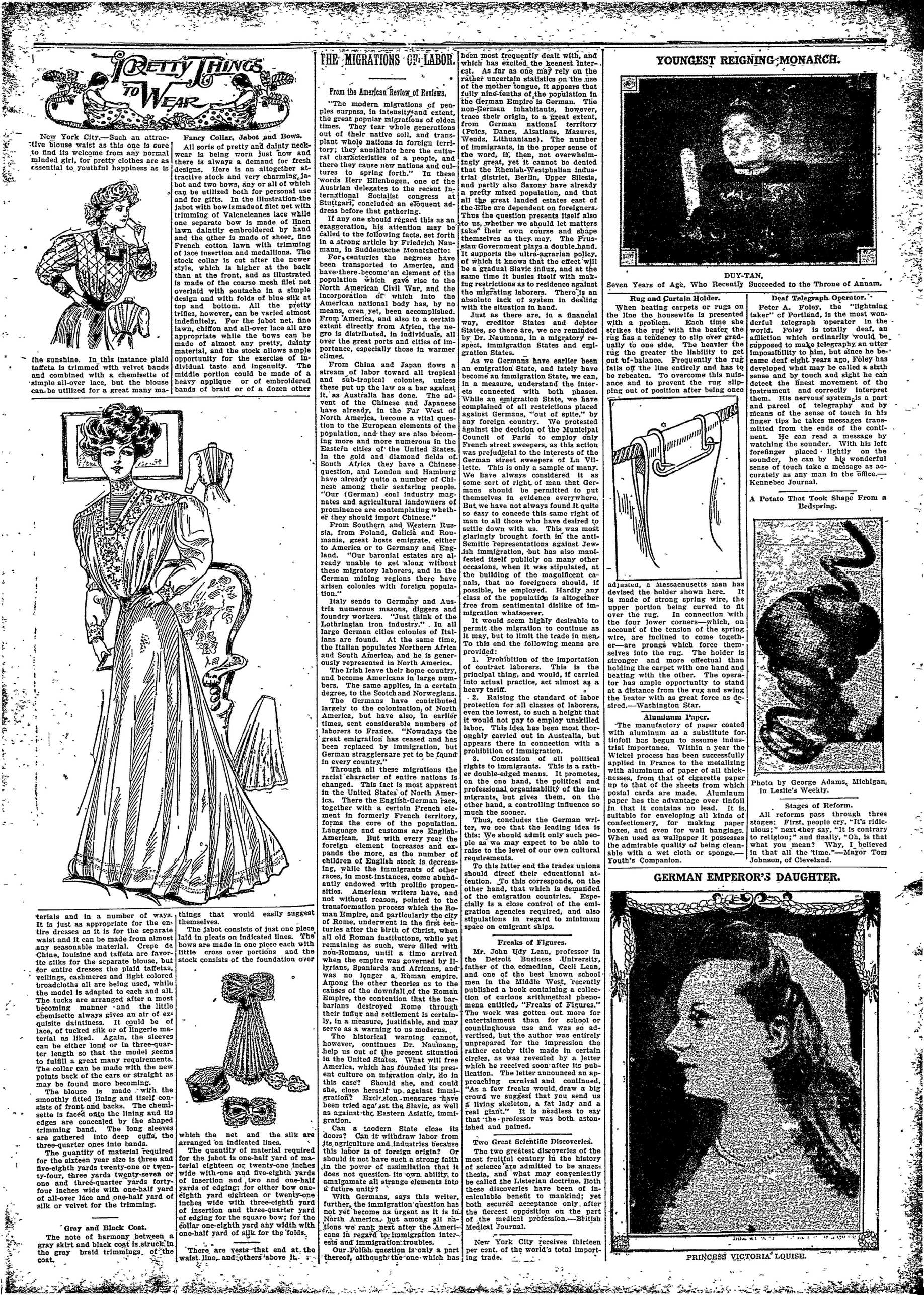
New York City.—Such an attractive blouse waist as this one is sure to find its welcome from any normal minded girl, for pretty clothes are as essential to youthful happiness as is
1
the sunshine. In this instance plaid taffeta is trimmed with velvet bands and combined with a chemisette of simple all-over lace, but the blouse can be utilized for a great many ma-
1
materials and in a number of ways.
It is just as appropriate for the entire dresses as it is for the separate waist and it can be made from almost any seasonable material. Crepe de Chine, louisine and taffeta are favorite silks for the separate blouse, but for entire dresses the plaid taffetas, veilings, cashmeres and light colored broadcloths all are being used, while the model is adapted to each and all. The tucks are arranged after a most becoming manner and the little chemisette always gives an air of exquisite daintiness. It could be of lace, of tucked silk or of lingerie material as liked. Again, the sleeves can be either long or in three-quarter length so that the model seems to fulfill a great many requirements. The collar can be made with the new points back of the ears or straight as may be found more becoming.
The blouse is made with the smoothly fitted lining and itself consists of front and backs. The chemisette is faced onto the lining and its edges are concealed by the shaped trimming band. The long sleeves are gathered into deep cuffs, the three-quarter ones into bands. The quantity of material required for the sixteen year size is three and five-eighth yards twenty-one or twenty-four, three yards twenty-seven or one and three-quarter yards forty-four inches wide with one-half yard of all-over lace and one-half yard of silk or velvet for the trimming.
Gray and Black Coat.
Gray and Black Coat.
The note of harmony between a gray skirt and black coat is struck in the gray braid trimmings of the coat.
Fancy Collar, Jabot and Bows.
All sorts of pretty and dalty neckwear is being worn just now and there is always a demand for fresh designs. Here is an altogether attractive stock and very charming, jabot and two bows, any or all of which can be utilized both for personal use and for gifts. In the illustration the jabot with bow is made of filet net with trimming of Valenciennes lace while one separate bow is made of linen lawn daintly embroidered by hand and the other is made of sheer, fine French cotton lawn with trimming of lace insertion and medallions. The stock collar is cut after the newer style, which is higher at the back than at the front, and as illustrated is made of the coarse mesh filet net overlaid with soutache in a simple design and with folds of blue silk at top and bottom. All the pretty trifles, however, can be varied almost indefinitely. For the jabot net, fine lawn, chiffon and all-over lace all are appropriate while the bows can be made of almost any pretty, dalty material, and the stock allows ample opportunity for the exercise of individual taste and ingenuity. The middle portion could be made of a heavy applique or of embroidered bands of braid or of a dozen other
1
things that would easily suggest themselves.
The jabot consists of just one piece laid in plains on indicated lines. The bows are made in one piece each with little cross over portions and the stock consists of the foundation over
which the net and the silk are arranged on indicated lines.
The quantity of material required for the jabot is one-half yard of material eighteen or twenty-one inches wide with one and five-eighth yards of insertion and two and one-half yards of edging; for either bow one-eighth yard eighteen or twenty-one inches wide with three-eighth yard of insertion and three-quarter yard of edging for the square bow; for the collar one-eighth yard any width with one-half yard of silt for the folds.
There are yests that end at the waist line, and others above it.
THE MIGRATIONS OF LABOR.
From the American Review of Reviews.
"The modern migrations of peoples surpass, in intensity and extent, the great popular migrations of olden times. They tear whole generations out of their native soil, and transplant whole nations in foreign territory; they annihilate here the cultural characteristics of a people, and there they cause new nations and cultures to spring forth." In these words Herr Ellenbogen, one of the Austrian delegates to the recent International Socialist congress at Stuttgart, concluded an eloquent address before that gathering.
If any one should regard this as an exaggeration, his attention may be called to the following facts, set forth in a strong article by Friedrich Naumann. In Süddeutsche Monatshefte.
For centuries the negroes have been transported to America, and have there become an element of the population which gave rise to the North American Civil War, and the incorporation of which into the American national body has, by no means, even yet, been accomplished. From America, and also to a certain extent directly from Africa, the negro is distributed, in individuals, all over the great ports and cities of importance, especially those in warmer climes.
From China and Japan flows a stream of labor toward all tropical and sub-tropical colonies, unless these put up the law as a bar against it, as Australia has done. The advent of the Chinese and Japanese have already, in the Far West of North America, become a vital question to the European elements of the population, and they are also becoming more and more numerous in the Eastern cities of the United States. In the gold and diamond fields of South Africa they have a Chinese question, and London and Hamburg have already quite a number of Chinese among their seafaring people. "Our (German) coal industry magnates and agricultural landowners of prominence are contemplating whether they should import Chinese."
From Southern and Western Russia, from Poland, Galicia and Roumania, great hosts emigrate, either to America or to Germany and England. "Our baronial estates are already unable to get along without these migratory laborers, and in the German mining regions there have arisen colonies with foreign population."
Italy sends to Germany and Austria numerous masons, diggers and foundry workers. "Just think of the Lothringian iron industry." In all large German cities colonies of Italians are found. At the same time, the Italian populates Northern Africa and South America; and he is generously represented in North America. The Irish leave their home country, and become Americans in large numbers. The same applies, in a certain degree, to the Scotch and Norwegians.
The Germans have contributed largely to the colonization of North America, but have also, in earlier times, sent considerable numbers of laborers to France. "Nowadays the great emigration has ceased and has been replaced by immigration, but German stragglers are yet to be found in every country."
Through all these migrations the racial character of entire nations is changed. This fact is most apparent in the United States' of North America. There the English-German race, together with a certain French element in formerly French territory, forms the core of the population. Language and customs are English-American. But with every year the foreign element increases and expands the more, as the number of children of English stock is decreasing, while the immigrants of other races, in most instances, come abundantly endowed with prolific propensities. American writers have, and not without reason, pointed to the transformation process which the Roman Empire, and particularly the city of Rome, underwent in the first centuries after the birth of Christ, when all old Roman institutions, while yet remaining as such, were filled with non-Romans, until a time arrived when the empire was governed by Ilyrians, Spaniards and Africans, and was no longer a Roman empire. Among the other theories as to the causes of the downfall of the Roman Empire, the contention that the barbarians destroyed Rome through their infiltration and settlement is certainly, in a measure, justifiable, and may serve as a warning to us moderns.
The historical warning cannot, however, continues Dr. Naumann, help us out of the present situation in the United States. What will free America, which has founded its present culture on migration only, do in this case? Should she, and could she, close herself up against immigration? Exclusion-measures have been tried against the Slavic, as well as against the Eastern Asiatic, immigration.
Can a modern State close its doors? Can it withdraw labor from its agriculture and industries because this labor is of foreign origin? Or should it not have such a strong faith in the power of assimilation that it does not question its own ability to amalgamate all strange elements into a future unity?
With Germans, says this writer, further, the immigration question has not yet become as urgent as it is in North America, but among all nations we rank next after the Americans in regard to immigration interests and immigration troubles. Our Polish question is only a part thereof, although the one which has
been most frequently dealt with, and which has excited the keenest interest. As far as one may rely on the rather uncertain statistics on the use of the mother tongue, it appears that fully nine-fteenth of the population in the German Empire is German. The non-German inhabitants, however, trace their origin, to a great extent, from German national territory (Poles, Danes, Alsatians, Mazures, Wends, Lithuanians). The number of immigrants, in the proper sense of the word, is, then, not overwhelmingly great, yet it cannot be denied that the Rhenish-Westphalian industrial district, Berlin, Upper Silesia, and partly also Saxony have already a pretty mixed population, and that all the great landed estates east of the Elbe are dependent on foreigners. Thus the question presents itself also to us, whether we should let matters take their own course and shape themselves as they may. The Prussian Government plays a double hand. It supports the ultra-agrarian policy, of which it knows that the effect will be a gradual Slavic influx, and at the same time it bushes itself with making restrictions as to residence against the migrating laborers. There is an absolute lack of system in dealing with the situation in hand.
Just as there are, in a financial way, creditor States and debtor States, so there are, we are reminded by Dr. Naumann, in a migratory respect, immigration States and emigration States.
As we Germans have earlier been an emigration State, and lately have become an immigration State, we can, in a measure, understand the interests connected with both phases. While an emigration State, we have complained of all restrictions placed against Germans, "out of spite," by any foreign country. We protested against the decision of the Municipal Council of Paris to employ only French street sweepers, as this action was prejudicial to the interests of the German street sweepers of La Villette. This is only a sample of many. We have always considered it as some sort of right of man that Germans should be permitted to put themselves in evidence everywhere. But we have not always found it quite so easy to concede this same right of man to all those who have desired to settle down with us. This was most glaringly brought forth in the anti-Semitic Representations against Jewish immigration, but has also manifested itself publicly on many other occasions, when it was stipulated, at the building of the magnificent canals, that no foreigners should, if possible, be employed. Hardly any class of the population is altogether free from sentimental dislike of immigration whatsoever.
It would seem highly desirable to permit the migration to continue as it may, but to limit the trade in men. To this end the following means are provided:
1. Prohibition of the importation of contract laborers. This is the principal thing, and would, if carried into actual practice, act almost as a heavy tariff.
2. Raising the standard of labor protection for all classes of laborers, even the lowest, to such a height that it would not pay to employ unskilled labor. This idea has been most thoroughly carried out in Australia, but appears there in connection with a prohibition of immigration.
3. Concession of all political rights to immigrants. This is a rather double-edged means. It promotes, on the one hand, the political and professional organizability of the immigrants, but gives them, on the other hand, a controlling influence so much the sooner.
Thus, concludes the German writer, we see that the leading idea is this: We should admit only such people as we may expect to be able to raise to the level of our own cultural requirements.
To this latter end the trades unions should direct their educational attention. To this corresponds, on the other hand, that which is demanded of the emigration countries. Especially is a close control of the emigration agencies required, and also stipulations in regard to minimum space on emigrant ships.
Freaks of Figures.
Mr. John Udy Lean, professor in the Detroit Business University, father of the comedian, Cecil Lean, and one of the best known school men in the Middle West, recently published a book containing a collection of curious arithmetical phenomena entitled, "Freaks of Figures." The work was gotten out more for entertainment than for school or countinghouse use and was so advertised, but the author was entirely unprepared for the impression the rather catchy title made in certain circles, as was revealed by a letter which he received soon after its publication. The letter announced an approaching carnival and continued, "As a few freaks would, draw a big crowd we suggest that you send us a living skeleton, a fat lady and a real giant." It is needless to say that the professor was both astonished and pained.
Two Great Scientific Discoveries.
The two greatest discoveries of the most fruitful century in the history of science are admitted to be anathesia, and what may congenently be called the Listerian doctrine. Both these discoveries have been of incalculable benefit to mankind; yet both secured acceptance only after the fiercest opposition on the part of the medical profession.—British Medical Journal.
New York City receives thirteen per cent. of the world's total importing trade.
YOUNGEST REIGNING MONARCH.
1930
Seven Years of Age. Who Recently Succeeded to the Throne of Annam.
GERMAN EMPEROR'S DAUGHTER.
JULIUS XI. 1672. MAJOR. PROFESSOR.
Rug and Curtain Holder.
When beating carpets or rugs on the line the housewife is presented with a problem. Each time she strikes the rug with the beater the rug has a tendency to slip over gradually to one side. The heavier the rug the greater the liability to get out of-balance. Frequently the rug falls on the line entirely and has to be beaten. To overcome this nuisance and to prevent the rug slipping out of position after being once
```markdown
```
adjusted, a Massachusetts man has devised the sholder shown here. It is made of strong spring wire, the upper portion being curved to fit over the rug. In connection with the four lower corners—which, on account of the tension of the spring wire, are inclined to come together—are prongs which force themselves into the rug. The holder is stronger and more effectual than holding the carpet with one hand and beating with the other. The operator has ample opportunity to stand at a distance from the rug and swing the beater with as great force as desired.—Washington Star.
Aluminum Paper.
The manufactory of paper coated with aluminum as a substitute for tinfolk has begun to assume industrial importance. Within a year the Wickel process has been successfully applied in France to the metalizing with aluminum of paper of all thicknesses, from that of cigarette paper up to that of the sheets from which postal cards are made. Aluminum paper has the advantage over tinfolk in that it contains no lead. It is suitable for enveloping all kinds of confectionery, for making paper boxes, and even for wall hangings. When used as wallpaper it possesses the admirable quality of being cleanable with a wet cloth or sponge.—Youth's Companion.
Deaf Telegraph Operator.
Peter A. Foley, the "lightning taker" of Portland, is the most wonderful telegraph operator in the world. Foley is totally deaf, an affliction which ordinarily would be supposed to make telegraphy an utter impossibility to him, but since he became deaf eight years ago, Foley has developed what may be called a sixth sense and by touch and sight he can detect the finest movement of the instrument and correctly interpret them. His nervous system is a part and parcel of telegraphy and by means of the sense of touch in his finger tips he takes messages transmitted from the ends of the continent. He can read a message by watching the sounder. With his left forefinger placed lightly on the sounder, he can by his wonderful sense of touch take a message as accurately as any man in the office.—Kennebec Journal.
A Potato That Took Shape From a Bedspring.
S
Photo by George Adams, Michigan, in Leslie's Weekly.
Stages of Reform.
All reforms pass through three stages: First, people cry, "It's ridiculous;" next they say, "It is contrary to religion;" and finally, "Oh, is that what you mean? Why, I believed in that all the 'time.'"—Mayor Tom Johnson, of Cleveland.
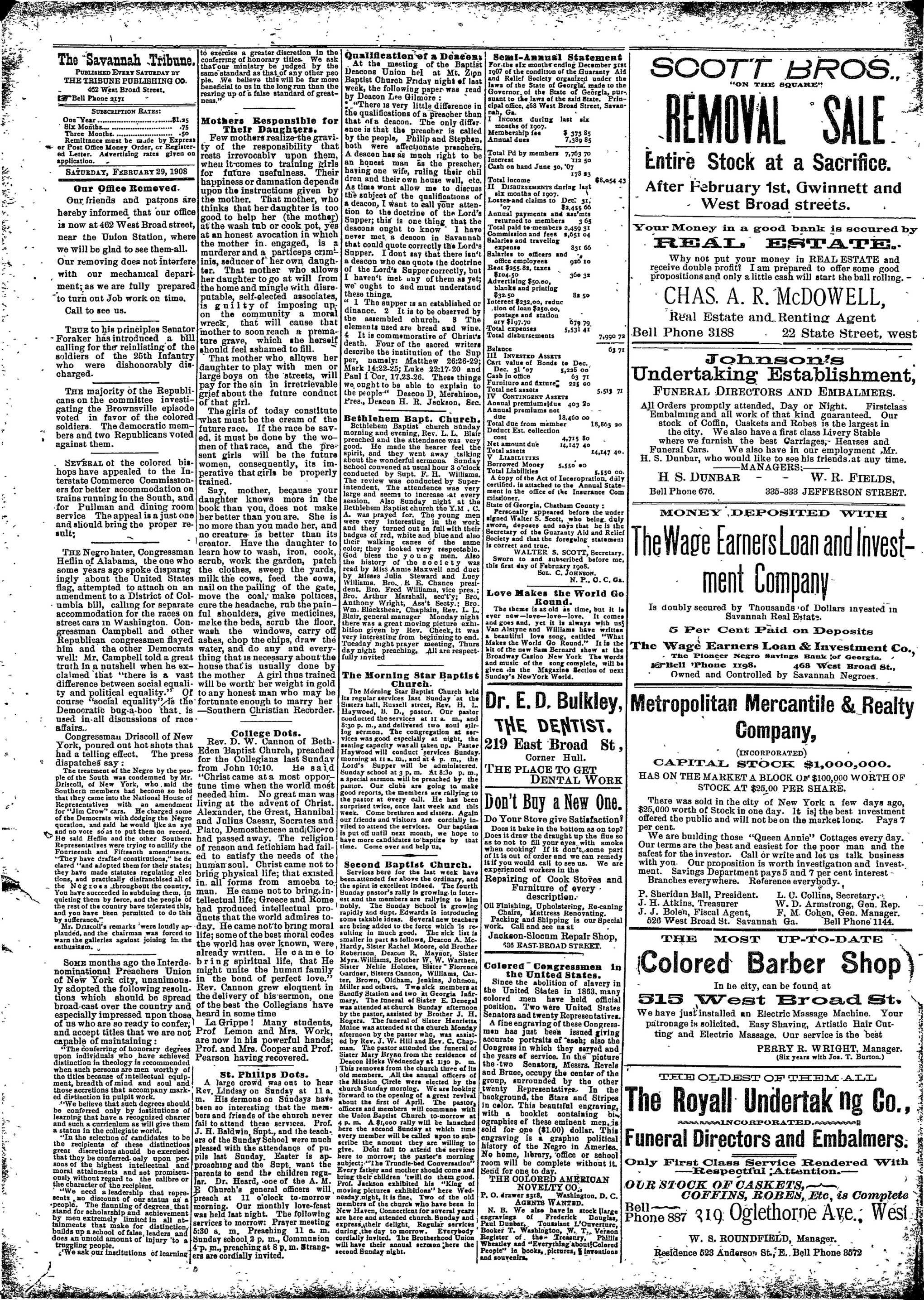
Our Office Removed.
Our Office Removed.
Our friends and patrons are hereby informed that our office is now at 462 West Broad street, near the Union Station, where we will be glad to see them all.
Our removing does not interfere with our mechanical department; as we are fully prepared to turn out Job work on time.
Call to see us.
TRUE to his principles Senator Foraker has introduced a bill calling for the reinlisting of the soldiers of the 25th Infantry who were dishonorably discharged.
THE majority of the Republicans on the committee investigating the Brownsville episode voted in favor of the colored soldiers. The democratic members and two Republicans voted against them.
SEVERAL of the colored bishops have appealed to the Interstate Commerce Commissioners for better accommodation on trains running in the South, and for Pullman and dining room service The appeal is a just one and should bring the proper result:
THE Negro hater, Congressman Heflin of Alabama, the one who some years ago spoke disparag ingly about the United States flag, attempted to attach on an amendment to a District of Columbia bill, calling for separate accommodation for the races on street cars in Washington. Congressman Campbell and other Republican congressmen flayed him and the other Democrats well: Mr. Campbell told a great truth in a nutshell when he exclaimed that "there is a vast difference between social equality and political equality." Of course "social equality" is the Democratic bug-a-boo that is used in all discussions of race affairs.
Congressman Driscoll of New York, poured out hot shots that had a telling effect. The press dispatches say:
The treatment of the Negro by the people of the South was condemned by Mr. Driscoll, of New York, who said the Southern members had become so bold that they came into the National House of Representatives with an amendment for "Jim Crow" cars. He charged some of the Democrats with dodging the Negro question, and said he would like an aye and no vote so as to put them on record. He said Heflin and the other Southern Representatives were trying to nullify the Fourteenth and Fifteenth amendments. "They have drafted constitutions," he de clared "and adopted them for their states; they have made statutes regulating elec tions, and practically disfranchised all of the Negroes throughout the country. You have succeeded in subduing them, in quieting them by force, and the people of the rest of the country have tolerated this, and you have been permitted to do this by sufferment."
Mr. Dracoll's remarks were loudly applauded, and the chairman was forced to warn the galleries against joining in the enthusiasm.
Some months ago the Interdenominational Preachers Union of New York city, unanimously adopted the following resolutions which should be spread broad-cast over the country and especially impressed upon those of us who are so ready to confer; and accept titles that we are not capable of maintaining:
"The conferring of honorary degrees upon individuals who have achieved distinction in theology is recommended when such persons are men worthy of the titles because of intellectual equipment, breadth of mind and soul and those accretions that accompany marked distinction in pulpit work.
"We believe that such degrees should be conferred only by institutions of learning that have a recognized charter and such a curriculum as will give them a status in the collegiate world.
"In the selection of candidates to be the recipients of these distinctions great discretion should be exercised that they be conferred only upon persons of the highest intellectual and moral attainments and not promiscuously without regard to the calibre or the character of the recipient.
"We need a leadership that represents no discount of our status as a people. The flaunting of degrees, that stand for scholarship and achievement by men extremely limited in all attainments that make for distinction, builds up a school of false, leaders and does an untold amount of injury to a truculent people.
to exercise a greater discretion in the conferring of honorary titles. We ask that our ministry be judged by the same standard as that of any other people. We believe this will be far more beneficial to us in the long run than the rearing up of a false standard of greatness."
Mothers Responsible for Their Daughters.
Few mothers realize the gravity of the responsibility that rests irrevocably upon them, when it comes to training girls for future usefulness. Their happiness or damnation depends upon the instructions given by the mother. That mother, who thinks that her daughter is too good to help her (the mother) at the wash tub or cook pot, yes at an honest avocation in which the mother in. engaged, is a murderer and a particeps criminis, seducer of her own daughter. That mother who allows her daughter to go at will from the home and mingle with disreputable, self-elected associates, is guilty of imposing upon the community a moral wreck, that will cause that mother to soon reach a premature grave, which she herself should feel ashamed to fill.
That mother who allows her daughter to play with men or large boys on the streets, will pay for the sin in irretrievable grief about the future conduct of that girl. The girls of today constitute what must be the cream of the future race. If the race be saved, it must be done by the women of that race, and the present girls will be the future women, consequently, its imperative that girls be properly trained.
Say, mother, because your daughter knows more in the book than you, does not make her better than you are. She is no more than you made her, and no creature is better than its creator. Have the daughter to learn how to wash, iron, cook, scrub, work the garden, patch the clothes, sweep the yards, milk the cows, feed the cows, nail on the pailing of the gate, move the coal; make polices, cure the headache, rub the painful shoulders, give medicines, make the beds, scrub the floor, wash the windows, carry off ashes, chop the chips, draw the water, and do any and everything that is necessary about the house that is usually done by the mother. A girl thus trained will be worth her weight in gold to any honest man who may be fortunate enough to marry her—Southern Christian Recorder.
College Dots.
Rev. D. W. Cannon of Beth-Eden Baptist Church, preached for the Collegians last Sunday from John 10:10. He said "Christ came at a most opportune time when the world most needed him. No great man was living at the advent of Christ. Alexander, the Great, Hannibal and Julius Caesar, Socrates and Plato, Demosthenese and Cicero had passed away. The religion of reason and fetichism had failed to satisfy the needs of the human soul. Christ came not to bring physical life; that existed in all forms from amoeba to man. He came not to bring intellectual life; Greece and Rome had produced intellectual products that the world admires today. He came not to bring moral life; some of the best moral codes the world has over known, were already written. He came to bring spiritual life, that He might unite the human family in the bond of perfect love." Rev. Cannon grew eloquent in the delivery of his sermon, one of the best the Collegians have heard in some time
La Grippe! Many students, Prof Lemon and Mrs. Work, are now in his powerful hands; Prof. and Mrs. Cooper and Prof. Pearson having recovered.
St. Phillips Dots.
A large crowd was out to hear Rev. Lindsay on Sunday at 11 a. m. His sermons on Sundays have been so interesting that the members and friends of the church never fail to attend these services. Prof. J. H. Baldwin, Supt., and the teachers of the Sunday School were much pleased with the attendance of pupils last Sunday. Easter is approaching and the Supt, want the parents to send the children regular. Dr. Heard, one of the A. M. E Church's general officers will preach at 11 o'clock to-morrow morning. Our monthly love-feast was held last night. The following services to morrow: Prayer meeting 5:30 a. m. Preaching 11 a. m. Sunday school 2 p. m., Communion 4 p. m., preaching at 8 p. m. Strangers are cordially invited.
Qualification of a Deacon
At the meeting of the Baptist
Deacons Union hel at Mt. Zipn
Baptist Church Friday night of last
week, the following paper was read
by Deacon Lee Gilmore:
There is very little difference in the qualifications of a preacher than that of a deacon. The only difference is that the preacher is called by the people, Philip and Stephen, both were affectionate preachers. A deacon has as much right to be an honest man as the preacher, having one wife, ruling their children and their own house well, etc. As time wont allow me to discuss the subject of the qualifications of a deacon, I want to call your attention to the doctrine of the Lord's Supper; this is one thing that the deacons ought to know. I have never met a deacon in Savannah that could quote correctly the Lord's Supper. I don't say that there isn't a deacon who can quote the doctrine of the Lord's Supper correctly, but I haven't met any of them as yet; we ought to and must understand these things.
"1 The supper is an established or dinance. 2 It is to be observed by the assembled church. 3 The elements used are bread and wine. 4 It is commemorative of Christ's death. Four of the sacred writers describe the institution of the Supper, namely: Matthew 26:26-29; Mark 14:22-25; Luke 22:17-20 and Paul I Cor. 17,23-26. These things we ought to be able to explain to the people." Deacon D, Merahison, Pres., Deacon H. R. Jackson, Sec.
Bethlehem Bapt. Church.
Bethlehem Bapt. Church.
Bethlehem Baptist church sunday morning and evening, Rev. L. L. Blair preached and the attendance was very good. He made the hearer feel the spirit, and they went away talking about the wonderful sermons. Sunday school convened at usual hour 3 o'clock conducted by Supt. F. H. Williams. The review was conducted by Superintendent. The attendance was very large and seems to increase at every session. Also Sunday night at the Bethlehem Baptist church the Y.M. C. A. was prayed for. The young men were very interesting in the work and they turned out in full with their badges of red, white and blue and also their walking canes of the same color; they looked very respectable. God bless the young men. Also the history of the society was read by Miss Annue Maxwell and duet by Misses Julia Steward and Lucy Williams. Bro. R. E. Chance president. Bro. Fred Williams, vice pres.; Bro. Arthur Marshall, sect'y; Bro. Anthony Wright; Ass't Secty.; Bro. Wm. Blackshear, Chaplain, Rev. L. L. Blair, general manager Monday night there was a great moving picture exhibition given by Rev. Cheek, it was very interesting from beginning to end. Tuesday night prayer meeting, Thurs day night preaching. All are respectfully invited
The Morning Star Baptist Church.
The Morning Star Baptist Church held its regular services last Sunday at the Sisters hall, Russell street, Rev. H. L. Haywood, B. D., pastor. Our pastor conducted the services at 11 a. m., and 8:30 p. m., and delivered two soul stirling sermon. The congregation at services was good especially at night, the sealing capacity was all taken up. Pastor Haywood will conduct services Sunday morning at 11 a. m., and at 4 p. m., the Lord's Supper will be administered. Sunday school at 3 p. m. At 8:30 p. m., a special sermon will be preached by the pastor. Our clubs are going to make good reports, the members are rallying to the pastor at every call. He has been surprised twice, once last week and this week. Come brethren and sisters. Again our friends and visitors are cordially invited to attend the services. Our baptism is put off until next month, we hope to have more candidates to baptize by that time. Come over and help us.
Second Baptist Church.
Semi-Annual Statement
For the six months ending December 21st
1907 of the condition of the Guaranty Aid
and Relief Society organized under the
laws of the State of Georgia, made to the
Governor of the State of Georgia, pursuant
to the laws of the said State.
Principal office, 468 West Broad Street, Savannah,
Ga.
REMOVAL SALE
I INCOME during last six
months of 1907.
Membership fee $ 373 85
Annual dues 7,389 85
Total Pd by members 7,763 70
Interest 112 50
Cash on hand June 30, '07
178 23
Total Income $8,054 43
II DISBURSEMENTS during last
six months of 1907.
Losses and claims to Dec. 31,
'07 $2,455 66
Annual payments and assmts
returned to members 3 65
Total paid to members 2,459 31
Commission and fees 2,651 04
Salaries and travelling
expense 831 66
Salaries to officers and
office employees 926 10
Reat $255.82, taxes
$104.50 360 32
Advertising $50.00,
blanks and printing
$32.50 82 50
Interest $232.00, reduc
tion of loan $250.00,
postage and station
ary $197.70 679 79
Total expenses 5,531 41
Total disbursements 7,990 72
Balance 63 71
III INVESTED ASSETS
Cart value of Bonds to Dec.
Dec. 31, '07 5,225 00
Cash in office 63 71
Furniture and fixture 225 00
Total net assets 5,513 71
IV CONTINGENT ASSETS
Annual premiums due 403 20
Annual premiums not
due 18,460 00
Total due from member 18,863 20
Deduct Est. collection
cost 4,715 80
Net amount due 14,147 40
Total assets 14,147 40.
V LIABILITIES
Borrowed Money 5,550 00
Total Liabilities 5,550 00.
A copy of the Act of Incorporation, daily
certified, is attached to the Annual Stat-
ment in the office of the Insurance Com-
missioner.
After February 1st, Gwinnett and West Broad streets.
Your Money in a good bank is secured by REAL ESTATE.
Why not put your money in REAL ESTATE and receive double profit? I am prepared to offer some good propositions and only a little cash will start the ball rolling.
CHAS. A. R. McDOWELL,
Real Estate and Renting Agent
Bell Phone 3188 22 State Street, west
All Orders promptly attended, Day or Night. Firstclass Embalming and all work of that kind guaranteed. Our stock of Coffin, Caskets and Robes is the largest in the city. We also have a first class Livery Stable where we furnish the best Carriages,- Hearses and Funeral Cars. We also have in our employment Mr. H. S. Dunbar, who would like to see his friends, at any time.
MANAGERS;
H S. DUNBAR - - W. R. FIELDS,
Bell Phone 676. 335-333 JEFFERSON STREET.
State of Georgia, Chatham County :
Personally appeared before the under
signed Walter S. Scott, who being, duly
swned, deposes and says that he is the
Secretary of the Guaranty Aid and Relief
Society and that the foregoing statement
is correct and true.
MONEY DEPOSITED WITH
The Wage Earners Loan and Investment Company
WALTER S. SCOTT, Secretary,
Sword to and subscribed before me,
this first day of February 1908.
Love Makes the World Go Round.
Is doubly secured by Thousands of Dollars invested in Savannah Real Estate.
The theme is as old as time, but it is ever new—love—love—love. It comes and goes and, yet it is always with us$ Van Alstyne and Williams have written a beautiful love song, entitled "What Makes the World Go Round." It is the hit of the new Sam Bernard show at the Broadway Casino New York. The words and music of the song complete, will be given in the Magazine section of next Sunday's New York World.
The Wage Earners Loan & Investment Co.,
The Pioneer Negro Savings Bank of Georgia.
Bell Phone 1198. 468 West Broad St.,
Owned and Controlled by Savannah Negroes.
Dr. E. D. Bulkley,
THE DENTIST.
219 East Broad St,
Corner Hull.
THE PLACE TO GET
DENTAL WORK
Metropolitan Mercantile & Realty Company,
CAPITAL STOCK $1,000,000. HAS ON THE MARKET A BLOCK ON $100,000 WORTH OF STOCK AT $25.00 PER SHARE.
Don't Buy a New One.
There was sold in the city of New York a few days ago, $25,000 worth of Stock in one day. It isj the best investment offered the public and will not be on the market long. Pays 7 per cent.
Do Your Stove give Satisfaction?
Does it bake in the bottom as on top?
Does it draw the draught up the flue so as to not to fill your eyes, with smoke when cooking? If it don't, some part of it is out of order and we can remedy it if you would call to see us. We are experienced workers in the Repairing of Cook Stoves and
We are building those "Queen Annie" Cottages every day. Our terms are the best and easiest for the poor man and the safest for the investor. Call or write and let us talk business with you. Our proposition is worth investigation and investment. Savings Department pays 5 and 7 per cent interest Branches everywhere. Reference everybody
Repairing of Cook Stoves and Furniture of every ;
P. Sheridan Ball, President. L. C. Collins, Secretary.
J. H. Atkins, Treasurer W. D. Armstrong, Gen. Rep.
J. J. Bolen, Fiscal Agent, F. M. Cohen, Gen. Manager.
520 West Broad St. Savannah Ga. Bell Phone 1144.
Oil Finishing, Upholstering, Re-caning Chairs, Mattress Renovating. Packing and Shipping is our Special work. Call and see us at Jackson-Slocum Repair Shop, 136 EAST-BROAD STREET.
Colored Barber Shop
Since the abolition of slavery in the United States in 1863, many colored men have held official position. Two were United States Senators and twenty Representatives. A fine engraving of these Congressmen has just been issued giving accurate portraits of each; also the Congress in which they served and the years of service. In the picture the two Senators, Measars, Revels and Bruce, occupy the center of the group, surrounded by the other twenty Representatives. In the background, the Stars and Stripes in color. This beautiful engraving, with a booklet containing biographies of these eminent men, is sold for one ($1.00) dollar. This engraving is a graphic political history of the Negro in America. No home, library, office or school room will be complete without it. Send for one to day.
515 West Broad St. We have just installed an Electric Massage Machine. Your patronage is solicited. Easy Shaving, Artistic Hair Cutting and Electric Massage. Our service is the best PERRY R. WRIGHT, Manager. (Six years with Jos. T. Burton.)
Only First Class Service Rendered With Respectful Attention. OUR STOCK OF CASKETS, COFFINS, ROBES, Etc. is Complete Bell Phone 887 319. Oglethorne Ave., West
N. B. We also have in stock large engravings of Frederick Douglas, Paul Dunbar, Tonsillant L'Ouverture, Booker T. Washington, W. T. Verison Register of the Treasury, Phillis Wheatley and "Everything about! Colored People" in books, pictures, inventions and souvenirs.
The Union Savings stands for Negro Men and Women, Negro Homes, Negro Business, and Negro Farms; The Peoples Company, The Peoples Bank. WE are helping hundreds let us HELP YOU: Bring US a share of your Businesss
L. S. REED, President. F. M. BELL, Vice President. D. C. SUGGS, Secretary and Treasurer.
Mr. H. B. Jordan of the Freeman, Indianapolis is in the city in the interest of that journal.
Grand Chief Mentor Jackson of Atlanta spent several days in the city in the interest of the Knights and Daughters of Tabor.
When it comes to the prompt payment of sick and death claims of its members, the Atlanta Mutual leads them all. Call for one of their agents: A. F. Herndon, Pres, R. B. Heggs, Assist. M'gr. 817 West Broad, Savannah Ga. 1254.
Mr. Samuel Clark died at his late residence, corner Huntingdon and Tattnall Sts., on Sunday evening Feb. 23d after a short illness.
Rev. P. James Bryant, D. D., pastor of Wheat St. Baptist church, Atlanta will preach at Beth Eden church Monday night next.
The twelfth anniversary of the Twilight Reapers Aid and Social Club will be celebrated on March 17th, at Harris street hall. It will be a swell affair. Tickets 50 cents, double $1.00.
J. L. Lee, wood yard, Waluburg street and railroad track. Oak, Pine and light wood for sale. Will give special rates to shops. Call and see him or ring Bell Phone 4302, or Georgia 1534.
Hon. T. M. Dent of Washington, D.C. spent several days in the city. Mr. Dent is a Georgian but has held a clerkship in the Census Department for years. His many friends here were glad to see him.
There will be a historical sermon on "The man without mother or father or beginning or ending of days, who was King of Salem and High Priest of the most High, The Bible says Christ is in the order of this man, his name is Melchesedec." Sermon will be delivered by Rev. A. A. Banks of Boston, Mass. You are invited to hear this wonderful sermon on tomorrow night at Mt. Zion Baptist church, West Broad Street. Come early and get a seat.
Dea. R. L. Lockly, Church Clerk.
Send a street wagon and go to J.
L. Lee's wood yard, Waldburg street
and Railroad track and get a load
of last years wood cheap. This is
a bargain. Take hold of it. Bell
phone 4302, Georgia 1534.
The Atlanta Mutual insurance
which took over all of the Georgia
business of the Metropolitan Mutual
Benefit Association has not
a single outstanding obligation, pays
all claims promptly and solicits your
patronage. 817 West Broad St.
Savannah Ga. 1254
Reception of Members.
There will be the regular services at the First Congregational church on Sundav. Preaching at 11 a.m. At 8 p.m. the Lord's Supper will be celebrated, baptism administered and twenty-three new members will be received into the church. A free-will offering will be taken for the benefit of Charity Hospital You are cordially invited to attend these services. Visitors and strangers are always welcome.
Ministers Union.
The Eyangelical Ministers Union met in St. Philip A. M. E. Church at 11:00 a.m., Dr. J. A. Lindsay in the chair, Divines services were conducted by Rev. J. B. Jenkins. Hymn "All hail the power of Jesus name" was sung. After prayer the 20th Psalm was read for the lesson. The Union then chant "Just as I am without one plea." Dr J. A. Lindsay and Rev. Moore and Gillard gave the Union splendid sermonic exercises which were very helpful to the Union. Friendly criticisms and commendation were offered by Revs. J, S. Jenkins, B. S. Hannah and Dr. Lennon. Rey. E. D. Giddens Presiding Elder of the M. E. Church of the Savannah District was introduced to the Union. He was accorded the floor and he gave us a scientific lecture Rev. Jenkins arose and with choice language introduced THE SAVANNAH TRIBUNE and asked new members to subscribe for it, the same was endorsed by the president.
Notice to the Public.
Sayannah, Ga. Dec. 18, 1907
To the Republicans of Chatham County:
I want it to be known to my friends
and the public in general that I am
a candidate for chairman of the Republican
Party of Chatham County, and respectfully ask your support and influence at the coming election.
Bespectfully,
F. M. BELL.
Plant a Dollar
In the UNION SAVINGS and reap a harvest that will come to those who will act. Do so to day.
UNION SAVINGS AND LOAN Co.
L. S. Reed, Pres.,
D. C. Suggs, Vice Pres.
THE TRIBUNE has removed to 462 West Broad Street.
Grand Musical
At First African Baptist church Franklin Square Monday evening March. 2, 1908 (at 8:15 o'clock sharp.) Music, Mirth and Melodyl by the "Invincible All Stars Concert Tronpe." Admission 10 cents, proceeds for benefit of the church's rally.
PROGRAMME—Part First Invocation By Rev. J. B. Miller, B. D. Opening Chorus The Troupe. Monologue Mr. Chas. T. Johnson. Solo Mr. P. D. Davis. Duett Miss C. A. Alexander and Mr. J. B. Graham.
Solo Mrs. C. D. Blake.
Solo Mr. J. F. Andrews.
Instrumental duett Miss C. A.
Alexander and Mr. J. B. Graham.
Part 2nd.
Farmers' Chorus The Troupe
Solo Mr. J. E. Johnson.
Duett Miss C. A. Alexander
and Mrs. L B. Yelverton.
Solo Mr. J. H. C. Jenkins.
Instrumental duett Miss S. A.
Carter and Mr. J. A. Mungin.
Quartette Mrs. M. A. Marshall et al.
Duett Miss L. G McIntosh and
Mr. J. H. C. Jenkins.
Instrumental duett Miss L. G. Mc-
Intosh and Mr. J. A. Mungin.
Solo Miss C. A. Alexander
Duett Mr. J. B. Graham
and J. H. C. Jenkins.
Closing Chorus The Troupe.
Benediction Rev. J. B. Miller.
Miss L. G. McIntosh, accompanist
Mr. J. H. C. Jenkins Musical Director
Mr. W. G. Williams, Manager.
Men's Sunday Club.
Men's Sunday Club.
Last Sunday was Ladies, Day at M. S. C. but on account of the lengthy programme the ladies were not given an opportunity to transact any business, however the meeting was very beneficial. Mr. Baynard of Williams and Baynard Troubadours was present and made a very interesting talk after which he rendered a few musical numbers and Miss Nellie Taylor played a cornet solo. Their performance was something wonderful and every one present was delighted to hear them. The programme committee has planned to have a speaker accompanied with good music for every Sunday afternoon in the future. Everybody is invited to hear Dr. Geo. R. Shivery on to-morrow afternoon, March 1. Prof. I. M. Jackson will speak on "As Others See Us." and "The Relation of Trade School to Trade Union" will be discussed by Prof. L. B. Thompson, March 15.
Union Baptist Church
Union Baptist Church.
Union Baptist Church services on last Sunday was grand. Rev James Moss, D. D., of Aiken, S. C., has been called to to the pastorate of Union and he arrived in the city last Friday night and preached two able sermons on Sunday, he is indeed a soul stirring preacher. Sunday (the first in March) is our communion. He will be accompanied by Rev. J. H. May and others. The subject on Sunday night will be "The dry bones in the valley." Come hear him for he is the best we ever heard. Our church is looking forward to a great success under the leadership of our pastor. Our anniversary will begin on the rath, of March. We will give you the program next week. Mrs. Carry Foster and the organist Miss Boozer is working up a great concert which will take place very soon. We beg the interest in your prayers.
The Primrose Club.
The Primrose Club will give their second annual ball at Harris Street Hall, Wednesday night March 4tn. Tickets 75 cents and $1.00. Follow ing is the menu:
Turkey Cranberry sauce
Baked Ham
Chicken Salad Mayonaise Dressing
Celery
Chow Chow Pickles
Fruits Nuts
Ice Cream Cakes
Olympia Punch
Mrs M. E. WILLIAMS' Hair Dressing Parlor
SCALP TREATMENT. SHAMPOOING. Electric, Face, Neck and Body Massaging. COMPLEXION BEAUTIFIED, MANICURING. All kinds of Lady's Hair Goods, Switches, Puffs, Pompa dours, etc. 5111 West Broad Street. Bell Phone 1111.
Loans.....
Over Drafts...
Furniture and
Bank Building
Cash on Hand
The Uni
Peoples Ba
L. S. REE
Loans..... Over Drafts..... Furniture and Fixtures..... Bank Building and other Real Estate ..... Cash on Hand.....
DIRECTORS { L. S. REED H. A. MACBETH A. K. WELCH
AMUSEMENT COLUMN.
A Grand Spring entertainment will be given by Electa Chapter No. 1. O. E. S. at Masonic Temple, Wednesday night March 4th. Tickets 15 cents.
There will be a grand Leap year on ternalment given by Star of Savannah Fountain No. 2120 and M. A. Lain Rose bud U. O. T. R. at Masonic Temple, Monday night, March and. Eickets 15 and 25 cents.
The second annual Ball will be given by the Primrose Club a Harris Street Hall Wednesday night, March 4. Tickets 75 and $100.
The Second Annual Ball of the Primrose Club will take place at Harris Street Hall, Wednesday night. March 4th. Tickets 75 cents and $100.
The G. E. Club will give a five, nights fair at Masonic Temple from Monday night March 9th to 13th. Tickets 10 and 35 cents.
A grand Pythian Period Entertainment will be given by Crescent Lodge No. 8 K. of P., at Harris street hall, Monday night March 30th. Tickets 25 cents.
The Brotherhood Union will give their 13th anniversary at Harris street hall, Monday night March 9th. Tickets 35 and 50 cents.
A swell spring dance will be given at Harris street hall, by the Delmonico A. and B. Club on Monday night March and. Tickets 35 and 50 cents.
A grand ball will be given by the Golden Eagle Aid and Social Club at Mason le Temple, Tuesday night April 21st, Tickets 35 and 50 cents.
The Jolly Hoppers will give a grand minstrel and dance at Harris street hall, Tuesday night March 10th Tickets 15 and 25 cents.
The 42 Anniversary of Eureka Lodge No 1, A F and A M. will be given at Masonic Temple, Wednesday night March 18th Tickets 50 and 75 cents
Bellmont Lodge No 3693 G U O of O F, will give a grand entertainment at Duffy street hall, Monday night March 2nd Tickets 15 cents
A Cushion Party will be given for the benefit of F. A. B. Church at the residence of Mrs. A Deleware. 512 Hartridge street, by Deacon Elmore's Club, Monday night March 9th. Tickets 10 cents.
A grand Leap Year hop will be given by St Phillip Lodge No. 11, I. O. of A, K, at Masonic Temple Monday night March 23rd. Tickets 24 and 40 cents.
The Union S, and D., of Elijah will give their 8th anniversary at Masonic Temple Tuesday night April 7th. Tickets 35 and 50 cents.
Remember the "Invincibles" concert at F, A. B. Church, Monday night. Tickets 10 cents.
A grand Leap Year entertainment will be given by Savannah Sprouting Fountain No. 2070 U. O. T. R., at Harris street hall, Monday night March 16th. Tickets 15 and 25 cents.
The Three Jolly Boys will give a grand dance at Our Hall, Monday night, March 2nd. Tickets 15 cents.
A grand Rustic Picnic will be given by Mt Olive Tabernacle No. 46, Daughters of Tabor at Masonic Temple, Tuesday night March 3rd. Tickets 15 cents.
The Ladles Union Branch of the Brotherhood Union will give a grand Dutch Ball at Harris street hall, Tuesday night March 21th. Tickets 15 cents.
The first annual dance of Primrose Court No. 269 will be given at Masonic Temple, Friday night March 6th. Tickets 15 and 25 cents.
"An evening on the Lawn" will be given at Masonic Temple, by Neomi Tabernacle, No. 40 D. of T., Tuesday night March 17th. Tickets 15 cents.
DR. L. S. PARKS,
240 Barnard St., Savannah, Ga.
Does all kind of high grade dental, work of the best quality and workmanship. Gold crowns and bridge work. White Porcelain Pivot, and Gold Crowns mounted on the natural roots. Gold Fillings, Cement Fillings, and Silver or Amalgam Fillings, from nine to a full set of teeth$7.00 and $8.00. Broken Places mended* and teeth added to old ones for a small cost. BellPhone 1244
Gold Crowns Guaranteed
23K K Gold
Picture Frames.
If, you have pictures to frame bring them to us and we'll frame them in any style frame you like. As we have a large assortment of moulding to select from, prices are very reasonable. Also a large assortment of postal cards always on hand.
MILLER'S RESORT, Waters Road.
When on the road, or and when you wish to have a fine oyster roast or other re freshments, stop at Sam Miller's Place Waters Road. Parties of any size served on short notice. Everything reasonable. A royal welcome to all. SAM MILLER, Prop. I1-13-07
St. Augustine's Episcopal Church, West Broad and Bolton Sts., Savannah, Ga. Services: 2nd and 4th Sundays 11 a.m. and 8 p.m. 1st and 3rd Sundays 8 p.m. Saturday nights 8 p.m. Holly Buchrist. 2nd Sunday 11 a.m. Holy Sunday Salas Days 6:15 a.m. Sunday School every Sunday 4 p.m. A cordial welcome to all. The Rev Milton Moran Weston, Vicar, 422 West Boston street
UNION SA
Statement and
RESOURCES
Fixtures...
and other Real Estate
Union Savings stands for Negro Men
Bank. WE are helping hundreds le
D, President.
8. K. FRIEDMAN. Barnard and York lane.
Our high grade merchandise at the reducecd prices, makes this sale each season an event of great interest
B. H. LEVY, BRO. & CO. 5 Broughton Street, West.
A New Pharmacy The People's Pharmacy
809 West Broad St. Prescriptions carefully compounded. Drugs Toilet Articles and Sundries. Candles, Soda Water and Ice Cream. J. F. Ford, Prop.
F. F. Jones,
Beef - Veal - Mutton Lamb-Pork-Hams Bacon and CORNED BEEF All Kinds of GAME in Season. Goods promptly delivered to any part of the city free of charge. STALL 31. CITY MARKET. DO YOU LIKE Good Clothes? We combine the three essentials] in [garment making in Clothes namely,
QUALITY, STYLE and FIT. Not every man knows how to make fine clothes; but the man who knows, and knows he knows, is the right man—follow him. WE DO LADIES TAILORING TOO. Call or drop us a card, we do the rest. Bryant Brothers TAILORS CORRECT OUTMITTERS, 9 Farm Street, Savannah, Ga.
Capital Stock Paid In.....
Surplus Fund.....
Due Banks.....
Deposits, Savings Department.....
Bills Payable.....
Undivided Profits 1908.....
THE FIRE INSURANCE COMPANY READY FOR BUSINESS.
The Savannah Mutual and Fire Association of 20 State street, west, of Savannah, Ga., announces its readiness to begin business. The company will write insurance on the homes, household goods, churches, lodges, business houses and other property of our people. This will afford protection which has hitherto been deemed them. Twenty-five or more agents will be put to work at once in various parts of the State, and a thorough canvass made for safe legitimate business. A few persons 25. or more who have had some experience as agents and possess other required qualifications may secure positions with salaries of forty to fifty dollars per month, according to fitness for service. For further particulars address
D. C Suggs, Pres, or L. S. Reed, Sect.
20 state street west, Savannah, Ga.
Dr. J. W. Jamerson. Firstclass Dentist,
All Work Guaranteed.
623 WEST BROAD STREET.
Bet. Huntingdon and Hall.
Bell Phone 2098.
P.B. RAY.
Tailoring]
DRY & STEAM CLEANING
Ladies Work a Specialty
HATS CLEANED & RE-BLOOKED
Bell Phone 2050
JEFFERSON & BERRIEN STS.
SAVANNAH, GA.
LODGE ROOMS
FOR HIRE CHEAP!
ENTERTAINMENT HALLS
with Piano and Orchestra
Hired Together.
Music furnished with the Hall.
MORSE'S HALL.
SpecialNotice to Ladies
When your Sewing Machines get out of order—skip stitches—breaks thread or runs heavy, Call at New Home Office Corner Barnard and York Street, And ask for ELIJAH J. QUARTERMAN, Expert Adjuster.
Our subscribers should know that as long as they allow the paper to be sent to them, even if the time they subscribed for has past, that they are responsible for the payment. This right is granted by the laws of the country, therefore those of our subscribers who want the paper discontinued had better notify us at once.
N CO.,
[3.]
ES—
$ 7694.50
2536.63
1850.00
15,413.07
4000.00
316 17
$ 31,810 87
the Peoples Company, The
S, Secretary and Treasurer.
W. A. NEWSOME
F. M. BELL
A. B. COOPER
Cleanses the System Effectually, Dispels Golds and Headaches due to Constipation; Acts naturally, acts truly as a Laxative
Best for Men, Women and Children-Young and Old To get its Beneficial Effects Always buy the Genuine which has the full name of the Com-
Front of every package
SOLD BY ALL LEADING DRUGGISTS,
one size only, regular price 50£ per bottle.
Because he forges ahead a man is
not necessarily a forger.
CUT THIS OUT.
Home Recipe for the Quick Cure of Conghs and Colds.
Mix one-half ounce of Concentrated Oil of Pine with two ounces of glycorine and half a pint of good whiskey; shake well each time and use in doses of a teaspoonful to a table-spoonful every four hours. It will break up an acute cold in 24 hours. The ingredients can be secured from any drugist at small cost and easily mitted at home. True "Concentrated Oil of Pine" is a product of the laboratories of the Globe Pharmaceutical Company, of Dayton, Ohio, and comes put in half ounce vials enclosed in tin screw top air tight cases.
It takes a lot of flithy lucre to make a tidy sum.
From October to May, Colds are the most frequent cause of Headache, Laxative Bromo Quinine removes cause. E. W. Grove on box. 25c.
President Roosevelt's Weddin
Although Americans, who come to this country are well aware of the fact, and always make a visit, to the Church, the average Englishman does not know that President Roosevelt was married at St. George's, Hanover Square. There the entry runs: "TheoLore Roosevelt, twenty-eight, widow, ranchman," and Edith Kermit Carow. It was some years ago that an American "discoverd" the entry, and now there is much curiosity on the part of his countrymen to see the church where their strenuous president was married—London Globe.
CAPUDINE
CURES
It removes the cause of GOLDS AND GRIPPE
It relieves the achs and swa-
kers of GOLDS AND GRIPPE
It cures all headaches and Newlyweds all ailments. 100, 200 and 400 bottles. (London)
Oh! Papa don't forget to buy a bottle of CHENEY'S EXPECTORANT for your little girl.
You can buy it at any Drug Store and you know it never falls to cure my Croup and Cough.
A Coffee
Remarkable for its QUALITY
Remarkable for its FINE FLAVOR
Remarkable for its
DOUBLE STRENGTH
and Most Remarkable for its MODERATE PRICE
THAT'S LUZIANNE
WHEN YOU KNOW SO
MUCH GOODNESS CAN BE
SO EASILY HAD, WHY
WILL YOU BE WITHOUT IT
ALL GOOD GROCERS
EVERYWHERE SELL
LUZIANNE COFFEE
25 CTS - 1 LB CAN
THE REILY-TAYLOR COMPANY
NEW ORLEANS, U.S.A.
$150.00 BUYS
The most complete Saw Mill
built in the Southern States.
Gainesville Iron Works,
Gainesville, G.
Spanish Superstitions.
You must not count the stars lest you come to have as many wrinkles of face as the number of stars in the firmament.
If one rocks an empty cradle the next baby that lies in it will die before it learns to talk.
Just as often as you mention the devil in life just so often will he appear to you at the hour of death.
It will bring evil to one to dance alone, casting one's shadow on the wall, for by so doing one is dancing with the devil.
If you would not be haunted by your dead, kiss the shoes they are to wear at burial.
Do not slam the door, nor shut a window roughly, nor kick a stone out of your path, for in the door, in the window and in the stone may be a suffering soul doing penance.
THE SUCCESSION OF PARTS
The Old One—In adopting a theatrical career, you are entering a touchy and jealous profession. Keep guard over you tongue.
The New One—Oh, I've found out that I'll have ample opportunity to think before I speak!—Puck.
FULFILLED
Stelle—"He promised to go through thick and thin."
Bella—"He did—her wad and his."
—New York Sun.
Piles Cured in 6 to 14 Days.
Pazo Ointment is guaranteed to cure any case of Itching, Blind, Bleeding or Protruding Piles in 5 to 14 days or money refunded. 60c.
Might doesn't always make right, but it puts up a hard fight.
After trying nearly everything for two years, writes J. Perry, R. Shammas, R. Providence, R. I. To prove that rheumatic pains, we will send a special bottle free upon request. Mignard's L'iniment Mfg. Co., South Framingham, Mass
"Shall we abolish the thumb-screw?" asked the king. Some were in favor of so doing, others opposed the idea. "It might hurt business," declared the latter, glancing timidly about.
STATE OF UNIO, CITY OF TOLEDO, | ss.
HOUSE COLLEGE
FRANK J. CHENKY makes oath that he is senior partner of the firm of F. J. CHENKY & Co., doing business in the City of Toledo, County and State aforesaid, and that said firm will write an LAN for each and every case of CATARRH that cannot be cured by the use of HALL'S CATARRH CURE. FRANK J. CHENKY. Swn to before me and subscribed in my presence, this 6th day of December, A. W. GEASON, (SEAL) Notary Public. Hall's Catarrh Cure is taken internally, and acts directly on the flood and mucous surfaces of the system. Send for testimonials, friees and requests to Hall, Toledo, O. Sold by all Druggists, 75c. Take Hall's Family Pills for constipation.
RAKING UP THE PAST.
"Say, Burroughs," said Markley. "how about that $10 you've owed me since last year?"
"Oh, come, old man," said Burroughs, "why can't you let bygones be bygones?"—Philadelphia Press,
Macaroni Wheat.
Salzer's strain of Macaroni or Kubanka wheat is absolutely pure and is from seed obtained from the Department of Agriculture. Our strain is Dakota, grown which laughs at drought and amends drought conditions by black and that for reliable zebra and would be ashamed of itself if it did not return from 40 to 80 bu. of the finest wheat the sun shines on per acre in good ill., Ia., Mich., Wis., Ohio, Penn., Neb., Kan., and other lands, and, and, and iridium-arsidands. No rust, no insects, no failure.
JUST SEND 100 AND THIS NOTICE to the John A. Salzer Seed Co., La Crosse, Wis., and they will send you the most original seed book published, together with free samples of farm seeds such as Macaroni Wheat, Billion Dollar Grass, Victoria Gortora, Inermis Inermis, the desert grassifier, Emperor William Oats, more original than the Emperor himself, etc., etc., etc.
And if you send 140 they will mail in a package of farm seed never before seen by you. John A. Salzer Seed Co., etc., etc.
Ever notice how particular a bald man is about the care of his hair?
Digestive difficulties? Headache? Sallow complexion? The remedy is simple, Garfield Tea, the Garfield laxative. Write for samples. Garfield Tea Co., Brooklyn, N. Y.
Starts Forest From Seed.
J. W. Bird's venture in starting a catalpa forest at Pond Creek, Ok., has proved very successful for the first year. He bought raw land in the sand hills just east of the town for his project and broke it up last winter and spring.
He planted about three hundred thousand seeds, expecting to get about one-fourth that number of plants. He now has between eighty and one hundred thousand vigorous, healthy young trees of an average height of about three feet. Next spring he will transplant and if the trees come through the winter well expects to have about eighty acres in trees.
As an illustration of what remarkable growth the tree will make in this soil and climate, Mr. Bird has in his office a tree cut by W. H. Farmer, who lives one mile from the former's catalpa farm. Last April Mr. Farmer cut back a two-year-old seedling, and elince then the tree has made a growth of ten-feet and six inches.
WAYSIDE NOTES.
"I tuster git a good deal of junk from dat house, but don't no more."
"De leddy must be trimmin' her own hats."—Washington Herald.
GOOD ROADS
What Various States Are Doing.
The question of State aid for the building of good highways which is being agitated in Kentucky, and is so popular among the people, is no new thing. Many of the States have already adopted it-and where it has once been put into execution it has worked so admirable that the appropriations have been increased from year to year and in no single instance has been abandoned, says the Elizabethtown News. The News has taken the trouble not only to find out and investigate the laws on this subject, but has collected much information as to what the various States are doing. The following information is quite important for those who are interested in the subject of good roads:
New York contributes fifty per cent. of the cost of roads. Last year the appropriation exceeded $5,000,000 in addition.
California contributes the entire cost of building State highways. Colorado does the same thing.
Massachusetts pays the entire cost but the counties are required to refund one-half with interest at six per cent. within six years after the road is completed.
Ohio, twenty-five per cent. by the State, and seventy-five per cent. by the counties, fifteen per cent. on the township and ten per cent. on the owners of abutting property.
Pennsylvania seventy-five per cent. by the State, one-eighth by the counties and one-eighth by the township.
Rhode Island pays the entire cost provided the road is not wider than fourteen feet.
Washington, one hundred per cent. on State roads, fifty per cent. on State aid roads.
New Jersey contributes one-third of the cost.
In Virginia no money is appropriated, but State convicts are furnished to the counties for road work.
In Connecticut the State pays two-thirds of the cost in towns having a taxable value of over $1,000,000 and three-fourths of the cost where towns have less than $1,000,000 valuation.
In Illinois the State highways commission furnishes crushed rock and machinery, tools, drain tiles and culvert pipes.
In Iowa road material is furnished free of charge to the counties except for transportation.
Maine contributes from $250 to $1000 per mile according-to certain standards.
There are a number of other States granting State aid to this splendid purpose, but the above will show the trend of the most progressive.
Horse Sympathy.
The horse is rightfully an object of great sympathy among a large portion of the people who use him to perform different kinds of labor, but not a few are often unavoidably subjected to actual cruelty by their owners because of the un-beastly roads over which they must travel. But, unfortunately, with an automobile there is no occasion for compassion. It can be, sent regardless over the worst kind of roads without compunction, for it "thing of steel" knows no pain and can endure treatment without injury, which would ruin the animal made of flesh and blood, like ourselves!
Farmers are great spenders of money for every kind of "labor-saving" devices, but "good roads" is a better saver than any machine you ever bought. The greater loads that can be hauled? and the saving in wear and tear of horses, wagons and harness, the time saved and the additional comforts obtained are advantages enough to make everybody a "good road" enthusiast, and when once interested in the new order of things, you will think of and talk of little else until you have spread the gospel of good roads from one end of the country to the other. The whole matter rests with the users of the roads. They get what they demand, and no more. If you protest against letting the old pliocs run down, the authorities will certainly inaugurate a better system of maintenance. Certain men should do nothing but look out for and repair the old roads. Of course, it will take some time to put them all in good shape, but finally when they are gotten in order and are watched carefully, the cost in the long run will be far less than by the present system—or lack of system—and a thousand times more satisfactory to everybody.
Hard Times Increase Advertising.
An advertising solicitor in a Southern city was asked by a reporter for a local newspaper if he was not enthusiastic over the prospect for "good times" and a lively business season. "No," said he; "I can't say that, so far as my business is concerned, I have any reason to congratulate myself because the outlook now is for exceptionally good times. The truth of the matter is I have found after an experience of twenty years that the harder times are the easier it is for me to secure advertising. There are scores of business men in my town who never think of inviting patronage until their business begins to drop below normal."
KNEW HIS BUSINESS.
Patient—Doctor, do you think that people are occasionally buried alive? Doctor (reassuringly)—it never peps to my patients.—Catholic Tribune.
NOT EXPECTED OF HIM.
"So you want a job, hey? Well, what did you do at your last place?" "I didn't do anything. I was the office boy."—Judge.
THE THIRD DEGREE.
As It Is Administered in Our Neighbor Republic.
A Mexican detective who was recently in Washington described the "third degree," as applied to suspected criminals in that country. In the United States the suspect is put through a sort of "sweating" process in order to make him confess. In Mexico the fellow who is believed to be guilty of a crime is taken to the scene of the commission of the act and there the tragedy, if a murder has been committed, is re-enacted under the direction of the plain-clothes men. Recently a woman was found murdered in her bed, the weapon employed to kill her being a knife. The man suspected of the crime was taken to her room blindfolded. When the cloth was removed from his eyes another woman was lying in the bed in the same attitude in which the murdered woman was found. The lights were lowered as they had been the night the crime was committed and the suspect was put through the performance, of the murder just as the police supposed it had been committed in reality. Suddenly the chief detective, addressing the man under suspicion, demanded:
"What kind of a knife did you use on her?"
The prisoner, trembling at being confronted by the panorama of his crime, unthinkingly replied:
"A horn-handled, hide-scraping knife."
The Mexican detective described other cases where the "third degree" had been successfully applied in cases of murder, assault and robbery. He said the American system was a good one, but he regarded the Mexican idea as the better of the two.—Washington Star.
Force of Seas.
The oceans occupy three-fourths of the surface of the earth. A mile down in the sea the water has a pressure of a ton to every square inch. If a box six feet deep was filled with sea water, which was then allowed to evaporate, there would be two inches of salt left in the bottom of the box. Taking the average depth of the ocean to be three miles, there would be a layer of salt 440 feet slick covering the bottom, in case all the water should evaporate. In many places, especially in the far North, the water freezes from the bottom upward. Waves are deceptive things. To look at them one would gather the impression that the whole water traveled. This, however, is not so. The water stays in the same place, but the motion goes on. In great storms waves are sometimes forty feet high, and their crests travel fifty miles an hour. The base of a wave (the distance from valley to valley) is usually considered as being fifteen times the height of the wave. Therefore a wave twenty-five feet high would have a base extending 375 feet. The force of waves breaking on the shore is seventeen tons to the square inch.—Washington Herald.
"How much are these chickens?" asked the lady in the market. "I sell them at 25 cents a pound," said the German marketman. "Do you raise them yourself?" "Oh, yah! They were 22 cents yesterday, all ready."—Yonkers Stateman.
BRAIN POWER Increased by Proper Feeding.
A lady writer who not only has done good literary work, but reared a family, found in Grape-Nuts the ideal food for-brain work and to develop healthy children. She writes:—
"I am an enthusiastic proclaimer of Grape-Nuts as a regular diet. I formerly had no appetite in the morning and for 8 years while nursing my four children, had insufficient nourishment for them.
"Unable to eat breakfast I felt faint later, and would go to the pantry and eat cold chops, sausage, cookies, doughnuts or anything. I happened to find. Being a writer, at times my head felt heavy and my brain asleep.
"When I read' of Grape-Nuts I began eating it every morning, also gave it to the children, including my 10 months' old baby, who soon grew as fat as a little pig, good natured and contented.
"Within a week I had plenty of breast milk, and felt stronger within two weeks. I wrote evenings and feeling the need of sustained brain power, began eating, a small saucer of Grape-Nuts with milk instead of my usual indigestible hot pudding, ple, or cake for dessert at night.
"Grape-Nuts did wonders for me and I learned to like it. I did not mind my housework or mother's cares, for I felt strong and full of 'go.' I grew plump, nerves strong, and when I wrote my brain was active and clear; indeed, the dull head pain never returned."
"There's a Reason."
Name given by Postum Co., Battle Creek, Mich. Read "The Road to Wellville." in pkgs.
FOR THE FARMER AND STOCKMAN
Best of All Covers.
Though not a true grass, crimson clover is the best of all winter covers. This gives hay of far greater value than any grass, and leaves some nitrogen in the ground that it has derived from the air. The legumes both summer and winter are of far more value to the South than grass.
Number of rows always—from eight to twenty-four—and Dr. Hopking has seen an even larger number of rows on an ear. Every additional row represents many millions of dollars. The number of kernels in the row on the ear is not regular, but the can be increased by cultivation, and that means millions more of wealth to the country. A good ear of corn.
Sulphur For Rats and Mice.
Here is a farmer's mode of ridding his premises of rats and mice: If you sprinkle sulphur on your barn floor and through your corn as you gather it there will not be a rat or mouse to bother. I have done this for years and have never been bothered with rats or mice. I have some old corn in my crib at present and not a rat or mouse can be found. In stacking hay or oats sprinkle on the ground and a little through each load, and, my word for it, rats or mice can't stay there. A pound of sulphur will be sufficient to preserve a large barn of corn, and is good for stock and will not hurt the corn or bread. -Forest Republican.
- Alfalfa Culture
Alfalfa seems destined to be popular all over the Uited States. The Vermont station gives the results of alfalfa growing in that State. The average total yield per acre ranged from two and one-half to six tons. The methods of culture indorsed include thorough preparation of the soil, early seeding with grain, preferably with oats, the use of twenty pounds of seed per acre, a light annual top-dressing with commercial fertilizers, and the use of land free from weeds, especially quack grass and dudder. On poor soil the crop had fair success and all growers interested pronounced it profitable, particularly on certain kinds of soil. Gravelly or slaty clay loams with good natural under drainage and gently sloping to provide surface drainage gave the best results.—Weekly Witness.
The Poor Cows.
In any herd of dairy cows, says a writer in the National Stockman, you will find some good and some poor ones, with the latter predominating as a rule. A cow that produces only 3000 pounds of milk is not more than paying for her board. If that is the average production per cow, there must be a vast number that do not produce nearly so much, and are therefore not paying for their keep. This is the class that must be got rid of in order to improve the standard of our herds. The only way by which we can determine which are producing satisfactory returns, and which are not, is by keeping a record of the product. The milk of each cow must be bevelled, and if you are manufacturing butter, the richness of the milk has to be determined by test. No farmer would consent to board two or three idle men at his expense, and yet he will consent to keep three or four cows that bring him no profit whatever. Might just as well have a tenant who is paying you no rent—better, because you do not have to board the tenant. Every dairy farmer should have a standard of production for his cows.
The Kicking Helfer.
In a short article in the Agriculturist recently, the owner of a kicking heifer is advised to strap the hind legs of the animal together. Now I am going to give you a remedy for kicking cows that I have never tried myself, for the reason that I have not had occasion to since learning of the method.
Talking with cattle with a neighbor some time ago, the subject of kicking cows came up, and he told me that he had read some years ago, that if a rope was put around the cow's body just in front of the udder and tied fairly tight, that after two or three attempts to kick, the cow would give up and stand perfectly still. He stated that he had quite frequently resorted to the method and found it just as represented and that furthermore the cow would not attempt to kick when the rope was thrown over her back without being tied, after a few attempts to kick when it was tied, but would kick if the rope was not there.
In years past I have frequently fled cows' legs to prevent them kicking over the milk pail, but never liked to do so, as I have seen cows become so restless that they would throw themselves in an effort to disentangle their legs. Try the rope around the body. It seems more humane. — A. Lamont, Florida Agriculturalist.
Wealth in Larger Ears.
Dr. C. S. Hopkins, head of the Department of Agronomy, who is studying, and experimenting on various methods to make the corn bigger than it is, tells me some curious things about corn. He declares that by adding two rows of kernels to every ear husked on the farms of the United States we can increase the wealth of this country millions of dollars. There is no other way in which it can be increased so easily. Each cob of corn carries an even num-
her of rows always—from eight to twenty-four—and Dr. Hopkins has seen an even larger number of rows on an ear. Every additional row represents many millions of dollars. The number of kernels in the rows on the ear is not regular, but they can be increased by cultivation, and that means millions more of wealth to the country. A good ear of corn will carry a thousand kernels, sufficient to plant 300 hills, which means about one-tenth of an acre; for there are usually about 3000 hills to the acre. Each hill ought, to produce two cars of corn from three kernels of seed. Planted three feet apart, with three stalks to the hill, the yield will be twelve bushels for every ounce of the average ear.
In that way a farmer can tell how much corn he has in his field. If he takes an ear off the nearest stalk at random and weighs it he can tell approximately how many bushels he can get from that field. Experienced farmers lift the corn belt of Illinois calculate that they can harvest twelve bushels to the acre for every ounce of corn on an average ear. If the ear weighs four ounces the field will run forty-eight bushels to the acre; if it weighs five ounces the field will run sixty bushels to the acre; if it weighs six ounces they will have a "bumper" crop of seventy-two bushels.
Heaves Caused by Hay.
A noted veterinarian of Canada says that one full feed per day of hay is enough for a horse; that because the work horses are busy in crop time they only get one full feed of hay every twenty-four hours, but in the winter are frequently allowed to stand and eat hay all day. He says that a horse to be in perfect health should have the stomach emptied of the previous meal for two or three hours before he is given another. If such is not the case, digestion will not take place in a perfect manner, and disease is likely to result. There is a remarkable sympathy between the stomach and the lungs, because of the fact that the same nerve trunk supplies nerve force to both organs. When the stomach is deranged from improper feeding the lungs are liable to become sympathetically affected and heaves often result. Care should also be taken that a horse should be fed no dusty or musty hay. This dust is as light as air, and the horse in breathing draws it right into the lung tissue with every breath, and this substance being an irritant, is very prone to develop the heaves. If no better hay can be obtained, the dust should be laid by sprinkling with water, when the horse will not breathe it, but will be swallowed with his feed and probably do him no harm; but when at all possible only bright, clean hay, free from dust, should be fed to horses. Again no horse is in fit condition for active exercise with a stomach distended with hay, because the stomach situated as it is right behind the lung space, if full, bulges forward into the chest to such an extent that the lungs have not room to properly expand, and cannot perform their functions properly; and anything that interferes with the function of the lungs disposes to heaves. In many cases if farmers would feed one-third less hay to idle horses in the winter months they would come out in the spring in better condition.—Indiana Farmer.
Farm Notes.
Do not check work teams high. They want to put their heads down and stretch their necks freely when pulling.
Hay made of mellotus (sweet clover), pva-cines, alfalfa, or any of the clovers will call for less grain when fed to work-stock.
Live stock and manure mean profit for the farmer and fertility for the soil; and nothing has ever been found that will take their places.
Rather than to sell grain or hay off the farm, feed it all at home and buy more. Buying more is buying fertility from other farms to enrich your own.
Build fences now. Next season will bob up the excuse that there is not enough time for fence-building. Avoid the excuse by having the fences done.
Fences and fertility—they make farming a pleasure. Fences enable one to raise or buy most of his fertilizer in the form of stock feed. No other fertilizer will equal it for all-round purposes.
Loud, abusive talk to stock accomplishes about the same result that such talk would to persons. It makes matters worse, not better. Stock have nerves and are influenced by the passion of their keepers. A man who cannot control his temper cannot expect well to control stock.
Barn manure is worth more than the plant food it contains. It converts plant food now in the soil in forms the plants cannot use into forms that the plants can use. It does for the plant what the cook does for the farmer when she converts indigestible corn into a wholesome dish of grits.—Progressive Farmer.
---
A BRILLIANT SUNDAY SERMON BY
THE REV. J. H: JOWETT M. A.
Theme: Every Man's Perfection in
Christ.
London, England.—The following
brilliant discourse was delivered by
the Rev. J. H. JOWETT, M. A. Its title is
"Every Man's Perfection in Christ."
His text was: "Christ * * * whom
we preach, warning every man, and
teaching every man in all wisdom;
that we may present every man per-
fect in Christ Jesus."—Col. 1:28.
This is an amazing and inspiring
ideal, and all the more wonderful that
it springs from the lips of an old man.
If it had come from a company of young crusaders it would have been perfectly natural as the war-cry of young fellows just buckling on their armor and setting out to their earliest conquest. The veteran toller is often a disillusioned man, for the early vision has proved a dissolving view, the strenuous purpose has become less tense, the gay apocalypse which tinged the horizon at dawn has faded out of the sky, and the earnestness which aimed at achievements far ahead has cooled down to more immediate and accessible ends. But here is an old man of quite another order. He has spent the strength of his days in cutting fine roads through rugged and trackless wastes, and everywhere has encountered persecution, resentment, and has often been treasured as the offscouring of the earth. His little churches are infested with puerillies, and even men for whom he has travalled are turning out to be enemies of the Cross of Christ. Yet here at the end of the day, in the imperious grip of Rome, is the old man, with the same undaunted purpose, yearning to present every man perfect in Christ. Here is an old age worth coveting, an eventide that is light!
"Every man * * * every man * * * every man." It is a threefold blow in the face of a very popular heresy. The very reiteration of the inclusive term reveals to us one of the foes the apostle had to face. There was the colossian heresy, which sought to make spiritual privileges the prerogative of a highly-favored aristocracy. There was also the Jewish heresy, fenced about by the same limitations. Here again the privileges of grace were the perquisites of a class, and not the blood-bought rights of a race. Side by side with that heresy place the words of our text: "Christ, whom we worship, warming every man and teaching every man in all souls that we may present every man perfect in Christ Jesus." There is the breadth of the apostle's glorious ideal in the redemption of men. Mark also the height of it—perfect. Surely in the first place the term suggests the removal of every man's defects and faults. But perfection is more. That is a negative ministry and merely preparatory to a positive ministry.
Perfection is more than the removal of exegescences. When your convert is washed he has still to be perfected. The perfection of every man means the evolution of all the powers in a man's life that are common in the life of the race. It means the awakening of a man's primary fundamental senses; the great mystical senses of sight and hearing, concerning which there are many exhortations in the Word of God. "I heard a voice from Heaven;" "In the year that King Uzziah died, I saw the Lord;" "O taste and see that the Lord is good"—what wonderful senses are exercised there! Perfection means not only the evolution of the common endowment of men, but the manifestation of every man's own peculiar significance and individual color, which is the lamp of the great Creator's hand. "Every man perfect"—the fascinating wonder of it.
How is this to be attained? By what means are men to be perfected? I cannot tell you how happy I am that my function is to proclaim a Gospel and not to fashion one. My function is that of a herald, to raise the trumpet to my lips and blow no uncertain sound. My task is made clear by the apostle who is so detailed in the exposition of this truth. He tells me the threefold ministry by means of which this result, perfecting of men, is to be gained: (1) by preaching Christ, (2) by educating the conscience, (3) by the energies of sacrificial toll. How are we to awaken the sleeper?
By preaching Christ. Every man's perfection is attained through the exaltation of every man's Christ. If we set about getting the perfection of men without Christ, we might as well try to make a garden without the sun. There is no other who can reach the sleeper and open his eyes to see a new world.
The ways of service and the ways of modern life are littered with the tear-stained confessions of men who have tried to secure the perfection of their fellows without Christ. Leave out Christ, and what is there left for us? Culture and noble ideals will not do. Sonorous words and Emersonian maxims will not wake the dead. You may as well string your lighted fairy-lamps across your garden, and expect the seeds in the earth to germinate, as expect to awake dead souls by reiterating Emersonian maxims and high ideals.
We cannot do without the Nazare rene. It is not enough to do Christian work merely, but in the doing of it we have to present Christ and allow Him to work. "I, if I be lifted up, will draw all men unto Me." That is where the magnetism centres—not in my work which resembles the Lord's, but in the Lord Hissself. By our labor we can warm the surface, but we cannot warm through or kindle the flame that shall transfigure the heart. It is beautiful to be used in the service of our fellows; but we are playing with a mighty problem if we think this is sufficient. Men are in need of high ideals, but they are in greater need of the Saviour. Apart from Him, everything else acts like an opiate, and benumbs the sleeper into deeper slumber. If the sleeper is to be aroused, we have got to preach Christ.
The second human ministry to be used in the perfecting of men is the education of the conscience: "warming every man and teaching every
man in all wisdom." This warning and teaching follow the awakening. We need the Christ to awaken the sleeper, and then we have so to educate him when he is awake that he will have an ever-increasing sense of duty and a more exquisite feeling regarding what is right and wrong.
According to my interpretation of the teaching of Jesus Christ, the progress of Christian living is always in the direction of a keener discernment of the trifle. We grow bigger man in Christ when things that have never been heeded by us come into view. When our religion comes down to our trifles, when all the little things are just like illuminated lamps along the way—when not only the great crises but the tiny commonplaces are beautiful, we have to dig in the direction of the discernment of the simple, the inclusion of the trifle, that Christian growth proceeds. So when a man is awake we have got to educate his conscience and his moral and spiritual perceptions until he can hear the faintest call of duty even along a commonplace road.
The third human means whereby men will be perfected is the ministry of sacrificial toll. "Whereunto I labor, striving according to his working, which worketh in me mightly." There is no English word which brings out the meaning of "labor" as used here. In John 4, where Jesus meets the woman of Samaria, He "being weared with His journey, sat on the well." This is the word translated here, as if the apostle said, "I labor and share the weariness of Jesus." It is laboring to the point of fatigue, to the loss of blood. Men will be perfected through some laboring till they are spent. It is taking your thought and giving it to the illness, taking your strength and giving it to the strength, taking the morally and spiritually healthy taking their blood to the morally and spiritually anaemic. It includes the provision of decent houses, the apportionment of a fair day's labor, the removal of every fence and barrier along legitimate roads, the smashing of every padlock which holds the soul in unholy bondage.
But to give a man a better house and render him like service in other things is no more giving him Christ than a free library is Mr. Carnegie. It may be Christian work, but it is not Christ. It is chivalrous work. But it is no substitute for Him. I would not class such services among things secular. I would keep them within the palace, but would not allow them to have the throne. When you have given a man a better home and have placed a garden round his house, you would have been the way of the Lord—the King has yet to come. You have got to preach Jesus to awake the dead, to educate the man's conscience when he is awake, to devote your energies in sacrificial to the removal of all hindrances to a man's moral and spiritual progress.
Let us not forget to see to ourselves. Even the reformer needs the Saviour; and the crusader needs the Christ. Even the best worker in this mission will falter and fall unless he be sustained. "Be thou faithful unto death, and I will give the crown of life." The promise applies now. It is as if the Lord said to us; "Look after thy fidelity and I will look after thy vitality." It is not when the warfare is over that I shall want my crown; the Lord walts to crown me now.
Then preach Jesus, educate and refine the conscience, give your blood. "Every man perfect"—make that your aim. Confront everybody with that purpose in your mind, and see in everybody the possibility of perfection in Christ. Live for this; grow old for this; die for this.
Soldiers of Christ, arise. And put your arm on; Strong in the strength which God supplies Through His eternal Son.
Caught.
A member of the Pittsburgh Conference tells an interesting little story on one of his own boys. The incident happened when the lad was quite young, but after he had learned to pray. He had some trouble one day with his older brother. They came to their father with the matter as he sat at work in his study. The merits of the case were examined into by the father, and when he was through it was clear that the younger boy was entirely in the fault. The youngster also keehl realized that fact. After giving the boy a kindly admonition, the father turned again to his book. Presently he heard the little fellow over in the corner of the room praying. Among the petitions which reached the father's ear was this one: "O Good Man, do help me, for I'm caught."
It's the old story of the "child being father to the man." There is a supposition current that there are some praying folks in the world who really don't work much at the business except when they get about where the preacher's boy was. His case had this merit in it, that he could have made an apparent position: acknowledged that he "caught." The full-grown man who pleads for help on the same ground usually shuns a confession of his motive as long as possible—Pittsburg Christian Advocate.
A Life That Defeats Itself.
Self-centred life is everywhere the great disturber of human hapiness.
It defeats itself and keeps its victims forever upon the rack.
It collides with others' interests, and God is in its,way.
It destroys the peace of the home.
It leads husbands to be indifferent or unkind to their wives, and wives to regard their husbands only as the chief of their own conveniences.
It underlies suits for divorce.
It leads children to demand that the whole of the family arrangement shall be managed, with reference to their personal pleasure.
It breeds social jealousies and neighborhood quarrels; it breaks up church choirs, scrambles for the chief seats in the synagogues, and sets church members to praying, "Lord, grant that we may sit on Thy right hand and on Thy left in Thy Kingdom."
It leads Dioctrephes to love the preeminence.
It is to the credit of the religion of
Christ that selflessness cannot live in
peace. Wh. It—Rev. D.W. Huntington
(D.W.)
Of course men are not vain, but just tell a man of 50 that he doesn't look a day over 30 and watch the effect.
FITS.Sk. Vilna Dance. Nervous Diseases permanently caused by Dr. Kline's Great New Restorer. $9 trial bottle and treatise free. Dr. H. R. Kline, Ld., S31 ArchSt., Phila., Pa.
Try to get rich quick today, then hunt a job tomorrow.
Only Ono "Bromo Quinine"
That is Laxative. Bromo Quinine. Look for the signature of E. W. Grove. Used the World over to Cure a Cold in One Day. 25c.
It is up to the dental student to take drawing lessons.
ECZEMA FOR FIFTY-FIVE YEARS.
Suffered Tormentes from Birth—In
Frightful Condition—Got No Help
Until Cuticurn Cured Him.
"I had an itching, tormenting eczema
ever since I came into the world, and I am
now a man fifty-five years old. I tried all
kinds of medicines I heard of, but found no
relief. I was truly in a frightful condition.
At last I broke out all over with red and
white boils, which kept growing until they
were as big as walnuts, causing great pain
and misery, but I kept from scratching as
well as I could. I was so run down
I could hardly do my work. I used Cuticurn
Soap, Ointment, Resolvent, and Pills
for about eight months, and I can truthfully say I am cured. Hale Bordwell, Tipton, Ia., Aug. 17, 1907.
"I cheerfully endorse the above testimonial. It is the truth. I know Mr. Bordwell and is know the condition he was in. Nelson R. Burnett, Tipton, Ia."
About the only law recognized by
love is the mother-in-law.
Mrs. Whalows' Soothing Syrup for Children
teething, softens the gums, reduces infamma-
tion, allays pain, cures wind colic, 25c a bottle
How a man fools himself when he
thinks he is fooling his wife!
Itch cured in 30 minutes by Woolford's
Sanitary Lotion. Never fails. At druggists.
Lots of people live all their lives
without learning how to ilye.
Many Old People Suffer From
Bronchial Afections, particularly at
this time of year. Brown's Bronchial
Troches give immediate relief.
Some bachelors hurry through life
as if leap-year widows were chasing
tifem.
Taylor's Cherokee Remedy of Sweet Gum and Mullion is Nature's great remedy—uures Coughs, Colds, Croup and Consumption, and all throat and lung troubles. At druggists, 25c., 50c. and $1.00 per bottle.
You will be surprised to find how much good there is in the world if you'll sit up and take notice.
BABY EASE
TRADE MARK
THE
Worlds
Best Baby Medicine
Cures Constipation, Diarrhea, Convulsions,
Lolic, Sour Stomach, etc. It Destroys Worms,
Alays, Preventing Worms. It Aids Digestion.
It Makes PERFECT Easy, Promotes Cheer-
inness and Produces Natural Sleep.
FIGURE 10.1
GRIP
lets down
the bars.
The trouble it gives
no warning. The hiss of
the serpent wafts you of
danger. The poison
gives an alarm until its poison has undone the system.
Weak lung—mean consumption; weak heart, heart
disease; and weak kidneys, bright disease. Take
JOHNSON'S Chill & Fever TONIC
In 33 minutes it enters the blood and begins to undo
the mitchief. It is placed around the danger line. Use nothing else.
Johnson's Chill & Fever Tonic Co.
Swannah, Georgia.
AGENTS (without money) WANTED.
R
For the Liver
take Planters Liquid
Nubian Tea!
Doctors recommend it in their prescrip-
tions. It cures constipation and indi-
gestion. Leaves none of the bad effects
of calomel and other violent remedies.
Valuable as a tonic. Cures stomach and
liver troubles with nature's remedies.
Helps every age and sex.
Hundreds testify to its worth. W. D. Thomas, of Boaz, Ala., says: "The fact that I am alive and well today, I believe to be due to the use of Nubian Tea." All dealers sell it. Manufactured by SPENCER MEDICINE COMPANY Chattanooga, Tenn.
A law recently passed forbids automobileists in Hawaii, the use of big bicarbide reflectors and restriots them to oil temps.
WOMAN'S BACKACHE
The back is the mainspring of woman's organism. It quickly calls attention to trouble by aching. It tells, with other symptoms, such as nervousness, headache, pains in the loins, weight in the lower part of the body, that a woman's feminine organism needs immediate attention.
In such cases the one sure remedy which speedily removes the cause, and restores the feminine organism to a healthy, normal condition is LYDIA E. PINKHAM'S VEGETABLE COMPOUND
Mrs. Will Young, of 6 Columbia Ave. Rockland, Me. savs:
"I was troubled for a long time with dreadful backaches and a pain in my side, and was miserable in every way. I doctored until I was discouraged and thought I would never get well. I read what Lydia E. Pinkham's Vegetable Compound had done for others and decided to try it; after taking three bottles I can truly say that I never felt so well in my life."
Mrs. Augustus Lyon, of East Earl, Pa., writes to Mrs. Pinkham:
"I had very severe backaches, and pressing down pains. I could not sleep, and had no appetite. Lydia E. Pinkham's Vegetable Compound cured me and made me feel like a new woman."
FACTS FOR SICK WOMEN.
- For thirty years Lydia E. Pinkham's Vegetable Compound, made from roots and herbs, has been the standard remedy for female ills, and has positively cured thousands of women who have been troubled with displacements, inflammation, ulceration, fibroid tumors, irregularities, periodic pains, backache, that bearing-down feeling, flatulency, indigestion, dizziness, or nervous prostration.
Avery & Company
Avery & Company
51-58 South Forth St, Atlanta, Ga.
-ALL KINDS OF-
A
Reliable Frick Engines, Bollers, all Sizes. Wheat Separators.
Reliable Frick Engines. Bollers, all
Sizes. Wheat Separators.
BEST IMPROVED SAW MILL ON EARTH.
Large Engines and Bollers supplied
promptly. Shingle Mills, Corn Mills,
Circular Saws, Saw Teeth, Patent Dogs,
Steam Governors, Full line Engines &
Mill Supplies. Send for free, Catalogue.
CURED Gives Quick Rollef.
Removes all swelling in 8 to 20
days; affects a permanent cure.
Inagle 60 days treatment
given free. Nothing can be fairer
Write Dr. H. H. Green's Sons,
Specialists. Box 8 Atlanta, Dr
CURED Gives Quick Rollet.
Removes all swelling in 8 to 20 days, affects a permanent cure in 30 to 60 days. Trial treatment given free. Nothing can be fairer. Write Dr. H. H. Green's Sons, Specialists, Box B Atlanta, Gr
Plain Talks on Fertilizers A Talk to Fruit-Growers
```markdown
```
The yield will be according to the amount of plant food you give your trees or plants—you can depend on it. The better they are fed the greater and more valuable will be your crop. Fertilize sparingly and you reap sparingly.
You use a fertilizer of. course, but do you use enough?
The yield per acre, and the profit therefrom increases in far greater proportion than the cost of additional fertilizer. What is an increase in cost of $2.00 to $10.00 per acre for fertilizer
The fact that over a million tons of Virginia-Carolina Fertilizer were sold last year proves them to be without equal. Every fruit farmer, no matter what method he now uses, should get the Vir-
when the returns therefrom show an increase of $50.00 to $250.00 per acre?
The big Magnolia Fruit Farms at Durant, Miss., tested the well-known Virginia-Carolina Fertilizer in different quantities on their strawberry crop. Result: when 1,000 lbs. per acre were used the profit was $75.00 more per acre than when 500 lbs. per
gina - Carolina Company's new Year Book or Almanac. It is free to all who are interested enough to write for it. Address us to the nearest city below.
```markdown
```
中
VIRGINIA-CAROLINA CHEMICAL CO.
acre were used. This is modern intensive culture, the method that is doubling, and trebling the crops of
Richmond, Va. Durham, N.C.
Norfolk, Va. Charleston, S.C.
Columbia, S.C. Baltimore, Md.
Atlanta, Ga.
Columbus, Ga.
Savannah, Ga.
Montgomery, Ala.
Memphis, Tennessee.
Shreveport, La.
either good or in poor and worn-out land all over the country—and in good soil, too.
Proudly
Virginia Carolina
Crested
DON'T BE A CABBAGE HEAD
HAVE YOU BEEN TO JAMESTOWN
If so, you no doubt received free one of these buttons from the S. C. exhibit, given you by the N. H. Blitch Co., the largest Vegetable and Plant farm combined in the world. We will be glad to have your orders for cabbage and garden plants of all kinds, raised in the open air. Special express rates. Prices as follows: 1,000 to 5,000 at $1.50 per 1,000; 5,000 to 10,000 at $1.25 per 1,000; over 10,000 at $1.00 per 1,000; 2,000 or less, express office Nogett, S. C. We guarantee count, make good all home-side shortage, and give prompt shipments. All needs purchased from the most reliable Seedmen, guaranteed true to type. We hope extra early or large type Wakefield, the Henderson succession and Sat Dutch variations of cabbage plants. Send all orders to N. H. BLITCH CO., Nogett, S. C.
LARGEST PLANT & TRUCK·GROWERS ON EARTH
Keeler
... Cure
A SCIENTIFIC HEALTH CENTER FOR WHlskey, Drugs, Cigarette and Tobacco Habits.
Also NEURABTHEMIA or nerve exhaustion. Administered by Specialists for thirty years. Correspondence confidential.
The Only Keeley Institute in Georgia.
229 Woodward Ave., ATLANTA, GA.
is so distressing, yet so Easily Cured If you use regularly
Go to your dealer and buy a pound package of "20 Mule Team" BORAX. Cut off the top panel from package and malf to Pacific Coast Borax Co., New York, with 4c. in stamps and the WHIZ game will be promptly sent you prepaid.
Mild but sure in effect.
Put up in glass vials.
23 cents. Sold by all dealers.
I. S. JOHNSON & CO., Boston, Mass.
WHIZ, the New Parlor Card game, is composed of 44 handsomely printed cards inclosed in a flap case with full and complete rules for playing. Entertaining, instructive or educational, and can be played by all the family.
MORPHINE
and other drug halftime covered by
use. Sample sent to any drug halftime Free
by mail, in plain wrapper. Regular price $2.00.
1344 Holtz Building
S. Louis, Ma
Similar games cost 50c. in the shops. You can get it FREE.
WANTED Second Mand Hands and Burglars
Any kind, any quantity,
where. We pay freight. RICHMOND
BAG LOO, 1109 E. Richmond, Md.
Cabbage Plants
Cabbage Plants FOR SALE
We are prepared to fill orders now with any of the following varieties of Cabbage Plants, these being the best known reliable varieties to experienced planters: Early Jersey Wakefield, Charleston Large Type Wakefields and Henderson Successions.
Prices $1.25 per 1,000; in lots of over 5,000 at $1.00 per 1,000, and in lots of 10,000 at 90¢ per 1,000.
Address all Orders to THE MEGGETT PLANT CO., Meggett, S. C.
Fast Color
Garden
Land
Excelsior.
Any Price
I AM ON MY ANNUAL TOUR around the world with any of the best-known varieties of
Open-Air nautical abagage, a 125-liter 10:25, a 10:00 or more, at 90,00, P.O. B., Maggett, S.C. All orders
promptly filled and satisfaction guaranteed. Ask for prices on 50,00 or 100,00. Cash acco-
mpany all orders.
"Get In Right on Happiness P'f'd"
the happiness market just as closely as you watch the market of tape and ticker. That's what brings results.
The trouble with the millionaires that are unhappy is that they are the kind of men who would be unhappy whether they had $10,000,000 or only 10 cents. Tat a certain millionaire is unhappy doesn't necessarily indicate that he is unhappy because of his wealth. Wealth doesn't sour a man; he has to be sour by nature.
The contented man is the happy man. The contented millionaire is the happy millionaire. The contented pauper is the happy pauper. The contented pauper is really happier than the sour, discontented millionaire.
But I don't mean to say that every one ought to be perfectly contented all the time. That would mean that the world would stand still. Isn't there a poet somewhere I have read that speaks of a noble discontent? Sure. There is a kind of discontent that means progress, but it is mightily different from the discontent that makes you sour, and dry, and warped, and causes you to look with suspicion on every human being you meet.
Future of the Pacific
By Chauncey Thomas.
America. So the cities of the Pacific Coast of America in time will probably be in proportion to the trade across the Pacific, and the trade across an ocean, other things being equal, is in proportion to the number of people who live along its borders.
To-day the Pacific Coast of the United States has about one-twelfth as many people as live along the Atlantic seaboard; yet the shores of the Pacific are many times richer in natural resources than are those of the Atlantic. There is hardly any comparison between the sterile hills of New England and the garden valleys of Washington, Oregon and California. California alone is, broadly speaking, two-thirds the size of France, and is easily capable of supporting 20,000,000 people. France supports 40,000,000. Along the lower half of the Western sea-coast, for hundreds of miles, there is but one world harbor—San Francisco. This fact alone insures to the Golden Gate a city as large as Paris, or even larger. The growth of this city—or any of the cities of the Pacific Coast—will not be sudden, but it will be in exact proportion to the pressure of population in America, the awakening of Asia—as Japan has awakened—and the development of other Pacific shores.—Success Magazine.
Club Girls and Working Girls
By Mrs. Sam Small, Wife of Famous Southern Evangelist.
From the average woman's club. None of these clubs is so useful as formerly. It's no longer a case of elevation, but one of entertainment. The young girl members are losing all their modesty, and that will not do, because when a man loses his sentiment for a girl he loses his respect. Man wants to hold to the poetical idea about a girl. She is getting the wrong idea when she thinks he wants her to be his comrade. Club girls and working girls bring on a condition that is deplorable. Their purpose is to get married, and many of them go out to work specially to accomplish that. But they first succeed in reducing men's wages, marry them, and consequently have less to live on than if they had kept out of the field. Clubs are on the increase, I am sorry to say. There is a club for everything now, and they could accomplish a great deal of good if they were conducted properly. A peculiar thing is that wealthy women are at the head of most clubs, just the same as they fill the presiding chairs in the Daughters of the American Revolution. I can not account for this, but right here we have the poor trying to emulate the rich, and there is no doubt the poor girls see these wealthy women do things they think are all right for them to follow. The result is that club girls are becoming degenerated and losing their womanly qualities. —From the Home Magazine.
Personal Immortality ...in the... Light of Recent Science
mortality is essential to morality, physical science has nothing to say against the probability of that doctrine. It (physical science) effectually closes the mouths of those who pretend to refute immortality by objections deduced from merely physical data." This attitude of Huxley has found even more distinctive affirmation in recent years from such men of scientific attainment as Sir Oliver Lodge, John Fiske, Professors James and Munsterberg of Harvard—all of whom have written sympathetically and hopefully of immortality, not from the standpoint of the Christian believer, but from that of the unbiased scientist—From the North American Review.
T
the happiness
ticker. That's
the trouble
kind of men w
10 cents. Tat
that he is unha
has to be sour
The content
happy millionai
tented pauper
But I don't
the time. That
a poet somewh
There is a kind
from the discon
you to look wit
I
America. So thably be in propan ocean, other who live along Today the many people as are many times There is hardly the garden valle is, broadly spea supporting 20,00 half of the West harbor—San Fr as large as Par cities of the Pac tion to the pre Japan has awake Magazine.
I
from the average. It's no longer a girl members and when a man loses to hold to the when she thinks girls bring on a and many of the first succeed in have less to live increase, I am a could accomplish peculiar thing in the same as the revolution. I came to emulate the women do things that club girls are —From the Hon
mortality is esse the probability of mouths of those from merely physi distinctive affirm as Sir Oliver Loward—all of whom not from the sta- used scientist.—I
By John Farson, Chicago Millionaire.
HE millionaire who is unhappy and never smiles would be just as unhappy and without smiles if he was poor. It is a matter of temperament.
Live in the open air, think kindly of humanity and make friends. The same care should be used in investing money to bring happiness as is used in investing it to bring in more money. How foolish it is to think that you can get good returns on Happiness Preferred by slinging in your coin any old way any old time. You have to watch
T is generally conceded, I believe, by the best and most far-sighted minds, that the greatest world trade of the future is to be across the Pacific. For centuries trade centered in the Mediterranean, with the result that the largest and most important cities of that time were formed on the shores of Southern Europe and Northern Africa. The discovery of America, then a wilderness, centered trade later in the Atlantic, and the most important cities of the world then grew up on the shores of Western Europe and Eastern
BELIEVE in girls working who have to do so, but others who do it merely for pastime, or for finery with which to decorate themselves, ought not to be employed. Did you ever notice how effeminate are becoming the men whose daughters and wives help support the family? Such men lose the strong, noble qualities that the care of a family produces. They become inefficient "nobodies" and effeminate. Every woman on the globe ought to be interested in the future of the working girl. They are getting no good
Personal Immortal
...in the...
t of Recent Sc
By Dr. Donald Sage Mackay.
S the deeper facts of existence are being traced in ways unknown in an earlier day, the man of science now tells us that there is no scientific proof of the impossibility of life after death. The science of today does not undertake to prove immortality, but neither does she deny it. With the newer light of recent research before her, she goes thus far at least, and says: "Scientifically, the doctrine of immortality is not an impossible delusion." Huxley, for example, in one of his later essays has this to say: "If the belief in im
It is hardly fair to even class Masonry with other orders. It is so utterly different that no parallel will hold. Business is at the bottom of all mutual benefit societies, and rightly so, but they of necessity appeal to the human self seeking, while Masonry is the real meeting place for the unscillish, whose delight is to soothe the unhappy, to sympathize with their misfortunes, to compassionate their miseries and restore peace to their troubled minds. The other societies seek membership in Masonry.—Jos. W. Eagleston, Virginia.
What Is the Secret?
What is the secret of Masonic prosperity in every civilized county in the world? The anti-Mason, the religious bigot, the zealous reformer and sometimes the rival fraternal organization, charge that there is nothing in Masonry to justify or support its wonderful growth and unequalled influence in the civilized world. They charge that Masonry is selfish—that it is reserved—that it has no sick benefits—that it has no insurance features—no ritual—and makes no solicitation of members, yet the order continues its grand and solid growth. The enemies of Masonry—perhaps we should modify this expression, and say its rivals—and opponents cannot understand the cause of its wonderful progress, its unequaled influence and its firm establishment in every nook and corner of the civilized world. Indeed it is not strange that they cannot understand it. We might tell them why, dared we do so. We will venture, however, to intimate to the non-initiate some of the reasons for the influence exerted by Freemasonry. In the first place, Masonry solicits no one to become one of its votaries. Every one who seeks Masonic light must do so of his own free will and accord and must declare, before being admitted that he is prompted by a favorable opinion conceived of the institution and is not influenced by mercenary motives.
Before admission Masonry promises the neophyte nothing, except admission into a circle of inspiring and aspiring minds — inspiration and aspiration grandly springing into brighter and more steadfast flame in the lighthouse of Masonic learning.
"Masonry is the grandest school of philosophy the world has ever known," says a distinguished Masonic writer, it promises light, knowledge, improvement, advancement." And there is the secret of Masonic prosperity. "Masonry has her temples, her other edifices, her newspapers and other equipments for the carrying out of the benevolent work. She boasts not of her charities and other good works. She moves along in the quiet way only known to the order, and leaves the outside world to judge of her benefactions. She courts no applause—she seeks no honors, she envises no rivals and covets no glories—Mystic Light.
The more a man knows the less he believes. The older he gets the more he finds he does not know. With age comes experience, with experience comes a consciousness of our own ignorance and weakness. At ten a boy is willing to learn. At twenty he begins to feel his importance. At twenty-five he knows it all and at thirty he is ready to teach the whole world, defy the sum and run the universe. At forty his experience takes a little of the conceit out of him. At fifty he will listen to advice, but still do pretty much his own way. At sixty he finds that he is not the powerful man he thought he was. At seventy he concludes that his ignorance overwhelms him, and he knows absolutely nothing, and it has taken a whole lifetime to find it out.—Mystic Light.
The-brother who is in such a great hurry to go through the chair is generally through with Masonry when he has finished office holding — Mystic Light.
* * *
The Heart Makes the Mason.
Out of the heart are the issues of life. If the heart be right the head will not be far wrong; and if the head should go astray once in a while the pure heart will bring it right again. On the other hand, if the heart be wrong, the head cannot change it. It is a wrong heart, not a wrong head that makes a hypocrite. It is a wrong heart, a degenerate heart, that works murder, rapine and wickedness. The true heart is like the bow; if the head goes wrong by reason of temptations and adverse surroundings as soon as the stretch of the string-of circumstances is removed the heart instantly flies back to its original condition.
If only those who have the first and important qualifications of the heart, purity are admitted through the inner door, we may very safely admit them through the outer door and receive them gladly. There are in Maryry very few who have been received through the inner door who were not worthy and well qualified, and we
may feel confident in the future of the fraternity. No man can meet his brethren on the level in the lodge room without being in some way benefited. The very spirit of fraternity that there exists, the congeniality of feeling and the friendliness that is manifested is sure to influence the right thinking man, and the one whose "heart is in the right place" and he will partake of the spiritual food and mental refreshment with gladness—Masonic Standard.
ACCEPTED THE CALL.
Folkston, Ga., Feb. 24, 1908. Rev. J. K. Rorgers came at the call of the Mount Carmel Baptist Church. He arrived Sunday, February 16th, and served the congregation at 11 o'clock a.m. He read for the morning lesson Exodus fourth chapter, and preached a powerful sermon. He also administered the Lord's Supper at 3 o'clock p.m. He then announced from the rostrum that he was unable to pledge the church at that time whether he would be able to serve them this year in full or not; he further announced that he would arrive at the church against the third Sunday in March. At that service he would be prepared to report. Mrs. C. Woods, president of the Home Mission Club, announced that the missionary sermon would be preached on the fourth Sunday in March at 11 o'clock a.m. by Rev. L. H. Harris. Licentiate S. M. Council, alternate. The ill father of Mrs. Rosa Morgan, who arrived here about one month ago, is recovering fast. He is supposed to have the dropsy. The Home Mission and Educational Convention convenes here with the Mount Carmel Baptist Church on March 28, 29, 30, 31. The chief object of the convention will be to raise financial means to build up home churches and school houses and assist poor widows and orphan children. The officers and members of the convention claim it's useless to rob home institutions for the benefit of foreign missions. They claim that home ought to receive training first, so it can afford pupils who will be able to go forth and evangelize in their own country, whereas we see the home pupils filled with pagans who are unable to benefit the present and future generations.
Rev. W. L. Ladlor, moderator;
Deacon W. L. Green, clerk;
Licentiate S. M. Council, missionary;
Mrs. Rosa Morgan, missionary;
Miss Fannle Edwards, secretary;
J. Mathis, composer.
Mrs. Kate Israel of Brunswick, Ga.
arrived at Folkston Wednesday last,
visiting her ill father and sister, Mrs.
Rosa Morgan.
Rev. J. C. Harper, the Florida able
and spiritual gospel war horse, preached
at the Mount Carmel Baptist Church
Sunday night. He read for a lesson
the fourteenth chapter of St. John
and took his discourse from Romans
chapter 7, verse 24: "O wretched man
that I am, who shall deliver me from
the body of this death." He preached
a sermon long to be remembered.
CANNOT SHIP TO DRY TOWNS
Is Ruling of Judge Richardson of Alabama—Decision Is Sensational. Railroad officers in Montgomery, Ala., are worked up over the charge of Judge J. C. Richardson of a neighboring circuit, that any shipment of liquors from outside as well as in the state, are violations of the anti-shipping act, which provides against taking intoxicants from a selling territory into dry sections.
It had been thought that it could not be made to apply to interstate shipments, but this judge says it can, on the ground that every state may provide its own police protection. This will affect many cities near the state line if held to be good, those places having saloons set up to ship to the dry territory in Alabama and Georgia. Many roads have stopped movements of liquors awaiting decision.
CHIEF CREDIT TO ROOSEVELT.
For Preservation of Game is Accorded by Buffalo Bill.
* Praise for President Roosevelt for his active interest in forest and game preserves was a feature of a speech delivered by William F. Cody (Buffalo Bill) at the fourteenth annual dinner to the guides, trappers, hunters and officials of the sportsmen show, in Madison Square Garden. Game in the Wyoming forest reserves was more plentiful than ten years ago, chief credit for this condition, Colonel Cody said, being due to the president.
WIFE MURDERER HANGED.
Willie Rogers Pays Penalty on Gallowa
In Savannah Jail.
Willie Rogers was hanged Tuesday
in the county jail at Savannah. The
trap dropped at 1:13 o'clock and he
was pronounced dead in fifteen
minutes. The crime .6 .6 .6 ...
utes. Rogers murdered his wife
September 30, 1906.
He met his death in a calm manner,
had nothing to say and showed little
concern as to his fate.
By W. J. WHITWOOD.
Quite a few years ago, when a lad, working in the sugar bush in April, a few inches of snow fell one night, and the next morning the sun came out warm and pleasant, and after gathering the sap that had accumulated in the buckets the day before, I took my double-barreled shotgun and started for a piece of woods a mile away on the top'of a hill to hurt pigeons that were feeding on the beech nuts.
As I neared the woods I crossed a fox track, and knowing it was the season for the young to be out, I moved with caution and concealed myself in a thick clump of young hemlock and looked the woods over carefully. After a little while I saw a young fox near an old log heap, playing like a puppy; I remained quiet and soon three more young foxes joined him. I was within easy gun shot of them but did not wish to kill them. They soon seemed to become tired of play and all went into the end of a hollow log. I hastened to the log and stopped up the hole in the end, and then went to the other end, but found no opening. Assuring myself that I had the foxes stopped in the log, I placed large stones at the entrance so as to prevent, the old fox from releasing them and hastened back to the sugar bush for help. One man and three boys accompanied me back. And with an are we cut holes in the log until we came to the foxes, when we reached in with our hands and took them out of the log. They were about the size of a half-grown cat at this time. We took them home and each boy raised one. We put straps around their necks and fastened a light chain to it to hitch them by. They soon grew tame and playful as puppies. We often took them to the brook to bathe, and they always enjoyed playing in the water and hunting for crawfish and frogs. By hitching the ends of tow chains together we would let them run and play as long as the chains were on them; they seemed to understand that they could not get away. They seemed to prefer mice, crawfish, frogs, squirrels, grasshoppers and small birds, to chickens or other meat. They would sometimes eat sweet apples and green corn, and were also fond of milk. The four varied in color; the two females were nearly gray. One of the males were red, the other quite dark, its ears, sides and legs nearly black. The ends of all their tails were white, while their bellies were whitish gray. We kept them until cool weather in the fall, when we took them back to the woods and released them. As soon as they found they were free they became as sly and apparently as wild as if they had never been handled by us. We could not find one of them five minutes after they regained their liberty. I hunted for them many times that winter but never saw them again.—From Recreation,
The Energlades.
The Everglades cover pretty nearly the whole of Dade County, practically all of Monroe County and a part of Lee County, their length being sixty-five miles and their width sixty miles. The region is almost impassable during the period from July to October. The water is from one to six feet deep, and is studded with islands varying from one-fourth of an acre to hundreds of acres in extent. These islands are, as a rule, covered with dense thickets of vines and shrubbery and occasionally with lofty pines and palmettoes. The vegetable deposit of the Everglades is of inexhaustible fertility, and the question of drainage is being considered by the Florida Legislature. Competent authorities have declared that reclamation is possible.—New York American.
Great Conversationalists.
There have been many great conversationists, but perhaps the most famous of all talkers were the "great quartet," Johnson, Coleridge, Macaulay and Carlisle. Boswell tells us all about Johnson, and of Coleridge, Dibden, who was privileged to hear him, says: "The auditors seemed to be wrap in wonder and delight as one observation after another fell from his tongue." De Quincy declared that Coleridge was "the largest and most spacious intellect, the subtlest and most comprehensive, that has as yet existed among men." Of the power and charm of Macaulay's conversation the evidence is to be found everywhere, and Carly, when not in the throes of his dyspeptic palms, was a talker of extraordinary attractiveness. — New York American.
Quality and Quantity.
Clarke Williams, New York's new Superintendent of Banks, said the other day of a bankruptcy: "It is no wonder the poor fellow went under. When it became necessary for him to borrow; the securities that he offered were quite worthless. This fact was pointed out to him, and he produced other bundles of securities less valuable, if possible, than the first lot."
Mr. Williams laughed.
"He reminded me," he said, "of a waiter whom I heard about the other day. This waiter was summoned angrily by a guest.
"Lookehere, waiter," the guest grumbled, 'these oysters that you have brought me are bad."
"I know that, sir," the waiter answered, 'but we have given you three more than you ordered to make up for it.'" —Washington Star.
With the Funny
Fellows
I caddot sigg the ode soggs
I sagg to logg ago.
Because I have a bad code,
By dose is stopped up so.
Dovehber widds are blowig dow,
By dose is blowig, too.
I caddot sigg the ode soggs
An ode used to do,
I caddot sigg the ode soggs,
Oh! DAB this code. A-a-tchool
—Columbia Jester
A "Storm Scenter."
"Do you know my dog seems to scent electrical disturbances in the atmosphere"when they are still far off?"
"Then, I suppose, you have a warrant for regarding his nose as a storm scenter."—Baltimore Ameri can.
Plausible $ ^{2} $
"Say," she asked, after reading the news from the Czar's troubled kingdom, "what is this 'Douma,' anyway?" "I think," replied her husband, "that that's simply the Russian way, of spelling 'door mat.'"—Pittsburg Press.
Sorry He Snoke.
Wife—"Our daughter is twenty, and she ought to be married."
Hubby—"Oh, she has plenty, of time. Let her wait till the right sort of man comes along."
"Not at all. I didn't wait for the right sort of man!"—Buffalo Commercial.
He Understood.
"I think I'll go into the meat business," declared the real estate man. "What do you know about the meat business?" "I've figured out the principles of the game. You buy an unimproved cow and subdivide it." — Louisville Courier-Journal.
Warlike Janau.
Mrs. Crimsonbeak—"I see Japan Is perhaps the only country in the world where the fashions in women's dress have not changed materially in 2500 years."
Mr. Crimsonbeak—"I should think that was enough to start a fight." — Yonkers Statesman.
Guest—"No, thank you, Mrs. Jones; I really cannot not take any, more."
Little Willie—"Taen, ma, you said I could have another piece, if Mr. Smith left enough!"—Philadelphia Inquirer.
The approached the floorwalker and asked:
"Where shall I find something nice in oil for the dining room?"
"On the fifth—" began the floorwalker. Then, pausing, he looked doubly at the inquirer. "Do you want a painting or something in the sardine line?"—Success Magazine.
Aftermath.
Visitor—"How are conditions here? Has confidence returned?" Resident—"Conditions are slowly settling down to their former basis, but confidence has not returned. Most of the people still believe it was the children of their next door neighbors that carried away their gates last Thursday night."—Chicago Tribune.
Not Worrying.
Mrs. Yeast—"Did your husband get nervous over the late trouble in Wall street?"
Mrs. Crimsonbeak—"Not a particle."
"Did he attempt to draw anything?"
"Why, he didn't even try to draw, a sober breath!"—Yonkers Statesman.
For Similar Reasons
"Now, mother dear, don't be angry with me for falling in love with her. Besides weren't you poor yourself when you first met the governor?" "Yes, my dear son. But so was your father. And I married him because I knew he would succeed." "Well, mother, and she is going to marry me because he did—can't you see?"—Life.
A Test of Faith.
"Flossie!" exclaimed Mrs. De Fashen, "you don't mean to say you're beginning to doubt the Bible?" "Well," replied Miss De Fashen, examining the fit of her new fall gown with great satisfaction, "It's certainly hard to believe, ma, that Eve was compelled to wear, clothes as a punishment."—Philadelphia Press.
His Only Habits.
"So you think his intentions are serious," said the father; "Do you know anything about his habits?" "Yes," replied the girl's mother; "that's why I think his intentions are serious."
"How do you mean?"
"His principal habits seem to be calling on May and writing to her." —The Catholic Standard and Times.