Savannah Tribune
Saturday, July 4, 1908
Savannah, Georgia
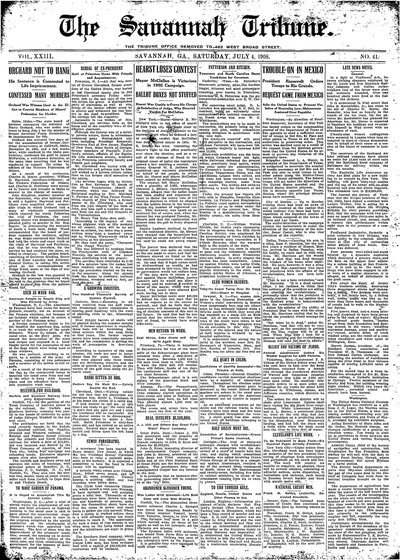
Page text (machine-generated)
The Savannah Tribune.
VOL. XXIII.
ORCHARD NOT TO HANG
His Sentence is Commuted to Life Imprisonment.
CONFESSED MANY MURDERS
Orchard 'Was Witness Used in the Effort to Convict Members of Miners' Federation for Klurder.
Boise, Idaho.—The state board of pardons commuted the sentence of Harry Orchard, who was under sentence to hang July 3 for the murder of former Governor Frank Steenunberg, to imprisonment for life.
Orchard was arrested two days after the assassination of former Governor Steenunberg at Caldwell, Idaho, December 30, 1905, and a few weeks later, while confined in the Idaho penitentiary, confessed his guilt to James McPartlan, a well-known detective, at the same time asserting that he was employed to commit the crime by officers of the Western Federation of Miners
As a result of his contession, Charles H. Moyer, president; William D. Haywood, secretary-treasurer; of the Western Federation of Miners, and Charles D. Pettibone were arrested in Denver and brought to Idaho to answer to the charge of murder.
John Simpkins, another member of the federation, was also indicted and is still a fugitive, Haywood and Pettibone were acquitted after memorable trials in which Orchard told a story of wholesale assassination which shocked the world. Following the trial of Pettibone, the case against Moyer was dismissed, Orchard pleaded guilty to murder in the first degree. In pronouncing the sentence of death a week later, Judge Wood recommended that the board of pardons commute the sentence, saying he was firmly convinced that Orchard had told, the whole and exact truth at the trials of Haywood and Pettibone, and that he was therefore, for the service he had rendered the state, entitled to clemency. The pardon board, consisting of Governor Gooding, Secretary of State Lansdon and Attorney-General Guhen, in taking this action acted on the recommendation of Judge Wood, made at the time of sentencing Orchard.
Orehard to the last was opposed to having the sentence interfered with. He said to the attorney that he hoped to save him from the gallows would, fall.
USED AS WASH RAG.
American Fought to Regain Flag and
'Was Pursued by Army.
Washington, D. C.—The Americans in Panama have had cause for heated protests, recently, not on account of the Panama elections, but because of an 'incident which called in action a portion' of the Panama army.
A foreign commercial house in Colon insulted the American flag, using it to wash the windows of the establishment. Wayne O<sub>f</sub> Adams, of the canal zone, as the story goes, witnessed the desecration of the stars and stripes and engaged in a hard-fought battle for the possession of one of the flags which were being used to clean windows.
He was pursued, according to reports, by a section of the army of Panama, consisting of two policemen and a member of the militia in full regalia.
As a result of the disrespect shown the flag by the commercial house in question the canal zone from one end to the other is hung with boycott signs and the offenders have found less expensive wash rags.
RECEIVER, FOR BAILROAD.
Norfolk and Southern Railway Company Embrassed.
Norfolk, Va.—On the petition of the Trust Company of America joined in by the railroad, the Norfolk and Southern Railway company was placed in the hands of receivers by order of Judge Edmund Waddell in the federal court.
The petitioners set forth that the road recently bought in the Suffolk and Carolina railroad, the Pamlico, Oriental and Western railroad, the Raleigh and Pamlico Sound railroad and the Atlantic and North Carolina railroad, for which a debt of $15,000,000 was incurred and floated by the Trust Company of America, of New York city, taking first mortgage and refunding bonds. Extensive improvements were also inaugurated.
The Norfolk and Southern owns and operates 600 miles of trackage, with principal points at Beaufort, N. C., Edenton, N. C., Raleigh, N. C., and Norfolk, Va. They also own the electric line, double route of about twenty miles each from Norfolk to Cape Henry and Virginia Beach.
TO MAKE GARDEN OF PANAMA.
It is Hoped to Accomplish This By Convict Labor.
Washington, D. C.-After a trial of eleven weeks the employment of convicts and local prisoners at highway building in the canal zone is said to have passed the experimental stage. Three distinct ends were in view in the program submitted by the special committee on the employment of prisoners which was approved last February. The first of these was the improvement of the prisoners' condition; second, the opening up to development of the fertile valleys of the canal zone, and third, reimbursing the government for the expense of maintaining its penal system.
BURIAL OF EX-PRESIDENT
Held at Princeton Home With Friends and Acquaintances.
Princeton, N. J.-All that was mortal of Groyer Cleveland, former president of the United States, was buried in the Cleveland family plot in Old Princeton's cemetery Friday afternoon, just as the last rays of the sun fell across the grave. A distinguished party of statesmen as well as confreres of the former official stood by in silence and witnessed the last honors to the dead expresident. Then the cortege left the cemetery.
Agreeable to the wishes of Mrs. Cleveland, the services both at the house and at the cemetery were of the simplest character.
Although the funeral was of a strictly private nature, those in attendance numbered many distinguished citizens, including President Roosevelt, Governors Fort of New Jersey, Hughes of New York, Hoke Smith of Georgia, former members of President Cewlain's cabinet, officials of the Equitable Life Assurance society, members of the Princeton university faculty and friends and neighbors.
Mr. Cleveland was buried with all the simplicity and privacy that he himself wished as a private citizen rather than as the former chief executive of the nation.
The services began with an invocation by Rev. Sylvester W. Beach of the First Presbyterian church of Princeton, which was followed by Scriptural reading by Rev. Maitland V. Partlett of the West Farms Presbyterian church of New York, a former pastor of Mr. Cleveland, who read from the 14th chapter of the book of John, and also read a number of passages from the 4th and 22d chapters of the Thessalonians.
Dr. Henry Van Dyke then said:
"According to the request of one whose slightest wish at this moment we all respect, there will be no address or sermon, but there was a poem written more than a hundred years ago by William Wordsworth which is expressive of his character." He then read the poem, "Character of the Happy Warrior." This was followed by readings from the Presbyterian book of Common Worship, the services at the house house concluding with this prayer: The services were concluded at 5:30 and five minutes later the casket had been tenderly carried to the hearse and the procession started on its way to the cemetery. Along the streets from the house to cemetery, national guardsmen, mounted and on foot, policed the way.
A GROWING INDUSTRY.
Two Hundred Thousand Barrels of Oysters Planted.
Jackson, Miss.—According to advises received from the gulf coast, the Mississippi oyster commission is making good headway with the work of planting reefs in the Mississippi sound.
Over 200,000 barrels of shells will be planted during the summer months and, if former experience is repeated, these beds will be furnishing fair-sized oysters within the next three or four years. The former experiments have been remarkably successful, and the commission is getting the work of propagation in first-class shape.
According to members of the commission, the reefs are now in better shape than for some time. Shells that were planted only three weeks ago are developing clusters, and the ratio of growth is much larger in the waters of the gulf than along the Atlantic coast.
RABBI BITTEN BY DOG
Doctors Say He Must Dis—Calmly Awaits the End.
Cleveland, Ohio—Waiting calmly for the fate that his physicians say threatens him, Rabbi L. Friedman is at his home the victim of a rabid dog. If God desires to call me at this time I am ready to go," the rabbi said. "I don't feel any pain yet and I trust the treatment will be successful. But the doctor seems to be discouraged." Physicians refuse to make a forecast. Rabbi Friedman is sixty-four years old, and has retired as an active pastor. Several days ago he was attacked and bitten upon the left hand by a dog.
NEWSY PARAGRAPHS.
A movement has been started in Essex county, New Jersey, in which the late President Grover Cleveland was-born to raise a national monument to his memory. It is expected a committee to take the fund in New Jersey will be appointed.
A tornado which swept over Clinton, Minn., killed seven people, and injured 25, some seriously. Twenty houses, a printing office and two churches were blown down.
The Clyde Line steamship Chippewa, which struck a rock near Montauk, is hard aground and will probably prove a total loss. Thousands of watermelons have been thrown into the sea and hundreds of persons, many from the Connecticut shore, have visited the scene in power and small boats to gather the rich harvest. When ever a melon is washed ashore there is a wild scramble among the beach combers to reach it. The opportunity for such a feast of ripe melons is not often seen on the Long Island shore and the inhabitants are eager in grasping it.
The Southern Steel company, which before it went into bankruptcy, employed 5,000 men, has been re-organized with a capital of $30,000,000 and operations will be resumed.
THE TRIBUNE OFFICE REMOVED TO 462 WEST BROAD STREET. SAVANNAH, GA., SATURDAY, JULY 4, 1908.
HEARST LOSES CONTEST
Mayor McClellan is Victorious in 1905 Campaign.
BALLOT BOXES NOT STUFFED
Hearst Was Unable to Prove His Charge to Satisfaction of Judge, Who Directed Verdict For McCllan.
New York—Mayor George B. McCllan's title to the office of mayor of New York city was made clear by the decision of Justice Jambert in the supreme court when he ordered a jury to render a verdict that McCllan was duly elected mayor in 1905. W. R. Hearst has been contesting the mayor's right to the office practically ever since the election, and as a result of his charges of fraud in the original count of ballot the legislature passed a law enabling a recount. Attorney General W. S. Jackson then instituted quo warranto proceedings on behalf of the people, in which both Mr. Hearst and Mayor McCllan were named as defendants.
The recount left Mayor McClellan with a plurality of 2,965, whereupon Clarence J. Shearn, representing Mr. Jackson, alleged that the ballot boxes had been stuffed and requested the court to throw the entire vote of 112 election districts in which he charged that the ballots found in the boxes exceeded the number of registered voters. This, however, was based on an incorrect list of voters, and, when the correct list was produced Tuesday, Mr. Shearn said that the registration was greater than the poll in every disputed district.
Justice Lambert declined to throw out the contested districts, Mr. Shearn then charged that the inspectors had registered an excess number of names, but said he could not prove repeating.
The justice then declared that the original count was quite as complete as the one made in court, and that the evidence showed no fraud as far as the election inspectors were concerned. He said that if legal voters could be disfranchised so readily as had been attempted in this case, this form of government would not endure long. If the jury were to return a verdict against Mayor McClellan, Justice Lambert said he would not allow it to stand, and he ordered a verdict in favor of the mayor, which was rendered. The jurors were allowed $510 each, having sat 51 days. Mayor McClellan spent over $40,000 to defend his title and says that he had no regrets as to the course he pursued, and that he feels that the controversy will discourage the bringing, of election contests of this sort in the future. He said that had he suspected that his election was the result of fraud, he would have acted differently.
MEN RETURN TO WORK
Coal Mines, Coke Ovens and Steel
Mills Again Busy.
Pittsburg, Pa.—There is happiness
in Bayardstown for two of the three
mills of the Schoenberger plant have
resumed work after a shut-down of
three months. Between 1,500 and
1,700 men went back to work. Within
a week the third mill will resume.
Then will follow, inside of ten days;
the continuous mill and one of the
two blast furnaces.
The Schoenberger plant is a subsidiary of the American Steel and Wire company.
Altoona, Pa.—The Pennsylvania,
Beech Creek and Eastern Coal and
Coke company started operations in
their ovens and mine at Galtitzen and
Bennington, near here, on full time.
This affected about 1,500 men on
both places.
The ovens and mines have been
closed since the first of the year.
DEAL INVOLVES $1,500,000.
J. J. Hill and Others Buy Great Falls Water Power Company.
Great Falls, Mont.-James J. Hill and associates sold the property of the Great Falls Water Power and Transit company to John D. Ryan and others for $1,500,000.
John D. Ryan, managing director of the amalgamated Copper company, and John G. Marony, president of the Daly Bank and Trust company of Butte and of the First National Bank of Great Falls; are the heaviest stockholders. The purchasers deny that Amalgamated Copper has any interest in the deal.
It is probable that an immense electric generating plant will be conducted at the "big" falls.
ABANDONED SCHOONER FOUND.
Was Laden With Molasses—Life Boat
Gone and Crew Was Missing.
Norfolk, Va.—The dismantled three-mated schooner Charles L. Sprague was towed into Hampton Roads by the Cuban steamer Yumuri, bound from Tampaico, Mexico, to New York. The Sprague had been in a gale which carried away all three of her masts as well as her bowsprit. All the life-boats are missing. The Sprague, laden with molasses, was bound from Porto Rico to some northern port. Nothing was seen of the schooner's crew by the Yumuri. It is possible they were takenion by some other vessel.
- PATTERSON AND KITCHIN.
Tennessee and North Carolina Name
Candidates for Governor.
Nashville,' Tenn.—In Saturday's
democratic primary, after the hardest
fought, bitterest and most pictureque
campaign ever known in Tennessee,
Governor, M. R. Patterson won the
bubernatorial nomination over E. W. Carmack.
For supreme court judge, D. L. Lansden was successful, B. D. Bell, incumbent, being an extremely close competitor. For railroad commissioner, Frank Avent won over W. C. Whitthorne.
The nominations are to be made in
convention, the primary being on the
county unit plan, county committees
naming delegates in accordance with
the vote cast.
The ninety-six counties will send
1,318 delegates to the convention, and
of these Patterson will have, over 700.
His popular majority is between 8,000
and 10,000.
State-wide prohibition was the issue on which Carmack based his fight, while Patterson defended the present status, practically local option, which has come under his administration. To Carmack's banner the Woman's Christian Temperance Union and the Anti-Saloon League were rallied, and the state had been traversed by women campaign orators, some from other states. The women and children continued to work for Carmack at the polls.
Under the present law liquors are only sold in Memphis, Nashville, Chattanooga, La Follette and Binghamton. La Follette voted against surrendering its charter so as to come under the provisions of the present law. Binghamton is a manufacturing town in Shelby county, six miles from Memphis.
Charlotte, N. C.—William Walton Kitchin, for twelve years representative in congress from the fifth North Carolina district, was nominated for the governorship of North Carolina by the democratic state convention at $o'clock Saturday after the warmest fight in the annals of the state.
The convention has been in almost at noon and the nomination required continuous session since Wednesday sixty-one ballots. In every respect the contest has been remarkable. Lined up against Kitchin were Locke Crafg, of Burcombe county, one of the most popular democrats in the state, and Colonel Ashley Horne of Johnston, a prominent business man.
CLUB WOMEN INJURED.
Tally-Ho Coach Turns Over On Steep Hill—Dozen In Hospital.
Newport, R. I—Two women delegates to the General Federation of Women's clubs' convention in Boston were dangerously hurt and ten others more or less seriously injured when a tally-ho coach in which they were riding capsized on a steep hill on Bath road. All of the twelve women who were in the crowd taken to the Newport hospital. The deluge woken on an excursion to this city. The identity of the injured and the nature of their injuries is withheld by the hospital authorities.
It is understood that among the injured in the accident, were Mrs. Dr. Davenport of Watertown, Mass., and Mrs. Sunden of Lincoln, Neb. Mrs. Sunden was cut about the face and ankles.
ALL OULET IN COLON.
Candidates of Obaldia Successful—No Trouble at Polls.
Colon, Panama:—General Obaldia's candidates carried municipal elections here by a majority of ninety-four votes. Throughout the election order prevailed. The government party is downcast by the result. United States marines are ashore in the canal zone to protect property of the American government but no trouble is expected.
As an additional precaution all the docks and the railroad tracks in this vicinity were kept clear and fire hose was distributed throughout the vicinity. A strict guard was also maintained over all buildings belonging to the United States.
HALE DOZEN MUST DIE.
Conviction of Revolutionists—Crown Prince's Name Involved,
Cettigny—The trial of thirty-six prisoners charged with revolutionary activity in connection with the discovery of a score of bombs here last year, and during which sensational testimony was added involving Crown Prince George of Servia in a conspiracy against Montenegro, resulted in six of the accused being condemned to death, three to life imprisonment and twenty-seven, including five former cabinet ministers, to terms of imprisonment ranging from six to twenty years.
TO END TURKISH GULE
England, Russia, United States and Other Powers to Act
London, England.—Information considered reliable, declares that England's foreign office intends to end Turkish rule in Macedonia, which has been a long record of murder and outrage. It is said the matter was discussed by Kiyoshi Edward and the recent meeting and they concluded an international understanding similar to the Algeriac treaty regarding Morocco was imperative. It is understood the United States will be invited to join the other powers in the initiative by England and Russia for a conference concerning Macedonia.
TROUBLE-ON IN MEXICO
President Roosevelt Orders Troups to Rio Grande.
REQUEST CAME FROM MEXICO
Aks the United States to Prevent Violation of Neutrality Law-Malcontents Scattered Over Republic.
Washington.—By direction of President Roosevelt, Secretary of War Taft has issued orders to the commanding general of the Department of Texas at San Antonio to send a sufficient number of troops to Del Rio, El Paso and other points in Texas to aid the civil authorities in preserving order. This action was decided upon as a result of the request from the Mexican government that the United States do its utmost to prevent any violation of the neutrality laws.
Brigadier General L. A. Moyer, in command of the Department of Texas, is authorized to ascertain the number of troops necessary at Del Rio and El Paso and also to send troops to any other points along the Mexico-Texas border if found advisable. The federal troops will act under the directions of the United States marshal and the United States district attorney. Del Rio is directly opposite Las Vacas, Mexico, where the principal disturbances have occurred.
City of Mexico. — Up to Monday evening there had been no news of any sort received at the capital that would indicate that there had been a repetition of the disorders similar to those which occurred at the towns of Viesca and Las Vacas.
The entire-direction of the campaign against the malcontents is under the direction of the secretary of the interior. Senior Corral, who is also vice-president of the republic.
Dallas, Texas—Carrying his arm in a sling, Sami P. Harrison, for the last five years a resident of Blanco, Mexico, arrived in Dallas Tuesday, with his family, en route east to visit relatives. Mr. Harrison got his wound from a shot that was fired through the window of his home after nightfall. He says, however, it was a stray bullet and that-Americans who have not interfered with the affairs of the revolutionists, have not been bothered.
"That is not a fake revolution," said Mr. Harrison, "it is a dead earnest affair. I am inclined to think that the soldiery of the president are ailing and abetting the revolutionists. I personally know that the president is greatly,worried. It is my opinion that the Mexican army is honeycombed with the revolutionists."
Asked his opinion of the ability of President Díaz to cope with the situation, Mr. Harrison replied that he believed the president would manage the affair.
"But when he is dead," added Mr. Harrison, "and that will not be very long now, as the president is getting old, the Diaz regime will be at an end. When Diaz 'dies I look for a general uprising and the revolutionary element will take the lead in affairs."
BELIEF FOR VICTIMS OF FLOOD.
Federal Government Orders Six
Workday Services for 1,000 Persons
Weeks: Supplies for 4,000 Persons.
Vicksburg, Miss.—Lieutenant F. B. Upham of the United States army who was sent here to look over the flood conditions, returned from a launch ride through the overflow districts of Warren and Isaquena counties and reports that 2,000 or 3,000 persons need relief. He received· telegraphic orders to at once order out supplies for six weeks for about 4,000 sufferers in Wilkinson, Adams, and Jefferson counties, which districts he visited.
The orders for this district will be made after Lieutenant Upham shall have visited the Big Black river neighborhood. While Lieutenant Upham and A. L. Dorsey, a prominent planter, were on the trip they had just eaten breakfast on a projecting plank in the Mississippi, near Brunswick landing, and had left the place only a little while when the bank caved into the river in forty feet of water.
CLEVELAND'S LIFE WORK.
To Be Published in Book Form—Six Hundred Pages Already Finished.
New York City—Under orders from Mrs. Cleveland work has been begun on memoirs of the late president, consisting of clippings from newspapers and periodicals on his death and funeral. The work will require six months to complete. As planned, there will be several volumes, consisting of editorial notices, news dispatches, illustrations and cartoons, each bound in Russian levent leather and lined with purple molesilk.
NATIONAL CREDIT MEN.
Frank M. Getty, Louisville, Re-elected President.
..Denver, Colo.-The National Association of Credit Men concluded its convention here by electing omcers as follows:
President, Frank M. Getty, Louisville, re-elected, first vice president, T. M. McAdoo, Chicago; secretary-treasurer, Charles E. Heck, re-elected; directors, A. C. Foster, Denver; Frank J. Lamotte, Baltimore; F. R. Salisbury, Minneapolis; J. W. Spangler, Jr., Seattle; H. G. Moore, Kansas City; George K. Smith, New Orleans; and David S. Ludam, Philadelphia. Philadelphia will be the next place of meeting.
LATE NEWS NOTES.
In a fight at VanBuren, Ark., between striking shopmen employed by the St. Louis and Iron Mountain Railway, company and Italian strikebreakers two of the latter were shot and seriously wounded. Over two hundred shots were fired at the Italians by the strikers.
It is understood in Wall street that John D. Rockefeller, Jr., has come to the aid of Charles W. Morse, the financier, who lost so heavily in the smash of the ice trust. On the advance Mr. Rockefeller has planned for American ice, Mr. Morse is expected to liquidate his holdings and re-establish himself in Wall street with an abundance of cash.
Twenty-nine women suffragettes were arrested in London when they attempted to start a riotous demonstration in behalf of their cause at a session of the house of commons in London.
The receivers of the Seaboard Air Line railroad company have placed an order for 12,000 tons of steel rails with the Maryland Steel company of Baltimore for delivery within the next six months.
The Equitable Life Assurance society has filed plans for a new building to be erected in New York. The building will have sixty-two stories and the top of its tower will be nine hundred and nine feet above the curb. The estimated cost is $10,000,000.
The Journal des Debats of Paris says that the Wright brothers of Dayton, Ohio, have signed a contract with Lazare Weiller, who is acting for a syndicate, which offers the Wrights $100,000 for their patents providing, first, that the aeroplane with two persons on board files thirty-one miles in an enclosed circuit, and, second, that it repeats this performance within eight days in the presence of a committee.
Ferdinand Dudenhefer, formerly a state collector in New Orleans, was found guilty in the criminal district court at that city of embezzling about $66,900 of state funds. Sentence was deferred.
Four persons were killed and many injured by a dynamite explosion which destroyed a grocery store and the fats on the upper noor adjoining a saloon building at San Francisco. It is said to be the work of thugs who have been engaged in other work of a similar character, it is alleged, on behalf of defendants in the graft cases.
Fire swept the heart of Jersey City's business section, destroying three department stores and damaging a fourth. Two firemen were seriously, it not fatally hurt, by a falling wall, trolley traffic was tied up for more than three hours and thousands of people had to walk to the Manhattan ferries.
Five known dead, and a score missing and supposed to have been swept away in the rush of water; fiftyhead of railroad grade horses, houses swept from their foundation and floating around in the water; entailing enormous damage, crops and machinery ruined, several miles of track washed away, are the result of a combined cloudburst and water spout at Wellington, Kans.
Harvie Jordan, president of the Southern Cotton association, and President W. B. Thompson of the New Orleans Cotton exchange, are discussing the erection of warehouses along the river front at New Orleans capable of storing 2,000,000 bales of cotton.
For the second time in a week incendiaries attempted to fire St. Stanislaus college, a Catholic institution at Chicago. Twelve members of the faculty fired from the building wearing night clothes.' Within two years St. Stanislaus, parochial school and church have been burned.
Washington.
The United States National Museum at Washington has received as a gift from J. N. Leger, the Haytien minister to the United States, a case containing models representing over 100 different vegetables and fruits of Haytii, arranged for exhibition purposes.
Acting Secretary of State Adee. and Mr. Godoy, the Mexican charge, exchanged ratifications of a general arbitration treaty. The treaty is similar in provisions to those between the United States and various European governments.
Admiral Cappa, chief of the bureau of navigation and construction, left Washington for San Francisco, from whence he will sail with the fleet to inspect Pearl Harbor, Hawaii, where the government will spend millions on a naval station.
The district health department reports that fifty-nine children under the age of two years died in the District of Columbia last week from intestinal troubles brought on by the heat
The department of agriculture has made a recent investigation to determine the status of the boll weevil this year. The results of the investigation on the whole are very successful. The number of weevils per acre present at this time seems to be much smaller throughout the infested area than at this time a year ago. This must be due primarily to the unfavorable weather last fall, especially the very early first killing frost. Preliminary arrangements for the trip to Europe of the members of the monetary commission, appointed at the close of the last congress, will be made by Representative T. E. Burtor, who will shortly leave for a six weeks stay abroad. Chairman Burton will visit bankers and financiers in Paris, Berlin and London
Largest Sick and Death Benefits; Smallest Premiums.
The Guaranty Aid and Relief Society
L. B. WILLIAMS, President.
The undesigned. Treasures of
to have received from
of Damascus.
Dear Programmer,
Elderton, Georgia
17th 10, unseasoned,
long in total Ten Thousand
of Georgia, by authority and a
assembly, approved October
20th 1897.
PROCEEDINGS OF THE GEORGIA
Guara
OL. C. JOHNSON,
Treasury of State of Georgia
Bilham, JAN
and Treasures of the State of Georgia
the following desc:
and Benjamin o
Gregory Campbell
and Jack for
June, 1925
on Thousand Dollars, and which
authority and andes the provisions of
covered October 22d, 1887, and
R. E.
Treasury
GEORGIA LEGISLATURE
SOL. C. JOHNSON, Supt. of Ageno
Treasury of State of Georgia
long on total Ten Thousand Dollars, and which are held by the State of Georgia, by authority and under the provisions of an Act of the General Assembly, approved October 22d, 1887, and amended December 20th, 1897.
* amendments to it had been defeated, was passed by a vote of 13 to 2.
The bill of Mr. Hule of Clayton providing that two or more municipalities be permitted to co-operate in working city convicts in one gang, was taken up and defeated.
A bill by Mr. Foster of Cobb was providing where a common carrier fails to settle an over charge, duly demanded for thirty days, the person to whom the overcharge is due can, upon establishing the correctness of his claim in the courts, recover, in addition to his claim, a penalty of not less than $100, the same increasing with an increase in the amount of the claim, was passed.
The bill permitting depositions to be taken before justices of the peace and notaries who are exofficio justices of the peace, was passed.
The bill prohibiting any unauthorized person from stopping, starting or otherwise interfering with a locomotive, was passed. Also a bill by Mr. Reid of Putnam requiring monthly publication of the doings, of the board of commissioners of roads and revenues of Putnam county. A resolution providing that the house visit the property of the state in Chattanooga in spite of the fact that the senate had declined to go was referred to the committee on temperance. The house adjourned until 10 o'clock Wednesday morning.
Governor Smith's message was received by the house, urging a formal approval of the application of the University of Georgia to be made a participant in the Carnegie foundation fund, which provides a pension for aged teachers under certain conditions. It was shown that the university would receive this benefit if formal approval was given by the trustees, the governor and the assembly. An invitation was received from the Ladies' Memorial Association and Kennesaw chapter United Daughters of the Confederacy, to attend the unveiling of the monument at Marietta on July 7. A resolution, providing that the general assembly attend in a body, was adopted by the house.
A bill providing that all locomotives on main lines be equipped with electric headlights beginning July 1, 1909, was passed 131 to 0. A bill to license the carrying of rifles and pistols was defeated by a vote of 73 to 64.
The senate spent two busy hours Thursday, killing two bills, receiving four new ones and tabling half a dozen others as well as receiving a number of nominations from Governor Smith, which were laid over until Friday.
The first bill of the session for third
---
IN THE HOUSE
In the big cool hall of the house of representatives Thursday the members observed the second day of the second session by doing little and that little easily.
A message from the senate was received, a resolution providing for a joint committee from two houses to prepare a memorial upon the death of President John W. Akin.
The reading of new bills on introduction and their reference to committees occupied a large share of the morning session. A new flood of bills deluged the desks as on the first day.
Mr. Pope of Brooks offered a resolution, which was adopted, that the hall of the house be given to the Georgia Woman's Suffrage Association on the nights of July 9 and 10.
Out of respect to the memory of John W. Akin, president of the senate, the house adjourned at 11:45 o'clock.
June 26.
The house assembled at the usual hour, 10 o'clock, Friday morning. Prayer by the chaplain was followed by the roll call and reading of the journal. Under the heading.of reports of standing committees, Mr. Alexander of DeKalb, chairman of the committee on Western and Atlantic railroad, said that his committee reported to the house the bill, recommending the extension of the railroad to the sea, and also the bill providing for the issuance of bonds to secure money for the construction of the extension., Mr. Hall of Bibb announced that at the proper time he would present minority reports on both bills. Mr. Alexander of DeKalb also presented a joint resolution recommending that the entire legislature go to Chattanooga on Ju'y 3 to inspect the state's property in that city. Mr. Alexander moved the adoption of the resolution.
Mr. Heard of Dooly and Mr. Hall of Bibb opposed the passage of the resolution. Mr. Candler of DeKalb and Mr. Porter of Floyd favored the inspection. The call for the ayes and noes was not sustained and upon viva voce vote, the original resolution was adopted. Speaker Slaton announced the committee assignments of the new members
June 29.
A message from the senate was received, refusing to concur in the house resolution providing for the proposed trip of the general assembly to Chattanooga.
The bill requiring telegraph companies to deliver their messages promptly on pain of $50 penalty for each message was called up for passage, and after extended debate was tabled.
The bill of Mr. Adams of Chatham prohibiting more than 5 per cent interest per month upon loans, and directed at the business of "loan sharks," was taken up and after several
Treasurer of the State of Georgia.
June 30.
July 1.
IN THE SENATE.
June 25.
P. EDWARD PERRY, Vice President.
reading in the senate was a measure providing for an increase in the salaries of the supreme court justices from $4,000 to $5,000 annually. The bill was introduced by Messrs. Stephens, Walker, Knight, Wilkes, et al., and had been favorably reported by the committee on general judiciary. Mr. Felder and Mr. Camp vigorously opposed the increase. One of the authors, Mr. Knight, agreed to let the bill go over. Mr. Knight's motion to table was lost, it being the purpose of the senate, evidently, to kill the bill outright. Mr. Wilkes spoke in favor of the increase. The bill was killed by a vote of 27 to 5. A companion bill to increase the salaries of appellate court judges was killed also. A number of other bills of more or less importance was read a third time, but none of them were acted upon.
At noon the senate adjourned until 10 o'clock Friday.
June 26.
President Flynt's gavel fell in the senate promptly at 10 o'clock Friday morning. After prayer by the chapel the journal was read and confirmed. Senator Felts of the Ninetenth moved to reconsider the action of the senate on Thursday on the bills with reference to the bill to increase the salary of supreme court justices, which was defeated. Mr. Williford of the Twenty-eighth called attention to the fact that the bill does not carry any present increase. Mr. Camp of the Thirty-first, who, on Thursday, vigorously opposed the increases, stated that he believed the bill should be reconsidered. Mr. Felder of the Twenty-second district also opposed vigorously the reconsideration and also favored abolishing the office of compiler of colonial records, and retaining the office of special attorney to the railroad commission. Mr. Hayes of the Thirteenth declared that he opposed the increases, and proposed further to vote to reduce the number of railroad commissioners from five to three and to also cut out the special attorney. Messrs. Felts, Dean, Martin and Overstreet spoke in favor of a reconsideration. The previous question was called, and an aye and nay vote showed that the bill had been reconsidered by a vote of 19 to 15.
As president of the senate, Mr. Flynt has yielded all of his committee appointments. Senator Hawes of Elbert succeeds Mr. Flynt as chairman of the Western and Atlantic committee. Senator Paul Akin succeeds Mr. Flynt as vice chairman of the committee on general judiciary. Mr. Akin has been appointed also to the committees on penitentiary, railroads and constitutional amendments. The senate unanimously voted to accept the invitation of the Western and Atlantic committee of the house to visit and inspect the state road's terminals in Chattanooga on Friday, July 3d. The senate, by a vote of 20 to 15, decided to adjourn until Monday.
June 29.
A motion by Mr. Telder of the Twenty-second district to consider the action of the senate in voting to go to Chattanooga July 3d, occupied the time of the senate the entire session. Senators Camp and Hayes spoke favoring reconsidering the acceptance
This company is duly chartered under the laws of the State of Georgia, and has complied with all requirements of the State Insurance department, therefore all policy holders are protected with all the safeguards that the strict insurance laws of this State seek to protect its citizens.
Its affairs are directed and managed by Negro men of the city of Savannah of leading standing, and whose character and reputation are of such as to command the respect and confidence of all the people of that community. The same men that manage this Society are the ones that organized and are conducting the affairs of the first successful Negro Savings Bank in this state, therefore we can readily see that by connecting themselves with this Insurance company their interest will be in safe hands.
By comparing our rules and benefits with other first class companies it will be seen that we offer the most liberal inducements with the largest sick, accident and death benefits to our members than any other company in this business.
That we pay our claims promptly can be testified to by the thousands of our satisfied members.
Agents Wanted Everywhere
Liberal Terms and Commission.
Train will consist of PULLMAN BUFFET SLEEPING CARS, Day Couches between Savannah and Montgomery without change; making close connection at Montgomery with all lines diverging for Pensacola, Mobile, New Orleans and all Western points; Birmingham, Memphis, St. Louis, Nashville, Chicago and all Northwestern points; the SHORTEST LINE to Montgomery, New Orleans, Birmingham and the earliest arrival at the three points. At Savannah close connection is made for all EASTERN POINTS, Richmond, Washington, New York at t with Coastwise Steamships for Baltimore, Philadelphia, New York and Boston. Get sleeping car reservations and full information from our SKAOARD A.
L. E. Williams.
F. Edward Perry.
Walter S. Scott.
Sel. C. Johnson.
This company is duly chartered
quirements of the State Insurance
that the strict insurance laws of
its affairs are directed and manage
character and reputation are of s
community. The same men that m
fairs of the first successful Negro
themselves with this Insurance co
By comparing our rules and ben
liberal inducements with the lar
pany in this business.
That we pay our claims prompt
Agents
NIGHT T
VIA S
WESTBOUR
Leave Savannah
Arrive Helena
Arrive Abbeville
Arrive Cordele
Arrive Americus
Arrive Richland
Arrive Lumpkin
Arrive Montgomery
Arrive Birmingham
Arrive New Orleans
Train will consist of PULLM
Montgomery without change; make
Mobile, New Orleans and all West
Northwestern points; the SHORTE
arrival at the e points. At Savannah
ington, New York and with Coastw
Get sleeping car reservations an
of the invitation. Senators Peacock of the Fourteenth spoke in favor of the trip. The vote was 17 to 16 against taking the trip to Chattanooga. According to the senate rules, there can be but one reconsideration of a resolution. As this was a joint resolution, the house can not go to Chattanooga unless the senate concurs. The senate adjourned at 11 o'clock.
June 30.
Senator Williford of the Twenty-eighth gets the credit of the first general bill to be passed by the senate. His measure provides for uniformity of school terms. Mr. Knight questioned the wisdom of the bill and opposed its passage. The bill was passed by a vote of 25 to 4.
A petition from the penitentiary committee, asking that Senator Howard be designated as a member of the committee, was read, and President Bryant announced the appointment of Mr. Howard.
A bill by Mr. Crittenden to prohibit any ordinary, county commissioner, judge of any city court or county court, sheriff, solicitor of any court, or other county or court officer of this state, from hiring or turning over to any private person or persons, or any corporation, etc., and person who may hereafter be convicted and sentenced for misdeameanor in any court was passed. The senate then adjourned.
The first business of the senate was the consideration of the Overstreet bill, making the possession of a federal liquor license prima facie evidence of violation of the prohibition law. It was tabled by a vote of 22 to 18. A message from the governor was received.
WALTER S. SCOTT, Secretary and Tr (as.
NEWSY GLEANINGS.
An extradition treaty between Mexico and the Netherlands has been signed.
Tuberculosis is prevalent among Irish emigrants returning to the home country.
The Moroccan Foreign Board accepted the demands made by France and Spain.
The inrush of poor from other cities is causing a crisis among New York City charity organizations.
Baking as a cure in severe cases of burned persons was tried successfully at Roosevelt Hospital, New York City.
The one hundredth anniversary of the birth of John Greenleaf Whittier war observed throughout New England.
Secretary Root in dissolving the Central American Peace Conference hinted at a coming union of five republics.
Mrs. Howard Gould filed an amended bill of complaint in her suit for separation, dropping the charge of indulgence.
The Presbytery of New York reports a marked and dangerous falling off in the number of candidates for the ministry.
The gifts of Americans for the advancement of art exceed in value those of the wealthy art lovers of any other nation.
NEEDED COACHING.
Freddie—And now that we are engaged, dear, I must tell you that I have never kissed a girl before in my life.
Kitty—Good gracious! Freddie, what an awful lot of practice you'll want!
—Illustrated Bits.
SOL. C. JOHNSON Notary Public.
SOL. C. JOHNSON Notary Public.
Deeds, Contracts, Wills and Other
- Legal Forms Prepared and
Attested.
116 West St. Julian Street
Masonic Books & Regalias.
LODGE SEALS,
FINANCIAL CARDS and
BLANKS of every description.
Publishers' and Manufacturers' Prices
Liberal Discounts Will Be Arranged.
60L. C. JOHNSON,
Savannah, Ga.
W. H. LLOYD.
Dealer In
GROCERIES, WOOD AND COAL
621 Oglethorpe Avenue, East.
No. 518 PHONES Bell 806
Most men think they are getting better off by keeping from growing worse off.
```markdown
```
THE EAGLE SCREAMS:
In the last hundred years or so.
I'm game from
The point of my beak
To the star spangled tips
Of my tail feathers;
If I can when I begin
To scratch gravel,
Mind your eyes!?
I'm the cock of the walk,
And the henbread of the
Goddess of Liberty;
The only gallinaceous
Ep. purpureum
On record.
I'm an eagle from Eagleville,
With a scream on me that makes
Thunder sound like
Dropping cotton
On a still morning,
And my present address is
Hail Columbia,
U. S. A.!
Seq? —New York Sun.
ENTURY FOURTH
BY ORA MAROLD
THE TWENTIETH CENTURY FOURTH
BY ORA ARNOLD
HY NOT let this independence Day be one on which the hostess, too, declares her independence, on which she resolves to no
broken line of rich red Japanese lanterns hung on red, white and blue ribbon, forming a pretty frieze and shedding light and air of gayety over the al fresco banquet.
The ten guests comprising the house party will sit at a pretty round table, which is made by placing over
PARADING ON
A
an ordinary kitchen pine table one of the round wooden tops every hostess provides in several different sizes for the dinner entertaining. The exquisite linen damask tablecloth will hide all suspicion of the table's plebeian origin, and the pretty board will gleam with silver and glass. One course will be served on blue Revolutionary china worth its weight in gold to a collector. The table decorations will be small silk flags, and broad tricolored ribbons will run out from the centre of the table and hang down to the floor. A large Liberty bell of red, white and blue flowers will be suspended over the table. A mound of geraniums shorn of their leaves makes the floral centrepiece. At each girl's place will be arranged dainty little rustic baskets filled with bluish purple sweet peas, and tiny Continental military hats made of dark blue crinkled paper ornamented with a gold cockade are designed for the men's dinner favors. The menus are to be imposing scrolls, with seals—small. Declarations of Independence tiled up with tri-colored ribbon.
Instead of the names of vlands that appear on the usual menu, on this scroll menu there will appear a perplexing lot of questions written out by the clever hostess.
When the guests are taking their seats, she will make the rather startling announcement "that whether you get people anything to eat or not will depend upon your own wits." You can well imagine the consternation of the company. And she will further explain that "if you give the right answers to the questions asked on the scroll by your plate the servants will help you; otherwise you go without. So be careful what you write."
The first brain splitting puzzler is,
"What will you be in if you answer
wrong?" And if you're not pretty
quick at this sort of nonsense you
I am the American Eagle,
and my wings flap together.
Likewise, I roost high,
And I eat, bannanas raw.
Rome may sit on her
Seven hills and howl,
If the eagle can not
Sit on Me!
Will she please put that
In her organ and grind it?
I am mostly a bird of peace
And I was born without teeth.
BIRD I will I I I I
That reach from the storm-
Beaten coasts of the Atlantic
To the golden silores of the
Placid Pacific,
And I use the Rocky Mountains
As sthetones to sharpen them on,
never cuddle fill I
Lay an egg.
And I point with prido
To the eggs I’ve laid
W
HY NOT let this independence Day be one on which the hostess, too, declares her independence, on which she resolves to no longer be bound in servitude by the old
forms of entertainment which have grown threadbare from use since the days of the Revolutionary War? Let her get up something original, whether she has to think it out herself or copy some clever idea. People are growing weary of the monotonous repetitions of July 4 entertainments and anything new, even though it may lack in merit, will meet with greater appreciation than compelling your guests to go through any one of the old performances that remind them of an annual duty they are forced to perform instead of an occasion of merriment and enjoyment. Don't let time novel sentiment enter into your program. If you have anything suggestive of patriotism avoid the commonplace hurrah that pleases the hool pololl. Your guests should not be treated as the rabble, and you should not resort to the politician's means of arousing interest by grandstand methods. Avoid the kind of amusement that appeals to the gallery. The shooting off of firecrackers, protec- tive displays in the evening and the singing of national airs now please only the juvenile American— juvenile in years or mentality.
The twentieth century hostess must provide something for the amusement of her guests out of the beaten track—the more outre, bizarre and unusual the more desirable.
A scheme which smacks of originality has been thought out by a clever Boston girl, who will entertain at her country home a house party over Independence Day. Golf, motoring, tennis and the old, old game of hearts, with Cupid as score keeper, will be played throughout the day, but on the evening of the glorious Fourth will come the crowning fun of the occasion—a most original and amusing dinner. For this function the young hostess will transform her living room porch into a 'dining room. Patriotic and artistic effects will be achieved' by draping American and French flags around the sides of the enclosure, with tall palms in attractive groups to lead a touch of cooling green to the mise on scene. At the top of the plaza will run a
P
will not write on the card, "The soup." The next question is, "Where did you go at the St. Louis Exposition to have some fun?" "Pike."10 This rare and delicious fish having been successfully captured and enjoyed, the attention is drawn to the third proposition.
"What is the only country Russia has ever whipped?" If history is your favorite diversion you will know that it is Turkey, and the butler will have the pleasure of presenting a piece of that delicious fowl.
"What famous singer spent most of the winter in America after an absence of some years?" Pattl. Further along the list comes the bunker, "If your opponent on the golf links did you one more hole what would you consider yourself?" Possibly, if the victory is not too recent, you might own to be "beat."
After the vegetable has been missticated the thrilling question to be answered is, "What would you do if a pistol were pointed at your head?" Quall, no doubt, if you happen to be of the fair sex.
"What would bread be with——?" Butter.
"What, was the name of Noah's second son?" Ham.
"If you girls wanted to go to Japan what would you say to your father?" Lettuce.
The next apropos query would be for most persons rather an easy one.
"With what do the children celebrate the Fourth of July?" Crackers.
When the sweet course appears these two questions will have to be answered before one is served:
"If a woman, what do you do when you see a mouse?" Ice cream.
"Where does a man put an engagement ring?" Lady finger.
"Where do you go after the play for supper?" Cafe.
These are merely a few questions given by way of suggestion, but, of course, each hostess must be guided in her selection by the menu. The mistakes in answering the questions will be delightfully funny, and fancy the sport to be had in jollying the guests who get the most impossible mixtures and the poor unfortunates
IN THE FOURTH.
who are ravenous with nothing more substantial than a pickle and a cracker to satisfy their appetites.
Three minutes is the time allowed for answering each question. The hostess will keep score and at the end of the feast will present to the girl who has dined both wisely and well a dainty muslin sunbonnet "to keep her head always cool," and successful guesser of the masculine success with an "umbrella to ward off brain storms."
Quite a novel function not as elaborate as a dinner is a Fourth of July tea. The picturesque feature of this affair is to have the girls pour tea and serve lemonade dressed in colonial frocks, qualit bonnets, mitts and sandals. This tea will be held on the lawn, and over the tea and lemonade tables will be large Japanese umbrellas, which are more attractive than hot and uncomfortable tents. The ice, sandwiches and bouillon are served from the house and passed by the servants. — From What-To-Eat, the Pure Food Magazine.
IN Readiness For the Day.
L. Cracker—"I. It's go off on a regular bust this Fourth, Mr. Rockit."
Mr. "Rockit—All right. I'm always game for a little blow-out."
BY E. NORMAN GUNNISON.
It was in the early summer,
When the drumming of the drummer,
Growing dull.
Be the time for arriving men.
When across each shaded valley.
And through every street and alley.
Calling natriots to rally.
From the face of Washington,
Fled, like sheep when so afrighted,
How their stalwart ranks were blighted,
Just as morning fires were lighted,
Ere they scarce had nread n gun.
How, at Princeton and as Trenton,
Troops that Hove had fondly leant on,
Were surprized, while they were hent on
Christmas jots and hours of glee.
How their ranks were crushed and broken,
As a signal and n token
That their deathloom should be spoken
WAR
And how Sullivan's deep thunder,
With his cannon gleaning under,
Rent the morning air assunder,
And our Stark broke into town:
And our Patterson fell in pillery.
Put the Hessian troops in pillory.
Pouring forth from the "Distillery"
Iron showers to crush them tawn.
Oh, what shouts we gave to cheer them!
Though we knew they could not hear them,
Still our blessings lingered near them.
We were girls and could not fight.
But we had an only brother,
Loving them.
And, ah me! I had a lover,
Though the calling of the plover
Sounds above the flowers which cover
His last rest on Monmouth plain.
He heaves flashed wide and glory
As he heaves calm and story;
Can it be that, crushed and gory,
He was burned with the slain?
He was but a boy, and tender,
And was delicate and slender.
And he would be tender?
But he took his gun.
Though he might be slightly froward,
He was certainly no coward;
In the morning, Abner Howard
Jouned the troops of Washington. . .
Then the days grew sad and cheerless,
Though our men were marching fearless,
Chasing up the army, peeled,
Of the British to the coast.
And at Monmouth's dreadful battle
Victory was the result.
Men were slaughtered there like cattle;
In the ranks of either host.
And, in spite of all his talk.
Every heiring he-ian pelter**
Rushel and hurried, helter skelter,
Down to Sandy look for shelter,
And took 10 refuge in New York.
Then came days of cheer and sadness—
Days of hope and days of madness,
Of de-poundency and gladness;
And, alas, they told to me of his death. I could not save him, but I could not kill him. I twas my gift. I feely gave him. That my country might he, free.
A woman seated in a chair, reading a book, with a fan in front of her.
But I put away my spinning,
And the dress I was beginning—
God forgive me if I 'twas sinning!
For my eyes I were dime.
And no tears I were mer
Ever inourned a patriot-lover;
Where the green grass spreads its cover,
I was buried up with him.
Still, I married Gran'ther Holden,
And some days he bright and golden,
When the heart grew sore and olden
When I thought of Abner, dead.
But for years and years I tarried,
Nor consented to be married,
Till your gran'ther's waiting carried,
And at last, at last we wed.
It was seventy years. The hummer*.
And the calling of the drummer★
Tell that earth is bright with summer—
With the summers that have fled—
And I hear a pleasant humming,
Hark! The drummer's drumming!
I hearing Abner, coming!
When they raised her, she was dead!
I am old, and sometimes weeping
Where the lovers now are sleeping,
With wild flowers o'er them creeping,
Sad and happy songs mix.
I tell you story of story,
Of battle and of foray.
That your hearts may feel the glory
Of the days of Seventy-Six.
"The old Distillery where Forest posted
his guns, long since torn down; "New
Jersey name for Hesiana. "Humming-
bird. "The woodpecker.
WHAT BETTY THINKS OF BOBBY. My brother is the grandest boy! You ought to see him jump black and yellow. She lived in the family to a good old age! that lots of children had a very bad temper, but
I'm just, exactly Bobby's size, 'cause we are twins, you see.
But Bobby knows such heaps of things—and tells them all to me.
He tells me every single day, "you don't know nothin' 'tall!
Now, Betty, while I fix this play, you sit still on the wall."
Sometimes he 'says, "Don't bother me," and then I know, of course.
He's making up some game about my dolly and his horse.
He's very kind, my brother is—he's not like other boys;
Why, when he doesn't want them, I can always have our toys.
And generous! He always offers me the biggest hum!
But course I have to be polite—I take the other one.
€ He lets me watch him building things; he doesn't mind a bit.
And when he wants a nail or string, he lets me run for it.
And when we play, he lets me choose what I think is most fun;
Then, if he doesn't like that game, we choose another one.
Bobby is very brave and bold. It's pose, as like, as not.
If 'leven tigers came at once, he'd kill them with one shot!
For Bobby says he's not afraid of bears or any bear;
And he can shoot an elephant! He told me so, at least.
I do love Bobby. And sometimes I tell him so. But he
Says griffly (he's a boy, you know), "Oh,
behaw? don't bother me!"
Of course I'd rather be a girl—but lots of fun I miss.
When Hobby says, "No, girls can't go.
You couldn't stand it. Is."
Sometimes he lets me hear him say his spelling lessons through;
And then I do his sums for him, and he says, "Good for you!"
It makes me feel so glad and proud, to think I can be
Even a little help to Bob, when he's so good to me.
—Carolyn Wells, in St. Nicholas.
LIFE STORY OF KITTENS.
I told you a little while ago how the old cat saved her kittens from drowning; but that was not the only time. It was perhaps a year later when she hit upon the brilliant plan of putting her new family under the billard room platform. This was like a square veranda without any roof, in the southwest angle between the dining room and the billard room, both of which opened on it. Three steps ran all along its sides, and there were ventilators of openwork iron between the steps through which you could look into the hollow space under the platform. But no human being could crawl in, though there was just room for a cat to do so, and not quite enough for a dog, who could only whine and bark and make a great fuss when a cat ran in there; but pussy was quite safe, and well she knew it. So you see the old cat did a fine thing when she put her family there. The children found it out because she used to run in and out there so many times a day, and pretty soon they could hear faint miasos from the baby kittens.
How exciting it was. The children would lie flat on the ground and peep into the great dark places or peer through the iron work of the ventilators, but though they sometimes saw little round balls of fur moving a little, they could not tell how many or what color the kittens were. As the little ones grow bigger they would creep out toward the sunshine, but the old mother puss was very watchful, and more than once when a hand was reaching in to try to catch an unwary baby kitten she would growl and give a smart blow with her paw to the intruder; and sometimes let her feel the claws.
But one bright morning the birds were slinging like mad, and the garden was aflame with blossoms, and the sun was shining hard on the stone sidewalk and warming it through, the kittens could no longer be restrained, and one by one they crept out into the warmth and light. Oh, how pretty they were, and how proud their mother was as she stuck her tail straight up in the air like a flagpole and rubbed herself against the children's legs, purring as loud as the kitchen clock ticked, and almost saying in so many words:
"Did you ever in your life see such a fine family, and am I not a clever mother to have kept my treasures safe so long?"
The three who were the largest and handsomest were named after the three Moorish princesses in Washington Irving's delightful story in "The Alambra," which the children never tired of reading. They are funny, long names, and I wonder whether you can pronounce them. Zayda, Zorayda and Zorahnyda. Zayda was a beauty, the prettiest of all, for she was what is called a tortoise-shell cat, white, with stripes of
black and yellow. She lived in the family to a good old age, lots of kittens and a very bad temper, but, like many handsome people, her beauty made people overdid her badness. Zorayda was a soft gray all over, more of a Maltese cat, and Zorahayda was a dark beauty, more like a Moorish damsel than the rest. Zorayda ran away and was never heard of, and poor Zorahayda was given to the children of the rector of the town. They were fond of her and tried to keep, her safe in the old rectory among the trees and quiet, while her one day, she ran down to the street to see what was going on there, and a wicked dog came along and seized the poor little country cat, and that was the end of the pretty Moorish princess.
The other two wend merely order
nary gray and white pussies, and they
were called, respectively, Miss Muffet
and Baby Bunting. This last, was
the youngest and littlest, and had
the funniest little call you ever saw.
It was short and very jovial, and
used to stand up stiffly, turning a lit-
tle way backward as she ran around
after her older sisters.
Oh! the good times, the kittens and
the children had together, through
those long sunny summer days. It
is so much nicer to have five kittens
than only one to play with. Don't
you think so?
The children have all grown old, now, and they don't live in the old house any more, but if wonder whether, if they went out there some bright moonlight night, in June they would not see the ghosts of the little princess and Miss, Muffet and Baby, buiting playing about, under the great trees and in the old garden paths—Washington Star.
THE LEGEND OF THE COWSLIP.
There, was a time, long ago, when the cowslip had no golden blossoms. To be sure, she wished to have them, but as she did not know how to bloom, she contented herself for one summer, with her rich dark leaves, and in autumn fell asleep with her feet curled close and warm underground and her head tucked beneath the cover which her mother had provided.
But one night she woke, with a little shiver and said, "Mother, I'm cold;" and her mother hastened to cover her with a gaily colored blanket of leaves, after which she slept many days and nights, until a frosty, starry hour, when she stirred a little and whispered, "Mother, I'm cold."
Then her mother covered her with a white blanket, soft as down upon the mother bird's breast, and our cowslip slept softly, but soundly, many weeks.
One May morning she heard a lightful, rustling all around her, whereupon she nestled in her bed, not knowing that the rustle was caused by the whispering of her companions underground, who, like her, were just awakening from their happy dreams, pushing out their white feet, and stretching, up their tiny hands, as you have seen waking babies.
Then she heard a robin sing, but as the earth still covered, her the song was but half understood, and to hear better, she lifted her head high enough for a yellow sunbeam, who had been looking everywhere for her, to see her.
She remembered both the sunbeam and the robin, and so glad, was she to see them both, that she laughed a low, sweet, "Ha, ha, ha, ha," and there she stood in full bloom, every ha-ha having become a smiling sunny-hearted blossom.
Of course, she was amazed, and hung her head in a sweetly modest fashion, as do cowsling to this day, for since that happy springtime, not one of the family has forgotten to laugh itself into golden bloom, when it hears the robin and sees the yellow sunbeam of merry May.—From the Bee Hive.
A LAZY BOY'S INVENTION
The long handled shovel has made over $200,000 for its inventor, and the inventor was a lazy, stiffless boy of seventeen, named Reuben Davis whose father lived in Vermont at the time. He set Reuben to digging, dirt and loading it on a wagon, and the short handled shovel made the boy back ache. One afternoon when his father was away, he took out the short handle and substituted it long one; and found the work much easier.
When the father reached home Reuben got a licking, but after that old man had used the shovel himself he saw that it was a good thing and got it patented. They are now manufactured almost by the billion American Boy.
The Victoria Falls, in the Zimbabwe
tilt, Africa, 800 miles from its
mouth, discovered by Livingstone in
1855 and named by him are equal
not superior, to Niagara. The river
at the falls is 1000 yards wide and
drops sheer into a huge fissure, in the
earth 400 feet deep—more than twice
the fall of the cataract at Niagara.
If you want your refreshments to be tip top use Scott Bros. ice cream.
Mrs. Cathrine S. Blount left on Thursday to visit friends in Adrian, Ga.
Miller's Resort is the place to go on Monday at the Grand Barbecue and Picnic. Wagons leave as usual.
If you want good luck see W. H. Brown, the Swastika man, 807 west Broad street
Miss Daisy Wilson left off Thursday day for Brooklyn, N. Y., to spend the summer with relatives.
Misses Lucy Williams of Waynesboro Ga, and Lena Waters of Sylvania, Ga., are the guests of Miss Lola Jordan.
Mrs. E. F. Greene will open a private school on Tuesday July 14th at her residence 2009 Harden street, Brownsville. Terms reasonable. ad.
Miss Mazie Brookins of Teunille, Ga is visiting Mrs. Wm. Warthen, 636- Wheaton street for two weeks.
Miss Ella Robinson spent last Sunday very pleasantly with her parents at Grahamville, S. G.
Miss Helen E. Scroggins who recently returned from Clark University has accepted a flourishing school at Oliyer, Ga.
Our capacity ten gallons every fifteen minutes. Scott Bros., ice cream for entertainments and picnics.
Mrs. Cora Scroggins Alston formally of this city now of Jacksonville, Fla., is in the city as the guest of her mother ecorute to New York and Philadelphia.
Miss Murie F. Hall, left on Sunday for Brunswick, where she expects to spend a few months with relatives. Her friends wish her a pleasant stay.
For sale a combination book case and writing desk. Price very reasonable. Call to see any time after 6 p. m. Glo Mercer street.
Mrs. T. McConnell will leave on Tuesday morning for Albany, where she will spend several days on visit to relatives and friends. She will also visit Thomasville before returning home.
Mrs. Hija Hart, formerly of this city but now of Macon will be glad for her friends to know that she is rapidly improving after a successful operation for appendicitis. She expects to leave for the mountains in a few weeks.
Mrs. George Barnwell and her little niece Viola Boyd of 709 Waldburg street west left for New York on the City of Columbus Saturday to join her husband Mr. George Barnwell. We wish her a pleasant stay while up north.
Mrs. M. L. Williams of 511 1-2 West Broad street will purchase your combings of hair. Call to see her.
Miss Tina Seroggins has returned from Jacksonville, Fla., where she spent the winter with her sister, Mrs. Cora Alston.
You can get ice cream and cold drinks at McFall's Gwinnett Laue and East Broad streets.
The sad news has just been received of Mrs. Georgia Styles Richardson's death in Boston. Mass he left five little children besides usband, mother, brother and other relatives to mourn her death.
Only Dry Goods Store owned and controlled by colored people, Scott Bros., West Broad and Gwinnett streets.
The sixeenth annual Thanksgiving of the Young Men and Young Ladies Christian Club will be held at First Bryan Baptist Church tomorrow night at 8 o'clock. An appropriate program has been arranged and the public is invited. Miss Inez Adkins who has been attending Spellman Seminary is spending her vacation with her father Mr. J. S. Adkins. 639, west 31st street. Miss Mamie Holmes who left some time ago to spend the summer at Atlantic City, was compell to return home on account of being sick. She has improved slightly.
Dr. J, H. Howard of Hattiesburg, Miss., passed through the city Thursday for home after attending the funeral of his father at Florence, U. To-morrow morning at the First Congregational Church there will be the usual service and the baptising of infants. At the evening services the holy communion will be administered. The sermons will be keeping with the occasion and undoubtedly be enjoyed by all attend. The usual large crowd expected at the evening services.
Monday afternoon a most deel tea was served by Opal oracle No. 45 at the residence H. P., Dt. M. A. Cole 416 street. The tea was largely led Among the visitors was Mamie Hartridge of Macon, Dt. Cole was assisted in servi Miss Maud Jones. Miss Rosi received assisted Miss M. Bell. next tea will be served on next afternoon at Dr. L. E Bolton and Burloughs
Local Notes.
For rent, flat, 312 Duffy lane, east.
$S per month.
A number of excursionists spent
Thursday and Friday in the city.
There will be an afternoon excursion given by Savannah Pearls
Fountain U. O. T. R. to Daufuskie,
Monday August third.
For rent 4 room apartment 625
West Broad street. Suitable for
residence, or doctor or dentist offices
Scott Bros. Gwinnett and West
Broad.
Mrs. Eula M. Johnson, desires to tender thanks to friends who were so kind to her during the long ill ness and at the death of her husband Mr. Thomas Hudson, one of Valdosa's prominent business men, spent Wednesday in the city and gave us a call.
Miss Gertrude L. Garrett who graduated from the Maple street school this week was present d a gold watch and a pair of car rings by her aunt Miss Eloise Monroe an a ring by Mrs. E. P. Small.
The members of Gardner Lodge, K. of P., are commending Sir Knight J. D. Debro, for his able administration as Chanc-illor Commander of his lodge.
Mrs. Ross White of Douglass, Ariz, was called a few weeks ago to the b dade of her beloved brother, Mr. J. C. Thompson of Brunswick, Ga. Mrs. White is stopping with vr. and Mrs. B. J. Benton.
There was a large crowd at the M.S. C., on last Sunday and the program was exceptionally good Rev. Bryant of Atlanta was present and made very tense talks. He is expected to address the club on Sunday July 19. Tomorrow is musical day, Prof. C. H. Uggen instrue on Music of State Normal School, Orangeburg, S. C., will reader a few selec tions and Rev. Redd of the Presbytia Church will be the en aker of our adheren. Rev. Reed will speak on our sionary work. The public is invited.
Rev. J. S. Moody of this city has been called to the pastorate of Dirt Baptist Church, of Brown Cove, Va. Rev. Moody is a well known, young man of this city, having been here about nine years. He has just concluded revival meetings for Rev. Wm. Gray at St. John Baptist Church. More than nine years ago he finished up his course of studies at Claflin University at Orangeburg, S. C. He also spent six months in the Walker Baptist Institute in Augusta, Ga., and six months at the Georgia State Industrial College Rev. Moody stood a good examination before School Commissioner Robertson, of Waynesboro, Ga. He is a native of Burke county, Ga. and has made a rapid success in life. He will leave in a few days for Waynesboro, Ga., where he will conduct a revival meeting for four weeks for Thankful Baptist Church. He is also a member of the Ministers Union of this city, and he his from now until Sept. 15th to consider the call in Virginia.
All of the owners of Lots in Old positions of the cemetery will kindly give the immediate attention, especially those lots in strong-arms portions as the majority are in bad condition. Henry Wintz keeper of Colored Portion of Laural Grove Cemetery
The thirty-first anniversary of the Ladies Lone Star Branch was celebrated at Duffy St. ball on Monday evening last by a grand banquet and installation of officers. In the passage of the members, guests and the Lone Star social Club, the following officers were in all: J S'Quartman, president; L A. Washington, secretary; M S. R. E. Jackson, assistant secretary; Mrs L. Quartman treasure; Mrs E. B. Anderson, chairman of finance; Mrs M. A. Johnson, chairman of health; Mrs F. Proctor, C. of Ex; Mr B. Cuspend, clerk of order. They were installed by Mr. John F. Andrews assisted by Mr. J. M. Washington whose address was a feature of the occasion.
On Tuesday evening June 23rd, at 316 West 53rd, street New York Mr. Aaron J. Peterson and Miss Addie E Smith were united in marriage by the Rev. Wm. Brooks of St. Marks Church New York City. An informt reception was given by Mr. and Mrs. H. R. Peterson at their residence No. 4 West 99th, street. Among the guests were Misss T. V. Jones, Geraldine Francis, Annie Martini, Mr. and Mrs. T. C. Dival, Mme. E. Jones, Messrs James E. Thompson, Lese Dotson, Ernest Brown, Oacar Livingston, Prof. James A. Bowman and others.
Velox Pleasure Club entertained on last Sunday Miss Lurley William lame of Wayueboro, Ga., Miss Edna Levy and Miss Shaw of Charleston. Miss Leola Joondy was hostess and Miss Ada Collier assisted in serving. Those present were Messrs Walter Lawson, Walter Bag-
nell, Willie Bagnell, Edgar Blackshear, Clarence Mitchell, William Royall, Walter Simms, Samuel Spencer, Alexander Schriner, Ward Flood. Moses Johnson. Porry R Wright. Misses Leola Jordan, Ada Coltter, Pearl Greene, Alline Spring, Lou Elln Spring, Muttie Strickland, Lillian Brown, Cathrine Flagg, Katie Henderson. They will also give a moonlight ride Monday evening in honor of Miss Lurley Williams and Miss Lena Waters of Sylvania.
Gospel Meetings.
Gospel Meetings.
The Atlantic Synod is conducting evangelistic meetings in a tent located at Liberty and Randolph streets under the auspices of Ezra Presbyterian Church of this city. These meetings are conducted by Rev. C. H. Uggams, chairman of Evangelistic Committee of Atjantic Synod, assisted by Revs. W.T. Frasier, R. E. Primus and S. T. Redd. While these meetings are under the auspices of the Atlantic Synod, they are under nominal in character and therefore, the hearty cooperation of the ministry of the city and other Christian workers are earnestly solicited. The object of these meetings is to reach those who do not otherwise attend the church. One of the features of these meetings is the singing of Rev. C. H. Uggams, who is noted as one of the finest vocalists of the country. Serviced every night at 8:30 p. m. Come early in order to secure a seat All are cordially invited.
Business League Organized.
Business League Organized.
Prof. Charles H. Moore of Greensboro, North Carolina, is spending the summer as organizer of Local Business Leagues, working under the general direction of the officers of the National Negro Business League. Prof. Moore's itinerary contemplates visits to the following points in Georgia: Thomasville, July 1, Valdosta July 2, Waycross July 3, Savannah July 6, Dublin July 7, Macon July 8, Columbus July 9, Covington July 10, Atlanta July 13, Augusta July 14th. Prof. Moore's activities are to be spent in the direction of reviving interest in local leagues, already established and in e-establishing leagues in places where no organizations at present exist.
---
St. Benedic's Excursion.
The annual excursion of St. Benedict's Church will be given to Daufuskie Monday July 6th. Steamer Clifton leaving from foot of Abercorn street at 10 a.m. All good friends of St. Benedict's are cordially invited. An enjoyable and pleasant pastime is promised to all those that will be present, as every possible means is taken to prevent trouble. The landing place and pavilion at Daufuskie are exclusively reserved to the passengers of Steamer Clifton. There will be good music. Dancing and refreshments.
Coming Events in The Social World.
Remember that the tickets for Mt. Seir's excursion to Beaufort Tuesday July 14, are on sale at 408 West Broad St. 38 Jefferson and 723 Henry Lane. W. and 629 Orchard St.
There will be a grand excursion to Beaufort given by the S. and D. of St. Paul and S. and D. of Smithville, Monday July 13th. Tickets 50 and 35 cents,
St Philip A. M. E. Church will give an outing to Beaufort Monday July 6th. Tickets 50 and 35 cents.
The annual excursion of St Benedict's Church will be given to Daufuskie Monday July 6th. Tickets 50 and 25 cents.
A world of pleasure is in store for all who attend the public installation given by Golden-Star Lodge No. 129, I. O. of G. S. and D. of S. U. S. A., at Harris street hall, Monday night July 6th. Tickets 15 and 25 cents.
First Tabernacle Baptist Sunday school will give a grand picnic to Springfield, Wednesday July 8th. Tickets 50 and 25 cents.
Club No. of F. A. B. Church, Bolton street will give a grand excursion to Springfield, Monday July 13th. Tickets 50 and 25 cents.
The Three Friends will give their first annual picnic at Styles Park Tuesday July 21st. Tickets 25 cents.
The S. D. B. A. will give a Straw Ride and Picnic at S. and D. Hall, White Bluff Monday July 6th. Tickets 63 cents.
A grand combination excursion will be given for the benefit of Bethlehem Baptist Church to Beaufort Monday July 19th. Tickets 50 and 35 cents.
The True Reformers of Sayannah Division will give a grand excursion to Springfield Thursday July 9th. Tickets 50 and 25 cents.
Gatpeners Union No. 318 will celebrate their 9th anniversary by an excursion to St. Helena, S. C., Monday July 20th. Tickets 50 cents.
A grand excursion will be given by the Boys of Pleasure A an S. Club of Savannah, at Danfuskie Monday July 13th. Tickets 50 and 25 cents.
There will be no trouble going or coming on the wagons and the best attention is promised all who attend the picnic of Beth-Eden Sunday School at Styles Park, Wednesday July 15th. Tickets 30 and 15 cents.
The pride of Savannah Fountain, No. 2775, U. O. T. R. will celebrate their first anniversary with a literary entertainment at Masouic Temple, Tuesday night July 7. Literary feature begins promptly at 8:30. Dancing and refreshments afterwards. Admission 18 cents. The U. O. T. R. of Savannah Division will give an excursion to springfield on Thursday July 9th. Tickets 50 and 25c. A grand tableaux will be given by the Union Baptist Church Monday night July 6th. Tickets 10 cents.
12.00 to 13.50 suits
15.00 to 16.50 suits
17.50 to 18.00 suits
20.00 to 22.50 suits
25.00 to 30.00 suits
32.50 to 35.00 suits
37.50 to 40.00 suits
This sale
stock of me
in two or t
(Alpaça
B. H. L
5 Brou
This sale includes our entire remaining stock of medium and light weight woolens in two or three piece 5uits (Alpaqa and Wash goods are not included in this sale)
B.H. LEVY, BRO. & CO. 5. Broughton Street, West.
Second Baptist Sunday School will give its picnic at Styles Park Tuesday July 7th Tickets 20 and 25 cents.
You will enjoy the day if you go on the excursion to Beaufort of the Young G. E. A. and S. Club Monday July 20th. Tickets 50 and 35 cents.
A grand picnic will be given at Lincoln Parks by the Sons of Eastville Monday July 6th. Tickets 15 cents.
A Piano and Vocal Recital will be given at Beach Institute for the benefit of Beach Aid Association Friday night July 17th. Tickets 15 cents.
St. John Baptist Church will give its annual excursion to Beaufort, Tuesday July 7th. Tickets 50 and 25 cents.
The Savannah Benevolent Enterprising Association will give a grand moonlight excursion around the harbor, Wednesday night July 8th. Tickets 50 cents.
The Beth-Eden Sunday school will give their picnic at Styles' park. Wednesday July 15th. Wagons leave Gwirmett and West Broad and Gwinnett and Habersham at 8:30 and 11 a.m. Tickets 15 and socts. The annual excursion of the Union Brotherhood will be given to Daufuskie Monday July 20th. Tickets 50 and 35 cents.
DR. L. S. PARKS,
DENTIST
240, Barnard St., Savannah, Ga.
Does all kind of highgrade dental work of the best quality and workmanship. Gold crowns and bridge work. White Porcelain Pivot, and Gold Crowns mounted on the natural roots. Gold Fillings, Cement Fillings, and Silver or Amalgam Fillings, from nine to a full set of teeth $7.00 and $8.00. Broken Places mended and teeth added to old ones for a small cost. BellPhone 1244
Gold Crowns Guarantee
238 K Gold
WATCAMAKING TAUGHT BY
CORRESPONDENCE
CORRECT ENCLOSE.
The purpose of this school is to give instructions in watchmaking and jewelwings trades at the most liberal terms and in such a manner as will best suit the convenience of the student. Our instructions are exceedingly valuable both from an educational and a business standpoint. For further information address The DeSalms Watch School, Attica, Ind., or
A. Yelverton & Co.,
DEARERRS IN
FINE FRUITS -
ICE CREAM -
CIGARS -
CANDIES -
COLD DRINKS, Etc.,
PROMPT AND POLITE ATTENTION
524 West Broad St.
NEAR HUNTINGDON.
7-4-08
Lodge Rooms for Rent.
The coolest and best appointed
lodge rooms in the city will be ready
for use after June 1st, at Gwinnett
and West Broad streets. Apply to
Scott.Bros., Dry Goods Store.
includes our entire
medium and light wei
three piece suits
and Wash goods are not included
EVY, BRO
ighton Street,
The Chatham Orphans.
The Chatham Orphan Children were highly entertained on Sunday last at the Legareville Baptist church of which Rev M N Anfield is pastor. An eloquent sermon was preached by Rev. C. Priester, president of the Orphanage, who used for his text John 13:33, after which a fine address was delivered by Mrs Pane followed by Mrs McAfee who held the congregation spellbound. A collection of 84 10 was taken up for Orphanage. Chatham Orphan Club was organized by Mrs W N Legare who has planned the fourth Sunday of each month as the meeting time to raise money, for the home. Refreshments were served the orphans at the residence of Mr and Mrs Legare.
At 2118 Harden Street;
Brownsville.
The faithful workers of Beth-Eden Baptist church will try and entertain their many friends and well wishers with one of their social events, a summer evening picnic at the famous ground of the Chipp's forest, Monday night July 13. No pains will be spared at this picnic to make it pleasant for all who attend. Come out and enjoy the Southern breezes of our city. Admission 10 cents. Mrs H. Richardson, chair lay.
* Notice.
I have been appointed Administrator of the estate of Raymond Noble, deceased, and Guardian for Raymond Noble, Jr., and Samuel Noble, childrish; any matter connected with said estate, or children apply to s267 West Broad street.
The Sweetest Song of the Summer.
Charles Dickson's old but exer popular "Incoq" has been rewritten into "Three Twins." This is the latest musical comedy hit of Broadway, and all New York is going to see it at the Herald Square Theatre. Ever on the alert for the newest and best The New York Sunday World has obtained the words and music of "Good Night, Sweetheart, Good Night" the music success of the performance. This song, words and music complete, will be given with next Sunday's World. Or der a copy from newdealer today. This song is reproduced by arrangement with M, Witmark & Son, music publishers.
Dr. J. W. Jamerson, Firstclass Dentist,
All Work, Guaranteed.
623 WEST BROAD STREET.
Bet. Huntingdon and Hall.
Bell Phone 2098.
DON'T FORGET
RILEY PARK!
Bluffton; S. C.
SCALP TREATMENT,
SHAMPOOING,
Electric Face, Neck and Body
Massaging.
COMPLEXION BEAUTIFIED,
MANICURING
All kinds of Lady's Hair Goods,
Switches, Puffs, Pompa-
dours, etc.
511½, West Broad Street.
Bell Phone 1111.
For First Class:
Shoe Repairing
GO TO
The
Atlanta Shoe Shop
Special attention paid to Ladies and Children Shoes. Polite attention given to all work. 103 LIBERTY ST., WEST. J. H. WASHINGTON, Prop.
A New Pharmacy The People's Pharmacy
809 West Broad St.
Prescriptions carefully compounded.
Drugs Toilet Articles and Sundries.
Candies; Soda, Water and Ice Cream.
J. F. Ford, Prop.
F. F. Jones,
DEALER IN
Beef - Veal - Mutton
Lamb-Pork-Hams
Bacon and
CORNED BEEF
AllKinds of GAME in Season. Goods promptly delivered to any part of the, city free of charge.
FOR THE
FARMER
AND
STOCKMAN
The experimental plot in field or garden may not be directly remunerative in a financial way, but its value cannot be measured when we count the pleasure it gives and the interest it awakens. These items that make the differences between the farmers who find pleasure in their work and those who consider farming a drudgery.- Epitomist.
Preserved Eggs Tested.
The Agricultural Department of Washington recently tested eggs which had been preserved four weeks in water glass (sodium silicate). They were found to have an unpleasant taste, and the white coagulated in cooking. There was a slight taste of soda and the white had become plink in color and very liquid. Eggs kept in water glass for six months tasted and smelled like well kept eggs a few days old.
Clover is mostly for Steers. In very carefully and sensibly conducted experiments with yearling cattle at the Missouri station it was found that by substituting clover for timothy the efficiency of the cotton was practically doubled. That is a bushel of corn when fed in combination with clover hay produced essentially double the number of pounds of gain that were produced in similar steers with the same amount of corn and good timothy hay. What was found to be true of clover apples almost identically to cowpea hay.—Weekly Witness.
Work of Large and Small Cows. Small cows consume relatively more feed and produce more dairy products than large ones. The jerseys, per one thousand pounds live weight, consumed daily during the St. Louis dairy demonstration on an average seventeen per cent. more nutriment than the Holsteins, twenty per cent. more than the Swiss and over fifty per cent. more than the Shorthorns; but they returned forty-three per cent. more butter fat than the Holsteins, seventy per cent. more than the Swiss and 100 per cent. more than the Shorthorns. American Cultivator.
The Spreader.
Corn ground is one of the best places for the manure. A top dressing of only one or two tufts to the acre will show good results. A thin coat over a large hench will bring greater rejuvenation, heavier coat over a small area. The fact that the spreader can spread a load over a much larger space and much more evenly than it could by hand is a strong argument for its use. No other tool on the farm gives us more satisfaction. We intend to give thin places in the meadow a light coat of manure if it is bridging. We keep all the manure on the farm under cover if it is not used and this spring will be used this fall to top dress the meadows, where ground. — Epitomist
Getting Alfalfa Started.
'An Illinois farmer will tell,' it have not been very successful in getting a stand of alfalfa. I am fortunate to get a small field planted and would like to have some, suggestions how to go at it.
If a stand of alfalfa is the thing you are after, and do not take much for a grain crop from the dhini this year, you should give this land a thin dressing of barnyard manure, then plow it under, and harrow it frequently, to make the middle of May. Then roll and harrow it. Then sow twenty pounds of first alfalfa seed with two or three becks of barley per acre. If you are near a field where alfalfa is growing, starter a few loads of this soil over your own field. Then cut out your barley for hay and remote it from the field as soon as possible. Don't give it up.
—L. C. B., in the Indiana Farmer.
Work the Ground:
There is economy in putting in all the work possible on the ground before planting the seed. Well-plowed, well-hardened and palverized field is exactly the right condition to start planting. Good seed is hard to kill, but the more congenial germinating condition it the quicker will it start. A successful corn-grower says, "I would rather have one good day's work put upon a corn-field before the seed is planted than ten days after the seed starts growth." Clearly, the ground of all trash and stalks possibly follows the plow with the harrow and keep the seed-bed mollown. Ground-branded in this warmer than quicker than poorly tilled land, and consequently, the seed so and so rot in the ground Indiana Farmer.
SQUARE 169
Don't let the truth keep you from
your observation, that your sensibility
is before production. Therefore,
guard jealously the implements
secure the harrowing. The mind is
inking in Indiana, "by your own
market," infinitely seeking to the
10.
Sore Neck and Shoulders.
In a little care right now in properly handling the horses when they are soft will save a whole lot of trouble after awhile, and it will save the poor beasts a great deal of needless suffering. The spring seeding season is the hardest time on the horses' shoulders and neck, because the flesh is soft and easily bruised, and the dust seems to irritate now more than any other time during the year. But carefully hardening the team to their work, their shoulders will soon become firm, and pads will not be necessary. In fact, collar pads are a nuisance. They are hot and soon become gummed up with dirt and sweat, and will cause irritation easily. Use a close-fitting, well-made leather collar, one that fits the horse's shoulder. Break in a new collar on a horse as you would break in a new pair of shoes, and then after that particular collar has become set to the animal's shoulder, never use it on any other horse. The changing about of collars and harness is not a good thing. Fit bridle, collar and tugs to suit each horse, and you will find that the team will work much more willingly, and without any worry. Even the best fitting collars need daily attention. Keep the collar clean. Scraping the collar with a penknife is not a good thing, because it destroys the smooth surface and is apt to leave ridges. One other thing. We use riding cultivators and other machines or implements with tongues. These are all hard on the neck of the team, unless the collar fits so snug that it cannot slip up and down with every movement of the tongue. Then be sure to set the harness so that the draft comes direct against the shoulder, and not too low or too high.—Epitomist.
Good Cow Ration.
13 A correspondent of the Jersey Bulletin gives the following as the ration he is feeding his tows, with excellent results he says:
We are milking twenty-five Jereeys and weighing the milk of each cow and testing for fat every month. They are doing finely this winter; in fact, never did better—are giving an average test of better than 5.7 per cent. fat. We have been feeding a grain ration composed of the following:
1200 pounds dried distillers' grains,
250 pounds corn meal.
LIMX, and feed a 900-pound cow, giving from eighteen to twenty pounds of milk per day, about six pounds of the mixture, together with twenty pounds of roughage, composed of mixed hay, oat hay and clover clover. We increase or diminish the grain ration according to the amount of milk the cow is giving and her individual requirements.
By taking advantage of the market in the fall, we were able to put this grain ration together for about $1.49 per hundredweight, which is very low for a ration containing over twenty-saven per cent digestible protein, together with the standard requirements of carbohydrates and fat. I have been feeding this ration for nearly a year, and a half and I have never fed anything that seemed to give better results, both the nail-and in the general health and condition of the animals.
Cottonseed meal, is a valuable feed for milk and butter production. At the South Carolina station, it was found that cottonseed meal when fed in conjunction with good corn silage may be fed to the extent of from five to six pounds per cow daily without affecting the health of the animals — in fact, keeping them in an unusually good state of health. Cows fed exclusively on this diet for a period of five months exhibited no craving for dry roughage, but always preferred silage for good dairy. More milk and butter fat were produced during that period, during any corresponding period. If the conclusion of the station that cottonseed meal and corn silage form its finest dairy feeds available for the dairy men of South Carolina.
The Virginia station concludes that as cottonseed meal when pure contains silidurger percentage of digestible protein than gluten meal, and is much richer in fertilizing constituents and can be fed with equal satisfaction for the introduction of butter and milk it should be utilized in the place of the latterage.
By JOHN S. LOPEZ.
"Most performers," said the Pink Lemonade Man, "soak away their spare change in sparklers and so can have something to do if they go broke. I flash mine mostly for business reasons, though I ain't denying I've converted it at times. Diamonds add dignity, specially in small towns when they can only recognize a gentleman because he wears a high hat patent-leather shoes, and swell clothes. Besides, it makes 'em feel easier to let 'em see you trusting a fine sparkler like that in the liquids you're selling-"em."
Here is a shower of sawdust fell about two. Two people were fighting in front of the staircase, roiling on the ground and petting each other with sawdust.
"Well, I'll be—" began the Pink Lemonade Man, as a quantity of it landed in one of the tubs. Then he smiled philosophically.
"I'll draw him dead, and maybe I'll land some blimps here. Here, Jimmy," he called loudly to his assistant, "take this tub over to the dressing tent and empty it." He turned to us.
"What he'll do," he conded, "is strain his throat of cheesecloth we keep on purpose. He'll bring it back in a minute, that is, unless Madé-moiselle Fleurette is hanging round." The Serious Student beamed.
"Are there many little romances around the circus she asked, eagerly." "I presume she is his sweetheart?" The Pink Lemonade Man threw back his head and gave up to such explosive and sprinkling mirth that I shuddered for the lemonade.
"If Jimmy heard you," he finally managed to splutter, "he'd probably try to beat your face in. Mademoiselle Fleugette in a young man. Him an' Jimmy luster belpais, but now most every time they meet there's a scrap. Fleugette's got a swelled head an' puts on airs. Jimmy gets back at him by insinuations concerning him passin' for a perfect lady."—Harper's Weekly.
"What's Mine is Thine."
The simple statement of a Newfoundland report that the St. Pierre fishing fleet lost 123 men during the season recently closed makes little impression on the casual reader. Behind the words however is deep tragedy. There is much pathos in the lives of those northern fishermen as well as in their deaths. They are a hard working class, used to all sorts of dangers, and experiencing little of the common comforts of existence. Mr. Willson in "The Tenth Island" gives an instance of generosity which might, well shame the boasted hospitality of wealthy civilization. The Newfoundland fisherman is the personification of hospitality. He is a great, warm hearted fellow, whose bed and board and good offices are at your disposal. In hut, cabin or cottage everything you see belongs to you for the time being, but be careful not to express a wish for it.
A. Yankee comedian once came to Newfoundland during the shooting season. He was much struck by the extraordinarily and picturesquely patched trousers that his host wore.
"I shall have a pair like them," he said, jocosely, and jotted down notes as to their appearance.
When the actor and his friend took their leave, their hostess, in her lord's absence, pressed a parcel on them, which they accepted, thinking it was fish.
"We couldn't very well decline it," remarked the actor. "It's the custom here. I believe. I vote we give it to the first man we meet. By the way, I suppose it's fish."
The parcel was opened and found to contain the russers of the host. The two strangers ran back, and surprised the fisherman mending nets in his wife's skirts. It was a chilly day and he had worn those precious trousers for seventeen years, yet he was much hurt because they were not accepted.
Found: His Place at Last
Found-His Place at Last.
"Take a phrenological examination and learn what profession or calling in life you are best suited for," was the injunction painted on the showcase at the bottom of the stairway, and the young man who had been looking at it and studying the "exhibits" in the showcase went up the stairs to the second floor, where he found the phrenologist's office.
"Is this where you examining people's heads?" he asked.
"Yes, sir."
"Well, I wish you'd run your fingers over, and tell me what I'm good for," said the caller. "I haven't found out yet."
The phrenologist made a thorough examination of his head, but seemed in doubt.
"To be perfectly, frank with you, my-friend," he said, "I can discover no marked characteristics on which to base any definite plan of life for you. There is no predominant development in any one direction."
Here he paused a moment.
"Have you ever tried any kind of occupation?" he asked.
Years later, I tried life insurance, serving machines, real estate, bill-collecting and book canvassing, and made a failure of all of 'em.
"What is your name, may I ask?"
My name is Sweet.
"Ah! exclaimed the biurologist.
Young man, start grudgingly factory. My word for it, your name, and that business will make a winning combination."
The young man paid the fee and went out with a sarcastic smile on his face. But the curious part of the story is that he, took the advice—and achieved success.
Anthracite Gone Soil Washed, Electricity the Savior—By the Time City 3½ Mature Sun's Rays Will Be Conserved, Watercourses Will Be Chains of Reservoirs and Air Will Fertilize Earth—So Says Dr. Steinmatz.
Dr. Charles Proteus Steinmetz, professor of electrical engineering at Union College, Schenectady and consulting engineer of the General Electric Company, predicts that all young men now living will see the exhaustion of our simply of anthracite. The natural course then will be, to rely upon our deposits of soft coal for protection against freezing, but the Government will Dr. Steinmetz's opinion, will be obliged to prohibit this or the air we breathe will become permeated with polsonous gases. "The hope of the futures for life, as Dr. Steinmetz sees it, lies in electricity.
will have to be devised for college the joint power of all these couses and rivers. That is what we will do when we face the possibillity freezing.
"There are hard times coming future generations. We can see in what direction things will be doing these things, but the times come when they will have to be have now. They will have to be the sunshine. They will appraise that it takes a lot of electrical power to produce a little heat."
The United States that is to come will be a country entirely devoid of its present river scenery. The rivers of the future will be merely a succession of sluggish lakes, with electrical power stations in between. All the little streams will have been utilized and their combined strength, converged into the great bodies of water that are to supply the heat, light and power of the future.
But even the husbanding of all our water power won't be sufficient. There must be economy along other lines. The energy of the sun itself must be trapped and saved. Our building methods will have to undergo a change. Provision will have to be made for the utilization of the sun's rays in the heating of our (or somebody else's) homes.
Dr. Steinmetz also sees in the mind's eye the city of the future—a collection of office buildings, factories and bachelor apartments. All the married men with their families will have moved to the water-courseless country. The development of the uses of electricity is already bringing this change about.
Dr. Steinmetz took this look into the future in a lecture at the American Institute of Electrical Engineers, 33 West Thirty-ninth street. The lecture was given for the New York Electrical Trade School, and most of the audience were students from that institution. Dr. Steinmetz's subject was "The Future of Electricity."
Dr. Steinmetz said that the handle-cap against electricity now is its high cost of production. That high cost is occasioned largely by the irregular nature of the distribution. Electricity supplied for twenty-four hours to a mill can be obtained on one cent per kilowatt hour, whereas the electricity used for lighting purposes would cost ten times as much. The hope of the future for economy, in Dr. Steinmetz's opinion, lay in the organizing of electrical power supply so that it would go out erenly over the twenty-four hours, and not in a haphazard and unsystematic way as at present.
"The cost of production," said Dr. Steinmetz, "depends on the distribution of the 'loads', and when they can be evened out over the twenty-four hours in a systematic way the end will have come for kerosene and gas as illuminants."
The same conditions will usher in the age of cooking by electricity, if the coal supply hasn't given out before then.
"The time will come," said the professor, "when we will have no more coal, and it is not far in the future; Anthracite will not last long; many of us who are here will be alive when the last is gone. Many of us will see the time when there is only soft coal. Some of you may see the time when soft coal is exhausted, but probably not, for there is a supply of this even in Greenland's icy mountains. But nevertheless, we can see the end, and when we approach it what are we going to do to keep from freezing? That seems to be the problem that the next generation will have, to meet, and maybe we ourselves.
"But the Nation, also will have to wake up to the problem of the poles that escapes in the burning of soft coal. Look out around Pittsburgh where we see the pine trees dying. They have been poisoned. The evergreen tree, like ourselves, has only one set of lungs. Other trees get a new set every year. If you go through all those valleys where the great steel plants are, you will never drop a pine. It may be even before the soft coal is gone that we may have to drop its use, that we will wake up to the viciousness of the practice of burning it.
"And what does this mean? It means that we must use electrical power. When we reach the end of the soft coal the only remaining sources that will keep us from freezing are the water powers. We are developing the country's water power now, but we are only making a beginning. G in the single State of Massachusetts there is more water power going to waste than is found in Niagara herself.
"Electricity in the future will have to solve the problem of collecting the water, power. Now we convert it where we find, it into electricity, we haven't started collecting it as yet. We have been dreaming of transporting Niagara's power to New York. They will never do that, that the different powers joined, together may feed the same system.
What we get to-day, however, of our real water power is a mere nothing. No attempt is made to get the enormous power that goes to waste in the spring, floods. Look at the enormous unused power in the little creeks, and rhyblets. New, methods
will have to be devised for collecting the joint power of all these creeks and rivers. That is what we will have to do when we face the possibility of freezing.
"There are hard times coming for future generations. We can, see now in what direction things will tend. We think now it is not worth while doing these things, but the time will come when they will have to be done. They won't live, inf houses such as we have now. They will have to collect the sunshine. They will appreciate that it takes a lot of electrical power to produce a little heat."
But in Dr. Steinmetz's opinion there is a vaster problem facing the nations of the world—a problem which only electricity can solve. Thathas to do with the exhaustion of the soil. It's a cardinal principle that you've got to put back into the soil, what you've taken out if you are going to keep the soil's capital intact. That hasn't been done in this or other countries. New England, for instance, is no longer a farming country. The capital there, according to Dr. Steinmetz, has all been taken from the soil. The time will come, too, when the West will be exhausted, and we can go no further.
"We will face the Pacific, and beyond that," said the speaker, "the millions of China."
The attempt to fertilize the ground put back, De Stefnetz held, only a small proportion of what was taken out, and it would be only about ten years when the supply of saltpeter, used in fertilizer, will have been exhausted.
"When the capital of our farms," said the speaker, "is exhausted, we will have to produce fertilizer. A large part of what we take out of the soil we'dump into the rivers as sewage. Billions of dollars of capital is carried down by them into the ocean. But we cannot hope to utilize all of this:
"Electrical power is the only means that will combine the elements of the air necessary for a fertilizer. That process we are just reaching—the production of fertilizer from the air. It is not practical yet; the cost of electrical power is too great. This fertilizer is produced only in Sweden, where electrical power is extremely cheap. Every year we can see the necessity of restoring the capital to the farm," That situation will have to be met within our lifetimes." Referring again to the possibilities in our water supply, Dr. Steinmetz said:
"We may get an enormous amount of power by collecting the water. There will be no more creeks and rivers. The rivers will be lakes joined by power stations. It will not be a question of saving the beauties of nature but of saving human life. All will have to be 'utilized, even the spring floods, in restoring what has been 'taken from the soil. We might be able to get along without physicians—the human race would probably continue—but we would not be able to get along without the electricians."
Dr. Stéinmetz, speaking of the development of the uses of electricity on railways, said that its effect on the social life of the Nation had been and would be incalculable.
"To realize it," said he, "go out into the country. An enormous change is gradually taking place. In the old days the country districts were becoming depopulated; the people were moving to the cities. Now conditions are changing. The city is rapidly sending its people back to the country. The overpopulation of the cities is being, relieved by the country becoming practically part of the cities. The city is fast becoming the place of business, with factories office buildings and boarding houses for bachelors. The families will live in the country. This will progress further and further until the Nation will again live in the country but work in the cities and towns."
Dr. Steinmetz believes also that the application of electricity to railroads and to street car lines will ultimately afford the solution of the labor problem on the farm.
"At present," said he, "the farmer complains that he hasn't enough help; that the farm has been depopulated. He wants a man for only a few weeks in a year, and then he is through with him. By operating, between the town and the farm the electric roads will make it possible for the town man to meet those periods of demand and to work in the factories the rest of the time. At present this isn't feasible, but the time will come when we will have to economize. The time will come when we will have to co-operate in systemically distributing according to the season the work that is to be done. Then we will comhine the city and the town."—New York Sun.
Strong Upon Him.
Miss Mathilda Owens hung upon the'arm of the editor of the Laneville Bugle, to whom she had been engaged for three years, and endeavored to turn his gaze toward the sky.
"Just notice the moon, William!"
she said in a melting voice.
"At the usual rates, Mattida; I shall be happy ta-do so," he replied.
"Youth!" Companion.
FIG. SYRUP CO.
fig. syrup co. was
by whom it is manufactured and appointed in the 19th
front of every package.
SOLD BY ALL LEADING DRUGGISTS
one size only, regular price 50¢, bulk price
An, Ohio, Pix. Makes cloud W.
Mrs. Frank Pix. of this city thus has
been a pastry, book for thirty-three
years and baked, on an average forty
ples a day
A calculation shows that this would be 14,000 ples in a year, or 41,000 ples up the thirty-third years. The ples, Mrs. Fox bakes are eight inches in diameter and it shall safe by size would make a line of ples over six miles long. The ples she taked were sold at five cents quarter section, which makes a total sum of $29,377 realized for the ples. DeJefontaina correrence Colonibus Dispatch.
HAD ECZEMA 15 YEARS.
Mrs. Thomas Thompson, of Clarksville, Ga., writes, under date of April 23, 1907: I suffered, 15 years with tormenting ecclesiastics, and 15 years with persecution ecclesiastics. I did me any good until I got TETTERINE. I cured me. I "am so thankful."
Thousands of others can testify to similar cures. TETTERINE is sold by druggists or sent by mail for 50c. by J. T. SHUFTERINE, Dept. A, Sayannah, Ga.
Uses of a London Church. The church of All Hallows, London Wall, presents a strange appearance every morning. The building is opened early for the accommodation of girls and women who arrive in the city by the "workmen's trains, which frequently are run at such an hour as to compel the passengers to make a long wait after arriving in the city for their places of business to open. A short service is conducted and then the congregation is permitted and even encouraged to employ themselves with needlework or with reading. The women and girls are provided with reading matter, though care is taken that it shall not be too narrow, in its range—London Globe.
Take the Old Standard Ghovoy Three
LESS UNIL TONIC. You know what
are taking. The formula is plainly printed
on every bottle, showing it is simply Old
nine and iron in a tasteless form, and the
most effectual form. For grown, people
and children. 50!
An Ohio Pie Maker.
Mrs. Frank Fox, of this city, has
been a pastry cook for thirty-three
years and baked on an average
pies a day.
A calculation shows that this would
be 14,600 pies in a year, or 451,800
pies to the thirty-three years. The
pies, Mrs. Fox bakes are eight inches
in diameter, and if laid side by side
would make a line, of pies over sixteen
miles long. The pies shn. baked were
sold at five cents quarter, section
which makes a total sum of $56,800
realized for the pies. Believe it, for
correspondence-Columbus Dispatch.
REMOVES CORNS. ABOUT PAINT.
ABBOTT'S EAST INDIAN COW PAINT removes corns, root and all, without cutting or pruning and leaves no hardness. If cures soft corns between the toes, bunions or soft callous spots. It cures all quick and permanent. Get it at your druggist or send 25c. to THE ABBOTT CO., Savannah, GA.
Those expecting to be bothered with the 'boll weevil sooner or later should do, a little toward getting ready for it, by raising turkeys. They are good 'weevil-catchers.
Young chicks can stand considerable cold if they do not get damp, and if they can run back to a brooder or to a brooder to warm up after they run out and air off.
Hicks' Capudine Cures Women's Monthly Pains, Rackache, Newnesses and Headache. It's Liquid. Effects immediately. Prescribed by physicians with best results. 10c., 25c., and 50c. at drug stores.
A new church has recently been dedicated at Unzumb, in Zulukim, which is remarkable as being the best ever constructed by natives themselves without any aid whatever from missionaries or any white persons. This sanctuary has been created by Ndunge, the esteemed chief of Quaibah near Unzumb, who became confessor to the Christian faith in his youth before becoming a chatti. Ndunge is a fortified exception among the Zulukim chiefs. This remarkable man, is a fine Christian leader, greatly the sembling Khama, of Bechquangland. He is utterly unlike the average Zulu in his delight in industrial undertakings and in its economic habits. He has built for himself a fine farm where dence which might well satisfy any civilized farmer. It is a sturdy and commodious edifice of brick. On his great farm he has laid from the first year after he became chubb and a church and a school. Palladium is a
THE PULPIT.
AN ELOQUENT SUNDAY SERMON BY
DR. ROBERT J. KENT.
Theme: All Fulleess in Christ.
Brooklyn, N. ¥.—In the Lewis Are-
nue Congregational Church, Sunday
morning, the pastor, thé Rev. ‘Dr.
Robert J. Kent, preached on “All
Fullness, in Christ.” The test was
from Colossians 1:19: “For it pleased
the Father that in Him should all
fullness dwell.” Dr. Kent said:
‘Jesus Christ is being better under-
stood and better appreciated all the
time. Paul had a truer,and more
glorious conception of Him thirty-five
Years after the crucifixion than the
disciples who had lived in intimate
fellowship with Him during His min-
istry. Under the tuition of the Spirit
the beauty and grandeur of His char-
acter, the magnitude and inestimatile
value of His service to God and hu-
manity grew upon men. The language
of eulogy fs taxed to its uttermost In
describing the glory of His person
and position. In the four verses im-
mediately preceding the the text
three statements of sublime slgniti-
caneé are made. He is the image of
the invisible God! The untverse was
created by Him and for Him! . He is
the head of the church! Therefore
in all things He has pre-eminence.
‘That pre-eminence has not been
changed as the centuries have passed.
While doctrines and theologies have
held and lost the attention of men,
their interest has been Increasingly
centred on the person of Jesus. Chris-
tian experience is verifying the state-
ment of the text that ail fullness
dwells in Jesus Christ. The word
“fullness? by Itself is an empty word:
the “fullness of God” fs glorious, but
misty. It is when we take up one by
one the qualities with which Christ
was so richly endowed by the Father
that we begin to appreciate the mean-
ing of the text.
In Him is th8 fullness of power.
It was the power of Christ that at
first gained the eager attention of
men. We may not fully understand
thé mighty deeds He performed; in
the confusion of thought at the pres-
ent time regarding the miracles of
the Gospels we may feel utterly per-
plexed, But that a deep and abiding
Impression of power was made by the
Master on the people‘of His day there
cannot be the slightest doubt. That
inipression was voiced by the two sad-
= hearted disciples who journeyed to
Emmaus and when the unrecognized
JesusVasked them what things had
come to pass that so deeply moved
them replied: “Concerning Jesus of
Nazareth, which was a prophet
mighty in deed and word before God
and all the people.” The story that
Mark has Written aims to present
Christ as the mighty worker; and
John tells us that his purpose in writ-
ing was to picture Christ as the Son
of God.
‘The early Christian church was
consclous of the possession of power,
of power which It derived from ats in-
visible but ever-present Lord. It saw
it working in the regeneration of
men’s hearts, n the reformation of
their lives, Ih the transformation of
communities, Christianity was not
merely a new philosophy, a new form
of worship; it was the power of God
unto salvation to every one who ac-
cepted it. That power has not waned
during the centuries. Christ has oeen
the conqueror He has been the most
magnetic personality in the world’s
Listory. Men of all classes and con-
Gitions, the rich and poor, the prince
and peasant, the learned ‘and {lliter-
ate, the .alnt and sinner, have been
drawn to Him. They have conse-
crated heart and life to Him. In spite
of the most determined and maliz-
nant opposition, the gospel of His
kingdom has oeen preached through-
out the world. Nothing could stop it.
He has erected His judgment seat
among men, and more and more the
words, thoughts, deeds, the lives And
characters of men and nations are
being brought to Judgment before
Christ. ‘There was"a time when men
supposed that by violence they could
stamp out Christianity; Herod tried
{t and failed; tue Jewish rulers tried
it when they crucified Jesus. and
falled; Saul of Tarsus tried it and
failed: Who would dream that it
could be done to-day? Surely the
years have demonstrated that the
fullness of power resides In Jesus.
There is fa Christ the fullness of
wisdom. We do not class Christ
among the learned nien of the world.
He was not a writer of many books.
He wrote nothing. We do not in-
clude Him among the great philoso-
- phers of the ages. There Is a philoso-
phy of Christianity, but Christianity
fs not a philosophy. We do not find
a wonderful versatility of knowledge
in the discourses of Jesus. He did
not talk of many things, yet the men
of the early days, and the thoughtful
«men of subsequent, generations, have
been profoundly fmpressed with His
wisdom. He knew the things of
greatest. concern to men; He knew
- them with a clear, searching intal-
tot. He knew God, His character,
His ‘purpose, His plans. The Father
had revealed Himself to His Son. He
Knew man, his joy$ and sorrows, his
aspirations and temptations, his’ sin-
fulness and bis glorious possibilities.
He knew the secrets of peace, of joy.
He knew the things that give deepest
and most endusing satisfaction: the
bread of life, and the water of life.
‘Teun $6 the eating teaches. Can
darkened home, the saddened heart,
and His. tears of tender sympathy
flowed. A wise and wise-bearted maa
who is constantly dealing with youth-
ful culprits has said that his own alm
is to call forth what is best in the
boys: to awaken a sense of honor,
manliness, a noble ambitfon in them.
This fs what Jesus did. Lave divine
in Him reached down to sinful, bro-
ken men in order to lift them up and
heal them. He awakened hope and
resolute endeavor. He made men
feel that they could be pardoned and
begin 2 new life, He took them by
the hand, as He did the girl who the
neighbors said was dead, but Jesus
declared was asleep, ‘and sald,
“Arise.” And this fullness of love
{dund its.crowning proof and glory in
the cross; so that, when vou speak of
great love, you ‘iaturally point to
Calvary. *
‘Now all these and many other qual-
sties were united in Christ. Other
men have been great because of some
one rare quality of personality; Jesus
passessed them all. Therefore, He
has never ceased to interest the world.
From the day He returned after the
soul-struggle in the wilderness to the
banks of Jordan until He died on Cal-
vary, He lived without seeking it in
the public eye. After His death, in-
stead of forgetting Him, men became
more interested In Him. The eyes St
the world have never ceased to look
upon Him. Theologles have come
and gone; the church has had Its ups
and downs; but Jesus is always the
centre of Interest. There stand on,
my library shelf two large volumes
fresh from the ‘press. They are ‘a
dictionary of Jesus, what He said and
did. And they happen to stand along-
side of a volume on “Jesus Christ and
the Social Question.” It suggests the
unfailing interest of thoughtful men
fn Jesus. They are never satisfied
with what has been sald and written
regarding Him. There will be other
dictionaries, other lives of Christ, In
the coming’ years, And wher great
social problems are discussed, the
question of the home, of work and
wages, of capital and labor, of human
brotherhood, men will turn as they
do now to the Gospels.to study afresh
what Jesus said. Let there be dis-
covered the merest fragment of some
ancient manuscript containing In mu-
Ulated form some saying of Jesus and
the news of the discovery is ‘tele-
graphed around the world, and the
fragment becomes priceless. How are
we to explain this undying Interest
in Jesus? Not fn any of the outward
circumstances or conditions of His
Ife. How limited and meager it was!
A life of poverty: a brief life; begin-
ning in a manger, ending on @ cross,
A life outside the circles of Mbrariea
and great thinkers, outside the circles
of wealth and social position. ‘The
secret of its unique command upon
the interest of men fs given in the
text: “It pleased the Father that in
Him should all fullness dwell.”
The hope of the world is in Him.
To Him we bring our burdens and
perplexities. To Him we come for
comfort and strength. To be in vital
relation to Him ts our’ highest privi-
lege. Having Him as our personal
Lord and Master we have life's high-
est prize. He fs God's richest gilt to
the world. Ho is tho clearest inter-
pretation to humanity of the infinite
wealth of love and wisdom and power
of God. ‘The divine heart beats in the
bosom of Jesus; the divine yoico
speaks through. His lips; the divine
heip is given through His service; the
divine Mfe is imparted through’ fel-
lowship with Him. 7
‘The leadership of the world be-
longs to Jesus. The fullness of God
dwells ia Him to accomplish the eter-
nal purpose of God; the establishment
of the kingdom of love in human
hearts, He has been equipped for the
servicé of leadership. To Him has
been given fullness of vision that He
may see the way: fullness of power
that He may overcome every obstacle:
fullness of love that He may win men
and make them follow Him. He who
died on the cross will occupy the
throne; the despised and rejected of
men will recelve universal praise and
love. To hasten the day when all
shall know Him, when the eternal
purpose of redeeming love shall be
fulfilled fn the kingdom of Christ {s
our supreme duty. To that work
we should consecrate our lives. It
should kindle our enthusiasm. Jesifs
should be supreme in our thought
and speech, our affection and devo-
tion. Bfay'He be our leader! May
we gladly, enthusiastically follow
metiat
“The Men Did the Work Faithfully.”
Yon cannot set the world right, or
the times, but you can do something
for the truth, and all you can do will
certainly tell if the work you do 1s
for the Master, who gives-you your
share. And so'the burden of respon-
sibility is lifted.
‘This assurance makes peace, satis-
faction and repose possible, even in
the partial work done upon earth. Go
to the man who is carving a stone for
a building. Ask him where that
stone is going, to what part of the
temple, and how he fs going to get it
into place, and what does he do? He
points you to, the builder's plans.
This is only one stone of many. So,
when men shall ask where and how
your little achievement 1s going into
God's plan, polnt them to your Mas-
ter, who keeps the plans, and then go
on doing your little service &s faith-
fully as if the whole temple were
yours to bulld.—Phillips Brooks.
‘ind Watstane She Bactecte:
The thought of God's eye upon us
ts usually looked upon as a thought
tostrain and bridle us in the hour of
temptation and carelessness; and so
it Is. But with our selfish love of
forbidden things we miss what Is
meant not merely to restrain us, but
to be the greatest and most unfailing
of our comforts. The thought that
God sees us always is His great en-
couragement and help to His children
in doing right. His eye Is not the eye
of a judge and ruler only, butcof a
shepherd and father, the lover of the
souls of men, these oor souls of ours
and of our brethren, not sparing even
His own Son for them. We are being
watched by an eye of teiderness and,
sympathy deéper and truer than evew
that of any man on earth for his Suf-
fering friend.—Chureb. a8
The Good Lite.
A gond life ts Ipyosaitle until ona
koons that there is ever something
mere derirabta than lsing.
sR ES
See eea ee.
oJ POPULAR Re
ei G ‘scIENCE _ |
‘Take one ounce of caustic soda:
pour over it one: ounce of muriatic
acid. Both of these are corrésive
substances. The mixture of the two
will produce common table salt.
Dr. H, Campbell Thomson, of Eng-
jand, has been making use of the
cinematograph in nervous diseases,
taking pictures at the rate of sixteen
to the second, showing the mover
ments of the patients. 7 ~
Professor Cook, of Washington,
reports the surprising discovery of
camphor as an animal secretion. The
an{mal concerned is a myriapod, re-
sembling a worm or small slug, and
scientifically known as polyzonium
rosalbum.
Metallic mirrors fqr searchlights
are coming into use In European nav-
jes. They don't break Ike glass ones
when the big guns go off, and it is
sald they “give more penetrating
beam both at night and in foggy
weather.”
About 2500 different kinds of ant-
mals are known on earth—that is,
warm-blooded, -milk-giving creatures,
Uke our common domestic animels.
To avold confusion with other creat-
ures, one ought to call them mam-
mals, meaning milk-giving animals.
Bats were the only famlly of native
mammals found on the thousands of
small islands in og Tele ‘These
islands are so far a’ from the great
continents that no mammals but the
fiying bats could reach them. The
varlety of bats known on earth Is
about 400. 3
‘Water pipes of terracotta were
used in Crete forty centuries ago.
‘Those supplying drinking water con-
sisted of a series of subconical tubes
socketed into each other, with collars
and “stop ridges,’” so constructed as
to give the water a shooting motion,
thus prevening accumulation of sedi-
ment.
STRAW FOR HATS.
How the Wheat is Planted and Gar-
siered—Blenching the Stalks.
Few people know where the straw
for making summer hats comes from.
‘A great part of it {s grown in Italy.
To make sultable straw the wheat is
sown as thickly as possible, in order
that the growth of the plant may be
impoverished, as well as to produce a
thin stalk having toward the end from
the last knot the lightest and longest
straw.
‘The wheat blooms at the beginning
of June, and is pulled up:by the roots
by hand when the grain is half de-
veloped. If allowed to remain in the
ground a longer time the straw would
become brittle.
About five dozen uprooted branches,
the size of the compass of two hands,
are firmly tied together into little
sheaves and stowed away in barns.
‘Then the straw {s again spread out to
catch the heavy summer dews and to
bleach {n the sun. After additional
bleaching the straw is put Into small
bundles and classified. A
Finally it ts cut close above the
first Joint from the top and again tied
up in small bundles containing about
sixty stalks each.—Golden Halfpenny.
[Prchistoric Drawinces,
Dr. Rene Jeannel, of Toulouse, has
made an interesting discovery of a
cave with prehistoric drawings he-
tween Folx and Le Mas d’Azil, in the
Department of Ariege. In addition
to drawings of horses and aurochs,
he found ahout forty destzns, among
which was the silhoutte of 2 d=nan
being, The date of the drawings,
which are in red and black, can be
roughly determined by. the fact tbat
they <include refndezr.—From Tha
Athensenm. e2 Le ae eS
— to work offsome cheap coffce he lind long had on hand,—‘
BI told his cnstomers times wore hard (1) and ISctsa pound
Bee waxenoneh tovay for coffee, They followed his advice
SPEEA Flips 2nd cot a tasteless, dyspepsia-breeding article requiring a
BORA double quautity to make auy showing for strength. Before
BS eaee he realized it hils customers were colng elsewhere to bu
deliclous, donblestrengih, Insttwleeaslone LUZIANNE
COFFEE, whoso price—2bcte—ig really Only half as expen>
Pee’ siveas.iie lociskind, = > zi |
ae
rl The Relly-Taylor Ce,
emer LUZIANNE GOFFEE ™ Selytavcr
? Darah BYERS WE, _
Dr. Biggers Huckleberry Cordial
BOWEL Rover falls to relieve at once. Tb ts the favorite baby medtetue of
TROUBLES (Mm Sate nines tables’ Sevres, scien oreraanie pieces
—— Grampe, Disrrbooa, Foz, Fouj.Stamach and all Biomach asd Bowel
curnpRen REBT ie Sha era aes eee EA eee
TEETHING HALTIWANGER XAYLOI DRUG CO., Atlanta Gar
. CURES STOMACH-ACHE IN TEN MINUTES
: CURES i
UBIAN & Liven TRovBixs
—————————EEEEEae
fae EA MILD BUT EFFECTIVE iH ITS ACTION
TRY A BOTTLE ‘STIMULATES THE LIVER TO NORMAL ACTION
e FOR MEN ¥ .
A shoe that is too big may not pinch,'but it is a bad fit just the same.
‘What you want is a shoe thet matches the shape of your foot at the
place where your weight rests;—not too large or too sinall, butexactly J _
fight. SKREEMERS ere shocslike that, and ana S
the style is there, too. Look for the label, 2 wen ere
FRED. F. FIELD CO., Brockton, Mass, Fenty) -
ETL,
x e.. ry gi o
Malaria Makes Pale Sickly Children
‘The Old Standard GROVE’S TASTELESS CHILL, TONIC, drives out Malaria and builds tp the
system. You know what you are taking: |The formula is pisinly printed on every bottle, slowing it
‘is simply Quinine and Iron ina tasteless, and the most effectual form. For‘adults and children, 50c.
‘The Wagiishman’s anient edmira-
ticn for the Jap $s not appreciated
by the Canuk, notes the Sacramento
‘Unica, The mistress of the seas
made a mtstake when she took the
‘Mikado Into her political family.
FITS,Sb, Vitus Dance: Nervous Diseases per-
manently cared by Dr_ Kline's Great Nerve
Restorer. #2 trial bottle and treatise free.
Dr, H. R.-Hline, L4.,031 ArchSt., Phila, Pa.
It is q@ mean womes, tnelsis tho
Philadelphia Inquirer, who says that
the Merry Widow hats which ere tho
rage jut now ere emalier than the
Panamas men sported a few years
ego. But the men admitted they
were ridiculous end soon gave thom
up, which ts more than the women
wilt do.
Hicks’ Capudine Cures Headache,
Whether from Cold, Heat, Stomach, or
Mestad Sai Ng Acta or Shagiast
00 Ssey and Sey at drug totes
Expert are now able to ditinguich
the writing of any particular trp
writing machine, just as-they recog
nize the pentnansilp of an individual.
Surely that's discouraging, observes
the New York Herald, to the writers
of anonymous letters.
ase. WILL CURE YOUER COERNS
It you Invest it in a bottle of anorr’s xast
INDIAN conx Parxt. It removes hard or soft
corns, bunfons or soro, callous spots on the
fect, warts or indurations of the skin. No
pal, no cutting, no “eating” of the flesh,
no After sorencss; quick, safe, sure. At
Arugglst or by mall from Tax Apzorr Co,,
Savannah, Ga,
Relates the San Francisco Chron-
fcle: At a banquet in New York Hud-
son Maxim, the explosives expert, end
‘Mexander Graham Bell, expert fying
machines, predicted the possibility of
an aerial navy in the next war. Pre-
dicting {g an entertaining avd more
or Jess harmless form of diversion,
and sometimes the predictions come
true. In the meantime there 1s no
necessity to regard the battle ships
as obsolete types,
SUFFERED TWENTY-FIVE YEARS
With Eczema—Her Limb Peeled and
Foot Was Raw—Thought Amputa-
tion Necessary—Helieves Mer
‘Life Saved by Cuticura.
Racal haces tet Coe ji iy abd abe baited
“I have been treated by doctors for
tyenty-live sears for a bad case of eczema
on any Ieg. ‘They did their best, but
failed to cure it. My doctor had advised
me to have my Jeg cut off., At this time
my leg was peeled from the knee, ‘my fnot
was like a piece of raw flesh, and I had to
walk on crutches. 1 bought'a set of Cuti-
cura Remedies. “After the fat 0 treat.
ments the swelling went down, ied in two
months my leg was cured and the new skin
came on. The doctor was surprised and
said that he would use Cuticura for bis
own patients. 1 have now been cured over
seven yeurs, and but for the Cuticura Rem-
edies 1 might have lost my life. Mrs. J. 1.
Renaud, 277 Mentana St., Montreal, Que.,
Feb. 20, 1907."
‘The Methodists have foul 2. name
for the American divorce*habit, de
clares the Haverhill Gazette. They
call It “consecutlve polygamy” and,
in view’of the contZatous performance.
(hat fant half bad.
John R. Dickey's old reliable eyo water
eures sore eyes or granulated lids, Don't
hurt, feels good; get the genuine jn red box.
A Boston pastor says that the cnly
way a man could justify the use of
tobacco would be to consent to let
his wife share its use with him. But
suppose his better half should insist
on selecting the brand? asks the
Springfield Union. =
BOWEL
TROUBLES
CHILDREN
TEETHING
Says the Baltimore American: A
sound ‘nial Ip a sound body 1s sitM
the coliege ideal, and there never will
be a return to the days of cedaverous
scholarzhips, when the student wet
through the dull round of study with:
out appeal to hls physical nature, at
the age when the demands of the
lateer are clozely Inked to health and
succers In the battle of Ife.
Ask Your Dealer For Allen's Foot-Eate.
A powder, It rests the-feet. Cures Corns,
Banions Swollen, Sore, Hot,Callous, Aching
Sweating Feet and Ingrow.ng Nails. Allen's
Foot-Ease makes new or tightshoeseasy. At
ot Dua ets a She apie waned FREE
STisets Alien 8: Onnered, Lettoy, N. ¥-
It we have fewer ministers, the
tendency will be to make more of
these we fave, and by a uatural law
to improve the quality of the work
gone. The facompetent mizirter who
fs siliy and pretentious bricgy the
whole profession into disrepute, as:
serto the Christian Register. The
econer he Js weeded out the better
Mrs, Winslop’sBootbing Syrapfor children
tecthing,softens theguma,reducesinflamma
fon, allays pain,cures wind colic, 25ca bottls
‘Why should the maple tree produce
ten thousand seeds a year when one
seed In ten years would more than
perpetuate ita kindy asxs The Dial.
Of course the naturalists explazation
is obvious enough; but the truth re
mains that nature 1s the very type
ead example of exaggeration, of a
lavish exuberance that [s the very
opposite of restraint and reserre. In
a sort of frofe superabundance of
vital energy not even the superlatives
of the uptodate journalist can vid
with her, z.
7 =REnA DORE
J. R. Maxwell, Atlanta, Ga, says: “I
suffered azony with a sovere case of ecze-
ma, ‘Tried six different remedies and was
in despalr, when a nelghbor told me to try
shupttine's’ sxrrenire, "After using 63
worth of your TeTresinz and soap lam
completely cured. I cannot say too. much
ints praise? ‘Terremine at druggists or
by mail 6c. Soap 25c, J, ‘T. SvPTAIXE,
Dept. A, Savannah, Ga,
The Oldest Mm Gennrecaman;
“The oldest living ex-member of
the Gongress of the United States
4s the Hon, James C. McGrew, ot
Kingswood, in my State,” said Rep-
resentatlve Sturgeés; of the Second
West Virginia District, at the Ren-
nert.
“Mr. McGrew is now ninety-elght
years of age. He fs in full posses-
eion of his mental faculties and would
be In good physical condition ‘but
for Injurtes sustained in an accident
in Florida some little while ago. He
was thrown out of a carriage, the
horses of which had bolted, and both
legs were broken. The surgical work,
It Is claimed, was faulty and Mr. Me
Grew has since, been forced to walk
with @ cane. Otherwise for a man
so closely verging upon a century he
is In geod shape.”—Baltimore Amert-
can.
a CURED
Gives
Quick
C Relief.
c Removes all swelling in 810.20
Gays; effects a permanent cure
Insole Godays. Trialtreatment
given free. Nothingean be falrer
‘Write Dr. H. il. Green’s Sons,
AAS Specialists, Box g3 Atlanta. Gr
Take the Place of Calomel
Constingtion. sonie pobenens, mater foentlas
eeu Balt Reesetaar tour, Stomacke
ear Se eee
espace aet eee tet
Readiiriiar aaa mice mca
ieee ee aie Paes cree
Seek See eee
ieereckarerane ear
nae detlee Or ieee EE Ae AVOROGS. GA.
No- Use Bothering. ,
An engineer from Sunderland was
spending a few days In London with
a friend, and after a busy morning
sight-seeing the Londoner chose &
large restaurant for luncheon, think-
ing it would be a novel experience
for the man from the north.
“The visitor appeared to enjoy his
luncheon, but kept looking in the dl
rection of the dcor.
“What are you watching?” asked bis
friend, rather annoyed.
“Well,” was the quiet reply, “As
‘keepin’ an eye on ma topcoat.”
“Oh, don't Yother about that,” sald
the other. -“You dont see me watch
ing mine.” %
“No," observed the gulleless engt
neer, “thee has no call to. It's ten
minutes sin thine weat.”——Philadel
kin tale:
PEN?
ey S By
l
aoe
Ne ABS
sVWHtA TL DINK UARA
~ No other medicine has been so
successful in relieving the suffering
of women 6r received so many gen-.
‘uuine testimonials as has Lydia E.
Pinkham’s Vegetable Compound.
| Inevery community you will find
‘women Who have been restored to
health iy aed E. Pinkham’s Veg-
etable Compound. Almost cevery
one you meet has either been bene-
fited ee it, or has friends who have.
_In the Pinkham Laboratory at
Lynn, Mass.,any womanany day ma:
| er i.
‘see the files containing over one mil.
lion one hundred thousand letters.
from women seeking health, and.
here are the letters in which they
openly State over their' own signa
tures that eee cured by Lydia.
E. Pinkham’s cptable Compound..
| Lydia E. Pinkham’s Vegetable
Compound has,saved many women
from surgical operations. ~
Lydia E. Pinkham’s Vegetable
Compound is made from roots and
herbs, without frugs, and is whole-
some and harmless,
The reason why Lydia E. Pink.
ham’s Vegetable Compound is so
successful is because it contains in-
'gredients which act directly upon
the feminine organism, restoring it
‘toa healthy normal condition.
| Women who are suffering from
"those distressing ills peculiar to thelr
| sex should not lose sight of these
facts or doubt the ability of Lydia
I. Pinkham’s Vegetable Compound
fo restore their health
Re oa eA NES
Bs le 2, ak ans
SINE sis Fa
Foie) Late Centrica a
baie ON CLOTH Saves
BGS ssx10 inches “enya
Ze FREE... Same.
SEOEtG ane
By TE eA
PURSE ASTIN Fl
Send Gealer’s’nameld (ep frem pound
carfon ot a0 gtuetteane ores eae
Seer Oe it can umnerear acece:
deus gisiuy oes wosa re sbseee lan
Tice Paton and Deitgy" atapee lace dee
Meuse by 16 lachentoo cieth poady for
working. MIREE.* Address, 7
PACIFIC COAMT BULA CO,, Now Yerkes
Keeps the breath, tecth, mouth and body
‘ntiseptically clean and free from uo-
healthy germ-life and disagreeable odors,
_ Which water, soapand tooth preparations
alone cannot do.
| germicidal, disin- =>
fecting and deodor- <r
izing toilet requisite Revered
of exceptional ex- PREEERees
telleace end econ: EESWATT SHEA
omy. Tavaluable Ceutnm ge
for infamed cyes, p—====Ommee?,
throat and nasal and im. mA
uterine catarch. At | Zeca {II
drug and toilet e-) i
stores, 50’cents, or f) Sen He
by iil postpaid.” Ree gy
Lage Trlal Sampls SS
switn "WeattH AND ACAUTY" BOOK SENT FREE
THE PAXTON TOILET CO., Boston, Mass,
(At27-08.) .
POLICE
DEPARTMENT
NEW YORK
BREAKING A NEW POLICE HORSE TO THE USE OF SADDLE AND HEAD-GEAR.
BURMESE GIRLS WORSHIPING BUDDHA IN THE CAVES OF BIRGYI.
BURMESE BUDDHISTS.
Worship of the image of Buddha as practiced in Burma is vividly delineated in the photograph on this page. It is the boast of the Burmese that nowhere, unless possibly in Ceylon are the teachings of the great Gautama preserved and followed with the purity that they are in Burma. Yet taking the teachings as they have come down to us, no one can conceive of the teacher accepting or in any sense approving the rites practiced by his followers of this generation; they are so utterly alien to his doctrine as we conceive it. The Buddhists priests have their own way of reconciling the formality, the rites and ceremonies of the worship in their temples with the Buddhism that Gautama taught, but to us it seems that it is removed from it as far as a pontifical mass in St. Peter's is from the simplicity of a Quaker meeting. The extraordinary fact is that Gautama, born as is supposed in 540 B.
BURMESE GIRLS WORSHIPING BU
C.—about the time that Ezra and Nehemiah were gathering their people to return to the Holy Land by permission of Cyrus—began to declare his faith in opposition to the Brahmanism which had dominated the thought of India for more than a thousand years, should have been able to establish it single-handed, and that in our time, twenty-five centuries later, it survives, and is the creed of five hundred million human beings. As far as we can gather from the traditions that have come down to us, Gautama revolted from Brahmanism, and like Ecclesiastes, sought spiritual peace by various means. He first tried philosophy, and then bodilyusterites by which he nearly lost his life. At last he made his great discovery, as he states in his sacred writings, that "To cease from sin, to get virtue, to cleanse one's own heart, is the only way to peace. This," he said, "is the doctrine of Buddha." To do it desire, to make absolute self-surrender to God; to be utterly indifferent to the world, sustained by the inward life, "to be nothing," until finally individuality was swallowed up in the Nirvana, that was Buddha's idea as it appears to the modern student. It is difficult to understand how such a doctrine could have become corrupted into the Buddhism that kissed the toe of an image, if we had not seen men prostrating themselves before a crucifix and praying before a relic.—Christian Herald.
A Tree 1200 Years Old.
Whatever the age of the trees in this country, the Prince of Wales can assert that he has seen one in Japan twelve hundred years old. A giant pine, with its branches supported by stout props, it is a permanent sacrifice to Buddha. Kobo Daishi built a pagoda in honor of Buddha twelve centuries ago, and in front of it he set his pine as a perpetual offering, in place of flowers, which should in the ordinary course be offered. Twelve hundred years is a long period in which to trace the history of a tree, but it is only half the age of the present dynasty, and they were able to tell the prince as plain a tale of the pine tree's growth as of the descent of their present emperor.—London Globe.
Life of the Railwayman.
Trainmen are the class of workers most subject to long, irregular hours of duty, and there is nothing so likely to make a man unnerved and unfit for dangerous work as this. The strain of long hours and the restlessness of irregularity soon find out the strongest and most robust of men. Little wonder, then, that we find them with prematurely gray heads.—Railway Review.
A Feat of Communication.
The story of what may be called a remarkable feat of communication is told in Harper's Weekly. Thirty-seven years ago, it is recalled by the writer, it took Stanley nine months of travel through the vast equatorial forests of Africa to reach Uijiji and find Livingstone. During almost his entire journey he was lost to communication with the outside world.
At 12.30 p. m. on Wednesday, March 29, a cable despatch was sent through the Western Union Telegraph Company from New York to Nairobi, in British East Africa, a station thirty days' march from Livingstone's headquarters; and a reply was received through the Postal Telegraph Cable Company shortly after noon on the following Friday, an interval of less than fifty hours. The cable despatch was transmitted first to the Azore Islands, and thence to Lisbon, Glbaltar, Malta, Alexandria, Port Said, Suez, Aden, Zanzibar and Mombasa, on the East
DDHA IN THE CAVES OF BIRGYI.
African coast. Thence it was sent inland to Nairobi by telegraph, and from that point was conveyed thirty miles to the house of the recipient, the total approximate distance being slightly more than 10,000 miles. Owing to the difference in time between New York and Nairobi, the message lost eight hours in transmission, and consequently was not received till Thursday—otherwise the two days occupied by its journey and the return of the answer might have been shortened considerably.
Unique Bath Apparatus.
A novel bathing apparatus, the invention of an Oregon man, is shown in the illustration below. This portable apparatus was designed to be utilized for encasing all of the human body, applying a vacuum about it and supplying oxygen to the body from the lungs only. By this method poison can be driven out of the system. It is also designed for use as a thermal or sweat bath and for im-
A man standing inside a glass chamber, with various mechanical devices attached to his body.
Glass Bathing Globe.
pregnating the body with medicaments. The receptacle is in the form of a huge glass bowl, sufficiently large to entirely encase the human body when sitting and all of the body except the head when standing. It is made in two airtight sections. Washington S'ar.
Women Workers.
It is desirable that women of all classes of society should work; and as in the poor households the wages of the husband do not suffice to all the common needs, we must resign ourselves to see the women add to their absorbing household cares industrial occupations in order to eke out the all too small earnings of the head of the household.—Jules Simon in L'Ouvrière.
The times are propitious of evil towards a divided people. Of the Negro especially is this true, because among the very people among whom he lives, moves and exercises his being he is considered a bane; and if from his effort and hands beneficent results are hurried on the way, the tongue of the maligner is not silenced, nor are the pens of the critics blunted.
Proscriptive laws, circumscribing and eliminating our rights are the orders of the day, and a vast majority of the people of this republic smile in silent acquiescence. If we look to the east we see a great throng of silent, sympathizing citizens, whose sins are the sins of omission, wo condemn in though the action of the few, but dread to signalize their opposition in open speech; who, like the fabled
"Youngster at school, more sedate than the rest,
Who had his integrity put to the test;
His comrades had plotted an orchard to rob,
And asked him to come and assist in the tob
They blame and protest but join in the plan.
They share in the plunder but pity the man."
And if occasionally a defender of popular rights—such as are guaranteed every citizen by the organic law of the land—should arise he loses his influence amid the boisterous countercondemnations of the many, and alas! his propaganda dies a-burning.
In spite of all this, and more, we cannot afford to shroud ourselves in sackcloth and ashes, for the voices of ten millions of souls say "no." The sacred dust of our sires, whose labors wrought into a thriving republic, forest-clad America, the fruit of the ingenuity of Columbus, say "no." The spirit of Douglas, Lincoln and Garrison, whose influence and agitation broke the peace of a united nation and brought freedom and peace out of confusion, say "no." The dead, the fallen heroes of Gettysburg, Shilloh and The Meadows, their sympathizers and descendants, whose tears dampened the gory blue, say "no." The struggling and oppressed of all ages who, as a result of their contention against graft and greed, pillage and plunder, but, who now tip the cup with dead hand, to freedom, say "no." Our wives and loved noes, our hopes and ambitions, our strife to build up a stalwart people, virtuous and thrifty, lovers of equal rights before the law, say "no."
What then should be our course?
Of what should our activity be characteristic? Let the lights of past ages answer the query. Washington was truthful, Lincoln was brave, truthful and daring. Spurgeon was zealous and religious. Truth, bravery and religion, then, form the insignia for the banner under which we must sail in order to withstand the iniquitous results of the zeal of the forces of evil. To do this we shall have to knit a coil of unity and bind it about our necks and train together in the course outlined by this trilo of virtues.
ROY REGINALD.
Music isn't necessarily fragmentary because it comes in pieces.
▲ ▲ ▲ ▲ ▲ ▲ ▲ ▲ ▲ ▲ ▲
▲ ▲
Pleasant echoes of the recent grand lodge communication continue to be heard. No thoughtful delegate could have carried away other than pleasant recollections of the good work accomplished and excellent reports rendered. This should the more inspire every brother to honest and noble endeavors so as to make this the banner year of them all.
Short meetings are what each lodge should have. One hour and a half is long enough to keep a brother in the lodge room, especially after he has done a hard day's work. The worshipful master who makes it a point to have his meetings short and interesting will prove a successful one, and the brethren will sing high praises to him for so doing. Several of the lodges have reported interesting exercises on St. John's Day.
It fell to the lot of the mother lodge of Georgia to pay the first claim from the Relief Association. These claims were for the Widow Bailey, and Waldo. They were received last week from Brother Thomas and immediately paid the beneficiaries. These amounts were received with thanksgiving and praises long and loud were given the noble order for the good that is being done. Several claims were filed against the Relief Association during the week. As soon as same is proven, prompt payment will be made.
Grand Chapter Call.
Savannah, Ga., June 25, 1908
To the Royal Matrons, Royal Patrons and Associate Matrons of Subordinate Chapters of the Grand Chapter of the Order of the Eastern Star of Georgia and Its Jurisdiction—
Greeting:
The Grand Chapter will convene in the city of Macon, Ga., on Tuesday, August 11, 1908, at 9 o'clock a. m., in its tenth annual session.
The duly authorized delegates are the Matrons, Patrons and Associate Matrons. In event that none of the above can attend a member of said Chapter can be selected.
Returns must be made out properly with the name of each member, and a revenue of 25 cents paid for each member in good standing and 10 cents for every degree conferred on a candidate during the year.
This report and dues must be forwarded to the Grand Secretary at Ashburn before the first of August, 1908. Chapters falling to report at the time will be fined $2.50. The want of a blank will be no excuse for not rendering report in time.
At least one delegate from each chapter is expected to be present.
All chapters under dispensation are requested to apply at this session for a charter which will cost $5.00.
Each juvenile chapter is required to report at this session.
Chapters are requested to bring a donation for the Widows and Orphans' Home. It,would be well for delegates to come prepared to pay for board and lodging. Write Brther L. H. Burdell, 223 Jones street, Macon, Ga., so that a home can be secured. We will be unable to secure reduced rates for this session.
Fraternally ordered,
MRS. VIOLA' E. HART, Royal
Grand Matron.
SOL C. JOHNSON, Royal Grand
Patron.
MRS. MARY L. AYERS, Royal
Grand Secretary.
Following was the program of King
Solomón Lodge No. 14, A. F. and A.
M. Albany, in honor of St. John's
Day, Sunday night, June 2S, at A. M.
E. Church:
Reading of Charter, Introducing Colored Masonry, W. M.
Remarks.
Significance of St. John's, Day, Brother C. H. Macarthy.
* Principles of Masonry, Brother Jacob Jackson.
An annual celebration of St. John's Day was held at Jefferson Sun Lodge No. 242 on June 21st. Five lodges were represented—Buckhead Star No. 213, Eatonton No. 170, New Enon No. 269, Springfield and the above named lodge. This was one of the grandest meetings of the Masonic Order ever held in the county of Putnam. Brother J. J. Harris of Eatonton Lodge introduced the services and offered prayer. He then spoke a few words on the Masonic principles and our obligations to each other as brethren.
The services were continued by Rev. D. C. Bracy of Buckhead Star Lodge, who preached one of the ablest sermons that ever fell from his lips. The sermon was rich and highly enjoyed by all. Brother Bracey is one of the noblest clergymen of our race. In his discourse he urged the brethren to stand strong in their obligations. Collection $6.00. We then formed a march back to the lodge room. Several speeches were made by the craftsmen. After dinner the brethren returned to the lodge room, shaking glad hands and bidding goodbye to all. H. A. SLAUGHTER, Secretary.
BUSY ON THE FARM.
There is small excuse for being idle on the farm. No matter how bad the weather, the man who manages well will always find something for his hands and himself to do in the barn or the shed or the shop—and every farm should have a shop. There will be harness to oil or ladders to make or mend, or axes to grind or saws to sharpen, or a dozen and one things to do to have tools and utensils ready for bright days—plenty to do besides whittling and whistling.—Farmer's Home Journal.
STUFFED ONIONS
These make a delicious and substantial dish for luncheon. Select large onions. Peel and slightly parbell, then remove the heart of each onion and fill the vacancy with equal parts of moistened bread crumbs and chopped beef or chicken; season well and fill as full as possible. Arrange in a well-buttered baking dish, and pour stock over them. Cover the dish and bake in a moderate oven one hour. If you lack stack place a piece of butter on top of each onion and baste frequently with hot water.—Boston Post.
MONEY DEPOSITED WITH The Wage Earners Loan and Investment Company
13 DOUBLY SECURED BY THOUSANDS OF DOLLARS INVESTED
SAVANNAH REAL ESTATE.
5 PER CENT PAID ON DEPOSITS.
Colored Barber Shop
IN THE CITY CAN BE FOUND AT
515 WEST I
WE HAVE JUST INSTALLED AND YOUR PATRONAGE IS SOLICITED. CUTTING AND ELECTRIC MASSAGE PERRY R. WRIGHT, Manager, (Six
Johnson's Undertaking
FUNERAL DIRECTOR
ALL ORDERS PROMPTLY ATTENDED CLASS EMBALMING AND ALL WOULD OUR STOCK OF COFFINS, CASK IN THE CITY. WE ALSO HAVE WHERE WE FURNISH THE BEST ERAL CARS. WE ALSO HAVE IN BAR, WHO WOULD LIKE TO SEE MANA.
H. S. DUNBAR.
BELL PHONE 676.
YOUR MONEY IN A GOOD Real I
WHY NOT PUT YOUR MONEY DOUBLE PROFIT? I AM PREPA SITIONS AND ONLY A LITTLE ROLLING.
CHAS. A. R.
REAL ESTATE AND BELL PHONE 3188.
15 WEST BROAD ST
JUST INSTALLED AN ELECTRIC MASSAGE
MANAGE IS SOLICITED. EASY SHAVING, AR
AND ELECTRIC MASSAGE. OUR SERVICE IS
RIGHT, Manager, (Six Years with Joseph T. B
n's Undertaking Establish
RAL DIRECTORS
515 WEST BROAD ST.
WE HAVE JUST INSTALLED AN ELECTRIC MASSAGE MACHINE. YOUR PATRONAGE IS SOLICITED. EASY SHAVING, ARTISTIC HAIR CUTTING AND ELECTRIC MASSAGE. OUR SERVICE IS THE BEST. PERRY R. WRIGHT, Manager. (Six Years with Joseph T. Burton.)
Johnson's Undertaking Establishment FUNERAL DIRECTORS
ERS PROMPTLY ATTENDED, DAY OR NIGHT,
ALMING AND ALL WORK OF THAT KIND GIVE
OF COFFINS, CASKETS AND ROBES IS THE
W. WE ALSO HAVE A FIRST CLASS LIVE
FURNISH THE BEST CARRIAGES, HEARSE
WE ALSO HAVE IN OUR EMPLOYMENT M
Would LIKE TO SEE HIS MANY FRIENDS A
MANAGERS:
UNBAR.
W. R. FI
676.
335-333 JEFFER
MONEY IN A GOOD BANK IS SECURED
REAL ESTATE
PUT YOUR MONEY IN REAL ESTATE A
FOIT? I AM PREPARED TO OFFER SOME
AND ONLY A LITTLE CASH WILL START
MAS. A. R. McDOWELE
REAL ESTATE AND RENTING AGENT,
3188.
22 STATE ST
ALL ORDERS PROMPTLY ATTENDED, DAY OR NIGHT. FIRST CLASS EMBALMING AND ALL WORK OF THAT KIND GUARANTEED. OUR STOCK OF COFFINS, CASKETS AND ROBES IS THE LARGEST IN THE CITY. WE ALSO HAVE A FIRST CLASS LIVERY STABLE, WHERE WE FURNISH THE BEST CARRIAGES, HEARSES AND FUNERAL CARS. WE ALSO HAVE IN OUR EMPLOYMENT MR. H. S. DUNBAR, WHO WOULD LIKE TO SEE HIS MANY FRIENDS AT ANY TIME.
MANAGERS:
H. S. DUNBAR. W. R. FIELDS.
BELL PHONE 676. 335-333 JEFFERSON STREET.
YOUR MONEY IN A GOOD BANK IS SECURED BY
Real Estate
WHY NOT PUT YOUR MONEY IN REAL ESTATE AND RECEIVE DOUBLE PROFIT? I AM PREPARED TO OFFER SOME GOOD PROPOSITIONS AND ONLY A LITTLE CASH WILL START THE BALL ROLLING.
CHAS. A. R. McDOWELL,
REAL ESTATE AND RENTING AGENT,
BELL PHONE 3188. 22 STATE STREET, WEST.
THE OLDEST OF THEM ALL
The Royal Un
INCORP
FUNERAL DI
AND
ONLY FIRST CLASS SERVICE RENT
TEN
OUR STOCK OF CASKETS, COFFIN
BELL PHONE 887.
W. S. ROUNDFI
Residence 523 Anderson St., East.
MRS. M. E. WILLIAMS,
Hair Dressing Parlor
Royal Undertaking
INCORPORATED
GENERAL DIRECTOR
AND EMBALLE
CLASS SERVICE RENDERED, WITH RESPE
TENTION.
OF CASKETS, COFFINS, ROBES, ETC., IS
887.
319. OGLETHORPE.
W. S. ROUNDFIELD, Manager.
Anderson St., East.
E. WILLIAMS,
Pressing Parlor
P. B. P.
Tailor
The Royal Undertaking Co.,
AND EMBALMERS
ONLY FIRST CLASS SERVICE RENDERED, WITH RESPECTFUL ATTENTION.
OUR STOCK OF CASKETS, COFFINS, ROBES, ETC., IS COMPLETE.
BELL PHONE 887.
319 OGLETHORPE AVE., WEST.
W. S. ROUNDFIELD, Manager.
Residence 523 Anderson St., East.
Bell Phone 3572.
SCALP TREATMENT, SHAMPOOING
ELECTRIC FACE, NECK AND BODY
MASSAGING, COMPLEXION BEAUTIFIED,
MANICURING, ALL KINDS OF
LADY'S HAIR GOODS, SWITCHES,
PUFFS, POMPADOURS, ETC.
511 1-2 WEST BROAD STREET,
BELL PHONE 1111.
MRS. M. HALL.
BOARDING AND LODGING.
BOARDING BY THE MONTH OR
WEEK. REGULAR MEALS SERVED.
VISITORS TO THE CITY ARE
INVITED TO STOP WITH ME.
509 HARRIS STREET, WEST,
THIRD DOOR FROM WEST ST.
We Do Jo
Of All
We Do Job Printing Of All Kinds.
We Do Job Printing Of All Kinds. We Can Please You.
ST BROAD ST.
AND AN ELECTRIC MASSAGE MACHINE.
LITED. EASY SHAVING, ARTISTIC HAIR
MASSAGE. OUR SERVICE IS THE BEST.
(Six Years with Joseph T. Burton.)
Staking Establishment,
RECTORS
AND EMBALMERS.
ATTENDED, DAY OR NIGHT. FIRST
WORK OF THAT KIND GUARANTEED.
CASKETS AND ROBES IS THE LARGEST
HAVE A FIRST CLASS LIVERY STABLE,
BEST CARRIAGES, HEARSES AND FUN-
IVE IN OUR EMPLOYMENT MR. H. S. DUN-
SEE HIS MANY FRIENDS AT ANY TIME.
MANAGERS:
W. R. FIELDS.
335-333 JEFFERSON STREET.
GOOD BANK IS SECURED BY
Estate
DONE IN REAL ESTATE AND RECEIVE
PREPARED TO OFFER SOME GOOD PROP-
TTLE CASH WILL START THE BALL
R. McDOWELL,
AND RENTING AGENT,
22 STATE STREET, WEST.
Undertaking Co.,
CORPORATED—
DIRECTORS
AND EMBALMERS
RENDERED, WITH RESPECTFUL ATTENTION.
OFFINS, ROBES, ETC., IS COMPLETE.
319. OGLETHORPE AVE., WEST.
UNDFIELD, Manager.
t. Bell Phone 3572.
P. B. RAY,
Tailoring,
DRY AND STEAM CLEANING.
LADIES' WORK A SPECIALTY.
HATS CLEANED AND REBLOCKED
BELL PHONE 2050.
The Georgia Rathskeller
Everything neat, clean and up to date. Club breakfasts and club dinners our specialty. Open day and night. Entrance 418 Gaston Street, West, upstairs.
We also have attached a first class Pool and Billiard Parlor, 470 West Broad Street. These are the only places of their kind in the city owned and conducted exclusively by a colored man.
W. A. THRASH. . . . Proprietor
Job Printing All Kinds.