Savannah Tribune
Saturday, July 25, 1908
Savannah, Georgia
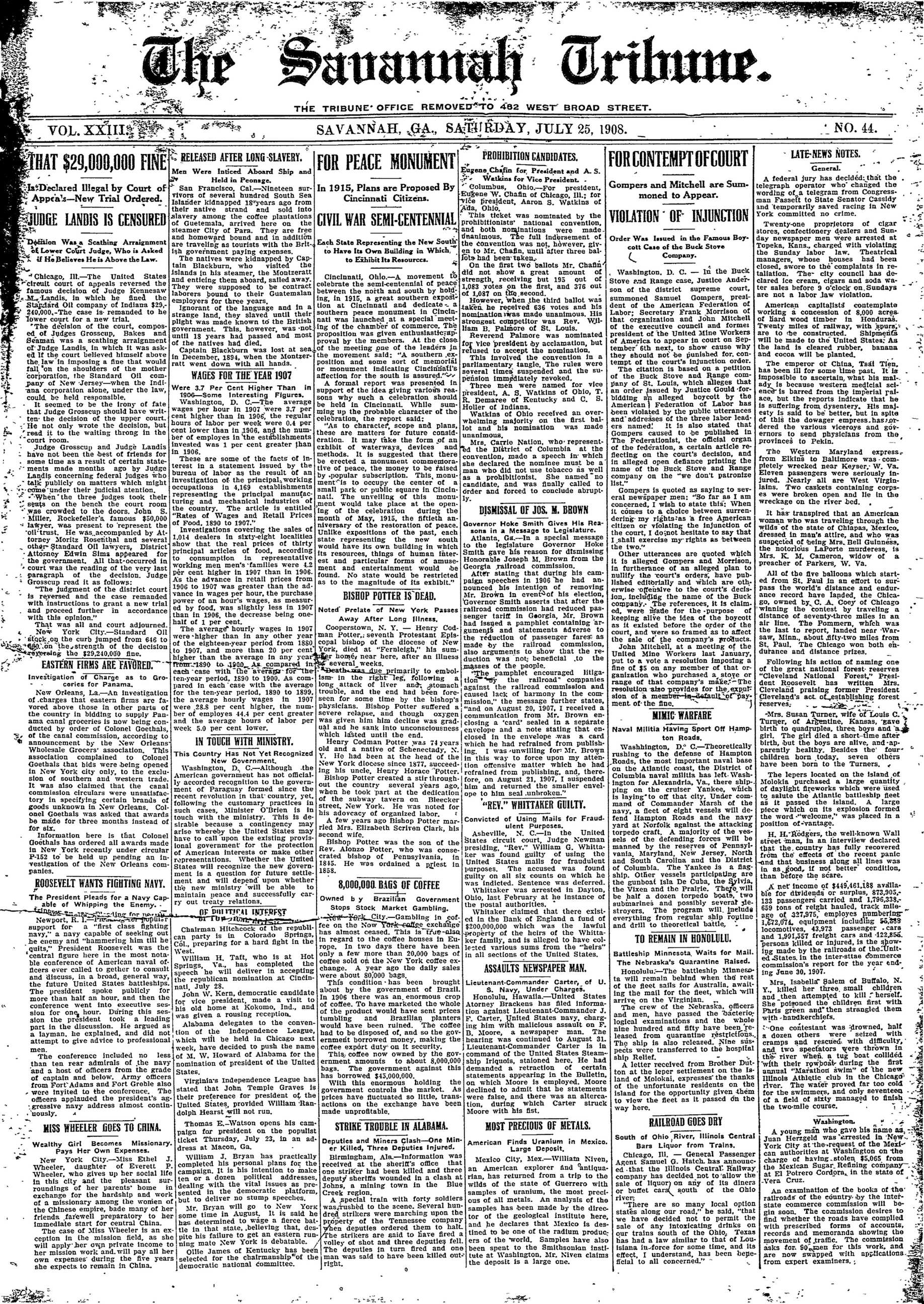
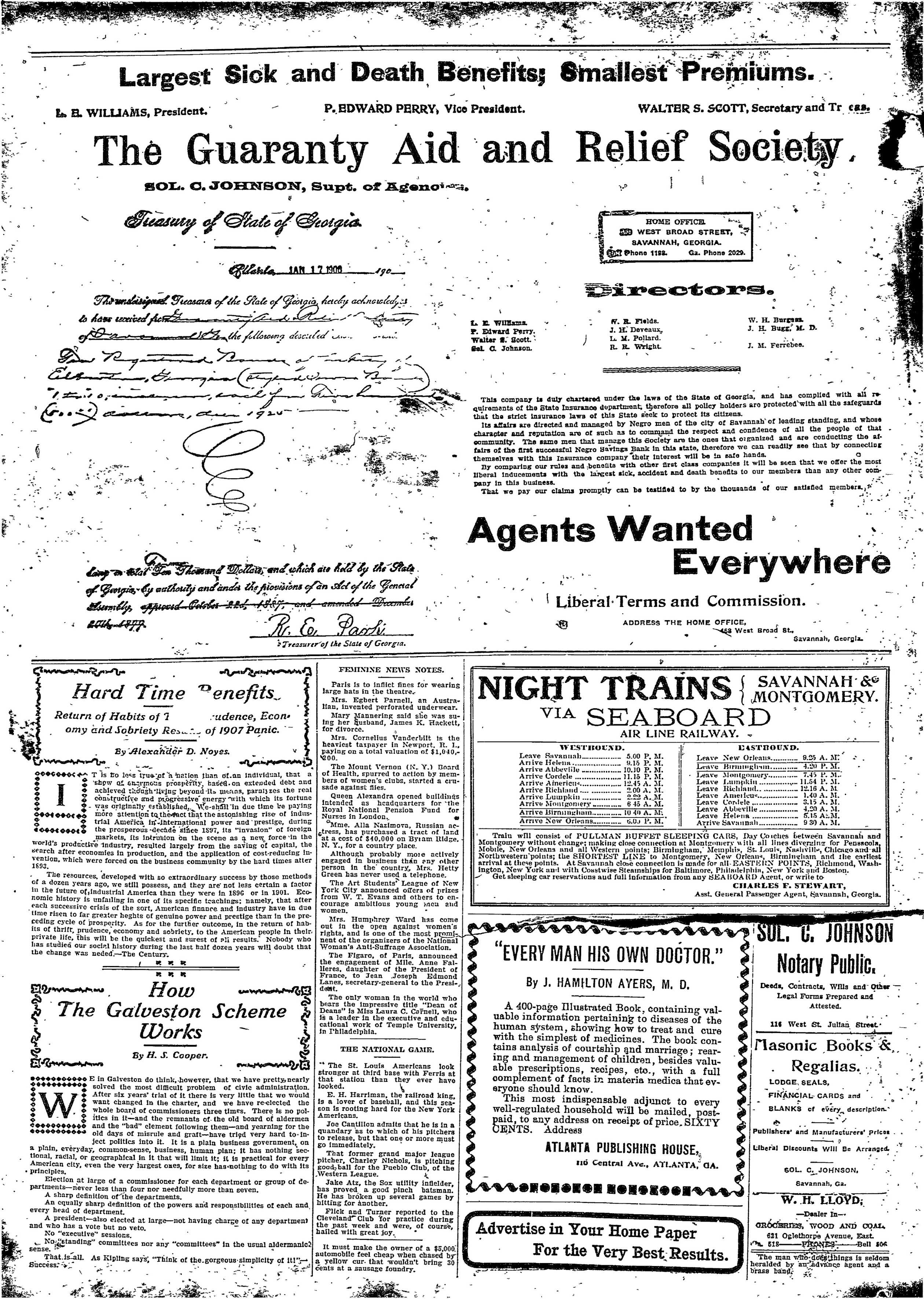
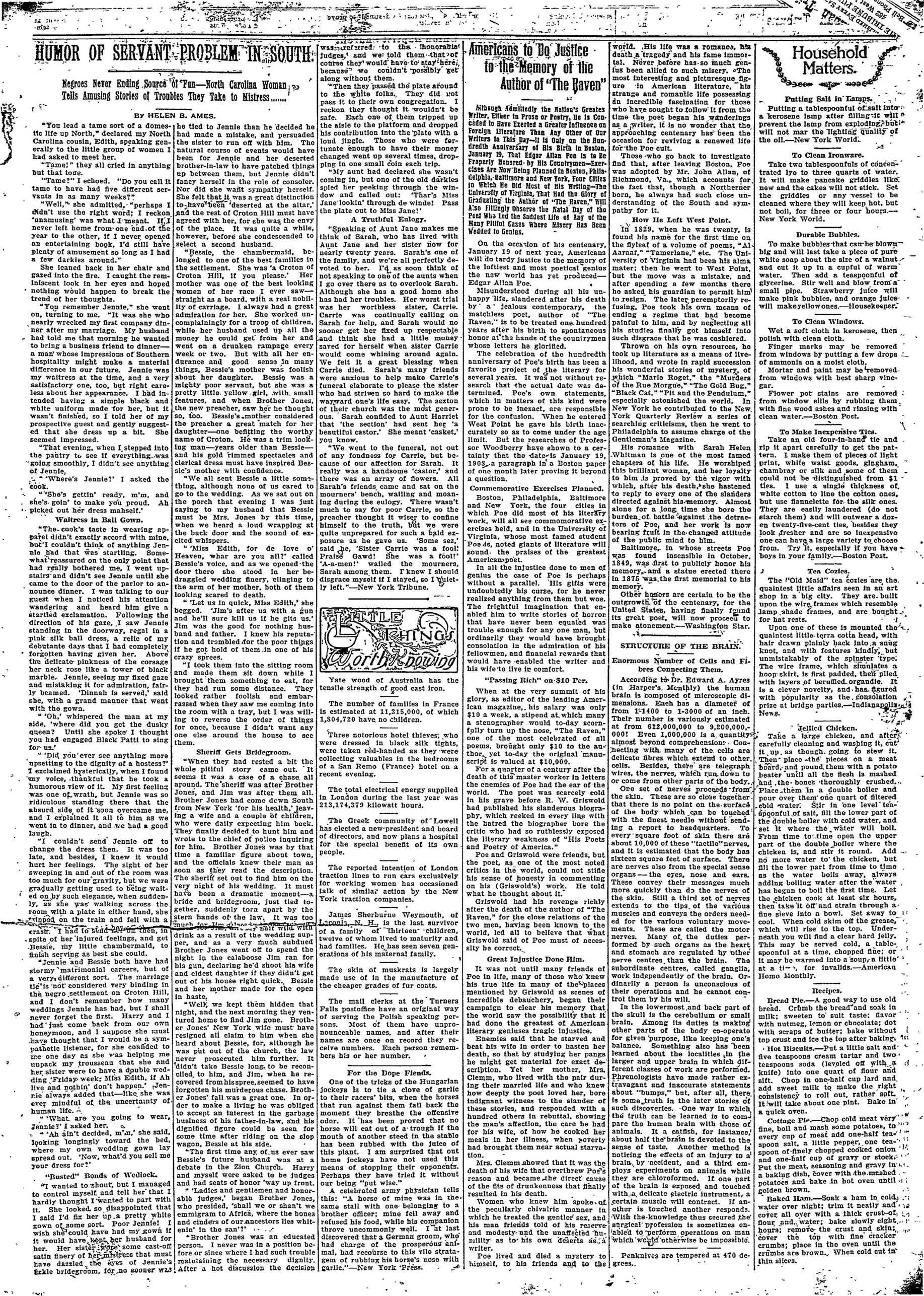
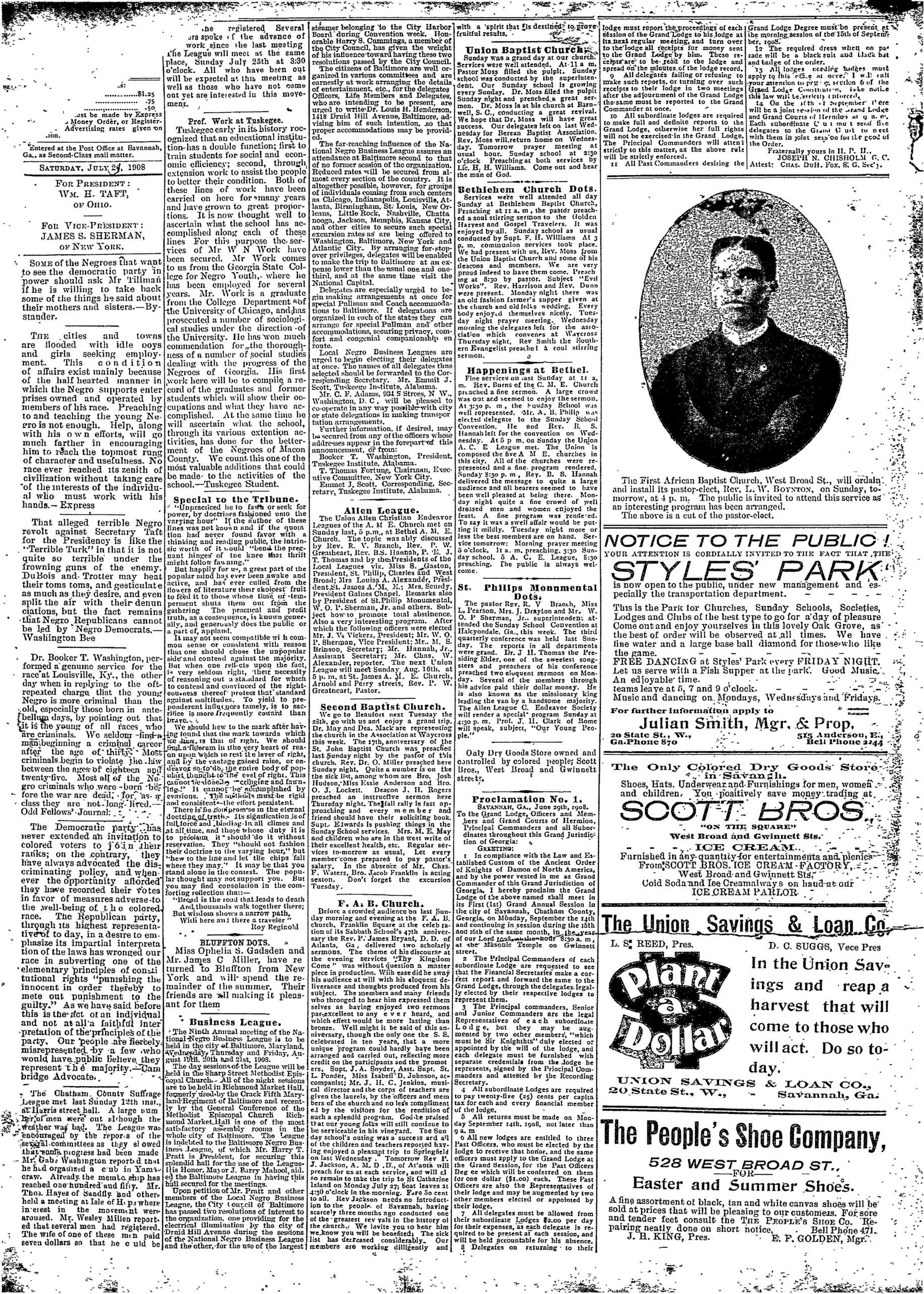
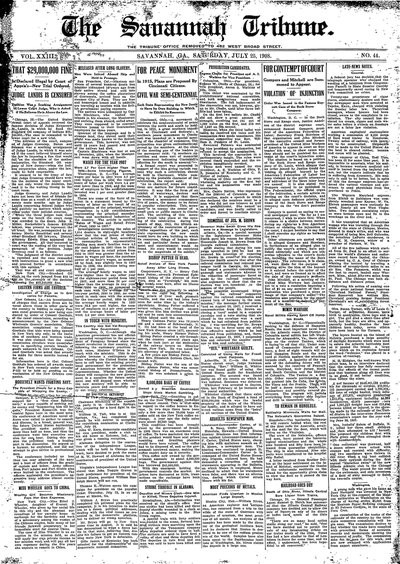
Page text (machine-generated)
In Declared Illegal by Court of
Appella's—New Trial Ordered.
JUDGE LANDIS IS CENSURED
Decision Was a Scathing Arraignment
of Lower Court Judge, Who is Asked
if He Believes He is Above the Law.
"Chicago, Ill.—The United States
circuit court of appeals reversed the
famous decision of Judge Kennesaw
M. Landis, in which he fined the
Standard Oil company of Indiana $29,
240,000. The case is remanded to he
lower court for a new trial.
"The decision of the court, composed of Judges Grosscup, Bakes and Seaman was a scathing arrangement of Judge Landis, in which it was asked if the court believed himself above the law in imposing a fine that would fall 'on the shoulders of the mother corporation, the Standard Oil company of New Jersey—when the Indiana corporation alone, under the law, could be held responsible. It seemed to be the irony of fate that Judge Grosscup should have written the decision of the upper court. He not only wrote the decision, but read it to the waiting throng in the court room. Judge Grosscup and Judge Landis have not been the best of friends for some time as a result of certain statements made months ago by Judge Landis concerning federal judges who talk publicly on matters which might come under their judicial attention.
When the three judges took their seats on the bench the court room was crowded to the doors. John S. Miller, Rockefeller's famous $50,000 lawyer, was present to represent the oil-trust. He was accompanied by Attorney Moritz Rosenthal and several other Standard Oil lawyers, District Attorney Edwin Sima appeared for the government. All that occurred in court was the reading of the very last paragraph of the decision. Judge Grosscup read it as follows:
"The judgment of the district court is reversed and the case remanded with instructions to grant a new trial and proceed further in accordance with this opinion."
That was all and court adjourned. New York City—Standard Oil stock on the curb jumped from 646 to 640 on the strength of the decision reversing the $29,240,000 fine.
EASTERN FIRMS ARE FAVORED.
Investigation of Charge as to Groceries for Panama.
New Orleans, La.-An investigation of charges that eastern firms are favored above those in other parts of the country in bidding to supply Panama canal groceries is now being conducted by order of Colonel Goethals, of the canal commission, according to announcement by the New Orleans Wholesale Grocers' association. This association complained to Colonel Goethals that bids were being opened in New York city only, to the exclusion of southern and western trade. It was also claimed that the canal commission circulars were unsatisfactory in specifying certain brands of goods unknown in New Orleans. Colonel Goethals was asked that awards be made for three months instead of for six.
Information here is that Colonel Goethals has ordered all awards made in New York recently under circular P-152 to be held up pending an investigation of the New Orleans companies.
ROOSEVELT WANTS FIGHTING NAVY.
The President Pleads for a Navy Capable of Whipping the Enemy. Newport, R.I. President popular support for a "first class fighting navy," a navy capable of seeking out he enemy and "hammering him till he quits." President Roosevelt was the central figure here in the most notable conference of American naval officers ever called to gether to consult and discuss, in a broad, general way, the future United States battleships. The president spoke publicly for more than half an hour, and then the conference went into executive session for one hour. During this session the president took a leading part in the discussion. He argued as a layman, he explained, and did not attempt to give advice to professional men.
The conference included no less than ten rear admirals of the navy and a host of officers from the grade of captain and below. Army officers from Fort Adams and Fort Groble also were inyited to the conference. The officers applauded the president's aggressive navy address almost continuously.
MISS WHEELER GOES TO CHINA.
Wealthy Girl Becomes Missionary. Pays Her Own Expenses.
New York City.—Miss Ethel J. Wheeler, daughter of Everett P. Wheeler, who gives up her social life in this city and the pleasant surroundings of her parents' home in exchange for the hardship and work of a missionary among the women of the Chinese empire, bade many of her friends farewell preparatory to her immediate start for central China.
The case of Miss Wheeler is an exception in the mission field, as she will apply her own private income to her mission work and, will pay all her own expenses' during the five years she expects to remain in China.
RELEASED AFTER LONG-SLAVERY.
Men Were Iniced Aboard Ship and Held in Penance.
San Francisco, Cal.—Nineteen survivors of several hundred South Sea Islander kidnapped 18 years ago from their native strand and sold into slavery among the coffee plantations of Guatemala, arrived on the steamer City of Parra. They are free and homeward bound and in addition are traveling as tourists with the British government paying expenses.
The natives were kidnapped by Captain Blackburn, who visited the islands in his steamer, the Montzeratt and enticing them aboard, sailed away. They were supposed to be contract laborers bound to their Guatemalan employers for three years.
Ignorant of the language and in a strange land, they slaved until their plight was made known to the British government. This, however, was not until 18 years had passed and most of the natives had died.
Captain Blackburn was lost at sea in December, 1894, when the Montzeratt went down with all hands.
WAGES FOR THE YEAR 1907
Were 3.7 Per Cent Higher than in 1906—Some Interesting Figures. Washington, D. C.-The average wages per hour in 1907 were 3.7 per cent higher than in 1906, the regular hours of labor per week were 0.4 per cent lower than in 1906, and the number of employees in the establishments invested was 1 per cent greater than in 1906. These are some of the facts of interest in a statement issued by the bureau of labor as the result of an investigation of the principal, working occupations in 4,169 establishments representing the principal manufacturing and mechanical industries of the country. The article is entitled "Rates of Wages and Retail Prices of Food, 1890 to 1907."
Investigations covering the sales of 1,014 dealers in sixty-eight localities show that the real prices of thirty principal articles of food, according to consumption in representative working men men's 'families' were 4.2 per cent higher in 1907 than in 1906. As the advance in retail prices from 1906 to 1907 was greater than the advance in wages per hour, the purchase power of an hour's wages, as measured by food, was slightly less in 1907 than in 1906, the decrease being one-half of 1 per cent.
The average hourly wages in 1907 were higher than in any other year of the eighteen-year period from 1890 to 1907, and more than 20 per cent higher than the average in any year from 1890 to 1900. As compared in each case with the average for the ten-year period, 1890 to 1900. As compared in each case with the average for the ten-year period, 1890 to 1899, the average hourly wages in 1907 were 28.8 per cent higher, the number of employees 44.4 per cent greater and the average hours of labor per week 5.0 per cent lower.
IN TOUCH WITH MINISTRY.
This Country Has Not Yet Recognized New Government,
Washington, D. C. Although the American government has not officially accorded recognition to the government of Paraguay formed since the recent revolution in that country, yet, following the customary practices in such cases, Minister O'Brien is in touch with the ministry. This is desirable because a contingency may arise whereby the United States may have to call upon the existing provisional government for the protection of American interests or make other representations. Whether the United States will recognize the new government is a question for future settlement and will depend upon whether the new ministry will be able to maintain peace and successfully carry out treaty relations.
Chairman Hitchcock of the republican party is in Colorado Springs, Col., preparing for a hard fight in the West.
William H. Taft, who is at Hot Springs, Va., has completed the speech he will deliver in accepting the republican nomination at Cinchnati, July 28.
John W. Kern, democratic candidate for vice president, made a visit to his old home at Kokomo, Ind., and was given a rousing reception.
Alabama delegates to the convention of the Independence League, which will be held in Chicago next week, have decided to push the name of M. W. Howard of Alabama for the nomination of president of the United States.
Virginia's Independence League has stated that John Temple Graves is their preference for president of the United States, provided William Randolph Hearst will not run.
Thomas E.-Watson opens his campaign for president on the populist ticket Thursday, July 23, in an address at Macon, Ga.
William J. Bryan has practically completed his personal plans for the campaign. It is his intention to make ten or a dozen political addresses, dealing with the vital issues as presented in the democratic platform, but to deliver no stump speeches.
Mr. Bryan will go to New York some time in August. It is said he has determined to wage a fierce battle in that state, believing that, despite his failure to get an eastern running mate New York is debatable.
Olle James of Kentucky has been selected for the chairmanship of the democratic national committee.
THE TRIBUNE OFFICE REMOVED TO 482 WEST BROAD STREET.
FOR PEACE MONUMENT
In 1915, Plans are Proposed By Cincinnati Citizens.
CIVIL WAR SEMI-CENTENNIAL
Each State Representing the New South to Have Its Own Building in Which to Exhibit Its Resources.
Cincinnati, Ohio.—A movement to celebrate the semi-centennial of peace between the north and south by holding, in 1915, a great southern exposition at Cincinnati and dedicate a southern peace monument in Cincinnati was launched at a special meeting of the chamber of commerce. The proposition was given enthusiastic approval by the members. At the close of the meeting one of the leaders in the movement said; "A southern exposition and some sort of memorial or monument indicating Cincinnati's affection for the south is assured.
A formal report was presented in support of the idea giving various reasons why such a celebration should be held in Cincinnati. While summing up the probable character of the celebration, the report said:
"As to character, scope and plans, these are matters for future consideration. It may take the form of an exhibit of waterways, devices and methods. It is suggested that there be erected a monument commemorative of peace, the money to be raised by popular subscription. This, monument is to occupy the center of a small park or public square in Cincinnati. The unveiling of this monument would take place at the opening of the celebration during the month of May, 1915, the fifteenth anniversary of the restoration of peace. Unlike expositions of the past, each state representing the new south would have its own building in which its resources, things of human interest and particular forms of amusement and entertainment would be found. No state would be restricted as to the magnitude of its exhibited."
BISHOP POTTER IS DEAD.
Noted Prelate of New York Passes
Away After Long Illness.
Cooperstown, N. Y. — Henry Codman Potter; seventh Protestant Episcopal bishop of the diocese of New York, died at "Fernleigh," his summer home, near here, after an illness of several weeks.
Breathe was due primarily to embolism in the right leg, following a long attack of liver and stomach trouble, and the end had been foreseen for some time by the bishop's physicians. Bishop Potter suffered a severe relapse, and though oxygen was given him him decline was gradual and he sank into unconsciousness which lasted until the end.
Henry Codman Potter was 74 years old and a native of Schenectady, N.Y. He had been at the head of the New York diocese since 1877, succeeding his uncle, Henry Horace 'Potter. Bishop Potter created a stir throughout the country several years ago, when he took part at the dedication of the subway tavern on Bleecker street, New York. He was noted for his adovacy of organized labor. A few years ago Bishop Potter married Mrs. Elizabeth Scriven Clark, his second wife. Bishop Potter was the son of the Rev. Alonzo Potter, who was consecrated bishop of Pennsylvania, in 1845. He was ordained a priest in 1858.
8,000,000 BAGS OF COFFEE
Owned by Brazilian Government Stops Stock Market Gambling.
New York City. Gambling in coffee on the New York coffee exchange has almost ceased. This is true also in regard to the coffee houses in Europe. In two days there have been only a few more than 20,000 bags of coffee sold on the New York coffee exchange. A year ago the daily sales were about 80,000 bags.
This condition has been brought about by the government of Brazil. In 1906 there was an enormous crop of coffee. To have marketed the whole of the product would have sent prices tumbling and Brazilian planters would have been ruined. The coffee had to be disposed of, and so the government borrowed money, making the coffee export duty on it security.
This coffee now owned by the government amounts to about 8,000,000 bags. The government against this has borrowed $45,000,000.
With this enormous holding the government controls the market. As prices have fluctuated so little, transactions on the exchange have been made unprofitable.
STRIKE TROUBLE IN ALABAMA.
Deputies and Miners Clash—One Miner Killed, Three Deputies Injured.
Birmingham, Ala.—Information was received at the sheriff's office that one striker had been killed and three deputy sheriffs wounded in a clash at Johns, a mining town in the Blue Creek region.
A special train with forty soldiers was rushed to the scene. Several hundred strikers were marching upon the property of the Tennessee company when deputies ordered them to halt. The strikers are said to have fired a volley of shot and three deputies fell. The deputies in turn fired and one man was said to have been killed outright.
PROHIBITION CANDIDATES
Eugene Chafin for, President and A. S. Watkins for Vice President.
Columbus, Ohio.—For president, Eugene W. Chafin of Chicago, ill.; for vice president, Aaron S. Watkins of Ada, Ohio.
This ticket was nominated by the prohibitionists' national convention, and both nominations were made unanimous. The full indulgence of the convention was not, however, given to Mr. Chafin, until after three ballots had been taken.
On the first two ballots Mr. Chafin did not show a great amount of strength receiving but 195 out of 1,083 votes on the first, and 376 out of 1,087 on the second.
However, when the third ballot was taken he received 636 votes and his nomination was made unanimous. His strongest competitor was Rev. William B. Palmore of St. Louis.
Reverend Palmore was nominated for vice president by acclamation, but refused to accept the nomination.
This involved the convention in a parliamentary tangle. The rules were several times suspended and the suspension immediately revoked. Three men were named for vice president, A. S. Watkins of Ohio, T. R. Demaree of Kentucky and C. S. Holler of Indiana. Watkins of Ohio received an overwhelming majority on the first ballot and his nomination was made unanimous. Mrs. Carrie Nation, who represented the District of Columbia at the convention, made a speech in which she declared, "he must be a man who did not use tobacco as well as a prohibitionist. She named no candidate, and was finally called to order and forced to conclude abruptly."
DISMISSAL OF JOS. M. BROWN
Governor Hoke Smith Gives His Reasons in a message to Legislature. Atlanta, Ga.—In a special message to the legislature Governor Hoke Smith gave his reason for dismissing Honorable Joseph M. Brown from the Georgia railroad commission. After stating that during his campaign speeches in 1906 he had announced his intention of removing Mr. Brown in event of his election, Governor Smith asserts that after the railroad commission had reduced passenger tariff in Georgia, Mr. Brown had issued a pamphlet containing arguments and statements adverse to the reduction of passenger fares as made by the railroad commission, also arguments to show that the reduction was not beneficial to the masses of the people.
"The pamphlet encouraged litigation by the railroad" companies against the railroad commission and caused lack of harmony in the commission," the message further states, "and on August 20, 1907, I received a communication from Mr. Brown enclosing a 'card' sealed in a separate envelope and a note stating that enclosed in the envelope was a card which he had refrained from publishing. I was unwilling for Mr. Brown in this way to force upon my attention offensive matter which he had refrained from publishing, and, therefore, on August 21, 1907, I suspended him and returned the smaller envelope to him seal unbroken."
"REV." WHITTAKER GUILTY.
Convicted of Using Mails for Fraudulent Purposes.
Asheville, N. C.-In the United States circuit court, Judge Newman presiding, "Rev." William G. Whittaker was found guilty of using the United States mails for fraudulent purposes. The accused was found guilty on all six counts on which he was indicted. Sentence was deferred. Whittaker was arrested in Dayton, Ohio, last February at he instance of the postal authorities.
Whittaker claimed that there existed in the Bank of England a fund of $200,000,000 which was the lawful property of the heirs of the Whittaker family, and is alleged to have collected various sums from the "heirs" in all sections of the United States.
ASSAULTS NEWSPAPER MAN.
Lieutenant-Commander Carter, of U.
S. Navy. Under Charges.
Honolulu, Hawaii—United States Attorney Brackens has filed information against Lieutenant-Commander J. F. Carter, United States navy, charging him with malicious assault on F. B. Moore, a newspaper man. The hearing was continued to August 31. Lieutenant-Commander Carter is in command of the United States Steamship Irquids, stalled here. He had demanded a retraction of certain statements appearing in the Bulletin, on which Moore is employed. Moore declined to admit that he statements were false, and there was an altercation, during which Carter struck Moore with his fist.
MOST PRECIOUS OF METALS.
American Finds Uranium in Mexico. Large Deposit.
Mexico City, Mex.—William Niven, an American explorer and antiquarian, has returned from a trip to the wilds of the state of Guerrero with samples of uranium, the most precious of all metals. An analysis of the samples has been made by the director of the geological institute here, and he declares that Mexico is destined to be one of the radium producers of the world. Samples have also been spent to the Smithsonian institute at Washington. Mr. Niven claims the deposit is a large one.
FOR CONTEMPT OF COURT
Gompers and Mitchell are Summoned to Appear.
VIOLATION OF INJUNCTION
Order Was Issued in the Famous Boycott Case of the Buck Stove Company.
Washington, D. C. — In the Buck Stove and Range case, Justice Anderson of the district supreme court, summoned Samuel Gompers, president of the American Federation of Labor; Secretary Frank Morrison of that organization and John Mitchell of the executive council and former president of the United Mine Workers of America to appear in court on September 6th next, to show cause why they should not be punished for, contempt of the court's injunction order.
The citation is based on a petition of the Buck Stove and Range company of St. Louis, which alleges that an order issued by Justice Gould forbidding an alleged boycott by the American Federation of Labor has been violated by the public utterances and addresses of the three labor leaders named. It is also stated that Gompers caused to be published in The Federationist, the official organ of the federation, a certain article reflecting on the court's decision, and in alleged open defiance printing the name of the Buck Stove and Range company on the "we don't patronize list."
Gompers is quoted as saying to several newspaper men: "So far as I am concerned, I wish to state this: When it comes to a choice between surrendering my rights as a free American citizen or violating the injunction of the court, I do not hesitate to say that I shall exercise my rights as between the two."
Other utterances are quoted which it is alleged Gompers and Morrison, in furtherance of an alleged plan to nullify the court's orders, have published editorially and which are otherwise offensive to the court's decision, including the name of the Buck company. The references, it is claimed, were made for the purpose of keeping alive the idea of the boycott as it existed before the order of the court, and were so framed as to affect the sale of the company's products. John Mitchell, at a meeting of the United Mine Workers last January, put to a vote a resolution imposing a fine of $5 on any member of that organization who purchased a store or range of that company's make. The resolution also provides for the expulsion of a member in default of payment of the fine.
MINIC WARFARE
Naval Militia Having Sport Off Hampston Roads
Washington, D. D. C.—Theoretically rushing to the defense of Hampton Roads, the most important naval base on the Atlantic coast, the District of Columbia naval militia has left. Washington for Alexandria, Va., there shipping on the cruiser Yankee, which is laying* to off that city. Under command of Commander Marsh of the navy, a fleet of eight vessels will defend Hampton Roads and the navy yard at Norfolk against the attacking torpedo craft. A majority of the vessels of the defending forces will be manned by the reserves of Pennsylvania, Maryland, New Jersey, North and South Carolina and the District of Columbia. The Yankee is a flagship. Other vessels participating are the gunboat Isla De Cuba, the Sylvia, the Vixen and the Prairie. There will be half a dozen torpedo boats, two submarines and possibly several die-stroyers. The program will, include everything from regular ship routines and drill to theoretical battle.
TO REMAIN IN HONOLULU.
Battleship Minnesota, Waits for Mail. The Nebraska's Quarantine Raised. Honolulu.-The battleship Minnesota will remain behind when the rest of the fleet sails for Australia, awaiting the mail for the fleet, which will arrive on the Virginian. The crew of the Nebraska, officers and men, have passed the bacteriological examinations and the whole nine hundred and fifty have been released from quarantine restrictions. The ship is also released. Nine suspects were transferred to the hospital ship Relief. A letter received from Brother Dutton on the leper settlement on the Island of Molokai, expresses the thanks of the unfortunate residents on the island for the opportunity given them to view the fleet as it passed on the way here.
RAILROAD GOES DRY
South of Ohio River, Illinois Central Bars Liquor from Trains.
Chicago, Ill. — General Passenger Agent Samuel G. Hatch has announced that the Illinois Central Railway company has decided not to allow the sale of liquor) on any of its diners or buffer cars south of the Ohio river.
"There are so many local option states along our road," he said, "that we have decided not to permit the sale of any intoxicating drinks on our trains south of the Ohio. Texas has had a law similar to that of Louisiana in force for some time, and its effect, I understand, has been beneficial to all concerned."
NO.44.
A federal jury has decided; that the telegraph operator who changed the wording of a telegram from Congressman Fassett to State Senator Cassidy and temporarily saved racing in New York committed no crime.
Twenty-one proprietors of cigar stores, confectionery dealers and Sunday newspaper men were arrested at Topeka, Kans., charged with violating the Sunday labor law. Theatrical managers, whose houses had been closed, swore to the complaints in retaliation. The city council has declared ice cream, cigars and soda water sales before 9 o'clock on Sundays are not a labor law violation.
American capitalists contemplate working a concession of 8,000 acres of hard wood timber in Honduras. Twenty miles of railway, with spurs; are to be constructed. Shipments will be made to the United States; As the land is cleared rubber, banana and cocoa will be planted.
The emperor of Chitna, Tsai Tien, has been ill for some time past. It is impossible to ascertain, what his malady is because western medicinal science is barred from the imperial palace, but the reports indicate that he is suffering from dysentery. His majesty is said to be better, but in spite of this the dowager empress, has ordered the various viceroys and governors to send physicists from the provinces to Pekin.
The Western Maryland express, from Elkins to Baltimore was completely wrecked near Keyser, W. Va. Eleven passengers were seriously injured. Nearly all are West Virginiaains. Two caskets containing corpses were broken open and lie in the wreckage on the river bed.
It has transpired that an American woman who was traveling through the wilds of the state of Chiapas, Mexico, dressed in man's attire, and who was suspected of being Mrs. Bell Guinness, the notorious LaPorte murderess, is Mrs. K. M. Cameron, widow of a preacher of Parkers, W. Va.
All of the five balloons which started from St. Paul in an effort to surpass the world's distance and endurance record have landed, the Chicago, owned by C. A. Coey of Chicago winning the contest by travelling a distance of seventy-three miles in an air line. The Pommern, which was the last to report, landed near Warsaw, Minn., about fifty-two miles from St. Paul. The Chicago won both endurance and distance prizes.
Following his action of naming one of the great national forest reserves "Cleveland National Forest," President Roosevelt has written Mrs. Cleveland praising former President Cleveland's act of establishing forest reserves.
Mrs. Susan Turner, wife of Louis C. Turner, of Argentine, Kansas, gave birth to quadruples, three boys and a girl. The girl died a short-time after birth, but the boys are alive, and apparently healthy. Besides the four children born today, seven others have been born to the Turners.
The lepers located on the island of Molokia purchased a large quantity of daylight fireworks which were used to salute the Atlantic battleship fleet as it passed the island. A large piece which on its explosion formed the word "welcome," was placed in a position of-vantage.
H. H. Rodgers, the well-known Wall street man, in an interview declared that the country has fully recovered from the effects of the recent panic and that business along all lines was in as good, if not better condition, than before the scare.
A net income of $449,461,188 available for dividends or surplus, 873,905-133 passengers carried and 1,796,333-659 tons of reight hauled, track mileage of 327,975, employees numbering 1,672,074 equipment including 55,238 locomotives, 43,973 passenger cars and 1,991,557 freight cars and 122,855 persons killed or injured, is the showing made by the railroads of the United States. In the inter-stae commerce commission's report for the year ending June 30, 1907.
Mrs. Isabella Balem of Buffalo, N. Y., killed her three, small children and then attempted to kill herself. She poisoned the children first with Paris green and then strangled them with handkerchiefs.
One contestant was drowned, half a dozen others were seized with cramps and rescued with difficulty, and two spectators were thrown in the river when a tug boat collided with their rowboat during the first annual "Marathon swim" of the new Illinois Athletic club in the Chicago river. The water proved far too cold for the swimmers, and only seventeen of a field of sixty managed to finish the two-mile course.
Washington.
A young man who gave his name as Juan Herzgeld was arrested in New York City at the-request of the Mexican authorities at Washington on the charge of having stolen $5,065 from the Mexican Sugar Refining company at El Potrote罗 Cordora, in the state of Vera Cruz.
An examination of the books of the railroads of the country by the interstate commerce commission will begin soon. The commission desires to find whether the roads have complied with prescribed forms of accounts, records and memoranda showing the movement of traffic. The commission asks for 90 men for this work, and are now swapped with applications from expert examiners;
a Largest Sick and Death Benefits; Smallest Premiums. .. =
° . - SS . . ge
_ Ey BL WILLIAMS, President.’ : - P.. EDWARD PERRY, Vice President. WALTER S. SCOTT, Secretary and Tr as. - “4
‘+, No. a —_ 0 a ”
~The Guaranty Aid and Relief Society. aq
a ee gig ; sR ea
Coe ee Agents Wanted;
a np m 00 DS Tamang Tillend hich ae bald ly the Pte Everywhere
gf Pooigie, by anthouly and ind he fiorisions fan el of the Geneal Ct . . fj
Pasaibly, <fpicced—Colebes BB APG end —ervended —eambs 6 ' Liberal-Terms and Commission. - 2
(§ BOthgod FPR of fy & PD . iy sos _¢ Bi ‘ADDRESS THE HOME OFFICE, . we 2
. f 2 ; = ARS West aread BL, - . ; 7
° ._oé 8 Treasurer of the State of Georgia. oe me me San STE e
Memen te pita ae AP perernn
lard Time ?enefits.
Return of Habits of 7. vudence, Econ ,
. omy and Sobriety Res.:._ of 1907 Panic. ~~
. ae “Alexahiér D. Noyes. - v
geeccecc en T is to iess true‘of ‘a ‘nation than of.an Individual, that a
e $ ‘show of Gnarmous prosperity, based.on extended debt and
$ @ achieved thdugh‘livjng beyond -its metas, paralyzes the real
3} 3 constructive and progréssive’ energy with which its fortune
$ - Fas originatty established, We-shfil’in due time ke paying
See¢eooces More attention ta thefact that the astonishing rise of indus-
g trial Amefica hf-international power and ‘prestige, during
Soecceserd the prosperous -dechde ‘Bifice 1897, its “invasion” of foreign
.., markets, its Intrusion on the scene as q new, force in the
world’s productive industry, resulted largely from the saving of capital, the
search after economies in production, and the application of cost-reducing !n-
ig which were forced on the business community by the bard times atter
# The resources, developed with so extraordinary success by those methods
of a dozen years ago, we still possess, and they are‘ not less certain a factor
in the future of;industrial America than they were In 1896 or in 1901. Eco
nomic history is unfailing in one of its specific teachings; namely, that after
.f€ach successive crisis of the sort, American finance and industry have in due
time risen to far greater heghts of genuine power and prestige than In the pre-
ceding cycle of prosperity. As for the further outcome, in the return of hab-
its of thrift, prudence, economy and sobriety, to the American people In thelr.
private life, this will be the quickest and surest of sti results. Nobody who
has studied our social history during the last half dozen years wil] doubt that
the change was neded—-The Century. .
pomermes = Foy “
The Galveston Scher
Works ~
By H. 5. Cooper.
= in Galveston do think,-however, that we have pretty, nearly
solved the most dificult problem of civic administration.
After six years’ trial of it there is very little that we would
want changed in the charter, and we have re-elected the
whole board of commissioners three times. There Is no pol-
itics in it~and the remnants of. the old board of aldermen
and the “bad” clement following them—and yearning for the
old days of misrule and graft~—have tried very hard to-in-
oo ee eee, Se eee Se See gee Tee:
° @ After six years’ trial of it there is very little that we would
2 $ want changed in the charter, and we have re-elected the
° + & whole board of commissioners three times, There is no pol-
s - % itics in it—and the remnants of. the old board of aldermen
$0090900090 and the “bad” clement following them—and yearning for the
00900000063 old days of misrule and graft—have trigd very hard to-in-
ject politics into it. It is a plain business government, on
a plain, evéryday, common-sense, business, human plan; it has nothing sec-
tonal, racial, or geosraphical in it that will limit it; it is practical for every
American city, even the very largest ones, for size has-nothing to do with its
principles, . 7
Election at large of a commissioner for each department or group of de
partments—neyer less than four nor needful ly more than seven.
A sharp definition of“the departments.
An cqually sharp definition of the powers and responsibilities of each and,
every head of department. :
. A president—also elected at large—not having charge of any departmen?
and who has a vote but no veto, =
No “executive” sessions, , .
an No,jstanding” committees nor any “committees” in the usual aldermantc’
ense, ** %
. That.is-all. As Kipling says, “Think of the.gorgeous:simplicity of it!"
Success: “> wear Ewe ew oe et
FEMININE NEWS NOTES.
Paris is to inflict fines for wearing
large hats in the theatre.
Mrs. Egbert Parnell, an Austra-
Man, invented perforated underwear.
Mary [annering said she was su-
ing her Rusband, James K. Hackett,
| for divorce. 7
Mrs. Cornelius Vanderbilt ts the
heaviest taxpayer in Newport, R. L.,
paying on a total valuation of $1,040,-
‘200.
The Mount Vernon (i. Y.) Board
oft Health, spurred to action b¥ mem-
bers of women’s clubs, started a cru-
sade against files.
Queen Alexandra opened buildings
intended as headquarters for ‘the
Royal National Pension Fund for
Nurses in London, °
°Mme. Alla Nazimova, Russian ac-
gtress, has purchased a tract of land
“at a cost of $40,000 on Byram Ridge,
_N, ¥., for a country place.
| Although probably more actively
engaged in business thdn eny other
person in the’ country, Mrs. Hetty
Green has never used a telephone.
The Art Students’ League of New
York City announced offers of prizes
from W. T. Evans and others to en-
courage ambitious young iaeu and
women, .
Mrs. Humphrey Ward has come
out in the open against women’s
rights, and is one of the most promi-.
nent of the organizers of the National
‘Woman's Anti-Suffrage Assoclation.
The Figaro, of Paris, announced
the engagement of Mile. Anne Fal-
Meres, daughter of the President of
France, to Jean Joseph Edmond
Lanes, secretary-general to the Presi-,
dant.
The only woman in the world who
bears the impressive title “Dean of
Deans” Is Miss Laura C. Cafnell, wno
ig a leader in the executive and edu-
cational work of Temple University,
in I’hiladelphia.
THE NATIONAL GAME.
“ The St. Louis Americans look
stronger at third base with Ferris at
‘that station than they ever haye
looked. \
E. H. Harriman, the railroad king,
is a@ lover of baseball, and this sea-
son is rooting hard for the New York
Americans.
Joe Cantillon admits that he is ina
quandary as to which of his pitchers
to release, but that one or more must
go immediately, 7
That former grand major league
pitcher, Charley Nichols, is pitching
good,ball for the Pueblo Club, of the
-Western League. x
Jake Atz, the Sox utility inflelder,
has proved a good pinch batsman.
He has broken up several games by
hitting for Another.
Flick and Turner reported to the
Cleveland” Club for practice during
the past week and were, of course,
hailed with great joy. ar
it must make the owner of a $5,000,
automobile feel cheap when chased by
a yellow cur. that wouldn’t bring 30
cents at a sausage foundry,
z . x
i HOME OFFICE re [a ss :
. 3 8) WEST BROAD STREBT, -7]
. _ SAVANNAH, GEORGIA. 7 .
3 @yit Phone 1188. Ga. Phone 2029. fF ~ ee.
Brat et
= = 7 .
Si wrectors. g
° a fg
> WLR Fields. W. HL Burgas a
J. H. Deveaux, J. H Bugz, D. =
} L. M. Pollard. -o oe
R. BR Wright. ns . J. M. Ferrebee.
a
Pere OA ae .
‘This company ts duly chartered under the laws of the State of Georgia, and has complied with all re
quirements of the State Insurance department, therefore all policy holders aro protected‘ with ail the safeguards
that the strict insurance laws of this State seek to protect its citizens.
Its affairs are directed and managed by Negro men of the city of Savannah’ of leading standing, and whose
character and reputation are of such as to command the respect and confidences cf all the people of that
community. The same men that manzge this Gociety are the ones that organized and are conducting the af-
fairs of the first successful Negro Savings Bank !n this state, therefore we can readily see that by connecting
themselves with this Insurance company ‘thelr interest will be ‘n safe hands, a
By comparing our rules and ,benelits with other first class compantes It will be seen that we offer the most
Wberal inducements with the largest sick, accident and death bonofits to our members than any other com-
pany in this business. - * . @ ns
That we pay our claims promptly can be testified to by the thousands of our satisfied members.,* :
ais
-
NIGHT TRAINS RONTODMEBY.
: MONTGOMERY.
AIR LINE RAILWAY. ~ a
a I a ee eee
WESTBROUND. it EASTROUND. :
Leave Savanuah_............. 5.00 P, M. | Leave New OrJeaus.......... 9.25 A.MI0 2 .
Aniive Helen voces $13 BM. | Leave HiMminghaM cen S20 PM
Arrive Cordele secssssssesen 113 PLM + Leave Montgoneryanccne Tas Bo Me
Arrive Ainerictt......cu00,00 1245 AL Leave Lumpkin... 1154 PLM. z
Arrive Richland... .....--- 200A, ML \ Leave Richland... ....-....... 1216 A. M
Arrive Lumpkin wee 2.22 ALM. | Leave Ameiivuc.uscernee 140 A.M. *
Arrive Moutgoniery 2.0.0 645 A.M. 1 Peave Coe neee shasesieeyes aa a Be
Arrive Birnunghat...n- WADAMR |} Yeave Helena acccccnee B15 ALM.
Arrive New Orleans........- 6.0) P.M. | Atrive Savannah... 930A. ML
eee
*| Train will consist of PULLMAN BUFFET SLEEPING CARS, Day Corches between Savannah and
Montgomery without change; making close connection at Montgomery with all lines divergins for Pensacola,
Mobile, New Orleans and all Western points; Birmlugham, Memphis, St. Louis, Nashville, Chicago and-all
Northwestern points; the SHORTEST LINE to Montgomery, New Orleans, Birmingham and the eartiest
arrival at these points. At Savannah close connection is made for all- EASTERN POINTS, Richmond, Wash-
ington, New York an: with Coustwise Steamships for Baltimore, Philadelphin, New York and Boston.
| ‘Get sleeping car reservations aud full information irom any SEABOARD Azent, or write to
= . CHARLES F. STEWART,
3 Asst, General Passenger Agent, Savannah, Georgia.
ee i a i = a
@ “EVERY MAN HIS OWN DOGTOR.”
-_
By J. HAMILTON AYERS, M. D.
A 400-page Hlustrated Book, containing val-
uable information pertaining to diseases of the
human system, showing how to treat and eure
with the simplest of medicines. The book con-
tains analysis of courtship and marriage; rear- _
ing and management of children, besides valu-
able prescriptions, recipes, eto., with a full
complement of facts in materia medica that ey-
. sryone should know.
This most indispensable adjunct to every
woll-regulated household wiil be mailed, posi- ¢
aid, to any addross on receips of price, SIXTY
RENTS. Address
ATLANTA PUBLISHING HOUSE,,
116 Central Ave, eg
f
E222 SE SESESE ROEOROOR
Advertise in Your Home Paper.
For the Very Best-Results.
r
‘SUL, G. JOHNSON
' 8
| ..
| Notary Public
1 Se
Deeds, Contracts, Wflls and” Other —
Legal Forms Prepared and ee
Attested.
ae Ee
116 West St, Julian Street- :
se
: in
Masonic Books &,.
s . 5
. Regalias....2 _
| LODGE, SEALS, 4
“FINANCIAL CARDS and ©.
- BLANKS cf every, description
a vy . i
Publishers’ and Manufacturers’ prices .
: ——a8 i “os
‘Liberal Discounts WIIl Be Arranged. |
SOL. C, JOHNSON,
Savannah, Ga. 7 oe
oe
W.HELOYD; =; .
—Dealer in— ‘
GROCERIES, WOOD AND COAL,
621 Oglethorpe Avenue, East.
%m. 518 ——PHONES————Bell 508
“The man who-doésithings is seldom
heralded by au-advance agent and a
brass band: ee :
HUMOR OF SERVANT PROBLEM IN SOUTH.
BY HELEN B. AMES.
"You lead a tame sort of a domestic life up North," declared my North Carolina cousin, Edith, speaking generally to the little group of women I had asked to meet her.
"Tame! they all cried in anything but that tone.
"Tame? I echoed. "Do you call it tame to have had five different servants in as many weeks?"
"Well," she admitted, "perhaps I didn't use the right word; I reckon 'unamusing' was what I meant. If I never left home from one end of the year to the other, if I never opened an entertaining book, I'd still have plenty of amusement so long as I had a few darkies around."
She leaned back in her chair and gazed into the fire. I caught the reminiscent look in her eyes and hoped nothing would happen to break the trend of her thoughts.
"You remember Jennie," she went on, turning to me. "It was she who nearly wrecked my first company dinner after my marriage. My husband had told me that morning he wanted to bring a business friend to dinner—a man whose impressions of Southern hospitality might make a material difference in our future. Jennie was my waitress at the time, and a very satisfactory one, too, but right careless about her appearance. I had intended having a simple black and white uniform made for her, but it wasn't finished, so I told her of my prospective guest and gently suggested that she dress up a bit. She seemed impressed.
"That evening, when I stepped into the pantry to see if everything was going smoothly, I didn't see anything of Jennie.
"‘Where's Jennie?’ I asked the cook.
"She's gettin' ready, m'm, and she's-goin' to make you proud. Ah picked out her dress mahself."
"The cook's taste in wearing apparel didn't exactly accord with mine, but I couldn't think of anything Jennie had that was startling. Somewhat reassured on the only point that had really bothered me, I went upstairs and didn't see Jennie until she came to the door of the parlor to announce dinner. I was talking to our guest when I noticed his attention wandering and heard him give a startled exclamation. Following the direction of his gaze, I saw Jennie standing in the doorway, regal in a pink silk ball dress, a relic of my dobutante days that I had completely forgotten having given her. Above the delicate pinkness of the corsage her neck rose like a tower of black marble. Jennie, seeing my fixed gaze and mistaking it for admiration, fairly beamed. 'Dinahn is served,' said she, with a grand manner that went with the gown.
"Oh," whispered the man at my side, 'where did you get the dusky queen? Until she spoke I thought you had engaged Black Patti to sing for us."
"Did you ever see anything more upsetting to the dignity of a hostess?" I exclaimed hysterically, when I found my voice, thankful that he took a humorous view of it. My first feeling was one of wrath, but Jennie was so ridiculous standing there that the absurd side of it soon overcame me, and I explained it all to him as we went in to dinner, and we had a good laugh.
"I couldn't send Jennie off to change the dress then. It was too late, and besides, I knew it would hurt her feelings. The sight of her sweeping in and out of the room was too much for our gravity, but we were gradually getting used to being wattled on by such elegance, when suddenly, as she was walking across the room with a plate in either hand, she stepped on the train and fell with a crash. I had to send her off then, in spite of her injured feelings, and get Bessie, my little chambermaid, to finish serving as best she could.
"Jennie and Bessie both have had stormy matrimonial careers, but of a very different sort. The marriage tie's not considered very binding in the negro settlement on Croton Hill, and I don't remember how many weddings Jennie has had, but I shall never forget the first. Harry and I had 'just come back from our own honeymoon, and I suppose she must have thought that I would be a sympathetic listener, for she confided to me one day as she was helping me unpack my trousseau that she and her sister were to have a double wedding. 'Friday week; Miss Edith, if Ah live and nothin' don't happen.' Jennie always added that—like she was ever mindful of the uncertainty of human life."
"What are you going to wear, Jennie?" I asked her.
"Ah ain't decided, m'm,' she said, looking longingly toward the bed, where my own wedding gown lay spread out. 'Now, what'd you sell me your dress for?"
"Busted" Bonds of Wedlock.
"I wanted to shout, but I managed to control myself, and tell her that I hardly thought I wanted to part with it. She looked so disappointed that I said I'd fix her up a pretty white gown or some sort. Poor Jennie! I wish she could have had my gown if it would have kept her husband for her. Her sister had some cast-off satin finery of her mistress that must have dazzled the eyes of Jennie's tickle bridegroom, for no sooner was
Waltress in Ball Gown.
he tied to Jennie than he decided he had made a mistake, and persuaded the sister to run off with him. The natural course of events would have been for Jennie and her deserted brother-in-law to have patched things up between them, but Jennie didn't fancy herself in the role of consoler. Nor did she want sympathy herself. She felt that it was a great distinction to have been 'deserted at the altar,' and the rest of Croton Hill must have agreed with her, for she was the envy of the place. It was quite a while, however, before she condescended to select a second husband.
"Bessie, the chambermaid, belonged to one of the best families in the settlement. She was a 'Croton of Croton Hill, if you please.' Her mother was one of the best looking women of her race I ever saw—straight as a board, with a real nobility of carriage. I always had a great admiration for her. She worked uncomplainingly for a troop of children, while her husband used up all the money he could get from her and went on a drunken rampage every week or two. But with all her endurance and good sense in many things, Bessie's mother was foolish about her daughter. Bessie was a mighty poor servant, but she was a pretty little yellow girl, with small features, and when Brother Jones, the new preacher, saw her he thought so, too. Bessie's mother considered the preacher a great match for her daughter—one befitting the worthy name of Croton. He was a trim looking man—years older than Bessie—and his gold rimmed spectacles and clerical dress must have inspired Bessie's mother with confidence.
"We all sent Bessie a little something, although none of us cared to go to the wedding. As we sat out on the porch that evening I was just saying to my husband that Bessie must be Mrs. Jones by this time, when we heard a loud wrapping at the back door and the sound of excited whispers.
"Miss Edith, for de love o' Heaven, whar are you all?" called Bessie's voice, and as we opened the door she she stood in her bedraggled wedding finery, clinging to the arm of her mother, both of them looking scared to death.
"Let us in quick, Miss Edith,' she begged. 'Jim's after us with a gun and he'll sure kill us if he gits us.' Jim was the good for nothing husband and father. I knew his reputation and trembled for the poor things if he got hold of them in one of his crazy sprees.
"I took them into the sitting room and made them sit down while I brought them something to eat, for they had run some distance. They looked rather foolish and embarrassed when they saw me coming into the room with a tray, but I was willing to reverse the order of things for once, because I didn't want any one else around the house to see them.
Sheriff Gets Bridegroom.
"When they had rested a bit the whole pitiful story came out. It seems it was a case of a chase all around. The sheriff was after Brother Jones, and Jim was after them all. Brother Jones had come down South from New York 'for his health,' leaving a wife and a couple of children, who were dally expecting him back. They finally decided to hunt him and wrote to the chief of police inquiring for him. Brother Jones was by that time a familiar figure about town, and the officials knew their man as soon as they read the description. The sheriff set out to find him on the very night of his wedding. It must have been a dramatic moment—a bride and bridegroom, just tied together, suddenly torn apart by the stern hands of the law. It was too much for Jim, in my half wild with drink as a result of the wedding supper, and as a very much subdued Brother Jones went off to spend the night in the calaboose Jim ran for his gun, declaring he'd shoot his wife and eldest daughter if they didn't get out of his house right quick. Bessie and her mother made for the open in haste.
"Well, we kept them hidden that night, and the next morning they ventured home to find Jim gone. Brother Jones' New York wife must have resigned all claim to him when she heard about Bessie, for, although he was put out of the church, the law never prosecuted him further. It didn't take Bessie long, to be reconciled, to him, and Jim, when he recovered from his spree, seemed to have forgotten his murderous chase. Brother Jones' fall was a great one. In order to make a living he was obliged to accept an interest in the garbage business of his father-in-law, and his dignified figure could be seen for some time after riding on the slop wagon, Bessie at his side.
"The first time any of us ever saw Bessie's future husband was at a debate in the Zion Church. Harry and myself were asked to be judges and had seats of honor 'way up front."
"Ladies and gentlemen and honorable judges," began Brother Jones, who presided, 'shall we or shouldn't emmigram to Africa, where the bones and cinders of our ancestors lies whitenin' in the san'?' "Brother Jones was an educated person. I never was in a position before or since where I had such trouble maintaining the necessary dignity. After a hot discussion the decision
was referred to the honorable judges,' and we told them that of course they would have to stay here, because" we couldn't possibly get along without them.
"Then they passed the plate around to the white folks. They did not pass it to their own congregation. I reckon they thought it wouldn't be safe. Each one of the platform tripped up the aisle to the platform and dropped his contribution into the plate with a loud jingle. Those who were fortunate enough to have their money changed went up several times, dropping in one small coin each trip.
"My aunt had declared she wasn't coming in, but one of the old darkies sped her peeking through the window and called out: 'Thar's Miss Jane lookin' through de winde! Pass the plate out to Miss Jane!'
A Truthful Eulogy.
"Speaking of Aunt Jane makes me think of Sarah, who has lived with Aunt Jane and her sister now for nearly twenty years. Sarah's one of the family, and we're all perfectly devoted to her. I'd as soon think of not speaking to one of the aunts when I go over there as to overlook Sarah. Although she has a good home she has had her troubles. Her worst trial was her worthless sister, Carrie. Carrie was continually calling on Sarah for help, and Sarah would no sooner get her fixed up respectable and think she had a little money saved for herself when sister Carrie would come whining around again. We felt it a great blessing when Carrie died. Sarah's many friends were anxious to help make Carrie's funeral elaborate to please the sister who had striven so hard to make the wayward one's life easy. The sexton of their church was the most generous. Sarah confided to Aunt Harriet that 'the section' had sent her 'a beautiful castor.' She meant 'casket,' you know.
"We went to the funeral, not out of any fondness for Carrie, but because of our affection for Sarah. It really was a handsome 'castor,' and there was an array of flowers. All Sarah's friends came and sat on the mourners' bench, walling and moaning during the eulogy. There wasn't much to say for poor Carrie, so the preacher thought it wiser to confine himself to the truth, but we were quite unprepared for such a bald exposure as he gave us. 'Some sez,' said he, 'Sister Carrie was a fool! Praise Gawd!' She was a fool! 'A-a-men!' walled the mourners, Sarah among them. I knew I should disgrace myself if I stayed, so I quietly left."—New York Tribune.
LITTLE THING
Worth knowing
Yate wood of Australia has the tensile strength of good cast iron.
The number of families in France is estimated at 11,315,000, of which 1,804,720 have no children.
Three notorious hotel thieves; who were dressed in black silk tights, were taken red-handed as they were collecting valuables in the bedrooms of a San Remo (France) hotel on a recent evening.
The total electrical energy supplied in London during the last year was 213,174,379 kilowatt hours.
The Greek community of Lowell has elected a new president and board of directors, and now plans a hospital for the special benefit of its own people.
---
The reported intention of London traction lines to run cars exclusively for working women has occasioned talk of similar action by the New York traction companies.
James Sherburne Weymouth, of Laconia, N. H., is the last survivor of a family of thirteen children, twelve of whom lived to maturity and had families. He has seen seven generations of his maternal family.
The skin of muskrats is largely made use of in the manufacture of the cheaper grades of fur coats.
The mail clerks at the Turners Falls postoffice have an original way of serving the Polish speaking persons. Most of them have unpronounceable names, and after their names are once on record they receive numbers. Each person remembers his or her number.
For the Done Fiends.
One of the tricks of the Hungarian jockeys is to tie a clove of garlic to their racers' bits, when the horses that run against them fall back the moment they breathe the offensive odor. It has been proved that no horse will eat out of a trough If the mouth of another steed in the stable has been rubbed with the juice of this plant. I am surprised that out home jockeys have not used this means of stopping their opponents. Perhaps they have tried it without our being "put wise."
A celebrated army physician tells this: "A horse of mine was in the same stall with one belonging to a brother officer; mine fell away and refused his food, while his companion throve uncommonly well. I at last discovered that a German groom, who had charge of the prosperous animal, had recourse to this vile stratagem of rubbing his horse's nose with garlic."—New York Press.
Americans to Do Justice to the Memory of the Author of "The Raven'
Although admittedly the Hellen's Greatest Writer, Either in Prose or Poetry, He is Conceded to Have Exerted a Greater Influence on Foreign Literature Than Any Other of Our Writers in This Day. It Is Only on the Hundredth Anniversary of His Birth in Boston, January 19, That Edgar Allan Poe is to Be Properly Honored by His Courtmen—Exercises Are Now Being Planned in Boston, Philadelphia, Baltimore and New York, Four Chiles in Which He Did Most of His Writing—The University of Virginia, That Had the Glory of Graduating the Author of "The Haven," Will Also Fittingly Observe the Rational Life of the Poet Who Led the Saddest Life of Any of the Many Philified Cases Where Misery Has Been Wedded to Genius.
On the occasion of his centenary, January 19 of next year, Americans will do tardy justice to the memory of the loftiest and most poetical genius the new world has yet produced—Edgar Allan Poe.
Misunderstood during all his unhappy life, slandered after his death by a jealous contemporary, the matchless poet, author of "The Raven," is to be treated one hundred years after his birth to spontaneous honor at the hands of the countrymen whose letters he glorified.
The celebration of the hundredth anniversary of Poe's birth has been a favorite project of the literary for several years. It was not without research that the actual date was determined. Poe's own statements, which in matters of this kind were prone to be inexact, are responsible for the confusion. When he entered West Point he gave his birth inaccurately so as to come under the age limit. But the researches of Professor Woodberry have shown to a certainty that the date is January 19, 1905, a paragraph in a Boston paper of one month later proving it beyond a question.
Commemorative Exercises Planned.
Boston, Philadelphia, Baltimore and New York, the four cities in which Poe did most of his literary work, will all see commemorative exercises held, and in the University of Virginia, whose most famed student Poe is, noted giants of literature will sound the praises of the greatest American poet. In all the injustice done to men of genius the case of Poe is perhaps without a parallel. His gifts were undoubtedly his curse, for he never realized anything from them but woe. The frightful imagination that enabled him to write stories of horror that have never been equaled was trouble enough for any one man, but ordinarily they would have brought consolation in the admiration of his fellowmen, and financial rewards that would have enabled the writer and his wife to live in comfort.
"Passing Rich" on $10 Pcr.
When at the very summit of his glory, as editor of the leading American magazine, his salary was only $10 a week, a stipend at which many a stenographer would to-day scornfully turn up the nose, "The Raven," one of the most celebrated of all poems, brought only $10 to the author, yet to-day the original manuscript is valued at $10,000.
For a quarter of a century after the death of this master worker in letters the enemies of Poe had the ear of the world. The poet was scarcely cold in his grave before R. W. Griswold had published his slanderous biography, which reeked in every line with the hatred the biographer bore the critic who had so ruthlessly exposed the literary weakness of "His Poets and Poetry of America."
Poe and Griswold were friends, but the poet, as one of the most noted critics in the world, could not stifle his sense of honesty in commenting on his (Griswold's) work. He told what he thought about it.
Griswold had his revenge richly after the death of the author of "The Raven," for the close relations of the two men, having been known to the world, led all to believe that what Griswold said of Poe must of necessity be correct.
Great Injustice Done Him.
It was not until many friends of Poe in life, many of those who knew his true life in many of the places mentioned by Griswold as scenes of incredible debauchery, began their campaign to clear his memory that the world saw the possibility that it had done the greatest of American literary geniuses tragic injustice. Enemies said that he starved and beat his wife in order to hasten her death, so that by studying her pangs he might get material for exact description. Yet her mother, Mrs. Clemm, who lived with the pair during their married life and who knew how deeply the poet loved her, hore indignant witness to the slander of these stories, and responded with a hundred others in rebuttal, showing the man's affection, the care he had for his wife, of how he cooked her meals in her illness, when poverty had brought them near actual starvation.
Mrs. Clemm showed that it was the death of his wife that overthrew Poe's reason and became the direct cause of the fits of drunkenness that finally resulted in his death.
Women who knew him spoke of the peculiarly chivalric manner in which he treated the gentler sex, and his man friends told of his reserve and modesty and the unaffected humility as to his own deserts as a writer.
Poe lived and died a mystery to himself, to his friends and to the
world. His life was a romance, his death a tragedy and his fame immortal. Never before has so much genius been allied to such misery. The most interesting and picturesque figure in American literature, his strange and romantic life possessing an incredible fascination for those who have sought to follow it from the time the poet began his wanderings as a writer, it is no wonder that the approaching centenary has been the occasion for reviving a renewed life for the Poet cult.
Those who go back to investigate find that, after leaving Boston, Poet was adopted by Mr. John Allan, of Richmond, Va., which accounts for the fact that, though a Northerner born, he always had such close understanding of the South and sympathy for it.
How He Left West Point.
In 1829, when he was twenty, is found his name for the first time on the flyleaf of a volume of poems, "Al Aarraat," "Tamerlane," etc. The University of Virginia had been his alma mater; then he went to West Point, but the move was a mistake, and after spending a few months there he asked his guardian to permit him to resign. The later peremptorily refusing, Poe took his own means of ending a regime that had become painful to him, and by neglecting all his studies finally got himself into such disgrace that he was cashiered.
Thrown on his own resources, he took up literature as a means of livelihood, and wrote in rapid succession his wonderful stories of mystery, of which "Marie Roget," the "Murders of the Rue Morgue," "The Gold Bug," "Black Cat," "Pit and the Pendulum," especially astonished the world. In New York he contributed to the New York Quarterly Review a series of searching criticisms, then he went to Philadelphia to assume charge of the Gentleman's Magazine.
His romance with Sarah Helen Whitman is one of the most famed chapters of his life. He worshiped this brilliant woman, and her loyalty to him is proved by the vigor with which, after his death, she hastened to reply to every one of the slanders directed against his memory. Almost alone for a long time she bore the burden of battle against the detractors of Poe, and her work is now bearing fruit in the changed attitude of the public mind to him.
Baltimore, in whose streets Poe was found insensible in October, 1849, was first to publicly honor his memory, and a statue erected there in 1875 was the first memorial to his memory.
Other honors are certain to be the outgrowth of the centenary, for the United States, having finally found its great poet, will now proceed to make atonement.—Washington Star.
STRUCTURE OF THE BRAIN
Enormous Number of Cells and Fibres Connecting Them.
According to Dr. Edward A. Ayres (in Harper's, Monthly) the human brain is composed of microscopic dimensions. Each has a diameter of from 1-1400 to 1-3000 of an inch. Their number is variously estimated at from 612,000,000 to 9,200,000,000! Even 1,000,000 is a quantity almost beyond comprehensions. Connecting with many of the cells are delicate fibres which extend to other cells. Besides, these are telegraph wires, the nerves, which run down to or come from other parts of the body.
One set of nerves proceeds from the skin. These are so close together that there is no point on the surface of the body which can be touched with the finest needle without sending a report to headquarters. To every square foot of skin there are about 10,000 of these "tactile" nerves, and it is estimated that the body has sixteen square feet of surface. There are nerves also from the special sense organs—the eyes, nose and ears. These convey their messages much more quickly than do the nerves of the skin. Still a third set of nerves extends to the tips of the various muscles and conveys the orders needed for the various voluntary movements. These are called the motor nerves. Many of the duties performed by such organs as the heart and stomach are regulated by other nerve centres than the brain. The subordinate centres, called ganglia, work independently of the brain. Ordinarily a person is unconscious of their operations and he cannot control them by his will.
In the lowermost and back part of the skull is the cerebullum or small brain. Among its duties is making other parts of the body co-operate for given purpose, like keeping one's balance. Something also has been learned about the localities in the larger and upper brain in which different classes of work are performed. Phrenologists have made rather extravagant and inaccurate statements about "bumps," but, after all, there is some truth in the later stories of such discoveries. One way in which the truth can be learned is to compare the human brain with those of animals. It a catfish, for instance, about half the brain is devoted to the sense of taste. Another method is noticing the effects of an injury to a brain by accident, and a third employs experiments on animals while they are chloroformed. If one part of the brain is exposed and touched with a delicate electric instrument, a certain muscle will contract. If another is touched another responds. With the knowledge thus secured the surgical profession is sometimes enabled to perform operations on man which would otherwise be impossible.
Penkulves are tempered at 470 degrees.
Household Matters.
Putting Salt in Lamps.
Putting a tablespoonful of salt into a kerosene lamp after filling it will prevent the lamp from exploding; but will not mar the lighting quality of the oil.—New York World.
Take two tablespoonfuls of concentrated lye to three quartes of water. It will make pancake griddles like new and the cakes will not stick. Set the griddles or any vessel to be cleaned where they will keep hot, but not boil, for three or four hours.—New York World.
Durable Bubbles.
To make bubbles that can be blow big and will last take a piece of pure soap about the size of a walnut and cut it up in a cupful of warm water. Then add a teaspoonful of glycerine. Stir well and blow from a small pipe. Strawberry juice will make pink bubbles, and orange juice will make yellowones.—Housekeeper.
To Clean Windows.
Wet a soft cloth in kerosene, then polish with clean cloth.
Finger marks may be removed from windows by putting a few drops of ammonia on a moist cloth.
Mortar and paint may be removed from windows with best sharp vinegar.
Flower pot stains are removed from window sills by rubbing them with fine wood ashes and rinsing with clean water.—Boston Post.
To Make Inexpensive Tiles.
Take an old four-in-hand tie and rlp it apart carefully to get the pattern. I make them of pieces of light print, white waist goods, gingham, chambray or silk and some of them could not be distinguished from $1 ties. I use a single thickness of white cotton to line the cotton ones, but use flannelette for the silk ones. They are easily laundered (do not starch them) and will outwear a dozen twenty-five-cent ties, besides they look fresher and are so inexpensive one can have a large variety to choose from. Try it, especially if you have boys in your family.—Boston Post.
Tea Cozies.
The "Old Maid" tea cozies are the quaintest little affairs seen in an art shop in a big city. They are built upon the wire frames which resemble lamp shade frames, and are bought for hat rests.
Upon one of these is mounted the quaintest little terra cotta head, with hair drawn plainly back into a snug knot, and with features kindly, but unmistakably of the spinster type. The wire frame, which simulates a hoop skirt, is first padded, then plied with layers of berumed organdle. It is a clever novelty, and has figured with popularity as the consolation prize at bridge parties.—Indianapolis News.
Jellied Chicken.
Take a large chicken, and after carefully cleaning and washing it, cut it up, as though, going to stew it. Then place the pieces on a meat board, and pound them with a potato beater until all the flesh is mashed and the bones thoroughly crushed. Place them in a double boiler and pour over them one quart of filtered cold water. Stir in one level teaspoonful of salt, fill the lower part of the double boiler with cold water, and set it where the water will boil. From time to time open the upper part of the double boiler where the chicken is, and stir it round. Add no more water to the chicken, but fill the lower part from time to time as the water boils away, always adding boiling water after the water has begun to boil the first time. Let the chicken cook at least six hours, then take it off and strain through a fine sieve into a bowl. Set away to cool. When cold skim off the grease, which will rise to the top. Underneath you will find a clear hard jelly. This may be served cold, a table-spoonful at a time, chopped fine; or it may be warmed into a soup, a little at a time, for invalids.—American Home Monthly.
Recipes.
Bread Pie.—A good way to use old bread. Crumb the bread and soak in milk; sweeten to suit taste; flavor with nutmeg, lemon or chocolate; dot with scraps of butter; bake without top crust and ice the top after baking. Hot Biscuits.—Put a little salt and five teaspoons cream tartar and two teaspoons soda (levelled off with a knife) into one quart of flour and sift. Chop in one-half cup lard and add sweet milk to make the right consistency to roll out, rather soft. It will take about one pint. Bake in a quick oven. Cottage Pie.—Chop cold meat very fine, boll and mash some potatoes, to every cup of meat add one-half teaspoon salt, a little pepper, one teaspoon of finely chopped cooked onion and one-half cup of gravy or stock. Put the meat, seasoning and gravity in a baking dish, cover with the mashed potatoes and bake in hot oven until golden brown.
Baked Ham.—Soak a ham in cold, water over night; trim it neatly and cover all over with a thick crust-of flour and, water; bake slowly eight hours; remove the crust and skin; cover the top with fine cracker crumbs; place in the oven until the crumbs are brown. When cold cut in thin slices.
FOR VICE-PRESIDENT:
JAMES S. SHERMAN,
OF NEW YORK.
Some of the Negroes that want
to see the democratic party in
power should ask Mr. Tillman
if he is willing to take back
some of the things he said about
their mothers and sisters.—Bystander.
The cities and towns are flooded with idle ooys and girls seeking employment. This condition of affairs exist mainly because of the half hearted manner in which the Negro supports enterprises owned and operated by members of his race. Preaching to and teaching the young Negro is not enough. Help, along with his own efforts, will go much farther in encouraging him to reach the topmost rung of character and usefulness. No race ever reached its zenith of civilization without taking care of the interests of the individual who must work with his hands.—Express
That alleged terrible Negro revolt against Secretary Taft for the Presidency is like the "Terrible Turk" in that it is not quite so terrible under the frowning guns of the enemy. DuBois and Trotter may beat their toms toms, and gesticulate as much as they desire, and even split the air with their denunciations, but the fact remains that Negro Republicans cannot be led by Negro Democrats.—Washington Bee
Dr. Booker T. Washington, performed a genuine service for the race at Louisville, Ky., the other day when in replying to the oft-repeated charge that the young Negro is more criminal than the old, especially those born in antebellum days, by pointing out that it is the young of all races who are criminals. We seldom find a man beginning a criminal career after the age of thirty. Most criminals begin to violate the law between the ages of eighteen and twenty-five. Most all of the Negro criminals who were born before the war are dead, for as a class they are not long lived.—Odd Fellows' Journal.
The Democratic party has never extended an invitation to colored voters to join their ranks; on the contrary, they have always advocated the discriminating policy, and whenever the opportunity afforded they have recorded their votes in favor of measures adverse to the well-being of the colored race. The Republican party, through its highest representative of to day, in a desire to emphasize its impartial interpretation of the laws has wronged our race in subverting one of the elementary principles of constitutional rights "punishing the innocent in order thereby to mete out punishment to the guilty." As we have said before this is the act of an individual and not at all a faithful interpretation of the principles of the party. Our people are fiercely misrepresented by a few who would have public believe, they represent the majority.—Cambridge Advocate.
The Chatham, County Suffrage League met last Sunday 12th mat, at Harris street hall. A large number of men were out although the weather were bad. The League was encouraged by the reports of the sexual committees as they slowed that sonic progress had been made. Mr. Gabe Washington reported that he had organized a club in Yamacraw. Already the meme ship has reached one hundred and fifty. Mr. Thos. Hayes of Sandy and other held a meeting at Isle of Wake where interest in the movement were aroused. Mr. Wesley Millen reported that several men had registered. The wife of one of these men paid seven dollars so that he could be
the registered Several ers spoke of the advance of work since the last meeting the League will meet at the same place, Sunday July 25th at 3:30 o'clock. All who have been out will be expected at this meeting as well as those who have not come out yet are interested in this movement.
Prof. Work at Tuskegee.
Pron. Work at Tuskegee.
Tuskegee early in its history recognized that an educational institution has a double function; first to train students for social and economic efficiency; second, through extension work to assist the people to better their condition. Both of these lines of work have been carried on here for many years and have grown to great proportions. It is now thought well to ascertain what the school has accomplished along each of these lines. For this purpose the services of Mr W N Work have been secured. Mr Work comes to us from the Georgia State College for Negro Youth, where he has been employed for several years. Mr. Work is a graduate from the College Department of the University of Chicago, and has prosecuted a number of sociological studies under the direction of the University. He has won much commendation for the thoroughness of a number of social studies dealing with the progress of the Negroes of Georgia. His first work here will be to compile a record of the graduates and former students which will show their occupations and what they have accomplished. At the same time he will ascertain what the school, through its various extension activities, has done for the betterment of the Negroes of Macon County. We count this one of the most valuable additions that could be made to the activities of the school.—Tuskegee Student.
Special to the Tribune.
But happily for us, a great part of the popular mind has ever been awake and active, and has ever cured from the flowers of literature their choicest fruit to feed it to those whose time or temperment shuts them out from the gathering. The prenatal and profit truth, as a consequence, is known generally, and generously does the public or a part of amu land.
It may not seem compatible with common sense or consistent with reason that one should choose the unpopular side and contend against the majority. But when one reef-cuts upon the fact, it is very seldom right, their necessity of reasoning out a standard for which to contend and convinced of the right-eouness thereof protector that standard is more likely to be ponderent influences tamely, is to sacrifice is more frequently coward than brave.
We should hew to the mark after having found that the mark towards which we wew, is that of right. We should find a fulerum in the very heart of reason upon which to rest the lever of right, and by the vantage gained raise, or endeavor so to do, the entire body of populart thought to the level of right. This cannot be doledy "crifting and fawning." It cannot be accomplished by evasions. This methods must be rigid and consistent—the effort persistent.
There is no promise in the eternal docticing of truth. Its signification is of full force and blinding in all climes and at all time, and those whose duty it is to proclaim it should do it without reservation. They "should not fashion their doctrine to the varying hour," but shew to the line and tell the chip fall with the same force that the chip stand alone in the contest. The popular thought may not support you. But you may find consolation in the comforting reflection that:—
"Broad is the road that leads to death
And thousands walk together there;
But wisdom shows a narrow path,
Withi here and there a traveler"
Roy Reginold
BLUFFTON DOTS.
Miss Ophelia S. Gadsden and
Mr. James C Miller, have re-
turned to Bluffton from New
York and will spend the remainder of the summer. Their friends are all making it pleasant for them
Business League.
* The Ninth Annual meeting of the National Negro Business League is to be held in Maryland, Wednesday, Thursday and Friday, August 19th, 20th and 21st, 1998.
The day sessions of the League will be held in the Sharp Street Methodist Episcopal Church. All of the night sessions are to be held in Richmond Market Hall, formerly used by the Crack Fifth Maryland Regiment of Baltimore and recently by the General Conference of the Methodist Episcopal Church Richmond Market Hall is one of the most satisfactory assembly rooms in the whole city of Baltimore. The League is indebted to the Baltimore Negro Business League, of which Mr. Harry T. Pratt is President, for securing this splendid hall for the use of the League's Honor, May or J. Barry Mahool, aided the Baltimore League in having this hall secured for the meetings.
Upon petition of Mr. Pratt and other members of the Local Negro Business League, the City council of Baltimore has passed two resolutions of interest to the organization, one providing for the establishment of a Drudl Hill Avenue during the sessions of the National Negro Business League and the other, for the use of the largest
steamer belonging to the City Harbor Board during Convention week. Honorable Harry S. Cummings, a member of the City Council, has given the weight of his influence toward having these two resolutions passed by the City Council. The citizens of Baltimore are well organized in various committees and are earnest at work arranging the details of entertainment, etc., for the delegates Offices, Life Members and Delegates, who are intending to be paid are to write Dr. Louis H. Henderson 1418 Druid Hill Avenue, Baltimore, advising him of such intention, so that proper accommodations may be provided.
The far-reaching influence of the National Negro Business League assures an attendance at Baltimore second to that of no former session of the organization. Reduced rates will be secured from almost every section of the country. It is altogether possible, however, for groups of individuals coming from such centers as Chicago, Indianapolis, Louisville, Atlanta, Birmingham, St. Louis, New Orleans, Little Rock, Nashville, Chattanooga, Jackson, Memphis, Kansas City, and other cities to secure such special excursion rates as are being offered to Baltimore, New York, Atlantic City. By arranging for stop-over privileges, delegates will be enabled to make the trip to Baltimore at an expense lower than the usual one and one-third, and at the same time visit the National Capital.
Delegates are especially urged to begin making arrangements at once for special Pullman and Coach accommodations to Baltimore. If delegates are organized in each of the states they can arrange for special Pullman and other accommodations, securing privacy, comfort and congenial companionship en route.
Local Negro Business Leagues are urged to begin electing their delegates at once. The names of all delegates thus selected should be forwarded to the Corresponding Secretary, Mr. Emmit J. Scott, Tuskegee Institute, Alabama.
Mr. C. F. Adams, 944 S Streets, N W., Washington, D. C., will be pleased to co-operate in any way possible with city or state delegations in making transportation arrangements.
Further information, if desired, may be secured from any of the officers whose addresses appear in the forepart of this announcement, of from:
Booker T. Washington, President,
Tuskegee Institute, Alabama.
T. Thomas Fortung, Chairman, Executive Committee, New York City. Emmet J. Scott, Corresponding, Secretary, Tuskegee Institute, Alabama.
Allen League.
The Union Allen Christian Endeavor Leagues of the A. M. E. Church met on Sunday last, 5 p.m., at Bethel A. M. E. Church. The topic was ally discussed by Rev. R. V. Branch, Rev. P. W. Greatheart, Rev. B.S. Hannah, P. E. J. T. Thomas and by the Presidents of the Local Leagues viz. Miss S. Gaston, President, St. Philip, Charles and West Broad; Mrs Laura A. Alexander, President St. James A. M. E.; Mrs. Scurdy, President Gatnes Chapel. Remarks also by President of St. Philip Monumental, W. O. P. Sherman, Jr. and others. Subject how to promote total abstinence. Also a very interesting program. After which the following officers were elected Mr. J. V. Vickers, President; Mr. W. O. P. Sherman, Vice President; Mr. M. S. Brinson, Secretary; Mr. Hannah, Jr., Assistant Secretary; Mr. Chas. W. Alexander, reporter. The next Union League will meet Sunday. Aug. 10th, at 5 p.m. at St. James A. M. E. Church, Arnold and Perry streets, Rev. P. W. Greatheart, Pastor.
Second Baptist Church.
Second Baptist Church.
We go to Beaufort next Tuesday the 28th, go with us and enjoy a grand trip, Dr. May and Dea, Mack are representing the church in the Association at Waycross this week. The 17th, anniversary of the St. John Baptist Church was preached last Sunday night by the pastor of this church. Rev. Dr. O. Miller preached here Sunday night. Quite a number is on the sick list, among whom are Bro. John Bonham Essert, Ms. O. J. Lockett, Deacon J. H. Rogers preached an instructive sermon here Thursday night. The fall rally is fast approaching and every member and friend should have their soliciting book. Supt. E. Wards is pushing things in the Sunday School services. Mrs. M. E. May and children who are in the west write of their excellent health, etc. Regular services to-morrow as usual. Let every member come prepared to pay pastor's salary. In the absence of Mr. Chas. F. Waters, Bro. Jacob Franklin is acting sexton. Don't forget the excursion Tuesday.
F. A. B. Church.
F. A. B. Church
Before a crowded audience on last Sunday morning and evening at the F. A. B. church, Franklin Square at the celebration of its Sabbath School's 49th anniversary the Rev. P. James Bryant, D. D. of Atlanta, Ga, delivered two scholarly sermons. The theme of his discourse at the evening services "Why Kingdom Come" was without question a master piece in production. With ease did he swify his audience at will with his eloquent deliverance and thoughts produced from his friends. The members of his friends who brought to him expressed themselves as having enjoyed two sermons par-excellent to any ever heard, and which effect would be more lasting than bronze. Well might it be said of this anniversary, though the only one the S. S. celebrated in ten years, that a more unique program could hardly have been arranged and carried out, reflecting more credit on the participants and the promoters, Supt. J. A. Snyder, Ast. Stup. St. L. Ponder, Miss Isabell D. Johnson, musical director and the corps of teachers are given the laurels, by the officers and members of the church and no less complimented by the visitors for the rendition of such a splendid program. God be praised that our young folks will still continue to be serviceable in the vineyard. The Sunday school's outing was a success all of the children and teachers reported having an enjoyable pleasant trip to Springfield on last Wednesday. Tomorrow Rev P. J. Jackson, M. A. D. D., of At'au'the will preach for us at each service, and will 12 o'clock in the morning. Far more to all. Rev Jackson needs no introduction to all the people of Savannah, having scarcely three months ago conducted one of the greatest rev yals in the history of the church. We invite you to hear him we know you will be benefited. The sick list has decreased considerably. Our members are working diligently and
with a spirit that his destined to prove fruitful results.
Union Baptist Church
Sunday was a grand day at our church. Services were attended. At 11 a.m. Park Mose filled the pulpit. Sunday school was conducted by the superintendent. Our Sunday school is growing every Sunday. Dr. Moss filled the pulpit Sunday night and preached a great sermon. Dr. Moss is at his church at Barnwell, S. C., conducting a great revival. We hope that Dr. Moss will have great success. Our delegates left on last Wednesday for Berean Baptist Association. Rev. Moss will return home on Wednesday. Tomorrow prayer meeting at usual hour. Sunday school at 2:30 o'clock Preaching on both services by Liz. H. H. Williams. Come out and hear the man of God.
Bethlehem Church Dots.
Services were well attended all day Sunday at Bethlehem Baptist Church, Preaching at 11 a.m. the pastor preached a soul stirring sermon to the Golden Harvest and Gospel Travelers. It was enjoyed by all. Sunday school as usual conducted by Supt. F. H. Williams At 3 p.m. communion services took place. We had present with us, Rev. Moss from the Union Baptist Church and some of his deacons and members. We are very proud indeed to have them come. Preaching at 8:30 by pastor. Subject Eul Works. Rev. Hassan and Rev. Dharm were present. Monday night there was a fashion farmer's supper given at the church and old folk wedding. Every body enjoyed themselves nicely. Tuesday night prayer meeting. Wednesday morning the delegates left for the association which convenes at Wayerross Thursday night. Rev Smith the Southern Evangelist preached a soul stirring sermon.
Happenings at Bethel.
First services on last Sunday at 11 a.m. Rev. Burns of the C. M. E. Church praached a sermon. A large crowd was out and seemed to enjoy the sermon. At 3:30 p.m., the Sunday School was well represented. Mr. A. B. Philip was elected delegate to the Sunday School Convention. He and Rev. B. S. Hannableft for the convention on Wednesday. At 5 p.m. on Sunday the Union A. C. E League met. The Union is composed the five A. E. churches in this city. All of the churches were represented and a fine program rendered. Sunday 8:30 p.m., Rev. B. S. Hannah delivered the message to quite a large audience and all hearers seemed to have been well pleased at being there. Monday night quite a fine crowd of well represented men from enjoyd feast. A fine program was rendered. To say it was a swell affair would be putting it mildly. Tuesday night more or less the best members are on hand. Service tomorrow: Morning prayer meeting 5 o'clock. 1 a.m. preaching, 3:30 Sunday school. 5 A. C. E. League, 8:30 preaching. The public is always welcome.
St. Phillips Monumental Dots.
The pastor Rev. R. V Branch, Miss L. Pearson, Mrs. J. Drayton and Mr. W. O. P Sherman, Jr., superintendent, attended the Sunday School Convention at Halyondale, Ga., this week. The third quarterly conference was held last Sunday. The reports in all departments were grand. Dr. J. H. Thomas the Presiding Elder, one of the sweetest songsters and preachers of his conference preached two eloquent sermons on Monday. Several of the members through his advice paid their dollar money. He is also known as the missionary king leading the van by a handsome majority. The Allen League C. Endeavor Society will render a special* program Sunday at 4:30 p. m. Prof. J. H. Clark of Home will speak, subject, "Our Young People."
Only Dry Goods Store owned and controlled by colored people; Scott Bros., West Broad and Gwinnett streets.
Proclamation No. 1
SAVANNAH, GA., June 20th, 1908.
To the Grand Lodge, Officers and Members and Grand Courts of Hermion,
Principal Commanders and all Subordinates throughout this Grand Jurisdiction of Georgia:
GREETING:
1 In compliance with the Law and Established Custom of the Ancient Order of Knights of Damon of North America, and by the power vested in me as Grand Commander of this Grand Jurisdiction of Georgia, I hereby proclaim the Grand Lodge of the above named shall meet in its First (1st) Grand Annual Session in the city of Sayannah, Chatham County, Georgia, on Monday, September the 14th and continuing in session during the 16th and 16th of the same month, in the year of our Lord 1923, the hour 8:30 a.m. at Masonic Temple on Gwinnett street.
2 The Principal Commanders of each subordinate Lodge are requested to see that the Financial Secretaries make a correct report and forward the same to the Grand Lodge, through the delegates legally elected by their respective lodges to represent them.
3 The Principal commanders, Senior and Junior Commanders are the legal Representatives of each subordinate Lodge, but they may be augmented by two other members, "which must be Sir Knighthts" duly elected or appointed by the will of the lodge, and each delegate must be furnished with separate credentials from the Lodge he represents, signed by the Principal Commanders and attested by the Recording Secretary. All subordinate Lodges are required to pay twenty-five (25) cents per capita tax for each and every financial member of the lodge. 5 All returns must be made on Monday September 14th, 1908, not later than 9 a.m.
6 All new lodges are entitled to three Past Officers, who must be elected by the lodge to receive that honor, and the same officers must apply to the Grand Lodge at the Grand Session, for the Past Officers Dege ee which will be conferred on them for one dollar ($1.00) each. These Past Officers are also the Representatives of their lodge and may be augmented by two other members elected or appointed by their lodge.
7 All delegates must be allowed from their subordinate Lodges $2.00 per day for their expenses, as each delegate is required to be present at each session, and will be held accountable for his absence.
8 Delegates on returning to their
[Name]
The First African Baptist Church, West Broad St., will ordain and install its pastor-elect, Rev, L. W. Boynton, on Sunday, tomorrow, at 4 p.m. The public is invited to attend this service as an interesting program has been arranged. The above is a cut of the pastor-elect.
NOTICE TO THE PUBLIC YOUR ATTENTION IS CORDIALLY INVITED TO THE FACT THAT THE STYLES' PARK
This is the Park for Churches, Sunday Schools, Societies, Lodges and Clubs of the best type to go for a day of pleasure Come out and enjoy yourselves in this lovely Oak Grove, as the best of order will be observed at all times. We have fine water and a large base ball diamond for those who like the game.
The Union Savings & Loan Co.
UNION SAVINGS & LOAN CO.,
20 State St., W., Savannah, Ga.
The People's Shoe Company, 528 WEST BROAD ST. Easter and Summer Shoes.
A fine assortment of black, tan and white canvas shoes will be sold at prices that will be pleasing to our customers. For sore and tender feet consult the THE PEOPLE'S SHOE Co. Repairing neatly done on short notice. Bell Phone 471. J. B. KING. Pres. E. F. GOLDEN. Mgr.
lodge must report the proceedings of each session of the Grand Lodge to his lodge at its next regular meeting, and turn over to the lodge all receipts for money sent to the Grand Lodge by him. These receipts are to be read to the lodge and spread on the minutes of the lodge record, 9 All delegates failing or refusing to make such reports, or turning over such receipts to their lodge in two meetings after the adjournment of the Grand Lodge the same must be reported to the Grand Commander at once. 10 All subordinate lodges are required to make full and definite reports to the Grand Lodge, otherwise her full rights will not be exercised in the Grand Lodge, The Principal Commanders will attend strictly to this matter, as the above rule will be strictly enforced.
11 All Past Commanders desiring the
The First African Baptist Church and install its pastor-elect, Rev. Morrow, at 4 p.m. The public an interesting program has been The above is a cut of the past.
NOTICE TO THE
YOUR ATTENTION IS CORDIALLY
STYLES
is now open to the public, undoubtedly the transportation department. This is the Park for Churches, Lodges and Clubs of the best Come out and enjoy yourself the best of order will be observe fine water and a large base be the game. FREE DANCING at Styles' Let us serve with a Fish Supply. An edjoyable time. teams leave at 6, 7 and 9 o'clock Music and dancing on Monday.
For further information apply
Julian Smith
20 State St., W.,
Ga.Phone 870
The Only Colored Men in Savannah Shoes, Hats. Underwear and children. You position SCOTT "ON THE West Broad and ICE C仓 Furnished in any quantity from SCOTT BROS. ICE West Broad and Coid Soda and Ice Cream ICE CREAM
The Union Savi
L. S. REED, Pres.
Plant a Dollar
UNION SAVING
20 State St., W.,
The People's S
528 WEST
Easter and St
A fine assortment of black, tan
sold at prices that will be pleas
and tender feet consult the T
Grand Lodge Degree must be present at the morning session of the 15th of September, 1908.
12 The required dress when on parade will be a black suit and black hat and badge of the order.
13 All lodges needing badges must apply to this office at once. I will call your attention to preregistration 6 of the Grand Lodge Constitution, take notice this law will be strictly enforced.
14 On the 15th of September there will be a joint session of the Grand Lodge and Grand Courts of Hermitage at 9 a.m. Each of them will delegate to the Grand Court to meet with them in joint session for the good of the Order.
Fraternally yours in H. P. H.,
JOSEPH N. CHISHOLM G. C.
Attest; Chas. DUH. Fox. G. S. Gee.
March, West Broad St., will ordain L. W. Boynton, on Sunday, to be invited to attend this service as arranged, or-clocct.
THE PUBLIC INVITED TO THE FACT THAT THE S' PARK is new management and es- department.
Sunday Schools, Societies, type to go for a day of pleasure in this lovely Oak Grove, as served at all times. We have all diamond for those who like Park every FRIDAY NIGHT. Enter at the park. Good Music.
ck. Days, Wednesdays and Fridays.
Apply to
Mgr. & Prop.
515 Anderson, E., Bell Phone 2244
Dry Goods Store
Vaughh.
Furnishings for men, women lovely save money trading at BROS.
SQUARE"
and Gwinnett Sts.
CREAM...
for entertainments and picnics
THE CREAM FACTORY,
and Gwinnett Sts.
always on haud-at our PARLOR.
ings & Loan Co.
D. C. SUGGS, Vece Pres In the Union Savings and reap a harvest that will come to those who will act. Do so today.
S & LOAN CO.,
Savannah, Ga.
Shoe Company,
BROAD ST.,
Summer Shoes.
and white canvas shoes will be
ing to our customers. For sore
THE PEOPLE'S SHOE Co. Re-
notice. Bell Phone 471
If you want your refreshments to be tip top use Scott Bros, ice cream.
Mr. Robert C. Kelly of Macon, Ga., is in the city where he expects to remain until September.
You can get ice cream and cold drinks at McFall's Gwinnett Lane East Broad streets.
S. Louisa A. Alexander and Alberta left the city to-day for Lyford, Ga. Before returning will visit Sylvania, Ga.
S. L. E. Williams and daughters, Mrs. M. Logan, and Miss Julia Williams are visiting her sister Mrs. R. M. West of 73S Wa'dburg street, east.
Mrs. T. Bones accompanied by her grand son Master Chas. McGreee left on Thursday for New York to expend the summer with her daughter Mia. J. B. Miller. Remember Second Baptist Church will go to Beaufort Tuesday July 25th.
Our capacity ten gallons every fifteen minu s. Scott Bros., ice cream for entertainments and apionics.
The Svannah tt me Bys Association held a very encouraging meeting on Wednesday night at 805 West Broad street. Many new names were added o the roll.
After a stay of quite three years visitig her aunt Mrs. F. E. McNeil of Clinton, Ia., Miss Marie P. Gullard has returned home to her parents and friends
For sale a combination book case and writing desk. Price very reasonable. Call to see any time after 6 p. m. 61o Mercer street.
The Misses Florence B. Theus and Rena Singleton who have been visiting their relatives and friends at Patterson, Ga., reports a very pleasant stay and will soon return home.
Capt. Alex Brown of St. Helena was in the city this week arranging for his excursion to Beaufort. Capt Brown is well known in the city and always carries a crowd with him.
Editor W. B. Mack of the American Chronicle spent several days in the city among friends. We were glad to see him. He is a hustling editor and is making things hum in the Gem city.
Mrs. E. F. Greane has opened a private school at her residence 2000 Hardin street, Brownsville Terms reasonable. (ad.)
The home of Mr and Mrs. J. H. Preston in West Savannah was made happy by the safe arrival of a fine boy. The mother is not getting along very well. The friends are extending them congratulations.
Mrs. M. Kelley, Misses Ella Smith and Ida Shealey of Atlanta were the guests of Mr. and Mrs. Wm. Darden a few days last week while on their way to Charleston They anticipate a longer stay on their return within the next two weeks.
Why sure you are the guest of Progressive Lodge No. 97 K. of P., on July 27, 1908, on their first excursion to Beaufort. Steamer Clifton leaves foot of Abercorn street, at 9. o'clock 'sharp. Good order, plenty refreshments, and good music, Fare 50 cents. Children under 10 years 25 cents. W. H. Burgess. chairman.
Mr. and Mrs. Daniel Macon entertained a few friends with a social tea on Monday evening at their residence 510 Park Avenue lane, west. The rooms were tastily decorated and an enjoyable time was had. Among those present were Mr. and Mrs. J. W. Glover. Mrs. R. M Bowens; and Mr. Henry Walker.
H. G. W. Bufford of Pensacola,
Fla., and Prof. Mims of Georgetown, S. C., were in the city for a couple of days as guests of Mr. and Mrs. O. A. McAllister 521 Minis street. They were pleasantly entertained by Rev, Morse, Mts. M. L. Duncan and Mrs. C. Foster.
Go with Second Baptist Church to Beaufort July 28th.
Miss Essie L. Spaulding of this city left for Jacksonville Sunday morning and spent a few days with the Rev. Vanght's family, and from there she will leave for Pablo Beach Fla., to spend the remainder of the summer with her cousin Mrs. Emma Young.
For rent 2 offices 813 West Broad street, formerly occupied by Dr. Smith. Water service and toilet. Low rent to responsible parties. The Wage Barners Loan and Investment Co., 468 West Broad street.
The Tip Tops took the championship from the Bright. Stars on July 17th by a score of 7-1. LaFayette pitched a fine ball until the fifth inning and Clark held them down to one hit.
Mrs. W. H. Graham of 512 1-2 Charles street was called to her home in Darien, Ga., last week on account of the illness of her mother. She will remain there the balance of the summer.
Remember Second Baptist Church will go to Beaufort Tuesday July 28th.
The first annual picnic of Morning Star Baptist Church will be given to Styles' Park, Monday August 3rd. Tickets 35 cts. Mrs. M. E. Williams of 511-1-2 West Broad street will purchase your combings of hair. Call to see her.
The Zion Baptist Association which met with the Salem Baptist Church, Sterling, Ga., had a grand session, raising in the neighborhood of $375.00. All officers were reelected as follows: H. B. Hamilton, moderator; J. W. Thompson, vicemoderator; N. H. Whitmire, treasurer; A. Wilson, clerk.
Why sure you are the guest of Progressive Lodge No 97 K. of P., on July 27, 1908, on their first excursion to Beaulock. Steamer Clifton leaves foot of Abercorn street at 9 o'clock sharp. Good order, plenty refreshments and good music. Fare 50 cents. Children under 10 years 20 cents. W. H. Burgess, chairman.
Mrs. W. H. Floyd formerly of Savannah, Ga., but now of Jacksonville, Fla., who has been spending awhile with Mrs. W. M. Murray, was called away on last week on account of the death of her niece Miss Georgia Anderson. The friends were sympathize with her in her sad bereavement.
Mr. N. S. Perkins departed this life on Monday night and was buried from St. Paul C. V. E. Church Wednesday afternoon. He was a devoted wife and husband and christian being a class leader and usher up to the time of his fatal illness. He leaves a wife Mrs. L. M. Perkins to mourn his loss.
All of the owners of Lots in Old portions of the cemetery will kindly give the immediate attention, especially those lots in strangers porgons as the majority are in bad condition. Henry Wilts keeper of Colored Portion of Laural Grove Cemetery.
Mr. and Mrs. Jas. R. Davis of East Anderson street served tea on Monday evening in honor of Misses Jimmie Bugg of Lynchburg, Va., her friend Miss Lillian Jones, of Mississippi and Miss Ada Basecomb of Beaufort. A few hours were pleasantly while away. Those present were Misses Esther Smith, Ruleigh, N. C.; Leona Ashton, Messrs. R. E. Scott, Marion Johnson, Nathaniel Jones and JohnCarr. Misses Bugg and Jones were pleasantly entertained at the home of Miss Fanny Deveaux on Wednesday evening.
The Mutual Club will give a grand excursion to Beaufort Monday August 10th, Tickets 50 cents.
Miss Marguerite McTyre of 537 Anderson street, east, entertained a number of friends in honor of Miss Inez Adkins of Augusta, Ga. Various games were indulged in until a very late hour, after which refreshments were served. Those present were Mses J. Drayton, J. Gray, Inex Adkins of Augusta, Ga, M. Richardson, H. Nesbitt, M. Wigg, of Beaufort, S. C., S. Thomas, M. Simmons, G. Roberts, C. Rice. J. Hill, S. Freeman, L. Stuckey, R. Gilliard, and M. McTyre; Madams G. Nelson, A. Simmons, M. Grant, J. S. Adkins, L. McTyre. J. B. Graham, Messrs. T. G. Young, F. Olark, O. Lamar, P. Moore. J. B. Graham, J. Thomas, W. H Lewis M. Dunn, S. Rivers, J. Baker, C Smith, Joshua Graham, J. S. Adkins, W Hardway, R. Jaudon. S. R. Harris, G Jacobs, F. Lightburn, J. O. McTyre.
Program, Men Sunday Club.
Solo, Mies L O Jordan
Solo, Miss C Alexander
Address, The Prospects of the Negro by Dr. J Buchanan
Solo, Miss S Gaston
Solo, Miss M Clayton.
Ministers Union.
The Evangelical Ministers Union me in St Philip A. M. E. Church Dr. J. A. Lindsay in the chair. Divine services were conducted by the Shaplain Rev. W. L Cash. The Union joined in chanting "My soul be on thy guard" Sermonic reports were given by Revs. James Jackson and W. T. Moore, which were very he'pful. Commendations were offered by Revs. B. S. Hannah, R. V. Branch, W. L. Cash, J. S. Jenkins, G. H. Lennon and the president. Rev. James Jackson, Presiding Elder of the A. M. E. Church of Augusta district, gave the Union a strong lecture. The city knows Dr. Jackson's ability. Rev. Branch pastor of St. Philip Monumental preaches strong sermons. Dr. Branch generally carries the banner every year to the Annual Conference and will do it again this year. Rev. W. L. Cash, pastor of the Congregational Church is holding down things on the east side. Visitors must not fail to hear Rev. W. T Moore, pastor of St. Paul Church, Maple and West Broad streets. He is preaching all theological sermons. The reporter visited his church some time ago and was much pleased to see Dr. Moore-Sunday school and service. The public is invited to attend. Come out next Tuesday.
The Mimic World.
The latest Broadway hit is the Mimic World, just put on at the famous Casino Theatre by the Shuberts and Lew Fields. With its usual enterprise, the New York Sunday World has obtained the best song from this show and will give it away with the issue of Sunday, July 26. Everybody will want this song. Words and music complete, with handsome cover illustration. Order the Sunday World from your newsdesigner in advance.
Mrs. Ethel B. Jackson, Master I. M. Jr., and little Irma Louise are visiting friends in Tattnall County. They expect to be away two months.
In Memoriam.
In memory of my husband
Rev. G. W. GRIFFIN, D. D.,
who departed this life August 1st., 1907.
THE HOME OF THE SOUL
That unchangeable home is for you and
for me.
Where Jesus of Nazareth stands
The King of all Kingdoms forever is his
And he holdeth our crowns in His hands
Oh how sweet it will be, in that beautiful
land,
So free from all sorrow and pain
With songs on our lips and with harps in
our hands,
To meet one another again.
Wife,
LOUSIA W. GRIFFIN.
In memory of our mother
KATIE WILLIAMS,
who departed this life July 11, 1906.
Gone, but not forgotten
Thou art gone to the grave; but we will
not deplore thee;
Since God was thy ransom, thy guardian,
thy guide;
He gave thee, He look thee, and He
will restore thee;
And death has no sting since the Saviour
hath died.
Her Children,
JULIA C. WOODRUFF,
THOMAS L. WILLIAMS of N. Y.
In loving memory of our dear husband and father
SCOTT SMITH,
who departed this life July 18, 1906.
Precious one from us is gone,
A voice we loved is still,
A place is yacant in our home,
Which never can be filled.
By his loving wife and daughters,
Mrs. SYLVIA SMITH,
Mrs. FRANCES WILLIAMS, of New York;
Misses RAINEY, LEOLA and ETHEL SMITH,
Mrs. C. JACKSON, Mr. E. SMITH,
Ice Cream!
Any quantity, any time.
1 quart delivered 40c
3 quarts " 60c
3 quarts " 80c
1 gallon $1.00
SCOTT BROS.
Gwinnett and West Broad.
AMUSEMENT COLUMN.
Why sure you are the guest of Progressive Lodge No 97 K. of P., on July 27, 1908, on their first excursion to Beaufort. Steamer Clifton leaves foot of Abercorn street at 9 o'clock sharp. Good order, plenty of refreshment and good music. Fare 50 cents. Children under 10 years 20 cents. W. H. Burgess, chairman.
A pleasant outing to Daufuskie will be given by the Union Brotherhood Ladies Branch Monday August 10th. Tickets 25 and 50c.
The Imperial A. and S. Club will give a grand excursion to Beaufort Monday Aug. 3rd. Tickets 50 and 25c.
The first excursion of Progressive Lodge No. 97, K. P. will be given to Beaufort Monday July 27th. Tickets 50 and 25c.
The Charity Workers will give a grand excursion to Beaufort Wednesday July 29th. Tickets 50 and 25c.
The Early Risers S. and D, and Golden Link Societies will give a grand excursion to Daufuskie Monday July 27. Tickets 50 and 25c.
A grand excursion will be given by Protection Lodge No. 3200 G. U. O. of O. F., to Daufuskie Monday August 3rd. Tickets 50 cents.
The B. Club will give an afternoon outing to Daufuskie Wednesday August 5th. Tickets 35 cents.
The B L. B. No. 1 of the U. S. and D. of Elisha at Styles Park Tuesday August 4th. Tickets 30 and 15 cents.
The first anniversary of Willing Workers Fountain No. 2799 U. G. T. R. will be given at Masonic Temple Friday night, August 14th. Tickets 25 and 35 cents.
The Union Rosebud Nurseries U. O. T. R. will give a grand picnic at Styles Park Thursday July 30th. Tickets 35 and 25
to attend the Farmers annual excursion
5 Springfield Friday July 21st. Tickets
0 cents.
The F. A. B. Church will make its
annual trip to St. Catharine Island, Monday
July 27st. Tickets 50 cents.
The first annual excursion to Bluffton
will be given by the I. L. U. Naval Stores
Coopers Sunday July 26th. Tickets 50
cents.
The Second Baptist Church will run, a
grand excursion to Beaufort S. C., Tuesday
July 28th. Tickets 50 and 55 cents.
An entertainment will be given by
Jim Blue Benevolent Association
at Good Samaritan Hall Arnold and Jackson
streets Monday night July 27th.
Tickets 15 and 25 cents.
The Twilight Reapers and Branch will
give an excursion to Daufuskie Island,
Tuesday August 4th. Tickets 50 and 35c.
Leona Court No. 1, A. C. of C. K., of P.
E. and W. H. will give an excursion to
Washington Park, Springfield, Ga., Tuesday
Aug. 11th. Tickets 50c.
A grand entertainment will be given by the Zulus A. and S. Club at Margaret Street Hall, Monday night July 27th. Tickets 15 and 25c.
A grand combination excursion will be given to Blufton by the Ladies Union Branch of the Brotherhood Union and Ladies Imperial Branch Tuesday July 28th. Tickets 50 and 35c.
A grand concert will be given at Masonic Temple for the benefit of Gaines Chapel A. M. E. Church Monday night August 10th. Tickets 15 and 10c.
There will be a game of base ball at Bolton Street Park Wednesday July 29th between the Happy Kids and the Mohawks Tickets 10 cents.
The Magnolia A. and S. Club will give their first annual excursion to Blufton Tuesday August 18. Tickets 50 cents.
A grand barbecue and excursion will be given to Springfield by the International Brotherhood of Stationary Firemen Tuesday August 4th. Tickets 50 cents. The Mohawks B. B. A. and S. club will give a grand ball at Masonic Temple Monday night July 27th. Tickets 15 and 25 cents. A grand entertainment will be given by the Zulu A. and S. Club at Margaret street hall, Monday night July 27. Tickets 15 and 25 cents.
A grand excursion will be given by the Beth Eden Baptist church to Daufuskie, Monday August 17. Ticket 50 and 25 cts.
12.00 to 13.50 suits 9.00
15.00 to 16.50 suits 11.50
17.50 to 18.00 suits 13.50
20.00 to 22.50 suits 16.50
25.00 to 30.00 suits 20.00
32.50 to 35.00 suits 25.00
37.50 to 40.00 suits 28.50
This sale includes our entire remaining stock of medium and light weight woolens in two or three piece suits (Alpaca and Wash goods are not included in this sale)
The 27th annual entertainment will be given by the Broads A. and S Club at Harris Street Hall Monday night August 17th. Tickets 25c.
A grand two boat combination excursion will be given by the Armenia Lodge No. 1930 Bellmont Lodge No. 3693 and Household of Ruth 2381 G. U. of O. F. to Bluffton Monday August 10th. Tickets 50 and 35c.
Maceo Co. B Uniform Rank Knights of Damon will give their first grand entertainment at Masonic Temple Monday night Aug. 3rd. Tickets 15 and 25c.
A grand excursion will be given by the Stage Gang Union No. 357 at Masonic Temple Tuesday night July 28th. Tickets 15 and 25c.
A grand excursion will be given by Bonds of Love Society to Abercorn Monday Aug. 3rd. Tickets 50 and 25c.
A grand entertainment will be given by Crispus Attucks Co. 1 of Hope Lodge No. 1 K. of D. at Fair Street Hall in Woodsville Monday night July 20th. Tickets 15c.
A grand moonlight excursion will be given to Daufuskie under the auspices of the Young Men Brotherhood Protection Monday night July 27th. Tickets 35c.
Armour Lodge, 1884 G. U. O. of O. F. will run its annual excursion to Beaufort, Fuesday August.11. Tickets 50 and 35 cts. A grand excursion will be given to Beaufort by the Ladies Auxiliary Branch No 1, Monday August 17. Tickets 50 and 25 cts.
A grand entertainment and concert will be given by the Usherds Board of St John Baptist Church, at the church Monday night August 3. Tickets 10 and 25 cts.
Don't miss the first picnic of the season given by Weldon Lodge of Elks at Springfield Monday August 24. Tickets 50 and 25 cents.
The F. B. S. C. No. 1 will give a grand excursion o Daufuskie, Monday August, 17. Tickets 50 and 25 cents.
DR. L. S. PARKS
DENTIST:
240 Barnard St., Savannah, Ga.
Does all kind of high grade dental work of the best quality and workmanship. Gold crowns and bridge work. White Porcelain Pivot, and Gold Crowns mounted on the natural roots. Gold Fillings, Cement Fillings, and Silver or Amalgam Fillings, from nine to a full set of teeth $7.00 and $8.00. Broken Places mended and teeth added to old ones for a small cost. BellPhone 1244 Gold Crowns Guarantee 23% K Gold
You Should Wait For The Grand Excursion
Of the Y. G: E. A. & S. C.
To Beaufort S. C.
MONDAY JULY 20, 1908
Boat leaves 8:30 sharp. An abundance of music and refreshments. A pleasant time is assured all.
TICKETS 35 and 50 Cents.
J. H Law, Ex-officio.
Geo. N. Ferguson, Sec.
A. W. Wright, Chairman.
N. B.—The committee reserves the right to reject the holder of any ticket
Dr. J. W. Jamerson, Firstclass Dentist,
All Work Guaranteed.
623'WEST BROAD STREET.
Bet. Huntingdon and Hall.
Bell Phone 2098.
B. F. Handy & Brö,
DRY & STEAM CLEANING PRESSING & REPAIRING Ladies skirts a specialty. Bell Phone.3011 Work called for and delivered promptly. 918 West Broad St,
Miller's Resort
The Place for Picnics,
Private Parties, etc. * *
Special attractions each Monday, Wednesday and Friday nights. Transportation the best for patrons, Wagons will go down West Broad to Liberty and out Wheaton street and the Waters Road, leaving Gaston and West Broad streets at 9:30 and 11:30 p.m. Accommodation and transportation for special parties at any hour on short notice.
Fare 25 Cents. Ladies Free,
up to June 15th
Go to MILLER'S RESORT
and spend a pleasant time
A. Yelverton & Co.,
DEARER'S IN
FINE FRUITS -
ICE CREAM -
CIGARS -
CANDIES -
COLD DRINKS, Etc.,
PROMPT AND POLITE ATTENTION
524 West Broad St.
CORRESPONDENCE.
The purpose of this school is to give instructions in watchmaking and jewel- ing trades at the most liberal terms and in such a manner as will best suit the convenience of the student. Our instructions are exceedingly valuable both from an educational and a business standpoint. For further information address The DeSalms Watch School, Attica, Ind., or W. H. BROWN, Watchmaker and Jeweler, 807 West Broad St., Savannah, Ga.
Bad Mouths Made Good
Digestion Restored
When your teeth bother you consult
Dr. Geo. R. Shivery,
THE DENTIST
524½ West Broad St.
Mrs. M. E. WILLIAMS,;
Hair Dressing Parlor
SCALP TREATMENT,
SHAMPOOING,
Electric Face, Neck and Body
Massaging.
COMPLEXION BEAUTIFIED,
MANICURING
All kinds of Lady's Hair Goods,
Switches, Puffs, Pompadours, etc.
5111 West Broad Street.
Bell Phone 1111.
Shoe Repairing
GO TO
The
Atlanta Shoe Shop
Special attention paid
to Ladies and Child-
ren Shoes. Polite
attention given to all
work.
103 LIBERTY ST., WEST.
L. H.: WASHINGTON, Prop.
A New Pharmacy The People's Pharmacy
809 West Broad St.
Prescriptions carefully compounded.
Drills, Toilet Articles and Sundries.
Candles, Soda Water and Ice Cream.
J. F. Ford, Prop.
F. F. Jones,
DEALER IN
Beef - Veal - Mutton
Lamb-Pork-Hams
Goods promptly delivered to any part of the city free of charge.
STALL 31. CITY MARKET
Pigs of Large Frame.
Grow the pigs with large frame. This requires bone and muscle making feeds—alfalfa pasture, fresh, clean drinking water and just a little corn. On this diet the pig will have strong bone and large frame and be in the very best condition for taking on fat quickly and cheaply when you are ready to give him a tatting ration.—Farmers' Home Journal.
up-to-date farmer, calryman and feeder already understand the value of dismolasses or saccharine feeds. The overwhelming demand for such feeds prove this.
But the very fact that this demand is so great has produced conditions in the manufacture of saccharine feeds of which feeders should be informed, and of which they should make a note.
For Most Profit.
Cut out all the intermediates you can, and sell your product direct to the consumer, if possible. The scale of profitable disposition of dairy products is as follows, beginning with the least profitable:
Home-made butter, with whisk milk fed on farm. Whole milk sold to condensery. Whole milk sold to creamy. The use of hand separator, with cream collected by creamy, and fresh, warm skimmilk fed on the farm. Milk and cream shipped for city consumption. The retail milk route, selling the milk direct to consumers.—H. A. B. Erman, in the American Cultivator.
Demand For Good Horses
Farmers must take to breeding good horses. Such are not only needed on the farms, but it is as easy to raise a good horse which will sell at a long price as it is to raise a scrub for which there is no market. The demand for heavy horses was never better than at present, and it is likely to increase rather than do decrease. The population is centralizing in large cities. These naturally become the great distributing centres, and with increase in distribution comes increase in the demand for heavy dray horses so extensively used in such distribution. This means, therefore, that the breeding of such horses is an entirely safe venture on the part of those who will take it up on intelligent lines. Those who engage in it need not be harassed by fear that they are putting their money into a plant that will soon become useless because of depreciation in the price of horses. The great mistake in rearing horses for dray uses lies in the fact that they are too lacking in weight. Any number of horses can be bred which weigh between 1300 and 1400 pounds. The number is not large that weigh more than 1500 pounds, and realizes the latter class that is most wanted.—Farmer's Advocate.
As I am a reader of your valuable paper and seeing an item of great importance to the farmer, in regard to fertilizing of corn, will say, on account of not getting a stand of lover two years ago, I purchased an attachment for my planter for the purpose of using, commercial fertilizer and applied in the fall about eighty-five pounds, to the acre, and so well pleased with the result that I will try it again this season. My farm is of a clay timber land and considered rather poor land. I have been raising, from forty to fifty bushels per acre for the past six years on clover sod, but last year with the addition of fertilizer I raised better than sixty bushels per acre of good corn. Now there is a difference in the quality of fertilizer, I prefer the best, as it is the cheapest in the end. Of course, it costs more per ton, but we get less ground stone in the better quality. Some will tell you if you commence using if you have to keep it up. Now that is all bosh. Of course, a farmer should raise clover by all means. Clover seed will never be so high but what will pay to sow it. I paid $25 per ton for my fertilizer.—W. H. Wilson in the Indiana Farmer.
How to Test the Acidity of Soils
Supposed corrective treatments are often given to soils supposed to be acidified as a matter of fact an opposite treatment may be required. A recipe given by the Department of Agriculture for determining soil acidity is as follows:
for a half hour, a sample of the soil to be fested in a small quantity of water, say a quart. Allow it to settle, and when perfectly clear, pour on the water into a white dish and test with both blue and red litmus paper. These papers can be prepared from a dark store for a few cents. If the soil is acid, the blue litmus paper will turn blue. Ten minutes should be allowed in the water for the litmus paper to change color. If at the end of that time, there is no change, then the soil is neutral—neither acid nor alkaline.
it should be understood that, such a test as this is for a determination of whether or not a soil needs lime. The question of limeing of soil is still a mooted, still unresolved. Meht evidence has been presented to prove that limeing of soil has been most beneficial when the soil has its sense of urt. however, the soil does show strong acidity by the limeur or other positive tests, it is safe to say that limeing will be beneficial!
Saccharine Feed the Latest.
The history of that manufactured and balanced saccharine feed is a short and. The man who left the farm teatrons ago and plunged into other lions forgetting his form of cupation, smiles with incredulity when he picks up a farm or feed journal and sees Molasses needs advertised and discussed. But the
up-to-date farmer, calryman and dealer already understand the value of molasses or saccharine feeds. The overwhelming demand for such feeds prove this. I say.
But the very fact that this demand is so great has produced conditions in the manufacture of saccharine feeds of which feeders should be informed and of which they should make a note.
Demand will induce a supply of some kind, and where the demand increases rapidly, the supply is very liable to be inferior to what it would be were the demand limited to sell strictly on superior merit.
This rapidly growing demand for sackingine feeds has induced scores of manufacturers to place such feeds on the market under various names, and with almost as various ingredients. Analyses of many of these feeds reveal the fact that they contain a large amount of indigestible matter that is not even legitimate or healthy roughage; in fact, much of it is absolutely injurious to the stock. Oat hulls, rice hulls, weed seeds and other matter of neutral or harmful character have been found in large proportions by the experimental departments of animal industry in the various States.—Eptomist.
Money in Horses.
Nor were the Morgan horses the only noted horses in New England. The farmers of Maine were sufficiently adventurous, and enterprising to secure in earliest times a son of the renowned Imported Messenger, who elevated the horse stock of the State to a higher level, and left his mark that is clearly in evidence to-day, although sadly lowered by indifference and neglect. General Knox was another New England horse that left his mark and made a fortune for his owner; the first horse in the country for which the then fabulous amount of $25,000 was offered and refused. Since his time $125,000 has been paid for a single horse tiy a resident of New England to a more enterprising farmer and breeder in a Western State.
A few years back the sale catalogues of an auction firm announcing a sale of valuable blooded stock, contained a map showing Boston as a central point, and including the country within a radius of five hundred miles. From their many previous sales and tabulations they learned, and so published in this catalogue, that seventy-five per cent of all the fine horses bought, and the long prices paid for them—the kind that sold for one, two, five, ten and fifty thousand and upwards—were bought and paid for by residents within the territory shown. And yet with this great market at their very doors it is unnecessary to ask how much all this profited the New England farmer; and yet we are told by them that horses cannot be profitably raised in New England, Savo the mark!—American Cultivator.
The peach or plum rot has done a great deal of damage to the fruit crop in Oklahoma. In the summer of 1906 it was very bad on the entire crop. In the summer of 1907 it did a great deal of damage to the early peaches and plums but was not so noticeable on fruit ripening later in the season. This disease is widespread and very well known. It is known by several names as ripe rot of stone fruits; brown rot of peach and plum; fruit rot and twig blight. The disease attacks the twigs early in the growing season and causes them to turn dark and shrivel. The leaves also turn dark and wilt. Later in the season, the fungus attacks the fruit. The twigs have not suffered to any considerable extent in Oklahoma from the presence of this disease. It appears shortly before the fruit is ripe and attacks the fruit at this time. The spores of the disease find lodgment on the surface and during moist, warm weather the spores germinate rapidly and the fungus then develops rapidly. Soon after the fungus makes its entrance into the fruit small, brown circular spots appear on the surface. These brown spots go deep into the flesh of the fruit and spread very rapidly over the surface. If the weather is favorable, the entire fruit will be discolored in one hour, two days, the skin ruptured by many small pimples, that throw out large quantities of an ashy gray of dove-colored powder that entirely covers the surface. This powder is the spores of the disease and is easily spread by the wind to neighboring fruit, and there finds lodgment and, in a very few days repeats the entire process of destruction. Warm weather is especially favorable to the development of the disease and the early soft-fleshed varieties that mature and ripen during moist warm weather are especially subject to the attacks and are sometimes very difficult to protect from the disease.
Spraying the trees with Bordeaux nitrate has been found in several States to be entirely effective in protecting the plants from the disease. The trees that have been attacked by the disease should be sprayed before the growth starts in the spring. All the old, mummled, and rotted fruit that is on the ground under the trees should be gathered and burned. Oklahoma. Agricultural Experiment Press Bulletin.
- CAHAM -
Astonishing influence is ascribed to Lord Esher, personal facultum of King Edward, by the latest gossip of London. His is the responsibility for the international sensation caused by the Kaiser's Tweedmouth letter. "Illegitimate Influences at Court" are made the subject of a startling attack in one of the leading English monthlies, the National Review, and constitute the sensation of the hour in London. Following, as it does, so soon after the revelations in Berlin of the evils of the Camerilla at the Court of the Kaiser, this article forms the all-absorbing topic of discussion in political and official circles, in clubland, not alone in the British metropolis, but also in Continental capitals, and in spite of the efforts of the party whips and of the leaders, both of the Government and of the opposition, as well as of the Speaker, the matter is likely to crop up at any moment in Parliament.
The charge of "Illegitimate influences at court" has not been heard of in any reputable English print concerning a ruler of the British Empire for more than fifty or sixty years. But previous to that time it was a subject of constant denunciation as a crying evil.
SLEEP IN A CITY TREE
Flatbush Boy Makes His Summer Home in a Bid Walnut.
Sleeping outdoors in a rudely constructed house erected among the branches of a high walnut tree in the heart of Flatbush a young Polytechnic Institute student has adopted a novel method of "getting near to nature." Last year he tried this method of outdoor life, starting in the early spring and continuing until the first real snowfall of the season. The "tree house," as the people in the neighborhood call it, is located on the lawn surrounding the home of Mrs. W. T. Lees, who lives at 1704 Flatbush avenue, near Avenue I, Flatbush. W. Thompson Lees is the tree dweller. A wooden stairway winds around the tree's trunk leading to the single chamber above, allowing an easy ascent to be made. The entire structure
1
```markdown
```
is made of wood and was designed by young Lees and his chum, Vall Applegate, a freshman at Dartmouth College. The boys built the house a little more than two years ago, but it is only lately that they have converted it into a sleeping place. At first their intention was simply to build a "crow's nest" where they could seclude themselves on rainy afternoons and when it was too hot for active exercise. The "crow's nest" did not prove to be large enough, so the boys added a large platform which forms what they call their plaza. This plaza is roomy enough for an ordinary sized dining room table and comfortably accommodates six or eight diners.
After Lees and Applegate had the house completed their parents, took an interest in it. They recognized that it would be a fine place to sit in the warm weather. Mrs. Lees suggested that a stairway be added to enable the older, folk to climb to the tree top. It took the boys three months to build it.
It was last summer that Lees and Applegate decided that they would like to see how it would feel to sleep out in the open. They covered the top of the house with panes of glass and this gave them all the light, day or night, they needed. The trial worked so well that they declared
that thereafter they would, while the weather was warm, sleep in the tree. New York Sun.
Many readers may not be aware of the fact that the full moon gives several times more than twice the light of the half moon. They may be still more surprised to learn that the ratio is approximately as nine to one. Professor Joel Steblins and F. C. Brown, taking advantage of the extreme sensitiveness to light of a selenium cell, have lately measured the amount of light coming from the moon at different phases, with the result above mentioned. The reason for the remarkable difference shown is to be found in the varying angles of our satellite to the sun. The moon is brighter between the first quarter and full than between full and last quarter. The cause of this is evident in the more highly reflective
```markdown
```
character of that part of the moon which lies west of its meridian. Youth's Companion.
Pencil is Always Handy.
A recent French invention consists of a flexible support for a penell, as shown in the illustration. When the penell is used the support bends readily and is no obstruction to writing.—Philadelphia Record.
Altogether during the year 1908 there will have been under construction buildings directly or indirectly connected with Princeton University representing an expenditure of nearly $2,000,000.
Tells of Their Possibilities at "Balloon Dinner" of the Airdine Association.
Prediction that the practical attainment of aerial navigation now is truly at hand was coupled with enthusiastic and reverent tribute to the world's great inventors by the speakers at the "balloon dinner" given by the members of the Aldine Association, in their club rooms, No. 111 Fifth avenue. Professor Alexander Graham Bell, Hudson Maxim, the inventor of smokeless powder, and Major George O. Squler, U. S. A., who has had direction of many of the Government's aeronautic experiments, were among the men who, proclaimed, the day of successful aerial navigation at hand.
As showing what has been accomplished thus far in America and abroad, Augustus Post, one of the practical pioneers of the Aero Club of America, delivered an address, which was illustrated by moving pictures showing the Ville de Paris in flight, and Henry Farman making the recent dash in his airplane, which attracted attention around the world. "The flying machine," said Mr. Maxim, "is no longer confined to the realm of fancy or imagination, but the conquest of the air is already far advanced, and the era of practical utility is near. In the not distant future we shall have our automobiles of the air, and in the wars of the future we shall have our aerial battleships, our cruisers, our torpedo boats and torpedo boat destroyers. But they will be airy, frail and fair craft, indeed, compared with the grim steel monsters of the sea.
"Although the value of the flying machine in future wars will be mainly as a scouting craft, still its value and importance for that service alone is hard to overestimate, for the flying machine videttes will be at once the eyes and ears of the armies of the future.
"Possibly, too, we shall have our torpedo hawk, taloned with dynamite, which will swoop down out of the sky. Although flying machines could not be expected successfully to attack battleships, coast fortifications or large cities and work much damage with high explosives, still they might attack torpedoes and small torpedo craft with aerial bombs planted and exploded beside them under water.
"The more highly scientific war enginey becomes, more and more will, home and country be defended by machinery and less by blood. Fewer and fewer men will be obliged to engage in the trade of war, and more and more will be able to devote themselves to personal pursuits. Less and less will war be the arbiter of nations. The aerial navy will be the great bulwark of peace and a very great step toward the permanence of peace. And as mercy is largely a product of civilization, future conquest will be more and more tempered with mercy until mercy shall have conquered war. Altruism is born of love, but international love-making must be done with armor on."—New York Herald.
A Clever Animal.
Mayor Tom L. Johnson, of Cleveland, has been pluckily fighting a law-infringing street railway. He tore up the railway's tracks, an injunction was served against him, and then he in his turn secured another injunction.
"We are like the old lady and the dog, with our injunctions and mandamuses and what not," said Mayor Johnson the other day.
"There was, you know, an old lady who rented a furnished villa for the summer, and with the villa a large dog also went.
"In the sitting room of the villa there was a comfortable armchair. The old lady liked this chair better than any other in the house. She always made for it the first thing.
"But, alas, she nearly always found the chair occupied by the large dog.
"Being a child of the dog, she did not bid it harshly to get out of the chair, as she feared that it might bite her, but instead she would go to the window and call 'cats.' "Then the dog would rush to the window and bark, and the old lady would slip into the vacant chair quietly. "One day the dog entered the room and found the old lady in possession of the chair. He strolled over to the window and, looking out, appeared much excited and set up a tremendous barking. "The old lady arose and hastened to the window to see what was the matter, and the dog quietly climbed into the chair."—Democratic Telegram.
Joy in Doing Good.
Never did any soul do good, but it became reader to do the same again, with more enjoyment. Never was love, or gratitude, or bounty practiced, but with increasing joy which made the practicer still more in love with the fair act—Shaftesbury.
Salt in the Coffin
is the survival of an ancient custom which was once universal. The custom grew out of the idea that Satan hates salt because it is the symbol of incorruption and immortality.—New York American.
Kipling's School.
Kipling's School
Rudyafd Kipling said to me once in-conversing on the subject of the exchange of ideas: "Why, all I ever knew, somebody told me."—Robert Barr, in Detroit Free Press.
One of the Essentials
One of the Essentials
of the happy homes of today is a vast fund of information as to the best methods of promoting health and happiness and right living and knowledge of the world's best products. Products of actual excellence and reasonable claims truthfully presented and which have attained to world-wide acceptance through the approval of the Well-Informed of the World; not of individuals only, but of the many who have the happy faculty of selecting and obtaining the best the world affords.
One of the products of that class, of known component parts, an Ethical remedy, approved by physicians and commended by the Well-Informed of the World as a valuable and wholesome family laxative is the well-known Syrup of Figs and Elixir of Senna. To get its beneficial effects always buy the genuine, manufactured by the California Fig Syrup Co., only, and for sale by all leading druggists.
Says the Atlanta Constitution: Beef is now so high that even a million-alrbs' appetite hesitates to reach it.
Capudine Cures Indigestion Pains, Belching, Sour Stomach, and Heartburn, from whatever cause. It's Liquid. Effects immediately. Doctors prescribe it. 10c-25c., and 50c., at drug stores.
The Washington Herald tells of a man who felled a horse with one blow of his fist. But he, couldn't get back the money he had lost on the brute.
ECZEMA CURED.
J. H. Maxwell, Atlanta, GA., says: "I suffered agony with a severe case of eczema. Tried six different remedies and was finally cured. Shuptine's TEXTRINE. After using $$$ worth of your TEXTRINE and soap I completely cured. I cannot say too much in its praise." TEXTRINE at druggists or Dept. A, Savannah, GA.
OLDEST CHURCH ORGAN.
Found on Island of Gothain and In Excellent State of Preservation
In the Baltic Sea, forty miles from the mainland, lies the Swedish island Gothaland, a Mecca for students of early Gothic architecture. In Wisby alone, the chief town of the island, with its population of 8,900 souls, may be studied what remains of no less than ten churches, some of which date from the eleventh and twelfth centuries. The oldest of them is the Church of the Holy Ghost, completed about 1046.
Prof. Hennerberg, director in a German music school, and especially interested in the study of mediaeval organs, visited fifty-nine churches in Gothia, and in a little village called Sundre came upon the remnant of what is unquestionably the oldest known organ in existence. The case alone has survived the fret of seven centuries, the holes for pedals and manuals are placed as in modern instruments, and inside one can see the chamber for the bellows and judge of their action; the exterior is adorned with paintings dating from about 1240. When this ancient instrument could no longer serve its original purpose it was used as a sacristy and for the safeguard of holy vessels and vestments was kept in careful repair, hence its excellent preservation to our day—Youth's Companion.
DROPPED COFFEE.
Doctor Gains 20 Pounds on Postum.
A physician of Wash., D. C., says of his coffee experience:
"For years I suffered with periodical headaches which, grew more frequent until they became almost constant. So severe were they that sometimes I was almost frantic. I was sallow, constipated, irritable, sleepless; my memory was poor, I trembled and my thoughts were often confused.
"My wife, in her wisdom, believed coffee was responsible for these lills and urged me to drop it. I tried many times to do so, but was its slave
"Finally wife bought a package of Postum and persuaded me to try, it, but she made it same as ordinary, coffee and I was disgusted with the taste. (I make this emphatic because I fear many others have had the same experience.) She was distressed at her failure and we carefully read the directions, made it right, boiled it full 15 minutes after boiling commenced, and with good cream and sugar, I liked it—it invigorated and seemed to nourish me.
"That was about a year ago. Now I have no headaches, am not sallow, sleeplessness and irritability are gone, my brain clear and my hand steady; I have gained 20 lbs. and feel I am a new man.
"I do not hesitate to give Postum due credit. Of course dropping coffee was the main thing, but I had dropped it before, using chocolate, cocoa and other things to no purpose."
"Postum not only seemed to act as an invigorant, but as an article of nourishment, giving me the needed phosphates and albumens. This is no imaginary tale. It can be substantiated by my wife and her sister, who both changed to Postum and are hearty women of about 70.
"I write this for the information and encouragement of others, and with a feeling of gratitude to the inventor of Postum."
Name given by Postum Co., Battle Creek, Mich. Read "The Road to Wellville," In pkgs. "There's a Reason."
Ever read the above letter? A new one appears from time to time. They are genuine, true, and full of human interest.
N ELQUENT- SUNDAY SERMON-BY
*DR. WILLIAM J. THOMPSON,*
Subject: The Ascension
Brooklyn, N. Y.—In the Simpson M. E. Church Sunday morning, the pastor, the Rev. Dr. William J. Thompson, preached on The Ascension. The text was in Luke 24:151. "And it came to pass, while He blessed them. He was parted from them and carried up to heaven." Dr. Thompson said: Concerning the crucifixion the Scripture gives month, day, hour, parture of the same. Concerning the resurrection no mention is made of the first heart-best, only the fact of the empty tomb and the risen Saviour. This meagre is the account of the ascension.
The length of these narratives indicates our limited knowledge. Death go common would have fullest mention. The resurrection, contrary to all experience, would admit simply the fact supported by "infallible signs." The ascension, contrary to the one law we believe to prevail throughout the universe—gravitation—and the entrances into the spirit realm which baffes the imagination of embodied spirits, would call for the least mention. This imperfection, however, is inversely as the length of the narrative. Death in itself is failure, the resurrection declares Jesus to be the Son of God with power. The ascension to the right hand of God proclaims Him the ever-reigning supreme sovereign.
The eagle-winged tyrant, death, spreads over the whole earth, palls God's last and best creation in his insatiable conquest, wrenches from the human soul the organ of all its intelligent and spiritual expressions—the body, and dooms it with "dust to dust." Jesus Christ, the mighty Prince of Life, conquered this conqueror!
Our loudest Easter hosannas are to loudest praise for this unrivaled achievement. This triumph, however, mighty as it is, is but part of His life. Like the figures of arithmetic, depending for their richness on what follows, so the glories of Easter depend on what follows in the life of Christ.
Napoleon Bonaparte used Marengo, Austerlitz and other victories as stepping stones to reach the dizzy heights of military power; where he swayed the sceptre from the Baltic to Southern Italy, and allied contiguous nations as vassals or dependent states. He stood with his armies upon the Alps and exclaimed: "Hanibal is surpassed!" He led these soldiers beneath the pyramids with "Forty centuries look down upon France saluted him with: "Sire, ye greener is like that of the universe. If you slon and die before June 18, 1815, a glorious glory would have encircled his whole career. But his life after this, with the defeat of Waterloo and five and one-half years in exile, leveled the summit of his greatness.
We are not without concern for our ex-presidents, lest some ill deed militate against their record in the high office. Some grains of comfort are extracted from our three martyred presidents, all of whom were snatched from us in the zenith of their fame, a fact which shed glory over their whole lives. Jesus Christ disarmed death of its mortal sting and led the powers of darkness captive. Yet some subsequent event could-detract from the glory of this high triumph. So the setting of Christ in our faith hinges upon what follows His death and resurrection.
If Jesus had remained in Jerusalem, as His disciples hoped for, vessels from the four ends of Christendom would have congested the ports nearest that city with disputations to visit Jesus as judge, divider, benefactor, thereby weakening their faith and enervating them in working out their own salvation. The most stalwart fibre in Christian manhood comes from largest faith and zeal in self-culture, and this could not be favorably produced everywhere with Jesus localized. Men, everywhere should have equal divine assistance in having right hearts, speaking acceptable words, and doing justly. To this end Jesus must be spiritually present in the world and consequently bodily withdraw. While the lustre of Jesus would have shone undiminished had He remained on earth, yet to reach His maximum effulgence it was expedient that He go away. Man's complete salvation and the glory of Christ concurred in this departure. Our faith is vitally involved in His destination.
His departure. The farewell address of George Washington was important in his estimation as well as in that of his soldiers and posterity. A farewell address would be valuable and fitting for all our presidents to close their administration. Our farewells are the utterances of our best selves. This is foreshadowed by its typical formulas. "Fare-yewell." "God be with you," abbreviated to "Good-by." The farewell of Jesus has the same relative importance. He takes up of the world that clamors His blood and gloes over its shedding. Mark wry "He lifted up His hands and blessed them." Thus His valedictory is in the same exalted level as all that precedes and our faith holds high in the risen and departed Christ.
He departs not in darkness but in the light of day; not in the valley but from Olivet's top; not alone but in the view of His disciples. He had withdrawn many times before, this time He ascends. "While He blessed them, He was parted from them and carried up into heaven." Shortly after Stephen, the first martyr, looked up and sald: "Behold, I see the heavens opened and the Son of Man at the right hand of God." Some time after Paul had a vision of Jesus in heaven; likewise did John, Satan, the defiler, was hurled headlong from heaven. Nothing that defileth entereth therein. Elifah, a pattern of pleth, whose mantle holy men covered, the charlot of the Lord carried thither, and Enoch, who walked with God, was taken there. Jesus ascended to heaven, the abode of the good for all ages.
Furthermore, the whole company.
of prophets, seges, kings and mighty,
men, of God, are, in that, great company,
whose number no man can number,
yet Christ sits at the right hand
with a name above every name and
all powers and principalities at His feet:
This exaltation — His through all time — enriches his Past, makes the land on which He lived to us holy, His precepts priceless and gives the largest satisfaction and fullest fruition to our faith.
The ascension of Christ pays honor to the body. The third article of our religion is "Christ did truly rise again from the dead and took again His body, with all things appertaining to the perfection of man's nature, wherewith He ascended into heaven and there sitteth until He return to judge all men at the last day." Pestilences are not from Him. Disease, making the body, as Pope declares his, an "apparatus of torture," is no more from God than the disease of the soul. Jesus cured both and inflicted neither. The body designed to be an instrument of righteousness must be strong. To be strong it must be nourished by oil, pure water, pure food. Even if the priest received legislation, the legislation should compass the hygiene of homes, offices and factories, the prohibition both of overtaxing hours for women and the slaying of childhood upon Mammon's altar. The wounded are to be healed. More, the road between Jerusalem and Jericho so patrolled as to make wounds from robbers impossible. Not only is disease to be cured, but the cause is to be removed.
Christ's ascension confirms our hopes of immortality. We have a twofold origin. First, the physical, from Adam. Like myriads of his descendants who have lived before us, we see how our bodies will dissolve into the dust. Our spiritual communion with God the Father, our passing from death to life in love for the brethren. This is our creation anew since Jesus, the second Christ Jesus. As that which bore the image of the first Adam follows Him, that in us which bore the image of the second Adam will follow Him.
If there were no continuation of this life after death, Christ says: "I would have told you so." No provisos concerning its terribleness—"I would have told you so." "I go to prepare a place for you; that where I am, there ye may be also." Christ's ascension describes our pathway be-ween the sphere and where He is, all the spirits of Jesus, will be also. The ascension of Christ gives most emphatic confirmation of our hope of the life beyond.
Joy from the ascension of Christ. These men had parted from their teacher, the prince among teachers, the friend of friends. His hands would no more be laid upon them in benediction. No more would His voice be heard. They were the sufferers of the most irreparable loss. Thus bereft, their task was to disciple all nations composed of hostile peoples, eager to persecute them with death torture. Oh, the agony of their despair! Yet they "returned to Jerusalem with great joy." Abundant must have been their ascension joy to have absorbed their grief.
His words to them were "all power is given to me." Wickedness would be annihilated by His omnipotent grace. The assurance of the fruition of your supreme desire gives great joy. The supreme desire of those who were trained by Him who is full of grace and truth would be the destruction of evil and the enthronement of good. The assurance of this consummation by Him of almighty power with joy. Joy comes from God. Government is said to have its origin in man's desire to govern rather than to be governed. The successful candidate flushed with power is joyful.
All the power of our ancestors meets in us, and must obey our behest which may be "thus far." The Dark Ages said this and arrested progress, or if further, which we of the twentieth century say, the labors of the race are 'transmitted to the enrichment of posterity'. These disciples tense with the power of Him by which they can do all things, were joyful. But when it is from the power that turns, carnal kingdoms into those of eternal love, its intensity and duration is fullest. This was the source of the disciples' joy. They continually praised and blessed God.
We may be the depository of the spiritual power of twenty Christian centuries. We may exercise it to make the world purer, jolter, holier. The pathway of the ascended Christ may be the trial of our own spirits to inefable glory. Under the dominion of these convictions as it is our privilege and duty to be, we experience with the disciples the great ascension joy and will like them "continually praise and bless God."
The flower that is crushed and broken oft exhales the sweetest perfume. The shafts of sunlight broken reveal God's precious how in the cloud. The little clinging tendrils are broken, but the branch yields richer fruit.
The precious alabaster box was broken, but Christ was honored. The threads of the loom are broken, that the pattern may be complete. Tiny broken bits of glass in the hands of a master artist make a grand cathedral window.
Broken notes of music combine to make a perfect chord.
The broken bread tells the Christian of a Body broken for his sake.
The broken words of a first-braced prayer brought blessing to those who heard.
What of the broken plans, the broken ambitions, the sufferings and losses and crosses of a broken life?
In the hands of the Divine Artist they shall mean rarest fragrance—out of promise, richer fruit, honor to the King of Kings, a perfect pattern.
"Unto them that are of a broken heart the Lord is nigh."
Spring of Power.
God working mightly in the human heart is the spring of all abiding spiritual power; and it is only as men follow out the sublime promptings of the inward spiritual life that—they do great things, for God—David Living-
AN HONEST DOCTOR
ADVISED PE-RU-NA.
MR. SYLVESTER E. SMITH, Room
218, Granite Block, St. Louis, Mo.
writes: "Peruna is the best friend a
sick man can have.
"A few months ago I came here in a
retroched condition. Exposure, and
damnage had ruined my once robust
health. I had catarral affections of
the bronchial tubes, and for a time there
was a doubt as to my recovery.
"My good honest old doctor advised
me to take Peruna, which I did and in
a short time my health began to improve very rapidly, the bronchial
trouble gradually disappeared, and in
three months my health was fully restored.
"Accept a grateful man's thanks for
his restoration to perfect health."
Peruna for His Patients.
A. W. Perrin, M. D. S. 880 Halsey
St., Brooklyn, N. Y., says:
"I am using your Peruna myself, and am recommending it to my patients in all cases of catarrh, and find it to be more than you represent. Peruna can be had now of all druglets in this section. At the time I began using it, it was unknown."
One, That Was Out of the Usual Brought In By a Man From Long Island.
Cash is not the only shape in which gifts come to the barber. Here was one in the form of a spray of apple blossoms brought in by a customer who has a country place out somewhere on Long Island. The barber had put it in a glass of water and set it in a central place by itself among the bottles and things on the shelf in front of his chair—a spray of apple blossoms, with all the apple blossom's delicate beauty.
It is no reproach to the barber to say that at first he didn't know what they were, for he was born and brought up in the city; and for that matter there were plenty of customers in the shop in the course of the day who didn't know what they were any more than he did; as, for instance, one customer coming in along in the afternoon who, his eye falling on the blossoms as he took his seat in the chair, asked of the barber: "What you got there?" "Apple blossoms," says the barber, "Is that so?" says the customer, as he surveys them with new interest. "Yes," says the barber, "that's what a customer of mine knows tells me, and there are two or three barbers here in the shop that know and that's what they say, too."
And this customer looked them over again with keener interest still, his recollection bringing gradually other apple blossoms back to him with which to compare these, and these were apple blossoms, sire enough, some of them not yet opened, still of the unfolded blossom's beautiful pink and some opened, with their petals of the apple blossom's delicately tinted pinkish white. And then he smelled of the blossoms, and they had the apple blossom's delicate woody fragrance.
Yes, sir; they were apple blossoms all right, a lovely spray of apple blossoms here in a city barber shop. And then the customer sat back and got shaved—New York Sun.
Mrs. Winslow's Soothing Symp for Children teething, softens thegums, reducesinfammation, allays pain, curces wind colic, 25c a bottle
"He says she is an anarchist," exclaimed the citizen who is always being shocked. "Nonsense," answered the calm and collected person. "He is merely one of these impatient people who can't wait until the Fourth of July for the excitement of promiscuous explosions."—Washington Star.
A CORN CURE THAT CURES.
A CORK CURVE TUXEDO
ABBOTT'S EAST INDIAN CORPORATION is a wonderful company for hand or soft corns, bunsions, sore, callous spots on the feet, warts and indurations of the skin. It is applied with a brush and cures without cutting, burning or soreness. 25c. at your druggists or by mail from THE ABBOTT CO., Sawanah Ga.
The Troubles of the Sincere.
"Why didn't you congratulate Brown on his marriage?"
"I couldn't conscientiously; I don't know his bride well enough."
"Then why didn't you congratulate her on her choice?"
"I couldn't do that conscientiously, either; I know Brown too well."—Boston Transcript.
ITCHING-HUMOR ON BOY.
His Hands were a Solid Mass, and Disease Spread All Over Body—Cured in 4 Days by Cuticura.
"One day we noticed that our little boy was all broken out with itching sores. We first noticed it on his little hands. His hands were not as bad then, and we didn't think anything serious would result. But the next day we heard of the Cuticura Remedies being so good for itching sores. By this time the disease had spread all over his body, and his hands were nothing but a solid mass of this itching disease. I purchased a box of Cuticura Soap and one box of Cuticura Ointment, and that night I took the Cuticura Soap and lukewarm water and washed him well. Then I dried him and took the Cuticura Ointment and anointed him with it. I did this every evening and in four nights he was entirely cured. Mrs. Frank Donahue, 208 Fremont St, Kokomo, INl. Sept. 15, 1907."
Stele, Missouriian Orchard.
John Haberlius lives five miles south
St. Joseph. Last week Haberliu
Harry traint trees. Thursday
of last week come thieves dug
and carried away every one of
three trees, and it is presumed, pant-
al and them again. They left the ground
and fence. St. Joseph Observer.
The most famous Coffee
in America is New Orleans Coffee
Roasted and Blended according
to the Cream-French Formula
You get it when you buy
LUZIANNE COFFEE
A COFFEE OF SUPERB QUALITY -
DOUBLE STRENGTH-ENGLISH BLEND-LOW PRICE
25¢ LIT CAN
SOLD EVERYWHERE
THE BENY FOLK
COMPANY.
If a man and a woman live together
in perfect accord, perfect friendship
and sympathy, growing together, help-
ing each other, studying each other,
they will find that they can get on
well, form a complete society of their
own, without much help, from the out-
side, moralizes the New York Journal.
John R. Dickey's old reliable eye water cures sore eyes or granulated lids. Don't hurt, feels good; get the genuine in red box. Without adequate physical development, mental instruction to a great extent is wasted, asserts the New York World. A sickly child in exceptional cases attains an unusual mental development, but in general bad health means poor scholarship, and a weak body is accompanied by an ineffective mind.
WANTED
Several small business and manufacturing enterprises—new town—inducements, financial assistance, etc.
L. EDMUNDSON, Raymond, Ga.
The difference between the paying guest and the boader, as defined by the Atlanta Journal, is that the latter doesn't help to bring in the stove wood.
To Drive Out Malaria and Build Up the System
Take the Old Standard Grover TASTELESS CHILL TONIC. You know what you are taking. The formula is plainly printed on every bottle, showing it is simply Quinine and iron in a tasteless form, and the most elegant form. For grown people and children, 50c.
Squared Himself.
She—Sir, I understand you said I had hard features.
He (suavely)—I plead guilty to saying you had a marble brow, arched eyebrows, eyes like diamonds and lips like rubies.—Chicago Journal.
BED-BOUND FOR MONTHS.
Hope Abandoned After Physicians' Consultation.
Mrs. Enos Shearer, Yew and Washington Sts., Centralla, Wash., says: "For years I was weak and run down, could not sleep, my ilmbs swelled and the secretions were troublesome; pains were intense. I was fast in bed for four months. Three doctors said there was
For years I was weak and run down, could not sleep, my limbs swelled and the secretions were troublesome; pains were intense. I was fast in bed for four months. Three doctors said there was no cure for me and I was given up to die. Being urged, I used Doan's Kidney Pills. Soon I was better and in a few weeks was about the house, well and strong again."
Sold by all dealers. 50 cents a box. Foster-Milburn Co., Buffalo, N. Y.
A young husband in Connecticut died the other day from the effect of eating the first pie his young wife had cooked. That illustrates the heroism of the brave fellows who take unto themselves brides.—Houston Post.
Libby's
Menu
Style
Sausage
Libby's
Food
Products
You've never tasted the best sausage until you've eaten Libby's Vienna Sausage.
It's a sausage product of high food value: Made different: Cooked different: Tastes different and is different than other sausage:
Libby's Vienna Sausage, like all of the Libby $ ^{\circ} $Food Products; is carefully prepared and cooked in Libby's Great White Kitchen.
It can be quickly served for any meal at any time. It is pleasing, not over-flavored and has that satisfying taste. Try it: Libby, McNeill & Libby, Chicago.
American Cotton College Milledgeville Georgia.
For the education of Farmers, Clerks, Merchants, Warehousemen, Cotton Buyers, Manufacturers, and all others, young or old, who are unable to classify and put the correct valuation on 18 Grades of Cotton. Thirty day scholarships tirt cur sample rooms, or six weeks' correspondence course under expert cotton mills will complete you. Big demand for cotton graders and cotton buyers. Session open Sept. 1st. Correspondence course year round. Witts at once for further particulars.
Ideal school for Girls and Young Ladies. Boarding pupils limited to fifty. Relaxed Christian home every household comfort. Perfect health, out of door recreation, naughty sixteenth. For catalog and full particulars address MISS LOULIE COMPTON, Principal, 1722 Fifth Ave., Birmingham, Ala.
For those who object to wire netting in the windows during the summer a new idea has been found to prevent flies and such annoying pests from entering the house. This new preventative is a window-box of mignonette. It seems that the insects do not care to face the odor of this charming flower, so that it is an effecual barrier against their invasion. It sounds like a very pretty idea, and we may expect to see ugly wire screens entirely discarded and the windows decorated with deftiny boxes filled with the sweet blossoms—New York World.
Hicks' Capuccine Cures Nervousness, Whether tired out, worried, overworked, or what not. It refreshes the brain and nerves. It's Liquid and pleasant to take. 10c., 25c., and 50c., at drug stores.
The Charleston News and Courier says that there are demagogues in this country whose ideas are $ \varepsilon_0 $ bad that they refuse to associate with each other.
DON'T CUT YOUR CORNS.
If you suffer with corn, bunions, sore,
callous spots on the feet or soft corn between
the toes, go to your druggies for Send
250. by mail for ABROTT's EAST INDIAN CORK
PAINT. It cures quickly and permanently
without cutting, burning or "eating" the
flesh and leaves no pata or soreness. Address
THE ABROTT Co., Savannah, Ga.
Lettuce is said to cause measles
and scarlet rash. It is known, paydow
cavil to the Atlanta Georgian that
boiled cabbages have caused rows in
fins.
Ask Your Dealer For Allen's Foot-Ease.
A powder. It rests the feet. Cures Corns,
Bunions, Swollen, Sore, Hot, Callous, Aching
Sweating Feet and Ingrowing wounds in
those shoes. At all Druggists and Shoe stores, 25.
Accept no substitute. Sample mailed FREX.
Address Allen S. Olmsted, LeRoY, N. Y.
His Own Pockets.
When the awkward, fellow doesn't know what to do with his hands he put them in his pocket, which, after all, is better than putting them in other people's pockets.—Philadelphia Record.
CURES ALL ITCHING ERUPTIONS
Glencoe, Md. Nov. 21st, 1907: "I have had eczema on my hands for 12 years, and have tried everything. I have been using prescriptions, and the results are great." Signed, Mrs. M. Harvey. TETTERINE is the surest, safest, speediest cure for eczema and all other skin diseases. "Sold by drugstores or sent by mail for 50c, by J. T. SZURTRIX, Dept. A, Savannah, N."
A California politician died of heart disease when arrested for embezzlement. Do these things still surprise the California boulders to that extent? Inquires the Louisville Courier Journal.
American Cottage
For the education of Farmers, Clu
Buyers, Manufacturers, and all others, y
and put the correct valuation on 18 Gra
cur sample rooms, or six weeks' corresp
will complete you. Big demand for cottor
Sept. 1st. Correspondence course year r
NUBIAN
TEA
PIEDMONT COLLEGE
Healthful mountain location. Regular Preparatory and College courses; special courses in Bauen, Domestie Science and Muscle. Superior adaptations, green, For catalogue and further information address.
sleeping-room and hallway where fires are
where firemen are on duty. Beam and
ladder anything. Try them once
be without booster by ceiling or
preliminary premise. HAROLD SOMERS. 169 DeLibb. St. Brooklyn, K. Y.
AMERICAN
ESTABLISHED
MILLIEHOUSE
Largest and best equipped school
Railroad wired connections. Post
paid. Board at cost. Open year
Great demand for operators.
BIRMINGHAM
BIRMINGHAM
Ideal school for Girls and Young Ladies
Churchian home; every household comfort. F
celled city streets. Standard school
sixteenth. For catalog and full particulars
MISS LOUISE COMPTON, Principia
FITS, SE vitus Dance: Nervous Diseasespermanently curbed by Dr. Kline's Great Nerve Restorer. vital bottle and treatise free. Dr. H. R. K. Ld, 921 Arch St., Phila, PA Some people wouldn't be so careful about their actions if it wasn't for the gossips.
FOUR GIRLS
Bestored to Health by Lydia E.
Pinkham's Vegetable Compound
Read What They Say.
LILLIAN ROSS
KATMARINE CRANG
MARIE STOLTZMAN
ELLEN M. OLSON
Miss Lillian Ross, 530 East 81st Street, New York, writes: "Lydia K. Pinkham's Vegetable compound is irregular periodic suffering, and nervous headaches, after everything else had failed to help me, and I feel it a duty to help." Kaithein Cargill, 2355 Lafayette St. Denver, Col. writes: "Thanks to Lydia E. Pinkham's Vegetable Compound I am well, after suffering for months from nerve pain. Marie Stoltzman, of Laurel, I, writes: "I was in run-downcondition and suffered from suppression, indigestion, and poor Pinkham's Vegetable Compound made me well and strong."
Miss Mellen M.Olsom, of 417 N. East St., Kedar, Dale E.Plinkham's Vegetable table Compound cured me of backache, slide ache, and established my pain after the local doctor failed to help me."
FACTS FOR SICK WOMEN.
For thirty years Lydia E. Pinkham's Vegetable Compound, made from roots and herbs, has been the standard remedy for female ills, and has positively cured thousands of women who have been troubled with displacements, inflammation, ulceration, fibroid tumors, irregularities, periodic pains, backache, that bearing-down feeling, flatulency, indigestion, dizziness, ornervous prostration. Why don't you try it?
Mrs. Pinkham invites all sick women to write her for advice. She has guided thousands to health. Address, Lynn, Mass.
Acts on the Liver and Kidneys,
Invigorates the System and
Paxtine
TOILET ANTISEPTIC
Keeps the breath, teeth, mouth and body antiseptically clean and free from unhealthy germ-life and disagreeable odors, which water, soap and tooth preparations alone cannot do. A germicidal, disinfecting and deodorizing toilet requisite of exceptional excellence and economy. Invaluable for inflamed eyes, throat and nasal and uterine catarrh. At drug and toilet stores, 50 cents, or by mail postpaid.
Large Triple Sample
In Toombs and adjacent Counties, Banner grows sectional trees so that no one anything that grows. Ideality countryside. Any size farm. Also size orchard. Also size terms. Also city. Vidalia property, the railroad grades of cities. All clearances and prices. Write for descriptive circular.
PROCEEDINGS OF THE GEORGIA LEGISLATURE
IN THE HOUSE.
July 18.
Objection to leasing the convicts of the state developed on all sides Thursday when the Holder convict measure was offered to the house. A decided tendency, if to lease at all, to limit to one year the lease and by that means throw the question, for final settlement upon the next administration with its new legislature prevailed.
Only two speeches were made during the session. The first was by Mr. Holder of Jackson, the author of the measure, and the second by Mr. Covington of Colquitt, who had the floor when the house adjourned.
July 17.
Almost the entire time of the house of representatives was occupied Friday-morning in a continuation of the discussion of the question of the disposition of the state's convicts. Mr. Covington finished his address, which was begun Thursday. Mr. Jones of Alexander, Mr. Fullbright of Burke, Mr. Boyd of Spalding, Mr. Wright of Floyd and Mr. Holder of Jackson expressed their views in regards to the convict leasing system. The house concurred in the senate resolution calling for investigation of the convict lease system.
July 18.
The house was in session but thirty minutes, during time the following bills were passed: by Mr. Odum of Baker, to create board of county commission, to repeal act creating the board of county commissioners; by Mr. Flanders of Johnson, to create board of roads and revenues; by Mr. Haywood of McDuffie, to create a board of roads and revenues; by Mr. Strickland of Pike, to incorporate the town of Williamson; by Mr. Simmons of Gilmner, to create new charter for Elliay; by Mr. Peterson of Montgomery, to incorporate town of Orland; by Mr. Simmons of Gilmner, to repeal act incorporating town of Elliay; by Mr., Trent of Heard, to repeal act granting new charter for Franklin; by Mr. Alexander of DeKalb, to authorize bond issue for Decatur; by Mr. Trent of Heard, to create new charter for Franklin; by Messrs Candler and Alexander of DeKalb, to authorize mayor and council to issue bonds; by Mr. Burwell of Hancock, to repeal act incorporating Culverton; by Mr. Berry of Union, to incorporate town of Blairsillfyle; by Messrs. Brown and Watkins of Carroll, to create office of commissioner of roads and revenues; by Mr. Calbeck of Gordon, to authorize town of Calhoun to deed certain lands; by Blackburn and Bell of Fulton, to amend charter for East Point; by Mr. Ballard of Newton, to establish public school for Mansfield; by Mr. Peterson of Montgomery, to create a new charter for Glenwood; by Mr. Swilling of Franklin, to authorize public school system for Lavonia; by Messrs. Nix and-Wilson of Gwinnett, to amend charter of Norcross; by Mr. Mays of Butts, to create new charter for Jackson; by Mr. Boyd of Spalding, to authorize Griffin to lay out certain streets.
July 20.
They heard a message from Governor Hoke Smith read in which the governor gave his reason for dismissing Joseph M. Brown. It was referred to the judiciary committee.
Under a special order the house took up the bill by Mr. Dunbar of Richmond providing for the validation of certain county and municipal bonds, concurred in the senate amendments and passed the bill.
The House then went into a committee of the whole house and Mr. Wright of Floyd took the floor and spoke favoring the Alexander substitute to the convict lease bill.
At the conclusion of Mr. Wright's address Mr. Barrett of Stephens presented a substitute to the bill.
Mr. Hall of Bibb speaking on the Barrett 'substitute had the floor when the house adjourned.
The following bills were passed by unanimous consent: By Mr. Thurman of Walker—A bill to create the county court of Walker county. By Mr. Flanders of Johnson—A bill to create the city court of Wrightsville.
July 21
The convict lease question, which was the special order of the day, came up as soon as the house convened Tuesday morning. Arguments pro and con were made by Mr. Wise of Fayette, Mr. Blackburn of Fulton, Mr. Butt of Fannin, Mr. Payton of Worth, Mr. Smith of Campbell and Mr. Hall of Blbb secured the floor just before adjournment and his address was unfinished.
The following bills were the unanimous consent;tread the third time and passed: By Mr. Blackburn of Fulton—A bill to provide for two special ballists in the superior courts of certain counties. By Messrs. Young and Tuggle of Troup—A bill to change the time of holding the superior court of Troup county. By Mr. Glenn of Whitfield—A bill to amend the act creating the city court of Dalton. By Mr. Odum of Baker—A bill to amend the act creating the city court of Newton—By Mr. Johnson of Jasper—A bill to amend the act creating the city court of Monticello. By Mr. Wilson of Gwinnett—A bill to amend the act-creating the city court of Buford.
July 22
The house of representatives continued all of Wednesday morning the discussion of the convict lease question, and had not concluded at the Wool growers of Colquitt, Irwin, Worth and Tift counties and of West Florida met in Tifton to sell their wool clip for 1908, and were met there by buyers representing leading export firms of the state. The crop this year is larger than it was last, something over 20,000 pounds being sold against about 18,000 from the same growers a year ago. In addition to this there will be shipments from Brookfield and Ty Ty, Ga., and from Bristol, Fla., on the sales made there.
IN- THE SENATE. July 16.
At the session of the senate Thursday appropriation bills giving the University of Georgia $10,000 for the remodeling of old college at Athens and $5,000 for the equipping of the Carnegie Library at the Georgia School of Technology were passed. During the debate over the appropriation bill for Carnegie Library, Senator Wilkes of the Second district made many sensational statements concerning Andrew Carnegie.
The Shaw resolution, calling for the appointment of two members of the senate to act with the three members of the house on the investigation of the convict lease system, was passed with but one dissenting vote.
July 17.
Friday's session of the senate was uneventful and quiet. The Shaw resolution on the investigation of the convict lease system, which was adopted Thursday, was reconsidered and laid on the table and the Felder resolution on the same subject was adopted. This course was taken because the house had already adopted the Felder resolution.
The following bills were passed: By Senator Lasheley—To prevent the taking of fish from Brass Town creek in Towns county. By Senator Wilkes—To incorporate the town of Kingwood, in the county of Colquitt. House bill by Mr. Mercer of Terrell—To provide for relief from the state tax on our dispensaries in Terrell county in 1907
July 18.
There was no session of the senate Saturday, that body having adjourned Friday until Monday.
July 20.
The senate heard the reading of the governor's special message without comment. It was referred to the judiciary committee.
President Flynt announced his appointments from the senate for the investigation of the convict lease system and the state prison commission under the Felder resolutions as follows:
Senator Felder of the Twenty-second district, Senator Brock of the Fourth, Senator Hayes of the Thirteenth.
July 21.
The good roads bill of Senator Boyd, of the Thirty-second district, came up for final action in the senate Tuesday morning and was tabled after a lengthy debate. A bill by Senator Camp to incorporate the city of Lavonia, Franklin county, was passed. The Martin tag tax bill was called up by special order and brought forth the most vigorous discussion of any measure that has been considered by the senate in several weeks. The Martin bill provides that the tax on fertilizers shall be raised from ten to twenty-five cents per ton, the proceeds to go towards the support of the eleven congressional district schools of the state. These schools have already been built and must have additional funds for their support. Senator Wilkes spoke at some length opposing the measure.
President Flynt of the senate took the floor and when that body adjourned had not finished his speech favoring the bill.
July 22.
The senate motion to disagree with the unfavorable report of the agriculture committee on the Martin tag tax bill, increasing the tax on fertilizer from 10 cents to 25 cents, the revenue thus obtained to be used for the maintenance and support of the district agricultural colleges in Georgia, was lost, the vote resulting, ayes 16, nays 27. This test vote means that the Martin tag tax bill is lost: Practically the entire session was devoted to a discussion of the bill.
The report published throughout the country, that a "blind tiger" was being run in the state capitol was branded by the senate as a lie.
No Doubt.
"That's a curious looking mule you're driving," remarked the man who was whittling a pine stick. "Yassir," answered Mr. Erastus Pinkley. "He is kind o' curus." "What will you take for him?" "What'll I take foh him? Say, boss, is you referrion' to dut mule as a piece o' property or an affliction?"—Washington Star.
hour of adjournment
During the morning the subject was discussed by Mr. Smith of Campbell, Mr. Burwell of Hancock, Mr. Whitley of Douglas, Mr. Fladders of Johnson and Mr. Hall of Bibb, in the order named.
An amendment to the disfranchisement law, providing that the disfranchisement law, which to be voted on at the October election, shall become effective, if passed, on January 1, 1909, was adopted by a vote of 212 to 1.
The following bills were read the third time and passed: Senate bill No. 176, amending the act creating the city court of Dublin, By Messrs. Duggan and Walker of Washington—A bill to provide for the election of the judge and solicitor of the city court of Sandersville. By Mr. Townsend of Clinch—A bill to establish the city court of Homerville. By Mr. Pope of Dade—A resolution to relieve J. R. Brock, T. F. Smith, George W. Cureton, and D. E. Tatum, as trusties on the bond of John M. Castleberry, county treasurer.
The following postmasters have been appointed for Georgia towns: Agate, Floyd county, H. H. Montgomery, vice W. T. Montgomery, dead; Indianola, Lowndes county, Cowper L. Shelton, vice C. L. Shelton, Jr., resigned; Martinez, Richmond county, Jesse W. Clark, vice J. B. Morton, resigned; Mullis, Laurens county, Arthur W. Mullis, vice Hiram Mullis, resigned; Tivola, Houston county, Joseph Palmer, vice John F. Logan, resigned; Ingleside, DeKalb county, Henry Lee, vice A.K. Jones, resigned.
SCIENCE & MECHANICS
Solfatara, a semi-extinct volcano near Pozzuoll, has opened a new crater 250 feet from the ancient one. It is emitting a voluminous column of sulphurous gases. The activity of Solfatara always is supposed to coincide with the inactivity of Vesuvius.
The International Committee on atomic weights has recently announced the changes in the list of elements for 1908. These are, with one exception, practically the same as those announced for 1907. The only notable change is the addition to the list of a new element, dysprosium, whose atomic weight is given as 162.5.
It is reported that a student of the Electro-Technical Institute of St. Petersburg, named Freudinberg, has invented an apparatus for exploding mines by wireless telegraph. Numerous experiments already made are said to have proved remarkably successful. The apparatus is also claimed to be suited for directing Whitehead torpedoes at long ranges.
In Denmark only the inter-provincial, the inter-communal and the international telephones are worked by the State, while the local telephones are worked by private limited companies, under concessions.
The staff of Greenwich Observatory announce that they have discovered an eighth satellite of Jupiter. During an examination of photographic plates of Jupiter, Mr. Melotte, one of the assistant astronomers, discovered a faint marking occupying slightly different positions on the different plates. The satellite has a retrograde motion.
一
Remarkable expansion has taken place in the Indian manganese industry, statistics showing that while the total quantity of manganese ore shipped through the Kldderpore Docks during the whole of the year 1906 was 14,587 tons, the shipments up to the end of October last year amounted to 40,349 tons. The Carnegie Steel Company, of Pittsburg, has acquired large manganese properties in India, and it is expected that these figures will be yet further increased.
Training a Beagle.
With regard to the training of a beagle, he has to be treated on quite a different plan from the setter and pointer. In their cases a great deal of work of training is to conquer natural propensities, whereas with the beagle you encourage him to go on and do all he can in seeking and chasing when found. Young dogs are usually put down with an older one, and a very few lessons suffice. It comes as natural to a beagle to run scent as for a terrier to kill rats, and if there is no apparent inclination one lesson usually provokes it. The less one interferes with a beagle running a line the better for the dog, so long as he is not pottering in one well tested place, but casting all about when he has lost the trail.—Field and Stream.
Olives in Carolina.
It has been the generally accepted belief that olives were first grown in America by the Mission Fathers, of California, but the first olives in America were planted on the coast of South Carolina long before colonial times. During the American Revolution there was a ten-acre bearing olive grove on the south shore of Port Royal entrance. When the Civil War commenced some of these trees were living. At its close only the stumps remained. It is supposed that soldiers had encamped there and cut the trees down for firewood. The surrounding woods is said to be full of wild olive trees, the birds having carried the seeds from the ancient trees. The old olive grove was on the "Foot Point" plantation.—Philadelphia Grit.
A Cave of Nature's Jewels.
By proclamation of the President the Jewel Cave National Monument has been established in the Black Hills National Forest in South Dakota. This formation is, in some respects, unique. It was explored in 1900, and consists of a series of chambers, connected by passages and galleries, the walls of which are encrusted with beautiful calcite crystals. It is situated in a canon, on a limestone plateau, 6000 feet above sealevel. It is believed to have been the channel for the waters of a now extinct geyser.—Youth's Companion.
Never Bankrupt.
"Haye you ever been bankrupt?" asked the counsel.
"I have not."
"Now, be careful," admonished the lawyer. "Did you ever stop payment?"
"Yes."
"Ah, I thought we should get at the truth," observed counsel, with an unpleasant smile. "When did this suspension of payment occur?"
"When I had paid all I owed."—London Opinion.
In a cemetery at Middlebury, Vt., is a stone erected by a widow to her loving husband, bearing this inscription: Rest in peace—until we meet again.
The tropical seas contain a greater percentage of salt than those of the more northern latitudes.
grand chapter call.
Savannah, Ga., June 25, 1908
To the Royal Matrons, Royal Patrons and Associate Matrons of Subordinate Chapters of the Grand Chapter of the Order of the Eastern Star of Georgia and Its Jurisdiction
Greeting:
The Grand Chapter will convene in the city of Macon, Ga., on Tuesday, August 11, 1908, at 9 o'clock a. m., in its tenth annual session.
The duly authorized delegates are the Matrons, Patrons and Associate Matrons. In event that none of the above can attend a member of said Chapter can be selected.
Returns must be made out properly with the name of each member, and a revenue of 25 cents paid for each member in good standing and 10 cents for every degree conferred on a candidate during the year.
This report and dues must be forwarded to the Grand Secretary at Ashburn before the first of August, 1908. Chapters failing to report at the time will be fined $2.50. The want of a blank will be no excuse for not rendering report in time.
At least one delegate from each chapter is expected to be present.
All chapters under dispensation are requested to apply at this session for a charter which will cost $5.00.
Each juvenile chapter is required to report at this session.
Chapters are requested to bring a donation for the Widows and Orphans' Home.
It would be well for delegates to come prepared to pay for board and lodging. Write Brther L. H. Burdell,
223 Jones street, Macon, Ga., so that a home can be secured.
We will be unable to secure reduced rates for this session.
Fraternally ordered.
MRS. VIOLA E. HART, Royal Grand Matron.
SOL C. JOHNSON, Royal Grand Patron.
MRS. MARY L. AYERS, Royal Grand Secretary.
LABOR WORLD.
Newshoys of Kansas City, Mo., have organized a union.
Coal miners in Belgium have suffered a reduction in wages.
The Alberta (Canada) Legislature passed a workmen's compensation act.
The farmers' unions are becoming more closely allied to the organized workers.
Paving cutters contemplate the establishment of the eight-hour day throughout the craft.
Approximately 125,000 unskilled laborers are affiliated with the General Federation of Trade Unions in Germany.
The Central Federated Union has passed resolutions demanding Federal inquiry into the raising of prices by the Beef Trust.
On April 30, 1908, the unemployed union labor in England was 7.5 per cent., as against 3.3 per cent. on the same date in 1907, an increase of 4.2 per cent.
The city of Vancouver, British Columbia, now uses the union label on its printing. The "fair wage" clause is inserted in the provincial government contracts.
Boston waiters' and other unions ask the license commissioners to make a rule that women can not be employed to serve liquor in any licensed place in the city.
The Central Federated Union sent a letter to Secretary Taft requesting that the War Department cease employing enlisted men on work which can be done by union men under union conditions.
Cigarmakers' International Union committee on location for the union home will visit varloys points to select a site. San Antonio, Texas, appears to be the most likely place. It is estimated that about $400,000 will be required.
SPORTING BREVITIES.
J. B. de Rosler on a motorcycle on the Clifton Stadium track made new figures for the mile at 56s. flat.
There will be no Tom Longboat in the Olympic championships. This is official, and right from headquarters at that.
Finland will probably figure in the weight events with Jarvinen, who is a giant, and is said to have hurled the discus 143 feet 4 inches.
Estimates of the loss by the Coney Island Jockey Club, Sheepshead Bay, for the recent meeting range from $150,000 up to $250,000.
The New York Tribune says that the outlook for racing is brighter just now than at any time since the passage of the Agnew-Hart law.
The London Olympic committee has decided to accept the American entries for the international rifle matches to be held this year.
Colonel Franklin Bartlett has accepted the position of president of the Personal Liberty League, which is rapidly increasing in membership.
With the withdrawal of Providence the only tracks on which the old-time trotting meetings will be held are Detroit, Kalamazoo and Columbus, as compared to a dozen last year.
Columbia and Swarthmore are the only colleges in the East where football has been dropped. On the Pacific Coast Leland Stanford and California are the single advocates of abolition.
The Grand Trotting Circuit has been disrupted through the action of legislation on betting, at tracks, and as a result only three of these harness meetings will be conducted on old-time lines.
MONEY DEPOSITED WITH The Wage Earners Loan and Investment Company
18 DOUBLY SECURED BY THOUSANDS OF DOLLARS INVESTED IN SAVANNAH REAL ESTATE. 5 PER CENT PAID ON DEPOSITS. The Wage Earners Loan & Investment Co.,
THE MOST UP-TO-DATE
Colored Barber Shop
Colored Barber Shop
IN THE CITY CAN BE FOUND AT 515 WEST BROAD ST. WE HAVE JUST INSTALLED AN ELECTRIC MASSAGE MACHINE, YOUR PATRONAGE IS SOLICITED. EASY SHAVING, ARTISTIC HAIR CUTTING AND ELECTRIC MASSAGE. OUR SERVICE IS THE BEST, PERRY R. WRIGHT, Manager, (Six Years with Joseph T. Burton.)
AND EMBALMERS.
ALL ORDERS PROMPTLY ATTENDED, DAY CLASS EMBALMING AND ALL WORK OF THAT OUR STOCK OF COFFINS, CASKETS AND RO IN THE CITY. WE ALSO HAVE A FIRST CL WHERE WE FURNISH THE BEST CARRIAGE ERAL CARS. WE ALSO HAVE IN OUR EMPLO BAR, WHO WOULD LIKE TO SEE HIS MANY MANAGERS:
ATTENDED, DAY OR NIGHT. FIRST T.
L WORK OF THAT KIND GUARANTEED.
CASKETS AND ROBES IS THE LARGEST
AVE A FIRST CLASS LIVERY STABLE;
BEST CARRIAGES, HEARSES AND FUN-
E IN OUR EMPLOYMENT MR. H. S. DUN-
SEE HIS MANY FRIENDS AT ANY TIME.
MANAGERS:
ALL ORDERS PROMPTLY ATTENDED, DAY OR NIGHT. FIRST CLASS EMBALMING AND ALL WORK OF THAT KIND GUARANTEED. OUR STOCK OF COFFINS, CASKETS AND ROBES IS THE LARGEST IN THE CITY. WE ALSO HAVE A FIRST CLASS LIVERY STABLE; WHERE WE FURNISH THE BEST CARRIAGES, HEARSES AND FUNERAL CARS. WE ALSO HAVE IN OUR EMPLOYMENT MR. H. S. DUNBAR, WHO WOULD LIKE TO SEE HIS MANY FRIENDS AT ANY TIME.
YOUR MONEY IN A GOOD BANK IS S
Real Estate
WHY NOT PUT YOUR MONEY IN REAL E
DOUBLE PROFIT? I AM PREPARED TO OFF
OSITIONS AND ONLY A LITTLE CASH WILL
ROLLING.
CHAS. A. R. McDO
REAL ESTATE AND RENTING A
BELL PHONE 3188.
THE OLDEST OF THE
The Royal Undert
GOOD BANK IS SECURED BY
Estate
MONEY IN REAL ESTATE AND RECEIVE
REPARED TO OFFER SOME GOOD PROP-
TLE CASH WILL START THE BALL
R. McDOWELL,
AND RENTING AGENT,
22 STATE STREET, WEST.
ST OF THEM ALL
Undertaking Co.
YOUR MONEY IN A GOOD BANK IS SECURED BY
Real Estate
WHY NOT PUT YOUR MONEY IN REAL ESTATE AND RECEIVE DOUBLE PROFIT? I AM PREPARED TO OFFER SOME GOOD PROPOSITIONS AND ONLY A LITTLE CASH WILL START THE BALL ROLLING.
CHAS. A. R. McDOWELL,
REAL ESTATE AND RENTING AGENT,
BELL PHONE 3188. 22 STATE STREET, WEST.
The Royal Undertaking
INCORPORATED
FUNERAL DIRECT
AND EMB
ONLY FIRST CLASS SERVICE RENDERED, WITH
TENTION.
OUR STOCK OF CASKETS, COFFINS, ROBES, E
BELL PHONE 887. 319 OGLE
W. S. ROUNDFIELD, Manage
Residence 523 Anderson St., East.
MRS. M. E. WILLIAMS,
Hair Dressing Parlor
P. T
Ta
DRY AND S
DIRECTORS
D EMBALMERS
RENDERED, WITH RESPECTFUL ATTENTION.
FFINS, ROBES, ETC., IS COMPLETE.
319 OGLETHORPE AVE., WEST.
NDFIELD, Manager.
ONLY FIRST CLASS SERVICE RENDERED, WITH RESPECTFUL ATTENTION.
OUR STOCK OF CASKETS, COFFINS, ROBES, ETC., IS COMPLETE.
BELL PHONE 887.
319 OGLETHORPE AVE., WEST.
W. S. ROUNDFIELD, Manager.
Residence 523 Anderson St., East.
Bell Phone 3572.
MRS. M. E. WILLIAMS,
Hair Dressing Parlor
SCALP TREATMENT, SHAMPOOING
ELECTRIC FACE, NECK AND BODY
MASSAGING, COMPLEXION BEAUTIFIED, MANICURING, ALL KINDS OF
LADY'S HAIR GOODS, SWITCHES.
P. B. RAY,
Tailoring,
DRY AND STEAM CLEANING.
LADIES' WORK A SPECIALTY.
HATS CLEANED AND REBLOCKED
BELL PHONE 2050.
JEFFERSON AND BERRIEN STS., SAVANNAH, GA.
The Georgia
Everything neat, clean and up to date. Club breakfasts and club dinners our specialty. Open day and night. Entrance 418 Gaston Street, West, upstairs.
We also have attached a first class Pool and Billard Parlor, 470 West Broad Street. These are the only places of their kind in the city owned and conducted exclusively by a colored man.
W. A. THRASH, . . . . . Propr.
We Do Job Print
Job Printing
We Do Job Printing Of All Kinds. We Can Please You.
H. 8. DUNBAR.
BELL PHONE 676.
SCALP TREATMENT, SHAMPOOING
ELECTRIC FACE, NECK AND BODY
MASSAGING, COMPLEXION BEAUTIFIED, MANICURING, ALL KINDS OF LADY'S HAIR GOODS, SWITCHES, PUFFS, POMPADOURS, ETC.
511 1-2 WEST BRAD STREET,
BELL PHONE 1111.
MRS. M. HALL.
BOARDING AND LODGING.
BOARDING BY THE MONTH OR WEEK. REGULAR MEALS SERVED. VISITORS TO THE CITY ARE INVITED TO STOP WITH ME.
THIRD DOOR FROM WEST ST.
W. R. FIELDS.
335-333 JEFFERSON STREET.
Bell Phone 3572
=
—
Sei
ae
iain
=:
=
:
=e
=