Savannah Tribune
Saturday, November 21, 1908
Savannah, Georgia
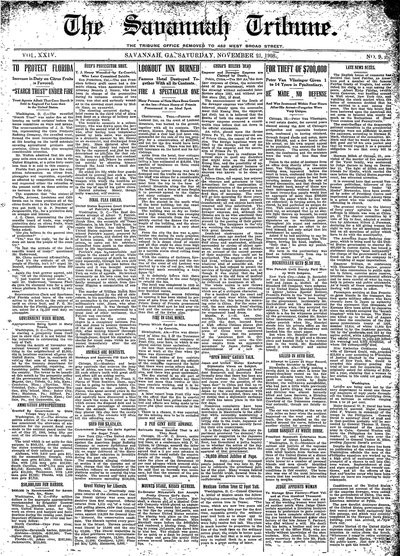
Page text (machine-generated)
VOL. XXIV.
TO PROTECT FLORIDA
Increase in Duty on Citrus Fruits is Favored.
"STARCH TRUST" UNDER FIRE
Trust Agents Admit That Corn Starch is Sold in England For Less than in the United States.
Washington, D. C.—The so-called "Starch Trust" was under fire at the hearing on tariff revision before the house committee on ways and means. The cross-examination of J. B. Walton, representing the Corn Products Refining Company, the so-called trust, formed the most interesting incident at the hearing on the tariff schedule covering agricultural products and provision. Citrus fruits also occupied considerable attention.
Mr. Walton admitted that his company sells-corn starch at a loss in the United Kingdom, at a price forty cents less than it is sold in this country.
Florida fruit growers gave the committee information on citrus fruit, pineapples and vegetables, especially as affected by competition with Cuba and requested either the retention of the present tariff on these articles or an increase in the duty.
The argument that "the states of Florida, Arizona, Louisiana and California can in time produce all of the citrus fruits used in the United States" was put forth by E. P. Porcher of Jacksonville, Fla., for a protective duty on oranges and lemons.
J. G. Chase, representing the Jacksonville board of trade, was urging protection duty on citrus fruits, when Representative Underwood of Alabama asked:
"Do you believe in the general idea of protection?"
"Yes," was the reply, "so far as it does not harm the people of the country."
"Is that the attitude of the Jacksonville board of trade?" questioned Mr. Underwood.
Mr. Chase answered affirmatively.
"And it's the attitude of all the people of Florida, isn't it?" urged Mr. Boutell, republican member from Illinois.
Again the fruit grower agreed, adding: "Of all the thinking people."
ing! "Or all the thinking people."
"I just wanted to know about it," said Mr. Underwood, "because Florida two its electoral vote for a party whose platform favors a tariff for revenue."
Representatives Clark and Sparkman of Florida asked leave of the committee to file briefs on the subject of tariff on citrus fruit, and F. G. McMullen for the Florida pineapple growers, asked for a 70-per cent duty on pineapples.
GOVERNMENT WORK BEGINS.
Appropriations Being Spent in Many Towns.
Washington, D. C.—The government is starting a prosperity boom itself just to show that it is not behind the big industries in celebrating the victory of Taft.
During the month of November the national treasury will spend something in the neighborhood of $5,000,000 in locations scattered all over the United States. That is, contracts involving that sum of money will be let by the treasury department for construction, painting, repairing, re-furnishing public buildings all over the country. The towns to be benefited this month by the prosperity policy of the government are: Marietta, Ga.; Hugene, Ore.; Toledo, O.; Iola, Kans.; Crookston, Minn.; Rawlins, Wyo.; Trinidad, Colo.; Gulf Quarantine Station, Ship Island, Miss.; Baker City, Ore.; Hazleton, Pa.; Milford, Pa.; Manchester, Va.; Newton, Kans.; Carlisle, Pa. and Gainesville, Ga.
AMMUVITION APPROPRIATIONS
Granted By Government to State Troops Very Liberal.
Washington, D. C.—The division of militia affairs of the war department has announced the allowance of ammunition for the present fiscal year made to the national guard under the act of May 27, 1908, being fifty per cent of the allowance to the regular army.
The total which is set aside for this purpose is $643,124, divided among the states according to the enlisted strength of their national guard:
Alabama, with 3,010 men gets $17,681 for ammunition; Georgia, with 2,806 men gets $17,559; North Carolina, with 1,835 men gets $12,032; South Carolina, with 1,714 men gets $11,718; Kentucky, with 1,590 men gets $10,250; Tennessee, with 1,430 men gets $9,595; Florida, with 1,160 men gets $7,713.
$50,000,000 FOR HARDOR.
$400,000 Is Recommended for Savan-
tah, Ga, River.
Washington, D. C.-Fifty million
dollars is the aggregate appropriation
recommended by Brigzdier General
William L. Marshall, chief of engineers,
United States army, for the
work on rivers and harbors and forlifications during the coming year. Some important estimates for river and harbor work follow:
North Carolina-Cape Fear river,
$500,000.
Georgia—Savannah harbor, $400,000;
Alabama—Mobile, $492,000; Tom-
bigbee river, $1,000,000;
Florida—St. Johns river, $367,000;
Jacksonville, $215,000;
The Savannah Tribune.
SAVANNAH, GA., SATURDAY, NOVEMBER 21, 1908.
RUEF'S PROSECUTOR SHOT.
T. J. Heney Wounded-by Ex-Convict,
Whilst Convicted.
Who Later Committed Suicide.
San Francisco, Cal.-The San Francisco bribery graft cases had a dramatic climax, when Assistant District Attorney Francis J. Honey, who has been in charge of the prosecution during its tortuous course of two years, was shot and seriously wounded in the crowded court room by Modris Haas, an ex-convict.
The shooting occurred during a brief recess in the third trial of Abraham Ruef on a charge of bribery now in its eleventh week.
The would-be assassin is a saloon keeper, who was drawn upon the jury panel in the second trial of Ruef, and who, after having been temporarily passed by both sides, was exposed in a dramatic manner by Mr. Heney as an ex-convict, and discharged from the jury. Haas declared after the shooting that Heney had ruined his life by the exposure and that he had determined to kill him for that reason. Haas was arrested and confined in the county jail, where he committed suicide by shooting himself through the head! with a small derringer pistol.
He ended his life, white four guards detailed to prevent just such a move stricted within three feet of him. The weapon with which the would-be assassin shot himself he had secreted in the top of one of his gaiter shoes. District Attorney Henry, though badly wounded, will recover.
FINAL FLEA FAILED.
United States Supreme Court Dismissed Patrick's Appeal
Washington, D. C.—The final desperate attempt of Albert T. Patrick, convicted of the murder of William Marsh Rice, the eccentric old Texas millionaire, in his New York home, to regain his liberty, has failed. The United States supreme court has risissed Patrick's appeal, prepared by himself in prison, and denied his plea of habeas corpus. He must stay in prison, to serve out his sentence, commuted from death in the electric chair to life imprisonment. Patrick's case is remarkable and unique in the annals of crime. While still under sentence of death he managed repeatedly, through his own skill in the law, to get his case before the courts and it was brought several times from Sing Sing prison to New York on writs of appeals. He worked incessantly on his own case, but was unable to get a new trial, although he finally managed to obtain from Governor Higgins a commutation of sentence.
The murder of William Marsh Rice was accomplished by the aid of chloroform, in his apartments, Patrick had an accomplice in the person of the old millionaire's valet, Jones, who afterward confessed. It was through the confession of Jones, corroborated by a great deal of other testimony, that Patrick was convicted. The motive for the crime was shown in a conspiracy between Patrick and Jones to possess themselves of the old man's wealth. Then Patrick, after making himself thoroughly familiar with the old man's affairs, through Jones, forged his signature to checks for round sums which he presented immediately after the old man's death
ANIMALS ARE DENTISTS.
Monkeys and Squirrels Fill Each Other's Teeth
Chicago, Ill.-Monkeys and large gray squirrels that overrun the jungles of Africa, are born dentists. They fill each other's teeth with great skill and often kill an aching nerve.
At least this is what Dr. Frank N. Pierce of West-Roxboro, Mass., says, and he is going to lecture before Chicago dentists on the subject, Dr. Pierce, who spent several years in the African jungles, says that monkeys and squirrels have discovered a blue clay much the same in color as that which covers the diamond field and in this a great percentage of creosote. When the animals have toothache they plaster this clay into the cavity as a remedy. The creosote will often kill the offending nerve.
SUED FOR $3,624,121.
Government Brings Six Suits Against the Sugar Trust.
New York City—The United States government has brought six suits against the American Sugar Refining Company to recover forfeitures and customs duties amounting to $3,624,121 on sugar delivered at the Havemeyer & Elder refineries in Brooklyn during the past six years.
The complaints alleging violations of section 9 of the customs act of 1890, charge that the checker at the Brooklyn refinery so manipulated the platform scales as to conceal the true weights. The second and third suits involve amounts exceeding $500,000.
Great Victory for Liberals.
Hayann, Cuba. — Practically complete returns of the election show that the liberal victory was even more decisive than first supposed. Official returns from 1,550 out of a total of 1,493 polling places, show that General Jose Miguel Gómez received 153,823 votes, against 118,329 for General Mario Menocal, the conservative candidate. The liberals carried every province in the island. Havana province went liberal by 25,000 and the city by 13,000. The liberal majorities in the other provinces were approximately as follows: Oríguez, 13,500; Santa Clara, 11,000; Canaguey, 1,200; Pinar del Río, 7,500; Manzanas, 8,000.
THE TRIBUNE OFFICE REMOVED TO 462 WEST BROAD STREET.
LOOKOUT INN BURNED
FIRE A SPECTACULAR ONE
Many Persons of Note Have Been Guests at the Inn--Prince Henry of Prussia Pronounced it an Ideal Spot.
Chattanooga, Tenn.—Famous old Lookout Inn, on the crest of Lookout Mountain, was burned to the ground; together with all its contents. The owners, Massrs. Jung & Shamotuski, stated that a deal had just been commuted for the sale of the inn property for a consideration of $135,000, and but for the fire would have been closed this week. There was but $26,000 insurance on the hotel and its furnishings.
Aside from the hotel, four cottages and their contents were destroyed, entailing a loss estimated at $16,000. The amount of insurance on these could not be learned.
The incline power house was badly damaged and the trestle on the face of the bluff was ablaze for a considerable time. There was a streak of fire almost from the top to the base of Lookout Mountain along the line of the incline, and a force of men fought it to prevent spread to the timber and many cottages which dot the slope of the mountain.
The fire started in the south wing of the hotel building; but the exact cause has not been ascertained.
The building was as dry as tinder and a high wind, which was sweeping across the mountain from the west, quickly carried the frames the entire length of the building, and the structure was consumed in a very short time.
From the city the fire was a, spectacular one during its early progress; but soon the mountain was entirely enveloped in a dense cloud of smoke and all that could be seen from high points in the city was what appeared as a terrible storm cloud rolling from the southwest.
With the coming of darkness, however, the smoke cleared and the outline of the crest of old Lookout was marked by a rim of red fire, with the downward mark resembling a huge figure "S." It is definitely known that there will be no attempt in the near future to rebuild the Inn. The hotel was completed in 1889 at a cost of $150,000, and contained about four hundred rooms. Each succeeding season following its opening it has been visited by persons of note from all over the world. Prince Henry of Prussia pronounced it the most ideal spot he had ever visited and the scenery more gorgeous than that of the Swiss Alps.
FIRE IN COAL MINES.
Flames Which Raged in Mine Started
• by Convicts.
'Birmingham, Ala.'-Fire was discovered in Mine No. 3 of the Tennessee Coal, Iron and Railroad company at Pratt City, near in, in which is employed convict labor exclusively.
No less than seventy-five convicts were at work at the time when the blaze was discovered.
The dead bodies of five convicts have been taken out and the officials of the company expressed the belief that there were others dead.
Many rumors prevailed of an explosion, and there was great excitement.
The fire started in an old part of the mines in which officials say there were not more than twelve or thirteen convicts working, and it is believed the convicts started it themselves.
A later report from Pratt City was to the effect that the fire in convict Mine No. 3 had been gotten under control and efforts are being made to recover the other seven convicts in the place. There is a chance, it was reported, for the missing men to be in secluded places and safe.
3 PER CENT RATE ADVANCE.
Railroads Have Decided That Is All They Need.
Chicago, Ill.-W. C. Brown, senior vice president of the New York Central Ulines, at a conference with F. W. Upham, in Chicago, assured the latter that the railroads of the country had agreed that a 3 per cent advance in freight rates would satisfy the requirements of the roads.' This advance takes the place of the threatened 10 per cent advance which aroused shippers to opposition several months ago. He said that an increase was necessary, but that the amount of the proposed increase had not been determined.
MOUNTS STAGE, KISSES ACTRESS.
Ex-Senator McLaurin's Son Accepts
Pretty Chorus Girl's Dare.
Spartanburg, S. C.-Loretta Marshall, a chorus girl of a Musical Comedy Company which played an engagement here, was kissed fair and square on her lips by young McLaurin, son of the former United States senator. The kissing took place on the stage in full view of the audience. Miss Marsha came before the footlights and made a kissing song. Pointing to young McLaurin she dared to kiss her. The student was game, for as quick as a flash he jumped on the stage and gave the pretty little actress several snacks on her ruby lips.
CHINA'S RULERS DEAD
Emperor and Dowager Empress are Claimed by Death.
Pekin, China—Tse Hs1 An the dowager empress of China, the autocratic head of the government, which she has directed without successful interference since 1861, and without protest since 1881, is dead.
The announcement of the death of the dowager empress was official and followed closely upon the announcement that Kuang Hsu, the emperor, had died; but it is believed that the deaths of both the emperor and the dowager empress occurred a considerable time before that set down in the official statements.
An edict, placed upon the throne Prince Pu Yl, the three-year-old son of Prince Chun, the regent of the empire. The foreign legations were notified by the foreign board of the death of the emperor and the succession of Prince Pu Yl.
Troops have been in readiness for several days to quell any disorders that might arise on the death of Kuang Hsu, and the possibility of uprising was made greater because of the fact that the death of the dewager impress was known to be close at hand.
Prince Chun, the regent, has ordered the viceroy and governors to take precautions for the continuation of the administration of the provinces as heretofore, and he has ordered a hundred days of mourning. The court will go into mourning for three years. Pekin already has been greatly transformed; all red objects have been removed and blue substituted. The people learned of the death of the dowager empress, and, although the Chinese are in no wise emotional they showed that they were profoundly impressed by the passing of their powerful ruler. The foreigners in the city are watching the strange ceremonies with great interest.
Death-bed observances of three thousand years ago marked the passing of the emperor and dowager. They died alone and unattended, although surrounded by circles of abject spectators, who remained a rod distant, as on account of the sacred persons of their majesties they could not be approached. The emperor died as he had lived, without 'ministration of whatever kind of scientific aid. For months he had refused to permit the services of foreign physicians, and, although it was stated that the had gone back to the old form of medical treatment, it is believed that latterly he received no treatment at all.
The whole notion is now thrown into mourning, the rites attending which of strife and charade. For a hundred days the court and people of rank wear white, trimmed with white fur, this being the mourning color in China. For the same period, the men abstain from shaving, while the women lay aside the favorite ornamental head dress.
Manila, P. I.-H. Lee Clotworthy, United Press correspondent with the fleet, learned from a high official Chinese source that both the emperor and dowager empress of China were murdered in the hope that the presence of the 'American fleet in Oriental waters would save the Chinese empire from an aggressive movement by Japan during their establishment of a new re-route.
"OPEN DOOR" CAUSES TALK.
Japan and United States Exchange Diplomatic Views on Subject. Washington, D. C.—Although President Roosevelt and Secretary Root formally deny that there has been any friction between the United States and Japan over the question of the "open door" in China and that no requests or demands had been made of Japan by the state department with reference to this subject, there can be no denial that a diplomatic exchange of views has taken place in the last few days. Numerous complaints have been made by American and other foreign merchants in Manchuria to the effect that while ostensibly maintaining a policy of non-interference without taking side in the trade, Japanese officials really have been secretly favoring their own countrymen.
It is likely that while the state department presented "no demand," the request or suggestion to the Japanese ambassador, as stated By Secretary Root, has formulated a polite inquiry as to whether the action of the Japanese officials in Manchuria have the approval of that government.
- 70,000 Attend Jubilee of Pope.
Rome, Italy.—Sewenty thousand people jammed the way into St. Peters to celebrate the priesthood jubilee of the pope. Many women fainted in the terrific crush. Several were injured and the gowns torn to shreds, confederates.
Mexican Cotton Tree 12 Feet Tall.
Washington, D. C.—Consul Clarence A. Miller of Mexico sends the following clipping concerning the cultivation of the cotton tree in Texas: "The trees, which are now two years old and are bearing this year for the first time, resemble greatly the ordinary pear tree both as to shape and to height. I should say that the trees were fully twelve feet tall. The yield is much heavier in proportion to the size of the bush than on the ordinary cotton plant, the staple is better quality, and the fact that it is only necessary to replant them in a score of years is a great saving of labor.
FOR THEFT OF $700,000
Peter Van Vlissinger Given 1 to 14 Years in Penitentiary.
HE MADE NO DEFENSE
And Was Sentenced Within Four Hours After His Arrest--Forgeries Were Very Unique.
Chicago, Ill.—Peter Van Vlissingen, a real estate dealer, for several years classed among the first of Chicago's prosperous and reputable business men, confessed (to having obtained, through forged deeds and notes, more than $700,000, and a few hours after his arrest, on his own urgent appeal to be punished, was sentenced to the penitentiary. The arrest, the indictment, the confession and the sentence were the work of less than four hours.
Taken in the midst of business from an office desk shortly after the noon hour, Van Vlissingen, a venerable looking man, appeared before the court in tears, confessed that for from eighteen to twenty years he had been securing money through the sale of forged documents, and that though he had bought back many of these spurious instruments without detection, at least twenty-five people would lose an aggregate of more than $700,000 through the paper which he has not yet redeemed; in forging notes, he declared, he had perfected an unique device. This consisted of a plate glass desk top, so arranged that by an electric light thrown up beneath, he could readily trace from originals forged signatures on to worthless paper. Throughout his arrest and sentence, the prisoned made no effort to defend himself, but only asked that his punishment be speedy:
Asked if he had anything to say before sentence was imposed, Van Vlissingen, bowing his head, replied:
"Only that I be given my punishment at once." His term in the penitentiary was fixed as indeterminate from one to fourteen years.
ROCKEFELLER GETS $1.50 FEE.
Was Peevish Until Deputy Paid Money With Subpena.
New York City.—John D. Rockefeller and his lieutenants, J. D. Archbold and James A. Moffett of the Standard Oil Company, were subpenaed by United States Marshal Henckel to appear, before Special Referee Franklin Ferris in the "trust busting" proceedings which have been begun by the government. Incidentally Mr. Rockefellerer and his aldes received $1.50 a piece when they accepted the subpena. The tendering of the $1.50 which is a fee for witnesses provided by the government, tickled Mr. Rockefeller immensely. He seemed to be rather peevish when Mr. Henckel strode into his private office on the fourth floor of No. 26-Broadway and handed him the court paper.
But when Mr. Henckel drew from his pocket a crisp $1 bill and a 50-cent piece and handed them to the richest man in the world, Mr. Rockefeller selzed it with alacrity and smiled broadly.
KILLED IN AUTO RACE
In Attempt to Lower 24 Hour Record, Emile Strickler is Killed, Birmingham, Ala.—Whit making a strong dash in the effort to lower the twenty-four-hour record on the fair grounds one-mile track, here the Renault car being driven by Emile Strickler, the well-known automobilist, who had just a little while previously relieved Lewis Strang, was smashed and Strickler was almost instantly killed and Leon Barrows, a Birmingham chauffeur, driller for President Crawford of the Tennessee company, was seriously, though not fatally injured. The car was traveling at the rate of sixty miles an hour when the accident happened on the west end of the track. One tire exploded as the car dashed around the curve, followed by another circled for several minutes.
LABOR BANQUET AT WHITE HOUSE.
President Roseveit Entertains Number of Union Leaders.
* Washington, D. C.-Members of the cabinet and justices of the supreme court of the United States sat down with labor leaders from various sections of the United States at a dinner given by President Roosevelt at the white house to a number of personal friends and men closely identified with the movement to better labor conditions in this country. The occasion was one of the most interesting events that has occurred at the white house in months.
JUDGE APPOINTS WOMAN
To Manage Shop Factory—Plant Valu-
and at Five Hundred Thousand
Bed at five hundred thousand Boston, Mass. The value and stature of the young woman who boosted another notch when Judge Chamberlain appointed a Brockton business woman in preference to male competitors to have complete control of the big five hundred thousand dollar shoe factory of the late James T. Packard, who died without a will. His death left his heirs, a brother and two sisters, one of the latter blind, who are wholly without knowledge of the shoe business. Mrs. Jennie L. Doane, formerly secretary to the late Mr. Packard, was made special administrator.
LATE NEWS NOTES.
The English house of commons has decided that Lord Fairfax, an American and a member of the famous Fairfax family of Virginia, had established his claim to a seat among the peers. Albert Kirby Fairfax, twelfth baron Cameron, was hustling around in Wall street, New York city, and watching the stock market when the house of commons decided that he was entitled to a seat among the peers. The fact that this honor had been bestowed upon the American did not seem to interest him nearly so much as the fluctuations of Steel Trust common and Pennsylvania.
The contributions of the democratic national committee in the presidential campaign were not sufficient to meet the expenses, according to Norman E. Mack, chairman of the committee. Mr. Mack said that he would make the deficit good out of his own pocket and that he would regard it as a personal obligation to see that every bill is paid.
Herman Billek of Chicago, Ill., convicted of the murder of five members of the Vzral family, was sentenced by Judge Barnes to hang on December 11. The sight of Billek and his friends for liberty, which carried the case before the United States supreme court, has attracted attention.
It is rumored here that several Venezuelan politicians, followers of the former Revolutionary leader "El Mocho" Hernandez, have been arrested by order of President Castro and imprisoned at Maracalco. Among them is a priest who was captured while officiating in church.
The greatest victory in the history of forty years' agitation for equal suffrage in Illinois was won at Chicago, Ill. The charter committee by a vote of six to four, adopted a resolution by Alderman Milton J. Foreman, declaring for a bill giving women the right to vote for all municipal offices and on all questions of policy which have to do with the municipality.
The American Sugar-Refining company, which is being sued by the United States government to recover $3,600,000 in custom duties, has issued a statement denying "most indignantly" the charge of the government's suit of fraud on the part of the company in the weighing of sugar importations.
Emperor William, in conference with Chancellor Von Buelow, promised to take concessions to public opinion in future, exercise more reserve, interfere less in governmental affairs and be more careful of what he says, both in private and public utterances. As a result of these assurances Von Buelow will remain in office.
Passengers arriving at San Francisco from Manila In the transport Bufford quote military officers who have recently been in Japan as authority for the statement that thousands of Koreans have been killed by Japanese since the mikado occupied the "hermit kingdom" with his troops. The Koreans killed up to the end of August last since the conclusion of the Japanese protectorate treaty of 1907, number 12,014, of whom 11,664 are certified to by the Japanese garrison, 796 by the guadarmane, and 553 by the native police, while 5,692 surrendered. The official returns to only 369 killed-254 wounded and 3,762 invalided, of whom 796 subsequently died.
Mrs. Katherine Cleimimons Gould, wife of Howard Gould, was awarded $25,000 a year according to a decision of Justice Blachoff in the supreme court of New York. Mrs. Gould is awarded this allmoney pending the trial of her suit for separation. She originally asked for allmoney of $120-000 a year, claiming that a woman in her station in life could not get along on less.
Washington.
Letters are being sent out by the navy department to about one thousand employees of navy yards throughout the United States notifying them, of an increase in salaries ranging from 4 to 10 per cent.
Major General W. P. Duval has been selected, to succeed Major, General John F. Watson in command of the troops in the Philippines. General Duval is assistant chief of staff and in that-position probably will be succeeded by General Thomas H. Barry, now in command of the American army in Cuba. General Weston will leave the Philippines for home December 15, and will turn over the command to General Tasker H. Bliss, pending General Duval's arrival.
Despite the fact that there has been no publication of the orders from the Washington officials the men of the Philippine squadron are worked up to a high pitch of excitement over the prospect of a chance to sail into Chinese waters. Replenishment of coal and store supplies of the vessels continues, and all the officers of the fleet and marine corps who have been absent on leave are reporting to their commands.
Condolences of the United States government on account of the death of the empress dowager, were cabled to the government of China. The message was from Secretarw Root to the American minister at Pelkin.
The new derelict destroyer Seneca, of the United States government, the first vessel ever built exclusively for this purpose, and which was recently completed at the Newport News Shipbuilding, yard has arrived, at New York city.
Justice Harlan of the United States supreme court denied that it was his intention to retire from the bench "Whenever I come to retire voluntarily," said Justice Harlan, "I will ask the public know. Just now I have reason to quit the bench."
SOL. C. JOHNSON, Supt. of Ageno
Treasury of State of Georgia.
Atlanta. JAN 17 1908 190
The undersigned Treasurer of the State of Georgia, hereby acknowledges to have received from the Secretary of State the following described:
Dear Regent and Trustees of the State of Georgia,
1700, until from June 1920.
being in total Ten Thousand Dollars , and which are held by the Plate of Georgia , by authority and andes the provisions of an Act of the General Assembly , approved October 22d , 1887 , and amended December 20th , 1899 .
Johnson's Undertaking Establishment FUNERAL DIRECTORS
AND EMBALMERS.
ALL ORDERS PROMPTLY ATTENDED, DAY OR NIGHT. FIRST CLASS EMBALMING AND ALL WORK OF THAT KIND GUARANTEED. OUR STOCK OF COFFINS, CASKETS AND ROBES IS THE LARGEST IN THE CITY. WE ALSO HAVE A FIRST CLASS LIVERY STABLE, WHERE WE FURNISH THE BEST CARRIAGES, HEARSES AND FUNERAL CARS. WE ALSO HAVE IN OUR EMPLOYMENT MR. H. S. DUNBAR, WHO WOULD LIKE TO SEE HIS MANY FRIENDS AT ANY TIME.
Real Estate
WHY NOT PUT YOUR MONEY IN REAL ESTATE AND RECEIVE DOUBLE PROFIT? I AM PREPARED TO OFFER SOME GOOD PROPOSITIONS AND ONLY A LITTLE CASH WILL START THE BALL ROLLING.
REAL ESTATE AND RENTING AGENT,
BELL PHONE 3183. 22 STATE STREET, WEST.
11:50pm ..... Leaves for Columbia, Norfolk, Rich-
12:35am ..... mond, Washington, New York and all
Eastern cities.
The times shown are Central Standard Time, and are given only as information and are not guaranteed. Full information at City Ticket Office No. 7 Bull Street Phones 671
Treasurer of the State of Georgia.
W. H. LLOYD,
—Dealer In—
GROCERIES, WOOD AND COAL,
621 Oglethorpe Avenue, East
518——PHONES——Bell 50
SPORTING BREVITIES.
P. T. Powers was elected president of the Eastern Baseball League.
New laws for the regulation of motor boats are likely to be passed at the next session of Congress.
The Pittsburg Club has purchased pitcher Robert Vall from the Portsmouth Club, of the Virginia League.
One hundred and forty-three head of brood mares sold at auction for $27,700 at the McGrathlana stud disposal in Kentucky.
Thomas C. Jefferson, one of the best known owners of trotting and saddle horses in Kentucky, died at his home in Lexington, Ky., aged fifty-seven years.
James R. Keene headed the list of winning owners for the racing season which came to an end at Jamaica recently with a grand total of $282,000 in round figures.
John L. Sullivan, for twelve years the heavyweight champion pugilist of the world, celebrated his fiftieth birthday at Hot Springs by taking the pledge for the rest of his life.
Shipment to England of the choicest thoroughbreds in the Keene, Belmont, Whitney, Duryea and Hitchcock stables amounts to a final surrender of the racetrack interests.
With an average speed of sixty-four miles an hour, Herbert Lytle drove Clifford W. Brokaw's Isotta car to victory in the fastest of the five sweepstakes which opened the new Long Island motor parkway.
The ten-mile Marathon run to be held in conjunction with the Brooklyn Postoffice games on Saturday, January 16, is going to be an interesting affair. All the old-timers will start. The feature will be the race of Gillespie, who wins a bride if he crosses the tape first.
Official announcement was made that George Stallings will manage the New York American League baseball team next season.
Us kids ain't had a bath this week; There's holes in every stocking. And Mildred's hair is full of snarls, And Pauline looks real shocking. And yet we're having lots o' fun, A hummlin' round the city, 'Cause ma, she can't look after us, She's out on a committee.
The Prophetic Eye.
Barber (looking for business)—Excuse me, sir, but your hair is going to come out soon by the handful.
Jaggs (who was out all night and is going home to face his wife)—You (hic) shpose I don't know (hic) that?
—Bohemian.
The birds that eat the bugs should be protected.
This company is duly chartered under the laws of the State of Georgia, and has compiled with all requirements of the State Insurance department, therefore all policy holders are protected with all the safeguards that the strict insurance laws of this State seek to protect its citizens.
Its affairs are directed and managed by Negro men of the city of Savannah of leading standing, and whose character and reputation are of such as to command the respect and confidence of all the people of that community. The same men that manage this Society are the ones that organized and are conducting the affairs of the first successful Negro Savings Bank in this state, therefore we can readily see that by connecting themselves with this Insurance company their interest will be in safe hands.
By comparing our rules and benefits with other first class companies it will be seen that we offer the most liberal inducements with the largest sick, accident and death benefits to our members than any other company in this business.
That we pay our claims promptly can be testified to by the thousands of our satisfied members.
WESTBOUND.
Leave Savannah 5.00 P. M.
Arrive Helena 9.15 P. M.
Arrive Alberville 10.10 P. M.
Arrive Cordele 11.15 P. M.
Arrive Americus 12.45 A. M.
Arrive Richland 2.00 A. M.
Arrive Lumpkin 2.22 A. M.
Arrive Montgomery 6.45 A. M.
Arrive Birmingham 10.40 A. M.
Arrive New Orleans 6.0 P. M.
EASTBOUND.
Leave New Orleans 9.25 A. M.
Leave Birmingham 4.20 P. M.
Leave Montgomery 7.45 P. M.
Leave Lumpkin 11.54 P. M.
Leave Richland 12.16 A. M.
Leave Americus 1.40 A. M.
Leave Cordele 3.15 A. M.
Leave Abbeville 4.20 A. M.
Leave Helena 5.15 A. M.
Arrive Savannah 9.30 A. M.
Train will consist of PULLMAN BUFFET SLEEPING CARS, Day Coaches between Savannah and Montgomery without change; making close connection at Montgomery with all lines diverging for Pensacola, Mobile, New Orleans and all Western points; Birmingham, Memphis, St. Louis, Nashville, Chicago and all Northwestern points; the SHORTEST LINE to Montgomery, New Orleans, Birmingham and the earliest arrival at these points. At Savannah close connection is made for all EASTERN POINTS, Richmond, Washington, New York and with Coastwise Steamships for Baltimore, Philadelphia, New York and Boston.
L. R. Williams.
P. Edward Perry.
Walter S. Scott.
Sal C. Johnson.
This company is duly chartered and requirements of the State Insurance code that the strict insurance laws of the community. The same men that make fairs of the first successful Negro shows themselves with this Insurance company by comparing our rules and benefiting liberal inducements with the large pany in this business.
That we pay our claims promptly.
Agents
Libera
NIGHT T
VIA S
WESTBOURNE
Leave Savannah
Arrive Helena
Arrive Albebible
Arrive Cordele
Arrive Americus
Arrive Richland
Arrive Lumpkin
Arrive Montgomery
Arrive Birmingham
Arrive New Orleans
Train will consist of PULLY Montgomery without change; make Mobile, New Orleans and all West Northwestern points; the SHORT arrival at these points. At Savannahington, New York and with Coastline Get sleeping car reservations and
P. B. RAY,
Tailoring,
DRY AND STEAM CLEANING. LADIES' WORK A SPECIALTY. HATS CLEANED AND REBLOCKED BELL PHONE 2050. JEFFERSON AND BERRIEN STS. SAVANNAH, GA.
Masonic Books &
Regalias.
LODGE SEALS,
FINANCIAL CARDS and
BLANKS of every description.
Publishers' and Manufacturers' Prices
Liberal Discounts Will Be Arranged
SOL. C. JOHNSON:
Gavannah, Ga.
SOL. C. JOHNSON
Notary Public.
Deeds, Contracts, Wills and Other
Legal Forms Prepared and
Attested.
116 West St. Julian Street
WALTER S. SCOTT, Secretary and Tr as.
HOME OFFICE
WEST BROAD STREET,
SAVANNAH, GEORGIA.
Phone 1198. Ga. Phone 2029.
Directors
W. R. Fields.
J. H. Deveaux
L. M. Pollard.
R. R. Wright.
Under the laws of the State of Georgia department, therefore all policy holders of this State seek to protect its citizens: urged by Negro men of the city of Savannah such as to command the respect and control this Society are the ones that originate Savings Bank in this state, therefore we company their interest will be in safe hauls with other first class companies it largest sick, accident and death benefits to possibly can be testified to by the thousand.
Wanted Every
Real Terms and Comm
ADDRESS THE HOME OFFICE,
463 West
TRAINS
SEABOARD
AIR LINE RAILWAY.
UND.
5.00 P. M.
9.15 P. M.
10.10 P. M.
11 15 P. M.
12.45 A. M.
2.00 A. M.
2.22 A. M.
6.45 A. M.
10.40 A. M.
6.00 P. M.
EAST
Leave New Orle
Leave Burning
Leave Montgomery
Leave Lumpkin
Leave Richland
Leave Americet
Leave Cordale
Leave Abbeyville
Leave Helena
Arrive Savannah
MAN BUFFET SLEEPING CARS, Daring taking close connection at Montgomery with eastern points; Birmingham, Memphis, S.E. LINE to Montgomery, New Orleans; near close connection is made for all EASTwise Steamships for Baltimore, Philadelphia and full information from any SEABOARD.
CHA
Asst. General Pa
of the State of Georgia, and has compiled a before all policy holders are protected with all the to protect its citizens:
Ten of the city of Savannah of leading standing and the respect and confidence of all the people are the ones that organized and are conduct this state, therefore we can readily see that by interest will be in safe hands.
First class companies it will be seen that we offer and death benefits to our members than any other.
Wanted Everywhere
and Commission.
THE HOME OFFICE,
468 West Broad St.
Savannah, C
AINS { SAVANNAH MONTGOMERY BOARD
THE RAILWAY.
EASTBOUND.
Leave New Orleans..... 9.25 A. M.
Leave Birmingham..... 4.20 P. M.
Leave Montgomery..... 7.45 P. M.
Leave Lumpkin..... 11.34 P. M.
Leave Richland..... 12.16 A. M.
Leave Americas..... 1.40 A. M.
Leave Cordele..... 3.15 A. M.
Leave Abbeville..... 4.20 A. M.
Leave Helena..... 6.15 A. M.
Arrive Savannah..... 9.30 A. M.
SLEEPING CARS, Day Coaches between Savannah at Montgomery with all lines diverging for Birmingham, Memphis, St. Louis, Nashville, Chilton Montgomery, New Orleans, Birmingham and Savannah is made for all EASTERN POINTS, Richmond or Baltimore, Philadelphia, New York and Boston from any SEABOARD Agent, or write to:
CHARLES F. STEWART
Asst. General Passenger Agent, Savannah
THE OLDEST OF THEM ALL
The Royal Un
INCORP
FUNERAL DI
AND
Royal Undertaking INCORPORATED GENERAL DIRECTOR AND EMBAL
ONLY FIRST CLASS SERVICE RENDERED, WITH RESPECTFUL ATTENTION.
18 DOUBLY SECURED BY THOUSANDS OF DOLLARS INVESTED IN SAVANNAH REAL ESTATE. 5 PER CENT PAID ON DEPOSITS.
COFFEE
FRESH GATHERED CRANBERRIES.
---
THANKSGIVING BERRY.
By Evelyn Price Cahoon
DOWN knee-deep in sphagnum moss I went. It was in a cranberry bog in Northern Minnesota. The cranberry loves the sand, so at a little distance the jackpines made a fretted shelter from the hot September sun, for the pine tree also loves the sand.
Close around there was only a waste of spongy moss overlaid with a growth of cranberry vines, for this was the dried bed of what had once been the upper end of the blue lake we could see glittering in the sun.
The cranberry is particular as to its home. It must be sandy loam—never clay. It does not object to a flooding, on the contrary rather likes it—especially in the fall when the hard-frosts might nip the berries, and the flooding prevents the freeze.
But the cranberry does like drainage, and so roots itself into sharp sand along the seashore or along the borders of the Great Lakes in Ohio, Michigan, Wisconsin and Minnesota. Along the Atlantic, the cranberry bogs have been made much of, and cultivated to the betterment of the berry, both in size and flavor; but along the northern part of the country the wild berry only is found.
The berry is wild and the place wherein it grows is often wild. Miles and miles, that have never known of civilization except by the woodman's axe, are dotted here and there with plats of marsh land overgrown with wire-stemmed vines that produce what was once called the crane-berry, because of the resemblance of the flower to the head of a crane. The vine is hardy or it would not withstand the rough usage of those who ruthlessly uproot the vines in a careless effort to obtain the fruit. Whole families at a time go out to pick the berries by the bushel. The plant blossoms in June. In September, although the berry is still a delicate pale green, the swamps are invaded, for the rule is, "First come, first served," or perhaps more properly, "Finding's keeping," as little boys say.
For many a family, in its first year of settlement in the "burntover lands," among the northern pines, this cranberry crop, together with that of the blueberry and the wild red raspberry, provides the only supply of actual cash.
PINECILLA
Father, mother and children hurry each morning into the marsh, where all but the very youngest spend the day pickling with might and main. It is not delicate work, this pickling. The practiced hand runs the fingers, curved upward and spread rake-like, under the wiry branches, and then draws them upward, retaining the round, green-white berries, but allowing the tiny flake-like leaves to fall back through. A smart picker can gather, several bushels a day, and they sell at about a dollar and a half or two dollars a bushel in the grocery at the nearest town. From here they are shipped in crates to the city and, when they finally reach the housewife, are selling at twelve and a half cents a quart or four dollars a bushel
At this and at the blueberry season the Indians on the remaining reservations are allowed to leave the reserve to pick and sell the berries. They are reckless in their picking as, indeed, are some of the whites; and have no regard for the life of the vine. Many use a sort of pronged scoop, which they run under the stems, raising up the fruit, but also unfortunately dragging up the vines by the roots.
Along the Eastern coast, as the berry became scarce, and the price proportionately high, the thrifty Yankee set out new plants in the old hogs. It is easily done, for the stems take root readily if simply thrust in
```markdown
```
the sand, and in three years from rooting are producing fruit like the native plant. This is one method of field planting, setting the little bunches of twigs something less than a foot apart, all over the field. Another method practiced is to cut a quantity of twigs into inch-long pieces, and scatter them broadcast like wheat and harrow them in. In these cultivated fields, where the berry is protected, there is no need of picking before the fruit is ripe, so it is not gathered until crimson in October. When the early frosts of September come on, the
```markdown
```
farmer as a measure of protection, floods his field by a system of irrigation similar to that in use on the arid plains of the West.
This is the season when on clear, still nights, "As busy as a cranberry merchant" comes to have a meaning; for the owner of a field must hustle around and get all the little squares between the irrigating ditches flooded a foot and a half deep before he can go to bed.
The berries that are raised on Cape Cod have the name of being, in size and flavor, the best produced. Next are valued those raised in New Jersey and New York. But they are all needed, for it takes five hundred thousand bushels to carry the Nation through the jubilant month of November, and somewhat over another five hundred thousand to last the rest of the year.
The Western wild berry is higher colored, but smaller and of not quite so delicate flavor, and is all bought up out West.
Who ever heard of just the right kind of Thanksgiving without cranberries? And the Thanksgiving cranberries; like the Thanksgiving turkey, lasts in well-regulated homes for two or three days.
I remember I dodged once a recurrence of the left-over turkey two or three days after Thanksgiving, by going to a friend's to luncheon. And what do you think she had? Turkey Pink. Turkey again, you see.
I will tell how she made it, for it was good. She put through the colander the cranberry sauce left from the turkey dinner, added to it a spoonful of gelatine, dissolved, stirred in a cup of chopped turkey meat, and set to harden in a mould. When cold it cut like cheese.
The luncheon closed with large cranberries, candled like cherries and equally as good.
MISS PERSDMMON.
Miss Persimmon by de fence
One November day
Said she didn't see no sense
'To nuffin' anyway.
It's very seldom dat you strike
A disposition bad—
So criss-cross an' so puckery—like
Dat Mist Persimmon
Jack Fros'; as he comes along,
Spied Miss Persimmon there,
A puckerin' so s'arp an' strong,
looks like a fern and snare!
Do autumn leaves done laugh' so gay,
Dey's 'tumblin' fum de'rrees'
Cause Miss Persimmon sence dat day
Is sweet as she kin he!
-Washington Star
100
```markdown
```
```markdown
```
PICKING CRANBERRIES FOR THE THANKSGIVING DINNER.
THANKSGIVING TURKEY
When buying the Thanksgiving turkey have the butcher remove the leg sinews, as this will render the drumsticks tender and eatable; it can be done with a fork, but it is difficult.
Put two tablespoonfuls of alcohol in a saucer, light and over it singe the bird; this is much better than paper, as it does not blacken the skin.
Cut off the feet below the joint; after roasting, the jagged bones can be broken off, leaving the leg ends white.
Cut off the head as close to the bill end as possible. Silt the neck skin along the backbone as far as the shoulders. Draw it back and pull out the crop and windpipe, then cut off the neck close to the body. The long flap of skin is to be folded over the back, leaving the breast unmarred.
Make a silt just below the breast bone, insert two fingers, and loosen all the organs from the sides of the cavity. Firmly grasp the gizzard, the largest organ, and pull steadily outward. Cut around the vent, thus removing the intestines intact. Examine the cavity, making sure that all bits of the lungs are removed, as well as the kidneys.
If properly done, all that is now needed is to wipe out the cavity with a wet cloth. Cut out the oil sack, just above the tail, and wipe the skin well. Put a few spoonfuls of stuffing under the breast skin and fill the body cavity, drawing the edges of the latter together with a few stitches.
A trussing needle looks like a darn-
THANKSGIVING DAY
Yellow pumpkins in the fields.
Summertime is past.
Brown nuts dropping in the woods.
Thanksgiving comes at last
Roaring winds and russet leaves,
Winter's on the way.
Long years ago, I was just the same
On good Thanksgiving Day.
ing needle, about twelve inches long.
Have ready some firm, stout twine
in about one-yard lengths. Draw the
neck flap over the back and fasten
with a stitch of the threaded needle.
Turn the wings so that the tips are
under the fowl.
Run the threaded needle straight
through the wings and body, entering
and coming out above the bone of
the second joint. Take a parallel
return stitch, bringing the twine under
the same bone. Pull the twine tight
and tie, leaving ends three inches
long hanging.
Push the legs against the body, take a second stitch, going over the thigh bone; in, returning run the needle under the bone. For the third stitch, pass through the ends of the legs and return through the fleshest part—Atlanta Journal.
PICKING CRANBERRIES FOR T
THE NATIONAL BIRD.
On lampreys stewed let gourmets dine,
Their palates keyed with caviage;
Toward pheasantas stuffed let some incline,
Or juicy tid-bits from the hare;
Let others rave about as rare
Rich venison with gravies murky;
My choice is—boldly I declare—
A tender, plump Thanksgiving turkey.
Let some laud ham that's drenched in wine
Or dote upon the rib that's "spare;"
Let those that dwell beside the Rhine
Choose the bologna for their share;
Let Presidents pursue the bear
And write thereof in manner clerky;
My choice is—boldly I declare—
A tender, plump Thanksgiving turkey.
Some for the fat oposum pine
And seek it in its Southern lair;
The canvasback, with jelly fine,
Proves to some appetites a snare;
Some hold the daintiest of fare
The little ricebird, pert and perky;
My choice is—boldly I declare—
A tender, plump Thanksgiving turkey.
O Epicurus, I divine
Your choice might seem both queer and
```markdown
```
"I am very sorry, Victor, to think you were such a glutton. Are you not sorry yourself that you ate so much turkey?" "Yes, mother, 'cause I hadn't any room left for mince ple."—Harper's Bazar.
One prayed aloud his thanks, and many heard—
But when he passed forth from the house of prayer
He wore upon his face his secrets bare,
While those who met him sighed, and thought with pain
Of all the year had lost them, of the reign
Of grief and sorrow on this earth of ours.
One wore upon his face the smile of peace.
As if he held communion close with God,
And loved the world and all who on it trod;
And those who met him smiled, and the thought how fair
The world must be to him and straight-way there
Rose in their hearts a glad thanksgiving hymn!
—Ruth Sterry, in The Criterion.
100
MOTHER'S MINCE PIES.
Thanksgiving Day is almost here;
It brings back times when I
For weeks, would dream of cranberries,
Of turkey and of pie.
It brings to mind a memory—
One that can never fade—
A picture of me eating pie—
Mince pie that mother made.
The minneatmeat mother used, she made,
Such meat you cannot buy;
She never hul a cook book when
She mixed things for her pie.
With raisins she was liberal;
Big juicy raisins, too;
She'd smile as I devoured pie,
And as my belt line grew.
Thanksgiving Day is almost here,
But mother's gone, long since;
No more the day brings juicy pies
Of mother's juicy mince pie.
Thanksgiving Day! I wish that I
Could have some fairy's aid,
I'd have her summon from the past
Some mince pies mother made.
THE THANKSGIVING DINNER.
THANKSGIVIN' PUNKIN PIE.
Oh, th' luck there is in livin'
'Long about good old Thanksgivin'
When th' crops for which you've striven
are all safely gathered by.
When th' autumn's harvest story
Is of summer's golden glory.
Then you're feelin' hunky-dory an' you're
wantin' punkin pie!
P— U— Unkin—
Punkin Pie!
Then there oozes from th' kitchen
Soothin' odors so bewitchin'
That they set your nostrils itchin' an' put
twinkles in your eye.
An' you know th' thing tormentin'
That you ketch yourself a-scentin'
Is a joy your wife's inventin'—real Thanksgivin' punkin pie.
P— U— Unkin—
Punkin Pie!
You don't want to wait a minute
For a chance to go agin' it—
Want you get your face down in it till it
plasters up your eye.
Feel like you could seven,
Tackle nine an' mebbe leven!
But just one would make a heaven if its
reg-lar Hoosier pie!
P— U— Unkin—
Punkin Pie!
—Indianapolis News.
1930
HON. DAVID JAYNE HILL. OF NEW YORK.
An entirely new method of serving ice cream is the recent patent of a New York man. He abolishes the old system by means of a spoon. As shown in the illustration, this ice
```markdown
```
cream server is in the form of a cylinder, which is attached to a handle. Sliding within the handle and the cylinder are a piston and a plunger, so devised that the insertion of the instrument into the receptacle containing the ice cream will cause the receiver to be filled. Pressure upon the piston causes the contents of the cylinder to be expelled. The plunger is operated in a novel manner by means of a trigger which is set in the handle convenient for operation by the fingers of the operator.—Washington Star.
The Frenchwoman's World.
No one who has ever talked to a middle class Frenchwoman can have failed to see that she is interested in nothing outside her own country, and in very little outside her own family. To the female Gallic mind the world beyond French frontiers is a world of barbarians. It is this curious mental attitude which makes our neighbors across the Channel in a sense the Chinese of Europe. Sketch.
A Young Lady From Town.
Young Lady From Town (who is too frightened to run)—"Lle down, slr; lie down!"—London Weekly Telegraph.
Authority.
"Going to marry Miss Mannish, eh? How did you discover that she was the one girl in the world for you?" "She told me."—Houston Post.
A
Building a Trestle Bridge at the United States Military Academy at West Point
One of the Ohio Congressmen tells the following as indicative of the pessimistic view of the average politician when in the throes of defeat:
The day after the routing of Parker in 1904 one, of the Democratic newspapers in the Buckeye State sent out a circular telegram soliciting expressions of opinion from various politicians throughout the State. It is claimed that the quintest of the lot was the report of one county chairman, expressed in these terms:
"County has gone for Roosevelt by 150. The people are in minority. Heaven help us!" — Philadelphia Ledger.
Insulated Screwdriver.
Working around electric wires with an ordinary screwdriver has been the cause of numerous injuries to the operators. Contact with the five wire, of course, results in a short circuit. How easily such accidents can be averted is shown by a Connecticut man, who has invented and patented the insulated screwdriver shown here. Instead of constructing the handle of wood it is made of non-conducting
```markdown
```
material. The latter also incases the metal shank to within a few inches of the end. This allows simple surface for the operator to grasp and operate the screwdriver without fear of being electrically shocked by contact with a live wire, and is thus assured of protection from such accidents.—Washington Star.
The Red Breast's Note.
A deaf man was walking on the railroad track with a friend when an engine rounded a curve behind them and opened its whistle full blast. The deaf man smiled and turning to his friend said; "Listen; that's the first robin I've heard this spring."—The Argonaut.
Style Versus Fashion.
A coat may be fashionable but not stylish, or it may be stylish and not fashionable. Fashion is capricious and ephemeral; sometimes sane and beautiful, but frequently the fad or fleeting folly of the moment. Fashion is for a day; style is for all time. —Tallor and Cutter.
The Chinese guilds of South China are selling stock for the organization of a Chinese steamship company to run to San Francisco or Seattle.
THE SAVANNAH TRIBUNE
PUBLISHED EVERY SATURDAY BY
THE TRIBUNE PUBLISHING CO.
462 West Broad Street,
Bell Phone 2171
SUBSCRIPTION RATES:
Entered at the Post Office at Savannah,
Ga, as Second-Class mail matter.
SATURDAY, Nov. 21, 1908
DISORIMINATION against us as a race should only the more bind us in closer relation, especially from a business standpoint.
THE TRIBUNE in common with the other citizens will join in welcoming all who come within our gates next week or at any time.
THANKSGIVING day comes next Thursday. The President, the Governor and the Mayor have each proclaimed the day. These proclamations should be obeyed and all of us tender thanks in a becoming way for whatever blessings received during the year.
THE young men who apparently have no occupation and are regular "hangers on" all day at the several pool rooms of the city ought to be made to go to work. They are a menace to the race. We have no sympathy for them.
THERE is a great need for improvement of our rural schools. From reports the good accomplished by them is very slight. In fact it is a difficult matter to secure a prepared teacher for these schools on account of the meagre pay and short term. Dr. Washington's appeal each year in behalf of these schools are timely and if heeded may be the means of doing some good.
WHEN the colored brother was ninety nine per cent of the Republican party in this State they were very considerate of the white Republicans. Now the latter is gaining a stronger foot hold on the party organization and some of them are inclined to eliminate the colored brother. There may be some fun ahead.
"In the time of peace prepare for war" is a slogan, good and true and one that we should adopt apropos the disfranchisement enforcement. Our young men must begin to prepare themselves in order to be placed on the registration books. If any of them think that they are not able to pass the educational or other tests, let them secure a sufficient amount property in order to qualify thereby. At any rate endeavor to qualify.
Upon a whole our people in this city are as literary and musical as those in any other locality, and enjoy treats along this line as much as any one else It is a fact that those who have these attainments do but very little to cultivate them in a public way. In many of the other localities there are institutions for the fostering of local talent and the bringing in of others from time to time in order to infuse new life and inspiration. There is no reason why the same cannot be obtained here. We were very much gratified a few years ago when the Men's Sunday Club inaugurated the lecture course. For a season the citizens were able to here lectures from some of our well known literary lights, blended with music from our local talent. The good accomplished might not have been apparent to the casual observer, but it was so to the others. It behooves our literary leaders to continue this course, so that we can get and keep in touch with outside thought and gain inspiration therefrom. The lecture course is fostered by our white neighbors, and surely we are as badly in need of such as they are.
Good and Bad Negroes Good and bad Negroes have often been forced in cities to live in the closest proximity to each other, indeed in the same room, because of the high rents charged the poor. Negroes have often suffered more than the white poor; and Negro neigh borhoods have have frequently been imposed upon. In more than one large city the dis-
tinctely Negro neighborhood is the same as, or next to, that district which seems, by consent of the civil authorities, to be given up to vice. This has been most notably true in the City of Chicago, where for many years a large proportion of the Negroes—good as well as bad—were forced to live in one of the notorious "red light districts" of that city. While I am not disposed to minimize the extent of Negro vice, yet I have been convinced from careful observation in several large cities that the reputation which many Negro neighborhoods have for vice is not due entirely to the Negroes themselves, but due largely, and often chiefly, to the fact that Negroes are forced into neighborhoods which are the headquarters for the vice of the whites. Their ignorance and their poverty, and often their implicit faith in the white race, keep many of them from complaint. Here they enjoy a kind of "social equality" with the lowest class of whites, who set the pace for them in vice and crime; and here many of the children of poor but honest Southern Negroes go to school in vice and become expert in the ways of the underworld, led often by degraded whites. Here also many of the shrewder Negroes learn how to take advantage of the criminal life of their own and the white race, and often grow rich, dealing in "politics" and vice, adding to their own degradation and that of their people.—Richard R. Wright, Jr. in the Hampton Southern Workman.
Negro Elks; United Once More. The following is the main part of an official notice sent out to the world by the officers of the Colored Elks signed by B. F. Howard, Grand Exalted Rater and J. W. Ames, Grand Secretary of the I. B. P. O. E. of the world.
In accordance with the findings of the committee of arbitration representing both the Howard and Atkins side, ratified by the Grand Lodge in the city of St. Louis, Mo., August 13, 1908, which ratification was concurred by by the Grand Lodge assembled in the City of St. Paul, Minn. August 27, 1908 it is hereby ordered that all lodges in the jurisdiction shall extend the hand of fellowship to all Elks in good standing throughout the ene country, and that vistation and affiliation shall be cordial and recipro al. The pass-word is now universal and will admit you, to any lodge-room in whichever jurisdiction you may happen to be. All lodges in this jurisdiction will maintain their integrity until after the consolidation in August, 1899, in the city of Detroit. All lodges will be required of our Grand Secretary as herefore and all questions answered and rulings made by the present Grand Exalted Ruler, B. F. Howard, during the present year. The specific terms of the committee's report is lengthy and in order to save expenses will be published in full in the minutes.
St. Mary's Dots.
On Sunday last the Progressive Club met at 4 o'clock at the A. M. E. Church. They had an interesting program with songs and recitations. The weather was cool but a good crowd was out.
We are doing all we can to erect a graded school in our town.
The child of Mr. John Campbell is still very sick.
Mr. and Mrs. L. Butler and Mr. and Mrs. Robinson have removed on Wheeler street in the Dixon House.
Mrs. S. Dasher and Miss Emma Holland of Crandall, Flas., made a flying trip to the city on Tuesday, then leaving for Fernandina before returning h me.
Mr. and Mrs George Washington have announced the marriage of their daughter Mary to Mr. John M. Halzendorf, Jr.
Mr. O. S Green of Ceylon, Ga. is home on a visit to his family.
Mr. Grifer Failed to Send
Them Tickets.
Folkston, Ga.. Nov. 4th, 1908.
Editor SAVANNAH TRIBUNE;
Please allow me space in the column of your paper to say a few words about the way in which we were treated at this point. My reason for calling you over the phone was because up to that time Chairman J. Mathis or J. H. Knight either of them had any tickets. I then told Chairman Mathis and Knight the only chance I knew of was to phone you and have you get Mr. J. H. Deveaux to send us some. Quite a number of white men were here asking for Republican tickets but none could be found. I then had in my hand a copy of the Atlanta Independent with the form of the ticket. On being informed that they could be written Chairman Mathis, J. H. Knight and I went at once to the Court house and took the matter up with clerk of court and Prof. L. E. Mallard and they agreed to print them for $3.15. They at once went to work at it and at 2:30 p. m., we all had the tickets and voted them having them printed at our end. We thank you very
kindly for service rendered in sending the tickets but they didn't get here until Tuesday night 7:15. You can see from this that. I did all I could to get the ticket and spent the amount of $5.00 paying for phoning and printing and Mr. Clark Grier as chairman of the campaign committee whose duty it was to send the tickets out having therefore failed to do his duty. I think he should make this amount good. Yours respectfully, T. L. Jones, secretary of the County Executive Committee.
Correspondence
"The Board of Directors on Wednesday Nov. 4th, for cause shown dismiss the secretary and general manager, Geo. W. Jacobs and elected F. B. Pettie to fill the vacancy. The company will from now on be under his management. Union Benefit Association. F. B. Pettie." I have no desire to enter into a controversy through the public press with anybody whomsoever, but in consequence of the above clipping, as a means of self defense I am moved to state that the allegation is false in its entirety.
That I am disconnected with the Union Benefit Association, is not a result of a removal or a displacement; but was of my own free will and accord. The arrangements which consummated in my present engagement were made two weeks or more prior to the meeting that gave rise to the notice of one F. B. Pettie as to my displacement by the company. I wish to call the attention of the public to the fact that statement appearing in last week's issue of THE TRIPUNE, signed by the aforesaid functionary, cannot be borne out by facts, I admit that it was a beautiful play for patronage, provided the people were all gullible; but since the public sees, thinks and knows, I feel safe to rest my case with the public. In the absence of documentary evidence, pro or con, the allegation and the denial dwindle down to a question of veracity, and again I state that upon a question of fact, I will risk my case in the hands of the public.
In view of the fact that I had struggled almost, single handed and alone, in the conduct of the Union Benefit Association, entailing not only the necessity of performing double duty, but also the use of private means to meet pressing obligations, by mutual agreement, the company was to dissolve.
The public is also aware of the fact that there was a time when the Union Benefit was not only solvent but was able and really did meet promptly, every obligation arising in consequence of sickness or death. At that time, the management was in the hands of your humble servant. And when by legislative enactment, it became necessary to put up $5000.00; as a guarantee fund, by my personal effort, the aforesaid amount was raised and placed, leaving not a dollar in the coffers of the company. But the company lived under my management, and for a time prospered, almost solely by my effort. Truly dissension arise in the best regulated families, but when, as a consequence, the entire burden falls upon one, and the facts become public property, the public cannot remain unmindful of the ultimate result.
I have nothing to say of the wisdom of any one, who, it seems, has a penchant for seeking the management of defunct institutions, but when such dignitaries, by erroneous notices, seems bent upon my injury as a business man, in self defense, I feel called upon to place the matter before the people for their verdict.
Charity Hospital.
In our article last week with reference to the Charity Hospital, and some of those who had been instrumental in its furtherence, we we did not mention the arduous toil and persistent effort of Drs. DeKane and McKane. We thought that in discussing the Charity Hospital that it would be wise to discuss our subject and then to select another theme for study, whereas the Charity Hospital is a product so to speak, of the McKane Hospital, it would have made our task a little arduous to have handled the two at once unless we were giving a history of the organization But we were not giving a history of the organization, but were discussing the utility of the institution and the men who have been and are now pushing the Charity hospital to success. We left the McKane Hospital and those giving raise to it for another study.
It must be yet in the memory of the citizens of this city and community that Drs. McKane and McKane planted the seeds from which sprang the present institution. It was indeed a monstrous undertaking and one that few men would have undertaken at the time the venture of the founders of the McKane Hospital were made. Few if any of the original workers are dead, and it is to be wondered at
that their efforts should be forgotten as much as it is that the efforts of any should be. The original founders of the American Colonies still live in the memory of American people, although the colonies have been displaced by the United States of America. We cherish the memory of Douglass, Garrison Philip, Stowe and Sumner for parts they played in the bringing about sentiments in the abolition of slavery, and to the fathers of all great movements which had for their objects the amelioration of the condition of the lowly, then it seems to us that in the celebration of the existence of this or any other institution it would be fair and requisite that some consideration be given all concerned. And I am sure that the thinking public is not unmindful of the splendid efforts of the original founders of the institution. All concerned are aware of the fact also that S.C. Johnson and the late Maj. Royal ware two original trustees and did valliant service as such. During their term of office the board was increased and among the number added was the late Rev. L. B. Maxwell who served as chairman. The inocorators were in part as we remember, were Drs. McKane, Mrs. Nuttall, Mrs. Carr, Mrs. Randolph, Mrs. Collier, et al.
All of these deserve much credit for the labor they expended in the inauguration of an institution that has done much good and promises to do much more for the city and county. As so short a space is allotted to us, we cannot begin to give a full account of the conduct of the institution either as the McKane Hospital or as the Charity Hospital; but as in our former article upon the institution we would impress the fact that we as a race cannot afford to forget the good that is done by any among us especially when that good grows to be fundamental. If we do, we lose to the race valuable history that would serve as a valuable study to the coming generations. We remember the good offices of Dr. J. H. Bugg, how with masterful eloquence he pleaded into existence the present appropriation and how engeniuously he manipulated the painting of the hospital. But this was the Charity and not the McKane Hospital at this time. Now as to the movements leading up to the change of the name and management of the institution we shall have nothing to say, for an explanation would be fraught with not a little history that would not be pleasant to read. But the point of issue is not so much the Charity or the McKane Hospital as it is the need of thought and action upon the part of a Negro as to those of our dead who have done something by which they should be remembered. Dr. Lloyd said in his address sometime ago that he believed in throwing bouquets to the lying. As the old preacher said after a long prayer had been offered, in which every thing plus, had been asked for, after which he was asked to pray: "De same ting brer Josiah sez, O Lord I sez so too." The same thing the good doctor said, I so too. This is my preachment, that we as a race should not be forgetful either of our heroic living or of our heroic dead, but should keep the commendable traits found in them alive for the good of the race.
How true it is that the "evil men do lives after them; but the good is interred with their bones!" The age, of which the "Bard of Avon" wrote these remarkably striking lines seems to lap over all ages, leaving upon each, marks of irrefutable truth. But it ought not so to be. It would be much better if the evil could "be interred with their bones" and the good kept alive as a means of producing or aiding in the production of greater good. In mentioning those whom I judge to have been of value in the municipal life I do not presume to exhaust the list of those who are really useful. But in speaking of the disposition not to signally remember any who have taught, wrought and fought among us for the common uplift I include all all of us. And this is the burden of my song, that that this thing out not to be. If Davis has done anything worthy remember it. If McKare has done nothing commadable speak of it, and down the whole list of the "doers" among. It would be a loss to the race and especially to the youth of Savannah, if now or at any future day, we should allow the name of J. H. Deveaux to die. Both his private and political career to a remarkable degree, have been above criticism. If he has erred it has been more of an error of omission than of commission. And in fact, he hands down to Negro youth a life unsullied—a character that has borne the test amid fierce trials and a record of service, possibly, without a parallel in the annals of the race. "Let no man
West Broad and Gwinnett Sts. ICE CREAM Furnished in any quantity for entertainments and picnics From,SCOTT BROS.ICE CREAM FACTORY, West.Broad and Gwinnett Sts. Coid Soda and Ice Creamalways on haud at our ICE CREAM PARLOR
dare, when I am gone, to charge me with dishonor," he might truthfully say. And then there is the veneral and veteran Dr. Harris, than whom no man has been more closely lined up with the work of racial uplift. As Cicero said of old man Scipio Africanus, "he has lived long and much," and while yet he lives such distinguished honors should be shown him, that "when the watchman summons him to duties in a sphere he knows not of" he might rise to heights sublime with the comforting reflection that his people will ever cherish his memory and extol his virtues.
ROY REGINALD.
F. B. B. Church Dots.
Those who attended church on Sunday morning had the pleasure of hearing a very instructive and helpful sermon preached by Rev. Charles Mohammad, pastor of the Stewart Memorial Baptist Church in Monrovia, West Coast, Africa. The subject of his discourse was "Wait till Jesus comes." He said, that as he was a native African who was brought to this country and educated to go back and help Christianize and civilize his race, he could not speak plain english, but he had been converted eighteen years ago and could tell the love of Jesus. He told how our five parents were stolen from Africa and brought over here and kept in slavery. By waiting till Jesus sent their deliverer in the person of Lincoln, they were given freedom. We can trust Him when all others fail. He is travelling in this country in the interest of his work at Monrovia. He hopes to secure enough money to complete his church, Rev. Wright congratulated him on his sermon, and said that even though he could not speak plain english as he said he knew that all true Christians can always understand the truth. On Sunday night Rev. Wright read for the lesson Matt. 1:10-15, subject "Go and tell Jesus." he said when Jesus had chosen his twelve disciples. He sent them on their twelve missions. He gave them power to his work. When we make failures in life we are not so anxious to tell it, but just as soon as we are with the twelve disciples, they would not tell their failures, then they told it all, the good and the bad. He advised it to the stop and the business, and to other people's business. He told those whom Jesus has chosen to lead to get down and go among the people, and teach them. He leaders should not go highlight the people who are to lead, Jesus he went around and visited the homes and wrought miracles upon His followers in their homes. God holds the leaders responsible for standing between sinners and Him. If our hearts are haughty and filled with earthly pride, we should go and tell it. Jesus he only friend and will never forsake us. When the sermon was finished, he asked the congregation to sing, "I heard the voice of Jesus," so that those who would like to have the Christians pray for them, could come forward. Deacon Robertson offered an earnest prayer and just suited all. The choir with Mr. Geo Haywood as chanter and Mrs. Emma Dennis as organist is rendering particularly sweet music at every service. We invite you to come down on Sunday and spend the day as we will have good services all day, it being our communion Sunday. If you will come and hear Rey Wright, you will be oblige to say, this is the man whom God wants to honor.
Second Baptist Church.
The annual Thanksgiving sermon will be preached next Thursday at 11:15 a.m. Miss Lizzie Hendrickson will read a paper subject, "The origin and rise of Thanksgiving Day." Don't fall to read the bills about the big "musical concert." The slick list is smaller, those newly on the sick list Sisters Smith, Siglester, Wymin, Hyde, Brown, Morrison Williams, Hudson, also brothers Brown, Honston, Mann Carter, McAllister, Howard etc. the funer al of BrO. Mason Graham was attended from the church Sunday afternoon conducted by Rev. May assisted by Bro. J. H. Bogey. The church will communicate the sat Bryan Church to-morrow afternoon. Every Sunday School pupil asked to be present at Sunday school tomorrow. Morning subject "The church, its membership and Duty." Night subject, "The Dead body, the funeral, Burial and Grave yard." The pastor will preach a special sermon to the Good Samaritans the 5th Sunday Nov. (20th) at 3:30 p. m. Attend the special 5 o'clock prayer meeting tomorrow morning.
St. Philip Dots.
The members and friends of St. Philip took advantage of the ideal weather on Sunday and were out in force to hear an eloquent discourse delivered by Rev. J A Lindsay, after the choir had sent up one or more sweet anthems. The morning lesson was read, and hymn "Let every tongue thy goodness speak thy sovereign Lord of all" was sung. Rev. Lindsay's text was from Luke 1941; "And when he come near, he benheld the city and wept over it." Subject "The Saviour in tears." In part the speaker said when he entered the city the great metropolitan city Jerusalem, the people seemed to be filled with joy and gladness. The ground and streets that Christ had to pass through was not holy enough and they threw pain upon the alment upon the ground for the great Messiah, but when Christ saw the wickedness of the people therein He wept. So it is with our great estates of to day. With their wickedness, debauchery and immorality of every description and especially the city in which we live. Buying and selling on Sunday, especially among church members; St. Philip members and members of all denominations can be seen on Sundays going too and fro buying clothing and everything that can be men-
SCOTT
"ON THE
West Bread and
ICE C
Furnished in any quantity from SCOTT BROS. ICE
West. Broad and Cold Soda and Ice Cream
ICE CREAM
tioned. Let me advise you, let me urge,
let me persuade you to stop those things
and purchase your necessities of life on
Saturday, for if these things are not
heeded too great a calamity will
befall our city. Thanksgiving
services will be held at St. Philip
on Thursday Nov. 26 at 11 a.m. The
following services will be held on tomorrow,
Sunday. Prayer meeting at 5:30 a.m.
preaching at 11 a.m. Sunday school at
3 p.m. preaching at 8 p.m. Strangers are
cordially invited. Class meeting every
Tuesday night.
St. Stephen's Episcopal Church.
Hapersman and Harris streets.
We invite the general public to the services. Sunday 11 a.m., and 8 p.m. Wednesday 8 p.m. Sunday school at 9:45 a.m. Strangers and visitors in the city are cordially invited to worship here during their stay. No trouble about seats; they are all free. Only one collection is taken up at a service. No collection taken up during week days services. Familiar hymns and tunes in which everybody can join. The sermons are short, affording everybody ample opportunity for getting home at a reasonable and seasonable hour. The minister is ready at any time to minister to anybody who has no regular church connection, no matter who they are and what they are. For the Son of man came to seek and save that which is lost. Come and pay us a visit you won't regret it.
St. Philip Monumental Church land Past
CHURCH JANE CASTER
This old landmark as a beacon light upon the hill top shedding forth light and truth upon the path of all who come within the sacred limits of the sentence. Her record is the ancient labour of her parents and members in the moral, interluctual and spiritual work. While the time limit for patrons are short in the A. M. E. church, many come and go, but the gate of welcome, swolgs ajar, and the cry is still heard "I am the way the truth and the life" saith the Lord.
Now to the citizens of Savannah, as pastor of the above named church for the past four years, I desire to thank you for the appreciation and support given me while in your city. Upon my arrival I met a warm welcome, and that has not diminished; but to the contrary it has increased a hundred fold. Hence I take this method to thank you, and pray that peace and prosperity may ever be yours to enjoy. It has been my one pursuit in this field to exert a healthy influence by making clear my position in every movement for the good of the community. I must meet the various Fraternals and civil societies in the halls and at the churches. It has always been my highest aim as best I could, to give sound advice and wholesome counsel. Suffice it say how well I have done my work, its for you to say.
The Bishop has 'seen fit in his Godly judgement to assign me to another field of labor, therefore my pastorate of the Monumental Church will close next Sunday night at which time I will preach my final farewell sermon and on Wednesday will leave for Atlanta conference. My love for the city of Sayannak cannot be expressed in words. I must be manifested in my future of goodwill and kind words in defense of those who may assail her clitizens because, they do not understand them.
I shall preach at it a. m and at it 8 p. m.
Yours for the cause
For Rent.
Five room house 15 Moore Ave. apply 320 Jones street, east. Nicely furnished rooms 320 Jones street east.
Night School
The Board of Trustees of the Savannah Baptist High School announces that the night school will be organized on Monday night. gth at 8:30 o'clock. The day school department having-proven so successful, we have decided to make it possible for those who and it impossible to attend the school for a month in advance. Enroll with your pastor or communicate with the President, Rev. N. H. Whitmore. Phone 1840.
Wanted—36 to $12 per day
We want in every county, a honest colored man, and one that is interested in bettering his condition, to take charge of a new line of work, and place some local agents under him. The business will do the rest. No competition, fast seller, needed in every home in town and especially in the country. None but straightforward men, need apply. Write quick for the agency. Address, Post Office Box 245, Sayannah, Ga
Be sure and attend the
Japanese Fete At MASONIC TEMPLE given by The G. E. Branch Beginning November 23d and con tinuing to 27th inclusive.
Weldon·Lodge
I. B. P. O. ELKS OF THE W.
Will Celebrate Their
Sixth Anniversary
At Masonic Temple
TUESDAY EVE NIN
December 15th.
FOR THE FARMER AND STOCKMAN
Sell the hams.
Sell two or three of your common stock rams and go off somewhere and buy one full bred to lead your flock this fall. In a little while you will make the eyes of your neighbors open wide with surprise at the fine sheep you have.—Farmer's Home Journal.
ing a precarious business. Some would-be turkey raisers make the mistake of selling the old turkey hens. These should be kept, for the older they are, the more sense they have. Old turkey hens may be kept for ten years.
If healthy birds can be obtained the owner may reasonably expect fair
Cooling of Milk.
The prompt and thorough cooling of milk is generally recognized to be of prime importance in preventing the development of bacteria, which under ordinary conditions are always present in milk as soon as drawn and to which the souring or curdling of milk is due. — Farmer's Home Journal.
Paralysis in Pigs.
Partial-pitralsis in pigs may be treated successfully in some cases by dosing with epsom salts, allowing one ounce to each animal, following with a dessertspoonful of cod liver oil, ten grams of phosphate of lime, and two drops of nux vomica as a phylex, given twice a day for several weeks.—Weekly Witness.
Don't Swap Preduce.
Better buy for cash and sell for cash. Credit costs more than it ought to, and trading in exchange means a good many losses except for men who make trading a business. Even in swapping farm produce for goods at the store the merchant gets the long end of the trade and makes his profit both ways.—American Cultivator.
A New Market For Vegetables.
In Wisconsin an important industry has been developed in the manufacture of what are called dehydrated vegetables. The method is about the same as that applied to fruit in producing evaporated apples, peaches, etc. The vegetables, including carrots, potatoes, cabbages, etc., are sliced, dried and compressed into small packages. These condensed vegetables are sold for ship supplies and in the mining regions of the Northwest. An order for over 300,000 pounds was lately received for the Pacific squadron of the United States Navy. The vegetables are used in making stews and soups.—American Cultivator.
Sheep That Paid Well.
1. Some time ago an old sheep grower
- of illinois, said in an address on
- sheep: "My sheep have gained from
- start of feeding to finish, eight to ten
- pounds of mutton per bushel of corn,
- while the gain of my cattle runs from
- seven to eight pounds. - And my hogs
- eat corn while my sheep eat grass,
- and only a little corn to start lambs
and finish them. And I had from my shipping bills for twenty-five years that the average price received for my stock in Chicago during that period has been $4.93 per 100 pounds for sheep, $4.46 for steers and $4.85 for hogs. And all were good animals. These figures convince me that the sheep are, in general, the most profitable stock on the farm, especially on thin and high lands. But keep none but the best of whatever breed you have. They will pay when poor ones lose. Sheep are easy to handle and easy to retain in an 'inclosure that would not hold other stock, and are the best weed destroyers on the farm. Taking all things into consideration, the sheep has much to commend it to the farmer."—Weekly Witness.
Demand For Milk Created.
A large portion of the impurities which find their way into milk are brought to it at milking time. If the cows are not cleaned or brushed just before milking, more or less loose hair and dirt falls into the milk pail. This can be entirely prevented by brushing and then washing and drying the cow's udder just before milking. In dailries where sanitary milk that does not sour for several days is produced, the cow's udder is always washed and dried immediately before she is milked; the milker then washes his hands, puts on a white suit and milks into a covered milk pail provided with only a small opening in the cover to milk into.
Careful work of this kind protects the milk from many impurities and it increases the consumer's desire for more milk, when he knows that such precautions are taken against impurities getting into the milk. Many people undoubtedly would want milk to drink if they felt a greater confidence in the purity of the milk than they now have. Their knowledge in a general way of the barn conditions where many cows are milked is not apt to increase their desire for milk.—Weekly Witness.
Passing of the Turkey.
Of late years turkeys have been almost a minus quantity in this part of Ohio. While driving through the country flocks of turkeys might be seen on every farm not so many years ago, but now the bird has almost entirely disappeared. Wild turkeys were once very numerous here and quite hardy, but it seems they cannot bear domestication and are heirs to many diseases. Black head, cholera, rheumalism, bowel trouble and many other diseases have made turkey rais-
ing a precarious business. Some would-be turkey raisers make the mistake of selling the old turkey heps. These should be kept, for the older they are, the more sense they have. Old turkey heps may be kept for ten years.
If healthy birds can be obtained the owner may reasonably expect fair returns for the time and money expended, but many of the birds are unhealthy, and if they or their eggs are bought the little turkeys are weak and diseased from birth. Sometimes the flock is all right, till half grown, when one by one they droop and die, and this is more discouraging than to have them die when young, as it is no small task to raise the delicate fowls. A few years ago we, had seven fine little turkeys that apparently were perfectly healthy when shut in one night. They, were nearly a month old and we thought them out of danger, but in the morning every one was dead. The coop stood on a clean plot of grass and they were not killed by any animal, so we never knew why they died.
Eight or ten years ago turkeys could be bought for nine and ten cents a pound in the market here, and poultry wagons came in loaded with them at Thanksgiving and Christmas time from all directions. The turkeys that them brought from one dollar and a half to two dollars are now worth from three to five and very scarce at that. In looking over advertisements for turkey egge in poultry journals the prices run from thirty to fifty cents for a single egg, and this may be one reason why so few are raised.—Margaret Whitney.
Pointers on Hens.
From the time the chick is hatched, correct feeding has much to do with its development. A chick that is stunted is more or less impaired in vitality. Anything that has to do with improper management of the intended layers affects the number of eggs they will be able to produce. I think a hen can lay from 400 to 600 eggs at a profit, but her greatest profit is returned from the time she begins to lay until twelve months have elapsed. The first year's laying is invariably the best.
Leghorns and Minorcas can be kept until they are two and one-half years old with profit. Quite a number of poultry raisers have told me that they thought hens would return almost as much the second year as the first, even if they did not lay quite so many eggs. They eat far less in their second year, being matured. A pullet is always more voracious than a hen. I do not think that they return as much profit in the second year; however, I always keep my hens until they are two years old.
Chicks intended for layers must be well nourished from birth and never allowed to stop growing until they mature. A March or April hatched pullet of the Leghorn breed will commence to lay in October if she comes from a precocious flock. If she has been hatched in June or July, do not expect any eggs until January. In cold climates this means no eggs, practically, until spring. A pullet that has not commenced to lay before cold weather is usually hard to coax. Early hatches and continued good care is the secret of early layers and hearty fowls.—Commercial Poultry.
Better Draft Horse Breeding.
American importers of draft horses seem to have turned their attention to the importation of an unusual number of pure bred draft mares this season, in order to meet a larger demand for these, as well as to do more pure breeding of draft horses in this country. There is an increasing demand among our farmers who pay special attention to draft horse growing, and this has prompted the additional importation of pure bred mares. Hitherto, as a rule, American farmers have been content to provide themselves with pure bred draft stallions and limited their horse breeding to high grades, and for this purpose have used the best grade mares in this line for such purposes, content with growing good grades that sell on the market at $200 to $250 at two to three years old.
It is a good indication of the coming industry to see this growing confidence in better horses, and is in keeping with the forward farm movement in everything else. The continued demand and fair prices for really good grade draft horses is indication enough that, notwithstanding the increase of autos and power transfer wagons, the horse will continue to fill a place in commercial affairs, and the best of the draft class will be more and more in-demand.
From all sources we learn that the Importations of draft and coach horses, stallions and mares are now arriving in this country in much greater numbers than in past years, and what is more, American importers are selecting abroad and buying the best and highest priced horses. Numerous prize winners abroad are being imported, and it looks as if Europe is rapidly losing a great deal of the best horse blood she has, all of which means an advance movement in breeding in this country.—Indians Farmer.
Timely Fashion Hints
1
New York City. — Simple glitter blouses such as this one are much worn by young girls, both with skirts to match and as separate blouses. All
SINGLE BREASTED DRESS
the pretty soft silks and satins, crope de chine and chifon and materials of the sort are much in vogue for the odd walsts and for the gowns cash-
1
mere, challis, volle and the like are to be extensively worn this season. This model has the great advantage of allowing a choice of the chemisette edged with banding or of a plainer waist with the tucks extended to the collar and made of one material throughout. The sleeves are distinctly novel and graceful and can be made with the long deep cuffs matching the blouse of one material extending over the wrists or can be cut off in three-quarter lengths, all 'new styles being popular for blouses of the sort. They are laid in tucks at the inside edges and fall in graceful folds at the other.
The waist is made with a fitted lining, and itself consists of the front and the backs. It is laid in fine tucks, and when the chemisette is used it is cut out on indicated lines. The sleeves are in one piece each, but arranged over fitted linings, made with upper and under portions, and these linings are faced to form deep cuffs.
The quantify of material required for the sixteen-year size is three and three-quarter yards twenty-one or twenty-four, two and a half yards thirty-two or two and one-quarter yards forty-four inches wide with seven-eighth yard of all-over lace and one and seven-eighth yards of banding to make as illustrated.
The New Stylish Short Coat.
While the more stylish new models in coats are seven-eighths length, still the square and cutaway coats that reach nearly to the knees are in good style.
Dusky Blue.
The new color that is a good deal talked about with the designers is known as dusky blue. It comes in mousselline, in suede, in cloth and in plumes.
Torchon Lace.
Many sets of underlillen made for the brides and debutantes of the coming season are trimmed with real torchon lace. This is a durable, serviceable lace that should never have gone out of fashion.
Misses' Five Gored Skirt.
The skirts that close at the front, in what is known as coat style, are among the latest 'developments' of fashion and are exceedingly smart in effect. They suit young girls admirably well, and this one will be found available for the future as well as for present needs. In the illustration it is made of serge stitched and closed with buttons and buttonholes, and serge is favorite for the present and incoming seasons, but linen, poplinette and the like are charming so made, and new skirts of the sort are quite likely to be in demand, while also all the heavier skirting and suiting materials will be found admirable.
The skirt is cut on the new lines, and gives the fashionable slender effect to the figure, yet it has width enough at the lower edge to mean comfort in walking. It can be made with habit back or inverted pleats as liked. There are five gores and the front gore is finished with a hem at its left edge and buttoned over onto
1
the side gore. The upper edge is attached to a belt. When inverted pleats are used they are stitched flat for several inches below the belt. For
```markdown
```
the habit,back the skirt is,cut off at the back edges and simply seamed. The quantity of material,required for the sixteen-year size is'six yards twenty-four, five and a quarter-yards thirty-two or three and a half yards forty-four inches-wide.
One of the departures in the fashion this season is the matching of the sleeve to the bodice instead of to the yoke. This does not mean that the sleeve is of the same material as the waist, for it is usually a transparent fabric, but it matches in color
POPULAR SCIENCE
The microbe population of a twelve ounce piece of cheese has been estimated by scientists to be nearly 5,000,000,000.
The greatest heat is never found on the equator, but some ten degrees to the north, while more severe cold has been registered in Northern Siberia, than has been found near the Polo.
Pear shaped balloons are the fashion in Belgium. The point is upward, the base of the balloon is spherical. It is claimed that balloons of this shape pierce the air vertically with far greater speed than the ordinary spherical balloon. Consequently they are slender.
Metals get tired as well as living things, a scientist declares. Telegraph wires are better conductors on Monday than Saturday on account of their Sunday rest, and a rest of three weeks adds ten per cent. to the conductivity of a wire.
Electricity is now being largely used in the bookbinding business for embossing. With the aid of the current it is possible to make 480 impressions a minute on the electrically heated embossing presses. Electricity also heats the glue pots and the hand tools used in preparing the leather covers.
The surface of the earth is undergoing steady transformation, largely through the agency of man, but perhaps nowhere is the plant and animal life of the region being more rapidly supplanted than in New Zealand. The native Polynesian race, crowded by Europeans, is becoming extinct. Many of the imported animals run wild, and multiply rapidly at the expense of the native species, even the streams being filled with European and American trout, which grow to great size. Introduced plants thrive quite as remarkably. New forests are being created designedly because the native trees, though yielding excellent timber, grow very slowly; and already 11,000,000 larches, oaks, spruces, Dougart firs and ceculaptus have been planted, while seedlings from them are being continually added.
IRELAND NEEDS FORESTS.
Like the United States, She is Late in Waking Up to Her Sins.
Ireland has awakened to the national value of her forests, but so late that radical measures will now be necessary, to make up for past neglect. A commission appointed by the Crown to investigate the condition of Ireland's forests and to suggest measures for bettering it has just made public its report.
The commission outlines and vigorously urges the adoption of a large scheme for the State to plant about 700,000 acres with forest trees. This, with the 300,000 acres of existing forest, would give Ireland 1,000,000 acres of forest land, an area which the commission considers essential for the agricultural and industrial requirements of the country.
About 20,000 acres of this would be purchased by the State in mountainous, and rough regions and managed as State forest, says Harper's Weekly, while 500,000 acres, chiefly in small blocks, would be planted by the State but managed by private owners or by county councils. The fact that under the land purchase acts much woodland formerly held in large blocks is being sold in small parcels and lumbered and that there is now opportunity for the Government to acquire woods and land suitable for forests make it specially urgent for the State to take immediate action. To show that such a scheme of land acquisition and planting is not impracticable the commission cites the case of Denmark, an agricultural country half the size of Ireland which since 1881 has increased her forests by 175,000 acres.
Electric Engines in Mines.
The first electric mine locomotive was built in 1887. It looks as clumsy, compared to its modern successor, as the model of the first railway locomotive beside the gigantic machines turned out from the shop-in the year 1907. Some of these early creations, however, have lasted straight through the period of improvement, and are still in operation. One such was built in 1889. At the time of the Pan-American Exposition in Buffalo the officials whose duty it was to gather exhibits for the Electrical Building decided to obtain this locomotive.
They wrote to the manager of the mine where it had been used to ask if it could be "resurrected from the scrap heap." The manager replied, with some indignation, that it could not be "resurrected from the scrap heap," being still in operation; but that it could be loaned, provided a new locomotive were to be substituted to do the work during its absence. —Cassier's Magazine.
Offers of Marriage.
On the occasion of the late jubilee of the town of Wilhelmbsburg in Germany, the burgmeister received a telegram, signed by all the unmarried girls of the place, advising him to get married and saying that none of the undersigned had any objections to becoming his wife.
Syrup of Figs and Elixir of Senna acts gently yet promptly on the bowels, cleanses the system effectually, assists one in overcoming habitual constipation permanently. To get its beneficial effects buy the genuine.
CLASSIFIED ADVERTISEMENTS
DEATHS AND CATARRH CURSE
INDALENT CATARRH JELLY Aurea
Deathness and Catarrh Treatment by mail free. REA CO., Winneapolis, Minn.
It is no time for blinking when ruin stares a man in the face.
THE REV IRL R. HICKS ALMANAO
For 1909, ready Nov. 15th, bigger and better than before, by mail 35 can be an news stands 30c. One copy free with WORD and Works monthly magazine at 81 a year. WORD AND WORKS FUN. Co., 2201 Locust street, st. Louis, Mo.
Running water helps to run the farm.
Hicke' Capudine Cures Headache.
Whether from Cold, Heat, Stomach, or Mental Strain. No Acetanilid or dangerous drugs. It's Liquid. Effects immediately, 10c., 25c., and 50c., at drug stores.
The birds that eat the bugs should be protected.
TETTERNEY - A RELIABLE CUBE.
TETTERNEY is a sure, safe and speedy cure for eczema, tetter, skin and scalp diseases and itching piles. Endorsed by physicians; praised by thousands who have used it. Fragrant, soothing, antiseptic. . . . of at druggists or by mail from J. T. SHUTRINX, Dent, A. Sayannah, Ga.
CAUGHT A SEA BAT.
Strange Fish Taken in a Selne Off North Carolina Coast.
One of the rarest specimens of the fish kingdom known to waters contiguous to the North Carolina coast was captured in a selne at Masonboro, Sound Monday by William Hewlett, a fisherman. The fish, which was brought to the city last evening, is what is called "the sea bat" and it is a perfect reproduction of a leather 'wing bat on a large scale. The fish is about fifteen inches long and about thirty inches across the back.
Strange to state it had a thin threadlike tail about fifteen inches in length and on each side of the rear-appendage were two perfectly formed, gloved feet, with a smaller diversion having the exact appearance of a thumb, with the other part of the hand mittened. The mouth of the strange specimen was about five inches across and on each side of the mouth or the under side of the body there were five "stralners" or holes through which the fish is said to rid itself of refuse products resulting from the forage it picks up at the bottom of the sea. The top of the fish was a dark slate color and the under part of the body was white.
One old negro fisherman more than 70 years of age stated that this was only the second specimen of the sea but he had ever seen in his long experience as a fisherman. The spect-
Many a talented person is kept back because of the interference of coffee with the nourishment of the body.
This is especially so with those whose nerves are very sensitive, as is often, the case with talented persons. There is a simple, easy way to get rid of coffee evils, and a Tenn. lady's experience along these lines is worth considering. She says:
"Almost from the beginning of the use of coffee it hurt my stomach. By the time I was fifteen I was almost a nervous wreck, nerves all unstrung, no strength to endure the most trivial thing, either work or fun.
"There was scarcely anything I could eat that would agree with me. The little I did, eat seemed to give me more trouble than it was worth. I finally quit coffee and drank hot water, but there was, so little food I could digest, I was literally starving; was so weak I could not sit up long at a time.
"It was then a friend brought me a hot cup of Postum. I drank part of it and after an hour I felt as though I had had something to eat — felt strengthened. That, was about five years ago, and after continuing Postum in place of coffee and gradually getting stronger, to-day I can eat and digest anything I want, walk as much as I want. My nerves are steady."
"I believe the first thing that did me any good and gave me an upward start, was Postum, and I use it altogether now instead of coffee."
"There's a Reason."
Name given by Postum Co., Battle Creek, Mich. Read "The Road to Wellville," in pkgs. Ever read the above letter? A new one appears from time to time. They are genuine, true, and full of human interest.
THE PULPIT.
AN ELOQUENT SUNDAY SERMON BY
THE REV. H. MARTIN, PH.D.
Brooklyn, N. Y.—Sunday morning, In the First Church of Christ (Disciples), the pastor, the Rev. Herbert Martin, Ph. D., preached on "Religion and Life." The text was from John 10:10: "I came that they may have life, and may have it abundantly." Dr. Martin said:
Christ came not to teach a theology primarily, if at all, but to give life, more life. He came to give life to others rather than live a self-centered life. I came that they may have life. He came to give life here and now. His emphasis was upon the present life. He that hath the Son hath life. Life in the future is a corallity to present life. To have life here and now is the only guarantee, the only possibility of future life.
The value and need of religion for the present life are being emphasized to-day as at no time since the early Christian era. This identification of religion and life tends<sup>9</sup> to make religion a normal phenomenon in human experience. Religion has long suffered because of its almost exclusive other-world emphasis. Its removal to the future as the proper sphere of its activity, its other-world advantages caused men to regard it as an abstract, vague and unreal, and to treat it as having little practical benefit for the present. Under such conditions religion would be disregarded, or, if accepted, it would be in an almost altogether objective way as a precautionary measure, and thus never become a litter element in the program of daily life. The normal man intensely interested in the present, and in the sweet by-and-by only as it is related to his present interest. If religion is to cut any real figure in this life it can do so only as it links itself to and identifies itself with his present interests. And this religion is capable of doing, and is doing. The Master identified Himself with the life of the people; in fact, He came that He might give life to the people.
The same hopeful sign is discoverable in the educational world. Compare the curricula of the schools and colleges of other days with those of to-day and how evident is the difference. Education as preparation for living in the far future, even of the present life, does not and never did appeal to the normal mind unless the appeal was effected through a liberal application of physical force. Since the days of Rousseau education as mere preparation has gradually and beautifully fallen into disrepute. Educators have discovered the practically complete absorption of the child in the present, they have in the child, widened the even the young child must live while being educated, and that as such it must enjoy certain rights. As a result of these discoveries education is no longer a mere formal process whose goal is utterly remote from the present life interests. Education aims to equip the student for present living since he must live while he is in process of being educated. You cannot take a boy of fifteen years and educate him for some position at thirty and expect him to fill that position satisfactorily if you wholly disregard the fact that he lives and must live from fifteen to thirty. Modern education takes note of this and zeeks, while looking toward the future, to qualify the student in the largest way to live the fullest life in the present day and realize those future expectations. In addition to form, education gives content, or better, to-day minds are formed and fashioned by giving them a content. Education and religion seek to vitalize the present and out of it to make possible the future. Their aim is one, inspired by the Master, to give more life.
Jesus came with life for the people and brought it to the people. He sought the people. He went out after them instead of waiting for the people to come to Him. His life was one of faith in God and service to and among men. He came to minister, and did minister. He came to give life and He gave it every day. The life of men was being enriched and ennobled as He gave Himself, His life to them each day. The giving of His life on the cross was, from this point of view, the final act of that life which was, par excellence, the life-giving life. Organized religion is beginning to go out after and to the people. Churches have long since ceased to be built whose entrances are guarded by iron gates and padlocks. "Strangers welcome," that condescending phrase does, appear frequently in church signs. Religion has girded herself in Young Men's and Young Women's Christian Associations, and is found in settlement and slum work. Her voice is heard in the factory noon-day meetings, on the street corners, in the theaters and in all the busy haunts of men. Organized religion is hearing the Master's voice, is catching His Inspiration who said, "I came that they may have life." So of education. It is being given to the people. It is no longer the peculiar privilege of the few. The people are being sought out and compelled to be educated. Education is for the people and is being given to the people.
Education aims to give more life to the individual, and more life for more individuals. It is true that knowledge enlarges one's world and contributes to his survival. His horizon is widened, his ideas and ideals are enlarged, he discovers a deeper meaning in things, life takes on other and better aspects; in short, he possesses a larger life. This larger life, more life, is becoming possible for more individuals. While this is true, there remains yet much to be desired in our public schools, high schools and colleges. Let us remember that in our system the higher the grade the fewer the pupils; that out of one hundred pupils who enter public schools only twenty-five stay long enough to read and write; that only twenty out of one hundred stay longer than the fifth grade; that less than one out of one hundred who enter our public schools graduate from the high schools; that a small proportion of high school graduates enter col-
lege, and that a small percentage of those who enter college remain until graduation; all this in the face of the fact that our system is graded largely toward the university. If education gives life it should give more life to a greater number of individuals. Jesus taught that the ninety and nine that were safe within the fold could noturnish us excuse for being the teacher that was away. With these things in mind should we rest content with that system which saves the one to the neglect of the ninety and nine?
To produce such a result, no one cause is adequate. It has been frequently said, and with truth, that the course of study does not have sufficient vital contact with the life and interest of the pupil, and consequently, because of its lack of interest for him, falls to hold him. Rapid progress, however, is being made in our own city toward the correction of such undesirable conditions. Another cause, more deep-seated and more serious, is the growing commercial spirit of the day. The dollar is the circle of life. Men sell their souls and put their thirst into dollars. There is great need "to resolve struggle against the alliances of dollars. Too many altars are being bullied to the god of gold: too many souls are being sacrificed upon these altars. It is hard, yes, well nigh impossible, to transmute commercial ideals, dollars and cents into more abundant life.
Our course of study may well need revision, may require a radical change in-content. But our greatest need is larger and truer ideals established firmly in the hearts and minds of our boys and girls. A greater emphasis must be placed upon moral and ideal than upon material and commercial values. The voice in defense of the child's inalienable rights, his heritage of moral and religious ideals, should ring deep into the hearts of parents. Parents need to learn that the dollar is not the goal of life, that the child is more than the victim of a parent's base ideals; that he is more than a money-making machine. They need to learn that the child has a self-hood to be developed, a soul to be cultured, and a destiny to be achieved. To take a child out of school and compel him to earn money is to deny him his rights, is to degrade him. For parents to do so is selfish, brutal, immoral. I repeat that one of the greatest evils that threaten our nation is our too complete allegiance to commercial ideals. Our mad rush for gold makes us a nation of individuals rather than a democracy. Christ says, "No man liveth unto himself." In New York it sometimes seems as though every man reversed that principle. Individualism is a menace to the life of the republic. There is, as never before, a crying need for parents and teachers to exalt moral and spiritual values; a need to detrone the god of gold and to detrone the God of old; a need to engrave upon the very physical and spiritual fiber of the child's nature the exceeding, the incomparable worth of moral character. Parents themselves need to possess and properly estimate these ideals and then to instill them and give them first place in the hearts of their children. Such ideals of truth and righteousness, implying as they do a profound sense of social obligation, will contribute in the highest degree to the enrichment of human life, to a more abundant life.
Mighty possibilities are resident in the teacher's vocation because of the material with which he works. Eternal consequences follow, therefrom. The true teacher-spends little time waiting for pay day to come. His is a worthier work than that of a more wage earner. He is a maker for social betterment, not a mere hireling. As with the preacher, righteousness is his concern; with God he is a co-worker. That our teachers might feel that they are called of God and are doing God's work, there was a Man sent from God who was named Moses. God gave his mission was to give a more abundant life. That was His mission, that was His religion, that was His life. The religious aspect of the teacher's work, the religion of education, if you will, is a subject worthy of more thought than it has received.
While there is an imperative need for teachers with ideals, we must not forget that the ideals must be of possible attainment. We need, then, sane teachers, teachers balanced by perspective. False ideals, ideals beyond the realm of the possible, held up before the young, defeat the teacher's purpose. Hold up before a boy an impossible ideal, making him struggle toward its realization until one day its utter absurdity dawns upon him, and with what result? His cherished idol falls and with it there come tumbling down all his ideal constructs. In this day when our college presidee teaches, when our school principals are little more than clerical workers, there is a positive need for teachers with lofty ideals, but ideals within the realm of possible achievement. Impossible ideals made for lawlessness rather than for righteousness and the betterment of life.
We need, finally, to rediscover the meaning of life, to learn that a man's life consisteth not in the abundance of the things that he possesses. We need to rediscover the fact of God, and that in Him we live and move and have our being. He is the source of our life and to find Him is to find fuller life. There is need to re-emphasize the fact of Christ as the Revealer of the true life which is the life of service. The life of the world has received a new impulse in Him. His faith and practice were that the only way to find life is to give life. Christ gave His life in deeds of loving service even unto death that the life heritage of humanity might be enriched. He thus emphasized in teaching and in life social obligation. For Him every enriched life was an increased social asset. From Him we learn that the inheritance of life into which we have come must be shared with our fellows and passed on to others enhanced in value by reason of our participation. To give life'is to make life more abundant.
A Test.
If any of you should die to-day,
could you say to God, "Lord, here is
my life-work. Thou didst send me
into life with a handful of seeds,
and here is my heart, like a garden, full
of flowers!"—Henry Ward Beecher,
Makes 70 Different Articles Household Remedies, Flushing
Enterprises, Kids, Toilet Preparations, Fire Beams, Ete.
Canvassers Wanted in Every County.
40 Years Experience, $2,000,000 Output.
BEST PROPOSITION EVER OFFERED AGENTS
"I want you to write a play for me
immediately."
"I can't do it until I get rid of some of my present contracts," declared the successful dramatist. "I already write on a typewriter with each hand and dictate, with my mouth."—Washington Herald.
To Drive Out Malaria and Build Up the System
Take the Old Standard Groves TASTE
CHILL TURNOUT. You know what you
are taking. The formula is plainly printed
on every potle, showing it is simply Quinine
and iron in a tasteless form, and the
most effective form. For grown people
and children. 10c
The man who waits for something
to turn up, usually finds himself
crushed under it when it does turn.
CURES ALL ITCHING EREPTIONS.
Glencoe, Md. Nov. 21st, 1907: "I have had eczema on my hands for 12 years, and have tried everything. I have been using TEXTRINE 4 days and the results are great." Signed, Mrs. M. Harvey. TEXTRINE is the surest, safest, speediest cure for eczema and all other skin diseases. Sold by drugstores or sent by mail for $3c. by J. T. TEXTRINE, Dept. A, Savannah, Ga.
WHAT WAS NEEDED FOR DINNER
Mrs. Gramercy—What do we need for dinner?
Bridget—Shure, Mum, Ol tripped over the rug an' we need a new set of dishes.—Puck.
Itch cured in 30 minutes by Woolford's Sanitary Lotion Never fails. At drugstores.
A NEW BRANCH.
Tramp—I'm looking for a job at me trade, mum.
Housackeeper—Well, what is your trade?
Tramp—Dentistry, mum. Me specialty is insertin' teeth in mince pies.—Boston Transcript.
Catarth Cannot Be Cured
with LOCAL APPLICATIONS, as they cannot reach the seat of the disease. Cataract is a blood or constitutional disease, and in order to cure it you must take internal remedies. Hall's Cataract Care is taken internally, and acts directly on the blood and mucous surfaces. Hall's Cataract Care is not a quack medicine. It was prescribed by a doctor for certain types of injury or years and is a regular prescription. It is composed of the best tonics known, combined with the best blood purifiers, acting directly on the mucous surfaces. The perfect combination olghe two ingredients is what produces such wonderful results in curing Cataract. Send for testimonials free. F. J. CHENEY & Co., Props., Toledo, O.
Sold by Drugnati, price 150.
Take Hall's Family Pills for constipation.
ON HER GUARD.
"You see," said the professor, "the science of chemistry depends on the discovery of certain affinities—" Pardon me," interrupted Miss Prym, "I trust the conversation can proceed without drifting into scandal." —Washington Star.
ONE KIDNEY GONE.
But Cured. After Doctors Said There Was No Hope.
Sylvanus G. Verrill, Milford, Me., says; "Five years ago a bad injury paralyzed me and affected my kidneys. My back hurt me terribly, and the urine was badly disordered. Doctors said my right kidney was practically dead. They said I could never walk again.
paralyzed me and affected my kidneys. My back hurt me terribly, and the urine was badly disordered. Doctors said my right kidney was practically dead. They said I could never walk again. I read of Doan's Kidney Pills and began using them. One box made me stronger and freer from pain. I kept on using them, and in three months was able to get out on crutches, and the kidneys were acting better. I improved rapidly, discarded the crutches and to the wonder of my friends was soon completely cured." Sold by all dealers: 50 cents a box. Foster-Milburn Co., Buffalo, N. Y.
REAL EVIDENCE
"I see that an English duke, by a series of imaginary bets, has demonstrated that you can't beat a gaming table."
"Huh! I've proven that many a time with real money."—Washington Herald.
W. Nassau
Removes all swelling in 8 to 20 days; effecta a permanent cure in 10 days. Paintment and given free. Nothing can be safer. Write Dr. H. H. Green's Sons, Specialists, Box B Atlanta, Dr.
The best medicine for all lilies is a cheerful mind.
Mrs. Winslow's Soothing Syrup for Children teething, softens the gums, reduces inflammation, allays pain, cures wounds, 25c a bottle.
Finish.
Mars was in great consternation. A huge black bulk was observed to be falling through space.
"What in the name of Saturn's rings do you call that?" asked Mars of Venus. "Is it another moon cast off by the earth?"
"No," replied Venus, "that is the battleship Dreadnaught the Seventeenth. The last nation collapsed all the other nations by building, a battleship so big it toppled on the ocean and tumbled into space." Philadelphia's Record.
The Old Standard GROVE'S TASTELESS CHILI TONIC, drives out Malaria and builds up the system. You know what you are taking. The formula is plainly printed on every bottle, showing it is simply Quinine and Iron in a tasteless, and the most effectual form. For adults and children. 50c-
TOWER'S FISH BRAND
WATERPROOF
OILED CLOTHING
looks beiter-wears longer
and gives more.
boddy comfort
because cut on
large patterns, yet
costs no more than
the just as good Kind's
SUITS $300 SLICKERS $300
SOLD EVERYWHERE
Every moment
beating the
sign of the frig
guarroteed
waterproof
TOWER'S
FISH BRAND
ICALOG FREE
A TOWER CO. POSTED BY A
AMY N. CANADIAN LISTED TOO TO CAN
TRAGEDY IN REAL LIFE.
She forgot to mention him in her will,
Did his unforgiving elderly aunt.
Did he unforegoing elderly aunt.
He had kept her house while she
went abroad,
And forgot to water the rubber
plant—Chicago Tribune.
A Cure for Hog Cholera.
Hog Cholera or Swine Plague as it
is sometimes called is a highly con-
figulous disorder.
When a hog shows any symptoms of
this disease, he should be isolated at
once and the pen fumigated in order
to save the other hogs if possible.
Mix one part Sloan's Liniment with
two parts milk in a bottle and give
every sick hog a tablespoonful of this
mixture night and morning for three
days. Sloan's Liniment is a power-
ful antiseptic, kills the disease germs,
soothes all inflammation and acts as
a tonic to the animal.
A. J. McCarthy of Idaville, Ind.
says:—"My hogs had hog cholera
three days before we got Sloan's
Liniment, which was recommended to
me by a neighbor who was using it
with success. I have used it now for
three days and my hogs are almost
well. One hog died before I got the
Liniment, but I have not lost any
since."
Mr. G. W. Balsbaugh of Peru, Ind.
writes:—"I had four pigs that were
coughing and were not doing well. I
gave them some of Sloan's Liniment
and they got better at once."
Sloan's book on Horses, Cattle,
Hogs and Poultry sent free. Address
Dr. Earl S. Sloan, Boston, Mass.
"What is your idea of helping the
farmer?"
"Well," answered Senator Sorghum,
"the first and most important thing
is to give him some good advice about
how to vote."-Washington Star.
Farquhar
Engines, Corn Shellers,
-Bollers, Colton Planters,
Saw Mills, Stocks,
AGRICULTURAL IMPLEMENTS GENERALLY.
Send for free catalogue.
A.-B. Farquhar Co., Ltd., York, Pa.
W.L.DOUGLAS
$300 SHOES $350
W. L. Douglas makes and sells more men's $3.00 and $3.50 shoes than any other manufacturer, because they hold their shape, fit better, and wear longer than any other make.
Shoes at All Prices, for Every Member of the Family, Men, Boys, Women, Misses & Children
W.L. Denges $14 and $3.00 Gift Edge Shoes cannot be equaled at any price.
W.L. Denges $14.99 and $3.00
Fast Color Epoxide Used for Embroidery.
@-Take No Substitute. W. L. Douglas
everywhere. Shoes made from factory in
everywhere. Shoes made from factory in
W. L. DOUGLAS, 157 Spark St. Brooklyn, Mast.
W. L. DOUGLAS
Les, Itching Humors, B.
Poison, Eczema, B.
B. B. B. Botanic Blood Balm is the only Blood
the blood and that purifies it sending blood of
surface, Bones Joints and whereys it disease in
piles. Pimples, Eruptions are healed and eures
in condition, giving the skin the rich but of
worst old cases. Try it. It $1.00 per large bottle
or home cure. SAMPLE FREE by writing BLEN
ATKINS MEDICAL CO.
MIDNESOTA, MINNESOTA.
Parties. Household Remedies, Flinting
Toilet Preparations, Fine Soaps, Ete.
Vanted in Every County.
Experience, $2,000,000 Output.
ION EVER OFFERED AGENTS
Malaria M.
The Old Standard GROVE'S
system. You know what you are
is simply Quinine and Iron in a t
PUTNAM
Color more goods brighter and faster colors than any o
- can-ive any garment without ripping apart. Write
PISO'S
Coughing. Spells are promptly relieved by a single dose of Piae's Cure. The regular use of this famon reknowned form of coeshin, colds, hoarseness, bronchitis, asthma and disgust. Absolutely free from harmful drugs and opiates. For half a day, the remedy is mildly remixed in millions of houes. At all drugsights, 25 eta.
Excellent Opportunities
TRAVERSING PRODUCTIVE GEORGIA AND ALABAMA.
There is no section in the country offering better opportunities for farming, manufacturing plants, fruit growing and stock raising.
The A. B. & A. furnishes unsurpassed transportation facilities, operating from Birmingham and Atlanta to Brunswick, Thomasville and Waycross, affording through Brunswick, Steamship freight service on quick schedules for New York, Boston and other eastern markets.
Should you desire to locate in this "Garden Spot of the South," it will pay you to communicate with either of the undersigned.
J. R. ROWLAND, W. H. QUIGG,
Traffic Manager, General Freight Agent,
W. H. LEAHY, General Passenger Agent, Atlanta, Ga.
gives individual training preparing students thoroughly for college and university work. Greatest care given to character building as well as thorough training intellectually. Courses are complete and thorough. French, Greek, Latin and English Literature taught. Math, Physics, Chemistry, Biology, Art, History, Arithmetic, Correspondence, writing, Banking. Full course in Telegraphy and allied Ample grounds, good board, ten months' tuition all for $150. Write for descriptive booklet to C. M. GORDON, P. Inc., Commercial Dept.
JOHN A. MILLER A. B. Surgeiendent.
Glotto, dipping, his pencil in red paint and using his elbow as a pivot, had just drawn a perfect circle.
"See Ms. fine Italian hand!" exclaimed the enthusiastic bystanders. Thereafter, as we learn from the cyclopedias, Glotto, moved in the most exclusive art circles.—Chicago Tribune.
DOUBLE THE PROBLEM.
"I don't know whether, to take up an airship or a submarine," said the amsteur, Inventor.
"Try the airship," advised a friend. "All you have to do is to get it up; it is bound to come down. Now, it submarine you have to get down akd then get it 'up again.'—Houston Chronicle.
CONSTIPATION AND BILIOUSNESS.
Constipation sends poisonous matter bounding through the body. Dull headache, loss of Energy and Appetite are the surest signs of the affliction. Young's Liver Pills positively cure constipation. They awaken the sluggish liver to better action, cleanse the bowels, strengthen the weakened parts, induce appetite and aid digestion. Price varies. Yet tested better. All loved from the laboratory. Free sample by mail to any address. J. M. Young, JR., Waycock, Ga.
No killings are made by those who aim too high, observes the Dallas News.
SEVERE BLEEDING HEMGORRHOIDS,
Sores, and Itching Eczema—Doctor Thought an Operation Necessary —Cuticura's Efficacy. Proven.
"I am now eighty years old, and three years ago I was taken with an attack of piles (menorrhhoea), bleeding and protruding. The doctor said the only help for me was to go to a hospital and be operated on, I tried several remedies for months but did not get much help. During this time sores appeared which chanced to a terrible itching eczema. Then I began to use Cuticura Soap, Ointment, and Pills, injecting a quantity of Cuticura Ointment with a Cuticur Suppository Syringe. It took a month of this treatment to get me in a fairly healthy state and then I treated myself once a day for three months and, after that, once or twice a week. The treatments I tried took a lot of money, and it is fortunate that I used Cuticura. J. H. Henderson, Hopkinton, N. Y., Apr. 28, 1977.
HAS TO PAD.
"That may be. But a man who has daily space to fill can't afford too many jokes to a column."—Pittsburg Post.
Hicks' Capudline Cures Women's Monthly Pains, Backache, Nervousness, and Headache. It's Liquid. Effects immediately. Prescribed by physicians with best results. 10c., 25c., and 50c., at drug stores.
Lucy Was Wise
Mother—Lucy, did you tell God how
naughty you were last night?
Lucy—No, ma; for I was ashamed
to let it out of the family.—Judge.
PRINTING OF EVERY DESCRIPTION.
OUTFITS.
For information write W. A. FOWLER.
24 Hurt Street, Atlanta, GA.
A SURGICAL OPERATION
If there is any one thing that a woman dreads more than another it is a surgical operation.
We can state without fear of a contradiction that there are hundreds, yes, thousands, of operations performed upon women in our hospitals which are, entirely unnecessary and many have been avoided by LYDIA E. PINKHAM'S VEGETABLE COMPOUND For proof of this statement read the following letters. Mrs. Barbara Base, of Kingman, Kansas, writes to Mrs. Pinkham: "For eight years I suffered from the most severe form of female troubles and was told that an operation was my only hope of recovery. I wrote Mrs. Pinkham for advice, and took Lydia E. Pinkham's Vegetable Compound, and it has saved my life and made me a well woman." Mrs. Arthur R. House, of Church Road, Moorestown, N. J., writes:
"I feel it it is my duty to let people know what Lydia E. Pinkham's Vegetable Compound has done for me. I suffered from female troubles, and last March my physician decided that an operation was necessary. "My husband objected, and urged me to try Lydia E. Pinkham's Vegetable Compound, and to-day I am well and strong." FACTS FOR SICK WOMEN.
For thirty years Lydia E. Pinkham's Vegetable Compound, made from roots and herbs, has been the standard remedy for female ills, and has positively cured thousands of women who have been troubled with displacements, inflammation, ulceration, fibroid tumors, irregularities, periodic pains, and backache.
Mrs. Pinkham invites all sick women to write her for advice. She has guided thousands to health. Address, Lynn, Mass.
MONEY
HOW TO MAKE MONEY
Address envelopes and the money
comes in. Anybody can do it. For particular
Write Box 317, Clarkville, Tenn.
Anybody can estimate Timber, easiest, quickest and
Richard Frankenburg, 3037 Williams Ave, Portland, Ore.
Opportunities
ions on the Line of the
& ATLANTIC RAILROAD
VE GEORGIA AND ALABAMA.
the country offering better op-
manufacturing plants, fruit grow-
ies unsurpassed transportation
Birmingham and Atlanta to
Waycross, affording through
service on quick schedules
other eastern markets.
State in this "Garden Spot of
you to communicate with either
W. H. QUIGG,
General Freight Agent,
passenger Agent, Atlanta, Ga.
HELP
FOR
Dr. MARTEL'S Preparation
WOMEN
The Standard Remedy.
Send for book, "Relief for Women."
RENCH DRUG CO. 30 W. 32d St. N.Y. City.
RHEUMATISM now curable; thousands cure; suites speedy; guarantees price; give-write. Write "THE WRIGHT M.D. Co. Perl Ind."
Special School, Abbeville, Ga., thoroughly for college and university work as well as thorough training intellectually, Greek, Latin and English Literature taught by Source Type writing, Bookkeeping, Shorthand, Fall course in Telegraphy and allied work; all for $150. Write for descriptive booklet to JOHN A. MILLER, A. B., Superintendent.
My Children eyes out Malaria and builds up the printed on every bottle, showing it. For adults and children. 50c.
SS DYES
y dye in cold water boiler than any other dye. You form. MONOKUE DRUG 00., Quincy, Illinois.
MER
FOR MEN
(At-47'08)
If the bottom of your shoe, or your socks, emerges from the bottom of your foot, bounce it on place, strains the cords, bounces it on pocho and lamesen's SKREEMIER human feet, and so really do fit. Look for the label. If you do not match the label, use directions to secure them. FRED, P-FIELD CO., Brockton, Mass.
UNION GINGER ALE, CREAM SODA, LEMON SODA.
The above are some of the reasons for patronizing us. Don't let anyone tell you that some other drink is as good. Buy only union made goods. Our labels, your guarantee for purity.
UNION BOTTLING WORKS.
FIRST. Ours are pure. SECOND. A colored manufactory owned and managed exclusively by colored people. Employing all colored helps.
PHONE 3153.
DEMAND FOR CONVICTS
MANY REQUISITIONS MADE
Commission Prepares Table
Showing That Counties Will Take All
Convicts State Can Supply.
Atlanta, Ga.—Secretary Goodloe
Yancey of the prison commission has
compiled a table of the counties that
have made requisition upon the state
for felony convicts, to be worked on
the public roads after April 1, 1909,
when the lease system will expire.
The table is interesting and establishes beyond the shadow of doubt
that the demand will far exceed the
supply.
Fifty-four counties have made formal application, and the following summary is based upon their requisitions:
Total number of convicts wanted,
1,555.
Actual number counties are entitled to under quota. 448.
"Overs" desired by the 54 counties, 1,437.
In other words, the 54 counties want 58 per cent of all the convicts the state expects to have in the penitentiary next April.
The number of "overs" requested is 58 per cent of the whole number to be disposed of under the law.
Of the 54 counties heard from 42 want their quota and more, while only 12 ask for their quota alone.
Chatham and DeKalb counties are the biggest bidders. The former, under its quota, is entitled to 71 convicts, and it wants 129 men to make the total number 200. DeKalb county is entitled to only 21 men, but she wants 1779 "overs," so as to have a road gang of 200 men.
The appended table is self-explanatory:
County. Quota. Overs. Total.
Baker . . . 7 .. 7
Banks . . . 11 15 26
Bryan . . . 6 8 14
Bulloch . . . 22 .. 22
Burke . . . 25 20 45
Camden . . . 8 17 25
Chatham . . . 71 129 200
Campbell . . . 10 .. 10
Clarke . . . 18 32 50
Clayton . . . 10 20 30
Clinch . . . 9 11 20
DelKalb . . . 21 179 200
Dougherty . . . 14 26 40
Early . . . 15 10 25
Elbert . . . 20 30 50
Emanuel . . . 18 .. 18
Glascock . . . 5 15 20
Green . . . 17 .. 17
Hart . . . 14 6 20
Heard . . . 11 20 31
Henry . . . 18 20 38
Houston . . . 23 .. 23
Jasper . . . 15 20 35
Jefferson . . . 18 42 60
Jenkins . . . 10 10 20
Johnson . . . 11 9 20
Jones .....13
Laurens .....26
Lee .....10
Lincoln .....7
Lowndes .....20
Macon .....14
Madison .....13
Mitchell .....18
Monroe .....21
Morgan .....16
Muscogee .....30
Newton .....17
Oceance .....9
Ozlethorpe .....18
Pike .....19
Putnam .....13
Rardolph .....17
Richmond .....54
Rockdale .....8
Telfair .....10
Troup .....24
Turner .....7
Walton .....21
Warren .....11
Wilcox .....10
Wilkes .....21
Wilkinson .....11
Worth .....13
40
University of Georgia, J. S.
Brooks, Clav and Macon have applied for misdemeanors, but no felonies as yet.
STATE FACES BIG DEFIGIT.
Incoming Administration Confronted by Serious Problem of Debt.
Atlanta, Ga.—When the new state administration assumes charge of affairs next June, it will face one of the most colossal financial deficits in the history of Georgia.
Captain R. E. Park, state treasurer of Georgia, estimated that the deficit confronting the treasury will not be less than $800,000, and may reach $1,000,000.
Provision to meet this burden, in addition to the regular state budget of something like $5,000,000, must be made by the Joseph M. Brown administration, and the legislature which meets next June. Just how it is to be done is causing deep apprehension, on the part of the lawmakers.
The cause of the concern of the always conservative state treasurer and the newly elected governor is presented in the following table:
Loss from the hire of con-
victs ..... $250,000
Loss from liquor revenue ..... $240,000
increased appropriation for
common schools ..... $250,000
Appropriation for 11 districts
agricultural schools ..... $77,000
Normal increase in appropriations ..... $30,000
Total ..... $347,000
CURTAILMENT OF HOLIDAYS.
Augusta School Children Get But
Three Days Christmas Vacation.
Augusta, Ga.—The school children of Augusta are up in arms over the curtailment of the Christmas holidays. The board of education resolved that there should be but three days holiday at Christmas. This action was taken because four school weeks were lost at the beginning of the session on account of water conditions, follow ing the flood.
126 West Bay Street,
Executive Department. On the twenty-sixth day of the present month the American people will join in a festival of praise and thanks to the' Giver of all Good. It is a beautiful custom to stop from labor, and take, in common with our fellow citizens of the entire nation, a day of rest and recreation, while at the same time we, turn our thoughts to the Ruler of the universe in humble acknowledgement of our many blessings. Therefore, I; Hoke Smith, governor of Georgia, do hereby designate Thursday, the twenty-sixth day of November, 1908, as a day of thanksgiving, and I urge that it be so observed throughout the entire state.
No life is without its joys. The way to find them is to seek to see them. They can be found by all who from the heart will sing—
"Count your many blessings,
Name them one by one—
Count your many blessings,
See what God has done."
While we seek to fill our lives and the lives of those near and dear to us with cheer, we must not fall to remember always the less fortunate.
In the midst of struggle much can be added to each life by asking God's aid to find the spiritual and the better side of all around us.
Let us enjoy Thanksgiving day,
returning unto our heavenly Father-praise for His loving kindness, and let us show our thanks by what we do for others.
Our Blessing will only reach flooddide when, as our own wants are met, we are (mindful of the wants of others.
The people of Georgia live in a section upon which the Al-mighty has bestowed His richest material gifts.
Opportunity abounds for honest industry. Let us encourage industry for the acquirement of property, but let us always place manhood above money.
A. On this Thanksgiving day may
A the people of our state, so far as
A possible, refrain from labor of all
A kinds and, assembling in places
A of worship and at their homes,
A find for their minds and hearts
A higher ideals of life as they
A thank God for His many bless-
ings,
A Given under may hand and the
A great seal of the state of Geor-
gin at the capitol, in the city of
A Atlanta, thiss, the sixteenth day
A of November, in the year of our
A Lord nineteen hundred and
A eight.
A HOKE SMITH, Governor.
A By the Governor:
THIRD. We put up first class goods, at a reasonable price, and guaranteed pure. FOURTH. Our dealing is prompt, and orders for picnics, lodges, churches, excursions and societies given special attention.
A true Mason will ever vindicate the character of a brother who is assailed by the false and venomous tongue of slander.—Light.
Masonry has a great deal more to fear from its enemies inside its walls than those without. Those on the outside only make themselves appear ridiculous—Exchange.
While the Masons of the country think nothing of driving a dozen miles over bad roads to attend lodge the pampered city brethren consider it a hardship to ride half an hour in a street ear.—Masonic Standard.
Mr. Taft will, in the new few months make application for membership in a Masonic lodge, according to statements he made some time ago to a Masonic friend.
"I would have taken this step months ago," he said, "but I feared that my action may have been misconstrued. The Masonic order is a powerful one and I feared that I might have been accused of having sinister motives for affiliating with it earlier. I merely want to wait until after the election."
President Roosevelt was made a Mason after he had been elected vice president.
"By Their Fruits."
"By their fruits ye shall know them."
Masons should remember this at all times and under all circumstances. If we will demonstrate by our everyday walk and conduct the noble teachings of our institution, then indeed will the world understand and recognize the power and the glory of our great order.
Institutions as well as individuals are judged by their fruits.
It is easy enough to go to lodge meetings and litsen to the beautiful ritual and take part in the ceremonies. But it is outside the lodge room that our works are known and read of all men.
A dishonest Mason, a drunken Mason, an irreligious Mason, an unchaste Mason—by these are we judged, for the world can oly know Masonry by the acts of its votaries. It is, therefore, all-important that the lodges purge themselves of all unworthy material, and that Masons shall always and everywhere stand for the best, the highest and the noblest ideals. Let the fruits of Masonry become known by the pure and upright lives of its followers—Herald.
Masonry's Brightest Jewel To do good is the brightest jewel in the diadem of our order. To be generous is our first command. We are taught to lift the bowed head of suffering humanity and to give
the wine of comfort to the unfortunate, the penniless and the poor. We are taught to exult in every triumph of right over wrong, to strengthen by our sympathy every generous impulse, and to do all the good we can. We are taught to sing the Iliad of the future, the Iliad of love instead of hate, the Iliad of peace instead of war, the Iliad of humanity, in which each lodge shall form a choir and each Mason intone a canticle. To dry a woman's tears, to hush an orphan's cry, to paint a rainbow in a human heart, Masonry teaches us is a nobler victory than ever clustered about the Eagle of the Caesars.—Thomas B. Franklin, Mississippi.
Those Masons who take more delight in the refreshment of the banquet than in the labor of the lodge and who admire Masonry only for its social aspect, are, says Mackey, ironically said to be "members of the knife and fork degree." This sarcasm was first uttered by Lawrence Dermott when in his Ahman Rezon he said, speaking of "Moderns," that "it was also thought expedient to abolish the old custom of studying Geometry in the lodge, and some of the young brethren made it appear that a good knife and fork in the hands of a dexterous brother over proper material would give more satisfaction and add more to the rotundity of the lodge than the best square and compasses in Europe. Illinois Freemason.
THROUGHOUT THE STATE.
State Chemist R. E. Stallings is planning to have a pure food exhibit, which he made at the state fair in Atlanta and at Macon, made permanent and be continuously on display in the state capitol. Under his direction, with the assistance of Pure Food Inspector P. A. Methvin and Pure Drug Inspector T. A. Cheatham and backed up by the officers of the department of agriculture, the Georgia, pure food law has revolutionized the branding and sale of food and feed stuffs, as well as drugs. This exhibit shows in detail the work of eliminating the misbranding and inferior grades of food and feeds which have been placed on sale in this state and how the standards have been raised to the present high point of excellence. At the state capitol the department of agriculture has on display the fruits of Georgia, the geological department the minerals and trees and now comes the pure food exhibit, which will complete the ocular demonstration of Georgia's resources and make the museum complete. In this pure food exhibit Dr. Stallings has paid especial attention to the development of cotton seed oil, which is being so widely used throughout the country as a condiment, cooking oil and medicine. There is prominently displayed a bottle of this refined oil, which is labeled "Pure Vegetable Oil, Sweet and Healthful," which puts the state's stamp of approval upon it. Cotton
Governor Smith has named C. S Robert, the county surveyor of Fulton county, to make a survey of the boundary line between Twiggs and Willikin counties, about which there is some dispute. John Johnson of Tallarro county was appointed to succeed P. G. Veazy, deceased, as a member of the board of trustees of the tenth district agricultural school. seed meal and cotton seed hulls, recognized as the best cattle food on the market, also comes in for its share of attention at this exhibit. It is believed that this exhibit will prove one of the most attractive features at the state capitol.
James M. Johnson has been appointed postmaster at Winchester, Macon county, vice A. M. Brown, resigned. Rural carriers appointed for Atlanta routes: Attapaha, routes 2 and 3, Erastus T. Shockley, carrier; Lonnie J. Gay, sub; Milltown, route 3, Thomas Howard, carrier; John C. Hirvell, sub.
When the Macon Voluteers, Hussars and Floyd Rifles are inspected by Major Palmer a new method of grading the national guards will be adopted. News has been received in Macon that in the future the companies will be graded according to the average attendance throughout the year, the conditions existing about the armory, in both the officers' quarters and locker rooms, the condition of the uniforms and guns, and also the attendance on the night of inspection.
Ware's grand jury presentments were made at court, with recommendations. An alleged discrepancy of $1,247 in the county treasury was discovered by the book committee of the grand jury, but it is stated that this is the result of bad bookkeeping. An expert accountant will be employed by the county to go over the treasurer's books and report on same at the next meeting of the grand jury. A new jail for Ware was recommended. The policy of the county commissioners toward good road building was heartily commended. The attitude of Governor Smith on the road question in the state was also commended.
BAND OF WILD ANIMALS
Which Has Been Ravaging Mitchell
Willie Hill Ravaging
County Will Be Destroyed.
Albany, Ga.—A determined effort is—to be made to destroy the unidentified wild animals that for months past have been killing sheep, hogs and calves in Mitchell county, and spreading terror among the natives. Up to date the total domestic animals destroyed runs up into an impressive total. The hunt planned will start from Baconton, and will be participated in by farmers of the region in which the depredations have been committed.
Fred—My dear Dora, let this thought console you for your lover's death. Remember that other and better men than he have gone the same way.
The man who can, satisfactorily answer all the questions of his little son is competent to run an information bureau.
Jes
i
ae
ee
es
—
Sl
a |Se