Savannah Tribune
Saturday, December 5, 1908
Savannah, Georgia
Page text (machine-generated)
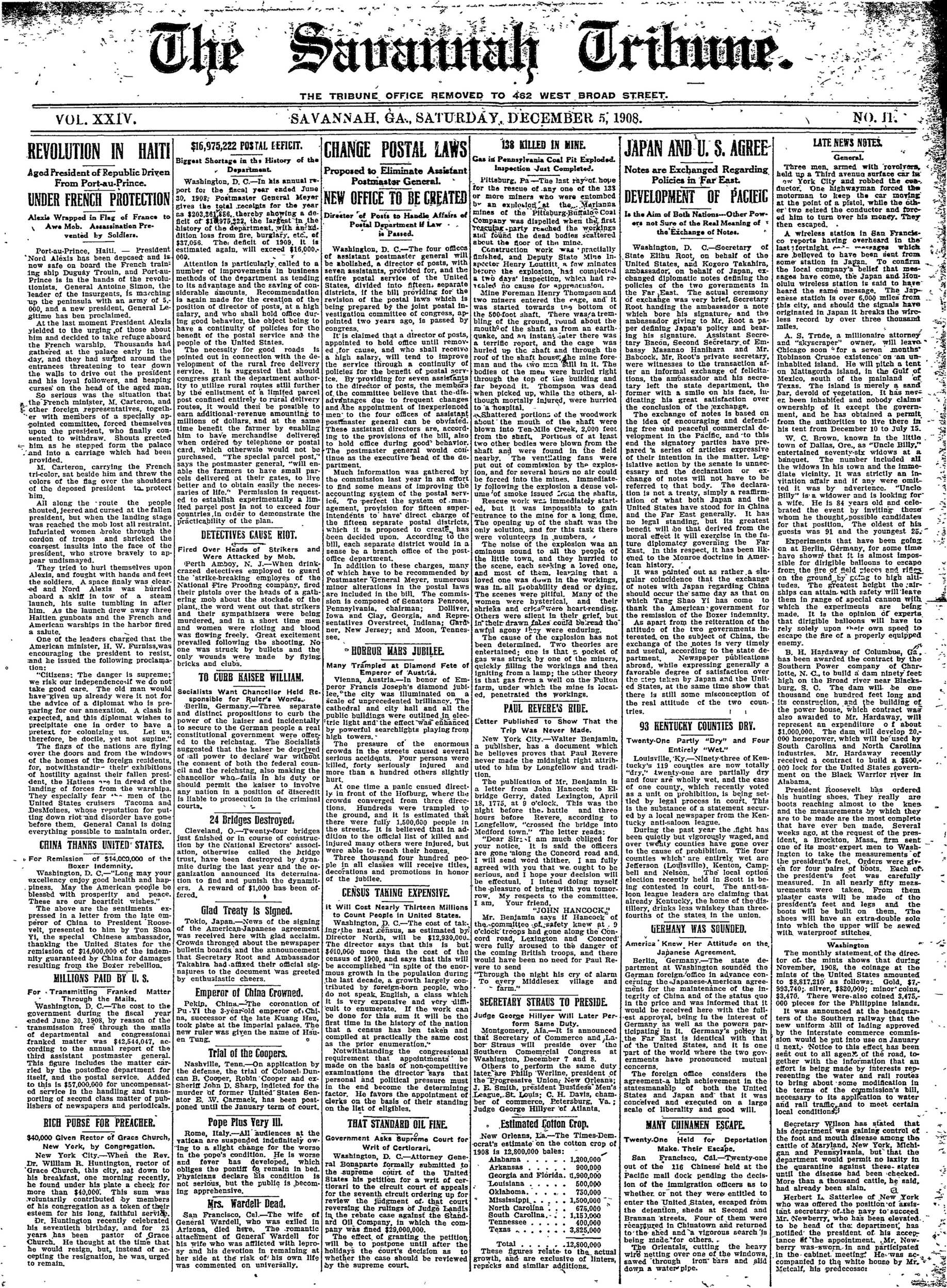
REVOLUTION IN HAITI
UNDER FRENCH PROTECTION
Alexis Wrapped in Flag of France to
Awe Mob. Assassination Pre-
vented by Soldiers.
Port-au-Prince, Haiti. — President
Nord Alexis has been deposed and is
now safe on board the French训
ship Duguyne and Port-au-
Prince, the hands of the revolu-
tionists. General Antoine Simon, the
leader of the insurgents, is marching
up the peninsula with an army of 5,
000, and a new president, General Le-
gittman has been proclaimed.
At the last moment President Alexis yielded to the urging of those about him and decided to take refuge aboard the French warship. Thousands had gathered at the palace early in the day, and they had surged around the entrances threatening to tear down the walls to drive out the president and his loyal followers, and heaping curses on the head of the aged man. So serious was the situation that the French minister, M. Carteron, and other foreign representatives, together with members of a specially appointed committee, forced themselves upon the president, who finally consented to withdraw. Shouts greeted him as he stepped form the palace and into a carriage which had been provided. M. Carteron, carrying the French tri-color, sat beside him and threw the colors of the flag over the shoulders of the deposed president to protect him.
All along the route the people shouted, jeered and cursed at the fallen president, but when the landing stage was reached the mob lost all restraint. Infuriated women broke through the cordon of troops and shrieked the coarsest insults into the face of the president, who strove bravely to appear undismayed.
They tried to hurl themselves upon Alexis, and fought with hands and feet the soldiers. A space finaly was cleared and Nord Alexis was hurried aboard a skiff in tow of a steam launch, his suite tumbling in after him. As the launch drew away three Haltien gunboats and the French and American warships in the harbor fired a salute.
One of the leaders charged that the American minister, H. W. Furliss, was encouraging the president to resist, and he issued the following proclamation:
"Citizens: The danger is supreme; we risk our independence if we do not take good care. The old man would have given up already were it not for the advice of a diplomat who is preparing for our annexation. A clash is expected, and this diplomat wishes to precipitate one in order to have a pretext for colonizing us. Let us, therefore, be docile, yet not supine." The flags of the nations are flying over the doors and from the windows of the homes of the foreign residents, for, notwithstanding their exhibitions, hostility against their dread president landing of forces from the warships. They especially fear "the men of the United States cruisers Tacoma and DesMoines, whose reputation for putting down riot and disorder have gone before them. General Canal is doing everything possible to maintain order,
For Remission of $14,000,000 of the Boxer Indemnity,
Washington, D. C.—"Long may your excellency enjoy good health and happiness. May the American people be blessed with prosperity and peace. These are our heartfelt wishes."
The above are the sentiments expressed in a letter from the late emperor of China to President Roosevelt, presented to him by Ton Shoa Yi, the special Chinese ambassador, thanking the United States for the remission of $14,000,000 of the indemnity guaranteed by China for damages resulting from the Boxer rebellion.
For Transmitting Franked Matter Through the Mails.
Washington, D. C.-The cost to the government during the fiscal year ended June 30, 1908, by reason of the transmission free through the mails of departmental and congressional franked matter was $42,544,047, according to the annual report of the third assistant postmaster general. Third figure includes the departmental care to the postoffice department for itself, and the postal service. Added to this is $57,000,000 for uncompensated service in the handling and transporting of second class matter of publishers of newspapers and periodicals.
$40,000 Given Rector of Grace Church,
New York, by Congregation.
New York City—When the Rev. Dr. William R. Huntington, rector of Grace Church, this city, sat down to his breakfast, one morning recently, he found under his plate check for more than $40,000. This sum was voluntarily contributed by members of his congregation as a token of their esteem for his long, faithful service. Dr. Huntington recently celebrated his seventieth birthday, and for 25 years has been pastor of Grace Church. He thought at the time that he would resign, but, instead of accepting the resignation, he was, urged to remain.
VOL. XXIV.
CHINA THANKS UNITED STATES.
MILLIONS PAID BY H. S.
BICH PURSE FOR PREACHER.
The
$16,975,222 POSTAL EEFIGIT.
Biggest Shortage in the History of the Department.
Washington, D. C.—In his annual report for the fiscal year ended June 30, 1908: Postmaster General Meyer gives the total receipts for the year as $203,381,856, thereby showing a deficit of $18,975,222, the largest in the history of the department, with an addition loss from fire, burglary, etc., of $37,056. The deficit of 1909, it is estimated again, will exceed $16,000,000. Attention is particularly called to a number of improvements in business methods of the department as tending to its advantage and the saving of considerable amounts. Recommendation is again made for the creation of the position of director of posts, at a high salary, and who shall hold office during good behavior, the object being to have a continuity of policies for the benefit of the postal service and the people of the United States.
The necessity for good roads is pointed out in connection with the development of the rural free delivery service. It is suggested that should congress grant the department authority to utilize rural routes still further by the enlistment of a limited parcel post confined entirely to rural delivery routes, it would then be possible to earn additional-revenue amounting to millions of dollars, and at the same time benefit the farmer by enabling him to have merchandise delivered when ordered by telephone or postal mail when ordered by the farmer purchased. "The special parcel post," says the postmaster general, "will enable the farmers to have small parcels delivered at their gates, to live better and to obtain easily the necessities of life." Permission is requested to establish experimentally a limited parcel post in not to exceed four countries, in order to demonstrate the practicability of the plan.
DETECTIVES CAUSE RIOT.
Fired Over Heads of Strikers and Were Attacked by Mob. Perth Amboy, N. J.—When drink-crazed detectives employed to guard the 'strike-breaking employees of the National Fire Proofing company, fired their pistols over the heads of a gathering mob about the stockade of the plant, the word went out that strikers and their sympathizers were being murdered by a short time man and women were roiling and blood was flowing freely. Great excitement prevailed following the shooting. No one was struck by bullets and the only wounds were made by flying bricks and clubs.
TO CURB KAISER WILLIAM.
Socialists Want Chancellor Held Responsible for Buler's Words.
Berlin, Germany.—Three separate and distinct propositions to curb the power of the kaiser and incidentally to secure to the German people a real constitutional government were offered to the reichstag. The Socialists suggested that the kaiser be deprived of all power to declare war without the consent of both the federal council and the reichstag, also making the chancellor who-fails in his duty or should permit the kaiser to involve any nation in a position of discredit is liable to prosecution in the criminal courts.
24 Bridges Destroyed.
Cleveland, O.—Twenty-four bridges just finished or in course of construction by the National Erectors' association, otherwise called the bridge trust, have been destroyed by dynamite during the last year and the organization announced its determination to find and punish the dynamiters. A reward of $1,000 has been offered.
Glad Treaty is Signed.
Tokio, Japan.—News of the signing of the American-Japanese agreement was received here with glad acclaim. Crowds thronged about the newspaper bulletin boards and the announcement that Secretary Root and Ambassador Talahira had affirmed their official signatures to the document was greeted by enthusiastic cheers.
Emperor of China Crowned.
Pekip, China.—The coronation of Pu-Yi the 3-year-old emperor of China, successor of the late Kuang Hsu, took plate at the imperial palace. The new ruler was given the name of Hsuen Tung.
Trial of the Coopers.
Nashville, Teen.—On application by the defense, the trial of Colonel Duncan B. Cooper, Robin Cooper and ex-Sheriff John D. Sharp, indicted for the murder of former United States Senator E. W. Carmack, has been postponed until the January term of court.
Pope Plus Very Ill.
Rome, Italy.—All audiences at the vatican are suspended indefinitely owing to a slight change for the worse in the popo's condition. He is worse and fever has developed, which obliges the pontif to remain in bed. Physicians declare his condition is not serious, but the public is becoming apprehensive.
Mrs. Wardell Dead.
San Francisco, Cal.-The wife of General Wardell, who was exiled in Arizona, died here. The romantic attachment of General Wardell for his wife who was afflicted with leprosy and his devotion in remaining at her side at the risk of his own life was commented on universally.
SAVANNAH, GA., SATURDAY, DECEMBER 5, 1908.
THE TRIBUNE OFFICE REMOVED TO 462 WEST BROAD STREET.
Director of Posts to Handle Affairs of Postal Department if Law is Passed.
Washington, D. C.-The four offices of assistant postmaster general will be abolished, a director of posts, with seven assistants, provided for, and the entire postal service of the United States, divided to fifteen separate districts. If the bill providing for the revision of the postal laws which is being prepared by the joint postal investigation committee of congress, appointed two years ago, is passed by congress
It is claimed that a director of posts, appointed to hold office until removed for cause, and who shall receive a high salary, will tend to improve the service through a continuity of policies for the benefit of postal service. By providing for seven assistants to the director of posts, the members of the committee believe that the disadvantages due to frequent changes and the appointment of inexperienced men to the four offices of assistant postmaster general can be bifurcated, these directors are, according to the provisions of the bill, also to hold office during good behavior. The postmaster general would continue as the executive head of the department.
Much information was gathered by the commission last year in an effort to find some means of improving the accounting system of the postal service. To perfect the system of management, provision for fifteen superintendents to have direct charge of the fifteen separate postal districts, which it is proposed to create, has been decided upon. According to the bill, each separate district would in a sense be a branch office of the post-office department.
In addition to these charges, many of which have to be recommended by Postmaster General Meyer, numerous minor alterations in the postal laws are included in the bill. The commission is composed of Senators Penrose, Pennsylvania, chairman; Dolliver, Iowa and Clay, Georgia, and Representatives Overstreet, Indiana; Gardner, New Jersey; and Moon, Tennessee.
HORROR MARS JUBILEE
Many Trampled at Diamond Fete of Empress of Austria
Vienna, Austria.—In honor of Emperor Francis Joseph's diamond jubilee, the city was illuminated on a scale of unprecedented brilliancy. The cathedral and city hall and all the public buildings were outlined in electric light and the effect was enhanced by powerful searchlights playing from high towers.
The pressure of the enormous crowds in the streets caused several serious accidents. Four persons were killed, forty seriously injured and more than a hundred others slightly hurt.
At one time a panic ensued directly in front of the Hofburg, where the crowds converged from three directions. Hundreds were trampled to the ground, and it is estimated that there were fully 1,500,600 people in the streets. It is believed that in addition to the official list of killed and injured many others were injured, but were able to reach their homes.
Three thousand four hundred people in all classes will receive titles, decorations and promotions in honor of the jubilee.
CENSUS TAKING EXPENSIVE
It Will Cost Nearly Thirteen Millions to Count People in United States. Washington, D. C.—The cost of taking the next census, as estimated by Director North, will be $12,930,000. The director says that this is but $410,000 more than the cost of the census of 1900, and says that this will be accomplished "in spite of the enormous growth in the population during the last decade, a growth largely contributed by foreign-born people, who do not speak English, a class which it is very expensive and very difficult to enumerate. If the work can be done for this sum it will be the first time in the history of the nation that a census has been taken and compiled at practically the same cost as the prior enumeration."
Notwithstanding the congressional requirement that appointments be made on the basis of non-competitive examinations the director says that personal and political pressure must become the determining factor. He favors the appointment of clerks on the basis of their standing on the list of eligibles.
THAT STANDARD OIL FINE
Government Asks Supreme Court for
Writ of Cortiorari.
Washington, D. C.-Attorney General
Bonaparte formally submitted to
the supreme court of the United
States his petition for a writ of
cortiorari to the circuit court of
appeals for the seventh circuit ordering up for
review the judgment of the court
reversing the winners of Judge Laluis
in the rebate case against the Standard
Oil Company, in which the company was fined $29,000,000.
The effect of granting the petition
will be to postpone until after the
holidays the court's decision as to
whether the case should be reviewed
by the supreme court.
138 KILLED IN MINE
Gas in Pennsylvania Coal Pit Exploded.
Inspection Just Completed.
Pittsburg, Pa. —The last ray of hope for the rescue of any one of the 123 or more miners who were entombed by an explosion at the Marianna mines of the Pittsburg/Buffalo Coal Company was dispelled when the first rescue party reached the workings and found the dead bodies scattered about the floor of the mine. Construction work was 'practically finished, and Deputy State Mine Inspector Henry Louttit a few minutes before the explosion, had completed a two days' inspection, which had revealed no cause for apprehension.
Mine Foreman Henry Thompson and two miners entered the cage, and it was started towards the bottom of the 500-foot shaft. There was a trembling of the ground, round about the mouth of the shaft as from an earthquake, and an instant later there was a terrific report, and the cage was hurled up the shaft and through the roof of the shaft house, the mine necromachy, and the women were hurled right through the top of the building and far beyond it. Thompson was dead when picked up, while the others, although mortally injured, were hurried to a hospital.
Shattered portions of the woodwork about the mouth of the shaft were blown into Ten-Mile Creek, 2,000 feet from the shaft. Portions of at least two other bodies were blown from the shaft and were found in the field nearby. The ventilating fans were put out of commission by the explosion, and for several hours no air could be forced into the mines. Immediately following the explosion a dense volume of smoke issued from the shafts. Rescue work was immediately started, but it was impossible to gain entrance to the mine for a long time. The opening up of the shaft was the only solution, and for this task there were volunteers in numbers.
The noise of the explosion was an ominous sound to all the people of the little town, and they hurried to the scene, each seeking a loved one, and most of them, learning that a loved one was down in the workings, was in all probability dead or dying. The scenes were pitiful. Many of the women were hysterical, and their shrieks and cries were heart-rending. Others were silent in their grief, but in their drawn fates could be awful agony they were enduring.
The cause of the explosion has not been determined. Two theories are entertained; one is that a pocket of gas was struck by one of the miners, quickly filling the workings and then igniting from a lamp; the other theory is that gas from a well on the Fulton farm, under which the mine is located, penetrated the workings.
PAUL REVERE'S RIDE.
Letter Published to Show That the Trip Was Never Made.
New York City.—Walter Benjamin, a publisher, has a document which he believes proves that Paul Revere never made the midnight right attributed to him by Longfellow and tradition.
The publication of Mr. Benjamin is a letter from John Hancock to Elbridge Gerry dated Lexington, April 18, 1755, 19 o'clock. This was the night before the battle, and three hours before Revere, according to Longfellow, "crossed the bridge into Medford town." The letter reads:
"Dear Sir: I am much obliged for your notice. It is said the officers are gone along the Concord road and I will send word thither. I am fully agreed with you that we ought to be serious, and I hope your decision will be effectual. I intend doing myself the pleasure of being with you tomorrow. My respects to the committee. I am. Your friend.
Mr. Benjamin says if Hancock of the committee of safety knew pt. 9 o'clock troops had gone along the Concord road, Lexington and Concord were fully aroused to the danger of the coming British troops, and there would have been no need for Paul Revere to send "Through the night his cry of alarm To carry Middlesex village and ... farm."
SECRETARY STRAUS TO PRESIDE.
Judge George Hillier Will Later Perform Same Duty.
Montgomery, Ala.—It is announced that Secretary of Commerce and Labor Stras will preside over the Southern Commercial Congress at Washington, December 7 and 8.
Others to perform the same duty later are Philip Werline, president of the Progressive Union; New Orleans; J. E. Smith, president Business' Men's League, St. Louis; C. H. Davis, chamber of commerce, Petersburg, Va.; Judge George Hillier at Atlanta.
Estimated Cotton Crop.
New Orleans, La.—The Times-Democrat's estimate on the cotton crop of 1908 is 12,800,000 bales:
Alabama ..... 1,200,000
Arkansas ..... 900,000
Georgia and Florida ..... 1,900,000
Louisiana ..... 500,000
Oklahoma ..... 750,000
Mississippi ..... 1,500,000
North Carolina ..... 675,000
South Carolina ..... 1,150,000
Tennessee ..... 400,000
Texas ..... 3,825,000
Total ..... 12,800,000
These figures relate to the actual growth, and are exclusive of interrepicks and similar additions.
JAPAN AND U. S. AGREE
Notes are Exchanged Regarding Policies in Far East.
DEVELOPMENT OF PACIEIG
Is the Aim of Both Nations—Other Powers not Sure of the Real Meaning of the 'Exchange of Notes.
Washington, D. G.—Secretary of State Elliu Root, on behalf of the United States, and Kogoro Takahir, ambassador, on behalf of Japan, exchanged diplomatic notes defining the policies of the two governments in the Far East. The actual ceremony of exchange was very brief, Secretary Root handing the ambassador a note which bore his signature, and the ambassador giving to Mr. Root a paper defining Japan's policy and bearing his signature. Assistant Secretary Bacon, Second Secretary, of Embassy Masanao Hanihara and Mr. Babcook, Mr. Root's private secretary, were witnesses to the transaction after an informal exchange of felicitations, the ambassador and his secretary left the state department, the former with a smile on his face, indicating his great satisfaction over the conclusion of the exchange.
The exchange of notes is based on the idea of encouraging and defending free and peaceful commercial development in the Pacific, and to this end the signatory parties have prepared a series of articles expressive of their intention in the matter. Legislative action by the senate is unnecessary and the declaration or exchange of notes will not have to be referred to that body. The declaration is not a treaty, simply a reaffirmation of what both Japan and the United States have stood for in China and the Far East generally. It has no legal standing, but its greatest benefit will be that derived from the moral effect it will exercise in the future diplomacy governing the Far East. In this respect, it has been likened to the Monroe doctrine in American history.
It was pointed out as rather a singular coincidence that the exchange of notes with Japan regarding China should occur the same day as that on which Tang Shao Yi has come to thank the American government for the remission of the Boxer indemnity. As apart from the retteration of the attitude of the two governments interested, on the subject of China, the exchange of the notes is very timely and useful, according to the state department. Newspaper publications abroad, while expressing generally a favorable degree of satisfaction over the step taken by Japan and the United States, at the same time show that there is still some misconception of the real attitude of the two countries.
93 KENTUCKY COUNTIES DRY.
Twenty-One Partly "Dry" and Four Entirely "Wet."
Louisville, Ky.-Ninety-three of Kentucky's 119 counties are now totally "dry," twenty-one are partially dry and four are wholly wet, and the case of one county, which recently voted as a unit on prohibition, is being settled by legal process in court. This is the substance of a statement secured by a local newspaper from the Kentucky anti-saloon league. During the past year the fight has been quietly but vigorously waged, and over twenty counties have gone over to the cause of prohibition. The four counties which are entirely wet are Jefferson Lake, Louisville, Nebon. The local option election recently held in Scott is being contested in court. The anti-saloon league leaders are claiming that already Kentucky, the home of the distillery, drinks less whiskey than three-fourths of the states in the union.
GERMANY WAS SOUNDED.
America' Knew Her Attitude on the Japanese Agreement.
Berlin, Germany.-The state department at Washington sounded the German foreign office in advance concerning the Japanese-American agreement for the maintenance of the integrity of China and of the status quo in the price and was informed that it would be received here with the fullest approval, being in the interest of Germany as well as the powers participating in it. Germany's policy in the Far East is identical with that of the United States, and it is one part of the world where the two governments have pronounced mutual concerns.
The foreign office considers the agreement-a high achievement in the statesmanship of both the United States and Japan and that it was conceived and executed on a large scale of liberality and good will.
MANY CHINAMEN ESCAPE
Twenty.One Held for Deportation Make. Their Escape.
San Francisco, Cal.—Twenty-one out of the 116 Chinese held at the Pacific mail dock pending the decision of the immigration officers as to whether or not they were entitled to enter the United States, escaped from the detention, sheds at Second and Brannan streets. Four of them were recaptured in Chinatown and returned to the shed and a vigorous search is being made for others.
The Orientals, cutting the heavy wire netting over one of the windows, sawed through iron bars and slid down a water pipe.
LATE NEWS NOTES
General
Three men, armed with porcelain, held up a Third avenue surface car in New York City and robbed the conductor. One highwayman forced the motorman to keep the car moving at the point of a pistol, while the other two seized the conductor and forced him to turn over his money. They then escaped.
A wireless station in San Francisco reports having overheard in the last fortnight cell messages which are believed to have been sent from some station in Japan. To confirm the local company's belief that messages have come, the Japan and Honolulu wireless station is said to have heard the same message. The Japanese station is over 6,000 miles from this city, and should the signals have originated in Japan it breaks the wireless record by over three thousand miles.
A. S. Trude, a millionaire attorney and "skyscraper" owner, will leave Chicago soon "for a seven months" Robinson Crusoe existence on an uninhabited island. He will pitch a tent on Mattagorda island, in the Gulf of Mexico, south of the mainland of Texas. The island is merely a sand bar, devoid of vegetation. It has never been inhabited and nobody claims ownership of it except the government, and he has obtained a permit from the authorities to live there in his tent from December 10 to July 15. W. C. Brown, known in the little town of Dallas, Ore., as "Uncle Billy," entertained seventy-six widows at a banquet. The number included all the widows in his town and the immediate vicinity. It was strictly an invitation affair and if any were omitted it was by advertisement. "Uncle Billy" is a widower and is looking for a wife. He is 84 years old and celebrated the event by inviting those whom he thought possible candidates for that position. The oldest of his guests was 91 and the youngest 25.
Experiments that have been going on at Berlin, Germany, for some time have shown that it is almost impossible for dirigible balloons to escape from the fire of field pieces and rifles on the ground by going to high altitudes. The greatest height the airships can attain with safety will leave them in range of special cannon with which the experiments are being made. It is the opinion of experts that dirigible balloons will have to rely solely upon their own speed to escape the fire of a properly equipped enemy.
B. H. Hardaway of Columbus, Ga. has been awarded the contract by the Southern Power company of Charlotte, N.C. to build a dam ninety feet high on the Broad river near Blacksburg, S. C. The dam will be one thousand one hundred feet long and its construction, and the building of the power house, which contract was also awarded to Mr. Hardaway, will represent an expenditure of about $1,000,000. The dam will develop 20,000 horsepower, which will be used by South Carolina and North Carolina industries. Mr. Hardaway recently received a contract to build a $500,000 lock for the United States government on the Black Warrior river in Alabama.
President Roosevelt has ordered his hunting shoes. They really are boots reaching almost to the knees and the measurements by which they are to be made are the most complete that have ever ben made. Several weeks ago, at the request of the president, a Brockton, Mass., arm sent one of its most expert men to Washington to take the measurements of the president's feet. Orders were given for four pairs of boots. Each of the president's feet was carefully measured and the nearly city measurements were taken. From them plaster casts will be made of the president's feet and legs and the boots will be built on them. The shoes will have an extra double sole into which the upper will be sewed with waterproof stitches.
Washington
The monthly statement of the director of the mints shows that during November, 1908, the collage at the mints of the United States amounted to $8,817,210 as follows: Gold, $7,933,740; silver, $820,000; minor coins, $3,470. There were also coined 3,475,000 pieces for the Philippine islands. It was announced at the headquarters of the Southern railway that the new uniform bill of lading approved by the interstate commerce commission would be put into use on January 1 next. Notice to this effect has been sent out to all agents of the road, together with the information that an effort is being made by interests representing the water and rail routes to bring about some modification in the terms of the commission's bill, necessary to its application to water and rail traffic, and to meet certain local conditions.
Secretary Wilson has stated that his department was gaining control of the foot and mouth disease among the cattle of Maryland, New York, Michigan and Pennsylvania, but that the department would permit no laxity in the quarantine against these states until the disease had been checked. More than a thousand cattle, he said, had already been slain.
Herbert L. Satterlee of New York who was offered the position of assistant secretary of the navy to succeed Mr. Newberry, who has been elevated to be head of the department, has notified the president of his acceptance of the appointment, Mr. Newberry was sworn in and participated in the cabinet meeting. He was accompanied to the white house by Mr. Metcalf, his predecessor.
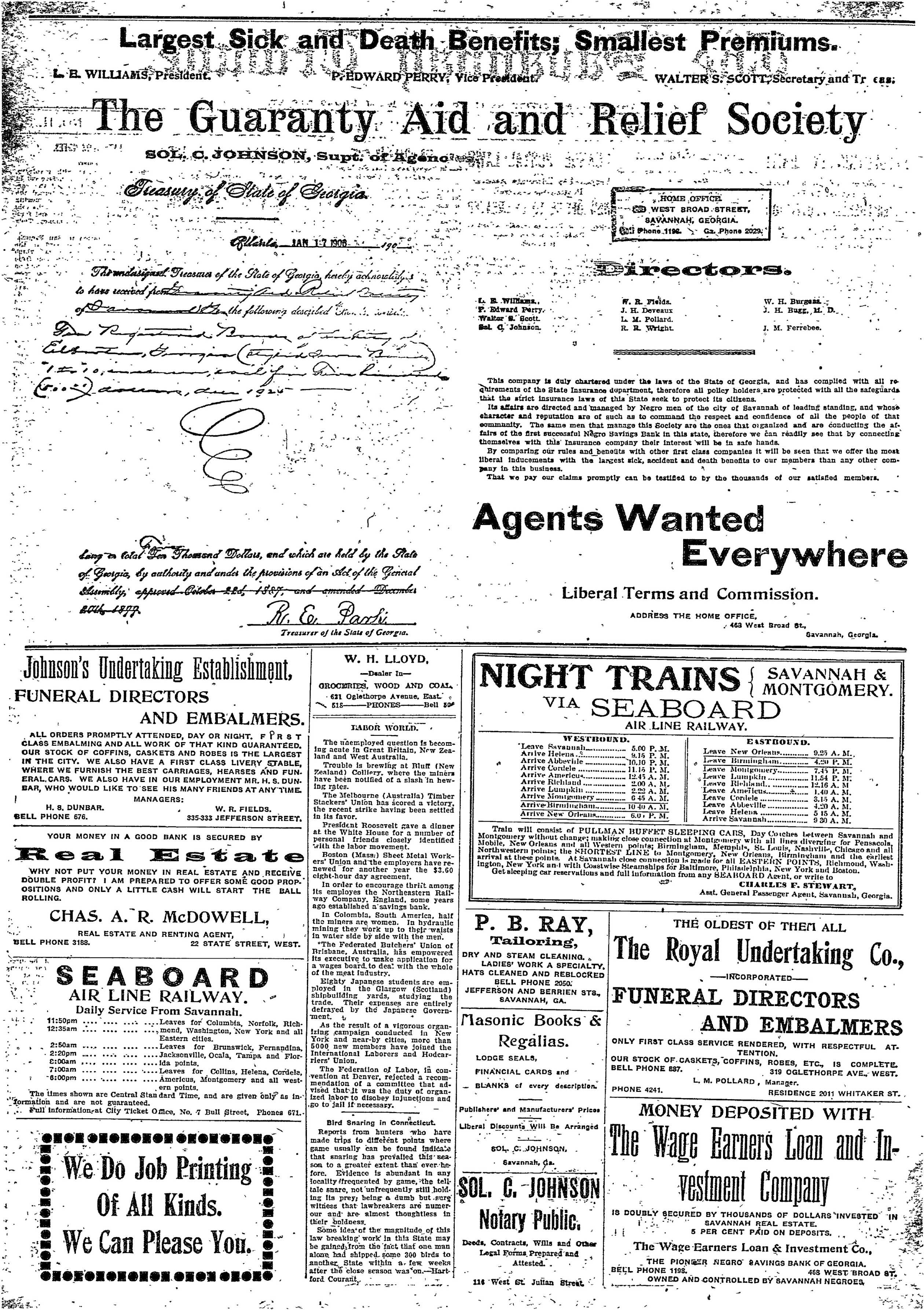
Treasury of State of Georgia
Alabama, JAN 17 1908 190
The undesignated Treasurer of the State of Georgia hereby acknowledges to have received from the Secretary of State the following described stock:
Dear Representative, Person of the State of Georgia,
Elsa Tennant, European Company, Dear Representative,
174710, member, sold from Dear Representative,
Good Amount, June 1920
long in total Ten Thousand Dollars, and which are held by the State of Georgia, by authority and under the provisions of an Act of the General Assembly, approved October 22d, 1887, and amended December 20th, 1877.
R. E. Pasli
Treasurer of the State of Georgia.
W. H. LLOYD,
Johnson's Undertaking Establishment,
GROCERIES, WOOD AND COAL
621 Oglethorpe Avenue, East
518----PHONES----Bell 59
EABOR WORLD.
ALL ORDERS PROMPTLY ATTENDED, DAY OR NIGHT. FIRST CLASS EMBALMING AND ALL WORK OF THAT KIND GUARANTEED. OUR STOCK OF COFFINS, CASKETS AND ROBES IS THE LARGEST IN THE CITY. WE ALSO HAVE A FIRST CLASS LIVERY STABLE, WHERE WE FURNISH THE BEST CARRIAGES, HEARSES AND FUNERAL, CARS. WE ALSO HAVE IN OUR EMPLOYMENT MR. H. S. DUNBAR, WHO WOULD LIKE TO SEE HIS MANY FRIENDS AT ANY TIME.
The unemployed question is becoming acute in Great Britain, New Zealand and West Australia.
Trouble is brewing at Bluff (New Zealand) Collery, where the miners have been notified of a slash in hewing rates.
The Melbourne (Australia) Timber Stackers' Union has scored a victory, the recent strike having been settled in its favor.
President Roosevelt gave a dinner at the White House for a number of personal friends closely identified with the labor movement.
YOUR MONEY IN A GOOD BANK IS SECURED BY
Boston (Mass.) Sheet Metal Workers' Union and the employers have renewed for another year the $3.60 eight-hour day agreement.
WHY NOT PUT YOUR MONEY IN REAL ESTATE AND RECEIVE DOUBLE PROFIT? I AM PREPARED TO OFFER SOME GOOD PROPOSITIONS AND ONLY A LITTLE CASH WILL START THE BALL ROLLING.
In order to encourage thrift among its employees the Northeastern Railway Company, England, some years ago established a savings bank. In Colombia, South America, half the miners are women. In hydraulic mining they work up to their waists in water side by side with the men.
REAL ESTATE AND RENTING AGENT,
BELL PHONE 3188. 22 STATE STREET, WEST.
The Federated Butchers' Union of Brisbane, Australia, has empowered its executive to make application for a wages board to deal with the whole of the meat industry. Elghty Japanese students are employed in the Glasgow (Scotland) shipbuilding yards, studying the trade. Their expenses are entirely defrayed by the Japanese Government. As the result of a vigorous organizing campaign conducted in New York and near-by cities, more than 5000 new members have joined the International Laborers and Hodcarriers' Union.
The Federation of Labor, in convention at Denver, rejected a recommendation of a committee that advised that it was the duty of organized labor to disobey injunctions and go to jail if necessary.
The times shown are Central Standard Time, and are given only as information and are not guaranteed.
Bird Snaring in Connecticut.
Reports from hunters who have made trips to different points where game usually can be found indicate that snaring has prevailed this season to a greater extent than ever before. Evidence is abundant in any locality frequented by game, the telltale snare, not unfrequently still holding its prey; being a dumb but surg witness that lawbreakers are numerouur and are almost thoughtless in their holdness.
We Do Job Printing Of All Kinds. We Can Please You.
Some idea of the magnitude of this law breaking work in this State may be gained from the fact that one man alone had shipped some 300 birds to another. State within a few weeks after the close season was on.—Hartford Courant.
HOME OFFICE
WEST BROAD STREET,
SAVANNAH, GEORGIA.
Phone 1192. Gz. Phone 2029.
Directors.
L. E. Williams,
P. Edward Perry,
Walter S. Scott,
Sal. C. Johnson.
W. R. Fields.
J. H. Deveaux
L. M. Pollard.
R. R. Wright.
W. H. Burgeau
J. H. Bugg, M. D.
J. M. Ferrebee.
This company is duly chartered under the laws of the State of Georgia, and has complied with all requirements of the State Insurance department, therefore all policy holders are protected with all the safeguards that the strict insurance laws of this State seek to protect its citizens.
Its affairs are directed and managed by Negro men of the city of Savannah of leading standing, and whose character and reputation are of such as to command the respect and confidence of all the people of that community. The same men that manage this Society are the ones that organized and are conducting the affairs of the first successful Negro Savings Bank in this state, therefore we can readily see that by connecting themselves with this Insurance company their interest will be in safe hands.
By comparing our rules and benefits with other first class companies it will be seen that we offer the most liberal inducements with the largest sick, accident and death benefits to our members than any other company in this business.
That we pay our claims promptly can be testified to by the thousands of our satisfied members.
Liberal Terms and Commission.
Train will consist of PULLMAN BUFFET SLEEPING CARS, Day Cotches between Savannah and Montgomery without change; making close connection at Montgomery with all lines diverging for Pensacola, Mobile, New Orleans and all Western points; Birmingham, Memphis, St. Louis, Nashville, Chicago and all Northwestern points; the SHORTEST LINE to Montgomery, New Orleans, Birmingham and the earliest arrival at these points. At Savannah close connection is made for all EASTERN POINTS, Richmond, Washington, New York and with Coastwise Steamships for Baltimore, Philadelphia, New York and Boston. Get sleeping car reservations and full information from any SEABOARD Agent, or write to
DRY AND STEAM CLEANING.
LADIES' WORK A SPECIALTY.
HATS CLEANED AND REBLOCKED
BELL PHONE 2050.
JEFFERSON AND BERRIEN ST8.
SAVANNAH, GA.
Masonic Books & Regalias.
LODGE SEALS,
FINANCIAL CARDS and
BLANKS of every description.
Publishers' and Manufacturers' Prices
Liberal Discounts Will Be Arranged
SOL. C. JOHNSON,
Savannah, Ga.
SOL. C. JOHNSON
Notary Public.
ONLY FIRST CLASS SERVICE RENDERED, WITH RESPECTFUL ATTENTION.
OUR STOCK OF CASKETS, COFFINS, ROBES, ETC., IS COMPLETE.
BELL PHONE 887. 319 OGLETHORPE AVE., WEST.
L. M. POLLARD, Manager.
PHONE 4241. RESIDENCE 2011 WHITAKER ST.
IS DOUBLY SECURED BY THOUSANDS OF DOLLARS INVESTED IN SAVANNAH REAL ESTATE. 5 PER CENT PAID ON DEPOSITS.
Deeds, Contracts, Wills and Other
Legal Forms Prepared and
Attested.
116 West St Julian Street
machine wrenched it apart, and trampled it underfoot. The invention—an exceedingly useful one—was lost, because no one had seen him make it, and no one dares speak of it to him. To allude to it is to bring on a furious attack. Most innatics, no matter how contented they may be, generally cherish a furtive longing to escape. They collect wax from the polished floors, take the impressions of locks, and make keys from empty sardine boxes, spoon-handles, or anything to be found. Dr. Marie's museum includes a collection of kilves, of strange and unheard-of shapes. Some of them have blades made from pieces of glass or slate and set in handles of corset steels. Objects harmless in themselves become dangerous weapons through the ingenuity of madmen.
Insane sculptors are as common as insane painters. The insane sculptor hews out coarse statuettes, fantastic animals, ferocious little horned and grimacing devils. An ex-mechanic carves all his soup bones. That his old trade is still in his memory is shown by the little screws that he makes out of the smaller pieces of bone. He works all day at his senseless and ridiculous task. Another lunatic, who believes he is the incarnation of the soul of Beelzebub, passes his time carving toy men out of wood. Each pair of his creations are joined together, now at the necks, now at the shoulders.—Harper's Weekly.
A Proclivity and Compunctions
By E. S. Martin.
continuance. Hardly any major proclivity has such a bad name, or is battered by such a fusillade of arguments and awful examples. That rum does any one any good must seem doubtful even to its best friends. When you have said that it is pleasant, and that, though it is immensely destructive to some savages and to crowds of civilized individuals, a considerable proportion of the most valuable people on the earth seem to be able to play with it without serious damage to themselves, you have said almost all that it is safe to aver. So great a cloud of compunctions swarm over that proclivity that you marvel that there is any life left in it. They do keep down some of its vigor, so that it is less destructive than it used to be, and probably they hope in time to kill it altogether. One could wish that they might, and that it might stay dead for a generation or two, till we could find out whether the world was better or worse without it. But it is not being killed. The army of compunctions it maintains is evidence of its enormous vitality. To all seeming, so long as the earth continues to spin, there are likely to be cakes on it, and also ale, but with great improvement probably by the human race in the wise use of both—Harper's Magazine.
The Flea, The Rat And The Plague By William Inglis.
human beings which the rats infest, and there, from convenient floors or chairs or beds, leap upon human victims.
The plague-bitten flea does not poison man with his bite, as the stegomyla mosquito polisons by infecting the bacillus of yellow fever directly into the blood. The flea, it is true, bites human beings as he bites other prey. He sucks blood until he is replete, and then squirts blood from his alimentary canal upon his prey. Therein lies the peril. Plague bacilli are in this discharge, and if it be left undisturbed on the skin of the victim the bacilli will penetrate the skin and tissues, enter the circulation, and thus infect the person upon whom the flea has fed.
It is this curious manner of infection by dejecta that makes the bubonic plague peculiarly dangerous to people who do not bathe frequently. In Japan and in the United States the spread of the disease among human beings even in rat-infected cities is slow, while in India and China, and certain parts of Europe, where people bathe seldom, if ever, the plaguo runs like wildfire. It is almost impossible for a person who bathes twice a day to become infected with bubonic plague—Harper's Weekly.
The Cup That Cheers
By Yik Fong
In the Orient the Chinaman and the native of Japan drink their tea hot. Hot water is poured on the leaves in very small teacups, and is slipped more or less all day long, helping continually replenished with fresh tea when the brew becomes too strong. Even Europeans after illness, tired out with sight seeing, find marvelous recuperation in sipping their tea thus made.
There is no other way to make tea than to make it absolutely fresh. As one hundred and fifty cups can be made from one pound of tea, it is an immensely profitable drink to sell at five cents a cup on glass, and to charge fifteen to twenty cents for a small pot of tea is to restrict the use of a beverage that in hot weather should be obtainable everywhere, even in saloons, without permission of any extreme temperance advocate.
S
machine wrench exceedingly uses no one dares spatack. Most Immish a furtive loot take the impress spoon-handles, selection of knive blades made from Objects harmless gentility of mada. Insane sculptor hews out co-grimacing devil trade is still in of the smaller ptask. Another elzebub, passages are joined Weekly.
E
□ □
continuance. He by such a fusillion ore any good man said that it is pravages and to the most valuable serious damage. So great a cloud that there is an that it is less de to kill it altogether stay dead for a was better or, what punctions it may so-long as the e also ale, but wise use of both
human beings v
chairs or beds, 1
The plague-b
mosquito poison
blood. The flea
sucks blood unti
canal upon his
charge, and if it
genetrate-the sk
son upon whom
It is this cu
plague peculiarly
and in the Unite
Ey Helen E. Meyer.
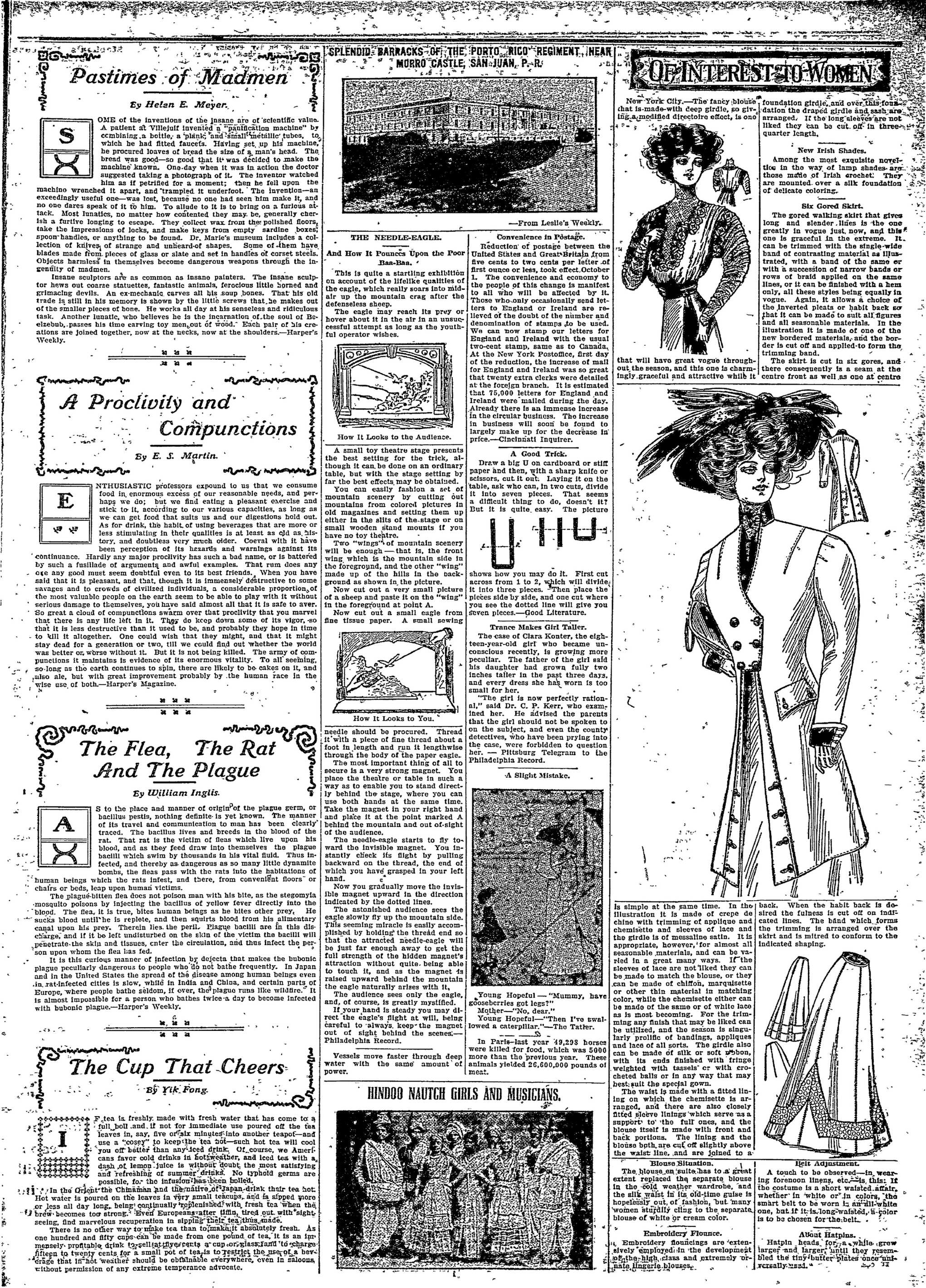
OME of the inventions of the insane are of scientific value. A patient at Villejuif invented a "panification machine" by combining a bottle, a "plank," and "small metallic tubes, to, which he had fitted faucets. Having set, up his machine, he procured loaves of bread the size of a man's head. The bread was good—so good that it was decided to make the machine known. One-day when it was in action the doctor suggested taking a photograph of it. The inventor watched him as if petrified for a moment; then he fell upon the
NTHUSIASTIC professors expound to us that we consume food in enormous excess of our reasonable needs, and perhaps we do; but we find eating a pleasant exercise and stick to it, according to our various capacities, as long as we can get food that suits us and our digestions hold out. As for drink, the habit of using beverages that are more or less stimulating in their qualities is at least as old as history, and doubtless very much older. Coeval with it have been perception of its hazards and warnings against its
S to the place and manner of origin$^{p}$ of the plague germ, or bacillus pestis, nothing definite is yet known. The manner of its travel and communication to man has been clearly traced. The bacillus lives and breeds in the blood of the rat. That rat is the victim of fleas which live upon his blood, and as they feed draw into themselves the plague bacilli which swim by thousands in his vital fluid. Thus infected, and thereby as dangerous as so many little dynamite bombs, the fleas pass with the rats into the habitations of
F tea is freshly made with fresh water that has come to a full holl and, if not for immediate use poured off the tea leaves in, say, five or six minutes into another teapot—and use a "cosey" to keep the tea hot—such hot tea will cool you off better than any iced drink. Of course, we Americans favor cold drinks in hot weather, and ice tea with a dash of lemon juice is without doubt, the most satisfying and refreshing of summer drinks. No typhoid germs are possible, for the infusion has been boiled.
193
HINDOO NAUTCH GIRLS AND MUSICIANS.
[Illustration of a group of people in traditional attire, possibly from a historical or cultural context].
And How It Pounces Upon the Poor Baa-Baa.
This is quite a startling exhibition on account of the lifelike qualities of the eagle, which really soars into mid-air up the mountain crag after the defenseless sheep.
The eagle may reach its prey or hover about it in the air in an unsuccessful attempt as long as the youthful operator wishes.
How It Looks to the Audience.
A small toy theatre stage presents the best setting for the trick, although it can be done on an ordinary table, but with the stage setting by far the best effects may be obtained.
You can easily fashion a set of mountain scenery by cutting out mountains from colored pictures in old magazines and setting them up either in the slits of the stage or on small wooden stand mounts if you have no toy theatre.
Two "wings" of mountain scenery will be enough — that is, the front wing which is the mountain side in the foreground, and the other "wing" made up of the hills in the background as shown in the picture.
Now cut out a very small picture of a sheep and paste it on the "wing" in the foreground at point A.
Now cut out a small eagle from fine tissue paper. A small sewing
How It Looks to You
needle should be procured. Thread it with a piece of fine thread about a foot in length and run it lengthwise through the body of the paper eagle. The most important thing of all to secure is a very strong magnet. You place the theatre or table in such a way as to enable you to stand directly behind the stage, where you can use both hands at the same time. Take the magnet in your right hand and place it at the point marked A behind the mountain and out of sight of the audience. The needle-eagle starts to fly toward the invisible magnet. You instantly check its flight by pulling backward on the thread, the end of which you have grasped in your left hand.
Now you gradually move the invisible magnet upward in the direction indicated by the dotted lines.
The astonished audience sees the eagle slowly fly up the mountain side. This seeming miracle is easily accomplished by holding the thread end so that the attracted needle-eagle will be just far enough away to get the full strength of the hidden magnet's attraction without quite being able to touch it, and as the magnet is raised upward behind the mountain the eagle naturally arises with it.
The audience sees only the eagle, and, of course, is greatly mystified.
If your hand is steady you may direct the eagle's flight at will, being careful to always keep the magnet out of sight behind the scenes.—Philadelphia Record.
Vessels move faster through deep water with the same amount of power.
—From Leslie's Weekly.
Reduction of postage between the United States and Great Britain from five cents to two cents per letter of first ounce or less, took effect. October 1. The convenience and economy to the people of this change is manifest to all who will be affected by it. Those who only occasionally send letters to England or Ireland are relieved of the doubt of the number and denomination of stamps so be used. We can now stamp our letters for England and Ireland with the usual two-cent stamp, same as to Canada, At the New York Postoffice, first day of the reduction, the increase of mall for England and Ireland was so great that twenty extra clerks were detailed at the foreign branch. It is estimated that 75,000 letters for England and Ireland were mailed during the day. Already there is an immense increase in the circular business. The increase in business will soon be found to largely make up for the decrease in price.—Cincinnati Inquirer.
A Good Trick.
Draw a big U on cardboard or stiff paper and then, with a sharp knife or scissors, cut it out. Laying it on the table, ask who can, in two cuts, divide it into seven pieces. That seems a difficult thing to do, doesn't it? But it is quite easy. The picture shows how you may do it. First cut across from 1 to 2, which will divide, it into three pieces. Then place the pieces side by side, and one cut where you see the dotted line will give you seven pieces.—Good Literature.
Trance Makes Girl Taller.
The case of Clara Konter, the eighteen-year-old girl who became unconscious recently, is growing more peculiar. The father of the girl said his daughter had grown fully two inches taller in the past three days, and every dress she has worn is too small for her.
"The girl is now perfectly rational," said Dr. C. P. Kerr, who examined her. He advised the parents that the girl should not be spoken to on the subject, and even the county detectives, who have been prying into the case, were forbidden to question her. — Pittsburg Telegram to the Philadelphia Record.
A Slight Mistake.
H
Young Hopeful—"Mummy, have gooseberries got legs?"
Mother—"No, dear."
Young Hopeful—"Then I've swallowed a caterpillar."—The Tatter.
In Paris-last year 49,298 horses were killed for food, which was 5000 more than the previous year. These animals yielded 26,600,000 pounds of meat.
1
New York City.—The fancy blouse that is made-with deep girdle, so giving a modified directore effect, is one
A
that will have great vogue throughout the season, and this one is charmingly. graceful and attractive while it
ed
d.
y.
se
se
o
n
f
or
e
le
s
s?
re
u
t
le
e
re
u
h
- re
d
o
s,
o
h
- r
s
o
y
o
n
e
is simple at the same time. In the illustration it is made of crepe de chine with trimming of appliqué and chemisette and sleeves of lace and the girdle is of messaline satin. It is appropriate, however, for almost all seasonable materials, and can be varied in a great many ways. If the sleeves of lace are not liked they can be made to match the blouse, or they can be made of chiffon, marquette or other thin material in matching color, while the chemisette either can be made of the same or of white lace as is most becoming. For the trimming any finish that may be liked can be utilized, and the season is singularly prolific of bandings, appliques and lace of all sorts. The girdle also can be made of silk or soft ribbon, with its ends finished with fringe weighted with tassels or with crocheted balls or in any way that may best suit the special gown.
The waist is made with a fitted lining on which the chemisette is arranged, and there are also closely fitted sleeve linings which serve as a support to the full ones, and the blouse itself is made with front and back portions. The lining and the blouse both are cut slightly above the waist line, and are joined to a
Blouse Situation.
The blouse on suite, has to a great extent replaced the separate blouse in the cold weather wardrobe, and the silk waist in its old-time guise is hopelessly out, of fashion, but many women stuffily cling to the separate blouse of white or cream color.
Embroidery Flounce.
Embroidery flouncings are extensively employed in the development of the high class and extremely ornate lingerie blouses.
foundation girdle, and over this foundation the draped girdle and sash are arranged. If the long sleeves are not liked they can be cut off in three quarter length.
Among the most exquisite novelty in the way of lamp shades are those matte of Irish crochet. They are mounted. over a silk foundation of delicate coloring.
Six Gored Skirt.
The gored walking skirt that gives long and slender lines is the one greatly in vogue just now, and this one is graceful in the extreme. It can be trimmed with the single-wide band of contrasting material as illustrated, with a band of the same or with a succession of narrow bands or rows of braid applied on the same lines, or it can be finished with a hem only, all these styles being equally in vogue. Again, it allows a choice of the inverted pleats or habit back so that it can be made to suit all figures and all seasonable materials. In the illustration it is made of one of the new bordered materials, and the border is cut off and applied-to form the trimming band.
The skirt is cut in six gores, and there consequently is a seam at the centre front as well as one at centre
1
back. When the habit back is desired the fulness is cut off on indicated lines. The band which forms the trimming is arranged over the skirt and is mitred to conform to the indicated shaping.
```markdown
```
Ielt Adjustment.
A touch to be observed—in wearing forenoon linens, etc. is this: If the costume is a short waisted affair, whether in white or in colors, the smart belt to be worn is an all-white one, but if it is long-waisted, it color is to be chosen for the belt.
About Hatpins.
Hatpin heads, for a while, grow larger and larger, until they resembled the tiny butterflies once universally used.
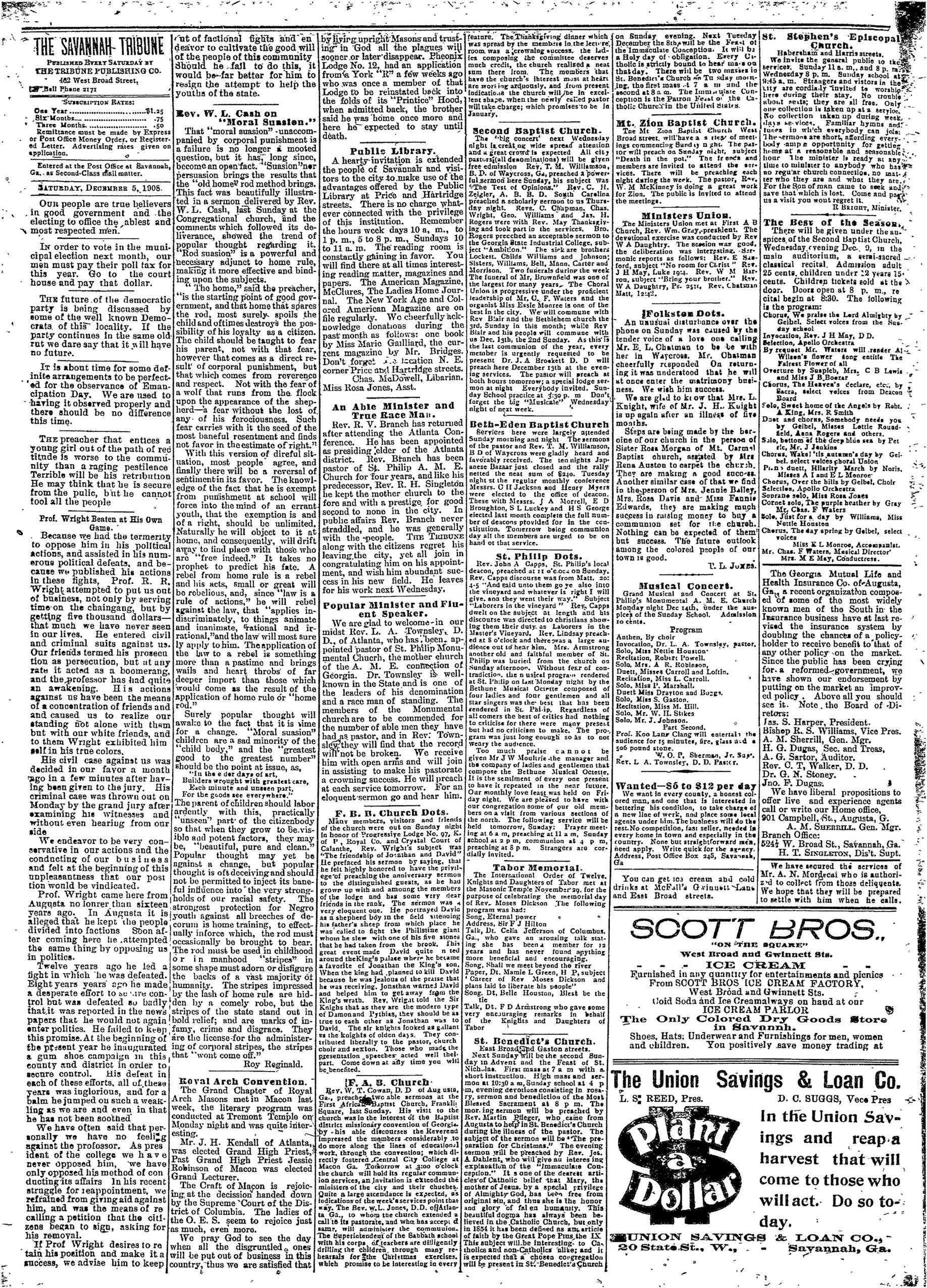
Our people are true believers in good government and the electing to office the ablest and most respected men.
In order to vote in the municipal election next month, our men must pay their poll tax for this year. Go to the court house and pay that dollar.
The future of the democratic party is being discussed by some of the well known Democrats of this locality. If the party continues in the same old rut we dare say that it will have no future.
It is about time for some definite arrangements to be perfected for the observance of Emancipation Day. We are used to having it observed properly and there should be no difference this time.
The preacher that entices a young girl out of the path of red titude is worse to the community than a raging pestilence. Terrible will be his retribution. He may think that he is secure from the pulic, but he cannot tool all the people
Prof. Wright Beaten at His Own Game.
Because we had the termerity to oppose him in his political actions, and assisted in his numerous political defeats, and because we published his actions in these fights, Prof. R. R. Wright attempted to put us out of business, not only by serving time on the chaingang, but by getting five thousand dollars—that much we have never seen in our lives. He entered civil and criminal suits against us. Our friends termed his prosecution as persecution, but at any rate it acted as a boomerang, and the professor has had quite an awakening. His actions against us have been the means of a concentration of friends and caused us to realize our standing not alone with them but with our white friends, and to them Wright exhibited himself in his true colors.
His civil case against us was decided in our favor a month ago in a few minutes after having been given to the jury. His criminal case was thrown out on Monday by the grand jury after examining his witnesses and without even hearing from our side. We endeavor to be very conservative in our actions and the conducting of our business and felt at the beginning of this unpleasantness that our position would be vindicated.
Prof. Wright came here from Augusta no loner than sixteen years ago. In Augusta it is alleged that he kept the people divided into factions. Soon after coming here he attempted the same thing by opposing us in politics.
Twelve years ago he led a fight in which he was defeated. Eight years years ago he made a desperate effort to secure control but was defeated so badly that it was reported in the news papers that he would not again enter politics. He failed to keep this promise. At the beginning of the present year he inaugurated a gum shoe campaign in this county and district in order to secure control. His defeat in each of these efforts, all of these years was inglorious, and for a balm he jumped on such a weakling as we are and even in that he has not been soothed
We have often said that personally we have no feeling against the professor. As president of the college we have never opposed him, we have only opposed his method of conducting its affairs. In his recent struggle for reappointment, we refrained from giving aid against him, and was the means of recalling a petition that the citizens began to sign, asking for his removal. If Prof Wright desires to retain his position and make it a success, we advise him to keep
out of factional fights and en deavor to cultivate the good will of the people of this community Should he fall to do this, it would be far better for him to resign the attempt to help the youths of the state.
Rev. W. L. Cash on "Moral Su
That "moral suasion" unaccompanied by corporal punishment is a failure is no longer a mooted question, but it has long since, become an open fact. $ ^{1} $ Suasion"nur persuasion brings the results that the "old home" rod method brings. This fact was beautifully illustrated in a sermon delivered by Rev. W. L. Cash, last Sunday at the Congregational church, and the comments which followed its deliverance, showed the trend of popular thought regarding it. "Rod suasion" is a powerful and necessary adjunct to home rule, making it more effective and binding upon the subjects.
"The home," said the preacher, "is the starting point of good government, and that home that spares the rod, most surely spoils the child and oftimes destroys the possibility of his loyalty as a citizen. The child should be taught to fear his parent, not with that fear, however that comes as a direct result of corporal punishment, but that which comes from reverence and respect. Not with the fear of a wolf that runs from the flock upon the appearance of the shepherd—a fear without the lost of any of his ferociousness. Such fear carries with it the seed of the most baneful resentment and finds not favor in the estimate of right."
With this version of direful situation, most people agree, and finally there will be a reversal of sentiment in its favor. The knowledge of the fact that he is exempt from punishment at school will force into the mind of an errant youth, that the exemption is and of a right, should be unlimited. Naturally he will object to it at home, and consequently, will drift away to find place with those who are "free indeed." It takes no prophet to predict his fate. A rebel from home rule is a rebel and his acts, small or great will be robelious, and, since "law is a rule of actions," he will rebel against the law, that "applies indiscriminately, to things animate and inanimate, rational and irrational," and the law will most surely apply to him. The application of the law to a rebel is something more than a pastime and brings wails and heart throbs of far deeper import than those which would come as the result of the application of home rule or "home rod."
Surely popular thought will awake to the fact that it is time for a change. "Moral suasion" children are a sad minority of the "child body," and the "greatest good to the greatest number" should be the point at issue, as, "In the earlier days of as
minute and unseen part.
For the goods see everywhere."
The parent of children should labor ardently with this, practically "unseen" part of the citizenbody so that when they grow to be visible and potent factors, they may be, "beautiful, pure and clean."
Popular thought may yet be against a change, but popular thought is oft deceiving and should not be permitted to inject its baneful influence into the very strongholds of our racial safety. The strongest protection for Negro youth against all breeches of decorum is home training, to effectually inforce which, the rod must occasionally be brought to bear. The rod must be used in childhood or in manhood "stripes" in some shape must adorn or disfigure the backs of a vast majority of humanity. The stripes impressed by the lash of home rule are hidden by a comely robe, but the stripes of the state stand out in bold relief; and are marks of infamy, crime and disgrace. They are the license for the administering of corporal stripes, the stripes that "wont come off."
Roy Reginald.
Royal Arch Convention.
The Grand Chapter of Royal Arch Masons met in Macon last week, the literary program was conducted at Tremont Temple on Monday night and was quite interesting.
Mr. J. H. Kendall of Atlanta, was elected Grand High Priest, Past Grand High Priest Jessie Robinson of Macon was elected Grand Lecturer.
The Craft of Macon is rejoicing at the decision handed down by the Supreme Court of the District of Columbia. The ladies of the O. E. S. seem to rejoice just as much, even more.
We pray God to see the day when all the disgruntled ones will be put out of business in this country, thus we are satisfied that
by living upright Masons and trusting in God all the plagues will sooner or later disappear. Rheonix Lodge No. 12, had an application from York "It" a few weeks ago who was once a member of that Lodge to be reinstated back into the folds of its "Printice" Hood, when admitted back, the brother said he was home once more and here he expected to stay until death.
Public Library.
A hearty invitation is extended the people of Savannah and visitors to the city to make use of the advantages offered by the Public Library at Price and Hartridge streets. There is no charge whatever connected with the privilege of this institution. Remember the hours week days 10 a., m., to 1 p. m., 5 to 8 p. m., Sundays 10 to 11 a. m. The reading room is constantly gaining in favor. You will find there at all times interesting reading matter, magazines and papers. The American Magazine, McClures, The Ladies Home Journal. The New York Age and Colored American Magazine are on file regularly. We cheerfully acknowledge donations during the past month as follows: one book by Miss Marie Gaillard, the current magazine by Mr. Bridges. Don't forget location N. E. corner Price and Hartridge streets. Chas. McDowell, Libarian.
An Able Minister and True Race Man.
Rev. R. V. Branch has returned after attending the Atlanta Conference. He has been appointed as presiding elder of the Atlanta district. Rev. Branch has been pastor of St. Philip A. M. E. Church for four years, and like his predecessor, Rev. R. H. Singleton he kept the mother church to the fore and with a prestige, for good second to none in the city. In public affairs Rev. Branch never straddled, and he was generally with the people. THE TRIBUNE along with the citizens regret his leaving the city, yet all join in congratulating him on his appointment, and wish him abundant success in his new field. He leaves for his work next Wednesday.
Popular Minister and Fluent Speaker.
We are glad to welcome-in our midst Rev. L. A. Townsley, D. D., of Atlanta, who has been appointed pastor of St. Philip Memorial Church, the mother church of the A. M. E. connection of Georgia. Dr. Townsley is well-known in the State and is one of the leaders of his denomination and a race man of standing. The members of the Monumental church are to be commended for the number of able men they have had as pastor, and in Rev. Townsley they will find that the record will not be broken. We receive him with open arms and will join in assisting to make his pastorate a crowning success. He will preach at each service tomorrow. For an eloquent sermon go and hear him.
F. B. B. Church Dots.
Many members, visitors and friends of the church were out on Sunday night in honor of Progressive Sunday No. 97, K. Royal Court, and the Crystal Court of Calcutta. Rev. Wright's subject was "The friendship of Jo-naith and David" He prefaced his sermon by saying, that he felt highly honored to have the priy privilege of preaching the anniversary sermon to the distinguished guests, as he had grown up with and among the members of the lodge and has some very dear friends in the rank. The sermon was 4 very eloquent one. He portrayed David as a shepherd boy in the field attending his father's sheep from which place he was called to fight the Phillisite giant whom he slew with one of his five stones that he had taken from the brook. This great event made David quite n t around the King's palace where he became a favorite of Jonathan the King's son. When the king had, planned to the praise that he was receiving, Jonathan warned David the king's wrath. Rev. Wright told the Sir Knights that as they are the modern type of Damon and Pythias, they should be true to each other as Jonathan was to David. The sir knights looked as gallant as the knights of olden days. They contributed liberally to the pastor, church choir and sexton. Those who made the presentation, speecher acted well the part. Come down at any time you will be benefited.
[F. A. B. Church:
Key, W. T. Cowan, D. D. of Angus, Ga., preaches two able sermons at the First African Baptist Church, Franklin Square, last Sunday. His visit to the church was in the interest of the Baptist district missionary convention of Georgia - his able discourses the Reverend impressed the members considerably to do more along the lines of educational work, through the convention; which directly fostered Central City College at Macon Ga. Tomorrow at 4 o'clock the church will hold its regular communion services, an Invitation is extended the ministers of the city and their churches. Quite a large attendance is expected, as indications of the week's services point that way. The Bev. w. L. Jones, D. D. of Atlanta Ga., to whom the church extended a call to its pastorate, and who has accepted a same, will administer the communion. The Superintendent of the Sabbath school with his corps of teachers are diligently drilling the children through many rehearsals for the Christmas exercises, which promise to be interesting in every
feature. The Thanksgiving dinner which was spread by the members in the lecture room was a crowding success, the ladies composing the committee deserves much credit, the church realized a neat sum there from. The members that have the church's interest most at heart are working ardently, and from present indications the church will be in excellent shape, when the newly called pastor will take charge; which promises to be in January.
Second Baptist Church.
Second Baptist Church.
"The big concert" next Wednesday night is creating wide spread attention and a great crowd is expected. All city patrons (all denominations) will be glean free admission Rev. T. M. Williamson, B. D. of Waycross, Ga, preached a powerful sermon here Sunday, his subject was "The Test of Opinions." Rev. C. H. Zelger, A. B. B. D. South Carolina preached a scholarly sermon to us Thursday night. Revs. C. Chapman, Chas. Wright, Geo. Williams and Jas. H. Rogers wereGeo. Williams and Jas. H. Rogers preached an acceptable sermon to the Georgia State Industrial College, subject "Ambition." The sick are brothers Lockett, Childs Williams and Johnson; Sisters, Williams, Bell, Mann, Carter and Morrison. Two funerals during the week The funeral of Mr. Brownfield was one of the largest for many years. The Choral Union is progressive under the proficient leadership of Mr. C, F. Waters and the organist Miss Essie Monroe is one of the best in the city. We will commune with Rev Bairl and the Bethlehem church the 3rd, Sunday in this month; while Rev Bairl and his people will commune with us Dec. 19th, the 2nd Sunday. As this is the last communion of the year, every member is urgently requested to be present Dr. J. A Brookett D. D will preach here December 13 at the evening services. The pastor will preach at both hours tomorrow; a special lodge sermon at night Everybody invited. Sunday School practice at 3:30 p.m. Don't forget the big "Musicale" Wednesday night of next week.
Beth-Eden Baptist Church
Services here were largely attended
Sunday morning and night. The sermons
of the pastor and Rev. T. M. Williamson,
B D of Waycross were gladly heard and
favorably received. The ten nights Japane
Bazaar just closed and the rally
netted the neat sum of $240. Tuesday
night st the regular monthly conference
Messrs. C H Jackson and Henry Myers
were elected to the office of deacon.
These with Messrs. J A Morrell, E D
Broughton, S L Luckey and H S George
elected last month completes the full number
of deacons provided for in the
constitution. Tonerow being communlon
day all the members are urged to be on
hand ot that service.
St. Phillip Dots
Rev. John A. Appus, St. Philip's local deacon, presided at 11:00 a.m. on Sunday, Rev. Cappus discusbed Matt, 4:05 and " said unto them he go also into the vineyard and whatever is right I will and they went their way." Subject "Laborers in the vineyard" Rev. Cappus dwelt on the subject at length and his discourse was directed to christians showing them their duty, as Laborers in the Master's Vineyard, Rev. Lindsay preached at 8 o'clock and there was a large audience out to hear him. Mrs. Armstrong another old and faithful member of St. Philip was buried from the church on Sunday afternoon. Without fear of contradiction, the musical program rendered at St. Philip on last Monday night by the Bethune Musical Ocette composed of four ladies and four gentlemen and all of them had that he was rendered in St. Philip's hardless all comers the best of critics had nothing to criticise for there were many present but had no criticism to make. The program was just long enough so as to not weary the audience.
Too much praise cannot be given Mr J W Moultrie the manager and the company of ladies and gentlemen that compose the Bethune Musical Octette. It is the sentiment of every one present to have it repeated in the near future. Our monthly love light was held on Friday night. We are pleased to have with our congregation some of our old members on a visit from various sections of the north. The following service will be held tomorrow, Sunday: Prayer meeting at 6 a.m. preaching at 11 a.m. Sunday school at 2 p.m. communion at 4 p.m. preaching at 8 p.m. Strangers are cordially invited.
Tabor Memorial.
The International Order of Twelve,
Knights and Daughters of Tabor met at
the Masonic Temple November 29, for
the purpose of celebrating the memorial day
of Rev. Moses Dickson. The following
program was had:
Song, Eternal power
Address, Sif F J Hilton
Talk, Dt. Cella Jefferson of Columbus,
Ga., who gave an arousing talk stating
she has been a member for 12
years and has never found anything
more useful and encouraging.
Song, Shall we met beyond the river
Paper, Dt. Namie L Green, H P, subject
"Career of Rev Moses Dickson and
plans laid to liberate his people"
Song, Dt. Belle Houston, Blest be the
tie
Talk, Dt. F D Armstrong who gave some
very encouraging remarks in behalf
of the Knights and Daughters of
Tabor
St. Benedict's Church.
East Broadway Gaston streets.
Next Sunday will be the second Sunday in Advent and the Feast of St. Nicholas. First mass at 7 a.m with a short instruction. High mass and sermon at 10:30 a.m, Sunday school at 4 p.m, evening devotions consisting in rosary, sermon and benediction of the Most Blessed Sacrament at 8 p.m. The moring sermon will be preached by Rev. Martin Blienger, who came from Augusta to help St. Benedict's Church during the illness of the pastor. The subject of the sermon will be "The preparation for Christmas." The evening sermon will be preached by Rev. Jos. A Dahlent, who will give an interesting explanation of the "Immaculate Conception." It is one of the dearest articles of Catholic belief that Mary, the mother of Jesus, by a special privilege of Almighty God, has been free from original sin, and thus she is the honor and glory of fallen humanity. This beautiful dogma has always been believed in the Catholic Church, but only in 1854 it has been defined as an article of faith by the Great Pope Pius the IX. This subject will be interesting: to Catholics and non-Catholics alike; and it is expected that a chosen congregation will be present in St. Benedict's Church
SCOTT BROS..
ICE CREAM
Furnished in any quantity for entertainments and picnics
From SCOTT BROS ICE CREAM FACTORY,
West Broad and Gwinnett Sts.
Goid Soda and Ice Creamalways on haud at our
ICE CREAM PARLOR
The Only Colored Dry Goods Store
in Savannh.
Shoes, Hats: Underwear and Furnishings for men, women
and children. You positively save money trading at
The Union Savings & Loan Co.
UNION SAVINGS & LOAN CO. 20 State St., W., Sayannah, Ga.
on Sunday evening. Next Tuesday the December 8th will be the Feast of the Immaculate Conception. It will be a Holy day of obligation. Every Catholic is strictly bound to hear man out that day. There will be two masses in St. Benedict's Church on Tu day morning, the first mass at 7 a.m. and the second at 8 a.m. The Immaculate Conception is the Patron Feast of the Catholic Church in the United States.
Mt. Zion Baptist Church.
The Mt Zion Baptist Church West Broad street, will have a series of meetings commencing Sunday night. The pastor will preach on Sunday night, subject "Death in the pot." The friends and members are invited to attend the services. There will be preaching each night during the week. The pastor, Rev. W. M McKinney is doing a great work for Zion. The public is invited to attend the meetings.
Ministers Union
The Ministers Union met at First A B Church, Rev W. Grym. preskilent. The devotional exercise was conducted by Rev W A Daughtry. The session was good, the deliberation was interesting. Shronomic reports as follows: Rev E Sankford, subject "No room for Christ" Rev J H May, Luke 1914. Rev W M Barron, subject "Bring your brother." Rev W A Daughtry, Ps. 2511, Rev. Chatman Matt, 12:42.
Folkston Dots.
An unusual disturbance over the phone on Sunday was caused by the tender voice of a love one calling Mr. E. L. Chatman to be with her in Waycross. Mr. Chatman cheerfully responded On returning it was understood that he will at once enter the matrimony business. We wish him success. We are glad to know that Mrs. L. Knight, wife of Mr. J. H. Knight is up again after an illness of five months.
Steps are being made by the boeine of our church in the person of Sister Rosa Morgan of Mt. Carmel Baptist church, assisted by Mrs Rena Auston to carpet the church. They are making a good success. Another similar case of that we find in the person of Mrs. Jennie Bailey, Mrs. Rosa Davis and Miss Fannie Edwards, they are making much success in raising money to buy a communion set for the church. Nothing can be expected of them but success. The future outlook among the colored people of our town is good.
T. L. JUxES.
Musical Concert.
Grand Musical and Concert at St. Phillip's Monumental A. M. E. Church Monday night Dec 14th, under the auspices of the Sunday School. Admission 20 cents.
Program
Anthen, By choir
Invocation, Dr. L. A. Townsley, pastor,
Solo, Miss Nettie Houston*
Recitation, Robert Powell.
Solo, Mrs. A R. Robinson,
Duett, Misses Carroll and Loftin.
Recitation, Miss L. Carroll.
Solo, Miss P. Marshall.
Duett Miss Drayton and Buggs.
Solo Miss S. Gaston.
Recitation Miss W. Hill.
Solo, Mr. W. H. Stikes
Solo, Mr. J. Johnson.
Part Second.
Prof. Koo Lair Clang will entertain the audience for 15 minutes, fire, glass and a 604 pound stone.
W. O. P, Sherman, Jr. Sup.
Rev. L. A. Townsley, D. D. Pastor.
Wanted—S6 to $12 per day
We want in every county, a honest colored man, and one that is interested in bettering his condition, to take charge of a new line of work, and place some local agents under him. The business will do the rest. No competition, fast seller, needed in every home in town and especially in the country. None but straightforward men, need apply. Write quick for the agency. Address, Post Office Box 245, Savannah, Ga
You can get 103 cream and cold drinks at McFall's Grainnell-Lane and East Broad streets.
SCOTT
"ON THE
West Broad and
ICE Cream
Furnished in any quantity for
From SCOTT BROS ICE
West Broad and
Goid Soda and Ice Cream
ICE CREAM
The Only Colored
in Sav
Shoes, Hats; Underwear and
and children. You positiv
The Union Savi
L. S. REED, Pres.
Plant a Dollar
UNION SAVING
20 State St., W.,
St. Stephen's Episcopal Church.
Habersham and Harris streets.
We invite the general public to the
service. Sunday 11 a.m., and 8 p.m.
Wednesday 8 p.m. Sunday school at
9:45 a.m. Strangers and visitors in the
city are cordially invited to worship
here during their stay. No trouble
about seats; they are all free. Only
one collection is taken up at a service.
No collection taken up during week
days services. Familiar hymns and
tunes in which everybody can join.
The sermons are short, affording every-
body ample opportunity for getting
home at a reasonable and seasonable
hour. The minister is ready at any
time to minister to anybody who has
no regular church connection, no matter
who they are and what they are.
For the Son of man can to seek and
save that which is lost. Come and pass
us a visit you won't regret it.
The Best of the Season.
There will be given under the auspices, of the Second Baptist Church, Wednesday, evening Dec. 9, in the main auditorium, a semi-sacred classical recital. Admission adult 25 cents, children under 12 years 15 cents. Children tickets sold at the door. Doors open at 8 p. m., recital begin at 8:30. The following is the program:
Chorus. We praise the Lord Almighty by
Gellat select voices from the Sua-
day.
Gelibel, Select voices from the Sunday school
Inyocation, Rev. J H May, D D.
Selection, Apollo Orchestra
By request Mr. Waters will render Al Wilson's flower song entitle The Fairest Flower of all
Overture by Suspleb, Mrs. C B Lawis and Miss J B. Bozar
Chorus, The Heaven's declare, etc., by Sacra, select voices from Deacon Board
Solo, Sweet home of the Angels by Robt. A King, Mrs. R Smith
Dost and chorus, Somebody needs you by Gelibel, Misses Lottie Roundale, bottom of the deep blue sea by Pet rie, Mr. J Jenkins
Chorus, Wakel 'its autumn's day by Gelibel, select voices choir Union
Plain duett, Hilarity March by Noris, Misses A I and E L Monroe
Chorus, Over the hills by Gelibel, Choir Selection, Apollo Orchestra
Soprane solo, Miss Rosa Jones
Cornet solo, The purple heather by Gray Mr. Chas. F Waters
Sole, Just for a day by Williams, Miss Nettle Houston
Chorus, The day spring by Gelibel, select voices
Miss E L Monroe, Accompanist.
Miss E L Monroe, Accompanist.
Mr. Chas. F Waters, Musical Director'
Mrs. M E May, Conductress.
The Georgia Mutual Life and Health Insurance Co. of Augusta, Ga., a recent organization composed of some of the most widely known men of the South in the Insurance business have at last revised the insurance system by doubling the chances of a policyholder to receive benefit to that of any other policy on the market. Since the public has been crying for a reformed government, we have shown our endorsement by putting on the market an improved policy. Above all you should see it. Note the Board of Directors:
Jas. S. Harper, President.
Bishop K. S. Williams, Vice Pres.
A. M. Sherrill, Gen. Mgr.
H. G. Dugas, Sec. and Treas.
A. G. Sartor, Auditor.
Rev. O. T, Walker, D. D.
Dr. G. N. Stoney.
Jno. F. Dugas.
We have liberal propositions to offer live and experience agents call or write our Home office,
901 Campbell, St., Augusta, G.
A. M. SHERRILL. Gen. Mgr.
Branch Office:
5024 W. Broad St. Saginaw Ga.
5247 W. Broad St., Savannah, Ga.
H. T. SINGLETON, Dis't. Supt.
We have secured the services of
Mr. A. N. Mordecai who is authori-
zed to collect from those deliquents.
We hope that they will be prepared
to settle with him when he calls.
BROS.,
SQUARE"
and Gwinnett Sts.
CREAM
for entertainments and picnics
THE CREAM FACTORY,
and Gwinnett Sts.
malways on hand at our
PARLOR
Dry Goods Store
Yannh.
Furnishings for men, women
lively save money trading at
ings & Loan Co.
In the Union Savings and reap a harvest that will come to those who will act. Do so today.
S & LOAN CO.,
Savannah, Ga.
SATURDAY, DEC. 5. 1908.
If you want your refreshments to be tip top use Scott Bros. ice cream.
Mrs. Eva Dennard,nee Mitchell, of Sterling, Gx., is in the city for two weeks. She is the guest of Mrs. Anice Burke, 524 'Iarrs street east.
Mr. Wm. Brownfield, an old citizen was buried on Tueeday. -He was a member of Armour Lodge and of the Knights of Damon.
Mr. A. K' Herndon one of the Atlantas foremost citizens and president of the Atlanta Mutual Insur.ance Company, was in the city last Saturday and came in to see us.
Mr. Henry J. Cooper an old Sawannahian, but who has been residing in New York for over twenty years spent the past week in the city visiting relatives and friends, and was the guest of his niece. 506 Hartridge street. They endeavored to make his stay in the city a pleasant one. He left on Wednesday night. Only Dry Goods Store owned and controlled by colored people, Scott Bros., West Broad and Qwinnett streets.
Rev. T. M. Williamson of Waycross, Editor of Waycross News, spoke at Beth Elen Baptist Church at 11 o'clock and at Second Baptist at 8:30 o'clock on Sunday. He was the guest of Dr. May and Rev. J. H. Rogers Rev. Williamson left on Monday for Waycross.
The Mutual Insurance Co., of Augusta, has opened a branch office at No 5241-2 West Broad street and is now numbered among our insurance institutions. The company deserves much credit in obtaining the services of Mr. H. T. Singleton as its superintendant of this office. Mr. Singleton has a splendid record as an insurance man and we believe that the interest of the company and members of this district will be safely protected. The Interdenominational Ministers Union of Sayannah will meet at the First Congregational Church next Friday Dec. 11th, at 11 a.m. Every preacher of the city is urgently requested to be present, business of importance.
'The ladies of Tabita's Band with Mrs. M. A. Cole President will resume their afternoon teas for the winter season. The first tea will be given at the residence of Mrs. Ida Scott 612 Huntingdon street west. Members and friends of the Band are cordially invited.
Capt. J. R. Nowell of Columbia, popular and well liked by his friends spent two days in the city last week, circulating among his friends. The captain has been on the sick list for quite awhile, to see him now no one would think so. We were glad to see him
Kindly pay your subscription. When your time expires and you do not want the paper continued, notify us at once to stop it. 'The law gives us the right to collect from a subscriber as long as the paper continues. Subscribers can readily see the necessity of notifying us to stop the paper when they do not want it longer. tf.
For Rent.
Five room house 15 Moore Ave. apply 320 Jones street, east. Nicely furnished rooms 320 Jones street east.
Union Baptist Church
God had wonderful bless us in every way. He enabled our pastor to be in the pulpit all day. Rev. Lowmax D. D., preached for us. Sunday is our communion. Rev. Daniel Wright, D. D., pastor of F. B. B. Church will be with us on Sunday. Come out and hear Rev. Wright and see Dr. Mors, he is improving.
Elks Memorial.
Weldon Lodge No. 26 of Elks will hold memorial services tomorrow afternoon at the Masonic Temple. This will be open to the pubic. A fine program of music has been arranged. The serion will be delivered by Rev W L. Cash of the Congregational Church.
Services Enjoyed.
The services at the First Congregational Church last Sunday were enjoyed very much. Rev. Cash's sermon was the cause of very favorable comments from all who heard it. At the evening services reports from the recent State Convention were rendered by the delegates, followed by a strong sermon by Dr. Douglass. The music by the choir was one of the features and the members too came in for their share of commendation. After next Sunday the new hymn books will be distributed and the members of the choir will vie with each other in bringing this part of the services up to the standard. Attend the services; you are welcome.
Social at the College
Mr. and Mrs. R. M. Cooper of the Georgia State College entertained a few, their friends on last Friday evening at an oyster roast. The guests were entertained with games for a few hours, after which they were ushered into a spacious dining room where covers were laid for six-
teen. 'Those invited were: Mr. and Mrs. W. O. McLester, Mr. and Mrs. J. M. Roston, Mr. and Mrs. J. G. Lemon, Mr. and Mrs. Henry Pearson, Mr. and Mrs. A. B. Cooper, Mr. and Mrs. J. H. Kinckla, Mrs. Mary Laney of McDonough, Ga; Miss Hettie Benjamin of New Haven, Conn; Miss Maria Jaakson.
St. Frances' Orphan Home
The ladies who had in charge the soliciting of Thanksgiving donations for St. Frances Orphan Home, wish to thank their friends for the same. It is not generally known that this home is in operation and has a large number of our children, who are being educated and excellently trained for life's practical duties. The St. Franciscan Sisters who are in charge of the orphanage need the commendation and support of our people for the uns.llish efforts in this direction Our people should arce above the old time denominational prejudice and give unstinted aid to this b-nign institution.
New Lodge of Odd Feilows.
Adamant Lodge 7862, G U O of O F was instituted on Monday night November 23rd by Protection Lodge 3200 G U O of O F. The instituting of Adamant Lodge marks a era in the history of Odd Fellowship in our city, and to the organizer of the movement, Prof. W. D. Kennedy is due the credit of having formed the first association for the instituting of our Odd Fellows Lodge in the city proper during the last score of years.
The association assembled at the hall promptly, and after having been initiated in the secrst works of the order, and the officers degree, the dedicatory ceremonies were be gun under the direction of P G M, C M Brinson, N G. who was ably assisted by P N F, W D Kenneday, V G; P G M, J D Powell, P S; and P G M, R L Lockly, W O. P G M, J D Powell in his impressive way, delivered the dedicatory address which was very attentively received by the candidates and the visiting brothers.
P G M, O M Brinson, acting under the authority of S O M. G U O of O F of America and the isles of the seas, with the charter in hand declared the association duly instituted as a lodge to be known and styled Adamant Lodge 786%, G U O of O F. The ceremonies being completed, P N E, W D Kennedy made a short address to the new lodge relative to the spirit of the fraternity, and also congratulating the mother lodge of which he is the advocate, for the manner in which she had looked after the association. In getting together the material for this lodge, Prof. Kennedy as in other institutions which he has organized kept constantly before his members, that the success of all Negro fraternal societies today is dependent on the quality and not the quantity of its membership. The result being that the membership of Adamant Lodge is of such a standard as assures its success and the conduct of its affairs on a high plane. All of the brothers present as well as the candidates enjoyed the ceremonies.
The following are the officiers of the lodge: P N F, N W Eate; N F, A W Wright; P N G, Sim Gaea. Jr; N G, Thos. G Young; V G, Geo. N Ferguson; PS, W D Kennedy; E S, E M Greene; W T, Geo. N Shivery; Advocate, Robt. E Scott; W C. James A Battie; IL'S V G. Geo. Davidson; R S V G, James Williams; L S N G, Fred 'Bryant; R S N G, Louis Willis; Warden, Jos. Freemau; Guardian, Root. W Gadden
This lodge will meet at the Odd Fellows Temple. Harris street. on the first Wednesday and third Friday in each month at 8 o'clock.
Royall Undertaking Co.
The change of management of the Royall Undertaking Compay is marked with great improvement. Mr. L. M. Pollard who is now the manager has renovated the establishment, increased the stock and have everything on hand that is needed by the patrons of the company. Only experienced persons are employed and the company assures its patrons excellent service and courteous treatment. The company is doing business at the same old stand 319 Oglethorpe Avenue, west. Mr. Pollard has under him Messrs, J. H. Ulmer, Paul J. Steele and W. H. Burgess, all of whom will do their part in seeing that the slightest desire of the patrons will be filled
The Puzzle Mosaic Craze.
It grows, and grows, and grows. The
Mosaic Puzzle Craze has the country
its grip. Everybody is trying to put
pictures together. Suppose you try:
Get the puzzle picture with next Sunday's
World. Also the words and music of
a beautiful song from grand opera, "Sampson
and Dahligh," one of the productions of
the 1908-09 season at the Metropolitan
Opera House. New York. Both with
next Sunday's New York World.
Night School.
NIGHT SCHOOL
The Board of Trustees of the Sarasah
Baptist High School announces that the
night school will be organized on Monday
night Nov. 9th at 8:30 o'c.ck. The day
school department having proven so successful, we have decided to make it possible for those who find it impossible to attend during the day. Terms 8.100 per month in advance. Enroll with your pastor or communicate with the President, Rev. N. H. Whitmire. Phone 1846.
AMUSEMENT COLUMN.
Coming Events in the Social World.
The U. L. Houston Benvolent Association will give a white rose entertainment at Masonic Temple, Monday night Decem ber 21st. Tickets 25 and 35 cents. A semisacred classical recital will be given under the auspices of the Second Baptist Church, in the main auditorium, under the management of Mr. C.F. Waters Wednesday night December 9th. Tickets 25 cents. A grand entertainment will be given by club No 1 of Opal Court No. 41 at Duffy street hall, Monday night December 7th. Tickets 15 cents. A grand entertainment will be given at Morse's hall by the Broads Aid and Social Club Branch, Monday night Dec. 7th. Tickets 15 and 25 cents.
Weldon Lodge No 26 I. B.P. O. Elks of the World will celebrate their sixth anniversary at Masonic Temple Tuesday night December 15th. Tickets 75 cent.
A Jolat entertainment will be given by St. Philip Lodge No 11 and Mt. Morlah Juvenile No 8. G U O of A K at Masonic Temple Tuesday night, December 8th. Tickets 15 cents.
A grand Ball will be given by the Night ingale Club No 15 at Masonic Temple, Tuesday night December 29th. Tickets 25 and 40 cents.
A grand Ball will be given by the Chatham County Kmancipation Association at Harris street hall, Wednesday night December 9th. Tickets 25 cents.
Rising Bound Fountain No 2758 O. U. T. R. will give a grand entertainment at Harris street hall, Monday night, December 14th. Tickets 15 and 25 cents.
Company A. of Ruth Lodge No 42 L. O.
of G. S. and D. of S., will give another
entertainment at Masonic Temple Wednesday
night, December 6th Tickets 15
cents.
The L. B. B. Club will give their first dance of the season at Masonic Temple Monday night December 14th. Tickets 25 and a cente.
A grand social will be given by Will-
ing Workers Fountaina No. 2978, U O T
R, at Scotts Hall, Monday night, December
71b Tickets 10 cents.
The Chatham County Emancipation
Association invites you and your friends to
attend a grand dance given at Harris
street hall, Wednesday night December
9th. Tickets 15 cents.
A five nights fete will be given at Duffy
street hall, by the P N Fs Association
commencing Monday night, December
14th. Tickets 10 cents.
A parlor concert will be given at the resi-
dence of Mrs. Julla Ward 505 Thirty-fourth street, west, Wednesday night,
December 9th. Tickets 10 cents.
A grand Merry Widow Ball will be given by the Ladies Auxiliary of Ravanaah Division U Q T R at Harris street hall, Tuesday night, January 8th. Tickets 15 and 26 cents. A new year entertainment will be given under the auspices of Georgia Company No. 2, K of D at Harris street hall, Friday night, January 1st. Tickets 25 and 40 cents.
Zerah Lodge No. 168, I O G S and D of
8. U S A, will give their second annual
dance at Masbulec Temple. Wednesday
night December 30th. Tickets 15 and 25
cents.
Remember that Golden Star Lodge No.
199, I O G S and D of 8. U S A will give
a grand entertainment at Harris street
hall, Monday night, December 28th.
Tickets 25 and 40 cents.
Experts Repairer.
Mr. Elijah J. Quarterman, expert sewing machine repairer and adjuster, has returned to the city and connected himself again with the New Home Sewing Machine office as salesman and repairer. Seek him if you want to buy either a new or good second hand machine or want your old one repaired. Corner Barnard and York streets.
Vaudeville Three Times a Week.
The Ame Comedy Company will be seen in Vaudeville at Duffy street hall every Monday, Wednesday and Friday nights.
Manager Gathers has secured some of the following artists: Willie West, stage manager; Allen Brown, Singing and Dancing Comedian; Isaac Johnson, chanle Turner, Erie Loyal, Emma Young and Bessie Jones; Bugeana Guy Jr, Trap Drummer; Chas, Williams Cornetist; Goses Gathers, Pianist.
Admission 10sents.
Golden Leaf Club
is preparing to pleasantly entertain their many friends with a
December Solree
on _THURSDAY EVE,
DEC. 10th, 1908
At MASONIC TEMPLE,
Gwinnett Street, west.
We hope to see you present.
Admission 15 Cents
I. B. P. O. ELKS or THE W.
Will Celebrate Their
Sixth Anniversary
At Masonic Temple
TUESDAY EVENING
December 15th.
"Be Among the Well-Dressd and Be Sure That Your Ctothes Bear Levy's Label."
Our Fall and Winter Suits and Overcoats are in and our line is about complete.
Hart Schaffner & Marx
And our other leading makes of clothes are all in, forming what we believe to be the finest selection of men's ready for service garments that it is possible to get together. "STYLE, FABRIC, WORKMANSHIP AND MODERATE PRICE" can be found here in profusion. Come in and try on a few of the garments.
Manhatan Shirts $1.50 Dunlap Hats $5.00. Stetson Hats $3.50 Young's Hats $3.00
A grand wister dance will be given at
Harris street hall Monday night Dec. 5th
by the Naval Stores Coopers Union No.
356. Tickets 15.
DR. L. S. PARKS,
DENTIST.
240 Barnard St., Savannah, Ga.
Does all kind of highgrade dental work of the best quality and workmanship. Gold crowns and bridge work. White Porcelain Plaver, and Gold Crowns mounted on the natural roots. Gold Fillings, Cement Fillings, and Silver or Amalgam Fillings, from nine to a full set of teeth $7.00 and $8.00.
Broken Place mended and teeth added to old ones for a small cost. BellPhone 1244
Gold Crowns Guarantee
Colonial·Hotel
The finest Colored Hotel in the South. First-Class in Every Respect. 21 Large Airy Rooms. Hot and Cold Batns on Eacn Floor. Gas and Electric Lights. Private Dining Rooms. First-Class Cafe, Billiard and Pool Room Attached.
361 and 863 Fourth St.,
MACON, GA.
For First Class
Shoe Repairing
GO TO
The
Atlanta Shoe Shop
Special attention paid to Ladies and Children Shoes. Polite attention given to all work. 103.LIBERTY ST., WEST. J. H. WASHINGTON, Prop.
F. F. JONES,
Dr. J. W. Jamerson, Firstclass Dentist,
623 WEST BROAD STREET. Bet. Huntingdon and Hall. Bell Phone 2098.
Miller's Resort
WATER'S ROAD.
The Place to get an Up-to-date
OYSTER ROAST.
Oysters in Every Style.
Lunches of the most delicious kind.
When out for a drive, stop at
this well known resort.
Facilities to entertain
PRIVATE PARTIES.
A Cordial Welcome await all
Patrons.
GO TO
P. L. Bowen & Co.,
Where you will get the best
GROCERIES, MEAT,
GRAIN and FEED.
504 Gwinnett St., west.
Bad Mouths Made Good
Digestion Restored
When your teeth bother you consult
Dr, Geo. B. Shi ver,
THE DENTIST
5244 West Broad St.
蜜
Brown the Swastika Man.
We are going to make things lively for ninety days. We have 356 watches, five grosses swastika articles, such as foli, lace pins, cuff pins, vall pins, hat pins, cuff buttons, eight day clocks at $20, nicle clocks at 75 cents, all must go at a cut price. We received your royal patronage last year. We are encouraged to make a finer display for you and yours this year. All Hall, Savannah hall. I come to answer thy beat pleasure, be it to fly, to swim, to dive into the fire, to ride on the bargain clouds, to show you value unheard and prices before in the history of horology. See the big clock on outside of door. 807 West Broad street, Savannah, Ga
A New Pharmacy The People's Pharmacy
809 West Broad St.
Prescriptions carefully
pounded.
Drugs Toilet Articles and
dries.
Candles Soda Water and
Ice Cream.
LODGE ROOMS FOR HIRE CHAP1
ENTERTAINMENT HALLS with Piano and Orchestra Hired Together. Music furnished with the Hall MORSE'S HALL.
CLOTHING
$1.00
A WEEK
Newest Styles
Lowest Prices
Easiest Terms
Keep this store in mind
charge account here will be a
positive benefit to you.
MEN'S CLOTHING
WOMEN'S CLOTHING
BOYS' CLOTHING
No red tape. It keeps dead
to fall. 73 stores—baby
wearer. Cash more than
MENTERY
ROSENBLE
107 Broughton St.
UP-STAIRS.
Story of a Young Man Who Went West For Uncle Sam.....
The great French and Indian War of 1763. Its result was to break the French and Indian War for four years and to make English territory of the region between the Alleghenies and the Mississippi.
at that time the war between the Colonies and the British Government was still a dozen years in the future. The colonists—especially the Virginiaans—at once planned to settle and occupy the conquered region, which was then known as the Ohio country, where they were organized to go into the new region. There were there with their families, clearing away the forests, opening farms and making homes for themselves in the wilderness.
But these pleneers were comparatively few, and the difficulties they encountered were very great. There were no roads anywhere, no bridges across creeks and no secure means of communication except by way of the river. In the main, therefore, they settled upon the river banks, leaving their vast interior country to the occupation of the powerful Indian tribes, who viewed all white settlement with jealousy and hatred.
Meanwhile south of the Ohio a considerable number of adventurous Virginians and Carolinians had crossed the mountains and made little settlements in what we now call Kentucky and Tennessee. These included a number of wandering hunters, like Daniel Boone, Simon Kenton and George Rogers Clark, whom the Indians called the "Long Knives," because their always carried their hunting knives in their belts.
Sometimes two or three families settled near each other; sometimes each family was far removed from each other, and depended solely upon its own members for the means of subsistence and for defense against the Indian foe. This sparsely settled Kentucky country constituted a county of Virginia.
When the Revolutionary War broke out the thirteen colonies lay east of the Alleghenies. They had no secure hold, upon the great rich region west of the mountains and north of the Ohio River. That was held, by the British with headquarters at Detroit, to which place a capable, but very cruel and unscrupulous, man named Hamilton was sent as British commander of all that region, to hold it securely.
There were a number of French towns and settlements in the region north of the Otloo, and their inhabitants had submitted themselves to the British power in America. The French settlers in this country were always loyal to the dominant power; whatever it might happen to be their sole concern being to preserve and profit by their trade with the Indians. For the rest, the region was occupied by mere tribes and confederacies of Indians who looked with feasious fear upon the American advance across the mountains.
During the Revolutionary War Hamilton availed himself of this In-
than feauty and hatred as a means of striking the Americans in the rear. Disregarding all, considerations of civilization and humanity, he set his agents to silt the Indians up to a savage warfare that should "drive back the settlements over the mountains." Under inspiration of these agents, who actually, paid bounties to the Indians, for such American scalps as these, following in to the British attacks, the enemy, they alike, upon men, women and children. It was then that George Rogers Clark saw clearly what nobody else had seen of all:
He saw that although the colonists might hold their own against Indian attacks during the war, and might ultimately win in their struggle for independence, the possession of all that northwestern country by the British who already held Canada on the north would shut the young rebellious and forever forbid the possibility of its natural expansion westward.
I thought of imperial proportions was born in the mind of George Rogers Clark, the hackwoodsman, who was only five twenty-five years old, and who lived from boyhood in the white settlers. His thought was this: "What compere all that region now, what his conquest is possible? Why not make it how and forever a session of the young republic to order of light thought to belong?" I pull of this idea. Clark set out to travel on foot from Kentucky to Virginia, in order to secure the men and the means with which to accomplish the great purpose. This journey was made in the autumn of 1717. Out with George Rogers Clark always reckless, of danger on his account he was never reckless in the realities of his military life, understood that that enterprise ending in failure was immensely worse, than an enterprise at. He and/or took nothing until he and carefully tailed the additions to the problem mentioned himself this ability to solve it.
Accordingly beforestiming out for ninja Clark sent, two and three of friends among the young men of uttacku to naddoof and report to all the facts bearing upon the situation. Causing a student misrehearsal, we have, in did not give the facts, the intimacy of intimacy, the plans that were forming its misad, they supported him although the rich in all the forts were loyal to
the British their loyalty was indifferent—passive rather than active. They wanted peace and good trade conditions, and they did not actively care for anything else. He Clark judged that by a due exercise of force and diplomacy, he might be able to keep the French neutral, or, possibly, in—case his life—attempt he had successful, might win him the French. He was British and Indians, he was confident of his ability to deal with them, if only he could secure official permission and men enough.
Accordingly he set out for Virginia and after a painful and very dangerous journey, laid his plaus before Patrick Henry, who was then Governor of Virginia. He explained the importance of the mission he was about to undertake, and the lasting effect its success must have upon the future fortunes of the republic which was struggling desperately for independence. The British were closely pressing the Americans at that time; and no troops could be spared to aid in this enterprise. But Patrick Henry gave Clark permission to enlist four companies of volunteers, of fifty men each, for the expedition. This had to be done secretly. Even the men enlisted must not know upon what service they were intended to go. For if Hamilton, at Detroit, should suspect Clark's purpose, he might easily and certainly defeat it by throwing re-enforcements into the posts likely to be attacked.
With some difficulty Clark managed to raise his four companies, although not one of them had its full force of fifty men. In all he secured 100 enterprises for which 1000 would not have been an excessive number.
There were three French towns in the region to be conquered, which constituted the principal British posts and the possession of which practically-determined the control of the entire territory. One of them was Kaskaskla, in Illinois, not far from the Mississippi, about-thirty miles or so below the Spanish town of St. Louis. Another was Cahokla, which lay just across the Mississippi River from St. Louis. The third and most important, was Vincennes on the Wabash, in what is now Indiana.
Clark decided to assail Kaskaskla and Cahokla first, although those towns lay 200 or 300 miles further west than Vincennes. Accordingly, he embarked his little force of fighting men on flatboats and went down the Ohio River to an island near the mouth of the Tennessee.
There he landed and hid his boats, and there he was joined by a little company of Tennessee hunters who had recently visited the towns he pursued to assail. From them he learned that at Kaskaskia the fort was strong, the militia was drilled and well armed, with Indian allies all about, and that the force which would oppose his attack was much larger than his own.
But George Rogers Clark faltered not nor failed. Knowing himself to be outnumbered by the enemy, he had to make a desperate success lay in affecting a surprise. He therefore decided—instead of going up the Mississippi in boats and thus inviting discovery—to march secretly through the woods and swamps and fall upon Kaskaskia unexpectedly.
On the night of July 4 Clark, whose approach had not been, suspected, quietly slipped into Kaskaskia. He quickly disposed his men so as to prevent the assembling of the militia. He ordered all the French people to betake themselves to their homes and to stay there on pain of instant death.
These French people had heard terrible stories of the cruelty and brutality of the Kentucky Long Knives, so they obeyed the command, glad of even a chance to escape with their lives.
The commandment of the place, a Frenchman named Rochebleave, who was devoted to the English cause, was holding a dance in the fort at the time, with not a hint or a suspicion that a force of Long Knives was approaching the town he was set to guard. Thus even the fort itself was without a sentinel on duty, and the evening was given up to merrymaking.
Haying posted his men in such fashion as to forbid the firing of an alarm or the mustering of the defensive force, Clark slipped into the fort and stood in the doorway of the dancing hall looking on at, the dance. Suddenly an Indian who had seen him before recognized him and gave the alarm. Instantly, confusion seized upon the assemblage, but Clark quietly bade the people go on with the dance, adding: "But remember, you now dance under Virginia not under Great Britain." [His mastery of the situation was already complete, and he promptly made the most of it.] Those profite reputation the Long Killers had among the French servant Clark well. These people not only made no resistance to their conqueror, but they offered, to become slaves, if he would spare their lives. Their terror was all camellium.
Then, Clark assumed a magnificent,
mous role. "Hã toid thêm" that the
American Republic was engaged, not
in enslaving men but in setting them
free. He said that such of the people
of Kaskaskin as would, swear, allegiance to the United States should
immediately have all the rights of
American citizenship.
To a Catholic priest who asked that he might hold service in his church, Clark replied that he had nothing to do with any church except to protect it, and that under the United States all religions were equally free. The priest at the church resigned the American cause, awe allegiance to it, and made his parishioners the like. His name was Pierre Gibault, and he became at once an intensely loyal American. Commander, Rochester, obviously refused to accept Clark's terms. When Clark, meaning to be friendly, asked him to dinner, he sent an insulting note in reply, and Clark who knew how to be severe as well as how to be gentle, arrested the man, and sent him to Virginia as a prio-
One thing that helped Clark in all these proceedings was the fact that an alliance had been formed between France and the United States. Fickle as they were, the French in America still held a sentimental allegiance to their home government, and, upon learning, that, France had responded to the British, they were eagerly ready to become; Americans, particularly when and where the American power seemed to be dominant.
Some of them joined Clark as militiamen, and he sent a force to take possession of Cahokia, which was accomplished without difficulty. Then the Americanized French priest, Pierre Glbaut, volunteered to go to Vincennes and win the people there to the American cause. He was completely successful. But by that time Hamilton, the British commandant at Detroit, learned what was going on. He instantly organized a force of British French and Indians to mutilate the French supremacy there. It required a considerable time for Hamilton, to accomplish that purpose, but after a few months he achieved it, and Vincennes became again a strong British post.
This left Clark in a very perilous position. He was in control of a half hostile population, which had indeed sworn allegiance to America, but which, as he very well knew, was ready to change its allegiance upon any plausible pretext. He was surrounded by hostile Indians, fully armed and fully fed by the British, and fully controlled by the British. His only military base; lay at Pittsburgh—hundreds of miles to the east—and Vincennes, with its stronggarison, lay immediately between him and that base.
It was Hamilton's purpose, of course, to assail Clark and conquer him, thus recovering Kaskaskia and Cohokis to the British power. But he decided to rest for the winter. Clark saw his opportunity, and although the term of his men's enlistments had run out, he persuaded them to begin a march against Vincennes. It was a terrible ordeal. Food was scarce and there were no tents nor blankets. The army had to wade through ice streams, gun over head. At last, however, they arrived at the fort. Clark's rifles prevailed against the defenses after a day and a night of fighting. Hamilton and his men were made prisoners. Clark paroled the greater part of them, but he sent Hamilton and twenty-five others as prisoners of war to Virginia.
George Rogers Clark was now master of the Northwest, and by virtue, of his extraordinary conquest of that region Ohio, Indiana, Illinois, Michigan and Wisconsin are to-day great States in the American Union instead of being—as they otherwise must have been—province of British America. Youth's Companion.
Quaint and Curious
In 1907 72,500 barrels of apples were imported direct from the United States and Canada to Manchester.
Mount Cameron, on the tween coast of Africa, long regarded as an extinct volcano, was found to be still alive and in danger of eruption by a party of German explorers recently.
At Yale University, there is a skull of a prehistoric animal which measures, nine feet long and six feet broad.
Many doctors say, that lawn tennis is the most healthful form of recreation.
From time out of mind certain devotees of Japan have visited a celebrated temple at Narita, twice a year to perform the plions, act of fasting within its sacred precincts.
Municipal pawnships have been opened in agreement for the reelist, of the residents who have been here before the victims of extortionate private establishments. The city charges are fifteen per cent, while those held herein paying city. The Great Lakes rank next to the Atlantic Coast. In the quantity and value of coal-consisted in sham propulsion, Qut of A7399,000 tons loaded, on vessels, for hunker, purposes in 1907, these waters alone are credited with twenty-five per cent, the total coal tonnage required annually.
THE PUMA PIP
BRUNELLE SUNDAY'S SEMINARY
WHEREVER JESUS KNOWS PRIEST
MOST
Subject: The Compassion of Jesus.
Brooklyn, N. Y. — In Puritan Congregational Church Sunday the pastor, the Rev. JasonNoble Pierce, joined on one of his Compassion of Jesus, 1234, and on another, 1235, 1236, "And, when the Lord saw her He had, compassion on her and said unto her, weep not." Mr. Pierce said: "I have taken, not as my subject this compassion, but as beautiful and comforting theme to "The Compassion of Jesus." If there is any one present in this congregation who has been experiencing trial and suffering, or who has been called to bear some grievous burden or suffer from a special, to the consideration, of this theme. And if there is any one here who, would make more sure of God's personal, love for His individual child, to the consideration that love as it is revealed in the course of His Son, our Lord and Saviour.
Briefly but clearly, the author of our Gospel presents the scene: "Benehold, there was a dead man carried out, the only son of his mother, and the only son of his father, and of the city was with her." From our text we know that she was weeping, and well she might, for death leaves a smarting sting. This was not the first time she had faced death in the city, and she was a widow. But how often did she forget of the one member of the family make it any easier to part with another, especially when it is an only son, a young man, and probably the main support and gay of his widow to conspire to make the occasion full of greatest sorrow for her, and as the procession passes through the city gate and turns toward the burying ground the burning tears course around her and sees naughts, feuds, naughts, but the brief that is in her heart.
Of all the helpless ones in Israel she, passing out of the gate, was most helpless. And that was the very hour the mightest one in all Israel drew strength, human need and divine help; these are never far separated! But will the divine grace become operative? Will the 'Saviour' act? When the Lord 'saw' her He had Weep not; And he came, and touched the blier; and they that bear him stood still. And He said, Young man, I say unto, thee, arise. And he that was dead sat up and began to speak, he delivered him unto his mother. Hallelujah! What a Saviour!
If the issue could be avoided I would gladly pass over a discussion, of the miracle involved in this lesson. But how can I? If I assume that you all accept the miracles ascribed to Jesus, I make a false assumption, for someone conceived that some of your miracles ant uncertainties in your minds. If I could separate the question of Jesus' compassion from .His miracles I might do that. But how can I? Everywhere in the Gospels where the miracle is occasioned, I receive in connection with some miracle. His was not an inactive compassion. He did not do as so many of us do, allow our sympathy to vent itself in empty alr. His great heart made demands upon a great power, and the sight of our suffering was for its relief. Four times does St. Matthew and four times does St. Mark refer directly to Jesus' compassion, and upon each occasion do we find Him working a miracle. St. Mark speaks directly concerning the compassion of Jesus and that is in our text. The subject demands our attention.
There are some men who are not greatly troublel concerning the miracles. They sweep them, all in or all out of their theological acceptance of hard thinking or penetrating wisdom. Their political issue is one of the portable variety, cheaply bought, ready made, quickly clapped together over a foundation of sand. It may serve on a fair day, but when the test comes how is it? The rain descends and the floods come and the winds blow and beat upon that house; and it falls; and great is it. One of the safeguards of the church is the number of thinking men and women, within it, who concentrate not only their hearts, but their minds unfo' the Lord, and who meditate upon Him in the night.watches. And to all such comings sooner or later the question of the miracles. We wrestle with the miracles, we pray over them we come to understand concerning them, and our conclusions are not always alike.
There are some who discriminate among the miracles. Those they can explain through understood laws, they abstain, the rest they hold in abeyance. "Some of the most consecrated and loyal followers of the Master are amongthe disciples. Also who believe that through Jesus were done many mighty works. I am of this mind. This does not mean that we give unqualified approval to all that Jesus was said to have done. His is the only instance, on record. If it is so, that all that was said of Him is true. But it does mean that through He deadens wormed that the human mind 'dogs not yet understand. It mightly works. In His own strength and of His own knowledge. "I can of mine own self, do nothing." He said, "but the Father that dwelleth in Me'He doeth the works."
And, the number of thinking men who hold this belief is the increasing, no through an increase of faith by itself, but through an increase of experience. The metaphysical world is yielding up her secrets, one by one, and we are discovering that there is a relationship between the seen and the unseen of which our fathers only dreamed. Miracles are deftening place through human agency co-operating with the laws of God. And it is because we are coming to better understand the inter-relation of forces and the amazing consequence of certain causes, that we turn to the Gospels and read with deeper insight
and larger, faith of the mighty works of Jesus.
But I recall your attention this morning not to the miracles themselves, but to their cause; not to an analysis of their accomplishment, but to the discernment of that which called them forth, the compassion of Jesus.
Often the crowd 'gathered' about Jesus and demanded some marvelous work, a sign from heaven: He refused them. Men came to Him seek help, gain gain, but they always departed sadder and wiser: men. Nothing could tempt Him to make a show on the crowd, through the marvelous. But when He saw people in need or in sorrow of suffering, when He was quick was His response: How sufficient in power! His maxim was, "They that are whole have no need of the physician, but they that are able. When the multitude penetrated the desert whether He had gone for retirement and needed rest, when He behold their desire for Him and knew the hunger and heart sickness that impelled them to seek Him. "He was not afraid of them, he didn't cause they were scattered abroad as sheep having no shepherd."
When the blind and the demented cried unto, Him, the Lord of Light and Spirit was mighty in deed. When the leper of Gallue knelt before Him saying, 'If Thou wilt, Thou canst touch,' And Jesus, heart was touched, 'And Jesus, heart was compassion, put forth His hand and touched him and saith unto him, I will, be thou clean.' Oh, the mighty love of Jesus. It met that dear mother at the gate of Nafn and did for her what none in all the city could do, restore to her her wonder and, joy imagine her wonder and, joy imagine that came to her when Jesus delivered him to her?
One of the striking characteristics of the compassion of Jesus is its inclusiveness. It knows no bounds. It goes out to the multitude and to the individual, to the stranger as freely as to the friend, to the Jew and to the Gentile. His heart went out for the city and He wept over it and His heart went out to the one woman in need of a Saviour. The one essential was that there exist a grief, a burden, a sorrow and immediately His help was forthcoming. Where the sick were gathered by their friends, or among the porches by the pool where the impotent lay, there was Jesus to bless. No custom delayed Him, no fear for life nor weariness of the flesh restrained Him, but freely He ministered unto all who called upon Him.
Another characteristic of Jesus' compassion is its attitude toward evil. He does not tell the blind man that it is best for him to remain blind, nor does He point out to the leper that he comes from the missing that the man through his amfiction. His opinion is rather to strike at the evil that is responsible for their condition. I dare say that He could have visited the widow of Nain and through His revelation of the heavenly home and the Father's love He could have lighted the man from the loss of the Son. But His way was that of the most incisive action against the cause of her grief. Afflection and sorrow and pain are not regarded by Jesus as divinely sent nor to be unnecessarily borne. He opposed them. He threw the same things that he was in the same way against everything that tended to produce them. He set a priceless value not only, upon human life, but upon the liberty that life was to enjoy, and everything that bound and dwarfed that liberty He fought into the end. Oh, what a judgment upon this country is, where he was a little cold, cheaply, or even men perish by thousands upon the railroads and in the mines, where grinding industrial life sweeps pluching poverty into the homes, where selfishness and pleasure allow disease and suffering to spread life and rule with the magashes, and Jesus tough this misery, and gave Himself unstintedly to unburden the lives of men.
And, now, in approaching the final consideration of this theme it, is important that we bear in mind the steps this far taken, for they have an follow. We have seen that Jesus was in fullest sympathy with all who carried a burden, and that all such found a way of approach to Him at all times. In the second place, we have seen "Father in heaven that the mightiest of works were possible unto Him and were accomplished through. Him to relieve human sorrow. And we have seen, too, that His loving compassion knew no bounds, that it embraced the suffering, that it left no one with whom He came in contact outside His affection. And lastly, we have considered the fact that Jesus opposed Him to evil in whatever form it was found, and regarded him as an enemy to be trodden under foot.
Dear friends, whilo we have been talking about Jesus we have in reality been talking about our heavenly Father. While we have been considering the compassion: of Jesus we have been discussing the loving compassion perfect manifestation of the latey. All that, has been said of Jesus, compassion I now assert to be true of God’s love. If there is any one here with a burden, a heavy sorrow, a hidden grief, let me tell you that you do not bear it, alone. It may have seen you, but you have not written you. You had ever bled you in the multitude, but the very moment that the child has been darkest is, the time, He has, been most near. He has always kept the way, of approach, open, which is more, than we can say for ourselves, and often when one calls for help in his voice has been calling. Combató Móse! Mei! that lbor and are heavy, iaden, and I will give you feet.”
Not, has he. He overlooked one. No one is beyond the reach of his love. It may have been longrage that you turned aside from Him; and you may feel that you are indeed a stranger with him, claim upon Him; but it is not, His compassion is without bound.
An Impossibility
You cannot expect the consequences of a religion when they cannot
affect the followers of the religion.
MISS.
SOPHIA
KITTLESEN.
Had a Bad Cough
Miss Sophia Kittlesen, Evanston, Ill.
writes:
"I have been troubled with catarrh, for
nine twenty-five years and have tried
many causes for it," but obtained very little
help.
"Then my brother advised me to, try Peruna, and I did."
"My health was very poor at the time I began taking penums. My throat was swollen. "Peruna has cured me. The chronic catarh is gone and my health is very much improved. "Peruna to all my friends who are troubled as I was."
PERUMA TABLETS:—Some people prefer tablets, rather than medicine in a fluid form. Such people can obtain Peruana tablets, which represent the medicinal ingredients of Peruana. Each tablet equals one average dose of Peruana.
Man-a-lin the ideal Luxative.
Ask your Druggist for a Free Peruna Alumina for 1009.
A man isn't necessarily a nsherman just because he is a liar.
Hiks 'Capdinef Cures Women's Monster Buns, Backache, Vervuounes, and Headache, If Fever Occurs, immediately.
Prescribed by physicians with her results, 10c, 25c, and 50c at drug stores.
Not a Safe Place.
Old Aunt Hepay Garside never had seen a moving picture show before. She gazed in speechless wonder at the magic contrivance by which messenger boys were made to move with breakneck speed, barbers to shave their customers in less than a minute and heavy policemen to dash along the street at a rate never attained by a living specimen, either on or off duty.
It was all real to her. She could not doubt the evidence of her senses. All those things were taking place exactly as depicted.
Presently an automobile came in sight in the far background, moving directly toward the audience at the rate of at least a mile a minute. Just as a catastrophe seemed inevitable it swerved aside, passed on and disappeared.
Aunt Hepay could not stand it no longer. Hastily grasping the hand of her little niece she rose and started swiftly for the door.
"Come along, Minervy!" she said, "itn't aight to safety to stay here any longer! That thing didn't miss me more than two feet!" "Youth's Companion.
OBLIGING.
Mrs. Chinnon—"TsI Marlo I want her to come-up and take my hair down."
Rose (the new maid)—"Can't I take it down to her ma'am?"—Harper's Bazar.
LIVING ADVERTISEMENT.
Glow of Health Speaks For Postum.
It requires no scientific training to discover whether coffee disagrees or not.
Simply stop it for a time and use Postum in place of it, then note the beneficial effects. The truth will appear.
"Six years ago I was in a very bad condition," writes a Tenn. lady. "I suffered from indigestion, nervousness and insomnia."
"I was then an inveterate coffee drinker, but it was long before I could be persuaded that it, was coffee that hurt me. Finally I decided to leave it off a few days and find out the truth.
"The first morning I felt off coffee I had a raging headache, so I decided I must have something to take the place of coffee." (The headache was caused by the reaction of the coffee drug—caffeine).
"Haying heard of Postum through a friend who used it, I bought a package and tried it. I did not like it at first, but after I learned how to make it, right according to directions, our friend did not change back to coffee for anything.
"When I began to 'to us' Postum I weighed only 117 lb. Now I weigh 170, and as I have not taken any toon in that time I can only attribute my recovery of good health to the use of Postum in place of coffee.
"My husband, says I am a living advertisement for Postum. I am, glad to be the means of inducing my many friends to use Postum, too."
Nana given by Postman Go, Battle
Creek, Mich. Read "The Road" by
Wellville, in plena. "There's a Rea-
son." I ever read the above letter,
new one, appears from time to time.
They are gentle, true and full of his-
man, interest.
SIGN OF RETURNING CONFIDENCE
SAFE DEPOSIT VAULTS
PROSPERITY WAVE FELT IN COUNTRY'S INDUSTRIES.
Railroads Plan Gigantic Improvements Costing Millions of Dollars---National Prosperity Association, Having No More Work to Do, Disbands.
The certain return of prosperity is eloquently indicated in items in the news of the past week.
From all over the country have come reports of the reopening of factories after ten months of cessation. Whirling machinery tells of the employment of thousands of men and women who have had nothing to do.
While only a short while ago mills were running on half time, to-day they are rushed with work and are giving employment to all who apply.
Railroads are feeling the Aladdin-like touch of prosperity and are planning to expend millions of dollars upon improvements. There has been a lossseating up of the money market so that funds to carry on the gigantic projects contemplated are to be had readily.
Correspondents send in glowing reports of conditions in all the manufacturing centres. In the Northwest, the South, the East—everywhere there are signs of better times.
One positive evidence of the improvement in conditions is given in the disbandment of the National Prosperity Association, of St. Louis. Its chairman, E. C. Simmons, explained that now that prosperity is swiftly returning, there is no more work for the organization to do.
News of a Week That Shows Evidence of Better Times
Washington, D. C. — Reports received by the International Brotherhood of Operative Potters during the week indicated a general opening up of work everywhere in that industry. The force at the Riverside Pottery, at Wheeling, W. Va., has been greatly increased, and the firm is getting orders in a steady stream. The Dresden Pottery is working at fullforce. The Klondike Pottery will have no slack time this winter, its employees having all time to do. The Seling Pottery is doing so, but it has the busiest November it has known in years. It is expected that the American China Company, of Toronto, will operate steadily to the year's end.
The Union Buffalo Cotton Mills, of Union, S. C., which is said to operate more looms than any other textile corporation in the South, received such a rush of orders that it will be obliged to run all of its three immense plants to their fullest capacity. This sets going 17,000 spindles and 300 looms, which were idle during the summer. The mills employ 2000 men and women.
The Fales & Jenks Machine Company, of Pawtucket, R. I., employing 400 hands, began working on a fifty-five-hour-a-week schedule. The factory had been running-on half time.
The Easton & Burnham Machine Company, of Pawtucket, R. I., started its factory on full time, after running on short time during the summer. It employs 100 men.
Lumbermen of Tifton, Ga., report that all the mills are booked with enough orders to keep them going full tilt for three months. Some are declining orders until March 1.
The American Tobacco Company agreed to take seventy-five per cent. of the 60,000,000 pounds of tobacco of the Burley Leaf Tobacco Society. The deal involves $10,000,000. After a shut-down of six months, the Illinois Steel Company reopened four of its plants at South Chicago, 700 men being put to work. Several additional furnaces, requiring 500 men, will be blown at once. Prominent railroad men, including Donald G. Reld, of the Rock Island, and E. C. Converse, of the Baldwin Locomotive Works, and the United States Steel Corporation started the organization of a $2,000,000 corporation to manufacture steel. Most of the bonds have been subscribed. The works will be located near Gary, Ind. Contracts were awarded by the Crescent Steel and Wire Company to construct a new plant at New Cornerstown, Ohio.
Invention of Great Importance to Ironchads Exhibited in Germany.
Charlottenburg, Germany.—At a meeting of the League of German Naval Architects, Dr. Anschutz-kaempfe, of Kiel, exhibited a compass without a magnetic needle, which has just been invented. It is in the form of a gyroscope, which, when suspended in a certain way, always adjusts itself parallel to the earth's axis. The invention is regarded as of great importance to ironclads, where the compass needle is frequently deflected by the adjacent metal.
The United States Steel Corporation decided to erect a $3,000,000 plant at Monessen, Pa., in the Monongahela Valley.
The Schoen Steel Company, of Pittsburg, announced, that it would take on 300 more men and spend $1,500,000 in improvements.
The National Tube Works, of McKeesport, Pa., placed its plant on full time.
The WestinghouseElectric Company put all its departments on full time.
The Republic Iron and Steel Company, of Pittsburg, ordered every one of its furnaces run to full capacity.
Every spindle in the cotton mills of Midland and new London counties, Midland has been started, and the mills are rushed with orders.
The American Woolen Company's mills at Moosup, Conn., are preparing to run full time, after a bad period in which less than half time was worked.
The Michigan Lake Superior Power Company, of Chicago, which suspended because of the financial conditions, started to reorganize, and it is expected to resume within a few weeks. Mills of the International Paper Company, at Berlin, N. H., idle for three months, reopened with a reduced force. J. D. Farrell, of Seattle, Wash., representative of E. H. Harriman, in the Pacific Northwest, has been called to New York. Financiers and contractors say that railroad construction work on a scale heretofore unknown is about to be inaugurated in the Northwest. The North Coast, Chicago, Milwaukee and St. Paul and Harriman system are the three factors in the spending of millions for a dominant position in Puget Sound and Northwest Coast. Officials of the Lackawanna Railroad announced that improvements costing $25,000,000 will be begun soon. Plans have been drawn for the extension of the road to Chicago. The electrification of the suburban lines is contemplated.
Generally, the shipment of currency, gold and silver to financial institutions in rural districts begins to decline In November, in accord with the slackening of trade and the receipt of money from abroad on grain and cotton exportations. But confidential reports of the St. Louis reserve agents that shipment to all centres in the South and West are almost as large as last month. To the growing trade and invigorating industry is attributed the activity. -Conditions in the whole South show remarkable improvement.
Dancing Masters Solve Problem of Clingsome Drapery.
Paris.—Women are now wearing skirts so tight that old-fashioned dances are impossible, and it became imperative to devise means to meet the crisis. If the present styles resulted in stopping dancing they would deprive the dancing masters of a livelihood. They met, resolved and forthwith decreed that waltzes, polkas and all other dances be danced with shorter steps until fashion gives women free use of their lower limbs.
CLASSIFIED ADVERTISEMENT
CURES FILES BY ABSORPTION
FREE RED CROSS FILE & FISTUL CURES
WITH THE METHOD OF THE
HEA CO. DEPT. B. & MIMANEELS, Minn.
"The sweetest words in the Eng-
lish language," says the St. Joseph
Gazette, after considerable thought,
"are 'Enclosed find check.'"
SEEMED WORSE EVERY DAY.
A Dangerous Case of Kidney Trouble
and How It Was Checked.
Mrs. Lucy Quebeck, Mechanic St.
Hope Valley, R. I. says, "Eight
A.
years ago I contracted kidney trouble and my back began to ache continually. Every day it seemed worse. The least pressure on my back tortured me, and I could not stoop without a bad twinge. The kidney secretions passed irregularly, with pain, and I bloated badly. My head swam and spots fitted before my eyes. One doctor I was incurable. However, I found prompt relief when I started using Doan's Kidney Pills, and the troubles I have related gradually disappeared."
Sold by all dealers. 50c. a box. Foster-Milburn Co., Buffalo, N. Y.
To be extravagant at the expense of other people is criminal.
Itch cured in 30 minutes by Woolford's Sanitary Lotion. Never fails. At druggists.
Myer—"Ever notice that dilapidated old umbrella-Jones carries?"
Gyer—"Yes. It is evidently one of the shades of his ancestors."—Chicago News.
Mrs Winslow's Soothing Syrup for Children teething, softens the gums, reduces inflammation. allows pain. curts wind colic. 256 a bottle
From the big slump in the matrimonial market it appears that a good many young women refused to wed during leap year for fear that they will be suspected of having done the proposing, says the Washington Post.
DEATH TO RING WORM.
"Everywhere I go I speak for TETRENA, because it cured me of ringworm in its worst form. My whole chest from neck to waist was raw as beef; but TETRENA cured me. It also cured a bad case of piles." So Mrs. M. J. F. of O'Tamahill, St. Pittsburgh, Fa. TETRENA, the great skin remedy, is sold by druggists or sent by mail for 600, Write J. T. SHUFFLE, Dept. A, Savannah, Ga.
It seems from current news, to the Philadelphia Ledger, that the easiest way to induce people of a certain mental bent to make fools of themselves is to "dare" them. Under such stimulus they do not pause at matrimony or suicide.
To Drive Out Malaria and Build Up the System
Take the Old Standard GROVE'S TASTELESS TOMIC. You know what you are taking. The formula is plainly printed on every bottle, showing it is simply Quinine and from in a tasteless form, and the same form. For grown people and children, 60.
HOPE LEET
Prospective' Best Man—Got the marriage, license yet? Prospective Bridgegroom—No; I'm not-going to get to until the last thing. She may go back on me.—Chicago Tribune.
$100 Reward, $100.
The readers of this paper will be pleased to learn that there is at least one dreaded disease that science has been able to cure in all its stages, and that is Catarrh. Hall's Catarrh Cure is the only positive cure now known to treat this disease. It is a constitutional disease, requires a constitutional treatment. Hall's Catarrh Cure is taken internally, acting directly upon the blood and mucous surfaces of the system, thereby destroying the foundation of the disease, and giving the patient strength by building up the conformation of the tissue. The proprietors have so much faith in its curative powers that they offer One Hundred Dollars for any case that it fails to cure. Send for list of testimonials. Address F. J. CUIENY & Co., Toledo, O. Sold by Drugstress. 75c. Take Hall's Family Pills for constipation.
Wizard Burbank, of California, declares that it is quite within the range of possibility that Massachusetts farmers will soon lay out banana groves, as before long he will have perfected a species of hardy but luscious plainland that will come to perfect fruition anywhere in New England.
"I'll wishes were punctures, museus,
the Dallas' News, if lot of automobile
lists would have to come down and
walk."
HAD BAD ITCHING HUMOR.
Limbs Below the Knees Were Raw—
Feet Swollen—Sleep Broken—
Cured in 2 Days by Cuticura.
"Some two months' age I had a humor
break on my limbs below my knees.
They came to look like raw beefsteak, all
red, and no one knows how they itched
and burned. They were so swollen that I
could not get my shoes on for a week or
more. I used five or six different remedies
and got no help, only when applying them
the burning was worse and the itching less.
For two or three weeks the suffering was
intense and 'during that time I did not
sleep an hour at a time. Then one morning
I tried a hit of Cuticura. From the
moment it touched me the itching was
gone and I have not felt a bit of it. since
The swelling went down and in two days I
killed myself about us usual. George H. Barley, 50 South State St., Concord, N. H., May 14, 1977."
"The sweetest words in the English
language," says the St. Joseph
Gazette, after considerable thought,
"are 'Enclosed find check'."
KEEP YOUR SKIN HEALTHY.
TEXTENTER has done, wonders for sufferers from eczema, tetter, ground itch, erysipelas, infant sore head, chaps, chafes and other forms of skin diseases. In aggravated cases of eczema its curses have been marvelous and thousands of people sing its praises. 50c. at drugs' store may mail from J. T. SUTTINNE, Dopk A. Savannah, Ga.
One of the penalties for not spending your money on pleasures is the way you can waste it in investments, confesses the New York Press.
Hicks' Capudine Cures Headache, Whether from Cold, Heat, Stomach, or Mental Strain. No Acetanil or dangerous drugs. It's Liquid. Effects immediately, 10c., 25c., and 60c., at drug stores
The elevator originated in Central Europe. The earliest mention of the elevator is made in a letter of Napoleon I addressed to his wife, the Archduchess Maria Louise.
This woman says that sick women should not fail to try Lydia E. Pinkham's Vegetable Compound as she did.
Mrs. A. Gregory, of 2355 Lawrence St, Denver, Col, writes to Mrs. Pinkham:
"I was practically an invalid, for six years, on account of female troubles. I underwent an operation by the doctor's advice, but in a few months I was worse than before. A friend advised Lydia E. Pinkham's Vegetable Compound and it restored me to perfect health, such as I have not enjoyed in many years. Any woman suffering as I did with backache, bearing-down pains, and periodic pains, should not fail to use Lydia E. Pinkham's Vegetable Compound."
FACTS FOR SICK WOMEN.
For thirty years Lydia E. Pinkham's Vegetable Compound, made from roots and herbs, has been the standard remedy for female ills, and has positively cured thousands of women who have been troubled with displacements, inflammation, ulceration, fibroid tumors, irregularities, periodic pains, backache, that bearing-down feeling, flatulency, indigestion, dizziness or nervous prostration. Why don't you try it?
Mrs. Pinkham invites all sick women to write her for advice. She has guided thousands to health. Address, Lynn, Mass.
THE J. R. W.
WIF
Makes 70 Different Extracts all Kinds
Canvassers W
40 Years E
BEST PROPOSI
writes Mrs. E. Fournier of Lake Charles, La. I used to suffer from headache, backache, side ache, pressing-down pains, and could hardly walk. At last I took Cardui, and now I feel good all the time. TAKE CARDUI
Cardui is a medicine that has been found to act upon the cause of most women's pains, strengthening the weakened womanly organs, that suffer because their work is too hard for them.
It is not a pain "killer," but a true female remedy, composed of purely vegetable ingredients; perfectly harmless and recommended for all sick women, old or young. Try Cardui. Women's Relief.
AT ALL DRUG STORES
For Sprains
Sloan's Liniment is the and bruises.
It quiet the pain at one tenderest part without hurt to be rubbed—all you lightly. It is a powerful instantly—relieves any in and reduces the swelling.
It's Liniment is the best remedy for sprains
ises.
lets the pain at once, and can be applied to the
part without hurting because it doesn't need
ubbed—all you have to do is to lay it on.
It is a powerful preparation and penetrates
y—relieves any inflammation and congestion,
suces the swelling.
For
Sprains
Sloan's Liniment is the best remedy for sprains and bruises. It quietes the pain at once, and can be applied to the tenderest part without hurting because it doesn't need to be rubbed—all you have to do is to lay it on lightly. It is a powerful preparation and penetrates instantly—relieves any inflammation and congestion, and reduces the swelling.
Sloan's Liniment
is an excellent antiseptic and germ killer—heals cuts, burns, wounds and contusions, and will draw the poison from sting of poisonous insects.
Price, 25c., 50c., and $1.00.
Dr.Earl S.Sloan, Boston, Mass., U.S.A.
Sloan's book on horses, cattle, sheep and poultry sont free.
Dr.EarlS.Sloan,Boston,Mass.,U.S.A.' Sloan's book on horses, cattle, sheep and poultry sont free.
Askitt—"Do you believe in the theory of heredity?"
Noltt—"Sure thing. My barber is the father of three little shavers."
-Chicago News.
ATKINS MEDICAL CO.
ONA, MINNESOTA.
printer. Household Remedies. Flavoring Tulet Preparations. Flat Soups, etc.
Wanted in Every County.
performer. $1,000,000 Output.
ION EVER OFFERED AGENTS
Rheumatism, Blood
MEDICAL CO.
P.A.
Hospitales, Flavoring
Sines, Fine Soups, Etc.
Dewery County.
Output.
OFFERED AGENTS
Artism, Blood
Bins.
the poison in
the poison in
the skin in
way all sores,
and clean, healthy,
B. cures the
with directions
Atlanta, Ga.
W. L. Douglas makes and sells more,
men's $3.00 and $3.50 shoes than any
other manufacturer in the world, because they hold their shape, fit better,
and are less likely to be injured.
Shoes at All Price, for Every Member of the
Family, Men, Boys, Women, Misses & Children.
W. L. Douglas $4.00 and $5.00 Old Age Shoes cannot
be equated with the Douglas $2.50 shoes but best for
SHOE
R MEN
If feet into shoes
fit, no años.
or SKREEMERS.
and, if you don't.
Dropsy
GUREL
Gives
Quick
Relief
Removes all swelling in 8 to 24
days, if feels pain, permeated ear
in 60 days. Traitreatment
given free. Nothing can be faire
Write Dr. H. H. Grove's Song.
Specialists, Box B Atlanta, Ga.
HELP
FOR
WOMEN
Inset on Maving
Dr. MAKTEU'S Preparation
The standard Remedy.
At DROUGHTS.
bend for book, "Hellettor Women."
A. H. B.
Fair Color Epokies Used Exclusively,
for coloring name tags. Name and price are stamped on bottom. Sold
everywhere. Shoes marked from factory to any.
W. L. DOUGLAS, 157 Spark St., Brockton, MA.
CORDELIA.
The doctor withdrew the teaspoon handle from Nan's little pink tongue. He placed his hands on her shoulders, and holding her at arm's length, looked at her until her blue yes fell before his_gaze. Then he turned her about.
"If you can't do any better than that in the way of a sore throat," he said, "you'd better not open your mouth at a doctor. Run along with you."
Cordella breathed a sigh of relief. Nan's sensations, as described by herself, had been so extraordinary that Cordella had felt that they must have medical investigation. To be sure, Nan was inventive for eight years old, but somehow Cordella could never help being alarmed at Nan's symptoms. Cordella was by, nature anious, as is not unnatural in the eldest of six.
The doctor turned to Nan's mother. "And how are you, Mrs. Brathwaite?" he asked. "Oh, I'm all right," she answered. "I don't believe it," he replied, looking at her with a keenness that caused Cordella to transfer her anxiety from Nan to her mother. "Mothers have to be all right," remarked Mrs. Brathwaite, as with a dexterous rear swoop of her arm she extricated Bobs-baby from under her rockers. "The doctor gazed meditatively at Bobs-baby. From below came a sound of young voices, shrilly commingled. "Six of them," said the doctor, "the eldest of whom is—" "Fourteen," said Cordella. "I'm small for my age," she added. She was so tired of hearing other people make this remark that she had taken to making it herself.
The doctor turned from Bobs-baby to Cordella, the extreme gravity of whose demeanor was somewhat counteracted by a tissue-paper cap that fluttered over one ear and a pair of worsted reins that dangled from her shoulders.
"Playing horse?" he asked.
"I have asked," he asked.
"Laura likes to drive me while I'm making the beds," explained Cordella, preoccupied with her mother's health.
"Are the beds finished?" suggested the doctor.
"Yes," replied Cordella, shortly, turning red as she left the room. She was not used to being dismissed on any occasion of importance.
"You are sick," said the doctor to Mrs. Brathwaite.
"I am not!" she answered hotly.
"Your pulse!" She resisted a childish impulse to sit on her hands.
"Now your tongue, if you please."
Then, "You are sick; if you don't take care you'll be slicker."
"I can't help it. O, baby, please get off mama's foot. Mama can't ride you now."
"Come here, young man!" roared the doctor.
"How long since you've been off anywhere for a change?" he went on with his interrogation.
"We went to mother's at Christmas."
"Took the family with you?"
"Of course."
"How long since you've been away from—from that racket down there?"
"Never."
"Do you mean to say that for fourteen years you've never had one day free from your children?"
"Doctor. I love my children! I wouldn't leave—"
The doctor looked as if he desired to be explosive, but thinking better of it, gulped and said: "I beg your pardon. But," he persisted, "don't you think you could manage to get off for a little while soon—if you tried?"
"It's impossible. Mr. Brathwaile's vacation comes neri week, and —"
"Oh; he takes a vacation, does he?"
"Of course!" Again her eyes flashed, and again the doctor was cowed.
"And you think you really can't go away?"
"I cannot possibly go away," she answered, with tense lips. The doctor was growing tiresome.
"You'd better," he said, rising; "but if you won't, good morning!"
But the doctor was not through with Cordella. Before he could slip out, having left the mother upstairs, Cordella had hurried from the rear regions, with sleeves rolled up and hands damp washing.
"Doctor, is mama sick?" she asked, pushing him into the parlor and closing the door. "Is mama sick?" she repeated:
Cordella was in no mood for triling.
"But is she?" she demanded.
"I want to know what you think."
"Yes, I think she is," he admitted.
"Ought she to go to bed?"
"Under the circumstances, I don't think that would do her much good."
"Shall I make her some arrowroot?" asked Cordella. But the doctor was discouraging about the arrowroot, also.
"What do you want me to do for her, doctor?" Cordella folded her wiiry, bare arms and looked at him. She was a very plain little girl. She had never had time to grow pimp; her features were Japanese, rather than otherwise, and her hair stood out in a stiff black braid. But when she smiled, and her little tilted nose wrinkled itself up almost to disappearance, and her almond eyes shone and, twinkled, and one dimple appeared on her freckled cheek—but this was no smiling matter.
"Never."
"She says not."
"I'd keep her as quiet as possible," he said. "Make her lie down, and keep the children away as much as you can. Don't let her see of'hear them. Rest is what she needs. If she could go away—"
"Oh, but she can't! Papa is going away. We're getting him ready now. It's very hard to make mama lie down, but I'll try. Can't you give her some medicine?"
He took out his prescription tablet.
"O dear!" exclaimed Cordella, abruptly.
The doctor followed her gaze out of the window. "What is it?" he asked.
"Only Marjorie, going off to play with Daisy Cole. I thought she'd stay in and finish the dishes."
The doctor whipped out of the front door and bounded nimbly over the lawn. Marjorie was unprepared, therefore yielded to attack, and returned to the kitchen. Marjorie was next to Cordella in years, but not in maturity. She was delightfully pretty, and had a tendency to shed responsibilities.
"I'll just leave this prescription at the drug-store as I pass by," said the doctor, as he took his leave. Inwardly he considered that, his morning round over, it would be passible for him to run into the city for an hour, and drop in on Mr. Braithwaite at his office.
Cordella closed the front door and went up to her mother. She found her moving about with nervous rapidity, pulling out drawers and shutting them again shortly, and laying out various masculine garments on the bed. Her cheeks were flushed and her lips were tight-set. Cordella foresaw that it would be a particularly hard matter to make her lie down.
Bobs-baby appeared to be very much underfoot. Cordella lifted him out of her workbasket, and stood holding him in her arms. He resented the interruption, and pounded her vigorously; but she smiled at him so persistently, as if not dreaming he could wish to hurt her, that at last he desisted and cuddled his head down on her shoulder.
"Mama," pleaded Cordella, "don't you think you could let papa's things go for to-day, and rest instead?"
"How can I? I must get these things in order. Your father must have his vacation." There was a ring in her mother's voice that Cordella had never heard before.
"It's only Wednesday," she begged, "and he doesn't go till Till Saturday. If you would rest to-day, perhaps you'd feel more like working to-morrow."
"There isn't any rest for me, and I shall never feel like working!" She would have, controlled herself somehow in the presence of the other children, but she could not keep the words back when it was only Cordella.
A louder burst of noise from below; the mother put her-hands to her temples. "Oh, my head! If I could only be quiet!" Then suddenly she sank into a chair, sobbing wildly.
It was very dreadful for Cordella to see. She dropped Bobs-baby, and swiftly cleared her father's clothes from the bed, tucking them anywhere, everywhere, out of sight. She took her mother's hand gently but firmly.
"You must lie down, darling," she said.
She darkened the room quickly and laid a wet cloth on her mother's brow, bent and kissed the drawn lips. There was at times a great strength and restfulness about Cordella.
Again there was a sound of shouting and stampede in the kitchen below. The mother was quiet now, but her forehead contracted in agony. Cordella caught up the baby and hurried down. There was nothing for it but to sweep them all out of the house for a picnic.
The tale Cordella told in the kitchen was dire and silencing. She knew by experience that the sympathies of the youngsters, Marjorie, Jamie, Nan, Laura and Bobs, required powerful appeal.
When she had finished, Jamie's lips were trembling, and even the filibertgibbet Marjorie's eyes were wide open with alarm. It is not probable that any of them expected ever to see their mother in the flesh again.
They creaked about the kitchen on tiptoe, watching Cordella's preparations for the plenice with subdued and fearsome pleasure. True, Bobsbaby exhibited a tendency to disappear and be found scutting upstairs on all fours toward his mother's room; but determined.hands plucked him back by his little petticoats, and determined sisterly palms were clapped over his protesting mouth.
Having reduced her flock to such unacustomed and frightened docility, Cordella's motherly soul relented to the extent of a whole glassful of fresh current jelly and five microscopic crumbs of the sacred and inviolate fruitcake.
Once safe in Pomfort's grove, a secure three-quarters of a mile from her mother's bedroom, she gradually allowed her spirits and those of the other pigniters to rise. She led the games with all her usual wizardry.
They would play they were off camping, just as their father camped every summer. Had he not described it in every detail, to their wonder and delight? Their father's vacations, were like a visit to fairy-land for all his family. True, Cordella
```markdown
```
knew that during these vacations the stay-at-homes did without befestake, and, as she expressed it, lived out of the garden—but why should they not? Cordellia's simplicity was sometimes puzzled by the domestic feats her father described himself as performing during his expeditions. He was always camp cook, and yet at home, in their well-appointed kitchen, with the convenience of an excellent gas range, he never attempted any of that wonderful biscuit or gingerbread or onelet he boasted of manufacturing with such delicious success amid the primitive culinary arrangements of the camp.
To-day, under the spell of Cordella's glowing fancy, all six campers had a glorious time. They shut their ears against the half-hourly intrusions of the whistling, pumbling suburban train; Pomfort's woods became an Adirondack forest, where behind the distant tree trunks they could spy the brown flanks of deer, while a far stump took the shape of a bear surprised at its berry-pickling. When at last the slinking sun looked at them level across the roofs of Pomfort's stables, Cordella gathered up her sisters and brothers and her baskets and tin pails, and set off homewards.
Meanwhile things had happened. The doctor had gone to the city, he had visited Mr. Brathwalte, and Mr. Brathwalte had come home early, to find his house deserted and preternaturally silent, and a white and suffering woman in a darkened room upstairs.
But that was two hours ago. Now, at five o'clock, two pairs of eyes, a little misty, watched Cordella as she marshalled her brood up from the back road and on through the meadows.
At the garden fence she halted her followers, and seemed, to utter admonishing words, at which—most curious sight!—they all squatted down and waited in perfect quiet while Cordella proceeded alone to the back door.
There in the doorway stood her father and mother, and her mother, although still pale, looked so marvelously radiant that ten years seemed to have dropped from her age. She had on her white dress, and there was a rose in her hair. Her father wore his new linen suit, and he looked flushed and hot, but very happy. Through the door Cordella saw the dining-room table all set, and on it was a great plate of gingerbread and opposite that a heaping mound of biscuits.
When Cordella recovered from her astonishment, her first words were of reproach:
"O mama, why did you get up and get supper? I was coming home in time to do everything."
"I didn't do a single thing, dear," answered her mother, hugging her.
"Papa did it all. See, he made gingerbread and biscuits."
The parents very graciously permitted their hungry offspring to sit down to table with them without any further preparation than the washing of their faces and hands.
At this supper there was a change in the usual manner of seating. Ordinarily Cordella had Laura one side and her mother, had Bobs-baby next to her, and Nan they shared between them. Meals were rather busy occasions for Cordella and her mother.
To-night their father placed himself between Larua and Bobs-baby, a change occasioning much jocularity, which grew visibly feebler toward the close of the meal.
"Do they always eat like this?" the father asked, as at last he pulled back Laura's high chair, attempting at the same instant to evade Bobs-baby's buttery caresses of his sleeve.
"Yes," answered the mother.
After supper the younger members of the family were about to dance out into the summer evening, after their care-free habit; but a strong-voice called them back.
"Marjorle and Nan, you will please wash the dishes, and Jamie, your mother's pansy-bed needs weeding; and I think Laura is big enough to amuse Bobs for a blit, and keep him from bothering mama. To work, all of you! Cordella, don't you want to take an evening stroll with your old daddy?" Cordella beamed with pleasure and surprise. Such an honor had not been hers for many a year. Usually her father took the dainty four-year-old Laura by the hand after supper, or perched Bobs-baby on his shoulder, and went romping with him down the garden paths. Cordella supposed that fathers always preferred the youngest ones.
But to-night the father chose Cordella, and put his arm about her and called her sweetheart—plain, overworked, overworried Cordella. He was a very nice father, very handsome and debonair and jolly. He led his daughter to the apple-tree bench, and there they sat and talked over what the doctor thought about the mother.
"The doctor says she must go away," said Cordella's father.
"It's too bad that she can't," rejoined Cordella.
"Why can't she?"
"Because you are going away."
"Is that all?" he asked, dryly.
"Well, I propose to vary my program this year. I propose to take my vacation in my own suburban retrap, and send your mother to the mountains."
Cordella gasped, but was speechless.
"Why this surprise? I can cook, can't I, young lady? And as for the management of this family, it has occurred to me that a season of gentle paternal discipline would not come amiss. There is a pleasant little boarding-place ten miles this side-of-
camp, and mama could be very comfortable there."
Cordella's face was still blank with astonishment.
"The doctor says," continued her father, "that it would be well for mama to have one of her, children with her."
Cordella was certainly very dense, for she replied in a resigned way: "I suppose Bobs-baby wouldn't let her go alone."
Her father looked at her in some puzzlement, and looking, noticed how thin she was, and what knobby little wrists she had.
"I'll settle that with Bobs-baby," he replied. "He is not to go. It must be one of you who can look after mama if she needs it."
Still Cordella's little face was turned up to him, anxious, uncomprehending.
"In short, Cordella," he concluded, "you are to go with your mother."
Understanding slowly brightened over Cordelia's face. Her eyes grew starry, her lips trembled, her little nose wrinkled itself away. It was a teary smile, but it was Cordelia's smile—which who could help kissing, for the precious, precious sweetness of her? Then in the soft evening shadow, her father took Cordelia on his lap: he spoke a little huskily: "Cordelia, there are at least two very nice girls in my family—your mother and you."—Youth's Companion.
A Present Day Utopia
A Present Day Utopia
Hugo Parton, writing in the Outing Magazine, says that the happiest and most beautiful spot on earth today is the island of Moorea, one of the Sandwich Islands in the South Seas. As a contrast to strenuous American methods this description sounds alluring:
"Whenever you are thirsty a word will send a lilie, brown body scrambling up a tall palm tree trunk and in two minutes a green coconut is ready for you to quaff—the nectar of the Polynesian gods. It is worth the trip down here to eat the native 'vittals', for you get at every meal things you never tasted before, and each seems better than its predecessor. To see your dinner of fresh water shrimps, sharks' fins and roasted sea urchins. The bananas you eat—there are eleven varieties—baked, raw, fried, dried, grow a few rods back in the valley, ditto the breadfruit, the pineapples and about everything else on the board. It's nice to have you morning coffee grown in the back yard. Guavas grow in such profusion they are used as pig food, grated coconut is fed to hens, while sensitive plant is considered excellent fodder for cattle.
"For perfection of the human body the Tahitan is unexcelled, if indeed he is anywhere equalled. They are a large race, both men and women being noticeably taller and more fully developed than Anglo-Saxons. Every man looks like a picked athlete with sloping shoulders and bared chests. A crowd of them together reminds one of the scene in a "locker building" toward the end of the fall when the 'varsity shirt is narrowed down and the afternoon's practice is just over. I doubt if any Society Islander ever went through a whole day in his life without having a wreath of flowers on his head or a blossom behind his car. The love of flowers is innate with man, woman and child; they can't pass through a patch of woods without emerging with a garland. Every gay mood calls for flowers on their hats, in their hair, behind their ears—and their life is an almost unbroken sequence of gay moods. Scarcely a native on the island of Moorea can speak a sentence of English, but every one you meet greets you with a courteous smile and the welcoming words 'fa-ora-na' (Yorana)."
WORDS OF WISDOM.
Love is never preserved in family jars.
Poets are born—therefore parents must be to blame.
People with small minds are apt to use some big words.
It's impossible to make a doctor believe that health is wealth.
Many a woman acquires her reputation for beauty at a drug store.
What's the matter with putting up an umbrella for a rainy day?
Clubs, for men have added much to the comforts of home.
It takes vigorous brains to generate vigorous thoughts.
A woman judges the value of a letter by the length of the postscript.
If there's one thing a boy enjoys seeing more than a circus it is a dog fight.
Although a cyclone carries everything before it, a lot of rain is left behind.
Fortunate is the man with a pull—provided he doesn't pull the wrong way.
One way to buy experience is to speculate in futures.
Invisible patches are not used in patching up quarrels.
Wise is the man who knows when to treat and when to re-treat.
It's easy for a deaf mute to love a girl more than tongue can tell.
Many a spinster who could have married in haste repents at leisure.
Many a married woman's idea of a stylish hat is one that costs more than her husband can afford to pay.
From "Pointed Paragraphs," in the Chicago-News.
[Portrait of a man in a suit with a tie].
ROBERT F. MADDOX.
Atlanta's Next Mayor.
Made by Commission are Now in Effect. TIME FORCHECKING BAGGAGE
twenty 'Four Hours Must be Allowed
No Loaded Shotguns to be Carried on Trains.
Atlanta, Ga.—The railroads in Georgia must allow twenty-four hours for checking, baggage. This ruling of the railroad commission went into effect December 3rd. Heretofore baggage left for more than twelve hours has been subject to demurrage charge of 25 cents a day. The railroad commission took up this matter several weeks ago, and its investigations led to an amendment to passenger rule number 5 relating to the checking and handling of baggage. The public must, therefore, be given twenty-four hours before demurrage charges can be assessed.
A new rule has been adopted by the railroad commission which requires all railroad companies to stop their passenger trains at stations with a view to easy egress and ingress for passengers. In most instances trains are stopped in a way to expedite the handling of baggage. The commission has decided that the comfort of passengers must be the first consideration.
No passenger will in future be allowed to carry a loaded shotgun into a railway coach. Any person entering a coach with a gun, must breech it within view of the conductor and show
FOREST FIRES IN FLOYD.
Many Acres of Timber Have Been Destroved.
Home, Ga.—Forest fires in several districts of Floyd county have wrought great damage and destroyed thousands of dollars' worth of property in the past few days. Acres of timber were consumed by the fires on Horseleg Mountain and the fires have not yet been subdued. Miles of fence have been destroyed by the fires, and the loss will fall heavily on the farmers. It is not known how the fires have ben started, but it is thought by many that the woods were set on fire purposely, or by persons out hunting carelessly dropping matches in the dry leaves. The city has been filled with smoke from the fires during the mornings recently.
$15,000,000 MORTGAGE DEED.
Will Take Douglas Officials a Week to Transcribe.
Douglasville, Ga. — A $15,000,000 mortgage deed is enough to create attention in large money centers, but such a deed was filed in Douglas county superior court here last week.
The deed was made in favor of the Central Trust Company of New York by the Virginia Carolina Chemical Company for the purpose of refunding its outstanding indebtedness. A copy of the mortgage is filed in every county where there is a branch of the Virginia-Carolina Chemical Company.
SEEK TO EXTEND NOTES.
Plans Advanced to Aid the Holding of
Cotton,
Statesboro, Ga.-That the Bullloch
county branch of the Farmers' Union
is making a determined effort to assist
the farmers of this county cannot
be disputed. Through a committee of
the branch a meeting has been called
for December 12 at the court house,
which, if the object of the meeting
is carried, will mean much to the farmers
of this county.
ROAD MAY ENTER COLUMBUS.
Rumored That G, F. & A. May Build Extension to Richland,
Columbus, Ga.—It is rumored here, although unconfirmed, that the Georgia, Florida and, Alabama Railway Company is to build an extension from Cuthbert, Ga., to Richland, Ga., and that its trains will enter Columbus over the tracks of the eSaboard Air Line Railway.
J. P. Williams of Savannah is president, and J. O. Hatch of that city is vice president of the road.
THROUGHOUT THE STATE:
Robert F. Maddox is the next mayor of Atlanta. He won a decisive victory over his opponent, James G. Woodward, by a majority of 3.149 in the eight wards of the city. He carried six of the eight wards in Atlanta and lost two wards by very small majorities. Mr. Maddox and his friends are more than pleased at the result. They say that they made the fight for good government, and Atlanta stood nobly behind them.
Governor Smith has appointed Berry T. Moseley judge of the recently created city court of Danielswille for a term of four years, beginning January 1, 1909. J. L. F. Bond was appointed solicitor of the court for the same period.
The city council of Brunswick opened blds for $64,000 of refunding 5 per cent bonds to mature in January. 1921. Townsend, Scott & Son of Baltimore, were awarded the entire issue. In all there were eighteen bldders.
Colonel Dan C. Kingman, who has for some time been conducting a joint investigation of damage in in and around Augusta by the recent flood, with Mayor B. M. Harrod of New Orleans has returned to his home in Savannah. Major Harrod took a sixmile tramp of the river bank on the Georgia side, in company with Nisbet Wingfield, commissioner of public works, for the purpose of examining carefully the damage wrought, to shore lines and adjacent property by the high water.
Postmasters appointed for Georgia; Bopetteville, Decatur county, Albert F. Kenley, vice J. H. Cheshire, resigned; Emmalene, Jenkins county, William M. Tinley, vice W. Parrish, resigned; Hughes, Murray county, A. L. Brady, vice R. H. Keith, resigned; Masssee, Berrillon county, Jacob Gibbs, vice J. Newbr丹, Jr., resigned; Mistletoe, Columbia county, David C. Cliatt, vice B. F. Cliatt, resigned; Rockyford, Screven county, Maude Miller, pice J. M. Newton, deceased.
On December 15 next Atlanta Masons will constitute a lodge of St. Justin conclave of the Red Cross of Constantine, and officers will be installed. It is announced that Samuel E. Bliss, grand sovereign, and George W. Warvelle, grand secretary, will attend the ceremonies, and Samuel P. Cochran of Dallas, Texas, illustrious intendent general of Texas, will conduct the ceremonies of constitution and installation. The ceremonies will take place at the Masonic temple, Mitchell and Forsyth streets. It is expected to make the affair one of the most important ever held by and Masonic order in Atlanta.
At the next session of the general assembly of Georgia a bill will be introduced by representatives from Richmond county to amend the state constitution so that any city may have the right to issue municipal bonds on 50 per cent of its income-bearing property. A draft of the bill has been made out by Mayor Dunbar of Augusta by whom the proposed amendment was conceived, and submitted to the legislative committee of the chamber of commerce for their approval, so that it may be possible to carry out the original policies of presenting a bill that bears the official endorsement of both municipal authorities and organized commercial interests. Obviously, the purpose of the bill is to provide Augusta a means of raising money necessary for the erection of a levee for protection against future disaster by flood. The assessed tax valuation of the city's income-bearing property is more than $1,500,000, so it will be an easy matter to raise sufficient funds by the issuance of municipal bonds if the amendment is ratified.
At a mass meeting of the citizens of Conyers and Rockdale county, it was unanimously agreed to extend to the citizens of DeKalb county who live in the territory, contiguous to Rockdale county a cordial invitation to become citizens of this county in the event of the dissolution of DeKalb county. The Elberton Air Line railroad with all its assets, was sold by Commissiter H. J. Rowe of Athens, to the sum of $51,252,18. This was the only bid that was made. The road will be operated as an independent line between Elberton and Tocoe.
a:
=
=
ee
aE
=
===
a
=
a
ante
at
Ze
ze
=o
Se
Sere
=
.
=e
Ts
et