Savannah Tribune
Saturday, December 26, 1908
Savannah, Georgia
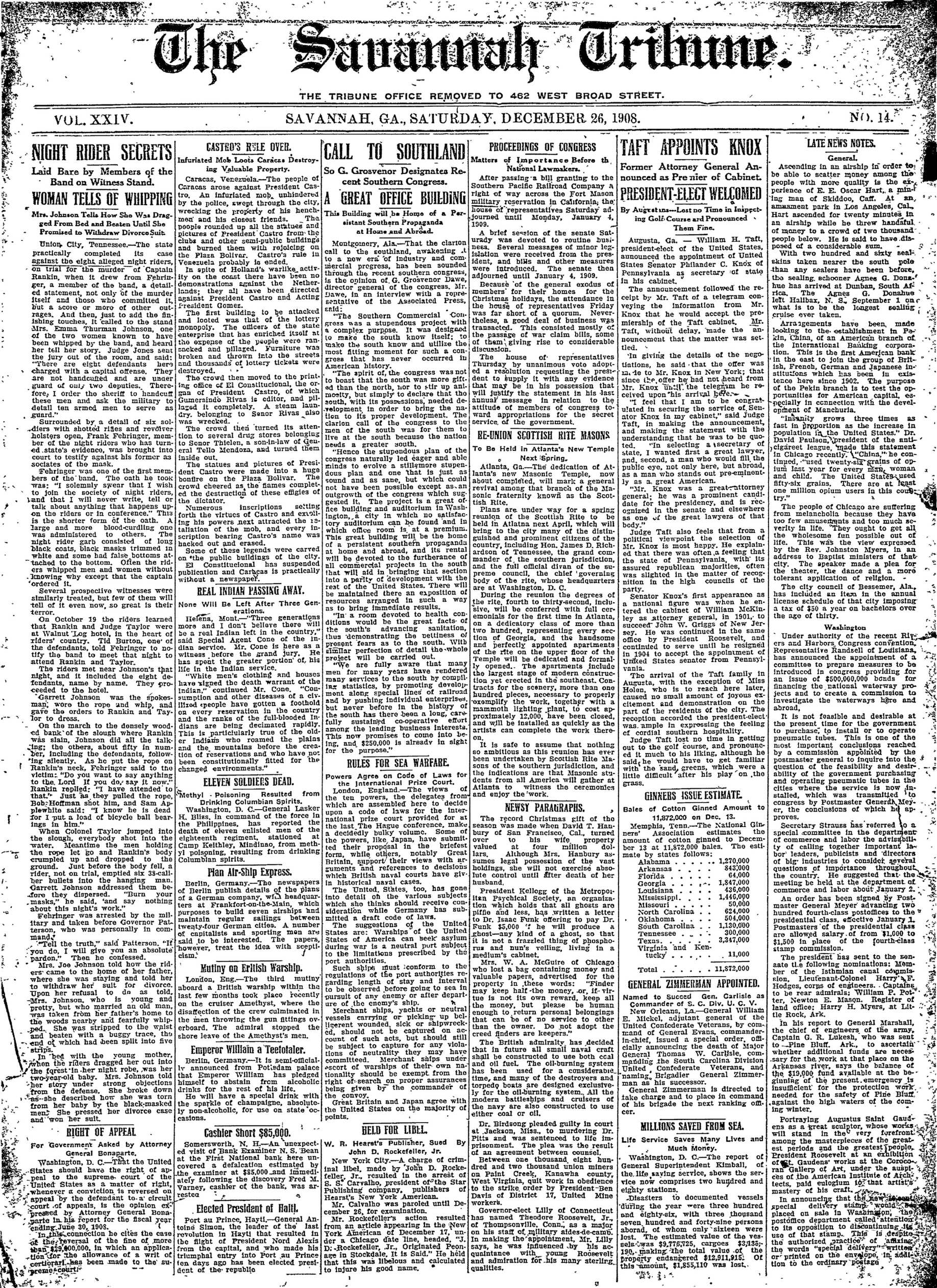
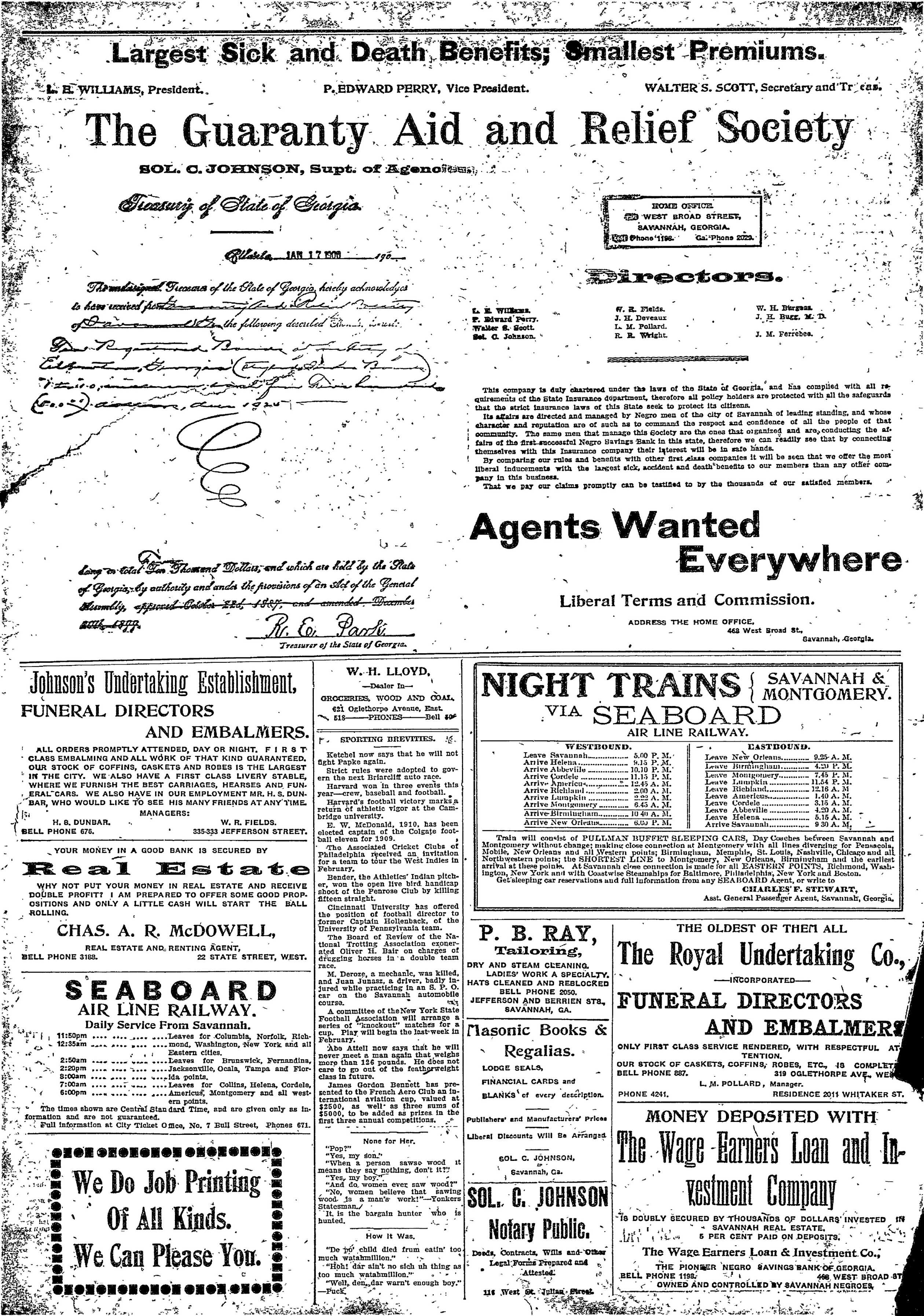
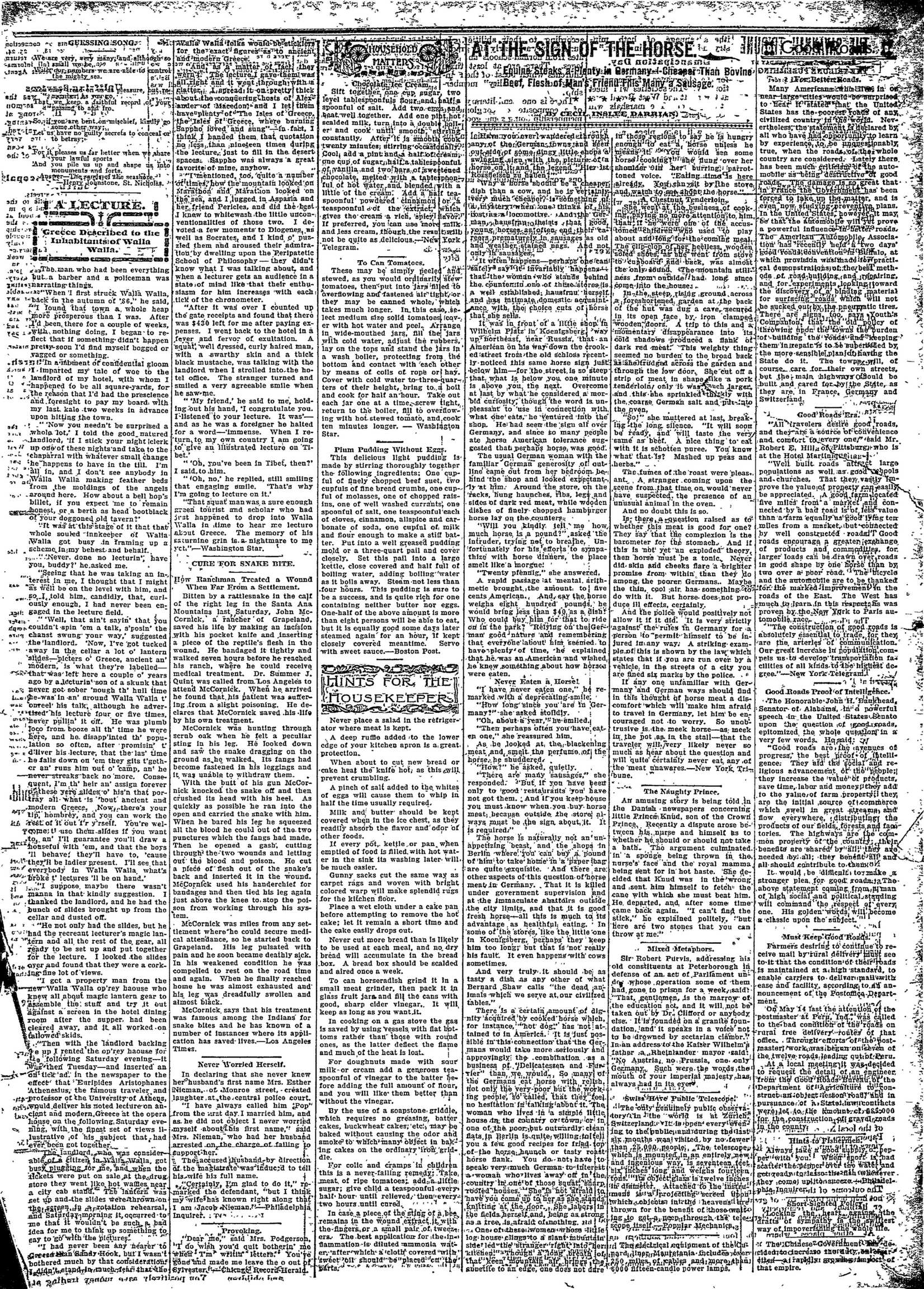
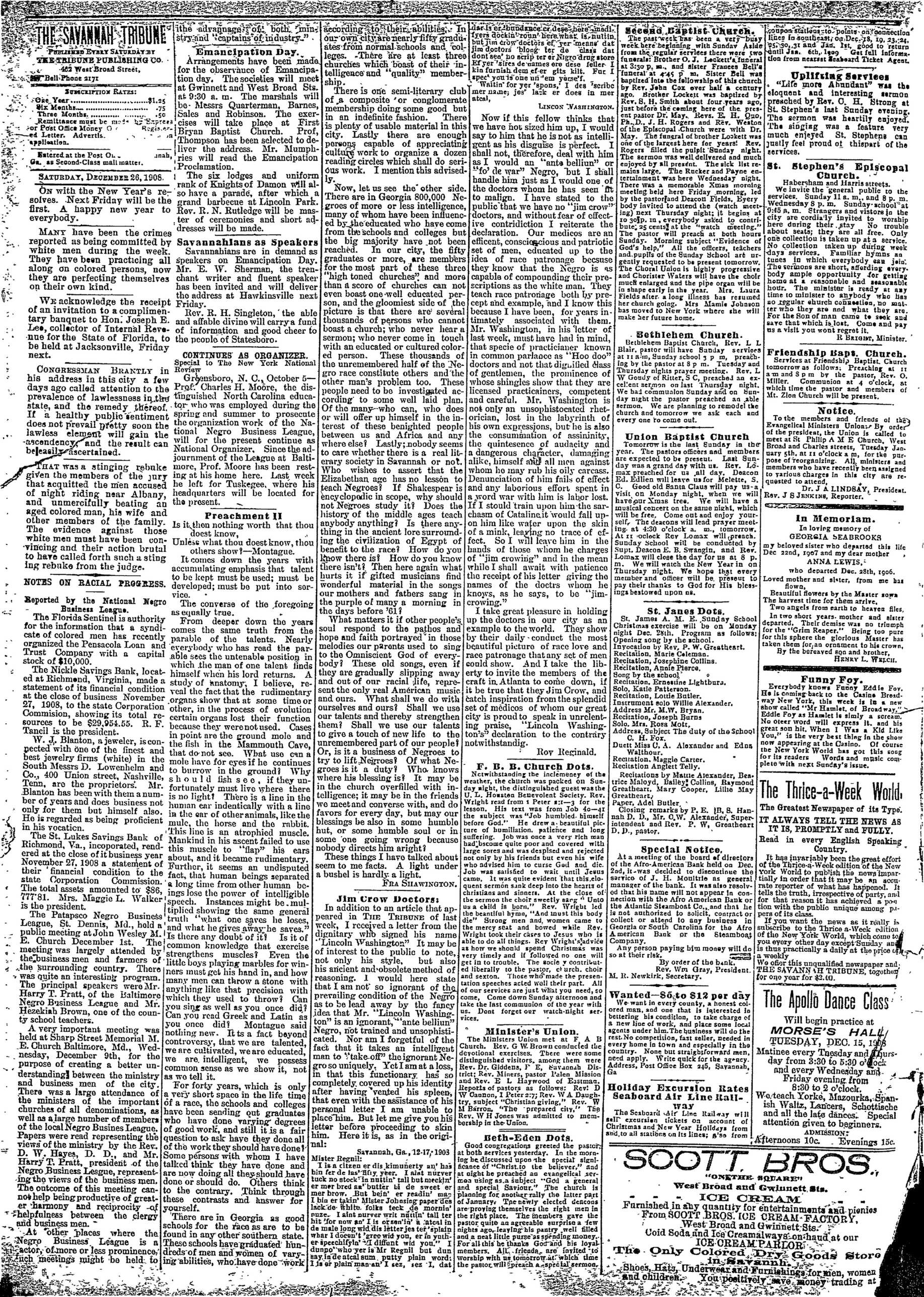
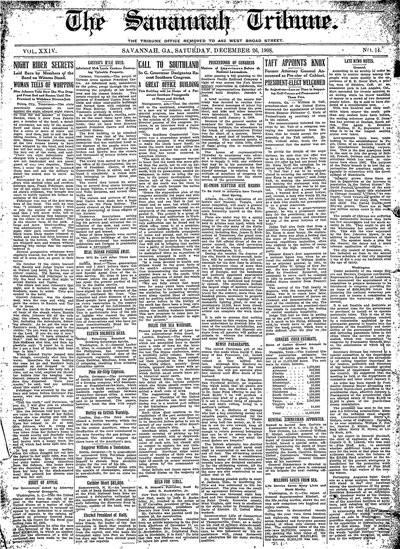
Page text (machine-generated)
VOL. XXIV.
Laid Bare by Members of the Band on Witness Stand.
WOMAN TELLS OF WHIPPING
Mrs. Johnson Tells How She Was Dragged From Bed and Beaten Until She Promised to Withdraw Divorce Suit
Union City, Tennessee.—The state practically completed its case against the eight alleged night riders, on trial for the murder of Captain Rankin, when it drew from Fehringer, a member of the band, a detailed statement, not only of the murder itself and those who committed it, but a score or more of other outrages. And then, just to add the finishing touches, it called to the stand Mrs. Emma Thurman Johnson, one of the women known to have been whipped the band and her tell her story. Judge Jones sent the jury cut of the room, and said: "There are eight defendants here charged with a capital offense. They are not handcuffed and are under guard of only two deputies. Therefore, I order the sheriff to handcuff these men and ask the military to detail ten armed men to serve as guard."
Surrounded by a detail of six soldiers with shotten rifles and revolver holsters open, Frank Fehringer, member of the night riders who has turned.state's evidence, was brought into court to testify against his former as sociates of the mask.
Fehringer was one of the first members of the band. The oath he took was; "I solemnly swear that I wish to join the society of night riders, and that I will never write, tell or talk about anything that happens upon on the riders or in conference." This is the shorter form of the oath. A large and more blood-curdling one was administered to others. The night rider garb consisted of long black coats, black masks trimmed in white and some had false bottoms attached to the bottom. Often the riders whipped men and women without knowing why except that the captain 'ordered it.
Several prospective witnesses were similarly treated, but few of them will tell of it even now, so great is their terror.
On October 19 the riders learned that Rankin and Judge Taylor were at Walnut Log hotel, in the heart of riders' country. Tld Burton, one of the defendants, told Fehringer to notify the band to meet that night to attend Rankin and Taylor. The riders met near Johnson's that night, and it included the eight defendants, by name. They proceeded to the hotel. 'Garrett Johnson' was the spokesman, wore the rope and whip, and gave the orders to Rankin and Taylor to dress.
On the march to the densely wooded bank of the slough where Rankin was slain, Johnson did all the talking; the others, about fifty in number, including the defendants, following silently. As he put the rope on Rankin's neck, Fehringer said to the victim: "Do you want to say anything to the Lord. If you do, say it now." Rankin replied: "I have attended to it." Just as they pulled the rope, Bob Hoffman shot him, and Sam Applewhite said: "I know he is dead for I put a load of bicycle ball bearings in him."
When Colonel Taylor jumped into the slough, everybody shot into the water. Meantime the men holding the rope lie go and Rankin beeped up and dropped to the ground. Just before the body fell, a rider, not on trial, emptied six 38-caliber bullets into the hanging man. Garrett Johnson addressed them before they dispersed. "Burn your masks," he said, "and say nothing about this night's work."
Fehringer was arrested by the military and taken before Governor Patterson, who was personally in command.
"Tell the truth," said Patterson. "If you do, I will give you an absolute pardon." Then he confessed.
Mrs. Joe Johnson told how the riders came to the home of her father, where she was staying and told her to withdraw her suit for divorce. Upon her refusal to do as told, Mrs. Johnson, who is young and pretty, but who married an old man, was taken from her father's home to the woods nearby and fearfully whipped. She was stripped to the waist and beaten with a buggy trace, the end of which had been split into five strips.
In bed with the young mother, when the riders dragged her out into the fquest-in her night robe, was her two-year-old baby. Mrs. Johnson told her story under strong objections from the defense. She broke down as she described how she was torn from her baby by the black-masked men. She pressed her divorce case and won her suit.
RIGHT OF APPEAL
For Government Asked by Attorney General Bonaparte.
Washington, D. C.—That the United States should have the right of appeal to the supreme court of the United States as a matter of right, whenever a conviction is reversed on appeal by the defendant to a circuit court of appeals, is the opinion expressed by Attorney General Bonaparte in his report for the fiscal year ending June 30, 1908. In this connection he cites the case of the reversal of the fine of more than $29,000,000, in which an application for the allowance of a writ of certiorari has been made to the supreme court.
SAVANNAH, GA., SATURDAY, DECEMBER 26, 1908.
The
CASTRO'S RULE OVER.
Infuriated Mob Loots Caracas Destroying Valuable Property.
Caracas, Venezuela—The people of Caracas arose against President Castro. An infuriated mob, unhindered by the police, swept through the city, wrecking the property of his henchmen and his closest friends. The people rounded up all the statues and pictures of President Castro from the clubs and other semi-public buildings and burned them with rejoicing on the Plaza Bolívar. Castro's rule in Venezuela probably is ended.
In spite of Holland's warlike activity on the coast there have been no demonstrations against the Netherlands; they all have been directed against President Castro and Acting President Gomez.
The first building to be attacked and looted was that of the lottery monopoly. The officers of the state enterprise that has enriched itself at the expense of the people were ransacked and pillaged. Furniture was broken and thrown into the streets and thousands of lottery tickets were destroyed.
The crowd then moved to the printing office of El Constitucional, the organ of President Castro, of which Gumersino Rivas is editor, and pillaged it completely. A steam laundry, belonging to Senor Rivas also was wrecked.
The crowd then turned its attention to several drug stores belonging to Senor Thielen, a son-in-law of General Tello Mendoza, and turned them inside out.
The statues and pictures of President Castro were made into a huge bonfire on the Plaza Bolivar. The crowd cheered as the names completed the destruction of these effigies of the dictator. Numerous inscriptions setting forth the virtues of Castro and exulting his powers next attracted the installation of the mob, and every inscription bearing Castro's name was hacked out and erased. Some of these legends were carved on the public buildings of the city. El Constitucional has suspended publication and Caracas is practically without a newspaper.
REAL INDIAN PASSING AWAY.
None Will Be Left After Three Generations.
Hefena, Mont.—Three generations more and I don't believe there will be a real Indian left in the country," said Special Agent Cone of the Indian service. Mr. Cone is here as a witness before the grand jury. He has spent the greater portion of his life in the Indian service.
"White men's clothing and houses have signed the death warrant of the Indian," continued Mr. Cone. "Consumption and other diseases of a civilized people have gotten a foothold on every reservation in the country and the ranks of the full-blooded Indians are being decimated rapidly. This is particularly true of the older Indians who roamed the plains and the mountains before the creation of reservations and who have not been constitutionally fitted for the changed environments."
ELEVEN SOLDIEGS DEAD.
Methyl - Poisoning Resulted from Drinking Columbian Spirits. Washington, D. C.-General Lasker H. Bliss, in command of the force in the Phillipines, has reported the death of eleven enlisted men of the eighteenth regiment, stationed at Camp Keithley, Mindinao, from methyl poisoning, resulting from drinking Columbian spirits.
Plan Air-Shin Express.
Berlin, Germany.—The newspapers of Berlin publish details of the plans of a German company, with headquarters at Frankfort-on-the-Main, which purposes to build seven airships and malnaital regular sailings between twenty-four German cities. A number of capitalists and sporting men are said to be interested. The papers, however, treat the idea with skepticism.
Mutiny on Ertlish Warship.
London, Eng.-The third mutiny aboard a British warship within the last few months took place recently on the cruiser Amethyst, where the disaffection of the crew culminated in the men throwing the gun fittings overboard. The admiral stopped the shore leave of the Amethyst's men.
Emperor Willain a Teefotaler.
Berlin, Germany.—It is semi-officially announced from Potsdam palace that Emperor William was pledged himself to abstain from alcoholic drinks for the rest of his life. He will have a special drink with the sparkle of champagne, absolutely non-alcoholic, for use on state occasions.
Cashier Short $85,000.
Somersworth, N. H.—An unexpected visit of Bank Examiner N. S. Bean at the First National bank here uncovered a defalation estimated by the examiner at $8,000 and immediately following the discovery Fred M. Varney, cashier of the bank, was arrested
Elected President of Haiti.
Port au Prince, Haytai.—General Antoine Simon, the leader of the last revolution in Haytai that resulted in the flight of President Nord Alexis from the capital, and who made his triumphal entry into Port au Prince ten days ago has been elected president of the republic
THE TRIBUNE OFFICE REMOVED TO 462 WEST BROAD STREET.
CALL TO SOUTHLAND
This Building will be Home of a Persistent Southern Propaganda at Home and Abroad.
Montgomery, Ala.—That the clarton call to the southland, awakening it to a new era of industry and commercial progress, has been sounded through the recent southern congress, is the opinion of G. Grosvenor Dawe, director general of the congress. Mr. Dawe, in an interview with a representative of the Associated Press, said:
"The Southern Commercial Congress was a stupendous project with a complex purpose. It was designed to make the south know itself; to make the south know and utilize the most fitting moment for such a congress that has never occurred in American history.
"The spirit of, the congress was not to boast that the south was more gifted than the north, nor to stir up animosity, but simply to declare that the south, with its possessions, needed development in order to bring the nation to its proper development. The clarion call of the congress to the men of the south was for them to live at the south because the nation needs a greater south.
"Hence the stupendous plan of the congress naturally led eager and able minds to evolve a stillmore stupendous plan and one that is just as sound and as sane, but which could not have been possible except as an outgrowth of the congress which suggested it. The project is a great office building and auditorium in Washington, a city in which no satisfactory auditorium can be found and in which office room is at a premium. This great building will be the home of a persistent southeast propaganda at home and abroad, and will be devoted to the furtherance of a common project in the south that will aid in bringing that section into a parity of development with the rest of the United States. There will be maintained there an exposition of resources arranged in such a way as to bring immediate results.
"In a room devoted to health conditions would be the great facts of the south's advancing sanitation, thus demonstrating the vettiness of present fears as to the south. With similar perfection of detail the whole project will be carried out.
"We are fully aware that many men for many years have rendered many services to the south by compiling statistics, by promoting development along special lines of railroad and by pushing individual enterprises, but never before in the history of the south has there been a long, carefully sustained co-operative effort among the leading business interests. This now promises to come into being, and $250,000 is already in sight for the purpose."
RULES FOR SEA WARFARE
Powers Agree on Code of Laws for the International Prize Court. London, England.—The views of the ten powers, the delegates from which are assembled here to decide upon a code of laws for the international prize court provided for at the last. The Hague conference, make a decidedly bulk volume. Some of the powers, like Japan, have submitted their proposal in the briefest form, while others, notably Great Britain, support their views with arguments and references to decisions which British naval courts have given in historical naval cases. The United, States, too, has gone into detail on the various subjects which she thinks should receive consideration while Germany has submitted a draft code of laws.
The suggestions of the United States are: Warships of the United States of America can seek asylum during war is a neutral port subject to the limitations prescribed by the port authorities. Such ships must conform to the regulations of the port authorities regarding length of stay and interval to be observed before going to sea in pursuit of any enemy or after departure of the enemy's ship. Merchant ships, yachts or neutral vessels carrying or picking up belligerent wounded, slick or shipwrecked, should not be captured on account of such acts, but should still be subject to capture for any violations of neutrality they may have committee. Merchant ships under escort of warships of their own nationality should be exempt from the right of search on proper assurances being given by the commander of the convoy. Great Britain and Japan agree with the United States on the majority of points.
HELD FOR LIBEL.
W. R. Hearet's Publisher, Sued By John D. Rockefeller, Jr. New York City—A charge of criminal libel, made by John D. Rockefeller, Jr., resulted in the arrest of S. C. Carvalho, president of the Star Publishing company, publishers of Hearet's New York American.
Mr. Calvalo was paroled until December 26, for examination.
Mr. Rocketfeller's action resulted from an article appearing in the New York American of December 17, under a Chicago date line, headed, "J.D. Rocketfeller, Jr., Originated Peonage in Stockdale, It is Said." He held that this was libelous and calculated to injure his good name.
PROCEEDINGS OF CONGRESS
Matters of Importance Before th National Lawmakers.
After passing a bill granting to the Southern Pacific Railroad Company a right of way across the Fort Mason military reservation in California, the house of representatives Saturday adjourned until Monday, January 4, 1909.
A brief session of the senate Saturday was devoted to routine business. Several messages of minor legislation were received from the president, and bills and other measures were introduced. The senate then adjourned until January 4, 1909.
Because of the general exodus of members for their homes for the Christmas holidays, the attendance in the house of representatives Friday was far short of a quorum. Nevertheless, a good deal of business was transacted. This consisted mostly of the passage of war claim bills, some of them giving rise to considerable discussion.
The house of representatives Thursday by unanimous vote adopted a resolution requesting the president to supply it with any evidence that may be in his possession that will justify the statement in his last annual message in relation to the attitude of members of congress toward appropriations for the secret service of the government.
RE-UNION SCOTTISH BITE MASONS
To Be Held in Atlanta's New Temple Next Spring.
Atlanta, Ga.—The dedication of Atlanta's new Masonic Temple, now about completed, will mark a general revival among that branch of the Masonic fraternity known as the Scottish Rite.
Plans are under way for a spring reunion of the Scottish Rite to be held in Atlanta next April, which will bring to the city many of the distinguished and prominent citizens of the country, including Hon. James D. Richardson of Tennessee, the grand commander of the southern jurisdiction, and the full official divan of the supreme council, the chief 'governing body of the rite, whose headquarters are at Washington, D. C.
During the reunion the degrees of the rite, fourth to thirty-second, inclusive, will be conferred with full ceremonials for the first time in Atlanta, on a dedicatory class of more than two hundred, representing every section of Georgia, and the handsome and perfectly appointed apartments of the rite on the upper floor of the Temple will be dedicated and formally opened. The apartments include the largest stage of modern construction yet erected in the southeast. Concrete, the material, more than one hundred pieces, necessary to properly exemplify the work, together with a mammoth lighting plant, to cost approximately 12,000, have been closed, and will be installed as quickly as the artists can complete the work thereon.
It is safe to assume that nothing so ambitious as this reunion has ever been undertaken by Scottish Rite Masons of the southern jurisdiction, and the indications are that Masonic students from all America will gather at Atlanta to witness the ceremonies and enjoy the 'work.
NEWSY PARAtiRAPHS.
The record Christmas gift of the season was made when David T. Hanbury of San Francisco, Cal., turned over to his wife property valued at four million dollars. Although Mrs. Hanbury assumes legal possession of the vast holdings, she will not exercise absolute control until after death of her husband.
President Kellogg of the Metropolitan Psychical Society, an organization which holds that all ghosts are piffle and less, has written a letter to Dr. Isaac Funk offering to pay Dr. Funk $5,000 'f he will produce a ghost—any kind of a ghost, so that it is not a frazzled thing of phosphorus and nun's velling, living in a medium's cabinet.
Mrs. W. A. McGuire of Chicago who lost a bag containing money and valuable papers, advertised for the property in these words: "Finder may keep half-the money, or, if virtue is not its own reward, keep all the money, but please be human enough to return personal belongings that can be of no service to other than the owner. Do not adopt the creed finders are keepers." The British admiralty has decided that in future all small naval craft shall be constructed to use both coal and oil fuel. The oil-burning system has been used for a considerable time, and many of the destroyers and torpedo boats are designed exclusively for the oil-burning system. All the modern battleships and cruisers of the navy are also constructed to use either coal or oil. Dr. Birdson pleaded guilty in court at Jackson, Miss., to murdering Dr. Pitts and was sentenced to life imprisonment. The plea was the result of an agreement between counsel.
Between one thousand eight hundred and two thousand union miners on Paint Creek, Kanawha county, West Virginia, quit work in obedience to the strike order by President-Ben Davis of District 17, United Mine workers.
Governor-elect Lilly of Connecticut has named Theodore Roosevelt, Jr., of Thompsonville, Conn., as a major on his staff of military aides-de-camp. In making the appointment, Mr. Lilly says, he was influenced by his acquaintance with young Roosevelt and admiration for his many sterling qualities.
Augusta, Ga. — William H. Taft, president-elect of the United States, announced the appointment of United States Senator Philander C. Knox of Pennsylvania as secretary of state in his cabinet.
The announcement followed the receipt by Mr. Taft of a telegram conveying the information from Mr. Knox that he would accept the premiership of the Taft cabinet. Mr. Taft, without delay, made the announcement that the matter was settled.
In giving the details of the negotiations, he said that the offer was made to Mr. Knox in New York; that since the offer he had not heard from Mr. Knox until the telegram he received upon this arrival here.
"I feel that I am to be congratulated in securing the service of Senator Knox in my cabinet," said Judge Taft, in making the announcement, and making the statement with the understanding that he was to be quoted. "In selecting a secretary of state, I wanted first a great lawyer, and, second, a man who would fill the public eye, not only here, but abroad, as a man who stands out pre-eminently as a great American. "Mr. Knox was a great attorney general; he was a prominent candidate for the presidency, and is recognized in the senate and elsewhere as one of the great lawyers of that body." Judge Taft also feels that from a political viewpoint the selection of Mr. Knox is most happy. He explained that there was often a feeling that the state of Pennsylvania, with its assured republican majorities, often was slighted in the matter of recognition in the high councils of the party.
Senator Knox's first appearance as a national figure was when he entered the cabinet of William McKinley as attorney general, in 1901, to succeed John W. Griggs of New Jersey. He was continued in the same office by President Roosevelt, and continued to serve until he resigned in 1904 to accept the appointment of United States senator from Pennsylvania.
The arrival of the Taft family in Augusta, with the exception of Miss Holen, who is to reach here later, caused no small amount of joyous excitement and demonstration on the part of the residents of the city. The reception accorded the president-elect was ample in expressing the feeling of cordial southern hospitality.
Judge Taft lost no time in getting out to the golf course, and pronounced it much to his liking, although he said he would have to get familiar with the sand, greens, which were a little difficult after his play on the grass.
GINNERS ISSUE ESTIMATE
Bales of Cotton Ginned Amount to 11,872,000 on Dec. 13. Memphis, Tenn.-The National Ginners' Association estimates the amount of cotton ginned to December 13 at 11,872,000 bales. The estimate by states follows;
Alabama 1,270,000
Arkansas 843,000
Florida 64,000
Georgia 1,847,000
Louisiana 436,000
Mississippi 1,446,000
Missouri 50,000
North Carolina 624,000
Oklahoma 504,000
South Carolina 1,130,000
Tennessee 300,000
Texas 3,347,000
Virginia and Kentucky 11,000
Total 11,872,000
GENERAL ZIMMERMAN APPOINTED.
Named to Success Gen. Carlisle as Commander of S. C. Div, U. C. V. New Orleans, La.-General William E. Mickel, adjutant general of the United Confederate Veterans, by command of General Evans, commander-in-chief, issued a special order, officially announcing the death of Major General Thomas W. Carlisle, commanding the South Carolina Division United, Confederate Veterans, and naming, Bradigler General Zimmerman as his successor. General Zimmerman is directed to take charge and to place in command of his brigade the next ranking officer.
MILLIONS SAVED FROM SEA.
Life Service Saves Many Lives and Much Money.
Washington, D. C.—The report of General Superintendent Kimball, of the life saying service, shows the service now comprises two hundred and eighty stations.
Disasters to documented vessels during the year were three hundred and eighty-six, with three thousand seven hundred and forty-nine persons aborad, of whom only sixteen were lost. The estimated value of the vessels was $9,775,725, cargoes $3,135,190, making the total value of the property endangered $12,911,915. Of this amount, $1,855,110 was lost.
LATE NEWS NOTES.
General.
Ascending in an airship in order to be able to scatter money among the people with more quality is the experience of E. E. Oscar Hart, a mining man of Skiddoo, Caff. At an amusement park in Los Angeles, Cal. Hart ascended for twenty minutes in an airship while he threw handful of money to a crowd of two thousand people below. He is said to have disposed of a considerable sum.
With two hundred and sixty sealskins taken nearer the south pole than any sealers have been before, the sealing, schooner Agnes G. Donahue has arrived at Dunbane, South Africa. The Agnes G. Donahue left Hallbax, N. S. September 1 on what is to be the longest sealing cruise ever taken.
Arraignment have been made looking to the establishment in Paskin, China, of an American branch of the International Banking corporation. This is the first American bank in the east to join the group of British, French, German and Japanese institutions which has been in existence here since 1902. The purpose of the Pekin branch is to test the opportunities for American capital, especially in connection with the development of Manchuria.
"Insanity grows three times as fast in proportion as the increase in population in the United States." Dr. David Paulson, president of the anticigarette league, made this statement in Chicago recently. "China," he continued, "used twenty-six grains of opium last year for every woman and child. The United States used fifty-six grains. There are at least one million opium users in this country."
The people of Chicago are suffering from melancholia because they have too few amusements and too much severity in life. They ought to get all the wholesome fun possible out of life. This was the view expressed by the Rev. Johnston Myers, in an address to Baptist ministers of that city. The speaker made a plea for the theater, the dance and a more tolerant application of religion. The city council of Bessemer, Ala., has included an item in the annual license schedule of that city imposing a tax of $50 a year on bachelors over the age of thirty.
Washington
Under authority of the recent Rivers and Harbors Congress convention, Representative Randsell of Louisiana, has announced the appointment of a committee to prepare measures to be introduced in congress providing for an issue of $500,000,000 bonds for financing the national waterway projects and to create a commission to investigate the waterways here and abroad.
It is not feasible and desirable at the present time for the government to purchase, to install or to operate pneumatic tubes. This is one of the most important conclusions reached by a commission appointed by the postmaster general to inquire into the question of the feasibility and desirability of the government purchasing and operating pneumatic tubes in the cities where the service is now installed, which was transmitted to congress by Postmaster Genera Meyer, the conclusions of which he approves.
Secretary Strauss has referred to a special committee in the department of commerce and labor the advisability of calling together important labor leaders, publicists and directors of big industries to consider several questions of importance throughout the country. He suggested that the meeting be held at the department of commerce and labor about January 2.
An order has been signed by Postmaster General Meyer advancing two hundred fourth-class postoffices to the presidential class, effective January 1. Postmasters of the presidential class are allowed salary of $1,000 to $1,500 in place of the fourth-class stamp commission.
The president has sent to the senate the following nominations: Member of the Isthmian canal commission, Lieutenant-Colonel Harry F. Hodges, corps of engineers. Captains to be rear admirals; William P. Potter, Newton E. Mason. Register of land office; Harry H. Myers, at Little Rock, Ark.
In his report to General Marshall, the chief of engineers of the army, Captain G. R. Lukesh, who was sent to Pine Bluff, Ark., to ascertain whether additional funds are necessary for the work at that place on the Arkansas river, says the balance of the $19,000 fund available at the beginning of the present, emergency is insufficient for the protection work needed for the safety of Pine Bluff, against the high waters of the coming winter.
Portraying Augustus Saint Gaudens as a great sculptor, whose works will stand in the very forefront among the masterpieces of the greatest periods and the greatest people, President Roosevelt at an exhibition of Gaudens' works at the Corcoran Gallerp of Art, under the auspices of the American Institute of Architects, paid eulogium to that artist's mastery of his craft.
In announcing that the new issue of special delivery stamp would be placed on sale in Washington, the postoffice department called attention to its opposition to discontinuing its use of that stamp. This is despite the authorized practice of affixing the words "special delivery" written or printed on the envelope, in addition to the ordinary postage
being in total Ten Thousand Dollars, and which are held by the State of Georgia, by authority and under the provisions of an Act of the General Assembly, approved October 22d, 1887, and amended December 20th, 1887.
R. E. Parsi
Treasurer of the State of Georgia.
W. H. LLOYD,
Dealer In
GROCERIES, WOOD AND COAL,
621 Oglethorpe Avenue, East.
518 PHONES Bell 50
Ketchel now says that he will not fight Papke again.
Strict rules were adopted to govern the next Brifarcliff auto race. Harvard won in three events this year—crew, baseball and football.
Harvard's football victory marks a return of athletic vigor at the Cambridge university. E. W. McDonald, 1910, has been elected captain of the Colgate football eleven for 1909. The Associated Cricket Clubs of Philadelphia received an invitation for a team to tour the West Indies in February. Bender, the Athletics' Indian pitcher, won the open live bird handicap shoot of the Penrose Club by killing fifteen straight. Cincinnati University has offered the position of football director to former Captain Hollenback, of the University of Pennsylvania team.
The Board of Review of the National Trotting Association exonerated Oliver H. Bair on charges of drugging horses in a double team race.
M. Deroze, a mechanic, was killed, and Juan Junasz, a driver, badly injured while practicing in an S. P. O. car on the Savannah automobile course.
A committee of the New York State Football Association will arrange a series of "knockout" matches for a cup. Play will begin the last-week in February.
Abe Attell now says that he will never meet a man again that weighs more than 126 pounds. He does not care to go out of the featherweight class in future.
James Gordon Bennett has presented to the French Aero Club an international aviation cup, valued at $2500, as well as three sums of $5000, to be added as prizes in the first three annual competitions.
None for Her.
"Pop?"
"Yes, my son."
"When a person say means they say nothing."
"Yes, my boy."
"And do women ever."
"No, women believe wood is a man's work Statesman."
It is the bargain hunted.
How It Was
"Pop?"
"Yes, my son."
"When a person sawso wood it means they say nothing, don't it?"
"Yes, my boy."
"And do women ever saw wood?"
"No, women believe that sawing wood. is a man's work!"—Yonkers Statesman.
It is the bargain hunter who is hunted.
How It Was.
"De po' child died frum eatin' too much watahmillion."
"Hoh! dar ain't no sich uh thing as too much watahmillion."
"Well, den, dar warn't enough boy."
—Puck
Johnson's Undertaking Establishment FUNERAL DIRECTORS
ALL ORDERS PROMPTLY ATTENDED, DAY OR NIGHT. FIRST CLASS EMBALMING AND ALL WORK OF THAT KIND GUARANTEED. OUR STOCK OF COFFINS, CASKETS AND ROBES IS THE LARGEST IN THE CITY. WE ALSO HAVE A FIRST CLASS LIVERY STABLE, WHERE WE FURNISH THE BEST CARRIAGES, HEARSES AND FUNERAL CARS. WE ALSO HAVE IN OUR EMPLOYMENT MR. H. S. DUNBAR, WHO WOULD LIKE TO SEE HIS MANY FRIENDS AT ANY TIME MANAGERS:
Real Estate
WHY NOT PUT YOUR MONEY IN REAL ESTATE AND RECEIVE DOUBLE PROFIT? I AM PREPARED TO OFFER SOME GOOD PROPOSITIONS AND ONLY A LITTLE CASH WILL START THE BALL ROLLING.
REAL ESTATE AND RENTING AGENT,
BELL PHONE 3188. 22 STATE STREET, WEST.
11:50pm ..... Leaves for Columbia, Norfolk, Rich-
mond, Washington, New York and all
Eastern cities.
The times shown are Central Standard Time, and are given only as information and are not guaranteed.
This company is duly chartered under the laws of the State of Georgia, and has complied with all requirements of the State Insurance department, therefore all policy holders are protected with all the safeguards that the strict insurance laws of this State seek to protect its citizens.
Its affairs are directed and managed by Negro men of the city of Savannah of leading standing, and whose character and reputation are of such as to command the respect and confidence of all the people of that community. The same men that manage this Society are the ones that organized and are conducting the affairs of the first successful Negro Savings Bank in this state, therefore we can readily see that by connecting themselves with this Insurance company their interest will be in safe hands.
By comparing our rules and benefits with other first class companies it will be seen that we offer the most liberal inducements with the largest sick, accident and death benefits to our members than any other company in this business.
That we pay our claims promptly can be testified to by the thousands of our satisfied members.
WESTBOUND.
Leave Savannah ... 5.00 P. M.
Arrive Helena ... 9.15 P. M.
Arrive Abbeville ... 10.10 P. M.
Arrive Cordele ... 11.15 P. M.
Arrive Americus ... 12.45 A. M.
Arrive Richland ... 2.00 A. M.
Arrive Lumpkin ... 2.22 A. M.
Arrive Montgomery ... 6.45 A. M.
Arrive Birmingham ... 10.40 A. M.
Arrive New Orleans ... 6.00 P. M.
EASTBOUND.
Leave New Orleans ... 9.25 A. M.
Leave Birmingham ... 4.20 P. M.
Leave Montgomery ... 7.45 P. M.
Leave Lumpkin ... 11.54 P. M.
Leave Richland ... 12.16 A. M.
Leave Americus ... 1.40 A. M.
Leave Cordele ... 3.15 A. M.
Leave Abbeville ... 4.20 A. M.
Leave Helena ... 5.15 A. M.
Arrive Savannah ... 9.30 A. M.
Train will consist of PULLMAN BUFFET SLEEPING CARS, Day Coaches between Savannah and Montgomery without change; making close connection at Montgomery with all lines diverging for Pensacola, Mobile, New Orleans and all Western points; Birmingham, Memphis, St. Louis, Nashville, Chicago and all Northwestern points; the SHORTEST LINE to Montgomery, New Orleans, Birmingham and the earliest arrival at these points. At Savannah close connection is made for all EASTERN POINTS. Richmond, Washington, New York and with Coastwise Steamships for Baltimore, Philadelphia, New York and Boston.
Get sleeping car reservations and full information from any SEABOARD Agent, or write to
CHARLES F. STEWART,
Asst. General Passenger Agent, Savannah, Georgia.
DRY AND STEAM CLEANING.
LADIES' WORK A SPECIALTY.
HATS CLEANED AND REBLOCKED
BELL PHONE 2050.
JEFFERSON AND BERRIEN ST8.
SAVANNAH, GA.
Masonic Books &
Regalias.
LODGE SEALS,
FINANCIAL CARDS and
BLANKS of every description.
Publisher's and Manufacturers' Prices
Liberal Discounts Will Be Arranged
SOL. C. JOHNSON,
Savannah, Ca.
SOL. C. JOHNSON
Notary Public.
18 DOUBLY SECURED BY THOUSANDS OF DOLLARS INVESTED SAVANNAH REAL ESTATE. 5 PER CENT PAID ON DEPOSITS.
Deeds, Contracts, Wills and Other Legal Forms Prepared and Attested.
mollossooo oo in GUESSING:SONG
murray We are very, very many, and although so
smoltlol! (in small) mollossooo
mollossooo With the numbers we are able to control
the mighty sea.
murray Treat on and pleasure, and
murray That we keep a faithful record of yours
mollossooo passing to and fro.
murray So if you are bent on mischief, kindly go
mollossooo some other ways.
murray Let us be guilty secrets to conceal or
mollossooo to betray.
For it please us far better when we share
A LECTURE.
Greece Described to the Inhabitants of Walla Walla.
The man who had been everything but a barber and a policeman was garrisoning things. When I first struck Walla Walla, back in the autumn of '86, he said, I found that town a whole heap more prosperous than I was. After I had there for a couple of weeks, with nothing doing, I began to reflect that if something didn't happen pretty soon I'd find
In addition of confidential gloom I imparted my tale of woe to the landlord of my hotel, with whom I happened to be all square-yards, for the reason that I'd had the prescience and foresight to pay my board with my last kale two weeks in advance upon hitting the town.
"Now you needn't be surprised a whole lot," I told the good, mature landlord, "If I stick your night lerker up one of these nights and take to the chapairal with whatever small change he happens to have in the till. I'm all in, and I don't see anybody in Walla Walla making feather beds from the moldings of the angels around here. How about a bell hop's billet, if you expect me to remain honest, or a berth as head bootblack of your dogged old tavern?
"It was at this stage of it that that whole souled innkeeper of Walla Walla got busy in framing up a scheme in my behest and behalf."
"Never, done no lecturni", have you, buddy? he. asked me.
"Well, that ain't saying that you couldn't spin 'em a talk, s'posin' the chanst swung your way," suggested the landlord. "Now, I've got tucked away in the cellar a lot of lantern slides—picters of Greece, ancient an modern," is what they're labelled—that was left here a couple of years ago by a lecturist son of a skunk that never got sober enough to hull time the was in an around Walla Walla 'on'seel his talk, although he adverised his lecture four or five times, never pulling it off. He was plumb foco from booze all the time he were here, and he disappeared from population so often, after promising a d'liver his lecture, that the last time he falls down on 'em they gets 'gether an runs him out of 'em.
modern Greece, now there's your tip, hombrey, and you can work the rest of it out if you're self. You're welcome! use them slides if you want to, an I'll guarantee you'll draw a houseful with 'em, and that the boys 'll behave; they'll have to, 'cause they'll be ladies present. I'll see that everybody in Walla Walla, what's broke 't lectures 'll be on hand. I suppose, maybe there wasn't manna in that kindly suggestion. I thanked the landlord, and he had the bunch of slides brought up from the cellar and dusted off. He not only had the slides, but he had the recent lecturer's magic lantern and all the rest of the gear, all ready to be set up and put together for the lecture. I looked the slides over and found that they were a corking fine lot of views.
I get a property man from the new Walla Walla op'ry hause who knew all about magic lanten gear to assemble the stuff and try it out against a screen in the hotel dining room after the supper, had been cleared away, and it all worked on followed skids. Then with the landlord backing me up I rented the op'ry hause for the following Saturday evening—it was then Tuesday—and inserted an on'tick' in the newspaper to the effect that Euripides Aristophanes Athenesius, the famous traveler, and professor of the University of Athens, would deliver his noted lecture on an'cient and modern, Greece at the opera house on the following Saturday evening, with the finest set of views illustrative of his subject that had ever been got together.
The landlord, who was considerable of a citizen in Walla, Walla, got busy plugging for me, and when the tickets were put on sale at the drug store they went like hot waffles near, a city cab stand. The lantern was set up and the slides were thrown on the screen, in an animation rehearsal, and Saturday morning it occurred to me that it wouldn't be such a bad idea for me to think up something to say to go with the pictures.
"I had never been any nearer to greetesthan Sandy Hook, but I wasn't bothered much by that consideration, and much, much, that the outfit you wear would loosen.
Wand Warld folks would stick their fingers for the exact figures as to ancient and modern Greece. And if they mattered to Falco, they wielded the picture I gave them with all gillight and it wont through with a glitter. I spread it on pretty thick about the conquering ghosts of Alexander of Macedon and I let them have plenty of The Isles of Greece, the Isles of Greece, where burning Sappho loved and sung — in fact, I think I handed them that quotation no less, than nineteen times during the lecture, just to fill in the desert spaces. Sappho was always a great favorite of mine, anyhow.
"I mentioned, too, 'quite a number of times' how the mountain looked on Marathon aid. Marathon looked on the sea, and I lugged in Aspasia and her friend Pericles, and did the ghost I knew to whitewash the little unconventionalities of those two. I devoted a few moments to Diogenes, as well as Socrates, and I kind, o' puzzled them and aroused their admiration by dwelling upon the Poetic School. So they didn't know what I was talking about, and when a lecturer gets an audience in a state of mind like that their enthusiasm for him increases with each tick of the chronometer.
"After it was over I counted up the gate receipts and found that there was $430 left for me after paying expenses. I went back to the hotel in a feyer and fervor of exultation. A squalt well dressed, curly haired man, with a swarthy skin and a thick black mustache, was talking with the landlord when I strolled into the hotel office. The stranger turned and smiled a very agreeable smile when he saw me.
"My friend," he said to me, holding out his hand, "I congratulate you. I listened to your lecture. It was" and as he was a foreigner he halted for a word—immense. When I return, to my own country I am going to give an illustrated lecture on Tibet.
"Oh, you've been in Tibet, then? I said to him.
"Oh, no, he repelled, still smiling that engaging smile. 'That's why I'm going to lecture on it.'"
"That squat man was a sure enough green tourist and scholar who had just happened to drop into Walla Walla in time to hear me lecture about Greece. The memory of his saturnine grin is a nightmare to me yet."—Washington Star.
CURE FOR SNAKE BITE.
How Ranchman Treated a Wound
When Far From a Settlement.
Bitten by a rattlesnake in the caft
of the right leg in the Santa Ana
Mountains last Saturday, John McCornick, 'a rattler' of Grapeland, saved his life by making an incision
with his pocket knife and inserting
a piece of the reptile's flesh in the
wound. He bandaged it tightly and
walked seven hours before he reached
his ranch, where he could receive
medical treatment. Dr. Summer J.
Quint was called from Los Angeles to
attend McCornick. When he arrived
he found that his patient was suffering
from a slight poisoning. He de-
claims that McCornick saved his life
by his own treatment.
McCornick was hunting through
scrub oak when he felt a peculiar
sting in his leg. He looked down
and saw the snake dragging on the
ground as he walked. Its fangs had
become fastened in his leggings and
it was unable to withdraw them.
With the butt of his gun McCornick knocked the snake off and then crushed its head with his heel. As quickly as possible he ran into the open and carried the snake with him. When he bared his leg he squeezed all the blood he could out of the two punctures which the fangs had made. Then he opened a gash, cutting through' the two wounds and letting out the blood and poison. He cut a pleece of flesh out of the snake's back and inserted it in the wound. McCornefk used his handcipher for bandages and then tied his leg again just above the knee to stop the poison from working through his system.
McCornick was miles from any settlement where he could secure medical attendance, he started back to Grapeland. His leg pulsed with pain and he soon became deathly sick. In his weakened condition he was compelled to rest on the road time and again. When he finally reached home he was almost exhausted and his leg was dreadfully swollen and almost black. McCornick says that his treatment was famous among the Indians for snake bites and he has known of a number of instances where its application has saved lives.—Los Angeles Times.
Never Worried Herself.
In declaring that she never knew her"husband's first name Mrs. Esther Nieman...of Monroe street, created laughter, at the central police court. "I have always called him 'Pop' from the first day. I married him, and as he did not object I never worried myself about his first name," said Mrs. Nieman, who had her husband arrested on the charge of falling to support her. "The accused husband by direction of the war-induced to tell his wife his full name. "Cerignly, I'm glad to do it," remarked the defendant, "but I think my wife has known right along this I am Jacob Nieman."—Philadelphia Inglewood.
Provoking.
"Deep 'm" said Mrs. Podgerson,
"I do wish you'd quit botherin' me
when 'm' writen 'letters. You're
one and made me leave the o out of
Syvester." Chicheld Record Herald
HOUSEHOLD MATTERS
Chocolate ice cream.
Sift together one cup sugar, two level tablespoonfuls flour, and half a spoonful of salt. Add two eggs, and heat well together. Add one pint hot-scaled milk, turn into a double pollener and cook until smooth, stirring constantly. After it is smooth cook twenty minutes; stirring occasionally. Cool, add a pint and a half cream, one cup of sugar, half a tablespoonful of vanilla, and two hops of sweetened chocolate, melted with a tablespoonful of hot water, and blended with a little of the cream. Add a half teaspoonful powdered clinker or a teaspoonful of the extract, which gives the cream a rich, flavor. If preferred, you can use more milk and less cream, though the result is not quite as delicious. New York Telegram.
To Can Tomatoes.
These may be simply needled and stewed, as you may would originally view tomatoes, then put into jars filled to overflowing and fastened airtight, or they may be canned whole, which takes much longer. In this case, select medium size solid tomatoes (cover with hot water and poet, Arrange in wide-mouthed jars, fill the jars with cold water, adjust the rubbers, lay on the tops and stand the jars in a wash boiler, protecting from the bottom and contact with each other by means of colls of rope or hay. Cover with cold water to three-quarters of their height, bring to a boil and cook for half an hour. Take out each jar one at a time, screw tight, return to the boiler, fill to overflowing with hot stewed tomato, and cook ten minutes longer. — Washington Star.
Plum Pudding Without Eggs.
Flint Pudding Without Eggs.
This delicious light pudding is made by stirring thoroughly together the following ingredients: One cuppure of the milk chopped beet, one cupful of the milk chopped beet, one cupful of molasses, one cupful of molasses, one of chopped raisins, one of well washed currants, one spoonful of salt, one teaspoonful each of cloves, cinnamon, allspice and carbonate of soda, one cupful of milk and flour enough to make a stiff batter. Put into a well greased pudding mold or a three-quart pit and cover closely. Set this pail into a large kettle, close covered and half full of boiling water, adding boiling water as it hits away. Steam not less than four hours. This pudding is sure to be a success, and is quite rich for one containing neither butter nor eggs. One-half of the above amount is more than eight persons will be able to eat, but it is equally good some days later steamed again for an hour, if kept closely covered meantime. Serve with sweet sauce—Boston Post.
HINTS FOR THE HOUSEKEEPER
Never place a salad in the refrigerator where meat is kept.
A deep ruffle added to the lower edge of your kitchen apron is a great protection.
When about to cut new bread or cake heat the knife hot, as this will prevent crumbling.
A pinch of salt added to the whites of eggs will cause them to whip in half the time usually required.
Milk and butter should be kept covered when in the ice chest, as they readily absorb the flavor and odor of other foods.
If every pot, kettle, or pan, when emptied of food is filled, with hot water in the sink its washing later will be much easier.
Gunny sacks cut the same way as carpet rags and woven with bright colored warp will make splendid rugs for the kitchen floor.
Place a wet cloth under a cake pan before attempting to remove the hot cake; it it remain a short time and the cake easily drops out.
Never cut more bread than is likely to be used at each meal, and no dry bread will accumulate in the bread box. A bread box should be scalded and aired once a week.
To can horseradish grind it in a small meat grinder, then pack it in glass fruit jars and fill the cans with good, sharp cider vinegar. It will, keep as long as you want it.
In cooking on a gas stove the gas is saved by using vessels with flat bottoms rather than those with round ones, as the latter defect the flame and much of the heat is lost.
For doughnuts made with sour milk-or cream add a generous teaspoonful of vinegar to the batter before adding the full amount of flour, and you will like them better than without the vinegar.
By the use of a soapstone griddle, which requires no greasing, batter cakes, luckwheat cakes, etc., may be baked without causing the odor and smoke to which many object in baking cakes on the ordinary iron griddle.
For colic and cramps in children this is a never-falling remedy; Take, meat of ripe tomatoes, add a little sugar; give child a teaspoonful every half-hour until relieved, then every two hours until cured.
In case a place of the sling of a bee remains in the wound extract, is with the fingers, or a small pair, of tweezers. The best application for the inflammation is diluted ammonia water; after which a cloth covered with sweet oil should be placed on the barts.
I will have you over! I wandered across many of the German towns and been outside of some along little chops of swinging, also with the picture of a horse on it and the legend of Her is the reseasers of the haven.
Why a horse should be a cheaper dish than a cow, and he is verily very much 'cheater'? Is something of the matter? When I joined the show of the host as a locomotive. And the German man, a�aefrintheists that took young horses, as often end their car reers, prematurely in sauges as old and weather, stained pigs. And not only the sauges.
It often happens—perhaps one can't safely say it invariably happen—that the woman who stands behind the counter one of these stores is a well established, haustman's herself and has intimate domestic acquaintance with the choice cuts of horse that she sells.
It was in front of a little shop in Wilhelm Platz in Koenigsberg, up north east, near Russia, that an American on his way down the crooked street from the old schloss recently noticed this same horse sign just below him—for the street is so steep that, what is below you one minute is above you, the next. Overcome at last by what he considered a morbid curiosity, though the word is unpleasant to "use in connection with what one eats," he ventured into the shop. He had seen the sign alf over Germany, and since so many people ate horse American tolerance suggested that perhaps horse, was good. The usual German woman with the familiar German generosity of outlining came out from her bedroom behind the shop and looked expectantly at him. Around the store, on the racks, hung haunches, hbs, legs and sides of dark red meat, while wooden dishes of finely chopped hamburger horse lay on the counters.
"Will you kindly tell me how much horse is a pound?" asked the intruder, trying not to breathe, Unfortunately for his efforts to sympathize with horse dinners, the place smelt like a morgue:
"Twenty plenius," she answered. A rapid passage at mental arithmetic brought, the amount to five cents American. And, say the horse weighs eight hundred pounds, he would bring less than $40, as a dish! Who could buy him for that to ride on in the park? "Reining on the German good nature and remembering that everyone about him seemed to have plenty of time, he explained that he was an American and wished he knew something about horse were eaten.
Never Eaten a Horse!
"I have never eaten one," he remarked with a deprecating smile.
"How long since you are in Germany?" she asked stolldy.
"Oh, about a year," he smiled.
"Then perhaps often you have eaten one," she reassured him.
As he looked at the, the blackening meat and smelt the perfume of the horse, he shuddered.
How? he asked, quietly.
"There are many sausages," she resumed. "If you have been only to good restaurants you have not got them. And if you keep house you must know when you buy hors meat, because outside the store always must be the sign about it. It is required."
The horse is naturally not an 'un-annipetting' beast, and the shops in Berlin where 'you can' buy a pound of him' to take home' in a 'paper bag' are quite exquisite. And there are other aspects of this question of horse ment in Germany. That it is killed under government supervision and at the immaculate ahdarths outside the city limits, and that it is good fresh horse—all this is much to its advantage, as healthful, eating. In some of the stores, like the little one in Koenigsberg, perhaps they keep him too long; but that is 'not really his fault. It even happens with cows sometimes. And very truly, it should be as tasty a dish as any other of what Bernard Shaw calls "the dead animals which we serve at our civilized tables."
There is a certainly amount of disinity acquired by cooked horse which, for instance, "not dog" has not attained to in America. It is just possible in this connection that the Germans would take more seriously and approvingly: the combination as a business of Jellcatessen and Fisterier than, we would. So many of the Germans eat horse with rolish, not only the very poor but the working people, so called that they feel no hesitation to talking about it. The woman who lives in a simple little house in the country orstown, or in one of the poor, but outwardly clean flats in Berlin is quite willing to tell tell you a few good recipes for red top of the horse, a hunch or tasty roast horse bank. You do not have to speak very much German to. Interest is a woman who lives away off in the country in one of those squads that hosted houses. She has a lot of her� and he has to have you come up to see the knitting at the door. She lops in the fields herself and being as strong as a tree, is aftait of nothing. It is one of these women whose life log house changes to a plant imbuin the side of the stranger's life. It's even kitehead with the old man's body of that life from being the life of the
in those regions to say he is hungry enough to eat a horse unless he means you would see some horse cooking she jump over her shoulder with her burring; patrot-toned voice. "Eating time is here already. You shall shut by the store and watch you shout the horse."
171. 121. Chestnut Tenderloin
The work at the business, of cooking, no more attention to him, that if he were one of the accustomed thithermen who used to play about and hang for the coming meal. The clipboard of her heftless, wooden shoes, as she went from stove to cupboard and back, was almost the only sound. The mountain stillness from outside had long since come into the houses.
172. In the steep, rising ground, across a forested garden, at the back of the hut was dug a cave, secreted in its open face, by iron clamped wooden doors. A trip to this and a momentary disappearance into its cold shadows produced a flank of dark red meat. This weighty thing seemed no burden to the broad back she shuffled across the garden and through the low door. She cut off a strip of meat in shape like a pork tenderloin, only it was much larger, and this she sprinkled with the coarse German salt and put into the oven.
"So!" she muttered at last, breaking the long silence. "It will soon be ready, and 'will taste the very same as beef. A nice thing to eat with it is schotten purée. You know what that is? Mashed up peas and herbs."
The fumes of the roast were pleasant. A stranger coming upon the scene from that time, on would never have suspected, the presence of an unusual animal in the oven. And no doubt this is so.
If there, a question raised as to what this meat is good for one? They say skin and cheeks flare a brighter barometer for the stomach. And if this is not yet an exploded theory, then horse must be a tonic. Never did skin and cheeks flare a brighter promise from within than they do among the poorest Germans. Maybe the thin, cool air has something to do with it. But horse does, not produce ill effects, certainly.
And the police would positively not allow it if it did. It is very strictly against the rules in Germany for a person to permit himself to be injured in any way. A striking example of this is shown by the law which states that if you are run over by a vehicle, in the streets of a city you are fined six marks by the police. If any one unfamiliar with Germany and German ways should find in this thought of horse meat a discomfort which will make him afraid to travel in Germany, let him be encouraged not to worry. So unobtrusive is the meek horse—as meek in the pot as in the stall—that the traveler will very likely never so much as hear the question and will quite certainly never eat, any of the meat unnares.—New York Tribune.
The Naughty Prince.
An amusing story is being told in the Danish newspapers concerning little Princess Knud, son of the Crown Prince. Recently a dispute arose between his nurse and himself as to whether he should or should not take a bath. The argument culminated in 'a sponge being thrown in the nurse's face' and the royal mamma being sent for in hot haste. She decided that Knud was in the wrong and sent him himself to fetch the cane with which she must beat him. He departed, and after some time came back again. "I can't find the stick," he explained politely, "but here are two stones that you can throw at me."
Mixed Metaphors.
Sir Robert Putris, addressing his old constituents at Peterborough in defense of an act of Parliament under whose operation some of them had gone to prison for a week, said: "That, gentlemens, is the marrow of the education act, and it will, not be taken out by Dr. Clifford or anybody else. It is founded on a grandt foundation, and it speaks in a voice not to be drowned by sectarian clambr." In man address to the Katser Willhelm's father a, the nheinander mayor said: "No Austria, no. Prussia, one only Germany. Such were the words, the mouth of your imperial majesty has, always had in its eyes."
Swiss Have Public Telescope!
The only genuinely public observatory in the world is at Zürich Switzerland. It is open every evening to the public and during the diastix six months was visited by no fewer than 25,000 people. The telescope which is mounted in an entirely new and ingenious way, is seventeen feet, six inches long and weighs fourteen tons. The object glass is twelve inches in diameter. Attached to the instrument is a protective screen upon which objects intrepid heavenly thrown for the benefit of those watching to get a glimpse through the telescope itself. Popular Mechanics.
The electrical equipment of the church lamp. Montana includes over 250 miles of cables and more than 600 ten-candle power lamps.
DNIHHAJHU
Many American industries in of near-large cities would be amphipoled to hear it stated that the United States has the poorest roads of any, civilized country in the world. Nevertheless, the stationary is declared by all who have had opportunity to learn by experience, to be questionable, true, when the roads of the whole country are considered. Lately there has been much criticism of the automobile as being destructive of good roads. The damage is so great that in France the Government has been forced to take in the matter, and is even now studying, preventing plans. In the United States, however, it may be that the Automobile will prove a powerful influence in State roads. The American Automobilist Association has recently held a two day's good would; convention of Baltimore, at which provisional work made practical demonstration; to the best methods of road-building, and repairing, and for experiments looking toward the discovery of a blinding material for surfacing roads which will not be sucked out by the pneumatic tires. There are signs, too, says Youths' Companion, that the old policy of throwing under the town the burden of building the roads and keeping them in repair to be superblyided by the more sensible plans having the State do it. The towns will, of course, care for their own streets, but the main highway should be built and cared for by the State, as they are, in France, Germany and Switzerland.
"All travelers deserve good roads, and they are a source of convenience and comfort to every one," said Mr. Robert E. Hillis of Pittsburgh who is at the Hotel Martinezieria.
"Well built roads attract large populations as well. as good hospitals and churches. that they vastly improve the value of property can easily be appreciated. A good farm located five miles from a market and connected by a bad road is of less value than a farm equally as good. Ten miles from a market, but connected by well constructed road. Good roads encourage a greater exchange of products and commodities, for larger loads can be drawn over roads in good shape by one horse than by two over a poor road. The bicycle and the automobile are to be thanked for the marked improvement in the roads of the East. The West has much to learn in this respect. It was proven by the New York to Paris automobile race.
"The construction of good roads is absolutely essential to trade, for they are the arteries of communication. Our great increase in population compels us to develop transportation facilities of all kinds to the highest degree."—New York Telegraph.
Good Roads Proof of Intelligence.
The Honorable John H. Bankhead, Senator of Alabama, ind'd powerful speech in the United States Senate upon the question of good roads, epitomized the whole question in a very few words. Hq said:
"Good roads are the avenues of progress, the best proof of intelligence. They aid the social and religious advancement of the people; they increase the value of products, save time, labor and money; they add to the value, of farm property; they are the initial source of commerce which swell in great streams, and flow everywhere, distributing the products of our fields, forests and tabories. The highways are the common property of the country, their benefits are shared by all; they are needed by all; they benefit all and all should contribute to thank it. It would be difficult to make a stronger plea, for good roads. The above statement coming from, of man of high social and political standing will command the respect of every one. His golden words, will become a classic upon the subject."
Farmers desiring to continue to receive mail by rural delivery deliver see to-it that the condition of their roads is maintained at a high standard, to enable carriers to deliver mailwrites ease and facility, according to an announcement of the Postmaster Department.
On May 14 last the attention of the postmaster at Peru, India, was called to the bad condition of the roads on rural free delivery-roads of that office. Through efforts of the postmaster's work, was unseen one of the twelve roads leading out of Peru.
At a local meeting it was decided to request the detail of an engineer from the Goblv Hills District of the Department of Agriculture to construct an object lesson yard and in pursuance of a Statutory contract were left to the mound of £85000 for the construction of gravel roads in the county.
Hints to Flatiron City
Always take a good look at the person with you. When sport is said seated the person over the wrist and getränk to take the nth (whether they come up or down). When philip, inquired, it is so much on to Short Island and not locking the heart around the drats of sympathy in the smallest way of impoverishing the whole life.
The Chinese Government decided to consider an economy, as suggested by a faraday graph, almost of that empire.
On with the New Year's resolves. Next Friday will be the first. A happy new year to everybody.
MANY have been the crimes reported as being committed by white men during the week. They have been practicing all along on colored persons, now they are perfecting themselves on their own kind.
We acknowledge the receipt of an invitation to a complimentary banquet to Hon. Joseph E. Lee, collector of Internal Revenue for the State of Florida, to be held at Jacksonville, Friday next.
CONGRESSMAN BRANTLY in his address in this city a few days ago called attention to the prevalence of lawlessness in the state, and the remedy thereof. If a healthy public sentiment does not prevail pretty soon the lawless element will gain the ascendency, and the result can be easily ascertained.
THAT was a stinging rebuke given the members of the jury that acquitted the men accused of night riding near Albany, and unmercifully beating an aged colored man, his wife and other members of the family. The evidence against those white men must have been convincing and their action brutal to have called forth such a stinging rebuke from the judge.
NOTES ON RACIAL PROGRESS.
Reported by the National Negro Business League.
The Florida Sentinel is authority for the information that a syndicate of colored men has recently organized the Pensacola Loan and Trust Company with a capital stock of $10,000.
The Nickle Savings Bank, located at Richmond, Virginia, made a statement of its financial condition at the close of business November 27, 1908, to the state Corporation Commission, showing its total resources to be $29,954.55. R. F. Tancil is the president.
W. J. Blanton, a jeweler, is connected with one of the finest and best jewelry firms (white) in the South Messrs D. Lowenhelm and Co., 400 Union street, Nashville, Tenn, are the proprietors. Mr. Blanton has been with them a number of years and does business not only for them but himself also. He is regarded as being proficient in his vocation. The St. Lukes Savings Bank of Richmond, Va., incorporated, rendered at the close of it business year November 27, 1908 a statement of their financial condition to the state Corporation Commission. The total assets amounted to $86, 777'81. Mrs. Maggie L. Walker is the president.
The Patapso Negro Business League, St. Dennis, Md., hold a public meeting at John Wesley M. E. Church December 1st. The meeting was largely attended by the business men and farmers of the surrounding country. There was quite an interesting program. The principal speakers were Mr. Harry T. Pratt, of the Baltimore Negro Business League and Mr. Hezekiah Brown, one of the county school teachers.
A very important meeting was held at Sharp Street Memorial M. E. Church Baltimore, Md., Wednesday, December 9th, for the purpose of creating a better understanding between the ministry and business men of the city. There was a large attendance of the ministers of the important churches of all denominations, as well as a large number of members of the local Negro Business League. Papers were read representing the views of the ministry by the Rev. D. W. Hayes, D. D., and Mr. Harry T. Pratt, president of the Negro Business Lesgue, representing the views of the business men. The outcome of this meeting cannot help be productive of greater harmony and reciprocity of helpfulness between the clergy and business men.
At other places where the Negro Business League is a actor, of more or less prominence, such meetings might be held to
the advantage of both ministry and "captains of industry." Emancipation Day. Arrangements have been made for the observance of Emancipation day. The societies will meet at Gwinnett and West Broad Sts. at 9:30 a. m. The marshals will be Messrs Quarterman, Barnes, Sales and Robinson. The exercises will take place at First Bryan Baptist Church. Prof. Thompson has been selected to deliver the address. Mr. Mumphries will read the Emancipation Proclamation.
The six lodges and uniform rank of Knights of Damon will also have a parade, after which a grand barbecue at Lincoln Park. Rev. R. N. Rutledge will be master of ceremonies and short addresses will be made.
Savannahlans as Speakers
Savannahians as speakers
Savannahians are in demand as speakers on Emancipation Day.
Mr. E. W. Sherman, the trenchant writer and fluent speaker has been invited and will deliver the address at Hawkinsville next Friday.
Rev. R. H. Singleton, the able and affable divine will carry a fund of information and good cheer to the people of Statesboro.
CONTINUES AS ORGANIZER. Special to The New York National Review
Greensboro, N. C., October 5 Prof. Charles H. Moore, the distinguished North Carolina educator who was employed during the spring and summer to prosecute the organization work of the National Negro Business League, will for the present continue as National Organizer. Since the adjournment of the League at Baltimore, Prof. Moore has been resting at his home here. Last week he left for Tuskegee, where his headquarters will be located for the present.
Preachment II
Is it, then nothing worth that thou
doesn't know.
Unless what thou doest know, thou
others show thou—Montague.
Others show: Montague. It comes down the years with accumulating emphasis that talent to be kept must be used; must be developed; must be put into service. The converse of the foregoing as equally true.
From deeper down the years comes the same truth from the parable of the talents. Nearly everybody who has read the parable sees the untenable position in which the man of one talent finds himself when his lord returns. A study of anatomy, I believe, reveal the fact that the rudimentary organs show that at some time or other, in the process of evolution certain organs lost their function because they were not used. Cases in point are the ground mole and the fish in the Mammouth Cave, that do not see. What use can a mole have for eyes if he continues to burrow in the ground? Why should fish see, if they unfortunately must live where there is no light? There is a line in the human ear indentically with a line in the ear of other animals, like the mule, the horse and the rabbit. This line is an atrophied muscle. Mankind in his ascent failed to use this muscle to "flap" his ears about, and it became rudimentary. Further, it seems an undisputed fact, that human beings separated a long time from other human beings lose the power of intelligible speech. Instances might be multiplied showing the same general truth "what one saves he loses, and what he gives away he saves." Is there any doubt of it? Is it of common knowledge that exercise strengthens muscles? Even the little boys playing marbles for winners must get his hand in, and how many men can throw a stone with anything like that precision with which they used to throw? Can you sing as well as you once did? Can you read Greek and Latin as you once did? Montague said nothing new. It is a fact beyond controversy, that we are talented, we are cultivated, we are educated, we are intelligent, we possess common sense as we show it, not as we tell it.
For forty years, which is only a very short space in the life time of a race, the schools and colleges have been sending cut graduates who have done varying degrees of good work, and still it is a fair question to ask have they done all of the work they should have done! Some persons with whom I have talked think they have done and are now doing all they should have done or should do. Others think to the contrary. Think through these contrasts and answer for yourself.
There are in Georgia as good schools for the face as are to be found in any other southern state. These schools have graduated hundreds of men and women of varying abilities, who have done work
according to their abilities. In our own city are nearly fifty graduates from normal schools and colleges. There are at least three churches which boast of their intelligence and "quality" membership. There is one semi-literary club of a composite or conglomerate membership doing some good but in an indefinite fashion. There is plenty of usable material in this city. Lastly there are enough persons capable of appreciating culture work to organize a dozen reading circles which shall do serious work. I mention this advisedly.
Now, let us see the other side. There are in Georgia 800,000 Negroes of more or less intelligence, many of whom have been influenced by the educated who have come from the schools and colleges but the big majority have not been reached. In our city, the fifty graduates or more, are members for the most part of these three "high toned churches" and more than a score of churches can not even boast one well educated person, and the gloomiest side of the picture is that there are several thousands of persons who cannot boast a church; who never hear a sermon; who never come in touch with an educated or cultured colored person. These thousands of the unremembered half of the Negro race constitute others and the other man's problem too. These people need to be investigated according to some well laid plan. Of the many—who can, who does or will offer up himself in the interest of these benighted people between us and Africa and any where else? Lastly; nobody seems to care whether there is a real literary society in Savannah or not. Who wishes to assert that the Elizabethan age has no lesson to teach Negroes? If Shakespear is encyclopedic in scope, why should not Negroes study it? Does the history of the middle ages teach anybody anything? Is there anything in the ancient lore surrounding the civilization of Egypt of benefit to the race? How do you know there is? How do you know there isn't? Then here again what hurts it if gifted musicians find wonderful material in the songs our mothers and fathers sang in the purple of many a morning in the days before '61?
What matters it if other people's soul respond to the pathos and hope and faith portrayed in those melodies our parents used to sing to the Omniscient God of everybody? These old songs, even if they are gradually slipping away and out of our racial life, represent the only real American music and ours. What shall we do with ourselves and ours? Shall we use our talents and thereby strengthen them? Shall we use our talents to give a touch of new life to the unremembered part of our people? Or, is it a business of Negroes to try to lift Negroes? Of what Negroes is it a duty? Who knows where his blessing is? It may be in the church overfilled with intelligence; it may be in the friends we meet and converse with, and do favors for every day, but may our blessings be also in some humble hut, or some humble soul or in some one going wrong because nobody directs him aright?
These things I have talked about seem to me facts. A light under a bushel is hardly a light.
Jim Crow Doctors:
In addition to an article that appeared in THE TRIBUNE of last week, I received a letter from the dignitary who signed his name "Lincoln Washington." It may be of interest to the public to note, not only his style, but also his ancient and obsolete method of reasoning. I would here state that I am not so ignorant of the prevailing condition of the Negro as to be lead away by the fancy idea that Mr. "Lincoln Washington" is an ignorant, "ante bellium" Negro, not trained and unsophisticated. Nor am I forgetful of the fact that it takes an intelligent man to "take off" the ignorant Negro so uniquely. Yet I am at a loss, in that this functionary has so completely covered up his identity after having vented his spleen, that even with the assistance of his personal letter I am unable to place him. But let me give you his letter before proceeding to skin him. Here it is, as in the original:
Savannah, Ga., 12-17; 1903
Mister Regnil:
I is a citizen or dis kinnimurty an' hain bin fer de las' fifty year. I aint nurver tuck no stock' in nuttin' tall but meckjn' er mer bred an' butter bi de sweet er mber浪. But bein' er readin' man' I bin er takin' Mister Johnsog paper des lack de white. folks teck de mornin' nuze. I aint nurver writ nuttin' tall ter hit 'for now an' I is or sen'in' a 'atical in de male long wid dit letter jeer' splain whar I doesn't 'gree wid you, er in yuhter speechifly' 'I diffunt wid you.' I dunpo' who yer is Mr Regnil but dun say in de atal sum, putty plain word: I es' ir plain man'an' I sez, I dat
dai is or abundance er dese here madl
fyers dockin h here what is, nutlin
but jum croy doctors ef yer meers dat
jim doctors blong fer de class dat
don't see no script er Nigro drug store
Ef yer sites de names ere dese feller
kin furnish ef er efs kilt. Fur I
speet you is one un 'em yarese f.
Waltin for yer spons', I des scribe
mer name; jes lack er does in mer
atcal.
LINCON WASHINGTON.
Now if this fellow thinks that we have not sized him up, I would say to him that he is not as intelligent as his disguise is perfect. I shall not, therefore, deal with him as I would an "anta bellium" on "to de war" Negro, but I shall handle him just as I would one of the doctors whom he has seen to malign. I have stated to the public that we have no "jim crow" doctors, and without fear of effective contradiction I reiterate the declaration. Our medicos are an efficient, conscientious and patriotic set of men, educated up to the idea of race patronage because they know that the Negro is as capable of compounding their prescriptions as the white man. They teach race patronage both by precept and example, and I know this because I have been, for years intimately associated with them. Mr. Washington, in his letter of last week, must have had in mind, that specie of practician known in common parlance as "Hoo doo" doctors and not that dignified class of gentlemen, the prominence of whose shingles show that they are licensed practicainers, competent and careful. Mr. Washington is not only an unsophistocated rhetorician, lost in the labyrinth of his own expressions, but he is also the consummation of assininity, the quintessence of audacity and a dangerous character, damaging alike, himself and all men against whom he may rub his oily carcass. Denunciation of him fails of effect and any laborious effort spent in a word war with him is labor lost. If I should train upon him the sarcasm of Cataline it would fall upon him like water upon the skin of a mink, leaving no trace of effect. So I will leave him in the hands of those whom he charges of "jim crowing" and in the mean while I shall await with patience the receipt of his letter giving the names of the doctors whom he knows, as he says, to be "jim-crowing."
I take great pleasure in holding up the doctors in our city as an example to the world. They show by their daily conduct the most beautiful picture of race love and race patronage that any set of men could show. And I take the liberty to invite the members of the craft in Atlanta to come down, if it be true that they Jim Crow, and catch inspiration from the splendid set of medicos of whom our great city is proud to speak in unrelenting praise, "Lincoln Washington's" declaration to the contrary notwithstanding.
F. B. B. Church Dots.
F. B. B. Church Dots.
Netwithstanding the inclementity of the weather, the church was packed on Sunday night, the distinguished guest was the U. L. Houston Benevolent Society. Rev. Wright read from 1 Peter 3:1—3 for the lesson. His text was from Job 40—41 the subject was "Job humbled, himself before God." He drew a beautiful picture of humiliation, patience and long suffering. Job was once a very rich man had become quite poor and covered with large sores and was desplied and rejected not only by his friends but even his wife who advised him to curse God and die. Job was satisfied to wait until Jesus came. It was quite evident that this eloquent sermon sank deep into the hearts of Christians and sinners. At the close of the sermon, the severely ill "Unus a child is born." Rev. Wright led the beautiful hymn, "And must this body die" Strong men and, women came to the mercy chair and bowed while Rev. Wright took their cases to Jesus who is able to do all things. Rey Wright's advice as how we should spend Christmas was very timely and if followed no one will get in trouble. The society contributed liberally to the pastor, clerch, choir and sexton. Those who made the presentation speeches acted well their part. All of our services are just what you need, so come, Come down Sunday afternoon and take the fast communion of the year with us. Dont forget our watch-night services.
Minister's Union
The Minsters Union met at F A B Church. Rev. G W Brown conducted the deotional exercises. There were some distinguished visitors, among them were Rev. Dr. Giddens, P E, Suvannah District; Rev. Miners, pastor Palen Mission and Rev. E L Haywood of Eastman. Reports of pastors as follows: Rev. D Wannon, I Peter 2:7; Rev. W A Daughtry, subject "Christian giving". Rev. W M Barron, "The prepared city." The Rev. W H Jones was admitted to membership in the Union.
Beth-Eden Dots
Good congregations greeted the pastor at both services yesterday. In the morning he discussed upon the special significance of "Christ to the believer," and at night he preached an evangelical sermon using as a subject "God a general and special Saviour." The church is planning for another rally the latter part of January. The newly elected deacons are proving themselves the right men in the right place. The members gave the pastor quite an agreeable surprise a few nights ago, leaving his pantry well filled and a neat little purse as spending money. For all this he thanks God and his loyal members. Allk, friends, are invited to worship with us tomorrow, at which time the pastor will preach a special sermon.
Second Baptist Church.
The past week has been a very busy week here beginning with Sunday Aslide from the regular services there were two funerals: Brother O. J. Lockett's funeral at 3:50 p. m., and sister Frances Bell's funeral at 4:45 p. m. Sister Bell was baptized into the fellowship of this church by Rev. John Cox over half a century ago. another Brother Lockett was baptized by Rev. S. H. Smith about four years ago, just before the coming here of the present pastor Dr. May. Revs. E. H. Qno, Ph.D., J. H. Rogers and Rev. Weston of the Episcopal Church were with Dr. May. The funeral of brother Lockett was one of the largest here for years! Rev. Rogers filled the pulpit ' Sunday night. The sermon was well delivered and much enjoyed by all present. The sick list remains large. The Rucker and Payne entertainment was here Wednesday night. There was a memorable Xmas morning meeting held here Friday morning, led by the pastor and Deacon Fields. Byery body invited to attend the (watch meeting) next Thursday night; it begins at 10:30 p., everybody asked to contribute, 25 cents at the "watch meeting." The pastor will preach at both hours Sunday. Morning subject "Evidence of God's help." All the officers, teachers and pupils of the Sunday School are urgently requested to be present tomorrow. The Choral Union is highly progressive and Chorister Waters will have the choir mufti enlarged and the pipe organ will be in shape early in the pipe. Mrs. Laura Fields after a long illness has resumed her church going. Mrs Mamie Johnson has moved to New York where she will make her future home.
Bethlehem Church.
Bethlehem Baptist Church, Rev. L L Blair, pastor will have Sunday services at 11 a.m., Sunday school 3 p.m, preaching by the pastor at 8 p.m. Tuesday and Thursday nights prayer meeting. Rev. L W Gouldy of Ritter, S C, preached an excellent sermon on last Thursday night. We had communal Sunday and on Sunday night the pastor preached an able sermon. We are planning to remodel the church and tomorrow we ask each and every one to come out.
Union Baptist Church
Tomorrow is the last Sunday in the year. The pasture officers and members are expected to be present. Last Sunday was a grand day with us. Rey, Lomax preached for us all day, Deacon Ed. Edilien will leave us for Metelle, S. C. Good old Sanna Claus will pay us a visit on Monday night, when we will have our Xmas tree. We will have a musical concert on the same night, which will be free. Come out and enjoy yourself. The deacons will lead prayer meeting at 4:30 o'clock a. m., tomorrow. At 11 o'clock Rey Lomax will preach. Sunday School will be conducted by Supt, Deacon E. B. Swangin, and Rev. Lomax will close the day for us at 8 p. m. We will watch the New Year in on Thursday night. We hope that every member and officer will be present to pay their thanks to God for His blessings bestowed upon us.
St. Janes Dots
St. James A. M. E. Sunday School
Christmas exercise will be on Monday
night Dec. 28th. Program as follows
Opening song by the school.
Inyocation by Rev. P. W. Greatheart.
Recitation, Marie Coleman.
Recitation, Josephine Collins.
Recitation, Annie Pierce.
Song by the school.
Recitation, Ernestine Lightbura.
Solo, Katie Patterson.
Recitation, Lotie Butler.
Instrument solo Willie Alexander.
Address Mr. M.W. Bryan.
Recitation, Joseph Burns
Solo, Mrs. Rosa Mott.
Address, Subject The duty of the School
C. H. Fox.
Alcorns and Eds.
Recitations by Matte Alexander, Beatrice Maloyd, Bailey Collins, Raymond Greatheart, Mary Cooper, Lillie May Greatheart,
Paper, Adel Butler.
Closing remarks by P. E. JB. S. Hannah D. D., Mr. O.W. Alexander, Superintendent and Rev. P. W, Greatheart D. D., pastor.
Special Notice.
At a meeting of the board of directors of the Afro-American Bank held on Dec. 2ad, it was decided to discontinue the service of J. H. Moultrie as general manager of the bank. It was also resolved that his name will not appear in connection with the Afro American Bank or the Atlantic Steamboat Co., and that he is not authorized to solicit, contract or collect or attend to any business in Georgia or South Carolina for the Afro American Bank or the Steamboat Company. Any person paying him money will do so at their risk.
By order of the bank.
Rev. Wm Gray, President.
M. R. Newkirk, Secretary.
Wanted—S6,to $12 per day
We want in every county, a honest colored man, and one that is interested in bettering his condition, to take charge of a new line of work, and place some local agents under him. The business will do the rest. No competition, fast seller, needed in every home in town and especially in the country. None but straightforward men, need apply. Write quick for the agency. Address, Post Office Box 245, Sayanah, Ga
Holiday Excursion Rates
Seaboard Air Line Rall-
The Scaboard Air Line Railway will
self excursion tickets on account of
Christmas and New Year Holidays from
and to all statios on its lines; *p* also from
coupon station to points on connection lines in southeast, on Dec. 18, 19, 23, 24, 25, 30, 31 and Jan. 1st, good to return until Jan. 6th, 1999 Get full information from nearst Seaboard Ticket Agent
Uplifting Services
"Life more Abundant" was the eloquent and interesting sermon prescheduled by Rev. C. H. Strong at St. Stephen's last Sunday evening. The sermon was heartily enjoyed. The singing was a feature very much enjoyed St. Stephens can justly feel proud of this part of the services.
St. Stephen's Episcopal Church.
Habersham and Harris streets.
We invite the general public to the services. Sunday 11 a. m., and 8 p. m.
Wednesday 8 p. m. Sunday-school at 9:45 a. m. Strangers and visitors in the city are cordially invited to worship here during their stay. No trouble about seats; they are all free. Only one collection is taken up at a service. No collection taken up during weekdays services. Familiar hymns an tunes in which everybody can join. The sermons are short, affording everybody ample opportunity for getting home at a reasonable and reasonable hour. The minister is ready at any time to minister to anybody who has no regular church connection, no matter who they are and what they are. For the Son of man can to seek and save that which is lost. Come and pay us a visit you won't regret it.
R BRIGHT, Minister.
Friendship Baps. Church.
Services at Friendship Baptist. Church tomorrow as follows: Preaching at 11 a.m and 5 p.m by the pastor, Rev. O. Miller. Communion at 4 o'clock, at which time the pastor and members of Mt. Zlon Church will be present.
Notice.
To the members and friends of the
Evangelical Ministers Union. By order
of the president, the Union is called to
meet at St Philip A M E Church. West
Broad and Charles streets, Tuesday Jan-
uary 5th, at 11 o'clock a m, for the pur-
pose of reorganizing. All ministers and
members who have recently been assigned
to various charges in this city are re-
quested to attend.
Dr. J A LINDSAY, President.
Rev. J S JENKINS, Reporter.
In Memoriam.
In loving memory of
GEORGIA SEABROOKS
my beloved sister who departed this life
Dec 2nd, 1907 and my dear mother
ANNA LEWIS,
who departed Dec. 28th, 1906.
Loved mother and sister, from me has
flown.
Beautiful flowers by the Master sow
The harvest time for them arrive.
Two angels from earth to heaven files,
In two short years, mother and sister
departed. Their demise was no triumph
for the "Grim Reaper." Being too pure
for this sphere the glorious Master has
taken them for an ornament to his crown.
Funny Foy.
Everybody knows Funny Eddie Foy. He is coming back to the Casino Broadway New York, this week is in a new show called "Mr Hamlet, of Broadway," Eddie Foy as Hamlet is simply a scream, no oteer word will express it, and his great son hit. When I Was a Kid Like You," the is the very best thing in the show now appearing at the Casino. Of course the New York World has got this song for its readers. Words and music complete with next Sunday's issue.
The Thrice-a-Week World.
The Greatest Newspaper of its Type.
IT ALWAYS TELL THE NEWS AS
IT IS, PROMPTLY AND FULLY.
Read in every English Speaking
Country.
It has invariably been the great effort
of the Thrice-a-Week edition of the New
York World to publish the news impartially
in order that it may be an accurate
reporter of what it has happened. It
tells the truth, irrespective of party, and
for that reason it has achieved a position with the public unique among papers of its class.
If you want the news as it really is
subscribe to the Thrice-a-Week edition
of the New York World, which come to
you every other day except Sunday and
is thus practically a daily at the price of a weekly
We ober this unqualified newspaper and
THE SAVANNAH TRIBUNE, together
for one year for $2.00.
The Apollo Dance Class
Will begin practice at MORSE'S HALL
TUESDAY, DEC. 15, 1908
Matinee every Tuesday and Thursday from 3:30 to 5:30 o'clock and every Wednesday and Friday evening from 8:30 to 2 o'clock
We teach Yorke, Mazourka, Spanish Waltz, Lancers, Schottische and all the late dances. Special attention given to beginners.
ADMISSION:
Afternoon 10c. Evenings 15c.
---
SATURDAY. Dec. 26, 1908.
Mrs. E. L. Mitchell, of Belfast was in the city this week
Mr S Bowen of Keller came in to see us on Monday
Messrs Wigg and Green of Summertown spent several days in t the city this week.
Cards are out for the marriage of Miss Mae L Britt to Mr. Isaac H B Goodwin, Wednesday evening next.
Christmas has come and gone. The New Year will be upon us at the dawn of Friday next.
You can get ice cream and cold drinks at McFall's Gwinnett Lane and East Broad streets.
Rev. W. Barron has been called to the pastoral charge of the Franchise Baptist church of Girard, Alabama.
Santa Claus visited the home of Mr. and Mrs. T H Bembry of Hawkinsville on December 14 and left a bouncing baby girl: Little Ellen Orethea and mother are doing well.
Rey. W L Cash at the First Congregational Church preached last Sunday morning on the "Joy of Christmas." All his hearers were put in touch with the Merry Christmas season. The anthem by the choir was one of the best recently rendered. Services to morrow as usual. Sunday School Cantata Tuesday night, at which time Old Santa Claus will visit the children.
Only Dry Goods Store owned and controlled by colored people, Scott Bros., West Broad and Gwinnett streets.
The many friends of Mrs. Mamie Hicks Wall will be shocked to learn of her death at the home of her sister, Mrs. Eva Hicks Delehay, 1369 N. Carey street, Baltimore, Md., on Saturday Dec. 12, after a short illness. She leaves a mother, sister, brother and a host of friends to mourn her death.
Mr. and Mrs. R. Lester Chisolm have returned from the east to spend the holidays with relatives and friends.
Mrs. Mary Lockett wishes to thank her many friends for the kindness given her during the illness of her son, Mr. O. J. Lockett.
R.v. A. K. Wood now stationed at Hawkinsville, called in to see us last week.
On Dec. 15th, Mrs. F. H Starr was called to Atlantic City N. J. on account of the illness of her niece Mrs. E. N. Sullivan. We are glad to let her many friends know at this writting, that she is improving.
A grnd contest for the King's seat will be given at 11t. Tabar Baptist Churh. h Henry and East Broad streets on Monday night Jan. 4th, 1909 Admission free. Polls open for election 9:30 p. m.
Wach night services will be held on Thursday night December 31, at the First Congregational Church from 10 to 12 o'clock.
Miss Rebecca A. G. Stiles and Mr. Costello O. Taylor were quietly married August 15th 1908, at at the residence of Mr. and Mrs. Millodge Rooks, Jacksonville, Fla. Rev. J. Gardner Ross officiating. At home after Jan. 1st, 606 Anderson, St. E., Sayannah, Ga.
Miss Edna Robinson of Jacksonville, was given a pleasant surprise on last Thursday evening at the home of Mrs. Dixon 546 East Gaston street. Several games were played also also dancing, after which refreshments were served. Among those present were: Misses Edith Allon, Angeline Datta, Ethel Ervin, Essie Hams, Frances Jones, Wille Jenkins, Anna Rogers, Elina Robinson, Wilhelmina Taylor, Messrs. David Castello, James C. Hill. William Holmes, John Lark, James Maynor Thomas Mulledge, Royal Maynor, Albert Riley, Fred Taylor, George King and James whitenet.
Kindly pay your subscription. When your time expires and you do not want the paper continued, notify us at once to stop it. The law gives us the right to collect from a subscriber as long as the paper continues. Subscribers can readily see the necessity of notifying us to stop the paper when they do not want it longer. tf.
Protection Lodge No. 3200 G. U O. of O. F. elected the following officers: J. Smith, W. T.; J. D. Powell, P. S.; D. Simmons, W. G.; J. R. Brown, advocate; Jno. McIntosh, N. G., James Mapp, V. G.; R. L. Lockley, E. S.; A. Grant, P. N. G.; Jno. Scott, N. G.; C. L. Sanders, P. N. F.; P. E. Cohen, R. S. to N. G.; B. Grant, L. S. to N. G.; I. Wallace R. S. to V. G.; H. McCollough, L. S. to V. G.; M. Chatman, I. S.; Wm. Bryant, W. W. After meeting the Lodge had a smoker for its members which was enjoyed by all present.
A delightful sending of was given by Miss Eliza R. Jones at the residence of her sister Miss C. A. Alvariz, 437 W. 52nd street on Friday night Dec. 18th. Those present were Mr. and Mrs. Williams, Mr. and Mrs. Holmes, Mr. and Mrs. B. Simmons, Mrs. George Houston, Miss A. Thomas of Washington, D.
C. Miss Julia Marsh, Miss Marie Watry Mrs. Daisy V. Taylor, Asbury Park, N. J.; Miss W. Ebbs Mrs. J. Hudson, Miss Susie Battise, Messrs. Belvin of South America; C. Brown S. H. Frazier, of Augusta, Ga; T. Curtis of Virginia; S. C. Wilson, J. Gordon. It was in honor of Miss Ethel Smith who spilled Saturday on the Steamer Columbus for this city. The house was decorated in Japanese effect.
O. E. S. Officers.
The following officers of Electa Chapter No. 1 and Mt. Moriah Chapter No 37 were installed on Tuesday night by the Grand Patron assisted by Associate Grand Matron Mrs. J. C. Miller and Past Patron G. L. Binyard:
Mrs. H. B Sales, Matron; Mrs.
Mary Binyard, Asso. Matron; Mr. J
F Andrews, Patron; Mrs Mae Stew-
ard, Conductress; Mrs. Anna E.
Williams, Asso. Conductress; Mrs.
Abbie Johnson, Treasurer; Miss
Viola Foster, S.cretary; Miss
Emily Harden, Truth; Mrs. Chis-
holm, Faith; Mrs. Olivier Simmons,
Wisdom; Mrs. Rosa McDowell,
Charity; Mrs. Julia Johnson, Herald;
Mrs. Rosa Stevens, Warder; Mr.
Wilson, Sentinel; Mrs. Kate Waters,
Marshal in the east; Mrs. Mingle-
dorf, Marshal in the west.
Sister R L Barues, R M; Bro. W H Burgess, R P; Sisters C I Branch,
A C M. M Roberts, Treas; C L White, Sect; C Davis, Conductress;
B McTier, Asso: Conductress; G Drayton, Warder; Bro. W H Speights, Santinel; Sisters L Hazel,
Truth; M Goss, Wisdom; S Garnett.
Faith; C Howard, Charity; J Jenkins, Herald; E Hill, Marshal in the east; E Turner, Marshal in the west.
A Good Man Has Fallen.
About the dawn of Tuesday morning last, all that was mortal of Mr. James H. Hooker was taken by Him who gave it.
About two months ago Mr. Hooker had the contract of setting a boiler in Camden County. While down there he contracted fever which developed soon after his return home. For the past several weeks Mr. Hooker has been confined at home and was given the best medical attention possible with the tender care and nursing of loved ones. Several days before the end came he requested that the doctor would order no more medicine for him. He bore his illness throughout with that christian fortitude and meekness that characterized his entire life. As he lived, he died, peaceful and in full hope of eternal bliss.
There was no citizen more respected and beloved than Mr. Jas H Hook-r. He has lived his allotted three score years and thirteen over. By trade he was a bricklayer and ranked among the best in the State. He has worked in nearly all of the large manufacturing plants in the city and was an adept at setting boilers and other technical work that required the skill of an expert bricklayer. He enjoyed the fullest confidence of each person for whom he has worked. In all of his actions he was conscientious. By nature he was a nobleman, kind fe a fault and liberal in his manner. His word was his bond.
Mr. Hooker has been a consistent christian for fifty years and was a member of the F. A. B Church Bolton street, being one of its organizers, and was its trusted treasurer up to his death. He was one of the oldest Masons in the State. He was one of the first ones to be initiated for membership in Eureka Lodge in this city, and afterward he joined Pythagoras Lodge of which tie was treasurer. The lodge held its election last week, and though Mr Hooker was seriously ill, the members unanimously relected him as treasurer.
The funeral took place Thursday afternoon from the church that he loved so much and built. It was largely attended. The services were impressive, and many were the sincere words of commendation of the deceased, and deep regrets were expressed for his death. His remains were escorted to the cemetery by the Masons who performed their impressive ceremony at the grave. There were several floral designs among them a large square and compass presented by the Masons. Mr. Hooker leaves a loving wife, one daughter, Miss Sadie Hooker, sister, Mrs. Louisa Griffin, a brother, Mr. Edward Styles, several grand children, other relatives and a host of friends. The bereaved family has the deepest sympathy of the entire community.
Masonic Election.
Following are the officers of Mr. Moriah Lodge No. 15; W. H. Burges, W. M; Fred Richardson, S. W; Willie Girridean, J. W; L. G. Mongun, Trees; Gso. F Clark, Seyor. Roy, P. M. Hunter, Onplain; J. P. Garnett, S. D; Frank Houston, J. D; S. L. Screven, and J. W. Smalls, Stewardes; Samuel, Cage. Tyler; Jesse, Ferguson, Marshal.
Sanctorum No. 22; D. Pringle, W. M; Wm. Boyd and James Long, Wardens; G. L. Bowen, Treas; Wm. Chisholm, Seey; Lewia Tyson, Chapain Willis Branch, S. D; R. Win-
throp, S.; S.; Moses Jones, Taylor: Solomon Temple No. 24, L. E. Williams, W. M.; W. D. Kennedy and H. T. Singleton, Wardens, R. W. Houston, Treas.; R. A. Harper, Seey.; Geo. N. Ferguson and Benj. Lambert Deacones; Dr. J. W. Jamerson, S. S.; A. A. Dunbar, Chaplain J. H. O. Adamson, Marshall.
Prince Hall Lodge No 28: J. O. Beattin, W. M.; Grant Bacon and R. Ford, Wardens; Palmer Harris Treas.; B. L. Roberts Sacy; A. Jackson; Chaplain; A. McQueen; S. D. E. Palmer, J. Pollin, Stewards; F. Allan Tyler, H. Young, Marshal.
The officers of the eight lodges in the city were installed on Wednesday by Past Grand Master J. H. Deveaux and Grand Secretary Johnson, assisted by Past Master E. B. Roberts. Past Grand Master Simms made a short address. The installation was public and a number of ladies were present. Light refreshments were served.
AMUSEMENT COLUMN.
Coming]Events in The Social World.
"A grand Ball will be given by the Night ingale Club No 15 at Masonic Temple, Tuesday night December 29th. Tickets 25 and 40 cents.
A new year entertainment will be given under the auspices of Georgia Company No. 2, K of D at Harris street hall, Friday night, January 1st. Tickets 25 and 40 cents.
Zerah Lodge No. 165, I O G S and D of B, U S A, will give their second annual dance at Masonic Temple, Wednesday night December 5th. Tickets 15 and 25 cents.
Remember that Golden Star Lodge No. 129, I O G S and D of B, U S A will give a grand entertainment at Harris street hall, Monday night, December 28th. Tickets 25 and 40 cents.
The Imperial Aid and Social Club will give a swell entertainment at Harris St. Hall, Monday night January 4th. Tickets 35 and 20 cents?
A Klimona entertainment will be given at Masonic Temple by White Rose Court No. 72 of Calanthe Friday night, January 15th. Tickets 15 cents.
A grand New Year entertainment will be given under the nuspleces of Georgia Company No. 2, U. R' K. K. of D. at Harris Street Hall, Friday night January 1st. Tickets 26 and 40 cents.
A sacred Concert and lecture will be given at St. Benedlet's Church Tuesday night Dec. 29th, for the benefit of the church, Lecturer: Rev Jos. A Dahlent, "Christmas in Ireland" Tickets 25 cents.
As new year Oyster Roast, barbecue and dance will be given at Styles' Park by he Farmers Union Club, Friday Jan. 1st. Tickets 25 cents.
The Happy Kids will give a grand dance at Masonic Temple Wednesday night January 13th Tickets 15 and 25 cents.
The Colored Railway Trainmen of Savannah will give their second annual ball at Masonic Temple. Thursday night January 7th. Tickets 15 and 25 cents.
A swell new year entertainment will be given at Harris street hall by the Imperial Aid and 8. Club Monday night January 4th. Tickets 25 and 50 cents.
Primrose Court No 269 O. C. will give an entertainment at Harris St. Hall Friday night January 8th. Tickets 15 and 28 cents.
The annual New Year Dacee of Progress Lodge No 3 A. A. O. K. of D. will take place at Duffy street hall, Friday January 1st. from 2 p. m., to 2 a. m. Tickets 15 and 25 cents.
The Twilight Reapers A. and S. Club will greet the new year with their grand dance at Masonic Temple Friday night January 1st. Tickets 35 and 50 cents.
The Chatham A. and S. Club give a two night entertainment at Samaritan hall, Arnold and Jackson streets. Thursday night Dec. 24th, and Friday night January 1st. Tickets 10 cents.
A grand New Year Hop will be given at Morses' hall by the Georgia Union Tie A. and S. Club Monday night, January 4th. Tickets 25 and 40 cents.
A mid winter dance will be given at Harris street hall by Savannah Lodge No. 2892 G. U. Q. of O. F.-Tuesday night January 5th. Tickets 25 and 50 cents.
The 11th Annual entertainment of the Y. G. E. A. and S. C., will take place at Harris St. Hall Monday night, Jan. 18th. Tickets 35 and 50 cents.
The Eureka Aid and Athletic Club Jr. will give their first entertainment of the New Year at Masonic Temple Tuesday night, Jan. 19th. Tickets 25 cents.
A grand Celebration and Barbecue will be given by the A. O. K, ol D. at Lincoln Park Jan. 1st. Tickets 15 cents.
The Nightingale Club No. 15 will give a grand Ball at Masonic Temple Tuesday night Dec. 20th. Tickets 25 and 40 cents.
A grand five nights fete will be given by the Union Brotherhood Ladles Branch at Harris St Halt Monday night Jan. 11th. Tickets 10 cents.
Weldon Lodge of Elks No 26 will glye a Charity Ball at Harris St. Hall; Tuesday night Jan. 20th. Tickets 28 cents.
The 3rd annual entertainment of Verbena Court No. 260 O. C., will be given at Masonic Temple Monday night Jan. 15th. Tickets 25 and 40 cents.
Expert Repairer.
Mr. Elijah J. Quarterman, expert sawing machine repairer and adjuster has returned to the city and connected himself again with the New Home Sewing Machine office as saleman and repairer. See him if you want to buy either a new o good second hand machine or want your old one repaired. Corner Barnard and York stuets.
VaudeyIlle Three Times a Week.
The Aenea Condey Company will be seen in Vaudéville at Duffy street hall every Monday, Wednesday and Friday nights.
Manager Gathers has secured some of the following artists: Willie West, stage manager; Allen Brown, Singing and Dancing, Comedian; Isaac Johnson, ohanne Turner, Erie Eloy, Emma Young and Bessie Jones; Eugene Cuy Jr, Trap Drummer; Chas; Williams Cornetist; Moses Gathers, Pianist.
Admission 10cents.
Winter Undervear for Women and children, now offered at a discount of 25 per cent from regular prices. Our Entire Line Now Offered at 25 per cent Discount
A grand Merry Widow Ball will be given by the Ladies Auxiliary of Savannah Divleilon U O T R at Harris street hall, Tuesday night, January 5th. Tiskets 15 and 26 cents.
DR. L. S. PARES,
DENTIST
240 Barnard St., Savannah, Ga.
Does all kind of highgrade dental work of the best quality and workmanship. Gold crowns and bridge work. White Porcelain Plovet, and Gold-Crowns mounted on the natural roots. Gold Fillings, Cement Fillings, and Silver or Amalgam Fillings, from line to a full set of teeth $7.00 and $8.00. Broken Places mended and teeth added to old ones for a small cost. BellPhone 1244
Gold Crowns Guarantee
32K X Gold.
Colonial·Hotel
The finest Colored Hotel in the South.
First-Class in Every Respect.
21 Large Airy Rooms.
Hot and Cold Batns on Eacn Floor.
Gas and Electric Lights.
Private Dining Rooms.
First-Class Cafe, Billiard and Pool Room Attached.
C. H. Douglass, Prop.
361 and 363 Fourth St.,
MACON, GA.
For First Class
Shoe Repairing
GO TO
The
Atlanta Shoe Shop
Special attention paid
to Ladies and Children Shoes. Polite attention given to all work.
103 LIBERTY ST., WEST.
J. H. WASHINGTON, Prop.
F. F. JONES,
Beef: Veal - Mutton Lamb-Pork-Hams Bacon and CORNED BEEF AllKinds of GAME in Season. Goods promptly delivered to any part of the city free of charge. STALL 81 CITY MARKET
Dr. J. W. Jamerson, Firstclass Dentist,
All work Guaranteed.
623 WES. BROAD STREET.
Bet. Huntingdon and Hall.
Bell Phone 2098.
Miller's Resort
WATER'S ROAD.
The Place to get an Up-to-date
OYSTER ROAST.
Oysters in Every Style.
Lunches of the most delicious kind.
When out for a drive, stop at
this well known resort.
Facilities to entertain
PRIVATE PARTIES.
A Cordial Welcome await all
Patrons.
GO TO
P. L. Bowen & Co.,
Where you will get the best
GROCERIES, MEAT,
GRAIN and FEED.
504 G. innett St., west.
Bad Mouths Made Good
Digestion Restored
When your teeth bother you consult
Dr. G. R. Shivery
DENTIST
5244 Vest Broad St.
#
Brown the Swastika Man...
We are able to make things lively for ninety days. We have 556 watches, five roses swims ha articles, such as fobs, lace pins, cuff pins, vall pins, hat pins, cuff buttons, eight day clocks at $2.00, nickle clocks at 75 cents, all must go at a cut price. We received your royal patronage last year. We are encouraged to make a giner display for you and yours this year. All hall, Savannah hall. I come to answer the best pleasure, be it fly, to swim, to dive into the fire, to ride on the bargain clouds, to show you value unheard and prices before in the history of horology. See the big clock on outside of door. [802] West Bread street, Savannah, Ga
A. New Pharmacy The People's Pharmacy
809 West Broad St.
Prescriptions carefully com-
pounded.
Drugs Toilet Articles and Sundries.
Candles, Soda Water a d
Ice Cream.
J. F. Ford, Prop
LODGE ROOM
FOR HIRE CHEAP!
ENTERTAINMENT HALLS
with Piano and Orchestra
Hired Together.
Music furnished with the Hall
MORSE'S HALL
CLOTHING
$1.00
A WEEK
Newest Styles Lowest Prices Easiest Terms
Keep this store in mind. A charge account here will be a positive benefit to you.
MEN'S CLOTHING
WOMEN'S CLOTHING
BOYS' CLOTHING
No red tape—a square deal to all. 73 stores—factory to wearer. Cash store prices.
Some Valuable Especially For New England----Thorough Investigation by Expert in the Bureau of Plant Industry Dairy Outlook Not So Satisfactory as Heretofore----Difficulties Due to High Price of Feed and Labor----Grass Lands Mismanaged----Reports From Farms----Crops Depend on Different Variations of One Rotation----New Kinds of Silage Corn Suggested
As a result of three years' study of the most successful dairy farms in New England, L. G. Dodge, scientist consultant, in the farm management investigations of the Bureau of Plant Industry, has been able to report in the bureau a series of criticisms and suggestions which farmers may find of practical use. This information is timely, for although dairying has been a profitable business in New England, conditions have changed in recent years, and the cut looks is said to be not satisfactory as it has been in the past. Song of the present difficulties are due to the high prices of concentrated feeds and of labor. Some sections of New England, furthermore, says Mr. Dodge feel the pressure of unsatisfactory market conditions, especially those sections which ship milk, to the large cities, where the farmers are offered a price for their milk on which they can hardly make a profit.
According to Mr. Dodge the fact that grass is so much at home in New England States has led to a serious fault in New England dairy farms, namely, the mismanagement of grass lands. This consists chiefly of a lack of proper treatment for permanent grass lands and of suitable rotation for other lands, as well as for the use of grass growing on land which does not give profitable returns from grass and should be devoted to tree growth, either as woodland or orchards. Another fruit quoted is that of cutting the hay crop too late in the season, Mr. Dodge also notes the failure of the crop to grow in the available for that section, especially corn. In southern New England he finds little difficulty in growing good silage corn, but as one travels northward there is evidence of a lack of suitable varieties of corn for this purpose. In all but the most northern counties in New England, Mr. Dodge believes, varieties of silage corn can be grown. What is most needed, he says, is to give sufficient attention to the selection of suitable seeds.
Hon. C. L. Jones, of Penobscot County, Me., raises all the roughage and some of the grain for forty head of cattle, four horses and twenty sheep on forty acres of tillage, and spares from this area three or four acres for potatoes every year. About twelve acres of flint corn are grown each year for silage, nearly as much small-grain, a mixture of oats and barley, and the remainder of the forty acres, aside from the potatoes, is devoted to hay. The rotation comprises one year of corn, one of small-grain acres of clover hay, and part of the land is run for mixed hay a second year. The land is seldom left in hay for more than two years before it is again plowed up for corn, making either a three year or a four year rotation.
The manure is mostly applied in the late summer and fall with a manure spreader, both as a top dressing to the new seeding or other grass land, and to the land to be used for the next year. It is applied at a rate of ten loads per acre for her purpose. The seeding is done with the grain in the spring. Mammoth clover is seeded at the rate of twelve to fourteen pounds to the acre, with two or three pounds of sedget and four quarts of timothy. The result of the short rotation, the frequent manuring, and the heavy seeding is a crop of three tons of hay to the acre at one cutting. Other crops yield in proportion, so that this farm furnishes feed for so large a number of stock that it seems unreasonable, to the average dairyman. Another farm described is that of Professor J. W. Sanborn in Newhamshire, consisting of some 400 acres of filled land suited to frequent plowing and rapid rotation, besides the acres of permanent meadow and another 175 acres of permanent pasture.
The 400 acres of easily, plowed land are nut in a rotation, as follows: Corn one year; peas and oats for hay; one year; clover for hay, two cuttings; one year; potatoes to sell, one year; corn for hay, two cuttings; one year; timothy for hay, to sell, two years; and then one-year for pasture.
The hay from the whole of the cleared land in 1894 when Professor Sanborn took the farm, amputated to the tons, and in 1905 the yield was 800 tons, this increase being accomplished by improved sowing by the land and frequent applications of manure, which serves to illustrate on a large scale what has been shown already in other places in New England, namely, that 'land' which can be plowed conveniently, and is, therefore adaptable to rapid rotation can by this kind of management generally be made to produce the roping feed necessary to keep a cow for each acre, as easily as the supplement with pressure for part of the summer feed on the cow.
the fundamental printable on
quh, Professor, Sanborn, in working
the way, is ability as a muskrat
run, will not butter-produce
which counts as it is the
unit per cow, and he in-develop-
the land sufficiently, to build
a dry farm and a small increase
course, it deforms, necessary to
out the potatoes and hay to
self and to devote all of the tilled land to the support of the herd.
In the vicinity of Boston, green hay September 10 is ordinarily be kept for June May 15 and lays until June June 5. Winter wheat and velvet sown September 20 is fit to feed from June 5 to July 1, and any left over makes good hay. Oats and beans sown first April 15 will be desired feed by July 1, and successive seedings, even up to July 1 on low land, will furnish green feed until September 16. It latter seedings must be omitted for lays of suitable land, green hays planted May 15 will fill the gap until the frost comes. Barley sown from June 20 to August 15 in successive 16th and 17th hays feed for September and October. Under any other circumstances than those described it does not seem economical to follow this system, for summer feeding or slage systems the fairly labor of sowing and hauling a green crop on any farm where there is land enough to use for growing good clover hay in a rotation with silage corn.
The methods which are to be generally recommended to dalmatians in New England for the producing of feed apply equally to much of the country, and to the eastern portion of it. They are briefly as follows:
In the first place, all land which can be used at all in such a manner should be kept in short folding not more than three or four or at the most, five years long. This should bring the time which any piece of land is used for hay before replowing down to two or three years at the most. This short rotation gives more clover in the hay, since clover is short lived, only good for two years from the time of seeding at best. The clover not only improves the quality of the hay, but when hay is grown for three years, increases the yield of the hay crop for a year after the clover is gone off cut for hay only two years, the clover materially aids the yield of corn or other crop which immediately follows it.
If, as is often the case, a good catch of clover is not easily obtained, the land should be limed. For too much acidity in the soil seems to be the greatest drawback to clover culture in New England. Land plaster, wood ashes, or fertilizers containing much potash contribute to the same end. The only precaution to be observed is in the case of a farm where potatoes are an important crop, for then one must be cautious about liming; potato scab may thereby be increased. In that case a fertilizer high in potash, such as is used for potatoes, does much to improve the clover crop.
The chief difficulty in growing silage corn in northern New England is in getting a suitable variety, and farmers are strongly urged to take advantage of such new varieties of silage corn as may be offered for trial by the agricultural experiment stations of their respective States or by the United States Department of Agriculture, and also to select their own seed in order to improve it.
In the most northern sections, such as northern Maine, where corn is out of the question and potatoes fill the place of corn in a rotation, silage can still be made from Japanese, millet or other crops and bucculent 'winter feed thus provided' Clover and sorghum are successors for silage in the State of Washington. This combination is worthy of trial in northern Maine.
It should be noted that all, or nearly all, of the cropping systems that have been mentioned here are dependent on different variations of one rotation. Several different rotations may compose the system on any farm, and one rotation may follow another on the same field, or different fields may be used continuously in different rotations. The rotations, however, are based on the one so common in many localities—that is, corn, small-grain, grass. Corn may be replaced by potatoes, and that is very profitably done in the potato districts or in the most northern counties of New England, where corn falls. The small grain may be left out and the grass (and clover) sequestered in the corn, or corn may be grown two years, instead of one.
The number of years of hay, growing may vary from one to five, and the small grains may be used as grain or go to supplement or enrich the supply of hay. Even the rotations for a soiling system are usually based on the same foundation, the crops for soiling cooling after corn, two of them frequently being grown in one year, and then the land put back to
corn again.
The essentials of the New England dairyman, in growing feed for his cows appear, to be the use of short rotation wherever possible; all the clover hay and corn silage that can be grown; liming the land for clover; if need be; better management, especially in the use of manure, of land, which is not fit for short rotations; and the utilizing of the various other crops that have been mentioned in the previous chapter, in quantity and quality of the corn; and crop. W. E. B. the Boston Transcript.
D.H.T.
22 ber ca
childreu
New York City—Theocracy was that is made with the girdle attachment is so attractive and so becoming well as so satisfactory to wear that
12
is quite easy to explain its growing popularity. This one is closed invisitably by the back and made in guipure style, but the sleeves can be made to
B.H.I.
32 ber ca
children
winter
match the yoke or of thinner material in color to match the blouse as liked, and the trimming portion can be almost any one of the handsome trimming materials offered, or be made of plain silk or other traditional leather braided with soutache or embroidered. In this instance both the blouse and trimming portions are braided with soutache, while the chemisette and the long sleeves are of all-over lace and the girdle is of messaline satin. The color of the blouse and the girdle is one of the pretty new grays, but the lace is ivory white, such combinations 'being very lovely as well as very fashionable. Net tucked, plain and in all fancy designs is much used for the gulpe portions, however, and can be used in matching color if preferred.
The waist is made with a lifting which is smoothly fitted, and on which is arranged the dragged chest-sette and the portions of the blouse, while the lbing sleeves are joined to its armholes, the shorter ones being joined to the blouse only. The lower edges of the blouse and lining are joined to a fitted grille over which the draped one is arranged.
The quantity of material required for the medium size is one and seventh-eyed yards, twoteenth or twenty-four, one and a quarter yards thirty-two, seven-eyed, yard, forty-four with three-eyed, yard, eleighteen inches wide for the chemistette and long sleeves, five-eyed yards of silk for the girdle, butachée according to design used.
Jot, Jewelry
It is now popular. It is no longer reserved for the old.
New Blossoms Nose Long Sleeves
Even the new blossoms and separate palts, whether for morning, afternoon or evening use will invariably display their long sleeves. Those of morning what are in bishop sleeve style, nibbling with baddled cedar.
Rosettes For Buttons
As fashionable as pig, black soft,
satin buttons are some of the smart
elegant pops; shoes, roses, feathers.
These are placed at regular intervals
and are made of panovetel or orginate
THJAM YTJS IE JAATE
mL, W L x 100m Govt 12 dmL L
ASAD, kralid whit this season you
handspage whit gowns those are
prologadh of ofhun whit inseeded
ingly attractive, it comes in cliffing
cloth, entin and gauzs, vi
Miss Sea Gulping
dumbrel dresses are 60, general for young girls; pretty gumploes are always needed. This one is novel and attractive, yet simple and allows variations of several sorts. In this illustration it is made of lawn, with embroidered net applied to form a joke, and front, bottom and with mousquatire sleeves, but, the lace could be applied to make a joke only if preferred, and either plain or mousquatire sleeves can be cut off in three-quarter length. All over lace, tucked, fancy and plain nets, lingerie material, chiffon, thin silk and everything of the sort is appropriate for the facing and slippers. If fitted the guipure can be made of one material throughout. When made with the facing the foundation or lining can be put away beneath to give a transparent effect. The mousquatire sleeves are the most practical when arranged over the plain ones, serving as a lining, for this lining can be cut from transparent material if desirable, while it serves as support for the fitness, but they can, nevertheless,
less, be made unlined and the gath-
ers simply stayed, if better liked.
The gulpe is made with front and
backs. The facings are applied on indi-
cated lines, and the high collar
finishes.the neck. The plain sleeves
are made in two portions, but the
full or mousquetaire sleeves are cut
all in one.
The quantity of material required for the sixteen-year size is two and
J. H. S.
three-quarter yards twenty-one, one
and five-eighth yards thirty-six inches
wide with three yards eightteen or one
and a half yards forty-four inches
wide to make as illustrated.
A rope waist Smartness I am
Crepe de chinelon Heavy soft textile
faxif is safe to be one of the
holding materials for fall winters
for minor mades. 'Nice of the same color
as the gown also, to be used.'
Then a New Color.
The New color, millifine, much seen
in Paris in model hats and gowns,
a very dark brooklyn taupe, and has
been seen on hats, designed by Park-
dan milliner.
rest unto your souls!' and said;
This is Christianity's first-invitation, it applies the test of universal religion, not of universal religion is not in the numbers of those who accept it, but in the varieties of men and women who accept it, and whose needs it meets and satisfies. This invitation has been accepted by every kind and condition of men and women throughout the whole of the human race; and every need of need has responded to this invitation. The men and women who have accepted have found the rest for their souls which Christ promised. But I am not going to preach to night upon this text. Millions of gracious sermons have been preached upon it and millions of souls have been won purpose only by promised. I have one purpose only by promised. I have one purpose only by promised at the outset, and that is that you may use them, not as a text to expound but as a motto of that which is to follow, for I purpose to speak about a conspicuous' figure in the world. of letters who has accepted this invitation of Christianity and found rest for his doubting, wondering, in pursuit of his turbulent spirit; and he has written us how he found his way to Christianity and to the rest that Christianity offers.
The man is Mr. Chesterton. His books are freely on sale in this country and he occupies a very conspicuous place in English literary life. The book is called "Orthodoxy." It is a story—autographical—of the way he brings himself to the acclimatization he style is all his own. He is the master of paradox among living meets the wide world over. His purpose is to take any statement about any mortal thing and show that universally the contrary is true. If, for instance, I say that the doctrine of original sin is glorious and depressing his method of sin is universally the one of original sin is universally the one of ingoring and most invigorating and exhilarating that the mind of man can conceive. That is the man's way, and he has attained to enormous influence and his books to enormous sale by working this paradoxical method. It does not follow because I call your book the book that I am commending to you, its unremarkable value of the book is that it stimulates thought. It sets you thinking about the deepest and highest things, and many things deeply suggestive and helpful to spiritual life. In one sense it is a corrective of that very curious ingrathered temper of our day which an entirely new and original good going to supersede all other gospels that have ever been preached and bring in the millennium by special express with all expenses paid within the next fortnight. We have seen too much of that sort of thing and it is a corrective of this curious flight, launching with hanners flying and hanners flying, a gospel of tomorrow, which proves to be merely a second-hand copy of a sleepy edition of the gospel of yesterday afternoon.
Mr. Chesterton likens himself to an English yachtman, who in the English Channel loses his bearings and in his imagination thinks he is in the Southern Pacific and on approaching the land believes it is some uninhabitable jungle island. He goes ashore prepared to build a farm and animals, and discoveres that he has his own people in the familiar streets of Dover or Brighton. Mr. Chesterton sets out to discover a new ethic, a new philosophy of life, a new morality, and he discovered Christianity, I have not been in this country twenty months yet, but I am quite certain that there have been twenty new gospel churches, an astonished public during that time. I am sure one that was to take possession of the church to win the world to Christ inside of the next twelve months. The publisher sent me a copy of the book for my opinion, and I wrote him that I did not care two straws about that sort of thing, but before the ink filled, signature was dry a friend asked him how Dr. So and So's school was getting on. "Oh," he said, "he is about through with it."
I said, "Why, I have only just got his book from the publisher," "That does not make a difference," said my friend. "But, "I said, "how can he have got through with it already?" He looked at me with pity for my lack of ignorance and non-appreciation of the american mind and said, "Have you here long enough to know how easily we take a thing up and how much more easily we drop it again?" The fact is, that what is new in these new schemes, is not true, and what is true in them is not new. I am very glad and much as chesterton, with his penchant for calling attention to the utter folly of being led by this or by that, because it pretends to be new. You may say we are in a progressive age; but it is because we are progressive that we must preserve our self-respect and not be carried away by this and that wind of doctrine." Looking back numerable theories and philosophies that have tried to take possession of men and the church; but they have gone and the old faith; the old religion and the old belief in Jesus and the Cross remain transcendent, more certain and lovable than anything else.
All the light 'n sacred story,
NGathers in round 'n held smiles,
NGathers in round tells us 'n the way
which he found 'n may be bellow,
and
found, poet, and the prose poet, the
emperator bestowed his holy honorizes
his holy had objection and Christianity
canceled another out. Tasa one objection,
for Christianity and it is completely
answered by another object. He found
another, more sympathetic object. He
agnostic manual to Christianity on the ground had a belief of religion of gloom, and another because Christianity had cast a rose pink, vell over all human life with a silly, bady sentimentalalma about this being the best of another object that it had found another object that it had weed and that Christianity took all the strutty, full the manhood but of us, and another that Christianity had deluged the nations, with blood, is Christianity, he asks, a religion of meekness and mildness of or murder and massacre it may be one or two, it cannot, it cannot both at the same time.
Sacredness, of Small Things. 13
We should realize the sacredness of small things which we ignore or despise—the deed that upplits, although it is unheralded, the word that inspires, although uttered, so heartily that it should elicit, do not hear it; the hand which gives you your brother firmly on this reef with outpuff applause, Hence the small things, dare not be despised, by those of us who wish to rise to higher things.
We thank God for correlations privileges. We all have equal rights under the Stars and Stripes. The Protestant and Catholic, the Jew and Gentile—the Mohammedian may build his mosque, the Buddhist his temple.
We have no State church, no coercive laws. We are responsible to no laws. We are religious to religious convictions, responsible only to the Church that makes the best men and women is the best church.
Rendering Tribute to God.
There are three ways of rendering
tribute to Christ—with the mind,
the heart and the will. I do not appeal
to your minda. No man, of sense
dies the Christ that day as
dies the Christ that day as
and work on your minda. You need
easy enough to make your minda. Cry and
get into a state of, egesty so often
mistaken for real suffender to Christ.
Lappeared your will. For it is with
well alone that you must answer that
question. What thirst you?
Christ! I am swollen!
The Purpose of God!
That purpose of God through this
revelation for me, is not knowledge
alone. Men devote their lives to get-
ing knowledge of Christ's His purpose,
and physical life of Christ.
and luxury of God comforthwith His
word, to give, eternal life, and paten
from the power of sin.
O GRAVEN CHANCES is likely
therein no such things, including
the world. It is an error of thought
a misapprehension of the nature
of things, to imagine that they are any
sense under the dominion of chance.
H H THE REMEMBERING H H
God gives consolation only where He
first humiliates Madame Swetth
chine.
The farm
Pinch Lima Beans.
If lima beans, after reaching the top of the poles throw out long, wandering branches pinch off the ends as a hint to the vine to turn its attention to making beans. — Farmer's Home Journal.
Avoid Over Fat.
Beware of over fat, inactive hens; they are almost certain to be a source of trouble and at the best are unprofitable stock to keep either for layers or breeding stock. Now is the time to weed out the drones and get the stock firmly established on a bust; ness-like basis.—Farmer's Home Journal.
The Commercial Orchard.
The farmer who has a small family orchard is in far better position than the commercial orchardist to withstand the dry seasons. The average farmer has an ample supply of straw which he can utilize as a mulch about the trees, and he can also make heavy applications of stable manure, while the commercial orchardist has trouble in finding enough manure and straw within hauling distance to give measure of protection as should be easy for the average farmer.—Farmer's Home Journal.
Provide For the Hens.
Hens lay well in summer because they exercise, have a variety of green food and also worms and seeds. Make the winter condition as much like summer as possible, and the results will be a full egg basket. To be sure it is impossible to supply worms and green food in winter, but cabbage and turnips may be put away for winter use, and cut clover may be fed two or three times a week, sealed with a mess of chopped meat. Then scatter grain freely in the scratching shed that they may have, plenty of exercise. No matter how much a bird eats, if it exercises sufficiently, it will not grow too fat, so keep the hens at work.—Farmer's Home Journal.
7. Alfalfa-Gains Ground.
Alfalfa is gaining in popularity in every section tried. The Vermont Agricultural Station gives the results of alfalfa growing in that State. The average total yield per acre ranged from two and a half to six tons. The methods of culture indorsed include thorough preparation of the soil, early seeding with grain, preferably with oats, the use of twenty pounds of seed per acre, a light annual top dressing with commercial fertilizer, and the use of land free from weeds, especially quack grass and dodder. On proper soil the crop had fair success, and all the growers interested pronounced it profitable, particularly on certain kinds of soil. Gravelly or slaty clay loams with good natural underdrainage and gently sloping to provide surface drainage gave the best results.—American Cultivator.
What Salary Does a Farmer Receive?
What Salary Does a Farmer Receive?
He receives the equivalent of a larger salary than ninety-nine out of a hundred of them are willing to admit. They under-estimate their own profits, and over-estimate the profits of men living on a salary. There is a great difference among those who live by farming. A great many work the soil because they do not know what else to do, or because they cannot live by anything else. Many of this class hardly deserve to be classed as farmers. They lower the standard of farming as a business. I believe there is no business by which a man can live so well with so much neglect as in agriculture. Still nothing better repays good care and ability. It is rather slow to yield brilliant returns at the outset; so in any business. The farmer's profits are concealed in the rise of lands—in improvements by ditching, clearing and new buildings, more land, more tools or better stock. Most farmers have no idea how much it costs them to live. They forget to figure in the pork, poultry, mutton, butter, flour, vegetables, etc. The salary-man lives entirely by his individual efforts. In estimating a salary, we must do so by looking at the privileges enjoyed, the hard work of brain and muscles, and the gain in property and improvements.—Weekly Witness.
It Pays to Get Good Seed.
It Pays to Get Good Seed.
The advantage of securing good terminating seed must be manifest. Take, for instance, clover seed. It is always possible to secure it at fifty cents or $1 a bushel below the market price quoted by the regular seed houses. What is the result of using such seed? It must be a forgone conclusion that it is poor, worth even less than the reduced price at which offered. The land has been prepared for pasture or hay, and the grass and clover seed is sown to become the dependence of the farmer for his hay crop. He buys the cheap seed. Twenty, thirty, possibly fifty per cent of it is an adulteration with old seed, trefoil or trash. The result may be half a stand. He has been penny wise and pound foolish, verily. Suppose, on the other hand, he buys early radish or cabbage seed at a high price. It is an easy matter for the dishonest dealer to mix this seed half and half with old or cheap late variety which he has killed. There are dozens of tricks in the trade. The writer was inspecting the famous Rocky Ford cantaloupe fields in Colorado some years ago. It was late in the season, after shipping, and the fields were covered with thousands of frosted and immature melons. Seed
dealers' agents are going around collecting the seeds from these poor melons. They could be truthfully guaranteed as genuine Rocky Ford seed, but you wouldn't want to plant them.—Farmer's Home Journal?
Peaches.
Peaches are raised and nurtured in all parts of the country, but it is generally agreed that the most tempting kind comes from the blue grass region of Kentucky. California peaches are used largely by Easterners. They are soft and tender to the touch, rather large and flowery and are very sweet. The New England peach is often hard and sour. Some varieties, however, have a splendid flavor. The best preserved peaches come from New England. The New York peach is always of the clingstone variety. It is almost impossible to separate the peach from the stone. Our annual crop of peaches, while very-expensive to raise (and constantly growing more so), gives employment to thousands of men, who labor night and day to keep the peaches up to the standard.
The points of a peach are not understood at all. Those who are interested in their culture should carefully observe the following rules:
Peaches should be handled with gloves.
They should never be picked when green, but only when they begin to look good enough to eat.
Every peach should be well wrapped. Great care, however, should be taken not to squeeze too hard. The pressure should be uniform.
Change the variety from time to time, and you will be surprised at the results. Almost any one variety of peach gets tiresome if indulged in too long.
Peaches should be kept away from a glaring light. When testing them turn down the gas.—Success.
The Maryland Agricultural Experiment Station received an appropriation of $5000 in 1007 for the purpose of constructing a new dairy barn. Material was high and labor scarce, and the problem of building a modern dairy barn for experimental purposes with that amount of money was solved in the following manner: A small movable sawmill was secured, and most of the required lumber sawed from the college farm forces, which consists of five acres of oak, pine and poplar trees. Grayel for the concrete was obtained from a small stream which runs through one corner of the farm. One two-story barn ten by fifty feet and two single story barns thirty-six by sixty feet were accordingly constructed.
Concrete was used for the walls of the single story barns, and for the first story of the large barn. The floors and space between the barns are all of cement. The lumber and slate shingles from an old dairy barn, which was torn down, were also utilized in building the new ones. The object of the three-barn system is to compare the differences in their efficiency, sanitation and practicability. The first single-story barn is an open barn; that is, having four feet of open space between the roof eaves and the top of the walls. This barn may be used for sickly cows as a fresh air treatment—a guard against tuberculosis. Muslin curtains may be used in cold weather. The King system of ventilation, with ample window space for light and muslin curtain ventilation, installed in the other two barns.
The open barn has no stalls, but is provided with a side room into which three cows may be driven simultaneously at one entrance, fed and milked, and let out at another. The other single story barn is equipped with thirty stanchions. The cement mangers slope just enough to permit water to flow from a hydrant at one end to a drain at the other. Cows may thus be watered on cold days without being exposed to severe weather, and the water may be drawn off before becoming stale. Removable sheet iron partitions are inserted in the mangers at regular intervals to separate a space for each cow during feeding, time.
The two-story barn contains the same kind of stalls as the other; also stalls for calves and box stalls for bulls and cows during sickness or confinement. It has a cooling room and bath room on the first floor, and rooms for grain and hay on the second. The cooling room is located on the slide next to the small barns and is easily accessible from all three. Three silos are in process of construction. Various crops will be used for enslage and soiling in our experimental work.
We hope to secure some interesting data from the results thus obtained in connection with the use of the three different styles of dairy barns.
—C. W. Mellick, of Maryland Agricultural College Farm.
A Certain Sameness.
Old Lady (rather deaf)—"Are you any relation to a Mr. Green? Pardon me, slr."
Green—"Kam Mr. Green."
Old Lady—"Ah! Then that explains the extraordinary resemblance!—Philadelphia Inquirer.
NOISELESS, POWBERLESS GUN FIRES 106.3
Without any sound except the patter of bullets, through targets constructed of pine boards, 100 shots charged from a noiseless and powderless gun in the 1 Meter Company's factory. At the demonstration, which was made by the Frederick Bangerter, a mechanical engineer, were seve ports, who had been especially invited to witness the test
No one was permitted to inspect the gun, which was by a wooden enclosure constructed around it in the corner.
DIAGRAM SHOWING THE NEW POWDERLESS GUN AND HO RIDDLED THREE TARGETS.
Before the demonstration began Mr. Bangerter explained that his invention does not require explosives of any kind and that compressed air has nothing to do with the discharge of the bullets. The mechanism, he explained, is simple—so simple, in fact, that anyone with a bent for machinery could understand it if once permitted to examine the gun.
Power from a seven-horsepower electric motor supplied the propelling force which discharged the bullets. This power was transmitted by a belt which ran from the flywheel of the motor through an opening in the casement and over another wheel which was connected with the gun's mechanism.
No sound except the whirl of the wheel came from the gun enclosure when the power was turned on.
For ten seconds the bullets were fed into the gun. The spectators, crouching behind a wooden partition that had been erected to protect them from rebounding shots, saw the target, which was about ten feet square and sixty feet away, riddled with holes within a second after the rain of steel began to rattle on the half-inch pine boards. The bullets were three-eighths of an inch in diameter—Boston Post.
A
The Kindly Old Gentleman—"Well, my little man, and what's your name?"
The Little Man—"Please, sir, I dunno."
The Kindly Old Gentleman—"Bless my soul, you don't know?"
The Little Man—"No, sir. Please, sir, mother got married again ye-
Book For Manifolding.
Those who are compelled to make frequent use of manifold paper are of the opinion that it is possessed of implish traits. The paper is heavily weighted with a composition of carbon, so that the sheet slips and slides in a way which is extremely tantalizing. Then, again, it is difficult to get it always in place just exactly in the
right way, so that an Imperfect copy is often the result.
A new process has been brought out recently which makes such mistakes less liable to happen and makes the handling of the carbon paper much easier. The innovation consists of making a paper of such a quality that one side may be written on for the purpose of making a record, while the other side has a coating of the carbon composition for making the duplicate on another sheet. As the book is bound a plain sheet of paper is slipped between two of these combination sheets, and the act of making a copy is almost automatic.—Washington Star.
How to Prevent Long Speeches.
The Japanese manage their dinners in much better fashion than do the Occidentals. They have the speeches first and the food afterward.—Chicago Tribune.
The Right Sort of Wife.
An Atchison man recently refused a proposal of marriage. "I like you," he said to the girl, "but you have too many friends. There would be too many at our wedding, for you would be afraid not to invite them all, and your many friends wouldn't be satisfied unless they made fools of us by playing some kind of crazy pranks oh us when we started on our wedding journey. You have so many friends that we would get all kinds of wedding presents that we don't want, and would be kept poor in future trying to pay back when the donor got married. You are nice, and I like you, but what I am looking for in a wife is a woman who is friendless." -Atchison Globe.
Overlooked.
A boy stands in front of a door, looking up at a figure in a dark coat.
Aunty—"Tommy, I put three ples in here yesterday, and now there is only one. How is that?" Tommy—"Please, it was so dark, aunty, I didn't see that one!"—Punch.
The blind population of Great Britain is about 40,000.
WINONA, MINNESOTA.
Makes 70 Differences in Jamaica, Florida,
Extracts all Kind, Toilet Preparations, Fine Soups, etc.
Canvassers Wanted in Every County:
40 Years Experience. 911-000-0000 Output.
BEST PROPOSITION EVER OFFERED AGENTS
Excellent Opportunities
For Desirable Locations on the Line of the ATLANTA; BIRMINGHAM & ATLANTIC RAILROAD TRAVERSING PRODUCTIVE GEORGIA AND ALABAMA.
There is no section in the country offering better opportunities for farming, manufacturing plants, fruit growing and stock raising.
The A. B. & A. furnishes unsurpassed transportation facilities, operating from Birmingham and Atlanta to Brunswick, Thomasville and Waycross, affording through Brunswick, Steamship freight service on quick schedules for New York, Boston and other eastern markets.
Should you desire to locate in this "Garden Spot of the South," it will pay you to communicate with either of the undersigned.
PISO'S
A TEARING TERRIBLE COUGH
bespeaks impending peril. Constant cough irritates and infilms the lungs, inviting the ravaging attacks of deadly diseases. Piso's Cure soothes and heals the inflicted surfaces, clears the clogged air passages and stops the cough. The first dose will bring simmering relief. Piso's Cure has held the confidence of people everywhere for half a century. No matter how grounded and oblivious the nature of your cold, or how many remedies have failed, you can be convinced by a fair trial that the ideal remedy for such conditions is
PISO'S CURE
Only One "Bromo Quinine"
That is Laxative Bromo Quinine. Look
for the signature of E. W. Grove. Used the
World over to Cure a Cold in One Day. 22c.
You may know a man by the company
he does not keep.
HAD ECZENJA 15 YEARS.
Mrs. Thomas Thompson, of Clarksville, Ga, writes, under date of April 23, 1907: "I suffered 15 years with tormenting eczema; had the best doctors to prescribe; but nothing did me any good until I got ZETTENE. I cured me. I am so thankful." Thousands of others can testify to similar cures. TETTENE is sold by druggists or sent by mail for 50c. by J. T. SHUTTENE, Dept. A, Savannah, Ga.
PETWEEN THE ACTS.
Bobbie (at the opera)—Mamma,
what does papa keep going out
between the acts for?
Mother-Sh! He goes out for
opera glasses.—Judge.
Beware of Ointments For Catarrh
That Contain Mercury.
as mercury will surely derange the sense of smell and completely derange the whole system when entering it through the mucous surfaces. Such articles should never be used except on prescriptions from reputable physicians, as the damage they will do is ten fold to the good you can possibly derive from them. Hall's Catarrh Cure, manufactured by P. J. Cheney & Co., Toledo, O., contains no mercury, and is taken internally, acting as a cleanser of the system. In buying Hall's Catarrh Cure be sure you get the genuine. It is taken internally and made in Toledo, Ohio, by F. J. Cheney & Co. Testimonials free. Sold by Drugstress; price, 75c. per bottle. Take Hall's Family Pills for constipation.
A HARD CASE.
First Doctor—This is a most mysterious case. I can't make anything out of it. Second Doctor—Hasn't the patient any money?—Puck.
CAPUDINE
CURES COLDS
and GRIPP It Removes the Cause.
Relieves the aches and feverishness.
Contains No Acetanilide
THE J. R. W.
Will
Make 20 Different Extracts All Kind
Canvassers I
40 Years I
BEST PROPOSI
Excellent O For Desirable Locati ATLANTA: DIRHINGHAI
Feathers, Tallow, Beewax, Ginseng,
Golden Seal (Yellow Root), May Apple,
Wild Ginger, etc. We are dealers
established in 1856 "Over half a century in
Louisville" and can do better for you than
agents or commission merchants. Reference,
any Bask in Louisville. Write for weekly
price list and shipping tag.
M. Sabel & Sons,
227 E. Market St. LOUISVILLE, KY.
We sell DIRECT or OWN
Jobs, Jobbies, and Agents
profaits and sell-
the same machines they
will ask for $200.00
or $100.00.
OVER
BIG NEW FREED
SEWING MACHINE
SEWING MACHINE
CATALOGUE
Most complete and
character ever publ
ished in the South. It plea
s part and a tertier of
the greatest line of positively high-grade Sewing Machines ever offered. We are the largest Sewing Machine distributors in the South, and, et parisééaked, for quality guaranteed, our machines are unmatchable. This catalogue describes and prices high-grade Planes, Organs, Steel Ranges, Cooking Stoves, Heating Stoves, 1 honoraphs, Dimer and Tollet Beta. Prompt shipments, safe delivery and satisfaction guaranteed, or your money back.
MALSEY, SHPP & CO.,
Dept. B. 41 S. Forsyth Street, ATLANTA, GEORGIA
[Illustration of a bearded man with a long white beard, surrounded by a laurel wreath and a circular emblem with a tree and a bird.]
all
in the
and the
joyous ex-
tending of the be-
child, while the
waiting in fear and
Knecht Ruppert." But
at his very sternest the dear old
saint, can not long grieve the heart of
any child; for offer Knecht Ruppert,
bearing an old bell, with which he
announces his coming, and an earthen
[Signature]
poly holding the presents, has questioned the children very sharply, threatening, severe punishments for all the mischief of the past year, the blessed Christ, Child appears, and laying his hands; on the heads of the little ones, begs Knecht 'Ruppert: to forgive, them just one more, and give them their Christmas presents. Then the 'grunt' old man, grumbling and scowling, finally consents to do so, and the 'gifts' are taken from the earthen pot and distributed by the Christ Child.
The Christ-Child is very generous, for he is not often content with giving the children their gifts in this way, he must have a Christmas tree as well. The Christmas tree is lighted on Christmas Eve, so that the little German children have a pretty long Christmas, starting in with the Christmas-Eve tree, and celebrating all through Christmas Day with feasting and lavish gift-making. In Holland the children do not hang up their stockings, but put their little wooden shoes side by side in straight rows by the fireside; sure that the goodold saint will fill them with goodies he
the morning. St Belgium St. Nicholas
is the patron saint of the coming
walker and its life, whose death
has occurred on the
Is on October 6 that St.
Day is celebrated. This day,
did with our Christmas but
drew from our children very
early from our children.
St. Nicholas makes his yearly trip through Belgium in a white, charlot drawn by four white horses, and the children, after polishing their little wooden shoes very brightly on Christmas Eve, fill them with hay, oats and carrots for the good, salut's white horses. The shoes are then placed either on a table or before the fireplace and the doors of the room are closely locked. You may be sure it is very early the next morning that the little ones unlock the doors and
ran fire the of in by croi tap d me. G ta. The ple Chi Gal you of be my and ver Chi litt a g ry and. I cha wh sile am att pra If par the
rush in the room. Such a scene of confusion reigns! It looks, indeed, as if the white horses had been there, for the furniture has all been turned topsy turvy, and every bit of food is gone from the little shab of. They are filled instead with toys and sweetmeats and gingerbread St. Nicholas. These images of St. Nicholas, made of gingerbread, are a very important part of the day. No feast is complete without one, and no home too humble to secure at least one. They come in all sizes and in all degrees, from tiny ones a couple of inches high, without any ornaments whatever, to the very large ones, three or four feet high, highly ornamented with colored lefends and fruits and elaborately trimmed with tinsel and gold and silver paper. The white house of St. Nicholas change driver between St. Nicholas Day and Christmas, for on Christmas Day they bear the Christ Child into Bohomia. It is just at twilight that the tinkling of the Christ Child to the watching children of Bohomia. Every dog and window is then thrown wide
whited, swiftly through the air the Christ Child throws his gifts into the hands of the children thronging doors and windows in eager expectation of his visit!
The Bambino is the Christ Child of Italy, and the Italian children are all taken to church on Christmas morning to worship the Bambino before receiving his gifts. After a mass has been said a sacred image of the Bambino is held by the priest for each child to kiss, and after this ceremony is ended the Bambino comes among the children and distributes his gifts in Spain; where Christmas comes with roses and sunshine instead of ice and show, the children hide their shoes and slippers among the blossoming trees and bushes on Christmas Eve and find them filled with fruit, sugar, fruits and toys on Christmas morning.
In Sweden and Denmark the green
```markdown
```
Oliver
Pudding
Cracker and Cheese
and Vinaigrette
any chance a door or window is open when the messenger arrives, so much the better, for then, without any preliminary warning, the box is fossed into the house apparently by unseen hands. The streets are thronged on Christmas Eve with a motley crowd, *dwarfs* and plants, angels and deys, fairies and gnomes, beggars and princes, cripples on crutches, cavaliers on horseback, rish hefterskeltery, pollmell, jostling one another, joking and laughing, each one bent upon delivering his Christmas box in the most mysterious manner possible. A very pretty custom is taught the children of these Northern countries, which it would be well for you little ones to remember—that is the old one of feeding all birds and animals, at this great, holiday time. The children hang sheaves of wheat on the fence and eaves of the building that the birds of the air may share the Christmas-feast with them, and all the animals are given special feast at this season.
In France, the Jesus Bambin is the children's Christmas saint. The French children, as well as the Dutch, range their little shoes id front of the fireplace and find them well filled in the morning. In the country places of France, Jesus Bambin often comes in the glasse of a young girl attended by angels. On her head she wears a crown of gold paper, set around tops, and she carries in one hand al silver bell, had a basket of sweet-meets and toys in the other. In Austria, the coming of the Christ Child is told by someone who takes the part of the angel Gabriel. The greeting of the angel to the people who have come to meet the Christ Child is as follows: "My name is Gabriel; from heaven I come to greet you, and to tell you of the approach of the Christ Child. In my hands I bear the sceptre He has given me on my head I wear the crown." As the angel ceases to speak a chime of silver bells announces that the Christ Child is near, and in moment later a little figure, white clad and wearing a golden crown, enters the room, carrying a basket filled with nuts, cakes and fruit.
"Down from high heaven I come"
Into your hearts to dwell."
Into your hearts to swell;" chants the Christ Child; and then, while the little ones stand, in awed silence, the Christ' Child mingles among them. He asks each one if he attends church faithfully, says his prayers, and is a good, obedient child. If the answer is yes, gifts accompanied by loving words of praise are the reward from the Christ Child; but if the little one confesses to a bad year, then the angel Gabriel steps forward, and the unlucky child gets from his hands only a switch, while the Christ Child pleads with him to be a better child during the coming year. Though Christmas is celebrated, you see, in many ways in these old lands so far away from us, still in the Old World, boyfriend the sea, as well as in our own, the same message, "Peace on earth, good will to meet" is in every heart.—Newark Sunday call.
"A Circus Hug" (By Helen Trew, Mason, Georgia.) A circus rug, intended for any little nephew, was made of dull, green denim four feet long and two-and-one-half feet wide. A two-inch" border of denim ot., a darker shade, was sewed around the four sides of the rug, and five inches in from this binding was placed, a one-inch band of the same dark green denim, leaving a two-inch space of the foundation material on which to place the circus procession. From story books and magazines, like pictures of circus animals, clowning, dancing girls on horseback holding alotts, circus hoops, etc., carefully traced these on gay-colored cambridge, cut them out and pasted, and appliqued the designs on the light denim, between the two borders, of darker denim, to resemble as nearly as possible a circus parade.
A Sled and Skating Salt. (By Raymond Morrison, Erie, Colorado.)—Make your runners of one-inch pine, thirty-six inches, long and five inches high. Shaving and rounding off the front of the runners to a good angle, nail strips of nail on the bottom of the runners. Place them about one-foot apart, and nail strips eighteen inches long across, so that three inches, project on each side. Use a half-inch board, two and one-half feet, long for the seat, and bore two holes in this board for the rope. When completed this was a very attractive Christmas gift.
For the skating wall I used a piece of wood seven feet long. Two and one-half feet from each end I nailed an upright piece of wood one yard long. I took two pieces of canvas each one yard square, and fastened, these sails to the upright, masts.
A Slipper Needle Book. (By Hazel Hope, Jonesboro; Georgia.)—The two soles shove he cut out of cardboard, padded with cotton and covered with pretty velvet-or woolen. A cap of the velvet should be sewed on the end of one of the soles, and serves
A
as a pocket for the thimble or thread. A rosette of red satin ribbon is placed on the top of the cap to imitate the bow on a slipper. The heels of the two slippers should be joined at the black and finished with a ribbon, by which the slipper is hung up. The edges should be bound with white silk, cord, and inside there should be three pieces of white flannel for the needles.
A Croquet Instalk. (By Harold Jackson, New York.)—Cut a croquet ball in two a little above the centre. In the larger section bore a hole, to contain the ink well. Saw off the bottom so that it will stand firm, and attach the cover by means of a brass hinge. Draw a design and color and varnish the whole. On the top outline a monogram by little brass nails driven close together.
The African peanut is less delicate than the American as an article of food, but it yields more generously in oil and is more easily crushed.
DWARD DOBSON assumes that "the evolutionary doctrine is no longer debatable except in minor phases." It is an odd thing that the 'evolutionary doctrine' (by which is probably meant the hypothesis of genetic evolution by natural selection), which may be called the Darwinian theory, is popularly supposed to be finally accepted by the scientific world.
E
dence and a mis-
reasoning.
John Girard
success has threw
on it has lost go
there are in plen
no means be re
Romanes, and
whose of Darwin
Professor H
edly accept the
could be named
reservations."
That higher
punct, but that
stantially the sa-
exed, certa-
fault to guide us. are
examined, it is
it not pos
the many obstic
speaking, the for-
mistic to the hy-
support it is con-
supplied by the
(quoted by, Grit
about, anything
ered, nature is
pothesia, the ru-
capes us. To lea-
pt wisdom."
The
Member
just a working hypothesis, dence and a maximum of more or less ingenuous but loosely and unconfident reasoning.
John Girard says, speaking of Darwinism: "In spite of its great name, its success has throughout been popular rather than scientific, and its time went on it has lost, ground among the class qualified to judge, evolutionists there are in plenty, but very few genuine Darwinists, and among these can by no means be reckoned all who adopt the title; for not a few of them, like Romanes and Weissmann, profess doctrines which cannot be reconciled with those of Darwin himself."
Professor Huxley, an ardent exponent of Darwinism, could not unreservedly accept the theory, and a score or more of scientific mer of the first rank could be named who "reject Darwinism altogether or admit it only with fraud reservations."
That higher forms of organic life have been evolved from lower is not disputed, but that all organic life has been so developed genetically from substantially the same form of germ, plasm is very far from an accepted scientific fact. Apart from biological research, which cannot be conclusive, all we have to guide us are the fragmentary records of palontology, which, when critically examined, certainly do not help the affirmative very much.
It is not possible without encroaching seriously upon your space to know the many obstacles to the acceptance, of the theory, in question, but generally speaking, the fossil records of organic life are fertile with evidences antagonistic to the hypothesis of genetic evolution, while the evidence required to support it is conspicuous at every turning point by its absence, and has to be supplied by the ingenious imagination of its advocates: As M. Fabre says (quoted by, Girard); "Let us acknowledge that in truth we know nothing about anything as far as ultimate truths are concerned. Scientifically considered, nature is a riddle to which human curiosity can find no answer. Hypothesis, the ruins of theories are piled one on another; but truth ever escapes us. To learn how to remain in ignorance may well be the final lesson of wisdom."
The Reasoning Powers of Animals
By Albert F. Shore,
Member American Association for Adpancement of Science.
HILE I do not discredit the reasoning, power of elephants or heavens, however limited it may be, it does not demand or port observation to decide positively that at least animal or feline genus and some, other carnivorous ones, are for instance the bear, are wholly destitute of reason. Why in Central Park, New York, the reason is engraved in not only hard cement, but in the pose of a chinchin bear. This animal is fenced in, but he can easily see freedom outside, and he has long ago made up his mind to secure his freedom by
W
walking outside fence would be corner impregnate quite indamatted appointment water returns to the 5-year after year, but I will say of the cement floor become worn by hopeless corners of this bear that daunted bear cae and it would also tion and reason. What little tive activity on tion, as proved dren—just because that almost all and imitated, acept to a negligl
walking outside of this cruel incosure. Seeing that, the broad side of the fence would bar him, the bear made for the front corner, but seeing this corner impregnable, he naturally turned, toward the other unexplored corner quite undamaged. Of course, he is again disappointed, but since the first day appointment was forgotten by the shock of the second, he hopefully again returns to the said first corner, and so on, hour after hour, days, weeks, and year after year. Lions, tigers, leopards, etc., do exactly as door this bear, but I will say of this particular bear, that although he has worn deep holes in the cement floor in both corners of alternate hope and despair, his nose has become worn by his systematic swing of the head in spurning these really hopeless corners of escape. There is as yet no clear impression on the mind of this bear that his long search for freedom is really hopeless. But this undaunted bear can be convinced, as he cutting off his view of freedom without, and it would also teach us a lesson—that the difference between simple intuition and reasoning is enormously great.
What little reason exists in animals is so feeble that the slightest intuitive activity on their part will easily hypnotize their reasoning powers. Imitation, as proved by the monkey or the parrot, and still more, so by small children—just because they have a larger brain area—may become so extensive that almost all the product of reasoning minds may be faithfully monomerized and imitated, although the minds engaged never themselves ever reason except to a negligible degree.
O sensible person believes that drugs do not affect the brain, and yet this doctrine seems to it in with so many facts that some clear demonstration of its fallacy is much needed. It is the physician who should be asked what he has say on the subject, because naturally he is the one best qualified to know whatever is known about, both drugs and brain. Moreover, lately he has made great discoveries about the relations of the brain to the mind by observations, which he alone could make, of the effects of local
juries to brain
But how d
most people im
than imanify d
brain, though n
ferent, reason t
the tissues.
By sme, but this re
alcohol in the t
poison, and yet
of a life-long, e
brain of an opi
for the rest—B
But how different the facts about these two subjects are from two most people imagine he shows by saying that drugs no more affect the brain than insanity does—that is, not at all—except alcohol, which does injure brain, though not at all on account of its mental effects, but for the very frequent reason that alcohol has a chemical affinity for the abilium and for the tissues. By this chemical action it slowly alters and damages brain tissue, but this result in no wise differs from similar alterations produce alcohol in the tissues of the liver and of the kidneys. Tobacco is a poulpoison, and yet no autopsies can show the least difference between the of a life-long smoker, and that of one, who never lift a cigar. Likewise, brain of an opium field is indistinguishable from any other brain, and so for the rest—Everybody's Magazine.
Spirit of New Japan
By George Trumbull Ladd
I has hitherto been uniquely characteristic of the New Japan that, where experience of home or criticism from abroad has revealed deficiencies and difficulties, it has been intelligently and deliberately about the work of supplying the deficiencies, and of overcoming the difficulties. The fear of the wiscat and keep of the satisfaction at the present time is not so much that Japan will not hold its own businesswise. In the rivalries of commerce and trade, it is rather that she will be overwhelmed and degraded by absorbing the influences of the commercial spirit now life in Great Britain, America and Germany. To safeguard and expand, eloquies and extend, to the whole nation, what has varied classes, that which has characterized in the past their own best types of manhood, to with themselves, able, committed to the Century.
oe
-
.
ES
ae
=
9
a eH ox
a=