Savannah Tribune
Saturday, January 2, 1909
Savannah, Georgia
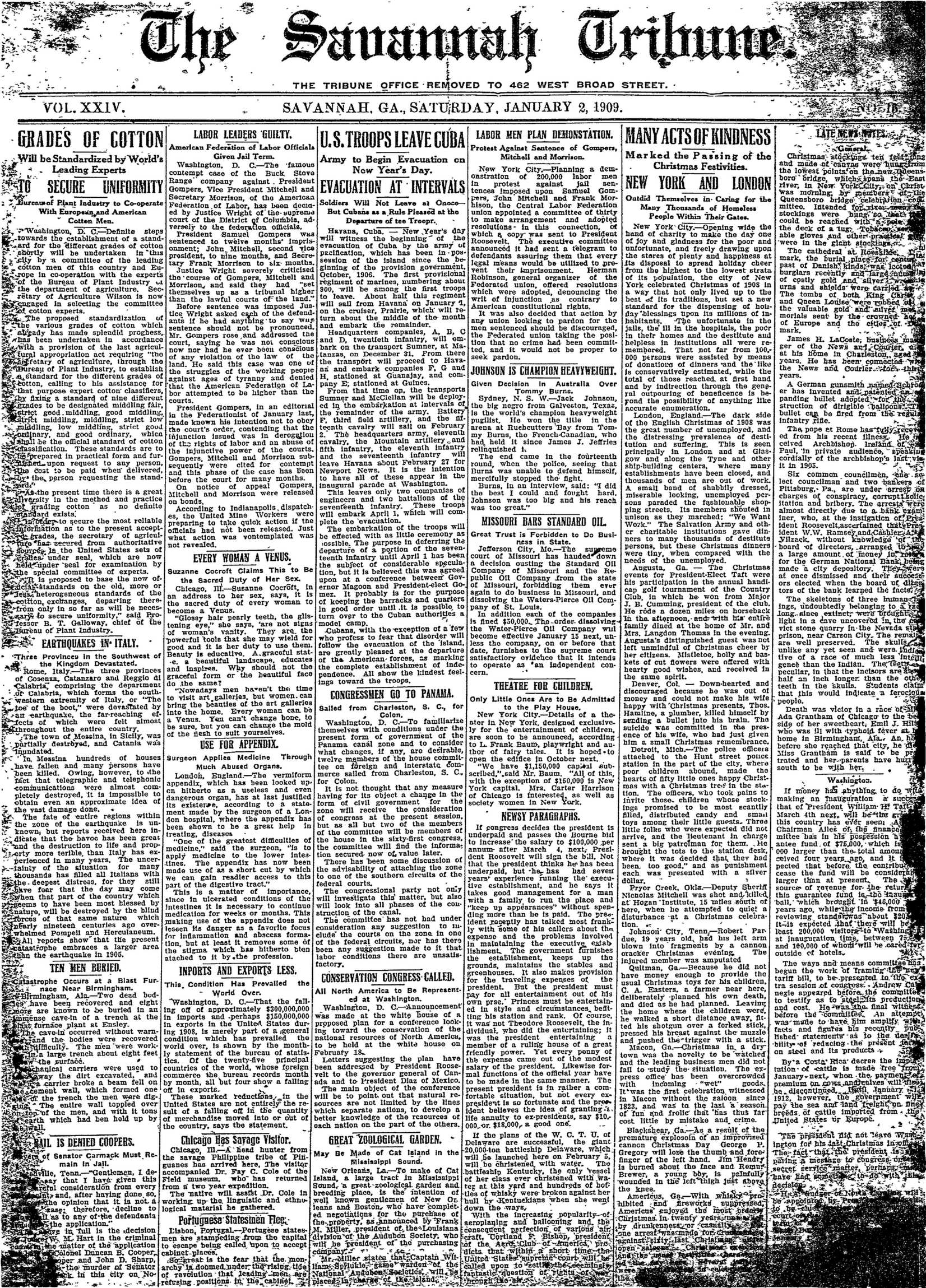
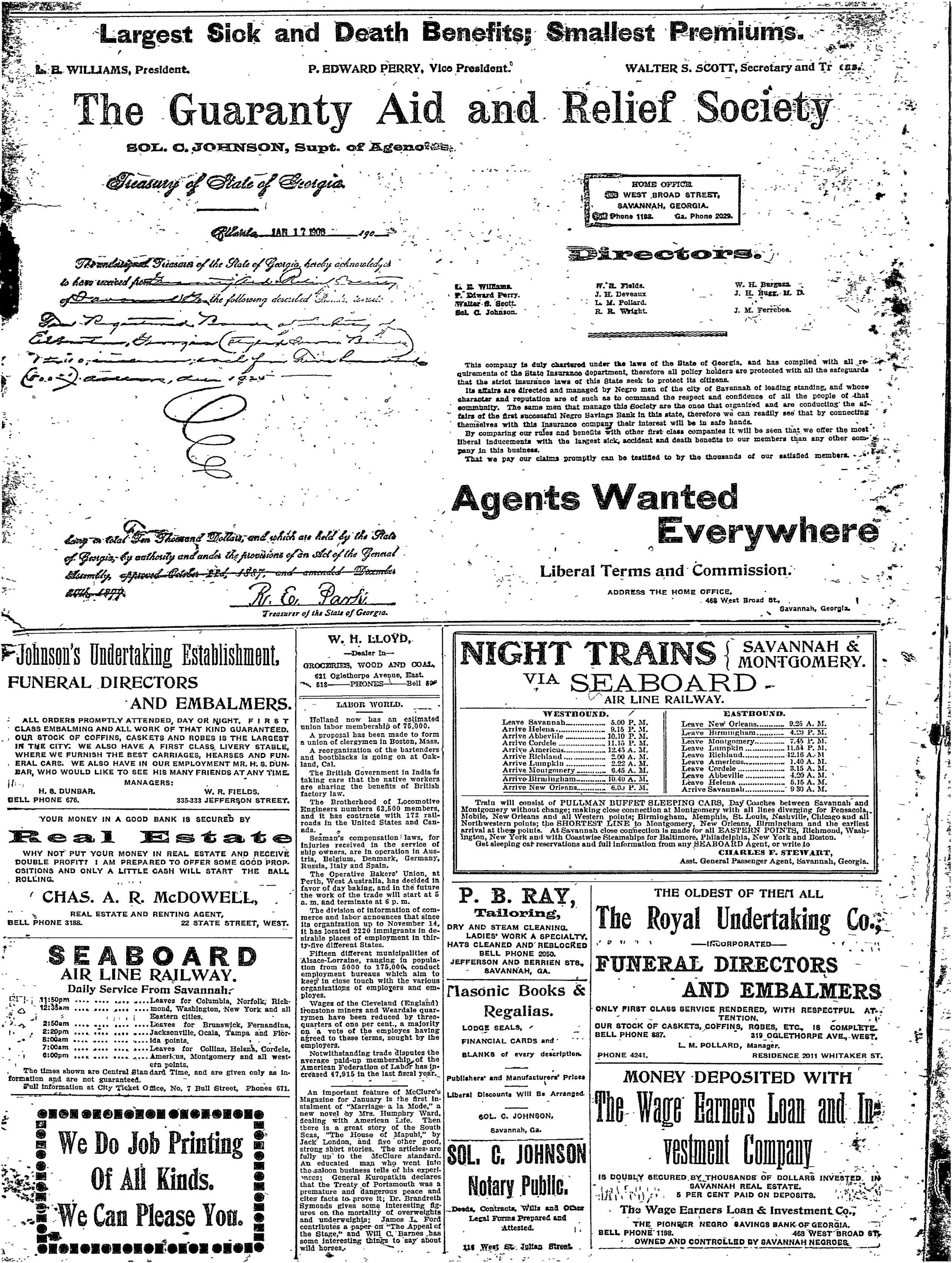
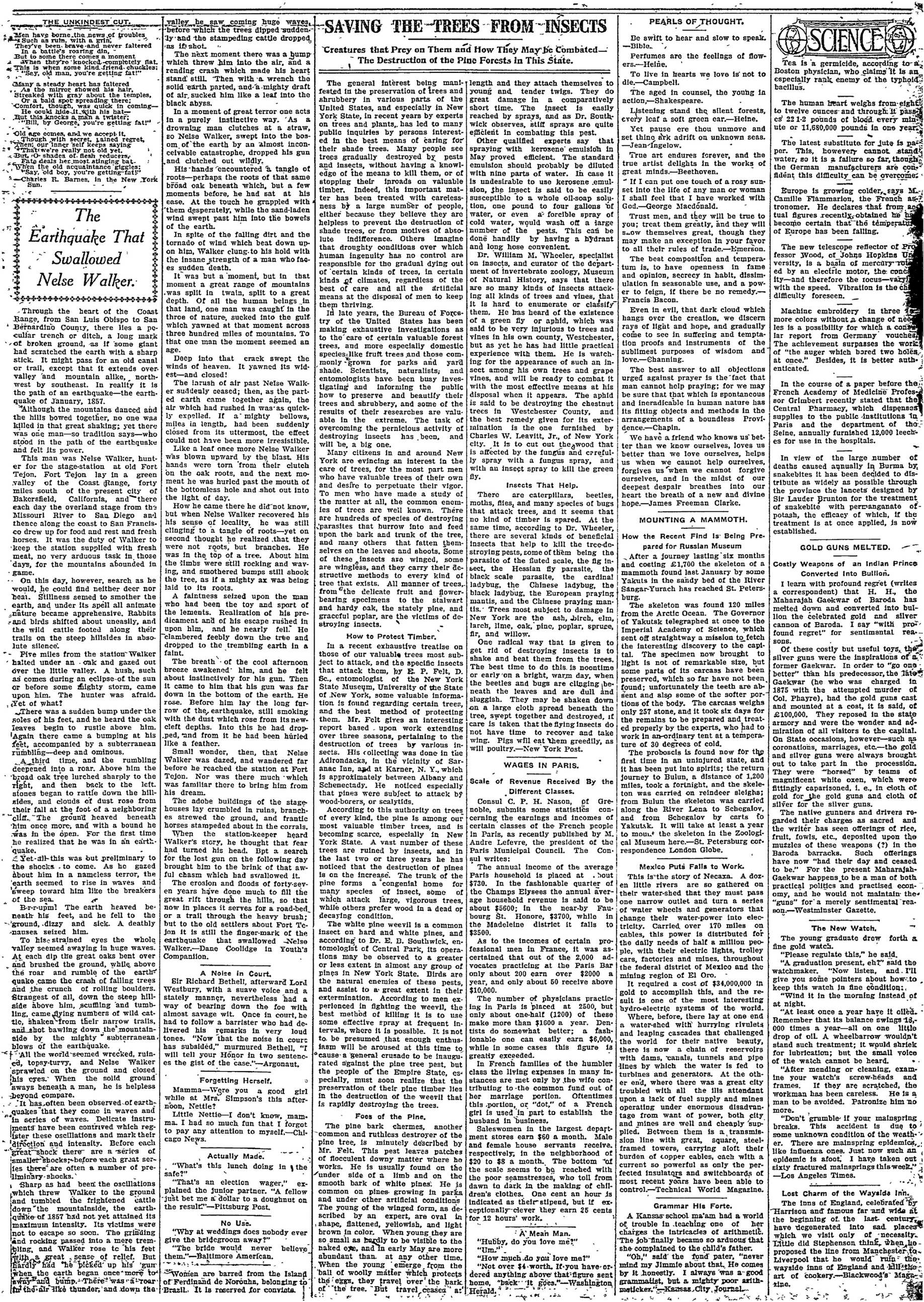
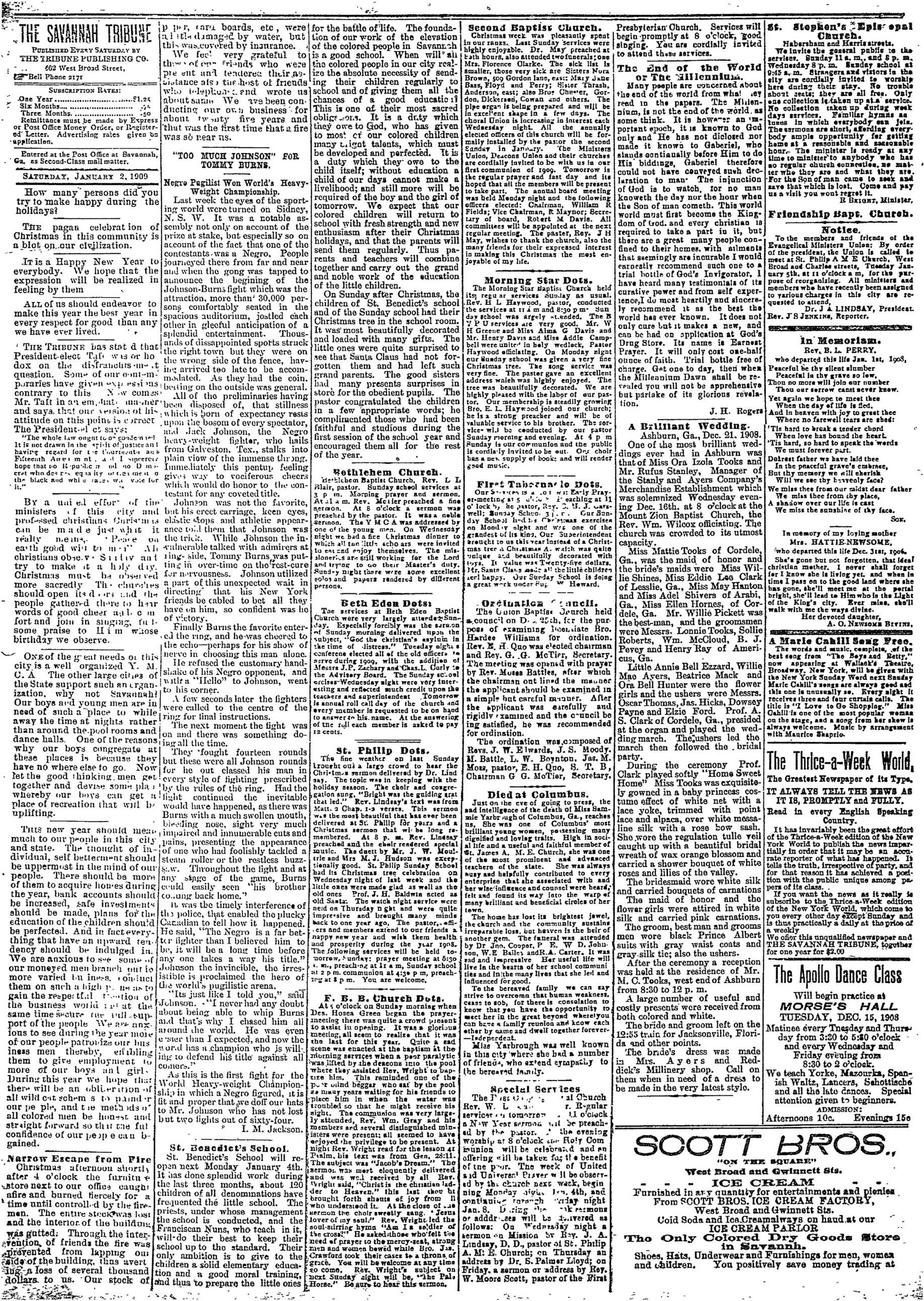
Page text (machine-generated)
VOL. XXIV.
GRADES OF COTTON
Will be Standardized by World's Leading Experts
TO SECURE UNIFORMITY
Bureau of Plant Industry to Co-operate With European and American Cotton Men.
Washington, D. C.—Dennite steps towards the establishment of a standard for the different grades of cotton shortly will be undertaken in this city by a committee of the leading cotton men of this country and Europe in co-operation with the experts of the Bureau of Plant Industry of the department of agriculture. Secretary of Agriculture Wilson is now engaged in selecting the committee of cotton experts.
The proposed standardization of the various grades of cotton which already has made splendid progress, has been undertaken in accordance with a provision of the last agricultural appropriation act requiring "the dietary of agriculture, through the curricula of education, to establish a standard for the different grades of cotton, calling to his assistance for that purpose expert cotton classifiers, by fixing a standard of nine different grades to be designated middling fair, strict good.middling, good middling, strict middling, middling, strict low middling, low middling, strict good ordinary, and good ordinary, which shall be the official standard of cotton classification. These standards are to be furnished in the form of a letter upon request to any person, the cost to be paid when delivered, by the person requesting the standard."
As the present time there is a great diversity in the method and practice for grading cotton as no definite standard exists. In order to secure the most reliable information as to the present acceptability of the secretary of agriculture has secured from authoritative sources. In the United States sets of grades under seal, which are now held under seal for examination by the special committee of experts. IT is proposed to base the new official standards on the old, more or less heterogeneous standards of the cotton, exchanges, departures and other goods, which will be necessary to secure uniformity, said Professor B. T. Galloway, chief of the Bureau of Plant Industry.
EARTHQUAKES IN ITALY.
Three Provinces in the Southwest of the Kingdom Devattated. Rome, Italy.—The three provinces of Cosenza, Canzanzo and Reggio of Calabria, comprising the department of Calabria, which forms the southwestern extremity of Italy, or the toe of the boot," were devastated by the far-reaching effects of which were felt almost throughout the entire country. The town of Messina, in Sicily, was partially destroyed, and Catania was infundated. In Messina hundreds of houses have fallen and many persons have been killed. Owing, however, to the fact that telegraphic and telephonic communications were almost completely destroyed, impossible to correct, an approximate idea of the vast damage done.
The fate of entire regions within the zone of the earthquake is unknown, but reports received here indicate that the havoc has been great and the destruction to life and property more terrible, than Italy has experienced in many other periods of destruction for many thousands has filled all Italians with the deepest distress, for they still have fear that the day may come when that part of the country which seems to have been most blessed by nature, will be destroyed by the blind forces of that same nature which nearly metenet come to power. Peru and Herculeanum. All reports show that the present catastrophe embraces a larger area than the earthquake in 1905.
TEN MEN BURIED.
Castastrophe Occurs at a Blast Furnace near Near Birmingham. Birmingham, Ala—Two dead bodies have been recovered and eight more are known to be buried in an immense cave-in of a trench at the first furnace plant at Ensley. The cave-in occurred without warning and the bodies were recovered in difficulty. The men were work in a large trench about eight feet wide the surface. Mechanical carriers were used to way the dirt excavated, and the burrier broke a beam fell on the cement wall, which formed one side of the trench the men were digging. The entire wall toppled over top of the men, and with it tons earth which had ben hold up by a wall.
RAIL IS DENIED COOPERS.
WAR OF Senator Carmack Must Remain in Jail.
Sedauille, Tenn.—"Gentlemen, I de-
say that I have given this
wonderful consideration from every
point and after having done so,
the opinion that it is not a
case, therefore, decline to
ask it as to any of the defenders
involved in the application."
The case in full is the decision
by counsel W. M. Hart in the criminal
concurring to the matter of the application
by Colonel Duncan B. Cooper,
Cooper and John D. Sharp,
the murder of Senator
Carmack in this city on No-
tuesday.
SAVANNAH, GA., SATURDAY, JANUARY 2, 1909.
LABOR LEADERS 'GUILTY.
American Federation of Labor Officiala Given Jail Term.
Washington, D. C.—The 'famous contempt case of the Buck Stove Range' company against President Gompers, Vice President Mitchell and Secretary Morrison, of the American Federation of Labor, has been decoded by Justice Wright of the supreme court of the District of Columbia, adversely to the federation officials. President Samuel Gompers was sentenced to twelve months' imprisonment; John, Mitchell, second vice president, to nine months, and Secretary Frank Morrison to six months, for the same charges. The course of Gompers, Mitchell and Morrison, and said they had 'set themselves up as a tribunal higher than the lawful courts of the land.'
Before sentence was imposed Justice Wright asked each of the defendants if he had anything to say say sentence should not be overturned, and addressed the court, saying he was not conscious now nor had he ever been conscious of any violation of the law of the land. He said this case was one of the struggles of the working people against ages of tyranny and denied that the American Federation of Law attempted to be higher than the courts.
President Gompers, in an editorial in the Federationist of January last, made known his intention not to obey the court's order, contending that the injunction assured him of labor and an abuse of the injunctive power of the courts. Gompers, Mitchell and Morrison subsequently were cited for contempt and this phase of the case has been before the court for many months. On notice of appeal Gompers, Mitchell and Morrison were released on bonds.
According to Indianapolis, dispatches, the United Mine Workers were preparing to take quick action if the officials had not been released. Just what action was vontemplated was not revealed.
EVERY WOMAN A VENUS.
Suzanne Cocroft Claims This To Be the Sacred Duty of Her Sex. Chicago, Ill.-Susanne Cocroft, in an address to her sex, says, it is the sacred duty of every woman to become a Venus. "Glossy hair pearly teeth, the glistening eye, she says, 'are not signs of woman's beauty.' They are the powerful tools that she may wield for good and it is her duty to use them. Beauty is educative. A graceful statue a beautiful landscape, educates and inspires. Why should not the graceful form or the beautiful face do the same?"
"Nowadays men haven't the time to visit art galleries, but women, can bring the beauties of the art galleries into the home. Every day you can change bone, to be sure, but you can change the mold of the gesh to suit yourselves.
USE FOR APPENDIX.
Surgeon Applies Medicine Through Much Abused Organs.
London, England.—The vermiform appendix, which has been looked upon hitherto as a useless and even dangerous organ, has at last justified its existence, according to a statement made by the surgeon of a London hospital, where the appendix has been shown to be a great help in treating, disease, the greatest difficulties of medicine," said the surgeon, "is to apply medicine to the lower intestines. The appendix has now been made use of as a short cut by which we can gain reader access to this part of the digestive tract."
This is a matter of importance, since in ulcerated conditions of the intestines it is necessary to continue medication for weeks or months. This making use of the appendix does not lessen the inflammation and abscess formation, but at least it removes some of the stigma which has hitherto been attached to it by the profession.
INPORTS AND EXPORTS LESS.
This Condition Has Prevailed the World Over.
Washington, D. C.-That the falling off of approximately $300,000,000 in imports and perhaps $150,000,000 in exports in the United States during 1908, is merely part of a general condition which has prevailed the world over, is shown by the monthly statement of the bureau of statistics. Of the twenty-five principal countries in commerce the bureau records month by month, all but four show a falling off in exports.
These marked reductions, in the United States are not entirely the result of merchandise moved into or out of the country, says the statement.
Chicago Has Savage Visitor.
Chicago, Ill.—A' head hunter from the savage Philippine tribe of Philippines has arrived here. The visitor accompanied Dr. Fay C. Cole of the Field museum, who has returned from a two year expedition.
The native will assist Dr. Cole in
inorganic material he gathered.
Port Huron State Pen Flee:
Dilab, Portugal.—Portuguese statesmen are stampeding from the capital to escape being called upon to accept cabinet places. So great is the fear that the monarchy is doomed, under the rising tide of revolution that leading men are retraining positions in the cabinet.
THE TRIBUNE OFFICE REMOVED TO 462 WEST BROAD STREET.
U.S. TROOPS LEAVE CUBA
Army to Begin Evacuation on Now Year's Day.
EVACUATION AT INTERVALS
Havana, Cuba — New Year's day will witness the beginning of the evacuation of Cuba by the army of pacification, which has been in possession of the island since the provision government, October, 1906. The first provisional regiment of marines, numbering about 900, will be among the first troops to leave. About half this regiment will sail from Havana on January 4, 1906. The remainder will turn about the middle of the month and embark the remainder.
Headquarters companies, A, B, C and D, twentifth infantry, will embark on the transport Sumner, at Mantanzas, on December 31. From there the transport will proceed to Havana and embark companies F and G, and embark at Alajuela, and company E, stationed at Guines. From that time on, the transports Summer and McClellan will be deployed in the embarkation at intervals of the remainder of the army. Battery F, third field artillery, and the fifteenth cavalry will sail on F and G. The headquarters eleventh infantry, Mountain artillery, and fifth infantry, the eleventh infantry and the seventeenth infantry will leave Havana about February 27 for Newport News. It is the intention to have all of these appear in the inaugural parade at Washington. This leaves only two companies of engineers and battalions of the seventeenth infantry. These troops will embark April 1, which will complete the evacuation.
The embarkation of the troops will be effected with as little ceremony as possible. The purpose in deferring the departure of a portion of the seventeenth infantry until April 1 has been the subject of considerable speculation, but it is believed this was agreed upon at a conference between Governor Magoon and President-elect Gomez. It probably is for the purpose of keeping the barracks and quarters in good order until it is possible to turn over to the Cuban authorities a model camp.
Cubans, with the exception of a few who profess to fear that disorder will follow the evacuation of the island, are greatly pleased at the departure of the American-forces, as marking the complete establishment of independence. All show the kindest feelings toward the troops.
CONGRESSMEN GO TO PANAMA
Sailed from Charleston, S. C., for Colon,
Washington, D. C.-To familiarize themselves with conditions under the present form of government of the Panama canal zone and to consider what changes, if any, are desirable, twelve members of the house committee on foreign and interstate commerce sailed from Charleston, S. C., for Colon.
It is not thought that any measure having for its object a change in the form of civil government for the zone will receive the consideration of congress at the present session, but as all but two of the members of the committee will be members of the house in the sixty-first congress, the committee will find the information secured now of the later. There has been some discussion of the advantage of attaching the zone to the southern circuits of the federal courts.
The congressional party not only will investigate this matter, but also will look into all phases of the construction of the canal.
The committee has not had under consideration any suggestion to include the courts on the zone in one of the federal circuits, any suggestion made to it that labor conditions there are unsatisfactory.
CONSERVATION CONGRESS:CALLED.
All North America to Be Represented at Washington. Washington, D. C.—Announcement was made at the white house of a proposed plan for a conference looking toward the conservation of the national resources of North America, to be held at the white house on February 18. Letters suggesting the plan have been addressed by President Roosevelt to the governor general of Canada and to President Dilaz of Canada will be to point out that natural resources are not limited by the lines which separate nations, to develop a better knowledge of the resources of each nation on the part of the others.
GREAT ZOOLOGICAL GARDEN.
May Be Made of Cat Island in the Mississippi Sound.
New Orleans, La.—To make of Cat Island, a large tract in Mississippi Sound, a great zoological garden and breeding place, is the intention of well known gentlemen of New Orleans and Boston, who have completed negotiations for the purchase of the property, as announced by Frank M. Miller, president of the Louisiana division of the Audubon Society, who will be president of the purchasing company.
Mr. Miller states that Captain William Spikule, game warden of the National Audubon Society, will be placed in charge of the island.
LABOR MEN PLAN DEMONSTATION.
Protest Against Sentence of Gompers,
Mitchell and Morrison.
New York City.—Planning a demonstration of 200,000 labor men in protest against jail sentences imposed upon Samuel Gompers, John Mitchell and Frank Morhison, the Central Labor Federation of thirty to make arrangement and adopted resolutions - in this connection, of which a copy was sent to President Roosevelt. The executive committee announced it had sent a telegram to defendants assuring them that every legal means would be utilized to prey on their imprisonment. Herman Robinson, the former officer of Federated union, offered resolutions which were adopted, denouncing the writ of injunction as contrary to American constitutional rights. It was also decided that action by any union looking to pardon for the men sentenced should be discouraged, and that no crime had been committed, and it would not be proper to seek pardon.
JOHNSON IS CHAMPION HEAVYWEIGHT.
Given Decision in Australia Over Tommy Burns.
Sydney, N. S. W.—Jack Johnson, the big negro from Galveston, Texas, is the world's champion heavyweight alliance at the arena at Ruechuttes' Bay from Tommy Burns, the French-Canadian, who had held it since James J. Jeffries relinquished 1.
The end came in the fourteenth round, when the police, seeing that Burns was unable to defend himself, mercifully stopped the fight, and the court ordered: "I did the best I could and fought hard. Johnson was too big and his reach was too great."
MISSOURI BARS STANDARD OIL
Great Trust is Forbidden to Do Business in State.
Jefferson City, Mo.-The supreme court of Missouri has handed down a decision ousting the Standard Oil Company of Missouri and the Reefer Oil Company from the state of Missouri, for failing to them again to do business in Missouri, and dissolving the Waters-Pierce Oil Company of St. Louis.
In addition each of the companies is fined $50,000. The order dissolving the Water-Pierce Oil Company will become effective January 15 next, unless the company, on or before that date, furnishes to the supreme court satisfactory evidence that it intends to operate as 'an Independent concern.'
THEATRE FOR CHILDREN.
Only Little Ones Are to Be Admitted to the Play House.
New York City.—Details of a theater in New York, designed exclusively for the entertainment of children, are soon to be announced, according to L. Frank Baum, playwright and author of fairy tales. It is hoped • to open the edifice in October next. "We are 150,000 subscribers," said Mr. Baum. "All of this, with the exception of $150,000 is New York capital. Mrs. Carter Harrison of Chicago is interested, as well as society women in New York.
NEWSY PARAGRAPHS.
If congress decides the president is underpaid and passes the Bourne bill to increase' the salary to $100,000 per annum after March 4, next. President Roosvelt will sign the bill. Not that the president thinks he has been underpaid, but he has had seven years' experience running the executive establishment, and he says it takes good management for a man with a family to run the place and "keep up appearances" without spending more than he is paid. The president receptively has talked most frankly with some of his critics about his expense and the problems of maintaining the executive establishment. The government furnishes the establishment, keeps up the grounds, maintains the stables and greenhouses. It also makes provision for the traveling expenses of the president. But the president must pay for all entertainment out of his own pre-*Princes must be entertained in style and circumstances, befitting his station and rank. Of course, it was not Theodore Roosvelt, the individual, who did the entertaining; it was the president entertaining a member of a rulling house of a great friendly power. Yet every pomp the expense came out of was the president's salute. Likewise for functions of the official year have to be made in the same manner. The present president is in rather a comfortable situation, but not every ex-president is so fortunate and the president believes the idea of granting life annuity to ex-presidents, say $10,000 or $18,000, a good one.
If the plans of the W. C. T. U. of Delaware are successful, the giant 20,000-tank battleship Delaware, which will be launched here on February 5, will be christened, with water. The battleship Kentucky, the only vessel of her class ever christened with water at this yard and hundreds of bottles of whisky were broken against her hull by Kentuckians when she went down the ways. With the increasing popularity of airplanes and ballooning and the aircraft perfection of various aircraft, Corlard F. Bishop, president of the Aero Club of America, directs that within a short time the United States supreme court will be called upon to settle the seemingly fantastic question of limits of穿透 the air.
MANY ACTS OF KINDNESS
Marked the Passing of the Christmas Festivities.
NEW YORK AND LONDON
New York City—Opening wide the hand of charity to make the day one of joy and gladness for the poor and unfortunate, and freely drawing upon the stares of plenty and happiness at its disposal to spread holiday cheer from the highest to the lowest strata of its population, the city of New York celebrated Christmas of 1908 in a way that not only lived up to the new standards for the city, but standard for the dispensing of holiday blessings upon its millions of inhabitants. The unfortunate in the jails, the ill in the hospitals, the poor in their homes and the destitute and helpless in institutions all were remembered. That not far from 100,000 persons were assisted by means of donations of dinners and the like is conservatively estimated, while the use of gifts, gifts and by indirection through the general outpouring of beneficence is beyond the possibility of anything like accurate enumeration.
London, England.—The dark side of the English Christmas of 1908 was the great number of unemployed, and the distressing prevalence of destitution and suffering. This is seen principally in London and at Glasgow and along the Tyne and other ship-building centers, where many establishments have been closed, and thousands of men are out of work. A small band of shabbly dressed, miserable looking, unemployed persons paraded the fashionable shopping streets, to the menace about an inn marching "We Want Work." The Salvation Army and other charitable institutions gave dinners to many thousands of destitute persons, but these Christmas dinners were tiny, when compared with the needs of the unemployed.
Augusta, Ga. — The Christmas events for President-Elect Taft were his participation in the annual handicap golf tournament of the Country Club, in which he won from Major and won the championship. He rode a dozen miles on horseback In the afternoon, and with his entire family dined at the home of Mr. and Mrs. Langdon Thomas in the evening. Augusta's distinguished guest was not left unminded of Christmas cheer by her citizens. Mistetoe, holly and berry were with hearty good wishes, and received in the game spirit.
Denver, Col. — Down-hearted and discouraged because he was out of money and could not make his wife happy with Christmas presents, Thos. Hamiline, a plumber, killed himself by sending a bullet into his brain. The suicide was committed in the presence of his wife, who had just given him a small Christmas remembrance, a big Hamiline box attached to the Hunt street police station in the part of the city, where poor children abound, made the hearts of city little ones happy Christmas with a Christmas tree in the station. The officers, who took pains to invite those children whose stockings promised to be most scantily filled, distributed candy and small toys among their little guests. Three little folks who were expected did not arrive, and the leutenant in charge, big Jimmy, brought to tots to the station desk, where it was decided that they had been, too good," and as punishment each was presented with a silver dollar.
Pryor Creek, Okla.-Deputy Sherif Nicholas Mitchell was shot and killed at Hogan Institute, 15 miles south of here, when he attempted to quiet a disturbance at a Christmas celebration.
Johnsoni City, Tenn.-Robert Parndy years old, by his left arm blown into fragments by a cannon oracker Christmas evening. The injured member was amputated
Quiltman, Ga.-Because he did not have money enough to provide the usual Christmas toys for his children, C. A. Easters, a farmer near here, deliberately planned his own death, and died as he had planned. Leaving the home a short distance away, fitted his shotgun over a forked stick, pressed his breast against the muzzle and pushed the trigger with a stick.
Macon, Ga.—Christmas in a dry town was the novelty to be watched and the leading business men did not fall to study the situation. The express office has been overcrowded and becoming "tweed" goods. It was the first celebration witnessed in Macon without the saloon, since 1823, and was to the last a season of fun and frolic that has thus far cost little by mistake and crime. Blackshear, Ga.—As a result of the premature explosion of an improvised cannon Christmas Day George P. Gregory will lose the thumb and forefinger of the left hand. Jim Hendry burned abused boys. Jim Hendry a young boy is painfully wounded in the left thigh just above the knee.
Americus, Ga.—With whisky, prohibited and fireworks suppressed, Americus enjoyed the most orders. Christmas. In twenty years, manned by drunkenness, or casualty, one arrest was made for drunkenness against salinity. Last. Christmas. In open salinity. Christmas. In and the usual habitities. Amusement the city. Having been were in salinity. In salinity.
Christmas stockings ten feet long and made of canvases were hung from the lowest points on the new Queensboro bridge, which spans the East river, in New York City, on Christ was morning, by members of the Queensboro bridge celebration committee. Intended for six men, these stockings were hung so that could be reached with a peel. The deck of a tug. Tobacco sacks, gloves and other practical items were in the giant stockings... The cathedral at Rooskilde, Italy marks the burial place for centuries past of Danish kindles, was located in burglaries and large numbers of costly gold and silver urns and shields were carried up. The tombs of both King Charles and Queen Louise were robbed of the valuable gold and silver memorials sent by the crowned king of Europe and the cities of Denmark.
James H. LaCoe, business manager of the News and Courier, died at his home in Charleston, aged 72 years. He has been connected with the News and Courier for three years.
A German gunsmith named Schroer has invented and patented a panding bullet adopted for the destruction of dirigible balloons. The bullet can be fired from the regular infantry rifle.
The pope at Rome has truly received from his recent illness. He is received Archbishop Ireland of Paul, in private audience, speaking cordially of the archbishop's last visit it in 1905.
Six common councilmen, one select councilman and two bankers of Pittsburgh, Pa., are under arrest on charges of conspiracy, corrupt solicitation and bribery. The arrests were almost directly due to a bank examiner, who at the instigation of President Roosevelt, ascertained that President W. W. Ramsey, and Cashier A. Villzack, without knowledge of the board of directors, arranged a board armament in favor of the German National Bank, being made a city depository. They were at once dismissed and their successors elected when the board of directors of the bank learned the facts.
The skeletons of three human beings, undoubtedly belonging to a race long since extinct, were brought light in a cave uncovered in the vicinity stone quarry in the Nevada state prison, near Carson City. The remains are well preserved. The skulls are highly visible between the rows of a race of much less intelligence than the Indian. The teeth peculiar, in that the incisors are half an inch longer than the other teeth in the skulls. Students claim that this would indicate a ferocious people.
Death was victor in a race of all Ada Grantham of Chicago to the side of her sweetheart, Emil J. Hilt who was ill with typhoid fever in a home in Birmingham Ada. He died in Birmingham, the city he Miss Grantham is said to be pretrated and her parents have hurt south to be with her.
Washington.
If money has anything to do with making an inauguration is succeed that of President William H. Taft, March 4th next, will be the prize this country has ever seen. All Chairman Alles of the finance mitee has in his possession an antee fund of $75,000, which is 000 larger than the total amountceived four years ago, and it ispected that before the contribution cease the fund will be considerable larger than at present. The total source of revenue for the return is the ball, which brought in $46,000 years ago, while the income from reviewing standings was about $200 it is expected that there will be least 200,000 visitors to Washington at inauguration time, between 75 and 100,000 of whom will be cared for outside of hotels.
The ways and means committee has begun the work of framing the new tariff bill, to be presented to the extra session of congress: Andrew Carnegie appeared before the committee to testify as to steel's production and cost. He was the final witness before the committee. An attempt was made to have him amplify facts and figures his recently published statements as to the deficiency of reducing the present tariff on steel and its products.
By a Costa Rica decrees the imputation of cattle is made free from January next, when the payment of premium on cows and calves will be discontinued. Until January 1912, however, the government will pay the sea and land height on fine breeds of cattle imported from the United States or Europe.
The president did not leave Washington for his last Christmas in office. The fact that the president is paying a message to congress on a secret service matter, perhaps that have something to do with his decla
Granty Aid and
ON, Supt. of Ageno?
of Georgia.
JAN 17 1908 190
Georgia hereby acknowledges
described Charts, to-wait:
L. E. Williams
P. Edward Perry
Walter G. Scott
Sel. C. Johnson
This company
quirements of the
that the strict
Its affairs are
character and r
community. The
fairs of the first
themselves with
By comparing
liberal inducem
pany in this bu
That we pay
Age
which are held by the State
isions of an Act of the General
and amended December
P. E. Parsi
The unlawful Treasure of the State of Georgia, hereby acknowledges to have received from the following described Chains, to wit:
long as total Ten Thousand Dollars , and which are held by the State of Georgia , by authority and under the provisions of an Act of the General Assembly , approved October 22d, 1887 , and amended December 20th, 1897 .
ALL ORDERS PROMPTLY ATTENDED, DAY OR NIGHT. FIRST CLASS EMBALMING AND ALL WORK OF THAT KIND GUARANTEED. OUR STOCK OF COFFINS, CASKETS AND ROBES IS THE LARGEST IN THE CITY. WE ALSO HAVE A FIRST CLASS, LIVERY STABLE, WHERE WE FURNISH THE BEST CARRIAGES, HEARSES AND FUNERAL CARS. WE ALSO HAVE IN OUR EMPLOYMENT MR. H. S. DUNBAR, WHO WOULD LIKE TO SEE HIS MANY FRIENDS AT ANY TIME. MANAGERS:
MONEY IN A GOOD BANK IS SECURED BY
REAL ESTATE
PUT YOUR MONEY IN REAL ESTATE AND RECEIVE
FIT? I AM PREPARED TO OFFER SOME GOOD PROP
D ONLY A LITTLE CASH WILL START THE BALL
AS. A. R. McDOWELL,
REAL ESTATE AND RENTING AGENT,
188. 22 STATE STREET, WEST.
EABOARD
AIR LINE RAILWAY.
Daily Service From Savannah.
Real Estate
WHY NOT PUT YOUR MONEY IN REAL ESTATE AND RECEIVE DOUBLE PROFIT? I AM PREPARED TO OFFER SOME GOOD PROPOSITIONS AND ONLY A LITTLE CASH WILL START THE BALL ROLLING.
REAL ESTATE AND RENTING AGENT,
BELL PHONE 3188. 22 STATE STREET, WEST.
Leaves for Columbia, Norfolk; Richmond, Washington, New York and all Eastern cities.
... Leaves for Brunswick, Fernandina,
... Jacksonville, Ocala, Tampa and Florida points.
... Leaves for Collins, Helena, Cordele,
... Americus, Montgomery and all western points.
own are Central Standard Time, and are given only as inre not guaranteed.
The times shown are Central Standard Time, and are given only as information and are not guaranteed. Full information at City Global Office No. 5 Dull Street Phone 021
We Do Job Printing Of All Kinds. We Can Please You.
H. 8. DUNBAR.
BELL PHONE 676.
SOL. C. JOHNSON, Supt. of Agenoest.
Treasury of State of Georgia
Treasurer of the State of Georgia.
W. R. FIELDS.
335-333 JEFFERSON STREET.
P. EDWARD PERRY, Vice President. $ ^{b} $
W. H. LLOYD.
GROCERIES, WOOD AND COAL
621 Oglethorpe Avenue, East.
618 PHONES Bell 80
Holland now has an estimated union labor membership of 75,000.
A proposal has been made to form a union of clergymen in Boston, Mass.
A reorganization of the bartenders and bootblacks is going on at Oakland, Cal.
The British Government in India is taking care that the native workers are sharing the benefits of British factory law.
The Brotherhood of Locomotive Engineers numbers 63,500 members, and it has contracts with 172 railroads in the United States and Canada.
Seaman's compensation laws, for injuries received in the service of ship owners, are in operation in Austria, Belgium, Denmark, Germany, Russia, Italy and Spain.
The Operative Bakers' Union, at Perth, West Australia, has decided in favor of day baking, and in the future the work of the trade will start at 5 a. m. and terminate at 6 p. m.
The division of information of commerce and labor announces that since its organization up to November 14, it has located 2220 immigrants in desirable places of employment in thirty-five different States.
Fifteen different municipalities of Alsace-Lorraine, ranging in population from 5000 to 175,000, conduct employment bureaus which aim to keep in close touch with the various organizations of employers and employees.
Wages of the Cleveland (England) ironstone miners and Weardale quarrymen have been reduced by threequarters of one per cent., a majority on a vote of the employees having agreed to these terms, sought by the employers. Notwithstanding trade disputes the average paid-up membership of the American Federation of Labor has increased 47,915 in the last fiscal year.
An important feature of McClure's Magazine for January is the first instalment of "Marriage a la Mode," a new novel by Mrs. Humphry Ward, dealing with American Life. Then there is a great story of the South Scas, "The House of Mapuhl," by Jack London, and five other good, strong short stories. The articles are fully up to the McClure standard. An educated man who went into the saloon business tells of his experiences; General Kuropatkin declares that the Treaty of Portsmouth was a premature and dangerous peace and cites facts to prove it; Dr. Brandreth Symonds gives some interesting figures on the mortality of overweights and underweights; James L. Ford contributes a paper on "The Appeal of the Stage," and Will C. Barnes has some interesting things to say about wild horses.
and R
L. H. Willams.
P. Edward Perry.
Walter G. Scott.
Bell C. Johnson.
This company is duly chartered to requirements of the State Insurance company that the strict insurance laws of the state affairs are directed and manage character and reputation are of such community. The same men that make fairs of the first successful Negro business themselves with this Insurance company. By comparing our rules and benefiting liberal inducements with the large pany in this business.
That we pay our claims promptly.
Agents
Libera
NIGHT TIME
VIA S
WESTBOURNE
Leave Savannah
Arrive Helena
Arrive Abbeville
Arrive Cordele
Arrive Americus
Arrive Richland
Arrive Lumpkin
Arrive Montgomery
Arrive Birmingham
Arrive New Orleans
Train will consist of PULLING Montgomery without change; make Mobile, New Orleans and all West Northwestern points; the SHORT arrival at these points. At Savannahington, New York and with Coastwild Get sleeping car reservations at
P. B. RAY,
Tailoring,
This company is duly chartered under the laws of the State of Georgia, and has complied with all requirements of the State Insurance department, therefore all policy holders are protected with all the safeguards that the strict Insurance laws of this State seek to protect its citizens.
Its affairs are directed and managed by Negro men of the city of Savannah of leading standing, and whose character and reputation are of such as to command the respect and confidence of all the people of that community. The same men that manage this Society are the ones that organized and are conducting the affairs of the first successful Negro Savings Bank in this state, therefore we can readily see that by connecting themselves with this Insurance company their interest will be in safe hands.
By comparing our rules and benefits with other first class companies it will be seen that we offer the most liberal inducements with the largest sick, accident and death benefits to our members than any other company in this business.
WESTBOUND.
Leave Savannah 5.00 P. M.
Arrive Helena 9.15 P. M.
Arrive Abbeville 10.10 P. M.
Arrive Cordele 11.15 P. M.
Arrive Americus 12.45 A. M.
Arrive Richland 2.00 A. M.
Arrive Lumpkin 2.22 A. M.
Arrive Montgomery 6.45 A. M.
Arrive Birmingham 10.40 A. M.
Arrive New Orleans 6.00 P. M.
EASTBOUND.
Leave New Orleans 9.25 A. M.
Leave Birmingham 4.20 P. M.
Leave Montgomery 7.45 P. M.
Leave Lumpkin 11.54 P. M.
Leave Richland 12.16 A. M.
Leave Americus 1.40 A. M.
Leave Cordele 3.15 A. M.
Leave Abbeville 4.20 A. M.
Leave Helena 5.15 A. M.
Arrive Savannah 9.30 A. M.
Train will consist of PULLMAN BUFFET SLEEPING CARS, Day Coaches between Savannah and Montgomery without change; making close connection at Montgomery with all lines diverging for Pensacola, Mobile, New Orleans and all Western points; Birmingham, Memphis, St. Louis, Nashville, Chicago and all Northwestern points; the SHORTEST LINE to Montgomery, New Orleans, Birmingham and the earliest arrival at these points. At Savannah close connection is made for all EASTERN POINTS, Richmond, Washington, New York and with Coastwise Steamships for Baltimore, Philadelphia, New York and Boston. Get sleeping car reservations and full information from any SEABOARD Agent, or write to
DRY AND STEAM CLEANING.
LADIES' WORK A SPECIALTY.
HATS CLEANED AND REBLOCKED
BELL PHONE 2050.
JEFFERSON AND BERRIEN STS.
8AVANNAH, GA.
Masonic Books &
Regalias.
ONLY FIRST CLASS SERVICE RENDERED, WITH RESPECTFUL ATTENTION.
OUR STOCK OF CASKETS, COFFINS, ROBES, ETC., IS COMPLETE.
BELL PHONE 887. 319 OGLETHORPE AVE., WEST.
L. M. POLLARD, Manager.
PHONE 4241. RESIDENCE 2011 WHITAKER ST.
LODGE SEALS,
FINANCIAL CARDS and
BLANKS of every description.
Publishers' and Manufacturers' Prices
Liberal Discounts Will Be Arranged.
SOL. C. JOHNSON,
Savannah, Ga.
SOL. C. JOHNSON
Notary Public.
18 DOUBLY SECURED BY THOUSANDS OF DOLLARS INVESTED. IN SAVANNAH REAL ESTATE. 5 PER CENT PAID ON DEPOSITS.
Deeds, Contracts, Wills and Other Legal Forms Prepared and Attested.
THE PIONEER NEGRO SAVINGS BANK OF GEORGIA. BELL PHONE 1198. 463 WEST BROAD ST OWNED AND CONTROLLED BY SAVANNAH NEGROES
The Earthquake That Swallowed Nelse Walker.
Through the heart of the Coast Range, from San Luis Obispo to San Bernardino County, there lies a peculiar trench or ditch, a long mark of broken ground, as if some giant had scratched the earth with a sharp stick. It might pass for an old canal or trail, except that it extends over valley and mountain allike, northwest by southeast. In reality it is the path of an earthquake—the earthquake of January, 1857.
Although the mountains danced and the hills bowed together, no one was killed in that great shaking; yet there was one man—so tradition says—who stood in the path of the earthquake and felt its power.
This man was Nelse Waller, hunter for the stage-station at old Fort Tejon. Fort Tejon lay in a green valley of the Coast Range, forty miles south of the present city of Bakersfield, California, and there each day the overland stage from the Missouri River to San Diego and thence along the coast to San Francisco drew up for food and rest and fresh horses. It was the duty of Walker to keep the station supplied with fresh meat, no very arduous task in those days, for the mountains abounded in game.
On this day, however, search as he would, he could find neither deer nor beak. Stillness seemed to smother the earth, and under its spell all animate nature became apprehensive. Rabbits and birds shifted about uneasily, and the wild cattle footed along their trails on the steep hillsides in absolute silence.
Five miles from the station Walker halted under an oak and gazed out over the little valley. A hush, such as comes during an eclipse of the sun or before some lighty storm, came upon him. The hunter was afraid. Yet of what? There was a sudden bump under the soles of his feet, and he heard the oak leaves begin to rustle above him. Again there came a bumping at his feet, accompanied by a subterranean rumbling—deep and ominous.
A third time, and the rumbling deepened into a roar. Above him the broad oak tree lurched sharply to the right, and then back to the left, stones began to rattle down the hillsides, and clouds of dust rose from their fall at the foot of a neighboring cliff. The ground heaved beneath him once more, and with a bound he was in the open. For the first time he realized that he was in an earthquake.
Yet all this was but preliminary to the shocks to come. As he gazed about him in a nameless terror, the earth seemed to rise in waves and sweep toward him like the breakers of the sea.
B-r-upup! The earth heaved beneath his feet, and he fell to the ground, dizzy and sick. A deathly nausea seized him.
To his strained eyes the whole valley seemed swaying in huge waves. At each dip the great oaks bent over and brushed the ground, while above the roar and rumble of the earthquake came the crash of falling trees and the crunch of rolling boulders. Strangest of all, down the steep hillside above him, scumming and tumbling, came dying numbers of wild cattle, shaken from their narrow trails, and shot bawling down the mountainside by the mighty subterranean blows of the earthquake.
All the world seemed wrecked, ruined, topsy-turvy, and Nelse Walker sprawled on the ground and closed his eyes. When the solid ground aways beneath a man, he is helpless beyond compare.
It has often been observed of earthquakes that they come in waves and in series of waves. Delicate instruments have been contrived which register these oscillations and mark their direction and intensity. Before each great shock there are a series of smaller shocks, before each great series there are often a number of preliminary shocks.
Sharp as had been the oscillations which threw Walker to the ground and tumbled the frightened cattle down the mountainside, the earthquake of 1857 had not yet attained its maximum intensity. Its victims were not to escape so soon. The grinding and rocking passed into a mere trembling, and Walker rose to his feet with a great sense of relief. But hardly had he picked up his gun when the earth began once more to sway and bump. There was a roar from the air like thunder, and down the
valley, he saw coming huge ways, before which the trees dipped suddenly and the stampeding cattle dropped as if shot.
The next moment there was a bump which threw him into the air, and a rending crash which made his heart stand still. Then with a wrench the solid earth parted, and a mighty draft of air, sucked him like a leaf into the black abyss.
In a moment of great terror one acts in a purely instinctive way. As a drowning man clutches at a straw, so Nelse Walker, swept into the bosom of the earth by an almost inconceivable catastrophe, dropped his gun and clutched out wildly.
His hands 'encountered a tangle of roots—perhaps the roots of that same broad oak beneath which, but a few moments before, he had sat at his ease. At the touch he grappled with them desperately, while the sand-laden wind swept past him into the bowels of the earth.
In spite of the falling dirt and the tornado of wind which beat down upon him, Walker clung to his hold with the insane strength of a man who faces sudden death.
It was but a moment, but in that moment a great range of mountains was split in twain, split to a great depth. Of all the human beings in that land, one man was caught in the three of nature, sucked into the gulf which yawned at that moment across three hundred miles of mountains. To that one man the moment seemed an age.
Deep into that crack swept the winds of heaven. It yawned its widest—and closed!
The inrush of air past Nelse Walker suddenly ceased; then, as the parted earth came together again, the air which had rushed in was quickly expelled. If a mighty bellows, miles in length, had been suddenly closed from its uttermost, the effect could not have been more irresistible.
Like a leaf once more Nelse Walker was blown upward by the blast. His hands were torn from their clutch on the oak roots, and the next moment he was hurled past the mouth of the bottomless hole and shot out into the light of day.
How he came there he did not know, but when Nelse Walker recovered his his sense of locality, he was still clinging to a tangle of roots—yet on second thought he realized that they were not roots, but branches. He was in the top of a tree. About him the slimbs were still rocking and waving, and smothered bumps still shook the tree, as if a mighty ax was being laid to its roots.
A faintness seized upon the man who had been the toy and sport of the elements. Realization of his predicament and of his escape rushed in upon him, and he nearly fell. He clambered feebly down the tree and dropped to the trembling earth in a faint.
The breath of the cool afternoon breeze awakened him, and he felt about instinctively for his gun. Then it came to him that his gun was far down in the bottom of the earth. He rose. Before him lay the long furrow of the, earthquake, still smoking with the dust which rose from its newcleft depths. Into this he had dropped, and from it he had been hurled like a feather.
Small wonder, then, that Nelse Walker was dazed, and wandered far before he reached the station at Port Tecjon. Nor was there much which was familiar there to bring him from his dream.
The adobe buildings of the stagehouses lay crumpled in ruins, branches strewed the ground, and frantic horses stamped about in the corrals.
When the station-keeper heard Walker's story, he thought that fear had turned his head. Bpt a search for the lost gun on the following day brought him to the brink of that awful chasm which had swallowed it. The erosion and floods of forty-seven years have done much to fill the great rift through the hills, so that now in places it serves for a road-bed or a trail through the heavy brush; but to the old settlers about Fort Tejon it is still the finger-mark of the earthquake that swallowed Nelse Walker.—Dane Coolldge in Youth's Companion.
A Noise in Court.
Sir Richard Bethell, afterward Lord Westbury, with a suave voice and a stately manner, nevertheless had a way of bearing down the foe with almost savage wilt. Once in court, he had to follow a barrister who had delivered his remarks in very loud tones. "Now that the noise in courts has subsided," murmured Bethell. "I will tell your Hónor in two sentences the gist of the case."—Argonaut.
Forgetting Herself
Mamma—Wgre you a good girl while at Mrs. Simpson's this afternoon, Nettie?
Little Nettie—I don't know, mamma. I had so much fun that I forgot to pay any attention to myself.—Chicago News.
"What's this lunch doing in the safe?"
"That's an election wager," explained the junior partner. "A fellow just bet me a dollar to a doughnut on the result"—Pittsburg Post.
No Use.
"Why at weddings does nobody ever give the bridegroom away?" "The bride would never believe them."—Baltimore American.
SAVING THE TREES FROM INSECTS
Creatures that Prey on Them and How They May be Combated The Destruction of the Pine Forests in This State.
The general interest being manifested in the preservation of trees and shrubbery in various parts of the United States, and especially in New York State, in recent years by experts on trees and plants, has led to many public inquiries by persons interested in the best means of caring for their shade trees. Many people see trees gradually destroyed by pests and insects, without having a knowledge of the means to kill them, or of stopping their inroads on valuable timber. Indeed, this important matter has been treated with carelessness by a large number of people, either because they believe they are helpless to prevent the destruction of shade trees, or from motives of absolute indifference. Others imagine that droughty conditions over which human ingenuity has no control are responsible for the gradual dying out of certain kinds of trees, in certain kinds of climates, regardless of the best of care and all the artificial means at the disposal of men to keep them thriving.
In late years, the Bureau of Forcestry of the United States has been making exhaustive investigations as to the care of certain valuable forest trees, and more especially domestic species, like fruit trees and those commonly grown for parks and yard shade. Scientists, naturalists, and entomologists have been busy investigating and informing the public how to preserve and beautify their trees and shrubbery, and some of the results of their researches are valuable in the extreme. The task of overcoming the pernicious activity of destroying insects has been, and will be, a big one.
Many citizens in and around New York are evincing an interest in the care of trees, for the most part men who have valuable trees of their own and desire to perpetuate their vigor. To men who have made a study of the matter at all, the common enemies of trees are well known. There are hundreds of species of destroying parasites that burrow into and feed upon the bark and trunk of the tree, and many others that fatten themselves on the leaves and shoots. Some of these insects are winged, some are wingless, and they carry their destructive methods to every kind of tree that exists. All manner of trees, from the delicate fruit and flower-bearing specimens to the stalwart and hardy oak, the stately pine, and graceful poplar, are the victims of destroying insects.
How to Protect Timber.
In a recent exhaustive treatise on those of our valuable trees most subject to attack, and the specific insects that attack them, by E. P. Felt, D. Sc., entomologist of the New York State Museum, University of the State of New York, some valuable information is found regarding certain trees, and the best method of protecting them. Mr. Felt gives an interesting report based upon work extending over three seasons, pertaining to the destruction of trees by various insects. His collecting was done in the Adrondacks, in the vicinity of Saranac Inn, and at Karner, N. Y., which is approximately between Albany and Sebectenady. He noticed especially that pines were subject to attack by wood-borers, or scalytids.
According to this authority on trees of every kind, the pine is among our most valuable timber trees, and is becoming scarce, especially in New York State. A vast number of these trees are ruined by insects, and in the last two or three years he has noticed that the destruction of pines is on the increase. The trunk of the pine forms a 'congenial home for many species of insect, some of which attack large, vigorous trees, while others prefer wood in a dead or decaying condition.
The white pine weevil is a common insect on hard and white pines, and according to Dr. E. B. Southwick, entomologist of Central Park, its operations may be observed to a greater or less extent in almost any group of pines in New York State. Birds are the natural enemies of these pests, and assist to a great extent in their extermination. According to men experienced in fighting the weevil, the best method of killing it is to use some effective spray at frequent intervals, where it is possible. It is not to be presumed that enough enthusiasm will be aroused at this time to cause a general crusade to be inaugurated against the pine tree pest, but the people of the Empire State, especially, must soon realize that the preservation of their pine timber lies in the destruction of the weevil that is rapidly destroying the trees.
Foes of the Pine.
The pine bark chermes, another common and ruthless destroyer of the pine tree, is minutely described by Mr. Felt. This pest leaves patches of flocculent downy matter where he works. He is usually found on the under side of a limb and on the smooth bark of white pines. He is common on pines growing in parks and under other artificial conditions. The young of the winged form, as described by an expert, are oval in shape, flattened, yellowish, and light brown in color. When young they are so small as hardy to be visible to the naked eye, and in early May are more abundant than at any other time. When the young emerge from the ball of woolly matter which protects the eggs, they travel over the bark of the tree. But travel ceased at
length and they attach themselves to young and tender twigs. They do great damage in a comparatively short time. The insect is easily reached by sprays, and as Dr. Southwick observes, stiff sprays are quite efficient in combating this pest. Other qualified experts say that spraying with kerosene emulsion in May proved efficient. The standard emulsion should probably be diluted with nine parts of water. In case it is undesirable to use kerosene emulsion, the insect is said to be easily susceptible to a whole oil-soap solution, one pound to four gallons of water, or even a forcible spray of cold water, would wash off a large number of the pests. This can be done handily by having a hydrant and long hose convenient.
Dr. William M. Wheeler, specialist on insects, and curator of the department of invertebrate zoology, Museum of Natural History, says that there are so many kinds of insects attacking all kinds of trees and vines, that it is hard to enumerate or classify them. He has heard of the existence of a green fly or aphid, which was said to be very injurious to trees and vines in his own county, Westchester, but as yet he has had little practical experience with them. He is watching for the appearance of such an insect among his own trees and grape vines, and will be ready to combat it with the most effective means at his disposal when it appears. The aphid is said to be destroying the chestnut trees in Westchester County, and the best remedy given for its extermination is the one furnished by Charles W. Leavitt, Jr., of New York city. It is to cut out the wood that is affected by the fungus and creatively spray with a fungus spray, and with an insect spray to kill the green fly.
Insects That Help.
There are caterpillars, beetles, moths, files, and many species of bugs that attack trees, and it seems that no kind of timber is spared. At the same time, according to Dr. Wheeler, there are several kinds of beneficial insects that help to kill the tree-destroying pests, some of them being the parasite of the fisted scale, the fig insect, the Hessian fly parasite, the cardinal ladybug, the Chinese ladybug, the black ladybug, the European praying mantis, and the Chinese praying mantis. Trees most subject to damage in New York are the ash, birch, elm, larch, lime, oak, pine, poplar, spruce, fir, and willow.
One radical way that is given to get rid of destroying insects is to shake and beat them from the trees. The best time to do this is noontime or early on a bright, warm day, when the beetles and bugs are clinging beneath the leaves and are dull and sluggish. They may be shaken down on a large cloth spread beneath the tree, swept together and destroyed, if care is taken that the flying insects do not have time to recover and take wing. Pigs will eat them greedily, as will poultry.—New York Post.
WAGES IN PARIS.
Scale of Revenue Received By the Different Classes.
Consul C. P. H. Nason, of Grenoble, submits some statistics concerning the earnings and incomes of certain classes of the French people in Paris, as recently published by M. Andre Lefevre, the president of the Paris Municipal Council. The Consul writes:
The annual income of the average Paris household is placed at about $730. In the fashionable quarter of the Champs Elysees the annual average household revenue is said to be about $5600. In the near-by Faubourg St. Honore, $3700, while in the Madeleine district it falls to $2500.
As to the incomes of certain professional men in France, it was ascertained that out of the 2,000 advocates practicing at the Paris Bar only about 200 earn over $2000 a year, and only about 50 receive above $10,000.
The number of physiclans practicing in Paris is placed at 2500, but only about one-half (1200) of these make more than $1600 a year. Dentists do somewhat better; a fashionable one can easily earn $6,000, while in some cases this figure is greatly exceeded.
In French families of the humbler class the living expenses in many instances are met only by the wife contributing to the common fund out of her marriage portion. Oftentimes this portion, or "dot," of a French girl is used in part to establish the husband in business.
Saleswomen in the largest department stores earn $60 a month. Male and female house servants receive, respectively, in the neighborhood of $20 to $8 a month. The bottom of the scale seems to be reached with the poor seamstresses, who toll from dawn to dark in the making of children's clothes. One cent an hour is indicated as their stipend, but if exceptionally clever they earn 25 cents for 12 hours' work.
A Mean Man.
"How much do you love me?"
"Not over $4 worth. If you have ordered anything above that figure sent home, "back" it, goes."—Washington Herald.
Be swift to hear and slow to speak.—Bible.
Perfumes are the feelings of flowers.—Helne.
To live in hearts we love is not to die.—Campbell.
The aged in counsel, the young in action.—Shakespeare.
Listening stand the silent forests, every leaf a soft green car.—Helne.
Yet pause ere thou unmove and set thing ark adrift on unknown seas.—Jean-Ingelow.
True art endures forever, and the true artist delights in the works of great minds.—Beethoven.
If I can put one touch of a rosy sun set into the life of any man or woman I shall feel that I have worked with God.—George Macdonald.
Trust men, and they will be true to you; treat them greatly, and they will sow themselves great, though they may make an exception in your favor to all their rules of trade.—Emerson.
The best composition and temperatum is, to have openness in fame and opinion, secrecy in habit, dissimulation in seasonable use, and a power to feign, if there be no remedy.—Francis Bacon.
Even in evil, that dark cloud which hangs over the creation, we discern rays of light and hope, and gradually come to see in suffering and temptation proofs and instruments of the sublimest purposes of wisdom and love.—Channing.
The best answer to all objections urged against prayer is the fact that man cannot help praying; for we may be sure that that which is spontaneous and ineradicable in human nature has its fitting objects and methods in the arrangements of a boundless Providence.—Chapin.
We have a friend who knows us better than we know ourselves, loves us better than we love ourselves, helps us when we cannot help ourselves, forgives us when we cannot forgive ourselves, and in the midst of our deepest despair breathes into our heart the breath of a new and divine hope.—James Freeman Clarke.
MOUNTING A MAMMOTH.
How the Recent Find Is Being Prepared for Russian Museum
After a journey lasting six months and costing £1,700 the skeleton of a mammoth found last January by some Yakuts in the sandy bed of the River Sangar-Yurach has reached St. Petersburg.
The skeleton was found 120 miles from the Arctic Ocean. The Governor of Yakutsk telegraphed at once to the Imperial Academy of Science, which sent off straightway a mission to fetch the interesting discovery to the capital. The specimen now brought to light is not of remarkable size, but some parts of its carcass have been preserved, which so far have not been found; unfortunately the teeth are absent and also some of the softer portions of the body. The carcass weighs only 257 stone, and it took six days for the remains to be prepared and treated properly by the experts, who had to work in an ordinary tent at a temperature of 30 degrees of cold.
The proboscis is found now for the first time in an uninjured state, and it has been put into spirits; the return journey to Bulun, a distance of 1,200 miles, took a fortnight, and the skeleton was carried on reindeer sleighs; from Bulun the skeleton was carried along the River Lena to Schegalov, and from Schegalov by carts for Yakutsk. It will take at least a year to mount* the skeleton in the Zoological Museum here.-St. Petersburg correspondence London Globe.
Mexico Puts Falls to Work.
This is the story of Necaxa. A dozen little rivers are so gathered on their water-shed that they must pass one narrow outlet and turn a series of water wheels and generators that change their water-power into electricity. Carried over 170 miles on cables, this power is distributed for the daily needs of half a million people, with their electric lights, trolley cars, factories and mines, throughout the federal district of Mexico and the mining region of El Oro. It required a cost of $34,000,000 in gold to accomplish this, and the result is one of the most interesting hydro-electric systems of the world.
Where, before, there lay at one end a water-shed with hurrying rivulets and leaping cascades that challenged the world for their native beauty, there is now a chain of reservoirs with dams, canals, tunnels and pipe lines by which the water is fed to turbines and generators. At the other end, where there was a great city troubled with all the ills attendant upon a lack of fuel supply and mines operating under enormous disadvantage from want of power, both city and mines are well and cheaply supplied. Between them is a transmission line with great, square, steel-framed towers, carrying aloft their burden of copper cables, each with a current so powerful as only the perfected insulators and switchboards of most recent years have been able to control. Technical World Magazine.
Grammar Hla Forte.
A Kansas school ma'am had a world of trouble in teaching one of her charges the intricacies of arithmetik. The job finally became so arduous that she complained to the child's father. "Oh," said the fond pater, "never mind my Jimmie about that. He comes by it honestly. I always was a good grammatist, but a mighty poor arithmeticker."-Kansas City, Journal.
Tea is a germicide, according to a Boston physician, who claims it is an especially rank enemy of the typhoid bacillus.
The human heart weighs from eight to twelve ounces and through it passes 221.2 pounds of blood every minute or 11,680,000 pounds in one year.
The latest substitute for jute is paper. This, however cannot stand water, so it is a failure so far, though the German manufacturers are confident this difficulty can be overcome.
Europe is growing colder, says M. Camille Flammarlon, the French astronomer. He declares that from actual figures recently obtained he has become certain that the temperature of Europe has been falling.
The new telescope reflector of Professor Wood, of Johns Hopkins University, is a basin of mercury rolled by an electric motor, the concordity and therefore theocus-varyl with the speed. Vibration is the childrifficulty foreseen.
Machine embroidery in three more colors without a change of needles is a possibility for which a conular report from Germany vouches. The achievement surpasses the work of "the auger which bored two holes at once." Besides, it is better authentiated.
In the course of a paper before the French Academy of Medicine Professor Grimbert recently stated that the Central Pharmacy, which dispenses supplies to the public institutions in Paris and the department of the Seine, annually furnished 12,000 leeches for use in the hospitals.
In view of the large number of deaths caused annually in Burma by snakebites it has been decided to distribute as widely as possible through the province the lancets designed by Sir Lauder Prunton for the treatment of snakebite with pernanganate of potash, the efficacy of which, if the treatment is at once applied, is now established.
GOLD GUNS MELTED.
Costly Weapons of an Indian Prince Converted Into Bullion.
I learn with profound regret (writes a correspondent) that H. H., the Maharajah Gaekwar of Baroda has melted down and converted into bullion the celebrated gold and silver cannon of Baroda. I say "with profound regret" for sentimental reasons.
Of these costly but useful toys, the silver guns were the inspirations of a former Gaekwar. In order to "go on better" than his predecessor, the late Gaekwar (he who was charged in 1875 with the attempted murder of Col. Phayre), had the gold guns cast and mounted at a cost, it is said, of £100,000. They reposed in the state armory and were the wonder and admiration of all visitors to the capital. On State occasions, however—such as coronations, marriages, etc—the gold and silver guns were always brought out to take part in the procession. They were "horsed" by teams of magnificent white oxen, which were fittingly caparisoned, i. e., in cloth of gold for the gold guns and cloth of silver for the silver guns.
The native gunners and drivers regarded their charges as sacred and the writer has seen offerings of rice, fruit, fowls, etc., deposited upon the muzzles of these weapons (?) in the Baroda barracks. Such offerings have now "had their day and ceased to be." For the present Maharajah-Gaekwar happens to be a man of both practical politics and practised economy, and he would not maintain the "guns" for a merely sentimental reason.—Westminster Gazette.
The New Watch.
The young graduate drew forth a fine gold watch.
"Please regulate this." he said
Please regard us only.
"A graduation present, eht?" said the watchmaker. "Now listen, and. I'll give you some pointers about how to keep this watch in fine condition: "Wind it in the morning instead of at night.
"At least once a year have it oiled. Remember that its balance swings 18,000 times a year—all on one little drop of oil. A wheelbarrow wouldn't stand such treatment; it would shriek for lubrication; but the small voice of the watch cannot be heard.
"After mending or cleaning, examine your watch's screw-heads and frames. If they are scratched, the workman has been careless. He is a man to be avoided. Patronize him no more.
"Don't grumble if your mainspring breaks. This accident is due to some unknown condition of the weather. There are mainspring epidemics like influenza ones. Just now such an epidemic is afoot. I have taken out sixty fractured mainsprings this week." —Los Angeles Times.
Lost Charm of the Wavalds Inn.
Lost Charm of the Ways I am.
The inns of England, celebrated by Harrison and famous far and wide at the beginning of the last century, have degenerated into sad places which we visit only of necessity. Little did Stephenson think, when he proposed the line from Manchester to Liverpool that he would ruin the wayside inns of England and fill the art of cookery—Blackwood's Magazine.
PUBLISHED EVERY SATURDAY BY
THE TRIBUNE PUBLISHING CO.
602 West Broad Street,
Bell Phoebe
Entered at the Post Office at Savannah,
Ga. as Second-Class mail matter.
How many persons did you try to make happy during the holidays?
THE pagan celebration of Christmas in this community is a blot on our civilization.
It is a Happy New Year to everybody. We hope that the expression will be realized in feeling by them
ALL of us should endeavor to make this year the best year in every respect for good than any we have ever lived.
THE TRIBUNE has stated that President-elect Taft was or had dox on the disfranchisement question. Some of our contemporaries have given expressions contrary to this. Now comes Mr. Taft in an eminent manner and says, that our version of his attitude on this point is correct. The President-elect says:
"The whole law ought to be goldened. It is not drawn in the spirit of justice and having regard for the Fourteenth Amendment, and I supervise hope that no Republic will no Democrat who deserves equality or treatment of the black and white races will vote for it."
By a united effort of the ministers of this city and professed christians Christians can be made just what it really means. Peace on earth good will to men. All christians observe Sunday and try to make it a holy day. Christmas must be observed more sacredly. The churches should open its doors and the people gather d there to hear words of good cheer and comfort and join in singing, for some praise to Him whose birthday we observe.
One of the great needs on this city is a well organized Y. M. C. A. The other large cities of the State support such an organization, why not Savannah Our boys and young men are in need of such a place to while away the time at nights rather than around the pool rooms and dance halls. One of the reasons why our boys congregate at these places is because they have no where else to go. Now let the good thinking men get together and devise some plan whereby our boys can get a place of recreation that will be uplifting.
This new year should mean much to our people in this city and state. The thought of individual, self betterment should be uppermost in the mind of our people. There should be more of them to acquire houses during the year, bank accounts should be increased, safe investments should be made, plans for the education of the children should be perfected. And in fact everything that have an upward tendency should be indulged in. We are anxious to see some of our moneyed men branch out to more varied business, conduct them on such a high point as to gain the respectful position of the business world at the same time secure our full support of the people. We are anxious to see during the year more of our people patronize our business men thereby, establishing them to give employment to more of our boys and girls. During this year we hope that there will be an obliteration of all wild cat schemes to pander our people, and the methods of all colored men be honest and straight forward so that the full confidence of our people can be gained.
Narrow Escape from Fire Christmas afternoon shortly after 4 o'clock the furniture store next to our offices caught fire and burned fiercely for a time until controlled by the firemen. The entire stock was lost and the interior of the building was gutted. Through the intervention of friends the fire was prevented from lapping our side of the building, thus avert ing a loss of several thousand dollars to us. Our stock of
pier, card boards, etc, were all damaged by water, but this was covered by insurance. We feel very grateful to those of our friends who were present and tendered their assistance also the host of friends who telephone and wrote us about same. We have been conducting our own business for about twenty five years and that was the first time that a fire was so near us.
"TOO MUCH JOHSON" FOR
TOMMY BURNS.
Negro Pugilist Won World's Heavy-
Weight Championabin.
Last week the eyes of the sporting world were turned on Sidney, N. S. W. It was a notable assembly not only on account of the prize at stake, but especially so on account of the fact that one of the contestants was a Negro. People journeyed there from far and near and when the gong was tapped to announce the beginning of the Johnson-Burns fight which was the attraction, more than 30,000 persons comfortably seated in the spacious auditorium, jostled each other in gleeful anticipation of a splendid entertainment. Thousands of dissappointed sports struck the right town but they were on the wrong side of the fence, having arrived too late to be accommodated. As they had the coin, beating on the outside was general. All of the preliminaries having been disposed of, that stillness which is born of expectancy rests upon the bosom of every spectator, and Jack Johnson, the Negro heavy-weight fighter, who hails from Galveston, Tex., stalks into plain view of the immense throng. Immediately this penultimate gives way to vociferous cheers which would do honor to the contestant for any coveted title.
Johnson was not the favorite, but his erect carriage, keen eyes, elastic stops and athletic appearance told them that Johnson was the trick. While Johnson the invulnerable talked with admirers at ring-side, Tommy Burns was putting in over-time on the rest-cure for nervousness. Johnson utilized a part of this unexpected wait in directing that his New York friends be cabled to bet all they have on him, so confident was he of victory.
Finally Burns the favorite entered the ring, and he was cheered to the echo—perhaps for his show of nerve in choosing this man alone.
He refused the customary hand-shake of his Negro opponent, and with a "Hello" to Johnson, went to his corner.
A few seconds later the fighters were called to the centre of the ring for final instructions. The next moment the fight was on and there was something doing all the time.
They fought fourteen rounds but these were all Johnson rounds for he out classed his man in every style of lighting prescribed by the rules of the ring. Had the fight continued the inevitable would have happened, as there was Burns with a much swollen mouth, bleeding nose, sight very much impaired and innumerable cuts and pains, presenting the appearance of one who had foolishly tackled a steam roller or the restless buzzsaw. Throughout the fight and at any stage of the game, Burns could easily seen "his brother coming back home."
It was the timely interference of the police, that enabled the plucky Canadian to tell how it happened. He said, "The Negro is a far better fighter than I believed him to be, it will be a long time before any one takes a way his title." Johnson the invincible, the irresistible is proclaimed the hero of the world's pugilistic arena. "It just like I told you," said Johnson. "I never had any doubt about being able to whip Burns and that's why I chased him all around the world. He was even easier than I expected, and now the world has a champion who is willing to defend his title against all comers."
As this is the first fight for the World Heavy-weight Championship in which a Negro figured, it is fit and proper that we doff our hats to Mr. Johnson who has not lost but two fights out of sixty-four.
St. Benedict's School.
St. Benedict's School will reopen next Monday January 4th. It has done splendid work during the last three months, about 120 children of all denominations have frequented the little school. The priests, under whose management the school is conducted, and the Franciscan Nuns, who teach in it, will do their best to keep their school up to the standard. Their only ambition is to give to the children a solid elementary education and a good moral training, and thus to prepare the little ones
for the battle of life. The foundation of our work of the elevation of the colored people in Savannah is a good school. When will all the colored people in our city realize the absolute necessity of sending their children regularly to school and of giving them all the chances of a good education? This is one of their most sacred obligations. It is a duty which they owe to God, who has given to most of our colored children many light talents, which must be developed and perfected. It is a duty which they owe to the child itself; without education a child of our days cannot make a livelihood; and still more will be required of the boy and the girl of tomorrow. We expect that our colored children will return to school with fresh strength and new enthusiasm after their Christmas holidays, and that the parents will send them regularly. Thus parents and teachers will combine together and carry out the grand and noble work of the education of the little children.
On Sunday after Christmas, the children of St. Benedict's school and of the Sunday school had their Christmas tree in the school room. It was most beautifully decorated and loaded with many gifts. The little ones were quite surprised to see that Santa Claus had not forgotten them and had left such grand parents. The good sisters had many presents surprises in store for the obedient pupils. The pastor congratulated the children in a few appropriate words; he complimented those who had been faithful and studious during the first session of the school year and encouraged them all for the rest of the year.
Bethlehem Church.
Herkheim Baptist Church, Rev. L. L. Blair, pastor. Sunday school services at 3 p.m. Morning prayer and sermon. At 1 a.m. Rev. Meller preached a fine sermon. At 8 o'clock a sermon was preached by the pastor. It was a nible sermon. The YMCA was addressed by one of the young men. On Wednesday night we had a fine Christmas dinner to which all ten little schoars were invited to eat and enjoy themselves. The missionaries are still working for the Lord and trying to do their Master's duty. Sunday night there were some excellent solos and papers rendered by different persons.
Reth Eden Dots
The services at Beth Eden Baptist Church were very largely attender Sunday. Especially forbicly was the sation of Sunday morning delivered upon the subject, "God the christian's asylum in the time of distress." Tuesday night's conference elected all of the old officers to serve during 1909, with the addition of Messrs J.P. Zachary and Chas. L. Curly to the Adjisory Board. The Sunday school ocrises: Wednesday night were very interesting and reflected much credit upon the teachers and superintendent. Tomorrow is annual roll call day of the church and every member is requested to be on hand to answer to his name. At the answering of the roll each member is asked to pay 12 cents.
St. Phillip Dots.
The fine weather on last Sunday brought out a large crowd to hear the Christmas sermon delivered by Dr. Linday. The topic was in keeping with the holiday season. The choir and congregation sung, "Bright was the guiding stat that led." Rev. Linday's text was from Matt. 2 Chap. 2 verses. This sermon was the most beautiful that has ever been delivered at St. Philip for years and a Christmas sermon that will be long remembered. At 8 p. m. Rev. Linday preached and the choir rendered special music. The duet by Mr. J. W. Moultrie and Mrs. M. J. Hudson was exceptionally good. St. Philip Sunday School had its Christmas tree celebration on Wednesday night of last week and the little ones were made glad as well as the old ones. Prof. J. H. Baldwin acted as old Santa. The watch night service were need on Thursday night and were quite impressive and brought many minds back to one year ago. The pastor, officers and members extend to our friends a happy new year and wish them health and prosperity during the year 1905. The following services will be held tomorrow, Sunday: prayer meeting at 6:30 p.m., preaching at 1 a.m. Sunday school at 2 p.m. communion at 4:30 p.m., preaching at 8 p.m. You are welcome.
F. B. B. Church Duta.
F. B. B. Church Dots.
At 5 o'clock on Sunday morning when Dea. Hosea Green began the prayer-meeting there was quite a crowd present to assist in opening. It was a glorious meeting, all seem to realize that it was the last for this year. Quite a sad scene was enacted at the baptism at the morning services when a poor paralytic was lifted by the deacons into the pool where they assisted Rev. Wright to baptize him. This reminded one of the poor mind baggar who sat by the pool as many years waiting for his friends to piece him in when the water was troubled so that he might receive his sight. The communion was very largely attended. Rev. Wm. Gray and his members and several distinguished ministers were present; all seemed to have enjoyed the privilege to be present. At night Rev. Wright read for the lesson 41 Psalm, his text was from Gen. 28:11. The subject was "Jacob's Dream." The sermor, was most eloquently delivered and was well received by all Rev. Wright said, "Christ is the Christian ladder to Heaven." this last shot ht brought forth shouts of joy from II who understood it. At the close of II sermon the choir sweetly sang, "Jesus lover of my soul." Rev. Wright led the soul-swirring hymn "Am I a soldier of the cross?" He asked those who felt the need of prayer to the mercy-scarf, strong men and women bowed while Bro. Jam. Crawford took their cases to a throne of grace. You will be welcome at any time so come. Rev. Wright's subject on next Sunday night will be, "The Pale Horse." Be aware to hear this sermon.
Second Baptist Church.
Christmas week was pleasantly spent in our ranks. Last Sunday Services were highly enjoyable. Dr. May preached at bath hours, also attended two funerals; one Mrs. Florence Clarke. The sick list is smaller, those very sick are Sisters Nora Brown, 509 Gordon lane, east; Mary Jane Bass, Floyd and Perry; Sister Thrash, Anderson, east; also Bros Chever, Gordon, Dickerson, Cowan and others. The plaque organ is being prepared and will be in excellent shape in a few days. The choral Union is increasing in interest each Wednesday night. All the annually elected officers of this church will be formally installed by the pastor the second Sunday in January. The Ministers Union, Deacons Union and their churches are cordially invited to be with us in our first communion of 1909. Tomorrow is the regular prayer and fast day and its hoped that all the members will be present to take part. The annual board meeting was held Monday night and the following officers elected: Chairman, William R Fields; Vice Chairman, R Maynor; Secretary of board, Rotert M Davis. All committees will be appointed at the next regular meeting. The pastor, Rey, J H May, wishes to thank the church, also the many friends for their expressed interest in making this Christmas the most enjoyable of my life.
Morning Star Dots.
Morning Seat Doos
The Morning Star Baptist Church held its regal services Sunday as usual.
Rev. H L Haywood, pastor, conducted the services at 11 a.m and 8:30 p.m on Sunday and all day. The B P U services are very good. Mr W H Greene and Miss Alma G Davis and Mr. Henry Davis and Miss Addie Campbell were united in holy wedlock. Pastor Haywood officiating. On Monday night our Sunday school was given a very fine Christmas tree. The song service was very fine. The pastor gave an excellent address which was highly enjoyed. The tree was beautifully decorated. We are highly pleased with the labor of our pastor. Our membership is steadily growing Bro. E L Haywood joined our church; he is a strong preacher and will be of valuable service to his brother. The service will be conducted by our pastor Sunday morning and evening. At 4 p.m Sunday is our communion and the public is cordially invited to be out. Our choir has a new supply of books and will render good music.
First Taberna le Dots.
FIFTH ADDSUMMARY TO DOS.
Our Services is now Early Prayer-meeting at 5 o'clock. We teach at 11 of lock by the pastor, Rev. C. J. Carwell; Sunday School 3 o'clock. Our Sunday School holds its Christmas exercises on Monday night and was one of the grandest of its kind. Our Superintendent brought to us this year instead of a Christmas tree a Christmas A. which was quite unique and beautifully decorated with toys. It value was Twenty-five dollars. Mr. Santa Claus made all the little children cheer happy. Our Sunday School is doing a great work under Sup. Howard.
Orcluation canell.
The Union Baptist Church held a council on D. 25th, for the purpose of examining local state Bro. Hardee Williams for ordination. Rev. E. H. Quo was elected chairman and Rey. G. G. McTier, Secretary. The meeting was opened with prayer by Rev. Moses Battles, after which the chairman out lined the manner the applicant should be examined in a simple but careful manner. After the applicant was carefully and rigidly examined and the council be ing satisfied, he was recommended for ordination.
The ordination was composed of Revs. J. W. Elwards, J. S. Moody, M. Battle, L. W. Boynton, Jas. M. Moss, pastor, E. H. Quo, S. T. B., Chairman G. G. MoTier, Secretary.
Died at Columbus.
Just on the eve of going to press, the sad intelligence of the death of Miss Samanie Yarbrugh of Columbus, Ga., reaches us. She was one of Columbus' most brilliant young women, possessing many dignified and loving traits. High in social life and a useful and faithful member of St. James A. M. E. Church, she was one of the most prominent and advanced teacher of the state. She was always busy and helpfully contributed to every enterprise that she associated with and her wise influence and counsel were heard, felt and found its way into the warp of many brilliant and beneficial circles of her town.
The home has lost its brightest jewel, the church and the community sustains irreparable loss, but heaven is the heir of another gem. The funeral was attended by Dr Jno, Cooper, P. E. W. D. Johnson, W. E. Bailley and R. A. Carter. It was sad and impressive. Her useful life will live in the hearts of her school communities and in the many lives that she led and influenced for good.
To the bereaved family we can say strive to overcomm that human weakness, cease to sob, for there is consolation to know that you have the opportunity to meet her in the great beyond where you can have a family reunion and know each other by name and dwell together forever—Isepardeen.
Miss Yarbrough was well known in this city where she had a number of friends, who extend sympathy to the bereaved family.
Social Services
The First Church Rev. W. L. r. Regular service on tomorrow. l. o'clock a New Year sermon will be preached by the pastor. A the evening worship at 8 o'clock on Holy Comunion will be celebrated and an offering will be taken for the benefit of the poor. The week of United and Universal Psayer will be observed by the church next week, beginning Monday night, Jan. 4th, and continuing through Friday night Jan. 8. During the week sermons or addressees will be answered as follows: On Wednesday night a sermon on Mission by Ray. J. A. Lindsay, D. D., pastor of St. Philip A. M. E. Church; on Thursday an address by Dr. S. Palmer Lloyd; on Friday a sermon or address by Roy. W. Moore Scott, pastor of the First
West Broad and Gwinnett Sts. ICE CREAM Furnished in any quantity for entertainments and plenies From SCOTT BROS. ICE CREAM FACTORY, West Broad and Gwinnett Sts. Coid Soda and Ice.Creamalways on haud at our ICE CREAM PARLOR The Only Colored Dry Goods Store in Savannh. Shoes, Hats, Underwear and Furnishings for men, women and children. You positively save money trading at
Presbyterian Church. Services will begin promptly at 8 o'clock, good singing. You are cordially invited to attend these services.
The end of the World
for The Happiness
Many people are concerned about the end of the world from what they read in the papers. The Millennium, is not the end of the world, as some think. It is however an important epoch, it is known to God only and He has not disclosed nor made it known to Gaberiel, who stands continually before Him to do His biddings, Gaberiel therefore could not have conveyed such declaration to man. The injunction of God is to watch, for no man knoweth the day nor the hour when the Son of man cometh. This world world must first become the Kingdom of god, and every christian is required to take a part in it, but there are a great many people confined to their homes, with ailments that seemingly are incurable I would earnestly recommend such one to a trial bottle of God's Invigorator. I have heard many testimonials of its curative power and from self experience, I do most heartily and sincerely recommend it as the best the world has ever known. It does not only cure but it makes a new, and can be had on application at God's Drug Store. Its name is Earnest Prayer. It will only cost one-half ounce of faith. Trial bottle free of charge. Get one to day, then when the Millennium Dawn shall be revealed you will not be apprehensive but partake of its glorious revelation.
J. H. Rogers
A Brilliant Wedding.
Ashburn, Ga., Dec. 21. 1908. One of the most brilliant weddings ever had in Ashburn was that of Miss Ora Izola Tooks and Mr. Rufus Stanley, Manager of the Stanly and Ayers Company's Merchandise Establishment which was solemnized Wednesday evening Dec. 16th. at 8 o'clock at the Mount Zion Baptist Church, the Rev. Wm. Wilcox officiating. The church was crowded to its utmost capacity.
Miss Mattie Tools of Cordele, Ga., was the maid of honor and the bride's maids were Miss Willie Shines, Miss Eddie Lee Clark of Lesslie, Ga., Miss May Hanton and Miss Adel Shivers of Arabi, Ga., Miss Ellen Hornes, of Cordele, Ga. Mr. Willie Pickett was the best-man, and the groomsmen were Messrs. Lonnie Tools, Sollie Roberts, Wm. McCloud, B. J. Peevey and Henry Ray of Americus, Ga.
Little Annie Bell Ezzard, Willie Mae Ayers, Beatrice Mack and Ora Bell Hunter were the flower girls and the ushers were Messrs, Oscar Thomas, Jas. Hicks, Dowsy Payne and Elzie Ford. Prof. A. S. Clark of Cordele, Ga., presided at the organ and played the wedding march. The ushers led the march then followed the bridal party.
During the ceremony Prof. Clark played softly "Home Sweet Home" Miss Tooks was exquisitely gowned in a baby princess costume effect of white net with a lace yoke, trimmed with point lace and alpaca, over white messyline silk with a rose bow sash. She wore the regulation tulle veil caught up with a beautiful bridal wreath of wax orange blossom and carried a shower bouquet of white roses and lilies of the valley. The bridesmaid wore white silk and carried bouquets of carnations. The maid of honor and the flower girls were attired in white silk and carried pink carnations. The groom, best man and grooms men wore black Prince Albert suits with gray waist coats and gray silk tie; also the ushers.
After the ceremony a reception was held at the residence of Mr. M. C. Tooks, west end of Ashburn from 8:30 to 12 p. m.
A large number of useful and costly presents were received from both colored and white.
The bride and groom left on the 12:55 train for Jacksonville, Florida and other points.
The bride's dress was made in Mrs. Ayers and Reddick's Millinery shop. Call on them when in need of a dress to be made in the very latest style.
St. Stephen's Episcopal Church.
Mabursham and Harrisonia.
We invite the general public to the services. Sunday 11 a. m., and 8 p. m.
Wednesday 8 p. m. Sunday school at
9:45 a. m. Strangers and visitors in the
city are cordially invited to worship
here during their stay. No trouble
about seats; they are all free. Only
one collection is taken up at a service.
No collection taken up during week
days services. Familiar hymns can
tune in which everybody can join.
The sermons are short, affording every
body ample opportunity for getting
homes at a reasonable and reasonable
hour. The minister is ready at any
time to minister to anybody who has
no regular church connections, no matter
who they are and what they are.
For the Son of man came to seek and
save that which is lost. Come and pay
us a visit you won't regret it.
R BRIGHT, Minister.
Friendship Capt. Church.
Notice.
To the members and friends of the Evangelical Ministers Union; By order of the president, the Union is called to meet at St. Philip A M E Church, West Broad and Charles streets, Tuesday January 5th, at 1 o'clock am, for the purpose of reorganizing. All ministers and members who have recently been assigned to various charges in this city are requested to attend, Dr. J A LINDSAY, President, Rev. J S JENKINS, Reporter.
---
REV. B. L. PERKY.
who departed this life Jan. 1st, 1903,
Peaceful be thy silent slumber
Peaceful in thy grave so low,
Thou no more will join our number
Thou our sorrow canst never know.
Yet again we hope to meet them
When the day of life is fled.
And in heaven with joy to great thee
Where no farewell tears are shed:
'Tis hard to break a tender chord
When love has bound the heart.
'Tis hard, so hard to speak the words
We must forever part.
Doarest father we have laid thee
In the peaceful grave's embrace,
But thy memory we will cherish
Will we see thy heavenly face?
We miss thee from our sadst dear father
We miss thee from thy place,
A shadow over our life is cast
We miss the sunshine of thy face
In memory of my loving mother
Mrs. HATTIE-NEWSOME.
who departed this life Dec. 31st, 1906.
She's gone but not forgotten, that ideal
christian mother. I never shall forget
for I know she is living yet, and when in
time I pass on to the good land where she
has gone, she'll meet me at the portal
bright, she'll lead to Him who is the Light
of the King's city. Ever miss, she'll
walk with me the ways divine.
Her devoted daughter,
A. O. NEWSOME BRIVINS.
A Marie Cahill Song Free.
The words and music, complete, of the best song from "The Boys and Betty," now appearing at Wallack's Theatre, Broadway, New York, will be given with the New York Sunday Word next Sunday Marie Cahill's songs are always good and this one is unusually easy. Every sight it receives three and four curtains calls. The title is "I Love to Go Shopping." Miss Cahill is one of the most popular woman on the stage, and a song from her show is always welcome. Music by arrangement with Maurice Shaprio.
The Thrice-a-Week World.
The Greatest Newspaper of its Type.
IT ALWAYS TELL THE NEWS AS
IT IS, PROMPTLY AND FULLY.
Read in every English Speaking Country.
It has invariably been the great effort of the Thrice-a-Week edition of the New York World to publish the news impartially in order that it may be an accurate reporter of what has happened. It tells the truth, irrespective of party, and for that reason it has achieved a position with the public unique among papers of its class.
If you want the news as it really is subscribe to the Thrice-a-Week edition of the New York World, which come to you every other day except Sunday and is thus practically a daily at the price of a weekly.
We offer this unqualified newspaper and THE SAVANNAH TRIBUNE, together for one year for $2.00
The Apollo Dance Class
Will begin practice at
MORSE'S HALL
TUESDAY, DEC. 15, 1908
Matinee every Theday and Thursday from 3:30 to 5:30 o'clock and every Wednesday and Friday evening from 8:30 to 2 o'clock.
We teach Yorke, Mazourka, Spanish Waltz, Lancers, Sahottische and all the late dances. Special attention given to beginners.
ADMISSION:
Afternoon 10c. Evenings 15c
THE SAVANNAH TRIBUNE
SATURDAY, JAN. 2, 1909.
You can get ice cream and cold drinks at McFall's Gwinnett Lane and East Broad streets.
Dr. B. W. S. Daniels of Sparta is now located in the city with office on west Broughton. St.
Mr. W. Smith, the hustling city Manager for the Guaranty Aid and Relief Society spent Christmas with his relatives at Dublin. Ga.
Mr. L. E Williams, president of the Wage Earners Bank, spent last Sunday in Americus on a visit to his relatives.
Supt. M. W Bryan of the First Congregational Sunday School with his well trained children presented an interesting Cantata Tuesday night, Santa Claus remembered each scholar and also presented a token to several who were not members on the Sunday School. His members and friends presented Rev. W. L. Cash a neat purse as a Christmas offering.
The Christmas exercises in connection with the Christmas tree at Abury M E Church on Monday night December 28, were very beautiful. The presents were numerous and varied. The ladies were very generous in their distribution. They were especially kind to Mrs. M J Lennon the pastor's wife; in that they presented her a most beautiful made to order dress suit, and a lovely hat to correspond. Rev. and Mrs Lennon desire to thank these dear ladies most kindly for their generous and kind favor.
Only Dry Goods Store owned and controlled by colored people, Scott Bros., West Broad and Gwinnett streets.
Mr. W. D. Trenpe of Brunswick spent several days in the city this week,
Mr. Wm. Wright and son Master Milton left for Le Fayett, Ga Xmas, night to spend the Holidays.
Mrs. Rachel A May. mother of Dr. J. H. May of the Second Baptist church will be in the city next Tuesday, she will spend the rest of the winter with her son and daughter
Our old friend. Mr. B. L. Jordan of Brunswick passed through the city on Wednesday for Macon. Mr Jordan is one of Brunswick's prominent citizens and is well known in this city.
Prof. J. M. Washington who is now teaching at St. Marys, Ga., spent the holidays in the city with his relatives. His many friends were glad to shake hands with him, and to know that he is getting along so nicely in his new field of labor.
Yesterday was Emancipation day. A number of the societies paraded. Literary exercises were held at the F. B. B. Church, where the address was made.
Prof. R. R. Wright, Jr., spent the holidays with his parents at the college. He is one of our brilliant young men and is holding his own in the literary world.
Dr. J. E. Oaley, the popular dentist of Jacksonville, Fla., who was the guest of Dr. and Mrs. G. R. Shivery during the Christmas holidays, has returned home.
Mrs. Bessie R. Wilson of New York arrived in the city on Tuesday morning. She was accompanied by her little nephew Master Fraddie E. Sharpe and made a trip to Quitman, Ga., to visit relatives. On her way back she will spend a few days with her sister-in-law, Mrs. Mol is L. Sharpe, 735 Gwinnett street east
Next Sunday, January 3rd, the ordinary services will be held in St. Benedict's Church. First mass at 7 a.m with a short instruction. High mass and sermon at 10:30 a.m. Evening devotion, consisting in rosary, sermon and benediction at 8 p.m.
Prof. B. W. Houstoun of Lincoln Institute, Jefferson City, Mo., spent a week in the city on a visit to his mother, sisters and friends. He is assistant instructor in mathematics and is held in high esteem. Prof. B. F. Allen another Savannahion is president of this institution, which is the largest of its kind in the country. "Manny" as his old friends delight in calling him, is looking well and many were the hearty hand shakes given him while here. All of his friends hope that his success will be unbounded.
Kindly pay your subscriptions. When your time expires and you do not want the paper continued, notify us at once to stop it. The law gives us the right to collect from a subscriber as long as the paper continues. Subscribers can readily see the necessity of notifying us to stop the paper when they do not want it longer. tf.
The following officers were elected for Tomochichi Lodge G. U. O. of O. F. to be set up:
P. N. F.. Sr, Dr. I. D. Williams; P. N. F.. Jr, Dr. O. B. Tyson; N. F. W., Henry Johnson; P. N. G., W. L. Murry; N. G., A. vert Sweagan; V. G. Roger W. Will ams; E. S. J. L. Harrison; W. A. F. B. Pettie; W. L., Wm. M. Wrigt; P. S., Jos. Hamilton; W. O.; Rev. D. D. Mills. Appointed officers: Warden, Geo. F. Miller; R. S. to N. G. Bd. Hill; L. S. to N. G.; Engene Levy; R. S. to V. G., R. R. Richards; L. S. to V. G. Louis Williams; Inside Guardian, Jason Duke. Dispensation is still open until Jan. 22. All persons desiring to become members of lodge officers or deputy. Meeting every Sunday, 519 Bolton St., W.
An appreciative audience greeted the pu. 'Is of the Beach Institute last week at their renaming of the Christmas cantata, "San. Claus at his best." The theme was interesting throughout and the melody was catchy and sweet. While several scenes deserve special commendation, yet the entire program was so intensely interesting that by special request it will be repeated with several additional numbers on Friday evening, January 8, 1909. Everybody is invited. Come and hear the children, they do well. Come and see the children, they look well in their beautiful costumes gotten up for this special occasion. Admission 10 cents. Proceeds for the industrial equipment.
Christmas in St. Benedict's Church.
Never has St. Benedict's Church witnessed such great and imposing celebrations as those which took place on Christmas this year. The little church looked beautiful with its new coat of paint on the outside. The inside was tastefully decorated with every kind of green plants and trees; the beautiful cut flowers between the candle sticks gave a charming aspect to the high altar. A pretty little crib had been erected on one side of the sanctuary and gives a vivid representation of the stable of Bethlehem. On Christmas morning at 5 o'clock the little bell called the faithful to church, and Solemn High Mass with three priests was celebrated by Rev. G. Obrecht, assisted by Very Rev. T. Lissner and Rev. J. A. Dahlent. A great crowd of pious communicants approached the altar rails and received the infant Saviour in Holy Communion. Masses were celebrated until 10:30, when Very Rev. T. Lissner, assisted by Fathers Obrecht and Dahlent, sang the second Solemn High Mass. Father Dahlent gave an eloquent sermon on the "Joys of Christmas." After this last mass 10 new members made their solemn profession of faith and were baptized and received into the church. Special credit is due to St. Benedict's choir. In spite of all the fatigue and many cares of a busy Christmas week, its members were most faithful in attending all the Christmas services. The music was charming and delightful, and made a great impression on the visitors of the church.
On Dec. 18th Mr. Osceola J Lockett died at his late residence 522 Bolton street, west.
Mr. Lockett had been ill for over six months. He was unusually patient during his entire illness. Well founded in the armor of faith, he was ready when the summon came. It was inspiring both to relatives and friends to note with what fortitude he met the "Monster Death."
He was born in this city on Dec. 10th. 1885, was the son of the late Robert E. Lockett, who died on April 14th, 1895. Mr. Lockett attended the West Broad street school He was a member of the Second Baptist Church and was very prominent in church work having acted in the capacity of usher up to his death. Mr. Lockett's entire life was one worthy of emulation He was a very intelligent and energetic young man. He occupied a very high position in the estimation of all who knew him. He was also a member of John Wesley Armstrong Lodge No 242 K. of P. and was buried with Pythian honors.
The vast collection of beautiful flowers bore testimony to the high regard in which he was held by his multitude of friends.
The. Mesers. John Stephens,
James Washington, John S reven,
Joseph Parker, Jackson Hughes
and Joseph Greene acted as honorary pall-bearers.
He is survived by a mother, sister, brother and grandmother, Mrs. Mary E. Smalls, Miss Louisa Lockett,
Mr. Charlie Lockett and Mrs. Hagar Ferrober, respectively.
The bereaved family has the sympathy of all of their friends.
Benefit for the Beach. There will be given at Beach Institute Jan. 15th, under the auspices of Beach Aid Association in one of the grandest musical and social events of the season. The friends and patrons of the Beach are urged particularly to attend as the proceeds are for the benefit of the institute. Frequent mention have been made concerning the organization, its work and effort to do something to assist in the up lift of this school, also the untiring effort, zeal and energy that are being put forth by the faculty to make, practical men and women of our boys and girls. Two grades have been added to Beach also certain industries such as cooking, serving, carpentry, etc. The proceeds will go for the maintenance of these additions. The citizens should not allow friends from afar to come and domore for us than we are willing to
do for ourselves. The time has come for us to do something for ourselves and not sit and wait upon others to continue helping us. Your presence at this grand social function at the Beach Jan. 15th will assist in this noble effort. The program composes the best musical talent of the city. At the conclusion of the program the auditorium will be turned into a complete ice cream garden. The Apollo Orchestra will furnish music for the occasion. Ice cream and cocoa served free. Tickets 25 cents.
A few weeks ago plans were perfect for the consolidation of the Royall Undertaking Company and the Johnson's Undertaking Establishment, the consolidation being under the name of the Royall Undertaking Company. The consolidation will act as a real benefit to the people, as it will be the means of furnishing the patrons better funerals and at the same time reducing the prices as formerly charged. Both establishments have had a complete stock of goods, and these will be augmented by other various lines in order to cater to the desire of every class of patrons. Along with the undertaking business a first class livery department will be conduct-d.
The business will be under the direct management of Measrs L. M Pollard and W. R. Fields. Both of these gentlemen are citizens of excellent repute, well known and liked, and the interest of all patrons will be safe in their hands.
The headquarters of the company will be at the old stand or Jiffery street. The Oglethorpe Avenue stand will be operated as a branch for the present.
The patrons of both establishments are asked for a continuance of their favors.
AMUSEMENT COLUMN.
Coming[Events in The Sogal World.
The Imperial Aid and Social Club will give a swell entertainment at Harris St. Hall, Monday night January 4th. Tickets 35 and 0 cents. A Klimona entertainment will be given at Masonic Temple by White Rose Court No. 79 of Calanthe Friday night, January 15th. Tickets 0 cents. The Happy K will give a grand dance at Masonic Temple Wednesday night January 15th. Tickets 15 and 25 cents. The Colored Railway Trainmen of Savannah will give their second annual ball at Masonic Temple Thursday night January 7th. Tickets 15 and 25 cents. A swell new year entertainment will be given at Harris street hall by the Imperial Aid and S. Club Monday night January 4th. Tickets 25 and 50 cents. Primrose Court No 209 O. C. will give an entertainment at Harris St. Hall Friday night January 8th. Tickets 15 and 25 cents.
A grand New Year Hop will be given at Morse's hall by the Georgia Union Tie A. and S. Club Monday night, January 4th. Tickets 25 and 40 cents.
A mid winter dance will be given at Harris street hall by Savannah Lodge No. 2892g U. O. of O. F. Tuesday night January 9th. Tickets 25 and 50 cents.
The 19th Annual entertainment of the Y. G. E. A. and B. C., will take place at Harris St. Hall Monday night, Jan. 18th. Tickets 35 and 50 cents.
The Eureka Aid and Athletic Club Jr. will give their first entertainment of the New Year at Masonic Temple Tuesday night, Jan. 19th. Tickets 25 cents.
A grand five nights fete will be given by the Union Brotherhood Ladies Branch at Harris St Halt Monday night Jan. 11th. Tickets 10 cents.
Weldon Lodge of Elks No 26 will give a Charity Ball at Harris St. Halt; Tuesday night Jan. 26th. Tickets 25 cents.
The 3rd annual entertainment of Verbena Court No. 260 O. C., will be given at Masonic Temple Monday night Jan. 8th. Tickets 25 and 40 cents.
The Silver Eagle Aid and Social Club will give a grand dance at Harris screen hall. Wednesday night January 20th. Tickets 15 and 25 cents.
A. Gonquin Lodge 138 of Eikes will give a Merry Widow dance at Masonic Temple Thursday night January 14th. Ike. 25 cents.
A grand entertainment will be given by Faithful Workers Fountain 2792 U' ) B at Masonic Temple, Friday night January 22nd. Tickets 25 and 35 cents.
Musical and social events will take place at Beach Chapel under the aisles of Beach Aid Association, Frida, night January 15th. Tickets 25 cents.
A grand entertainment will be given at Masonic Temple, by Maceo Company. R K of D, Monday night January 4th. Tickets 15 and 25 cents.
A five night fete will be given at Masonic Temple, commencing Monday night January 25th by Joshua Company B, U R K of P. Tickets to cents.
Expert Repairer.
Mr. Elijah J. Quarterman, expert sewing machine repairer and adjuster, has returned to the city and connected himself again with the New Home Sewing Machine office as salesman and repairer. See him if you want to buy either a new o good second hand machine or want your old one repaired. Corner Barnard and York streets.
Special Notice.
At a meeting of the board of directors of the Afro-American Bank held on Dec. 2nd, it was decided to continue the service of J. H. Mountie as general manager of the bank. It was also resolved that his name will not appear in connection with the Afro American Bank or the Atlantic Steamboat Co., and that he is not authorized to solicit, contract or collect or attend to any business in Georgia or South Carolina for the Afro American Bank or the Steamboat Company.
Any person paying him money will do so at their risk.
By order of the bank.
Rev. Wm Gray, President
M. R. Hawkirk, Secretary.
Winter Unde wear for Women and children, nov. offered at a discount of 25 per cent from regular prices. Our Entire Line Now Offered at
```markdown
```
A grand Merry Widow Ball will be given by the Ladies Auxiliary of Savannah Division U O T R at Harris street ball, Tuesday night, January 6th. Tickets 15 and 25 cents.
MR. L. S. PARES
240 Barnard St., Savannah, Ga.
Does all kind of highgrade dental work
of the best quality and workmanship. Gold
crowns and bridge work. White Porcelain
Pivot, and Gold Crowns mounted on the
natural roots. Gold Fillings. Cement Fillings,
and Silver or Amalgam Fillings; from
nine to a full set of teeth $7.00 and $8.00.
Broken Places manded and teeth added to
old ones for a small cost. Bellphone 1244
Gold Crowns Guaranteed
Colonial·Hotel
The finest Colored Hotel in the South. First-Class in Every Respect. 21 Large Airy Rooms. Hot and Cold Batns on Eacn Floor. Gas and Electric Lights. Private Dining Rooms. First-Class Cafe, Billiard and Pool Room Attached. C. H. Douglass, Prop. 361 and 363 Fourth St., MACON, GA.
For First Class Shoe Repairing GO TO The
Special attention paid to Ladies and Children Shoes. Polite attention given to all work. 108' LIBERTY ST., WEST. J. H. WASHINGTON, Prop.
F. F. JONES,
Beef - Veal - Mutton Lamb-Pork-Hams Bacon and CORNED BEEF AllKinds of GAME in Season. Goods promptly delivered to any part of the city free of charge. STALL 31 CITY MARKET
Dr. J. W. Jamerson. First.class Dentist.
All Work Guaranteed.
623 WEST BROAD STREET.
Bet Huntingdon and Hall.
Bee Phone 2098.
Miiier's Resort
WATER'S ROAD.
The place to get an Up-to-date
OYSTER ROAST.
Oysters In Every Style.
Luncheon of the most delicious kind.
When out for a drive, stop at
this well known resort.
Facilities to entertain
PRIVATE PARTIES.
A Condial Welcome await all
Patrons.
GO TO
P. L. Bowen & Co.,
When you will get the best
GROCLIES, MEAT,
GRAIN and FIELD.
50 Twinnett St. west.
Bad Mouth Made Good
Digestion Restored
When you teeth bother you consult
Dr. J. R. Shivery
DENTIST
524s West Broad St.
Bron. the Swastika Man.
We are going to make things lively for
ministry d.
We have 256 watches, five
rosses, etika articles, such as fobs,
lace pins, i pins, vall pins, hat pins,
cuff butter, eight day clocks at $2.00.
nickle elk at 75 cents, all must go at a
ent price.
We received your royal postage
year. We are encouraged
to make her display for you and yours
this yr.
All hall, Savannah hall.
I come to power thy best pleasure, be it
to fly, to um, to dive into the fire, to
ride on t o bargain clouds, to show y u
value nu d and prices before in the
history of orology. See the big clock
on bottle of door. [807] West Broad
street, Savannah, Ga
A New Pharmacy The People's Pharmacy
809 West Broad St. Prescriptions carefully pounded. Drugs Toilet Articles and Sundries. Candles; Soda Water a Ice Cream. J. F. Ford, Prop.
LODGE ROOMS FOR HIRE CHEAP!
ENTERTAINMENT. HALLS with Piano and Orchestra Hired Together. Music furnished with the Hall MORSE'S HALL.
CLOTHING
$1.00
A WEEK
Newest Styles
Lowest Prices
Easiest Terms
Keep this store in mind. A charge account here will be a positive benefit to you.
MEN'S CLOTHING
WOMEN'S CLOTHING
BOYS' CLOTHING
No red tape—a square deal to all. 73 stores—factory to wearer. Cash store prices.
MENTER & BLOOM
ROSENBLOOM
107 Broughton St.,
UP-STAIRS.
THE ROAD TO FAIRYLAND.
The day is dull and dreary,
And we sweep up through the tall oak trees
that fringe the orchard lane.
They send the dead leaves flying,
And with a mournful crying,
They fly over the western panes
with slanting lines of rain.
My little Trude and Teddy,
Come quickly and make ready,
Take you from the highest shelf the
book you think to grand.
We'll travel off together
To lands of golden weather,
For well we know the winding road that
leads to Fairy Land.
A long, long road, no byway,
The fairy kings' broad highway,
Sometimes we call the cailed hill stand
up against the blue,
And every brook that passes,
A whispering through the grasses,
Just a magic fountain filled with youth
houses, and we'll meet fair princesses
With shining golden tresses,
Some pacing by on palefreys white, some
And merchants homeward faring,
With goods beyond comparing,
And in the hills are robber bands, who
dwell in caverns deep.
Sometimes the road ascending,
And we mountain bending.
Will lead us to the forests dark, and there
among the pines
Live woodmen, to whose dwelling
Come wicked witches,
Of wielding fists, golden wealth,
There, too, are lonely mines.
But busy gnomes have found them,
And all night work around them.
And we call for gold at
some poor cottage door.
There waterfalls are splashing,
And down the rocks are dashing,
But we can hear the sprites' clear call
above the torrent's roar.
Where quiet rivers glisten
Well sometimes stop and listen
To take a walk in the hills, or wan-
dering minstrel's song,
We'll loot the berries,
And pluck the wayside berries,
And watch the wayside spur by
hush to fight a wrong.
Oh, little 'Trude and Teddy,
For wonders, then, make, ready,
You'll see a shining gateway, and, within,
And merchants homeward faring,
Of elfin realm the center;
But pauso before you enter
To pity all good folk who've missed the
road to Fairy Land.
—Cecell Cavendish, in St. Nicholas.
"Well," said old John, "the head roaster. "It's a failure agail, isn't it?" "It looks that way," responded Walter Stevens. He was standing near the ovens, with one foot on a hopper of roasted coffee. "If I were Blakesler," continued John, running a trier deftly into a revolving cylinder of smoking berries, "I'd quit. That last combination we browned smelled so it drove us all out on the roof." The talk was, in the roasting room of a great coffee establishment—one of those which supply the high-grade roasted coffees to the American people who make so great a pother about their breakfast cup of Mocha and Java. It is the business of such houses as that of Clarkson Brothers to see that the cup is precisely right in strength, flavor and in that certain refinement of flavor termed aroma.
There were several other departments in the house of Clarkson, but the biggest one of all was the coffee department. In this Walter Stevens was assistant, and Mr. Blakesler was manager.
For some months there had been uneasiness in the house, owing to a startling inroad made on their coffee business by a young and growing firm which was putting out a Mocha and Java roast coffee that was simply "setting the trade on fire," complained the Clarkson Brothers' salesmen. The situation was serious; it was necessary that Clarkson Brothers should put out a coffee equally attractive to the trade.
Equally attractive! There was the rub with Blakesler and with young Walter Stevens, and with old John.
"I shouldn't think that would be very hard," remarked Mr. Stevens, Walter's father, that night, when his son was going over the difficulties at the store. "Simply buy the best Java coffee you can and the best Mocha coffee, and roast it and offer it to your trade."
"That sounds simple enough," replied Walter. "But, father, I'm afraid you don't know about the coffee business."
"I know when I drink a cup of coffee whether it's good or not, my son."
"Precisely; and it's our business to see that it is good, and at the same time to make a profit to do business on.
"To begin with," Walter went on, "Java coffee and Mocha coffee are conventional trade terms, which really mean little more than this: That coffees so named shall be the best coffees in the cup. Only a small fraction of the coffee sold as Java coffee is genuine Java, and for that matter, genuine Java coffee doesn't come from Java, but from Sumatra. The fine Sumatra coffees are what the trade calls Javas; but the consumer is depleted with coffees grown all over the world, as Java coffees. The best of these coffees which pass for Javas—I am not sure they are not as good as the genuine—are grown in Central America. Mexico produces perhaps the first drinking coffees in the world; they reach consumers as Javas.
"As to Mocha coffee—and Walter laughed slightly—"there may be some. I don't know. Mr. Robert Clarkson was once in Aden the port in Arabia from which they ship the Mocha, and saw there ships from Santos, Brazil, unloading peaberry coffee to be sent back to the world as Mocha.
"The Baltimore firm has hit on some happy combination of good coffees, and are taking all our trade with it. Something must be done."
The young assistant in the coffee department expressed only what every one in the house of Clarkson Brothers knew! There is in such big establishments an unspoken pressure so strong that it will lift a man completely out of his seat if he does not meet it promptly. Every department manager as held responsible for the pusness of his department, and the business never stands still. It goes ahead or it goes back. If it goes back, that manager must meet the conditions that are taking his trade, or he must resign. Mr. Blakesler stirred himself. Unfortunately he was stubborn when he should have been energetic, and spasmodic when he should have been steady. He fried many combinations to match the qualities of the mysterious new coffee which was making such havoc with his trade.
Experimenting in this haphazard way he struck the combination of coffee which, when put into the roasting
cylinders, emitted so disagreeable a smell that it drove the roasters out on the roof. This mixture Blakesler called the San Panco blend, because fifty percent of the coffee in it was a, peculiarly rank, heavy Mexican coffee, known as San Panca—a coffee so exceedingly oily that it sold in the markets at a very low price. Still a rumor had reached Blakesler that the rival house was using San Panco coffee in the new famous blend, named Quaker Mocha. It was hard to credit it because San Panco Mexican was known to be utterly unfit for drinking purposes, and any considerable percentage of it used in a blend would ruin the finest Sumatra Mandhelings, as Blakesler proved in his trial upstairs.
Meantime the head of the house, Mr. Clark Alkerson, kept a sharp eye on the coffee department. He sent over for Blakesler, and questioned him closely about the troublesome Quaker Mocha.
"I don't know what it is," blurted Blakesler, quite out of patience at last, "nor any way to find out how to match it," he bluntly added, "except to hire their head roaster and get the secret from him."
It was the least fortunate suggestion that could be made, because it went rudely against the traditions of the house of Clarkson. Ralph Clarkson was a shrewd, experienced merchant, and all great merchants have well-defined principles of business honor. He replied dryly:
"Such things have been done—rather too often, I think. In my day, to meet puzzling conditions, we used to rely on our wit."
Three months passed. Things got worse in the coffee department. It was rumored that Mr. Blakester had failed somewhat in health and would resign on the first of the year. The news made Walter Stevens worry, because he did not know who the new manager might be. Very often new managers want new assistants. After a month Mr. Clarkson sent for Walter, and told him to take the coffee department himself. Then Walter worried in earnest. It was a coveted position, an extraordinary advancement; but the responsibility—there was the rub. However, in such cases one must act; not to rush on is to fall back. Walter accepted the unexpected honor, and thoughtless boys about him envied him the "snap."
Walter himself did not lose sight of the fact that fine positions bring with them criticism and responsibility. The first thing that confronted him was the specter of the famous Quaker Mocha. The last thing Blakesler lung at him was, "Well, Walter, good luck! When you get that Quaker blend right, send me a sample." "Where'll you be?" asked Walter, in perfect seriousness. "I'm going to sell Quaker Mocha for the other folks. This old house is played out, my boy. It isn't what it used to me." At twenty-three Walter Stevens took the Clarkson coffees. They can still tell on the street just what year that was, for it made an epoch in the records of a remarkable house.
Walter determined first of all to get to the bottom of the Quaker Mocha mystery. His eyes, his ears, his taste and his understanding were alive first of all to everything pertaining to the puzzling blend.
It happened one day, after repeated experimental failures, that Walter was sitting at his desk when the broker of his principal Mexican house came in. Young Stevens cultivated the good-will of all the men with whom he did business. This broker, Charlie Roberts, reciprocated Stevens's courteous treatment by giving him the current gossip of the trade. As Roberts sat down at Stevens's desk, he seemed greatly put out about something.
"I've just come," he exclaimed, "from the telephone. Loring & Company are the queerest people I ever did business with."
Walter Stevens listened with interest. Loring & Co., wer the makers of Quaker Mocha.
"They're big buyers." Charlie ran on, excitedly, "but they are bigger cranks. You know they use a good deal of San Panco coffee." Walter did not know this, but he was willing to learn. "Two months ago our office sold them five hundred bags of San Panco for April delivery. Well, it happened we could not get it. There has been a revolution down there, and things are
all mixed up; so I told our folks to
tender them two hundred - bags - of
Orizaba Mexicans, the finest goods we
import, a coffee worth three cents a
pound more than the goods they
bought, and as far as drinking quality
is concerned, actually worth ten
ten cents a pound more than those rank
San Pancos!
"Do you think they would take
them?" continued the broker heatedly.
"Not a bit of it! They said they
bought San Pancos, and San Pancos
they must have. The rankest, grearest
coffee that comes out of Mexico.
Now what can you do with people like
that?"
Stevens went to lunch, thinking. What did it mean that Loring & Co., should refuse to take five hundred bags of a very "fancy" high-priced coffee to fill a contract for five hundred bags of a very low priced, rank, olly coffee. Then came the question Walter was never tired of asking himself. Did the circumstance have any bearing on the Quaker Mocha blend? The query assailed the new manager all the rest of that day. He remembered the disastrous formula of Blakesler, in which fifty percent of San Panco had ruined fifty percent of the finest Java.
For a week all the time that could be spared from hjs desk was spent up in the roasting room. Old John seconded every experiment loyally, if somewhat skeptical, and an air of mystery hung over everything on the ninth floor, from the spice mills to the ventilators. In a few days, after much abstraction and curtness in Walter's manner, his laugh took on a new heartiness and his step a liveller spring. On the Saturday following the day on which his broker dropped his infinitimal clue Walter called one of the leading house salesmen to the testing table.
"Ritchle," he began, "I have a new coffee here I want you to try; two of them, in fact. Sit down there and tell me which is the better."
"It doesn't take long to tell what that is," remarked Ritchie. "I run against that every week, Walter; that's Quaker Mocha," said he, pushing the first cup aside without hesitation. "Now what have you here?" Sitting on the little stool, Ritchie whirled the table enough to bring the second cut under his nose, and put a spoon into it. It was flavored with cream and sugar just as it would be when served at the breakfast table. He looked at it sniffed it, and tasted it with the air of a man on whose judgment much depends. "Walter," said he, "you're trying to work me, old fellow."
"What do you mean?"
"I mean you have set two cups of Quaker Mocha in front of me, and you are trying to see whether I will say there is any difference." Walter, behind his spectacles, laughed dryly.
"That's all I wanted to know, Jim. There's no use trying to fool you, is there?" said the young manager; but he went back to the roasting room as fast as the elevator could carry him. Monday morning the house salesmen were called, one after another, to the testing table in the coffee department. At noon Walter ordered kettles emptied, cups wiped, tables cleared and polished, and a new service set forth in the neatest possible style. He then sent up-stairs for Mr. Ralph Clarkson, who came down a moment later as imperturbable as ever. "Mr. Clarkson," said Walter, "will you be good enough to give me my opinion on the qualities of these two coffees?" He pointed to two cups on the table, brown, hot and fragrant. The head of the house of Clarkson sat down upon the little old stool.
they are both fine, Mr. Stevens," was his comment after a moment's inspection. "Both have the why flavor of fine blends. This one," said he, as he pointed to the cup on the right, "it appears to me, has a trifle the finer after-flavor; you know what I mean, the slight tang that lingers on the palate after the coffee is swallowed. By the way," he said, suddenly referring to the question which he brought up sooner or later in every interview, "how are you getting on in your search for that Quaker Mocha blend?" "I have it," answered Walter, quietly.
"You have it?"
"Of those, two coffees you are tasting, one is the Quaker Mocha, the other my match for it. Try again, Mr. Clarkson. See if you can't reverse your preference for that one on the right."
Mr. Clarkson sipped again with possibly a keener interest. "You certainly have come very close to it," he said, after a moment's tasting; "very near to it," he repeated. "However, I must say this right cup still appears to me to be a shade the finer. I am willing to say that your match for it, if it be this cup on the left, is very creditable. With tasters less experienced, it would pass anywhere for the Quaker Mocha."
"It ought to," replied Walter, quizzically, "because it is Quaker Mocha. This cup on the right which you have chosen is my match for it."
Mr. Clarkson rose from his stool without a word. "Let me see the pans." Walter showed the two coffees roasted, side by side. Mr. Clarkson looked them over, and turning, threw a keen, full stare at his young manager.
"Sir," said he. "I congratulate you. Will you be good enough to send me up large samples?" When Walter told old John about it up in the roasting-room ten minutes afterward—told him how Mr. Clarkson left the table in such a hurry that he forgot his glasses—John nearly fell into a cooling-bin with laughter.
"Walter," he muttered, "who was it said this house wasn't what it used to be? I tell you, boy, it doesn't need
anything but brains to make it bigger than it used to be, does it?
"We've got the secret now, John. It only remains to be seen whether we can keep it."
It took only a few weeks to put the new coffee on the market, and win for it immediate recognition and success. Customers were enthusiastic, salesmen jubilant. The Clarkson cylinders smoked night and day to keep up with the demand for Steven's new blend.
"I felt I had it," he confided to his father one night after the success of the new venture, was well assured, "the moment Charlie Roberts dropped that hint about Loring & Company insisting, on the delivery of the San Panco coffee."
"But you told me," objected his father, "that Blakesler tried the San Panco blend, and that it proved a total failure."
"True," replied Walter; "but it did not prove he was entirely wrong, for he was not. He was wrong only on the question of percentage. He used fifty percent of San Panco in the blend where he should have used eight percent."
"Well, what's your new blend made of, anyway?"
"It's made of a Mandbeling Java, one-third; a Bourbon Santos, one-third; an Orizaba Mexican, one-fourth and about eight percent San Panco. It is so simple," continued Walter, "that the marvel is it mystified us so long. A small percentage of the rank, oily San Panco imparts what Mr. Clarkson terms the winy after-f flavor of the blend; the slight tang which is so agreeable to the palate. But used in larger quantities, this same San Panco offends the palate instead of tickling it."
On Monday morning, three months later, Mr. Clarkson sat at Stevens's desk, looking with bland satisfaction over a statement of coffee sales for the ninety days, just past.
"It is really remarkable," said the head of the firm, "what a business you have built up on that new coffee. You have not told me yet," he added, with curiosity, "how you worked out the formula."
"Principally, Mr. Clarkson," said Walter, who had already learned not to tell all he knew, "by keeping my eyes and ears open and plodding along with experiments."
"What we used to call wit." suggested Mr. Clarkson, amably. "I don't know that we have any modern name for it that is better. What do you call your new coffee?"
"Colonial Java. I sent a five-pound lot of it to Mr. Blakeer yesterday."
lot of it to Mr. Blakesler yesterday:
And so it is known to the trade;
but to Mr. Stevens, who, by the way,
is the youngest manager of a big coffee department in the American trade,
and to old John, who now turns out of his fuming cylinders more fine coffee than any other man in the business, the great "leader" of the Clarkson Brothers' "line" is known as the 'San Panco blend.—Youth's Companion
Home Joys for Johnnie.
"Johnnie," said my husband the other evening upon his return from work to our three-year-old, "have you been a good boy today?"
"Yes, father," came the prompt reply.
"Very well," said his fond parent.
"You may go upstairs and bring down my slippers."
When Johnnie had delightedly performed this act of devotion, his father said: "Now, if you will promise to be very good tomorrow, you may carry my shoes upstairs and put them away."
This is but one of the many instances of help given by our children simply because we emphasize the privilege of waiting upon us and put it before them in the light of a reward for goodness, rather than as a punishment for naughtiness. We are all a much happier family for it.—Harper's Bazaar.
Very Forgetful.
A minister's wife, a doctor's wife and a traveling man's wife met one day recently, and were talking about the forgetfulness of their husbands, says the Washington Post.
The minister's wife thought her husband was the most forgetful man living because he would go to church and forget his notes, and no one could make out what he was trying to preach about.
The doctor's wife thought her husband was the most forgetful, for he would often start out to see a patient and forget his medicine case, and, therefore, travel miles for nothing.
"Well," said the traveling man's wife, "my husband beats that. He came home the other day and patted me on the cheek and said: 'I believe I have seen you before; little girl. What is your name?'
Love and the Law.
Now love makes the mind clean and clear, so that it stops liking unclean things like bad food and ugly squeezed bodies and cigars. And love makes the mind kindly, so that it does not yearn for more than its share of other people's money. So in the gaining or the maintaining of health, too, love is the fulfilling of the law.
And how about health? Why, beauty is merely health—plus love. Therefore, if you have love you have all things; for all things are ruled by law; and love is the fulfilling of the law—Nautilus.
First Doctor; "How do you make your patients follow the diet you prescribe?"
Second Doctor; "I send in my bill immediately." -New York Sun.
V
Removal of Warts.
One ounce of acetate of lead dissolved in a quart of water and this applied to the growth will remove warts and other fungous growths in farm animals. Be careful that too much does not reach the tender skin around the wart—Weekly Witness.
Young Pullets.
In every flock there will be found some young pullets that are undesirable to keep for stock birds, and also a number of cockerels that can 'be spared. To 'dispose of these while they are yet but a small item of expense,' is a good business move.—Farmers' Home Journal.
Medicine for the Pigs.
Palatability in a ration for hogs is as important as for horses and cattle. Change the hog's feed occasionally or give him a little dessert occasionally. Wood ashes, salt and charcoal are relied by the pigs and are good medicine. If they have access to a box of these they will take some every day. The ashes are good for worms, and charcoal takes up the acids of the stomach in such a way as to be beneficial. A little lime in the water, being careful not to get too much, will be beneficial as a bone builder. The ashes and charcoal will be the same. Some people feed a little bone dust. But it is so much easier to feed what you can manufacture yourself, like charcoal and ashes, and one is much more likely to do this than to depend on sending off for something. Place salt in the stop, or, if not feeding stop, place in a box or trough where the hog can get at it. Weekly Witness.
Fish as a Fertilizer.
Among the French-Canadian potato farmers in the vicinity of Quebec, herring and a species of a small fat fish are used in great quantities as fertilizer for potatoes. Along the banks of the St. Lawrence river at frequent intervals fish-wreils are constructed, and in the month of May principally, immense quantities of these fish are caught. The farmers come from all directions with their wagons, which have a capacity of about 1200 pounds each, and purchase their supply direct from the fishermen at 50 cents per load. Preparatory to plowing, the land is fairly well covered with the fish and then turned in. The seed potato is cut so as to retain two well formed eyes and the pieces are dropped into the furrows. The more careful planter will place a fish between the pieces. The work of planting is mostly done by women and boys, labor-saving machinery such as the potato planter and digger, being unknown.—Indiana Farmer.
The Vine Blight.
Several inquiries from New England were recently received at the Department of Agriculture asking for remedies to prevent or cure the blight that destroys cucumber, melon and squash vines and referring to the well known disease very prevalent in America of late years and which causes apparently vigorous vines to suddenly wither and die within a few days from the beginning of the attack.
According to Dr. B. T. Galloway of the burcau of plant industry, the blight is prevalent all along the Pacific coast. The germs of the blight are carried by an insect. He recommends that the vines should make a steady, rather than a rapid growth and should be planted on ground containing a large amount of organic matter, adding also nitrogen in the form of nitrate of soda. Spraying the plants with paris green and bordeaux mixture such as is used for potatoes kills the insect which carries the blight and prevents its puncturing the leaves and admitting the fungus of the disease. As a means of prevention it is recommended that the crops he grown on fresh ground each year.—Weekly Witness.
The Farm Hen.
The easiest money picked up on the farm is eggs, and of all farm products they are the quickest turned into money. On most farms they are very carelessly handled, but to get the most money out of them, they must be handled with care. Note the range in price on the Eastern city markets and the difference in price is just the difference in handling. To command the highest price the eggs must be spotlessly clean and newly laid. To get a uniform grade of eggs you should weed out of your flock of hens all old and sickly, undersized and scrubby stock, and change your roosters each year. To harden the shell so the eggs will ship well the towls should be fed oyster shells occasionally, or feed a bran mash two or three times each week. It matters not how good a range your flock has, they should be fed grain at least once each day to give the eggs a strong body. The nests should be kept clean and the eggs gathered each day. Do not keep them in damp spring houses or musty cellars or hot kitchens. Keep them in a cool room and cover them so that they will not get fly-specked or dust on them. The solled eggs should be cleaned with a dry cloth. Do not wash them. A washed egg quikly spoils and breaks in shipping. Do not put pin holes in them or
grease them to keep from hatching. Do not carry your eggs to market, in bran, oats, sawdust or fine hay or they will look old. But get egg carriers from your buyer or the small-order houses. At the prevailing prices for fresh eggs it is not profitable to fool with holding them in pickle, salt or isinglass or the like fakes. But market them at least twice each week." If the egg buyer in your section is slow and out of date, do not sacrifice your eggs by selling to him; but combine with your neighbors and ship to dealers familiar with the modern methods used in handling eggs, and who will pay for your eggs according to their quality.-Indianapolis News.
Silage for Milch Cows.
Perhaps there is more benefit derived from silage by feeding it to milch cows than by feeding it to any other kind of stock. At any rate, it is used more and thought more of by dairymen than by any other class of farmers. You all know that green succulent grass, or other forage plants, stimulate the production of milk much more than the same forage would if fed to cows after being dried. It is the some way with silage, for silage contains all the natural juices of the plant and it stimulates the production of milk just the same as though the plants were cut fresh and green in the field and fed to the cows.
Cows should never be fed exclusively on silage. They need some dry forage to go with it, they need a variety. Besides this, corn silage is a carbonaceous food and needs some more nitrogenous food to go with it to make a well-balanced ration. About thirty, or at most, forty pounds a day of silage is as much as should be fed from the top of the silo, taking off about two inches in depth from the entire surface each day, for, if it is long exposed to the air, it will be damaged. If the feeding commences immediately after filling the silo—and this is a good way to do—there will be no damaged silage at all. Care should be taken at each time of feeding to leave the surface smooth and even and not pick and stir it up with the fork, for that will let in the old and cause damage.
My way is to feed the silage ration in two feeds, both night and morning, and it is better to feed after milking, because the peculiar odor-of the silage might affect the flavor of the milk.
Cows, as well as other stock, have a wonderful liking for silage, and I believe much of the success in feeding it can be attributed to its palatability. They even prefer it, to a certain extent at least, to fresh cut forage or good grass in the pasture. I have seen cows in June when on good pasture, which had been fed silage every day, come to the gate at 4 o'clock in the afternoon and bellow and ask to come to the barn to get silage, which they would eat greedily and apparently with great relish. I have seen the experiment tried of offering the cows at the same time corn cut, fresh from the fields and silage that was put up the year before. Every cow chose the silage and ate that first. It is true these cows had been fed silage every day all summer, and it may be the habit of eating silage had something to do with their preferring it, but they surely would not have done it if silage had not been pretty good feed.
There is no better and cheaper feed to supplement short pastures, which, we are almost sure to have every summer, on account of drought, or other causes, than good silage. I know some of the most successful dalrymen in the country who feed silage every day in the year—winter as well as summer.—M. A. Goodrich, in the American Cultivator.
The essentials for the dairy cow are a dry floor, a good begging, and warm stable, plenty of wholesome feed and pure water.
Neglect to milk the cows clean each milking is a simple cause of trouble in many dairies. Hired help should be carefully watched.
The fowls that are allowed to range get all the green food they need, but those that are confined must be supplied with it in some form.
Better not raise calves at all unless they are kept growing all the time. Stunted calves are hardly worth the trouble of bringing to maturity.
No wonder the poultry business is growing each year. There are more than 5000 poultry shows held annually in the United States and Canada.
The cow that remains fat during the full milking period should be viewed with suspicion. It is likely that too much of her food goes to flesh instead of milk.
One quart of milk is equal in feeding value to 20 cents, which costs five-sixths pounds of sriloi steak and people are kicking at 7 cents per quart. It is not the right ratio. The price is not enough.
The ways of the cow should be studied. Some will give more milk on one kind of food than on another. Some are easily injured with concentrated grain. Others do not like certain kinds of feed and will waste it.
Woman's Realm
Light Muffins.—Depend upon the way in which the ingredients are put together as well as on the recipe itself. A housekeeper who is known for her fluffy breakfast muffins, which are always as light as the proverbal feather, uses sour milk in making them, but decries the old-time way of using it. According to traditional processes the soda is mixed with sour milk before the flour is added. This method, argues the housewife in question; allows the effervescence to be over before the flour goes in. Her way is to mix with the sour milk the flour, salt and sugar, and then to add soda dissolved in a little hot water. By this means the entire mass rises. The last thing before the batter is turned into the pans a beaten egg is folded in. This is her recipe: Two cupfuls of flour, one cupful of sour milk, a half teaspoonful of soda, one teaspoonful of sugar, a half teaspoonful of salt and one egg.
French Wife's Money.
In French families of the humbler class the living expenses in many instances are met only by the wife contributing to the common fund out of her marriage portion. Often this portion or "dot" of a French girl is used in part to establish the husband in business.—Washington Star.
Quicker at Twenty-flyc.
When a man asks a sixteen-year-old girl to go to a party with him she will look doubtful and say she doesn't know whether she wants to go or not. Sometimes she will look down at his feet while she hesitates, and he will imagine that she is wondering if he uses those big feet to step on his partner's toes in the dances. After she has deliberated long enough to make him feel that she is a princess and he an impudent beggar to ask such a favor at her royal hands, she accepts in such a half-hearted way that he feels ashamed of himself that he imposed upon her by asking. But a girl of twenty-five will accept the invitation quicker.—Atchison Globe.
Entered a Nunnery.
The Grand Duchess Elizabeth of Russia, sister of the Tzarina and widow of the Grand Duke Sergius, who was assassinated in Moscow, entered a nunnery in that city. The Grand Duchess, who is a granddaughter of the late Queen Victoria, after her marriage with the Grand Duke Sergius, resided in Moscow. She became increasingly popular with the people of Moscow, says the Paris Journal, as her husband's arbitrary methods as Governor of the city roused against him a hate that grew ever fiercer, and received a warning not to accompany her husband on the day when he and his carriage were blown to pieces.—London Globe.
Forget-Mc-Not Eyes.
There is hardly any color or shade that a girl with blue eyes cannot wear in the day time. Brown haired girls have a wide range of colors, provid-
Our Cut-out-Recipe. Paste in Your Scrap-Book.
Light Muffins.—Depen gradients are put together housekeeper who is known which are always as life sour milk in making the using it. According to mixed with sour milk method, argues the housevescence to be over before mix with the sour milk to add soda dissolved in the entire mass rises. Turned into the pans a b recipe: Two cupfuls of tea舔ful of soda, one spoonful of salt and one
Our Cut-out-Recipe.
Paste in Your Scrap-Book.
lug their skin is clear, but the gamut of browns is precisely suited to them. This is particularly good just now, when browns are so fashionable and the shades are unlimited.
There are charming "woods" for a day and for evening tans, cafe a lait, creams and yellows. If the eyes have a hazel glint a girl will do well to go into grays, not the cold steel varieties, but soft doves, pink and blue grays, some verging into mauve, says Woman's Life. The exceptions in this class come from the muddy skin. In those cases tans and cafe a lait and grays should be rigidly avoided, for they will only accentuate all the thickness of the complexion.
Wore Man's Clothes.
"As there is no law against women dressing as men, I fall to see why a woman who wore masculine attire was recently detained at Ellis Island by the Federal authorities," said Mrs. J. D. Grant, of Kansas City, in the New York Telegram.
"The woman in question stated that she masqueraded as a man because she could make a better living by doing so, and her explanation was a good one. Neither men nor women dress now as they did twenty-five years ago. The world changes daily, our habits and customs change and our attire undergoes a metamorphosis many times a year. If women are to do the work of men they must discard their skirts, particularly if their duties require them to work about machinery.
"The lives of hundreds of women are endangered daily when they wear long, awkward skirts near belting, wheels and machinery. Managers of factories will soon find it advisable to compel their female employees to don male attire when at work.
"Women in their present dress cannot even walk with ease or grace. A man's clothing costs less than a woman's, and many women would change their present garments but for fear of criticism and ridicule."
Folk Dances For Children.
The work was done quietly and unobtrusively; sometimes the newspapers noticed that there was a movement on foot to teach dancing in the public schools, but outside of those directly interested in the progress of this movement, few people understood what it meant or the extent to which it had been carried out until there appeared at Van Cortlandt Park, on the afternoon of September 12, one of the prettiest sights ever seen against a background of sloping
greensward, quiet lake and shady trees. Four or five hundred children, representing nearly every nation in cosmopolitan New York City, were dancing upon the grass—as their grandfathers and grandmothers danced at home upon the village green—the folk dance of Germany, Scotland, Ireland, Spain, Russia, Italy, Poland, Bohemia, Sweden and Hungary, and dancing them with a spirit, precision and verve that showed the most complete comprehension and whole hearted enjoyment on the part of the dancers. So far as was possible, each one of the national dances was given by the children of that nationality, and the little ones wore over their simple white dresses some distinguishing feature of the national costume. And how these children did dance! The leader of the orchestra was thoroughly in sympathy with them and helped them all he could, for he stood clear of his men and devoted his baton to the guidance of the little dancers, as group followed group in quick succession. The spectators too shared in the fun, nodding delighted heads and tapping responsive feet to the familiar rhythms, and rapturous comments in nearly every language in Europe mingled with the frequent applause. In fact, the spirit of the whole thing was genuine. It was not in any sense a spectacle, but the most complete social enjoyment in which everybody shared, old and young alike, and the question of nationality never came up save as an expression of whole hearted admiration and goodwill.—From "Teaching American Children to Play," in the Craftsman.
FRILLS OF FASHION The lapel is seen on everything. Even debutantes will display a train, and matrons will think nothing
and upon the way in which the in-ir as well as on the recipe itself. Awn for her fluffy breakfast muffins, ht as the proverbial feather, uses in, but decries the old-time way of traditional processes the soda is before the flour is added. This newife in question; allows the effer- the flour goes in. Her way is to the flour, salt and sugar, and then a little water. By this means the last thing before the batter is eaten egg is folded in. This is her four, one cupful of sour milk, a half, a teaspoonful of sugar, a half tea- egg.
of carrying one three or four yards long.
Flannel waists are to be much worn.
Ottoman silk is a favorite in millinery.
There will be an unusual demand for satin.
Skirts are narrow and trains positively skimpy.
School girls will wear immense flat hats of plush.
The rage for things Oriental is quite as virulent as ever.
The modern muff consists of staring eyes and wagging tails.
It is a noticeable feature of the girdles that they all fasten at the side.
Little neck pieces, composed of fur bands and ruffles, are the thing just now.
It is a fancy just now to line coats with brocade in the shade of the skin.
Single buttons at prices current in jewelry departments are not at all unusual.
Sets of boa, muff and a fur toque to match are to be the latest thing for winter.
Very long, full wraps for evening and afternoon are made of old-fashioned brocade.
A wreath of tiny pink pink roses is a charming head-dress for a young girl to wear at a school dance.
All of the favorite forms of hair ornaments come in jet files, combs, barrettes and ornaments of all kinds.
Among the new trimmings there are hand-riveted metal effects, copied in work and pattern from Egyptian vells.
Muffs are square, of bad form, and much larger than those of last year, when there was a return of favor to the smaller types. They are adorned with heads and tails, frequently in groups of three.
In all the gowns and in all dresses for morning wear, or simple, afternoon wear, dark colors are those most in vogue, but there are certain bright tints of old rose and saffron that are exceedingly fashionable.
Bronson—"Tunderstand he painted cobwebs on the ceiling so perfectly that the maid wore herself out trying to sweep them down."
Johnson—"There may have been such an artist, but there never was such a housemaid."—Puck.
---
The American Consul-General, Mr. Ernest L. Harris, accredited to Smyrna, has transmitted the subjoined report upon road conditions in the Turkish Empire, which will be of interest to owners of autos and manufacturers as well:
"The following article from the July number of the Near East, an English publication, will be of interest not only to automobile manufacturers in the United States, but to pleasure seekers as well who are planning tours abroad with their own machines," writes the Consul. "This office is often in receipt of questions in this respect, and the article is full of information:"
This is the first year that motoring in any form has been allowed in the Turkish empire. The imperial trade was issued in the latter part of 1907, and the spring season this year saw several motors on the roads adjoining the city of Constantinople. The Turk halls them with pleasure, and the rich pashas and other notabilities will soon be using them instead of the highly trapped horses and Parisian and Viennese carriages now so much in evidence. Unfortunately there are no English cars here. One naturally asks the reason for this. From the representatives of English firms I learn that English motor manufacturers will not conform to the practice pursued by makers in Germany, France, Italy and Belgium. That is to say, they refuse to send cars, accompanied by chauffeurs, for the Turkish population to see. They do not realize that the motors first installed in the Ottoman Empire will capture the cream of the trade. The idea prevails in Turkey that the goods to buy are the goods which are well displayed, and'I am very much afraid that English motor manufacturers will be left out in the cold, so far as this new field for their industry is concerned, unless they adopt common sense methods.
As regards the future of the motor in Turkey let us consider first the pleasure car or the passenger vehicle propelled by petrol. The roads are in places rough and hilly, but the writer has seen motors in Russia and in the backwoods of America driven over much rougher thoroughfares without the least trouble. Motors for use in Turkey must have strong elastic springs and shock absorbers. They must also be of the four-cylinder type and run noiselessly, which the foreign cars I have seen do not do. The English manufacturer should remember that in the Turkish empire there are 20,000,000 of people who as yet have no motor car of any sort. The ten to fifteen horse power car of good English make will climb any hill in Turkey if placed in well trained hands. Here, again, is a point which must not be lost sight of. No one is quicker to pick up engineering than the Turk or the Greek, and there are any number of young men here who could be turned into competent chauffeurs in a few days.
The roads in Constantinople are badly paved. The streets of Galata and Stamboul can be traversed only at slow and careful pace, and this will be the case until the public grows accustomed to the horseless vehicle. The swarms of carriages plying for hire would astonish even the promoters of the numerous taxicab companies in London, and if some of these enterprising gentlemen would spend a fraction of their promotion profits in this city they would reap a rich harvest. The roads outside the city on the European side afford an excellent run to the Sweet Waters of Europe, with a stiff hill to climb coming back—a hill, however, which an English car would delight in leaving its mark upon. To this spot the whole of the pleasure-loving section of the population goes on Fridays and Sundays. One meets thousands of carriages containing richly attired ladies who, could they but have the chance, would possess themselves of an English car.
The return route to Constantinople is through Chicili, a residential quarter. Subsequently one passes through Nichantache, where many wealthy Turks have their dwellings, and in this neighborhood the roads are quite good, as also they are along the shores of the Bosphorus. On the Bosphorus there is a sprinkling of motor boats, but, save one or two small ones none are of British make, I regret to say. The road continues to be favorable as far as Bebek, the residence of the Khedive of Egypt, where it deteriorates, but from Stenla there is lovely running through the $ _{2} $ great summer embassy quarter of Yenkeuyu and Therapia, and miles farther to the mouth of the Black Sea at Kavak. Thence one can drive along the top road to the city again. None of the roads mentioned are too rough for motoring, and it is only in a few places that a low speed is necessary. From the city, in the direction of Europe, the roads are a little rough to Macrikeuyu, but from Macrikeuyu to St. Stephano, where the peace treaty of Russia and Turkey was signed, and on to the lovely gardens that abound at Tchekcheme and the interior of European Turkey they give rise to no complaints.
As to the Asiatic side of the Bosphorus, there are long stretches of good road from Haldar Pacha to Moda, and on to Fanarakl and Erenkeuy, and, indeed right along the side of the Gulf of Ismit for about sixty miles. Another satisfactory route near the city is the one to Tchamildja and the forest of Allemdag, where one is able to enjoy lovely scenery and macadam roads.
from Samsun to Sivas, a distance of over 217 miles; Sivas to Diarbekir, in Mesopotamia, 295 miles; Tirebizon to Erzerum, 202 miles; Angora to Yosgat, 143 miles; Sinope to Bayabad, 75 miles; Kastamuni to Krauguerl, 77 miles; Aintab to Aleppo, 102 miles; Adalia to Burdur, 84 miles, and Panderma to Edremid, 125 miles. All these roads are tolerably easy, with even surfaces; the bridges, which are either of stone or iron, are safe for heavy motor tractions, and there are not many severe inclines—none worse than 1 in 7, and very few as bad as that.
Sending a motor boat to Constantinople for trials, and as a sample, is the way to secure the trade—and the only way. A Turk will buy the craft he sees. If reliable motor boats are exhibited in Turkey they will sell without difficulty.
Two important inland towns have formed companies for the purpose of running busses, and a French company is sending a sample omnibus in the hope of obtaining orders. Conditions For American Tours.
"In addition to what has been said in the foregoing article, a few remarks in regard to the conditions for automobiling in the village of Smyrna may not be amiss. At present the condition of the country roads is unfavorable, but it is said on good authority that a network of roads encompassing all the districts of the western and southern part of Asia Minor, and connecting up the main cities and villages therein with the seacoast, will soon be commenced, a work which will take many years to complete. There are but four automobiles at present in Smyrna.
"Apart from a few roads connecting the city with some of the suburban towns, automobiling is not a pleasure in this part of the country, and the same applies to the city itself, for the reason that, with the single exception, perhaps, of the broad thoroughfare along the quay, the narrow streets are so crowded with wagon and camel traffic that it is next to an impossibility for even small motor cars to pass with ease. The roads in the interior of the country are rather better than those in the vicinity of this city. In the Maeander Valley and at the head waters of the river which bears that name many fairly good roads may be found. However, these are 200 miles away, and unless a motor car should be sent by rail it would be practically impossible to reach them."
"We Are Drifting Downward."
By ANTHONY COMSTOCK.
While traveling on railroad cars I have seen women and young girls poring over matters that I would not read, except as duty/requires in order that I may determine whether or not the matter comes within the purview of the law. As a sequence to the business which I found in 1872, organized and systematically carried on, of dealing in obscene books and pictures, there has grown up a large class of persons whose minds have been debauched in their youth—minds so cursed that they demand and crave salacious matters to satisfy them.
Again, the sickening details of loathsome crimes, the nasty descriptions of divorce, breach of promise, etc., render many newspapers unfit to enter any home. The natural harvest of these crime-breeders is a repetition all over the country of these revolting crimes by persons whose minds are unduly affected by the revolting details. Many of the assassinations by stilletto, bomb and revolver are due to the illustrations and stories. in certain publications which have largely increased in this country of late. This society recently seized about two tons of matter which mingled the pictures and details of the most shocking crimes with blasphemous and sacrilegious attacks upon the Cross of Jesus Christ, the Saviour of the World, and the Roman Catholic Church and priesthood.
"Yellow journalism" is spreading a mildew of corruption in the minds of young and mature persons alike. Many a parent thoughtlessly brings a curse to his household by introducing therein the filthy details of lust and crime, suggestive pictures and double entendre, sensationalism, as they appear in certain papers.
To the foregoing prevailing evils add the great undercurrent of matters emanating from the devil's printing press, which are secretly disseminated by mail and common carriers, of which about one hundred and twenty-seven tons have been selzed by this society, and then one may diagnose the condition of affairs. The result: we are drifting downward. What mean the throngs that nightly frequent places where the moral atmosphere is fetid with shameless performances by young women, who demean themselves upon the public stage for the entertainment of the masses?—From The Bohemian Magazine.
Italian Olive Oil.
With the exception of Pledmont, olive oil is produced in practically every part of Italy. The crop is subject, however, to very radical variations. The regular biennial recurrence' of the so-called annata vuota (empty year), and the often unexpected appearance in various sections of the olive fly, against the ravages of which no adequate remedy has yet been found, account in a large measure for these variations. In 1905 the production reacted a total of 90,134,800 gallons, while in 1899, owing to the exceedingly grave damage caused by the olive fly, the crop amounted to only 22,982,790 gallons.—New York Times.
TRAVERSING PRODUCTIVE GEORGIA AND ALABAMA.
There is no section in the country offering better opportunities for farming, manufacturing plants, fruit growing and stock raising.
The A. B. & A. furnishes unsurpassed transportation facilities, operating from Birmingham and Atlanta to Brunswick, Thomasville and Waycross, affording through Brunswick, Steamship freight service on quick schedules for New York, Boston and other eastern markets.
Should you desire to locate in this "Garden Spot of the South," it will pay you to communicate with either of the undersigned.
J. R. ROWLAND, W. H. QUIGG,
Traffic Manager, General Freight Agent,
W. H. LEAHY, General Passenger Agent, Atlanta, Ga.
The Amphibious Soldiery.
With the creation of fortifications for the bases the duty of the marines will be not unlike that of the Coast Artillery. It may be that some day the Corps and the Coast Artillery will be merged. The suggestion that the duty of coast defence should rest with the Navy Department and that the Coast Artillery should be a branch of the Navy rather than of the Army has already found some favor. The argument is that the department which studies methods of destroying shore works is logically qualified to undertake the problem of their defence—Providence Journal.
It cured in 30 minutes by Woolford's Sanitary Lotion. Never fails. At druggists.
GOING ONE BETTER.
Drummer—Your rival that runs the American House seems to be up-to-date. He says he has turkey, auto killed, every few days.
Landlord (Eagle House)—Shucks,
that ain't much. Why, we have wild
turkey killed by aeroplane.—Boston
Post.
INTOLERABLE ITCHING.
Fearful Eczema All Over Baby's Face
—Professional Treatment Failed
—A Perfect Cure by Cuticleura.
"When my little girl was six months old I noticed small red spots on her right cheek. They grew so large that I sent for the doctor but, instead of helping the eruption, his ointment seemed to make it worse. Then I went to a second doctor who said it was eczema. He also gave me an ointment which did not help either. The disease spread all over the face and the eyes began to swell. The itching grew intolerable and it was a terrible sight to see. I consulted doctors for months, but they were unable to cure the baby. I paid out from $20 to $30 without relief. One evening I began to use the Cuticura Remedies. The next morning the baby's face was all white instead of red. I continued until the eczema entirely disappeared. Mrs. P. E Gumbin, Sheldon, In., July 13, 1903."
Potter Drug & Chem. Corp., Sole Props. of Cuticura Remedies, Boston, Mass.
Slate valued at $6,019,220 was quarried and sold in the United States in 1907, an increase over 1906's output of $350,875.
Piles Cured in 6 to 14 Days.
Pazo Ointment is guaranteed to cure any case of Itching, Blind, Bleeding or Protruding Piles in 6 to 14 days or money refunded. 50c.
The tidal rise and fall on the Pacific side of the Isthmus of Panama is about ten times as much on the Atlantic.
ANTIDOTE FOR SKIN DISEASES.
That's what TETTERINE is; and it is more. It is an absolute cure for eosinema, tetter, ringworm, erysipelas and all other itching or diuresis. In aggravated cases of these afflictions its cures have been phenomenal. It gives instant relief and effects permanent cures. 50c. at druggists or by mail from J. T. SHUPRINE, Dept. A, Savannah, Ga.
HORRIBLJ NIGHTVARE
Wife—What was the matter? I thought you would break down the house.
Husband—I dreamed I was trying to put on my clothes in the upper berth of a Pullman—Life.
Deafness Cannot Be Cured
My local applications as they cannot reach the diseased portion of the ear. There is only one way to cure deafness, and that is by constitutional remedies. Deafness is caused by an inflamed condition of the mucous lining of the Eustachian Tube. When this tube is inflamed you have a rumbling sound or imperfect hearing, and when it is entirely closed Deafness is the result, and unless the inflamed mucous be failed, this mucous stored to the normal condition, hearing will be destroyed forever. Nine cases out of ten are caused by catarrh, which is nothing but inflamed condition of the mucous surfaces.
We will give One Hundred Dollars for any case of Deafness (cansed by cataract) that cannot be cured by Cataract Cure. Send for tincirlans free. F.J.CHENKY & Co., Toledo, O. Sold by Drugstress, 75c. Take Hall's Family Pills for constipation.
UNANSWERABLE.
"Paw, if faith will move a mountain, why don't it remove a wart?"
—Puck.
CRESCENT PLAN
They are the best plows ever made every line of work on the farm and economical in repairs; no job poor luck is safe
THE
Excellent O
—For Desirable Location
ATLANTA, BIRMINGHAM
TRAVERSING PRODUCTIVE
There is no section in the portunities for farming, manu-
ing and stock raising.
The A. B. & A. furnishes facilities, operating from B.
Brunswick, Thomasville and
Brunswick, Steamship freight for New York, Boston and other
Should you desire to locate the South," it will pay you of the undersigned.
J. R. ROWLAND,
Traffic Manager,
W. H. LEAHY, General Pas
PISO'S
CURES WHEN FALL ESS PAIS
USES WHEN FALL ESS PAIS
Use in time. Sold by dropsts.
CURE
FLURRY IN FINANCE.
Reporter—Now, what was the worst money panle you ever saw?
Great Financier—Last week, when a 10-cent piece rolled to the floor of a street car and five women claimed it!—Town Topics.
Mrs. Winslow's Soothing Syrup for Children teething, softens the gums, reduces inflammation, allays pain, cures wind colic. 226 a bottle.
Wherever Friendship blooms in the garden of life the thistles are thinned out.
Only One "Bromo Quinine"
That is Laxative Bromo Quinine. Look for the signature of E. W. Grove. Used the World over to Cure a Cold in One Day. 226.
Charm is the peculiar quality of mind which reflects the best of ourselves and absorbs the best from others.
KEEP YOUR SKIN HEALTHY.
TETTERINE has done wonders for sufferers from eczema, tetter, ground itch, erysipelas, infant sore head, chaps, chafes and other forms of skin diseases. In aggravated cases of eczema its cures have been marvelous and thousands of people sing its praises. 50c. at druggists or by mail from J. T. SHUPTRINE, Dept. A, Savannah, Ga.
The office hunter, observes the Philadelphia Record, knows no game laws.
CAPUDINE
CURES COLDS
and GRIPP It Remeves
the Cause.
Relieves the aches and feverishness.
Contains No Acetonilde
SOUTH
GEORGIA FARM LANDS
ANY SIZE TRACTS, TERMS GIVEN.
I am the pioneer real estate man of South
Georgia. I have been working here from
these sections, I know the people
and the country. I have farms that must be
sold. If you want the chance of your life to
buy a home cheap, address
Holliday Village.
METALLIC HEELS & COUNTERS
Mada of Steel.
For Miners,
Quarrymen,
Farmers and all Men
Who Do Rough Work.
Your shoe dealer has
shoes fitted with them;
or any cobbler can put
them on; pay for themselves three
times over. One-third the weight
of leather; they will never wear
out. They are easy to attach.
They will make your old shoes
good as new. Send for
booklet 'that tells all
about them.
United Shoe Machinery Co.
BOSTON,
MASS.
WARLICK
Sheet Metal Manufacturing Co.,
60 W. Alabama St., ATLANTA, GA.
Hot Air Furnaces.
METAL CORNICES, CEILINGS.
METAL CORNICES, CEILINGS,
Ventilators, Skylights, Roofing.
We Buy
FURS
Hides and
Wool
Feathers, Tallow, Béeswax, Ginseng,
Golden Seal, (Yellow Root), May Apple,
Wild Ginger, etc. We are dealers;
established in 1856 "Over half a century in
Louville"—and can do better for you than
agents or commission merchants. Reference,
any Bank in Louville. Write for weekly
price bill and shipping tags.
M. Sabel & Sons,
227 E. Market St. LOUISVILLE, KY.
COMBINE Every Known Feature of Perfection.
made for the work intended and are suitable for Light of draft, they save team, are strong bolt holes to weaken, no bolt heads to wear, did subject to your approval by trial. Ask particularly for this plow at your dealer's. If he out of it, send his name and you will be applied.
CALL-WATT CO., RICHMOND, VIRGINIA
opportunities on the Line of the—
& ATLANTIC RAILROAD
GEORGIA AND ALABAMA.
The country offering better op-
ufacturing plants, fruit grow-
ers unsurpassed transportation
Birmingham and Atlanta to Waycross, affording through light service on quick schedules other eastern markets.
Date in this "Garden Spot of you to communicate with either
W. H. QUIGG,
General Freight Agent,
passenger Agent, Atlanta, Ga.
HELP
FOR
WOMEN
Insist on Having
DR. MAKELT'S Preparation
The Standard Remedy.
Send for book, "Relief for Women."
RENCH DRUG CO, 30 W, 324 St, N. T. City.
ARE HIRING FREE LABOR
Lessees of Convicts Ask That "Overs" be Sent to Road Gangs.
WORK CONVICTS HALF TIME
In Order to Find Employment for Free Labor Until the Lease Expire—No Interruption of Business.
Atlanta, Ga.—There is hardly a day now that some county road gang is not receiving additional convict laborers for employment on the county roads, which is to be quite general after April 1, 1809. This is caused by the fact that those lessees of convicts who are now working convicts are continually writing to the prison commission not to send them any more "overs," but to let them get rid of the ones they have as soon as convenient.
From every section of the state comes the report that those who now use convict labor, and who know that this labor will practically cease after the first of April, are beginning to hire free labor, quarter, pay and feed them in order not to have any interruption to their work.
"I believe we will have every road gang in the state filled by the first of April," is the way Captain Goodloe Yancey, secretary to the prison commission, puts it.
"There is not a day but some lessee writes not to send any more 'overs,' and this leaves the counties free to take them now."
A prominent south Georgia operator in the office of the prison commission said: "Down in my section, these lessees are employing every negro that they can find, furnishing them with homes, giving them rations and paying them just to hold them until the convicts are gotten off their hands. Those who are working them have to split the time of the convicts in order to find tasks. This gives each, the free labor and the convict labor, about half as much as they can do. They are all getting ready for the ending of the lease, and there will be no interruption to their business."
LECTURES BY MR. RANSOM
He Will Deliver Two Addresses to the Athens Agricultural College.
Athens, Ga.—Dr. A. M. Soue, president of the State Agricultural College, has extended an invitation to L. A. Ransom of the Southern 'Cotton Oil Company, formerly president of the Interstate Cotton Seed Crushers Association, to deliver two lectures at the Agricultural College during January. The cotton school will open during the first week in January and a large attendance is expected. During this month, too, the farmers' conference is to be held, at which Commissioner of Agriculture T. G. Hudson and other prominent speakers will be in attendance.
Mr. Ransom is expected to make one address on the uses of cotton seed products to the students of the Agricultural College early in the month, and another to the planters who attend the farmers' conference to be held on January 18 to 23.
By reason of his long association in the cotton oil business, Mr. Ransom has come to be an authority on the uses of cotton seed products and his lectures are sure to prove vastly beneficial. Under the operation of the Georgia pure food law, cotton seed meal is coming rapidly into its own and when mixed with cotton seed huls is proving one of the best, as well as the cheapest cattle feeds on the market.
SENATOR BACON TALKS.
Distinguished Georgian Discusses the Future, of Dereocratic Party.
Macon, Ga.-Senator A. O. Bacon, who is home for the holidays, talked interestingly of the future of the national democratic party, and in the course of an interview expressed some views in striking contrast to the attitude which not a few have taken regarding the proper course of the south in the light of repeated democratic defeat. Senator Bacon is looking well, and there is no doubt that his recent trip abroad has greatly benefited him. He is in splendid shape for the session's work. Georgia's senior senator is a firm believer in the mission and the future of the national democracy and the ultimate establishment of the principles for which it stands.
It is upon these principles and their bearing upon the future of the national government that he stakes his faith and grounds his belief that the south must and will remain true to that party. With him it is not a question or tradition, but of economic and honest policy in administration.
NO "NEAR BEER" SOLD.
Ordinary of Chatham County Says for That Reason No Taxes Were Paid.
Savannah, Ca.—The ordinary of Chatham county states that so far as he knows there are no "near beer" saloons there, and for that reason there have been no collections of "near beer" tax, and there will be no report from this county as to the collections of that tax.
It would seem that the Savannah dealers are standing, apparently, on the ground that they do not sell "near beer", on which the state has levied a tax, but real beer, on which there is no tax, because of the prohibition law, will pay no "near beer" tax.
The result is a most peculiar and complex situation. No taxes, because there is no sale of the "near" article and no taxes on the sale of the "real" article, the state stands euchered both ways.
STATE WILL PROFIT.
Ruling of the Supreme Court Means $150,000 to Georgia.
Atlanta, Ga.—Since the supreme court has rendered a decision upholding the constitutionality of the tax recently imposed by the legislature upon dealers in near beer, Governor Smith anticipates that the treasury of the state will be replenished by at least $150,000.
"I intend to see to it that this tax is collected, as rapidly as possible," said Governor Smith.
THROUGHOUT THE STATE
In the case of M. C. Stoner, appended from Gordon county, the court of appeals held that it is proper for a grand jury to indict a person for selling "malt liquors," without noting that the same are intoxicating. It is held further that sale of malt liquors constitutes a violation of the prohibition law, unless the liquors are proven to have been non-intoxicating. Mr. Stoner was arrested and indicted for selling drinks known as "Cook's Maltade," and "Bud." They were denoted in the indictment as "malt liquors." A demurrer was filed, on the ground that a trial could not be held on such a charge. It was turned down by Judge Fife. The court is sustained by the appellate tribunal, which states that it is "up" to the defendants in such cases to prove such drinks to be non-intoxicating.
John Brown of Richmond county who was serving a life sentence for murder and who is more than 60 years of age, received his liberty as a Christmas present from the state. The sentence of Frank Holmes, of Chattoga county, and Henry O. Johnson of Thomas county, have also been commuted to present service. Both are young men. Holmes was given twelve months for stealing a kodak and Johnson was sent up for two years for burglary.
A street car of the Rome Railway and Light company was wrecked by a dynamite bomb, placed on the tracks in north Rome. Dr. H. L. Bryan was slightly injured. For six weeks the union men of the Rome railway have been on a strike and it is supposed that the strike sympathizers are responsible for the placing of the bomb on the tracks.
Reiterating the opinion expressed exactly one year ago, President Asa G. Candler of the Central Bank and Trust corporation, receiver of the .eal Bank of Atlanta has again stated his belief that the depositors of the Neal bank will eventually receive dollar for dollar on their deposits, "We have already paid two dividends, amounting to about $750,000," he said, "and I am still confident that the rest can be paid off later. When the bank failed its assets were in property, which I believe, worth as much now as then, and when judiciously sold they will realize a sufficient amount to pay all depositors."
Clayton Robinson has been appointed oil inspector at Milledgeville by Commissioner of Agriculture T. G. Hudson. He won over about six applicants, and succeeds J. F. Bell.
Jaseph L. Drury has been appointed postmaster at Lang, Camden county. George, vice D. H. Lang, resigned.
It is probable that during the coming, summer aeroplane flights will be made on Tybee beach, Professor T. H. Gignilliat, principal of the Barnard Street school here, has been granted a patent on an aeroplane landing device. He believes his machine superior to that of Wright brothers, since the planes must fill from the bottom and not from the top. He attributes to this difference from his own machine much of the responsibility for the fatal accident to Lieutenant Selridge at Fort Meyer when the Wright aeroplane was wricked, Mr. Gignilliat, like the Wrights, at the outset of their experiments, is dodging all publicity that he can, and he will try to make his experiments in secrecy. Mason A. Nuckels has been spon-
Major A. Nuckols has been appointed rural carrier. Nathaniel B. Nuckols, substitute, route 8, Cumming, Ga.
The meeting of the Georgia State Veterinary association, held in Atlanta was the most successful in its history. Dr. W. E. Carnes of Atlanta, vice president of the association, was elected president; Dr. J. H. Oliphant of Augusta, vice president, and Dr. P. F. Bahnnsen of Americus, secretary-treasurer. The question of rables in the dog was discussed at length. The subject is one of intense interest to almost every one, owing to the terrible consequences resulting from a bite from a rabid animal. A committee was appointed by the president to investigate this disease, especially in the dumb form in which the symptoms are often masked and misleading. Athens was selected as the next meeting place, which fs to be held November 16-17, of next year.
The state of Georgia profited from the mails of one day this week more than $15,000, the amounts sent in being for state taxes for the year 1907. Among the larger sums received by Treasurer Park were; Georgia Railway and Electric company, $40,967-50; Atlanta and West Point railroad, $15,818.56; Atlanta Terminal company, $5,000; Macon Railway and Light company, $3,844.57; Fulton county taxes, on account, $25,000; Dekalb county, on account, $10,000; Bibb county, on account, $6,944.43. Among the amounts 'received was also the sum of $2,100 for state tax on near-bear saloons. Of this amount $1,700 was sent in by Lowndes county, and $400 by Morgan county.
It is said that $2,500 worth of liquor is being delivered every day now from the offices of the Southern Express company in Rome. The flood of jugs and battles overwhelmed the employees of the company
Macon at this time of the year is probably the largest clearing house in the state for whiskey, as it comes here from half a dozen towns for distribution throughout the entire central part of the state. But a small percentage of the wet goods that comes to Macon is intended for consumption by the dry ones here, but it is placed on other trains and then shipped away. Since the middle of the month two extra carloads come in each day, and it keeps the express men and the depot force busy handling the shipments.
Because Patrolman Stewart of Savannah rode his horse under a trestle of the Seaboard Air Line railway to accustom the animal to the noise of the trains, he gave the life of Duffy Beverly, who jumped from the trestle just in time to save him from beneath the wheels of a passing train. Beverly was compelled to choose between train and a leap into the darkness below, with probable death awaiting there. He chose the latter course, and fell astride the officer's horse. He was knocked unconscious and very badly bruised, but will speedily get well.
Masonic Notes
The Masonic year ended December 27.
We greet the brethren in this, the year of 1909, and wishing each one a happy and prosperous new year.
This should be a year of new determination with the brethren. Each one of them should determine to make his lodge the best lodge in the jurisdiction and at the same time see that only peace and harmony reign at all time.
At this writing not one-third of the lodges have sent in names and addresses of the new officers. According to orders issued every lodge should have had this report submitted. It seems hard to get some brethren to be prompt in attending to their duties.
New hope, renewed vigor, new inspiration and determination should be inculcated by every Mason.
Brother A. W. Ryles writes us that his lodge, Tymothy, is in better condition than ever. He says that they are determined to make a better report this year than ever before." Brother T. J. Maddox informs us that Brother J. D. Drryton, a worthy member of Ebenezer Lodge at Ochlchnee, died December 12th. He was well thought of by the brethren.
****
Not a Cheap Thing.
Freemasonry is not a cheap thing and was never so intended. Its doors are open to worthy men and worthy men only; and worthy men know there is no excellence without labor; then cheap things are common, and that in the ways of this world, what costs nothing is worth nothing. Freemasonry is a dear thing. It is to be bought with a price; not money merely, but study and thought and time; it comes high because it is valuable, and the true Mason will see that it is not made cheap or easy. He will remember that only good men are entitled to it and that good men are always willing to pay full value for a good thing. There is an abundance of cheap order in America; there are plenty of organizations which have not such high standards as Freemasonry. There are numerous modern institutions adapted to modern commercial standards and ideas which makes things easy for their members. Let them have and enjoy their easy privileges and rights and honors. Freemasonry has none of these things for its votaries. It requires labor and study and time and toil of all who would enjoy its benefits, walk in sunny plateaus. Merit makes the its pleasant paths and live upon its man and want of it the fellow, and Masonry allows in its membership only those who have proven themselves worthy of its favors by many efforts and worthy achievements. There is no easy Masonry. H. H. Ingersoll, P. G. M., Tennessee.
To the Masonic Craft of Georgia:
It is indeed a great pleasure for me to state to yo that peace and harmony prevails in St. Mark's Lodge No. 59. I had the pleasure of holding its annual election on the 11th instant. A little to my surprise, by motion of Brother J. B. Davis, seconded by E. Grier, the five elective officers were elected by acclamation, as follows: J. W. Weston, W. M. Dock Jones, S. W. Dock Evans, J. W. J. B. Motley, Treasurer. D. S. Bridges, Secretary. Brethren, let us have peace in our lodges; do away with politics, keep them out. This is the safest and only method to keep peace. Fraternally, WM. MARSHALL, P. M.
Hawkinsville, Ga., Dec. 24—On December 22nd, the following officers were elected to serve St. Matthew's Lodge and Rose of Sharon Chapter Order of the Eastern Star, for 1909, and were duly installed by Past Master George F. Thomas;
Rose of Sharon Chapter Order of the Eastern Star.
Mrs. Effie J. Harper, Worthy Ma-iron.
George F. Thomas, Worthy Patron.
Mrs. Calvin Miller, Treasurer.
Mrs. Ella Gilliard, Associate Ma-
tron.
Mrs. Annie Daniel, Secretary.
Those appointed to serve the Star are Mrs. E. W. Foreman, Mrs. P. B. Pate, Mrs. Peter Mayo, Mrs. Martha Miller, Mrs. Carrie Thomas. Respectfully, GEORGE F. THOMAS.
CASTRO ON SICK BED.
Alleged He Doesn't Know of. Revolution in Venezuela.
Berlin, Germann—Clipriano Castro, the dictator of Venezuela, deposed by his people, and discredited by his government, is lying on a sick bed in Perilin in complete ignorance of the events at Caracas that have resulted in his downfall. A member of the presidential entorage said that Castro had received no news from home, and did not know what has taken place.
Feverish Days at Cape Town and Work in Durban Harbor.
Chapters in the "Century" of "The Reminiscences of Lady Randolph Churchill" tell most interestingly of her journey to South Africa in January, 1900, in the hospital ship Maine and of the work there.
The seventeen days of our journey to Cape Town were busy ones, she writes. We were spared monotony by the work of getting the wards in order, and to rescue our hundreds of gifts from the chaos of the hold was no light occupation. In the hurry of departure many things were forgotten, and many were put anywhere to be out of the way. We had very little time in which to appear shipshape before our arrival in Cape Town, on the 23d of January.
Cape Town, with its bay full of transports disembarking troops, the feverish activity of its docks and its streets crowded with khaki-clad soldiers, seemed indeed the real thing. My first impression of the bay at 6 a.m., with innumerable vessels and forests of masts, the clouds breaking on Table mountain and the rising sun turning all into a pink glory, will not soon fade from my memory. Though worn and tired, and realizing that our work was all before us, we rejoiced to be in measurable distance of it. As we were rolling about outside the breakwater, by the kindness and exertions of Sir Edward Chichester, who was in charge of the port, we were given a berth inside. As soon as possible I started off to see the governor GL Seventeen Kanold.
Sir Alfred' (now lord) Milner, to get my letters and telegrams and gather what news I could. This was very menger. I have since ascertained that Lord Kitchner's first order to all officers was to practice the utmost discretion, and that any information as to war news was strictly forbidden. This was owing to the mass of spies and the disloyalty in Cape Town, much valuable information being continually transmitted to the enemy.
The Standard Bank was an amazing sight of bustling activity, men in every variety of khaki-colored clothes, trousers, breeches, puttees, gaiters, somberros, helmets and field-service caps, rushing in and out all day, till one wondered at the patience and civility of the employees. The entire staff of the Maine were invited to a reception at the Mount Nelson hotel given in their honor by a committee of American ladies. It was pleasant enough there, walking in the pretty garden, eating strawberries, in marked contrast to the melancholy which prevailed at Government House, where I dined that evening. The absence of news was making every one desperately anxious.
The day of our arrival the principal medical officer came on board, and after visiting the ship, informed us that we were at once to be sent to Durban to fill up with patients and return to England. I remonstrated, and explained to him the purpose and mission of the ship, pointing out the fact that were it to be treated merely as a transport for convalescents, the international value of the gift would certainly suffer, and the large, expensive and efficient medical staff on board would have nothing to do and would be greatly disappointed, as of course interesting serious cases were not likely to be sent us. I pressed the point so strongly that at last he said the ship had better get orders from Gen. Buller-on arrival at Durban. On our arrival there the authorities came on board and told us we were to be filled up with drafts from the other hospital ships and sent home at once. But with the help and influence of the government of Natal, Sir Redvers Buller and other influential friends I am happy to say I was able successfully to frustrate three times these endeavors to send us back. The Malne not only remained in the harbor of Durban, but had many interesting cot cases sent down.
Alfonso In a Hurry.
Before leaving for France after his recent visit to England, King Alfonso made a call on a well known firm of jewellers in Regent street. After a cursory glance around the show rooms he looked at his watch and exclaimed: "I wish to buy a few things, but am in a great hurry." He purchased a number of sets of game bird menu holders in silver and enamel, a gold elephant charm, some handsome diamond ornaments, and other pieces of jewelry, then remarking that he had only ten minutes in which to catch his train suddenly swept up all the articles from the counter, and, without waiting for them even to be put in paper, thrust them into his pockets and was gone, the visit occupying just three minutes!—Ladies' Pictorial.
Church...a Spree, or Both.
The chief recreation of the woodsmen of the Puget Sound country is to go to town on Saturday nights. As a valley dweller explained:
"They've got money and they just blow it in. That there is the ogger style of it. There's no places of amusement in the town. They can go to the library and sit down or go to a hotel and sit down, but that don't suit 'em. No they either get drunk or go to church. Some take in both." —Outing
In the Shadow.
In the Shadow.
"You look pale and thin. What's got you?"
"Work! From morning till night, and only a one-hour rest."
"How long have you been at ??"
"I begin tomorrow."—Ulk
FOR BOYS AND GIRLS
On a Visit.
When I go to any Gram'ma's an'
She gets done kissin' me.
I wonder what's to happen nex.
(Don't have to 'cite no "Golden Tex'"
At Gram'ma's—no, sire-eel)
My Gram'ma, she puts on her specs
That's so 'at she can see
"Mom like so 'at wavy day;
Don't favor his ma's specs, she'll say
"A mite, it 'pears to me."
My Gram'ma, when we go outdoors
To give 'horse his feed.
Stands me up gainst th' big barn door
An' marks it where I've growd' some
more.
I'm "growin' a weed!"
My Gram'ma knows it's dreffle hard
For busy folks like me
To run around with a nap.
An' so I sleep right on her lap;
An' after—we go see
If Mr. Gingersnap is homo—
He has a roun, tin house—
An' I can 'help myse to some.'
An' must not drop a single crum,
So' not to call 'h mouse.
My Gram'ma says I'll help him lots
If I'll hunt' round an' see
Witch pocket's got his wintergreens
And he knows how to mean
His candy: Suma's for me!
W'en I'm all grow'd up tall an' big
I don't know which I'll be—
A Gram'ma or a Gram'ma, 'cause
They're bof so good to me!
—Marie, Louise Tompkins, in Harper's
Weekly.
My Lady's Clothes.
A color barred game for girls is "My Lady's Clothes," or "Dressing the Lady." The players first decide on what colors shall be forbidden; perhaps blue, black and pink. The first player then asks the next, "How shall my lady be dressed for the ball?" and the answer must contain no mention of these colors. This question goes around the ring, no article being allowed to be mentioned twice. Any one using the forbidden colors must pay any penalty suggested by the leader of the game.—Philadelphia Record.
Dean Swift's Sally.
Once during a journey on foot Dean Swift stopped at a roadside tavern, or alcohouse, to obtain some refreshment. The landlady was so busy chatting with and serving several wagoners, whom she evidently thought superior persons to the dusty and road-stained dean, that she obliged him to wait her pleasure to serve him. While waiting Dean Swift walked about the front of the house, and, observing that it was called "The Three Crosses"—owing to the fact that it was at the three intersecting roads leading to various cities—he took from his pocket a diamond and cut on each pane of glass in the best room in the house the following:
"To the landlord: There hang three crosses at thy door. Hang up thy wife and she'll make four."—Washington Star.
They Walked the Plank.
Last Sunday afternoon a friend and I took a walk along the railroad tracks by the Hudson river. We saw a large ship from the south which was tied to a wharf. As we wished to board it we called to a sailor whom we saw on deck. He then helped us over (as the distance was too great to jump alone) and took us all over the ship, showing us the kitchens, cabins and state rooms. Everything was as neat as wax.
We met the captain, who was a jolly old gentleman. The sailors were all dressed in white from tip to toe. They treated us to some delicious tropical fruit, which I assure you we both enjoyed. When we were ready to leave they put up a board, and for the first time we walked the plank. We then went home, after having had a most delightful afternoon—Roszlind Dunkin, in the New York Tribune.
Mary Thomas's `Career.
Think of a doll 70 years old! But Mary Thomas has lived 70 years, and she hasn't a gray hair or a wrinkle. A very well preserved doll is Mary Thomas.
When she was a young thing—that is to say, back in the year 1838 or thereabouts—this doll lived in a toy shop in Canal street. In those days Canal street, was one of the chief shopping streets and was considered quite far uptown; as for 14th street, that was the country! One day to this shop in Canal street there came a little girl named Margaret, with her mother. Margaret had several dolls, but was there ever a little girl whose heart couldn't take in one more doll? And this doll in the Canal street shop was a wonderful one for those days. It measured 34 inches high, and when a child four years old stood beside it the doll was the taller by the two. It had real hair, too, and nice round, rosy cheeks.
Margaret dreamed about that doll nights, but she didn't suppose she would ever have the happiness of owning it. When Christmas morning came, however, there was the wonderful doll sitting in a chair near her other presents, wearing a dress with pink bows, and a little turban with pink rosettes at the ears. Margaret named the doll Mary Thomas, after her mother and father, and you may be sure she loved Mary Thomas dearly, even after she became a woman and didn't play with dolls any more.
Almost all the people who lived in the days when Mary Thomas went to live with, Margaret are dead now, but Mary Thomas doesn't seem to mind. She smiles as sweetly as ever. She lives with a little girl named Mary J. Douglass, whose home is a rambling, old-fashioned house up among the Caskill mountains. There not long ago Mary Thomas stood up uncer a chestnut tree in the yard and had her picture taken. She is dressed in a white
net gown, trimmed with pink velvet, and a black velvet turban, like the one she used to wear in her youth; and she carries the dearest pink parasol, with fringe around it, and a little work basket, in which are her hand-erchief and a tiny penknife, about as long as a needle.—New York Tribune.
The Daddy-Long-Legs.
The children were down in the big meadow, having a picnic suppen near the brook beneath a large elm tree. "Oh, see what I've got!" exclaimed Susan, who was very adventurous, and not afraid of any insects or strange animals that came near her. Just as she spoke and the others turned to see what she had, she cried, "He's gone, but he's left his leg behind!" "How cruel you are, Susan," said Sammy, "to pull of his leg! What was he?" Susan looked very sober indeed as she regarded the delicate wry insect's leg that remained in her hand. "t was a daddy-long-legs, and he walked over my sandwich and then stopped, so I took hold of him to see what he was like. I didn't mean to pull this off." Her big brother Henry said, "Don't be too sorry, Susan. He doesn't care, you know."
"Doesn't he?" asked the girl. "Why not?"
"Why, you see, he is made with his legs hitched on very lightly, so that he can leave one or two behind if he has to."
"Oh, Heury," cried the children, "you must be joking."
"Not a bit of it," he replied. "You see, the daddy-long-legs has to go about among the long grass a good deal. In fact, the egg he comes out of is usually laid way down near the roots, so one of the first things a little daddy, has to learn is how to go right on if he gets tangled up, and let his limb stay in the trap if it has to. He is really tougher than he looks, and though you can almost see through him, the farmers in certain places call him 'leather jacket.'"
Susan was holding the leg while Henry was talking.
"I'm glad I didn't hurt him," she said, "and I will keep this till we go home, for he may come back to find it."
But to their best knowledge he never did.—W. L. S., in Youth's Companion.
Rover is a big, black Newfoundland dog, and he told us the other day which of our boys stoned him.
"Dogs can't talk," I think I hear you say. Can't they? The next time you see a dog, watch his tail and his ears and his eyes, and I a mure you will know just what the fellow thinks. Words could not be plainer.
Why, our little dog Pink runs out on the porch every night at train time to watch for her master, who comes on the cars. The moment he is insight, and long before I can see him, Pinks tells me he is coming. How does she do it? She wags her bushy white tail with all her might, and main. But Pink isn't Rover, and we must go back to him.
Rover lives in New Jersey. He is a very kind dog, and never runs at people passing by on the road. But the boys often dog him, which I think very unkind and wicked, and he does not forget those who treat him badly, as we shall see.
His master's house stands near the pumice road; and in the front yard there is a well of pure cool water.
The kind master keeps a cup at the well, so that the thirsty travelers, on the road may help themselves to a drink. Rover generally lies under the front porch, but he never offers to touch the tramps who come to the well.
I sat on the porch the other day when four boys camo into the yard to get some water. They were all strangers; and Rover walked out from under the porch, and sat down by the well. I was afraid he was going to be rude and bark; but he seemed to be very much pleased with the visitors.
One boy drank, then the second, and the third. Rover wagged his tail, and looked so kindly at them that I thought: "What a polite dog you are! You treat guests as handsomely as your master does. I wonder- if you have taken lessons."
Just then the fourth boy put out his hand to take the cup, when Rover gave a savage bark which frightened the boy so that he screamed, and took to his heels. Rover followed him some way down the road, dismissed him with a parting bark, and then came slowly home, wagging his tail, as much as to say: "That's pretty well done. I think that boy won't bother me any more."
I haven't seen the boy since; but he was badly frightened, and I think he'll be very careful how he stones any other dogs—The Nursery.
Lesson From Nature
"Young gentlemen," lectured the eminent instructor, "you are old enough now to put away the childish and trivial, amusements that suffaced for you when you were younger. Learn a lesson from the dumb brutes, and even from the reptiles. When they arrive at maturity they comport themselves with a certain dignity."
"It isn't with the rattlesnake, professor," objected the young man with the bad eye. "The older he grows, the more rattles he plays with."—Chicago Tribune.
tee See ree Ps ee
fees oes
2 ee
ape ieere eer
SSS ee
ae
ee.
Ju
ae