Savannah Tribune
Saturday, January 9, 1909
Savannah, Georgia
Page text (machine-generated)
The Savannah Tribune.
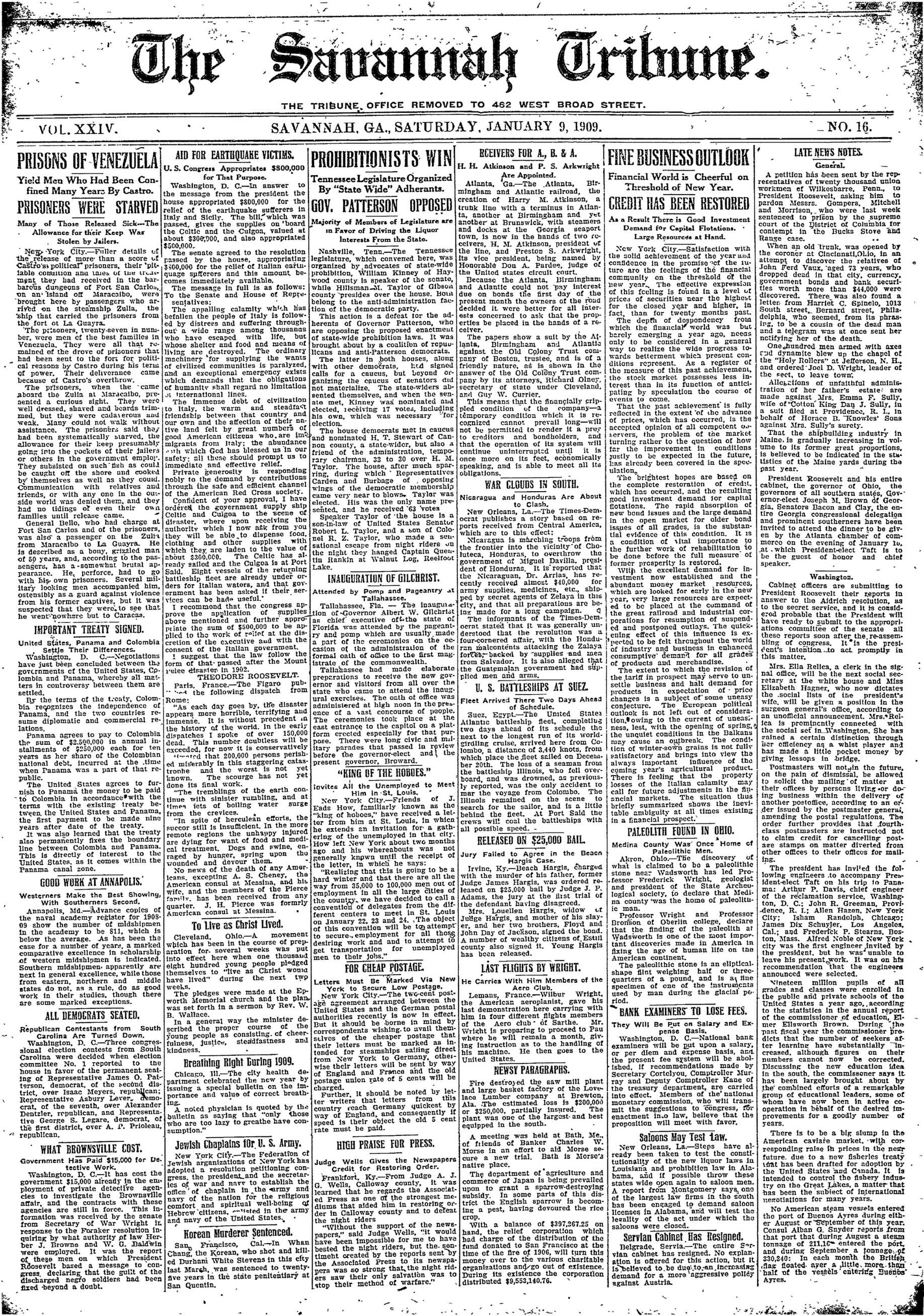
PRISONS OF VENEZUELA
Yield Men Who Had Been Confined Many Years By Castro.
PRISONERS WERE STARVED
Many of Those Released Sick--The Allowance for their Keep War Stolen by Jailers.
New-York City--Fuller details of the release of more than a score of Castro's political prisoners, their pittable common and tales of the treatment they had received in the barbous dungeons of Fort San Carlos, on an island off Maracalabo, were brought here by passengers who arrived on the steamship Zulla, the ship that carried the prisoners from the fort of La Guayra.
The prisoners, twenty-seven in number, were men of the best families in Venezuela. They were all that remained of the drove of prisoners that had been sent to the fort for political reasons by Castro during his term of power. Their deliverance came because of Castro's overthrow.
The prisoners, when the came aboard the Zulia at Maracatibo, presented a curious sight. They were well dressed, shaved and boards trimmed, but they were cadaverous and weak. Many could not walk without assistance. The prisoners said they had been systematically starved, the allowance for their keep presumably going into the pockets of their jailers or others in the government employ. They subsisted on such fish as could be caught off the shore and cooked by themselves as well as they could. Communication with relatives and friends, or with any one in the outside world was denied them, and they had no tidings of even their own families until release came.
General Bello, who had charge at Fort San Carlos and of the prisoners, was also a passenger on the Zulu from Maracalbo to La Guayra. He is described as a bony, grizzled man of 50 years, and, according to the passengers, has a somewhat brutal appearance. He, perforce, had to go with his own prisoners. Several military looking men accompanied him, ostensibly as a guard against violence from his former captives, but it was suspected that they were, to see that he went 'nowhere but to Caracas.
IMPORTANT TREATY SIGNED.
United States, Panama and Colombia Settle Their Differences. Washington, D. C.—Negotiations have just been concluded between the governments of the United States, Colombia and Panama, whereby all matters in controversy between them are settled. By the terms of the treaty, Colombia recognizes the independence of Panama, and the two countries resume diplomatic and commercial relations. Panama agrees to pay to Colombia the sum of $2,500,000 in annual installments of $250,000 each for ten years as her share of the Colombian national debt, incurred at the time when Panama was a part of that republic. The United States agrees to furnish to Panama the money to be paid to Colombia in accordance* with the terms with the existing treaty between the United States and Panama, the first payment to be made nine years after date of the treaty.
It was also learned that the treaty also permanently fixes the boundary line between Colombia and Panama. This is directly of interest to the United States, as it comes within the Panama canal zone.
GOOD WORK AT ANNAPOLIS.
Westerners Make the Best Showing,
With Southerners Second.
Annapolis, Md.—Advance copies of
the naval academy register for 1908-
09 show the number of mldshipmen
in the academy to be 811, which is
below the average. As has been the
case for a number of years, a marked
comparative excellence in scholarship
of western mldshipmen is indicated.
Southern mldshipmen apparently are
next in general excellence, while those
from eastern, northern and middle
states do not, as a rule, do as good
work in their studies, though there
are some marked exceptions.
ALL DEMOCRATS SEATED.
Republican Contestants from South Carolina Are Turned Down. Washington, D. C.-Three congressional election contests from South Carolina were decided when election committee No. 1 reported to the house in favor of the permanent seating of Representative James O. Patterson, democrat, of the second district, over Isaac Meyers, republican; Representative Asbury Lever, democrat, of the seventh, over Alexander Dentzler, republican, and Representative George S. Legare, democrat, of the first district, over A. P. Prioleau, republican.
WHAT BROWNSVILLE COST.
Government Has Paid $15,000 for Detective Work.
Washington, D. C. It has cost the government $15,000 already in the employment of private detective agencies to investigate the Brownsville affair, and the contracts with these agencies are still in force. This information was received by the senate from Secretary of War Wright in response to the Foraker resolution inquiring by what authority of law Herber J. Browne and W. G. Baldwin were employed. It was the report of these men on which President Roosevelt based a message to congress, declaring that the guilt of the discharged negro soldiers had been fixed beyond a doubt.
THE TRIBUNE, OFFICE REMOVED TO 462 WEST BROAD STREET. SAVANNAH, GA., SATURDAY, JANUARY 9, 1909.
AID FOR EARTHQUAKE VICTIMS.
U. S. Congress Appropriates $800,000 for That Purpose.
Washington, D. C.—In answer to the message from the president the house appropriated $800,000 for the relief of the earthquake sufferers in Italy and Sicily. The bill, which was passed, gives the supplies on board the Celtic and the Culgoon, valued at about $300,000, and also appropriated $600,000.
The senate agreed to the resolution passed by the house, appropriating $600,000 for the relief of Italian cartouche sufferers and this amount becomes immediately available.
The message in full is as follows: To the Senate and House of Representatives:
The appalling calamity which has befallen the people of Italy is followed by distresses and suffering throughout a wide range among thousands who have escaped with life, but whose shelter and food and means of living are destroyed. The ordinary machinery for supplying the wants of civilized communities is paralyzed, and an exceptional emergency exists which demands that the obligations of humanity shall regard no limitation on international lines.
The immense debt of civilization to Italy, the warm and steadfast friendship between that country and our own and the affection of their native land felt by great numbers of good American citizens who are immigrants from Italy; the abundance with which God has blessed us in our safety; all these should prompt us to immediate and effective relief.
Private generosity is responding nobly to the demand by contributions through the safe and efficient channel of the American Red Cross society.
Confident of your approval, I have ordered the government supply ship Celtic and Cuigoa to the scene of disaster, where upon receiving the authority which I now ask from you they will be able to dispense food, clothing and other supplies with which they are laden to the value of about $300,000. The Celtic has already sailed and the Cuigoa is at Port Sald. Eight vessels of the returning battleship fleet are already under orders for Italian waters, and that government has been asked if their services can be hade useful.
I recommend that the congress approve the application of supplies above mentioned and further appropriate the sum of $500,000 to be applied to the work of relief at the discretion of the executive and with the consent of the Italian government.
I suggest that the law follow the form of that passed after the Mount relee disaster in 1902.
THEODORE BOOSEVELT.
Paris, France.-The Figaro pub- lished the following dispatch from Rome:
"As each day goes by, the disaster appears more horrible, terrifying and immense. It is without precedent in the history of the world. In the early dispatches I spoke of over 150,000 dead. This number doubtless will be exceeded, for now it is conservatively trusted that 200,000 persons perished miserably in this staggering catatronhe and the worst is not yet known. The scourge has not yet done its final work.
"The tremblings of the earth continue with slister rumbling, and at times jets of boiling water surge from the crevices.
"In spite of herculean efforts, the succor still is insufficient. In the more remote regions the unhappy injured are dying for want of food and medical treatment, Dogs and swine, enraged by hunger, spring upon the wounded and devour them.
No news of the death of any Americans, excepting A. S. Cheney, the American consul at Messina, and his wife, and the members of the Plerce family, has been received from any quarter. J. H. Pierce was formerly American consul at Messina.
To Live as Christ Lived.
Cleveland, Ohio.—A movement which has been in the course of preparation for several weeks was put into effect here when one thousand eight hundred young people pledged themselves to "live as Christ wound have lived" during the next two weeks. The pledges were made at the Epworth Memorial church and the plan was set forth in a sermon by Rev. W. B. Wallace. In a general way the minister described the proper course of the young people as consisting of cheerfulness, justice, steadfastness and kindness.
Breatheln Right Curlln 1909.
Chicago, Ill.—The city health department celebrated the new year by issuing a special bulletin on the importance and value of correct breathing.
A noted physician is quoted by the bulletin as saying that "only those who are too lazy to greathe have consumption."
Jewish Chaplains fOr U. S. Army.
New York City.—The Federation of Jewish organizations of New York has adopted a resolution petitioning congress, the president and the secretaries of war and navy to establish the office of chaplain in the army and navy of the nation for the religious comfort and spiritual well-being of Hebrew citizens, assisted in the army and navy of the United States.
Korean Murderer Sentenced.
San Francisco, Cal.-In Whan Chang, the Korean, who shot and killed Durhami White Stevens in this city last March, was sentenced to twenty-five years in the state penitentiary at San Quentin.
PROHIBITIONISTS WIN
Tennessee Legislature Organized By "State Wide" Adherents. GOV. PATTERSON OPPOSED
Majority of Members of Legislature are in Favor of Driving the Liquor Interests From the State.
Nashville, Tenn.—The Tennessee legislature, which convened here, was organized by advocates of state-wide prohibition, William Kinney of Haywood county is speaker of the senate, while Hillsman-M. Taylor of Gibbon county presides over the house. Houn belong to the anti-administration faction of the democratic party.
This action is a defeat for the adherents of Governor Patterson, who are opposing the proposed enactment of state-wide prohibition laws. It was brought about by a coalition of republicans and anti-Patterson democrats.
The latter in both houses, along with other democrats, had signed calls for a caucus, but beyond organizing the caucus of senators did not materialize. The state-wilders absorbed themselves, and when the senate met, Kinney was nominated and elected, receiving 17 votes, including his own, which was necessary for election.
The house democrats met in caucus and nominated H. T. Stewart of Cannon county, a state-wider, but also a friend of the administration, temporary chairman, 32 to 30 over H. M. Taylor. The house, after much sparing, during which Representatives Carden and Burbage of, opposing wings of the democratic membership came very near to blows. Taylor was elected. His was the only name presented, and he received '63 votes
Speaker Taylor of the house is a son-in-law of United States Senator Robert L. Taylor, and a son of Colonel R. Z. Taylor, who made a sensational escape from night riders on the night they hanged Captain Quentin Rankin at Walnut Log, Reelfoot Lake
INAUGURATION OF GILCHRIST.
Attended by Pomp and Pageantry at Tallahassee.
Tallahassee, Fla. — The inauguration of-Governor Albert W. Gilchrist as chief executive of the state of Florida was attended by the pageantry and pomp which are usually made a part of the ceremonies on the occasion of the administration of the formal oath of office to the first magistrate of the commonwealth.
Tallahassee had made elaborate preparations to receive the new governor and visitors from all over the state who came to attend the inaugural exercises. The oath of office was administered at high noon in the presence of a vast concourse of people. The ceremonies took place at the east entrance to the capitol on a platform erected especially for that purpose. There were long civil and military parades that passed in review before the governor-elect and the present governor, Broward.
"KING OF THE HOBOES."
Iovites All the Unemployed to Meet Him in St. Louis.
New York City—Friends of J. Eads How, familiarly known as the "king of hoboes," have received a letter from him at St. Louis, in which he extends an invitation for a gathering of the unemployed in that city. How left New York about two months ago and his whereabouts was not generally known until the receipt of the letter, in which he says:
"Realizing that this is going to be a hard winter and that there are all the way from 35,000 to 100,000 men out of employment in all the large cities of the country, we have decided to call a convention of delegates from the different centers to meet in St. Louis on January 22, 23 and 24. The object of this convention will be to attempt to secure, employment for all those desiring work and to attempt to get transportation for unemployed men to their jobs."
FOR CHEAP POSTAGE
Letters Must Be Marked Via New York to Secure Low Postage. New York City—The two-cent postage agreement arranged between the United States and the German postal authorities recently is now in effect. But it should be borne in mind by correspondents wishing to avail themselves of the cheaper postage that their letters must be marked as intended for steamships sailing direct from New York to Germany, otherwise their letters will be sent by way of England and France and the old postage union rate of 5 cents will be charged
court. Further, it should be noted by letter writers that letters from this country reach Germany quickest by way of England, and consequently if speed is their object the old 5 cent rate must be paid.
HIGH PRAISE FOR PRESS.
Judge Wells Gives the Newspapers Credit for Restoring Order. Frankfort, Ky.—From Judge A. J. G. Wells, Calloway county, it was learned that he regards the Associated Press as one of the strongest mediums that aided him in restoring order in Calloway county and to defeat the night riders
"Without the support of the newspapers," said Judge Wells, "it would have been impossible for me to have bested the night riders, but the sentiment created by the reports sent by the Associated Press to its newspapers was so strong that the night riders saw their only salvation was to stop their method of warfare."
RCEIVERS FOR A., B. & A.
Atlanta, Ga.—The Atlanta, Birmingham and Atlantic railroad, the creation of Harry M. Atkinson, a trunk line with a terminus in Atlanta, another at Birmingham and yet another at Brunswick, with steamers and docks at the Georgia seaport town, is now in the hands of two receivers, H. M. Atkinson, president of the line, and Preston S. Arkwright, its vice president, being named by Honorable Don A. Pardee, judge of the United states circuit court. Because the Atlanta, Birmingham and Atlantic could not pay interest due on bonds the first day of the present month the owners of the road decided it were better for all interests concerned to ask that the properties be placed in the hands of a receiver.
The papers show a suit by the Atlanta, Birmingham and Atlanta against the Old Colony Trust company of Boston, trustee, and is of a friendly nature, as is shown in the answer of the Old Colony Trust company by its attorneys, Richard Olney, secretary of state under Cleveland, and Guy W. Currier. This means that the financially crippled condition of the company—a temporary condition which it is recognized cannot prevail long—will not be permitted to render it a prey to creditors and bondholders, and that the operation of its system will continue uninterrupted until it is once more on its feet, economically speaking, and is able to meet all its obligations.
WAR CLOUDS IN SOUTH.
Nicaragua and Honduras Are About to Clash.
New Orleans, La.-The Times-Democrat publishes a story based on reports received from Central America, which are to this effect:
Nicaragua is marching troops from the frontier into the vicinity of Choluteca, Honduras, to overthrow the government of Miguel Davilla, president of Honduras. It is reported that the Nicaraguan, Dr. Arrias, has recently received almost $40,000 for army supplies, medicines, etc., shipped by secret agents of Zelaya in this city, and that all preparations are being made for a long campaign.
The informants of the Times-Democrat stated that it was generally understood that the revolution was a four-cornered affair, with the Honduran malcontents attacking the Zalaya forceth-backed by supplies and men from Salvador. It is also alleged that the Guatemalan government had supplied men and arms.
U. S. BATTLESHIPS AT SUEZ
Fleet Arrived There Two Days Ahead of Schedule
Suez, Egypt.—The United States Atlantic battleship fleet, completing two days ahead of its schedule the next to the longest run of its world-girdling cruise, arrived here from Colombo, a distance of 3,440 knots, from which place the fleet sailed on December 20th. The loss of a seaman from the battleship Illinois, who fell overboard, and was drowned, as previously reported, was the only accident to mar the voyage from Colombo. The Illinois remained on the scene to search for the sailor, and is a little behind the fleet. At Port Sald the crews will coal the battleships with all possible speed.
RELEASED ON $25,000 BAIL
Jury Failed to Agree in the Beacon Hargis Case.
Irvine, Ky.—Beach Hargis, charged with the murder of his father, former Judge James Hargis, was ordered released on $25,000 bail by Judge J. P. Adams, the jury at the first trial of the defendant having disagreed.
Mrs. Louellen Hargis, widow of Judge Hargis, and mother of his slayer, and her two brothers, Floyd and John Day of Jackson, signed the bond. A number of wealthy citizens of Estill county also signed it. Young Hargis has been released.
LAST FLIGHTS BY WRIGHT.
He Carries With Him Members of the Aero Club.
Lemans, France—Wilbur Wright,
the American aeroplaniist, gave his last demonstration here carrying with him in four different flights members of the Aero club of Sarthe. Mr. Wright is preparing to proceed to Pau where he will remain a month, giving instruction as to the handling of his machine. He then goes to the United States.
NEWSY PARAGRAPHS.
Fire destroyed the saw mill plant and large basket factory of the Lovelace Lumber company at Brewton, Ala. The estimated loss is $200,000 or $250,000, partially insured. The plant was one of the largest and best equipped in the south.
A meeting was held at Bath, Me., of friends of Banker Charles W. Morse in an effort to alld Morse secure a new trial. Bath is Morse's native place.
The department of agriculture and commerce of Japan is being prevailed upon to grant a sparrow-destroying subsidy. In some parts of this district the English sparrow is becoming a pest, having devoured the rice crop.
With a balance of $397,267.25 on hand, the relief corporation which had charge of the distribution of the fund donated to San Francisco at the time of the fire of 1906, will turn this money over to the various charitable organizations and go out of existence. During its existence the corporation distributed $9,553,140.76.
FINE BUSINESS OUTLOOK
As a Result There is Good Investment Demand for Capital Flotations. Large Resources at Hand.
New York City—Satisfaction with the solid achievement of the year and confidence in the promise of the future are the feelings of the financial community on the threshold of the new year. The effective expression of this feeling is found in a level of prices of securities near the highest for the closed year and higher, in fact, than for twenty months past. The depth of dependency from which the financial world was but barely emerging a year ago, needs only to be considered in a general way to realize the wide progress towards betterment which present conditions represent. As a register of the measure of this past achievement, the stock market possesses less interest than in its function of anticipating by speculation the course of events to come.
That the past achievement is fully reflected in the extent of the advance of prices, which has occurred, is the accepted opinion of all competent observers, the problem of the market turning rather to the question of how far the improvement in conditions justly to be expected in the future, has already been covered in the speculation.
The brightest hopes are based on the complete restoration of credit, which has occurred, and the resulting good investment demand for capital flotations. The rapid absorption of new bond issues and the large demand in the open market for older bond issues of all grades, is the substantial evidence of this condition. It is a condition of vital importance to the further work of rehabilitation to be done before the full measure of former prosperity is restored.
With the excellent demand for investment now established and the abundant money market resources, which are looked for early in the new year, very large resources are expected to be placed at the command of the great railroad and industrial corporations for resumption of suspended and postponed outlays. The quickening effect of this influence is expected to be felt throughout the world of industry and business in enhanced consumptive demand for all grades of products and merchandise.
The extent to which the revision of the tariff in prospect may serve to unsettle business and halt demand for products in expectation of price changes is a subject of some uneasy conjecture. The European political outlook is not left out of consideration owing to the current of uneasiness, lest, with the opening of spring, the unquiet conditions in the Balkans may cause an outbreak. The condition of winter-sown grains is not fully satisfactory and brings into view the always important influence of the coming year's agricultural product. There is feeling that the property losses of the Italian calamity may call for future adjustments in the financial markets. The situation thus briefly summarized shows the inevitable ambiguity at all times existing in a financial prospect.
PALEOLITH EOUND IN OHIO.
Medina County Was 'Once Home of Paleolithic Men.
Akron, Ohio.-The discovery of what is claimed to be a paleolithic stone near Wadsworth has led Professor Frederick Wright, geologist and president of the State Archeological society, to declare that Medina county was the home of paleolithic man.
Professor Wright and Professor Bromson of Oberlin college, declare that the finding of the paleolith at Wadsworth is one of the most important discoveries made in America in fixing the age of human life on the American continent.
The paleolithic stone is an elliptical shape flint weighing half or three-quarters of a pound, and is a fine specimen of one of the instruments used by man during the glacial period.
BANK EXAMINERS TO LOSE FEES.
They Will Be Put on Salary and Expense Basis. Washington, D. C.-National bank examiners will be put upon a salary, or per derm and expense basis, and the present fee system will be abolished, if recommendations made by Secretary Cortelyou, Comptrroller Murray and Deputy Comptroller Kane of the treasury department, are carried into effect. Members of the national monetary commission, who will transmit the suggestions to congress, for enactment in.o law, believe that the proposition will meet with favor.
Satoons May Test Law.
New Orleans, La.-Steps have already been taken to test the constitutionality of the new liquor laws in Louisiana and prohibition law in Alabama, and if possible throw these states wide open again to saloon men. A report from Montgomery says, one of the largest law firms in the south has been engaged to demand saloon licenses in Alabama, and will test the legality of the act under which the saloons were closed.
Servian Cabinet Has Resigned.
Belgrade, Servia. The entire S-viian cabinet has resigned. No explanation is offered for this action, but it is believed to be due to an, increasing demand for a more aggressive polley against Austria.
LATE NEWS NOTES.
A petition has been sent by the representatives of twenty thousand union workmen of Wilkesbarre, Penn., to President Roosevelt, asking him to pardon Messrs. Gompers, Mitchell and Morrison, who were last week sentenced to prison by the supreme court of the District of Columbia for contempt in the Bucks Stove and Range case.
When an old trunk, was opened by the coroner at Cincinnati, Ohio, in an attempt to discover the relatives of John Ferd Yaux, aged 73 years, who dropped dead in that city, currency, government bonds and bank securities worth more than $44,000 were discovered. There was also found a letter from Harriet C. Spinelo, 1013 South street, Bernard Street, Philadelphia, who seemed, from its phrasing, to be a cousin of the dead man and a telegram was at once sent her notifying her of the death.
One hundred men armed with axes and dynamite blew up the chapel of the "Holy Rollers" at Jefferson, N. H., and ordered Joel D. Wright, leader of the sect, to leave town.
Allocations of unfaithful administration of her father's estate are made against Mrs. Emma F. Sully, wife of Cotton King Dan J. Sully, in a suit filed at Providence, R. I., in behalf of Horace B. Knowles' Sons against Mrs. Sully's surety.
That the shipbuilding industry in Maine, is gradually increasing in volume to its former great proportions, is believed to be indicated in the statistics of the Maine yards during the past year.
President Roosevelt and his entire cabinet, the governor of Ohio, the governors of all southern states, Governor-elect Joseph M. Brown of Georgia, Senators Bacon and Clay, the entire Georgia congressional delegation and prominent southerners have been invited to attend the dinner to be given by the Atlanta chamber of commerce on the evening of January 10, at which President-elect Taft is to be the guest of honor and chief speaker.
Washington.
Cabinet officers are submitting to President Roosevelt their reports in answer to the Aldrich resolution, as to the secret service, and it is considered probable that the President will have ready to submit to the appropriations committee of the senate all these reports soon after the re-assembling of congress. It is the president's intention to act promptly in this matter.
Mrs. Ella Rellea, a clerk in the signal office, will be the next social secretary at the white house and Miss Elizabeth Hagner, who now dictates the social lists of the president's wife, will be given a position in the surgeon general's office, according to an unofficial announcement. Mrs. Rellea is prominently connected with the social set in Washington. She has gained a certain distinction through her efficiency as a whistler player and has made a little pocket money by giving lessons in bridge.
Postmasters will not in the future, on the pain of dismissal, be allowed to solicit the mailing of matter at their offices by persons living or doing business within the delivery of another postoffice, according to an order issued by the postmaster general, amending the postal regulations. The order further provides that fourth-class postmasters are instructed not to claim credit for cancelling postage stamps on matter diverted from other offices to their offices for mailing.
The president has invited the following engineers to accompany President-elect Taft on his trip to Panama; Arthur P. Davis, chief engineer of the reclamation service, Washington, D. C.; John R. Greeman, Providence, R. I.; Allen Hazen, New York City; Isham Randolph, Chicago; James Dix Schuyler, Los Angeles, Cal.; and Frederick P. Stearns, Boston, Mass. Alfred Noble of New York city was the first engineer invited by the president, but he was unable to leave his present work. It was on his recommendation that the engineers announced were selected.
Nineteen million pupils of all grades and classes were enrolled in the public and private schools of the United States a year ago, according to the statistics in the annual report of the commissioner of education, Elmer Ellsworth Brown. During the past fiscal year the commissioner predicts that the number of seekers after learning have substantially increased, although figures on their numbers cannot now be corrected. Discussing the new education idea in the south, the commissioner says it has been largely brought about by the combined efforts of a remarkable group of educational leaders, some of whom have now been in active cooperation in behalf of the desired improvements for a goodly number of years.
There is to be a big slump in the American caviar market, with corresponding raise in prices in the near future, due to a new fisheries treaty that has been drafted for adoption by the United States and Canada. It is intended to control the fishery industry on the Great Lakes, a matter that has been the subject of international negotiations for many years.
No American steam vessels entered the port of Buenos Ayres during either August or September of this year. Consul Alban G. Snyder reports from that port that during August a steam tonnage of 211.16 entered the port, and during September a tonnage of 330,340. In each month the British flag floated over a little more than half of the vessels entering Buenos Ayres.
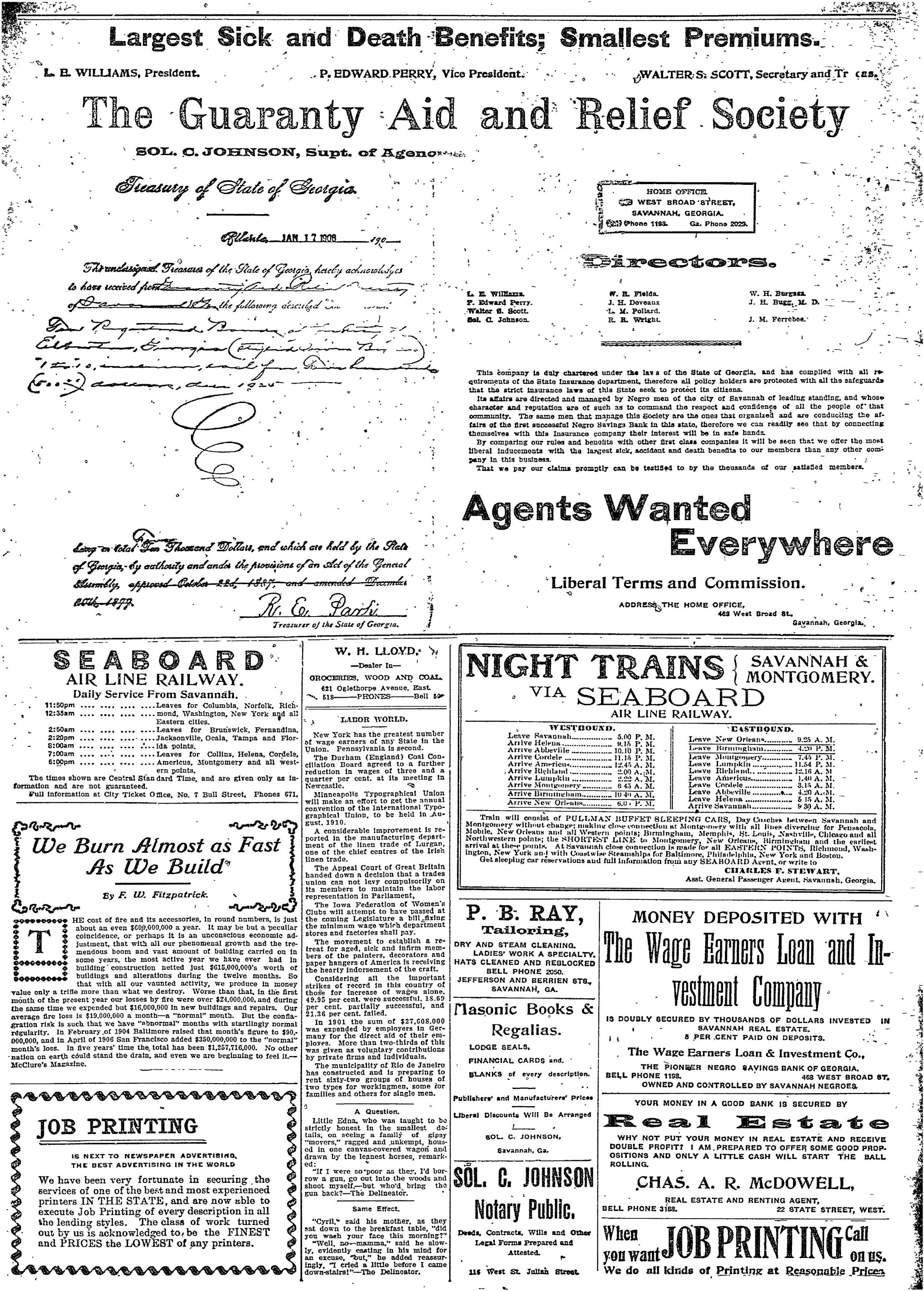
The Guaranty Aid and Relief Society
Treasury of State of Georgia
The undesignated Treasures of the State of Georgia hereby accede to have received from the following described:
Dear Peggy,
Ellen,
I am pleased to announce the following description of the treasures received from the State of Georgia by authority and under the provisions of an Act of the Assembly, approved October 22d, 1887, and amended by the Assembly, approved October 22d, 1887.
R. E. Pam
Treasurer of the State of Georgia
SEABOARD
AIR LINE RAILWAY.
Daily Service From Savannah.
11:50pm ... Leaves for Columbia, Norfolk, Richmond, Washington, New York and all Eastern cities.
12:35am ... Leaves for Brunswick, Fernandina,
2:20pm ... Jacksonville, Ocala, Tampa and Florida.
8:00am ... Idaho points.
7:00am ... Leaves for Collins, Helena, Cordele,
6:00pm ... Americus, Montgomery and all western points.
The times shown are Central Standard Time, and are given only as information and are not guaranteed.
Full information at City Ticket Office, No. 7 Bull Street, Phones 671.
We Burn Almost as Fast As We Build
By F. W. Fitzpatrick.
Georgia hereby acknowledges
that the following are described in
and which are held by the State
visions of an Act of the General
and amended December
R. E. Parsi.
long on total Ten Thousand Dollars, and which are held by the State of Georgia, by authority and under the provisions of an Act of the General Assembly, approved October 22d, 1887, and amended December 20th, 1897.
R. E. Parsi
Treasurer of the State of Georgia.
EABOARD
W. H. LLOYD;
—Dealer In—
only a trifle more than what we destroy. Worse than that, in the first of the present year our losses by fire were over $24,000,000, and during some time we expended but $16,000,000 in new buildings and repairs. Our fire loss is $19,000,000 a month—a "normal" month. But the conflation risk is such that we have "abnormal" months with startlingly normal severity. In February of 1904 Baltimore raised that month's figure to $90,000, and in April of 1906 San Francisco added $350,000,000 to the "normal" loss. In five years' time the total has been $1,257,716,000. No other on earth could stand the drain, and even we are beginning to feel it—here's Magazine.
JOB PRINTING
ly, evidently c an excuse, "bu ingly, "I cried down-stairs!"—
The times shown are Central Standard Time, and are given only as information and are not guaranteed.
Full information at City Ticket Office, No. 7 Bull Street, Phones 671.
HE cost of fire and its accessories, in round numbers, is just about an even $600,000,000 a year. It may be but a peculiar coincidence, or perhaps it is an unconscious economic adjustment, that with all our phenomenal growth and the tremendous boom and vast amount of building carried on in some years, the most active year we have ever had in building construction netted just $615,000,000's worth of buildings and alterations during the twelve months. So that with all our vaunted activity, we produce in money
value only a trifle more than what we destroy. Worse than that, in the first month of the present year our losses by fire were over $24,000,000, and during the same time we expended but $16,000,000 in new buildings and repairs. Our average fire loss is $19,000,000 a month—a "normal" month. But the conflagration risk is such that we have "abnormal" months with startlingly normal regularity. In February of 1904 Baltimore raised that month's figure to $90,000,000, and in April of 1906 San Francisco added $350,000,000 to the "normal" month's loss. In five years' time the total has been $1,257,716,000. No other nation on earth could stand the drain, and even we are beginning to feel it.—McClure's Magazine.
---
We have been very fortunate in securing the services of one of the best and most experienced printers IN THE STATE, and are now able to execute Job Printing of every description in all the leading styles. The class of work turned out by us is acknowledged to be the FINEST and PRICES the LOWEST of any printers.
GROCERIES, WOOD AND COAL
621 Oglethorpe Avenue, East
518----PHONES----Bell 50
LABOR WORLD.
New York has the greatest number of wage earners of any State in the Union. Pennsylvania is second. The Durham (England) Coal Conciliation Board agreed to a further reduction in wages of three and a quarter per cent. at its meeting in Newcastle. Minneapolis Typographical Union will make an effort to get the annual convention of the International Typographical Union, to be held in August, 1910. A considerable improvement is reported in the manufacturing department of the linen trade of Lurgan, one of the chief centres of the Irish linen trade.
The Appeal Court of Great Britain handed down a decision that a trades union can not levy compulsorily on its members to maintain the labor representation in Parliament,
The Iowa Federation of Women's Clubs will attempt to have passed at the coming Legislature a bill fixing the minimum wage which department stores and factories shall pay.
The movement to establish a retreat for aged, sick and infirm members of the painters, decorators and paper hangers of America is receiving the hearty indorsement of the craft.
Considering all the important strikes of record in this country of those for increase of wages alone. 49.95 per cent. were successful. 18.69 per cent. partially successful, and 21.36 per cent. failed.
In 1901 the sum of $27,608,000 was expended by employers in Germany for the direct aid of their employees. More than two-thirds of this was given as voluntary contributions by private firms and individuals.
The municipality of Rio de Janelro has constructed and is preparing to rent sixty-two groups of houses of two types for workingmen, some for families and others for single men.
A Question.
Little Edna, who was taught to be strictly honest in the smallest details, on seeing a family of gipsy "movers," ragged and unkempt, housed in one canvas-covered wagon and drawn by the leanest horses, remarked:
"If I were so poor as they, I'd borrow a gun, go out into the woods and shoot myself—but who'd bring the gun back?"—The Delineator.
Same Effect.
"Cyril," said his mother, as they sat down to the breakfast table, "did you wash your face this morning?" "Well, no—mamma," said he slowly, evidently casting in his mind for an excuse, "but," he added reassuringly, "I cried a little before I came down-stairs!"—The Delineator.
HOME OFFICE
WEST BROAD STREET,
SAVANNAH, GEORGIA.
Phone 1193. Ga. Phone 2029.
Directors.
L. E. Williams.
P. Edward Perry.
Walter S. Scott.
Sel. C. Johnson.
W. R. Fielda.
J. H. Doveaux
L. M. Pollard.
R. R. Wright.
W. H. Burgess
J. H. Bugg, M. D.
J. M. Ferrebee.
This company is duly chartered under the laws of the State of Georgia, and has complied with all requirements of the State Insurance department, therefore all policy holders are protected with all the safeguards that the strict insurance laws of this State seek to protect its citizens.
Its affairs are directed and managed by Negro men of the city of Savannah of leading standing, and whose character and reputation are of such as to command the respect and confidence of all the people of that community. The same men that manage this Society are the ones that organized and are conducting the affairs of the first successful Negro Savings Bank in this state, therefore we can readily see that by connecting themselves with this Insurance company their interest will be in safe hands.
By comparing our rules and benefits with other first class companies it will be seen that we offer the most liberal inducements with the largest sick, accident and death benefits to our members than any other company in this business.
That we pay our claims promptly can be testified to by the thousands of our satisfied members.
WESTBOUND.
Leave Savannah 5.00 P. M.
Arrive Helena 9.15 P. M.
Arrive Abbeville 10.10 P. M.
Arrive Cordele 11.15 P. M.
Arrive Americus 12.45 A. M.
Arrive Richland 2.00 A. M.
Arrive Lumpkin 2.22 A. M.
Arrive Montgomery 6.45 A. M.
Arrive Birmingham 10.40 A. M.
Arrive New Orleans 6.00 P. M.
EASTBOUND.
Leave New Orleans 9.25 A. M.
Leave Birmingham 4.20 P. M.
Leave Montgomery 7.45 P. M.
Leave Lumpkin 11.54 P. M.
Leave Richland 12.16 A. M.
Leave Americus 1.40 A. M.
Leave Cordele 3.15 A. M.
Leave Abbeville 4.20 A. M.
Leave Helena 5.15 A. M.
Arrive Savannah 9.30 A. M.
Train will consist of PULLMAN BUFFET SLEEPING CARS, Day Couches between Savannah and Montgomery without change; making close connection at Montgomery with all lines diverging for Pensacola, Mobile, New Orleans and all Western points; Birmingham, Memphis, St. Louis, Nashville, Chicago and all Northwestern points; the SHORTEST LINE to Montgomery, New Orleans, Birmingham and the earliest arrival at these points. At Savannah close connection is made for all EASTERN POINTS, Richmond, Washington, New York and with Coastwise Steamships for Baltimore, Philadelphia, New York and Boston.
Get sleeping car reservations and full information from any SEABOARD Agent or write to
DRY AND STEAM CLEANING.
LADIES' WORK A SPECIALTY.
HATS CLEANED AND REBLOCKED
BELL PHONE 2050.
JEFFERSON AND BERRIEN 878.
SAVANNAH, GA.
Masonic Books & Regalias.
LODGE SEALS,
FINANCIAL CARDS and.
BLANKS of every description.
Publishers' and Manufacturers' Prices
Liberal Discounts Will Be Arranged
SOL. C. JOHNSON,
Savannah, Ga.
SOL. C. JOHNSON
Notary Public.
Doeds, Contracts, Wills and Other Legal Forms Prepared and Attested.
116 West St. Julian Street
ADDRESS THE HOME OFFICE,
469 West Broad 8t.
RAINS { SAVANNAH MONTGOMERY SEABOARD AIR LINE RAILWAY.
CASTBOUND.
Leave New Orleans... 9.25 A.M.
Leave Birmingham... 4.20 P.M.
Leave Montgomery... 7.45 P.M.
Leave Lumpkin... 11.54 P.M.
Leave Richland... 12.16 A.M.
Leave Americans... 1.40 A.M.
Leave Cordale... 3.15 A.M.
Leave Abbeville... 4.20 A.M.
Leave Helena... 5.15 A.M.
Arrive Savannah... 9.30 A.M.
BUFFET SLEEPING CARS, Day Couches between Savannah, close connection at Montgomery with all lines diverging for Pensacola; Birmingham, Memphis, St. Louis, Nashville, Chicago and LINE to Montgomery, New Orleans, Birmingham and the east connection is made for all EASTERN POINTS, Richmond, Wheelships for Baltimore, Philadelphia, New York and Boston.
Information from any SEABOARD Agent, or write to
CHARLES F. STEWART.
Asst. General Passenger Agent, Savannah, Ge
MONEY DEPOSITED WITH
the Wage Earners Loan and Investment Company
DOUBLY SECURED BY THOUSANDS OF DOLLARS INVESTED SAVANNAH REAL ESTATE.
8 PER CENT PAID ON DEPOSITS.
The Wage Earners Loan & Investment Company
THE PIONEER NEGRO SAVINGS BANK OF GEORGIA
CELL PHONE 1198.
468 WEST BRIDGE
OWNED AND CONTROLLED BY SAVANNAH NEGROES
MONEY DEPOSITED WITH The Wage Earners Loan and Investment Company
13 DOUBLY SECURED BY THOUSANDS OF DOLLARS INVESTED IN SAVANNAH REAL ESTATE. 8 PER CENT PAID ON DEPOSITS.
THE PIONEER NEGRO SAVINGS BANK OF GEORGIA. BELL PHONE 1198. 468 WEST BROAD ST. OWNED AND CONTROLLED BY SAVANNAH NEGROES.
YOUR MONEY IN A GOOD BANK IS SECURED BY
Real Estate
WHY NOT PUT YOUR MONEY IN REAL ESTATE AND RECEIVE DOUBLE PROFIT? I AM, PREPARED TO OFFER SOME GOOD PROPOSITIONS AND ONLY A LITTLE CASH WILL START THE BALL ROLLING.
Real Estate
WHY NOT PUT YOUR MONEY IN REAL ESTATE AND RECEIVE DOUBLE PROFIT? I AM, PREPARED TO OFFER SOME GOOD PROPOSITIONS AND ONLY A LITTLE CASH WILL START THE BALL ROLLING.
CHAS. A. R. McDOWELL,
REAL ESTATE AND RENTING AGENT,
BELL PHONE 3188. 22 STATE STREET, WEST.
When you want JOB PRINTING Call on us.
We do all kinds of Printing at Reasonable Prices
REAL ESTATE AND RENTING AGENT,
BELL PHONE 3188. 22 STATE STREET, WEST.
When you want JOB PRINTING Call on us.
We do all kinds of Printing at Reasonable Prices
The Chinese say of their Emperor: "He is as solitary as a god." Kwang-Su has been particularly so. He was put on the throne by two women, and was ruled most of his life by them. Up to 1901 he wielded the formidable vermilion pencil; but always the blue pencil of the Dowager Empress was the more formidable weapon. Had the young Emperor possessed the requisite will power, he might have exercised an arbitrary power to a remarkable degree. As it was, he meant little to the world at large; and the obscurity in which his character has always been clothed was intensified by the mass of ceremonious traditions and rules of court etiquette which make the Chinese Emperor little more than a caged automaton.
In Hans Andersen's story of "The Nightingale," Death captures the crown and septre of the Emperor and sits on his chest, in the solitary sick room, while the deserting courtiers and attendants, in another part of the palace, are already discussing the succession. There will be no considerable emotion over Kwang-Su's death. However, it will not be allowed to appear so. When Ll Hung Chang, China's greatest man of modern days, died a few years ago, the funeral ceremonies were of an elaborateness which tazed belief. Kwang-Su's will be more so. His wedding in 1839 cost $5,000,000. Now that he is dead, the Pekin Gazette will be full of eulogies; the governors and generals and lesser officers will flock in from the provinces by thousands to do homage, and there will be ceremonies and processes extending over a period of six months, perhaps.
The last Chinese Emperor died on January 12, 1875. He left no direct heir, and the two Empresses quickly held a family council and appointed Tsai-Tien Emperor, with the title of Kwang-Su ("the Illustrious Successor"). "The Illustrious Successor" was just three years old at that time, and greatly resented being brought in and put through the ceremonies necessary to his proclamation. On the following day, however, he issued a long and high sounding decree in the Pekin Gazette, of which one paragraph was as follows:
"For the observance of the rite of mourning, we have reverently received a charge, by the testimony of his Majesty, now departed, that in obedience to previous usage the mourning garb be laid aside at the end of seven and twenty days. To do this, our feelings, in very truth, will not consent. We shall observe, with reverence, in strict adherence to the rule of ancient times three years of mourning."
This was the tone of a great quantity of decrees that were issued at the time. Two physicians, who had been previously honored because they seemed to be benefiting the Emperor, were degraded and stripped of their buttons and peacock feathers when the Emperor died. The body was placed in a hall of the palace especially reserved for the royal dead, the Kwan Teh Tlen, or Behold-Virtue Hall. Some six months later, it was interred in a special mausoleum with elaborate ceremonies.
Kwang-Su was born on August 2, 1872, and was a nephew of Hien Fung, the Emperor, whom he succeeded. He was the ninth ruler of the Manchu dynasty of Tsing, which overthrew the native dynasty of Ming in 1644. His father, Prince Chun, a brother of Hien Fung, had made himself conspicuous, in the Tien-tsun massacre as the leader of the anti-foreign party. But instead of acquiring some high official post, after his son's elevation, Chun was compelled to retire altogether, as it was imminent.
to retire altogether, as it was impossible, under the Chinese ideas regarding parents, for a father to kotow to his son. Chun's announcement, which was probably written by the Dowager Empress, was a gem. After expatiating on the devoted loyalty which inspired him toward his late Majesty, he went on to state that * * * * * On gazing on the Imperial features after decease, his vitals were rent with the agony of grief and his strength fled him utterly. He nevertheless strove to bear up for the more effectual discharge of his duty, when he was suddenly overwhelmed by the news that their Majesties, by their benign mandate, had chosen his son to be successor to the throne. Stupefied by this intelligence he becomes
ned by this intelligence, he became entirely helpless, and when carried to his home he remained trembling and agitated as though bereft of reason or as one in a dream. The complaints under which he has heretofore labored have been revived in consequence, and he is compelled to throw himself on the merciful consideration of their Majesties, the Empresses, whom he entreats to grant him the indulgence which can alone permit him to prolong his days, and allow him, wasted and useless in his rank though he be, to continue in existence on the face of the earth.
At fourteen, Kwang-Su had reached his majority and nominally assumed the government in March, 1887. One of the Empresses had died, but the other kept her hand on the reins. In 1898, when Kwang-Su showed a tendency to encourage the reform movement unduly, the Empress practically deposed him by a coup d'etat. She has been the "man" of China ever since. She was never really Empress, nor even Imperial consort, having merely been the concubine of
Hien Fung. She took the title of Empress because she was the mother of Hien Fung's heir.
An Englishman, who was once present at an Imperial audience, thus described the Emperor.
"His air is one of exceeding intelligence and gentleness, somewhat frightened and melancholy looking.
His face is pale, and, though it is distinguished by refinement and quiet dignity, it has none of the force of his martial ancestors, nothing commanding or Imperial.
He is essentially Manchu in features, his face, oval, shaped, with a very long, narrow chin and a sensitive mouth, with thin, nervous lips; his nose is well shaped and straight, his eyebrows regular and very arched, while the eyes are unusually large and sorrowful in expression. The forehead is well shaped and broad, and the head is large beyond the average."
In no other country than China is there such a host of traditions and customs governing the etiquette of court life. The greatest palms are taken to surround the sovereign with special privileges and honors, in semblance at least, and to emphasize the gulf which exists between him and his people. Some of these customs are very curious. One is the setting part of the color yellow as an Imperial emblem, for bidding its use except by members of the Imperial family. The yellow girdle is worn only by those who are descended from an Emperor. There is one exception, however, to this exclusively Imperial use of the color—that is, the Order of the Yellow Jacket, which may be conferred by the Emperor for distinguished services. This, with the three eyed peacock feathers, is the highest decoration of the empire. Li Hung Chang's deprivation of these insignia as a mark of disfavor brought them into the notice of the world long ago.
The "kotow" is the form of worship which must be rendered to the sovereign, and an Imperial edict is always received with nine prostrations and the burning of Incense. All subjects who approach the presence must do so grovelling and knocking their foreheads against the ground: This humility "before the Son of Heaven," as the Emperor is called, is even carried so far that one official must "kotow" to another who has recently quitted the Imperial presence.
The Emperor is forced to rise far earlier than the most hard worked laborer ever does, for Chinese etiquette requires that most of the state business shall be transacted between the hours of 2 and 6 in the morning. The daily duties of the monarch are complicated and almost overwhelming in amount, as may be realized from the single fact that all sentences, even of the most insignificant criminals, must be submitted to the approval of the Emperor on his dragon throne.
The question of the succession to the throne, a most important matter, as it closely concerns the perpetuation of the present dynasty, has agitated the Imperial family since the autumn of 1907, when it was perceived that the health of the Emperor was seriously undermined. In January of 1900 the Dowager Empress adopted Pu Chun, son of Prince Tuan, the Boxer chieftain, heir apparent, but she disinherited him in November of 1901 at the behest of the allied Powers. Since then the matter of an heir apparent has been in aberance.
Both the Dowager Empress and the Emperor are Manchus and under the ban of Chinese patriots and an increasing anti-Manchu party which has sought the suppression of the dynasty and the restoration of a native Chinese Emperor to tue throne. It has been freely predicted that the death of the Emperor would be followed by an attempted coup d'état to this end, but the Imperial edict mentioned in the dispatch from Peklin appears to have forestalled any immediate action of this kind.—New York Evening Post.
Unique Solar Atlas.
The preparation of a solar atlas by private enterprise is a unique undertaking which is being completed by J. Franklin Adams, an English astronomer. The gentleman expert to complete his task in a few months. Incidentally it will conclude the indexing of 23,000,000 stars. Mr. Adams' method has been to divide the firmament into 212 squares, which have been photographed on specially prepared plates fifteen inches square. The southern constellations he photographed in Southern Africa, the rest have been taken at his observatory near Godalming. The observatory is considered one of the best equipped in private ownership. The total of 23,000,000 stars is explained to be an estimate, although comparative accuracy can be obtained by an ingenious microscopical device which has been invented by Mr. Adams for the purpose.
Big Advertising Receipts.
There are, perhaps, 2500 daily newspapers in the United States, and the average advertising receipts are $60,000 annually. Several metropolitan dailies have advertising receipts in excess of $2,000,000 annually, while their subscription income is, perhaps, less than twenty-five per cent of this sum.
WHAT WOMEN ARE WEARING
10
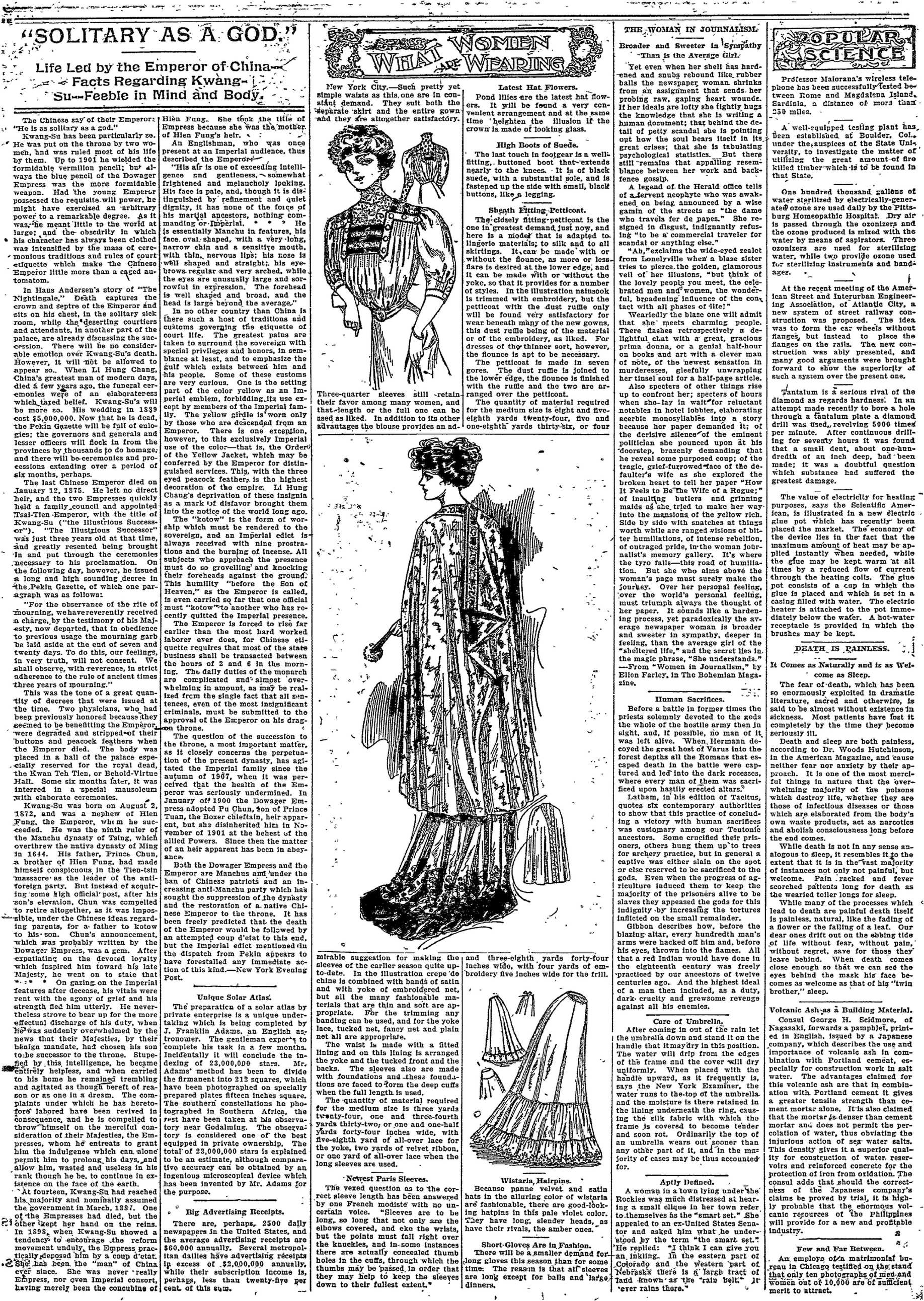
New York City.—Such pretty yet simple waists as this, one are in constant demand. They suit both the separate skirt and the entire gown and they are altogether satisfactory.
1
Three-quarter sleeves still -retain their favor among many women, and that -length or the full one can be used as liked. In addition to its other advantages the blouse provides an ad-
1
mirable suggestion for making the sleeves of the earlier season quite up-to-date. In the illustration crepe de chine is combined with bands of satin and with yoke of embroidered net, but all the many fashionable materials that are thin and soft are appropriate. For the trimming any banding can be used, and for the yoke lace, tucked net, fancy net and plain net all are appropriate.
The waist is made with a fitted lining and on this lining is arranged the yoke and the tucked front and the backs. The sleeves also are made with foundations and these foundations are faced to form the deep cuffs when the full length is used.
The quantity of material required for the medium size is three yards twenty-four, one and three-fourth yards thirty-two, or one and one-half yards forty-four inches wide, with five-eighth yard of all-over lace for the yoke, two yards of velvet ribbon, or one yard of all-over lace when the long sleeves are used.
Netwest Parls Slecres.
The vexed question as to the correct sleeve length has been answered by one French modiste with no uncertain voice. "Sleeves are to be long, so long that not only are the elbows covered, and like the wrists, but the points must fall right over the knuckles, and in some instances there are actually concealed thumb holes in the cuffs, through which the thumbs may be passed in order that they may help to keep the sleeves down to their fullest extent."
Latest Hat Flowers.
Pond illies are the latest hat flowers. It will be found a very convenient arrangement and at the same time 'helgten the illusion if the crown is made of looking glass.
High Boots of Suede.
The last touch in footgear is a well-fitting, buttoned boot that-extends nearly to the knees. It is of black suede, with a substantial sole, and is fastened up the side with small, black buttons, like n legging.
Sheath Fitting-Petticoat.
The closely fitting-petticoat is the one in greatest demand, just now, and here is a model that is adapted to lingerie materials; to silk and to all skirtings. It can be made with or without the flounce, as more or less flare is desired at the lower edge, and it can be made with or without the yoke, so that it provides for a number of styles. In the illustration nainsook is trimmed with embroidery, but the petticoat with the dust ruffle only will be found very satisfactory for wear beneath many of the new gowns, this dust ruffle being of the material or of the embroidery, as liked. For dresses of the thinner sort, however, the flounce is apt to be necessary. The petticoat is made in seven gores. The dust ruffle is joined to the lower edge, the flounce is finished with the ruffle and the two are arranged over the petticoat.
The quantity of material required for the medium size is eight and five-eighth yards twenty-four, five and one-eighth yards thirty-six, or four
```markdown
```
and three-eighth yards forty-four inches wide, with four yards of embroidery five inches wide for the drill.
.
Because panne velvet and satin hats in the alluring color of wistaria are fashionable, there are good-looking hatpins in this pale violet color. They have long, slender heads, as have their rivals, the amber ones.
Short-Gloves Are in Fashion.
There will be a smaller demand for long gloves this season than for some time. The reason is that all sleeves are long except for balls and large dinners.
THE WOMAN IN JOURNALISM.
Broader and Sweeter in Sympathy
Than is the Average Girl.
Yet even when her shell has hardened and snubs rebound like rubber balls the newspaper woman shrinks from an assignment that sends her probing raw, gaping heart wounds. If her ideals are lotty she tightly hugs the knowledge that she is writing a human document; that behind the detail of petty scandal she is pointing out how the soul bears itself in its great crises; that she is tabulating psychological statistics. But there still remains that appalling resemblance between her work and backfence gossip.
A legend of the Herald office tells of a servant neophyte who was awakened on being announced by a wise gamin of the streets as "the dame who travels for de papers." She resigned in disgust, indignantly refusing "to be a commercial traveler for scandal or anything else."
"Ah," exclaims the wide-eyed zealot from Lonelyville when a blase sister tries to pierce the golden, glamorous veil of her illusions, "but think of the lovely people you meet, the celebrated men and women, the wonderful, broadening influence of the contact with all phases of life!"
Weariedly the blase one will admit that she meets charming people. There flashes retrospectively a delightful chat with a great, gracious prima donna, or a genial half-hour on books and art with a clever man of note, of the newest sensation in murderesses, gleefully unwrapping her tinsel soul for a half-particle article.
Also specters of other things rise up to confront her; specters of hours when she-lay in wait for reluctant notables in hotel lobbles, elaborating acerbic monosyllables into a story because her paper demanded it; of the derisive silence of the eminent politician she pounced upon at his doorstep, brazenly demanding that he reveal some purposeful coup; of the tragic, grief-furrowed face of the defaulter's wife as she explored the broken heart to tell her paper "How It Feels to Be The Wife of a Rogue; of insulting butlers and grinning maids as she tried to make her way into the mansions of the yellow rich. Side by side with snatches at things worth while are ranged visions of bitter humiliations, of intense rebellion, of outraged pride, in the woman journalist's memory gallery. It's where the tyro falls—this road of humiliation. But she who alms above the woman's page must surely make the journey. Over her personal feeling, over the world's personal feeling, must triumph always the thought of her paper. It sounds like a hardening process, yet paradoxically the average newspaper woman is broader and sweeter in sympathy, deeper in feeling, than the average girl of the "sheltered life," and the secret lies in the magic phrase, "She understands."—From "Women in Journalism," by Ellen Farley, in The Bohemian Magazine.
Human Sacrifices.
Before a battle in former times the priests solemnly devoted to the gods the whole of the hostile army then in sight, and, if possible, no man of it was left alive. When Hermann decoyed the great host of Varus into the forest depths all the Romans that escaped death in the battle were captured and led into the dark recesses, where every man of them was sacrificed upon hastily erected altars.
Latham, in his edition of Tactus, quotes six contemporary authorities to show that this practice of concluding a victory with human sacrifices was customary among our Teutonic ancestors. Some crucified their prisoners, others hung them up to trees for archery practice, but in general a captive was either slain on the spot or else reserved to be sacrificed to the gods. Even when the progress of agriculture induced them to keep the majority of the prisoners alive to be slaves they appeased the gods for this indignity by increasing the tortures inflicted on the small remainder.
Gibbon describes how, before the blazing altar, every hundredth man's arms were hacked off him and, before his eyes, thrown into the flames. All that a red Indian would have done in the eighteenth century was freely practiced by our ancestors of twelve centuries ago. And the highest ideal of a man then included, as a duty, dark cruelty and grewsome revenge against all his enemies.
Care of Umbrella.
After coming in out of the rain let the umbrella down and stand it on the handle that it maydry in this position. The water will drip from the edges of the frame and the cover will dry uniformly. When placed with the handle upward, as it frequently is, says the New York Examiner, the water runs to the top of the umbrella and the moisture is there retained in the lining underneath the ring, causing the silk fabric with which the frame is covered to become tender and soon rot. Ordinarily the top of an umbrella wears out sooner than any other part of it, and in the majority of cases may be thus accounted for.
Aptly Defined.
A woman in a town lying under the Rockies was much distressed at hearing a small clique in her town refer to themselves as the "smart set." She appealed to an ex-United States Senator and asked him what he understood by the term "the smart set." He replied: "I think I can give you an inking. In the eastern part of Colorado and the western part of Nebraska there is a large tract of land known as the "rain belt." It ever rains there."
POPULAR SCIENCE
Professor Malorana's wireless telephone has been successfully tested between Rome and Magdalena Island, Sardinia, a distance of more than 250 miles.
A well-equipped testing plant has been established at Boulder, Col. under the auspices of the State University, to investigate the matter of utilizing the great amount of fire killed timber which is to be found in that State.
One hundred thousand gallons of water sterilized by electrically-generated ozone are used daily by the Pittsburgh Homeopathic Hospital. Dry air is passed through the ozonizers and the ozone produced is mixed with the water by means of aspirators. Three ozonizers are used for sterilizing water, while two provide ozone used for sterilizing instruments and bandages.
At the recent meeting of the American Street and Interurban Engineering Association, of Atlantic City, a new system of street railway construction was proposed. The idea was to form the car wheels without flanges, but instead to place the flanges on the rails. The new construction was ably presented, and many good arguments were brought forward to show the superiority of such a system over the present one.
Tantalum is a serious rival of the diamond as regards hardness. In an attempt made recently to bore a hole through a tantalum plate a diamond drill was used, revolving 5000 times per minute. After continuous drilling for severity hours it was found that a small dent, about one-hundredth of an inch deep, had been made; it was a doubtful question which substance had suffered the greatest damage.
The value of electricity for heating purposes, says the Scientific American, is illustrated in a new electric glue pot which has recently been placed the market. The economy of the device lies in the fact that the maximum amount of heat may be applied instantly when needed, while the glue may be kept warm at all times by a reduced flow of current through the heating colls. The glue pot consists of a cup in which the glue is placed and which is set in a casing filled with water. The electric heater is attached to the pot immediately below the wafer. A hot-water receptacle is provided in which the brushes may be kept.
It Comes as Naturally and is as Welcome as Sleep.
The fear of death, which has been so enormously exploited in dramatic literature, sacred and otherwise, is said to be almost without existence in sickness. Most patients have fost it completely by the time they become seriously ill.
Death and sleep are both painless, according to Dr. Woods Hutchinson, in the American Magazine, and cause neither fear nor anxiety by their approach. It is one of the most merciful things in nature that the overwhelming majority of the poisons which destroy life, whether they are those of infectious diseases or those which are elaborated from the body's own waste products, act as narcotics and abolish consciousness long before the end comes.
While death is not in any sense analogous to sleep, it resembles it to the extent that it is in the vast majority of instances not only not painful, but welcome. Pain racked and fever scorched patients long for death as the weared toiler longs for sleep. While many of the processes which lead to death are painful death itself is painless, natural, like the fading of a flower or the falling of a leaf. Our dear ones drift out on the abiding tide of life without fear, without pain, without regret, save for those they leave behind. When death comes close enough so that we can see the eyes behind the mask his face becomes as welcome as that of his "twin brother," sleep.
Volcanic Ash as a Building Material.
Consul George H. Seldmore, of Nagasaki, forwards a pamphlet, printed in English, issued by a Japanese company, which describes the use and importance of volcanic ash in combination with Portland cement, especially for construction work in salt water. The advantages claimed for this volcanic ash are that in combination with Portland cement it gives a greater tensile strength than cement mortar alone. It is also claimed that the mortar is denser than cement mortar and does not permit the percolation of water, thus obviating the injurious action of sea water salts. This density gives it a superior quality for construction of water. reservoirs and reinforced concrete for the protection of iron from oxidation. The consul adds that should the correctness of the Japanese company's claims be proved by trial, it is highly probable that the enormous volcanic resources of the Philippines will provide for a new and profitable industry.
Few and Far Between.
An employe of a matrimonial bursa in Chicago testified on the stand that only ten photographs of men and women out of 10,000 are of sufficient merit to attract.
PUBLISHED EVERY SATURDAY BY
THE TRIBUNE PUP. ISHING CO.
462 West Bro.
Entered at the Post Office at Savannah,
Ga. as Second-Class mail matter.
SATURDAY, JANUARY 9, 1909
Be loyal to friends, is one of
the best lessons to inculcate.
NEXT month will be Lincoln's
centenary. Shall we not have
a proper observance of the day?
LET us keep in reverence
those men, especially of the oppo-
site race, who are friendly to
us.
EDITOR W. H. Steward of the American Baptist, Louisville, Ky., has our congratulation on the thirty first year of the publication of his paper. The Baptist is among our oldest and most faithful exchanges.
At the organization of the new board of county commissioners, Judge Geo. T. Cann was elected as County Attorney. The friends of the judge commend the Commi-sioners for their wise selection Judge Cann is an able jurist. He lent dignity and learning to the bench while judge of the Superior Court and in common with his admirers, congratulate him on his election
An editorial in the morning paper on Thursday, commenting on Judge Taft's educational views on the Negro, says:
"There was a letter published a day or two ago in one of the Northern papers, written by a Northern man visiting a Louisiana sugar plantation, respecting labor conditions on the plantation. The plantation was being operated by Northern men. The tenor of the letter was that the Negro was much preferred as a laborer, but that he was becoming so trifling that the plantation management would eventually be compelled to get rid of him. He is paid about double the wages he was ten years ago and he works only about half as many days a week. In other words he works just enough to keep himself in food and clothes. He does not seem to care to accumulate anything. His idleness leads to dissipation of one kind and another, and hence he is deteriorating physically, as well as morally. The high weges that came with the country's prosperity have injured him. Instead of wo.king steadily and providing himself with a good home and comfortable surroundings he squanders what he earns and doesn't more than half utilize his earning power
"It is evident therefore that there is something wrong with the education of our students, speaking generally, the kind of training he gets does him more harm than good."
We would like for the morning paper and our white friends to understand that the colored men and women who are employed on farms generally are mostly among our most illiterate ones, and for that reason the charge that there is something wrong with their education does not hold good. In the farming districts of this and other states the schoolfacilities for our people are very meagre hence dense illiteracy and a lack of full knowledge of the duties they owe to their employers, etc., and the wrong is done because they get no learning at all. For instance in this community it will be found that the most faithful employees are among those who have received at least a full common school course, and among the inmates of the jail or chaingang there will not be found one percent who have graduated from our public school.
We agree with the News when it says that the mass of the Negroes need practical education, and ask its good offices and that of our white friends in assisting in that direction especially in this city, where, by the report of the board of education we have about four thousand Negro children who are unable to secure a seat in the public school for want of more schools. This condition has prevailed for years, and the untortunate boys and girls whose parents are not able to send them to private schools are compelled to grow up in ignorance, and in many instances graduate in vice, and go to make up the criminal class. Conditions here are bad, but in many other localities they are worse. Give us more and better schools and we will assure excellent result.
The Municipal Election.
Next Tuesday the city election will take place. At present their
is no likelihood of opposition to the present administration, and should there be any opposition, matters not how strong, defeat would be ignominous. The present administration is one of the ablest that has ever had control of affairs and we voice the sentiment of the leaders and the best thinkers in saying that we have no complaints to make especially when the treatment accorded us by former administrations is noted.
We have nothing but commendation for Mayor Tiedeman and his able board of aldermen. We commend them especially because they would not permit policemen to beat a tattoo on prisoners' heads; selected a recorder, who is humane and just in his actions; in creased the number of colored employees, and in fact doing other things for good that we will not soon forget. The colored voters must go to the polls on Tuesday and poll a straight ticket for the administration, thus showing in a slight way the appreciation of the race.
While the election may not be as spirited as at first anticipated, yet the colored voters had lined up admirably for the administration. Several meetings were held during the week and not a discordant note was sounded.
Freedom's Day Well Observed.
Emancipation Day was well observed here Friday of last week. In the morning a number of our clubs and other institutions met at Gwinnett and W. Broad Sts., for the line of march which was a very creditable one headed by the marshals on prancing steeds and inspiring music by the bands. Several of the principal streets were paraded to the First Bryan Baptist Church where the following program was carried out:
Introduction, Rev Daniel Wright First Bryan Baptist Church. Music, Chorus and Congregation, Praise God from whom, etc. Invocation, Rev. W. M. McKinney.
Selection, by the choir. Emancipation Proclamation, W. W. Mumphris. Selection, Imperial Quartette.
Selection, Imperial Quartette.
Paper, Education the Future
Key to Success, Mr. David F.
Moses.
Selection, The Bathune Octette
Musical Company.
Collection.
Emancipation Address, Prof. L.
B. Thompson, Ga. State Industrial
College.
Selection, Eureka Quartette.
Benediction, Rev. L. A. Townsley,
St. Philip Monumental
Cnurch.
We wanted to give an excerpt
from the address but after having
promised twice, Prof. Thompson
failed to send it in.
On last Friday the celebration of Emancipation was largely participated in by the residents of Woodville and neighboring villages, and the large gathering at the Congregational Church proved conclusively that the Negro yet cherishes and honor this day. An excellent program was carried out by the Law and Order League of Woodville, whose mission is to oppress crimes and better the moral condition of the village. The program was as follows:
Prayer, Rev. Smith
Music
Reading of Emancipation Proclamation by J. W. Searles
Music
The Emancipation Address by W. du-Henri Brown
Music
Address, Rev. J. W. Maxwell
Making reference to the address delivered by Mr. W. duHenri Brown, too much cannot be said. It was timely, instructive and filled with good logic. It was an address, that was worthy of the consideration and attention of any audience. He held the attention of that large audience for one hour, and received applause from the beginning of his address to its end.
St. Mary's Dots.
Mrs S. Allen, Jr. has returned from Fernandina, where she went to attend her mother's funeral.
Mrs. Geo. Denifield of Fernandina spent a pleasant week here with her father, Mr. Sidney Allen, Sr.
After the holidays are past our High School has reopened with a equally number of scholars.
Mr. Edward Fraiser has arrived home after an absence of more than three years. He is on a visit to his father Mr. R. Fraiser.
All those who went to the candy pu at Mr. Robert Halzendorf's reported a fine time. Mrs. Arthur Parrish of Jacksonville, Fla., is visiting her grand parent Mr. and Mrs. King Halzendorf. We had many visitors in our town to the Emancipation Celebration. Every thing was nicely carried out. It was a fine day and many recitations were rendered by the little folks. Our female took an active part so you see they are wide awake and mean to stay awake
and be on time and to the front. Guess who are the young girls and boys that act naughty on New Year day. Do better girls. Guess the fellow who his girl gave the bounce on account of another girl.
Respectfully yours,
W. H. MATTHIUS
Ministers Union.
The Evangelical Ministers Union meet at St. Philip A M E Church on Tuesday, Dr J A Lindsay, presiding, Divine service was conducted by Rev B S Hannah. The 201st hymn was sung. After having prayed the 54th Psalm was then read for the lesson, "A charge to keep I have!" was chanted by the Union. The chairman requested the Union to sing "Must Jesus bear the cross alone." The following ministers joined: Revs I T Grimes, B J Ross, L A Townsley. The Union then went into election for officers as follows. Dr J A Lindsay, president; Rev L A Townsley, vice-president; Rev J H Leannon, secretary; Rev I T Grinner, assistant; Rev B. S. Hannah, treasurer; Revs W L Oash and W I Moore, critics; Dr E D Giddings, chaplain; Rev B J Boss, chorister and Rev J S Jenkins, reporter. Revs R H Singleton. L A Townsley and E D Giddings were elected a standing committee. Revs W A Daugherty and G H Howell from the Baptist church visited the Union and gave words of cheer. Come out next Tuesday, an interesting topic is selected for discussion.
The Mistlers Union met at F A B Chuich, Rev. Molet conducted the devotions. Officers were elected as follows: Rev. W M Gray, president; Rev. W A Daughtry, vice president; Rev.Alexander L Hamilton, secretary; Rev. D W Cannon, eritrific; Rev. B Molet, treasurer; Rev. M King, assistant secretary. Revs. W L Jones and D Wright were granted *membership and both made some interesting remarks*. Rev. James Moss spoke to the Union concerning his resignation in such a feeling way that every eye was filled with tears. It was suggested by $^2$ Rev. Cannon that prayer be offered for his suc-
cess and the recovery of his health. After some announcements the Ualon adjourned.
Second Baptist Church. The all day "prayer and fast" services Sunday were the best for years and it is thought will be the turning point in the church for good. Rev. G. W. Lomas preached an excellent sermon, Reys, J.H. Rogers and E. H. Quo, Ph. D, took an active part. The "watch meeting" was an excellent one. The sick list is extremely large at present. The pastor assisted Rev. S. T. Redd, A. B., pastor of Ezra Presbyterian Church in the funeral of Mr. Nat Johnson assisted by Brouner Hamilton. Several couples were united in marriage at the parsonage this week. All the officers are to be formally installed tomorrow at the communion services, to this communion all churches and parsers are invited. We will commune with Rev. Blair and Bethlehem church the third Sunday in this month "Impartial Equality with God" will be the subject of the sermon here tomorrow morning. Sunday School here at 2:30 tomorrow, all invited. The rally services will be closed and all names of givers will be read out the fourth Sunday in February. Don't let your name be left off.
St. Philip Dots.
Every member that could possibly get out on Sunday, availed themselves of the opportunity to be present at the first communion of the New Year. Rev. Lindsay preached at the morning and night services. The holy communion was admi isered by Rev. Lindsay assisted by Revs. Cupps and Stannard every member seemed to be spiritually alive with fire and Holy Ghost, and is determined to do more this year than ever before to the Master's cause. Sister Margaret Green one of St. Philip faithful member was buried from this church on Thursday of last week. She was a member of class number ten. Sister Green died triumphant in the cause. We are glad to note that St. Philip was well represented on Emancipation Day. On next Friday night the 15th, the first quarterly conference of St. Philip Church West Savannah district will be held. This being the first quarterly conference of this year there will be some very good reports from the various departments of our church. Rev. R. H. Slagleton our new Presiding. Elder will preside. The following services will be held on tomorrow; prayer meeting at 5:30 a.m. preaching at 11 a.m. Sunday school p.m. preaching at 8 p.m. Strangers are cordially invited.
St. Benedict's Church
Guesting and East Broad streets.
Sunday Jan. 10th. Sunday within the Octave of the Epiphany. First Mass a 7 a.m. with a short Instruction. High Mass and sermon at 10 a.m. Sunday School at 4 p.m. Rosary sermon and benediction at 5 p.m. The morning sermon will be preached by Rey, G. Obrecht and will be on the gospel of the day "The finding of the child Jesus in the Temple." The evening sermon will be preached by Rev. J. A. Dahlent, subject; "Some reflections about the earthquake in Italy." In this sermon Father Dahlent will give an interesting explanation of the Catholic doctrine concerning the great calamities which baffled humanity from time to time. Of special importance will be the explanation goodness with the sufferings of the innocent. The subject will be interesting for Catholics and non-Catholics alike.
F. B. B. Church Dots.
On Sunday morning Rev. Howard Smith preached a very instructive sermon on the "Value of Prayer." On Sunday night the church was backed to hear Rev. Wright's sermon on the "Pale Horse." He read for the lesson Rev. 6: 6. The text was from Rev. 6: 8: The sermon was most touchingly delivered. He very minutely described the death of the righteous and the sinner. Death has no sting for the christian and must get permission from the angels to approach a christian's death. At he close of the sermon the choir sang very sweetly "When we reach the Pearly ones." Rev. Wright led the beautiful hymn "Amazon" sight the Saviour stole. He asked all who felt the need of prayer to offer mercy-seat and prepare to worship. With Deacon Mack M. Merchison was led to take their causes to the foot of the cross. Be ure and come out Sunday night. The subject will be "Is there Balm in Gilead?"
Splendid Entertainment in St. Benedict's
The entertainment given on Dec. 20th, for the benefit of St. Benedict's Church was a splendid success. The little church was crowded with epochs of denominations. It was a scavenging see of many of St. Benedict's men, their friends present at the entertainment, it showed that they begin to aggrieve not only good music, but also serious lectures about instructing questions. The entertainment consisted of a concert of sacred music and a lecture. The sacred concert was remediated by the members of St. Benedict's choir and so one friends and it was a delightful treat for all prevent. Many in the audience had never heard the choir before, and they were delighted in the singing, they spoke of it with the greatest of admiration and the most sincere enology. The old Christmas by mime, Adeste Fideles, "O Silent Night," "O Holy Night," were sung with feelings of love and joy by the chorus, Mrs. A. Chambers sang the "Ave." with a charming sweetness, Mr. Ch. Siegling rendered the famous song "The Palms." with a strong and pleasing voice. But charming above all was the niffle "Awake my soul," by Mrs. Nettie Honoston, Mrs. C. B. Lewis, the organist of St. Benedict's Church, accompanied on St. Benedict's choir was directed by Rev. G. Obrecht the pastor who is a great lover of sacred music, and has reasons to be proud of his choir. Those who took part in the concert were Mrs. A. Chambers, Mrs. M. Cuyler, Mrs. M. Mills, Miss M. Taylor, Miss Agnes Proctor, Miss Nettie Houston, Miss Viola Long, Mr. N. Cuyler, Mr. Ch. Siegling, Mr. S. Taylor and Mr. G. Baty. The lecture was given by Rev. J. A. Dahlem, about "Christmas in Ireland. It was an interesting account of the old beautiful Christmas customs in the grand Catholic country. The lecture was most interesting not only for the many Irish people in the audience, but also for the others. This entertainment was certainly one of the most successful ever given for St. Benedict's church. All credit is due to those who took part in it. To show his appreciation and gratitude, the pastor gave a supper to the artists on Wednesday Jan. 6th, Mrs. N. Cuyler, Mr. and Mrs. Dowte, prominent members
"ON THE SQUARE"
West Broad and Gwinnett Sts.
ICE CREAM
Furnished in any quantity for entertainments and pienies
From SCOTT BROS ICE CREAM FACTORY,
West Broad and Gwinnett Sts.
Cold Soda and Ice Creamalways on hand at our
ICE CREAM PARLOR
The Only Colored Dry Goods Store
in Savannah.
Shoes, Hats, Underwear and Furnishings for men, women
and children. You positively save money trading at
JOHNSON Undertaking Estalishment Royall Undertaking Co.
Main Office: 329-333 Jefferson St. Branch Office, 319 Oglethorpe Ave., W. Phones: 676-2032-887-4241 The most complete stock of Coffins and Caskets in the South Prompt and Courteous Treatment to all our patrons. W. R. Fields &. L. M. Pollard, Mgrs.
of St Benedict's Church, most cordially entertained the guests at their most residence 616 west Park Ave. The table was tastefully decorated; the guests did honor to the copious supper, served by good old friends. The Apollo Orchestra, that on several occasions had given its generous services to St Benedict's Church, had received a special invitation for that social entertainment. Cordiality and good humor-reigned supreme at that charming social gathering which "will be long remembered by those who were present,
Week of Prayer.
In common with all Congregational Churches, the week of prayer was observed at the First Congregational Church beginning on Monday night. Praise services were held the first two nights. On Wednesday night Rev. J. A. Lindsay, D. D. delivered an interesting sermon on "Missions," The members of the church were pleased to have Rev. Lindsay with them, and enjoyed his able sermon very much. Thursday night Dr. S. P. Lloyd gave an address full of thought and advice along the temperance line, which showed deep research. Last night Rev. W. Moore Scott of the First Presbyterian Church delivered a sermon on the "Family and the School" The services each night were very helpful.
Communion service on Sunday night was largely attended and very inspiring. Services tomorrow as usual. The annual meeting of the church will be held next Wednesday night at which time plans will be presented for the complete renovation of the church, and to which all the members are requested to be present.
A surprise social was given in honor of Mr. and Mrs. D. P. Gardner at their commodious home Gardner's Ferry Road, Columbia, S. C., December 29. The crowd gathered at the home of Mr. and Mrs. Henry Taylor where music were indulged until a late hour. Then the ladies and gentlemen went to the home of Mr. and Mrs. D. P. Gardner who were awaken by the voices of Messrs R. L. Robinson, Robert Keitt, and Henry Taylor singing, "Good evening one and all," after which they entered the home where games and music were played and sung. Mrs. Robert Keitt presided at the piano. The party was invited to the dining room where every thing to please the eyes and console the innerman was served. Mr. Henry Taylor was toast master and Mr. Nathan Roberts made a hearty response. Those present were Mr. and Mrs. Osceola Weston Mr. and Mrs. Robert Keitt, Mr. and Mrs. Nick Stephenson, Mr. and Mrs. Inglish Weston, Miss Duncan; Messrs R. L. Robinson, James Frederick, Moses Cooper, Albert Peples, Nathan Roberts. Mr. Roberts feel grateful to those who made his stay so very pleasant.
60 YEARS' EXPERIENCE
PATENTS
TRADE MARKS
St. Stephens's, Episcopal
Caurch.
Habersham and Harris streets.
We invite the general public to the services. Sunday 11 a.m., and 8 p.m.
Wednesday 8 p.m. Sunday school at
9:45 a.m. Strangers and visitors in the
city are cordially invited to worship
here during their stay. No trouble
about seats; they are all free. Only
one collection is taken up as a service.
No collection taken up during week
days services. Familial hymns an
tunes in which everybody can join.
The sermons are short, affording every-
body simple opportunity for getting
home at a reasonable and reasonable
hour. The minister is ready at any
time to minister to anybody who has
no regular church connection, no matter who they are and what they are.
For the Son of man came to seek and
save that which is lost. Come and pay
us a visit you wont regret it.
R BRIGAN, Minister.
In Memoriam.
In loving remembrance of our beloved
Sister ROSA SWEENEY.
who departed this life November 22d,
1908. She was treasurer of the B. C. A.
BRANCH for twelve years or more and also
fairly in discharging her duties. Was
always found at her post when in need.
We certainly miss her presence from our
meestings.
Ashes to ashes, dust to dust
They layed her body low,
And as the cloaks upon it fall
A people's tears do flow.
Our treasurer walks the earth no more
Her destined work is done,
She made a vallant glorious fight
The victor's crown is won.
We mourn her loss our tears will fall
Our hearts will throb with pain,
For we all know on earth we never
Shall see her like again.
But the most fit memorial
We can our treasurer give.
The one she would prefer is this
That we so truly would live.
Committee,
Virgilia Warren,
Sarah Scriven,
Tena Timmons, Chairman
The World Almanac and Encyclopedia.
For 1909 is without exception the handiest and most comprehensive ready reference guide to facts one wants to know that has ever been printed. No merchant, farmer, business man, housewife, school boy or girl should be without a copy. By mail 35 cents. Address World, New York City.
The Greatest Newspaper of its Type.
IT ALWAYS TELL THE NEWS AS
IT IS, PROMPTLY AND FULLY.
It has invariably been the great effort of the Thrice-a-Week edition of the New York World to publish the news impartially in order that it may be an accurate reporter of what has happened. It tells the truth, irrespective of party, and for that reason it has achieved a position with the public unique among papers of its class. If you want the news as it really is subscribe to the Thrice-a-Week edition of the New York World, which come to you every other day except Sunday and is thus practically a daily at the price of a weekly. We offer this unqualified newspaper and THE SAVANNAH TRIBUNE, together for one year for $2.00.
The Apollo Dance Class
Will begin practice at
MORSE'S HALL
TUESDAY, DEC. 15, 1908
Matinee every Tuesday and Thursday from 3:30 to 5:30 o'clock and every Wednesday and Friday evening from 8:30 to 2 o'clock.
We teach Yorke, Mazourka, Spanish Waltz, Lancers, Schottische and all the late dances. Special attention given to beginners.
ADMISSION:
Afternoon 10c. Evenings 15c.
BROS.,
SQUARE"
and Gwinnett Sts.
CREAM
for entertainments and picnics
THE CREAM FACTORY,
and Gwinnett Sts.
mialways on haud at our
M PARLOR
Dry Goods Store
yannh.
THE SAVANNAH TRIBUNE
SATURDAY, JAN. 9, 1909
You can get ice cream and cold drinks at McFall's Gwinnett Lane and East Broad streets.
Editor Mack of the Americus Chronicle was in the city during the holidays.
After spending the holidays with parents and friends Miss Ophelia V. Ebbs has return to her school at Keller, Ga.
Mrs. Matilda Williams, sister of Miss Addie Harris left on Wednesday for St. Augustine, Fla., where she will spend the season.
Miss Theodocia Mitchell left for Pulaski, Ga., last Saturday where she is teaching a flourishing school. The patrons and scholars are glad to have her back.
The ladies of Tabitha's Band will give a grand necktie social at the home of Mrs. W. O. Castleberry 529 31st street west, for the benefit of the Band on Monday evening Jan. 11th Admission 10 cents.
Mr. J. B. Chester was buried on Thursday of last week. He was an old Savannahian, but for the past number of years resided in Atlanta. He leaves a wife, two boys, a mother and other relatives. The funeral was attended by Eureka Lodge of Masons.
Mesars. Anthony Wright and Joseph J. Miller complimented a few of their friends to a carriage outing on new years day, among whom were Misses Mary E. Henry, Ophelia Nousette, Mattie Hembly, Emma Emfee, Miss Wright, Messrs. Anthony Wright, Joseph J. Miller, James Stone. The ride terminated with supper at 710 Henry west.
Mrs. Isaac Binyard and Mrs. G. L. Binyard, accompanied by master Lewis L. Binyard, returned home on Monday last after a pleasant trip to Beaufort and Port Royal, S. C., to attend the wedding of Miss Lydia E. Binyard to Mr. Dock Parks.
Mr. Paul J. Steele left last Saturday for Augusta where he will take the embalmer's examination. He is employed with the Royall Undertaking Company, and thus it will be seen that the company will continue to give its patrons excellent service.
Kindly pay your subscription. When your time expires and you do not want the paper continued, notify us at once to stop it. The law gives us the right to collect from a subscriber as long as the paper continues. Subscribers can readily see the necessity of notifying us to stop the paper when they do not want it longer. tf.
The Bethlehem Church, Rev, L. L. Blair, pastor. Sunday School at 3 p. m. was very fine. Services at 11 a. m. was conducted by the pastor, who preached an interesting sermon. At 8 o'clock preaching by the pastor, subject Wisdom. Tuesday and Thursday nights prayer meeting. Wednesday night teachers meeting. We are still planing to renovate the church.
Quite a delightful entertainment was given in honor of Mrs Elizabeth Wright of New Haven, Conn., on New Year night at the residence of Mr. and Mrs. J. D. Debroe, 521 Montgomery street. Game of various kinds were played and many musical selections rendered; after which a very palatable course of refreshments were served. Those present were Mr. and Mrs Brooks, Mr and Mrs. J. D. Debroe, Miss Alice Thornton, Miss Ida Sanders, Mrs. Gussie Law, Mr. and Mrs E. P. Smalls, Miss Eloise Monroe, Mrs. El. Gardner, Mrs. Malone, Mrs. L. Denmee, Meesss, J. D. Hughes, Y. E. Rogers, Ed. H. Burko, William Simona, W. J. Kent, Lorenzo Debroe, Wm. Herb, Mr. Moody, Mrs. Wright were also entertained in the afternoon with a tea by Mr. and Mrs. Gussie Law. She left for home on Saturday.
Among the pleasant social events of the holiday season was the dance which the Ocean Glee Club gave Friday evening at the Chatham Hall in honor of Mr. and Mrs Abram Jones who recently married. The evening was an ideal one, in the form of a Merry Widow Smoker, it was delightfully spent. Mr. and Mrs. Jones sailed on Saturday for New York, where they will reside in the future. Though their many friends regret their leaving, still they wish them much happiness thro life's journey.
The Elks Dance.
The merry widow dance of the Algonquin Lodge No. 138 I B P. O. Elks of The World to be held at Masonic Temple on Thursday night Jan. 14th promises, to be one of the best of its kind of the season as the mongers and friends of the lodge are preparing to entertain the patrons of this occasion as only the knowing ones can do. The admission will be 25 cents. The hall will be neatly decorated by the committee with Elks colors and cedar. A number of ladies will ably assist in making it a success.
The following officers were elected for Verbena Court No. 260, O. O. C., Dec. 30: Mrs. Julia Campbell, W. C.; Mrs. Florence J. Myers, Inspector; Miss R. E. Williams, Inx.; Miss Sarah Wilson, Orator; C. S. Andrews, R. of D.; H. G. Nixon, R. of A.; Mrs. Sophia L.Harris, R. of Dep.; Mrs. Lena Williams, Conductress; Mrs. Carrie Ziegler, Asst. Conductress; Mrs. Annie Stevenson, S. D.; Mrs. Victoria Brown, J. D.; Robt. Edmondson, Escort; Mrs. Hattie E. Gibson, Herald; J. W. Wilson, Protector; Grand Representative, Miss Florence J. Myers. The election was presided over by Grand W. C. Mrs. R. L. Barnes.
The Wisteria Club gave a card party at the residence; of Miss Mattie Lyons 628 Bolton St. west, on New Year night. A very pleasant evening was spent until a late hour. Those present were Mr. and Mrs. W. H. Andrews, Mr. and Mrs. Jno. Allen; Misses D. F. Holnes, J. Webster, V. E. Box, M. E. and S. Williams, Mattie, Maria, and Albertna Lyons, Mrs. L. A. Johnson, Mrs. F. Bellinger, Mrs. C. White, Mrs. C. Smith, Messrs. Wm. Stevens, C. D. Allen; C. D. Brown, H. Sanders, P. L.'Bowens, S. Reynolds, M. Robinson, E. Nelson, W. Smith, H. T. Singleton and J. F. Andrews.
On Monday night last, Miss M. J. Quarterman entertained a few friends with a social party. The hall was beautifully decorated with palms and plants. Quite an enjoyable time was had. Those present were Mrs. Josephine Johnson, Mrs. Silvia Houston, Mrs. Kebecca Sneed, Mrs. Lula Massey Miss Isabella White, Miss Annie Jenkins, Miss Emma Williams, Miss Rosallie Williams. Miss J. West, Miss Hannah Jones, Miss Lena Pauline, and Mrs Ampee, Messrs E. C. Wison, J. A. Capps Jr., D. Middleton, N. Young, D. Waters, G. H. Stokes, S. Scott, Wm. Brown, D. M. Middleton and C. Dooley.
Mr. and Mrs. J. H. Brown and Mr. Jackie P. Sneed, formerly of this city, but now of Jersey City, entertained on New Year evening a few of their southern friends at their beautiful residence No. 46 Newark Ave., Jersey City, to an old Georgia possum dinner sent to them by their friends of this city. Georgia was represented by her sons and daughters. The evening was made merry by selections and the most touching song of all was "Dear old Georgia many miles away." Among those present, all Georgians wore Mr. and Mrs. G. H. Rahn, Mr. and Mrs. R. B. Coleman, Mr. and Mrs. Jas. S. Johnson, Mr. and Mrs. Jake Bowman, Mr. and Mrs. J. H. Brown, Mr. and Mrs. Ed. Simmons, Misses Georgia White, Carrie B. Beasley, Beatrice Beasley, Maria Coleman, Mesers. Jackie P. Sneed, Hasting Gant, Frank Brown, Geo. Brown, William Brigett. The catering was well served by Mr. J. H. Brown, late headwaiter of the famous Hick's restaurant.
An Able Speaker.
Rev. C. C. Jacobs, D.D., Field Secreary of the Sunday School Union of the Methodist Episcopal Church will preach at Asbury M. E Church tomorrow. He will deliver a special sermon at 11 o'clock a.m. and speak to the Sunday School at 3:30 p. m. He will preach at 8 p.m. On Monday night he will deliver his famous lecture. Dr. Jacobs is an acknowledged platform orator who ranks second to none. The public is cordially invited to hear him.
Her Death Caused Sadness
After a few months illness Miss Olive Pickens departed this life on last Saturday. She is survived by her parents, Mr. and Mrs. J. H. Pickens, two brother and three sisters. Her funeral was held at St. Philip A. M. E. Church last Sunday afternoon and was conducted by Rsv. Lindsay. Her many friends sympathize with the family and are much bereaved on account of the death of one so much adored by them.
Choral Society.
An invitation is extended to the choirs of the various churches and others who would be interested in the study of vocal music to unite themselves with a Choral Society under the direction of Mr. Chas. McDowell with Prof. and Mrs. E. L. Mason, accompanists. A systematic course of work has been planned, a certain amount of time being given to instruction in sight reading and the interest devoted to work on some composition of merit for public performance. There will be no charges made except a small sum in the beginning to cover cost of music necessary for the season's work. Remember this invitation is extended to all the musical talent of the city and it is hoped none will feel backward in connecting themselves with such an organization. Make application in writing, your address and the part you sing, to Mr. Chas. Mc-
Dowell 218 East Park Avenue, who will notify you of the time and place for meetings.
Britt-Goodwin Wedding.
A brilliant home wedding was that of Miss Mae Lillian Britt to Mr. Isaac H. B. Goodwin on Wednesday evening last which took place at the home of the bride's mother. Rev. Cannon conducted the ceremony. The announcement for the marriage was made by Mrs. Eva DeLyons. Miss Essie, Taggart was the bridesmaid and Mr. Charlie McGrath acted as best man. The bride's gown was empire style with a directorie girdle made of white soft silk mull trimmed in Irish point lace, chifforn and silk. Her veil was of white silk chiffon and wreath of white carnation. The bride carried a bouquet of bride roses and maiden hair ferns, a gift of the groom. The brides maids dress was a blue mull trimmed in valencine lace with a blue silk directorie girdle. The groomsmen wore full dress. Messrs David A. Graham, Joseph Turner, Robert Turner, Myers Green were the groomsmen. The room was prettily decorated. The walls were draped with misletoe vines and pink roses. The mantle was banked with misletoe vines and hollies with pink and white roses. The bridal arch was capped by a crown. Mrs. Goodwin is one of our well known dress makers and much thought of by all her friends. Mr. Goodwin who has been here about five years has made many friends in his social circle and is well liked by all of his associates. We wish them much success. Mr. and Mrs. Goodwin will reside at 419 York street east. Mr. Goodwin will remove to Jacksonville, about April.
Bemvoal Notice.
The People Shoe Co., moved to 623
West Broad Street. We invite our many
friends and patrons to call and see us.
Dr. L. H. King
AMUSEMENT COLUMN.
Coming Events in The Social World.
A Kimona entertainment will be given at Masonic Temple by White Rose Court No. 72 of Calanthe Friday night, January 15th. Tickets c. 10 cents.
The Happy K's will give a grand dance at Masonic Temple Wednesday night January 13th Tickets 15 and 25 cents.
The 11th Annual entertainment of the Y G. E. A. and B. C., will take place at Harris St. Hall Monday night, Jan. 18th. Tickets 35 and 60 cents.
The Eureka Aid and Athletic Club Jr. will give their first entertainment of the New Year at Masonic Temple Tuesday night, Jan. 19th. Tickets 25 cents.
A grand five nights fete will be given by the Union Brotherhood Ladies Branch at Harris St Hall Monday night Jan 11th. Tickets 10 cents.
Weldon Lodge of Elks No 26 will give a Charity Bill at Harris St. Hall; Tuesday night Jan. 26th. Tickets 25 cents. The 3rd annual entertainment of Verbena Court No. 260 O. C., will be given at Masonic Temple Monday night Jan. 18th. Tickets 25 and 40 cents. The Silver Eagle Aid and Social Club will give a brand dance at Harris street hall, Wednesday night January 20th. Tickets 15 and 25 cents. Algonquin Lodge 138 of Elks will give a Merry Widow dance at Masonic Temple Thursday night January 14th. Tickets 25 cents. A grand entertainment will be given by Faithful Workers Fountain 2792 U O T K at Masonic Temple, Friday night January 22nd. Tickets 25 and 35 cents. Musical and social events will take place at Beach Chapel under the auspices of Beach Aid Association, Friday night January 15th. Tickets 25 cents.
A five nights fete will be given at Masonic Temple, commencing Monday night January 25th by Joshua Company B, U R K of P. Tickets 10 cents
A grand Dance will be given at the Samaritan Hall, Arnold and Jackson Sts. Monday night, Jan. 18th. Tickets 15 and 25 cents.
The Willing Workers Fountain No 2799
U. O. T. R. will give a grand entertainment
at Masonic Temple Wednesday
night, Jan. 20th. Tickets 15 and 25 cents.
A grand entertainment will be given at
Harris Street Hall, by the Yaung Imperial A. and S. Club Monday night Feb.
1st. Tickets 25 and 40 cents.
Expert Repairer.
Mr. Elijah J. Quarterman, expert
swing machine repairer and
adjuster, has returned to the city and
connected himself again with the
New Home Sewing Machine office
as salesman and repairer. See him
if you want to buy either a new o
good second hand machine or want
your old one repaired. Corner Barnard and York streets.
Wanted—Só to S12 per day
We want in every county, a honest colored man, and one that is interested in bettering his condition, to take charge of a new line of work, and place some local agents under him. The business will do the rest. No competition, fast seller, needed in every home in town and especially in the country. None but straightforward men need apply. Write quick for the agency Address, Post Office Box 245, Savannah Ga
"C. C. C." on Every Tablet.
Every tablet of Cascarets Candy Cathartic bears the famous C. C. C. Never sold in bulk. Look for it and accept no other. Beware of fraud. All druggists, 100.
Some Blue, Some Plain Black and others of Neat Mixtures This sale which has already been taken advantage of by over 200 satisfied purchasers, is the biggest value affording event ever offered for
Only Dry Goods Store owned and controlled by colored people, Scott Bros., West Broad and Gwinnett streets.
DR. L. S. PARKS,
240 Barnard St., Savannah, Ga.
Does all kind of high grade dental work of the best quality and workmanship. Gold crowns and bridge work. White Porcelain Pivot, and Gold Crowns mounted on the natural roots. Gold Fillings, Cement Fillings, and Silver or Amalgam Fillings, from nine, to a full set of teeth $7.00 and $8.00. Broken Places mended and teeth added to old, ones for a small cost. BellPhone 1244 Gold Crowns Guarantees 23K X Gold.
Colonial·Hotel
The finest Colored Hotel in the South. First-Class in Every Respect. 21 Large Airy Rooms. Hot and Cold Batns on Eacn Floor. Gas and Electric Lights. Private Dining Rooms. First-Class Cafe. Billiard and Pool Room Attached.
C. H. Douglass, Prop.
361 and 363 Fourth St.,
MACON, GA.
For First Class
Shoe Repairing
GO TO
The
Special attention paid to Ladies and Children Shoes. Polite attention given to all work. 103 LIBERTY ST., WEST. J. H. WASHINGTON, Prop
F. F. JONES,
Beef - Veal - Mutton Lamb-Pork-Hams Bacon and CORNED BEEF AllKinds of GAME in Season. Goods promptly delivered to any part of the city free of charge. STALL 31 CITY MARKET
Dr. J. W. Jamerson, Firstclass Dentist,
All Work Guaranteed.
623 WEST BROAD. STREET.
Bet. Huntingdon and Hall.
Bell Phone 2098.
Miller's Resort
WATER'S ROAD.
The Place to get an Up-to-date
OYSTER ROAST.
Oysters in Every Style.
Lunches of the most delicious kind.
When out for a drive, stop at
this well known resort.
Facilities to entertain
PRIVATE PARTIES.
A Coronal Welcome await all
Patrons.
GO TO
P. L. 3owen & Co.,
Where you will get the best GROCERIES, MEAT, GRAIN, FEE!
Bad Mouths Made Good
Digestion Restored
When your teeth bother you consult
Dr. G. R. Shivery
DENTIST
5 West Broad St.
Brown the Swastika Man.
We are going to make things lively for ninety day. We have 356 watches, five roses of stika articles, such as fobs, lace pins, uff pins, vall pins, hat pins, cuff buttons, eight day clocks at $2.00, nickle clocks at 75 cents, all must go at a cut price. We received your royal patronage last year. We are encouraged to make a finer display for you and yours this year. All hall, Savannah hail. I come to answer thy best pleasure, be it to fly, to swim, to dive into the fire, to ride on the bargain clouds, to show you value unbearded prices before in the history of monology. See the big clock on outside of door, [807] West Bread street, Savannah, Ga
A New Pharmacy The People's Pharmacy
809 West Broad St. Prescriptions carefully compounded. Drugs Toilet Articles and Sundries. Candles, Soda Water a d Ice Cream. J. F. Ford, Prop.
LODGE ROOMS FOR HIRE CHEAP!
ENTERTAINMENT HALLS with Piano and Orchestra Hired Together.
Music furnished with the Hall-MORSE'S HALL.
CLOTHING
$1.00
A WEEK
Newest Styles
Lowest Prices
Easiest Terms
Keep this store in mind. A
charge account here will be
positive benefit to you.
MEN'S CLOTHING
WOMEN'S CLOTHING
BOYS' CLOTHING
No red tape—a square deal
to all. 73 stores—factory
wearer. Cash store prices.
MENTER
ROSENBLO
CO.
107 Broughton St.,
UP STATES
Here is the brook where the bold pirates ferried.
Swashbuckling wretches, cold-blooded,
naked;
Here is the tree where vast treasure was
botted.
Doublions we dug for but never could find.
How fights have changed since these waters were riven.
Spileled with our paddle and churned into foam!
Since the dark nights when the pickase was driven
When the lost treasure is by under the Islam!
Here is the wood with its fastness unbounded.
Where the red savage stole noiselessly out.
Warning us not till his warhoop was sounded.
Leaving us scalped on the greensward about.
How things have changed from the steel and the stirrup.
Fintlock and tomahawk whittled from lath.
Where our blood ran there's no fluid but syrup.
From the cap maples along our war path!
Here is the plain where our scouts reconnoitred.
Drawing and creeping through morass and glaze,
Sighting above bloodthirsty savages who loitered
Near by the scene of some, scalp-lifting rail.
How things have changed since the red deer went leaping.
Since, came the bison by hundreds to browse.
Silent the plain where our brave scouts went creeping.
Safe for the lowing of far distant cows.
Here is the cave where our clans were assembled.
Guarded by sentries, nor traitor could reach.
Ghosts and tomb-like, where heroes dissembled
Blood-chilling fears in their boldness of speech.
Bruce had a refuge here, Wallace lay wounded.
Hallowed its clammy walls, safe its rest,
Once it was a labyrinth, gloomy, unsnolded.
This but a gravel pit, just off the street.
How things have changed in the years since we knew them.
Pirate and redskin and treasure and clan.
Men walk beside them and past them and through them.
Giving no heel that our blood there once ran.
Making no sign for the struggles that swept them.
Flintlock and scalplock, raid, warfare and strife,
How things have changed since we cherished and kept them!
All of the romance is gone out of life!
—J. W. Foley, in the New York Times.
BY FREDERICK HALL.
A TOGGLES STORY.
Grandpa had said there nearly always was one, and more than once Toggles had looked for him, but he never found him until the day little cousin Margaret visited the farm. Then they met him in a strange way. Margaret, you must know, was afraid to play anywhere near the beehives. Toggles told her that good bees, like grandpa's, never stung unless somebody bothered them, but she was afraid, just the same, and so they went away down into the orchard where all over the fence grow the nasturtiums.
Toggles remembered that girls usually like to play house, and he had gone to get some stones to make one, the old-fashioned way, when he heard Margaret scream, and, dropping his stones, ran back to her as fast as he could. He found her with her face close against the bark of one of the old apple trees and her eyes tightly covered with both hands, just as if she were "standing" for hide-and-seek; but so far as he could see there was nothing at all to frighten her.
"What made you cry?" he asked. Margaret cautiously uncovered one eye, then the other, and then looked around.
"It was a beaker," she said.
"What's a beaker?" asked Toggles, not knowing that "beaker" was a word Margaret had just made up, all by herself, for Margaret could do that.
"I think," she answered, "I think it's a bird."
"A big bird—from the barn?"
A big bird—from the barn:
Toggles remembered that when he first came to the farm geese and turkeys had frightened even him.
"No, it was little, but it was very cross, and I don't like things to be cross at me."
Toggles could of course understand that, but he had no sort of idea what the "beaker" might be, and he just opened his mouth to ask another question when Margaret screamed, "There he comes again."
Toggles swung around to look, and there, poised in the air, not six feet away, the sharp little bill pointed straight at his face, was a tiny hummingbird, looking so very angry and spiteful that Toggles laughed aloud; and then it flew away. Really, though at the time Toggles did not think, of it, a laugh of the right sort is one of the best ways in the world to drive off angry, spiteful things.
At dinner time they told grandpa about it,
"And I thought perhaps what made him so angry," said Toggles, "was that he had a nest there, and of course he didn't know about this whole farm being a City of Refuge for the birds, and so he was afraid that we might hurt his babies."
"Maybe," said grandpa, "but I hardly think so. To tell the truth, brave as the 'beaker' is, he has a really dreadful temper, and gets all out of patience at very little things. He make a very pretty little nest, but it is hard to find. All my life I have never seen but one of them."
After that Toggles was of course more anxious than ever to find the "beaker"'s nest, and many an hour
Did he spand looking for it with mamma's field glass, but he never could trace the "beaker" to it. When he finally did find it, it was quite by accident, and not when he was looking for it at all.
He had climbed up into the hay mow of the horse barn, and was looking out the door at which the man put in the hay, when, as the wind stirred the leaves of the great elm tree, he caught a glimpse of a little, gray-green something, hardly larger than a walnut, sticking up like a knob on one of the branches. He looked again but the leaves were in the way; then once more, as the wind blew, and there it was still. He never thought, even then, of its being a nest, but he wondered about it-until finally he went for the field glasses. Then he knew; and his heart beat high with excitement when, in the bottom of the nest, which was so small it made him think of a lichen-covered, down-lined thimble, he saw two wee eggs, hardly larger than white beans.
When he looked next day there was only one. What became of the other they never learned, but it made them anxious about the one that was left, and that very afternoon Toggles put some wire netting around the tree (grandpa had showed him how) so that Penelope could not climb it. Not of course that he suspected Penelope of having taken the egg, but there were several dreadful thing that Penelope had done; she was, in fact, the one incorrigible laybreaker of the City of Refuge, and Toggles did not want to take any chances of another accident.
The whole family, even grandma, climbed to the hay mow to look at that tiny nest, and Toggles went there every day, and sometimes oftener. For the first three days' there was no change, but on the fourth he rushed into the house, shouting:
"It's broken the shell, it's broken the shell. The beaker's got a baby."
And that day they all climbed to the hay mow to look at the wee, featherless mite that lay squirming in the bottom of the nest.
It was almost three weeks before the baby was old enough to fly away, but at last he did, and that same afternoon, while Toggles was in the orchard, along came the father "beaker" and flew right at him, just as on that first day.
"And I didn't mind it, then," said Toggles, when he told grandpa about it, "because then he didn't know me; but this time—why, I'd known him, and been friends to him, and I—I'd helped him bring up his baby."
"That's true," answered grandpa,
"but I suppose he didn't understand.
That's one of the things we have to
learn as we get older, to be kind, just
the same--to people who never say
'Thank you,' and who seem not even
to know that we've been kind."
"And I suppose," added Toggles,
"that you just have to be happy about
it, because you know that anyway it
was the right thing to do."
"That's the way of it," said grandpa.
—Sunday-School Times.
SOME NOVEL COMPETITIONS.
Hunting Gold Nugget in Sand at Sidney—Prawning Contests.
Notwithstanding their natural charms and attractions seaside and other holiday resorts would not afford the enjoyment they do if it were not for the extremely interesting, ingenious and popular competitions which are occasionally arranged.
A novel prawning competition took place the other day at Birling Gap, near Beachy Head. It was believed to be the first ever arranged, and it afforded three and a half hours' enjoyment for the contestants. The first honors went to a team hailing from Eastbourne with an average catch to a man of nine ounces.
The prize for the highest individual catch was awarded J. Bernard, who out-distanced all competitors with seventeen ounces. The competition was voted a great success and will doubtless be repeated.
Last season at Sydney, N. S. W., an exceedingly popular competition was organized by the proprietors of a "Wonderful City." A gold nugget valued at $100 was buried in the sand and at a given signal literally thousands of men, women and children were admitted to the treasure grounds. They at once started digging frantically with spades and shovels with which they had come provided. As they dug and dug the excitement became intense, and as might be supposed the onlookers numbered thousands. But, alas! nobody had the good fortune to unearth the nugget, so its value was presented to charities.
Last August sack and other races were held on the sands at Filey, a select Yorkshire watering place. Among the competitors were the sons of some of the ruling chiefs of native States of India. In a sack race for boys under the age of twelve years the competitors included the heir to the Sultanate of Johore, Prince Abu Bakar and Prince Ahmed. The latter was successful in carrying off the second prize.—London Tit-Bits.
The Truth About Serpents:
It has been discovered that our snake sense increases with snake knowledge. As a matter of fact, the creatures do not sting with their tongues, nor do they charm birds or people. They do not chase and attack persons without provocation, for the reason that they do not seek man as food and have absolutely no use for him in any way except that of asking to be let alone. Of course snakes have been known to attack innocent persons, but even then it is said that fear of the aggressor makes the reentitle take the defensive.
THE PULPIT.
AN ELOQUENT SUNDAY SERMON BY
THE REV. CORTLAND MYERS.
Theme: Uncle Sam's Mark on the
World.
Brooklyn, N. Y.—That the opportunity afforded to men residing in the Bedford section to hear the Rev. Cortland Myers, pastor of the Baptist Temple, was appreciated, was evident from the large audience which filled every part of the Association Hall of the Bedford Branch of the Y. M. C. A. Dr. Myers' theme, also, was popular, being: "Uncle Sam's Mark on the World." He said, among other things:
When I was asked to come here and tell you something of my recent tour around the world it seemed an impossibility, there was so much to be said. Where shall a man begin or end? Well, we crossed this continent, which is in itself enough for one tour for any man; we visited the Hawaiian Islands, touched at the Philippines, saw China, Japan, the Malay Islands, Burmah, India, Ceylon; then through the Red Sea, past Arabia, to Egypt, to Palestine for the second time, across the Mediterranean, through Europe and Great Britain and finally home to America—God's own country!
The one thing that we noticed everywhere in the world was that there has been a tremendous amount of progress, and that the progress of civilization has been greater in the last ten years than in the hundred years previous; and that the greatest element In this world-wide progress is the influence of American institutions and ideas. The eyes of the whole world are turned to the American Republic, the world's purest and greatest democracy. The civilized nations of the earth are interested in the things we have here, and they are saying: "We must have the same things as America; we must know the principles of the American democracy, and we must apply them to our own governments."
In the past few years Japan has adopted and applied the principles of democratic government, and China has awakened and is demanding the institution of democracy, and God only knows what is going to take place there. The Empress of China is dead, and thank God she is, for, though she was a remarkable woman, worthy to be ranked with Catharine of Russia or Queen Elizabeth of England in many respects, her policies have been dealing death blows to any chances for advancement which China may have had in the past. We do not know yet what the outcome will be, but, in the province of God, we believe that mighty and marvelous things are soon to happen in that vast and ancient empire, and especially in the next decade. Already the unheard of and well nigh inconceivable thing has happened. As the result of what has transpired, the Chinese people are demanding a constitution, and they will get it sooner or later. It is the same in India. Lord Minto, the Governor-General of that colony, is writing back to England that its 250,000,000 natives are demanding representation and a greater share in the government of their land, and all the English newspapers and periodicals are talking about the possibility of a mutiny on the part of the Indian native army of 100,000 men, which will make Lucknow and the Sepoy rebellion look like child's play. The watchword of the people is now "India for the Indians, with representative and constitutional government!" Persia has caught the spirit of the Western World and clamors for similar rights. The Turks, the Young Turks and all the Turks are saying: "We will have constitutional government," and the Sultan knows that they are going to have it, in spite of the fact that his promises are not believed and his efforts to put it off as long as possible.
Now the greatest, the most potent influence in all this world-wide agitation for liberty and human rights is the American influence of which I have spoken. When we were coming through the Mediterranean, we met one of those ignorant fellows on our ship who "know it all" and are constantly displaying their ignorance; and he said to me: "Have you seen that picture back of you on the wall? Well," he continued, "that is the greatest and finest clubhouse in the world!" His mother told him to just keep still, but he went on talking about it, showing his ignorance, till his mother informed him that it was a picture of the home of the President of the United States; then I had my turn and I said to them: "Yes, that's right! That's the biggest clubhouse in the world; that's the home of the 'Big Stick.'" That "big stick" has had a wholesome influence over the entire civilized world!
My friends, the one great mark that Uncle Sam has put on this world and around the planet is the principle of individual responsibility. This is the mark of civilization, and it is the mark, especially of Christian civilization. The mark of heathenism is the clan, the tribe, the class, the family, the bunch; it-puts a lot of heads together, and when it has them all together, they don't amount to much anyway; but the mark of civilization is the individual man, his rights and his responsibilities. To the citizens of this country of ours, Uncle Sam says: "You are citizen-kings; you have a crown, wear it; you have a throne, climb up on it; you have a scepter, wield it; you have an individual responsibility, use it!" That is the glory of a Christian civilization; that lies at the centre of it, and it reaches to the very core of the religious life of the citizen; that is the fountain-head out of which all the streams of his life as a citizen must flow; it is a principle, moreover, which comes to us directly from the teachings of Jesus Christ, and a man's personal relation to Jesus Christ is what brings him into right relation to God. This is the heart of the Gospel, and it is the secret of the Christian civilizations of the world. Jesus said, "If a man will do His will, he shall know of the doctrine." If you want to take the right path, you will be long in learning what the right path is. Man's condition does not depend on the question of man's ignorance, because every one knows
many times as much and better than he puts into practice.
The true Christian is the kingly man everywhere in the world, in Japan and America alike! When you begin to talk about a man, it is a question of his will, not of his ignorance or his unbelief. If a man is not a Christian it is, because he is unwilling to give up sin. I will tell you—although you know it yourself, God knows it and the devil knows it—your sin, something in your life you are unwilling to give up, a 'one keeps you from Gpd; it is something that lies deep down in your heart, and you don't want to drop it out. If a man has the habit of sinning he may become so used to it that he sins mechanically, and may cease to regard it as sin. If religion is to be real and practical, a man must say "I will—I will give up my sin!"
The second thing I want to talk about is, "Unwillingness to do God's Will." When you know the will of God you begin to see the hideousness of sin, and you will curse the hour that you turned your heart away from God and good; you will wish you had never seen the vision or His love. Think of the grand message of God to man, of its beauty, of its tenderness, and you'll wish you never had seen the vision of it at all unless you turn from your sin. Here it is: "Whosoever will, may come." "If a man will, he may take of the Water of Life." And the most pathetic words Jesus ever uttered are these: "Ye will not come unto Me that ye might have Life!" Oh, how black is sin when it will draw forth such words from the Son of God. When you left the wife and the home, and went away to meet sin, you put your foot out and crushed the beautiful flower of the Father's love! We think of such a case; she told us of it herself. I had married them myself. She was a beautiful Christian girl; but he had gone away to sin, and had come home again and damned her whole physical life. I do not think there is a hot enough corner in hell for that man who is willing to wreck the soul of wife and child and taint their blood with the consequences of his sin!
In closing, let me speak to you of the highest and holiest experience in my life. One Sunday afternoon some months ago I was in Jerusalem, with leisure to do as I pleased for ten days or more. So I went through the Damascus Gate that day, and climbed to the crown of Calvary, that green hill outside the wall of the city. There I read the whole story of redeeming love, prayed over it, wept over it; then I went to the foot of the Mount of Olives and into the Garden of Gethsemane, where, to my delight, I found myself alone. From thence I passed down the Damascus Road along which they brought my Lord, and through the gate once more into the city, and over the Via Dolorosa to Pilate's Judgment Hall. In imagination, I saw the soldiers bring Him before His judge, followed by the priests and city rattle; and I heard their voices demanding His crucifixion, though Pilate said, "I find no fault in Him at all!" I heard them clamor for the release of Barabbas, and saw Pilate surrender him, the King of Glory, to their cruel will. Barabbas they freed; but Jesus they crucified on Calvary! This is the question before you men to-day: "Jesus or Barabbas" — holiness or sin! Every man who turns his back to-day on Jesus Christ takes Barabbas and lives in his sin! Which will you choose?
Depends Upon the Motive
The morality of an action depends upon the motive from which we act. If I filing half-a-crown to a beggar with intention to break his head, and, he picks it up and buys victuals with it, the physical effect is good; but, with respect to me, the action is very wrong.—Johnson.
The Highest Product.
Man is the highest product of his own history. The discoverer finds nothing so grand or tall as himself, nothing so valuable to him. The greatest star is at the small end of the telescope, the star-that is looking, not looked after nor looked at.—Theodore Parker.
The Shenth Gown.
Like other fads that don't endure,
'Twill have ita little day.
The ladies, though, should first make sure
That they are built that way.
Judge.
The Next Trouble.
"How do you stand on the question of a sane Fourth-of-July?" "Oh, fudge! Let's get Christmas over with first."—Houston Chronicle.
No Doubt.
"I wonder how man happened to begin cooking his food?"
"Oh, I suppose some prehistoric person started it as a fad."—Louisville Courler-Journal.
A Pesslmist.
"That man has had disappointments in life."
"Quite right. Thirty years ago he began looking for a lot of calamities that haven't happened yet."—Washington Herald.
In Musical Comedy.
"The dialogue ought always to carry forward the plot of a play." "Is that so? I thought the dialogue was put in to give the chorus people a chance to change costumes."—Washington Herald.
The Consultation.
First Doctor—"This is a most mysterious case. I can't make anything out of it." Second Doctor—"Hasn't the patient any money?"—Puck.
The Basis.
He—"I wonder if we can get along all right."
She—"Certainly. We can buy the auto with the money father left me and you will surely make enough to pay for running it, don't you think?"—Puck.
Three Thousand Years.
"I think from the utensils about him this mummy must have been an Egyptian plumber."
"It would be interesting to bring him to life."
"But too risky. Who's going to pay him for his time?"—Washington Herald.
On a Street Corner.
"My friend," began the seedy stranger.
"Nothing doing," interrupted the solid citizen.
"I don't want a cent."
"Then I am indeed your friend. Go ahead with your remarks."—Houston Chronicle.
Might Take a Chance.
"Pa, would you go up in an airship if you had a chance?"
"Well," replied Mr. Henpeck, as he looked around cautiously 'to assure himself that he would not be overheard, "I might if I could be assured that no ladies would be admitted."—Chicago Record-Herald.
Puzzled.
New Yorkers had been warned to boil water.
"What for?" they asked, with languid interest.
"To make it safe to drink," replied the sanitary official.
"But why drink it?" they queried, with a keener curiosity. — Philadelphia Ledger.
An Intelligent Statesman.
"What will we do when the trees are destroyed?" asked the forestry experts.
"I suppose," answered the serenely solemn statesman, after some thought, "that in such an event we will be obliged to depend for wood entirely on the lumber yards."—Washington Star.
Difference of Opinion.
"Just think, the baby only weighs six pounds."
"That is because you had the junk buyer weigh it on his scales. Just wait until the iceman comes along and ask him. You will discover then that the baby is a monster, weighing twenty-five pounds at the very least."
—Nashville American.
Serious Indeed.
"Just heard about your being ditched, old fellow. Awfully sorry. Wife out of the hospital yet?" "Nope." "Pshaw. That's too bad. It must have been a pretty serious affair." "Serious! I should say it was serious. I wrecked the radiator and cracked the front axle."—Clereland Plain Dealer.
He Was Sensitive.
Blobbs — "You're pretty much stuck or Miss Gobbs, aren't you, old man?"
Hobbs — "I was, onee. But after what she said to me last night I'm not going to pay any more attention to her."
Blobbs — "Gee! What did she say?"
Hobbs — "No." — Cleveland Leader.
THE WORK OF A GOOD MAN.
Opium and Whisky.
The works of a good man live after him. He enjoys the blessings and distinctions they entitle him to in this world, and build for him a home in eternity. It is the mission of every living soul to do some good, to benefit humanity in some way. Notwithstanding this fact, how few look upon life in this manner.
A few new and then, here and there realize this great responsibility, and devote their lives to the salvation of their followmen. One of the most enusful examples of this character in Atlanta is Dr. B. M. Woolley. He is a man noted for his Christian integrity and fair dealing, being an old and highly esteemed citizen of Atlanta, and having built up a reputation among his home folks as a specialist in the curse of the opium and whisky habits that is of the highest character. Although he has had years of experience in the tr attn of these dreadful diseases, he is yet an ardent student and studies the science of his profession with as much diligence as if he wore only just entering the profession.
Opium and whisky are two of the most powerful, and when improperly used, the most life-destroying medicines in the world, and to know how to extract or eradicate the effects of these drugs from the human body is an art to which Dr. Woolley can truthfully lay claim. As evidence he simply refers to his hundreds of patients who have been thoroughly and soundly cured. Being a man of scholarly attalements, he has prepared a work on opium and whisky, and their effects upon the human constitution. In this work he has testimonials of people whom he has successfully treated and permanently cured. This book will be mailed free of charge to your address if you will only send Dr. Woolley a letter asking for it. If you are not afflicted with the opium or whisky disease, probably you know of a friend or have a relative who is. If you will kindly send their names or inform them of Dr. Woolley's ability, he will take pleasure in sending them any information they may desire. Address, Dr. D. M. Woolley, Atlanta, Ga. Sanitarium, 321-323 Whitehall Street.
HIS IDEA, OF GETTING WORK
Kind Old Lady—"Have you ever made an effort to get work?"
Beggar—"Yes, ma'm. Last month I got work for two members of my family, but neither of them would take it."—Illustrated Bits.
There is more Catarrh in this section of the country than all other diseases put together, and until the last few years was supposed to be incurable. For a great many years doctors pronounced it a local disease and, by constantly failing to cure with local treatment, pronounced it incurable. Science has proven Catarrh to be a constitutional disease, and therefore requires constitutional treatment. Hall's Catarrh Cure, manufactured by F.J. Cheney & Co., Tooley, O. is the only constitutional cure on the market. It is taken internally in doses from 10 drops to atesapouful. It acts directly on the foot and mucous membrane for any cosmetic fails to cure. Send for circulars and testimonials. Address F.J. CHENEY & Co., Tooley, O. Sold by Drugsia, 75c.
Take Hall's Family Pills for constipation.
Scene—Country house.
'Characters—Mr. and Mrs. John
Jackson, Miss Jackson, aged 22; John,
Jr., aged 18; Miss Mabel, 16; Tom,
14; Ruth, 9; Willie, 4.
Time—After morning prayers.
Pa Jackson—The family will please
come to order for the business of the
day.
John, Jr.-Mr. Chairman, I move
that Ruth act as secretary.
Willie-I second the motion.
Pa-All in favor say aye.
Family (in chorus)—Aye!
Pa—Now, to business. What about dinner and supper?
Ma (timidly)—There's not much money in the pocketbook.
Little Tom—I move we have a turkey dinner.
Ma (excitedly)—But the money—where—how?
Little Ruth (interrupting enthusiastically)—I second Tommy's motion.
Ma—But—but—
Miss Jackson—I rise to a pelt of order. Ma has no right to "but" in Question! Question!
Pa—All in favor of turkey for dinner will please say aye.
The Family (except Ma, in chorus)
—Aye!
Is this ideal democracy?—New Amstel Magazine.
IN A BAD WAY.
First Toller—My doctor ordered me to drink beer for insomnyer.
Second Toller—Can't you sleep, then?
First Toller—Only at night.—Windsor.
THEN AND NOW
Complete Recovery From Coffee Ills.
"About nine years ago my daughter, from coffee drinking, was on the verge of nervous prostration." writes a Louisville lady. "She was confined for the most part to her home.
"When she attempted a trip down town she was often brought home in a cab and would be prostrated for days afterward.
"On the advice of her physician she gave up coffee and tea, drank Postum, and ate Grape-Nuts for breakfast.
"She liked Postum from the very beginning and we soon saw improvement. To-day she is in perfect health, the mother of five children, all of whom are fond of Postum.
"She has recovered, is a member of three charity organizations and a club, holding an office in each. We give Postum and Grape-Nuts the credit for her recovery."
"There's a Reason."
Name given by Postum Co., Battle-
Creek, Mich. Read, "The Road to
Wellville," in pkgs.
Ever read the above letter? A new
one appears from time to time. They
are genuine, true, and full of human
interest.
DR. LIBERTY H. BAILEY.
Director of the New York College of of the Commission
STREAMS AND ROAD
EMBANKMENTS
Director of the New York College of Agriculture at Cornell and Chairman of the Commission on Country Life.
Embankments where roads traverse streams or lakes are subject to many destructive agents, and will not last long unless they are carefully and intelligently constructed.
Along rivers, and especially at bends, the current is continually carrying away loose soil, and is as continuously loosening more to carry along. In the spring, the ice, breaking up, tears and cuts the banks as it passes along down the stream. This action takes place high up on the river bank at the spring highwater mark. Bodies of moving ice in the lakes crowd the shores with great pressure, cutting the coast badly where the water is deep close up to the shore line. When a heavy sheet of ice is once set in motion by the wind or current, it has stored up in it enormous power. The writer has seen ice fields come in against a shore where the water was deep right up to land, and pile up from thirty to forty feet in height.
Above the high-water mark of the stream, or along lakes, above the line of wave action, the banks are cut by the surface action. But this should amount to very little if the surface
Rid
Fig. 2
Lake
Fig. showing crosssection of road, bank and stream
Long stone of waterline
Bottom of stream
Fig.2
bank
River perform
water of the surrounding country is kept off the road. Water should not be allowed to stand in ditches by the side of the road, as it will finally seep under the road and get to the river, thus softening the foundation and causing washouts. Cast iron of concrete culverts should be used, of sufficient size to carry off the water quickly.
The slope of the bank depends upon the material. When heaped up, the side of a pile of earth forms a natural slope called the "angle of repose." The approximate angle of repose for different materials is given below, the ratio of slope being the proportion of the horizontal to the vertical:
Material. Angle Repose. Ratio Slope.
Dry sand...30 deg. 1.43 feet to 1 foot
Damp. clay...45 " 1.00 " " 1 "
Wet clay...15 " 3.73 " " 1 "
Clay-gravel...45 " 1.00 " " 1 "
Gravel...38 " 1.28 " " 1 "
Firm loam...26 " 1.38 " " 1 "
Vegetable...25 " 1.43 " " 1
In practice, the earth is put in at a trifle flatter slope than given above.
Below the water-line, the slope should be still flatter, running as flat as three and one-half to one, or even four to one. Earth under water has a much smaller angle of repose than the same earth above water, as shown in the table, in regard to wet and damp clay.
From the high-water line on the river bank, or the wave line on the lake shore, down to the bottom of the slope, the bank is commonly protected by a layer of riprap or flat stones. If large stones are available, they are often placed loosely along the bottom of the bank to afford some foundation for the riprap and to break the force of the current. Sometimes large stones are put in at the water-line to catch the impact of the waves and ice. Where they are so placed, it might be well to have very little slope at the water-line, as shown in Fig. 1 of the accompanying sketch. Riprap may be put in in different ways. Three possible methods are shown in Fig. 2 of the sketch. The practical and really the only good method of putting in the stone is ta
—From The World's Work.
place them with the long way of the stone at right angles to the slope of the bank, as shown by No. 1 of Fig. 2. In this way the weight of each stone presses firmly against the bank, with the flat sides of the stones fitting solidly against each other. In No. 2 the weight of each stone rests on the one below it, for the stones are laid horizontally. Here there is more of a chance for the flat stones to slide out of place, while in No. 1 it would be difficult to pull out a stone after it was firmly imbedded in the slope with the others. Never put stone in as shown in No. 3, where the stones slant slightly toward the bed of the stream. It is apparent that the very weight of the stones would tend to force the lower ones out of position.
In many localities, willows are planted thickly along the water-line of banks. They grow rapidly and their roots interface and form a solid, strong mass, capable of holding the stream in its place. A row of such trees would greatly improve the beauty of the road. Willows are used quite extensively along the banks of the Mississippi, and are considered the best means yet used for keeping that great stream in due bounds. It is a general practice to sod the banks above the water-line.—L. J. Smith, Agricultural College, Michigan.
Fig. showing crosssection of road,
bank and stream
Large stone at waterline
Bottom of stream
River perform
French Investments Heavy.
From 1880 to 1906 the officially assessed holding of foreign securities by Frenchmen more than doubled. At the latter date M. Neymarck considers that stocks and bonds and national funds to the amount of 100,000,000,000 francs were held in France, and of these 35,000,000,000 francs ($7,000,000,000) are debts of foreigners to Frenchmen. Even this does not include the securities—certainly several milliards—which the French bourgeois have been hiding of late years in foreign banks to escape threatened socialist taxes at home—Atlantic Monthly.
Wild and Cultivated Succory
Wild succory is spontaneous throughout Europe, even in Sweden, in Asia Minor, Persia, the Caucasus, Afghanistan and Siberia. Cultivated succory is probably a form of endive, which is thought to have had its origin in India.
Knew Its Business.
Howsoe—"The village choir sang a very appropriate hymn at the milkman's funeral."
Comso—"What was it?"
Howsoe—"Shall We Gather at the River?"—From Ally Sloper.
What is believed to be the oldest European painting in existence has been found in Crete by the Indian archeological mission. It is on a sarcophagus, and is supposed to have been made 2500 B. C.
You Look Prematurely Old
MRS. JOSEPH HALL CHASE,
804 TENTH ST
WASHINGTON, D.C.
Peruna Drug Co., Colembus, Ohio.
Gentlemen—I can cheerfully recommend
Peruna as an effective cure for coughs and
colds.
You are authorized to use my photo with
testimonial in any publication.
Mrs. A. L. Wetzel, 1023 Ohio St., Terre
Haute, Ind., writer;
"When I began to take your medicine I could not smell, nor hear a church'bell ring. Now I can both smell and hear."
"When I began your treatment my head was swollen and had buzzing and chirping sounds in my head."
"I followed your advice faithfully and took Perua as you told me. Now I might
"I want to go and visit my mother and see the doctor who said I was not long for this world. I will tell him it was Peruna that cured me."
Peruna is manufactured by The Peruna Drug Mfg. Co., Columbus, Ohio.
Ask your Drugstaff for a Free Peruna Almanac for 1909,
Prayer Was Short.
A Scotch lawyer had to address the Caledonian equivalent of our Supreme Court. His "pleading" occupied an entire day. After seven hours of almost continuous oratory he went home to supper and was asked to conduct family worship. As he was exhausted his devotions were brief. "I am ashamed of ye," said the old mother. "To think ye could talk for seven hours up at the court and dismiss your Maker in seven minutes." "Ay, verra truc," was the reply, "but ye maun mind that the Lord isnn sae dull in the uptak as the Judgebodies."—Bellman.
An Eye Opener.
Dr. Mitchell's Eye Salve is white in appearance and odorless. A positive and ready cure for sore, weak, inflamed, swollen, smarting eyes and granulated lids. Just apply to the eyelids and rub in well. At all stores. Price 25 cents. Try a bottle.
When starvation stares a man in the face it furnishes him with food for thought.
Itch cured in 30 minutes by Woolford's Sanitary Lotion. Never fails. At druggists.
Better be a cup of fine crystal to be shattered by rough handling than an iron pot and never to know delicate service.
Mrs. Winslow's Soothing Syrup for Children teething, softens the gums, reduces inflammation, allays pain, cures wind colic. 25c a bottle.
HE DID NOT PRACTISE.
The Minister—Then you don't think I practise what I preach eh?
The Deacon—No. sir, I don't. You've been preaching on the subject' o' resignation fur two years, an' ye hivna resigned ylt.—Tit-Bits.
Only One "Bromo Quinine"
That is Laxative Bromo Quinine. Look for the signature of E. W. Grove. Used the World over to cure A Cold in One Day. 250.
Canon Fleming handed over the whole of the money he received for copyright of certain sermons to the British. Hospital for Incurables and the Gordon Boys' Home.
HURT IN A WRECK.
Kidneys Badly Injured and Health Seriously Impaired.
William White, R. R. man, 201 Constantine St., Three Rivers, Mich., says: "In a railroad collision my kidneys must have been hurt, as I passed bloody urine with pain for a long time after, was weak and thin and so I could not work. Two years after I went to the hospital, and
says: "In a railroad collision my kidneys must have been hurt, as I passed bloody urine with pain for a long time after, was weak and thin and so I could not work. Two years after I went to the hospital and remained almost six months, but my case seemed hopeless. The urine passed involuntarily. Two months ago I began taking Donn's Kidney Pills and the improvement has been wonderful. Four boxes have done me more good than all the doctoring of seven years. I have gained so much that my friends wonder at it." Sold by all dealers. 50c. a box, Foster-Milburn Co., Buffalo, N. Y.
STAKED ALL ON HIS WIFE'S VANITY.
She—Did you forget today is my birthday?
He—Sure! Didn't you want me to?—Yonkers Statesman.
"You seem to manage remarkably well on your housekeeping money." "Yes; the storekeepers haven't sent in their bills yet."—Stray Stories.
Cured of Persistent Case of Eczema.
St. Louis, Mo., Sept. 1, 1953
M. J. T. Shuprine, Savannah, Ga.
Dear Sir: I have been a very great sufferer from eczema for four or five years, and have used many remedies and specialists here for skin diseases without success. Some time ago, my sister, Mrs. Eiton, formerly of your city, induced me to use Tetterline, and using it for a few months it felt better to that I am at last cured of the tormenting, burning eczema. So valuable a remedy as Tetterline should be known of by the doctors, I am suffering as I have been, and I shall take pleasure in recommending it wherever an opportunity presents.
(Signed) Miss A. B. Kirk 5629 Vernon St. Tetterline cures Eczema. Tetter, Ring Worm, Ground Itch, Itching Piles. Infant's Sore Head, Pimples, Bolls, Rough Skin, Eczema, Sores, Dandruff, Cankered Scalp, Bunions, Corns, Chilblains and every form of Skin Disease. Tetterline 50c; Tetterline Soap 50c. Your druggist, or by mail from your doctor, The Suprinte Co., Savannah Ga.
ONE SIDED
"Yes," the old peer, "my son is willing to stand for Parliament.
HANDS RAW AND SCALY.
Itched and Burned Terribly—Could Not Move Thumbs Without Flesh Cracking — Sleep Impossible —
Cuticura Soon Cured Eczema.
"An itching, humor covered both my hands and got up over my wrists and even up to the clibows. The itching and burning were terrible. My hands got all scaly and when I scratched, the surface would be covered with blisters and then get raw. The oczema got so bad that I could not more my thumbs without deep cracks appearing. I went to my doctor, but his medicine could only stop the itching. At night I suffered so fearfully that I could not sleep. I could not bear to touch my hands with water. This went on for three months and I was fairly worn out. At last I got the Cuticura Remedies and in a month I was cured. Walter H. Cox, 16 Somerset St., Boston, Mass., Sept. 25, 1008." Potter Drug & Chem, Corp., Sole Props, of Cuticura Remedies, Boston, Mass.
When a man gets the big head it is astonishing how many fools he finds among his friends.
Piles Cured in 6 to 14 Days.
Paco Ointment is guaranteed to cure any case of Itching, Blind, Blesing or Protruding Piles in 6 to 14 days or money refunded. $5c.
A MERE TRIFLE.
They say that Cholly has lost his mind." "Is that so? Does he know it?"—Boston Courier.
Garfield Tea, the Herb laxative, agreeably stimulates the liver, corrects constipation and relieves a clogged system. Write for samples. Garfield Tea Co., Brooklyn, N, Y.
Its Day Is Passing, and Few of Us Have Known Its Inmost Complications.
The real Bowery has never been written up, and probably it never will, because it is swiftly passing. Hundreds of attempts have been made by those who have not even penetrated the surface of its reserve. Its heart and soul—for the Bowery has both as well as reserve—are a sealed book to the writers. It is a Sargasso Sea littered with derelicts of all worlds, drifting back and forth with the endless ebb and flow of the tide, while all about them is the ceaseless activity of commerce, of development, moving onward and upward despite the ceaseless cross current, which no literary mariner, cruising in these uncharted waters, can understand.
Those who know it best, and have some skill in writing as well as some understanding, are so overwhelmed by its endless complications, its infinity of contradictions—its astonishing goodness and its frightful depravity—the baffling mystery of its wonderful humanness, and its fantastic mystery, that they do not dare attempt to write even what they know. Only one man in all literature could have interpreted the Bowery—and Balzac is dead.
Most of us know the Bowery through fugitive newspaper sketches and fearsome, lurid melodramas. The sketches present certain phases more or less intelligently, but the melodramas, endlessly repeated, have built worthy even of being scoffed at, so far as any consideration of truth is concerned. But these cheap melodramas, endlessly repeated, have built up a fiction that has come to be accepted as the reality.—From Everybody's.
Old Nord Alexis.
The wonderful old president general, Nord Alexis, then at least ninety-three years old, and possibly ninety-eight, resisting the advice of his ministers to flee and stubbornly maintaining that his troops would defeat Gen. Simon's forces in the battle expected, and prevent their advance upon the capital. It is almost impossible to number the revolutions and civil wars that have ravaged the republic and prevented all progress during the 104 years since Dessalines led the victorious slaves to overthrow the power of France, but surely there never was a more stirring or dramatic situation than that in which the half-blind old president is such a picturesque figure.—New York Herald.
Excellent Opportunities For Desirable Locations on the Line of the ATLANTA, BIRMINGHAM & ATLANTIC RAILROAD TRAVERSING PRODUCTIVE GEORGIA AND ALABAMA.
There is no section in the country offering better opportunities for farming, manufacturing plants, fruit growing and stock raising.
The A. B. & A. furnishes unsurpassed transportation facilities, operating from Birmingham and Atlanta to Brunswick, Thomasville and Waycross, affording through Brunswick, Steamship freight service on quick schedules for New York, Boston and other eastern markets.
Should you desire to locate in this "Garden Spot of the South," it will pay you to communicate with either of the undersigned.
J. R. ROWLAND, W. H. QUIGG,
Traffic Manager, General Freight Agent,
W. H. LEAHY, General Passenger Agent, Atlanta, Ga.
FAMOUS VESSEL WRECKED.
Barge Dessoug, which Brought "Cleopatra's Needle," Ashore.
The barge Dessoug, once famous as the palatial yacht of the Khedive of Egypt and later celebrated as the vessel that brought from Egypt to New York the oceansk known as "Cleopatra's Needle," which stands in Central Park, ended her career by founding below the Dekarw Capes, 12 miles east by north of North Beach life saving station. Her crew of four men was rescued by the revenue cutter Onondaga and landed at Norfolk.
Few vessels have had a more checked career than the Dessoug. Built at Denton, Scotland, in 1864, for the Khedive of Egypt she enjoyed fifteen years the distinction of being one of the most palatial royal yachts afloat. In 1879 she was bought by William H. Vanderbilt to transport the famous obelisk. The government specially detailed Lieutenant Commander Gorring, U. S. N., to take command of the ship on the voyage from Egypt.
It was impossible to get the obelisk into the Dessoug's hold, so the yacht was placed in drydock and a hole 20 feet long and 12 feet wide was cut in the gatbarboard bow below the water line. Through this aperture the immense stone was rolled and made secure. On June 12, 1830, the Dessoug left Egypt for New York. She narrowly escaped foundering in a terrific storm which broke her propeller shaft. She was navigated safely to port by the use of sail after it was believed she had been lost.
Mr. Vanderbilt had no further use for the craft once the obelisk was landed, so he sold her to the Ocean Steamship Company. For many years she plied between Philadelphia and Savannah, but again she was disposed of to the American Towing and Light-craige Company, of Baltimore. Since 1501 she has followed the course of antiquated craft and been classed as a barge. She was bound from Baltimore, for Portsmouth, N. H., with a cargo of coal when lost. The Desoug broke adrift from the tug Bucaneer in a storm, but was seen as late as Wednesday off the Delaware Capes by the Clyde liner George W. Clyde. When abandoned by the crow she had five feet of water in her hold. —New York Times.
Why He Didn't Have to Work.
Why He DIDN'T Have to Work.
"But," said the good old lady, "why don't you go to work?"
Why, ma'am" began the disreputable old loafer, "yer see, I got a wife an' five children to support——"
"But how can you support them if you don't go to work?"
"As I was a sayin', lady, I got a wife an' five children to support me."
—Catholic Standard and Times.
PILES
Sample treatment
RED CROSS Pile and
Fistula Cure and
Rook root by mail
FREE
REA CO. DEPT. B. 4 MINNEAPOLIS, MINN.
Fertilizer
MIXING MACHINERY,
ANY CAPACITY.
ATLANTA UTILITY WORKS
EAST POINT, GA.
THE SEED HOUSE
OF THE GREAT SOUTHWEST.
Write for our 150-page illustrated free Seed
and Incubator catalog.
Cancers Cured.
Of the thousands of Cancer Cured not one has returned. No doctor in the world has betrayed her. Dr. Roward. Booklet containing treatment and testimonials sent free on application. Address J. E. HOWARD, M. D. Box 561 Birmingham, Ala.
ANY SIZE TRACTS WERMS GIVEN.
I am the pioneer real estate man of South
Georgia. Have located thousands of the people
and the country. I have forms that must be
sold. If you want the chance of your life to
buy a home cheap, address
J. R. MONROE, Abbeville, Georgia.
Excellent Op
—For Desirable Location
ATLANTA, BIRMINGHAM
TRAVERSING PRODUCTIVE
There is no section in the
portunities for farming, manu-
ing and stock raising.
PISO
Throat and Lungs
need just the protection against cold and dust from Piso's Cure. If you have a cough or cold, slight or senses, begin taking Piso's Cure today and continue Piso's Cure through while it is fresh, when a few doses of Piso's Cure may be all that you will need. It is for the treatment. Please to taste. Free from opates and harmful ingredient.
At all druggists, 25 eta.
CURE
The man who thinks talk is cheap hasn't been up against the long-distance telephone.
HELP
FOR
Dr. MARIEL'S Preparation
WOMEN e The Standard Remedy.
Send for book, "Rettie for Women."
RENCH DRUG CO. 30 W. 32d St. N.Y. City.
We Buy
FURS
Hides and
Wool
Feathers, Tallow, Beeswax, Ginseng,
Golden Seal (Yellow Root), May Apple,
Wild Ginger, etc. We are dealers;
established in 1856 "Over half a century in
Louville"—and can do better for you than
agents or commission merchants. Reference,
any Bank in Louville. Write for weekly
price list and shipping tag.
M. Sabel & Sons
227 E. Market St.
LOUISVILLE, KY.
GUARANTEED 10 YEARS
And has all the up-to-date improvements that every company is required to maintain, dependable material and handsomely mined. The elegant OAK Drop Leaf DRAWER Cabinet, complete set of all the functions how to use them, and the outfit will be sent you "Bolphin Free" on
90 DAYS FREE TRIAL
We sell DIRECT at ONE PIDDLE POINT. Jobbers, Retailers and Agents are available, and exactly the same machine they will use on ONE PIDDLE POINT. Send at ONE PIDDLE POINT FOR OUR BIG NEW FREE
SEWING MACHINE CATALOGUE
We complete and construct a large character ever published and describes every
We will DIRECT ONE PROFIT, saving you the Jobber's. Retailers' and Agent's profits and sell the expenses. It exactly will ask you $30.00 for send at ONCE for OUI BIG NEW FREE
SEWING MACHINE CATALOGUE
Most complete and in-structive book of the character ever publish- in the South. It ple-cures and describes every part and particular of the greatest line of positively High-Grade Sewing Machine ever offered. We are the largest Sewing Machine distributors in the South, and, at prices asked, for quality guaranteed, our Machines are un-machable. This catalogue and prices high-grade Planes, Organic, Real Range, Clothing Stores, Heating Stores, Photographs, Dinner and Toilet Beta. Prompt shipments, safe delivery and satisfaction guaranteed, or your money back.
W. L. DOUGLAS
$300 SHOES $350
$600 $500 SHOES
$700 $250 SHOES
BUY'S SHOES $100.00
The Reason I Make and Sell More Men's $3.00
& $3.50 Shoes Than Any Other Manufacturer
is to allow you to purchase all of the
complete organization of trained experts and
staff shoemakers in the country.
The selection of the makers for each part of the shoe,
and every detail of the making in every department, if
looked at with care, will be the same as the shoe industry.
If I could show you how carefully W. L. Doudlas
are made, you would then understand why they hold their
shoes so well. Of course, they make other make.
My Method of Tailoring the Shoes makes
Flexible and Longer Wearing than any others.
Shoes for Every Member of the Family,
Men, Boys, Women, Misses and Children.
For sale by shoe dealers everywhere.
CAUTION ! None genome without W. La Douglas
Fast Color Eyelids Kodak Xtaltivator. Catalog marked five.
Color Eyelids Kodak Xtaltivator. Catalog marked five.
W. L. DOUGLAS, 167 Spark St., Brocken, Mass.
If afflicted with weak owen, use Thompson'sEyeWater
WILL BENO MARTIAL LAW
Govenor Smith States That Savannah Does Not Need It.
Atlanta, Ga.—In reference to the rumor that there had been a conference between Governor Hoke Smith and parties interested in the strict observance of the Georgia prohibition law in Savannah, Ga., in which Governor Smith was said to have decided that he would warn the people of Savannah that they must abide by and be governed by the Georgia prohibition law, and if the warning was unheeded he would put the city under martial law, Governor Smith stated that no such decision had been reached.
Governor Smith further stated that he had received no official information that the law was being violated in Savannah, and that no such conference had been held. He was firm in the belief that the officials of the county in the state would not tolerate for an instant any open violation of the prohibition law or any other law in Georgia.
For some time there have been persistent rumors which claim to have origin from substantial sores, to the above stated effect. A special dispatch from Rome, Ga., in regard to mor. is as follows:
"Rome, Ga.—It is reported, on undoubted authority, that Governor Smith has decided to warn the people of Savannah that they must abide by and be governed by the Georgia prohibition law. If, after this warning and due time is given for complying with it, the violation of the prohibition law is continued, the governor will put Savannah under martial law, and will endeavor to enforce the prohibition law in that manner."
When asked about this report, Governor Smith made the following statement:
"I have made no such decision. I have no official information that the law is being violated in Savannah. I cannot believe the good people of any county in Georgia would countenance the open violation of a law of the state. I cannot believe that the officials of any county would permit an open violation of the prohibition law or of any other law of the state."
$2,000 WANTED FOR SCHOOLS.
Sale of Fertilizer Tax Tags May Yield That Amount.
Atlanta, Ga.—An effort is being made by the department of agriculture to sell a sufficient number of fertilizer tags to give to each of the eleven district agricultural schools $2,000 to start off their schools, which will open this month. The law recently passed by the legislature gives to these schools for their maintenance and support all of the proceeds derived from the sale of these tags, except the actual expenses of the department.
With the approach of the new year the sale of fertilizers throughout the state opens up generally, and as each sack is sold in this state has to be inspected and properly tagged, there is now a great demand for these tax tags.
These agricultural schools, supported in this way, are to act as feeders for the Agricultural college at Athens. In addition to the regular agricultural topics taught at these schools, special stress will be laid upon cattle raising and dairying and similar farm industries. In cotton seed meal mixed with hulls, Georgia has the cheapest as well as the best cattle feed on the market, and this is being generally used in all of those schools in the conduct and operation of the cattle raising and dairying departments.
FARMERS' WIVES CONFERENCE.
Feature of Big Farmers' Meeting at Athens This Month.
Athens, Ga.-Among the many interesting features of the big farmers' conference that is to be held in connection with the State College of Agriculture in this city this month will be a conference of the farmers' wives. Every farmer is urged to bring his wife with him so that she may take part in the exercises.
The reduced rates on railroads apply also to the farmers' wives. A rest will be provided for them at the new agricultural hall, and every effort will be made to make their stay most pleasant.
Mrs. Walter B. Hill of this city is in charge of this feature of the conference, and has arranged a most excellent program, in which many well-known people will take part.
These schools also conduct scientific soil tests to determine which fertilizer will give best results.
NEW SURVEY COMPLETED.
Road Between Moultrie and Valdosta
To Be Completed During 1909.
uttrie, Ga.—The surveying corps of the Valdosta and Moultrie railroad reached Moultrie completing their first line. The route has been surveyed before and the new company has the use of the old survey, but an additional line will probably be run. The distance from Valdosta is forty-two miles. The Valdosta financiers who are promoting the line were here to meet the surveyors and to look up a suitable terminal property for the road. They say the road will be completed in 1899 and that they are already contracting the bridge work.
$20,000 TAX ON SALGONS.
City Council of Milledgeville Prohibits Sale of Beer.
Milledgeville, Ga.—With the first intimation that a "near-beer" saloon was to be established in this city, the council has increased the tax from $100 to $20,000 a year, making the operation of such a business prohibitory. The council also placed a tax of $10,000 on all locker clubs.
The action of the council has made Milledgeville one of the dryest towns in the state.
THROUGHOUT THE STATE
Officials of eighty counties have notified the prison commission that they will use their quotas of convicts on the public roads after April next. The majority want "overs" as well as their own supply. Requirements to date dispose of between three and four thousand prisoners. It is expected that about twenty-five more counties will decide to avail themselves of the privilege of the new convict law before the new system is put into effect.
Preparations are well under way to have ready for the inauguration President-elect William H. Taft next March a marching club of one thousand members, who will take part in the big Washington parade on the day of the inauguration of the distinguished Ohlan, who is now taking a rest in the neighboring Georgia city of Augusta. The club will be formed from supporters of Judge Taft in every congressional district of the state, and will be accompanied to Washington by one hundred and ten cadets of the Georgia Military college at Milledgeville, together with their cadet band and bugle corps. A committee has the plan in charge, consisting of one man from each district. The personnel of the committee follows; First district, S Schwarzweiss of Wayneaboro; second district, J. L. Phillips of Thomasville; third district, W. E. Burch of Hawkinsville; fourth district, C. E. Smith of Carrollton; fifth district, Henry S. Jackson of Atlanta; sixth district, Warren Edwards of Macon, who is also the chairman of the committee; seventh district, J. I. Fullwood of Cedartown; eighth district, G. W. Parker of Elberton; ninth district, B. F. Anderson of Dahlonega; tenth district, Joel Smith of Augusta; eleventh district, A. M. Smith of Brunswick.
Mrs. May Huff, a resident of Lindale, is asleep and cannot be awakened. She has been unconscious since Christmas day at noon. Every doctor in Lindale has fled to waken her, but without avail. Her pulse is low, but otherwise she gives no evil low, but otherwise she gives no evidence of any unusual condition. Mrs. Huff is given to these spells. This is the fourth time she has entered a prolonged sleep, once having lain unconscious for nine days. When she finally is aroused she is dreamy for a day or so. At other times she sleeps very little, ordinarily not retiring before 1 or 2 o'clock at night and getting up at daybreak. Her last snell was four months ago. The physicians are unable to explain the phenomena.
Eighty truck farmers in Chatham and surrounding counties held a meeting in Savannah and agreed to build a canning plant there. to can fruits and vegetables. The capital stock will be $100,000. In addition to the farmers a number of Savannah business men are interested. A contract was ordered awarded by a committee of the farmers for the speedy erection of the plant.
Big, round, red Georgia apples with the complexion of carmine and the flavor to tempt a gourmet, completed with apples from all the southern states at the national apple show that has just come to a close at Spokane, Wash., and carried away the second prize. This is the substance of a letter received by Colonel John P. Fort, of Athens, from the secretary of the show association. Enclosed with the letter was the handsome red ribbon bearing in letters of gilt Colonel Fort's designation as second prize winner in contest No. 8, class 6. The apples, which answer to the romantic name of "Mollie's Fancy," were grown in Colonel Fort's orchard at Turkey Cove in Rabun county, 2,500 feet above sea-level.
Vigorous steps will be taken at once to round up the near-hear dealers doing business in the state, for the purpose of compelling payment of the special tax levied under the Wise act, according to rumors at the capitol. The state authorities, it is stated, are not satisfied with returns so far received by reason of the law. Unless they improve, the hope for a large fund with which to carry out plans for the new penitentiary system will be only partially realized. The situation is an odd one, as the authorities are in doubt as to steps that may be taken to enforce the law. It is incumbent on county ordinaries to collect the tax. Inasmuch as they are allowed no fees for the work, they are not apt to give it much of their time. Neither the tax collectors nor sheriffs are charged with the duty of ferreting out and prosecuting those who fail to make the payment as required. Proper demands have been made by the comptroller general on the ordinaries. Any further steps taken here will have to come from the governor.
Caldwell, a small station on the Chattanooga branch of the Central of Georgia railroad, has had its name changed by the officials of the Central to Boody. It is understood the change was made on account of confusion arising from the similarity of Cedartown and Caldwell.
The city of Athens has delivered to the University of Georgia a check for twenty seven thousand dollars, this money being the amount given by the people of Athens to the university by a vote of the people last spring. Two thousand dollars of the amount is accrued interest. This money will be used to pay off a debt on a certain part of the new campus, the alumni society having advanced the money to the land trusts three years since. The money will be paid over to the agents of the alumni society and will be ready for them when the society begins the erection of the new alumni Y M. C. A. hall.
United States Marshal Walter H. Johnson has consolidated the Columbus district, composed of about fourteen counties, and has placed Deputy Marshal Blue of Buena Vista in charge of the district. Marshal Blue will have his headquarters in Columbus.
Honorable Sam P. Maddox of Dalton has made announcement that he will be in the race for congress from the seventh district at the next election, to fill the place now occupied by Gordon Lee, of Chickamauga.
Among the Masons.
January first, one year ago, our Relief Association went into effect and lodges began paying the amount for membership fee. The growth of the association has been phenomenal, exceeding the expectations of the most sanguine of its supporters. The showing made is greater than that of any other similar institution ever organized, and if the same ratio is continued it will surpass many of those that have had a start of years. One of the causes of the success was the great confidence evinced by the brothers in the officers who are conducting it, and, too, their loyalty to all edicts as handed down. Such a spirit as this will cause any organization to grow, and we as Masons are proud of its existence in our jurisdiction.
The loyalty of the brothren has caused us to make glad many a heart and in a way relieve some wants, and thus are we spreading true Masonic charity. We thought that it would be an excellent thing to have the brothren acquainted with what was accomplished during the past year, and for that reason requested our faithful and able secretary and treasurer to prepare a short statement of the collections and disbursements during the past twelve months. He readily consented, and we here append the same.
Atlanta, Ga., Jan. 2, 1909.
Mr. Sol C. Johnson,
Grand Secretary,
M. W. U. G. L.,
A. F. and A. M.,
Savannh, Ga.
My Dear Sir and Brother:
Referring to your communication of recent date relative to the standing of the Masonic Relief Association for its first year beginning January 1, 1908, and ending December 31, 1908, permit me to say I have issued 6,960 certificates.
I have received... $19,335.70
I have paid for salary, type-writing machine, blanks envelopes, postage etc.
$1,238.13
I have paid 48 death claims at $50.00 each ... 2,400.00 3,638.13
I have cash in banks ... $15,697.57
Date of payment of death claims and for whom, are as follows:
—June 19, 1908—Romeo Bailey, Eureka Lodge No. 1.
June 19, 1908—Victoria Waldo, Eureka Lodge No. 1.
June 24, 1908—William Dillard, Lincoln Lodge No. 62.
July 6, 1908—Henry Jones, Bannerker Lodge No. 3.
July 6, 1908—William Ray, Moonlight No. 72.
July 6, 1908—Evans Crawford, New Era 107.
July 9, 1908—Rev. C. Knight, Milltown No. 121.
July 15, 1908—Kit Alexander, Evergreen No. 35.
July 15, 1908—Ben Pugh, Chattahoochee No. 31.
July 25, 1908—Clayton Threet, Compass No. 160.
July 27, 1908—G. W. Hicks, St. James No. 4.
July 29, 1908—R. H. Eubanks, Lewis Hayden No. 6.
July 30, 1908—W. V. Marion, Mt. Pisgah No. 53.
July 30, 1908—J. T. Thomas, Zion Traveler U. D. at Newnan.
August 1, 1908—L. Ammons, Kennesaw No. 79.
August 3. 1908-May Turner, Corner Stone No. 8.
August 7. 1905—Robert Barriner,
Covenant No. 187.
August 7, 1908—B. W. Rolands, Jefferson Sun No. 242.
August 17, 1908—Thomas Hunt, Rising Sun No. 23.
September, 21, 1908—Lucius Sanders, Rising Sun No. 23.
September 21, 1908—W. M. McGraw,
Sycamore. No. 57.
September 21, 1908—Calvin Purdy,
Magnolia No. 87.
September 21, 1908—James Riggs,
Nehemiah No. 133.
September 21, 1908—Geo. Owens,
Anchor No. 171.
September 28, 1908—W. H. Taylor,
Mt. Plisgah, No. 53.
October 3, 1908—Wash Garrett, St.
Mark No. 59.
October 7, 1908—R. L. Johnson, Pythagoras No. 11.
October 24, 1908—W. J. Pinkney,
Sanctorum No. 22.
October 24, 1908—R. H. Kelly, Atlanta Star No. 116.
October 24, 1908—Thomas Maddox,
Albanta Star, No. 116.
October 27, 1908—L. R. Bridges, St.
Marks No. 59.
November 2, 1908—J. F. Horn, Sum-
ner No. 10.
November 2, 1908—Henry Paris,
Mt. Ararat No. 78.
November 21, 1908—Frank Heard,
New Era No/ 107.
November 27, 1908—L. W. Light,
Eden No. 46.
November 27, 1908—F. Williams,
Eden No. 46.
December 5, 1908—G. W. Hadley,
Tiberlus No. 162.
December 14, 1908—L. Gibbs, Set-
ting Maul No. 172.
December 24, 1908—John N. White,
Ulster No. 162.
December 30, 1908—Jno. H. Hooker,
Pythagoras No.11.
Fraternally yours.
Brother F. W. Walker, secretary of Tiberious Lodge, sent us an account of the election and installation of officers. He says that they have an excellent W. M. and that the lodge is in good condition, and will be among the foremost in rendering all reports that are required.
Brother Harper, secretary of Joel Lodge at Soperton, reported the burning of their hall last month. We sympathize with the brethren and hope that they had their hall well insured.
We have in the jurisdiction nearly three hundred lodges. At this writing only 143 of them have reported the names of newly elected officers. This is a criminal violation of orders. All of the lodges were notified to submit these names at the election or installation in December. If this was compiled with, we should have a complete roster of the officers of every lodge in the state. Brethren, all that the grand officers ask is, that each one of you be loyal and obey strictly all edicts sent out. Now those of you who have feiled to forward this report to the Grand Master and the Grand Secretary kindly do so immediately. We can not give effective service unless these names and addresses are sent us. Let us begin the year right by doing right.
The officers, of each lodge should now be bending every effort to render a fine report to the Grand Lodge. Remember this report is to be sent to the Grand Secretary before the first of May. Prepare for it.
Each department must be kept up. Fail not to make proper reports regularly to Brother Thomas of the Relief Association, and by all means do not ofget the orphan boy, Brother Spencer, at Columbus. While it is well to strictly keep up the financial departments, yet the internal workings of each lodge must not be forgotten. Have short interesting meetings, have the brethren to improve themselves in the working of the order and see that peace and harmony prevail.
LABOR WORLD.
New York has the greatest number of wage earners of any State in the Union. Pennsylvania is second. The Durham (England) Coal Cancellation Board agreed to a further reduction in wages of three and a quarter per cent. at its meeting in Newcastle. Minneapolis Typographical Union will make an effort to get the annual convention of the International Typographical Union, to be held in August, 1910. A considerable improvement is reported in the manufacturing department of the linen trade of Lurgan, one of the chief centres of the Irish linen trade. The Appeal Court of Great Britain handed down a decision that a trades union can not levy compulsory on its members to maintain the labor representation in Parliament.
The Iowa Federation of Women's Clubs will attempt to have passed at the coming Legislature a bill fixing the minimum wage which department stores and factories shall pay.
The movement to establish a retreat for aged, sick and infirm members of the painters, decorators and paper hangers of America is receiving the hearty indorsement of the craft.
Considering all the important strikes of record in this country of those for increase of wages alone, 49.95 per cent. were successful, 18.69 per cent. partially successful, and 21.36 per cent. failed.
In 1901 the sum of $27,608,000 was expended by employers in Germany for the direct aid of their employees. More than two-thirds of this was given as voluntary contributions by private firms and individuals.
The municipality of Rio de Janeiro has constructed and is preparing to rent sixy-two groups of houses of two types for workingmen, some for families and others for single men.
FEMININE NEWS NOTES.
Mme. Vincens — better known by her pen name of "Arvide Barine" — died recently in Paris.
Miss Charlotte Yonge built a school at Pett, near Winchester, England, out of the proceeds of "The Heir of Redcline."
Mrs. Jane Bancroff Robinson has just elected president of the Woman's Home Missionary Society of the Methodist Church.
Mrs. Mary Anderson de Navarro, the former American actress, accompanied by her husband and two children, came from England on a visit.
A mortgage deed for $70,000 was placed on record in Hawaii by former Queen Lilluokalani, the deed being executed in favor of Claus Spreckles and W. G. Irwin.
Miss Mary Goodwin Pinkney, the little known owner of New York City real estate worth many millions, died of pneumonia at the Hotel Buckingham at the age of ninety-nine years.
It was announced that Mme. Pasquail, the first American trained singer to be heard in New York City in grand opera, would sing the leading role in "La Traviata" at the Metropolitan.
A woman maniac was about to throw Dr. Mary Crawford from a third-story window in New York City when the doctor pressed her thumbs on the maniac's optic nerve and overpowered her.
The dagger presented to Lord Darnley by Mary Queen of Scots in the year they were married, and believed to be the one with which Rizzo was killed, was sold at Sotheby's, London, recently, for $50.
A poacher accused of annexing the King's rabbits remarked in extenuation, some little time ago, "I am gulty of trying to earn and to get an honest living. I was lying asleep near their holes and the rabbits ran-into my pockets." In very sooth a poor effort, having as its result two months hard. On the other hand, to avoid serving on a coroner's jury, an Islingtonian pleaded that he was "deaf as a beetle." How plausible was he! Naturally he was excused.
To frame excuses that will melt the magisterial heart requires the skill of an artist, and is, indeed, a fine art—unless it is a science—and one in which a genius alone can hope to succeed. Conventional excuses are of little avail, and yet a cursory study of the examples here given will show that the successful excuse should be at least plausible, for totally irrelevant pleas are rarely accepted.
A foreign lady, poor but dishonest, for instance, who entered a temporarily vacant house, annexed a table cloth, clock, lamp and the provender provided for the meals of the real occupants, on being arrested and brought before the Judge addressed him as follows, but without avail. "M. de Juge d'Instruction: Your face is beautiful, bland and benign. It refinds me of my deceased husband, a man always gay and smiling, who would never have refused a favor to a distinguished woman. I am the authoress of a novel, 'My Angel.' Release me and I promise to immortalize you in my next work. I demand my liberty." The Judge, however, was ungallant enough to doubt her sanity, and the case—unlike that which was personally defended by a young lady, who stated that she had bargained for a piece of tapestry with figures worked "as handsome in appearance as my lord the President there, but the plaintiffs palm me off with figures as ugly as that of Monsteur the plaintiff's advocate"—was lost.
A man who some time ago was charged at Bow street with being drunk and disorderly, on being asked what he had to say, was discharged when he put forward the followingrite excuse: "It's in a nutshell, your Worship—too much liquor, no solids, collapse, and consequences." This was very much to the point, especially when compared to the reply of a woman aged 32, who was charged at Lambeth with the same offence shortly afterward. "Ah, your Worship," she explained, "I'm the mother of twelve children, that's what I am. And the last time it was twins—here they are now—and that was only seven weeks ago." Presumably his worship considered the infliction of twins as a sufficient extension for the offence for he told her to go away and not to do it again.
The plea of a boy burglar, when recently brought up at Harlesden for having entered a house and stolen a water can, was somewhat unique. Having confessed to breaking into the house by forcing the back window catch, he stated that all he did to the house was to wind the clocks. Although this statement perhaps mitigated his offence to a certain extent; it was not much more ingenious than the plea of a man arrested some months ago for begging, who at the time of his arrest was wearing two shirts, two pairs of trousers, four waistcoats, and two coats, and who murmured, when asked what he had to say in his defence, that "he was born tired"—a reply worthy of the "Weary Walker" class of tramp read about in the comic weeklies.
Some little time ago a man found in possession of two rabbits offered as an explanation the statement that he saw five rabbits in a ditch, that he fell on them and killed two by breaking their necks. The magistrates decided that the story, though picturesque, was unconvincing. Far more to the purpose however, was the defence of two workmen charged at Accrington under an old statute for killing a hare on Sunday. It was admitted that one man drove the animal through the fence, that the other captured it and that a half crown was paid to the farmer to take it away. But, it was argued, there was no evidence to show that "pussy" ever was killed, and for all the court knew it was still alive and kicking—a view of the case that appealed to the Bench who straightway accepted it. When some little time ago a milkman was called upon explain at Lambeth why his wares contained 6 percent of water he remarked: "It was raining heaven's hard and the sample was taken in the middle of the street," an explanation that was considered sufficient, but the lottering individual who gently suggested that a formidable Jimmy found hidden in a secret pocket of his coat was his kitchen poker failed to get the benefit of the doubt that did not exist.
A man of Cork who declared, according to the evidence, that he would have "blood, murder or fish before he went home," and in the absence of the latter commodity set about obtaining the former from the fishermen gathered on the sands, remarks: "Sure a man with a wooden leg on a strand could do nothing," with which ingenious plea the magistrates expressed their entire satisfaction. Ingenious, too, was the plea of a man tried at Kidderminster for colling and uttering counterfeit coin, who said that he should plead guilty but asked that his wife should be acquitted on the ground that when married she was told to love, honor and obey, and that she had only acted up to her marriage vows. The man who said he stole two fowls in order to see if his nerves were sufficiently
braced up to permit him passing a constable without trembling with fear made a splendid effort to get away from the conventional, but "the most ingenious defence" the magistrate of Mariborough street ever heard, according to his own statement, was pleaded in 1901, by a laborer charged with stealing a fur necklet from a shop. Said he: "I plead guilty of having it on my arm, but the wind blew if there. The man in the shop said it was his, and I said, 'All right; take it.'" Could anything be more plausible?—London Globe.
Every Moment Is Full from the First Gun at a Quarter Before Six.
If you would know how a cadet passes his day during the academic term it is about as follows:
At 5.45 in the early fall the bang of a field piece cracks the stillness of the frosty air, followed by the rattle of drums and the piping of fifes. Immediately the field music starts on a lively march for barracks, and, passing through the reverberating sally port, concludes its fractas in the barrack area. Sleepy, half-conscious cadets hear it all dreamily, and not until the separated drums explode like gattling guns in the hallway of each division do they think it imperative to heed the summons. There wet remain two or three minutes before the drums cease their clatter, at the end of which each man must be clothed and in his right mind, in ranks ready for rollcall and for battle, if need be; although I much fear that if the enny were to descend suddenly upon the battalion at revelle they would find a somewhat scantily-clothed force, under overcats, opposed to them. In these previous last three minutes the cadets jump into shoes and such clothing as shows from the outside, and avalanche down the iron stairs just in time to avoid a "late."
And now the day's real grind begins. Back to his room to sweep and tidy and fold, ready for room inspection in twenty minutes. Ten minutes later he is in ranks again, marching to breakfast after answering at another rollcall. In the mess hall each mess of ten men has a separate table and commandant, and all must eat their food in conformity with mess hall regulations and traditional etiquette, which for the pooy plebe has some nice distinctions that do not enhance his appetite or enjoyment, although for the matter of that, his appetite "does not need any encouragement. In about twenty minutes or so the senior cadet captain commands "'A' company, riser" the meal is done and back marches the battalion to barracks and the day's work.
At 7.15 the academic bugle blows "call to quarters," that dreary trump that summons each would-be warrior to his cell and studious meditations. From 7.15 in the morning until 3.30 in the afternoon, with the exception of the dinner hour, study and recitations claim him; and also must he be at all times ready for the unsparing eye of the inspecting officer who descends upon him as the avenging angel of the "blue book," in which is writ the laws of his daily life, the unalterable code of regulations by which cadets breathe and move and have their being. At 12.15 the drums and fifes voice his clamorous stomach with the tune he calls "peas upon a trencher," and he repeats the march to and from the mess hall.
The afternoon academic period ends at 3.30, but with a drum call to fresh labor. The different drill squads fall in and are marched off—some to infantry drill, some to light battery, some to heavy gups, others to signaling, or to field explosives, or target practice, tactical problems, practical military engineering or something else, depending upon the season and class. At 4.40, back again at "double time," just in time to wash off and jump into full dress for dress parade, which, in turn, is followed by guard mount. At last there comes a minute—thirty of them—in which to catch breath before the insistent call to super and "re retreat parade" at 6 o'clock. After supper another rest of half an hour until the bugle siren sings its alluring vesper song of "call to quarters" for the long evening grind at books and problems—From Col. Larned's "The West Point of Today" in St. Nicholas.
An Incident of Travel.
In November, having occasion to ask my way, I said: in my best Melisterschaft, to a gentleman passing:
"Konnen Sie mir vielleicht sagen: wie man noch das deutschen Mus eum geht?"
Imagine my mortification when he replied, "I am going that way; I will show you."
We walked on, and, learning that I was an American and had travelled in England, he said:
"I am professor of English here, that is why I speak English so well; but I didn't been in England already once yet."—Lippincott's.
Washington. Footballer.
"Say, pa, Gen. Washington and his army-were, good football players, weren't they?"
"Why do you think so?"
Why do you think so?
"Because my United States History says that Gen. Washington and his army fell upon the Hessians at Princeton and killed a lot of them!"—Town and Country.