Savannah Tribune
Saturday, January 16, 1909
Savannah, Georgia
Page text (machine-generated)
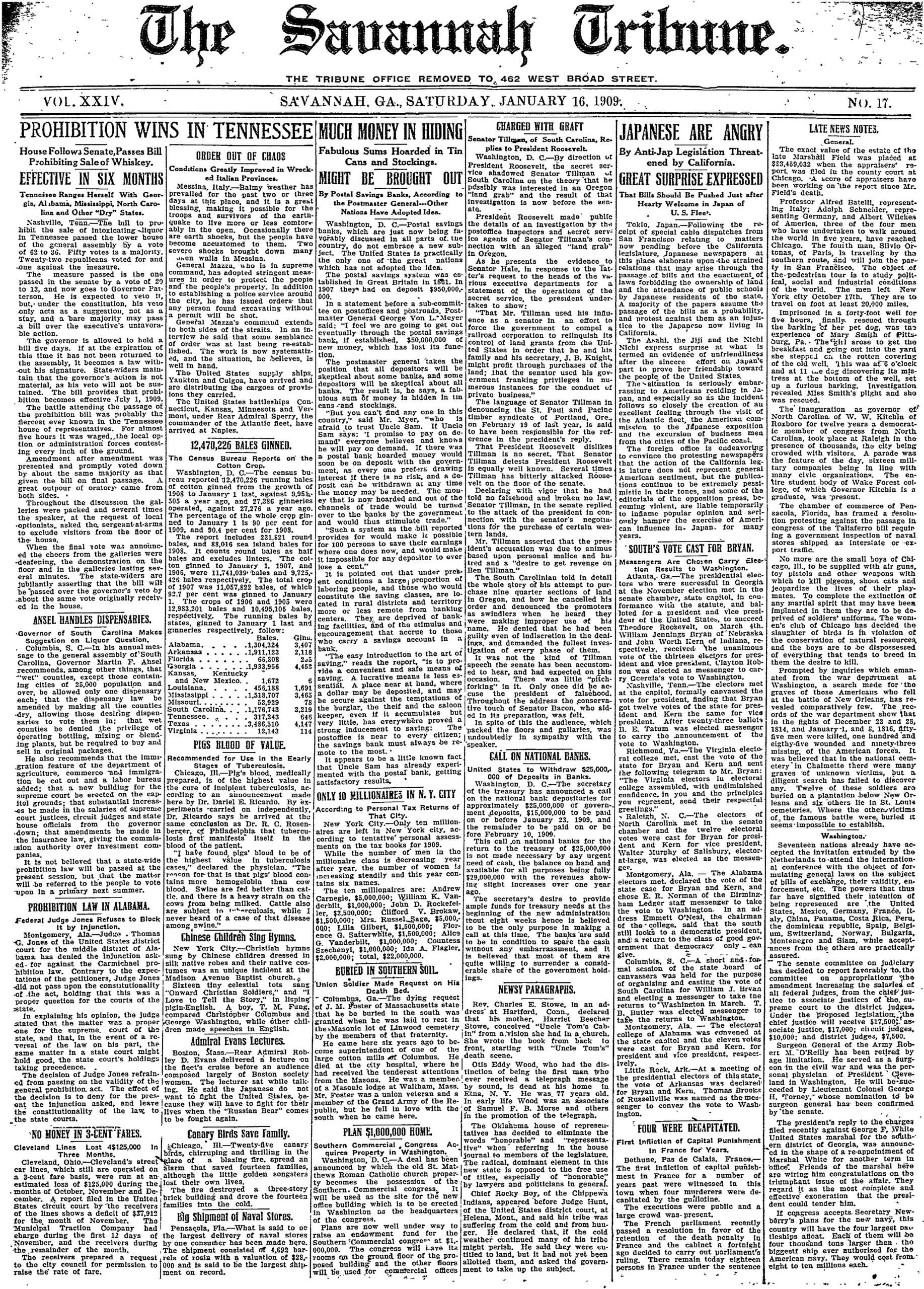
Tennessee Ranges Herself With Georgia, Alabama, Mississippi, North Carolina and Other "Dry" States.
Nashville, Teen—The bill to prohibit the sale of intoxicating liquor in Tennessee passed the lower house of the general assembly by a vote of 62 to 36. Fifty votes is a majority. Twenty-two republicans voted for and one against the measure.
The measure passed is the one passed in the senate by a vote of 29 to 13, and now goes to Governor Patterson. He is expected to veto it, but, under the constitution, his veto only acts as a suggestion, not as a stay, and a bare majority may pass a bill over the executive's untavable action.
The governor is allowed to hold a bill five days. If at the expiration of this time it has not been returned to the assembly, it becomes a law without his signature. State-widers maintain that the governor's action is not material, as his veto will not be sustained. The bill provides that prohibition becomes effective July 1, 1909. The battle attending the passage of the prohibition bill was probably the fiercest ever known in the Tennessee house of representatives. For almost five hours it was waged, the local option or administration forces contesting every inch of the ground. Amendment after amendment was presented and promptly voted down by about the same majority as that given the bill on final passage. A great outpour of oratory came from both sides.
Throughout the discussion the galleries were packed and several times the speaker, at the request of local optionists, asked the servant-at-arms to exclude visitors from the floor of the house.
When the final vote was announced the cheers from the galleries were deafening, the demonstration on the floor and in the galleries lasting several minutes. The state-widers are jubilantly asserting that the bill will be passed over the governor's veto by about the same vote originally received in the house.
Governor of South Carolina Makes Suggestion on Liquor Question. Columbia, S. C.—In his annual message to the general assembly of South Carolina, Governor Martin F. Ahsel recommends, among other things, that "wet" counties, except those containing cities of 25,000 population and over, be allowed only one dispensary each; that the dispensary law be amended by making all the counties dry, allowing those desiring dispensaries to vote them in; that wet counties be denied the privilege of operating bottling, mixing or blending plants, but be required to buy and sell in original packages.
He also recommends that the immigration feature of the department of agriculture, commerce and immigration be cut out and a labor bureau added; that a new building for the supreme court be erected on the capitol grounds; that substantial increases be made in the salaries of supreme court justices, circuit judges and state house officials from the governor down; that amendments be made in the insurance law, giving the commission authority over investment companies. It is not believed that a state-wide prohibition law will be passed at the present session, but that the matter will be referred to the people to vote upon in a primary next summer.
Federal Judge Jones Refuses to Block it by injunction.
Montgomery, Ala.—Judge Thomas G. Jones of the United States district court for the middle district of Alabama has denied the injunction asked for against the Carmichael prohibition law. Contrary to the expectations of the petitioners, Judge Jones did not pass upon the constitutionality of the act, holding that this was a proper question for the courts of the state.
In explaining his opinion, the judge stated that the matter was a proper one for the supreme court of the state, and that, in the event of a reversal of the law on his part, the same matter in a state court might hold good, the state court's holdings taking precedence.
The decision of Judge Jones refrained from passing on the validity of the general prohibition act. The effect of the decision is to deny for the present the injunction asked, and leave the constitutionality of the law to the state courts.
Cleveland, Ohio.—Cleveland's street car lines, which still are operated on a 3-cent fare basis, were run at an estimated loss of $125,000 during the months of October, November and December. A report filed in the United States circuit court by the receivers of the lines shows a deficit of $77,912 for the month of November. The Municipal Traction Company had charge during the first 12 days of November, and the receivers during the remainder of the month. The receivers prepared a request to the city council for permission to raise the rate of fare.
VOL. XXIV.
ANSEL HANDLES DISPENSARIES
PROHIBITION LAW IN ALABAMA.
NO MONEY IN 3-CENT FABES.
Cleveland Lines Lost 48125,000
Three Months.
The
ORDER OUT OF CHAOS
Conditions Greatly Improved in Wrecked Italian Provinces.
Messina, Italy.—Balmy weather has prevailed for the past two or three days at this place, and it is a great blessing, making it possible for the troops and survivors of the earthquake to live more or less comfortably in the open. Occasionally there are earth shocks, but the people have become accustomed to them. Two severe shocks brought down many open walls in Messina.
General Mazza, who is in supreme command, has adopted stringent measures in order to protect the people and the people's property. In addition to establishing a police service around the city, he has issued orders that any person found excavating without a permit will be shot.
General Mazza's command extends to both sides of the straits. In an interview he said that some semblance of order was at last being re-established. The work is now systematized, and the situation, he believes, is well in hand.
The United States supply ships, Yaukton and Culgoa, have arrived and are distributing the cargoes of provisions they carried. The United States battleships Connecticut, Kansas, Minnesota and Vermont, under Rear Admiral Sperry, the commander of the Atlantic fleet, have arrived at Naples.
12.470.226 BALES GINNED.
The Census Bureau Reports on the Colton Croop
Washington, D. C.—The census bureau reported 12,470,226 running bales of cotton ginned from the growth of 1908 to January 1 last, against 9,958,505 a year ago, and 27,38G ginneries operated, against 27,276 a year ago. The percentage of the whole crop ginned to January 1 is 90 per cent for 1909, and 90.4 per cent for 1903. The report includes 231,814 round bales, and 8,016 sea island bales for 1908. It counts round bales as half bales and excludes linters. The cotton ginned to January 1, 1907, and 1906, were 11,741,039 bales and 9,725,426 bales respectively. The total crop of 1907 was 11,057,822 bales, of which 92.7 per cent was ginned to January 1. The crops of 1906 and 1905 were 12,983,201 bales and 10,495,106 bales, respectively. The running bales by states, ginned to January 1 last and ginneries, respectively, follow:
Bales. Glus.
Alabama. 1,304,324 3,407
Arkansas. 1,911,123 2,118
Florida. 66,308 255
Georgia. 1,933,956 4,452
Kansas, Kentucky
and New Mexico. 1,672 6
Louisiana. 456,188 1,691
Mississippi. 1,518,707 3,465
Missouri. 53,929 78
South Carolina. 1,176,743 3,219
Tennessee. 317,343 645
Texas. 3,486,510 4,147
Virginia. 12,143 114
PIGS BLOOD OF VALUE
Recommended for Use in the Eearly Stages of Tuberculosis.
Chicago, Ill.—Pig's blood, medically prepared, is of the highest value in the cure of incipient tuberculosis, according to an announcement made here by Dr. Darliel E. Ricardo. By experiments carried on independently, Dr. Ricardo says he arrived at the same conclusion as Dr. R. C. Rosenberger, of Philadelphia that tuberculosis first manifests itself in the blood of the patient.
"I have found pigs' blood to be of the highest value in tuberculosis cases," declared the physician. "The reason for that is that pigs' blood contains more hemogelobin than cow blood. Swine are fed better than cattle, and there is a heavy strain on the cows from being milked. Cattle also are subject to tuberculosis, while I never heard of a case of that disease among swine."
Chinese Children Sing Hymns.
New York City—Christian hymns sung by Chinese children dressed in silk native robes and their native costumes was an unique incident at the Madison Avenue Baptist church. Sixteen tiny celestial tots sang "Onward Christian Soldiers," and "I Love to Tell the Story," in lisping pign-English. A boy, T. M. Fung, compared Christopher Columbus and George Washington, while other children made speeches in English.
Admiral Evans Lectures.
Boston, Mass.—Rear Admiral Robley D. Evans delivered a lecture on the fleet's cruise before an audience composed largely of Boston society women. The lecturer sat while talking. He said the Japanese do not want to fight the United States, because they will have to fight for their lives when the "Russian Bear" comes to be fought again.
Canary Birds Save Family.
Chicago, Ill—Twenty-five canary birds, chirruping and thrilling in the glare of a blazing fire, spread an alarm that saved fourteen families, although the little golden songsters lost their own lives. The fire destroyed a three-story brick building and drove the fourteen families into the cold.
Big Shipment of Naval Stores.
Pensacola, Fla.-What is said to be the largest delivery of naval stores by one consumer has been made here. The shipment consisted of 4,692 barrels of rosin with a valuation of $28,000 and is said to be the largest shipment on record.
SAVANNAH, GA., SATURDAY, JANUARY 16, 1909:
THE TRIBUNE OFFICE REMOVED TO 462 WEST BROAD STREET.
MUCH MONEY IN HIDING
MIGHT BE BROUGHT OUT
By Postal Savings Banks, According to the Postmaster General...Other Nations Have Adopted Idea.
Washington, D. C.-Postal savings banks, which are just now being favorably discussed in all parts of the country, do not embrace a new subject. The United States is practically the only one of the great nations which has not adopted the idea.
The postal savings system was established in Great Britain in 1861. In 1907 they had on deposit $950,000.00.
In a statement before a sub-committee on post offices and postroads, Postmaster General George Von L.-Meyer said: "I feel we are going to get out eventually through the postal savings bank, if established, $50,000,000 of new money, which has lost its function.
The postmaster general takes the position that all depositors will be skeptical about some banks, and some depositors will be skeptical about all banks. The result is, he says, a fabulous sum of money is hidden in tin cans and stockings.
"But you can't find any one in this country," said Mr. Myer, "who is afraid to trust Uncle Sam. If Uncle Sam says: 'I promise to pay on demand' everyone believes and knows he will pay on demand. If there was a postal bank hoarded money would soon be on deposit with the government, as every one prefers drawing interest if there is no risk, and a deposit can be withdrawn at any time the money may be needed. The money that is now hoarded and out of the channels of trade would be turned over to the banks by the government and would thus stimulate trade."
"Such a system as the bill reported provides for would make it possible for 100 persons to save their earnings where one does now, and would make it impossible for any depositor to ever lose a cent." It is pointed out that under present conditions a large proportion of laboring people, and those who would constitute the saving classes, are located in rural districts and territory more or less remote from banking centers. They are deprived of banking facilities, and of the stimulus and encouragement that accrue to those who carry a savings account in a bank.
"The easy introduction to the art of saving," reads the report, "is to provide a convenient and safe means of saving. A lucrative means is less essential. A place near at hand, where a dollar may be deposited, and may be secure against the temptations of the burglar, the theft and the saloon keeper, even if it accumulates but very little, has everywhere proved a strong inducement to saving: The postoffice is near to every citizen; the savings bank must always be remote to the most."
It appears to be a little known fact that Uncle Sam has already experimented with the postal bank, getting satisfactory results.
ONLY 10 MILLIONAIRES IN N. Y. CITY
According to Personal Tax Returns of
That City.
New York City—Only ten millionaires are left in New York city, according to tentative personal assessments on the tax books for 1909.
While the number of men in the millionaire class is decreasing year after year, the number of women is increasing steadily and this year contains six names.
The ten millionaires are: Andrew Carnegie, $5,000,000; William K. Vanderbilt, $1,000,000; John D. Rockefeller, $2,500,000; Clifford V. Brokaw, $1,500,000; Mrs. Russel Sage, $5,000,000; Lilla Gilbert, $1,500,000; Florence G. Satterwhite, $1,500,000; Alice G. Vanderbilt, $1,000,000; Countess Szechenyl, $1,000,000; Ida A. Flagler, $2,000,000; total, $22,000,000.
BURied IN SOUTHERN SOIL
Union Soldier Made Request on His Death Bed.
Columbus, Ga.-The dying request of J. M. Poster of Massachusetts state that he be buried in the south was granted when he was laid to rest in the Masonic lot of Linwood cemetery by the members of that fraternity.
He came here six years ago to become superintendent of one of the large cotton mills of Columbus. He died at the city hospital, where he had received the tenderest attentions from the Masons. He was a member of a Masonic lodge at Walham, Mass. Mr. Foster was a union veteran and a member of the Grand Army of the Republic, but he fell in love with the south when he came here.
PLAN $1,000,000 HOME
Southern Commercial Congress Acquires Property in Washington. Washington, D. C.—A deal has been announced by which the old St. Matthews Roman Catholic church property becomes the possession of the Southern Commercial congress. It will be used as the site for the new office building which is to be erected in Washington as the headquarters of the congress. Plans are now well under way to raise an endowment fund for the Southern 'Commercial congress' at $1,000,000. The congress will Leave its rooms on the ground floor of the proposed building and the other floors will be used for commercial offices
CHARGED WITH GRAFT
Senator Tillman, of South Carolina, Replies to President Roosevelt.
Washington, D. C.-By direction of President Roosevelt, the secret service shadowed Senator Tillman of South Carolina on the theory that he possibly was interested in an Oregon "land grab" and the result of that investigation is now before the senate.
President Roosevelt made public the details of an investigation by the postoffice inspectors and secret service agents of Senator Tillman's connection with an alleged "land grab" in Oregon.
As he presents the evidence to Senator Hale, in response to the latter's request to the heads of the various executive departments for a statement of the operations of the secret service, the president undertakes to show:
"That Mr. Tillman used his influence as a senator in an effort to force the government to compel a railroad corporation to relinquish its control of land grants from the United States in order that he and his family and his secretary, J. B. Knight, might profit through purchases of the land; that the senator used his government franking privileges in numerous instances for the conduct of private business."
The language of Senator Tillman in denouncing the St. Paul and Pacific timber syndicate of Portland, Ore., on February 19 of last year, is said to have been responsible for the reference in the president's reply.
That President Roosevelt dislikes Tillman is no secret. That Senator Tillman detests President Roosevelt is equally well known. Several times Tillman has bitterly attacked Roosevelt on the floor of the senate.
Declaring with vigor that he had told no falsehood and broken no law, Senator Tillman, in the senate replied to the attack of the president in connection with the senator's negotiations for the purchase of certain western lands.
Mr. Tillman asserted that the president's accusation was due to animus based upon personal malice and hutred and a "desire to get revenge on Ben Tillman."
The South Carolinian told in detail the whole story of his attempt to purchase nine quarter sections of land in Oregon, and how he cancelled his order and denounced the promoters as swindlers when he heard they were making improper use of his name. He denied that he had been guilty even of indiscretion in the dealings, and demanded the fullest investigation of every phase of them.
It was not the kind of Tillman speech the senate has been accustomed to hear, and had expected on this occasion. There was little "pitch-forking" in it. Only once did he accuse the president of falséhood. Throughout the address the conservative touch of Senator Bacon, who alided in its preparation, was felt. In spite of this the audience, which packed the floors and gallaries, was undoubtedly in sympathy with the speaker.
CALL ON NATIONAL BANKS.
United States to Withdraw $25,000,
000 of Densils in Banks.
Washington D. C.-The secretary of the treasury has announced a call on the national bank depositaries for approximately $25,000,000 of government deposits, $15,000,000 to be paid on or before January 23, 1909, and the remainder to be paid on or be fore February 10, 1909.
This call on national banks for the return to the treasury of $25,000,000 is not made necessary by any urgent need of cash, the balance on hand and available for all purposes being fully $29,000,000 with the revenues showing slight increases over one year ago.
The secretary's desire to provide ample funds for treasury needs at the beginning of the new administration thout eight weeks hence is believed to be the only purpose in making a call at this time. The banks are said to be in condition to spare the cash without any embarrassment, and it is believed that most of them are quite willing to surrender a considerable share of the government holdings.
NEWSY PARAGRAPHS.
Rev, Charles E. Stowe, in an address at Hartford, Conn., declared that his mother, Harriet Beecher Stowe, conceived "Uncle Tom's Cabin" from a vision she had in a church. She wrote the book from back to front, starting with "Uncle Tom's" death scene. Otis Eddy Wood, who had the distinction of being the first man who ever received a telegraph message by sound, is dead at his home in Etna, N. Y. He was 77 years old. In early life Wood was an associate of Samuel F. B. Morse and others in the promotion of the telegraph.
The Oklahoma house of representatives has decided to eliminate the words "honorable" and "representative" when referring in the house journal to members of the legislature. The radical, dominant element in this new state is opposed to the free use of titles, especially of "honorable" by lawyers and politicians in general. Chief Rocky Boy, of the Chippewa Indians, appeared before Judge Hunt, of the United States district court, at Helena, Mont., and said his tribe was suffering from the cold and from hunger. He declared that, if the cold weather continued many of his tribe might perish. He said they were entitled to land, but it had not yet been allotted them, and asked the government to take up the subject.
JAPANESE ARE ANGRY
GREAT SURPRISE EXPRESSED
That Bills Should Be Pushed Just after Hearty Welcome in Japan of U.S. Fleet.
Toklo, Japan—Following the receipt of special cable dispatches from San Francisco relating to matters now pending before the California legislature, Japanese newspapers at this place elaborate upon the strained relations that may arise through the passage of bills and the enactment of laws forbidding the ownership of land and the attendance of public schools by Japanese residents of the state. A majority of the papers assume the passage of the bills as a probability, and protest against them as an injustice to the Japanese now living in California.
The Asahi, the Jiji and the Nichi Nichi express surprise at what is termed an evidence of unfriendliness after the sincere effort on Japan's part to prove her friendship toward the people of the United States. The situation is seriously embarrassing to Americans residing in Japan, and especially so as the incident follows so closely the creation of an excellent feeling through the visit of the Atlantic fleet, the American commission to the Japanese exposition and the excursion of business men from the cities of the Pacific coast.
The foreign office is endeavoring to convince the protesting newspapers that the action of the California legislature does not represent general American sentiment, but the publications continue to be extremely pessimistic in their tones, and some of the editorials of the opposition press, becoming violent, are liable temporarily to inflame popular opinion and seriously hamper the exercise of American influence in Japan. for many years.
SOUTH'S VOTE CAST FOR BRYAN.
Messengers Are Choyen Carry Elec-
tronic Results to Washington
tion Results to Washington.
Atlanta, Ga.—The presidential electors who were successful in Georgia at the November election met in the senate chamber, state capitol, in conformance with the statute, and balloted for a president and vice president of the United States, to succeed Theodore Roosevelt, on March 4th. William Jennings Bryan of Nebraska and John Worth Kern of Indiana, respectively, received. The unanimous vote of the thirteen electors for president and vice president. Clayton Robson was elected as messenger to carry Geerola's vote to Washington. Nashville, Tenn.—The electors met at the capitol, formally canvassed the vote for president, finding that Bryan got twelve votes of the state for president and Kern the same for vice president. After twenty-three ballots B. E. Tatum was elected messenger to carry the announcement of the vote to Washington.
Richmond, Va.—The Virginia electoral college met, cast the vote of the state for Bryan and Kern and sent the following telegram to Mr. Bryan: "The Virginia electors in electoral college assembled, with undiminished confidence, in you and the principles you represent, send their respectful greetings." Raleigh, N. C.—The electors of North Carolina met in the senate chamber and the twelve electoral votes were cast for Bryan for president and Kern for vice president, Walter Murphy of Salisbury, elector-large, was elected as the messenger.
Montgomery, Ala. — The Alabama electors met, declared the vote of the state case for Bryan and Kern, and chose E. R. Norman of the Eirmingham Ledger staff messenger to take the vote to Washington. In an address Emmett O'Neal, the chairman of the college, said that the south still looks to a democratic president, and a return to the class of good government that democracy only can give.
Columbia, S. C.—A short and formal session of the state board of canvassers was held for the purpose of organizing and casting the vote of South Carolina for William J. Bryan and electing a messenger to take the returns to Washington in March. T. B. Butler was elected messenger to take the returns to Washington. Montgomery, Ala. — The electoral college of Alabama was convened at the state capitol and the eleven votes were cast for Bryan and Kern. for president and vice president, respectively.
Little Rock, Ark.-At a meeting of the presidential electors of this state, the vote of Arkansas was declared for Bryan and Kern. Thomas Brooks of Russellville was named as the messenger to convey the vote to Washington.
FOUR WERE DECAPITATED.
First Infliction of Capital Punishment In France for Years.
Bethune, Pas de Calais, France.—The first infliction of capital punishment in France for a number of years past were witnessed in this town when four murderers were decapitated by the guillotine. The executions were public and a large crowd was present. The French parliament recently passed a resolution in favor of the retention of the death penalty in France and the cabinet a fortnight ago decided to carry out parliament's ruling. There remain today eighteen persons in France under the sentence
LATE NEWS NOTES.
General.
The exact value of the estate of the late Marshall Field was placed at $3,459,032 when the appraisers' report was filed in the county court at Chicago. A score of appraisers have been working on the report since Mr. Fleld's death.
Professor Alfred Batelli, representing Italy; Adolph Schneider, representing Germany, and Albert Wilkes of America, three of the four men who have undertaken to walk around the world in five years, have reached Chicago. The fourth man, Silvio Oronas, of Paris, is traveling by the southern route, and will join the party in San Francisco. The object of the pedestrian tour is to study political, social and industrial conditions of the world. The men left New York city October 17th. They are to travel on foot at least 20,000 miles.
Imprisoned in a forty-foot well for five hours, finally rescued through the barking of her pet dog, was the experience of Mary Smith of Pittsburg, Pa. The girl arose to get the breakfast and going out into the yard she stepped on the rotten covering of the old well. This was at 6 o'clock and at 11 o'clock discovering its mistress at the bottom of the well, set up a furious barking. Investigation revealed Miss Smith's plight and she was rescued.
The inauguration as governor of North Carolina of W. W. Kitchin of Roxboro for twelve years a democratic member of congress from North Carolina, took place at Raleigh in the presence of thousands, the city being crowded with visitors. A parade was the feature of the day, sixteen military companies being in line with many civic organizations. The entire student body of Wake Forest college, of which Governor Kitchin is a graduate, was present.
The chamber of commerce of Pen-sacola, Florida, has framed a resolution protesting against the passage in congress of the Talliaferro bill requiring a government inspection of naval stores shipped as interstate or export traffic.
No more are the small boys of Chicago, ill., to be supplied with air guns, toy pistols and other weapons with which to kill pigeons, shoot cats and jeopardize the lives of their playmates. To complete the extinction of any martial spirit that may have been implanted in them they are to be deprived of soldiers' uniforms. The women's club of Chicago has decided the slaughter of birds is in violation of the conservation of natural resources and the boys are to be dispossessed of everything that tends to breed in them the desire to kill.
Prompted by inquiries which emanated from the war department at Washington, a search made for the graves of those Americans who fell at the battle of New Orleans, has revealed comparatively few. The records of the war department show that in the fights of December 23 and 25, 1814, and January 1, and 8, 1816, fifty-five men were killed, one hundred and eighty-five wounded and ninety-three missing, of the American forces. It was believed that in the national cemetery in Chalmette there were many graves of unknown victims, but a diligent search has failed to discover any. Twelve of these soldiers are buried on a plantation below New Orleans and six others lie in St. Louis cemeteries. Where the other victims of, the famous battle were, buried it seems impossible to establish.
Washington.
Seventeen nations already have accepted the invitation extended by the Netherlands to attend the international conference with the object of formulating general laws on the subject of bills of exchange, their validity, enforcement, etc. The powers that thus far have signified their intention of being represented are the United States, Mexico, Germany, France, Italy, China, Panama, Costa Rica, Peru, the dominican republic, Spaln, Belgium, Switzerland, Norway, Bulgaria, Montenegro and Siam, while acceptances from the others are practically assured.
The senate committee on judiciary has decided to report favorably to the committee on appropriations the amendment increasing the salaries of all federal judges, from the chief justice to associate justices of the, supreme court to the district judges. Under the proposed legislation, the chief justice will receive $17,500; associate justice, $17,000; chituit judges, $10,000; and district judges, $7,500.
Surgeon General of the Army Robert M. O'Reilly has been retired by age limitation. He served as a surgeon in the civil war and was the personal physician of President Cleveland in Washington. He will be succeeded by Lieutenant Colonel George H. Torney, whose nomination to be surgeon general has been confirmed by the senate.
The president's reply to the charges filed recently against George F. White United States marshal for the southern district of Georgia, was announced in the shape of a re-appointment of Marshal White for another term in office. Friends of the marshal here are wiring him congratulations on the triumphant issue of the affair. They regard it as the most complete and effective exoneration that the president could tender him.
If congress accepts Secretary Newberry's plans for the new navy, this country will have the four largest battleships afloat. Each of them will be four thousand tons larger than the biggest ship ever authorized for the American navy. They would cost from eight to ten millions each.
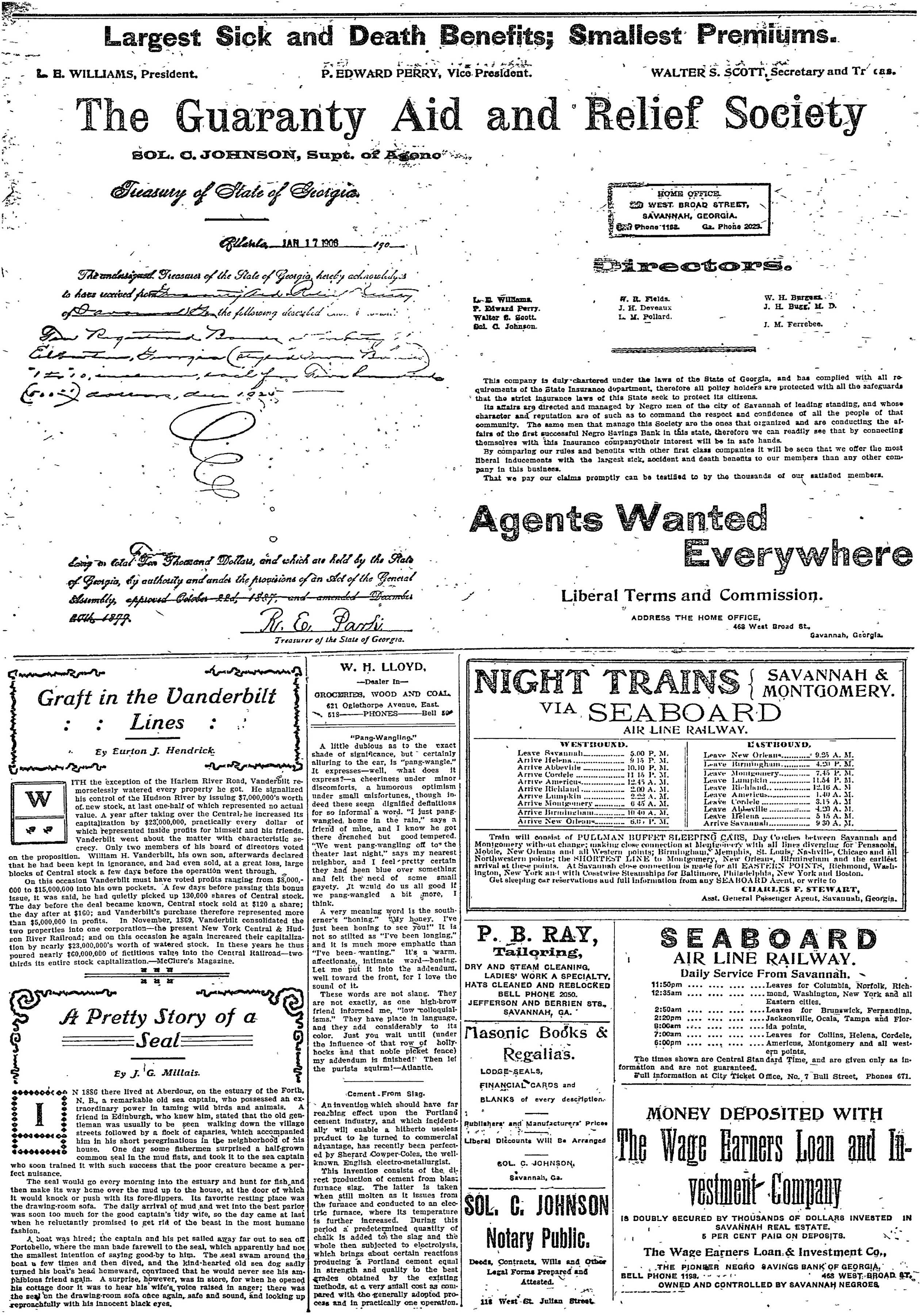
The Guaranty Aid and Relief Society SOL. C. JOHNSON, Supt. of Ageno
Treasury of State of Georgia
Georgia hereby acknowledges
described in the following:
and which are held by the State
essions of an Act of the General
and amended December
R. E. Parsi
The undersigned, Treasurer of the State of Georgia, hereby acknowledges
to have received from the Secretary of the State of Georgia the following described:
Dear Regent and Trustee,
Elder Thomas, Esq., Secretary of the State of Georgia,
1770, in connection with the following documents:
(1) A warrant, dated 1920.
long in total Ten Thousand Dollars, and which are held by the State of Georgia, by authority and under the provisions of an Act of the General Assembly, approved October 22d, 1887, and amended December 20th, 1897.
R. E. Parsi
Treasurer of the State of Georgia.
Graft in the Vanderbilt
Lines
Ey Eurton J. Hendrick
ITH the exception of the Harlem River Road, Vanderbilt remorselessly watered every property he got. He signalized his control of the Hudson River by issuing $7,000,000's worth of new stock, at last one-half of which represented no actual value. A year after taking over the Central, he increased its capitalization by $23,000,000, practically every dollar of which represented inside profits for himself and his friends. Vanderbilt went about the matter with characteristic secrecy. Only two members of his board of directors voted
ITH the exception of the Harlem River Road, Vanderbilt remorselessly watered every property he got. He signalized his control of the Hudson River by issuing $7,000,000's worth of new stock, at last one-half of which represented no actual value. A year after taking over the Central, he increased its capitalization by $23,000,000, practically every dollar of which represented inside profits for himself and his friends. Vanderbilt went about the matter with characteristic secrecy. Only two members of his board of directors voted on the proposition. William H. Vanderbilt, his own son, afterwards declared that he had been kept in ignorance, and had even sold, at a great loss, large blocks of Central stock a few days before the operation went through.
On this occasion Vanderbilt must have voted profits ranging from $8,000,000 to $15,000,000 into his own pockets. A few days before passing this bonus issue, it was said, he had quietly picked up 130,000 shares of Central stock. The day before the deal became known, Central stock sold at $120 a share; the day after at $160; and Vanderbilt's purchase therefore represented more than $5,000,000 in profits. In November, 1869, Vanderbilt consolidated the two properties into one corporation—the present New York Central & Hudson River Railroad; and on this occasion he again increased their capitalization by nearly $23,000,000's worth of watered stock. In these years he thus poured nearly $60,000,000 of fictitious value into the Central Railroad—two-thirds its entire stock capitalization.—McClure's Magazine.
A Pretty Story of a Seal
Ey J. G. Millais.
N 1886 there lived at Aberdour, on the estuary of the Forth, N. B., a remarkable old sea captain, who possessed an extraordinary power in taming wild birds and animals. A friend in Edinburgh, who knew him, stated that the old gentleman was usually to be seen walking down the village streets followed by a flock of canaries, which accompanied him in his short peregrinations in the neighborhood of his house. One day some fishermen surprised a half-grown common seal in the mud flats, and took it to the sea captain who soon trained it with such success that the poor creature became a perfect nuisance.
The seal would go every morning into the estuary and hunt for fish, and then make its way home over the mud up to the house, at the door of which it would knock or push with its fore-flippers. Its favorite resting place was the drawing-room sofa. The daily arrival of mud and wet into the best parlor was soon too much for the good captain's tidy wife, so the day came at last when he reluctantly promised to get rid of the beast in the most humane fashion.
A boat was hired; the captain and his pet sailed away far out to sea off Portobello, where the man bade farewell to the seal, which apparently had not the smallest intention of saying good-by to him. The seal swam around the boat a few times and then dived, and the kind-hearted old sea dog sadly turned his boat's head homeward, convinced that he would never see his amphibious friend again. A surprise, however, was in store, for when he opened his cottage door it was to hear his wife'a voice raised in anger; there was the seal on the drawing-room sofa once again, safe and sound, and looking up reproachfully with his innocent black eyes.
W. H. LLOYD,
GROCERIES, WOOD AND COAL
621 Oglethorpe Avenue, East
518----PHONES----Bell 50
"Pang-Wangling."
A little dubious as to the exact shade of significance, but certainly alluring to the ear, is "pang-wangle." It expresses—well, what does it express?—a cheerfulness under minor discomforts, a humorous optimism under small misfortunes, though indeed these seem dignified definitions for so informal a word. "I just pang-wangled, home in the rain," says a friend of mine, and I know he got there drenched but good tempered. "We went pang-wangling off to the theater last night," says my nearest neighbor, and I feel pretty certain they had been blue over something and felt the need of some small gayety. It would do us all good if we pang-wangled a bit more, I think.
A very meaning word is the southerner's "honing." "My honey. I've just been honing to see you!" It is not so stilted as "I've been longing," and it is much more emphatic than "I've been-wanting." It's a warm, affectionate, intimate word—honing. Let me put it into the addendum, well toward the front, for I love the sound of it.
These words are not slang. They are not exactly, as one high-brow friend informed me, "low colloquialisms." They have place in language, and they add considerably to its color. Just you wait until (under the influence of that row of hollyhocks and that noble picket fence) my addendum is finished! Then let the purlists squirm!—Atlantic.
Cement - From Slag.
An invention which should have far reaching effect upon the Portland cement industry, and which incidentally will enable a hitherto useless product to be turned to commercial advantage, has recently been perfected by Sherard Cowper-Coles, the well-known English electro-metallurgist.
This invention consists of the direct production of cement from blast furnace slag. The latter is taken when still molten as it issues from the furnace and conducted to an electric furnace, where its temperature is further increased. During this period a predetermined quantity of chalk is added to the slag and the whole then subjected to electrolysis, which brings about certain reactions producing a Portland cement equal in strength and quality to the best grades obtained by the existing methods, at a very small cost as compared with the generally adopted process and in practically one operation.
This company is duly chartered under the laws of the State of Georgia, and has compiled with all requirements of the State Insurance department, therefore all policy holders are protected with all the safeguards that the strict insurance laws of this State seek to protect its citizens.
Its affairs are directed and managed by Negro men of the city of Savannah of leading standing, and whose character and reputation are of such as to command the respect and confidence of all the people of that community. The same men that manage this Society are the ones that organized and are conducting the affairs of the first successful Negro Savings Bank in this state, therefore we can readily see that by connecting themselves with this Insurance company their interest will be in safe hands.
By comparing our rules and benefits with other first class companies it will be seen that we offer the most liberal inducements with the largest sick, accident and death benefits to our members than any other company in this business.
That we pay our claims promptly can be testified to by the thousands of our satisfied members.
Train will consist of PULLMAN BUFFET SLEEPING CARS, Day Coaches between Savannah and Montgomery without change; making close connection at Montgomery with all lines diverging for Pensacola, Mobile, New Orleans and all Western points; Birmingham, Memphis, St. Louis, Nashville, Chicago and all Northwestern points; the SHORTEST LINE to Montgomery, New Orleans, Birmingham and the earliest arrival at these points. At Savannah close connection is made for all EASTERN POINTS, Richmond, Washington, New York and with Coastwise Steamships for Baltimore, Philadelphia, New York and Boston. Get sleeping car reservations and full information from any SEAROARD Agent, or write to
L. B. Williams
P. Edward Perry.
Walter G. Scott.
Sel C. Johnson.
This company is duly chartered and requirements of the State Insurance de that the strict insurance laws of the Its affairs are directed and manage character and reputation are of su community. The same men that make fairs of the first successful Negro and themselves with this Insurance co By comparing our rules and benefi liberal inducements with the large pany in this business. That we pay our claims prompt
Agents
Libera
NIGHT T
VIA S
WESTHOUR
Leave Savannah
Arrive Helena
Arrive Abbeville
Arrive Cordele
Arrive Americus
Arrive Richland
Arrive Lumpkin
Arrive Montgomery
Arrive Birmingham
Arrive New Orleans
Train will consist of PULLM Montgomery without change; making Mobile, New Orleans and all West Northwestern points; the SHORTEST arrival at these points. At Savannahington, New York and with Coastwi Get sleeping car reservations au
P. B. RAY,
Tailoring,
DRY AND STEAM CLEANING.
LADIES' WORK A SPECIALTY.
HATS CLEANED AND REBLOCKED
BELL PHONE 2050.
JEFFERSON AND BERRIEN STS.
SAVANNAH, GA.
Regalias.
LODGE-SEALS,
FINANCIAL CARDS and
BLANKS of every description.
Rubilashers' and Manufacturers' Prices
Liberal Discounts Will Be Arranged
60L. C. JOHNSON.
Savannah, Ga.
SOL. C. JOHNSON
Notary Public.
Deeds, Contracts, Wills and Other Legal Forms Prepared and Attested. 118 West St. Julian Street
WALTER S. SCOTT, Secretary and Tr'cas.
Relief Society
HOME OFFICE
WEST BROAD STREET,
SAVANNAH, GEORGIA.
Phone 1182. Ga. Phone 2023.
Directors.
W. R. Fields.
J. H. Deveaux
L. M. Pollard.
W. H. Burgess.
J. H. Bugg, M. D.
J. M. Ferrebee.
under the laws of the State of Georgia, and has complied with all re-department, therefore all policy holders are protected with all the safeguards this State seek to protect its citizens.
led by Negro men of the city of Savannah of leading standing, and whose such as to command the respect and confidence of all the people of that manage this Society are the ones that organized and are conducting the savings Bank in this state, therefore we can readily see that by connecting company their interest will be in safe hands.
Uses with other first class companies it will be seen that we offer the most best sick, accident and death benefits to our members than any other com-
ly can be testified to by the thousands of our satisfied members.
Wanted Everywhere
Terms and Commission.
ADDRESS THE HOME OFFICE,
468 West Broad St.
Gavannah, Georgia
TRAINS { SAVANNAH & MONTGOMERY.
SEABOARD
AIR LINE RAILWAY.
ED.
5.00 P. M.
9.15 P. M.
10.10 P. M.
11.15 P. M.
12.45 A. M.
2.00 A. M.
2.22 A. M.
6.45 A. M.
10.40 A. M.
6.60 P. M.
EASTBOUND.
Leave New Orleans..... 9.25 A. M.
Leave Birmingham..... 4.20 P. M.
Leave Montgomery..... 7.45 P. M.
Leave Lumpkin..... 11.54 P. M.
Leave Richland..... 12.16 A. M.
Leave Americus..... 1.40 A. M.
Leave Cordele..... 3.15 A. M.
Leave Alphaville..... 4.20 A. M.
Leave Helena..... 5.15 A. M.
Arrive Savannah..... 9.30 A. M.
AN BUFFET SLEEPING CARS, Day Coaches between Savannah and close connection at Montgomery with all lines diverging for Pensacola, turn points; Birmingham, Memphis, St. Louis, Nashville, Chicago and all EAST LINE to Montgomery, New Orleans, Birmingham and the earliest close connection is made for all EASTERN POINTS, Richmond, Washington Steamships for Baltimore, Philadelphia, New York and Boston.
Full information from any SEABOARD Agent, or write to
CHARLES F. STEWART,
Asst. General Passenger Agent, Savannah, Georgia.
SEABOARD
AIR LINE RAILWAY.
Daily Service From Savannah.
11:50pm ... ... ... ...Leaves for Columbia, Norfolk, Rich-
12:35am ... ... ... ...mond, Washington, New York and all
Eastern cities.
2:50am ... Leaves for Brunswick, Fernandina,
2:20pm ... Jacksonville, Ocala, Tampa and Flor-
8:00am ... Ida points.
7:00am ... Leaves for Collins, Helena, Cordele,
6:00pm ... Americus, Montgomery and all west-
ern points.
The times shown are Central Standard Time, and are given only as in-
formation and are not guaranteed.
Full information at City Ticket Office, No. 7 Bull Street, Phones 671.
MONEY DEPOSITED WITH The Wage Earners Loan and Investment Company
18 DOUBLY SECURED BY THOUSANDS OF DOLLARS INVESTED IN SAVANNAH REAL ESTATE.
5 PER CENT PAID ON DEPOSITS.
The Wage Earners Loan & Investment Co.,
THE PIONNER NEGRO SAVINGS BANK OF GEORGIA,
BELL PHONE 1198.
468 WEST. BROAD ST.
OWNED AND CONTROLLED BY SAVANNAH NEGROES.
Early and late through the weary years,
Aye, with an anxious brain;
While the sun comes up and the stars go
down
Over and o'er again;
Fingers all knotted and eyes grown dim;
Shoulders that earthward bow;
Mystical characters wrought by Care
Wrinkle the shrunken brow.
Early and late in the busy whirl
On through the darkness grove
Spirit that deep in the sunken breast
Blows at the spark of hope;
Early and late at the grinding toil,
Hoping to see a ray
Into the workaday blackness burst
Out of the clouds of gray.
Early and late while the years go by,
Frosting the aching head.
Nothing but work in your narrow world—
Work and a crust of bread;
Early and late—but the time must come
Out of the hand of Fate;
Providence cares for the poor at last;
You only to work—and wait.
-Lowell R. Reece, in San Francisco Bullet-
o.
LOVE WINS OUT.
BY J. NORMAN.
Iligh up on the "Salter" she sat, throned on a granite boulder, with the Golden Red flaming all around her and upon her fair young head, And Eric Leifson, the bold; tall youth, who had dared to risk his every hopes of happiness in a stumbling declaration of devotion, stared up at her in joyful amazement.
"You love me," he cried, "you love me, a poor struggling Norwegian farmer, and you the daughter of a millionaire and the most beautiful girl in the world?" "Yes," she answered in her deep, sweet voice, "I love you," and smiling a little at his lover-like praise, she added whimsically, "Won't you believe me, Eric?" He sprang to his feet and took her boldly in his arms.
"Oh, Marjorie, it seems too good to be true," he whispered. "I could not help speaking, but I never dared even in my wildest dreams to hope for this."
Gently releasing herself she looked at her watch.
"Come, it is time for me to return," she said. "Father is always angry if I keep him waiting for his breakfast."
"Oh, I am afraid I hrd forgotten
"Oh, I am afraid I had forgotten your father," he said, blankly. There was very little doubt as to what Marjorie's father—who knew nothing of these early meetings on the "Salter" while he was asleep in bed—would say when Eric formally requested permission to marry his only child. It came home suddenly in the young man how preposterous such a proposal would seem to the father of his love. His beautiful Marjorie, heiress to thousands of acres of rich California pasture and over a million sheep, married to an insignificant Norwegian farmer, who had all his work cut out to make both ends meet. Why, of course, the American would promptly kick him out.
"Good-by," said Eric, disconsolately, as they came near the little inn which had the honor of sheltering Marjorie and her wealthy father. "I'll come and see your father directly after breakfast."
"Good-by," she answered. "I'll do all I can to win him over first. And I'll make the coffee myself, so that it shall be just as he likes it, and see that the eggs are not boiled as hard as they were yesterday. When dad is in good humor, there is always hope."
The scene was certainly not an inspiring one, the lover thought, as he stood upon the threshold of the little inn. The prevailing note was a melancholy grey, grey sky, grey granite and grey hills tinged with steamy mist and the famous "Grey Wethers" of Siddal Fjord—a group of boulders which, seen from a distance, bear a marvelous resemblance to a flock of grazing sheep—looked more astonishingly like real grey wethers than ever.
However, he pulled himself together and boldly asked to see Mr. Edward Petersen.
The millionaire was awaiting him, walking up and down in the garden back of the inn.
"Marjorie has told me why you come," he said brusquely by way of greeting.
"Look here, Mr. Petersen," he said conciliantly, "I know it must be rather presumptuous to you, but I can't help it—really I can't. I love Marjorie and she loves me. And we can't help that now, can we?" "You may be lacking in money, but you are not lacking in check," he said curtly. "The question," Eric continued, ignoring the sneer, "is what are you going to do about it? Are you going to forbid the match, or are you going to let love have its way?" "I am going to forbid the match," replied Mr. Petersen, clenching his fists determinedly. "But why?" Eric asked, in the most innocent, surprised tone in the world, "I love your daughter and she loves me. Why should you refuse us permission to marry?"
"Confound you!" cried the American angrily, "you cannot possibly keep her in the style she has been accustomed to."
"I can make a living. I shan't starve her. Wholesome food—not your rich, indigestible messes—and a little work won't hurt her."
Then the storm broke.
"Get out!" thundered the millionaire, "Get out before you are hurt. I never heard such impudence in all my life."
"Why should I get out?" Erie asked quietly. "I am your equal: there is nothing outrageous in my wanting to marry your daughter."
"My equal, are you? Do you know young man, I could buy you up a hundred times and never feel it? Why you conceived young jackass, I have over a million sheep out there."
"I have a few of them myself up there," replied the young man, waving his hand in the direction of the "Salters."
"Pooh, you have not enough to feed my hands for a day," he cried; "six hundred kroner would buy them."
"I will take four hundred for the lot, spot cash," said Erie, quickly.
"You said four hundred. I will give you three hundred and fifty."
"Done," Erie cried.
"Come on, let's go and have a look at them," said the American.
"Afraid of your bargain?" he asked.
"The American flushed angrily and glanced up the hillside again." The Grey Wethers looked healthily enough feeding there patiently in the mist, and he fancied himself both as a bargainer and a man with an instinctive eye for sheep.
Without a word he marched indoors and wrote out a check, which he handed to Eric with the remark.
"If you have anything else to sell before you go, let me know, and I will make you an offer."
Eric folded the check and put it in his pocket. "I knew somehow this interview would end in a deal," he observed carelessly.
observed curiosity.
"What do you mean?"
"Come and see."
"Have you done me?"
"Come and see."
Together they climbed the hill, the older man puzzled and suspicious, the younger frankly triumphant, and at last they came to the famous Grey Wethers which Mr. Petersen had bought for three hunder and fifty kroner.
He looked at the stones, and first he swore, and then he laughed.
"You have got me, young man," he cried, "to think that I—a man with a million sheep of my own—I should not know the difference between a flock of sheep and a lot of rocks. You are pretty smart, my lad. I reckon you would be a good man about my ranch."
"I am sure I should, replied the incorrigible Eric. "It is not many men who have done you so thoroughly, is it?"
"You are the first, sir," said the American proudly.
"Heavens, how they will laugh at me when the story comes out."
"It is sure to be cabled across. Can't you see the headlines, Mr. Petersen?" Eric laughed.
The millionaire laughed too, and slapped him on the shoulder.
"Look here, young man," he said, kindly, "do you really find truly love my girl?"
"I do, sir."
"Then you had better go back and tell her that her hard hearted father has given in. You can have her, you rascal, and you may bring her up here to see her poor swindled father, looking regretfully at his latest purchase."
He hold out his hand and Eric shook it heartily.
"We will make it a bargain, sir," he said, jokingly. "In consideration of your giving me your daughter I'll keep my mouth shut about this little deal of ours and give you back your check."
He handed it over as he spoke, and the millionaire looked at it long and earnestly.
"I shall keep this in my desk," he said, "and whenever I am feeling rather pleased with myself I shall just take it out and look at it."—New York Journal.
A New Promise of Reform
Bv R. L. BRIDGMAN.
A new promise of success has come to the reformers of municipal governments. It has come through a new application of statistics, and its potency lies in the application of percentage of result to expense in the different cities, whereby comparison between different departments becomes possible, down to small details. It has come in local form, but the idea is national and it is a fair presumption that the idea will speedily have national standing. Its local application has manifested itself in two States only—Ohio and Massachusetts.
This advance does not concern the scheme of government at all. It does not involve any charter amendments. It has nothing to do with the various theories of one chamber or two, with more or less power and responsibility for the mayor, school committee and heads of departments. It has nothing to do with the suffrage, with systems of balloting or any phase of election laws. It does not touch theories of taxation or sanitation, or education, or labor and capital, or any other side upon which the problem of municipal maladministration is attacked. It is simply a matter of reducing finances to a form favorable for comparison, and letting the system have its perfect work. It does not seem, perhaps, at first glance, as if much relief could come from such an unpromising source. But a study of the case slows that it has large and substantial promise, and it is quite possible that the evils of our notorious city government will be relieved from an unsuspected quarter. But it must not be forgotten that it takes men to reform. Figures will never do it of themselves.—Atlantic Monthly.
GOOD ROADS
State Roads.
Public sentiment favors the extension of State aid for good roads. In fact, demands much larger appropriations for the purpose.
In this connection it is well to recognize that method of construction is quite as important as amount of total expenditure. The lesson taught by New York emphasizes this fact. In that State more than $15,000,000 of the public funds has been expended during recent years in building macadamized roads, under supervision of the State Engineer. Some of those roads, costing $5000 a mile and upward, have been completely broken down within four years. They need to be resurfaced, in fact, virtually reconstructed, at another cost of $4000 to $5000 a mile.
It must be unparent that even wealthy States, like New York and Pennsylvania, cannot afford the construction and upkeep of an extensive system of roads on such a scale. They must have greater permanence, even at the penalty of much larger initial cost. On this principle the Pennsylvania Department of Highways has decided to pave Greene County roads with brick. They will probably be cheaper in the end than plain macadam. In other sections it has been found necessary to use oil or tar binders to prevent rapid disintegration of macadam roads.
Some of the Western States have found properly oiled earth roads much cheaper than macadam and more durable than macadam without binder, when kept in shape by Foster's split-log drag. In Pennsylvania stone is more abundant and costs less for transportation than in the prairie country. But in urging the appropriation of State money for road building it is well to recognize the fact that plain macadam is not efficient or economical unless regulations can be applied to prevent the speeding of automobiles thereon. Pittsburg Dispatch.
Goad of Sand and Sawdust.
A road made for sand and sawdust is the latest style of roadmaking designed by George W. Cooley, State Highway Engineer. Last spring he made a section of road with clover and rye on a sand foundation. This has been very successful. The road made from sand and sawdust is at Cambridge, in Isanti County.
Four inches of sawdust was raked on the sand road after being graded. This was worked into the sand by passing teams, and as fast as ruts were formed the sawdust was raked into the ruts to be further mixed with sand. This is a new roadmaking material, and if successful will make an exceedingly profitable means of using the immense quantities of sawdust from the mills of the State. In those counties where there is nothing but sand in the roads good roads are impossible without the addition of other material. Mr. Cooley is now experimenting with various means of turning the sand into vegetable loam which can be worked to advantage. The idea is that the sawdust will rot and mixing with the sand will form a loam suitable for roads.
Such a small amount of money is appropriated by the State for the construction of roads that the experiments have been on a limited scale and the construction of roads proceeds slowly. This State spends only one-tenth as much on State roads as does New York in relation to the value of the property.—St. Paul Pioneer Press.
Cost of Good Roads.
The commissioners of Chester County, Pennsylvania, recently received bills from the Pennsylvania State Highway Department for improvements made on certain public roads in various townships of the county, as follows: Westtown, $15,008.31; Schuylkill, $28,863; Valley, $11,996.33; Avondale borough, $7599.94. These amounts cover the contract price, the extras, the inspection, the engineering and surveying, etc. The State pays two-thirds of the expense, the county pays one-sixth and the township pays one-sixth.
Nero's Golden House.
The "GoldenHouse" of Nero seems, from all accounts, to have been the most stupendous dwelling place ever built for a mortal man. Even if we regard the ancient descriptions as somewhat exaggerated, it remains one of the largest royal houses ever built, and the internal decorations seem to have been incomparably magnificent. It was surrounded by parks, woods and pools of great size, which appear to have been entirely within the walls. The colonnades of the house itself extended a mile in length and crossed one of the main thoroughfares of the city. The cities of the East were ransacked for masterpieces of Greek art for the interior. The walls shone with gold and pearls, and the roof rested on marble columns of enormous size and beauty. — The American.
Three years ago H. O. Alley bought a 189-acre farm near Tabor, Kan. paying, $125 an acre. Each year the farm did well by him in the matter of crops, and he has just sold it at $165 an acre. Gas engines are rapidly replacing the steam engine in smaller factories. They give twice as much power for the same quantity of fuel.
Country Editors.
Independent as a Hog on Ice Compared With the City Man.
From the Washington Democrat.
The country editor is as independent as a hog on ice, compared to the big city editor. Of course, he defers to his biggest advertiser. When his biggest advertiser's daughter gets married, he swears by the long horn spoon that she is a fairy nymph. when ten to one her feet don't track and her hat is on crooked. He defers to his "oldest subscriber," who pays for a dozen copies to send to kin. and when he comes to town he speaks of "our prominent citizen, Mr. Doodab," and writes nice pieces about the team he drives and about liberal he is at the church and to charity, when he knows dogged well that he pays the preacher in scabby potatoes and talks to save wear and tear on his vocal chords, and makes his wife go barefoot in summer to save leather. However, aside from that, the country editor is as independent as we said he was.
But he asks no odds from his city brother, and dad bump his picture, he doesn't ask for any nice pieces to be written about him. He eats three square meals a day, if he can get them, and if not he writes nice pieces about the land that flows with milk and honey, and swears "by gum," that his party is entitled to the credit
Ask favors from our city brothers? Not on your chin whiskers. The country editor breathes the pure, free air of liberty, and you get more patriotism in the average country paper in a week than you get in the big city daily in a coon's age. The country editor thinks he believes what he writes, while half the city editors—we mean the political and religious writers—write what they are paid to write. Thus many a Democrat is boosting the Republican party, while the Republican editor writes nice pieces about Bryan. In the country, bless your life, we live near to nature and near to our critics, who find us before we find ourselves. If we renig on any proposition, before sundown half a dozen offended subscribers are in the office trying to make a door mat of the editor and trying to stop their vile paper.
Tell us the country editor has a hard lot! Maybe he has, but he is at least on the square. He believes what he says, unless it is his big advertiser who believes it for him. But you come a good deal nearer to the facts than you do in the city paper, where the work is done by a force of writers, and nobody is actually responsible, because nobody knows who the guilty parties may be.
The country editor, bless you, he sees just as many funny things and laughs up his sleeve just the same as you big city editors do. He sees shams and pretense and the men who work religion and those who are bosses and those who only think they are, but he just laughs. As James Whitcomb Riley says of Old Jap Miller, "He just chawed on." So we just chaw on.
Never mind writing nice pieces about the country editors. You may feel sorry for them, but don't let them find it out, or you might find yourself in contact with a stuffed club. It is all right to feel sorry for them, but you had better not say anything about it. Many of them are where they are from choice. There are country editors who could command more conspicuous positions, but they prefer their life of ease and luxury and influence and high living and independence and independent thinking, to any of your measly, little, cooped-up, narrow, hack-writing city editorships. Now, is this clear? If so, then pass the pie.
Getting Even.
Joseph A. Willard was in a friend's law office one day when a client came in for advice.
He said that he had hired a horse to go to a neighboring town for $1, but when he returned the stablekeeper asked him for $1 more.
"What for?" the client had asked.
"For the ride back."
The lawyer gave some instructions, which the client followed. A little later he went to the stablekeeper and asked how much it would cost to hire a horse and buggy to go to Salem.
"Five dollars," was the reply.
The client hired the team and went to Salem. When he returned he came on the cars. He went to the stable and paid the keeper $5.
"Where is my horse and buggy?" asked the owner.
"In Salem," was the unconcerned reply.
"Why did you leave them there?" cried the keeper.
"I only hired them to go to Salem," answered the client.—Chicago Tribune.
Sardon's Experience.
Talking to an interviewer not long before his death, Sardou told a story of his early days when as a poor medical student he was adding to his scanty means by teaching Latin to some fellow-students. About this time he hawked three of his plays around Paris,theatres.
"But managers, with one exception, were too busy to see me or to read my plays," he said. "This gentleman—I shall not tell you his name—condescended to read my productions, and he pronounced them rubish. A few years later I had no difficulty whatever in disposing of all three without having altered a line."
Woman's Realm
Doughnuts.—To four cups pastry flour (once slitted) add one and one-half teaspoons salt, one and three-fourths teaspoons soda, one and three-fourths teaspoons cream of tartar, and one-half teaspoon grated nutmeg. Work in one-half tablespoon butter, using the tips of the fingers; then add one cup sugar, one cup sour milk and one egg well beaten. Mix thoroughly, and toss on a board thickly dredged with flour. Knead'slightly, and roll to one-fourth inch in thickness. Shape with a doughnut cutter, fry in deep fat until browned on both sides; drain on brown paper; dust with powdered sugar.
---
Queen Helena of Italy has taken the keenest interest in motoring ever since its earliest days. She and her husband possess five beautiful cars, and the Queen not only drives, but also has had lessons in the working of motor machinery, and could, at a pinch, effect repairs with her own very capable hands. — Indianapolis News.
Does Not Wear Algrets.
Queen Alexandra has issued a public statement to the effect that she does not wear algrrets, and this, of course, is intended as a rebuke to a cruel and horrible practice. The official statement means something more even than that. It means that no lady can venture into the Queen's presence with these feathers upon her head, and it means that the algrret is stamped as unfashionable throughout every rank in society. Royalty has its undquoted disadvantages, but something may be written also upon the other side of the slate. The power to make cruelty unfashionable is one to be enjoyed, and every country would be the better for an influence that is no less real because it has no coercive laws to back it.—Argonaut.
Inspiring and Otherwise.
"Isn't it an inspiring book?" exclaimed the enthusiastic woman.
"Oh, yes," admitted the other, wearily. "Many things are inspiring. When I see a good play or read of heroic characters, or the organist plays something from Beethoven's mass in D. I feel that life is grand. I am filled with zeal and eager for a chance to prove my noble, elevated point of view.
"Then I am called up on the telephone by some stranger who asks me if I will please go up to the top floor and ask Mrs. Blank to come to the telephone—Mrs. Blank being a person I do not know and to whom I am indebted for nothing—and the brother of man suddenly takes on a pale, cold, blue tinge that doesn't interest me in the least. I wonder why it is?"—New York Press.
With and Without Curves.
"What's the use," crealimed the tall, handsome woman, mournfully, "of having a fine figure like mine!
"Now, there's Mrs. Blank, for instance. She is so thin and lank that all comparisons fall. Of course she looks perfectly stunning in the new hipless gwyns, while I—well, it's simply impossible for me to be compressed within one of them. I look a fright, to say nothing of the punishment to my vanity of having to try to hide all my symmetrical curves—and then not succeeding. When princess gwyns of closest fit were all the rage, Mrs. Blank had just as many curves as I have. Oh, no, my dear I don't know where she got them. I am not Mrs. Blank's dressmaker nor her tailor. I only know she had them."—New York Press.
"Backbone" Superfluous.
"The worst thing about having no backbone," said the woman who had been born without that supposedly indispensable member, "is trying to get one. It is a perfectly useless agony, too, because if nature hasn't given you a backbone, you can't get it by any other means. If you once recognize this fact and submit to your limitations you'll find that you can get on fairly well without a backbone, and when you realize how often the thing that passes for determination is a mere disregard for or inability to comprehend other people's rights and feelings, you can bear up under the contempt commonly meted out to the "spineless."
"A backbone is not so necessary, as people imagine, and very often one gets on a great deal better without it. If you haven't any backbone, you won't be tempted to butt your head against irresistible forces. We are most of us helpless victims in the hands of fate, and ordinarily we might as well let ourselves, drift as try to mold circumstances to our will. The drifting may be a mistake, to be sure, but pulling against the current may be a mistake equally, and the first is easier.
"If I can't decide, I do nothing, when that is possible, and let events shape themselves as they will, and if I must do something I do what I like best or dislike least, as the case may be. My own inclinations are the most reable guides I have ever found, and I wish that I had earlier learned to rate them that their proper value. The powers that presided over my early education contrived to inoculate me with the idea that inclinations exist, as, Herbert Spencer says, 'not for our guidance, but solely to mislead us, and it took me a long time to learn
that when I went against them, I was certain to be wrong, and sometimes disastrously and fatally wrong. "Another thing I do is to lean shamelessly on any one I have found capable of supporting my weight. That, of course, has to be done, with discretion because it is painful. lean on the wrong person, but when you have found a staff that you can rely on it is foolish not to use it. The strong like to exercise their strength; and it must be pleasanter for your friends to give you the benefit of their superior wisdom than I see you come to grief.
"It is also possible to avoid cir-
cumstances that call for decision."
If you can't make up your mind quickly
you don't need to drive a motor car
or steer a boat. Leave that to other
people; and let who will sneer at your
incompetence and lack of courage."
New York Tribune.
Partiality Toward Son.
The partiality which mothers are supposed to show to their sons—and which some mothers certainly do show—may do the harm in the earlier years of family life, when the father, perhaps, balances it by a special fondness for his daughters—and when the buoyancy of youth, carries such injustice lightly. But on daughters of mature age it often bears very heavily. The lot of the unmarried woman on whom falls the care, and even the maintenance of a widowed, and aging mother is a laborious and exacting one. Many such women there are, as every one acquainted with our cities knows, working hard, all day and struggling to carry home, evening cheer to one who makes less effort than she might to greet them brightly. There is a brother who comes on a flying visit now and then, bringing a gift none too generous, but seeming large because it is received all in one sum, and on him the mother's appreciation and gratitude are lavished. When he is gone, his advice proffered without me knowledge of real conditions, is quoted and urged with an insistence discouraging to the sister, and even the contrast between his light hearted merriment and her seriousness is harped upon. There are sadder cases still where the money earned by a self-sacrificing daughter is persistently shared with a reckless and improvident son, and—
bitterest of all—it is to the perpetually returning prodigal that the warmest affection seems to go. Habits like these can hardly be corrected perhaps, in age. But mothers in younger life should be on their guard against forming them.—Congregationallst.
FRILLS
OF
FASHION
Bouillon lace is constantly employed by French dressmakers as furbishing.
The dealers are making no display of fans so far, and there are predictions that the fan is not to be stylish the coming ball season.
The high collar has come in again on fur coats and jackets, and is often made of a different fur from the garment on which it is used.
Little novelty stocks, often copied from French models, are one of the most striking features of the season. They are charmingly made up of ribbon of almost any fur—even pointed fox and black lynx.
This is a day when bags, little, or big, ostentatiously plain or elaborately decorated, are put to a hundred uses, from the shopping and automobile bags down to the delicate little wrist and vanity bags.
While no skirt at the present time can be called full, those designed for soft, thin materials are often made to fall in voluminous folds, but they have the top closely laid in tuckets that produce the sheath fit.
The shortened waist and straight, clinging lines of the skirt are features that strongly influence the winter modes, characterizing evening gowns, dressy coat suits for afternoon and other affairs of ceremony.
In gowns having the high waistline, the top of the skirt is often tucked, but if the gown is of chiffon or anything of this nature the gathered top permits the soft folds of the material to cling to the figure and follow the outline becoming.
Each one of the puff's arranged on the back of the Psyche knot is held in place by a large hairpin; and the pampadour is now held by a phantastead of a comb. Some hairpins, have gone so far as to add one to each side of the knot.
THE SAVANNAH TRIBUNE
PUBLISHED EVERY SATURDAY BY
THE TRIBUNE PUBLISHING CO.
462 West Broad Street.
EVERY discrimination or wrong should the more cause us as a race to stick together for good.
SEVERAL high grade musicals and recitals during the season would be appreciated by many. Let us keep up with other cities in matters of this kind.
It is announced that there are several applicants for Collector Rucker's job. This job is not as lucrative as before the days of prohibition. The applicants have just awakened to this fact and thus their ardor is weakened.
THE advent of disfranchisement in this State will out out the bug-bear of "Negro dominion," and will cause the peanut politicians among the Democrats to get other materials upon which to feed for "hot air" purposes
THE sympathy of the entire country goes out to Italy in its dire distress. Many thousands of dollars have been raised in this country for relief. In this matter our people should not be unmindful, but contribute if naught but a small sum.
A TEMPORARY WRIT of injunction was issued at Collins, Miss., to prevent the collection of taxes for the support of agricultural schools for whites in that State. The claim is made that the establishment and support of such schools for whites only violates the fourteenth amendment to the federal constitution. This case will be watched with much interest in this State, for Georgia has similar institutions in every congressional district for whites only.
---
Our friends in Atlanta could not agree as to where Judge Taft should speak on his first visit there today. For that reason the judge decided not to speak to them. We do not know fully the cause of the difference, but hold that it is a pity that such differences should arise at times when a unity of action is most desired.
It has been reported to us that some one is going about certain rural districts in the State collecting funds for the fighting of the disfranchisement act: At present there is no organized effort in that direction, and our people should not allow themselves to be fleeced by any one. When such an effort is to be made the leaders in every community in the State will be notified. Until then four people should keep their money in their pockets.
THE management of THE TRUMNE feels grateful to the large number of friends in the various organizations for their efforts in seeing that the printing of these institutions are given us. In doing this many of them are opposed by men who have no race pride and who are anxious to carry the work to an office where a colored printer will not be employed. This class of men is a draw back to the race. Again we have one or two Negro business concerns, one of them especially is supported solely by our people yet every penny's worth of printing it has is given to a shop that ostracises Negro printers. Where is his race pride? We are in a position to do as good work as any other office and also as cheap. We appreciate the loyalty of our friends, and hope that the others will learn the error of their way.
The leaders and teachers of our people should teach them to obey the laws under all circumstances. It may be that at times these laws are the result of class legislation; at other times they may be enforced by officers that are biased on account of race, but none these considerations should prevent our people from obeying them. The Negro people are an experiment at self-government, and it is not reasonable to suppose that they will
be able to respect the laws of their own making, until they can have due regards for the laws made by other people.—Nashville Clarion.
New Registration.
New Registration.
We have been asked the time for registration under the disfranchisement act. In order to give the proper information we consulted Mr. Thomson, our tax collector, under whose supervision the voters will register. He states that under the law the registration will not begin until the payment of this year's tax, which will be the first of October. In the meantime our voters should prepare in order to be qualified to be registered. It is expected that many of them will qualify under the educational and property clause. We have a number who are the descendants of old soldiers, and it the registrars act justly, there will be many to qualify under the good character clause. At any rate let us prepare ourselves for any emergency, for our present voting strength in the State must not be diminished.
Press Organization.
Several of our contemporaries are advocating a State Press Association. The movement is an excellent one, and meets our hearty approval. If the attempt is successful, it will be the second organization of the kind in the State. On Dec. 26, 1892, a meeting was held in Augusta for the organization of an association. The papers represented there were the Angustia Sentinel, Silas X. Floyd, editor; Advocate, H. A. Hagler, editor; Choice, John W. Marlow, editor; Recorder, M. J. Christopher, editor; Clipper, S. B. Davis, editor; Black and White, S. H. Blocker, editor; Journal, M. C. Parker, editor; and THE TRIBUNE and its present editor. Of all these journals, THE TRIBUNE is the only survivor. Two prominent journals at that time that did not take a part in the organization, were the Georgia Baptist, Editor W. J. White, D. D., and the Union, Editor A. W. Wimberly.
"They Bend the Pregnant Hinges of the Knee, that Thrift May Follow Fawning."
People classify themselves into two classes—independents and dependents, and the pressure of these two classes as they come in contact one with the other squeezes out a third class. This third class is the poor little sycophantish set known as the "go betweens." These little creatures are the human leaches, the destructive barnacles which suck out a lean existence from the lives of others, gaining proximity by trucking and fawning. They create nothing that will help, but much that hinders the upward trend of humanity.
It would be a question as to the reasonableness of the existence of this incubus were it not for the fact that "all kinds of weather taken together, make up a year and a sphère," and that all things have a certain amount of space to fill in. These banes are creature and creator and hence, they have and give vent to oozings which are of their own creation, detrimental to themselves and to others. They make strife and have to flee for life. They inaugurate contentions which they cannot combat. They cause bickering from which they are forced to "hyke." And ever and anon, like a pendulum, they move from one situation to another, but it is in the general order of things that they be and they are, were and ever will be. Society would lose her gossips without them, and, surely, gossip is the virtual of society as it exists. If no "go between" tickled the ear of society with the "They say that you said that I said," then society, mayhap, would lose its charm—That is, society as it exists. But real society has a community interest, the intent of which is the betterment and the protection of each unit that composes. Independence is an asset to society dependence, a liability, go "betweenence" is a weight tied on to the liability. If some hidden hand would clip the cord that attaches "go betweenence" to liability, then the burden of independence would be lightened and society would weep, "I don't think." But alas! Independence and dependence were bred together and ever do they live, tied to the same strong tether. That breaks, but is never broke.
"go between" are jerking.
As a farmer jerks his yoke.
Mr. Sherman Made Good.
Mr. Sherman Made Good
In a letter from our friend Geo.
F. Thomas of Hawkinsville, it
is ascertained that Mr. E. W.
Sherman delivered the best Emancipation address ever heard in
Hawkinsville. The letter says in
part: "Mr Sherman made a great hit in Hawkinsville on Emancipation day, and caught the vast crowd that turned out to hear him. Mr. Sherman is a very fluent and elequent speaker. Every one said that we could not have secured a better speaker. His friends here congratulate him for the "great hit" that he made at Hawkinsville.
NOTES ON RACIAL PROGRESS
As Reported by the National Negro Business League.
William D. Neighbor & Co., Chicago, is one of the biggest and most successful real estate firms in the West. In connection with the realty business, they also conduct a Building and Loan Association, capitalized at $100,000.
The fifth semi-annual statement of the Solvent Saving Bank and Trust Company of Memphis, Tenn. shows a healthy condition of its resources since its establishment two years ago. According to the last statement the total deposits have been $80,941.42. R. R. Church is president and Harry H. Pace, cashier.
There are twelve Building and Loan Associations owned and managed by Negroes of North Carolina. They are located in Greensboro, High Point, Durham, Raleigh, Fayetteville, Wilson, Rocky Mount, Littleton. Wilmington, Asheville, Newberne and Goldsboro.
A. C. Howard of New York is the proprietor of one of the largest establishments for the manufacture of shoe polish in this country. Some years ago when he followed the calling of polishing shoes, he had an idea he could prepare an article for the purpose superior to what was then on the market. He undertook it and succeeded. Now, he has a big factory in New York City, and has also established agencies in many parts of the country.
Our people in Staunton, Va., are making good financially, professionally and otherwise. They are successfully conducting different kinds of mercantile enterprises. They have in their own right property worth about $1,000,000. They own one bank called the People's Dime Saving Bank and Trust Association. Samuel Lindsay is the president and Thomas E. Jackson cashier. Attorney George II. Mitchell and E. A. Adkins, real estate dealers of Greensboro, N. C., did a very prosperous business during the past year, handling thousands of dollars worth of property. The outlook for the present year is even more bright.
They say that the colored people of Greensboro,probably own more homes than others of the race in any other town or city in the state. Not a few of the homes are also quite beautiful and costly.
G. M. Howell of Atlanta, Ga., is one of the most proficient tailors in the city. He is a most excellent "cutter and litter." He is fortunate in numbering among his patrons many business and professional men of prominence in the white race. He carries a stock of goods valued at $7,500. His place of business is under the Kimball House. Next door to his tailoring establishment he also owns and runs the "Howell Sanitary Barbershop," the "swellest colored shop in America," furnished with six hydraulic chairs and the latest appointments of a torsional parlor. The outfit cost $3,100.
Negroes in Business.
Negroes in Business.
One of the drawbacks among Negroes in business is the low economic ideas of the race as a whole. Few Negroes will attempt to build up a really large business. When they have a few hundred dollars income, as much as they would carn at the trade or occupation at which they were formerly employed, they often then inspire for social rather than business leadership, and, being better off than the greater mass of their race, they merely attempt to remain the "social leaders," of the groupe. This has been the rock on which many Negro caterers and barbers have wrecked their business. Then there is carelessness and indifference to business methods. The early co-operative attempts very often resulted in the accumulation of two or three hundreds dollars of the money of a dozen or more individuals; then dissatisfaction followed on the part of the shareholders because of fancied or real reasons, often because they were not receiving fabulous amounts in dividends, or because they received no dividend the first month or so; and often because their unbonded treasurer misappropriated the funds, or left town. Thus have groceries, factories and "sindicates" gone down in nearly every part of the country; and a kind of distrust is still felt in many communities.
But each year better trained
men are entering the field, and more and more success is assured; the day of wholesale failure of corporate efforts is rapidly passing, especially failure because of lack of business knowledge. While the signs do not point to anything especially remarkable, yet there is every evidence in Northern cities that an increasing number of Negroes will-build up businesses catering chiefly to those of their own race, and employing a large number of their own people.—R. R. Wright, Jr., in The Southern Workman.
Negro Conference
The Eighteenth Annual Tuskegee Negro Conference is to be held at Tuskegee Institute, Alabama, Wednesday and Thursday, February 17th and 18th, 1909. Special committees have already been appointed by the Executive Council of the Tuskegee Institute to arrange a program of exercises and care for the comfort of such visitors as may be present.
In addition to representative farmers, who will come from all of the Southern states, formal invitations have been sent by principal Booker T. Washington to the Presidents of all of the Negro schools in the country and to the editors of all the Colored newspapers, as well as to a considerable number of professional and other prominent representatives of the race, asking them to be present at the same time.
Reduced rates of one and one third fare on the certificate plan have been granted by the Southeastern Passenger Association. These rates apply south of the Ohio and Potomac rivers and east of the Mississippi river, and tickets can be bought to Tuskegee for three days preceding the first day's session, February 17th. and are good to return three days following the close of the meeting. February 18th not including Sunday.
F. B. B. Church Dots.
B. B. B. Church Dots.
On Sunday night, the church had as its guest the U. S. Grant Ladies Branch. Rev. Wright read for the lesson Matt. 51-17. The text was from Neh. 13-34. The subject was "Remember me O my God for good." The sermon was rendered in a very flexible manner. He pointed out several persons in the bible who were in danger and God remembered them for good. He told us that we were helpless creatures and cannot guide our footsteps unless God be with us. At the close of this beautiful sermon, the choir sang the modley "Jesus lover of my soul," Rev. Wright led the hymn "Am I a soldier of the Cross." He asked all who felt the need of prayer to bow and he would take their case to a throne of grace. The society contributed to the church, pastor, and sexton. The prayer meeting on Tuesday night was just what was needed to raise any drooping head. Don't forget our adversary that begins on the 18th. Come down you are welcome.
Second Baptist Church.
Second Baptist Church.
The first communion of the year was taken here Sunday and Wim, Smith, D. D. the southern evangelist. All the annually elected officers were properly installed by the pastor at the conclusion of the afternoon services. Quite a number of young people were installed into the choir; it is the prerogative of Chorister Waters to raise the number of members in the choir to 40 or 50 by April. A special musical program will be associated with the regular ordered services tomorrow; don't fail to hear them. The pipe organ is ready for services tomorrow. All the young people should join the "Choral Union" that meets here each Wednesday night at 5:30. Among the large sick list this week has been Dr. May who has been kept from all the weekly services. Rev. Smith preached an excellent sermon here, Sunday night; he is a pleasing orator of Deacon J. F. Jones who is chairman of the "Fair" committee will report Sunday morning, at which time it is hoped every member of the church will be present. The 4th Sun day February will end the rally period and all names who have given will be read out that day at the morning hour. Supt. E. B. Edwards desires to see all the officers, teachers and scholars present tomorrow at 3:30 p. m. A glorious prayer service is expected tomorrow morning at 5:30. The pastor will preach at both hours.
St. Philip Dots.
Great Interest is being taken by our members in all church affairs this is evidently by the large attendance at each service on Sunday and also during the week. Our class meeting attendance was a record breaker on Tuesday night. Every member have started out this year to do better. On Monday night next Jan. 10th there will be be given one of the best musical entertainment of the season at St. Philip and the famons Octette headed by Mr. J. Moultie will render several selections. Come early to get a seat. Our quarterly conference for the first of 1900 was held on last night and it was one of the best ever held at St. Philip. The report from the various departments was very encouraging and shows the growth of our cath church spiritually and financially Our new Presiding Elder Rey. R. H. Singleton D. D. was and given a hearty welcome as Presiding Elder of the West Savannah district and in return he made glowing remarks concerning our church. Rev. Singleton will preach at 11 a. m.; and 8 p. m., tomorrow. Prayer meeting at 5:30 a. m.; and Sunday school at 3 p. m. You are invited.
St. James Dots.
Sunday last was the first quarterly Conference of the New Year. P. E. B. S. Hannah preached at 11 a.m. The Sunday school convened with a scholarship of 161. Among the teachers and officers was organized a music class composes some of the best musical talents which will be heard on every Sunday. We cordially invite our friends to attend.
"ON THE SQUARE"
West Broad and Gwinnett Sts.
ICE CREAM
Furnished in any quantity for entertainments and pionics
From SCOTT BROS. ICE CREAM FACTORY,
West Broad and Gwinnett Sts.
Cold Soda and Ice Creamalways on hand at our
ICE CREAM PARLOR
The Only Colored Dry Goods Store
in Savannah.
Shoes, Hats. Underwear and Furnishings for men, women
and children. You positively save money trading at
JOHNSON Undertaking Estalishment Royall Undertaking Co.
Main Office: 329-333 Jefferson St. Branch Office, 319 Oglethorpe Ave., W Phones: 676-2032-887-4241 The most complete stock of Coffins and Caskets in the South Prompt and Courteous Treatment to all our patrons. W. R. Fields & L. M. Pollard, Mgrs.
The Allen Christian Endeavor 'League convened at 6:30 and the topic 'was a very interesting one. At 8 p. m., Rev. P. W. Greatheart preached a very touching and interesting sermon. The Ladies Union Branch of Brotherhood Union was prayed for during the service.
St. Benedict's Church
Gaston and East, Broad streets.
Gaston and East Broad streets.
Sunday Jan. 17th, second Sunday after the Epiphany and feast of the Holy name of Jesus at mass 7 a.m with a short instruction. High mass at sermon at 10:00 a.m. Sunday mass at p. m. rosary, sermon and benediction at 8 p.m. The morning sermon will be preached by Rev. J A Dahlent and will be on the Holy name of Jesus, subject "Meaning of the Holy Name and our duties towards the Holy Name in public and private life." In the evening Rev. G. Obrecht will continue a series of instructions on the commandments. After the evening devotions, there will be a congregational meeting in the school rooms, in which very important matters will be treated. The pastor will give the financial report of the church of the last year. All members are invited
St. Benedict's school reopened on January 4th, and is again in good trim. All the old pupils came back and some new ones increased the number of the school children, so that all the rooms are pretty well filled. It is a pleasure to see the ardor and the enthusiasm with which the children of our school began their duties after the Christmas holidays, and we hope that the parents will do their best to keep the enthusiasm of the children.
Bethlehem Church Dots.
The Bethlehem Baptist Church Sunday morning at it a had a very fine sermon preached by the pastor, Rev. L L Blair. At Soo clock preaching by the pastor; it was a noble sermon. Sunday afternoon the Y M C A had an excellent program. Solos and several speeches made up the program. Weekly prayer meeting on Tuesday and Thursday nights. Teachers meeting every Wednesday night. Our pastor, Rev. Blair will spend a while in Augusta to visit his church and people. Sunday is communion
St. Philin Monumental
St. Philip Monumental.
On Sunday at 11 o'clock, Rev. Smith preached. He easily proved himself equal to his subject, Sunday school opened at 2:30 o'clock. A good spirit seemed to be prevailing among both teachers and scholars. After Sunday school the Allen Christian Endeavor League convened and upon the conclusion of devotional services, the following officers were elected: W O P Sherman, Jr., president; R Brady, vice president; Miss Mary Hill, secretary·Mrs E Mitchell, treasurer; A Day, pianist; Mrs. R H Sing eton, christier.
Ministers Union
The Evangelical Ministers Union meet in St. Philip A M E Church Tuesday with Rev J A Lindsay, presiding. Divine service was conducted by Dr. K D Giddings, "Safe in the arms of Jesus was sung." After prayer the trith Psalm was read, "I need thee every hour" was chanted. Rev F. Moore joined the Union. the standing committee made its report. The topics for discussion will be di-cussed on Tuesday. Sermonic report as follows: January 26, "How can pastoral visitation assist him in preparing his sermons" by Rev. L A Townsley, Feb. and, "the minister's success a test of his calling" by Presiding Elder B S Hannah. the reporter arose and with choice language introduced THE SAVANNAH TRIBUNE to the new members and asked their subscription. The public is invited to attend the discussion of the topics.
Resumed Practice.
Dr. E. M. Pinckney desires to announce to his many friends and patrons that on and after Jan. 15th he will resume practice at the office of the late Dr. R. H. Johnson, 555 Bryan St. W. Diseases of women and children a specialty. Practice will be confined to the office. Calls by appointment.
"C. C. C." on Every Tablet.
Every tablet of Cascarets Candy Cathartic bears the famous C. C. C. Never sold in bulk. Look for it and accept no other. Beware of fraud. All druggists, 10c.
St. Stephen's Episcopal Church.
Habersham and Harris streets.
We invite the general public to the services. Sunday 11 a.m. and 8 p.m. Wednesday 8 p.m. Sunday school at 9:45 a.m. Strangers and visitors in the city are cordially invited to worship here during their stay. No trouble about seats; they are all free. Only one collection is taken up at a service. No collection taken up during week days services. Familiar hymns an tunes in which everybody can join. The sermons are short, affording everybody ample opportunity for getting home at a reasonable and seasonable hour. The minister is ready at any time to minister to anybody who has no regular church connection, no matter who they are and what they are. For the Son of man can to seek and save that which is lost. Come and pay us a visit you won't regret it.
R BRIGHT, Minister.
The Thrice-a-Week World
The Greatest Newspaper of its Type.
IT ALWAYS TELL THE NEWS AS IT IS, PROMPTLY AND FULLY.
Read in every English Speaking Country.
It has invariably been the great effort of the Thrice-a-Week edition of the New York World to publish the news impartially in order that it may be an accurate reporter of what has happened. It tells the truth, irrespective of party, and for that reason it has achieved a position with the public unique among papers of its class.
If you want the news as it really is subscribe to the Thrice-a-Week edition of the New York World, which come to you every other day except Sunday and is thus practically a daily at the price of a weekly.
We offer this unqualified newspaper and THE SAVANNAH TRIBUNE, together for one year for $2.00.
The Apollo Dance Class
Will begin practice at
MORSE'S HALL
TUESDAY, DEC. 15, 1908
Matinee every Tuesday and Thursday from 3:30 to 5:30 o'clock and every Wednesday and Friday evening from 8:30 to 2 o'clock
We teach Yorke, Mazourka, Spanish Waltz, Lancers, Schottischo and all the late dances. Special attention given to beginners.
ADMISSION:
Afternoon 10c. Evenings 15c.
DON'T BUY A NEW ONE.
Do your Stove Give Satisfaction?
Does it bake in the bottom as on top? Does it draw the draught up the flue so as not to fill your eyes with smoke when cooking? If it doesn't, some part of it is out of order and we can remedy it if you would call and see us. We are experienced workers in the repairing of cook stoves and furniture of every description. Oil finishing, Upholstering, Recaning Chairs, Mattress Renovating. Carpet and Matting laying a specialty. Call and see us at
JACKSON-SLOCUM FURNITURE
REPAIR SHOP.
Phonc 4262. 637 East Broad St.
1-16 1m
Wanted—S6 to S12 per day
THE SAVANNAH TRIBUNE
SATURDAY, JAN. 16, 1909
You can get ice cream and cold drinks at McFall's Gwinnett Lane and East Broad streets.
Mis Rachel A. May of Nashville, Teen., is in the city the guest of Dr John H. and Mrs. M. E. May, 508 Gaston street east.
Mrs Elizabeth Nelson of Atlanta, formerly of this city is visiting her daughter Mrs. Bell Burroughs of 450 Bull street
Miss M. L. Hunter after spend ing the holidays with relatives and friends returned to Guyton, Ga., to resume teaching for the term.
Mrs. Josie L. Bryant left Tuesday for Tennille, Ga., to visit her mother a few days, she will also visit relatives in Macon and Sparta, and her brother in Dublin, Ga.
The Union Allen Christian Endeavor League will meet at St. James A. M. E. Church to morrow afternoon at 5 o'clock.
Mrs. J. L. Bryant left during the week for Tennille, Ga., and other points on a visit to relatives and friend, and will be gone several weeks.
Mrs. Geo. F. Harris, who was spending a while in Jacksonville, was recalled home last week on account of the illness of Mr. Harris.
Rev. D. K. Clark of Clifton, Ga. was in the city on Wednesday and gave us a call. He is prominent in his section and always anxious about the well being of his people. We are always glad to see Rev. Clark. On account of being ill. Mr. James R. Boach has returned home from St. Paul Normal and Industrial School, Lawrenceville, Va. He was accompanied home by his mother Mrs. Cornelia Johnson. The city election took place on Tuesday. There was no opposition and for that reason the vote was not very large, yet sufficient to show that the administration meets the approval of the citizens.
It was Thursday night at 9 o'clock when Mr. Allen Philipa and Miss Sussex Garey were made man and wife in the presence of a few special friends, Rev. J. A. Lindsay officiated and we hope the happy pair great success through life.
On Wednesday evening Jan. 6th, Mr. Eddie E Perry and Miss Bessie B. Collins were united in holy wedlock in the presence of many friends who wish them a pleasant voyage on the matrimonial sea. Both the bride and groom are highly respected and received many congratulations and expressions from their many friends. Rev. J. A. Lindsay officiated.
Kindly pay your subscription. When your time expires and you do not want the paper continued, notify us at once to stop it. The law gives us the right to collect from a subscriber as long as the paper continues. Subscribers can readily see the necessity of notifying us to stop the paper when they do not want it longer. Jf.
Promptly at 8 o'clock, Thursday night, Jan. 7th, Mr. Rufus Morris and Miss Annie James were joined in marriage by Rev. J. A. Lindsay. The happy couple was greeted and congratulated by a jolly party of relatives and friends who made St. Philip parsonage shine with their presence. They start on with bright prospects on the sea of life
Messrs. Paul J. Steele and G H. Royall were in Macon this week where they stood the embalmer's examination. There were eleven in the class and all of them passed but one. Both of these passed an excellent examination and are now licensed embalmers, being the only two recognized ones in the city. Mr. Steele is connected with the Royall Undertaking Co.
Dr. W. B. Buchanan arrived in the city last week and will reated permanenly. He is located at 504 West Broad street and has begun his practice. Dr. Buchanan is a graduate of the University of Chicago and has had a deal of experience in the hospitals of that city and comes well qualified for his life's work. It is assured that from his ability, pleasing appearance and affability, he will build up a lucrative practice.
Friendship Church.
The grand rally at the First
Friendship Baptist Church on last
Sunday was a success. The Rev
Oscar Miller pastor preached two
soul stirring sermons. The collection
was very satisfactory. You are
invited to all of our services.
The 1909 World Almanac.
If 15,000 students of human nature should be commissioned to study the demand and supply of useful knowledge—in all its branches—and each to write down some one fact or figure which, in their minds, would be most generally sought for by the student, the teacher, the author the professional or business man &c., it is doubtful if there would be one of the choice bits of information they would bring forth that one could not readily find at a moment's notice in the World Almanac for 1909, by far the bestest, most complete and up-to-date book of ready reference ever compiled. On sale at all news stands. By mail 35 cents, Press Publishing Co., New York
The members of the Lalie Circle of Truth, are requested to attend the regular monthly meeting at the residence of Mrs. Carrie Thurman. 631 Thirteenth street west-on Monday afternoon Jan. 18th, 4 o'clock There will be important businesses.
A social was given by Miss Willie G. Jenkins Jan. 1, 1909 at her residence, 510 Gaston street E. The evening was quite an enjoyable one which was spent in various games and after which the guests were surprised by an elaborate menu. Those present were Miss Thomasina Gibbs of Charleston, S. C. Miss Anna Rogers, Edith Weston, Ehel Erwin, Lottie and Edna Everett, Esse Ham, Ethel Edwards, Beatrice Wilson, Jnez Sampson, Mildred Sampson, and Willie Jenkins Messers Tassie Gillard, William Holmes, George King, James Whiteman, Johnie Lark, David Costel'o. Thus, Millega, Herbert Wilson, Halbert Riley a d Benjamin Dunmore.
The Trustees of the Savannah High School met January 6, for the purpose of discussing matters pertaining to the school. The President made his report, showing the prosperous condition of the school. The president responded to all questions of interest pertaining to the school to the satisfaction of all present, so much so that he was complimented by the board. The school opened for the second term on Jan 4th with an increasing number. Enrollment at present is 150, not counting the theological department. Some changes have been made in the faculty. Prof. E. W. P. Campbell, graduate of Claflin University, Orangeburg, S. C. and for seven years principal of the Graded High School of Hilton Head, S. C., who come recommended as being a dignified christian gentleman, was added. He is now filling the position held by Rev. D. W. Cannon in the literary department. Dr. Cannon is in full charge of the Theological Department.. We tender our thanks to all who are interested in this great work, and to those who are helping us, now we trust that you would take this matter under consideration and now do more for us in the future since we are so deeply interested in the development of the race.
Rev. N. H. Whitmire, Pres.
M. J. Holmes, Sec. of Board.
On Monday night last a delightful social was given at the home of Mrs. Silvia Smith, 694 Bryan St., W., in honor of her daughter, Miss Ethel Smith, who recently returned from New York, where she has been living with her sister, Mrs. Frances Williams. The house was very brilliantly decorated for the occasion. Games of all kinds were indulged in until a very late hour. The following number of friends of the young lady who are endeavoring to make her short stay pleasant, were present Mr. and Mrs. R. Henderson, Mr. and Mrs. W. Pollin, Mr. and Mrs. J. Washington, Mr. and Mrs. W. Taylor, Mr. and Mrs. W. Sailes, Mr. and Mrs. J. Sykes, Mr. and Mrs. Jno. Allen, Mr. and Mrs. Chas. Allen, Mr. and Mrs. Jno. Whitfield, Mr. and Mrs. J. Marks, Mr. and Mrs. T. Boyer, Mr. and Mrs. Wm. Robinson, Mr. and Mrs. E. Maxwell, Misses Laura Waters, Lydia Williams, Katio Carter, Ophelia and Evalina Marshall, Vaness, P. Bradick, Christophene Walker, Donnie Lane, Amelia Mungin, Mary Williams, Sadie Boyer, Sarah Doyle, Eliza Jones, Elizabeth and Jessie, May Riley, Mrs. Mary Smith. Messrs Harry White, Abe Jones, Willie Maxwell, Gilbert Owens, Walter Griffin, Mitchell Jones, Perry Maxwell, Eddie Lloyd, Abraham Powell and Elzy Smith. Misses E. Riley and O. Marshall entertained the guests richly with charming music. A solo was contributed by Miss Katie Carter. Miss Smith will leave next Thursday for New York city where she will be gone indefinitely.
Thirty-Two Years Service Mr. P. L. Smith has been employed as Janitor of the Cotton Exchange for thirty-two years, and enjoys the confidence of all of the members. They have been many changes on the Bay since he first begun work. Mr. Smith's popularity among those whom he works is partly proven by their liberality to him during the holidays.
Will Improve The Church. The annual meeting of the First Congregational Church took place on Wednesday night. Many of the departments of the church made good reports showing, its progressive tendency. The trustees presented well prepared plans for the improvement of the church. This calls for a rearrangement of the pulpit and chair stands, modern enclosures, two neat columns on the sides of the pulpit stand supporting a graceful arch, the placing of pews, frescoing of the walls and painting. These improvements will
cost quite a sum, for which recommendations were approved for its raising. The members have agreed to do herculean work during the coming months in order to have these plans carried into effect. All of the annual officers were elected. Under the able pastorate of Rev. W. L. Cash and the assistance of his officers the affairs of the church are being conducted on a practical basis.
Anniversary and
The one hundred and twenty-first anniversary of the F. A. B. Church will be celebrated, commencing Tuesday night and continuing until Friday night. An interesting program is arranged for each night. The instillation of the pastor-elect, Rev. W. L. Jones, D. D., takes place on Tuesday night. Following is the program:
Scripture reading by Rev. B. Mollette.
Hymn lined by Rev. Ym. McKinney
Prayer by Rev J. S. Irby
Selection by choir
Welcome address by Mrs. Susan Crawford
Installation sermon by Rev. W. Forbes
D. D., Macon, Ga.
Duett by Misses Sabina and Louise Bing
Charge to the church by Rev. John
Williams, D. D., Brunswick, Ga.
Charge to the pastor Rev. J. H. May,
D. D.
Rev. W. L. Jores as a pastor by Pres
W. E. Holmes, C. C. College, Macon, Ga.
Greetings from Atlanta by Rev. W. W.
Landrum, D. D., Ph. D.
Welcome in behalf of the Ministers Alliance in the city by Rev. J. A. Lindsay, D. D.
Welcome in behalf of the Baptist Ministers' Union by Rev. D. W. Cannon, D. D.
Anthem by choir
Response by pastor
Announcements
Collection.
Benediction
Rev N. H. Whitmire, Master of Cereemonies.
Remvoal Notice.
The People Shoe Co., moved to 623 West Bread Street. We invite our many friends and patrons to call and see us.
Dr. J. H. KING,
AMUSEMENT COLUMN.
The 11th Annual entertainment of the Y. G. E. A. and S. C., will take place at Harris St. Hall Monday night, Jan. 15th. Tickets 35 and 50 cents. The Eurekun Aid and Athletic Club Jr. will give their first entertainment of the New Year at Masonic Temple Tuesday night, Jan. 19th. Tickets 25 cents. Weldon Lodge of Elks No 26 will give 2 Charity Ball at Harris St. Hall; Tuesday night, Jan. 26th. Tickets 25 cents. The 3rd annual entertainment of Verbena Court No. 26 O. C., will be given at Masonic Temple Monday night Jan. 18th. Tickets 25 and 40 cents. The Silver Eagle Aid and 'Social Club will give a grand dance at Harris street hall. Wednesday night January 20th. Tickets 15 and 25 cents. A grand entertainment will be given by Faithful Workers Fountain 2792 U O T at Masonic Temple, Friday night January 22nd. Tickets 25 and 35 cents.
A five nights fete will be given at Masonic Temple, commencing Monday night January 25th by Joshua Company B, U R K of P. Tickets 10 cents
A grand Dance will be given at the Samaritan Hall, Arnold and Jackson Sts. Monday night, Jan. 18th. Tickets 15 and 25 cents,
The Willing Workers Fountain No 2799 U. O T. R. will give a grand entertainment at Masonic Temple Wednesday night, Jan. 20th Tickets 15 and 25 cents.
A grand entertainment will be given at Harris Street Hall, by the Yauung Imperial A. and S. Club Monday night Feb. 1st. Tickets 25 and 40 cents.
The Young Adelphia A. and S. Club will give their first Oyster Supper of the New Year at Masonic Temple Monday night, February 1st. Tickets 25 and 35 cents.
Expert Repairer.
Mr. Elijah J. Quarterman, expert sawing machine repairer and adjuster, has returned to the city and connected himself again with the New Home Sewing Machine office as salesman and repairer. See him if you want to buy either a new o good second hand machine or want your old one repaired. Corner Barnard and York streets.
Dr.B.W.S.Daniels
PHYSICIAN & SURGEON
Office: 551 West Broughton St.
Residence: 722 Waters Ave.
Phone 4449
Hours—9 to 11 a. m.
2:30 to 4 p. m.
7 to 8 p. m.
Prompt response to all calls.
Scientific Treatment and Courteous Attention to all patrons.
1-16-09.
KILL THE COUCH
AND CURE THE LUNGS
WITH Dr. King's
New Discovery
FOR CONSUMPTION
COUGHS and
COLDS
Price
50c & $1.60
Free Trial.
Surest and Quickest Cure for all
THROAT and LUNG TROUB-
LES, or MONEY BACK.
100 More Men's Suits and Overcoats JUST ADDED TO THE GREAT $10 SALE
Some Blue, Some Plain Black and others of Neat Mixtures This sale which has already been taken advantage of by over 200 satisfied purchasers, is the biggest value affording event ever offered for
A TEN DOLLAR BILL.
Only Dry Goods Store owned and controlled by colored people, Scott Bros., West Broad and Gwinnett streets.
DR. L. S. PARKS,
DENTIST
240 Barnard St., Savannah, Ga.
Does all kind of highgrade dental work of the best quality and workmanship. Gold crowns and bridge work White Porcelain Piver, and Gold Crowns mounted on the natural roots. Gold Fillings, Cement Fillings, and Silver or Alamgam Fillings, from nine, to a full set of teeth $7.00 and $8.00. Broken Plates mended and teeth added to Old ones for a small cost. BellPhone 1244 Gold Crowns Guaranteed
Colonial·Hotel
The finest Colored Hotel in the South.
First-Class in Every Respect.
21 Large Airy Rooms.
Hot and Cold Batns on Eacn Floor.
Gas and Electric Lights.
Private Dining Rooms.
First-Class Cafe, Billiard and Pool Room Attached.
C. H. Douglass, Prop.
361 and 363 Fourth St.,
MACON, GA.
For First Class
Shoe Repairing
GO TO
The
Atlanta Shoe Shop
Special attention paid to Ladies and Children Shoes. Polite attention given to all work. 103 LIBERTY ST., WEST. J. H. WASHINGTON, Prop.
F F. JONES,
DEALER IN
Beef - Veal - Mutton
Lamb-Pork-Hams
Bacon and
CORNED BEEF
All Kinds of GAME in Season.
Goods promptly delivered to
any part of the city free of
charge.
STALL 31 CITY MARKET
Dr. J. W. Jamerson, Firstclass Dentist,
623 WEST BROAD STREET.
Bet: Huntingdon and Hall.
Bell Phone 2098.
Miller's Resort
WATER'S ROAD.
The Place to get an Up-to-date,
OYSTER ROAST.
Oysters in Every Style.
Lunches of the most delicious kind.
When out for a drive, stop at this well known resort.
Facilities to entertain
PRIVATE PARTIES.
A Cordial Welcome await all Patrons.
GO TO
P. L. Bowen & Co.,
Where you will get the best
GROCERIES, MEAT,
GRAIN and FEED.
504 Gwinnett St., west.
Bad Mouths Made Good
Digestion Restore
When your teeth bother you consult
Dr. G. R. Shivery
DENTIST
5241 West Broad St.
Brown the Swastika Man.
We are going to make, things lively for ninety days. We have 356 watches, five crosses swastika articles, such as fols, lace pins, cuff pins, vall pins, hat pins, cuff buttons, eight day clocks at $2.00, nickle clocks at 75 cents, all must go at a cut price. We received your royal patronage last year. We are encouraged to make a finer display for you and yours this year. All hail, Savannah hail. I come to answer thy best pleasure, be it to fly, to swim, to dive into the fire, to ride on the bargain clouds, to show you value unheard and prices before in the history of horology. See the big clock on outside of door, [807] West Bread street, Savannah, Ga!
A New Pharmacy The People's Pharmacy
809 West Broad St. Prescriptions carefully compounded. Drugs Toilet Articles and Sundries. Candles, Soda Water a d Ice Cream. J. F. Ford, Prop.
LODGE ROOMS FOR HIRE CHEAP!
ENTERTAINMENT HALLS
With Piano and Orchestra
Hired Together.
Music furnished with the Hall-
MORSE'S HALL.
CLOTHING
$1.00
A WEEK
Newest Styles
Lowest Prices
Easiest Terms
Keep this store in mind. A charge account here will be a positive benefit to you.
MEN'S CLOTHING
WOMEN'S CLOTHING
BOYS' CLOTHING
No red tape—a square deal to all. 73 stores—factory to wearer. Cash store prices:
MENTER & BLOOM
ROSENBLOOM CO.
107 Broughton 'St.,
UP-STAIRS.
Answer His Question
When shown positive and reliable proof that a certain remedy had cured numerous cases of female ills, wouldn't any sensible woman conclude that the same remedy would also benefit her if suffering with the same troubles?
Here are two letters which prove the efficiency of Lydia E. Pinkham's Vegetable Compound.
Red Banks, Miss.—"Words are inadequate to express what Lydia E. Pinkham's Vegetable Compound has done for me. I suffered from a female disease and weakness which the doctors said was caused by a fibroid tumor, and I commenced to think there was no help for me. Lydia E. Pinkham's Vegetable Compound made me a well woman after all other means had failed. My friends are all asking what has helped me so much, and I gladly recommend Lydia E. Pinkham's Vegetable Compound."—Mrs. Willie Edwards.
Hampstead, Maryland.—"Before taking Lydia E. Pinkham's Vegetable Compound I was weak and nervous, and could not be on my feet half a day without suffering. The doctors told me I never would be well without an operation, but Lydia E. Pinkham's Vegetable Compound has done more for me than all the doctors, and I hope this valuable medicine may come into the hands of many more suffering women."—Mrs. Joseph H. Dandy.
We will pay a handsome reward to any person who will prove to us that these letters are not genuine and truthful—or that either of these women were paid in any way for their testimonials, or that the letters are published without their permission, or that the original letter from each did not come to us entirely unsolicited.
What more proof can any one ask?
For 30 years Lydia E. Pinkham's Veget Compound has been the standard remedy female ills. No sick woman does justice herself who will not try this famous medit Made exclusively from roots and herbs, has thousands of cures to its credit. Mrs. Pinkham invites all sick women to write her for advice. She guided thousands to health free of cha Address Mrs. Pinkham, Lynn, M
For 30 years Lydia E. Pinkham's Vegetable Compound has been the standard remedy for female ills. No sick woman does justice to herself who will not try this famous medicine. Made exclusively from roots and herbs, and has thousands of cures to its credit.
Mrs. Pinkham invites all sick women to write her for advice. She has guided thousands to health free of charge. Address Mrs. Pinkham, Lynn, Mass.
Sure cure and positive preventive, no matter how horses at any age are infected or "exposed." Liquid, given on the tongue; acts on the Blood and Wounds of horses. Liquid for horses with skin infections and Sheep and Cholera in Poultry. Largest selling live stock remedy. Cures Brips among human beings and is a fine kidney remedy. $5c. and $1a for adults. Brips for horses with skin infections and who will get it for you. Free Booklet, "Distemper, Causes and Cures." Special agents wanted.
SPOHN MEDICAL CO., Chemists and Bacteriologists. GOSHEN, IND., U.S.A.
future don't ne
Conversation is a fine art which cannot be compared to the monstrosities of gossip.
OVER EVERY
Many Women Think They Are Doomed to Backache.
It is not right for women to be always alling with backache, urinary ills, headache and other symptoms of kidney disease. There is a way to end these troubles quickly. Mrs. John H. Wright, 606 East First St., Mitchell, S. D., says: "I suffered ten years with kidney complaint and a doctor told me I would never get more than temporary relief. A dragging pain and lameness in my back almost disabled me. Dizzy spells came and went and the kidney secretions were irregular. Doan's Kidney Pills rld me of these troubles and I feel better than for years past."
Sold by all dealers. 50c. a box.
Foster-Milburn Co., Buffalo, N. Y.
Seeing the humor of a situation helps to tide one over many rough places.
Piles Cured in 0 to 14 Days.
Paro Ointment is guaranteed to cure any one of Itching, Blind, Bleeding or Protruding Piles in 6 to 14 days or money refunded. 50-
Only a wealthy man can get truly cloquent on the advantage of poverty.
Tetterine Cures Piles.
"One application of Tetterine cured me of a case of itching piles I had for five years."
Baynard Benton, Waterboro, S. C. Tetterline cures Eczema, Tetter, Ring Wound, Hach Health Care, Ivants' Sore Head, Pimples, Bolls, Rough Scaly Patches on the Face, Old Itching Sores, Dandruff, Cankered Scalp, Runny Skin, Chihuahua skin and Skin Disease. Tetterline $0c; Tetterline Soap 25c. Your druggist, or by mail from the manufacturer, The Shuprine Co. Savannah, Ga.
Scorn is the armor of weakness, for no strong soul stoops to hurt by scorning.
The Best Laxative-Garfield Tea! Composed of Herbs, it exerts a beneficial effect upon the entire system, regulating liver, kidneys, stomach and bowels.
Politics is mighty fno,
If you once kin git in line.
Sailin' onward, at your ease.
Same as summer breeze.
Sometimes there will come a squall,
But the harm it does is small;
Some harsh words an' repartec—
Then all quiet as knn be.
Once you are a candidate.
Peerless leader, proud an' great,
Then your future is assured
An' your place in life secured.
Got a good job if you win;
If you don't you run agin!
SPOHN'S
DISTEMPER CURE
For DIST
Sure cure and positive infection or "exposed." Of all diseases, the most common is Sheep and Cholera. La Gripe among humans bodes, takes and gills a dose who will kill for Special agents wanted. SPOHN MEDICAL C
In looking to the future don't neglect the present.
PRINTING
OUTFITS
OP EVERY DESCRIPTION. For future law enforcement write W. A. FOWLER,
24 Hurt Street, Atlanta, Ga.
SEEDS
WE ship best quality Field and Garden Seeds direct to farmers at the lowest wholesale prices. We sell Glovers, Grasses, Seed Oats, Seed Corn, Cane Seed, Millet, Cow Peas, Soja Beans, Peanuts, Seed Potatoes, Onion Sets,Garden Peas, Garden Beans, all kinds Garden,Field and Flower Seeds, Land Plaster and Fertilizers. Write us for prices and samples. State what you want.
215 SECOND AVE. N.
NASHVILLE, TENN.
CLOVER SEED
Absolutely Pure, No Weeds.
Ex. Gov. Hoard of Wisconsin, from 30 acres
sown to Salzer's 28th Century Alfa, harvested
with magnificent hay, or at the rate of over 60
per acre. Big seed catalog free or, amo
18.60, may be purchased at the rate of
Dollar Grass, Oat, Wheat, Harley, etc.
sawily worth $10 of any man's money to get
the plerform novelty never before by you
SAZER SEED CO., Box A. C., La Crosse, Wis.
SOUTH
GEORGIA
FARM LANDS
ANY SIZE TRACTS, TERMS GIVEN.
I am the pioneer real estate man of South
Georgia. Have located thousands of people
here from other sections. I know the people
the country needs to sell. If I want the chance of your life to
buy a home cheap address
J. R. MONROE, Abbeville, Georgia.
PISO'S
AN UNSURPASSED
REMEDY!
Eisa's Care is an unsurpassed remedy for cough, bronchitis, fevers and throat and lime affection. It goes direct to the onset of the trouble and generally makes the patient Mothy. Eisa can give their children Eisa's Care with perfect confidence in its curative powers and freedom from opiates. Famous for its contours. At all adrgetant's, 25 cts.
LISA E PINNOM
ills, headache and other symptoms of kidney disease. There is a way to end these troubles quickly. Mrs. John H. Wright, 606 East First St., Mitchell, S. D., says: "I suffered ten years with kidney complaint
CERTAINTY.
THE PULPIT.
A. BRILLIANT, SUNDAY SERMON BY GIPSY-SMITH.
Theme: Prevailing Prayer.
New York City.—Gipsy Smith is conducting a mission in this city, and Sunday he preached in the Fifth Avenue Presbyterian Church.
Gipsy Smith said: You will find the text in Mark 9, beginning at the twenty-eighth verse, "And when Jesus was come into the house His disciples asked Him privately, why could not we cast the devil out? Jesus said unto them, this kind can come forth by nothing but by prayer"—prayer! This is only one picture out of the life of Jesus, just a little view of what was going on all the time with Him. You who are students of this book, remember that He had just been upon the Mount of Transfiguration; that He had taken with Him Peter, James and John; that He was transfigured before them. We are told that while He prayed up there on the mountain the fashion of His countenance was changed, and all countenances change as men pray. While He prayed His face was changed. The glory from within and the glory from without mat. That happened always, I believe, when Jesus prayed, but this was the first time that the disciples had been allowed to see Him communing with His Father. They were allowed, for certain reasons, to see what happened when He talked to His Father. While He prayed there appeared Moses and Elijah. Moses representing the law and Elijah the prophets, and Jesus, the fulfillment of both, in the midst. And the apostles had a wonderful experience to equip them forever to go forth and evangelize the world. The scene was soon over, and Jesus and the disciples came down from the mountain. Down in the valley was another group, the other disciples, who had been left down there to go on with the work while Jesus was absent. When the people see Jesus and the three disciples coming, they run to meet them, and one of them, a father, outstrips the rest and runs to Jesus with his child, who is possessed with a devil, an unclean spirit, and says "Master, I have brought to Thee my son. He has a dumb spirit. I brought him to Thy disciples down here that they might cast the devil out of him, and they could not." Please remember that; they could not. Jesus made no excuse for His disciples' failure. He never does when they ought to succeed. He did not excuse them.
He said: "O, faithless generation; how long shall I be with you? How long shall I suffer you? How long shall I suffer because of you?" I want to say this: If Jesus said that of a few fishermen, who had only been with Him for two and a half years, because they failed once to bring a poor lad out of darkness into light, out of the thrallidom of the devil into the liberty of the people of God, what do you think he would say to some of you here who have been professing Christ for ten, fifteen, twenty and even forty years, and you do not know a soul in this city whom you have brought to Jesus Christ? Hear me! Your religion stands or fails by what it does for the next man. Your religion is tested by what it does for humanity. Does it get into your life? Does it make you pity with a divine pity, love with a divine love, spend yourself with a divine prodigality? It made Jesus empty Himself. He took upon Himself the form of a servant and humbled Himself, even to the death of the cross—"even Christ pleased not Himself." Listen: The unanswerable argument for your religion is the healed man. What the world is waiting for is a bit of humanity out of whom the church has cast a devil. It waits for that. God help us to be able to product it! No, Jesus did not excuse them, and He does not excuse us, either. You know what happened. Jesus said to the man: "If thou canst believe, all things are possible to him that believeth." And the man cried out, with tears: "Lord! I believe, help Thou mine unbelief;" and Jesus said, "Bring him (the child) to Me," and then Jesus spake the word that did the work. The disciples did not forget the rebuke, and they went to Jesus—and I want you Christian people to remember this—and said, "Master, why could not we cast him out?" and Jesus said, "This kind can come forth by nothing but by prayer. They were not praying; they were discussing with the scribes and Pharisees, doing anything else but praying. And that is the weak part of the church to-day—the prayer meeting.
Have you tried to do anything in the way of helping anybody up who is down? Have you spoken to anybody lately about Jesus and His love? Your boy, for whom you have to sit up late sometimes? You do not tell anybody, but your tears can tell volumes you never put into words. You know what it is to sit up for an unsteady step, and you are bearing that tragedy alone. Have you prayed with that boy? If I came to your house, could you show me the place where you kneel to pray? Has your boy ever seen you pray? Have you ever put your arms around him and said, "My boy, Jesus can break the power of the sin that is binding you?" Have you ever prayed him into living contact with Christ? That is what Jesus means. All about us are men and women, paralyzed in sin, half damned by sin, and we are doing nothing to deliver them—and we profess to be Christians! And Jesus is looking at us, and from a broken, disappointed heart. He is saying: "How long am I to suffer because of you?"
How often do you ladies get into your carriage or automobile and set out for an afternoon's calling to pray with people? I know that would mean a good deal, but that is what Jesus wants you to do, and that is what you will have to do if you are to carry out the mission Jesus wants you to carry out. How often do you business men go home earlier to spend an hour with somebody that the devil has got hold of and try to liberate that soul from the thralldom of sin and Satan? Why, if all the people in this house who take communion and call themselves by His name were at the work God wants them to do, we could set this city in a blaze in less
than a week. "This kind can come forth by nothing but prayer." Do not think you are going to have it done because you have sent for a stranger. The stranger cannot do it. He is no magician, he is no conjuror, no trickster, no quack. He is only a man; an old-fashioned preacher of Christ's gospel. I do not believe in getting up a revival. I believe in praying up one down. If it comes down it will be right. These things come to pass as we pray, and what is needed in our work for Christ is more prayer.
Will you begin to pray? We "have not because we ask not, or because we ask amiss." I wonder how many of you knelt down to-day just to talk to God. One of my friends in the old country, a woman, the mother of six boys, with her husband, came to one of my services in the city of Lincoln. It was the first service of the mission, and as they left she said to her husband; "Holt, what do you think of that man?" He said, "I don't know what I think of him, but I will tell you what I think of myself. He made me see myself; I am all wrong." When they got home and sat at the English tea table she looked at him and said, "Are you going to hear him to-night?" "No," he said (he was a signalman on the Great Northern Railway), "I could not go unless I went in my uniform, for I have to go on duty. You can go and take one of the boys." They came, the mother and her boy, and before the mother was over both of them entered the inquiry room and gave themselves to Jesus. When you looked at the woman her face showed that a change had taken place. The light of the morning was there, a little bit of the light that breaks over the tops of the cliffs of eternity, and made it beautiful. She had been praying, and the fashion of her countenance was changed. On the Saturday night following, at the prayer meeting, this woman got up and said: "God has done great things for me this week." Last Sunday He saved me, and since five of my boys have been converted. And now I am praying for my husband. He is a wicked man and drinks and swears. But he is the father of my boys and I am praying for him and my first horn. I have been praying for them all this week, night and day.
"They will both be converted tomorrow. If God does not save them, that book (holding the Bible up in her hand) is not true." I cannot tell you the thrill that swept through the room as that woman made that statement. Sunday morning broke crisp and clear, for it was a January morning, and that man left his signal box and started for his little cottage. When he reached it his wife was still up stairs. It was her custom to be up and waiting for him, but she was so exercised about her husband and had worn herself on praying for him, that she had fallen asleep and over slept. "Not down yet?" he shouted up to her. "I am sorry," she replied. "I will be down directly." When she got down he said: "Let me have my breakfast. I will get what sleep I can this morning. I am going to hear that man this afternoon and to hear." "That's right," she said. "we have been praying for you." "Praying for me? You prayed?" he asked. "Yes," said the wife, "I have not had a chance to tell you, but God saved me last Sunday, and five of our children are converted, and we have been praying for you, all of us." "For me?" "Yes," and Glips Smith prayed for you last night." "For me?" "Yes, and everybody in the church said Amen." "What time was it?" the husband asked. "As near as I can tell, it was half-past elight." The tears ran down the man's cheeks like bubbles on a mountain stream, and for a few minutes he could not find words, but when he did he said: "At half-past elight the line was clear, and I had nothing to do but think. I was left alone with my conscience, and I thought of you and the boys and what a wicked life I have lived, a Christless life, and I threw myself on the cabin floor and cried 'God be merciful to me, a sinner.' He heard me, and at half-past eight, while you were praying for me. He answered your prayer and saved my soul." That woman gripped God and her husband with mighty, prevailing prayer, and you and I may do the same thing if we only have faith in God. The Lord teach us how to pray!
Don't you think there is great need for something to be done in this great city? Something needs to come to pass to make the people of New York City stop in their mad rush for money and pleasure and their selfishness and think about God and better things. Listen! That will come to pass if you and I will pray. The Lord help us to pray! Jesus prayed, and He asked His disciples to pray. And Jesus prayed "the Lord of the harvest" to "send forth laborers into His harvest." Will you, for His dear sake, get beneath the weight of this city and lift it a little nearer to God! Lift it in your arms of faith. In your heart of pity, in your believing and prevailing prayer, nearer to God. We must all pray, you, me, and pray all the time.
The Light of Faith.
Faith is truly a light in the soul, but it is a light which only shines upon duties, and not upon results or events. It tells us what is now to be done, but it does not tell us what is to follow, and accordingly it guides us but a single step at a time, and when we take that step under the guidance of faith, we advance directly into a land of surrounding shadows and darkness. Like the patrarch Abraham, we go, not knowing wither we go, but only that God is with us. In man's darkness we nevertheless walk and live in God's light. A way of living blessed and glorious, however mysterious it may be to human vision. For "the Lord God will enlighten our darkness."
Missing Life's Melody.
There's no music in a "rest" that I know of, but there's the making of music in it. And people are always missing that part of the life melody, always talking of perseverance and courage and fortitude; but patience is the finest and worthiest 'part of fortitude and the rarest, too. Ruskin.
Confidence.
Live for -the great convictions. Carry, with you an atmosphere of confidence and victory.
A Easily Written Figure 5 the Cause of a Man's Death.
"Something happened in front of my house very recently that set me to thinking," said a New York man of business the other day.
"I rent and occupy a home on Eighth street. The front yard is enclosed by an iron fence with an iron gate which been broken and not yet repaired.
"Going home to lunch one day I was surprised to find a workman engaged in repairing the gate. As I had not notified the owner I was somewhat surprised at his unwonted zeal in making unsolicited repairs. I asked the workman who had sent him to do the work and he replied:
"Mr Brown, who owns the house."
"But," said I, "he doesn't own it. It is owned by Mr. Smith, and I rent it of him."
"Oh, no!' said he, 'Mr. Brown owns the house. He owns a lot of houses and I do all his iron work. Here is the postal he sent me telling me to go and repair a broken iron gate at No. — Eighth street. There can't be any mistake.'
"I examined the card carefully. The number of the house was the same as mine, and at first glance the street appeared $t_2$ be Eighth street, but upon closed scrutiny I saw that it was Fifth street.
"I explained the matter to the workman, but as he had half completed the job I told him to go ahead and finish it and I would pay him. He did so and want away.
"In the course of his work he had been obliged to take up some of the bricks in the walk and when he relaid them there was half a brick left over and not needed. This he tossed into the street."
"That evening two boys came racing down the street on bicycles. They were moving at a rapid rate. Simultaneously the clergyman of a nearby church started to cross the street.
"When he was half way across and in front of my house he saw the boys bearing down upon him like a whirlwind. He did what any person of good judgment and strong nerve would do. He stopped and waited for them to pass.
"As they approached they divided, one going a little to the right and the other a little to the left. Just as they were directly opposite him the bicycle of one of the boys struck the piece of brick the workman had tossed into the street and the boy was thrown upon the clergyman with such force as to knock the latter down. His skull was fractured, and he was dead before he could be removed to his home.
"As I have said, the affair set me to thinking. Here was a man brought to an untimely death because some other man whom he had never seen and of whom he had never heard in writing the figure '5' made it look like the figure '8.' And I wondered if there might not be somewhere in the world some unknown one who held my fate in his hands and who even then with a stroke of his pen might not be signing my death warrant.
"It made me feel real creepy for several days."—New York Sun.
Extermination of Fur Seals.
News leaking into the United States from various sources indicates the rapid extermination of the fur seal herd in the Bering Sea, and the failure to protect which seems to be due solely to the dilatoriness of the State Department at Washington. The United States marshall at Seattle reported recently a large number of Japanese poachers seized and imprisoned by the American revenue cutters; a special dispatch to the San Francisco Chronicle from Seattle supplements the story of the marshall with the fact that the Japanese poachers are under the command of white men, supposedly English; an Associated Press cable dispatch from Tokio brings information that Russian vessels have captured, sentenced to be shot and then reprieved Japanese seal raiders caught on the Copper Islands.
All the information points to the fact that the magnificent seal herds inhabiting the water of the Pribilof and Copper Islands have been so far killed off that the peatbers are forced to go within the three mile zone upon the land itself in order to catch enough to pay the expenses of their voyages. There is being wasted in this way a great natural resource, worth millions of dollars, when all that is necessary to protect it is for the State Department at Washington to propose to Canada that joint action be taken. Canada is ready. Russia and Japan are ready to do their parts. And the only thing that blocks the project now is the delay at Washington, for which the public is given no explanation.—Topoca State Journal,
House Cats in the Woods.
On Sunday afternoon a large cat was caught in one of Trapper John Swope's traps on Warrior Ridge, Huntington County. The veteran trapper, who is known all over Central Pennsylvania, states that when he went to open the trap he thought that his catch was a wild cat, but discovered that it was a common house cat gone wild. He says that often a house cat goes into the woods and becomes as dangerous as the thoroughbred wild cat. These domestic cats that turn wild, so the hunter says, will kill more rabbits and minks than the wild cat.—Philadelphia Ledger.
Of the 588 locomotives in Romania, 427 use petroleum for fuel.
ORIGIN OF VEGETABLES.
Where Many of Those In Daily Usage Were First Grown.
The potato, which was already cultivated in American when the continent was discovered, is spontaneous in Chile. It was introduced to Europe in 1530 and 1555 by the Spaniards, and almost at the same time by the English, who brought it from Virginia, where it had appeared about 1550.
The sweet potato and the Jerusalem artichoke are also supposed to come from America, according to the Revue Scientifique.
Sabílica is found in a wild state in Greece, Dalmatia, Italy and Algeria. According to Olivier de Serres, it has been cultivated in the south of France since the sixteenth century.
Turnips and radishes came originally from Central Europe. The beetroot and the beet, which have been greatly improved by cultivation, are considered as the same species by botanists. The beet, only the stalk of which is eaten, grows wild in the Mediterranean, Persia and Babylonia. Garlic, onions, shalots and leeks have long been cultivated in almost all countries, and their origin is very uncertain. That of the scallion is better known. It grows spontaneously in Siberia. One finds chives in a wild state throughout the Northern Hemisphere. The radish, greatly modified by cultivation, probably had its origin in the temperate zone, but from what wild species it is derived is not exactly known.
The lettuce appears to be derived from the endive, which is found wild in temperate and Southern Europe, and in the Canaries, Algeria, Abyssinia and temperate Western Asia. Wild succory is spontaneous throughout Europe, even in Sweden, in Asia Minor, Persia the Causcas, Abyssinian and Siberia Cultivated succory is probably a form of endive which is thought to have had its origin in India. Corn salad is found wild throughout Europe, Asia Minor and Japan. Cabbage, like all vegetables which have been cultivated from remote times, is believed to be of European origin. The artichoke is the cultivated form of the wild cardoon, indigenous to Medetra, the Canaries, Morocco, the South of France, Spain, Italy and the Mediterranean Islands.
Asparagus had its origin in Europe and temperate Western Asia.
The origin of the eggplant is India, that of the broadbean is unknown, as also that of the lentil, the pea, chickpea and haricot. The last named appears to have come originally from America. The carrot grows spontaneously throughout Europe, Asia Minor, Siberia, Northern China, Abyssinia, Northern Africa, Madeira and the Canary Islands. Chervil comes from temperate Western Asia, parsley from the south of Europe and Algeria, sorrel from Europe and Northern Asia, the mountains of India and North America. Spinach is supposed to come from Northern Asia. For some twenty years past the croses has been used. This little tubercle with fine, savory flesh, which has long been cultivated in China and Japan, is probably indigenous to Eastern Asia.
The tomato comes from Peru, the cucumber from India, and the pumpkin from Guinea.-Philadelphia Record.
Racé Suicide In France.
RACE SUICIDE IN FRANCE.
The depopulation of France is proceeding at an amazing rate. The vital statistics for last year show a reduction in the birth rate even below the figures of 1906, with an increase in deaths. There were 32,878 less births in the entire country in 1907 than in the preceding year, and 13,693 more deaths. There was an excess of 19,920 deaths over births. In 1906 the ratio of births was 215 to 10,000 of population; in 1907 it fell to 207. The falling off took place in 82 departments, while five showed a slight increase.
The decline of births in the outlying rustic regions is most alarming. The excess of deaths occurred in 45 departments, that in the Selme, which is practically Paris, being the largest. From 1901 to 1905, inclusive, the population of France showed an average increase of 18 a year for each 10,000 inhabitants. In 1905 this dropped to 7, and last year it changed to a decrease of 5 in 10,000. This is race suicide with a vengeance.
ROSY 'AND PLEMP
"It's not a new food to me," remarked a Va. man, in speaking of Grape-Nuts.
"About twelve months ago my wife was in very bad health, could not keep anything on her stomach. The Doctor recommended milk half water, but it was not sufficiently nourishing.
"A friend of mine told me one day to try Grape-Nuts and cream. The result, was really maryclous. My wife soon regained her usual strength and to-day is as rosy and plump as when a girl of sixteen.
"These are plain facts, and nothing I could say in praise of Grape-Nuts would exaggerate in the least the value of this great food."
Name given by Postum Co., Battle Creek, Mich. Read, "The Road to Wellville," in pkgs. "There's a Reason."
Ever read the above letter? A new one appears from time to time. They are genuline, true, and full of human interest.
AID BUT NOT CHARITY
How Switzerland Helps the Unemployed Without Humiliation Them.
The problem of the unemployed has become a political issue and a nightmare in most civilized countries. How to reduce the grist of paupers turned out by the industrial machine in normal times and to satisfy the threatening army of the jobless recruited in seasons of periodic depression is recognized to-day as one of society's vital concerns, a Sphinx's riddle which must be answered on pain of final consequences.
never allowed to cross the threshold of these places. No one is admitted to a Swiss relief-in-kind station unless his papers show that he has been in regular work within the previous three months and out of work for at least five days; unless they show, also, that neither the police nor his own district authorities have any reason for looking on him askances. He who is admitted, however, is made welcome, and is treated with consid-
Switzerland is tackling the universal problem in a rather different way from most nations, according to Edith Sellers, in The Nineteenth Century. The crude methods of other lands are not known in the little mountain republic, which combines ancient experience with lessons of latter day industrialism in dealing with the unemployed.
Begging and vagrancy are crimes in Switzerland, "and in some cantons the police receive a special fee for every beggar or vagrant they arrest. If a man is out of work there he must try to find work, for if he does not the authorities of the district where he has a settlement will find it for him, and of a kind, perhaps, not all to his taste—tiring and badly paid. He cannot refuse to do it, for if he does he may be packed off straight to a penal workhouse, an institution where military discipline prevails, and where every inmate is made to work to the full extent of his strength, receiving in return board and lodging, with wages of from a penny to threepeace a day.
"And when once he is there, there he must stay until the authorities decree that he shall depart. * * *
No matter how long his sojourn lasts, however, it does not cost the community a single penny, for in Switzerland these penal institutions are self-supporting.
"In Switzerland," says the writer in The Nineteenth Century, "there is no classing of the unemployed by casualty or misfortune with the unemployed by laziness or misconduct; no mating out to them of the same measure. * * * * The man who is out of work through his own fault, and because he does not wish to be in work, is treated as a criminal and sent as a prisoner to a penal institution, while the man who is out of work in spite of his earnest endeavor to be in work is helped without being subjected to any humiliation whatever. It is much more easy there, however, than it is here, it must be admitted, to distinguish between employed and unemployed; as there every workingman has his 'papers,' documents which are given to him by the authorities of the district where he has his settlement, and which contain full information as to where and by whom he has been employed in the course of his life.
"In most districts in Switzerland there is a special fund out of which grants are made to respectable persons who are temporarily in distress owing to lack of employment, and these grants entail neither the disgrace nor yet the disabilities entailed by poor relief. In most districts, too, the authorities make it part of their business to try to provide lucrative work for persons who cannot provide it for themselves. They pay them regular wages, but lower wages than a private employer would pay them for similar work, and sometimes instead of paying them money they pay them in kind.
"Then relief-in-kind stations—that is, casual wards organized on philanthropic lines—are now maintained in every part of industrial Switzerland for the exclusive use of the respectable unemployed, and drunkards, criminals and loafers are
Soap and Democracy.
Soap and water are befriending democracy. Of the personal habits of the masses down to the middle of the last century, the less said the better. The followers of Jack Cade and Rienzi were, literally, "the Great Unwashed." A gentleman had some excuse for crying "Faugh!" and holding his civet-scented handkerchief to his nose. The common people lost quickly the respect of those of their number who had won through to cleanliness and refinement. "Good breeding" referred to baths rather than to manners. When, sixty years ago, street cars were introduced, it was predicted that no gentleman could endure to ride in them.
How is it now? The street car is so popular with all classes that the cab can hardly find a foothold. Besides the triumphant progress of the private bathtub—thanks to cheap city water—the cities have been installing municipal baths. Last year thirty-four American cities supplied more than eighteen million free baths. And the movement is in its infancy, if we consider what England and Germany are doing. The effect will be the narrowing of the esthetic space between those with social position and those without. Class distinctions will count for less when they turn merely on whether you have an automobile, or keep a servant, or dress for dinner.—Everybody's.
The exports of cashew nuts from India during 1907 were 8507 hundred-weight, valued- at about $66,666. Bombay and Madras were the principal ports of exports.
never allowed to cross the threshold of these places. No one is admitted to a Swiss relief-in-kind station unless his papers show that he has been in regular work within the previous three months and out of work for at least five days; unless they show, also, that neither the police nor his own district authorities have any reason for looking on him askance. He who is admitted, however, is made welcome, and is treated with consideration as a respectable man whom misfortune has befallen."
Apparently the station is a sort of wayside inn, where the accredited guest gets a night's lodging and a meal or two, and is sided to find a job. He may not tarry at the station nor pay a return visit to it within six months:
"These stations are a semi-private institution; they were organized and are managed by local non-official committees, which have formed themselves into an inter-cantonal union, and all work together. They are supported partly by voluntary contributions and partly by State, municipal and communal grants. The poor law authorities have nothing whatever to do with them. * * * For respectable work seekers a relief-in-kind station is a real boom, for they can go there not only without losing their self-respect, but without running, any risk of being pauperized."
Several cities also contain "home inns, where workingmen, if without lodgings, may stay with their wives and children for a time at very small expense, or even in some cases grafts. There are also in the chief industrial centres warmstuben (warm rooms), provided either by the authorities or by some private society, where the unemployed may pass their days while waiting for work."
In 1891 the city of Berne started a municipal bureau for insurance against unemployment, the first of its kind in the world. This was a voluntary organization, open to any man who wished to pay dues of eight cents a month and get an unemployment benefit of twenty cents a day for sixty days when he needed it.
The bureau is now joined to the Berne municipal labor bureau and the insurance dues are fourteen cents a month, with slightly increased benefits in unemployment. Men unable to work, above sixty years of age, or who are on strike, may not be insured. Members of the insurance bureau are allowed to travel on all the State railroads at half fares when looking for jobs. The city authorities, moreover, give preference to the insured on municipal work, and try to have all public works conducted in the winter months, when there is the greatest need of employment. About 600 persons were insured last year, of whom something less than half asked aid, while the labor bureau obtained jobs for 8365 out of 15,509 applicants.
As long range attempts to remedy unemployment, which is seen to affect unskilled labor especially, there are compulsory courses in handicrafts in most of the public schools, and labor bureaus "arrange for the apprenticeship of boys whose parents cannot be trusted to arrange for it wisely. Masters are directly responsible to the local authorities for the technical training of their apprentices." On tenth of the State revenue from the liquor monopoly is devoted to temperance work for the benefit of the working class, which is held to include comfortable housing and cheap, wholesome food. The Bundesrath recently prohibited the manufacture of absinthe and is considering measures to prevent its importation.
Our Inanimate Masters.
By S. M. CROTHERS.
When it comes to moral questions we are still dominated by the idea of the fatalistic power of inanimate things. We cannot think it possible to be just or good, not to speak of being theearful, without looking at some physical fact and saying humbly "By your leave." We personify our tools and machines, and the occult symbols of trade; and then as objectiolaters we bow down before the work of our own hands. We are awe-struck at their power, and magnify the mystery of their existence. We only pray that they may not turn us out of house and home, because of some blunder in our, ritual observance. That they will make it very uncomfortable for us, we take for granted. We have resigned ourselves to that long ago. They are so very complicated that they will make no allowance for us, and will not permit us to live simply as we would like. We are really very plain people, and easily furried and worried by superfulties. We could get along very nicely and, we are sure, quite healthfully, if it were not for our things. They set the pace for us, and we have to keep up—Atlantic.
American Girls Arriving-
The Civil Hospital is the scene of great rejoicing, and the number of American girls in the Philippines is rapidly increasing. Three baby girls were born there last Tuesday. The happy mothers are Mrs. Thompson, Mrs. Flaherty and Mrs. Burke.—Manila Times.
"I suppose your wife was tickled to death at your raise in salary?" "She will be." "Haven't you told her yet?"
Have you you told her yet?
"No; I thought I would enjoy myself for a couple of weeks first."—Nashville American.
Cured Rheumatism.
Nearly everybody is susceptible to a twinge of rheumatism, sclatica, toothache, headache or neuralgia, and it's never safe to be without a good remedy for an emergency of this kind.
No matter what kind of pain you have the beneficial effect of Sloan's Liniment is immediate. You lay it on lightly—no rubbing whatever and a pleasant warmth is felt at once. The Liniment penetrates right to the bone and quickly stops the pain.
Mr. Chas. J. Buddleng of Anthony, R. I. Box 125, writes: "For many years I was a great sufferer from rheumatism. My hips would swell to enormous proportions and my knee joints would pain me in the most-exemplating, awful manner imaginable. I used often to have to fall from the bed into chair and thence to the floor, when I wanted to get from my bed. I used only some six or eight bottles of your celebrated Liniment and was cured. I cheerfully recommend its use to all rheumatic sufferers. Refer to me if you so desire. All letters answered."
A mean trick for a man to play on a girl who rejects his proposal, declares the New York Press, is to take her at her word.
Girl's Head Encrusted—Feared Loss of All Her Hair—Haby Had Milk-Crust—Missionary's Wife Mado Perfect Cures by Cuticura.
"For several years my husband was a missionary in the Southwest. Every one in that high and dry atmosphere has more or less trouble with dandruff and with daughter's scalp became so encrusted with that I was alarmed for fear she would lose all her hair. After trying various remedies, in desperation I bought a cake of Cuticura Soap and a box of Cuticura Ointment. They left the scalp beautiful clean and free from dandruff and I am happy to say that the Cuticura Remedies were a complete success. I have also used successfully the Cuticura Remedies for so-called 'milk-crust' on baby's head. Cuticura is a blessing. Mrs. J. A. Darling, 310 Fifth St., Curtage, Ohio, Jan. 20, 1003."
Potter Drug & Chem, Corp., Sole Props. of Cuticura Remedies, Boston, Mass.
The Sugar Trust scales seem also to have done a little rebating in a quiet way, the New York World dis covers.
---
For Sick Women
Of course, well people sick people, and especially That feeling of w guidance, that seems to thought an effort, is n agreeable. It is a sign should be promptly tr Mrs. Annie Vaugh "I cannot find words ta
Of course, well people don't need a tonic. But sick people, and especially sick women, frequently do. That feeling of weakness, tiredness, or languidness, that seems to make every movement or thought an effort, is much more than rarely disagreeable. It is a sign of dangerous weakness, and should be promptly treated with Wine of Cardui. Mrs. Annie Vaughan, of Raleigh, N. C., writes: "I cannot find words to express my deep gratitude
Take CARDUI
A well-equipped testing plant has been established at Boulder, Col., under the auspices of the State University, to investigate the matter of utilizing the great amount of firekilled timber which is to be found in that State.
Mrs. Winslow's Soothing Syrup for Children toothing, soften the gums, reduces inflammation, allays pain, curts wind colic, 26 a bottle
Alaskan Birds in California. At an early hour this morning several flocks of strange birds numbering thousands came into the city on the wings of a big rain and wind storm, and this morning the bodies of many of the fowl were found lying in the downtown streets and in parks. The air was filled last night with crises of strange fowl which, attracted by the electric lights, roosted upon the buildings or fell exhausted in the streets. Investigation today showed that many of the birds were of Alaskan variety, and the only accounting for their presence in this latitude is that they were engaged in a long flight to the southern zones from their northern summer haunts and had been deterred from their route by heavy winds and rains. The most noticeable birds were in the northern phocope and the night herons. The former birds are rarely seen outside of Alaskan, or in the far south—San Bernardino Correspondence San Francisco Chronicle:
Ith cured in 30 minutes by Woolford's Sanitary Lotion Never fails. At druggista. Pedantry is an iole compared to the warm comfort of wiedom.
You Look Prematurely Old
Cured Rheumatism.
DREADFUL DANDRUFF.
One of the Many Curious Creatures That Come From Bermuda.
Remarkable are the white crabs now at the Aquarium, not long since arrived from Bermuda. Trunkba crabs they call them down there because/of the fancied rosemblance of the upper part of their body to the top of an old-fashioned round top trunk, but purse crabs they might more accurately be called from their closer likeness in shape to that of a clam-shell purse.
White in color mainly, the crab has across its back brown markings that give it there the appearance of brown veined white marble. Its two big claws are of curious shape and very broad at their tips. When the white crab chose these two claws together in front their broad tips meet and the claws fit in smugly to the body, of which they now almost seem to be a part, while the crab's smaller claws when folded fit up against the body with like sanguine. So when its claws are all held close the white crab presents a shape and outline not unlike that of a big egg somewhat flattened.
—New York Sun.
Only One "Bromo Quinine"
That is Lazative Bromo Quinine. Look for the signature of E. W. Grove. Used the World over to Cure a Cold in One Day. 25c.
FLURRY IN FINANCE.
Reporter—Now, what was the worst money panic you ever-saw?
Great Financier—Last week, when a 10-cent piece rolled to the floor of a street car and five women claimed it!—Town Topics.
H. H. GREEN'S Sons, of Atlanta, Ga., are the only successful Dropsey Specialists in the world. See their liberal offer in advertisement in another column of this paper.
Results obtained in tests of the Maxim silent firearm before the United States Army board are reported to have been encouraging, the explosion being only faintly audible. The muffling is obtained at some expense of velocity.
B.B.B.
Pimp
Cures Through the Blood
PUTNAM
Color more goods brighter and faster colors than any
san dye any garment without ripping apart. Write
A Good
A Good Tonic
people don't need a tonic. But
fully sick women, frequently do.
weakness, tiredness, or lano-
do make every movement or
much more than rarely dis-
of dangerous weakness, and
treated with Wine of Cardui.
an, of Raleigh, N. C., writes:
to express my deep gratitude
UPS AND DOWNS.
"Matrilony has its ups and downs," remarked the scanty-haired benedict. "What's the answer?" queried the confirmed bachelor. "It keeps the wife busy trying to keep up appearances and the husband busy trying to keep down expenses," replied the other, with a large openface sigh—Boston Post.
$100 Reward. $100.
The readers of this paper will be pleased to learn that there is at least one dreaded disease that science has been able to cure in all its stages, and that its Catarr. Hail's Catarr Cure is the only positive cure now known to the medical fraternity. Catarr being a constitutional disease, requires a constant and continual internality, acting directly upon the blood and mucous surfaces of the system, thereby destroying the foundation of the disease, and giving the patient strength by building up the constitution and assisting nature in doing its work. The proprietors have so much faith in its curative powers that they offer One Hundred Dollars for any case that it should. Send a letter to address
Sold by Druskes, 756:
Take Hall a Family Pills for constipation.
Dustlega Automobiles.
The Royal Automobile Club of London recently held a series of exhibitions to try out different methods of minimizing the dust nuisance. One of the automobiles was equipped with the patent exhaust suction device. The pipes are supposed to suck up the dust from the car wheels and draw it into a box from which it is again deposited on the road in granulated form.
A SCIENTIFIC TREATMENT FOR Whlskey, Drugs, Cigarette and Tobacco HI Also NEURASTHENIA or NERVE EXHAUSTION. Dam by specialists for thirty years. Correspondence contiunded The Only Koeley Institute in Georgia. 229 Woodward Ave., ATLANTA.
08 Atlas of the World--FREE description to Farmers' Union Guldo or $1.00 for renewal, this splendid nature of satisfaction or money refunded. Cynan bokee were the coarse and bloggy paper of the U.S., including Taff; on a canal, list words of principal cities and population, other useful information posted as to the great work of the Farmers' Union—local, county, state, cultural magazine, and gives important news of the world, a children's incidence magazine, and gives important news of the world, a children's incidence magazine. Agents wanted.
Humors, Rheumatism, Bloe Eczema, Bone Pains. Palm is the only blood remedy that kill the poison in—sending a blood of pure rich blood direct to the skin where the disease is coated. In this way all Sore are healed. Cure pains and aches of Rheumatism. B. B completely changes the body into healthy, the rich re-une of perfect health. B. B cures the 100 per large bottle at Drug Stores with directions FREE by writing BLOOD BALM CO., Atlanta, Ga.
ELESS DYE colors all fibers. They dye in cold water better than any other. Blase and Mix Colors. BONNEUE DILUG CO., Quincy.
SCIENTIFIC TREATMENT FOR
Whiskey, Drugs, Cigarette and Tobacco Habits.
Also NEURASTHENIA or NERVE EXHAUSTION. Administered
by specialists for thirty years. Correspondence confidential.
The Only, Koeley Institute in Georgia.
229 Woodward Ave., ATLANTA, GA.
FREE--1908 Atlas
With $1.00 for a year's subscription to Farmers' will be sent under a guarantee of satisfaction and the U. S. by States, a picture and biography of map work done on Penama canal, list words printed. The Guide keeps you updated as the past week unfolds; is a first-class agricultural magazine, and woman's page and correspondence page. Agents will les, Itching Humors, Poison, Eczema.
B. B. B. 161st annual Blood Blunt is the oil bloom the blood and then purifies it—sending a flood of surface, Bones Joints and whereve th disease. Iceers Plimples, Eruptions are hasledan^3 cure case, swellings subside. B. B. B. completely chl condition, giving the skin the look of worst old cases. Try it. $1.00 per large book or home cure. SAMPLE FREE by writing B.
FADELE
other dye. One 10c. package colors all others. The Lor free booklet—How to Lire, Blanch and Mix Co.
d Tonic
for what your wonderful Wine of Cardui did for me cerely believe it saved my life "I was sick and worn- unto death. My sister final ded me to take Cardui. Be taken five (5) bottles, I was strong." Try Cardui. "Twil
FREE--1908 Atlas of the World→FREE
WEEK--1908 Atlas of the World to Farmers' Union Guido or 10.00 for renewal, this book will be sent will guarantee of satisfaction or money refunded. Contains bearded Tafs, outlining map work done on Penna canal, list world's principal cities and population, other useful information. The Guide keep you posted as to the great work of the Farmers' Union. Countries' pages, women's page and correspondence page. Agents wanted.
Guide Publishing Co., Birmingham, Ala.
Poison, Eczema, Bone Pains.
B. B. (Botanic Blood Balm is the only blood remedy that still the poison in the blood and then purifies it—sending a flood of pure rich blood directly to skin surface, Bones Joints and wherever the disease is ocated. In this way all Sores, Ulcers Pimples, Eruptions are healed and cure pains and aches of Rheumatism, cease, swellings subside. B. B. completely changes the body into clean, healthy condition, giving the skin the rich re-hue of perfect health. B. B. cures the worst old cases. Try it. $100 per large bottle at Drug Stores with directions for home cure. SAMPLE FREE by writing BLOOD BALM CO., Atlanta, Ga.
for what your wonderful medicine Wine of Cardui did for me, for I sincerely believe it saved my life.
"I was sick and worn-out, almost unto death. My sister finally persuaded me to take Cardui. Before I had taken five (5) bottles, I was well and strong." Try Cardui. "Twill help you.
MRS. ANNE VAUGHAN
VALUABLE BOOK FREE
Write for 64-page Illustrated Book, "Home Treatment for Women, describing symptoms of Female Diseases and giving instructions for taking a system, diet, medicine, etc., for women. Sent free, postpaid. Address: The Chattanooga Medicine Co. Chattanooga, Tenn.
ARD
RDUI G 125
Work is the punishment of the commonplace individual, but the reward to the gifted and talented.
TYPEWRITERS ALL MAKES Sold, rented, exchanged everywhere. Machines, new, others equal to new sold at a saving of 50 to 60 per man, manufacturer's price. Cash or monthly payment. Covered by same guarantee as manufacturers give. Write for specimens of writing and net sales. TYPEWRITERS ALL MAKES 6 Cortlandt St., Corr. Broadway, New York.
METALLIC
HEELS & COUNTERS
Made of Steel
For Miners, Quarrymen, Farmers
and all men who do rough work.
Save you shoe money. They are
easy to attach. Your shoe dealer
has shoes fitted with them, or any cob-
bler can put them on. They will out-
last the shoe. A pair will make old
shoes as good as new. Send for book-
let that tells all about them.
Send for book
them.
CHINERY CO.
MASS.
CAUTION! Keep out of reach of children. Keep out of reach of children. Keep out of reach of children.
For sale by shop dealers every bar
Knoxville, Tennessee. W. L.
laundry and greep mampel on
Fast Color Eyelashes Used Excistwalr. Catalog no.
W. L. DOUGLAS, 167 Spark St., Brockton,
(A1-3'09)
urely Old
RESTORER. Price, $1.00; retail.
UNITED SHOE MACHINERY CO.
BOSTON, MASS.
mature
LA CREOLE".HAIR RESTORER. P
THE Keddy Cure
VALUABLE
BOOK FREE
WARLICK
Sheet Metal Manufacturing Co.,
60 W. Alabama St. ATLANTA, GA.
Hot Air Furnaces.
METAL CORNICES, CELLINGS,
Ventilators, Skylights, Roofing.
Cancers Cured.
Of the thousands of Cancers Cured not one has returned. No doctor in the world has given a cure. Great Cancer Survivors than Dr. Howard. Booklet containing treatment and testimonials sent on application. Address J. E. HOWARD, M. D.
Box 561 Birmingham, Ala.
We Buy FURS
Hides and
Wool
Feathers, Tallow, Beeswax, Glinseng,
Golden Seal, (Yellow Root), May Apples,
Wild Ginger, etc. We are dealers
established in 1856—"Over half a century in
Louisville"—and can do better for you than
agents or commission merchants. Reference,
any Bank in Louisville. Wine for weekly
vice list and shipping tag.
M. Sabel & Sons,
227 E. Market St. LOUISVILLE, NY.
MIXING MACHINERY,
ANY CAPACITY.
ATLANTA UTILITY WORKS
EARF POINT, GA.
SENTIFIC TREATMENT FOR
Cigarette and Tobacco Habits.
MIA or NERVE EXHAUSTION. Administered
thirty years. Correspondence confidential.
Kooley Institute in Georgia.
Ed Ave., ATLANTA, GA.
Of the World--FREE
Union Guild or $1.00 for renewal, this splendid book
encryscaled. Coatin bottles are of the world.
president of the U.S., including Taft; outline
pacific cities and population, other useful information.
mark of the Farmers' Union—local, county, state and
dives important news of the world; children's plays.
Guide Publishing Co., Birmingham, Ga.
Rheumatism, Blood
Bone Pains.
And remedy that kill the poison in
your rich blood direct to the skin
is oozed. In this way all Boys' bones and aches of Rheumatism
impedes the body into clean, healthy
direct health. B. is B. cures the
ease at Drug Stores with directions
BOOD BALM CO., Atlanta, Ga.
SS DYES
Dye in cold water better than any other dye. You
wors. BIONEUE DRUG CO., Quincy, Illinois.
X
UI
G 185
CURED
Dropsy
Quick
Relief.
Removes all swelling in 8 to 20 days, affects a permanent cure in 30 to 60 days. Trialtreatment given free. Nothing can be faster. Write Dr. H. Gleeson, Spacialists, Box D Atlanta, Ga
SELL
YOUR PATENT by our new method. Do not purchase it to the leading capitalists and manufacturers at Madison Square Garden, New York. Write NATIONAL PATENT & NOVELTY EXHIBITION CO., 1822-3 Real Estate Dig, Puffa, F.
BUY 12 SHOES
THE BEAUTY OF SHOES
The Season I Make and Sell More Men's $3.00
& $3.50 Shoes Than Any Other Manufacturer.
It because I give the winer the benefit of the most
complex organization of trained experts and skilled
manufacturers.
The selectives of the leastar for each part of the else, and every date of the making in every department, is looked after by the best showmakers in the shoe industry. If I could show you how carefully W. L. Douglas shows are made, you would then understand why they hold their shape, it better, and wear longer than any other make. My Method of Tanning the Boles makes them more flexible and longer. Mering them in any other. Shoes for Every Member of the Family. Men, Boys, Women, Misses and Children.
For sale: hyo.dos dealers everywhere.
CAUTION: Some genuine without W. L. Dongling issues and prices managed on bottom.
Fast Color Epilepsy Used Exclusively. Catalog matted free. W. L. DOULAS, 167 Spark St., Brockton, Miss.
(A-t-3'09)
50, $7.00; retail.
The First Day of School.
The first day of school is the best day of all.
You feel so important and happy and tall!
You have some new dresses, and in your new books.
New studies with lovely queer jumbles and crooks.
And teacher looks fresh and a little blit hat.
And wears a most flummery, summery hat;
You wonder how some day 'twill feel to be old.
And never be scolded and never be "told."
court, so as to make the guards stationed there jump to their feet, and present arms. Then back scampered the little princes, only to reappear three minutes later. How long this would have continued, is hard to tell, had not the Kaiser, whose working room looked out on the court, sent down a lackey to see "what all the racket was about." So this fun had to be given up, and the little princes
And somehow, it really, is good to be back.
There's Amy and Harriet, Mary and Gwen.
And Maribel Mathers, who has the gold pen.
And Maribel's doing her hair a new way,
And has a new bracelet that's locked on to stay.
You will mamma weren't so strict about things--
That you could wear brooches and bracelets and rings.
We don't have to study the first day, at all,
And teacher, quite often, goes out in the
We whisper, but teacher comes back with a smile--
We'll have to behave better after a while.
Silent Quaker Game.
The company seat themselves so that each one can whisper to his next neighbor on his right. When all are ready, the whispering begins. Each one tells his next neighbor to do some absurd thing. When everyone has received his commission the leader announces that "meeting has begun." All join hands and solemnly shake them, after which no one must speak or laugh. Each one in turn performs his task with solemnity. Anyone who laughs or speaks pays a forfeit.
Suggestions for commissions: One might be ordered to make a pantomime speech; another to dance a jig; one to go through the motions of singing a song; a gentleman might play barber, organ grinder, driver, or any trade that requires action—Record Junior.
"Teddy Winks."
Last fall when I was visiting a friend in the country a neighbor, who lived next door to her, had a dear little puppy dog named Teddy Winks. He was a funny looking, wiry haired terrier and not at all large. But he could learn to do so many things and was so obedient that he was liked by everybody.
His master lived a long way from the postoffice and could not always send a servant with the mall, but he could trust Teddy Winks to take it quite carefully, holding it cutely by one corner. His master had only to say, "Teddy, I want you to post a letter," and he would jump around, looking so anxious and ready to go. Then his master would put a piece of sugar on his nose, and Teddy would keep it there until his master had the letter addressed and sealed. Then as soon as Teddy saw that his master had finished he would jerk the lump of sugar from his nose, catch it in his mouth and be off. The man at the postoffice always had a nice sweet biscuit for Teddy, and always tied a bit of string to his collar, which showed his master when he got home that he had brought the letter quite safely—Dorothy Hill in the New York Tribune.
Rules of Civility.
It is a misfortune for all American boys in all our schools today (writes Owen Wister in "The Seven Ages of Washington") that they should be told the untrue and foolish story of the hatchet and cherry tree, and denied the immense benefit of instruction from George Washington's authentic copy book. As a boy of fourteen, he copied these precepts, and they entered like leaven into that young lump of strength. In later years Washington was entirely aware of the great influence for good exerted upon his character by the "Rules of Civility":
Be not immodest in urging your friends to discover a secret.
Wear not your Clothes foul, unript, or dusty.
Sleep not when others Speak, Slt not when others stand, Speak not when you should hold your peace, walk not when others Stop.
Superfluous Complements and all Affection of Ceremony are to be avoided, yet when due they are not to be neglected. Read no Letters, Books or Papers in Company, but when there is a necessity for the doing of it you must ask leave: Come not near the Books or Writings of Another so as to read them unless desired. Look not nigh when another is writing a letter. Speak not of doleful things in a time of mirth. Talk not with meat in your mouth. Labor to keep alive in your breast that little Spark of Celestial fire called Conscience.
Royal Mischief.
Astory of Emperor Williams' six boys is given in the Congregationalist. When all the princes were younger and lived together there were lively times in the old Schloss. One day they found amusement in running down a little spiral staircase and popping suddenly out into the
court, so as to make the guards stationed there jump to their feet, and present arms. Then back scampered the little princes, only to reappear three minutes later. How long this would have continued, is hard to tell, had not the Kaiser, whose working room looked out on the court, sent down a lackey to see "what all the racket was about." So this fun had to be given up, and the little princes were compelled to return meekly to the playroom.
At another time, when the emperor was holding a private conference with some of his ministers he was disturbed by loud whispers in the anteroom. Excusing himself, he stepped outside just in time to see the climax of the frolic. On the floor in a row stood the fine tall silk hats of his ministers. Directly in front of each was stationed a little prince, the crown prince heading the line.
"When I count three," he had commanded, "we'll all sit down." And then he began to count.
The Kaiser arrived just as the "three" fell from the crown prince's lips and had the pleasure of seeing his ministers' fine hats completely crushed by his small sons. Is it to be wondered that the Kaiser says he has "six of the worst boys in Berlin?"
Tale of a Squirrel.
Dolly was sitting on the laundry window-sill watching Hulda dampening the clothes. "O Hulda," cried she, suddenly, looking out into the yard, "look at the funny pussycat!" "Pussycat, my dafflat," sniffed Hulda; "sure, that's not a cat; it a rat, I'm thinking, or maybe a weasel," and, as the small gray animal etopped scurrying along the fence, and, sitting up straight, curled its fluffy tail over its back like a plume, she and Dolly cried in one breath, "it's a squirrel, it's a squirrel!" "A squirrel in a city-back yard!" cried mother, dropping her egg-beater and coming to the window; "it must have escaped from some boy or other." "O mother," cried Dolly, "may I catch him, and may I keep him? Please say yes, mother!"
"Yes," laughed mother, "if you catch him! But I fear he won't be caught, and, also, does not seem inclined to be kept; but," she added, "suppose you set him some nuts—the chestnuts and hickories we found in the woods yesterday—cut on the window-sill and see whether he'll come for them."
So Dolly opened the laundry window, and set the nuts on the sill; and they all went back into the kitchen, where mother went on with her cooking, and Hulda washed the lunch dishes, while Dolly, kept as still as a mouse watching the squirrel.
As soon as the little creature caught sight of the nuts he ran down the fence and scampered to the window, where he crouched a few moments, his thickly whiskered little nose wrinkling and quivering, his beady black eyes searching for possible danger; then he pounced on two or three nuts, stowed them away in his sidepockets, and dashed off with them to the grass plot. Here he ran from clothes-pole to clothes-pole, evidently taking them for some, peculiar kind of city tree, finally selecting one of the four for his own particular one, at the foot of which he hurriedly scratched a hole in which he deposited his booty, carefully covered it, and rushed back for a new supply. He kept this up—to Dolly's delight—until the nuts were all buried, where he painstakingly went over his cache, scraping, patting, and smoothing the ground until no one would have guessed it had ever been disturbed. He then stopped work and, after thoroughly "washing his face" and flirting his tail, proceeded to amuse himself. From pole to pole he gambolled, climbing first one, then the other, and enjoying the view therefrom until Dolly grew tired of watching him and turned to her dolls in which proceeding Master Squirrel also seemed much interested. He mounted his own clothes-pole—the one above his little cache—to the round ball on top, where he sat straight on end, following Hulda as she rolled the rope around hand and elbow, lingering at each pole to unfasten the line. She was hurrying along (for the short November afternoon was growing chilly) and had evidently quite forgotten his squirrelship, when, just as she neared his post and had planted, one substantial foot upon his buried treasure, he uttered a chattering protest and hurled himself upon her, a flying bunch of gray fur, waving tail, and burning indignation. Hulda, in her turn, uttered a piercing shriek, dropped wash-line and clothes-pin bag, ran into the house, and dropped breathless—but otherwise unhurt—into the nearest chair, while the scared and offended squirrel swarmed over the fence and never was heard of more.—Kate Hudson in the Christian Register.
Quietest City in Europe.
Berlin is said to be the quietest city in Euprope. Railway engines are not allowed to blow their whistles within the city limits. There is no loud bawling of hucksters, and a man whose wagon gearing is loose and rattling is subject to a fine. New York World.
Nothing is impossible, except some people.
The man who is forced to eat his own words soon loses his appetite.
Many a woman wears her clothes well who doesn't wear well herself.
Unfortunately a man's obituary notice always comes too late to get him a job.
Lots of men never know which side of the fence they are on till they fall off.
The beauties of early rising are only appreciated by those who don't have to practice it.
Some men are born great, some achieve greatness, and others put up a successful bluff.
It makes some people unhappy to think that other people are not as happy as they are.
It sometimes happens that love grows cold before the bride gets the rice out of her hair.
Some people only want the best, but the happiest are those who make the best of what they have.
The only way a woman can successfully manage a man is to keep him from knowing she is doing it.
Even the people who think twice before doing a thing often have another thought coming to them after they do it.
The man who makes up his mind to fight for his rights must expect to keep up the fight for the rest of his life.
A bachelor doesn't marry because he is either too foolish or too wise.
The things that don't concern us are often the things that give us the most concern.
There is a time in every young man's life when he either makes a fool of himself or gets some girl to do it for him.—From "Musings of the Gentle Cynic," in the New York Times.
EFFECTS OF A SMILE.
Which Was Misinterpreted by Passengers in an Elevated Rail.
road Train.
"All my life I've heard and read of the good that a smile can do," said a young woman who works in a downtown office, "but I don't believe I ever before noticed that a smile, and a cheerful one at that, has just the opposite effect sometimes. Usually I come downtown in the subway, but this morning for a change I took an elevated train.
"At it next station the car in which I rode stopped directly opposite the ticket office and I had a fine view of about twenty people hustling upstairs and sprinting for the train. It was rather amusing and I smiled slightly, but when a woman with a bird cage in one hand and a suit case in the other and a stout man who looked as exhausted as if he had just finished the Marathon race were left pumging on the platform when the train pulled out I felt my mouth widening rapidly into a grin.
"It was a couple of minutes before I noticed the effect of this smile upon the row of people opposite.
"The young lady with the carefully undulated pompadour felt the front of it furtively as if she suspected that her rat showed. Next to her a woman wearing an obviously new and home made skirt quickly pulled a basting thread from a pleat and glanced down anxiously in search of more.
"A young man who had been unselfishly stretching his feet into the middle of the aisle to allow the other passengers to feel the warming influence of purple socks and yellow shoes hastily withdrew them.
"The girl with the golden locks reading 'Tillie the Typewriter's Terrible Trial,' nervously folded back the cover, thus hiding from my view the thrilling title and equally thrilling picture below.
"Then the fat middle aged man in the corner as he folded his newspaper eyed me suspiciously over his glasses and moved up, making room for a thin little woman clutching the door handle.
"Even the haughty saleslady calmly filing her nails shut the file away in her bag with a snap.
"Two stations were passed before calm reigned again in the opposite seata, and I did not dare let even the suggestion of a smile ripple my placid features for the remainder of the trip."
—New York Sun.
Sulting Meat to the Season.
Prof. Barrett Wendell of Harvard was laughing the other day at the British censor's refusal to allow the "Oedipus Rex," of Sophocles to be performed in London.
"Censors," said the noted teacher, and critic, "are always like that. Why, there was a censor once in Rome—" He smiled.
"This censor licensed a play called *Wildows and Septungenarlans*. The second act of the play took place in a restaurant. It opened with the words; '*Walter, a beefsteak.*'
"Well, to this speech the censor appended the following marginal note: '*When the piece is performed during Lent the actor instead of-calling for a beefsteak will order an omelet or fish.*" —Washington Star.
The Man Who Didn't Touch Second.
Young Mother. (New York Citx): "Howard, let us name the little darling Myrtle, I think that's just the sweetest—"
Young Husband (with a shriek): "Never, Bortha! Never! That's sounds too much like Merkle!"—Chicago Tribune.
ROBERT LA
CARTER
—Cartoon by Robert Carter, in the New York American.
1908 Made Big Suicide Gains
Chicago.—The crime and casualty records for 1908, as collected by the Chicago Tribune in its annual summary, show some interesting phases. Probably the most striking feature is the steady increase in the number of suicides and the great percentage of these that are traceable to the business depression and embarrassments of the year. Self-destruction due to these causes grew fivefold over the record of the year before, despite the fact that the financial squeeze began early in the fall of 1907. As a weapon of self-destruction the revolver gained greatly in favor. Embezzlements involved a larger total than in 1907, and a peculiar phase of this record is that more than two-thirds of this crime, figured on a monetary basis, is chalked up against bank officials and employees. The reform wave seems to have had a good effect on public officials.
The homicide record—deaths of all kinds by personal violence—increased over 1907, but fell short of that of the previous year. The death toll for holiday sports aggregated 368 deaths and 3820 injuries. The number of suicides for 1908 was 10,852 as reported in the public press. The following list shows the steady increase of self-murder: 1899, 5340; 1900, 6735; 1901, 7245; 1902, 8291; 1903, 8597; 1904, 9240; 1905, 9832; 1906, 10,125; 1907, 10,782; and 1908, 10,852.
The causes of these suicides are stated as follows, the classification, as in the case of homicides, being a general one: Despondency, 5318; unknown, 1541; insanity, 810; domestic infelicity, 778; ill health, 718; business losses, 632; liquor, 536, and disappointed in love, 519.
Three thousand one hundred and two persons shot themselves. In the remaining cases 2735 died by poison, 1836 by asphyxiation, 1041 by hang-
France is the World's Banker
Enormous Yearly Savings—Great Investments Abroad—Wealth is $1100
Per Capita.
Paris.—Although general trade conditions in France, as in other European countries, suffered in 1908, largely because of the reduction in American demand, following the financial crisis, figures submitted by M. Leroy Beaulieu and other statisticians at the end of the year regarding the wealth of the French people demonstrate the imposing strength of France's financial position and her right to the title of "the world's banker." France's fortune is growing steadily, as the result of an annual saving of $1,000,000,000, much of which must seek investment abroad.
M. Leroy Beaulieu's figures show that France now receives $360,000,000 as an annual income from foreign holdings, which are principally government stocks, the amount having been almost doubled in the last fifteen years. He estimates the present wealth of the French people at $45,000,000,000 or more than $1100 for every man, woman and child, and as the estimate is based on de-
San Francisco, Cal.—Charles Karvey, a retired soldier, who has been post quartermaster sergeant at Port Rosecrans for some time, drew from Colonel George R. Smith, chief paymaster, $13,000, the amount he has saved from his pay through the army deposit plan. This is the second largest sum the chief paymaster of this department has ever paid to a soldier. Besides this amount Harvey will receive for the rest of his life $67.50 a month.
Sergeant Draws Big Sum
ing, 1004 by drowning, $25 by cuttling throat, 85 leaping from roofs or windows, 65 by throwing themselves in front of engines, 31 by stabbing, 27 by fire, 3 by dynamite and 1 by starvation.
Embezzlements, forgeries and bank wreckings, amounting to $13,555,-538, are in excess of those of last year. Ten bank presidents, twenty-eight cashiers, eleven bank clerks and four brokers have made way with $10,085,472, white agents, forgers, postmasters, public officials, loan association managers and ordinary clerks combined have stolen only about $3,500,000. Some slight moral compensation was made on the part of thirty of these fifty-two financiers, who committed suicide.
A noticeable feature of this record is the steady increase of murder by highwaymen and thugs, being 101 more than in 1907.
That more care has been exercised in hunting is shown by the decrease in casualties. During the hunting season proper 75 persons were killed and 91 injured, and out of season 109 killed and 35 injured, a total of 166 killed and 126 injured, as compared with-191 killed and 155 injured in 1907. The principal epidemic was the cholera, which prevailed in Russia and Eastern Asia, and the Philippines; 7700 died in Russia, 12,000 in the Philippines and 30,000 in China. In the innumerable baseball fields 65 were killed and 59 seriously injured, nearly all of whom belonged outside of the league clubs. In the football field 18 were killed and 318 injured. The persons who rock the boat have drowned 8. and the criminally reckless who didn't know it was loaded have killed 41 and wounded 21.
World's Banker
savings—Great Invest-
Wealth is $1100
Capita.
clared succession taxes, it is ad-
mittedly far below the real figures.
In addition, Mr. Leroy Beaulieu
takes no account of the great amount
of gold and securities which the
French, especially the peasants, keep
concealed. These probably rival the
hidden treasures of India.
During the last fifteen years $521,400,000 in gold was loaned abroad, yet the excess importation amounted to $785,800,000. In 1900 the gold holdings of the Bank of France increased by $200,000,000; they now stand at $700,000,000, the largest in the history of the bank. The other banks hold $833,800,000. The halances of trade, which in 1893 amounted to $140,000,000 against France, are now in France's favor. Increased taxation, however, keeps pace with the increased wealth, the budget of 1909, owing to the purchases of the Western Railroad and extraordinary expenses in connection with Morocco, being the highest in the history of the country, not excepting the war period.
Philadelphia.—Cases of drunkenness and of juvenile depravity cured by application of vari-colored lights were presented by Dr. J. Frank Wallis, of the Norristown State Insane Asylum before the Philadelphia Medical Society.
"Light starvation," the doctor declared, "causes criminals.
"With the development of the use of light energy, as a curative agent drunkenness and crime will disappear."
Among the Masons.
The brethren in Savannah who have read the article in last week's Tribune relative to the Relief Department, are sublant over the showing and have expressed great satisfaction over the efforts of the officers in this department. We are sure that the same sentiment prevails among the craft all over the state.
The Grand Secretary is preparing to send out his quarterly suspension list. It will be sent to each lodge that has reported the name and address of its officers.
There are yet over a hundred lodges that have failed to forward election returns to the Grand Secretary. Can we count them among the loyal lodges and say that their officers understand their obligation as such?
Prepare now to make a big report before 'May first. There must be great improvement along this line.
"Iimprove yourself Masonry" should be the slogan of the craft over the entire jurisdiction.
No lives on earth can be nobler than those spent for the uplifting and betterment of mankind. For them there is no death. Could that radiant glow of joy and happiness which they have poured into the dark and desolate homes of the distressed be reflected upon their death bed we could see them pass from this life to that of the realms above in a halo of heavenly glory. The voices that, throughout such a noble life, have been whispering words of cheer and encouragement to the sorrowful may be silent, the hands that patiently and mercifully have administered to the weak and suffering may be folded in the embrace of death, but life itself and the memory of their deeds will live forever.—A. O. Eberhart, Grand Orator, Minnesota.
A correspondent writes this inquiry: "Will you tell me what to your mind is the most beautiful portion of Masonry?" Certainly, certainly. The most beautiful portion of Masonry, my brother, is in meekly endeavoring to follow any of its precepts; it matters not which one, for they all lead to the same city of joy, not only here but in eternity."—The Master Mason.
Do not forget the relation of the lodge to its officers should be very close; as close and, confidential as the relations of a family or a business partnership, for are we not banded together for one common end and purpose? Our interests are mutual, and we should work in harmony and unity that our labors may be productive of satisfactory results, Co-operation means progress. One balky animal will hinder the progress of a ten-horse team.
"Get acquainted. Fraernize and learn to know one another. An officer is frequently embarrassed by not knowing a brother, and brothers who might lend valuable assistance to the work of the lodge.
The grouchy, cynical man has never accomplished anything for Masonry. His power for harm, however, is great. He discourages the carnest, sincere-man. He creates discord and ill-feeling, and injury to the order results. His unkind and unjust remarks have a tendency to disgust those who are striving to build up and promote the good and welfare of the lodge. Friendly criticism is invited at all times. It stimulates and encourages the worthy member. But criticism should be friendly, and not have a semblance of condemnation. There is a vast difference between kindly pointing out one's errors and impugging his motives.—Masonic Chronicle.
NATIONAL CAPITAL EVENTS.
Mrs. George Von L. Meyer, wife of the Postmaster-General, entertained 600 children of the Postoffice Department employees.
The President and Mrs. Roosevelt attended the christening of the infant son of Secretary and Mrs. Cortelyou at the latter's home.
The British Ambassador and Mrs. Bryce gave a large dinner at the embassy in honor of the Secretary of State and Mrs. Root.
The President transmitted a special message recommending a single head or governor for the District of Columbia in place of three commissioners.
The Italian Ambassador on behalf of his Government formally thanked the President' for the aid given by this Government to the earthquake sufferers.
A resolution introduced by Senator Rayner, asking information about the President's authority over the Marine Corps, was referred to the Committee on Naval Affairs.
The President has received acceptances from the six eminent engineers he invited to accompany President-elect Taft on his tour of inspection of the Panama Canal.
Felipe Pardo, the Minister to this country from Peru, who went abroad the last of November, and who, rumor said, would not remain as Minister to this country, has been assigned to duty here for another year.
The President sent the following nominations to the Senate: Envoys extraordinary and ministers plenipotentiary—Huntington Wilson of Illinois, to the Argentine Republic, Spencer F. Eddy, of Illinois, to Rumania and Servia and diplomatic agent in Bulgaria.
=
E
sacs
=
srt